Volume 71, Issue 2, 1993
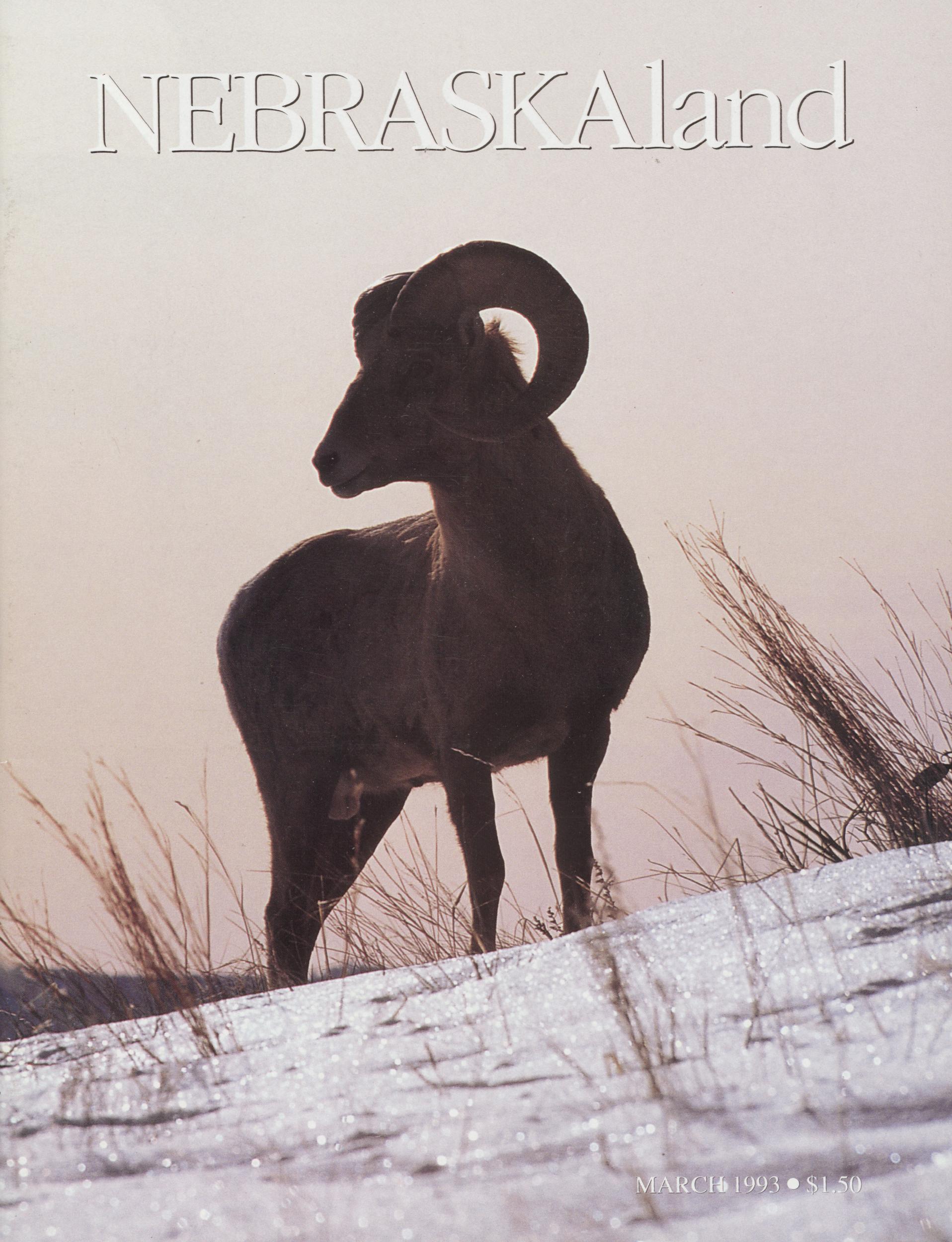
NEBRASKAland
MARCH 1993 • $1.50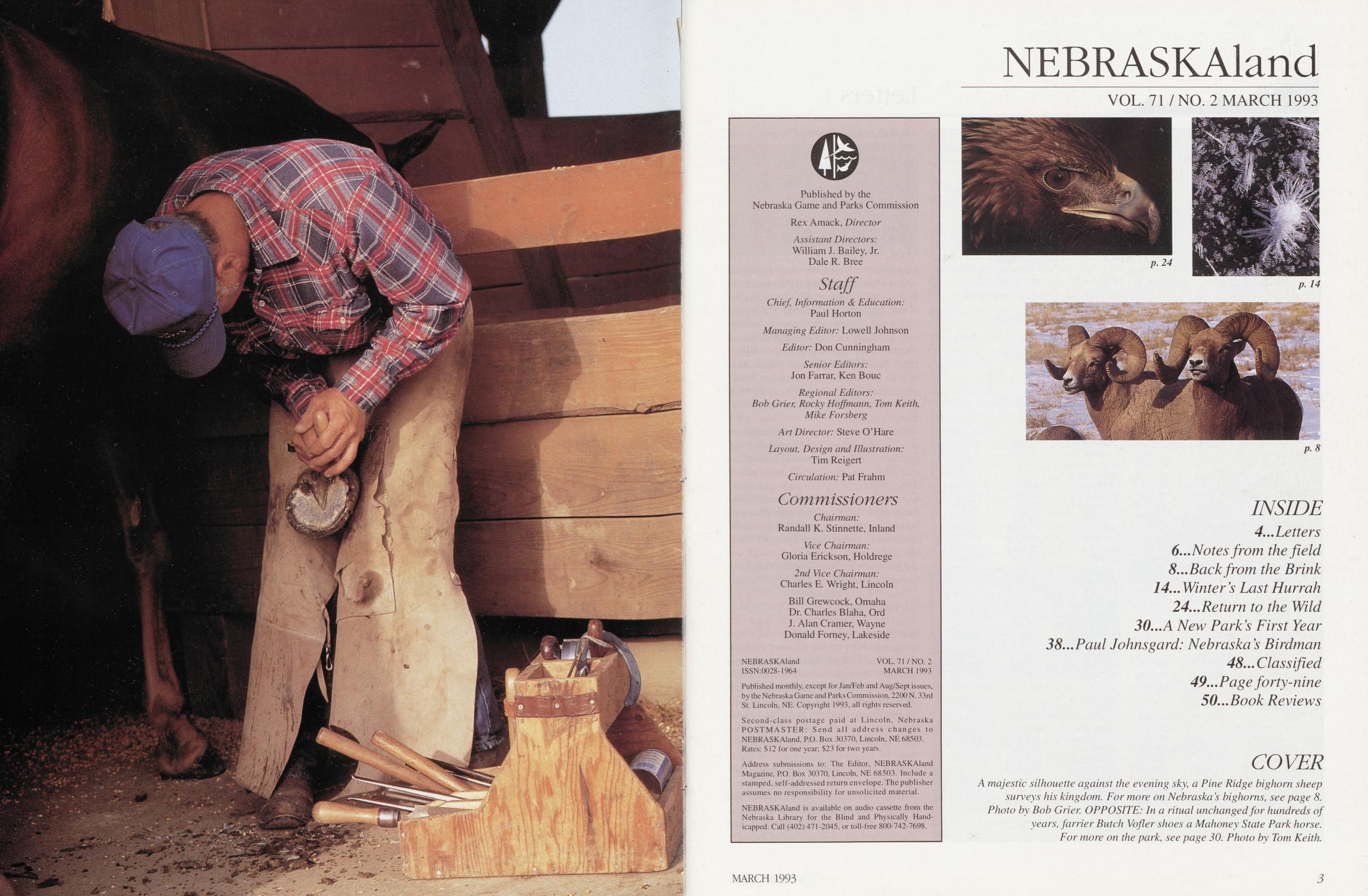
NEBRASKAland
Published by the Nebraska Game and Parks Commission Rex Amack, Director Assistant Directors: William J. Bailey, Jr. Dale R. Bree Staff Chief, Information & Education: Paul Horton Managing Editor: Lowell Johnson Editor: Don Cunningham Senior Editors: Jon Farrar, Ken Bouc Regional Editors: Bob Grier, Rocky Hoffmann, Tom Keith, Mike Forsberg Art Director: Steve O'Hare Layout, Design and Illustration: Tim Reigert Circulation: Pat Frahm Chairman: Randall K. Stinnette, Inland Vice Chairman: Gloria Erickson, Holdrege 2nd Vice Chairman: Charles E. Wright, Lincoln Bill Grewcock, Omaha Dr. Charles Blaha, Ord J. Alan Cramer, Wayne Donald Forney, Lakeside NEBRASKAland ISSN:0028-1964 VOL.71 /NO. 2 MARCH 1993 Published monthly, except for Jan/Feb and Aug/Sept issues, by the Nebraska Game and Parks Commission, 22(X) N. 33rd St. Lincoln, NE. Copyright 1993, all rights reserved. Second-class postage paid at Lincoln, Nebraska POSTMASTER: Send all address changes to NEBRASKAland, P.O. Box 30370, Lincoln, NE 68503. Rates: $12 for one year; $23 for two years. Address submissions to: The Editor, NEBRASKAland Magazine, P.O. Box 30370, Lincoln, NE 68503. Include a stamped, self-addressed return envelope. The publisher assumes no responsibility for unsolicited material. NEBRASKAland is available on audio cassette from the Nebraska Library for the Blind and Physically Handicapped. Call (402) 471-2045, or toll-free 800-742-7698. NEBRASKAland VOL. 71 / NO. 2 MARCH 1993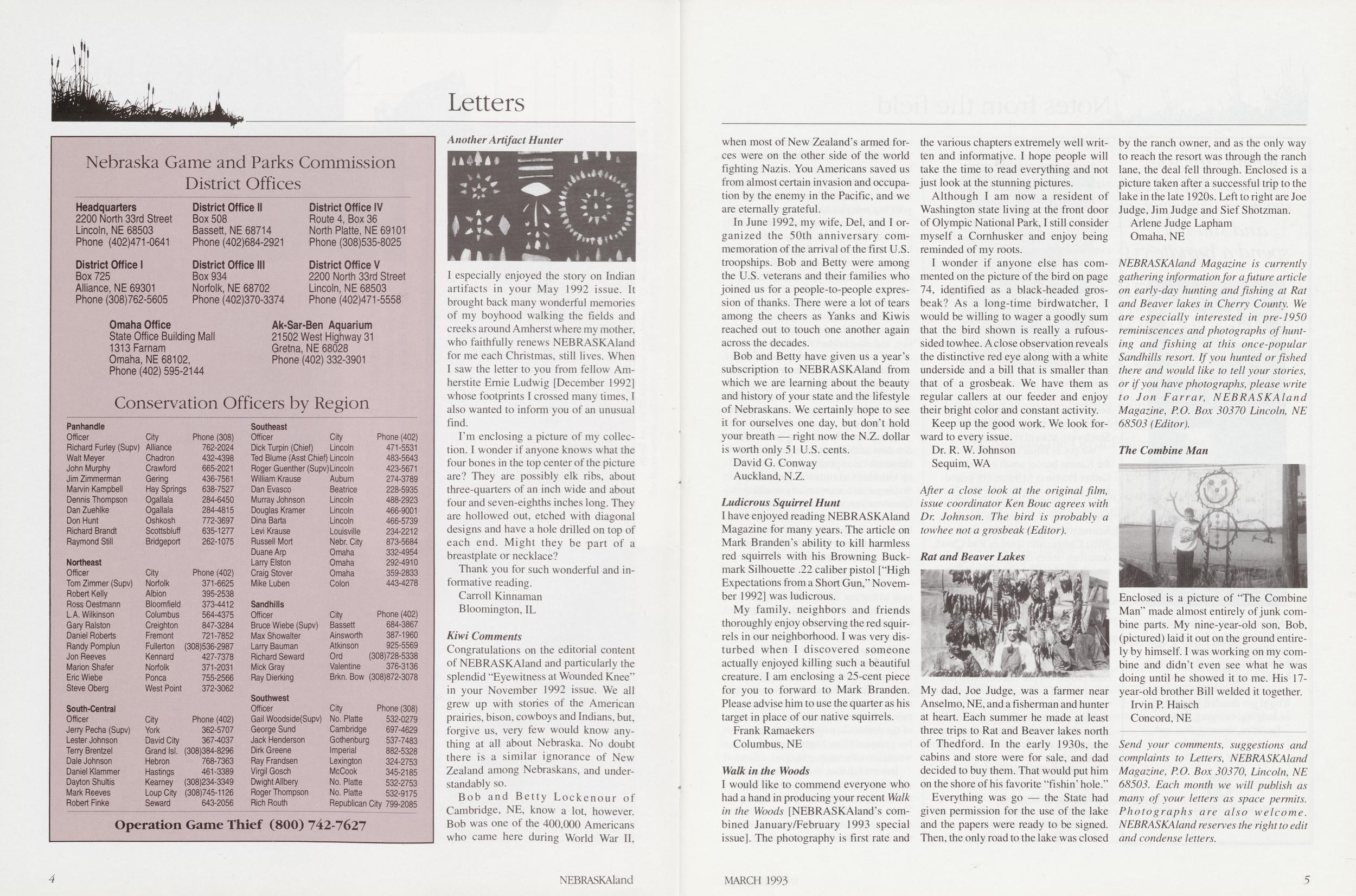
Letters
Nebraska Game and Parks Commission District Offices Headquarters 2200 North 33rd Street Lincoln, NE 68503 Phone (402)471-0641 District Office II Box 508 Bassett, NE 68714 Phone (402)684-2921 District Office IV Route 4, Box 36 North Platte, NE 69101 Phone (308)535-8025 District Office 1 Box 725 Alliance, NE 69301 Phone (308)762-5605 District Office III Box 934 Norfolk, NE 68702 Phone (402)370-3374 District Office V 2200 North 33rd Street Lincoln, NE 68503 Phone (402)471-5558 Omaha Office State Office Building Mall 1313 Farnam Omaha, NE 68102, Phone (402)595-2144 Conservation Officers by Region Panhandle Officer City Phone(308) Richard Furley (Supv) Alliance 762-2024 Walt Meyer Chadron 432-4398 John Murphy Crawford 665-2021 Jim Zimmerman Gering 436-7561 Marvin Kampbell Hay Springs 638-7527 Dennis Thompson Ogallala 284-6450 Dan Zuehlke Ogallala 284-4815 Don Hunt Oshkosh 772-3697 Richard Brandt Scottsbluff 635-1277 Raymond Still Bridgeport 262-1075 Southeast Officer City Phone (402) Dick Turpin (Chief) Lincoln 471-5531 Ted Blume (Asst Chief) Lincoln 483-5643 Roger Guenther (Supv) Lincoln 423-5671 William Krause Auburn 274-3789 Dan Evasco Beatrice 228-5935 Murray Johnson Lincoln 488-2923 Douglas Kramer Lincoln 466-9001 Dina Barta Lincoln 466-5739 Levi Krause Louisville 234-2212 Russell Mort Duane Arp Nebr. City 873-5684 Northeast Officer City Phone (402) Tom Zimmer (Supv) Norfolk 371-6625 Robert Kelly Albion 395-2538 Ross Oestmann Bloomfield 373-4412 L.A. Wilkinson Columbus 564-4375 Gary Ralston Creighton 847-3284 Daniel Roberts Fremont 721-7852 Randy Pomplun Fullerton (308)536-2987 Jon Reeves Kennard 427-7378 Marion Shafer Norfolk 371-2031 Eric Wiebe Ponca 755-2566 Steve Oberg West Point 372-3062 Sandhills Officer City Phone (402) Bruce Wiebe (Supv) Bassett 684-3867 Max Showalter Ainsworth 387-1960 Larry Bauman Atkinson 925-5569 Richard Seward Ord (308)728-5338 Mick Gray Valentine 376-3136 Ray Dierking Brkn. Bow (308)872-3078 South Central Officer City Phone (402) Jerry Pecha (Supv) York 362-5707 Lester Johnson David City 367-4037 Terry Brentzel Grand Isl. (308)384-8296 Dale Johnson Hebron 768-7363 Daniel Klammer Hastings 461-3389 Dayton Shultis Kearney (308)234-3349 Mark Reeves Loup City (308)745-1126 Robert Finke Seward 643-2056 Southwest Officer City Phone (308) Gail Woodside(Supv) No. Platte 532-0279 George Sund Cambridge 697-4629 Jack Henderson Gothenburg 537-7483 Dirk Greene Imperial 882-5328 Ray Frandsen Lexington 324-2753 Virgil Gosch McCook 345-2185 Dwight AHbery No. Platte 532-2753 Roger Thompson No. Platte 532-9175 Rich Routh Republican City 799-2085 Operation Game Thief (800) 742-7627 Another Artifact HunterI especially enjoyed the story on Indian artifacts in your May 1992 issue. It brought back many wonderful memories of my boyhood walking the fields and creeks around Amherst where my mother, who faithfully renews NEBRASKAland for me each Christmas, still lives. When I saw the letter to you from fellow Amherstite Ernie Ludwig [December 1992] whose footprints I crossed many times, I also wanted to inform you of an unusual find.
I'm enclosing a picture of my collection. I wonder if anyone knows what the four bones in the top center of the picture are? They are possibly elk ribs, about three-quarters of an inch wide and about four and seven-eighths inches long. They are hollowed out, etched with diagonal designs and have a hole drilled on top of each end. Might they be part of a breastplate or necklace?
Thank you for such wonderful and informative reading.
Carroll Kinnaman Bloomington, IL Kiwi CommentsCongratulations on the editorial content of NEBRASKAland and particularly the splendid "Eyewitness at Wounded Knee" in your November 1992 issue. We all grew up with stories of the American prairies, bison, cowboys and Indians, but, forgive us, very few would know anything at all about Nebraska. No doubt there is a similar ignorance of New Zealand among Nebraskans, and understandably so.
Bob and Betty Lockenour of Cambridge, NE, know a lot, however. Bob was one of the 400,000 Americans who came here during World War II, 4 NEBRASKAland when most of New Zealand's armed forces were on the other side of the world fighting Nazis. You Americans saved us from almost certain invasion and occupation by the enemy in the Pacific, and we are eternally grateful.
In June 1992, my wife, Del, and I organized the 50th anniversary commemoration of the arrival of the first U.S. troopships. Bob and Betty were among the U.S. veterans and their families who joined us for a people-to-people expression of thanks. There were a lot of tears among the cheers as Yanks and Kiwis reached out to touch one another again across the decades.
Bob and Betty have given us a year's subscription to NEBRASKAland from which we are learning about the beauty and history of your state and the lifestyle of Nebraskans. We certainly hope to see it for ourselves one day, but don't hold your breath — right now the N.Z. dollar is worth only 51 U.S. cents.
David G. Conway Auckland, N.Z. Ludicrous Squirrel HuntI have enjoyed reading NEBRASKAland Magazine for many years. The article on Mark Branden's ability to kill harmless red squirrels with his Browning Buckmark Silhouette .22 caliber pistol ["High Expectations from a Short Gun," November 1992] was ludicrous. My family, neighbors and friends thoroughly enjoy observing the red squirrels in our neighborhood. I was very disturbed when I discovered someone actually enjoyed killing such a beautiful creature. I am enclosing a 25-cent piece for you to forward to Mark Branden. Please advise him to use the quarter as his target in place of our native squirrels.
Frank Ramaekers Columbus, NE Walk in the WoodsI would like to commend everyone who had a hand in producing your recent Walk in the Woods [NEBRASKAland's combined January/February 1993 special issue]. The photography is first rate and the various chapters extremely well written and informative. I hope people will take the time to read everything and not just look at the stunning pictures.
Although I am now a resident of Washington state living at the front door of Olympic National Park, I still consider myself a Cornhusker and enjoy being reminded of my roots.
I wonder if anyone else has commented on the picture of the bird on page 74, identified as a black-headed grosbeak? As a long-time birdwatcher, I would be willing to wager a goodly sum that the bird shown is really a rufous sided towhee. A close observation reveals the distinctive red eye along with a white underside and a bill that is smaller than that of a grosbeak. We have them as regular callers at our feeder and enjoy their bright color and constant activity. Keep up the good work. We look forward to every issue.
Dr. R. W. Johnson Sequim, WAAfter a close look at the original film, issue coordinator Ken Bouc agrees with Dr. Johnson. The bird is probably a towhee not a grosbeak (Editor).
Rat and Beaver LakesMy dad, Joe Judge, was a farmer near Anselmo, NE, and a fisherman and hunter at heart. Each summer he made at least three trips to Rat and Beaver lakes north of Thedford. In the early 1930s, the cabins and store were for sale, and dad decided to buy them. That would put him on the shore of his favorite "fishin' hole."
Everything was go — the State had given permission for the use of the lake and the papers were ready to be signed. Then, the only road to the lake was closed by the ranch owner, and as the only way to reach the resort was through the ranch lane, the deal fell through. Enclosed is a picture taken after a successful trip to the lake in the late 1920s. Left to right are Joe Judge, Jim Judge and Sief Shotzman.
Arlene Judge Lapham Omaha, NENEBRASKAland Magazine is currently gathering information for a future article on early-day hunting and fishing at Rat and Beaver lakes in Cherry County. We are especially interested in pre-1950 reminiscences and photographs of hunting and fishing at this once-popular Sandhills resort. If you hunted or fished there and would like to tell your stories, or if you have photographs, please write to Jon Farrar, NEBRASKAland Magazine, P.O. Box 30370 Lincoln, NE 68503 (Editor).
The Combine ManEnclosed is a picture of "The Combine Man" made almost entirely of junk combine parts. My nine-year-old son, Bob, (pictured) laid it out on the ground entirely by himself. I was working on my combine and didn't even see what he was doing until he showed it to me. His 17-year-old brother Bill welded it together.
Irvin P. Haisch Concord, NESend your comments, suggestions and complaints to Letters, NEBRASKAland Magazine, P.O. Box 30370, Lincoln, NE 68503. Each month we will publish as many of your letters as space permits. Photographs are also welcome. NEBRASKAland reserves the right to edit and condense letters.
MARCH 1993 5
Notes from the field
Where can you get away for a week or weekend, and still not spend a bundle?By mid-February, the light had changed, and in spite of below-zero nights and a low, threatening groan from the longest overhanging limb of the wind-whipped hackberry in the backyard, it was clear that winter was all but over. The light was spring light, even if all the minimum-maintenance roads were drifted shut and the cutting edge of the winter's third windshield scraper was already pitted and dull. "Let's do something," we kept saying, but what?
So, by the second Saturday in March, when the weather finally broke, we didn't think twice: we loaded provisions in the daypack (a block of swiss cheese, a chunk of pepperoni, a loaf of Lithuanian rye), tossed knee boots in the trunk and took off. "Let's head south," we said, "toward summer. Southwest, toward the desert!"
We got as far as Cather Prairie, on the Kansas border south of Red Cloud. Cather Prairie is 610 acres of mixed grass prairie now owned by The Nature Conservancy and used as an outdoor laboratory by University of Nebraska - Kearney biologists. In My Antonia, Willa Cather, who lived in Red Cloud, describes "miles of copper-red grass ... drenched in sunlight," in a land where "as far as the eye could reach, there was nothing but rough, shaggy, red grass, most of it as tall as I."
By the time we got to Cather Prairie on that March Saturday, the morning's spring sky was obscured by a low, fast moving, chalky overcast, and what had been proud, copper-red bluestem and delicate, buff switchgrass in September was now a matted, bent tangle on the thawing slopes, a dull, speckled brown after a fierce winter. Not sunlight, but a steady, gray drizzle drenched the prairie that morning.
No matter. We were there for a spring walk, and a spring walk we would have. We tugged on our boots, shrugged into our raincoats and set out across the rolling landscape.
March can be a raw, biting month, a monochrome month, a month of hunched shoulders, raised collars and lowered expectations. You set out on day filled with promise, and you slink back with drenched trouser legs and your lug soles packed with icy mud. You start the morning with a pocket full of fresh Ektachrome, and you shiver back to the car with 72 frames of dense brown landscape, angular and awkward, dimmed by a faintly magenta, mercurochrome mist.
But March is also the quickening, wakening month, when Vs of northbound snow geese punctuate the sky, and meadowlarks suddenly appear on every fence post in Webster County. And every year, scent returns in March: First, the scent of fresh, wet, thawing earth, then the spice of warming bark, and finally the astringent scent of new green shoots.
So, alternately shivering in the sodden mist and inhaling the promises of the scent-laden prairie air, we climbed up hillsides and slithered down muddy drainages and across musty smelling limestone outcrops until the highway and the car were far behind — so far behind that finally, when we were wet and cold enough to feel we'd had a proper March walk, we had no idea at all where the car was.
We weren't lost. Cather Prairie is only 610 acres, 30 acres short of a square mile. It is bounded on the east by a paved highway, and it is fenced. The worst — the very worst — that could happen was that we would have to walk until we found a fence. Then, if we made a really bad choice, if all the gods of drizzle and mud were sneering at us, we might have to walk nearly four miles — almost the full perimeter of the prairie — to get back to the car. No great problem. Our pepperoni would have lasted that long.
But we felt lost. In the mist and drizle, the landscape stretched endlessly and disappeared into gray infinity. There was no sun to tell direction by, only an even, shadowless, omnidirectional light. We weren't frightened, but 6 NEBRASKAland we were awed — awed by a growing understanding of what "lost" might once have meant when unbroken, rolling prairie stretched on and on into the west, gradually, subtly changing from tall grass to mixed and midgrass to shortgrass, when even days and days of walking would bring you no nearer to a fence, a parking lot or a paved highway. We felt reduced and meaningless, infinitesimal mites on a huge organism oblivious to our petty concerns.
I have spent a fair amount of time in prairie country, lying in a few acres of tall grass watching clouds blow past the drooping seed heads, walking the Sandhills hunting grouse, or simply kicking around a pasture looking for a photograph. I have walked for hours with no sight of a ranch and only a distant windmill to mark the presence of human work. But that windmill mattered, cutting me off from a true sense of the old prairie, and so did the sound of a highway in the distance or the sight of a cultivated field beyond the boundaries of some bit of prairie preserve, and I have often tried to imagine what the old prairie really felt like — when the land was prairie, horizon to horizon.
So, I'm glad for that misty March day on a prairie remnant in Webster County when, for a moment or two, we felt lost. That was, perhaps, my truest prairie experience, a faint inkling of the force of the ancient landscape.
Don Cunningham Prairie Trails1993 is being celebrated as the 150th anniversary of the Oregon Trail, the name popularly associated with the complex of westward migration routes which converged on the Platter River in Nebraska. Old West Trail Country, an association of five states, including Nebraska, linked by those trails, has available a colorful new "Explorer's Journal" brochure and an oversized "Explorer's Map." To get copies, call 1-800-832-WEST, or write Old West Trail Foundation, P.O. Box 2554, Room 9244, Rapid City, SD 57709.
Back from the Brink
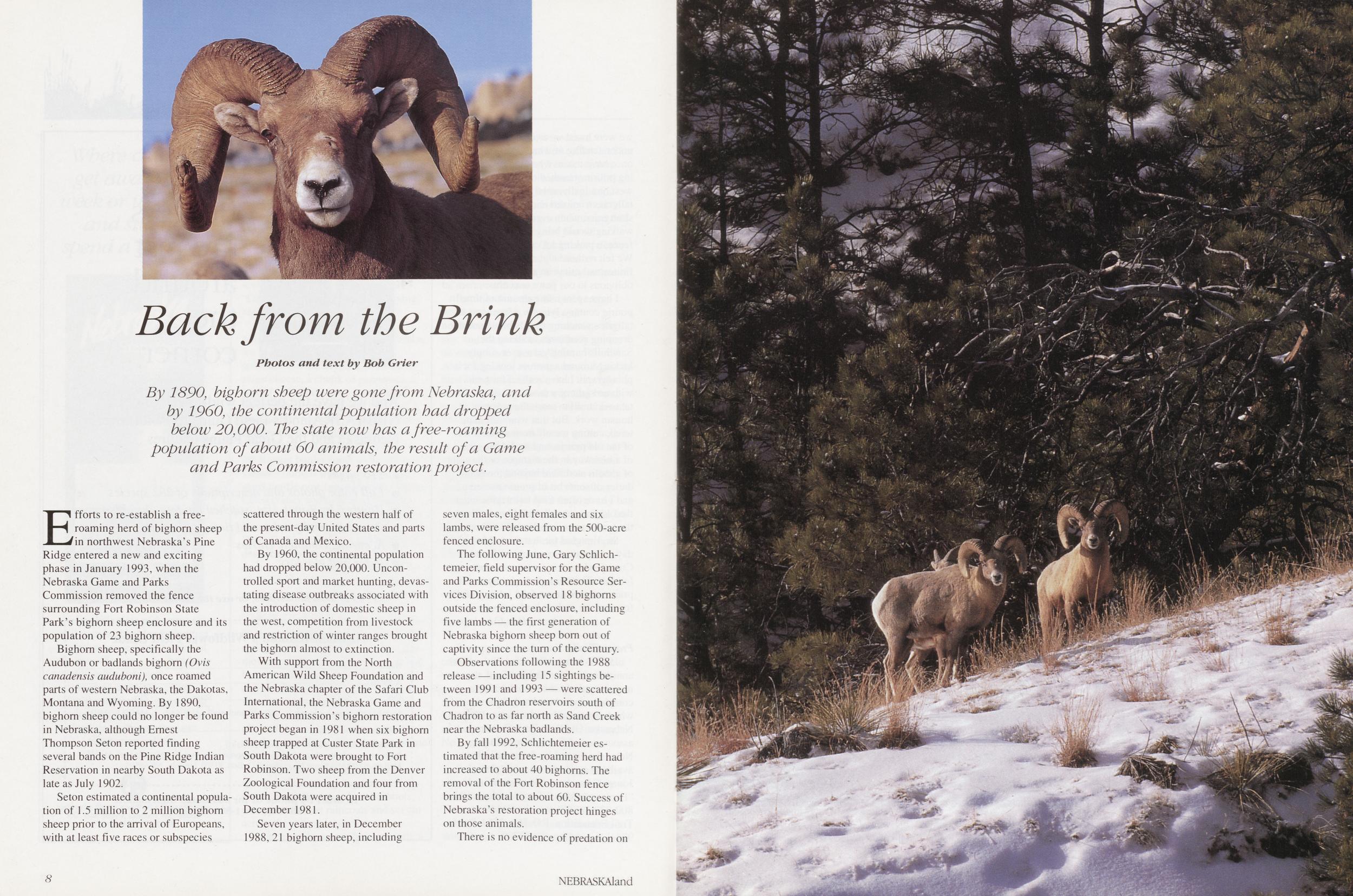
Photos and text by Bob Grier By 1890, bighorn sheep were gone from Nebraska, and by I960, the continental population had dropped below 20,000. The state now has a free-roaming population of about 60 animals, the result of a Game and Parks Commission restoration project.Efforts to re-establish a free- roaming herd of bighorn sheep in northwest Nebraska's Pine Ridge entered a new and exciting phase in January 1993, when the Nebraska Game and Parks Commission removed the fence surrounding Fort Robinson State Park's bighorn sheep enclosure and its population of 23 bighorn sheep.
Bighorn sheep, specifically the Audubon or badlands bighorn (Ovis canadensis auduboni), once roamed parts of western Nebraska, the Dakotas, Montana and Wyoming. By 1890, bighorn sheep could no longer be found in Nebraska, although Ernest Thompson Seton reported finding several bands on the Pine Ridge Indian Reservation in nearby South Dakota as late as July 1902.
Seton estimated a continental population of 1.5 million to 2 million bighorn sheep prior to the arrival of Europeans, with at least five races or subspecies scattered through the western half of the present-day United States and parts of Canada and Mexico.
By 1960, the continental population had dropped below 20,000. Uncontrolled sport and market hunting, devastating disease outbreaks associated with the introduction of domestic sheep in the west, competition from livestock and restriction of winter ranges brought the bighorn almost to extinction.
With support from the North American Wild Sheep Foundation and the Nebraska chapter of the Safari Club International, the Nebraska Game and Parks Commission's bighorn restoration project began in 1981 when six bighorn sheep trapped at Custer State Park in South Dakota were brought to Fort Robinson. Two sheep from the Denver Zoological Foundation and four from South Dakota were acquired in December 1981.
Seven years later, in December 1988, 21 bighorn sheep, including seven males, eight females and six lambs, were released from the 500-acre fenced enclosure.
The following June, Gary Schlichtemeier, field supervisor for the Game and Parks Commission's Resource Services Division, observed 18 bighorns outside the fenced enclosure, including five lambs — the first generation of Nebraska bighorn sheep bom out of captivity since the turn of the century.
Observations following the 1988 release — including 15 sightings be- tween 1991 and 1993 — were scattered from the Chadron reservoirs south of Chadron to as far north as Sand Creek near the Nebraska badlands.
By fall 1992, Schlichtemeier estimated that the free-roaming herd had increased to about 40 bighorns. The removal of the Fort Robinson fence brings the total to about 60. Success of Nebraska's restoration project hinges on those animals.
There is no evidence of predation on 8 NEBRASKAland
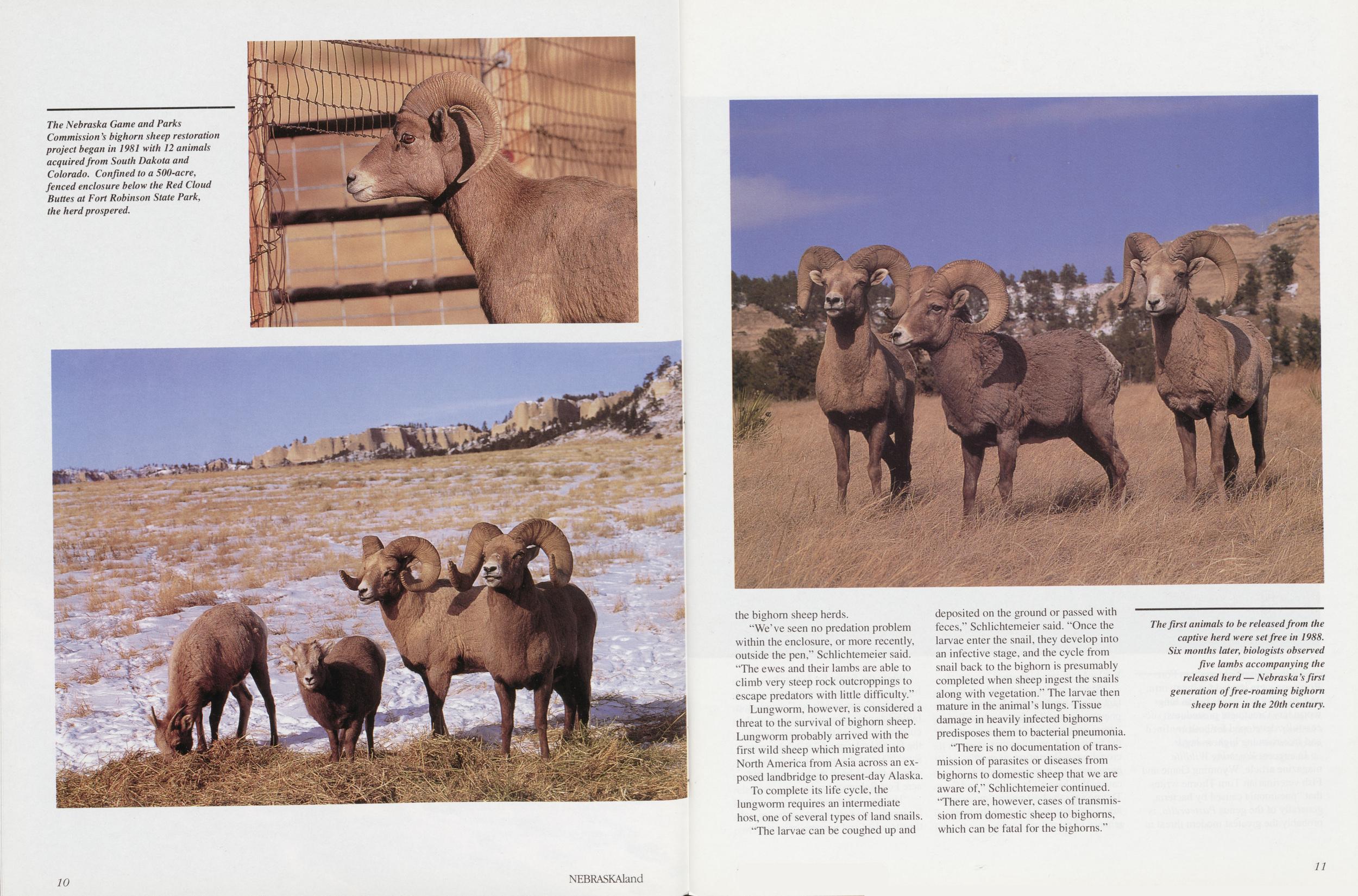
''We've seen no predation problem within the enclosure, or more recently, outside the pen," Schlichtemeier said. "The ewes and their lambs are able to climb very steep rock outcroppings to escape predators with little difficulty."
Lungworm, however, is considered a threat to the survival of bighorn sheep. Lungworm probably arrived with the first wild sheep which migrated into North America from Asia across an ex- posed land bridge to present-day Alaska.
To complete its life cycle, the lungworm requires an intermediate host, one of several types of land snails.
"The larvae can be coughed up and deposited on the ground or passed with feces," Schlichtemeier said. "Once the larvae enter the snail, they develop into an infective stage, and the cycle from snail back to the bighorn is presumably completed when sheep ingest the snails along with vegetation." The larvae then mature in the animal's lungs. Tissue damage in heavily infected bighorns predisposes them to bacterial pneumonia.
"There is no documentation of trans- mission of parasites or diseases from bighorns to domestic sheep that we are aware of," Schlichtemeier continued. "There are, however, cases of transmission from domestic sheep to bighorns, which can be fatal for the bighorns."
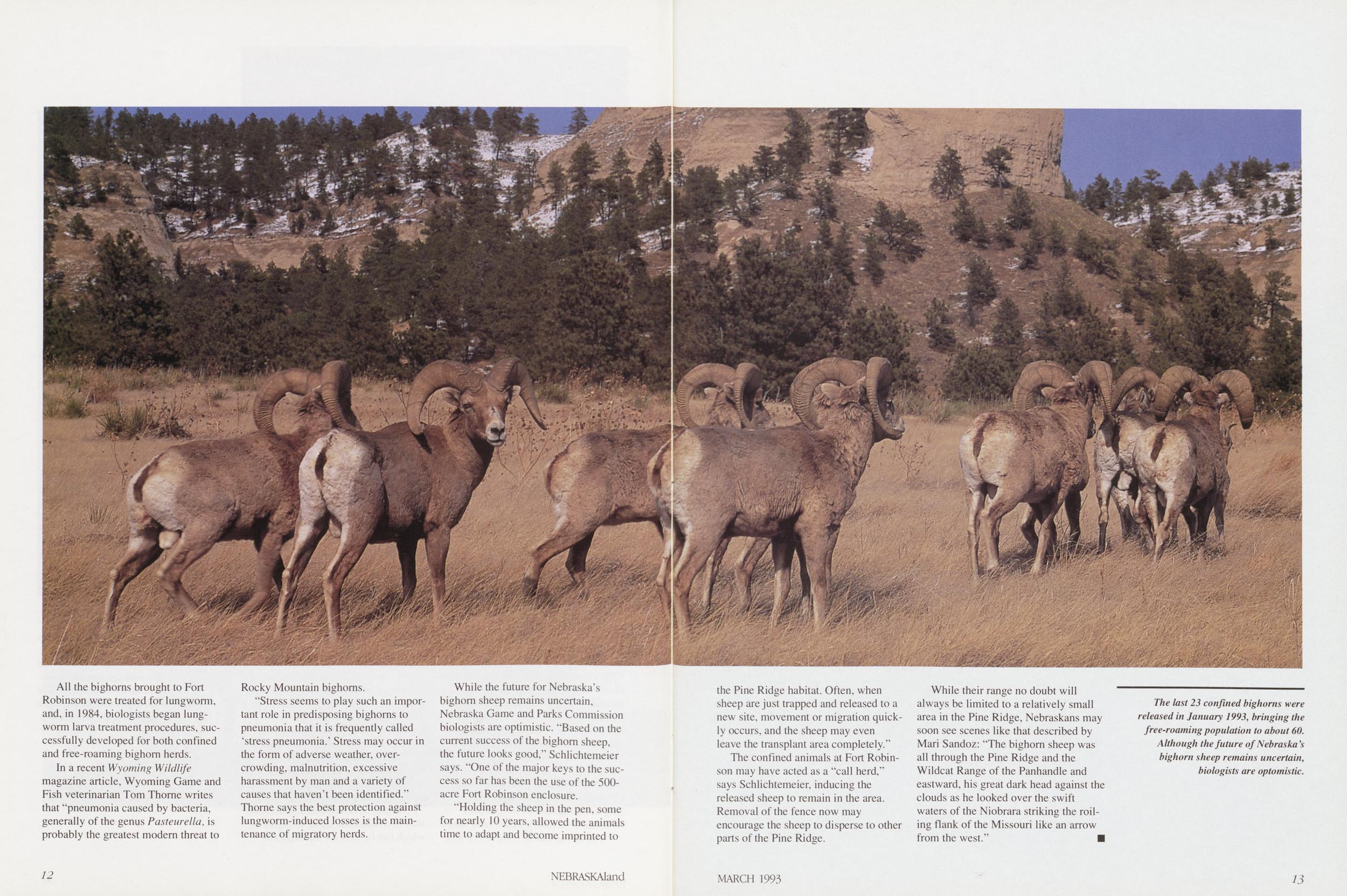
The last 23 confined bighorns were released in January 1993, bringing the free-roaming population to about 60. Although the future of Nebraska's bighorn sheep remains uncertain, biologists are optimistic.
In a recent Wyoming Wildlife magazine article, Wyoming Game and Fish veterinarian Tom Thorne writes that "pneumonia caused by bacteria, generally of the genus Pasteurella, is probably the greatest modern threat to Rocky Mountain bighorns.
"Stress seems to play such an important role in predisposing bighorns to pneumonia that it is frequently called 'stress pneumonia.' Stress may occur in the form of adverse weather, over crowding, malnutrition, excessive harassment by man and a variety of causes that haven't been identified." Thorne says the best protection against lungworm-induced losses is the maintenance of migratory herds.
While the future for Nebraska's bighorn sheep remains uncertain, Nebraska Game and Parks Commission biologists are optimistic. "Based on the current success of the bighorn sheep, the future looks good," Schlichtemeier says. "One of the major keys to the success so far has been the use of the 500-acre Fort Robinson enclosure.
"Holding the sheep in the pen, some for nearly 10 years, allowed the animals time to adapt and become imprinted to 12 NEBRASKAland the Pine Ridge habitat. Often, when sheep are just trapped and released to a new site, movement or migration quickly occurs, and the sheep may even leave the transplant area completely."
The confined animals at Fort Robinson may have acted as a "call herd," says Schlichtemeier, inducing the released sheep to remain in the area. Removal of the fence now may encourage the sheep to disperse to other parts of the Pine Ridge.
While their range no doubt will always be limited to a relatively small area in the Pine Ridge, Nebraskans may soon see scenes like that described by Mari Sandoz: "The bighorn sheep was all through the Pine Ridge and the Wildcat Range of the Panhandle and eastward, his great dark head against the clouds as he looked over the swift waters of the Niobrara striking the roiling flank of the Missouri like an arrow from the west."
MARCH 1993 13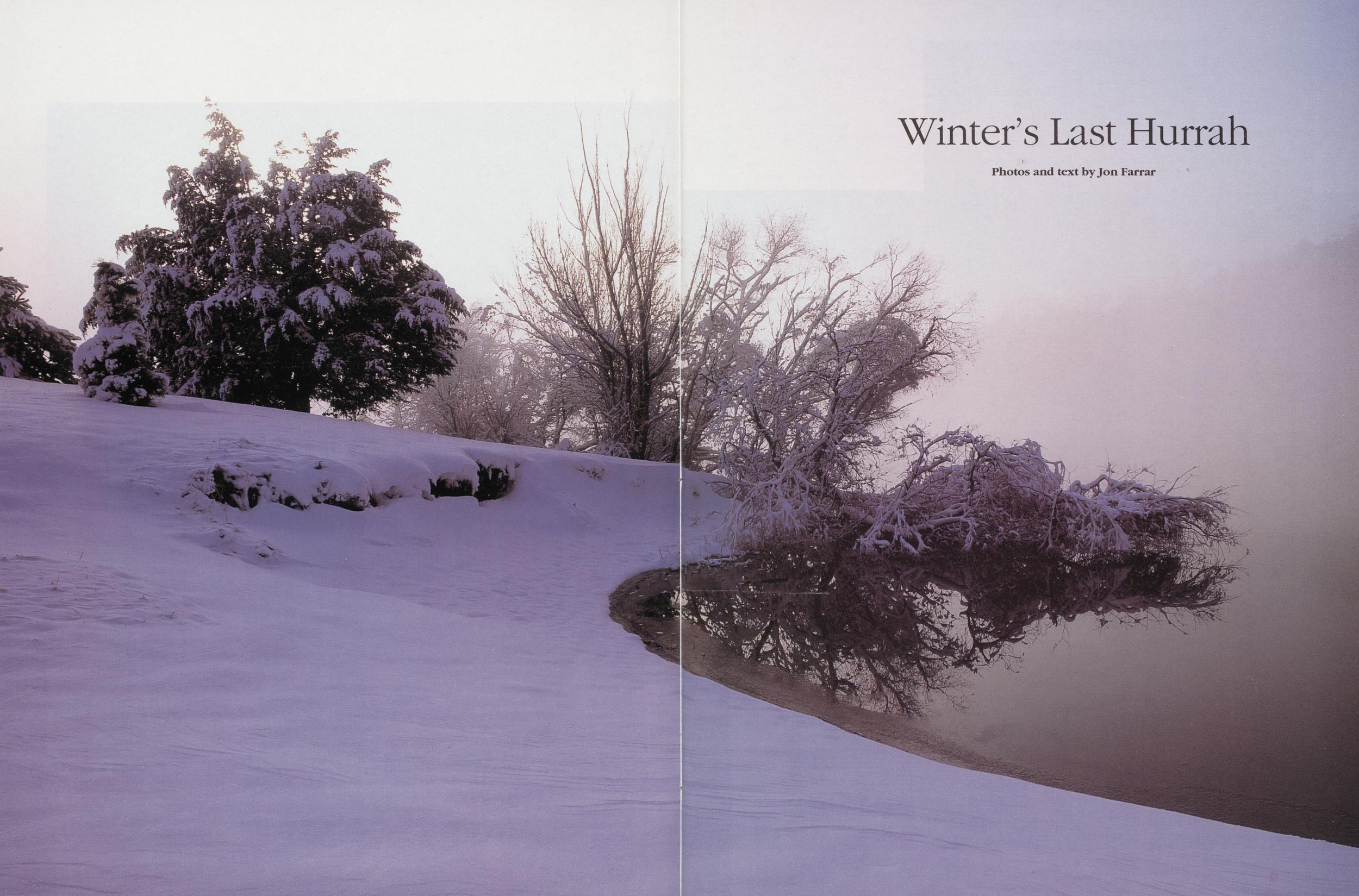
Winter's Last Hurrah
Photos and text by Jon Farrar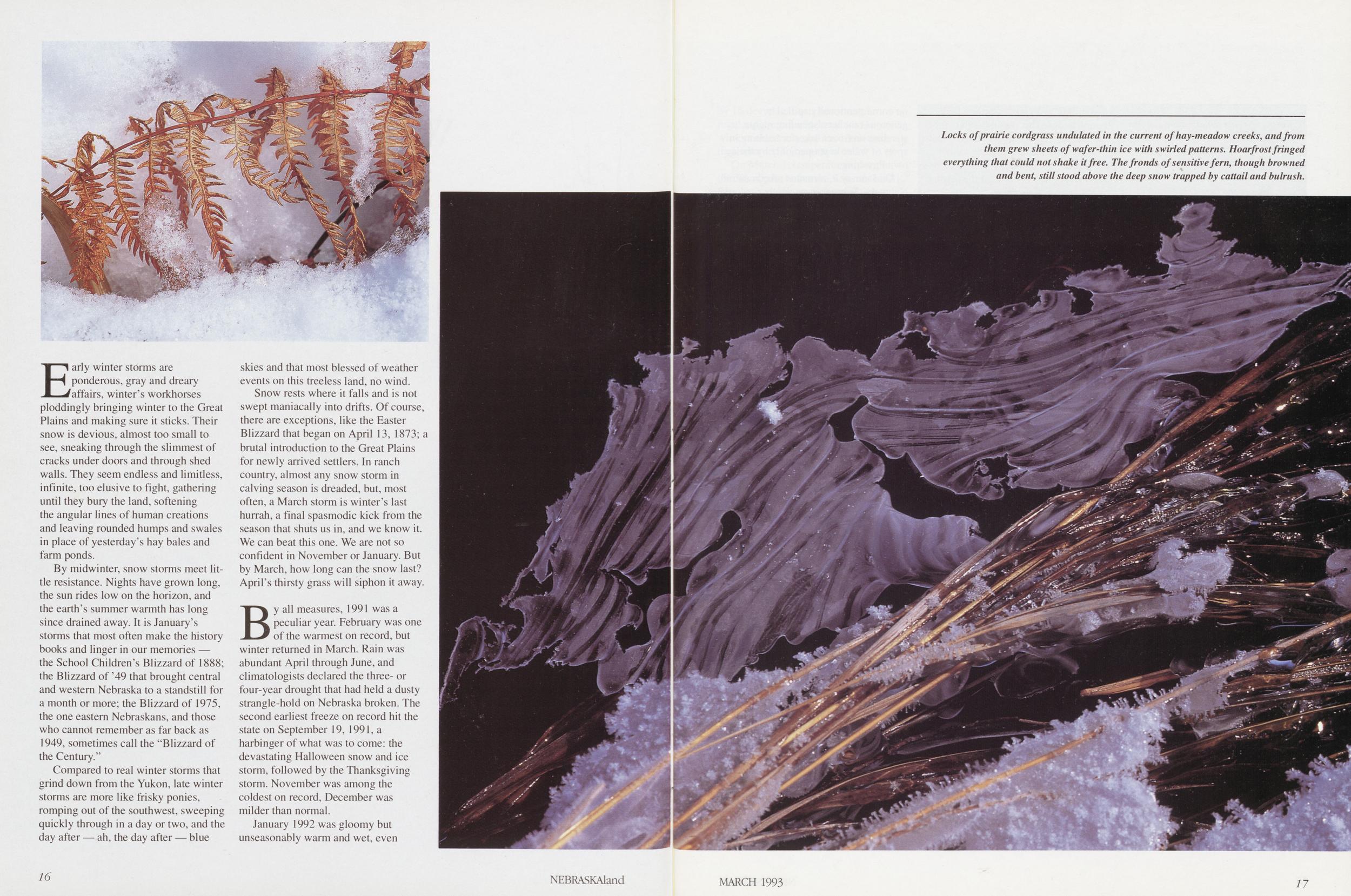
Early winter storms are ponderous, gray and dreary affairs, winter's workhorses ploddingly bringing winter to the Great Plains and making sure it sticks. Their snow is devious, almost too small to see, sneaking through the slimmest of cracks under doors and through shed walls. They seem endless and limitless, infinite, too elusive to fight, gathering until they bury the land, softening the angular lines of human creations and leaving rounded humps and swales in place of yesterday's hay bales and farm ponds.
By midwinter, snow storms meet little resistance. Nights have grown long, the sun rides low on the horizon, and the earth's summer warmth has long since drained away. It is January's storms that most often make the history books and linger in our memories — the School Children's Blizzard of 1888; the Blizzard of '49 that brought central and western Nebraska to a standstill for a month or more; the Blizzard of 1975, the one eastern Nebraskans, and those who cannot remember as far back as 1949, sometimes call the ''Blizzard of the Century."
Compared to real winter storms that grind down from the Yukon, late winter storms are more like frisky ponies, romping out of the southwest, sweeping quickly through in a day or two, and the day after — ah, the day after — blue skies and that most blessed of weather events on this treeless land, no wind.
Snow rests where it falls and is not swept maniacally into drifts. Of course, there are exceptions, like the Easter Blizzard that began on April 13, 1873; a brutal introduction to the Great Plains for newly arrived settlers. In ranch country, almost any snow storm in calving season is dreaded, but, most often, a March storm is winter's last hurrah, a final spasmodic kick from the season that shuts us in, and we know it. We can beat this one. We are not so confident in November or January. But by March, how long can the snow last? April's thirsty grass will siphon it away.
Snow rests where it falls and is not swept maniacally into drifts. Of course, there are exceptions, like the Easter Blizzard that began on April 13, 1873; a brutal introduction to the Great Plains for newly arrived settlers. In ranch country, almost any snow storm in calving season is dreaded, but, most often, a March storm is winter's last hurrah, a final spasmodic kick from the season that shuts us in, and we know it. We can beat this one. We are not so confident in November or January. But by March, how long can the snow last? April's thirsty grass will siphon it away.
January 1992 was gloomy but unseasonably warm and wet, even 16 NEBRASKAland
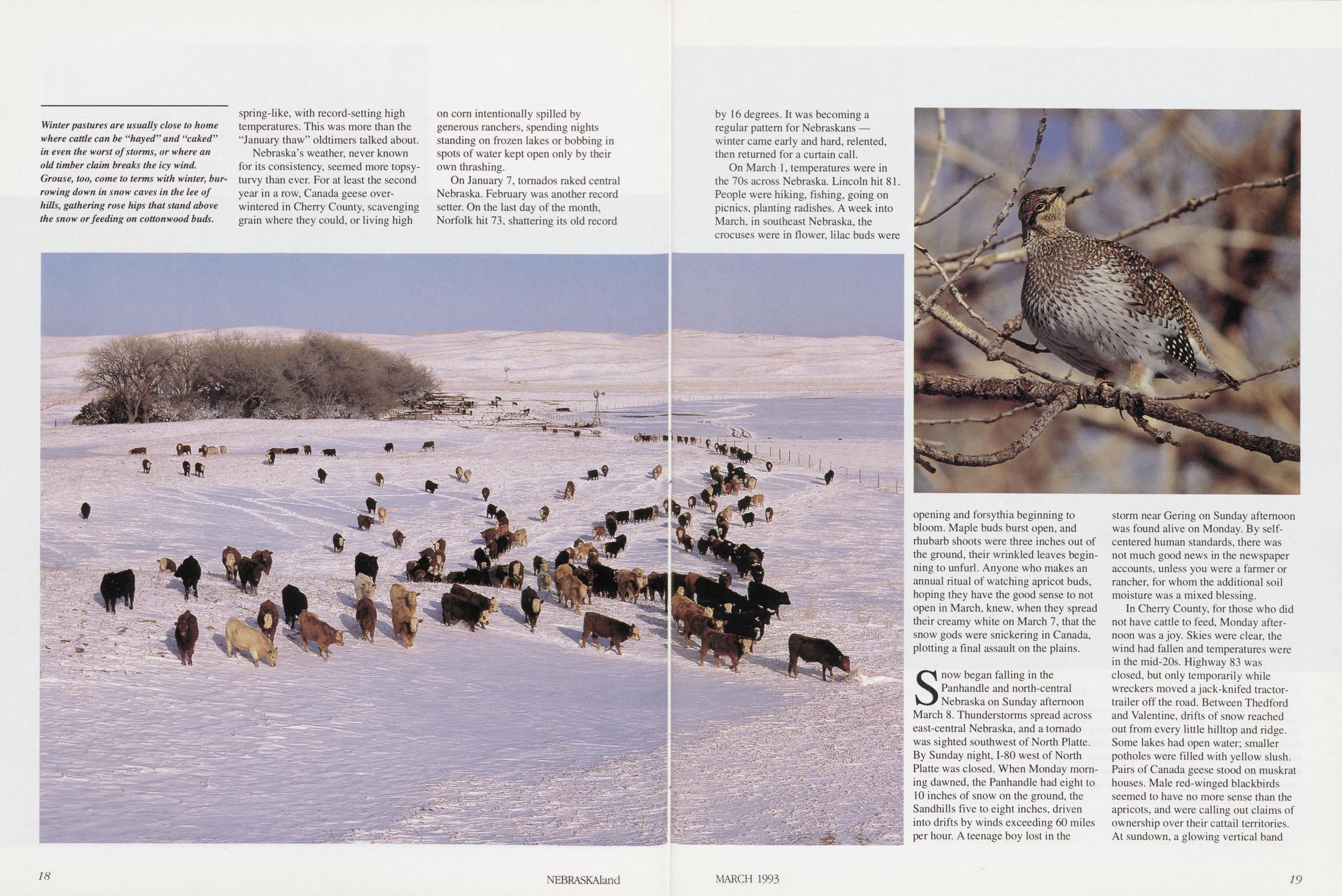
Nebraska's weather, never known for its consistency, seemed more topsyturvy than ever. For at least the second year in a row, Canada geese over wintered in Cherry County, scavenging grain where they could, or living high on corn intentionally spilled by generous ranchers, spending nights standing on frozen lakes or bobbing in spots of water kept open only by their own thrashing.
On January 7, tornados raked central Nebraska. February was another record setter. On the last day of the month, Norfolk hit 73, shattering its old record 18 NEBRASKAland by 16 degrees. It was becoming a regular pattern for Nebraskans — winter came early and hard, relented, then returned for a curtain call.
On March 1, temperatures were in the 70s across Nebraska. Lincoln hit 81. People were hiking, fishing, going on picnics, planting radishes. A week into March, in southeast Nebraska, the crocuses were in flower, lilac buds were
Snow began falling in the Panhandle and north-central Nebraska on Sunday afternoon March 8. Thunderstorms spread across east-central Nebraska, and a tornado was sighted southwest of North Platte. By Sunday night, 1-80 west of North Platte was closed. When Monday morning dawned, the Panhandle had eight to 10 inches of snow on the ground, the Sandhills five to eight inches, driven into drifts by winds exceeding 60 miles per hour. A teenage boy lost in the storm near Gering on Sunday afternoon was found alive on Monday. By selfcentered human standards, there was not much good news in the newspaper accounts, unless you were a farmer or rancher, for whom the additional soil moisture was a mixed blessing.
In Cherry County, for those who did
not have cattle to feed, Monday
afternoon was a joy. Skies were clear, the
wind had fallen and temperatures were
in the mid-20s. Highway 83 was
closed, but only temporarily while
wreckers moved a jack-knifed tractor
trailer off the road. Between Thedford
and Valentine, drifts of snow reached
out from every little hilltop and ridge.
Some lakes had open water; smaller
potholes were filled with yellow slush.
Pairs of Canada geese stood on muskrat
houses. Male red-winged blackbirds
seemed to have no more sense than the
apricots, and were calling out claims of
ownership over their cattail territories.
At sundown, a glowing vertical band
MARCH 1993
19
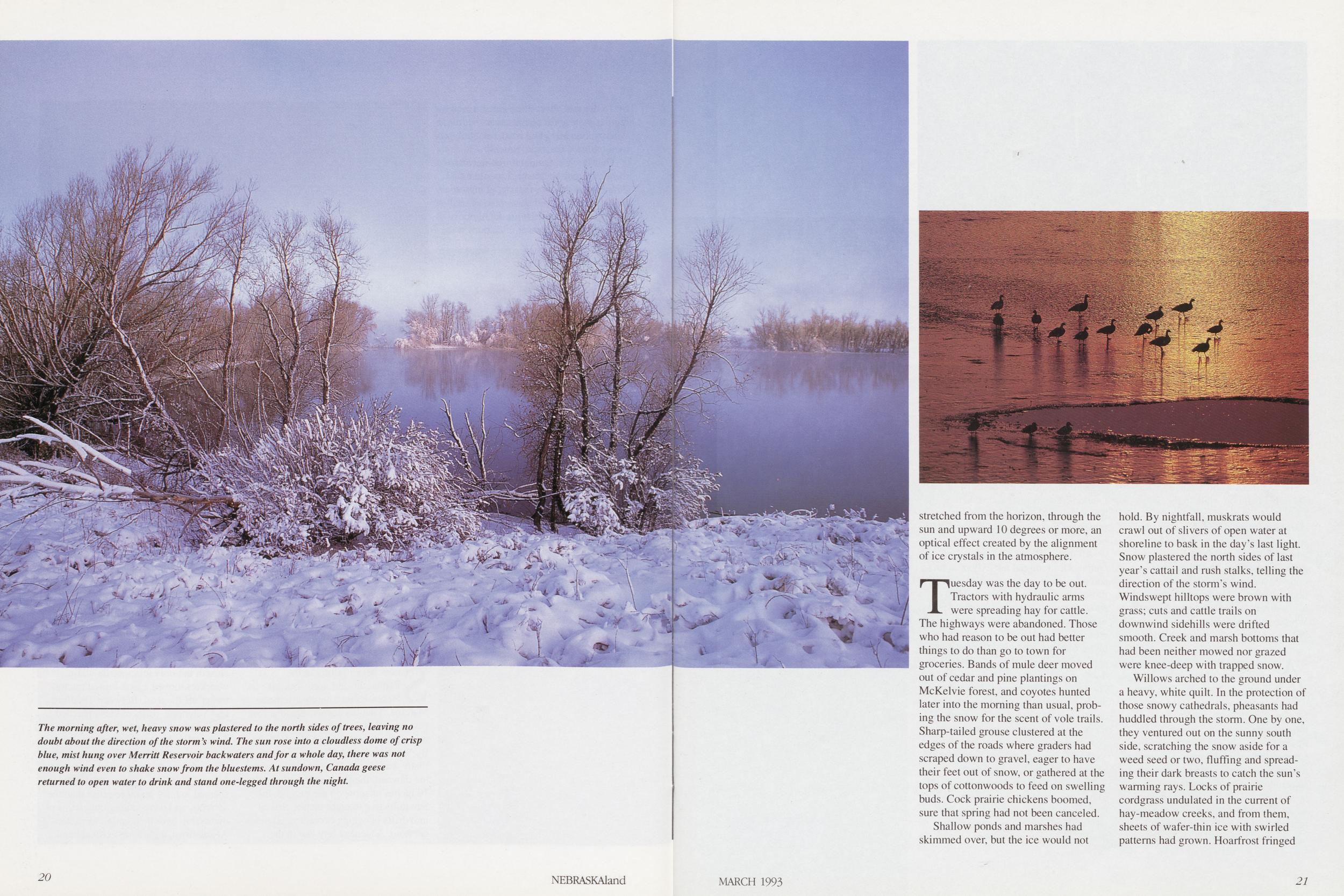
Tuesday was the day to be out. Tractors with hydraulic arms were spreading hay for cattle. The highways were abandoned. Those who had reason to be out had better things to do than go to town for groceries. Bands of mule deer moved out of cedar and pine plantings on McKelvie forest, and coyotes hunted later into the morning than usual, probing the snow for the scent of vole trails. Sharp-tailed grouse clustered at the edges of the roads where graders had scraped down to gravel, eager to have their feet out of snow, or gathered at the tops of cottonwoods to feed on swelling buds. Cock prairie chickens boomed, sure that spring had not been canceled.
Shallow ponds and marshes had skimmed over, but the ice would not hold. By nightfall, muskrats would crawl out of slivers of open water at shoreline to bask in the day's last light. Snow plastered the north sides of last year's cattail and rush stalks, telling the direction of the storm's wind. Windswept hilltops were brown with grass; cuts and cattle trails on downwind sidehills were drifted smooth. Creek and marsh bottoms that had been neither mowed nor grazed were knee-deep with trapped snow.
Willows arched to the ground under
a heavy, white quilt. In the protection of
those snowy cathedrals, pheasants had
huddled through the storm. One by one,
they ventured out on the sunny south
side, scratching the snow aside for a
weed seed or two, fluffing and
spreading their dark breasts to catch the sun's
warming rays. Locks of prairie
cordgrass undulated in the current of
hay-meadow creeks, and from them,
sheets of wafer-thin ice with swirled
patterns had grown. Hoarfrost fringed
MARCH 1993
21
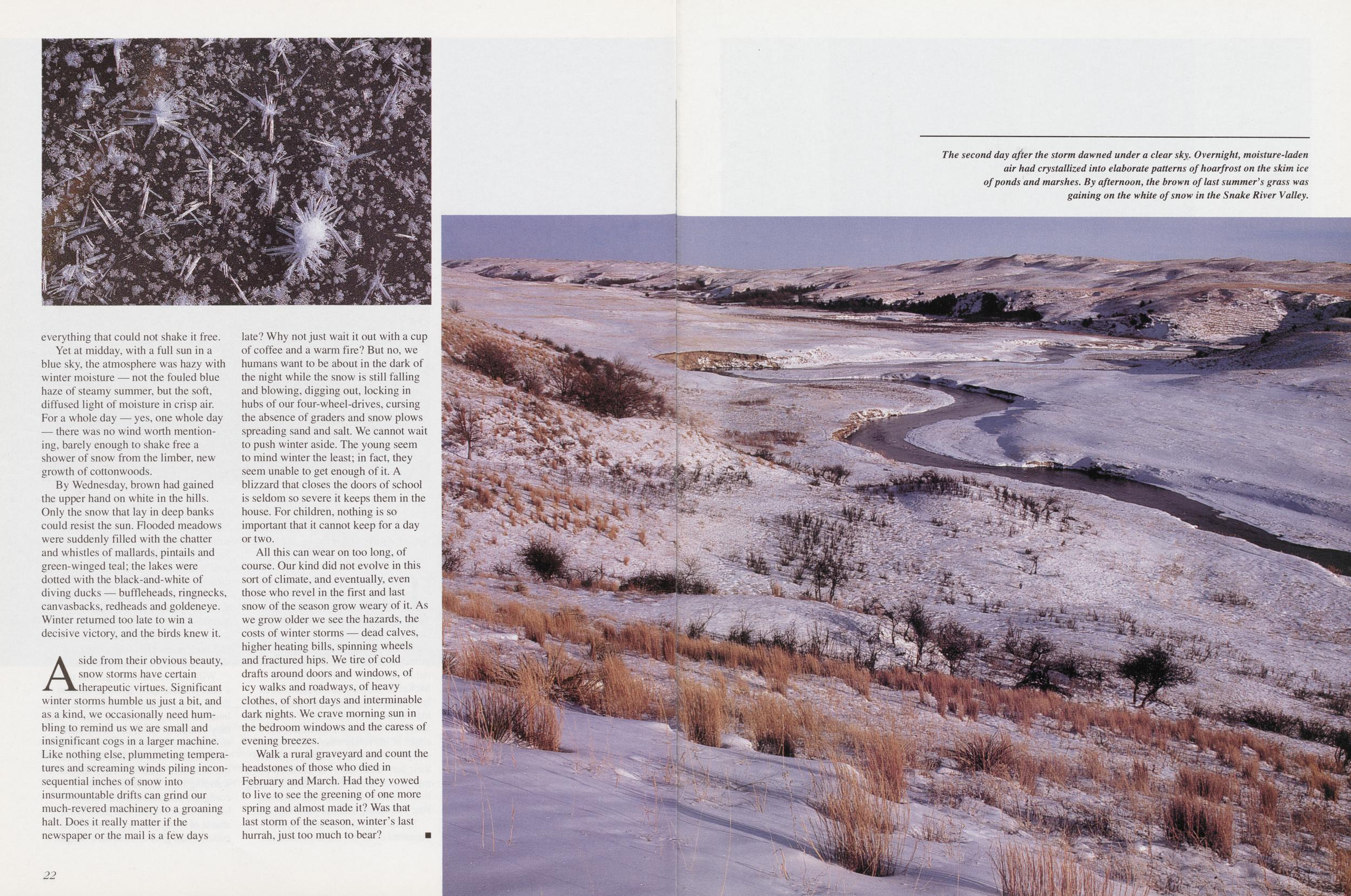
Yet at midday, with a full sun in a blue sky, the atmosphere was hazy with winter moisture — not the fouled blue haze of steamy summer, but the soft, diffused light of moisture in crisp air. For a whole day — yes, one whole day — there was no wind worth mentioning, barely enough to shake free a shower of snow from the limber, new growth of cottonwoods.
By Wednesday, brown had gained the upper hand on white in the hills. Only the snow that lay in deep banks could resist the sun. Flooded meadows were suddenly filled with the chatter and whistles of mallards, pintails and green-winged teal; the lakes were dotted with the black-and-white of diving ducks — buffleheads, ring necks, canvasbacks, redheads and goldeneye. Winter returned too late to win a decisive victory, and the birds knew it.
Aside from their obvious beauty, snow storms have certain therapeutic virtues. Significant winter storms humble us just a bit, and as a kind, we occasionally need humbling to remind us we are small and insignificant cogs in a larger machine. Like nothing else, plummeting temperatures and screaming winds piling inconsequential inches of snow into insurmountable drifts can grind our much-revered machinery to a groaning halt. Does it really matter if the newspaper or the mail is a few days late? Why not just wait it out with a cup of coffee and a warm fire? But no, we humans want to be about in the dark of the night while the snow is still falling and blowing, digging out, locking in hubs of our four-wheel-drives, cursing the absence of graders and snow plows spreading sand and salt. We cannot wait to push winter aside. The young seem to mind winter the least; in fact, they seem unable to get enough of it. A blizzard that closes the doors of school is seldom so severe it keeps them in the house. For children, nothing is so important that it cannot keep for a day or two.
All this can wear on too long, of course. Our kind did not evolve in this sort of climate, and eventually, even those who revel in the first and last snow of the season grow weary of it. As we grow older we see the hazards, the costs of winter storms — dead calves, higher heating bills, spinning wheels and fractured hips. We tire of cold drafts around doors and windows, of icy walks and roadways, of heavy clothes, of short days and interminable dark nights. We crave morning sun in the bedroom windows and the caress of evening breezes.
Walk a rural graveyard and count the headstones of those who died in February and March. Had they vowed to live to see the greening of one more spring and almost made it? Was that last storm of the season, winter's last hurrah, just too much to bear?
22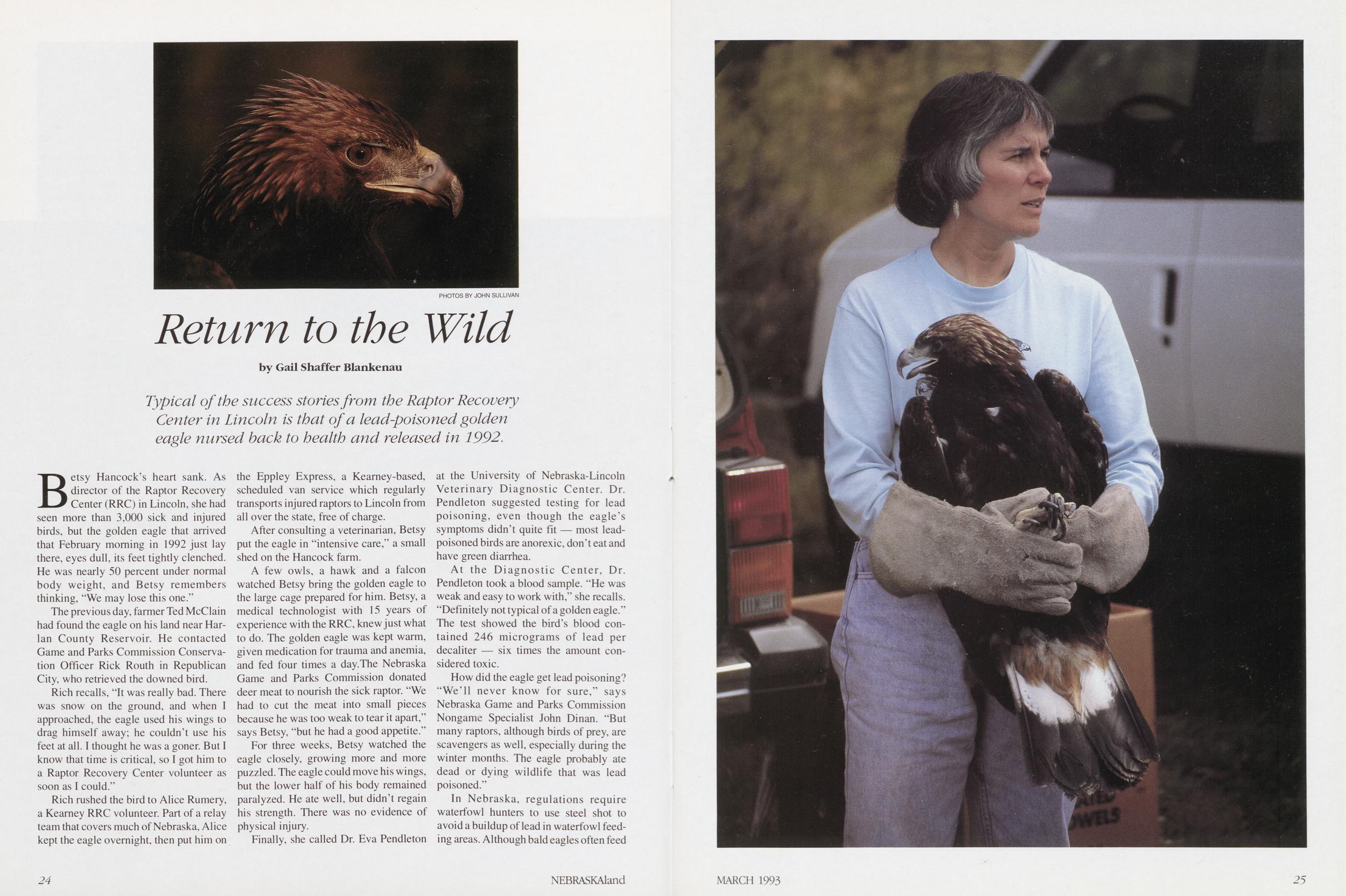
Return to the Wild
Betsy Hancock's heart sank. As director of the Raptor Recovery Center (RRC) in Lincoln, she had seen more than 3,000 sick and injured birds, but the golden eagle that arrived that February morning in 1992 just lay there, eyes dull, its feet tightly clenched. He was nearly 50 percent under normal body weight, and Betsy remembers thinking, "We may lose this one."
The previous day, farmer Ted McClain had found the eagle on his land near Harlan County Reservoir. He contacted Game and Parks Commission Conservation Officer Rick Routh in Republican City, who retrieved the downed bird.
Rich recalls, "It was really bad. There was snow on the ground, and when I approached, the eagle used his wings to drag himself away; he couldn't use his feet at all. I thought he was a goner. But I know that time is critical, so I got him to a Raptor Recovery Center volunteer as soon as I could."
Rich rushed the bird to Alice Rumery, a Kearney RRC volunteer. Part of a relay team that covers much of Nebraska, Alice kept the eagle overnight, then put him on the Eppley Express, a Kearney-based, scheduled van service which regularly transports injured raptors to Lincoln from all over the state, free of charge.
After consulting a veterinarian, Betsy put the eagle in "intensive care," a small shed on the Hancock farm.
A few owls, a hawk and a falcon watched Betsy bring the golden eagle to the large cage prepared for him. Betsy, a medical technologist with 15 years of experience with the RRC, knew just what to do. The golden eagle was kept warm, given medication for trauma and anemia, and fed four times a day.The Nebraska Game and Parks Commission donated deer meat to nourish the sick raptor. "We had to cut the meat into small pieces because he was too weak to tear it apart," says Betsy, "but he had a good appetite."
For three weeks, Betsy watched the eagle closely, growing more and more puzzled. The eagle could move his wings, but the lower half of his body remained paralyzed. He ate well, but didn't regain his strength. There was no evidence of physical injury.
For three weeks, Betsy watched the eagle closely, growing more and more puzzled. The eagle could move his wings, but the lower half of his body remained paralyzed. He ate well, but didn't regain his strength. There was no evidence of physical injury.
At the Diagnostic Center, Dr. Pendleton took a blood sample. "He was weak and easy to work with," she recalls. "Definitely not typical of a golden eagle." The test showed the bird's blood contained 246 micrograms of lead per decaliter — six times the amount considered toxic.
How did the eagle get lead poisoning? "We'll never know for sure," says Nebraska Game and Parks Commission Nongame Specialist John Dinan. "But many raptors, although birds of prey, are scavengers as well, especially during the winter months. The eagle probably ate dead or dying wildlife that was lead poisoned."
In Nebraska, regulations require waterfowl hunters to use steel shot to avoid a buildup of lead in waterfowl feeding areas. Although bald eagles often feed 24 NEBRASKAland
After Dr. Pendleton's diagnosis, the eagle went to live with RRC volunteers Bill and Judy Mueller of Lincoln. The RRC provided a large cage, and Bill and Judy took turns feeding the hungry bird. Bill gave him injections of calcium versanate, a chemical that binds to lead so it can be excreted.
Volunteers for the RRC receive training in bird handling, giving shots and medication and feeding — training they need to care for the raptors that periodically share their lives.
"You get attached," says Judy. "We've had falcons, hawks, owls and, of course, eagles."
"But our goal is always to see them return to where they belong — that's the prize," Bill adds.
But the prize doesn't always come. Nationally, the recovery rate for raptors is about 45 percent. The others die, are euthanized or are retained for educational purposes. The RRC in Lincoln has a better recovery rate, nearly 60 percent.
Experienced volunteers make the system work. Bill and Judy say, "You just happen to talk to Betsy, and the next thing you know, you've got a bird to take home." But they were eager to work with the golden eagle.
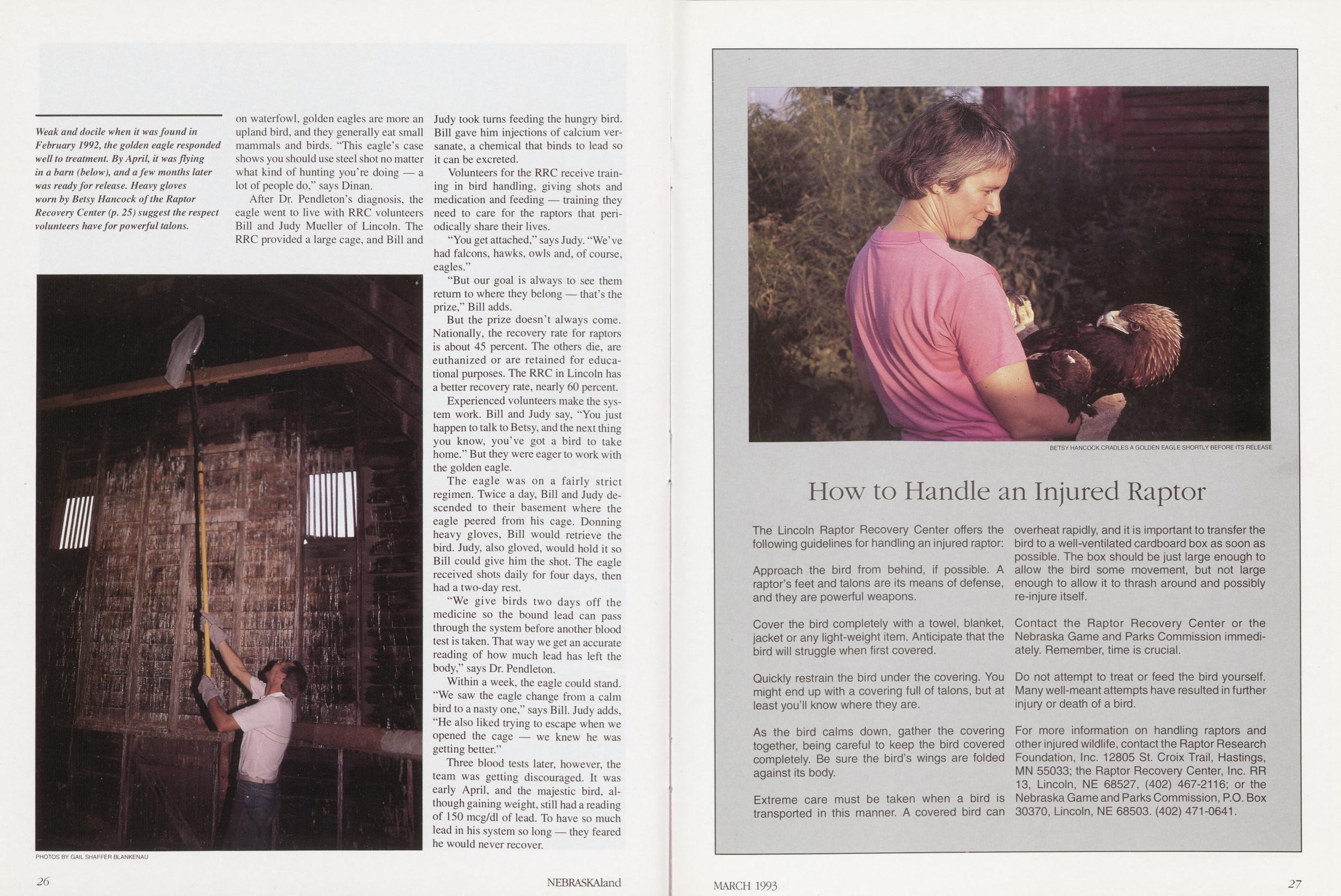
The eagle was on a fairly strict regimen. Twice a day, Bill and Judy descended to their basement where the eagle peered from his cage. Donning heavy gloves, Bill would retrieve the bird. Judy, also gloved, would hold it so Bill could give him the shot. The eagle received shots daily for four days, then had a two-day rest.
"We give birds two days off the medicine so the bound lead can pass through the system before another blood test is taken. That way we get an accurate reading of how much lead has left the body," says Dr. Pendleton.
Within a week, the eagle could stand. "We saw the eagle change from a calm bird to a nasty one," says Bill. Judy adds, "He also liked trying to escape when we opened the cage — we knew he was getting better."
Three blood tests later, however, the team was getting discouraged. It was early April, and the majestic bird, although gaining weight, still had a reading of 150 mcg/dl of lead. To have so much lead in his system so long — they feared he would never recover.
26 NEBRASKAlandThe Lincoln Raptor Recovery Center offers the following guidelines for handling an injured raptor:
Approach the bird from behind, if possible. A raptor's feet and talons are its means of defense, and they are powerful weapons.
Cover the bird completely with a towel, blanket, jacket or any light-weight item. Anticipate that the bird will struggle when first covered.
Quickly restrain the bird under the covering. You might end up with a covering full of talons, but at least you'll know where they are.
Quickly restrain the bird under the covering. You might end up with a covering full of talons, but at least you'll know where they are.
As the bird calms down, gather the covering together, being careful to keep the bird covered completely. Be sure the bird's wings are folded against its body.
Extreme care must be taken when a bird is transported in this manner. A covered bird can overheat rapidly, and it is important to transfer the bird to a well-ventilated cardboard box as soon as possible. The box should be just large enough to allow the bird some movement, but not large enough to allow it to thrash around and possibly re-injure itself.
Contact the Raptor Recovery Center or the Nebraska Game and Parks Commission immediately. Remember, time is crucial.
Do not attempt to treat or feed the bird yourself. Many well-meant attempts have resulted in further injury or death of a bird.
For more information on handling raptors and other injured wildlife, contact the Raptor Research Foundation, Inc. 12805 St. Croix Trail, Hastings, MN 55033; the Raptor Recovery Center, Inc. RR 13, Lincoln, NE 68527, (402) 467-2116; or the Nebraska Game and Parks Commission, P.O. Box 30370, Lincoln, NE 68503. (402) 471-0641.
MARCH 1993 27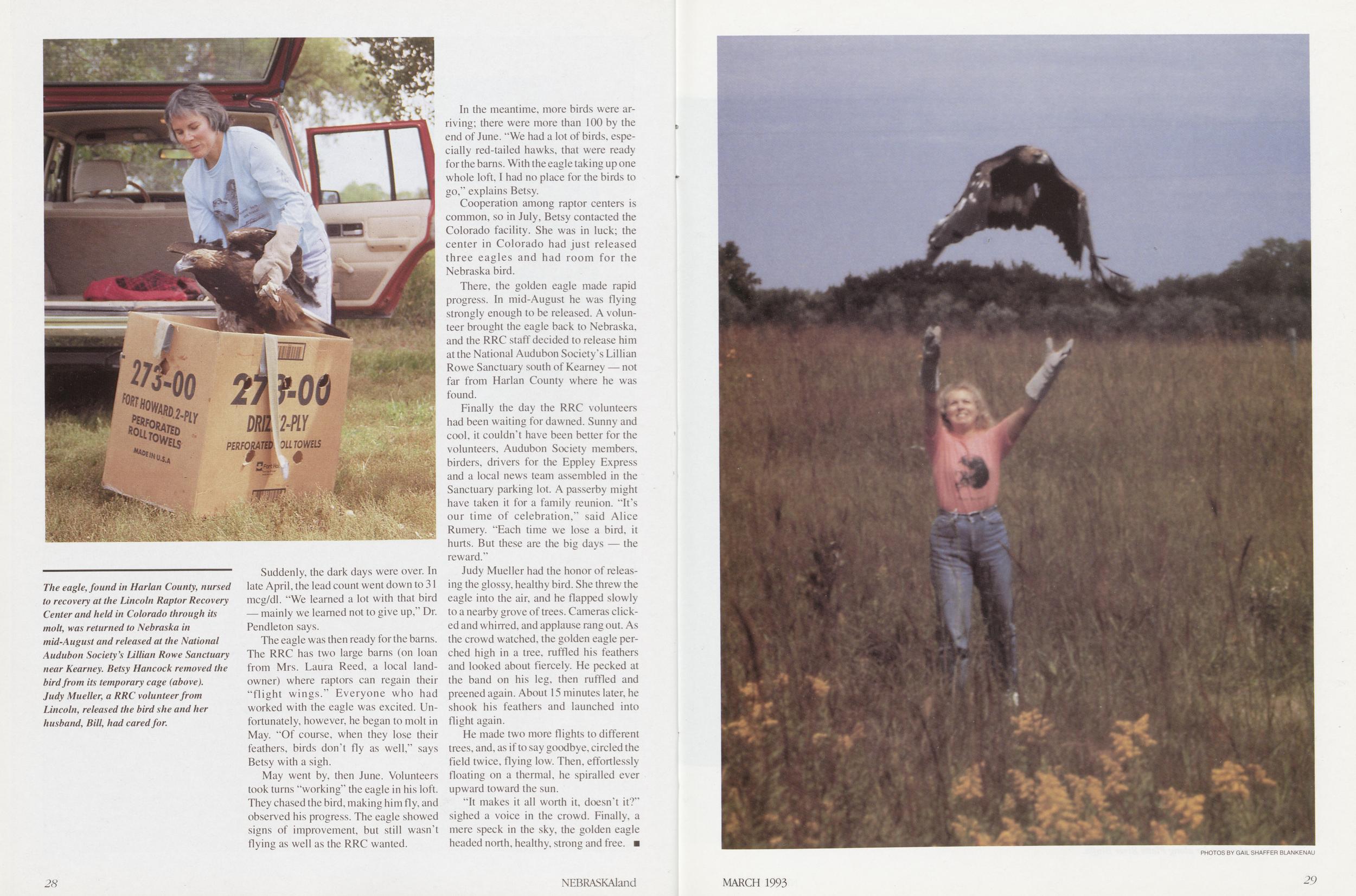
Suddenly, the dark days were over. In late April, the lead count went down to 31 mcg/dl. "We learned a lot with that bird — mainly we learned not to give up," Dr. Pendleton says.
The eagle was then ready for the barns. The RRC has two large barns (on loan from Mrs. Laura Reed, a local landowner) where raptors can regain their "flight wings." Everyone who had worked with the eagle was excited. Unfortunately, however, he began to molt in May. "Of course, when they lose their feathers, birds don't fly as well," says Betsy with a sigh.
May went by, then June. Volunteers took turns "working" the eagle in his loft. They chased the bird, making him fly, and observed his progress. The eagle showed signs of improvement, but still wasn't flying as well as the RRC wanted.
In the meantime, more birds were arriving; there were more than 100 by the end of June. "We had a lot of birds, especially red-tailed hawks, that were ready for the barns. With the eagle taking up one whole loft, I had no place for the birds to go," explains Betsy.
Cooperation among raptor centers is common, so in July, Betsy contacted the Colorado facility. She was in luck; the center in Colorado had just released three eagles and had room for the Nebraska bird.
There, the golden eagle made rapid progress. In mid-August he was flying strongly enough to be released. A volunteer brought the eagle back to Nebraska, and the RRC staff decided to release him at the National Audubon Society's Lillian Rowe Sanctuary south of Kearney — not far from Harlan County where he was found.
Finally the day the RRC volunteers had been waiting for dawned. Sunny and cool, it couldn't have been better for the volunteers, Audubon Society members, birders, drivers for the Eppley Express and a local news team assembled in the Sanctuary parking lot. A passerby might have taken it for a family reunion. "It's our time of celebration," said Alice Rumery. "Each time we lose a bird, it hurts. But these are the big days — the reward."
Judy Mueller had the honor of releasing the glossy, healthy bird. She threw the eagle into the air, and he flapped slowly to a nearby grove of trees. Cameras clicked and whirred, and applause rang out. As the crowd watched, the golden eagle perched high in a tree, ruffled his feathers and looked about fiercely. He pecked at the band on his leg, then ruffled and preened again. About 15 minutes later, he shook his feathers and launched into flight again.
He made two more flights to different trees, and, as if to say goodbye, circled the field twice, flying low. Then, effortlessly floating on a thermal, he spiraled ever upward toward the sun.
"It makes it all worth it, doesn't it?" sighed a voice in the crowd. Finally, a mere speck in the sky, the golden eagle headed north, healthy, strong and free.
"It makes it all worth it, doesn't it?" sighed a voice in the crowd. Finally, a mere speck in the sky, the golden eagle headed north, healthy, strong and free.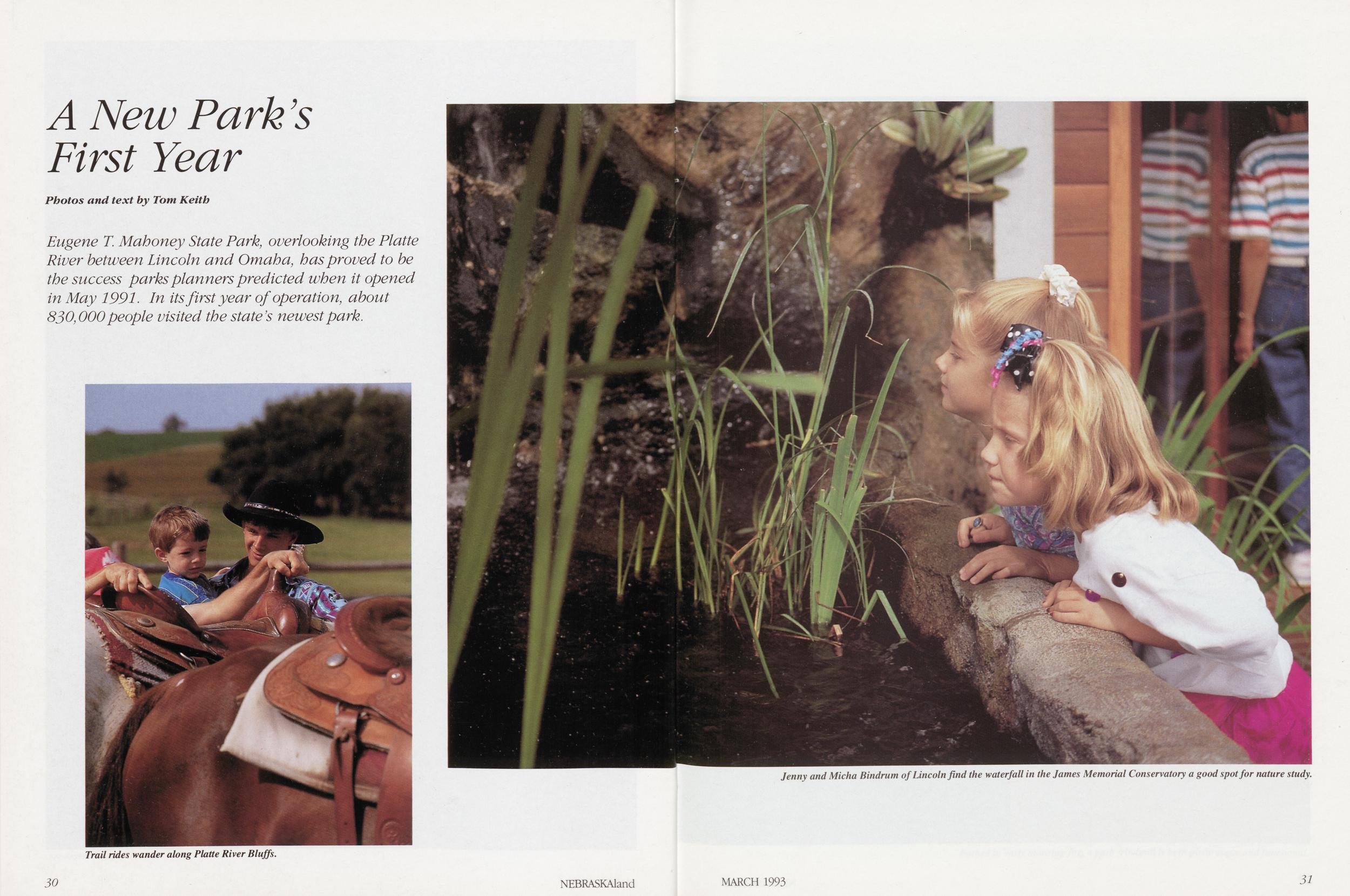
A New Park's First Year
Photos and text by Tom Keith Eugene T. Mahoney State Park, overlooking the Platte River between Lincoln and Omaha, has proved to be the success parks planners predicted when it opened in May 1991. In its first year of operation, about 830,000 people visited the state's newest park.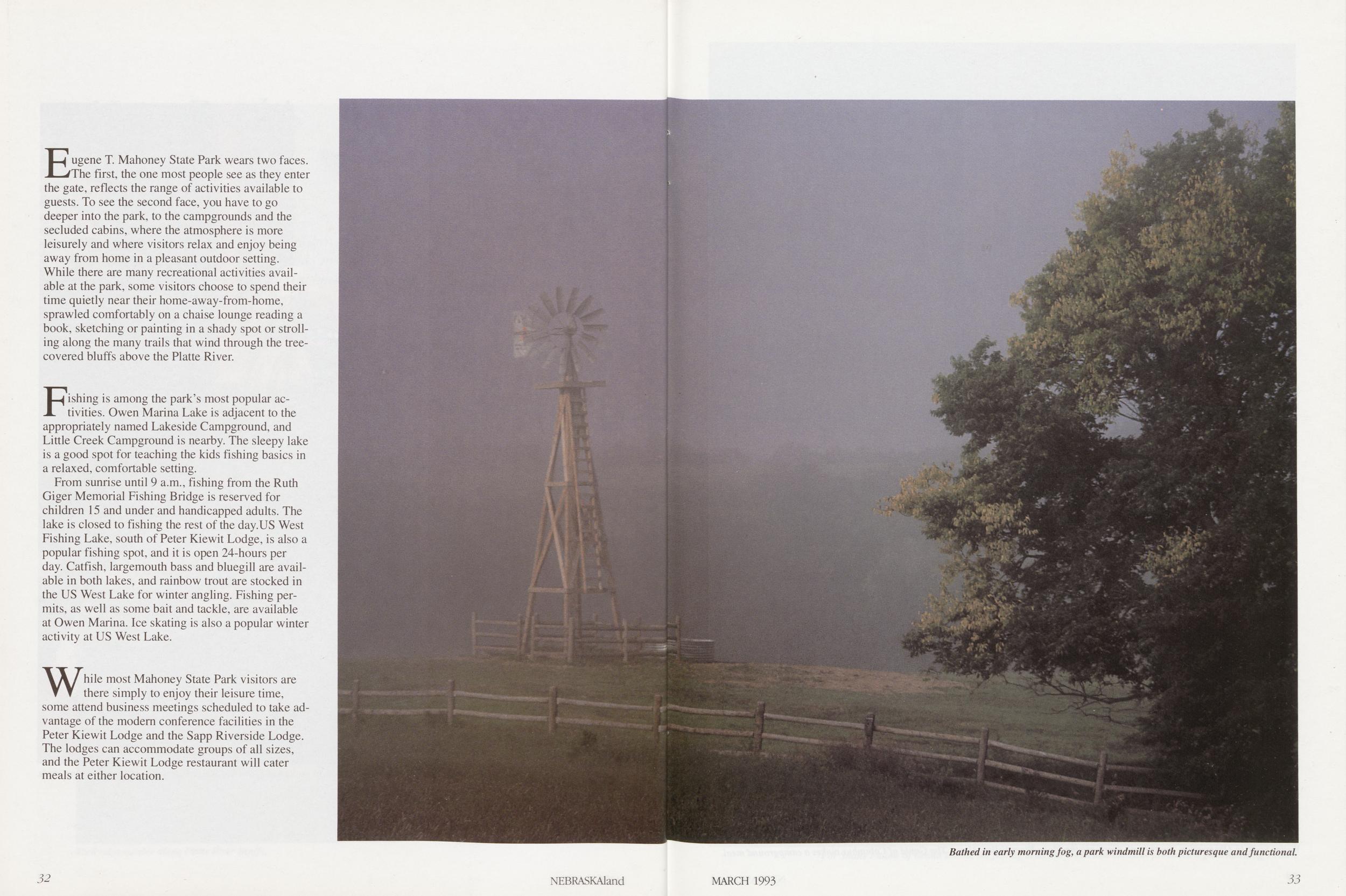
Eugene T. Mahoney State Park wears two faces. The first, the one most people see as they enter the gate, reflects the range of activities available to guests. To see the second face, you have to go deeper into the park, to the campgrounds and the secluded cabins, where the atmosphere is more leisurely and where visitors relax and enjoy being away from home in a pleasant outdoor setting. While there are many recreational activities available at the park, some visitors choose to spend their time quietly near their home-away-from-home, sprawled comfortably on a chaise lounge reading a book, sketching or painting in a shady spot or strolling along the many trails that wind through the tree-covered bluffs above the Platte River.
Fishing is among the park's most popular activities. Owen Marina Lake is adjacent to the appropriately named Lakeside Campground, and Little Creek Campground is nearby. The sleepy lake is a good spot for teaching the kids fishing basics in a relaxed, comfortable setting.
From sunrise until 9 a.m., fishing from the Ruth Giger Memorial Fishing Bridge is reserved for children 15 and under and handicapped adults. The lake is closed to fishing the rest of the day.US West Fishing Lake, south of Peter Kiewit Lodge, is also a popular fishing spot, and it is open 24-hours per day. Catfish, largemouth bass and bluegill are available in both lakes, and rainbow trout are stocked in the US West Lake for winter angling. Fishing permits, as well as some bait and tackle, are available at Owen Marina. Ice skating is also a popular winter activity at US West Lake.
While most Mahoney State Park visitors are there simply to enjoy their leisure time, some attend business meetings scheduled to take advantage of the modern conference facilities in the Peter Kiewit Lodge and the Sapp Riverside Lodge. The lodges can accommodate groups of all sizes, and the Peter Kiewit Lodge restaurant will cater meals at either location.
32 NEBRASKAland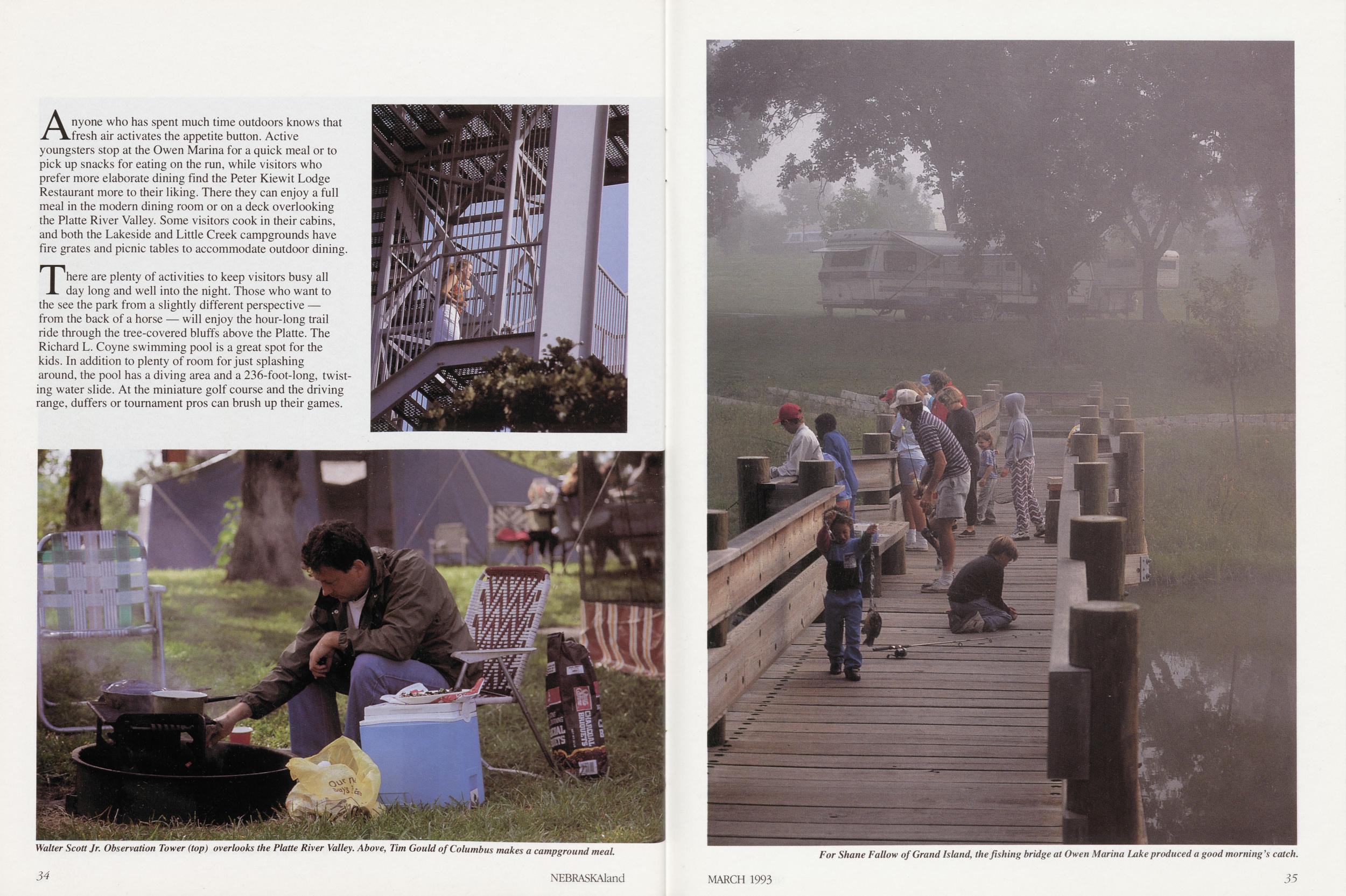
Anyone who has spent much time outdoors knows that fresh air activates the appetite button. Active youngsters stop at the Owen Marina for a quick meal or to pick up snacks for eating on the run, while visitors who prefer more elaborate dining find the Peter Kiewit Lodge Restaurant more to their liking. There they can enjoy a full meal in the modern dining room or on a deck overlooking the Platte River Valley. Some visitors cook in their cabins, and both the Lakeside and Little Creek campgrounds have fire grates and picnic tables to accommodate outdoor dining.
There are plenty of activities to keep visitors busy all day long and well into the night. Those who want to the see the park from a slightly different perspective — from the back of a horse — will enjoy the hour-long trail ride through the tree-covered bluffs above the Platte. The Richard L. Coyne swimming pool is a great spot for the kids. In addition to plenty of room for just splashing around, the pool has a diving area and a 236-foot-long, twisting water slide. At the miniature golf course and the driving range, duffers or tournament pros can brush up their games.
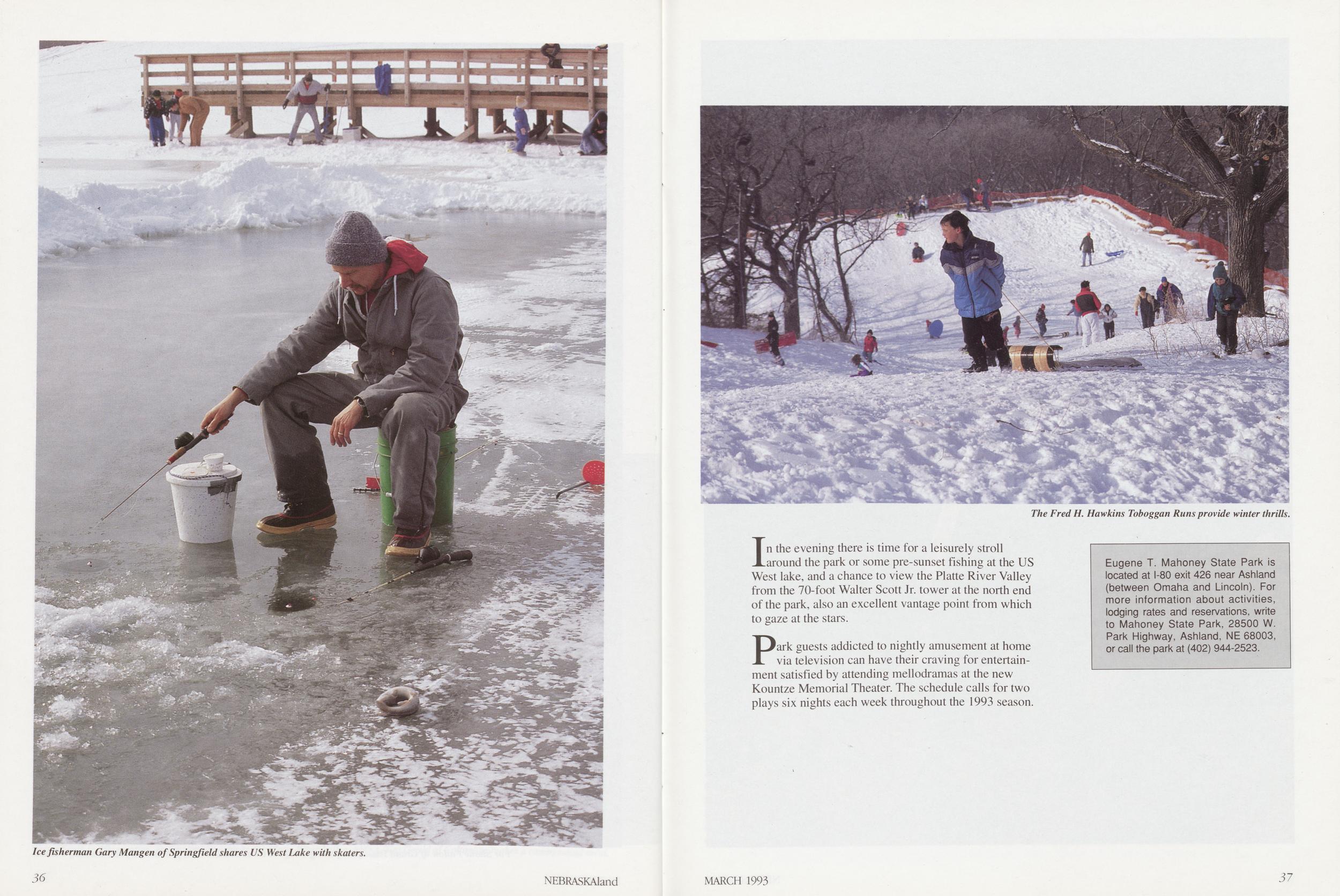
In the evening there is time for a leisurely stroll around the park or some pre-sunset fishing at the US West lake, and a chance to view the Platte River Valley from the 70-foot Walter Scott Jr. tower at the north end of the park, also an excellent vantage point from which to gaze at the stars.
Park guests addicted to nightly amusement at home via television can have their craving for entertainment satisfied by attending mellodramas at the new Kountze Memorial Theater. The schedule calls for two plays six nights each week throughout the 1993 season.
Eugene T. Mahoney State Park is located at 1-80 exit 426 near Ashland (between Omaha and Lincoln). For more information about activities, lodging rates and reservations, write to Mahoney State Park. 28500 W. Park Highway. Ashland. NE 68003. or call the park at (402) 944-2523.
MARCH 1993 37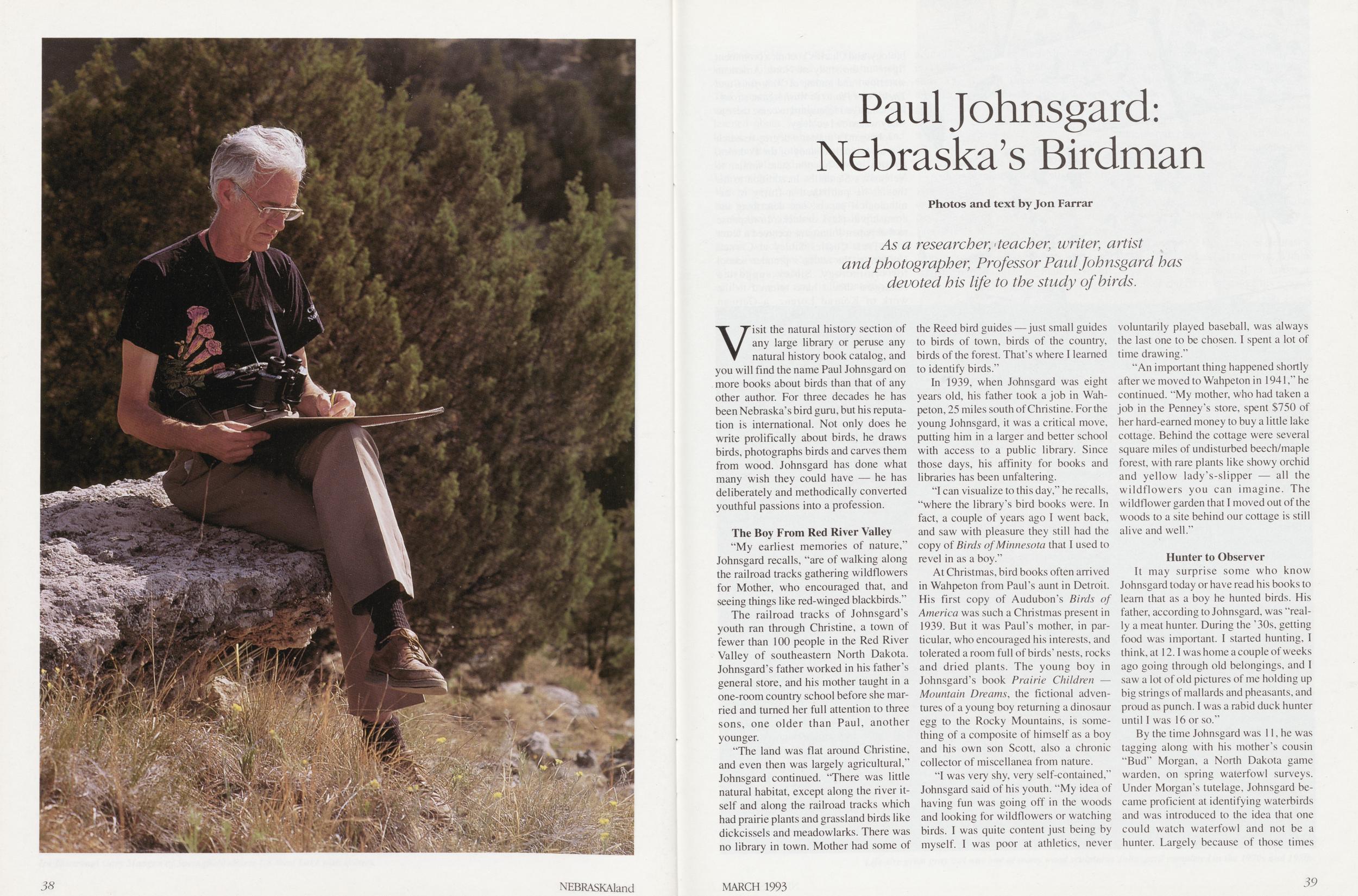
Paul Johnsgard: Nebraska's Birdman
Photos and text by Jon Farrar As a researcher,'teacher, writer artist and photographer Professor Paul Johnsgard has devoted his life to the study of birds.Visit the natural history section of any large library or peruse any natural history book catalog, and you will find the name Paul Johnsgard on more books about birds than that of any other author. For three decades he has been Nebraska's bird guru, but his reputation is international. Not only does he write prolifically about birds, he draws birds, photographs birds and carves them from wood. Johnsgard has done what many wish they could have — he has deliberately and methodically converted youthful passions into a profession.
The Boy From Red River Valley"My earliest memories of nature." Johnsgard recalls, "are of walking along the railroad tracks gathering wildflowers for Mother, who encouraged that, and seeing things like red-winged blackbirds."
The railroad tracks of Johnsgard's youth ran through Christine, a town of fewer than 100 people in the Red River Valley of southeastern North Dakota. Johnsgard's father worked in his father's general store, and his mother taught in a one-room country school before she married and turned her full attention to three sons, one older than Paul, another younger.
"The land was flat around Christine, and even then was largely agricultural," Johnsgard continued. "There was little natural habitat, except along the river itself and along the railroad tracks which had prairie plants and grassland birds like dickcissels and meadowlarks. There was no library in town. Mother had some of the Reed bird guides —just small guides to birds of town, birds of the country, birds of the forest. Thai's where I learned to identify birds."
In 1939, when Johnsgard was eight years old, his father took a job in Wahpeton, 25 miles south of Christine. For the young Johnsgard, it was a critical move, putting him in a larger and better school with access to a public library. Since those days, his affinity for books and libraries has been unfaltering.
"I can visualize to this day." he recalls, "where the library's bird books were. In fact, a couple of years ago I went back, and saw with pleasure they still had the copy of Birds of Minnesota that I used to revel in as a boy."
At Christmas, bird books often arrived in Wahpeton from Paul's aunt in Detroit. His first copy of Audubon's Birds of America was such a Christmas present in 1939. Bui it was Paul's mother, in particular, who encouraged his interests, and tolerated a room full of birds' nests, rocks and dried plants. The young boy in Johnsgard's book Prairie Children — Mountain Dreams, the fictional adven- tures of a young boy returning a dinosaur egg to the Rocky Mountains, is some- thing of a composite of himself as a boy and his own son Scott, also a chronic collector of miscellanea from nature.
"I was very shy. very self-contained." Johnsgard said of his youth. "My idea of having fun was going off in the woods and looking for wiidllowers or watching birds. I was quite content just being by myself. I was poor at athletics, never voluntarily played baseball, was always the last one to be chosen. I spent a lot of time drawing."
"An important thing happened shortly after we moved to Wahpeton in 1941." he continued. "My mother, who had taken a job in the Penney's store, spent $750 of her hard-earned money to buy a little lake cottage. Behind the cottage were several square miles of undisturbed beech/maple forest, with rare plants like showy orchid and yellow lady's-slipper — all the wildflowers you can imagine. The wildflower garden that I moved out of the woods to a site behind our cottage is still alive and well."
Hunter to ObserverIt may surprise some who know Johnsgard today or have read his books to learn that as a boy he hunted birds. His father, according to Johnsgard. was "real- ly a meat hunter. During the '30s. getting food was important. I started hunting, I think, at 12.1 was home a couple of weeks ago going through old belongings, and I saw a lot of old pictures of me holding up big strings of mallards and pheasants, and proud as punch. I was a rabid duck hunter until I was 16 or so."
By the time Johnsgard was 11. he was
lagging along with his mother's cousin
"Bud" Morgan, a North Dakota game
warden, on spring waterfowl surveys.
Under Morgan's tutelage. Johnsgard became proficient at identifying waterbirds
and was introduced to the idea that one
could watch waterfowl and not be a
hunter. Largely because of those times
MARCH 1993
39
When Johnsgard was about 16, he bought his first camera, a 35 mm Exakta. "You were lucky just to find something in the frame," Johnsgard recalls. "My average was about one or two good frames out of a 36-exposure roll of black and white." By that time, Bud Morgan had been appointed director of the North Dakota game department and perhaps influenced the selection of Johnsgard's photo of a pintail courtship flight for the back cover of the agency's magazine.
That was pretty exciting," Johnsgard recalls, "and it made me think maybe I could become a wildlife photographer. Once I started photographing waterfowl, mostly geese, I would take my Dad's car, and go down to the area around Lake Traverse, which is where the boundaries of North Dakota, South Dakota and Minnesota converge, a major snow goose and Canada goose spring staging area. I spent hundreds of hours wading those marshes, watching the geese, and that, more than anything, made me decide that waterfowl were my first love."
The Making of an OrnithologistJohnsgard completed junior college in Wahpeton, then transferred to North Dakota State University in Fargo with majors in zoology and botany. His intention was still a wildlife management degree, but his advisor, Frank Cassel, encouraged him to pursue "pure" ornithology and convinced him to apply for a small scholarship given each year for summer projects. While the project may not have seemed significant at the time, it portended Johnsgard's future career.
Johnsgard scoured the files of every game refuge in the state preparing a bibliographic survey of the distribution of waterfowl in North Dakota. In what would become customary Johnsgard procedure, he decided that as long as he was searching for information on waterfowl, he might just as well gather it on all of the other birds of North Dakota as well.
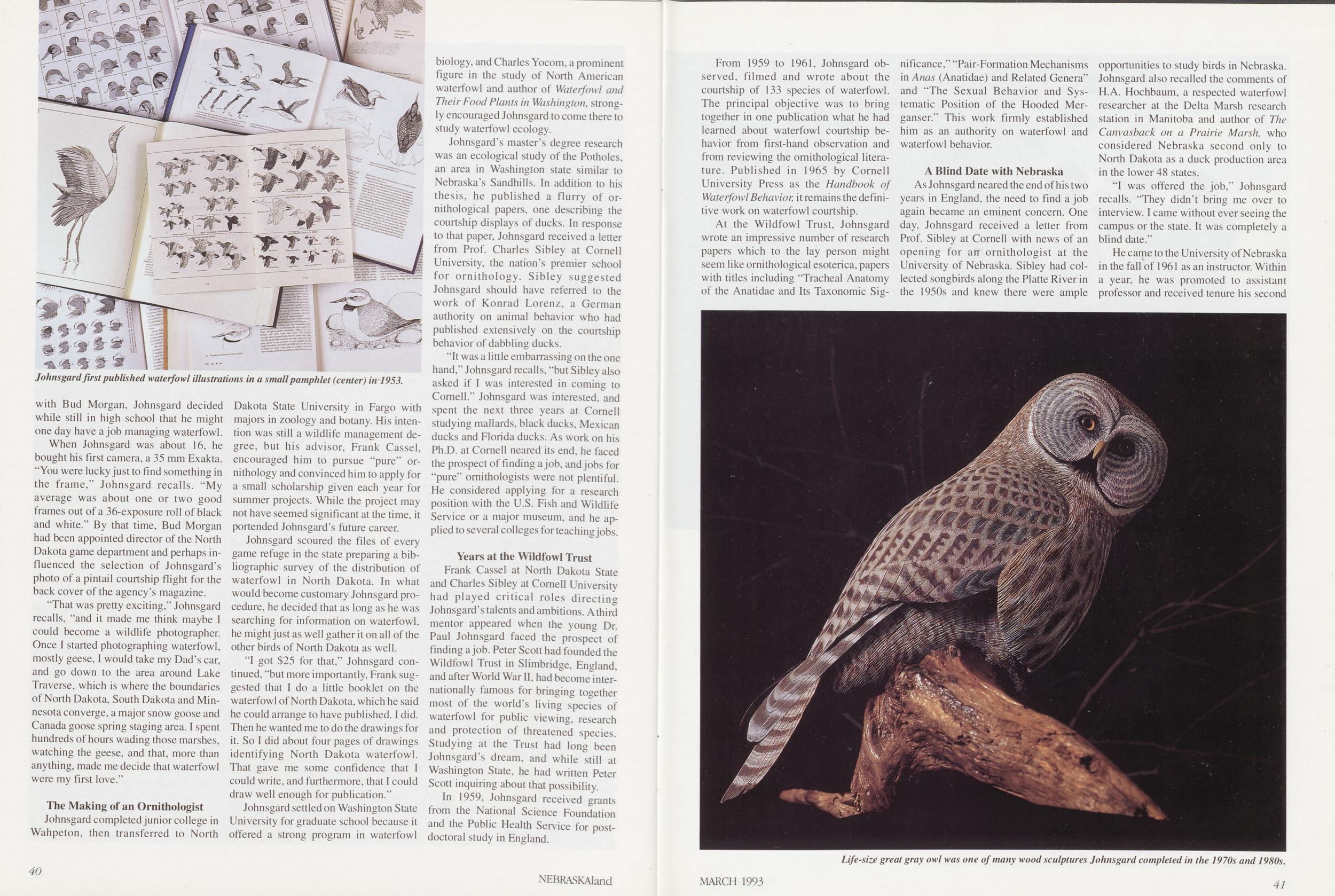
"I got $25 for that," Johnsgard continued, "but more importantly, Frank suggested that I do a little booklet on the waterfowl of North Dakota, which he said he could arrange to have published. I did. Then he wanted me to do the drawings for it. So I did about four pages of drawings identifying North Dakota waterfowl. That gave me some confidence that I could write, and furthermore, that I could draw well enough for publication."
Johnsgard settled on Washington State University for graduate school because it offered a strong program in waterfowl biology, and Charles Yocom, a prominent figure in the study of North American waterfowl and author of Waterfowl and Their Food Plants in Washington, strongly encouraged Johnsgard to come there to study waterfowl ecology.
Johnsgard's master's degree research was an ecological study of the Potholes, an area in Washington state similar to Nebraska's Sandhills. In addition to his thesis, he published a flurry of ornithological papers, one describing the courtship displays of ducks. In response to that paper, Johnsgard received a letter from Prof. Charles Sibley at Cornell University, the nation's premier school for ornithology. Sibley suggested Johnsgard should have referred to the work of Konrad Lorenz, a German authority on animal behavior who had published extensively on the courtship behavior of dabbling ducks.
"It was a little embarrassing on the one hand," Johnsgard recalls, "but Sibley also asked if I was interested in coming to Cornell." Johnsgard was interested, and spent the next three years at Cornell studying mallards, black ducks, Mexican ducks and Florida ducks. As work on his Ph.D. at Cornell neared its end, he faced the prospect of finding a job, and jobs for "pure" ornithologists were not plentiful. He considered applying for a research position with the U.S. Fish and Wildlife Service or a major museum, and he applied to several colleges for teaching jobs.
Years at the Wildfowl TrustFrank Cassel at North Dakota State and Charles Sibley at Cornell University had played critical roles directing Johnsgard's talents and ambitions. A third mentor appeared when the young Dr. Paul Johnsgard faced the prospect of finding a job. Peter Scott had founded the Wildfowl Trust in Slimbridge, England, and after World War II, had become internationally famous for bringing together most of the world's living species of waterfowl for public viewing, research and protection of threatened species. Studying at the Trust had long been Johnsgard's dream, and while still at Washington State, he had written Peter Scott inquiring about that possibility.
In 1959, Johnsgard received grants from the National Science Foundation and the Public Health Service for post-doctoral study in England.
40 NEBRASKAlandFrom 1959 to 1961, Johnsgard observed, filmed and wrote about the courtship of 133 species of waterfowl. The principal objective was to bring together in one publication what he had learned about waterfowl courtship behavior from first-hand observation and from reviewing the ornithological literature. Published in 1965 by Cornell University Press as the Handbook of Waterfowl Behavior, it remains the definitive work on waterfowl courtship.
At the Wildfowl Trust, Johnsgard wrote an impressive number of research papers which to the lay person might seem like ornithological esoterica, papers with titles including "Tracheal Anatomy of the Anatidae and Its Taxonomic Significance," "Pair-Formation Mechanisms in Anas (Anatidae) and Related Genera" and "The Sexual Behavior and Systematic Position of the Hooded Merganser." This work firmly established him as an authority on waterfowl and waterfowl behavior.
A Blind Date with NebraskaAs Johnsgard neared the end of his two years in England, the need to find a job again became an eminent concern. One day, Johnsgard received a letter from Prof. Sibley at Cornell with news of an opening for an ornithologist at the University of Nebraska. Sibley had collected songbirds along the Platte River in the 1950s and knew there were ample opportunities to study birds in Nebraska. Johnsgard also recalled the comments of H.A. Hochbaum, a respected waterfowl researcher at the Delta Marsh research station in Manitoba and author of The Canvasback on a Prairie Marsh, who considered Nebraska second onlv to North Dakota as a duck production area in the lower 48 states.
"I was offered the job," Johnsgard recalls. "They didn't bring me over to interview. I came without ever seeing the campus or the state. It was completely a blind date."
He came to the University of Nebraska in the fall of 1961 as an instructor. Within a year, he was promoted to assistant professor and received tenure his second
In the spring of 1962, Roger Sharpe, Johnsgard's first graduate student, introduced him to Nebraska's Platte and its cranes. Since that day, the Platte River and its cranes have been recurring topics of Johnsgard's writing.
In the preface to The Platte — Channels in Time (1984), Johnsgard admitted that his adoption of Nebraska, at least "ornithologically," was complete. He wrote: "...the Red River of the North and the Platte River superficially have much in common. But the Platte is a river system rich in human and natural history to a degree that the Red River can hardly match, and my spirit is never raised by the Red River as it is by the Platte River each time I make a pilgrimage to its banks."
In the preface to Crane Music (1991), Johnsgard wrote of his first view of sandhill cranes on the Platte: "On a magical Saturday in March, I drove with a graduate student out to the central Platte Valley west of Grand Island, as much to see the spring waterfowl migration as to see sandhill cranes. At that time the cranes had received very little publicity as a birding spectacle, but I felt that I should investigate them nonetheless. It was perhaps just as well that I wasn't emotionally prepared for the sight of countless cranes punctuating the sky from horizon to horizon, or gracefully wheeling about overhead as if they were caught in some ultra-slow-motion whirlwind, their vibrato calls drifting downward like the music of an angelic avian chorus. Not since the days of my boyhood, when I first saw vast migrating spring flocks of snow geese and Canada geese dropping into eastern North Dakota's prairie marshes, was I so completely enthralled, and it was certainly on that particular day of epiphany that I realized that cranes would become as important to my wellbeing as my beloved waterfowl."
In addition to those two books, which deal primarily with sandhill and whooping cranes, Johnsgard's Cranes of the World, published in 1983, treated all of the world's species of cranes, their biology, distribution and population status.
42 NEBRASKAlandOther groups of birds are also regular fodder for Johnsgard's word processor. His fourth book, Grouse and Quails of North America (1973), is a comprehensive, semi-technical review of a taxonomically defined group of birds. It established a book form he was to repeat successfully in titles such as The Plovers, Sandpipers and Snipes of the World, The Pheasants of the World and The Hummingbirds of North America. In these books, Johnsgard's ability to assimilate massive quantities of technical information and present it in an understandable form is conspicuous.
Song of the North WindEven though Johnsgard's first book, Handbook of Waterfowl Behavior, was a technical book, it was favorably reviewed by the New York Times. Waterfowl: Their Biology and Natural History, his second book, garnered several publishing awards and honors. By the mid-1970s, encouraged by the response of reviewers and readers to his books, Johnsgard ventured further into the realm of popular writing. The inspiration for his first book of that genre was inspired by another Nebraska author, John Neihardt.
Shortly after Waterfowl: The Biology and Natural History, was published in 1968, Johnsgard was signing books at a Lincoln bookstore. Neihardt had been there a few days earlier to sign copies of Black Elk Speaks. Johnsgard bought a copy and read it that afternoon.
"I'd never read any of Neihardt's work," Johnsgard recalls. "I was just mesmerized. It turned my mind topsy-turvy. I stayed up for hours that evening, wondering how I could respond to that book. I had been thinking about a book on the snow goose, and I wondered if I could somehow counterpoint what I knew about snow geese with what the Indians knew about birds. Snow geese appear in Neihardt's book in several ways. Finally — it was probably 2:30 or 3:00 o'clock in the morning — I decided I couldn't sleep, I might just as well get up and start writing. So I did."
Within five weeks, Johnsgard had completed the manuscript for Song of the North Wind: A Story of the Snow Goose, except for the section dealing with snow geese on their breeding grounds. The next summer Johnsgard traveled to Churchill, Manitoba, the nearest and most acces sible snow goose nesting grounds. By chance, that trip not only prepared Johnsgard to write the final chapter, but led to the book's illustration. While there, Johnsgard saw drawings by Canadian aritst Paul Geraghty. Like Black Elk's visions in Neihardt's book, Geraghty's drawings evoked a sense of animal mysticism, exactly what Johnsgard wanted to illustrate the snow goose book. Geraghty agreed to do the illustration.
Some hunters were offended by passages in Johnsgard's snow goose book. Read objectively, though, Johnsgard's criticism of hunting is directed at hunters who line refuge boundaries at major snow goose stopovers and shoot at geese beyond ranges at which they can be killed and retrieved reliably, a kind of bird shooting of which responsible hunters are equally critical.
"That was purposefully a highly emotional bit of writing," Johnsgard concedes, "but I'd been watching birds being wounded, both at the edge of Squaw Creek [in northwest Missouri], and around DeSoto [in northeast Nebraska] at the time. I saw an awful lot of wounded birds. That really upset me. Frankly, the snow goose population has increased, doubled, probably, since I wrote that, so that kind of hunting hasn't really affected the population, but it affected my aesthetic sense.
"I gave up hunting," Johnsgard said, "for two reasons. It clearly interfered with my photography, and it bothered me to kill things that I spent far more time photographing. It was mostly a moral decision about killing. Increasingly, I became distraught by people who shot at anything they could see. I have a lot of friends who are hunters, and I respect those people, at least. If it weren't for hunting, I wouldn't have spent nearly so much time in marshes, wouldn't have gotten nearly so close to either my older brother or my father, so I have some strong social identifications with those values of hunting, still.
"I have real problems with hunting cranes," Johnsgard said, "and other long lived species that have long-term pair bonds and limited capacities for reproduction. There is a biological rationale against hunting those things, I think. There really isn't a good one against hunting birds like pheasants, or even deer for that matter, which can eat out their environment. Cranes are certainly never going to die from overpopulation."
Song of the North Wind, in many ways, represents a transition in Johnsgard's writing. The book is highly readable information about the mid-continental snow goose population, but the thread binding the book together as a story is a fictional family of snow geese to which Johnsgard assigned Eskimo names. It is an unexpected literary device from an animal behaviorist who has taught that most animal actions could be explained by such things
"I worry about that," Johnsgard admits. "There are times when I purposefully was anthropomorphic, even though I rail about anthropomorphism in the classroom. I don't do it in technical writing or reference books, but I do use it fairly often in popular writing. I do it knowingly, and occasionally it's so anthropomorphic — for example, talking about rivers in a sort of humanoid way — that people know that I'm doing it on purpose. The longer I live and the more I watch birds, the more I believe that maybe a little bit of anthropomorphism is warranted. I think that we are underestimating birds, and certainly mammals, when we avoid anthropomorphism rigorously. It's true, I do have sort of a double standard, and I do it under the guise of literary license."
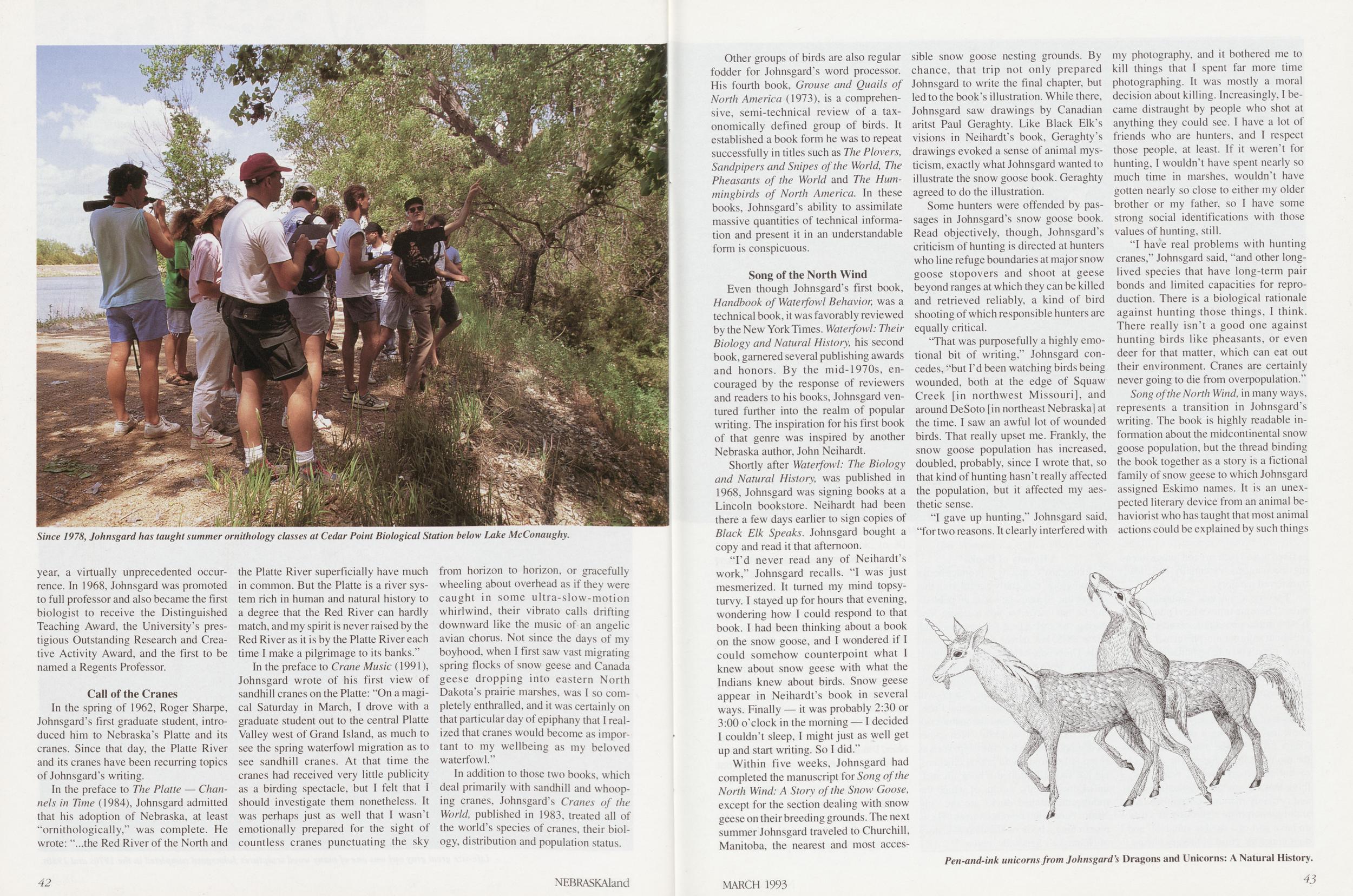
A Bounty of BooksJohnsgard's capacity to produce books is prodigious, especially considering that during the 30 years he has been publishing he has carried a full teaching load during the spring and fall sessions and, since 1978, has taught summer sessions at the University's Cedar Point Biological Station below Lake McConaughy. Johnsgard's 31st book, Cormorants, Darters and Pelicans of the World, will soon be published by Smithsonian Press. Johnsgard has completed the manuscript for his 32nd book, on birds which gather on display grounds for courtship, such as sharp-tailed grouse and prairie chickens. He has recently drafted a book on stiff tailed ducks of the world, of which the ruddy and masked ducks are the only North American representatives. He is researching a book on the natural history of Nebraska's Sandhills region.
"It's a compulsion," Johnsgard said. "I used to worry when I performed what I thought was compulsive behavior — compulsively watching birds, or compulsively drawing birds or photographing birds, or writing — and then I thought, There are worse things I could be doing.' I figured rather than worry about my compulsions, I'll just try to exploit them as best I can. When I was growing up I often thought it would be a wonderful thing to have a book about loons, for example, or a book about pheasants, and by and large, they weren't available. Now, I'm in a position to write them."
Johnsgard writes almost every day, but does not burn the midnight oil. He seldom writes in the evening and typically retires by 10:30 p.m. One place and time you will no longer find him writing is at his city campus office on home football Saturdays. One year he paid more than 44 NEBRASKAland $120 in fines for parking on campus during home football games, and one Saturday, his car was towed.
"Basically I write one draft, and it's nearly ready to submit," Johnsgard said. "When I'm writing a book for a more popular audience or a magazine, where I feel I have to be more interesting, I may do another draft. I've never outlined a book or a chapter. With a more technical book, I can write in short blocks of time and tolerate a fair number of disturbances. When writing a chapter on something like Song of the North Wind, I'm bothered greatly by interference."
Processing WordsWhen writing strictly informative text, Johnsgard can produce 3,000 to 5,000 words per day. Typically he writes for two or three hours in the morning and again in the afternoon. He is not much enamored of mechanical contrivances, but two machines have become indispensable to him. The first is the computer. He keeps two running 24 hours a day. The other, not surprisingly, is the photocopier.
Research notes for Johnsgard's first book were tediously written by hand or typed. Since then, he has developed an efficient system for gathering, organizing and retrieving information. At the core of his research files are massive numbers of 4-inch by 6-inch cards listing titles of sources of information. Typically, Johnsgard has a minimum of 500 to 2,000, title cards for each book. In 30 years, he has amassed enormous files of photocopied information on birds. When it is time to write, he scans his information to refresh his memory and begins writing, returning to his sources for specifics or details. A recent review of one of Johnsgard's books aptly noted that Johnsgard "assiduously trawls the available literature."
A large, comprehensive book, such as Cormorants, Darters and Pelicans of the World requires a year to research and organize, a year to write and at least another year while the book is in production. Johnsgard typically has three books or more at various stages at any time.
Books by Paul JohnsgardHandbook of Waterfowl Behavior. 1965. Cornell University Press, Ithaca (out of print).
Animal Behavior. 1967. (2nd ed. 1972). Wm. Brown Co., Dubuque (out of print).
Waterfowl: Their Biology and Natural History. 1968. Univ. of Nebraska Press, Lincoln.
Grouse and Quails of North America. 1973. Univ. of Nebraska Press, Lincoln (out of print).
Song of the North Wind: A Story of the Snow Goose. 1974. Doubleday, Anchor; New York. Reprinted (paper) in 1979 by the Univ. of Nebraska Press, and translated into Russian (1977) and Latvian (1980).
American Game Birds of Upland and Shoreline. 1975. Univ. of Nebraska Press, Lincoln (out of print).
Waterfowl of North America. 1975. Indiana Univ. Press, Bloomington (out of print).
77?e Bird Decoy: An American Art Form (editor). 1976. Univ. of Nebraska Press, Lincoln.
Ducks, Geese and Swans of the World. 1978. Univ. of Nebraska Press, Lincoln.
Birds of the Great Plains: Breeding Species and their Distribution. 1979. Univ. of Nebraska Press, Lincoln.
A Guide to North American Waterfowl. 1979. Indiana Univ. Press, Bloomington (out of print).
The Plovers, Sandpipers and Snipes of the World. 1981. Univ. of Nebraska Press, Lincoln.
Those oil the Gray Wind: The Sandhill Cranes. 1981. St. Martin's Press, New York.
Teton Wildlife: Observations by a Naturalist. 1982. Colorado Associated Univ. Press, Boulder.
Dragons & Unicorns: A Natural History. 1982. St. Martin's Press, New York (fiction, co-authored with Karin Johnsgard).
The Grouse of the World. 1983. Univ. of Nebraska Press, Lincoln.
The Hummingbirds of North America. 1983. Smithsonian Institution Press, Washington, D.C.
The Cranes of the World. 1983. Indiana Univ. Press, Bloomington.
The Platte River: Channels in Time. 1984. Univ. of Nebraska Press, Lincoln.
Prairie Children, Mountain Dreams. 1985. Media Publishing Co., Lincoln (children's fiction).
The Pheasants of the World. 1986. Oxford Univ. Press, Oxford (out of print).
Birds of the Rocky Mountains. 1986. Colorado Associated Univ. Press, Boulder (reprinted by Univ. of Nebraska Press, Lincoln, 1992).
Diving Birds of North America. 1987. Univ. of Nebraska Press, Lincoln.
The Quails, Partridges and Francolins of the World. 1988. Oxford Univ. Press, Oxford.
North American Owls: Biology and Natural History. 1988. Smithsonian Institution Press, Washington, D.C.
Waterfowl of North America: The Paintings of Robin Hill. 1989. Morris Publishing Co., Augusta (text for species accounts).
Hawks, Eagles and Falcons of North America: Biology and Natural History. 1990. Smithsonian Institution Press, Washington, D.C.
Crane Music: A Natural History of North American Cranes. 1991. Smithsonian Institution Press, Washington, D.C.
Bustards, Hemipodes and Sandgrouse: Birds of Dry Places. 1991. Oxford Univ. Press, Oxford.
Ducks in the Wild: Conserving Waterfowl and their Habitats. 1992. Prentice Hail, New York.
Cormorants, Darters and Pelicans of the World. Smithsonian Institution Press, Washington, D.C. (In production).
Arena Behavior in Birds: Courts, Leks and Sexual Selection. Smithsonian Institution Press, Washington, D.C. (In production).
Ruddy Ducks and Qther Stifftails: Their Natural History and Biology (in preparation).
No Time For Heart AttacksIn the early 1980s, Johnsgard suffered a heart attack in his office.
"I didn't realize I was probably dying
at the time, but I thought there was a fair
MARCH 1993
45
 chance of it," Johnsgard recalls. "When I
lay in that hospital, I decided, 'I don't
know how much more time I really have,
but at least a few years, and I want to be
damn sure I finish up the books I'm
working on,' and there were eight at that time.
My heart attack was in November, five
weeks until the end of classes, so the
University said I might just as well stay
out the rest of the semester because the
doctors said I had to recuperate for five or
six weeks.
chance of it," Johnsgard recalls. "When I
lay in that hospital, I decided, 'I don't
know how much more time I really have,
but at least a few years, and I want to be
damn sure I finish up the books I'm
working on,' and there were eight at that time.
My heart attack was in November, five
weeks until the end of classes, so the
University said I might just as well stay
out the rest of the semester because the
doctors said I had to recuperate for five or
six weeks.
"To celebrate that survival, I started carving a full-sized trumpeter swan. That took about a week. I also started writing Birds of the Rocky Mountains, and I had it about two-thirds written by the time I started teaching again."
His doctors strongly recommended immediate bypass surgery, but Johnsgard postponed the surgery until 1989.
"You don't know for sure if you're going to wake up alive or dead after bypass surgery," Johnsgard now jokes. "I'd pretty much put my affairs in order. I felt this was not a bad time to check out if I had to. I had all my books at various stages where they could be finished without me.
"When I woke up, I thought, 'Geeze, I feel great. I've got to get out of here.' I started the book on pelicans and cormorants the day I got out of the hospital. Against the recommendations of the doctors, I drove down to the library and started photocopying. Surviving the heart attack and the quintuple bypass surgery had a synergistic effect on me. I didn't read them as symbols to slow down, I read them as symbols to speed up."
Designed DistractionsWhile writing probably approaches recreation for Johnsgard, he occasionally seeks respite from it. Anyone who frequents Lincoln area art galleries, auctions, second-hand stores, foreign films, book stores and assorted odd, interesting places knows Paul Johnsgard does not spend all his time writing and teaching.
During the 1970s and 1980s, wood carving was one of Johnsgard's primary escapes. Carving birds was, like many things in Johnsgard's life, a grown-up version of a youthful passion. While a Boy Scout in North Dakota, he decided to carve a neckerchief slide — not surprisingly, a duck. He was encouraged to carve more, mount them on plaques and sell them. Larger wooden birds followed, but bird carving was put aside when he turned his attention to college.
"Through the mid-'70s I carved quite a bit," Johnsgard said, "until I filled all the spaces I wanted with carvings. It was a wintertime activity, almost entirely done when I couldn't get down to the campus to write, and felt I needed something physical to do. And, I also rationalized that I was learning a little about bird anatomy. Recently, I've only done one carving, a loon, about two years ago. That might be the last thing I carve. I just don't have the interest and the time."
Because of Johnsgard's national reputation as an ornithologist and his interest in carved birds, he has frequently judged decoy carving contests across the country, and he was a judge for the 1983 and 1984 Federal Migratory Waterfowl Stamp art contests. His knowledge of decoys and his reputation as a writer led to his editorship of yet another book, The Bird Decoy: An American Art Form, an outgrowth of a 1975 exhibit at the Sheldon Memorial Art Gallery in Lincoln.
Life After TeachingJohnsgard will probably retire from the University of Nebraska within the next five years. "After that, I will either write full time, or I will become more involved in some non-biological interests," Johnsgard says. "I might even set up a little antique shop dealing, especially, in oriental art. It sounds strange, but I try to keep a few areas separate from biology, and oriental art and antiques are pretty well separated from my bird interests. I can go to an auction and spend four or five hours waiting for an oriental rug or Japanese wood block print to come up, but I'm usually thinking about something at the same time, writing or whatever, so it's not a total waste of time."
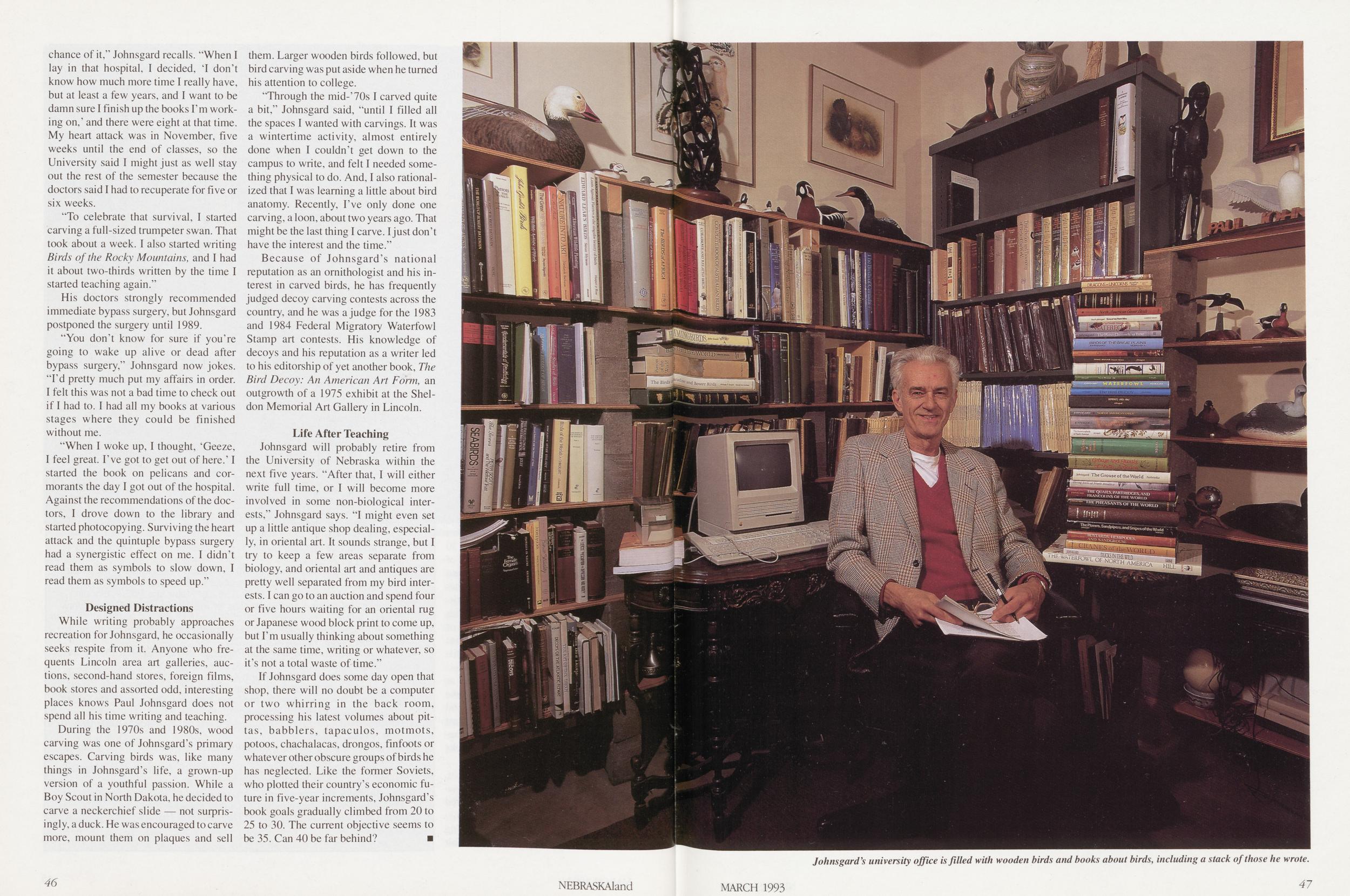
If Johnsgard does some day open that shop, there will no doubt be a computer or two whirring in the back room, processing his latest volumes about pittas, babblers, tapaculos, motmots, potoos, chachalacas, drongos, finfoots or whatever other obscure groups of birds he has neglected. Like the former Soviets, who plotted their country's economic future in five-year increments, Johnsgard's book goals gradually climbed from 20 to 25 to 30. The current objective seems to be 35. Can 40 be far behind?
46 NEBRASKAland
Classified
BOOKS/PRINTINGFREE! Booklets on northeastern Nevada; fishing, rockhounding maps, Carl Hayden, Box 528, Jackpot, Nevada 89825.
FREE BOOK CATALOG. Novels, westerns, romances, children's; old out of print, found barns, attic. Authors: Grey, Bower, Connor, Fox, Curwood, Raine, Wright, Aldrige, Pollyanna, Freckles, many others. Postage appreciated. Pierce, 4400 N. Pine Cluster, Oroville, CA 95965.
COLLECTIBLESBUYING-TRADING EXPIRED HUNTING, FISHING, TRAPPING licenses; regulations; duck/upland game stamps. (402) 785-7500. Information/prices.
BUYING: American Indian artifacts such as beadwork, weavings, baskets, etc.; also cowboy memorabilia such as chaps, spurs, photographs, etc. Best price first letter; photographs promptly returned. Jack Ringwalt, 1550 California St., Suite 6, #211, San Francisco, CA 94109, (415)759-6343.
WANT STEAM TRACTION ENGINE, any condition or antique tractor and other farm items. Write G.D.A., Rt. 1, Box 1, Concord, NE 68728 or phone (402) 584-2282.
DOGSTRAINING ALL BREEDS bird dogs—Vizslas and English Pointers for sale. Rozanek Kennels, R 2, Schuyler, NE 68661. Phone (402) 352-8769.
YELLOW-BLACK Lab pups. FC-AFC sired. AKC. Hips OFA certified. Dew claws removed. Excellent hunting potential. Contact Bob Bendler, Lexington, NE, (308) 324-4247.
FOR SALE—Chesapeake bay or Labrador retrievers. All colors. Pups, started dogs, stud service. Three-generation national champion, pedigre on Lab. Three generations of the best Chesapeakes ever trialed. Call PLATTE VALLEY RETRIEVERS (308) 995-2318.
GERMAN SHORTHAIR POINTERS/ENGLISH POINTERS—pups, started dogs, stud service. Training available for pointing and retrieving dogs. Wayne Clark (712) 529-4238. Close to Omaha. Leave mesage.
GERMAN SHORTHAIR puppies. Great hunters. Great companions. Old fashioned. Dave Wickham, Cactus Kennels, Kimball, NE 69145. Phone (308) 235-3237.
CUSTOM GATES AND KENNELS. Portable and stationary dog runs and kennels, any size. Phone (402) 253-2812 or (402) 333-5186.
EVENTS/ATTRACTIONSSPRING WING DING. Clay Center, Nebraska. March 12 and 13. See spring migration of geese through the Rainwater Basins. Tours, seminars, festival. Call (402) 762-3525.
FISH/FISHINGFISH FOR SALE. Catfish, perch, coho salmon, rainbow trout, crappie, bluegill, walleye, minnows, goldfish, bullhead, largemouth bass, smallmouth bass, triploid grass carp. Commercial grower prices on catfish, perch, coho salmon, rainbow trout. Consulting available. Pleasant Valley Fish Farm, Rt 1 Box 147, McCook, NE 69001. Phone (308) 345-6599.
WAX WORMS: 500/$8.50,1,000/$ 15.00. Add 5% sales tax. Postpaid, first class. No C.O.D. Harold Malicky, Burwell, NE 68823.
WALLEYE FISHERMEN! Custom Spinner Rigs, Bottom Bouncers, Bouncer Tote-Plus and more at low prices! Send $1 for catalog and sample. Nebraska Custom Tackle, Box 108, Madison, NE 68748.
WILLOW LAKE FISH HATCHERY. Channel cat, bluegill, hybrid bluegill, largemouth bass, crappie, triploid grass carp, walleye, perch, minnows available for stocking. Gaylord Crawford, Rt. 3 Box 46, Hastings, NE 68901 or phone (402) 463-8022 day or night. Also pond consultant. We del, grower price.
FOODNEBRASKA BASKETS: The original Nebraska company specializing in fine foods from Nebraska. A beautiful array of baskets filled with ethnic, healthful and long-time favorite foods. Call or write for our brochure: P.O. Box 98, McCook, NE 69001. 1-800-345-7725.
YES! I WOULD LIKE TO SUBSCRIBE TO NEBRASKAland Name 1-Year $12 Address 2-Years $23 City State Zip Mail check or money order to NEBRASKAland Magazine P.O. Box 30370, Lincoln, Nebraska 68503 or call Toll Free 1-800-742-0056BEER & WINEMAKING SUPPLIES—Fermenter's Supply & Equipment, 4472 S. 84th St., Omaha, NE 68127, (402) 593-9171, Mail Order or visit our store.
GUIDES/OUTFITTERSMAD RIVER CANOES offers the finest quality and performance. For the finest canoes and accessories look to Great Plains Canoe Co., 205 Main, Springfield, NE Phone (402) 253-2001.
CANOE THE NIOBRARA . . . with an affordable canoe trip by Dry land Aquatics. One and two-day trips . . .full service or canoes only. Transportation furnished. Your Niobrara River specialists . . . We do it your way! Dryland Aquatics Dept. N, Box 33C, Sparks, NE 69220 or phone (402) 376-3119.
DISMAL RIVER/MIDDLE LOUP RIVER/SNAKE RIVER canoe trips. Powderhorn Outfitters—Thedford NE 69166—1-800-373-1648.
GUNS/SHOOTINGGUNS — Browning, Winchester, Remington, others, Hi-powers; shotguns, new, used, antiques. Want Pre-'64 Winchesters. Buy-Sell-Trade. (402) 729-6112. Bedlan's Sporting Goods, Fairbury, NE 68352.
TAXIDERMYALLISON'S TAXIDERMY STUDIO & GIFT GALLERY. Specializing in fish, birds and small game. Mounted 35 State Record Fish. Pheasant mounts for sale. 421 N. Dewey, North Platte, NE 69101. (308) 534-2324 or (308) 534-4267.
VACATION/RESORTSNE NEBRASKA trout fishing. 3 modern cottages, 1 available year-round. 5 spring-fed lakes with open water all year. Trout up to 7 pounds. Other varieties fish also. Diamond E. Trout Resort, Orchard, NE 68764 Phone (402) 893-4745. Evenings (402) 893-3002.
FOR SALE: Due to poor health, will sell executive campground membership of Camp Coast to Coast, Thousand Adventures of Kansas, Inc. Access to 500 parks across the nation. Home Park Sycamore Springs, Sabetha, Kansas. Dues paid until October 1993. Price $4,000 or best offer. Write to Box 227, Dorchester NE 68343.
AMERICAN FAMILY INN-BELLEVUE. This is the largest motel (106 rooms) close to Omaha's Zoo and Tropical Rain Forest—open all year; SAC Aerospace Museum—see 32 warplanes, "Big Boy" Atomic Bomb, and historic aerospace items. Nearest also to Omaha Royals and College World Series baseball stadium. Winter rates: $30 and up. Video movies. (402) 291 -0804 or 1-800-253-2865.
FLYING FROM OMAHA? Write us for free coupon for 1 Day/2 Days Free Parking Introductory Offer. ABBOTT AIRPORT PARKING, 1655 E. Locust St Omaha, NE 68110.
BEN FRANKLIN MOTEL-OMAHA. On Omaha's west edge at 144th St. & Interstate 80. Handy to Oakview Mall, Boystown, Westroads, State Aquarium "NebraSKI" ski area. Winter rates: $32.95 most rooms' any night. Video movies. (402) 895-2200 or 1-800-341-8000.
FOR FISHING and hunting accommodations. Jefco Inn, Gordon, NE 69343. South Cornell, (308) 282-2935.
Classified ad rates; 75t per word, minimum $15. Closing date is the first business day 2 months preceding date of issue. To place ads or for more information write NEBRASKAland Magazine, P.O. Box 30370, Lincoln, NE 68503, or call (402) 471-5478.
48 NEBRASKAlandPage forty-nine
Trophies and SouvenirsLast September, I tagged along with three hunters in pursuit of doves in the Sandhills south of Valentine. Well, hunting doves was the pretext for the Sunday outing. I needed photos for an upcoming article, and they needed excuses not to do what they really should have been doing. Once in a while we shot at a dove, and I shot the photos I needed. While doves were not bountiful, there were enough that we could have been perfectly content doing nothing but hunting doves. But most of the time, we hunted arrowheads.
The quarry was irrelevant to these hunters — they made little distinction between hunting doves and hunting arrowheads. This was not a new revelation; it had occurred to me on other occasions, including the previous January when I went pheasant hunting with one of the same hunters, and we spent most of the day looking at muskrat lodges on a marsh and beaver work on a Niobrara River feeder stream. Maybe I don't hang out with hard-driving hunters, or maybe there is not as wide a philosophical chasm separating hunters and non-hunters as the anti-hunt movement suggests.
Our kind evolved as hunters and gatherers, and though few Americans directly do either for themselves anymore, we have retained a strong predisposition to make periodic forays from our heated-in-winter and cooled-in-summer 'dodges" to bring something home. I suppose it is innate, embedded in the coils of our DNA, but cleverly masked by our civilized society.
We all seek our own trophies. For some it may be a Boone and Crockett pronghorn, for others a piece of beaver-gnawed cottonwood, a turtle shell, a soap weed pod or a raccoon skull found on a creek bank. If you carry this line of reasoning to its somewhat disagreeable conclusion, the mob of shoppers crowding the malls for after-Christmas sales could be considered hunters and gatherers, but those who bring back bits of nature, whether they can be cooked for dinner or not, more closely simulate what was, until recent generations, an essential component of human survival. Reduced to the essence of the act, there is really not much difference between today's "rockhound" hunting for Fairburn agates and an Oglala Sioux of two centuries ago hunting for wild onions to flavor buffalo soup. How we live is a relatively recent circumstance. The forces that shaped our species do not change so quickly.
People who still have strong psychic or physical connections to nature are perhaps the most chronic and prolific hunters and gatherers. They haul home everything portable enough to be carried and which will not smell too bad in the house. Bones are especially desirable, in part because they are aesthetically wonderful objects, but also because when we compulsively rub their fat-waxed surfaces and graceful planes, we sense a kinship with an animal we might otherwise know only by fleeting glimpses. We wonder, when we find a sandhill crane wing feather on a Platte River sandbar, where that crane has been that we will never go, what it has seen that we will never see.
When hunting and gathering become formalized, we call it "collecting." In the past, institutional and private zoological collectors were especially fond of such things as bird eggs. Natural history museums have drawers of "full sets" of eggs of every species of bird known to man, and, no doubt, there are extensive illegal private collections still in existence. The number of eggs collected far exceeded the scientific need to study them. Did this glut of eggs result from civilized man's innate desire to hunt as much as it did from his scientific curiosity, or was it because wild bird eggs are such exquisite objects to possess? Collectors of plants and insects exhibit similar obsessions in the name of science when hunting and gathering their quarries. They may not hang their trophy green-flowered hedgehog-cactus or American burying beetles on the den wall, but the instinct which drives them is not far removed from that which has always motivated hunters and gatherers.
Not all objects retrieved from the wild qualify as trophies. Some are of a more sentimental nature. Perhaps the phrase "souvenirs from nature" best describes them. The word souvenir came to our language from the French, meaning "memory" or "to recall," and to the French from the Latin subvenire, meaning "to come to mind." Souvenirs, as most people use the word today, have fallen into justifiable disrepute — they are the ash tray your brother-in-law stole from the Golden Nugget in Las Vegas, the rubber snake your son bought when his scout troop stopped at Reptile Gardens, or the fringed satin pillow your aunt Martha brought back from Arizona, the one with the roadrunner, Grand Canyon and a saguaro cactus silk-screened on it. These are the curio shop variety of souvenirs. The best souvenirs, though, are those that carry us back to special times and places.
A few years ago, I was walking down the trail from University and Carnegie hills at Agate Fossil Beds in Sioux County. In the course of photographing wildflowers (OK, I was "hunting" for wildflower photographs) I found a shed rattlesnake skin. I didn't really want it, although it would have looked fine on the shelf with my badger skull and marsh wren nest, but I couldn't stand just to leave it there, so I picked it up.
Halfway down the hill, two young children, about 8 or 9 years old I'd guess, came running up the trail ahead of their father. When they saw the snake skin, they ground to a dusty halt and asked what I had. The girl squealed with mock terror, the boy forced himself to edge a bit closer. I asked them if they wanted to hold it. They did. I asked them if they wanted it. They did. When their father caught up, we talked as the children bounded up the trail with the snake skin held respectfully at arm's length. "Wait until their mother sees that," he said. "It will make a nice souvenir, if she lets it in the car."
I don't know if the skin survived the trip back to the car, much less to Los Angles where the family lived, but if it did, it will beat a miniature silver spoon with Chimney Rock painted on the handle as a souvenir of Nebraska.
Jon Farrar MARCH 1993 49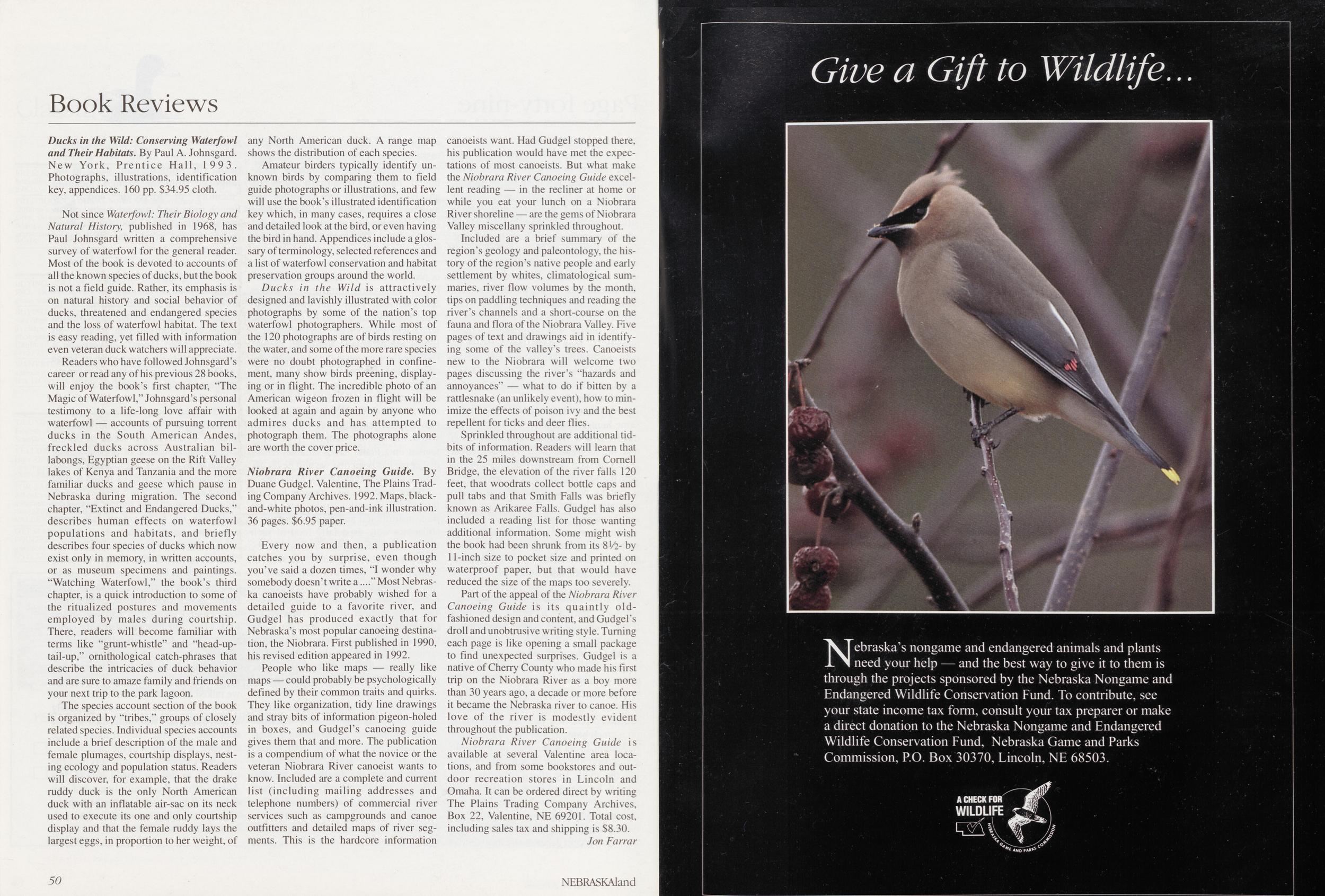
Book Reviews
Ducks in the Wild: Conserving Waterfowl and Their Habitats. By Paul A. Johnsgard. New York, Prentice Hall, 1993. Photographs, illustrations, identification key, appendices. 160 pp. $34.95 cloth.Not since Waterfowl: Their Biology and Natural History, published in 1968, has Paul Johnsgard written a comprehensive survey of waterfowl for the general reader. Most of the book is devoted to accounts of all the known species of ducks, but the book is not a field guide. Rather, its emphasis is on natural history and social behavior of ducks, threatened and endangered species and the loss of waterfowl habitat. The text is easy reading, yet filled with information even veteran duck watchers will appreciate.
Readers who have followed Johnsgard's career or read any of his previous 28 books, will enjoy the book's first chapter, "The Magic of Waterfowl," Johnsgard's personal testimony to a life-long love affair with waterfowl — accounts of pursuing torrent ducks in the South American Andes, freckled ducks across Australian billabongs, Egyptian geese on the Rift Valley lakes of Kenya and Tanzania and the more familiar ducks and geese which pause in Nebraska during migration. The second chapter, "Extinct and Endangered Ducks," describes human effects on waterfowl populations and habitats, and briefly describes four species of ducks which now exist only in memory, in written accounts, or as museum specimens and paintings. "Watching Waterfowl," the book's third chapter, is a quick introduction to some of the ritualized postures and movements employed by males during courtship. There, readers will become familiar with terms like "grunt-whistle" and "head-up-tail-up," ornithological catch-phrases that describe the intricacies of duck behavior and are sure to amaze family and friends on your next trip to the park lagoon.
The species account section of the book is organized by "tribes," groups of closely related species. Individual species accounts include a brief description of the male and female plumages, courtship displays, nesting ecology and population status. Readers will discover, for example, that the drake ruddy duck is the only North American duck with an inflatable air-sac on its neck used to execute its one and only courtship display and that the female ruddy lays the largest eggs, in proportion to her weight, of any North American duck. A range map shows the distribution of each species.
Amateur birders typically identify unknown birds by comparing them to field guide photographs or illustrations, and few will use the book's illustrated identification key which, in many cases, requires a close and detailed look at the bird, or even having the bird in hand. Appendices include a glossary of terminology, selected references and a list of waterfowl conservation and habitat preservation groups around the world.
Ducks in the Wild is attractively designed and lavishly illustrated with color photographs by some of the nation's top waterfowl photographers. While most of the 120 photographs are of birds resting on the water, and some of the more rare species were no doubt photographed in confinement, many show birds preening, displaying or in flight. The incredible photo of an American wigeon frozen in flight will be looked at again and again by anyone who admires ducks and has attempted to photograph them. The photographs alone are worth the cover price.
Niobrara River Canoeing Guide. By Duane Gudgel. Valentine, The Plains Trading Company Archives. 1992. Maps, black-and-white photos, pen-and-ink illustration. 36 pages. $6.95 paper.Every now and then, a publication catches you by surprise, even though you've said a dozen times, "I wonder why somebody doesn't write a...." Most Nebraska canoeists have probably wished for a detailed guide to a favorite river, and Gudgel has produced exactly that for Nebraska's most popular canoeing destination, the Niobrara. First published in 1990, his revised edition appeared in 1992.
People who like maps — really like maps — could probably be psychologically defined by their common traits and quirks. They like organization, tidy line drawings and stray bits of information pigeon-holed in boxes, and Gudgel's canoeing guide gives them that and more. The publication is a compendium of what the novice or the veteran Niobrara River canoeist wants to know. Included are a complete and current list (including mailing addresses and telephone numbers) of commercial river services such as campgrounds and canoe outfitters and detailed maps of river segments. This is the hardcore information canoeists want. Had Gudgel stopped there, his publication would have met the expectations of most canoeists. But what make the Niobrara River Canoeing Guide excellent reading — in the recliner at home or while you eat your lunch on a Niobrara River shoreline — are the gems of Niobrara Valley miscellany sprinkled throughout.
Included are a brief summary of the region's geology and paleontology, the history of the region's native people and early settlement by whites, climatological summanes, river flow volumes by the month, tips on paddling techniques and reading the river's channels and a short-course on the fauna and flora of the Niobrara Valley. Five pages of text and drawings aid in identifying some of the valley's trees. Canoeists new to the Niobrara will welcome two pages discussing the river's "hazards and annoyances" — what to do if bitten by a rattlesnake (an unlikely event), how to minimize the effects of poison ivy and the best repellent for ticks and deer flies.
Sprinkled throughout are additional tidbits of information. Readers will learn that in the 25 miles downstream from Cornell Bridge, the elevation of the river falls 120 feet, that wood rats collect bottle caps and pull tabs and that Smith Falls was briefly known as Arikaree Falls. Gudgel has also included a reading list for those wanting additional information. Some might wish the book had been shrunk from its 8 Vl- by 11-inch size to pocket size and printed on waterproof paper, but that would have reduced the size of the maps too severely.
Part of the appeal of the Niobrara River Canoeing Guide is its quaintly old fashioned design and content, and Gudgel's droll and unobtrusive writing style. Turning each page is like opening a small package to find unexpected surprises. Gudgel is a native of Cherry County who made his first trip on the Niobrara River as a boy more than 30 years ago, a decade or more before it became the Nebraska river to canoe. His love of the river is modestly evident throughout the publication.
Niobrara River Canoeing Guide is available at several Valentine area locations, and from some bookstores and outdoor recreation stores in Lincoln and Omaha. It can be ordered direct by writing The Plains Trading Company Archives, Box 22, Valentine, NE 69201. Total cost, including sales tax and shipping is $8.30.
Jon Farrar 50 NEBRASKAland
Position: 541 (20 views)