Volume 71, Issue 1, 1993
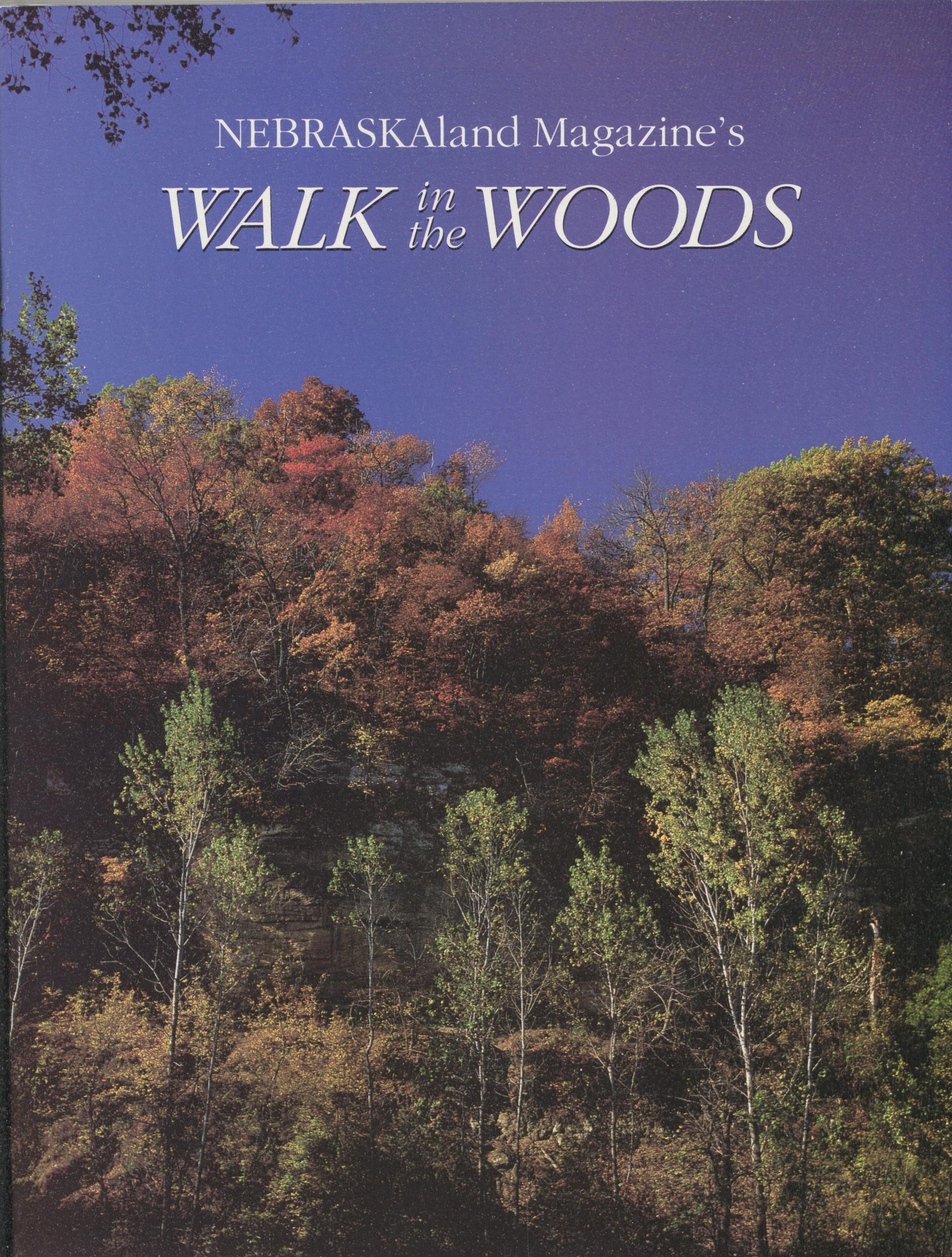
NEBRASKAland Magazine's Walk in the Woods
Nebraskaland Magazine's Walk in the Woods
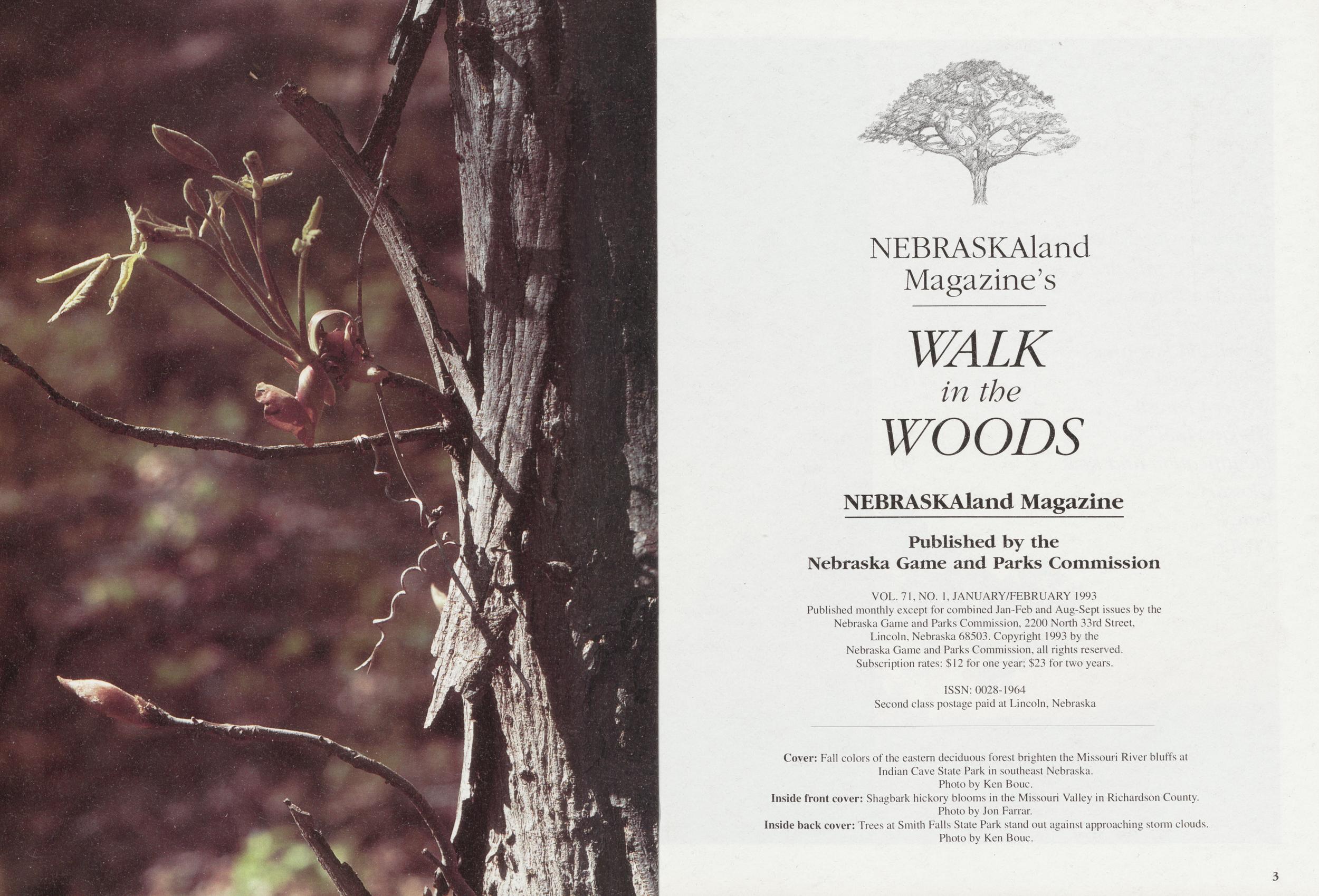
NEBRASKAland Magazine Published by the Nebraska Game and Parks Commission VOL. 71, NO. 1, JANUARY/FEBRUARY 1993 Published monthly except for combined Jan-Feb and Aug-Sept issues by the Nebraska Game and Parks Commission, 2200 North 33rd Street, Lincoln, Nebraska 68503. Copyright 1993 by the Nebraska Game and Parks Commission, all rights reserved. Subscription rates: $12 for one year; $23 for two years. ISSN: 0028-1964 Second class postage paid at Lincoln, Nebraska
Contents
Introduction 6Seeing the Forest, Not Just the Trees 8
Eastern Deciduous Forest 20
Riparian Forest 36
Prairie Shrubs 50
Woodland Resources 58
Urban Forest 66
Western Forest 72
Woody Vines 86
Identification and Keys 90
Glossary 96
Index 97
Credits 98
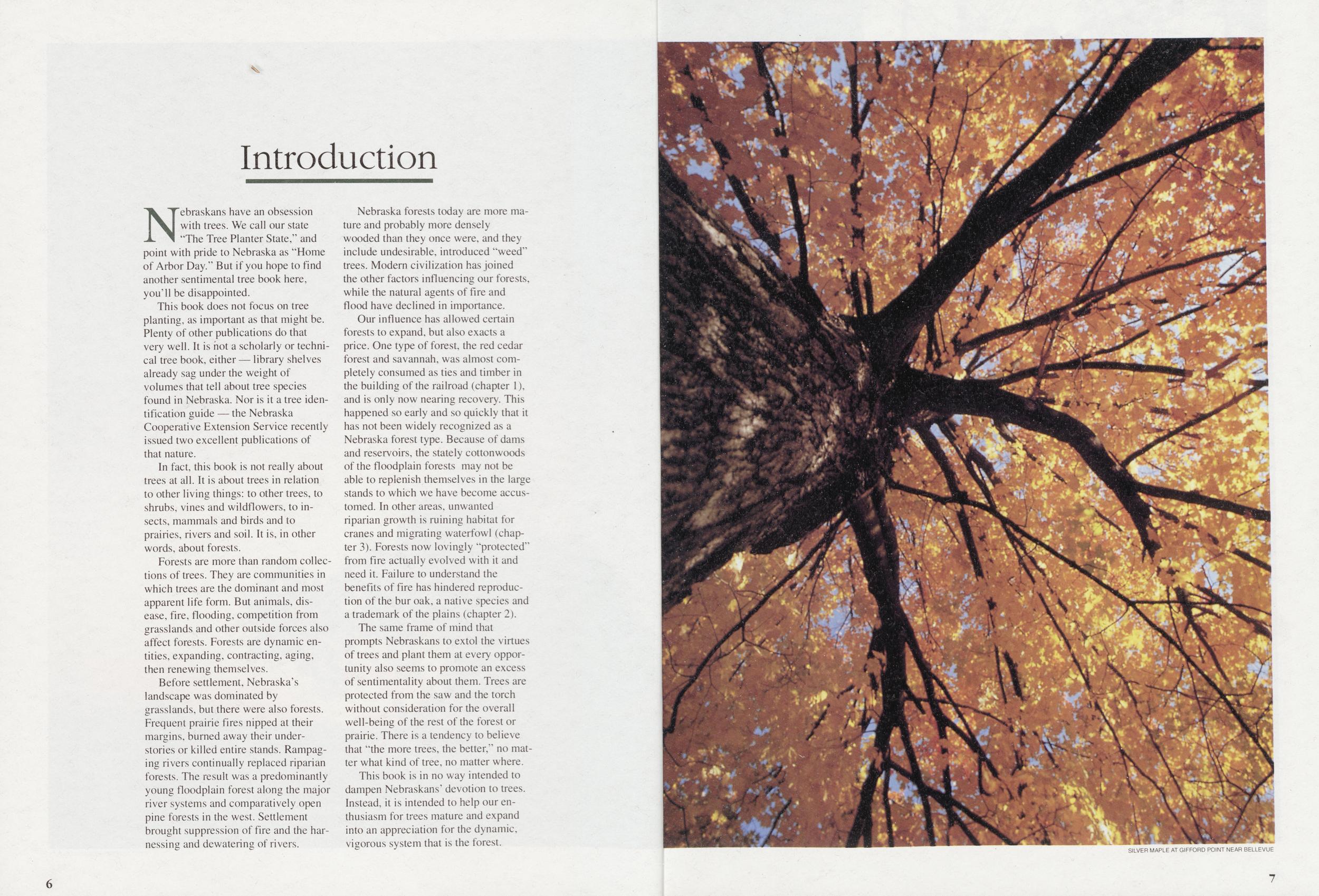
Introduction
Nebraskans have an obsession with trees. We call our state "The Tree Planter State," and point with pride to Nebraska as "Home of Arbor Day." But if you hope to find another sentimental tree book here, you'll be disappointed.
This book does not focus on tree planting, as important as that might be. Plenty of other publications do that very well. It is hot a scholarly or technical tree book, either — library shelves already sag under the weight of volumes that tell about tree species found in Nebraska. Nor is it a tree identification guide — the Nebraska Cooperative Extension Service recently issued two excellent publications of that nature.
In fact, this book is not really about trees at all. It is about trees in relation to other living things: to other trees, to shrubs, vines and wildflowers, to insects, mammals and birds and to prairies, rivers and soil. It is, in other words, about forests.
Forests are more than random collections of trees. They are communities in which trees are the dominant and most apparent life form. But animals, disease, fire, flooding, competition from grasslands and other outside forces also affect forests. Forests are dynamic entities, expanding, contracting, aging, then renewing themselves.
Before settlement, Nebraska's landscape was dominated by grasslands, but there were also forests. Frequent prairie fires nipped at their margins, burned away their under stories or killed entire stands. Rampaging rivers continually replaced riparian forests. The result was a predominantly young floodplain forest along the major river systems and comparatively open pine forests in the west. Settlement brought suppression of fire and the harnessing and dewatering of rivers.
Nebraska forests today are more mature and probably more densely wooded than they once were, and they include undesirable, introduced "weed" trees. Modern civilization has joined the other factors influencing our forests, while the natural agents of fire and flood have declined in importance.
Our influence has allowed certain forests to expand, but also exacts a price. One type of forest, the red cedar forest and savannah, was almost completely consumed as ties and timber in the building of the railroad (chapter 1), and is only now nearing recovery. This happened so early and so quickly that it has not been widely recognized as a Nebraska forest type. Because of dams and reservoirs, the stately cottonwoods of the floodplain forests may not be able to replenish themselves in the large stands to which we have become accustomed. In other areas, unwanted riparian growth is ruining habitat for cranes and migrating waterfowl (chapter 3). Forests now lovingly "protected" from fire actually evolved with it and need it. Failure to understand the benefits of fire has hindered reprodution of the bur oak, a native species and a trademark of the plains (chapter 2).
The same frame of mind that prompts Nebraskans to extol the virtues of trees and plant them at every opportunity also seems to promote an excess of sentimentality about them. Trees are protected from the saw and the torch without consideration for the overall well-being of the rest of the forest or prairie. There is a tendency to believe that "the more trees, the better," no matter what kind of tree, no matter where.
This book is in no way intended to dampen Nebraskans' devotion to trees. Instead, it is intended to help our enthusiasm for trees mature and expand into an appreciation for the dynamic, vigorous system that is the forest.
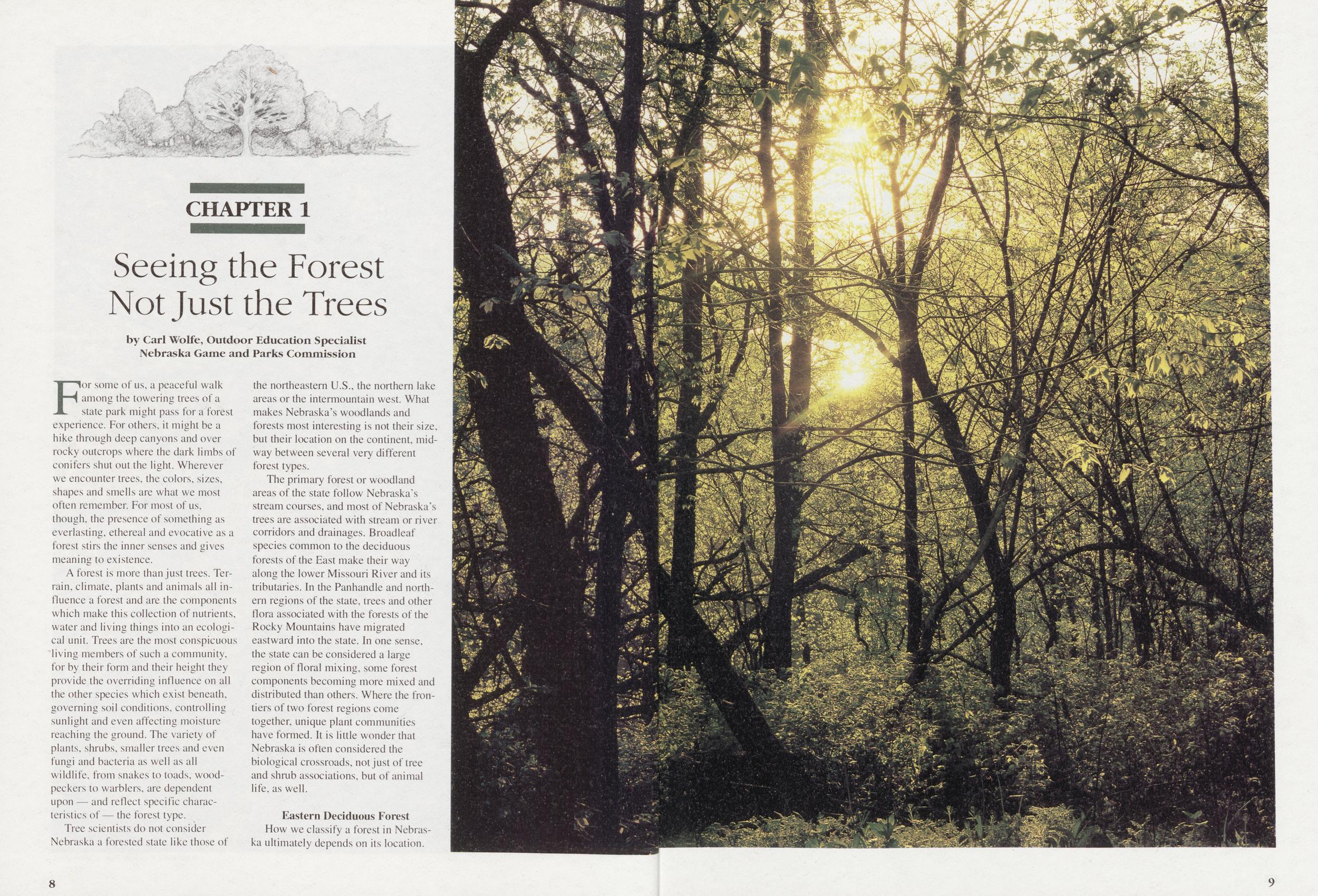
CHAPTER 1
Seeing the Forest Not Just the Trees
For some of us, a peaceful walk among the towering trees of a state park might pass for a forest experience. For others, it might be a hike through deep canyons and over rocky outcrops where the dark limbs of conifers shut out the light. Wherever we encounter trees, the colors, sizes, shapes and smells are what we most often remember. For most of us. though, the presence of something as everlasting, ethereal and evocative as a forest stirs the inner senses and gives meaning to existence.
A forest is more than just trees. Terrain, climate, plants and animals all influence a forest and are the components which make this collection of nutrients, water and living things into an ecological unit. Trees are the most conspicuous living members of such a community, for by their form and their height they provide the overriding influence on all the other species which exist beneath, governing soil conditions, controlling sunlight and even affecting moisture reaching the ground. The variety of plants, shrubs, smaller trees and even fungi and bacteria as well as all wildlife, from snakes to toads, woodpeckers to warblers, are dependent upon — and reflect specific characteristics of— the forest type.
Tree scientists do not consider Nebraska a forested state like those of the northeastern U.S., the northern lake areas or the intermountain west. What makes Nebraska's woodlands and forests most interesting is not their size, but their location on the continent, midway between several very different forest types.
The primary forest or woodland areas of the state follow Nebraska's stream courses, and most of Nebraska's trees are associated with stream or river corridors and drainages. Broadleaf species common to the deciduous forests of the East make their way along the lower Missouri River and its tributaries. In the Panhandle and northern regions of the state, trees and other flora associated with the forests of the Rocky Mountains have migrated eastward into the state. In one sense, the state can be considered a large region of floral mixing, some forest components becoming more mixed and distributed than others. Where the frontiers of two forest regions come together, unique plant communities have formed. It is little wonder that Nebraska is often considered the biological crossroads, not just of tree and shrub associations, but of animal life, as well.
Eastern Deciduous ForestHow we classify a forest in Nebraska ultimately depends on its location.
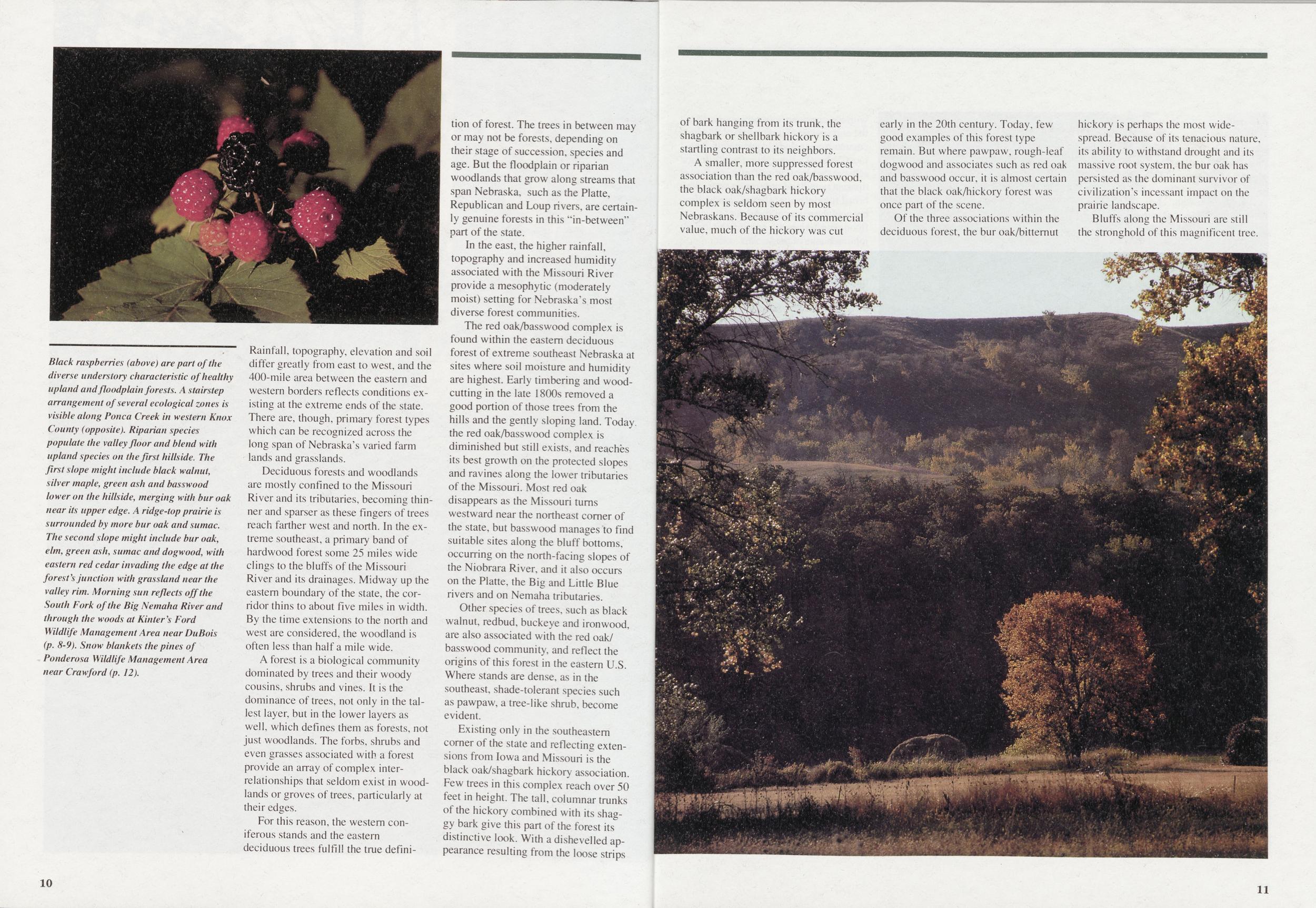
Rainfall, topography, elevation and soil differ greatly from east to west, and the 400-mile area between the eastern and western borders reflects conditions existing at the extreme ends of the state. There are, though, primary forest types which can be recognized across the long span of Nebraska's varied farm lands and grasslands.
Deciduous forests and woodlands are mostly confined to the Missouri River and its tributaries, becoming thinner and sparser as these fingers of trees reach farther west and north. In the extreme southeast, a primary band of hardwood forest some 25 miles wide clings to the bluffs of the Missouri River and its drainages. Midway up the eastern boundary of the state, the corridor thins to about five miles in width. By the time extensions to the north and west are considered, the woodland is often less than half a mile wide.
A forest is a biological community dominated by trees and their woody cousins, shrubs and vines. It is the dominance of trees, not only in the tallest layer, but in the lower layers as well, which defines them as forests, not just woodlands. The forbs, shrubs and even grasses associated with a forest provide an array of complex interrelationships that seldom exist in wood- lands or groves of trees, particularly at their edges.
For this reason, the western coniferous stands and the eastern deciduous trees fulfill the true definition of forest. The trees in between may or may not be forests, depending on their stage of succession, species and age. But the floodplain or riparian woodlands that grow along streams that span Nebraska, such as the Platte, Republican and Loup rivers, are certainly genuine forests in this "in-between" part of the state.
In the east, the higher rainfall, topography and increased humidity associated with the Missouri River provide a mesophytic (moderately moist) setting for Nebraska's most diverse forest communities.
The red oak/basswood complex is found within the eastern deciduous forest of extreme southeast Nebraska at sites where soil moisture and humidity are highest. Early timbering and wood cutting in the late 1800s removed a good portion of those trees from the hills and the gently sloping land. Today, the red oak/basswood complex is diminished but still exists, and reaches its best growth on the protected slopes and ravines along the lower tributaries of the Missouri. Most red oak disappears as the Missouri turns westward near the northeast corner of the state, but basswood manages to find suitable sites along the bluff bottoms, occurring on the north-facing slopes of the Niobrara River, and it also occurs on the Platte, the Big and Little Blue rivers and on Nemaha tributaries.
Other species of trees, such as black walnut, redbud, buckeye and ironwood, are also associated with the red oak/ basswood community, and reflect the origins of this forest in the eastern U.S. Where stands are dense, as in the southeast, shade-tolerant species such as pawpaw, a tree-like shrub, become evident.
Existing only in the southeastern corner of the state and reflecting extensions from Iowa and Missouri is the black oak/shagbark hickory association. Few trees in this complex reach over 50 feet in height. The tall, columnar trunks of the hickory combined with its shaggy bark give this part of the forest its distinctive look. With a dishlevelled appearance resulting from the loose strips of bark hanging from its trunk, the shagbark or shellbark hickory is a startling contrast to its neighbors.
A smaller, more suppressed forest association than the red oak/basswood, the black oak/shagbark hickory complex is seldom seen by most Nebraskans. Because of its commercial value, much of the hickory was cut early in the 20th century. Today, few good examples of this forest type remain. But where pawpaw, rough-leaf dogwood and associates such as red oak and basswood occur, it is almost certain that the black oak/hickory forest was once part of the scene.
Of the three associations within the deciduous forest, the bur oak/bitter nut hickory is perhaps the most wide- spread. Because of its tenacious nature, its ability to withstand drought and its massive root system, the bur oak has persisted as the dominant survivor of civilization's incessant impact on the prairie landscape.
Bluffs along the Missouri are still
the stronghold of this magnificent tree.
10
11
 Bur oaks well over 100 years old still
stand and boast their staying power
with heights reaching 80 feet and
diameters well over three feet. Most
stream courses in eastern Nebraska
harbor bur oak on the valley sides and
bluffs where agriculture has been
unable to exist profitably.
Bur oaks well over 100 years old still
stand and boast their staying power
with heights reaching 80 feet and
diameters well over three feet. Most
stream courses in eastern Nebraska
harbor bur oak on the valley sides and
bluffs where agriculture has been
unable to exist profitably.
The shrub and forb layers associated with bur oak are often extensive and include many vines, notably poison ivy, bittersweet, greenbriar and Virginia creeper. Some of the most startling displays of spring flora occur under the sweeping canopies of bur oak and its associates, blackberry, cottonwood and elm, before leaves in the canopy develop. Orchid species, may-apples, jack-in-the-pulpit and Dutchman's breeches are just a few of more than 50 species associated with the bur oak understory.
As moisture decreases, the size and stature of bur oaks also decline. In the extreme western fingers of its range, along the Niobrara, Elkhorn, Nemaha and Platte drainages, bur oak becomes almost a shrub-like, slow-growing tree.
Riparian ForestAlong the river and stream systems of the state, however, more moisture than in the drier adjoining uplands is available to trees, and the woodlands associated with these more favorable sites have developed unique associations of plant species. The floodplain (riparian) woodlands of the Platte, Republican, Elkhorn and Loup river systems are unique because of their variety of successional stages.
Over centuries past, seasonal flooding of those sites provided a continual replenishment of nutrients. Rich silt was a significant factor in the rapid growth of trees, shrubs and vines associated with the often narrow and changing landscape. Then, as flooding was diminished with the construction of dams, many of the woodlands were cleared for agriculture.
Yet, the floodplain forest remains important in Nebraska, for it can be found along most streams in the state in one stage or another of its successional development. The small islands and sandbars along the state's watercourses are often the most apparent examples of the first stages of succession, with willows, cottonwood and, somewhat later, boxelder. These early stages of development are represented along the smaller streams of central Nebraska, especially the tributaries of the Platte, Elkhorn and Blue rivers.
The next stage becomes apparent with the appearance of green ash and the elm species. The final stage of succession may include black walnut, but most Nebraska floodplain forests do not achieve that level of maturity. As riparian woodland progresses west, the broad floodplains of the east gradually become more narrow, and the floodplain forests are confined to the adjoining banks of the stream.
These corridor forests may achieve significant breadth, or merely exist as tiny fingers of trees, but the floodplain forests of the state are remarkable for their tenacity, their stately growth and their extension into areas where no other forest can grow.
More important are the benefits they provide to wildlife. As an often impenetrable tangle of willows and other small trees, the early successional stages of the riparian woodlands provide food and cover for many bird and animal species. The larger, more mature floodplain forests serve as roosts for • wintering eagles and as nesting sites for great blue herons, and provide inestimable nesting habitat for many other species of birds.
Western Forest and PrairieIt is in the transition zone from forest to prairie that many of the shrubs associated with forests as understory species begin their gradual extension to the drier, more hostile sites of central and western Nebraska. Sumac, dog wood, chokecherry and plum are examples of the many shrubs which occupy drier areas, adding to the diversity of the landscape, but signaling that a site is not adequate for trees.
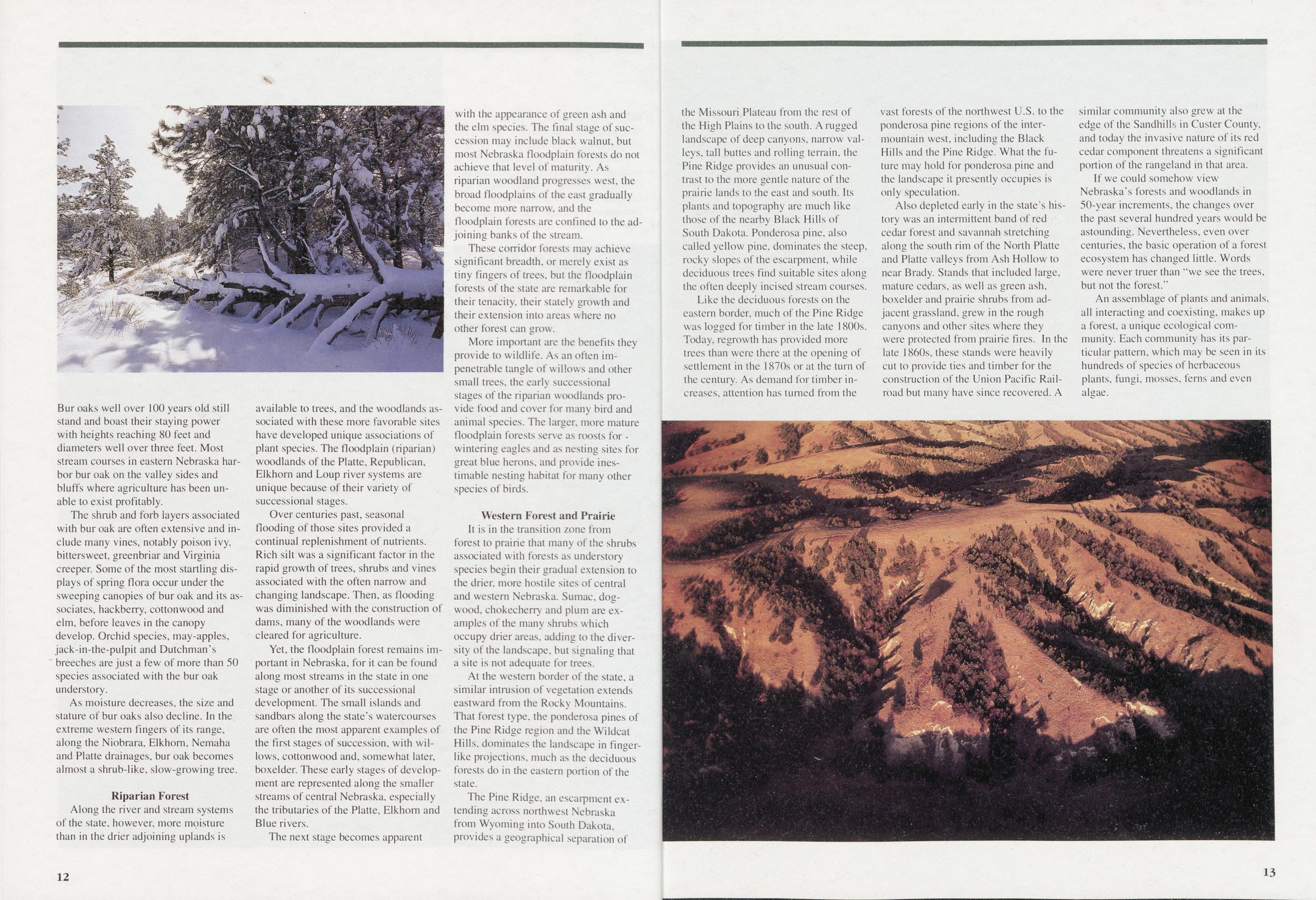
At the western border of the state, a similar intrusion of vegetation extends eastward from the Rocky Mountains. That forest type, the ponderosa pines of the Pine Ridge region and the Wildcat Hills, dominates the landscape in finger like projections, much as the deciduous forests do in the eastern portion of the state.
The Pine Ridge, an escarpment extending across northwest Nebraska from Wyoming into South Dakota, provides a geographical separation of the Missouri Plateau from the rest of the High Plains to the south. A rugged landscape of deep canyons, narrow valleys, tall buttes and rolling terrain, the Pine Ridge provides an unusual contrast to the more gentle nature of the prairie lands to the east and south. Its plants and topography are much like those of the nearby Black Hills of South Dakota. Ponderosa pine, also called yellow pine, dominates the steep, rocky slopes of the escarpment, while deciduous trees find suitable sites along the often deeply incised stream courses.
Like the deciduous forests on the eastern border, much of the Pine Ridge was logged for timber in the late 1800s. Today, regrowth has provided more trees than were there at the opening of settlement in the 1870s or at the turn of the century. As demand for timber increases, attention has turned from the vast forests of the northwest U.S. to the ponderosa pine regions of the intermountain west, including the Black Hills and the Pine Ridge. What the future may hold for ponderosa pine and the landscape it presently occupies is only speculation.
Also depleted early in the state's history was an intermittent band of red cedar forest and savannah stretching along the south rim of the North Platte and Platte valleys from Ash Hollow to near Brady. Stands that included large, mature cedars, as well as green ash, boxelder and prairie shrubs from adjacent grassland, grew in the rough canyons and other sites where they were protected from prairie fires. In the late 1860s. these stands were heavily cut to provide ties and timber for the construction of the Union Pacific Railroad but many have since recovered. A similar community also grew at the Sandhills in Custer County, and today the invasive nature of its red cedar component threatens a significant portion of the rangeland in that area.
If we could somehow view Nebraska's forests and woodlands in 50-year increments, the changes over the past several hundred years would be astounding. Nevertheless, even over centuries, the basic operation of a forest ecosystem has changed little. Words were never truer than we see the trees, but not the forest."
An assemblage of plants and animals, all interacting and coexisting, makes up a forest, a unique ecological community. Each community has its particular pattern, which may be seen in its hundreds of species of herbaceous plants, fungi, mosses, ferns and even algae.
12 13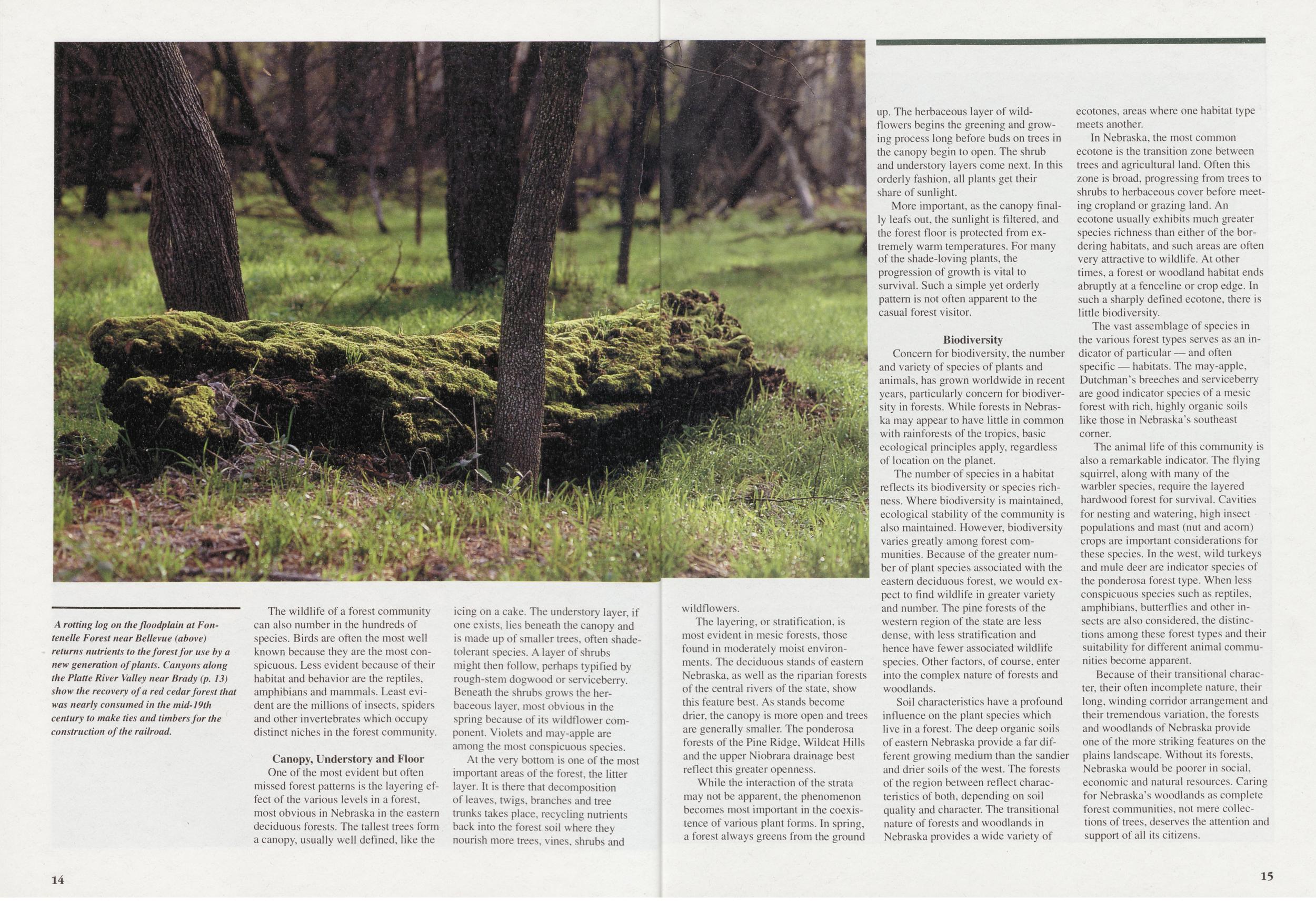
The wildlife of a forest community can also number in the hundreds of species. Birds are often the most well known because they are the most conspicuous. Less evident because of their habitat and behavior are the reptiles, amphibians and mammals. Least evident are the millions of insects, spiders and other invertebrates which occupy distinct niches in the forest community.
Canopy, Understory and FloorOne of the most evident but often missed forest patterns is the layering effect of the various levels in a forest, most obvious in Nebraska in the eastern deciduous forests. The tallest trees form a canopy, usually well defined, like the icing on a cake. The understory layer, if one exists, lies beneath the canopy and is made up of smaller trees, often shade tolerant species. A layer of shrubs might then follow, perhaps typified by rough-stem dogwood or serviceberry. Beneath the shrubs grows the herbaceous layer, most obvious in the spring because of its wildflower component. Violets and may-apple are among the most conspicuous species.
At the very bottom is one of the most important areas of the forest, the litter layer. It is there that decomposition of leaves, twigs, branches and tree trunks takes place, recycling nutrients back into the forest soil where they nourish more trees, vines, shrubs and wildflowers.
The layering, or stratification, is most evident in mesic forests, those found in moderately moist environments. The deciduous stands of eastern Nebraska, as well as the riparian forests of the central rivers of the state, show this feature best. As stands become drier, the canopy is more open and trees are generally smaller. The ponderosa forests of the Pine Ridge, Wildcat Hills and the upper Niobrara drainage best reflect this greater openness.
While the interaction of the strata may not be apparent, the phenomenon becomes most important in the coexistence of various plant forms. In spring, a forest always greens from the ground up. The herbaceous layer of wildflowers begins the greening and growing process long before buds on trees in the canopy begin to open. The shrub and understory layers come next. In this orderly fashion, all plants get their share of sunlight.
More important, as the canopy finally leafs out, the sunlight is filtered, and the forest floor is protected from extremely warm temperatures. For many of the shade-loving plants, the progression of growth is vital to survival. Such a simple yet orderly pattern is not often apparent to the casual forest visitor.
BiodiversityConcern for biodiversity, the number and variety of species of plants and animals, has grown worldwide in recent years, particularly concern for biodiversity in forests. While forests in Nebraska may appear to have little in common with rainforests of the tropics, basic ecological principles apply, regardless of location on the planet.
The number of species in a habitat reflects its biodiversity or species richness. Where biodiversity is maintained, ecological stability of the community is also maintained. However, biodiversity varies greatly among forest communities. Because of the greater number of plant species associated with the eastern deciduous forest, we would expect to find wildlife in greater variety and number. The pine forests of the western region of the state are less dense, with less stratification and hence have fewer associated wildlife species. Other factors, of course, enter into the complex nature of forests and woodlands.
Soil characteristics have a profound influence on the plant species which live in a forest. The deep organic soils of eastern Nebraska provide a far different growing medium than the sandier and drier soils of the west. The forests of the region between reflect characteristics of both, depending on soil quality and character. The transitional nature of forests and woodlands in Nebraska provides a wide variety of ecotones, areas where one habitat type meets another.
In Nebraska, the most common ecotone is the transition zone between trees and agricultural land. Often this zone is broad, progressing from trees to shrubs to herbaceous cover before meeting cropland or grazing land. An ecotone usually exhibits much greater species richness than either of the bordering habitats, and such areas are often very attractive to wildlife. At other times, a forest or woodland habitat ends abruptly at a fence line or crop edge. In such a sharply defined ecotone, there is little biodiversity.
The vast assemblage of species in the various forest types serves as an indicator of particular — and often specific — habitats. The may-apple, Dutchman's breeches and serviceberry are good indicator species of a mesic forest with rich, highly organic soils like those in Nebraska's southeast corner.
The animal life of this community is also a remarkable indicator. The flying squirrel, along with many of the warbler species, require the layered hardwood forest for survival. Cavities for nesting and watering, high insect populations and mast (nut and acorn) crops are important considerations for these species. In the west, wild turkeys and mule deer are indicator species of the ponderosa forest type. When less conspicuous species such as reptiles, amphibians, butterflies and other insects are also considered, the distinctions among these forest types and their suitability for different animal communities become apparent.
Because of their transitional character, their often incomplete nature, their long, winding corridor arrangement and their tremendous variation, the forests and woodlands of Nebraska provide one of the more striking features on the plains landscape. Without its forests, Nebraska would be poorer in social, economic and natural resources. Caring for Nebraska's woodlands as complete forest communities, not mere collections of trees, deserves the attention and support of all its citizens.
14 15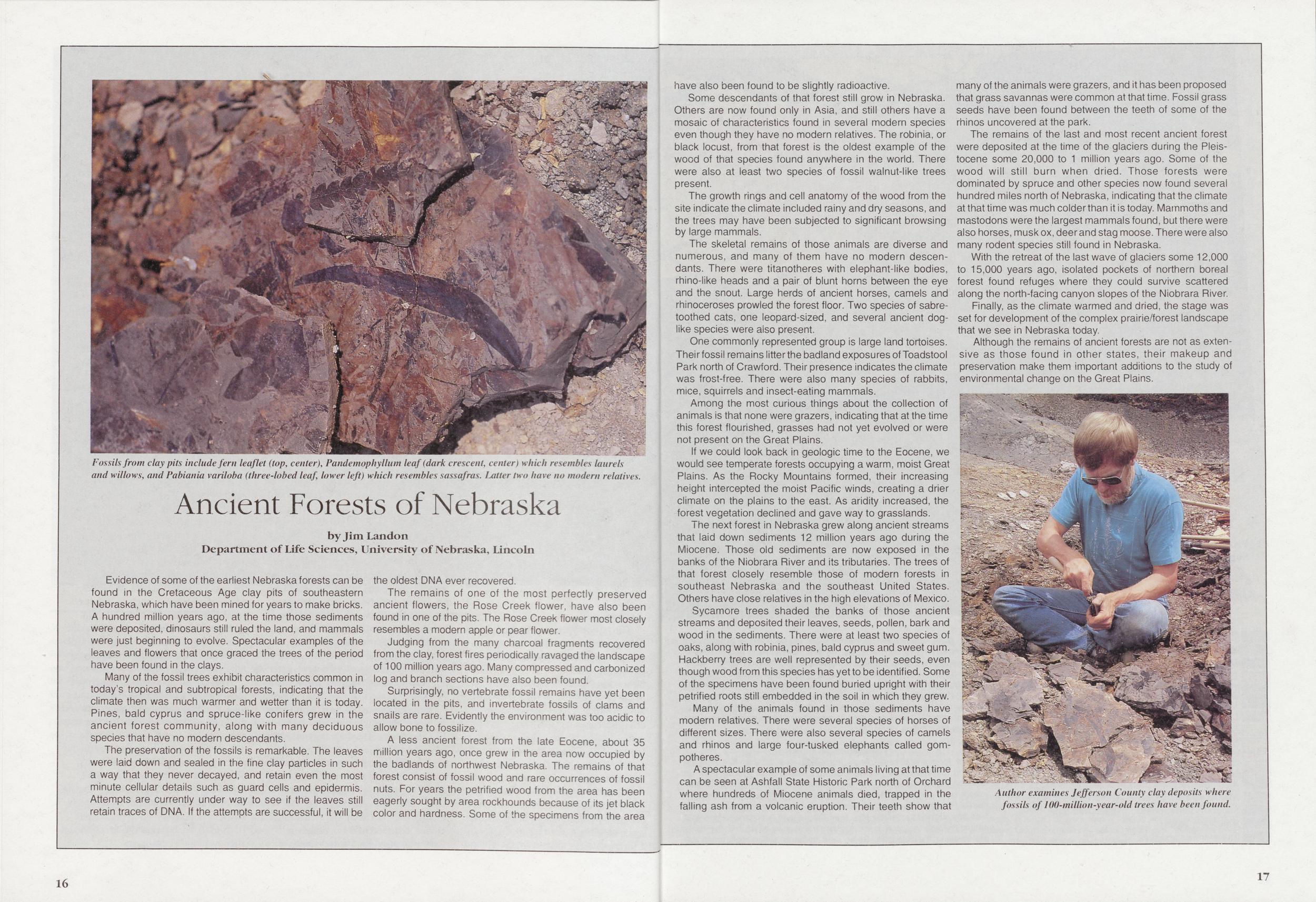
Ancient Forests of Nebraska
Evidence of some of the earliest Nebraska forests can be found in the Cretaceous Age clay pits of southeastern Nebraska, which have been mined for years to make bricks. A hundred million years ago, at the time those sediments were deposited, dinosaurs still ruled the land, and mammals were just beginning to evolve. Spectacular examples of the leaves and flowers that once graced the trees of the period have been found in the clays.
Many of the fossil trees exhibit characteristics common in today's tropical and subtropical forests, indicating that the climate then was much warmer and wetter than it is today. Pines, bald Cyprus and spruce-like conifers grew in the ancient forest community, along with many deciduous species that have no modern descendants.
The preservation of the fossils is remarkable. The leaves were laid down and sealed in the fine clay particles in such a way that they never decayed, and retain even the most minute cellular details such as guard cells and epidermis. Attempts are currently under way to see if the leaves still retain traces of DNA. If the attempts are successful, it will be the oldest DNA ever recovered.
The remains of one of the most perfectly preserved ancient flowers, the Rose Creek flower, have also been found in one of the pits. The Rose Creek flower most closely resembles a modern apple or pear flower.
Judging from the many charcoal fragments recovered from the clay, forest fires periodically ravaged the landscape of 100 million years ago. Many compressed and carbonized log and branch sections have also been found.
Surprisingly, no vertebrate fossil remains have yet been located in the pits, and invertebrate fossils of clams and snails are rare. Evidently the environment was too acidic to allow bone to fossilize.
A less ancient forest from the late Eocene, about 35 million years ago, once grew in the area now occupied by the badlands of northwest Nebraska. The remains of that forest consist of fossil wood and rare occurrences of fossil nuts. For years the petrified wood from the area has been eagerly sought by area rockhounds because of its jet black color and hardness. Some of the specimens from the area have also been found to be slightly radioactive.
Some descendants of that forest still grow in Nebraska. Others are now found only in Asia, and still others have a mosaic of characteristics found in several modern species even though they have no modern relatives. The robinia, or black locust, from that forest is the oldest example of the wood of that species found anywhere in the world. There were also at least two species of fossil walnut-like trees present.
The growth rings and cell anatomy of the wood from the site indicate the climate included rainy and dry seasons, and the trees may have been subjected to significant browsing by large mammals.
The skeletal remains of those animals are diverse and numerous, and many of them have no modern descendants. There were tit anotheres with elephant-like bodies, rhino-like heads and a pair of blunt horns between the eye and the snout. Large herds of ancient horses, camels and rhinoceroses prowled the forest floor. Two species of saber-toothed cats, one leopard-sized, and several ancient dog like species were also present.
One commonly represented group is large land tortoises. Their fossil remains litter the bad land exposures of Toadstool Park north of Crawford. Their presence indicates the climate was frost-free. There were also many species of rabbits, mice, squirrels and insect-eating mammals.
Among the most curious things about the collection of animals is that none were grazers, indicating that at the time this forest flourished, grasses had not yet evolved or were not present on the Great Plains.
If we could look back in geologic time to the Eocene, we would see temperate forests occupying a warm, moist Great Plains. As the Rocky Mountains formed, their increasing height intercepted the moist Pacific winds, creating a drier climate on the plains to the east. As aridity increased, the forest vegetation declined and gave way to grasslands.
The next forest in Nebraska grew along ancient streams that laid down sediments 12 million years ago during the Miocene. Those old sediments are now exposed in the banks of the Niobrara River and its tributaries. The trees of that forest closely resemble those of modern forests in southeast Nebraska and the southeast United States. Others have close relatives in the high elevations of Mexico.
Sycamore trees shaded the banks of those ancient streams and deposited their leaves, seeds, pollen, bark and wood in the sediments. There were at least two species of oaks, along with robinia, pines, bald Cyprus and sweet gum. Hackberry trees are well represented by their seeds, even though wood from this species has yet to be identified. Some of the specimens have been found buried upright with their petrified roots still embedded in the soil in which they grew.
Many of the animals found in those sediments have modern relatives. There were several species of horses of different sizes. There were also several species of camels and rhinos and large four-tusked elephants called gompotheres.
A spectacular example of some animals living at that time can be seen at Ash fall State Historic Park north of Orchard where hundreds of Miocene animals died, trapped in the falling ash from a volcanic eruption. Their teeth show that many of the animals were grazers, and it has been proposed that grass savannas were common at that time. Fossil grass seeds have been found between the teeth of some of the rhinos uncovered at the park.
The remains of the last and most recent ancient forest were deposited at the time of the glaciers during the Pleistocene some 20,000 to 1 million years ago. Some of the wood will still burn when dried. Those forests were dominated by spruce and other species now found several hundred miles north of Nebraska, indicating that the climate at that time was much colder than it is today. Mammoths and mastodons were the largest mammals found, but there were also horses, musk ox, deer and stag moose. There were also many rodent species still found in Nebraska.
With the retreat of the last wave of glaciers some 12,000 to 15,000 years ago, isolated pockets of northern boreal forest found refuges where they could survive scattered along the north-facing canyon slopes of the Niobrara River.
Finally, as the climate warmed and dried, the stage was set for development of the complex prairie/forest landscape that we see in Nebraska today.
Although the remains of ancient forests are not as extensive as those found in other states, their makeup and preservation make them important additions to the study of environmental change on the Great Plains.
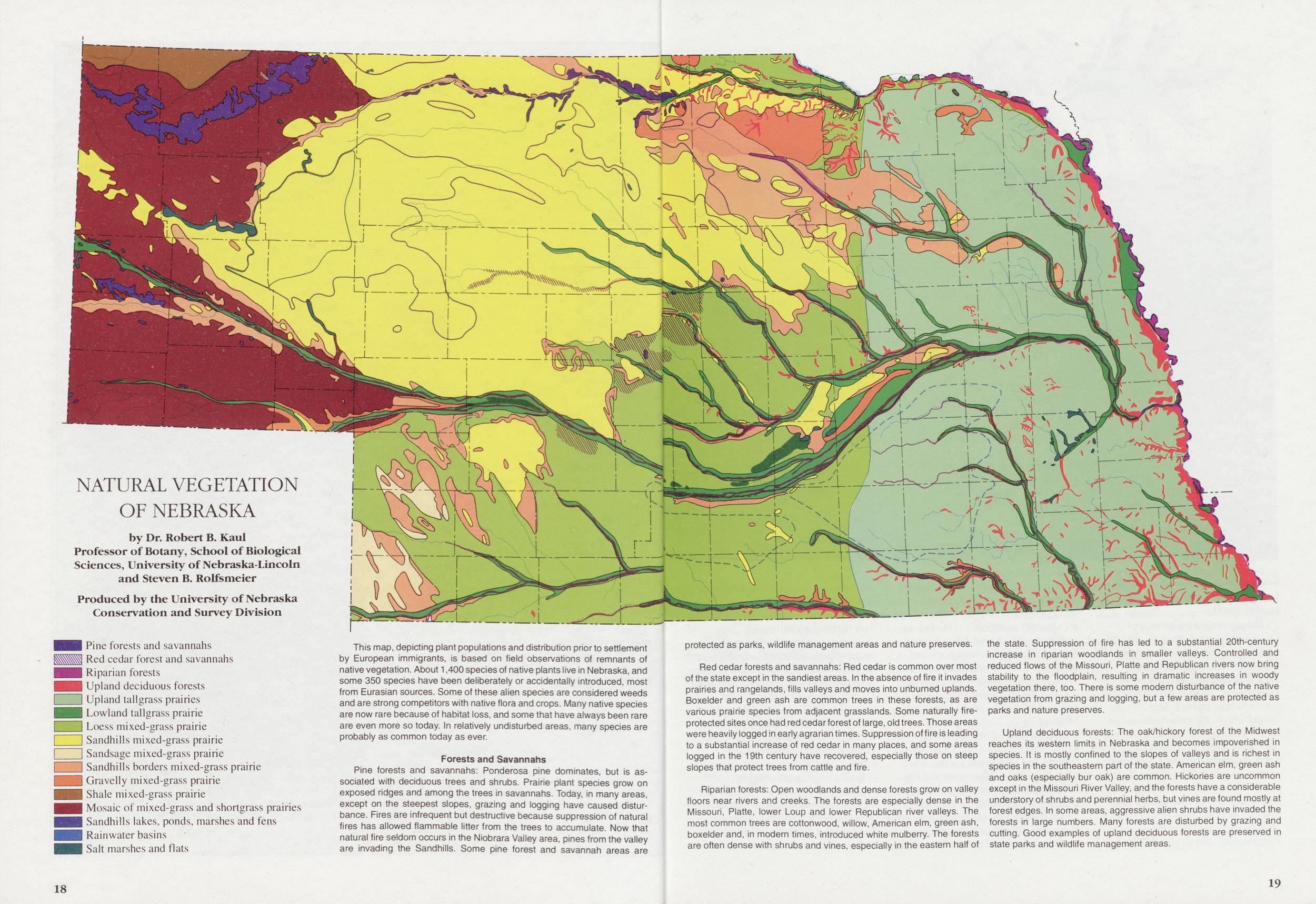
NATURAL VEGETATION OF NEBRASKA
This map, depicting plant populations and distribution prior to settlement by European immigrants, is based on field observations of remnants of native vegetation. About 1,400 species of native plants live in Nebraska, and some 350 species have been deliberately or accidentally introduced, most from Eurasian sources. Some of these alien species are considered weeds and are strong competitors with native flora and crops. Many native species are now rare because of habitat loss, and some that have always been rare are even more so today. In relatively undisturbed areas, many species are probably as common today as ever.
Forests and SavannahsPine forests and savannahs: Ponderosa pine dominates, but is associated with deciduous trees and shrubs. Prairie plant species grow on exposed ridges and among the trees in savannahs. Today, in many areas, except on the steepest slopes, grazing and logging have caused disturbance. Fires are infrequent but destructive because suppression of natural fires has allowed flammable litter from the trees to accumulate. Now that natural fire seldom occurs in the Niobrara Valley area, pines from the valley are invading the Sandhills. Some pine forest and savannah areas are protected as parks, wildlife management areas and nature preserves.
Red cedar forests and savannahs: Red cedar is common over most of the state except in the sandiest areas. In the absence of fire it invades prairies and rangelands, fills valleys and moves into unburned uplands. Boxelder and green ash are common trees in these forests, as are various prairie species from adjacent grasslands. Some naturally fire protected sites once had red cedar forest of large, old trees. Those areas were heavily logged in early agrarian times. Suppression of fire is leading to a substantial increase of red cedar in many places, and some areas logged in the 19th century have recovered, especially those on steep slopes that protect trees from cattle and fire.
Riparian forests: Open woodlands and dense forests grow on valley floors near rivers and creeks. The forests are especially dense in the Missouri, Platte, lower Loup and lower Republican river valleys. The most common trees are cottonwood, willow, American elm, green ash, boxelder and, in modern times, introduced white mulberry. The forests are often dense with shrubs and vines, especially in the eastern half of the state. Suppression of fire has led to a substantial 20th-century increase in riparian woodlands in smaller valleys. Controlled and reduced flows of the Missouri, Platte and Republican rivers now bring stability to the floodplain, resulting in dramatic increases in woody vegetation there, too. There is some modern disturbance of the native vegetation from grazing and logging, but a few areas are protected as parks and nature preserves.
Upland deciduous forests: The oak/hickory forest of the Midwest reaches its western limits in Nebraska and becomes impoverished in species. It is mostly confined to the slopes of valleys and is richest in species in the southeastern part of the state. American elm, green ash and oaks (especially bur oak) are common. Hickories are uncommon except in the Missouri River Valley, and the forests have a considerable understory of shrubs and perennial herbs, but vines are found mostly at forest edges. In some areas, aggressive alien shrubs have invaded the forests in large numbers. Many forests are disturbed by grazing and cutting. Good examples of upland deciduous forests are preserved in state parks and wildlife management areas.
18 19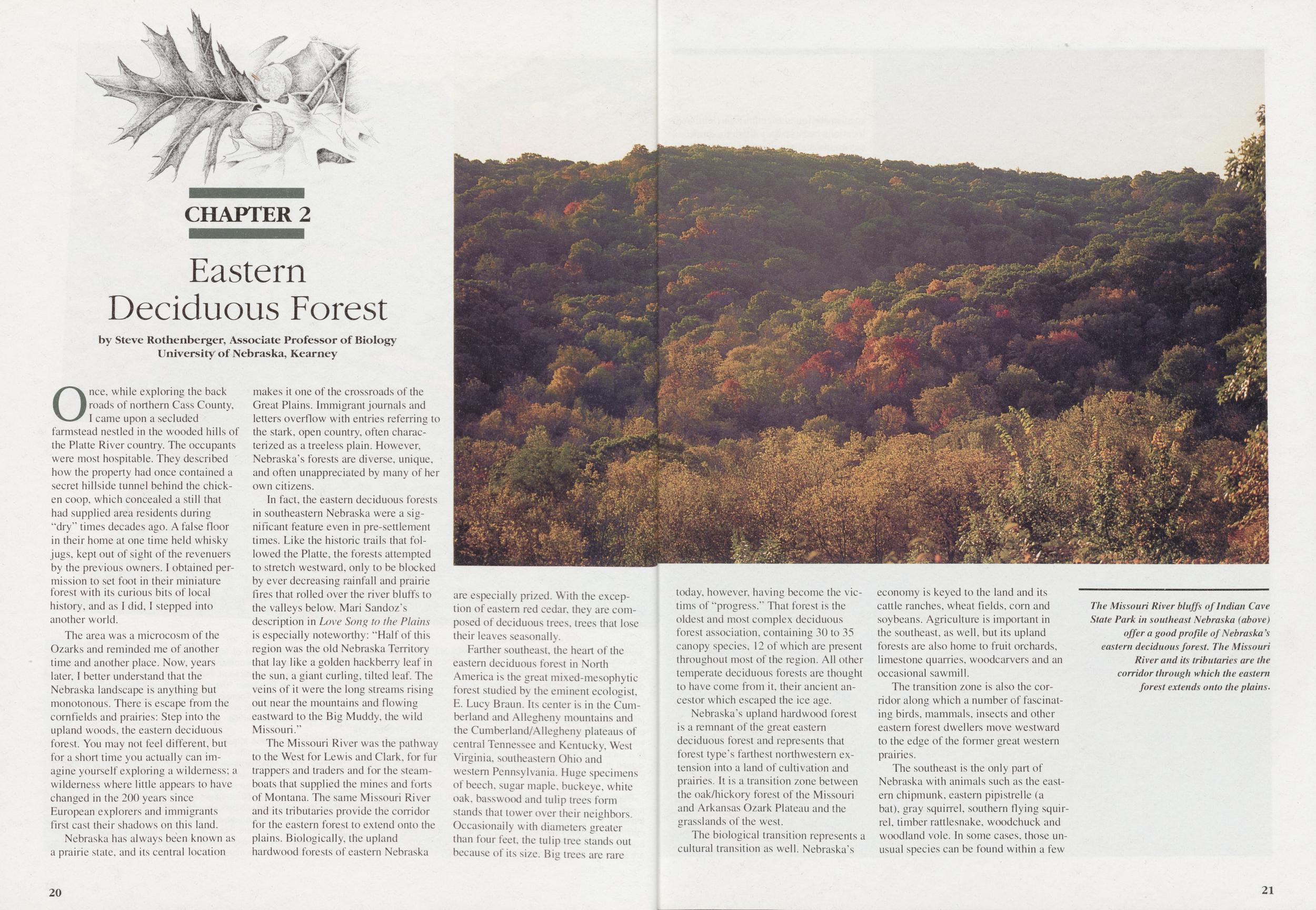
CHAPTER 2
Eastern Deciduous Forest
Once, while exploring the back roads of northern Cass County, I came upon a secluded farmstead nestled in the wooded hills of the Platte River country. The occupants were most hospitable. They described how the property had once contained a secret hillside tunnel behind the chicken coop, which concealed a still that had supplied area residents during "dry" times decades ago. A false floor in their home at one time held whisky jugs, kept out of sight of the revenuers by the previous owners. I obtained permission to set foot in their miniature forest with its curious bits of local history, and as I did, I stepped into another world.
The area was a microcosm of the Ozarks and reminded me of another time and another place. Now, years later, I better understand that the Nebraska landscape is anything but monotonous. There is escape from the cornfields and prairies: Step into the upland woods, the eastern deciduous forest. You may not feel different, but for a short time you actually can imagine yourself exploring a wilderness; a wilderness where little appears to have changed in the 200 years since European explorers and immigrants first cast their shadows on this land.
Nebraska has always been known as a prairie state, and its central location makes it one of the crossroads of the Great Plains. Immigrant journals and letters overflow with entries referring to the stark, open country, often characterized as a treeless plain. However, Nebraska's forests are diverse, unique, and often unappreciated by many of her own citizens.
In fact, the eastern deciduous forests in southeastern Nebraska were a significant feature even in pre-settlement times. Like the historic trails that followed the Platte, the forests attempted to stretch westward, only to be blocked by ever decreasing rainfall and prairie fires that rolled over the river bluffs to the valleys below. Mari Sandoz's description in Love Song to the Plains is especially noteworthy: "Half of this region was the old Nebraska Territory that lay like a golden hackberry leaf in the sun, a giant curling, tilted leaf. The veins of it were the long streams rising out near the mountains and flowing eastward to the Big Muddy, the wild Missouri."
The Missouri River was the pathway to the West for Lewis and Clark, for fur trappers and traders and for the steamboats that supplied the mines and forts of Montana. The same Missouri River and its tributaries provide the corridor for the eastern forest to extend onto the plains. Biologically, the upland hardwood forests of eastern Nebraska are especially prized. With the exception of eastern red cedar, they are com- posed of deciduous trees, trees that lose their leaves seasonally.
Farther southeast, the heart of the eastern deciduous forest in North America is the great mixed-mesophytie forest studied by the eminent eeologist, E. Lucy Braun. Its center is in the Cumberland and Allegheny mountains and the Cumberland/Allegheny plateaus of central Tennessee and Kentucky, West Virginia, southeastern Ohio and western Pennsylvania. Huge specimens of beech, sugar maple, buckeye, white oak, basswood and tulip trees form stands that tower over their neighbors. Occasionally with diameters greater than four feet, the tulip tree stands out because of its size. Big trees are rare today, however, having become the victims of "progress." That forest is the oldest and most complex deciduous forest association, containing 30 to 35 canopy species, 12 of which are present throughout most of the region. All other temperate deciduous forests are thought to have come from it, their ancient ancestor which escaped the ice age.
Nebraska's upland hardwood forest is a remnant of the great eastern deciduous forest and represents that forest type's farthest northwestern extension into a land of cultivation and prairies. It is a transition zone between the oak/hickory forest of the Missouri and Arkansas Ozark Plateau and the grasslands of the west.
The biological transition represents a cultural transition as well. Nebraska's economy is keyed to the land and its cattle ranches, wheat fields, corn and soybeans. Agriculture is important in the southeast, as well, but its upland forests are also home to fruit orchards, limestone quarries, woodcarvers and an occasional sawmill.
The transition zone is also the corridor along which a number of fascinating birds, mammals, insects and other eastern forest dwellers move westward to the edge of the former great western prairies.
The southeast is the only part of Nebraska with animals such as the eastern chipmunk, eastern pipistrelle (a bat), gray squirrel, southern flying squirrel, timber rattlesnake, woodchuck and woodland vole. In some cases, those unusual species can be found within a few
yards of tall grass prairie which originally bordered the forest extensions.
The eastern deciduous forest extends from the southeast corner of the state to the north and west along the bluffs and hills which border rivers and streams. Hillsides and valleys where moisture is favorable also support outlying forest relics, but they were often kept in check by occasional prairie fires which killed or damaged many trees and shrubs.
In extreme southeastern Nebraska, the upland forests have the greatest diversity. No fewer than eight species of oak and two species of hickory live there. Kentucky coffee, Ohio buckeye, and black walnut are other trees in this area with southeastern affinities. Smaller trees that make up the forest understory are pawpaw, redbud, bladdernut and ironwood.
A forest community is a group of different tree species. Often, certain species are found together or in similar locations because they share the same environmental requirements, including light, precipitation, soil moisture, soil nutrients and humidity. Three distinct communities of upland hardwood forest are recognized, although the composition of each often varies with the location. These are the red oak/basswood, black oak/shagbark hickory, and bur oak/bitternut hickory communities.
The red oak/basswood community requires more soil moisture than the others, and that would seem to limit its range. But even with this liability, the community is surprisingly widespread. It occupies protected slopes and hillsides along the Big Nemaha, Platte, Elkhorn and Missouri rivers in the eastern part of the state. Usually, this community is found on the lowest slopes of the bluffs bordering the river valley.
Red oak and basswood are among the largest deciduous trees in Nebraska and form a thick forest stand with a closed over story canopy, the dense overhead layer of leaves and branches which prevents much of the sunlight from reaching the ground. The canopy often limits the development of an understory of herbaceous plants, shrubs and smaller trees. Ironwood, a shade tolerant small tree, is one of few species to grow successfully under a dense forest canopy.
Northern red oak is a spectacular tree when mature, averaging 60 to 70 feet in height and two feet in diameter. It forms an open, rounded crown with clusters of glossy, deep green leaves. The Nebraska state record is 76 feet tall with a crown spread of 75 feet. The wood is very hard, light red-brown in color and is used in furniture and interior finishing.
Red oak acorns contain large amounts of tannin and are very bitter. They can be dried and ground into flour and the tannins removed by boiling or soaking in water. Acorn flour was a food staple of several Native American tribes that once populated the eastern Great Plains.
Basswood, also called American linden, grows to nearly 70 feet tall and three to four feet in diameter. It was a popular witness tree cited often by early surveyors. When damaged or cut down, it sends up suckers or shoots which eventually divide into multiple trunks. The native linden is easily distinguished from other trees in the forest by its multiple trunks, and it is also recognized by its oblique, heart-shaped leaves with edges that resemble a saw blade. Small nutlets cluster beneath large, leafy wings that act as spinning parachutes to distribute its ripened seeds.
The wood is white, fine grained and easily worked. It is used for furniture, interior woodwork and paneling, and it is a favorite of woodcarvers. The basswood prefers rich, well-drained soils and occurs naturally in river floodplains and on hillsides.
Red oak extends northward to the Niobrara River, along the Platte to its confluence with the Elkhorn, and for a number of miles along the upper terraces that border the lower Elkhorn River. Basswood moves west along the Platte and Niobrara valleys from where these rivers join the Missouri, and extends as far as Cherry and Greeley counties.
Losses of those forests through agricultural expansion have been extensive in southeastern Nebraska. In Nemaha County, for example, 31 percent (more than 7,300 acres) of native deciduous forest was cleared between 1955 and 1977. It is not surprising that land put into agricultural production increased proportionately during the same period.
The black oak/shagbark hickory community mingles with red oak, basswood and their associates farther up hillsides bordering the river valleys. Both black oak and shagbark hickory are restricted to extreme southeastern Nebraska.
Shagbark hickory gets its name from its unusual dark gray bark which separates into thick, ragged strips one to three feet long. These strips cling to the tree trunk, giving it its characteristic shaggy appearance. The leaves are divided into five to seven leaflets, the largest at the end. The edible, egg shaped nuts are four-angled with a thick husk or covering.
Shagbark hickory is found only along the Missouri River uplands from southeastern Richardson County north to Douglas County. Even though black oak and shagbark hickory can tolerate drier habitats, latitude and precipitation also influence their distribution, and Douglas County represents the northernmost extension of their range.
Black oak extends as far west as Lancaster County and follows the Platte River into Saunders County. Other trees commonly found in the black oak/shag-bark hickory community include black walnut, hackberry, green ash, Kentucky coffee tree and red mulberry.
Bur oak is the most widely distributed oak on the Great Plains. It is the dominant component of the bur oak/bitternut hickory community, but it is scattered across the state following rivers and streams and occasionally populating north-facing slopes in the east. Its stems and trunk are insulated by a layer of cork which provides a measure of protection against all but the most intense prairie fires. About it, naturalist Aldo Leopold wrote: 'The bur oak is the only tree that can stand up to a prairie fire and live. Bur oaks were the shock troops sent by the invading forest to storm the prairie; fire is what they had to fight."
Bur oak grows fast during the seedling stage and will quickly sink a taproot several inches to a foot into the prairie sod, helping it to combat drought, its greatest enemy. Those who have lived on the plains know that drought is a frequent visitor, and its effects can be severe. Just when trees and shrubs appear to be making advances from the east, they are beaten back by an abnormally dry cycle. Perhaps drought cycles are really not so abnormal.
22 23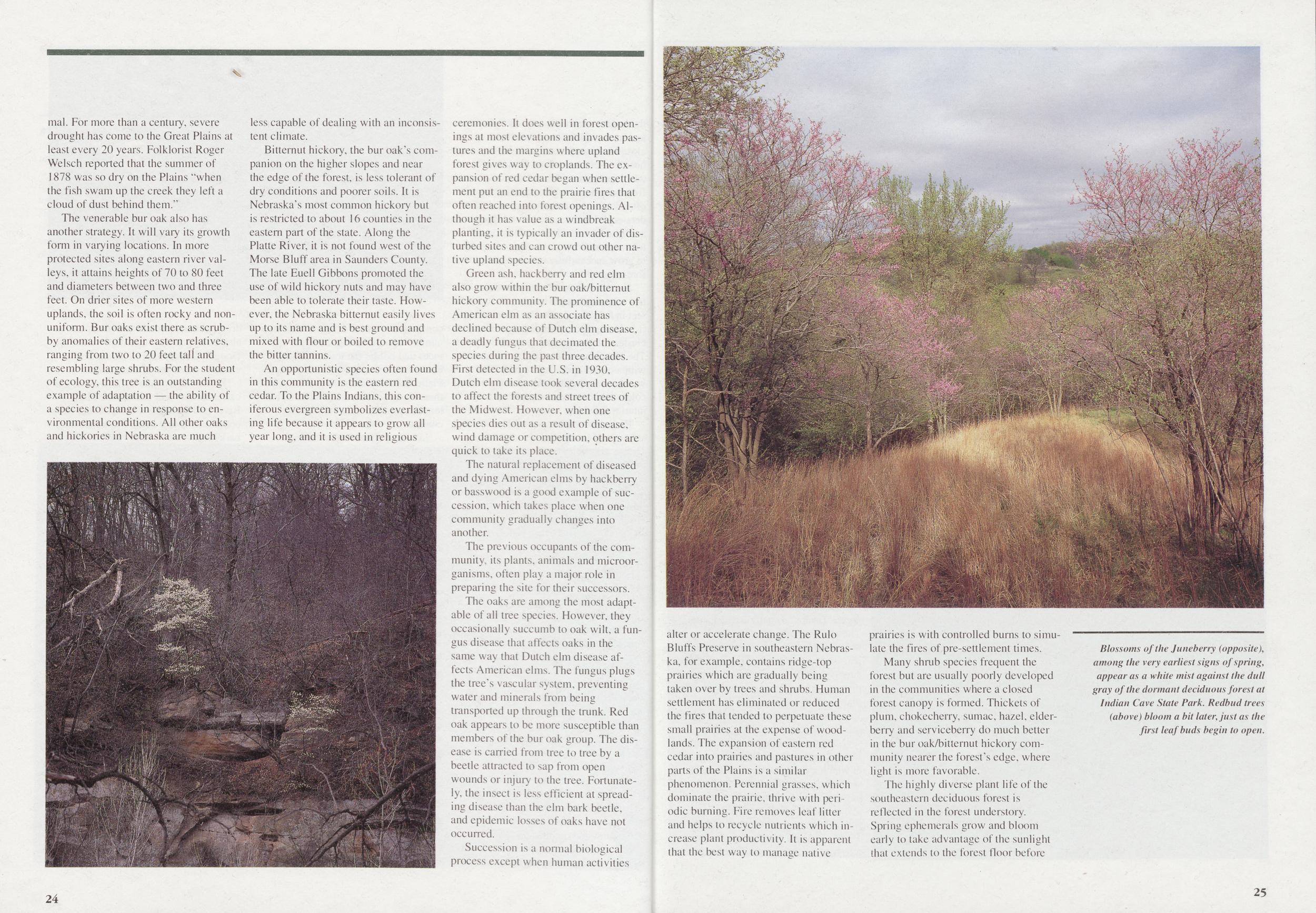
For more than a century, severe drought has come to the Great Plains at least every 20 years. Folklorist Roger Welsch reported that the summer of 1878 was so dry on the Plains "when the fish swam up the creek they left a cloud of dust behind them."
The venerable bur oak also has another strategy. It will vary its growth form in varying locations. In more protected sites along eastern river valleys, it attains heights of 70 to 80 feet and diameters between two and three feet. On drier sites of more western uplands, the soil is often rocky and nonuniform. Bur oaks exist there as scrub by anomalies of their eastern relatives, ranging from two to 20 feet tall and resembling large shrubs. For the student of ecology, this tree is an outstanding example of adaptation — the ability of a species to change in response to environmental conditions. All other oaks and hickories in Nebraska are much less capable of dealing with an inconsistent climate.
Bitternut hickory, the bur oak's companion on the higher slopes and near the edge of the forest, is less tolerant of dry conditions and poorer soils. It is Nebraska's most common hickory but is restricted to about 16 counties in the eastern part of the state. Along the Platte River, it is not found west of the Morse Bluff area in Saunders County. The late Euell Gibbons promoted the use of wild hickory nuts and may have been able to tolerate their taste. However, the Nebraska bitternut easily lives up to its name and is best ground and mixed with flour or boiled to remove the bitter tannins.
An opportunistic species often found in this community is the eastern red cedar. To the Plains Indians, this coniferous evergreen symbolizes ever lasting life because it appears to grow all year long, and it is used in religious ceremonies. It does well in forest openings at most elevations and invades pastures and the margins where upland forest gives way to croplands. The expansion of red cedar began when settlement put an end to the prairie fires that often reached into forest openings. Although it has value as a windbreak planting, it is typically an invader of disturbed sites and can crowd out other native upland species.
Green ash, hackberry and red elm also grow within the bur oak/bittemut hickory community. The prominence of American elm as an associate has declined because of Dutch elm disease, a deadly fungus that decimated the species during the past three decades. First detected in the U.S. in 1930, Dutch elm disease took several decades to affect the forests and street trees of the Midwest. However, when one species dies out as a result of disease, wind damage or competition, others are quick to take its place.
The natural replacement of diseased and dying American elms by hackberry or basswood is a good example of succession, which takes place when one community gradually changes into another.
The previous occupants of the community, its plants, animals and microorganisms, often play a major role in preparing the site for their successors.
The oaks are among the most adaptable of all tree species. However, they occasionally succumb to oak wilt, a fungus disease that affects oaks in the same way that Dutch elm disease affects American elms. The fungus plugs the tree's vascular system, preventing water and minerals from being transported up through the trunk. Red oak appears to be more susceptible than members of the bur oak group. The disease is carried from tree to tree by a beetle attracted to sap from open wounds or injury to the tree. Fortunately, the insect is less efficient at spreading disease than the elm bark beetle, and epidemic losses of oaks have not occurred.
Succession is a normal biological process except when human activities alter or accelerate change. The Rulo Bluffs Preserve in southeastern Nebraska, for example, contains ridge-top prairies which are gradually being taken over by trees and shrubs. Human settlement has eliminated or reduced the fires that tended to perpetuate these small prairies at the expense of woodlands. The expansion of eastern red cedar into prairies and pastures in other parts of the Plains is a similar phenomenon. Perennial grasses, which dominate the prairie, thrive with peri odic burning. Fire removes leaf litter and helps to recycle nutrients which increase plant productivity. It is apparent that the best way to manage native prairies is with controlled burns to simulate the fires of pre-settlement times.
Many shrub species frequent the forest but are usually poorly developed in the communities where a closed forest canopy is formed. Thickets of plum, ehokeeberry, sumac, hazel, elderberry and serviceberry do much better in the bur oak/bitternut hickory community nearer the forest's edge, where light is more favorable.
The highly diverse plant life of the southeastern deciduous forest is reflected in the forest understory. Spring ephemerals grow and bloom early to take advantage of the sunlight that extends to the forest floor before
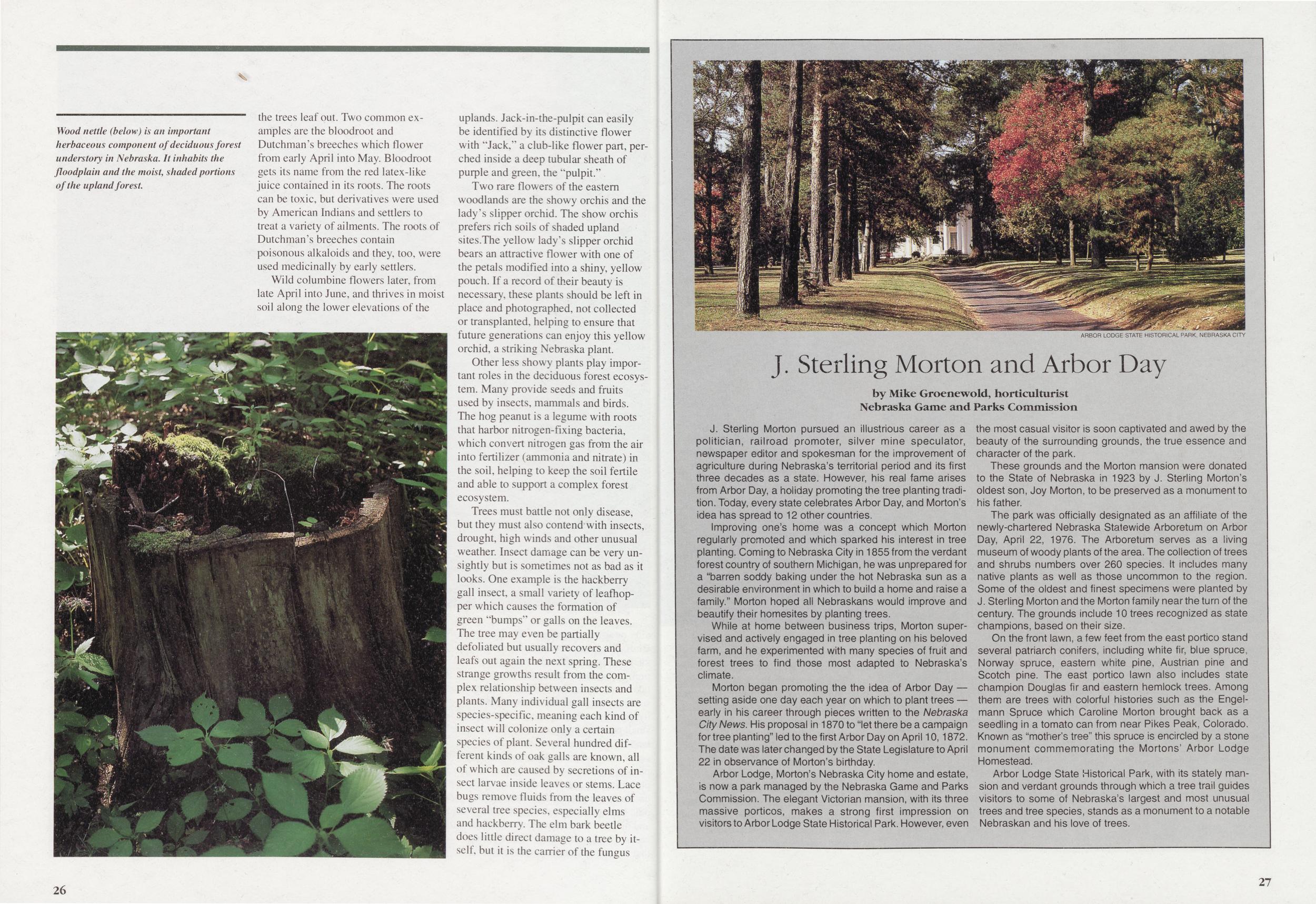
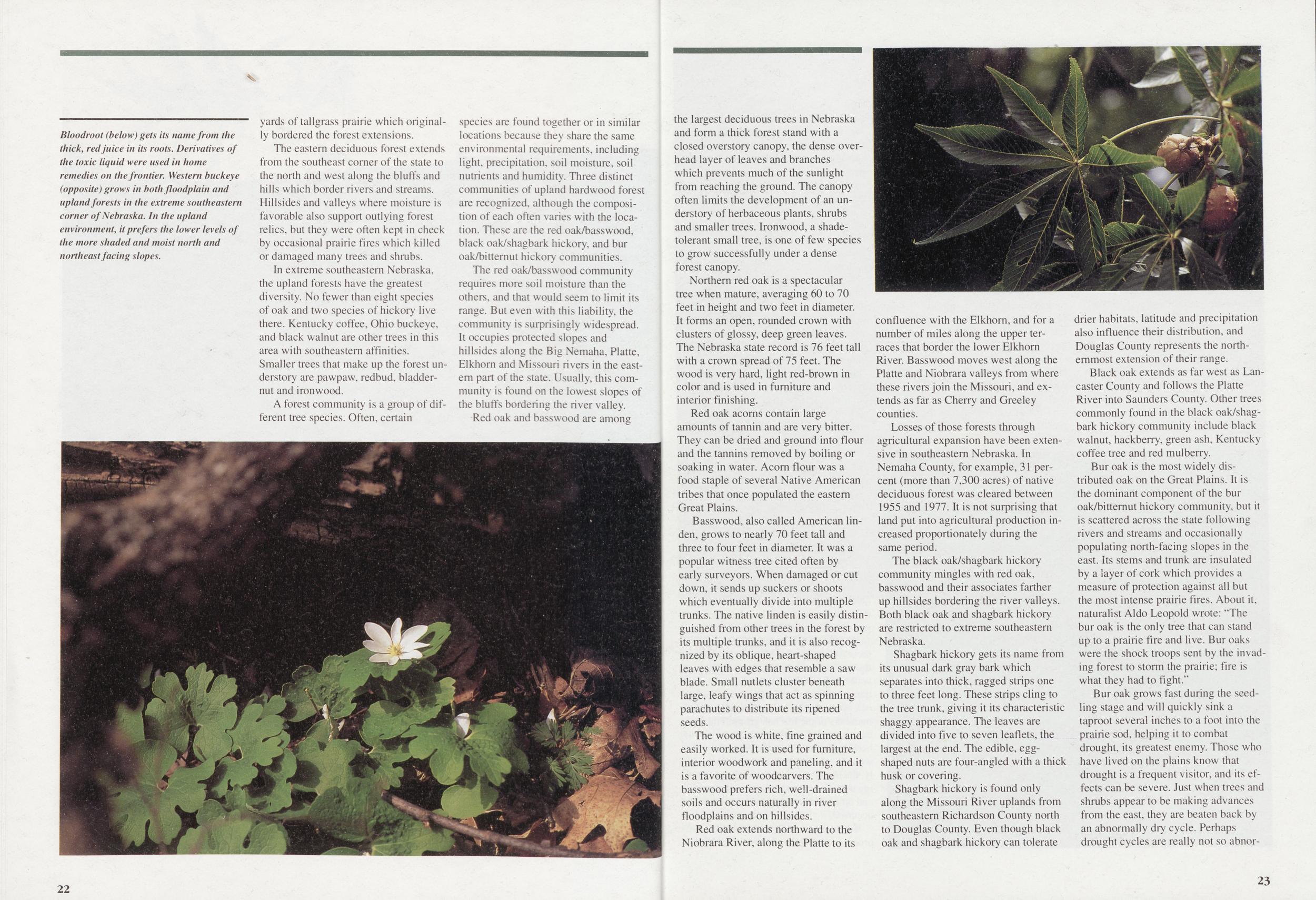
the trees leaf out. Two common examples are the bloodroot and Dutchman's breeches which flower from early April into May. Bloodroot gets its name from the red latex-like juice contained in its roots. The roots can be toxic, but derivatives were used by American Indians and settlers to treat a variety of ailments. The roots of Dutchman's breeches contain poisonous alkaloids and they, too, were used medicinally by early settlers.
Wild columbine flowers later, from late April into June, and thrives in moist soil along the lower elevations of the uplands. Jack-in-the-pulpit can easily be identified by its distinctive flower with "Jack," a club-like flower part, perched inside a deep tubular sheath of purple and green, the "pulpit."
Two rare flowers of the eastern woodlands are the showy orchis and the lady's slipper orchid. The show orchis prefers rich soils of shaded upland sites.The yellow lady's slipper orchid bears an attractive flower with one of the petals modified into a shiny, yellow pouch. If a record of their beauty is necessary, these plants should be left in place and photographed, not collected or transplanted, helping to ensure that future generations can enjoy this yellow orchid, a striking Nebraska plant.
Other less showy plants play important roles in the deciduous forest ecosystem. Many provide seeds and fruits used by insects, mammals and birds. The hog peanut is a legume with roots that harbor nitrogen-fixing bacteria, which convert nitrogen gas from the air into fertilizer (ammonia and nitrate) in the soil, helping to keep the soil fertile and able to support a complex forest ecosystem.
Trees must battle not only disease, but they must also contend with insects, drought, high winds and other unusual weather. Insect damage can be very un- sightly but is sometimes not as bad as it looks. One example is the hackberry gall insect, a small variety of leaf hopper which causes the formation of green "bumps" or galls on the leaves. The tree may even be partially defoliated but usually recovers and leafs out again the next spring. These strange growths result from the complex relationship between insects and plants. Many individual gall insects are species-specific, meaning each kind of insect will colonize only a certain species of plant. Several hundred different kinds of oak galls are known, all of which are caused by secretions of insect larvae inside leaves or stems. Lace bugs remove fluids from the leaves of several tree species, especially elms and hackberry. The elm bark beetle does little direct damage to a tree by itself, but it is the carrier of the fungus
J. Sterling Morton and Arbor Day
J. Sterling Morton pursued an illustrious career as a politician, railroad promoter, silver mine speculator, newspaper editor and spokesman for the improvement of agriculture during Nebraska's territorial period and its first three decades as a state. However, his real fame arises from Arbor Day, a holiday promoting the tree planting tradition. Today, every state celebrates Arbor Day, and Morton's idea has spread to 12 other countries.
Improving one's home was a concept which Morton regularly promoted and which sparked his interest in tree planting. Coming to Nebraska City in 1855 from the verdant forest country of southern Michigan, he was unprepared for a "barren soddy baking under the hot Nebraska sun as a desirable environment in which to build a home and raise a family." Morton hoped alt Nebraskans would improve and beautify their homesites by planting trees.
White at home between business trips, Morton supervised and actively engaged in tree planting on his beloved farm, and he experimented with many species of fruit and forest trees to find those most adapted to Nebraska's climate.
Morton began promoting the the idea of Arbor Day — setting aside one day each year on which to plant trees — early in his career through pieces written to the Nebraska City News. His proposal in 1870 to "let there be a campaign for tree planting" led to the first Arbor Day on April 10,1872. The date was later changed by the State Legislature to April 22 in observance of Morton's birthday.
Arbor Lodge, Morton's Nebraska City home and estate, is now a park managed by the Nebraska Game and Parks Commission. The elegant Victorian mansion, with its three massive porticos, makes a strong first impression on visitors to Arbor Lodge State Historical Park. However, even the most casual visitor is soon captivated and awed by the beauty of the surrounding grounds, the true essence and character of the park.
These grounds and the Morton mansion were donated to the State of Nebraska in 1923 by J. Sterling Morton's oldest son, Joy Morton, to be preserved as a monument to his father.
The park was officially designated as an affiliate of the newly-chartered Nebraska Statewide Arboretum on Arbor Day, April 22, 1976. The Arboretum serves as a living museum of woody plants of the area. The collection of trees and shrubs numbers over 260 species. It includes many native plants as well as those uncommon to the region. Some of the oldest and finest specimens were planted by J. Sterling Morton and the Morton family near the turn of the century. The grounds include 10 trees recognized as state champions, based on their size.
On the front lawn, a few feet from the east portico stand several patriarch conifers, including white fir, blue spruce, Norway spruce, eastern white pine, Austrian pine and Scotch pine. The east portico lawn also includes state champion Douglas fir and eastern hemlock trees. Among them are trees with colorful histories such as the Engelmann Spruce which Caroline Morton brought back as a seedling in a tomato can from near Pikes Peak, Colorado. Known as "mother's tree" this spruce is encircled by a stone monument commemorating the Mortons' Arbor Lodge Homestead.
Arbor Lodge State Historical Park, with its stately mansion and verdant grounds through which a tree trail guides visitors to some of Nebraska's largest and most unusual trees and tree species, stands as a monument to a notable Nebraskan and his love of trees.
26 27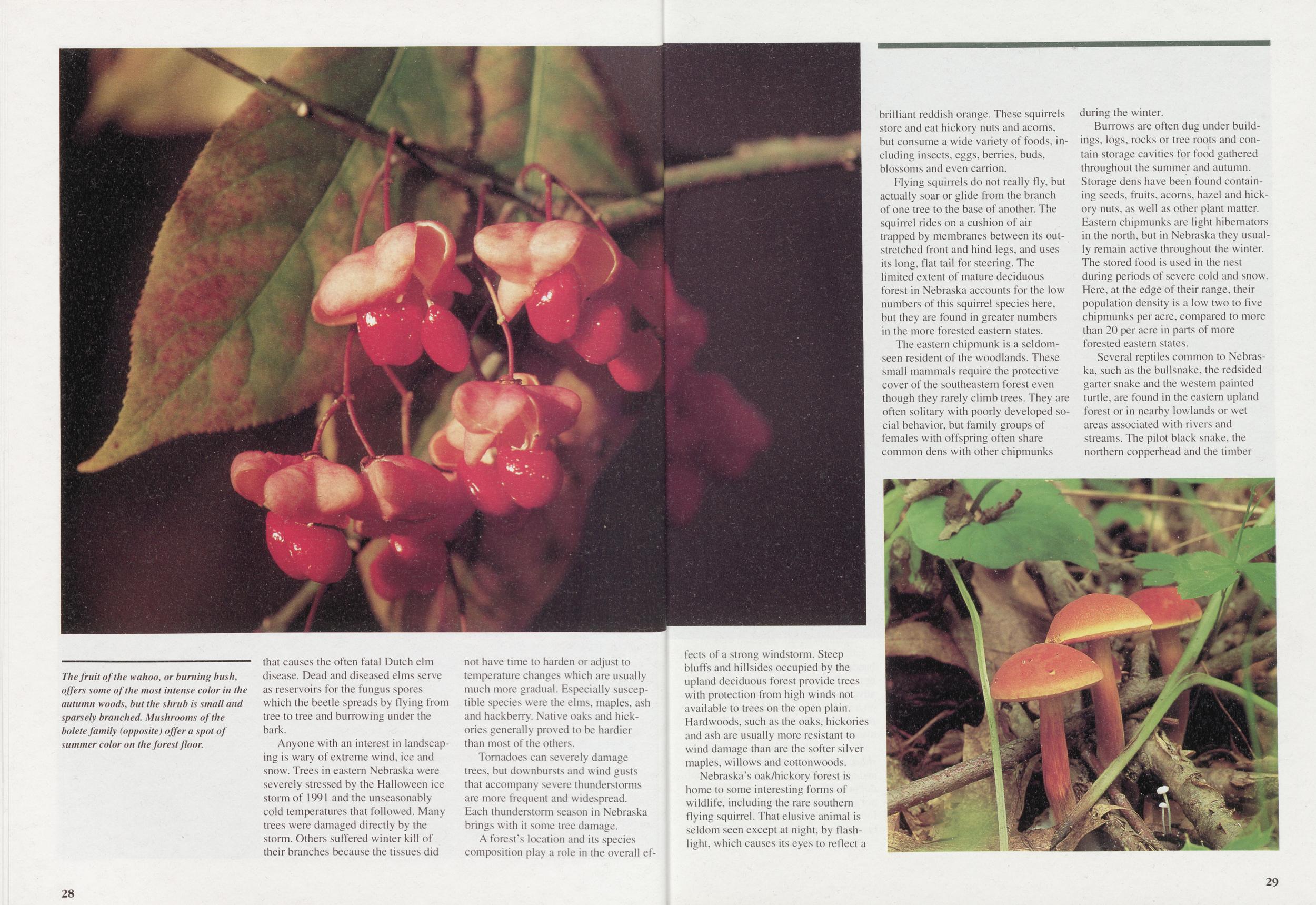
that causes the often fatal Dutch elm disease. Dead and diseased elms serve as reservoirs for the fungus spores which the beetle spreads by flying from tree to tree and burrowing under the bark.
Anyone with an interest in landscaping is wary of extreme wind, ice and snow. Trees in eastern Nebraska were severely stressed by the Halloween ice storm of 1991 and the unseasonably cold temperatures that followed. Many trees were damaged directly by the storm. Others suffered winter kill of their branches because the tissues did not have time to harden or adjust to temperature changes which are usually much more gradual. Especially susceptible species were the elms, maples, ash and hackberry. Native oaks and hickories generally proved to be hardier than most of the others.
Tornadoes can severely damage trees, but downbursts and wind gusts that accompany severe thunderstorms are more frequent and widespread. Each thunderstorm season in Nebraska brings with it some tree damage.
A forest's location and its species composition play a role in the overall effects of a strong windstorm. Steep bluffs and hillsides occupied by the upland deciduous forest provide trees with protection from high winds not available to trees on the open plain. Hardwoods, such as the oaks, hickories and ash are usually more resistant to wind damage than are the softer silver maples, willows and cottonwoods.
Nebraska's oak/hickory forest is home to some interesting forms of wildlife, including the rare southern flying squirrel. That elusive animal is seldom seen except at night, by flashlight, which causes its eyes to reflect a brilliant reddish orange. These squirrels store and eat hickory nuts and acorns, but consume a wide variety of foods, including insects, eggs, berries, buds, blossoms and even carrion.
Flying squirrels do not really fly, but actually soar or glide from the branch of one tree to the base of another. The squirrel rides on a cushion of air trapped by membranes between its out stretched front and hind legs, and uses its long, flat tail for steering. The limited extent of mature deciduous forest in Nebraska accounts for the low numbers of this squirrel species here, but they are found in greater numbers in the more forested eastern states.
The eastern chipmunk is a seldom seen resident of the woodlands. These small mammals require the protective cover of the southeastern forest even though they rarely climb trees. They are often solitary with poorly developed social behavior, but family groups of females with offspring often share common dens with other chipmunks during the winter.
Burrows are often dug under buildings, logs, rocks or tree roots and contain storage cavities for food gathered throughout the summer and autumn. Storage dens have been found containing seeds, fruits, acorns, hazel and hickory nuts, as well as other plant matter. Eastern chipmunks are light hibernators in the north, but in Nebraska they usually remain active throughout the winter. The stored food is used in the nest during periods of severe cold and snow. Here, at the edge of their range, their population density is a low two to five chipmunks per acre, compared to more than 20 per acre in parts of more forested eastern states.
Several reptiles common to Nebraska, such as the bullsnake, the red sided garter snake and the western painted turtle, are found in the eastern upland forest or in nearby lowlands or wet areas associated with rivers and streams. The pilot black snake, the northern copperhead and the timber
28 29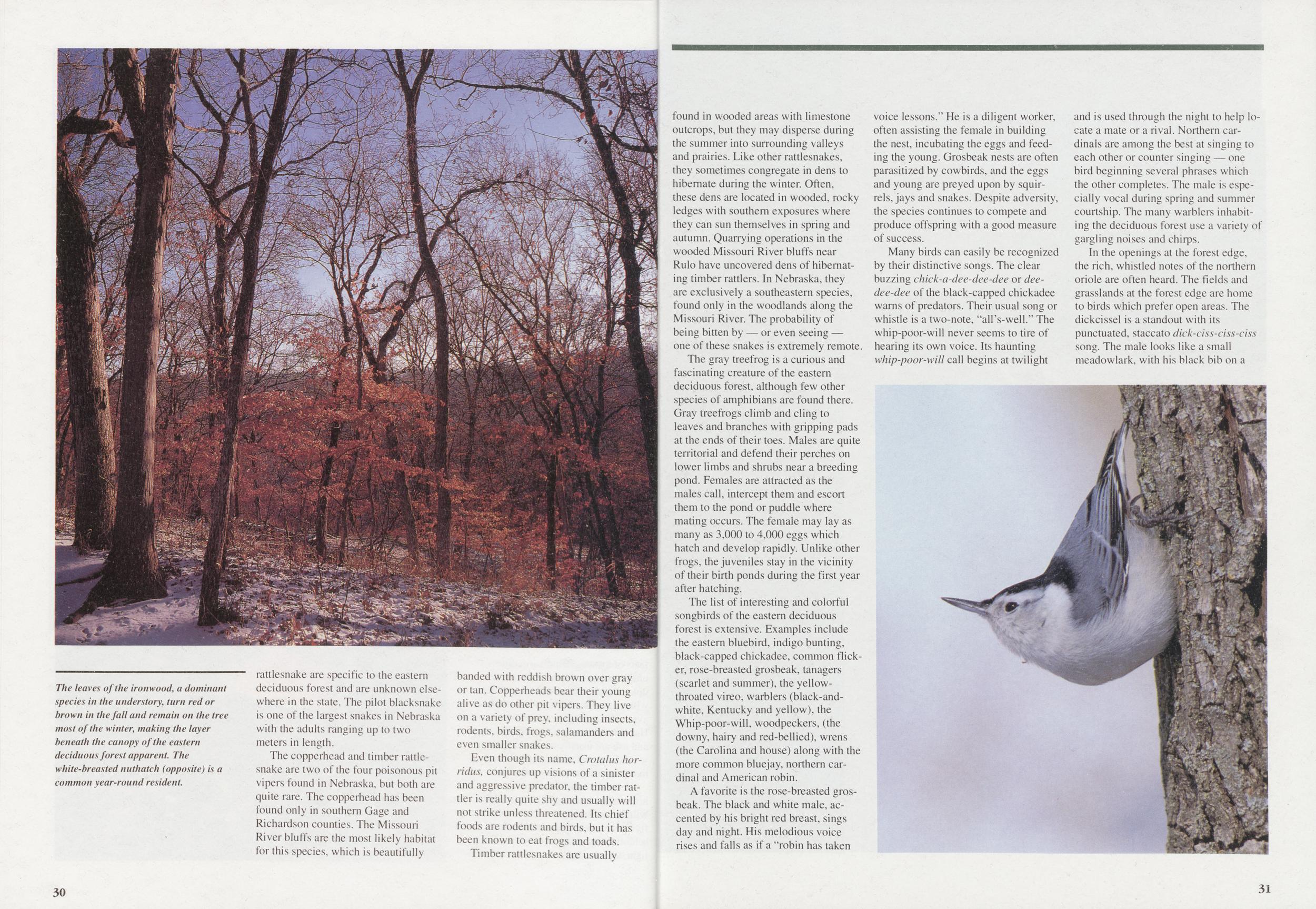
rattlesnake are specific to the eastern deciduous forest and are unknown elsewhere in the state. The pilot blacksnake is one of the largest snakes in Nebraska with the adults ranging up to two meters in length.
The copperhead and timber rattlesnake are two of the four poisonous pit vipers found in Nebraska, but both are quite rare. The copperhead has been found only in southern Gage and Richardson counties. The Missouri River bluffs are the most likely habitat for this species, which is beautifully banded with reddish brown over gray or tan. Copperheads bear their young alive as do other pit vipers. They live on a variety of prey, including insects, rodents, birds, frogs, salamanders and even smaller snakes.
Even though its name, Crotalus horridus, conjures up visions of a sinister and aggressive predator, the timber rattler is really quite shy and usually will not strike unless threatened. Its chief foods are rodents and birds, but it has been known to eat frogs and toads.
Timber rattlesnakes are usually found in wooded areas with limestone outcrops, but they may disperse during the summer into surrounding valleys and prairies. Like other rattlesnakes, they sometimes congregate in dens to hibernate during the winter. Often, these dens are located in wooded, rocky ledges with southern exposures where they can sun themselves in spring and autumn. Quarrying operations in the wooded Missouri River bluffs near Rulo have uncovered dens of hibernating timber rattlers. In Nebraska, they are exclusively a southeastern species, found only in the woodlands along the Missouri River. The probability of being bitten by — or even seeing — one of these snakes is extremely remote.
The gray tree frog is a curious and fascinating creature of the eastern deciduous forest, although few other species of amphibians are found there. Gray tree frogs climb and cling to leaves and branches with gripping pads at the ends of their toes. Males are quite territorial and defend their perches on lower limbs and shrubs near a breeding pond. Females are attracted as the males call, intercept them and escort them to the pond or puddle where mating occurs. The female may lay as many as 3,000 to 4,000 eggs which hatch and develop rapidly. Unlike other frogs, the juveniles stay in the vicinity of their birth ponds during the first year after hatching.
The list of interesting and colorful songbirds of the eastern deciduous forest is extensive. Examples include the eastern bluebird, indigo bunting, black-capped chickadee, common flicker, rose-breasted grosbeak, tanagers (scarlet and summer), the yellow- throated vireo, warblers (black-and- white, Kentucky and yellow), the Whip-poor-will, woodpeckers, (the downy, hairy and red-bellied), wrens (the Carolina and house) along with the more common bluejay, northern cardinal and American robin.
A favorite is the rose-breasted grosbeak. The black and white male, accented by his bright red breast, sings day and night. His melodious voice rises and falls as if a "robin has taken voice lessons." He is a diligent worker, often assisting the female in building the nest, incubating the eggs and feeding the young. Grosbeak nests are often parasitized by cowbirds, and the eggs and young are preyed upon by squirrels, jays and snakes. Despite adversity, the species continues to compete and produce offspring with a good measure of success.
Many birds can easily be recognized by their distinctive songs. The clear buzzing chick-a-dee-dee-dee or deedee-dee of the black-capped chickadee warns of predators. Their usual song or whistle is a two-note, "airs-well." The whip-poor-will never seems to tire of hearing its own voice. Its haunting whip-poor-will call begins at twilight and is used through the night to help locate a mate or a rival. Northern cardinals are among the best at singing to each other or counter singing — one bird beginning several phrases which the other completes. The male is especially vocal during spring and summer courtship. The many warblers inhabiting the deciduous forest use a variety of gargling noises and chirps.
In the openings at the forest edge, the rich, whistled notes of the northern oriole are often heard. The fields and grasslands at the forest edge are home to birds which prefer open areas. The dickcissel is a standout with its punctuated, staccato dick-ciss-ciss-ciss song. The male looks like a small meadowlark, with his black bib on a
30 31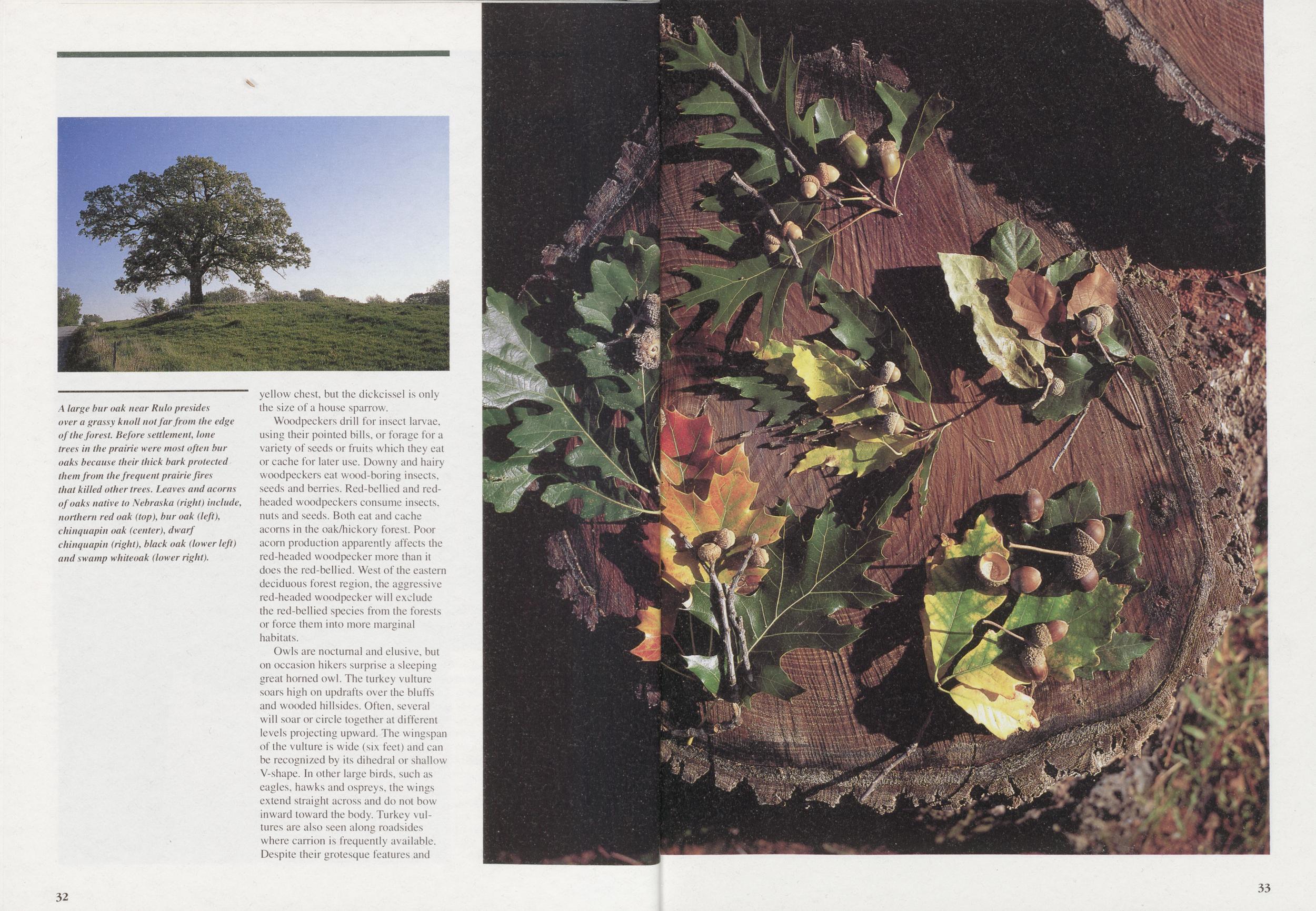
yellow chest, but the dickcissel is only the size of a house sparrow.
Woodpeckers drill for insect larvae, using their pointed bills, or forage for a variety of seeds or fruits which they eat or cache for later use. Downy and hairy woodpeckers eat wood-boring insects, seeds and berries. Red-bellied and red-headed woodpeckers consume insects, nuts and seeds. Both eat and cache acorns in the oak/hickory forest. Poor acorn production apparently affects the red-headed woodpecker more than it does the red-bellied. West of the eastern deciduous forest region, the aggressive red-headed woodpecker will exclude the red-bellied species from the forests or force them into more marginal habitats.
Owls are nocturnal and elusive, but on occasion hikers surprise a sleeping great horned owl. The turkey vulture soars high on updrafts over the bluffs and wooded hillsides. Often, several will soar or circle together at different levels projecting upward. The wingspan of the vulture is wide (six feet) and can be recognized by its dihedral or shallow V-shape. In other large birds, such as eagles, hawks and ospreys, the wings extend straight across and do not bow inward toward the body. Turkey vultures are also seen along roadsides where carrion is frequently available. Despite their grotesque features and
32 33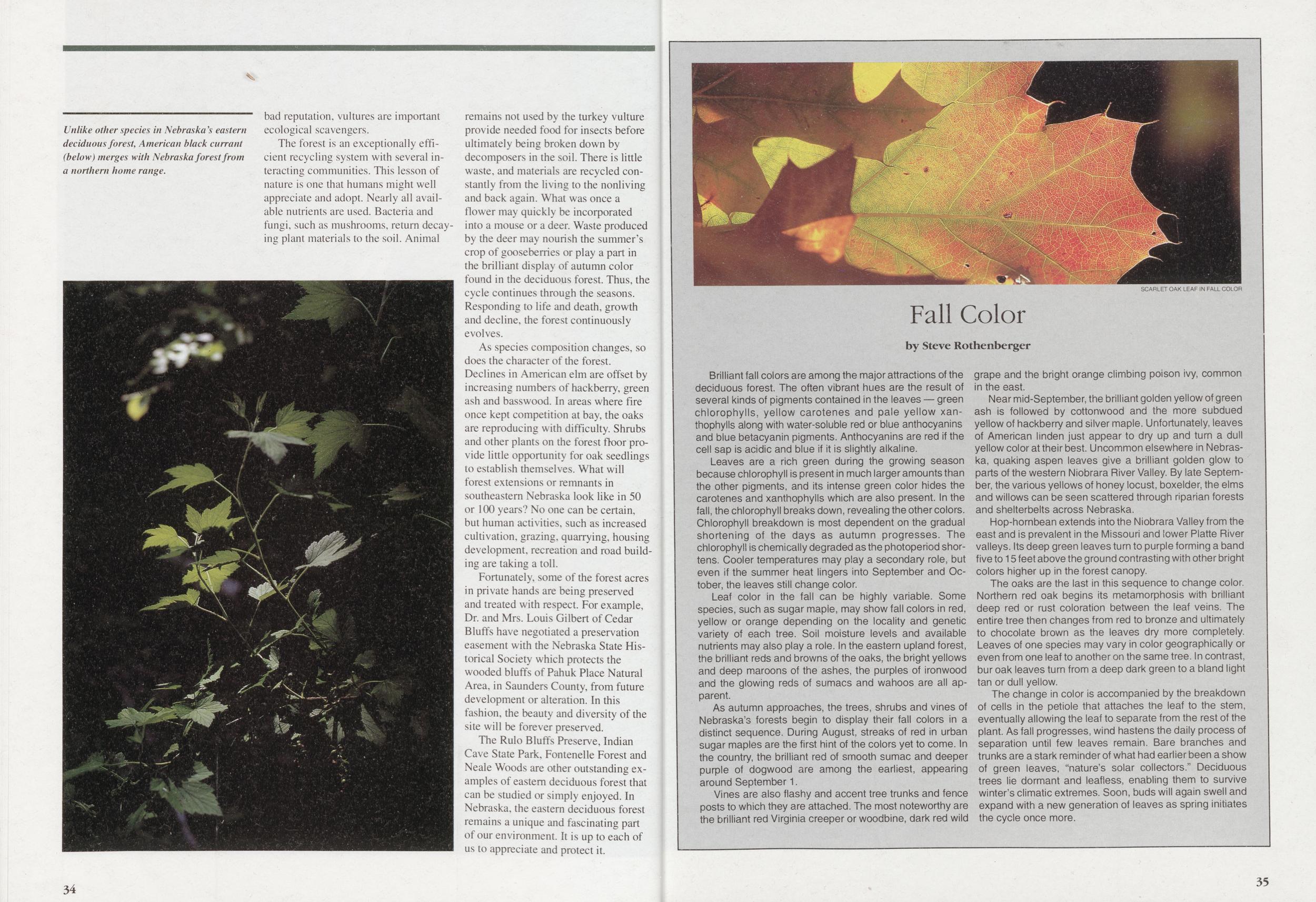
bad reputation, vultures are important ecological scavengers.
The forest is an exceptionally efficient recycling system with several interacting communities. This lesson of nature is one that humans might well appreciate and adopt. Nearly all available nutrients are used. Bacteria and fungi, such as mushrooms, return decaying plant materials to the soil. Animal remains not used by the turkey vulture provide needed food for insects before ultimately being broken down by decomposers in the soil. There is little waste, and materials are recycled constantly from the living to the nonliving and back again. What was once a flower may quickly be incorporated into a mouse or a deer. Waste produced by the deer may nourish the summer's crop of gooseberries or play a part in the brilliant display of autumn color found in the deciduous forest. Thus, the cycle continues through the seasons. Responding to life and death, growth and decline, the forest continuously evolves.
As species composition changes, so does the character of the forest. Declines in American elm are offset by increasing numbers of hackberry, green ash and basswood. In areas where fire once kept competition at bay, the oaks are reproducing with difficulty. Shrubs and other plants on the forest floor provide little opportunity for oak seedlings to establish themselves. What will forest extensions or remnants in southeastern Nebraska look like in 50 or 100 years? No one can be certain, but human activities, such as increased cultivation, grazing, quarrying, housing development, recreation and road building are taking a toll.
Fortunately, some of the forest acres in private hands are being preserved and treated with respect. For example, Dr. and Mrs. Louis Gilbert of Cedar Bluffs have negotiated a preservation easement with the Nebraska State Historical Society which protects the wooded bluffs of Pahuk Place Natural Area, in Saunders County, from future development or alteration. In this fashion, the beauty and diversity of the site will be forever preserved.
The Rulo Bluffs Preserve, Indian Cave State Park, Fontenelle Forest and Neale Woods are other outstanding examples of eastern deciduous forest that can be studied or simply enjoyed. In Nebraska, the eastern deciduous forest remains a unique and fascinating part of our environment. It is up to each of us to appreciate and protect it.
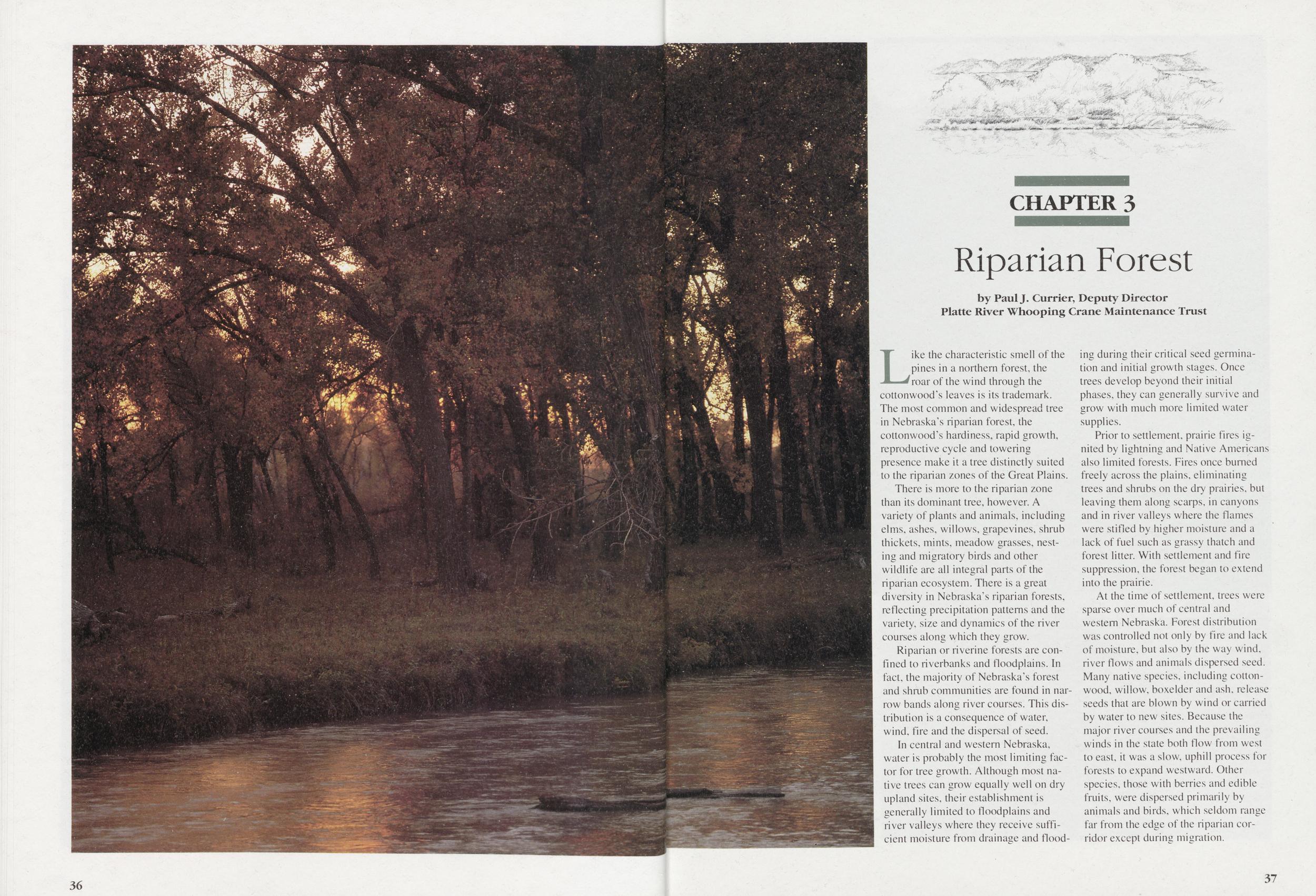
Fall Color
Brilliant fall colors are among the major attractions of the deciduous forest. The often vibrant hues are the result of several kinds of pigments contained in the leaves — green chlorophylls, yellow carotenes and pale yellow xanthophylls along with water-soluble red or blue anthocyanins and blue betacyanin pigments. Anthocyanins are red if the cell sap is acidic and blue if it is slightly alkaline.
Leaves are a rich green during the growing season because chlorophyll is present in much larger amounts than the other pigments, and its intense green color hides the carotenes and xanthophylls which are also present. In the fall, the chlorophyll breaks down, revealing the other colors. Chlorophyll breakdown is most dependent on the gradual shortening of the days as autumn progresses. The chlorophyll is chemically degraded as the photoperiod shortens. Cooler temperatures may play a secondary role, but even if the summer heat lingers into September and October, the leaves still change color.
Leaf color in the fall can be highly variable. Some species, such as sugar maple, may show fall colors in red, yellow or orange depending on the locality and genetic variety of each tree. Soil moisture levels and available nutrients may also play a role. In the eastern upland forest, the brilliant reds and browns of the oaks, the bright yellows and deep maroons of the ashes, the purples of ironwood and the glowing reds of sumacs and wahoos are all apparent.
As autumn approaches, the trees, shrubs and vines of Nebraska's forests begin to display their fall colors in a distinct sequence. During August, streaks of red in urban sugar maples are the first hint of the colors yet to come. In the country, the brilliant red of smooth sumac and deeper purple of dogwood are among the earliest, appearing around September 1.
Vines are also flashy and accent tree trunks and fence posts to which they are attached. The most noteworthy are the brilliant red Virginia creeper or woodbine, dark red wild grape and the bright orange climbing poison ivy, common in the east.
Near mid-September, the brilliant golden yellow of green ash is followed by cottonwood and the more subdued yellow of hackberry and silver maple. Unfortunately, leaves of American linden just appear to dry up and turn a dull yellow color at their best. Uncommon elsewhere in Nebraska, quaking aspen leaves give a brilliant golden glow to parts of the western Niobrara River Valley. By late September, the various yellows of honey locust, boxelder, the elms and willows can be seen scattered through riparian forests and shelter belts across Nebraska.
Hop-hornbean extends into the Niobrara Valley from the east and is prevalent in the Missouri and lower Platte River valleys, its deep green leaves turn to purple forming a band five to 15 feet above the ground contrasting with other bright colors higher up in the forest canopy.
The oaks are the last in this sequence to change color. Northern red oak begins its metamorphosis with brilliant deep red or rust coloration between the leaf veins. The entire tree then changes from red to bronze and ultimately to chocolate brown as the leaves dry more completely. Leaves of one species may vary in color geographically or even from one leaf to another on the same tree. In contrast, bur oak leaves turn from a deep dark green to a bland light tan or dull yellow.
The change in color is accompanied by the breakdown of cells in the petiole that attaches the leaf to the stem, eventually allowing the leaf to separate from the rest of the plant. As fall progresses, wind hastens the daily process of separation until few leaves remain. Bare branches and trunks are a stark reminder of what had earlier been a show of green leaves, "nature's solar collectors." Deciduous trees lie dormant and leafless, enabling them to survive winter's climatic extremes. Soon, buds will again swell and expand with a new generation of leaves as spring initiates the cycle once more.
CHAPTER 3
Riparian Forest
Like the characteristic smell of the pines in a northern forest, the roar of the wind through the Cottonwood's leaves is its trademark. The most common and widespread tree in Nebraska's riparian forest, the Cottonwood's hardiness, rapid growth, reproductive cycle and towering presence make it a tree distinctly suited to the riparian zones of the Great Plains.
There is more to the riparian zone than its dominant tree, however. A variety of plants and animals, including elms, ashes, willows, grapevines, shrub thickets, mints, meadow grasses, nesting and migratory birds and other wildlife are all integral parts of the riparian ecosystem. There is a great diversity in Nebraska's riparian forests, reflecting precipitation patterns and the variety, size and dynamics of the river courses along which they grow.
Riparian or riverine forests are confined to riverbanks and floodplains. In fact, the majority of Nebraska's forest and shrub communities are found in narrow bands along river courses. This distribution is a consequence of water, wind, fire and the dispersal of seed.
In central and western Nebraska, water is probably the most limiting factor for tree growth. Although most native trees can grow equally well on dry upland sites, their establishment is generally limited to floodplains and river valleys where they receive sufficient moisture from drainage and flooding during their critical seed germination and initial growth stages. Once trees develop beyond their initial phases, they can generally survive and grow with much more limited water supplies.
Prior to settlement, prairie fires ignited by lightning and Native Americans also limited forests. Fires once burned freely across the plains, eliminating trees and shrubs on the dry prairies, but leaving them along scarps, in canyons and in river valleys where the flames were stified by higher moisture and a lack of fuel such as grassy thatch and forest litter. With settlement and fire suppression, the forest began to extend into the prairie.
At the time of settlement, trees were sparse over much of central and western Nebraska. Forest distribution was controlled not only by fire and lack of moisture, but also by the way wind, river flows and animals dispersed seed. Many native species, including cottonwood, willow, boxelder and ash, release seeds that are blown by wind or carried by water to new sites. Because the major river courses and the prevailing winds in the state both flow from west to east, it was a slow, uphill process for forests to expand westward. Other species, those with berries and edible fruits, were dispersed primarily by animals and birds, which seldom range far from the edge of the riparian corridor except during migration.
36 37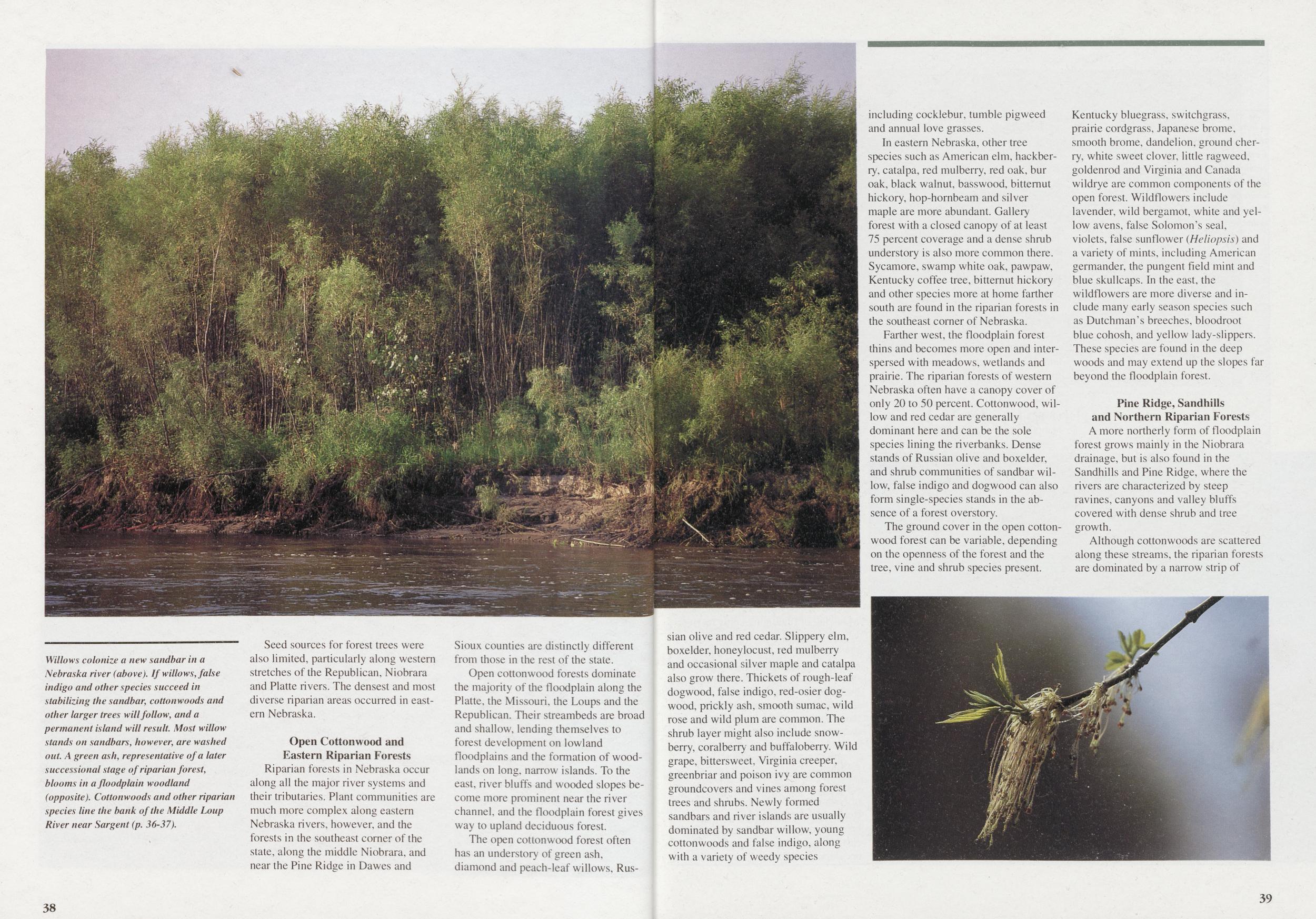
Seed sources for forest trees were also limited, particularly along western stretches of the Republican, Niobrara and Platte rivers. The densest and most diverse riparian areas occurred in eastern Nebraska.
Open Cottonwood and Eastern Riparian ForestsRiparian forests in Nebraska occur along all the major river systems and their tributaries. Plant communities are much more complex along eastern Nebraska rivers, however, and the forests in the southeast corner of the state, along the middle Niobrara, and near the Pine Ridge in Dawes and Sioux counties are distinctly different from those in the rest of the state.
Open cottonwood forests dominate the majority of the floodplain along the Platte, the Missouri, the Loups and the Republican. Their stream beds are broad and shallow, lending themselves to forest development on lowland floodplains and the formation of woodlands on long, narrow islands. To the east, river bluffs and wooded slopes become more prominent near the river channel, and the floodplain forest gives way to upland deciduous forest.
The open cottonwood forest often has an understory of green ash, diamond and peach-leaf willows, Russian olive and red cedar. Slippery elm, boxelder, honeylocust, red mulberry and occasional silver maple and catalpa also grow there. Thickets of rough-leaf dogwood, false indigo, red-osier dogwood, prickly ash, smooth sumac, wild rose and wild plum are common. The shrub layer might also include snowberry, coral be very and buffaloberry. Wild grape, bittersweet, Virginia creeper, greenbriar and poison ivy are common groundcovers and vines among forest trees and shrubs. Newly formed sandbars and river islands are usually dominated by sandbar willow, young cottonwoods and false indigo, along with a variety of weedy species including cocklebur, tumble pigweed and annual love grasses.
In eastern Nebraska, other tree species such as American elm, hackberry, catalpa, red mulberry, red oak, bur oak, black walnut, basswood, bittemut hickory, hop-hornbeam and silver maple are more abundant. Gallery forest with a closed canopy of at least 75 percent coverage and a dense shrub understory is also more common there. Sycamore, swamp white oak, pawpaw, Kentucky coffee tree, bittemut hickory and other species more at home farther south are found in the riparian forests in the southeast corner of Nebraska.
Farther west, the floodplain forest thins and becomes more open and interspersed with meadows, wetlands and prairie. The riparian forests of western Nebraska often have a canopy cover of only 20 to 50 percent. Cottonwood, willow and red cedar are generally dominant here and can be the sole species lining the riverbanks. Dense stands of Russian olive and boxelder, and shrub communities of sandbar willow, false indigo and dogwood can also form single-species stands in the absence of a forest overstory.
The ground cover in the open cottonwood forest can be variable, depending on the openness of the forest and the tree, vine and shrub species present. Kentucky bluegrass, switchgrass, prairie cordgrass, Japanese brome, smooth brome, dandelion, ground cherry, white sweet clover, little ragweed, goldenrod and Virginia and Canada wildrye are common components of the open forest. Wildflowers include lavender, wild bergamot, white and yellow avens, false Solomon's seal, violets, false sunflower (Heliopsis) and a variety of mints, including American germander, the pungent field mint and blue skullcaps. In the east, the wildflowers are more diverse and include many early season species such as Dutchman's breeches, bloodroot blue cohosh, and yellow lady-slippers. These species are found in the deep woods and may extend up the slopes far beyond the floodplain forest.
Pine Ridge, Sandhills and Northern Riparian ForestsA more northerly form of floodplain forest grows mainly in the Niobrara drainage, but is also found in the Sandhills and Pine Ridge, where the rivers are characterized by steep ravines, canyons and valley bluffs covered with dense shrub and tree growth.
Although cottonwoods are scattered along these streams, the riparian forests are dominated by a narrow strip of
38 39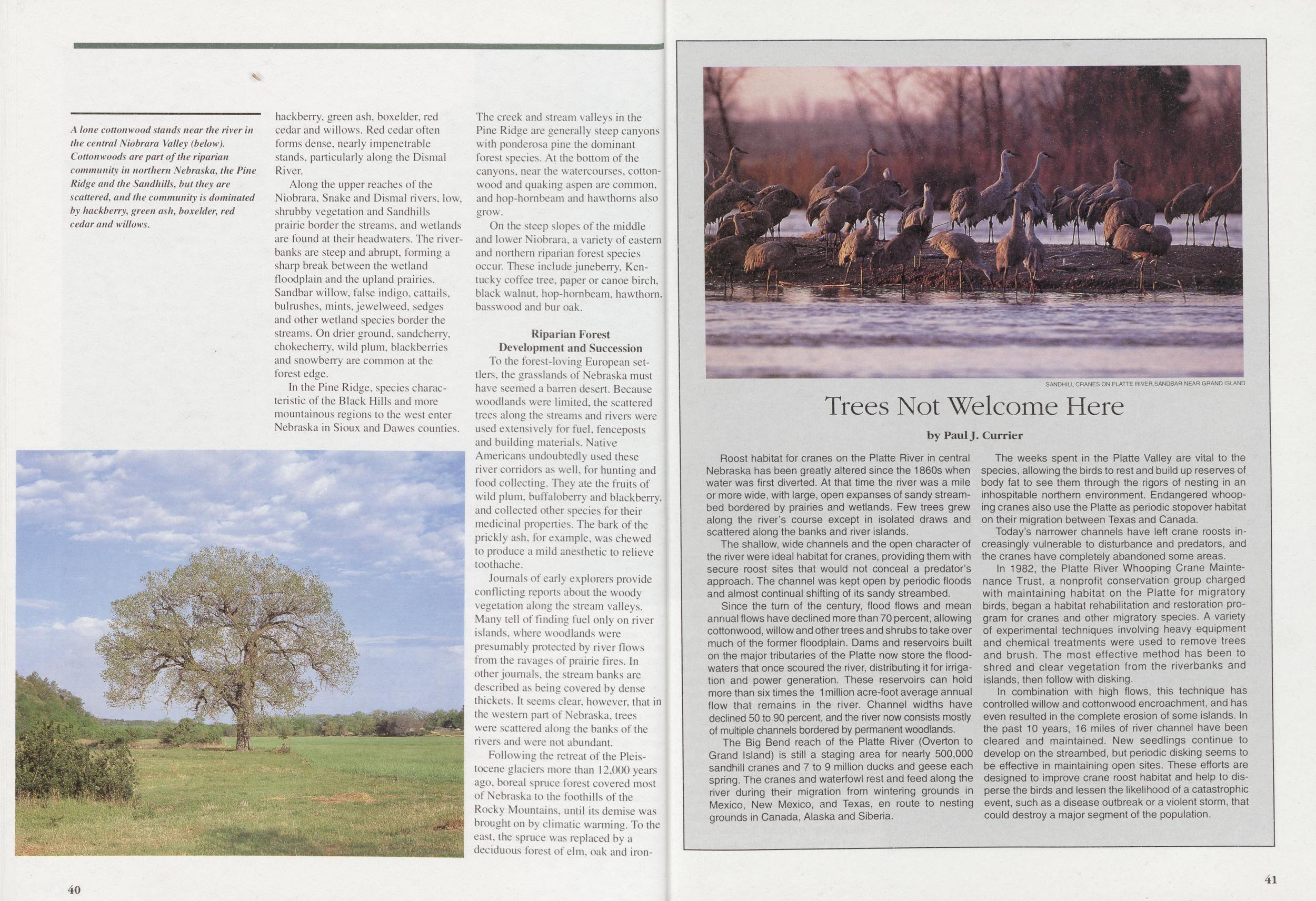
hackberry, green ash, boxelder, red cedar and willows. Red cedar often forms dense, nearly impenetrable stands, particularly along the Dismal River.
Along the upper reaches of the Niobrara, Snake and Dismal rivers, low, shrubby vegetation and Sandhills prairie border the streams, and wetlands are found at their headwaters. The river banks are steep and abrupt, forming a sharp break between the wetland floodplain and the upland prairies. Sandbar willow, false indigo, cattails, bulrushes, mints, jewelweed, sedges and other wetland species border the streams. On drier ground, sandcherry, chokecherry, wild plum, blackberries and snowberry are common at the forest edge.
In the Pine Ridge, species characteristic of the Black Hills and more mountainous regions to the west enter Nebraska in Sioux and Dawes counties. The creek and stream valleys in the Pine Ridge are generally steep canyons with ponderosa pine the dominant forest species. At the bottom of the canyons, near the watercourses, cottonwood and quaking aspen are common, and hop-hornbeam and hawthorns also grow.
On the steep slopes of the middle and lower Niobrara, a variety of eastern and northern riparian forest species occur. These include juneberry, Kentucky coffee tree, paper or canoe birch, black walnut, hop-hornbeam, hawthorn, bass wood and bur oak.
Riparian Forest Development and SuccessionTo the forest-loving European settlers, the grasslands of Nebraska must have seemed a barren desert. Because woodlands were limited, the scattered trees along the streams and rivers were used extensively for fuel, fenceposts and building materials. Native Americans undoubtedly used these river corridors as well, for hunting and food collecting. They ate the fruits of wild plum, buffaloberry and blackberry, and collected other species for their medicinal properties. The bark of the prickly ash, for example, was chewed to produce a mild anesthetic to relieve toothache.
Journals of early explorers provide conflicting reports about the woody vegetation along the stream valleys. Many tell of finding fuel only on river islands, where woodlands were presumably protected by river flows from the ravages of prairie fires. In other journals, the stream banks are described as being covered by dense thickets. It seems clear, however, that in the western part of Nebraska, trees were scattered along the banks of the rivers and were not abundant.
Following the retreat of the Pleistocene glaciers more than 12,000 years ago, boreal spruce forest covered most of Nebraska to the foothills of the Rocky Mountains, until its demise was brought on by climatic warming. To the east, the spruce was replaced by a deciduous forest of elm, oak and iron-
Trees Not Welcome Here
Roost habitat for cranes on the Platte River in central Nebraska has been greatly altered since the 1860s when water was first diverted. At that time the river was a mile or more wide, with large, open expanses of sandy streambed bordered by prairies and wetlands. Few trees great along the river's course except in isolated draws and scattered along the banks and river islands.
The shallow, wide channels and the open character of the river were ideal habitat for cranes, providing them with secure roost sites that would not conceal a predator's approach. The channel was kept open by periodic floods and almost continual shifting of its sandy streambed.
Since the turn of the century, flood flows and mean annual flows have declined more than 70 percent, allowing cottonwood, willow and other trees and shrubs to take over much of the former floodplain. Dams and reservoirs built on the major tributaries of the Platte now store the flood waters that once scoured the river, distributing it for irrigation and power generation. These reservoirs can hold more than six times the 1 million acre-foot average annual flow that remains in the river. Channel widths have declined 50 to 90 percent, and the river now consists mostly of multiple channels bordered by permanent woodlands.
The Big Bend reach of the Platte River (Overton to Grand Island) is still a staging area for nearly 500,000 sandhill cranes and 7 to 9 million ducks and geese each spring. The cranes and waterfowl rest and feed along the river during their migration from wintering grounds in Mexico, New Mexico, and Texas, en route to nesting grounds in Canada, Alaska and Siberia.
The weeks spent in the Platte Valley are vital to the species, allowing the birds to rest and build up reserves of body fat to see them through the rigors of nesting in an inhospitable northern environment. Endangered whooping cranes also use the Platte as periodic stopover habitat on their migration between Texas and Canada.
Today's narrower channels have left crane roosts increasingly vulnerable to disturbance and predators, and the cranes have completely abandoned some areas.
In 1982, the Platte River Whooping Crane Maintenance Trust, a nonprofit conservation group charged with maintaining habitat on the Platte for migratory birds, began a habitat rehabilitation and restoration program for cranes and other migratory species. A variety of experimental techniques involving heavy equipment and chemical treatments were used to remove trees and brush. The most effective method has been to shred and clear vegetation from the riverbanks and islands, then follow with disking.
In combination with high flows, this technique has controlled willow and cottonwood encroachment, and has even resulted in the complete erosion of some islands. In the past 10 years, 16 miles of river channel have been cleared and maintained. New seedlings continue to develop on the streambed, but periodic disking seems to be effective in maintaining open sites. These efforts are designed to improve crane roost habitat and help to disperse the birds and lessen the likelihood of a catastrophic event, such as a disease outbreak or a violent storm, that could destroy a major segment of the population.
40 41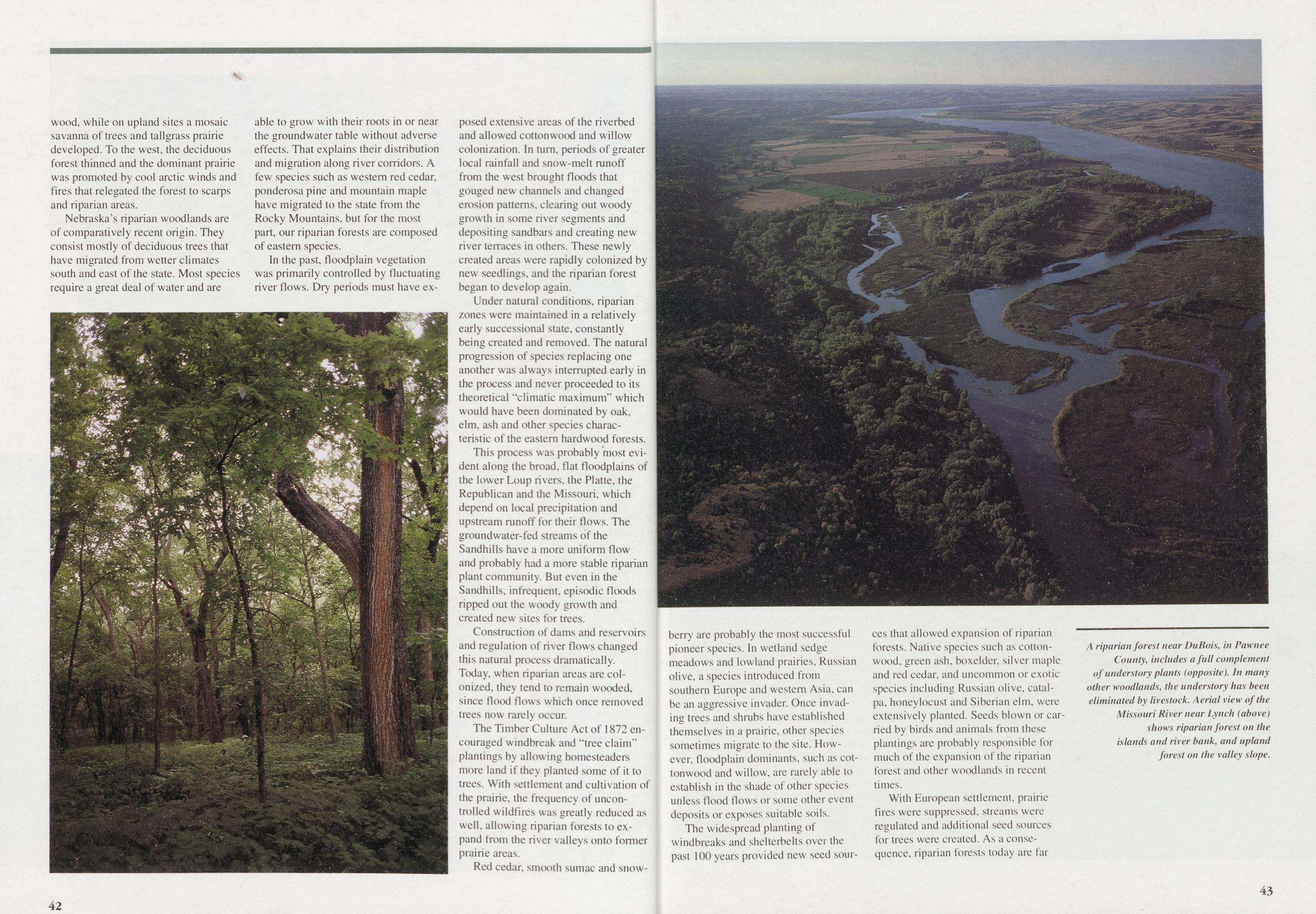
wood, while on upland sites a mosaic savanna of trees and tall grass prairie developed. To the west, the deciduous forest thinned and the dominant prairie was promoted by cool arctic winds and fires that relegated the forest to scarps and riparian areas.
Nebraska's riparian woodlands are of comparatively recent origin. They consist mostly of deciduous trees that have migrated from wetter climates south and east of the state. Most species require a great deal of water and are able to grow with their roots in or near the groundwater table without adverse effects. That explains their distribution and migration along river corridors. A few species such as western red cedar, ponderosa pine and mountain maple have migrated to the state from the Rocky Mountains, but for the most part, our riparian forests are composed of eastern species.
In the past, floodplain vegetation was primarily controlled by fluctuating river flows. Dry periods must have exposed extensive areas of the riverbed and allowed cottonwood and willow colonization. In turn, periods of greater local rainfall and snow-melt runoff from the west brought floods that gouged new channels and changed erosion patterns, clearing out woody growth in some river segments and depositing sandbars and creating new river terraces in others. These newly created areas were rapidly colonized by new seedlings, and the riparian forest began to develop again.
Under natural conditions, riparian zones were maintained in a relatively early successional state, constantly being created and removed. The natural progression of species replacing one another was always interrupted early in the process and never proceeded to its theoretical "climatic maximum" which would have been dominated by oak, elm, ash and other species characteristic of the eastern hardwood forests.
This process was probably most evident along the broad, flat floodplains of the lower Loup rivers, the Platte, the Republican and the Missouri, which depend on local precipitation and upstream runoff for their flows. The groundwater-fed streams of the Sandhills have a more uniform flow and probably had a more stable riparian plant community. But even in the Sandhills, infrequent, episodic floods ripped out the woody growth and created new sites for trees.
Construction of dams and reservoirs and regulation of river flows changed this natural process dramatically. Today, when riparian areas are colonized, they tend to remain wooded, since flood flows which once removed trees now rarely occur.
The Timber Culture Act of 1872 encouraged windbreak and "tree claim" plantings by allowing homesteaders more land if they planted some of it to trees. With settlement and cultivation of the prairie, the frequency of uncontrolled wildfires was greatly reduced as well, allowing riparian forests to expand from the river valleys onto former prairie areas.
Red cedar, smooth sumac and snowberry are probably the most successful pioneer species. In wetland sedge meadows and lowland prairies, Russian olive, a species introduced from southern Europe and western Asia, can be an aggressive invader. Once invading trees and shrubs have established themselves in a prairie, other species sometimes migrate to the site. However, floodplain dominants, such as cottonwood and willow, are rarely able to establish in the shade of other species unless flood flows or some other event deposits or exposes suitable soils.
The widespread planting of windbreaks and shelter belts over the past 100 years provided new seed sources that allowed expansion of riparian forests. Native species such as cottonwood, green ash, boxelder, silver maple and red cedar, and uncommon or exotic species including Russian olive, catalpa, honeylocust and Siberian elm, were extensively planted. Seeds blown or carried by birds and animals from these plantings are probably responsible for much of the expansion of the riparian forest and other woodlands in recent times.
With European settlement, prairie fires were suppressed, streams were regulated and additional seed sources for trees were created. As a consequence, riparian forests today are far
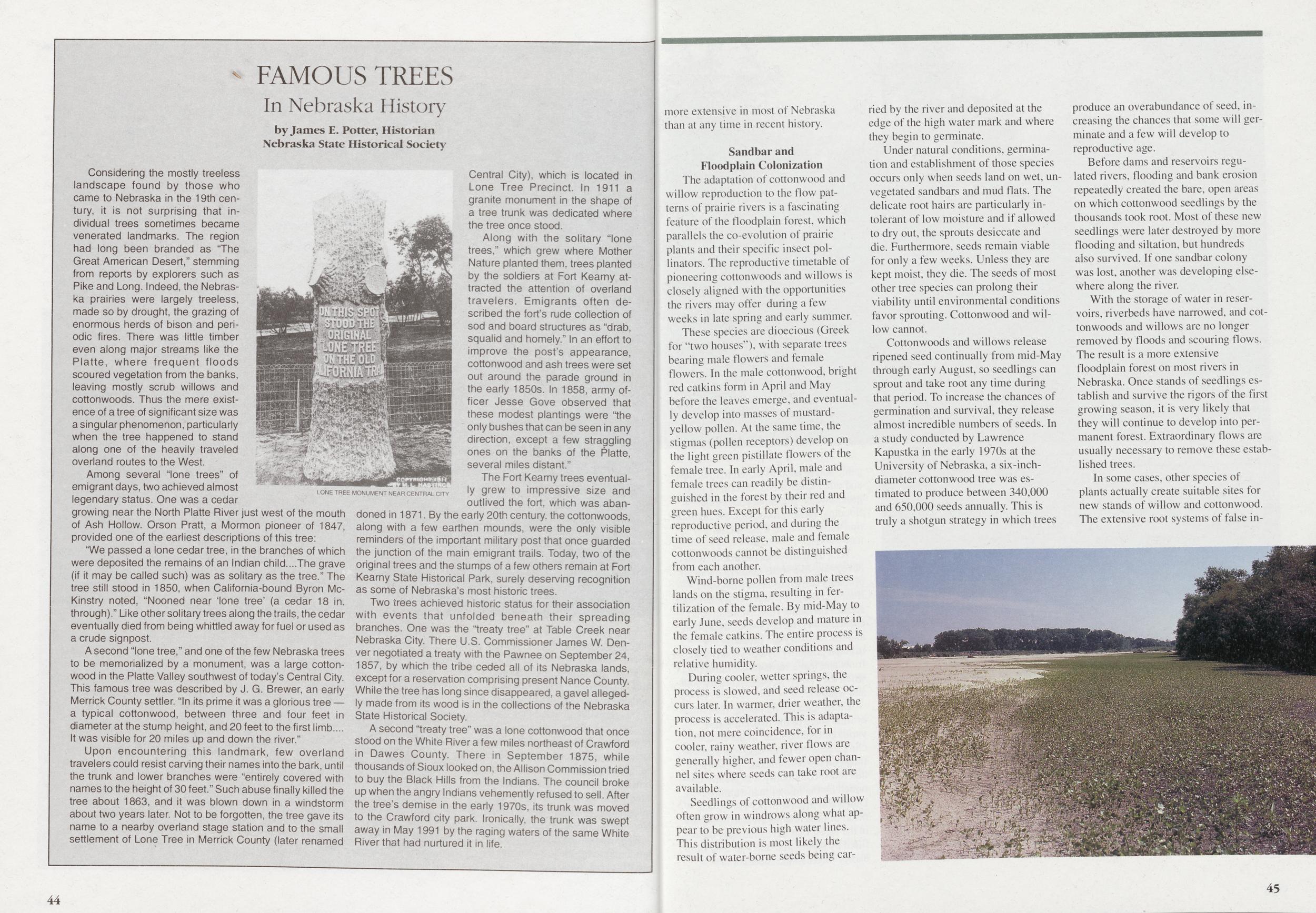
FAMOUS TREES
In Nebraska History
Considering the mostly treeless landscape found by those who came to Nebraska in the 19th century, it is not surprising that individual trees sometimes became venerated landmarks. The region had long been branded as "The Great American Desert," stemming from reports by explorers such as Pike and Long. Indeed, the Nebraska prairies were largely treeless, made so by drought, the grazing of enormous herds of bison and periodic fires. There was little timber even along major streams like the Platte, where frequent floods scoured vegetation from the banks, leaving mostly scrub willows and cottonwoods. Thus the mere existence of a tree of significant size was a singular phenomenon, particularly when the tree happened to stand along one of the heavily traveled overland routes to the West.
Among several "lone trees" of emigrant days, two achieved almost legendary status. One was a cedar I growing near the North Platte River just west of the mouth of Ash Hollow. Orson Pratt, a Mormon pioneer of 1847, provided one of the earliest descriptions of this tree:
"We passed a lone cedar tree, in the branches of which were deposited the remains of an Indian child....The grave (if it may be called such) was as solitary as the tree." The tree still stood in 1850, when California-bound Byron McKinstry noted, "Nooned near 'lone tree' (a cedar 18 in. through)." Like other solitary trees along the trails, the cedar eventually died from being whittled away for fuel or used as a crude signpost.
A second "lone tree," and one of the few Nebraska trees to be memorialized by a monument, was a large cottonwood in the Platte Valley southwest of today's Central City. This famous tree was described by J. G. Brewer, an early Merrick County settler. "In its prime it was a glorious tree — a typical cottonwood, between three and four feet in diameter at the stump height, and 20 feet to the first limb.... It was visible for 20 miles up and down the river."
Upon encountering this landmark, few overland travelers could resist carving their names into the bark, until the trunk and lower branches were "entirely covered with names to the height of 30 feet." Such abuse finally killed the tree about 1863, and it was blown down in a windstorm about two years later. Not to be forgotten, the tree gave its name to a nearby overland stage station and to the small settlement of Lone Tree in Merrick County (later renamed
Along with the solitary "lone trees," which grew where Mother Nature planted them, trees planted by the soldiers at Fort Kearny attracted the attention of overland travelers. Emigrants often described the fort's rude collection of sod and board structures as "drab, squalid and homely." In an effort to improve the post's appearance, cottonwood and ash trees were set out around the parade ground in the early 1850s. In 1858, army officer Jesse Gove observed that these modest plantings were "the only bushes that can be seen in any direction, except a few straggling ones on the banks of the Platte, several miles distant."
The Fort Kearny trees eventually grew to impressive size and outlived the fort, which was abandoned in 1871. By the early 20th century, the cottonwoods, along with a few earthen mounds, were the only visible reminders of the important military post that once guarded the junction of the main emigrant trails. Today, two of the original trees and the stumps of a few others remain at Fort Kearny State Historical Park, surely deserving recognition as some of Nebraska's most historic trees.
Two trees achieved historic status for their association with events that unfolded beneath their spreading branches. One was the "treaty tree" at Table Creek near Nebraska City. There U.S. Commissioner James W. Denver negotiated a treaty with the Pawnee on September 24, 1857, by which the tribe ceded all of its Nebraska lands, except for a reservation comprising present Nance County. While the tree has long since disappeared, a gavel allegedly made from its wood is in the collections of the Nebraska State Historical Society.
A second "treaty tree" was a lone cottonwood that once stood on the White River a few miles northeast of Crawford in Dawes County. There in September 1875, while thousands of Sioux looked on, the Allison Commission tried to buy the Black Hills from the Indians. The council broke up when the angry Indians vehemently refused to sell. After the tree's demise in the early 1970s, its trunk was moved to the Crawford city park. Ironically, the trunk was swept away in May 1991 by the raging waters of the same White River that had nurtured it in life.
more extensive in most of Nebraska than at any time in recent history.
Sandbar and Floodplain ColonizationThe adaptation of cottonwood and willow reproduction to the flow patterns of prairie rivers is a fascinating feature of the floodplain forest, which parallels the co-evolution of prairie plants and their specific insect pollinators. The reproductive timetable of pioneering cottonwoods and willows is closely aligned with the opportunities the rivers may offer during a few weeks in late spring and early summer.
These species are dioecious (Greek for "two houses"), with separate trees bearing male flowers and female flowers. In the male cottonwood, bright red catkins form in April and May before the leaves emerge, and eventually develop into masses of mustard yellow pollen. At the same time, the stigmas (pollen receptors) develop on the light green pistillate flowers of the female tree. In early April, male and female trees can readily be distinguished in the forest by their red and green hues. Except for this early reproductive period, and during the time of seed release, male and female cottonwoods cannot be distinguished from each another.
Wind-borne pollen from male trees lands on the stigma, resulting in fertilization of the female. By mid-May to early June, seeds develop and mature in the female catkins. The entire process is closely tied to weather conditions and relative humidity.
During cooler, wetter springs, the process is slowed, and seed release occurs later. In warmer, drier weather, the process is accelerated. This is adaptation, not mere coincidence, for in cooler, rainy weather, river flows are generally higher, and fewer open channel sites where seeds can take root are available.
Seedlings of cottonwood and willow often grow in windrows along what appear to be previous high water lines. This distribution is most likely the result of water-borne seeds being carried by the river and deposited at the edge of the high water mark and where they begin to germinate.
Under natural conditions, germination and establishment of those species occurs only when seeds land on wet, unvegetated sandbars and mud flats. The delicate root hairs are particularly intolerant of low moisture and if allowed to dry out, the sprouts desiccate and die. Furthermore, seeds remain viable for only a few weeks. Unless they are kept moist, they die. The seeds of most other tree species can prolong their viability until environmental conditions favor sprouting. Cottonwood and willow cannot.
Cottonwoods and willows release ripened seed continually from mid-May through early August, so seedlings can sprout and take root any time during that period. To increase the chances of germination and survival, they release almost incredible numbers of seeds. In a study conducted by Lawrence Kapustka in the early 1970s at the University of Nebraska, a six-inch- diameter cottonwood tree was estimated to produce between 340,000 and 650,000 seeds annually. This is truly a shotgun strategy in which trees produce an overabundance of seed, increasing the chances that some will germinate and a few will develop to reproductive age.
Before dams and reservoirs regu- lated rivers, flooding and bank erosion repeatedly created the bare, open areas on which cottonwood seedlings by the thousands took root. Most of these new seedlings were later destroyed by more flooding and siltation, but hundreds also survived. If one sandbar colony was lost, another was developing elsewhere along the river.
With the storage of water in reservoirs, riverbeds have narrowed, and cottonwoods and willows are no longer removed by floods and scouring flows. The result is a more extensive floodplain forest on most rivers in Nebraska. Once stands of seedlings establish and survive the rigors of the first growing season, it is very likely that they will continue to develop into permanent forest. Extraordinary flows are usually necessary to remove these established trees.
In some cases, other species of plants actually create suitable sites for new stands of willow and cottonwood. The extensive root systems of false indigo,
44 45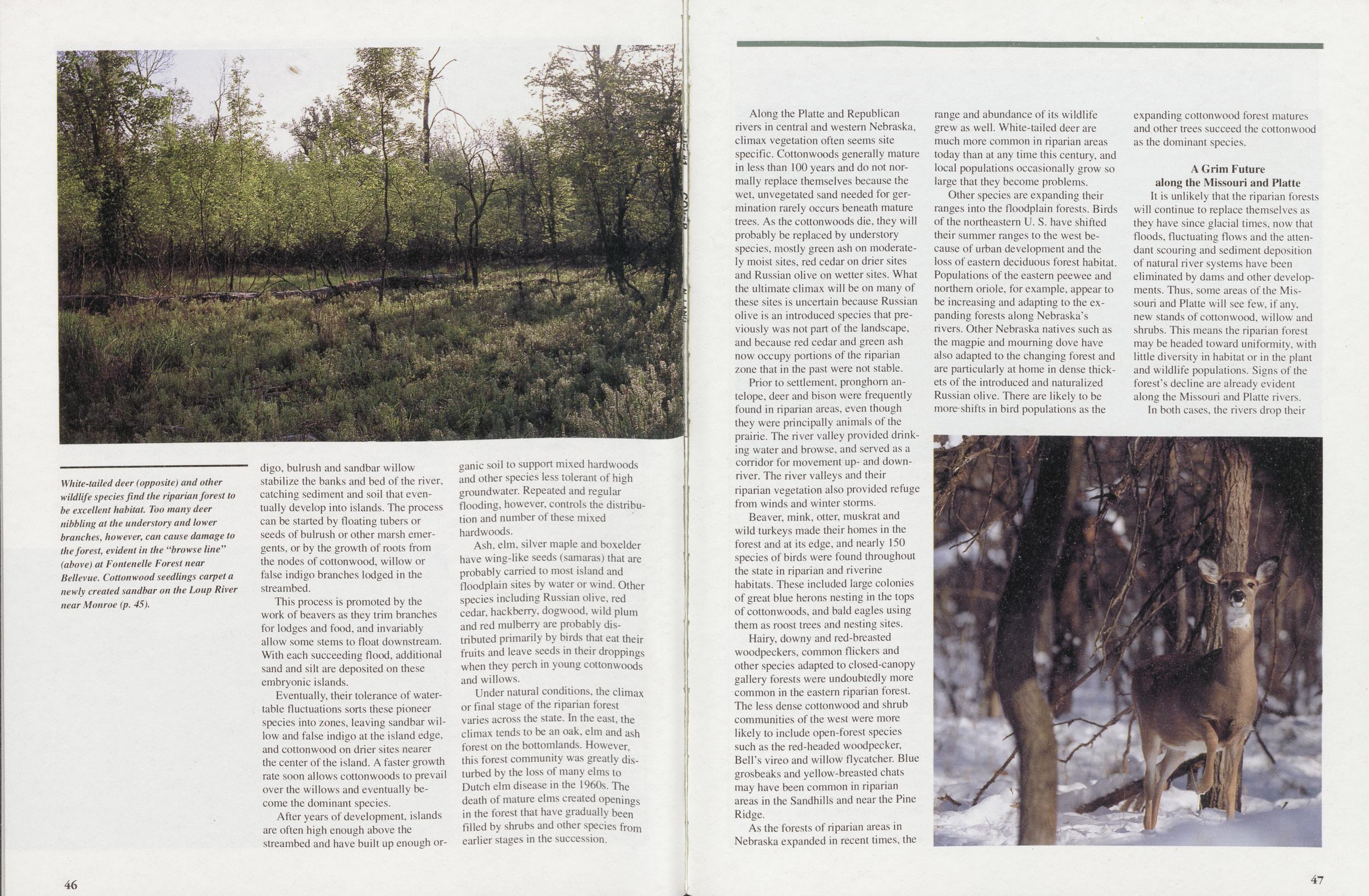
bulrush and sandbar willow stabilize the banks and bed of the river, catching sediment and soil that eventually develop into islands. The process can be started by floating tubers or seeds of bulrush or other marsh emergents, or by the growth of roots from the nodes of cottonwood, willow or false indigo branches lodged in the streambed.
This process is promoted by the work of beavers as they trim branches for lodges and food, and invariably allow some stems to float downstream. With each succeeding flood, additional sand and silt are deposited on these embryonic islands.
Eventually, their tolerance of watertable fluctuations sorts these pioneer species into zones, leaving sandbar willow and false indigo at the island edge, and cottonwood on drier sites nearer the center of the island. A faster growth rate soon allows cotton woods to prevail over the willows and eventually become the dominant species.
After years of development, islands are often high enough above the streambed and have built up enough organic soil to support mixed hardwoods and other species less tolerant of high groundwater. Repeated and regular flooding, however, controls the distribution and number of these mixed hardwoods.
Ash, elm, silver maple and boxelder have wing-like seeds (samaras) that are probably carried to most island and floodplain sites by water or wind. Other species including Russian olive, red cedar, blackberry, dogwood, wild plum and red mulberry are probably distributed primarily by birds that eat their fruits and leave seeds in their droppings when they perch in young cottonwoods and willows.
Under natural conditions, the climax or final stage of the riparian forest varies across the state. In the east, the climax tends to be an oak, elm and ash forest on the bottomlands. However, this forest community was greatly disturbed by the loss of many elms to Dutch elm disease in the 1960s. The death of mature elms created openings in the forest that have gradually been filled by shrubs and other species from earlier stages in the succession.
Along the Platte and Republican rivers in central and western Nebraska, climax vegetation often seems site specific. Cottonwoods generally mature in less than 100 years and do not normally replace themselves beca use the wet, unvegetated sand needed for germination rarely occurs beneath mature trees. As the cottonwoods die, they will probably be replaced by understory species, mostly green ash on moderately moist sites, red cedar on drier sites and Russian olive on wetter sites. What the ultimate climax will be on many of these sites is uncertain because Russian olive is an introduced species that previously was not part of the landscape, and because red cedar and green ash now occupy portions of the riparian zone that in the past were not stable.
Prior to settlement, pronghorn antelope, deer and bison were frequently found in riparian areas, even though they were principally animals of the prairie. The river valley provided drinking water and browse, and served as a corridor for movement up- and down river. The river valleys and their riparian vegetation also provided refuge from winds and winter storms.
Beaver, mink, otter, muskrat and wild turkeys made their homes in the forest and at its edge, and nearly 150 species of birds were found throughout the state in riparian and riverine habitats. These included large colonies of great blue herons nesting in the tops of cottonwoods, and bald eagles using them as roost trees and nesting sites.
Hairy, downy and red-breasted woodpeckers, common flickers and other species adapted to closed-canopy gallery forests were undoubtedly more common in the eastern riparian forest. The less dense cottonwood and shrub communities of the west were more likely to include open-forest species such as the red-headed woodpecker, BelFs vireo and willow flycatcher. Blue grosbeaks and yellow-breasted chats may have been common in riparian areas in the Sandhills and near the Pine Ridge.
As the forests of riparian areas in Nebraska expanded in recent times, the range and abundance of its wildlife grew as well. White-tailed deer are much more common in riparian areas today than at any time this century, and local populations occasionally grow so large that they become problems.
Other species are expanding their ranges into the floodplain forests. Birds of the northeastern U. S. have shifted their summer ranges to the west because of urban development and the loss of eastern deciduous forest habitat. Populations of the eastern peewee and northern oriole, for example, appear to be increasing and adapting to the expanding forests along Nebraska's rivers. Other Nebraska natives such as the magpie and mourning dove have also adapted to the changing forest and are particularly at home in dense thickets of the introduced and naturalized Russian olive. There are likely to be more-shifts in bird populations as the expanding cottonwood forest matures and other trees succeed the cottonwood as the dominant species.
A Grim Future along the Missouri and PlatteIt is unlikely that the riparian forests will continue to replace themselves as they have since glacial times, now that floods, fluctuating flows and the attendant scouring and sediment deposition of natural river systems have been eliminated by dams and other developments. Thus, some areas of the Missouri and Platte will see few, if any, new stands of cottonwood, willow and shrubs. This means the riparian forest may be headed toward uniformity, with little diversity in habitat or in the plant and wildlife populations. Signs of the forest's decline are already evident along the Missouri and Platte rivers.
In both cases, the rivers drop their
46 47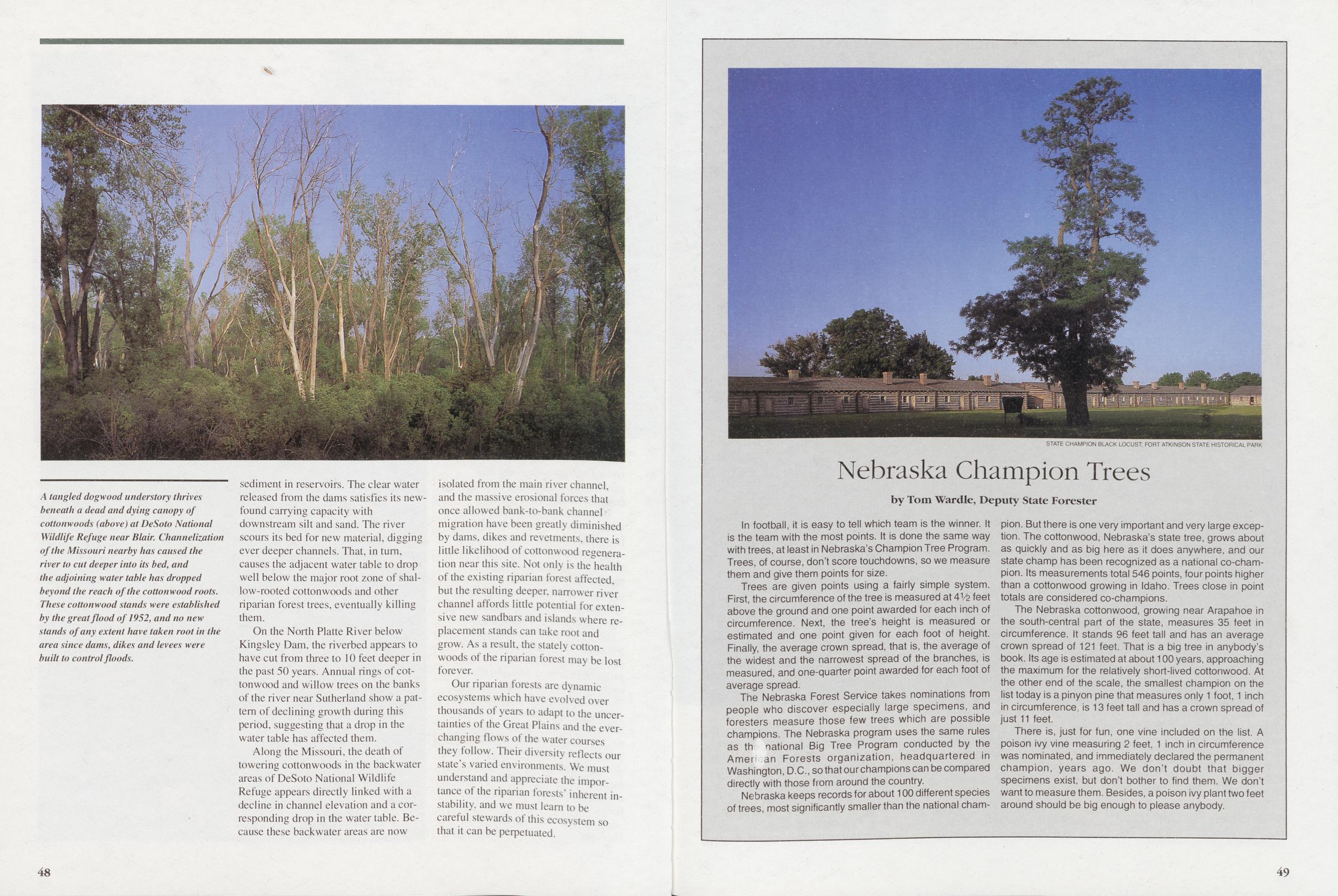
sediment in reservoirs. The clear water released from the dams satisfies its new found carrying capacity with downstream silt and sand. The river scours its bed for new material, digging ever deeper channels. That, in turn, causes the adjacent water table to drop well below the major root zone of shallow-rooted cottonwoods and other riparian forest trees, eventually killing them.
On the North Platte River below Kingsley Dam, the riverbed appears to have cut from three to 10 feet deeper in the past 50 years. Annual rings of cottonwood and willow trees on the banks of the river near Sutherland show a pattern of declining growth during this period, suggesting that a drop in the water table has affected them.
Along the Missouri, the death of towering cottonwoods in the backwater areas of DeSoto National Wildlife Refuge appears directly linked with a decline in channel elevation and a corresponding drop in the water table. Because these backwater areas are now isolated from the main river channel, and the massive erosional forces that once allowed bank-to-bank channel migration have been greatly diminished by dams, dikes and revetments, there is little likelihood of cottonwood regeneration near this site. Not only is the health of the existing riparian forest affected, but the resulting deeper, narrower river channel affords little potential for extensive new sandbars and islands where replacement stands can take root and grow. As a result, the stately cottonwoods of the riparian forest may be lost forever.
Our riparian forests are dynamic ecosystems which have evolved over thousands of years to adapt to the uncertainties of the Great Plains and the ever changing flows of the water courses they follow. Their diversity reflects our state's varied environments. We must understand and appreciate the importance of the riparian forests' inherent instability, and we must learn to be careful stewards of this ecosystem so that it can be perpetuated.
Nebraska Champion Trees
In football, it is easy to tell which team is the winner. It is the team with the most points. It is done the same way with trees, at least in Nebraska's Champion Tree Program. Trees, of course, don't score touchdowns, so we measure them and give them points for size.
Trees are given points using a fairly simple system. First, the circumference of the tree is measured at 4V2 feet above the ground and one point awarded for each inch of circumference. Next, the tree's height is measured or estimated and one point given for each foot of height. Finally, the average crown spread, that is, the average of the widest and the narrowest spread of the branches, is measured, and one-quarter point awarded for each foot of average spread.
The Nebraska Forest Service takes nominations from people who discover especially large specimens, and foresters measure those few trees which are possible champions. The Nebraska program uses the same rules as the national Big Tree Program conducted by the American Forests organization, headquartered in Washington, D.C., so that our champions can be compared directly with those from around the country.
Nebraska keeps records for about 100 different species of trees, most significantly smaller than the national champion. But there is one very important and very large exception. The cottonwood, Nebraska's state tree, grows about as quickly and as big here as it does anywhere, and our state champ has been recognized as a national co-champion. Its measurements total 546 points, four points higher than a cottonwood growing in Idaho. Trees close in point totals are considered co-champions.
The Nebraska cottonwood, growing near Arapahoe in the south-central part of the state, measures 35 feet in circumference. It stands 96 feet tall and has an average crown spread of 121 feet. That is a big tree in anybody's book. Its age is estimated at about 100 years, approaching the maximum for the relatively short-lived cottonwood. At the other end of the scale, the smallest champion on the list today is a pinyon pine that measures only 1 foot, 1 inch in circumference, is 13 feet tall and has a crown spread of just 11 feet.
There is, just for fun, one vine included on the list. A poison ivy vine measuring 2 feet, 1 inch in circumference was nominated, and immediately declared the permanent champion, years ago. We don't doubt that bigger specimens exist, but don't bother to find them. We don't want to measure them. Besides, a poison ivy plant two feet around should be big enough to please anybody.
48 49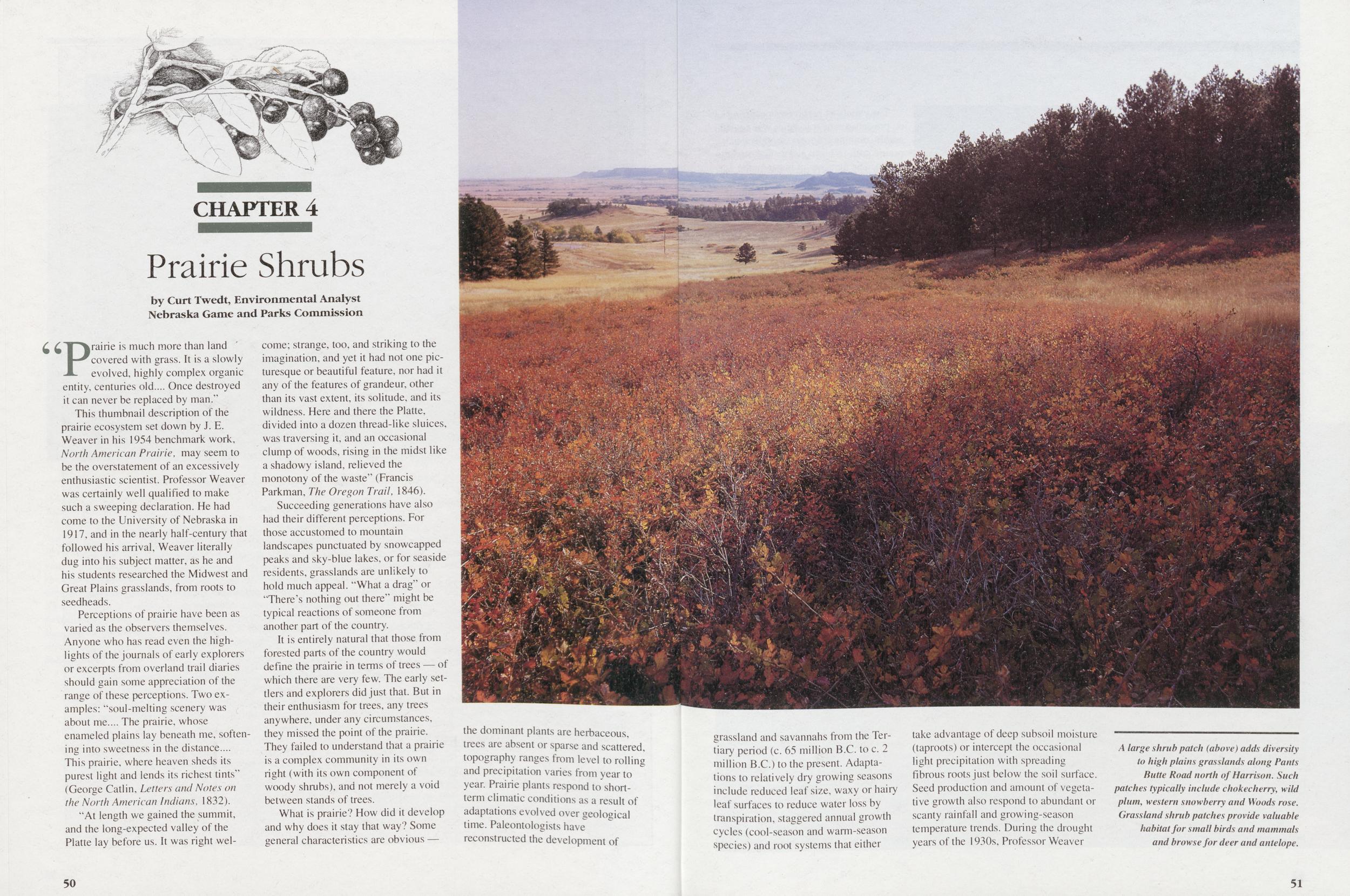
CHAPTER 4
Prairie Shrubs
Prairie is much more than land covered with grass. It is a slowly evolved, highly complex organic entity, centuries old.... Once destroyed it can never be replaced by man."
This thumbnail description of the prairie ecosystem set down by J. E. Weaver in his 1954 benchmark work, North American Prairie, may seem to be the overstatement of an excessively enthusiastic scientist. Professor Weaver was certainly well qualified to make such a sweeping declaration. He had come to the University of Nebraska in 1917, and in the nearly half-century that followed his arrival, Weaver literally dug into his subject matter, as he and his students researched the Midwest and Great Plains grasslands, from roots to seedheads.
Perceptions of prairie have been as varied as the observers themselves. Anyone who has read even the highlights of the journals of early explorers or excerpts from overland trail diaries should gain some appreciation of the range of these perceptions. Two examples: "soul-melting scenery was about me.... The prairie, whose enameled plains lay beneath me, softening into sweetness in the distance.... This prairie, where heaven sheds its purest light and lends its richest tints" (George Catlin, Letters and Notes on the North American Indians, 1832).
"At length we gained the summit, and the long-expected valley of the Platte lay before us. It was right welcome; strange, too, and striking to the imagination, and yet it had not one picturesque or beautiful feature, nor had it any of the features of grandeur, other than its vast extent, its solitude, and its wildness. Here and there the Platte, divided into a dozen thread-like sluices, was traversing it, and an occasional clump of woods, rising in the midst like a shadowy island, relieved the monotony of the waste" (Francis Parkman, The Oregon Trail, 1846).
Succeeding generations have also had their different perceptions. For those accustomed to mountain landscapes punctuated by snowcapped peaks and sky-blue lakes, or for seaside residents, grasslands are unlikely to hold much appeal. "What a drag" or "There's nothing out there" might be typical reactions of someone from another part of the country.
It is entirely natural that those from forested parts of the country would define the prairie in terms of trees — of which there are very few. The early settlers and explorers did just that. But in their enthusiasm for trees, any trees anywhere, under any circumstances, they missed the point of the prairie. They failed to understand that a prairie is a complex community in its own right (with its own component of woody shrubs), and not merely a void between stands of trees.
What is prairie? How did it develop and why does it stay that way? Some general characteristics are obvious — the dominant plants are herbaceous, trees are absent or sparse and scattered, topography ranges from level to rolling and precipitation varies from year to year. Prairie plants respond to short term climatic conditions as a result of adaptations evolved over geological time. Paleontologists have reconstructed the development of grassland and Savannah's from the Tertiary period (c. 65 million B.C. to c. 2 million B.C.) to the present. Adaptations to relatively dry growing seasons include reduced leaf size, waxy or hairy leaf surfaces to reduce water loss by transpiration, staggered annual growth cycles (cool-season and warm-season species) and root systems that either take advantage of deep subsoil moisture (taproots) or intercept the occasional light precipitation with spreading fibrous roots just below the soil surface. Seed production and amount of vegetative growth also respond to abundant or scanty rainfall and growing-season temperature trends. During the drought years of the 1930s, Professor Weaver
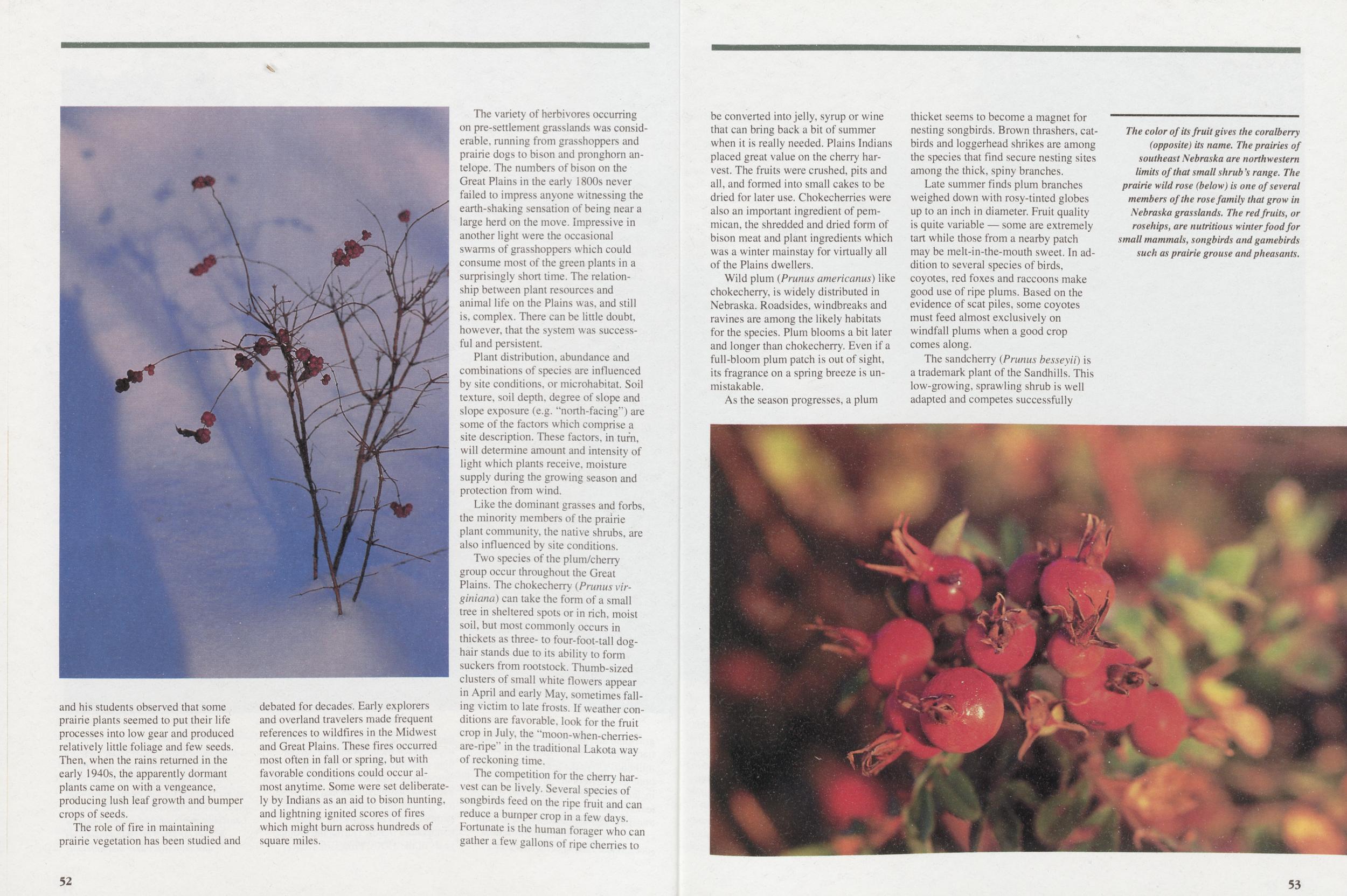
and his students observed that some prairie plants seemed to put their life processes into low gear and produced relatively little foliage and few seeds. Then, when the rains returned in the early 1940s, the apparently dormant plants came on with a vengeance, producing lush leaf growth and bumper crops of seeds.
The role of fire in maintaining prairie vegetation has been studied and debated for decades. Early explorers and overland travelers made frequent references to wildfires in the Midwest and Great Plains. These fires occurred most often in fall or spring, but with favorable conditions could occur almost anytime. Some were set deliberately by Indians as an aid to bison hunting, and lightning ignited scores of fires which might burn across hundreds of square miles.
The variety of herbivores occurring on pre-settlement grasslands was considerable, running from grasshoppers and prairie dogs to bison and pronghorn antelope. The numbers of bison on the Great Plains in the early 1800s never failed to impress anyone witnessing the earth-shaking sensation of being near a large herd on the move. Impressive in another light were the occasional swarms of grasshoppers which could consume most of the green plants in a surprisingly short time. The relationship between plant resources and animal life on the Plains was, and still is, complex. There can be little doubt, however, that the system was successful and persistent.
Plant distribution, abundance and combinations of species are influenced by site conditions, or microhabitat. Soil texture, soil depth, degree of slope and slope exposure (e.g. "north-facing") are some of the factors which comprise a site description. These factors, in turn, will determine amount and intensity of light which plants receive, moisture supply during the growing season and protection from wind.
Like the dominant grasses and forbs, the minority members of the prairie plant community, the native shrubs, are also influenced by site conditions.
Two species of the plum/cherry group occur throughout the Great Plains. The chokecherry (Prunus virginiana) can take the form of a small tree in sheltered spots or in rich, moist soil, but most commonly occurs in thickets as three- to four-foot-tall dog hair stands due to its ability to form suckers from rootstock. Thumb-sized clusters of small white flowers appear in April and early May, sometimes falling victim to late frosts. If weather conditions are favorable, look for the fruit crop in July, the "moon-when-cherries-are-ripe" in the traditional Lakota way of reckoning time.
The competition for the cherry harvest can be lively. Several species of songbirds feed on the ripe fruit and can reduce a bumper crop in a few days. Fortunate is the human forager who can gather a few gallons of ripe cherries to be converted into jelly, syrup or wine that can bring back a bit of summer when it is really needed. Plains Indians placed great value on the cherry harvest. The fruits were crushed, pits and all, and formed into small cakes to be dried for later use. Chokecherries were also an important ingredient of pemmican, the shredded and dried form of bison meat and plant ingredients which was a winter mainstay for virtually all of the Plains dwellers.
Wild plum (Prunus americanus) like chokecherry, is widely distributed in Nebraska. Roadsides, windbreaks and ravines are among the likely habitats for the species. Plum blooms a bit later and longer than chokecherry. Even if a full-bloom plum patch is out of sight, its fragrance on a spring breeze is unmistakable.
As the season progresses, a plum thicket seems to become a magnet for nesting songbirds. Brown thrashers, catbirds and loggerhead shrikes are among the species that find secure nesting sites among the thick, spiny branches.
Late summer finds plum branches weighed down with rosy-tinted globes up to an inch in diameter. Fruit quality is quite variable — some are extremely tart while those from a nearby patch may be melt-in-the-mouth sweet. In addition to several species of birds, coyotes, red foxes and raccoons make good use of ripe plums. Based on the evidence of scat piles, some coyotes must feed almost exclusively on windfall plums when a good crop comes along.
The sandcherry (Prunus besseyii) is a trademark plant of the Sandhills. This low-growing, sprawling shrub is well adapted and competes successfully
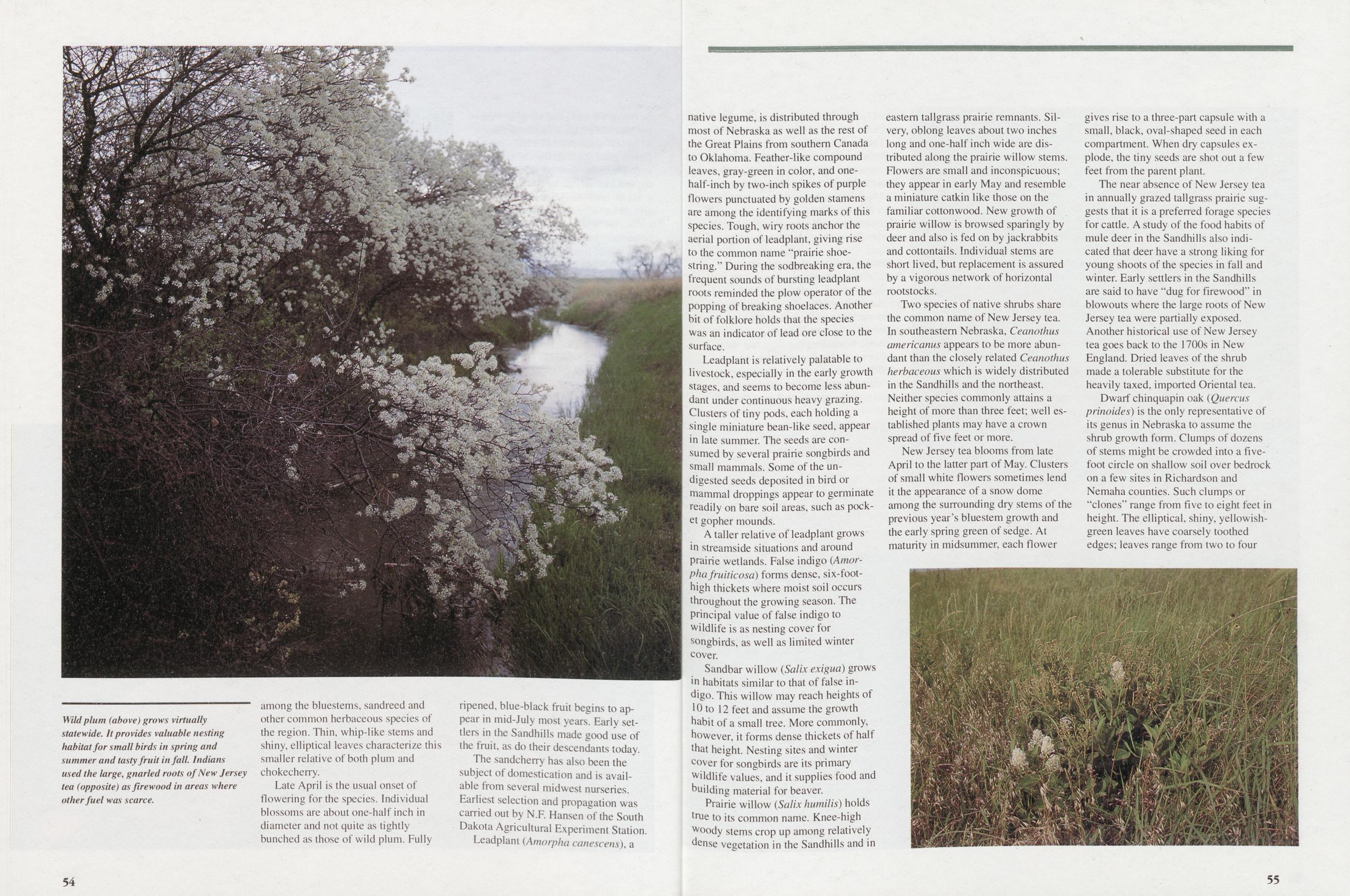
among the blue stems, sand reed and other common herbaceous species of the region. Thin, whip-like stems and shiny, elliptical leaves characterize this smaller relative of both plum and chokecherry.
Late April is the usual onset of flowering for the species. Individual blossoms are about one-half inch in diameter and not quite as tightly bunched as those of wild plum. Fully ripened, blue-black fruit begins to appear in mid-July most years. Early settlers in the Sandhills made good use of the fruit, as do their descendants today.
The sand cherry has also been the subject of domestication and is available from several midwest nurseries. Earliest selection and propagation was carried out by N.F. Hansen of the South Dakota Agricultural Experiment Station.
Leadplant (Amorpha canescens), a native legume, is distributed through most of Nebraska as well as the rest of the Great Plains from southern Canada to Oklahoma. Feather-like compound leaves, gray-green in color, and one half-inch by two-inch spikes of purple flowers punctuated by golden stamens are among the identifying marks of this species. Tough, wiry roots anchor the aerial portion of lead plant, giving rise to the common name "prairie shoe- string." During the sod breaking era, the frequent sounds of bursting lead plant roots reminded the plow operator of the popping of breaking shoelaces. Another bit of folklore holds that the species was an indicator of lead ore close to the surface.
Lead plant is relatively palatable to livestock, especially in the early growth stages, and seems to become less abundant under continuous heavy grazing. Clusters of tiny pods, each holding a single miniature bean-like seed, appear in late summer. The seeds are consumed by several prairie songbirds and small mammals. Some of the undigested seeds deposited in bird or mammal droppings appear to germinate readily on bare soil areas, such as pocket gopher mounds.
A taller relative of lead plant grows in stream side situations and around prairie wetlands. False indigo (Amorpha fruiticosa) forms dense, six-foot high thickets where moist soil occurs throughout the growing season. The principal value of false indigo to wildlife is as nesting cover for songbirds, as well as limited winter cover.
Sandbar willow (Salix exigua) grows in habitats similar to that of false indigo. This willow may reach heights of 10 to 12 feet and assume the growth habit of a small tree. More commonly, however, it forms dense thickets of half that height. Nesting sites and winter cover for songbirds are its primary wildlife values, and it supplies food and building material for beaver.
Prairie willow (Salix humilis) holds true to its common name. Knee-high woody stems crop up among relatively dense vegetation in the Sandhills and in eastern tallgrass prairie remnants. Silvery, oblong leaves about two inches long and one-half inch wide are distributed along the prairie willow stems. Flowers are small and inconspicuous; they appear in early May and resemble a miniature catkin like those on the familiar cotton wood. New growth of prairie willow is browsed sparingly by deer and also is fed on by jackrabbits and cottontails. Individual stems are short lived, but replacement is assured by a vigorous network of horizontal rootstocks.
Two species of native shrubs share the common name of New Jersey tea. In southeastern Nebraska, Ceanothus americanus appears to be more abundant than the closely related Ceanothus herbaceous which is widely distributed in the Sandhills and the northeast. Neither species commonly attains a height of more than three feet; well established plants may have a crown spread of five feet or more.
New Jersey tea blooms from late April to the latter part of May. Clusters of small white flowers sometimes lend it the appearance of a snow dome among the surrounding dry stems of the previous year's bluestem growth and the early spring green of sedge. At maturity in midsummer, each flower gives rise to a three-part capsule with a small, black, oval-shaped seed in each compartment. When dry capsules explode, the tiny seeds are shot out a few feet from the parent plant.
The near absence of New Jersey tea in annually grazed tall grass prairie suggests that it is a preferred forage species for cattle. A study of the food habits of mule deer in the Sandhills also indicated that deer have a strong liking for young shoots of the species in fall and winter. Early settlers in the Sandhills are said to have "dug for firewood" in blowouts where the large roots of New Jersey tea were partially exposed. Another historical use of New Jersey tea goes back to the 1700s in New England. Dried leaves of the shrub made a tolerable substitute for the heavily taxed, imported Oriental tea.
Dwarf chinquapin oak (Quercus prinoides) is the only representative of its genus in Nebraska to assume the shrub growth form. Clumps of dozens of stems might be crowded into a five-foot circle on shallow soil over bedrock on a few sites in Richardson and Nemaha counties. Such clumps or "clones" range from five to eight feet in height. The elliptical, shiny, yellowish green leaves have coarsely toothed edges; leaves range from two to four
54 55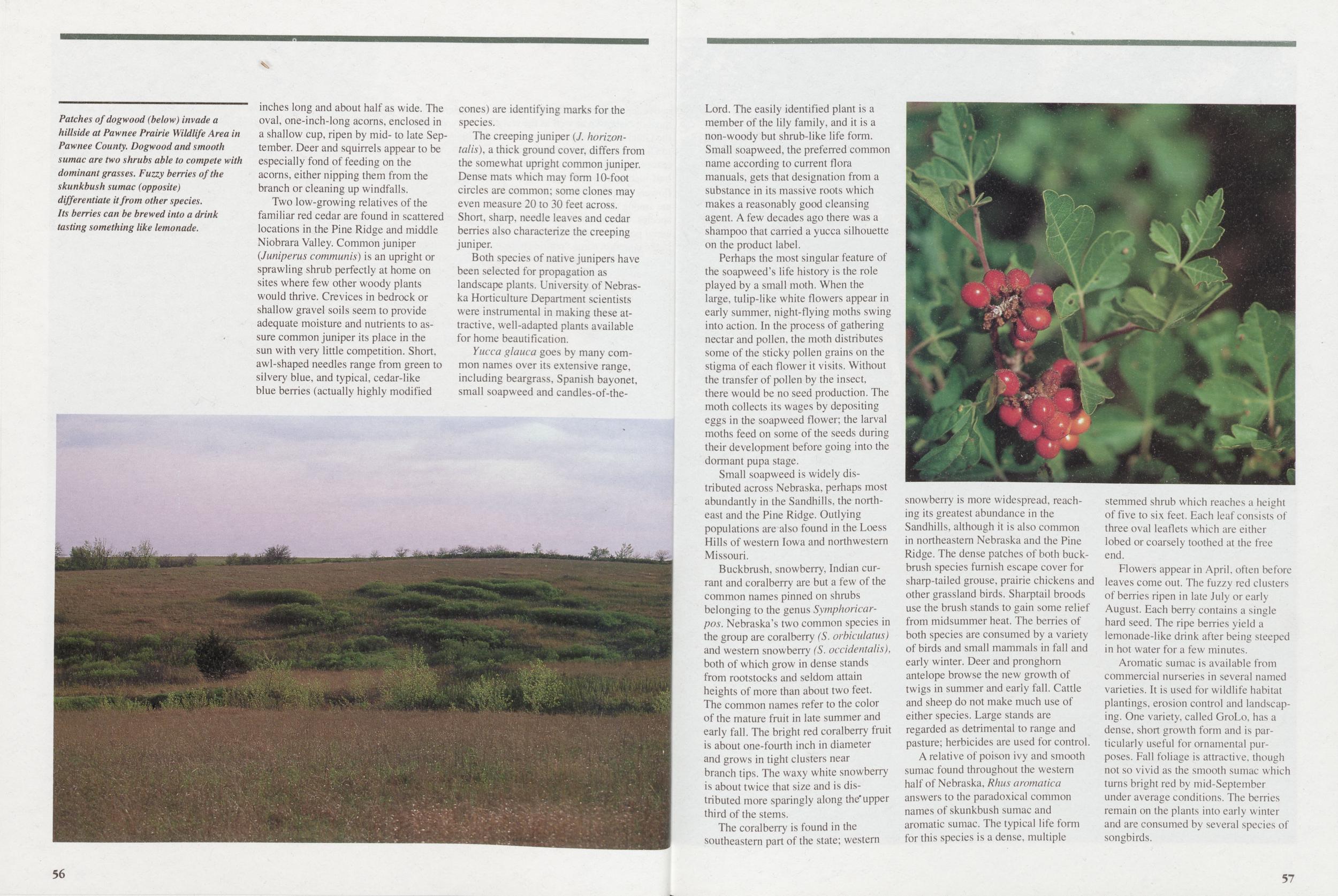
inches long and about half as wide. The oval, one-inch-long acorns, enclosed in a shallow cup, ripen by mid- to late September. Deer and squirrels appear to be especially fond of feeding on the acorns, either nipping them from the branch or cleaning up windfalls.
Two low-growing relatives of the familiar red cedar are found in scattered locations in the Pine Ridge and middle Niobrara Valley. Common juniper (Juniperus communis) is an upright or sprawling shrub perfectly at home on sites where few other woody plants would thrive. Crevices in bedrock or shallow gravel soils seem to provide adequate moisture and nutrients to assure common juniper its place in the sun with very little competition. Short, awl-shaped needles range from green to silvery blue, and typical, cedar-like blue berries (actually highly modified cones) are identifying marks for the species.
The creeping juniper (J. horizontals), a thick ground cover, differs from the somewhat upright common juniper. Dense mats which may form 10-foot circles are common; some clones may even measure 20 to 30 feet across. Short, sharp, needle leaves and cedar berries also characterize the creeping juniper.
Both species of native junipers have been selected for propagation as landscape plants. University of Nebraska Horticulture Department scientists were instrumental in making these attractive, well-adapted plants available for home beautification.
Yucca glauca goes by many common names over its extensive range, including beargrass, Spanish bayonet, small soapweed and candles-of-the-Lord. The easily identified plant is a member of the lily family, and it is a non-woody but shrub-like life form. Small soapweed, the preferred common name according to current flora manuals, gets that designation from a substance in its massive roots which makes a reasonably good cleansing agent. A few decades ago there was a shampoo that carried a yucca silhouette on the product label.
Perhaps the most singular feature of the soapweed's life history is the role played by a small moth. When the large, tulip-like white flowers appear in early summer, night-flying moths swing into action. In the process of gathering nectar and pollen, the moth distributes some of the sticky pollen grains on the stigma of each flower it visits. Without the transfer of pollen by the insect, there would be no seed production. The moth collects its wages by depositing eggs in the soapweed flower; the larval moths feed on some of the seeds during their development before going into the dormant pupa stage.
Small soapweed is widely distributed across Nebraska, perhaps most abundantly in the Sandhills, the northeast and the Pine Ridge. Outlying populations are also found in the Loess Hills of western Iowa and northwestern Missouri.
Buckbrush, snowberry, Indian currant and coralberry are but a few of the common names pinned on shrubs belonging to the genus Symphoricarpos. Nebraska's two common species in the group are coralberry (S. orhiculatus) and western snowberry (S. occidentalis), both of which grow in dense stands from rootstocks and seldom attain heights of more than about two feet. The common names refer to the color of the mature fruit in late summer and early fall. The bright red coralberry fruit is about one-fourth inch in diameter and grows in tight clusters near branch tips. The waxy white snowberry is about twice that size and is distributed more sparingly along the upper third of the stems.
The coralberry is found in the southeastern part of the state; western snowberry is more widespread, reaching its greatest abundance in the Sandhills, although it is also common in northeastern Nebraska and the Pine Ridge. The dense patches of both buck-brush species furnish escape cover for sharp-tailed grouse, prairie chickens and other grassland birds. Sharptail broods use the brush stands to gain some relief from midsummer heat. The berries of both species are consumed by a variety of birds and small mammals in fall and early winter. Deer and pronghorn antelope browse the new growth of twigs in summer and early fall. Cattle and sheep do not make much use of either species. Large stands are regarded as detrimental to range and pasture; herbicides are used for control.
A relative of poison ivy and smooth sumac found throughout the western half of Nebraska, Rhus aromatica answers to the paradoxical common names of skunkbush sumac and aromatic sumac. The typical life form for this species is a dense, multiple stemmed shrub which reaches a height of five to six feet. Each leaf consists of three oval leaflets which are either lobed or coarsely toothed at the free end.
Flowers appear in April, often before leaves come out. The fuzzy red clusters of berries ripen in late July or early August. Each berry contains a single hard seed. The ripe berries yield a lemonade-like drink after being steeped in hot water for a few minutes.
Aromatic sumac is available from commercial nurseries in several named varieties. It is used for wildlife habitat plantings, erosion control and landscaping. One variety, called GroLo, has a dense, short growth form and is particularly useful for ornamental purposes. Fall foliage is attractive, though not so vivid as the smooth sumac which turns bright red by mid-September under average conditions. The berries remain on the plants into early winter and are consumed by several species of songbirds.
56 57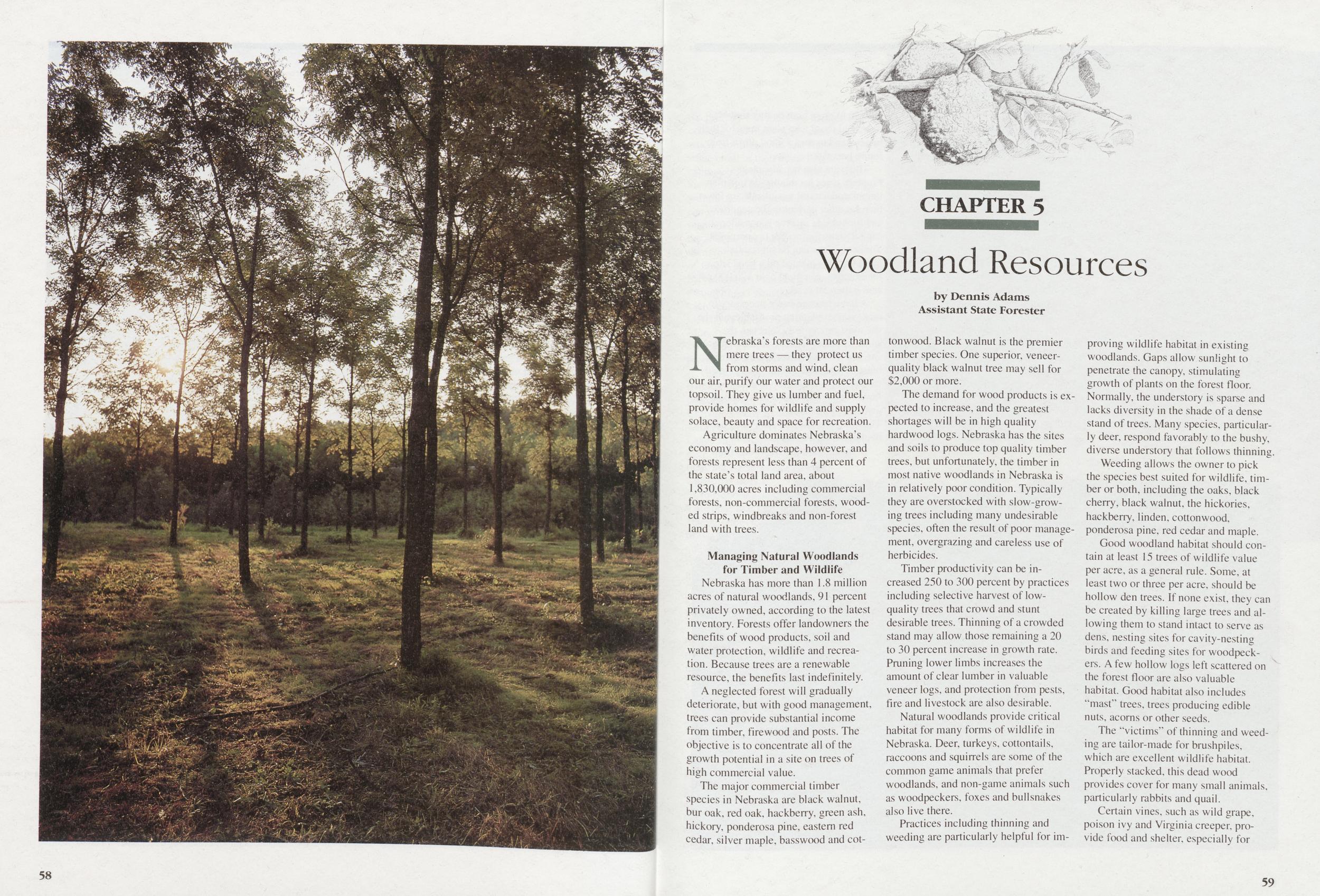
CHAPTER 5
Woodland Resources
Nebraska's forests are more than mere trees — they protect us from storms and wind, clean our air, purify our water and protect our topsoil. They give us lumber and fuel, provide homes for wildlife and supply solace, beauty and space for recreation.
Agriculture dominates Nebraska's economy and landscape, however, and forests represent less than 4 percent of the state's total land area, about 1,830,000 acres including commercial forests, non-commercial forests, wooded strips, windbreaks and non-forest land with trees.
Managing Natural Woodlands for Timber and WildlifeNebraska has more than 1.8 million acres of natural woodlands, 91 percent privately owned, according to the latest inventory. Forests offer landowners the benefits of wood products, soil and water protection, wildlife and recreation. Because trees are a renewable resource, the benefits last indefinitely.
A neglected forest will gradually deteriorate, but with good management, trees can provide substantial income from timber, firewood and posts. The objective is to concentrate all of the growth potential in a site on trees of high commercial value.
The major commercial timber species in Nebraska are black walnut, bur oak, red oak, blackberry, green ash, hickory, ponderosa pine, eastern red cedar, silver maple, basswood and cotonwood. Black walnut is the premier timber species. One superior, veneer quality black walnut tree may sell for $2,000 or more.
The demand for wood products is epected to increase, and the greatest shortages will be in high quality hardwood logs. Nebraska has the sites and soils to produce top quality timber trees, but unfortunately, the timber in most native woodlands in Nebraska is in relatively poor condition. Typically they are overstocked with slow-growing trees including many undesirable species, often the result of poor management, overgrazing and careless use of herbicides.
Timber productivity can be increased 250 to 300 percent by practices including selective harvest of low quality trees that crowd and stunt desirable trees. Thinning of a crowded stand may allow those remaining a 20 to 30 percent increase in growth rate. Pruning lower limbs increases the amount of clear lumber in valuable veneer logs, and protection from pests, fire and livestock are also desirable.
Natural woodlands provide critical habitat for many forms of wildlife in Nebraska. Deer, turkeys, cottontails, raccoons and squirrels are some of the common game animals that prefer woodlands, and non-game animals such as woodpeckers, foxes and bull snakes also live there.
Practices including thinning and weeding are particularly helpful for improving wildlife habitat in existing woodlands. Gaps allow sunlight to penetrate the canopy, stimulating growth of plants on the forest floor. Normally, the understory is sparse and lacks diversity in the shade of a dense stand of trees. Many species, particularly deer, respond favorably to the bushy, diverse understory that follows thinning.
Weeding allows the owner to pick the species best suited for wildlife, timber or both, including the oaks, black cherry, black walnut, the hickories, hackberry, linden, cottonwood. ponderosa pine, red cedar and maple.
Good woodland habitat should contain at least 15 trees of wildlife value per acre, as a general rule. Some, at least two or three per acre, should be hollow den trees. If none exist, they can be created by killing large trees and allowing them to stand intact to serve as dens, nesting sites for cavity-nesting birds and feeding sites for woodpeckers. A few hollow logs left scattered on the forest floor are also valuable habitat. Good habitat also includes "mast" trees, trees producing edible nuts, acorns or other seeds.
The "victims" of thinning and weeding are tailor-made for brushpiles, which are excellent wildlife habitat. Properly stacked, this dead wood provides cover for many small animals, particularly rabbits and quail.
Certain vines, such as wild grape, poison ivy and Virginia creeper, provide food and shelter, especially for
58 59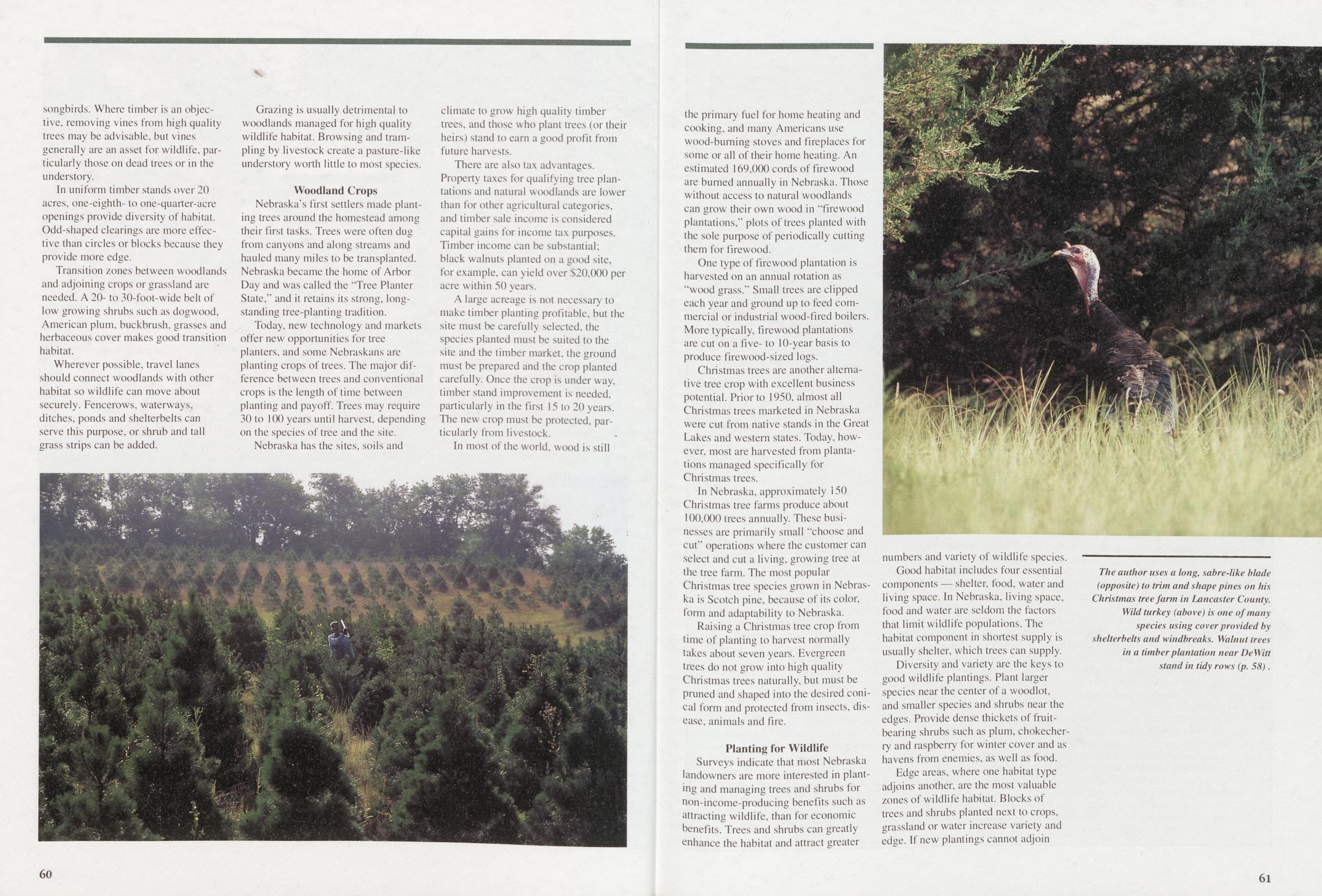
songbirds. Where timber is an objective, removing vines from high quality trees may be advisable, but vines generally are an asset for wildlife, particularly those on dead trees or in the understory.
In uniform timber stands over 20 acres, one-eighth- to one-quarter-acre openings provide diversity of habitat. Odd-shaped clearings are more effective than circles or blocks because they provide more edge.
Transition zones between woodlands and adjoining crops or grassland are needed. A 20- to 30-foot-wide belt of low growing shrubs such as dogwood, American plum, buckbrush, grasses and herbaceous cover makes good transition habitat.
Wherever possible, travel lanes should connect woodlands with other habitat so wildlife can move about securely. Fencerows, waterways, ditches, ponds and shelter belts can serve this purpose, or shrub and tall grass strips can be added.
Grazing is usually detrimental to woodlands managed for high quality wildlife habitat. Browsing and trampling by livestock create a pasture-like understory worth little to most species.
Woodland CropsNebraska's first settlers made planting trees around the homestead among their first tasks. Trees were often due from canyons and along streams and hauled many miles to be transplanted. Nebraska became the home of Arbor Day and was called the "Tree Planter State," and it retains its strong, longstanding tree-planting tradition.
Today, new technology and markets offer new opportunities for tree planters, and some Nebraskans are planting crops of trees. The major difference between trees and conventional crops is the length of time between planting and payoff. Trees may require 30 to 100 years until harvest, depending on the species of tree and the site.
Nebraska has the sites, soils and climate to grow high quality timber trees, and those who plant trees (or their heirs) stand to earn a good profit from future harvests.
There are also tax advantages. Property taxes for qualifying tree plantations and natural woodlands are lower than for other agricultural categories, and timber sale income is considered capital gains for income tax purposes. Timber income can be substantial; black walnuts planted on a good site, for example, can yield over $20,000 per acre within 50 years.
A large acreage is not necessary to make timber planting profitable, but the site must be carefully selected, the species planted must be suited to the site and the timber market, the ground must be prepared and the crop planted carefully. Once the crop is under way, timber stand improvement is needed, particularly in the first 15 to 20 years. The new crop must be protected, particularly from livestock.
In most of the world, wood is still the primary fuel for home heating and cooking, and many Americans use wood-burning stoves and fireplaces for some or all of their home heating. An estimated 169,000 cords of firewood are burned annually in Nebraska. Those without access to natural woodlands can grow their own wood in "firewood plantations," plots of trees planted with the sole purpose of periodically cutting them for firewood.
One type of firewood plantation is harvested on an annual rotation as "wood grass." Small trees are clipped each year and ground up to feed commercial or industrial wood-fired boilers. More typically, firewood plantations are cut on a five- to 10-year basis to produce firewood-sized logs.
Christmas trees are another alternative tree crop with excellent business potential. Prior to 1950, almost all Christmas trees marketed in Nebraska were cut from native stands in the Great Lakes and western states. Today, however, most are harvested from plantations managed specifically for Christmas trees.
In Nebraska, approximately 150 Christmas tree farms produce about 100,000 trees annually. These businesses are primarily small "choose and cut" operations where the customer can select and cut a living, growing tree at the tree farm. The most popular Christmas tree species grown in Nebraska is Scotch pine, because of its color, form and adaptability to Nebraska.
Raising a Christmas tree crop from time of planting to harvest normally takes about seven years. Evergreen trees do not grow into high quality Christmas trees naturally, but must be pruned and shaped into the desired conical form and protected from insects, disease, animals and fire.
Planting for WildlifeSurveys indicate that most Nebraska landowners are more interested in planting and managing trees and shrubs for non-income-producing benefits such as attracting wildlife, than for economic benefits. Trees and shrubs can greatly enhance the habitat and attract greater numbers and variety of wildlife species.
Good habitat includes four essential components — shelter, food, water and living space. In Nebraska, living space, food and water are seldom the factors that limit wildlife populations. The habitat component in shortest supply is usually shelter, which trees can supply.
Diversity and variety are the keys to good wildlife plantings. Plant larger species near the center of a woodlot, and smaller species and shrubs near the edges. Provide dense thickets of fruit bearing shrubs such as plum, chokecherry and raspberry for winter cover and as havens from enemies, as well as food.
Edge areas, where one habitat type adjoins another, are the most valuable zones of wildlife habitat. Blocks of trees and shrubs planted next to crops, grassland or water increase variety and edge. If new plantings cannot adjoin
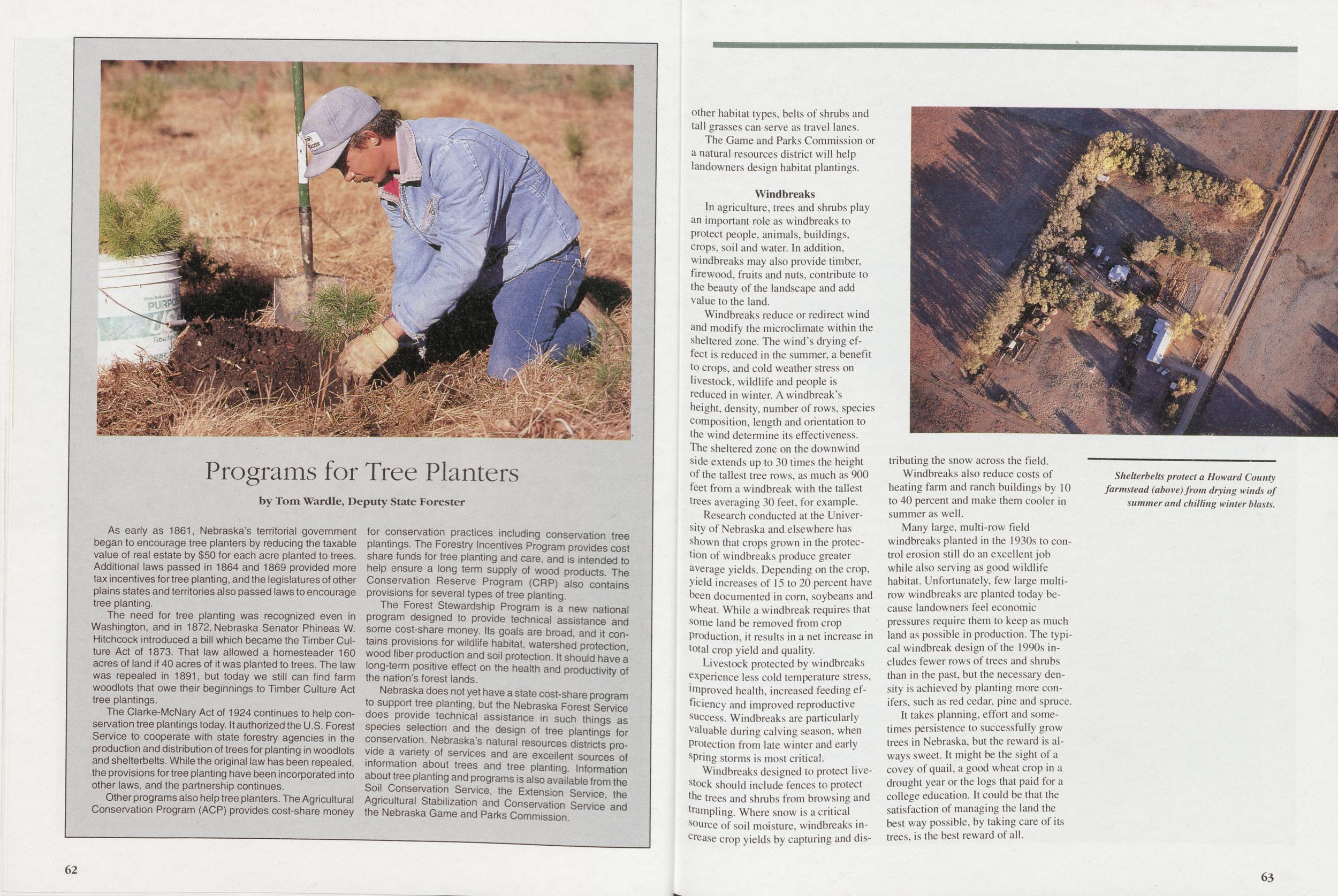
Programs for Tree Planters
As early as 1861, Nebraska's territorial government began to encourage tree planters by reducing the taxable value of real estate by $50 for each acre planted to trees. Additional laws passed in 1864 and 1869 provided more tax incentives for tree planting, and the legislatures of other plains states and territories also passed laws to encourage tree planting.
The need for tree planting was recognized even in Washington, and in 1872, Nebraska Senator Phineas W. Hitchcock introduced a bill which became the Timber Culture Act of 1873. That law allowed a homesteader 160 acres of land if 40 acres of it was planted to trees. The law was repealed in 1891, but today we still can find farm woodlots that owe their beginnings to Timber Culture Act tree plantings.
The Clarke-McNary Act of 1924 continues to help conservation tree plantings today. It authorized the U.S. Forest Service to cooperate with state forestry agencies in the production and distribution of trees for planting in woodlots and shelter belts. While the original law has been repealed, the provisions for tree planting have been incorporated into other laws, and the partnership continues.
Other programs also help tree planters. The Agricultural Conservation Program (ACP) provides cost-share money for conservation practices including conservation tree plantings. The Forestry Incentives Program provides cost share funds for tree planting and care, and is intended to help ensure a long term supply of wood products. The Conservation Reserve Program (CRP) also contains provisions for several types of tree planting.
The Forest Stewardship Program is a new national program designed to provide technical assistance and some cost-share money. Its goals are broad, and it contains provisions for wildlife habitat, watershed protection wood fiber production and soil protection. It should have a long-term positive effect on the health and productivity of the nation's forest lands.
Nebraska does not yet have a state cost-share program to support tree planting, but the Nebraska Forest Service does provide technical assistance in such things as species selection and the design of tree plantings for conservation. Nebraska's natural resources districts provide a variety of services and are excellent sources of information about trees and tree planting. Information about tree planting and programs is also available from the Soil Conservation Service, the Extension Service the Agricultural Stabilization and Conservation Service and the Nebraska Game and Parks Commission.
other habitat types, belts of shrubs and tall grasses can serve as travel lanes.
The Game and Parks Commission or a natural resources district will help landowners design habitat plantings.
WindbreaksIn agriculture, trees and shrubs play an important role as windbreaks to protect people, animals, buildings, crops, soil and water. In addition, windbreaks may also provide timber, firewood, fruits and nuts, contribute to the beauty of the landscape and add value to the land.
Windbreaks reduce or redirect wind and modify the microclimate within the sheltered zone. The wind's drying effect is reduced in the summer, a benefit to crops, and cold weather stress on livestock, wildlife and people is reduced in winter. A windbreak's height, density, number of rows, species composition, length and orientation to the wind determine its effectiveness. The sheltered zone on the downwind side extends up to 30 times the height of the tallest tree rows, as much as 900 feet from a windbreak with the tallest trees averaging 30 feet, for example.
Research conducted at the University of Nebraska and elsewhere has shown that crops grown in the protection of windbreaks produce greater average yields. Depending on the crop, yield increases of 15 to 20 percent have been documented in corn, soybeans and wheat. While a windbreak requires that some land be removed from crop production, it results in a net increase in total crop yield and quality.
Livestock protected by windbreaks experience less cold temperature stress, improved health, increased feeding efficiency and improved reproductive success. Windbreaks are particularly valuable during calving season, when Protection from late winter and early spring storms is most critical.
Windbreaks designed to protect livestock should include fences to protect Ihe trees and shrubs from browsing and trampling. Where snow is a critical source of soil moisture, windbreaks increase crop yields by capturing and distributing the snow across the field.
Windbreaks also reduce costs of heating farm and ranch buildings by 10 to 40 percent and make them cooler in summer as well.
Many large, multi-row field windbreaks planted in the 1930s to control erosion still do an excellent job while also serving as good wildlife habitat. Unfortunately, few large multirow windbreaks are planted today because landowners feel economic pressures require them to keep as much land as possible in production. The typical windbreak design of the 1990s includes fewer rows of trees and shrubs than in the past, but the necessary density is achieved by planting more conifers, such as red cedar, pine and spruce.
It takes planning, effort and sometimes persistence to successfully grow trees in Nebraska, but the reward is always sweet. It might be the sight of a covey of quail, a good wheat crop in a drought year or the logs that paid for a college education. It could be that the satisfaction of managing the land the best way possible, by taking care of its trees, is the best reward of all.
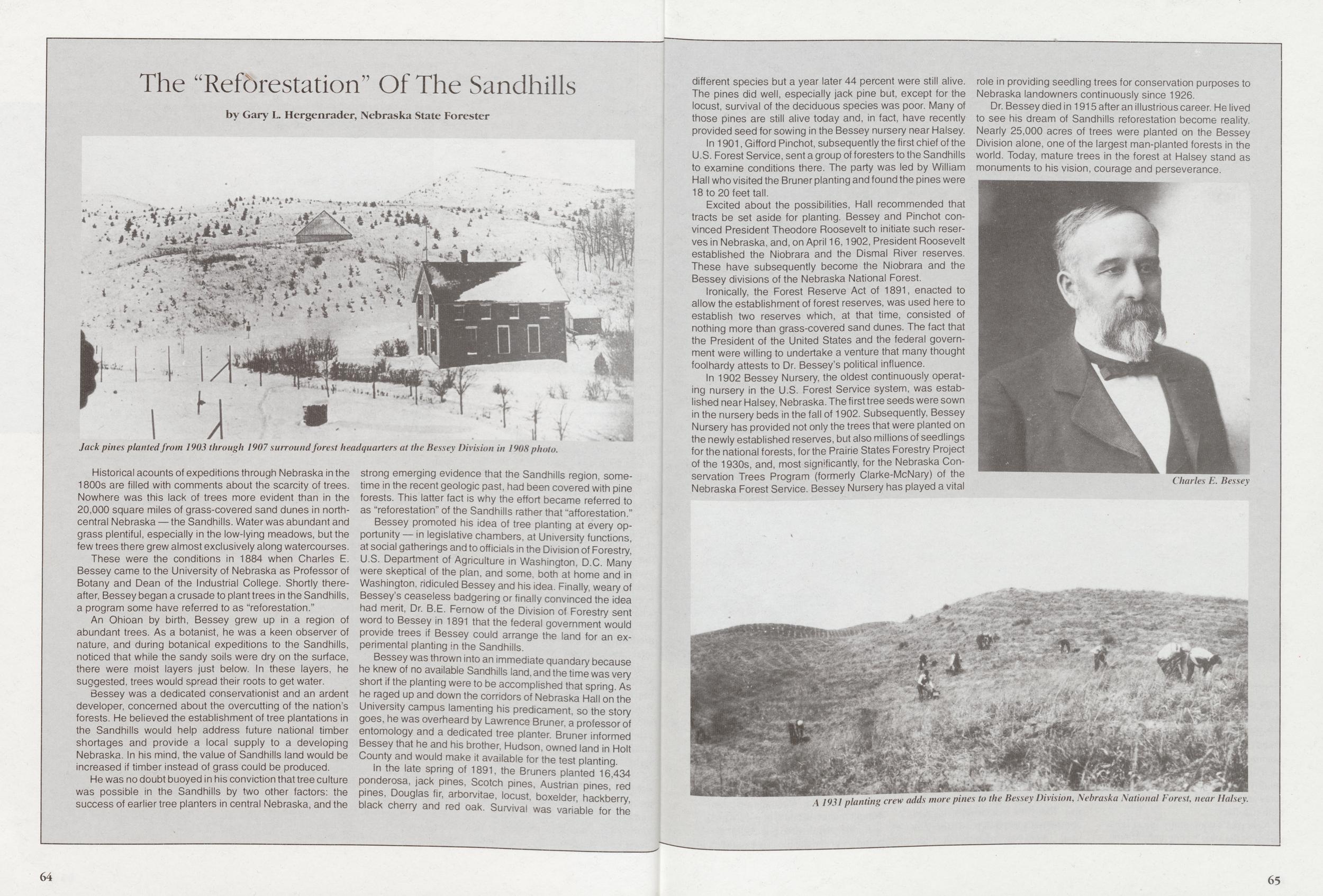
The "Reforestation" Of The Sandhills
Historical accounts of expeditions through Nebraska in the 1800s are filled with comments about the scarcity of trees. Nowhere was this lack of trees more evident than in the 20,000 square miles of grass-covered sand dunes in northcentral Nebraska — the Sandhills. Water was abundant and grass plentiful, especially in the low-lying meadows, but the few trees there grew almost exclusively along watercourses.
These were the conditions in 1884 when Charles E. Bessey came to the University of Nebraska as Professor of Botany and Dean of the Industrial College. Shortly thereafter, Bessey began a crusade to plant trees in the Sandhills, a program some have referred to as "reforestation."
An Ohioan by birth, Bessey grew up in a region of abundant trees. As a botanist, he was a keen observer of nature, and during botanical expeditions to the Sandhills, noticed that while the sandy soils were dry on the surface, there were moist layers just below. In these layers, he suggested, trees would spread their roots to get water.
Bessey was a dedicated conservationist and an ardent developer, concerned about the over cutting of the nation's forests. He believed the establishment of tree plantations in the Sandhills would help address future national timber shortages and provide a local supply to a developing Nebraska. In his mind, the value of Sandhills land would be increased if timber instead of grass could be produced.
He was no doubt buoyed in his conviction that tree culture was possible in the Sandhills by two other factors: the success of earlier tree planters in central Nebraska, and the strong emerging evidence that the Sandhills region, sometime in the recent geologic past, had been covered with pine forests. This latter fact is why the effort became referred to as "reforestation" of the Sandhills rather that "afforestation."
Bessey promoted his idea of tree planting at every opportunity — in legislative chambers, at University functions, at social gatherings and to officials in the Division of Forestry, U.S. Department of Agriculture in Washington, D.C. Many were skeptical of the plan, and some, both at home and in Washington, ridiculed Bessey and his idea. Finally, weary of Bessey's ceaseless badgering or finally convinced the idea had merit, Dr. B.E. Fernow of the Division of Forestry sent word to Bessey in 1891 that the federal government would provide trees if Bessey could arrange the land for an experimental planting in the Sandhills.
Bessey was thrown into an immediate quandary because he knew of no available Sandhills land, and the time was very short if the planting were to be accomplished that spring. As he raged up and down the corridors of Nebraska Hall on the University campus lamenting his predicament, so the story goes, he was overheard by Lawrence Bruner, a professor of entomology and a dedicated tree planter. Bruner informed Bessey that he and his brother, Hudson, owned land in Holt County and would make it available for the test planting
In the late spring of 1891, the Bruners planted 16 434 ponderosa, jack pines, Scotch pines, Austrian pines' red pines, Douglas fir, arborvitae, locust, boxelder, hackberry black cherry and red oak. Survival was variable for the different species but a year later 44 percent were still alive. The pines did well, especially jack pine but, except for the locust, survival of the deciduous species was poor. Many of those pines are still alive today and, in fact, have recently provided seed for sowing in the Bessey nursery near Halsey.
In 1901, Gifford Pinchot, subsequently the first chief of the U.S. Forest Service, sent a group of foresters to the Sandhills to examine conditions there. The party was led by William Hall who visited the Bruner planting and found the pines were 18 to 20 feet tall.
Excited about the possibilities, Hall recommended that tracts be set aside for planting. Bessey and Pinchot convinced President Theodore Roosevelt to initiate such reserves in Nebraska, and, on April 16,1902, President Roosevelt established the Niobrara and the Dismal River reserves. These have subsequently become the Niobrara and the Bessey divisions of the Nebraska National Forest.
Ironically, the Forest Reserve Act of 1891, enacted to allow the establishment of forest reserves, was used here to establish two reserves which, at that time, consisted of nothing more than grass-covered sand dunes. The fact that the President of the United States and the federal government were willing to undertake a venture that many thought foolhardy attests to Dr. Bessey's political influence.
In 1902 Bessey Nursery, the oldest continuously operating nursery in the U.S. Forest Service system, was established near Halsey, Nebraska. The first tree seeds were sown in the nursery beds in the fall of 1902. Subsequently, Bessey Nursery has provided not only the trees that were planted on the newly established reserves, but also millions of seedlings for the national forests, for the Prairie States Forestry Project of the 1930s, and, most significantly, for the Nebraska Conservation Trees Program (formerly Clarke-McNary) of the Nebraska Forest Service. Bessey Nursery has played a vital role in providing seedling trees for conservation purposes to Nebraska landowners continuously since 1926.
Dr. Bessey died in 1915 after an illustrious career. He lived to see his dream of Sandhills reforestation become reality. Nearly 25,000 acres of trees were planted on the Bessey Division alone, one of the largest man-planted forests in the world. Today, mature trees in the forest at Halsey stand as monuments to his vision, courage and perseverance.
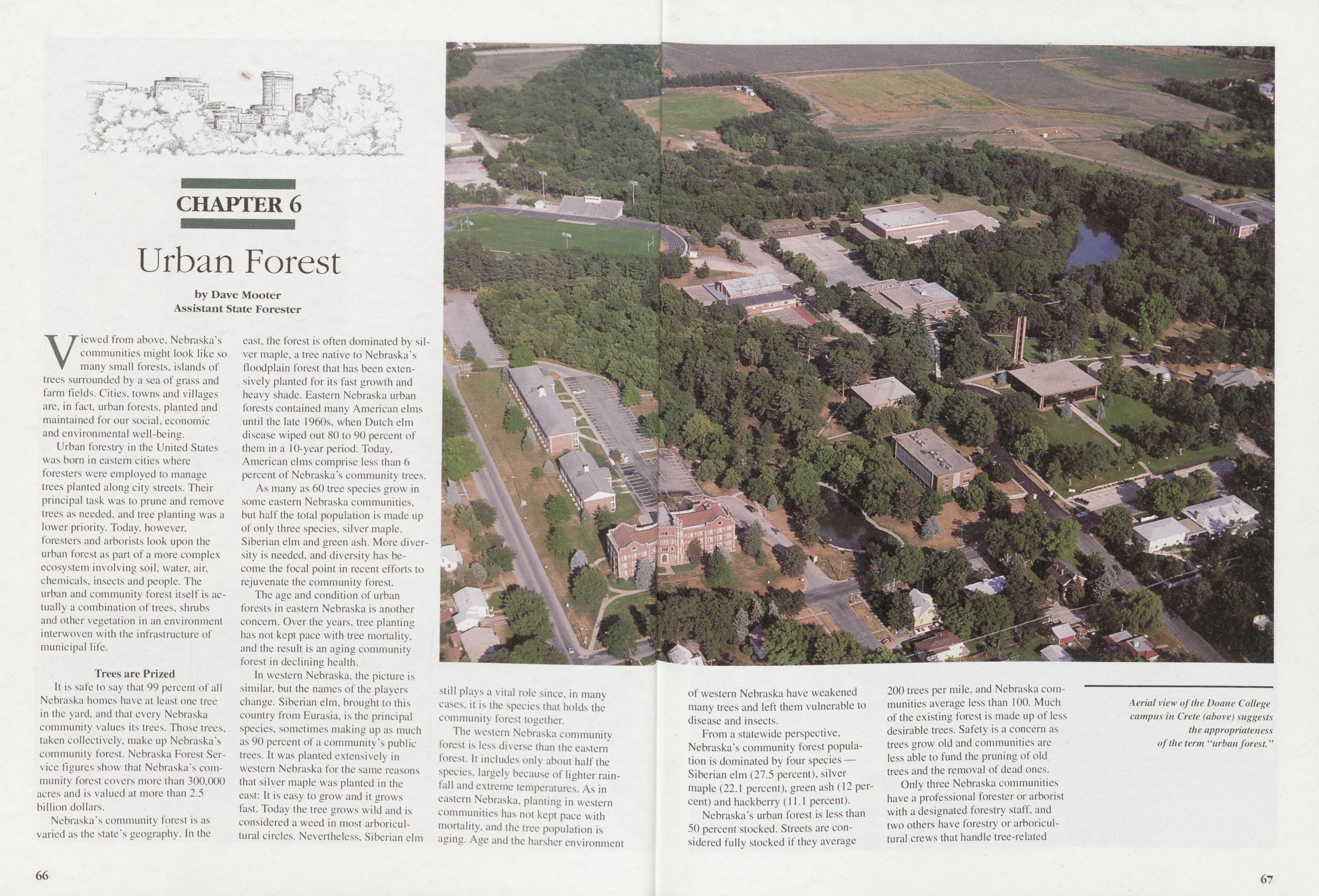
CHAPTER 6
Urban Forest
Viewed from above, Nebraska's communities might look like so many small forests, islands of trees surrounded by a sea of grass and farm fields. Cities, towns and villages are, in fact, urban forests, planted and maintained for our social, economic and environmental well-being.
Urban forestry in the United States was born in eastern cities where foresters were employed to manage trees planted along city streets. Their principal task was to prune and remove trees as needed, and tree planting was a lower priority. Today, however, foresters and arborists look upon the urban forest as part of a more complex ecosystem involving soil, water, air, chemicals, insects and people. The urban and community forest itself is actually a combination of trees, shrubs and other vegetation in an environment interwoven with the infrastructure of municipal life.
Trees are PrizedIt is safe to say that 99 percent of all Nebraska homes have at least one tree in the yard, and that every Nebraska community values its trees. Those trees, taken collectively, make up Nebraska's community forest. Nebraska Forest Service figures show that Nebraska's community forest covers more than 300,000 acres and is valued at more than 2.5 billion dollars.
Nebraska's community forest is as varied as the state's geography. In the east, the forest is often dominated by silver maple, a tree native to Nebraska's floodplain forest that has been extensively planted for its fast growth and heavy shade. Eastern Nebraska urban forests contained many American elms until the late 1960s, when Dutch elm disease wiped out 80 to 90 percent of them in a 10-year period. Today, American elms comprise less than 6 percent of Nebraska's community trees.
As many as 60 tree species grow in some eastern Nebraska communities, but half the total population is made up of only three species, silver maple, Siberian elm and green ash. More diversity is needed, and diversity has become the focal point in recent efforts to rejuvenate the community forest.
The age and condition of urban forests in eastern Nebraska is another concern. Over the years, tree planting has not kept pace with tree mortality, and the result is an aging community forest in declining health.
In western Nebraska, the picture is similar, but the names of the players change. Siberian elm, brought to this country from Eurasia, is the principal species, sometimes making up as much as 90 percent of a community's public trees. It was planted extensively in western Nebraska for the same reasons that silver maple was planted in the east: It is easy to grow and it grows fast. Today the tree grows wild and is considered a weed in most arboricultural circles. Nevertheless, Siberian elm still plays a vital role since, in many cases, it is the species that holds the community forest together.
The western Nebraska community forest is less diverse than the eastern forest. It includes only about half the species, largely because of lighter rainfall and extreme temperatures. As in eastern Nebraska, planting in western communities has not kept pace with mortality, and the tree population is aging. Age and the harsher environment of western Nebraska have weakened many trees and left them vulnerable to disease and insects.
From a statewide perspective, Nebraska's community forest population is dominated by four species — Siberian elm (27.5 percent), silver maple (22.1 percent), green ash (12 percent) and hackberry (11.1 percent).
Nebraska's urban forest is less than 50 percent stocked. Streets are considered fully stocked if they average 200 trees per mile, and Nebraska communities average less than 100. Much of the existing forest is made up of less desirable trees. Safety is a concern as trees grow old and communities are less able to fund the pruning of old trees and the removal of dead ones.
Only three Nebraska communities have a professional forester or arborist with a designated forestry staff, and two others have forestry or agricultural crews that handle tree-related
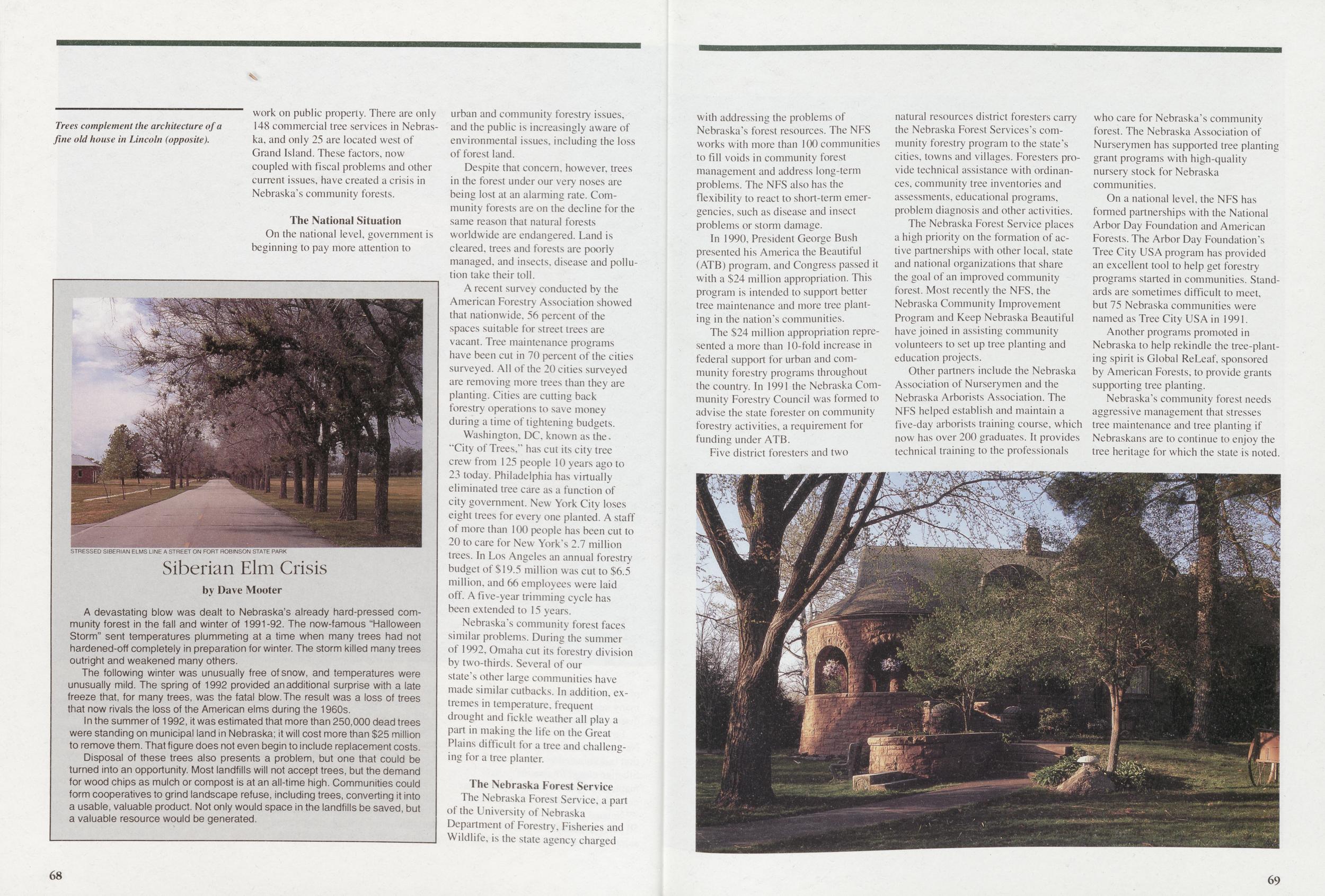
Siberian Elm Crisis
A devastating blow was dealt to Nebraska's already hard-pressed community forest In the fall and winter of 1991-92. The now-famous "Halloween Storm" sent temperatures plummeting at a time when many trees had not hardened-off completely in preparation for winter. The storm killed many trees outright and weakened many others.
The following winter was unusually free of snow, and temperatures were unusually mild. The spring of 1992 provided an additional surprise with a late freeze that, for many trees, was the fatal blow. The result was a loss of trees that now rivals the loss of the American elms during the 1960s.
In the summer of 1992, it was estimated that more than 250,000 dead trees were standing on municipal land in Nebraska; it will cost more than $25 million to remove them. That figure does not even begin to include replacement costs.
Disposal of these trees also presents a problem, but one that could be turned into an opportunity. Most landfills will not accept trees, but the demand for wood chips as mulch or compost is at an all-time high. Communities could form cooperatives to grind landscape refuse, including trees, converting it into a usable, valuable product. Not only would space in the landfills be saved, but a valuable resource would be generated.
work on public property. There are only 148 commercial tree services in Nebraska, and only 25 are located west of Grand Island. These factors, now coupled with fiscal problems and other current issues, have created a crisis in Nebraska's community forests.
The National SituationOn the national level, government is beginning to pay more attention to urban and community forestry issues, and the public is increasingly aware of environmental issues, including the loss of forest land.
Despite that concern, however, trees in the forest under our very noses are being lost at an alarming rate. Community forests are on the decline for the same reason that natural forests worldwide are endangered. Land is cleared, trees and forests are poorly managed, and insects, disease and pollution take their toll.
A recent survey conducted by the American Forestry Association showed that nationwide, 56 percent of the spaces suitable for street trees are vacant. Tree maintenance programs have been cut in 70 percent of the cities surveyed. All of the 20 cities surveyed are removing more trees than they are planting. Cities are cutting back forestry operations to save money during a time of tightening budgets.
Washington, DC, known as the. "City of Trees," has cut its city tree crew from 125 people 10 years ago to 23 today. Philadelphia has virtually eliminated tree care as a function of city government. New York City loses eight trees for every one planted. A staff of more than 100 people has been cut to 20 to care for New York's 2.7 million trees. In Los Angeles an annual forestry budget of $ 19.5 million was cut to $6.5 million, and 66 employees were laid off. A five-year trimming cycle has been extended to 15 years.
Nebraska's community forest faces similar problems. During the summer of 1992, Omaha cut its forestry division by two-thirds. Several of our state's other large communities have made similar cutbacks. In addition, extremes in temperature, frequent drought and fickle weather all play a part in making the life on the Great Plains difficult for a tree and challenging for a tree planter.
The Nebraska Forest ServiceThe Nebraska Forest Service, a part of the University of Nebraska Department of Forestry, Fisheries and Wildlife, is the state agency charged with addressing the problems of Nebraska's forest resources. The NFS works with more than 100 communities to fill voids in community forest management and address long-term problems. The NFS also has the flexibility to react to short-term emergencies, such as disease and insect problems or storm damage.
In 1990, President George Bush presented his America the Beautiful (ATB) program, and Congress passed it with a $24 million appropriation. This program is intended to support better tree maintenance and more tree planting in the nation's communities.
The $24 million appropriation represented a more than 10-fold increase in federal support for urban and community forestry programs throughout the country. In 1991 the Nebraska Community Forestry Council was formed to advise the state forester on community forestry activities, a requirement for funding under ATB.
Five district foresters and two natural resources district foresters carry the Nebraska Forest Services's community forestry program to the state's cities, towns and villages. Foresters provide technical assistance with ordinances, community tree inventories and assessments, educational programs, problem diagnosis and other activities.
The Nebraska Forest Service places a high priority on the formation of active partnerships with other local, state and national organizations that share the goal of an improved community forest. Most recently the NFS, the Nebraska Community Improvement Program and Keep Nebraska Beautiful have joined in assisting community volunteers to set up tree planting and education projects.
Other partners include the Nebraska Association of Nurserymen and the Nebraska Arborists Association. The NFS helped establish and maintain a five-day arborists training course, which now has over 200 graduates. It provides technical training to the professionals who care for Nebraska's community forest. The Nebraska Association of Nurserymen has supported tree planting grant programs with high-quality nursery stock for Nebraska communities.
On a national level, the NFS has formed partnerships with the National Arbor Day Foundation and American Forests. The Arbor Day Foundation's Tree City USA program has provided an excellent tool to help get forestry programs started in communities. Standards are sometimes difficult to meet, but 75 Nebraska communities were named as Tree City USA in 1991.
Another programs promoted in Nebraska to help rekindle the tree-planting spirit is Global ReLeaf, sponsored by American Forests, to provide grants supporting tree planting.
Nebraska's community forest needs aggressive management that stresses tree maintenance and tree planting if Nebraskans are to continue to enjoy the tree heritage for which the state is noted.
68 69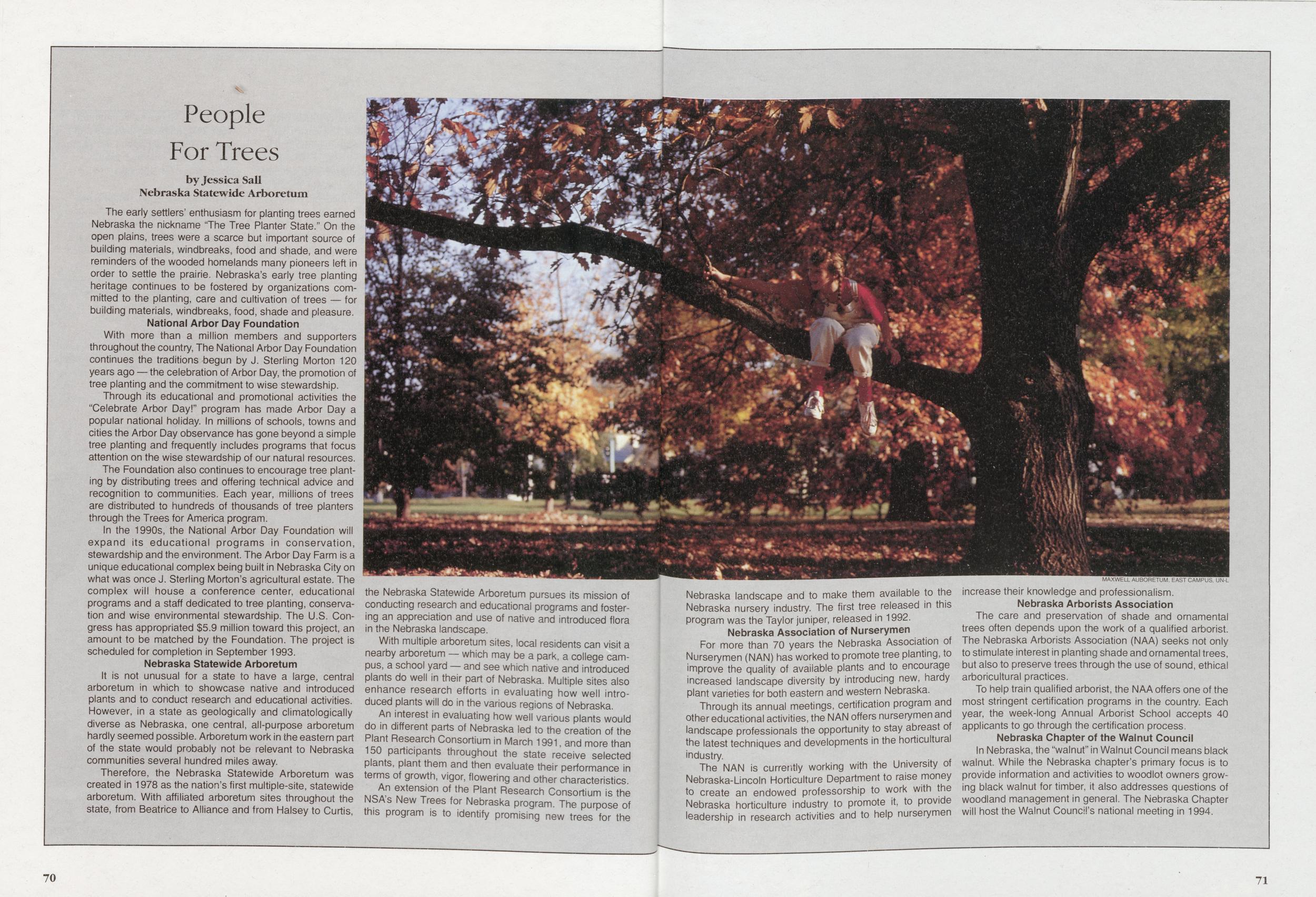
People For Trees
The early settlers' enthusiasm for planting trees earned Nebraska the nickname "The Tree Planter State." On the open plains, trees were a scarce but important source of building materials, windbreaks, food and shade, and were reminders of the wooded homelands many pioneers left in order to settle the prairie. Nebraska's early tree planting heritage continues to be fostered by organizations committed to the planting, care and cultivation of trees — for building materials, windbreaks, food, shade and pleasure.
National Arbor Day FoundationWith more than a million members and supporters throughout the country, The National Arbor Day Foundation continues the traditions begun by J. Sterling Morton 120 years ago — the celebration of Arbor Day, the promotion of tree planting and the commitment to wise stewardship.
Through its educational and promotional activities the "Celebrate Arbor Day!" program has made Arbor Day a popular national holiday. In millions of schools, towns and cities the Arbor Day observance has gone beyond a simple tree planting and frequently includes programs that focus attention on the wise stewardship of our natural resources.
The Foundation also continues to encourage tree planting by distributing trees and offering technical advice and recognition to communities. Each year, millions of trees are distributed to hundreds of thousands of tree planters through the Trees for America program.
In the 1990s, the National Arbor Day Foundation will expand its educational programs in conservation, stewardship and the environment. The Arbor Day Farm is a unique educational complex being built in Nebraska City on what was once J. Sterling Morton's agricultural estate. The complex will house a conference center, educational programs and a staff dedicated to tree planting, conservation and wise environmental stewardship. The U.S. Congress has appropriated $5.9 million toward this project, an amount to be matched by the Foundation. The project is scheduled for completion in September 1993.
Nebraska Statewide ArboretumIt is not unusual for a state to have a large, central arboretum in which to showcase native and introduced plants and to conduct research and educational activities. However, in a state as geologically and climatologicaily diverse as Nebraska, one central, ail-purpose arboretum hardly seemed possible. Arboretum work in the eastern part of the state would probably not be relevant to Nebraska communities several hundred miles away. Therefore, the Nebraska Statewide Arboretum was created in 1978 as the nation's first multiple-site, statewide arboretum. With affiliated arboretum sites throughout the state, from Beatrice to Alliance and from Halsey to Curtis,
With multiple arboretum sites, local residents can visit a nearby arboretum — which may be a park, a college campus, a school yard — and see which native and introduced plants do well in their part of Nebraska. Multiple sites also enhance research efforts in evaluating how well introduced plants will do in the various regions of Nebraska.
An interest in evaluating how well various plants would do in different parts of Nebraska led to the creation of the Plant Research Consortium in March 1991, and more than 150 participants throughout the state receive selected plants, plant them and then evaluate their performance in terms of growth, vigor, flowering and other characteristics
An extension of the Plant Research Consortium is the NSAs New Trees for Nebraska program. The purpose of this program is to identify promising new trees for the Nebraska landscape and to make them available to the Nebraska nursery industry. The first tree released in this program was the Taylor juniper, released in 1992.
Nebraska Association of NurserymenFor more than 70 years the Nebraska Association of Nurserymen (NAN) has worked to promote tree planting, to improve the quality of available plants and to encourage increased landscape diversity by introducing new, hardy plant varieties for both eastern and western Nebraska. Through its annual meetings, certification program and other educational activities, the NAN offers nurserymen and landscape professionals the opportunity to stay abreast of the latest techniques and developments in the horticultural industry.
The NAN is currently working with the University of Nebraska-Lincoln Horticulture Department to raise money to create an endowed professorship to work with the Nebraska horticulture industry to promote it, to provide leadership in research activities and to help nurserymen increase their knowledge and professionalism.
Nebraska Arborists AssociationThe care and preservation of shade and ornamental trees often depends upon the work of a qualified arborist. The Nebraska Arborists Association (NAA) seeks not only to stimulate interest in planting shade and ornamental trees, but also to preserve trees through the use of sound, ethical arboricultural practices.
To help train qualified arborist, the NAA offers one of the most stringent certification programs in the country. Each year, the week-long Annual Arborist School accepts 40 applicants to go through the certification process.
Nebraska Chapter of the Walnut CouncilIn Nebraska, the "walnut" in Walnut Council means black walnut. While the Nebraska chapter's primary focus is to provide information and activities to woodlot owners growing black walnut for timber, it also addresses questions of woodland management in general. The Nebraska Chapter will host the Walnut Council's national meeting in 1994.
70 71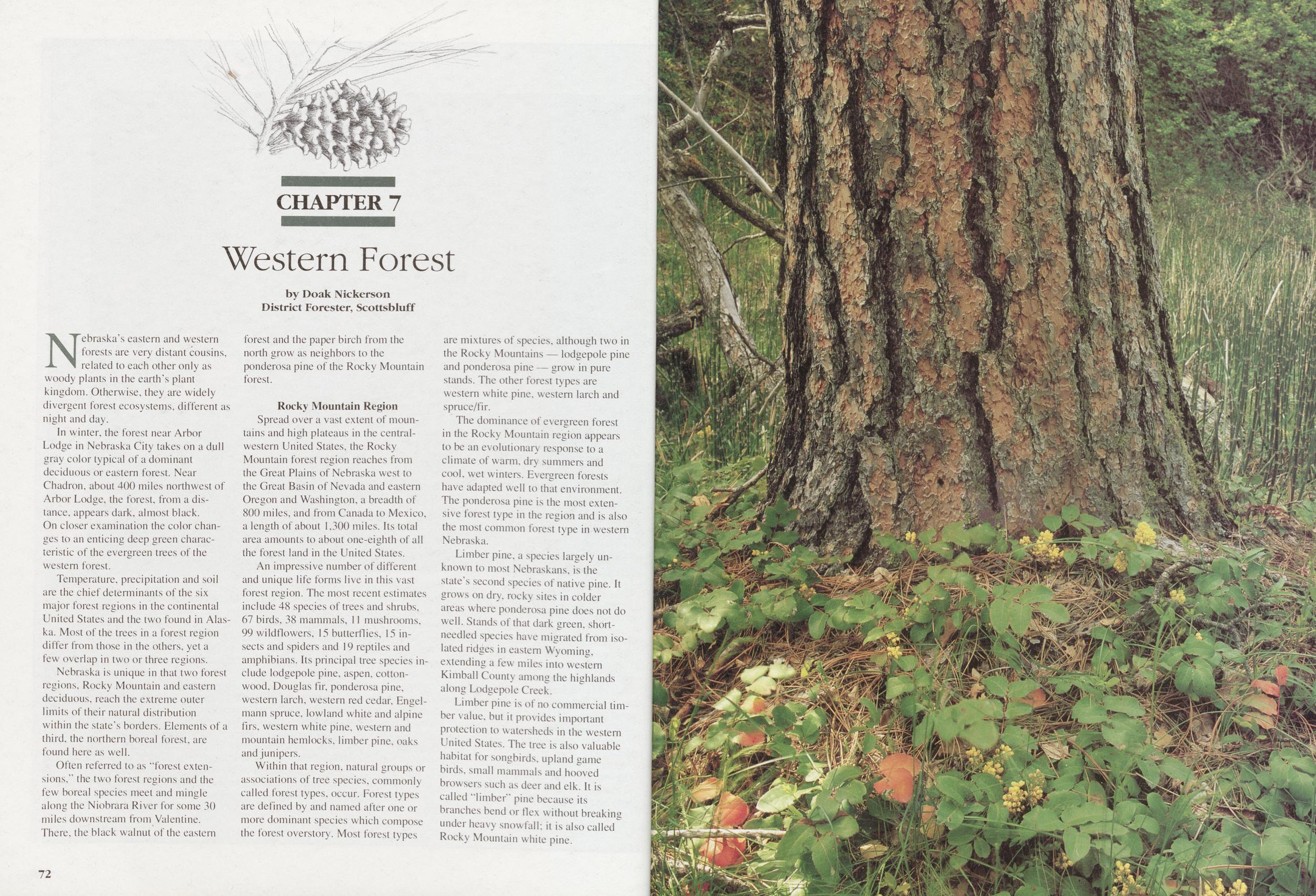
CHAPTER 7
Western Forest
Nebraska's eastern and western forests are very distant cousins, related to each other only as woody plants in the earth's plant kingdom. Otherwise, they are widely divergent forest ecosystems, different as night and day.
In winter, the forest near Arbor Lodge in Nebraska City takes on a dull gray color typical of a dominant deciduous or eastern forest. Near Chadron, about 400 miles northwest of Arbor Lodge, the forest, from a distance, appears dark, almost black. On closer examination the color changes to an enticing deep green characteristic of the evergreen trees of the western forest.
Temperature, precipitation and soil are the chief determinants of the six major forest regions in the continental United States and the two found in Alaska. Most of the trees in a forest region differ from those in the others, yet a few overlap in two or three regions.
Nebraska is unique in that two forest regions. Rocky Mountain and eastern deciduous, reach the extreme outer limits of their natural distribution within the state's borders. Elements of a third, the northern boreal forest, are found here as well.
Often referred to as "forest extensions." the two forest regions and the few boreal species meet and mingle along the Niobrara River for some 30 miles downstream from Valentine. There, the black walnut of the eastern forest and the paper birch from the north grow as neighbors to the ponderosa pine of the Rocky Mountain forest.
Rocky Mountain RegionSpread over a vast extent of mountains and high plateaus in the centralwestern United States, the Rocky Mountain forest region reaches from the Great Plains of Nebraska west to the Great Basin of Nevada and eastern Oregon and Washington, a breadth of 800 miles, and from Canada to Mexico, a length of about 1,300 miles. Its total area amounts to about one-eighth of all the forest land in the United States.
An impressive number of different and unique life forms live in this vast forest region. The most recent estimates include 48 species of trees and shrubs, 67 birds, 38 mammals, 11 mushrooms, 99 wildflowers, 15 butterflies, 15 insects and spiders and 19 reptiles and amphibians. Its principal tree species include lodgepole pine, aspen, cottonwood, Douglas fir, ponderosa pine, western larch, western red cedar, Engelmann spruce, lowland white and alpine firs, western white pine, western and mountain hemlocks, limber pine, oaks and junipers.
Within that region, natural groups or associations of tree species, commonly called forest types, occur. Forest types are defined by and named after one or more dominant species which compose the forest over story. Most forest types are mixtures of species, although two in the Rocky Mountains — lodgepole pine and ponderosa pine — grow in pure stands. The other forest types are western white pine, western larch and spruce/fir.
The dominance of evergreen forest in the Rocky Mountain region appears to be an evolutionary response to a climate of warm, dry summers and cool, wet winters. Evergreen forests have adapted well to that environment. The ponderosa pine is the most extensive forest type in the region and is also the most common forest type in western Nebraska.
Limber pine, a species largely unknown to most Nebraskans, is the state's second species of native pine. It grows on dry. rocky sites in colder areas where ponderosa pine does not do well. Stands of that dark green, short needled species have migrated from isolated ridges in eastern Wyoming, extending a few miles into western Kimball County among the highlands along Lodgepole Creek.
Limber pine is of no commercial timber value, but it provides important protection to watersheds in the western United States. The tree is also valuable habitat for songbirds, upland game birds, small mammals and hooved browsers such as deer and elk. It is called "limber" pine because its branches bend or tlex without breaking under heavy snowfall: it is also called Rocky Mountain white pine.
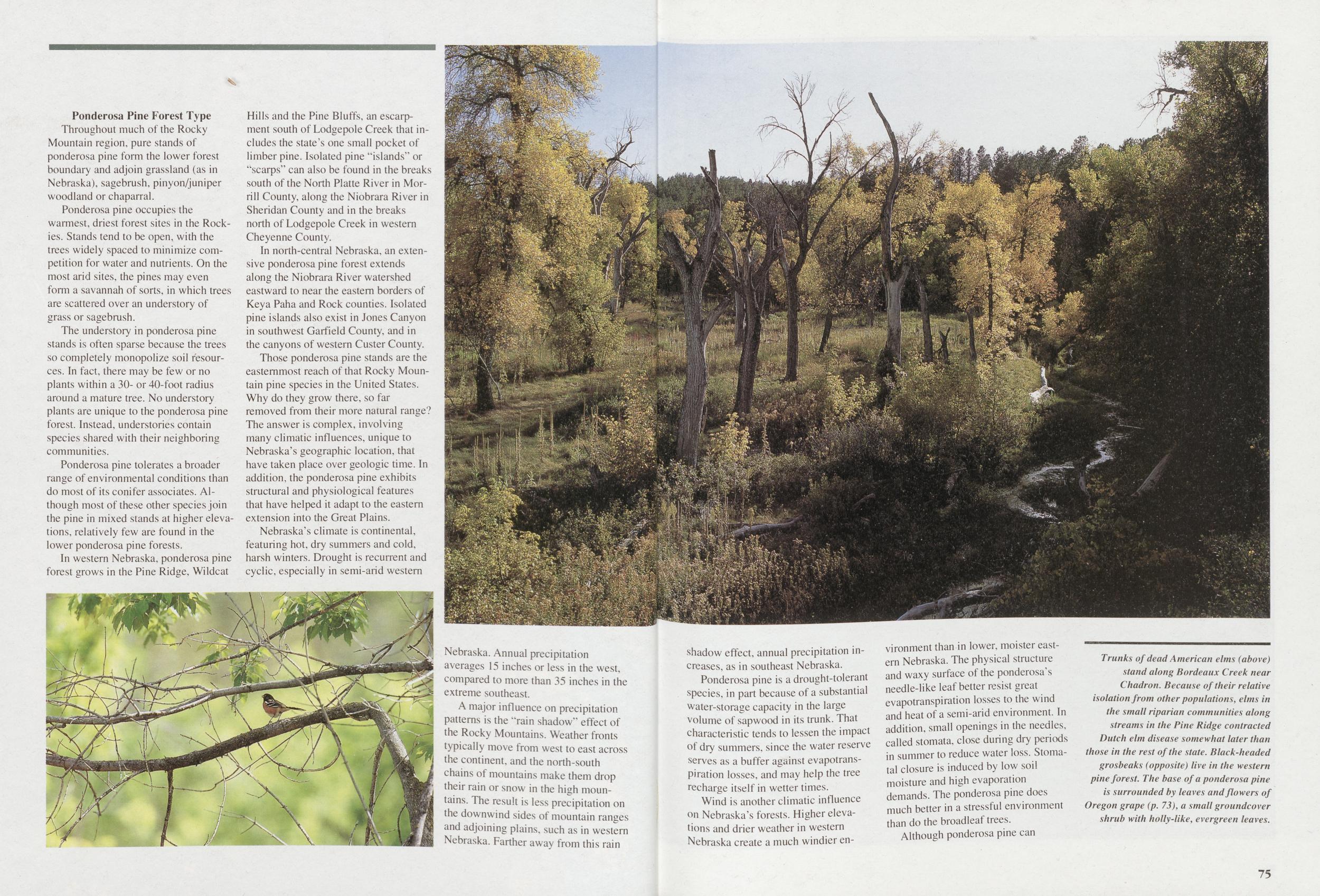 Ponderosa Pine Forest Type
Throughout much of the Rocky Mountain region, pure stands of ponderosa pine form the lower forest boundary and adjoin grassland (as in Nebraska), sagebrush, pinyon/juniper woodland or chaparral.
Ponderosa pine occupies the warmest, driest forest sites in the Rockies. Stands tend to be open, with the trees widely spaced to minimize com- petition for water and nutrients. On the most arid sites, the pines may even form a savannah of sorts, in which trees are scattered over an understory of grass or sagebrush.
The understory in ponderosa pine stands is often sparse because the trees so completely monopolize soil resources. In fact, there may be few or no plants within a 30- or 40-foot radius around a mature tree. No understory plants are unique to the ponderosa pine forest. Instead, under stories contain species shared with their neighboring communities.
Ponderosa pine tolerates a broader range of environmental conditions than do most of its conifer associates. Although most of these other species join the pine in mixed stands at higher elevations, relatively few are found in the lower ponderosa pine forests.
In western Nebraska, ponderosa pine forest grows in the Pine Ridge, Wildcat Hills and the Pine Bluffs, an escarpment south of Lodgepole Creek that includes the state's one small pocket of limber pine. Isolated pine "islands" or "scarps" can also be found in the breaks south of the North Platte River in Morrill County, along the Niobrara River in Sheridan County and in the breaks north of Lodgepole Creek in western Cheyenne County.
In north-central Nebraska, an extensive ponderosa pine forest extends along the Niobrara River watershed eastward to near the eastern borders of Keya Paha and Rock counties. Isolated pine islands also exist in Jones Canyon in southwest Garfield County, and in the canyons of western Custer County.
Those ponderosa pine stands are the easternmost reach of that Rocky Mountain pine species in the United States. Why do they grow there, so far removed from their more natural range? The answer is complex, involving many climatic influences, unique to Nebraska's geographic location, that have taken place over geologic time. In addition, the ponderosa pine exhibits structural and physiological features that have helped it adapt to the eastern extension into the Great Plains.
Nebraska's climate is continental, featuring hot, dry summers and cold, harsh winters. Drought is recurrent and cyclic, especially in semi-arid western Nebraska. Annual precipitation averages 15 inches or less in the west, compared to more than 35 inches in the extreme southeast.
A major influence on precipitation patterns is the "rain shadow" effect of the Rocky Mountains. Weather fronts typically move from west to east across the continent, and the north-south chains of mountains make them drop their rain or snow in the high mountains. The result is less precipitation on the downwind sides of mountain ranges and adjoining plains, such as in western Nebraska. Farther away from this rain shadow effect, annual precipitation increases, as in southeast Nebraska.
Ponderosa pine is a drought-tolerant species, in part because of a substantial water-storage capacity in the large volume of sapwood in its trunk. That characteristic tends to lessen the impact of dry summers, since the water reserve serves as a buffer against evapotranspiration losses, and may help the tree recharge itself in wetter times.
Wind is another climatic influence on Nebraska's forests. Higher elevations and drier weather in western Nebraska create a much windier environment than in lower, moister eastern Nebraska. The physical structure and waxy surface of the ponderosa's needle-like leaf better resist great evapotranspiration losses to the wind and heat of a semi-arid environment. In addition, small openings in the needles, called stomata, close during dry periods in summer to reduce water loss. Stomatal closure is induced by low soil moisture and high evaporation demands. The ponderosa pine does much better in a stressful environment than do the broadleaf trees.
Although ponderosa pine can
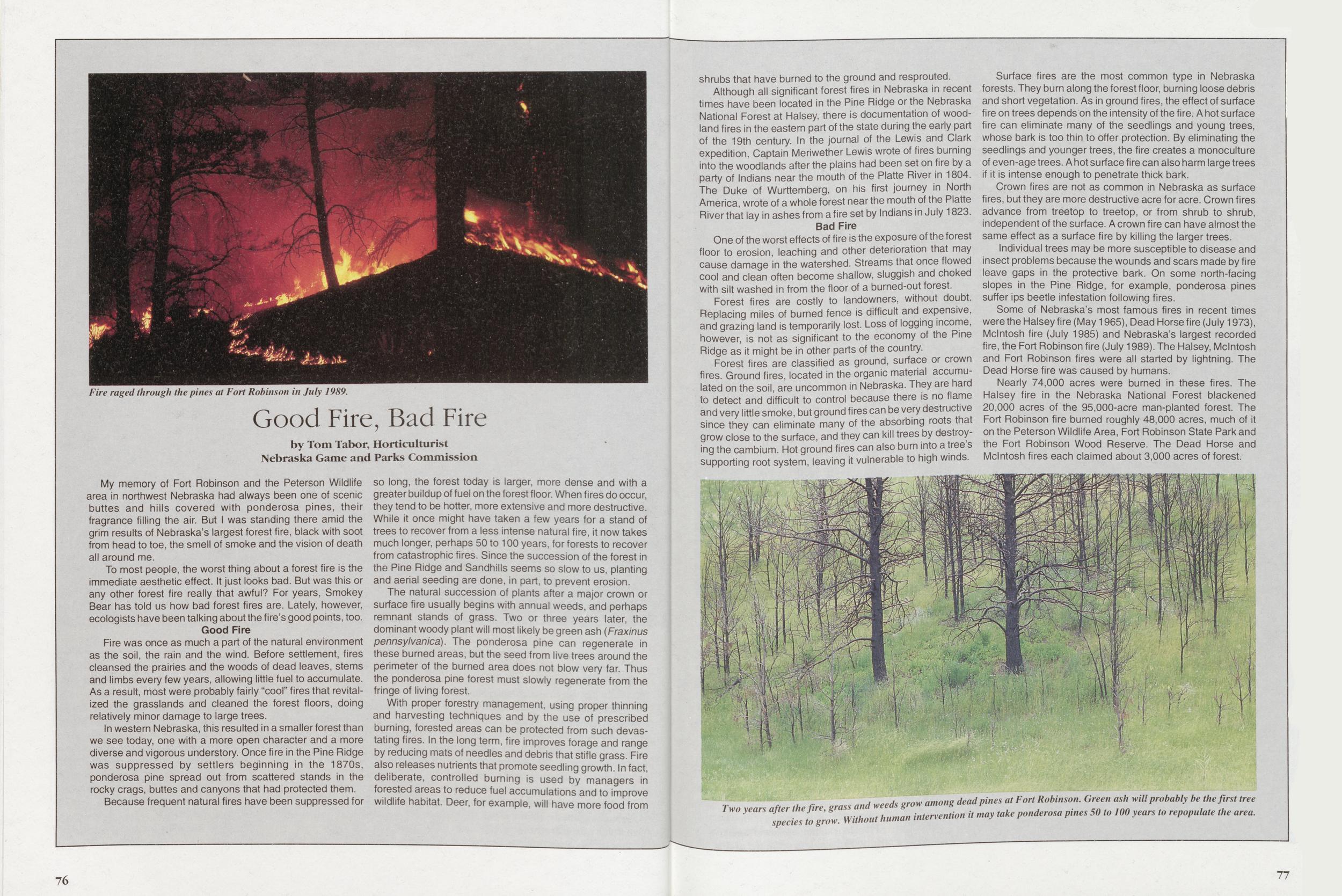
Good Fire, Bad Fire
My memory of Fort Robinson and the Peterson Wildlife area in northwest Nebraska had always been one of scenic buttes and hills covered with ponderosa pines, their fragrance filling the air. But I was standing there amid the grim results of Nebraska's largest forest fire, black with soot from head to toe, the smell of smoke and the vision of death all around me.
To most people, the worst thing about a forest fire is the immediate aesthetic effect. It just looks bad. But was this or any other forest fire really that awful? For years, Smokey Bear has told us how bad forest fires are. Lately, however, ecologists have been talking about the fire's good points, too.
Good FireFire was once as much a part of the natural environment as the soil, the rain and the wind. Before settlement, fires cleansed the prairies and the woods of dead leaves, stems and limbs every few years, allowing little fuel to accumulate. As a result, most were probably fairly "cool" fires that revitalized the grasslands and cleaned the forest floors, doing relatively minor damage to large trees.
In western Nebraska, this resulted in a smaller forest than we see today, one with a more open character and a more diverse and vigorous understory. Once fire in the Pine Ridge was suppressed by settlers beginning in the 1870s, ponderosa pine spread out from scattered stands in the rocky crags, buttes and canyons that had protected them.
Because frequent natural fires have been suppressed for so long, the forest today is larger, more dense and with a greater buildup of fuel on the forest floor. When fires do occur, they tend to be hotter, more extensive and more destructive. While it once might have taken a few years for a stand of trees to recover from a less intense natural fire, it now takes much longer, perhaps 50 to 100 years, for forests to recover from catastrophic fires. Since the succession of the forest in the Pine Ridge and Sandhills seems so slow to us, planting and aerial seeding are done, in part, to prevent erosion.
The natural succession of plants after a major crown or surface fire usually begins with annual weeds, and perhaps remnant stands of grass. Two or three years later, the dominant woody plant will most likely be green ash (Fraxinus pennsylvanica). The ponderosa pine can regenerate in these burned areas, but the seed from live trees around the perimeter of the burned area does not blow very far. Thus the ponderosa pine forest must slowly regenerate from the fringe of living forest.
With proper forestry management, using proper thinning and harvesting techniques and by the use of prescribed burning, forested areas can be protected from such devastating fires. In the long term, fire improves forage and range by reducing mats of needles and debris that stifle grass. Fire also releases nutrients that promote seedling growth. In fact, deliberate, controlled burning is used by managers in forested areas to reduce fuel accumulations and to improve wildlife habitat. Deer, for example, will have more food from shrubs that have burned to the ground and resprouted.
Although all significant forest fires in Nebraska in recent times have been located in the Pine Ridge or the Nebraska National Forest at Halsey, there is documentation of woodland fires in the eastern part of the state during the early part of the 19th century. In the journal of the Lewis and Clark expedition, Captain Meriwether Lewis wrote of fires burning into the woodlands after the plains had been set on fire by a party of Indians near the mouth of the Platte River in 1804. The Duke of Wurttemberg, on his first journey in North America, wrote of a whole forest near the mouth of the Platte River that lay in ashes from a fire set by Indians in July 1823.
Bad FireOne of the worst effects of fire is the exposure of the forest floor to erosion, leaching and other deterioration that may cause damage in the watershed. Streams that once flowed cool and clean often become shallow, sluggish and choked with silt washed in from the floor of a burned-out forest.
Forest fires are costly to landowners, without doubt. Replacing miles of burned fence is difficult and expensive, and grazing land is temporarily lost. Loss of logging income, however, is not as significant to the economy of the Pine Ridae as it might be in other parts of the country.
Forest fires are classified as ground, surface or crown fires. Ground fires, located in the organic material accumulated on the soil, are uncommon in Nebraska. They are hard to detect and difficult to control because there is no flame and very little smoke, but ground fires can be very destructive since they can eliminate many of the absorbing roots that grow close to the surface, and they can kill trees by destroying the cambium. Hot ground fires can also burn into a tree s supporting root system, leaving it vulnerable to high winds.
Surface fires are the most common type in Nebraska forests. They burn along the forest floor, burning loose debris and short vegetation. As in ground fires, the effect of surface fire on trees depends on the intensity of the fire. A hot surface fire can eliminate many of the seedlings and young trees, whose bark is too thin to offer protection. By eliminating the seedlings and younger trees, the fire creates a monoculture of even-age trees. A hot surface fire can also harm large trees if it is intense enough to penetrate thick bark.
Crown fires are not as common in Nebraska as surface fires, but they are more destructive acre for acre. Crown fires advance from treetop to treetop, or from shrub to shrub, independent of the surface. A crown fire can have almost the same effect as a surface fire by killing the larger trees.
Individual trees may be more susceptible to disease and insect problems because the wounds and scars made by fire leave gaps in the protective bark. On some north-facing slopes in the Pine Ridge, for example, ponderosa pines suffer ips beetle infestation following fires.
Some of Nebraska's most famous fires in recent times were the Halsey fire (May 1965), Dead Horse fire (July 1973), Mcintosh fire (July 1985) and Nebraska's largest recorded fire, the Fort Robinson fire (July 1989). The Halsey, Mcintosh and Fort Robinson fires were all started by lightning. The Dead Horse fire was caused by humans.
Nearly 74,000 acres were burned in these fires. The Halsey fire in the Nebraska National Forest blackened 20,000 acres of the 95,000-acre man-planted forest. The Fort Robinson fire burned roughly 48,000 acres, much of it on the Peterson Wildlife Area, Fort Robinson State Park and the Fort Robinson Wood Reserve. The Dead Horse and Mcintosh fires each claimed about 3,000 acres of forest.
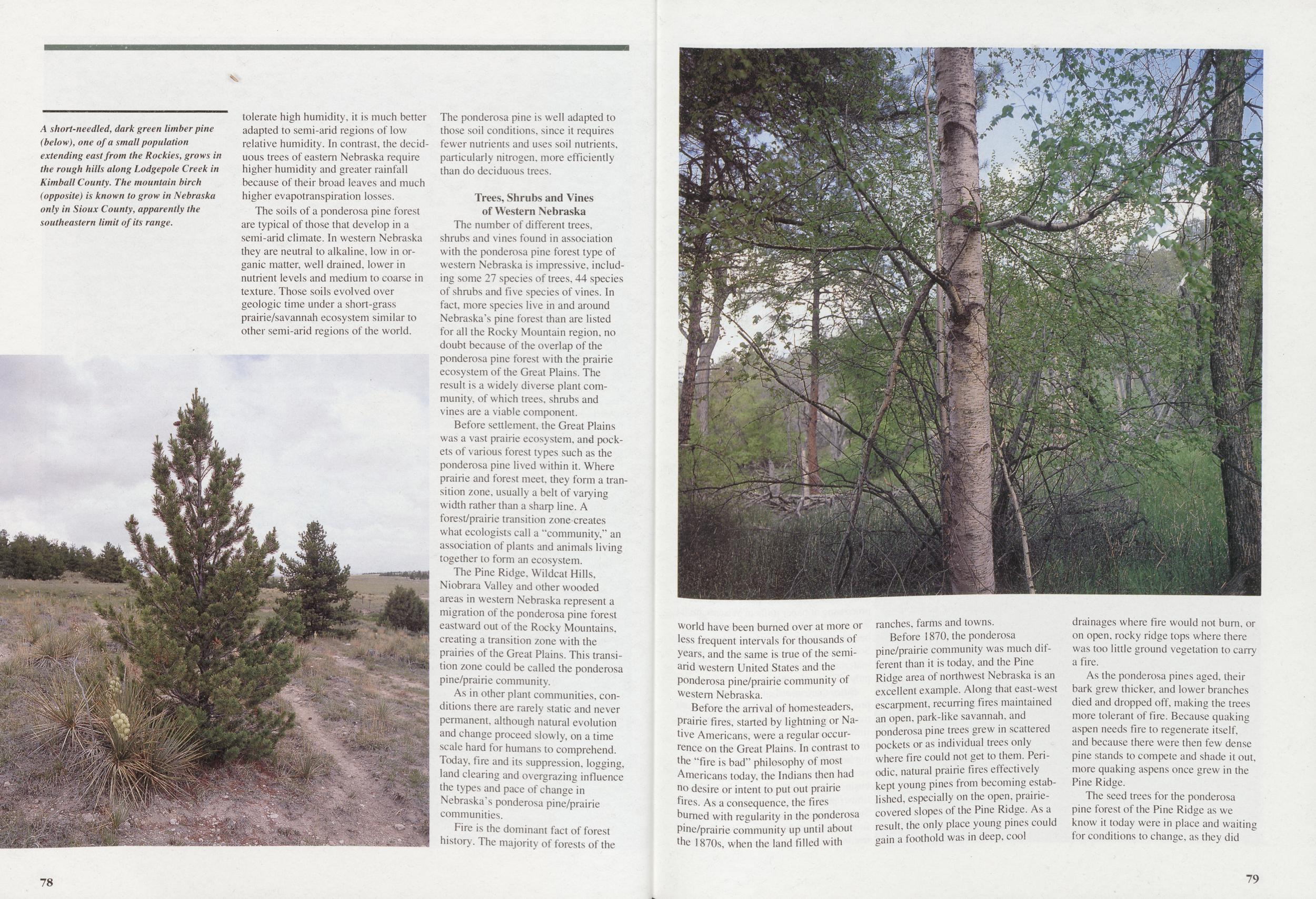
tolerate high humidity, it is much better adapted to semi-arid regions of low relative humidity. In contrast, the deciduous trees of eastern Nebraska require higher humidity and greater rainfall because of their broad leaves and much higher evapotranspiration losses.
The soils of a ponderosa pine forest are typical of those that develop in a semi-arid climate. In western Nebraska they are neutral to alkaline, low in organic matter, well drained, lower in nutrient levels and medium to coarse in texture. Those soils evolved over geologic time under a short-grass prairie/savannah ecosystem similar to other semi-arid regions of the world. The ponderosa pine is well adapted to those soil conditions, since it requires fewer nutrients and uses soil nutrients, particularly nitrogen, more efficiently than do deciduous trees.
Trees, Shrubs and Vines of Western NebraskaThe number of different trees, shrubs and vines found in association with the ponderosa pine forest type of western Nebraska is impressive, including some 27 species of trees, 44 species of shrubs and five species of vines. In fact, more species live in and around Nebraska's pine forest than are listed for all the Rocky Mountain region, no doubt because of the overlap of the ponderosa pine forest with the prairie ecosystem of the Great Plains. The result is a widely diverse plant community, of which trees, shrubs and vines are a viable component.
Before settlement, the Great Plains was a vast prairie ecosystem, and pockets of various forest types such as the ponderosa pine lived within it. Where prairie and forest meet, they form a transition zone, usually a belt of varying width rather than a sharp line. A forest/prairie transition zone creates what ecologists call a "community," an association of plants and animals living together to form an ecosystem.
The Pine Ridge, Wildcat Hills, Niobrara Valley and other wooded areas in western Nebraska represent a migration of the ponderosa pine forest eastward out of the Rocky Mountains, creating a transition zone with the prairies of the Great Plains. This transition zone could be called the ponderosa pine/prairie community.
As in other plant communities, conditions there are rarely static and never permanent, although natural evolution and change proceed slowly, on a time scale hard for humans to comprehend. Today, fire and its suppression, logging, land clearing and overgrazing influence the types and pace of change in Nebraska's ponderosa pine/prairie communities.
Fire is the dominant fact of forest history. The majority of forests of the world have been burned over at more or less frequent intervals for thousands of years, and the same is true of the semiarid western United States and the ponderosa pine/prairie community of western Nebraska.
Before the arrival of homesteaders, prairie fires, started by lightning or Native Americans, were a regular occurrence on the Great Plains. In contrast to the 'Tire is bad" philosophy of most Americans today, the Indians then had no desire or intent to put out prairie fires. As a consequence, the fires burned with regularity in the ponderosa Pine/prairie community up until about the 1870s, when the land filled with ranches, farms and towns.
Before 1870, the ponderosa pine/prairie community was much different than it is today, and the Pine Ridge area of northwest Nebraska is an excellent example. Along that east-vest escarpment, recurring fires maintained an open, park-like savannah, and ponderosa pine trees grew in scattered pockets or as individual trees only where fire could not get to them. Periodic, natural prairie fires effectively kept young pines from becoming established, especially on the open, prairie covered slopes of the Pine Ridge. As a result, the only place young pines could gain a foothold was in deep, cool drainages where fire would not bum, or on open, rocky ridge tops where there was too little ground vegetation to carry a fire.
As the ponderosa pines aged, their bark grew thicker, and lower branches died and dropped off, making the trees more tolerant of fire. Because quaking aspen needs fire to regenerate itself, and because there were then few dense pine stands to compete and shade it out, more quaking aspens once grew in the Pine Ridge.
The seed trees for the ponderosa pine forest of the Pine Ridge as we know it today were in place and waiting for conditions to change, as they did
78 79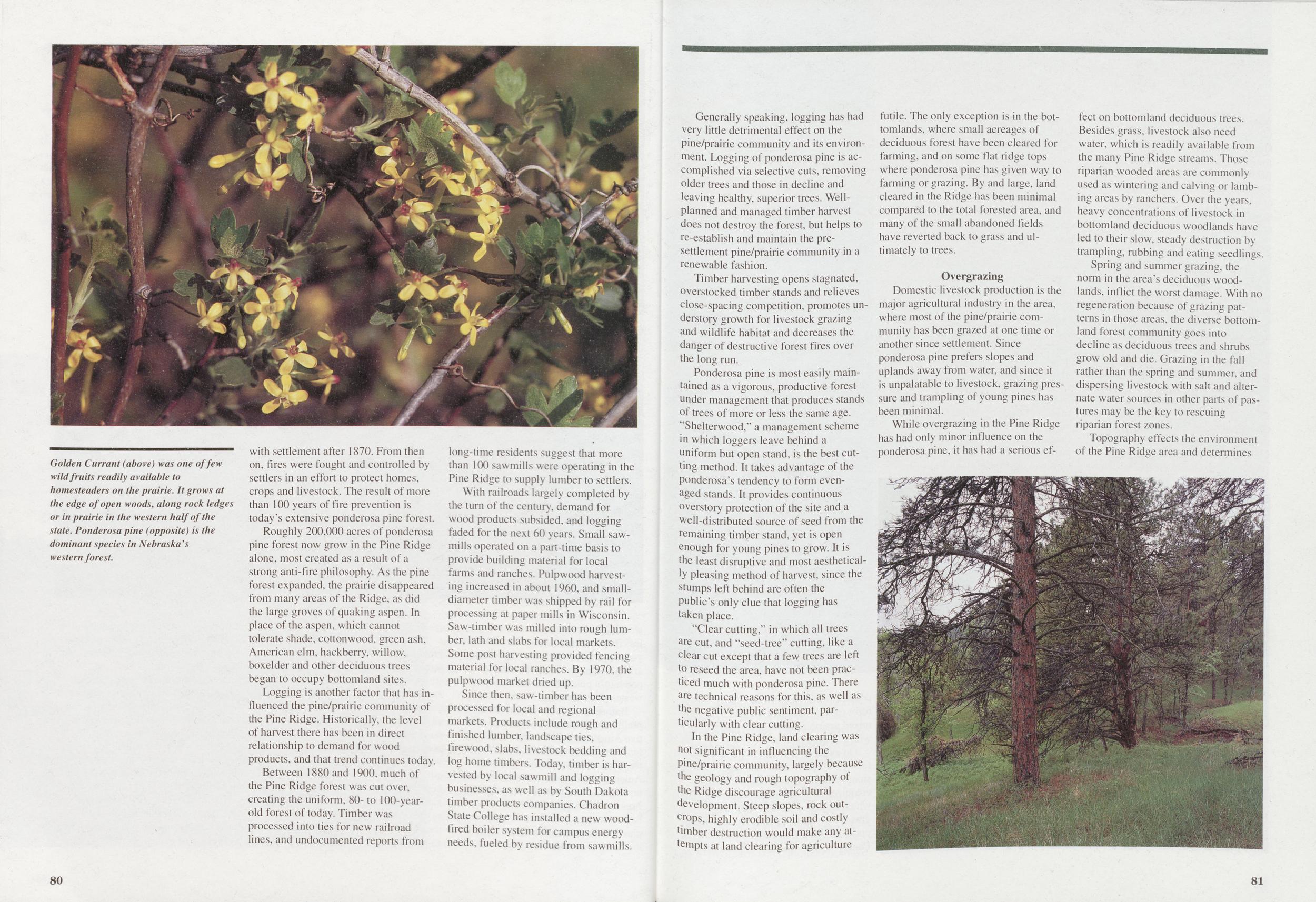
with settlement after 1870. From then on, fires were fought and controlled by settlers in an effort to protect homes, crops and livestock. The result of more than 100 years of fire prevention is today's extensive ponderosa pine forest.
Roughly 200,000 acres of ponderosa pine forest now grow in the Pine Ridge alone, most created as a result of a strong anti-fire philosophy. As the pine forest expanded, the prairie disappeared from many areas of the Ridge, as did the large groves of quaking aspen. In place of the aspen, which cannot tolerate shade, cottonwood, green ash, American elm, hackberry, willow, boxelder and other deciduous trees began to occupy bottomland sites.
Logging is another factor that has influenced the pine/prairie community of the Pine Ridge. Historically, the level of harvest there has been in direct relationship to demand for wood products, and that trend continues today.
Between 1880 and 1900, much of the Pine Ridge forest was cut over, creating the uniform, 80- to 100-year old forest of today. Timber was processed into ties for new railroad lines, and undocumented reports from long-time residents suggest that more than 100 sawmills were operating in the Pine Ridge to supply lumber to settlers.
With railroads largely completed by the turn of the century, demand for wood products subsided, and logging faded for the next 60 years. Small sawmills operated on a part-time basis to provide building material for local farms and ranches. Pulpwood harvesting increased in about 1960, and small diameter timber was shipped by rail for processing at paper mills in Wisconsin. Saw-timber was milled into rough lumber, lath and slabs for local markets. Some post harvesting provided fencing material for local ranches. By 1970, the pulpwood market dried up.
Since then, saw-timber has been processed for local and regional markets. Products include rough and finished lumber, landscape ties, firewood, slabs, livestock bedding and log home timbers. Today, timber is harvested by local sawmill and logging businesses, as well as by South Dakota timber products companies. Chadron State College has installed a new wood fired boiler system for campus energy needs, fueled by residue from sawmills.
Generally speaking, logging has had very little detrimental effect on the pine/prairie community and its environment. Logging of ponderosa pine is accomplished via selective cuts, removing older trees and those in decline and leaving healthy, superior trees. Well planned and managed timber harvest does not destroy the forest, but helps to re-establish and maintain the presettlement pine/prairie community in a renewable fashion.
Timber harvesting opens stagnated, overstocked timber stands and relieves close-spacing competition, promotes understory growth for livestock grazing and wildlife habitat and decreases the danger of destructive forest fires over the long run.
Ponderosa pine is most easily maintained as a vigorous, productive forest under management that produces stands of trees of more or less the same age. "Shelterwood," a management scheme in which loggers leave behind a uniform but open stand, is the best cutting method. It takes advantage of the ponderosa's tendency to form evenaged stands. It provides continuous over story protection of the site and a well-distributed source of seed from the remaining timber stand, yet is open enough for young pines to grow. It is the least disruptive and most aesthetically pleasing method of harvest, since the stumps left behind are often the Public's only clue that logging has taken place.
"Clear cutting," in which all trees are cut, and "seed-tree" cutting, like a clear cut except that a few trees are left to reseed the area, have not been practiced much with ponderosa pine. There are technical reasons for this, as well as the negative public sentiment, particularly with clear cutting.
In the Pine Ridge, land clearing was up significant in influencing the Pine/prairie community, largely because the geology and rough topography of the Ridge discourage agricultural development. Steep slopes, rock out crops, highly erodible soil and costly timber destruction would make any attempts at land clearing for agriculture futile. The only exception is in the bottom lands, where small acreages of deciduous forest have been cleared for farming, and on some flat ridge tops where ponderosa pine has given way to farming or grazing. By and large, land cleared in the Ridge has been minimal compared to the total forested area, and many of the small abandoned fields have reverted back to grass and ultimately to trees.
OvergrazingDomestic livestock production is the major agricultural industry in the area, where most of the pine/prairie community has been grazed at one time or another since settlement. Since ponderosa pine prefers slopes and uplands away from water, and since it is unpalatable to livestock, grazing pressure and trampling of young pines has been minimal.
While overgrazing in the Pine Ridge has had only minor influence on the ponderosa pine, it has had a serious effect on bottomland deciduous trees. Besides grass, livestock also need water, which is readily available from the many Pine Ridge streams. Those riparian wooded areas are commonly used as wintering and calving or lambing areas by ranchers. Over the years, heavy concentrations of livestock in bottomland deciduous woodlands have led to their slow, steady destruction by trampling, rubbing and eating seedlings.
Spring and summer grazing, the norm in the area's deciduous wood lands, inflict the worst damage. With no regeneration because of grazing patterns in those areas, the diverse bottom land forest community goes into decline as deciduous trees and shrubs grow old and die. Grazing in the fall rather than the spring and summer, and dispersing livestock with salt and alternate water sources in other parts of pastures may be the key to rescuing riparian forest zones.
Topography effects the environment of the Pine Ridge area and determines
80 81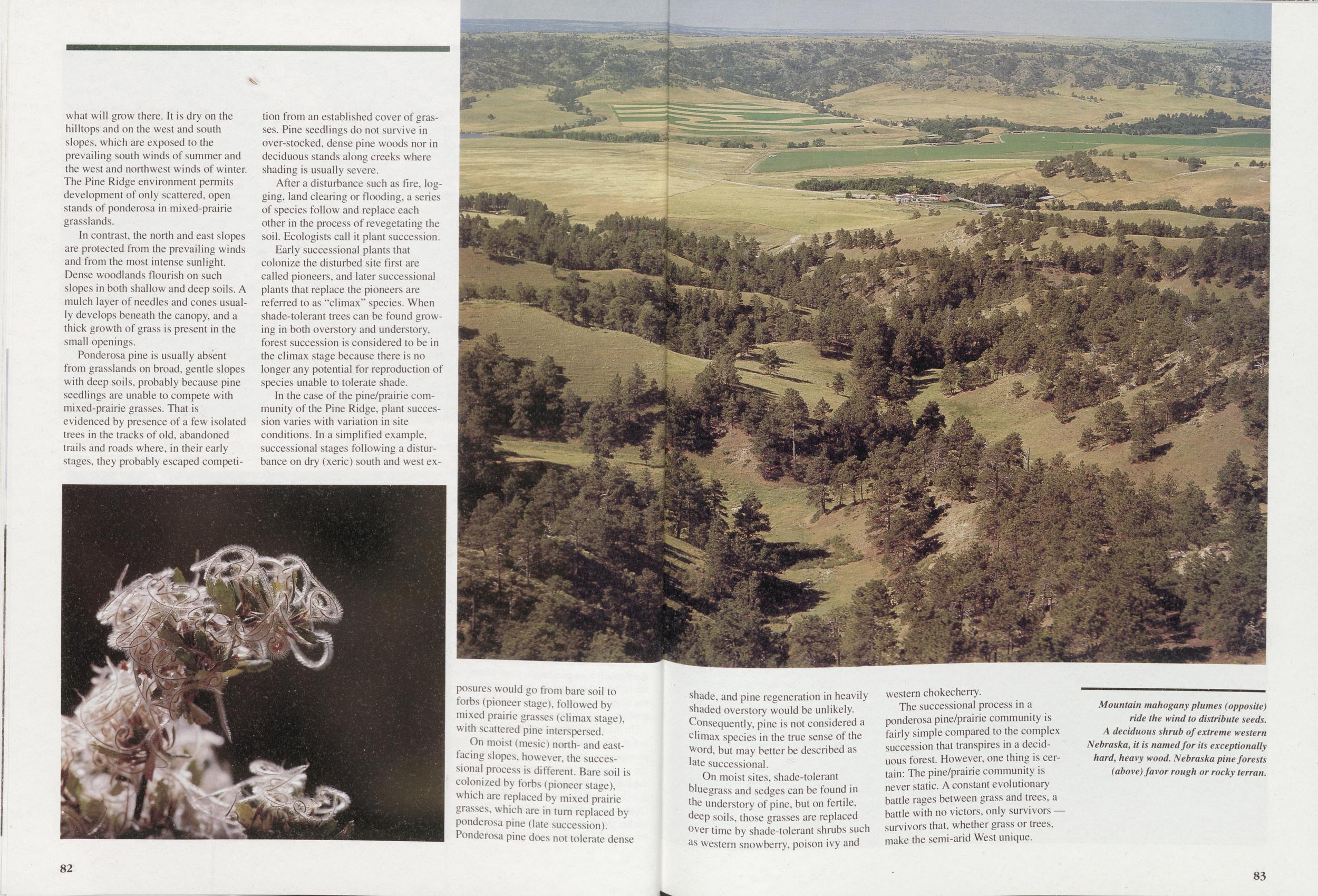
what will grow there. It is dry on the hilltops and on the west and south slopes, which are exposed to the prevailing south winds of summer and the west and northwest winds of winter. The Pine Ridge environment permits development of only scattered, open stands of ponderosa in mixed-prairie grasslands.
In contrast, the north and east slopes are protected from the prevailing winds and from the most intense sunlight. Dense woodlands flourish on such slopes in both shallow and deep soils. A mulch layer of needles and cones usually develops beneath the canopy, and a thick growth of grass is present in the small openings.
Ponderosa pine is usually absent from grasslands on broad, gentle slopes with deep soils, probably because pine seedlings are unable to compete with mixed-prairie grasses. That is evidenced by presence of a few isolated trees in the tracks of old, abandoned trails and roads where, in their early stages, they probably escaped competition from an established cover of grasses. Pine seedlings do not survive in over-stocked, dense pine woods nor in deciduous stands along creeks where shading is usually severe.
After a disturbance such as fire, logging, land clearing or flooding, a series of species follow and replace each other in the process of revegetating the soil. Ecologists call it plant succession.
Early successional plants that colonize the disturbed site first are called pioneers, and later successional plants that replace the pioneers are referred to as "climax" species. When shade-tolerant trees can be found growing in both over story and understory, forest succession is considered to be in the climax stage because there is no longer any potential for reproduction of species unable to tolerate shade.
In the case of the pine/prairie community of the Pine Ridge, plant succession varies with variation in site conditions. In a simplified example, successional stages following a disturbance on dry (xeric) south and west exposures would go from bare soil to forbs (pioneer stage), followed by mixed prairie grasses (climax stage), with scattered pine interspersed.
On moist (mesic) north- and east facing slopes, however, the successional process is different. Bare soil is colonized by forbs (pioneer stage), which are replaced by mixed prairie grasses, which are in turn replaced by ponderosa pine (late succession). Ponderosa pine does not tolerate dense shade, and pine regeneration in heavily shaded over story would be unlikely. Consequently, pine is not considered a climax species in the true sense of the word, but may better be described as late successional.
On moist sites, shade-tolerant bluegrass and sedges can be found in the understory of pine, but on fertile, deep soils, those grasses are replaced over time by shade-tolerant shrubs such as western snowberry, poison ivy and western chokecherry.
The successional process in a ponderosa pine/prairie community is fairly simple compared to the complex succession that transpires in a deciduous forest. However, one thing is certain: The pine/prairie community is never static. A constant evolutionary battle rages between grass and trees, a battle with no victors, only survivors - survivors that, whether grass or trees, make the semi-arid West unique.
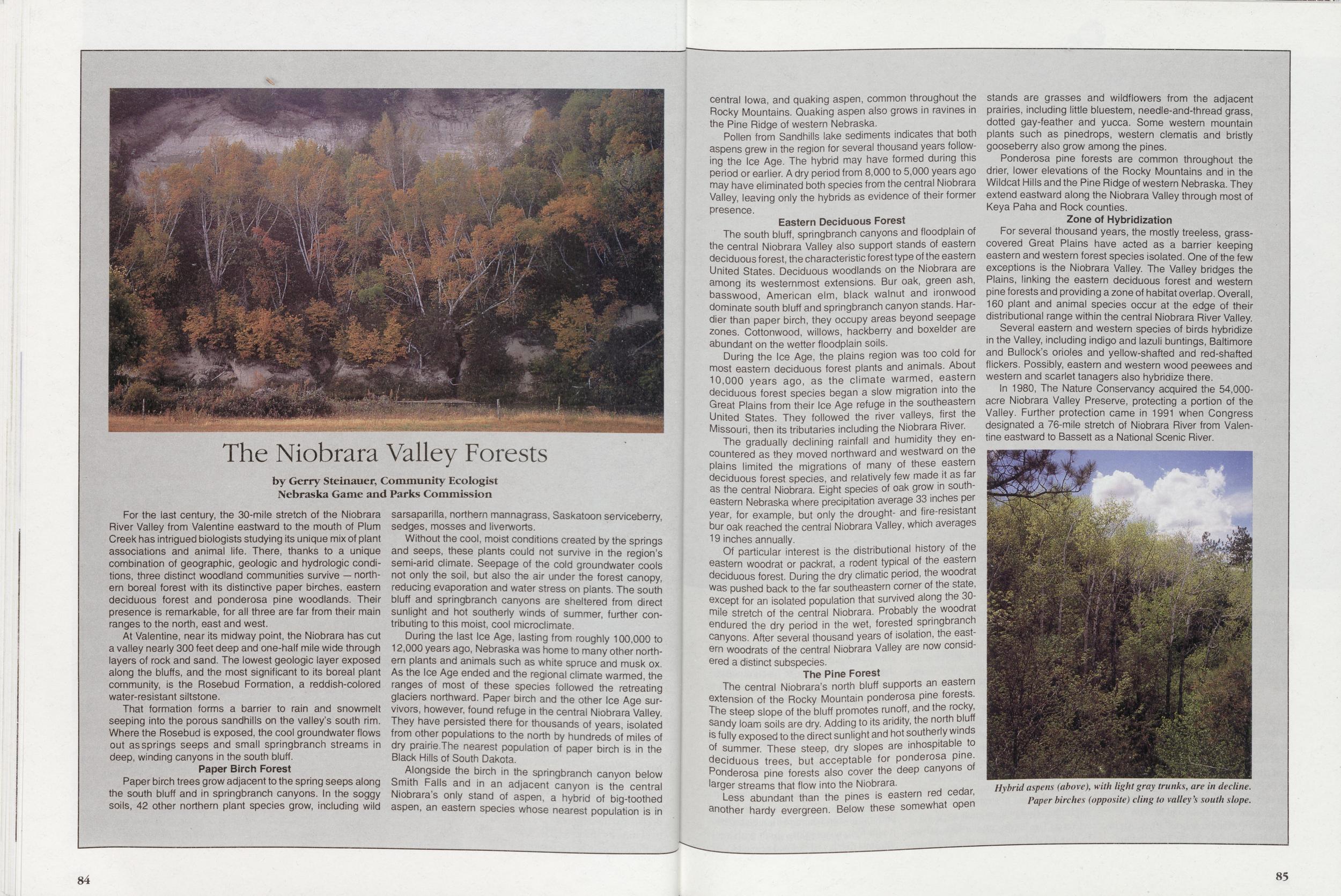
The Niobrara Valley Forests
For the last century, the 30-mile stretch of the Niobrara River Valley from Valentine eastward to the mouth of Plum Creek has intrigued biologists studying its unique mix of plant associations and animal life. There, thanks to a unique combination of geographic, geologic and hydrologic conditions, three distinct woodland communities survive — northern boreal forest with its distinctive paper birches, eastern deciduous forest and ponderosa pine woodlands. Their presence is remarkable, for all three are far from their main ranges to the north, east and west.
At Valentine, near its midway point, the Niobrara has cut a valley nearly 300 feet deep and one-half mile wide through layers of rock and sand. The lowest geologic layer exposed along the bluffs, and the most significant to its boreal plant community, is the Rosebud Formation, a reddish-colored water-resistant siltstone.
That formation forms a barrier to rain and snowmelt seeping into the porous sandhills on the valley's south rim. Where the Rosebud is exposed, the cool groundwater flows out as springs seeps and small spring branch streams in deep, winding canyons in the south bluff.
Paper Birch ForestPaper birch trees grow adjacent to the spring seeps along the south bluff and in spring branch canyons. In the soggy soils, 42 other northern plant species grow, including wild sarsapahlla, northern mannagrass, Saskatoon serviceberry, sedges, mosses and liverworts.
Without the cool, moist conditions created by the springs and seeps, these plants could not survive in the region's semi-arid climate. Seepage of the cold groundwater cools not only the soil, but also the air under the forest canopy, reducing evaporation and water stress on piants. The south bluff and spring branch canyons are sheltered from direct sunlight and hot southerly winds of summer, further contributing to this moist, cool microclimate.
During the last Ice Age, lasting from roughly 100,000 to 12,000 years ago, Nebraska was home to many other northern plants and animals such as white spruce and musk ox. As the Ice Age ended and the regional climate warmed, the ranges of most of these species followed the retreating glaciers northward. Paper birch and the other Ice Age survivors, however, found refuge in the central Niobrara Valley. They have persisted there for thousands of years, isolated from other populations to the north by hundreds of miles of dry prairie.The nearest population of paper birch is in the Black Hills of South Dakota.
Alongside the birch in the spring branch canyon below Smith Falls and in an adjacent canyon is the central Niobrara's only stand of aspen, a hybrid of big-toothed aspen, an eastern species whose nearest population is in central Iowa, and quaking aspen, common throughout the Rocky Mountains. Quaking aspen also grows in ravines in the Pine Ridge of western Nebraska.
Pollen from Sandhills lake sediments indicates that both aspens grew in the region for several thousand years following the Ice Age. The hybrid may have formed during this period or earlier. A dry period from 8,000 to 5,000 years ago may have eliminated both species from the central Niobrara Valley, leaving only the hybrids as evidence of their former presence.
Eastern Deciduous ForestThe south bluff, spring branch canyons and floodplain of the central Niobrara Valley also support stands of eastern deciduous forest, the characteristic forest type of the eastern United States. Deciduous woodlands on the Niobrara are among its westernmost extensions. Bur oak, green ash, basswood, American elm, black walnut and ironwood dominate south bluff and spring branch canyon stands. Hardier than paper birch, they occupy areas beyond seepage zones. Cottonwood, willows, hackberry and boxelder are abundant on the wetter floodplain soils.
During the Ice Age, the plains region was too cold for most eastern deciduous forest plants and animals. About 10,000 years ago, as the climate warmed, eastern deciduous forest species began a slow migration into the Great Plains from their ice Age refuge in the southeastern United States. They followed the river valleys, first the Missouri, then its tributaries including the Niobrara River.
The gradually declining rainfall and humidity they encountered as they moved northward and westward on the plains limited the migrations of many of these eastern deciduous forest species, and relatively few made it as far as the central Niobrara. Eight species of oak grow in south eastern Nebraska where precipitation average 33 inches per year, for example, but only the drought- and fire-resistant bur oak reached the central Niobrara Valley, which averages 19 inches annually.
Of particular interest is the distributional history of the eastern woodrat or packrat, a rodent typical of the eastern deciduous forest. During the dry climatic period, the wood rat was pushed back to the far southeastern corner of the state, except for an isolated population that survived along the 30-mile stretch of the central Niobrara. Probably the wood rat endured the dry period in the wet, forested spring branch canyons. After several thousand years of isolation, the eastern wood rats of the central Niobrara Valley are now considered a distinct subspecies.
The Pine ForestThe central Niobrara's north bluff supports an eastern extension of the Rocky Mountain ponderosa pine forests. The steep slope of the bluff promotes runoff, and the rocky sandy loam soils are dry. Adding to its aridity, the north blurt «s fully exposed to the direct sunlight and hot southerly winds of summer. These steep, dry slopes are inhospitable to deciduous trees, but acceptable for ponderosa pine. Ponderosa pine forests also cover the deep canyons or larger streams that flow into the Niobrara.
Less abundant than the pines is eastern red ceoac another hardy evergreen. Below these somewhat open stands are grasses and wildflowers from the adjacent prairies, including little bluestem, needle-and-thread grass, dotted gay-feather and yucca. Some western mountain plants such as pinedrops, western clematis and bristly gooseberry also grow among the pines.
Ponderosa pine forests are common throughout the drier, lower elevations of the Rocky Mountains and in the Wildcat Hills and the Pine Ridge of western Nebraska. They extend eastward along the Niobrara Valley through most of Keya Paha and Rock counties.
Zone of HybridizationFor several thousand years, the mostly treeless, grass covered Great Plains have acted as a barrier keeping eastern and western forest species isolated. One of the few exceptions is the Niobrara Valley. The Valley bridges the Plains, linking the eastern deciduous forest and western pine forests and providing a zone of habitat overlap. Overall, 160 plant and animal species occur at the edge of their distributional range within the central Niobrara River Valley.
Several eastern and western species of birds hybridize in the Valley, including indigo and lazuli buntings, Baltimore and Bullock's orioles and yellow-shafted and red-shafted flickers. Possibly, eastern and western wood peewees and western and scarlet tanagers also hybridize there.
In 1980, The Nature Conservancy acquired the 54,000- acre Niobrara Valley Preserve, protecting a portion of the Valley. Further protection came in 1991 when Congress designated a 76-mile stretch of Niobrara River from Valentine eastward to Bassett as a National Scenic River.
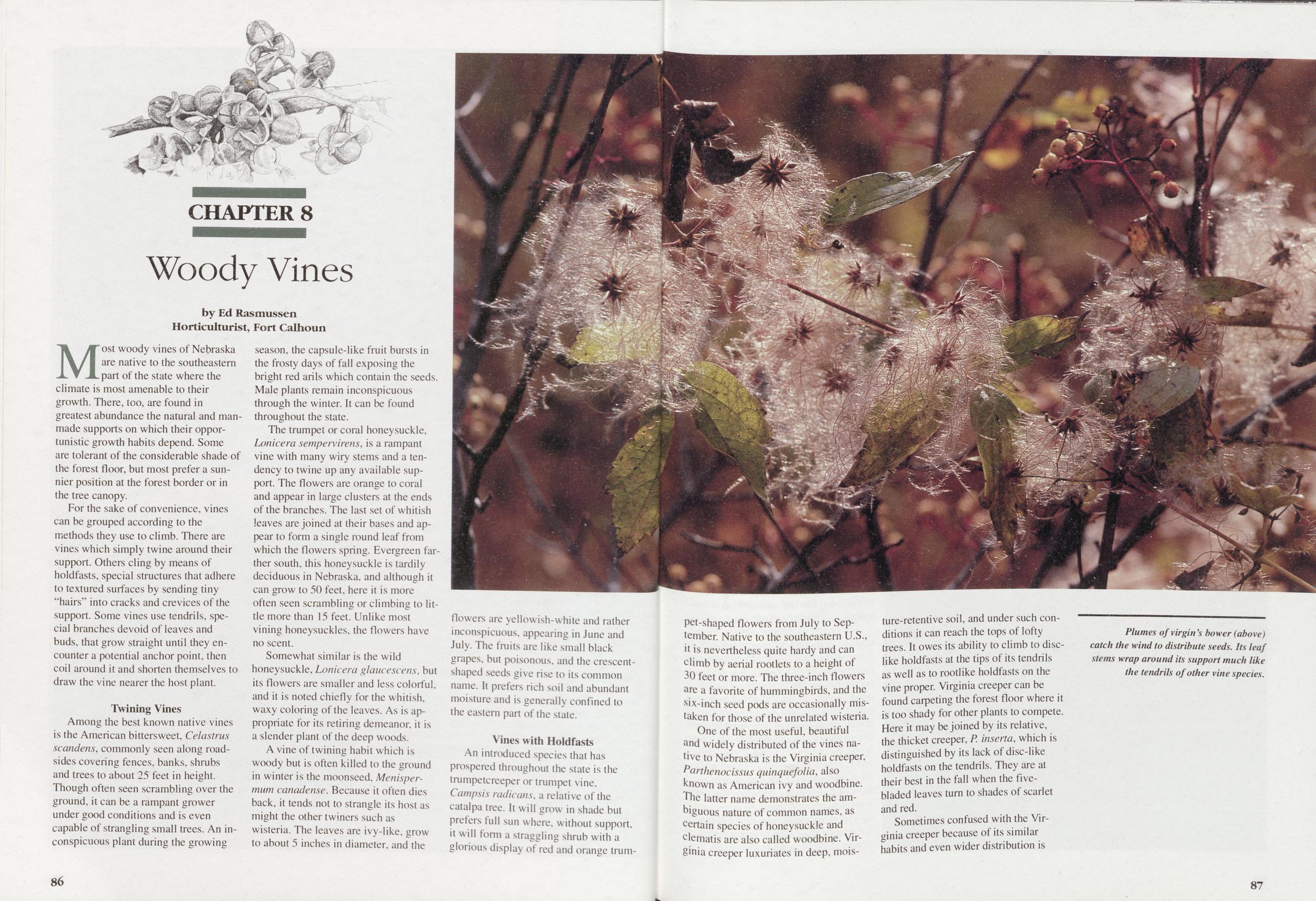
CHAPTER 8
Woody Vines
Most woody vines of Nebraska are native to the southeastern part of the state where the climate is most amenable to their growth. There, too, are found in greatest abundance the natural and manmade supports on which their opportunistic growth habits depend. Some are tolerant of the considerable shade of the forest floor, but most prefer a sunnier position at the forest border or in the tree canopy.
For the sake of convenience, vines can be grouped according to the methods they use to climb. There are vines which simply twine around their support. Others cling by means of holdfasts, special structures that adhere to textured surfaces by sending tiny "hairs" into cracks and crevices of the support. Some vines use tendrils, special branches devoid of leaves and buds, that grow straight until they encounter a potential anchor point, then coil around it and shorten themselves to draw the vine nearer the host plant.
Twining VinesAmong the best known native vines is the American bittersweet, Celastrus scandens, commonly seen along road sides covering fences, banks, shrubs and trees to about 25 feet in height. Though often seen scrambling over the ground, it can be a rampant grower under good conditions and is even capable of strangling small trees. An inconspicuous plant during the growing season, the capsule-like fruit bursts in the frosty days of fall exposing the bright red arils which contain the seeds. Male plants remain inconspicuous through the winter. It can be found throughout the state.
The trumpet or coral honeysuckle, Lonicera sempervirens, is a rampant vine with many wiry stems and a tendency to twine up any available support. The flowers are orange to coral and appear in large clusters at the ends of the branches. The last set of whitish leaves are joined at their bases and appear to form a single round leaf from which the flowers spring. Evergreen farther south, this honeysuckle is tardily deciduous in Nebraska, and although it can grow to 50 feet, here it is more often seen scrambling or climbing to little more than 15 feet. Unlike most vining honeysuckles, the flowers have no scent.
Somewhat similar is the wild honeysuckle, Lonicera glaucescens, but its flowers are smaller and less colorful, and it is noted chiefly for the whitish, waxy coloring of the leaves. As is appropriate for its retiring demeanor, it is a slender plant of the deep woods.
A vine of twining habit which is woody but is often killed to the ground in winter is the moonseed, Menispermum canadense. Because it often dies back, it tends not to strangle its host as might the other twiners such as wisteria. The leaves are ivy-like, grow to about 5 inches in diameter, and the flowers are yellowish-white and rather inconspicuous, appearing in June and July. The fruits are like small black grapes, but poisonous, and the crescent shaped seeds give rise to its common name. It prefers rich soil and abundant moisture and is generally confined to the eastern part of the state.
Vines with HoldfastsAn introduced species that has prospered throughout the state is the trumpet creeper or trumpet vine, Campsis radicans, a relative of the catalpa tree. It will grow in shade but prefers full sun where, without support, it will form a strasalins shrub with a glorious display of red and orange trumpet-shaped flowers from July to September. Native to the southeastern U.S., it is nevertheless quite hardy and can climb by aerial rootlets to a height of 30 feet or more. The three-inch flowers are a favorite of hummingbirds, and the six-inch seed pods are occasionally mistaken for those of the unrelated wisteria.
One of the most useful, beautiful and widely distributed of the vines native to Nebraska is the Virginia creeper, Parthenocissus quinquefolia, also known as American ivy and woodbine. The latter name demonstrates the ambiguous nature of common names, as certain species of honeysuckle and clematis are also called woodbine. Virginia creeper luxuriates in deep, moisture-retentive soil, and under such conditions it can reach the tops of lofty trees. It owes its ability to climb to disc-like holdfasts at the tips of its tendrils as well as to rootlike holdfasts on the vine proper. Virginia creeper can be found carpeting the forest floor where it is too shady for other plants to compete. Here it may be joined by its relative, the thicket creeper, P. inserta, which is distinguished by its lack of disc-like holdfasts on the tendrils. They are at their best in the fall when the five bladed leaves turn to shades of scarlet and red.
Sometimes confused with the Virginia creeper because of its similar habits and even wider distribution is
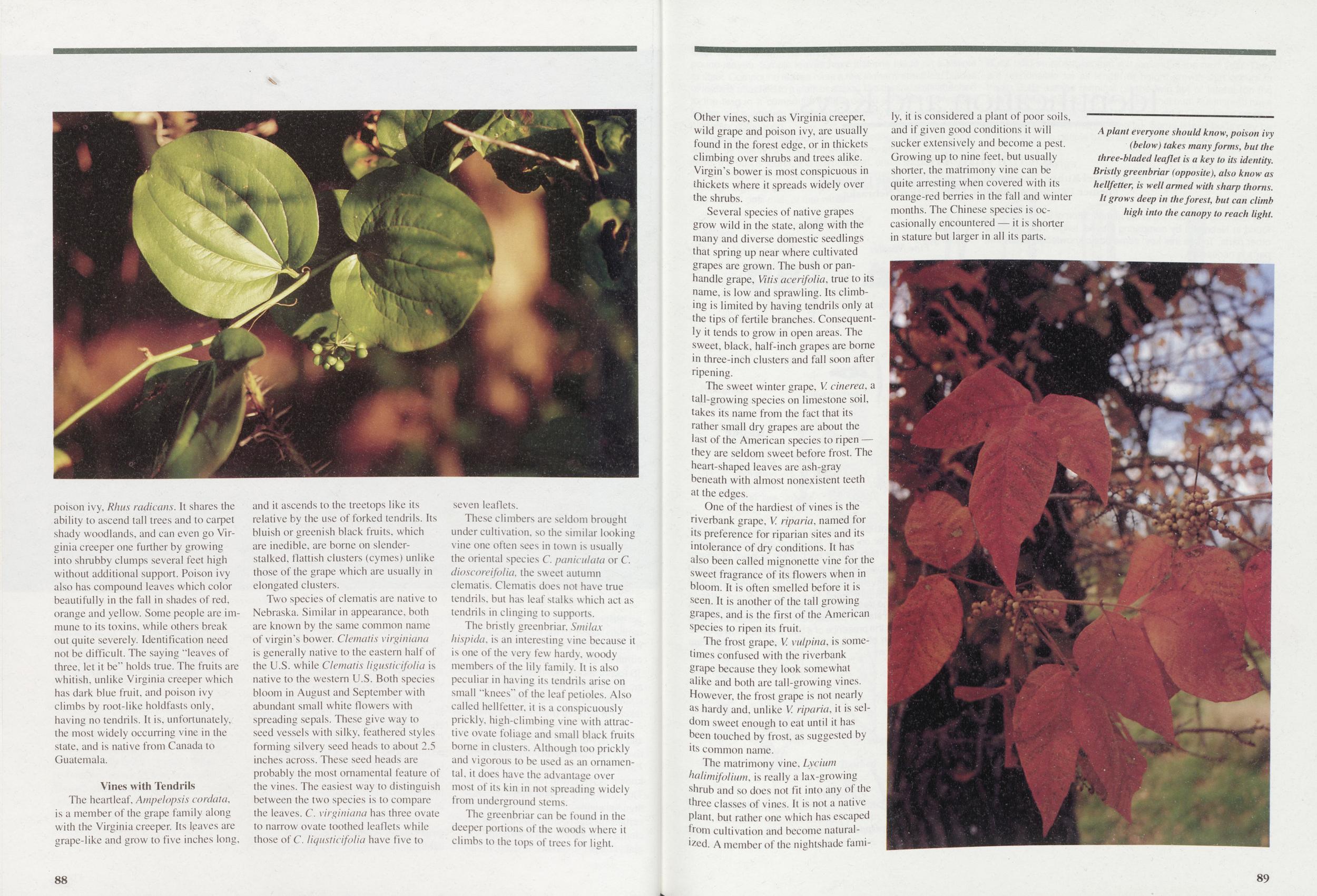
poison ivy, Rhus radicans. It shares the ability to ascend tall trees and to carpet shady woodlands, and can even go Virginia creeper one further by growing into shrubby clumps several feet high without additional support. Poison ivy also has compound leaves which color beautifully in the fall in shades of red, orange and yellow. Some people are immune to its toxins, while others break out quite severely. Identification need not be difficult. The saying "leaves of three, let it be" holds true. The fruits are whitish, unlike Virginia creeper which has dark blue fruit, and poison ivy climbs by root-like holdfasts only, having no tendrils. It is, unfortunately, the most widely occurring vine in the state, and is native from Canada to Guatemala.
Vines with TendrilsThe heart leaf, Ampelopsis cordata, is a member of the grape family along with the Virginia creeper. Its leaves are grape-like and grow to five inches long, and it ascends to the treetops like its relative by the use of forked tendrils. Its bluish or greenish black fruits, which are inedible, are borne on slender- stalked, tlattish clusters (cymes) unlike those of the grape which are usually in elongated clusters.
Two species of clematis are native to Nebraska. Similar in appearance, both are known by the same common name of virgin's bower. Clematis Virginians is generally native to the eastern half of the U.S. while Clematis ligusticifolia is native to the western U.S. Both species bloom in August and September with abundant small white flowers with spreading sepals. These give way to seed vessels with silky, feathered styles forming silvery seed heads to about 2.5 inches across. These seed heads are probably the most ornamental feature o( the vines. The easiest way to distinguish between the two species is to compare the leaves. C. virginians has three ovate to narrow ovate toothed leaflets while those of C. ligusticifolia have five to seven leaflets.
These climbers are seldom brought under cultivation, so the similar looking vine one often sees in town is usually the oriental species C. paniculata or C. dioscoreifolia, the sweet autumn clematis. Clematis does not have true tendrils, but has leaf stalks which act as tendrils in clinging to supports.
The bristly greenbriar. Smilax hispida, is an interesting vine because it is one of the very few hardy, woody members of the lily family. It is also peculiar in having its tendrils arise on small "knees" of the leaf petioles. Also called hell fetter, it is a conspicuously prickly, high-climbing vine with attractive ovate foliage and small black fruits borne in clusters. Although too prickly and vigorous to be used as an ornamental, it does have the advantage over most of its kin in not spreading widely from underground stems.
The greenbriar can be found in the deeper portions of the woods where it climbs to the tops of trees for light. Other vines, such as Virginia creeper, wild grape and poison ivy, are usually found in the forest edge, or in thickets climbing over shrubs and trees alike. Virgin's bower is most conspicuous in thickets where it spreads widely over the shrubs.
Several species of native grapes grow wild in the state, along with the many and diverse domestic seedlings that spring up near where cultivated grapes are grown. The bush or pan- handle grape, Vitis acerifolia, true to its name, is low and sprawling. Its climb- ing is limited by having tendrils only at the tips of fertile branches. Consequently it tends to grow in open areas. The sweet, black, half-inch grapes are borne in three-inch clusters and fall soon after ripening.
The sweet winter grape, V cinerea, a tall-growing species on limestone soil, takes its name from the fact that its rather small dry grapes are about the last of the American species to ripen — they are seldom sweet before frost. The heart-shaped leaves are ash-gray beneath with almost nonexistent teeth at the edges.
One of the hardiest of vines is the riverbank grape, V riparia, named for its preference for riparian sites and its intolerance of dry conditions. It has also been called mignonette vine for the sweet fragrance of its flowers when in bloom. It is often smelled before it is seen. It is another of the tall growing grapes, and is the first of the American species to ripen its fruit.
The frost grape, V vulpina, is sometimes confused with the riverbank grape because they look somewhat alike and both are tall-growing vines. However, the frost grape is not nearly as hardy and, unlike V riparia, it is seldom sweet enough to eat until it has been touched by frost, as suggested by its common name.
The matrimony vine, Lycium halimifolium, is really a lax-growing shrub and so does not fit into any of the three classes of vines. It is not a native Plant, but rather one which has escaped from cultivation and become naturalized. A member of the nightshade family, it is considered a plant of poor soils, and if given good conditions it will sucker extensively and become a pest. Growing up to nine feet, but usually shorter, the matrimony vine can be quite arresting when covered with its orange-red berries in the fall and winter months. The Chinese species is occasionally encountered — it is shorter in stature but larger in all its parts.
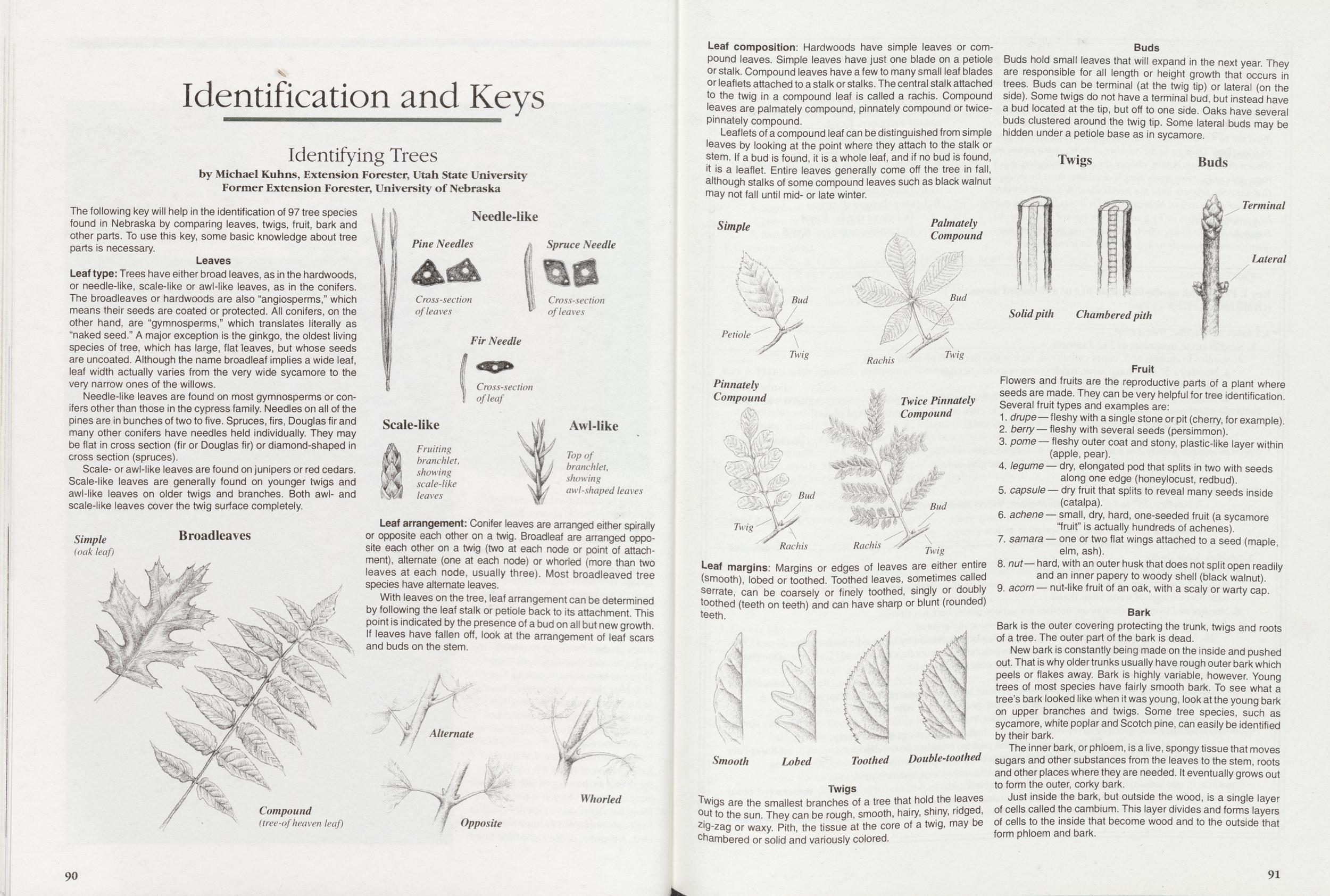
Identification and Keys
Identifying Trees
The following key will help in the identification of 97 tree species found in Nebraska by comparing leaves, twigs, fruit, bark and other parts. To use this key, some basic knowledge about tree parts is necessary.
LeavesLeaf type: Trees have either broad leaves, as in the hardwoods, or needle-like, scale-like or awl-like leaves, as in the conifers. The broadleaves or hardwoods are also "angiosperms," which means their seeds are coated or protected. All conifers, on the other hand, are "gymnosperms," which translates literally as "naked seed." A major exception is the ginkgo, the oldest living species of tree, which has large, flat leaves, but whose seeds are uncoated. Although the name broadleaf implies a wide leaf, leaf width actually varies from the very wide sycamore to the very narrow ones of the willows.
Needle-like leaves are found on most gymnosperms or conifers other than those in the cypress family. Needles on all of the pines are in bunches of two to five. Spruces, firs, Douglas fir and many other conifers have needles held individually. They may be flat in cross section (fir or Douglas fir) or diamond-shaped in cross section (spruces).
Scale- or awl-like leaves are found on junipers or red cedars. Scale-like leaves are generally found on younger twigs and awl-like leaves on older twigs and branches. Both awl- and scale-like leaves cover the twig surface completely.
Simple (oak leaf) Broadleaves Compound (tree-of heaven leaf)
Needle-like Pine Needles Spruce Needle Cross-section of leaves Cross-section of leaves Fir Needle Cross-section of leaf Scale-like Fruiting branchlet, showing scale-like leaves Awl-like Top of branchlet, showing awl-shaped leaves
Leaf arrangement: Conifer leaves are arranged either spirally or opposite each other on a twig. Broadleaf are arranged opposite each other on a twig (two at each node or point of attachment), alternate (one at each node) or whorled (more than two leaves at each node, usually three). Most broadleaved tree species have alternate leaves.
With leaves on the tree, leaf arrangement can be determined by following the leaf stalk or petiole back to its attachment. This point is indicated by the presence of a bud on all but new growth. If leaves have fallen off, look at the arrangement of leaf scars and buds on the stem.
Alternate Whorled Opposite
Leaf composition: Hardwoods have simple leaves or compound leaves. Simple leaves have just one blade on a petiole or stalk. Compound leaves have a few to many small leaf blades or leaflets attached to a stalk or stalks. The central stalk attached to the twig in a compound leaf is called a rachis. Compound leaves are palmately compound, pinnately compound or twice pinnately compound.
Leaflets of a compound leaf can be distinguished from simple leaves by looking at the point where they attach to the stalk or stem. If a bud is found, it is a whole leaf, and if no bud is found, it is a leaflet. Entire leaves generally come off the tree in fall, although stalks of some compound leaves such as black walnut may not fall until mid- or late winter.
Simple Palmately Compound Petiole Bud Rachis Twig
Pinnately Compound Rachis Rachis Bud Twig
Leaf margins: Margins or edges of leaves are either entire (smooth), lobed or toothed. Toothed leaves, sometimes called serrate, can be coarsely or finely toothed, singly or doubly toothed (teeth on teeth) and can have sharp or blunt (rounded) teeth.
Smooth Lobed Toothed Double-toothed
Twigs are the smallest branches of a tree that hold the leaves out to the sun. They can be rough, smooth, hairy, shiny, ridged, 2i9-zag or waxy. Pith, the tissue at the core of a twig, may be chambered or solid and variously colored.
BudsBuds hold small leaves that will expand in the next year. They are responsible for all length or height growth that occurs in trees. Buds can be terminal (at the twig tip) or lateral (on the side). Some twigs do not have a terminal bud, but instead have a bud located at the tip, but off to one side. Oaks have several buds clustered around the twig tip. Some lateral buds may be hidden under a petiole base as in sycamore.
Twigs Buds it Solid pith Chambered pith Terminal Lateral
Flowers and fruits are the reproductive parts of a plant where seeds are made. They can be very helpful for tree identification. Several fruit types and examples are: 1. drupe—fleshy with a single stone or pit (cherry, for example). 2. berry— fleshy with several seeds (persimmon). 3. pome — fleshy outer coat and stony, plastic-like layer within (apple, pear). 4. legume—dry, elongated pod that splits in two with seeds along one edge (honeylocust, redbud). 5. capsule — dry fruit that splits to reveal many seeds inside (catalpa). 6. achene — small, dry, hard, one-seeded fruit (a sycamore "fruit" is actually hundreds of achenes). 7. samara — one or two flat wings attached to a seed (maple, elm, ash). 8. nut — hard, with an outer husk that does not split open readily and an inner papery to woody shell (black walnut). 9. acorn — nut-like fruit of an oak, with a scaly or warty cap.
BarkBark is the outer covering protecting the trunk, twigs and roots of a tree. The outer part of the bark is dead.
New bark is constantly being made on the inside and pushed out. That is why older trunks usually have rough outer bark which peels or flakes away. Bark is highly variable, however. Young trees of most species have fairly smooth bark. To see what a tree's bark looked like when it was young, look at the young bark on upper branches and twigs. Some tree species, such as sycamore, white poplar and Scotch pine, can easily be identified by their bark.
The inner bark, or phloem, is a live, spongy tissue that moves sugars and other substances from the leaves to the stem, roots and other places where they are needed. It eventually grows out to form the outer, corky bark.
Just inside the bark, but outside the wood, is a single layer of cells called the cambium. This layer divides and forms layers of cells to the inside that become wood and to the outside that form phloem and bark.
90 91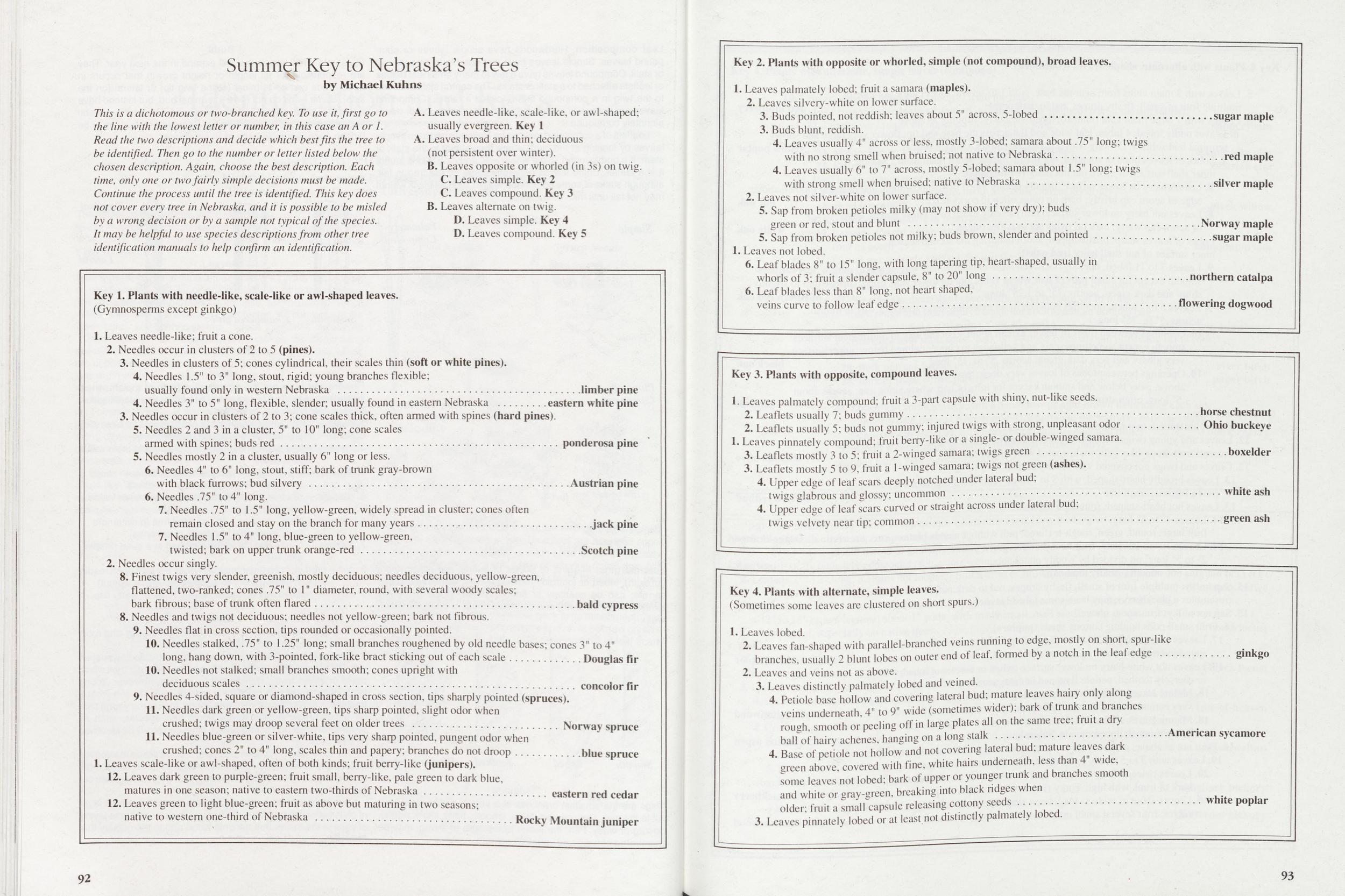
Summer Key to Nebraska's Trees
This is a dichotomous or two-branched key. To use it, first go to the line with the lowest letter or number, in this case an A or I. Read the two descriptions and decide which best fits the tree to be identified. Then go to the number or letter listed below the chosen description. Again, choose the best description. Each time, only one or two fairly simple decisions must be made. Continue the process until the tree is identified. This key does not cover every tree in Nebraska, and it is possible to be misled by a wrong decision or by a sample not typical of the species. It may be helpful to use species descriptions from other tree identification manuals to help confirm an identification.
A. Leaves needle-like, scale-like, or awl-shaped; usually evergreen. Key 1 A. Leaves broad and thin; deciduous (not persistent over winter). B. Leaves opposite or whorled (in 3s) on twig. C. Leaves simple. Key 2 C. Leaves compound. Key 3 B. Leaves alternate on twig. D. Leaves simple. Key 4 D. Leaves compound. Key 5
Key 1. Plants with needle-like, scale-like or awl-shaped leaves. (Gymnosperms except ginkgo) 1. Leaves needle-like; fruit a cone. 2. Needles occur in clusters of 2 to 5 (pines). 3. Needles in clusters of 5; cones cylindrical, their scales thin (soft or white pines). 4. Needles 1.5" to 3" long, stout, rigid; young branches flexible; usually found only in western Nebraska limber pine 4. Needles 3" to 5" long, flexible, slender; usually found in eastern Nebraska eastern white pine 3. Needles occur in clusters of 2 to 3; cone scales thick, often armed with spines (hard pines). 5. Needles 2 and 3 in a cluster, 5" to 10" long; cone scales armed with spines; buds red ponderosa pine 5. Needles mostly 2 in a cluster, usually 6" long or less. 6. Needles 4" to 6" long, stout, stiff; bark of trunk gray-brown with black furrows; bud silvery Austrian pine 6. Needles .75" to 4" long. 7. Needles .75" to 1.5" long, yellow-green, widely spread in cluster; cones often remain closed and stay on the branch for many years jack pine 7. Needles 1.5" to 4" long, blue-green to yellow-green, twisted; bark on upper trunk orange-red Scotch pine 2. Needles occur singly. 8. Finest twigs very slender, greenish, mostly deciduous; needles deciduous, yellow-green, flattened, two-ranked; cones .75" to 1" diameter, round, with several woody scales; bark fibrous; base of trunk often flared bald. cypress 8. Needles and twigs not deciduous; needles not yellow-green; bark not fibrous. 9. Needles flat in cross section, tips rounded or occasionally pointed. 10. Needles stalked, .75" to 1.25" long; small branches roughened by old needle bases; cones 3" to 4" long, hang down, with 3-pointed, fork-like bract sticking out of each scale .Douglas fir 10. Needles not stalked; small branches smooth; cones upright with deciduous scales concolor fir 9. Needles 4-sided, square or diamond-shaped in cross section, tips sharply pointed (spruces). 11. Needles dark green or yellow-green, tips sharp pointed, slight odor when crushed; twigs may droop several feet on older trees Norway spruce 11. Needles blue-green or silver-white, tips very sharp pointed, pungent odor when crushed; cones 2" to 4" long, scales thin and papery; branches do not droop blue spruce 1. Leaves scale-like or awl-shaped, often of both kinds; fruit berry-like (junipers). 12. Leaves dark green to purple-green; fruit small, berry-like, pale green to dark blue, matures in one season; native to eastern two-thirds of Nebraska eastern red cedar 12. Leaves green to light blue-green; fruit as above but maturing in two seasons; native to western one-third of Nebraska Rocky Mountain juniper Key 2. Plants with opposite or whorled, simple (not compound), broad leaves. 1. Leaves palmately lobed; fruit a samara (maples). 2. Leaves silvery-white on lower surface. 3. Buds pointed, not reddish; leaves about 5" across, 5-lobed sugar maple 3. Buds blunt, reddish. 4. Leaves usually 4" across or less, mostly 3-lobed; samara about .75" long; twigs with no strong smell when bruised; not native to Nebraska red maple 4. Leaves usually 6" to 7" across, mostly 5-lobed; samara about 1.5" long; twigs with strong smell when bruised; native to Nebraska snver maple 2. Leaves not silver-white on lower surface. 5. Sap from broken petioles milky (may not show if very dry); buds green or red, stout and blunt Norway maple 5. Sap from broken petioles not milky; buds brown, slender and pointed sugar maple 1. Leaves not lobed. 6. Leaf blades 8" to 15" long, with long tapering tip, heart-shaped, usually in whorls of 3; fruit a slender capsule, 8" to 20" long northern catalpa 6. Leaf blades less than 8" long, not heart shaped, veins curve to follow leaf edge flowering dogwood Key 3. Plants with opposite, compound leaves. 1. Leaves palmately compound; fruit a 3-part capsule with shiny, nut-like seeds. 2. Leaflets usually 7; buds gummy horse chestnut 2. Leaflets usually 5; buds not gummy; injured twigs with strong, unpleasant odor Ohio buckeye 1. Leaves pinnately compound; fruit berry-like or a single- or double-winged samara. 3. Leaflets mostly 3 to 5; fruit a 2-winged samara; twigs green boxelder 3. Leaflets mostly 5 to 9, fruit a 1 -winged samara; twigs not green (ashes). 4. Upper edge of leaf scars deeply notched under lateral bud; twigs glabrous and glossy; uncommon white ash 4. Upper edge of leaf scars curved or straight across under lateral bud; twigs velvety near tip; common green ash Key 4. Plants with alternate, simple leaves. (Sometimes some leaves are clustered on short spurs.) 1. Leaves lobed. 2. Leaves fan-shaped with parallel-branched veins running to edge, mostly on short, spur-like branches, usually 2 blunt lobes on outer end of leaf, formed by a notch in the leaf edge ginkgo 2. Leaves and veins not as above. 3. Leaves distinctly palmately lobed and veined. 4. Petiole base hollow and covering lateral bud; mature leaves ha.ry only along veins underneath 4" to 9" wide (sometimes wider): bark of trunk and branches rough, smooth or peeling off in large plates all on the same tree; fruit a dry ball of hairy achenes. hanging on a long stalk Amencan sycamore 4. Base of petiole not hollow and not covering lateral bud; mature leaves dark Sreen above, covered with fine, white hairs underneath, let than 4 wide, some leaves not lobed; bark of upper or younger trunk and branches smooth and white or gray-green, breaking into black ridges when older; fruit a small capsule releasing cottony seeds white poplar 3. Leaves pinnately lobed or at least not distinctly palmately lobed. 92 93 Key 4. Plants with alternate, simple leaves (continued)
5. Leaves with 3 main veins from near the base, with 1 to several lobes (some not
lobed);
multiple fruit of small, fleshy drupes, red to dark purple red mulberry
5. Leaves with 1 large main vein (midrib), lobed variously; fruit not as above.
6. Leaves oddly lobed, 4 lobes, leaf wide and flat across the base and tip; flower
very large and showy;
terminal bud solitary, .5" long with 2 scales, resembles a duck's bill yellow poplar
7. Lobes of leaves blunt or rounded, not bristle tipped; acorn matures in 1 season,
inner shell surface of acorn nut not hairy (white oaks).
8. Leaves hairy on lower surface, usually deeply lobed below the middle and coarsely
toothed above;
edge of acorn cap bristly; bark on twigs often in corky ridges bur oak
8. Leaves not hairy on lower surface, fairly evenly lobed over entire length; edge
of acorn cap warty; bark on twigs not in corky ridges white oak
7. Lobes of leaves sharp, bristle tipped; acorn maturing the second season,
inner surface of nut shell hairy (red oaks).
9. Leaves 7 to 11 lobed, openings between lobes extending halfway or less to midrib;
leaf surfaces
smooth except for small tufts of hair where veins join on lower side, upper surface
dull to slightly
shiny and dark green; acorns .75" to 1.25" long northern red oak
9. Leaves 5 to 7 lobed, openings between lobes extending more than half way to midrib;
acorns .5" to .75" long.
10. Openings between lobes of leaves extend about % of the way to midrib; leaf surfaces
smooth except sometimes scaly and yellowish to copper colored below, upper surface
very glossy and very dark green; acorns .5" to .75" long black oak
10. Openings between lobes of leaves very deep; leaves generally bright green and
shiny
above, paler below and smooth except for tufts of hair where veins join; acorns about
.5" long, often striped pin oak
1. Leaves not lobed.
11. Leaf margins smooth (not toothed).
12. Leaves and young twigs covered with silver or silver and brown scales; thorns
often
present; fruit drupe-like, yellowish, coated with silvery scales Russian olive
12. Leaves and twigs not covered with silvery scales.
13. Leaves broadly heart-shaped, with 3 to 7 large veins radiating from the base;
fruit a legume; small tree eastern redbud
13. Leaves not heart-shaped; fruit not a legume.
14. Leaves 4" to 5" long; twigs, fruit and leaves with milky sap; spines or thorns
often present on twigs;
fruit large, round, green, rough-textured; pith without woody plates Osage-orange
14. Leaves 10" to 12" long; fruit fleshy, sweet, green-yellow ripening to brown-black,
2" to 5" long; pit divided by woody plates pawpaw
11. Leaf margins not smooth (usually toothed).
15. Sap milky; multiple fruit of small, fleshy drupes, red to dark purple
(resembles a blackberry); may have some lobed leaves as well red mulberry
15. Sap not milky; fruit not as above.
16. Fruit small pods holding cottony seeds (poplars).
17. Leaves white-hairy on lower surface, often lobed, coarsely toothed, petiole
round in cross-section white poplar
17. Leaves not white-hairy on lower surface (when mature), not lobed, finely
or coarsely toothed, petiole flattened in cross section.
18. Mature leaves 4" to 5" wide, triangular in outline, edge with fairly large, rounded
teeth;
very common along streams and lakes eastern Cottonwood
18. Mature leaves 1.5" to 3" wide, round to oval in outline, margin
finely toothed; uncommon in Nebraska quaking aspen
16. Fruit not as above, or if so, leaves narrow and long, petiole not flattened.
19. Leaves with 3 to 5 nearly equal main veins from near the base.
20. Leaves twice as long as wide, taper pointed, with uneven bases; pith usually finely
chambered;
bark of trunk with high, corky ridges; fruit a purple drupe hackberry
20. Leaves about as wide as long, heart shaped; pith not chambered; bark of trunk
without corky
ridges; fruit several small nuts attached to a wing-like leaf .American basswood
Key 4. Plants with alternate, simple leaves (continued)
19. Leaves with one main vein (midrib) from the base.
21. Leaf base uneven; leaves 2-ranked, usually doubly toothed; fruit a samara (elms).
22. Leaves very rough on upper surface, 5" to 7" long slippery elm
22. Leaves smooth or nearly so on upper surface.
23. Mature leaves 4" to 6" long, coarsely doubly toothed American elm
23. Mature leaves 1" to 3" long, singly toothed or nearly so Siberian elm
21. Leaf base not uneven or slightly uneven.
24. Each bud covered by a single, hood-like scale; leaves generally
long and narrow black willow
24. Each bud covered by 2 or more scales.
25. Leaves coarsely, singly toothed; terminal buds clustered;
fruit an acorn chinquapin oak
25. Leaves not coarsely toothed, mostly finely or doubly toothed;
fruit not an acorn.
26. Leaf base broad, flat, or nearly so; fruit dry, cone-like or papery sac.
27. Branches without short spurs; bark never peeling off in rolls;
bark rough and platy; fruit a small nut enclosed in an inflated bag,
several grouped together in a cone-like spike eastern hop-hornbeam
27. Branches with short spurs; bark on younger trees smooth or peeling off in rolls;
horizontally elongated corky ridges; fruit a samara in cone-like catkins (birches).
28. Bark of trunk brown to salmon pink (not white), papery river birch
28. Bark of trunk white, papery paper birch
26. Leaf base angled or tapering.
29. Lower leaf surface waxy with a dense row of light brown hairs along each side
of midrib near the leaf base; fruit a dark purple to black drupe; bark on young
stems smooth and dark with many horizontally elongated ridges black cherry
29. Midrib without hairs as above, lower leaf surface hairy;
buds hairy; fruit a green to red pome apple
Key 5. Plants with alternate, compound leaves.
1. Leaves bi- or tri-pinnately compound (some once-compound).
2. Leaflets 2" to 3" long, margins not toothed; fruit a 4" to 6" brown legume, 1.5
to 2 wide
with few large, hard seeds; no thorns Kentucky coffee
2. Leaflets usually 1" long or less, margins finely toothed, some leaves once-compound;
fruit
a 12" to 18" brown legume, about 1" wide, with many small, hard seeds; stout thorns
often present, especially on native trees honeylocust
1. Leaves once compound.
3. Lateral buds hidden (base of rachis hollow, forming a hood-like covering over the
lateral buds);
fruit a legume; spines or prickles usually present on twigs black locust
3. Lateral buds exposed; fruit not a legume; no spines or prickles on stem.
4. Crushed leaves have a strong, musty, disagreeable odor, leaves 1 to 4 long,
11 to 41 leaflets;
twigs very stout, pith solid, wide, light brown; fruit a samara tree-of-heaven
4. Crushed leaves without a musty, disagreeable odor; pith solid or chambered; fruiy,
a nut.
5. Leaflet margins finely toothed; fruit a round nut; pith usually chambered; light
brown;
husk of nut does not split along lines when ripe black walnut
5. Pith solid; husk of nut splits along lines when ripe
6. Leaflets mostly 5 to 7; nut shell thick; terminal buds
large, brown
6. Leaflets mostly 7 to 9; nut shell thin; terminal buds
sulfur yellow
94 95
Key 4. Plants with alternate, simple leaves (continued)
5. Leaves with 3 main veins from near the base, with 1 to several lobes (some not
lobed);
multiple fruit of small, fleshy drupes, red to dark purple red mulberry
5. Leaves with 1 large main vein (midrib), lobed variously; fruit not as above.
6. Leaves oddly lobed, 4 lobes, leaf wide and flat across the base and tip; flower
very large and showy;
terminal bud solitary, .5" long with 2 scales, resembles a duck's bill yellow poplar
7. Lobes of leaves blunt or rounded, not bristle tipped; acorn matures in 1 season,
inner shell surface of acorn nut not hairy (white oaks).
8. Leaves hairy on lower surface, usually deeply lobed below the middle and coarsely
toothed above;
edge of acorn cap bristly; bark on twigs often in corky ridges bur oak
8. Leaves not hairy on lower surface, fairly evenly lobed over entire length; edge
of acorn cap warty; bark on twigs not in corky ridges white oak
7. Lobes of leaves sharp, bristle tipped; acorn maturing the second season,
inner surface of nut shell hairy (red oaks).
9. Leaves 7 to 11 lobed, openings between lobes extending halfway or less to midrib;
leaf surfaces
smooth except for small tufts of hair where veins join on lower side, upper surface
dull to slightly
shiny and dark green; acorns .75" to 1.25" long northern red oak
9. Leaves 5 to 7 lobed, openings between lobes extending more than half way to midrib;
acorns .5" to .75" long.
10. Openings between lobes of leaves extend about % of the way to midrib; leaf surfaces
smooth except sometimes scaly and yellowish to copper colored below, upper surface
very glossy and very dark green; acorns .5" to .75" long black oak
10. Openings between lobes of leaves very deep; leaves generally bright green and
shiny
above, paler below and smooth except for tufts of hair where veins join; acorns about
.5" long, often striped pin oak
1. Leaves not lobed.
11. Leaf margins smooth (not toothed).
12. Leaves and young twigs covered with silver or silver and brown scales; thorns
often
present; fruit drupe-like, yellowish, coated with silvery scales Russian olive
12. Leaves and twigs not covered with silvery scales.
13. Leaves broadly heart-shaped, with 3 to 7 large veins radiating from the base;
fruit a legume; small tree eastern redbud
13. Leaves not heart-shaped; fruit not a legume.
14. Leaves 4" to 5" long; twigs, fruit and leaves with milky sap; spines or thorns
often present on twigs;
fruit large, round, green, rough-textured; pith without woody plates Osage-orange
14. Leaves 10" to 12" long; fruit fleshy, sweet, green-yellow ripening to brown-black,
2" to 5" long; pit divided by woody plates pawpaw
11. Leaf margins not smooth (usually toothed).
15. Sap milky; multiple fruit of small, fleshy drupes, red to dark purple
(resembles a blackberry); may have some lobed leaves as well red mulberry
15. Sap not milky; fruit not as above.
16. Fruit small pods holding cottony seeds (poplars).
17. Leaves white-hairy on lower surface, often lobed, coarsely toothed, petiole
round in cross-section white poplar
17. Leaves not white-hairy on lower surface (when mature), not lobed, finely
or coarsely toothed, petiole flattened in cross section.
18. Mature leaves 4" to 5" wide, triangular in outline, edge with fairly large, rounded
teeth;
very common along streams and lakes eastern Cottonwood
18. Mature leaves 1.5" to 3" wide, round to oval in outline, margin
finely toothed; uncommon in Nebraska quaking aspen
16. Fruit not as above, or if so, leaves narrow and long, petiole not flattened.
19. Leaves with 3 to 5 nearly equal main veins from near the base.
20. Leaves twice as long as wide, taper pointed, with uneven bases; pith usually finely
chambered;
bark of trunk with high, corky ridges; fruit a purple drupe hackberry
20. Leaves about as wide as long, heart shaped; pith not chambered; bark of trunk
without corky
ridges; fruit several small nuts attached to a wing-like leaf .American basswood
Key 4. Plants with alternate, simple leaves (continued)
19. Leaves with one main vein (midrib) from the base.
21. Leaf base uneven; leaves 2-ranked, usually doubly toothed; fruit a samara (elms).
22. Leaves very rough on upper surface, 5" to 7" long slippery elm
22. Leaves smooth or nearly so on upper surface.
23. Mature leaves 4" to 6" long, coarsely doubly toothed American elm
23. Mature leaves 1" to 3" long, singly toothed or nearly so Siberian elm
21. Leaf base not uneven or slightly uneven.
24. Each bud covered by a single, hood-like scale; leaves generally
long and narrow black willow
24. Each bud covered by 2 or more scales.
25. Leaves coarsely, singly toothed; terminal buds clustered;
fruit an acorn chinquapin oak
25. Leaves not coarsely toothed, mostly finely or doubly toothed;
fruit not an acorn.
26. Leaf base broad, flat, or nearly so; fruit dry, cone-like or papery sac.
27. Branches without short spurs; bark never peeling off in rolls;
bark rough and platy; fruit a small nut enclosed in an inflated bag,
several grouped together in a cone-like spike eastern hop-hornbeam
27. Branches with short spurs; bark on younger trees smooth or peeling off in rolls;
horizontally elongated corky ridges; fruit a samara in cone-like catkins (birches).
28. Bark of trunk brown to salmon pink (not white), papery river birch
28. Bark of trunk white, papery paper birch
26. Leaf base angled or tapering.
29. Lower leaf surface waxy with a dense row of light brown hairs along each side
of midrib near the leaf base; fruit a dark purple to black drupe; bark on young
stems smooth and dark with many horizontally elongated ridges black cherry
29. Midrib without hairs as above, lower leaf surface hairy;
buds hairy; fruit a green to red pome apple
Key 5. Plants with alternate, compound leaves.
1. Leaves bi- or tri-pinnately compound (some once-compound).
2. Leaflets 2" to 3" long, margins not toothed; fruit a 4" to 6" brown legume, 1.5
to 2 wide
with few large, hard seeds; no thorns Kentucky coffee
2. Leaflets usually 1" long or less, margins finely toothed, some leaves once-compound;
fruit
a 12" to 18" brown legume, about 1" wide, with many small, hard seeds; stout thorns
often present, especially on native trees honeylocust
1. Leaves once compound.
3. Lateral buds hidden (base of rachis hollow, forming a hood-like covering over the
lateral buds);
fruit a legume; spines or prickles usually present on twigs black locust
3. Lateral buds exposed; fruit not a legume; no spines or prickles on stem.
4. Crushed leaves have a strong, musty, disagreeable odor, leaves 1 to 4 long,
11 to 41 leaflets;
twigs very stout, pith solid, wide, light brown; fruit a samara tree-of-heaven
4. Crushed leaves without a musty, disagreeable odor; pith solid or chambered; fruiy,
a nut.
5. Leaflet margins finely toothed; fruit a round nut; pith usually chambered; light
brown;
husk of nut does not split along lines when ripe black walnut
5. Pith solid; husk of nut splits along lines when ripe
6. Leaflets mostly 5 to 7; nut shell thick; terminal buds
large, brown
6. Leaflets mostly 7 to 9; nut shell thin; terminal buds
sulfur yellow
94 95

Glossary
Achene: small, dry, one-seeded fruit. Acorn: nut-like fruit of an oak; with a scaly or warty cap. Alternate leaves: leaves arranged on alternate sides of the twig. Angiosperm: plants with seeds enclosed in ovary; includes flowering plants. Awl-like leaves: short leaves tapering evenly to a point; found on junipers and red cedars. Berry: fleshy fruit with several seeds. Broadleaf: trees having broad, flatbladed leaves rather than needles; a common name for hardwoods. Cambium: layer of tissue one to several cells thick between bark and wood; it divides to form new wood and bark. Canopy: the uppermost layer of leaves and branches in a forest; over story. Capsule: dry fruit that splits open, usually along several lines, to reveal many seeds inside. Chambered pith: pith divided into many empty horizontal chambers. Climax: a group of plants (such as oak/hickory forest) which develops as a result of environmental conditions and which perpetuates itself as long as those conditions exist. Community: a group of plants and animals occupying a given unit of space. Compound leaves: leaves with more than one leaflet attached to a stalk called a rachis. Conifers: trees and shrubs usually bear- ing seeds in cones; includes pines, firs spruces, yews and Douglas fir. Decadence: a declining state of vigor in plants caused by adverse environmental conditions or age. Deciduous leaves: leaves that die and fall off trees after one growing season. Dormancy: a temporary condition in which a plant or animal remains relatively inactive, such as broadleaf trees in winter or butterflies in the cocoon stage. Drupe: fleshy fruit with one stone or pit. Ecosystem: a complex of plants and animals forming an interacting system. Ecotone: transition zone between two plant groups which has characteristics of both, such as mix of trees with shrubs and grasses at the edge of a forest. Entire margin: smooth (not toothed) leaf margins. Escarpment: a relatively steep slope, usually formed by erosion. Evapotranspiration: the sum of the loss of water from the soil and from the surface of a plant. Evergreen: trees and shrubs retaining their live, green leaves during the winter and for two or more growing seasons. 96 Family: group of related species and genera; scientific name ends "-aceae." Forb: a non-woody, rooted plant which is not a grass or sedge. Forest: a stand of trees, shrubs, vines and non-woody plants growing close together. Forest ecology: study of the occurrence of forest plants and animals in respect to their environment. Genus: a group of similar species; plural, genera. Glabrous: smooth, no hair or scales. Gymnosperm: large class of plants having seeds without an ovary, usually on scales of a cone; includes conifers and the ginkgo. Hardwoods: usually broadleaf trees with wood made up of vessels; similar to angiosperms. Heartwood: nonliving wood (often dark) found at the center of a tree's stem. Lateral buds: buds along the length of the twig (not at the tip) where the previous year's leaves were attached. Leaflets: small blades of a compound leaf attached to a stalk (rachis); without buds where they attach. Legume: fruit which is a dry, elongated pod that splits in two, with seeds attached along one edge inside. Lobed margin: leaf margin with gaps more or less to the center of the leaf. Mesic: moderately moist. Mesophytic: requiring or thriving in moderately moist (mesic) soil conditions. Multiple fruit: fruit made up of a cluster of ripened ovaries coming from many separate flowers attached to a common receptacle. Naturalized: nonnative trees in the wild. Needle-like leaves: thin, sharp, pointed, pin-like leaves; found on pines, firs and some other softwoods. Node: the point on a stem at which leaves and buds are attached. Nut: hard, dry fruit with an outer husk that may not split open readily and a papery to woody inner shell. Opposite leaves: leaves arranged across from each other on the twig. Ovate: having the lengthwise outline of an egg, widest below the middle. Over story: the uppermost layer of leaves and branches in a forest; canopy. Palmately compound: compound leaves with several leaflets radiating from the end of a stalk (rachis). Petiole: a slender stalk that supports a simple leaf. Phloem: inner bark of a tree that carries food and sugars from the leaves to other parts of the tree. Photosynthesis: process by which the leaves, with energy from sunlight, make food from water and carbon dioxide. Pinnately compound: compound leaves with leaflets attached laterally along the rachis or stalk; leaves may be once, twice, or three-times pinnately compound. Pioneer: a plant or animal which establishes itself first in a bare or empty area, such as willows on a sandbar. Pistillate flower: a unisexual (female) flower bearing only pistils. Pith: soft and spongy or chambered tis- sue found in the stem. Pome: fruit with a fleshy outer coat and a plastic-like stony layer within, with seeds inside the stony layer, as in apples and pears. Pubescent: covered with hairs. Rachis: the central stalk to which leaf lets of a compound leaf are attached. Samara: dry fruit with one or two flat wings attached to a seed, as on elms and maples. Sapwood: living wood, often light colored, between bark or cambium and the usually darker colored heartwood. Savannah: a predominantly grassland area with scattered trees and shrubs. Scale-like leaves: small, short, fish scale-like leaves which cover the entire twig as on juniper and red cedar. Serrate: with teeth. Shrub: low-growing woody plant with many stems rather than a single trunk. Simple leaves: leaves with one blade attached to a petiole, or stalk. Softwoods: usually conifers or cone bearing trees; conifers generally have softer wood than angiosperms or hardwoods; there are many exceptions. Solid pith: pith without chambers. Species: closely related trees with similar characteristics. Spring wood: wood inside an annual ring formed during the spring; cells are often thin walled. Succession: the gradual change of plants in a community from one kind to another, such as annual weeds to shrubs to mixed deciduous forest. Tracheids: small tubes in the wood that carry water from roots to leaves. Vessels: large tubes in the wood of hardwoods carrying water from roots to leaves. Understory: the layer of small trees and shrubs between the ground cover and the canopy of a forest. Xeric: moderately dry. Xylem: the wood of a tree, made up of strong fibers, tracheids and vessels.Index
Angiosperm: 90 Annual ring: 48 Ash Green: 10, 12, 13, 19, 23, 34, 35, 38, 39, 40, 43, 47, 59, 66, 67, 76, 80, 85 Prickly: 39, 40 Aspen Hybrid: 85, 85 Quaking: 35, 40, 79, 80, 85 Basswood: 10, 11, 20, 22-24, 34, 35, 39, 40, 59, 85 Bessey, Charles E.: 64, 65, 65 Birch Mountain: 78, 79 Paper: 40, 73, 84, 84, 85 Bittersweet: 12, 39, 86 Blackberry: 40 Bladdernut: 22 Boxelder: 12, 13, 19, 35, 37, 39, 40, 43, 46, 64, 80, 85 Broadleaf: (see deciduous) Buckbrush: 57, 60 Buckeye, western: 22, 23 Buffaloberry: 39, 40 Burning bush: (see wahoo) Cambium: 77, 91 Canopy: 12, 14, 15,21,23,25,30,35, 39,47,48,59,73,81-84,86,89 Catalpa: 39, 43, 86, 91 Cedar, red: 6, 10, 13, 13, 14, 18-20, 24, 25, 39, 40, 42, 43, 46, 47, 56, 59, 63, 73, 85, 90 Cherry, black: 59, 64 Chokecherry: 12, 25, 40, 51-54, 61, 83 Climax: 46, 47, 82, 83 Conifer: 8, 16, 24, 27, 61, 63, 73-75, 85, 86, 90 Cottonwood: 6, 12, 19, 29, 35, 36-37, 37-49, 40, 45, 55, 59, 73, 80, 85, 92 Currant Black: 34, 34 Golden: 80, 80 Deciduous: 8, 10-16, 18-23, 25, 26, 29- 32, 34, 35, 38, 40, 42, 46, 47, 59, 65, 73, 75, 78, 80-86, 90, 91 Dioecious: 45 Disease Dutch elm: 24, 28, 46, 66, 75 Oak wilt: 24 Dogwood: 10-12, 14, 39, 46, 48, 56, 60 Red osier: 39 Rough-leaf: 11, 39 Rough-stem: 14 Dormant: 25, 35, 52, 57 Ecosystem: 13, 26, 37, 48, 50, 66, 78 Ecotone: 15 Elderberry: 25 Elm American: 19, 24, 34, 39, 66, 68, 74- 75, 75, 80, 85 Red: 24 Siberian: 43, 66-68, 68 Evapotranspiration: 75, 78 Evergreen: (see conifer) False indigo: 38-40, 46, 55 Forest: 6, 8, 10-32, 34, 35, 37-40, 42, 43, 45-49, 59, 62, 64-69, 73-87, 89 Eastern deciduous: 8,11,14, 15, 19- 22, 20-21, 24, 26, 29-32, 34, 35, 38, 43, 47, 84, 85 Red cedar: 6, 13,13,14, 18, 19 Riparian: 6, 10, 11, 12, 15, 18, 19, 35, 36-37, 37-40, 42, 42, 43, 43, 45-48, 48,66,75,81,89 Urban: 66, 67, 66-67 Western: 12, 73, 80, 82-83, 85 Fruit Achene: 91 Acorn: 15,23,32,91 Berry: 43, 57, 91 Capsule: 55, 86, 91 Drupe: 91 Legume: 91 Nut: 15, 16, 23, 24, 29, 32, 59, 63, 91 Pome: 91 Samara: 46, 91 Seed: 17, 23, 26, 29, 32, 37, 38, 43, 45, 46, 51, 52, 55, 57, 59, 65, 76, 79, 81,83,86-88,90,91 Gooseberry: 34, 85 Grape Riverbank: 89 Winter: 89 Greenbriar, bristly: 88, 88, 89 Gymnosperm: 90 Hackberry: 12, 17, 20, 23, 24, 26, 28, 34, 35, 39, 40, 46, 59, 64, 67, 80, 85 Hardwood: (see deciduous) Hawthorn: 40 Hickory Bitternut: 11, 22-25,39 Shagbark: 10, 11,22,23 Honeysuckle: 86, 87 Hop-hornbeam: (see ironwood) Ironwood: 10, 22, 23, 30, 30, 35, 85 Juneberry: 24, 25, 40 Juniper, creeping: 56 Kentucky coffee: 20, 22, 23, 31, 39, 40 Leaves Alternate: 90 Awl-like: 90 Compound: 55, 88, 91 Needle-like: 75, 90 Opposite: 90 Petiole: 35, 88, 90, 91 Scale-like: 90 Simple: 91 Whorled: 90 Legume: 26, 55, 91 Linden: (see basswood) Locust Black: 17, 49, 49 Honey: 35, 39, 43, 91 Maple Silver: 10, 29, 35, 39, 43, 46, 66, 67 Mountain: 42 Matrimony vine: 89 Mesic: 10, 15, 20,82 Moonseed: 86 Morton, J. Sterling: 27, 70 Mountain mahogany: 83, 84 Mulberry Red: 23, 39, 46 White: 19 New Jersey tea: 54, 55, 55 Node: 46, 90 Oak Black: 10, 11, 22, 23, 32, 32-33 Bur: 6, 10-12, 19, 22-25, 32, 32, 32- 33, 35, 39, 40, 59, 85 Chinquapin: 32, 32-33, 55 Dwarf chinquapin: 32-33, 55, Red: 10, 11, 22-24, 32, 32-33, 35, 39, 59,64 Swamp white: 32, 32-33, 39 Oregon grape: 73, 75 Overstory: (see canopy) Pawpaw: 10, 11, 22, 39 Phloem: 91 Pine: 6, 10, 12, 12, 13. 15-18, 27, 40, 42, 49, 59, 61, 63-65, 73-85, 90, 91 Jack: 64, 65 Limber: 73, 74, 78, 78 Ponderosa: 12, 12, 13, 18, 40, 42, 59, 72, 73-85, 81 Pioneer: 43, 44, 46, 70, 82 Pith: 91 Plum, wild: 12, 25, 39, 40, 46, 51, 52- 54, 60, 61 Poison ivy: 12, 35, 39, 49, 57, 59, 83, 88, 89, 89 Raspberry, black: 10, 10 Redbud: 10,22,25,25,91 Rose, wild: 39, 51,53,53 Russian olive: 39, 43, 46, 47 Savannah: 6, 13, 18, 19, 51, 74, 78, 79 Snowberry: 39, 40, 51, 57, 83 Softwood: (see conifer) Succession: 10, 12, 24, 38, 40, 42, 46, 76, 82, 83 Sumac Skunkbush: 56, 57 Smooth: 35, 39, 42, 56, 57 Sycamore: 17, 39, 90, 91 Understory: 6, 10, 12, 14, 15, 19, 22, 23, 25, 26, 30, 38, 39, 42, 43, 46-48, 59, 60,74,76,81-83 Virgin's bower: 86-87, 87-89 Virginia creeper: 12, 35, 39, 59, 87-89 Wahoo: 28, 28-29, 35 Walnut, black: 10, 12, 22, 23, 39, 40, 58,59,60, 71,73,85, 91 Willow: 12, 17, 19, 29, 35, 37-48, 38- 39, 55, 80, 85 Prairie: 55 Sandbar: 39, 40, 46, 55 Woodbine: 35, 87 Xeric: 82 Yucca: 56, 57, 85 96 97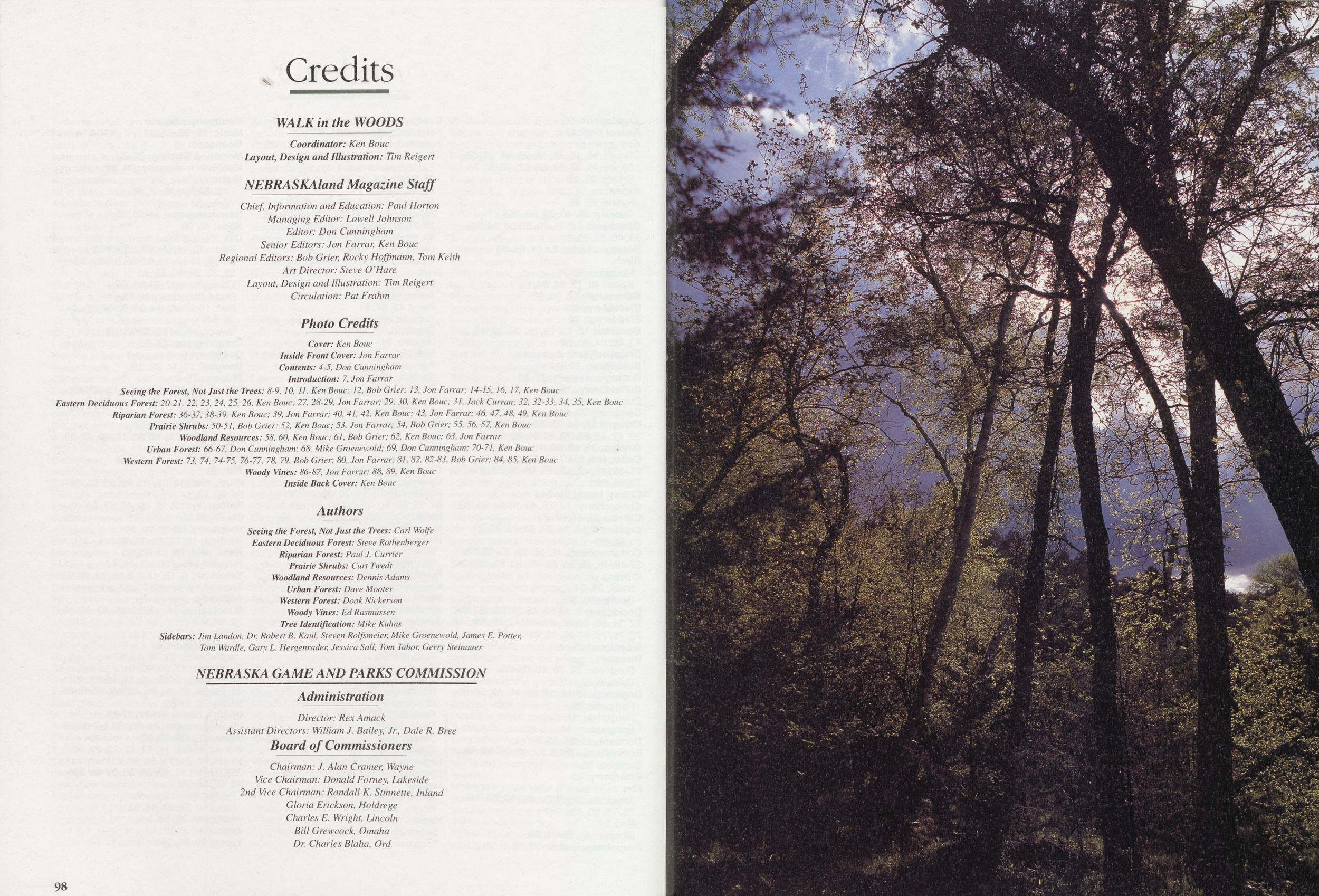
Credits
WALK in the WOODS Coordinator: Ken Bouc Layout, Design and Illustration: Tim Reigert NEBRASKAland Magazine Staff Chief, Information and Education: Paul Horton Managing Editor: Lowell Johnson Editor: Don Cunningham Senior Editors: Jon Farrar, Ken Bouc Regional Editors: Bob Grier, Rocky Hoffmann, Tom Keith Art Director: Steve O'Hare Layout, Design and Illustration: Tim Reigert Circulation: Pat Frahm Photo Credits Cover: Ken Bouc Inside Front Cover: Jon Farrar Contents: 4-5, Don Cunningham Introduction: 7, Jon Farrar Seeing the Forest, Not Just the Trees: 8-9, 10, 11, Ken Bouc; 12, Bob Grier; 13, Jon Farrar; 14-15, 16, 17, Ken Bouc Eastern Deciduous Forest: 20-21, 22, 23, 24, 25, 26, Ken Bouc; 27, 28-29, Jon Farrar; 29, 30, Ken Bouc; 31, Jack Curran; 32, 32-33, 34, 35, Ken Bouc Riparian Forest: 36-37, 38-39, Ken Bouc; 39, Jon Farrar; 40, 41, 42. Ken Bouc; 43, Jon Farrar; 46, 47, 48, 49, Ken Bouc Prairie Shrubs: 50-51, Bob Grier; 52, Ken Bouc; 53, Jon Farrar; 54, Bob Grier; 55, 56, 57, Ken Bouc Woodland Resources: 58, 60, Ken Bouc; 61, Bob Grier; 62, Ken Bouc; 63, Jon Farrar Urban Forest: 66-67, Don Cunningham; 68, Mike Groenewold; 69, Don Cunningham; 70-71, Ken Bouc Western Forest: 73, 74, 74-75, 76-77, 78, 79, Bob Grier; 80, Jon Farrar; 81, 82, 82-83, Bob Grier; 84, 85, Ken Bouc Woody Vines: 86-87, Jon Farrar; 88, 89, Ken Bouc Inside Back Cover: Ken Bouc Authors Seeing the Forest, Not Just the Trees: Carl Wolfe Eastern Deciduous Forest: Steve Rothenberger Riparian Forest: Paul J. Currier Prairie Shrubs: Curt Twedt Woodland Resources: Dennis Adams Urban Forest: Dave Mooter Western Forest: Doak Nickerson Woody Vines: Ed Rasmus sen Tree Identification: Mike Kuhns Sidebars: Jim Landon, Dr. Robert B. Kaul, Steven Rolfsmeier, Mike Groenewold, James E. Potter, Tom Wardle, Gary L. Hergenrader, Jessica Sail, Tom Tabor, Gerry SteinauerNEBRASKA GAME AND PARKS COMMISSION Administration Director: Rex Amack Assistant Directors: William J. Bailey, Jr., Dale R. Bree Board of Commissioners Chairman: J. Alan Cramer, Wayne Vice Chairman: Donald Forney, Lakeside 2nd Vice Chairman: Randall K. Stinnette, Inland Gloria Erickson, Holdrege Charles E. Wright, Lincoln Bill Grewcock, Omaha Dr. Charles Blaha, Ord
Position: 270 (30 views)