Volume 70, Issue 10, 1992
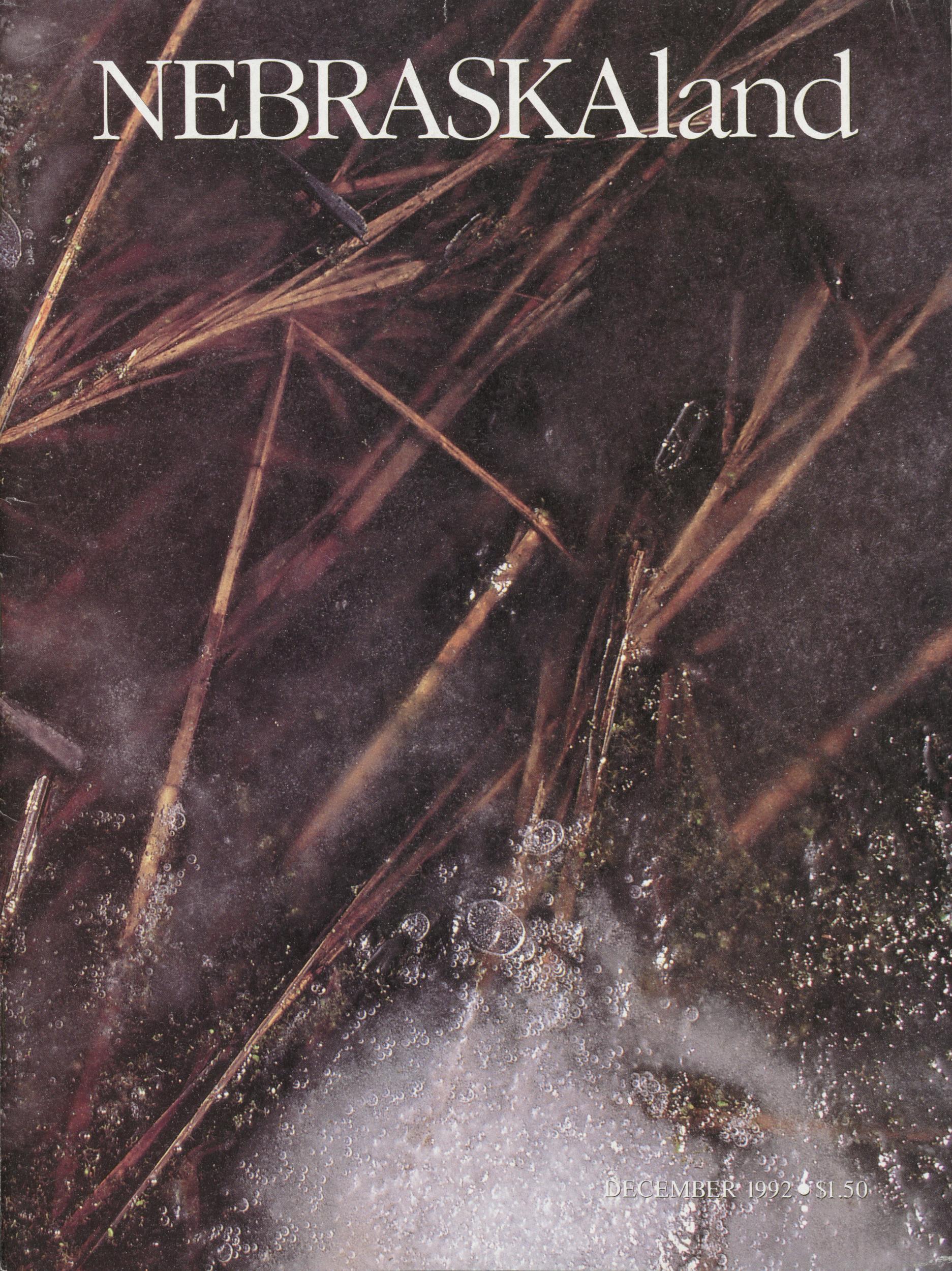
NEBRASKAland
DECEMBER 1992 $1.50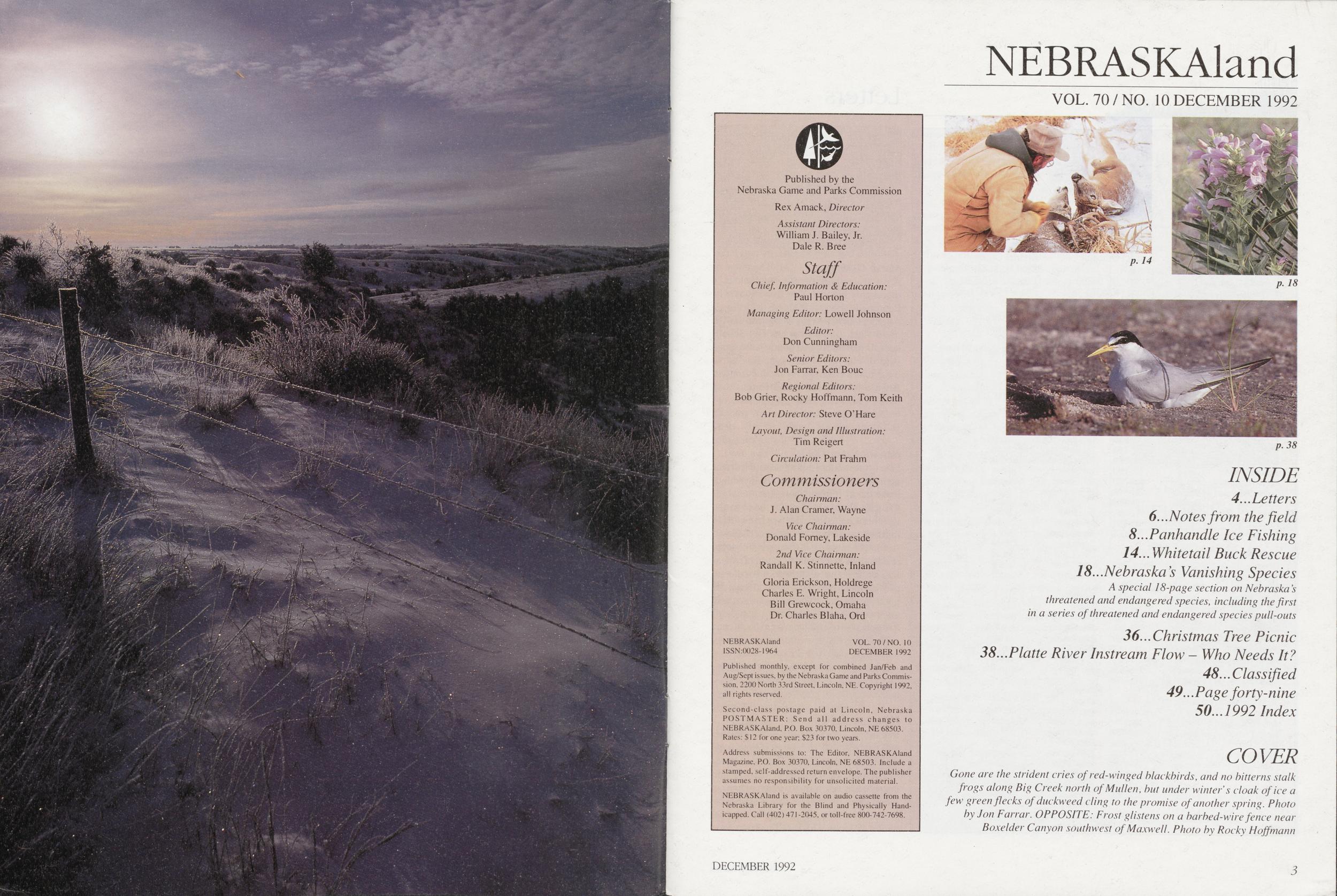
NEBRASKAland
VOL. 70 / NO. 10 DECEMBER 1992 Published by the Nebraska Game and Parks Commission Rex Amack, Director Assistant Directors: William J. Bailey, Jr. Dale R. Bree Staff Chief Information & Education: Paul Horton Managing Editor: Lowell Johnson Editor: Don Cunningham Senior Editors: Jon Farrar, Ken Bouc Regional Editors: Bob Grier, Rocky Hoffmann, Tom Keith Art Director: Steve O'Hare Layout, Design and Illustration: Tim Reigert Circulation: Pat Frahm Commissioners Chairman: J. Alan Cramer, Wayne Vice Chairman: Donald Forney, Lakeside 2nd Vice Chairman: Randall K. Stinnette, Inland Gloria Erickson, Holdrege Charles E. Wright, Lincoln Bill Grewcock, Omaha Dr. Charles Blaha, Ord NEBRASKAland 1SSN:0028-1964 VOL. 70/NO. 10 DECEMBER 1992 Published monthly, except for combined Jan/Feb and Aug/Sept issues, by the Nebraska Game and Parks Commission, 2200 North 33rd Street, Lincoln, NE. Copyright 1992, all rights reserved. Second-class postage paid at Lincoln, Nebraska POSTMASTER: Send all address changes to NEBRASKAland, P.O. Box 30370. Lincoln, NE 68503. Rates: $12 for one year: $23 for two years. Address submissions to: The Editor, NEBRASKAland Magazine, P.O. Box 30370, Lincoln, NE 68503. Include a stamped, self-addressed return envelope. The publisher assumes no responsibility for unsolicited material. NEBRASKAland is available on audio cassette from the Nebraska Library for the Blind and Physically Handicapped. Call (402) 471-2045, or toll-free 800-742-7698.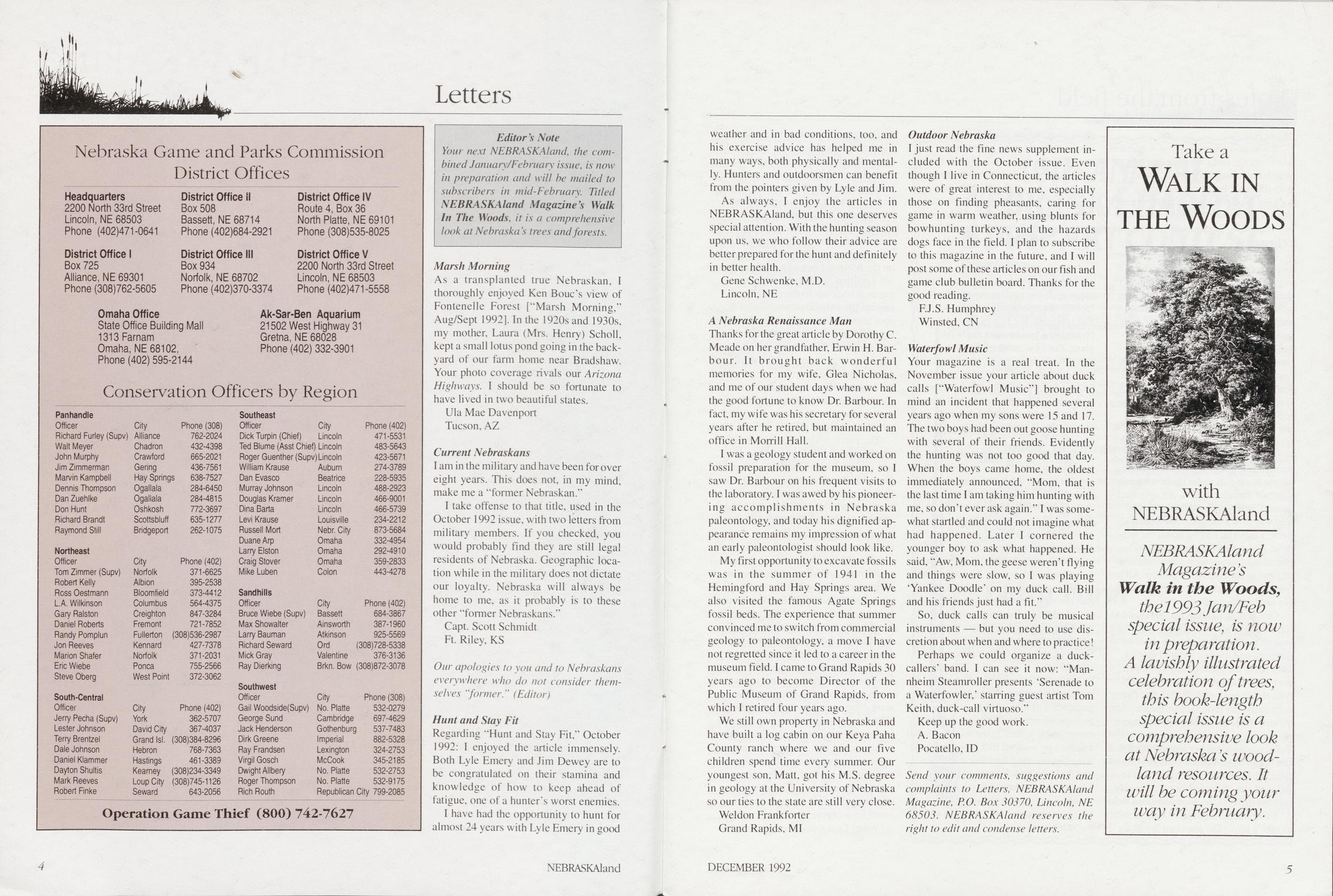 Nebraska Game and Parks Commission
Headquarters District Offices District Office II Dis
strict Office IV
2200 North 33rd Street Box 508 Route 4, Box 36
Lincoln, NE 68503 Bassett, NE 68714 North Platte, NE 69101
Phone (402)471-0641 Phone (402)684-2921 Phone (308)535-8025
District Office 1 District Office III District Office V
Box 725 Box 934 2200 North 33rd Street
Alliance, NE 69301 Norfolk, NE 68702 Lincoln, NE 68503
Phone (308)762-5605 Phone (402)370-3374 Phone (402)471-5558
Omaha Office Ak-Sar-Ben Aquarium
State Office Building Mall 21502 West Highway 31
1313Famam Gretna, NE 68028
Omaha, NE 68102, Phone (402) 332-3901
Phone (402) 595-2144
Cot Panhandle iserv^ ition Of Beers by Region
Southeast
Officer City Phone (308) Officer City Phone (402)
Richard Furley (Supv) Alliance 762-2024 Dick Turpin (Chief) Lincoln 471-5531
Walt Meyer Chadron 432-4398 Ted Blume (Asst Chief) Lincoln 483-5643
John Murphy Crawford 665-2021 Roger Guenther (Supv) Lincoln 423-5671
Jim Zimmerman Gering 436-7561 William Krause Auburn 274-3789
Marvin Kampbell Hay Springs 638-7527 Dan Evasco Beatrice 228-5935
Dennis Thompson Ogallala 284-6450 Murray Johnson Lincoln 488-2923
Dan Zuehlke Ogaliala 284-4815 Douglas Kramer Lincoln 466-9001
Don Hunt Richard Brandt Oshkosh Scottsbluff 772-3697 635-1277 Dina Barta Levi Krause Lincoln 466-5739
234-2212
Louisville
Raymond Still Bridgeport 262-1075 Russell Mort Nebr. City Duane Arp
Omaha 873-5684 332-4954
Northeast Larry Elston Omaha 292-4910
Officer City Phone (402) Craig Stover Omaha 359-2833
Tom Zimmer (Supv) Norfolk 371-6625 Mike Luben Coion 443-4278
Robert Kelly Albion 395-2538
Ross Oestmann Bloomfield 373-4412 Sandhills
L.A. Wilkinson Coiumbus 564-4375 Officer City Phone (402)
Gary Ralston Creighton 847-3284 Bruce Wiebe (Supv) Bassett 684-3867
Daniel Roberts Randy Pomplun Fremont Fullerton 721-7852 (308)536-2987 Max Showalter
Ainsworth 387-1960 925-5569
Larry Bauman Atkinson
Jon Reeves Kennard 427-7378 Richard Seward Ord (308)728-5338
Marion Shafer Norfolk 371-2031 Mick Gray Valentine 376-3136
Eric Wiebe Ponca 755-2566 Ray Dierking Brkn. Bow (308)872-3078
Steve Oberg West Point 372-3062 Southwest
South-Central Officer City Phone (308)
Officer City Phone (402) Gail Woodside(Supv) No. Platte 532-0279
Jerry Pecha (Supv) York 362-5707 George Sund Cambridge 697-4629
Lester Johnson David City 367-4037 Jack Henderson Gothenburg 537-7483
Terry Brentzel Grand Isl. (308)384-8296 Dirk Greene Imperial 882-5328
Dale Johnson Hebron 768-7363 Ray Frandsen Lexington 324-2753
Daniel Klammer Hastings 461-3389 Virgil Gosch McCook 345-2185
Dayton Shultis Kearney (308)234-3349 Dwight Allbery No. Platte 532-2753
Mark Reeves Loup City (308)745-1126 Roger Thompson No. Platte 532-9175
Robert Finke Seward 643-2056 Rich Routh Republican City 799-2085
Ope oration Game Thief (800) 742-7627
Nebraska Game and Parks Commission
Headquarters District Offices District Office II Dis
strict Office IV
2200 North 33rd Street Box 508 Route 4, Box 36
Lincoln, NE 68503 Bassett, NE 68714 North Platte, NE 69101
Phone (402)471-0641 Phone (402)684-2921 Phone (308)535-8025
District Office 1 District Office III District Office V
Box 725 Box 934 2200 North 33rd Street
Alliance, NE 69301 Norfolk, NE 68702 Lincoln, NE 68503
Phone (308)762-5605 Phone (402)370-3374 Phone (402)471-5558
Omaha Office Ak-Sar-Ben Aquarium
State Office Building Mall 21502 West Highway 31
1313Famam Gretna, NE 68028
Omaha, NE 68102, Phone (402) 332-3901
Phone (402) 595-2144
Cot Panhandle iserv^ ition Of Beers by Region
Southeast
Officer City Phone (308) Officer City Phone (402)
Richard Furley (Supv) Alliance 762-2024 Dick Turpin (Chief) Lincoln 471-5531
Walt Meyer Chadron 432-4398 Ted Blume (Asst Chief) Lincoln 483-5643
John Murphy Crawford 665-2021 Roger Guenther (Supv) Lincoln 423-5671
Jim Zimmerman Gering 436-7561 William Krause Auburn 274-3789
Marvin Kampbell Hay Springs 638-7527 Dan Evasco Beatrice 228-5935
Dennis Thompson Ogallala 284-6450 Murray Johnson Lincoln 488-2923
Dan Zuehlke Ogaliala 284-4815 Douglas Kramer Lincoln 466-9001
Don Hunt Richard Brandt Oshkosh Scottsbluff 772-3697 635-1277 Dina Barta Levi Krause Lincoln 466-5739
234-2212
Louisville
Raymond Still Bridgeport 262-1075 Russell Mort Nebr. City Duane Arp
Omaha 873-5684 332-4954
Northeast Larry Elston Omaha 292-4910
Officer City Phone (402) Craig Stover Omaha 359-2833
Tom Zimmer (Supv) Norfolk 371-6625 Mike Luben Coion 443-4278
Robert Kelly Albion 395-2538
Ross Oestmann Bloomfield 373-4412 Sandhills
L.A. Wilkinson Coiumbus 564-4375 Officer City Phone (402)
Gary Ralston Creighton 847-3284 Bruce Wiebe (Supv) Bassett 684-3867
Daniel Roberts Randy Pomplun Fremont Fullerton 721-7852 (308)536-2987 Max Showalter
Ainsworth 387-1960 925-5569
Larry Bauman Atkinson
Jon Reeves Kennard 427-7378 Richard Seward Ord (308)728-5338
Marion Shafer Norfolk 371-2031 Mick Gray Valentine 376-3136
Eric Wiebe Ponca 755-2566 Ray Dierking Brkn. Bow (308)872-3078
Steve Oberg West Point 372-3062 Southwest
South-Central Officer City Phone (308)
Officer City Phone (402) Gail Woodside(Supv) No. Platte 532-0279
Jerry Pecha (Supv) York 362-5707 George Sund Cambridge 697-4629
Lester Johnson David City 367-4037 Jack Henderson Gothenburg 537-7483
Terry Brentzel Grand Isl. (308)384-8296 Dirk Greene Imperial 882-5328
Dale Johnson Hebron 768-7363 Ray Frandsen Lexington 324-2753
Daniel Klammer Hastings 461-3389 Virgil Gosch McCook 345-2185
Dayton Shultis Kearney (308)234-3349 Dwight Allbery No. Platte 532-2753
Mark Reeves Loup City (308)745-1126 Roger Thompson No. Platte 532-9175
Robert Finke Seward 643-2056 Rich Routh Republican City 799-2085
Ope oration Game Thief (800) 742-7627
Letters
Editor's Note Your next NEBRASKAland, the combined J anuary/Eebruary issue, is now in preparation and will be mailed to subscribers in mid-February. Titled NEBRASKAland Magazine's Walk In The Woods, it is a comprehensive look at Nebraska s trees and forests. Marsh MorningAs a transplanted true Nebraskan, I thoroughly enjoyed Ken Bouc's view of Fontenelle Forest ["Marsh Morning," Aug/Sept 1992]. In the 1920s and 1930s, my mother, Laura (Mrs. Henry) Scholl, kept a small lotus pond going in the backyard of our farm home near Bradshaw. Your photo coverage rivals our Arizona Highways. I should be so fortunate to have lived in two beautiful states.
Ula Mae Davenport Tucson, AZ Current NebraskansI am in the military and have been for over eight years. This does not, in my mind, make me a "former Nebraskan."
I take offense to that title, used in the October 1992 issue, with two letters from military members. If you checked, you would probably find they are still legal residents of Nebraska. Geographic location while in the military does not dictate our loyalty. Nebraska will always be home to me, as it probably is to these other "former Nebraskans."
Capt. Scott Schmidt Ft. Riley, KSOur apologies to you and to Nebraskans everywhere who do not consider themselves "former." (Editor)
Hunt and Stay FitRegarding "Hunt and Stay Fit," October 1992: I enjoyed the article immensely. Both Lyle Emery and Jim Dewey are to be congratulated on their stamina and knowledge of how to keep ahead of fatigue, one of a hunter's worst enemies.
I have had the opportunity to hunt for almost 24 years with Lyle Emery in good 4 NEBRASKAland weather and in bad conditions, too, and his exercise advice has helped me in many ways, both physically and mentally. Hunters and outdoorsmen can benefit from the pointers given by Lyle and Jim.
As always, I enjoy the articles in NEBRASKAland, but this one deserves special attention. With the hunting season upon us, we who follow their advice are better prepared for the hunt and definitely in better health.
Gene Schwenke, M.D. Lincoln, NE A Nebraska Renaissance ManThanks for the great article by Dorothy C. Meade on her grandfather, Erwin H. Barbour. It brought back wonderful memories for my wife, Glea Nicholas, and me of our student days when we had the good fortune to know Dr. Barbour. In fact, my wife was his secretary for several years after he retired, but maintained an office in Morrill Hall.
I was a geology student and worked on fossil preparation for the museum, so I saw Dr. Barbour on his frequent visits to the laboratory. I was awed by his pioneering accomplishments in Nebraska paleontology, and today his dignified appearance remains my impression of what an early paleontologist should look like.
My first opportunity to excavate fossils was in the summer of 1941 in the Hemingford and Hay Springs area. We also visited the famous Agate Springs fossil beds. The experience that summer convinced me to switch from commercial geology to paleontology, a move I have not regretted since it led to a career in the museum field. I came to Grand Rapids 30 years ago to become Director of the Public Museum of Grand Rapids, from which I retired four years ago.
We still own property in Nebraska and have built a log cabin on our Keya Paha County ranch where we and our five children spend time every summer. Our youngest son. Matt, got his M.S. degree in geology at the University of Nebraska so our ties to the state are still very close.
Weldon Frankforter Grand Rapids, MI Outdoor NebraskaI just read the fine news supplement included with the October issue. Even though I live in Connecticut, the articles were of great interest to me, especially those on finding pheasants, caring for game in warm weather, using blunts for bowhunting turkeys, and the hazards dogs face in the field. I plan to subscribe to this magazine in the future, and I will post some of these articles on our fish and game club bulletin board. Thanks for the good reading.
F.J.S. Humphrey Winsted, CN Waterfowl MusicYour magazine is a real treat. In the November issue your article about duck calls ["Waterfowl Music"] brought to mind an incident that happened several years ago when my sons were 15 and 17. The two boys had been out goose hunting with several of their friends. Evidently the hunting was not too good that day. When the boys came home, the oldest immediately announced, "Mom, that is the last time I am taking him hunting with me, so don't ever ask again." I was somewhat startled and could not imagine what had happened. Later I cornered the younger boy to ask what happened. He said, "Aw, Mom, the geese weren't flying and things were slow, so I was playing 'Yankee Doodle' on my duck call. Bill and his friends just had a fit."
So, duck calls can truly be musical instruments — but you need to use discretion about when and where to practice!
Perhaps we could organize a duckcallers' band. I can see it now: "Mannheim Steamroller presents 'Serenade to a Waterfowler,' starring guest artist Tom Keith, duck-call virtuoso."
Keep up the good work.
A. Bacon Pocatello, ID Send your comments, suggestions and complaints to Letters, NEBRASKAland Magazine, P.O. Box 30370, Lincoln, NE 68503. NEBRASKAland reserves the right to edit and condense letters. Walk in the Woods with NEBRASKAland NEBRASKAland Magazine's Walk in the Woods, thel993Jan/Feb special issue, is now in preparation. A lavishly illustrated celebration of trees, this book-length special issue is a comprehensive look at Nebraska s woodland resources. It will be coming your way in February. DECEMBER 1992 5
Notes from the field
Waste NotIt was mid-December, a few minutes after sunrise, and I was just cruising, wandering along back roads, camera and 400mm lens on the seat beside me, looking for what a friend calls targets of opportunity. I was taking a few days of vacation — no schedule to meet, no obligations.
The sky was clear and the first hour or two of the day looked promising, even though by noon the light might be that cold, harsh, high-contrast, glaring winter light that makes you want to stop at the nearest watering hole with greasy chili scenting the air and football on the tube. Osage fence posts were capped with two inches of fresh snow which, the night before, had fallen silently out of a windless sky, renewing the four inches still on the ground. The heater was working and the thermos was full.
As I eased up the unplowed gravel to the stop sign at the oiled spur road, I spotted half a dozen pheasants feeding on the bladed shoulder about 15 yards south of the intersection. An ugly background, and there's a pickup headed this way down the spur, but what the heck, I thought, rolling down the window. As I raised the camera, the pheasants flushed west across the spur in front of the oncoming pickup. All but one of them made it into the corn stubble on the other side.
One hen, struggling for speed and altitude, could not clear the pickup. There was an audible thump and a cloud of feathers, and the hen gyrated up and back, over the pickup cab. Then, improbably, she righted herself in the air, now flying back east toward me, flying erratically, but flying, nevertheless. She cleared the fence a few yards from me, gaining altitude, then the wingbeats lost their coordination, her legs dropped and she began to yaw to the side. An instant later, all her motor control seemed to fail, and she crumpled and fell heavily into the drifts at the edge of a bean field.
I shut off the motor and walked over to take a look. The pheasant lay in the snow, dead where she fell. That last, desperate flight must have come straight from the spinal column, the impulses coursing down familiar paths as the last flicker of electrochemical energy drained out of nerves and muscles. Regretting that I had flushed the birds toward the truck for what would have been a second-rate photo at best, I drove on.
It was a good mornine for photographs, marred only by a minor, nagging, bitter taste in my mouth, the feeling of responsibility for the waste of that pheasant. By 11 a.m., the clear, clean dawn had become midwinter glare. Rising winds knocked the snow caps off the fence posts, and the last of my coffee was cold. I decided to go back to my friend's house where the sunporch ought to have reached the perfect temperature for a few hours of mid-day reading. I'd go out cruising again toward evening.
On impulse, as I turned off the spur road toward his place, I pulled over, jerked the parking brake, plodded through the barrow-pit drifts and crossed the fence for another look at the pheasant. I wasn't the only one who had been there. The pheasant, a crumpled ball half buried in the soft new snow a few hours earlier, was now a dismembered carcass. The wings, connected by strings of tissue, lay a few feet across the disturbed snow from the naked rib cage. Breast muscles had been stripped away, and much of the contents of the body cavity was gone. Strips of skin and feathers littered the stained snow.
I guessed that several different scavengers had been there. I knew that avian scavengers — hawks or crows, perhaps — were likely to tear at muscle tissue, and I've seen goose wings, attached by tendons like these pheasant wings, decorating the trees at DeSoto and Squaw Creek refuges like grisly Christmas ornaments hung by bald eagles. Terrestrial scavengers, I'd heard, were more likely to begin with the soft organs.
Being careful not to disturb the area, I looked for evidence, and soon found some: the clear, taloned, three-toed footprint of a big bird, and tracks of smaller birds, too. Among them, the trails of smaller diners — field mice? Mouse-sized creatures, anyway.
By midafternoon, the wind had dropped, the sun was hanging low in the southwestern sky and broken clouds on the horizon foretold a dramatic sunset. I refilled the thermos, hauled cameras back out to the pickup and headed for a creekbottom where I'd seen about a dozen mule deer that morning, thinking, as I drove, about the best vantage point for a sunset shot. Without consciously choosing it, I found myself pulling up to that stop sign on the spur road again. Why not, I thought, and stepping carefully in my old tracks, I went to see what had been going on while I was reading.
The patch of churned snow was much larger now, the pheasant much less recognizable. There was almost no flesh left. The legs, almost whole when I'd been there at midmorning, were nowhere to be seen. The head and neck were missing, too. The wings were no longer connected, and they lay askew, feathers mangled. At the base of the one I handled, the smooth, swelling ball which once had allowed the wing its easy movement against the body was gnawed and split. A little skin still adhered to the thin back of the carcass, but the rib cage was crushed. Most of the small rib bones were gone. Only a few feathers remained.
There were more bird tracks another set of large ones and more small ones, too. The mice — if they were mice — had been busy, and it is surprising how firm their passing there had tramped the snow. There had been a new visitor, too: Along the fence and out to the carcass ran a delicate line of dog-like tracks: four slender toes and a small pad on each foot, from pad to claw less than two inches long. Too small for a coyote. A fox?
When I got to the creekbottom, the 6 NEBRASKAland deer were there, and I got a usable shot three muleys prancing across a weedy bottom, a fourth stock still, poised to run, but turned back to look at me, alert and wary in the last red light of sunset. The clouds had disappeared by then, and sunset was a flaming ball dropping suddenly below the horizon — good to watch, but not a photo.
Driving back past snow-covered fields in the gathering darkness, lines from Robert Frost rose in my mind:
Snow falling and night falling fast, oh, fast, In afield I looked into going past, And the ground almost covered smooth in snow, But a few weeds and stubble showing last. The woods around it have it — it is theirs. All animals are smothered in their lairs. I am too absent spirited to count; The loneliness includes me unawares. And lonely as it is, that loneliness Will be more lonely ere it will be less A blanker whiteness of benighted snow With no expression, nothing to express. They cannot scare me with their empty spaces Between stars — on stars where no human race is. I have it in me so much nearer home to scare myself with my own desert places.1 stopped for one more look on the way back. The light was failing fast, but I'm sure I didn't overlook anything there was nothing there, nothing at all, no bones, no feathers. The snow, in a ragged five-foot circle was roiled and packed. Still more tracks led off into the gathering night, larger tracks.
Later that evening, as the moon rose, I heard the coyotes sing their age-old undulating song, the final confirmation of the day's lessons: the most empty desert places are those in the human mind, and frugal nature does not waste her dead.
Don Cunningham 16th ANNUAL NEBRASKA HABITAT STAMP ART CONTEST Submission Entries may be protected by a covering but will not be accepted in frames, under glass or plastic food wrap. Send to: Habitat Stamp Contest, Nebraska Game and Parks Commission, 2200 N. 33rd St., P.O. Box 30370, Lincoln, NE 68503. A completed entry form and reproduction agreement or facsimile must accompany the entry. The Game and Parks Commission is not responsible for any entry lost or damaged in transit. Entries will not be returned unless specifically requested and self-addressed mailer with proper postage is included. Prizes Adult division first place winner receives $200 from the Omaha Fish and Wildlife Club. Runners-up all receive a subscription to NEBRASKAland Magazine. Youth Division first place winners in each section receive $50 from the Omaha Fish and Wildlife Club. Runners-up all receive subscriptions to NEBRASKAland Magazine. Selected entries will be included in a traveling exhibit. Divisions Adult: Amateur or professional artists. Youth: Senior Section: Grades 9-12; Junior Section: Grades 5-8; Primary Section: Grades K-4. Technical Requirements Design must be Vh inches by 411/i6 inches. It may be matted, but mat may not exceed 10 inches by 7 inches. Any medium acceptable, color preferred. No scroll work or lettering may appear on the design. One entry per person. Subject Matter Any Nebraska wildlife species in an appropriate habitat setting, except mallard ducks, pheasant, Canada geese, raccoon and fox squirrel. Entry Deadline March 1, 1993 Contest is open to Nebraska residents only. Winning entry in the Adult Division will appear on the 1994 Nebraska Habitat Stamp. Entry Form Please accept my entry in the design contest for the 1994 Nebraska Habitat Stamp. I hereby certify that I have complied with all of the rules governing this competition and that the work submitted is my own original creation. Further, the Nebraka Game and Parks Commission is hereby authorized to reproduce the design on the 1994 Habitat Stamp or in any other fashion it may deep appropriate. Division/Section. Title of Entry Name Grade in SchooL Medium. Age if under 19. Name of Parent or Guardian. Address City, State, Zip Home Phone School Phone. Name of School. School Address. City, State, Zip D Please return my entry. I have included the appropriate postage. Signature of Artist DECEMBER 1992 7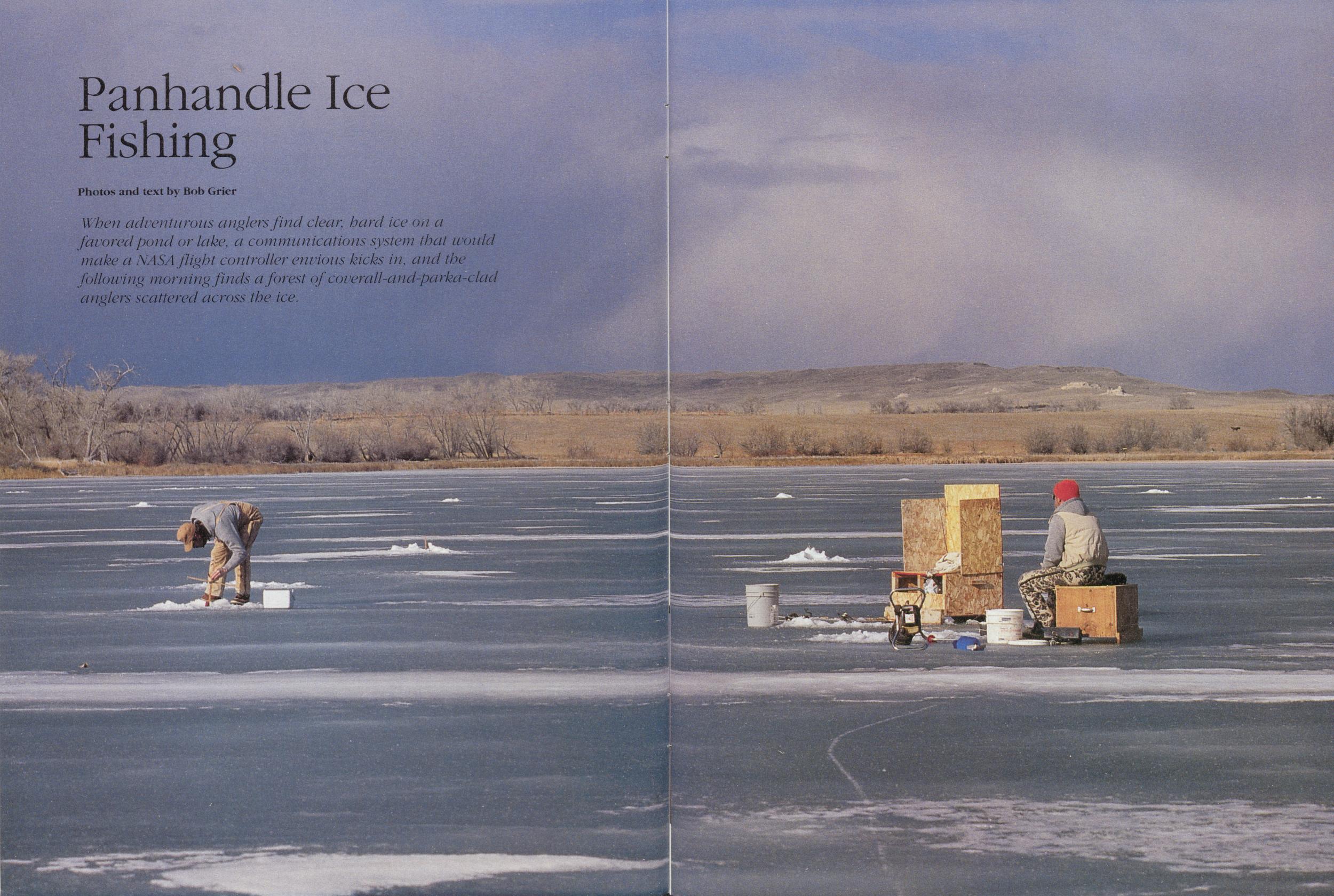
Panhandle Ice Fishin
Photos and text by Bob Grier When adventurous anglers find clear hard ice on a favored pond or lake, a communications system that ivould make a NASA flight controller envious kicks in, and the following morning finds a forest of cot erall-and-parka-clad anglers scattered across the ice.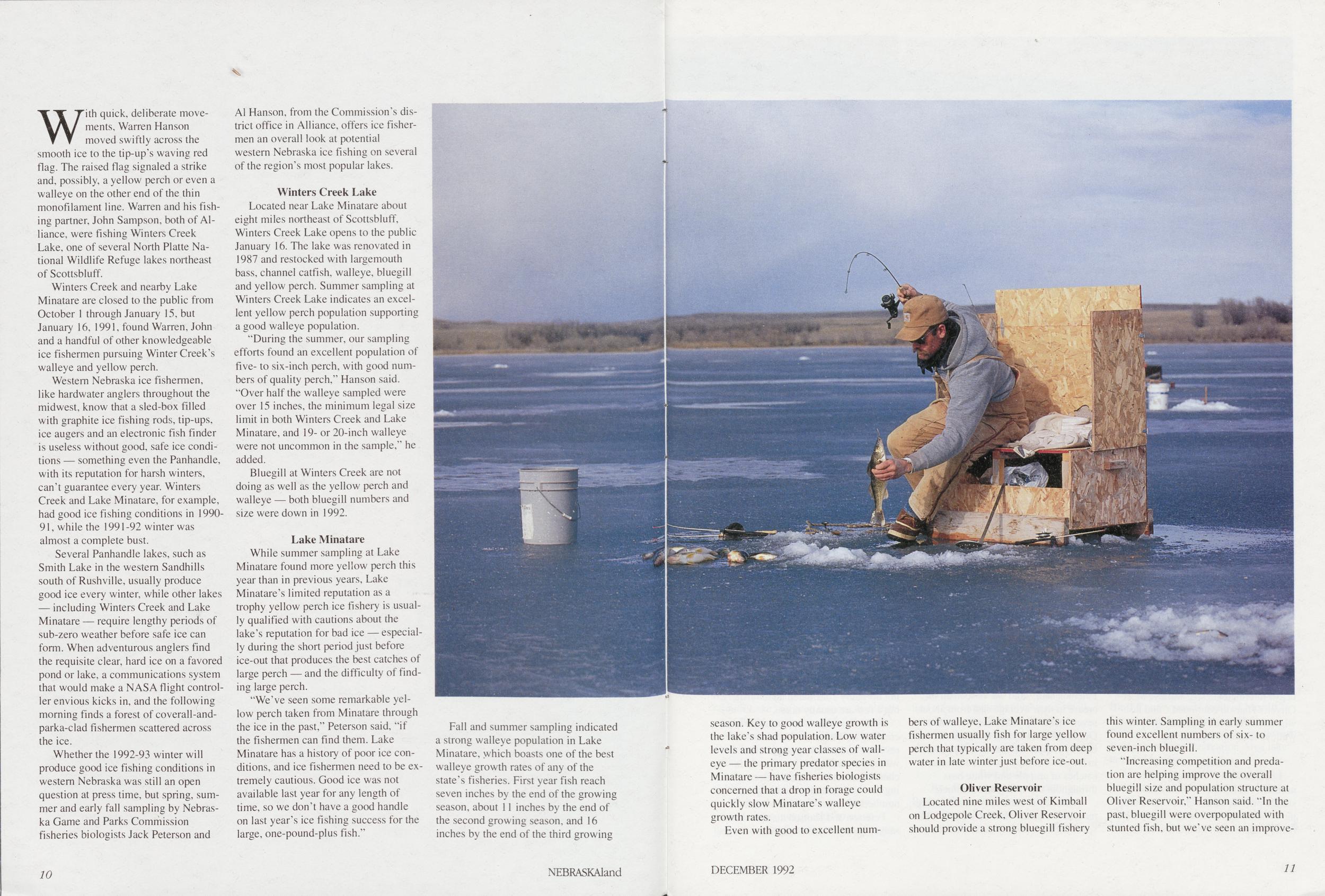
With quick, deliberate movements, Warren Hanson moved swiftly across the smooth ice to the tip-up's waving red flag. The raised flag signaled a strike and, possibly, a yellow perch or even a walleye on the other end of the thin monofilament line. Warren and his fishing partner, John Sampson, both of Alliance, were fishing Winters Creek Lake, one of several North Platte National Wildlife Refuge lakes northeast of Scottsbluff.
Winters Creek and nearbv Lake Minatare are closed to the public from October 1 through January 15, but January 16, 1991, found Warren, John and a handful of other knowledgeable ice fishermen pursuing Winter Creek's walleye and yellow perch.
Western Nebraska ice fishermen, like hardwater anglers throughout the midwest, know that a sled-box filled with graphite ice fishing rods, tip-ups, ice augers and an electronic fish finder is useless without good, safe ice conditions — something even the Panhandle, with its reputation for harsh winters, can't guarantee every year. Winters Creek and Lake Minatare, for example, had good ice fishing conditions in 1990-91, while the 1991 -92 winter was almost a complete bust.
Several Panhandle lakes, such as Smith Lake in the western Sandhills south of Rushville, usually produce good ice every winter, while other lakes — including Winters Creek and Lake Minatare — require lengthy periods of sub-zero weather before safe ice can form. When adventurous anglers find the requisite clear, hard ice on a favored pond or lake, a communications system that would make a NASA flight controller envious kicks in, and the following morning finds a forest of coverall-and-parka-clad fishermen scattered across the ice.
Whether the 1992-93 winter will produce good ice fishing conditions in western Nebraska was still an open question at press time, but spring, summer and early fall sampling by Nebraska Game and Parks Commission fisheries biologists Jack Peterson and Al Hanson, from the Commission's district office in Alliance, offers ice fishermen an overall look at potential western Nebraska ice fishing on several of the region's most popular lakes.
Winters Creek LakeLocated near Lake Minatare about eight miles northeast of Scottsbluff, Winters Creek Lake opens to the public January 16. The lake was renovated in 1987 and restocked with largemouth bass, channel catfish, walleye, bluegill and yellow perch. Summer sampling at Winters Creek Lake indicates an excellent yellow perch population supporting a good walleye population.
"During the summer, our sampling efforts found an excellent population of five- to six-inch perch, with good numbers of quality perch," Hanson said. "Over half the walleye sampled were over 15 inches, the minimum legal size limit in both Winters Creek and Lake Minatare, and 19- or 20-inch walleye were not uncommon in the sample," he added.
Bluegill at Winters Creek are not doing as well as the yellow perch and walleye — both bluegill numbers and size were down in 1992.
Lake MinatareWhile summer sampling at Lake Minatare found more yellow perch this year than in previous years, Lake Minatare's limited reputation as a trophy yellow perch ice fishery is usually qualified with cautions about the lake's reputation for bad ice — especially during the short period just before ice-out that produces the best catches of large perch — and the difficulty of finding large perch.
"We've seen some remarkable yellow perch taken from Minatare through the ice in the past," Peterson said, "if the fishermen can find them. Lake Minatare has a history of poor ice conditions, and ice fishermen need to be extremely cautious. Good ice was not available last year for any length of time, so we don't have a good handle on last year's ice fishing success for the large, one-pound-plus fish."
Fall and summer sampling indicated a strong walleye population in Lake Minatare, which boasts one of the best walleye growth rates of any of the state's fisheries. First year fish reach seven inches by the end of the growing season, about 11 inches by the end of the second growing season, and 16 inches by the end of the third growing 10 NEBRASKAland season. Key to good walleye growth is the lake's shad population. Low water levels and strong year classes of walleye — the primary predator species in Minatare — have fisheries biologists concerned that a drop in forage could quickly slow Minatare's walleye growth rates.
Even with good to excellent numbers of walleye, Lake Minatare's ice fishermen usually fish for large yellow perch that typically are taken from deep water in late winter just before ice-out.
Oliver ReservoirLocated nine miles west of Kimball on Lodgepole Creek, Oliver Reservoir should provide a strong bluegill fishery this winter. Sampling in early summer found excellent numbers of six- to seven-inch bluegill.
"Increasing competition and predation are helping improve the overall
bluegill size and population structure at
Oliver Reservoir," Hanson said. "In the
past, bluegill were overpopulated with
stunted fish, but we've seen an improvement
DECEMBER 1992
11
 during this year's sampling."
Oliver's tiger muskies, with a few fish over the 30-inch minimum size limit, should provide tackle-busting trophy potential for ice fishermen.
"Sampling also revealed a nice number of intermediate size walleye at Oliver," Hanson continued, "and last winter we received reports of trophy walleye taken through the ice."
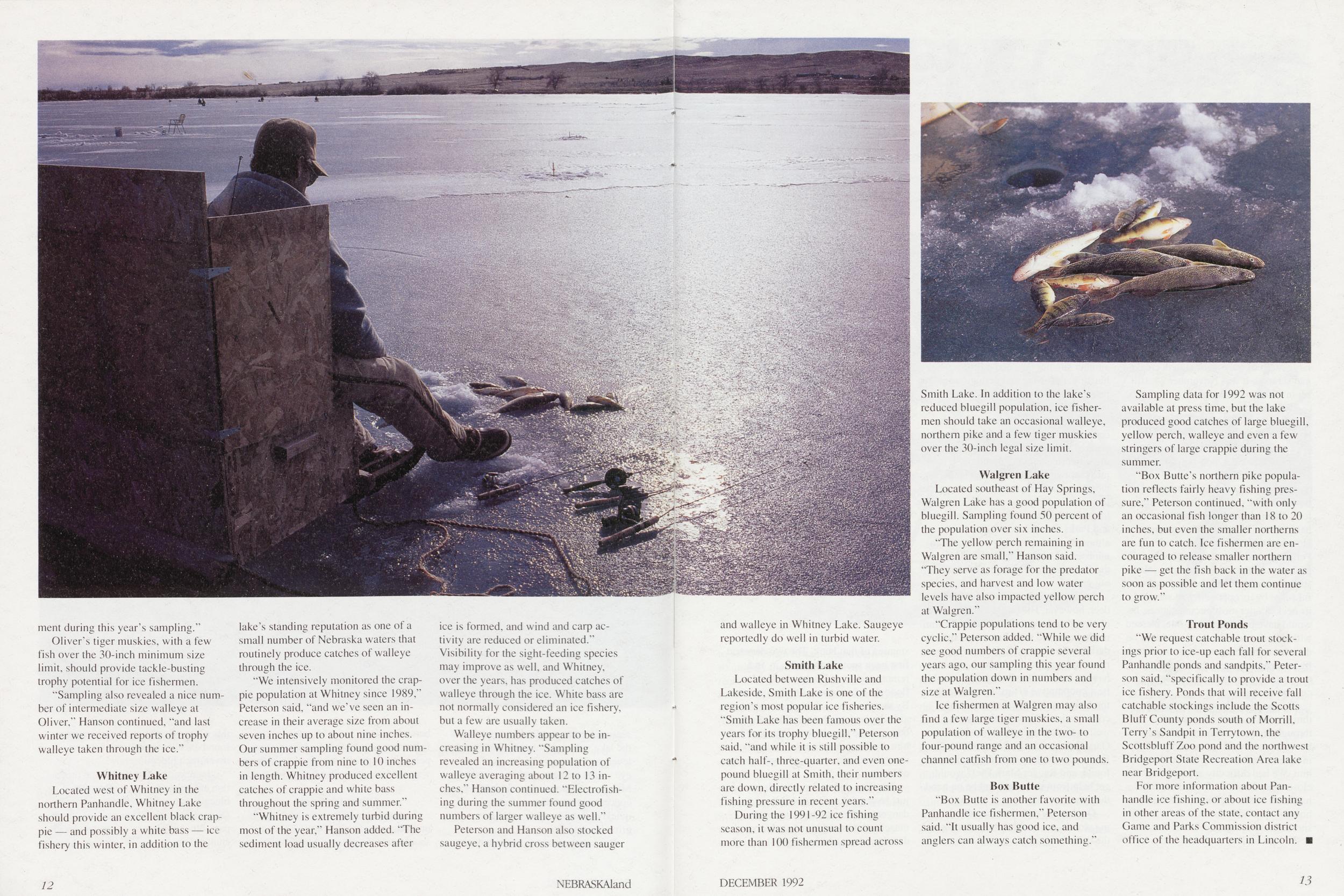
Whitney LakeLocated west of Whitney in the northern Panhandle, Whitney Lake should provide an excellent black crappie — and possibly a white bass — ice fishery this winter, in addition to the lake's standing reputation as one of a small number of Nebraska waters that routinely produce catches of walleye through the ice.
"We intensively monitored the crappie population at Whitney since 1989," Peterson said, "and we've seen an increase in their average size from about seven inches up to about nine inches. Our summer sampling found good numbers of crappie from nine to 10 inches in length. Whitney produced excellent catches of crappie and white bass throughout the spring and summer."
"Whitney is extremely turbid during most of the year," Hanson added. "The sediment load usually decreases after ice is formed, and wind and carp activity are reduced or eliminated." Visibility for the sight-feeding species may improve as well, and Whitney, over the years, has produced catches of walleye through the ice. White bass are not normally considered an ice fishery, but a few are usually taken.
Walleye numbers appear to be increasing in Whitney. "Sampling revealed an increasing population of walleye averaging about 12 to 13 inches," Hanson continued. "Electrofishing during the summer found good numbers of larger walleye as well."
Peterson and Hanson also stocked saugeye, a hybrid cross between sauger 12 NEBRASKAland and walleye in Whitney Lake. Saugeye reportedly do well in turbid water.
Smith LakeLocated between Rushville and Lakeside, Smith Lake is one of the region's most popular ice fisheries. "Smith Lake has been famous over the years for its trophy bluegill," Peterson said, "and while it is still possible to catch half-, three-quarter, and even one pound bluegill at Smith, their numbers are down, directly related to increasing fishing pressure in recent years."
During the 1991-92 ice fishing season, it was not unusual to count more than 100 fishermen spread across Smith Lake. In addition to the lake's reduced bluegill population, ice fishermen should take an occasional walleye, northern pike and a few tiger muskies over the 30-inch legal size limit.
Walgren LakeLocated southeast of Hay Springs, Walgren Lake has a good population of bluegill. Sampling found 50 percent of the population over six inches.
"The yellow perch remaining in Walgren are small," Hanson said. "They serve as forage for the predator species, and harvest and low water levels have also impacted yellow perch at Walgren."
"Crappie populations tend to be very cyclic," Peterson added. "While we did see good numbers of crappie several years ago, our sampling this year found the population down in numbers and size at Walgren."
Ice fishermen at Walgren may also find a few large tiger muskies, a small population of walleye in the two- to four-pound range and an occasional channel catfish from one to two pounds.
Box Butte"Box Butte is another favorite with Panhandle ice fishermen," Peterson said. "It usually has good ice, and anglers can always catch something."
Sampling data for 1992 was not available at press time, but the lake produced good catches of large bluegill, yellow perch, walleye and even a few stringers of large crappie during the summer.
"Box Butte's northern pike population reflects fairly heavy fishing pressure," Peterson continued, "with only an occasional fish longer than 18 to 20 inches, but even the smaller northerns are fun to catch. Ice fishermen are encouraged to release smaller northern pike — get the fish back in the water as soon as possible and let them continue to grow."
Trout Ponds"We request catchable trout stockings prior to ice-up each fall for several Panhandle ponds and sandpits." Peterson said, "specifically to provide a trout ice fishery. Ponds that will receive fall catchable stockings include the Scotts Bluff County ponds south of Morrill, Terry's Sandpit in Terrytown, the Scottsbluff Zoo pond and the northwest Bridgeport State Recreation Area lake near Bridgeport.
For more information about Pan-handle ice fishing, or about ice fishing in other areas of the state, contact any Game and Parks Commission district office of the headquarters in Lincoln.
DECEMBER 1992 13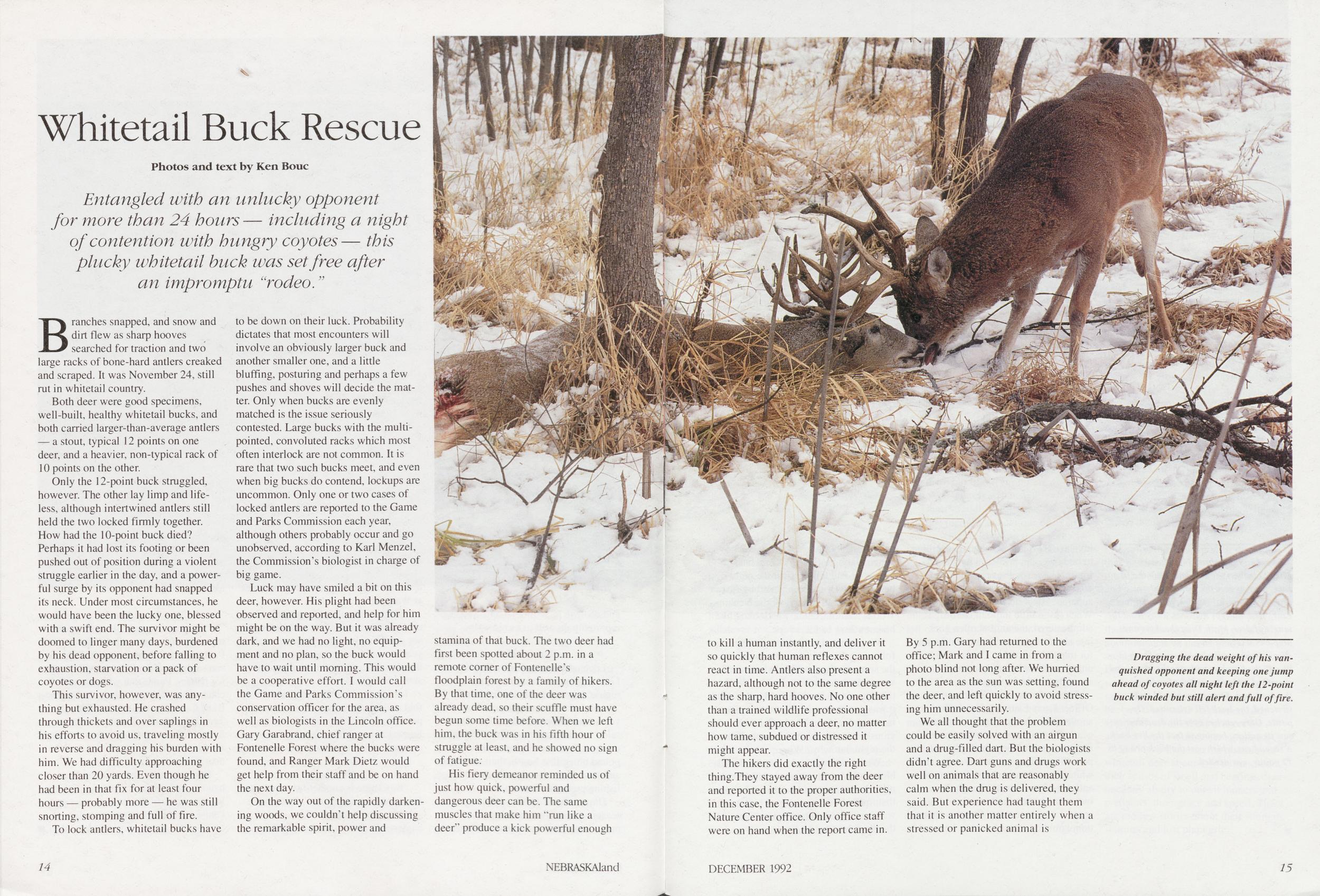
Whitetail Buck Rescue
Photos and text by Ken Bouc Entangled with an unlucky opponent for more than 24 hours— including a night of contention with hungry coyotes— this plucky whitetail buck was set free after an impromptu "rodeo.Branches snapped, and snow and dirt flew as sharp hooves searched for traction and two large racks of bone-hard antlers creaked and scraped. It was November 24, still rut in whitetail country.
Both deer were good specimens, well-built, healthy whitetail bucks, and both carried larger-than-average antlers — a stout, typical 12 points on one deer, and a heavier, non-typical rack of 10 points on the other.
Only the 12-point buck struggled, however. The other lay limp and lifeless, although intertwined antlers still held the two locked firmly together. How had the 10-point buck died? Perhaps it had lost its footing or been pushed out of position during a violent struggle earlier in the day, and a powerful surge by its opponent had snapped its neck. Under most circumstances, he would have been the lucky one, blessed with a swift end. The survivor might be doomed to linger many days, burdened by his dead opponent, before falling to exhaustion, starvation or a pack of coyotes or dogs.
This survivor, however, was anything but exhausted. He crashed through thickets and over saplings in his efforts to avoid us, traveling mostly in reverse and dragging his burden with him. We had difficulty approaching closer than 20 yards. Even though he had been in that fix for at least four hours — probably more — he was still snorting, stomping and full of fire.
To lock antlers, whitetail bucks have to be down on their luck. Probability dictates that most encounters will involve an obviously larger buck and another smaller one, and a little bluffing, posturing and perhaps a few pushes and shoves will decide the matter. Only when bucks are evenly matched is the issue seriously contested. Large bucks with the multipointed, convoluted racks which most often interlock are not common. It is rare that two such bucks meet, and even when big bucks do contend, lockups are uncommon. Only one or two cases of locked antlers are reported to the Game and Parks Commission each year, although others probably occur and go unobserved, according to Karl Menzel, the Commission's biologist in charge of big game.
Luck may have smiled a bit on this deer, however. His plight had been observed and reported, and help for him might be on the way. But it was already dark, and we had no light, no equipment and no plan, so the buck would have to wait until morning. This would be a cooperative effort. I would call the Game and Parks Commission's conservation officer for the area, as well as biologists in the Lincoln office. Gary Garabrand, chief ranger at Fontenelle Forest where the bucks were found, and Ranger Mark Dietz would get help from their staff and be on hand the next day.
On the way out of the rapidly darkening woods, we couldn't help discussing the remarkable spirit, power and stamina of that buck. The two deer had first been spotted about 2 p.m. in a remote corner of Fontenelle's floodplain forest by a family of hikers. By that time, one of the deer was already dead, so their scuffle must have begun some time before. When we left him, the buck was in his fifth hour of struggle at least, and he showed no sign of fatigue.
His fiery demeanor reminded us of just how quick, powerful and dangerous deer can be. The same muscles that make him "run like a deer" produce a kick powerful enough 14 NEBRASKAland
The hikers did exactly the right thing.They stayed away from the deer and reported it to the proper authorities, in this case, the Fontenelle Forest Nature Center office. Only office staff were on hand when the report came in. By 5 p.m. Gary had returned to the office; Mark and I came in from a photo blind not long after. We hurried to the area as the sun was setting, found the deer, and left quickly to avoid stressing him unnecessarily.
We all thought that the problem
could be easily solved with an airgun
and a drug-filled dart. But the biologists
didn't agree. Dart guns and drugs work
well on animals that are reasonably
calm when the drug is delivered, they
said. But experience had taught them
that it is another matter entirely when a
stressed or panicked animal is
DECEMBER 1992
15
The next morning, Conservation Officer Larry Elston of Omaha had another idea. In the Hay Springs area, nearly 30 years ago, he and a posse of ranchers and cowboys had subdued a pair of locked-up but nearly exhausted whitetails with ropes, and they sawed antlers to free them. Although those two animals were both nearly spent, Larry speculated that this operation would be easier because we would have to deal with just one live deer. When Gary, Mark and I hiked back to where we had left the deer the night before, we were accompanied by Elston and by Mike Stansberry of the Neale Woods Nature Center, who looked like he knew how to use a rope.
We expected to find the deer by following the wide drag marks left in the snow by the dead buck, but when we reached the area, a clearing about the size of two football fields, we found it was covered with drag marks going in every direction. The buck had obviously been on the move throughout the night, but why? Where was he now?
We fanned out, and when we found him northwest of where we left him the night before, we could account for all that traffic in the clearing. A big chunk was missing from the hindquarters of the dead deer, no doubt eaten by 16 NEBRASKAland coyotes during the night. Obviously, the other buck didn't relish the idea of having predators that close, and had tried to run away from them. Whatever venison the coyotes ate that night, they must have eaten on the run. And whatever rest the buck had gotten must have come between dawn and our arrival about 10 a.m.
He seemed in good shape — no marks from the coyotes and no sign of fatigue. We herded him back to a small clearing full of tall grass at the edge of a frozen marsh, and there accomplished the rescue in short order.
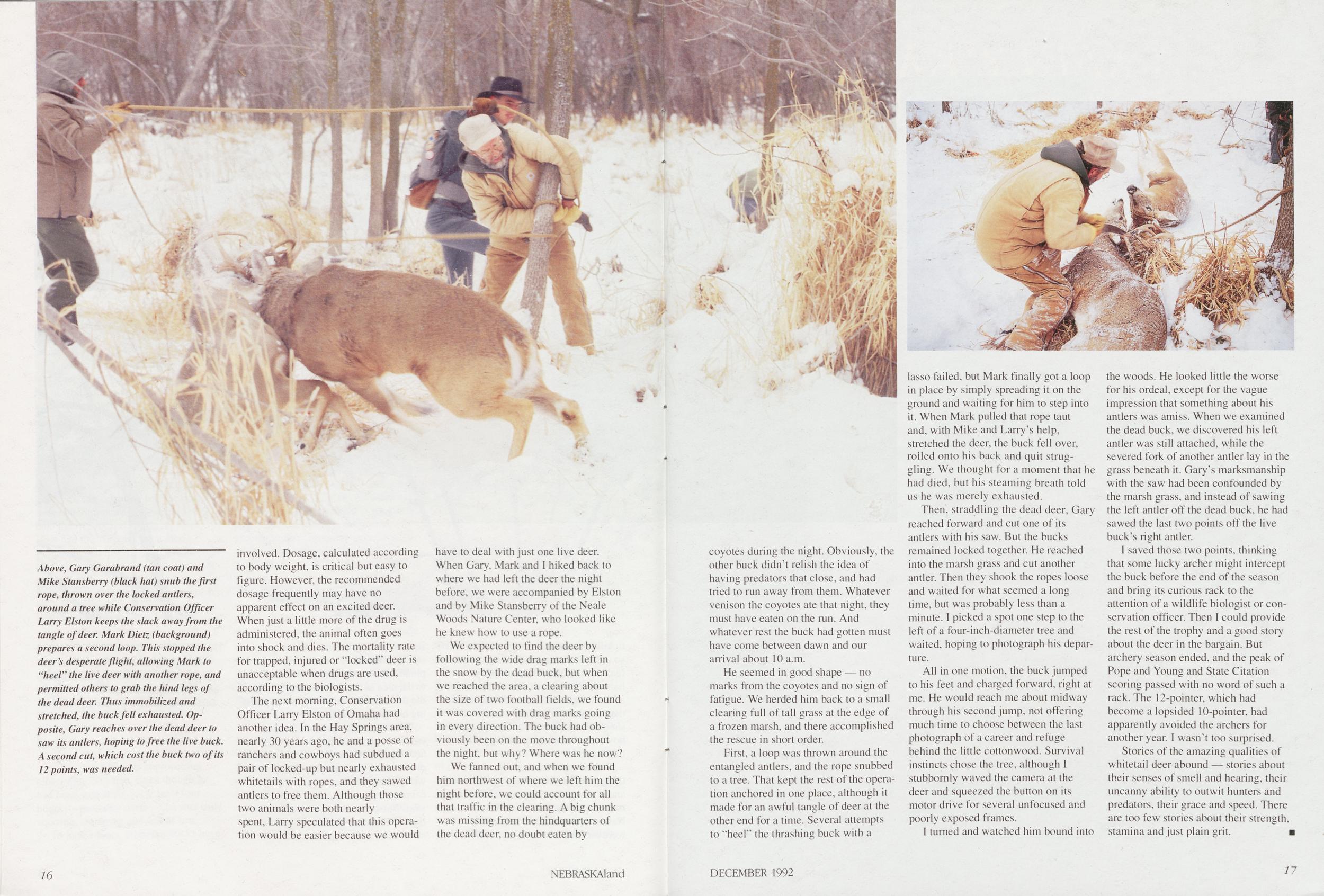
First, a loop was thrown around the entangled antlers, and the rope snubbed to a tree. That kept the rest of the operation anchored in one place, although it made for an awful tangle of deer at the other end for a time. Several attempts to "heel" the thrashing buck with a lasso failed, but Mark finally got a loop in place by simply spreading it on the ground and waiting for him to step into it. When Mark pulled that rope taut and, with Mike and Larry's help, stretched the deer, the buck fell over, roiled onto his back and quit struggling. We thought for a moment that he had died, but his steaming breath told us he was merely exhausted.
Then, straddling the dead deer, Gary reached forward and cut one of its antlers with his saw. But the bucks remained locked together. He reached into the marsh grass and cut another antler. Then they shook the ropes loose and waited for what seemed a long time, but was probably less than a minute. I picked a spot one step to the left of a four-inch-diameter tree and waited, hoping to photograph his departure.
All in one motion, the buck jumped to his feet and charged forward, right at me. He would reach me about midway through his second jump, not offering much time to choose between the last photograph of a career and refuge behind the little cottonwood. Survival instincts chose the tree, although I stubbornly waved the camera at the deer and squeezed the button on its motor drive for several unfocused and poorly exposed frames.
I turned and watched him bound into the woods. He looked little the worse for his ordeal, except for the vague impression that something about his antlers was amiss. When we examined the dead buck, we discovered his left antler was still attached, while the severed fork of another antler lay in the grass beneath it. Gary's marksmanship with the saw had been confounded by the marsh grass, and instead of sawing the left antler off the dead buck, he had sawed the last two points off the live buck's right antler.
I saved those two points, thinking that some lucky archer might intercept the buck before the end of the season and bring its curious rack to the attention of a wildlife biologist or conservation officer. Then I could provide the rest of the trophy and a good story about the deer in the bargain. But archery season ended, and the peak of Pope and Young and State Citation scoring passed with no word of such a rack. The 12-pointer, which had become a lopsided 10-pointer, had apparently avoided the archers for another year. I wasn't too surprised.
Stories of the amazing qualities of whitetail deer abound — stories about their senses of smell and hearing, their uncanny ability to outwit hunters and predators, their grace and speed. There are too few stories about their strength, stamina and just plain grit.
DECEMBER 1992 17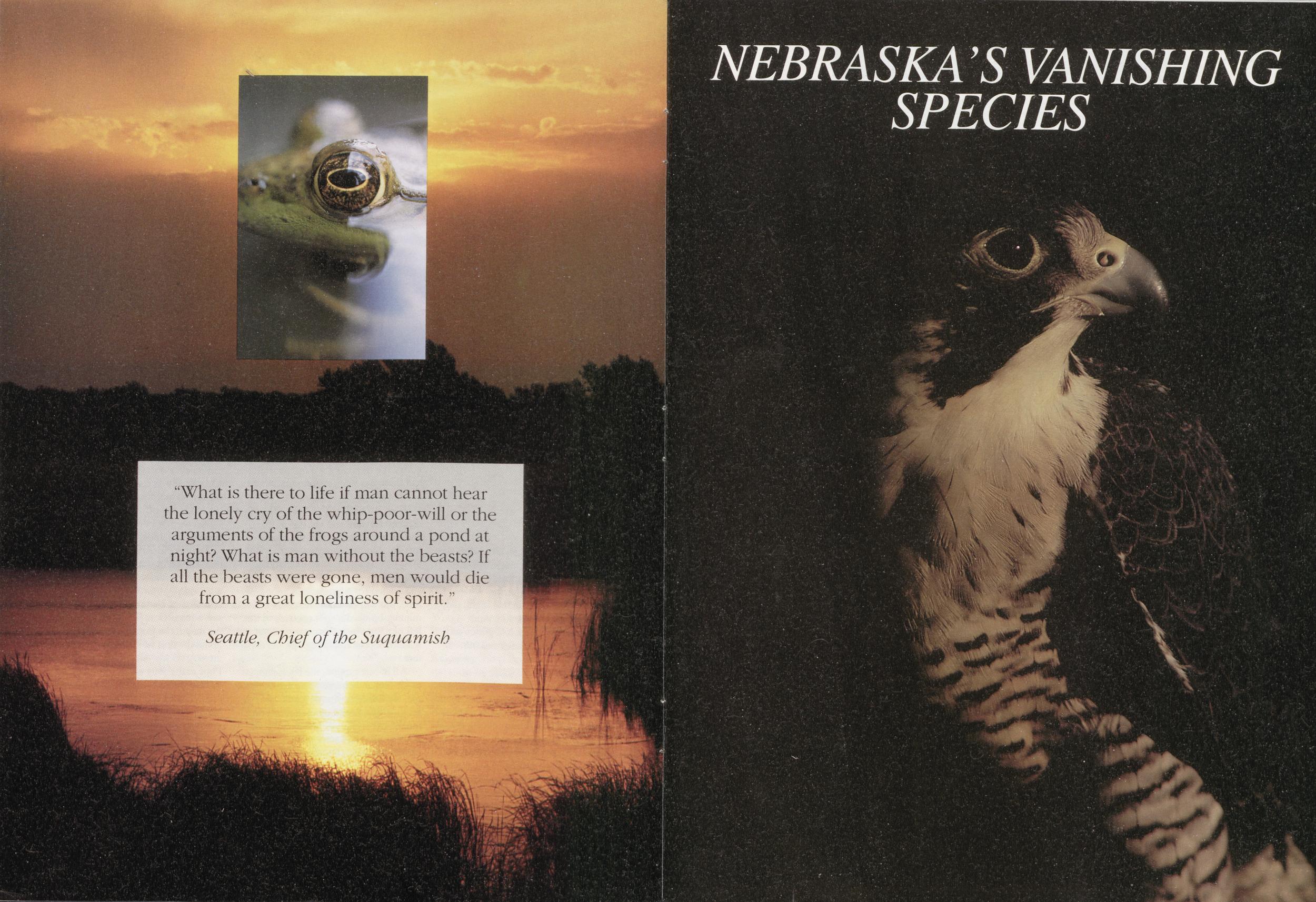
NEBRASKA'S VANISHING SPECIES
Nebraskans are blessed with a rich heritage — friendly, hard-working people, unique landforms and diverse natural resources, including native species of plants and animals. Unfortunately, an irreplaceable part of this heritage, our threatened and endangered species, is vanishing.
Simply stated, a threatened species is one likely to become endangered. An endangered species is one so rare that it is in danger of becoming extinct. Extinction is the loss of a species from this world.
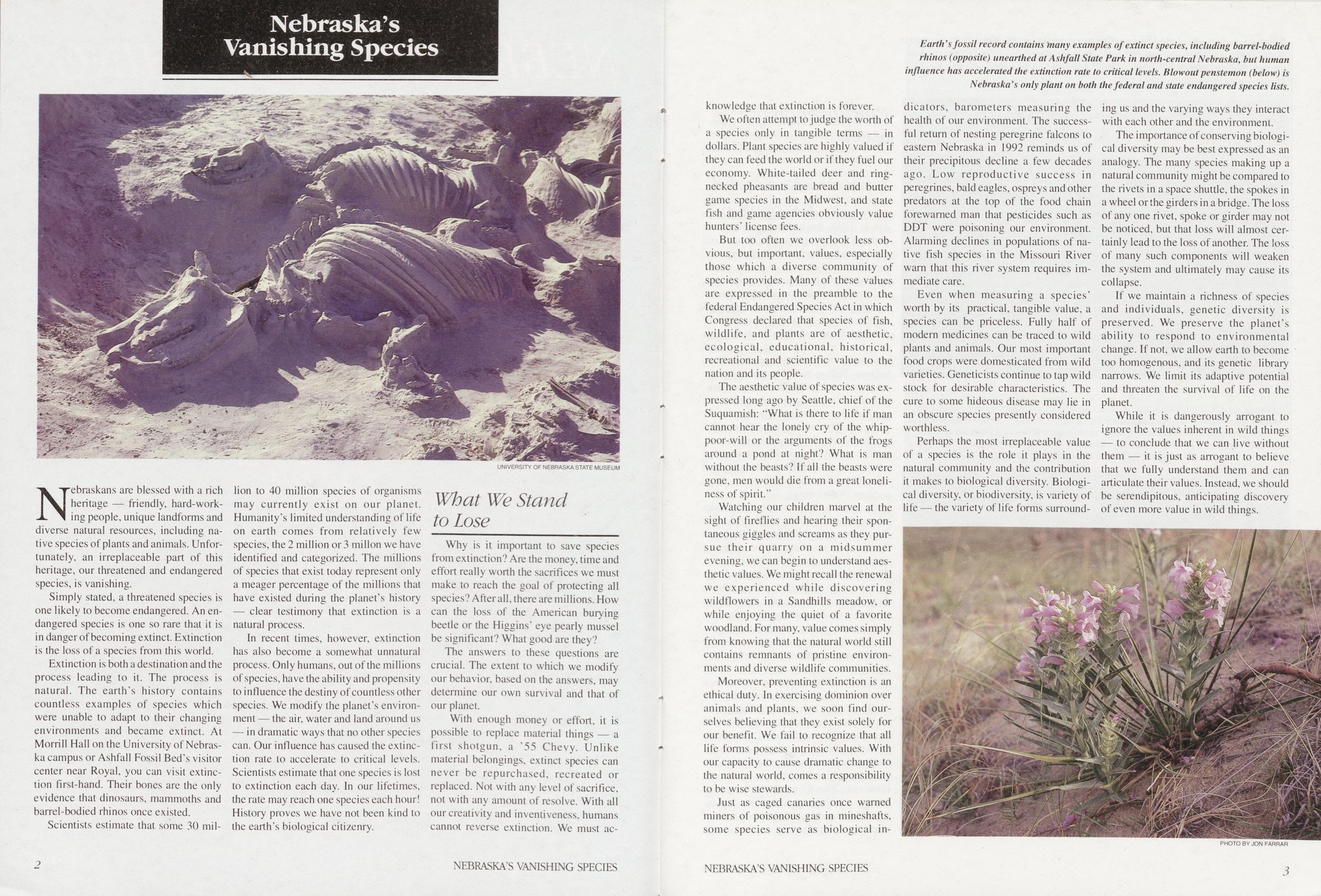
Extinction is both a destination and the process leading to it. The process is natural. The earth's history contains countless examples of species which were unable to adapt to their changing environments and became extinct. At Morrill Hall on the University of Nebraska campus or Ashfall Fossil Bed's visitor center near Royal, you can visit extinction first-hand. Their bones are the only evidence that dinosaurs, mammoths and barrel-bodied rhinos once existed.
Scientists estimate that some 30 million to 40 million species of organisms may currently exist on our planet. Humanity's limited understanding of life on earth comes from relatively few species, the 2 million or 3 millon we have identified and categorized. The millions of species that exist today represent only a meager percentage of the millions that have existed during the planet's history clear testimony that extinction is a natural process.
In recent times, however, extinction has also become a somewhat unnatural process. Only humans, out of the millions of species, have the ability and propensity to influence the destiny of countless other species. We modify the planet's environment — the air, water and land around us — in dramatic ways that no other species can. Our influence has caused the extinction rate to accelerate to critical levels. Scientists estimate that one species is lost to extinction each dav. In our lifetimes, the rate may reach one species each hour! History proves we have not been kind to the earth's biological citizenry.
What We Stand to LoseWhy is it important to save species from extinction? Are the money, time and effort really worth the sacrifices we must make to reach the goal of protecting all species? After all, there are millions. How can the loss of the American burying beetle or the Higgins' eye pearly mussel be significant? What good are they?
The answers to these questions are crucial. The extent to which we modify our behavior, based on the answers, may determine our own survival and that of our planet.
With enough money or effort, it is possible to replace material things a first shotgun, a '55 Chevy. Unlike material belongings, extinct species can never be repurchased, recreated or replaced. Not with any level of sacrifice, not with any amount of resolve. With all our creativity and inventiveness, humans cannot reverse extinction. We must acknowledge 2 NEBRASKA'S VANISHING SPECIES that extinction is forever.
We often attempt to judge the worth of a species only in tangible terms in dollars. Plant species are highly valued if they can feed the world or if they fuel our economy. White-tailed deer and ring-necked pheasants are bread and butter game species in the Midwest, and state fish and game agencies obviously value hunters' license fees.
But too often we overlook less obvious, but important, values, especially those which a diverse community of species provides. Many of these values are expressed in the preamble to the federal Endangered Species Act in which Congress declared that species of fish, wildlife, and plants are of aesthetic, ecological, educational, historical, recreational and scientific value to the nation and its people.
The aesthetic value of species was expressed long ago by Seattle, chief of the Suquamish: "What is there to life if man cannot hear the lonely cry of the whip-poor-will or the arguments of the frogs around a pond at night? What is man without the beasts? If all the beasts were gone, men would die from a great loneliness of spirit."
Watching our children marvel at the sight of fireflies and hearing their spontaneous giggles and screams as they pursue their quarry on a midsummer evening, we can begin to understand aesthetic values. We might recall the renewal we experienced while discovering wildflowers in a Sandhills meadow, or while enjoying the quiet of a favorite woodland. For many, value comes simply from knowing that the natural world still contains remnants of pristine environments and diverse wildlife communities.
Moreover, preventing extinction is an ethical duty. In exercising dominion over animals and plants, we soon find ourselves believing that they exist solely for our benefit. We fail to recognize that all life forms possess intrinsic values. With our capacity to cause dramatic change to the natural world, comes a responsibility to be wise stewards.
Just as caged canaries once warned miners of poisonous gas in mineshafts, some species serve as biological indicators, barometers measuring the health of our environment. The successful return of nesting peregrine falcons to eastern Nebraska in 1992 reminds us of their precipitous decline a few decades ago. Low reproductive success in peregrines, bald eagles, ospreys and other predators at the top of the food chain forewarned man that pesticides such as DDT were poisoning our environment. Alarming declines in populations of native fish species in the Missouri River warn that this river system requires immediate care.
Even when measuring a species' worth by its practical, tangible value, a species can be priceless. Fully half of modern medicines can be traced to wild plants and animals. Our most important food crops were domesticated from wild varieties. Geneticists continue to tap wild stock for desirable characteristics. The cure to some hideous disease may lie in an obscure species presently considered worthless.
Perhaps the most irreplaceable value of a species is the role it plays in the natural community and the contribution it makes to biological diversity. Biological diversity, or biodiversity, is variety of life — the variety of life forms surrounding us and the varying ways they interact with each other and the environment.
The importance of conserving biological diversity may be best expressed as an analogy. The many species making up a natural community might be compared to the rivets in a space shuttle, the spokes in a wheel or the girders in a bridge. The loss of any one rivet, spoke or girder may not be noticed, but that loss will almost certainly lead to the loss of another. The loss of many such components will weaken the system and ultimately may cause its collapse.
If we maintain a richness of species and individuals, genetic diversity is preserved. We preserve the planet's ability to respond to environmental change. If not, we allow earth to become too homogenous, and its genetic library narrows. We limit its adaptive potential and threaten the survival of life on the planet.
While it is dangerously arrogant to ignore the values inherent in wild things — to conclude that we can live without them — it is just as arrogant to believe that we fully understand them and can articulate their values. Instead, we should be serendipitous, anticipating discovery of even more value in wild things.
NEBRASKA'S VANISHING SPECIES 3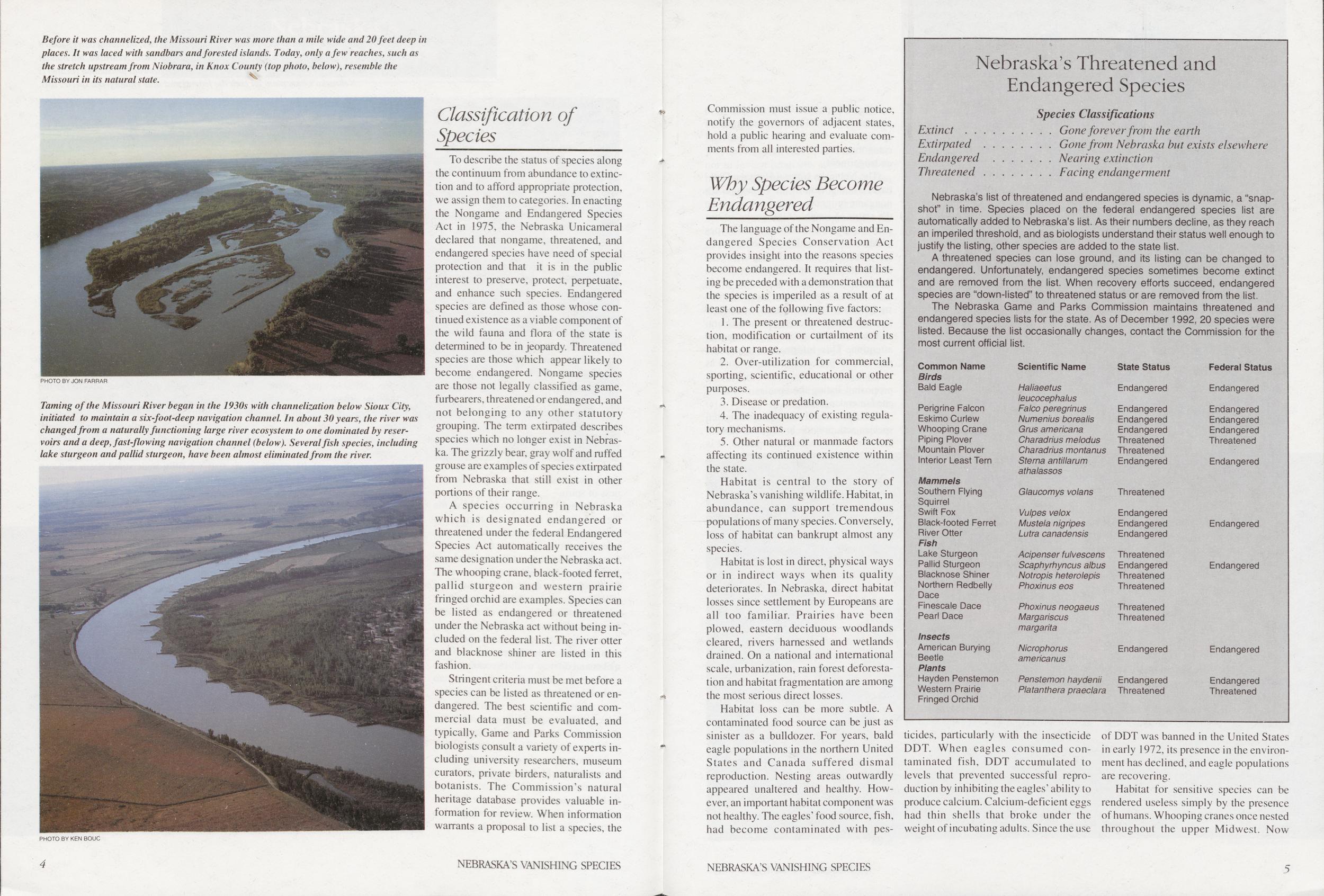
To describe the status of species along the continuum from abundance to extinction and to afford appropriate protection, we assign them to categories. In enacting the Nongame and Endangered Species Act in 1975, the Nebraska Unicameral declared that nongame, threatened, and endangered species have need of special protection and that it is in the public interest to preserve, protect, perpetuate, and enhance such species. Endangered species are defined as those whose continued existence as a viable component of the wild fauna and flora of the state is determined to be in jeopardy. Threatened species are those which appear likely to become endangered. Nongame species are those not legally classified as game, furbearers, threatened or endangered, and not belonging to any other statutory grouping. The term extirpated describes species which no longer exist in Nebraska. The grizzly bear, gray wolf and ruffed grouse are examples of species extirpated from Nebraska that still exist in other portions of their range.
A species occurring in Nebraska which is designated endangered or threatened under the federal Endangered Species Act automatically receives the same designation under the Nebraska act. The whooping crane, black-footed ferret, pallid sturgeon and western prairie fringed orchid are examples. Species can be listed as endangered or threatened under the Nebraska act without being included on the federal list. The river otter and blacknose shiner are listed in this fashion.
Stringent criteria must be met before a species can be listed as threatened or endangered. The best scientific and commercial data must be evaluated, and typically. Game and Parks Commission biologists consult a variety of experts including university researchers, museum curators, private birders, naturalists and botanists. The Commission's natural heritage database provides valuable information for review. When information warrants a proposal to list a species, the 4 NEBRASKA'S VANISHING SPECIES Commission must issue a public notice, notify the governors of adjacent states, hold a public hearing and evaluate comments from all interested parties.
Why Species Become EndangeredThe language of the Nongame and Endangered Species Conservation Act provides insight into the reasons species become endangered. It requires that listing be preceded with a demonstration that the species is imperiled as a result of at least one of the following five factors:
1. The present or threatened destruction, modification or curtailment of its habitat or range.
2. Over-utilization for commercial, sporting, scientific, educational or other purposes.
3. Disease or predation.
4. The inadequacy of existing regulatory mechanisms.
5. Other natural or manmade factors affecting its continued existence within the state.
Habitat is central to the story of Nebraska's vanishing wildlife. Habitat, in abundance, can support tremendous populations of many species. Conversely, loss of habitat can bankrupt almost any species.
Habitat is lost in direct, physical ways or in indirect ways when its quality deteriorates. In Nebraska, direct habitat losses since settlement by Europeans are all too familiar. Prairies have been plowed, eastern deciduous woodlands cleared, rivers harnessed and wetlands drained. On a national and international scale, urbanization, rain forest deforestation and habitat fragmentation are among the most serious direct losses.
Habitat loss can be more subtle. A contaminated food source can be just as sinister as a bulldozer. For years, bald eagle populations in the northern United States and Canada suffered dismal reproduction. Nesting areas outwardly appeared unaltered and healthy. However, an important habitat component was not healthy. The eagles' food source, fish, had become contaminated with pesticides, particularly with the insecticide DDT. When eagles consumed contaminated fish, DDT accumulated to levels that prevented successful reproduction by inhibiting the eagles' ability to produce calcium. Calcium-deficient eggs had thin shells that broke under the weight of incubating adults. Since the use of DDT was banned in the United States in early 1972, its presence in the environment has declined, and eagle populations are recovering.
Nebraska's Threatened and Endangered Species Extinct Extirpated Endangered Threatened Species Classifications Gone forever from the earth Gone from Nebraska but exists elsewhere Nearing extinction Facing endangermentNebraska's list of threatened and endangered species is dynamic, a "snapshot" in time. Species placed on the federal endangered species list are automatically added to Nebraska's list. As their numbers decline, as they reach an imperiled threshold, and as biologists understand their status well enough to justify the listing, other species are added to the state list.
A threatened species can lose ground, and its listing can be changed to endangered. Unfortunately, endangered species sometimes become extinct and are removed from the list. When recovery efforts succeed, endangered species are "down-listed" to threatened status or are removed from the list.
The Nebraska Game and Parks Commission maintains threatened and endangered species lists for the state. As of December 1992, 20 species were listed. Because the list occasionally changes, contact the Commission for the most current official list.
Federal Status Common Name Scientific Name State Status Birds Bald Eagle Hafiaeetus leucocephalus Endangered Perigrine Falcon Falco peregrinus Endangered Eskimo Curlew Numenius borealis Endangered Whooping Crane Grus americana Endangered Piping Plover Charadrius melodus Threatened Mountain Plover Charadrius montanus Threatened Interior Least Tern Sterna antiflarum athafassos Endangered Mammels Southern Flying Glaucomys voians Threatened Squirrel Swift Fox Vulpes velox Endangered Black-footed Ferret Mustefa nigripes Endangered River Otter Lutra canadensis Endangered Fish Lake Sturgeon Acipenser fufvescens Threatened Pallid Sturgeon Scaphyrhyncus aibus Endangered Blacknose Shiner Notropis heterolepis Threatened Northern Redbelly Phoxinus eos Threatened Dace Finescale Dace Phoxinus neogaeus Threatened Pearl Dace Margahscus margarita Threatened Endangered Endangered Endangered Endangered Threatened Endangered Endangered Endangered insects American Burying Beetle Plants Hayden Penstemon Western Prairie Fringed Orchid Nicrophorus americanus Penstemon haydenii Platanthera praeciara Endangered Endangered Threatened Endangered Endangered ThreatenedHabitat for sensitive species can be
rendered useless simply by the presence
of humans. Whooping cranes once nested
throughout the upper Midwest. Now
NEBRASKA'S VANISHING SPECIES
5
Extreme exploitation of populations can lead to endangerment or extinction, as was the case with the passenger pigeon. Conservation agencies are quick to point out that the market hunting days of old have been replaced with closely regulated hunting that maintains harvest within limits the animal populations can sustain. Regulated sport hunting and trapping have never resulted in a species becoming endangered or threatened, but we must not ignore the magnitude of illegal market hunting that continues today the commercial, black market trade in wildlife. Gyrfalcons can be bartered for thousands of dollars when today's sophisticated poacher meets a wealthy buyer. Elephants are slaughtered for their tusks, and bald eagles for their feathers. The list is too long. Conservation agencies face a serious challenge in their efforts to abate black market trade.
Protection and Recovery?Once people begin to understand extinction, they inevitably want to know what is being done to prevent extinction. Nebraska's nongame wildlife program is designed to manage species and their habitat to prevent their endangerment, to provide protection when species become endangered and to implement activities that will lead to the recovery of species to a less imperiled status.
For years, state conservation agencies, including the Nebraska Game and Parks Commission, concentrated on management of game species. Later, programs were designed to manage threatened and endangered species. Only recently have programs focused on the hundreds of species that fall outside these special categories in attempts to prevent their endangerment.
The Nebraska Natural Heritage Database, a component of the Commission's nongame program, is used to investigate the status of roughly 600 species of uncommon plants and animals and 50 types of natural communities. It functions as an early warning system, alerting biologists to the plight of species vulnerable to decline. Species are evaluated to determine those which require more detailed study, those which require immediate management to prevent endangerment, and those which do not require special attention. This information is used to recommend protection strategies such as acquiring tracts of sensitive habitat or proposing listing the species as threatened or endangered.
Both the federal and state endangered species acts provide broad protection, to threatened and endangered species. It is illegal to import, export, possess, process, sell, offer for sale, or take any listed species. The Nebraska Act stipulates that take shall mean to harass, harm, pursue, hunt, shoot, wound, kill, trap, capture or collect. Prohibitions extend to all persons, from private individuals to state, federal and foreign governments, except when authorized for scientific purposes or to enhance the species' survival. The acts also provide protection by setting up mechanisms to fund conservation work. Projects funded with money authorized by the federal act and administered by the U.S. Fish and Wildlife Service can receive 75 to 90 percent cost sharing.
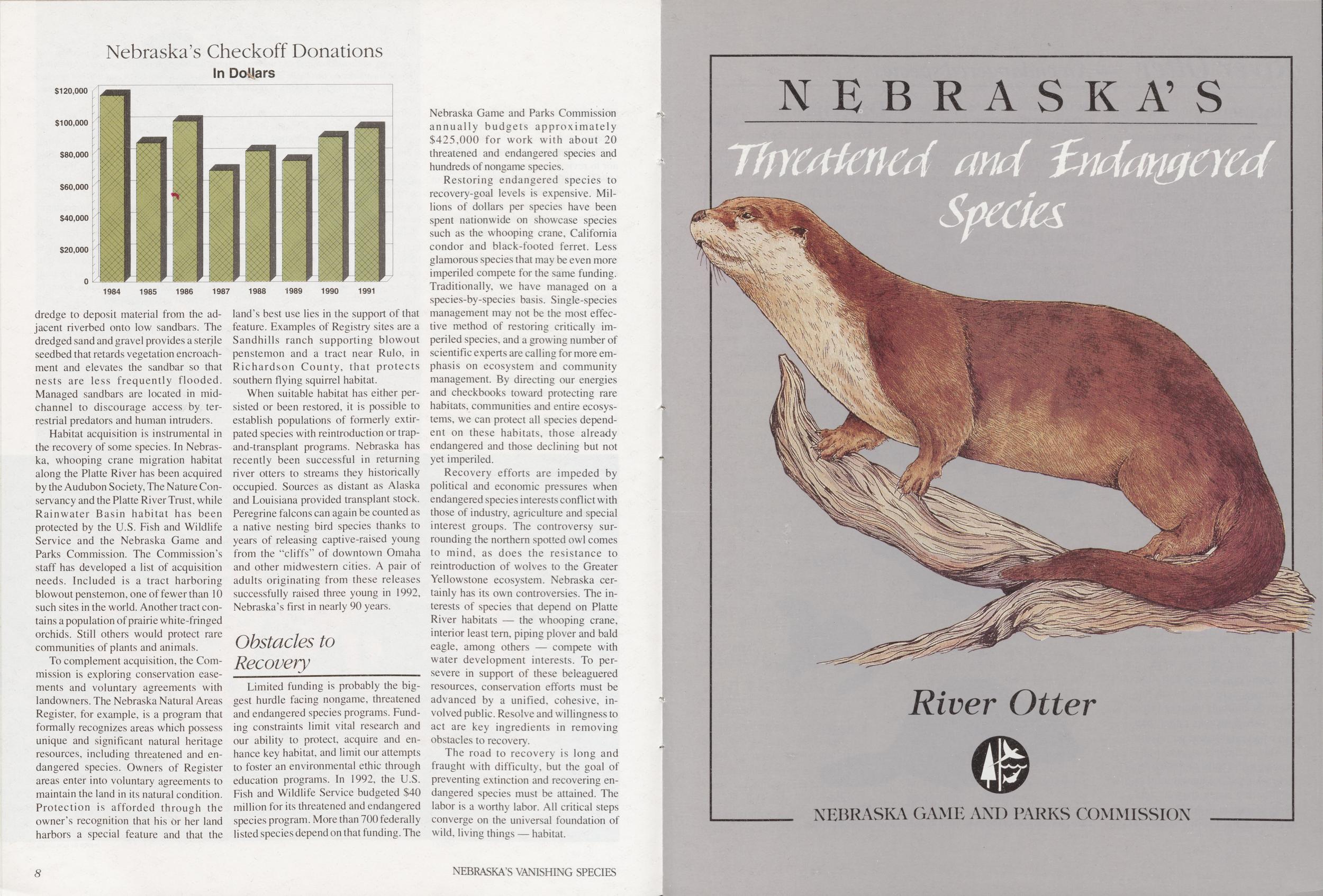
A 1984 amendment to the Nebraska act created the Nongame and Endangered Species Conservation Fund. This fund is made up entirely of donations, primarily from participants in the Nongame Wildlife Checkoff program associated with the state income tax return. Nebraska's endangered species program would be crippled without this source of financial support.
One tool to protect a species' habitat is the regulatory designation of critical habitat. Presently, only one such area has been 6 NEBRASKA'S VANISHING SPECIES
The Nebraska act requires the Governor to review programs administered by his or her office and use them to carry out the purposes of the act. It mandates two additional protections: All other state agencies must carry out programs for the conservation of endangered and threatened species, and they must ensure that their actions do not jeopardize the continued existence of species or result in the destruction or modification of critical habitat. Agencies are required to consult with the Nebraska Game and Parks Commission to determine whether actions they fund, authorize or carry out will affect threatened or endangered species.
Protection and recovery efforts frequently rely on more familiar actions the activities most Nebraskans associate with game management: research, population and habitat manipulation, habitat acquisition, trap-and-transplant restorations and education campaigns. Recovery activities are directed by formal state and federal plans called Species Recovery Plans. Recovery plans describe, schedule and prioritize a shopping list of actions that must be accomplished before the species can be considered restored to a non-threatened or non-endangered status.
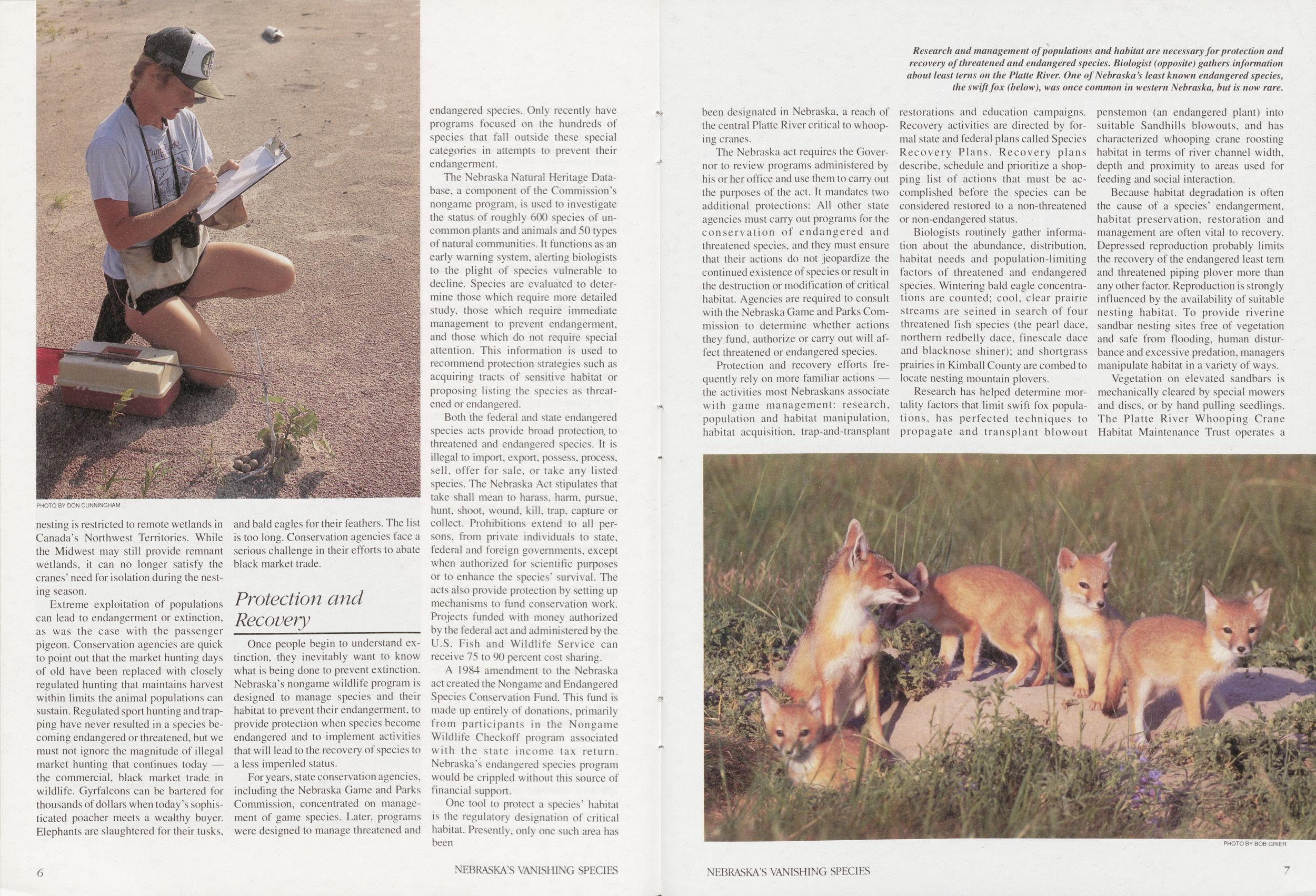
Biologists routinely gather information about the abundance, distribution, habitat needs and population-limiting factors of threatened and endangered species. Wintering bald eagle concentrations are counted; cool, clear prairie streams are seined in search of four threatened fish species (the pearl dace, northern redbelly dace, finescale dace and blacknose shiner); and shortgrass prairies in Kimball County are combed to locate nesting mountain plovers.
Research has helped determine mortality factors that limit swift fox populations, has perfected techniques to propagate and transplant blowout penstemon (an endangered plant) into suitable Sandhills blowouts, and has characterized whooping crane roosting habitat in terms of river channel width, depth and proximity to areas used for feeding and social interaction.
Because habitat degradation is often the cause of a species' endangerment, habitat preservation, restoration and management are often vital to recovery. Depressed reproduction probably limits the recovery of the endangered least tern and threatened piping plover more than any other factor. Reproduction is strongly influenced by the availability of suitable nesting habitat. To provide riverine sandbar nesting sites free of vegetation and safe from flooding, human disturbance and excessive predation, managers manipulate habitat in a variety of ways.
Vegetation on elevated sandbars is
mechanically cleared by special mowers
and discs, or by hand pulling seedlings.
The Platte River Whooping Crane
Habitat Maintenance Trust operates a
NEBRASKA'S VANISHING SPECIES
7
Habitat acquisition is instrumental in the recovery of some species. In Nebraska, whooping crane migration habitat along the Platte River has been acquired by the Audubon Society, The Nature Conservancy and the Platte River Trust, while Rainwater Basin habitat has been protected by the U.S. Fish and Wildlife Service and the Nebraska Game and Parks Commission. The Commission's staff has developed a list of acquisition needs. Included is a tract harboring blowout penstemon, one of fewer than 10 such sites in the world. Another tract contains a population of prairie white-fringed orchids. Still others would protect rare communities of plants and animals.
To complement acquisition, the Commission is exploring conservation easements and voluntary agreements with landowners. The Nebraska Natural Areas Register, for example, is a program that formally recognizes areas which possess unique and significant natural heritage resources, including threatened and endangered species. Owners of Register areas enter into voluntary agreements to maintain the land in its natural condition. Protection is afforded through the owner's recognition that his Or her land harbors a special feature and that the land's best use lies in the support of that feature. Examples of Registry sites are a Sandhills ranch supporting blowout penstemon and a tract near Rulo, in Richardson County, that protects southern flying squirrel habitat.
When suitable habitat has either persisted or been restored, it is possible to establish populations of formerly extirpated species with reintroduction or trapand-transplant programs. Nebraska has recently been successful in returning river otters to streams they historically occupied. Sources as distant as Alaska and Louisiana provided transplant stock. Peregrine falcons can again be counted as a native nesting bird species thanks to years of releasing captive-raised young from the "cliffs" of downtown Omaha and other midwestern cities. A pair of adults originating from these releases successfully raised three young in 1992, Nebraska's first in nearly 90 years.
Obstacles to RecoveryLimited funding is probably the biggest hurdle facing nongame, threatened and endangered species programs. Funding constraints limit vital research and our ability to protect, acquire and enhance key habitat, and limit our attempts to foster an environmental ethic through education programs. In 1992, the U.S. Fish and Wildlife Service budgeted $40 million for its threatened and endangered species program. More than 700 federally listed species depend on that funding. The Nebraska Game and Parks Commission annually budgets approximately $425,000 for work with about 20 threatened and endangered species and hundreds of nongame species.
Restoring endangered species to recovery-goal levels is expensive. Millions of dollars per species have been spent nationwide on showcase species such as the whooping crane, California condor and black-footed ferret. Less glamorous species that may be even more imperiled compete for the same funding. Traditionally, we have managed on a species-by-species basis. Single-species management may not be the most effective method of restoring critically imperiled species, and a growing number of scientific experts are calling for more emphasis on ecosystem and community management. By directing our energies and checkbooks toward protecting rare habitats, communities and entire ecosystems, we can protect all species dependent on these habitats, those already endangered and those declining but not yet imperiled.
Recovery efforts are impeded by political and economic pressures when endangered species interests conflict with those of industry, agriculture and special interest groups. The controversy surrounding the northern spotted owl comes to mind, as does the resistance to reintroduction of wolves to the Greater Yellowstone ecosystem. Nebraska certainly has its own controversies. The interests of species that depend on Platte River habitats — the whooping crane, interior least tern, piping plover and bald eagle, among others — compete with water development interests. To persevere in support of these beleaguered resources, conservation efforts must be advanced by a unified, cohesive, involved public. Resolve and willingness to act are key ingredients in removing obstacles to recovery.
The road to recovery is long and fraught with difficulty, but the goal of preventing extinction and recovering endangered species must be attained. The labor is a worthy labor. All critical steps converge on the universal foundation of wild, living things — habitat.
8 NEBRASKA'S VANISHING SPECIES NEBRASKA's THREATENED AND ENDANGERED SPECIES River Otter NEBRASKA GAME AND PARKS COMMISSION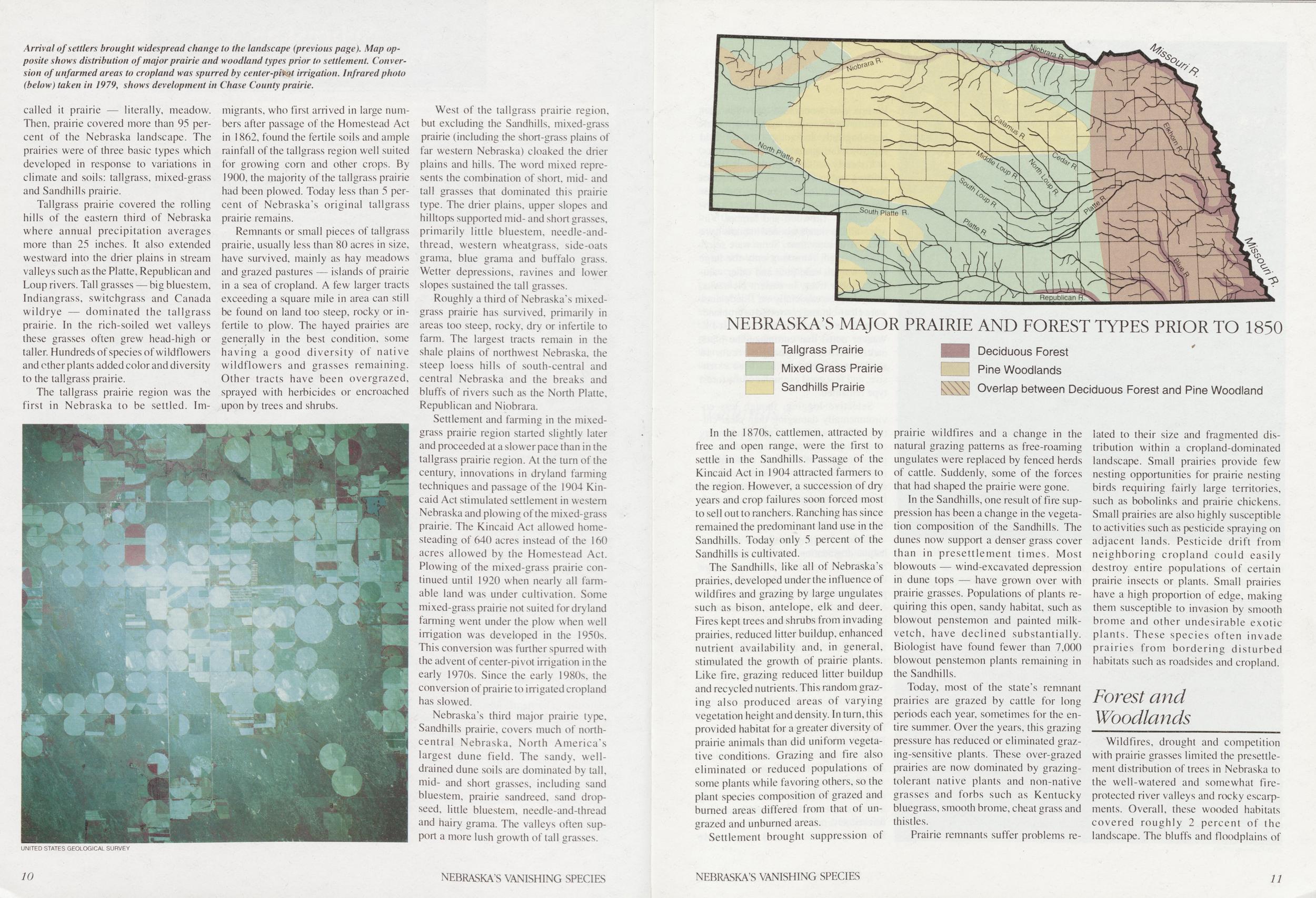
called it prairie — literally, meadow. Then, prairie covered more than 95 percent of the Nebraska landscape. The prairies were of three basic types which developed in response to variations in climate and soils: tallgrass, mixed-grass and Sandhills prairie.
Tallgrass prairie covered the rolling hills of the eastern third of Nebraska where annual precipitation averages more than 25 inches. It also extended westward into the drier plains in stream valleys such as the Platte, Republican and Loup rivers. Tall grasses — big bluestem, Indiangrass, switchgrass and Canada wildrye — dominated the tallgrass prairie. In the rich-soiled wet valleys these grasses often grew head-high or taller. Hundreds of species of wildflowers and ether plants added color and diversity to the tallgrass prairie.
The tallgrass prairie region was the first in Nebraska to be settled. Immigrants, who first arrived in large numbers after passage of the Homestead Act in 1862, found the fertile soils and ample rainfall of the tallgrass region well suited for growing corn and other crops. By 1900, the majority of the tallgrass prairie had been plowed. Today less than 5 percent of Nebraska's original tallgrass prairie remains.
Remnants or small pieces of tallgrass prairie, usually less than 80 acres in size, have survived, mainly as hay meadows and grazed pastures — islands of prairie in a sea of cropland. A few larger tracts exceeding a square mile in area can still be found on land too steep, rocky or infertile to plow. The hayed prairies are generally in the best condition, some having a good diversity of native wildflowers and grasses remaining. Other tracts have been overgrazed, sprayed with herbicides or encroached upon by trees and shrubs.
West of the tallgrass prairie region, but excluding the Sandhills, mixed-grass prairie (including the short-grass plains of far western Nebraska) cloaked the drier plains and hills. The word mixed represents the combination of short, mid- and tall grasses that dominated this prairie type. The drier plains, upper slopes and hilltops supported mid- and short grasses, primarily little bluestem, needle-and-thread, western wheatgrass, side-oats grama, blue grama and buffalo grass. Wetter depressions, ravines and lower slopes sustained the tall grasses.
Roughly a third of Nebraska's mixedgrass prairie has survived, primarily in areas too steep, rocky, dry or infertile to farm. The largest tracts remain in the shale plains of northwest Nebraska, the steep loess hills of south-central and central Nebraska and the breaks and bluffs of rivers such as the North Platte, Republican and Niobrara.
Settlement and farming in the mixedgrass prairie region started slightly later and proceeded at a slower pace than in the tallgrass prairie region. At the turn of the century, innovations in dryland farming techniques and passage of the 1904 Kincaid Act stimulated settlement in western Nebraska and plowing of the mixed-grass prairie. The Kincaid Act allowed homesteading of 640 acres instead of the 160 acres allowed by the Homestead Act. Plowing of the mixed-grass prairie continued until 1920 when nearly all farmable land was under cultivation. Some mixed-grass prairie not suited for dryland farming went under the plow when well irrigation was developed in the 1950s. This conversion was further spurred with the advent of center-pivot irrigation in the early 1970s. Since the early 1980s, the conversion of prairie to irrigated cropland has slowed.
Nebraska's third major prairie type. Sandhills prairie, covers much of northcentral Nebraska, North America's largest dune field. The sandy, welldrained dune soils are dominated by tall, mid- and short grasses, including sand bluestem, prairie sandreed, sand dropseed, little bluestem, needle-and-thread and hairy grama. The valleys often support a more lush growth of tall grasses.
10 NEBRASKA'S VANISHING SPECIESIn the 1870s. cattlemen, attracted by free and open range, were the first to settle in the Sandhills. Passage of the Kincaid Act in 1904 attracted fanners to the region. However, a succession of dry years and crop failures soon forced most to sell out to ranchers. Ranching has since remained the predominant land use in the Sandhills. Today only 5 percent of the Sandhills is cultivated.
The Sandhills, like all of Nebraska's prairies, developed under the influence of wildfires and grazing by large ungulates such as bison, antelope, elk and deer. Fires kept trees and shrubs from invading prairies, reduced litter buildup, enhanced nutrient availability and, in general, stimulated the growth of prairie plants. Like fire, grazing reduced litter buildup and recycled nutrients. This random grazing also produced areas of varying vegetation height and density. In turn, this provided habitat for a greater diversity of prairie animals than did uniform vegetative conditions. Grazing and fire also eliminated or reduced populations of some plants while favoring others, so the plant species composition of grazed and burned areas differed from that of ungrazed and unburned areas.
Settlement brought suppression of prairie wildfires and a change in the natural grazing patterns as free-roaming ungulates were replaced by fenced herds of cattle. Suddenly, some of the forces that had shaped the prairie were gone.
In the Sandhills, one result of fire suppression has been a change in the vegetation composition of the Sandhills. The dunes now support a denser grass cover than in presettlement times. Most blowouts — wind-excavated depression in dune tops — have grown over with prairie grasses. Populations of plants requiring this open, sandy habitat, such as blowout penstemon and painted milkvetch, have declined substantially. Biologist have found fewer than 7,000 blowout penstemon plants remaining in the Sandhills.
Today, most of the state's remnant prairies are grazed by cattle for long periods each year, sometimes for the entire summer. Over the years, this grazing pressure has reduced or eliminated grazing-sensitive plants. These over-grazed prairies are now dominated by grazing-tolerant native plants and non-native grasses and forbs such as Kentucky bluegrass, smooth brome, cheat grass and thistles.
Prairie remnants suffer problems related to their size and fragmented distribution within a cropland-dominated landscape. Small prairies provide few nesting opportunities for prairie nesting birds requiring fairly large territories, such as bobolinks and prairie chickens. Small prairies are also highly susceptible to activities such as pesticide spraying on adjacent lands. Pesticide drift from neighboring cropland could easily destroy entire populations of certain prairie insects or plants. Small prairies have a high proportion of edge, making them susceptible to invasion by smooth brome and other undesirable exotic plants. These species often invade prairies from bordering disturbed habitats such as roadsides and cropland.
Forest and WoodlandsWildfires, drought and competition
with prairie grasses limited the presettlement distribution of trees in Nebraska to
the well-watered and somewhat fireprotected river valleys and rocky escarpments. Overall,
these wooded habitats
covered roughly 2 percent of the
landscape. The bluffs and floodplains of
NEBRASKA'S VANISHING SPECIES
11
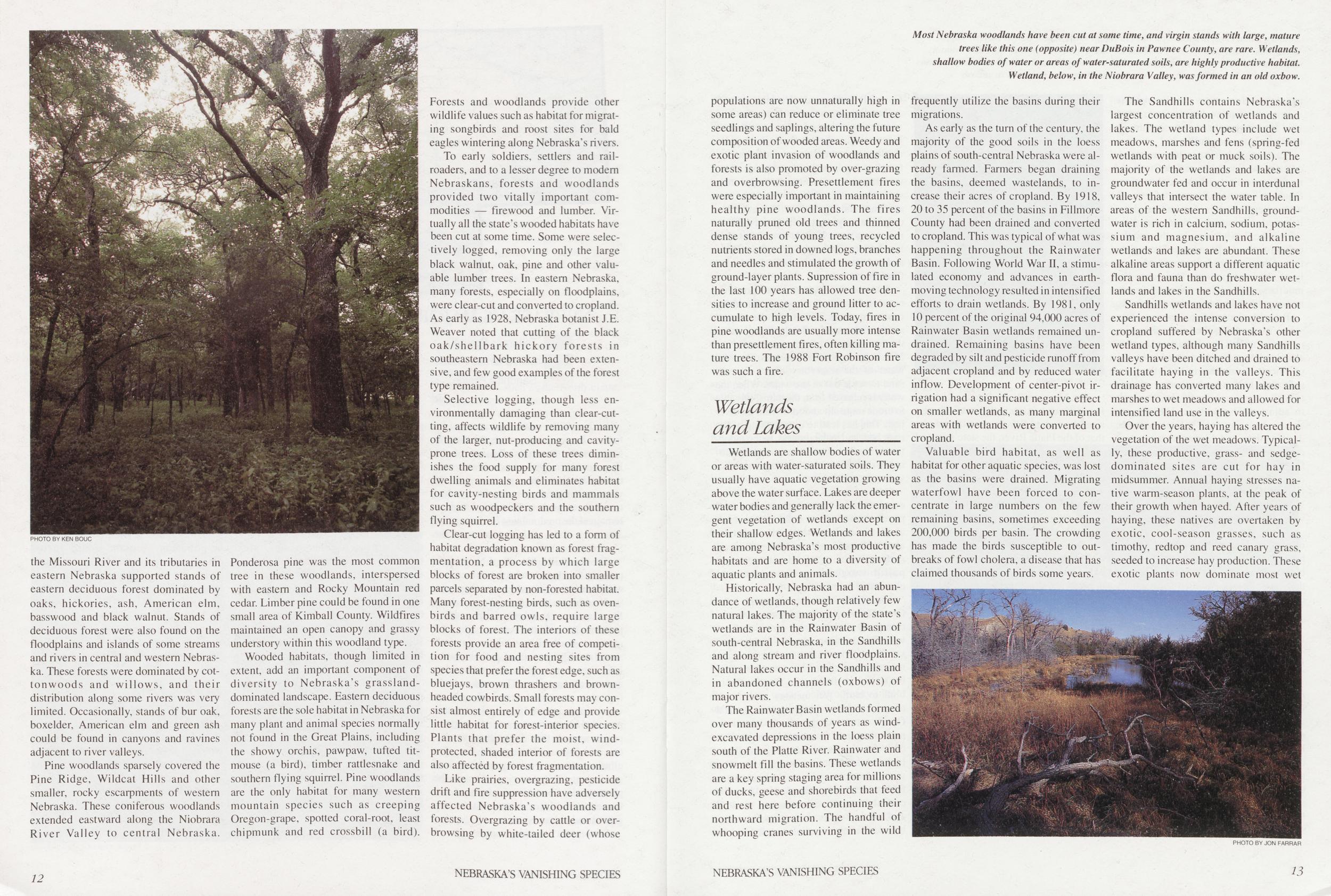
Pine woodlands sparsely covered the Pine Ridge, Wildcat Hills and other smaller, rocky escarpments of western Nebraska. These coniferous woodlands extended eastward along the Niobrara River Valley to central Nebraska. Ponderosa pine was the most common tree in these woodlands, interspersed with eastern and Rocky Mountain red cedar. Limber pine could be found in one small area of Kimball County. Wildfires maintained an open canopy and grassy understory within this woodland type.
Wooded habitats, though limited in extent, add an important component of diversity to Nebraska's grassland-dominated landscape. Eastern deciduous forests are the sole habitat in Nebraska for many plant and animal species normally not found in the Great Plains, including the showy orchis, pawpaw, tufted titmouse (a bird), timber rattlesnake and southern flying squirrel. Pine woodlands are the only habitat for many western mountain species such as creeping Oregon-grape, spotted coral-root, least chipmunk and red crossbill (a bird). Forests and woodlands provide other wildlife values such as habitat for migrating songbirds and roost sites for bald eagles wintering along Nebraska's rivers.
To early soldiers, settlers and railroaders, and to a lesser degree to modem Nebraskans, forests and woodlands provided two vitally important commodities — firewood and lumber. Virtually all the state's wooded habitats have been cut at some time. Some were selectively logged, removing only the large black walnut, oak, pine and other valuable lumber trees. In eastern Nebraska, many forests, especially on floodplains, were clear-cut and converted to cropland. As early as 1928, Nebraska botanist J.E. Weaver noted that cutting of the black oak/shellbark hickory forests in southeastern Nebraska had been extensive, and few good examples of the forest type remained.
Selective logging, though less environmentally damaging than clear-cutting, affects wildlife by removing many of the larger, nut-producing and cavityprone trees. Loss of these trees diminishes the food supply for many forest dwelling animals and eliminates habitat for cavity-nesting birds and mammals such as woodpeckers and the southern flying squirrel.
Clear-cut logging has led to a form of habitat degradation known as forest fragmentation, a process by which large blocks of forest are broken into smaller parcels separated by non-forested habitat. Many forest-nesting birds, such as ovenbirds and barred owls, require large blocks of forest. The interiors of these forests provide an area free of competition for food and nesting sites from species that prefer the forest edge, such as bluejays, brown thrashers and brownheaded cowbirds. Small forests may consist almost entirely of edge and provide little habitat for forest-interior species. Plants that prefer the moist, wind-protected, shaded interior of forests are also affected by forest fragmentation.
Like prairies, overgrazing, pesticide drift and fire suppression have adversely affected Nebraska's woodlands and forests. Overgrazing by cattle or over browsing by white-tailed deer (whose 12 NEBRASKA'S VANISHING SPECIES
Wetlands are shallow bodies of water or areas with water-saturated soils. They usually have aquatic vegetation growing above the water surface. Lakes are deeper water bodies and generally lack the emergent vegetation of wetlands except on their shallow edges. Wetlands and lakes are among Nebraska's most productive habitats and are home to a diversity of aquatic plants and animals.
Historically, Nebraska had an abundance of wetlands, though relatively few natural lakes. The majority of the state's wetlands are in the Rainwater Basin of south-central Nebraska, in the Sandhills and along stream and river floodplains. Natural lakes occur in the Sandhills and in abandoned channels (oxbows) of major rivers.
The Rainwater Basin wetlands formed over many thousands of years as wind-excavated depressions in the loess plain south of the Platte River. Rainwater and snowmelt fill the basins. These wetlands are a key spring staging area for millions of ducks, geese and shorebirds that feed and rest here before continuing their northward migration. The handful of whooping cranes surviving in the wild frequently utilize the basins during their migrations.
As early as the turn of the century, the majority of the good soils in the loess plains of south-central Nebraska were already farmed. Farmers began draining the basins, deemed wastelands, to increase their acres of cropland. By 1918, 20 to 35 percent of the basins in Fillmore County had been drained and converted to cropland. This was typical of what was happening throughout the Rainwater Basin. Following World War II, a stimulated economy and advances in earthmoving technology resulted in intensified efforts to drain wetlands. By 1981, only 10 percent of the original 94,000 acres of Rainwater Basin wetlands remained undrained. Remaining basins have been degraded by silt and pesticide runoff from adjacent cropland and by reduced water inflow. Development of center-pivot irrigation had a significant negative effect on smaller wetlands, as many marginal areas with wetlands were converted to cropland.
Valuable bird habitat, as well as habitat for other aquatic species, was lost as the basins were drained. Migrating waterfowl have been forced to concentrate in large numbers on the few remaining basins, sometimes exceeding 200,000 birds per basin. The crowding has made the birds susceptible to outbreaks of fowl cholera, a disease that has claimed thousands of birds some years.
The Sandhills contains Nebraska's largest concentration of wetlands and lakes. The wetland types include wet meadows, marshes and fens (spring-fed wetlands with peat or muck soils). The majority of the wetlands and lakes are groundwater fed and occur in interdunal valleys that intersect the water table. In areas of the western Sandhills, groundwater is rich in calcium, sodium, potassium and magnesium, and alkaline wetlands and lakes are abundant. These alkaline areas support a different aquatic flora and fauna than do freshwater wetlands and lakes in the Sandhills.
Sandhills wetlands and lakes have not experienced the intense conversion to cropland suffered by Nebraska's other wetland types, although many Sandhills valleys have been ditched and drained to facilitate haying in the valleys. This drainage has converted many lakes and marshes to wet meadows and allowed for intensified land use in the valleys.
Over the years, haying has altered the
vegetation of the wet meadows. Typically, these productive, grass- and sedgedominated
sites are cut for hay in
midsummer. Annual haying stresses native warm-season plants, at the peak of
their growth when hayed. After years of
haying, these natives are overtaken by
exotic, cool-season grasses, such as
timothy, redtop and reed canary grass,
seeded to increase hay production. These
exotic plants now dominate most wet
NEBRASKA'S VANISHING SPECIES
13
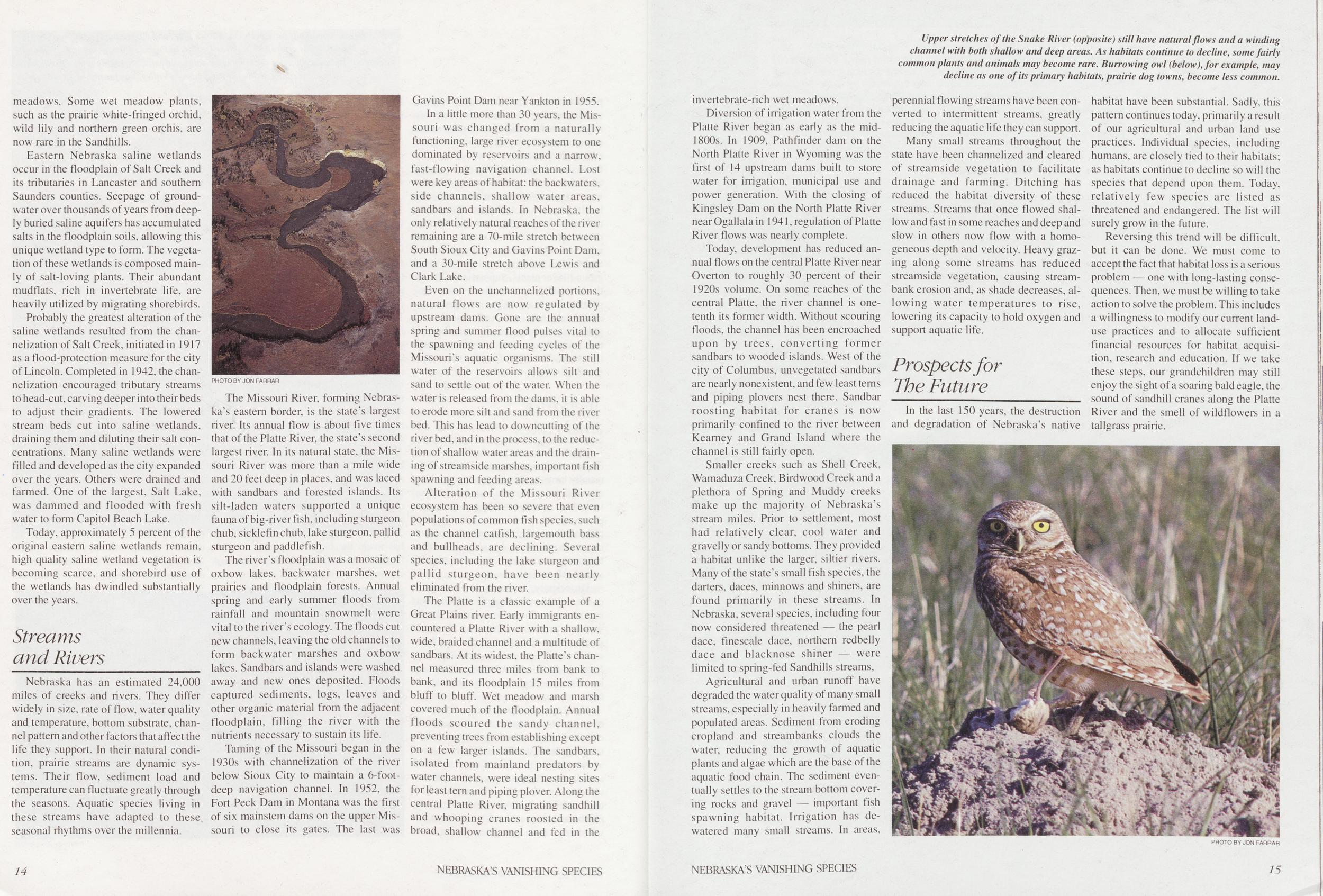 meadows. Some wet meadow plants,
such as the prairie white-fringed orchid,
wild lily and northern green orchis, are
now rare in the Sandhills.
meadows. Some wet meadow plants,
such as the prairie white-fringed orchid,
wild lily and northern green orchis, are
now rare in the Sandhills.
Eastern Nebraska saline wetlands occur in the floodplain of Salt Creek and its tributaries in Lancaster and southern Saunders counties. Seepage of groundwater over thousands of years from deeply buried saline aquifers has accumulated salts in the floodplain soils, allowing this unique wetland type to form. The vegetation of these wetlands is composed mainly of salt-loving plants. Their abundant mudflats, rich in invertebrate life, are heavily utilized by migrating shorebirds.
Probably the greatest alteration of the saline wetlands resulted from the channelization of Salt Creek, initiated in 1917 as a flood-protection measure for the city of Lincoln. Completed in 1942, the channelization encouraged tributary streams to head-cut, carving deeper into their beds to adjust their gradients. The lowered stream beds cut into saline wetlands, draining them and diluting their salt concentrations. Many saline wetlands were filled and developed as the city expanded over the years. Others were drained and farmed. One of the largest, Salt Lake, was dammed and flooded with fresh water to form Capitol Beach Lake.
Today, approximately 5 percent of the original eastern saline wetlands remain, high quality saline wetland vegetation is becoming scarce, and shorebird use of the wetlands has dwindled substantially over the years.
Streams and RiversNebraska has an estimated 24,000 miles of creeks and rivers. They differ widely in size, rate of flow, water quality and temperature, bottom substrate, channel pattern and other factors that affect the life they support. In their natural condition, prairie streams are dynamic systems. Their flow, sediment load and temperature can fluctuate greatly through the seasons. Aquatic species living in these streams have adapted to these seasonal rhythms over the millennia.
The Missouri River, forming Nebraska's eastern border, is the state's largest river. Its annual Bow is about five times that of the Platte River, the state's second largest river. In its natural state, the Missouri River was more than a mile wide and 20 feet deep in places, and was laced with sandbars and forested islands. Its silt-laden waters supported a unique fauna of big-river fish, including sturgeon chub, sicklefin chub, lake sturgeon, pallid sturgeon and paddlefish.
The river's floodplain was a mosaic of oxbow lakes, backwater marshes, wet prairies and floodplain forests. Annual spring and early summer floods from rainfall and mountain snowmelt were vital to the river's ecology. The floods cut new channels, leaving the old channels to form backwater marshes and oxbow lakes. Sandbars and islands were washed away and new ones deposited. Lloods captured sediments, logs, leaves and other organic material from the adjacent floodplain, filling the river with the nutrients necessary to sustain its life.
Taming of the Missouri began in the 1930s with channelization of the river below Sioux City to maintain a 6-foot-deep navigation channel. In 1952, the Port Peck Dam in Montana was the first of six mainstem dams on the upper Missouri to close its gates. The last was Gavins Point Dam near Yankton in 1955.
In a little more than 30 years, the Missouri was changed from a naturally functioning, large river ecosystem to one dominated by reservoirs and a narrow, fast-flowing navigation channel. Lost were key areas of habitat: the backwaters, side channels, shallow water areas, sandbars and islands. In Nebraska, the only relatively natural reaches of the river remaining are a 70-mile stretch between South Sioux City and Gavins Point Dam, and a 30-mile stretch above Lewis and Clark Lake.
Even on the unchannelized portions, natural flows are now regulated by upstream dams. Gone are the annual spring and summer flood pulses vital to the spawning and feeding cycles of the Missouri's aquatic organisms. The still water of the reservoirs allows silt and sand to settle out of the water. When the water is released from the dams, it is able to erode more silt and sand from the river bed. This has lead to downcuttina of the river bed, and in the process, to the reduction of shallow water areas and the draining of streamside marshes, important fish spawning and feeding areas.
Alteration of the Missouri River ecosystem has been so severe that even populations of common fish species, such as the channel catfish, largemouth bass and bullheads, are declining. Several species, including the lake sturgeon and pallid sturgeon, have been nearly eliminated from the river.
The Platte is a classic example of a Great Plains river. Early immigrants encountered a Platte River with a shallow, wide, braided channel and a multitude of sandbars. At its widest, the Platte's channel measured three miles from bank to bank, and its floodplain 15 miles from bluff to bluff. Wet meadow and marsh covered much of the floodplain. Annual lloods scoured the sandy channel, preventing trees from establishing except on a few larger islands. The sandbars, isolated from mainland predators by water channels, were ideal nesting sites for least tern and piping plover. Along the central Platte River, migrating sandhill and whooping cranes roosted in the broad, shallow channel and fed in the 14 NEBRASKA'S VANISHING SPECIES
Diversion of irrigation water from the Platte River began as early as the mid-1800s. In 1909, Pathfinder dam on the North Platte River in Wyoming was the first of 14 upstream dams built to store water for irrigation, municipal use and power generation. With the closing of Kingsley Dam on the North Platte River near Ogallala in 1941, regulation of Platte River flows was nearly complete.
Today, development has reduced annual flows on the central Platte River near Overton to roughly 30 percent of their 1920s volume. On some reaches of the central Platte, the river channel is one-tenth its former width. Without scouring floods, the channel has been encroached upon by trees, converting former sandbars to wooded islands. West of the city of Columbus, unvegetated sandbars are nearly nonexistent, and few least terns and piping plovers nest there. Sandbar roosting habitat for cranes is now primarily confined to the river between Kearney and Grand Island where the channel is still fairly open.
Smaller creeks such as Shell Creek, Wamaduza Creek, Birdwood Creek and a plethora of Spring and Muddy creeks make up the majority of Nebraska's stream miles. Prior to settlement, most had relatively clear, cool water and gravelly or sandy bottoms. They provided a habitat unlike the larger, siltier rivers. Many of the state's small fish species, the darters, daces, minnows and shiners, are found primarily in these streams. In Nebraska, several species, including four now considered threatened — the pearl dace, finescale dace, northern redbelly dace and blacknose shiner — were limited to spring-fed Sandhills streams,
Agricultural and urban runoff have degraded the water quality of many small streams, especially in heavily farmed and populated areas. Sediment from eroding cropland and streambanks clouds the water, reducing the growth of aquatic plants and algae which are the base of the aquatic food chain. The sediment eventually settles to the stream bottom covering rocks and gravel — important fish spawning habitat. Irrigation has dewatered many small streams. In areas, perennial flowing streams have been converted to intermittent streams, greatly reducing the aquatic life they can support.
Many small streams throughout the state have been channelized and cleared of streamside vegetation to facilitate drainage and farming. Ditching has reduced the habitat diversity of these streams. Streams that once flowed shallow and fast in some reaches and deep and slow in others now flow with a homogeneous depth and velocity. Heavy grazing along some streams has reduced streamside vegetation, causing streambank erosion and, as shade decreases, allowing water temperatures to rise, lowering its capacity to hold oxygen and support aquatic life.
Prospects for The FutureIn the last 150 years, the destruction and degradation of Nebraska's native habitat have been substantial. Sadly, this pattern continues today, primarily a result of our agricultural and urban land use practices. Individual species, including humans, are closely tied to their habitats; as habitats continue to decline so will the species that depend upon them. Today, relatively few species are listed as threatened and endangered. The list will surely grow in the future.
Reversing this trend will be difficult, but it can be done. We must come to accept the fact that habitat loss is a serious problem — one with long-lasting consequences. Then, we must be willing to take action to solve the problem. This includes a willingness to modify our current landuse practices and to allocate sufficient financial resources for habitat acquisition, research and education. If we take these steps, our grandchildren may still enjoy the sight of a soaring bald eagle, the sound of sandhill cranes along the Platte River and the smell of wildflowers in a tallgrass prairie.
NEBRASKA'S VANISHING SPECIES 15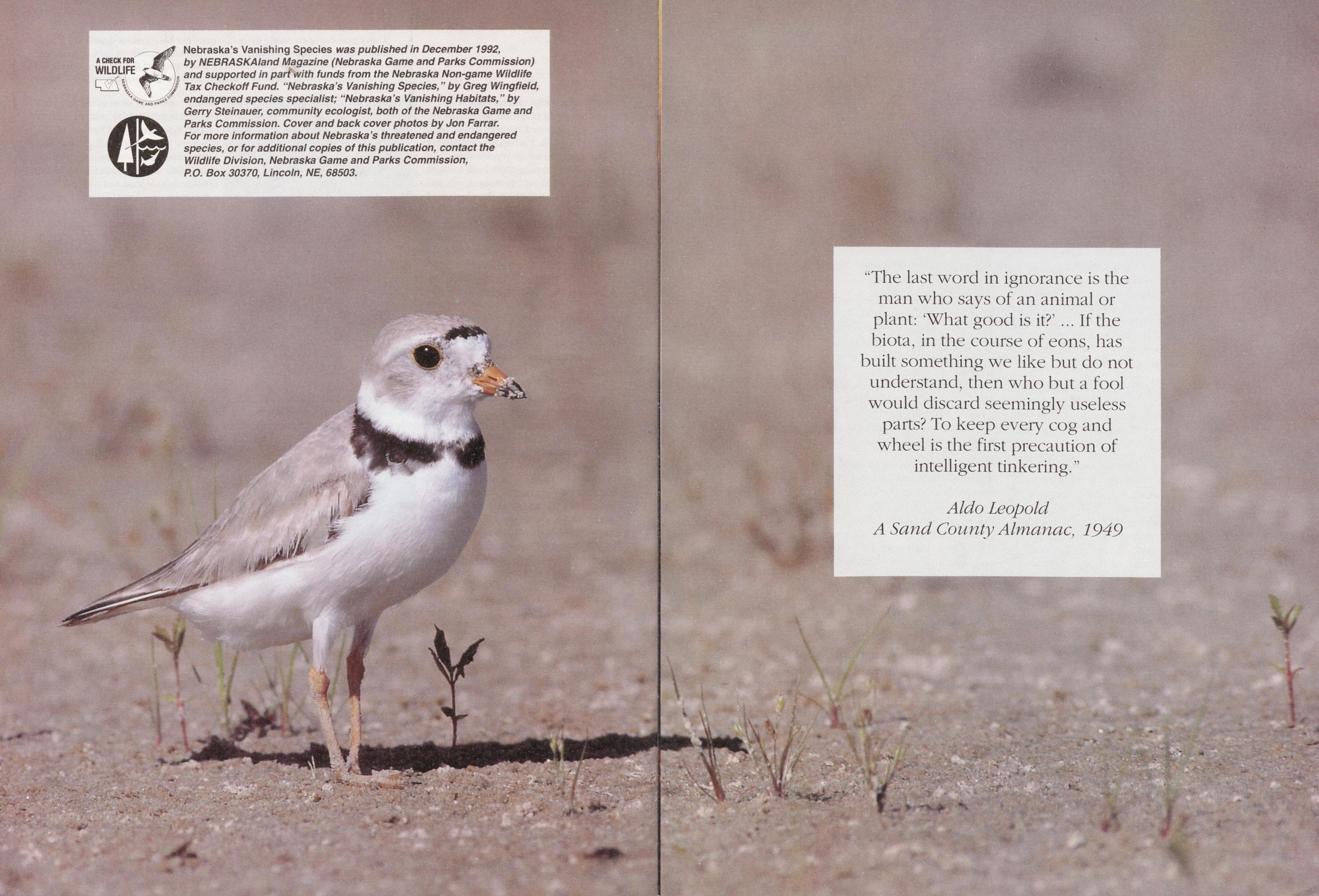 Nebraska's Vanishing Species ivas published in December 1992,
by NEBRASKAIand Magazine (Nebraska Game and Parks Commission)
and supported in partwith funds from the Nebraska Non-game Wildlife
Tax Checkoff Fund. "Nebraska's Vanishing Species," by Greg Wing field,
endangered species specialist; "Nebraska's Vanishing Habitats," by
Gerry Steinauer, community ecoiogist, both of the Nebraska Game and
Parks Commission. Cover and back cover photos by Jon Farrar.
For more information about Nebraska's threatened and endangered
species, or for additional copies of this publication, contact the
Wildlife Division, Nebraska Game and Parks Commission,
P.O. Box 30370, Lincoln, NE, 68503.
"The last word in ignorance is the
man who says of an animal or
plant: 'What good is it?' If the
biota, in the course of eons, has
built something we like but do not
understand, then who but a fool
would discard seemingly useless
parts? To keep every cog and
wheel is the first precaution of
intelligent tinkering."
Aldo Leopold
A Sand County Almanac, 1949
Nebraska's Vanishing Species ivas published in December 1992,
by NEBRASKAIand Magazine (Nebraska Game and Parks Commission)
and supported in partwith funds from the Nebraska Non-game Wildlife
Tax Checkoff Fund. "Nebraska's Vanishing Species," by Greg Wing field,
endangered species specialist; "Nebraska's Vanishing Habitats," by
Gerry Steinauer, community ecoiogist, both of the Nebraska Game and
Parks Commission. Cover and back cover photos by Jon Farrar.
For more information about Nebraska's threatened and endangered
species, or for additional copies of this publication, contact the
Wildlife Division, Nebraska Game and Parks Commission,
P.O. Box 30370, Lincoln, NE, 68503.
"The last word in ignorance is the
man who says of an animal or
plant: 'What good is it?' If the
biota, in the course of eons, has
built something we like but do not
understand, then who but a fool
would discard seemingly useless
parts? To keep every cog and
wheel is the first precaution of
intelligent tinkering."
Aldo Leopold
A Sand County Almanac, 1949
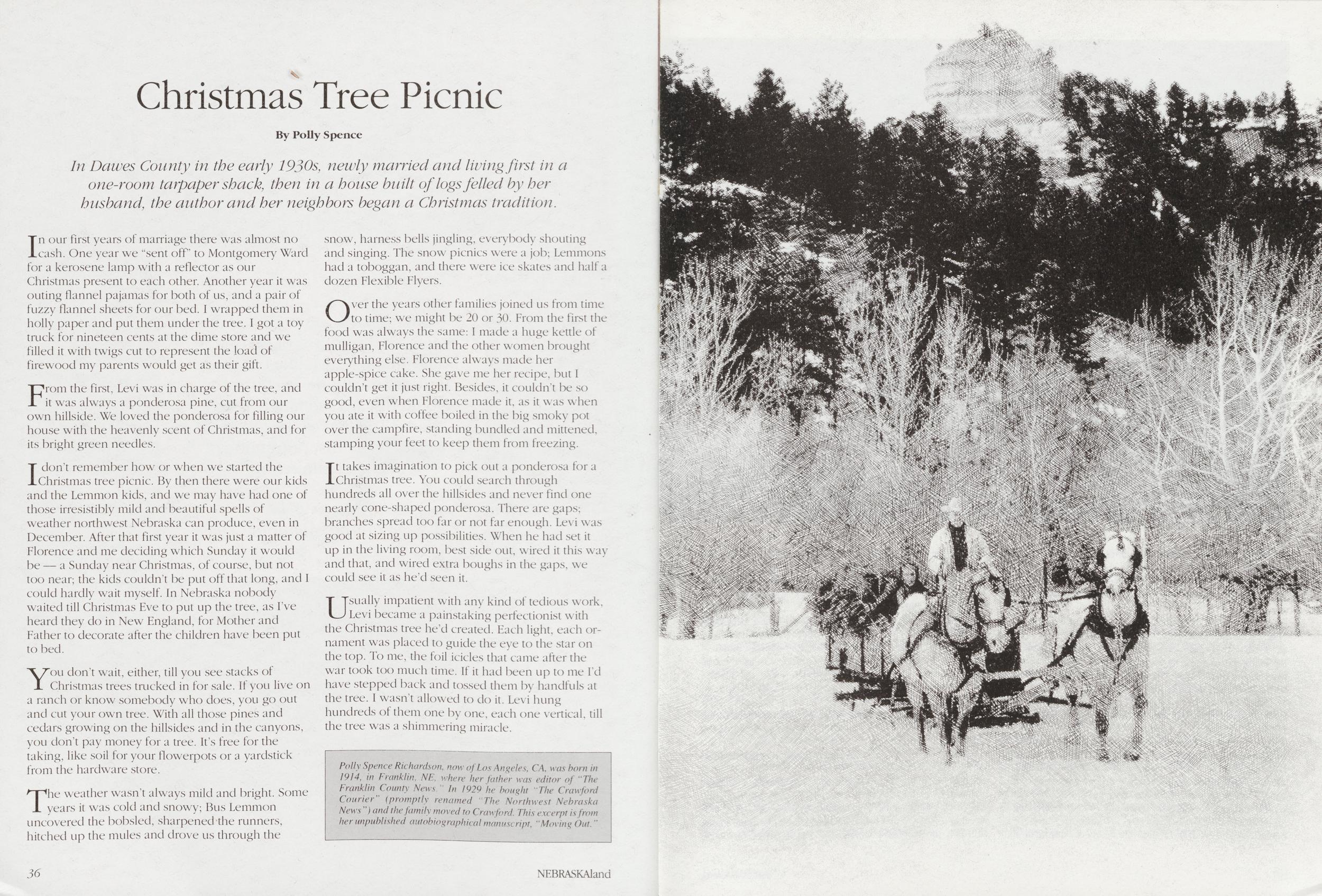
Christmas Tree Picnic
By Polly Spence In Dawes County in the early 1930s, newly married and living first in a one-room tarpapershack, then in a house built of logs felled by her husband, the author and her neighbors began a Christmas tradition.In our first years of marriage there was almost no cash. One year we "sent off to Montgomery Ward for a kerosene lamp with a reflector as our Christmas present to each other. Another year it was outing flannel pajamas for both of us, and a pair of fuzzy flannel sheets for our bed. I wrapped them in holly paper and put them under the tree. I got a toy truck for nineteen cents at the dime store and we filled it with twigs cut to represent the load of firewood my parents would get as their gift.
From the first, Levi was in charge of the tree, and it was always a ponclerosa pine, cut from our own hillside. We loved the ponclerosa for filling our house with the heavenly scent of Christmas, and for its bright green needles.
I don't remember how or when we started the Christmas tree picnic. By then there were our kids and the Lemmon kids, and we may have had one of those irresistibly mild and beautiful spells of weather northwest Nebraska can produce, even in December. After that first year it was just a matter of Florence and me deciding which Sunday it would be — a Sunday near Christmas, of course, but not too near; the kids couldn't be put off that long, and I could hardly wait myself. In Nebraska nobody waited till Christmas Eve to put up the tree, as I've heard they do in New England, for Mother and Father to decorate after the children have been put to bed.
You don't wait, either, till you see stacks ol Christmas trees trucked in for sale. If you live on a ranch or know somebody who does, you go out and cut your own tree. With all those pines and cedars growing on the hillsides and in the canyons, you don't pay money for a tree. It's free for the taking, like soil for your flowerpots or a yardstick from the hardware store.
The weather wasn't always mild and bright. Some years it was cold and snowy; Bus Lemmon uncovered the bobsled, sharpened the runners, hitched up the mules and drove us through the snow, harness bells jingling, everybody shouting and singing. The snow picnics were a job; Lemmons had a toboggan, and there were ice skates and half a dozen Flexible Flyers.
Over the years other families joined us from time to time; we might be 20 or 30. From the first the food was always the same: I made a huge kettle of mulligan, Florence and the other women brought everything else. Florence always made her apple-spice cake. She gave me her recipe, but I couldn't get it just right. Besides, it couldn't be so good, even when Florence made it, as it was when you ate it with coffee boiled in the big smoky pot over the campfire, standing bundled and mittened, stamping your feet to keep them from freezing.
It takes imagination to pick out a ponclerosa for a Christmas tree. You could search through hundreds all over the hillsides and never find one nearly cone-shaped ponderosa. There are gaps; branches spread too far or not far enough. Levi was good at sizing up possibilities. When he had set it up in the living room, best side out, wired it this way and that, and wired extra boughs in the gaps, we could see it as he'd seen it.
Usually impatient with any kind of tedious work, Levi became a painstaking perfectionist with the Christmas tree he'd created. Each light, each ornament was placed to guide the eye to the star on the top. To me, the foil icicles that came after the war took too much time. If it had been up to me I'd have stepped back and tossed them by handfuls at the tree. I wasn't allowed to do it. Levi hung hundreds of them one by one, each one vertical, till the tree was a shimmering miracle.
Polly Spence Richardson, now of Los Angeles, CA. was bom in 1914, in Franklin, NE, where her father was editor of "The Franklin County News In 1929 he bought The Crawford Courier" (promptly renamed The Northwest Nebraska News ") and the family moved to Crawford This excerpt is from her unpublished autobiographicalmanusi ript, "Moving Out." 36 NEBRASKAland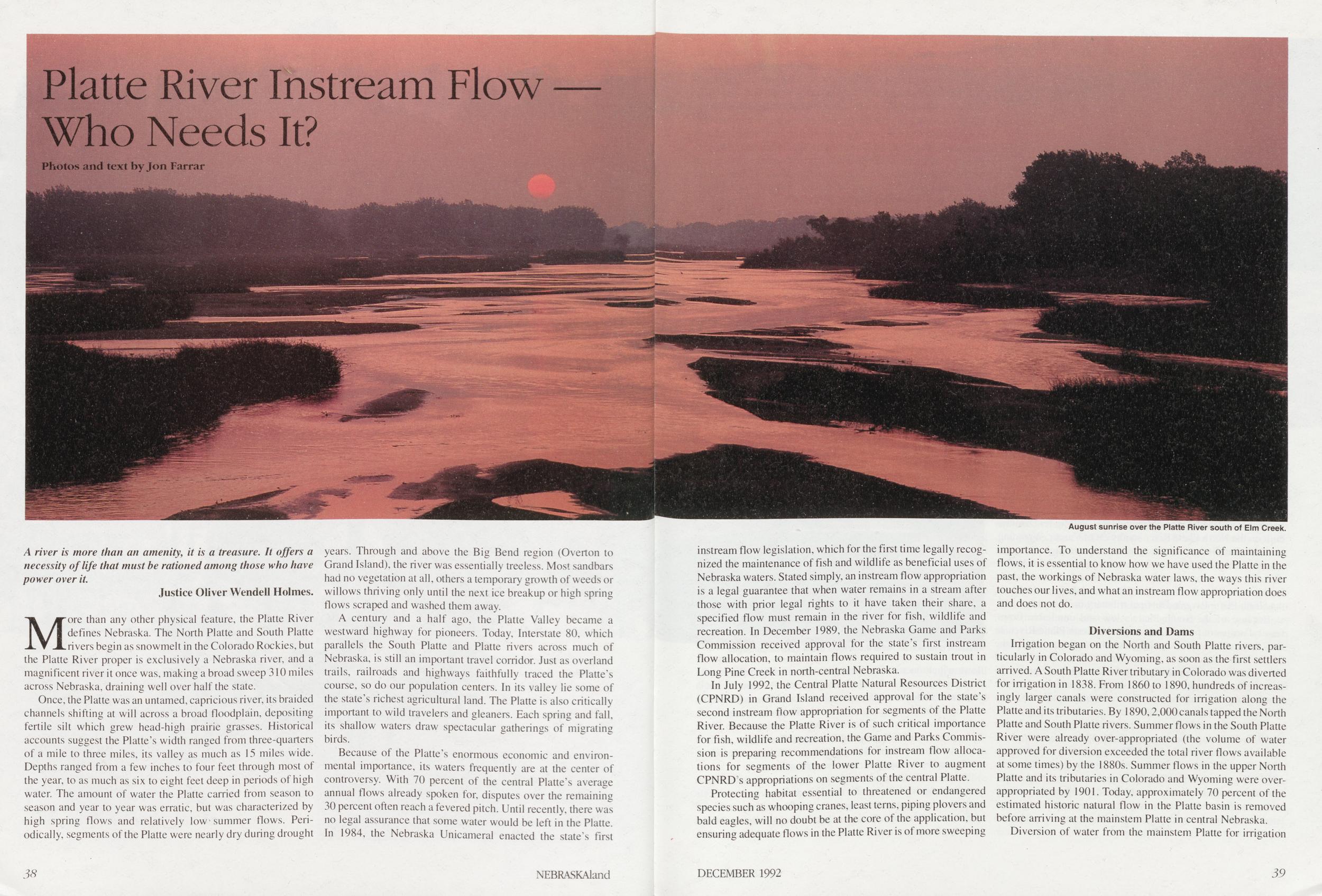
Platte River Insteram Flow - Who Needs It?
Photos and text by Jon FarrarMore than any other physical feature, the Platte River defines Nebraska. The North Platte and South Platte rivers begin as snowmelt in the Colorado Rockies, but the Platte River proper is exclusively a Nebraska river, and a magnificent river it once was, making a broad sweep 310 miles across Nebraska, draining well over half the state.
Once, the Platte was an untamed, capricious river, its braided channels shifting at will across a broad floodplain, depositing fertile silt which grew head-high prairie grasses. Historical accounts suggest the Platte's width ranged from three-quarters of a mile to three miles, its valley as much as 15 miles wide. Depths ranged from a few inches to four feet through most of the year, to as much as six to eight feet deep in periods of high water. The amount of water the Platte carried from season to season and year to year was erratic, but was characterized by high spring flows and relatively low summer flows. Periodically, segments of the Platte were nearly dry during drought years. Through and above the Big Bend region (Overton to Grand Island), the river was essentially treeless. Most sandbars had no vegetation at all, others a temporary growth of weeds or willows thriving only until the next ice breakup or high spring flows scraped and washed them away.
A century and a half ago, the Platte Valley became a westward highway for pioneers. Today, Interstate 80, which parallels the South Platte and Platte rivers across much of Nebraska, is still an important travel corridor. Just as overland trails, railroads and highways faithfully traced the Platte's course, so do our population centers. In its valley lie some of the state's richest agricultural land. The Platte is also critically important to wild travelers and gleaners. Each spring and fall, its shallow waters draw spectacular gatherings of migrating birds.
Because of the Platte's enormous economic and environmental importance, its waters frequently are at the center of controversy. With 70 percent of the central Platte's average annual flows already spoken for, disputes over the remaining 30 percent often reach a fevered pitch. Until recently, there was no legal assurance that some water would be left in the Platte. In 1984, the Nebraska Unicameral enacted the state's first 38 NEBRASKAland instream flow legislation, which for the first time legally recognized the maintenance offish and wildlife as beneficial uses of Nebraska waters. Stated simply, an instream flow appropriation is a legal guarantee that when water remains in a stream after those with prior legal rights to it have taken their share, a specified flow must remain in the river for fish, wildlife and recreation. In December 1989, the Nebraska Game and Parks Commission received approval for the state's first instream flow allocation, to maintain flows required to sustain trout in Long Pine Creek in north-central Nebraska.
In July 1992, the Central Platte Natural Resources District (CPNRD) in Grand Island received approval for the state's second instream flow appropriation for segments of the Platte River. Because the Platte River is of such critical importance for fish, wildlife and recreation, the Game and Parks Commission is preparing recommendations for instream flow allocations for segments of the lower Platte River to augment CPNRD s appropriations on segments of the central Platte.
Protecting habitat essential to threatened or endangered species such as whooping cranes, least terns, piping plovers and bald eagles, will no doubt be at the core of the application, but ensuring adequate flows in the Platte River is of more sweeping August sunrise over the Platte River south of Elm Creek. importance. To understand the significance of maintaining flows, it is essential to know how we have used the Platte in the past, the workings of Nebraska water laws, the ways this river touches our lives, and what an instream flow appropriation does and does not do.
Diversions and DamsIrrigation began on the North and South Platte rivers, particularly in Colorado and Wyoming, as soon as the first settlers arrived. A South Platte River tributary in Colorado was diverted for irrigation in 1838. From 1860 to 1890, hundreds of increasingly larger canals were constructed for irrigation along the Platte and its tributaries. By 1890,2,000 canals tapped the North Platte and South Platte rivers. Summer flows in the South Platte River were already over-appropriated (the volume of water approved for diversion exceeded the total river flows available at some times) by the 1880s. Summer flows in the upper North Platte and its tributaries in Colorado and Wyoming were over-appropriated by 1901. Today, approximately 70 percent of the estimated historic natural flow in the Platte basin is removed before arriving at the mainstem Platte in central Nebraska.
Diversion of water from the mainstem Platte for irrigation
DECEMBER 1992
39
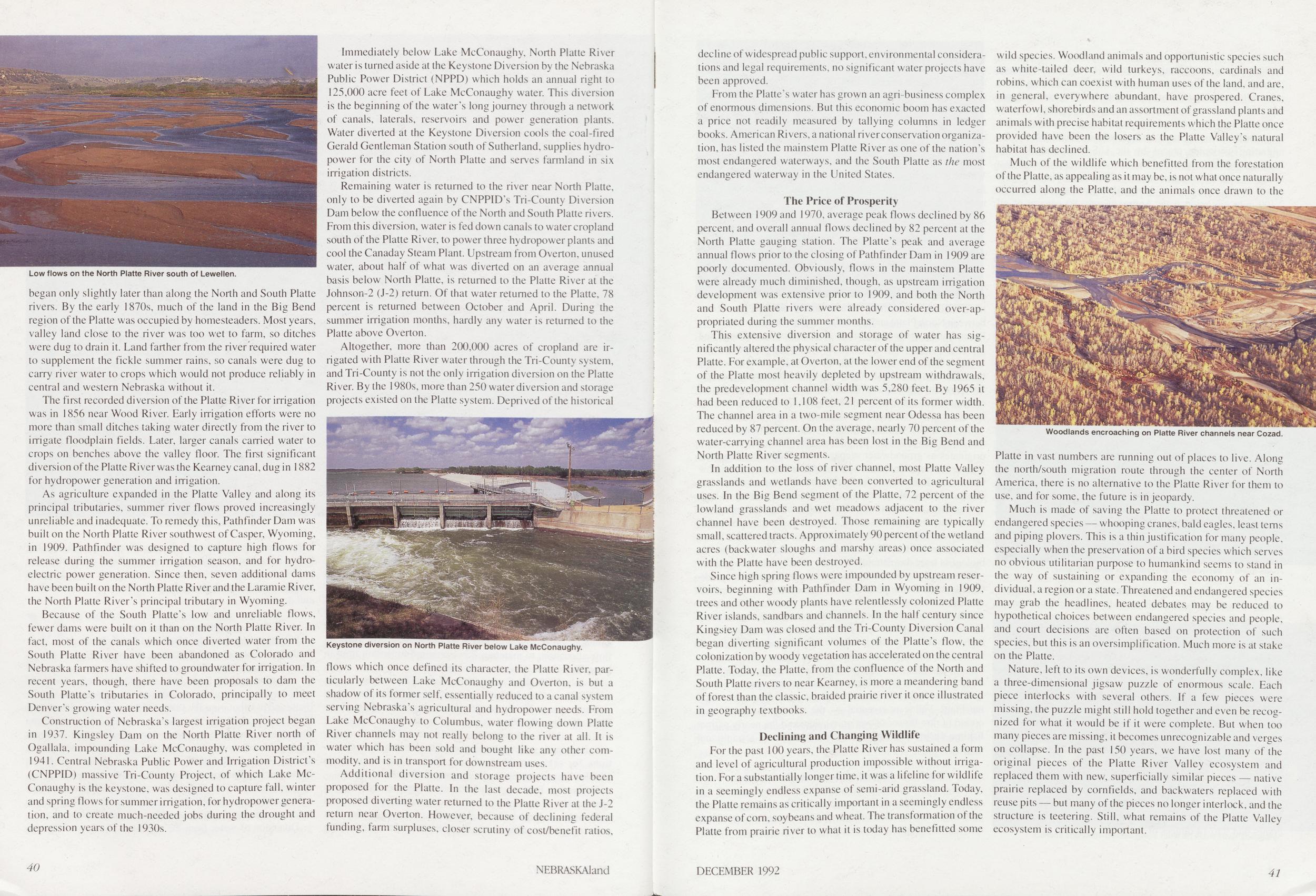
The first recorded diversion of the Platte River for irrigation was in 1856 near Wood River. Early irrigation efforts were no more than small ditches taking water directly from the river to irrigate floodplain fields. Later, larger canals carried water to crops on benches above the valley floor. The first significant diversion of the Platte River was the Kearney canal, dug in 1882 for hydropower generation and irrigation.
As agriculture expanded in the Platte Valley and along its principal tributaries, summer river flows proved increasingly unreliable and inadequate. To remedy this, Pathfinder Dam was built on the North Platte River southwest of Casper, Wyoming, in 1909. Pathfinder was designed to capture high flows for release during the summer irrigation season, and for hydro-electric power generation. Since then, seven additional dams have been built on the North Platte River and the Laramie River, the North Platte River's principal tributary in Wyoming.
Because of the South Platte's low and unreliable Hows, fewer dams were built on it than on the North Platte River. In fact, most of the canals which once diverted water from the South Platte River have been abandoned as Colorado and Nebraska farmers have shifted to groundwater for irrigation. In recent years, though, there have been proposals to dam the South Platte's tributaries in Colorado, principally to meet Denver's growing water needs.
Construction of Nebraska's largest irrigation project began in 1937. Kingsley Dam on the North Platte River north of Ogallala, impounding Lake McConaughy, was completed in 1941. Central Nebraska Public Power and Irrigation District's (CNPPID) massive Tri-County Project, of which Lake McConaughy is the keystone, was designed to capture fall, winter and spring flows for summer irrigation, for hydropower generation, and to create much-needed jobs during the drought and depression years of the 1930s.
Immediately below Lake McConaughy, North Platte River water is turned aside at the Keystone Diversion by the Nebraska Public Power District (NPPD) which holds an annual right to 125,000 acre feet of Lake McConaughy water. This diversion is the beginning of the water's long journey through a network of canals, laterals, reservoirs and power generation plants. Water diverted at the Keystone Diversion cools the coal-fired Gerald Gentleman Station south of Sutherland, supplies hydro-power for the city of North Platte and serves farmland in six irrigation districts.
Remaining water is returned to the river near North Platte, only to be diverted again by CNPPID's Tri-County Diversion Dam below the confluence of the North and South Platte rivers. From this diversion, water is fed down canals to water cropland south of the Platte River, to power three hydropower plants and cool the Canaday Steam Plant. Upstream from Overton, unused water, about half of what was diverted on an average annual basis below North Platte, is returned to the Platte River at the Johnson-2 (J-2) return. Of that water returned to the Platte, 78 percent is returned between October and April. During the summer irrigation months, hardly any water is returned to the Platte above Overton.
Altogether, more than 200,000 acres of cropland are irrigated with Platte River water through the Tri-County system, and Tri-County is not the only irrigation diversion on the Platte River. By the 1980s, more than 250 water diversion and storage projects existed on the Platte system. Deprived of the historical
Additional diversion and storage projects have been proposed for the Platte. In the last decade, most projects proposed diverting water returned to the Platte River at the J-2 return near Overton. However, because of declining federal funding, farm surpluses, closer scrutiny of cost/benefit ratios. 40 NEBRASKAland decline of widespread public support, environmental considerations and legal requirements, no significant water projects have been approved.
From the Platte's water has grown an agri business complex of enormous dimensions. But this economic boom has exacted a price not readily measured by tallying columns in ledger books. American Rivers, a national riverconservation organization, has listed the mainstem Platte River as one of the nation's most endangered waterways, and the South Platte as the most endangered waterway in the United States.
The Price of ProsperityBetween 1909 and 1970, average peak flows declined by 86 percent, and overall annual flows declined by 82 percent at the North Platte gauging station. The Platte's peak and average annual flows prior to the closing of Pathfinder Dam in 1909 are poorly documented. Obviously, flows in the mainstem Platte were already much diminished, though, as upstream irrigation development was extensive prior to 1909, and both the North and South Platte rivers were already considered over-appropriated during the summer months.
This extensive diversion and storage of water has significantly altered the physical character of the upper and central Platte. For example, at Overton, at the lower end of the segment of the Platte most heavily depleted by upstream withdrawals, the predevelopment channel width was 5,280 feet. By 1965 it had been reduced to 1,108 feet, 21 percent of its former width. The channel area in a two-mile segment near Odessa has been reduced by 87 percent. On the average, nearly 70 percent of the water-carrying channel area has been lost in the Big Bend and North Platte River segments.
In addition to the loss of river channel, most Platte Valley grasslands and wetlands have been converted to agricultural uses. In the Big Bend segment of the Platte, 72 percent of the lowland grasslands and wet meadows adjacent to the river channel have been destroyed. Those remaining are typically small, scattered tracts. Approximately 90 percent of the wetland acres (backwater sloughs and marshy areas) once associated with the Platte have been destroyed.
Since high spring Bows were impounded by upstream reservoirs, beginning with Pathfinder Dam in Wyoming in 1909, trees and other woody plants have relentlessly colonized Platte River islands, sandbars and channels. In the half century since Kingsley Dam was closed and the Tri-County Diversion Canal began diverting significant volumes of the Platte's flow, the colonization by woody vegetation has accelerated on the central Platte. Today, the Platte, from the confluence of the North and South Platte rivers to near Kearney, is more a meandering band offorest than the classic, braided prairie river it once illustrated in geography textbooks.
Declining and Changing WildlifeFor the past 100 years, the Platte River has sustained a form and level of agricultural production impossible without irrigation. For a substantially longer time, it was a lifeline for wildlife in a seemingly endless expanse of semi-arid grassland. Today, the Platte remains as critically important in a seemingly endless expanse of com, soybeans and wheat. The transformation of the Platte from prairie river to what it is today has benefitted some wild species. Woodland animals and opportunistic species such as white-tailed deer, wild turkeys, raccoons, cardinals and robins, which can coexist with human uses of the land, and are, in general, everywhere abundant, have prospered. Cranes, waterfowl, shorebirds and an assortment of grassland plants and animals with precise habitat requirements which the Platte once provided have been the losers as the Platte Valley's natural habitat has declined.
Much of the wildlife which benefitted from the forestation of the Platte, as appealing as it may be, is not what once naturally occurred along the Platte, and the animals once drawn to the
Much is made of saving the Platte to protect threatened or endangered species — whooping cranes, bald eagles, least terns and piping plovers. This is a thin justification for many people, especially when the preservation of a bird species which serves no obvious utilitarian purpose to humankind seems to stand in the way of sustaining or expanding the economy of an individual, a region or a state. Threatened and endangered species may grab the headlines, heated debates may be reduced to hypothetical choices between endangered species and people, and court decisions are often based on protection of such species, but this is an oversimplification. Much more is at stake on the Platte.
Nature, left to its own devices, is wonderfully complex, like a three-dimensional jigsaw puzzle of enormous scale. Each piece interlocks with several others. If a few pieces were missing, the puzzle might still hold together and even be recognized for what it would be if it were complete. But when too many pieces are missing, it becomes unrecognizable and verges on collapse. In the past 150 years, we have lost many of the original pieces of the Platte River Valley ecosystem and replaced them with new, superficially similar pieces — native prairie replaced by cornfields, and backwaters replaced with reuse pits — but many of the pieces no longer interlock, and the structure is teetering. Still, what remains of the Platte Valley ecosystem is critically important.
DECEMBER 1992 41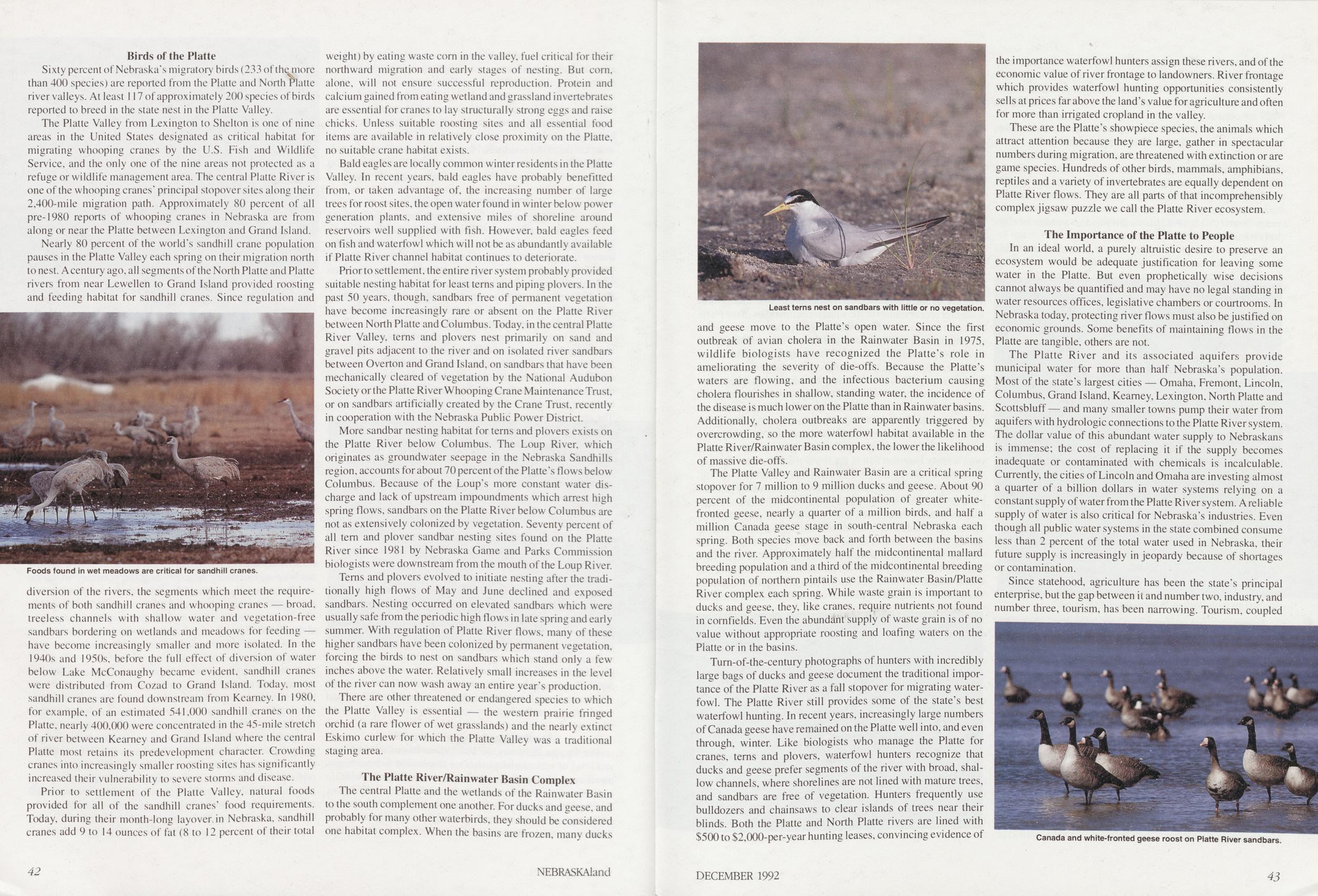 Birds of the Platte
Sixty percent of Nebraska's migratory birds (233 of the more than 400 species) are reported from the Platte and North Platte river valleys. At least 117 of approximately 200 species of birds reported to breed in the state nest in the Platte Valley.
The Platte Valley from Lexington to Shelton is one of nine areas in the United States designated as critical habitat for migrating whooping cranes by the U.S. Fish and Wildlife Service, and the only one of the nine areas not protected as a refuge or wildlife management area. The central Platte River is one of the whooping cranes' principal stopover sites along their 2,400-mile migration path. Approximately 80 percent of all pre-1980 reports of whooping cranes in Nebraska are from along or near the Platte between Lexington and Grand Island.
Nearly 80 percent of the world's sandhill crane population pauses in the Platte Valley each spring on their migration north to nest. A century ago, all segments of the North Platte and Platte rivers from near Lewellen to Grand Island provided roosting and feeding habitat for sandhill cranes. Since regulation and
Prior to settlement of the Platte Valley, natural foods provided for all of the sandhill cranes' food requirements. Today, during their month-long layoverin Nebraska, sandhill cranes add 9 to 14 ounces of fat (8 to 12 percent of their total weight) by eating waste corn in the valley, fuel critical for their northward migration and early stages of nesting. But corn, alone, will not ensure successful reproduction. Protein and calcium gained from eating wetland and grassland invertebrates are essential for cranes to lay structurally strong eggs and raise chicks. Unless suitable roosting sites and all essential food items are available in relatively close proximity on the Platte, no suitable crane habitat exists.
Bald eagles are locally common winter residents in the Platte Valley. In recent years, bald eagles have probably benefitted from, or taken advantage of, the increasing number of large trees for roost sites, the open water found in winter below power generation plants, and extensive miles of shoreline around reservoirs well supplied with fish. However, bald eagles feed on fish and waterfowl which will not be as abundantly available if Platte River channel habitat continues to deteriorate.
Prior to settlement, the entire river system probably provided suitable nesting habitat for least terns and piping plovers. In the past 50 years, though, sandbars free of permanent vegetation have become increasingly rare or absent on the Platte River between North Platte and Columbus. Today, in the central Platte River Valley, terns and plovers nest primarily on sand and gravel pits adjacent to the river and on isolated river sandbars between Overton and Grand Island, on sandbars that have been mechanically cleared of vegetation by the National Audubon Society or the Platte River Whooping Crane Maintenance Trust, or on sandbars artificially created by the Crane Trust, recently in cooperation with the Nebraska Public Power District.
More sandbar nesting habitat for terns and plovers exists on the Platte River below Columbus. The Loup River, which originates as groundwater seepage in the Nebraska Sandhills region, accounts for about 70 percent of the Platte's flows below Columbus. Because of the Loup's more constant water discharge and lack of upstream impoundments which arrest high spring flows, sandbars on the Platte River below Columbus are not as extensively colonized by vegetation. Seventy percent of all tern and plover sandbar nesting sites found on the Platte River since 1981 by Nebraska Game and Parks Commission biologists were downstream from the mouth of the Loup River.
Terns and plovers evolved to initiate nesting after the traditionally high flows of May and June declined and exposed sandbars. Nesting occurred on elevated sandbars which were usually safe from the periodic high flows in late spring and early summer. With regulation of Platte River flows, many of these higher sandbars have been colonized by permanent vegetation, forcing the birds to nest on sandbars which stand only a few inches above the water. Relatively small increases in the level of the river can now wash away an entire year's production.
There are other threatened or endangered species to which the Platte Valley is essential — the western prairie fringed orchid (a rare flower of wet grasslands) and the nearly extinct Eskimo curlew for which the Platte Valley was a traditional staging area.
The Platte River/Rainwater Basin ComplexThe central Platte and the wetlands of the Rainwater Basin to the south complement one another. For ducks and geese, and probably for many other waterbirds, they should be considered one habitat complex. When the basins are frozen, many ducks 42 NEBRSAKAland
The Platte Valley and Rainwater Basin are a critical spring stopover for 7 million to 9 million ducks and geese. About 90 percent of the midcontinental population of greater whitefronted geese, nearly a quarter of a million birds, and half a million Canada geese stage in south-central Nebraska each spring. Both species move back and forth between the basins and the river. Approximately half the midcontinental mallard breeding population and a third of the midcontinental breeding population of northern pintails use the Rainwater Basin/Platte River complex each spring. While waste grain is important to ducks and geese, they, like cranes, require nutrients not found in cornfields. Even the abundant supply of waste grain is of no value without appropriate roosting and loafing waters on the Platte or in the basins.
Turn-of-the-century photographs of hunters with incredibly large bags of ducks and geese document the traditional importance of the Platte River as a fall stopover for migrating waterfowl. The Platte River still provides some of the state's best waterfowl hunting. In recent years, increasingly large numbers of Canada geese have remained on the Platte well into, and even through, winter. Like biologists who manage the Platte for cranes, terns and plovers, waterfowl hunters recognize that ducks and geese prefer segments of the river with broad, shallow channels, where shorelines are not lined with mature trees, and sandbars are free of vegetation. Hunters frequently use bulldozers and chainsaws to clear islands of trees near their blinds. Both the Platte and North Platte rivers are lined with $500 to $2,000-per-year hunting leases, convincing evidence of the importance waterfowl hunters assign these rivers, and of the economic value of river frontage to landowners. River frontage which provides waterfowl hunting opportunities consistently sells at prices far above the land's value for agriculture and often for more than irrigated cropland in the valley.
These are the Platte's showpiece species, the animals which attract attention because they are large, gather in spectacular numbers during migration, are threatened with extinction or are game species. Hundreds of other birds, mammals, amphibians, reptiles and a variety of invertebrates are equally dependent on Platte River flows. They are all parts of that incomprehensibly complex jigsaw puzzle we call the Platte River ecosystem.
The Importance of the Platte to PeopleIn an ideal world, a purely altruistic desire to preserve an ecosystem would be adequate justification for leaving some water in the Platte. But even prophetically wise decisions cannot always be quantified and may have no legal standing in water resources offices, legislative chambers or courtrooms. In Nebraska today, protecting river flows must also be justified on economic grounds. Some benefits of maintaining flows in the Platte are tangible, others are not.
The Platte River and its associated aquifers provide municipal water for more than half Nebraska's population. Most of the state's largest cities — Omaha, Fremont, Lincoln, Columbus, Grand Island, Kearney, Lexington. North Platte and Scottsbluff— and many smaller towns pump their water from aquifers with hydrologic connections to the Platte River system. The dollar value of this abundant water supply to Nebraskans is immense; the cost of replacing it if the supply becomes inadequate or contaminated with chemicals is incalculable. Currently, the cities of Lincoln and Omaha are investing almost a quarter of a billion dollars in water systems relying on a constant supply of water from the Platte River system. A reliable supply of water is also critical for Nebraska's industries. Even though all public water systems in the state combined consume less than 2 percent of the total water used in Nebraska, their future supply is increasingly in jeopardy because of shortages or contamination.
Since statehood, agriculture has been the state's principal enterprise, but the gap between it and number two, industry, and number three, tourism, has been narrowing. Tourism, coupled
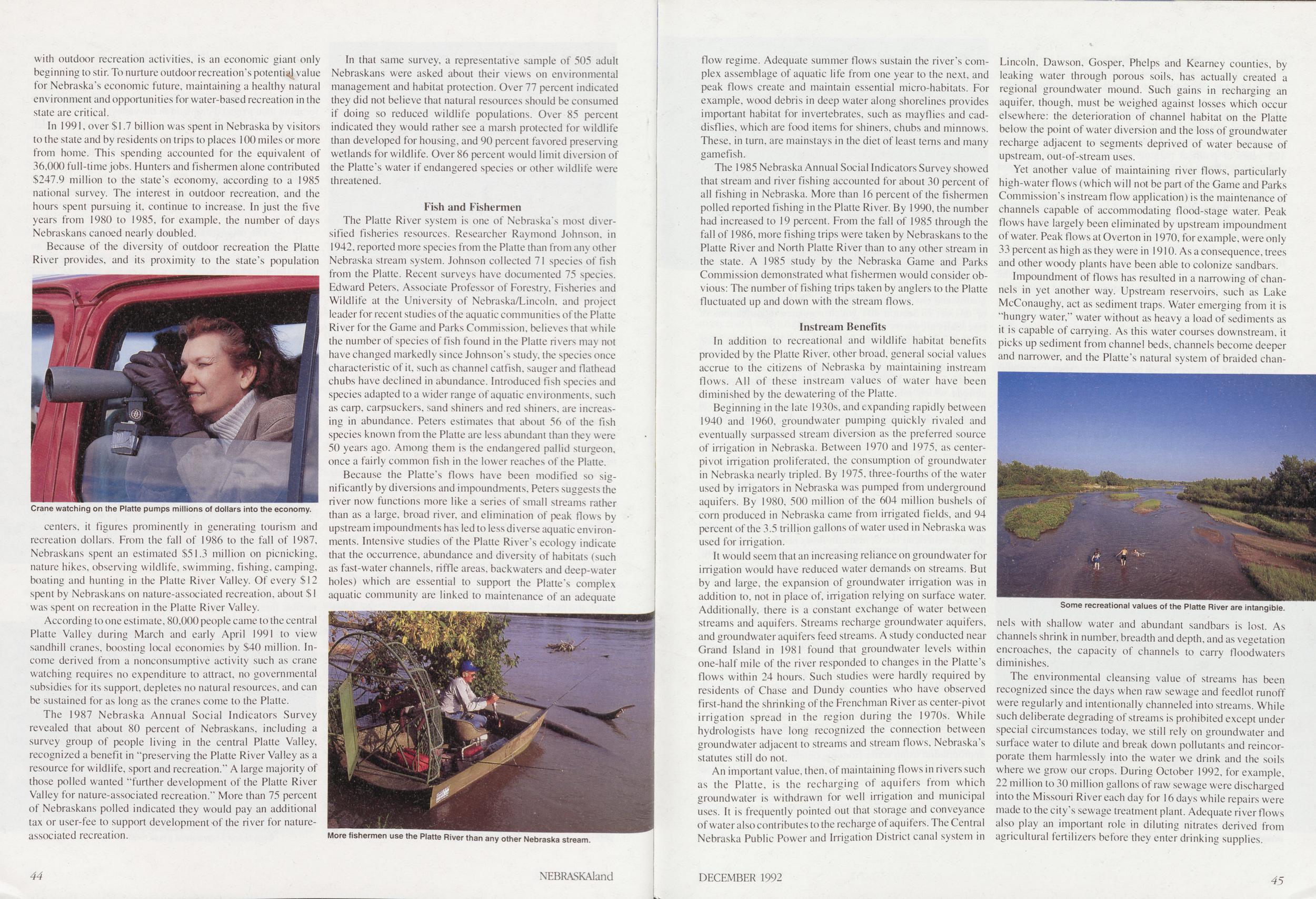 with outdoor recreation activities, is an economic giant only
beginning to stir. To nurture outdoor recreation's potentiajvalue
for Nebraska's economic future, maintaining a healthy natural
environment and opportunities for water-based recreation in the
state are critical.
with outdoor recreation activities, is an economic giant only
beginning to stir. To nurture outdoor recreation's potentiajvalue
for Nebraska's economic future, maintaining a healthy natural
environment and opportunities for water-based recreation in the
state are critical.
In 1991, over $ 1.7 billion was spent in Nebraska by visitors to the state and by residents on trips to places 100 miles or more from home. This spending accounted for the equivalent of 36,000 full-time jobs. Hunters and fishermen alone contributed $247.9 million to the state's economy, according to a 1985 national survey. The interest in outdoor recreation, and the hours spent pursuing it, continue to increase. In just the five years from 1980 to 1985, for example, the number of days Nebraskans canoed nearly doubled.
Because of the diversity of outdoor recreation the Platte River provides, and its proximity to the state's population
According to one estimate, 80,000 people came to the central Platte Valley during March and early April 1991 to view sandhill cranes, boosting local economies by $40 million. Income derived from a nonconsumptive activity such as crane watching requires no expenditure to attract, no governmental subsidies for its support, depletes no natural resources, and can be sustained for as long as the cranes come to the Platte.
The 1987 Nebraska Annual Social Indicators Survey revealed that about 80 percent of Nebraskans, including a survey group of people living in the central Platte Valley, recognized a benefit in "preserving the Platte River Valley as a resource for wildlife, sport and recreation." A large majority of those polled wanted "further development of the Platte River Valley for nature-associated recreation." More than 75 percent of Nebraskans polled indicated they would pay an additional tax or user-fee to support development of the river for nature-associated recreation.
In that same survey, a representative sample of 505 adult Nebraskans were asked about their views on environmental management and habitat protection. Over 77 percent indicated they did not believe that natural resources should be consumed if doing so reduced wildlife populations. Over 85 percent indicated they would rather see a marsh protected for wildlife than developed for housing, and 90 percent favored preserving wetlands for wildlife. Over 86 percent would limit diversion of the Platte's water if endangered species or other wildlife were threatened.
Fish and FishermenThe Platte River system is one of Nebraska's most diversified fisheries resources. Researcher Raymond Johnson, in 1942, reported more species from the Platte than from any other Nebraska stream system. Johnson collected 71 species offish from the Platte. Recent surveys have documented 75 species. Edward Peters, Associate Professor of Forestry, Fisheries and Wildlife at the University of Nebraska/Lincoln, and project leader for recent studies of the aquatic communities of the Platte River for the Game and Parks Commission, believes that while the number of species of fish found in the Platte rivers may not have changed markedly since Johnson's study, the species once characteristic of it, such as channel catfish, sauger and flathead chubs have declined in abundance. Introduced fish species and species adapted to a wider range of aquatic environments, such as caip, carpsuckers, sand shiners and red shiners, are increasing in abundance. Peters estimates that about 56 of the fish species known from the Platte are less abundant than they were 50 years ago. Among them is the endangered pallid sturgeon, once a fairly common fish in the lower reaches of the Platte.
Because the Platte's flows have been modified so significantly by diversions and impoundments, Peters suggests the river now functions more like a series of small streams rather than as a large, broad river, and elimination of peak flows by upstream impoundments has led to less diverse aquatic environments. Intensive studies of the Platte River's ecology indicate that the occurrence, abundance and diversity of habitats (such as fast-water channels, riffle areas, backwaters and deep-water holes) which are essential to support the Platte's complex aquatic community are linked to maintenance of an adequate
The 1985 Nebraska Annual Social Indicators Survey showed that stream and river fishing accounted for about 30 percent of all fishing in Nebraska. More than 16 percent of the fishermen polled reported fishing in the Platte River. By 1990, the number had increased to 19 percent. From the fall of 1985 through the fall of 1986, more fishing trips were taken by Nebraskans to the Platte River and North Platte River than to any other stream in the state. A 1985 study by the Nebraska Game and Parks Commission demonstrated what fishermen would consider obvious: The number of fishing trips taken by anglers to the Platte fluctuated up and down with the stream flows.
Instream BenefitsIn addition to recreational and wildlife habitat benefits provided by the Platte River, other broad, general social values accrue to the citizens of Nebraska by maintaining instream flows. All of these instream values of water have been diminished by the dewatering of the Platte.
Beginning in the late 1930s, and expanding rapidly between 1940 and 1960, groundwater pumping quickly rivaled and eventually surpassed stream diversion as the preferred source of irrigation in Nebraska. Between 1970 and 1975, as center-pivot irrigation proliferated, the consumption of groundwater in Nebraska nearly tripled. By 1975, three-fourths of the water used by irrigators in Nebraska was pumped from underground aquifers. By 1980, 500 million of the 604 million bushels of corn produced in Nebraska came from irrigated fields, and 94 percent of the 3.5 trillion gallons of water used in Nebraska was used for irrigation.
It would seem that an increasing reliance on groundwater for irrigation would have reduced water demands on streams. But by and large, the expansion of groundwater irrigation was in addition to, not in place of, irrigation relying on surface water. Additionally, there is a constant exchange of water between streams and aquifers. Streams recharge groundwater aquifers, and groundwater aquifers feed streams. A study conducted near Grand Island in 1981 found that groundwater levels within one-half mile of the river responded to changes in the Platte's flows within 24 hours. Such studies were hardly required by residents of Chase and Dundy counties who have observed first-hand the shrinking of the Frenchman River as center-pivot irrigation spread in the region during the 1970s. While hydrologists have long recognized the connection between groundwater adjacent to streams and stream flows, Nebraska's statutes still do not.
An important value, then, of maintaining flows in rivers such as the Platte, is the recharging of aquifers from which groundwater is withdrawn for well irrigation and municipal uses. It is frequently pointed out that storage and conveyance of water also contributes to the recharge of aquifers. The Central Nebraska Public Power and Irrigation District canal system in Lincoln, Dawson, Gosper, Phelps and Kearney counties, by leaking water through porous soils, has actually created a regional groundwater mound. Such gains in recharging an aquifer, though, must be weighed against losses which occur elsewhere: the deterioration of channel habitat on the Platte beiow the point of water diversion and the loss of groundwater recharge adjacent to segments deprived of water because of upstream, out-of-stream uses.
Yet another value of maintaining river flows, particularly high-water flows (which will not be part of the Game and Parks Commission's instream flow application) is the maintenance of channels capable of accommodating flood-stage water. Peak flows have largely been eliminated by upstream impoundment of water. Peak flows at Overton in 1970, for example, were only 33 percent as high as they were in 1910. As a consequence, trees and other woody plants have been able to colonize sandbars.
Impoundment of flows has resulted in a narrowing of channels in yet another way. Upstream reservoirs, such as Lake McConaughy, act as sediment traps. Water emerging from it is "hungry water," water without as heavy a load of sediments as it is capable of carrying. As this water courses downstream, it picks up sediment from channel beds, channels become deeper and narrower, and the Platte's natural system of braided channels with
The environmental cleansing value of streams has been recognized since the days when raw sewage and feedlot runoff were regularly and intentionally channeled into streams. While such deliberate degrading of streams is prohibited except under special circumstances today, we still rely on groundwater and surface water to dilute and break down pollutants and reincorporate them harmlessly into the water we drink and the soils where we grow our crops. During October 1992, for example, 22 million to 30 million gallons of raw sewage were discharged into the Missouri River each day for 16 days while repairs were made to the city's sewage treatment plant. Adequate river flows also play an important role in diluting nitrates derived from agricultural fertilizers before they enter drinking supplies.
DECEMBER 1992 45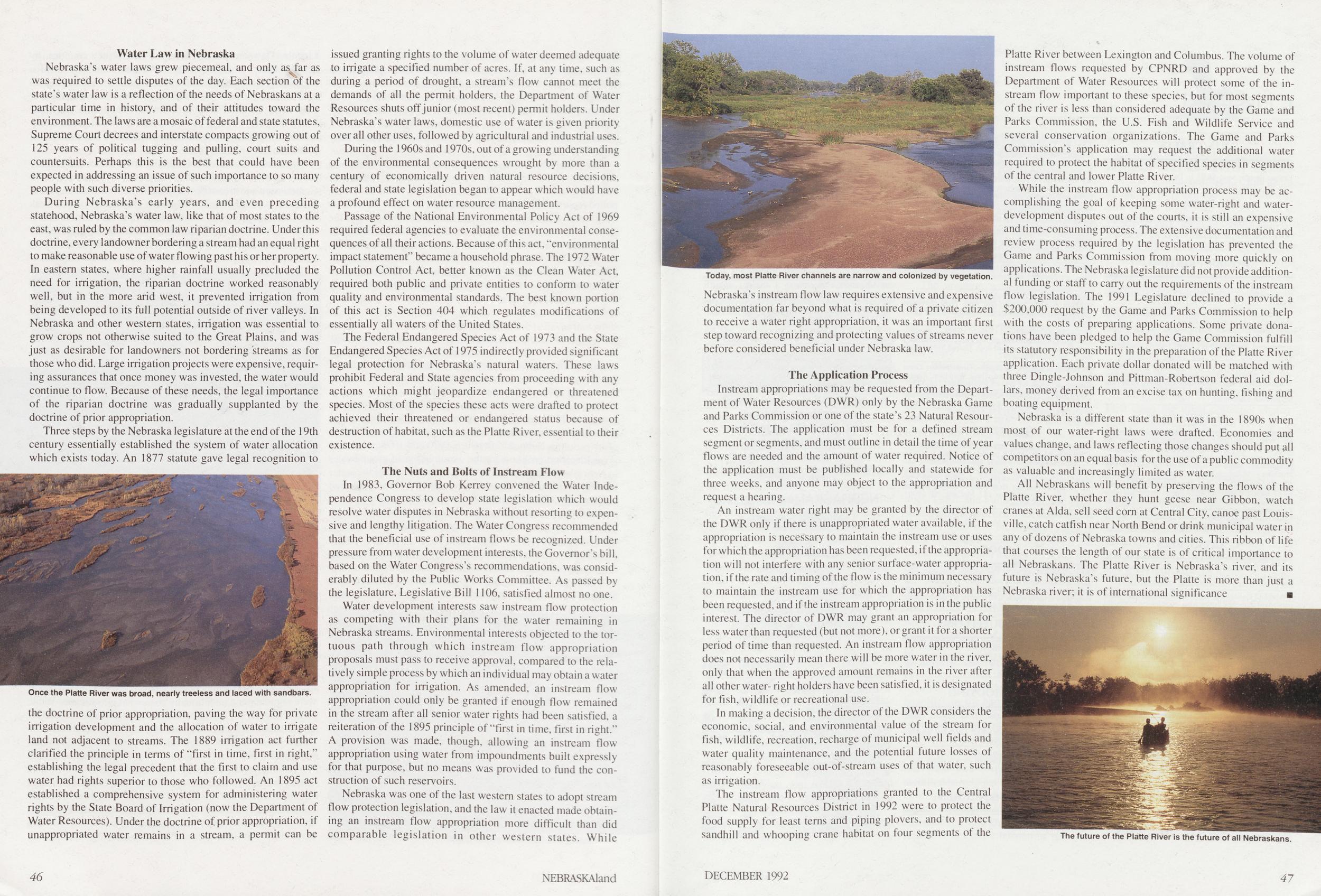 Water Law in Nebraska
Nebraska's water laws grew piecemeal, and only assfar as was required to settle disputes of the day. Each section of the state's water law is a reflection of the needs of Nebraskans at a particular time in history, and of their attitudes toward the environment. The laws are a mosaic of federal and state statutes, Supreme Court decrees and interstate compacts growing out of 125 years of political tugging and pulling, court suits and countersuits. Perhaps this is the best that could have been expected in addressing an issue of such importance to so many people with such diverse priorities.
During Nebraska's early years, and even preceding statehood, Nebraska's water law, like that of most states to the east, was ruled by the common law riparian doctrine. Under this doctrine, every landowner bordering a stream had an equal right to make reasonable use of water flowing past his or her property. In eastern states, where higher rainfall usually precluded the need for irrigation, the riparian doctrine worked reasonably well, but in the more arid west, it prevented irrigation from being developed to its full potential outside of river valleys. In Nebraska and other western states, irrigation was essential to grow crops not otherwise suited to the Great Plains, and was just as desirable for landowners not bordering streams as for those who did. Large irrigation projects were expensive, requiring assurances that once money was invested, the water would continue to flow. Because of these needs, the legal importance of the riparian doctrine was gradually supplanted by the doctrine of prior appropriation.
Three steps by the Nebraska legislature at the end of the 19th century essentially established the system of water allocation which exists today. An 1877 statute gave legal recognition to
During the 1960s and 1970s, out of a growing understanding of the environmental consequences wrought by more than a century of economically driven natural resource decisions, federal and state legislation began to appear which would have a profound effect on water resource management.
Passage of the National Environmental Policy Act of 1969 required federal agencies to evaluate the environmental consequences of all their actions. Because of this act, "environmental impact statement" became a household phrase. The 1972 Water Pollution Control Act, better known as the Clean Water Act, required both public and private entities to conform to water quality and environmental standards. The best known portion of this act is Section 404 which regulates modifications of essentially all waters of the United States.
The Federal Endangered Species Act of 1973 and the State Endangered Species Act of 1975 indirectly provided significant legal protection for Nebraska's natural waters. These laws prohibit Federal and State agencies from proceeding with any actions which might jeopardize endangered or threatened species. Most of the species these acts were drafted to protect achieved their threatened or endangered status because of destruction of habitat, such as the Platte River, essential to their existence.
The Nuts and Bolts of Instream FlowIn 1983, Governor Bob Kerrey convened the Water Independence Congress to develop state legislation which would resolve water disputes in Nebraska without resorting to expensive and lengthy litigation. The Water Congress recommended that the beneficial use of instream flows be recognized. Under pressure from water development interests, the Governor's bill, based on the Water Congress's recommendations, was considerably diluted by the Public Works Committee. As passed by the legislature, Legislative Bill 1106, satisfied almost no one.
Water development interests saw instream flow protection as competing with their plans for the water remaining in Nebraska streams. Environmental interests objected to the tortuous path through which instream flow appropriation proposals must pass to receive approval, compared to the relatively simple process by which an individual may obtain a water appropriation for irrigation. As amended, an instream flow appropriation could only be granted if enough flow remained in the stream after all senior water rights had been satisfied, a reiteration of the 1895 principle of "first in time, first in right." A provision was made, though, allowing an instream flow appropriation using water from impoundments built expressly for that purpose, but no means was provided to fund the construction of such reservoirs.
Nebraska was one of the last western states to adopt stream flow protection legislation, and the law it enacted made obtaining an instream flow appropriation more difficult than did comparable legislation in other western states. While 46 NEBRASKAland
Instream appropriations may be requested from the Department of Water Resources (DWR) only by the Nebraska Game and Parks Commission or one of the state's 23 Natural Resources Districts. The application must be for a defined stream segment or segments, and must outline in detail the time of year flows are needed and the amount of water required. Notice of the application must be published locally and statewide for three weeks, and anyone may object to the appropriation and request a hearing.
An instream water right may be granted by the director of the DWR only if there is unappropriated water available, if the appropriation is necessary to maintain the instream use or uses for which the appropriation has been requested, if the appropriation will not interfere with any senior surface-water appropriation, if the rate and timing of the flow is the minimum necessary to maintain the instream use for which the appropriation has been requested, and if the instream appropriation is in the public interest. The director of DWR may grant an appropriation for less water than requested (but not more), or grant it for a shorter period of time than requested. An instream flow appropriation does not necessarily mean there will be more water in the river, only that when the approved amount remains in the river after all other water- right holders have been satisfied, it is designated for fish, wildlife or recreational use.
In making a decision, the director of the DWR considers the economic, social, and environmental value of the stream for fish, wildlife, recreation, recharge of municipal well fields and water quality maintenance, and the potential future losses of reasonably foreseeable out-of-stream uses of that water, such as irrigation.
The instream flow appropriations granted to the Central Platte Natural Resources District in 1992 were to protect the food supply for least terns and piping plovers, and to protect sandhill and whooping crane habitat on four segments of the Platte River between Lexington and Columbus. The volume of instream flows requested by CPNRD and approved by the Department of Water Resources will protect some of the instream flow important to these species, but for most segments of the river is less than considered adequate by the Game and Parks Commission, the U.S. Fish and Wildlife Service and several conservation organizations. The Game and Parks Commission's application may request the additional water required to protect the habitat of specified species in segments of the central and lower Platte River.
While the instream flow appropriation process may be accomplishing the goal of keeping some water-right and waterdevelopment disputes out of the courts, it is still an expensive and time-consuming process. The extensive documentation and review process required by the legislation has prevented the Game and Parks Commission from moving more quickly on applications. The Nebraska legislature did not provide additional funding or staff to carry out the requirements of the instream flow legislation. The 1991 Legislature declined to provide a $200,000 request by the Game and Parks Commission to help with the costs of preparing applications. Some private donations have been pledged to help the Game Commission fulfill its statutory responsibility in the preparation of the Platte River application. Each private dollar donated will be matched with three Dingle-Johnson and Pittman-Robertson federal aid dollars, money derived from an excise tax on hunting, fishing and boating equipment.
Nebraska is a different state than it was in the 1890s when most of our water-right laws were drafted. Economies and values change, and laws reflecting those changes should put all competitors on an equal basis for the use of a public commodity as valuable and increasingly limited as water.
All Nebraskans will benefit by preserving the flows of the Platte River, whether they hunt geese near Gibbon, watch cranes at Alda, sell seed corn at Central City, canoe past Louisville, catch catfish near North Bend or drink municipal water in any of dozens of Nebraska towns and cities. This ribbon of life that courses the length of our state is of critical importance to all Nebraskans. The Platte River is Nebraska's river, and its future is Nebraska's future, but the Platte is more than just a Nebraska river; it is of international significance
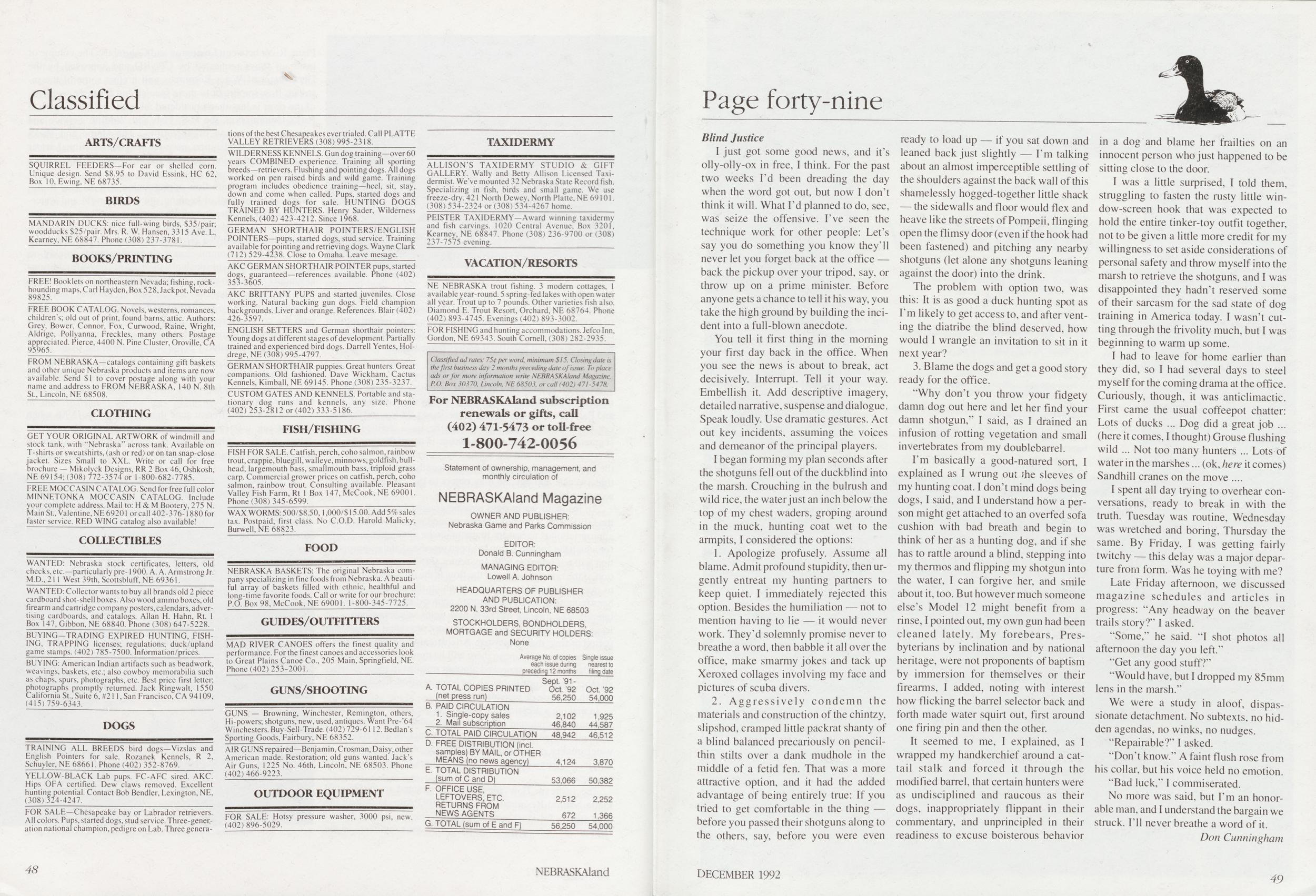
Classified
ARTS/CRAFTSSQUIRREL FEEDERS—For ear or shelled corn. Unique design. Send $8.95 to David Essink, HC 62, Box 10, Ewing, NE 68735.
BIRDSMANDARIN DUCKS: nice full-wing birds, $35/pair; woodducks $25/pair. Mrs. R. W. Hansen, 3315 Ave. L, Kearney, NE 68847. Phone (308) 237-3781.
BOOKS/PRINTINGFREE! Booklets on northeastern Nevada; fishing, rock-hounding maps, Carl Hayden, Box 528, Jackpot, Nevada 89825.
FREE BOOK CATALOG. Novels, westerns, romances, children's; old out of print, found barns, attic. Authors: Grey, Bower, Connor, Fox, Curwood, Raine, Wright, Aldrige, Pollyanna, Freckles, many others. Postage appreciated. Pierce, 4400 N. Pine Cluster, Oroville, CA 95965.
FROM NEBRASKA—catalogs containing gift baskets and other unique Nebraska products and items are now available. Send $1 to cover postage along with vour name and address to FROM NEBRASKA, 140 N. 8th St., Lincoln, NE 68508.
CLOTHINGGET YOUR ORIGINAL ARTWORK of windmill and stock tank, with "Nebraska" across tank. Available on T-shirts or sweatshirts, (ash or red) or on tan snap-close jacket. Sizes Small to XXL. Write or call for free brochure — Mikolyck Designs, RR 2 Box 46, Oshkosh, NE 69154; (308) 772-3574 or 1-800-682-7785.
FREE MOCCASIN CATALOG. Send for free full color MINNETONKA MOCCASIN CATALOG. Include your complete address. Mail to: H & M Bootery, 275 N. Main St., Valentine, NE 69201 or call 402-376-1880 for faster service. RED WING catalog also available!
COLLECTIBLESWANTED: Nebraska stock certificates, letters, old checks, etc.—particularly pre-1900. A. A. Armstrong Jr. M.D., 21 1 West 39th, Scottsbluff, NE 69361.
WANTED: Collector wants to buy all brands old 2 piece cardboard shot-shell boxes. Also wood ammo boxes, old firearm and cartridge company posters, calendars, advertising cardboards, and catalogs. Allan H. Hahn, Rt. 1 Box 147, Gibbon, NE 68840. Phone (308) 647-5228.
BUYING-TRADING EXPIRED HUNTING, FISH- ING, TRAPPING licenses; regulations; duck/upland game stamps. (402) 785-7500. Information/prices.
BUYING: American Indian artifacts such as beadwork, weavings, baskets, etc.; also cowboy memorabilia such as chaps, spurs, photographs, etc. Best price first letter; photographs promptly returned. Jack Ringwalt, 1550 California St., Suite 6, #2 1 1, San Francisco, C A 94109, (415)759-6343.
DOGSTRAINING ALL BREEDS bird dogs—Vizslas and English Pointers for sale. Rozanek Kennels, R 2, Schuyler, NE 68661. Phone (402) 352-8769.
YELLOW-BLACK Lab pups. FC-AFC sired. AKC. Hips OFA certified. Dew claws removed. Excellent hunting potential. Contact Bob Bendler, Lexington, NE, (308) 324-4247.
FOR SALE—Chesapeake bay or Labrador retrievers. All colors. Pups, started dogs, stud service. Three-generation national champion, pedigre on Lab. Three generations of the best Chesapeakes ever trialed. Call PLATTE VALLEY RETRIEVERS (308) 995-2318.
WILDERNESS KENNELS. Gun dog training—over 60 years COMBINED experience. Training all sporting breeds—retrievers. Flushing and pointing dogs. All dogs worked on pen raised birds and wild game. Training program includes obedience training—heel, sit, stay, down and come when called. Pups, started dogs and fully trained dogs for sale. HUNTING DOGS TRAINED BY HUNTERS. Henry Sader, Wilderness Kennels, (402) 423-4212. Since 1968.
GERMAN SHORTHAIR POINTERS/ENGLISH POINTERS—pups, started dogs, stud service. Training available for pointing and retrieving dogs. Wayne Clark (712) 529-4238. Close to Omaha. Leave mesage.
AKC GERMAN SHORTHAIR POINTER pups, started dogs, guaranteed—references available. Phone (402) 353-3605.
AKC BRITTANY PUPS and started juveniles. Close working. Natural backing gun dogs. Field champion backgrounds. Liver and orange. References. Blair (402) 426-3597.
ENGLISH SETTERS and German shorthair pointers: Young dogs at different stages of development. Partially trained and experienced bird dogs. Darrell Yentes, Holdrege, NE (308) 995-4797.
GERMAN SHORTHAIR puppies. Great hunters. Great companions. Old fashioned. Dave Wickham, Cactus Kennels, Kimball, NE 69145. Phone (308) 235-3237.
CUSTOM GATES AND KENNELS. Portable and stationary dog runs and kennels, any size. Phone (402) 253-2812 or (402) 333-5 186.
FISH/FISHINGFISH FOR SALE. Catfish, perch, coho salmon, rainbow trout, crappie, bluegill, walleye, minnows, goldfish, bullhead, largemouth bass, smallmouth bass, triploid grass carp. Commercial grower prices on catfish, perch, coho salmon, rainbow trout. Consulting available. Pleasant Valley Fish Farm, Rt 1 Box 147, McCook, NE 69001. Phone (308) 345-6599.
WAX WORMS: 500/$8.50,1,000/$ 15.00. Add 5% sales tax. Postpaid, first class. No C.O.D. Harold Malicky, Burwell, NE 68823.
FOODNEBRASKA BASKETS: The original Nebraska company specializing in fine foods from Nebraska. A beautiful array of baskets filled with ethnic, healthful and long-time favorite foods. Call or write for our brochure: P.O. Box 98, McCook, NE 69001. 1-800-345-7725.
GUIDES/OUTFITTERSMAD RIVER CANOES offers the finest quality and performance. For the finest canoes and accessories look to Great Plains Canoe Co., 205 Main, Springfield, NE. Phone(402)253-2001.
GUNS/SHOOTINGGUNS — Browning, Winchester, Remington, others, Hi-powers; shotguns, new, used, antiques. Want Pre-64 Winchesters. Buy-Sell-Trade. (402) 729-6112. Bedlan's Sporting Goods, Fairbury, NE 68352.
AIR GUNS repaired—Benjamin, Crosman. Daisy, other American made. Restoration; old guns wanted. Jack's Air Guns, 1225 No. 46th, Lincoln, NE 68503. Phone (402)466-9223.
OUTDOOR EQUIPMENTALLISON'S TAXIDERMY STUDIO & GIFT GALLERY. Wally and Betty Allison Licensed Taxidermist. We've mounted 32 Nebraska State Record fish. Specializing in fish, birds and small game. We use freeze-dry. 421 North Dewey, North Platte. NE 69101. (308) 534-2324 or (308) 534-4267 home.
PEISTER TAXIDERMY—Award winning taxidermy and fish carvings. 1020 Central Avenue, Box 3201, Kearney, NE 68847. Phone (308) 236-9700 or (308) 237-7575 evening.
VACATION/RESORTSNE NEBRASKA trout fishing. 3 modern cottages, 1 available year-round. 5 spring-fed lakes with open water all year. Trout up to 7 pounds. Other varieties fish also. Diamond E. Trout Resort, Orchard, NE 68764. Phone (402) 893-4745. Evenings (402) 893-3002.
FOR FISHING and hunting accommodations. Jefco Inn, Gordon, NE 69343. South Cornell, (308) 282-2935.
Classified ud rates: 75$ per word, minimum $15. Closing date is the first business day 2 months preceding date of issue. To place ads or for more information write NEBRASKA land Magazine. P.O. Box 30570. Lincoln, NE 68503, or call (402) 471-5478. For NEBRASKAland subscription renewals or gifts, call (402) 471-5473 or toll-free 1-800-742-0056 Statement of ownership, management, and monthly circulation of NEBRASKAland Magazine OWNER AND PUBLISHER: Nebraska Game and Parks Commission EDITOR: Donald B. Cunningham MANAGING EDITOR: Lowell A. Johnson HEADQUARTERS OF PUBLISHER AND PUBLICATION: 2200 N. 33rd Street, Lincoln, NE 68503 STOCKHOLDERS, BONDHOLDERS, MORTGAGE and SECURITY HOLDERS: None Average No. of copies Single issue each issue during nearest to preceding 12 months filing date Sept. 91 - A. TOTAL COPIES PRINTED Oct. '92 Oct. 92 (net press run)56,250 54,000 B. PAID CIRCULATION 1. Single-copy sales 2,102 1,925 2. Mail subscription 46,840 44,587 C. TOTAL PAID CIRCULATION 48,942 46,512 D. FREE DISTRIBUTION (incl. samples) BY MAIL, or OTHER MEANS (no news agency) 4,124 3,870 E. TOTAL DISTRIBUTION (sum of C and D) 53,066 50,382 FOR SALE: Hotsy pressure washer, 3000 psi, new. (402) 896-5029. F. OFFICE USE, LEFTOVERS, ETC. RETURNS FROM NEWS AGENTS G. TOTAL (sum of E and F) 2,512 672 2,252 1.366 56,250 54,000 48 NEBRASKAlandPage forty-nine
Blind JusticeI just got some good news, and it's olly-olly-ox in free, I think. For the past two weeks I'd been dreading the day when the word got out, but now I don't think it will. What Ed planned to do, see, was seize the offensive. I've seen the technique work for other people: Let's say you do something you know they'll never let you forget back at the office back the pickup over your tripod, say, or throw up on a prime minister. Before anyone gets a chance to tell it his way, you take the high ground by building the incident into a full-blown anecdote.
You tell it first thing in the morning your first day back in the office. When you see the news is about to break, act decisively. Interrupt. Tell it your way. Embellish it. Add descriptive imagery, detailed narrative, suspense and dialogue. Speak loudly. Use dramatic gestures. Act out key incidents, assuming the voices and demeanor of the principal players.
I began forming my plan seconds after the shotguns fell out of the duckblind into the marsh. Crouching in the bulrush and wild rice, the water just an inch below the top of my chest waders, groping around in the muck, hunting coat wet to the armpits, I considered the options:
1. Apologize profusely. Assume all blame. Admit profound stupidity, then urgently entreat my hunting partners to keep quiet. I immediately rejected this option. Besides the humiliation — not to mention having to lie — it would never work. They'd solemnly promise never to breathe a word, then babble it all over the office, make smarmy jokes and tack up Xeroxed collages involving my face and pictures of scuba divers.
2. Aggressively condemn the materials and construction of the chintzy, slipshod, cramped little packrat shanty of a blind balanced precariously on pencil-thin stilts over a dank mudhole in the middle of a fetid fen. That was a more attractive option, and it had the added advantage of being entirely true: If you tried to get comfortable in the thing before you passed their shotguns along to the others, say, before you were even ready to load up — if you sat down and leaned back just slightly — I'm talking about an almost imperceptible settling of the shoulders against the back wall of this shamelessly hogged-together little shack — the sidewalls and floor would flex and heave like the streets of Pompeii, flinging open the flimsy door (even if the hook had been fastened) and pitching any nearby shotguns (let alone any shotguns leaning against the door) into the drink.
The problem with option two, was this: It is as good a duck hunting spot as I'm likely to get access to, and after venting the diatribe the blind deserved, how would I wrangle an invitation to sit in it next year?
3. Blame the dogs and get a good story ready for the office.
"Why don't you throw your fidgety damn dog out here and let her find your damn shotgun," I said, as I drained an infusion of rotting vegetation and small invertebrates from my doublebarrel.
I'm basically a good-natured sort, I explained as I wrung out the sleeves of my hunting coat. I don't mind dogs being dogs, I said, and I understand how a person might get attached to an overfed sofa cushion with bad breath and begin to think of her as a hunting dog, and if she has to rattle around a blind, stepping into my thermos and flipping my shotgun into the water, I can forgive her, and smile about it, too. But however much someone else's Model 12 might benefit from a rinse, I pointed out. my own gun had been cleaned lately. My forebears, Presbyterians by inclination and by national heritage, were not proponents of baptism by immersion for themselves or their firearms, I added, noting with interest how flicking the barrel selector back and forth made water squirt out, first around one firing pin and then the other.
It seemed to me, I explained, as I wrapped my handkerchief around a cattail stalk and forced it through the modified barrel, that certain hunters were as undisciplined and raucous as their dogs, inappropriately flippant in their commentary, and unprincipled in their readiness to excuse boisterous behavior in a dog and blame her frailties on an innocent person who just happened to be sitting close to the door.
I was a little surprised, I told them, struggling to fasten the rusty little window-screen hook that was expected to hold the entire tinker-toy outfit together, not to be given a little more credit for my willingness to set aside considerations of personal safety and throw myself into the marsh to retrieve the shotguns, and I was disappointed they hadn't reserved some of their sarcasm for the sad state of dog training in America today. I wasn't cutting through the frivolity much, but I was beginning to warm up some.
I had to leave for home earlier than they did, so I had several days to steel myself for the coming drama at the office. Curiously, though, it was anticlimactic. First came the usual coffeepot chatter: Lots of ducks Dog did a great job (here it comes, I thought) Grouse flushing wild Not too many hunters Lots of water in the marshes (ok, here it comes) Sandhill cranes on the move
I spent all day trying to overhear conversations, ready to break in with the truth. Tuesday was routine, Wednesday was wretched and boring, Thursday the same. By Friday, I was getting fairly twitchy — this delay was a major departure from form. Was he toying with me?
Late Friday afternoon, we discussed magazine schedules and articles in progress: "Any headway on the beaver trails story?" I asked.
"Some," he said. "I shot photos all afternoon the day you left."
"Get any good stuff?"
"Would have, but I dropped my 85mm lens in the marsh."
We were a study in aloof, dispassionate detachment. No subtexts, no hidden agendas, no winks, no nudges.
"Repairable?" I asked.
"Don't know." A faint flush rose from his collar, but his voice held no emotion.
"Bad luck," I commiserated.
No more was said, but I'm an honorable man, and I understand the bargain we struck. I'll never breathe a word of it.
Don Cunningham DECEMBER 1992 49
1992 NEBRASKAland Magazine Index
This simplified index groups magazine stories chronologically under broad, alphabetically arranged subject headings. Entries include month of publication, title, author and keywords suggesting a story content. No attempt has been made to index every reference to narrow subjects. Birds: April. Three Years With Nebraska's Prairie Grouse. Rocky Hoffmann. Prairie grouse; sharptail grouse; prairie chickens. March. Crane Music. Paul A. Johnsgard. Sandhill cranes; cranes. April. Dawes County Whooper. Bob Grier. Whooping cranes; cranes. October. Predator and Prey. Ralph Wall. "Notes from the field." Hawks; snakes; predation. March: The Rainwater Basin Alternative. Jon Farrar. "Notes from the field." Wetlands; waterfowl; birdwatching. April: Avian Cholera: Burning the Carcasses. "Notes from the field." Chuck McCullough. Avian cholera; cholera; waterfowl; geese. Conservation: May. Rulo Bluffs Presence. Gerry Steinauer. Missouri River bluffs; Rulo Bluffs Preserve; woodlands. July: Sandhills Fens. Gerry Steinauer. Fens; wetlands; Sandhills; peat. Cooking: March. In the Kitchen. Stew; venison curry; baked rabbit. November. In The Kitchen. Braised pheasant; rabbit/wine sauce; duck; squirrel/dumplings. June. In the Kitchen. Jelly; butter; vinegar. Fauna Notes: Aug/Sept. Swallowtails. Brett Ratcliffe. Swallowtails; butterflies. Fishing-Trout: June. Fishing the Mayfly Hatch. Tom Keith. Fishing; trout; fly fishing. Fishing-Misc: April. New 1992 Fishing Regulations. Tom Keith. Fish; fishing; size limits; regulations. April. Fishing is Changing. Tom Keith. "Page forty-nine." Fishing. May. Tad Pollys, Wigglers and Wotta-Frogs. Ken Bouc. fishing; lures. Aug/Sept. Of Lawyers and Tournaments. Mark Nelsen. "Page forty-nine." Humor; fishing. December. Panhandle Ice Fishing. Bob Grier. Fishing; ice fishing; bluegill; bass; trout; walleye; panfish; Panhandle. Fishing-Walleye: May. Bobbing For Walleye. Ken Bouc. Fishing; walleye; Merritt Reservoir. Fishing-Panfish: November. Last Chance Crappie. Ken Bouc. Fishing; crappie; Game and Parks: April. 1991 Annual Report. Game and Parks Commission annual report. History: March. Frontier Medicine. Tom Keith. Medicine; medication; pioneers. November. Eyewitness at Wounded Knee. Richard R. Jensen. /R. Eli Paul/John E. Carter. Wounded Knee; Indians; Pine Ridge Reservation. November. Remembering the Names of Wounded Knee. Carter. John E.. Arthur J. Shortbull; Wounded Knee; Indians; paintings; poetry. October. Erwin H. Barbour: A Nebraska Renaissance Man. Dorothy Meade. Erwin Barbour; Paleontology; Morrill Hall; Museums. How-to: Jan/Feb. Seeing Photographically. Bob Grier. Photography. Jan/Feb. People. Ken Bouc. Photography. Jan/Feb. Cameras and Camera Care. Bob Grier. Photography. Jan/Feb. Landscapes. Bob Grier. Photography. Jan/Feb. Advanced Photography. Bob Grier. Photography. Jan/Feb. The Photographer's Trail. Various. Photography. Jan/Feb. Close-up. Jon Farrar. Photography. Jan/Feb. In Black and White. Bob Grier. Photography. Humor: March. Place For Everything. Don Cunningham. "Page forty-nine." Humor; office organization. Hunting-Big Game: July. Believe it or Not. Bruce Trindle. "Notes from the field." Deer; trophy deer; deer Hunting. Hunting-Misc: October. Hunt and Stay Fit. Don Cunningham. Hunting; physical conditioning. November. High Expectations for a Short Gun. Rocky Hoffmann. Hunting; handguns; squirrels; Mark Brandes. Hunting-Upland: Aug/Sept. Grouse Manager Hunts Grouse. Jon Farrar. Grouse: hunting; Sandhills; management. October. Rare Moments. Don Cunningham. "Page forty-nine." Grouse; hunting. November. Fifty-four Pheasant Hunts. Ken Bouc. Hunting; pheasants; Morris Stamm. November. Pheasants From Hell. Rocky Hoffmann. Hunting; pheasants; humor. Hunting-Waterfowl: November. Waterfowl Music. Tom Keith. Duck calling; hunting; waterfowl; Ron Wieneke. December. Blind Justice. Don Cunningham. "Page forty-nine." Humor; waterfowl hunting; dogs. Insects: June. Lyme Disease Update. Tom Keith. "Notes from the field." Lyme disease; ticks; Rocky Mountain spotted fever. Mammals: May. City Foxes. Ken Bouc. Red Fox: foxes; urban wildlife. June. Hank Sather and the Great Plains Muskrat. Jon Farrar. Hank Sather; muskrats; Rice Lake. June. Musquash...Grazer of the Marsh. Jon Farrar. Muskrats; marshes; wetlands. Management-Aquatic: July. Ups and Downs of Harlan County Reservoir. Rocky Hoffmann. Harlan County Reservoir; fish; management. Management-Land: April. Blasting for Wildlife. Bob Grier. Explosives; Pine Ridge; Metcalf WMA; Ballard Marsh WMA; management. April. Wetland Economics. Don Cunningham. "Notes from the field." Wetlands; wetland losses; U.S. Environmental Protection Agency. Management-Wildlife: March. The Economics of Crane Watching. Jon Farrar. "Notes from the field." Wildlife; birds; cranes. July. Wild Babies. Chuck McCullough. "Notes from the field." Orphaned animals. December. Whitetail Buck Rescue. Ken Bouc. Deer; Fontenelle Forest. December. Nebraska's Vanishing Species. Gerry Steinauer/Greg Wingfield. Threatened species: endangered species; nongame; habitat. Miscellaneous: Aug/Sept. Notes About the Field. Don Cunningham. "Notes from the field." State borders; Nebraska; Nebraskaland Magazine. Museums/Collections: May. Artifact Hunting in Nebraska. Bob Starck/Rob Bozeil. Artifacts; artifact hunting; archeology. June. Quartermaster Cache. Tom Buecker. Artifacts; Fort Robinson; Post Playhouse. Outdoor Experience: June. Air Conditioners and Naming Months. Don Cunningham. "Page forty-nine." Humor; calendar; Indians. July. Sporting Clays. Ken Bouc. Shooting; sporting clays; blue rocks. October. Becoming an Outdoors-Woman. Don Cunningham. "Notes from the field." Women; outdoor training; Halsey National Forest. October. Cattle Drive. Jon Farrar. Cattle; cattle drive; Cherry County; Sandhills; Valentine. October. Outdoor Buddies. Rocky Hoffmann. Hunting; fishing; Janel Johnson; Outdoor Buddies; handicapped access. October. Danger in the Dark. Gary Ebert. Hunting; waterfowl; ducks. November. Call of the Wild. Mark Nelsen. "Notes from the field." Fall; fishing; loons. November. What Memories Really Count? Tom Keith. "Page forty-nine." Hunting; fishing; reminiscences. December. Waste Not. Don Cunningham. "Notes from the field." Wildlife: scavengers; predators. Photo Essay: April. Coming Out. Rocky Hoffmann. Trees; flowers; buds. June. I'm From Nebraska. Joel Sartore. Nebraska; Nebraskans. July. Living History. Mark Dietz. Prairie; Fricke Prairie; native species. July. Platte River Morning. Sara Rhodes Dillow/Roy David Farris. Platte River; outdoor experience. Aug/Sept. In the Kingdom of Grass. Margaret MacKichan/Bob Ross. Sandhills; history; reminiscences. Aug/Sept. Morning on the Marsh. Ken Bouc. Wetlands; Fontenelle Forest. October. Discovering a Sense of Place. Monte Hartman. Dawes County; Panhandle. Plants-Flowers: March. Wildflowers of the Heart. Lisa Knopp-Ramsay. Wildflowers. Aug/Sept. Wildflowers for the Garden. Luann Finke. Wildflowers; goldenrod; columbine; wild petunia: purple prairie clover; butterfly milkweed; sneezeweed; Fendler's aster. Poetry: November. To Visit an Abandoned Farmhouse. Don Richmond. Reminiscences. Reminiscences: May. Real Gardeners. Jon Farrar. "Page forty-nine." Gardening. July. Do Not Try This At Home. Don Cunningham. "Page forty-nine." Humor; 4th of July; fireworks. November. Making A Run For It. Paul Iverson. Hunting; Waterfowl hunting; Missouri River; reminiscences; History. November. 'Stubb' Lucas's Horsehair Rope. Frank McConnell. "Notes from the field." History; cowboys; cattle rustling; reminiscences. December. Christmas Tree Picnic. Polly Spence. Christmas; Pine Ridge; rural life. Reptiles/Amphibians: May. Watching Snakes. Jon Farrar, "Notes from the field." Snakes; garter snake; blue racer. Reptiles/Amphibians: November. Milk Snakes and Sand Adders. Tacy James. "Notes from the field." Milk snakes; snakes; adders. Rivers: March. Scenic Niobrara. Ken Bouc. Niobrara River: December. Platte River Instream Flow Who Needs It? Jon Farrar. Platte River; instream flow; history; management; conservation. Special Issue: Jan/Feb. Photographing Nebraska. Bob Grier. Photography; how-to; special issue. Travel: March. Lied Jungle. Don Cunningham. Lied Jungle; Henry Doorly Zoo. 50 NEBRASKAland NEBRASKAland GIFT CATALOG Thoughtful practical entertaining fashionable gifts from NEBRASKAland
Position: 467 (22 views)