Volume 70, Issue 9, 1992
NEBRASKAland
NOVEMBER 1992 $1.50
NEBRASKAland
VOL 70/NO.4 May 1992 NEBRASKAland VOL. 70 / NO. 9 NOVEMBER 1992 Published by the Nebraska Game and Parks Commission Rex Amack, Director Assistant Directors: William J. Bailey, Jr. Dale R. Bree Staff Chief Information & Education: Paul Horton Managing Editor: Lowell Johnson Editor: Don Cunningham Senior Editors: Jon Farrar, Ken Bouc Regional Editors: Bob Grier, Rocky Hoffmann, Tom Keith Art Director: Steve O’Hare Layout, Design and Illustration: Tim Reigert Circulation: Pat Frahm Commissioners Chairman: J. Alan Cramer, Wayne Vice Chairman: Donald Forney, Lakeside 2nd Vice Chairman: Randall K. Stinnette, Inland Gloria Erickson, Holdrege Charles E. Wright, Lincoln Bill Grewcock, Omaha Elvin Adamson, Nenzel NEBRASKAIand VOL. 70 / NO. 9 ISSN:0028-1964 NOVEMBER 1992 Published monthly, except for combined Jan/Feb and Aug/Sept issues, by the Nebraska Game and Parks Commis- sion. 2200 North 33rd Street. Lincoln, NE. Copyright 1992, all rights reserved. Second-class postage paid at Lincoln, Nebraska POSTMASTER: Send all address changes to NEBRASKAIand. P.O. Box 30370, Lincoln, NE 68503. Rates: $ 12 for one year: $23 for two years. Address submissions to: The Editor, NEBRASKAIand Magazine, P.O. Box 30370, Lincoln, NE 68503. Include a stamped, self-addressed return envelope. The publisher assumes no responsibility for unsolicited material. NEBRASKAIand is available on audio cassette from the Nebraska Library for the Blind and Physically Handicapped. Call (402) 471-2045, or toll-free 800-742-7698. NOVEMBER 1992p. 12
p. 42
p. 20
Does the department have an answer for the scarcity of jackrabbits? I know that the population varies in cycles, but the last good supply of rabbits here was in the late 1950s.
Cottontails seem to hold their own, but both blacktail and whitetail jacks are very hard to find.
Duane GrayO’Neill, NE Game and Parks Commission Wildlife Biologist Frank Andelt confirms your im- pression that jackrabbit populations are down, saying “surveys show a clear downward trend statewide since the 1960s, with current populations only a fraction of what they were then. We are not entirely sure what is responsible for the low numbers, but habitat changes, predators and chemicals are all likely taking a toll." Artifact Hunting
I am a retired farmer and have lived in Nebraska for 91 years. My experience is similar to that of the Boone County Sheriff in that my hobby is hunting Indian artifacts [see “Artifact Hunting in Nebraska,” NEBRASKAland, May 1992]. A few years ago, near the Wood River bridge, I saw traces of mixed soil. I made tests, dug and found several pieces of pottery. I sent samples of this broken pottery to Lincoln. They sent men to dig who said it was the campsite of Woodland Indians from some 1,600 years ago.
I have a piece of this pottery with fingernail marks in it. In all my years of finding pottery, this is the only piece I have found with fingernail imprints in it, so to me it is a very rare find. I am enclosing a tracing. Do you know of others like it?
Ernest LudwigElm Creek, NE Rob Bozell, curator of anthropology for the Nebraska State Historical Society, replies: “Pottery of this age dates to the Middle Woodland period, between 100 B.C. and A.D. 500. As you suggest, the crescent shaped markings are probably fingernail impressions, but might also be ‘rocker-stamping.' Rocker-stamping is common on Middle Woodland pottery in the Kansas City area and was applied by 'rocking' a curved bone or wooden tool across the wet paste. In either case, fingernail or rocker impressions are rare in Nebraska, and this is indeed an important find. Many important discoveries in Nebraska were brought to our attention by local collectors and amateur archeologists. Your find offers testimony to the value of continued strong relations between the professional and amateur archeological communities." Canoeing the Calamus
From June 2 through June 7, Boy Scout Troop 241, of Stromsburg, canoed down the Calamus River from the Highway 7 bridge north of Taylor to the Hannaman Bayou campground at the west end of the Calamus Reservoir.
The scouts each earned their First Aid, Emergency Preparedness and Canoeing merit badges to qualify for the trip. They also had to perf orm 10 hours of conservation work on the trip to qualify for a 50-mile patch. They contacted the Game and Parks Commission and volunteered their labor to paint the outhouses and trash barrels at the three canoe campsites along the river. They also cleaned up the areas and hauled out or burned trash.
Along the winding course of the river, the boys tested their canoeing skills, and the many fences across the river tested their cooperation skills, but no upsets occurred. Along the way they saw deer, ducks, great blue herons, pelicans, fish, turtles and muskrats. After camping at the lake, we toured the Calamus Fish Hatchery and enjoyed Fort Hartsuff State Historical Park. We would like to thank the Game and Parks Commission for the opportunity to enjoy six days in the fresh air of the Sandhills.
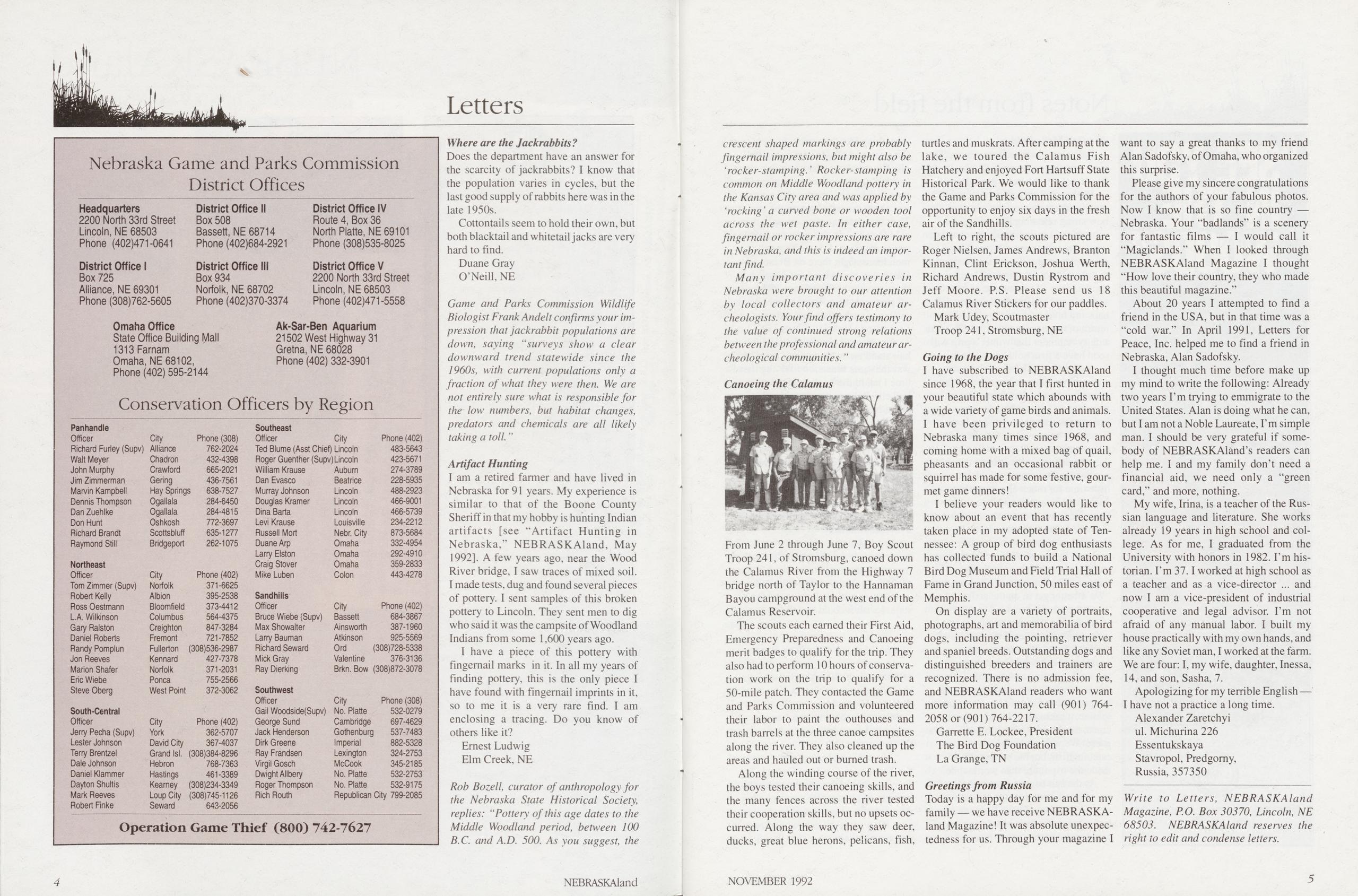
Left to right, the scouts pictured are Roger Nielsen, James Andrews, Branton Kinnan, Clint Erickson, Joshua Werth, Richard Andrews, Dustin Rystrom and Jeff Moore. PS. Please send us 18 Calamus River Stickers for our paddles.
Mark Udey, ScoutmasterTroop 241, Stromsburg, NE Going to the Dogs
I have subscribed to NEBRASKAland since 1968, the year that I first hunted in your beautiful state which abounds with a wide variety of game birds and animals. I have been privileged to return to Nebraska many times since 1968, and coming home with a mixed bag of quail, pheasants and an occasional rabbit or squirrel has made for some festive, gourmet game dinners!
I believe your readers would like to know about an event that has recently taken place in my adopted state of Tennessee: A group of bird dog enthusiasts has collected funds to build a National Bird Dog Museum and Field Trial Hall of Fame in Grand Junction, 50 miles east of Memphis.
On display are a variety of portraits, photographs, art and memorabilia of bird dogs, including the pointing, retriever and spaniel breeds. Outstanding dogs and distinguished breeders and trainers are recognized. There is no admission fee, and NEBRASKAland readers who want more information may call (901) 764- 2058 or (901)764-2217.
Garrette E. Lockee, PresidentThe Bird Dog Foundation
La Grange, TN Greetings from Russia
Today is a happy day for me and for my family — we have receive NEBRASKAland Magazine! It was absolute unexpec- tedness for us. Through your magazine I want to say a great thanks to my friend Alan Sadofsky, of Omaha, who organized this surprise.
Please give my sincere congratulations for the authors of your fabulous photos. Now I know that is so fine country — Nebraska. Your “badlands” is a scenery for fantastic films — I would call it “Magiclands.” When I looked through NEBRASKAland Magazine I thought “How love their country, they who made this beautiful magazine.”
About 20 years I attempted to find a friend in the USA, but in that time was a “cold war.” In April 1991, Letters for Peace, Inc. helped me to find a friend in Nebraska, Alan Sadofsky.
I thought much time before make up my mind to write the following: Already two years I’m trying to emmigrate to the United States. Alan is doing what he can, but I am not a Noble Laureate, I'm simple man. I should be very grateful if somebody of NEBRASKAland’s readers can help me. I and my family don’t need a financial aid, we need only a “green card,” and more, nothing.
My wife, Irina, is a teacher of the Russian language and literature. She works already 19 years in high school and college. As for me, I graduated from the University with honors in 1982. I’m historian. I’m 37. I worked at high school as a teacher and as a vice-director ... and now I am a vice-president of industrial cooperative and legal advisor. I’m not afraid of any manual labor. I built my house practically with my own hands, and like any Soviet man, I worked at the farm. We are four: I, my wife, daughter, Inessa, 14, and son, Sasha, 7.
Apologizing for my terrible English — I have not a practice a long time.
Alexander Zaretchyiul. Michurina 226
Essentukskaya
Stavropol, Predgorny,
Russia, 357350 Write to Letters, NEBRASKAland Magazine, P.O. Box 30370, Lincoln, NE 68503. NEBRASKAland reserves the right to edit and condense letters. 4 NEBRASKAland NOVEMBER 1992 5
Notes from the field
The Call of the WildFall is my favorite time of year. The cool, crisp morning air feels like an old friend, returning after a long absence.
For me, fail signals the beginning of my favorite activities: the sound of a bow string releasing its tension, the snort of the sage whitetail doe that just winded me, the unnerving cackle of a rising pheasant and even the drone of a distant combine reaping the bounty of another crop all remind me of one season’s end and another’s renewal. Perhaps my favorite sign, though, is the return of migrating waterfowl. They are a daily reminder that winter’s grip will soon have a firm hold on the land.
As a native Nebraskan, there are some things I expect to see when fall migration begins. But from time to time, nature lets me broaden my horizons without ever leaving home. For me, it happened on October 12, just a few weeks ago. Between bowhunting, decoy painting and preparing the new pup for his first season afield, there is little time for much else, but when a friend and his son invited me to join them for some late afternoon fishing at Branched Oak Lake near Lincoln, my thoughts of hunting were quickly replaced by thoughts of tackle-busting striped bass/white bass hybrids — wipers. “They’re hitting,” Dick said. “We’d better get in on the action.”
At the lake, it was hard to think about fishing. Thousands of migrating gulls and terns covered the surface of the lake. From time to time, an ap- proaching boat would send them skyward, creating a chorus of wingbeats and shrill cries. Among the hungry gulls we would spy, from time to time, a brace of teal, and in the distance, the familiar formation of Canada geese. We weren’t having any luck catching fish, but the surroundings made the trip more than worthwhile.
As the sun began to set, a strange cry erupted from the mass of birds sitting on the water. Dick, Travis and I looked at each other, wondering what could make such a noise. It sounded something like the yodel of a coyote or the screaming bugle of a young bull elk. We ruled out a howling fisherman expressing himself over his good for- tune, because by sundown, we were just about the only boat on the lake. Then, another haunting cry split the cold October air, this time from the op posite direction. Loons! Yes, two com- mon loons, right there on Branched Oak Lake. It was hard to fathom, but there was the evidence, not 200 yards off port and stem: Two common loons calling to each other, and we were sitting directly between them.
As each call pierced the air, I felt the hair stand up on the back of my neck. It was the same sensation I felt the first time I heard the bugling of a rutting bull elk. Believe it or not, I heard that elk in Nebraska as well, along Bordeaux Creek southeast of Chadron. We put down our fishing rods and sat silently, marveling at what we were witnessing. To someone from Ontario, or to someone canoeing the Boundary Waters in Minnesota, the cry of the loon might seem insignificant. But to me and my fishing companions, it was a reverent moment.
As a kid growing up in Nebraska, I never thought I would hear the “call of the wild”: the bugle of an elk or the cry of the loon. Now, as an adult, I’ve heard them without leaving my home state. I wish it could be fall forever.
Mark Nelsen “Stubb” Lucas's Horsehair Rope An audio cassette tape sent by Frank McConnell, of Central City, narrates the following story, a note from the field from old Nebraska:“Being unable to write, because of my eyes, I am sending this as a story in this manner:
“My wife and I were great friends of the Tom Lucas family of Central City. Tom had a brother nicknamed ‘Stubb,’ because of his size. He was a cowboy who rode the range in the West, every year. They always knew when Stubb was coming home, because he shipped his saddle home first.
“On the east wall of the Lucas’s living room was a hair rope about 20 feet long, and one night I asked Stubb the origin of that rope. He said that there was rustling going on in the western area, in cattle country, and they hired a man to break up the rustlers.
“Well, one night, he caught the rustlers and he shot one of them dead. Well, being that he wasn’t deputized, he was held for murder. The ranchers tried their best to get him out. but it seems as though there was nothing they could do to get him out of jail. While he was in the jail, all the ranchers in the country would bring the man their horsehair when they curried it out of the tails and manes, and took it to him, and he braided this horsehair rope.
“Stubb said one time that he was getting ready to go to work one morning with the rest of the riders, when the boss came to him and said he wasn't supposed to go that day. What he was supposed to do was to take one of the horses out and ride it. Another horse was to be in the bam, saddled.
“One day he met one of the neighbor’s hands riding one of the boss’s top horses. He asked him, ‘How come you’re riding the boss’s top mount?’ And he was doing the same thing. Stubb said they found out that all across the country were horses in the stable, ready to ride, and a rider out riding another horse to keep it exercised. At the hitching post at the jail was a horse saddled, ready to go.
“The man finally made a break for it, but before he got to the first horse, he got caught and was put back in jail. He was finally convicted and hung. But no one ever witnessed the hanging, no one ever witnessed the burial, but years afterwards, someone swore that they saw him in South America.”
Milk Snakes and Sand AddersTacy James of Whitman, NE, writes to inquire about a snake — a small, slender snake, “marked like a coral snake, black, white and yellow-orange rings around its body, the head greenish copper and very slim. The first one I saw was about 70 years ago. A pet bullsnake killed it.
“When Highway 2 was macadamized, several were seen on the blacktop in the fall. About three weeks ago, a neighbor went down cellar. One about 10 inches long was among the jars. Couple of days later, another one crawled out. None of the folks on the ranch had ever seen one.
“Several years ago I did enjoy a little sand adder snake. This little feller stayed by the house all summer catching crickets. But what I am interested in most now is a name for our snake.”
Senior Editor Jon Farrar replies: Being something of an admirer of snakes, frogs and turtles myself, I enjoyed your letter. The snake you described is a milk snake (Lampropeltis triangulum). It is found statewide, but, at least according to my experience, is not very common anywhere. I suspect there are local areas where it is fairly common, though. This species is found over much of the eastern and central United States, and shows a lot of color and pattern variation. Generally an adult will have 23 to 39 bands. Adults are about 25 to 30 inches long.
The milk snake's name is reported to come from an old bit of folklore that the species milked cows. In some parts of the country, it is called a barn snake, as it frequents buildings, particularly farm outbuildings, hunting small rodents. It is a secretive species, seldom seen unless you are inclined to turn over old boards, logs or stones.
The sand adder is no doubt a western hognose snake (Heterodon nasicusf found throughout Nebraska except in the eastern counties, but most common in the Sandhills. I kept one for a couple of years. Called him Moses. As Tm sure you know, these snakes coil, flatten their heads and hiss when approached. If that fails to ward off the threat, they roll over and play dead. They are very mild mannered. Fve never had one attempt to bite.
We’re Counting the Days!
1993 is on its way, and the new NEBRASKAland Calendar is hot off the press. Featuring 12 spectacular photos of Nebraska’s great outdoors, the 1993 calendar also contains a variety of state park information, license and permit data and sunrise/sunset tables. Order one for yourself and several more as gifts. A year- long bargain at $5.50. Please send me_copies of the 1993 NEBRASKAland Calendar at $5.50 each (Nebraska residents please include sales tax). Name Address City State Zip Check Enclosed Visa MasterCard Acct. No Expiration Date Mail to NEBRASKAland Calendar P.O. Box 30370 Lincoln, NE 68503 6 NEBRASKAland NOVEMBER 1992 7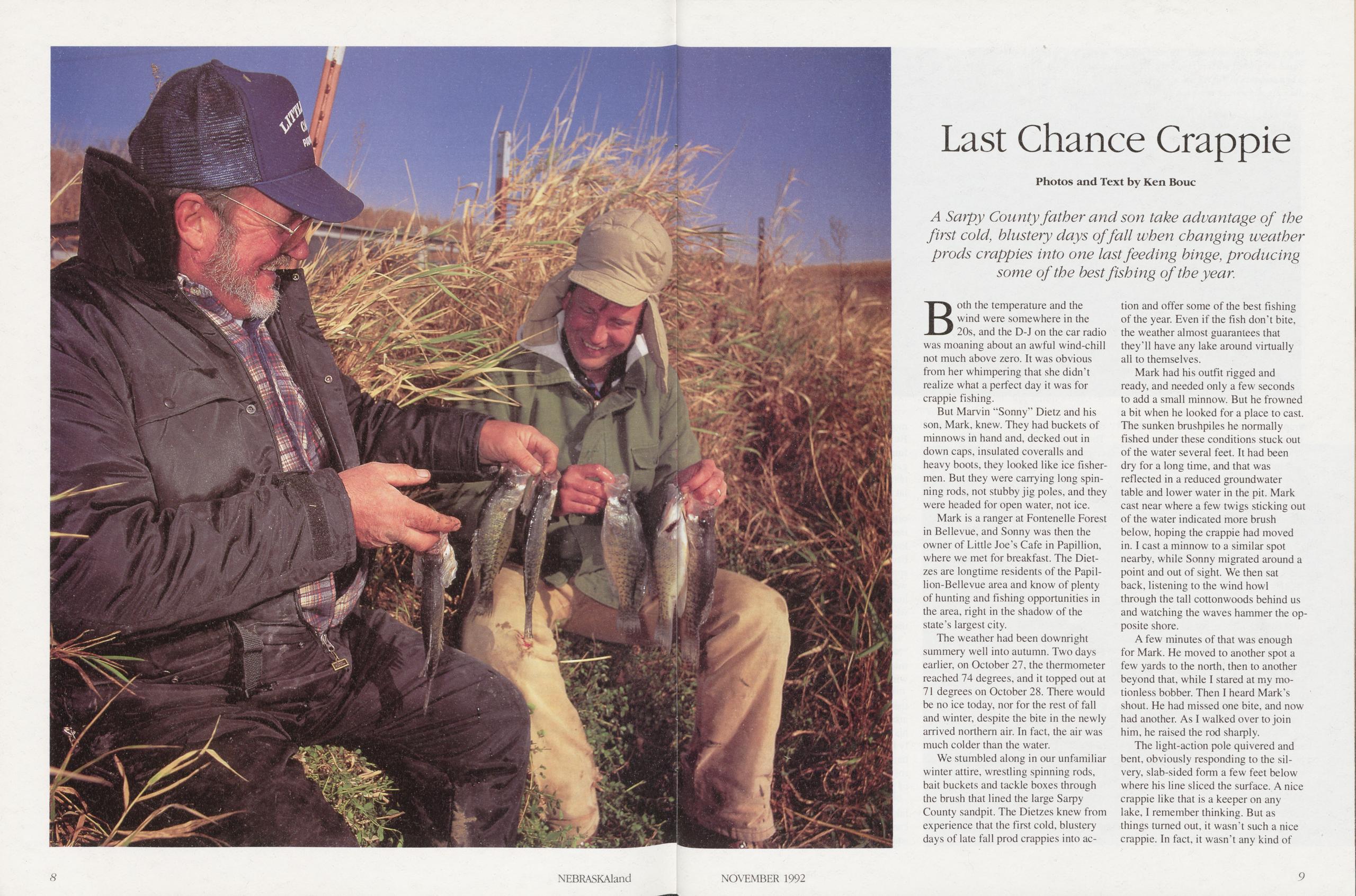
Last Chance Crappie
Photos and Text by Ken Bouc A Sarpy County father and son take advantage of the first cold, blustery days of fall when changing weather prods crappies into one last feeding binge, producing some of the best fishing of the year.Both the temperature and the wind were somewhere in the 20s, and the D-J on the car radio was moaning about an awful wind-chill not much above zero. It was obvious from her whimpering that she didn’t realize what a perfect day it was for crappie fishing.
But Marvin “Sonny” Dietz and his son, Mark, knew. They had buckets of minnows in hand and, decked out in down caps, insulated coveralls and heavy boots, they looked like ice fishermen. But they were carrying long spin- ning rods, not stubby jig poles, and they were headed for open water, not ice. Mark is a ranger at Fontenelle Forest in Bellevue, and Sonny was then the owner of Little Joe’s Cafe in Papillion, where we met for breakfast. The Dietzes are longtime residents of the Papillion-Bellevue area and know of plenty of hunting and fishing opportunities in the area, right in the shadow of the state’s largest city.
The weather had been downright summery well into autumn. Two days earlier, on October 27, the thermometer reached 74 degrees, and it topped out at 71 degrees on October 28. There would be no ice today, nor for the rest of fall and winter, despite the bite in the newly arrived northern air. In fact, the air was much colder than the water.
We stumbled along in our unfamiliar winter attire, wrestling spinning rods, bait buckets and tackle boxes through the brush that lined the large Sarpy County sandpit. The Dietzes knew from experience that the first cold, blustery days of late fall prod crappies into action and offer some of the best fishing of the year. Even if the fish don’t bite, the weather almost guarantees that they’ll have any lake around virtually all to themselves.
Mark had his outfit rigged and ready, and needed only a few seconds to add a small minnow. But he frowned a bit when he looked for a place to cast. The sunken brushpiles he normally fished under these conditions stuck out of the water several feet. It had been dry for a long time, and that was reflected in a reduced groundwater table and lower water in the pit. Mark cast near where a few twigs sticking out of the water indicated more brush below, hoping the crappie had moved in. I cast a minnow to a similar spot nearby, while Sonny migrated around a point and out of sight. We then sat back, listening to the wind howl through the tall cottonwoods behind us and watching the waves hammer the opposite shore.
A few minutes of that was enough for Mark. He moved to another spot a few yards to the north, then to another beyond that, while I stared at my motionless bobber. Then I heard Mark’s shout. He had missed one bite, and now had another. As I walked over to join him, he raised the rod sharply.
The light-action pole quivered and bent, obviously responding to the silvery, slab-sided form a few feet below where his line sliced the surface. A nice crappie like that is a keeper on any lake, I remember thinking. But as things turned out, it wasn't such a nice crappie. In fact, it wasn't any kind of
8 NEBRASKAland NOVEMBER 1992 9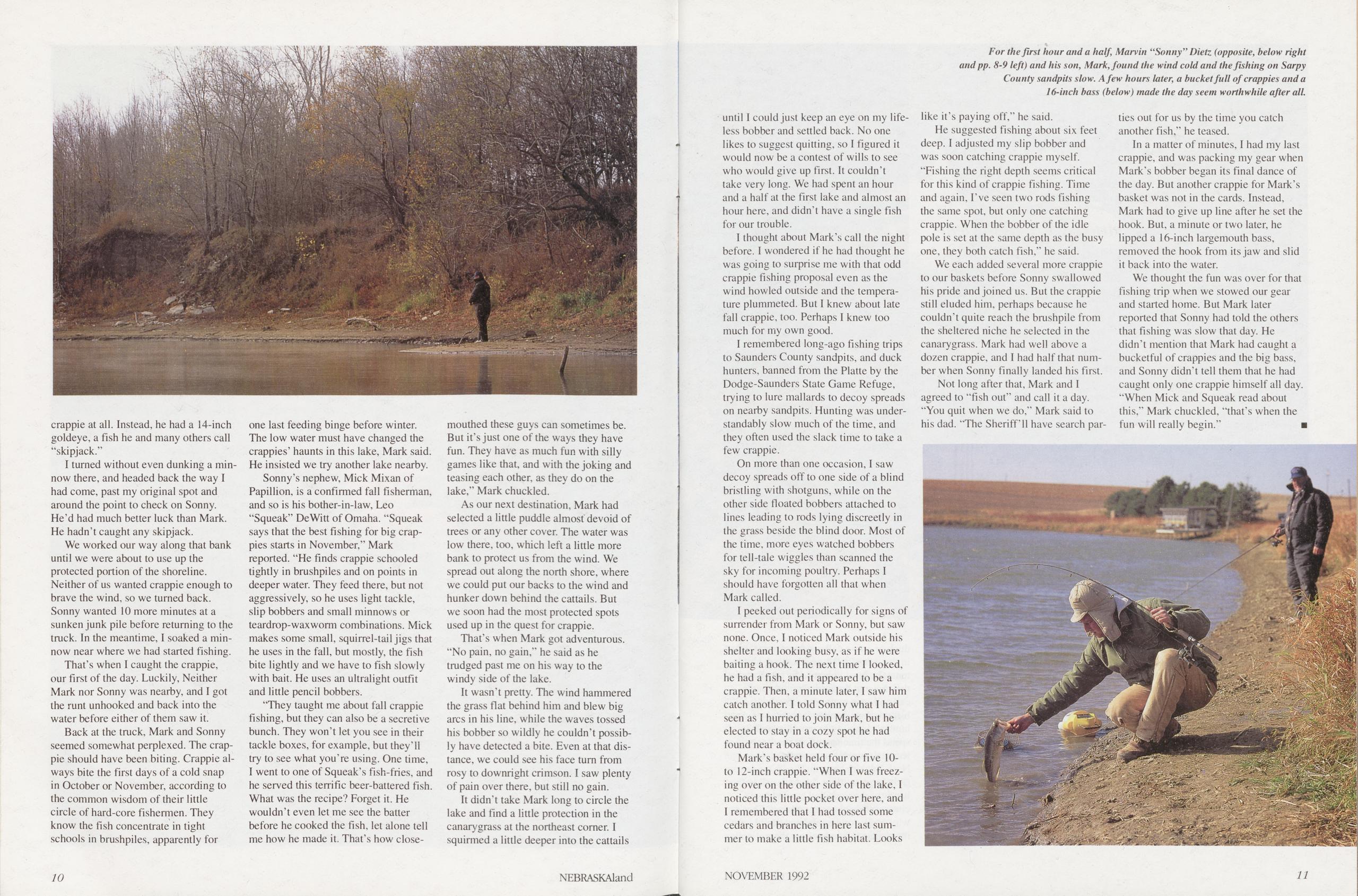
crappie at all. Instead, he had a 14-inch goldeye, a fish he and many others call “skipjack.”
I turned without even dunking a minnow there, and headed back the way I had come, past my original spot and around the point to check on Sonny. He’d had much better luck than Mark. He hadn’t caught any skipjack.
We worked our way along that bank until we were about to use up the protected portion of the shoreline. Neither of us wanted crappie enough to brave the wind, so we turned back. Sonny wanted 10 more minutes at a sunken junk pile before returning to the truck. In the meantime, I soaked a minnow near where we had started fishing.
That’s when I caught the crappie, our first of the day. Luckily, Neither Mark nor Sonny was nearby, and I got the runt unhooked and back into the water before either of them saw it.
Back at the truck, Mark and Sonny seemed somewhat perplexed. The crappie should have been biting. Crappie always bite the first days of a cold snap in October or November, according to the common wisdom of their little circle of hard-core fishermen. They know the fish concentrate in tight schools in brushpiles, apparently for one last feeding binge before winter.
The low water must have changed the crappies’ haunts in this lake, Mark said. He insisted we try another lake nearby.
Sonny’s nephew, Mick Mixan of Papillion, is a confirmed fall fisherman, and so is his bother-in-law, Leo “Squeak” DeWitt of Omaha. “Squeak says that the best fishing for big crappies starts in November,” Mark reported. “He finds crappie schooled tightly in brushpiles and on points in deeper water. They feed there, but not aggressively, so he uses light tackle, slip bobbers and small minnows or teardrop-waxworm combinations. Mick makes some small, squirrel-tail jigs that he uses in the fall, but mostly, the fish bite lightly and we have to fish slowly with bait. He uses an ultralight outfit and little pencil bobbers.
“They taught me about fall crappie fishing, but they can also be a secretive bunch. They won’t let you see in their tackle boxes, for example, but they'll try to see what you're using. One time, I went to one of Squeak’s fish-fries, and he served this terrific beer-battered fish. What was the recipe? Forget it. He wouldn’t even let me see the batter before he cooked the fish, let alone tell me how he made it. That’s how close- mouthed these guys can sometimes be. But it’s just one of the ways they have fun. They have as much fun with silly games like that, and with the joking and teasing each other, as they do on the lake,” Mark chuckled.
As our next destination, Mark had selected a little puddle almost devoid of trees or any other cover. The water was low there, too, which left a little more bank to protect us from the wind. We spread out along the north shore, where we could put our backs to the wind and hunker down behind the cattails. But we soon had the most protected spots used up in the quest for crappie.
That’s when Mark got adventurous. “No pain, no gain,” he said as he trudged past me on his way to the windy side of the lake.
It wasn’t pretty. The wind hammered the grass flat behind him and blew big arcs in his line, while the waves tossed his bobber so wildly he couldn’t possibly have detected a bite. Even at that distance, we could see his face turn from rosy to downright crimson. I saw plenty of pain over there, but still no gain.
It didn’t take Mark long to circle the lake and find a little protection in the canarygrass at the northeast corner. I squirmed a little deeper into the cattails until I could just keep an eye on my lifeless bobber and settled back. No one likes to suggest quitting, so I figured it would now be a contest of wills to see who would give up first. It couldn’t take very long. We had spent an hour and a half at the first lake and almost an hour here, and didn’t have a single fish for our trouble.
I thought about Mark’s call the night before. I wondered if he had thought he was going to surprise me with that odd crappie fishing proposal even as the wind howled outside and the temperature plummeted. But I knew about late fall crappie, too. Perhaps I knew too much for my own good.
I remembered long-ago fishing trips to Saunders County sandpits, and duck hunters, banned from the Platte by the Dodge-Saunders State Game Refuge, trying to lure mallards to decoy spreads on nearby sandpits. Hunting was understandably slow much of the time, and they often used the slack time to take a few crappie.
On more than one occasion, I saw decoy spreads off to one side of a blind bristling with shotguns, while on the other side floated bobbers attached to lines leading to rods lying discreetly in the grass beside the blind door. Most of the time, more eyes watched bobbers for tell-tale wiggles than scanned the sky for incoming poultry. Perhaps I should have forgotten all that when Mark called.
I peeked out periodically for signs of surrender from Mark or Sonny, but saw none. Once, I noticed Mark outside his shelter and looking busy, as if he were baiting a hook. The next time I looked, he had a fish, and it appeared to be a crappie. Then, a minute later, I saw him catch another. I told Sonny what I had seen as I hurried to join Mark, but he elected to stay in a cozy spot he had found near a boat dock.
Mark’s basket held four or five 10- to 12-inch crappie. “When I was freezing over on the other side of the lake, I noticed this little pocket over here, and I remembered that I had tossed some cedars and branches in here last summer to make a little fish habitat. Looks like it’s paying off,” he said.
He suggested fishing about six feet deep. I adjusted my slip bobber and was soon catching crappie myself. "Fishing the right depth seems critical for this kind of crappie fishing. Time and again, I’ve seen two rods fishing the same spot, but only one catching crappie. When the bobber of the idle pole is set at the same depth as the busy one, they both catch fish,” he said.
We each added several more crappie to our baskets before Sonny swallowed his pride and joined us. But the crappie still eluded him, perhaps because he couldn't quite reach the brushpile from the sheltered niche he selected in the canarygrass. Mark had well above a dozen crappie, and I had half that number when Sonny finally landed his first.
Not long after that, Mark and I agreed to “fish out” and call it a day. "You quit when we do,” Mark said to his dad. "The Sheriff’ll have search parties out for us by the time you catch another fish,” he teased.
In a matter of minutes, I had my last crappie, and was packing my gear when Mark’s bobber began its final dance of the day. But another crappie for Mark’s basket was not in the cards. Instead, Mark had to give up line after he set the hook. But, a minute or two later, he lipped a 16-inch largemouth bass, removed the hook from its jaw and slid it back into the water.
We thought the fun was over for that fishing trip when we stowed our gear and started home. But Mark later reported that Sonny had told the others that fishing was slow that day. He didn’t mention that Mark had caught a bucketful of crappies and the big bass, and Sonny didn’t tell them that he had caught only one crappie himself all day.
"When Mick and Squeak read about this,” Mark chuckled, "that’s when the fun will really begin.”
10 NEBRASKAland NOVEMBER 1992 11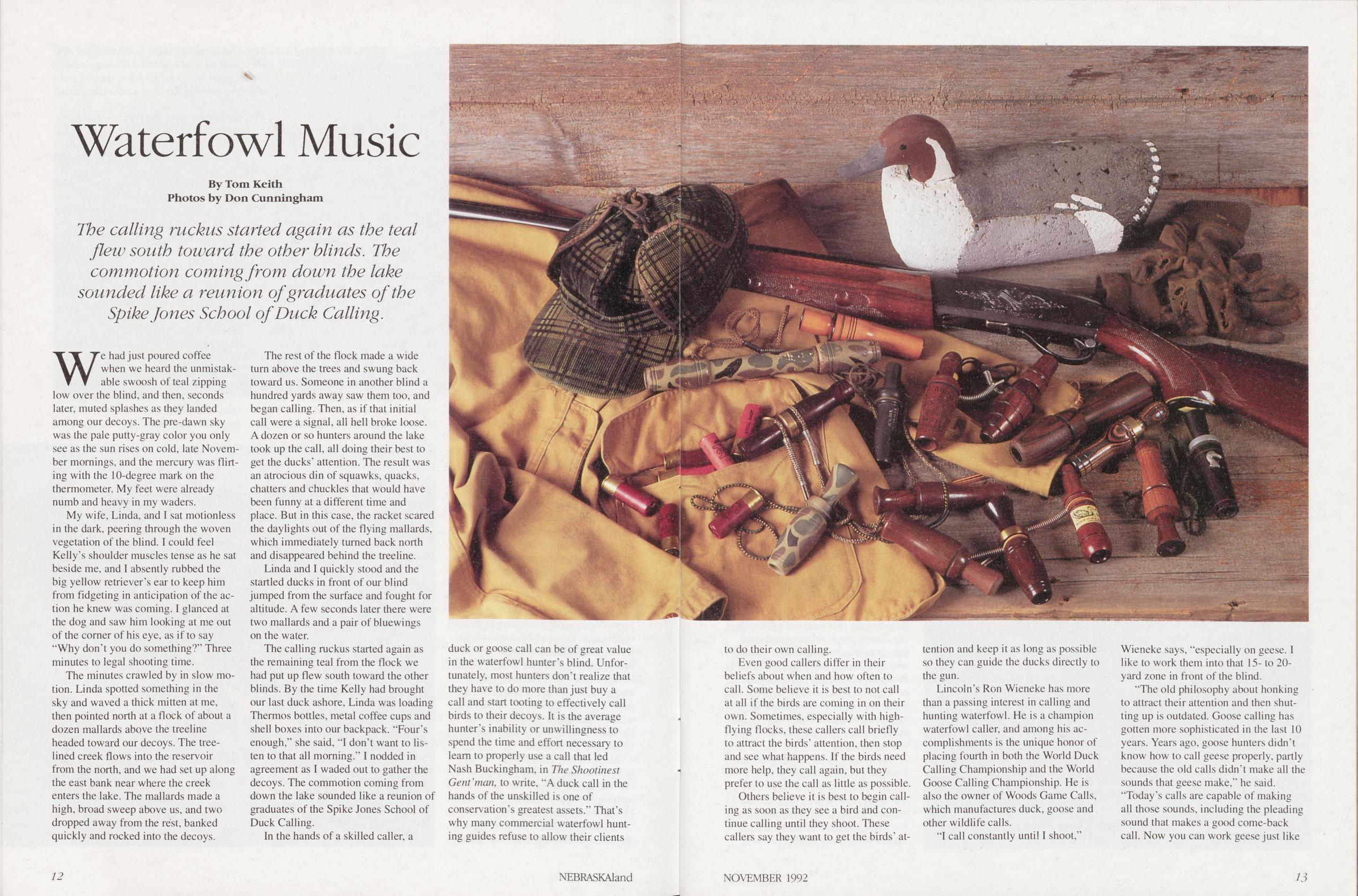
Waterfowl Music
By Tom Keith Photos by Don Cunningham The calling ruckus started again as the teal flew south toward the other blinds. The commotion coming from down the lake sounded like a reunion of graduates of the Spike Jones School of Duck Calling.We had just poured coffee when we heard the unmistakable swoosh of teal zipping low over the blind, and then, seconds later, muted splashes as they landed among our decoys. The pre-dawn sky was the pale putty-gray color you only see as the sun rises on cold, late November mornings, and the mercury was flirting with the 10-degree mark on the thermometer. My feet were already numb and heavy in my waders.
My wife, Linda, and I sat motionless in the dark, peering through the woven vegetation of the blind. I could feel Kelly’s shoulder muscles tense as he sat beside me, and I absently rubbed the big yellow retriever’s ear to keep him from fidgeting in anticipation of the action he knew was coming. I glanced at the dog and saw him looking at me out of the corner of his eye, as if to say “Why don’t you do something?” Three minutes to legal shooting time.
The minutes crawled by in slow motion. Linda spotted something in the sky and waved a thick mitten at me, then pointed north at a flock of about a dozen mallards above the treeline headed toward our decoys. The tree-lined creek flows into the reservoir from the north, and we had set up along the east bank near where the creek enters the lake. The mallards made a high, broad sweep above us, and two dropped away from the rest, banked quickly and rocked into the decoys.
The rest of the flock made a wide turn above the trees and swung back toward us. Someone in another blind a hundred yards away saw them too, and began calling. Then, as if that initial call were a signal, all hell broke loose. A dozen or so hunters around the lake took up the call, all doing their best to get the ducks’ attention. The result was an atrocious din of squawks, quacks, chatters and chuckles that would have been funny at a different time and place. But in this case, the racket scared the daylights out of the flying mallards, which immediately turned back north and disappeared behind the treeline. Linda and I quickly stood and the startled ducks in front of our blind jumped from the surface and fought for altitude. A few seconds later there were two mallards and a pair of bluewings on the water.
The calling ruckus started again as the remaining teal from the flock we had put up flew south toward the other blinds. By the time Kelly had brought our last duck ashore, Linda was loading Thermos bottles, metal coffee cups and shell boxes into our backpack. “Four’s enough,” she said, “I don’t want to listen to that all morning.” I nodded in agreement as I waded out to gather the decoys. The commotion coming from down the lake sounded like a reunion of graduates of the Spike Jones School of Duck Calling.
In the hands of a skilled caller, a duck or goose call can be of great value in the waterfowl hunter’s blind. Unfortunately, most hunters don’t realize that they have to do more than just buy a call and start tooting to effectively call birds to their decoys. It is the average hunter’s inability or unwillingness to spend the time and effort necessary to learn to properly use a call that led Nash Buckingham, in The Shootinest Gent"man, to write, “A duck call in the hands of the unskilled is one of conservation’s greatest assets.” That’s why many commercial waterfowl hunting guides refuse to allow their clients to do their own calling.
Even good callers differ in their beliefs about when and how often to call. Some believe it is best to not call at all if the birds are coming in on their own. Sometimes, especially with high-flying flocks, these callers call briefly to attract the birds’ attention, then stop and see what happens. If the birds need more help, they call again, but they prefer to use the call as little as possible. Others believe it is best to begin calling as soon as they see a bird and continue calling until they shoot. These callers say they want to get the birds’ attention and keep it as long as possible so they can guide the ducks directly to the gun.
Lincoln’s Ron Wieneke has more than a passing interest in calling and hunting waterfowl. He is a champion waterfowl caller, and among his ac- complishments is the unique honor of placing fourth in both the World Duck Calling Championship and the World Goose Calling Championship. He is also the owner of Woods Game Calls, which manufactures duck, goose and other wildlife calls.
"I call constantly until I shoot,” Wieneke says, “especially on geese. I like to work them into that 15- to 20- yard zone in front of the blind.
“The old philosophy about honking to attract their attention and then shut- ting up is outdated. Goose calling has gotten more sophisticated in the last 10 years. Years ago, goose hunters didn’t know how to call geese properly, partly because the old calls didn't make all the sounds that geese make,” he said.
“Today’s calls are capable of making all those sounds, including the pleading sound that makes a good come-back call. Now you can work geese just like
12 NEBRASKAland NOVEMBER 1992 13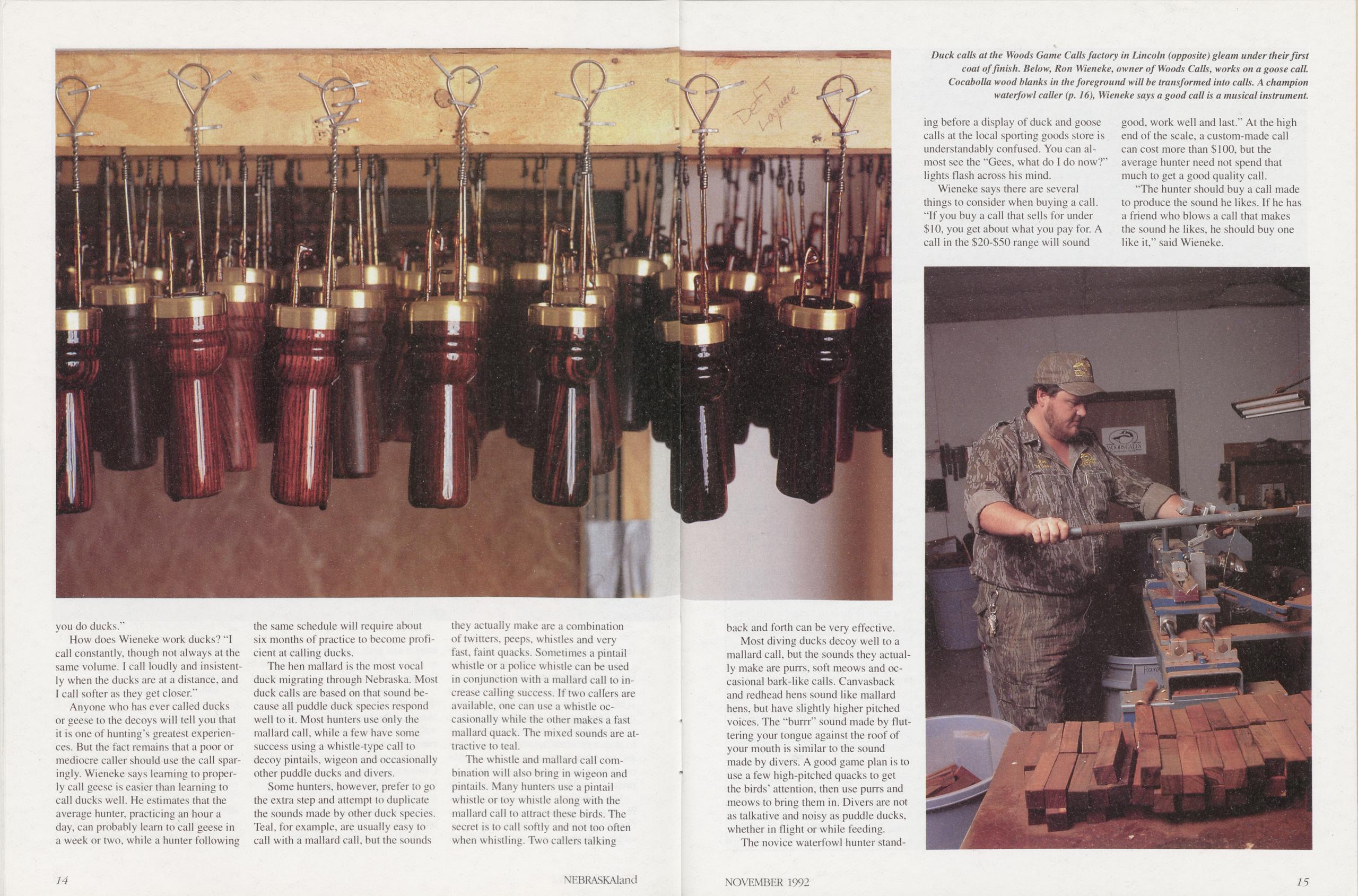
you do ducks.”
How does Wieneke work ducks? “I call constantly, though not always at the same volume. I call loudly and insistently when the ducks are at a distance, and I call softer as they get closer.”
Anyone who has ever called ducks or geese to the decoys will tell you that it is one of hunting’s greatest experiences. But the fact remains that a poor or mediocre caller should use the call sparingly. Wieneke says learning to properly call geese is easier than learning to call ducks well. He estimates that the average hunter, practicing an hour a day, can probably learn to call geese in a week or two, while a hunter following the same schedule will require about six months of practice to become proficient at calling ducks.
The hen mallard is the most vocal duck migrating through Nebraska. Most duck calls are based on that sound because all puddle duck species respond well to it. Most hunters use only the mallard call, while a few have some success using a whistle-type call to decoy pintails, wigeon and occasionally other puddle ducks and divers.
Some hunters, however, prefer to go the extra step and attempt to duplicate the sounds made by other duck species. Teal, for example, are usually easy to call with a mallard call, but the sounds they actually make are a combination of twitters, peeps, whistles and very fast, faint quacks. Sometimes a pintail whistle or a police whistle can be used in conjunction with a mallard call to increase calling success. If two callers are available, one can use a whistle occasionally while the other makes a fast mallard quack. The mixed sounds are attractive to teal.
The whistle and mallard call combination will also bring in wigeon and pintails. Many hunters use a pintail whistle or toy whistle along with the mallard call to attract these birds. The secret is to call softly and not too often when whistling. Two callers talking back and forth can be very effective.
Most diving ducks decoy well to a mallard call, but the sounds they actually make are purrs, soft meows and oc- casional bark-like calls. Canvasback and redhead hens sound like mallard hens, but have slightly higher pitched voices. The “burrr” sound made by fluttering your tongue against the roof of your mouth is similar to the sound made by divers. A good game plan is to use a few high-pitched quacks to get the birds’ attention, then use purrs and meows to bring them in. Divers are not as talkative and noisy as puddle ducks, whether in flight or while feeding.
The novice waterfowl hunter stand-
ing before a display of duck and goose calls at the local sporting goods store is understandably confused. You can almost see the “Gees, what do I do now?” lights flash across his mind.
Wieneke says there are several things to consider when buying a call. “If you buy a call that sells for under $ 10, you get about what you pay for. A call in the $20-$50 range will sound good, work well and last.” At the high end of the scale, a custom-made call can cost more than $ 100, but the average hunter need not spend that much to get a good quality call.
“The hunter should buy a call made to produce the sound he likes. If he has a friend who blows a call that makes the sound he likes, he should buy one like it,” said Wieneke.
14 NEBRASKAland NOVEMBER 1992 15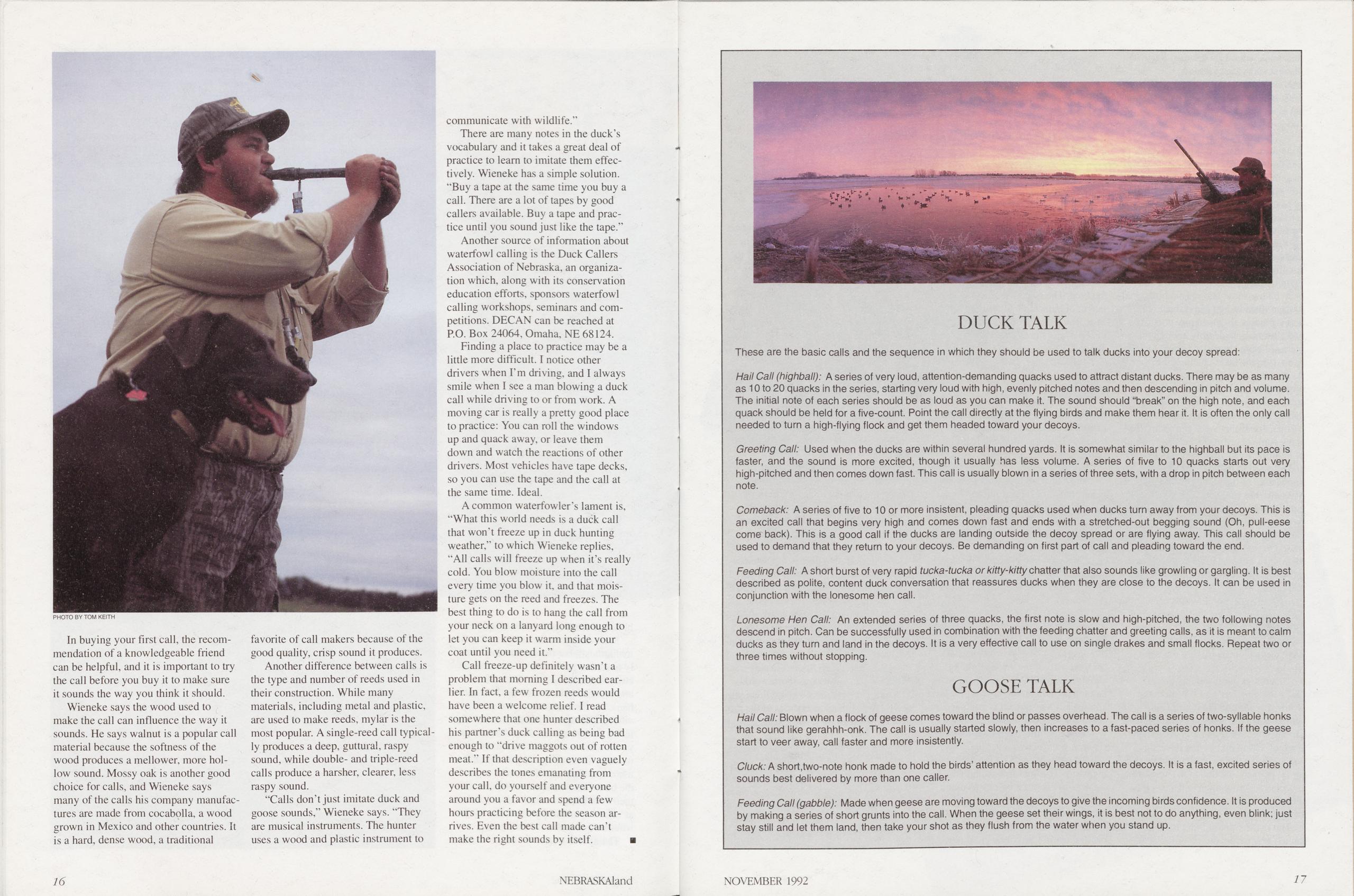
In buying your first call, the recommendation of a knowledgeable friend can be helpful, and it is important to try the call before you buy it to make sure it sounds the way you think it should.
Wieneke says the wood used to make the call can influence the way it sounds. He says walnut is a popular call material because the softness of the wood produces a mellower, more hollow sound. Mossy oak is another good choice for calls, and Wieneke says many of the calls his company manufactures are made from cocabolla, a wood grown in Mexico and other countries. It is a hard, dense wood, a traditional favorite of call makers because of the good quality, crisp sound it produces.
Another difference between calls is the type and number of reeds used in their construction. While many materials, including metal and plastic, are used to make reeds, mylar is the most popular. A single-reed call typically produces a deep, guttural, raspy sound, while double- and triple-reed calls produce a harsher, clearer, less raspy sound.
“Calls don’t just imitate duck and goose sounds,” Wieneke says. “They are musical instruments. The hunter uses a wood and plastic instrument to communicate with wildlife.”
There are many notes in the duck’s vocabulary and it takes a great deal of practice to learn to imitate them effectively. Wieneke has a simple solution. “Buy a tape at the same time you buy a call. There are a lot of tapes by good callers available. Buy a tape and practice until you sound just like the tape.”
Another source of information about waterfowl calling is the Duck Callers Association of Nebraska, an organization which, along with its conservation education efforts, sponsors waterfowl calling workshops, seminars and competitions. DECAN can be reached at P.O. Box 24064, Omaha, NE 68124.
Finding a place to practice may be a little more difficult. I notice other drivers when I’m driving, and I always smile when I see a man blowing a duck call while driving to or from work. A moving car is really a pretty good place to practice: You can roll the windows up and quack away, or leave them down and watch the reactions of other drivers. Most vehicles have tape decks, so you can use the tape and the call at the same time. Ideal.
A common waterfowler’s lament is, “What this world needs is a duck call that won’t freeze up in duck hunting weather,” to which Wieneke replies, “All calls will freeze up when it’s really cold. You blow moisture into the call every time you blow it, and that moisture gets on the reed and freezes. The best thing to do is to hang the call from your neck on a lanyard long enough to let you can keep it warm inside your coat until you need it.”
Call freeze-up definitely wasn't a problem that morning I described earlier. In fact, a few frozen reeds would have been a welcome relief. I read somewhere that one hunter described his partner’s duck calling as being bad enough to “drive maggots out of rotten meat.” If that description even vaguely describes the tones emanating from your call, do yourself and everyone around you a favor and spend a few hours practicing before the season arrives. Even the best call made can’t make the right sounds by itself.
DUCK TALK
These are the basic calls and the sequence in which they should be used to talk ducks into your decoy spread: Hail Call (highball): A series of very loud, attention-demanding quacks used to attract distant ducks. There may be as many as 10 to 20 quacks in the series, starting very loud with high, evenly pitched notes and then descending in pitch and volume. The initial note of each series should be as loud as you can make it. The sound should “break” on the high note, and each quack should be held for a five-count. Point the call directly at the flying birds and make them hear it. It is often the only call needed to turn a high-flying flock and get them headed toward your decoys. Greeting Call: Used when the ducks are within several hundred yards. It is somewhat similar to the highball but its pace is faster, and the sound is more excited, though it usually has less volume. A series of five to 10 quacks starts out very high-pitched and then comes down fast. This call is usually blown in a series of three sets, with a drop in pitch between each note. Comeback: A series of five to 10 or more insistent, pleading quacks used when ducks turn away from your decoys. This is an excited call that begins very high and comes down fast and ends with a stretched-out begging sound (Oh, pull-eese come back). This is a good call if the ducks are landing outside the decoy spread or are flying away. This call should be used to demand that they return to your decoys. Be demanding on first part of call and pleading toward the end. Feeding Call: A short burst of very rapid tucka-tucka or kitty-kitty chatter that also sounds like growling or gargling. It is best described as polite, content duck conversation that reassures ducks when they are close to the decoys. It can be used in conjunction with the lonesome hen call. Lonesome Hen Call: An extended series of three quacks, the first note is slow and high-pitched, the two following notes descend in pitch. Can be successfully used in combination with the feeding chatter and greeting calls, as it is meant to calm ducks as they turn and land in the decoys. It is a very effective call to use on single drakes and small flocks. Repeat two or three times without stopping.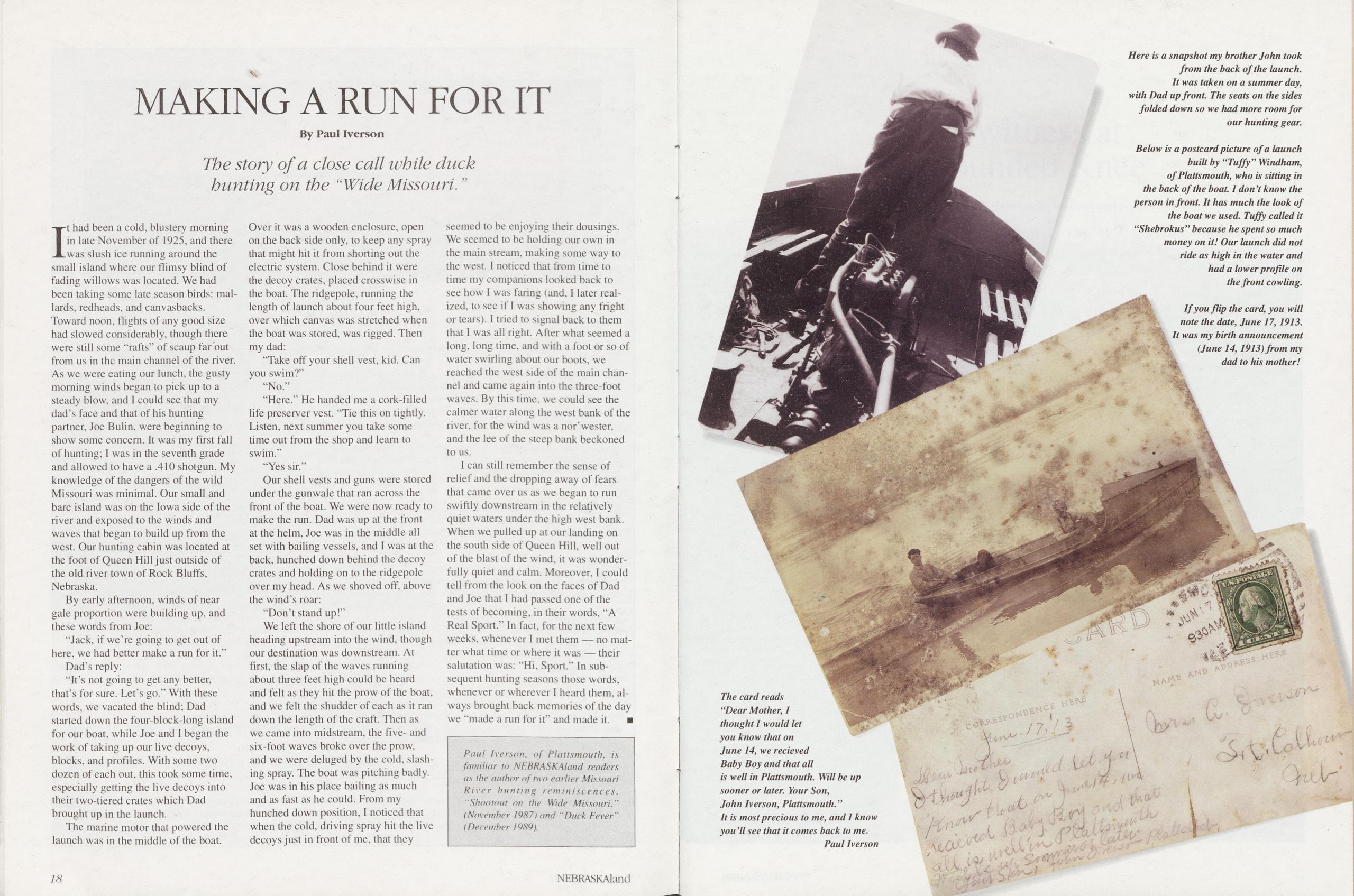
MAKING A RUN FOR IT
By Paul IversonThe story of a close call while duck hunting on the “Wide Missouri. ”
It had been a cold, blustery morning in late November of 1925, and there was slush ice running around the small island where our flimsy blind of fading willows was located. We had been taking some late season birds: mallards, redheads, and canvasbacks.
Toward noon, flights of any good size had slowed considerably, though there were still some “rafts” of scaup far out from us in the main channel of the river. As we were eating our lunch, the gusty morning winds began to pick up to a steady blow, and I could see that my dad’s face and that of his hunting partner, Joe Zulin, were beginning to show some concern. It was my first fall of hunting; I was in the seventh grade and allowed to have a .410 shotgun. My knowledge of the dangers of the wild Missouri was minimal. Our small and bare island was on the Iowa side of the river and exposed to the winds and waves that began to build up from the west. Our hunting cabin was located at the foot of Queen Hill just outside of the old river town of Rock Bluffs, Nebraska.
By early afternoon, winds of near gale proportion were building up, and these words from Joe:
“Jack, if we’re going to get out of here, we had better make a run for it.” Dad’s reply:
“It’s not going to get any better, that’s for sure. Let’s go.” With these words, we vacated the blind; Dad started down the four-block-long island for our boat, while Joe and I began the work of taking up our live decoys, blocks, and profiles. With some two dozen of each out, this took some time, especially getting the live decoys into their two-tiered crates which Dad brought up in the launch.
The marine motor that powered the launch was in the middle of the boat. Over it was a wooden enclosure, open on the back side only, to keep any spray that might hit it from shorting out the electric system. Close behind it were the decoy crates, placed crosswise in the boat. The ridgepole, running the length of launch about four feet high, over which canvas was stretched when the boat was stored, was rigged. Then my dad:
“Take off your shell vest, kid. Can you swim?”
“No.”
“Here.” He handed me a cork-filled life preserver vest. “Tie this on tightly. Listen, next summer you take some time out from the shop and learn to swim.”
“Yes sir.”
Our shell vests and guns were stored under the gunwale that ran across the front of the boat. We were now ready to make the run. Dad was up at the front at the helm, Joe was in the middle all set with bailing vessels, and I was at the back, hunched down behind the decoy crates and holding on to the ridgepole over my head. As we shoved off, above the wind’s roar:
“Don’t stand up!
We left the shore of our little island heading upstream into the wind, though our destination was downstream. At first, the slap of the waves running about three feet high could be heard and felt as they hit the prow of the boat, and we felt the shudder of each as it ran down the length of the craft. Then as we came into midstream, the five- and six-foot waves broke over the prow, and we were deluged by the cold, slashing spray. The boat was pitching badly. Joe was in his place bailing as much and as fast as he could. From my hunched down position, I noticed that when the cold, driving spray hit the live decoys just in front of me, that they seemed to be enjoying their dousings. We seemed to be holding our own in the main stream, making some way to the west. I noticed that from time to time my companions looked back to see how I was faring (and, I later realized, to see if I was showing any fright or tears). I tried to signal back to them that 1 was all right. After what seemed a long, long time, and with a foot or so of water swirling about our boots, we reached the west side of the main channel and came again into the three-foot waves. By this time, we could see the calmer water along the west bank of the river, for the wind was a nor’wester, and the lee of the steep bank beckoned to us.
I can still remember the sense of relief and the dropping away of fears that came over us as we began to run swiftly downstream in the relatively quiet waters under the high west bank. When we pulled up at our landing on the south side of Queen Hill, well out of the blast of the wind, it was wonderfully quiet and calm. Moreover, 1 could tell from the look on the faces of Dad and Joe that I had passed one of the tests of becoming, in their words, “A Real Sport.” In fact, for the next few weeks, whenever I met them — no matter what time or where it was — their salutation was: “Hi, Sport.” In subsequent hunting seasons those words, whenever or wherever 1 heard them, always brought back memories of the day we “made a run for it” and made it.
Paul Iverson, of Plattsmouth, is familiar to NEBRASKAland readers as the author of two earlier Missouri River hunting reminiscences. "Shootout on the Wide Missouri," (November 1987) and "Duck Fever" (December 1989).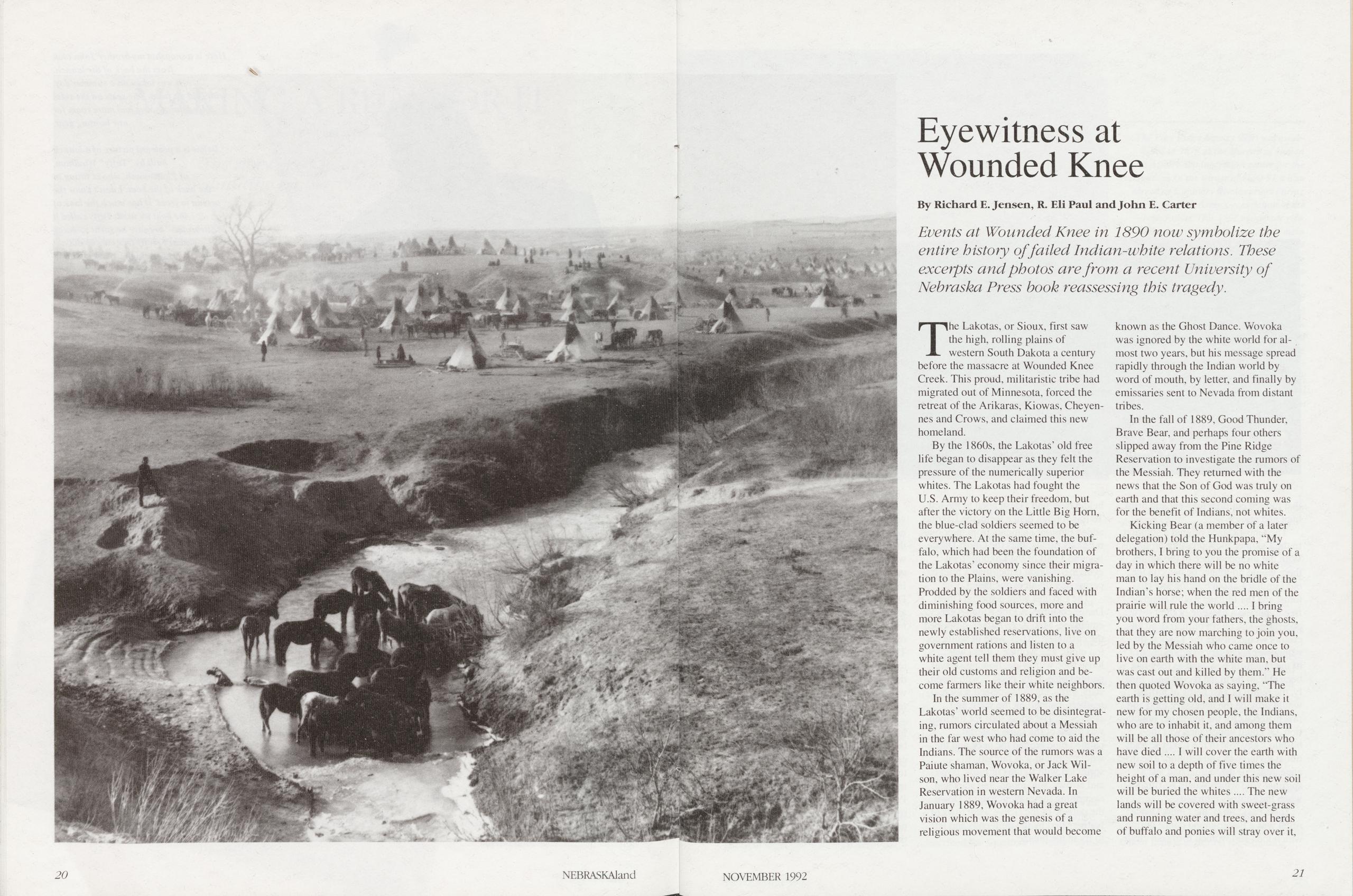
Eyewitness at Wounded Knee
By Richard E. Jensen, R. Eli Paul and John E. Carter Events at Wounded Knee in 1890 now symbolize the entire history of failed Indian-white relations. These excerpts and photos are from a recent University of Nebraska Press book reassessing this tragedy.The Lakotas, or Sioux, first saw the high, rolling plains of western South Dakota a century before the massacre at Wounded Knee Creek. This proud, militaristic tribe had migrated out of Minnesota, forced the retreat of the Arikaras, Kiowas, Cheyennes and Crows, and claimed this new homeland.
By the 1860s, the Lakotas’ old free life began to disappear as they felt the pressure of the numerically superior whites. The Lakotas had fought the U.S. Army to keep their freedom, but after the victory on the Little Big Horn, the blue-clad soldiers seemed to be everywhere. At the same time, the buffalo, which had been the foundation of the Lakotas’ economy since their migration to the Plains, were vanishing. Prodded by the soldiers and faced with diminishing food sources, more and more Lakotas began to drift into the newly established reservations, live on government rations and listen to a white agent tell them they must give up their old customs and religion and become farmers like their white neighbors.
In the summer of 1889, as the Lakotas’ world seemed to be disintegrating, rumors circulated about a Messiah in the far west who had come to aid the Indians. The source of the rumors was a Paiute shaman, Wovoka, or Jack Wilson, who lived near the Walker Lake Reservation in western Nevada. In January 1889, Wovoka had a great vision which was the genesis of a religious movement that would become known as the Ghost Dance. Wovoka was ignored by the white world for almost two years, but his message spread rapidly through the Indian world by word of mouth, by letter, and finally by emissaries sent to Nevada from distant tribes.
In the fall of 1889, Good Thunder, Brave Bear, and perhaps four others slipped away from the Pine Ridge Reservation to investigate the rumors of the Messiah. They returned with the news that the Son of God was truly on earth and that this second coming was for the benefit of Indians, not whites.
Kicking Bear (a member of a later delegation) told the Hunkpapa, “My brothers, I bring to you the promise of a day in which there will be no white man to lay his hand on the bridle of the Indian’s horse; when the red men of the prairie will rule the world .... I bring you word from your fathers, the ghosts, that they are now marching to join you, led by the Messiah who came once to live on earth with the white man, but was cast out and killed by them.” He then quoted Wovoka as saying, “The earth is getting old, and I will make it new for my chosen people, the Indians, who are to inhabit it, and among them will be all those of their ancestors who have died .... I will cover the earth with new soil to a depth of five times the height of a man, and under this new soil will be buried the whites .... The new lands will be covered with sweet-grass and running water and trees, and herds of buffalo and ponies will stray over it,
20 NEBRASKA! and NOVEMBER 1992 21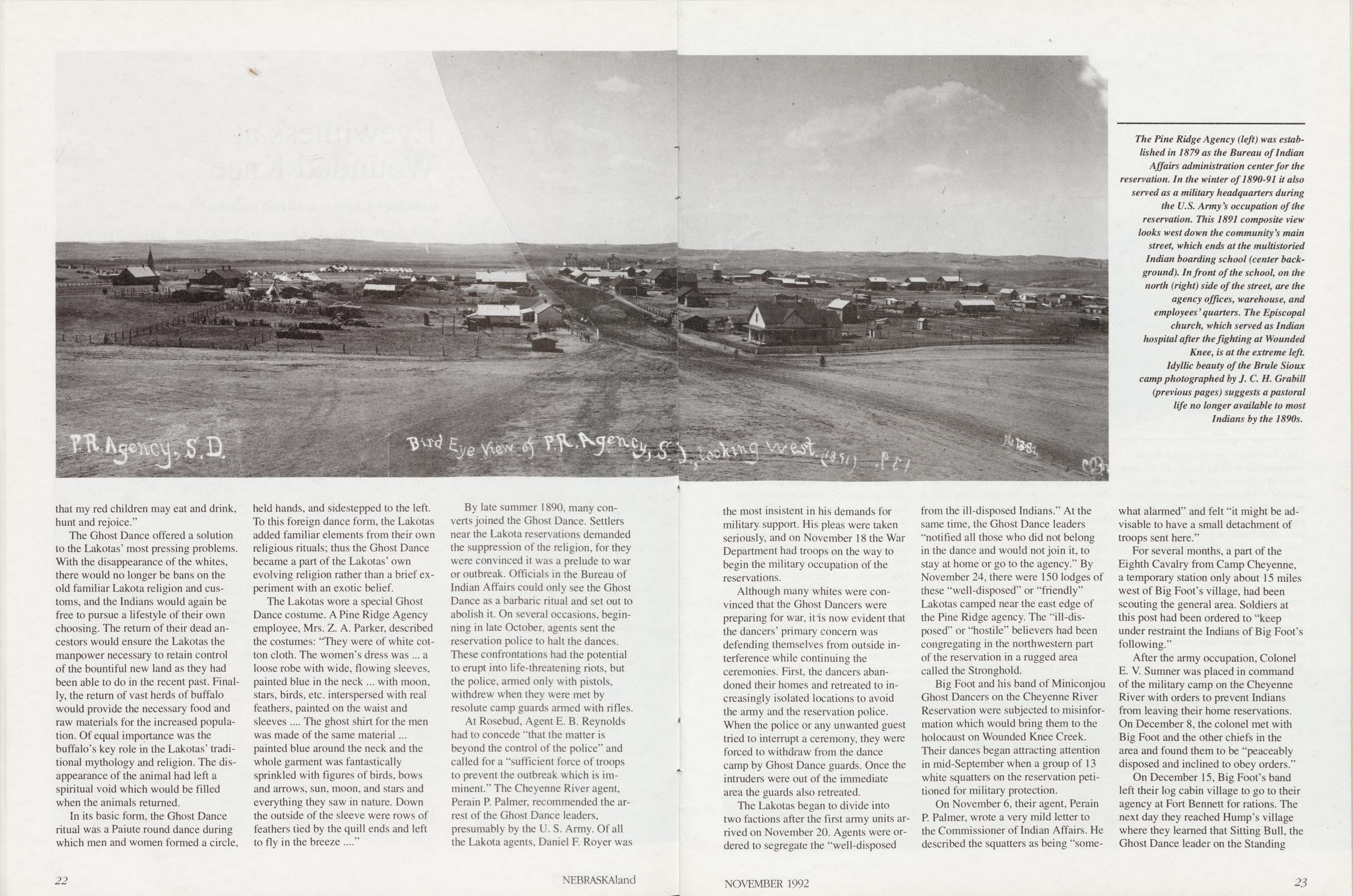
that my red children may eat and drink, hunt and rejoice.”
The Ghost Dance offered a solution to the Lakotas’ most pressing problems. With the disappearance of the whites, there would no longer be bans on the old familiar Lakota religion and customs, and the Indians would again be free to pursue a lifestyle of their own choosing. The return of their dead ancestors would ensure the Lakotas the manpower necessary to retain control of the bountiful new land as they had been able to do in the recent past. Finally, the return of vast herds of buffalo would provide the necessary food and raw materials for the increased population. Of equal importance was the buffalo’s key role in the Lakotas’ traditional mythology and religion. The disappearance of the animal had left a spiritual void which would be filled when the animals returned.
In its basic form, the Ghost Dance ritual was a Paiute round dance during which men and women formed a circle, held hands, and sidestepped to the left. To this foreign dance form, the Lakotas added familiar elements from their own religious rituals; thus the Ghost Dance became a part of the Lakotas’ own evolving religion rather than a brief experiment with an exotic belief.
The Lakotas wore a special Ghost Dance costume. A Pine Ridge Agency employee, Mrs. Z. A. Parker, described the costumes: “They were of white cotton cloth. The women’s dress was ... a loose robe with wide, flowing sleeves, painted blue in the neck ... with moon, stars, birds, etc. interspersed with real feathers, painted on the waist and sleeves .... The ghost shirt for the men was made of the same material ... painted blue around the neck and the whole garment was fantastically sprinkled with figures of birds, bows and arrows, sun, moon, and stars and everything they saw in nature. Down the outside of the sleeve were rows of feathers tied by the quill ends and left to fly in the breeze . ..”
By late summer 1890, many converts joined the Ghost Dance. Settlers near the Lakota reservations demanded the suppression of the religion, for they were convinced it was a prelude to war or outbreak. Officials in the Bureau of Indian Affairs could only see the Ghost Dance as a barbaric ritual and set out to abolish it. On several occasions, beginning in late October, agents sent the reservation police to halt the dances. These confrontations had the potential to erupt into life-threatening riots, but the police, armed only with pistols, withdrew when they were met by resolute camp guards armed with rifles.
At Rosebud, Agent E. B. Reynolds had to concede “that the matter is beyond the control of the police” and called for a “sufficient force of troops to prevent the outbreak which is imminent.” The Cheyenne River agent, Perain P. Palmer, recommended the arrest of the Ghost Dance leaders, presumably by the U. S. Army. Of all the Lakota agents, Daniel F. Royer was the most insistent in his demands for military support. His pleas were taken seriously, and on November 18 the War Department had troops on the way to begin the military occupation of the reservations.
Although many whites were convinced that the Ghost Dancers were preparing for war, it is now evident that the dancers’ primary concern was defending themselves from outside interference while continuing the ceremonies. First, the dancers abandoned their homes and retreated to increasingly isolated locations to avoid the army and the reservation police. When the police or any unwanted guest tried to interrupt a ceremony, they were forced to withdraw from the dance camp by Ghost Dance guards. Once the intruders were out of the immediate area the guards also retreated.
The Lakotas began to divide into two factions after the first army units arrived on November 20. Agents were ordered to segregate the “well-disposed from the ill-disposed Indians.” At the same time, the Ghost Dance leaders “notified all those who did not belong in the dance and would not join it, to stay at home or go to the agency.” By November 24, there were 150 lodges of these “well-disposed” or “friendly” Lakotas camped near the east edge of the Pine Ridge agency. The “ill-disposed” or “hostile” believers had been congregating in the northwestern part of the reservation in a rugged area called the Stronghold.
Big Foot and his band of Miniconjou Ghost Dancers on the Cheyenne River Reservation were subjected to misinformation which would bring them to the holocaust on Wounded Knee Creek. Their dances began attracting attention in mid-September when a group of 13 white squatters on the reservation petitioned for military protection.
On November 6, their agent, Perain P. Palmer, wrote a very mild letter to the Commissioner of Indian Affairs. He described the squatters as being “somewhat alarmed” and felt “it might be ad- visable to have a small detachment of troops sent here.”
For several months, a part of the Eighth Cavalry from Camp Cheyenne, a temporary station only about 15 miles west of Big Foot’s village, had been scouting the general area. Soldiers at this post had been ordered to “keep under restraint the Indians of Big Foot’s following.”
After the army occupation, Colonel E. V. Sumner was placed in command of the military camp on the Cheyenne River with orders to prevent Indians from leaving their home reservations. On December 8, the colonel met with Big Foot and the other chiefs in the area and found them to be “peaceably disposed and inclined to obey orders.” On December 15, Big Foot’s band left their log cabin village to go to their agency at Fort Bennett for rations. The next day they reached Hump’s village where they learned that Sitting Bull, the Ghost Dance leader on the Standing
22 NEBRASKA! and NOVEMBER 1992 23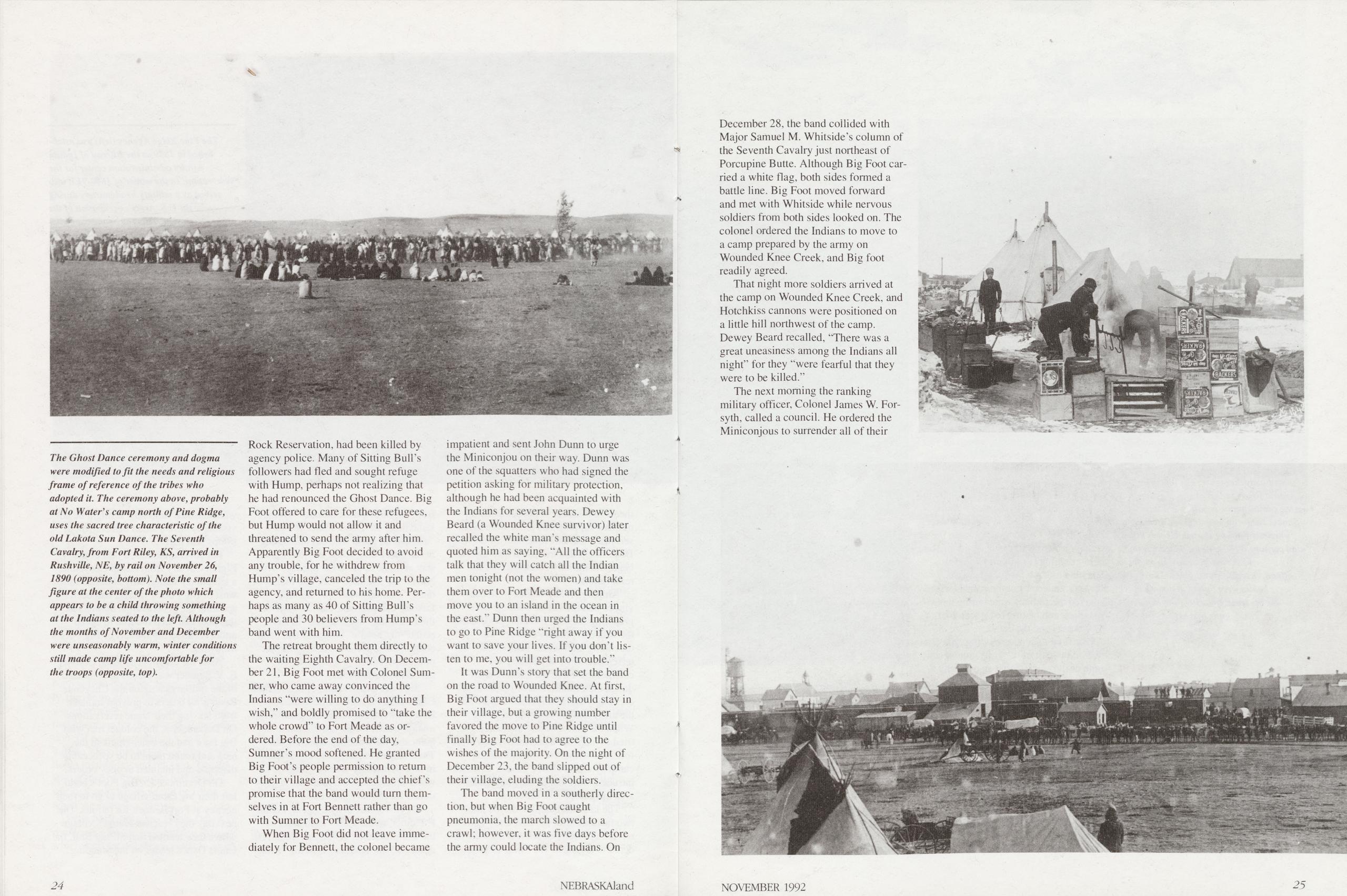
Rock Reservation, had been killed by agency police. Many of Sitting Bull’s followers had fled and sought refuge with Hump, perhaps not realizing that he had renounced the Ghost Dance. Big Foot offered to care for these refugees, but Hump would not allow it and threatened to send the army after him. Apparently Big Foot decided to avoid any trouble, for he withdrew from Hump’s village, canceled the trip to the agency, and returned to his home. Perhaps as many as 40 of Sitting Bull’s people and 30 believers from Hump’s band went with him.
The retreat brought them directly to the waiting Eighth Cavalry. On December 21, Big Foot met with Colonel Sumner, who came away convinced the Indians “were willing to do anything I wish,” and boldly promised to “take the whole crowd” to Fort Meade as ordered. Before the end of the day, Sumner’s mood softened. He granted Big Foot’s people permission to return to their village and accepted the chief’s promise that the band would turn them- selves in at Fort Bennett rather than go with Sumner to Fort Meade.
When Big Foot did not leave immediately for Bennett, the colonel became impatient and sent John Dunn to urge the Miniconjou on their way. Dunn was one of the squatters who had signed the petition asking for military protection, although he had been acquainted with the Indians for several years. Dewey Beard (a Wounded Knee survivor) later recalled the white man's message and quoted him as saying, “All the officers talk that they will catch all the Indian men tonight (not the women) and take them over to Fort Meade and then move you to an island in the ocean in the east.” Dunn then urged the Indians to go to Pine Ridge “right away if you want to save your lives. If you don’t listen to me, you will get into trouble.”
It was Dunn’s story that set the band on the road to Wounded Knee. At first, Big Foot argued that they should stay in their village, but a growing number favored the move to Pine Ridge until finally Big Foot had to agree to the wishes of the majority. On the night of December 23, the band slipped out of their village, eluding the soldiers.
The band moved in a southerly direction. but when Big Foot caught pneumonia, the march slowed to a crawl; however, it was five days before the army could locate the Indians. On December 28, the band collided with Major Samuel M. Whitside’s column of the Seventh Cavalry just northeast of Porcupine Butte. Although Big Foot carried a white flag, both sides formed a battle line. Big Foot moved forward and met with Whitside while nervous soldiers from both sides looked on. The colonel ordered the Indians to move to a camp prepared by the army on Wounded Knee Creek, and Big foot readily agreed.
That night more soldiers arrived at the camp on Wounded Knee Creek, and Hotchkiss cannons were positioned on a little hill northwest of the camp. Dewey Beard recalled, “There was a great uneasiness among the Indians all night” for they “were fearful that they were to be killed.”
The next morning the ranking military officer, Colonel James W. Forsyth, called a council. He ordered the Miniconjous to surrender all of their
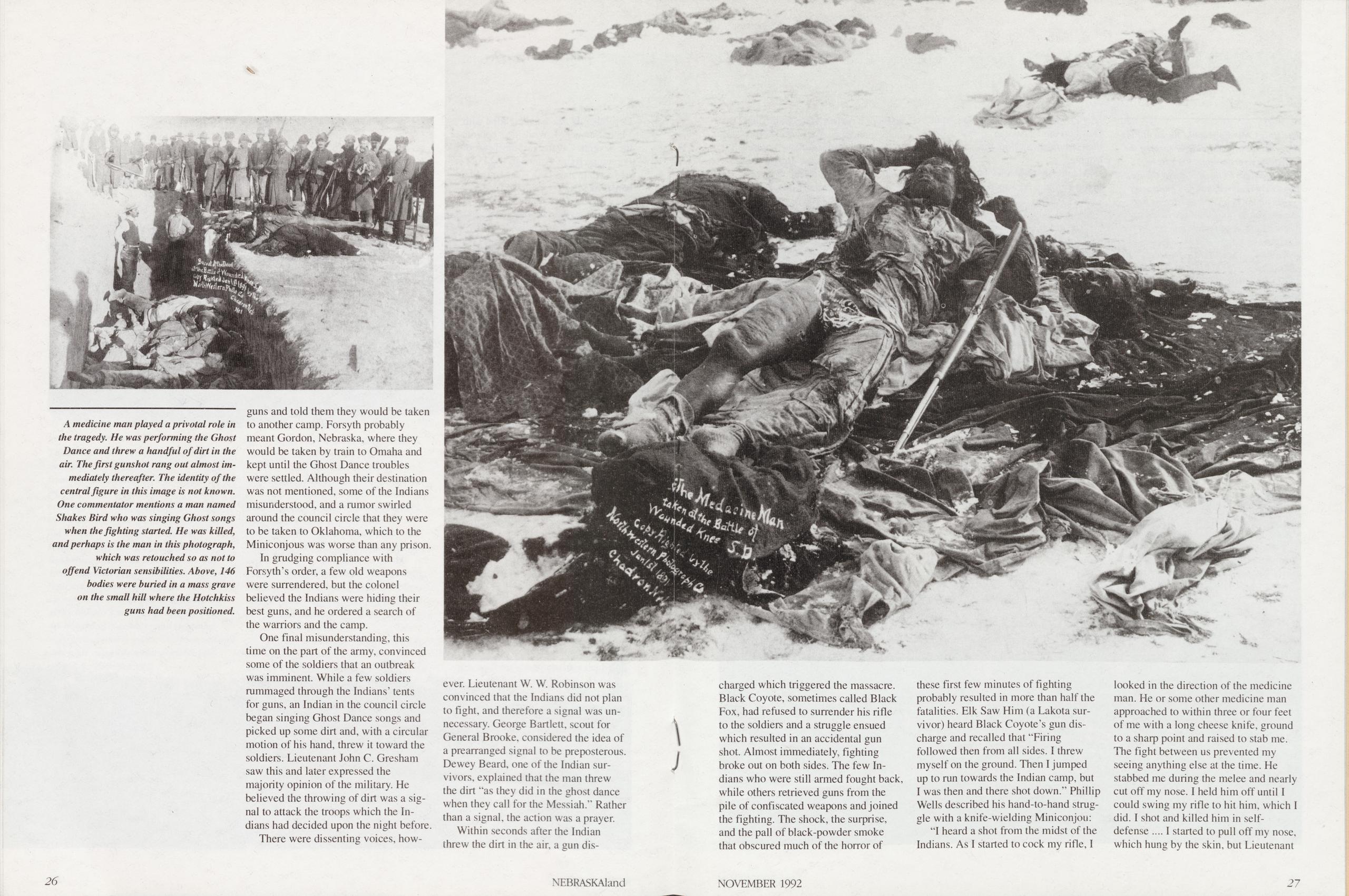
guns and told them they would be taken to another camp. Forsyth probably meant Gordon, Nebraska, where they would be taken by train to Omaha and kept until the Ghost Dance troubles were settled. Although their destination was not mentioned, some of the Indians misunderstood, and a rumor swirled around the council circle that they were to be taken to Oklahoma, which to the Miniconjous was worse than any prison.
In grudging compliance with Forsyth’s order, a few old weapons were surrendered, but the colonel believed the Indians were hiding their best guns, and he ordered a search of the warriors and the camp.
One final misunderstanding, this time on the part of the army, convinced some of the soldiers that an outbreak was imminent. While a few soldiers rummaged through the Indians’ tents for guns, an Indian in the council circle began singing Ghost Dance songs and picked up some dirt and, with a circular motion of his hand, threw it toward the soldiers. Lieutenant John C. Gresham saw this and later expressed the majority opinion of the military. He believed the throwing of dirt was a signal to attack the troops which the Indians had decided upon the night before.
There were dissenting voices, however. Lieutenant W. W. Robinson was convinced that the Indians did not plan to fight, and therefore a signal was unnecessary. George Bartlett, scout for General Brooke, considered the idea of a prearranged signal to be preposterous. Dewey Beard, one of the Indian survivors, explained that the man threw the dirt "as they did in the ghost dance when they call for the Messiah." Rather than a signal, the action was a prayer.
Within seconds after the Indian threw the dirt in the air, a gun discharged which triggered the massacre. Black Coyote, sometimes called Black Fox, had refused to surrender his rifle to the soldiers and a struggle ensued which resulted in an accidental gun shot. Almost immediately, fighting broke out on both sides. The few Indians who were still armed fought back, while others retrieved guns from the pile of confiscated weapons and joined the fighting. The shock, the surprise, and the pall of black-powder smoke that obscured much of the horror of these first few minutes of fighting probably resulted in more than half the fatalities. Elk Saw Him (a Lakota survivor) heard Black Coyote’s gun discharge and recalled that "Firing followed then from all sides. I threw myself on the ground. Then I jumped up to run towards the Indian camp, but I was then and there shot down.’’ Phillip Wells described his hand-to-hand struggle with a knife-wielding Miniconjou:
"I heard a shot from the midst of the Indians. As I started to cock my rifle, I looked in the direction of the medicine man. He or some other medicine man approached to within three or four feet of me with a long cheese knife, ground to a sharp point and raised to stab me. The fight between us prevented my seeing anything else at the time. He stabbed me during the melee and nearly cut off my nose. I held him off until I could swing my rifle to hit him, which I did. I shot and killed him in self- defense .... I started to pull off my nose, which hung by the skin, but Lieutenant
26 NEBRASKAland NOVEMBER 1992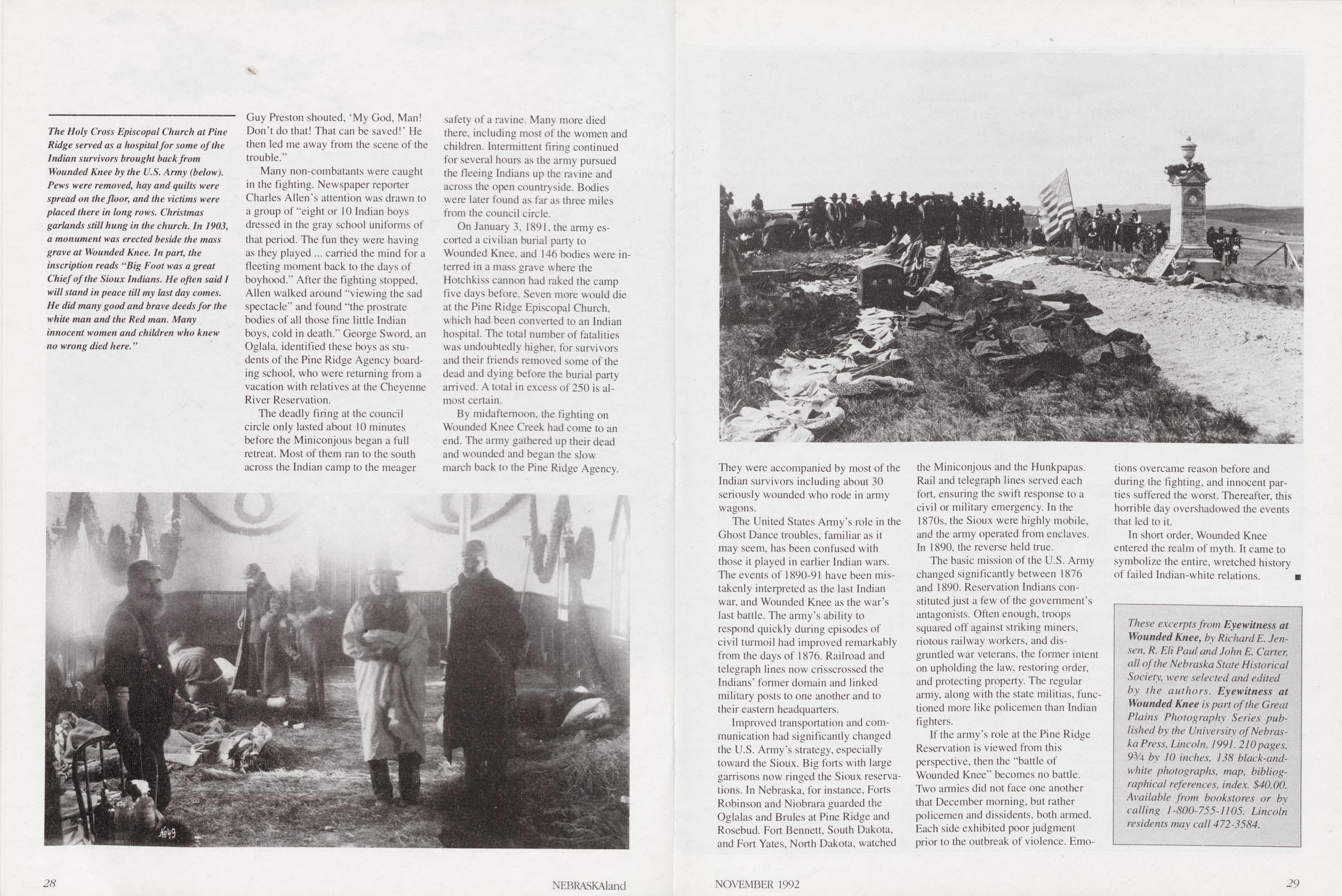
Guy Preston shouted, ‘My God, Man! Don’t do that! That can be saved!’ He then led me away from the scene of the trouble.”
Many non-combatants were caught in the fighting. Newspaper reporter Charles Allen’s attention was drawn to a group of “eight or 10 Indian boys dressed in the gray school uniforms of that period. The fun they were having as they played ... carried the mind for a fleeting moment back to the days of boyhood.” After the fighting stopped, Allen walked around “viewing the sad spectacle” and found “the prostrate bodies of all those fine little Indian boys, cold in death.” George Sword, an Oglala, identified these boys as students of the Pine Ridge Agency boarding school, who were returning from a vacation with relatives at the Cheyenne River Reservation.
The deadly firing at the council circle only lasted about 10 minutes before the Miniconjous began a full retreat. Most of them ran to the south across the Indian camp to the meager safety of a ravine. Many more died there, including most of the women and children. Intermittent firing continued for several hours as the army pursued the fleeing Indians up the ravine and across the open countryside. Bodies were later found as far as three miles from the council circle.
On January 3, 1891, the army escorted a civilian burial party to Wounded Knee, and 146 bodies were interred in a mass grave where the Hotchkiss cannon had raked the camp five days before. Seven more would die at the Pine Ridge Episcopal Church, which had been converted to an Indian hospital. The total number of fatalities was undoubtedly higher, for survivors and their friends removed some of the dead and dying before the burial party arrived. A total in excess of 250 is almost certain.
By midaftemoon, the fighting on Wounded Knee Creek had come to an end. The army gathered up their dead and wounded and began the slow march back to the Pine Ridge Agency. They were accompanied by most of the Indian survivors including about 30 seriously wounded who rode in army wagons.
The United States Army’s role in the Ghost Dance troubles, familiar as it may seem, has been confused with those it played in earlier Indian wars. The events of 1890-91 have been mistakenly interpreted as the last Indian war, and Wounded Knee as the war’s last battle. The army’s ability to respond quickly during episodes of civil turmoil had improved remarkably from the days of 1876. Railroad and telegraph lines now crisscrossed the Indians’ former domain and linked military posts to one another and to their eastern headquarters.
Improved transportation and communication had significantly changed the U.S. Army’s strategy, especially toward the Sioux. Big forts with large garrisons now ringed the Sioux reservations. In Nebraska, for instance, Forts Robinson and Niobrara guarded the Oglalas and Brutes at Pine Ridge and Rosebud. Fort Bennett, South Dakota, and Fort Yates, North Dakota, watched the Miniconjous and the Hunkpapas. Rail and telegraph lines served each fort, ensuring the swift response to a civil or military emergency. In the 1870s, the Sioux were highly mobile, and the army operated from enclaves. In 1890, the reverse held true.
The basic mission of the U.S. Army changed significantly between 1876 and 1890. Reservation Indians constituted just a few of the government’s antagonists. Often enough, troops squared off against striking miners, riotous railway workers, and disgruntled war veterans, the former intent on upholding the law, restoring order, and protecting property. The regular army, along with the state militias, functioned more like policemen than Indian fighters.
If the army’s role at the Pine Ridge Reservation is viewed from this perspective, then the “battle of Wounded Knee” becomes no battle. Two armies did not face one another that December morning, but rather policemen and dissidents, both armed. Each side exhibited poor judgment prior to the outbreak of violence. Emotions overcame reason before and during the fighting, and innocent parties suffered the worst. Thereafter, this horrible day overshadowed the events that led to it.
In short order. Wounded Knee entered the realm of myth. It came to symbolize the entire, wretched history of failed Indian-white relations. ■
These excerpts from Eyewitness at Wounded Knee, by Richard E. Jensen, R. Eli Paul and John E. Carter, all of the Nebraska State Historical Society, were selected and edited by the authors. Eyewitness at Wounded Knee is part of the Great Plains Photography Series published by the University of Nebraska Press, Lincoln, 1991. 210pages, 93/4 by 10 inches, 138 black-and- white photographs, map, bibliog- raphical references, index. $40.00. Available from bookstores or by calling 1-800-755-1105. Lincoln residents may call 472-3584.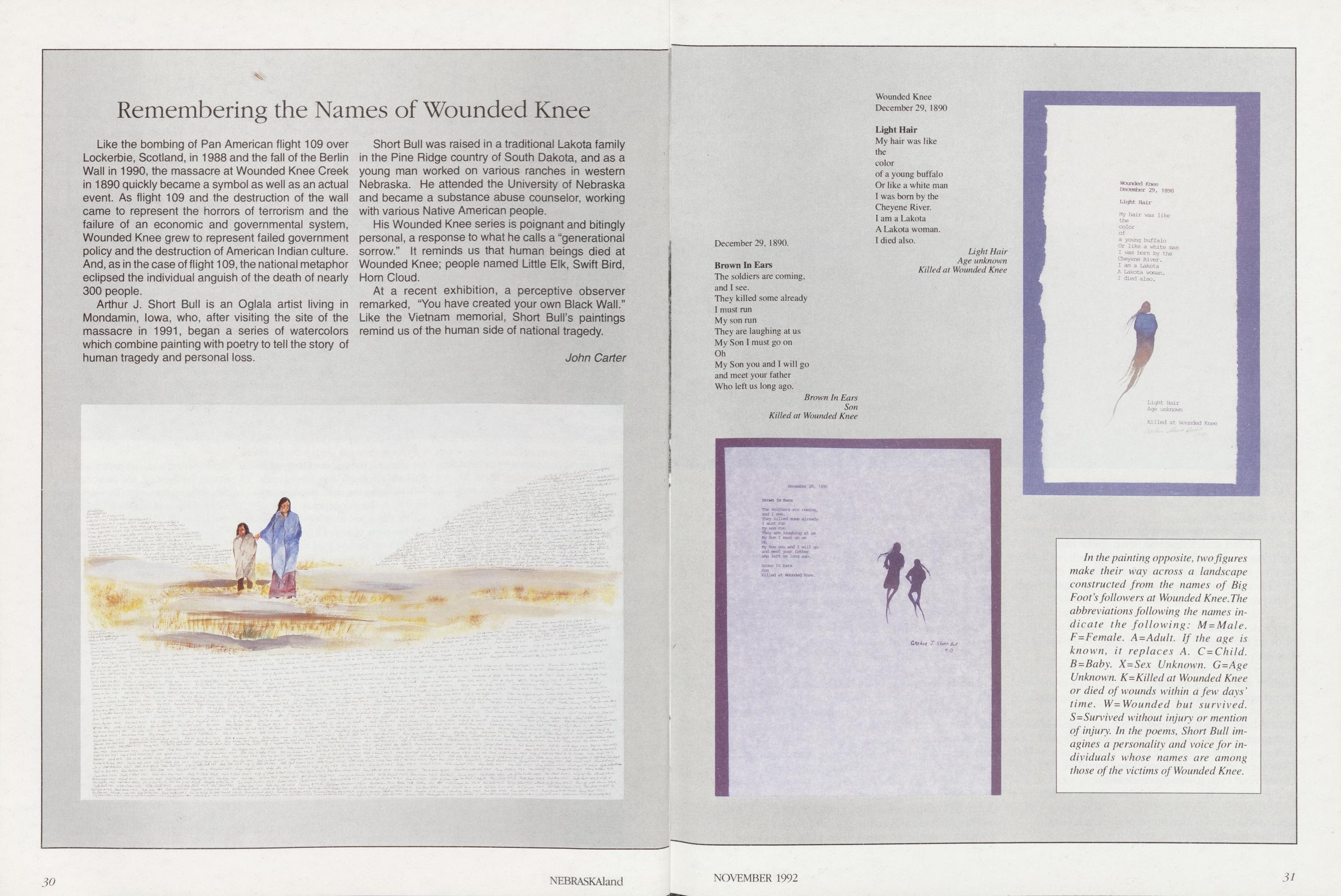
Remembering the Names of Wounded Knee
Like the bombing of Pan American flight 109 over Lockerbie, Scotland, in 1988 and the fall of the Berlin Wall in 1990, the massacre at Wounded Knee Creek in 1890 quickly became a symbol as well as an actual event. As flight 109 and the destruction of the wall came to represent the horrors of terrorism and the failure of an economic and governmental system, Wounded Knee grew to represent failed government policy and the destruction of American Indian culture. And, as in the case of flight 109, the national metaphor eclipsed the individual anguish of the death of nearly 300 people.
Arthur J. Short Bull is an Oglala artist living in Mondamin, Iowa, who, after visiting the site of the massacre in 1991, began a series of watercolors which combine painting with poetry to tell the story of human tragedy and personal loss.
Short Bull was raised in a traditional Lakota family in the Pine Ridge country of South Dakota, and as a young man worked on various ranches in western Nebraska. He attended the University of Nebraska and became a substance abuse counselor, working with various Native American people.
His Wounded Knee series is poignant and bitingly personal, a response to what he calls a “generational sorrow.” It reminds us that human beings died at Wounded Knee; people named Little Elk, Swift Bird, Horn Cloud.
At a recent exhibition, a perceptive observer remarked, “You have created your own Black Wall.” Like the Vietnam memorial, Short Bull’s paintings remind us of the human side of national tragedy.
John Carter December 29, 1890. Brown In EarsThe soldiers are coming,
and I see.
They killed some already
I must run
My son run
They are laughing at us
My Son I must go on
Oh
My Son you and I will go
and meet your father
Who left us long ago. Brown In Ears
Son Killed at Wounded Knee Wounded Knee December 29, 1890 Light Hair My hair was like
the
color
of a young buffalo
Or like a white man
I was born by the
Cheyene River.
I am a Lakota
A Lakota woman.
I died also. Light Hair
Age unknown
Killed at Wounded Knee
In the painting opposite, two figures make their way across a landscape constructed front the names of Big Foot s followers at Wounded Knee. The abbreviations following the names indicate the following: M-Male. F=Female. A = Adult, if the age is known, it replaces A. C=Child. B-Baby. X=Sex Unknown. G=Age Unknown. K=Killed at Wounded Knee or died of wounds within a few days' time. W=Wounded but survived. S=Survived without injury or mention of injury. In the poems, Short Bull imagines a personality and voice for individuals whose names are among those of the victims of Wounded Knee.
30 NEBRASKAland NOVEMBER 1992 31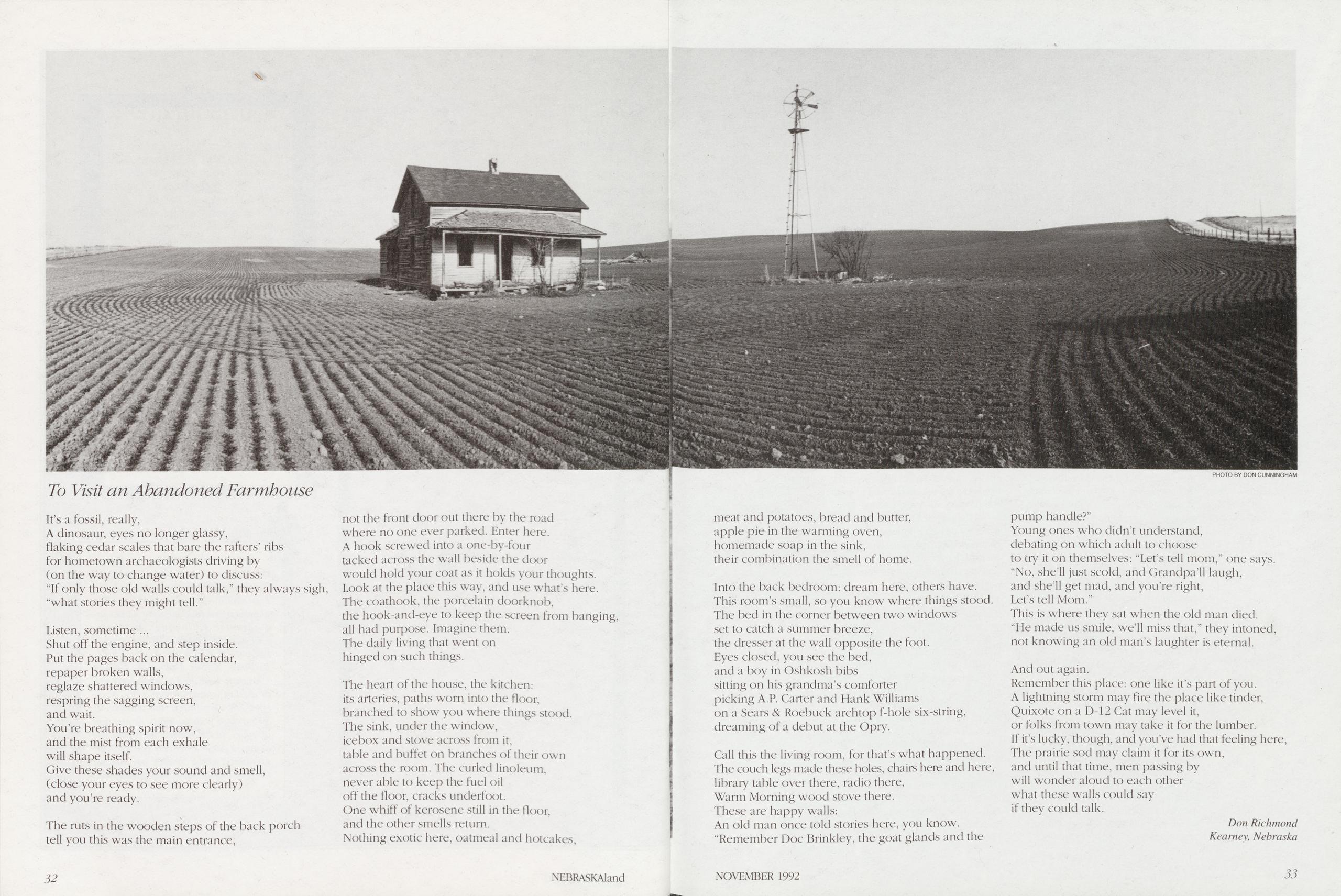
A dinosaur, eyes no longer glassy,
flaking cedar scales that bare the rafters’ ribs
for hometown archaeologists driving by
(on the way to change water) to discuss:
“If only those old walls could talk,” they always sigh,
“what stories they might tell.” Listen, sometime ...
Shut off the engine, and step inside.
Put the pages back on the calendar,
repaper broken walls,
reglaze shattered windows,
respring the sagging screen,
and wait. You’re breathing spirit now,
and the mist from each exhale
will shape itself.
Give these shades your sound and smell,
(close your eyes to see more clearly)
and you’re ready. The ruts in the wooden steps of the back porch
tell you this was the main entrance,
not the front door out there by the road
where no one ever parked. Enter here.
A hook screwed into a one-by-four
tacked across the wall beside the door
would hold your coat as it holds your thoughts.
Look at the place this way, and use what’s here.
The coathook, the porcelain doorknob,
the hook-and-eye to keep the screen from banging,
all had purpose. Imagine them.
The daily living that went on
hinged on such things. The heart of the house, the kitchen:
its arteries, paths worn into the floor,
branched to show you where things stood.
The sink, under the window,
icebox and stove across from it,
table and buffet on branches of their own
across the room. The curled linoleum,
never able to keep the fuel oil
off the floor, cracks underfoot.
One whiff of kerosene still in the floor,
and the other smells return.
Nothing exotic here, oatmeal and hotcakes,
meat and potatoes, bread and butter,
apple pie in the warming oven,
homemade soap in the sink,
their combination the smell of home. Into the back bedroom: dream here, others have.
This room’s small, so you know where things stood.
The bed in the corner between two windows
set to catch a summer breeze,
the dresser at the wall opposite the foot.
Eyes closed, you see the bed,
and a boy in Oshkosh bibs
sitting on his grandma’s comforter
picking A.P. Carter and Hank Williams
on a Sears & Roebuck archtop f-hole six-string,
dreaming of a debut at the Opry. Call this the living room, for that’s what happened.
The couch legs made these holes, chairs here and here,
library table over there, radio there,
Warm Morning wood stove there.
These are happy walls:
An old man once told stories here, you know.
“Remember Doc Brinkley, the goat glands and the
pump handle?”
Young ones who didn’t understand,
debating on which adult to choose
to try it on themselves: “Let’s tell mom,” one says.
“No, she'll just scold, and Grandpa’ll laugh,
and she’ll get mad, and you’re right,
Let’s tell Mom.”
This is where they sat when the old man died.
“He made us smile, we’ll miss that,” they intoned,
not knowing an old man’s laughter is eternal. And out again.
Remember this place: one like it’s part of you.
A lightning storm may fire the place like tinder,
Quixote on a D-12 Cat may level it,
or folks from town may take it for the lumber.
If it’s lucky, though, and you’ve had that feeling here,
The prairie sod may claim it for its own,
and until that time, men passing by
will wonder aloud to each other
what these walls could say
if they could talk. Don Richmond
Kearney, Nebraska 32 NEBRASKAland NOVEMBER 1992 33
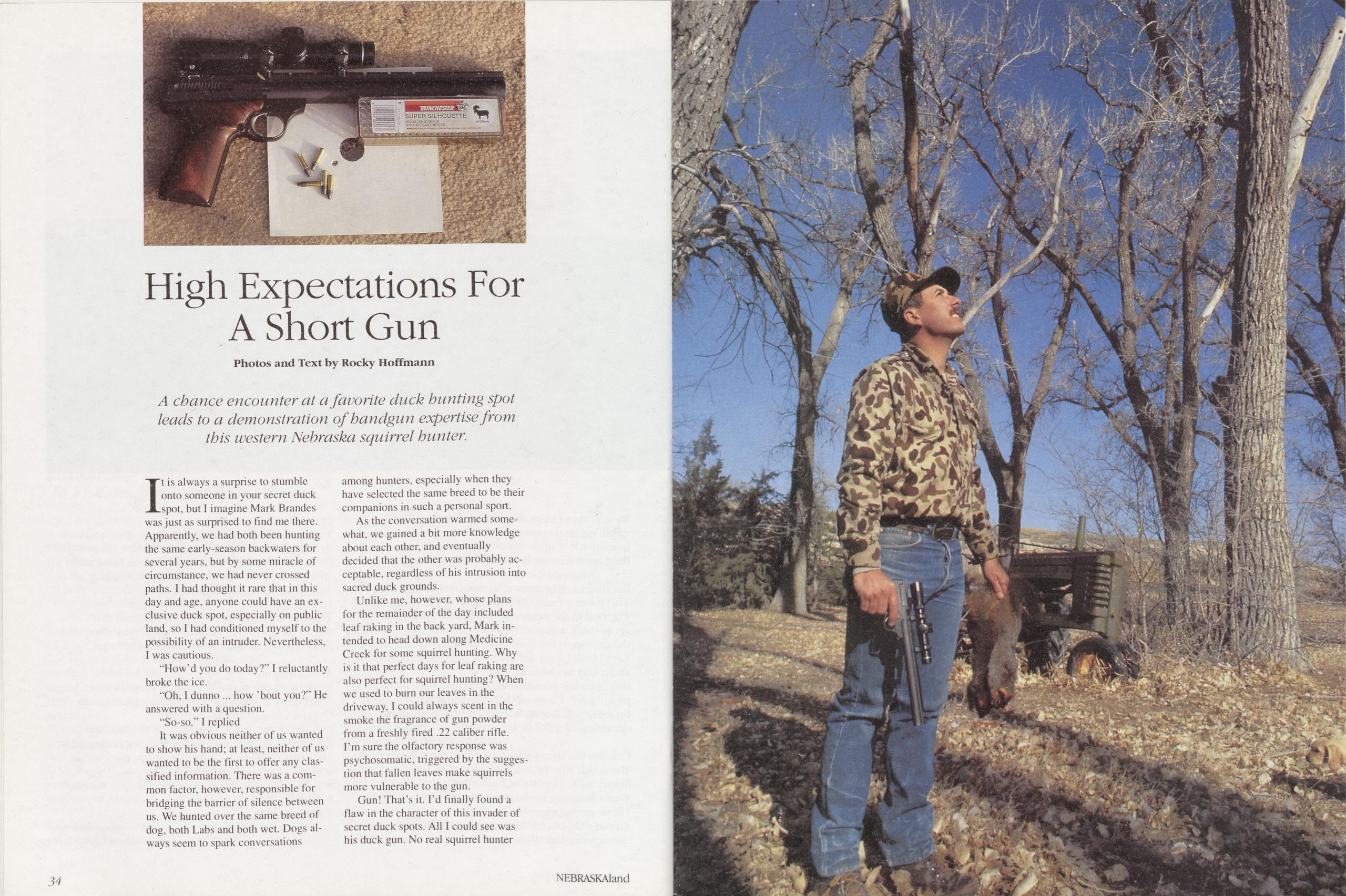
High Expectations For A Short Gun
Photos and Text by Rocky Hoffmann A chance encounter at a favorite duck hunting spot leads to a demonstration of handgun expertise from this western Nebraska squirrel hunter.It is always a surprise to stumble onto someone in your secret duck spot, but I imagine Mark Brandes was just as surprised to find me there. Apparently, we had both been hunting the same early-season backwaters for several years, but by some miracle of circumstance, we had never crossed paths. I had thought it rare that in this day and age, anyone could have an exclusive duck spot, especially on public land, so I had conditioned myself to the possibility of an intruder. Nevertheless, I was cautious.
“How’d you do today?” I reluctantly broke the ice.
“Oh, I dunno ... how ’bout you?” He answered with a question.
“So-so.” I replied
It was obvious neither of us wanted to show his hand; at least, neither of us wanted to be the first to offer any classified information. There was a common factor, however, responsible for bridging the barrier of silence between us. We hunted over the same breed of dog, both Labs and both wet. Dogs always seem to spark conversations among hunters, especially when they have selected the same breed to be their companions in such a personal sport. As the conversation warmed somewhat, we gained a bit more knowledge about each other, and eventually decided that the other was probably acceptable, regardless of his intrusion into sacred duck grounds.
Unlike me, however, whose plans for the remainder of the day included leaf raking in the back yard, Mark intended to head down along Medicine Creek for some squirrel hunting. Why is it that perfect days for leaf raking are also perfect for squirrel hunting? When we used to burn our leaves in the driveway, I could always scent in the smoke the fragrance of gun powder from a freshly fired .22 caliber rifle. I’m sure the olfactory response was psychosomatic, triggered by the suggestion that fallen leaves make squirrels more vulnerable to the gun.
Gun! That’s it. I’d finally found a flaw in the character of this invader of secret duck spots. All I could see was his duck gun. No real squirrel hunter
would shoot a squirrel with a shotgun. I was about to pounce.
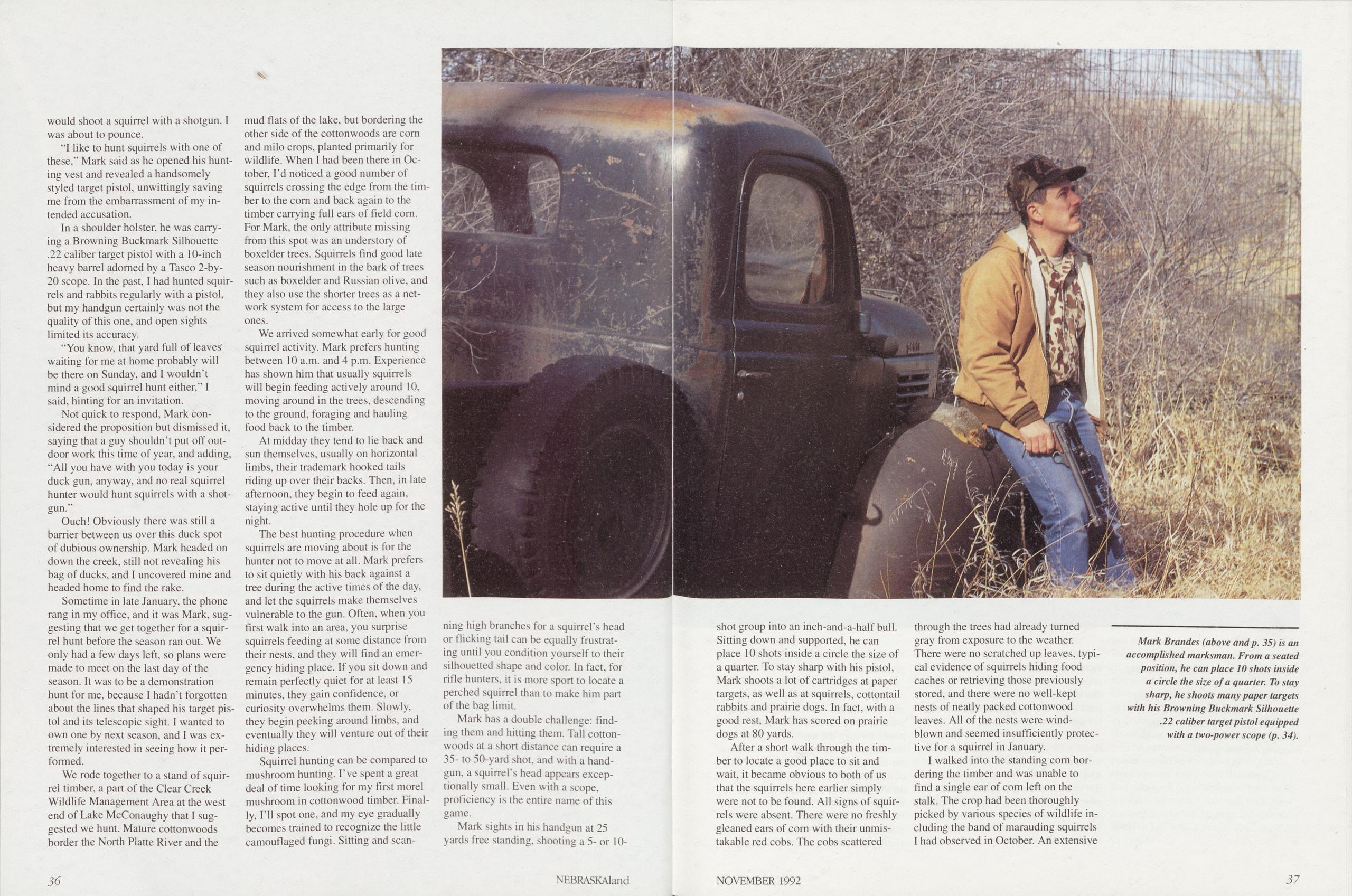
“I like to hunt squirrels with one of these,” Mark said as he opened his hunting vest and revealed a handsomely styled target pistol, unwittingly saving me from the embarrassment of my intended accusation.
In a shoulder holster, he was carrying a Browning Buckmark Silhouette .22 caliber target pistol with a 10-inch heavy barrel adorned by a Tasco 2-by- 20 scope. In the past, I had hunted squirrels and rabbits regularly with a pistol, but my handgun certainly was not the quality of this one, and open sights limited its accuracy.
“You know, that yard full of leaves' waiting for me at home probably will be there on Sunday, and I wouldn’t mind a good squirrel hunt either,” I said, hinting for an invitation. Not quick to respond, Mark considered the proposition but dismissed it, saying that a guy shouldn’t put off outdoor work this time of year, and adding, “All you have with you today is your duck gun, anyway, and no real squirrel hunter would hunt squirrels with a shot-gun.”
Ouch! Obviously there was still a barrier between us over this duck spot of dubious ownership. Mark headed on down the creek, still not revealing his bag of ducks, and I uncovered mine and headed home to find the rake.
Sometime in late January, the phone rang in my office, and it was Mark, suggesting that we get together for a squirrel hunt before the season ran out. We only had a few days left, so plans were made to meet on the last day of the season. It was to be a demonstration hunt for me, because I hadn’t forgotten about the lines that shaped his target pistol and its telescopic sight. I wanted to own one by next season, and I was extremely interested in seeing how it performed.
We rode together to a stand of squirrel timber, a part of the Clear Creek Wildlife Management Area at the west end of Lake McConaughy that I suggested we hunt. Mature cottonwoods border the North Platte River and the mud flats of the lake, but bordering the other side of the cottonwoods are corn and milo crops, planted primarily for wildlife. When I had been there in October, I’d noticed a good number of squirrels crossing the edge from the timber to the com and back again to the timber carrying full ears of field com. For Mark, the only attribute missing from this spot was an understory of boxelder trees. Squirrels find good late season nourishment in the bark of trees such as boxelder and Russian olive, and they also use the shorter trees as a network system for access to the large ones.
We arrived somewhat early for good squirrel activity. Mark prefers hunting between 10 a.m. and 4 p.m. Experience has shown him that usually squirrels will begin feeding actively around 10, moving around in the trees, descending to the ground, foraging and hauling food back to the timber.
At midday they tend to lie back and sun themselves, usually on horizontal limbs, their trademark hooked tails riding up over their backs. Then, in late afternoon, they begin to feed again, staying active until they hole up for the night.
The best hunting procedure when squirrels are moving about is for the hunter not to move at all. Mark prefers to sit quietly with his back against a tree during the active times of the day, and let the squirrels make themselves vulnerable to the gun. Often, when you first walk into an area, you surprise squirrels feeding at some distance from their nests, and they will find an emergency hiding place. If you sit down and remain perfectly quiet for at least 15 minutes, they gain confidence, or curiosity overwhelms them. Slowly, they begin peeking around limbs, and eventually they will venture out of their hiding places.
Squirrel hunting can be compared to mushroom hunting. I’ve spent a great deal of time looking for my first morel mushroom in cottonwood timber. Finally, I’ll spot one, and my eye gradually becomes trained to recognize the little camouflaged fungi. Sitting and scanning high branches for a squirrel’s head or flicking tail can be equally frustrating until you condition yourself to their silhouetted shape and color. In fact, for rifle hunters, it is more sport to locate a perched squirrel than to make him part of the bag limit.
Mark has a double challenge: finding them and hitting them. Tall cottonwoods at a short distance can require a 35- to 50-yard shot, and with a handgun, a squirrel’s head appears exceptionally small. Even with a scope, proficiency is the entire name of this game.
Mark sights in his handgun at 25 yards free standing, shooting a 5- or 10- shot group into an inch-and-a-half bull. Sitting down and supported, he can place 10 shots inside a circle the size of a quarter. To stay sharp with his pistol, Mark shoots a lot of cartridges at paper targets, as well as at squirrels, cottontail rabbits and prairie dogs. In fact, with a good rest, Mark has scored on prairie dogs at 80 yards.
After a short walk through the timber to locate a good place to sit and wait, it became obvious to both of us that the squirrels here earlier simply were not to be found. All signs of squirrels were absent. There were no freshly gleaned ears of com with their unmistakable red cobs. The cobs scattered through the trees had already turned gray from exposure to the weather. There were no scratched up leaves, typical evidence of squirrels hiding food caches or retrieving those previously stored, and there were no well-kept nests of neatly packed cottonwood leaves. All of the nests were wind-blown and seemed insufficiently protective for a squirrel in January.
I walked into the standing com bordering the timber and was unable to find a single ear of com left on the stalk. The crop had been thoroughly picked by various species of wildlife including the band of marauding squirrels I had observed in October. An extensive
Mark Brandes (above and p. 35) is an accomplished marksman. From a seated position, he can place 10 shots inside a circle the size of a quarter. To stay sharp, he shoots many paper targets with his Browning Buckmark Silhouette .22 caliber target pistol equipped with a two-power scope (p. 34).
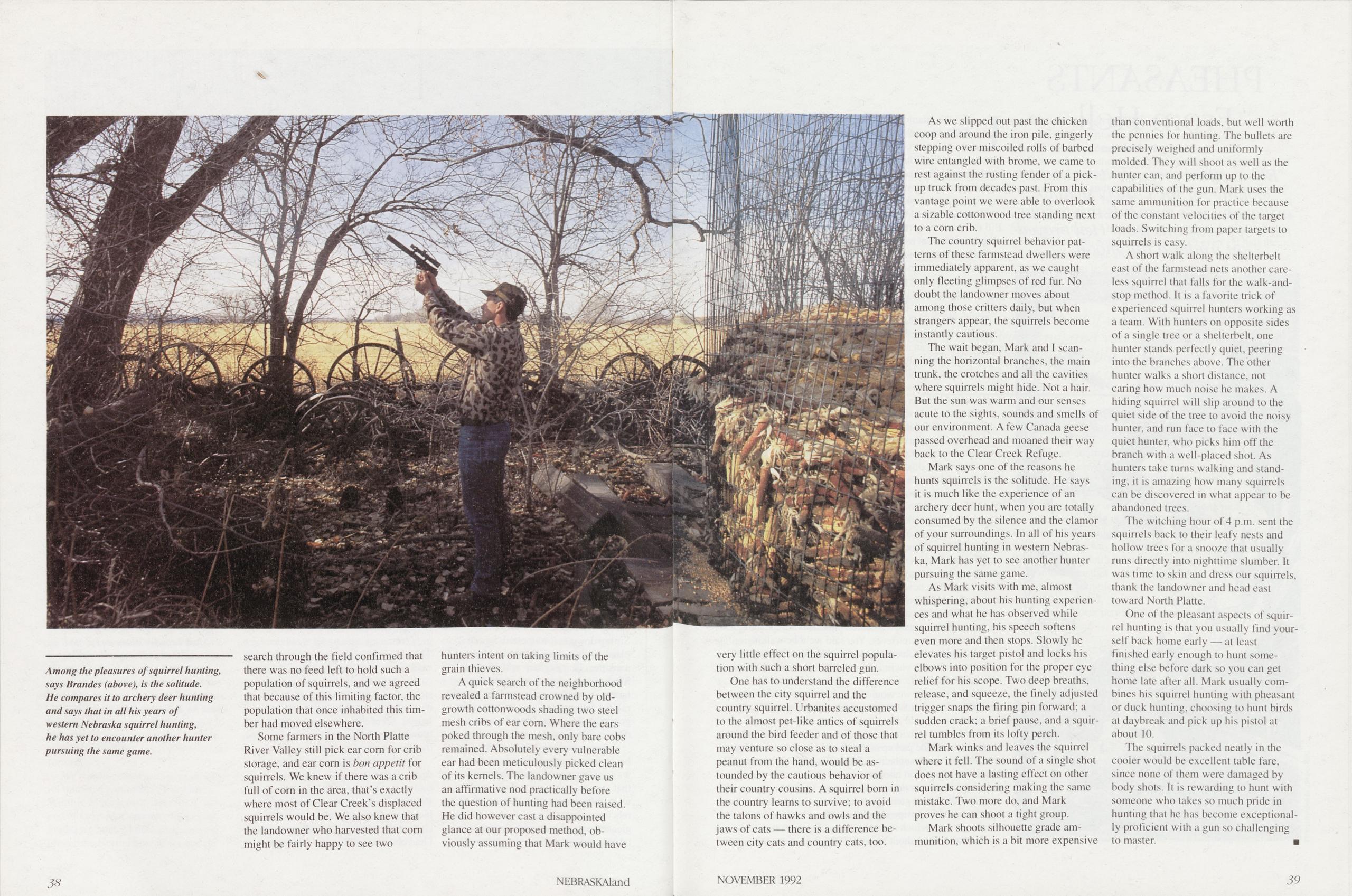
search through the field confirmed that there was no feed left to hold such a population of squirrels, and we agreed that because of this limiting factor, the population that once inhabited this timber had moved elsewhere.
Some farmers in the North Platte River Valley still pick ear com for crib storage, and ear corn is bon appetit for squirrels. We knew if there was a crib full of corn in the area, that’s exactly where most of Clear Creek’s displaced squirrels would be. We also knew that the landowner who harvested that corn might be fairly happy to see two hunters intent on taking limits of the grain thieves.
A quick search of the neighborhood revealed a farmstead crowned by old-growth cottonwoods shading two steel mesh cribs of ear com. Where the ears poked through the mesh, only bare cobs remained. Absolutely every vulnerable ear had been meticulously picked clean of its kernels. The landowner gave us an affirmative nod practically before the question of hunting had been raised. He did however cast a disappointed glance at our proposed method, obviously assuming that Mark would have very little effect on the squirrel population with such a short barreled gun.
One has to understand the difference between the city squirrel and the country squirrel. Urbanites accustomed to the almost pet-like antics of squirrels around the bird feeder and of those that may venture so close as to steal a peanut from the hand, would be astounded by the cautious behavior of their country cousins. A squirrel bom in the country learns to survive; to avoid the talons of hawks and owls and the jaws of cats — there is a difference between city cats and country cats, too.
As we slipped out past the chicken coop and around the iron pile, gingerly stepping over miscoiled rolls of barbed wire entangled with brome, we came to rest against the rusting fender of a pickup truck from decades past. From this vantage point we were able to overlook a sizable cottonwood tree standing next to a corn crib.
The country squirrel behavior patterns of these farmstead dwellers were immediately apparent, as we caught only fleeting glimpses of red fur. No doubt the landowner moves about among those critters daily, but when strangers appear, the squirrels become instantly cautious.
The wait began, Mark and I scanning the horizontal branches, the main trunk, the crotches and all the cavities where squirrels might hide. Not a hair. But the sun was warm and our senses acute to the sights, sounds and smells of our environment. A few Canada geese passed overhead and moaned their way back to the Clear Creek Refuge.
Mark says one of the reasons he hunts squirrels is the solitude. He says it is much like the experience of an archery deer hunt, when you are totally consumed by the silence and the clamor of your surroundings. In all of his years of squirrel hunting in western Nebraska, Mark has yet to see another hunter pursuing the same game.
As Mark visits with me, almost whispering, about his hunting experiences and what he has observed while squirrel hunting, his speech softens even more and then stops. Slowly he elevates his target pistol and locks his elbows into position for the proper eye relief for his scope. Two deep breaths, release, and squeeze, the finely adjusted trigger snaps the firing pin forward; a sudden crack; a brief pause, and a squirrel tumbles from its lofty perch.
Mark winks and leaves the squirrel where it fell. The sound of a single shot does not have a lasting effect on other squirrels considering making the same mistake. Two more do, and Mark proves he can shoot a tight group.
Mark shoots silhouette grade ammunition, which is a bit more expensive than conventional loads, but well worth the pennies for hunting. The bullets are precisely weighed and uniformly molded. They will shoot as well as the hunter can, and perform up to the capabilities of the gun. Mark uses the same ammunition for practice because of the constant velocities of the target loads. Switching from paper targets to squirrels is easy.
A short walk along the shelterbelt east of the farmstead nets another careless squirrel that falls for the walk-and-stop method. It is a favorite trick of experienced squirrel hunters working as a team. With hunters on opposite sides of a single tree or a shelterbelt, one hunter stands perfectly quiet, peering into the branches above. The other hunter walks a short distance, not caring how much noise he makes. A hiding squirrel will slip around to the quiet side of the tree to avoid the noisy hunter, and run face to face with the quiet hunter, who picks him off the branch with a well-placed shot. As hunters take turns walking and standing, it is amazing how many squirrels can be discovered in what appear to be abandoned trees.
The witching hour of 4 p.m. sent the squirrels back to their leafy nests and hollow trees for a snooze that usually runs directly into nighttime slumber. It was time to skin and dress our squirrels, thank the landowner and head east toward North Platte.
One of the pleasant aspects of squirrel hunting is that you usually find yourself back home early — at least finished early enough to hunt something else before dark so you can get home late after all. Mark usually combines his squirrel hunting with pheasant or duck hunting, choosing to hunt birds at daybreak and pick up his pistol at about 10.
The squirrels packed neatly in the cooler would be excellent table fare, since none of them were damaged by body shots. It is rewarding to hunt with someone who takes so much pride in hunting that he has become exceptionally proficient with a gun so challenging to master. ■
38 NEBRASKAland NOVEMBER 1992 39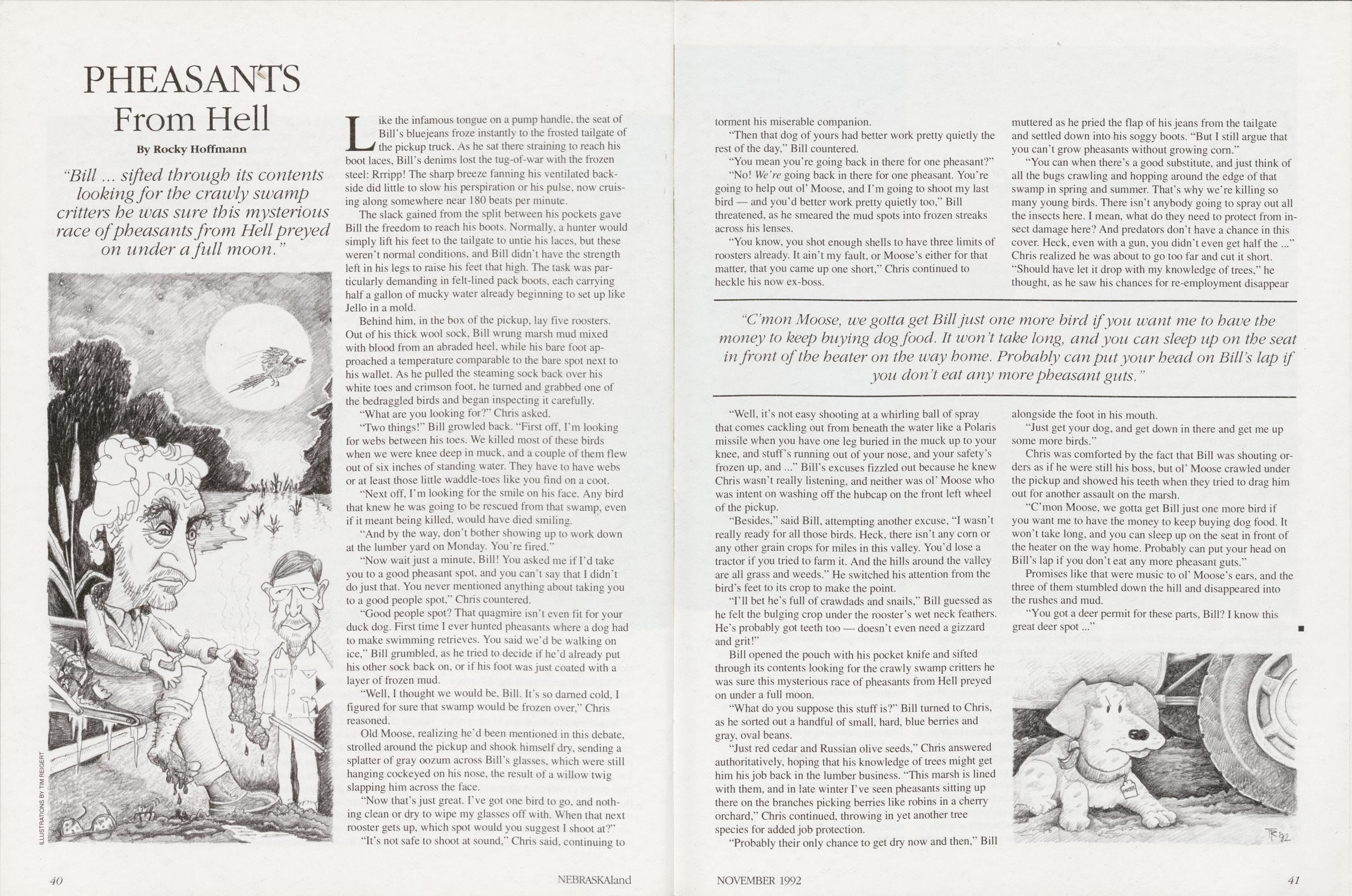
PHEASANTS From Hell
By Rocky Hoffmann “Bill... sifted through its contents looking for the crawly swamp critters he was sure this mysterious race of pheasants from Hell preyed on under a full moon. ” ILLUSTRATIONS BY TIM REIGERTLike the infamous tongue on a pump handle, the seat of Bill’s bluejeans froze instantly to the frosted tailgate of the pickup truck. As he sat there straining to reach his boot laces, Bill’s denims lost the tug-of-war with the frozen steel: Rrripp! The sharp breeze fanning his ventilated backside did little to slow his perspiration or his pulse, now cruising along somewhere near 180 beats per minute.
The slack gained from the split between his pockets gave Bill the freedom to reach his boots. Normally, a hunter would simply lift his feet to the tailgate to untie his laces, but these weren’t normal conditions, and Bill didn’t have the strength left in his legs to raise his feet that high. The task was particularly demanding in felt-lined pack boots, each carrying half a gallon of mucky water already beginning to set up like Jello in a mold.
Behind him, in the box of the pickup, lay five roosters. Out of his thick wool sock, Bill wrung marsh mud mixed with blood from an abraded heel, while his bare foot approached a temperature comparable to the bare spot next to his wallet. As he pulled the steaming sock back over his white toes and crimson foot, he turned and grabbed one of the bedraggled birds and began inspecting it carefully. “What are you looking for?” Chris asked.
“Two things!” Bill growled back. “First off, I’m looking for webs between his toes. We killed most of these birds when we were knee deep in muck, and a couple of them flew out of six inches of standing water. They have to have webs or at least those little waddle-toes like you find on a coot.
“Next off, I’m looking for the smile on his face. Any bird that knew he was going to be rescued from that swamp, even if it meant being killed, would have died smiling.
“And by the way, don’t bother showing up to work down at the lumber yard on Monday. You’re fired.”
“Now wait just a minute, Bill! You asked me if I’d take you to a good pheasant spot, and you can’t say that I didn't do just that. You never mentioned anything about taking you to a good people spot,” Chris countered.
“Good people spot? That quagmire isn’t even fit for your duck dog. First time I ever hunted pheasants where a dog had to make swimming retrieves. You said we’d be walking on ice,” Bill grumbled, as he tried to decide if he'd already put his other sock back on, or if his foot was just coated with a layer of frozen mud.
“Well, I thought we would be. Bill. It’s so darned cold, I figured for sure that swamp would be frozen over,” Chris reasoned.
Old Moose, realizing he'd been mentioned in this debate, strolled around the pickup and shook himself dry, sending a splatter of gray oozum across Bill’s glasses, which were still hanging cockeyed on his nose, the result of a willow twig slapping him across the face.
“Now that’s just great. I’ve got one bird to go, and nothing clean or dry to wipe my glasses off with. When that next rooster gets up, which spot would you suggest I shoot at?”
“It’s not safe to shoot at sound,” Chris said, continuing to torment his miserable companion.
“Then that dog of yours had better work pretty quietly the rest of the day,” Bill countered.
“You mean you’re going back in there for one pheasant?” “No! We're going back in there for one pheasant. You’re going to help out of Moose, and I’m going to shoot my last bird — and you’d better work pretty quietly too,” Bill threatened, as he smeared the mud spots into frozen streaks across his lenses.
“You know, you shot enough shells to have three limits of roosters already. It ain’t my fault, or Moose’s either for that matter, that you came up one short,” Chris continued to heckle his now ex-boss.
“C’mon Moose, we gotta get Bill just one more bird if you want me to have the money to keep buying dog food. It won’t take long, and you can sleep up on the seat in front of the heater on the way home. Probably can put your head on Bill’s lap if you don’t eat any more pheasant guts.”
“Well, it’s not easy shooting at a whirling ball of spray that comes cackling out from beneath the water like a Polaris missile when you have one leg buried in the muck up to your knee, and stuff’s running out of your nose, and your safety’s frozen up, and ...” Bill’s excuses fizzled out because he knew Chris wasn’t really listening, and neither was ol’ Moose who was intent on washing off the hubcap on the front left wheel of the pickup.
“Besides,” said Bill, attempting another excuse, “I wasn’t really ready for all those birds. Heck, there isn’t any corn or any other grain crops for miles in this valley. You’d lose a tractor if you tried to farm it. And the hills around the valley are all grass and weeds.” He switched his attention from the bird’s feet to its crop to make the point.
“I’ll bet he’s full of crawdads and snails,” Bill guessed as he felt the bulging crop under the rooster’s wet neck feathers. He’s probably got teeth too — doesn’t even need a gizzard and grit!”
Bill opened the pouch with his pocket knife and sifted through its contents looking for the crawly swamp critters he was sure this mysterious race of pheasants from Hell preyed on under a full moon.
“What do you suppose this stuff is?” Bill turned to Chris, as he sorted out a handful of small, hard, blue berries and gray, oval beans.
“Just red cedar and Russian olive seeds,” Chris answered authoritatively, hoping that his knowledge of trees might get him his job back in the lumber business. “This marsh is lined with them, and in late winter I’ve seen pheasants sitting up there on the branches picking berries like robins in a cherry orchard,” Chris continued, throwing in yet another tree species for added job protection.
“Probably their only chance to get dry now and then,” Bill muttered as he pried the flap of his jeans from the tailgate and settled down into his soggy boots. “But I still argue that you can’t grow pheasants without growing corn.”
“You can when there’s a good substitute, and just think of all the bugs crawling and hopping around the edge of that swamp in spring and summer. That’s why we’re killing so many young birds. There isn’t anybody going to spray out all the insects here. I mean, what do they need to protect from insect damage here? And predators don’t have a chance in this cover. Heck, even with a gun, you didn’t even get half the ...” Chris realized he was about to go too far and cut it short. “Should have let it drop with my knowledge of trees,” he thought, as he saw his chances for re-employment disappear alongside the foot in his mouth.
“Just get your dog, and get down in there and get me up some more birds.”
Chris was comforted by the fact that Bill was shouting or- ders as if he were still his boss, but ol’ Moose crawled under the pickup and showed his teeth when they tried to drag him out for another assault on the marsh.
“C’mon Moose, we gotta get Bill just one more bird if you want me to have the money to keep buying dog food. It won’t take long, and you can sleep up on the seat in front of the heater on the way home. Probably can put your head on Bill’s lap if you don’t eat any more pheasant guts.”
Promises like that were music to ol’ Moose’s ears, and the three of them stumbled down the hill and disappeared into the rushes and mud.
“You got a deer permit for these parts, Bill? I know this great deer spot...”
40 NEBRASKAland NOVEMBER 1992 41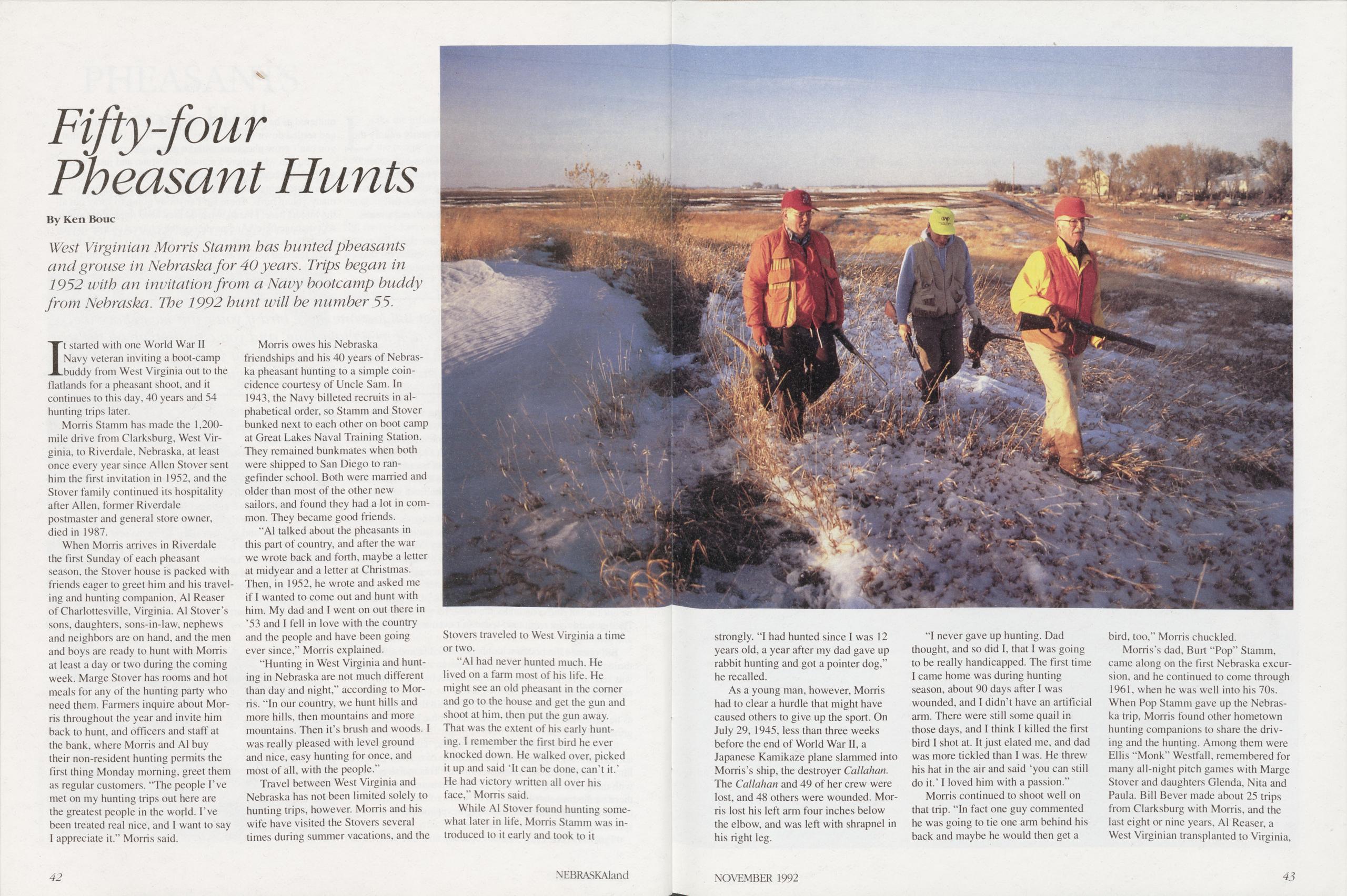
Fifty-four Pheasant Hunts
By Ken Bouc West Virginian Morris Stamm has hunted pheasants and grouse in Nebraska for 40 years. Trips began in 1952 with an invitation from a Navy bootcamp buddy from Nebraska. The 1992 hunt will be number 55.It started with one World War II Navy veteran inviting a boot-camp buddy from West Virginia out to the flatlands for a pheasant shoot, and it continues to this day, 40 years and 54 hunting trips later.
Morris Stamm has made the 1,200-mile drive from Clarksburg, West Virginia, to Riverdale, Nebraska, at least once every year since Allen Stover sent him the first invitation in 1952, and the Stover family continued its hospitality after Allen, former Riverdale postmaster and general store owner, died in 1987.
When Morris arrives in Riverdale the first Sunday of each pheasant season, the Stover house is packed with friends eager to greet him and his traveling and hunting companion, Al Reaser of Charlottesville, Virginia. Al Stover’s sons, daughters, sons-in-law, nephews and neighbors are on hand, and the men and boys are ready to hunt with Morris at least a day or two during the coming week. Marge Stover has rooms and hot meals for any of the hunting party who need them. Farmers inquire about Morris throughout the year and invite him back to hunt, and officers and staff at the bank, where Morris and Al buy their non-resident hunting permits the first thing Monday morning, greet them as regular customers. “The people I’ve met on my hunting trips out here are the greatest people in the world. I’ve been treated real nice, and I want to say I appreciate it.” Morris said.
Morris owes his Nebraska friendships and his 40 years of Nebraska pheasant hunting to a simple coin- cidence courtesy of Uncle Sam. In 1943, the Navy billeted recruits in alphabetical order, so Stamm and Stover bunked next to each other on boot camp at Great Lakes Naval Training Station. They remained bunkmates when both were shipped to San Diego to rangefinder school. Both were married and older than most of the other new sailors, and found they had a lot in common. They became good friends.
“Al talked about the pheasants in this part of country, and after the war we wrote back and forth, maybe a letter at midyear and a letter at Christmas. Then, in 1952, he wrote and asked me if I wanted to come out and hunt with him. My dad and I went on out there in ’53 and I fell in love with the country and the people and have been going ever since,” Morris explained.
“Hunting in West Virginia and hunting in Nebraska are not much different than day and night,” according to Morris. “In our country, we hunt hills and more hills, then mountains and more mountains. Then it’s brush and woods. I was really pleased with level ground and nice, easy hunting for once, and most of all, with the people.”
Travel between West Virginia and Nebraska has not been limited solely to hunting trips, however. Morris and his wife have visited the Stovers several times during summer vacations, and the Stovers traveled to West Virginia a time or two.
“Al had never hunted much. He lived on a farm most of his life. He might see an old pheasant in the corner and go to the house and get the gun and shoot at him, then put the gun away. That was the extent of his early hunting. I remember the first bird he ever knocked down. He walked over, picked it up and said ‘It can be done, can't it.’ He had victory written all over his face,” Morris said.
While Al Stover found hunting somewhat later in life, Morris Stamm was introduced to it early and took to it strongly. “I had hunted since I was 12 years old, a year after my dad gave up rabbit hunting and got a pointer dog,” he recalled.
As a young man, however, Morris had to clear a hurdle that might have caused others to give up the sport. On July 29, 1945, less than three weeks before the end of World War II, a Japanese Kamikaze plane slammed into Morris’s ship, the destroyer Callahan. The Callahan and 49 of her crew were lost, and 48 others were wounded. Mor- ris lost his left arm four inches below the elbow, and was left with shrapnel in his right leg.
“I never gave up hunting. Dad thought, and so did I, that I was going to be really handicapped. The first time I came home was during hunting season, about 90 days after I was wounded, and I didn’t have an artificial arm. There were still some quail in those days, and I think I killed the first bird I shot at. It just elated me, and dad was more tickled than I was. He threw his hat in the air and said ‘you can still do it.’ I loved him with a passion.”
Morris continued to shoot well on that trip. “In fact one guy commented he was going to tie one arm behind his back and maybe he would then get a bird, too,” Morris chuckled.
Morris’s dad, Burt “Pop” Stamm, came along on the first Nebraska excursion, and he continued to come through 1961, when he was well into his 70s. When Pop Stamm gave up the Nebraska trip, Morris found other hometown hunting companions to share the driving and the hunting. Among them were Ellis “Monk” Westfall, remembered for many all-night pitch games with Marge Stover and daughters Glenda, Nita and Paula. Bill Bever made about 25 trips from Clarksburg with Morris, and the last eight or nine years, Al Reaser, a West Virginian transplanted to Virginia,
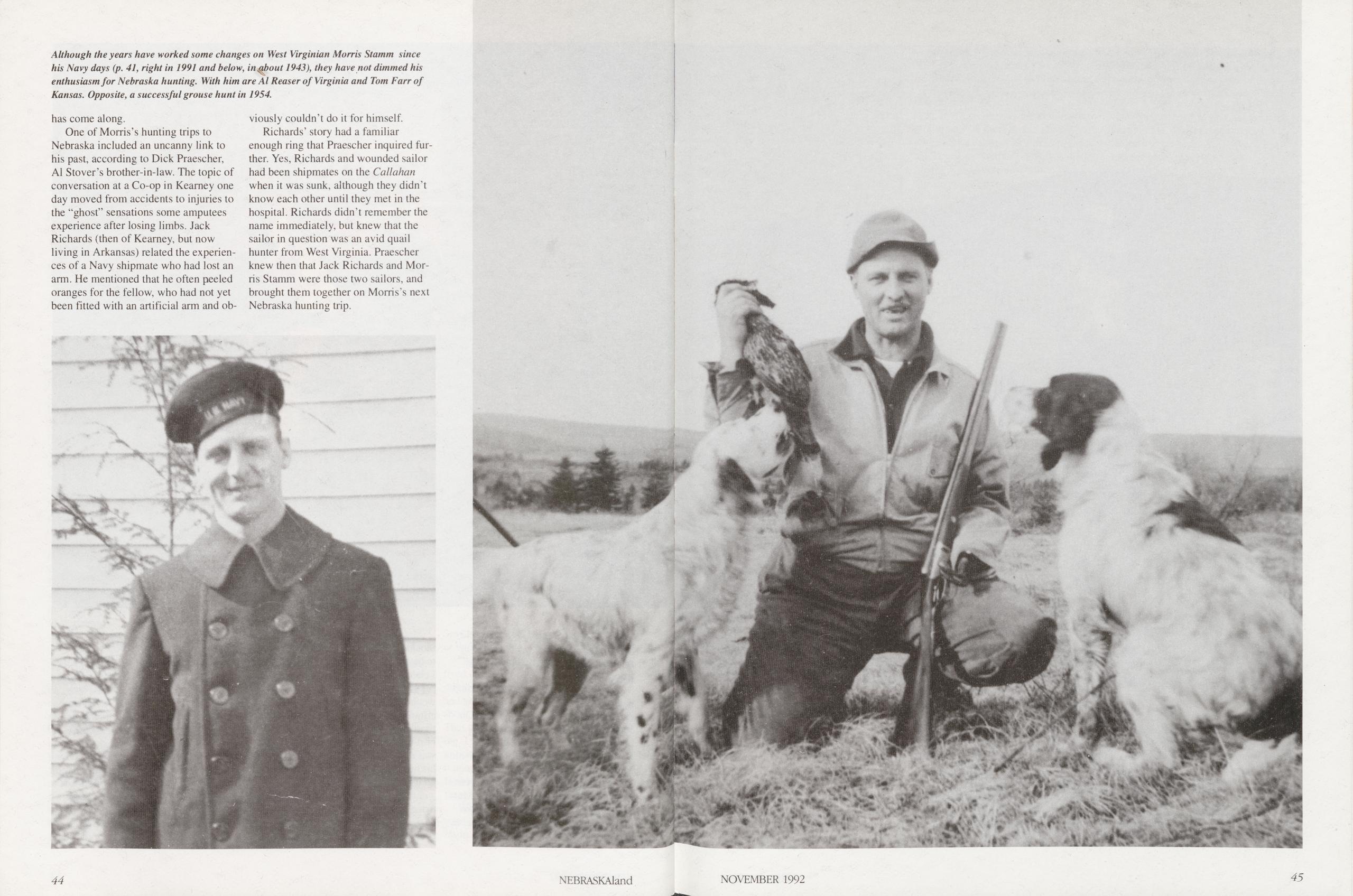
has come along.
One of Morris’s hunting trips to Nebraska included an uncanny link to his past, according to Dick Praescher, Al Stover’s brother-in-law. The topic of conversation at a Co-op in Kearney one day moved from accidents to injuries to the “ghost” sensations some amputees experience after losing limbs. Jack Richards (then of Kearney, but now living in Arkansas) related the experiences of a Navy shipmate who had lost an arm. He mentioned that he often peeled oranges for the fellow, who had not yet been fitted with an artificial arm and obviously couldn’t do it for himself.
Richards’ story had a familiar enough ring that Praescher inquired further. Yes, Richards and wounded sailor had been shipmates on the Callahan when it was sunk, although they didn’t know each other until they met in the hospital. Richards didn’t remember the name immediately, but knew that the sailor in question was an avid quail hunter from West Virginia. Praescher knew then that Jack Richards and Morris Stamm were those two sailors, and brought them together on Morris’s next Nebraska hunting trip.
44 NEBRASKAland NOVEMBER 1992 45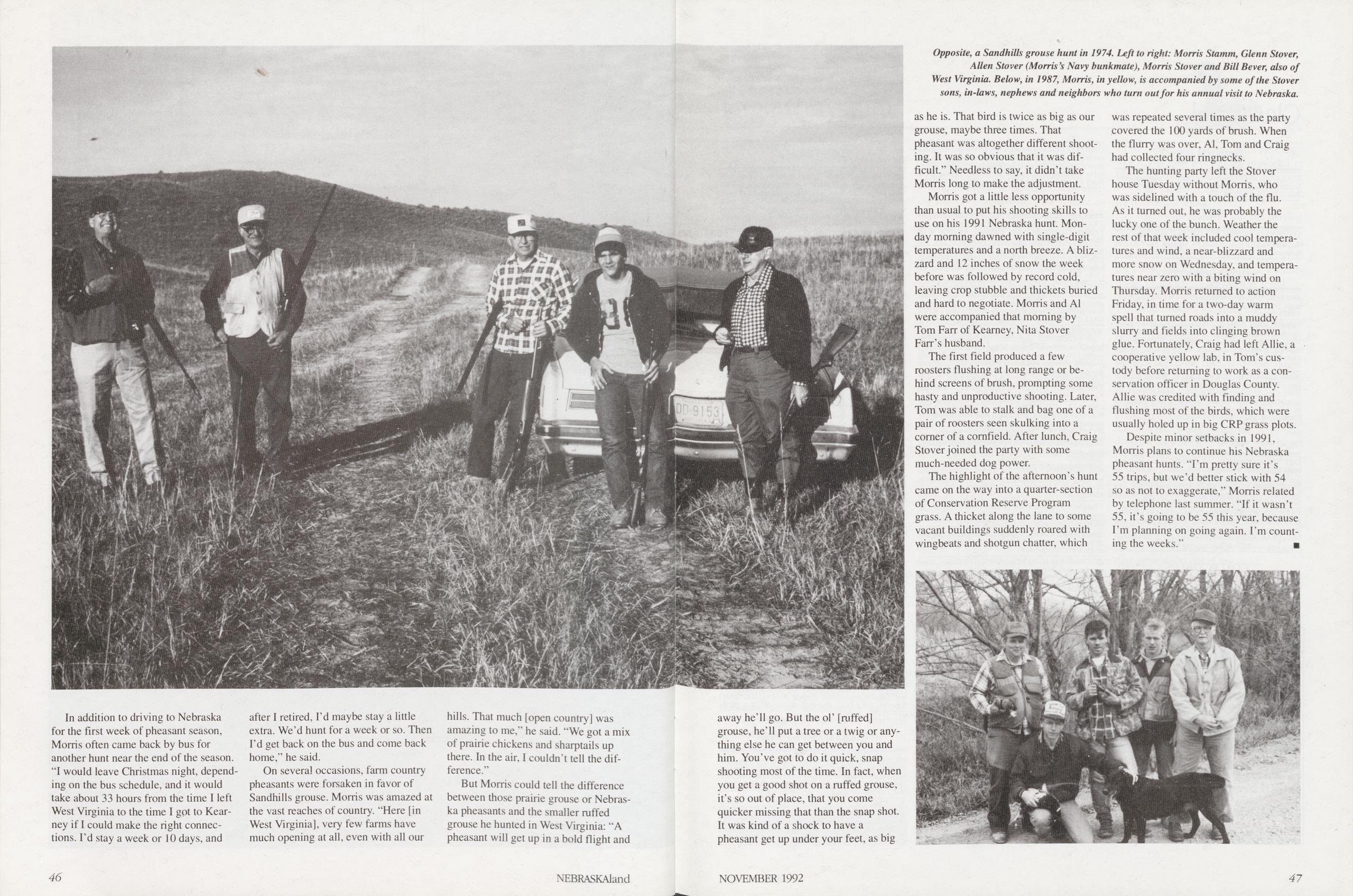
In addition to driving to Nebraska for the first week of pheasant season, Morris often came back by bus for another hunt near the end of the season. "I would leave Christmas night, depending on the bus schedule, and it would take about 33 hours from the time I left West Virginia to the time I got to Kearney if I could make the right connections. I’d stay a week or 10 days, and after I retired, I’d maybe stay a little extra. We’d hunt for a week or so. Then I’d get back on the bus and come back home,” he said.
On several occasions, farm country pheasants were forsaken in favor of Sandhills grouse. Morris was amazed at the vast reaches of country. “Here [in West Virginia], very few farms have much opening at all, even with all our hills. That much [open country] was amazing to me,” he said. “We got a mix of prairie chickens and sharptails up there. In the air, I couldn’t tell the dif- ference.”
But Morris could tell the difference between those prairie grouse or Nebraska pheasants and the smaller ruffed grouse he hunted in West Virginia: “A pheasant will get up in a bold flight and away he’ll go. But the ol’ [ruffed] grouse, he’ll put a tree or a twig or anything else he can get between you and him. You’ve got to do it quick, snap shooting most of the time. In fact, when you get a good shot on a ruffed grouse, it’s so out of place, that you come quicker missing that than the snap shot. It was kind of a shock to have a pheasant get up under your feet, as big as he is. That bird is twice as big as our grouse, maybe three times. That pheasant was altogether different shooting. It was so obvious that it was difficult.” Needless to say, it didn’t take Morris long to make the adjustment.
Morris got a little less opportunity than usual to put his shooting skills to use on his 1991 Nebraska hunt. Mon- day morning dawned with single-digit temperatures and a north breeze. A blizzard and 12 inches of snow the week before was followed by record cold, leaving crop stubble and thickets buried and hard to negotiate. Morris and Al were accompanied that morning by Tom Farr of Kearney, Nita Stover Farr’s husband.
The first field produced a few roosters flushing at long range or behind screens of brush, prompting some hasty and unproductive shooting. Later, Tom was able to stalk and bag one of a pair of roosters seen skulking into a corner of a cornfield. After lunch, Craig Stover joined the party with some much-needed dog power.
The highlight of the afternoon’s hunt came on the way into a quarter-section of Conservation Reserve Program grass. A thicket along the lane to some vacant buildings suddenly roared with wingbeats and shotgun chatter, which was repeated several times as the party covered the 100 yards of brush. When the flurry was over, Al, Tom and Craig had collected four ringnecks.
The hunting party left the Stover house Tuesday without Morris, who was sidelined with a touch of the flu. As it turned out, he was probably the lucky one of the bunch. Weather the rest of that week included cool tempera- tures and wind, a near-blizzard and more snow on Wednesday, and tempera- tures near zero with a biting wind on Thursday. Morris returned to action Friday, in time for a two-day warm spell that turned roads into a muddy slurry and fields into clinging brown glue. Fortunately, Craig had left Allie, a cooperative yellow lab, in Tom’s custody before returning to work as a conservation officer in Douglas County. Allie was credited with finding and flushing most of the birds, which were usually holed up in big CRP grass plots.
Despite minor setbacks in 1991, Morris plans to continue his Nebraska pheasant hunts. “I’m pretty sure it’s 55 trips, but we’d better stick with 54 so as not to exaggerate,” Morris related by telephone last summer. “If it wasn’t 55, it’s going to be 55 this year, because I’m planning on going again. I’m count- ing the weeks.”
Classified
ARTS/CRAFTSSQUIRREL FEEDERS—For ear or shelled corn. Unique design. Send $8.95 to David Essink, HC 62, Box 10, Ewing, NE 68735.
BIRDSMANDARIN DUCKS: nice full-wing birds, $35/pair; woodducks $25/pair Mrs. R. W. Hansen, 3315 Ave. L, Kearney, NE 68847, Phone (308) 237-3781
BOOKS/PRINTINGFREE! Booklets on northeastern Nevada; fishing, rock- hounding maps, Carl Hayden, Box 528, Jackpot, Nevada 89825.
FREE BOOK CATALOG. Novels, westerns, romances, children’s; old out of print, found barns, attic. Authors: Grey, Bower, Connor, Fox, Curwood, Raine, Wright, Aldrige, Pollyanna, Freckles, many others. Postage appreciated. Pierce, 4400 N Pine Cluster, Oroville, CA 95965.
NEBRASKA CHRISTMAS CARDS: Beautiful black and white photographs of Nebraska landscapes on card front. Choose from sixteen landscapes; location on back of card. Imprint with holiday message, or buy blank. Call or write for free brochure: Prairie Wind, P.O. Box 6698, Omaha, NE 68132; (402) 556-4030.
CLOTHINGGET YOUR ORIGINAL ARTWORK of windmill and stock tank, with “Nebraska” across tank. Available on T-shirts or sweatshirts, (ash or red) or on tan snap-close jacket. Sizes Small to XXL. Write or call for free brochure — Mikolyck Designs, RR 2 Box 46, Oshkosh, NE 69154; (308) 772-3574 or 1-800-682-7785.
FREE MOCCASIN CATALOG. Send for free full color MINNETONKA MOCCASIN CATALOG. Include your complete address. Mail to: H & M Bootery, 275 N. Main St., Valentine, NE 69201 or call 402-376-1880 for faster service. RED WING catalog also available!
COLLECTIBLESWANTED: Nebraska stock certificates, letters, old checks, etc.—particularly pre-1900. A. A. Armstrong Jr M.D., 211 West 39th, Scottsbluff, NE 69361
WANTED: Collector wants to buy all brands old 2 piece cardboard shot-shell boxes. Also wood ammo boxes, old firearm and cartridge company posters, calendars, adver- tising cardboards, and catalogs. Allan H Hahn, Rt. 1 Box 147, Gibbon, NE 68840, Phone (308) 647-5228.
DOGSTRAINING ALL BREEDS bird dogs-Vizslas and English Pointers for sale. Rozanek Kennels, R 2, Schuyler, NE 68661. Phone (402) 352-8769
YELLOW-BLACK Lab pups. FC AFC sired. AKC. Hips OFA certified. Dew claws removed. Excellent hunting potential. Contact Bob Bendler, Lexington, NE, (308) 324-4247.
FOR SALE—Chesapeake bay or Labrador retrievers. All colors. Pups, started dogs, stud service. Three-gener- ation national champion, pedigre on Lab. Three genera- tions of the best Chesapeakes ever trialed. Call PLATTE VALLEY RETRIEVERS (308) 995-2318.
WILDERNESS KENNELS. Gun dog training-over 60 years COMBINED experience. Training all sporting breeds—retrievers. Flushing and pointing dogs. All dogs worked on pen raised birds and wild game. Training program includes obedience training—heel, sit, stay, down and come when called. Pups, started dogs and fully trained dogs for sale. HUNTING DOGS TRAINED BY HUNTERS Henry Sader, Wilderness Kennels, (402) 423-4212. Since 1968.
GERMAN ~SHORTHATR~POINTERS/ENGL1SH POINTERS—pups, started dogs, stud service. Training available for pointing and retrieving dogs. Wayne Clark (712) 529-4238. Close to Omaha. Leave mesage.
AKC GERMAN SHORTHAIR POINTER pups, started dogs, guaranteed—references available. Phone (402) 353-3605.
AKC BRITTANY PUPS and started juveniles. Close working. Natural backing gun dogs. Field champion backgrounds. Liver and orange. References. Blair (402) 426-3597.
TRAINING—obedience—retrievers— Pointers 30 years experience. John Honore, (308) 384-1517
ENGLISH SETTERS and German shorthair pointers; Young dogs at different stages of development. Partially trained and experienced bird dogs. Darrell Yentes, Hol drege, NE (308)995-4797.
GERMAN SHORTHAIR puppies. Great hunters. Great companions. Old fashioned. Dave Wickham, Cactus Kennels, Kimball, NE 69145. Phone (308) 235-3237.
CUSTOM GATES AND KENNELS Portable and sta- tionary dog runs and kennels, any size. Phone (402) 253-2812 or (402) 333-5186.
FISH/FISHING
FISH FOR SALE. Catfish, perch, coho salmon, rainbow trout, crappie, bluegill, walleye, minnows, goldfish, bull- head, largemouth bass, smallmouth bass, triploid grass carp. Commercial grower prices on catfish, perch, coho salmon, rainbow trout. Consulting available. Pleasant Valley Fish Farm, Rt 1 Box 147, McCook, NE 69001. Phone (308) 345-6599.
FOODNEBRASKA BASKETS: The original Nebraska com- pany specializing in fine foods from Nebraska. A beauti- ful array of baskets filled with ethnic, healthful and long-time favorite foods. Call or write for our brochure: P.O. Box 98, McCook, NE 69001 1-8OO-345-7725.
GUIDES/OUTFITTERSMAD RIVER CANOES offers the finest quality and performance. For the finest canoes and accessories look to Great Plains Canoe Co., 205 Main, Springfield, NE. Phone(402)253-2001
GUNS/SHOOTINGGUNS — Browning, Winchester, Remington, others, Hi-powers; shotguns, new, used, antiques. Want Pre-'64 Winchesters. Buy-Sell Trade. (402) 729-6112. Bedlan’s Sporting Goods, Fairbury, NE 68352.
OUTDOOR EQUIPMENTFOR ALL YOUR WILDBIRD NEEDS: Houses, feeders, seed and habitat design. (Free catalog) JONATHAN’S WILDBIRD HAVEN, P.O. Box 30818, Lincoln, NE 68503. (402) 486-3885
FOR SALE: Hotsy pressure washer, 3000 psi, new. (402) 896-5029.
REAL ESTATERETIRING—Nebraska 175 H & AC Boarding Kennels. Grooming and school. Training pet shop. Two homes. (308) 384-1517.
TAXIDERMYALLISON’S TAXIDERMY STUDIO & GIFT GALLERY. Wally and Betty Allison Licensed Taxi- dermist. We’ve mounted 32 Nebraska State Record fish. Specializing in fish, birds and small game. We use freeze-dry 421 North Dewey, North Platte, NE 69101. (308) 534-2324 or (308) 534-4267 home. PEISTER TAXIDERMY —Award winning taxidermy and fish carvings. 1020 Central Avenue, Box 3201, Kearney, NE 68847. Phone (308) 236-9700 or (308) 237-7575 evening.
VACATION/RESORTSNE NEBRASKA trout fishing. 3 modern cottages, 1 available year-round 5 spring-fed lakes with open water all year Trout up to 7 pounds. Other varieties fish also. Diamond E. Trout Resort, Orchard, NE 68764. Phone (402) 893-4745. Evenings (402) 893-3002
Classified ad rates: 75? per word. minimum $15. Closing date is the first business day 2 months prec eding date of issue. To place ads or for more information write NEBRASKAiand Magazine, P.O. Box 30370, Lincoln. NE 68503. or call (402) 471-5478.Page forty-nine
What Memories Really Count?I talk to a lot of anglers and hunters of all ages, and it's interesting how they remember their experiences on the water and in the field. They all relate what they judge to be the most important information, based, I suppose, on their personalities, the quality of their experiences and the tone of the time in which the experience occurred.
For instance, when I’m talking with an older person he is apt to go into great detail about how he enjoyed being in the outdoors, his relief at getting away from daily pressures at home and work, and how the trip allowed him to spend time with a favorite dog, special friends or seldom-seem relatives. The word “solitude” comes up often, as does information about extreme weather.
The equipment he used and how he used it is important to him: “Yeah, I’d carved on those dekes all summer and finally got the last coat of paint on them the night before season opened. They rode just right in the water, and they must have looked perfect from a ways off, because they sure pulled in a bunch of greenheads. See, I set them out in this little cove in kind of a semicircle so the ducks would land ...”
He remembers experiences that occurred in a more laid-back time, when people hunted and fished because they liked to, when it was possible to get off by yourself and just enjoy enjoying. Things seem to be different now.
Younger hunters and fishermen tend to talk about numbers and speed. “Got my limit in 17 minutes. Three shots, three roosters. I had the birds cleaned and in the freezer by 10:30 and heck, I got to the stadium in plenty of time to see the kickoff.” Or, “That new fish finder puts you right on top of them. You don’t have to waste a lot of time fishing unproductive water. I got four walleyes in the morning — two of them went over a pound and the others were just small ones — but then it started sprinkling a little, so I went home and still had time to take the wife and kids to Sushi World for lunch and out to the mall for a couple of quick games of Lazer-Shootout before we went to Lisa’s dance recital. Man, what a great day!”
I often think of an acquaintance who told me about his weekend antelope hunting trip. “We didn’t have a lot of time, so my hunting buddy Sean, who is a pilot, decided we could rent a plane and he’d fly us. We left Lincoln right after work and set down in Alliance a couple of hours later. Bob picked us up at the airport and we checked into the motel. We got up early Saturday morning and by about 9:30 we were out there, just driving around in the pickup looking for goats. Sean got his antelope a little before noon, but we had to hunt until about 3:00 for mine. We took them to the check station next morning and were back home before supper Sunday night. There’s nothing like spending the weekend hunting.”
It seems that too often the emphasis is strictly on filling the live-well or the tag and doing it in record time. Maybe people believe there are so many fishermen and hunters out there that the challenge has shifted from trying to outwit the fish or game to trying to get yours before someone else does, and it’s all gone.
That might explain the big push during the opening weekend of bird season. A couple of weeks later there are very few hunters in the field. The goal seems to be to get out early in the season, quickly shoot a few birds, then move on to something else. It’s no wonder stress-related illnesses — headaches, high blood pressure, heart attacks and stomach problems — account for the majority of visits to the doctor’s office.
How about the guy who complained to me about his dog’s performance on opening day: “That knot-headed mutt of mine wasn’t worth a dam Saturday. He acted like he didn’t know what was going on. After about two minutes I put him right back into the truck and let him sit there while we hunted without him. He didn’t like it, but if he’s not going to work I’m not going to waste time with him.”
“That’s too bad, David, did he do better before the season opened?”
“Well, with Darlene and me playing softball, and the kid’s football practice and everything, I didn’t have time to get him out much, but you spend almost $ 100 for a dog, you expect him to know something. I mean, he is almost a year old.”
Maybe it’s because people are involved in so many activities that they just don’t have time to kick back and relax a little. I really enjoy working with the dogs all year long, I like fussing with my fishing gear and tying flies, reloading shells, keeping the archery equipment and guns in shape and trying to keep my old out- board motor running just one more year. I have to wonder if some people who hunt and fish really enjoy the time in the outdoors. If they do, why do they want to get it over with so soon?
I was going through my hunting and fishing trip journals and photo albums the other night, reliving some of my outdoor experiences, when I suddenly realized my most memorable adventures weren’t always those that had produced the most fish or game; there were other reasons that some stood out in my mind.
The trips that mean the most are those at which I had to work the hardest, or those when I chose just the right place, whether I actually filled my permit or missed an easy shot. The days my dogs worked well and made really difficult retrieves are a lot more special than those few times when I happened to get a limit and had to find the birds myself.
Most of my favorite memories are of hunting and fishing experiences I enjoyed with relatives who are gone now and of the years of watching my kids grow to appreciate and enjoy the outdoors. Now I value the opportunity to just get out and relax. To me, taking a stringer of fish or a limit of ducks isn’t as important as it used to be, but being out there trying has become even more important. Maybe I’m just getting old.
Tom Keith 48 NEBRASKAiand NOVEMBER 1992 49
In the Kitchen
NovemberWith the cold, windy nights and crisp, sparkling days of November come sounds and smells: The crunch of fallen leaves, the echoing ka-chunk of a distant woodchopper and the musty hint of wood smoke on the evening air. But these, too: The boom of a shotgun from the shelterbelt and the spicy scent of game in the oven. November is the hunter’s month, the month of pheasants, quail, rabbits, and ducks— and you need game recipes! These are adapted from NEBRASKAland’s cookbooks, the 1979-80 “Wild Game Cookbook "(now out of print) and the 1988 “Country - Cookbook," still available at $8.50.
Braised Pheasant1 pheasant, quartered
1 medium onion, chopped
2 stalks celery
1 or more tsp cornstarch
2 oz brandy
1/2 cup white wine or sherry
2/3 tbl sweet cream
salt and pepper to taste
Cover pheasant back, neck, wings and liver with water, add onion and celery and simmer until meat can be removed from the bones easily. Return meat to broth and thicken with cornstarch.Brush pheasant quarters with butter and brown in a skillet or under the broiler. Add warm brandy and ignite, stirring until flames subside. Remove pheasant to a pan just large enough to hold it. Add thickened broth to the browning skillet and simmer 2-3 minutes. Add wine, simmer and pour over the pheasant quarters, nearly covering the meat. Extend with chicken broth if needed. Bake in a 325-degree oven until done. Add another Vi cup wine, then add sweet cream. Place pheasant quarters on a platter, cover with sauce and serve.
Rose Marie Tondl, Lincoln, NE Rabbit in Red Wine1 rabbit, in serving pieces
1/2 cup flour
1 tsp salt
1/2 tsp pepper
2 tbl olive oil
6-8 small boiling onions
4-6 cloves minced garlic
1 tbl butter
1 bay leaf
1/4 tsp thyme
1/4 tsp rosemary
6-8 quartered mushrooms
1 cup dry red wine
1 cup beef stock
2 tbl cornstarch (optional)
1 cup sour cream (optional)
Dust rabbit with flour, salt and pepper. Heat oil and butter in a heavy skillet and brown rabbit pieces. Set aside. Brown onions and garlic lightly in the same skillet, adding more butter if necessary. Add bay leaf, thyme, rosemary and mushrooms, toss and cook 1-2 minutes. Add wine and beef stock and heat to a boil while scraping pan to loosen all the browned bits. Place rabbit in pan, cover and simmer for 30 minutes. Place rabbit pieces on a warm platter, pour sauce over meat and serve. For thicker cream sauce, remove rabbit, mushrooms and onion from the pan. Blend cornstarch with 1/2 cup water and stir into the sauce. Cook and stir until thickened. Stir in 1 cup sour cream and heat through, but do not boil. Place rabbit on a serving platter, pour sauce over rabbit and serve.
Victor Samuel, Papillion, NE. Sunrise Duck6 ducks
6 apples
6 carrots
6 small onions
1 6-oz can frozen orange juice
concentrate
salt and pepper
1 cup red wine
11/2 cups honey
1 13-oz can crushed pineapple
and juice
Salt and pepper ducks inside and out. Stuff with cut up apples, carrots and onions. Place stuffed ducks in a roaster, add wine, cover and roast for at least 6 hours or all day. Uncover and roast 10 to 15 minutes to brown while making a glaze of orange juice, honey and pineapple. Spoon glaze over birds and roast for at least 1 hour while glaze forms on birds. Baste often. Pour the rest of the wine for toasts and serve the ducks. This is a good recipe for all-day hunters and lazy cooks.
O. M. Jacobsen, Minnetonka, MN Squirrel with Dumplings2 squirrels, cut into serving pieces
3 tbl butter
3 cups water
1 tsp salt
1/4 tsp pepper
1/4 cup diced onion
1/3 cup sliced carrots
2-3 tbl flour
Dumpling Dough:
1 cup flour
1/2 tsp baking powder
1/2 tsp salt
1 tbl shortening
1/2 cup milk
Brown squirrel in butter. Cover with water, season and simmer 1 hour. Add vegetables and more water if needed and cook 15 minutes. Thicken with a smooth paste of flour and 1/4 cup water. Prepare dumpling dough and drop by the spoonful into the stew. Cover tightly and steam for about 12-15 minutes.
Mike Boesen, Bellaire, TX
Position: 467 (22 views)