Volume 70, Issue 8, 1992
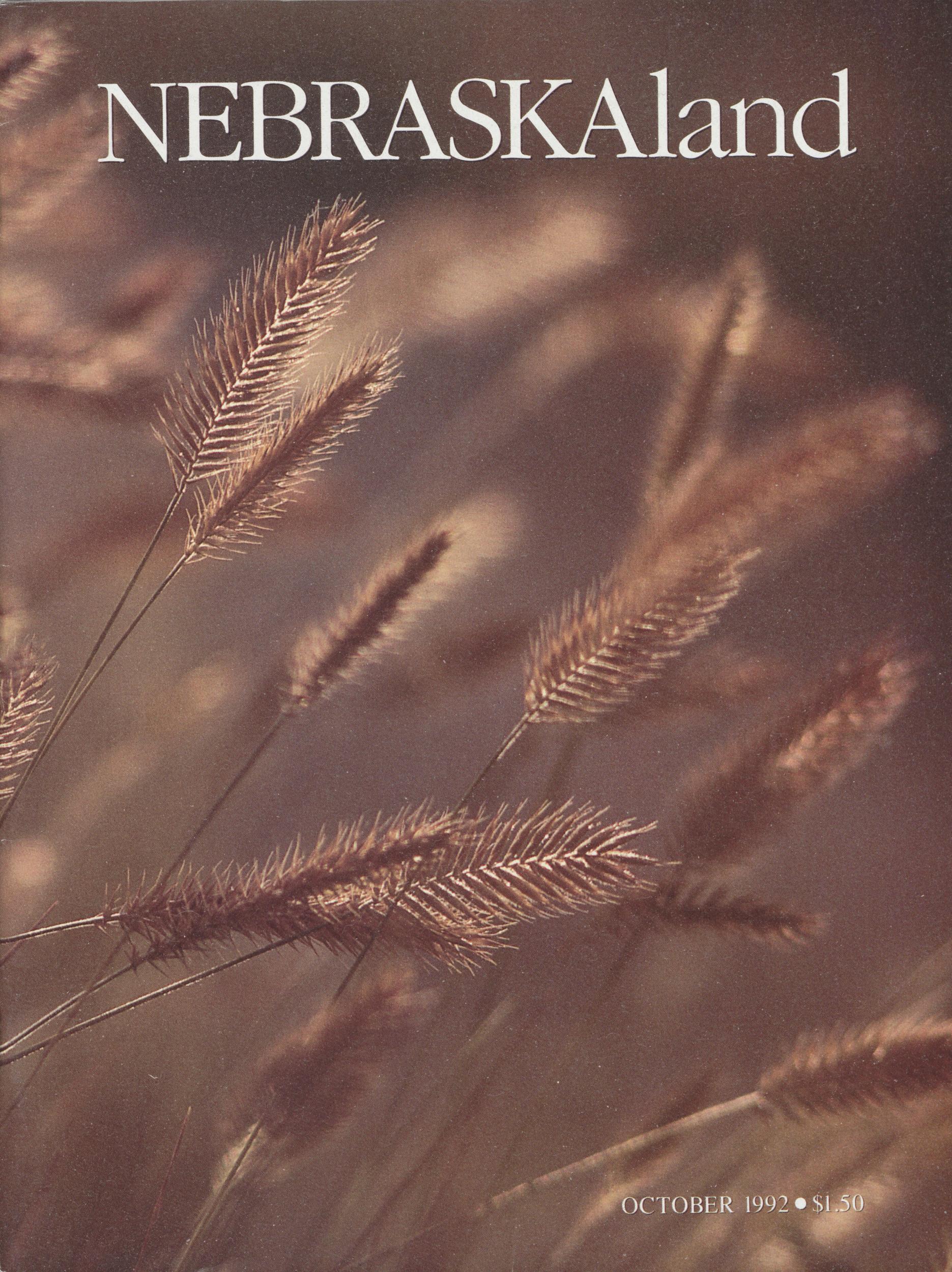
NEBRASKAland
OCTOBER 1992 $1.50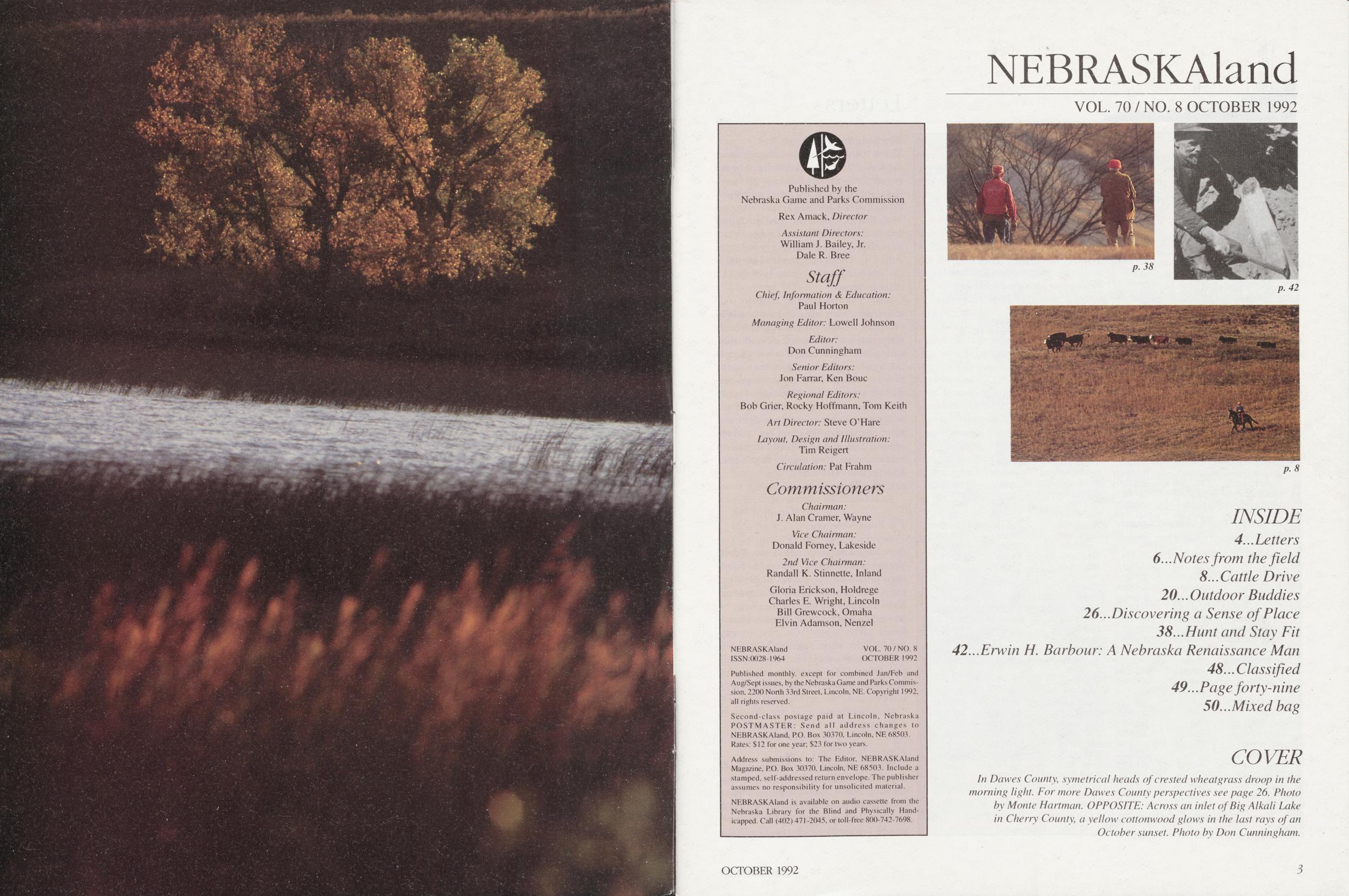
NEBRASKAland
VOL. 70 / NO. 8 OCTOBER 1992 Published by the Nebraska Game and Parks Commission Rex A mack, Director Assistant Directors: William J. Bailey, Jr. Dale R. Bree Staff Chief Information & Education: Paul Horton Managing Editor: Lowell Johnson Editor: Don Cunningham Senior Editors: Jon Farrar, Ken Bouc Regional Editors: Bob Grier, Rocky Hoffmann, Tom Keith Art Director: Steve O'Hare Layout, Design and Illustration: Tim Reigert Circulation: Pat Frahm Commissioners Chairman: J. Alan Cramer, Wayne Vice Chairman: Donald Forney, Lakeside 2nd Vice Chairman: Randall K. Stinnette, Inland Gloria Erickson, Holdrege Charles E. Wright, Lincoln Bill Grewcock, Omaha Elvin Adamson, Nenzel NEBRASKAland ISSN:0028-I964 VOL. 70 / NO. 8 OCTOBER 1992 Published monthly, except for combined Jan/Feb and Aug/Sept issues, by the Nebraska Game and Parks Commission. 2200 North 33rd Street, Lincoln, NE. Copyright 1992, all rights reserved. Second-class postage paid at Lincoln, Nebraska POSTMASTER: Send all address changes to NEBRASKAland, P.O. Box 30370, Lincoln. NE 68503. Rates: $ 12 for one year; $23 for two years. Address submissions to: The Editor, NEBRASKAland Magazine, P.O. Box 30370. Lincoln, NE 68503. Include a stamped, self-addressed return envelope. The publisher assumes no responsibility for unsolicited material. NEBRASKAland is available on audio cassette from the Nebraska Library for the Blind and Physically Handicapped. Call (402) 471 -2045. or loll-free 800-742-7698.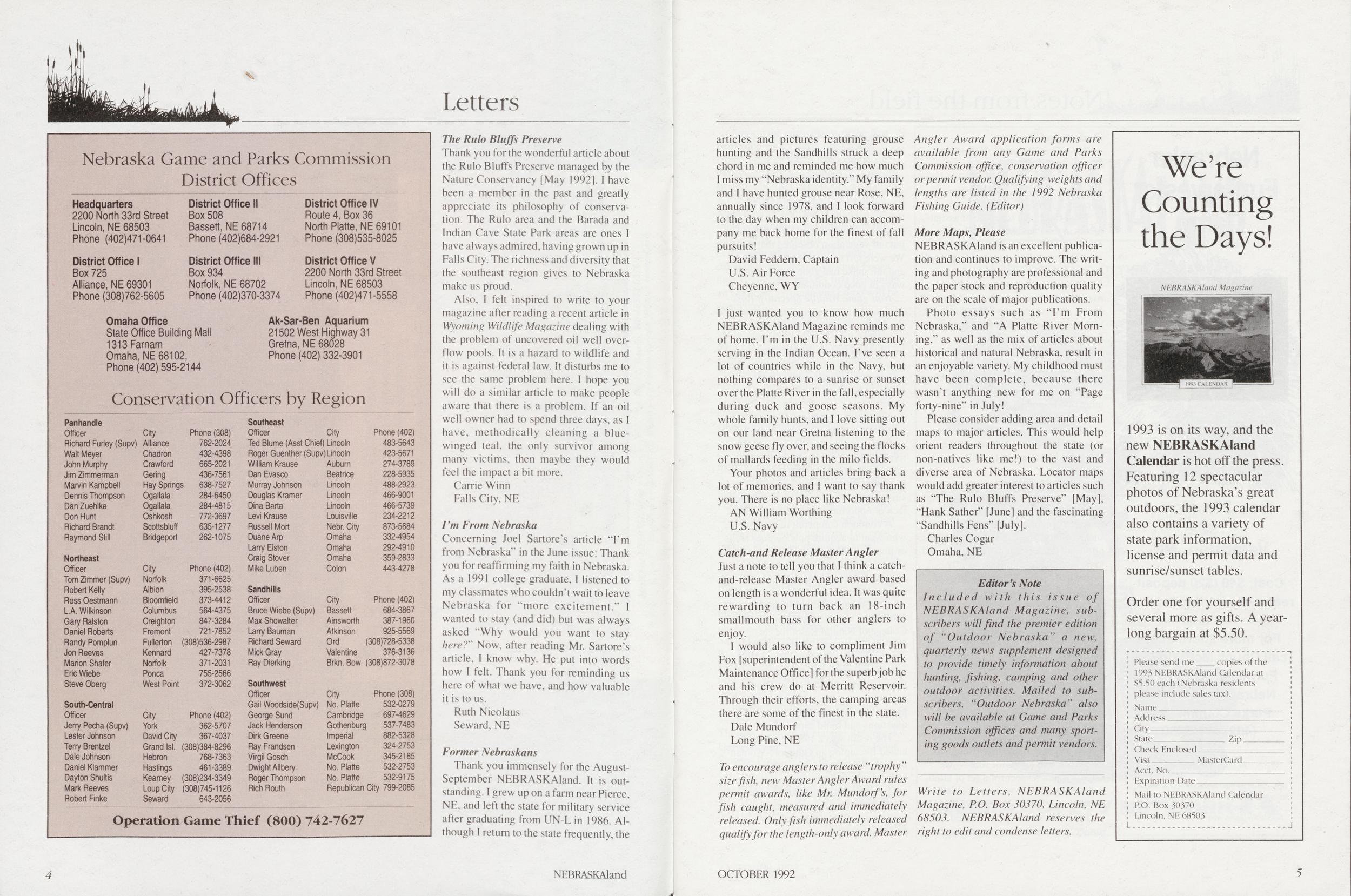 Nebraska Game and Parks Commission
District Offices
Headquarters District Office II District Office IV
2200 North 33rd Street Box 508 Route 4, Box 36
Lincoln, NE 68503 Bassett,NE 68714 North Platte, NE 69101
Phone (402)471-0641 Phone (402)684-2921 Phone (308)535-8025
District Office 1 District Office III District Office V
Box 725 Box 934 2200 North 33rd Street
Alliance, NE 69301 Norfolk, NE 68702 Lincoln, NE 68503
Phone (308)762-5605 Omaha Office Phone (402 )370-3374 Phone (402)471 -5558
Ak-Sar-Ben Aquarium
State Office Building Mall 21502 West Highway 31
1313Farnam Gretna, NE 68028
Omaha, NE 68102, Phone (402) 332-3901
Phone (402) 595-2144
Coi iservation Officers by Region Southeast
Panhandle
Officer City Phone (308) Officer City Phone (402)
Richard Furley (Supv) Alliance 762-2024 Ted Blume (Asst Chief) Lincoln 483-5643
Wait Meyer Chadron 432-4398 Roger Guenther (Supv) Lincoln 423-5671
John Murphy Crawford 665-2021 William Krause Auburn 274-3789
Jim Zimmerman Gering 436-7561 Dan Evasco Beatrice 228-5935
Marvin Kampbeil Hay Springs 638-7527 Murray Johnson Lincoln 488-2923
Dennis Thompson Ogallala 284-6450 Douglas Kramer Lincoln 466-9001
Dan Zuehlke Ogallala 284-4815 Dina Barta Lincoln 466-5739
Don Hunt Oshkosh 772-3697 Levi Krause Louisville 234-2212
Richard Brandt Scottsbluff 635-1277 Russell Mort Nebr. City 873-5684
Raymond Still Bridgeport 262-1075 Duane Arp Omaha 332-4954
Larry Eiston Omaha 292-4910
Northeast Craig Stover Omaha 359-2833
Officer City Phone (402) Mike Luben Colon 443-4278
Tom Zimmer (Supv) Norfolk 371-6625
Robert Kelly Albion 395-2538 Sandhills
Ross Oestmann Bloomfield 373-4412 Officer City Phone (402)
LA. Wilkinson Columbus 564-4375 Bruce Wiebe (Supv) Bassett 684-3867
Gary Ralston Creighton 847-3284 Max Showalter Ainsworth 387-1960
Daniel Roberts Fremont 721-7852 Larry Bauman Atkinson 925-5569
Randy Pomplun Fullerton (308)536-2987 Richard Seward Ord (308)728-5338
Jon Reeves Kennard 427-7378 Mick Gray Valentine 376-3136
Marion Shafer Norfolk 371-2031 Ray Dierking Brkn. Bow (308)872-3078
Eric Wiebe Ponca 755-2566
Steve Oberg West Point 372-3062 Southwest
Officer City Phone (308)
South-Central Gail Woodside(Supv) No. Platte 532-0279
Officer City Phone (402) George Sund Cambridge 697-4629
Jerry Pecha (Supv) York 362-5707 Jack Henderson Gothenburg 537-7483
Lester Johnson David City 367-4037 Dirk Greene Imperial 882-5328
Terry Brentzel Grand Isl. (308)384-8296 Ray Frandsen Lexington 324-2753
Dale Johnson Hebron 768-7363 Virgil Gosch McCook 345-2185
Daniel Klammer Hastings 461-3389 Dwight AHbery No. Platte 532-2753
Dayton Shultis Kearney (308)234-3349 Roger Thompsoi i No. Platte 532-9175
Mark Reeves Loup City (308)745-1126 Rich Routh Republican City 799-2085
Robert Finke Seward 643-2056
Operation Game Thief (800) 742-7627
Nebraska Game and Parks Commission
District Offices
Headquarters District Office II District Office IV
2200 North 33rd Street Box 508 Route 4, Box 36
Lincoln, NE 68503 Bassett,NE 68714 North Platte, NE 69101
Phone (402)471-0641 Phone (402)684-2921 Phone (308)535-8025
District Office 1 District Office III District Office V
Box 725 Box 934 2200 North 33rd Street
Alliance, NE 69301 Norfolk, NE 68702 Lincoln, NE 68503
Phone (308)762-5605 Omaha Office Phone (402 )370-3374 Phone (402)471 -5558
Ak-Sar-Ben Aquarium
State Office Building Mall 21502 West Highway 31
1313Farnam Gretna, NE 68028
Omaha, NE 68102, Phone (402) 332-3901
Phone (402) 595-2144
Coi iservation Officers by Region Southeast
Panhandle
Officer City Phone (308) Officer City Phone (402)
Richard Furley (Supv) Alliance 762-2024 Ted Blume (Asst Chief) Lincoln 483-5643
Wait Meyer Chadron 432-4398 Roger Guenther (Supv) Lincoln 423-5671
John Murphy Crawford 665-2021 William Krause Auburn 274-3789
Jim Zimmerman Gering 436-7561 Dan Evasco Beatrice 228-5935
Marvin Kampbeil Hay Springs 638-7527 Murray Johnson Lincoln 488-2923
Dennis Thompson Ogallala 284-6450 Douglas Kramer Lincoln 466-9001
Dan Zuehlke Ogallala 284-4815 Dina Barta Lincoln 466-5739
Don Hunt Oshkosh 772-3697 Levi Krause Louisville 234-2212
Richard Brandt Scottsbluff 635-1277 Russell Mort Nebr. City 873-5684
Raymond Still Bridgeport 262-1075 Duane Arp Omaha 332-4954
Larry Eiston Omaha 292-4910
Northeast Craig Stover Omaha 359-2833
Officer City Phone (402) Mike Luben Colon 443-4278
Tom Zimmer (Supv) Norfolk 371-6625
Robert Kelly Albion 395-2538 Sandhills
Ross Oestmann Bloomfield 373-4412 Officer City Phone (402)
LA. Wilkinson Columbus 564-4375 Bruce Wiebe (Supv) Bassett 684-3867
Gary Ralston Creighton 847-3284 Max Showalter Ainsworth 387-1960
Daniel Roberts Fremont 721-7852 Larry Bauman Atkinson 925-5569
Randy Pomplun Fullerton (308)536-2987 Richard Seward Ord (308)728-5338
Jon Reeves Kennard 427-7378 Mick Gray Valentine 376-3136
Marion Shafer Norfolk 371-2031 Ray Dierking Brkn. Bow (308)872-3078
Eric Wiebe Ponca 755-2566
Steve Oberg West Point 372-3062 Southwest
Officer City Phone (308)
South-Central Gail Woodside(Supv) No. Platte 532-0279
Officer City Phone (402) George Sund Cambridge 697-4629
Jerry Pecha (Supv) York 362-5707 Jack Henderson Gothenburg 537-7483
Lester Johnson David City 367-4037 Dirk Greene Imperial 882-5328
Terry Brentzel Grand Isl. (308)384-8296 Ray Frandsen Lexington 324-2753
Dale Johnson Hebron 768-7363 Virgil Gosch McCook 345-2185
Daniel Klammer Hastings 461-3389 Dwight AHbery No. Platte 532-2753
Dayton Shultis Kearney (308)234-3349 Roger Thompsoi i No. Platte 532-9175
Mark Reeves Loup City (308)745-1126 Rich Routh Republican City 799-2085
Robert Finke Seward 643-2056
Operation Game Thief (800) 742-7627
Letters
The Rulo Bluffs PreserveThank you for the wonderful article about the Rulo Bluffs Preserve managed by the Nature Conservancy [May 1992). I have been a member in the past and greatly appreciate its philosophy of conservation. The Rulo area and the Barada and Indian Cave State Park areas are ones I have always admired, having grown up in Falls City. The richness and diversity that the southeast region gives to Nebraska make us proud.
Also, I felt inspired to write to your magazine after reading a recent article in Wyoming Wildlife Magazine dealing with the problem of uncovered oil well overflow pools. It is a hazard to wildlife and it is against federal law. It disturbs me to see the same problem here. I hope you will do a similar article to make people aware that there is a problem. If an oil well owner had to spend three days, as I have, methodically cleaning a bluewinged teal, the only survivor among many victims, then maybe they would feel the impact a bit more.
Carrie Winn Falls City, NE I'm From NebraskaConcerning Joel Sartore's article "I'm from Nebraska * in the June issue: Thank you for reaffirming my faith in Nebraska. As a 1991 college graduate, I listened to my classmates who couldn't wait to leave Nebraska for "more excitement." I wanted to stay (and did) but was always asked "Why would you want to stay here?" Now, after reading Mr. Sartore's article, I know why. He put into words how I felt. Thank you for reminding us here of what we have, and how valuable it is to us.
Ruth Nicolaus Seward, NE Former NebraskansThank you immensely for the AugustSeptember NEBRASKAland. It is outstanding. I grew up on a farm near Pierce, NE, and left the state for military service after graduating from UN-L in 1986. Although I return to the state frequently, the 4 NEBRASKAland articles and pictures featuring grouse hunting and the Sandhills struck a deep chord in me and reminded me how much I miss my "Nebraska identity." My family and I have hunted grouse near Rose, NE, annually since 1978, and I look forward to the day when my children can accompany me back home for the finest of fall pursuits!
David Feddern, Captain U.S. Air Force Cheyenne, WYI just wanted you to know how much NEBRASKAland Magazine reminds me of home. Em in the U.S. Navy presently serving in the Indian Ocean. I've seen a lot of countries while in the Navy, but nothing compares to a sunrise or sunset over the Platte River in the fall, especially during duck and goose seasons. My whole family hunts, and I love sitting out on our land near Gretna listening to the snow geese fly over, and seeing the flocks of mallards feeding in the milo fields.
Your photos and articles bring back a lot of memories, and I want to say thank you. There is no place like Nebraska!
AN William Worthing U.S. Navy Catch-and Release Master AnglerJust a note to tell you that I think a catch-and-release Master Angler award based on length is a wonderful idea. It was quite rewarding to turn back an 18-inch smallmouth bass for other anglers to enjoy.
I would also like to compliment Jim Fox [superintendent of the Valentine Park Maintenance Officel for the superb job he and his crew do at Merritt Reservoir. Through their efforts, the camping areas there are some of the finest in the state.
Dale Mundorf Long Pine, NETo encourage anglers to release "trophy " size fish, new Master Angler Award rules permit awards, like Mr. Mundorfs, for fish caught, measured and immediately released. Only fish immediately released qualify for the length-only award. Master Angler Award application forms are available from any Game and Parks Commission office, conservation officer or permit vendor. Qualifying weights and lengths are listed in the 1992 Nebraska Fishing Guide. (Editor)
More Maps, PleaseNEBRASKAland is an excellent publication and continues to improve. The writing and photography are professional and the paper stock and reproduction quality are on the scale of major publications.
Photo essays such as "I'm From Nebraska," and "A Platte River Morning," as well as the mix of articles about historical and natural Nebraska, result in an enjoyable variety. My childhood must have been complete, because there wasn't anything new for me on "Page forty-nine" in July!
Please consider adding area and detail maps to major articles. This would help orient readers throughout the state (or non-natives like me!) to the vast and diverse area of Nebraska. Locator maps would add greater interest to articles such as "The Rulo Bluffs Preserve" [May], "Hank Sather" [June] and the fascinating "Sandhills Fens" [July].
Charles Cogar Omaha, NE Editor's Note Included with this issue of NEBRASKAland Magazine, subscribers will find the premier edition of "Outdoor Nebraska' a new, quarterly news supplement designed to provide timely information about hunting, fishing, camping and other outdoor activities. Mailed to subscribers, "Outdoor Nebraska' also will be available at Game and Parks Commission offices and many sporting goods outlets and permit vendors. Write to Letters, NEBRASKAland Magazine, P.O. Box 30370, Lincoln, NE 68503. NEBRASKAland reserves the right to edit and condense letters. We're Counting the Days! NEBRASKAland Mavazini 1993 is on its way, and the new NEBRASKAland Calendar is hot off the press. Featuring 12 spectacular photos of Nebraska's great outdoors, the 1993 calendar also contains a variety of state park information, license and permit data and sunrise/sunset tables. Order one for yourself and several more as gifts. A year-long bargain at $5.50. Please send me copies of the 1993 NEBRASKAland Calendar at $5.50 each (Nebraska residents please include sales tax). Name Address City State Check Enclosed Visa Zip MasterCard Acct. No Expiration Date Mail to NEBRASKAland Calendar P.O. Box 30370 Lincoln. NE 68503 OCTOBER 1992 5
Notes from the field
Nebraska Furharvester Oct. 30 - Nov. 1 1992 Valentine, NE. Cost: $40 ($20 deposit required with registration) For more information, call Chuck McCuilough, Furbearer Specialist, Nebraska Game and Parks Commission (402) 471-5430 Sponsored by the Nebraska Furharvesters Association and the Nebraska Federation of Coon Hunters in cooperation with the Nebraska Game and Parks Commission Predator and PreyA note from Ralph Wall, feature reporter for the Nebraska Television Network in Kearney, and Joyce Voigt of Alma, describes this encounter in northwest Nebraska:
I had finished a schedule of assignments in the Panhandle, and before returning to Kearney, we decided to visit Toadstool Park north of Crawford. A few miles from the park, Joyce spotted some commotion beside the road ahead of us. As we neared the chaos, we discovered a red-tailed hawk kicking itself around in a circle and flapping its wings wildly.
I first suspected the bird had a broken wing or leg and was wondering how we might be able to assist it. After a few minutes, though, the bird became more docile, and we saw that a bullsnake was involved. I wanted to videotape the scene, but with the batteries for my video equipment all expended, I had to resort to still photographs.
Eventually the snake worked its tail down around the hawk's neck. The constriction became tight enough that the neck feathers began to obscure the snake's body. The hawk seemed to be offering no return fight, and it appeared to be laboring for air. It frequently closed and opened its eye membrane.
Joyce and I felt we should let the drama play out to the probable suffocation of the hawk, but inexplicably, we chose to separate the combatants instead. I located a long stick and tried to use it to loosen the snake's hold. I'd have had better luck undoing a wet, knotted shoelace. Then I applied pressure to the snake's body with the stick, and after about 30 seconds the snake began to uncoil from around the hawk's neck. I don't believe I hurt the snake, but we didn't remain close enough to the situation to know for sure — we had too much respect for a set of talons and a sharp beak to remain as close to the hawk as we had been.
The hawk stood up and panted like a runner after a mile race. Upon regaining some breath, the bird hopped off about 20 yards with the snake still woven about its legs. After a little more recuperation, the hawk flew about 30 yards and landed awkwardly in some tall grass, taking the snake with it. When it next flew, it had abandoned the snake (or the snake had left the hawk), but tall vegetation obscured that detail. We were left to assume that the hawk and the snake had gone their separate ways in good condition.
Non-game Wildlife Specialist Ross Lock says that wrapping itself around the hawk was the natural defensive response for the bullsnake, a constrictor. If the onlookers had not intervened, says Lock, it is possible that the snake, a fairly common prey of red-tailed hawks, could have killed the bird.
Becoming an Outdoors -WomanWhy don't more women hunt, fish and take part in other outdoor activities? At a 1990 conference sponsored by the College of Natural Resources of the University of Wisconsin-Stevens Point, participants blamed a lack of opportunities to learn the skills.
A common complaint of women who want to acquire new outdoor skills or improve old ones is finding an atmosphere in which they can learn without having their confidence undermined by the intimidation — usually unintended — of more knowledgeable participants. Christine Thomas, a professor in the College of Natural Resources at Stevens Point, says "Women will say kMy husband is a great guy, but I've got to find someone else to learn these things from.'" Needed, says Thomas, is a "non-threatening, supportive atmosphere" in which to acquire skills, ask questions and build camaraderie.
The result was a 1991 workshop called Becoming an Outdoors-Woman through which more than 100 people, most of them women, studied skills ranging from firearms and firearm safety to finding field clothes that actually work. The 1992 workshop was filled six weeks in advance.
6 NEBRASKAlandAmong the participants in the first workshop were Gloria Erickson of Holdrege, a member of the Game and Parks Commission's Board of Commissioners, and De Carlson, of Crofton, an active outdoors worn an. Both women wanted more Nebraskans to have the same opportunity, and this month that opportunity is available: October 23-25, at the Nebraska State 4-H Camp located in the Nebraska National Forest near Halsey, Nebraska's first Becoming an Outdoors -Woman workshop will be conducted.
Noelyn "Butch" Isom, chief of the Game and Parks Commission's Outdoor Education division, sees sponsorship of the workshop as a matter of serving the agency's constituents. "I've been involved in hunter education for 17 years," says Isom. "When I started, I almost never saw a mother attending class with a son or daughter. Usually, it was fathers with sons. At the most recent classes I was involved in, I think there were more mothers than fathers.
"Sometimes we dispense information assuming everyone has the same background, the same vocabulary, the same life experiences. It's not an intentional slight, but it happens. The need for this kind of workshop is there."
Besides the University of Wisconsin Stevens Point College of Natural Resources and the Nebraska Game and Parks Commission, workshop sponsors include the Nebraska State 4-H Camp, the U.S. Fish and Wildlife Service, Safari Club International and its Nebraska chapter, Deer and Deer Hunting Magazine, the National Rifle Association, the National Shooting Sports Foundation and Cabela's.
For more information about the workshop, contact Christine L. Thomas, College of Natural Resources, University of Wisconsin-Stevens Point, Stevens Point, WI 54481, telephone (715) 346-4185, or the Nebraska Game and Parks Commission, P.O. Box 30370, Lincoln, NE 68503, telephone (402)471-0641.
Don Cunningham Celebrate the great outdoors Pre-Second World War antique vehicles compete in the Sugar Valley Rally in Scottsbluff-Gering, climbing the Wildcat Hills and passing Chimney Rock. 8:30 p.m. Thursday, October 1 Repeating Saturday, October 3, at 8:30 a.m. Underwritten in part by The Nebraska Game and Parks Commission and SmithKline Beecham Animal Health NEBRASKA ETV NETWORK IV OCTOBER 1992 7
Cattle Drive
Photos and Text by Jon Farrar Half a century ago, cowboys still drove cattle to sale barns and shipping yards. Last October, a handful of cowboys old enough to remember such cattle drives, and some not so old, relived the tradition.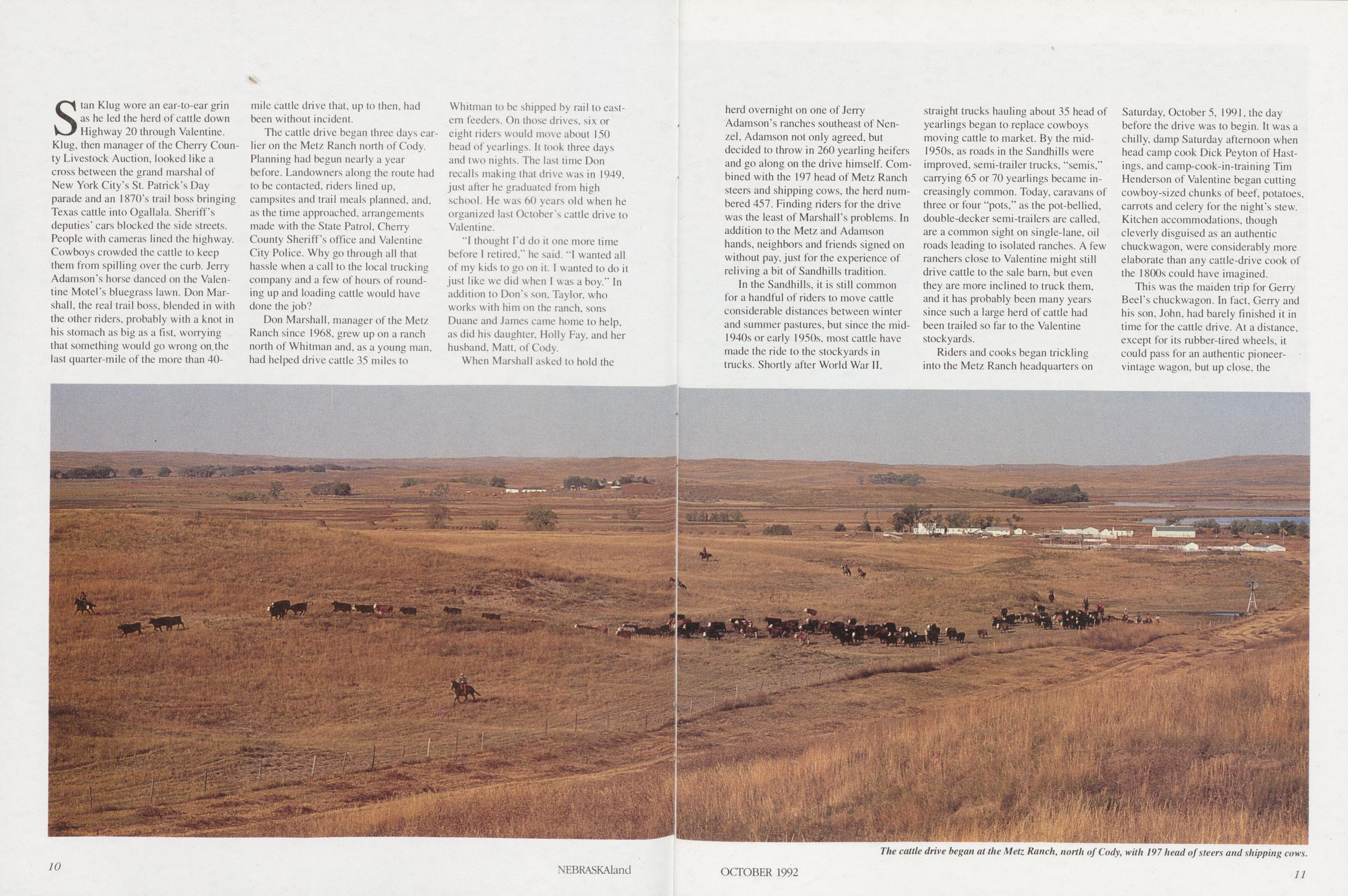
Stan Klug wore an ear-to-ear grin as he led the herd of cattle down Highway 20 through Valentine. Klug, then manager of the Cherry County Livestock Auction, looked like a cross between the grand marshal of New York City's St. Patrick's Day parade and an 1870's trail boss bringing Texas cattle into Ogallala. Sheriff's deputies' cars blocked the side streets. People with cameras lined the highway. Cowboys crowded the cattle to keep them from spilling over the curb. Jerry Adamson's horse danced on the Valentine Motel's bluegrass lawn. Don Marshall, the real trail boss, blended in with the other riders, probably with a knot in his stomach as big as a fist, worrying that something would go wrong on,the last quarter-mile of the more than 40-mile cattle drive that, up to then, had been without incident.
The cattle drive began three days earlier on the Metz Ranch north of Cody. Planning had begun nearly a year before. Landowners along the route had to be contacted, riders lined up, campsites and trail meals planned, and, as the time approached, arrangements made with the State Patrol, Cherry County Sheriff's office and Valentine City Police. Why go through all that hassle when a call to the local trucking company and a few of hours of rounding up and loading cattle would have done the job?
Don Marshall, manager of the Metz Ranch since 1968, grew up on a ranch north of Whitman and, as a young man, had helped drive cattle 35 miles to Whitman to be shipped by rail to eastem feeders. On those drives, six or eight riders would move about 150 head of yearlings. It took three days and two niehts. The last time Don recalls making that drive was in 1949, just after he graduated from high school. He was 60 years old when he organized last October's cattle drive to Valentine.
"I thought I'd do it one more time before I retired," he said. "I wanted all of my kids to go on it. I wanted to do it just like we did when I was a boy." In addition to Don's son. Taylor, who works with him on the ranch, sons Duane and James came home to help, as did his daughter. Holly Fay, and her husband, Matt, of Cody.
When Marshall asked to hold the 10 NEBRASKAland herd overnight on one of Jerry Adamson's ranches southeast of Nenzel, Adamson not only agreed, but decided to throw in 260 yearling heifers and go along on the drive himself. Combined with the 197 head of Metz Ranch steers and shipping cows, the herd numbered 457. Finding riders for the drive was the least of Marshall's problems. In addition to the Metz and Adamson hands, neighbors and friends signed on without pay, just for the experience of reliving a bit of Sandhills tradition.
In the Sandhills, it is still common for a handful of riders to move cattle considerable distances between winter and summer pastures, but since the mid-1940s or early 1950s, most cattle have made the ride to the stockyards in trucks. Shortly after World War II, straight trucks hauling about 35 head of yearlings began to replace cowboys moving cattle to market. By the mid1950s, as roads in the Sandhills were improved, semi-trailer trucks, "semis," carrying 65 or 70 yearlings became increasingly common. Today, caravans of three or four "pots," as the pot-bellied, double-decker semi-trailers are called, are a common sight on single-lane, oil roads leading to isolated ranches. A few ranchers close to Valentine might still drive cattle to the sale barn, but even they are more inclined to truck them, and it has probably been many years since such a large herd of cattle had been trailed so far to the Valentine stockyards.
Riders and cooks began trickling into the Metz Ranch headquarters on Saturday, October 5, 1991, the day before the drive was to begin. It was a chilly, damp Saturday afternoon when head camp cook Dick Peyton of Hastings, and camp-cook-in-training Tim Henderson of Valentine began cutting cowboy-sized chunks of beef, potatoes, carrots and celery for the night's stew. Kitchen accommodations, though cleverly disguised as an authentic chuckwagon, were considerably more elaborate than any cattle-drive cook of the 1800s could have imagined.
This was the maiden trip for Gerry Beel's chuckwagon. In fact, Gerry and his son, John, had barely finished it in time for the cattle drive. At a distance, except for its rubber-tired wheels, it could pass for an authentic pioneervintage wagon, but up close, the
 modern-day embellishments became
evident.
modern-day embellishments became
evident.
It was built on a 1967 Chevrolet halfton pickup carriage, complete with coil springs. The framework was made from angle and flat iron, the box from 2-by 8-inch and 2- by 10-inch pine planks burned with a torch to make the grain stand out, then sanded, stained and varnished. The steel tongue was fashioned from torque tubes and old drive shafts, and the neck yoke was adapted from a 1941 Chevy torque tube. The driver's seat was borrowed from a 1975 Suburban. The cover framework was made of wire cattle panels, and it was covered with canvas from Dick Peyton's canvas shop. The finished chuckwagon was 16 feet long, six feet wide and weighed 3,640 pounds. Because of its weight, the Beels added hydraulic brakes from a Chevy pickup to slow the wagon going downhill.
Originally, Gerry thought his twohorse team would pull the wagon, but a test drive in the hills made it clear a second team was required, no doubt in part because of the weight of the spare double trees and four-horse evener hung beneath the box, a 2- by 2-foot twin-burner stove with griddles, two swing-out, 2- by 4-foot steel tables, and the "bull-grazer" mounted on the side, a specialized device invented by cowboys to keep wayward bulls from straying off. When the wagon was fully loaded, the horses pulled about 5,000 pounds. In addition to the chuckwagon, two other wagons made the drive Auggie Galloway's buckboard and a Metz Ranch buckboard.
By 6 a.m. Sunday, massive quantities of bacon, eggs and fried potatoes were disappearing from the chuckwagon griddle. Overnight, the temperature had fallen to 16 degrees, and cowboy furnaces needed fuel. By 8 a.m., the Metz cattle were rounded up, and the drive began moving east through the hills, the wagons and Jim Kroeger, with the remuda, in the lead. Counting the riders in the wagons, about 20 people started the drive. The youngest rider was Scott Fay, Don Marshall's five-year-old grandson, who was "already a pretty good cowhand," according to his grandpa. Sunday night, though, Scott was the unhappiest cowboy on the drive. Monday was a school day, and he didn't get to spend the night in a bedroll under the stars.
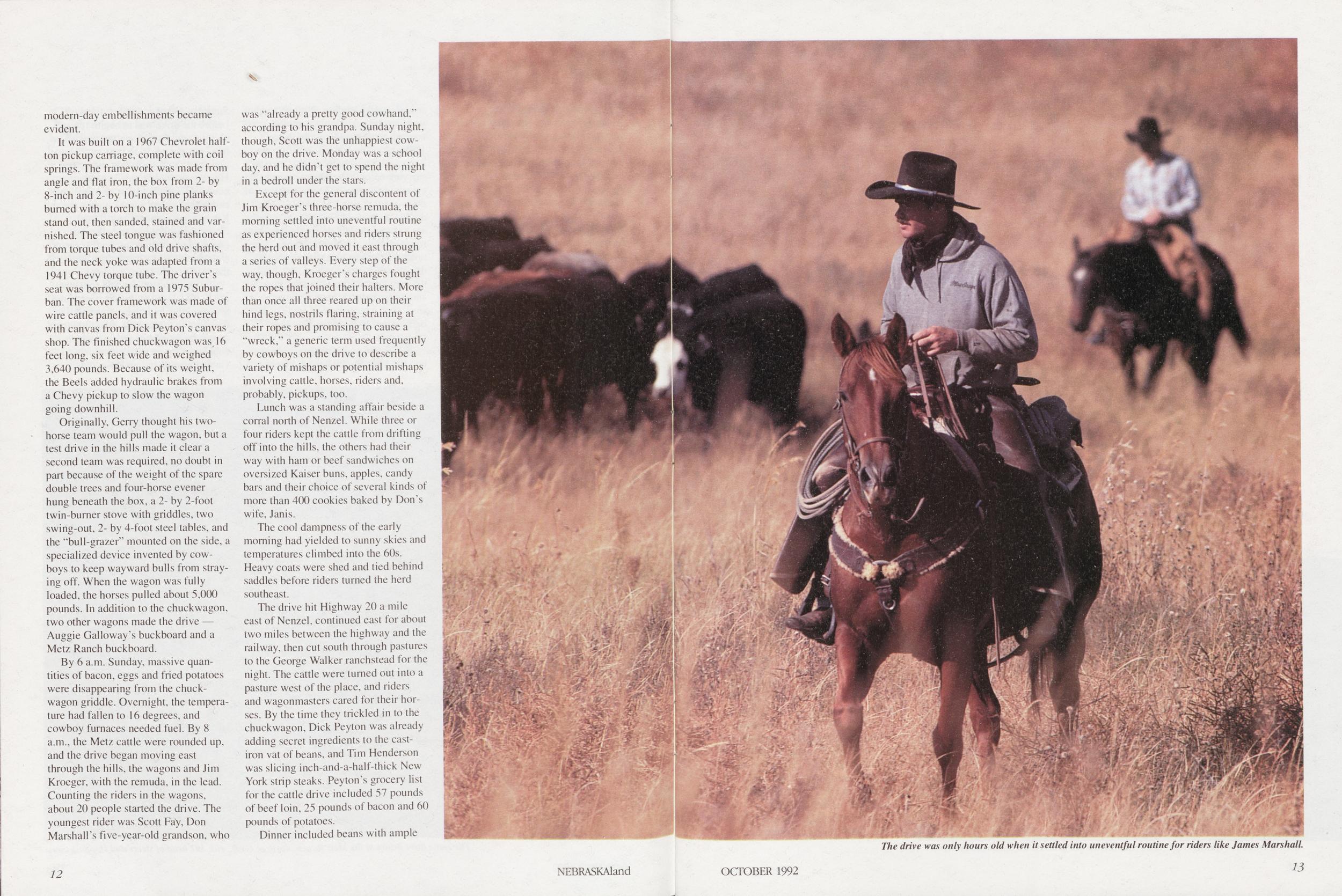
Except for the general discontent of Jim Kroeger's three-horse remuda, the morning settled into uneventful routine as experienced horses and riders strung the herd out and moved it east through a series of valleys. Every step of the way, though, Kroeger's charges fought the ropes that joined their halters. More than once all three reared up on their hind legs, nostrils flaring, straining at their ropes and promising to cause a "wreck," a generic term used frequently by cowboys on the drive to describe a variety of mishaps or potential mishaps involving cattle, horses, riders and, probably, pickups, too.
Lunch was a standing affair beside a corral north of Nenzel. While three or four riders kept the cattle from drifting off into the hills, the others had their way with ham or beef sandwiches on oversized Kaiser buns, apples, candy bars and their choice of several kinds of more than 400 cookies baked by Don's wife, Janis.
The cool dampness of the early morning had yielded to sunny skies and temperatures climbed into the 60s. Heavy coats were shed and tied behind saddles before riders turned the herd southeast.
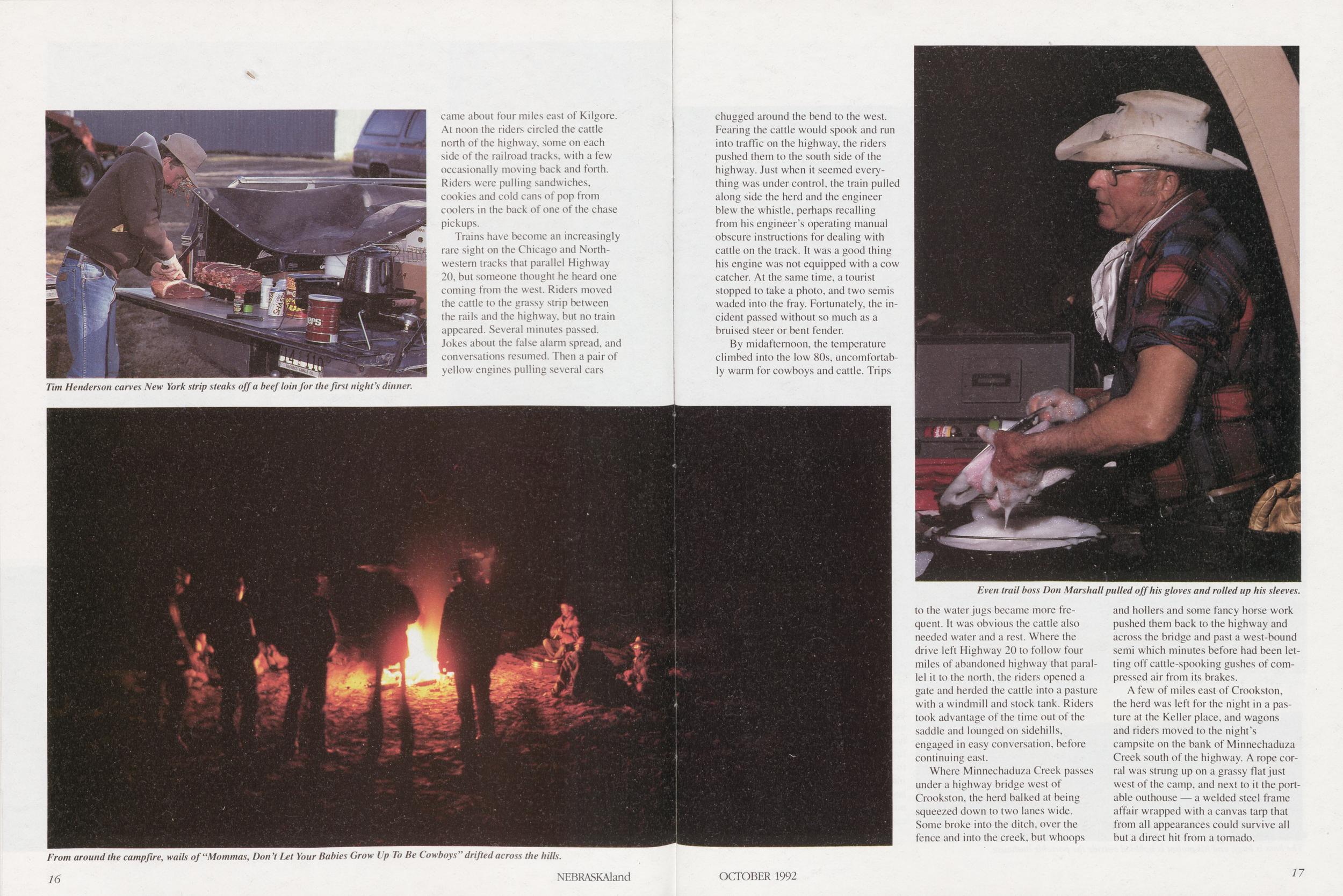
The drive hit Highway 20 a mile east of Nenzel, continued east for about two miles between the highway and the railway, then cut south through pastures to the George Walker ranchstead for the night. The cattle were turned out into a pasture west of the place, and riders and wagonmasters cared for their horses. By the time they trickled in to the chuckwagon, Dick Peyton was already adding secret ingredients to the castiron vat of beans, and Tim Henderson was slicing inch-and-a-half-thick New York strip steaks. Peyton's grocery list for the cattle drive included 57 pounds of beef loin, 25 pounds of bacon and 60 pounds of potatoes.
Dinner included beans with ample 12 NEBRASKAland
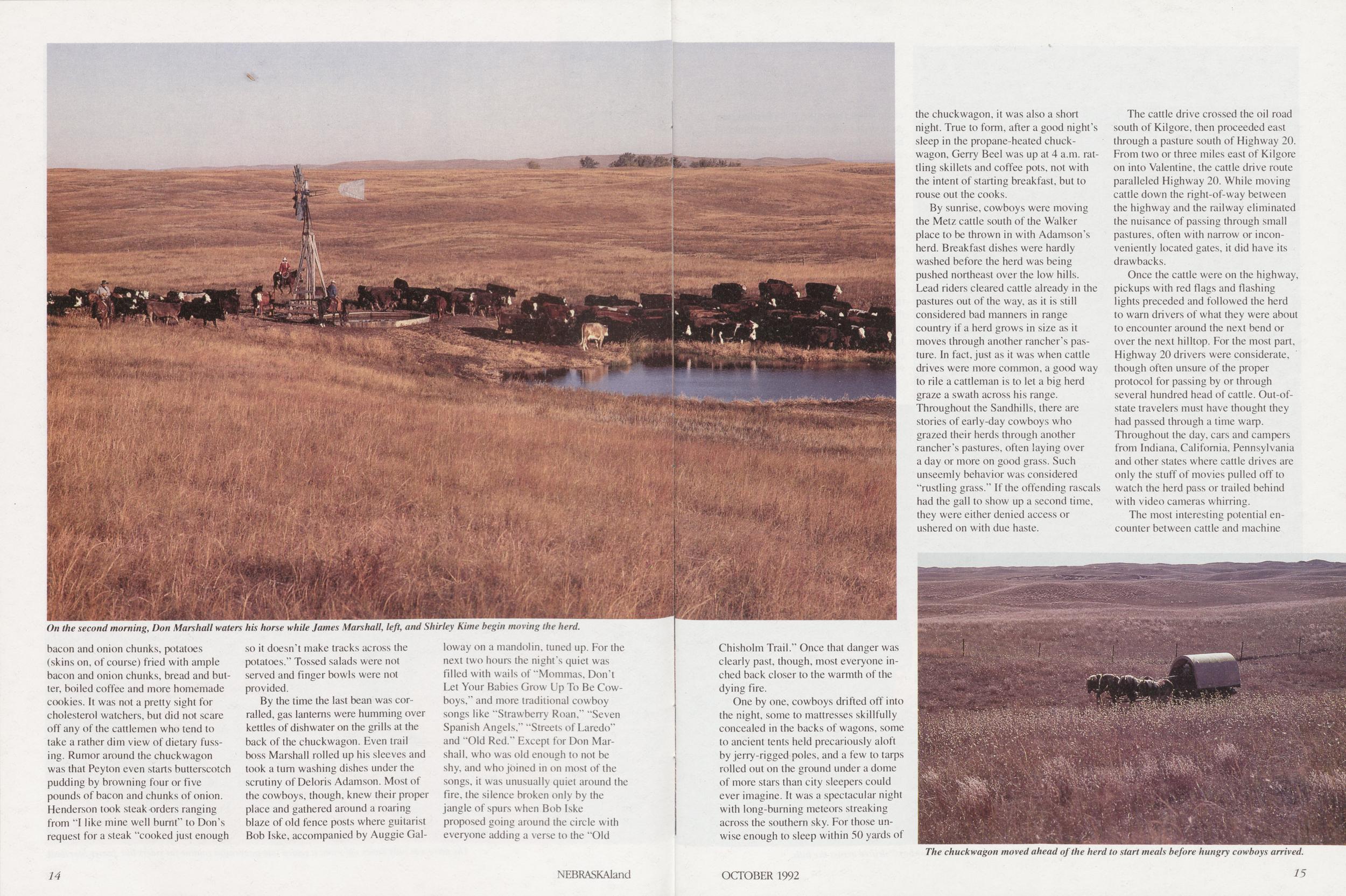
By the time the last bean was corralled, gas lanterns were humming over kettles of dishwater on the grills at the back of the chuckwagon. Even trail boss Marshall rolled up his sleeves and took a turn washing dishes under the scrutiny of Deloris Adamson. Most of the cowboys, though, knew their proper place and gathered around a roaring blaze of old fence posts where guitarist Bob Iske, accompanied by Auggie Galloway on a mandolin, tuned up. For the next two hours the night's quiet was filled with wails of "Mommas, Don't Let Your Babies Grow Up To Be Cowboys," and more traditional cowboy songs like "Strawberry Roan," "Seven Spanish Angels," "Streets of Laredo" and 'Old Red." Except for Don Marshall, who was old enough to not be shy, and who joined in on most of the songs, it was unusually quiet around the fire, the silence broken only by the jangle of spurs when Bob Iske proposed going around the circle with everyone adding a verse to the "Old 14 NEBRASKAland Chisholm Trail." Once that danger was clearly past, though, most everyone inched back closer to the warmth of the dying fire.
One by one, cowboys drifted off into the night, some to mattresses skillfully concealed in the backs of wagons, some to ancient tents held precariously aloft by jerry-rigged poles, and a few to tarps rolled out on the ground under a dome of more stars than city sleepers could ever imagine. It was a spectacular night with long-burning meteors streaking across the southern sky. For those unwise enough to sleep within 50 yards of the chuckwagon, it was also a short night. True to form, after a good night's sleep in the propane-heated chuckwagon, Gerry Beel was up at 4 a.m. rattling skillets and coffee pots, not with the intent of starting breakfast, but to rouse out the cooks.
By sunrise, cowboys were moving the Metz cattle south of the Walker place to be thrown in with Adamson's herd. Breakfast dishes were hardly washed before the herd was being pushed northeast over the low hills. Lead riders cleared cattle already in the pastures out of the way, as it is still considered bad manners in range country if a herd grows in size as it moves through another rancher's pasture. In fact, just as it was when cattle drives were more common, a good way to rile a cattleman is to let a big herd graze a swath across his range. Throughout the Sandhills, there are stories of early-day cowboys who grazed their herds through another rancher's pastures, often laying over a day or more on good grass. Such unseemly behavior was considered "rustling grass." If the offending rascals had the gall to show up a second time, they were either denied access or ushered on with due haste.
The cattle drive crossed the oil road south of Kilgore, then proceeded east through a pasture south of Highway 20. From two or three miles east of Kilgore on into Valentine, the cattle drive route paralleled Highway 20. While moving cattle down the right-of-way between the highway and the railway eliminated the nuisance of passing through small pastures, often with narrow or inconveniently located gates, it did have its drawbacks.
Once the cattle were on the highway, pickups with red flags and flashing lights preceded and followed the herd to warn drivers of what they were about to encounter around the next bend or over the next hilltop. For the most part, Highway 20 drivers were considerate, though often unsure of the proper protocol for passing by or through several hundred head of cattle. Out-of-state travelers must have thought they had passed through a time warp. Throughout the day, cars and campers from Indiana, California, Pennsylvania and other states where cattle drives are only the stuff of movies pulled off to watch the herd pass or trailed behind with video cameras whirring.
The most interesting potential encounter between cattle and machine
Trains have become an increasingly rare sight on the Chicago and Northwestern tracks that parallel Highway 20, but someone thought he heard one coming from the west. Riders moved the cattle to the grassy strip between the rails and the highway, but no train appeared. Several minutes passed. Jokes about the false alarm spread, and conversations resumed. Then a pair of yellow engines pulling several cars 16 NEBRASKAland chugged around the bend to the west. Fearing the cattle would spook and run into traffic on the highway, the riders pushed them to the south side of the highway. Just when it seemed everything was under control, the train pulled along side the herd and the engineer blew the whistle, perhaps recalling from his engineer's operating manual obscure instructions for dealing with cattle on the track. It was a good thing his engine was not equipped with a cow catcher. At the same time, a tourist stopped to take a photo, and two semis waded into the fray. Fortunately, the incident passed without so much as a bruised steer or bent fender.
By midafternoon, the temperature climbed into the low 80s, uncomfortably warm for cowboys and cattle. Trips to the water jugs became more frequent. It was obvious the cattle also needed water and a rest. Where the drive left Highway 20 to follow four miles of abandoned highway that parallel it to the north, the riders opened a gate and herded the cattle into a pasture with a windmill and stock tank. Riders took advantage of the time out of the saddle and lounged on sidehills, engaged in easy conversation, before continuing east.
Where Minnechaduza Creek passes under a highway bridge west of Crookston, the herd balked at being squeezed down to two lanes wide. Some broke into the ditch, over the fence and into the creek, but whoops and hollers and some fancy horse work pushed them back to the highway and across the bridge and past a west-bound semi which minutes before had been letting off cattle-spooking gushes of compressed air from its brakes.
A few of miles east of Crookston, the herd was left for the night in a pasture at the Keller place, and wagons and riders moved to the night's campsite on the bank of Minnechaduza Creek south of the highway. A rope corral was strung up on a grassy flat just west of the camp, and next to it the portable outhouse — a welded steel frame affair wrapped with a canvas tarp that from all appearances could survive all but a direct hit from a tornado.
OCTOBER 1992 17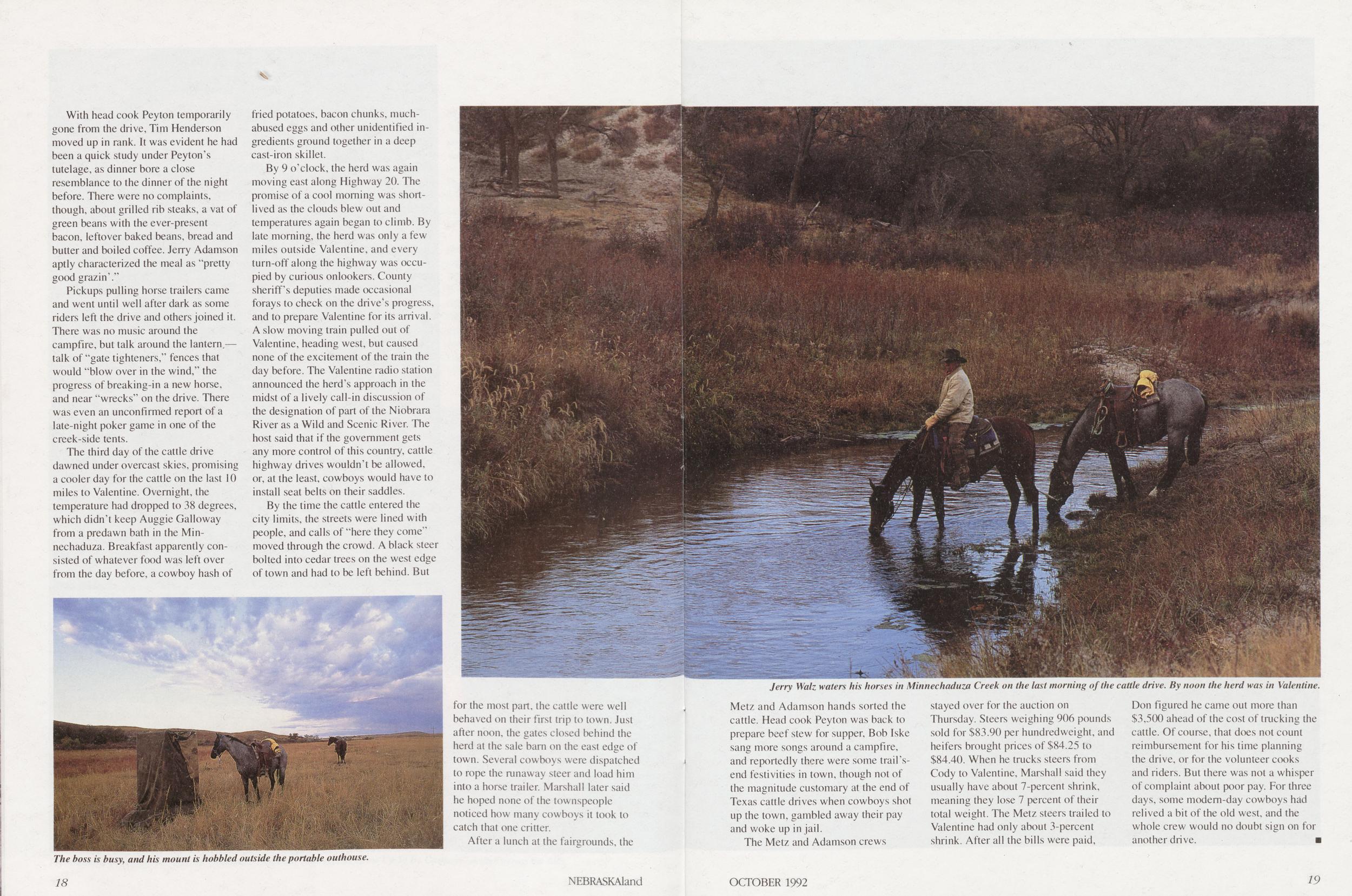
With head cook Peyton temporarily gone from the drive, Tim Henderson moved up in rank. It was evident he had been a quick study under Peyton's tutelage, as dinner bore a close resemblance to the dinner of the night before. There were no complaints, though, about grilled rib steaks, a vat of green beans with the ever-present bacon, leftover baked beans, bread and butter and boiled coffee. Jerry Adamson aptly characterized the meal as "pretty good grazin'."
Pickups pulling horse trailers came and went until well after dark as some riders left the drive and others joined it. There was no music around the campfire, but talk around the lantern, talk of "gate tighteners," fences that would "blow over in the wind," the progress of breaking-in a new horse, and near "wrecks" on the drive. There was even an unconfirmed report of a late-night poker game in one of the creek-side tents.
The third day of the cattle drive dawned under overcast skies, promising a cooler day for the cattle on the last 10 miles to Valentine. Overnight, the temperature had dropped to 38 degrees, which didn't keep Auggie Galloway from a predawn bath in the Minnechaduza. Breakfast apparently consisted of whatever food was left over from the day before, a cowboy hash of fried potatoes, bacon chunks, muchabused eggs and other unidentified ingredients ground together in a deep cast-iron skillet.
By 9 o'clock, the herd was again moving east along Highway 20. The promise of a cool morning was shortlived as the clouds blew out and temperatures again began to climb. By late morning, the herd was only a few miles outside Valentine, and every turn-off along the highway was occupied by curious onlookers. County sheriff's deputies made occasional forays to check on the drive's progress, and to prepare Valentine for its arrival. A slow moving train pulled out of Valentine, heading west, but caused none of the excitement of the train the day before. The Valentine radio station announced the herd's approach in the midst of a lively call-in discussion of the designation of part of the Niobrara River as a Wild and Scenic River. The host said that if the government gets any more control of this country, cattle highway drives wouldn't be allowed, or, at the least, cowboys would have to install seat belts on their saddles.
By the time the cattle entered the city limits, the streets were lined with people, and calls of "here they come" moved through the crowd. A black steer bolted into cedar trees on the west edge of town and had to be left behind. But for the most pail, the cattle were well behaved on their first trip to town. Just after noon, the gates closed behind the herd at the sale barn on the east edge of town. Several cowboys were dispatched to rope the runaway steer and load him into a horse trailer. Marshall later said he hoped none of the townspeople noticed how many cowboys it took to catch that one critter.
After a lunch at the fairgrounds, the
The Metz and Adamson crews stayed over for the auction on Thursday. Steers weighing 906 pounds sold for $83.90 per hundredweight, and heifers brought prices of $84.25 to $84.40. When he trucks steers from Cody to Valentine, Marshall said they usually have about 7-percent shrink, meaning they lose 7 percent of their total weight. The Metz steers trailed to Valentine had only about 3-percent shrink. After all the bills were paid, Don figured he came out more than $3,500 ahead of the cost of trucking the cattle. Of course, that does not count reimbursement for his time planning the drive, or for the volunteer cooks and riders. But there was not a whisper of complaint about poor pay. For three days, some modern-day cowboys had relived a bit of the old west, and the whole crew would no doubt sign on for another drive.
OCTOBER 1992 19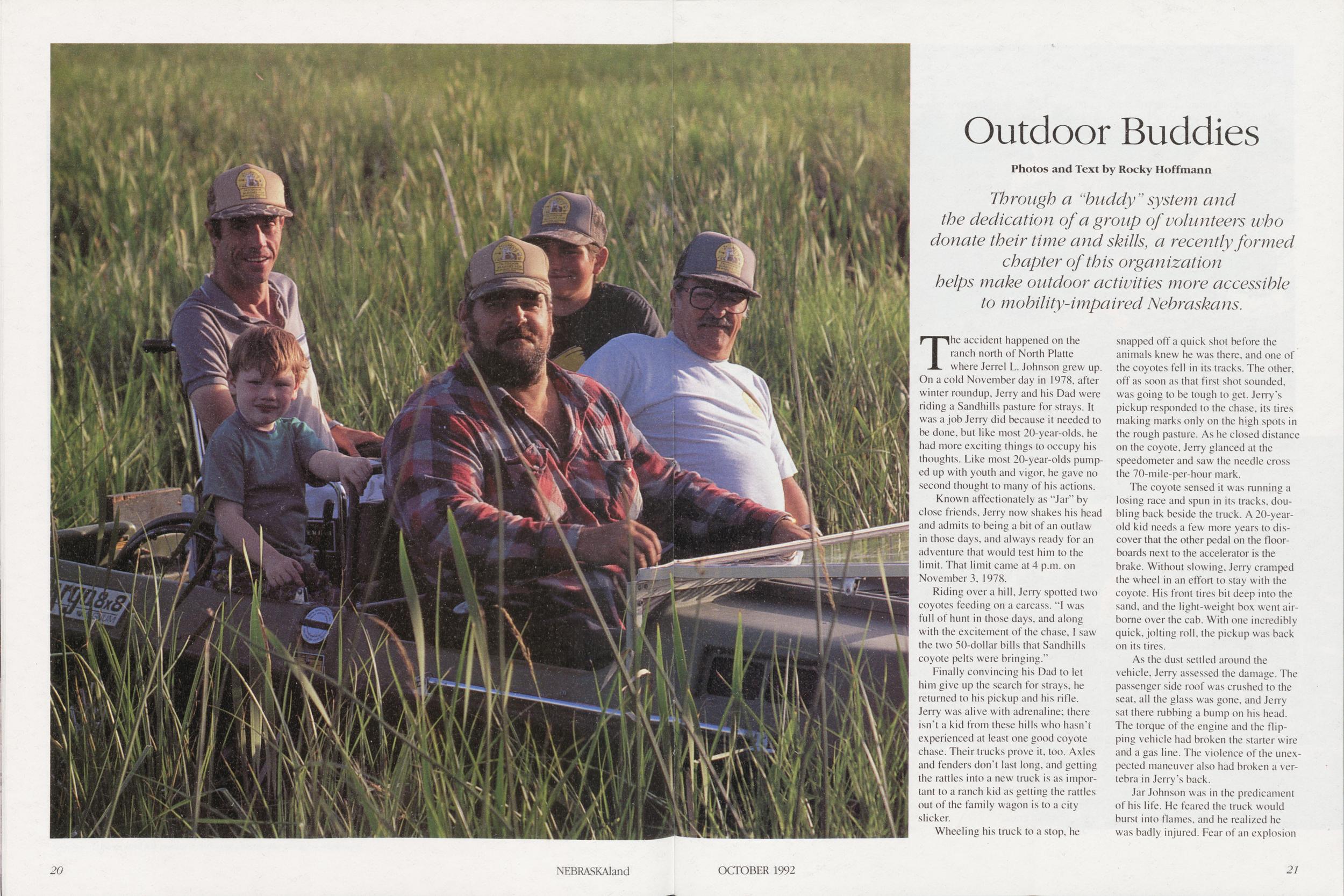
Outdoor Buddies
Photos and Text by Rocky Hoffmann Through a "buddy"system and the dedication of a group of volunteers who donate their time and skills, a recently formed chapter of this organization helps make outdoor activities more accessible to mobility-impaired Nebraskans.The accident happened on the ranch north of North Platte where Jerrel L. Johnson grew up. On a cold November day in 1978, after winter roundup, Jerry and his Dad were riding a Sandhills pasture for strays. It was a job Jerry did because it needed to be done, but like most 20-year-olds, he had more exciting things to occupy his thoughts. Like most 20-year-olds pumped up with youth and vigor, he gave no second thought to many of his actions.
Known affectionately as "Jar" by close friends, Jerry now shakes his head and admits to being a bit of an outlaw in those days, and always ready for an adventure that would test him to the limit. That limit came at 4 p.m. on November 3, 1978.
Riding over a hill, Jerry spotted two coyotes feeding on a carcass. "I was full of hunt in those days, and along with the excitement of the chase, I saw the two 50-dollar bills that Sandhills coyote pelts were bringing."
Finally convincing his Dad to let him give up the search for strays, he returned to his pickup and his rifle. Jerry was alive with adrenaline; there isn't a kid from these hills who hasn't experienced at least one good coyote chase. Their trucks prove it, too. Axles and fenders don't last long, and getting the rattles into a new truck is as important to a ranch kid as getting the rattles out of the family wagon is to a city slicker.
Wheeling his truck to a stop, he snapped off a quick shot before the animals knew he was there, and one of the coyotes fell in its tracks. The other, off as soon as that first shot sounded, was going to be tough to get. Jerry's pickup responded to the chase, its tires making marks only on the high spots in the rough pasture. As he closed distance on the coyote, Jerry glanced at the speedometer and saw the needle cross the 70-mile-per-hour mark.
The coyote sensed it was running a losing race and spun in its tracks, doubling back beside the truck. A 20-year-old kid needs a few more years to discover that the other pedal on the floorboards next to the accelerator is the brake. Without slowing, Jerry cramped the wheel in an effort to stay with the coyote. His front tires bit deep into the sand, and the light-weight box went airborne over the cab. With one incredibly quick, jolting roll, the pickup was back on its tires.
As the dust settled around the vehicle. Jerry assessed the damage. The passenger side roof was crushed to the seat, all the glass was gone, and Jerry sat there rubbing a bump on his head. The torque of the engine and the flipping vehicle had broken the starter wire and a gas line. The violence of the unexpected maneuver also had broken a vertebra in Jerry's back.
Jar Johnson was in the predicament
of his life. He feared the truck would
burst into flames, and he realized he
was badly injured. Fear of an explosion
OCTOBER 1992
21
The next two hours were a painful preview of the challenges he would face for the rest of his life. He tried to crawl half a mile to a ranch house, but gave up after only a few yards. How his body depended on legs, even to crawl! He dragged himself back to the truck. Daylight was waning, and cold was setting in. 'Tm going to freeze to death," he remembers thinking aloud.
Raised in the Sandhills, Jerry knew that if there was one thing that would get attention, it was a grass fire. Inside the passenger door, forced open by the impact, he was able to reach an oily rag, which he tied into a ball and struck a match to. "I had the presence of mind to throw the rag downwind, and I got off a good one — about 30 yards or so, but I forgot about the backfire that always occurs in grass."
Jerry saw the fire moving toward him and tried to crawl away, but it overtook him, burning the flesh to the bone on parts of his legs. The fire passed over him, and he lay mute in a blanket of smoke, listening helplessly to the voices of fire fighters searching for him only yards from where he lay. Finally, a volunteer passed close by, and Jerry reached out and grabbed his ankle.
Over the next few years, doctors and hospitals commanded his life, finally landing him in Denver's Craig Hospital Rehabilitation Center. He had given up mentally, and was badly neglecting and abusing what was left of his body. He wanted to enjoy the outdoors. He continued to try, but because of his attitude and the struggle to accomplish even the most simple task, he no longer enjoyed it. He wanted to be able to do more; to be unrestricted. Most of all, he wanted to hunt elk in the Rocky Mountains.
Sam Andrews, head of the rehabilitation center, got wind of Jerry's request and paid him a visit. Sam described a new organization to Jerry that had just taken root in Colorado called Outdoor Buddies. Sam said the program had 22 NEBRASKAland been developed by Sid Sellers, a man he described as having a heart as big as the Rockies.
Sam said this was an entirely new concept and he didn't know whether it would work or not. But, he said, they are offering the mobility impaired a chance to hunt elk this year. All it would cost was the price of the permit and transportation. Jerry would have to bring along a non-disabled companion.
That fall, permit in hand, Jerry and his companion arrived on the Evans ranch before daybreak to hunt elk. He was treated with respect, not pity, and he was taken into the mountains to hunt. He killed a six-point bull, and left Colorado with a dream fulfilled and a commitment to see that others got that kind of opportunity.
Jerry began to change, and eventually the memory of that hunt led to a meeting with Sid Sellers at the Red Cross building in North Platte. Jerry had promoted the meeting well, and the building was packed with interested participants, some in wheelchairs, some with no physical impairments. A Nebraska chapter of Outdoor Buddies was being formed, and Jerrel Johnson would serve as chapter chairman.
Nebraska was the first state to expand the Colorado-based corporation, and now, more than a year later, all of those who sat in wheelchairs or stood in that Red Cross meeting room remain actively involved.
Outdoor Buddies holds together not because it is legally incorporated, but because of a commitment and a heartfelt desire by "able-buddies" to provide high-quality outdoor experiences to "handi-buddies." No dues or annual fees are required, simply a commitment of trust and dependability.
Experiencing nature is among the most fulfilling, yet basic, pleasures of life. It is also thought to be among the most therapeutic natural treatments available to those who are rehabilitating. Unfortunately, because of natural barriers, it can be the most restrictive, and a buddy system becomes imperative to offer the mobility impaired the support necessary to enjoy the wild.
In his office on the ranch where he was injured, Jerry sits in his chair going over materials for a newsletter to be published by his fledgling group. A sixpoint bull elk head hangs low on the wall to allow its antlers to clear the ceiling. Jerry thinks carefully about what he is about to say, then points to a tall man across the room.
"If it weren't for that man and others like him, Outdoor Buddies couldn't exist. He's devoting a good share of his life to see to it that those of us who are stuck in these chairs get a fair shake."
The tall man is Roger Brandl, the
right-hand-man to Jerry and other
handi-buddies since the program got
OCTBOER 1992
23
 started, but Roger doesn't consider his
devotion to the organization to be a
sacrifice of any part of his life.
started, but Roger doesn't consider his
devotion to the organization to be a
sacrifice of any part of his life.
"I thrive on it. Like me, most sportsmen enjoy companionship in the field, and I can find a mobility-challenged person to go hunting or fishing with anytime I pick up the phone. As an able-buddy, I'm supposed to be teaching the handi-buddy a few things about a sound outdoor ethic. Let me tell you, these fellows are teaching me a lot."
If there is anything Outdoor Buddies lacks, it is more able-buddies and supporters, but Brandl is doing his share to drum up support. There was the cowboy in the Cadillac, for example, pulling a horse trailer from Bismarck to the Cheyenne, Wyoming, Frontier Days. He lost two push rods and pulled into Roger's service center for repairs. Roger remembered that Jerry had an old engine on his place from which two push rods were retrieved to replace the bad ones in the cowboy's car.
Before leaving North Platte, the Bismarck cowboy registered as an ablebuddy and later called Jerry, offering his North Dakota ranch and hunting preserve for the free and exclusive use of Outdoor Buddies. An outfitter and salmon fishing guide from New Hampshire with a similar breakdown registered his fishing resort in the program, and a minister from Michigan with a car problem registered as an ablebuddy offering a big-game hunt in the North Woods.
Similar cooperation has come locally: One area hunter offered an accessible goose pit, another provided a prairie dog town for shooting, and an assortment of landowners donated land for hunting everything from turkeys to deer, pheasants and geese.
Jerry tells of a deer hunt the group scheduled involving Dorothy and Arland Klein. Arland is a handi-buddy and his wife Dorothy is an able-buddy. Both are in their 60s, and Arland had done no hunting until Outdoor Buddies introduced him to the sport. Now he won't pass up an opportunity, and this year Arland drew a Sandhills Unit deer permit.
Jerry, Arland and Dorothy headed north to a ranch near Try on, where they had previously secured permission for the hunt. Arland spotted a two-point mule deer buck standing in some trees. He steadied his rifle and made a clean kill at about 250 yards. As they drove closer, they came to a fence completely enclosing the woodlot. There wasn't a gate to be found, and it was up to ablebuddy Dorothy to drag the deer back to the truck, three feet at a time. Mandatory equipment on the Outdoor Buddies hunt list now includes at least 400 feet of cable.
Outdoor Buddies attempts to provide a complete outdoor experience. Realizing that many of their members do not shoot or hunt, the organization also provides fishing, nature watching and outdoor photography opportunities.
Handi-buddies who like to fish are enjoying a fishing pier constructed by Outdoor Buddies through private donations on land leased by Foust's Inlet Cafe at Lake Maloney. The facility was well used this spring, allowing accessibility to a typically hazardous shoreline where, until this year, traditional early fishing has only been enjoyed by the surefooted. A primary goal of Outdoor Buddies is to serve as a liaison between the Nebraska Game and Parks Commission and the mobility-impaired people who enjoy outdoor resources and recreation. Such a liaison relationship now exists between Outdoor Buddies of Colorado and the Colorado Department of Fish and Game. The Nebraska Game and Parks Commission is planning a pier at the Kansas Point Recreation Area at Lake Maloney similar to an accessible fishing platform installed several years ago at Johnson Lake inlet.
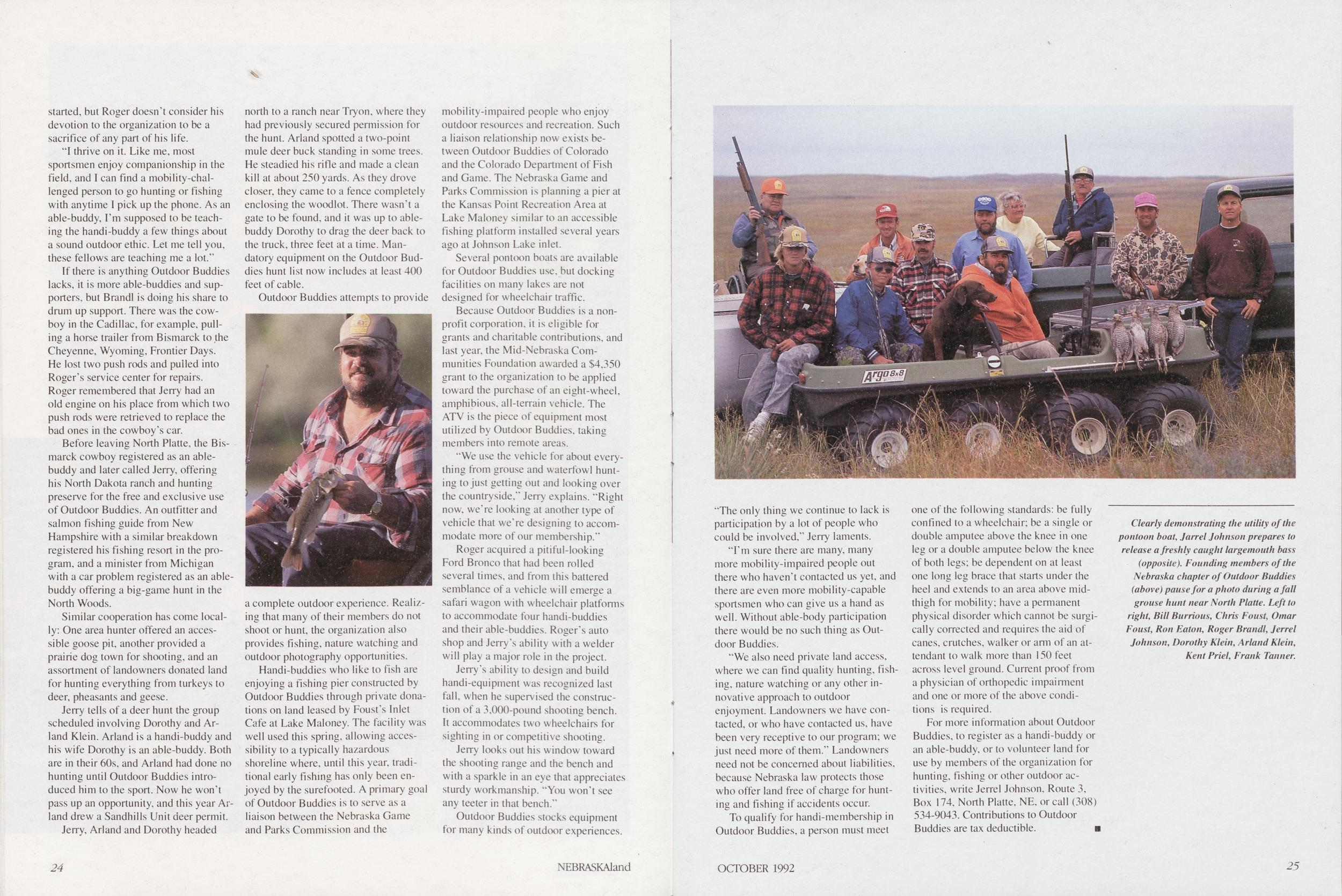
Several pontoon boats are available for Outdoor Buddies use. but docking facilities on many lakes are not designed for wheelchair traffic.
Because Outdoor Buddies is a nonprofit corporation, it is eligible for grants and charitable contributions, and last year, the Mid-Nebraska Communities Foundation awarded a $4,350 grant to the organization to be applied toward the purchase of an eight-wheel, amphibious, all-terrain vehicle. The ATV is the piece of equipment most utilized by Outdoor Buddies, taking members into remote areas.
"We use the vehicle for about everything from grouse and waterfowl hunting to just getting out and looking over the countryside," Jerry explains. "Right now, we're looking at another type of vehicle that we're designing to accommodate more of our membership."
Roger acquired a pitiful-looking Ford Bronco that had been rolled several times, and from this battered semblance of a vehicle will emerge a safari wagon with wheelchair platforms to accommodate four handi-buddies and their able-buddies. Roger's auto shop and Jerry's ability with a welder will play a major role in the project.
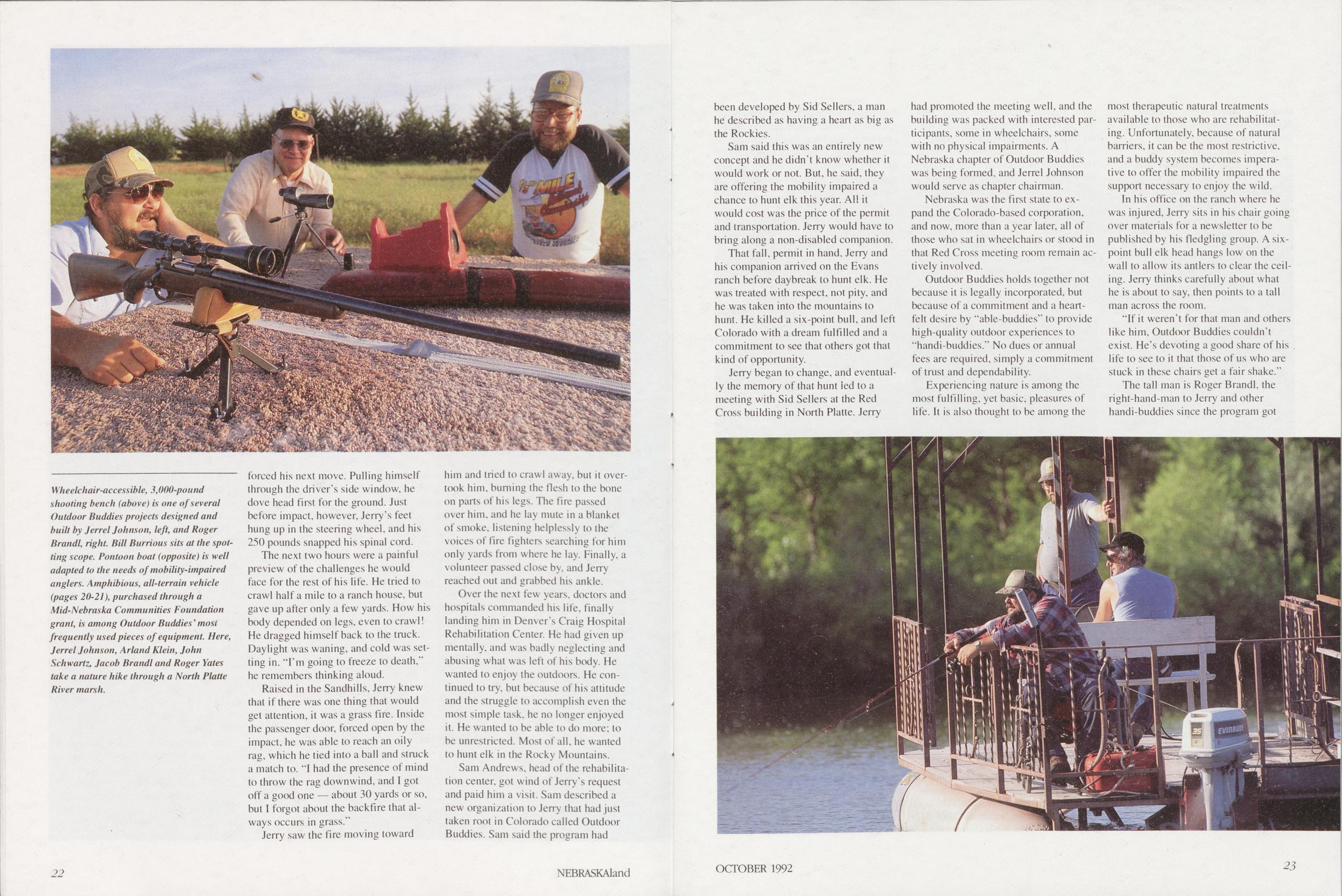
Jerry's ability to design and build handi-equipment was recognized last fall, when he supervised the construction of a 3,000-pound shooting bench. It accommodates two wheelchairs for sighting in or competitive shooting.
Jerry looks out his window toward the shooting range and the bench and with a sparkle in an eye that appreciates sturdy workmanship. "You won't see any teeter in that bench."
Outdoor Buddies stocks equipment for many kinds of outdoor experiences. 24 NEBRASKAland "The only thing we continue to lack is participation by a lot of people who could be involved," Jerry laments.
"I'm sure there are many, many more mobility-impaired people out there who haven't contacted us yet, and there are even more mobility-capable sportsmen who can give us a hand as well. Without able-body participation there would be no such thing as Outdoor Buddies.
"We also need private land access, where we can find quality hunting, fishing, nature watching or any other innovative approach to outdoor enjoyment. Landowners we have contacted, or who have contacted us, have been very receptive to our program; we just need more of them." Landowners need not be concerned about liabilities, because Nebraska law protects those who offer land free of charge for hunting and fishing if accidents occur.
To qualify for handi-membership in Outdoor Buddies, a person must meet one of the following standards: be fully confined to a wheelchair; be a single or double amputee above the knee in one leg or a double amputee below the knee of both legs; be dependent on at least one long leg brace that starts under the heel and extends to an area above midthigh for mobility; have a permanent physical disorder which cannot be surgically corrected and requires the aid of canes, crutches, walker or arm of an attendant to walk more than 150 feet across level ground. Current proof from a physician of orthopedic impairment and one or more of the above conditions is required.
For more information about Outdoor Buddies, to register as a handi-buddy or an able-buddy, or to volunteer land for use by members of the organization for hunting, fishing or other outdoor activities, write Jerrel Johnson, Route 3, Box 174, North Platte, NE, or call (308) 534-9043. Contributions to Outdoor Buddies are tax deductible.
Discovering a Sense of Place
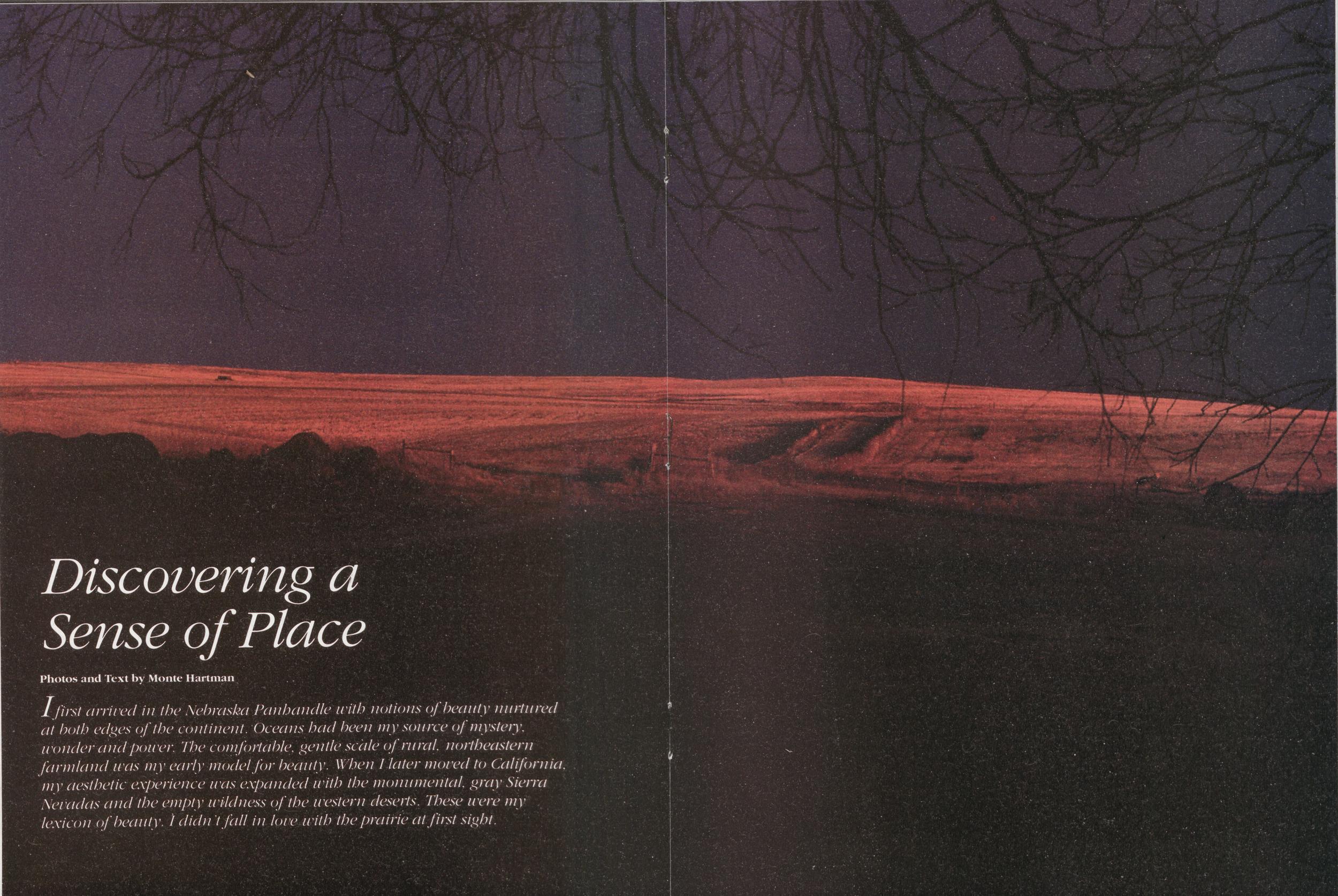
Photos and Text by Monte Hartman I first arrired in the Nebrasha Panhandle with notions of beauty nurtured at holh edges of the continent. Oceans had heen my source of mystery, wonder and power, 'the comfortable, yent/e scale of rural, northeastern farm/and was my early model for beauty. When I later mored to California iny aesthetic experience was expanded with the monumental, yray Sierra Xcradas and the empty mildness of the irestem deserts. These were my lexicon ofheanty. I didn't fall in lore with the prairie at first sight.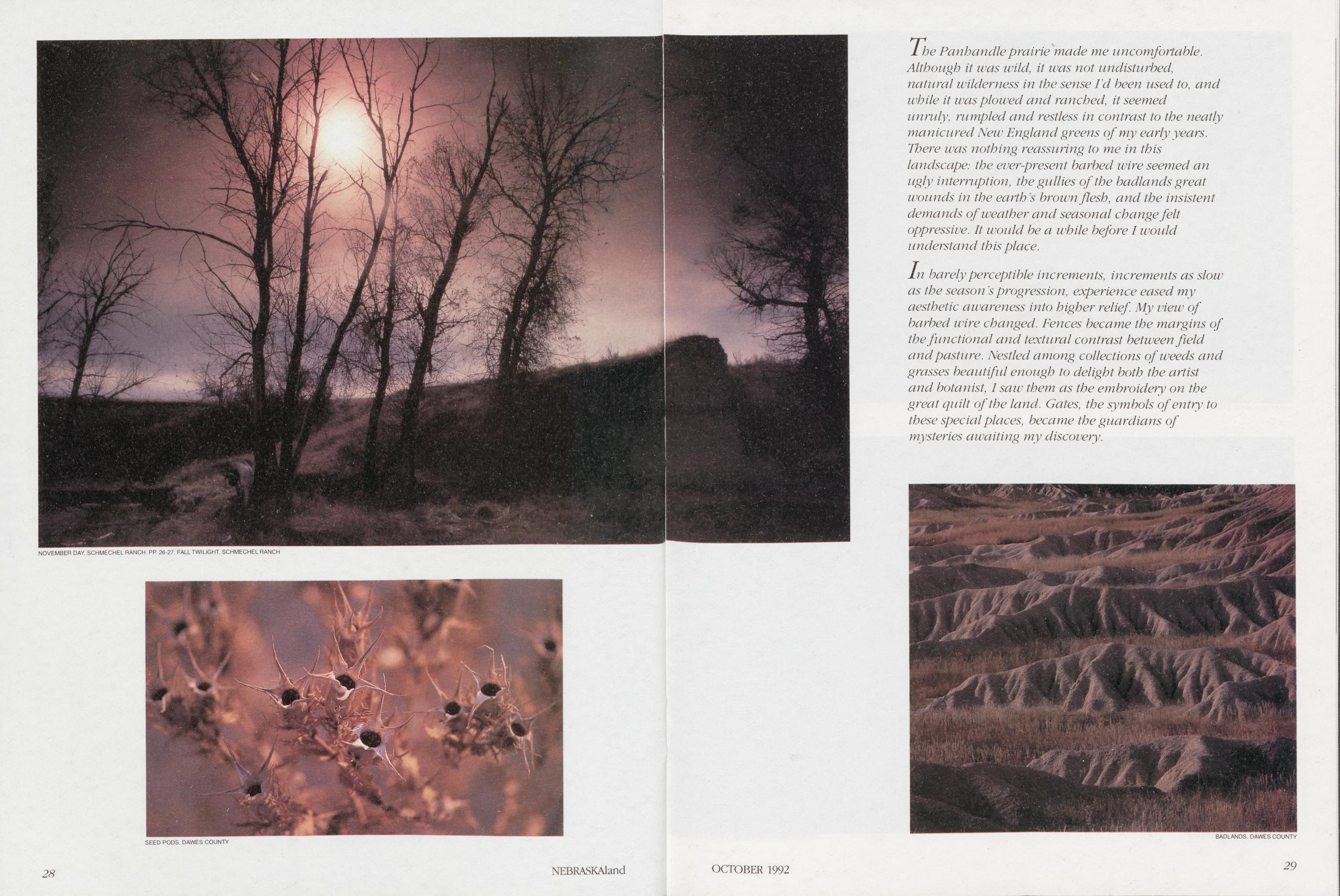
The Panhandle prairie made me uncomfortable. Although it was wild, it was not undisturbed, natural wilderness in the sense I'd been used to, and while it was plowed and ranched, it seemed unruly, rumpled and restless in contrast to the neatly manicured New England greens of my early years. There was nothing reassuring to me in this landscape: the ever-present barbed wire seemed an ugly interruption, the gullies of the badlands great wounds in the earth's brown flesh, and the insistent demand of weather and seasonal change felt oppressive. It would be a while before I would understand this place.
In barely perceptible increments, increments as slow as the season's progression, experience eased my aesthetic awareness into higher relief. My view of barbed wire changed. Fences became the margins of the functional and textural contrasts between field and pasture. Nestled among collections of weeds and grasses beautiful enough to delight both the artist and botanist, I saw them as the embroidery on the great quilt of the land. Gates, the symbols of entry to these special places, became the guardians of mysteries awaiting my discovery.
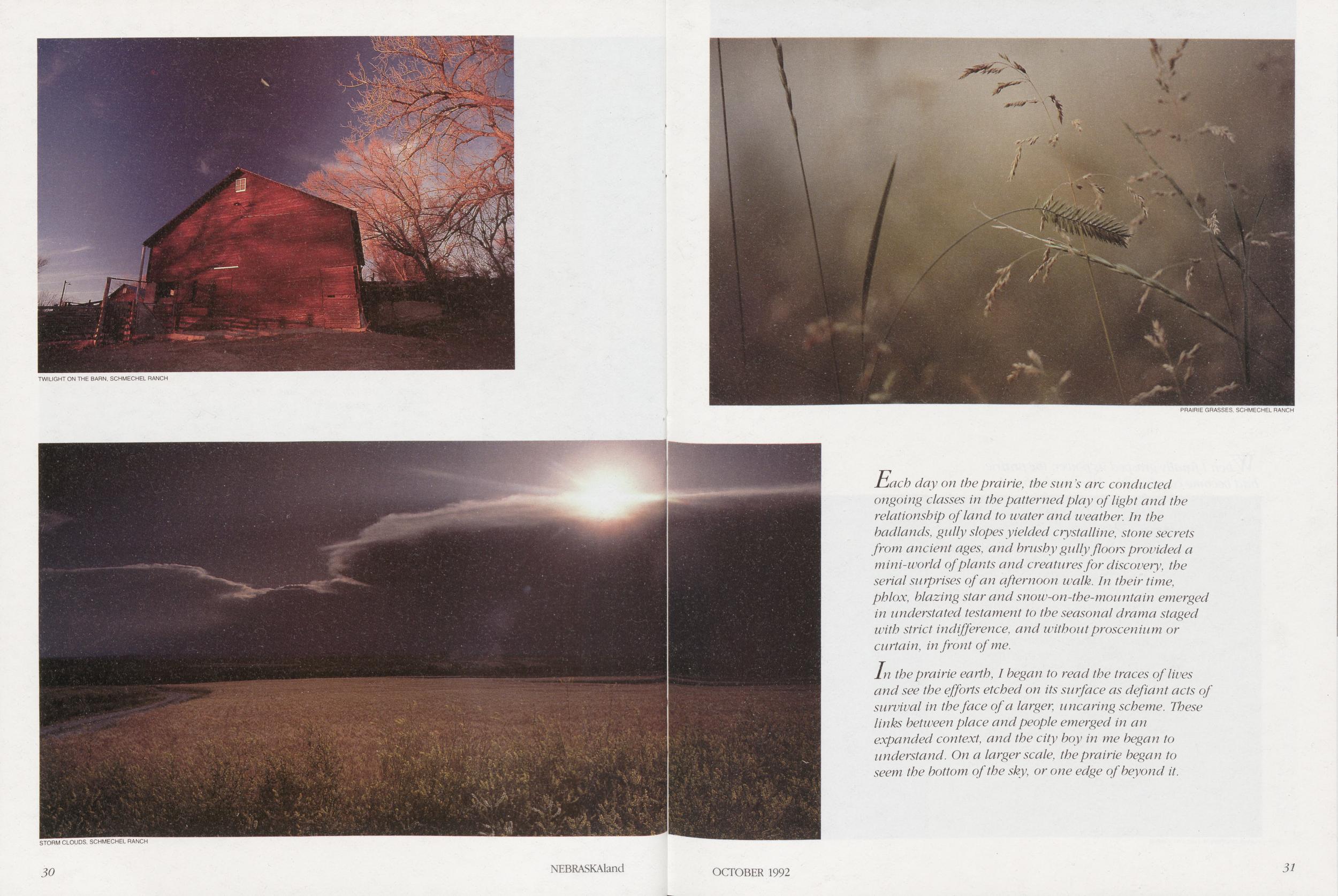
Each day on the prairie, the sun 's arc conducted ongoing classes in the patterned play of light and the relationship of land to water and weather. In the hadlands, gidly slopes yielded crystalline, stone secrets from ancient ages, and brushy gully floors provided a mini-world of plants and creatures for discovery, the serial surprises of an afternoon walk. In their time, phlox, Mazing star and snow-on-the-mountain emerged in understated testament to the seasonal drama staged with strict indifference, and without proscenium or curtain, in front of me.
In the prairie earth, I began to read the traces of lives and see the efforts etched on its surface as defiant acts of survival in the face of a larger, uncaring scheme. These links between place and people emerged in an expanded context, and the city hoy in me began to understand. On a larger scale, the prairie began to seem the bottom of the sky, or one edge of beyond it.
OCTOBER 1992 31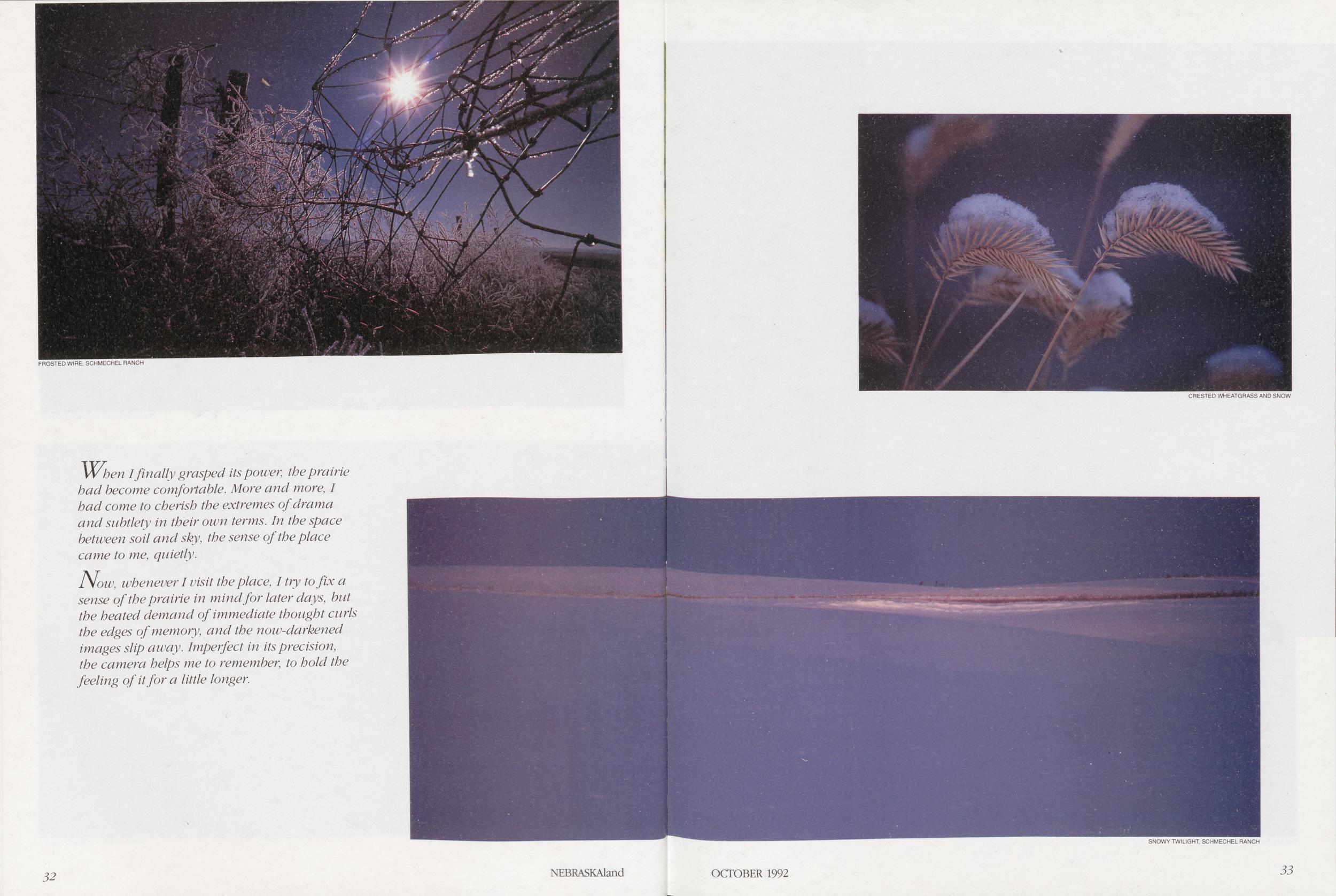
When I finally grasped its power the prairie had become comfortable. More and more, I had come to cherish the extremes of drama and subtlety in their own terms. In the space between soil and sky, the sense of the place came to me, quietly.
Now, whenever I visit the place, I try to fix a sense of the prairie in mind for later days, but the heated demand of immediate thought curls the edges of memory, and the now-darkened images slip away. Imperfect in its precision, the camera helps me to remember, to hold the feeling of it for a little longer.
32 NEBRASKAland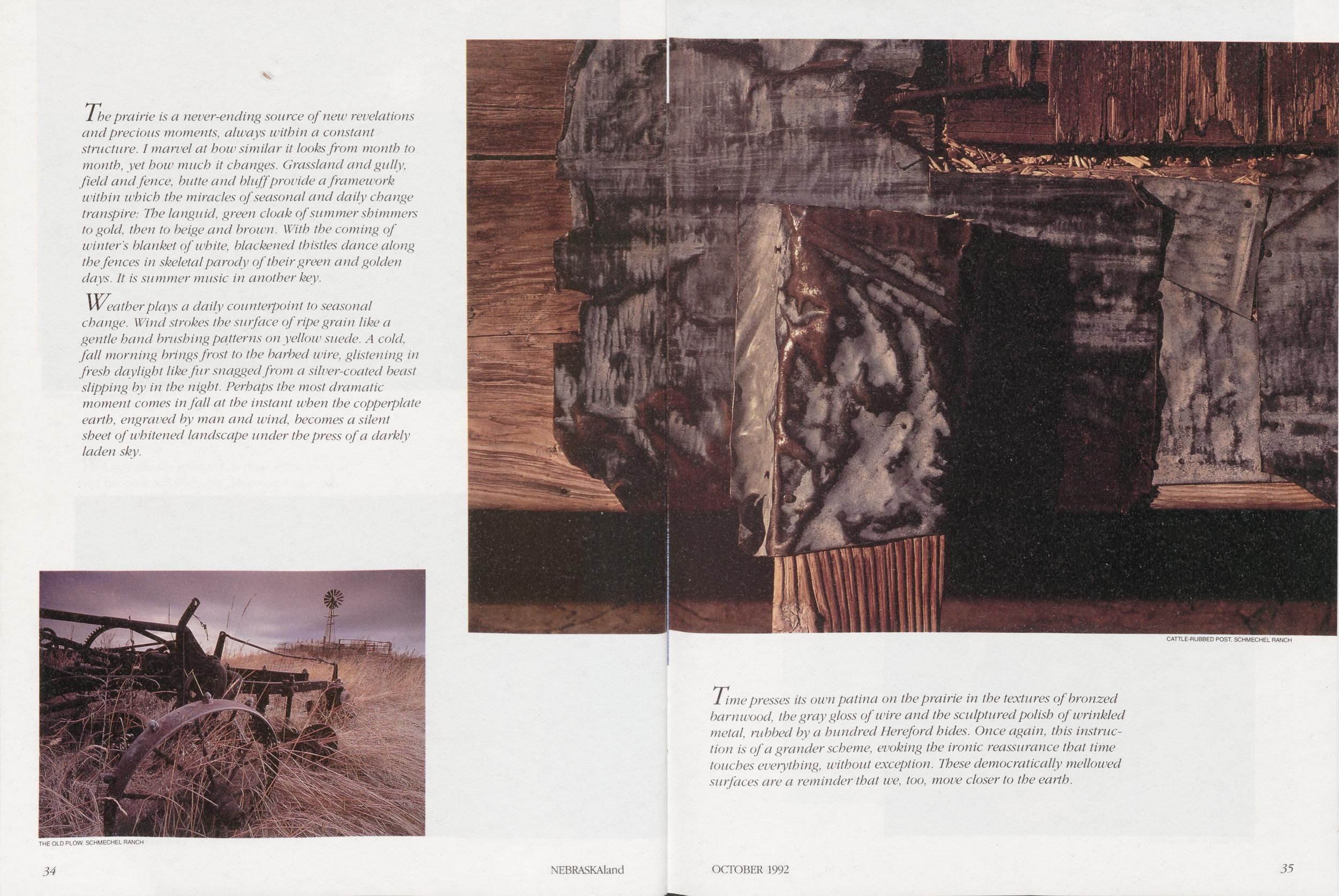
The prairie is a never-ending source of new revelations and precious moments, always within a constant structure. I marvel at how similar it looks from month to month, yet bow much it changes. Grassland and gully, field and fence, hutte and bluff provide a framework within which the miracles of seasonal and daily change transpire: The languid, green cloak of summer shimmers to gold, then to heige and brown. With the coming of winter's blanket of white, blackened thistles dance along the fences in skeletal parody of their green and golden days. It is summer music in another key.
Weatherplays a daily counterpoint to seasonal change. Wind strokes the surface of ripe grain like a gentle hand brushing patterns on yellow suede. A cold, fall morning brings frost to the harked wire, glistening in fresh daylight like fur snagged from a silver-coated heast slipping by in the night. Perhaps the most dramatic moment comes in fall at the instant when the copperplate earth, engraved by man and wind, becomes a silent sheet of whitened landscape under the press of a darkly laden sky.
Time presses its own patina on the prairie in the textures of bronzed harnwood, the gray gloss of wire and the sculptured polish of wrinkled metal, rubbed by a hundred Hereford hides. Once again, this instruction is of a grander scheme, evoking the ironic reassurance that time touches everything, without exception. These democratically mellowed surfaces are a reminder that we, too, move closer to the earth.
OCTOBER 1992 35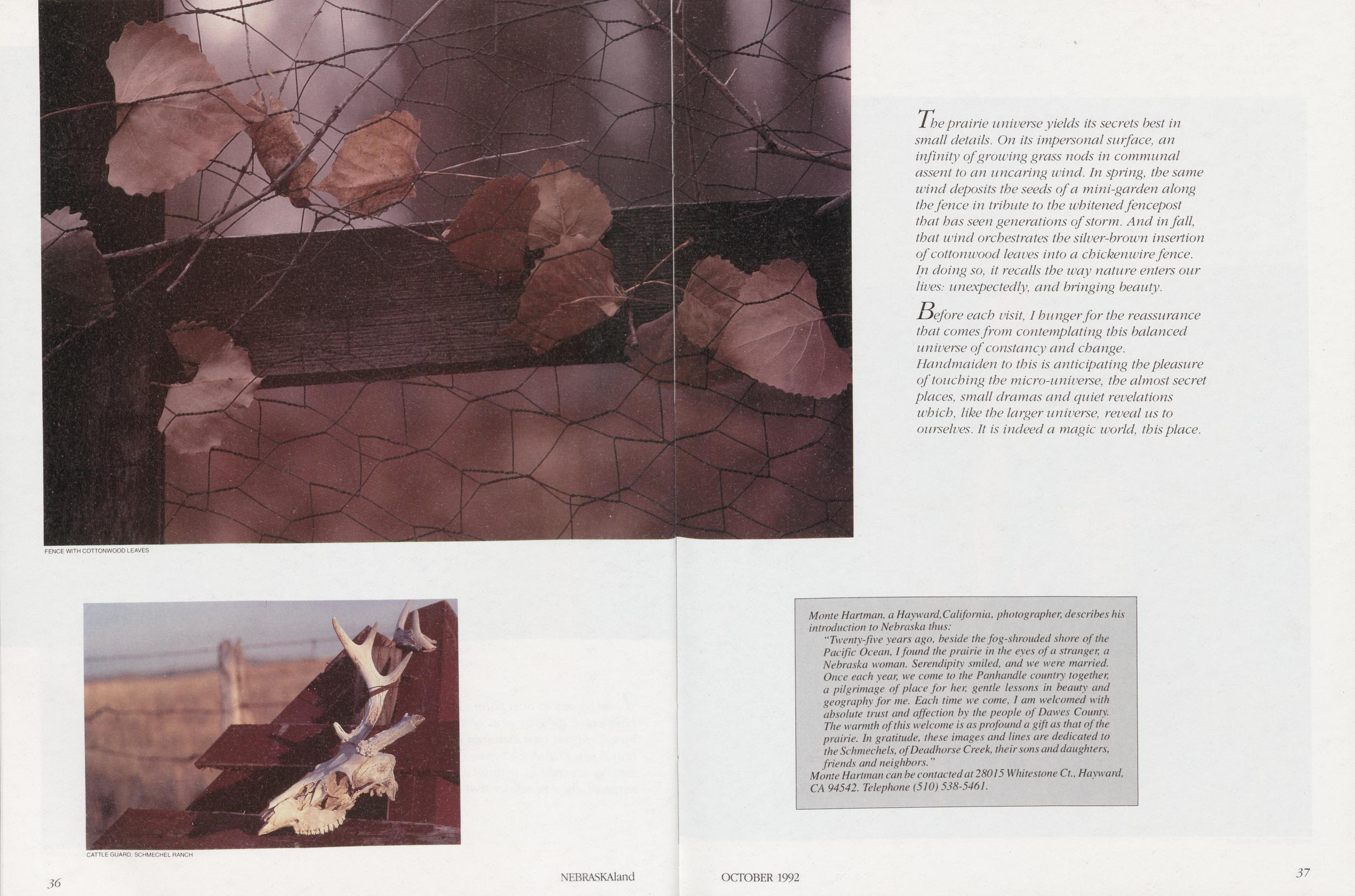
The prairie universe yields its secrets best in small details. On its impersonal surface, an infinity of growing grass nods in communal assent to an uncaring wind. In spring, the same wind deposits the seeds of a mini-garden along the fence in tribute to the whitened fencepost that has seen generations of storm. And in fall, that wind orchestrates the silver-brown insertion of cottonwood leaves into a chickenwirefence. In doing so, it recalls the way nature enters our lives: unexpectedly, and bringing beauty.
Before each visit, I hunger for the reassurance that comes from contemplating this balanced universe of constancy and change. Handmaiden to this is anticipating the pleasure of touching the micro-universe, the almost secret places, small dramas and quiet revelations which, like the larger universe, reveal us to ourselves. It is indeed a magic world, this place.
Monte Hartman, a Hay ward,California, photographer, describes his introduction to Nebraska thus: "Twenty-five years ago, beside the fog-shrouded shore of the Pacific Ocean, I found the prairie in the eyes of a stranger, a Nebraska woman. Serendipity smiled, and we were married. Once each year, we come to the Panhandle countiy together, a pilgrimage of place for her, gentle lessons in beauty and geography for me. Each time we come, I am welcomed with absolute trust and affection by the people of Dawes County. The warmth of this welcome is as profound a gift as that of the prairie. In gratitude, these images and lines are dedicated to the Schmechels, ofDeadhorse Creek, their sons and daughters, friends and neighbors." Monte Hartman can be contacted at 28015 Whitestone Ct, Havward, CA 94542. Telephone (510) 538-5461. OCTOBER 1992 37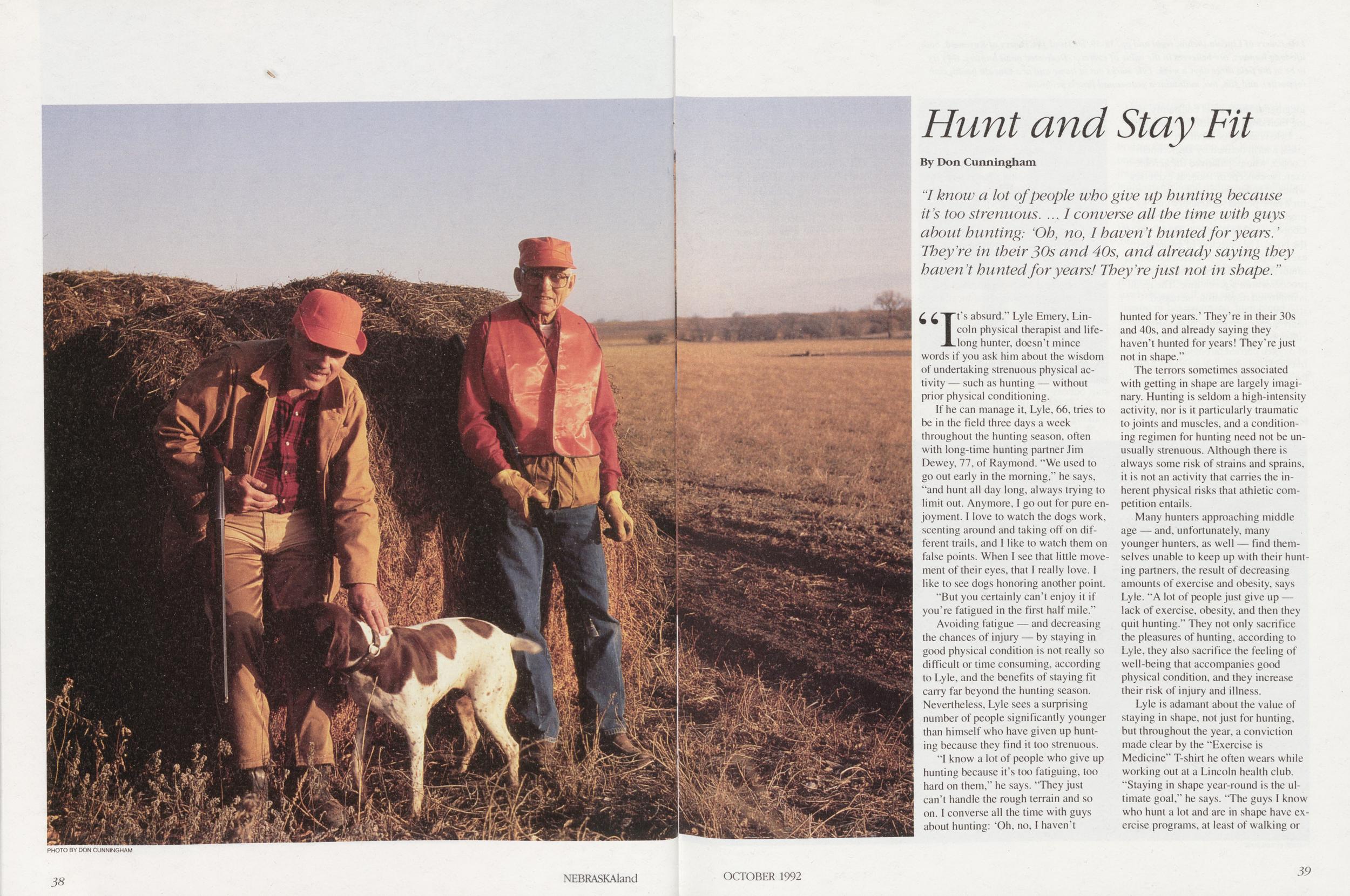
Hunt and Stay Fit
By Don Cunningham "I know a lot of people who give up hunting because it's too strenuous/ converse all the time with guys about hunting: 'Oh, no, I haven't hunted for years/ They're in their 30s and 40s, and already saying they haven't hunted for years! They're just not in shape.""It's absurd." Lyle Emery, Lincoln physical therapist and lifelong hunter, doesn't mince words if you ask him about the wisdom of undertaking strenuous physical activity — such as hunting — without prior physical conditioning.
If he can manage it, Lyle, 66, tries to be in the field three days a week throughout the hunting season, often with long-time hunting partner Jim Dewey, 77, of Raymond. "We used to go out early in the morning," he says, "and hunt all day long, always trying to limit out. Anymore, I go out for pure enjoyment. I love to watch the dogs work, scenting around and taking off on different trails, and I like to watch them on false points. When I see that little movement of their eyes, that I really love. I like to see dogs honoring another point.
"But you certainly can't enjoy it if you're fatigued in the first half mile."
Avoiding fatigue — and decreasing the chances of injury — by staying in good physical condition is not really so difficult or time consuming, according to Lyle, and the benefits of staying fit carry far beyond the hunting season. Nevertheless, Lyle sees a surprising number of people significantly younger than himself who have given up hunting because they find it too strenuous.
"I know a lot of people who give up hunting because it's too fatiguing, too hard on them," he says. "They just can't handle the rough terrain and so on. I converse all the time with guys about hunting: 'Oh, no, I haven't hunted for years.' They're in their 30s and 40s, and already saying they haven't hunted for years! They're just not in shape."
The terrors sometimes associated with getting in shape are largely imaginary. Hunting is seldom a high-intensity activity, nor is it particularly traumatic to joints and muscles, and a conditioning regimen for hunting need not be unusually strenuous. Although there is always some risk of strains and sprains, it is not an activity that carries the inherent physical risks that athletic competition entails.
Many hunters approaching middle age — and, unfortunately, many younger hunters, as well — find themselves unable to keep up with their hunting partners, the result of decreasing amounts of exercise and obesity, says Lyle. "A lot of people just give up lack of exercise, obesity, and then they quit hunting." They not only sacrifice the pleasures of hunting, according to Lyle, they also sacrifice the feeling of well-being that accompanies good physical condition, and they increase their risk of injury and illness.
Lyle is adamant about the value of
staying in shape, not just for hunting,
but throughout the year, a conviction
made clear by the "Exercise is
Medicine" T-shirt he often wears while
working out at a Lincoln health club.
"Staying in shape year-round is the ultimate goal," he says. "The guys I know
who hunt a lot and are in shape have exercise programs, at least of walking or
OCTOBER 1992
39
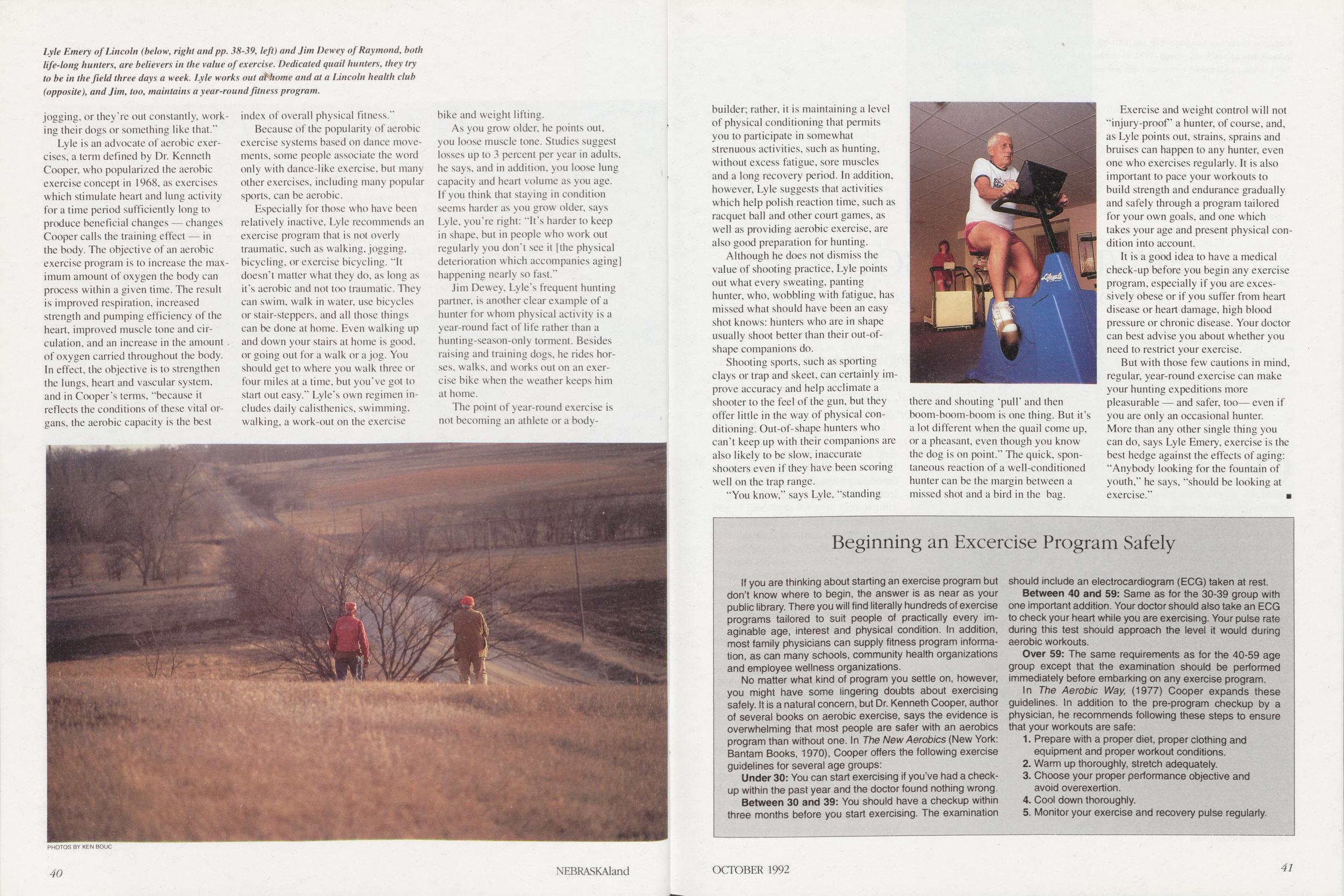
Lyle is an advocate of aerobic exercises, a term defined by Dr. Kenneth Cooper, who popularized the aerobic exercise concept in 1968, as exercises which stimulate heart and lung activity for a time period sufficiently long to produce beneficial changes — changes Cooper calls the training effect — in the body. The objective of an aerobic exercise program is to increase the maximum amount of oxygen the body can process within a given time. The result is improved respiration, increased strength and pumping efficiency of the heart, improved muscle tone and circulation, and an increase in the amount . of oxygen carried throughout the body. In effect, the objective is to strengthen the lungs, heart and vascular system, and in Cooper's terms, "because it reflects the conditions of these vital organs, the aerobic capacity is the best index of overall physical fitness."
Because of the popularity of aerobic exercise systems based on dance movements, some people associate the word only with dance-like exercise, but many other exercises, including many popular sports, can be aerobic.
Especially for those who have been relatively inactive. Lyle recommends an exercise program that is not overly traumatic, such as walking, jogging, bicycling, or exercise bicycling. "It doesn't matter what they do, as long as it's aerobic and not too traumatic. They can swim, walk in water, use bicycles or stair-steppers, and all those things can be done at home. Even walking up and down your stairs at home is good, or going out for a walk or a jog. You should get to where you walk three or four miles at a time, but you've got to start out easy." Lyle's own regimen includes daily calisthenics, swimming, walking, a work-out on the exercise bike and weight lifting.
As you grow older, he points out, you loose muscle tone. Studies suggest losses up to 3 percent per year in adults, he says, and in addition, you loose lung capacity and heart volume as you age. If you think that staying in condition seems harder as you grow older, says Lyle, you're right: "It's harder to keep in shape, but in people who work out regularly you don't see it [the physical deterioration which accompanies aging] happening nearly so fast."
Jim Dewey, Lyle's frequent hunting partner, is another clear example of a hunter for whom physical activity is a year-round fact of life rather than a hunting-season-only torment. Besides raising and training dogs, he rides horses, walks, and works out on an exercise bike when the weather keeps him at home.
The point of year-round exercise is not becoming an athlete or a bodybuilder;
Although he does not dismiss the value of shooting practice, Lyle points out what every sweating, panting hunter, who, wobbling with fatigue, has missed what should have been an easy shot knows: hunters who are in shape usually shoot better than their out-of-shape companions do.
Shooting sports, such as sporting clays or trap and skeet, can certainly improve accuracy and help acclimate a shooter to the feel of the gun, but they offer little in the way of physical conditioning. Out-of-shape hunters who can't keep up with their companions are also likely to be slow, inaccurate shooters even if they have been scoring well on the trap range.
"You know," says Lyle, "standing there and shouting 'pull' and then boom-boom-boom is one thing. But it's a lot different when the quail come up, or a pheasant, even though you know the dog is on point." The quick, spontaneous reaction of a well-conditioned hunter can be the margin between a missed shot and a bird in the bag.
Exercise and weight control will not "injury-proof a hunter, of course, and, as Lyle points out, strains, sprains and bruises can happen to any hunter, even one who exercises regularly. It is also important to pace your workouts to build strength and endurance gradually and safely through a program tailored for your own goals, and one which takes your age and present physical condition into account.
It is a good idea to have a medical check-up before you begin any exercise program, especially if you are excessively obese or if you suffer from heart disease or heart damage, high blood pressure or chronic disease. Your doctor can best advise you about whether you need to restrict your exercise.
But with those few cautions in mind, regular, year-round exercise can make your hunting expeditions more pleasurable — and safer, too— even if you are only an occasional hunter. More than any other single thing you can do, says Lyle Emery, exercise is the best hedge against the effects of aging: "Anybody looking for the fountain of youth," he says, "should be looking at exercise."
Beginning an Excercise Program SafelyIf you are thinking about starting an exercise program but don't know where to begin, the answer is as near as your public library. There you will find literally hundreds of exercise programs tailored to suit people of practically every imaginable age, interest and physical condition. In addition, most family physicians can supply fitness program information, as can many schools, community health organizations and employee wellness organizations.
No matter what kind of program you settle on, however, you might have some iingering doubts about exercising safely. It is a natural concern, but Dr. Kenneth Cooper, author of several books on aerobic exercise, says the evidence is overwhelming that most people are safer with an aerobics program than without one. In The New Aerobics (New York: Bantam Books, 1970), Cooper offers the following exercise guidelines for several age groups:
Under 30: You can start exercising if you've had a check-up within the past year and the doctor found nothing wrong.
Between 30 and 39: You should have a checkup within three months before you start exercising. The examination should include an electrocardiogram (ECG) taken at rest.
Between 40 and 59: Same as for the 30-39 group with one important addition. Your doctor should also take an ECG to check your heart while you are exercising. Your pulse rate during this test should approach the level it would during aerobic workouts.
Over 59: The same requirements as for the 40-59 age group except that the examination should be performed immediately before embarking on any exercise program.
in The Aerobic Way, (1977) Cooper expands these guidelines. In addition to the pre-program checkup by a physician, he recommends following these steps to ensure that your workouts are safe:
1. Prepare with a proper diet, proper clothing and equipment and proper workout conditions.
2. Warm up thoroughly, stretch adequately.
3. Choose your proper performance objective and avoid overexertion.
4. Cool down thoroughly.
5. Monitor your exercise and recovery pulse regularly.
OCTBOER 1992 41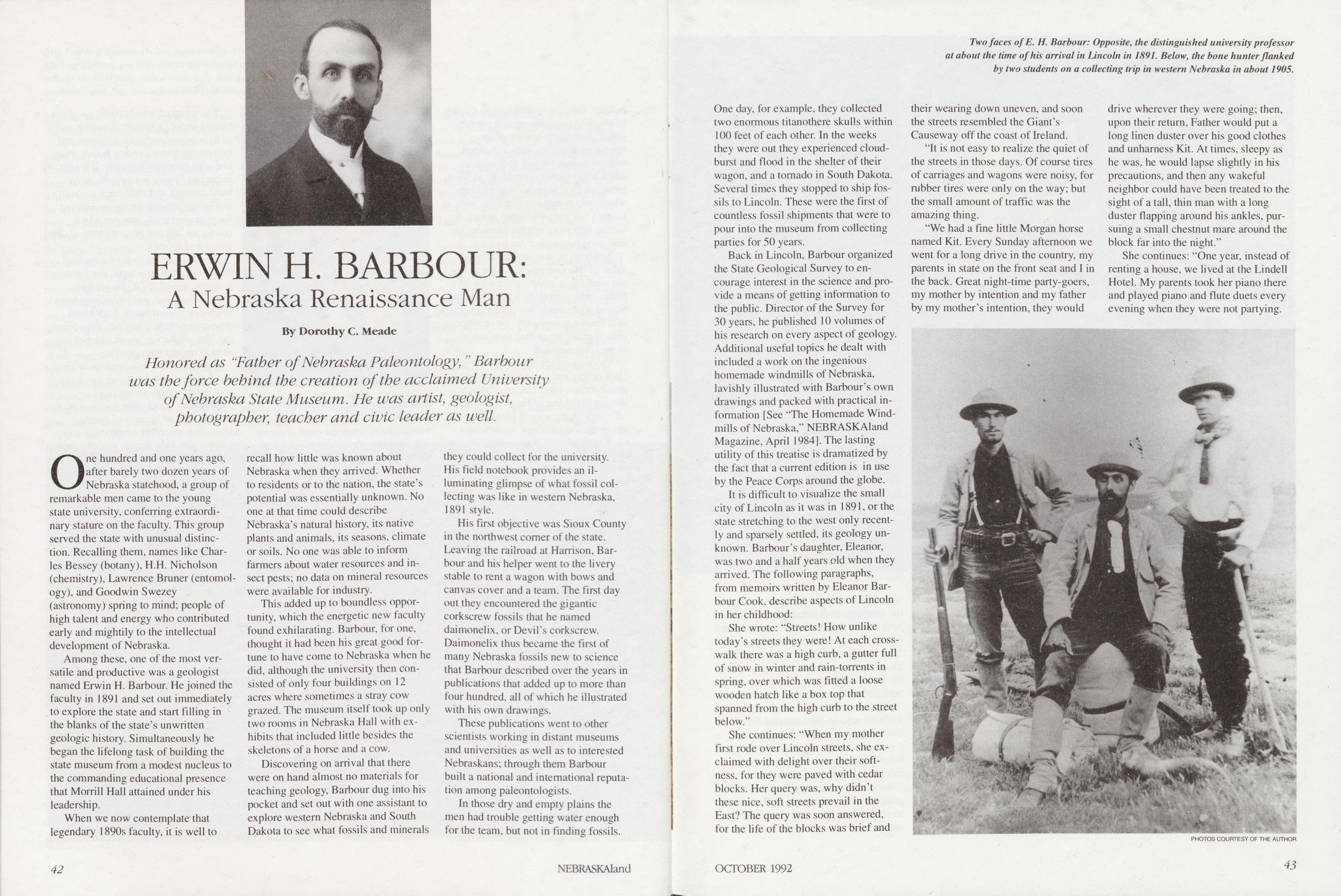
ERWIN H. BARBOUR: A Nebraska Renaissance Man
By Dorothy C. Meade Honored as "Father of Nebraska Paleontology, " Barbour was the force behind the creation of the acclaimed University of Nebraska State Museum. He was artist, geologist, photographer, teacher and civic leader as well.One hundred and one years ago, after barely two dozen years of Nebraska statehood, a group of remarkable men came to the young state university, conferring extraordinary stature on the faculty. This group served the state with unusual distinction. Recalling them, names like Charles Bessey (botany), H.H. Nicholson (chemistry), Lawrence Bruner (entomology), and Goodwin Swezey (astronomy) spring to mind; people of high talent and energy who contributed early and mightily to the intellectual development of Nebraska.
Among these, one of the most versatile and productive was a geologist named Erwin H. Barbour. He joined the faculty in 1891 and set out immediately to explore the state and start filling in the blanks of the state's unwritten geologic history. Simultaneously he began the lifelong task of building the state museum from a modest nucleus to the commanding educational presence that Morrill Hall attained under his leadership.
When we now contemplate that legendary 1890s faculty, it is well to recall how little was known about Nebraska when they arrived. Whether to residents or to the nation, the state's potential was essentially unknown. No one at that time could describe Nebraska's natural history, its native plants and animals, its seasons, climate or soils. No one was able to inform farmers about water resources and insect pests; no data on mineral resources were available for industry.
This added up to boundless opportunity, which the energetic new faculty found exhilarating. Barbour, for one, thought it had been his great good fortune to have come to Nebraska when he did, although the university then consisted of only four buildings on 12 acres where sometimes a stray cow grazed. The museum itself took up only two rooms in Nebraska Hall with exhibits that included little besides the skeletons of a horse and a cow.
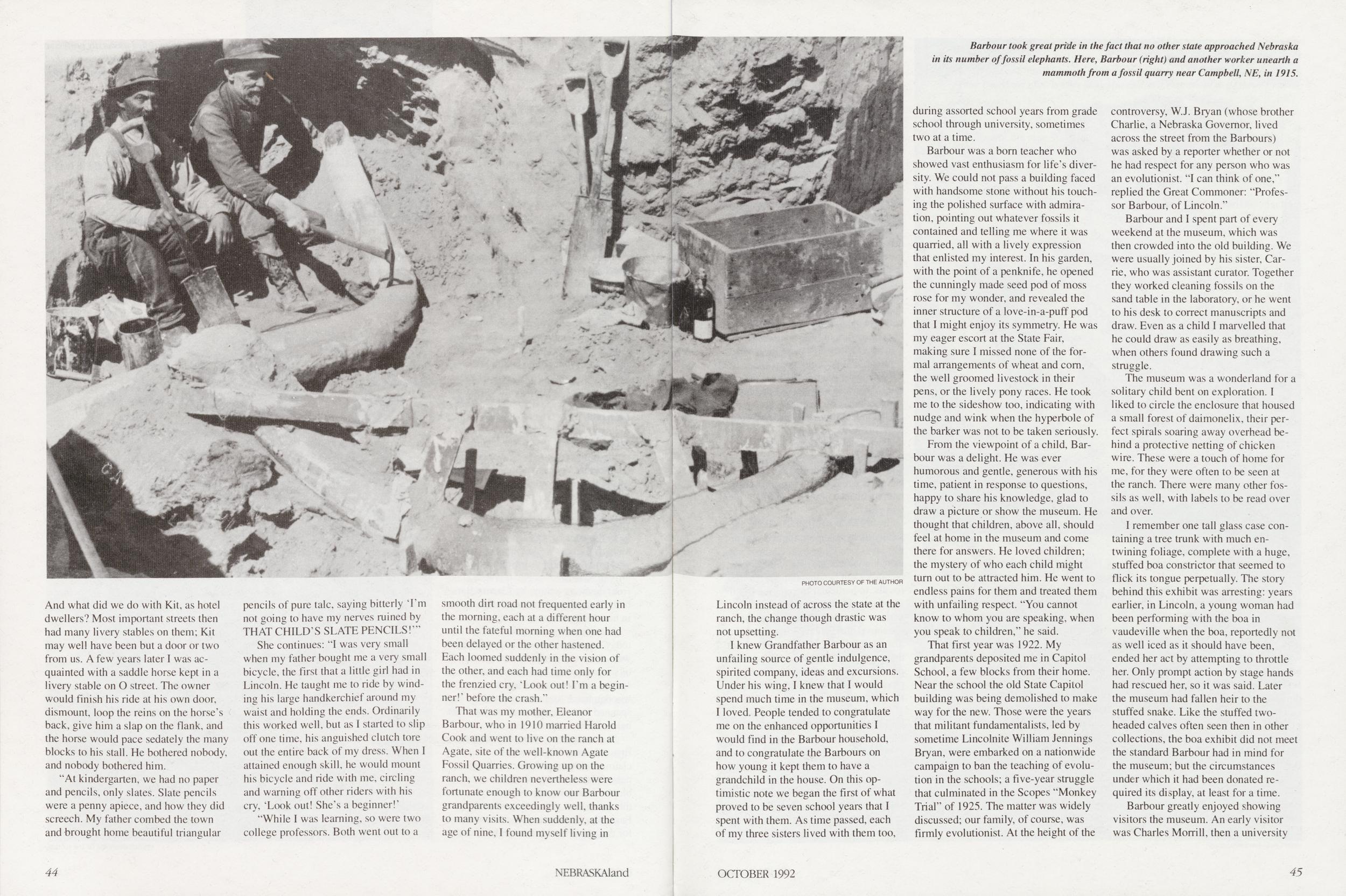
Discovering on arrival that there were on hand almost no materials for teaching geology, Barbour dug into his pocket and set out with one assistant to explore western Nebraska and South Dakota to see what fossils and minerals they could collect for the university. His field notebook provides an illuminating glimpse of what fossil collecting was like in western Nebraska, 1891 style.
His first objective was Sioux County in the northwest comer of the state. Leaving the railroad at Harrison, Barbour and his helper went to the livery stable to rent a wagon with bows and canvas cover and a team. The first day out they encountered the gigantic corkscrew fossils that he named daimonelix, or Devil's corkscrew. Daimonelix thus became the first of many Nebraska fossils new to science that Barbour described over the years in publications that added up to more than four hundred, all of which he illustrated with his own drawings.
These publications went to other scientists working in distant museums and universities as well as to interested Nebraskans; through them Barbour built a national and international reputation among paleontologists.
In those dry and empty plains the men had trouble getting water enough for the team, but not in finding fossils. 42 NEBRASKAland One day, for example, they collected two enormous titanothere skulls within 100 feet of each other. In the weeks they were out they experienced cloudburst and flood in the shelter of their wagon, and a tornado in South Dakota. Several times they stopped to ship fossils to Lincoln. These were the first of countless fossil shipments that were to pour into the museum from collecting parties for 50 years.
Back in Lincoln, Barbour organized the State Geological Survey to encourage interest in the science and provide a means of getting information to the public. Director of the Survey for 30 years, he published 10 volumes of his research on every aspect of geology. Additional useful topics he dealt with included a work on the ingenious homemade windmills of Nebraska, lavishly illustrated with Barbour's own drawings and packed with practical information [See "The Homemade Windmills of Nebraska," NEBRASKAland Magazine, April 1984]. The lasting utility of this treatise is dramatized by the fact that a current edition is in use by the Peace Corps around the globe.
It is difficult to visualize the small city of Lincoln as it was in 1891, or the state stretching to the west only recently and sparsely settled, its geology unknown. Barbour's daughter, Eleanor, was two and a half years old when they arrived. The following paragraphs, from memoirs written by Eleanor Barbour Cook, describe aspects of Lincoln in her childhood:
She wrote: "Streets! How unlike today's streets they were! At each crosswalk there was a high curb, a gutter full of snow in winter and rain-torrents in spring, over which was fitted a loose wooden hatch like a box top that spanned from the high curb to the street below."
She continues: "When my mother first rode over Lincoln streets, she exclaimed with delight over their softness, for they were paved with cedar blocks. Her query was, why didn't these nice, soft streets prevail in the East? The query was soon answered, for the life of the blocks was brief and their wearing down uneven, and soon the streets resembled the Giant's Causeway off the coast of Ireland.
"It is not easy to realize the quiet of the streets in those days. Of course tires of carriages and wagons were noisy, for rubber tires were only on the way; but the small amount of traffic was the amazing thing.
"We had a fine little Morgan horse named Kit. Every Sunday afternoon we went for a long drive in the country, my parents in state on the front seat and I in the back. Great night-time party-goers, my mother by intention and my father by my mother's intention, they would drive wherever they were going; then, upon their return, Father would put a long linen duster over his good clothes and unharness Kit. At times, sleepy as he was, he would lapse slightly in his precautions, and then any wakeful neighbor could have been treated to the sight of a tall, thin man with a long duster flapping around his ankles, pursuing a small chestnut mare around the block far into the night."
She continues: "One year, instead of renting a house, we lived at the Lindell Hotel. My parents took her piano there and played piano and flute duets every evening when they were not partying.
"At kindergarten, we had no paper and pencils, only slates. Slate pencils were a penny apiece, and how they did screech. My father combed the town and brought home beautiful triangular 44 pencils of pure talc, saying bitterly Tm not going to have my nerves ruined by THAT CHILD'S SLATE PENCILS!'"
She continues: "I was very small when my father bought me a very small bicycle, the first that a little girl had in Lincoln. He taught me to ride by winding his large handkerchief around my waist and holding the ends. Ordinarily this worked well, but as I started to slip off one time, his anguished clutch tore out the entire back of my dress. When I attained enough skill, he would mount his bicycle and ride with me, circling and warning off other riders with his cry, 'Look out! She's a beginner!
"While I was learning, so were two college professors. Both went out to a smooth dirt road not frequented early in the morning, each at a different hour until the fateful morning when one had been delayed or the other hastened. Each loomed suddenly in the vision of the other, and each had time only for the frenzied cry, 'Look out! I'm a beginner! before the crash."
That was my mother, Eleanor Barbour, who in 1910 married Harold Cook and went to live on the ranch at Agate, site of the well-known Agate Fossil Quarries. Growing up on the ranch, we children nevertheless were fortunate enough to know our Barbour grandparents exceedingly well, thanks to many visits. When suddenly, at the age of nine, I found myself living in 44 NEBRASKAland Lincoln instead of across the state at the ranch, the change though drastic was not upsetting.
I knew Grandfather Barbour as an unfailing source of gentle indulgence, spirited company, ideas and excursions. Under his wing, I knew that I would spend much time in the museum, which I loved. People tended to congratulate me on the enhanced opportunities I would find in the Barbour household, and to congratulate the Barbours on how young it kept them to have a grandchild in the house. On this optimistic note we began the first of what proved to be seven school years that I spent with them. As time passed, each of my three sisters lived with them too, during assorted school years from grade school through university, sometimes two at a time.
Barbour was a born teacher who showed vast enthusiasm for life's diversity. We could not pass a building faced with handsome stone without his touching the polished surface with admiration, pointing out whatever fossils it contained and telling me where it was quarried, all with a lively expression that enlisted my interest. In his garden, with the point of a penknife, he opened the cunningly made seed pod of moss rose for my wonder, and revealed the inner structure of a love-in-a-puff pod that I might enjoy its symmetry. He was my eager escort at the State Fair, making sure I missed none of the formal arrangements of wheat and corn, the well groomed livestock in their pens, or the lively pony races. He took me to the sideshow too, indicating with nudge and wink when the hyperbole of the barker was not to be taken seriously.
From the viewpoint of a child, Barbour was a delight. He was ever humorous and gentle, generous with his time, patient in response to questions, happy to share his knowledge, glad to draw a picture or show the museum. He thought that children, above all, should feel at home in the museum and come there for answers. He loved children; the mystery of who each child might turn out to be attracted him. He went to endless pains for them and treated them with unfailing respect. "You cannot know to whom you are speaking, when you speak to children," he said.
That first year was 1922. My grandparents deposited me in Capitol School, a few blocks from their home. Near the school the old State Capitol building was being demolished to make way for the new. Those were the years that militant fundamentalists, led by sometime Lincolnite William Jennings Bryan, were embarked on a nationwide campaign to ban the teaching of evolution in the schools; a five-year struggle that culminated in the Scopes "Monkey Trial" of 1925. The matter was widely discussed; our family, of course, was firmly evolutionist. At the height of the controversy, W.J. Bryan (whose brother Charlie, a Nebraska Governor, lived across the street from the Barbours) was asked by a reporter whether or not he had respect for any person who was an evolutionist. "I can think of one," replied the Great Commoner: "Professor Barbour, of Lincoln."
Barbour and I spent part of every weekend at the museum, which was then crowded into the old building. We were usually joined by his sister, Carrie, who was assistant curator. Together they worked cleaning fossils on the sand table in the laboratory, or he went to his desk to correct manuscripts and draw. Even as a child I marvelled that he could draw as easily as breathing, when others found drawing such a struggle.
The museum was a wonderland for a solitary child bent on exploration. I liked to circle the enclosure that housed a small forest of daimonelix, their perfect spirals soaring away overhead behind a protective netting of chicken wire. These were a touch of home for me, for they were often to be seen at the ranch. There were many other fossils as well, with labels to be read over and over.
I remember one tall glass case containing a tree trunk with much entwining foliage, complete with a huge, stuffed boa constrictor that seemed to flick its tongue perpetually. The story behind this exhibit was arresting: years earlier, in Lincoln, a young woman had been performing with the boa in vaudeville when the boa, reportedly not as well iced as it should have been, ended her act by attempting to throttle her. Only prompt action by stage hands had rescued her, so it was said. Later the museum had fallen heir to the stuffed snake. Like the stuffed twoheaded calves often seen then in other collections, the boa exhibit did not meet the standard Barbour had in mind for the museum; but the circumstances under which it had been donated required its display, at least for a time.
Barbour greatly enjoyed showing
visitors the museum. An early visitor
was Charles Morrill, then a university
OCTOBER 1992
45
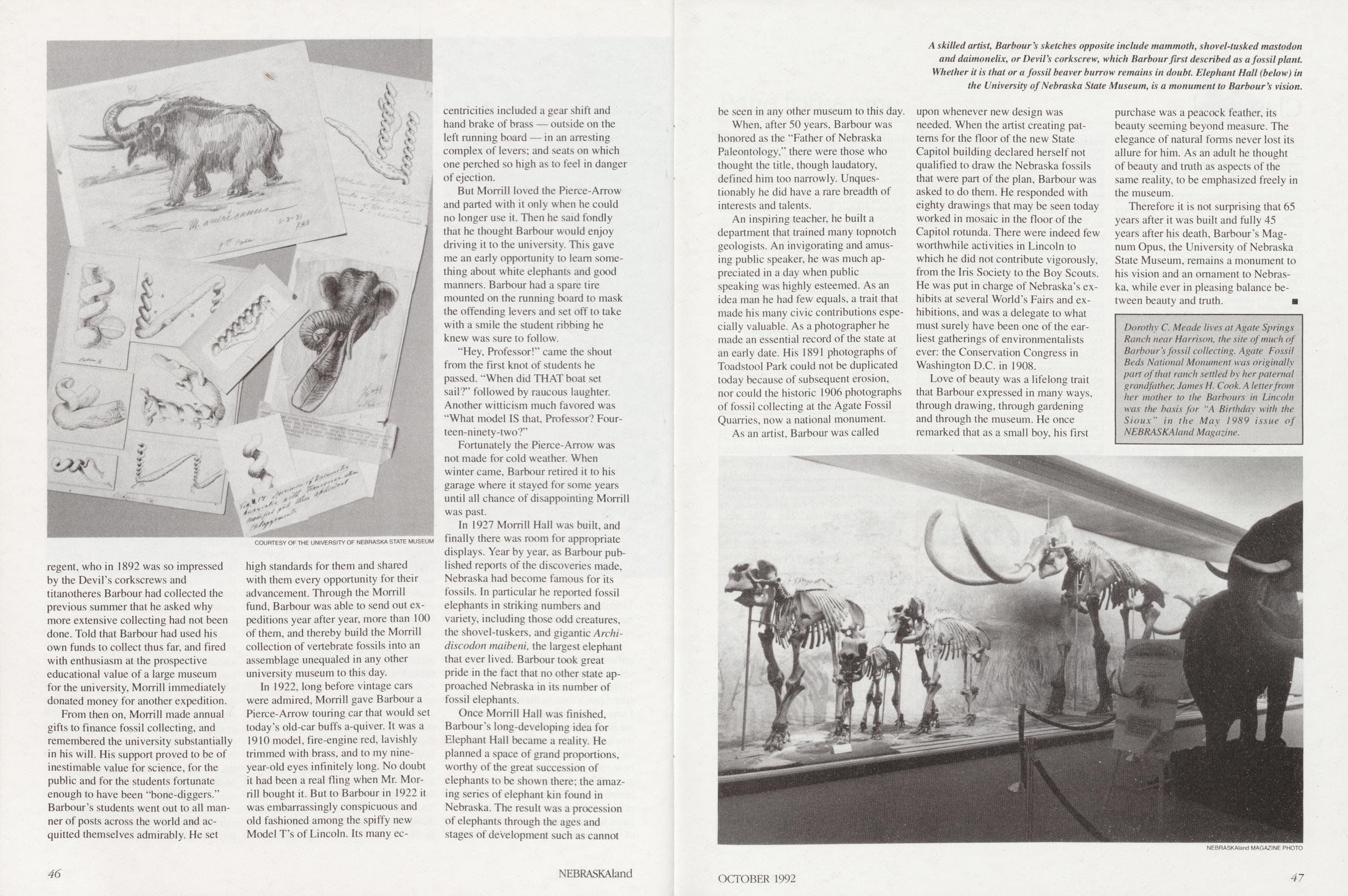
From then on, Morrill made annual gifts to finance fossil collecting, and remembered the university substantially in his will. His support proved to be of inestimable value for science, for the public and for the students fortunate enough to have been "bone-diggers." Barbour's students went out to all manner of posts across the world and acquitted themselves admirably. He set COURTESY OF THE UNIVERSITY OF NEBRASKA STATE MUSEUM high standards for them and shared with them every opportunity for their advancement. Through the Morrill fund, Barbour was able to send out expeditions year after year, more than 100 of them, and thereby build the Morrill collection of vertebrate fossils into an assemblage unequaled in any other university museum to this day.
In 1922, long before vintage cars were admired, Morrill gave Barbour a Pierce-Arrow touring car that would set today's old-car buffs a-quiver. It was a 1910 model, fire-engine red, lavishly trimmed with brass, and to my nineyear-old eyes infinitely long. No doubt it had been a real fling when Mr. Morrill bought it. But to Barbour in 1922 it was embarrassingly conspicuous and old fashioned among the spiffy new Model T's of Lincoln. Its many eccentricities included a gear shift and hand brake of brass — outside on the left running board — in an arresting complex of levers; and seats on which one perched so high as to feel in danger of ejection.
But Morrill loved the Pierce-Arrow and parted with it only when he could no longer use it. Then he said fondly that he thought Barbour would enjoy driving it to the university. This gave me an early opportunity to learn something about white elephants and good manners. Barbour had a spare tire mounted on the running board to mask the offending levers and set off to take with a smile the student ribbing he knew was sure to follow.
"Hey, Professor!" came the shout from the first knot of students he passed. "When did THAT boat set sail?" followed by raucous laughter. Another witticism much favored was "What model IS that, Professor? Fourteen-ninety-two?"
Fortunately the Pierce-Arrow was not made for cold weather. When winter came, Barbour retired it to his garage where it stayed for some years until all chance of disappointing Morrill was past.
In 1927 Morrill Hall was built, and finally there was room for appropriate displays. Year by year, as Barbour published reports of the discoveries made, Nebraska had become famous for its fossils. In particular he reported fossil elephants in striking numbers and variety, including those odd creatures, the shovel-tuskers, and gigantic Archidiscodon maibeni, the largest elephant that ever lived. Barbour took great pride in the fact that no other state approached Nebraska in its number of fossil elephants.
Once Morrill Hall was finished, Barbour's long-developing idea for Elephant Hall became a reality. He planned a space of grand proportions, worthy of the great succession of elephants to be shown there; the amazing series of elephant kin found in Nebraska. The result was a procession of elephants through the ages and stages of development such as cannot 46 NEBRASKAland be seen in any other museum to this day.
When, after 50 years, Barbour was honored as the "Father of Nebraska Paleontology," there were those who thought the title, though laudatory, defined him too narrowly. Unquestionably he did have a rare breadth of interests and talents.
An inspiring teacher, he built a department that trained many topnotch geologists. An invigorating and amusing public speaker, he was much appreciated in a day when public speaking was highly esteemed. As an idea man he had few equals, a trait that made his many civic contributions especially valuable. As a photographer he made an essential record of the state at an early date. His 1891 photographs of Toadstool Park could not be duplicated today because of subsequent erosion, nor could the historic 1906 photographs of fossil collecting at the Agate Fossil Quarries, now a national monument.
As an artist, Barbour was called upon whenever new design was needed. When the artist creating patterns for the floor of the new State Capitol building declared herself not qualified to draw the Nebraska fossils that were part of the plan, Barbour was asked to do them. He responded with eighty drawings that may be seen today worked in mosaic in the floor of the Capitol rotunda. There were indeed few worthwhile activities in Lincoln to which he did not contribute vigorously, from the Iris Society to the Boy Scouts. He was put in charge of Nebraska's exhibits at several World's Fairs and exhibitions, and was a delegate to what must surely have been one of the earliest gatherings of environmentalists ever: the Conservation Congress in Washington D.C. in 1908.
Love of beauty was a lifelong trait that Barbour expressed in many ways, through drawing, through gardening and through the museum. He once remarked that as a small boy, his first purchase was a peacock feather, its beauty seeming beyond measure. The elegance of natural forms never lost its allure for him. As an adult he thought of beauty and truth as aspects of the same reality, to be emphasized freely in the museum.
Therefore it is not surprising that 65 years after it was built and fully 45 years after his death, Barbour's Magnum Opus, the University of Nebraska State Museum, remains a monument to his vision and an ornament to Nebraska, while ever in pleasing balance between beauty and truth.
Dorothy C. Meade lives at Agate Springs Ranch near Harrison, the site of much of Barbour's fossil collecting. Agate Fossil Beds National Monument was originally part of that ranch settled by her paternal grandfather, James H. Cook. A letter from her mother to the Barbours in Lincoln was the basis for 'A Birthday with the Sioux' in the Mav 1989 issue of NEBRASKAland Magazine.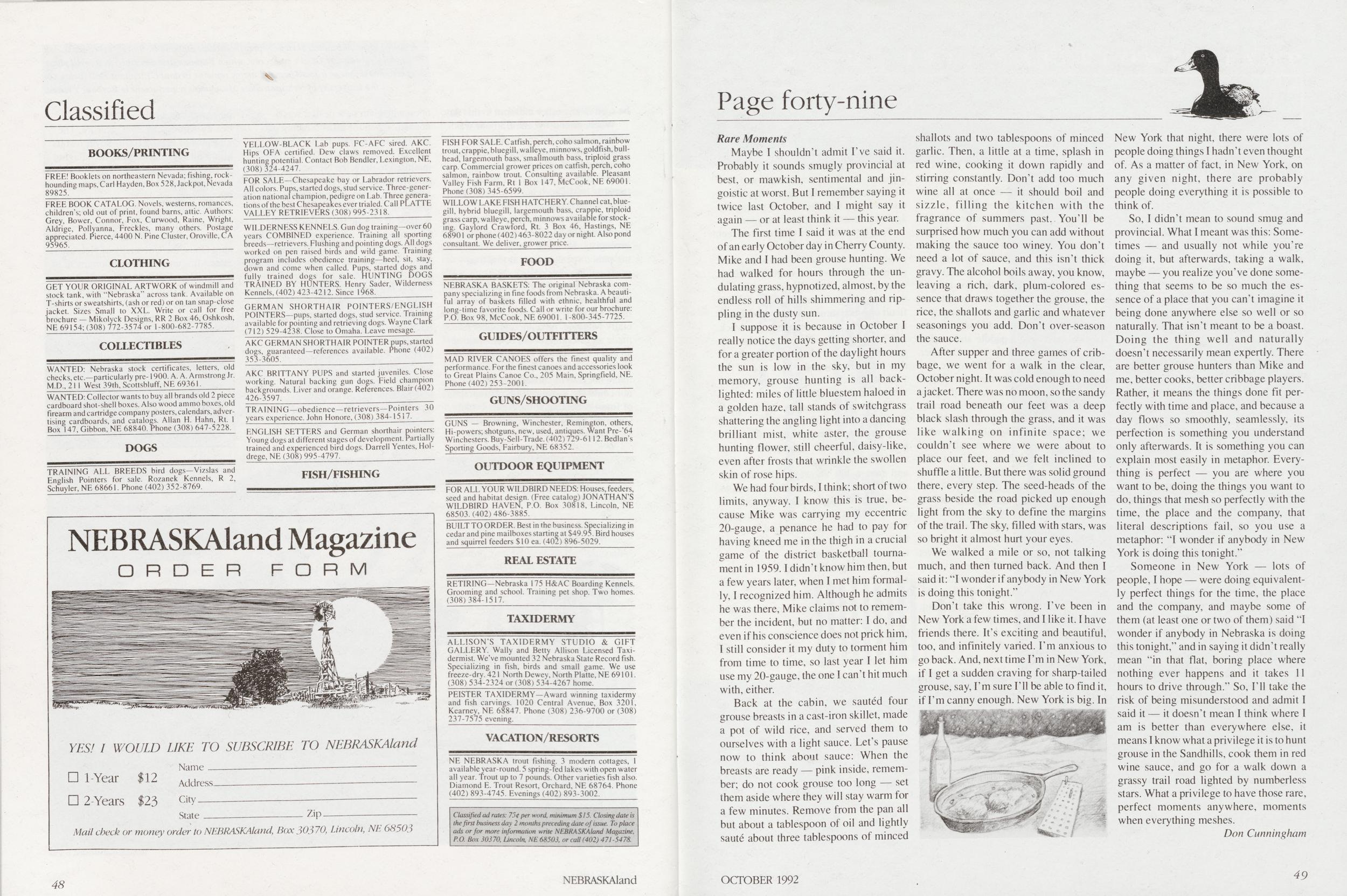
Classified
BOOKS/PRINTINGFREE! Booklets on northeastern Nevada; fishing, rockhounding maps,Carl Hayden, Box 528, Jackpot, Nevada 89825.
FREE BOOK CATALOG. Novels, westerns, romances, children's; old out of print, found barns, attic. Authors: Grey, Bower, Connor, Fox, Curwood, Raine, Wright, Aldrige, Pollyanna, Freckles, many others. Postage appreciated. Pierce, 4400 N. Pine Cluster, Oroville, CA 95965.
CLOTHINGGET YOUR ORIGINAL ARTWORK of windmill and stock tank, with "Nebraska" across tank. Available on T-shirts or sweatshirts, (ash or red) or on tan snap-close jacket. Sizes Small to XXL. Write or call for free brochure — Mikolyck Designs, RR 2 Box 46, Oshkosh, NE 69154; (308) 772-3574 or 1-800-682-7785.
COLLECTIBLESWANTED: Nebraska stock certificates, letters, old checks, etc.—particularly pre-1900. A. A. Armstrong Jr. MP., 21 1 West 39th, Scottshluff, NE 69361.
WANTED: Collector wants to buy all brands old 2 piece cardboard shot-shell boxes. Also wood ammo boxes, old firearm and cartridge company posters, calendars, advertising cardboards, and catalogs. Allan H. Hahn, Rt. 1 Box 147, Gibbon, NE 68840. Phone (308) 647-5228.
DOGSTRAINING ALL BREEDS bird dogs-Vizslas and English Pointers for sale. Rozanek Kennels, R 2, Schuyler, NE 68661. Phone (402) 352-8769.
YELLOW-BLACK Lab pups. FC-AFC sired. AKC. Hips OFA certified. Dew claws removed. Excellent hunting potential. Contact Bob Bendler, Lexington, NE, (308) 324-4247.
FOR SALE—Chesapeake bay or Labrador retrievers. All colors. Pups, started dogs, stud service. Three-generation national champion, pedigre on I .ab. Three generations of the best Chesapeakes ever trialed. Call PLATTE VALLEY RETRIEVERS (308) 995-2318.
WILDERNESS KENNELS. Gun dog training-over 60 years COMBINED experience. Training all sporting breeds—retrievers. Flushing and pointing dogs. All dogs worked on pen raised birds and wild game. Training program includes obedience training—heel, sit, stay, down and come when called. Pups, started dogs and fully trained dogs for sale. HUNTING DOGS TRAINED BY HUNTERS. Henry Sader, Wilderness Kennels, (402) 423-4212. Since 1968.
GERMAN SHORTHAIR POINTERS/ENGLISH POINTERS—pups, started dogs, stud service. Training available for pointing and retrieving dogs. Wayne Clark (712) 529-4238. Close to Omaha. Leave mesage.
AKC GERMAN SHORTHAIR POINTER pups, started dogs, guaranteed—references available. Phone (402) 353-3605.
AKC BRITTANY PUPS and started juveniles. Close working. Natural backing gun dogs. Field champion backgrounds. Liver and orange. References. Blair (402) 426-3597.
TRAINING—obedience—retrievers—Pointers 30 years experience. John Honore, (308) 384-15 17.
ENGLISH SETTERS and German shorthair pointers: Young dogs at different stages of development. Partially trained and experienced bird dogs. Darrell Yentes, Holdrege, NE (308) 995-4797.
FISH/FISHING NEBRASKAland Magazine ORDER FORM YES! I WOULD LIKE TO SUBSCRIBE TO NEBRASKAland 1-Year $12 Name Address. D 2-Years $23 Citv State Zip Mail check or money order to NEBRASKAland, Box30370, Lincoln, NE 6850.?FISH FOR SALE. Catfish, perch, coho salmon, rainbow trout, crappie, bluegill, walleye, minnows, goldfish, bullhead, largemouth bass, smallmouth bass, triploid grass carp. Commercial grower prices on catfish, perch, coho salmon, rainbow trout. Consulting available. Pleasant Valley Fish Farm. Rt 1 Box 147, McCook, NE 69001. Phone(308)345-6599.
WILLOW LAKE FISH HATCHERY. Channel cat, bluegill, hybrid bluegill, largemouth bass, crappie, triploid grass carp, walleye, perch, minnows available for stocking. Gaylord Crawford, Rt. 3 Box 46, Hastings, NE 68901 or phone (402) 463-8022 day or night. Also pond consultant. We deliver, grower price.
FOODNEBRASKA BASKETS: The original Nebraska company specializing in fine foods from Nebraska. A beautiful array of baskets filled with ethnic, healthful and long-time favorite foods. Call or write for our brochure: P.O. Box 98, McCook, NE 69001. 1-800-345-7725.
GUIDES/OUTFITTERSMAD RIVER CANOES offers the finest quality and performance. For the finest canoes and accessories look to Great Plains Canoe Co., 205 Main, Springfield, NE. Phone(402)253-2001.
GUNS/SHOOTINGGUNS — Browning, Winchester, Remington, others, Hi-powers; shotguns, new, used, antiques. Want Pre-'64 Winchesters. Buy-Sell-Trade. (402) 729-6112. Bedlans Sporting Goods, Fairbury, NE 68352.
OUTDOOR EQUIPMENTFOR ALL YOUR WILDBIRD NEEDS: Houses, feeders, seed and habitat design. (Free catalog) JONATHAN'S WILDBIRD HAVEN, P.O. Box 30818, Lincoln, NE 68503. (402) 486-3885.
BUILT TO ORDER. Best in the business. Specializing in cedar and pine mailboxes starting at $49.95. Bird houses and squirrel feeders $10 ea. (402) 896-5029.
REAL ESTATERETIRING—Nebraska 175 H&AC Boarding Kennels. Grooming and school. Training pet shop. Two homes. (308)384-1517.
TAXIDERMYALLISON'S TAXIDERMY STUDIO & GIFT GALLERY. Wally and Betty Allison Licensed Taxidermist. We've mounted 32 Nebraska State Record fish. Specializing in fish, birds and small game. We use freez.e-dry. 421 North Dewey, North Platte, NE 69101. (308) 534-2324 or (308) 534-4267 home.
PEISTER TAXIDERMY-Award winning taxidermy and fish carvings. 1020 Central Avenue, Box 3201, Kearney, NE 68847. Phone (308) 236-9700 or (308) 237-7575 evening.
VACATION/RESORTSNE NEBRASKA trout fishing. 3 modern cottages, 1 available year-round. 5 spring-fed lakes with open water all year. Trout up to 7 pounds. Other varieties fish also. Diamond E. Trout Resort, Orchard, NE 68764. Phone (402) 893-4745. Evenings (402) 893-3002.
Classified ad rates: 75e per word, minimum $15. Closing date is the first business day 2 months preceding date of issue. To place ads or for more information write NEBRASKAland Magazine, P.O. Box 30370, Uncoln, NE 68503, or call (402) 471-5478. 48 NEBRASKAlandPage forty-nine
Rare MomentsMaybe I shouldn't admit I've said it. Probably it sounds smugly provincial at best, or mawkish, sentimental and jingoistic at worst. But I remember saying it twice last October, and I might say it again — or at least think it — this year.
The first time I said it was at the end of an early October day in Cherry County. Mike and I had been grouse hunting. We had walked for hours through the undulating grass, hypnotized, almost, by the endless roll of hills shimmering and rippling in the dusty sun.
I suppose it is because in October I really notice the days getting shorter, and for a greater portion of the daylight hours the sun is low in the sky, but in my memory, grouse hunting is all backlighted: miles of little bluestem haloed in a golden haze, tall stands of switchgrass shattering the angling light into a dancing brilliant mist, white aster, the grouse hunting flower, still cheerful, daisy-like, even after frosts that wrinkle the swollen skin of rose hips.
We had four birds, I think; short of two limits, anyway. I know this is true, because Mike was carrying my eccentric 20-gauge, a penance he had to pay for having kneed me in the thigh in a crucial game of the district basketball tournament in 1959.1 didn't know him then, but a few years later, when I met him formally, I recognized him. Although he admits he was there, Mike claims not to remember the incident, but no matter: I do, and even if his conscience does not prick him, I still consider it my duty to torment him from time to time, so last year I let him use my 20-gauge, the one I can't hit much with, either.
Back at the cabin, we sauted four grouse breasts in a cast-iron skillet, made a pot of wild rice, and served them to ourselves with a light sauce. Let's pause now to think about sauce: When the breasts are ready — pink inside, remember; do not cook grouse too long — set them aside where they will stay warm for a few minutes. Remove from the pan all but about a tablespoon of oil and lightly saute about three tablespoons of minced shallots and two tablespoons of minced garlic. Then, a little at a time, splash in red wine, cooking it down rapidly and stirring constantly. Don't add too much wine all at once — it should boil and sizzle, filling the kitchen with the fragrance of summers past. You'll be surprised how much you can add without making the sauce too winey. You don't need a lot of sauce, and this isn't thick gravy. The alcohol boils away, you know, leaving a rich, dark, plum-colored essence that draws together the grouse, the rice, the shallots and garlic and whatever seasonings you add. Don't over-season the sauce.
After supper and three games of cribbage, we went for a walk in the clear, October night. It was cold enough to need a jacket. There was no moon, so the sandytrail road beneath our feet was a deep black slash through the grass, and it was like walking on infinite space; we couldn't see where we were about to place our feet, and we felt inclined to shuffle a little. But there was solid ground there, every step. The seed-heads of the grass beside the road picked up enough light from the sky to define the margins of the trail. The sky, filled with stars, was so bright it almost hurt your eyes.
We walked a mile or so, not talking much, and then turned back. And then I said it: "I wonder if anybody in New York is doing this tonight."
Don't take this wrong. I've been in New York a few times, and I like it. I have friends there. It's exciting and beautiful, too, and infinitely varied. I'm anxious to go back. And, next time I'm in New York, if I get a sudden craving for sharp-tailed grouse, say, I'm sure I'll be able to find it, if I'm canny enough. New York is big. In New York that night, there were lots of people doing things I hadn't even thought of. As a matter of fact, in New York, on any given night, there are probably people doing everything it is possible to think of.
So, I didn't mean to sound smug and provincial. What I meant was this: Sometimes — and usually not while you're doing it, but afterwards, taking a walk, maybe — you realize you've done something that seems to be so much the essence of a place that you can't imagine it being done anywhere else so well or so naturally. That isn't meant to be a boast. Doing the thing well and naturally doesn't necessarily mean expertly. There are better grouse hunters than Mike and me, better cooks, better cribbage players. Rather, it means the things done fit perfectly with time and place, and because a day flows so smoothly, seamlessly, its perfection is something you understand only afterwards. It is something you can explain most easily in metaphor. Everything is perfect — you are where you want to be, doing the things you want to do, things that mesh so perfectly with the time, the place and the company, that literal descriptions fail, so you use a metaphor: A wonder if anybody in New York is doing this tonight."
Someone in New York — lots of people, I hope — were doing equivalently perfect things for the time, the place and the company, and maybe some of them (at least one or two of them) said "I wonder if anybody in Nebraska is doing this tonight," and in saying it didn't really mean "in that flat, boring place where nothing ever happens and it takes 11 hours to drive through." So, I'll take the risk of being misunderstood and admit I said it — it doesn't mean I think where I am is better than everywhere else, it means I know what a privilege it is to hunt grouse in the Sandhills, cook them in red wine sauce, and go for a walk down a grassy trail road lighted by numberless stars. What a privilege to have those rare, perfect moments anywhere, moments when everything meshes.
Don Cunningham OCTOBER 1992 49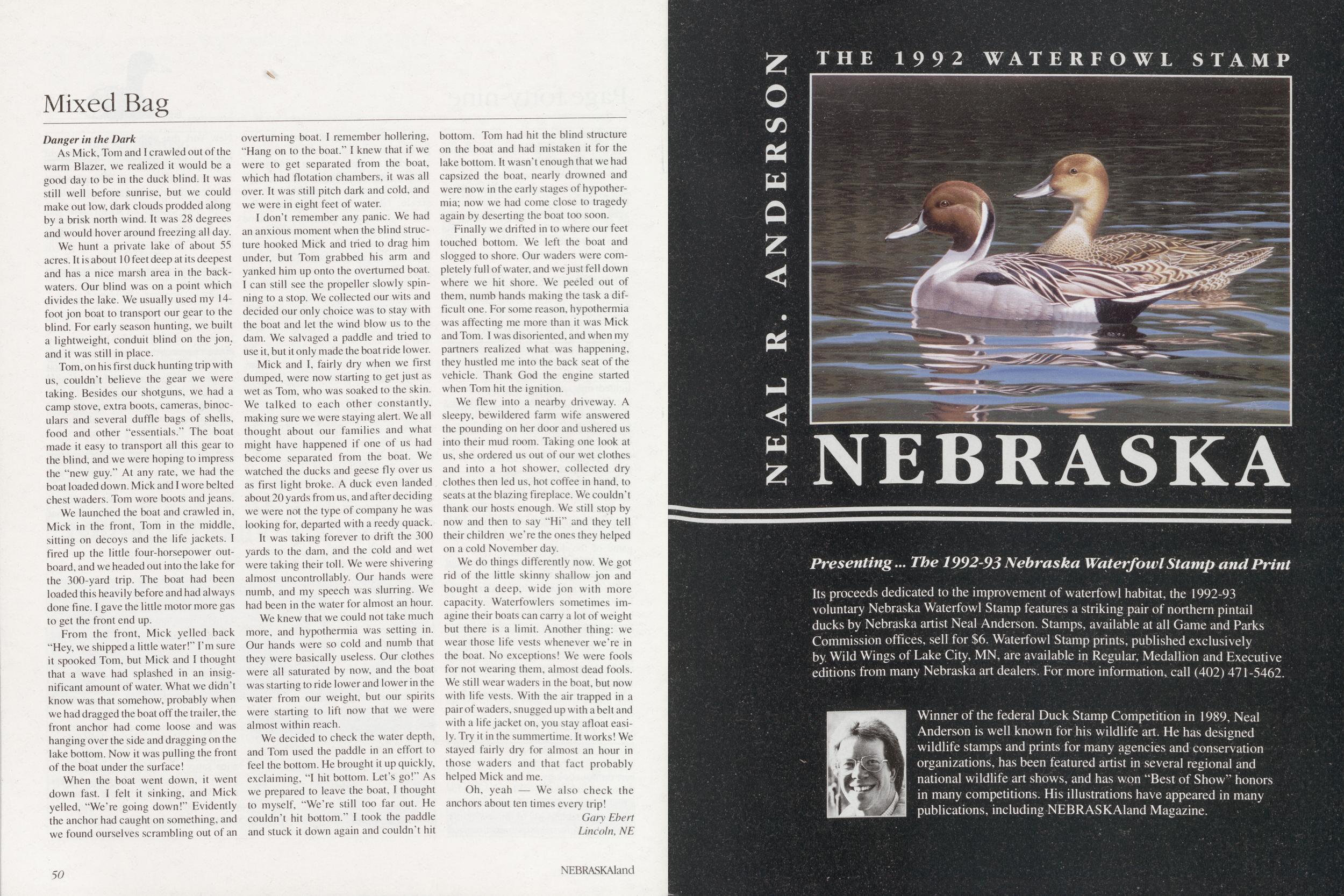
Mixed Bag
Danger in the DarkAs Mick, Tom and I crawled out of the warm Blazer, we realized it would be a good day to be in the duck blind. It was still well before sunrise, but we could make out low, dark clouds prodded along by a brisk north wind. It was 28 degrees and would hover around freezing all day.
We hunt a private lake of about 55 acres. It is about 10 feet deep at its deepest and has a nice marsh area in the backwaters. Our blind was on a point which divides the lake. We usually used my 14-foot jon boat to transport our gear to the blind. For early season hunting, we built a lightweight, conduit blind on the jon, and it was still in place.
Tom, on his first duck hunting trip with us, couldn't believe the gear we were taking. Besides our shotguns, we had a camp stove, extra boots, cameras, binoculars and several duffle bags of shells, food and other "essentials." The boat made it easy to transport all this gear to the blind, and we were hoping to impress the "new guy." At any rate, we had the boat loaded down. Mick and I wore belted chest waders. Tom wore boots and jeans.
We launched the boat and crawled in, Mick in the front, Tom in the middle, sitting on decoys and the life jackets. I fired up the little four-horsepower out-board, and we headed out into the lake for the 300-yard trip. The boat had been loaded this heavily before and had always done fine. I gave the little motor more gas to get the front end up.
From the front, Mick yelled back "Hey, we shipped a little water!" I'm sure it spooked Tom, but Mick and I thought that a wave had splashed in an insignificant amount of water. What we didn't know was that somehow, probably when we had dragged the boat off the trailer, the front anchor had come loose and was hanging over the side and dragging on the lake bottom. Now it was pulling the front of the boat under the surface!
When the boat went down, it went down fast. I felt it sinking, and Mick yelled, "We're going down!" Evidently the anchor had caught on something, and we found ourselves scrambling out of an overturning boat. I remember hollering, "Hang on to the boat." I knew that if we were to get separated from the boat, which had flotation chambers, it was all over. It was still pitch dark and cold, and we were in eight feet of water.
I don't remember any panic. We had an anxious moment when the blind structure hooked Mick and tried to drag him under, but Tom grabbed his arm and yanked him up onto the overturned boat. I can still see the propeller slowly spinning to a stop. We collected our wits and decided our only choice was to stay with the boat and let the wind blow us to the dam. We salvaged a paddle and tried to use it, but it only made the boat ride lower.
Mick and I, fairly dry when we first dumped, were now starting to get just as wet as Tom, who was soaked to the skin. We talked to each other constantly, making sure we were staying alert. We all thought about our families and what might have happened if one of us had become separated from the boat. We watched the ducks and geese fly over us as first light broke. A duck even landed about 20 yards from us, and after deciding we were not the type of company he was looking for, departed with a reedy quack.
It was taking forever to drift the 300 yards to the dam, and the cold and wet were taking their toll. We were shivering almost uncontrollably. Our hands were numb, and my speech was slurring. We had been in the water for almost an hour.
We knew that we could not take much more, and hypothermia was setting in. Our hands were so cold and numb that they were basically useless. Our clothes were all saturated by now, and the boat was starting to ride lower and lower in the water from our weight, but our spirits were starting to lift now that we were almost within reach.
We decided to check the water depth, and Tom used the paddle in an effort to feel the bottom. He brought it up quickly, exclaiming, "I hit bottom. Let's go!" As we prepared to leave the boat, I thought to myself, "We're still too far out. He couldn't hit bottom." I took the paddle and stuck it down again and couldn't hit bottom. Tom had hit the blind structure on the boat and had mistaken it for the lake bottom. It wasn't enough that we had capsized the boat, nearly drowned and were now in the early stages of hypothermia; now we had come close to tragedy again by deserting the boat too soon.
Finally we drifted in to where our feet touched bottom. We left the boat and slogged to shore. Our waders were completely full of water, and we just fell down where we hit shore. We peeled out of them, numb hands making the task a difficult one. For some reason, hypothermia was affecting me more than it was Mick and Tom. I was disoriented, and when my partners realized what was happening, they hustled me into the back seat of the vehicle. Thank God the engine started when Tom hit the ignition.
We flew into a nearby driveway. A sleepy, bewildered farm wife answered the pounding on her door and ushered us into their mud room. Taking one look at us, she ordered us out of our wet clothes and into a hot shower, collected dry clothes then led us, hot coffee in hand, to seats at the blazing fireplace. We couldn't thank our hosts enough. We still stop by now and then to say "Hi" and they tell their children we're the ones they helped on a cold November day.
We do things differently now. We got rid of the little skinny shallow jon and bought a deep, wide jon with more capacity. Waterfowlers sometimes imagine their boats can carry a lot of weight but there is a limit. Another thing: we wear those life vests whenever we're in the boat. No exceptions! We were fools for not wearing them, almost dead fools. We still wear waders in the boat, but now with life vests. With the air trapped in a pair of waders, snugged up with a belt and with a life jacket on, you stay afloat easily. Try it in the summertime. It works! We stayed fairly dry for almost an hour in those waders and that fact probably helped Mick and me.
Oh, yeah — We also check the anchors about ten times every trip!
Gary Ehert Lincoln, NE 50 NEBRASKAland Presenting. The 1992-93 Nebraska Waterfowl Stamp and Print Its proceeds dedicated to the improvement of waterfowl habitat, the 1992-93 voluntary Nebraska Waterfowl Stamp features a striking pair of northern pintail ducks by Nebraska artist Neal Anderson. Stamps, available at all Game and Parks Commission offices, sell for $6. Waterfowl Stamp prints, published exclusively by Wild Wings of Lake City, MN, are available in Regular, Medallion and Executive editions from many Nebraska art dealers. For more information, call (402) 471-5462. Winner of the federal Duck Stamp Competition in 1989, Neal Anderson is well known for his wildlife art. He has designed wildlife stamps and prints for many agencies and conservation organizations, has been featured artist in several regional and national wildlife art shows, and has won "Best of Show" honors in many competitions. His illustrations have appeared in many publications, including NEBRASKAland Magazine.
Position: 664 (17 views)