Volume 70, Issue 7, 1992
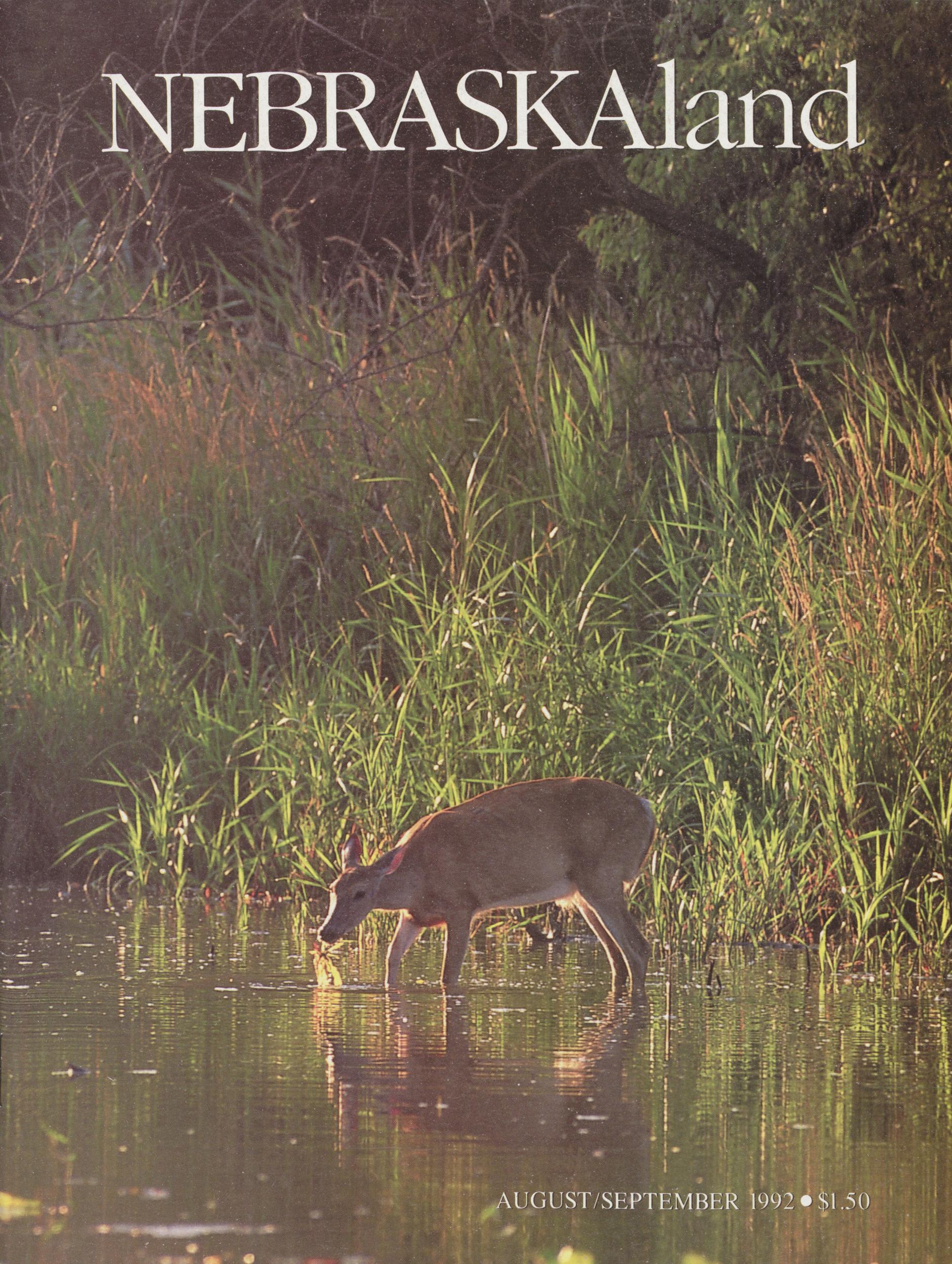
NEBRASKAland
AUGUST/SEPTEMBER 1992 $1.50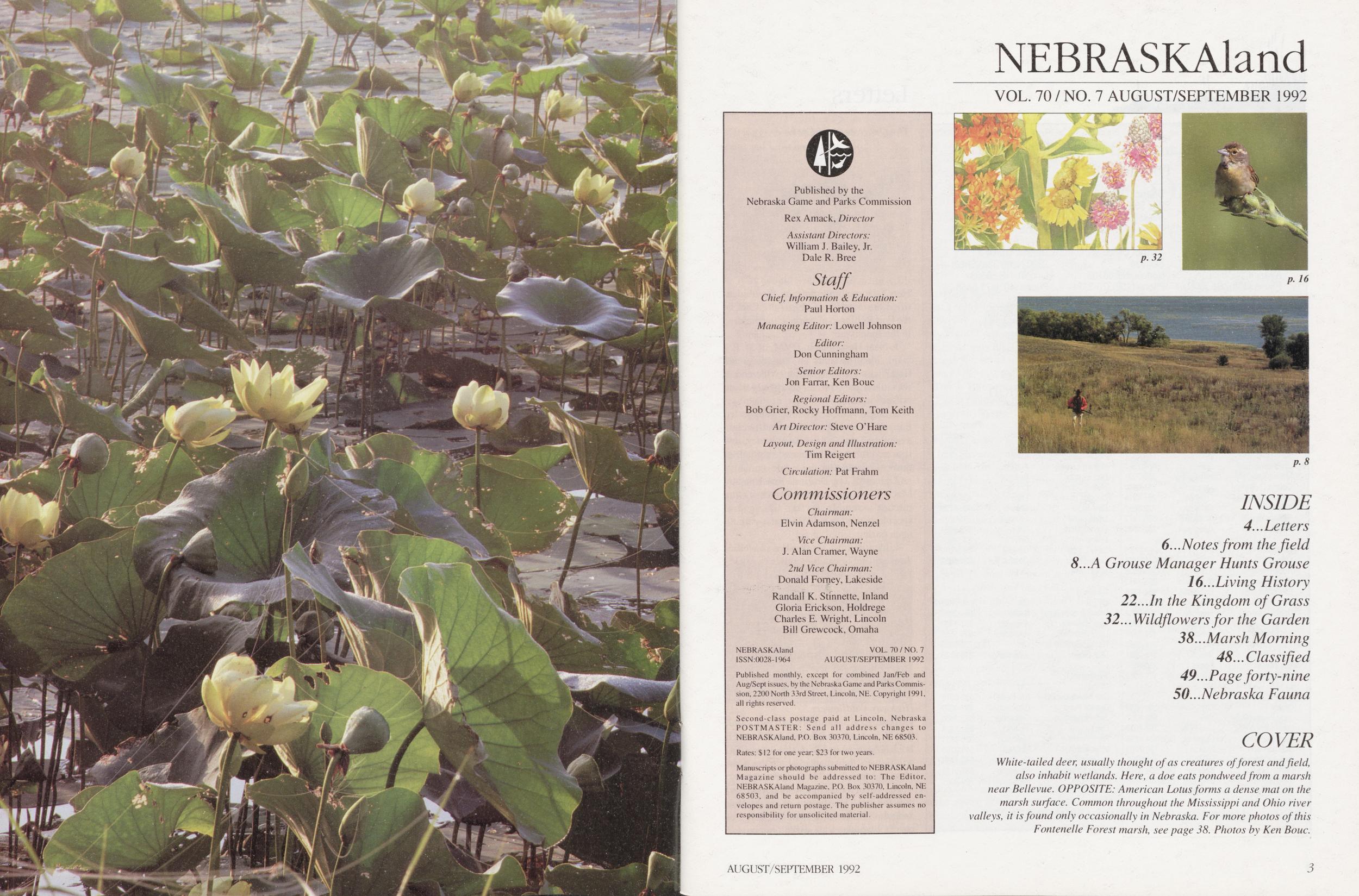
NEBRASKAland
VOL. 70 / NO. 7 AUGUST/SEPTEMBER 1992 Published by the Nebraska Game and Parks Commission Rex Amack, Director Assistant Directors: William J. Bailey, Jr. Dale R. Bree Staff Chief, Information & Education: Paul Horton Managing Editor: Lowell Johnson Editor: Don Cunningham Senior Editors: Jon Farrar, Ken Bouc Regional Editors: Bob Grier, Rocky Hoffmann, Tom Keith Art Director: Steve O'Hare Layout, Design and Illustration: Tim Reigert Circulation: Pat Frahm Commissioners Chairman: Elvin Adamson, Nenzel Vice Chairman: J. Alan Cramer, Wayne 2nd Vice Chairman: Donald Forney, Lakeside Randall K. Stinnette, Inland Gloria Erickson, Holdrege Charles E. Wright, Lincoln Bill Grewcock, Omaha NEBRASKAIand ISSN:0028-1964 VOL. 70 / NO. 7 AUGUST/SEPTEMBER 1992 Published monthly, except for combined Jan/Feb and Aug/Sept issues, by the Nebraska Game and Parks Commission, 22(H) North 33rd Street, Lincoln, NE. Copyright 1991, all rights reserved. Second-class postage paid at Lincoln, Nebraska POSTMASTER: Send all address changes to NEBRASKAIand, P.O. Box 30370, Lincoln, NE 68503. Rates: $ 12 for one year: $23 for two years. Manuscripts or photographs submitted to NEBRASKAIand Magazine should be addressed to: The Editor, NEBRASKAIand Magazine, P.O. Box 30370, Lincoln, NE 68503, and be accompanied by self-addressed envelopes and return postage. The publisher assumes no responsibility for unsolicited material.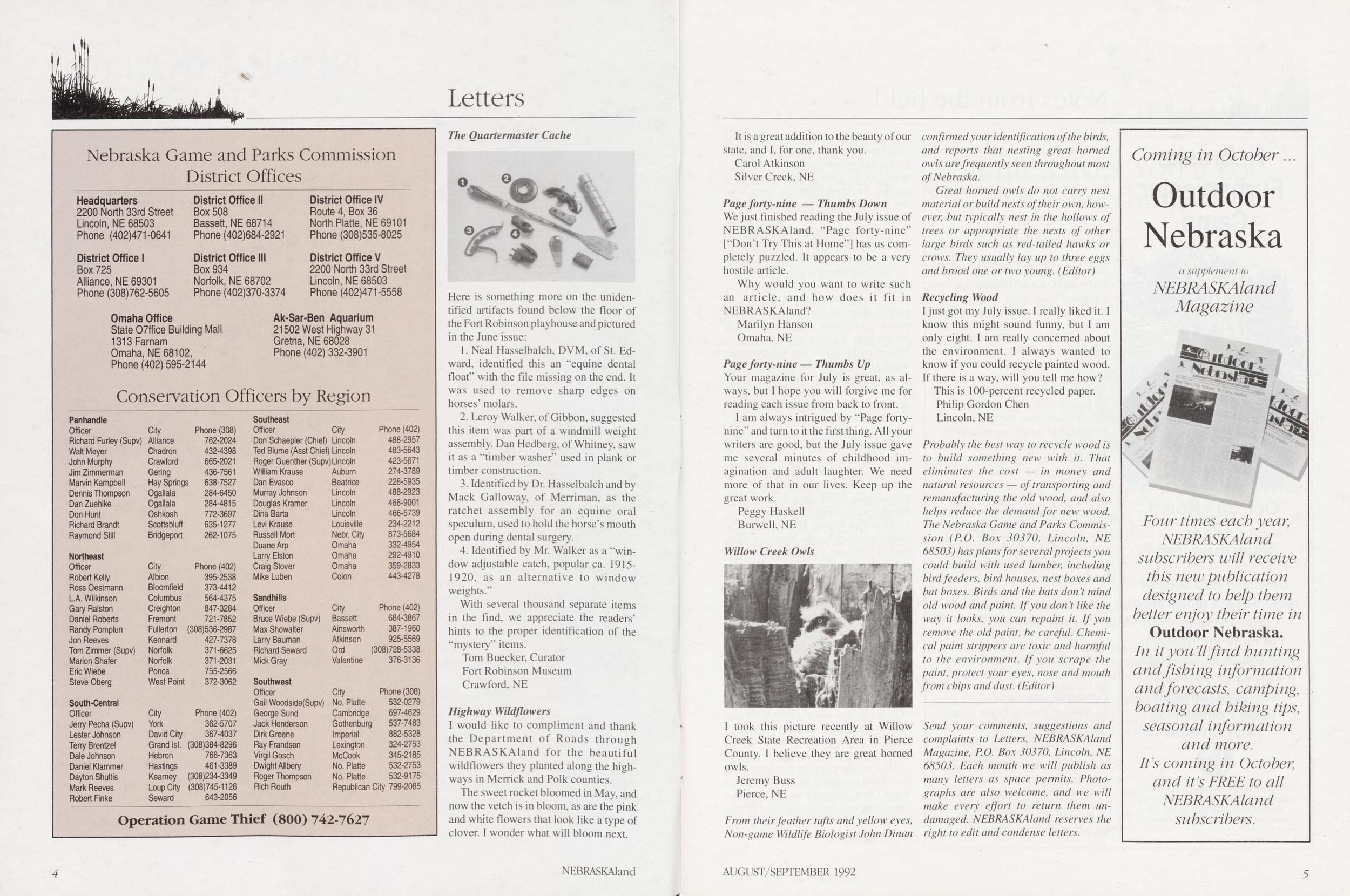 Nebraska Game and Parks Commission
District Offices
Headquarters District Office il District Office IV
2200 North 33rd Street Box 508 Route 4, Box 36
Lincoln, NE 68503 Bassett, NE 68714 North Platte, NE 69101
Phone (402)471-0641 Phone (402)684-2921 Phone (308)535 8025
District Office 1 District Office III District Office
Box 725 Box 934 2200 North 33rd Street
Alliance, NE 69301 Norfolk, NE 68702 Lincoln, NE 68503
Phone (308)762-5605 Phone (402)370-3374 Phone (402)471 5558
Omaha Office Ak-Sar-Ben Aquarium
State 07ffice Building Mall 21502 West Highway 31
1313Farnam Gretna, NE 68028
Omaha, NE 68102, Phone (402) 332-3901
Phone (402) 595-2144
Conservation Officers by Region
Panhandle Southeast
Officer City Phone (308) Officer City Phone (402)
Richard Furley (Supv) Alliance 762-2024 Don Schaepler (Chief) Lincoln 488-2957
Walt Meyer Chadron 432-4398 Ted Blume (Asst Chief) Lincoln 483-5643
John Murphy Crawford 665-2021 Roger Guenther (Supv) Lincoln 423-5671
Jim Zimmerman Gering 436-7561 William Krause Auburn 274-3789
Marvin Kampbell Hay Springs 638-7527 Dan Evasco Beatrice 228-5935
Dennis Thompson Ogallala 284-6450 Murray Johnson Lincoln 488-2923
Dan Zuehlke Ogallala 284-4815 Douglas Kramer Lincoln 466-9001
Don Hunt Oshkosh 772-3697 Dina Barta Lincoln 466-5739
Richard Brandt Scottsbluff 635-1277 Levi Krause Louisville 234-2212
Raymond Still Bridgeport 262-1075 Russell Mort Nebr. City 873-5684
Duane Arp Omaha 332-4954
Northeast Larry Elston Omaha 292-4910
Officer City Phone (402) Craig Stover Omaha 359-2833
Robert Kelly Albion 395-2538 Mike Luben Colon 443-4278
Ross Oestmann Bloomfield 373-4412
LA. Wilkinson Columbus 564-4375 Sandhills
Gary Ralston Creighton 847-3284 Officer City Phone (402)
Daniel Roberts Fremont 721-7852 Bruce Wiebe (Supv) Bassett 684-3867
Randy Pomplun Fullerton (308)536-2987 Max Showalter Ainsworth 387-1960
Jon Reeves Kennard 427-7378 Larry Bauman Atkinson 925-5569
Tom Zimmer (Supv) Norfolk 371-6625 Richard Seward Ord (308)728-5338
Marion Shafer Norfolk 371-2031 Mick Gray Valentine 376-3136
Eric Wiebe Ponca 755-2566
Steve Oberg West Point 372-3062 Southwest
Officer City Phone (308)
South-Central Gail Woodside(Supv) No. Platte 532-0279
Officer City Phone (402) George Sund Cambridge 697-4629
Jerry Pecha (Supv) York 362-5707 Jack Henderson Gothenburg 537-7483
Lester Johnson David City 367-4037 Dirk Greene Imperial 882-5328
Terry Brentzel Grand Isl. (308)384-8296 Ray Frandsen Lexington 324-2753
Dale Johnson Hebron 768-7363 Virgil Gosch McCook 345-2185
Daniel Klammer Hastings 461-3389 Dwight Allbery No. Platte 532-2753
Dayton Shultis Kearney (308)234-3349 Roger Thompson No. Platte 532-9175
Mark Reeves Loup City (308)745-1126 Rich Routh Republican City 799-2085
Robert Finke Seward 643-2056
Operation Game Thief (800) 742-7627
Nebraska Game and Parks Commission
District Offices
Headquarters District Office il District Office IV
2200 North 33rd Street Box 508 Route 4, Box 36
Lincoln, NE 68503 Bassett, NE 68714 North Platte, NE 69101
Phone (402)471-0641 Phone (402)684-2921 Phone (308)535 8025
District Office 1 District Office III District Office
Box 725 Box 934 2200 North 33rd Street
Alliance, NE 69301 Norfolk, NE 68702 Lincoln, NE 68503
Phone (308)762-5605 Phone (402)370-3374 Phone (402)471 5558
Omaha Office Ak-Sar-Ben Aquarium
State 07ffice Building Mall 21502 West Highway 31
1313Farnam Gretna, NE 68028
Omaha, NE 68102, Phone (402) 332-3901
Phone (402) 595-2144
Conservation Officers by Region
Panhandle Southeast
Officer City Phone (308) Officer City Phone (402)
Richard Furley (Supv) Alliance 762-2024 Don Schaepler (Chief) Lincoln 488-2957
Walt Meyer Chadron 432-4398 Ted Blume (Asst Chief) Lincoln 483-5643
John Murphy Crawford 665-2021 Roger Guenther (Supv) Lincoln 423-5671
Jim Zimmerman Gering 436-7561 William Krause Auburn 274-3789
Marvin Kampbell Hay Springs 638-7527 Dan Evasco Beatrice 228-5935
Dennis Thompson Ogallala 284-6450 Murray Johnson Lincoln 488-2923
Dan Zuehlke Ogallala 284-4815 Douglas Kramer Lincoln 466-9001
Don Hunt Oshkosh 772-3697 Dina Barta Lincoln 466-5739
Richard Brandt Scottsbluff 635-1277 Levi Krause Louisville 234-2212
Raymond Still Bridgeport 262-1075 Russell Mort Nebr. City 873-5684
Duane Arp Omaha 332-4954
Northeast Larry Elston Omaha 292-4910
Officer City Phone (402) Craig Stover Omaha 359-2833
Robert Kelly Albion 395-2538 Mike Luben Colon 443-4278
Ross Oestmann Bloomfield 373-4412
LA. Wilkinson Columbus 564-4375 Sandhills
Gary Ralston Creighton 847-3284 Officer City Phone (402)
Daniel Roberts Fremont 721-7852 Bruce Wiebe (Supv) Bassett 684-3867
Randy Pomplun Fullerton (308)536-2987 Max Showalter Ainsworth 387-1960
Jon Reeves Kennard 427-7378 Larry Bauman Atkinson 925-5569
Tom Zimmer (Supv) Norfolk 371-6625 Richard Seward Ord (308)728-5338
Marion Shafer Norfolk 371-2031 Mick Gray Valentine 376-3136
Eric Wiebe Ponca 755-2566
Steve Oberg West Point 372-3062 Southwest
Officer City Phone (308)
South-Central Gail Woodside(Supv) No. Platte 532-0279
Officer City Phone (402) George Sund Cambridge 697-4629
Jerry Pecha (Supv) York 362-5707 Jack Henderson Gothenburg 537-7483
Lester Johnson David City 367-4037 Dirk Greene Imperial 882-5328
Terry Brentzel Grand Isl. (308)384-8296 Ray Frandsen Lexington 324-2753
Dale Johnson Hebron 768-7363 Virgil Gosch McCook 345-2185
Daniel Klammer Hastings 461-3389 Dwight Allbery No. Platte 532-2753
Dayton Shultis Kearney (308)234-3349 Roger Thompson No. Platte 532-9175
Mark Reeves Loup City (308)745-1126 Rich Routh Republican City 799-2085
Robert Finke Seward 643-2056
Operation Game Thief (800) 742-7627
Letters
The Quartermaster CacheHere is something more on the unidentified artifacts found below the floor of the Fort Robinson playhouse and pictured in the June issue:
1. Neal Hasselbalch, DVM, of St. Edward, identified this an "equine dental float" with the file missing on the end. It was used to remove sharp edges on horses' molars.
2. Leroy Walker, of Gibbon, suggested this item was part of a windmill weight assembly. Dan Hedberg, of Whitney, saw it as a "timber washer" used in plank or timber construction.
3. Identified by Dr. Hasselbalch and by Mack Galloway, of Merriman, as the ratchet assembly for an equine oral speculum, used to hold the horse's mouth open during dental surgery.
4. Identified by Mr. Walker as a "window adjustable catch, popular ca. 1915-1920, as an alternative to window weights."
With several thousand separate items in the find, we appreciate the readers' hints to the proper identification of the "mystery" items.
Tom Buecker, Curator Fort Robinson Museum Crawford, NE Highway Wild/lowersI would like to compliment and thank the Department of Roads through NEBRASKAland for the beautiful wildflowers they planted along the highways in Merrick and Polk counties.
The sweet rocket bloomed in May, and now the vetch is in bloom, as are the pink and white flowers that look like a type of clover. I wonder what will bloom next.
4 NEBRASKAlandIt is a great addition to the beauty of our state, and I, for one, thank you.
Carol Atkinson Silver Creek, NE Page forty-nine — Thumbs DownWe just finished reading the July issue of NEBRASKAland. "Page forty-nine" ["Don't Try This at Home"] has us completely puzzled. It appears to be a very hostile article.
Why would you want to write such an article, and how does it fit in NEBRASKAland?
Marilyn Hanson Omaha, NE Page forty-nine — Thumbs UpYour magazine for July is great, as always, but I hope you will forgive me for reading each issue from back to front.
I am always intrigued by "Page forty-nine" and turn to it the first thing. All your writers are good, but the July issue gave me several minutes of childhood imagination and adult laughter. We need more of that in our lives. Keep up the great work.
Peggy Haskell Burwell, NE Willow Creek OwlsI took this picture recently at Willow Creek State Recreation Area in Pierce County. I believe they are great horned owls.
Jeremy Buss Pierce, NEErom their feather tufts and yellow eyes, Non-game Wildlife Biologist John Dinan confirmed your identification of the birds, and reports that nesting great horned owls are frequently seen throughout most of Nebraska.
Great horned owls do not carry nest material or build nests of their own, however, but typically nest in the hollows of trees or appropriate the nests of other large birds such as red-tailed hawks or crows. They usually lay up to three eggs and brood one or two young. (Editor)
Recycling WoodI just got my July issue. I really liked it. I know this might sound funny, but I am only eight. I am really concerned about the environment. I always wanted to know if you could recycle painted wood. If there is a way, will you tell me how?
This is 100-percent recycled paper.
Philip Gordon Chen Lincoln, NEProbably the best way to recycle wood is to build something new with it. That eliminates the cost — in money and natural resources — of transporting and re manufacturing the old wood, and also helps reduce the demand for new wood. The Nebraska Game and Parks Commission (P.O. Box 30370, Lincoln, NE 68503) has plans for several projects vou could build with used lumber, including bird feeders, bird houses, nest boxes and bat boxes. Birds and the bats don't mind old wood and paint. If you don't like the way it looks, you can repaint it. If you remove the old paint, be careful. Chemical paint strippers are toxic and harmful to the environment. If you scrape the paint, protect your eyes, nose and mouth from chips and dust. (Editor)
Send your comments, suggestions and complaints to Letters, NEBRASKAland Magazine, P.O. Box 30370, Lincoln, NE 68503. Each month we will publish as many letters as space permits. Photographs are also welcome, and we will make every effort to return them undamaged. NEBRASKAland reserves the right to edit and condense letters.
Coming in October. Outdoor Nebraska a supplement to NEBRASKAland Magazine Four times each year, NEBRASKAland subscribers will receive this new publication designed to help them better enjoy their time in Outdoor Nebraska. In ityouEfind hunting and fishing information and forecasts, camping, boating and hiking tips, seasonal information and more. Its coming in October, and its FREE to all NEBRASKAland subscribers. AUGUST/SEPTEMBER 1992 5 Nebraska
Furharvester
Oct. 30 - Nov. 1
1992
Valentine, NE.
Cost: $40 ($20 deposit
required with registration)
For more information,
call Chuck McCullough,
Furbearer Specialist,
Nebraska Game and
Parks Commission
(402) 471-5430
Sponsored by the Nebraska Furharvesters
Association and the Nebraska Federation of
Coon Hunters in cooperation with the
Nebraska Game and Parks Commission
Nebraska
Furharvester
Oct. 30 - Nov. 1
1992
Valentine, NE.
Cost: $40 ($20 deposit
required with registration)
For more information,
call Chuck McCullough,
Furbearer Specialist,
Nebraska Game and
Parks Commission
(402) 471-5430
Sponsored by the Nebraska Furharvesters
Association and the Nebraska Federation of
Coon Hunters in cooperation with the
Nebraska Game and Parks Commission
Notes from the field
Notes About the FieldComing home from family vacations when I was a child, my father usually made quite a production out of crossing the "state line" back into Nebraska. He would warn us well in advance, so we would be awake and ready. When we got close enough to pick out the cluster of highway signs that marked the border — state slogans and "come again" messages from South Dakota, Kansas, Wyoming, Colorado, Missouri or Iowa, and speed limits, truck weight regulations, state slogans and "welcome to" messages on "our" side — he'd begin a count-down so we wouldn't miss the instant when the front seat was in Nebraska and the back seat was still "out of state."
Once we'd all made it safely across the border, he'd heave an exaggerated sigh of relief: "Feel the difference?" he'd ask, and usually we were pretty sure we did (especially when we left a state where highway maintenance was worse — or better — than it was in Nebraska).
The scenery didn't change, of course, but that didn't matter; we knew where we were from, and we knew we were back there. Being there seemed to make a lot of difference, even though we often were closer to home when we were out of state than we were when 400 miles away at the other end of Nebraska. Even though the elevation varies by more than 4,500 feet from the state's highest point (in southwest Kimball County) to its lowest point (in southeast Richardson County), even though the rocky, shortgrass prairie of the Oglala Grasslands in Sioux County looks nothing like the loess hills along the Missouri River in Dixon County, even though the humidity in Harrison and Humboldt might be 80 percentage points apart, Omaha and Ogalalla were "here," but Council Bluffs and Julesburg were "there."
So, it isn't surprising that "here" and "there" make a lot of difference to other people, too, nor is it surprising that when we published Joel Sartore's photo essay, "I'm From Nebraska," in the June issue, a few people complained. One reader summed it up this way: "It is too bad the photographs accompanying the T'm From Nebraska' story were not. Seven of the 10 photographs were from out of state."
It was interesting, though, that no one complained about the content of the photographs. The Colorado windmill repairman and the Kansas wheat farmer looked right, they just weren't from "here." No one complained about the ideas — or the sentiments — expressed in the text, either. Sartore says, if I can paraphrase and summarize his poetic text without spoiling it, growing up in Nebraska gave him a set of values — and a way of seeing — based on a solid identity of place, an identity grounded in Nebraska, but larger than Nebraska and its arbitrary boundaries on the map.
It was interesting, too, to have the complaints arrive in the same week I spent three days flying roughly 1,500 miles around the state taking aerial photographs. I flew along the Republican River and Frenchman Creek in Red Willow, Hitchcock and Dundy counties, but the Nebraska-Kansas and Nebraska-Colorado borders didn't show at all, most places. More than 200 miles to the north, above the Niobrara River, the South Dakota line didn't stand out well, either (nor could I find that line of red T's that marks the edge of the Mountain Standard Time Zone on the map).The Missouri River was easy to spot, of course. The Missouri is "our" eastern border, but I wonder if we should risk printing any pictures of it — you know where much of its water (and lots of Platte River water) comes from, don't you? Out of State. So do the sandhill cranes. Most of the ducks and geese, too.
Historically, even the map lines have flexed and shimmied all over the landscape. Once, Nebraska was just about everything between the Missouri River and the Rocky Mountains, which gave "us" a sizable chunk of the Dakotas, 6 NEBRASKAland Wyoming and Montana. When Dakota Territory got whittled off, "we" lost pieces of what was to became Keya Paha, Boyd and Knox counties (later on, "we" got that chunk back) but the Panhandle stretched on out more-or-less to Idaho.
Well, you see what I mean. Being from Nebraska is being from somewhere that matters, but the "somewhere" isn't always easily defined. Sometimes it means being from within those clear but arbitrary boundaries — from a definable political subdivision. But it also means more than that. It means being from a region, from an area as broad as the Great Plains, or the northern plains, or even as amorphous and indefinable a "place" as the Mid- west.
In NEBRASKAland, you aren't likely ever to find a forecast of South Dakota's pheasant season, or a review of Iowa's parks. Those belong appropriately to other political subdivisions — to other states. But, from time to time, you might run across a photo of a sandhill crane, hatched in Canada — or Siberia — just passing through Nebraska on its way to Texas. You might see a Nebraska junior-highschool student contemplating the headwaters of the North Platte River in Colorado. You might see a reproduction of Alfred Jacob Miller's 1837 painting of the wooden stockade at the first Fort Laramie (Fort William) then in "Nebraska," now in "Wyoming."
You can expect to see more pictures of the Sower and of Chimney Rock, but once in a while, you might even see a photo something like this: In the last light of the setting sun, a newly married couple, sitting on folding chairs, holding hands across the yellow line in the middle of a rural highway somewhere outside Tipton, Kansas. That won't be because we've suddenly, inexplicably begun to think of ourselves as "KANSASland," but because we think that, in some important way, the photo illustrates us, too.
Don Cunningham Nature Gives You a Lot. Give Something Back! Hikers, birdwatchers, photographers, campers — anyone who finds peace and pleasure in the outdoors — can give back to Nature For years, hunters and trappers have contributed to the acquisition and improvement of wildlife habitat through their purchase of Nebraska Habitat Stamps. Now, through this special program, all outdoor enthusiasts can make a contribution to wildlife and proudly wear the Nebraska Habitat Donor patch. All proceeds will go to the Wildlife Habitat Fund. Give $5 and receive the 1992 Donor Patch Give $12.50 and receive the patch on a cloth cap. Use the coupon below. Mail to: Nebraska Wildlife Donor Program, NEBRASKAland Magazine, P.O. Box 30370, Lincoln, NE 68503 Nebraska Wildlife Habitat Donor Program Please send me Name Wildlife Habitat Donor Patches Wildlife Habitat Donor Caps with Patch Attached Address City State Zip Enclose $5 for each patch (no cap) / $12.50 for each cap (patch attached) Nebraska residents please add appropriate sales tax Mail to: NEBRASKAland Magazine, P.O. Box 30370, Lincoln, NE 68503 AUGUST/SEPTEMBER 1992 7
A Grouse Manager Hunts Grouse
Photos and Text by Jon Farrar Where will you find grouse when the grass is wet, the wind is out of the east, or the temperature is in the 80s? Who would know better than a grouse biologist who is a grouse hunter?Experienced duck hunters know instinctively where birds want to put down when the wind is this way or that, the weather balmy or blustery. Quail and pheasant hunters can generally predict the type of cover in which they will find birds at particular times of the day. But for most Sandhills grouse hunters, finding grouse is akin to finding a needle in a haystack. When a grouse hunter slams the door of his pickup behind him, his eyes gaze over endless miles of seemingly uniform, grasscovered hills.
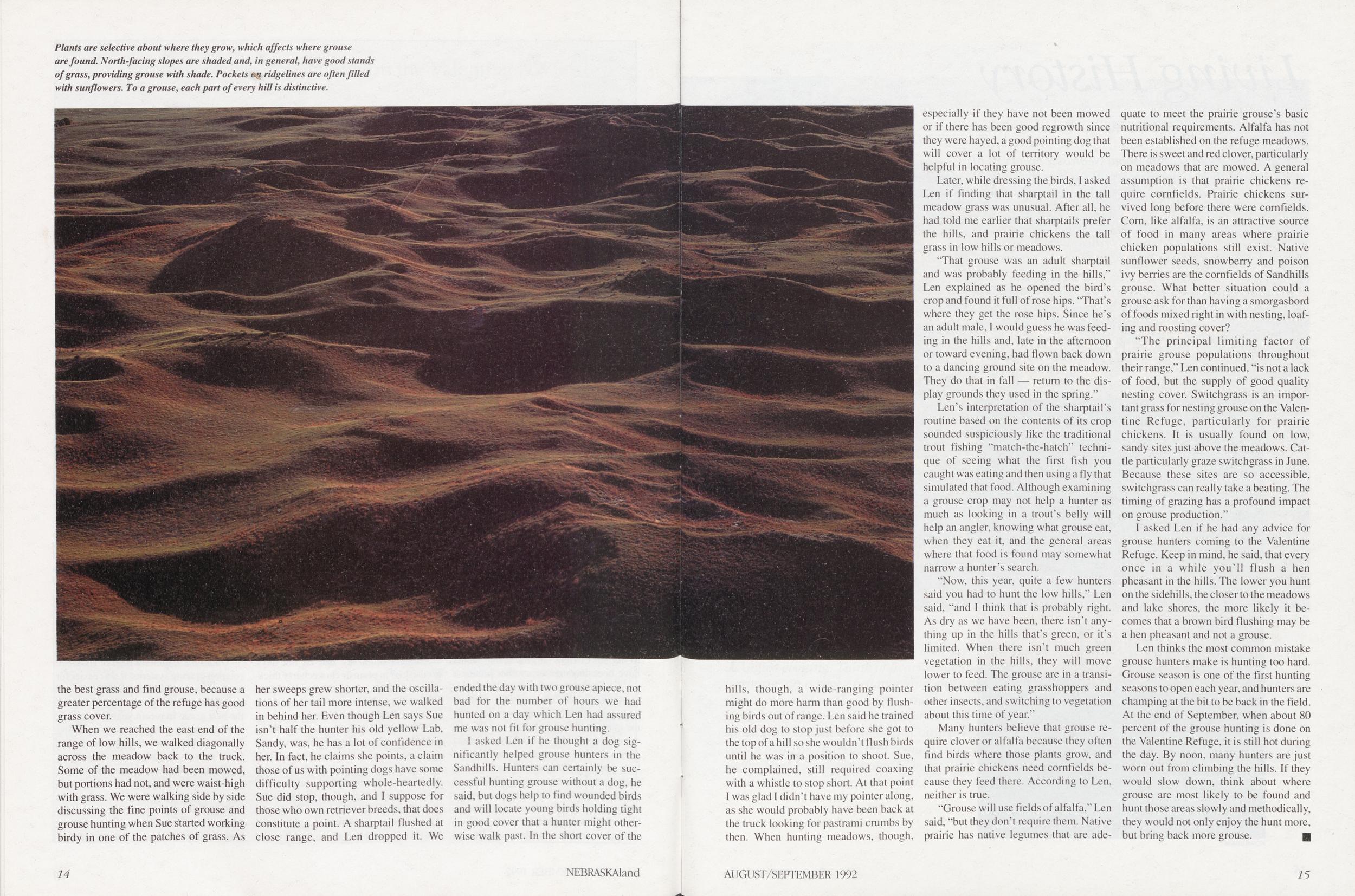
Watch most grouse hunters and you'll see them spread out 50 to 100 yards apart and march down one range of hills and back up another. Their basic strategy seems to be based on the idea that if you cover enough territory, you're bound to bump into grouse, and some may even be within shooting range. To the average hunter, there is little difference between one range of hills and another, or between the vegetation on a south-facing slope and the vegetation on a north-facing slope. To a grouse, though, each range of hills, and each part of each hill, is as clearly divided into distinctive units as a city is to the human hunter.
If hunters thought more like grouse, the number of birds they saw, and the odds of flushing grouse within shotgun range, would increase. To think more like grouse, hunters must understand how grouse live through a day and through the seasons. A grouse biologist who also hunts grouse, it seemed to me, should be able to help the average grouse hunter become more efficient. Early last October, I hunted grouse with Len McDaniel on the Valentine National Wildlife Refuge, in Cherry County, for part of a day. Len has been a biologist at the Valentine Refuge since 1977. He is a good hunter and a good field biologist. When we weren't hunting, I grilled him about grouse habits, grouse hunting and grouse management on the refuge.
The weather was not ideal for grouse hunting, but we hunted anyway. It had rained the night before, and the morning sky was overcast. At midmorning, it was about 45 degrees with a 10 mile-per-hour northeast wind. Most grouse hunters would have started earlier. Len was in no hurry. Regardless of the weather, he does not start until midmorning, when the grouse have finished feeding and have settled into midday loafing areas. It was after 10 when we began walking the hills.
Anyone who has talked to Len for more than a few minutes knows that he has strong opinions about almost everything, and grouse hunting is no exception. He lost no time making it clear that if it were up to him, he wouldn't hunt grouse on such a day. Everything that could be wrong with the weather was wrong. By the time we started hunting, the wind had shifted to the east and was increasing in strength. Later in the day, it would shift to the southeast: the worst possible directions for grouse hunting in the Sandhills, according to Len.
'The wind really affects the activities of grouse," he explained. "They don't like to be where it hits them directly. In the Sandhills, the heaviest grass cover is generally on north and northeast slopes. Most days, that's where grouse like to be, and in that cover they are more inclined to hold until you walk within range. But grouse don't like to be wet. On a morning like this, when the grass is wet, theyTl be in thinner, more open cover, and will be more apt to flush before you get within shotgun range. Ed bet we find grouse out of the wind, in thin cover on the northwest-facing slopes. They'll probably be flighty."
Len explained that, while he doesn't 8 NEBRASKAland
I expected Len to take me to a remote honey hole, but instead we hunted just off the main road through the refuge. Len said that because grazing patterns change from year to year, so do the best places to hunt grouse. We hunted a range of choppy hills with good grass cover broken by little pockets and ridges. In fact, the grass cover was probably too good for a wet morning. We found few grouse. In two hours of hunting, about half of which was real hunting and half more like a range-management field trip, I shot one sharptail. We saw several other singles, all of which flushed out of range, but no flocks. Every bird we kicked up came from sparse cover on northwest-facing slopes or just below the east rim of a pocket.
"I prefer to hunt hills," Len said as we
walked back to the pickup. "Sometimes
I'll hunt meadows, but you get out on a
AUGUST/SEPTEMBER 1992
9
"If the wind is out of the east, though, the birds will either be on west-facing slopes or in ridgeline pockets out of the wind. You have a chance of getting close to them in the pockets. West- and southfacing slopes, though, are not as steep as northeast slopes. They are more gentle with thinner grass cover, and grouse are apt to be anywhere on them. The odds of flushing them within range off west and south-facing slopes are poor, no matter which way you walk the range of hills.
"I look for grouse where there is a good diversity of plants," Len continued, "sand lovegrass, prairie sandreed and other grasses, with an interspersion of forbs like sunflowers, and some woody shrubs like poison ivy and wild rose a real diverse plant community with good cover. I don't like a lot of bare ground, but there should be some. I especially like hills that have an abundance of sand lovegrass on north and northeast slopes. You can find sand lovegrass most anywhere when moisture conditions are good, but in a year of average precipitation, you find the best stands of sand love on the north and northeast slopes. Those slopes aren't subject to the full impact of the sun. They loose less moisture to evaporation, so soil moisture is higher, which is what sand love requires.
"The best stands of sand love are where cattle have not recently grazed," Len continued. "That's probably why it's called lovegrass: cattle love it. It has a good canopy over the top, and it's open underneath. Birds can get in under it, dust, find shade on warm days and have some protection from the wind and from raptors."
On the way to the next range of hills, and through pastrami-and-swiss-cheese-on-rye sandwiches, I continued to interrogate Len. I knew that he seldom hunted grouse in September. Why?
"I like to hunt grouse from about the 8th to the 25 th of October," he said. "That is the time of the year I enjoy being out. That's probably why I pick that time more than any other reason. I like a nice clear day, not a high temperature, not over 70 degrees. I like it about 65 degrees with just a little, light breeze, a steady one, preferably out of the south. Dogs work better when it's not too hot, and I don't like wearing a lot of extra clothing when hunting the hills."
While Len prefers to hunt grouse in October, he says the hunting is just as good, perhaps even better, in September, if you have a good dog. In the early decades of this century, grouse season opened in August. Old hunting photos often show grouse, the majority of them conspicuously young birds, draped on the side of a Model T There was a good reason why hunters preferred to hunt grouse early when it was allowed. Len says that early in the season, the young birds are more likely to sit tight if they are 10 NEBRASKAland in good cover. Hunters might walk right past them if they don't have a good dog, or nearly step on them. While grouse may be harder to find without a good dog, the odds of getting close, and of stragglers stringing out after the bulk of the flock has flushed, are better early in the season.
Len said most grouse hunters on the Valentine Refuge hunt the first week of the season. In recent years, the grouse season in Nebraska has run to the end of November, but late season grouse hunters are as rare as prairie chicken teeth. Many grouse hunters believe grouse gather in big flocks late in the season and are difficult to approach. I asked Len if he thought that was true.
"Later in the season, grouse are in bigger bunches," he said. "Usually that doesn't happen until November or later, though. Hunting pressure early in the season keeps the flocks broken up. Large numbers of birds from several flocks, may congregate in a preferred feeding area, such as an alfalfa field. They appear to be more bunched up than they really are. You are more apt to see big bunches if the population is high and the weather severe. I've seen as many as 200 to 300 grouse in a flock in the winter."
The second area we hunted was superficially unlike the choppy ridge tops we had walked in the morning, but like the first, was pocked with little grassy dishes and ridges, and had much the same pattern of vegetation. We parked in a broad valley below a refuge lake. Between the valley meadow and the dune ridge on the south was a band of low, rolling hills with good grass cover. We made a sweep west, shifted 150 yards south and a bit higher on the side of the ridge, and walked the hills back to the east.
Consistently, I found myself outdistancing Len. We'd lose sight of each other as we rounded a hill, and when we emerged on the other side, I would be 50 yards or more ahead of him. Len was following the zig-zagging leads of Sue, his golden retriever. I had no dog along to convince me a pocket of grass off to the left or right was worth a detour to investigate. But even so, and knowing that Len was more than likely stopping to squish grouse droppings between his fingers to see how fresh they were, inspecting the work of harvest mice or the lairs of trapdoor spiders — or eating rose hips — it was obvious he was doing a more thorough job of hunting for grouse.
Reading Grouse WingsBy examining the primary feathers of a grouse wing, a biologist can determine if the bird is an adult or young-of-the-year. Because adult grouse molt in the summer, their feathers are newer than those of birds hatched in the spring. Consequently, the tips of the two outermost wing feathers of adults are in better condition than the worn and frayed tips of the same feathers of young birds.
Grouse hunters on the Valentine National Wildlife Refuge are asked to leave a wing from each grouse they shoot in a wing envelope found at collection boxes at the refuge entrances. In recent years, only about 30 percent of grouse hunting parties have returned wings. In the early 1980s, when hunters on the refuge were first asked to turn in wings, nearly 70 percent complied.
Contrary to what some hunters believe, the number of wings returned has no influence on setting the seasons or bag limits. Season length and bag limits are based on information from spring display-ground surveys. Biologists need a large sample of wings to gauge the success of the preceding nesting season. On public land set aside and managed for wildlife, such as the Valentine Refuge, knowing the ratio of young birds to adult birds taken by hunters helps biologists determine if grassland management practices are working or failing. Hunters should see their participation in the survey as an investment in the future of grouse hunting.
AUGUST/SEPTEMBER 1992 11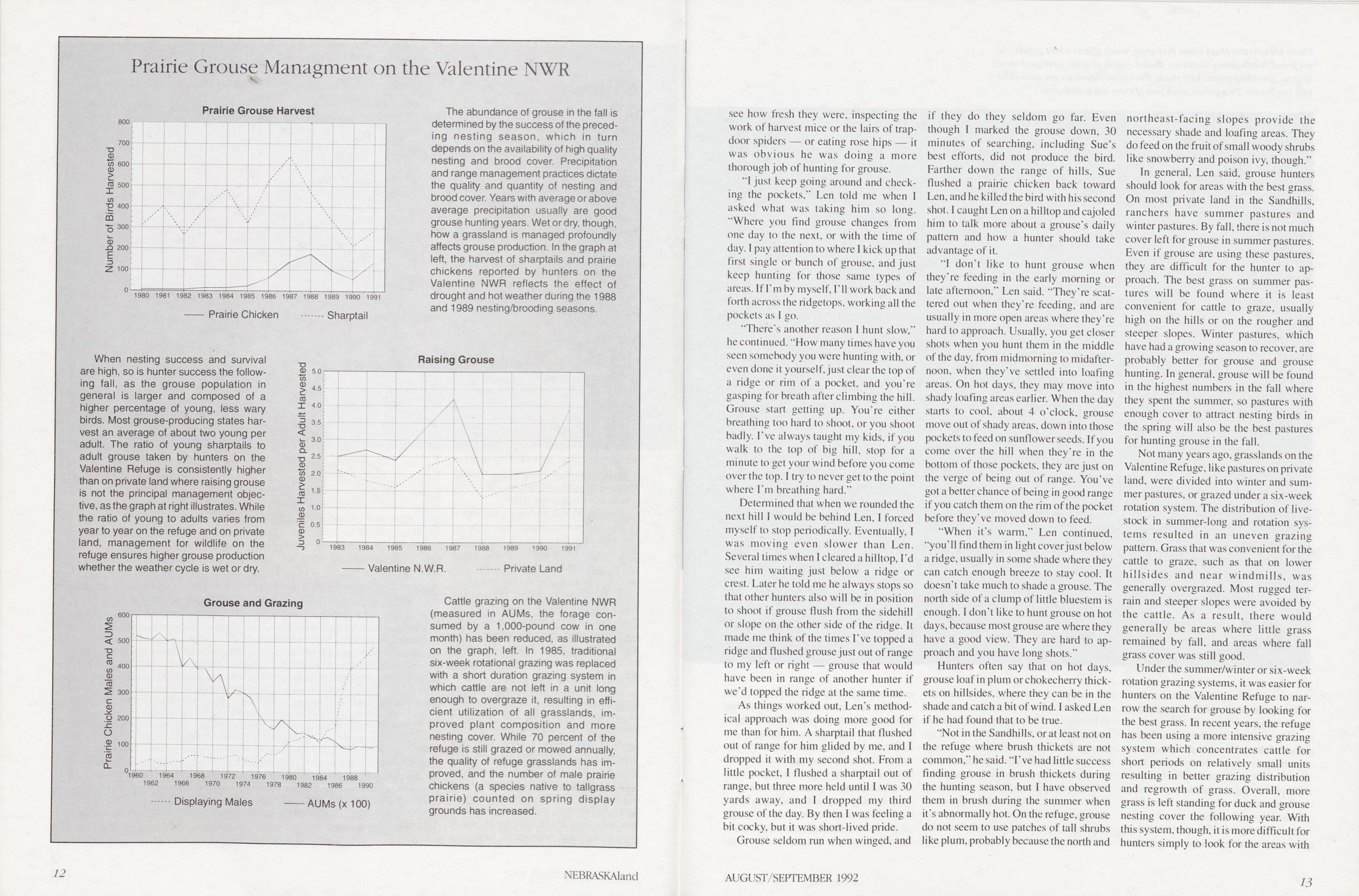 Prairie Grouse Managment on the Valentine NWR
The abundance of grouse in the fall is determined by the success of the preceding nesting season, which in turn depends on the availability of high quality nesting and brood cover. Precipitation and range management practices dictate the quality and quantity of nesting and brood cover. Years with average or above average precipitation usually are good grouse hunting years. Wet or dry, though, how a grassland is managed profoundly affects grouse production. In the graph at left, the harvest of sharptails and prairie chickens reported by hunters on the Valentine NWR reflects the effect of drought and hot weather during the 1988 and 1989 nesting/brooding seasons.
When nesting success and survival are high, so is hunter success the following fall, as the grouse population in general is larger and composed of a higher percentage of young, less wary birds. Most grouse-producing states harvest an average of about two young per adult. The ratio of young sharptails to adult grouse taken by hunters on the Valentine Refuge is consistently higher than on private land where raising grouse is not the principal management objective, as the graph at right illustrates. While the ratio of young to adults varies from year to year on the refuge and on private land, management for wildlife on the refuge ensures higher grouse production whether the weather cycle is wet or dry.
Cattle grazing on the Valentine NWR (measured in AUMs, the forage consumed by a 1,000-pound cow in one month) has been reduced, as illustrated on the graph, left. In 1985, traditional six-week rotational grazing was replaced with a short duration grazing system in which cattle are not left in a unit long enough to overgraze it, resulting in efficient utilization of all grasslands, improved plant composition and more nesting cover. While 70 percent of the refuge is still grazed or mowed annually, the quality of refuge grasslands has improved, and the number of male prairie chickens (a species native to tallgrass prairie) counted on spring display grounds has increased.
12 NEBRASKAland"I just keep going around and checking the pockets," Len told me when I asked what was taking him so long. "Where you find grouse changes from one day to the next, or with the time of day. I pay attention to where I kick up that first single or bunch of grouse, and just keep hunting for those same types of areas. If Tm by myself. Til work back and forth across the ridgetops, working all the pockets as I go.
There's another reason I hunt slow," he continued. "How many times have you seen somebody you were hunting with, or even done it yourself, just clear the top of a ridge or rim of a pocket, and you're gasping for breath after climbing the hill. Grouse start getting up. You're either breathing too hard to shoot, or you shoot badly. I've always taught my kids, if you walk to the top of big hill, stop for a minute to get your wind before you come over the top. I try to never get to the point where I'm breathing hard."
Determined that when we rounded the next hill I would be behind Len, I forced myself to stop periodically. Eventually, I was moving even slower than Len. wSeveral times when I cleared a hilltop, I'd see him waiting just below a ridge or crest. Later he told me he always stops so that other hunters also will be in position to shoot if grouse flush from the sidehill or slope on the other side of the ridge. It made me think of the times I've topped a ridge and flushed grouse just out of range to my left or right — grouse that would have been in range of another hunter if we'd topped the ridge at the same time.
As things worked out, Len's methodical approach was doing more good for me than for him. A sharptail that flushed out of range for him glided by me, and I dropped it with my second shot. From a little pocket, I flushed a sharptail out of range, but three more held until I was 30 yards away, and I dropped my third grouse of the day. By then I was feeling a bit cocky, but it was short-lived pride.
Grouse seldom run when winged, and if they do they seldom go far. Even though I marked the grouse down, 30 minutes of searching, including Sue's best efforts, did not produce the bird. Farther down the range of hills, Sue flushed a prairie chicken back toward Len, and he killed the bird with his second shot. I caught Len on a hilltop and cajoled him to talk more about a grouse's daily pattern and how a hunter should take advantage of it.
"I don't like to hunt grouse when they're feeding in the early morning or late afternoon," Len said. "They're scattered out when they're feeding, and are usually in more open areas where they're hard to approach. Usually, you get closer shots when you hunt them in the middle of the day, from midmorning to midafternoon, when they've settled into loafing areas. On hot days, they may move into shady loafing areas earlier. When the day starts to cool, about 4 o'clock, grouse move out of shady areas, down into those pockets to feed on sunflower seeds. If you come over the hill when they're in the bottom of those pockets, they are just on the verge of being out of range. You've got a better chance of being in good range if you catch them on the rim of the pocket before they've moved down to feed.
"When it's warm," Len continued, "you' 11 find them in light cover just below a ridge, usually in some shade where they can catch enough breeze to stay cool. It doesn't take much to shade a grouse. The north side of a clump of little bluestem is enough. I don't like to hunt grouse on hot days, because most grouse are where they have a good view. They are hard to approach and you have long shots."
Hunters often say that on hot days, grouse loaf in plum or chokecherry thickets on hillsides, where they can be in the shade and catch a bit of wind. I asked Len if he had found that to be true.
"Not in the Sandhills, or at least not on the refuge where brush thickets are not common," he said. "I've had little success finding grouse in brush thickets during the hunting season, but I have observed them in brush during the summer when it's abnormally hot. On the refuge, grouse do not seem to use patches of tall shrubs like plum, probably because the north and northeast-facing slopes provide the necessary shade and loafing areas. They do feed on the fruit of small woody shrubs like snowberry and poison ivy, though."
In general, Len said, grouse hunters should look for areas with the best grass. On most private land in the Sandhills, ranchers have summer pastures and winter pastures. By fall, there is not much cover left for grouse in summer pastures. Even if grouse are using these pastures, they are difficult for the hunter to approach. The best grass on summer pastures will be found where it is least convenient for cattle to graze, usually high on the hills or on the rougher and steeper slopes. Winter pastures, which have had a growing season to recover, are probably better for grouse and grouse hunting. In general, grouse will be found in the highest numbers in the fall where they spent the summer, so pastures with enough cover to attract nesting birds in the spring will also be the best pastures for hunting grouse in the fall.
Not many years ago, grasslands on the Valentine Refuge, like pastures on private land, were divided into winter and summer pastures, or grazed under a six-week rotation system. The distribution of livestock in summer-long and rotation systems resulted in an uneven grazing pattern. Grass that was convenient for the cattle to graze, such as that on lower hillsides and near windmills, was generally overgrazed. Most rugged terrain and steeper slopes were avoided by the cattle. As a result, there would generally be areas where little grass remained by fall, and areas where fall grass cover was still good.
Under the summer/winter or six-week
rotation grazing systems, it was easier for
hunters on the Valentine Refuge to narrow the search for grouse by looking for
the best grass. In recent years, the refuge
has been using a more intensive grazing
system which concentrates cattle for
short periods on relatively small units
resulting in better grazing distribution
and regrowth of grass. Overall, more
grass is left standing for duck and grouse
nesting cover the following year. With
this system, though, it is more difficult for
hunters simply to look for the areas with
AUGUST/SEPTEMBER 1992
13
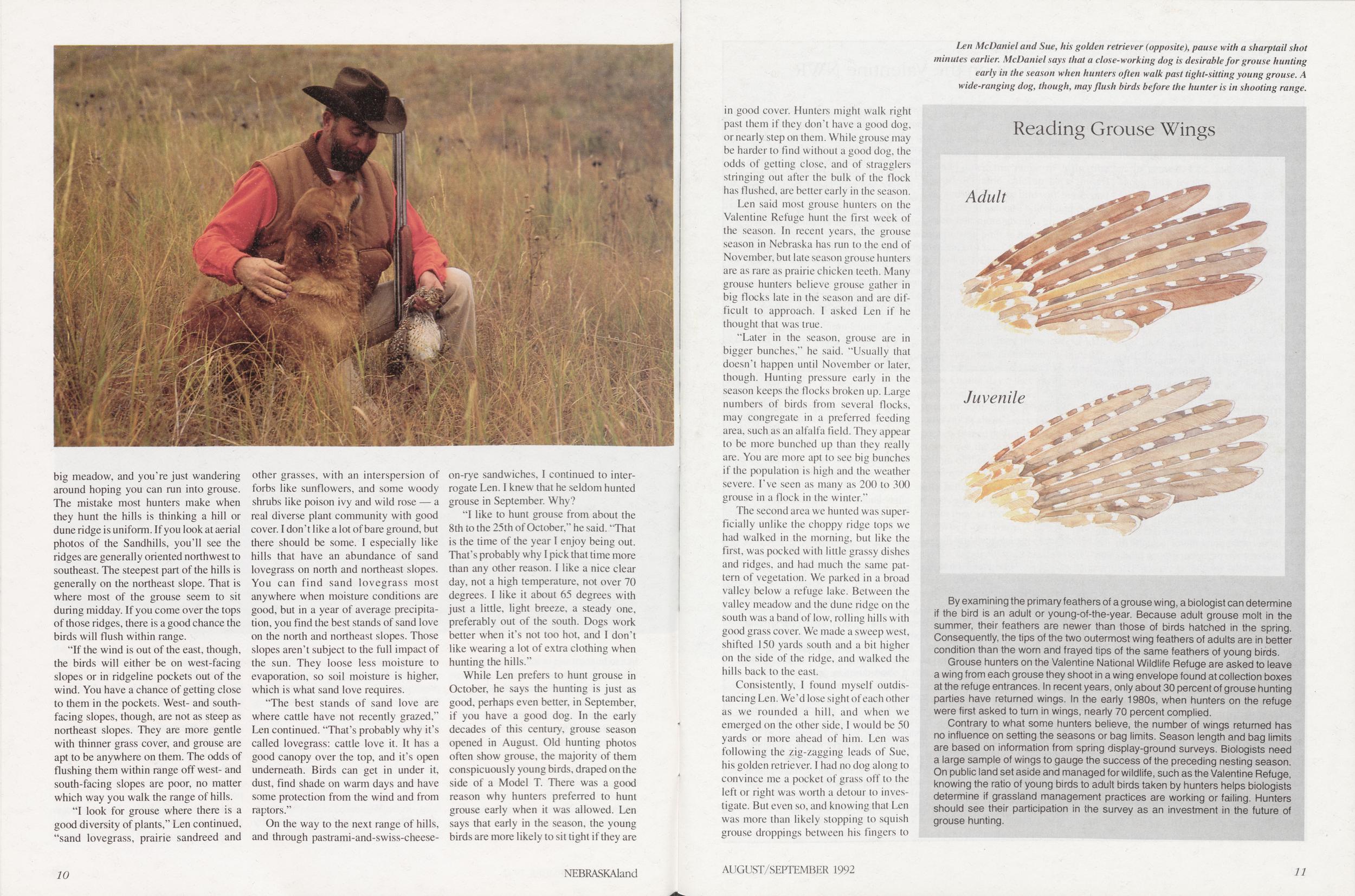
When we reached the east end of the range of low hills, we walked diagonally across the meadow back to the truck. Some of the meadow had been mowed, but portions had not, and were waist-high with grass. We were walking side by side discussing the fine points of grouse and grouse hunting when Sue started working birdy in one of the patches of grass. As her sweeps grew shorter, and the oscillations of her tail more intense, we walked in behind her. Even though Len says Sue isn't half the hunter his old yellow Lab, Sandy, was, he has a lot of confidence in her. In fact, he claims she points, a claim those of us with pointing dogs have some difficulty supporting whole-heartedly. Sue did stop, though, and I suppose for those who own retriever breeds, that does constitute a point. A sharptail flushed at close range, and Len dropped it. We ended the day with two grouse apiece, not bad for the number of hours we had hunted on a day which Len had assured me was not fit for grouse hunting.
I asked Len if he thought a dog significantly helped grouse hunters in the Sandhills. Hunters can certainly be successful hunting grouse without a dog, he said, but dogs help to find wounded birds and will locate young birds holding tight in good cover that a hunter might otherwise walk past. In the short cover of the 14 NERBRASKAland hills, though, a wide-ranging pointer might do more harm than good by flushing birds out of range. Len said he trained his old dog to stop just before she got to the top of a hill so she wouldn't flush birds until he was in a position to shoot. Sue, he complained, still required coaxing with a whistle to stop short. At that point I was glad I didn't have my pointer along, as she would probably have been back at the truck looking for pastrami crumbs by then. When hunting meadows, though, especially if they have not been mowed or if there has been good regrowth since they were hayed, a good pointing dog that will cover a lot of territory would be helpful in locating grouse.
Later, while dressing the birds, I asked Len if finding that sharptail in the tall meadow grass was unusual. After all, he had told me earlier that sharptails prefer the hills, and prairie chickens the tall grass in low hills or meadows.
'That grouse was an adult sharptail and was probably feeding in the hills," Len explained as he opened the bird's crop and found it full of rose hips. "That's where they get the rose hips. Since he's an adult male, I would guess he was feeding in the hills and, late in the afternoon or toward evening, had flown back down to a dancing ground site on the meadow. They do that in fall — return to the display grounds they used in the spring."
Len's interpretation of the sharptail's routine based on the contents of its crop sounded suspiciously like the traditional trout fishing "match-the-hatch" technique of seeing what the first fish you caught was eating and then using a fly that simulated that food. Although examining a grouse crop may not help a hunter as much as looking in a trout's belly will help an angler, knowing what grouse eat, when they eat it, and the general areas where that food is found may somewhat narrow a hunter's search.
"Now, this year, quite a few hunters said you had to hunt the low hills," Len said, "and I think that is probably right. As dry as we have been, there isn't anything up in the hills that's green, or it's limited. When there isn't much green vegetation in the hills, they will move lower to feed. The grouse are in a transition between eating grasshoppers and other insects, and switching to vegetation about this time of year."
Many hunters believe that grouse require clover or alfalfa because they often find birds where those plants grow, and that prairie chickens need cornfields because they feed there. According to Len, neither is true.
"Grouse will use fields of alfalfa," Len said, "but they don't require them. Native prairie has native legumes that are adequate to meet the prairie grouse's basic nutritional requirements. Alfalfa has not been established on the refuge meadows. There is sweet and red clover, particularly on meadows that are mowed. A general assumption is that prairie chickens require cornfields. Prairie chickens survived long before there were cornfields. Com, like alfalfa, is an attractive source of food in many areas where prairie chicken populations still exist. Native sunflower seeds, snowberry and poison ivy berries are the cornfields of Sandhills grouse. What better situation could a grouse ask for than having a smorgasbord of foods mixed right in with nesting, loafing and roosting cover?
"The principal limiting factor of prairie grouse populations throughout their range," Len continued, "is not a lack of food, but the supply of good quality nesting cover. Switchgrass is an important grass for nesting grouse on the Valentine Refuge, particularly for prairie chickens. It is usually found on low, sandy sites just above the meadows. Cattle particularly graze switchgrass in June. Because these sites are so accessible, switchgrass can really take a beating. The timing of grazing has a profound impact on grouse production."
I asked Len if he had any advice for grouse hunters coming to the Valentine Refuge. Keep in mind, he said, that every once in a while you'll flush a hen pheasant in the hills. The lower you hunt on the sidehills, the closer to the meadows and lake shores, the more likely it becomes that a brown bird flushing may be a hen pheasant and not a grouse.
Len thinks the most common mistake grouse hunters make is hunting too hard. Grouse season is one of the first hunting seasons to open each year, and hunters are champing at the bit to be back in the field. At the end of September, when about 80 percent of the grouse hunting is done on the Valentine Refuge, it is still hot during the day. By noon, many hunters are just worn out from climbing the hills. If they would slow down, think about where grouse are most likely to be found and hunt those areas slowly and methodically, they would not only enjoy the hunt more, but bring back more grouse.
AUGUST/SEPTEMBER 1992 15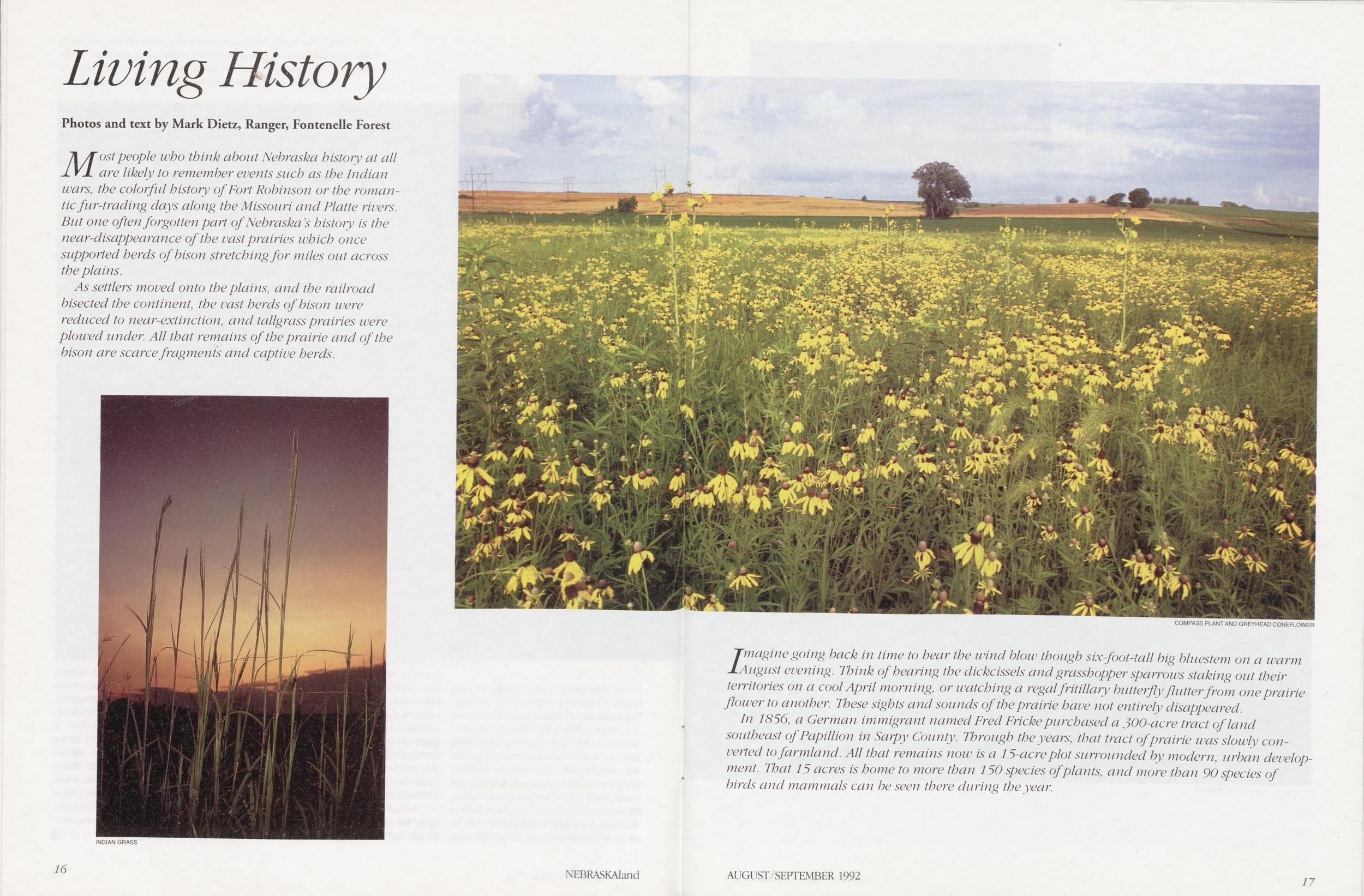
Living History
Photos and text by Mark Dietz, Ranger, Fontenelle ForestMostpeople who think about Nebraska history at all. are likely to remember events such as the Indian wars, the colorful history of Fort Robinson or the romantic fur-trading days along the Missouri and Platte rivers. But one often forgotten part of Nebraska 's history is the near-disappearance of the vast prairies which once supported herds of bison stretching for miles out across the plains.
As settlers moved onto the plains, and the railroad bisected the continent, the vast herds of bison were reduced to near-extinction, and tallgrassprairies were plowed under. All that remains of the prairie and of the bison are scarce fragments and captive herds.
Imagine going back in time to hear the wind blow though six-foot-tall big bluestem on a warm JLAugust evening. Think of hearing the dickcissels and grasshopper sparrows staking out their territories on a cool April morning, or watching a regal frit Mary butterfly flutter from one prairie flower to another. These sights and sounds of the prairie have not entirely disappeared.
In 1856, a German immigrant named Fred Fricke purchased a 300-acre tract of land southeast ofPapillion in Sarpy County. Through the years, that tract of prairie was slowly converted to farmland. All that remains now is a 15-acreplot surrounded by modern, urban development. Ihat 15 acres is home to more than 150 species of plants, and more than 90 species of birds and mammals can be seen there during the year.
AUGUST/SEPTEMBER 1992 17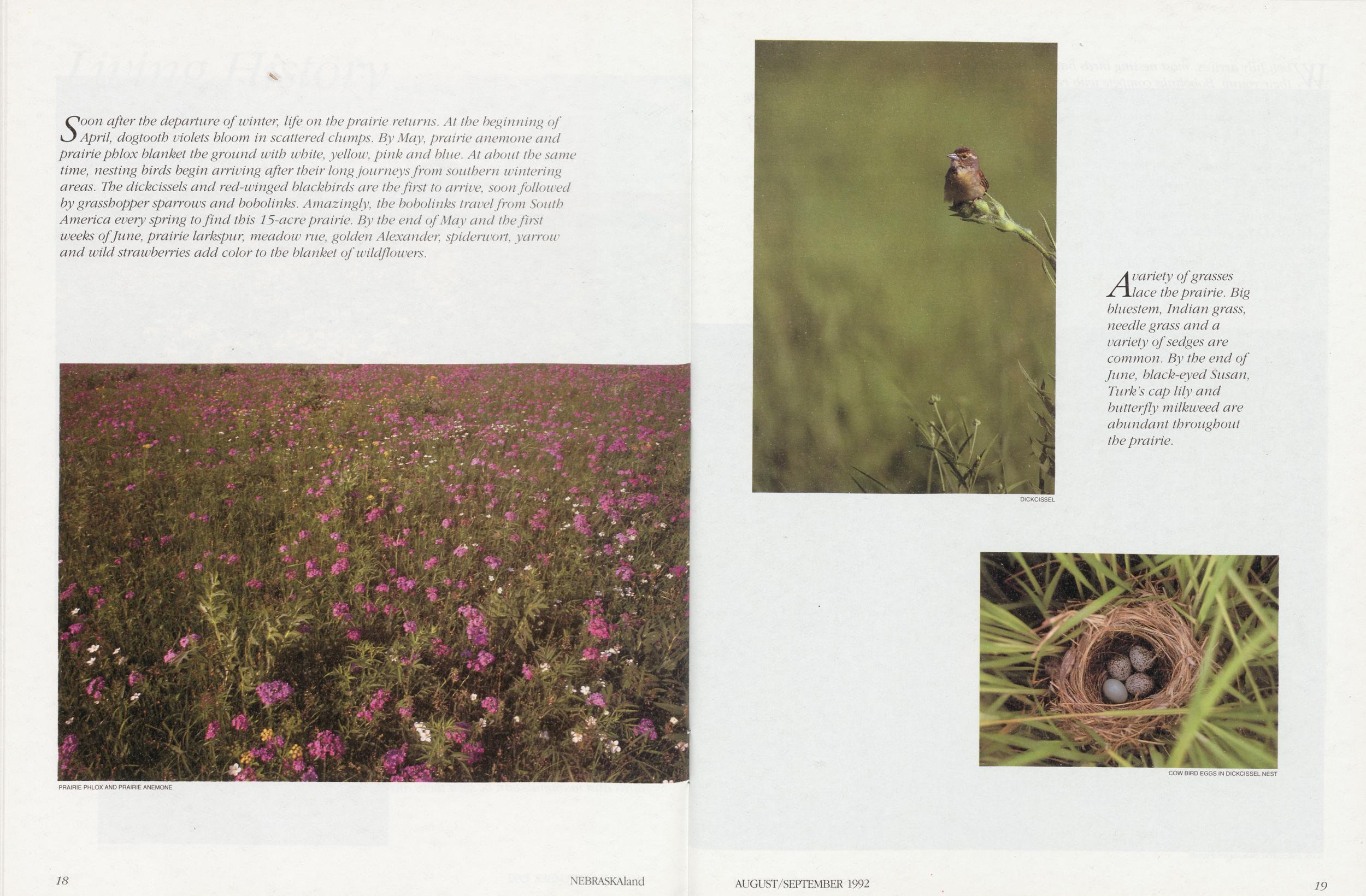
Soon after the departure of winter, life on the prairie returns. At the beginning of April, dogtooth violets bloom in scattered clumps. By May, prairie anemone and prairie phlox blanket the ground with white, yellow, pink and blue. At about the same time, nesting birds begin arriving after their long journeys from southern wintering areas. The dickcissels and red-winged blackbirds are the first to arrive, soon followed by grasshopper sparrows and bobolinks. Amazingly, the bobolinks travel from South America every spring to find this 15-acre prairie. By the end of May and the first weeks of June, prairie larkspur, meadow rue, golden Alexander, spiderwort. yarrow and wild strawberries add color to the blanket ofwildjlowers.
A variety of grasses Jilace the prairie. Big bluestem, Indian grass, needle grass and a variety of sedges are common. By the end of June, black-eyed Susan, Turks cap lily and butterfly milkweed are abundant throughout the prairie.
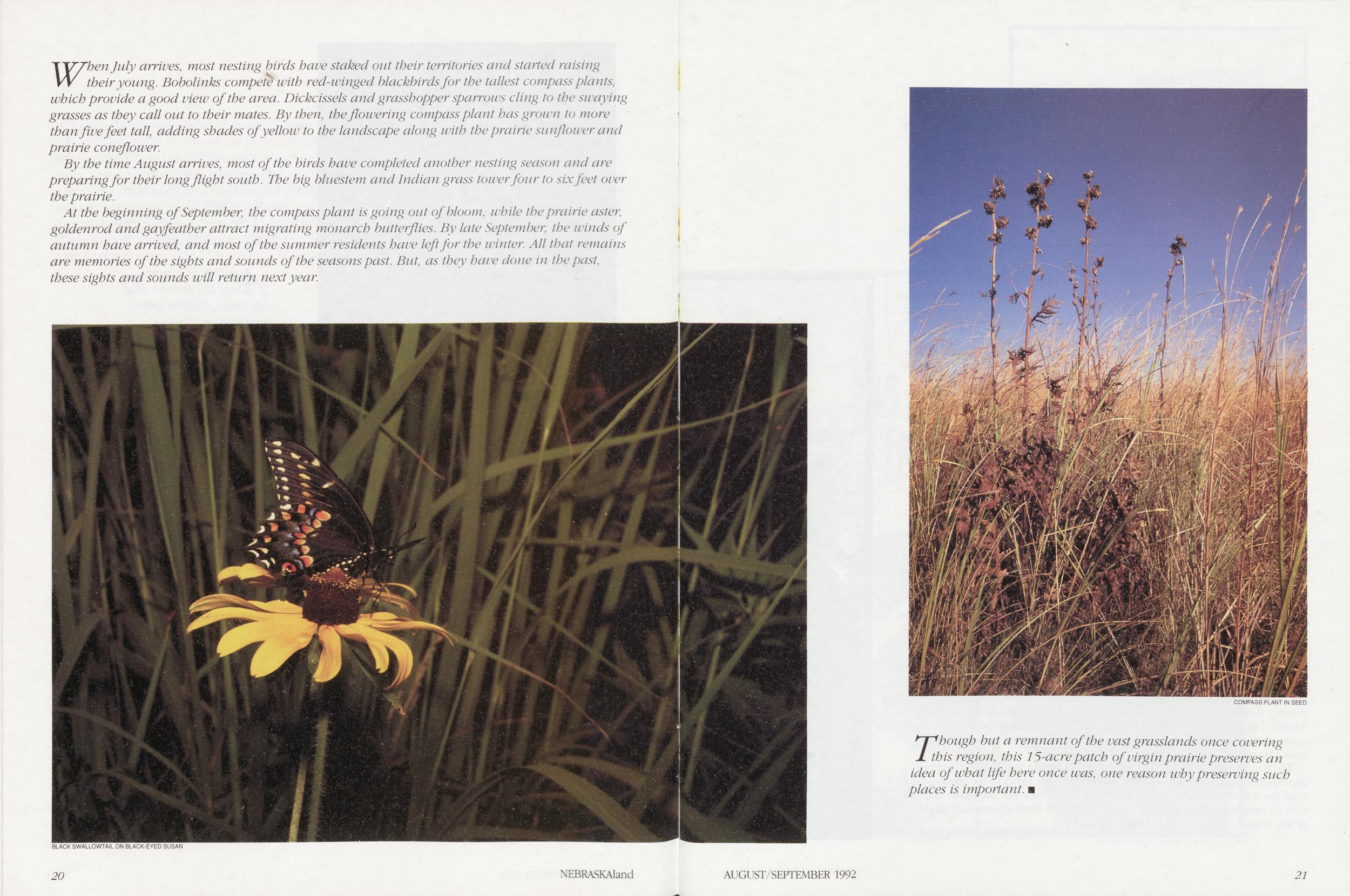
When July arrives, most nesting birds have staked out their territories and started raising their young. Bobolinks compete with red-winged blackbirds for the tallest compass plants, which provide a good view of the area. Dickcissels and grasshopper sparrows cling to the swaying grasses as they call out to their mates. By then, the flowering compass plant has grown to more than five feet tail, adding shades of yellow to the landscape along with the prairie sunflower and prairie coneflower.
By the time August arrives, most of the birds have completed another nesting season and are preparing for their long flight south. The big bluestem and Indian grass tower four to six feet over the prairie.
At the beginning of September, the compass plant is going out of bloom, while the prairie aster goldenrod andgayfeather attract migrating monarch butterflies. By late September the winds of autumn have arrived, and most of the summer residents have left for the winter. All that remains are memories of the sights and sounds of the seasons past. But, as they have done in the past, these sights and sounds will return next year.
Though but a remnant of the vast grasslands once covering this region, this 15-acre patch of virgin prairie preserves an idea of what life here once was, one reason why preserving such places is important.
AUGUST/SEPTEMBER 1992 21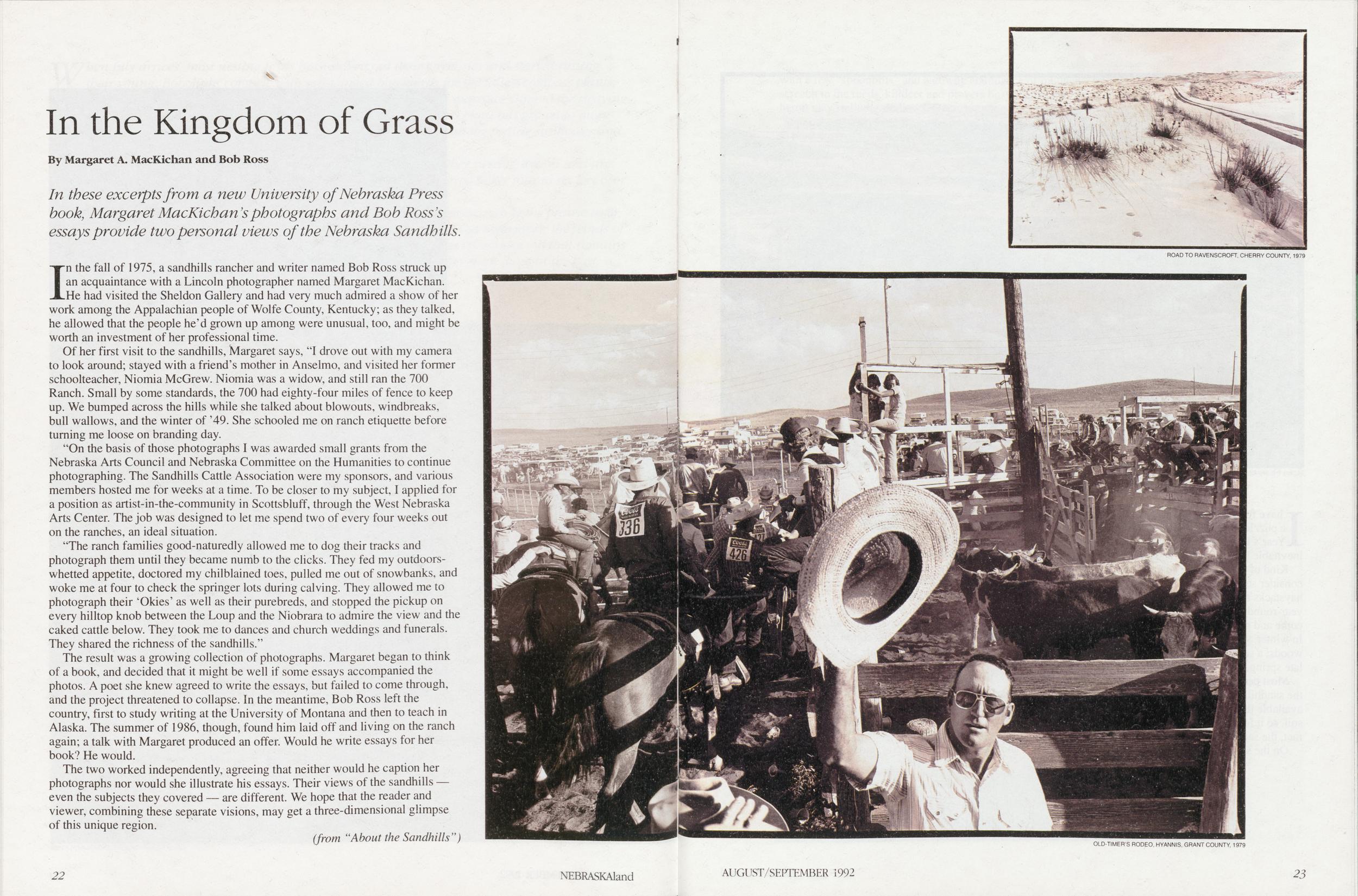
In the Kingdom of Grass
By Margaret A. MacKichan and Bob Ross In these excerpts from a new University of Nebraska Press book, Margaret MacKichan'sphotographs and Bob Ross's essays provide two personal views of the Nebraska Sandhills.In the fall of 1975, a sandhills rancher and writer named Bob Ross struck up an acquaintance with a Lincoln photographer named Margaret MacKichan. He had visited the Sheldon Gallery and had very much admired a show of her work among the Appalachian people of Wolfe County, Kentucky; as they talked, he allowed that the people he'd grown up among were unusual, too, and might be worth an investment of her professional time.
Of her first visit to the sandhills, Margaret says, "I drove out with my camera to look around; stayed with a friend's mother in Anselmo, and visited her former schoolteacher, Niomia McGrew. Niomia was a widow, and still ran the 700 Ranch. Small by some standards, the 700 had eighty-four miles of fence to keep up. We bumped across the hills while she talked about blowouts, windbreaks, bull wallows, and the winter of '49. She schooled me on ranch etiquette before turning me loose on branding day.
"On the basis of those photographs I was awarded small grants from the Nebraska Arts Council and Nebraska Committee on the Humanities to continue photographing. The Sandhills Cattle Association were my sponsors, and various members hosted me for weeks at a time. To be closer to my subject, I applied for a position as artist-in-the-community in Scottsbluff, through the West Nebraska Arts Center. The job was designed to let me spend two of every four weeks out on the ranches, an ideal situation.
"The ranch families good-naturedly allowed me to dog their tracks and photograph them until they became numb to the clicks. They fed my outdoorswhetted appetite, doctored my chilblained toes, pulled me out of snowbanks, and woke me at four to check the springer lots during calving. They allowed me to photograph their 'Okies' as well as their purebreds, and stopped the pickup on every hilltop knob between the Loup and the Niobrara to admire the view and the caked cattle below. They took me to dances and church weddings and funerals. They shared the richness of the sandhills."
The result was a growing collection of photographs. Margaret began to think of a book, and decided that it might be well if some essays accompanied the photos. A poet she knew agreed to write the essays, but failed to come through, and the project threatened to collapse. In the meantime, Bob Ross left the country, first to study writing at the University of Montana and then to teach in Alaska. The summer of 1986, though, found him laid off and living on the ranch again; a talk with Margaret produced an offer. Would he write essays for her book? He would.
The two worked independently, agreeing that neither would he caption her photographs nor would she illustrate his essays. Their views of the sandhills even the subjects they covered — are different. We hope that the reader and viewer, combining these separate visions, may get a three-dimensional glimpse of this unique region.
(from "About the Sandhills") 22 NEBRASKAland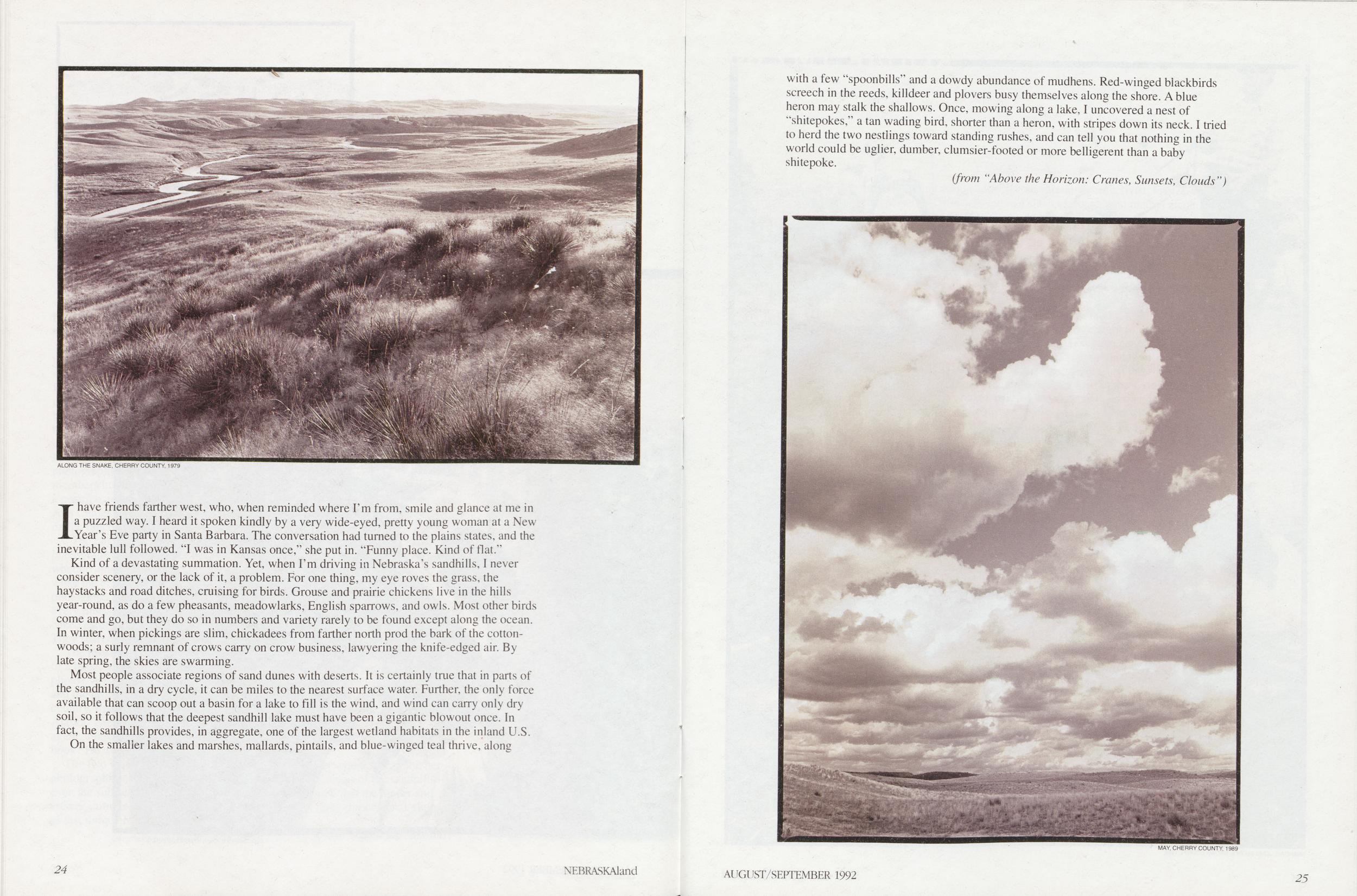
I have friends farther west, who, when reminded where I'm from, smile and glance at me in a puzzled way. I heard it spoken kindly by a very wide-eyed, pretty young woman at a New Year's Eve party in Santa Barbara. The conversation had turned to the plains states, and the inevitable lull followed. "I was in Kansas once," she put in. "Funny place. Kind of flat."
Kind of a devastating summation. Yet, when I'm driving in Nebraska's sandhills, I never consider scenery, or the lack of it, a problem. For one thing, my eye roves the grass, the haystacks and road ditches, cruising for birds. Grouse and prairie chickens live in the hills year-round, as do a few pheasants, meadowlarks, English sparrows, and owls. Most other birds come and go, but they do so in numbers and variety rarely to be found except along the ocean. In winter, when pickings are slim, chickadees from farther north prod the bark of the cottonwoods; a. surly remnant of crows carry on crow business, lawyering the knife-edged air. By late spring, the skies are swarming.
Most people associate regions of sand dunes with deserts. It is certainly true that in parts of the sandhills, in a dry cycle, it can be miles to the nearest surface water. Further, the only force available that can scoop out a basin for a lake to fill is the wind, and wind can carry only dry soil, so it follows that the deepest sandhill lake must have been a gigantic blowout once. In fact, the sandhills provides, in aggregate, one of the largest wetland habitats in the inland U.S.
On the smaller lakes and marshes, mallards, pintails, and blue-winged teal thrive, along 24 NEBRASKAland with a few "spoonbills" and a dowdy abundance of mudhens. Red-winged blackbirds screech in the reeds, killdeer and plovers busy themselves along the shore. A blue heron may stalk the shallows. Once, mowing along a lake, I uncovered a nest of "shitepokes," a tan wading bird, shorter than a heron, with stripes down its neck. I tried to herd the two nestlings toward standing rushes, and can tell you that nothing in the world could be uglier, dumber, clumsier-footed or more belligerent than a baby shitepoke.
(from "Above the Horizon: Cranes, Sunsets, Clouds")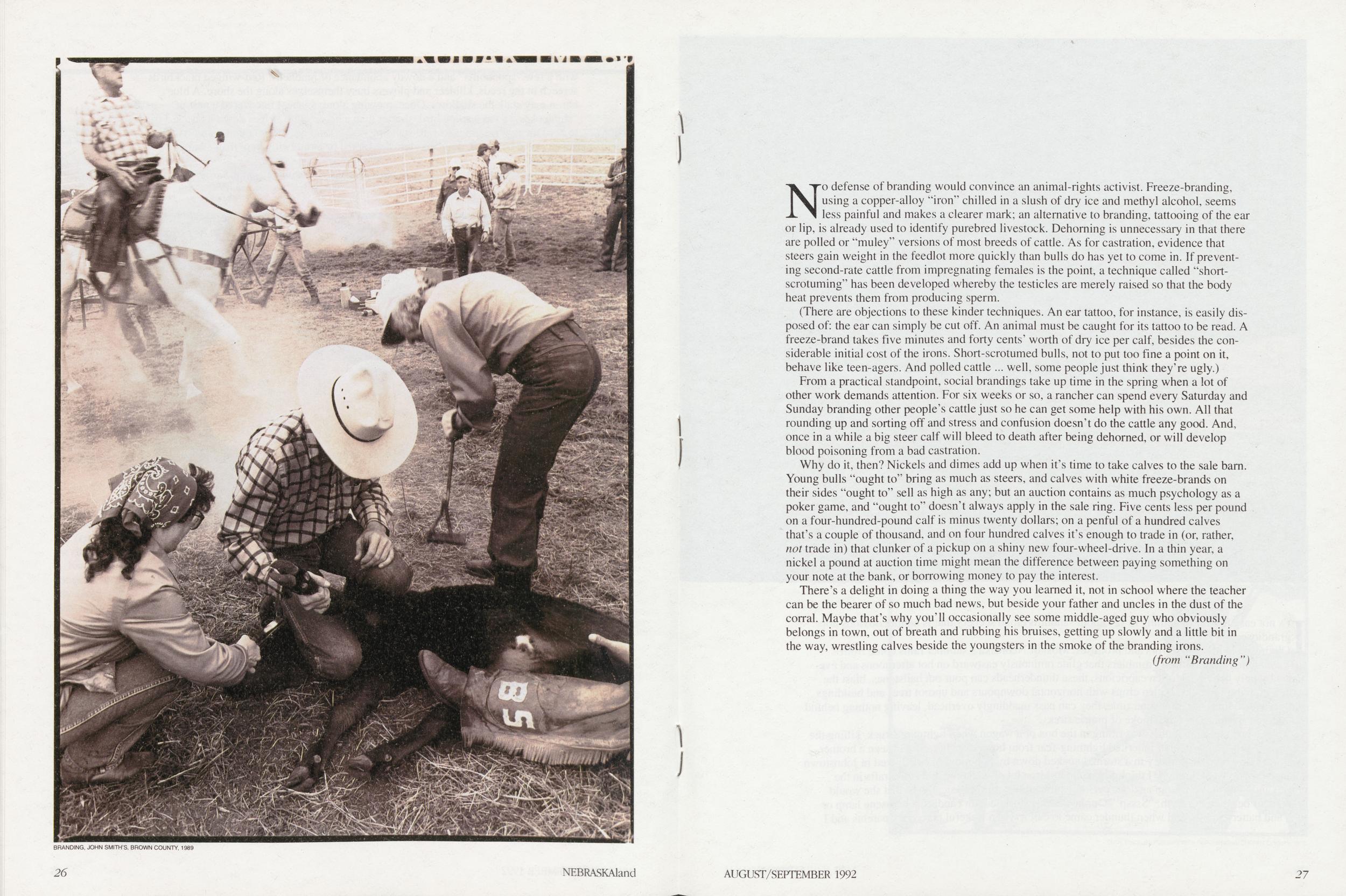
No defense of branding would convince an animal-rights activist. Freeze-branding, using a copper-alloy "iron" chilled in a slush of dry ice and methyl alcohol, seems less painful and makes a clearer mark; an alternative to branding, tattooing of the ear or lip, is already used to identify purebred livestock. Dehorning is unnecessary in that there are polled or "muley" versions of most breeds of cattle. As for castration, evidence that steers gain weight in the feedlot more quickly than bulls do has yet to come in. If preventing second-rate cattle from impregnating females is the point, a technique called "shortscrotuming" has been developed whereby the testicles are merely raised so that the body heat prevents them from producing sperm.
(There are objections to these kinder techniques. An ear tattoo, for instance, is easily disposed of: the ear can simply be cut off. An animal must be caught for its tattoo to be read. A freeze-brand takes five minutes and forty cents' worth of dry ice per calf, besides the considerable initial cost of the irons. Short-scrotumed bulls, not to put too fine a point on it, behave like teen-agers. And polled cattle well, some people just think they're ugly.)
From a practical standpoint, social brandings take up time in the spring when a lot of other work demands attention. For six weeks or so, a rancher can spend every Saturday and Sunday branding other people's cattle just so he can get some help with his own. All that rounding up and sorting off and stress and confusion doesn't do the cattle any good. And, once in a while a big steer calf will bleed to death after being dehorned, or will develop blood poisoning from a bad castration.
Why do it, then? Nickels and dimes add up when it's time to take calves to the sale barn. Young bulls "ought to" bring as much as steers, and calves with white freeze-brands on their sides "ought to" sell as high as any; but an auction contains as much psychology as a poker game, and "ought to" doesn't always apply in the sale ring. Five cents less per pound on a four-hundred-pound calf is minus twenty dollars; on a penful of a hundred calves that's a couple of thousand, and on four hundred calves it's enough to trade in (or, rather, not trade in) that clunker of a pickup on a shiny new four-wheel-drive. In a thin year, a nickel a pound at auction time might mean the difference between paying something on your note at the bank, or borrowing money to pay the interest.
There's a delight in doing a thing the way you learned it, not in school where the teacher can be the bearer of so much bad news, but beside your father and uncles in the dust of the corral. Maybe that's why you'll occasionally see some middle-aged guy who obviously belongs in town, out of breath and rubbing his bruises, getting up slowly and a little bit in the way, wrestling calves beside the youngsters in the smoke of the branding irons.
(from "Branding") AUGUST/SEPTEMBER 1992 27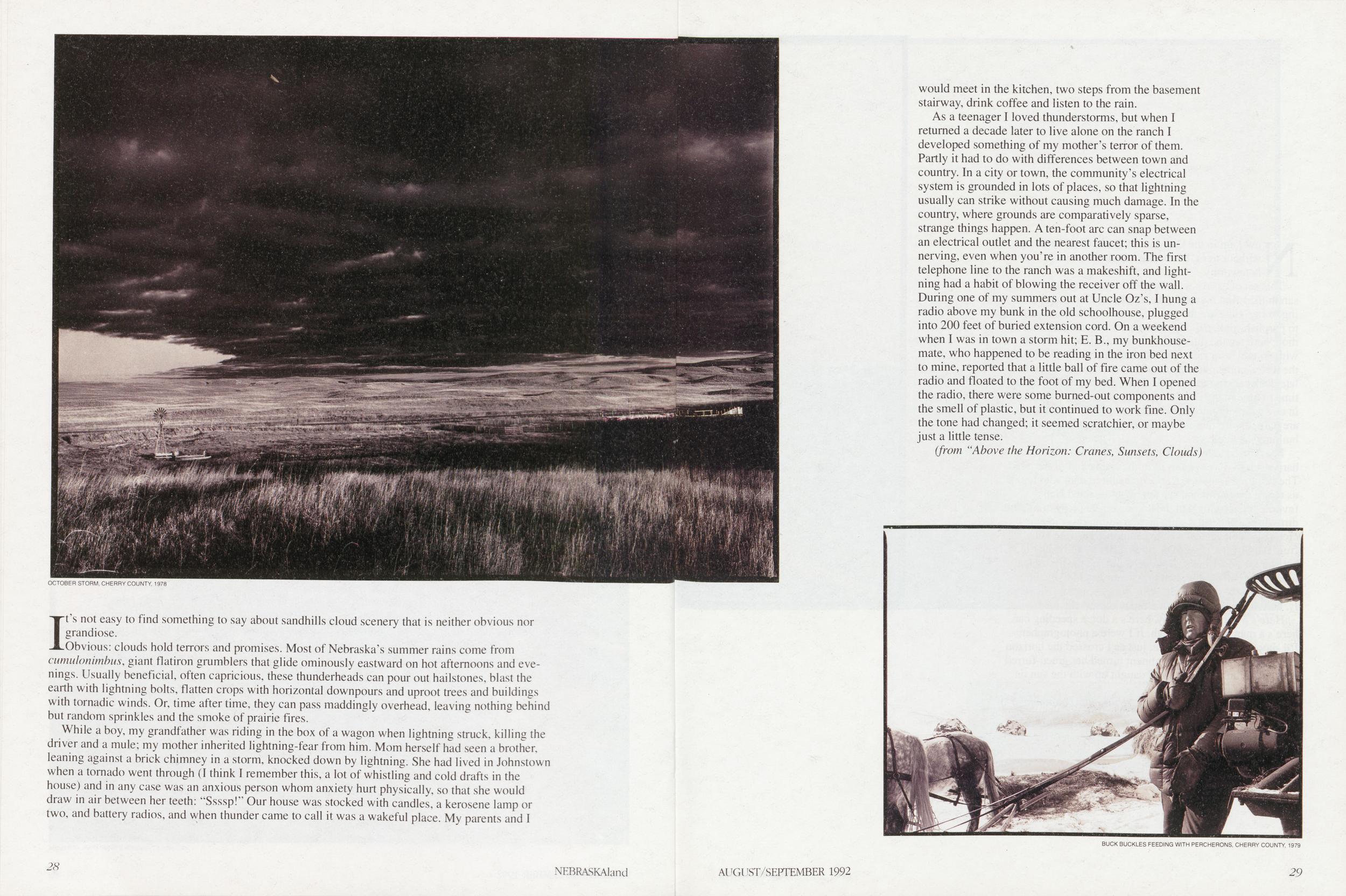
It's not easy to find something to say about sandhills cloud scenery that is neither obvious nor grandiose. Obvious: clouds hold terrors and promises. Most of Nebraska's summer rains come from cumulonimbus, giant flatiron grumblers that glide ominously eastward on hot afternoons and evenings. Usually beneficial, often capricious, these thunderheads can pour out hailstones, blast the earth with lightning bolts, flatten crops with horizontal downpours and uproot trees and buildings with tornadic winds. Or, time after time, they can pass maddingly overhead, leaving nothing behind but random sprinkles and the smoke of prairie fires.
While a boy, my grandfather was riding in the box of a wagon when lightning struck, killing the driver and a mule; my mother inherited lightning-fear from him. Mom herself had seen a brother, leaning against a brick chimney in a storm, knocked down by lightning. She had lived in Johnstown when a tornado went through (I think I remember this, a lot of whistling and cold drafts in the house) and in any case was an anxious person whom anxiety hurt physically, so that she would draw in air between her teeth: "Ssssp!" Our house was stocked with candles, a kerosene lamp or two, and battery radios, and when thunder came to call it was a wakeful place. My parents and I 28 NEBRASKAland would meet in the kitchen, two steps from the basement stairway, drink coffee and listen to the rain.
As a teenager I loved thunderstorms, but when I returned a decade later to live alone on the ranch I developed something of my mother's terror of them. Partly it had to do with differences between town and country. In a city or town, the community's electrical system is grounded in lots of places, so that lightning usually can strike without causing much damage. In the country, where grounds are comparatively sparse, strange things happen. A ten-foot arc can snap between an electrical outlet and the nearest faucet; this is unnerving, even when you're in another room. The first telephone line to the ranch was a makeshift, and lightning had a habit of blowing the receiver off the wall. During one of my summers out at Uncle Oz's, I hung a radio above my bunk in the old schoolhouse, plugged into 200 feet of buried extension cord. On a weekend when I was in town a storm hit; E. B., my bunkhousemate, who happened to be reading in the iron bed next to mine, reported that a little ball of fire came out of the radio and floated to the foot of my bed. When I opened the radio, there were some burned-out components and the smell of plastic, but it continued to work fine. Only the tone had changed; it seemed scratchier, or maybe just a little tense.
(from "Above the Horizon: Cranes, Sunsets, Clouds)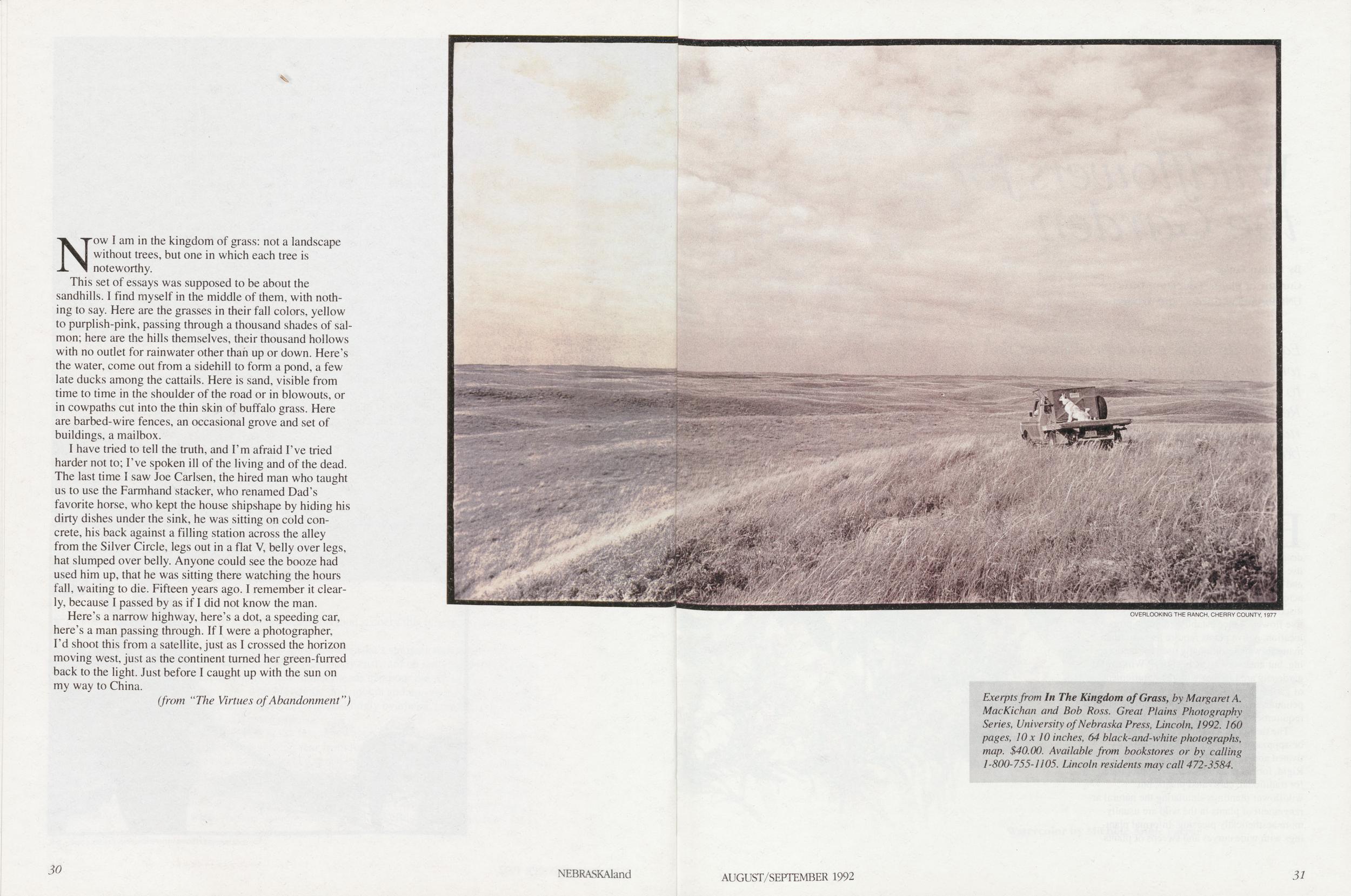
Now I am in the kingdom of grass: not a landscape without trees, but one in which each tree is noteworthy.
This set of essays was supposed to be about the sandhills. I find myself in the middle of them, with nothing to say. Here are the grasses in their fall colors, yellow to purplish-pink, passing through a thousand shades of salmon; here are the hills themselves, their thousand hollows with no outlet for rainwater other than up or down. Here's the water, come out from a sidehill to form a pond, a few late ducks among the cattails. Here is sand, visible from time to time in the shoulder of the road or in blowouts, or in cowpaths cut into the thin skin of buffalo grass. Here are barbed-wire fences, an occasional grove and set of buildings, a mailbox.
I have tried to tell the truth, and I'm afraid I've tried harder not to; I've spoken ill of the living and of the dead. The last time I saw Joe Carlsen, the hired man who taught us to use the Farmhand stacker, who renamed Dad's favorite horse, who kept the house shipshape by hiding his dirty dishes under the sink, he was sitting on cold concrete, his back against a filling station across the alley from the Silver Circle, legs out in a flat V, belly over legs, hat slumped over belly. Anyone could see the booze had used him up, that he was sitting there watching the hours fall, waiting to die. Fifteen years ago. I remember it clearly, because I passed by as if I did not know the man.
Here's a narrow highway, here's a dot, a speeding car, here's a man passing through. If I were a photographer, I'd shoot this from a satellite, just as I crossed the horizon moving west, just as the continent turned her green-furred back to the light. Just before I caught up with the sun on my way to China.
(from "The Virtues of Abandonment") 30 NEBRASKAland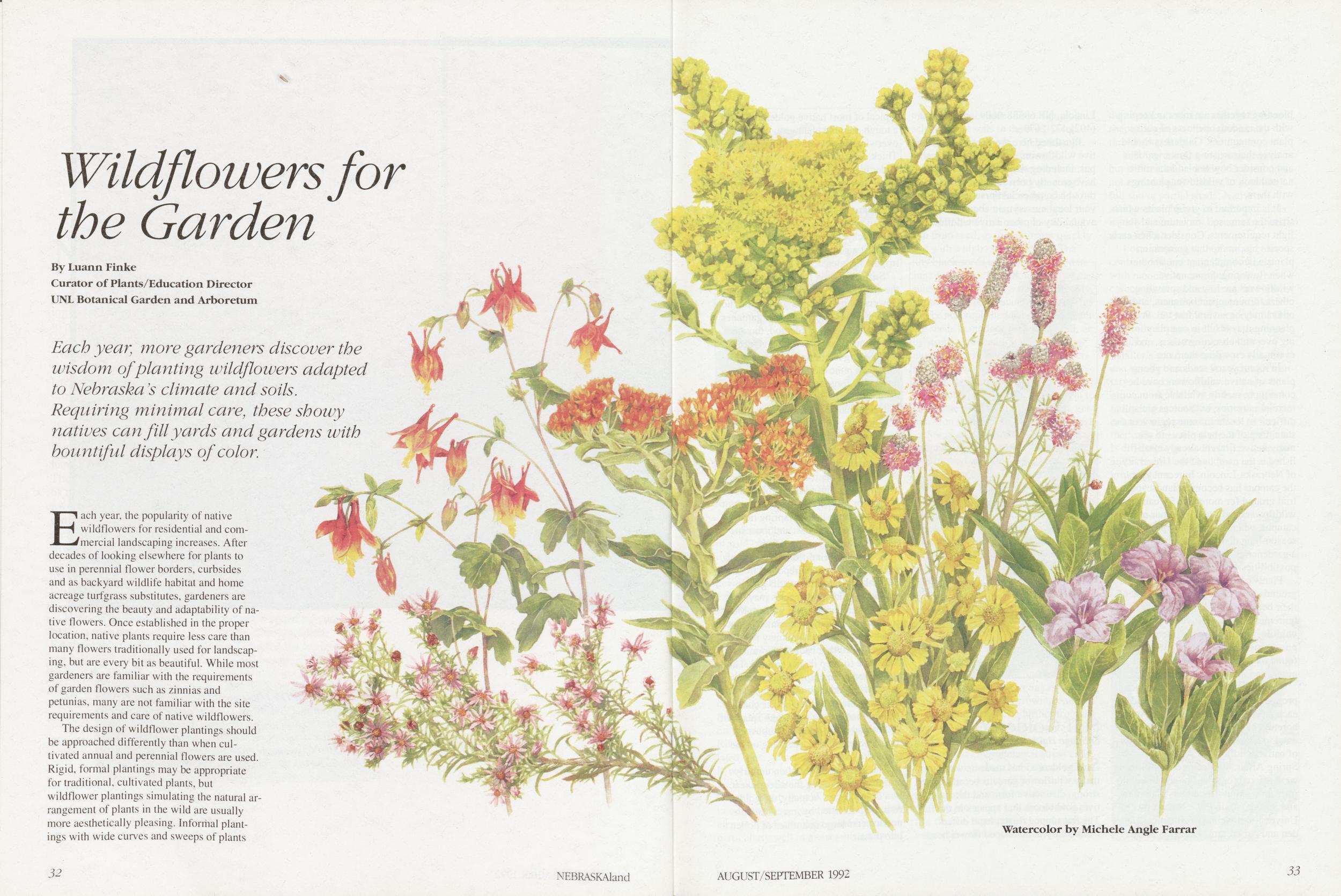
Wildflowers for the Garden
By Luann Finke Curator of Plants/Education Director UNL Botanical Garden and Arboretum Each year, more gardeners discover the wisdom of planting wild/lowers adapted to Nebraska s climate and soils. Requiring minimal care, these showy natives can fill yards and gardens with bountiful displays of color.Each year, the popularity of native wilclflowers for residential and commercial landscaping increases. After decades of looking elsewhere for plants to use in perennial flower borders, curbsides and as backyard wildlife habitat and home acreage turfgrass substitutes, gardeners are discovering the beauty and adaptability of native flowers. Once established in the proper location, native plants require less care than many flowers traditionally used for landscaping, but are every bit as beautiful. While most gardeners are familiar with the requirements of garden flowers such as zinnias and petunias, many are not familiar with the site requirements and care of native wildflowers.
The design of wildflower plantings should be approached differently than when cultivated annual and perennial flowers are used. Rigid, formal plantings may be appropriate for traditional, cultivated plants, but wildflower plantings simulating the natural arrangement of plants in the wild are usually more aesthetically pleasing. Informal plantings with wide curves and sweeps of plants 32 NEBRASKAland
 blending together are more in keeping
with the random openness of native
plant communities. Gardeners should
analyze their existing flower gardens
and consider how to blend the more
natural look of wildflower plantings
with them.
blending together are more in keeping
with the random openness of native
plant communities. Gardeners should
analyze their existing flower gardens
and consider how to blend the more
natural look of wildflower plantings
with them.
It is important to group plants which share the same soil, moisture and sunlight requirements. Consider when each species blooms so that companion plants will complement one another when flowering. Some native wildflowers are low and sprawling, others form compact bouquets, and still others may be several feet tall. Poor planning may result in one plant towering over and obscuring others, and eventually crowding them out.
In recent years, seeds and young plants of native wildflowers have become more readily available from commercial nurseries, but sources are still difficult to locate in some regions of the state. One of the best places to see many native flowers already established is the campus of the University of Nebraska-Lincoln. In recent years, the campus has become a landscape trial ground for more than 75 native wildflowers and grasses. A tour of the campus, where wildflowers provide a season-long display of color, will open a gardener's eyes to many wildflower possibilities.
Plants used on the University grounds have been selected because of their beauty, durability, low water requirements and attractiveness to wildlife, as well as in the interest of preserving native plants. Plantings are found on both the city and east campuses, and many plants are labelled.
Additionally, a weekend educational program called Spring Affair is held each April at the State Fair Park Arboretum in Lincoln. Experts are on hand to advise gardeners about the use of native wildflowers. At the 1992 Spring Affair, 40 species of wildflowers were offered for sale. For additional information about the campus plantings and Spring Affair 1993, contact the University of Nebraska Botanical Garden and Arboretum, 1340 N. 17th St., Lincoln, NE 68588-0609, or telephone (402) 472-2679.
Illustrated here are several of the native wildflowers used on the UNL campus, including several species which have recently been selected for release through commercial nurseries. Ask your local nurseryman about the availability of other native wildflowers.
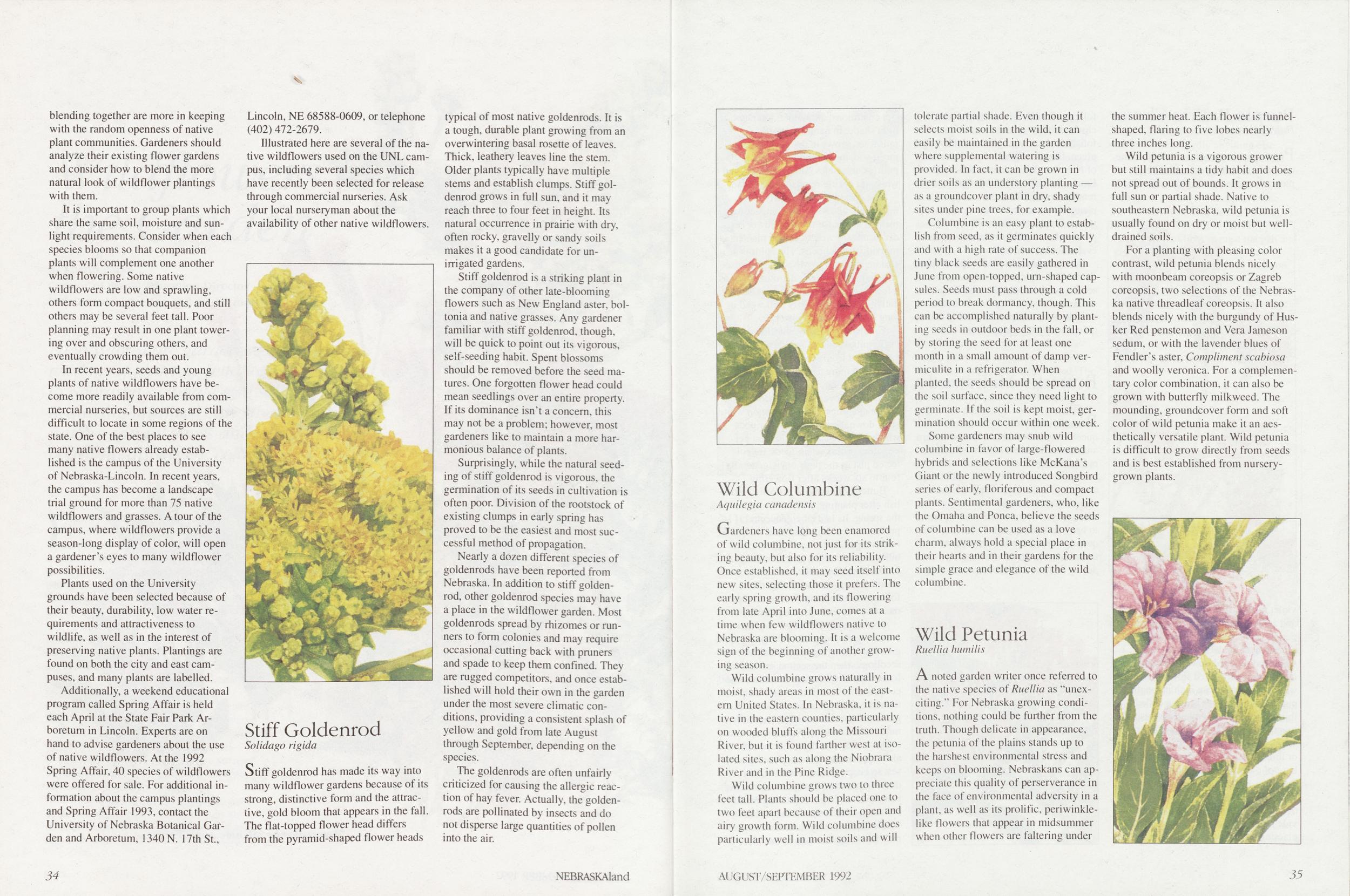
Stiff goldenrod has made its way into many wildflower gardens because of its strong, distinctive form and the attractive, gold bloom that appears in the fall. The flat-topped flower head differs from the pyramid-shaped flower heads typical of most native goldenrods. It is a tough, durable plant growing from an overwintering basal rosette of leaves. Thick, leathery leaves line the stem. Older plants typically have multiple stems and establish clumps. Stiff goldenrod grows in full sun, and it may reach three to four feet in height. Its natural occurrence in prairie with dry, often rocky, gravelly or sandy soils makes it a good candidate for unirrigated gardens.
Stiff goldenrod is a striking plant in the company of other late-blooming flowers such as New England aster, boltonia and native grasses. Any gardener familiar with stiff goldenrod, though, will be quick to point out its vigorous, self-seeding habit. Spent blossoms should be removed before the seed matures. One forgotten flower head could mean seedlings over an entire property. If its dominance isn't a concern, this may not be a problem; however, most gardeners like to maintain a more harmonious balance of plants.
Surprisingly, while the natural seeding of stiff goldenrod is vigorous, the germination of its seeds in cultivation is often poor. Division of the rootstock of existing clumps in early spring has proved to be the easiest and most successful method of propagation.
Nearly a dozen different species of goldenrods have been reported from Nebraska. In addition to stiff goldenrod, other goldenrod species may have a place in the wildflower garden. Most goldenrods spread by rhizomes or runners to form colonies and may require occasional cutting back with pruners and spade to keep them confined. They are rugged competitors, and once established will hold their own in the garden under the most severe climatic conditions, providing a consistent splash of yellow and gold from late August through September, depending on the species.
The goldenrods are often unfairly criticized for causing the allergic reaction of hay fever. Actually, the goldenrods are pollinated by insects and do not disperse large quantities of pollen into the air.
34 NEBRASKAland Wild Columbine Aquilegia canadensisGardeners have long been enamored of wild columbine, not just for its striking beauty, but also for its reliability. Once established, it may seed itself into new sites, selecting those it prefers. The early spring growth, and its flowering from late April into June, comes at a time when few wildflowers native to Nebraska are blooming. It is a welcome sign of the beginning of another growing season.
Wild columbine grows naturally in moist, shady areas in most of the eastern United States. In Nebraska, it is native in the eastern counties, particularly on wooded bluffs along the Missouri River, but it is found farther west at isolated sites, such as along the Niobrara River and in the Pine Ridge.
Wild columbine grows two to three feet tall. Plants should be placed one to two feet apart because of their open and airy growth form. Wild columbine does particularly well in moist soils and will tolerate partial shade. Even though it selects moist soils in the wild, it can easily be maintained in the garden where supplemental watering is provided. In fact, it can be grown in drier soils as an understory planting as a groundcover plant in dry, shady sites under pine trees, for example.
Columbine is an easy plant to establish from seed, as it germinates quickly and with a high rate of success. The tiny black seeds are easily gathered in June from open-topped, urn-shaped capsules. Seeds must pass through a cold period to break dormancy, though. This can be accomplished naturally by planting seeds in outdoor beds in the fall, or by storing the seed for at least one month in a small amount of damp vermiculite in a refrigerator. When planted, the seeds should be spread on the soil surface, since they need light to germinate. If the soil is kept moist, germination should occur within one week.
Some gardeners may snub wild columbine in favor of large-flowered hybrids and selections like McKana's Giant or the newly introduced Songbird series of early, floriferous and compact plants. Sentimental gardeners, who, like the Omaha and Ponca, believe the seeds of columbine can be used as a love charm, always hold a special place in their hearts and in their gardens for the simple grace and elegance of the wild columbine.
Wild Petunia Ruellia humilisA noted garden writer once referred to the native species of Ruellia as "unexciting." For Nebraska growing conditions, nothing could be further from the truth. Though delicate in appearance, the petunia of the plains stands up to the harshest environmental stress and keeps on blooming. Nebraskans can appreciate this quality of perserverance in the face of environmental adversity in a plant, as well as its prolific, periwinkle-like flowers that appear in midsummer when other flowers are faltering under the summer heat. Each flower is funnelshaped, flaring to five lobes nearly three inches long.
Wild petunia is a vigorous grower but still maintains a tidy habit and does not spread out of bounds. It grows in full sun or partial shade. Native to southeastern Nebraska, wild petunia is usually found on dry or moist but well-drained soils.
For a planting with pleasing color contrast, wild petunia blends nicely with moonbeam coreopsis or Zagreb coreopsis, two selections of the Nebraska native threadleaf coreopsis. It also blends nicely with the burgundy of Husker Red penstemon and Vera Jameson sedum, or with the lavender blues of Fendler's aster, Compliment scabiosa and woolly veronica. For a complementary color combination, it can also be grown with butterfly milkweed. The mounding, groundcover form and soft color of wild petunia make it an aesthetically versatile plant. Wild petunia is difficult to grow directly from seeds and is best established from nursery-grown plants.
 Purple Prairie Clover
Dale a purpurea
Purple Prairie Clover
Dale a purpurea
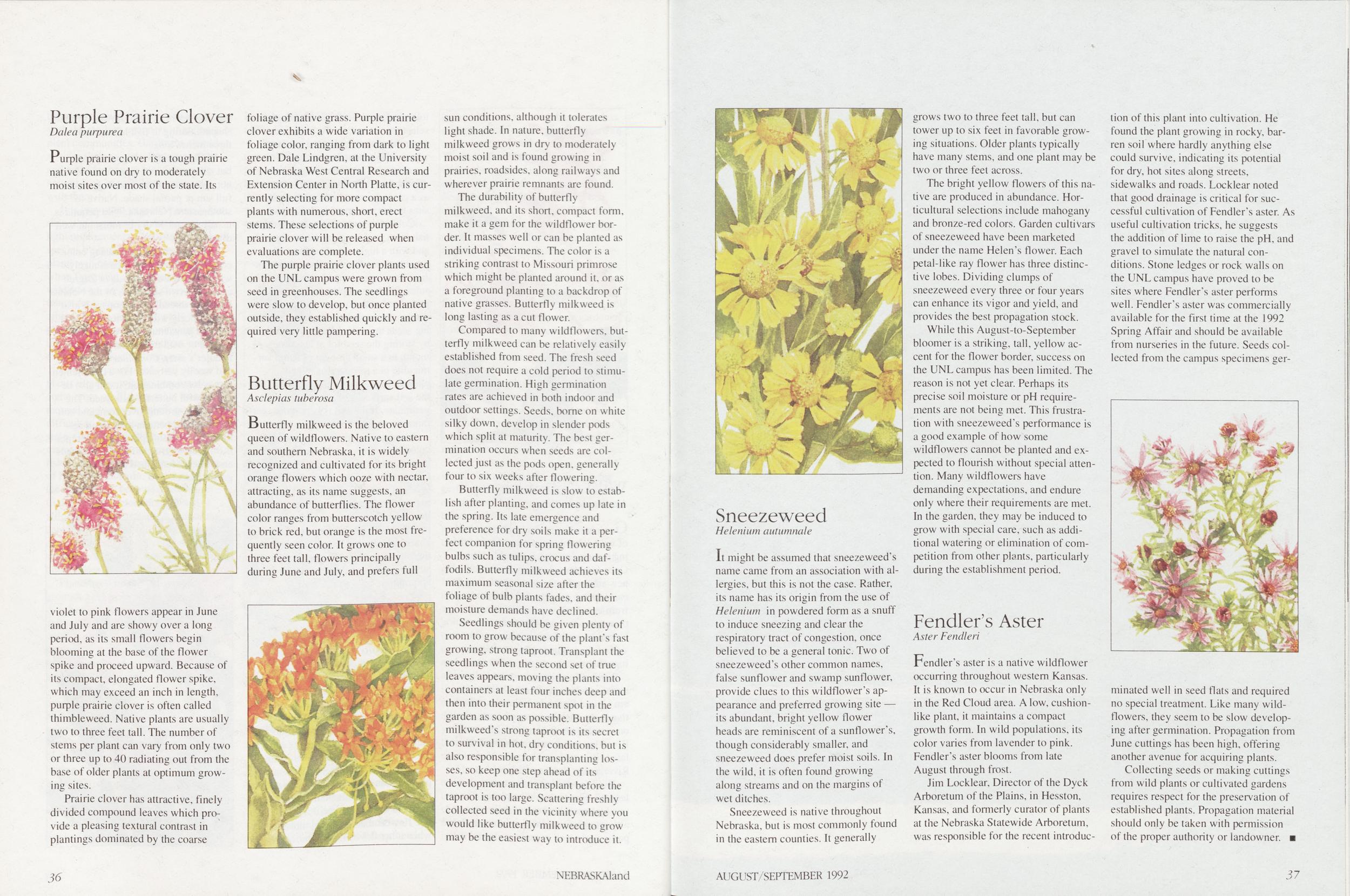
Purple prairie clover is a tough prairie native found on dry to moderately moist sites over most of the state. Its violet to pink flowers appear in June and July and are showy over a long period, as its small flowers begin blooming at the base of the flower spike and proceed upward. Because of its compact, elongated flower spike, which may exceed an inch in length, purple prairie clover is often called thimbleweed. Native plants are usually two to three feet tall. The number of stems per plant can vary from only two or three up to 40 radiating out from the base of older plants at optimum growing sites.
Prairie clover has attractive, finely divided compound leaves which provide a pleasing textural contrast in plantings dominated by the coarse foliage of native grass. Purple prairie clover exhibits a wide variation in foliage color, ranging from dark to light green. Dale Lindgren, at the University of Nebraska West Central Research and Extension Center in North Platte, is currently selecting for more compact plants with numerous, short, erect stems. These selections of purple prairie clover will be released when evaluations are complete.
The purple prairie clover plants used on the UNL campus were grown from seed in greenhouses. The seedlings were slow to develop, but once planted outside, they established quickly and required very little pampering.
Butterfly Milkweed Asclepias tuberosaButterfly milkweed is the beloved queen of wildflowers. Native to eastern and southern Nebraska, it is widely recognized and cultivated for its bright orange flowers which ooze with nectar, attracting, as its name suggests, an abundance of butterflies. The flower color ranges from butterscotch yellow to brick red, but orange is the most frequently seen color. It grows one to three feet tall, flowers principally during June and July, and prefers full sun conditions, although it tolerates light shade. In nature, butterfly milkweed grows in dry to moderately moist soil and is found growing in prairies, roadsides, along railways and wherever prairie remnants are found.
The durability of butterfly milkweed, and its short, compact form, make it a gem for the wildflower border. It masses well or can be planted as individual specimens. The color is a striking contrast to Missouri primrose which might be planted around it, or as a foreground planting to a backdrop of native grasses. Butterfly milkweed is long lasting as a cut flower.
Compared to many wildflowers. butterfly milkweed can be relatively easily established from seed. The fresh seed does not require a cold period to stimulate germination. High germination rates are achieved in both indoor and outdoor settings. Seeds, borne on white silky down, develop in slender pods which split at maturity. The best germination occurs when seeds are collected just as the pods open, generally four to six weeks after flowering.
Butterfly milkweed is slow to establish after planting, and comes up late in the spring. Its late emergence and preference for dry soils make it a perfect companion for spring flowering bulbs such as tulips, crocus and daffodils. Butterfly milkweed achieves its maximum seasonal size after the foliage of bulb plants fades, and their moisture demands have declined.
Seedlings should be given plenty of room to grow because of the plant's fast growing, strong taproot. Transplant the seedlings when the second set of true leaves appears, moving the plants into containers at least four inches deep and then into their permanent spot in the garden as soon as possible. Butterfly milkweed's strong taproot is its secret to survival in hot, dry conditions, but is also responsible for transplanting losses, so keep one step ahead of its development and transplant before the taproot is too large. Scattering freshly collected seed in the vicinity where you would like butterfly milkweed to grow may be the easiest way to introduce it.
36 NEBRASKAlandIt might be assumed that sneezeweed's name came from an association with allergies, but this is not the case. Rather, its name has its origin from the use of Helenium in powdered form as a snuff to induce sneezing and clear the respiratory tract of congestion, once believed to be a general tonic. Two of sneezeweed's other common names, false sunflower and swamp sunflower, provide clues to this wildflower's appearance and preferred growing site its abundant, bright yellow flower heads are reminiscent of a sunflower's, though considerably smaller, and sneezeweed does prefer moist soils. In the wild, it is often found growing along streams and on the margins of wet ditches.
Sneezeweed is native throughout Nebraska, but is most commonly found in the eastern counties. It generally grows two to three feet tall, but can tower up to six feet in favorable growing situations. Older plants typically have many stems, and one plant may be two or three feet across.
The bright yellow flowers of this native are produced in abundance. Horticultural selections include mahogany and bronze-red colors. Garden cultivars of sneezeweed have been marketed under the name Helen's flower. Each petal-like ray flower has three distinctive lobes. Dividing clumps of sneezeweed every three or four years can enhance its vigor and yield, and provides the best propagation stock.
While this August-to-September bloomer is a striking, tall, yellow accent for the flower border, success on the UNL campus has been limited. The reason is not yet clear. Perhaps its precise soil moisture or pH requirements are not being met. This frustration with sneezeweed's performance is a good example of how some wildflowers cannot be planted and expected to flourish without special attention. Many wildflowers have demanding expectations, and endure only where their requirements are met. In the garden, they may be induced to grow with special care, such as additional watering or elimination of competition from other plants, particularly during the establishment period.
Fendler's Aster Aster FendleriFendler's aster is a native wildflower occurring throughout western Kansas. It is known to occur in Nebraska only in the Red Cloud area. A low, cushion-like plant, it maintains a compact growth form. In wild populations, its color varies from lavender to pink. Fendler's aster blooms from late August through frost.
Jim Locklear, Director of the Dyck Arboretum of the Plains, in Hesston, Kansas, and formerly curator of plants at the Nebraska Statewide Arboretum, was responsible for the recent introduc tion of this plant into cultivation. He found the plant growing in rocky, barren soil where hardly anything else could survive, indicating its potential for dry, hot sites along streets, sidewalks and roads. Locklear noted that good drainage is critical for successful cultivation of Fendler's aster. As useful cultivation tricks, he suggests the addition of lime to raise the pH, and gravel to simulate the natural conditions. Stone ledges or rock walls on the UNL campus have proved to be sites where Fendler's aster performs well. Fendler's aster was commercially available for the first time at the 1992 Spring Affair and should be available from nurseries in the future. Seeds collected from the campus specimens germinated well in seed flats and required no special treatment. Like many wildflowers, they seem to be slow developing after germination. Propagation from June cuttings has been high, offering another avenue for acquiring plants.
Collecting seeds or making cuttings from wild plants or cultivated gardens requires respect for the preservation of established plants. Propagation material should only be taken with permission of the proper authority or landowner.
AUGUST/SEPTEMBER 1992 27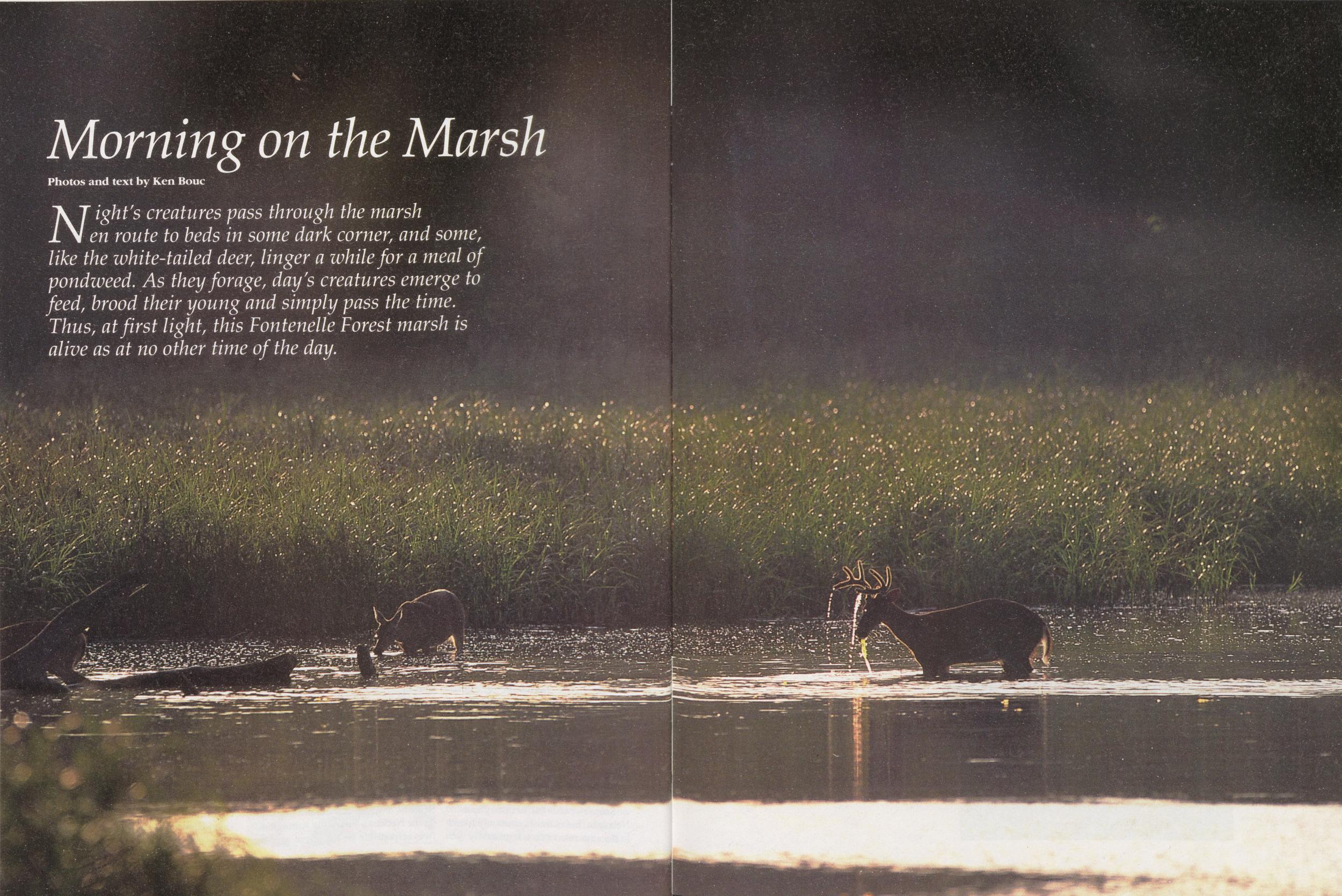
Morning on the Marsh
Photos and text by Ken Bouc Night's creatures pass through the marsh en route to beds in some dark corner, and some, like the white-tailed deer, linger a while for a meal of pondweed. As they forage, day's creatures emerge to feed, brood their young and simply pass the time. Thus, at first light, this Fontenelle Forest marsh is alive as at no other time of the day.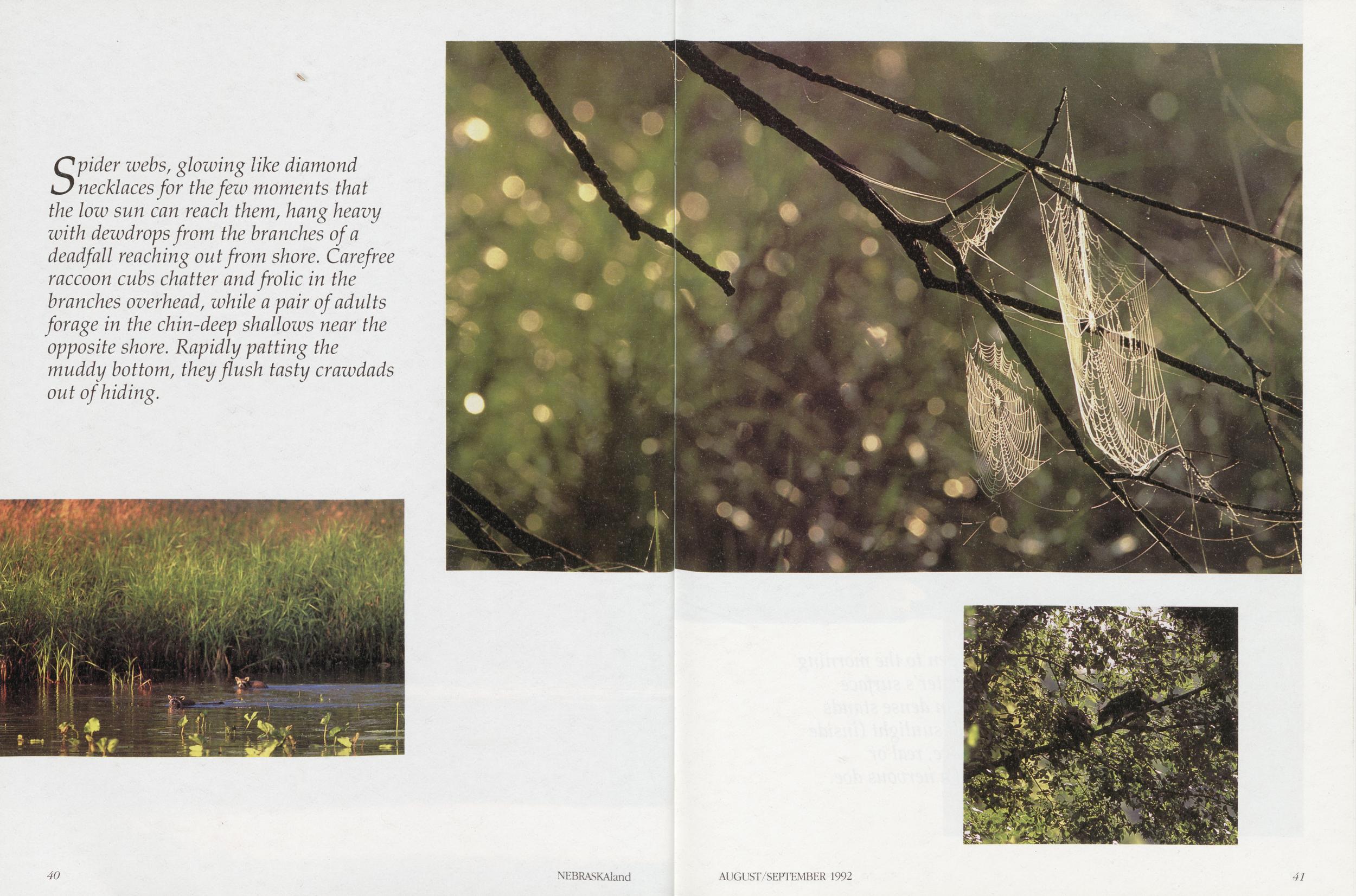
Spider webs, glowing like diamond necklaces for the few moments that the low sun can reach them, hang heavy with dewdrops from the branches of a deadfall reaching out from shore. Carefree raccoon cubs chatter and frolic in the branches overhead, while a pair of adults forage in the chin-deep shallows near the opposite shore. Rapidly patting the muddy bottom, they flush tasty crawdads out of hiding.
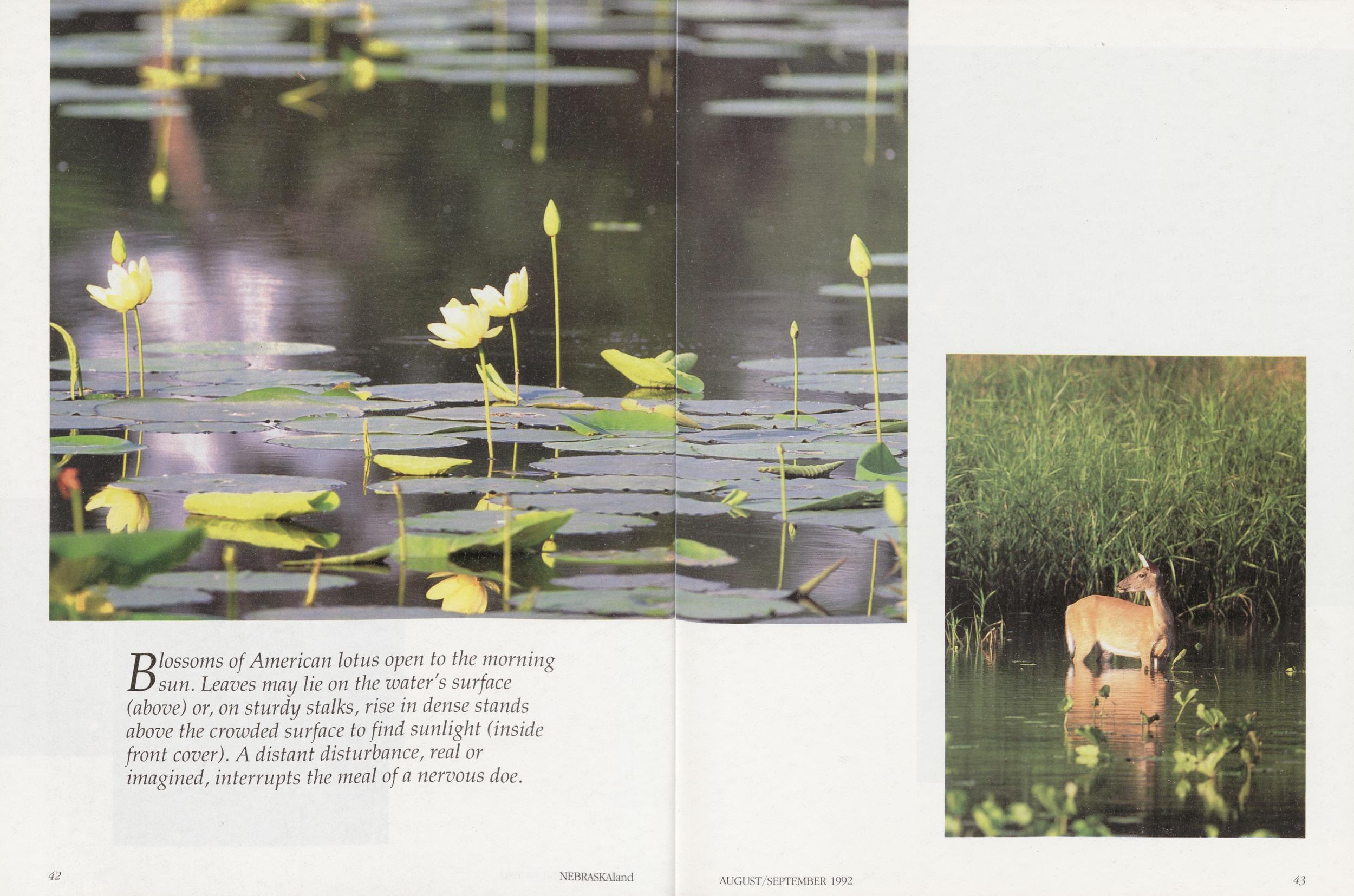
Blossoms of American lotus open to the morning sun. Leaves may lie on the water's surface (above) or, on sturdy stalks, rise in dense stands above the crowded surface to find sunlight (inside front cover). A distant disturbance, real or imagined, interrupts the meal of a nervous doe.
42 NEBRASKAland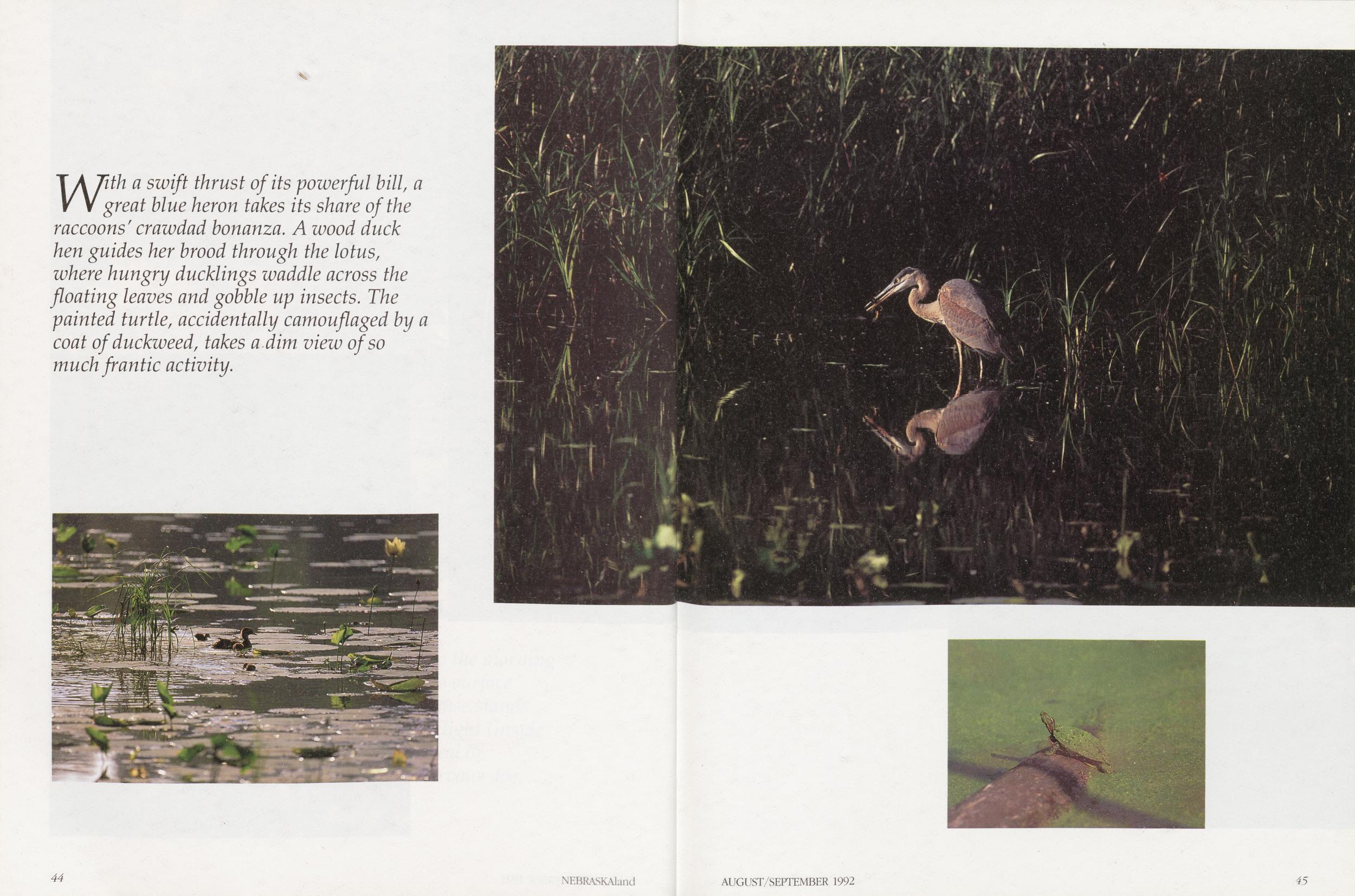
With a swift thrust of its powerful bill, a great blue heron takes its share of the raccoons' crawdad bonanza. A wood duck hen guides her brood through the lotus, where hungry ducklings waddle across the floating leaves and gobble up insects. The painted turtle, accidentally camouflaged by a coat of duckweed, takes a dim view of so much frantic activity.
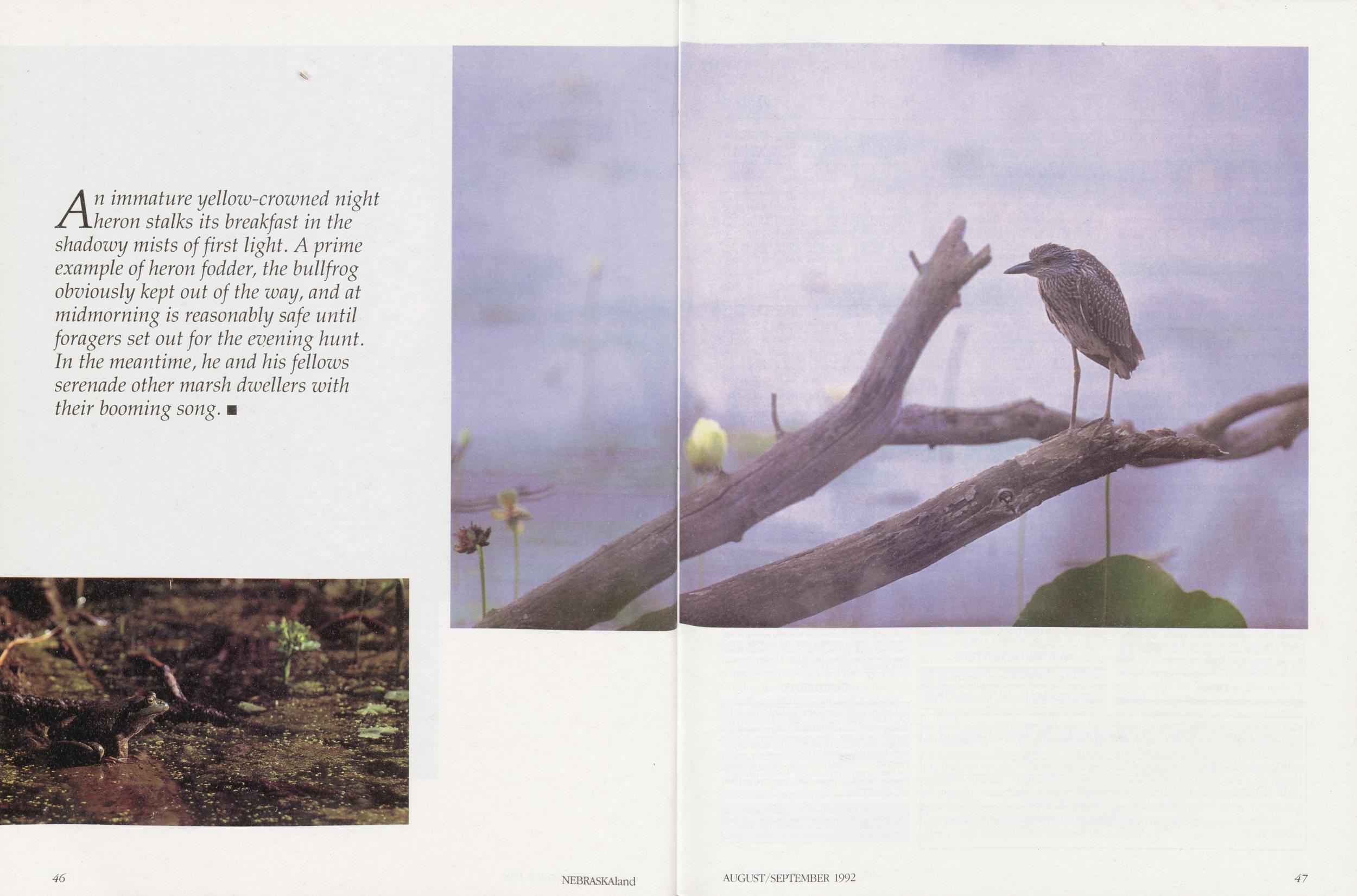
An immature yellow-crowned night heron stalks its breakfast in the shadowy mists of first light. A prime example of heron fodder, the bullfrog obviously kept out of the way, and at midmorning is reasonably safe until foragers set out for the evening hunt. In the meantime, he and his fellows serenade other marsh dwellers with their booming song.
Classified
ARTS/CRAFTSBUILT TO ORDER. Best in the business. Specializing in cedar and pine mailboxes starting at $49.95. Bird houses and squirrel feeders $10 ea. (402) 896-5029.
BOOKS/PRINTINGFREE! Booklets on northeastern Nevada; fishing, rockhounding maps, Carl Hayden, Box 528, Jackpot, Nevada 89825.
FREE BOOK CATALOG. Novels, westerns, romances, children's; old out of print, found barns, attic. Authors: Grey, Bower, Connor, Fox, Curwood, Raine, Wright, Aldrige, Pollyanna, Freckles, many others. Postage appreciated. Pierce, 4400 N. Pine Cluster, Oroville, CA 95965.
BUSINESS OPPORTUNITIESSALESMEN AND DEALERS. New CURE-IT. A product of nature. Guaranteed to cure poison ivy and oak. Stops itch immediately, cures in three days. Set up accounts and service reorders. Grocery, drug, sporting goods stores; gas stations, campsites. 4-ounce spray container retail $5. Write for details, will send sample. Brule Plant, Box 144, Brule, NE 69127.
CLOTHINGGET YOUR ORIGINAL ARTWORK of windmill and stock tank, with "Nebraska" across tank. Available on T-shirts or sweatshirts, (ash or red) or on tan snap-close jacket. Sizes Small to XXL. Write or call for free brochure — Mikolyck Designs, RR 2 Box 46, Oshkosh, NE 69154; (308) 772-3574 or 1-800-682-7785.
COLLECTIBLESWANTED: Nebraska stock certificates, letters, old checks, etc.—particularly pre-1900. A. A. Armstrong Jr. M.D., 21 1 West 39th, Scottsbluff, NE 69361.
FOR SALE: Bighorn sheep skull, top half. Horn curl of 27'/2", and 14W* circumference at base. Mounted on beautiful dark walnut plaque. Will furnish photo on request. Carl W. Manthey, 1310 S. 40th St., Lincoln, NE 68510. Phone (402) 488-1849.
WANTED: Kirwan's Bad Egg fishing lure made in O'Neill, Nebraska, and other old lures. Colby Sorrells, 822 S. Ridgeway Dr., Cleburne, TX 76031 -6148.
HOBBYIST SEEKS earlier cameras, concertinas, violins, RR watches—Colibri, Leica, Zeiss, Contura, Detrola, Kardon, Ranger, Zephyr, Cnopm, Alta, Cannonhanza, Honor, Ichicon, Leotax, Melcon, Nikon, Nippon, NR III, Sky, Tanack, Zunow. Wheatstone, Polkamaster, Mervar, Hengel, Glass, Grancino, Testore, Ball, DeLong. Descriptions, Prices—Advertiser, 2421 West 46th St., Chicago, IL 60632.
DOGSTRAINING ALL BREEDS bird dogs-Vizslas and English Pointers for sale. Rozanek Kennels, R 2, Schuyler, NE 68661. Phone (402) 352-8769.
YELLOW-BLACK Lab pups. FC-AFC sired. AKC. Hips OFA certified. Dew claws removed. Excellent hunting potential. Contact Bob Bendler, Lexington, NE, (308) 324-4247.
FOR SALE—Chesapeake bay or Labrador retrievers. All colors. Pups, started dogs, training and stud service. Three-generation national champion. Pedigre on Lab. Three generations of the best Chesapeakes ever trialed. Call PLATTE VALLEY RETRIEVERS (308) 995-2318.
WILDERNESS KENNELS. Gun dog training—over 60 years COMBINED experience. Training all sporting breeds—retrievers. Flushing and pointing dogs. All dogs worked on pen raised birds and wild game. Training program includes obedience training—heel, sit, stay, down and come when called. Pups, started dogs and fully trained dogs for sale. HUNTING DOGS TRAINED BY HUNTERS. Henry Sader, Wilderness Kennels, (402) 423-4212. Since 1968.
GERMAN SHORTHAIR POINTERS/ENGLISH POINTERS—pups, started dogs, stud service. Training available for pointing and retrieving dogs. Wayne Clark (7L2) 529-4238. Close to Omaha. Leave mesage.
AKC GERMAN SHORTHAIR POINTER puppies: guaranteed—references available. Phone (402) 353-3605.
GERMAN SHORTHAIR puppies. Great hunters. Great companions. Old fashioned. Dave Wickham, Cactus Kennels, Kimball, NE 69145. Phone (308) 235-3237.
AKC BRITTANY PUPS and started juveniles. Close working. Natural backing gun dogs. Field champion backgrounds. Liver and orange. References. Blair (402) 426-3597.
FISH/FISHINGFISH FOR SALE. Catfish, perch, coho salmon, rainbow trout, crappie, bluegill, walleye, minnows, goldfish, bullhead, largemouth bass, smallmouth bass, triploid grass carp. Commercial grower prices on catfish, perch, coho salmon, rainbow trout. Consulting available. Pleasant Valley Fish Farm, Rt 1 Box 147, McCook, NE 69001. Phone (308) 345-6599.
WILLOW LAKE FISH HATCHERY. Channel cat, bluegill, hybrid bluegill, largemouth bass, crappie, triploid grass carp, walleye, perch, minnows available for stocking. Gaylord Crawford, Rt. 3 Box 46, Hastings, NE 68901 or phone (402) 463-8022 day or night. Also pond consultant. We deliver, grower price.
FOODNEBRASKA BASKETS: The original Nebraska company specializing in fine foods from Nebraska. A beautiful array of baskets filled with ethnic, healthful and long-time favorite foods. Call or write for our brochure: P.O. Box 98, McCook, NE 69001. 1 -800-345-7725.
GUIDES/OUTFITTERSMAD RIVER CANOES offers the finest quality and performance. For the finest canoes and accessories look to Great Plains Canoe Co., 205 Main, Springfield, NE. Phone(402)253-2001.
YES! I WOULD LIKE TO SUBSCRIBE TO NEBRASKAland 1-Year $12 2-Years $23 Name Address. City State Zip Mail check or money order to NEBRASKAland, Box 30370, Lincoln, NE 68503EXPERIENCE NEBRASKA with an affordable canoe trip by Dryland Aquatics One and two-day trips full service or canoes only. Your Niobrara River specialists Call for other rivers We do it your way! For free brochure: Dryland Aquatics, Dept. N, 1837 E. Cuming, Fremont, NE 68025 or phone (402) 721-4177.
GRAHAM CANOE OUTFITTERS: Top quality fullservice camping and canoe trips on the Niobrara River. Daily canoe rentals and car shuttle-service available. Contact Doug & Twyla Graham, HC 13 Box 16, Valentine, NE 69201 or phone (402) 376-3708.
DEER AND TURKEY on 3,000 acres of pristine, Nebraska Sandhills. Hunt canyons and undiscovered streams. Gobblers $100; deer $500. (402) 722-4487, (308)236-6139.
GUNS/SHOOTINGGUNS — Browning, Winchester, Remington, others, Hi-powers; shotguns, new, used, antiques. Want Pre-'64 Winchesters. Buy-Sell-Trade. (402) 729-6112. Bedlan's Sporting Goods, Fairbury, NE 68352.
AIR GUNS repaired—Benjamin, Crosman, Daisy, other American made. Restoration; old guns wanted. Jack's Air Guns, 1225 No. 46th Lincoln, NE 68503. Phone (402)466-9223.
OUTDOOR EQUIPMENTFOR ALL YOUR WILDBIRD NEEDS: Houses, feeders, seed and habitat design. (Free catalog) JONATHAN'S WILDBIRD HAVEN, P.O. Box 30818, Lincoln, NE 68503.(402)486-3885.
REAL ESTATERECREATIONAL & INVESTMENT PROPERTIES 597 acres combination farm/ranch on the Niobrara River. Scenic area with great outdoor recreation. INVESTOR'S DREAM! 4,746.38 acres of ranchland and CRP. Payments of $190,174.00 per year. A rare investment opportunity. 1,355 acre improved Holt County ranch. Nice buildings, some irrigation. Pretty Niobrara River setting. 1,056 60 acre pasture in Cherry County, Nebraska. Location on the Niobrara River, close to airport and highway, but still private and very pretty. Building lots on Calamus Lake. Nice views. Five homes already built and more to follow. Strict covenants for your value protection. A separate area for mobile homes on Calamus Lake, with storm cellar for your safety. For more information, please contact SHONKA REAL ESTATE, INC., P.O Box 509 O'Neill, NE 68763. (402) 336-3500.
FOR SALE: Restaurant/liquor/bait shop on west end of Nebraska's fastest growing lake. RV hookups, rental boats and more. For more information contact Home Real Estate, Inc., Grand Island, NE. Marleen Powell/MarkKersten. 1-800-657-2128.
TAXIDERMYALLISON'S TAXIDERMY STUDIO & GIFT GALLERY. Wally and Betty Allison Licensed Taxidermist. We've mounted 32 Nebraska State Record fish. Specializing in fish, birds and small game. We use freeze-dry. 421 North Dewey, North Platte, NE 69101 (308) 534-2324 or (308) 534-4267 home.
PEISTER TAXIDERMY-Award winning taxidermy and fish carvings. 1020 Central Avenue, Box 3201 Kearney, NE 68847. Phone (308) 236-9700 or (308) 237-7575 evening.
Classified ad rates: 75? per word, minimum $15. Closing date is the first business day 2 months preceding date of issue. To place ads or for more information write NEBRASKAland Magazine, P.O. Box 30370, Lincoln, NE 68503, or call (402) 471-5478. 48 NEBRASKAlandPage forty-nine
Of Lawyers And TournamentsI knew I was in trouble when my fishing partner sent me the rules sheet for the fishing tournament. "Rules?" I thought to myself, "there are no rules in fishing." Oh sure, there are regulations and laws to comply with. I know I can't keep a walleye shorter than 18 inches or more than one wiper longer than 20 inches. But rules? Too late, I thought, and besides, how complicated can these rules be anyway? Surely, they'll let me wear my lucky fishing hat with the petrified nightcrawler dangling from my favorite jig.
When I read the rules, 1 realized why the entry fee was so high. The tournament committee had to pay a team of lawyers to write rules like this: "The party of the first part shall not sneak peeks at the lure selection of the party of the second part." Now I was nervous. I called my lawyer and put him on retainer for the weekend. I figured no one would mind another person in the boat. Wrong. I should have read rule 3B, subhead 4, regarding extra persons of the legal persuasion on board. I fired my attorney for not pointing out rule 3B-4 during his lengthy (and costly) review of the rules sheet.
More trouble: the Watercraft Investigation Subcommittee's boat inspections on day one. For some reason, they seemed to be passing by all the nice, new $15,000 tournament boats with the latest satellite tracking systems. Those boats must have belonged to other attorneys. As the inspectors cast a disapproving glance toward our boat, I noticed my partner sweating. Odd, it was only 49 degrees that morning. I realize our boat isn't fancy or new, but of "Bail & Pray" is a fish catching machine. My partner gave two perfectly good truck tires and a 12-year-old saddle for her. Heck, he even threw in the mule to get the boat trailer. We passed inspection, but had to promise the committee we would fish far away from the media boat.
Finally, my first fishing tournament was about to begin. There were 150 boats crammed into a little harbor, team numbers proudly displayed on big, blazeorange flags duct-taped to the consoles, just waiting to get to the walleye.
Then things started to unravel. Team 71 noticed Team 47 trying to peek into Team 63's bait box. Good neighbor that I am, I called the Infraction Judgement Subcommittee over to sort the mess out — and learned that the "don't sneak a peek" rule applied only during competition, not in the staging area. They penalized us one pound for breaking the "tattletale" rule, prohibiting the party of the first part from accusing the party of the third part of a breach of rules against the party of the second part.
Weigh-in looked like an attorneys' convention: shifty eyes, craning necks, everyone trying to eavesdrop on each other. Space was tight in the harbor, and I warned my partner to yield to a hightech boat crowding in to our right. Without a word, my partner stood up and duct taped my mouth shut. I guess he was worried I might break the "tattletale rule" again, but while he performed the duct tape operation, our boat tapped the hightech boat and I noticed its name. Who would name a boat "Habeas Corpus?"
As we approached the dock, the everpresent and ominous looking Infraction Judgement Committee motioned us aside. Seems our little bump with the "Habeas Corpus" was an infraction of Rule 6D, subparagraph C, which stated that "all low-grade boats will yield right-of-way to all expensive boats." Another one-pound penalty, and we found ourselves needing to catch a 2-pound walleye just to get back to zero. I almost asked the Weights and Measures Subcommittee if there was a prize for the most weight below zero, but I remembered rule 2C, which prohibited sarcastic conversation with tournament officials, and let it pass.
That night, my partner sprawled on the tent floor poring over the lake map like Patton planning an attack. He glanced up at me and said, "Tomorrow we're gonna drift, troll, anchor, jig, bottom bounce and back-troll leeches, nightcrawlers, minnows, chubs, Shad Raps, Thin Fins and crank-baits. Coat 'em all with hemorrhoid medicine." I made mental note to call my wife and have her wire me the $1,0(X) I needed to buy the equipment I was going to need for day two. I would have asked for $1,005, but I already had the hemorrhoid medicine.
Boat inspection on day two went about the same as day one, except that my partner duct taped my mouth shut until the competition began and we were safely out of earshot of the lawyers. We drifted, trolled, anchored, jigged, bottom bounced, and back-trolled our leeches, nightcrawlers, minnows, chubs, Shad Raps, Thin Fins and crank-baits. And believe it or not, the hemorrhoid medicine really worked. F ve never been more comfortable in a boat, and we caught walleye like never before. My partner actually talked nice to me and even suggested we make plans for next year's tournament. I reminded him that we still had to run the gauntlet at the final weigh-in. I wish I hadn't said that, because the duct tape really started to bother my lips.
Finally the gun sounded and the tournament was over. We guided "Bail & Pray" to the dock without peeking at another boat, speaking one word to anyone, bumping any high-tech boats or tattletelling. No way we were getting any more penalties. Wrong.
At the post-inspection, the Watercraft Investigation Subcommittee summoned the Post-Tournament Equipment Inspection Subcommittee to inform them that our life jackets were missing. I looked at my partner in horror. Somehow, during one of our frantic troll, drift or bottombouncing runs, our jackets must have blown out. Being of sharp wit and possessing what I thought was a good poker face, I simply explained that we had already taken the jackets to the truck. I think it would have worked, except for the videotape evidence from the Submarine Surveillance Subcommittee. Plus my partner cracked under cross-examination. That was that. Disqualified. The Legal Affairs Subcommittee said further action might be taken at a later date. I guess I'd better rehire my attorney. With any luck, I'll be out of jail by the opening of pheasant season.
Mark Nelsen AUGUST/SEPTEMBER 199 49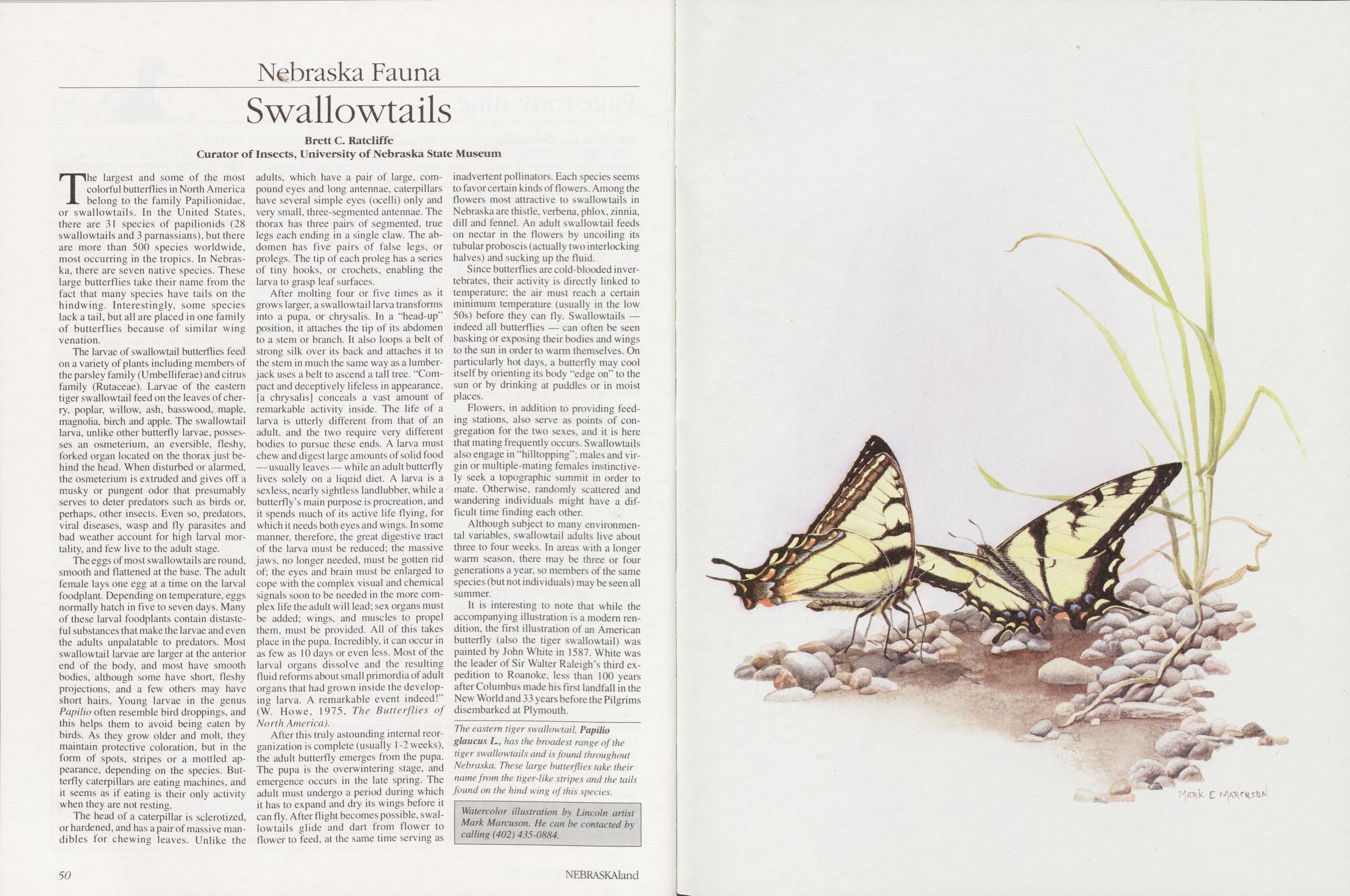
Nebraska Fauna Swallowtails
Brett C. Ratcliffe Curator of Insects, University of Nebraska State MuseumThe largest and some of the most colorful butterflies in North America belong to the family Papilionidae, or swallowtails. In the United States, there are 31 species of papilionids (28 swallowtails and 3 parnassians), but there are more than 500 species worldwide, most occurring in the tropics. In Nebraska, there are seven native species. These large butterflies take their name from the fact that many species have tails on the hindwing. Interestingly, some species lack a tail, but all are placed in one family of butterflies because of similar wing venation.
The larvae of swallowtail butterflies feed on a variety of plants including members of the parsley family (Umbelliferae) and citrus family (Rutaceae). Larvae of the eastern tiger swallowtail feed on the leaves of cherry, poplar, willow, ash, basswood, maple, magnolia, birch and apple. The swallowtail larva, unlike other butterfly larvae, possesses an osmeterium, an eversible, fleshy, forked organ located on the thorax just behind the head. When disturbed or alarmed, the osmeterium is extruded and gives off a musky or pungent odor that presumably serves to deter predators such as birds or, perhaps, other insects. Even so, predators, viral diseases, wasp and fly parasites and bad weather account for high larval mortality, and few live to the adult stage.
The eggs of most swallowtails are round, smooth and flattened at the base. The adult female lays one egg at a time on the larval foodplant. Depending on temperature, eggs normally hatch in five to seven days. Many of these larval foodplants contain distasteful substances that make the larvae and even the adults unpalatable to predators. Most swallowtail larvae are larger at the anterior end of the body, and most have smooth bodies, although some have short, fleshy projections, and a few others may have short hairs. Young larvae in the genus Papilio often resemble bird droppings, and this helps them to avoid being eaten by birds. As they grow older and molt, they maintain protective coloration, but in the form of spots, stripes or a mottled appearance, depending on the species. Butterfly caterpillars are eating machines, and it seems as if eating is their only activity when they are not resting.
The head of a caterpillar is sclerotized, or hardened, and has a pair of massive mandibles for chewing leaves. Unlike the 50 adults, which have a pair of large, compound eyes and long antennae, caterpillars have several simple eyes (ocelli) only and very small, three-segmented antennae. The thorax has three pairs of segmented, true legs each ending in a single claw. The abdomen has five pairs of false legs, or prolegs. The tip of each proleg has a series of tiny hooks, or crochets, enabling the larva to grasp leaf surfaces.
After molting four or five times as it grows larger, a swallowtail larva transforms into a pupa, or chrysalis. In a "head-up" position, it attaches the tip of its abdomen to a stem or branch. It also loops a belt of strong silk over its back and attaches it to the stem in much the same way as a lumberjack uses a belt to ascend a tall tree. "Compact and deceptively lifeless in appearance, [a chrysalis] conceals a vast amount of remarkable activity inside. The life of a larva is utterly different from that of an adult, and the two require very different bodies to pursue these ends. A larva must chew and digest large amounts of solid food — usually leaves — while an adult butterfly lives solely on a liquid diet. A larva is a sexless, nearly sightless landlubber, while a butterfly's main purpose is procreation, and it spends much of its active life flying, for which it needs both eyes and wings. In some manner, therefore, the great digestive tract of the larva must be reduced; the massive jaws, no longer needed, must be gotten rid of; the eyes and brain must be enlarged to cope with the complex visual and chemical signals soon to be needed in the more complex life the adult will lead; sex organs must be added; wings, and muscles to propel them, must be provided. All of this takes place in the pupa. Incredibly, it can occur in as few as 10 days or even less. Most of the larval organs dissolve and the resulting fluid reforms about small primordia of adult organs that had grown inside the developing larva. A remarkable event indeed!" (W. Howe, 1975, The Butterflies of North America).
After this truly astounding internal reorganization is complete (usually 1 -2 weeks), the adult butterfly emerges from the pupa. The pupa is the overwintering stage, and emergence occurs in the late spring. The adult must undergo a period during which it has to expand and dry its wings before it can fly. After flight becomes possible, swallowtails glide and dart from flower to flower to feed, at the same time serving as inadvertent pollinators. Each species seems to favor certain kinds of flowers. Among the flowers most attractive to swallowtails in Nebraska are thistle, verbena, phlox, zinnia, dill and fennel. An adult swallowtail feeds on nectar in the flowers by uncoiling its tubular proboscis (actually two interlocking halves) and sucking up the fluid.
Since butterflies are cold-blooded invertebrates, their activity is directly linked to temperature; the air must reach a certain minimum temperature (usually in the low 50s) before they can fly. Swallowtails indeed all butterflies can often be seen basking or exposing their bodies and wings to the sun in order to warm themselves. On particularly hot days, a butterfly may cool itself by orienting its body "edge on" to the sun or by drinking at puddles or in moist places.
Flowers, in addition to providing feeding stations, also serve as points of congregation for the two sexes, and it is here that mating frequently occurs. Swallowtails also engage in "hilltopping"; males and virgin or multiple-mating females instinctively seek a topographic summit in order to mate. Otherwise, randomly scattered and wandering individuals might have a difficult time finding each other.
Although subject to many environmental variables, swallowtail adults live about three to four weeks. In areas with a longer warm season, there may be three or four generations a year, so members of the same species (but not individuals) may be seen all summer.
It is interesting to note that while the accompanying illustration is a modern rendition, the first illustration of an American butterfly (also the tiger swallowtail) was painted by John White in 1587. White was the leader of Sir Walter Raleigh's third expedition to Roanoke, less than 100 years after Columbus made his first landfall in the New World and 33 years before the Pilgrims disembarked at Plymouth.
The eastern tiger swallowtail, Papilio glaucus L, has the broadest range of the tiger swallowtails and is found throughout Nebraska. These large butterflies take their name from the tiger-like stripes and the tails found on the hind wing of this species. Watercolor illustration by Lincoln artist Mark Marcuson. He can be contacted by calling (402) 435-0884. 50 NEBRASKAland
Position: 412 (24 views)