Volume 70, Issue 6, 1992
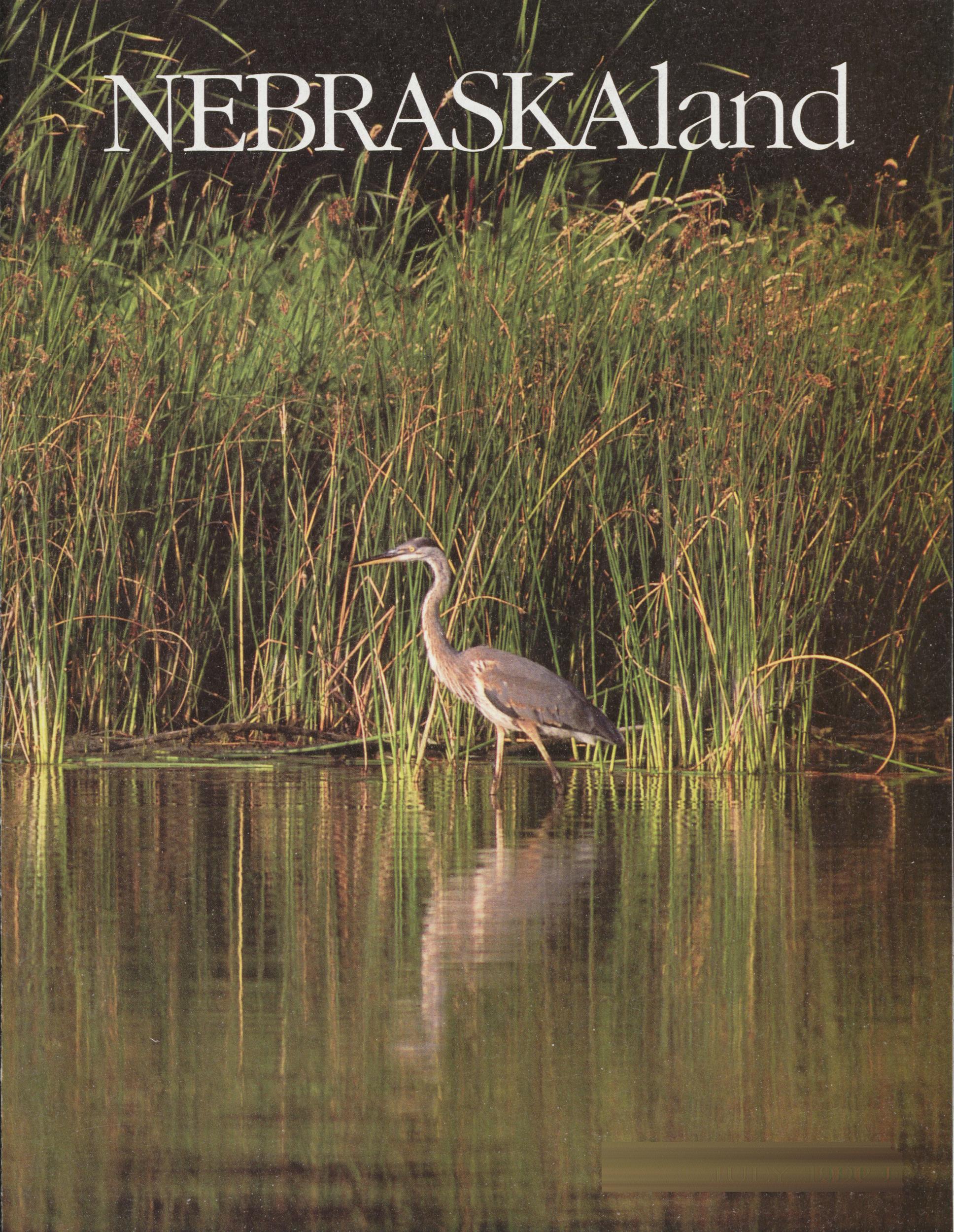
NEBRASKAland
NEBRASKAland
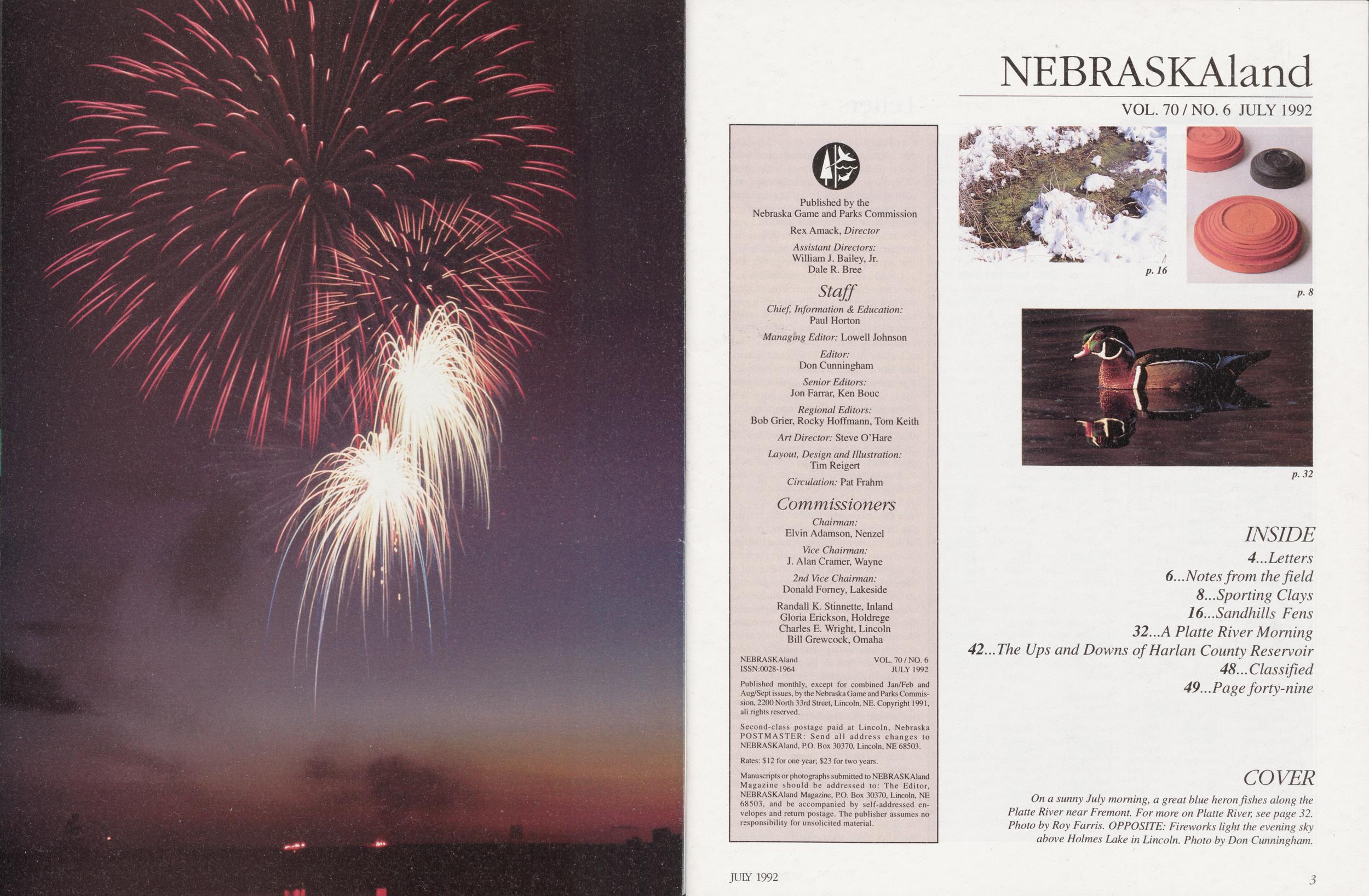
VOL. 70 / NO. 6 JULY 1992 Published by the Nebraska Game and Parks Commission Rex Amack, Director Assistant Directors: William J. Bailey, Jr. Dale R. Bree Staff Chief Information & Education: Paul Horton Managing Editor: Lowell Johnson Editor: Don Cunningham Senior Editors: Jon Farrar, Ken Bouc Regional Editors: Bob Grier, Rocky Hoffmann, Tom Keith Art Director: Steve O'Hare Layout, Design and Illustration: Tim Reigert Circulation: Pat Frahm Commissioners Chairman: Elvin Adamson, Nenzel Vice Chairman: J. Alan Cramer, Wayne 2nd Vice Chairman: Donald Forney, Lakeside Randall K. Stinnette, Inland Gloria Erickson, Holdrege Charles E. Wright, Lincoln Bill Grewcock, Omaha NEBRASKAland ISSN:0028-1964 VOL. 70/NO. 6 JULY 1992 Published monthly, except for combined Jan/Feb and Aug/Sept issues, by the Nebraska Game and Parks Commission, 2200 North 33rd Street, Lincoln, NE. Copyright 1991, ali rights reserved. Second-class postage paid at Lincoln, Nebraska POSTMASTER: Send all address changes to NEBRASKAland, P.O. Box 30370, Lincoln, NE 68503. Rates: $ 12 for one year; $23 for two years. Manuscripts or photographs submitted to NEBRASKAland Magazine should be addressed to: The Editor, NEBRASKAland Magazine, P.O. Box 30370, Lincoln, NE 68503, and be accompanied by self-addressed envelopes and return postage. The publisher assumes no responsibility for unsolicited material. Nebraska Game and Parks Commission
Headquarters District Offices District Office II
District Office IV
2200 North 33rd Street Box 508 Route 4, Box 36
Lincoln, NE 68503 Bassett, NE 68714 North Platte, NE69101
Phone (402)471-0641 Phone (402)684-2921 Phone (308)535-8025
District Office 1 District Office III District Office V
Box 725 Box 934 2200 North 33rd Street
Alliance, NE 69301 Norfolk, NE 68702 Lincoln, NE 68503
Phone (308)762-5605 Phone (402)370-3374 Phone (402)471-5558
Omaha Office Ak-Sar-Ben Aquarium
State 07ffice Building Mall 21502 West Highway 31
1313Farnam Gretna, NE 68028
Omaha, NE 68102, Phone (402) 332-3901
Phone (402) 595-2144
Conservation Officers by Region
Panhandle Southeast
Officer City Phone (308) Officer City Phone (402)
Richard Furley (Supv) Alliance 762-2024 Don Schaepler (Chief) Lincoln
488-2957
Walt Meyer Chadron 432-4398 Ted Blume (Asst Chief) Lincoln 483-5643
John Murphy Crawford 665-2021 Roger Guenther (Supv) Lincoln 423-5671
Jim Zimmerman Gering 436-7561 William Krause Auburn 274-3789
Marvin Kampbell Hay Springs 638-7527 Dan Evasco Beatrice 228-5935
Dennis Thompson Ogallala 284-6450 Murray Johnson Lincoln 488-2923
Dan Zuehlke Ogallala 284-4815 Douglas Kramer Lincoln 466-9001
Don Hunt Oshkosh 772-3697 Dina Barta Lincoln 466-5739
Richard Brandt Scottsbluff 635-1277 Levi Krause Louisville 234-2212
Raymond Still Bridgeport 262-1075 Russell Mort Duane Arp Nebr. City 873-5684
Omaha 332-4954
Northeast Larry Elston Omaha 292-4910
Officer City Phone (402) Craig Stover Omaha 359-2833
Robert Kelly Albion 395-2538 Mike Luben Colon 443-4278
Ross Oestmann Bloomfield 373-4412
LA. Wilkinson Columbus 564-4375 Sandhills
Gary Ralston Creighton 847-3284 Officer City Phone (402)
Daniel Roberts Fremont 721-7852 Bruce Wiebe (Supv) Bassett 684-3867
Randy Pomplun Fullerton 308)536-2987 Max Showalter Ainsworth 387-1960
Jon Reeves Kennard 427-7378 Larry Bauman Atkinson 925-5569
Marion Shafer Norfolk 371-2031 Tom Zimmer Brkn. Bow (308)872-6063
Eric Wiebe Ponca 755-2566 Richard Seward Ord (308)728-5338
Steve Oberg West Point 372-3062 Mick Gray Valentine 376-3136
Southwest South-Central
Officer City Phone (308) Officer City Phone (402)
Gail Woodside(Supv) No. Platte 532-0279 Jerry Pecha (Supv) York
362-5707
George Sund Cambridge 697-4629 Lester Johnson David City 367-4037
Jack Henderson Gothenburg 537-7483 Terry Brentzel Grand Isl. (308)384-8296
Dirk Greene Imperial 882-5328 Dale Johnson Hebron 768-7363
Ray Frandsen Lexington 324-2753 Daniel Klammer Hastings 461-3389
Virgil Gosch McCook 345-2185 Dayton Shultis Kearney (308)234-3349
Dwight Allbery No. Platte 532-2753 Mark Reeves Loup City (308)745-1126
Roger Thompson No. Platte 532-9175 Robert Finke Seward 643-2056
Rich Routh Republican City 799-2085 Operation Game TT
tief (800) 742-7627
Nebraska Game and Parks Commission
Headquarters District Offices District Office II
District Office IV
2200 North 33rd Street Box 508 Route 4, Box 36
Lincoln, NE 68503 Bassett, NE 68714 North Platte, NE69101
Phone (402)471-0641 Phone (402)684-2921 Phone (308)535-8025
District Office 1 District Office III District Office V
Box 725 Box 934 2200 North 33rd Street
Alliance, NE 69301 Norfolk, NE 68702 Lincoln, NE 68503
Phone (308)762-5605 Phone (402)370-3374 Phone (402)471-5558
Omaha Office Ak-Sar-Ben Aquarium
State 07ffice Building Mall 21502 West Highway 31
1313Farnam Gretna, NE 68028
Omaha, NE 68102, Phone (402) 332-3901
Phone (402) 595-2144
Conservation Officers by Region
Panhandle Southeast
Officer City Phone (308) Officer City Phone (402)
Richard Furley (Supv) Alliance 762-2024 Don Schaepler (Chief) Lincoln
488-2957
Walt Meyer Chadron 432-4398 Ted Blume (Asst Chief) Lincoln 483-5643
John Murphy Crawford 665-2021 Roger Guenther (Supv) Lincoln 423-5671
Jim Zimmerman Gering 436-7561 William Krause Auburn 274-3789
Marvin Kampbell Hay Springs 638-7527 Dan Evasco Beatrice 228-5935
Dennis Thompson Ogallala 284-6450 Murray Johnson Lincoln 488-2923
Dan Zuehlke Ogallala 284-4815 Douglas Kramer Lincoln 466-9001
Don Hunt Oshkosh 772-3697 Dina Barta Lincoln 466-5739
Richard Brandt Scottsbluff 635-1277 Levi Krause Louisville 234-2212
Raymond Still Bridgeport 262-1075 Russell Mort Duane Arp Nebr. City 873-5684
Omaha 332-4954
Northeast Larry Elston Omaha 292-4910
Officer City Phone (402) Craig Stover Omaha 359-2833
Robert Kelly Albion 395-2538 Mike Luben Colon 443-4278
Ross Oestmann Bloomfield 373-4412
LA. Wilkinson Columbus 564-4375 Sandhills
Gary Ralston Creighton 847-3284 Officer City Phone (402)
Daniel Roberts Fremont 721-7852 Bruce Wiebe (Supv) Bassett 684-3867
Randy Pomplun Fullerton 308)536-2987 Max Showalter Ainsworth 387-1960
Jon Reeves Kennard 427-7378 Larry Bauman Atkinson 925-5569
Marion Shafer Norfolk 371-2031 Tom Zimmer Brkn. Bow (308)872-6063
Eric Wiebe Ponca 755-2566 Richard Seward Ord (308)728-5338
Steve Oberg West Point 372-3062 Mick Gray Valentine 376-3136
Southwest South-Central
Officer City Phone (308) Officer City Phone (402)
Gail Woodside(Supv) No. Platte 532-0279 Jerry Pecha (Supv) York
362-5707
George Sund Cambridge 697-4629 Lester Johnson David City 367-4037
Jack Henderson Gothenburg 537-7483 Terry Brentzel Grand Isl. (308)384-8296
Dirk Greene Imperial 882-5328 Dale Johnson Hebron 768-7363
Ray Frandsen Lexington 324-2753 Daniel Klammer Hastings 461-3389
Virgil Gosch McCook 345-2185 Dayton Shultis Kearney (308)234-3349
Dwight Allbery No. Platte 532-2753 Mark Reeves Loup City (308)745-1126
Roger Thompson No. Platte 532-9175 Robert Finke Seward 643-2056
Rich Routh Republican City 799-2085 Operation Game TT
tief (800) 742-7627
Letters
City FoxesSir/1 was pleased to see that urban wildlife is finally being noticed. Your article "City Foxes" in the May issue may have alerted many people to the fact that more and more wildlife is living in urban settings. While many species have died back because of increased pressure by man and other natural enemies, I was happy to hear that some animals are thriving.
I would also like to compliment you on the many excellent pictures of both wildlife and scenic places. Thanks for a great magazine.
Jolene Newth Littleton, COSir/ Since I criticized the April issue (the tiger muskie on the cover), I must say you made up for it with the May issue. The cover picture of the red fox pup is great!
I enjoy your magazine, and my daughter in Texas especially likes the NEBRASKAland calendars. Keep up the good work.
Sharon Peters Hyannis, NE The Quartermaster CacheSir/ I believe I can identify two or three of the "unknown" items on page 13 of the June issue ["The Quartermaster Cache"].
Number one, the washer with a slot, at the top of the picture: I would guess, by its look, that it is a cast iron washer. Is it about four inches in diameter? It probably fit on one end of a cylinder the same diameter as the washer and about seven or eight inches long, with another washer of the same size on the other end. This cylinder, filled with iron or lead, was a weight that fit on a shaft of a windmill. This weight had a set screw above the slot so it could be adjusted on a bar. Consult a windmill expert for the finer uses of this weight.
Item number two, pictured below the washer: judging by its color, this item probably had an antique copper finish, which was popular 1915-1920. I believe it is an adjustable window catch. It was used as an alternate to iron window weights. The shiny part is probably 4 NEBRASKAland spring-loaded and rubbed against a groove at the side of the casing. There probably is some device on it by which the tension could be released when the window was raised or lowered.
Number three, located in the extreme lower right: this could be a window sash lift, but if it is, it is a homemade one.
Ed like to know how close I came on identification.
Leroy Walker Gibbon, NE Sweet Nebraska LandSir/ Having lived in Gordon, and having taught at Lorenzo, Center and Norfolk Junior College, I have subscribed to NEBRASKAland for many years. It is superbly done, the best state magazine Eve seen.
A part of my teaching at Northeastern Junior College is, pleasantly, teaching U.S. Western History by on-site traveling. A geology instructor and I recently took students on a trek (history, geology, photography and canoeing) that culminated in a canoe trip down the Niobrara River east of Valentine. We returned via Merritt Reservoir and the Sandhills. Our Coloradans were suitably impressed, and we all had a wonderful time. We shall return.
At Scout's Rest Ranch in North Platte, we watched a movie in the barn. Its background music was, in part, the humorous, homesteader song, "Nebraska Land." I could remember only a few lines. Thinking I surely had a copy, I promised the editor of the Sterling Journal Advocate, who accompanied us, I would give him the lyrics. Alas, I cannot find a copy.
Would NEBRASKAland be willing to print the words to "Nebraska Land?" We misplaced (or displaced?) Nebraskans would greatly appreciate being reminded of that great song.
Thank you — Nebraska and NEBRASKAland — for providing so much information and entertainment.
Darrell Wood Sterling, COThese are the lyrics as sung by Roger Welsch on the LP "Sweet Nebraska Land1' (with vocal accompaniment by Terry Schmitt, Folkways Record FH5337, 1966):
Chorus: Nebraska Land, sweet Nebraska Land, Upon thy burning soil I stand. I look away across the plains, And wonder why it never rains. We have no wheat, we have no oats, We have no corn to feed ourshoats; Our chickens are so very poor They beg for crumbs outside the door. (Chorus) Our horses are of bronco race, Starvation stares them in the face, We do not live, we only stay 'Cause we're too poor to move away. (Chorus)Roger calls the song "a Plains anthem, " based on the old hymn "Beulah Land. " It was sung throughout the region as " Kansas Land,' "Dakota Land, " "Iowa Land" and so forth. (Editor)
Thank YouSir/ Thank you for a beautiful magazine! The writing is skillful and often poetic and stirring as well. The information is trustworthy and topics well chosen. It confirms our pride in being Nebraskans. The NEBRASKAland Magazine crew are gifted people; each issue confirms their talent and dedication.
Again, thank you! Kathleen McFerren Hastings, NESend your comments, suggestions and complaints to Letters, NEBRASKAland Magazine, P.O. Box 30370, Lincoln, NE 68503. Each month we will publish as many letters as space permits. Photographs are also welcome, and we will make every effort to return them undamaged. NEBRASKAland reserves the right to edit and condense letters.
a binder to get you out of a bind Designed just for NEBRASKAland Magazine, this sturdy vinyl binder will hold a full two years issues. Plastic hangers make it easy to insert or remove magazines without damage, and easy to read without removing. Just *750 plus sales tax Order from: NEBRASKAland Magazine P.O. Box 30370 Lincoln, NE. 68503 Name Address City State Zip Payment Enclosed Visa Master Card Number JULY 1992 5
Notes from the field
Where can you get away for a week or weekend, and still not spend a bundle? Nebraska's state park areas are still your best bet for the perfect vacation or weekend break. Get the new 48-page, color brochure highlighting state parks, recreation areas and historic parks. You'll get detailed information on lodging, camping, activities, facilities, seasons, fees and reservation policies. Write or call today! Nebraska Game and Parks Commission P.O. Box 30370, Lincoln, NE 68503 Phone (402) 471-0641 Believe it or NotBruce Trindle, District III Game Supervisor from Norfolk, sends the following note about big deer:
One of the most frequent questions from hunters coming to the deer check station at Norfolk is "have you checked any big ones yet?" This is not unique to the Norfolk area, but seems to be a concern of hunters all across the state.
Shortly after the 1991 deer season, I received a phone call from Brian Lewon, of Lewon's Taxidermy in Norfolk. "Come on over and take a look at the deer racks people have brought in to have mounted. Overall they're bigger than they have been for the last several years," he said. Brian escorted me to the basement where the racks — antlers — were drying in preparation for mounting. The racks hung from pegs in the ceiling and stretched before my eyes from one end of the basement to the other. I could tell immediately that many of these racks were exceptional. Both white-tailed deer and mule deer were represented in the collection, over 100 altogether.
Brian Lewon is one of the 118 licensed taxidermists in Nebraska. While viewing his impressive collection I tried to imagine how many more trophy deer had been taken during the 1991 season. We selected five of the largest whitetail racks taken from northeast Nebraska and measured them using the Boone and Crockett scoring system. These five racks averaged 147 points, with the largest having an inside spread of 22 inches scoring 160. Every one of them was a beautiful trophy. This collection of deer antlers was proof that Nebraska produces trophy deer.
Why would this many trophy deer be harvested in 1991? One can only speculate, but perhaps it can be attributed to several factors. During the late 1980s, deer herds were generally on the increase across the state, and Nebraska's hunting seasons were directed at controlling these growing numbers. Either-sex permits were issued in larger and larger numbers to stabilize the herds. The emphasis was switched from bucks to does. In 1989, several herds in different management units were stabilized or reduced, and the Game and Parks Commission began to back off from the antlerless harvest, particularly in northeastern Nebraska. The permits in these units were switched back to predominately buck-only hunting. It appears that during the late 1980s, the emphasis on doe harvest reduced the pressure on the older age-classes of bucks. This reduction in pressure was evident in the 1991 deer season, by the presence of larger and older bucks in the harvest.
As more and more pressure is exerted on the bucks, and as fewer bucks are available, hunters must try harder and harder to harvest one. Occasionally, this takes hunters into areas that might not have been hunted previously or which were given little attention in previous years. Marginal areas, such as shelterbelts or CRP acres with tall stands of grass, areas that wise old bucks had discovered, were overlooked by many hunters only a few years ago.
This does not mean the woods are full of old mossy-horns, but it should provide hope to hunters who pursue deer through thick and thin, that there are still some nice deer available in Nebraska.
Bruce Trindle Wild BabiesEvery year Game and Parks Commission personnel are flooded with reports of "orphaned" or "abandoned" animals animals which well-intentioned, but uninformed, people often attempt to "rescue" 6 NEBRASKAland and hand raise. The desire is understandable; baby animals are cute, and they often seem do seem helpless, but they are virtually never actually abandoned — as often as not, the mother is nearby, probably concealed, watching as you steal her young.
Even if the mother is dead, you do a baby animal no favor by attempting to raise it. Raising and releasing a wild animal to the wild is a job best left to a trained rehabilitator who knows the animal's dietary needs and can simulate at least some of the training a young animal would receive from its natural mother.
Here is a letter from Chuck McCullough, furbearer/disease specialist for the Game and Parks Commission, written to a person who had attempted to raise a young raccoon. The letter's message is appropriate for anyone tempted to adopt a wild animal.
Dear
The raccoon that you took from the wild was sent to me, and I have given it to wildlife rehabilitators. They will spend the next several weeks trying to make this raccoon wild again. Their ultimate goal will be to release the raccoon, along with several others, out in the country where it belongs.
First it will be quarantined for a period to ensure that the other coons are not exposed to contagious diseases. Then it will be rehabilitated. During this period, the raccoon will be exposed to several unsettling stimuli to teach it that humans, and their dwellings, are not good places for wild raccoons to be. It will be fed foods that occur in nature, not marshmallows and potato chips. It will learn to get along with other raccoons, and will, hopefully, gain the skills necessary to survive in the wild where it belongs.
Taking raccoons or other wildlife and raising them does no service to the wildlife. I know that young coons are cute and cuddly, but they need to learn many things from their natural mothers to survive. We can t fully replace that instruction. Additionally, when rehabilitated raccoons are released, they are in a strange environment and a strange location that is probably full of well-educated resident raccoons. The new arrivals don I normally fare very well in their new home, despite the best efforts of rehabilitators to train them.
Hand-raised raccoons fare even more poorly. As they grow up, they become increasingly independent and bad tempered, until they can become a danger to their handlers. They usually leave their uhome " in fall or have to be destroyed before they seriously injure someone. If they leave, they have none of the skills needed for survival. They will become a nuisance to homes in the area or struggle through the fall and winter when resources are scarce. People who raise raccoons expose themselves, their families and pets to a variety of diseases and parasites. Among them is raccoon roundworm, an internal parasite that can kill children and pets and has caused paralysis and blindness in adults. Roundworm eggs are found in droppings and fur. They are very small and are ingested or inhaled by their victims. After that, they hatch, develop and migrate through major organs until they reach the spine or brain.
I hope that in the future, you will refrain from hand-raising wild animals. It is potentially hazardous to your health and does no service to wildlife populations.
Sincerely, Chuck McCullough, Furbearer'/Disease SpecialistAlthough some details in this letter apply specifically only to raccoons, the point remains true for all species most "abandoned" wildlife is not abandoned. Leave it alone. Wild mothers can take care of wild babies better than you can. Even if you know without doubt that the mother is dead, don't try to hand raise a young animal. Instead, call a conservation officer (they are listed on page 4) who will transport the animal to a trained wildlife rehabilitator.
Wild/lowers always in season! Field Guide to fldflowers ofNebrask and the Great Plains NEBRASKAland Magazines Field Guide to Wild/lowers of Nebraska and the Great Plains is the perfect tool to help identify 282 species, all in full color with descriptions, flowering period, range and identification tips. An ideal gift for the hard-to-buy-for naturalist. Available for only $17.95 Name Address. City State Zip Check enclosed Visa Mastercard Card Number Expr. Date Enclose $17.95 - Nebraska residents please include sales tax. Send to: NEBRASKAland Magazine, P.O. Box 30370, Lincoln, NE 68503 JULY 1992 7
Sproting Clays
Photos and text by Ken Bouc 'As a tuneupfor hunting and as a sport in itself, sporting clays is gaining popularity. Sporting clays courses use natural terrain and a variety of targets thrown at various angles and speeds to duplicate hunting situations.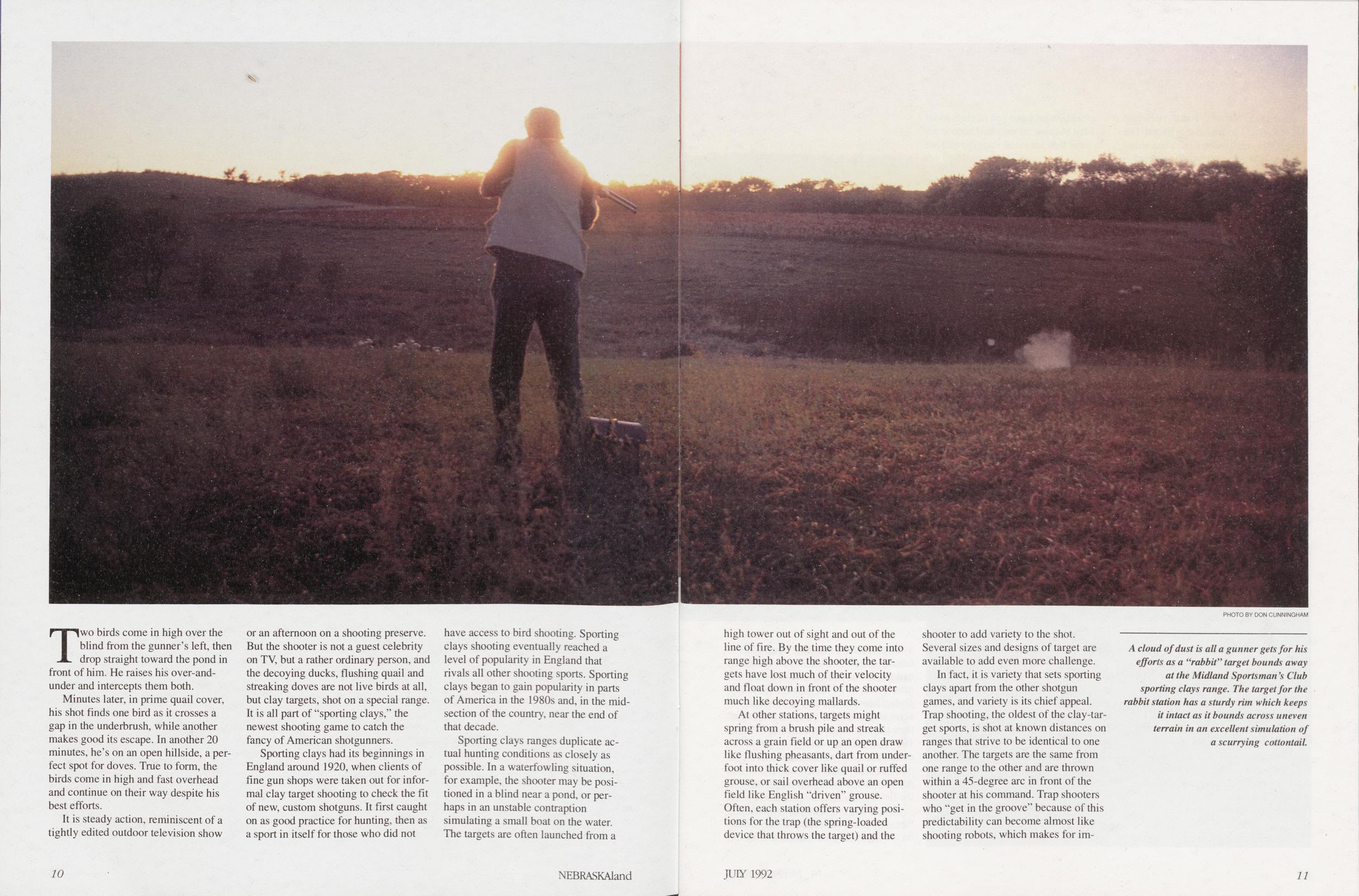
Two birds come in high over the blind from the gunner's left, then drop straight toward the pond in front of him. He raises his over-and-under and intercepts them both.
Minutes later, in prime quail cover, his shot finds one bird as it crosses a gap in the underbrush, while another makes good its escape. In another 20 minutes, he's on an open hillside, a perfect spot for doves. True to form, the birds come in high and fast overhead and continue on their way despite his best efforts.
It is steady action, reminiscent of a tightly edited outdoor television show or an afternoon on a shooting preserve. But the shooter is not a guest celebrity on TV, but a rather ordinary person, and the decoying ducks, flushing quail and streaking doves are not live birds at all, but clay targets, shot on a special range. It is all part of "sporting clays," the newest shooting game to catch the fancy of American shotgunners.
Sporting clays had its beginnings in England around 1920, when clients of fine gun shops were taken out for informal clay target shooting to check the fit of new, custom shotguns. It first caught on as good practice for hunting, then as a sport in itself for those who did not have access to bird shooting. Sporting clays shooting eventually reached a level of popularity in England that rivals all other shooting sports. Sporting clays began to gain popularity in parts of America in the 1980s and, in the midsection of the country, near the end of that decade.
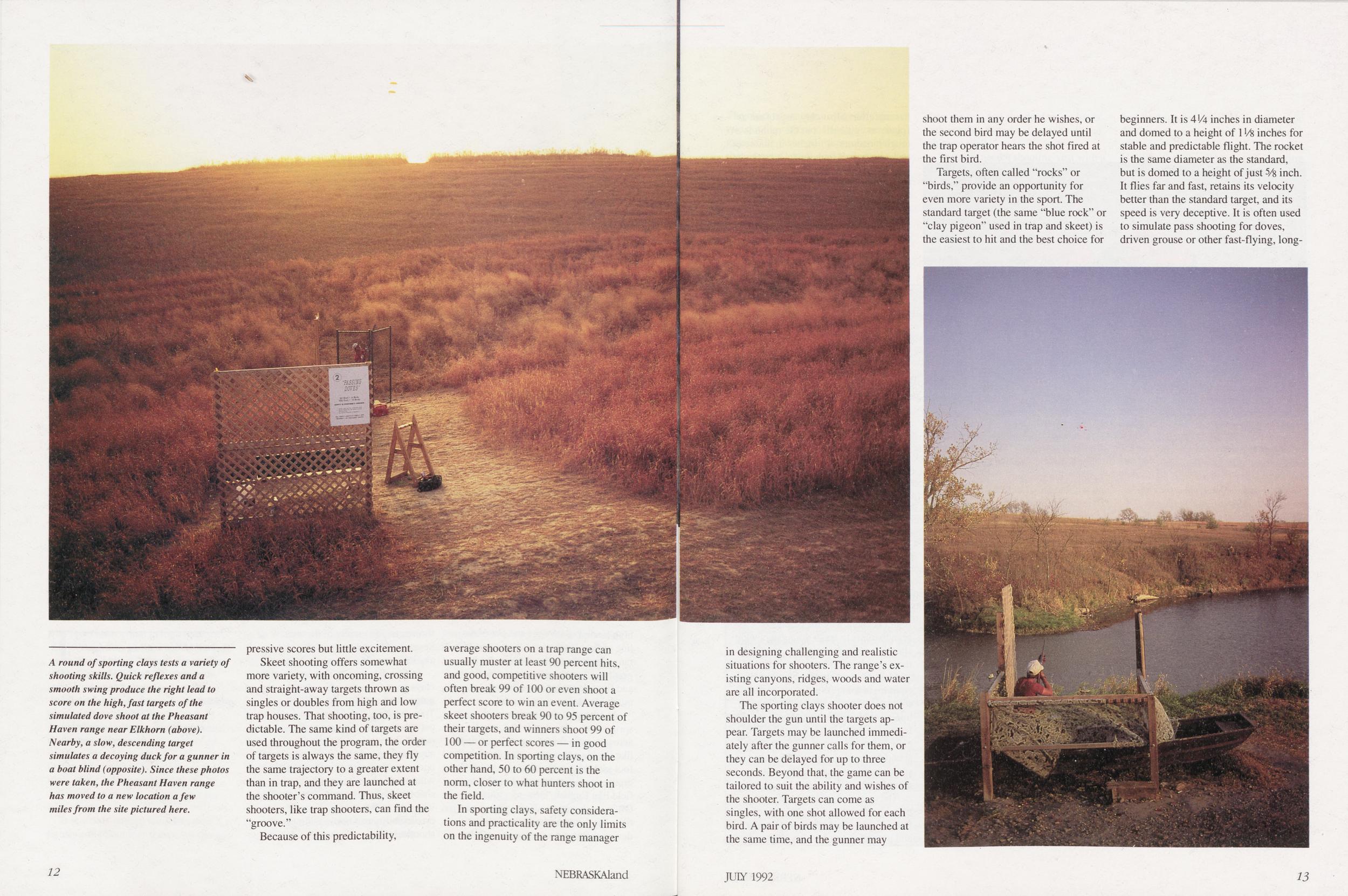
Sporting clays ranges duplicate actual hunting conditions as closely as possible. In a waterfowling situation, for example, the shooter may be positioned in a blind near a pond, or perhaps in an unstable contraption simulating a small boat on the water. The targets are often launched from a 10 NEBRASKAland high tower out of sight and out of the line of fire. By the time they come into range high above the shooter, the targets have lost much of their velocity and float down in front of the shooter much like decoying mallards.
At other stations, targets might spring from a brush pile and streak across a grain field or up an open draw like flushing pheasants, dart from underfoot into thick cover like quail or ruffed grouse, or sail overhead above an open field like English "driven" grouse. Often, each station offers varying positions for the trap (the spring-loaded device that throws the target) and the shooter to add variety to the shot. Several sizes and designs of target are available to add even more challenge.
In fact, it is variety that sets sporting
clays apart from the other shotgun
games, and variety is its chief appeal.
Trap shooting, the oldest of the clay-target sports, is shot at known distances on
ranges that strive to be identical to one
another. The targets are the same from
one range to the other and are thrown
within a 45-degree arc in front of the
shooter at his command. Trap shooters
who "get in the groove" because of this
predictability can become almost like
shooting robots, which makes for im
Skeet shooting offers somewhat more variety, with oncoming, crossing and straight-away targets thrown as singles or doubles from high and low trap houses. That shooting, too, is predictable. The same kind of targets are used throughout the program, the order of targets is always the same, they fly the same trajectory to a greater extent than in trap, and they are launched at the shooter's command. Thus, skeet shooters, like trap shooters, can find the "groove."
Because of this predictability, average shooters on a trap range can usually muster at least 90 percent hits, and good, competitive shooters will often break 99 of 100 or even shoot a perfect score to win an event. Average skeet shooters break 90 to 95 percent of their targets, and winners shoot 99 of 100 — or perfect scores — in good competition. In sporting clays, on the other hand, 50 to 60 percent is the norm, closer to what hunters shoot in the field.
In sporting clays, safety considerations and practicality are the only limits on the ingenuity of the range manager 12 NEBRASKAland in designing challenging and realistic situations for shooters. The range's existing canyons, ridges, woods and water are all incorporated.
The sporting clays shooter does not shoulder the gun until the targets appear. Targets may be launched immediately after the gunner calls for them, or they can be delayed for up to three seconds. Beyond that, the game can be tailored to suit the ability and wishes of the shooter. Targets can come as singles, with one shot allowed for each bird. A pair of birds may be launched at the same time, and the gunner may shoot them in any order he wishes, or the second bird may be delayed until the trap operator hears the shot fired at the first bird.
Targets, often called "rocks" or "birds," provide an opportunity for even more variety in the sport. The standard target (the same "blue rock" or "clay pigeon" used in trap and skeet) is the easiest to hit and the best choice for beginners. It is 4*/4 inches in diameter and domed to a height of 11/8 inches for stable and predictable flight. The rocket is the same diameter as the standard, but is domed to a height of just 5/8 inch. It flies far and fast, retains its velocity better than the standard target, and its speed is very deceptive. It is often used to simulate pass shooting for doves, driven grouse or other fast-flying, long
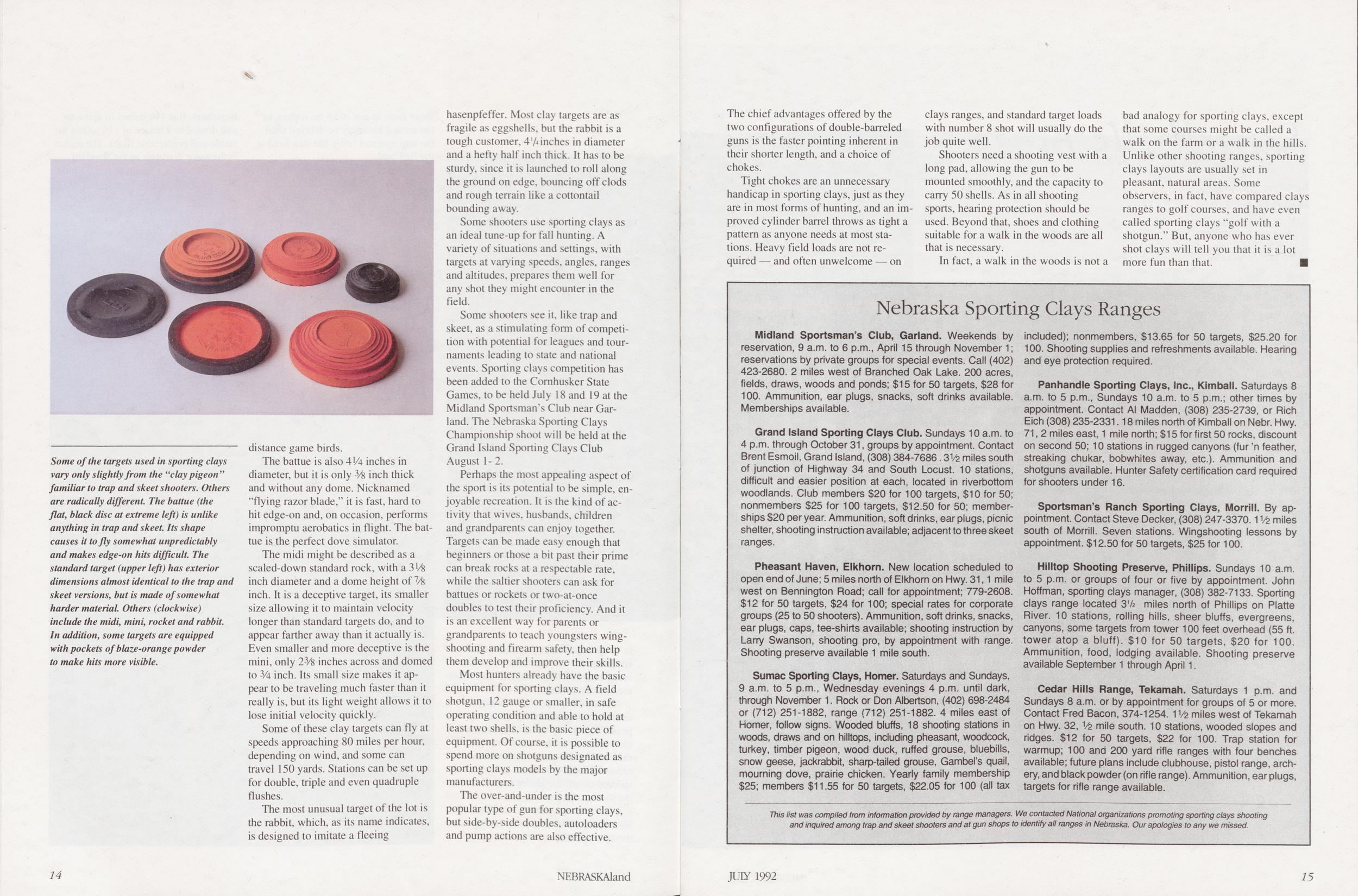
The battue is also 4 1/4 inches in diameter, but it is only Vs inch thick and without any dome. Nicknamed "flying razor blade," it is fast, hard to hit edge-on and, on occasion, performs impromptu aerobatics in flight. The battue is the perfect dove simulator.
The midi might be described as a scaled-down standard rock, with a 3 1/8 inch diameter and a dome height of 7/8 inch. It is a deceptive target, its smaller size allowing it to maintain velocity longer than standard targets do, and to appear farther away than it actually is. Even smaller and more deceptive is the mini, only 23/8 inches across and domed to 3/4 inch. Its small size makes it appear to be traveling much faster than it really is, but its light weight allows it to lose initial velocity quickly.Some of these clay targets can fly at speeds approaching 80 miles per hour, depending on wind, and some can travel 150 yards. Stations can be set up for double, triple and even quadruple flushes.
The most unusual target of the lot is the rabbit, which, as its name indicates, is designed to imitate a fleeing hasenpfeffer. Most clay targets are as fragile as eggshells, but the rabbit is a tough customer, 4'A inches in diameter and a hefty half inch thick. It has to be sturdy, since it is launched to roll along the ground on edge, bouncing off clods and rough terrain like a cottontail bounding away.
Some shooters use sporting clays as an ideal tune-up for fall hunting. A variety of situations and settings, with targets at varying speeds, angles, ranges and altitudes, prepares them well for any shot they might encounter in the field.
Some shooters see it, like trap and skeet, as a stimulating form of competition with potential for leagues and tournaments leading to state and national events. Sporting clays competition has been added to the Cornhusker State Games, to be held July 18 and 19 at the Midland Sportsman's Club near Garland. The Nebraska Sporting Clays Championship shoot will be held at the Grand Island Sporting Clays Club August 1- 2.
Perhaps the most appealing aspect of the sport is its potential to be simple, enjoyable recreation. It is the kind of activity that wives, husbands, children and grandparents can enjoy together. Targets can be made easy enough that beginners or those a bit past their prime can break rocks at a respectable rate, while the saltier shooters can ask for battues or rockets or two-at-once doubles to test their proficiency. And it is an excellent way for parents or grandparents to teach youngsters wingshooting and firearm safety, then help them develop and improve their skills.
Most hunters already have the basic equipment for sporting clays. A field shotgun, 12 gauge or smaller, in safe operating condition and able to hold at least two shells, is the basic piece of equipment. Of course, it is possible to spend more on shotguns designated as sporting clays models by the major manufacturers.
The over-and-under is the most popular type of gun for sporting clays, but side-by-side doubles, autoloaders and pump actions are also effective. 14 NEBRASKAland The chief advantages offered by the two configurations of double-barreled guns is the faster pointing inherent in their shorter length, and a choice of chokes.
Tight chokes are an unnecessary handicap in sporting clays, just as they are in most forms of hunting, and an improved cylinder barrel throws as tight a pattern as anyone needs at most stations. Heavy field loads are not required — and often unwelcome — on clays ranges, and standard target loads with number 8 shot will usually do the job quite well.
Shooters need a shooting vest with a long pad, allowing the gun to be mounted smoothly, and the capacity to carry 50 shells. As in all shooting sports, hearing protection should be used. Beyond that, shoes and clothing suitable for a walk in the woods are all that is necessary.
In fact, a walk in the woods is not a bad analogy for sporting clays, except that some courses might be called a walk on the farm or a walk in the hills. Unlike other shooting ranges, sporting clays layouts are usually set in pleasant, natural areas. Some observers, in fact, have compared clays ranges to golf courses, and have even called sporting clays "golf with a shotgun." But, anyone who has ever shot clays will tell you that it is a lot more fun than that.
Nebraska Sporting Clays RangesMidland Sportsman's Club, Garland. Weekends by reservation, 9 a.m. to 6 p.m., April 15 through November 1; reservations by private groups for special events. Call (402) 423-2680. 2 miles west of Branched Oak Lake. 200 acres, fields, draws, woods and ponds; $15 for 50 targets, $28 for 100. Ammunition, ear plugs, snacks, soft drinks available. Memberships available.
Grand Island Sporting Clays Club. Sundays 10 a.m. to 4 p.m. through October 31, groups by appointment. Contact Brent Esmoii, Grand Island, (308) 384-7686.31/2 miles south of junction of Highway 34 and South Locust. 10 stations, difficult and easier position at each, located in riverbottom woodlands. Club members $20 for 100 targets, $10 for 50; nonmembers $25 for 100 targets, $12.50 for 50; memberships $20 per year. Ammunition, soft drinks, ear plugs, picnic shelter, shooting instruction available; adjacent to three skeet ranges.
Pheasant Haven, Elkhorn. New location scheduled to open end of June; 5 miles north of Elkhorn on Hwy. 31,1 mile west on Bennington Road; call for appointment; 779-2608. $12 for 50 targets, $24 for 100; special rates for corporate groups (25 to 50 shooters). Ammunition, soft drinks, snacks, ear plugs, caps, tee-shirts available; shooting instruction by Larry Swanson, shooting pro, by appointment with range. Shooting preserve available 1 mile south.
Sumac Sporting Clays, Homer. Saturdays and Sundays, 9 a.m. to 5 p.m., Wednesday evenings 4 p.m. until dark, through November 1. Rock or Don Albertson, (402) 698-2484 or (712) 251-1882, range (712) 251-1882. 4 miles east of Homer, follow signs. Wooded bluffs, 18 shooting stations in woods, draws and on hilltops, including pheasant, woodcock, turkey, timber pigeon, wood duck, ruffed grouse, bluebills, snow geese, jackrabbit, sharp-tailed grouse, Gambel's quail, mourning dove, prairie chicken. Yearly family membership $25; members $11.55 for 50 targets, $22.05 for 100 (all tax included); nonmembers, $13.65 for 50 targets, $25.20 for 100. Shooting supplies and refreshments available. Hearing and eye protection required.
Panhandle Sporting Clays, Inc., Kimball. Saturdays 8 a.m. to 5 p.m., Sundays 10 a.m. to 5 p.m.; other times by appointment. Contact Al Madden, (308) 235-2739, or Rich Eich (308) 235-2331.18 miles north of Kimball on Nebr. Hwy. 71,2 miles east, 1 mile north; $15 for first 50 rocks, discount on second 50; 10 stations \x\ rugged canyons (fur 'n feather, streaking chukar, bobwhites away, etc.). Ammunition and shotguns available. Hunter Safety certification card required for shooters under 16.
Sportsman's Ranch Sporting Clays, Morrill. By appointment. Contact Steve Decker, (308) 247-3370.11/2 miles south of Morrill. Seven stations. Wingshooting lessons by appointment. $12.50 for 50 targets, $25 for 100.
Hilltop Shooting Preserve, Phillips. Sundays 10 a.m. to 5 p.m. or groups of four or five by appointment. John Hoffman, sporting clays manager, (308) 382-7133. Sporting clays range located 37* miles north of Phillips on Platte River. 10 stations, rolling hills, sheer bluffs, evergreens, canyons, some targets from tower 100 feet overhead (55 ft. tower atop a bluff). $10 for 50 targets, $20 for 100. Ammunition, food, lodging available. Shooting preserve available September 1 through April 1.
Cedar Hills Range, Tekamah. Saturdays 1 p.m. and Sundays 8 a.m. or by appointment for groups of 5 or more. Contact Fred Bacon, 374-1254. 11/2 miles west of Tekamah on Hwy. 32, i/£ mile south. 10 stations, wooded slopes and ridges. $12 for 50 targets, $22 for 100. Trap station for warmup; 100 and 200 yard rifle ranges with four benches available; future plans include clubhouse, pistol range, archery, and black powder (on rifle range). Ammunition, ear plugs, targets for rifle range available.
This list was compiled from information provided by range managers. We contacted National organizations promoting sporting clays shooting and inquired among trap and skeet shooters and at gun shops to identify all ranges in Nebraska. Our apologies to any we missed. JULY 1992 15
Sandhills Fens
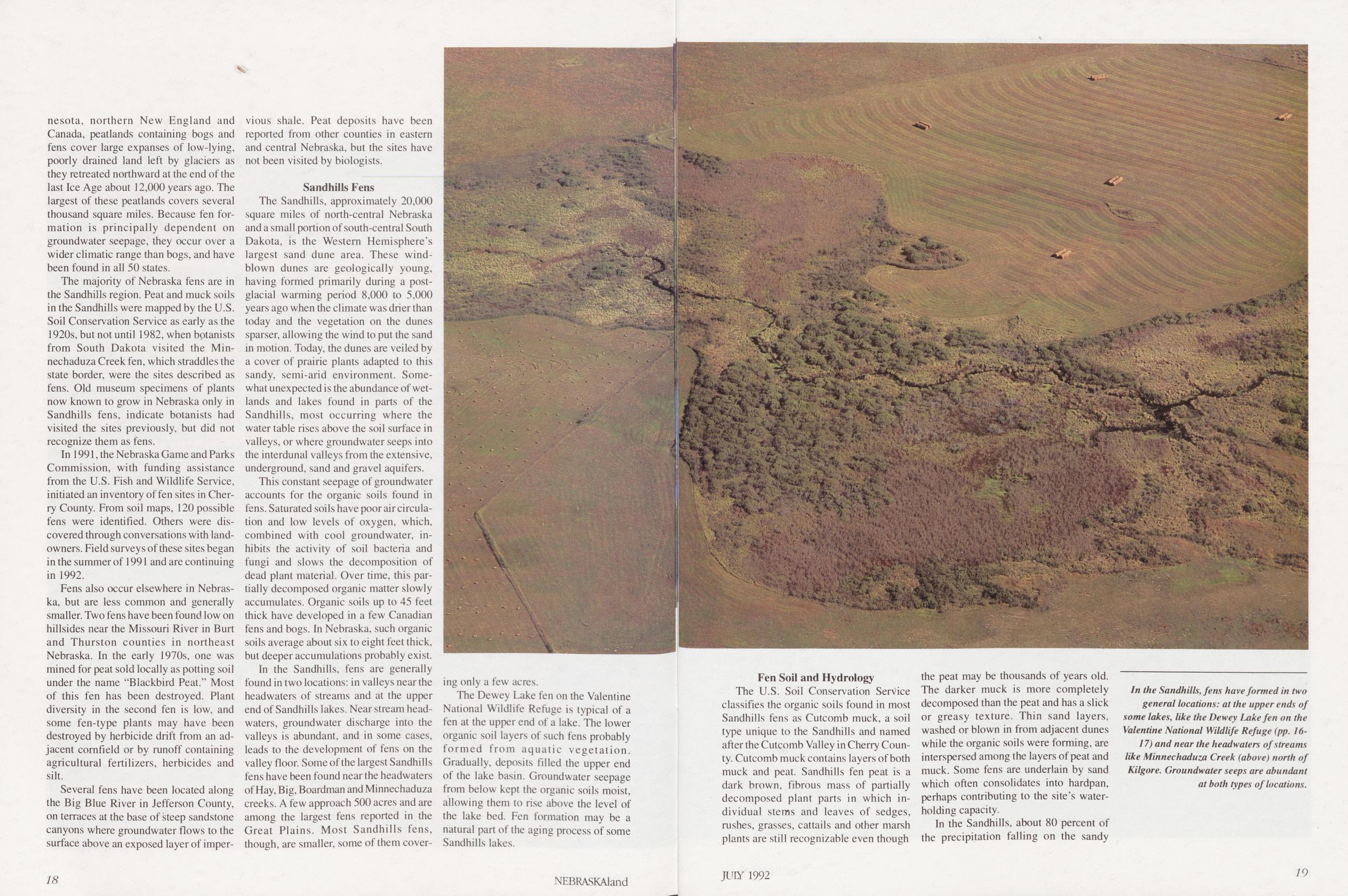
By Gerry Steinauer Photos by Jon Farrar To most Nebraskans, "fen " might be a foreign word, and only recently have fens been found here. Like bogs, fens have water-saturated, organic soils composed of partially decayed plant material. Unlike bogs, fens are fed by nutrientrich groundivater, a hospitable environment for some of the state's rarest plants.It had been a dry fall in the northern Sandhills, sometime between 1920 and 1940, Tom Hoffman recalls his father saying. A hay bale, ignited by a lightning strike, burned its way down into the peat soil of the Minnechaduza Creek Valley north of Nenzel. The advance of the fire, as it smoldered underground consuming the peat, was marked by wisps of smoke and steam rising through the sedge-and-grass sod. Tom's father dug a ditch around the fire's perimeter and pumped it full of water in an attempt to stop the fire's spread. The peat continued to bum for more than a month. A depression in the meadow, where the peat was consumed and the ground later sank, still marks the extent of the fire.
What is a Fen?Although peat fires have smoldered under the soil's surface for centuries in some Irish bogs, underground peat fires are unexpected in Nebraska. Though similar to a bog in many ways, the watersaturated, peaty soils found in the Minnechaduza Valley are indicative of a fen, not of a bog.
The word fen first came into use in England with the Angles and Saxons some 1,500 years ago, when it meant marsh or mud. Europeans have described certain types of peatlands (wetlands with peat soils) as fens for centuries, but only recently have fens been distinguished from bogs in North America. Prior to the 1940s, all North American peatlands were called bogs. Bogs and fens both have organic soils composed of peat and muck accumulated over thousands of years. Peat consists of partially decomposed plant roots, stems and leaves. Muck, originating from similar plant material, is more completely decomposed. These highly organic soils are one characteristic distinguishing fens from Nebraska's other wetlands, such as lakes, marshes and wet meadows, which occur mainly over mineral soils composed of sand, silt, clay or gravel.
Bogs receive all their water directly from rain, snow and fog. This water contains few nutrients, or natural "buffers" such as carbonates, which neutralize acids produced by decaying vegetation. Consequently, bogs are relatively infertile and highly acidic. In contrast, fens are fed by groundwater which accumulates nutrients and buffers while passing through mineral soils, making fens more nutrient rich and less acidic than bogs. Consequently, fens are a more hospitable growing environment for plants than bogs, and generally support a greater variety and number of species.
Peatlands are found on all continents but Antarctica, but are most abundant in cool and moist climates. In northern Minnesota, 16 NEBRASKAland
 northern New England and
Canada, peatlands containing bogs and
fens cover large expanses of low-lying,
poorly drained land left by glaciers as
they retreated northward at the end of the
last Ice Age about 12,000 years ago. The
largest of these peatlands covers several
thousand square miles. Because fen formation is principally dependent on
groundwater seepage, they occur over a
wider climatic range than bogs, and have
been found in all 50 states.
northern New England and
Canada, peatlands containing bogs and
fens cover large expanses of low-lying,
poorly drained land left by glaciers as
they retreated northward at the end of the
last Ice Age about 12,000 years ago. The
largest of these peatlands covers several
thousand square miles. Because fen formation is principally dependent on
groundwater seepage, they occur over a
wider climatic range than bogs, and have
been found in all 50 states.
The majority of Nebraska fens are in the Sandhills region. Peat and muck soils in the Sandhills were mapped by the U.S. Soil Conservation Service as early as the 1920s, but not until 1982, when botanists from South Dakota visited the Min- nechaduza Creek fen, which straddles the state border, were the sites described as fens. Old museum specimens of plants now known to grow in Nebraska only in Sandhills fens, indicate botanists had visited the sites previously, but did not recognize them as fens.
In 1991, the Nebraska Game and Parks Commission, with funding assistance from the U.S. Fish and Wildlife Service, initiated an inventory of fen sites in Cherry County. From soil maps, 120 possible fens were identified. Others were discovered through conversations with landowners. Field surveys of these sites began in the summer of 1991 and are continuing in 1992.
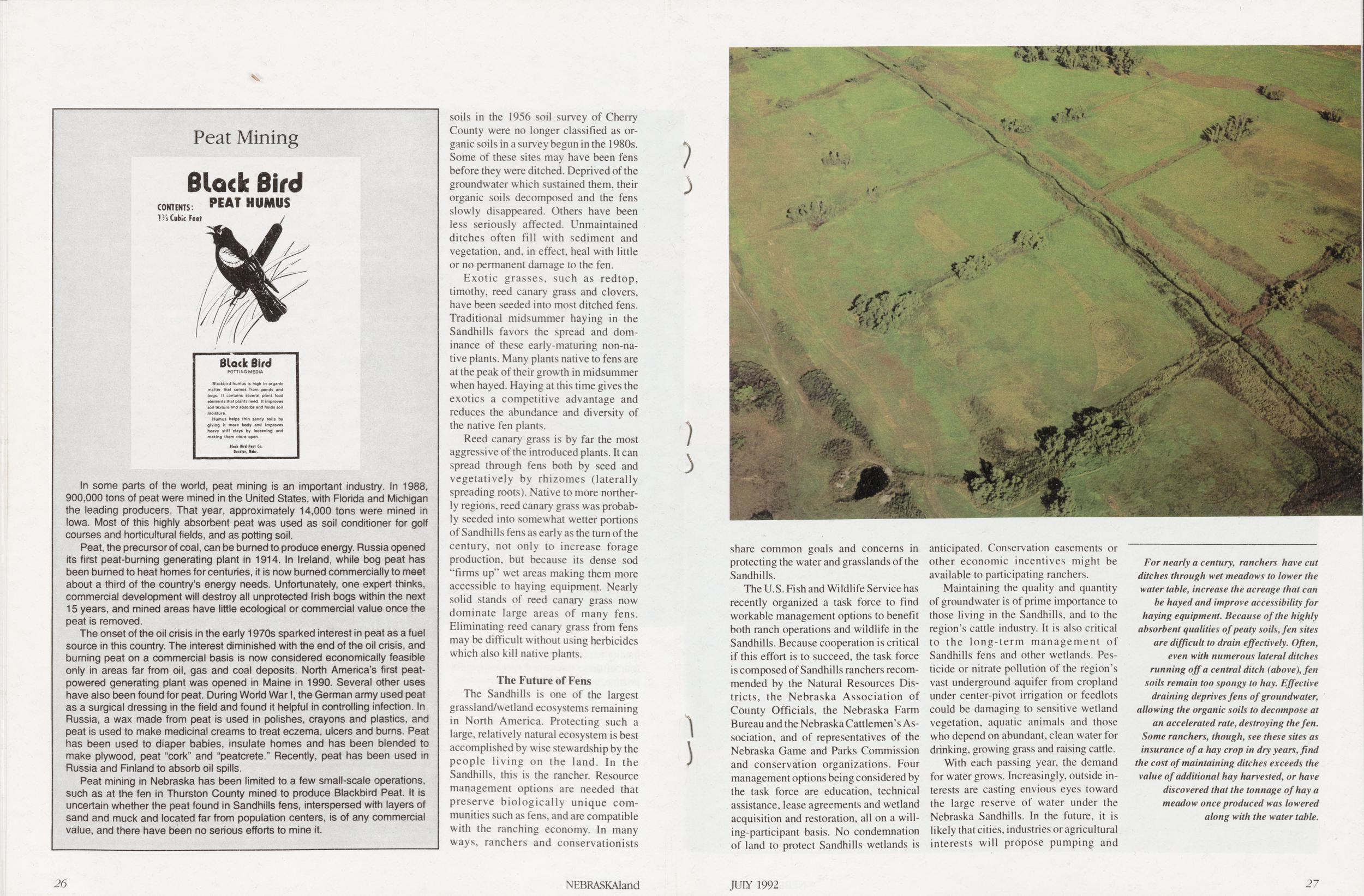
Fens also occur elsewhere in Nebraska, but are less common and generally smaller. Two fens have been found low on hillsides near the Missouri River in Burt and Thurston counties in northeast Nebraska. In the early 1970s, one was mined for peat sold locally as potting soil under the name "Blackbird Peat" Most of this fen has been destroyed. Plant diversity in the second fen is low, and some fen-type plants may have been destroyed by herbicide drift from an adjacent cornfield or by runoff containing agricultural fertilizers, herbicides and silt.
Several fens have been located along the Big Blue River in Jefferson County, on terraces at the base of steep sandstone canyons where groundwater flows to the surface above an exposed layer of impervious shale. Peat deposits have been reported from other counties in eastern and central Nebraska, but the sites have not been visited by biologists.
Sandhills FensThe Sandhills, approximately 20,000 square miles of north-central Nebraska and a small portion of south-central South Dakota, is the Western Hemisphere's largest sand dune area. These windblown dunes are geologically young, having formed primarily during a postglacial warming period 8,000 to 5,000 years ago when the climate was drier than today and the vegetation on the dunes sparser, allowing the wind to put the sand in motion. Today, the dunes are veiled by a cover of prairie plants adapted to this sandy, semi-arid environment. Somewhat unexpected is the abundance of wetlands and lakes found in parts of the Sandhills, most occurring where the water table rises above the soil surface in valleys, or where groundwater seeps into the interdunal valleys from the extensive, underground, sand and gravel aquifers.
This constant seepage of groundwater accounts for the organic soils found in fens. Saturated soils have poor air circulation and low levels of oxygen, which, combined with cool groundwater, inhibits the activity of soil bacteria and fungi and slows the decomposition of dead plant material. Over time, this partially decomposed organic matter slowly accumulates. Organic soils up to 45 feet thick have developed in a few Canadian fens and bogs. In Nebraska, such organic soils average about six to eight feet thick, but deeper accumulations probably exist.
In the Sandhills, fens are generally found in two locations: in valleys near the headwaters of streams and at the upper end of Sandhills lakes. Near stream headwaters, groundwater discharge into the valleys is abundant, and in some cases, leads to the development of fens on the valley floor. Some of the largest Sandhills fens have been found near the headwaters of Hay, Big, Boardman and Minnechaduza creeks. A few approach 500 acres and are among the largest fens reported in the Great Plains. Most Sandhills fens, though, are smaller, some of them covering only a few acres.
The Dewey Lake fen on the Valentine National Wildlife Refuge is typical of a fen at the upper end of a lake. The lower organic soil layers of such fens probably formed from aquatic vegetation. Gradually, deposits filled the upper end of the lake basin. Groundwater seepage from below kept the organic soils moist, allowing them to rise above the level of the lake bed. Fen formation may be a natural part of the aging process of some Sandhills lakes.
18 NEBRASKAland Fen Soil and HydrologyThe U.S. Soil Conservation Service classifies the organic soils found in most Sandhills fens as Cutcomb muck, a soil type unique to the Sandhills and named after the Cutcomb Valley in Cherry County. Cutcomb muck contains layers of both muck and peat. Sandhills fen peat is a dark brown, fibrous mass of partially decomposed plant parts in which individual stems and leaves of sedges, rushes, grasses, cattails and other marsh plants are still recognizable even though the peat may be thousands of years old. The darker muck is more completely decomposed than the peat and has a slick or greasy texture. Thin sand layers, washed or blown in from adjacent dunes while the organic soils were forming, are interspersed among the layers of peat and muck. Some fens are underlain by sand which often consolidates into hardpan, perhaps contributing to the site's water-holding capacity.
In the Sandhills, about 80 percent of the precipitation falling on the sandy
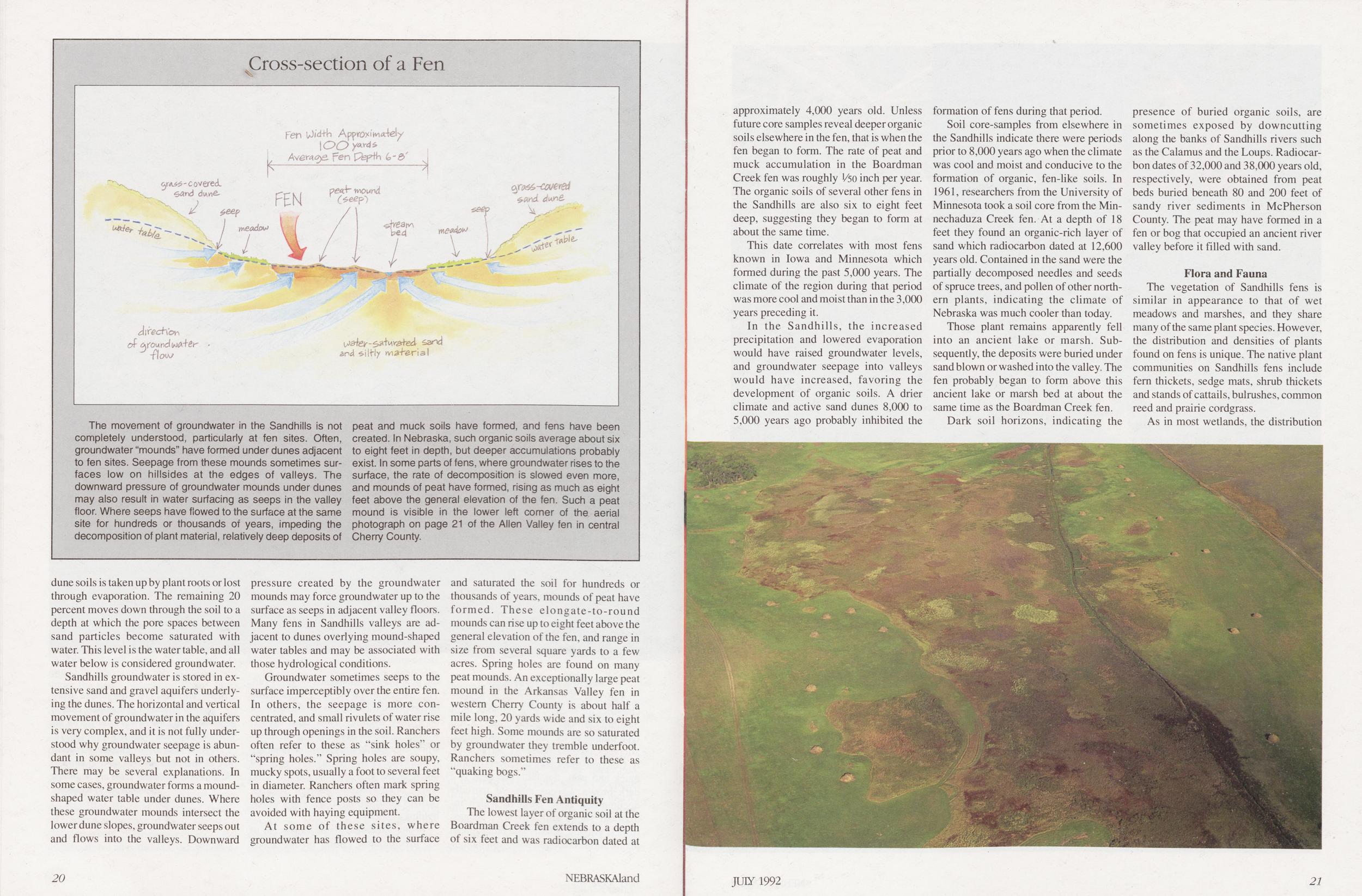
Sandhills groundwater is stored in extensive sand and gravel aquifers underlying the dunes. The horizontal and vertical movement of groundwater in the aquifers is very complex, and it is not fully understood why groundwater seepage is abundant in some valleys but not in others. There may be several explanations. In some cases, groundwater forms a moundshaped water table under dunes. Where these groundwater mounds intersect the lower dune slopes, groundwater seeps out and flows into the valleys. Downward pressure created by the groundwater mounds may force groundwater up to the surface as seeps in adjacent valley floors. Many fens in Sandhills valleys are adjacent to dunes overlying mound-shaped water tables and may be associated with those hydrological conditions.
Groundwater sometimes seeps to the surface imperceptibly over the entire fen. In others, the seepage is more concentrated, and small rivulets of water rise up through openings in the soil. Ranchers often refer to these as "sink holes" or "spring holes." Spring holes are soupy, mucky spots, usually a foot to several feet in diameter. Ranchers often mark spring holes with fence posts so they can be avoided with haying equipment.
At some of these sites, where groundwater has flowed to the surface and saturated the soil for hundreds or thousands of years, mounds of peat have formed. These elongate-to-round mounds can rise up to eight feet above the general elevation of the fen, and range in size from several square yards to a few acres. Spring holes are found on many peat mounds. An exceptionally large peat mound in the Arkansas Valley fen in western Cherry County is about half a mile long, 20 yards wide and six to eight feet high. Some mounds are so saturated by groundwater they tremble underfoot. Ranchers sometimes refer to these as "quaking bogs."
Sandhills Fen AntiquityThe lowest layer of organic soil at the Boardman Creek fen extends to a depth of six feet and was radiocarbon dated at 20 NEBRASKAland approximately 4,000 years old. Unless future core samples reveal deeper organic soils elsewhere in the fen, that is when the fen began to form. The rate of peat and muck accumulation in the Boardman Creek fen was roughly 1/50 inch per year. The organic soils of several other fens in the Sandhills are also six to eight feet deep, suggesting they began to form at about the same time.
This date correlates with most fens known in Iowa and Minnesota which formed during the past 5,000 years. The climate of the region during that period was more cool and moist than in the 3,000 years preceding it.
In the Sandhills, the increased precipitation and lowered evaporation would have raised groundwater levels, and groundwater seepage into valleys would have increased, favoring the development of organic soils. A drier climate and active sand dunes 8,000 to 5,000 years ago probably inhibited the formation of fens during that period.
Soil core-samples from elsewhere in the Sandhills indicate there were periods prior to 8,000 years ago when the climate was cool and moist and conducive to the formation of organic, fen-like soils. In 1961, researchers from the University of Minnesota took a soil core from the Minnechaduza Creek fen. At a depth of 18 feet they found an organic-rich layer of sand which radiocarbon dated at 12,600 years old. Contained in the sand were the partially decomposed needles and seeds of spruce trees, and pollen of other northern plants, indicating the climate of Nebraska was much cooler than today.
Those plant remains apparently fell into an ancient lake or marsh. Subsequently, the deposits were buried under sand blown or washed into the valley, The fen probably began to form above this ancient lake or marsh bed at about the same time as the Boardman Creek fen.
Dark soil horizons, indicating the presence of buried organic soils, are sometimes exposed by downcutting along the banks of Sandhills rivers such as the Calamus and the Loups. Radiocarbon dates of 32,000 and 38,000 years old, respectively, were obtained from peat beds buried beneath 80 and 200 feet of sandy river sediments in McPherson County. The peat may have formed in a fen or bog that occupied an ancient river valley before it filled with sand.
Flora and FaunaThe vegetation of Sandhills fens is similar in appearance to that of wet meadows and marshes, and they share many of the same plant species. However, the distribution and densities of plants found on fens is unique. The native plant communities on Sandhills fens include fern thickets, sedge mats, shrub thickets and stands of cattails, bulrushes, common reed and prairie cordgrass.
As in most wetlands, the distribution
When a fen's peat and muck soils accumulate to a depth at which the plant roots can no longer reach the mineral soils below, the plants depend primarily on nutrients in the water. As a consequence, the depth of organic soils and the chemical composition of the groundwater can influence the composition and distribution of plant species on a fen. Even on peat mounds, which would appear to be similar in soil saturation and depth of peat and muck deposits, there can be significant variation in the plant communities. Some mounds are dominated by a thick, knee-high growth of marsh and sensitive ferns, others are carpeted by sedges and spikerushes, while still others support stands of common reed.
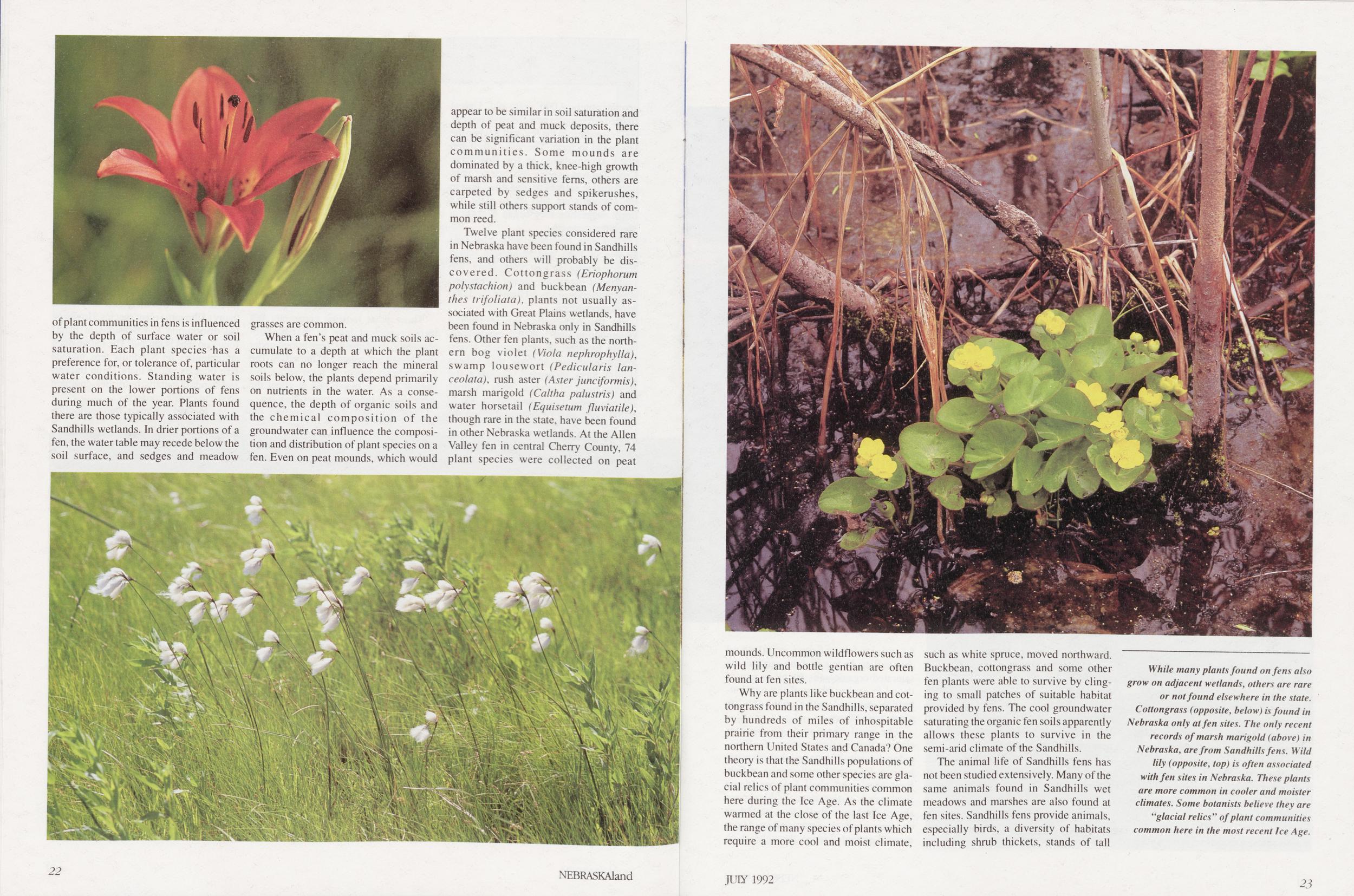
Twelve plant species considered rare in Nebraska have been found in Sandhills fens, and others will probably be discovered. Cottongrass (Eriophorum polystachion) and buckbean (Menyanthes trifoliata), plants not usually associated with Great Plains wetlands, have been found in Nebraska only in Sandhills fens. Other fen plants, such as the northern bog violet (Viola nephrophylla), swamp lousewort (Pedicularis lanceolata), rush aster (Aster junciformis), marsh marigold (Caltha palustris) and water horsetail (Equisetum fluviatile), though rare in the state, have been found in other Nebraska wetlands. At the Allen Valley fen in central Cherry County, 74 plant species were collected on peat
Why are plants like buckbean and cottongrass found in the Sandhills, separated by hundreds of miles of inhospitable prairie from their primary range in the northern United States and Canada? One theory is that the Sandhills populations of buckbean and some other species are glacial relics of plant communities common here during the Ice Age. As the climate warmed at the close of the last Ice Age, the range of many species of plants which require a more cool and moist climate, such as white spruce, moved northward. Buckbean, cottongrass and some other fen plants were able to survive by clinging to small patches of suitable habitat provided by fens. The cool groundwater saturating the organic fen soils apparently allows these plants to survive in the semi-arid climate of the Sandhills.
The animal life of Sandhills fens has not been studied extensively. Many of the same animals found in Sandhills wet meadows and marshes are also found at fen sites. Sandhills fens provide animals, especially birds, a diversity of habitats including shrub thickets, stands of tall
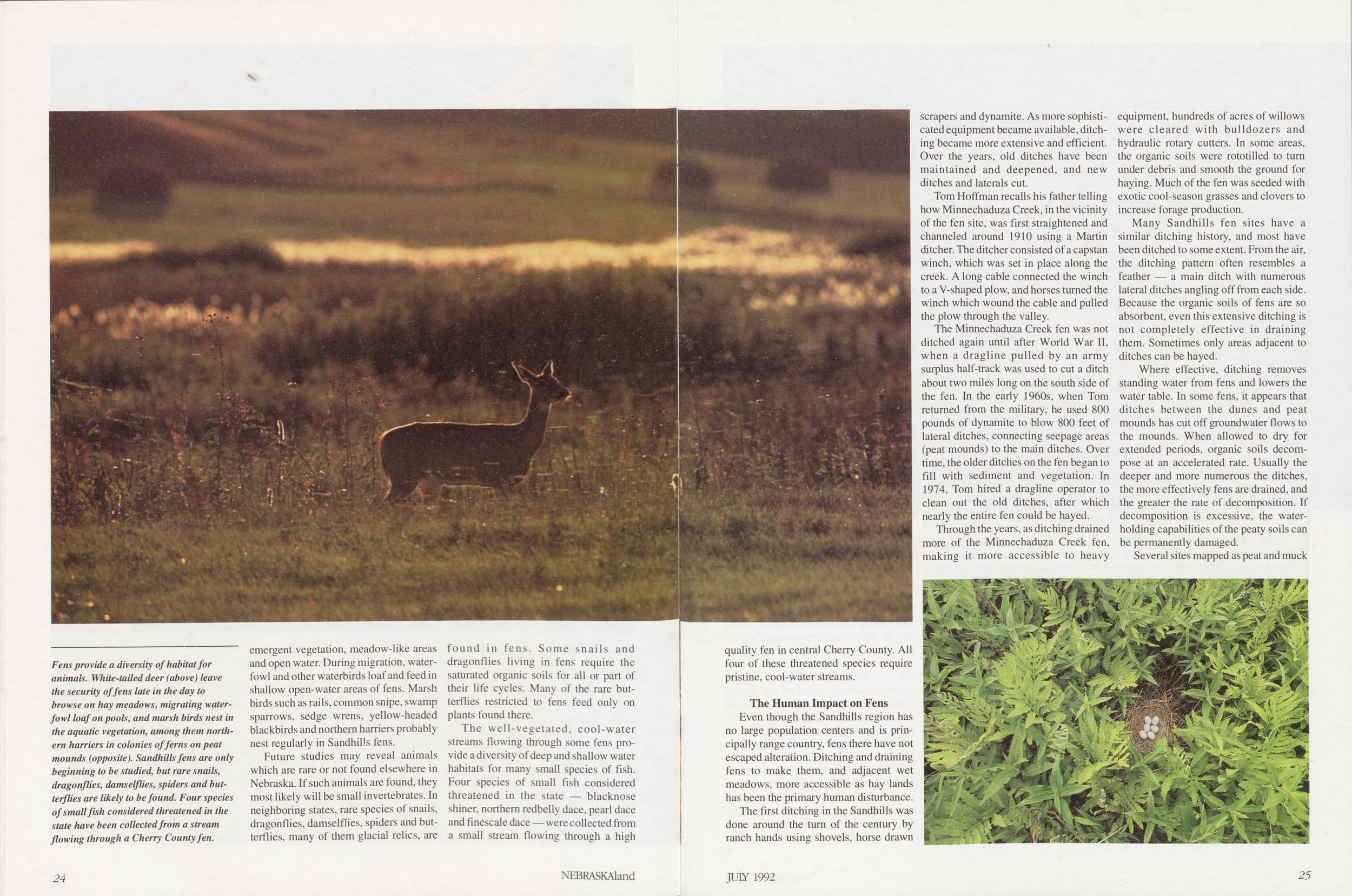
Future studies may reveal animals which are rare or not found elsewhere in Nebraska. If such animals are found, they most likely will be small invertebrates. In neighboring states, rare species of snails, dragonflies, damselflies, spiders and butterflies, many of them glacial relics, are found in fens. Some snails and dragonflies living in fens require the saturated organic soils for all or part of their life cycles. Many of the rare butterflies restricted to fens feed only on plants found there.
The well-vegetated, cool-water streams flowing through some fens provide a diversity of deep and shallow water habitats for many small species of fish. Four species of small fish considered threatened in the state — blacknose shiner, northern redbelly dace, pearl dace and finescale dace — were collected from a small stream flowing through a high 24 NEBRASKAland quality fen in central Cherry County. All four of these threatened species require pristine, cool-water streams.
The Human Impact on FensEven though the Sandhills region has no large population centers and is principally range country, fens there have not escaped alteration. Ditching and draining fens to make them, and adjacent wet meadows, more accessible as hay lands has been the primary human disturbance.
The first ditching in the Sandhills was done around the turn of the century by ranch hands using shovels, horse drawn scrapers and dynamite. As more sophisticated equipment became available, ditching became more extensive and efficient. Over the years, old ditches have been maintained and deepened, and new ditches and laterals cut.
Tom Hoffman recalls his father telling how Minnechaduza Creek, in the vicinity of the fen site, was first straightened and channeled around 1910 using a Martin ditcher. The ditcher consisted of a capstan winch, which was set in place along the creek. A long cable connected the winch to a V-shaped plow, and horses turned the winch which wound the cable and pulled the plow through the valley.
The Minnechaduza Creek fen was not ditched again until after World War II, when a dragline pulled by an army surplus half-track was used to cut a ditch about two miles long on the south side of the fen. In the early 1960s, when Tom returned from the military, he used 800 pounds of dynamite to blow 800 feet of lateral ditches, connecting seepage areas (peat mounds) to the main ditches. Over time, the older ditches on the fen began to fill with sediment and vegetation. In 1974, Tom hired a dragline operator to clean out the old ditches, after which nearly the entire fen could be hayed.
Through the years, as ditching drained more of the Minnechaduza Creek fen, making it more accessible to heavy equipment, hundreds of acres of willows were cleared with bulldozers and hydraulic rotary cutters. In some areas, the organic soils were rototilled to turn under debris and smooth the ground for haying. Much of the fen was seeded with exotic cool-season grasses and clovers to increase forage production.
Many Sandhills fen sites have a similar ditching history, and most have been ditched to some extent. From the air, the ditching pattern often resembles a feather — a main ditch with numerous lateral ditches angling off from each side. Because the organic soils of fens are so absorbent, even this extensive ditching is not completely effective in draining them. Sometimes only areas adjacent to ditches can be hayed.
Where effective, ditching removes standing water from fens and lowers the water table. In some fens, it appears that ditches between the dunes and peat mounds has cut off groundwater flows to the mounds. When allowed to dry for extended periods, organic soils decompose at an accelerated rate. Usually the deeper and more numerous the ditches, the more effectively fens are drained, and the greater the rate of decomposition. If decomposition is excessive, the waterholding capabilities of the peaty soils can be permanently damaged.
In some parts of the world, peat mining is an important industry. In 1988, 900,000 tons of peat were mined in the United States, with Florida and Michigan the leading producers. That year, approximately 14,000 tons were mined in Iowa. Most of this highly absorbent peat was used as soil conditioner for golf courses and horticultural fields, and as potting soil.
Peat, the precursor of coal, can be burned to produce energy. Russia opened its first peat-burning generating plant in 1914. In Ireland, while bog peat has been burned to heat homes for centuries, it is now burned commercially to meet about a third of the country's energy needs. Unfortunately, one expert thinks, commercial development will destroy all unprotected Irish bogs within the next 15 years, and mined areas have little ecological or commercial value once the peat is removed.
The onset of the oil crisis in the early 1970s sparked interest in peat as a fuel source in this country. The interest diminished with the end of the oil crisis, and burning peat on a commercial basis is now considered economically feasible only in areas far from oil, gas and coal deposits. North America's first peat-powered generating plant was opened in Maine in 1990. Several other uses have also been found for peat. During World War I, the German army used peat as a surgical dressing in the field and found it helpful in controlling infection. In Russia, a wax made from peat is used in polishes, crayons and plastics, and peat is used to make medicinal creams to treat eczema, ulcers and burns. Peat has been used to diaper babies, insulate homes and has been blended to make plywood, peat "cork" and "peatcrete." Recently, peat has been used in Russia and Finland to absorb oil spills.
Peat mining in Nebraska has been limited to a few small-scale operations, such as at the fen in Thurston County mined to produce Blackbird Peat. It is uncertain whether the peat found in Sandhills fens, interspersed with layers of sand and muck and located far from population centers, is of any commercial value, and there have been no serious efforts to mine it.
Exotic grasses, such as redtop, timothy, reed canary grass and clovers, have been seeded into most ditched fens. Traditional midsummer haying in the Sandhills favors the spread and dominance of these early-maturing non-native plants. Many plants native to fens are at the peak of their growth in midsummer when hayed. Haying at this time gives the exotics a competitive advantage and reduces the abundance and diversity of the native fen plants.
Reed canary grass is by far the most aggressive of the introduced plants. It can spread through fens both by seed and vegetatively by rhizomes (laterally spreading roots). Native to more northerly regions, reed canary grass was probably seeded into somewhat wetter portions of Sandhills fens as early as the turn of the century, not only to increase forage production, but because its dense sod "firms up" wet areas making them more accessible to haying equipment. Nearly solid stands of reed canary grass now dominate large areas of many fens. Eliminating reed canary grass from fens may be difficult without using herbicides which also kill native plants.
The Future of FensThe Sandhills is one of the largest grassland/wetland ecosystems remaining in North America. Protecting such a large, relatively natural ecosystem is best accomplished by wise stewardship by the people living on the land. In the Sandhills, this is the rancher. Resource management options are needed that preserve biologically unique communities such as fens, and are compatible with the ranching economy. In many ways, ranchers and conservationists 26 NEBRASKAland share common goals and concerns in protecting the water and grasslands of the Sandhills.
The U.S. Fish and Wildlife Service has recently organized a task force to find workable management options to benefit both ranch operations and wildlife in the Sandhills. Because cooperation is critical if this effort is to succeed, the task force is composed of Sandhills ranchers recommended by the Natural Resources Districts, the Nebraska Association of County Officials, the Nebraska Farm Bureau and the Nebraska Cattlemen's Association, and of representatives of the Nebraska Game and Parks Commission and conservation organizations. Four management options being considered by the task force are education, technical assistance, lease agreements and wetland acquisition and restoration, all on a willing-participant basis. No condemnation of land to protect Sandhills wetlands is anticipated. Conservation easements or other economic incentives might be available to participating ranchers.
Maintaining the quality and quantity of groundwater is of prime importance to those living in the Sandhills, and to the region's cattle industry. It is also critical to the long-term management of Sandhills fens and other wetlands. Pesticide or nitrate pollution of the region's vast underground aquifer from cropland under center-pivot irrigation or feedlots could be damaging to sensitive wetland vegetation, aquatic animals and those who depend on abundant, clean water for drinking, growing grass and raising cattle.
With each passing year, the demand for water grows. Increasingly, outside interests are casting envious eyes toward the large reserve of water under the Nebraska Sandhills. In the future, it is likely that cities, industries or agricultural interests will propose pumping and
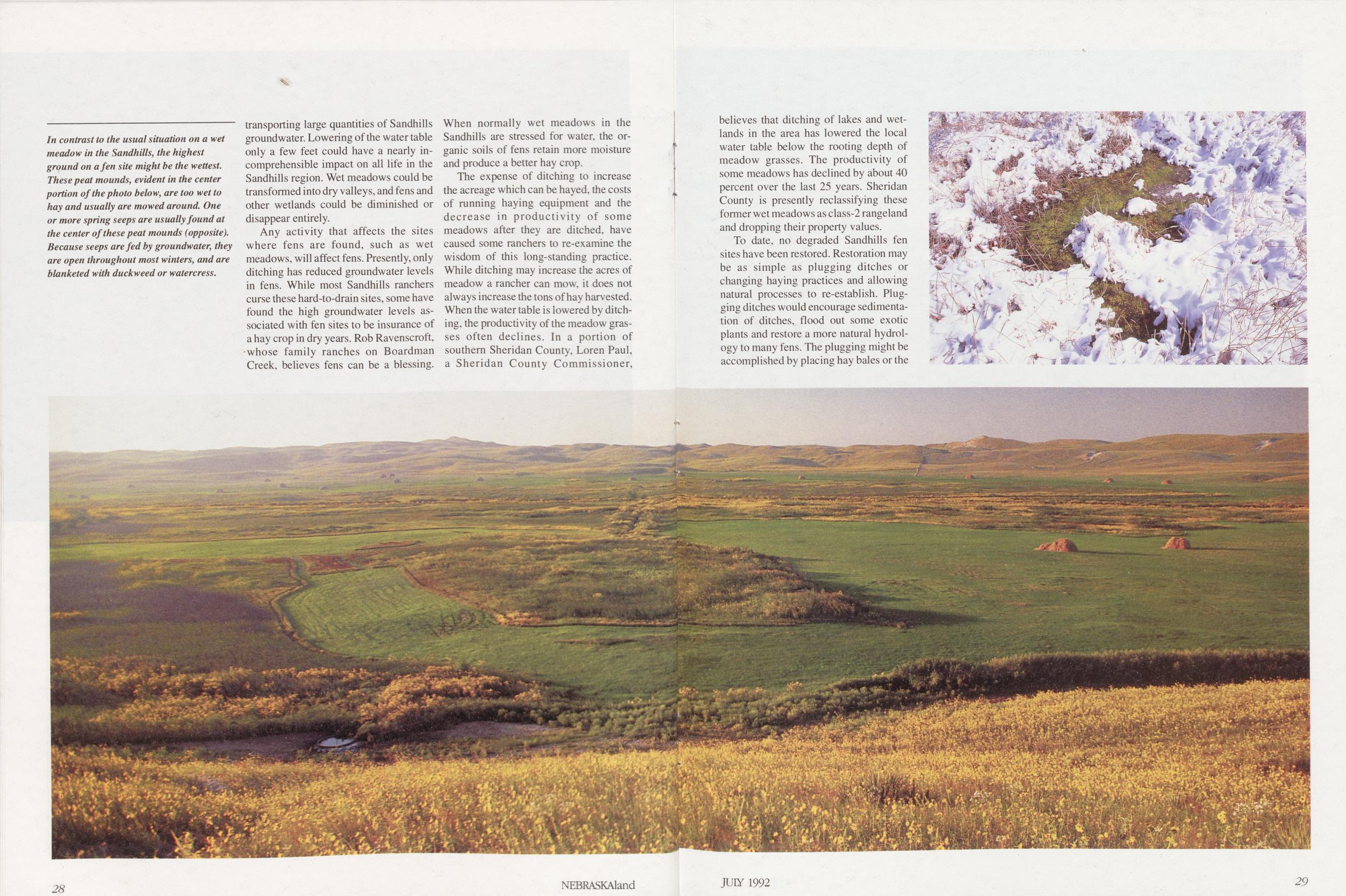
Any activity that affects the sites where fens are found, such as wet meadows, will affect fens. Presently, only ditching has reduced groundwater levels in fens. While most Sandhills ranchers curse these hard-to-drain sites, some have found the high groundwater levels associated with fen sites to be insurance of a hay crop in dry years. Rob Ravenscroft, whose family ranches on Boardman Creek, believes fens can be a blessing. When normally wet meadows in the Sandhills are stressed for water, the organic soils of fens retain more moisture and produce a better hay crop.
The expense of ditching to increase the acreage which can be hayed, the costs of running haying equipment and the decrease in productivity of some meadows after they are ditched, have caused some ranchers to re-examine the wisdom of this long-standing practice. While ditching may increase the acres of meadow a rancher can mow, it does not always increase the tons of hay harvested. When the water table is lowered by ditching, the productivity of the meadow grasses often declines. In a portion of southern Sheridan County, Loren Paul, a Sheridan County Commissioner, 29 NEBRASKAland believes that ditching of lakes and wetlands in the area has lowered the local water table below the rooting depth of meadow grasses. The productivity of some meadows has declined by about 40 percent over the last 25 years. Sheridan County is presently reclassifying these former wet meadows as class-2 rangeland and dropping their property values.
To date, no degraded Sandhills fen sites have been restored. Restoration may be as simple as plugging ditches or changing haying practices and allowing natural processes to re-establish. Plugging ditches would encourage sedimentation of ditches, flood out some exotic plants and restore a more natural hydrology to many fens. The plugging might be accomplished by placing hay bales or the
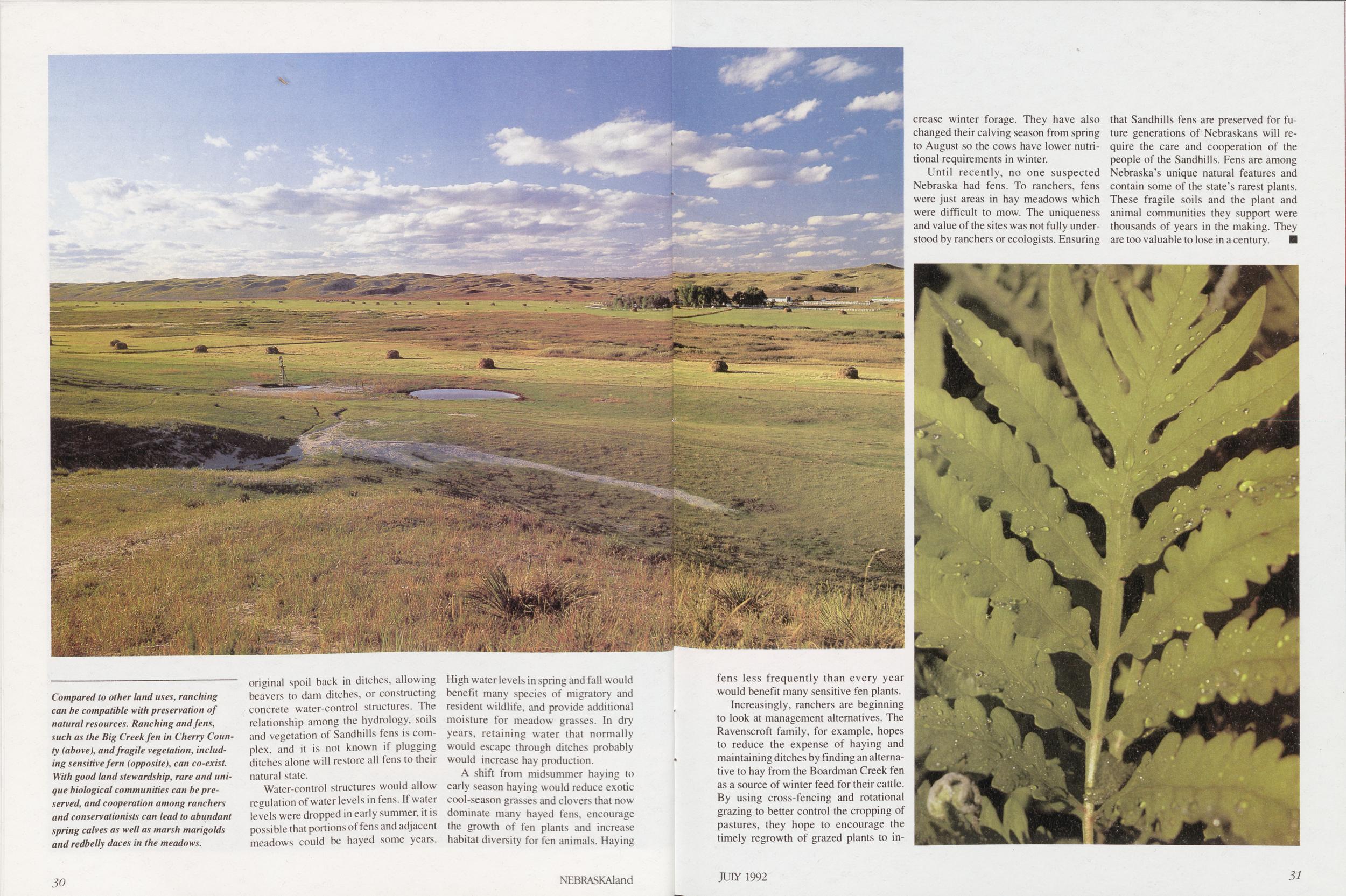
Water-control structures would allow regulation of water levels in fens. If water levels were dropped in early summer, it is possible that portions of fens and adjacent meadows could be hayed some years. High water levels in spring and fall would benefit many species of migratory and resident wildlife, and provide additional moisture for meadow grasses. In dry years, retaining water that normally would escape through ditches probably would increase hay production.
A shift from midsummer haying to early season haying would reduce exotic cool-season grasses and clovers that now dominate many hayed fens, encourage the growth of fen plants and increase habitat diversity for fen animals. Haying 30 NEBRASKAland fens less frequently than every year would benefit many sensitive fen plants.
Increasingly, ranchers are beginning to look at management alternatives. The Ravenscroft family, for example, hopes to reduce the expense of haying and maintaining ditches by finding an alternative to hay from the Boardman Creek fen as a source of winter feed for their cattle. By using cross-fencing and rotational grazing to better control the cropping of pastures, they hope to encourage the timely regrowth of grazed plants to increase winter forage. They have also changed their calving season from spring to August so the cows have lower nutritional requirements in winter.
Until recently, no one suspected Nebraska had fens. To ranchers, fens were just areas in hay meadows which were difficult to mow. The uniqueness and value of the sites was not fully understood by ranchers or ecologists. Ensuring that Sandhills fens are preserved for future generations of Nebraskans will require the care and cooperation of the people of the Sandhills. Fens are among Nebraska's unique natural features and contain some of the state's rarest plants. These fragile soils and the plant and animal communities they support were thousands of years in the making. They are too valuable to lose in a century.
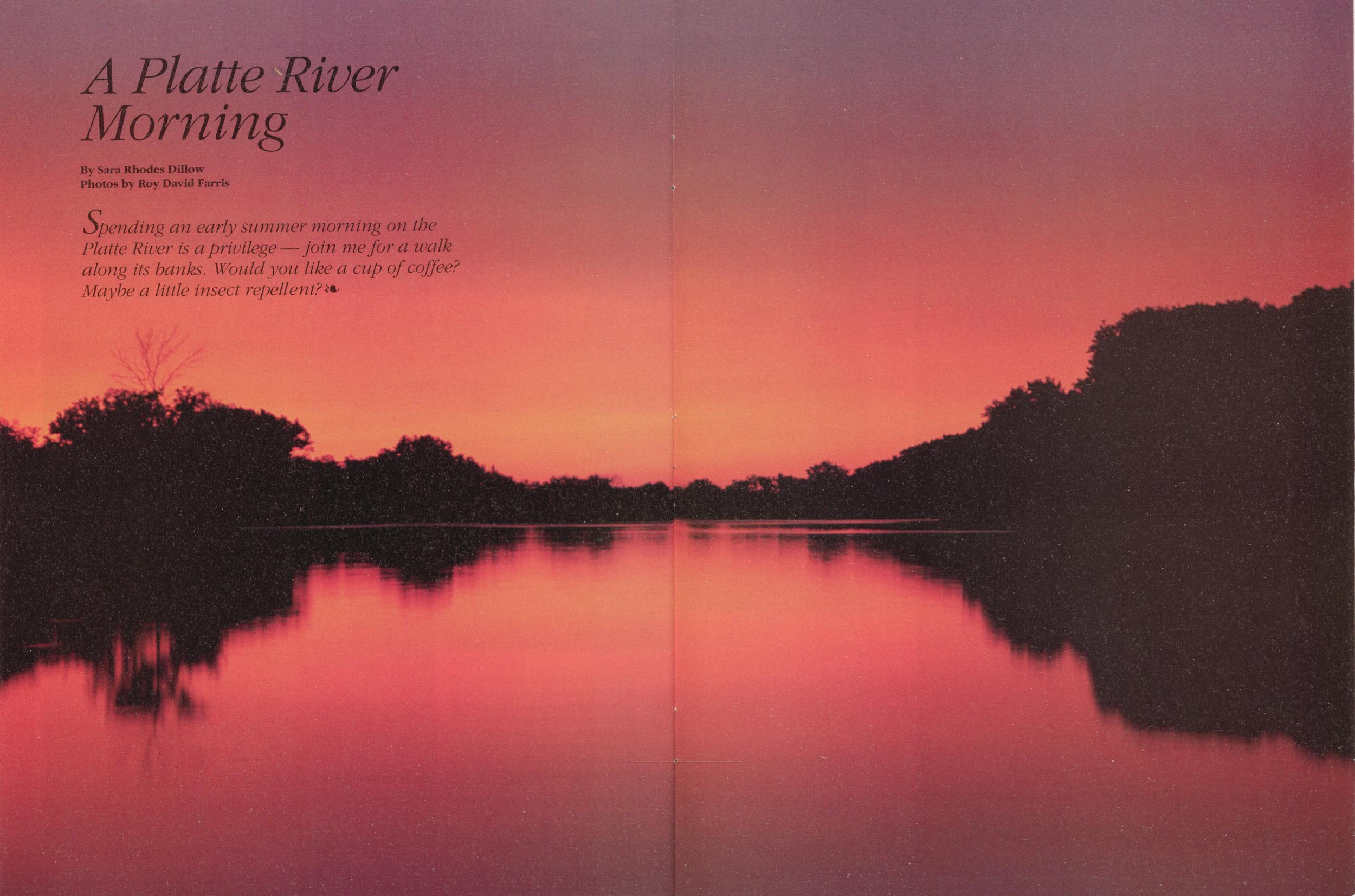
A Platte River Morning
By Sara Rhodes Dillow Photos by Roy David Farris Spending an early summer morning on the Platte River is a privilege—join me for a walk along its banks. Would you like a cup of coffee? Maybe a little insect repellent?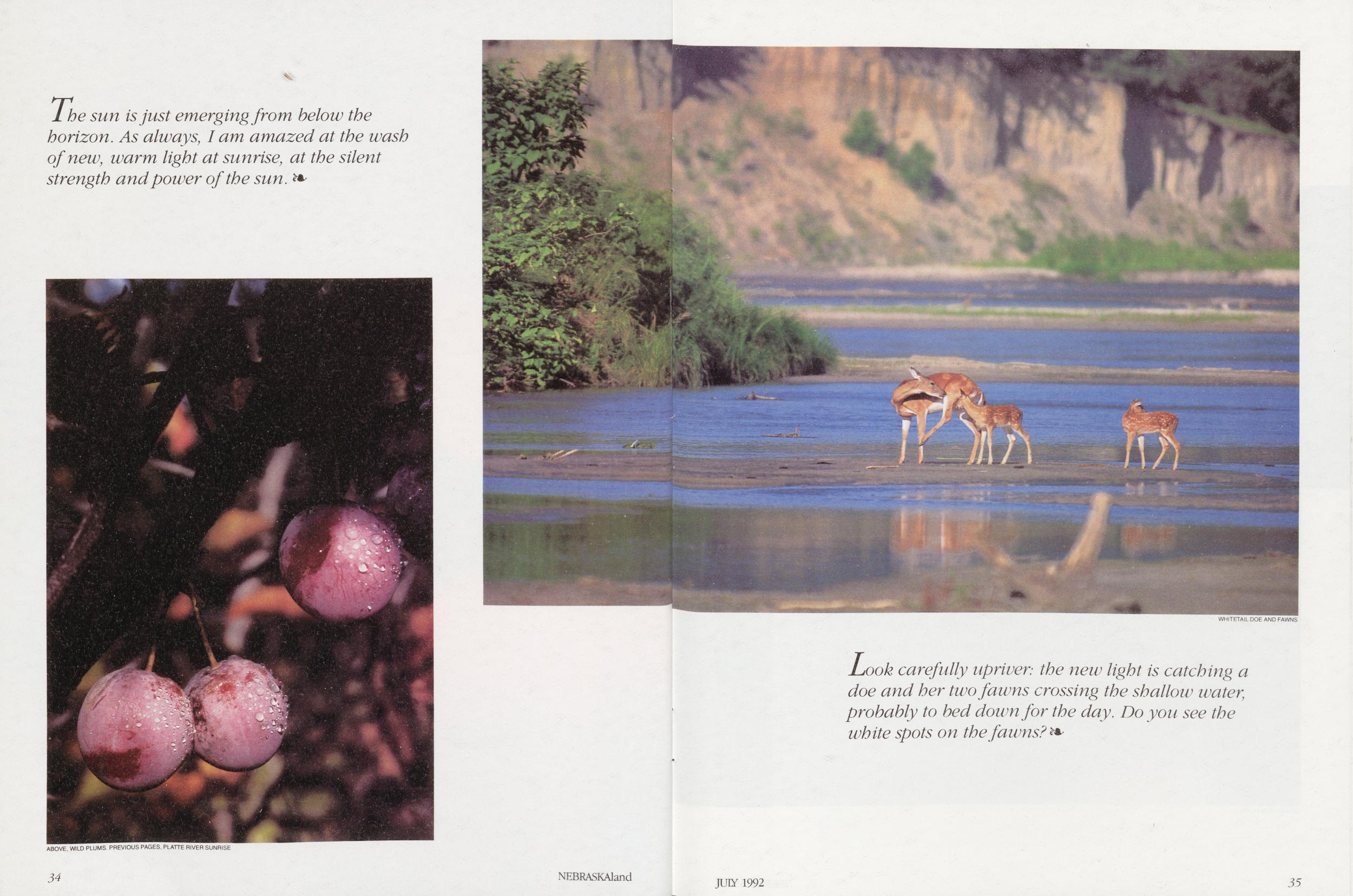
The sun is just emerging from below the horizon. As always, I am amazed at the wash of new, warm light at sunrise, at the silent strength and power of the sun.
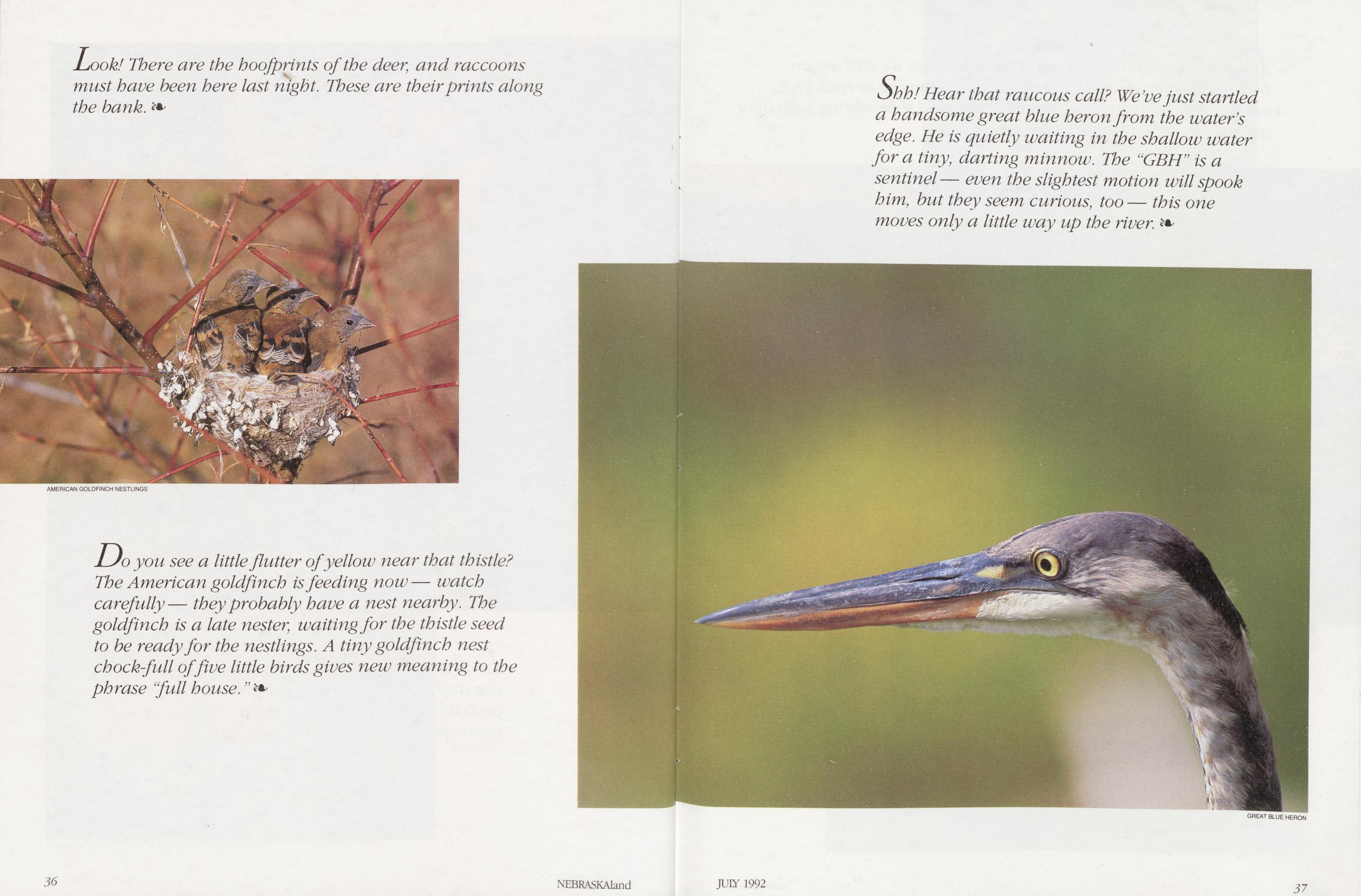
Look! There are the hoofprints of the deer, and raccoons must have been here last night. These are their prints along the bank.
Do you see a little flutter of yellow near that thistle? The American goldfinch is feeding now— watch carefully— they probably have a nest nearby. The goldfinch is a late nester, waiting for the thistle seed to be ready for the nestlings. A tiny goldfinch nest chock-full of five little birds gives new meaning to the phrase "full house."
36 NEBRASKAlandShh! Hear that raucous call? We've just startled a handsome great blue heron from the water's edge. He is quietly waiting in the shallow water for a tiny, darting minnow. The "GBH" is a sentinel — even the slightest motion will spook him, but they seem curious, too — this one moves only a little way up the river.
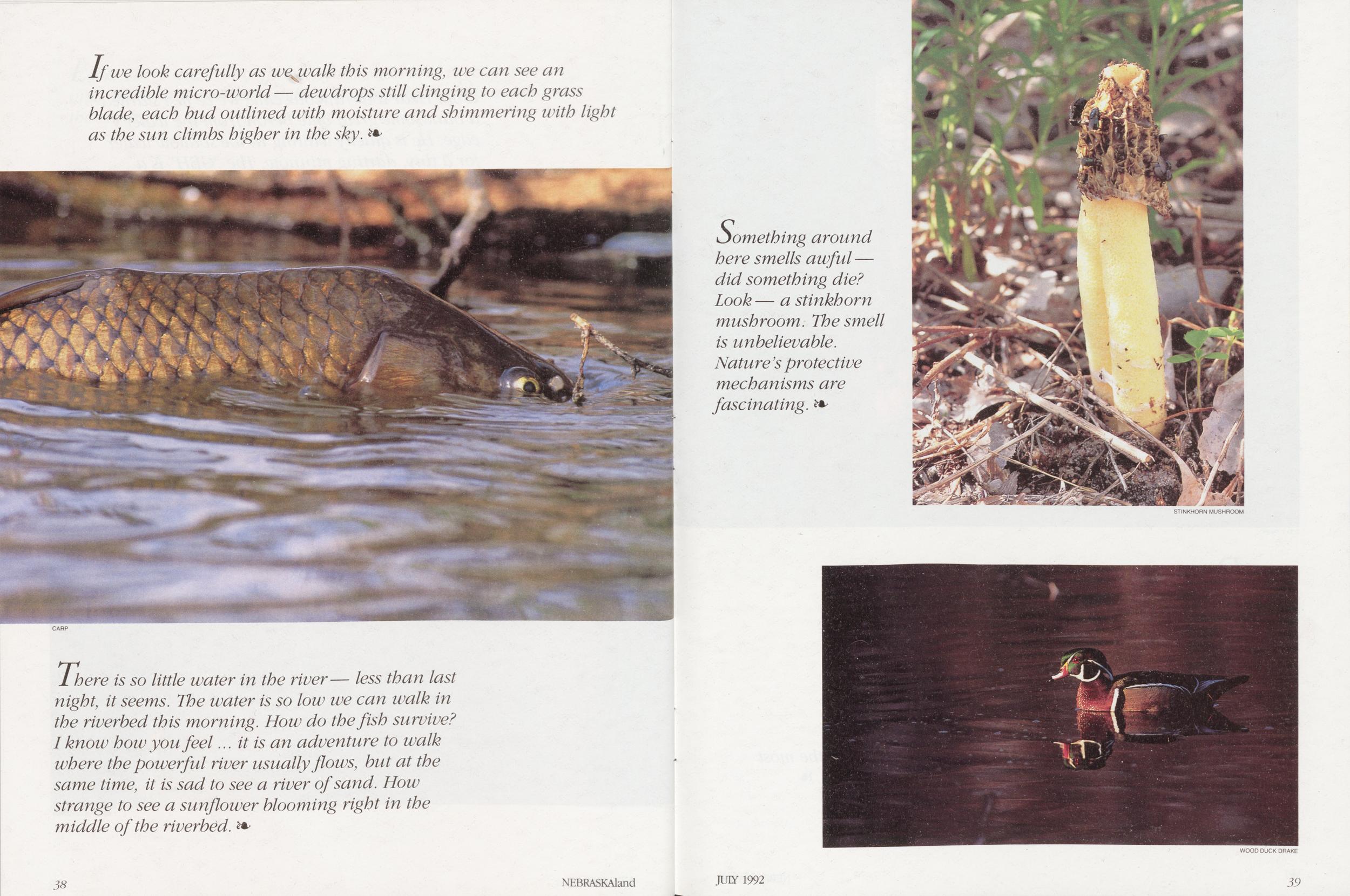
If we look carefully as we^walk this morning, we can see an incredible micro-world— dewdrops still clinging to each grass blade, each hud outlined ivith moisture and shimmering with light as the sun climbs higher in the sky.
1 here is so little water in the river— less than last night, it seems. The water is so low we can walk in the riverbed this morning. How do the fish survive? I know how you feel it is an adventure to walk where the powerful river usually flows, but at the same time, it is sad to see a river of sand. How strange to see a sunflower blooming right in the middle of the riverbed.
38 NEBRASKAlandSomething around here smells awful did something die? Look — a stinkhorn mushroom. The smell is unbelievable. Nature's protective mechanisms are fas cinating.
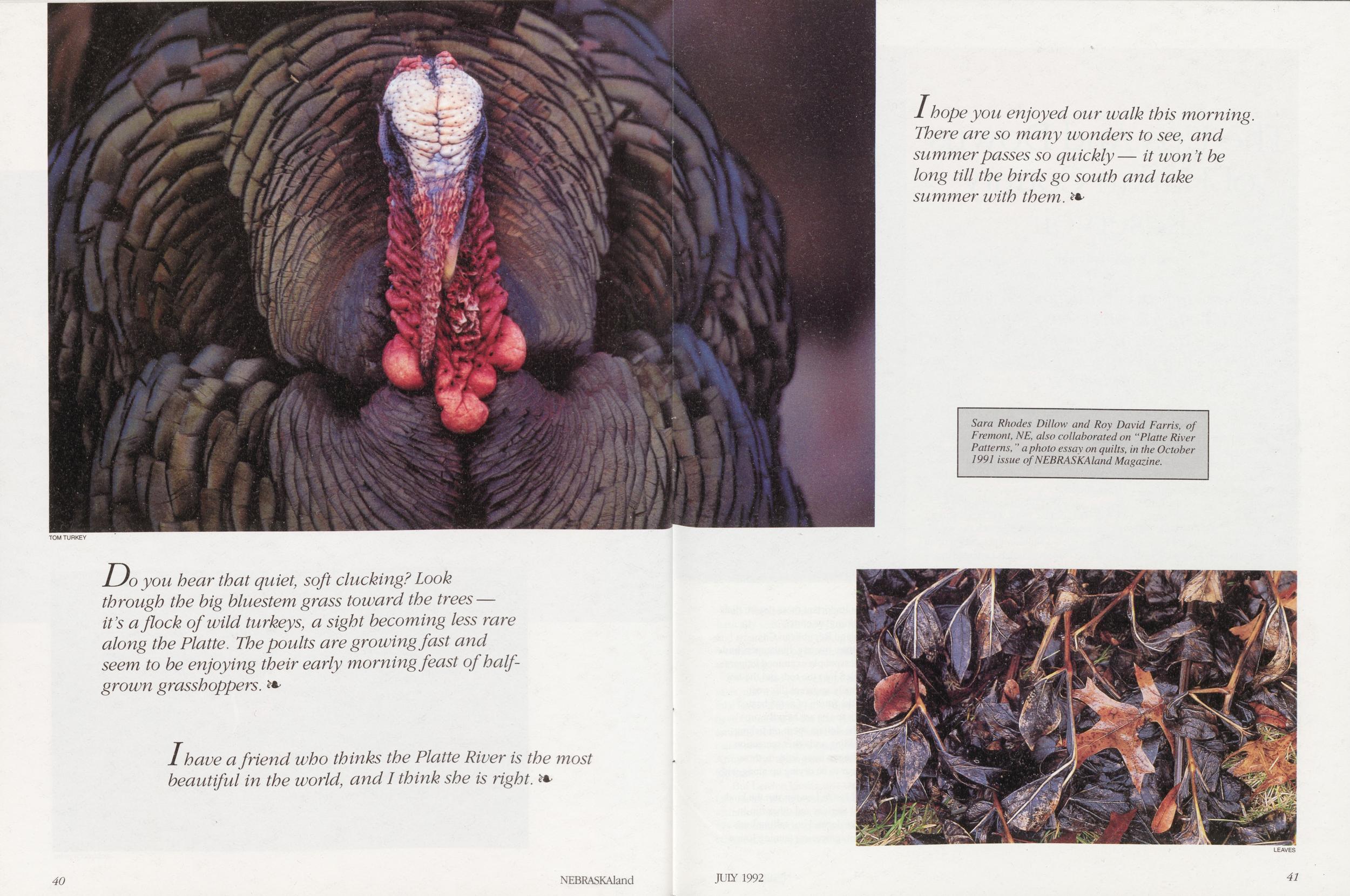
Do you bear that quiet, soft clucking? Look through the big bluestem grass toward the trees it's a flock of wild turkeys, a sight becoming less rare along the Platte. The poults are growing fast and seem to be enjoying their early morning feast of half-grown grasshoppers.
I have a friend who thinks the Platte River is the most beautiful in the world, and I think she is right.
40 NEBRASKAland1 hope you enjoyed our walk this morning. There are so many wonders to see, and summer passes so quickly— it won't be long till the birds go south and take summer with them.
Sara Rhodes DUlow and Roy David Farris, of Fremont, NE, also collaborated on "Platte River Patterns," a photo essay on quilts, in the October 1991 issue of NEBRASKAland Magazine.
The Ups And Downs of Harlan County Reservoir
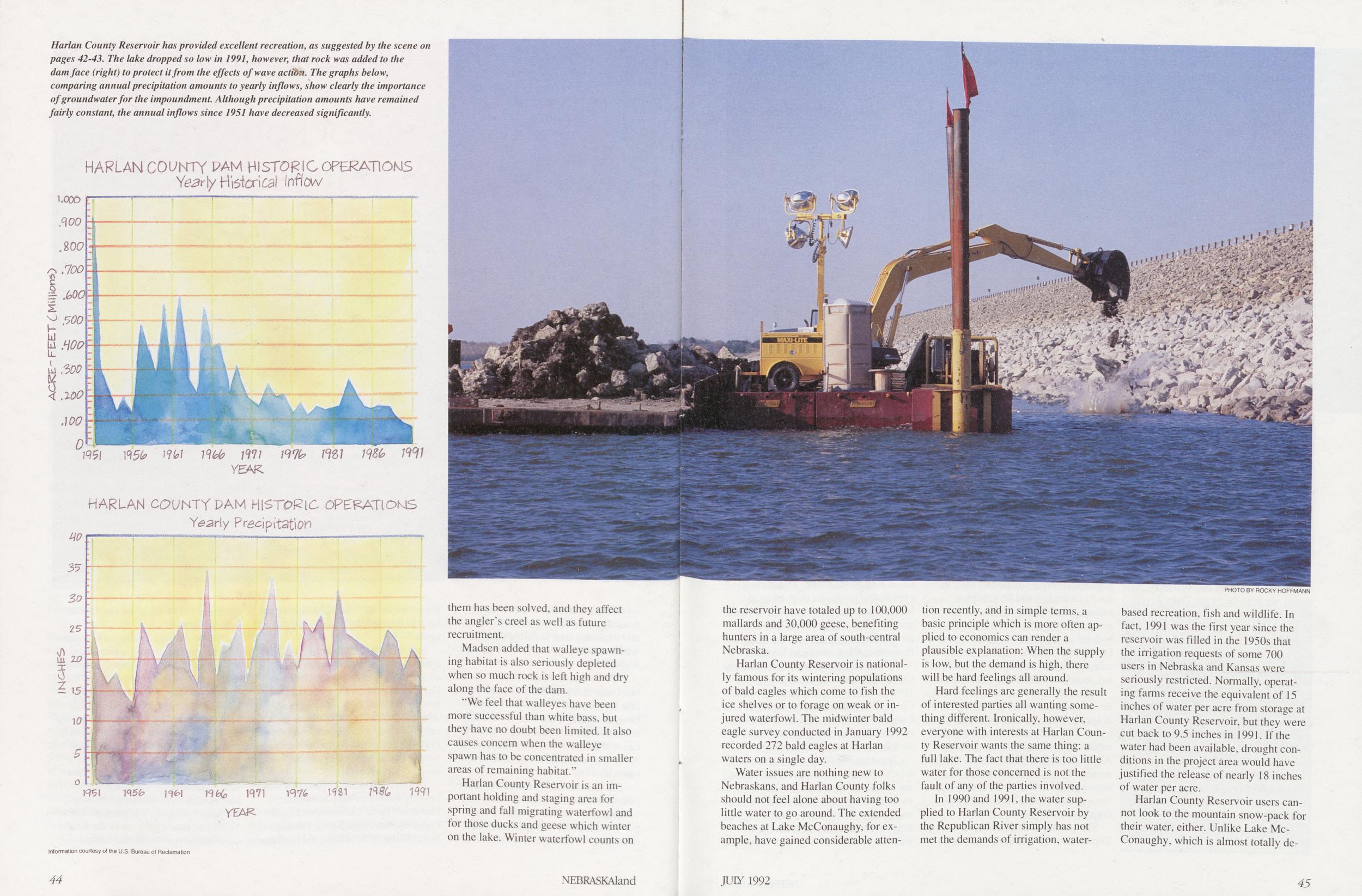
By Rocky Hoffmann In the years since its construction, recreation at Harlan County Reservoir has boomed, but drought conditions and irrigation needs took the lake level to a record low in 1991. Low levels are also likely for 1992.Cold, early April evenings this year saw the traditional return of persistent anglers to Harlan County Reservoir. Although fewer than in the past, they were here, as in past years, to fish the spawning run for walleyes that had already begun to concentrate along the face of the dam.
Normally it is a silent time for anglers, but this gathering reluctantly tolerated the drone of diesel engines and the grating of stone against steel. A barge laden with boulders was positioned by a tugboat in front of the dam for off-loading to extend the rock facing of the dam to greater depths.
The reason? In 1991, Harlan County Reservoir's water level had become so low that its surface was precariously close to dropping below the rock face of the earthen dam, a situation which could have threatened the structure. Extending the rock facing to greater depths would allow dam operators to release even more water for irrigators, possibly resulting in the continued shrinkage of the reservoir. The clamor of workers and machines was ominous to Harlan's anglers as they pondered the fate of Nebraska's second largest lake and the reliable fishery for which it is known.
Glen Stokes stood in the mud, fishing along the south shore some 75 yards out from where the water line normally is at this time of year. He had driven the 200 miles from Omaha, as he had every April for the past 13 years, hoping to catch some of Harlan's fine walleyes.
This year I didn't pull my boat down, because word was there weren't any ramps that would reach the water, but I guess I shouldn't get caught up in all the rumors," Stokes lamented as he gestured toward a scattering of boats that had begun to troll along the face of the dam.
Somewhere downstream, a Kansas farmer pondered his own fate and his ability to produce a crop without the assurance that the reservoir on the Republican River up in Nebraska would store enough water for adequate irrigation. He also questioned whether the Bureau of Reclamation could provide releases from an already depleted lake for the sake of his crops. He had been to court once to decide that issue, but he seriously questioned whether that same court would grant him a favorable decision again.
"Don't use my name," one farmer warned, "because I feel this fight over water is going to go beyond the courts some day. I just wonder what people feel is more important these days fish and water skiing, or com?"
In Alma and Republican City, Nebraska, store owners, innkeepers and other businesspeople examined ledgers that had fallen into the red, and the low receipts already apparent this year threatened the future of some businesses. Both towns are heavily supported by the dollars spent on fishing and water skiing and other recreation and, according to town leaders, those dollars appear to be drying up along with the reservoir.
Don and Linda Lewton run the kind of store that anglers and other fun-in-the-sun folks depend on, selling lures, gas, live bait, groceries, tanning lotion 42 NEBRASKAland all the necessities. Their business is basically seasonal, ice-off to freeze-up, and what they take in during the fair-weather months pays their bills all winter long.
"We've had two years of pretty low sales, and that goes hand-in-hand with lake levels and the false rumors that have circulated about lake access. Right now, the outlook is somewhat better because of access work completed by the Army Corps of Engineers," Linda Lewton said.
But Lewton knows that water in the lake means more visitors. "Even when visitations are down, we still have to pay the same bills so we can serve the customers we do have. It is extremely important for all concerned that we get back to maintaining decent water levels again."
Fish and wildlife managers, too, are concerned about the effects that continued low water levels may have on Harlan's resources. Dramatic and longterm shrinkage of an impoundment dramatically reduces the habitat and the carrying capacity for aquatic species. Fish kills are common in low reservoirs simply because their carrying capacities have been exceeded.
At Harlan, low water produces other limiting factors as well. Nebraska Game and Parks Commission District Fisheries Supervisor Monte Madsen, of North Platte, believes that the reproduction potential of white bass in the lake is being limited.
"White bass are having an extremely difficult time producing a year-class. White bass at Harlan County Reservoir require an opportunity to swim up the Republican River from the lake to spawn, but an increasing expanse of mud flat caused by low reservoir waters and inadequate river flows are severely restricting their movement," Madsen said.
Madsen thinks that because of low
water, several year-classes of white
bass may be lost. White bass fishing
has been a trademark of the reservoir.
Year-class losses show up in the future,
often after the problem that caused
JULY 1992
43
Madsen added that walleye spawning habitat is also seriously depleted when so much rock is left high and dry along the face of the dam.
"We feel that walleyes have been more successful than white bass, but they have no doubt been limited. It also causes concern when the walleye spawn has to be concentrated in smaller areas of remaining habitat."
Harlan County Reservoir is an important holding and staging area for spring and fall migrating waterfowl and for those ducks and geese which winter on the lake. Winter waterfowl counts on 44 NEBRASKAland
Harlan County Reservoir is nationally famous for its wintering populations of bald eagles which come to fish the ice shelves or to forage on weak or injured waterfowl. The midwinter bald eagle survey conducted in January 1992 recorded 272 bald eagles at Harlan waters on a single day.
Water issues are nothing new to Nebraskans, and Harlan County folks should not feel alone about having too little water to go around. The extended beaches at Lake McConaughy, for example, have gained considerable attention recently, and in simple terms, a basic principle which is more often applied to economics can render a plausible explanation: When the supply is low, but the demand is high, there will be hard feelings all around.
Hard feelings are generally the result of interested parties all wanting something different. Ironically, however, everyone with interests at Harlan County Reservoir wants the same thing: a full lake. The fact that there is too little water for those concerned is not the fault of any of the parties involved.
In 1990 and 1991, the water supplied to Harlan County Reservoir by the Republican River simply has not met the demands of irrigation, water-based recreation, fish and wildlife. In fact, 1991 was the first year since the reservoir was filled in the 1950s that the irrigation requests of some 700 users in Nebraska and Kansas were seriously restricted. Normally, operating farms receive the equivalent of 15 inches of water per acre from storage at Harlan County Reservoir, but they were cut back to 9.5 inches in 1991. If the water had been available, drought conditions in the project area would have justified the release of nearly 18 inches of water per acre.
Harlan County Reservoir users cannot look to the mountain snow-pack for
their water, either. Unlike Lake McConaughy, which is almost totally deInfomnation
courtesy of the U.S. Bureau of Reclamation
JULY 1992
45
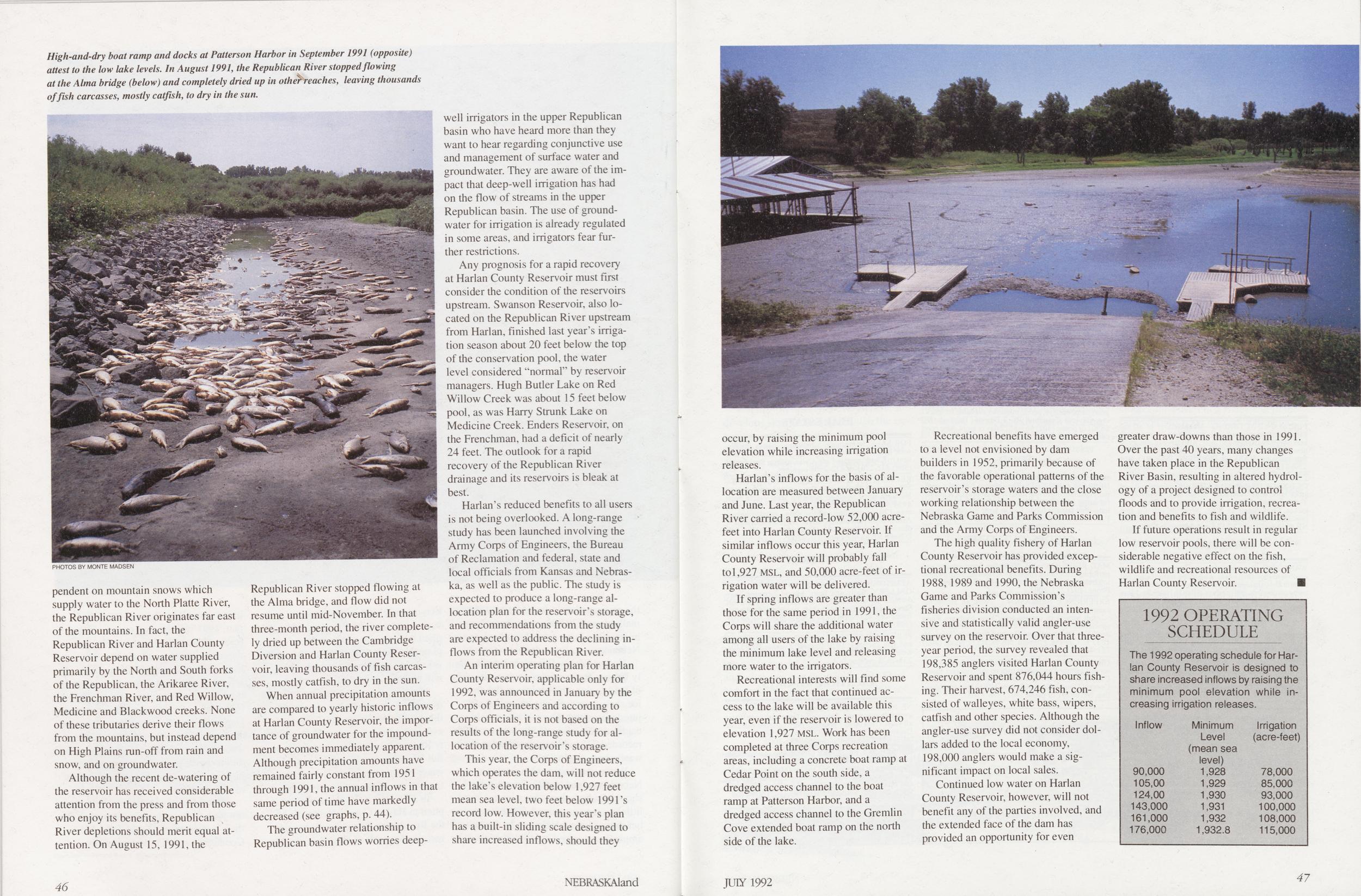
Although the recent de-watering of the reservoir has received considerable attention from the press and from those who enjoy its benefits, Republican River depletions should merit equal attention. On August 15, 1991, the Republican River stopped flowing at the Alma bridge, and flow did not resume until mid-November. In that three-month period, the river completely dried up between the Cambridge Diversion and Harlan County Reservoir, leaving thousands of fish carcasses, mostly catfish, to dry in the sun.
When annual precipitation amounts are compared to yearly historic inflows at Harlan County Reservoir, the importance of groundwater for the impoundment becomes immediately apparent. Although precipitation amounts have remained fairly constant from 1951 through 1991, the annual inflows in that same period of time have markedly decreased (see graphs, p. 44).
The groundwater relationship to Republican basin flows worries deepwell irrigators in the upper Republican basin who have heard more than they want to hear regarding conjunctive use and management of surface water and groundwater. They are aware of the impact that deep-well irrigation has had on the flow of streams in the upper Republican basin. The use of groundwater for irrigation is already regulated in some areas, and irrigators fear further restrictions.
Any prognosis for a rapid recovery at Harlan County Reservoir must first consider the condition of the reservoirs upstream. Swanson Reservoir, also located on the Republican River upstream from Harlan, finished last year's irrigation season about 20 feet below the top of the conservation pool, the water level considered "normal" by reservoir managers. Hugh Butler Lake on Red Willow Creek was about 15 feet below pool, as was Harry Strunk Lake on Medicine Creek. Enders Reservoir, on the Frenchman, had a deficit of nearly 24 feet. The outlook for a rapid recovery of the Republican River drainage and its reservoirs is bleak at best.
Harlan's reduced benefits to all users is not being overlooked. A long-range study has been launched involving the Army Corps of Engineers, the Bureau of Reclamation and federal, state and local officials from Kansas and Nebraska, as well as the public. The study is expected to produce a long-range allocation plan for the reservoir's storage, and recommendations from the study are expected to address the declining inflows from the Republican River.
An interim operating plan for Harlan County Reservoir, applicable only for 1992, was announced in January by the Corps of Engineers and according to Corps officials, it is not based on the results of the long-range study for allocation of the reservoir's storage.
This year, the Corps of Engineers, which operates the dam, will not reduce the lake's elevation below 1,927 feet mean sea level, two feet below 199l's record low. However, this year's plan has a built-in sliding scale designed to share increased inflows, should they 46 MEBRASKAland
Harlan's inflows for the basis of allocation are measured between January and June. Last year, the Republican River carried a record-low 52,000 acre-feet into Harlan County Reservoir. If similar inflows occur this year, Harlan County Reservoir will probably fall tol,927 MSL, and 50,000 acre-feet of irrigation water will be delivered.
If spring inflows are greater than those for the same period in 1991, the Corps will share the additional water among all users of the lake by raising the minimum lake level and releasing more water to the irrigators.
Recreational interests will find some comfort in the fact that continued access to the lake will be available this year, even if the reservoir is lowered to elevation 1,927 MSL. Work has been completed at three Corps recreation areas, including a concrete boat ramp at Cedar Point on the south side, a dredged access channel to the boat ramp at Patterson Harbor, and a dredged access channel to the Gremlin Cove extended boat ramp on the north side of the lake.
Recreational benefits have emerged to a level not envisioned by dam builders in 1952, primarily because of the favorable operational patterns of the reservoir's storage waters and the close working relationship between the Nebraska Game and Parks Commission and the Army Corps of Engineers.
The high quality fishery of Harlan County Reservoir has provided exceptional recreational benefits. During 1988, 1989 and 1990, the Nebraska Game and Parks Commission's fisheries division conducted an intensive and statistically valid angler-use survey on the reservoir. Over that three-year period, the survey revealed that 198,385 anglers visited Harlan County Reservoir and spent 876,044 hours fishing. Their harvest, 674,246 fish, consisted of walleyes, white bass, wipers, catfish and other species. Although the angler-use survey did not consider dollars added to the local economy, 198,000 anglers would make a significant impact on local sales.
Continued low water on Harlan County Reservoir, however, will not benefit any of the parties involved, and the extended face of the dam has provided an opportunity for even greater draw-downs than those in 1991. Over the past 40 years, many changes have taken place in the Republican River Basin, resulting in altered hydrology of a project designed to control floods and to provide irrigation, recreation and benefits to fish and wildlife.
If future operations result in regular low reservoir pools, there will be considerable negative effect on the fish, wildlife and recreational resources of Harlan County Reservoir.
1992 OPERATING SCHEDULEThe 1992 operating schedule for Harlan County Reservoir is designed to share increased inflows by raising the minimum pool elevation while increasing irrigation releases.
Inflow 90,000 105,00 124,00 143,000 161,000 176,000 Minimum Level (mean sea level) 1,928 1,929 1,930 1,931 1,932 1,932.8 Irrigation (acre-feet) 78,000 85,000 93,000 100,000 108,000 115,000 JULY 1992 47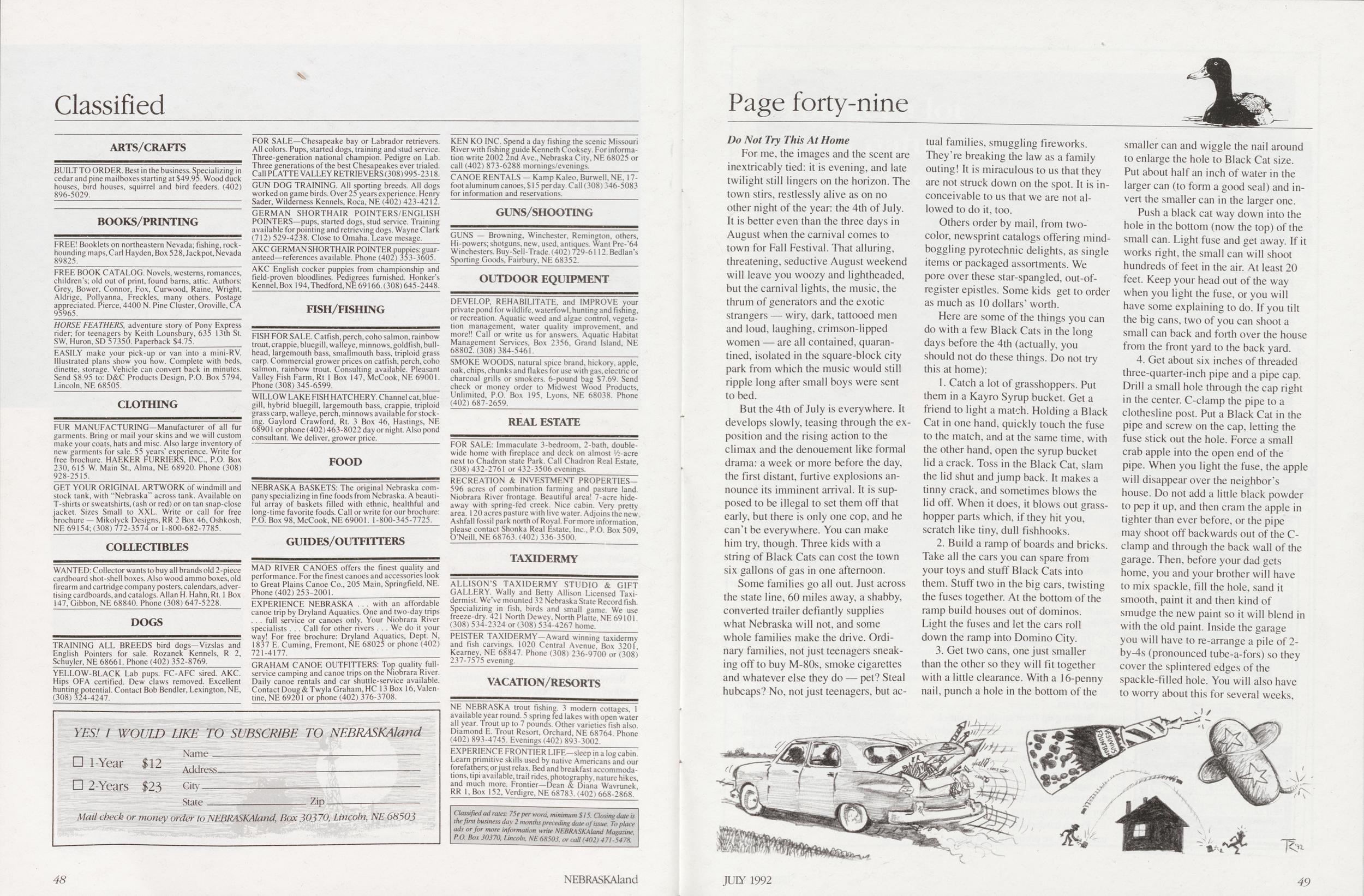
Classified
ARTS/CRAFTSBUILT TO ORDER. Best in the business. Specializing in cedar and pine mailboxes starting at $49.95. Wood duck houses, bird houses, squirrel and bird feeders. (402) 896-5029.
BOOKS/PRINTINGFREE! Booklets on northeastern Nevada; fishing, rockhounding maps, Carl Hayden, Box 528, Jackpot, Nevada 89825.
FREE BOOK CATALOG. Novels, westerns, romances, children's; old out of print, found barns, attic. Authors: Grey, Bower, Connor, Fox, Curwood, Raine, Wright, Aldrige, Pollyanna, Freckles, many others. Postage appreciated. Pierce, 4400 N. Pine Cluster, Oroville, CA 95965.
HORSE FEATHERS, adventure story of Pony Express rider; for teenagers by Keith Lounsbury, 635 13th St. SW, Huron, SD 57350. Paperback $4.75.
EASILY make your pick-up or van into a mini-RV. Illustrated plans show you how. Complete with beds, dinette, storage. Vehicle can convert back in minutes. Send $8.95 to: D&C Products Design, P.O. Box 5794, Lincoln, NE 68505.
CLOTHINGFUR MANUFACTURING—Manufacturer of all fur garments. Bring or mail your skins and we will custom make your coats, hats and misc. Also large inventory of new garments for sale. 55 years' experience. Write for free brochure. HAEKER FURRIERS, INC., P.O. Box 230, 615 W. Main St., Alma, NE 68920. Phone (308) 928-2515.
GET YOUR ORIGINAL ARTWORK of windmill and stock tank, with "Nebraska" across tank. Available on T-shirts or sweatshirts, (ash or red) or on tan snap-close jacket. Sizes Small to XXL. Write or call for free brochure — Mikolyck Designs, RR 2 Box 46, Oshkosh, NE 69154; (308) 772-3574 or 1-800-682-7785.
COLLECTIBLESWANTED: Collector wants to buy all brands old 2-piece cardboard shot-shell boxes. Also wood ammo boxes, old firearm and cartridge company posters, calendars, advertising cardboards, and catalogs. Allan H. Hahn,Rt. 1 Box 147, Gibbon, NE 68840. Phone (308) 647-5228.
DOGSTRAINING ALL BREEDS bird dogs—Vizslas and English Pointers for sale. Rozanek Kennels, R 2, Schuyler, NE 68661. Phone (402) 352-8769.
YELLOW-BLACK Lab pups. FC-AFC sired. AKC. Hips OFA certified. Dew claws removed. Excellent hunting potential. Contact Bob Bendler, Lexington, NE, (308) 324-4247.
FOR SALE—Chesapeake bay or Labrador retrievers. All colors. Pups, started dogs, training and stud service. Three-generation national champion. Pedigre on Lab. Three generations of the best Chesapeakes ever trialed. Call PLATTE VALLEY RETRIEVERS(308) 995-2318.
GUN DOG TRAINING. All sporting breeds. All dogs worked on game birds. Over 25 years experience. Henry Sader, Wilderness Kennels, Roca, NE (402) 423-4212.
GERMAN SHORTHAIR POINTERS/ENGLISH POINTERS—pups, started dogs, stud service. Training available for pointing and retrieving dogs. Wayne Clark (712) 529-4238. Close to Omaha. Leave mesage.
AKC GERMAN SHORTHAIR POINTER puppies: guaranteed—references available. Phone (402) 353-3605. AKC English cocker puppies from championship and field-proven bloodlines. Pedigrees furnished. Honker's Kennel, Box 194, Thedford, NE 69166. (308) 645-2448.
FISH/FISHINGFISH FOR SALE. Catfish, perch, coho salmon, rainbow trout, crappie, bluegill, walleye, minnows, goldfish, bullhead, largemouth bass, smallmouth bass, triploid grass carp. Commercial grower prices on catfish, perch, coho salmon, rainbow trout. Consulting available. Pleasant Valley Fish Farm, Rt 1 Box 147, McCook, NE 69001. Phone (308) 345-6599.
WILLOW LAKE FISH HATCHERY. Channel cat, bluegill, hybrid bluegill, largemouth bass, crappie, triploid grass carp, walleye, perch, minnows available for stocking. Gaylord Crawford, Rt. 3 Box 46, Hastings, NE 68901 or phone (402) 463-8022 day or night. Also pond consultant. We deliver, grower price.
FOODNEBRASKA BASKETS: The original Nebraska company specializing in fine foods from Nebraska. A beautiful array of baskets filled with ethnic, healthful and long-time favorite foods. Call or write for our brochure: P.O. Box 98, McCook, NE 69001. 1-800-345-7725.
GUIDES/OUTFITTERSMAD RIVER CANOES offers the finest quality and performance. For the finest canoes and accessories look to Great Plains Canoe Co., 205 Main, Springfield, NE. Phone(402)253-2001.
EXPERIENCE NEBRASKA . with an affordable canoe trip by Dryland Aquatics. One and two-day trips full service or canoes only. Your Niobrara River specialists Call for other rivers We do it your way! For free brochure: Dryland Aquatics, Dept. N, 1837 E. Cuming, Fremont, NE 68025 or phone (402) 721-4177.
GRAHAM CANOE OUTFITTERS: Top quality fullservice camping and canoe trips on the Niobrara River. Daily canoe rentals and car shuttle-service available. Contact Doug & Twyla Graham, HC 13 Box 16, Valentine, NE 69201 or phone (402) 376-3708.
YES! I WOULD LIKE TO SUBSCRIBE TO NEBRASKAland 1-Year $12 2-Years $23 Name Address. City State Zip Mail check or money order to NEBRASKAland, Box 30370, Lincoln, NE 68503KEN KO INC. Spend a day fishing the scenic Missouri River with fishing guide Kenneth Cooksey. For information write 2002 2nd Ave., Nebraska City, NE 68025 or call (402) 873-6288 mornings/evenings.
CANOE RENTALS — Kamp Kaleo, Burwell, NE, 17-foot aluminum canoes, $ 15 per day. Call (308) 346-5083 for information and reservations.
GUNS/SHOOTINGGUNS — Browning, Winchester, Remington, others, Hi-powers; shotguns, new, used, antiques. Want Pre-'64 Winchesters. Buy-Sell-Trade. (402) 729-6112. Bedlan's Sporting Goods, Fairbury, NE 68352.
OUTDOOR EQUIPMENTDEVELOP, REHABILITATE, and IMPROVE your private pond for wildlife, waterfowl, hunting and fishing, or recreation. Aquatic weed and algae control, vegetation management, water quality improvement, and more!! Call or write us for answers. Aquatic Habitat Management Services, Box 2356, Grand Island, NE 68802. (308)384:546
SMOKE WOODS, natural spice brand, hickory, apple, oak, chips, chunks and flakes for use with gas, electric or charcoal grills or smokers. 6-pound bag $7.69. Send check or money order to Midwest Wood Products, Unlimited, P.O. Box 195, Lyons, NE 68038. Phone (402) 687-2659.
REAL ESTATEFOR SALE: Immaculate 3-bedroom, 2-bath, doublewide home with fireplace and deck on almost '/2-acre next to Chadron state Park. Call Chadron Real Estate, (308) 432-2761 or 432-3506 evenings.
RECREATION & INVESTMENT PROPERTIES— 596 acres of combination farming and pasture land. Niobrara River frontage. Beautiful area! 7-acre hide-away with spring-fed creek. Nice cabin. Very pretty area. 120 acres pasture with live water. Adjoins the new Ashfall fossil park north of Royal. For more information, please contact Shonka Real Estate, Inc., P.O. Box 509, O'Neill, NE 68763. (402) 336-3500.
TAXIDERMYALLISON'S TAXIDERMY STUDIO & GIFT GALLERY. Wally and Betty Allison Licensed Taxidermist. We've mounted 32 Nebraska State Record fish. Specializing in fish, birds and small game. We use freeze-dry. 421 North Dewey, North Platte, NE 69101 (308) 534-2324 or (308) 534-4267 home.
PEISTER TAXIDERMY-Award winning taxidermy and fish carvings. 1020 Central Avenue, Box 3201 Kearney. NE 68847. Phone (308) 236-9700 or (308) 237-7575 evening.
VACATION/RESORTSNE NEBRASKA trout fishing. 3 modern cottages, 1 available year round. 5 spring fed lakes with open water all year. Trout up to 7 pounds. Other varieties fish also. Diamond E. Trout Resort, Orchard, NE 68764. Phone (402) 893-4745. Evenings (402) 893-3002.
EXPERIENCE FRONTIER LIFE-sleep in a log cabin. Learn primitive skills used by native Americans and our forefathers; or just relax. Bed and breakfast accommodations, tipi available, trail rides, photography, nature hikes, and much more. Frontier—Dean & Diana Wavrunek RR l,Box 152, Verdigre, NE 68783. (402) 668-2868.
Classified ad rates; 751 per word, minimum $ 15. Closing date is the first business day 2 months preceding date of issue. To place ads or for more information write NEBRASKAland Magazine, P.O. Box 30370, Lincoln, NE 68503, or call (402) 471-54 78. 48 NEBRASKAlandPage forty-nine
Do Not Try This At HomeFor me, the images and the scent are inextricably tied: it is evening, and late twilight still lingers on the horizon. The town stirs, restlessly alive as on no other night of the year: the 4th of July. It is better even than the three days in August when the carnival comes to town for Fall Festival. That alluring, threatening, seductive August weekend will leave you woozy and lightheaded, but the carnival lights, the music, the thrum of generators and the exotic strangers — wiry, dark, tattooed men and loud, laughing, crimson-lipped women — are all contained, quarantined, isolated in the square-block city park from which the music would still ripple long after small boys were sent to bed.
But the 4th of July is everywhere. It develops slowly, teasing through the exposition and the rising action to the climax and the denouement like formal drama: a week or more before the day, the first distant, furtive explosions announce its imminent arrival. It is supposed to be illegal to set them off that early, but there is only one cop, and he can't be everywhere. You can make him try, though. Three kids with a string of Black Cats can cost the town six gallons of gas in one afternoon.
Some families go all out. Just across the state line, 60 miles away, a shabby, converted trailer defiantly supplies what Nebraska will not, and some whole families make the drive. Ordinary families, not just teenagers sneaking off to buy M-80s, smoke cigarettes and whatever else they do — pet? Steal hubcaps? No, not just teenagers, but actual families, smuggling fireworks. They're breaking the law as a family outing! It is miraculous to us that they are not struck down on the spot. It is inconceivable to us that we are not allowed to do it, too.
Others order by mail, from twocolor, newsprint catalogs offering mindboggling pyrotechnic delights, as single items or packaged assortments. We pore over these star-spangled, out-of-register epistles. Some kids get to order as much as 10 dollars' worth.
Here are some of the things you can do with a few Black Cats in the long days before the 4th (actually, you should not do these things. Do not try this at home):
1. Catch a lot of grasshoppers. Put them in a Kayro Syrup bucket. Get a friend to light a match. Holding a Black Cat in one hand, quickly touch the fuse to the match, and at the same time, with the other hand, open the syrup bucket lid a crack. Toss in the Black Cat, slam the lid shut and jump back. It makes a tinny crack, and sometimes blows the lid off. When it does, it blows out grasshopper parts which, if they hit you, scratch like tiny, dull fishhooks.
2. Build a ramp of boards and bricks. Take all the cars you can spare from your toys and stuff Black Cats into them. Stuff two in the big cars, twisting the fuses together. At the bottom of the ramp build houses out of dominos. Light the fuses and let the cars roll down the ramp into Domino City.
3. Get two cans, one just smaller than the other so they will fit together with a little clearance. With a 16-penny nail, punch a hole in the bottom of the smaller can and wiggle the nail around to enlarge the hole to Black Cat size. Put about half an inch of water in the larger can (to form a good seal) and invert the smaller can in the larger one.
Push a black cat way down into the hole in the bottom (now the top) of the small can. Light fuse and get away. If it works right, the small can will shoot hundreds of feet in the air. At least 20 feet. Keep your head out of the way when you light the fuse, or you will have some explaining to do. If you tilt the big cans, two of you can shoot a small can back and foith over the house from the front yard to the back yard.
4. Get about six inches of threaded
three-quarter-inch pipe and a pipe cap.
Drill a small hole through the cap right
in the center. C-clamp the pipe to a
clothesline post. Put a Black Cat in the
pipe and screw on the cap, letting the
fuse stick out the hole. Force a small
crab apple into the open end of the
pipe. When you light the fuse, the apple
will disappear over the neighbor's
house. Do not add a little black powder
to pep it up, and then cram the apple in
tighter than ever before, or the pipe
may shoot off backwards out of the C-clamp and through the back wall of the
garage. Then, before your dad gets
home, you and your brother will have
to mix spackle, fill the hole, sand it
smooth, paint it and then kind of
smudge the new paint so it will blend in
with the old paint. Inside the garage
you will have to re-arrange a pile of 2-by-4s (pronounced tube-a-fors) so they
cover the splintered edges of the
spackle-filled hole. You will also have
to worry about this for several weeks,
JULY 1992
49
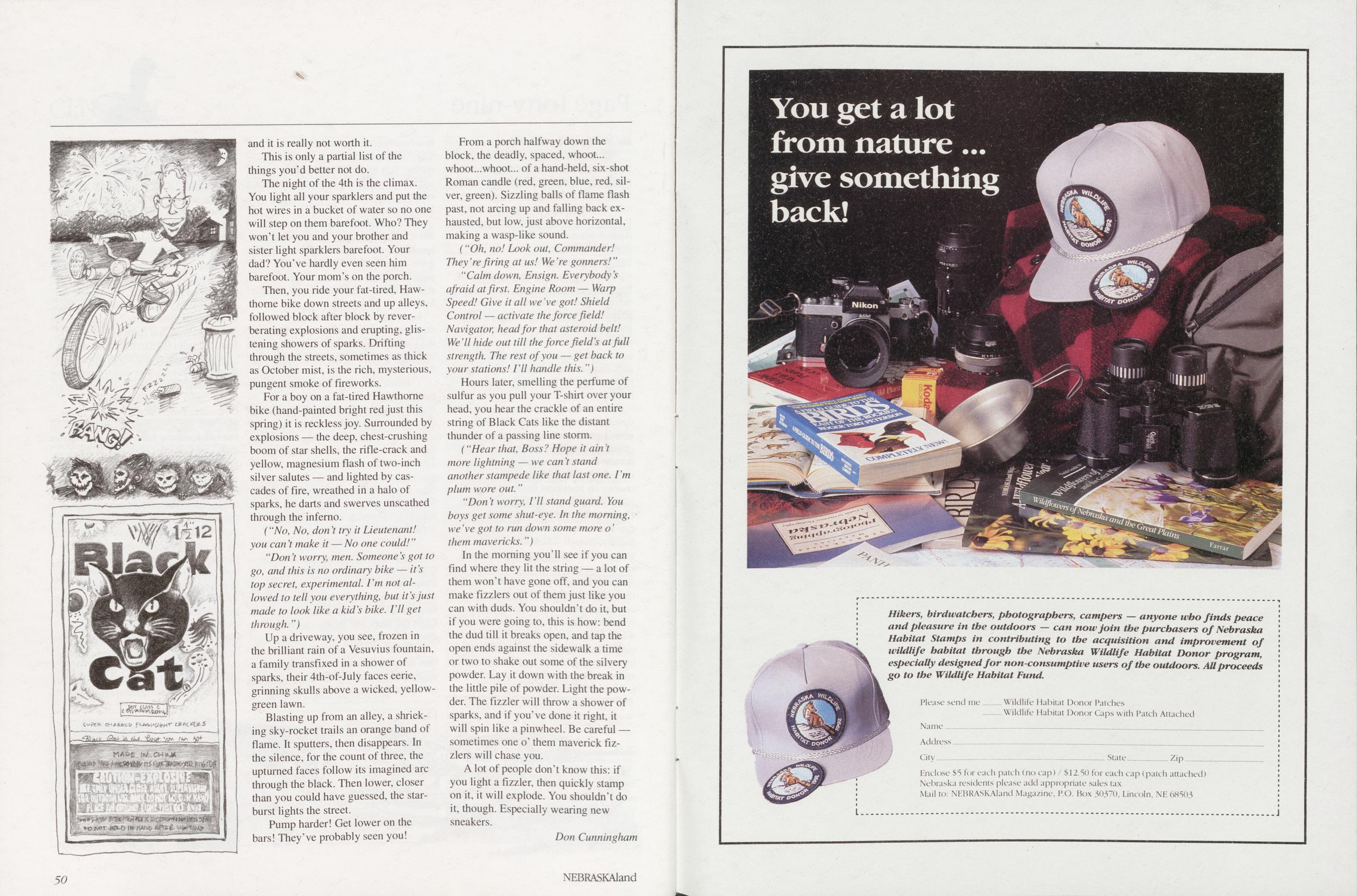
This is only a partial list of the things you'd better not do.
The night of the 4th is the climax. You light all your sparklers and put the hot wires in a bucket of water so no one will step on them barefoot. Who? They won't let you and your brother and sister light sparklers barefoot. Your dad? You've hardly even seen him barefoot. Your mom's on the porch.
Then, you ride your fat-tired, Hawthorne bike down streets and up alleys, followed block after block by reverberating explosions and erupting, glistening showers of sparks. Drifting through the streets, sometimes as thick as October mist, is the rich, mysterious, pungent smoke of fireworks.
For a boy on a fat-tired Hawthorne bike (hand-painted bright red just this spring) it is reckless joy. Surrounded by explosions — the deep, chest-crushing boom of star shells, the rifle-crack and yellow, magnesium flash of two-inch silver salutes — and lighted by cascades of fire, wreathed in a halo of sparks, he darts and swerves unscathed through the inferno.
("No, No, don't try it Lieutenant! you can't make it — No one could!'
"Don yt worry, men. Someone's got to go, and this is no ordinary bike — it's top secret, experimental. Vm not allowed to tell you everything, but it's just made to look like a kid's bike. I'll get through.")
Up a driveway, you see, frozen in the brilliant rain of a Vesuvius fountain, a family transfixed in a shower of sparks, their 4th-of-July faces eerie, grinning skulls above a wicked, yellow-green lawn.
Blasting up from an alley, a shrieking sky-rocket trails an orange band of flame. It sputters, then disappears. In the silence, for the count of three, the upturned faces follow its imagined arc through the black. Then lower, closer than you could have guessed, the starburst lights the street.
Pump harder! Get lower on the bars! They've probably seen you!
From a porch halfway down the block, the deadly, spaced, whoot... whoot...whoot... of a hand-held, six-shot Roman candle (red, green, blue, red, silver, green). Sizzling balls of flame flash past, not arcing up and falling back exhausted, but low, just above horizontal, making a wasp-like sound.
("Oh, no! Look out, Commander! They 're firing at us! We 're gonners!'
"Calm down, Ensign. Everybody's afraid at first. Engine Room — Warp Speed! Give it all we ve got! Shield Control — activate the force field! Navigator, head for that asteroid belt! We'll hide out till the force field's at full strength. The rest of you — get back to your stations! I'll handle this. ")
Hours later, smelling the perfume of sulfur as you pull your T-shirt over your head, you hear the crackle of an entire string of Black Cats like the distant thunder of a passing line storm.
("Hear that, Boss? Hope it ain't more lightning — we can't stand another stampede like that last one. I'm plum wore out."
"Don't worry, I'll stand guard. You boys get some shut-eye. In the morning, we 've got to run down some more o' them mavericks.")
In the morning you'll see if you can find where they lit the string — a lot of them won't have gone off, and you can make fizzlers out of them just like you can with duds. You shouldn't do it, but if you were going to, this is how: bend the dud till it breaks open, and tap the open ends against the sidewalk a time or two to shake out some of the silvery powder. Lay it down with the break in the little pile of powder. Light the powder. The fizzler will throw a shower of sparks, and if you've done it right, it will spin like a pinwheel. Be careful sometimes one o' them maverick fizzlers will chase you.
A lot of people don't know this: if you light a fizzler, then quickly stamp on it, it will explode. You shouldn't do it, though. Especially wearing new sneakers.
Don Cunningham 50 NEBRASKAland You get a lot from nature give something back! Hikers, birdwatchers, photographers, campers — anyone who finds peace and pleasure in the outdoors — can now join the purchasers of Nebraska Habitat Stamps in contributing to the acquisition and improvement of wildlife habitat through the Nebraska Wildlife Habitat Donor program, especially designed for non-consumptive users of the outdoors. All proceeds go to the Wildlife Habitat Fund. Please send me Name Address Wildlife Habitat Donor Patches Wildlife Habitat Donor Caps with Patch Attached City State Zip Enclose $3 for each patch (no cap) / $12.50 for each cap (patch attached) Nebraska residents please add appropriate sales tax Mail to: NEBRASKAland Magazine, P.O. Box 30370, Lincoln. NE 68503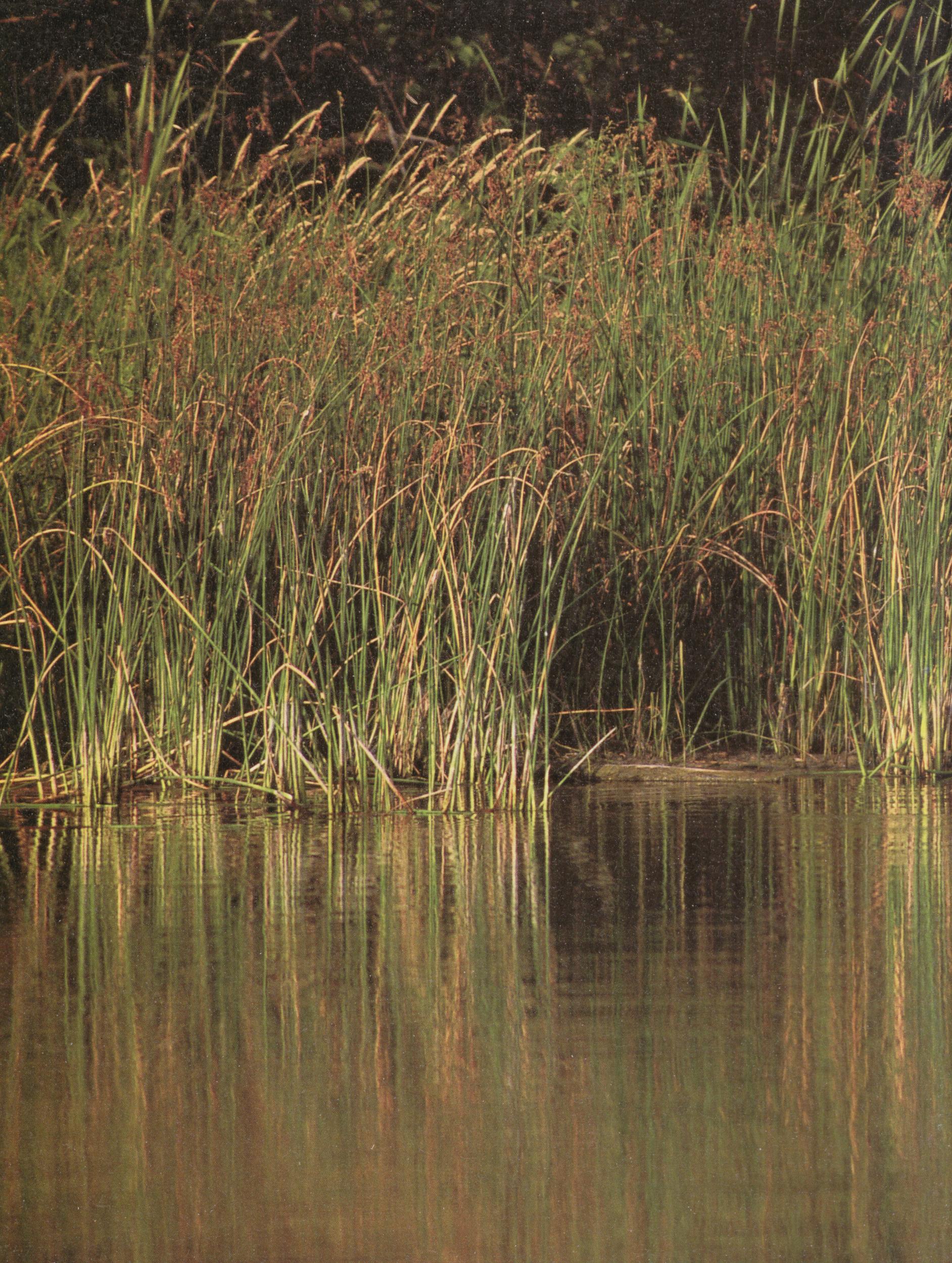
Position: 426 (23 views)