Volume 70, Issue 5, 1992
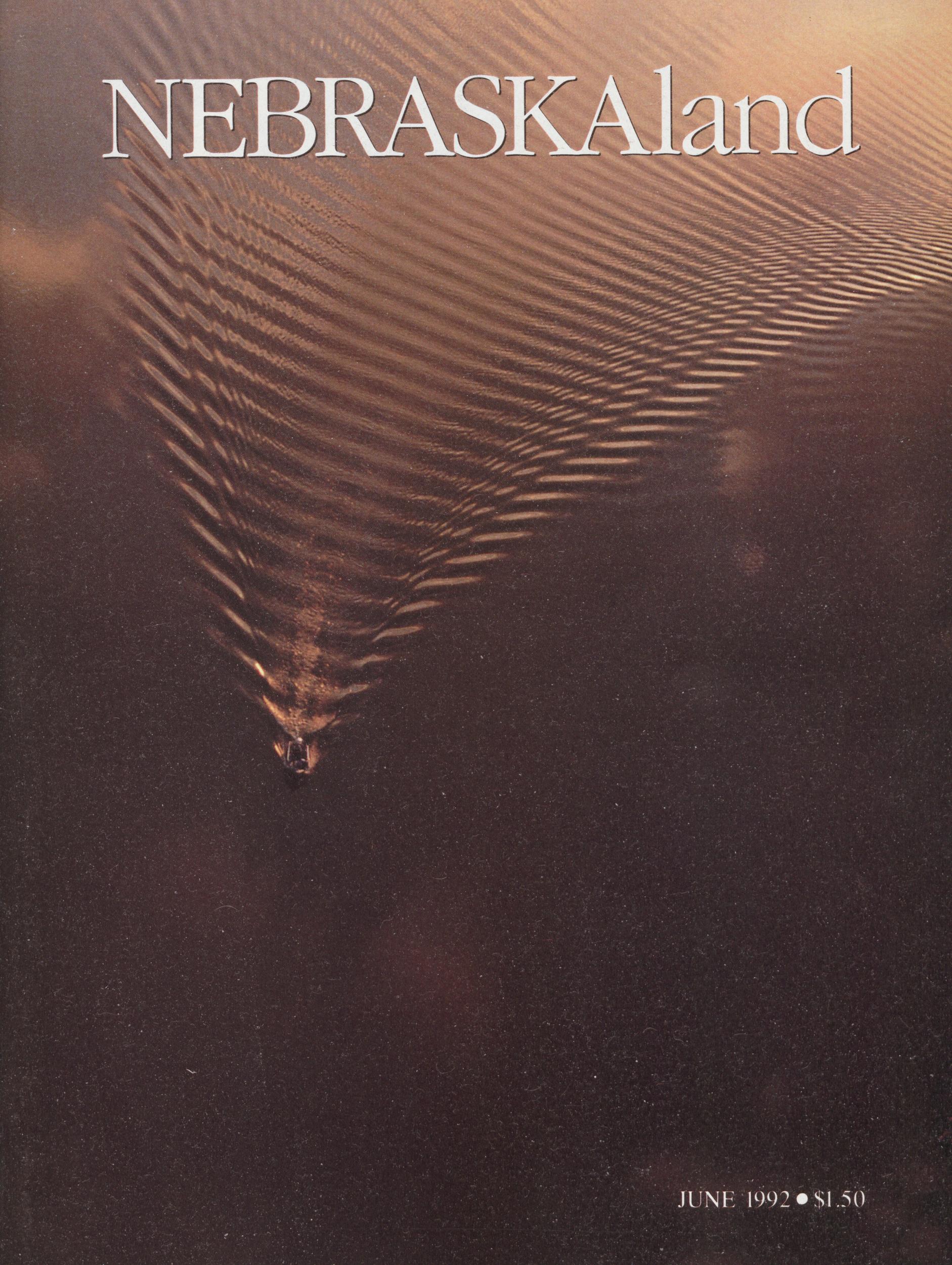
NEBRASKAland
JUNE 1992 $1.50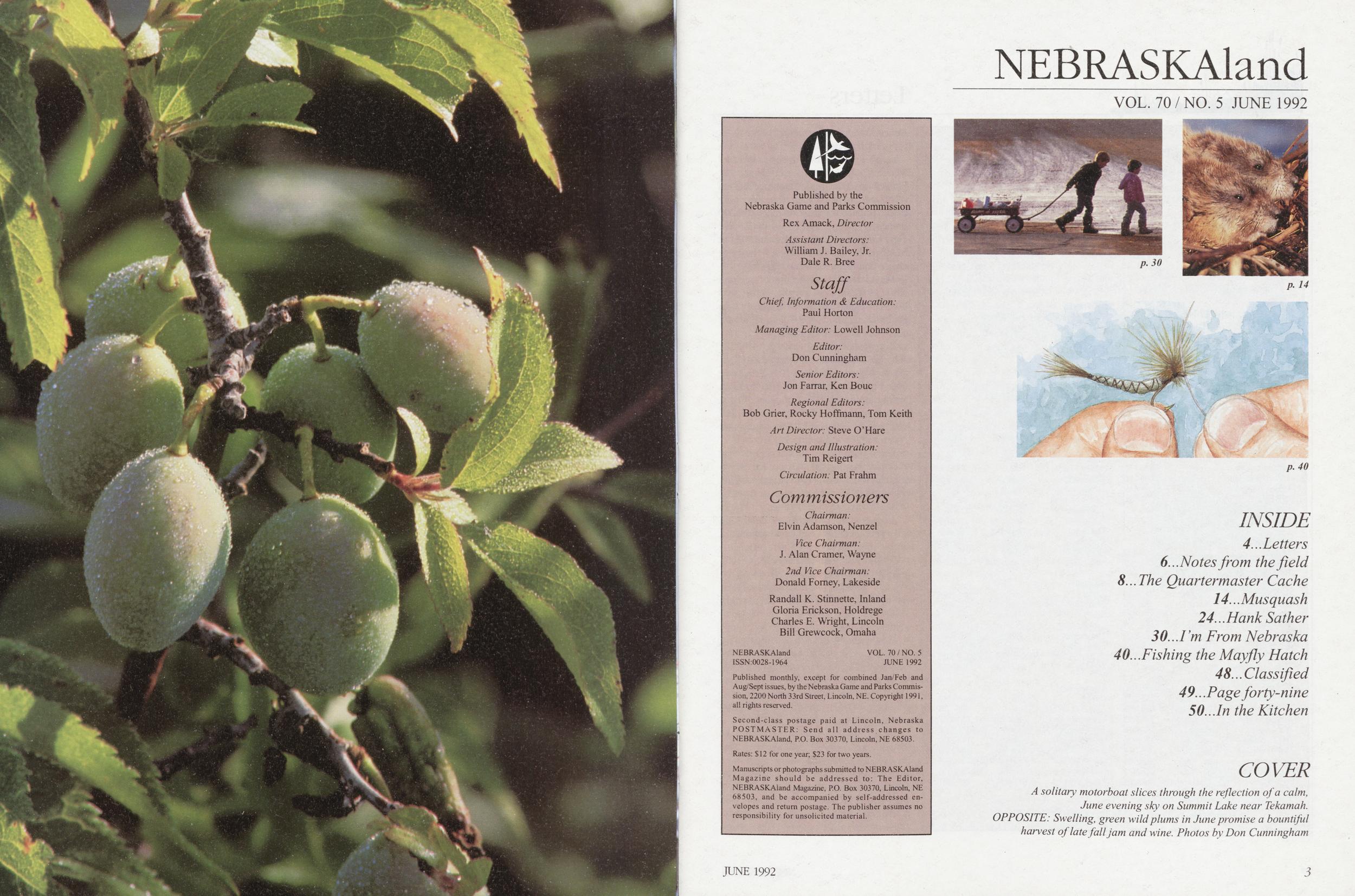
NEBRASKAland
VOL. 70 / NO. 5 JUNE 1992 Published by the Nebraska Game and Parks Commission Rex Amack, Director Assistant Directors: William J. Bailey, Jr. Dale R. Bree Staff Chief Information & Education: Paul Horton Managing Editor: Lowell Johnson Editor: Don Cunningham Senior Editors: Jon Farrar, Ken Bouc Regional Editors: Bob Grier, Rocky Hoffmann, Tom Keith Art Director: Steve O'Hare Design and Illustration: Tim Reigert Circulation: Pat Frahm Commissioners Chairman: Elvin Adamson, Nenzel Vice Chairman: J. Alan Cramer, Wayne 2nd Vice Chairman: Donald Forney, Lakeside Randall K. Stinnette, Inland Gloria Erickson, Holdrege Charles E. Wright, Lincoln Bill Grewcock, Omaha NEBRASKAland 1SSN:0028-1964 VOL. 70 / NO. 5 JUNE 1992 Published monthly, except for combined Jan/Feb and Aug/Sept issues, by the Nebraska Game and Parks Commission, 2200 North 33rd Street, Lincoln, NE. Copyright 1991, all rights reserved. Second-class postage paid at Lincoln, Nebraska POSTMASTER: Send all address changes to NEBRASKAland, P.O. Box 30370, Lincoln, NE 68503. Rates: $12 for one year; $23 for two years. Manuscripts or photographs submitted to NEBRASKAland Magazine should be addressed to: The Editor, NEBRASKAland Magazine, P.O. Box 30370, Lincoln, NE 68503, and be accompanied by self-addressed envelopes and return postage. The publisher assumes no responsibility for unsolicited material. Nebraska Game and Parks Commission
District Offices
Headquarters District Office II District Office IV
2200 North 33rd Street Box 508 Route 4, Box 36
Lincoln, NE 68503 Bassett, NE 68714 North Platte, NE 69101
Phone (402)471-0641 Phone (402)684-2921 Phone (308)535-8025
District Office 1 District Office III District Office V
Box 725 Box 934 2200 North 33rd Street
Alliance, NE 69301 Norfolk, NE 68702 Lincoln, NE 68503
Phone (308)762-5605 Phone (402)370-3374 Phone (402)471-5558
Omaha Office Ak-Sar-Ben Aquarium
State Office Building Mall 21502 West Highway 31
1313Farnam Gretna, NE 68028
Omaha, NE 68102 Phone (402) 332-3901
Phone (402) 595-2144
Conservation Of Ticers by Region Southeast
Panhandle
Officer City Phone (308) Officer City Phone (402)
Richard Furley (Supv) Alliance 762-2024 Don Schaepler (Chief) Lincoln 488-2957
Walt Meyer Chadron 432-4398 Ted Blume (Asst Chief) Lincoln 483-5643
John Murphy Crawford 665-2021 Roger Guenther (Supv) Lincoln 423-5671
Jim Zimmerman Gering 436-7561 William Krause Auburn 274-3789
Marvin Kampbell Hay Springs 638-7527 Dan Evasco Beatrice 228-5935
Dennis Thompson Ogallala 284-6450 Murray Johnson Lincoln 488-2923
Don Hunt Oshkosh 772-3697 Douglas Kramer Lincoln 466-9001
Richard Brandt Scottsbluff 635-1277 Levi Krause Louisville 234-2212
Raymond Still Bridgeport 262-1075 Russell Mort Nebr. City 873-5684
Duane Arp Omaha 3324954
Northeast Larry Elston Omaha 2924910
Officer City Phone (402) Craig Stover Omaha 359-2833
Robert Kelly Albion 395-2538 Mike Luben Wahoo 4434278
Ross Oestmann Bloomfield 373-4412
LA. Wilkinson Columbus 564-4375 Sandhills
Gary Ralston Creighton 847-3284 Officer City Phone (402)
Daniel Roberts Fremont 721-7852 Bruce Wiebe (Supv) Bassett 684-3867
Randy Pomplun Fullerton ( 308)536-2987 Max Showalter Ainsworth 387-1960
Jon Reeves Kennard 427-7378 Larry Bauman Atkinson 925-5569
Marion Shafer Norfolk 371-2031 Tom Zimmer Brkn. Bow (308)872-6063
Eric Wiebe Ponca 755-2566 Dan Zuehlke Mullen (308)546-2492
Steve Oberg West Point 372-3062 Richard Seward Ord (308)728-5338
Mick Gray Valentine 376-3136
Southwest
Officer City Phone (308) South-Central
Gail Woodside(Supv) No. Platte 532-0279 Officer City Phone (402)
George Sund Cambridge 697-4629 Jerry Pecha (Supv) York 362-5707
Jack Henderson Gothenburg 537-7483 Lester Johnson David City 3674037
Dirk Greene Imperial 882-5328 Terry Brentzel Grand Isl. (308)384-8296
Ray Frandsen Lexington 324-2753 Dale Johnson Hebron 768-7363
Virgil Gosch McCook 345-2185 Daniel Klammer Hastings 461-3389
Dwight Allbery No. Platte 532-2753 Dayton Shultis Kearney (308)234-3349
Roger Thompson No. Platte 532-9175 Mark Reeves Loup City (308)745-1126
Rich Routh Republican City 799-2085 Robert Finke Seward 643-2056
Operation Game Thief (800) 742-7627
Nebraska Game and Parks Commission
District Offices
Headquarters District Office II District Office IV
2200 North 33rd Street Box 508 Route 4, Box 36
Lincoln, NE 68503 Bassett, NE 68714 North Platte, NE 69101
Phone (402)471-0641 Phone (402)684-2921 Phone (308)535-8025
District Office 1 District Office III District Office V
Box 725 Box 934 2200 North 33rd Street
Alliance, NE 69301 Norfolk, NE 68702 Lincoln, NE 68503
Phone (308)762-5605 Phone (402)370-3374 Phone (402)471-5558
Omaha Office Ak-Sar-Ben Aquarium
State Office Building Mall 21502 West Highway 31
1313Farnam Gretna, NE 68028
Omaha, NE 68102 Phone (402) 332-3901
Phone (402) 595-2144
Conservation Of Ticers by Region Southeast
Panhandle
Officer City Phone (308) Officer City Phone (402)
Richard Furley (Supv) Alliance 762-2024 Don Schaepler (Chief) Lincoln 488-2957
Walt Meyer Chadron 432-4398 Ted Blume (Asst Chief) Lincoln 483-5643
John Murphy Crawford 665-2021 Roger Guenther (Supv) Lincoln 423-5671
Jim Zimmerman Gering 436-7561 William Krause Auburn 274-3789
Marvin Kampbell Hay Springs 638-7527 Dan Evasco Beatrice 228-5935
Dennis Thompson Ogallala 284-6450 Murray Johnson Lincoln 488-2923
Don Hunt Oshkosh 772-3697 Douglas Kramer Lincoln 466-9001
Richard Brandt Scottsbluff 635-1277 Levi Krause Louisville 234-2212
Raymond Still Bridgeport 262-1075 Russell Mort Nebr. City 873-5684
Duane Arp Omaha 3324954
Northeast Larry Elston Omaha 2924910
Officer City Phone (402) Craig Stover Omaha 359-2833
Robert Kelly Albion 395-2538 Mike Luben Wahoo 4434278
Ross Oestmann Bloomfield 373-4412
LA. Wilkinson Columbus 564-4375 Sandhills
Gary Ralston Creighton 847-3284 Officer City Phone (402)
Daniel Roberts Fremont 721-7852 Bruce Wiebe (Supv) Bassett 684-3867
Randy Pomplun Fullerton ( 308)536-2987 Max Showalter Ainsworth 387-1960
Jon Reeves Kennard 427-7378 Larry Bauman Atkinson 925-5569
Marion Shafer Norfolk 371-2031 Tom Zimmer Brkn. Bow (308)872-6063
Eric Wiebe Ponca 755-2566 Dan Zuehlke Mullen (308)546-2492
Steve Oberg West Point 372-3062 Richard Seward Ord (308)728-5338
Mick Gray Valentine 376-3136
Southwest
Officer City Phone (308) South-Central
Gail Woodside(Supv) No. Platte 532-0279 Officer City Phone (402)
George Sund Cambridge 697-4629 Jerry Pecha (Supv) York 362-5707
Jack Henderson Gothenburg 537-7483 Lester Johnson David City 3674037
Dirk Greene Imperial 882-5328 Terry Brentzel Grand Isl. (308)384-8296
Ray Frandsen Lexington 324-2753 Dale Johnson Hebron 768-7363
Virgil Gosch McCook 345-2185 Daniel Klammer Hastings 461-3389
Dwight Allbery No. Platte 532-2753 Dayton Shultis Kearney (308)234-3349
Roger Thompson No. Platte 532-9175 Mark Reeves Loup City (308)745-1126
Rich Routh Republican City 799-2085 Robert Finke Seward 643-2056
Operation Game Thief (800) 742-7627
Letters
Crane Watching EconomicsSir/ In 'The Economics of Crane Watching" ["Notes from the Field," March 1992] you cite the story from 1991 ["The Impact of Crane Watching," March 1991] which stated that crane watching had an impact of approximately $700,000 on central Nebraska. You then state that Gary Lingle [Avian Ecologist and Habitat Manager for the Platte River Whooping Crane Maintenance Trust] has recalculated and determined that crane watching has a $40 million impact. I've read Lingle's paper and at least three major problems result in an overestimate of the economic impact of this activity.
Lingle states an average of 22.1 vehicles crossed his counter in daylight hours (16 hours per day). If you multiply this average by 16, then take that product and multiply it by 19 (the number of days the counter was out), you get 6,718 vehicles. In 19 days, 24 hours a day, his counter registered only 5,167 cars.
What this means is that Lingle has estimated a full 130 percent more vehicles than were actually counted. This means that all further estimates are at least 130 percent of real value.
A better method would be to determine what percent of the vehicles were counted during daylight hours (95 percent). Multiply this by the total counted (.95 X 5,167 = 4,909). Divide the result by 16 to get the average vehicles per hour (16.1). Next, multiply the average by the total daylight hours in 34 days (544) to get the total vehicles (8,758).
This value includes local, repeat and other non-crane-watching traffic. We must also remember that his counter was up during both the Platte River Conference and the Wings Over the Platte conference. Thus, any final value we arrive at will be an overestimate.
Second, Lingle assigns 83 percent as the number of these vehicles as being crane watchers. How did he arrive at this? He then states that each vehicle has four people in it. He gets this value (I think) from Firth's 1974 paper. Firth's paper was determined from a two-hour period of crane watching. That might be the correct 4 NEBRASKAland value for that time of day on those days, however Lingle extrapolates that value to include all daylight hours for 34 days.
Lingle then estimates that crane watchers spent at least $ 186.92 in central Nebraska. How did he determine that? By a survey of people at the Wings Over the Platte conference, a three-day event which even he admits draws a number of people from out of state.
When you take an objective look at this paper and at the the data, you have to ask questions. Why, of the 80,000 people that Lingle says watched cranes and spent money in 1991, did only 6,000 plus register anywhere? Why, with this sudden surge of interest, did Ft. Kearny register a lower number of visitors in 1991 than in 1990? Why have agencies responsible for knowing the value of an activity (both at the local and state levels) so grossly underestimated the impact of crane watching? Why has Lingle, a biologist, done this study of economics?
We demand the power companies and other businesses prove their claims. We must also demand that environmental groups such as the Crane Trust and their employees prove their statements.
Mark Peyton Gothenburg, NEGary Lingle replies: "The Economics of Crane Watching " summarized the findings reported in a technical paper I presented at the Sixth North American Crane Workshop in Regina, Saskatchewan, last October The proceedings of this workshop will be published this summer. I am pleased by the response generated by the "Notes from the Field" story. It underscores the importance of and interest in the Platte River s cranes and the habitat upon which they depend.
Mr. Peyton's letter warrants a response, since it appears he misinterpreted the information I presented. The vehicle counter is beyond question; exactly 5,167 vehicles were counted during 351 hours monitored over portions of a 19-day period. Two 47-passenger busses, with three axles each, would be recorded the same as three cars. Similarly, an 18-passenger van would register as one car To account for these discrepancies, I assumed each vehicle carried four crane watchers, which I believe is a legitimate, defensible assumption. Corrections were also made to account for non-crane-watcher traffic. Thus, my estimate of the number of crane watchers was probably conservative.
1 estimated that crane watchers spent $15 million in 1991. Using the method Mr. Peyton suggested and using his figures, crane watchers spent $13.24 million. The Nebraska Department of Economic Development uses a multiplier of 2.7 to estimate the roll-over effect of tourism dollars. When that number is applied to my $15 million figure, an economic benefit of $40.5 million ($35.8 million using Mr. Peyton's figures) occurred in 1991. The Hall County Convention and Visitors Bureau uses a multiplier of 1.8 to estimate economic impact. This translates to a $27 million benefit.
I would invite those questioning my study to conduct a scientific study of their own and share the results with the public. Any economic projection is subject to scrutiny and refinement. We can haggle endlessly about whether $5 million or $15 million was spent by crane watchers, or whether to use 1.8 or 2.7 as the multiplier. The bottom line, and really the main point, is that regardless of how you crunch the numbers, crane-watching is a multi-million-dollar industry in Nebraska. That is an indisputable fact. This infusion of non-subsidized dollars into local economies has become an economic factor which cannot be ignored.
1 would be happy to provide reprints of my study upon request.
Send your comments, suggestions and complaints to Letters, NEBRASKAland Magazine, P.O. Box 30370, Lincoln, NE 68503. Each month we will publish as many letters as space permits. Photographs are also welcome, and we will make every effort to return them undamaged. NEBRASKAland reserves the right to edit and condense letters. Where can you get away for a week or weekend, and still not spend a bundle? Nebraska's state park areas are still your best bet for the perfect vacation or weekend break. Get the new 48-page, color brochure highlighting state parks, recreation areas and historic parks. You'll get detailed information on lodging, camping, activities, facilities, seasons, fees and reservation policies. Write or call today! Nebraska Game and Parks Commission P.O. Box 30370, Lincoln, NE 68503 Phone (402) 471-0641 JUNE 1992 5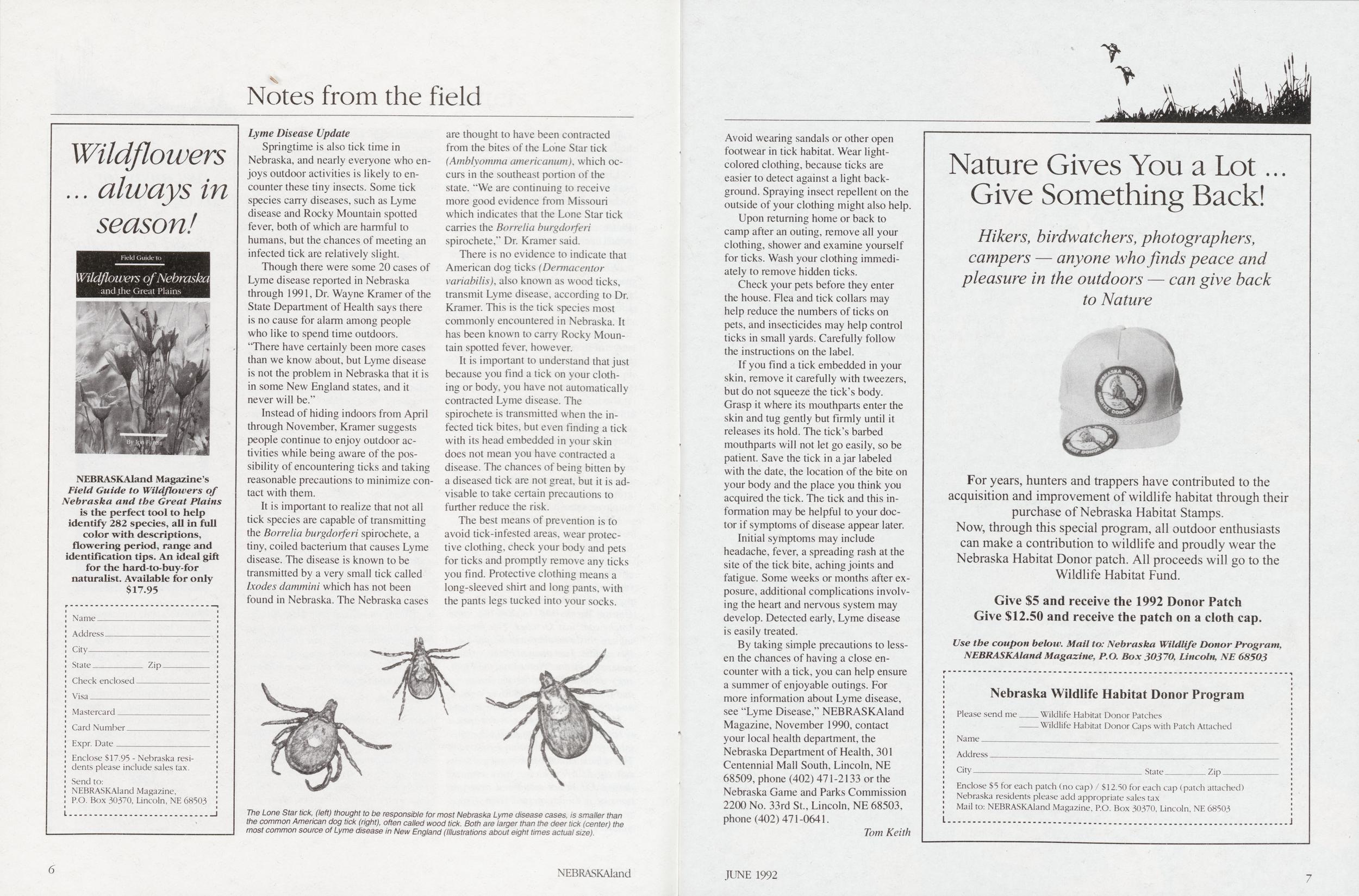
Notes from the field
Lyme Disease UpdateSpringtime is also tick time in Nebraska, and nearly everyone who enjoys outdoor activities is likely to encounter these tiny insects. Some tick species carry diseases, such as Lyme disease and Rocky Mountain spotted fever, both of which are harmful to humans, but the chances of meeting an infected tick are relatively slight.
Though there were some 20 cases of Lyme disease reported in Nebraska through 1991, Dr. Wayne Kramer of the State Department of Health says there is no cause for alarm among people who like to spend time outdoors. 'There have certainly been more cases than we know about, but Lyme disease is not the problem in Nebraska that it is in some New England states, and it never will be."
Instead of hiding indoors from April through November, Kramer suggests people continue to enjoy outdoor activities while being aware of the possibility of encountering ticks and taking reasonable precautions to minimize contact with them.Instead of hiding indoors from April through November, Kramer suggests people continue to enjoy outdoor activities while being aware of the possibility of encountering ticks and taking reasonable precautions to minimize contact with them.
It is important to realize that not all tick species are capable of transmitting the Borrelia burgdorferi spirochete, a tiny, coiled bacterium that causes Lyme disease. The disease is known to be transmitted by a very small tick called Ixodes dammini which has not been found in Nebraska. The Nebraska cases are thought to have been contracted from the bites of the Lone Star tick (Amblyomma americanum), which occurs in the southeast portion of the state. "We are continuing to receive more good evidence from Missouri which indicates that the Lone Star tick carries the Borrelia burgdorferi spirochete," Dr. Kramer said.
There is no evidence to indicate that American dog ticks (Dermacentor variabilis), also known as wood ticks, transmit Lyme disease, according to Dr. Kramer. This is the tick species most commonly encountered in Nebraska. It has been known to carry Rocky Mountain spotted fever, however.
It is important to understand that just because you find a tick on your clothing or body, you have not automatically contracted Lyme disease. The spirochete is transmitted when the infected tick bites, but even finding a tick with its head embedded in your skin does not mean you have contracted a disease. The chances of being bitten by a diseased tick are not great, but it is advisable to take certain precautions to further reduce the risk.
The best means of prevention is to avoid tick-infested areas, wear protective clothing, check your body and pets for ticks and promptly remove any ticks you find. Protective clothing means a long-sleeved shirt and long pants, with the pants legs tucked into your socks.
Avoid wearing sandals or other open footwear in tick habitat. Wear lightcolored clothing, because ticks are easier to detect against a light background. Spraying insect repellent on the outside of your clothing might also help.
Upon returning home or back to camp after an outing, remove all your clothing, shower and examine yourself for ticks. Wash your clothing immediately to remove hidden ticks.
Check your pets before they enter the house. Flea and tick collars may help reduce the numbers of ticks on pets, and insecticides may help control ticks in small yards. Carefully follow the instructions on the label.
If you find a tick embedded in your skin, remove it carefully with tweezers, but do not squeeze the tick's body. Grasp it where its mouthparts enter the skin and tug gently but firmly until it releases its hold. The tick's barbed mouthparts will not let go easily, so be patient. Save the tick in a jar labeled with the date, the location of the bite on your body and the place you think you acquired the tick. The tick and this information may be helpful to your doctor if symptoms of disease appear later.
Initial symptoms may include headache, fever, a spreading rash at the site of the tick bite, aching joints and fatigue. Some weeks or months after exposure, additional complications involving the heart and nervous system may develop. Detected early, Lyme disease is easily treated.
By taking simple precautions to lessen the chances of having a close encounter with a tick, you can help ensure a summer of enjoyable outings. For more information about Lyme disease, see "Lyme Disease," NEBRASKAland Magazine, November 1990, contact your local health department, the Nebraska Department of Health, 301 Centennial Mall South, Lincoln, NE 68509, phone (402) 471-2133 or the Nebraska Game and Parks Commission 2200 No. 33rd St., Lincoln, NE 68503, phone (402) 471-0641.
Tom Keith Nature Gives You a Lot Give Something Back! Hikers, birdwatchers, photographers, campers — anyone who finds peace and pleasure in the outdoors — can give back to Nature For years, hunters and trappers have contributed to the acquisition and improvement of wildlife habitat through their purchase of Nebraska Habitat Stamps. Now, through this special program, all outdoor enthusiasts can make a contribution to wildlife and proudly wear the Nebraska Habitat Donor patch. All proceeds will go to the Wildlife Habitat Fund. Give $5 and receive the 1992 Donor Patch Give $12.50 and receive the patch on a cloth cap. Use the coupon below. Mail to: Nebraska Wildlife Donor Program, NEBRASKAland Magazine, P.O. Box 30370, Lincoln, NE 68503 Nebraska Wildlife Habitat Donor Program Please send me Name Wildlife Habitat Donor Patches Wildlife Habitat Donor Caps with Patch Attached Address City State Zip Enclose $5 for each patch (no cap) / $12.50 for each cap (patch attached) Nebraska residents please add appropriate sales tax Mail to: NEBRASKAland Magazine, P.O. Box 30370, Lincoln, NE 68503 JUNE 1992 7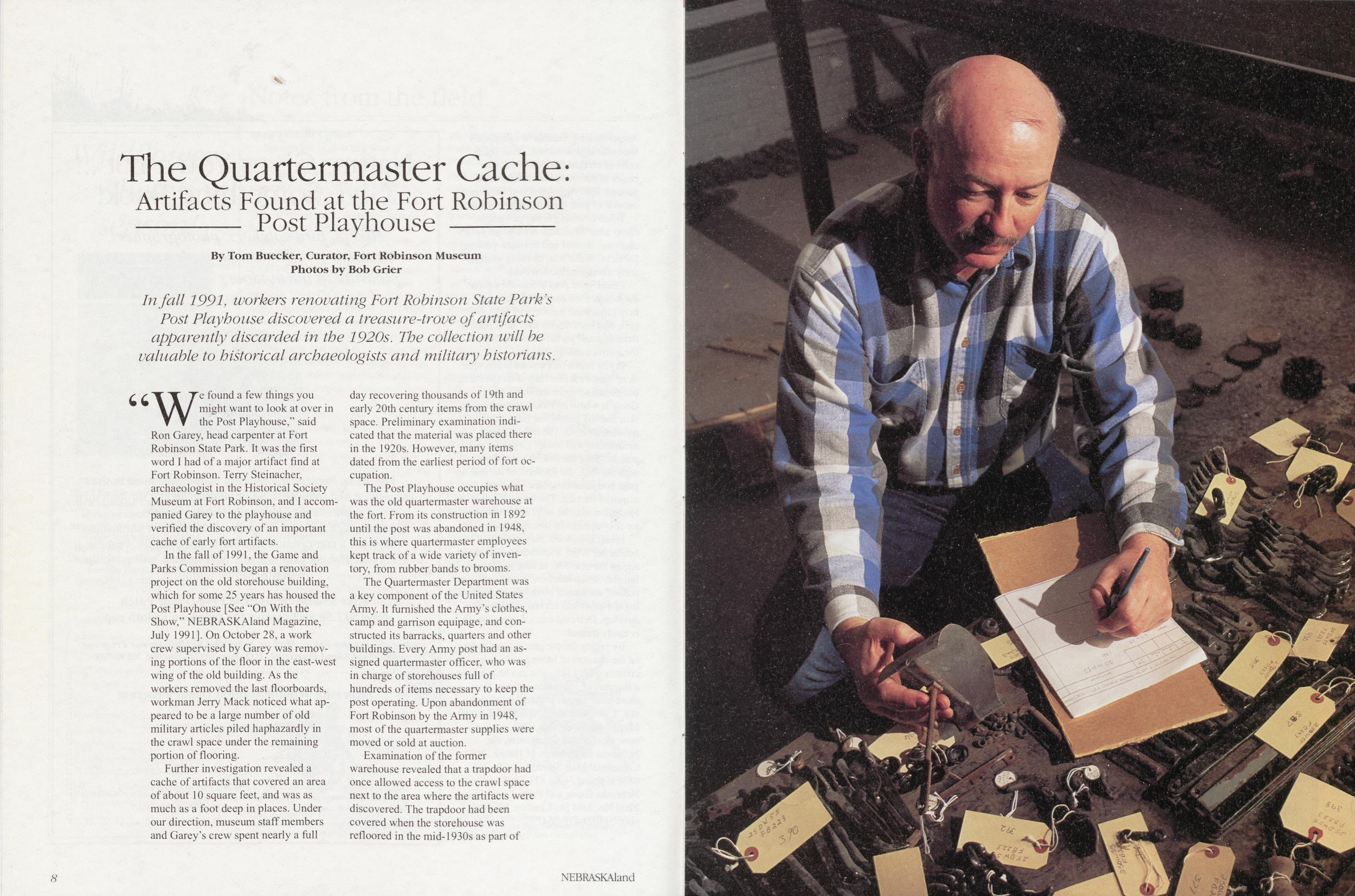
The Quartermaster Cache: Artifacts Found at the Fort Robinson ----------- Post Playhouse -----------
By Tom Buecker, Curator, Fort Robinson Museum Photos by Bob Grier In fall 1991, workers renovating Fort Robinson State Park's Post Playhouse discovered a treasure-trove of artifacts apparently discarded in the 1920s. Ihe collection will be valuable to historical archaeologists and military historians."We found a few things you might want to look at over in the Post Playhouse," said Ron Garey, head carpenter at Fort Robinson State Park. It was the first word I had of a major artifact find at Fort Robinson. Terry Steinacher, archaeologist in the Historical Society Museum at Fort Robinson, and 1 accompanied Garey to the playhouse and verified the discovery of an important cache of early fort artifacts.
In the fall of 1991, the Game and Parks Commission began a renovation project on the old storehouse building, which for some 25 years has housed the Post Playhouse [See "On With the Show," NEBRASKAland Magazine, July 1991]. On October 28, a work crew supervised by Garey was removing portions of the floor in the east-west wing of the old building. As the workers removed the last floorboards, workman Jerry Mack noticed what appeared to be a large number of old military articles piled haphazardly in the crawl space under the remaining portion of flooring.
Further investigation revealed a cache of artifacts that covered an area of about 10 square feet, and was as much as a foot deep in places. Under our direction, museum staff members and Garey's crew spent nearly a full day recovering thousands of 19th and early 20th century items from the crawl space. Preliminary examination indicated that the material was placed there in the 1920s. However, many items dated from the earliest period of fort occupation.
The Post Playhouse occupies what was the old quartermaster warehouse at the fort. From its construction in 1892 until the post was abandoned in 1948, this is where quartermaster employees kept track of a wide variety of inventory, from rubber bands to brooms.
The Quartermaster Department was a key component of the United States Army. It furnished the Army's clothes, camp and garrison equipage, and constructed its barracks, quarters and other buildings. Every Army post had an assigned quartermaster officer, who was in charge of storehouses full of hundreds of items necessary to keep the post operating. Upon abandonment of Fort Robinson by the Army in 1948, most of the quartermaster supplies were moved or sold at auction.
Examination of the former warehouse revealed that a trapdoor had once allowed access to the crawl space next to the area where the artifacts were discovered. The trapdoor had been covered when the storehouse was refloored in the mid-1930s as part of 8 NEBRASKAland
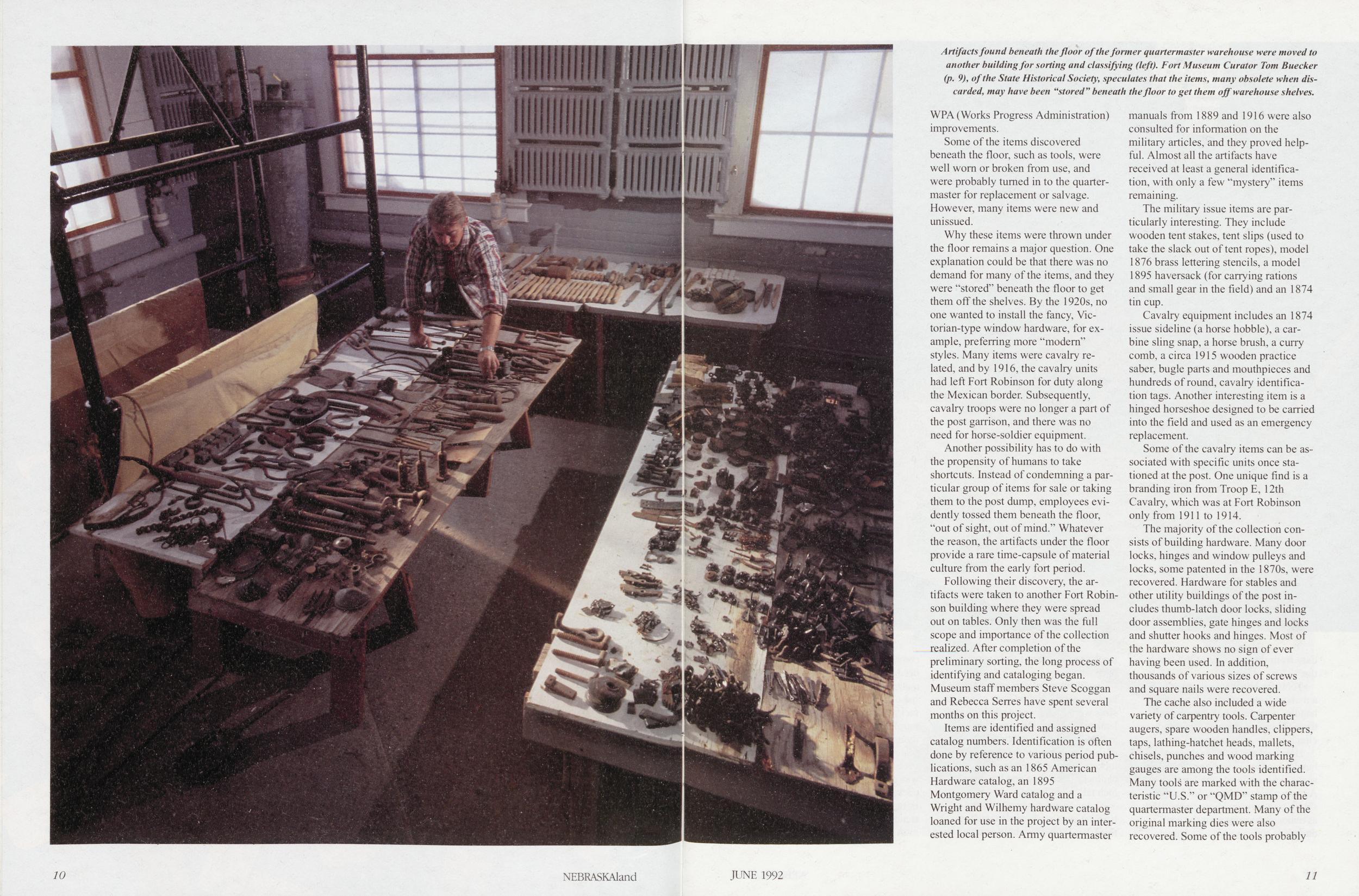
Some of the items discovered beneath the floor, such as tools, were well worn or broken from use, and were probably turned in to the quartermaster for replacement or salvage. However, many items were new and unissued.
Why these items were thrown under the floor remains a major question. One explanation could be that there was no demand for many of the items, and they were "stored" beneath the floor to get them off the shelves. By the 1920s, no one wanted to install the fancy, Victorian-type window hardware, for example, preferring more "modern" styles. Many items were cavalry related, and by 1916, the cavalry units had left Fort Robinson for duty along the Mexican border. Subsequently, cavalry troops were no longer a part of the post garrison, and there was no need for horse-soldier equipment.
Another possibility has to do with the propensity of humans to take shortcuts. Instead of condemning a particular group of items for sale or taking them to the post dump, employees evidently tossed them beneath the floor, "out of sight, out of mind." Whatever the reason, the artifacts under the floor provide a rare time-capsule of material culture from the early fort period.
Following their discovery, the artifacts were taken to another Fort Robinson building where they were spread out on tables. Only then was the frill scope and importance of the collection jcealized. After completion of the preliminary sorting, the long process of identifying and cataloging began. Museum staff members Steve Scoggan and Rebecca Serres have spent several months on this project.
Items are identified and assigned catalog numbers. Identification is often done by reference to various period publications, such as an 1865 American Hardware catalog, an 1895 Montgomery Ward catalog and a Wright and Wilhemy hardware catalog loaned for use in the project by an interested local person. Army quartermaster manuals from 1889 and 1916 were also consulted for information on the military' articles, and they proved helpful. Almost all the artifacts have received at least a general identification, with only a few "mystery" items remaining.
The military issue items are particularly interesting. They include wooden tent stakes, tent slips (used to take the slack out of tent ropes), model 1876 brass lettering stencils, a model 1895 haversack (for carrying rations and small gear in the field) and an 1874 tin cup.
Cavalry equipment includes an 1874 issue sideline (a horse hobble), a carbine sling snap, a horse brush, a curry comb, a circa 1915 wooden practice saber, bugle parts and mouthpieces and hundreds of round, cavalry identification tags. Another interesting item is a hinged horseshoe designed to be carried into the field and used as an emergency replacement.
Some of the cavalry items can be associated with specific units once stationed at the post. One unique find is a branding iron from Troop E, 12th Cavalry, which was at Fort Robinson only from 1911 to 1914.
The majority of the collection consists of building hardware. Many door locks, hinges and window pulleys and locks, some patented in the 1870s, were recovered. Hardware for stables and other utility buildings of the post includes thumb-latch door locks, sliding door assemblies, gate hinges and locks and shutter hooks and hinges. Most of the hardware shows no sign of ever having been used. In addition, thousands of various sizes of screws and square nails were recovered.
The cache also included a wide
variety of carpentry tools. Carpenter
augers, spare wooden handles, clippers,
taps, lathing-hatchet heads, mallets,
chisels, punches and wood marking
gauges are among the tools identified.
Many tools' are marked with the characteristic "U.S." or "QMD" stamp of the
quartermaster department. Many of the
original marking dies were also
recovered. Some of the tools probably
JUNE 1992
11
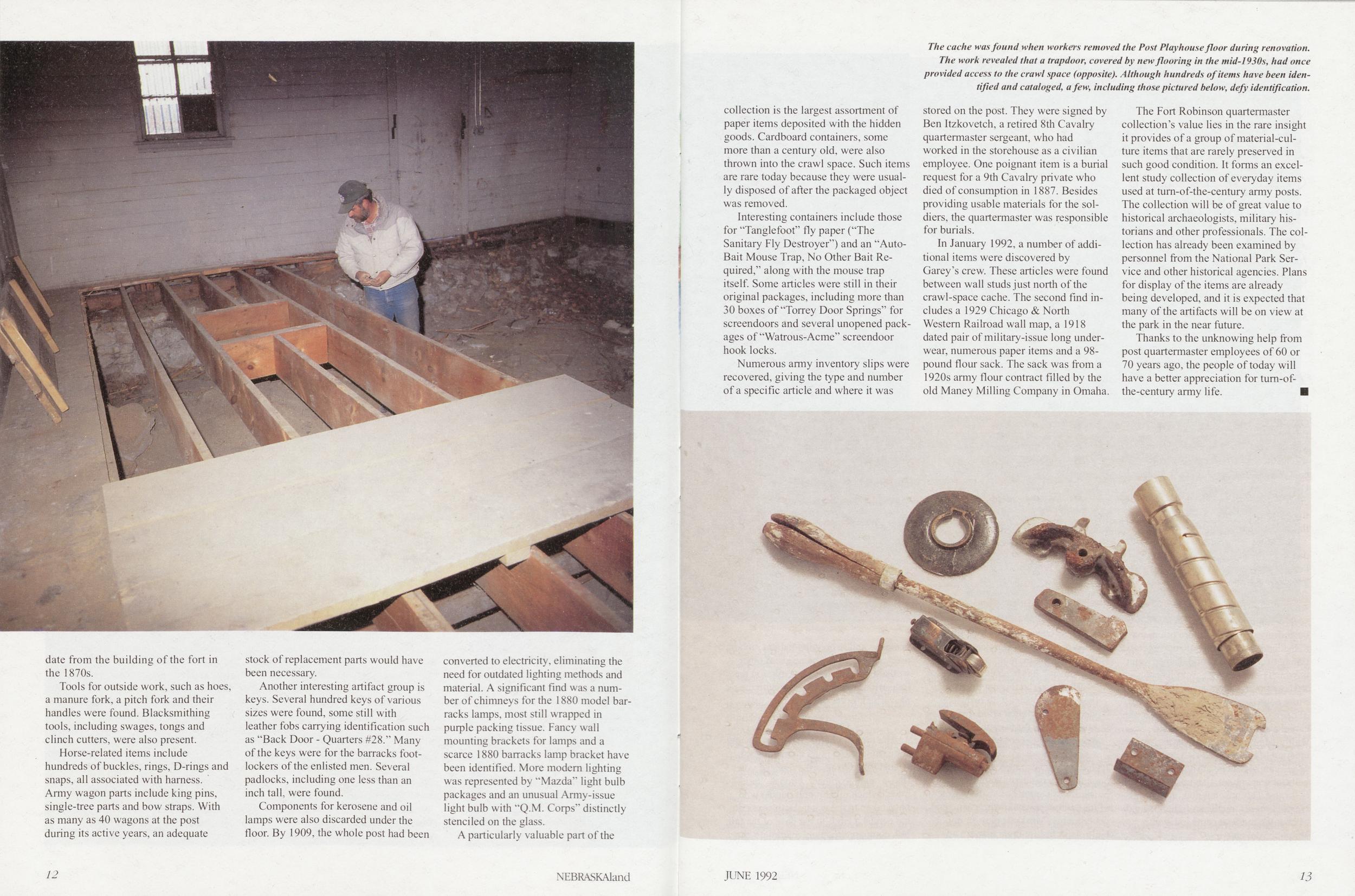
Tools for outside work, such as hoes, a manure fork, a pitch fork and their handles were found. Blacksmithing tools, including swages, tongs and clinch cutters, were also present.
Horse-related items include hundreds of buckles, rings, D-rings and snaps, all associated with harness. Army wagon parts include king pins, single-tree parts and bow straps. With as many as 40 wagons at the post during its active years, an adequate stock of replacement parts would have been necessary.
Another interesting artifact group is keys. Several hundred keys of various sizes were found, some still with leather fobs carrying identification such as "Back Door - Quarters #28." Many of the keys were for the barracks footlockers of the enlisted men. Several padlocks, including one less than an inch tall, were found.
Components for kerosene and oil lamps were also discarded under the floor. By 1909, the whole post had been converted to electricity, eliminating the need for outdated lighting methods and material. A significant find was a number of chimneys for the 1880 model barracks lamps, most still wrapped in purple packing tissue. Fancy wall mounting brackets for lamps and a scarce 1880 barracks lamp bracket have been identified. More modern lighting was represented by "Mazda" light bulb packages and an unusual Army-issue light bulb with "Q.M. Corps" distinctly stenciled on the glass.
A particularly valuable part of the 12 NEBRASKAland collection is the largest assortment of paper items deposited with the hidden goods. Cardboard containers, some more than a century old, were also thrown into the crawl space. Such items are rare today because they were usually disposed of after the packaged object was removed.
Interesting containers include those for "Tanglefoot" fly paper ("The Sanitary Fly Destroyer") and an "AutoBait Mouse Trap, No Other Bait Required," along with the mouse trap itself. Some articles were still in their original packages, including more than 30 boxes of "Torrey Door Springs" for screendoors and several unopened packages of "Watrous-Acme" screendoor hook locks.
Numerous army inventory slips were recovered, giving the type and number of a specific article and where it was stored on the post. They were signed by Ben Itzkovetch, a retired 8th Cavalry quartermaster sergeant, who had worked in the storehouse as a civilian employee. One poignant item is a burial request for a 9th Cavalry private who died of consumption in 1887. Besides providing usable materials for the soldiers, the quartermaster was responsible for burials.
In January 1992, a number of additional items were discovered by Garey's crew. These articles were found between wall studs just north of the crawl-space cache. The second find includes a 1929 Chicago & North Western Railroad wall map, a 1918 dated pair of military-issue long underwear, numerous paper items and a 98-pound flour sack. The sack was from a 1920s army flour contract filled by the old Maney Milling Company in Omaha.
The Fort Robinson quartermaster collection's value lies in the rare insight it provides of a group of material-culture items that are rarely preserved in such good condition. It forms an excellent study collection of everyday items used at turn-of-the-century army posts. The collection will be of great value to historical archaeologists, military historians and other professionals. The collection has already been examined by personnel from the National Park Service and other historical agencies. Plans for display of the items are already being developed, and it is expected that many of the artifacts will be on view at the park in the near future.
Thanks to the unknowing help from post quartermaster employees of 60 or 70 years ago, the people of today will have a better appreciation for turn-of-the-century army life.
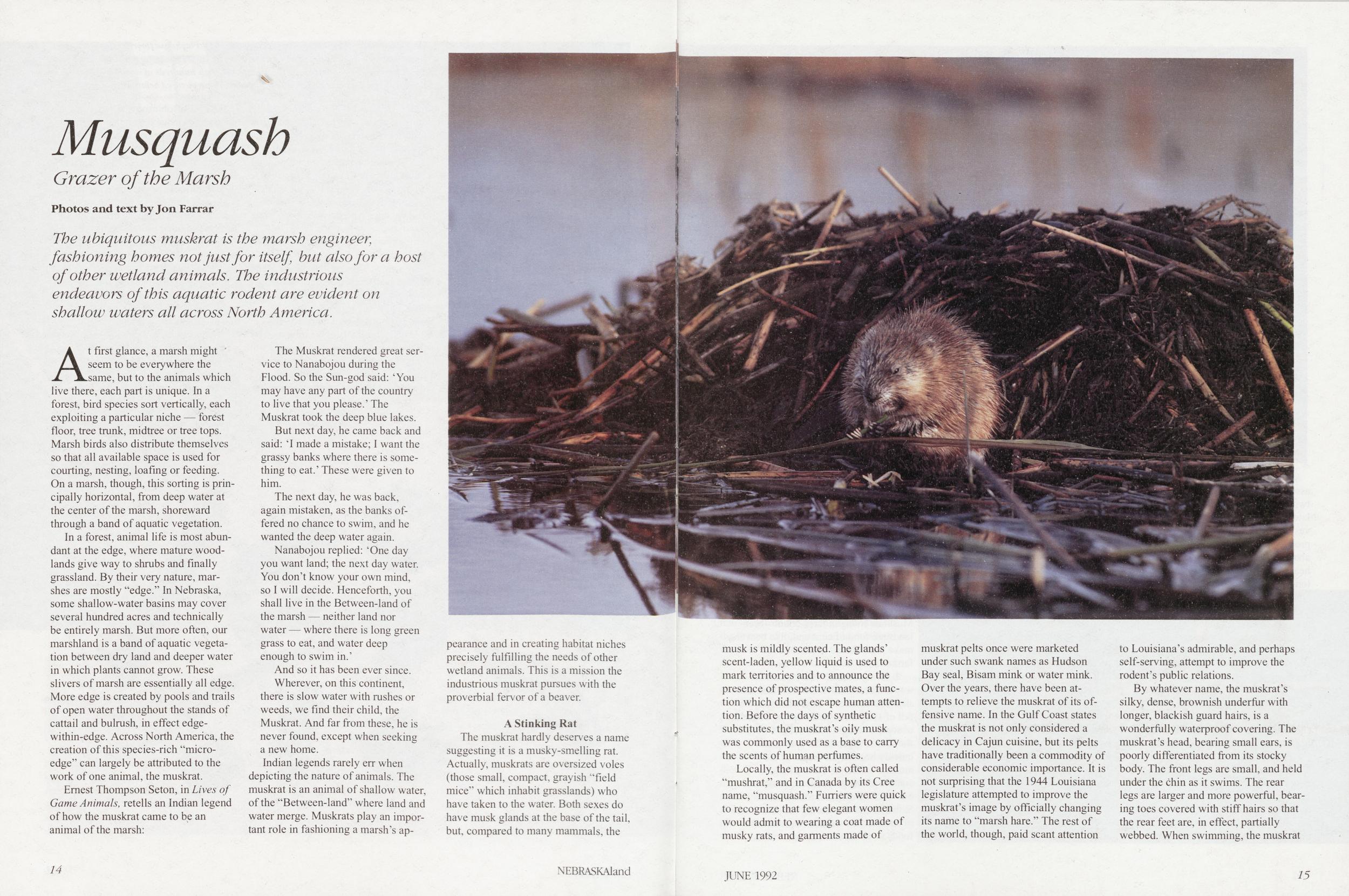
Musquash Grazer of the Marsh
Photos and text by Jon Farrar The ubiquitous muskrat is the marsh engineer, fashioning homes not just for itself but also for a host of other wetland animals. The industrious endeavors of this aquatic rodent are evident on shallow waters all across North America.At first glance, a marsh might seem to be everywhere the same, but to the animals which live there, each part is unique. In a forest, bird species sort vertically, each exploiting a particular niche — forest floor, tree trunk, midtree or tree tops. Marsh birds also distribute themselves so that all available space is used for courting, nesting, loafing or feeding. On a marsh, though, this sorting is principally horizontal, from deep water at the center of the marsh, shoreward through a band of aquatic vegetation.
In a forest, animal life is most abundant at the edge, where mature woodlands give way to shrubs and finally grassland. By their very nature, marshes are mostly "edge." In Nebraska, some shallow-water basins may cover several hundred acres and technically be entirely marsh. But more often, our marshland is a band of aquatic vegetation between dry land and deeper water in which plants cannot grow. These slivers of marsh are essentially all edge. More edge is created by pools and trails of open water throughout the stands of cattail and bulrush, in effect edgewithin-edge. Across North America, the creation of this species-rich "microedge" can largely be attributed to the work of one animal, the muskrat.
Ernest Thompson Seton, in Lives of Game Animals, retells an Indian legend of how the muskrat came to be an animal of the marsh:
The Muskrat rendered great service to Nanabojou during the Flood. So the Sun-god said: 'You may have any part of the country to live that you please.' The Muskrat took the deep blue lakes.
But next day, he came back and said: T made a mistake; I want the grassy banks where there is something to eat.' These were given to him.
The next day, he was back, again mistaken, as the banks offered no chance to swim, and he wanted the deep water again.
Nanabojou replied: 'One day you want land; the next day water. You don't know your own mind, so I will decide. Henceforth, you shall live in the Between-land of the marsh — neither land nor water — where there is long green grass to eat, and water deep enough to swim in.'
And so it has been ever since.
Wherever, on this continent, there is slow water with rushes or weeds, we find their child, the Muskrat. And far from these, he is never found, except when seeking a new home.
Indian legends rarely err when depicting the nature of animals. The muskrat is an animal of shallow water, of the "Between-land" where land and water merge. Muskrats play an important role in fashioning a marsh's appearance and in creating habitat niches precisely fulfilling the needs of other wetland animals. This is a mission the industrious muskrat pursues with the proverbial fervor of a beaver.
A Stinking RatThe muskrat hardly deserves a name suggesting it is a musky-smelling rat. Actually, muskrats are oversized voles (those small, compact, grayish "field mice" which inhabit grasslands) who have taken to the water. Both sexes do have musk glands at the base of the tail, but, compared to many mammals, the 14 NEBRASKAland musk is mildly scented. The glands' scent-laden, yellow liquid is used to mark territories and to announce the presence of prospective mates, a function which did not escape human attention. Before the days of synthetic substitutes, the muskrat's oily musk was commonly used as a base to carry the scents of human perfumes.
Locally, the muskrat is often called "mushrat," and in Canada by its Cree name, "musquash." Furriers were quick to recognize that few elegant women would admit to wearing a coat made of musky rats, and garments made of muskrat pelts once were marketed under such swank names as Hudson Bay seal, Bisam mink or water mink. Over the years, there have been attempts to relieve the muskrat of its offensive name. In the Gulf Coast states the muskrat is not only considered a delicacy in Cajun cuisine, but its pelts have traditionally been a commodity of considerable economic importance. It is not surprising that the 1944 Louisiana legislature attempted to improve the muskrat's image by officially changing its name to "marsh hare." The rest of the world, though, paid scant attention to Louisiana's admirable, and perhaps self-serving, attempt to improve the rodent's public relations.
By whatever name, the muskrat's
silky, dense, brownish underfur with
longer, blackish guard hairs, is a
wonderfully waterproof covering. The
muskrat's head, bearing small ears, is
poorly differentiated from its stocky
body. The front legs are small, and held
under the chin as it swims. The rear
legs are larger and more powerful, bearing toes covered with stiff hairs so that
the rear feet are, in effect, partially
webbed. When swimming, the muskrat
JUNE 1992
15
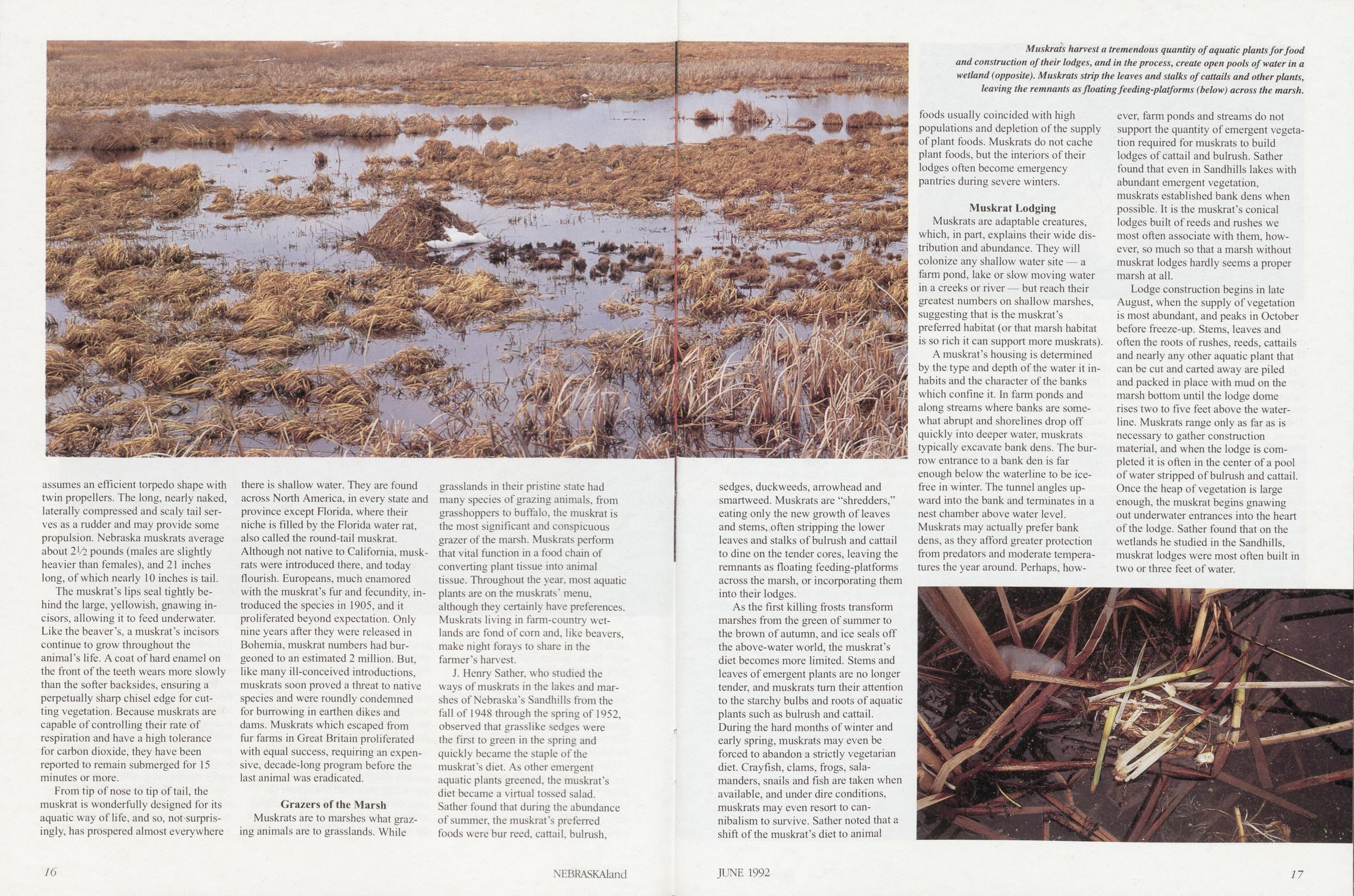
The muskraf s lips seal tightly behind the large, yellowish, gnawing incisors, allowing it to feed underwater. Like the beaver's, a muskraf s incisors continue to grow throughout the animal's life. A coat of hard enamel on the front of the teeth wears more slowly than the softer backsides, ensuring a perpetually sharp chisel edge for cutting vegetation. Because muskrats are capable of controlling their rate of respiration and have a high tolerance for carbon dioxide, they have been reported to remain submerged for 15 minutes or more.
From tip of nose to tip of tail, the muskrat is wonderfully designed for its aquatic way of life, and so, not surprisingly, has prospered almost everywhere there is shallow water. They are found across North America, in every state and province except Florida, where their niche is filled by the Florida water rat, also called the round-tail muskrat. Although not native to California, muskrats were introduced there, and today flourish. Europeans, much enamored with the muskraf s fur and fecundity, introduced the species in 1905, and it proliferated beyond expectation. Only nine years after they were released in Bohemia, muskrat numbers had burgeoned to an estimated 2 million. But, like many ill-conceived introductions, muskrats soon proved a threat to native species and were roundly condemned for burrowing in earthen dikes and dams. Muskrats which escaped from fur farms in Great Britain proliferated with equal success, requiring an expensive, decade-long program before the last animal was eradicated.
Grazers of the MarshMuskrats are to marshes what grazing animals are to grasslands. While grasslands in their pristine state had many species of grazing animals, from grasshoppers to buffalo, the muskrat is the most significant and conspicuous grazer of the marsh. Muskrats perform that vital function in a food chain of converting plant tissue into animal tissue. Throughout the year, most aquatic plants are on the muskrats' menu, although they certainly have preferences. Muskrats living in farm-country wetlands are fond of corn and, like beavers, make night forays to share in the farmer's harvest.
J. Henry Sather, who studied the ways of muskrats in the lakes and marshes of Nebraska's Sandhills from the fall of 1948 through the spring of 1952, observed that grasslike sedges were the first to green in the spring and quickly became the staple of the muskrat's diet. As other emergent aquatic plants greened, the muskrat's diet became a virtual tossed salad. Sather found that during the abundance of summer, the muskrat's preferred foods were bur reed, cattail, bulrush,
sedges, duckweeds, arrowhead and smartweed. Muskrats are "shredders," eating only the new growth of leaves and stems, often stripping the lower leaves and stalks of bulrush and cattail to dine on the tender cores, leaving the remnants as floating feeding-platforms across the marsh, or incorporating them into their lodges.
As the first killing frosts transform marshes from the green of summer to the brown of autumn, and ice seals off the above-water world, the muskrat's diet becomes more limited. Stems and leaves of emergent plants are no longer tender, and muskrats turn their attention to the starchy bulbs and roots of aquatic plants such as bulrush and cattail. During the hard months of winter and early spring, muskrats may even be forced to abandon a strictly vegetarian diet. Crayfish, clams, frogs, salamanders, snails and fish are taken when available, and under dire conditions, muskrats may even resort to cannibalism to survive. Sather noted that a shift of the muskrat's diet to animal foods usually coincided with high populations and depletion of the supply of plant foods. Muskrats do not cache plant foods, but the interiors of their lodges often become emergency pantries during severe winters.
Muskrat LodgingMuskrats are adaptable creatures, which, in part, explains their wide distribution and abundance. They will colonize any shallow water site — a farm pond, lake or slow moving water in a creeks or river — but reach their greatest numbers on shallow marshes, suggesting that is the muskrat's preferred habitat (or that marsh habitat is so rich it can support more muskrats).
A muskrat's housing is determined by the type and depth of the water it inhabits and the character of the banks which confine it. In farm ponds and along streams where banks are somewhat abrupt and shorelines drop off quickly into deeper water, muskrats typically excavate bank dens. The burrow entrance to a bank den is far enough below the waterline to be icefree in winter. The tunnel angles upward into the bank and terminates in a nest chamber above water level. Muskrats may actually prefer bank dens, as they afford greater protection from predators and moderate temperatures the year around. Perhaps, however, farm ponds and streams do not support the quantity of emergent vegetation required for muskrats to build lodges of cattail and bulrush. Sather found that even in Sandhills lakes with abundant emergent vegetation, muskrats established bank dens when possible. It is the muskrat's conical lodges built of reeds and rushes we most often associate with them, however, so much so that a marsh without muskrat lodges hardly seems a proper marsh at all.
Lodge construction begins in late August, when the supply of vegetation is most abundant, and peaks in October before freeze-up. Stems, leaves and often the roots of rushes, reeds, cattails and nearly any other aquatic plant that can be cut and carted away are piled and packed in place with mud on the marsh bottom until the lodge dome rises two to five feet above the waterline. Muskrats range only as far as is necessary to gather construction material, and when the lodge is completed it is often in the center of a pool of water stripped of bulrush and cattail. Once the heap of vegetation is large enough, the muskrat begins gnawing out underwater entrances into the heart of the lodge. Sather found that on the wetlands he studied in the Sandhills, muskrat lodges were most often built in two or three feet of water.
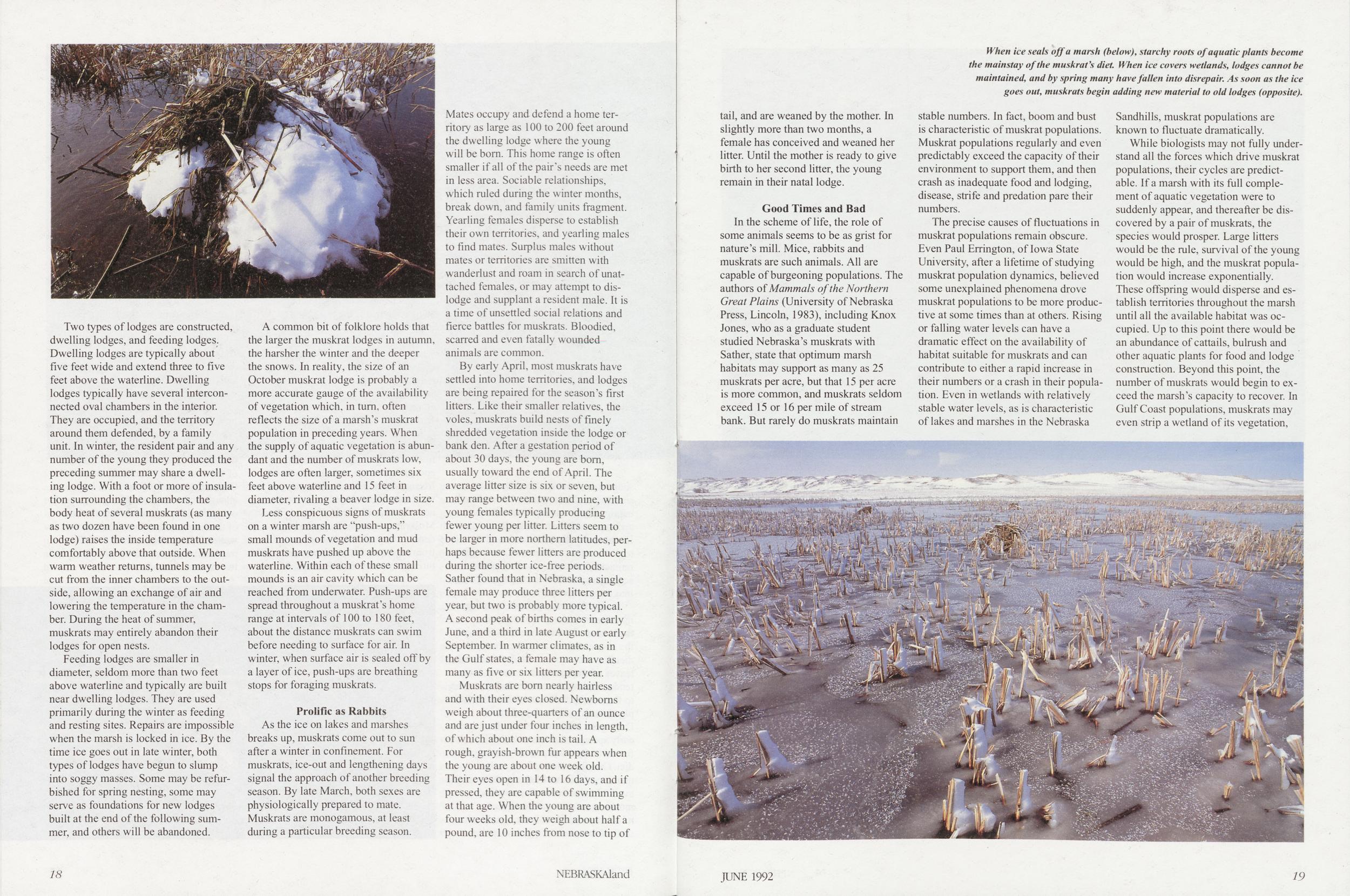
Two types of lodges are constructed, dwelling lodges, and feeding lodges. Dwelling lodges are typically about five feet wide and extend three to five feet above the waterline. Dwelling lodges typically have several interconnected oval chambers in the interior. They are occupied, and the territory around them defended, by a family unit. In winter, the resident pair and any number of the young they produced the preceding summer may share a dwelling lodge. With a foot or more of insulation surrounding the chambers, the body heat of several muskrats (as many as two dozen have been found in one lodge) raises the inside temperature comfortably above that outside. When warm weather returns, tunnels may be cut from the inner chambers to the outside, allowing an exchange of air and lowering the temperature in the chamber. During the heat of summer, muskrats may entirely abandon their lodges for open nests.
Feeding lodges are smaller in diameter, seldom more than two feet above waterline and typically are built near dwelling lodges. They are used primarily during the winter as feeding and resting sites. Repairs are impossible when the marsh is locked in ice. By the time ice goes out in late winter, both types of lodges have begun to slump into soggy masses. Some may be refurbished for spring nesting, some may serve as foundations for new lodges built at the end of the following summer, and others will be abandoned.
A common bit of folklore holds that the larger the muskrat lodges in autumn, the harsher the winter and the deeper the snows. In reality, the size of an October muskrat lodge is probably a more accurate gauge of the availability of vegetation which, in turn, often reflects the size of a marsh's muskrat population in preceding years. When the supply of aquatic vegetation is abundant and the number of muskrats low, lodges are often larger, sometimes six feet above waterline and 15 feet in diameter, rivaling a beaver lodge in size.
Less conspicuous signs of muskrats on a winter marsh are "push-ups," small mounds of vegetation and mud muskrats have pushed up above the waterline. Within each of these small mounds is an air cavity which can be reached from underwater. Push-ups are spread throughout a muskrat's home range at intervals of 100 to 180 feet, about the distance muskrats can swim before needing to surface for air. In winter, when surface air is sealed off by a layer of ice, push-ups are breathing stops for foraging muskrats.
Prolific as RabbitsAs the ice on lakes and marshes breaks up, muskrats come out to sun after a winter in confinement. For muskrats, ice-out and lengthening days signal the approach of another breeding season. By late March, both sexes are physiologically prepared to mate. Muskrats are monogamous, at least during a particular breeding season. Mates occupy and defend a home territory as large as 100 to 200 feet around the dwelling lodge where the young will be born. This home range is often smaller if all of the pair's needs are met in less area. Sociable relationships, which ruled during the winter months, break down, and family units fragment. Yearling females disperse to establish their own territories, and yearling males to find mates. Surplus males without mates or territories are smitten with wanderlust and roam in search of unattached females, or may attempt to dislodge and supplant a resident male. It is a time of unsettled social relations and fierce battles for muskrats. Bloodied, scarred and even fatally wounded animals are common.
By early April, most muskrats have settled into home territories, and lodges are being repaired for the season's first litters. Like their smaller relatives, the voles, muskrats build nests of finely shredded vegetation inside the lodge or bank den. After a gestation period of about 30 days, the young are born, usually toward the end of April. The average litter size is six or seven, but may range between two and nine, with young females typically producing fewer young per litter. Litters seem to be larger in more northern latitudes, perhaps because fewer litters are produced during the shorter ice-free periods. Sather found that in Nebraska, a single female may produce three litters per year, but two is probably more typical. A second peak of births comes in early June, and a third in late August or early September. In warmer climates, as in the Gulf states, a female may have as many as five or six litters per year.
Muskrats are born nearly hairless and with their eyes closed. Newborns weigh about three-quarters of an ounce and are just under four inches in length, of which about one inch is tail. A rough, grayish-brown fur appears when the young are about one week old. Their eyes open in 14 to 16 days, and if pressed, they are capable of swimming at that age. When the young are about four weeks old, they weigh about half a pound, are 10 inches from nose to tip of 18 NEBRASKAland tail, and are weaned by the mother. In slightly more than two months, a female has conceived and weaned her litter. Until the mother is ready to give birth to her second litter, the young remain in their natal lodge.
Good Times and BadIn the scheme of life, the role of some animals seems to be as grist for nature's mill. Mice, rabbits and muskrats are such animals. All are capable of burgeoning populations. The authors of Mammals of the Northern Great Plains (University of Nebraska Press, Lincoln, 1983), including Knox Jones, who as a graduate student studied Nebraska's muskrats with Sather, state that optimum marsh habitats may support as many as 25 muskrats per acre, but that 15 per acre is more common, and muskrats seldom exceed 15 or 16 per mile of stream bank. But rarely do muskrats maintain stable numbers. In fact, boom and bust is characteristic of muskrat populations. Muskrat populations regularly and even predictably exceed the capacity of their environment to support them, and then crash as inadequate food and lodging, disease, strife and predation pare their numbers.
The precise causes of fluctuations in muskrat populations remain obscure. Even Paul Errington, of Iowa State University, after a lifetime of studying muskrat population dynamics, believed some unexplained phenomena drove muskrat populations to be more productive at some times than at others. Rising or falling water levels can have a dramatic effect on the availability of habitat suitable for muskrats and can contribute to either a rapid increase in their numbers or a crash in their population. Even in wetlands with relatively stable water levels, as is characteristic of lakes and marshes in the Nebraska Sandhills, muskrat populations are known to fluctuate dramatically.
While biologists may not fully understand all the forces which drive muskrat populations, their cycles are predictable. If a marsh with its full complement of aquatic vegetation were to suddenly appear, and thereafter be discovered by a pair of muskrats, the species would prosper. Large litters would be the rule, survival of the young would be high, and the muskrat population would increase exponentially. These offspring would disperse and establish territories throughout the marsh until all the available habitat was occupied. Up to this point there would be an abundance of cattails, bulrush and other aquatic plants for food and lodge construction. Beyond this point, the number of muskrats would begin to exceed the marsh's capacity to recover. In Gulf Coast populations, muskrats may even strip a wetland of its vegetation,
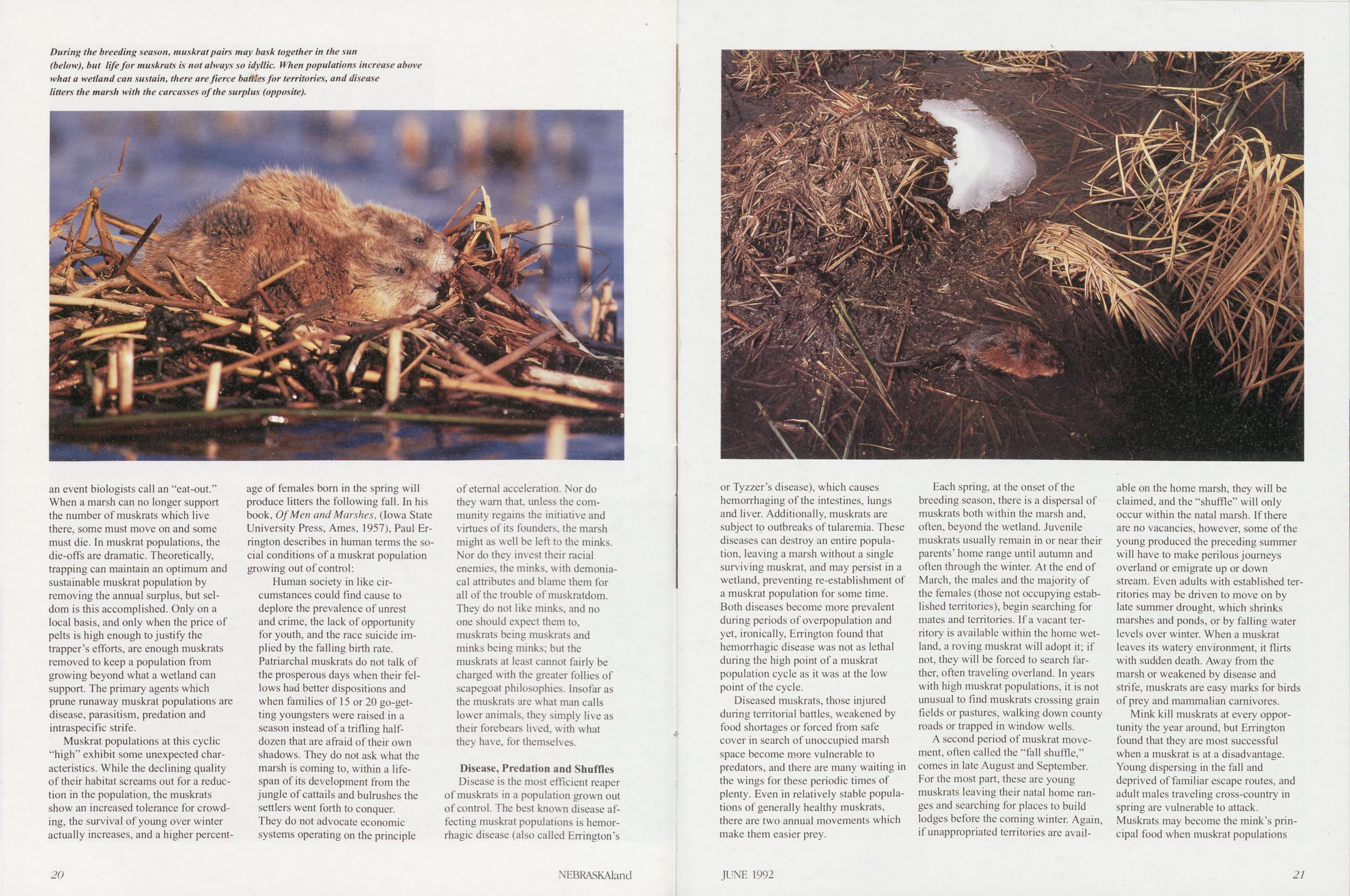
Muskrat populations at this cyclic "high" exhibit some unexpected characteristics. While the declining quality of their habitat screams out for a reduction in the population, the muskrats show an increased tolerance for crowding, the survival of young over winter actually increases, and a higher percentage of females born in the spring will produce litters the following fall. In his book, Of Men and Marshes, (Iowa State University Press, Ames, 1957), Paul Errington describes in human terms the social conditions of a muskrat population growing out of control:
Human society in like circumstances could find cause to deplore the prevalence of unrest and crime, the lack of opportunity for youth, and the race suicide implied by the falling birth rate. Patriarchal muskrats do not talk of the prosperous days when their fellows had better dispositions and when families of 15 or 20 go-getting youngsters were raised in a season instead of a trifling half-dozen that are afraid of their own shadows. They do not ask what the marsh is coming to, within a life-span of its development from the jungle of cattails and bulrushes the settlers went forth to conquer. They do not advocate economic systems operating on the principle of eternal acceleration. Nor do they warn that, unless the community regains the initiative and virtues of its founders, the marsh might as well be left to the minks. Nor do they invest their racial enemies, the minks, with demoniacal attributes and blame them for all of the trouble of muskratdom. They do not like minks, and no one should expect them to, muskrats being muskrats and minks being minks; but the muskrats at least cannot fairly be charged with the greater follies of scapegoat philosophies. Insofar as the muskrats are what man calls lower animals, they simply live as their forebears lived, with what they have, for themselves.
Disease, Predation and ShufflesDisease is the most efficient reaper of muskrats in a population grown out of control. The best known disease affecting muskrat populations is hemorrhagic disease (also called Errington's 20 NEBRASKAland or Tyzzer's disease), which causes hemorrhaging of the intestines, lungs and liver. Additionally, muskrats are subject to outbreaks of tularemia. These diseases can destroy an entire population, leaving a marsh without a single surviving muskrat, and may persist in a wetland, preventing re-establishment of a muskrat population for some time. Both diseases become more prevalent during periods of overpopulation and yet, ironically, Errington found that hemorrhagic disease was not as lethal during the high point of a muskrat population cycle as it was at the low point of the cycle.
Diseased muskrats, those injured during territorial battles, weakened by food shortages or forced from safe cover in search of unoccupied marsh space become more vulnerable to predators, and there are many waiting in the wings for these periodic times of plenty. Even in relatively stable populations of generally healthy muskrats, there are two annual movements which make them easier prey.
Each spring, at the onset of the breeding season, there is a dispersal of muskrats both within the marsh and, often, beyond the wetland. Juvenile muskrats usually remain in or near their parents' home range until autumn and often through the winter. At the end of March, the males and the majority of the females (those not occupying established territories), begin searching for mates and territories. If a vacant territory is available within the home wetland, a roving muskrat will adopt it; if not, they will be forced to search farther, often traveling overland. In years with high muskrat populations, it is not unusual to find muskrats crossing grain fields or pastures, walking down county roads or trapped in window wells.
A second period of muskrat movement, often called the "fall shuffle," comes in late August and September. For the most part, these are young muskrats leaving their natal home ranges and searching for places to build lodges before the coming winter. Again, if unappropriated territories are available on the home marsh, they will be claimed, and the "shuffle" will only occur within the natal marsh. If there are no vacancies, however, some of the young produced the preceding summer will have to make perilous journeys overland or emigrate up or down stream. Even adults with established territories may be driven to move on by late summer drought, which shrinks marshes and ponds, or by falling water levels over winter. When a muskrat leaves its watery environment, it flirts with sudden death. Away from the marsh or weakened by disease and strife, muskrats are easy marks for birds of prey and mammalian carnivores.
Mink kill muskrats at every opportunity the year around, but Errington
found that they are most successful
when a muskrat is at a disadvantage.
Young dispersing in the fall and
deprived of familiar escape routes, and
adult males traveling cross-country in
spring are vulnerable to attack.
Muskrats may become the mink's principal food when muskrat populations
JUNE 1992
21
 are high and diseased. Mink are not opposed to scavenging dead muskrats and
will even establish temporary residence
in the midst of disease "hotspots." In
Iowa, Errington found that 70 percent
of the time mink fed on muskrat flesh,
it came from dead animals.
are high and diseased. Mink are not opposed to scavenging dead muskrats and
will even establish temporary residence
in the midst of disease "hotspots." In
Iowa, Errington found that 70 percent
of the time mink fed on muskrat flesh,
it came from dead animals.
In addition to mink, a host of other predators willingly capitalize on the sudden abundance of diseased, weakened or wandering muskrats. A Nebraska study in the late 1940s and early 1950s, by Nebraska Game, Forestation and Parks Commission biologists Edson Fichter, George Schildman and J. Henry Sather, found a close correlation between the frequency of coyotes feeding on muskrats and the timing of the spring dispersal of muskrats. In the Sandhills lake country, unlike other regions of the state, muskrats were ranked as the second most important food item for coyotes. Sather found the incidence of coyotes opening muskrat lodges and preying on muskrats highest when populations were diseased.
Badgers, foxes, otters and raccoons also feed on muskrats when the opportunity presents itself. Hawks, owls and eagles no doubt have an even easier time picking off muskrats traveling on dry land. Seldom, though, does the effort of all these predators have an adverse effect on a healthy population of muskrats. When muskrats exceed the capacity of their environment and are diseased, these predators may actually exert some pressure to keep their numbers more in balance with what the available habitat can support. Unfortunately for the muskrat, this help usually is too little too late.
Marsh HomebuildersIn the course of a year, through their industrious labors, muskrats harvest an almost incredible volume of emergent vegetation, opening up dense stands of marsh vegetation and creating habitat for a host of other wetland creatures. Some of the vegetation they consume, but the bulk of it is used for the construction and maintenance of lodges. To transport this material, they cut a network of channels through thick stands of cattail and bulrush that would otherwise choke the marsh. From the air, the work of a family of muskrats is conspicuous — a central dwelling lodge, often with satellite feeding lodges, each nestled in a pool of water cleared of surrounding emergent vegetation, and a network of open channels radiating out to feeding areas. These channels and pools are marsh edge within marsh edge, micro-environments of great importance. They are travel lanes for waterbirds, and often the deepest water found in a marsh during drought, places where fish may survive to replenish the marsh when rains and snowmelt finally recharge it, fish that will feed terns and black-crowned night-herons.
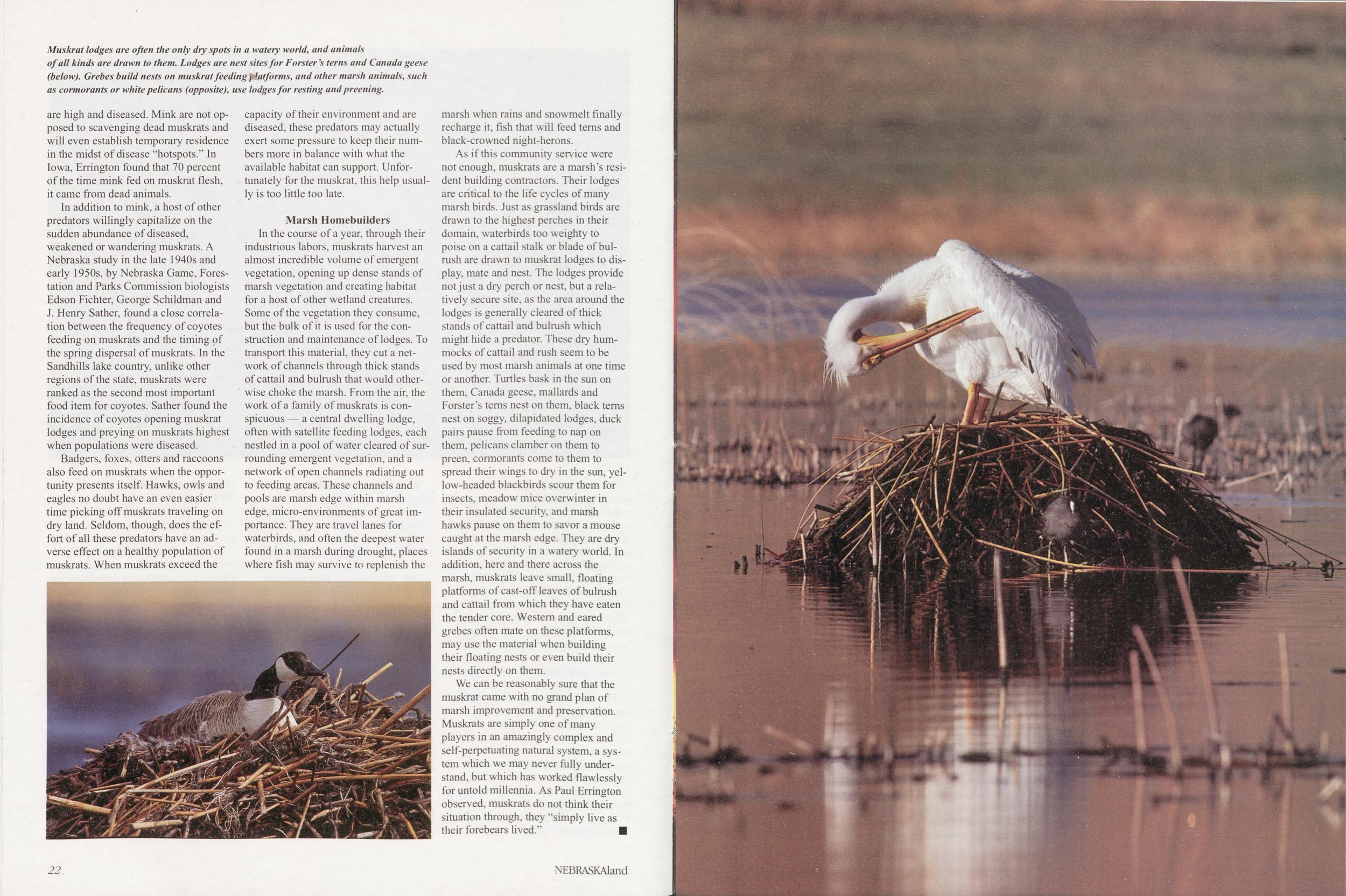
As if this community service were not enough, muskrats are a marsh's resident building contractors. Their lodges are critical to the life cycles of manymarsh birds. Just as grassland birds are drawn to the highest perches in their domain, waterbirds too weighty to poise on a cattail stalk or blade of bulrush are drawn to muskrat lodges to display, mate and nest. The lodges provide not just a dry perch or nest, but a relatively secure site, as the area around the lodges is generally cleared of thick stands of cattail and bulrush which might hide a predator. These dry hummocks of cattail and rush seem to be used by most marsh animals at one time or another. Turtles bask in the sun on them, Canada geese, mallards and Forster's terns nest on them, black terns nest on soggy, dilapidated lodges, duck pairs pause from feeding to nap on them, pelicans clamber on them to preen, cormorants come to them to spread their wings to dry in the sun, yellow-headed blackbirds scour them for insects, meadow mice overwinter in their insulated security, and marsh hawks pause on them to savor a mouse caught at the marsh edge. They are dry islands of security in a watery world. In addition, here and there across the marsh, muskrats leave small, floating platforms of cast-off leaves of bulrush and cattail from which they have eaten the tender core. Western and eared grebes often mate on these platforms, may use the material when building their floating nests or even build their nests directly on them.
We can be reasonably sure that the muskrat came with no grand plan of marsh improvement and preservation. Muskrats are simply one of many players in an amazingly complex and self-perpetuating natural system, a system which we may never fully understand, but which has worked flawlessly for untold millennia. As Paul Errington observed, muskrats do not think their situation through, they "simply live as their forebears lived."
Hank Sather and the Great Plains Muskrat
By Jon Farrar A study ofmuskrats in Nebraska's Sandhills produced not only a classic monograph, but enough memories to last Hank Sather 40years.From 1948 to 1951, J. Henry "Hank" Sather studied muskrats on the Valentine National Wildlife Refuge for the Nebraska Game, Forestation and Parks Commission (as the Game and Parks Commission was then called). In mid-May of 1991, after 40 years of teaching and working with wetlands around the world, Sather returned to the Sandhills. In describing his reaction to the country he had not visited for many years, the retired Dean of the Graduate School at Western Illinois University resorted to the words of America's much-quoted philosopher, former New York Yankees catcher and manager Yogi Bera, "It's deja vu all over again."
"It's weird, the feeling you get," Sather continued. "Even the trails are the same. The trail from Pelican Fake to the highway — it's the same. They haven't improved it at all, which is great. I've never returned to an area and had it look almost exactly identical to when I left. Wetlands are very dynamic ecosystems; they're changing all the time, in hardlands anyway. The prairiepothole country [in the Dakotas and south-central Canada] is an example of how rapidly wetland ecosystems change — they're very dynamic. The Sandhills wetlands are about as stable, I think, as any wetlands you'll find anyplace."
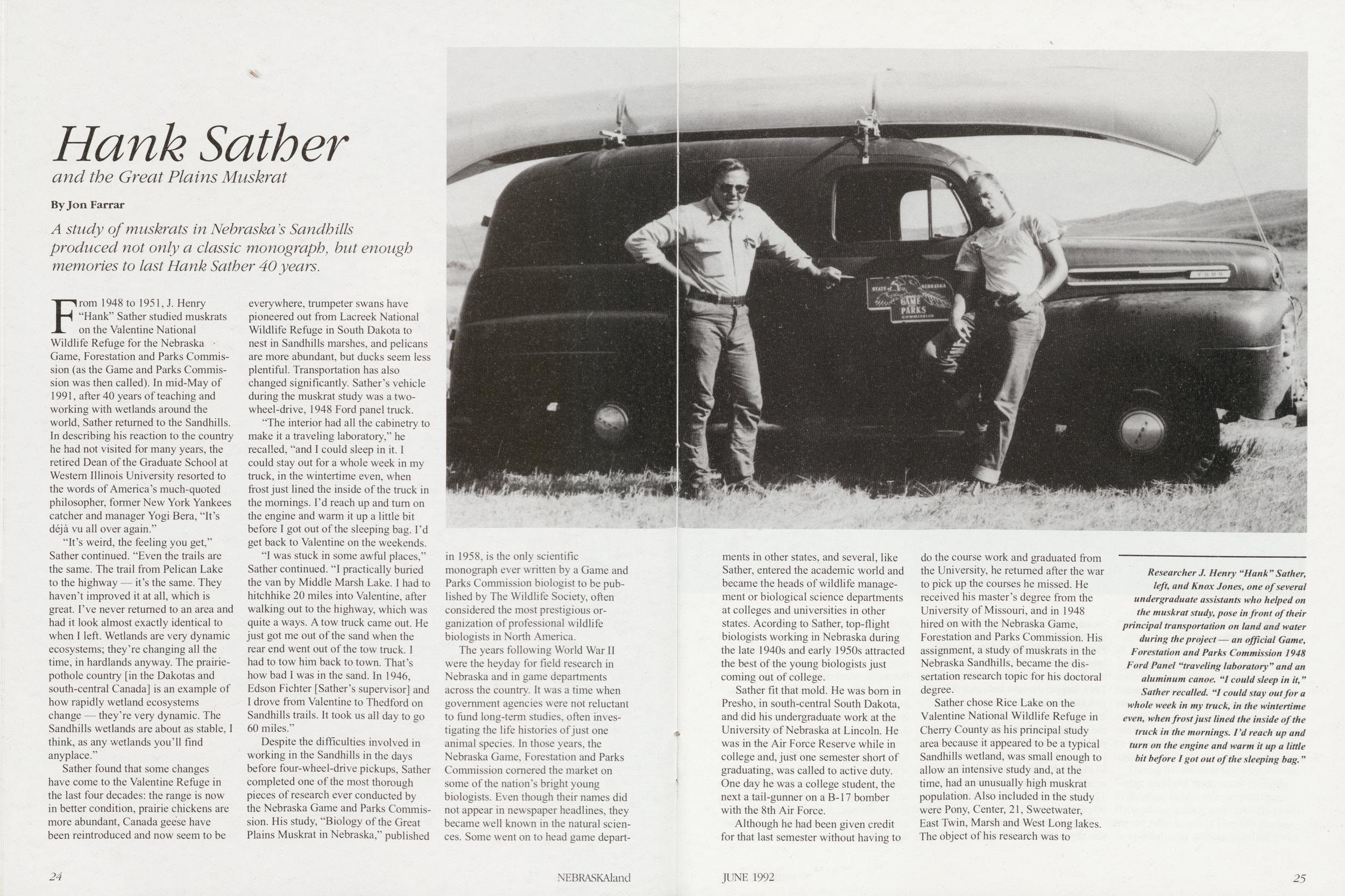
Sather found that some changes have come to the Valentine Refuge in the last four decades: the range is now in better condition, prairie chickens are more abundant, Canada geese have been reintroduced and now seem to be everywhere, trumpeter swans have pioneered out from Facreek National Wildlife Refuge in South Dakota to nest in Sandhills marshes, and pelicans are more abundant, but ducks seem less plentiful. Transportation has also changed significantly. Sather's vehicle during the muskrat study was a two-wheel-drive, 1948 Ford panel truck.
"The interior had all the cabinetry to make it a traveling laboratory," he recalled, "and I could sleep in it. I could stay out for a whole week in my truck, in the wintertime even, when frost just lined the inside of the truck in the mornings. I'd reach up and turn on the engine and warm it up a little bit before I got out of the sleeping bag. I'd get back to Valentine on the weekends.
"I was stuck in some awful places," Sather continued. "I practically buried the van by Middle Marsh Fake. I had to hitchhike 20 miles into Valentine, after walking out to the highway, which was quite a ways. A tow truck came out. He just got me out of the sand when the rear end went out of the tow truck. I had to tow him back to town. That's how bad I was in the sand. In 1946, Edson Fichter [Sather's supervisor] and I drove from Valentine to Thedford on Sandhills trails. It took us all day to go 60 miles."
Despite the difficulties involved in working in the Sandhills in the days before four-wheel-drive pickups, Sather completed one of the most thorough pieces of research ever conducted by the Nebraska Game and Parks Commission. His study, "Biology of the Great Plains Muskrat in Nebraska," published in 1958, is the only scientific monograph ever written by a Game and Parks Commission biologist to be published by The Wildlife Society, often considered the most prestigious organization of professional wildlife biologists in North America.
The years following World War II were the heyday for field research in Nebraska and in game departments across the country. It was a time when government agencies were not reluctant to fund long-term studies, often investigating the life histories of just one animal species. In those years, the Nebraska Game, Forestation and Parks Commission cornered the market on some of the nation's bright young biologists. Even though their names did not appear in newspaper headlines, they became well known in the natural sciences. Some went on to head game departments 24 NEBRASKAland in other states, and several, like Sather, entered the academic world and became the heads of wildlife management or biological science departments at colleges and universities in other states. Acording to Sather, top-flight biologists working in Nebraska during the late 1940s and early 1950s attracted the best of the young biologists just coming out of college.
Sather fit that mold. He was bom in Presho, in south-central South Dakota, and did his undergraduate work at the University of Nebraska at Fincoln. He was in the Air Force Reserve while in college and, just one semester short of graduating, was called to active duty. One day he was a college student, the next a tail-gunner on a B-17 bomber with the 8th Air Force.
Although he had been given credit for that last semester without having to do the course work and graduated from the University, he returned after the war to pick up the courses he missed. He received his master's degree from the University of Missouri, and in 1948 hired on with the Nebraska Game, Forestation and Parks Commission. His assignment, a study ofmuskrats in the Nebraska Sandhills, became the dissertation research topic for his doctoral degree.
Sather chose Rice Lake on the
Valentine National Wildlife Refuge in
Cherry County as his principal study
area because it appeared to be a typical
Sandhills wetland, was small enough to
allow an intensive study and, at the
time, had an unusually high muskrat
population. Also included in the studywere Pony, Center, 21, Sweetwater,
East Twin, Marsh and West Long lakes.
The object of his research was to
JUNE 1992
25
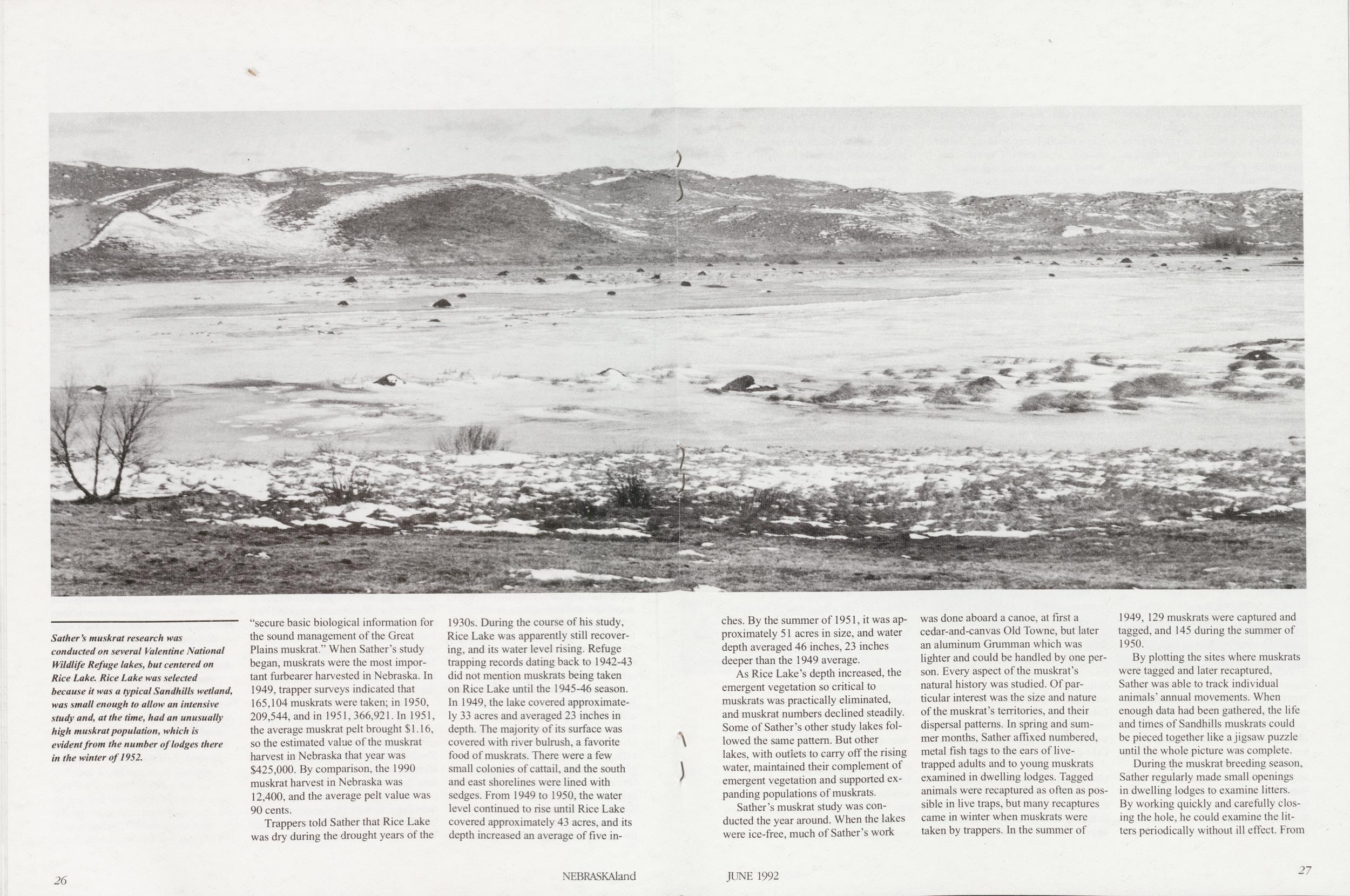
Trappers told Sather that Rice Lake was dry during the drought years of the 1930s. During the course of his study, Rice Lake was apparently still recovering, and its water level rising. Refuge trapping records dating back to 1942-43 did not mention muskrats being taken on Rice Lake until the 1945-46 season. In 1949, the lake covered approximately 33 acres and averaged 23 inches in depth. The majority of its surface was covered with river bulrush, a favorite food of muskrats. There were a few small colonies of cattail, and the south and east shorelines were lined with sedges. From 1949 to 1950, the water level continued to rise until Rice Lake covered approximately 43 acres, and its depth increased an average of five in ches. 26 NEBRASKAland By the summer of 1951, it was approximately 51 acres in size, and water depth averaged 46 inches, 23 inches deeper than the 1949 average.
As Rice Lake's depth increased, the emergent vegetation so critical to muskrats was practically eliminated, and muskrat numbers declined steadily. Some of Sather's other study lakes followed the same pattern. But other lakes, with outlets to carry off the rising water, maintained their complement of emergent vegetation and supported expanding populations of muskrats.
Sather's muskrat study was conducted the year around. When the lakes were ice-free, much of Sather's work was done aboard a canoe, at first a cedar-and-canvas Old Towne, but later an aluminum Grumman which was lighter and could be handled by one person. Every aspect of the muskrat's natural history was studied. Of particular interest was the size and nature of the muskrat's territories, and their dispersal patterns. In spring and summer months, Sather affixed numbered, metal fish tags to the ears of livetrapped adults and to young muskrats examined in dwelling lodges. Tagged animals were recaptured as often as possible in live traps, but many recaptures came in winter when muskrats were taken by trappers. In the summer of 1949, 129 muskrats were captured and tagged, and 145 during the summer of 1950.
By plotting the sites where muskrats were tagged and later recaptured, Sather was able to track individual animals' annual movements. When enough data had been gathered, the life and times of Sandhills muskrats could be pieced together like a jigsaw puzzle until the whole picture was complete.
During the muskrat breeding season,
Sather regularly made small openings
in dwelling lodges to examine litters.
By working quickly and carefully closing the hole, he could examine the litters periodically
without ill effect. From
JUNE 1992
27
 such information he was able to determine average litter size, peaks of
production, sex ratios and growth rates
— critical information for managing a
population of wild animals.
such information he was able to determine average litter size, peaks of
production, sex ratios and growth rates
— critical information for managing a
population of wild animals.
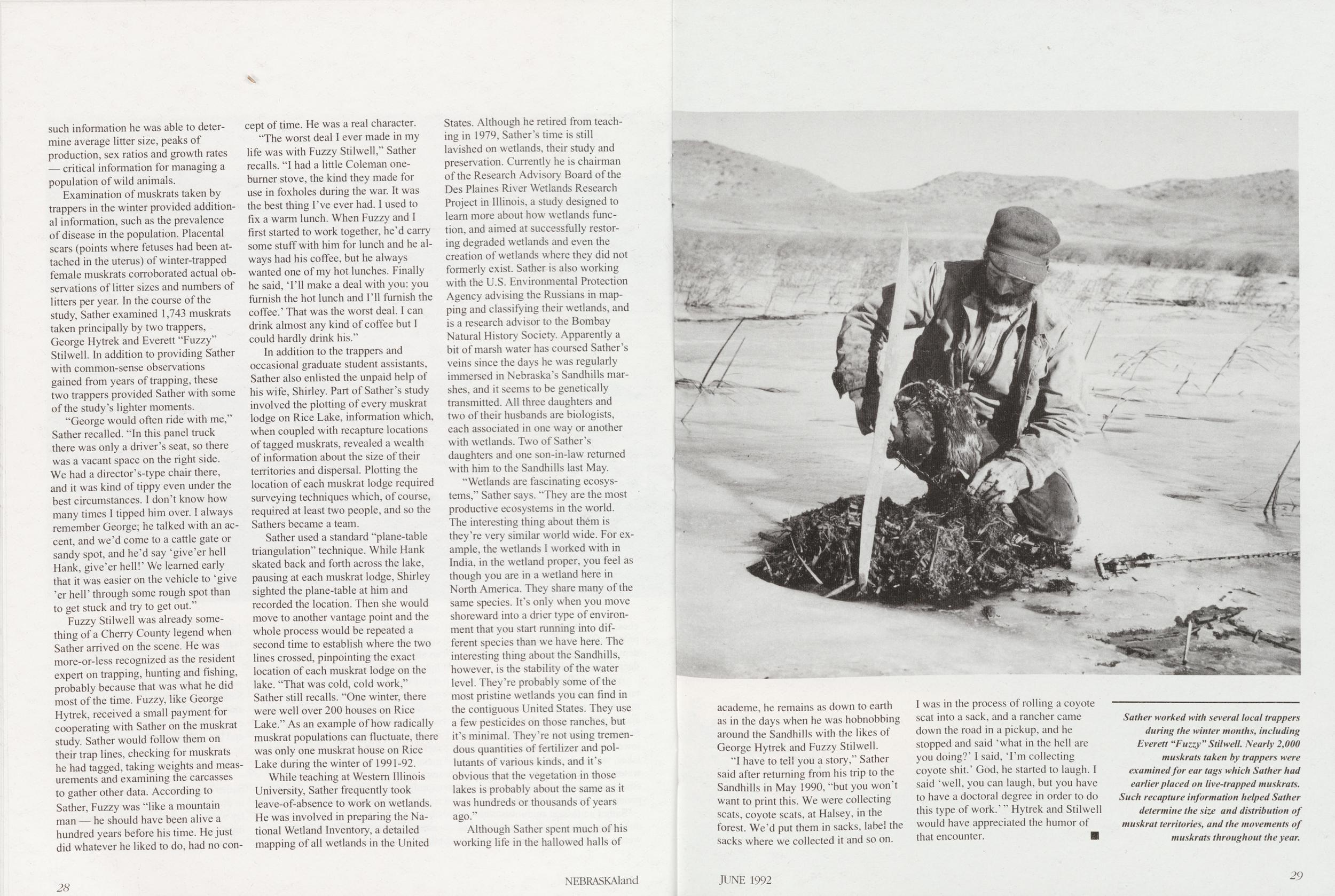
Examination of muskrats taken by trappers in the winter provided additional information, such as the prevalence of disease in the population. Placental scars (points where fetuses had been attached in the uterus) of winter-trapped female muskrats corroborated actual observations of litter sizes and numbers of litters per year. In the course of the study, Sather examined 1,743 muskrats taken principally by two trappers, George Hytrek and Everett "Fuzzy" Stilwell. In addition to providing Sather with common-sense observations gained from years of trapping, these two trappers provided Sather with some of the study's lighter moments.
"George would often ride with me," Sather recalled. "In this panel truck there was only a driver's seat, so there was a vacant space on the right side. We had a director's-type chair there, and it was kind of tippy even under the best circumstances. I don't know how many times I tipped him over. I always remember George; he talked with an accent, and we'd come to a cattle gate or sandy spot, and he'd say 'give'er hell Hank, give'er hell!' We learned early that it was easier on the vehicle to 'give 'er hell' through some rough spot than to get stuck and try to get out."
Fuzzy Stilwell was already something of a Cherry County legend when Sather arrived on the scene. He was more-or-less recognized as the resident expert on trapping, hunting and fishing, probably because that was what he did most of the time. Fuzzy, like George Hytrek, received a small payment for cooperating with Sather on the muskrat study. Sather would follow them on their trap lines, checking for muskrats he had tagged, taking weights and measurements and examining the carcasses to gather other data. According to Sather, Fuzzy was "like a mountain man — he should have been alive a hundred years before his time. He just did whatever he liked to do, had no concept of time. He was a real character.
"The worst deal I ever made in my life was with Fuzzy Stilwell," Sather recalls. "I had a little Coleman oneburner stove, the kind they made for use in foxholes during the war. It was the best thing I've ever had. I used to fix a warm lunch. When Fuzzy and I first started to work together, he'd carry some stuff with him for lunch and he always had his coffee, but he always wanted one of my hot lunches. Finally he said, Til make a deal with you: you furnish the hot lunch and I'll furnish the coffee.' That was the worst deal. I can drink almost any kind of coffee but I could hardly drink his."
In addition to the trappers and occasional graduate student assistants, Sather also enlisted the unpaid help of his wife, Shirley. Part of Sather's study involved the plotting of every muskrat lodge on Rice Lake, information which, when coupled with recapture locations of tagged muskrats, revealed a wealth of information about the size of their territories and dispersal. Plotting the location of each muskrat lodge required surveying techniques which, of course, required at least two people, and so the Sathers became a team.
Sather used a standard "plane-table triangulation" technique. While Hank skated back and forth across the lake, pausing at each muskrat lodge, Shirley sighted the plane-table at him and recorded the location. Then she would move to another vantage point and the whole process would be repeated a second time to establish where the two lines crossed, pinpointing the exact location of each muskrat lodge on the lake. "That was cold, cold work," Sather still recalls. "One winter, there were well over 200 houses on Rice Lake." As an example of how radically muskrat populations can fluctuate, there was only one muskrat house on Rice Lake during the winter of 1991-92.
While teaching at Western Illinois University, Sather frequently took leave-of-absence to work on wetlands. He was involved in preparing the National Wetland Inventory, a detailed mapping of all wetlands in the United States. Although he retired from teaching in 1979, Sather's time is still lavished on wetlands, their study and preservation. Currently he is chairman of the Research Advisory Board of the Des Plaines River Wetlands Research Project in Illinois, a study designed to learn more about how wetlands function, and aimed at successfully restoring degraded wetlands and even the creation of wetlands where they did not formerly exist. Sather is also working with the U.S. Environmental Protection Agency advising the Russians in mapping and classifying their wetlands, and is a research advisor to the Bombay Natural History Society. Apparently a bit of marsh water has coursed Sather's veins since the days he was regularly immersed in Nebraska's Sandhills marshes, and it seems to be genetically transmitted. All three daughters and two of their husbands are biologists, each associated in one way or another with wetlands. Two of Sather's daughters and one son-in-law returned with him to the Sandhills last May.
"Wetlands are fascinating ecosystems," Sather says. "They are the most productive ecosystems in the world. The interesting thing about them is they're very similar world wide. For example, the wetlands I worked with in India, in the wetland proper, you feel as though you are in a wetland here in North America. They share many of the same species. It's only when you move shoreward into a drier type of environment that you start running into different species than we have here. The interesting thing about the Sandhills, however, is the stability of the water level. They're probably some of the most pristine wetlands you can find in the contiguous United States. They use a few pesticides on those ranches, but it's minimal. They're not using tremendous quantities of fertilizer and pollutants of various kinds, and it's obvious that the vegetation in those lakes is probably about the same as it was hundreds or thousands of years ago."
Although Sather spent much of his working life in the hallowed halls of 28 NEBRASKAland academe, he remains as down to earth as in the days when he was hobnobbing around the Sandhills with the likes of George Hytrek and Fuzzy Stilwell.
"I have to tell you a story," Sather said after returning from his trip to the Sandhills in May 1990, "but you won't want to print this. We were collecting scats, coyote scats, at Halsey, in the forest. We'd put them in sacks, label the sacks where we collected it and so on. I was in the process of rolling a coyote scat into a sack, and a rancher came down the road in a pickup, and he stopped and said 'what in the hell are you doing?' I said, 'I'm collecting coyote shit.' God, he started to laugh. I said 'well, you can laugh, but you have to have a doctoral degree in order to do this type of work.' " Hytrek and Stilwell would have appreciated the humor of that encounter.
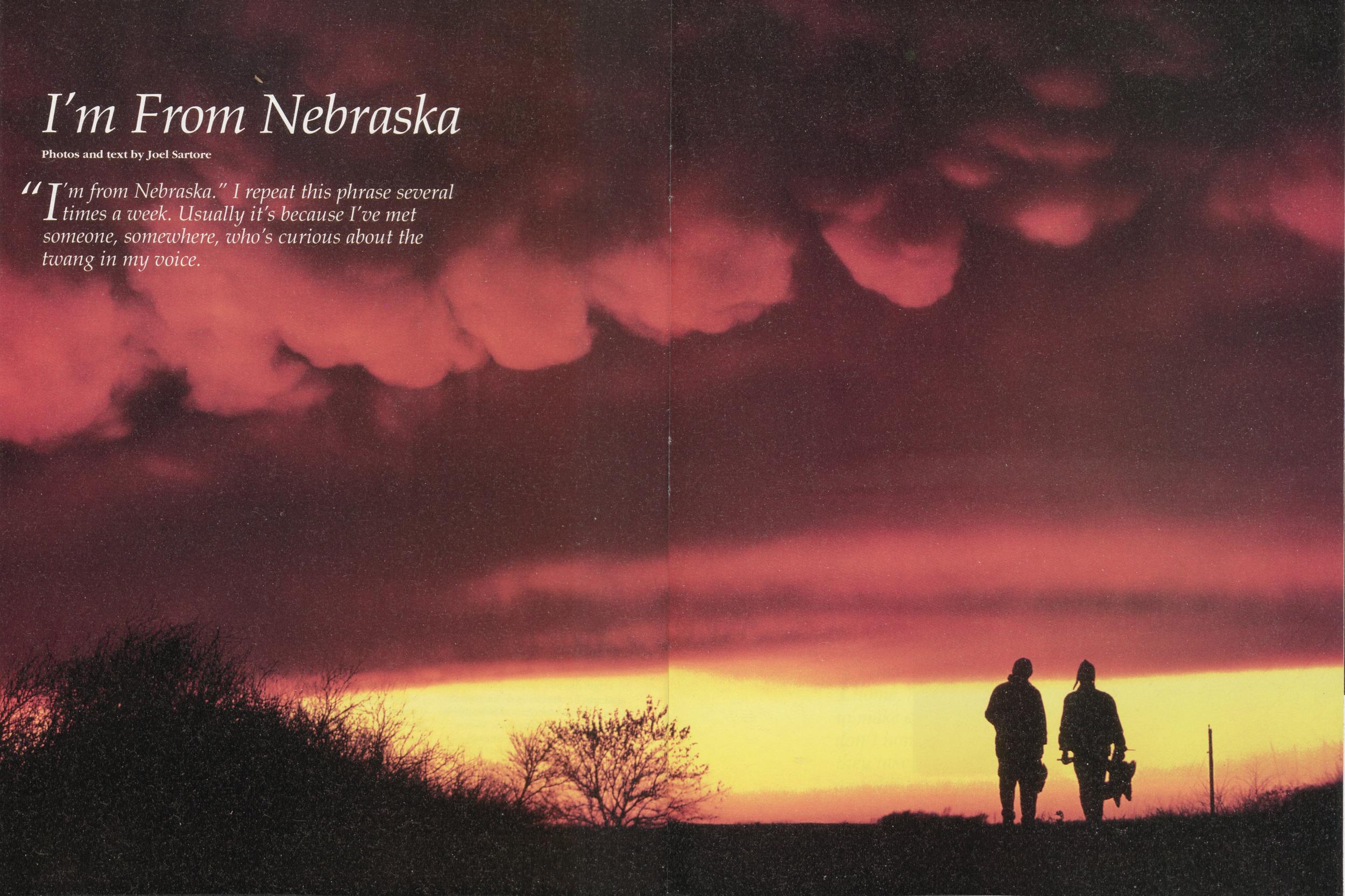
I'm From Nebraska
Photos and text by Joel Sartore "I'm from Nebraska." I repeat this phrase several times a week. Usually it's because I've met someone, somewhere, who's curious about the twang in my voice.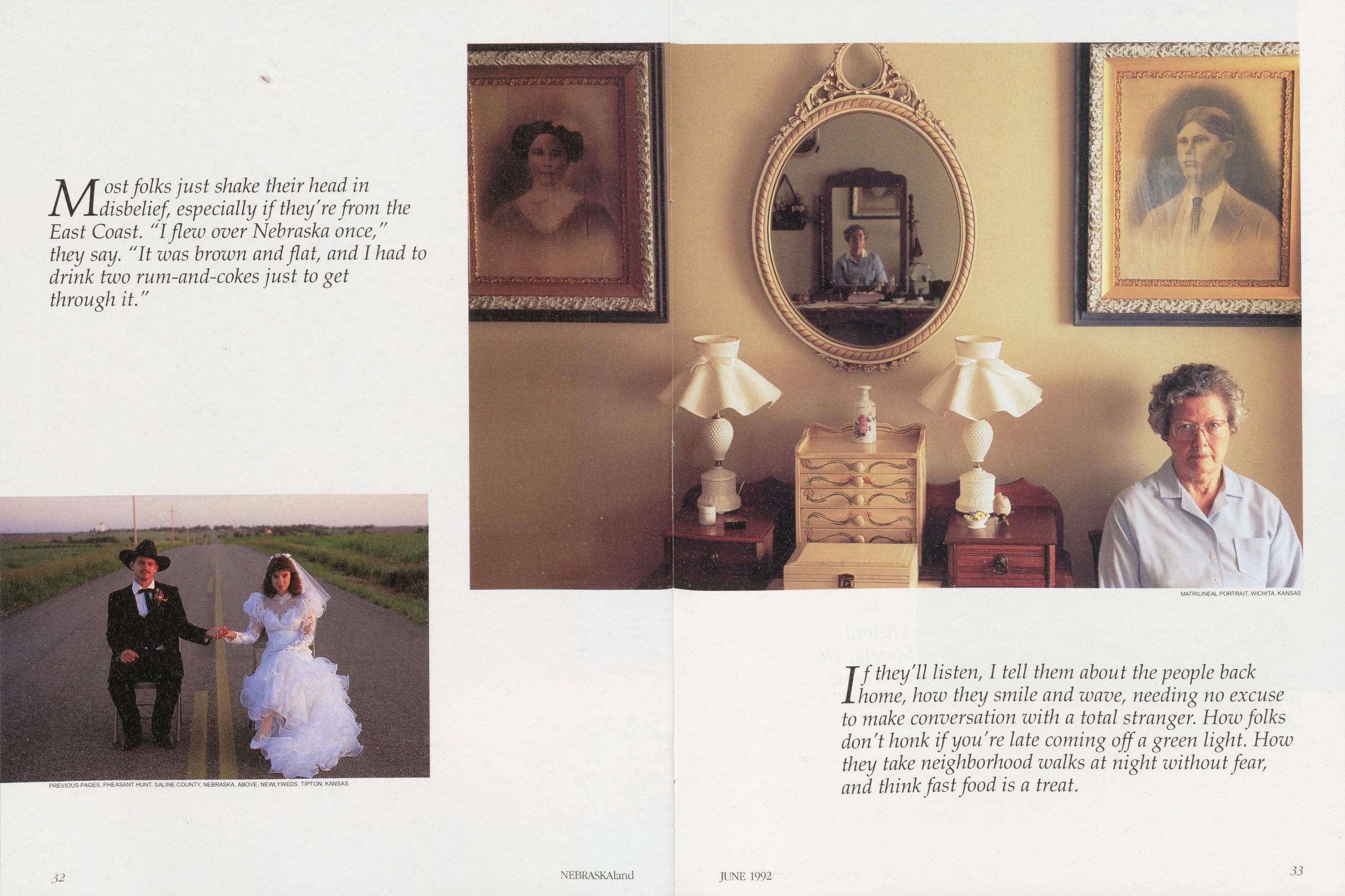
Most folks just shake their head in disbelief, especially if they're from the East Coast. "Iflew over Nebraska once," they say. "It was brown and flat, and I had to drink two rum-and-cokes just to get through it."
If they'll listen, I tell them about the people back home, how they smile and wave, needing no excuse to make conversation with a total stranger. How folks don't honk if you're late coming off a green light. How they take neighborhood walks at night without fear, and think fast food is a treat.
JUNE 1992 33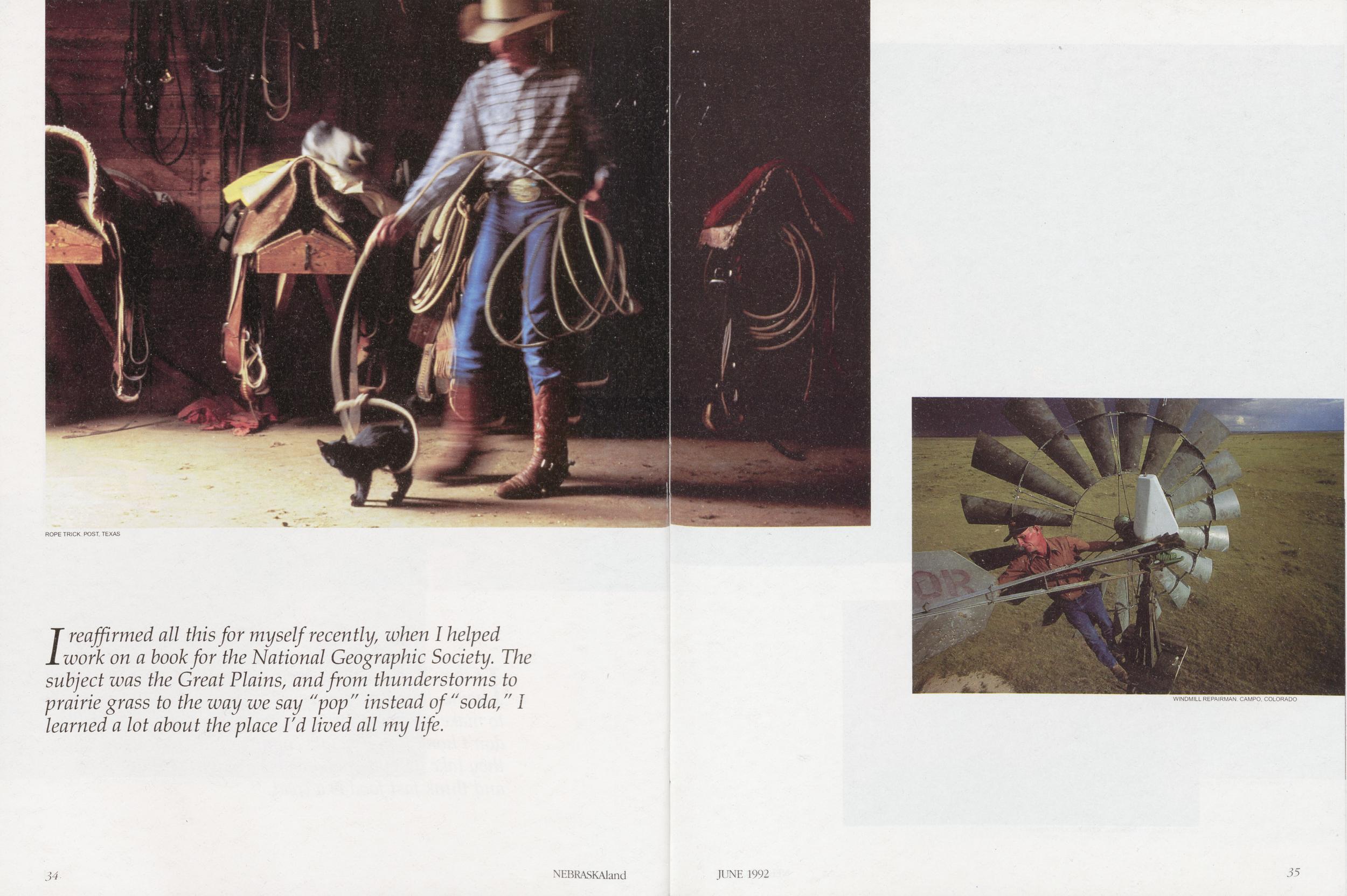
I reaffirmed all this for myself recently, when I helped work on a hook for the National Geographic Society. The subject was the Great Plains, and from thunderstorms to prairie grass to the way we say "pop" instead of "soda," I earned a lot about the place Yd lived all my life.
34 NEBRASKAland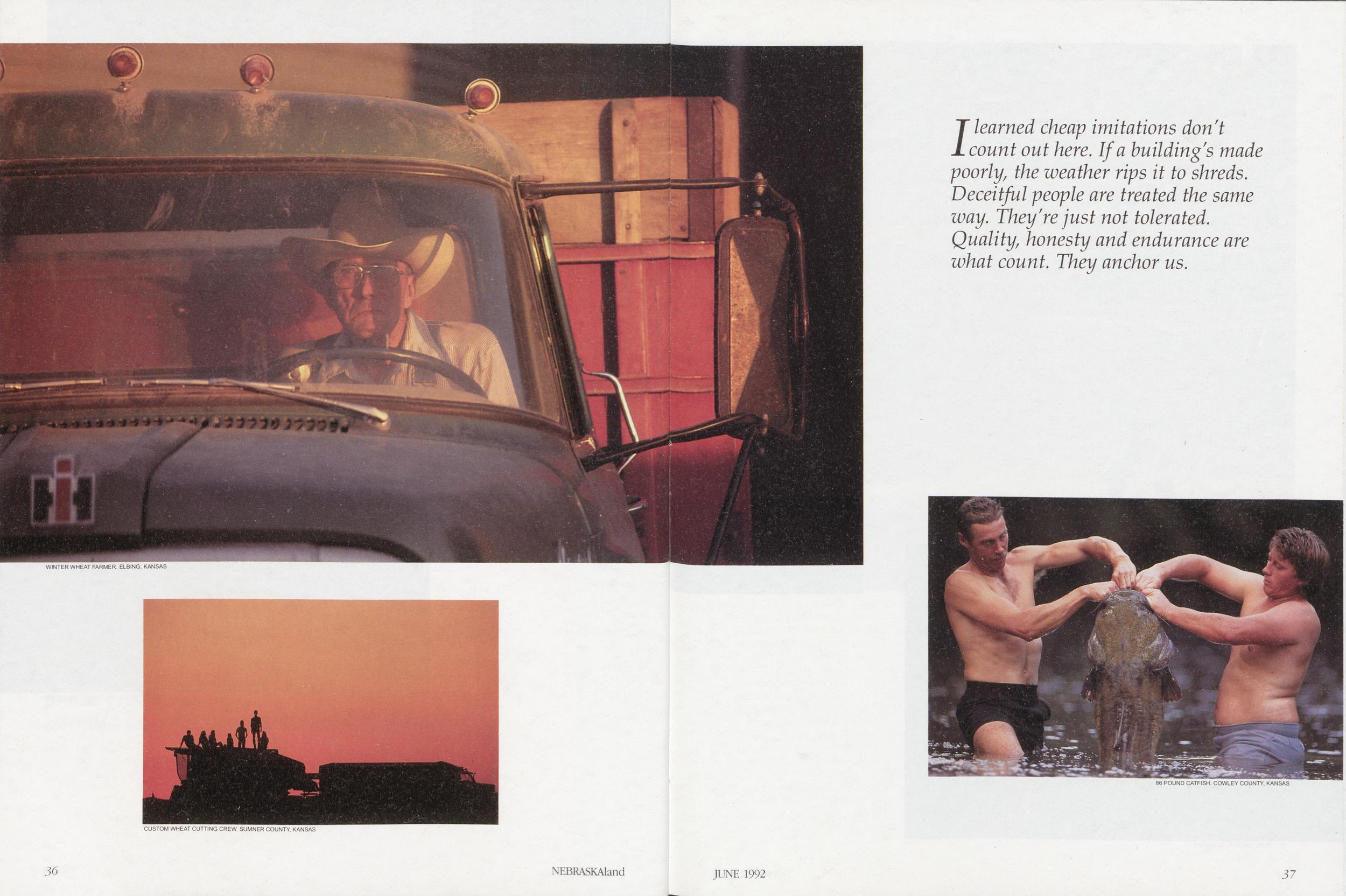
I learned cheap imitations don't count out here. If a building's made poorly, the weather rips it to shreds. Deceitful people are treated the same way. They're just not tolerated. Quality, honesty and endurance are what count. They anchor us.
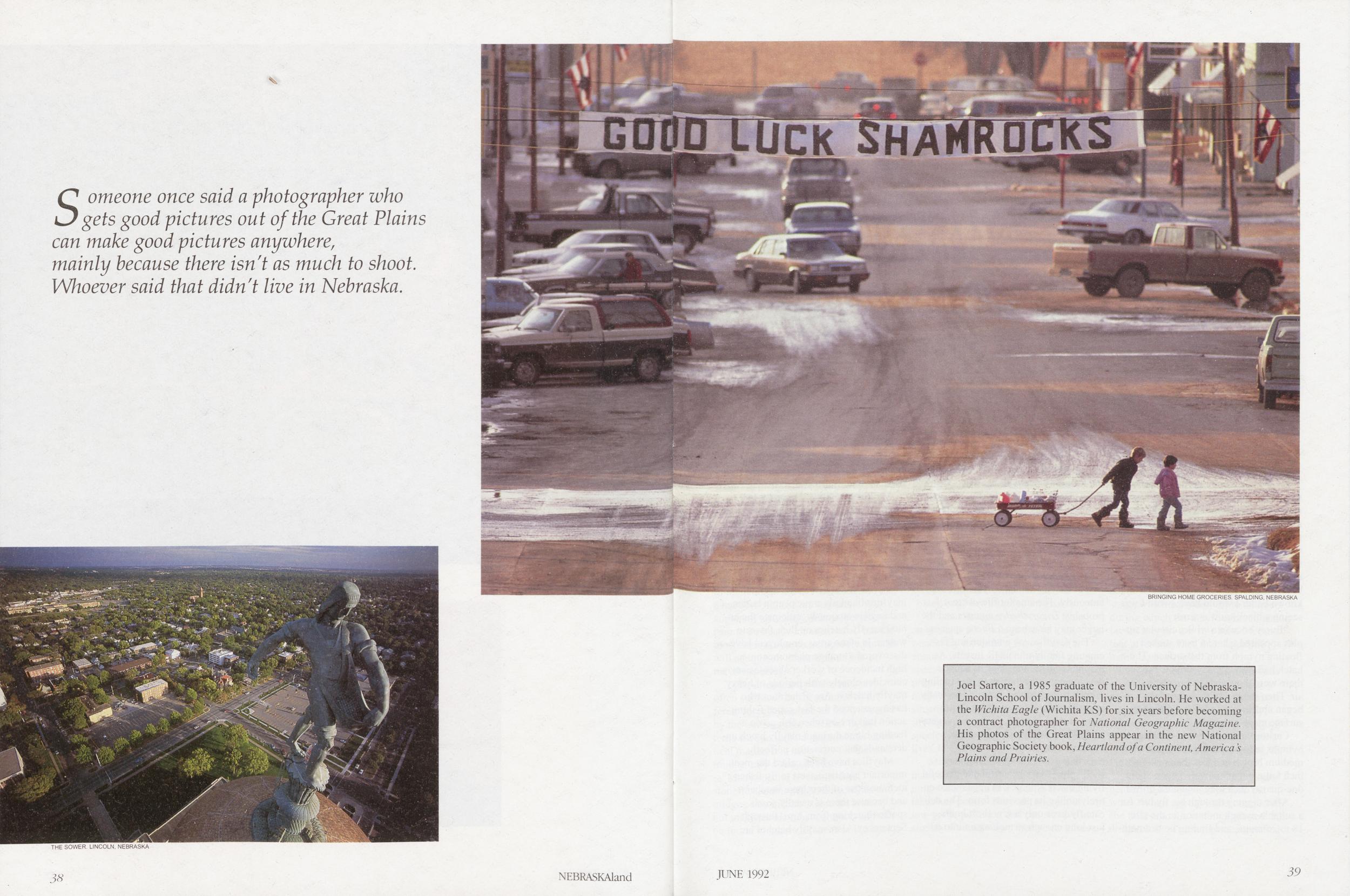
Someone once said a photographer who gets good pictures out of the Great Plains can make good pictures anywhere, mainly because there isn't as much to shoot. Whoever said that didn't live in Nebraska. BRINGING HOME GROCERIES SPALDING, NEBRASKA
Joel Sartore, a 1985 graduate of the University of Nebraska-Lincoln School of Journalism, lives in Lincoln. He worked at the Wichita Eagle (Wichita KS) for six years before becoming a contract photographer for National Geographic Magazine. His photos of the Great Plains appear in the new National Geographic Society book,Heartlandof a Continent, America s Plains and Prairies.
JUNE 1992 39
Fishing The Mayfly Hatch
By Tom Keith Illustrations by Randall Bright Because they are abundant across the state and because their hatches are predictable and frequent throughout the season, mayflies are important to fly fishermen.When Carlton Pennington saw his first mayfly hatch while trout fishing on Nine Mile Creek in Scotts Bluff County, he wasn't sure what was happening. "It was late afternoon and we were drifting Goldribbed Hare's Ear nymph patterns along the bank when I noticed a number of little black flies above the creek. At first there were just a few, but it wasn't long before they were all over. If I hadn't known better I would have sworn I was seeing a black snow storm.
"Every once in a while, circular ripples appeared where a trout sucked a floating nymph from the surface. The hatch had started fairly slowly, but soon there were thousands of insects in the air. Then some slightly larger flies began appearing, and fish dimpled the surface more frequently."
Carlton captured several floating nymphs in his cupped hand. Most were medium brown and less than one-eighth inch long, but a few were larger, about one-quarter inch long, and dark brown.
After digging through his fly box for a suitable nymph imitation in the size 18 to 26 range, and finding he had nothing that small, he used fingernail clippers to trim the wings, tail and most of the hackle from a well-chewed, size 18 Gray Hackle Peacock dry fly. His improvised nymph wasn't perfect, but he did manage to hook and land a pair of eight-inch rainbows and a smaller brown trout with the fly.
What Carlton referred to as "little black flies" were probably a combination of mayfly hatches occurring simultaneously. The smaller flies were probably Tricorythodes minutes and the larger may have been a Baetis species.
The mayflies are a unique and fascinating family of aquatic insects. As nymphs (the second stage of aquaticdevelopment) they are drab, resembling miniature prehistoric monsters perfectly adapted to their underwater environment of mud, detritus, rocks and vegetation. When the nymph matures, a startling metamorphosis occurs — it rises to the water's surface, its hard shell splits, and a beautiful and graceful flying insect emerges, in appearance entirely unlike its previous form. The delicate fly lives only a few short hours, just long enough to molt again into its sexually mature stage and reproduce to ensure the survival of future generations.
Mayflies are preyed upon by fish throughout their life cycles. Though most are found in waters inhabited by trout, some species also occur in lakes and ponds where they serve as forage for bluegill, bass, crappie, northern pike, muskie and walleye.
It is no secret that fish crave mayflies like kids crave peanut butter, and anglers anxiously anticipate the annual mayfly hatches on their favorite waters. In some areas, employers have discovered a strange phenomenon: a high incidence of worker absenteeism coincides closely with periods of heavy mayfly hatches. Any fisherman who has experienced the fast-paced fishing action that occurs when fish go on a feeding binge during a mayfly hatch understands that correlation perfectly.
Mayflies have been called the most important aquatic insects to fly fishermen, because of their huge numbers and because there is usually some species hatching from April through September. Also, mayfly hatches are 40 NEBRASKAland predictable, occurring on about the same dates each year, allowing the angler to plan fishing trips and to be on hand when the action occurs.
Learning to recognize common aquatic insects and understanding their life cycles is a distinct advantage to the fly fisherman. Biologists have identified more than 100 mayfly species across the country, but only a fraction of them are found in Nebraska, and just a handful of those are important to anglers. Fortunately, many species appear to be nearly identical to all but the most critical eye, so a single fly pattern will adequately imitate a number of mayfly species.
Inexperienced fly fishermen are often confused by the number of different insects they see on the water and by the innumerable artificial fly patterns used to imitate them, but as a practical matter, it is necessary for them to imitate only a few species.
Many species of caddis flies, stoneflies, damselflies, dragonflies and midges also inhabit Nebraska waters, but mayflies are most common and can be found in nearly all areas of the state. Keep that in mind when choosing artificials; a good assortment of mayfly-imitating patterns is an excellent base on which to build a selection of flies for fishing Nebraska's waters.
Though the use of scientific names to identify mayfly species sometimes intimidates novice anglers, it is necessary. Because there are so many aquatic insects, they must be identified more specifically than by names such as "black bug" or "little brown gnat."
It is not necessary to become even an amateur entomologist to be a successful fly fisherman. Being familiar enough with enough common mayfly species to be able to choose an appropriate imitation is all the information necessary for most fishing situations. Equally as important as identifying a particular aquatic insect species is knowing where and how it lives.
Most mayflies are found in great numbers in slow- to medium-speed running water, and a few species live in lakes and ponds. They are tolerant of low-grade pollution and can survive in slightly warmer water than some other aquatic insects.
An adult mayfly is easy to identify. It has large, delicate, upright wings, a slender body and two or three thin tails usually about the same length as its body.
THE LIFE CYCLEThe life cycle is divided into two stages, the aquatic stage, which lasts about 364 days, and the terrestrial stage, which lasts only 24 to 48 hours, during which the mayflies breed and lay their eggs. It is this brief lifetime that gives mayflies their scientific name, Ephemerella.
Though there are slight variations among individual mayfly species, a typical cycle begins when the female mayfly spinner, or mature mayfly, which entomologists call an imago, mates with the male spinner. Mating usually occurs during the evening, in the air over moving water.
After mating, the female deposits
her fertilized eggs into or onto the
water. When egg-laying is completed,
she falls onto the water exhausted and
dies, usually with wings outstretched
JUNE 1992
41
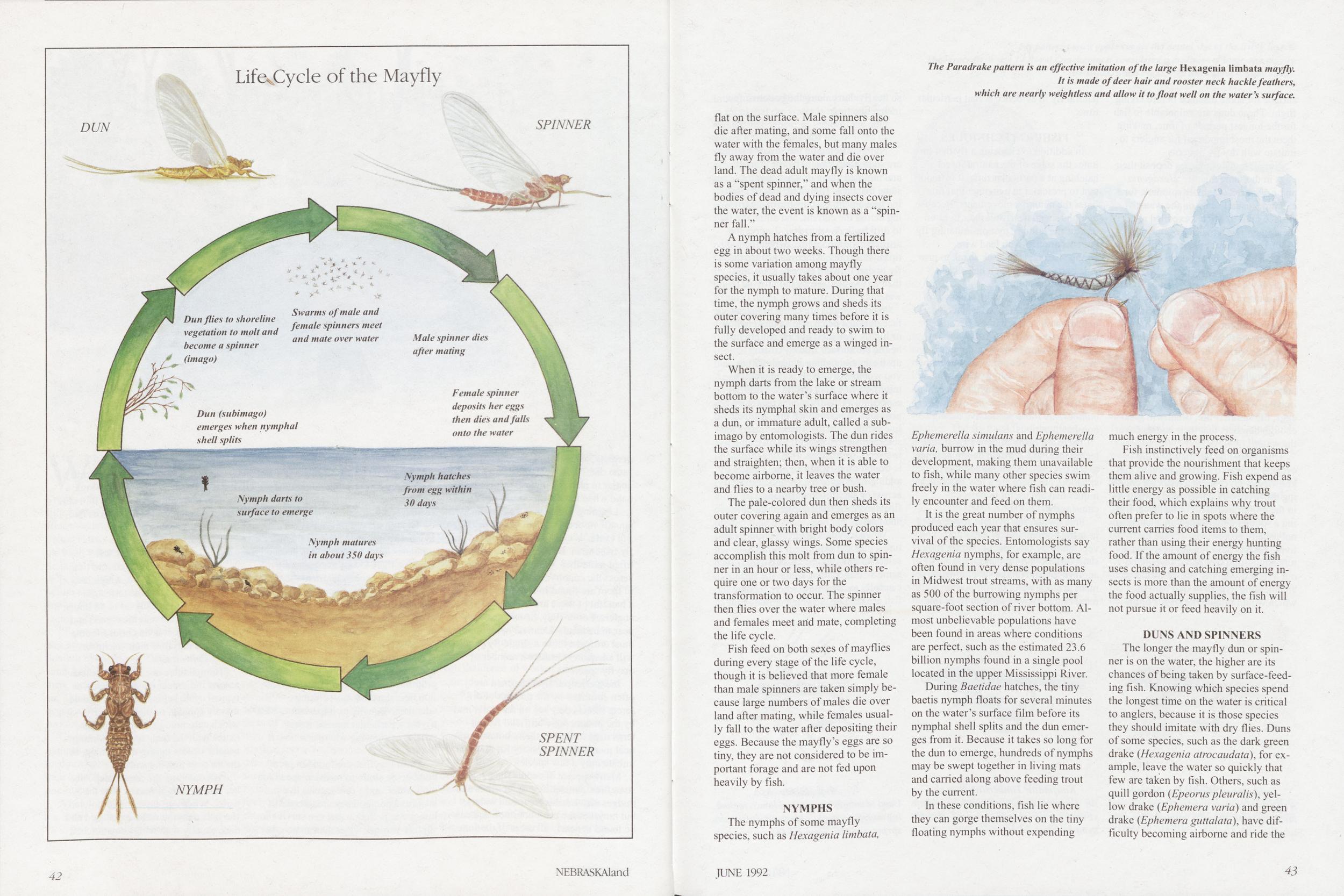
flat on the surface. Male spinners also die after mating, and some fall onto the water with the females, but many males fly away from the water and die over land. The dead adult mayfly is known as a "spent spinner," and when the bodies of dead and dying insects cover the water, the event is known as a "spinner fall."
A nymph hatches from a fertilized egg in about two weeks. Though there is some variation among mayfly species, it usually takes about one year for the nymph to mature. During that time, the nymph grows and sheds its outer covering many times before it is fully developed and ready to swim to the surface and emerge as a winged insect.
When it is ready to emerge, the nymph darts from the lake or stream bottom to the water's surface where it sheds its nymphal skin and emerges as a dun, or immature adult, called a subimago by entomologists. The dun rides the surface while its wings strengthen and straighten; then, when it is able to become airborne, it leaves the water and flies to a nearby tree or bush.
The pale-colored dun then sheds its outer covering again and emerges as an adult spinner with bright body colors and clear, glassy wings. Some species accomplish this molt from dun to spinner in an hour or less, while others require one or two days for the transformation to occur. The spinner then flies over the water where males and females meet arid mate, completing the life cycle.
Fish feed on both sexes of mayflies during every stage of the life cycle, though it is believed that more female than male spinners are taken simply because large numbers of males die over land after mating, while females usually fall to the water after depositing their eggs. Because the mayfly's eggs are so tiny, they are not considered to be important forage and are not fed upon heavily by fish.
The nymphs of some mayfly species, such as Hexagenia limbata, Ephemerella simulans and Ephemerella varia, burrow in the mud during their development, making them unavailable to fish, while many other species swim freely in the water where fish can readily encounter and feed on them.
It is the great number of nymphs produced each year that ensures survival of the species. Entomologists say Hexagenia nymphs, for example, are often found in very dense populations in Midwest trout streams, with as many as 500 of the burrowing nymphs per square-foot section of river bottom. Almost unbelievable populations have been found in areas where conditions are perfect, such as the estimated 23.6 billion nymphs found in a single pool located in the upper Mississippi River.
During Baetidae hatches, the tiny baetis nymph floats for several minutes on the water's surface film before its nymphal shell splits and the dun emerges from it. Because it takes so long for the dun to emerge, hundreds of nymphs may be swept together in living mats and carried along above feeding trout by the current.
In these conditions, fish lie where they can gorge themselves on the tiny floating nymphs without expending much energy in the process.
Fish instinctively feed on organisms that provide the nourishment that keeps them alive and growing. Fish expend as little energy as possible in catching their food, which explains why trout often prefer to lie in spots where the current carries food items to them, rather than using their energy hunting food. If the amount of energy the fish uses chasing and catching emerging insects is more than the amount of energy the food actually supplies, the fish will not pursue it or feed heavily on it.
DUNS AND SPINNERSThe longer the mayfly dun or spinner is on the water, the higher are its
chances of being taken by surface-feeding fish. Knowing which species spend
the longest time on the water is critical
to anglers, because it is those species
they should imitate with dry flies. Duns
of some species, such as the dark green
drake {Hexagenia atroeaudata), for example, leave the water so quickly that
few are taken by fish. Others, such as
quill gordon {Epeorus pleuralis), yellow drake {Ephemera varia) and green
drake {Ephemera guttalata), have difficulty becoming airborne and ride the
JUNE 1992
43
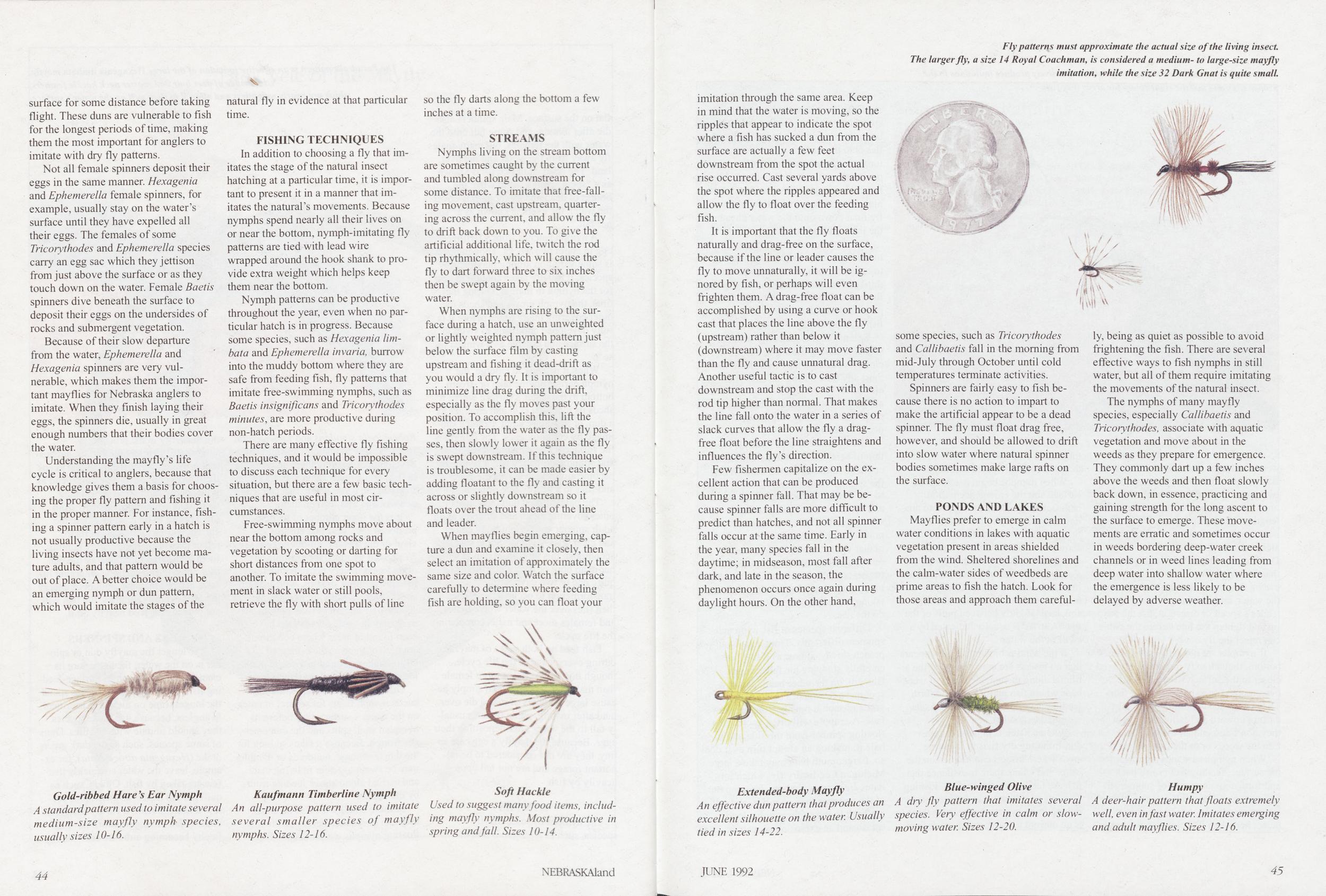 surface for some distance before taking
flight. These duns are vulnerable to fish
for the longest periods of time, making
them the most important for anglers to
imitate with dry fly patterns.
surface for some distance before taking
flight. These duns are vulnerable to fish
for the longest periods of time, making
them the most important for anglers to
imitate with dry fly patterns.
Not all female spinners deposit their eggs in the same manner. Hexagenia and Ephemerella female spinners, for example, usually stay on the water's surface until they have expelled all their eggs. The females of some Tricorythodes and Ephemerella species carry an egg sac which they jettison from just above the surface or as they touch down on the water. Female Baetis spinners dive beneath the surface to deposit their eggs on the undersides of rocks and submergent vegetation.
Because of their slow departure from the water, Ephemerella and Hexagenia spinners are very vulnerable, which makes them the important mayflies for Nebraska anglers to imitate. When they finish laying their eggs, the spinners die, usually in great enough numbers that their bodies cover the water.
Understanding the mayfly's life cycle is critical to anglers, because that knowledge gives them a basis for choosing the proper fly pattern and fishing it in the proper manner. For instance, fishing a spinner pattern early in a hatch is not usually productive because the living insects have not yet become mature adults, and that pattern would be out of place. Abetter choice would be an emerging nymph or dun pattern, which would imitate the stages of the natural fly in evidence at that particular time.
FISHING TECHNIQUESIn addition to choosing a fly that imitates the stage of the natural insect hatching at a particular time, it is important to present it in a manner that imitates the natural's movements. Because nymphs spend nearly all their lives on or near the bottom, nymph-imitating fly patterns are tied with lead wire wrapped around the hook shank to provide extra weight which helps keep them near the bottom.
Nymph patterns can be productive throughout the year, even when no particular hatch is in progress. Because some species, such as Hexagenia limbata and Ephemerella invaria, burrow into the muddy bottom where they are safe from feeding fish, fly patterns that imitate free-swimming nymphs, such as Baetis insignificans and Tricorythodes minutes, are more productive during non-hatch periods.
There are many effective fly fishing techniques, and it would be impossible to discuss each technique for every situation, but there are a few basic techniques that are useful in most circumstances.
Free-swimming nymphs move about near the bottom among rocks and vegetation by scooting or darting for short distances from one spot to another. To imitate the swimming movement in slack water or still pools, retrieve the fly with short pulls of line so the fly darts along the bottom a few inches at a time.
Nymphs living on the stream bottom are sometimes caught by the current and tumbled along downstream for some distance. To imitate that free-falling movement, cast upstream, quartering across the current, and allow the fly to drift back down to you. To give the artificial additional life, twitch the rod tip rhythmically, which will cause the fly to dart forward three to six inches then be swept again by the moving water.
When nymphs are rising to the surface during a hatch, use an unweighted or lightly weighted nymph pattern just below the surface film by casting upstream and fishing it dead-drift as you would a dry fly. It is important to minimize line drag during the drift, especially as the fly moves past your position. To accomplish this, lift the line gently from the water as the fly passes, then slowly lower it again as the fly is swept downstream. If this technique is troublesome, it can be made easier by adding floatant to the fly and casting it across or slightly downstream so it floats over the trout ahead of the line and leader.
When mayflies begin emerging, capture a dun and examine it closely, then select an imitation of approximately the same size and color. Watch the surface carefully to determine where feeding fish are holding, so you can float your 44 NEBRASKAland
Few fishermen capitalize on the excellent action that can be produced during a spinner fall. That may be because spinner falls are more difficult to predict than hatches, and not all spinner falls occur at the same time. Early in the year, many species fall in the daytime; in midseason, most fall after dark, and late in the season, the phenomenon occurs once again during daylight hours. On the other hand, some species, such as Tricorythodes and Callibaetis fall in the morning from mid-July through October until cold temperatures terminate activities.
Spinners are fairly easy to fish because there is no action to impart to make the artificial appear to be a dead spinner. The fly must float drag free, however, and should be allowed to drift into slow water where natural spinner bodies sometimes make large rafts on the surface.
PONDS AND LAKESMayflies prefer to emerge in calm water conditions in lakes with aquatic vegetation present in areas shielded from the wind. Sheltered shorelines and the calm-water sides of weedbeds are prime areas to fish the hatch. Look for those areas and approach them carefully, being as quiet as possible to avoid frightening the fish. There are several effective ways to fish nymphs in still water, but all of them require imitating the movements of the natural insect.
The nymphs of many mayfly species, especially Callibaetis and Tricorythodes, associate with aquatic vegetation and move about in the weeds as they prepare for emergence. They commonly dart up a few inches above the weeds and then float slowly back down, in essence, practicing and gaining strength for the long ascent to the surface to emerge. These movements are erratic and sometimes occur in weeds bordering deep-water creek channels or in weed lines leading from deep water into shallow water where the emergence is less likely to be delayed by adverse weather.
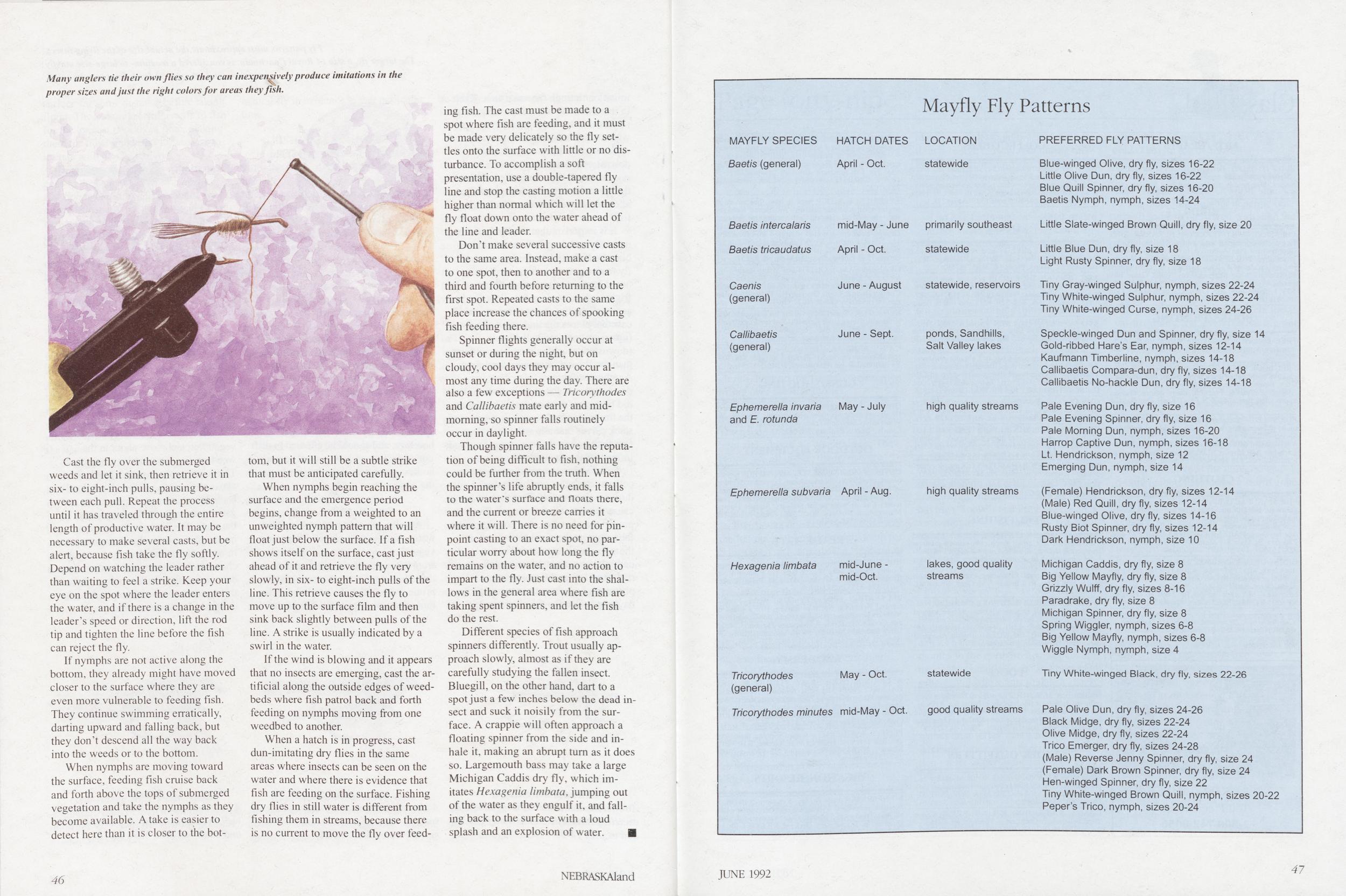
Cast the fly over the submerged weeds and let it sink, then retrieve it in six- to eight-inch pulls, pausing between each pull. Repeat the process until it has traveled through the entire length of productive water. It may be necessary to make several casts, but be alert, because fish take the fly softly. Depend on watching the leader rather than waiting to feel a strike. Keep your eye on the spot where the leader enters the water, and if there is a change in the leader's speed or direction, lift the rod tip and tighten the line before the fish can reject the fly.
If nymphs are not active along the bottom, they already might have moved closer to the surface where they are even more vulnerable to feeding fish. They continue swimming erratically, darting upward and falling back, but they don't descend all the way back into the weeds or to the bottom.
When nymphs are moving toward the surface, feeding fish cruise back and forth above the tops of submerged vegetation and take the nymphs as they become available. A take is easier to detect here than it is closer to the bottom, but it will still be a subtle strike that must be anticipated carefully.
When nymphs begin reaching the surface and the emergence period begins, change from a weighted to an unweighted nymph pattern that will float just below the surface. If a fish shows itself on the surface, cast just ahead of it and retrieve the fly very slowly, in six- to eight-inch pulls of the line. This retrieve causes the fly to move up to the surface film and then sink back slightly between pulls of the line. A strike is usually indicated by a swirl in the water.
If the wind is blowing and it appears that no insects are emerging, cast the artificial along the outside edges of weedbeds where fish patrol back and forth feeding on nymphs moving from one weedbed to another.
When a hatch is in progress, cast dun-imitating dry flies in the same areas where insects can be seen on the water and where there is evidence that fish are feeding on the surface. Fishing dry flies in still water is different from fishing them in streams, because there is no current to move the fly over feeding fish. The cast must be made to a spot where fish are feeding, and it must be made very delicately so the fly settles onto the surface with little or no disturbance. To accomplish a soft presentation, use a double-tapered fly line and stop the casting motion a little higher than normal which will let the fly float down onto the water ahead of the line and leader.
Don't make several successive casts to the same area. Instead, make a cast to one spot, then to another and to a third and fourth before returning to the first spot. Repeated casts to the same place increase the chances of spooking fish feeding there.
Spinner flights generally occur at sunset or during the night, but on cloudy, cool days they may occur almost any time during the day. There are also a few exceptions — Tricorythodes and Callibaetis mate early and midmorning, so spinner falls routinely occur in daylight.
Though spinner falls have the reputation of being difficult to fish, nothing could be further from the truth. When the spinner's life abruptly ends, it falls to the water's surface and floats there, and the current or breeze carries it where it will. There is no need for pinpoint casting to an exact spot, no particular worry about how long the fly remains on the water, and no action to impart to the fly. Just cast into the shallows in the general area where fish are taking spent spinners, and let the fish do the rest.
Different species offish approach spinners differently. Trout usually approach slowly, almost as if they are carefully studying the fallen insect. Bluegill, on the other hand, dart to a spot just a few inches below the dead insect and suck it noisily from the surface. A crappie will often approach a floating spinner from the side and inhale it, making an abrupt turn as it does so. Largemouth bass may take a large Michigan Caddis dry fly, which im- itates Hexagenia limbata, jumping out of the water as they engulf it, and falling back to the surface with a loud splash and an explosion of water.
46 NEBRASKAland Mayfly Fly Patterns MAYFLY SPECIES HATCH DATES LOCATION Baetis (general) April - Oct. statewide PREFERRED FLY PATTERNS Blue-winged Olive, dry fly, sizes 16-22 Little Olive Dun, dry fly, sizes 16-22 Blue Quill Spinner, dry fly, sizes 16-20 Baetis Nymph, nymph, sizes 14-24 Baetis intercalaris mid-May - June primarily southeast Little Slate-winged Brown Quill, dry fly, size 20 Baetis tricaudatus April - Oct. statewide Caenis (general) Callibaetis (general) June - August statewide, reservoirs June - Sept. ponds, Sandhills, Salt Valley lakes Ephemerella invaria May - July and E. rotunda high quality streams Ephemerella subvaria April - Aug. high quality streams Hexagenia limbata mid-June mid-Oct. lakes, good quality streams Tricorythodes (general) May - Oct. statewide Tricorythodes minutes mid-May - Oct. good quality streams Little Blue Dun, dry fly, size 18 Light Rusty Spinner, dry fly, size 18 Tiny Gray-winged Sulphur, nymph, sizes 22-24 Tiny White-winged Sulphur, nymph, sizes 22-24 Tiny White-winged Curse, nymph, sizes 24-26 Speckle-winged Dun and Spinner, dry fly, size 14 Gold-ribbed Hare's Ear, nymph, sizes 12-14 Kaufmann Timberline, nymph, sizes 14-18 Callibaetis Compara-dun, dry fly, sizes 14-18 Callibaetis No-hackle Dun, dry fly, sizes 14-18 Pale Evening Dun, dry fly, size 16 Pale Evening Spinner, dry fly, size 16 Pale Morning Dun, nymph, sizes 16-20 Harrop Captive Dun, nymph, sizes 16-18 Lt. Hendrickson, nymph, size 12 Emerging Dun, nymph, size 14 (Female) Hendrickson, dry fly, sizes 12-14 (Male) Red Quill, dry fly, sizes 12-14 Blue-winged Olive, dry fly, sizes 14-16 Rusty Biot Spinner, dry fly, sizes 12-14 Dark Hendrickson, nymph, size 10 Michigan Caddis, dry fly, size 8 Big Yellow Mayfly, dry fly, size 8 Grizzly Wulff, dry fly, sizes 8-16 Paradrake, dry fly, size 8 Michigan Spinner, dry fly, size 8 Spring Wiggler, nymph, sizes 6-8 Big Yellow Mayfly, nymph, sizes 6-8 Wiggle Nymph, nymph, size 4 Tiny White-winged Black, dry fly, sizes 22-26 Pale Olive Dun, dry fly, sizes 24-26 Black Midge, dry fly, sizes 22-24 Olive Midge, dry fly, sizes 22-24 Trico Emerger, dry fly, sizes 24-28 (Male) Reverse Jenny Spinner, dry fly, size 24 (Female) Dark Brown Spinner, dry fly, size 24 Hen-winged Spinner, dry fly, size 22 Tiny White-winged Brown Quill, nymph, sizes 20-22 Peper's Trico, nymph, sizes 20-24 JUNE 1992 47
Classified
ARTS/CRAFTSBUILT TO ORDER. Best in the business. Specializing in cedar and pine mailboxes starting at $49.95. Wood duck houses, bird houses, squirrel and bird feeders. (402) 896-5029.
BIRDSPHEASANTS-WILD TURKEYS-CHUKARS & HUNS! Eggs, chicks, started and adults. National Poultry Improvement Plan Approved. Live overnight delivery guaranteed. THE BEST for propagation, hunting, eating, and taxidermy. Call now to place 1992 chick orders! Bargain prices on ringneck hens. Toubl Game Bird Farms, 8716 W. St., Lawrence Rd., Dept NE, Beloit, WI 535 11. Phone (608) 365-1789. "Our birds MAKE IT in the WILD!"
BOOKS/PRINTINGFREE! Booklets on northeastern Nevada; fishing, rockhounding maps, Carl Hayden, Box 528, Jackpot, Nevada 89825.
FREE BOOK CATALOG. Novels, westerns, romances, children's; old out of print, found barns, attic. Authors: Grey, Bower, Connor, Fox, Curwood, Raine, Wright, Aldrige, Pollyanna, Freckles, many others. Postage appreciated. Pierce, 4400 N. Pine Cluster, Oroville, CA 95965.
FOR SALE — "Notecards by Nature's Eye." Antique quilts photographed in Nebraska's Seasonal Splendor. Spring, Fall or Winter cards available. 8 cards (2 each of 4 scenes) and envelopes in an attractive vinyl gift box. Each box $10.95 plus $1.00 shipping. Send check to Nature's Eye, 2228 Teakwood, Fremont, NE 68025.
CLOTHINGFUR MANUFACTURING—Manufacturer of all fur garments. Bring or mail your skins and we will custom make your coats, hats and misc. Also large inventory of new garments for sale. 55 years' experience. Write for free brochure. HAEKER FURRIERS, INC., P.O. Box 230, 615 W. Main St., Alma, NE 68920. Phone (308) 928-2515.
GET YOUR ORIGINAL ARTWORK of windmill and stock tank, with "Nebraska" across tank. Available on T-shirts or sweatshirts, (ash or red) or on tan snap-close jacket. Sizes Small to XXL. Write or call for free brochure — Mikolyck Designs, RR 2 Box 46, Oshkosh, NE 69154: (308) 772-3574 or 1-800-682-7785.
Classified ad rates: 75ct per word, minimum $ 15. Closing date is the first business day 2 months preceding date of issue. To place ads or for more information write NEBRASKAland Magazine, P.O. Box 30370, Lincoln, NE 68503, or call (402) 471-5478. NEBRASKAland Magazine Toll Free Orders 1-800-742-0056 COLLECTIBLESWANTED: Collector wants to buy all brands old 2-piece cardboard shot-shell boxes. Also wood ammo boxes, old firearm and cartridge company posters, calendars, advertising cardboards, and catalogs. Allan H. Hahn,Rt. 1 Box 147, Gibbon, NE 68840. Phone (308) 647-5228.
DOGSTRAINING ALL BREEDS bird dogs—Vizslas and English Pointers for sale. Rozanek Kennels, R 2, Schuyler, NE 68661. Phone (402) 352-8769.
AKC GERMAN SHORTHAIR pointers and brittany spaniels. Pups, started and trained dogs. Birdland Kennels, Hunter Ingwerson, Nehawka, NE 68413,402-227-4655. Wayne Clark, 712-529-4238 also will be doing some training.
YELLOW-BLACK Lab pups. FC-AFC sired. AKC. Hips OFA certified. Dew claws removed. Excellent hunting potential. Contact Bob Bendler, Lexington, NE, (308)324-4247.
FOR SALE—Chesapeake bay or Labrador retrievers. All colors. Pups, started dogs, training and stud service. Three-generation national champion. Pedigre on Lab. Three generations of the best Chesapeakes ever trialed. Call PLATTE VALLEY RETRIEVERS (308) 995-2318.
GUN DOG TRAINING. All sporting breeds. All dogs worked on game birds. Over 25 years experience. Henry Sader, Wilderness Kennels, Roca, NE (402) 423-4212.
GERMAN SHORTHAIR POINTERS/ENGLISH POINTERS—pups, started dogs, stud service. Training available for pointing and retrieving dogs. Wayne Clark (712) 529-4238. Close to Omaha. Leave mesage.
AKC GERMAN SHORTHAIR POINTER puppies: guaranteed— references available. Phone (402) 353-3605.
FOR SALE—Boykin spaniel puppies. Excellent hunters, retrievers and pets. Call (402) 385-3575.
FISH/FISHINGFISH FOR SALE. Catfish, perch, coho salmon, rainbow trout, crappie, bluegill, walleye, minnows, goldfish, bullhead, largemouth bass, smallmouth bass, triploid grass carp. Commercial grower prices on catfish, perch, coho salmon, rainbow trout. Consulting available. Pleasant Valley Fish Farm, Rt 1 Box 147, McCook, NE 69001. Phone (308) 345-6599.
WILLOW LAKE FISH HATCHERY. Channel cat, bluegill, hybrid bluegill, largemouth bass, crappie, triploid grass carp, walleye, perch, minnows available for stocking. Gaylord Crawford, Rt. 3 Box 46, Hastings, NE 68901 or phone (402) 463-8022 day or night. Also pond consultant. We deliver, grower price.
FOODNEBRASKA BASKETS: The original Nebraska company specializing in fine foods from Nebraska. A beautiful array of baskets filled with ethnic, healthful and long-time favorite foods. Call or write for our brochure: P.O. Box 98, McCook, NE 69001. t-800-345-7725.
GUIDES/OUTFITTERSMAD RIVER CANOES offers the finest quality and performance. For the finest canoes and accessories look to Great Plains Canoe Co., 205 Main, Springfield, NE. Phone(402)253-2001.
DISMAL RIVER/MIDDLE LOUP RIVER Canoe Trips. Powderhorn Outfitters — Thedford, NE 69166 1-800-373-1648.
EXPERIENCE NEBRASKA with an affordable canoe trip by Dryland Aquatics. One and two-day trips full service or canoes only. Your Niobrara River specialists Call for other rivers We do it your way! For free brochure: Dryland Aquatics, Dept. N, 1837 E. Cuming, Fremont, NE 68025 or phone (402) 721-4177.
EXPERIENCE A TRIP back in time. The adventure begins when you enter primitive Americana. Sleep in a tipi — fun and educational. Crafts, scrimshaw, fire starting, story telling at the campfire by Winded Bird Head. Groups, children welcome — April 4 thru November 1 st. 2 days, 1 night — $ 100. For more information and directions send $1 for postage and handling to: Sonny Union, 7335 LaVista Drive, LaVista, NE 68157.
GRAHAM CANOE OUTFITTERS: Top quality fullservice camping and canoe trips on the Niobrara River. Daily canoe rentals and car shuttle-service available. Contact Doug & Twyla Graham, HC 13 Box 16, Valentine, NE 69201 or phone (402) 376-3708.
KEN KO INC. Spend a day fishing the scenic Missouri River with fishing guide Kenneth Cooksey. For information write 2002 2nd Ave., Nebraska City, NE 68025 or call (402) 873-6288 mornings/evenings.
CANOE RENTALS — Kamp Kaleo, Burwell, NE, i 7- foot aluminum canoes, $ 15 per day. Call (308) 346-5083 for information and reservations.
GUNS/SHOOTINGGUNS — Browning, Winchester, Remington, others, Hi-powers; shotguns, new, used, antiques. Want Pre-'64 Winchesters. Buy-Sell-Trade. (402) 729-6112. Bedlan's Sporting Goods, Fairbury, NE 68352.
OUTDOOR EQUIPMENTDEVELOP, REHABILITATE, and IMPROVE your private pond for wildlife, waterfowl, hunting and fishing, or recreation. Aquatic weed and algae control, vegetation management, water quality improvement, and more!! Call or write us for answers. Aquatic Habitat Management Services, Box 2356, Grand Island, NE 68802. (308) 384-5461.
REAL ESTATEHUNTING/FISHING-secluded 174 acres, Stanton County Pasture with 37-acre lake. On Elkhorn River flyway. Re/Max Associates—Dale R. Pinnt, Broker (402)371-3355 or 371-8260.
RECREATION PROPERTY-3780 Acres, NorthU Central Nebraska. North of Bassett, NE. 2 miles of Niobrara River frontage & 2 miles of Coon Creek frontage. Good accessability. A view second to none. Contact Larry Radant 376-2937. Metro/Midlands Realty, W. Hwy. 20. Valentine, NE 69201, (402) 376-2937.
TAXIDERMYALLISON'S TAXIDERMY STUDIO & GIFT GALLERY. Wally and Betty Allison Licensed Taxidermist. We've mounted 32 Nebraska State Record fish. Specializing in fish, birds and small game. We use freeze-dry. 421 North Dewey, North Platte, NE 69101 (308) 534-2324 or (308) 534-4267 home.
PEISTER TAXIDERMY—Award winning taxidermy and fish carvings. 1020 Central Avenue, Box 3201, Kearney, NE 68847. Phone (308) 236-9700 or (308) 237-7575 evening.
VACATION/RESORTSNE NEBRASKA trout fishing. 3 modern cottages, 1 available year round. 5 spring fed lakes with open water all year. Trout up to 7 pounds. Other varieties fish also Diamond E. Trout Resort, Orchard, NE 68764 Phone (402) 893-4745. Evenings (402) 893-3002
48 NEBRASKAlandPage forty-nine
Air Conditioners and Naming MonthsSome June nights, it is oddly disorienting to go for a walk. At first, you don't know why you feel so alien, so out of tune. It is hot, of course, but that isn't the problem. It isn't late, but you're alone on the sidewalk. There are cars on the streets, but their windows are up and, except for occasional reverberations from supersonic space radios whose bass notes portend apocalypse, they are remote and robotic.
On June nights in some neighborhoods, there is no sense of human presence — no one on a patio, no one in a hammock, no one on a screened porch. You see no glow from a last cigarette behind a screen of morning glories, hear no murmered conversation lifting over the lilac bushes.
But there is no silence, either, and then it comes to you: Air conditioners. The neighborhood is pulsing with the hum and whir of air conditioners. The people are all inside, the houses are shut up, keeping the expensive cold air in and the oppressive hot air out. After all, this is June. Humans couldn't live here without AC.
I wish we tallied the months the way the Lakota people did, naming them for things seen or heard, for the behavior of animals or for characteristics of weather. I like "Moon of the Popping Trees" better than "December," for example, and "Moon of the Red Chokecherries" better than "June."
What does "June" mean, anyway? There is nothing intuitive about it; you have to look it up to know that June was the fourth month of the Julian calendar derived from the Roman republican calendar as reformed under Julius Caesar beginning in 46 B.C., and that June is named for the goddess Uno (Juno) or possibly comes from iuniores (juniores), in honor of the young, just as May, from maiores, honors the elders (unless, of course, as some scholars believe, it celebrates an obscure goddess named Maia).
See what I mean? It is interesting, but not exactly gripping, and it doesn't make you understand much about how it feels to live in Nebraska during this lunar period (or more exactly, during this arbitrary, conveniently brief calendar division derived roughly from 12 lunations).
I do like Latin names — their musty gentility alone appeals to me, and they preserve our links to ancient civilizations, rolling down to us through time, magisterial and august (not the eighth month — emphasis on the second syllable), but names like "June" and "May" tell us almost nothing immediate and vital about ourselves and where we live.
The French Republican calendar, adopted during the French revolution in 1793, had some of the Sioux feeling June was Messidor, "harvest," and July was Thermador, "heat" month. That might have been worth keeping. The 4th of Thermador sounds like a ripper of a holiday. Fabre d'Eglantine, who devised most of the names for the republican months, paid close attention to the euphony and harmony of the language, hoping to create a crackling, cold feeling in the winter names — Nivose ("snow") and Pluviose ("rain"), for example — a melancholy gravity for the fall (Brumaire — "mist" — and Vendemiaire — "vintage") and a lubricous French lilt for spring in names like Germinal ("seed time") and Floreal ("blossom").
But the names didn't take. For one thing, a good part of the world was already committed to the Julian calendar and its names. Besides, the warmest months in the northern hemisphere are the coldest months in the southern hemisphere, and who wants to date a check "Thermador 15" when you're freezing your whoozit off?
I wonder if it is partly the Julian names themselves that lead us to lonely, whirring June nights. Since the names don't refer to our immediate experience, to things characteristic of the month itself, we feel free to act as if even the weather is somehow abnormal and undeserved. Some people seem to be constantly uncomfortable, at least when they are outdoors. They're too cold. They're too damp, too windblown. They're too hot, too sweaty, too dusty. They have to squint. There might be bugs. Or slush.
For them, the weather is pernicious, an evil force to be striven with, like the devil himself to the Puritan colonists, using all the kilowatts available. "Warm me up, cool me down, keep me dry, don't muss my hair, don't spot my tie," they whine, all the while missing one of the true pleasures of being human: actually feeling what is going on in the world around you, even if what is going on isn't entirely comfortable.
The "personal" classifieds are interesting in this regard. A surprising number of ad writers describe themselves — or their ideal companions — as people who "like walks in the rain." They don't really like walks in the rain. When it rains, they probably sprint from the car to the front door, gritting their teeth, staining their Guccis, bellowing invective at the universe and dropping their keys down a storm grate. Their idea of a good time in the rain is watching "Green Acres" reruns with the blinds down. But they like the idea of liking walks in the rain, because, at least on a subconscious level, they like the idea of a world where damp, cold, hot and windy mean something more than a "climate control" system on the fritz, and they know that rain — like heat, cold, dust and hail — is part of a world from which we've so divorced ourselves that we hardly even know for sure what real air smells like.
Probably we should look to the Lakota month names. It would be good for us to know, even under the mall skylight where skinny coyotes are a rare commodity, that it is not just February, it is the "Moon of the Skinny Coyotes." But even if we can't bring ourselves to go that far, maybe we could at least call June "The Month of the Howling AC" and go sit on the porch for a change. A little sweat would do us no harm.
Don Cunningham JUNE 1992 49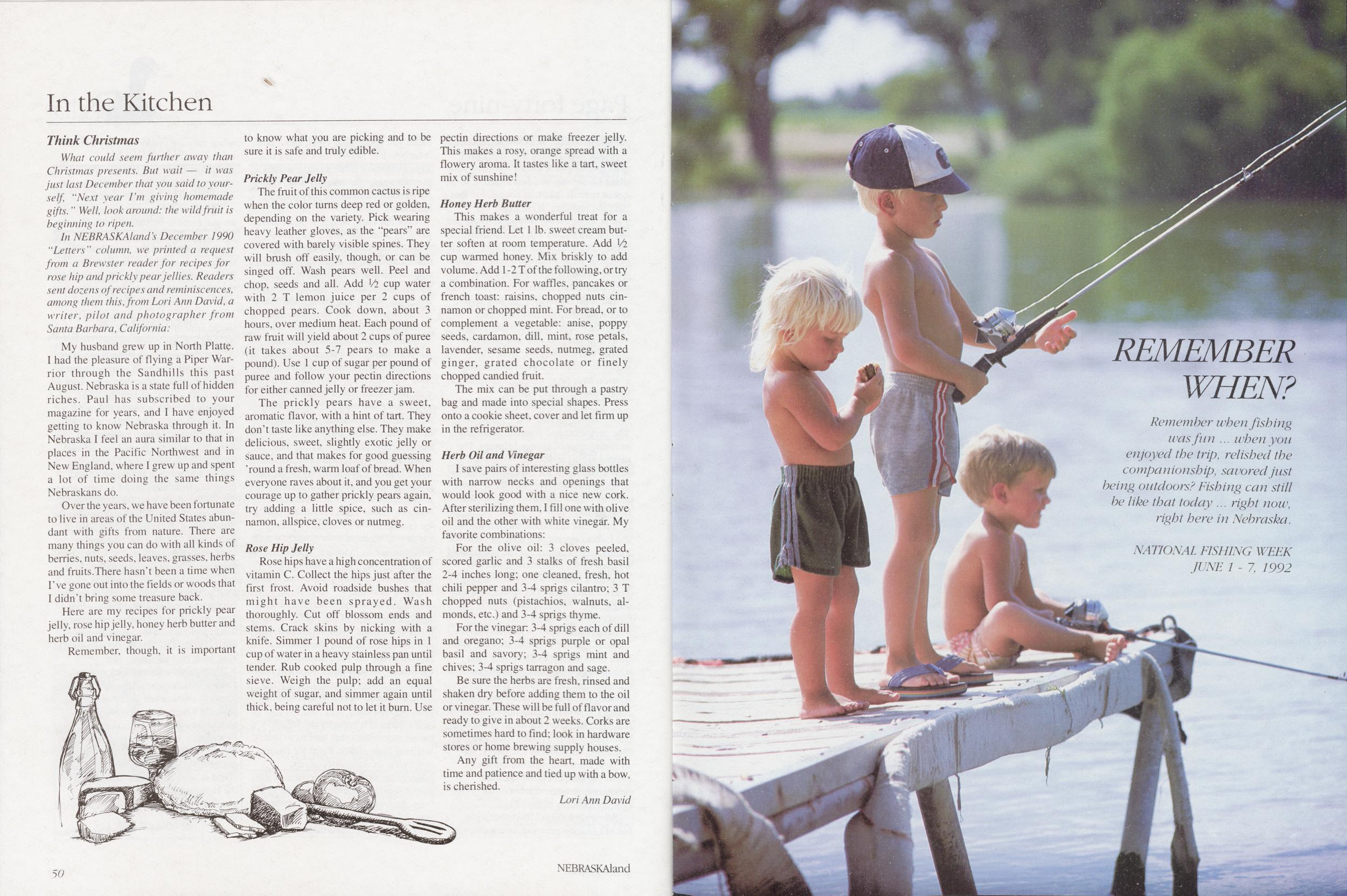
In the Kitchen
Think ChristmasWhat could seem further away than Christmas presents. But wait — it was just last December that you said to yourself, "Next year Vm giving homemade gifts. " Well, look around: the wild fruit is beginning to ripen.
In NEBRASKAlamVs December 1990 "Letters" column, we printed a request from a Brewster reader for recipes for rose hip and prickly pear jellies. Readers sent dozens of recipes and reminiscences, among them this, from Lori Ann David, a writer, pilot and photographer from Santa Barbara, California:
My husband grew up in North Platte. I had the pleasure of flying a Piper Warrior through the Sandhills this past August. Nebraska is a state full of hidden riches. Paul has subscribed to your magazine for years, and I have enjoyed getting to know Nebraska through it. In Nebraska I feel an aura similar to that in places in the Pacific Northwest and in New England, where I grew up and spent a lot of time doing the same things Nebraskans do.
Over the years, we have been fortunate to live in areas of the United States abundant with gifts from nature. There are many things you can do with all kinds of berries, nuts, seeds, leaves, grasses, herbs and fruits.There hasn't been a time when I've gone out into the fields or woods that I didn't bring some treasure back.
Here are my recipes for prickly pear jelly, rose hip jelly, honey herb butter and herb oil and vinegar.
Remember, though, it is important to know what you are picking and to be sure it is safe and truly edible.
The fruit of this common cactus is ripe when the color turns deep red or golden, depending on the variety. Pick wearing heavy leather gloves, as the "pears" are covered with barely visible spines. They will brush off easily, though, or can be singed off. Wash pears well. Peel and chop, seeds and all. Add Vi cup water with 2 T lemon juice per 2 cups of chopped pears. Cook down, about 3 hours, over medium heat. Each pound of raw fruit will yield about 2 cups of puree (it takes about 5-7 pears to make a pound). Use 1 cup of sugar per pound of puree and follow your pectin directions for either canned jelly or freezer jam.
The prickly pears have a sweet, aromatic flavor, with a hint of tart. They don't taste like anything else. They make delicious, sweet, slightly exotic jelly or sauce, and that makes for good guessing "round a fresh, warm loaf of bread. When everyone raves about it, and you get your courage up to gather prickly pears again, try adding a little spice, such as cinnamon, allspice, cloves or nutmeg.
Rose Hip JellyRose hips have a high concentration of vitamin C. Collect the hips just after the first frost. Avoid roadside bushes that might have been sprayed. Wash thoroughly. Cut off blossom ends and stems. Crack skins by nicking with a knife. Simmer 1 pound of rose hips in 1 cup of water in a heavy stainless pan until tender. Rub cooked pulp through a fine sieve. Weigh the pulp; add an equal weight of sugar, and simmer again until thick, being careful not to let it burn. Use pectin directions or make freezer jelly. This makes a rosy, orange spread with a flowery aroma. It tastes like a tart, sweet mix of sunshine!
Honey Herb ButterThis makes a wonderful treat for a special friend. Let 1 lb. sweet cream butter soften at room temperature. Add Vi cup warmed honey. Mix briskly to add volume. Add 1-2 T of the following, or try a combination. For waffles, pancakes or french toast: raisins, chopped nuts cinnamon or chopped mint. For bread, or to complement a vegetable: anise, poppy seeds, cardamon, dill, mint, rose petals, lavender, sesame seeds, nutmeg, grated ginger, grated chocolate or finely chopped candied fruit.
The mix can be put through a pastry bag and made into special shapes. Press onto a cookie sheet, cover and let firm up in the refrigerator.
Herb Oil and VinegarI save pairs of interesting glass bottles with narrow necks and openings that would look good with a nice new cork. After sterilizing them, I fill one with olive oil and the other with white vinegar. My favorite combinations:
For the olive oil: 3 cloves peeled, scored garlic and 3 stalks of fresh basil 2-4 inches long; one cleaned, fresh, hot chili pepper and 3-4 sprigs cilantro; 3 T chopped nuts (pistachios, walnuts, almonds, etc.) and 3-4 sprigs thyme.
For the vinegar: 3-4 sprigs each of dill and oregano; 3-4 sprigs purple or opal basil and savory; 3-4 sprigs mint and chives; 3-4 sprigs tarragon and sage.
Be sure the herbs are fresh, rinsed and shaken dry before adding them to the oil or vinegar. These will be full of flavor and ready to give in about 2 weeks. Corks are sometimes hard to find; look in hardware stores or home brewing supply houses.
Any gift from the heart, made with time and patience and tied up with a bow, is cherished.
50 NEBRASKAland
Position: 626 (18 views)