Volume 70, Issue 4, 1992
NEBRASKAland
MAY 1992 $1.50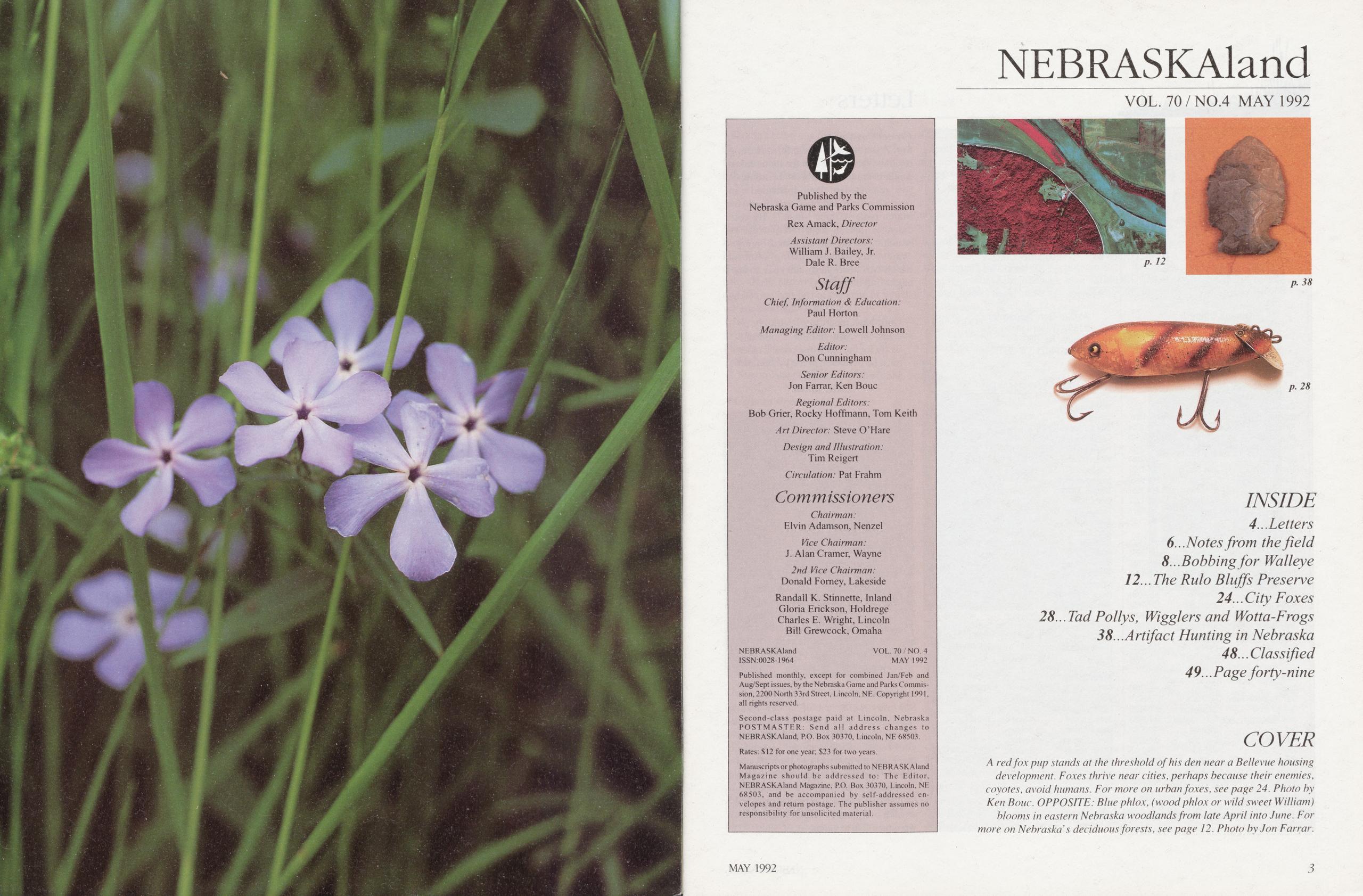
NEBRASKAland
VOL 70/NO.4 May 1992 NEBRASKAland VOL. 70/NO.4 MAY 1992 Published by the Nebraska Game and Parks Commission Rex Amack, Director Assistant Directors: William J. Bailey, Jr. Dale R. Bree Staff Chief Information & Education: Paul Horton Managing Editor: Lowell Johnson Editor: Don Cunningham Senior Editors: Jon Farrar, Ken Bouc Regional Editors: Bob Grier, Rocky’ Hoffmann, Tom Keith Art Director: Steve O’Hare Design and Illustration: Tim Reigert Circulation: Pat Frahm Commissioners Chairman: Elvin Adamson, Nenzel Vice Chairman: J. Alan Cramer, Wayne 2nd Vice Chairman: Donald Forney, Lakeside Randall K. Stinnette, Inland Gloria Erickson, Holdrege Charles E. Wright, Lincoln Bill Grewcock, Omaha NEBRASKAland VOL. 70 / NO. 4 ISSN:0028-1964 MAY 1992 Published monthly, except for combined Jan/Feb and Aug/Sept issues, by the Nebraska Game and Parks Commis- sion, 2200 North 33rd Street, L incoln, NE. Copyright 1991. all rights reserved. Second-class postage paid at Lincoln. Nebraska POSTMASTER: Send all address changes to NEBRASKAland, P.O. Box 30370, Lincoln. NE 68503. Rates: 512 for one year; 523 for two years. Manuscripts or photographs submitted to NEBRASKAland Magazine should be addressed to: The Editor, NEBRASKAland Magazine. P.O. Box 30370, Lincoln, NE 68503, and be accompanied by self-addressed en- velopes and return postage. The publisher assumes no responsibility for unsolicited material.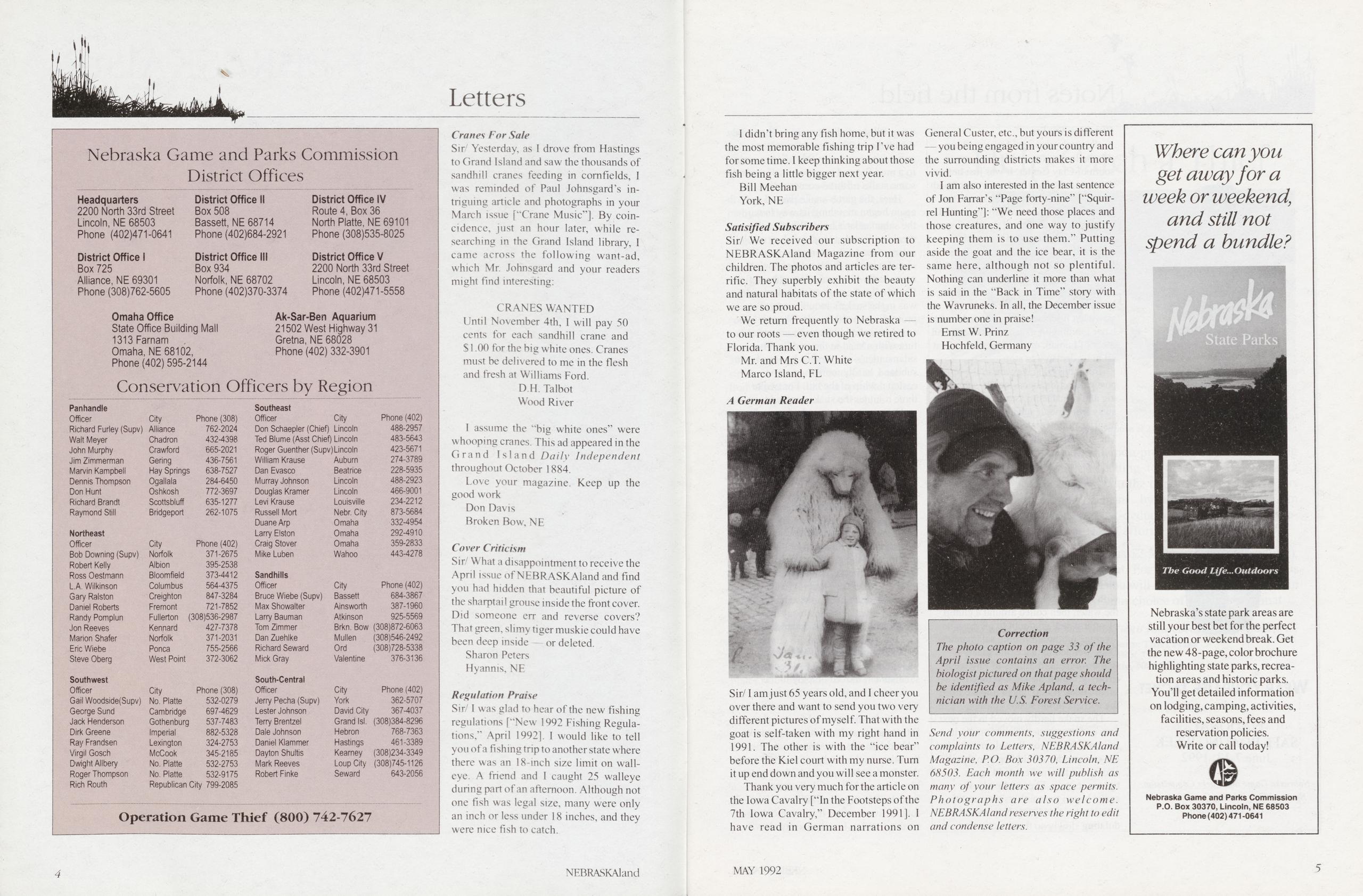
Letters
Cranes For SaleSir/ Yesterday, as I drove from Hastings to Grand Island and saw the thousands of sandhill cranes feeding in cornfields, I was reminded of Paul Johnsgard’s intriguing article and photographs in your March issue [“Crane Music”]. By coincidence, just an hour later, while researching in the Grand Island library, I came across the following want-ad, which Mr Johnsgard and your readers might find interesting:
CRANES WANTEDUntil November 4th, I will pay 50 cents for each sandhill crane and 81.00 for the big white ones. Cranes must be delivered to me in the flesh and fresh at Williams Ford.
D H. TalbotWood River
I assume the “big white ones” were whooping cranes. This ad appeared in the Grand Island Daily Independent throughout October 1884. Love your magazine. Keep up the good work
Don DavisBroken Bow, NE Cover Criticism
Sir/ What a disappointment to receive the April issue of NEBRASKAland and find you had hidden that beautiful picture of the sharptai I grouse inside the front cover. Did someone err and reverse covers? That green, slimy tiger muskie could have been deep inside or deleted.
Sharon PetersHyannis, NE Regulation Praise
Sir/1 was glad to hear of the new fishing regulations [“New 1992 Fishing Regulations,” April 1992]. I would like to tell you of a fishing trip to another state where there was an 18-mch size limit on walleye. A friend and I caught 25 walleye during part of an afternoon. Although not one fish was legal size, many were only an inch or less under 18 inches, and they were nice fish to catch.
I didn’t bring any fish home, but it was the most memorable fishing trip I've had for some time. 1 keep thinking about those fish being a little bigger next year.
Bill MeehanYork, NE Satisified Subscribers
Sir/ We received our subscription to NEBRASKAland Magazine from our children. The photos and articles are terrific. They superbly exhibit the beauty and natural habitats of the state of which we are so proud.
We return frequently to Nebraska – to our roots — even though we retired to Florida. Thank you.
Mr. and Mrs C.T. WhiteMarco Island, FL A German Reader
Sir/1 am just 65 years old, and I cheer you over there and want to send you two very different pictures of myself. That with the goat is self-taken with my right hand in 1991. The other is with the “ice bear” before the Kiel court with my nurse. Turn it up end down and you will see a monster.
Thank you very much for the article on the Iowa Cavalry [“In the Footsteps of the 7th Iowa Cavalry,” December 1991]. 1 have read in German narrations on General Custer, etc., but yours is different — you being engaged in your country and the surrounding districts makes it more vivid.
I am also interested in the last sentence of Jon Farrar’s “Page forty-nine” [“Squirrel Hunting”]: “We need those places and those creatures, and one way to justify keeping them is to use them.” Putting aside the goat and the ice bear, it is the same here, although not so plentiful. Nothing can underline it more than what is said in the “Back in Time” story with the Wavruneks. In all, the December issue is number one in praise!
Ernst W. Prinz Hochfeld, GermanyCorrection The photo caption on page 33 of the April issue contains an error. The biologist pictured on that page should be identified as Mike Apland, a technician with the U.S. Forest Service. Send your comments, suggestions and complaints to Letters, NEBRASKAland Magazine, P.O. Box 30370, Lincoln, NE 68503. Each month we will publish as many of your letters as space permits. Photographs are also welcome. NEBRASKAland reserves the right to edit and condense letters.
Notes from the field
Watching SnakesSeveral years ago, I was walking the shallow water on Massie Lagoon south of Clay Center. It was just before noon, and the light had grown too harsh for photographs. When I first saw the garter snake, it was swimming toward me across the surface of a pool of open water encircled by mud flats and rushes. It was of moderate size for its kind, about 20 inches long. I stood still, and it approached to within a few feet before stopping to test the air. I don’t know how snakes see the world, if it saw what it took to be a potential snake- hater looming in its path, tasted the foul scent of human, or if I played no role at all in its decision to stop.
But it turned and swam in the opposite direction, occasionally submerging and resurfacing. Seven or eight feet away from me, it submerged but did not resurface immediately as it had before. The silt-laden water suddenly began to roil, and occasionally the snake broke the surface of the water, more often than not, showing its underside.
At first I thought it was burrowing into the mud or, perhaps, had been snatched by a turtle, but as moments passed, it became evident the snake was not the victim. When it finally surfaced, in its jaws it held a grayish salamander by the midsection, the four weak legs thrashing helplessly. The snake swam with its prize for about 10 feet across the water, then coiled around a clump of smartweed, no doubt to increase its leverage on the squirming salamander. Once wedged in place, the snake tightened its hold, ridges of tiny teeth firmly gripping the slick-skinned salamander. Blood began to ooze from the corners of the snake’s mouth.
The snake hardly moved in the next four or five minutes. Occasionally it loosened its grip on the salamander, but the salamander would begin to thrash about, and the snake would again tighten its grip. Ever so slowly, the snake began to mouth its way up the salamander’s body, rubbery mouth undulating slowly so that its grip was never substantially loosened. Then, suddenly, the snake entered the water, swam across a dozen feet of open water to a mud flat and wrapped itself around some stalks of three-comer rush.
Here, the garter snake paused and again began mouthing its way toward the salamander’s head. Whether the meal is a lizard, a toad, a fish or a salamander, snakes long ago learned such squirming fodder slides down more easily if it is swallowed head first. Eventually, the nose of the salamander was in the snake’s mouth, its eyes protruding on either side. The two animals looked like one four-eyed creature with a head in the middle. The salamander’s movements became more subdued, hardly more than an occasional whip of the tail. For two or three minutes the snake seemed to rest.
Once its mouth stretched over the salamander’s head, the swallowing process proceeded amazingly quickly. In convulsive, gulping movements, the salamander slipped deeper and deeper into the snake’s long, dark gullet. As the snake's mouth approached the salamander’s hind legs, the last ripple of life passed through the salamander’s tail. For a moment, only half an inch of salamander tail flicked from the snake’s mouth, as if the garter snake had a broad, gray tongue. During all this, most of the snake’s body remained motionlessly anchored to the rush stems; only the practiced movements of the mouth jacked the salamander deeper into the snake’s maw.
The bulge in the snake’s body, which moments before had been a salamander, moved quickly to the snake’s midsection. The time from when I encountered the snake until the salamander disappeared from sight was little more than 20 minutes. The snake rubbed one side of its mouth and then the other on the mud as if to scrub away the blood and slime, much like a great blue heron rubbing its bill on a tree branch after a meal of bullhead. For four or five minutes it lay motionless on the mudflat. I backed away slowly, without disturbing the snake, leaving it to lie on the warm mud and begin the process of absorbing one bit of life into another.
Most observers of this bit of natural drama would have no doubt felt sympathy for the salamander, but the worm can quickly turn for snakes. In late August two years ago, my daughter and I were walking the shoreline of a Sandhills lake just after sundown. It was growing dim when we walked within three feet of a garter snake 1 estimated to be about 18 inches long coiled up around a tuft of sedges in a tight knot the size of man’s fist. Only two to three inches away, a blue racer, 30 inches long, was neatly coiled to strike, its head no more than an inch from the head of the garter snake. Other snakes are commonly on the blue racer’s menu, and it was obvious this one was working on the logistics of unraveling the garter snake for dinner. We watched for at least five minutes as the standoff continued, then gingerly stepped back to five feet, hoping the drama would play itself out before it was too dark to watch. When our eyes were diverted momentarily, the racer slipped away. When we walked away, the garter snake was still knotted about the sedges.
I wonder — would those who felt sympathy for the salamander in the first encounter cheer for the garter snake in the second case? Even though it is often difficult not to align with the underdog, the outcome of such encounters is really not our affair, no more so than if someone were to whisk our own dinner plates from under our noses and feed our dinners to some other creature they preferred over us.
More people watch out for snakes than watch snakes. That’s too bad, because if we can put our seemingly innate revulsion and fear aside, we will quickly discover snakes are beautiful and fascinating creatures. Like other predators, their lives are filled with drama.
Jon FarrarHelp Catch a Thief
“Storm Shelter” Limited edition of 2,000 Jim MorganOperation Game Thief, a non-profit organization offering rewards for information leading to the arrest of Nebraska game-law violators, offers you the opportunity to receive this full-color, limited edition print by noted wildlife artist Jim Morgan in return for your tax-deductable contribution in sup- port of Operation Game Thief efforts.
For a contribution of $40 (plus $2.50 shipping and handling), you will receive a signed print. For a $100 contribution (plus $5 shipping and handling), you will receive a mounted print in a beautiful oak frame with your choice of a tan or gray mat.
Please send coupon below, along with your check or money order to: Operation Game Thief Print P.O. Box 756 North Platte, NE 69103 Send me prints Amount enclosed $ Unframed Framed Gray Mat Tan Mat Name 1 Address City State Zip 6 NEBRASKAland MAY 1992 7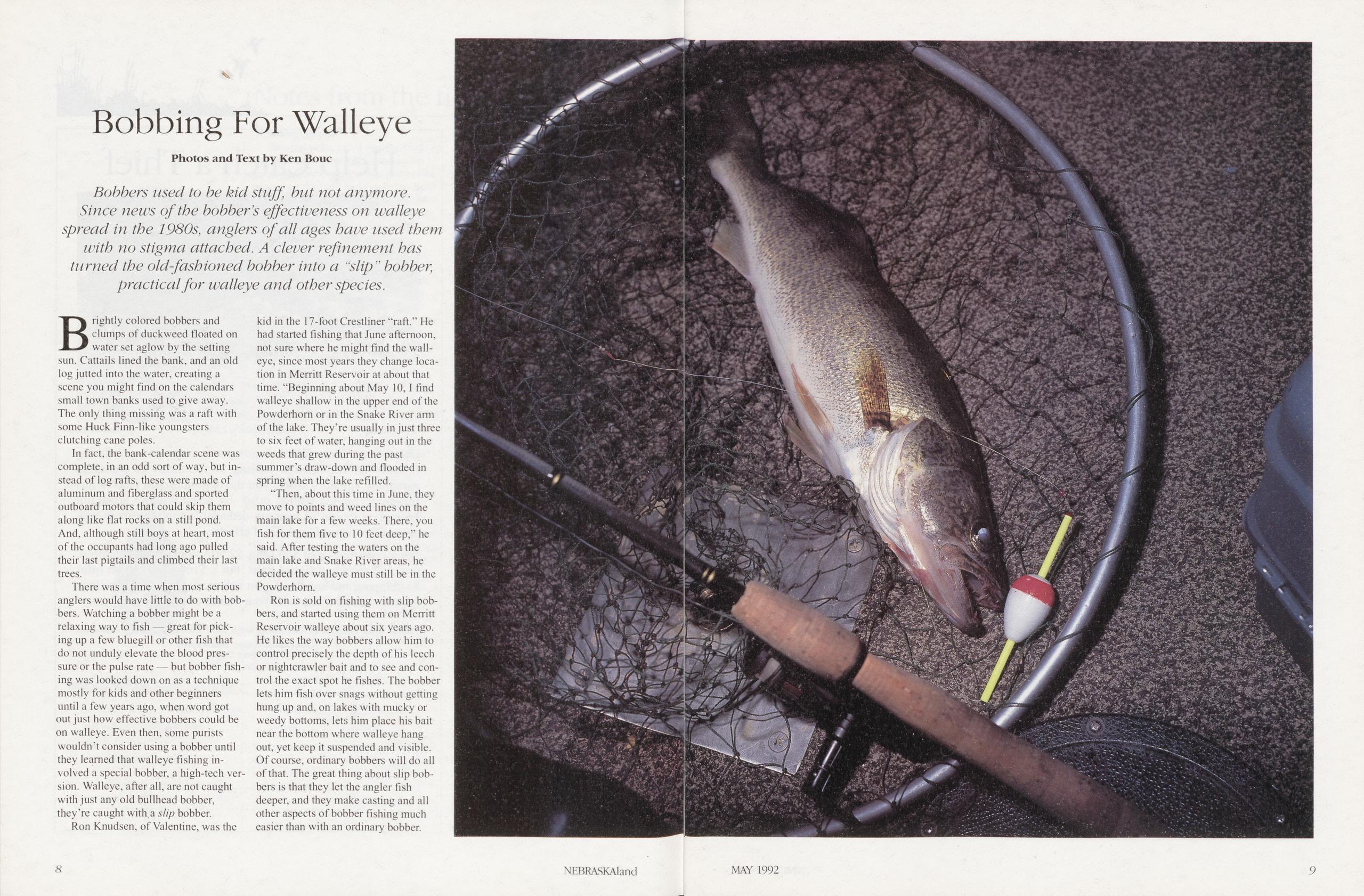
Bobbing For Walleye
Photos and Text by Ken Bouc Bobbers used to be kid stuff, but not anymore. Since news of the bobber’s effectiveness on walleye spread in the 1980s, anglers of all ages have used them with no stigma attached. A clever refinement has turned the old-fashioned bobber into a “slip" bobber, practical for walleye and other species.Brightly colored bobbers and clumps of duckweed floated on water set aglow by the setting sun. Cattails lined the bank, and an old log jutted into the water, creating a scene you might find on the calendars small town banks used to give away. The only thing missing was a raft with some Huck Finn-like youngsters clutching cane poles.
In fact, the bank-calendar scene was complete, in an odd sort of way, but instead of log rafts, these were made of aluminum and fiberglass and sported outboard motors that could skip them along like flat rocks on a still pond. And, although still boys at heart, most of the occupants had long ago pulled their last pigtails and climbed their last trees.
There was a time when most serious anglers would have little to do with bobbers. Watching a bobber might be a relaxing way to fish — great for picking up a few bluegill or other fish that do not unduly elevate the blood pressure or the pulse rate — but bobber fishing was looked down on as a technique mostly for kids and other beginners until a few years ago, when word got out just how effective bobbers could be on walleye. Even then, some purists wouldn't consider using a bobber until they learned that walleye fishing involved a special bobber, a high-tech version. Walleye, after all, are not caught with just any old bullhead bobber, they’re caught with a slip bobber.
Ron Knudsen, of Valentine, was the kid in the 17-foot Crestliner “raft.” He had started fishing that June afternoon, not sure where he might find the walleye, since most years they change location in Merritt Reservoir at about that time. “Beginning about May 10,1 find walleye shallow in the upper end of the Powderhom or in the Snake River arm of the lake. They’re usually in just three to six feet of water, hanging out in the weeds that grew during the past summer’s draw-down and flooded in spring when the lake refilled.
“Then, about this time in June, they move to points and weed lines on the main lake for a few weeks. There, you fish for them five to 10 feet deep,” he said. After testing the waters on the main lake and Snake River areas, he decided the walleye must still be in the Powderhom.
Ron is sold on fishing with slip bobbers, and started using them on Merritt Reservoir walleye about six years ago. He likes the way bobbers allow him to control precisely the depth of his leech or nightcrawler bait and to see and control the exact spot he fishes. The bobber lets him fish over snags without getting hung up and, on lakes with mucky or weedy bottoms, lets him place his bait near the bottom where walleye hang out, yet keep it suspended and visible. Of course, ordinary bobbers will do all of that. The great thing about slip bobbers is that they let the angler fish deeper, and they make casting and all other aspects of bobber fishing much easier than with an ordinary bobber.
NEBRASKAland MAY 1992 9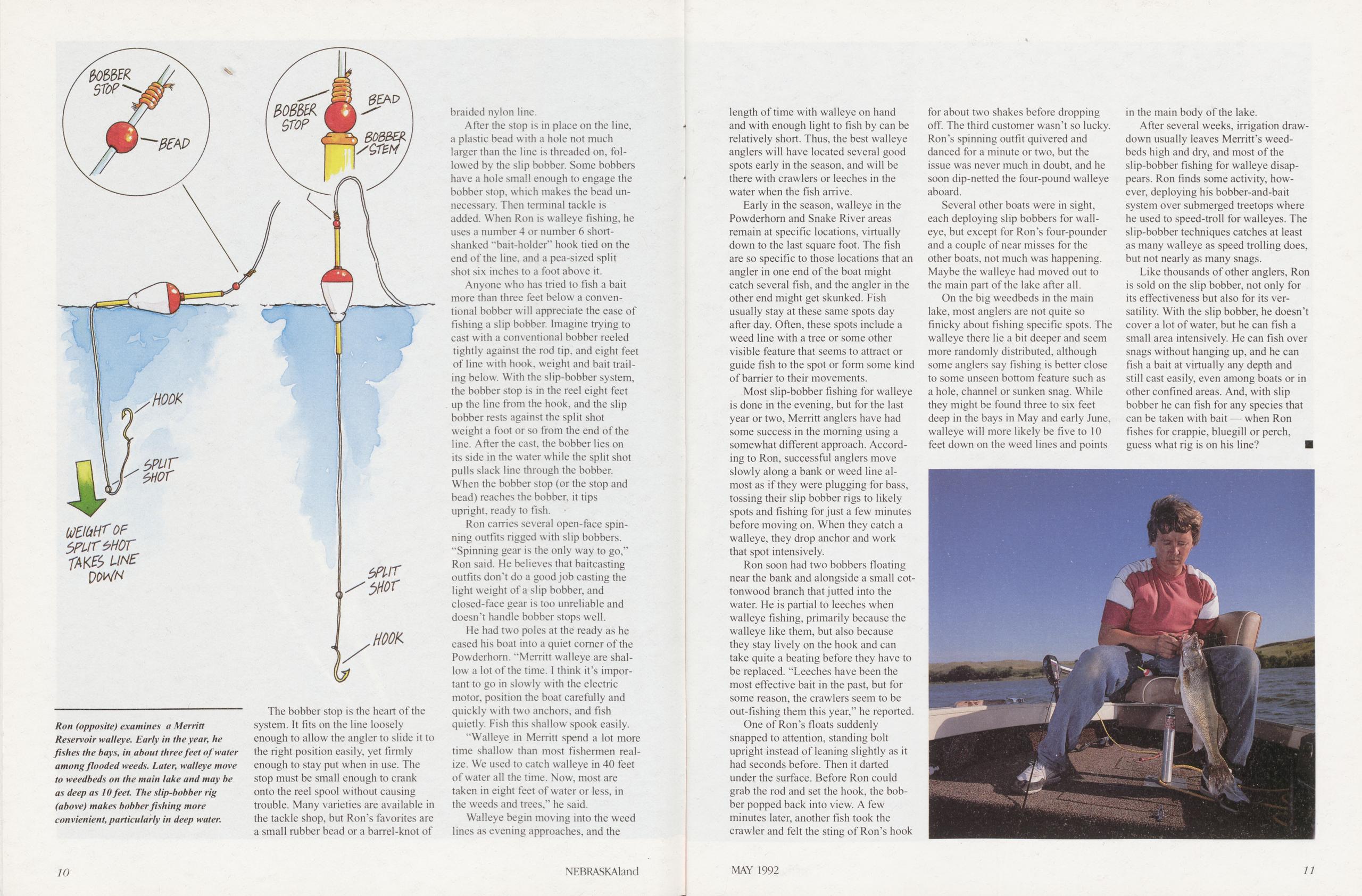
The bobber stop is the heart of the system. It fits on the line loosely enough to allow the angler to slide it to the right position easily, yet firmly enough to stay put when in use. The stop must be small enough to crank onto the reel spool without causing trouble. Many varieties are available in the tackle shop, but Ron’s favorites are a small rubber bead or a barrel-knot of braided nylon line.
After the stop is in place on the line, a plastic bead with a hole not much larger than the line is threaded on, followed by the slip bobber. Some bobbers have a hole small enough to engage the bobber stop, which makes the bead unnecessary. Then terminal tackle is added. When Ron is walleye fishing, he uses a number 4 or number 6 short- shanked "bait-holder” hook tied on the end of the line, and a pea-sized split shot six inches to a foot above it.
Anyone who has tried to fish a bait more than three feet below a conventional bobber will appreciate the ease of fishing a slip bobber. Imagine trying to cast with a conventional bobber reeled tightly against the rod tip, and eight feet of line with hook, weight and bait trailing below. With the slip-bobber system, the bobber stop is in the reel eight feet up the line from the hook, and the slip bobber rests against the split shot weight a foot or so from the end of the line. After the cast, the bobber lies on its side in the water while the split shot pulls slack line through the bobber. When the bobber stop (or the stop and bead) reaches the bobber, it tips upright, ready to fish.
Ron carries several open-face spinning outfits rigged with slip bobbers. “Spinning gear is the only way to go,” Ron said. He believes that baitcasting outfits don’t do a good job casting the light weight of a slip bobber, and closed-face gear is too unreliable and doesn’t handle bobber stops well.
He had two poles at the ready as he eased his boat into a quiet corner of the Powderhom. “Merritt walleye are shallow a lot of the time. I think it’s important to go in slowly with the electric motor, position the boat carefully and quickly with two anchors, and fish quietly. Fish this shallow spook easily. “Walleye in Merritt spend a lot more time shallow than most fishermen realize. We used to catch walleye in 40 feet of water all the time. Now, most are taken in eight feet of water or less, in the weeds and trees,” he said.
Walleye begin moving into the weed lines as evening approaches, and the length of time with walleye on hand and with enough light to fish by can be relatively short. Thus, the best walleye anglers will have located several good spots early in the season, and will be there with crawlers or leeches in the water when the fish arrive.
Early in the season, walleye in the Powderhom and Snake River areas remain at specific locations, virtually down to the last square foot. The fish are so specific to those locations that an angler in one end of the boat might catch several fish, and the angler in the other end might get skunked. Fish usually stay at these same spots day after day. Often, these spots include a weed line with a tree or some other visible feature that seems to attract or guide fish to the spot or form some kind of barrier to their movements.
Most slip-bobber fishing for walleye is done in the evening, but for the last year or two, Merritt anglers have had some success in the morning using a somewhat different approach. According to Ron, successful anglers move slowly along a bank or weed line almost as if they were plugging for bass, tossing their slip bobber rigs to likely spots and fishing for just a few minutes before moving on. When they catch a walleye, they drop anchor and work that spot intensively.
Ron soon had two bobbers floating near the bank and alongside a small cottonwood branch that jutted into the water. He is partial to leeches when walleye fishing, primarily because the walleye like them, but also because they stay lively on the hook and can take quite a beating before they have to be replaced. “Leeches have been the most effective bait in the past, but for some reason, the crawlers seem to be out-fishing them this year,” he reported.
One of Ron’s floats suddenly snapped to attention, standing bolt upright instead of leaning slightly as it had seconds before. Then it darted under the surface. Before Ron could grab the rod and set the hook, the bobber popped back into view. A few minutes later, another fish took the crawler and felt the sting of Ron’s hook for about two shakes before dropping off. The third customer wasn’t so lucky. Ron’s spinning outfit quivered and danced for a minute or two, but the issue was never much in doubt, and he soon dip-netted the four-pound walleye aboard.
Several other boats were in sight, each deploying slip bobbers for walleye, but except for Ron’s four-pounder and a couple of near misses for the other boats, not much was happening. Maybe the walleye had moved out to the main part of the lake after all.
On the big weedbeds in the main lake, most anglers are not quite so finicky about fishing specific spots. The walleye there lie a bit deeper and seem more randomly distributed, although some anglers say fishing is better close to some unseen bottom feature such as a hole, channel or sunken snag. While they might be found three to six feet deep in the bays in May and early June, walleye will more likely be five to 10 feet down on the weed lines and points in the main body of the lake.
After several weeks, irrigation draw-down usually leaves Merritt’s weed-beds high and dry, and most of the slip-bobber fishing for walleye disappears. Ron finds some activity, however, deploying his bobber-and-bait system over submerged treetops where he used to speed-troll for walleyes. The slip-bobber techniques catches at least as many walleye as speed trolling does, but not nearly as many snags.
Like thousands of other anglers, Ron is sold on the slip bobber, not only for its effectiveness but also for its versatility. With the slip bobber, he doesn’t cover a lot of water, but he can fish a small area intensively. He can fish over snags without hanging up, and he can fish a bait at virtually any depth and still cast easily, even among boats or in other confined areas. And, with slip bobber he can fish for any species that can be taken with bait — when Ron fishes for crappie, bluegill or perch, guess what rig is on his line?
10 NEBRASKAland MAY 1992 11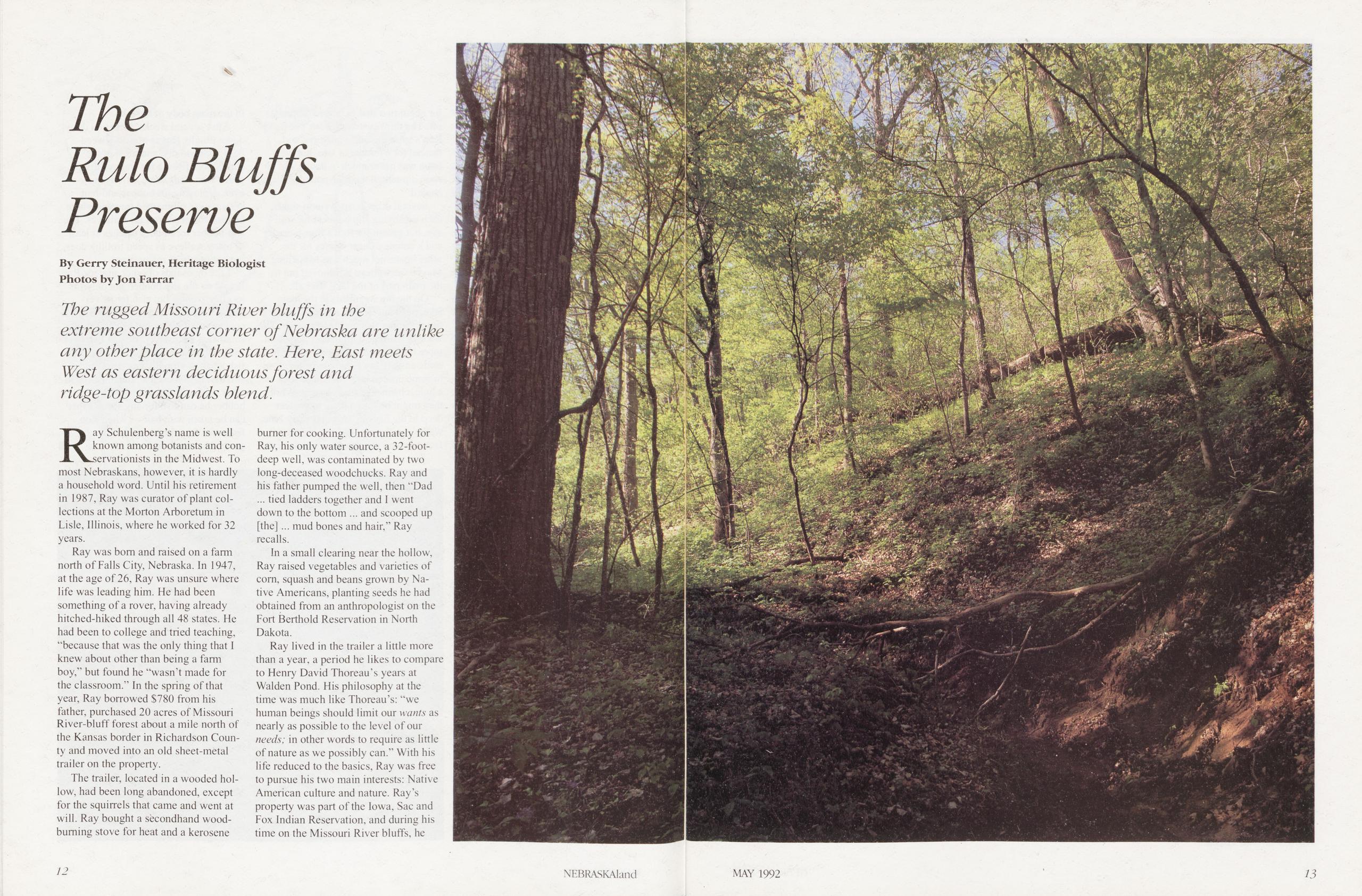
The Rulo Bluffs Preserve
By Gerry Steinauer, Heritage BiologistPhotos by Jon Farrar The rugged Missouri River bluffs in the extreme southeast corner of Nebraska are unlike any other place in the state. Here, East meets West as eastern deciduous forest and ridge-top grasslands blend.
Ray Schulenberg’s name is well known among botanists and conservationists in the Midwest. To most Nebraskans, however, it is hardly a household word. Until his retirement in 1987, Ray was curator of plant collections at the Morton Arboretum in Lisle, Illinois, where he worked for 32 years.
Ray was bom and raised on a farm north of Falls City, Nebraska. In 1947, at the age of 26, Ray was unsure where life was leading him. He had been something of a rover, having already hitched-hiked through all 48 states. He had been to college and tried teaching, "because that was the only thing that 1 knew about other than being a farm boy," but found he "wasn’t made for the classroom." In the spring of that year, Ray borrowed $780 from his father, purchased 20 acres of Missouri River-bluff forest about a mile north of the Kansas border in Richardson County and moved into an old sheet-metal trailer on the property.
The trailer, located in a wooded hollow, had been long abandoned, except for the squirrels that came and went at will. Ray bought a secondhand wood- burning stove for heat and a kerosene burner for cooking. Unfortunately for Ray, his only water source, a 32-foot- deep well, was contaminated by two long-deceased woodchucks. Ray and his father pumped the well, then "Dad ... tied ladders together and I went down to the bottom ... and scooped up [the] ... mud bones and hair," Ray recalls.
In a small clearing near the hollow, Ray raised vegetables and varieties of corn, squash and beans grown by Na- tive Americans, planting seeds he had obtained from an anthropologist on the Fort Berthold Reservation in North Dakota.
Ray lived in the trailer a little more than a year, a period he likes to compare to Henry David Thoreau’s years at Walden Pond. His philosophy at the time was much like Thoreau’s: "we human beings should limit our wants as nearly as possible to the level of our needs; in other words to require as little of nature as we possibly can." With his life reduced to the basics, Ray was free to pursue his two main interests: Native American culture and nature. Ray’s property was part of the Iowa, Sac and Fox Indian Reservation, and during his time on the Missouri River bluffs, he
12 NEBRASKAland MAY 1992 13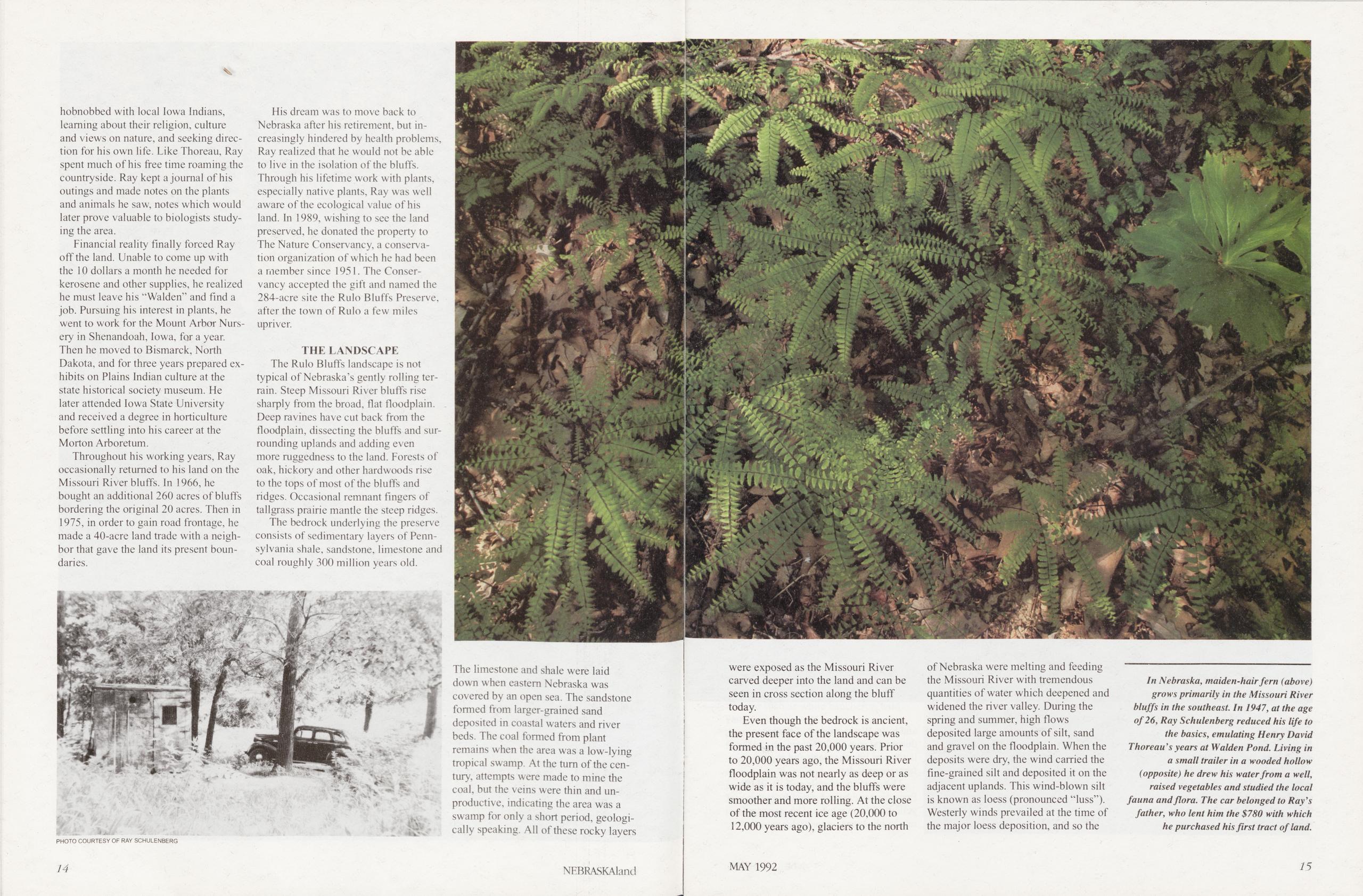
hobnobbed with local Iowa Indians, learning about their religion, culture and views on nature, and seeking direction for his own life. Like Thoreau, Ray spent much of his free time roaming the countryside. Ray kept a journal of his outings and made notes on the plants and animals he saw, notes which would later prove valuable to biologists studying the area.
Financial reality finally forced Ray off the land. Unable to come up with the 10 dollars a month he needed for kerosene and other supplies, he realized he must leave his “Walden” and find a job. Pursuing his interest in plants, he went to work for the Mount Arbor Nursery in Shenandoah, Iowa, for a year. Then he moved to Bismarck, North Dakota, and for three years prepared exhibits on Plains Indian culture at the state historical society museum. He later attended Iowa State University and received a degree in horticulture before settling into his career at the Morton Arboretum.
Throughout his working years, Ray occasionally returned to his land on the Missouri River bluffs. In 1966, he bought an additional 260 acres of bluffs bordering the original 20 acres. Then in 1975, in order to gain road frontage, he made a 40-acre land trade with a neighbor that gave the land its present boundaries.
PHOTO COURTESY OF RAY SCHULENBERGHis dream was to move back to Nebraska after his retirement, but increasingly hindered by health problems, Ray realized that he would not be able to live in the isolation of the bluffs. Through his lifetime work with plants, especially native plants, Ray was well aware of the ecological value of his land. In 1989, wishing to see the land preserved, he donated the property to The Nature Conservancy, a conservation organization of which he had been a member since 1951. The Conservancy accepted the gift and named the 284-acre site the Rulo Bluffs Preserve, after the town of Rulo a few miles upriver.
THE LANDSCAPEThe Rulo Bluffs landscape is not typical of Nebraska’s gently rolling terrain. Steep Missouri River bluffs rise sharply from the broad, flat floodplain. Deep ravines have cut back from the floodplain, dissecting the bluffs and surrounding uplands and adding even more ruggedness to the land. Forests of oak, hickory and other hardwoods rise to the tops of most of the bluffs and ridges. Occasional remnant fingers of tailgrass prairie mantle the steep ridges.
The bedrock underlying the preserve consists of sedimentary layers of Pennsylvania shale, sandstone, limestone and coal roughly 300 million years old.
The limestone and shale were laid down when eastern Nebraska was covered by an open sea. The sandstone formed from larger-grained sand deposited in coastal waters and river beds. The coal formed from plant remains when the area was a low-lying tropical swamp. At the turn of the century, attempts were made to mine the coal, but the veins were thin and un- productive, indicating the area was a swamp for only a short period, geologically speaking. All of these rocky layers were exposed as the Missouri River carved deeper into the land and can be seen in cross section along the bluff today.
Even though the bedrock is ancient, the present face of the landscape was formed in the past 20,000 years. Prior to 20,000 years ago, the Missouri River floodplain was not nearly as deep or as wide as it is today, and the bluffs were smoother and more rolling. At the close of the most recent ice age (20,000 to 12,000 years ago), glaciers to the north of Nebraska were melting and feeding the Missouri River with tremendous quantities of water which deepened and widened the river valley. During the spring and summer, high flows deposited large amounts of silt, sand and gravel on the floodplain. When the deposits were dry, the wind carried the fine-grained silt and deposited it on the adjacent uplands. This wind-blown silt is known as loess (pronounced “luss”). Westerly winds prevailed at the time of the major loess deposition, and so the
greatest extent of “loess hills” are found on the Iowa side of the river, some up to 200 feet thick. On the Nebraska side, loess deposits are no more than 100 feet thick on the bluffs and become progressively thinner farther from the river. Initially, the loess deposits formed smooth, rolling bluffs and hills. Water erosion of the loess during the past 12,000 years carved the landscape into the steep and rugged forms seen today.
The majority of soils at Rulo Bluffs Preserve have been formed from the yellowish-brown loess. The steep terrain, with slopes up to 30 degrees, promotes rapid surface runoff and soil erosion resulting in a generally thin topsoil averaging about six inches thick. These silt-loam soils contain little clay and are highly permeable. Water that does enter the soil passes through rapidly. On the upper hillsides, the combination of high runoff and permeability results in somewhat dry soils. Lower slopes receive runoff and tend to have wetter soils. The loess soils are naturally fertile and well suited for growth of both forest and prairie.
THE FORESTDuring the past 2,000 years, deciduous forests (those in which trees lose their leaves in winter), plants and animals have extended their ranges up the Missouri River valley from the extensive forests of the eastern United States. During the ice age, it was too cold in eastern Nebraska for most deciduous forest species to survive. In the mid-1800s, prior to settlement, deciduous forests in Nebraska were limited to the well-watered and protected river and stream valleys, primarily in the eastern portion of the state. Occasionally, small groves could be found several miles from water courses, but wildfires, droughts and competition from the dense-sodded grasses limited the spread of trees onto the prairie.
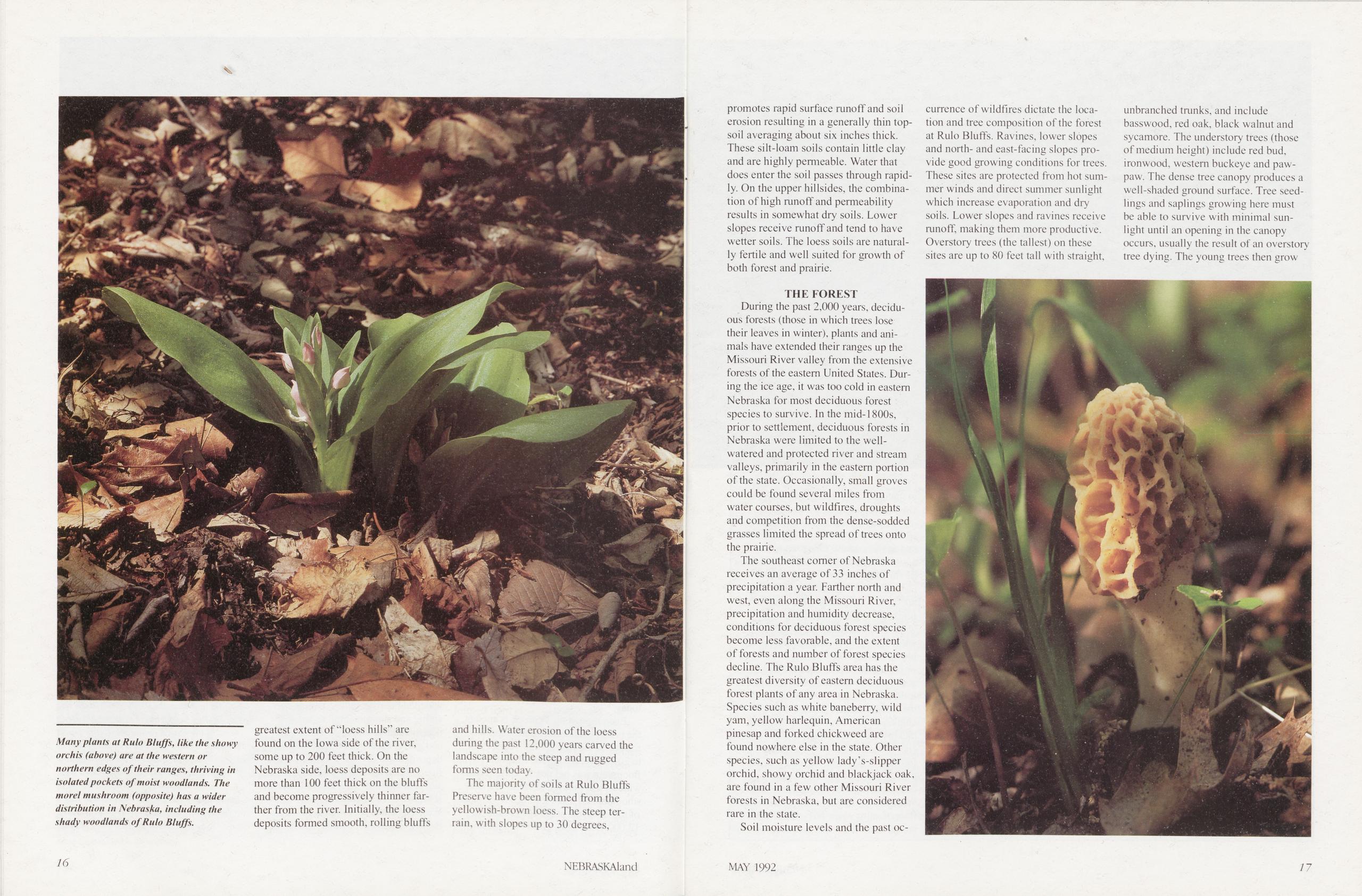
The southeast comer of Nebraska receives an average of 33 inches of precipitation a year. Farther north and west, even along the Missouri River, precipitation and humidity decrease, conditions for deciduous forest species become less favorable, and the extent of forests and number of forest species decline. The Rulo Bluffs area has the greatest diversity of eastern deciduous forest plants of any area in Nebraska. Species such as white baneberry, wild yam, yellow harlequin, American pinesap and forked chickweed are found nowhere else in the state. Other species, such as yellow lady’s-slipper orchid, showy orchid and blackjack oak, are found in a few other Missouri River forests in Nebraska, but are considered rare in the state.
Soil moisture levels and the past occurrence of wildfires dictate the location and tree composition of the forest at Rulo Bluffs. Ravines, lower slopes and north- and east-facing slopes provide good growing conditions for trees. These sites are protected from hot summer winds and direct summer sunlight which increase evaporation and dry soils. Lower slopes and ravines receive runoff, making them more productive. Overstory trees (the tallest) on these sites are up to 80 feet tall with straight, unbranched trunks, and include basswood, red oak, black walnut and sycamore. The understory trees (those of medium height) include red bud, ironwood, western buckeye and paw- paw. The dense tree canopy produces a well-shaded ground surface. Tree seedlings and saplings growing here must be able to survive with minimal sunlight until an opening in the canopy occurs, usually the result of an overstory tree dying. The young trees then grow
16 NEBRASKAland MAY 1992 17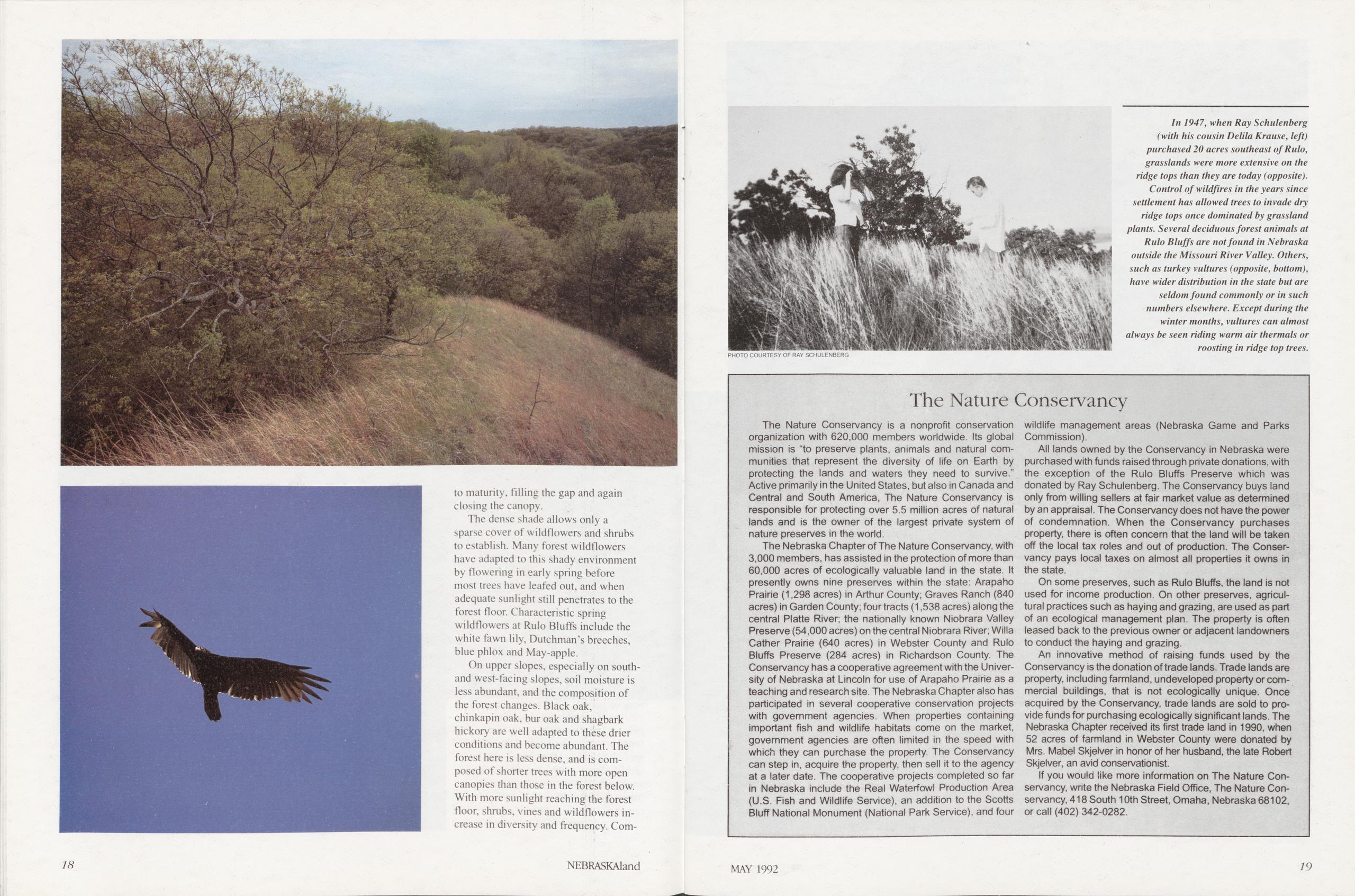
to maturity, filling the gap and again closing the canopy.
The dense shade allows only a sparse cover of wildflowers and shrubs to establish. Many forest wildflowers have adapted to this shady environment by flowering in early spring before most trees have leafed out, and when adequate sunlight still penetrates to the forest floor. Characteristic spring wildflowers at Rulo Bluffs include the white fawn lily, Dutchman’s breeches, blue phlox and May-apple.
On upper slopes, especially on south- and west-facing slopes, soil moisture is less abundant, and the composition of the forest changes. Black oak, chinkapin oak, bur oak and shagbark hickory are well adapted to these drier conditions and become abundant. The forest here is less dense, and is composed of shorter trees with more open canopies than those in the forest below. With more sunlight reaching the forest floor, shrubs, vines and wildflowers increase in diversity and frequency. Common
The Nature ConservancyThe Nature Conservancy is a nonprofit conservation organization with 620,000 members worldwide. Its global mission is “to preserve plants, animals and natural communities that represent the diversity of life on Earth by protecting the lands and waters they need to survive.” Active primarily in the United States, but also in Canada and Central and South America, The Nature Conservancy is responsible for protecting over 5.5 million acres of natural lands and is the owner of the largest private system of nature preserves in the world.
In 1947, when Ray Schulenberg (with his cousin Delila Krause, left) purchased 20 acres southeast of Rulo, grasslands were more extensive on the ridge tops than they are today (opposite). Control of wildfires in the years since settlement has allowed trees to invade dry ridge tops once dominated by grassland plants. Several deciduous forest animals at Rulo Bluffs are not found in Nebraska outside the Missouri River Valley. Others, such as turkey vultures (opposite, bottom), have wider distribution in the state but are seldom found commonly or in such numbers elsewhere. Except during the winter months, vultures can almost always be seen riding warm air thermals or roosting in ridge top trees.
All lands owned by the Conservancy in Nebraska were purchased with funds raised through private donations, with the exception of the Rulo Bluffs Preserve which was donated by Ray Schulenberg. The Conservancy buys land only from willing sellers at fair market value as determined by an appraisal. The Conservancy does not have the power of condemnation. When the Conservancy purchases property, there is often concern that the land will be taken off the local tax roles and out of production. The Conservancy pays local taxes on almost all properties it owns in the state.
On some preserves, such as Rulo Bluffs, the land is not used for income production. On other preserves, agricultural practices such as haying and grazing, are used as part of an ecological management plan. The property is often leased back to the previous owner or adjacent landowners to conduct the haying and grazing.
An innovative method of raising funds used by the Conservancy is the donation of trade lands. Trade lands are property, including farmland, undeveloped property or commercial buildings, that is not ecologically unique. Once acquired by the Conservancy, trade lands are sold to provide funds for purchasing ecologically significant lands. The Nebraska Chapter received its first trade land in 1990, when 52 acres of farmland in Webster County were donated by Mrs. Mabel Skjelver in honor of her husband, the late Robert Skjelver, an avid conservationist.
If you would like more information on The Nature Con- servancy, write the Nebraska Field Office, The Nature Con- servancy, 418 South 10th Street, Omaha, Nebraska 68102, or call (402) 342-0282.
18 NEBRASKAland MAY 1992 19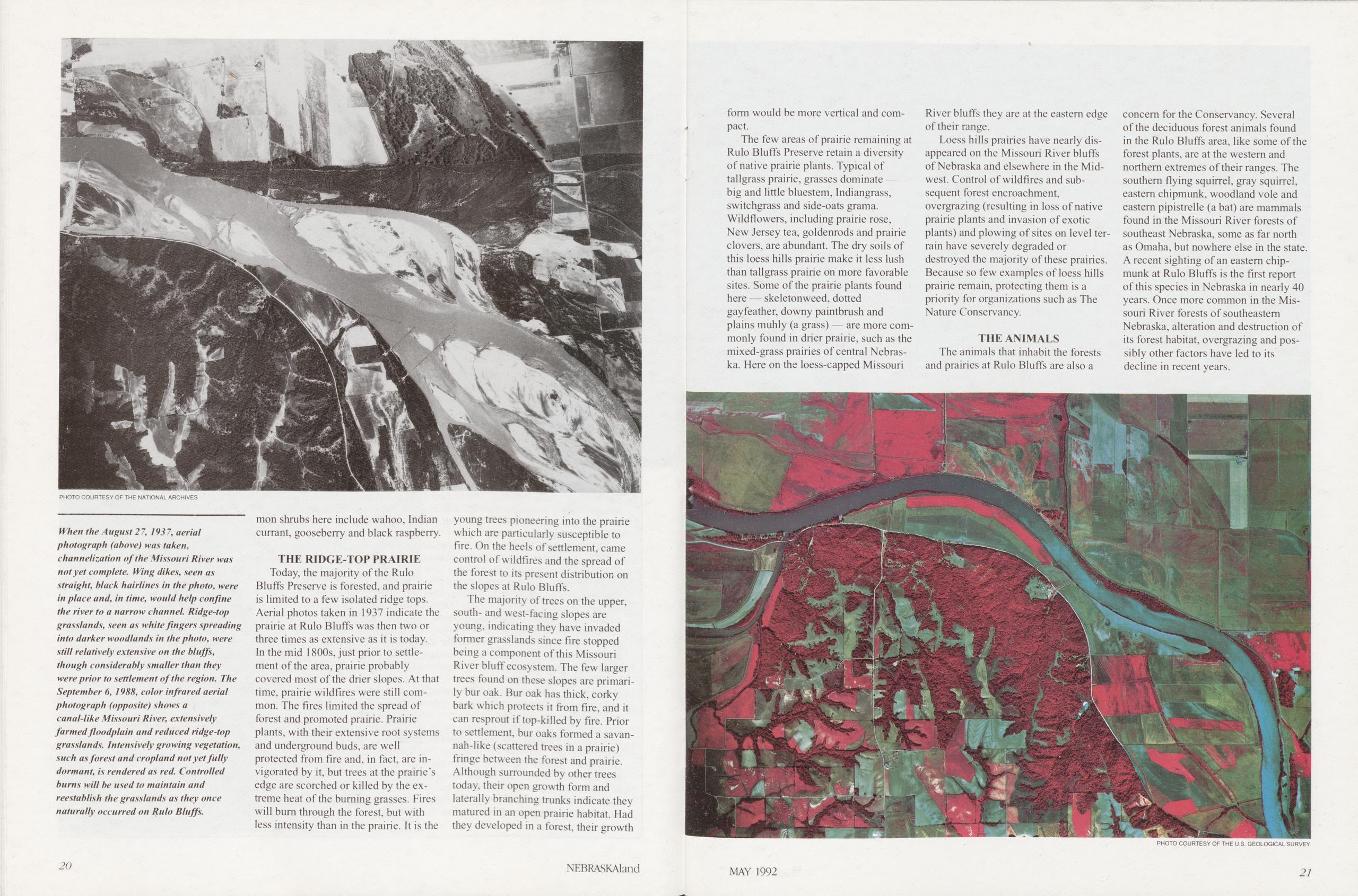
shrubs here include wahoo, Indian currant, gooseberry and black raspberry.
THE RIDGE-TOP PRAIRIEToday, the majority of the Rulo Bluffs Preserve is forested, and prairie is limited to a few isolated ridge tops. Aerial photos taken in 1937 indicate the prairie at Rulo Bluffs was then two or three times as extensive as it is today. In the mid 1800s, just prior to settlement of the area, prairie probably covered most of the drier slopes. At that time, prairie wildfires were still common. The fires limited the spread of forest and promoted prairie. Prairie plants, with their extensive root systems and underground buds, are well protected from fire and, in fact, are invigorated by it, but trees at the prairie’s edge are scorched or killed by the extreme heat of the burning grasses. Fires will bum through the forest, but with less intensity than in the prairie. It is the young trees pioneering into the prairie which are particularly susceptible to fire. On the heels of settlement, came control of wildfires and the spread of the forest to its present distribution on the slopes at Rulo Bluffs.
The majority of trees on the upper, south- and west-facing slopes are young, indicating they have invaded former grasslands since fire stopped being a component of this Missouri River bluff ecosystem. The few larger trees found on these slopes are primarily bur oak. Bur oak has thick, corky bark which protects it from fire, and it can resprout if top-killed by fire. Prior to settlement, bur oaks formed a savannah-like (scattered trees in a prairie) fringe between the forest and prairie. Although surrounded by other trees today, their open growth form and laterally branching trunks indicate they matured in an open prairie habitat. Had they developed in a forest, their growth form would be more vertical and compact.
The few areas of prairie remaining at Rulo Bluffs Preserve retain a diversity of native prairie plants. Typical of tailgrass prairie, grasses dominate — big and little bluestem, Indiangrass, switchgrass and side-oats grama. Wildflowers, including prairie rose, New Jersey tea, goldenrods and prairie clovers, are abundant. The dry soils of this loess hills prairie make it less lush than tall grass prairie on more favorable sites. Some of the prairie plants found here — skeletonweed, dotted gayfeather, downy paintbrush and plains muhly (a grass) — are more commonly found in drier prairie, such as the mixed-grass prairies of central Nebraska. Here on the loess-capped Missouri River bluffs they are at the eastern edge of their range.
Loess hills prairies have nearly disappeared on the Missouri River bluffs of Nebraska and elsewhere in the Midwest. Control of wildfires and subsequent forest encroachment, overgrazing (resulting in loss of native prairie plants and invasion of exotic plants) and plowing of sites on level terrain have severely degraded or destroyed the majority of these prairies. Because so few examples of loess hills prairie remain, protecting them is a priority for organizations such as The Nature Conservancy.
THE ANIMALSThe animals that inhabit the forests and prairies at Rulo Bluffs are also a concern for the Conservancy. Several of the deciduous forest animals found in the Rulo Bluffs area, like some of the forest plants, are at the western and northern extremes of their ranges. The southern flying squirrel, gray squirrel, eastern chipmunk, woodland vole and eastern pipistrelle (a bat) are mammals found in the Missouri River forests of southeast Nebraska, some as far north as Omaha, but nowhere else in the state. A recent sighting of an eastern chipmunk at Rulo Bluffs is the first report of this species in Nebraska in nearly 40 years. Once more common in the Missouri River forests of southeastern Nebraska, alteration and destruction of its forest habitat, overgrazing and possibly other factors have led to its decline in recent years.
20 NEBRASKAland MAY 1992 21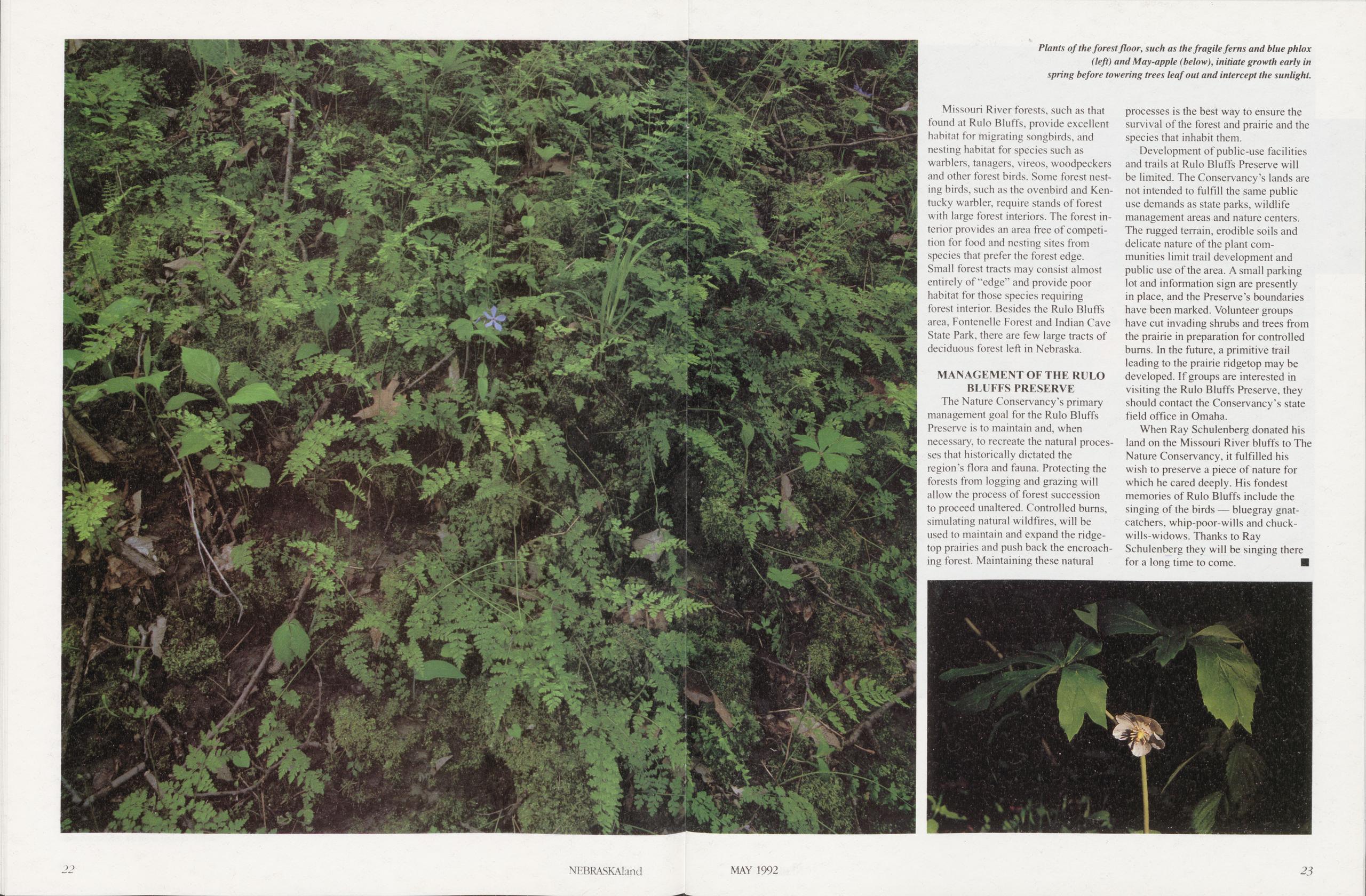
Missouri River forests, such as that found at Rulo Bluffs, provide excellent habitat for migrating songbirds, and nesting habitat for species such as warblers, tanagers, vireos, woodpeckers and other forest birds. Some forest nesting birds, such as the ovenbird and Kentucky warbler, require stands of forest with large forest interiors. The forest interior provides an area free of competition for food and nesting sites from species that prefer the forest edge. Small forest tracts may consist almost entirely of "edge" and provide poor habitat for those species requiring forest interior. Besides the Rulo Bluffs area, Fontenelle Forest and Indian Cave State Park, there are few large tracts of deciduous forest left in Nebraska.
MANAGEMENT OF THE RULO BLUFFS PRESERVEThe Nature Conservancy’s primary management goal for the Rulo Bluffs Preserve is to maintain and, when necessary, to recreate the natural processes that historically dictated the region’s flora and fauna. Protecting the forests from logging and grazing will allow the process of forest succession to proceed unaltered. Controlled bums, simulating natural wildfires, will be used to maintain and expand the ridge- top prairies and push back the encroaching forest. Maintaining these natural processes is the best way to ensure the survival of the forest and prairie and the species that inhabit them.
Development of public-use facilities and trails at Rulo Bluffs Preserve will be limited. The Conservancy’s lands are not intended to fulfill the same public use demands as state parks, wildlife management areas and nature centers. The rugged terrain, erodible soils and delicate nature of the plant communities limit trail development and public use of the area. A small parking lot and information sign are presently in place, and the Preserve’s boundaries have been marked. Volunteer groups have cut invading shrubs and trees from the prairie in preparation for controlled bums. In the future, a primitive trail leading to the prairie ridgetop may be developed. If groups are interested in visiting the Rulo Bluffs Preserve, they should contact the Conservancy’s state field office in Omaha.
When Ray Schulenberg donated his land on the Missouri River bluffs to The Nature Conservancy, it fulfilled his wish to preserve a piece of nature for which he cared deeply. His fondest memories of Rulo Bluffs include the singing of the birds — bluegray gnat- catchers, whip-poor-wills and chuck- wills-widows. Thanks to Ray Schulenberg they will be singing there for a long time to come.
NEBRASKAland MAY 1992 23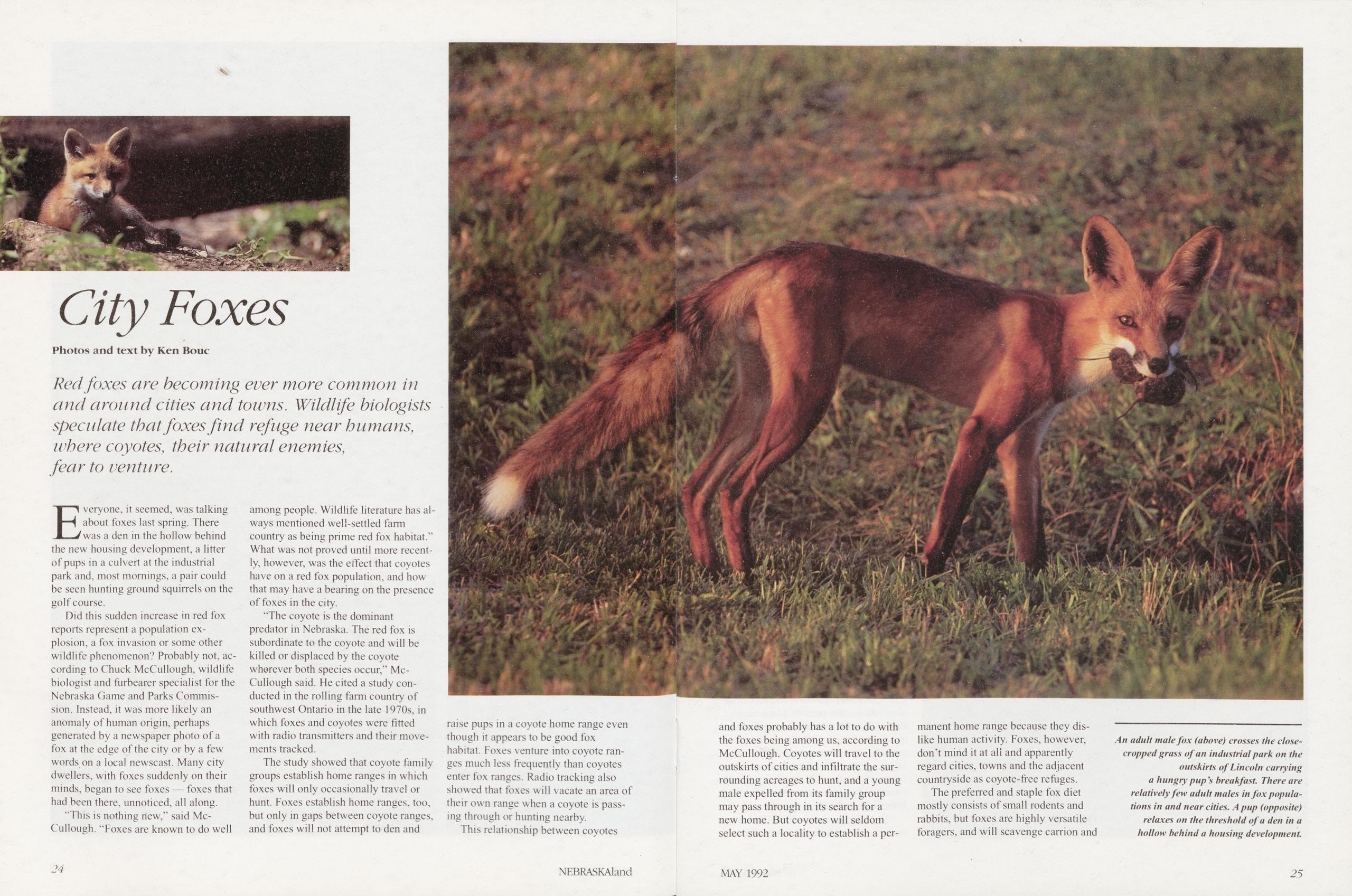
City Foxes
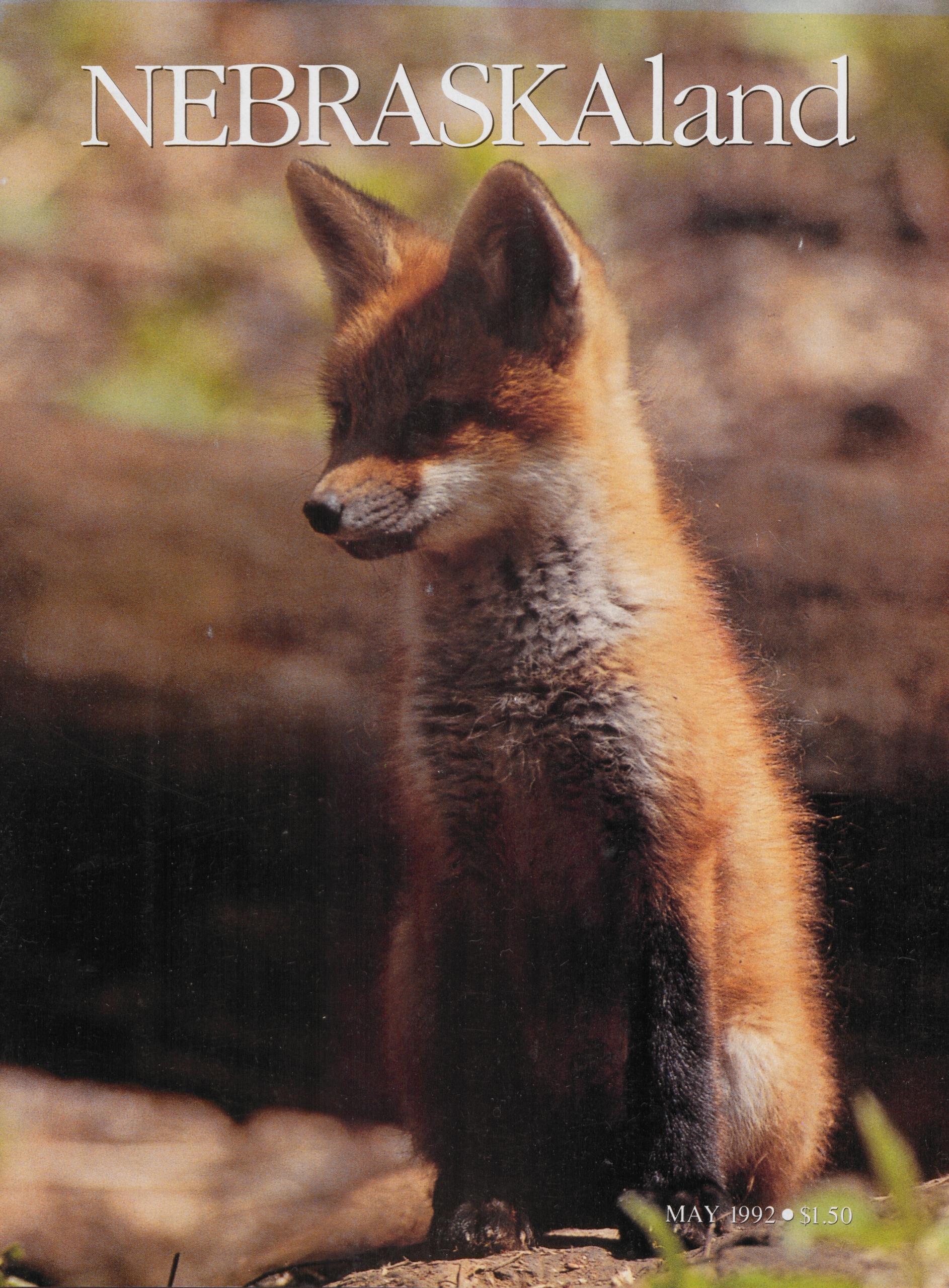
Photos and text by Ken Bouc Red foxes are becoming ever more common in and around cities and towns. Wildlife biologists speculate that foxes find refuge near humans, inhere coyotes, their natural enemies, fear to venture.Everyone, it seemed, was talking about foxes last spring. There was a den in the hollow behind the new housing development, a litter of pups in a culvert at the industrial park and, most mornings, a pair could be seen hunting ground squirrels on the golf course.
Did this sudden increase in red fox reports represent a population explosion, a fox invasion or some other wildlife phenomenon? Probably not, according to Chuck McCullough, wildlife biologist and furbearer specialist for the Nebraska Game and Parks Commission. Instead, it was more likely an anomaly of human origin, perhaps generated by a newspaper photo of a fox at the edge of the city or by a few words on a local newscast. Many city dwellers, with foxes suddenly on their minds, began to see foxes foxes that had been there, unnoticed, all along. “This is nothing new,” said McCullough. “Foxes are known to do well among people. Wildlife literature has always mentioned well-settled farm country as being prime red fox habitat.” What was not proved until more recently, however, was the effect that coyotes have on a red fox population, and how that may have a bearing on the presence of foxes in the city.
“The coyote is the dominant predator in Nebraska. The red fox is subordinate to the coyote and will be killed or displaced by the coyote wherever both species occur,” McCullough said. He cited a study conducted in the rolling farm country of southwest Ontario in the late 1970s, in which foxes and coyotes were fitted with radio transmitters and their movements tracked.
The study showed that coyote family groups establish home ranges in which foxes will only occasionally travel or hunt. Foxes establish home ranges, too, but only in gaps between coyote ranges, and foxes will not attempt to den and raise pups in a coyote home range even though it appears to be good fox habitat. Foxes venture into coyote ran- ges much less frequently than coyotes enter fox ranges. Radio tracking also showed that foxes will vacate an area of their own range when a coyote is passing through or hunting nearby.
This relationship between coyotes and foxes probably has a lot to do with the foxes being among us, according to McCullough. Coyotes will travel to the outskirts of cities and infiltrate the surrounding acreages to hunt, and a young male expelled from its family group may pass through in its search for a new home. But coyotes will seldom select such a locality to establish a permanent home range because they dislike human activity. Foxes, however, don’t mind it at all and apparently regard cities, towns and the adjacent countryside as coyote-free refuges.
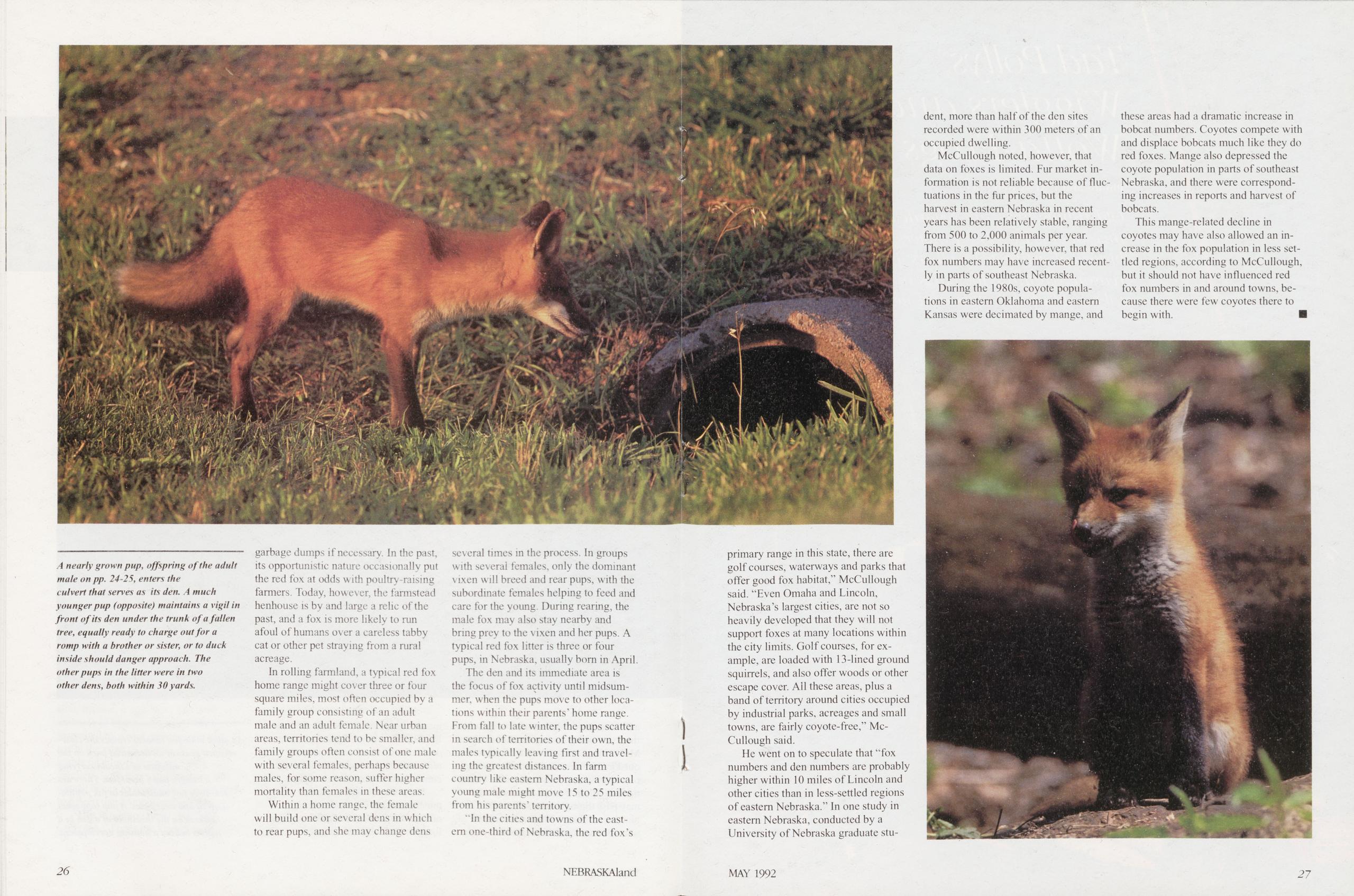
garbage dumps if necessary. In the past, its opportunistic nature occasionally put the red fox at odds with poultry-raising farmers. Today, however, the farmstead henhouse is by and large a relic of the past, and a fox is more likely to run afoul of humans over a careless tabby cat or other pet straying from a rural acreage.
In rolling farmland, a typical red fox home range might cover three or four square miles, most often occupied by a family group consisting of an adult male and an adult female Near urban areas, territories tend to be smaller, and family groups often consist of one male with several females, perhaps because males, for some reason, suffer higher mortality than females in these areas.
Within a home range, the female will build one or several dens in which to rear pups, and she may change dens several times in the process. In groups with several females, only the dominant vixen will breed and rear pups, with the subordinate females helping to feed and care for the young During rearing, the male fox may also stay nearby and bring prey to the vixen and her pups. A typical red fox litter is three or four pups, in Nebraska, usually born in April.
The den and its immediate area is the focus of fox activity until midsummer, when the pups move to other locations within their parents' home range. From fall to late w inter, the pups scatter in search of territories of their own, the males typically leaving first and traveling the greatest distances. In farm country like eastern Nebraska, a typical young male might move 15 to 25 miles from his parents’ territory.
"In the cities and towns of the eastern one-third of Nebraska, the red fox’s primary range in this state, there are golf courses, waterways and parks that offer good fox habitat,” McCullough said. “Even Omaha and Lincoln, Nebraska’s largest cities, are not so heavily developed that they will not support foxes at many locations within the city limits. Golf courses, for example, are loaded with 13-lined ground squirrels, and also offer woods or other escape cover. All these areas, plus a band of territory around cities occupied by industrial parks, acreages and small towns, are fairly coyote-free,” McCullough said.
He went on to speculate that “fox numbers and den numbers are probably higher within 10 miles of Lincoln and other cities than in less-settled regions of eastern Nebraska.” In one study in eastern Nebraska, conducted by a University of Nebraska graduate student, more than half of the den sites recorded were within 300 meters of an occupied dwelling.
McCullough noted, however, that data on foxes is limited. Fur market information is not reliable because of fluctuations in the fur prices, but the harvest in eastern Nebraska in recent years has been relatively stable, ranging from 500 to 2,000 animals per year. There is a possibility, however, that red fox numbers may have increased recently in parts of southeast Nebraska.
During the 1980s, coyote populations in eastern Oklahoma and eastern Kansas were decimated by mange, and these areas had a dramatic increase in bobcat numbers. Coyotes compete with and displace bobcats much like they do red foxes. Mange also depressed the coyote population in parts of southeast Nebraska, and there were corresponding increases in reports and harvest of bobcats.
This mange-related decline in coyotes may have also allowed an increase in the fox population in less settled regions, according to McCullough, but it should not have influenced red fox numbers in and around towns, because there were few coyotes there to begin with.
26 NEBRASKAland MAY 1992 27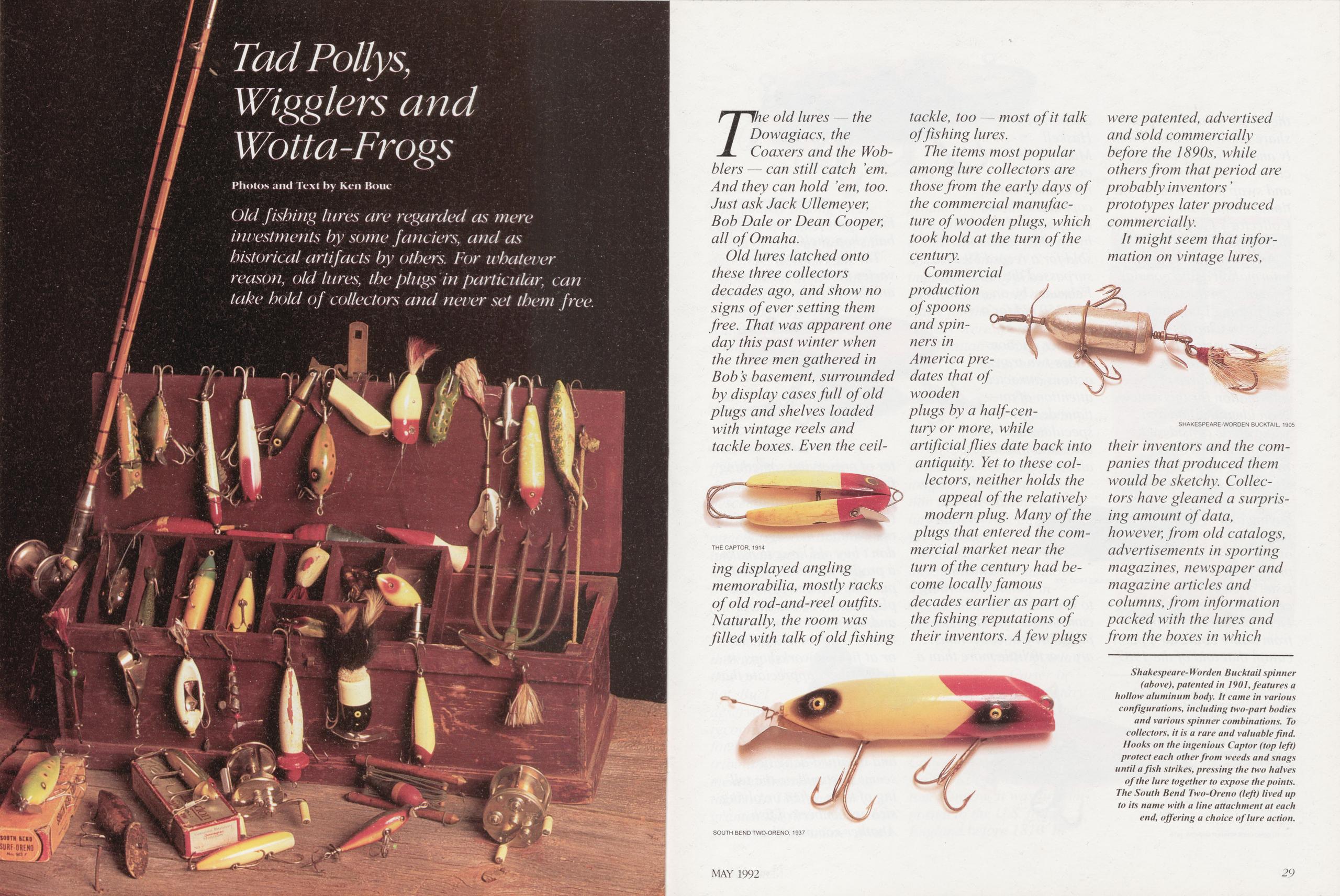
Tad Pollys, Wigglers and Wotta-Frogs
Photos and Text by Ken Bonc Old fishing lures are regarded as mere investments by some fanciers, and as historical artifacts by others. For whatever reason, old lures, the plugs in particular, can take hold of collectors and never set them free.The old lures — the Dowagiacs, the Coaxers and the Wobblers — can still catch ’em. And they can hold ’em, too. Just ask Jack Ullemeyer, Bob Dale or Dean Cooper, all of Omaha.
Old lures latched onto these three collectors decades ago, and show no signs of ever setting them free. That was apparent one day this past winter when the three men gathered in Bob s basement, surrounded by display cases full of old plugs and shelves loaded with vintage reels and tackle boxes. Even the ceil-
ing displayed angling memorabilia, mostly racks of old rod-and-reel outfits. Naturally, the room was filled with talk of old fishing
tackle, too — most of it talk of fishing lures.
The items most popular among lure collectors are those from the early days of the commercial manufacture of wooden plugs, which took hold at the turn of the century.
Commercial production of spoons and spinners in America pre-dates that of wooden plugs by a half-century or more, while artificial flies date back into antiquity. Yet to these collectors, neither holds the appeal of the relatively modern plug. Many of the plugs that entered the commercial market near the turn of the century had become locally famous decades earlier as part of the fishing reputations of their inventors. A few plugs were patented, advertised and sold commercially before the 1890s, while others from that period are probably inventors' prototypes later produced commercially.
It might seem that infor- mation on vintage lures,
their inventors and the companies that produced them would be sketchy. Collectors have gleaned a surprising amount of data, however, from old catalogs, advertisements in sporting magazines, newspaper and magazine articles and columns, from information packed with the lures and from the boxes in which
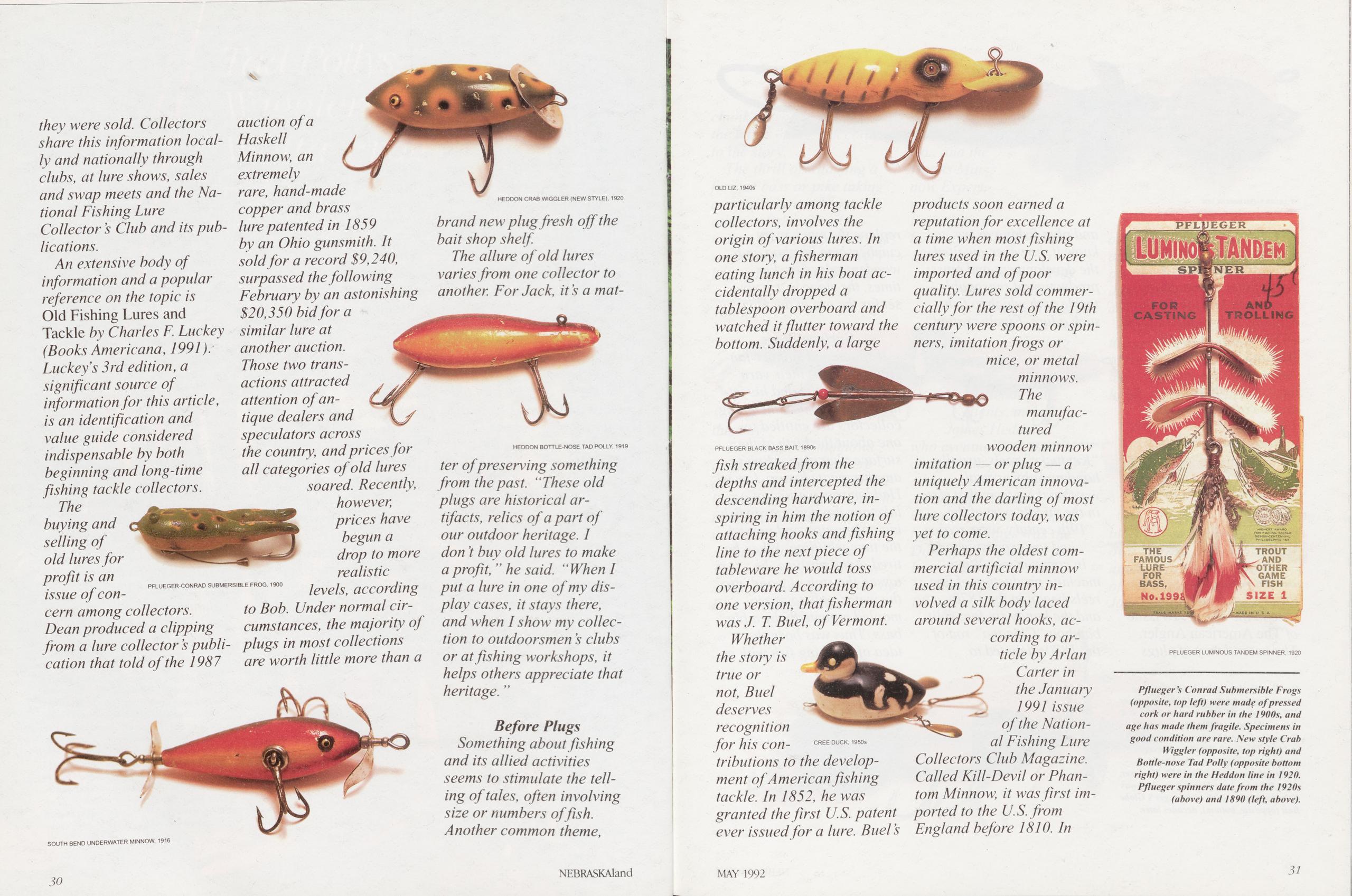
they were sold. Collectors share this information locally and nationally through clubs, at lure shows, sales and swap meets and the National Fishing Lure Collector s Club and its publications.
An extensive body of information and a popular reference on the topic is Old Fishing Lures and Tackle by Charles F. Luckey (Books Americana, 1991). Luckey's 3rd edition, a significant source of information for this article, is an identification and value guide considered indispensable by both beginning and long-time fishing tackle collectors.
The buying and selling of old lures for profit is an issue of concern
among collectors.
Dean produced a clipping from a lure collector's publication that told of the 1987 auction of a Haskell Minnow, an extremely rare, hand-made copper and brass lure patented in 1859 by an Ohio gunsmith. It sold for a record $9,240, surpassed the following February by an astonishing $20,350 bid for a similar lure at another auction. Those two transactions attracted attention of antique dealers and speculators across the country, and prices for all categories of old lures soared. Recently, however, prices have begun a drop to more realistic levels, according to Bob. Under normal circumstances, the majority of plugs in most collections are worth little more than a
brand new plug fresh off the bait shop shelf.
The allure of old lures varies from one collector to another. For Jack, it’s a matter
Something about fishing and its allied activities seems to stimulate the telling of tales, often involving size or numbers of fish. Another common theme,
particularly among tackle collectors, involves the origin of various lures. In one story, a fisherman eating lunch in his boat ac- cidentally dropped a tablespoon overboard and watched it flutter toward the bottom. Suddenly, a large
fish streaked from the depths and intercepted the descending hardware, in- spiring in him the notion of attaching hooks and fishing line to the next piece of tableware he would toss overboard. According to one version, that fisherman was J. T. Buel, of Vermont.
Whether the story is true or not, Buel deserves recognition for his con-
PFLUEGER LUMINOUS TANDEM SPINNER, 1920
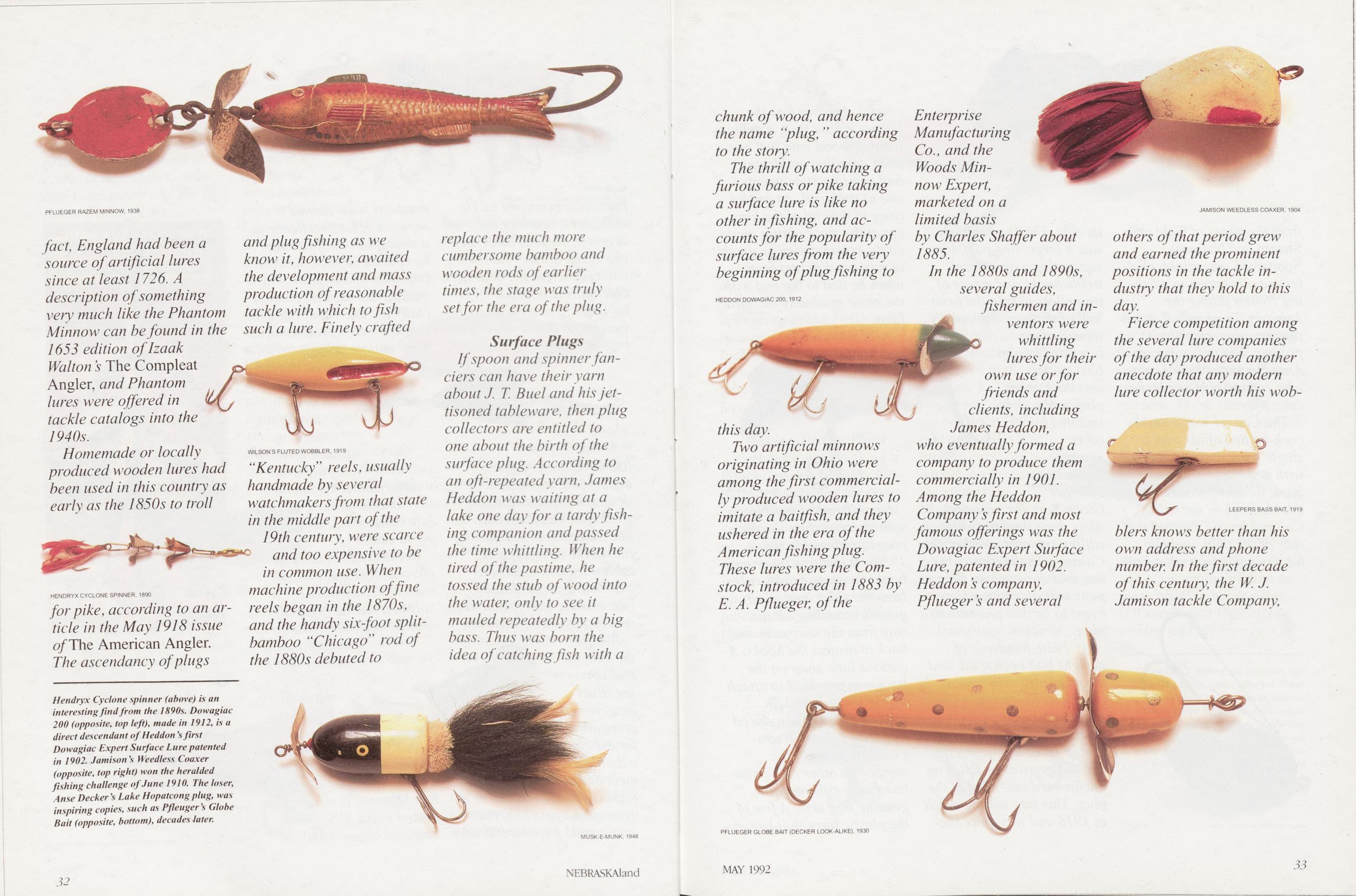
fact, England had been a source of artificial lures since at least 1726. A description of something very much like the Phantom Minnow can be found in the 1653 edition of lzaak Walton's The Compleat Angler, and Phantom lures were offered in tackle catalogs into the 1940s.
Homemade or locally produced wooden lures had been used in this country as early as the 1850s to troll
for pike, according to an article in the May 1918 issue of The American Angler. The ascendancy of plugs
and plug fishing as we know it, however, awaited the development and mass production of reasonable tackle with which to fish such a lure. Finely crafted
MUSK-E-MUNK, 1948
If spoon and spinner fanciers can have their yarn about J. T. Buel and his jettisoned tableware, then plug collectors are entitled to one about the birth of the surface plug. According to an oft-repeated yarn, James Heddon was waiting at a lake one day for a tardy fishing companion and passed the time whittling. When he tired of the pastime, he tossed the stub of wood into the water, only to see it mauled repeatedly by a big bass. Thus was born the idea of catching fish with a chunk of wood, and hence the name “plug, " according to the story.
The thrill of watching a furious bass or pike taking a surface lure is like no other in fishing, and accounts for the popularity of surface lures from the very beginning ofplug fishing to
this day.
Two artificial minnows originating in Ohio were among the first commercially produced wooden lures to imitate a baitfish, and they ushered in the era of the American fishing plug. These lures were the Comstock, introduced in 1883 by E. A. Pflueger, of the Enterprise Manufacturing Co., and the Woods Minnow Expert, marketed on a limited basis bv Charles Shaffer about 1885.
In the 1880s and 1890s, several guides, fishermen and inventors were whittling lures for their own use or for friends and clients, including James Heddon, who eventually formed a company to produce them commercially in 1901. Among the Heddon Company s first and most famous offerings was the Dowagiac Expert Surface Lure, patented in 1902. Heddon s company, Pflueger s and several
others of that period grew and earned the prominent positions in the tackle industry that they hold to this day.
Fierce competition among the several lure companies of the day produced another anecdote that any modern lure collector worth his wobblers knows better than his own address and phone number. In the first decade of this century, the W. J. Jamison tackle Company,
32 NEBRASKAland MAY 1992 33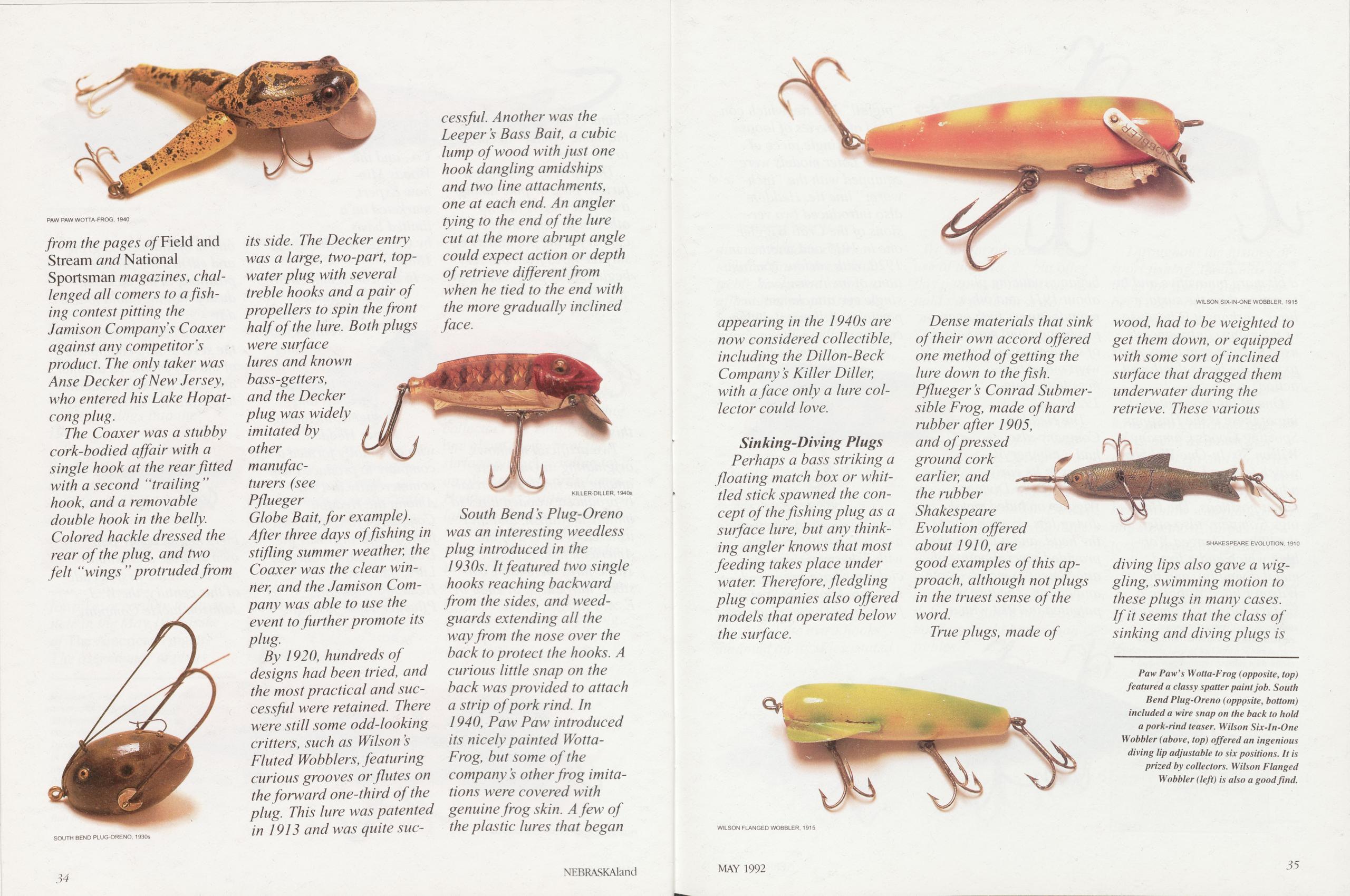
from the pages of Field and Stream and National Sportsman magazines, challenged all comers to a fishing contest pitting the Jamison Company’s Coaxer against any competitor's product. The only taker was Anse Decker of New Jersey, who entered his Lake Hopatcong plug.
The Coaxer was a stubby cork-bodied affair with a single hook at the rear fitted with a second “trailing " hook, and a removable double hook in the belly. Colored hackle dressed the rear o f the plug, and two felt “wings” protruded from
its side. The Decker entry was a large, two-part, top- water plug with several treble hooks and a pair of propellers to spin the front half of the lure. Both plugs were surface lures and known bass-getters, and the Decker plug was widely imitated by other manufacturers (see Pflueger Globe Bait, for example). After three days of fishing in stifling summer weather, the Coaxer was the clear winner, and the Jamison Company was able to use the event to further promote its plug.
By 1920, hundreds of designs had been tried, and the most practical and successful were retained. There were still some odd-looking critters, such as Wilson s Fluted Wobblers, featuring curious grooves or flutes on the forward one-third of the plug. This lure was patented in 1913 and was quite successful. Another was the Leeper’s Bass Bait, a cubic lump of wood with just one hook dangling amidships and two line attachments, one at each end. An angler tying to the end of the lure cut at the more abrupt angle could expect action or depth of retrieve different from when he tied to the end with the more gradually inclined face.
South Bend s Plug-Oreno was an interesting weedless plug introduced in the 1930s. It featured two single hooks reaching backward from the sides, and weed-guards extending all the way from the nose over the back to protect the hooks. A curious little snap on the back was provided to attach a strip of pork rind. In 1940, Paw Paw introduced its nicely painted Wotta-Frog, but some of the company s other frog imita- tions were covered with genuine frog skin. A few of the plastic lures that began appearing in the 1940s are now considered collectible, including the Dillon-Beck Company s Killer Diller, with a face only a lure collector could love.
Sinking-Diving PlugsPerhaps a bass striking a floating match box or whittled stick spawned the concept of the fishing plug as a surface lure, but any thinking angler knows that most feeding takes place under water. Therefore, fledgling plug companies also offered models that operated below the surface.
Dense materials that sink of their own accord offered one method of getting the lure down to the fish. Pflueger s Conrad Submersible Frog, made of hard rubber after 1905, and of pressed ground cork earlier, and the rubber Shakespeare
Evolution offered about 1910, are good examples of this approach, although not plugs in the truest sense of the word.
True plugs, made of
wood, had to be weighted to get them down, or equipped with some sort of inclined surface that dragged them underwater during the retrieve. These various diving lips also gave a wiggling, swimming motion to these plugs in many cases. If it seems that the class of sinking and diving plugs is
a bit more innovative and interesting than the surface lures, perhaps it is because of the many contrivances used to submerge them, and to vary the lure’s depth and action.
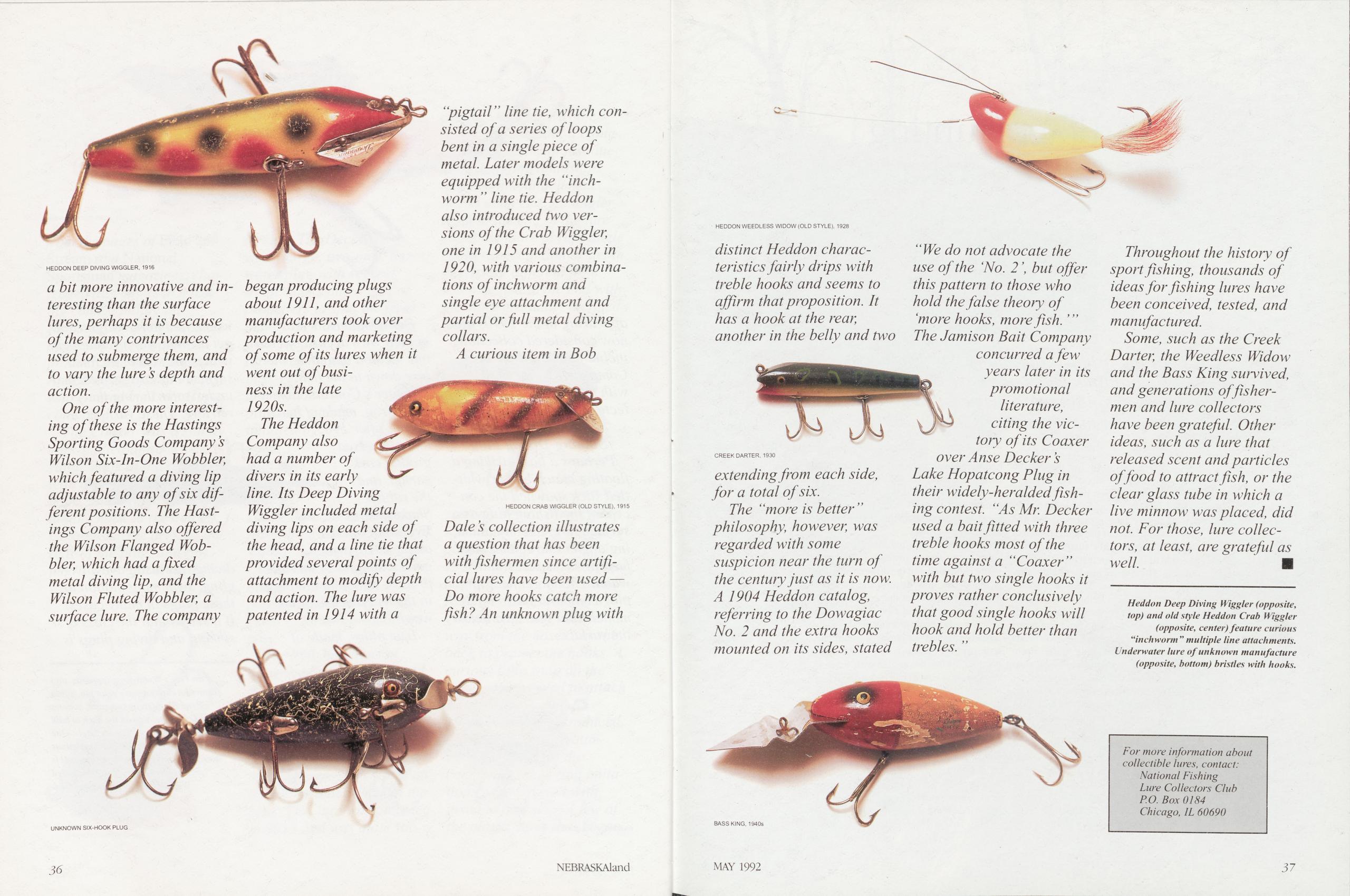
UNKNOWN SIX-HOOK PLUG
The Heddon Company also had a number of divers in its early line. Its Deep Diving Wiggler included metal diving lips on each side of the head, and a line tie that provided several points of attachment to modify depth and action. The lure was patented in 1914 with a “pigtail ” line tie, which consisted of a series of loops bent in a single piece of metal. Later models were equipped with the “inch-worm " line tie. Heddon also introduced two ver- sions of the Crab Wiggler, one in 1915 and another in 1920, with various combinations of inch worm and single eye attachment and partial or full metal diving collars.
A curious item in Bob
Dale's collection illustrates a question that has been with fishermen since artificial lures have been used — Do more hooks catch more fish? An unknown plug with
distinct Heddon characteristics fairly drips with treble hooks and seems to affirm that proposition. It has a hook at the rear, another in the belly and two
extending from each side, for a total of six.
The “more is better " philosophy, however, was regarded with some suspicion near the turn of the century just as it is now. A 1904 Heddon catalog, referring to the Dowagiac No. 2 and the extra hooks mounted on its sides, stated “We do not advocate the use of the ‘No. 2 but offer this pattern to those who hold the false theory of ‘more hooks, more fish. The Jamison Bait Company concurred a few years later in its promotional literature, citing the victory of its Coaxer over Anse Decker s Lake Hopatcong Plug in their widely-heralded fishing contest. “As Mr. Decker used a bait fitted with three treble hooks most of the time against a “Coaxer” with but two single hooks it proves rather conclusively that good single hooks will hook and hold better than trebles. ”
Throughout the history of sport fishing, thousands of ideas for fishing lures have been conceived, tested, and manufactured.
Some, such as the Creek Darter, the Weedless Widow and the Bass King survived, and generations of fishermen and lure collectors have been grateful. Other ideas, such as a lure that released scent and particles of food to attract fish, or the clear glass tube in which a live minnow was placed, did not. For those, lure collectors, at least, are grateful as well.
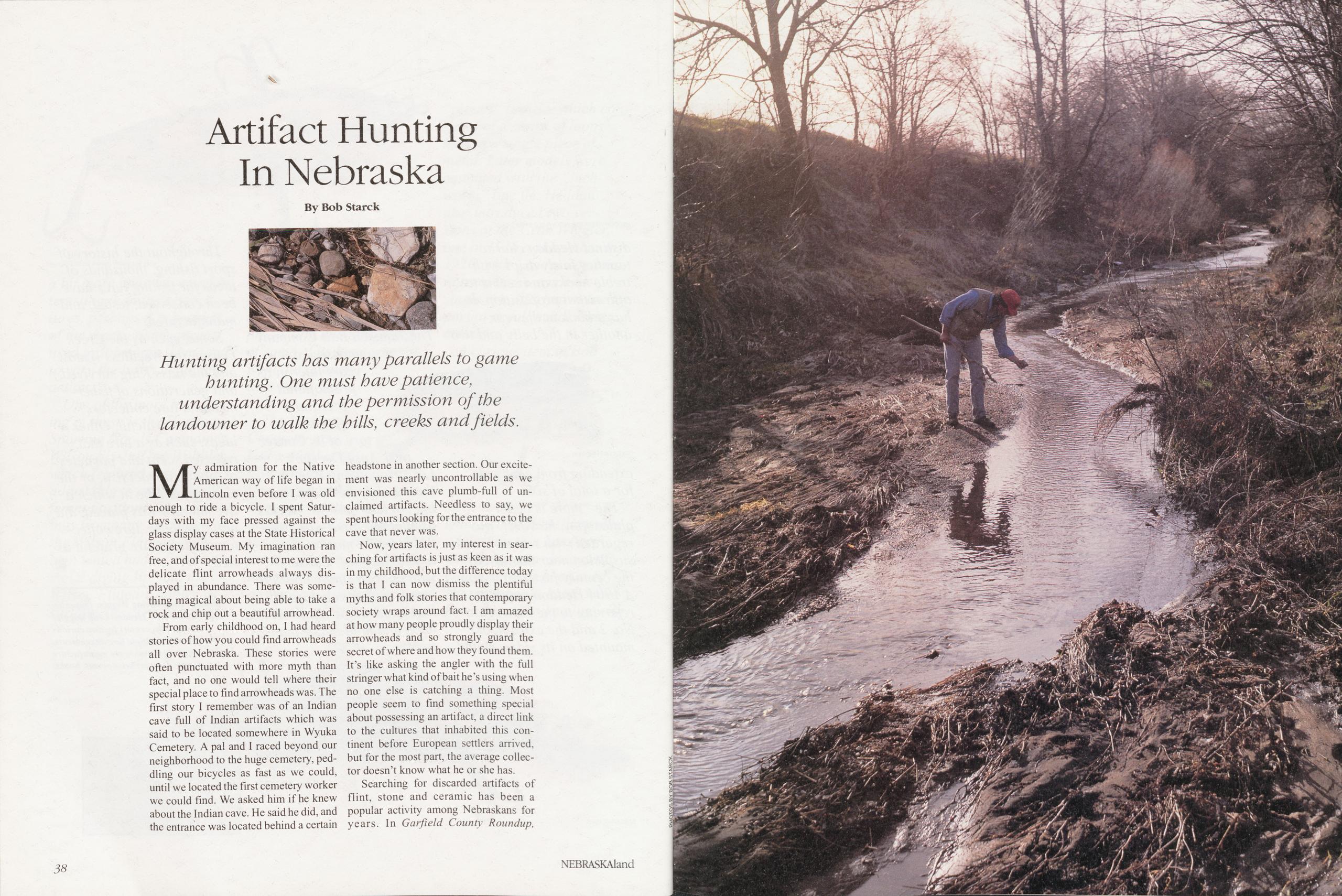
Artifact Hunting In Nebraska
By Bob StarckMy admiration for the Native American way of life began in Lincoln even before I was old enough to ride a bicycle. I spent Saturdays with my face pressed against the glass display cases at the State Historical Society Museum. My imagination ran free, and of special interest to me were the delicate flint arrowheads always displayed in abundance. There was something magical about being able to take a rock and chip out a beautiful arrowhead. From early childhood on, I had heard stories of how you could find arrowheads all over Nebraska. These stories were often punctuated with more myth than fact, and no one would tell where their special place to find arrowheads was. The first story I remember was of an Indian cave full of Indian artifacts which was said to be located somewhere in Wyuka Cemetery. A pal and I raced beyond our neighborhood to the huge cemetery, peddling our bicycles as fast as we could, until we located the first cemetery worker we could find. We asked him if he knew about the Indian cave. He said he did, and the entrance was located behind a certain headstone in another section. Our excitement was nearly uncontrollable as we envisioned this cave plumb-full of unclaimed artifacts. Needless to say, we spent hours looking for the entrance to the cave that never was.
Now, years later, my interest in searching for artifacts is just as keen as it was in my childhood, but the difference today is that I can now dismiss the plentiful myths and folk stories that contemporary society wraps around fact. I am amazed at how many people proudly display their arrowheads and so strongly guard the secret of where and how they found them. It’s like asking the angler with the full stringer what kind of bait he’s using when no one else is catching a thing. Most people seem to find something special about possessing an artifact, a direct link to the cultures that inhabited this continent before European settlers arrived, but for the most part, the average collector doesn’t know what he or she has. Searching for discarded artifacts of flint, stone and ceramic has been a popular activity among Nebraskans for years. In Garfield County Roundup,
38 NEBRASKAland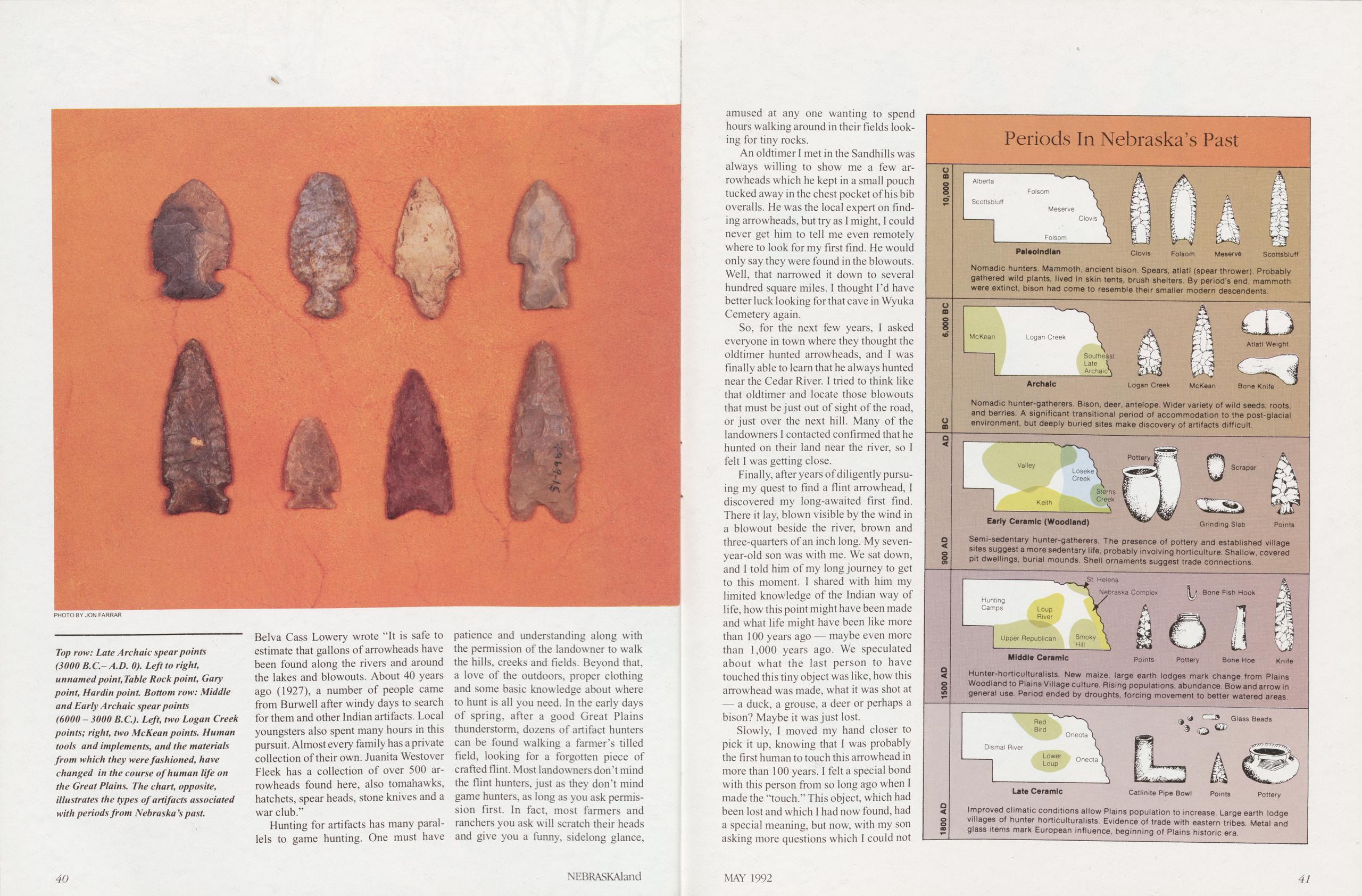 PHOTO BY JON FARRAR
Belva Cass Lowery wrote “It is safe to estimate that gallons of arrowheads have been found along the rivers and around the lakes and blowouts. About 40 years ago (1927), a number of people came from Burwell after windy days to search for them and other Indian artifacts. Local youngsters also spent many hours in this pursuit. Almost every family has a private collection of their own. Juanita Westover Fleek has a collection of over 500 arrowheads found here, also tomahawks, hatchets, spear heads, stone knives and a war club.”
Hunting for artifacts has many parallels to game hunting. One must have patience and understanding along with the permission of the landowner to walk the hills, creeks and fields. Beyond that, a love of the outdoors, proper clothing and some basic knowledge about where to hunt is all you need. In the early days of spring, after a good Great Plains thunderstorm, dozens of artifact hunters can be found walking a farmer’s tilled field, looking for a forgotten piece of crafted flint. Most landowners don’t mind the flint hunters, just as they don’t mind game hunters, as long as you ask permission first. In fact, most farmers and ranchers you ask will scratch their heads and give you a funny, sidelong glance, amused at any one wanting to spend hours walking around in their fields looking for tiny rocks.
An oldtimer I met in the Sandhills was always willing to show me a few arrowheads which he kept in a small pouch tucked away in the chest pocket of his bib overalls. He was the local expert on finding arrowheads, but try as I might, I could never get him to tell me even remotely where to look for my first find. He would only say they were found in the blowouts. Well, that narrowed it down to several hundred square miles. I thought I’d have better luck looking forthat cave in Wyuka Cemetery again.
So, for the next few years, I asked everyone in town where they thought the oldtimer hunted arrowheads, and I was finally able to learn that he always hunted near the Cedar River. I tried to think like that oldtimer and locate those blowouts that must be just out of sight of the road, or just over the next hill. Many of the landowners I contacted confirmed that he hunted on their land near the river, so I felt I was getting close.
Finally, after years of diligently pursuing my quest to find a flint arrowhead, I discovered my long-awaited first find. There it lay, blown visible by the wind in a blowout beside the river, brown and three-quarters of an inch long. My seven-year-old son was with me. We sat down, and I told him of my long journey to get to this moment. I shared with him my limited knowledge of the Indian way of life, how this point might have been made and what life might have been like more than 100 years ago — maybe even more than 1,000 years ago. We speculated about what the last person to have touched this tiny object was like, how this arrowhead was made, what it was shot at — a duck, a grouse, a deer or perhaps a bison? Maybe it was just lost.
Slowly, I moved my hand closer to pick it up, knowing that I was probably the first human to touch this arrowhead in more than 100 years. I felt a special bond with this person from so long ago when I made the “touch.” This object, which had been lost and which I had now found, had a special meaning, but now, with my son asking more questions which I could not
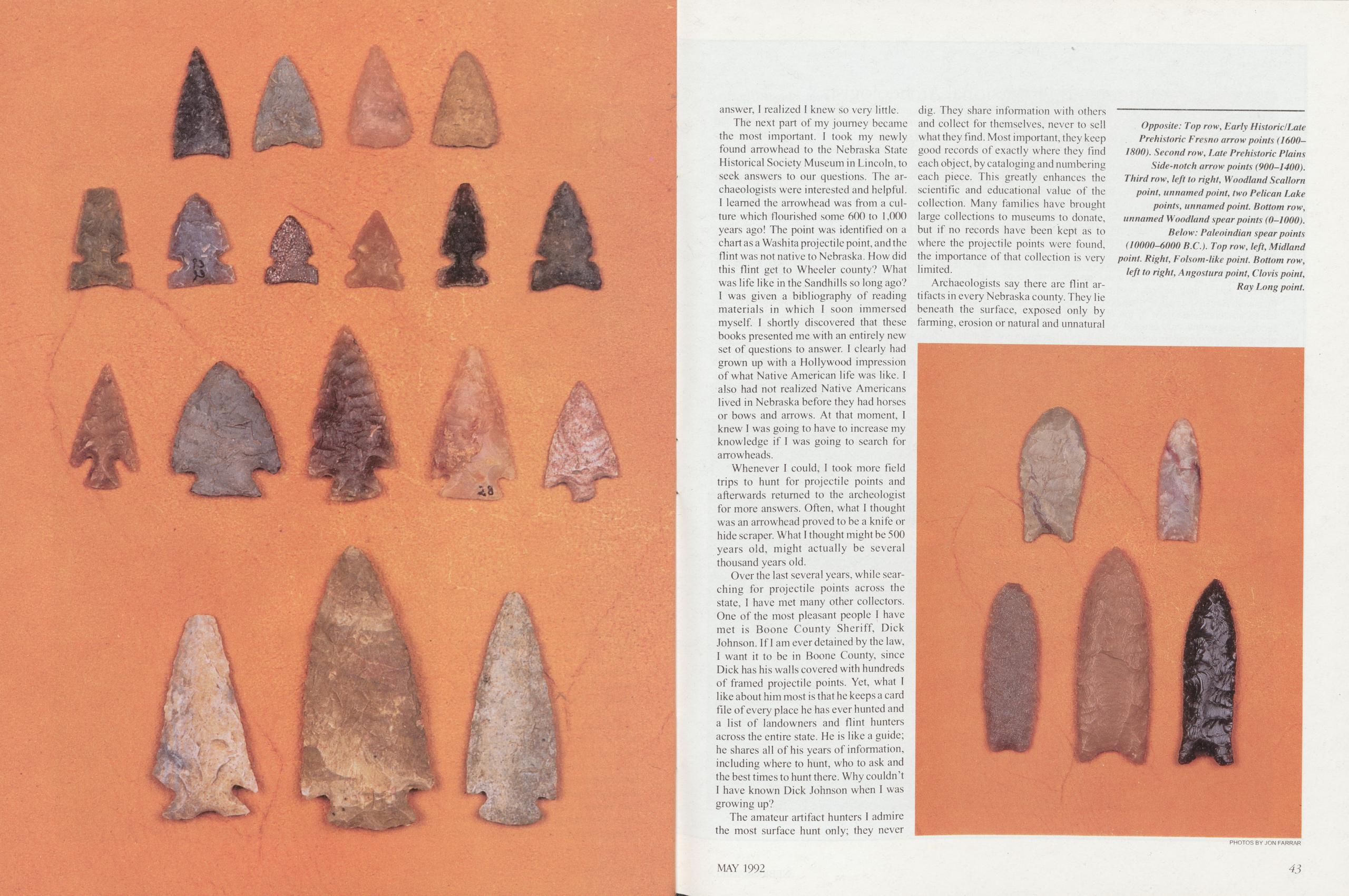
Periods In Nebraska’s PastFolsom
Scottsbluff
Meserve
Folsom
Clovis Paleoindlan
Logan Creek
Southeast Late Archaic Archaic
Keith
Loseke Creek
Sterns Creek Early Ceramic (Woodland)
Loup River
Upper Republican
St. Helena
Nebraska Complex
Smoky Hill Middle Ceramic
answer, l realized I knew so very little. The next part of my journey became the most important. I took my newly found arrowhead to the Nebraska State Historical Society Museum in Lincoln, to seek answers to our questions. The archaeologists were interested and helpful. I learned the arrowhead was from a culture which flourished some 600 to 1.000 years ago! The point was identified on a chart as a Washita projectile point, and the flint was not native to Nebraska. How did this flint get to Wheeler county? What was life like in the Sandhills so long ago? I was given a bibliography of reading materials in which I soon immersed myself. I shortly discovered that these books presented me with an entirely new set of questions to answer. I clearly had grown up with a Hollywood impression of what Native American life was like. I also had not realized Native Americans lived in Nebraska before they had horses or bows and arrows. At that moment, I knew I was going to have to increase my knowledge if I was going to search for arrowheads.
Whenever I could, I took more field trips to hunt for projectile points and afterwards returned to the archeologist for more answers. Often, what I thought was an arrowhead proved to be a knife or hide scraper. What I thought might be 500 years old, might actually be several thousand years old.
Over the last several years, while searching for projectile points across the state, I have met many other collectors. One of the most pleasant people I have met is Boone County Sheriff, Dick Johnson. If I am ever detained by the law, I want it to be in Boone County, since Dick has his walls covered with hundreds of framed projectile points. Yet, what I like about him most is that he keeps a card file of every place he has ever hunted and a list of landowners and flint hunters across the entire state. He is like a guide; he shares all of his years of information, including where to hunt, who to ask and the best times to hunt there. Why couldn’t I have known Dick Johnson when I was growing up?
The amateur artifact hunters I admire the most surface hunt only; they never
MAY 1992dig. They share information with others and collect for themselves, never to sell what they find. Most important, they keep good records of exactly where they find each object, by cataloging and numbering each piece. This greatly enhances the scientific and educational value of the collection. Many families have brought large collections to museums to donate, but if no records have been kept as to where the projectile points were found, the importance of that collection is very limited.
Archaeologists say there are flint artifacts in every Nebraska county. They lie beneath the surface, exposed only by farming, erosion or natural and unnatural
PHOTOS BY JON FARRAR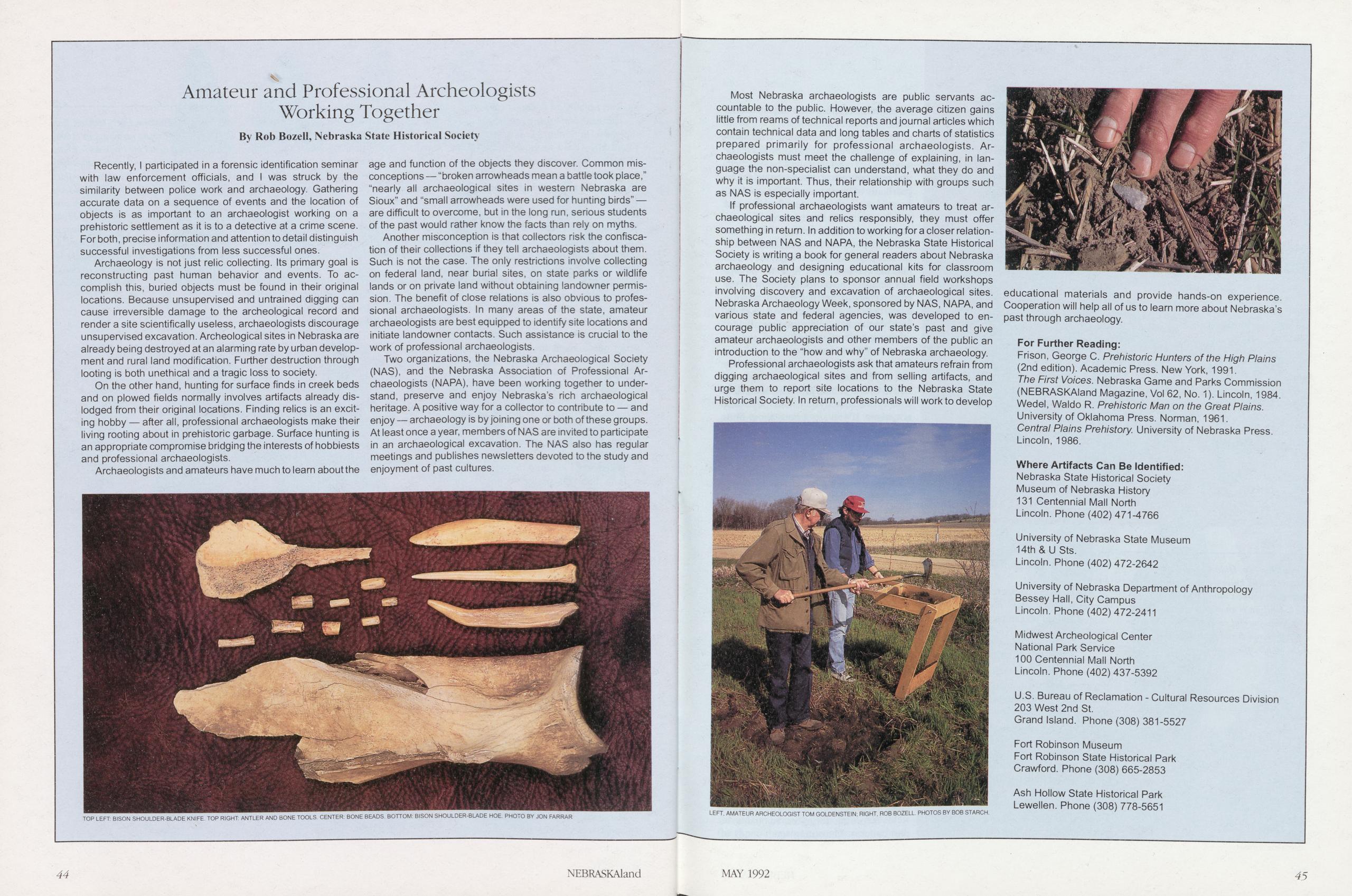
Recently, I participated in a forensic identification seminar with law enforcement officials, and I was struck by the similarity between police work and archaeology. Gathering accurate data on a sequence of events and the location of objects is as important to an archaeologist working on a prehistoric settlement as it is to a detective at a crime scene. For both, precise information and attention to detail distinguish successful investigations from less successful ones.
Archaeology is not just relic collecting. Its primary goal is reconstructing past human behavior and events. To accomplish this, buried objects must be found in their original locations. Because unsupervised and untrained digging can cause irreversible damage to the archeological record and render a site scientifically useless, archaeologists discourage unsupervised excavation. Archeological sites in Nebraska are already being destroyed at an alarming rate by urban development and rural land modification. Further destruction through looting is both unethical and a tragic loss to society.
On the other hand, hunting for surface finds in creek beds and on plowed fields normally involves artifacts already dislodged from their original locations. Finding relics is an exciting hobby — after all, professional archaeologists make their living rooting about in prehistoric garbage. Surface hunting is an appropriate compromise bridging the interests of hobbiests and professional archaeologists.
Archaeologists and amateurs have much to learn about the
age and function of the objects they discover. Common misconceptions — “broken arrowheads mean a battle took place,” “nearly all archaeological sites in western Nebraska are Sioux” and “small arrowheads were used for hunting birds” — are difficult to overcome, but in the long run, serious students of the past would rather know the facts than rely on myths.
Another misconception is that collectors risk the confiscation of their collections if they tell archaeologists about them. Such is not the case. The only restrictions involve collecting on federal land, near burial sites, on state parks or wildlife lands or on private land without obtaining landowner permission. The benefit of close relations is also obvious to professional archaeologists. In many areas of the state, amateur archaeologists are best equipped to identify site locations and initiate landowner contacts. Such assistance is crucial to the work of professional archaeologists.
Two organizations, the Nebraska Archaeological Society (NAS), and the Nebraska Association of Professional Archaeologists (NAPA), have been working together to understand, preserve and enjoy Nebraska’s rich archaeological heritage. A positive way for a collector to contribute to — and enjoy — archaeology is by joining one or both of these groups. At least once a year, members of NAS are invited to participate in an archaeological excavation. The NAS also has regular meetings and publishes newsletters devoted to the study and enjoyment of past cultures.
Most Nebraska archaeologists are public servants accountable to the public. However, the average citizen gains little from reams of technical reports and journal articles which contain technical data and long tables and charts of statistics prepared primarily for professional archaeologists. Archaeologists must meet the challenge of explaining, in language the non-specialist can understand, what they do and why it is important. Thus, their relationship with groups such as NAS is especially important.
If professional archaeologists want amateurs to treat archaeological sites and relics responsibly, they must offer something in return. In addition to working for a closer relationship between NAS and NAPA, the Nebraska State Historical Society is writing a book for general readers about Nebraska archaeology and designing educational kits for classroom use. The Society plans to sponsor annual field workshops involving discovery and excavation of archaeological sites. Nebraska Archaeology Week, sponsored by NAS, NAPA, and various state and federal agencies, was developed to encourage public appreciation of our state’s past and give amateur archaeologists and other members of the public an introduction to the “how and why” of Nebraska archaeology.
Professional archaeologists ask that amateurs refrain from digging archaeological sites and from selling artifacts, and urge them to report site locations to the Nebraska State Historical Society. In return, professionals will work to develop
educational materials and provide hands-on experience. Cooperation will help all of us to learn more about Nebraska’s past through archaeology.
For Further Reading:Frison, George C. Prehistoric Hunters of the High Plains (2nd edition). Academic Press. New York, 1991. The First Voices. Nebraska Game and Parks Commission (NEBRASKAland Magazine, Vol 62, No. 1). Lincoln, 1984. Wedel, Waldo R. Prehistoric Man on the Great Plains. University of Oklahoma Press. Norman, 1961. Central Plains Prehistory. University of Nebraska Press. Lincoln, 1986.
Where Artifacts Can Be Identified:Nebraska State Historical Society Museum of Nebraska History 131 Centennial Mall North Lincoln. Phone (402) 471-4766
University of Nebraska State Museum 14th & U Sts. Lincoln. Phone (402) 472-2642 University of Nebraska Department of Anthropology Bessey Hall, City Campus Lincoln. Phone (402) 472-2411
Midwest Archeological Center National Park Service 100 Centennial Mall North Lincoln. Phone (402) 437-5392
U.S. Bureau of Reclamation - Cultural Resources Division 203 West 2nd St. Grand Island. Phone (308) 381-5527
Fort Robinson Museum Fort Robinson State Historical Park Crawford. Phone (308) 665-2853
Ash Hollow State Historical Park Lewellen. Phone (308) 778-5651
44 NEBRASKAland MAY 1992 45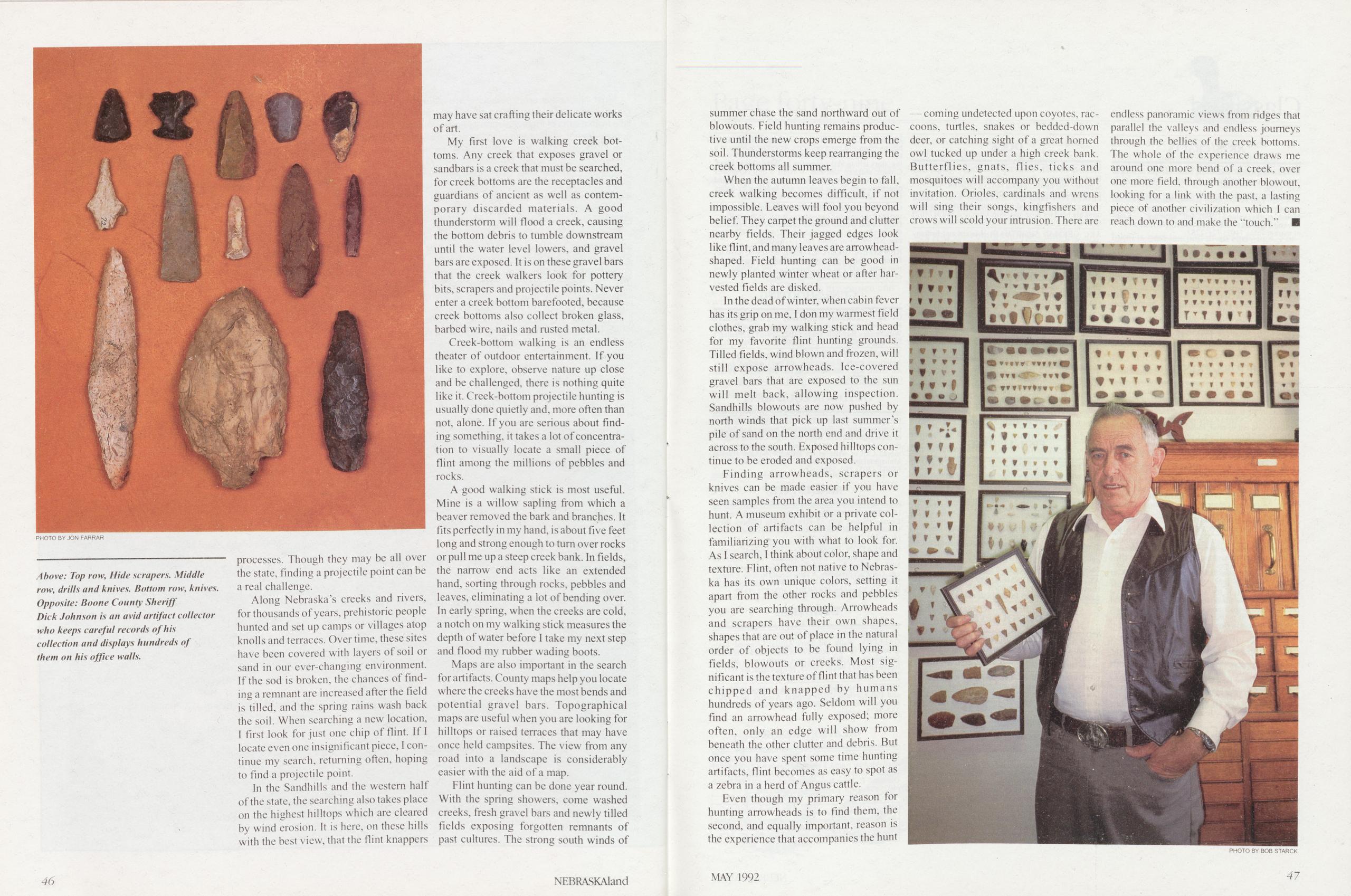
processes. Though they may be all over the state, finding a projectile point can be a real challenge.
Along Nebraska's creeks and rivers, for thousands of years, prehistoric people hunted and set up camps or villages atop knolls and terraces. Over time, these sites have been covered with layers of soil or sand in our ever-changing environment. If the sod is broken, the chances of finding a remnant are increased after the field is tilled, and the spring rains wash back the soil. When searching a new location, I first look for just one chip of flint. If I locate even one insignificant piece, I continue my search, returning often, hoping to find a projectile point.
In the Sandhills and the western half of the state, the searching also takes place on the highest hilltops which are cleared by wind erosion. It is here, on these hills with the best view, that the flint knappers may have sat crafting their delicate works of art.
My first love is walking creek bottoms. Any creek that exposes gravel or sandbars is a creek that must be searched, for creek bottoms are the receptacles and guardians of ancient as well as contemporary discarded materials. A good thunderstorm will flood a creek, causing the bottom debris to tumble downstream until the water level lowers, and gravel bars are exposed. It is on these gravel bars that the creek walkers look for pottery bits, scrapers and projectile points. Never enter a creek bottom barefooted, because creek bottoms also collect broken glass, barbed wire, nails and rusted metal.
Creek-bottom walking is an endless theater of outdoor entertainment. If you like to explore, observe nature up close and be challenged, there is nothing quite like it. Creek-bottom projectile hunting is usually done quietly and, more often than not, alone. If you are serious about find- ing something, it takes a lot of concentration to visually locate a small piece of flint among the millions of pebbles and rocks.
A good walking stick is most useful. Mine is a willow sapling from which a beaver removed the bark and branches. It fits perfectly in my hand, is about five feet long and strong enough to turn over rocks or pull me up a steep creek bank. In fields, the narrow end acts like an extended hand, sorting through rocks, pebbles and leaves, eliminating a lot of bending over. In early spring, when the creeks are cold, a notch on my walking stick measures the depth of water before I take my next step and flood my rubber wading boots.
Maps are also important in the search for artifacts. County maps help you locate where the creeks have the most bends and potential grave! bars. Topographical maps are useful when you are looking for hilltops or raised terraces that may have once held campsites. The view from any road into a landscape is considerably easier with the aid of a map.
Flint hunting can be done year round. With the spring showers, come washed creeks, fresh gravel bars and newly tilled fields exposing forgotten remnants of past cultures. The strong south winds of summer chase the sand northward out of blowouts. Field hunting remains productive until the new crops emerge from the soil. Thunderstorms keep rearranging the creek bottoms all summer.
When the autumn leaves begin to fall, creek walking becomes difficult, if not impossible. Leaves will fool you beyond belief. They carpet the ground and clutter nearby fields. Their jagged edges look like flint, and many leaves are arrowhead- shaped. Field hunting can be good in newly planted winter wheat or after harvested fields are disked.
In the dead of winter, when cabin fever has its grip on me, I don my warmest field clothes, grab my walking stick and head for my favorite flint hunting grounds. Tilled fields, wind blown and frozen, will still expose arrowheads. Ice-covered gravel bars that are exposed to the sun will melt back, allowing inspection. Sandhills blowouts are now pushed by north winds that pick up last summer’s pile of sand on the north end and drive it across to the south. Exposed hilltops continue to be eroded and exposed.
Finding arrowheads, scrapers or knives can be made easier if you have seen samples from the area you intend to hunt. A museum exhibit or a private collection of artifacts can be helpful in familiarizing you with what to look for. As I search. I think about color, shape and texture. Flint, often not native to Nebraska has its own unique colors, setting it apart from the other rocks and pebbles you are searching through. Arrowheads and scrapers have their own shapes, shapes that are out of place in the natural order of objects to be found lying in fields, blowouts or creeks. Most significant is the texture of flint that has been chipped and knapped by humans hundreds of years ago. Seldom will you find an arrowhead fully exposed; more often, only an edge will show from beneath the other clutter and debris. But once you have spent some time hunting artifacts, flint becomes as easy to spot as a zebra in a herd of Angus cattle.
Even though my primary reason for hunting arrowheads is to find them, the second, and equally important, reason is the experience that accompanies the hunt coming undetected upon coyotes, raccoons, turtles, snakes or bedded-down deer, or catching sight of a great horned owl tucked up under a high creek bank. Butterflies, gnats, flies, ticks and mosquitoes will accompany you without invitation. Orioles, cardinals and wrens will sing their songs, kingfishers and crows will scold your intrusion. There are endless panoramic views from ridges that parallel the valleys and endless journeys through the bellies of the creek bottoms. The whole of the experience draws me around one more bend of a creek, over one more field, through another blowout, looking for a link with the past, a lasting piece of another civilization which I can reach down to and make the "touch.” ■
NEBRASKAland MAY 1992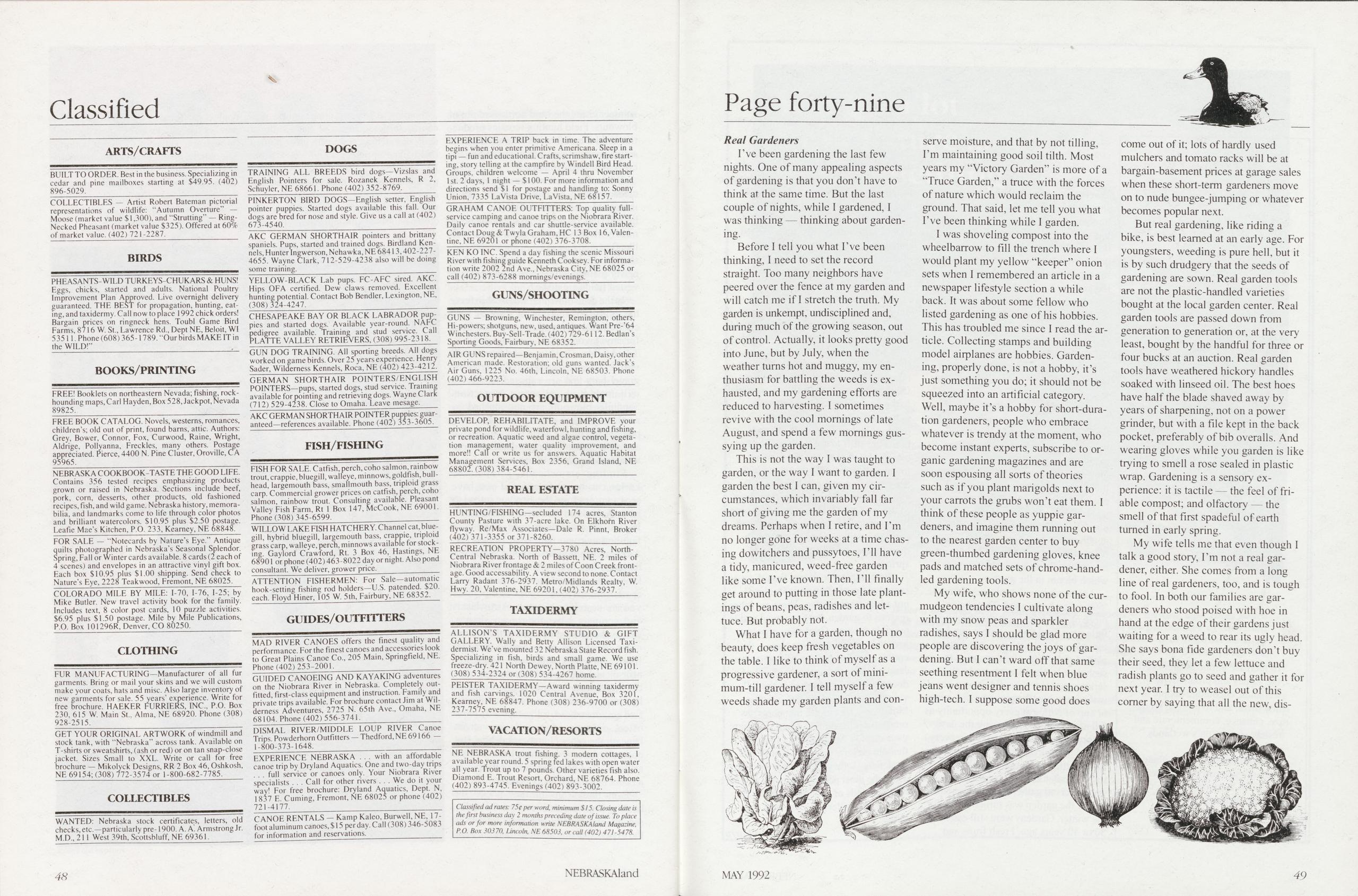
Classified
ARTS/CRAFTSBUILT TO ORDER. Best in the business. Specializing in cedar and pine mailboxes starting at $49.95. (402) 896-5029.
COLLECTIBLES — Artist Robert Bateman pictorial representations of wildlife: “Autumn Overture” — Moose (market value $ 1,300), and “Strutting” — Ring- Necked Pheasant (market value $325). Offered at 60% of market value. (402) 721 -2287.
BIRDSPHEASANTS-WILD TURKEYS-CHUKARS & HUNS! Eggs, chicks, started and adults. National Poultry Improvement Plan Approved. Live overnight delivery guaranteed. THE BEST for propagation, hunting, eat- ing, and taxidermy. Call now to place 1992 chick orders! Bargain prices on ringneck hens. Toubl Game Bird Farms, 8716 XV. St., Lawrence Rd., Dept NE, Beloit, WI 5351 1. Phone (608) 365-1789. “Our birds MAKE IT in the WILD!”
BOOKS/PRINTINGFREE! Booklets on northeastern Nevada; fishing, rock- hounding maps, Carl Hayden, Box 528, Jackpot, Nevada 89825.
FREE BOOK CATALOG. Novels, westerns, romances, children’s; old out of print, found barns, attic. Authors: Grey, Bower, Connor, Fox, Curwood, Raine, Wright, Aldrige, Pollyanna, Freckles, many others. Postage appreciated. Pierce, 4400 N. Pine Cluster, Oroville, CA 95965.
NEBRASKA COOKBOOK-TASTE THE GOOD LIFE. Contains 356 tested recipes emphasizing products grown or raised in Nebraska. Sections include beef, pork, corn, desserts, other products, old fashioned recipes, fish, and wild game. Nebraska history, memora- bilia, and landmarks come to life through color photos and brilliant watercolors. $10.95 plus $2.50 postage. Leafie Mae’s Kitchen, P.O. 233, Kearney, NE 68848.
FOR SALE — “Notecards by Nature’s Eye.” Antique quilts photographed in Nebraska’s Seasonal Splendor. Spring, Fall or Winter cards available. 8 cards (2 each of 4 scenes) and envelopes in an attractive vinyl gift box. Each box $10.95 plus $1.00 shipping. Send check to Nature’s Eye, 2228 Teakwood, Fremont, NE 68025.
COLORADO MILE BY MILE: 1-70, 1-76, 1-25; by Mike Butler. New travel activity book for the family. Includes text, 8 color post cards, 10 puzzle activities. $6.95 plus $1.50 postage. Mile by Mile Publications, P.O. Box 101296R, Denver, CO 80250.
CLOTHINGFUR MANUFACTURING—Manufacturer of all fur garments. Bring or mail your skins and we will custom make your coats, hats and misc. Also large inventory of new garments for sale. 55 years’ experience. Write for free brochure. HAEKER FURRIERS, INC., P.O. Box 230, 615 W. Main St.. Alma, NE 68920. Phone (308) 928-2515.
GET YOUR ORIGINAL ARTWORK of windmill and stock tank, with “Nebraska” across tank. Available on T-shirts or sweatshirts, (ash or red) or on tan snap-close jacket. Sizes Small to XXL. Write or call for free brochure — Mikolyck Designs, RR 2 Box 46, Oshkosh, NE 69154; (308) 772-3574 or 1-800-682-7785.
COLLECTIBLESWANTED: Nebraska stock certificates, letters, old checks, etc.—particularly pre-1900. A. A. Armstrong Jr. M.D., 211 West 39th, Scottsbluff, NE 69361.
DOGSTRAINING ALL BREEDS bird dogs—Vizslas and English Pointers for sale. Rozanek Kennels, R 2, Schuyler, NE 68661. Phone (402) 352-8769._ PINKERTON BIRD DOGS—English setter, English pointer puppies. Started dogs available this fall. Our dogs are bred for nose and style. Give us a call at (402) 673-4540,
AKC GERMAN SHORTHAIR pointers and brittany spaniels. Pups, started and trained dogs. Birdland Ken- nels, Hunter Ingwerson, Nehawka, NE 68413,402-227- 4655. Wayne Clark, 712-529-4238 also will be doing some training.
YELLOW-BLACK Lab pups. FC-AFC sired. AKC. Hips OFA certified. Dew claws removed. Excellent hunting potential. Contact Bob Bendler, Lexington, NE, (308) 324-4247.
CHESAPEAKE BAY OR BLACK LABRADOR pup- pies and started dogs. Available year-round. NAFC pedigree available. Training and stud service. Call PLATTE VALLEY RETRIEVERS, (308) 995-2318.
GUN DOG TRAINING. All sporting breeds. All dogs worked on game birds. Over 25 years experience. Henry Sader, Wilderness Kennels, Roca, NE (402) 423-4212.
GERMAN SHORTHAIR POINTERS/ENGLISH POINTERS—pups, started dogs, stud service. Training available for pointing and retrieving dogs. Wayne Clark (712) 529-4238. Close to Omaha. Leave mesage. AKC GERMAN SHORTHAIR POINTER puppies: guar- anteed—references available. Phone (402) 353-3605.
FISH/FISHINGFISH FOR SALE. Catfish, perch, coho salmon, rainbow trout, crappie, bluegill, walleye, minnows, goldfish, bull- head, largemouth bass, smallmouth bass, triploid grass carp. Commercial grower prices on catfish, perch, coho salmon, rainbow trout. Consulting available. Pleasant Valley Fish Farm, Rt 1 Box 147, McCook, NE 69001. Phone (308) 345-6599.
WILLOW LAKE FISH HATCHERY. Channel cat,blue- gill, hybrid bluegill, largemouth bass, crappie, triploid grass carp, walleye, perch, minnows available for stock- ing. Gaylord Crawford, Rt. 3 Box 46, Hastings, NE 68901 or phone (402) 463-8022 day or night. Also pond consultant. We deliver, grower price.
ATTENTION FISHERMEN: For Sale—automatic hook-setting fishing rod holders—U.S. patended. $20. each. Floyd Hiner, 105 W 5th, Fairbury, NE 68352.
GUIDES/outfittersMAD RIVER CANOES offers the finest quality and performance. For the finest canoes and accessories look to Great Plains Canoe Co., 205 Main, Springfield, NE. Phone(402) 253-2001.
GUIDED CANOEING AND KAYAKING adventures on the Niobrara River in Nebraska. Completely out- fitted, first-class equipment and instruction. Family and private trips available. For brochure contact Jim at Wil- derness Adventures, 2725 N. 65th Ave., Omaha, NE 68104. Phone(402)556-3741.
DISMAL RIVER/MIDDLE LOUP RIVER Canoe Trips. Powderhorn Outfitters — Thedford, NE 69166 — 1-800-373-1648.
EXPERIENCE NEBRASKA . . . with an affordable canoe trip by Dryland Aquatics. One and two-day trips . . . full service or canoes only. Your Niobrara River specialists . . . Call for other rivers . . . We do it your way! For free brochure: Dryland Aquatics, Dept. N, 1837 E. Cuming, Fremont, NE 68025 or phone (402) 721-4177.
CANOE RENTALS - Kamp Kaleo, Burwell, NE, 17- foot aluminum canoes, $ 15 per day. Call (308) 346-5083 for information and reservations.
EXPERIENCE A TRIP back in time. The adventure begins when you enter primitive Americana. Sleep in a tipi — fun and educational. Crafts, scrimshaw, fire start- ing, story telling at the campfire by Windell Bird Head. Groups, children welcome — April 4 thru November 1st. 2 days, 1 night — $100. For more information and directions send $1 for postage and handling to: Sonny Union, 7335 LaVista Drive, LaVista, NE 68157,
GRAHAM CANOE OUTFITTERS: Top quality full- service camping and canoe trips on the Niobrara River. Daily canoe rentals and car shuttle-service available. Contact Doug & Twyla Graham, HC 13 Box 16, Valen- tine, NE 69201 or phone (402) 376-3708.
KEN KO INC. Spend a day fishing the scenic Missouri River with fishing guide Kenneth Cooksey. For informa- tion write 2002 2nd Ave., Nebraska City, NE 68025 or call (402) 873-6288 mornings/evenings.
GUNS/SHOOTINGGUNS — Browning, Winchester, Remington, others, Hi-powers; shotguns, new, used, antiques. Want Pre-’64 W inchesters. Buy-Sell-Trade. (402) 729-6112. Bedlan’s Sporting Goods, Fairbury, NE 68352.
AIR GUNS repaired—Benjamin, Crosman, Daisy, other American made. Restoration; old guns wanted. Jack’s Air Guns, 1225 No. 46th, Lincoln, NE 68503. Phone (402) 466-9223.
OUTDOOR EQUIPMENTDEVELOP, REHABILITATE, and IMPROVE your private pond for wildlife, waterfowl, hunting and fishing, or recreation. Aquatic weed and algae control, vegeta- tion management, water quality improvement, and more!! Call or write us for answers. Aquatic Habitat Management Services, Box 2356, Grand Island, NE 68802. (308) 384-5461.
REAL ESTATEHUNTING/FISHING—secluded 174 acres, Stanton County Pasture with 37-acre lake. On Elkhorn River flyway. Re/Max Associates—Dale R. Pinnt, Broker (402) 371-3355 or 371-8260.
RECREATION PROPERTY-3780 Acres, North- Central Nebraska. North of Bassett, NE. 2 miles of Niobrara River frontage & 2 miles of Coon Creek front- age. Good accessability. A view second to none. Contact Larry Radant 376-2937. Metro/Midlands Realty, W. Hwy, 20, Valentine, NE 69201,(402) 376-2937.
TAXIDERMYALLISON’S TAXIDERMY STUDIO & GIFT GALLERY. Wally and Betty Allison Licensed Taxi- dermist. We've mounted 32 Nebraska State Record fish. Specializing in fish, birds and small game. We use freeze-dry. 421 North Dewey, North Platte, NE 69101. (308) 534-2324 or (308) 534-4267 home.
PEISTER TAXIDERMY—Award winning taxidermy and fish carvings. 1020 Central Avenue, Box 3201, Kearney, NE 68847. Phone (308) 236-9700 or (308) 237-7575 evening.
VACATION/RESORTSNE NEBRASKA trout fishing. 3 modern cottages, 1 available year round. 5 spring ted lakes with open water all year. Trout up to 7 pounds. Other varieties fish also. Diamond E. Trout Resort, Orchard, NE 68764. Phone (402) 893-4745. Evenings (402) 893-3002.
Classified ad rates: 75( per word, minimum $15. Closing date is the first business day 2 months preceding date of issue. To place ads or for more information write NEBRASKAIand Magazine, P.O. Box 30370, Lincoln, NE 68503, or call (402) 471-5478.Page forty-nine
Real GardenersI’ve been gardening the last few nights. One of many appealing aspects of gardening is that you don’t have to think at the same time. But the last couple of nights, while I gardened, I was thinking — thinking about gardening.
Before I tell you what I’ve been thinking, I need to set the record straight. Too many neighbors have peered over the fence at my garden and will catch me if I stretch the truth. My garden is unkempt, undisciplined and, during much of the growing season, out of control. Actually, it looks pretty good into June, but by July, when the weather turns hot and muggy, my enthusiasm for battling the weeds is exhausted, and my gardening efforts are reduced to harvesting. I sometimes revive with the cool mornings of late August, and spend a few mornings gussying up the garden.
This is not the way I was taught to garden, or the way I want to garden. I garden the best I can, given my circumstances, which invariably fall far short of giving me the garden of my dreams. Perhaps when I retire, and I’m no longer gone for weeks at a time chasing dowitchers and pussytoes, I’ll have a tidy, manicured, weed-free garden like some I’ve known. Then, I’ll finally get around to putting in those late plantings of beans, peas, radishes and lettuce. But probably not.
What I have for a garden, though no beauty, does keep fresh vegetables on the table. I like to think of myself as a progressive gardener, a sort of minimum-till gardener. I tell myself a few weeds shade my garden plants and conserve moisture, and that by not tilling, I’m maintaining good soil tilth. Most years my "Victory Garden” is more of a "Truce Garden,” a truce with the forces of nature which would reclaim the ground. That said, let me tell you what I’ve been thinking while I garden.
I was shoveling compost into the wheelbarrow to fill the trench where I would plant my yellow "keeper” onion sets when I remembered an article in a newspaper lifestyle section a while back. It was about some fellow who listed gardening as one of his hobbies. This has troubled me since I read the article. Collecting stamps and building model airplanes are hobbies. Gardening, properly done, is not a hobby, it’s just something you do; it should not be squeezed into an artificial category. Well, maybe it’s a hobby for short-duration gardeners, people who embrace whatever is trendy at the moment, who become instant experts, subscribe to organic gardening magazines and are soon espousing all sorts of theories such as if you plant marigolds next to your carrots the grubs won’t eat them. I think of these people as yuppie gardeners, and imagine them running out to the nearest garden center to buy green-thumbed gardening gloves, knee pads and matched sets of chrome-handled gardening tools.
My wife, who shows none of the curmudgeon tendencies I cultivate along with my snow peas and sparkler radishes, says I should be glad more people are discovering the joys of gardening. But I can’t ward off that same seething resentment I felt when blue jeans went designer and tennis shoes high-tech. I suppose some good does come out of it; lots of hardly used mulchers and tomato racks will be at bargain-basement prices at garage sales when these short-term gardeners move on to nude bungee-jumping or whatever becomes popular next.
But real gardening, like riding a bike, is best learned at an early age. For youngsters, weeding is pure hell, but it is by such drudgery that the seeds of gardening are sown. Real garden tools are not the plastic-handled varieties bought at the local garden center. Real garden tools are passed down from generation to generation or, at the very least, bought by the handful for three or four bucks at an auction. Real garden tools have weathered hickory handles soaked with linseed oil. The best hoes have half the blade shaved away by years of sharpening, not on a power grinder, but with a file kept in the back pocket, preferably of bib overalls. And wearing gloves while you garden is like trying to smell a rose sealed in plastic wrap. Gardening is a sensory ex- perience: it is tactile — the feel of friable compost; and olfactory — the smell of that first spadeful of earth turned in early spring.
My wife tells me that even though I talk a good story, I’m not a real gardener, either. She comes from a long line of real gardeners, too, and is tough to fool. In both our families are gardeners who stood poised with hoe in hand at the edge of their gardens just waiting for a weed to rear its ugly head. She says bona fide gardeners don’t buy their seed, they let a few lettuce and radish plants go to seed and gather it for next year. I try to weasel out of this comer by saying that all the new, disease
48 NEBRASKAland MAY 1992 49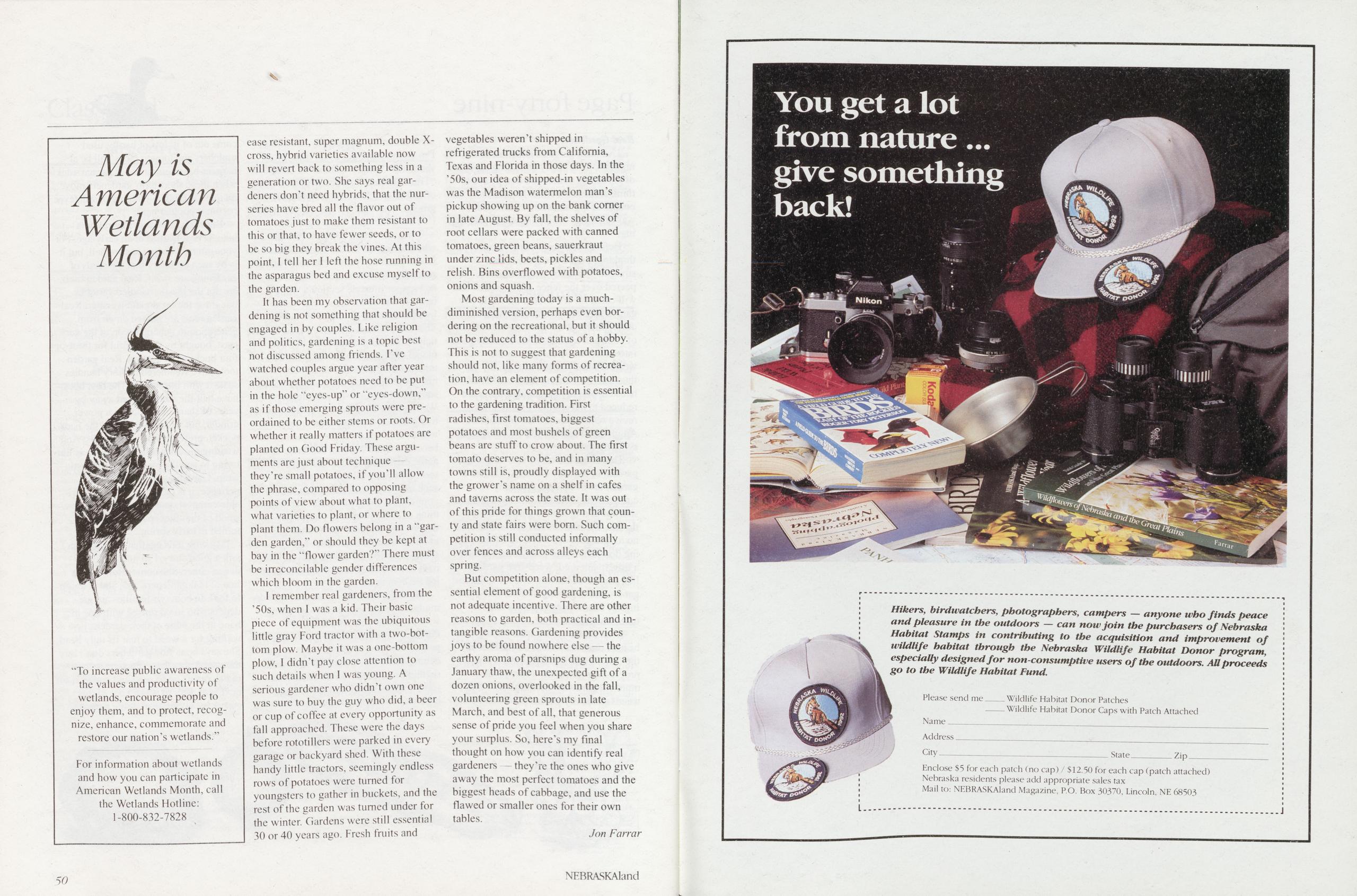
resistant, super magnum, double X- cross, hybrid varieties available now will revert back to something less in a generation or two. She says real gardeners don't need hybrids, that the nurseries have bred all the flavor out of tomatoes just to make them resistant to this or that, to have fewer seeds, or to be so big they break the vines. At this point, I tell her I left the hose running in the asparagus bed and excuse myself to the garden.
It has been my observation that gardening is not something that should be engaged in by couples. Like religion and politics, gardening is a topic best not discussed among friends. I’ve watched couples argue year after year about whether potatoes need to be put in the hole “eyes-up" or “eyes-down," as if those emerging sprouts were pre-ordained to be either stems or roots. Or whether it really matters if potatoes are planted on Good Friday. These arguments are just about technique they’re small potatoes, if you’ll allow the phrase, compared to opposing points of view about what to plant, what varieties to plant, or where to plant them. Do flowers belong in a “garden garden," or should they be kept at bay in the “flower garden?" There must be irreconcilable gender differences which bloom in the garden.
I remember real gardeners, from the ’50s, when 1 was a kid. Their basic piece of equipment was the ubiquitous little gray Ford tractor with a two-bottom plow. Maybe it was a one-bottom plow, I didn't pay close attention to such details when I was young. A serious gardener who didn’t own one was sure to buy the guy who did, a beer or cup of coffee at every opportunity as fall approached. These were the days before rototiIlers were parked in every garage or backyard shed. With these handy little tractors, seemingly endless rows of potatoes were turned for youngsters to gather in buckets, and the rest of the garden was turned under for the winter. Gardens were still essential 30 or 40 years ago. Fresh fruits and vegetables weren’t shipped in refrigerated trucks from California, Texas and Florida in those days. In the ’50s, our idea of shipped-in vegetables was the Madison watermelon man’s pickup showing up on the bank comer in late August. By fall, the shelves of root cellars were packed with canned tomatoes, green beans, sauerkraut under zinHids, beets, pickles and relish. Bins overflowed with potatoes, onions and squash.
Most gardening today is a much- diminished version, perhaps even bordering on the recreational, but it should not be reduced to the status of a hobby. This is not to suggest that gardening should not, like many forms of recreation, have an element of competition. On the contrary, competition is essential to the gardening tradition. First radishes, first tomatoes, biggest potatoes and most bushels of green beans are stuff to crow about. The first tomato deserves to be, and in many towns still is, proudly displayed with the grower’s name on a shelf in cafes and taverns across the state. It was out of this pride for things grown that county and state fairs were bom. Such competition is still conducted informally over fences and across alleys each spring.
But competition alone, though an essential element of good gardening, is not adequate incentive. There are other reasons to garden, both practical and intangible reasons. Gardening provides joys to be found nowhere else — the earthy aroma of parsnips dug during a January thaw, the unexpected gift of a dozen onions, overlooked in the fall, volunteering green sprouts in late March, and best of all, that generous sense of pride you feel when you share your surplus. So, here’s my final thought on how you can identify real gardeners — they’re the ones who give away the most perfect tomatoes and the biggest heads of cabbage, and use the flawed or smaller ones for their own tables.
Jon Farrar
Position: 467 (22 views)