Volume 70, Issue 3, 1992
NEBRASKAland
NEBRASKAland
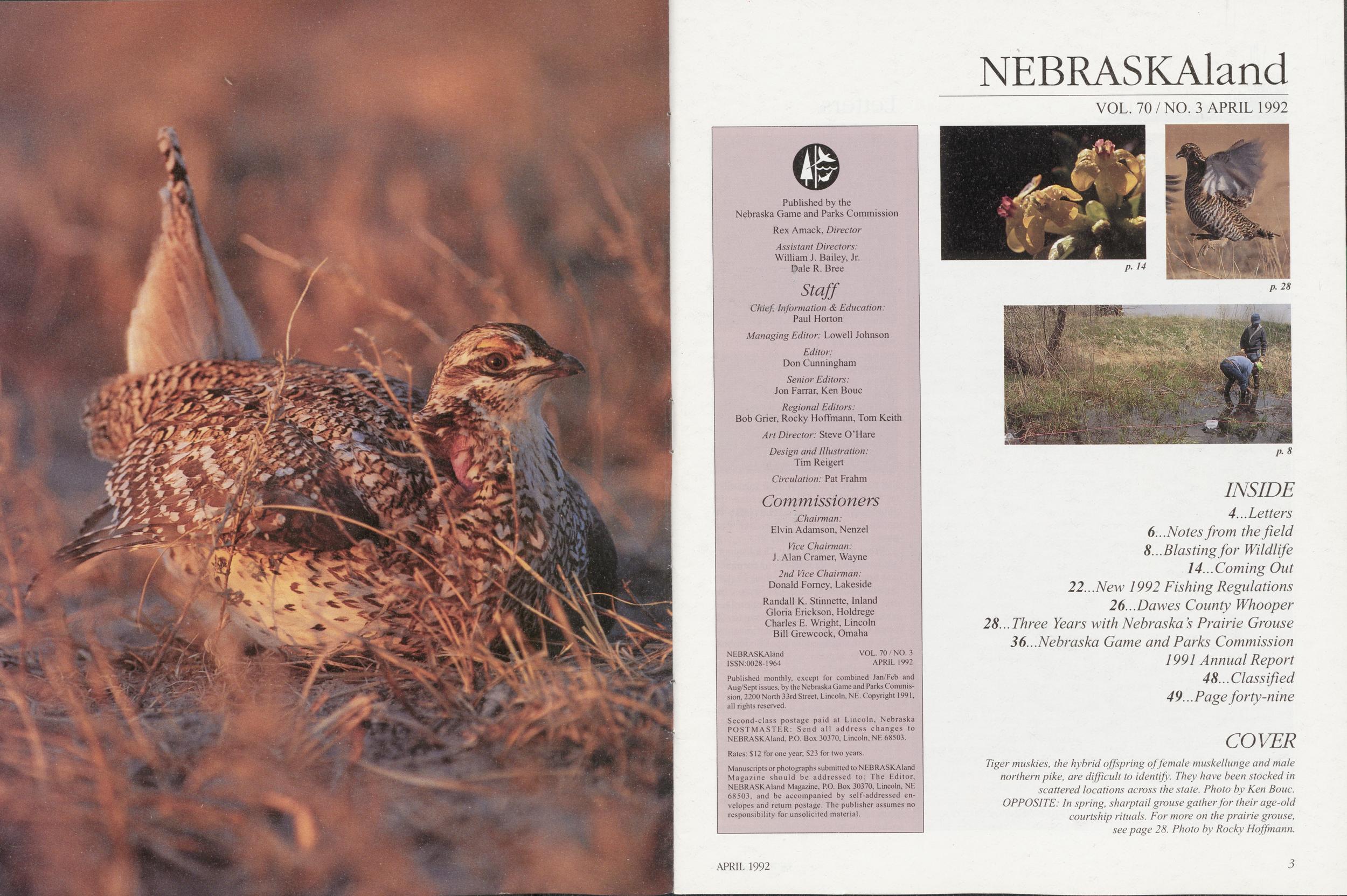
VOL. 70 / NO. 3 APRIL 1992 Published by the Nebraska Game and Parks Commission Rex Amack, Director Assistant Directors: William J. Bailey, Jr. Dale R. Bree Staff Chief Information & Education: Paul Horton Managing Editor: Lowell Johnson Editor: Don Cunningham Senior Editors: Jon Farrar, Ken Bouc Regional Editors: Bob Grier, Rocky Hoffmann, Tom Keith Art Director: Steve O'Hare Design and Illustration: Tim Reigert Circulation: Pat Frahm Commissioners Chairman: Elvin Adamson, Nenzel Vice Chairman: J. Alan Cramer, Wayne 2nd Vice Chairman: Donald Forney, Lakeside Randall K. Stinnette, Inland Gloria Erickson, Holdrege Charles E. Wright, Lincoln Bill Grewcock, Omaha NEBRASKAland ISSN:0028-1964 VOL. 70 / NO. 3 APRIL 1992 Published monthly, except for combined Jan/Feb and Aug/Sept issues, by the Nebraska Game and Parks Commission, 2200 North 33rd Street, Lincoln, NE. Copyright 1991, all rights reserved. Second-class postage paid at Lincoln, Nebraska POSTMASTER: Send all address changes to NEBRASKAland. P.O. Box 30370, Lincoln, NE 68503. Rates: $ 12 for one year; $23 for two years. Manuscripts or photographs submitted to NEBRASKAland Magazine should be addressed to: The Editor, NEBRASKAland Magazine, P.O. Box 30370, Lincoln, NE 68503, and be accompanied by self-addressed envelopes and return postage. The publisher assumes no responsibility for unsolicited material. Nebraska Game and Parks Commission
District Offices
Letters
Headquarters District Office II District Office IV
2200 North 33rd Street Box 508 Route 4, Box 36
Lincoln, NE 68503 Bassett, NE 68714 North Platte, NE 69101
Phone (402)471-0641 Phone (402)684-2921 Phone (308)535-8025
District Office I District Office III District Office V
Box 725 Box 934 2200 North 33rd Street
Alliance, NE 69301 Norfolk, NE 68702 Lincoln, NE 68503
Phone (308)762-5605 Phone (402)370-3374 Phone (402)471-5558
Omaha Office Ak-Sar-Ben Aquarium
State Office Building Mall 21502 West Highway 31
1313Famam Gretna, NE 68028
Omaha, NE 68102, Phone (402) 332-3901
Phone (402) 595-2144
Conservation Officers by Region
Panhandle Southeast
Officer City Phone (308) Officer City Phone (402)
Richard Furley (Supv) Alliance 762-2024 Don Schaepler (Chief) Lincoln 488-2957
Walt Meyer Chadron 432-4398 Ted Blume (Asst Chief) Lincoln 483-5643
John Murphy Crawford 665-2021 Roger Guenther (Supv) Lincoln 423-5671
Jim Zimmerman Gering 436-7561 William Krause Auburn 274-3789
Marvin Kampbell Hay Springs 638-7527 Dan Evasco Beatrice 228-5935
Dennis Thompson Ogallala 284-6450 Murray Johnson Lincoln 488-2923
Don Hunt Oshkosh 772-3697 Douglas Kramer Lincoln 466-9001
Richard Brandt Scottsbluff 635-1277 Levi Krause Louisville 234-2212
Raymond Still Bridgeport 262-1075 Russell Mort Duane Arp Nebr. City 873-5684
Omaha 332-4954
Northeast Larry Elston Omaha 292-4910
Officer City Phone (402) Craig Stover Omaha 359-2833
Bob Downing (Supv) Norfolk 371-2675 Mike Luben Wahoo 443-4278
Robert Kelly Albion 395-2538
Ross Oestmann Bloomfield 373-4412 Sandhills
L.A. Wilkinson Columbus 564-4375 Officer City Phone (402)
Gary Ralston Creighton 847-3284 Bruce Wiebe (Supv) Bassett 684-3867
Daniel Roberts Fremont 721-7852 Max Showalter Ainsworth 387-1960
Randy Pomplun Fullerton ( 308)536-2987 Larry Bauman Atkinson 925-5569
Jon Reeves Kennard 427-7378 Tom Zimmer Brkn. Bow (308)872-6063
Marion Shafer Norfolk 371-2031 Dan Zuehlke Mullen (308)546-2492
Eric Wiebe Ponca 755-2566 Richard Seward Ord (308)728-5338
Steve Oberg West Point 372-3062 Mick Gray Valentine 376-3136
Southwest South-Central
Officer City Phone (308) Officer City Phone (402)
Gail Woodside(Supv) No. Platte 532-0279 Jerry Pecha (Supv) York
362-5707
George Sund Cambridge 697-4629 Lester Johnson David City 367-4037
Jack Henderson Gothenburg 537-7483 Terry Brentzel Grand 1st. (308)384-8296
Dirk Greene Imperial 882-5328 Dale Johnson Hebron 768-7363
Ray Frandsen Lexington 324-2753 Daniel Klammer Hastings 461-3389
Virgil Gosch McCook 345-2185 Dayton Shultis Kearney (308)234-3349
Dwight Allbery No. Platte 532-2753 Mark Reeves Loup City (308)745-1126
Roger Thompson No. Platte 532-9175 Robert Finke Seward 643-2056
Rich Routh Republican City 799-2085
Operation Game Tl def (800) 742-7627
Nebraska Game and Parks Commission
District Offices
Letters
Headquarters District Office II District Office IV
2200 North 33rd Street Box 508 Route 4, Box 36
Lincoln, NE 68503 Bassett, NE 68714 North Platte, NE 69101
Phone (402)471-0641 Phone (402)684-2921 Phone (308)535-8025
District Office I District Office III District Office V
Box 725 Box 934 2200 North 33rd Street
Alliance, NE 69301 Norfolk, NE 68702 Lincoln, NE 68503
Phone (308)762-5605 Phone (402)370-3374 Phone (402)471-5558
Omaha Office Ak-Sar-Ben Aquarium
State Office Building Mall 21502 West Highway 31
1313Famam Gretna, NE 68028
Omaha, NE 68102, Phone (402) 332-3901
Phone (402) 595-2144
Conservation Officers by Region
Panhandle Southeast
Officer City Phone (308) Officer City Phone (402)
Richard Furley (Supv) Alliance 762-2024 Don Schaepler (Chief) Lincoln 488-2957
Walt Meyer Chadron 432-4398 Ted Blume (Asst Chief) Lincoln 483-5643
John Murphy Crawford 665-2021 Roger Guenther (Supv) Lincoln 423-5671
Jim Zimmerman Gering 436-7561 William Krause Auburn 274-3789
Marvin Kampbell Hay Springs 638-7527 Dan Evasco Beatrice 228-5935
Dennis Thompson Ogallala 284-6450 Murray Johnson Lincoln 488-2923
Don Hunt Oshkosh 772-3697 Douglas Kramer Lincoln 466-9001
Richard Brandt Scottsbluff 635-1277 Levi Krause Louisville 234-2212
Raymond Still Bridgeport 262-1075 Russell Mort Duane Arp Nebr. City 873-5684
Omaha 332-4954
Northeast Larry Elston Omaha 292-4910
Officer City Phone (402) Craig Stover Omaha 359-2833
Bob Downing (Supv) Norfolk 371-2675 Mike Luben Wahoo 443-4278
Robert Kelly Albion 395-2538
Ross Oestmann Bloomfield 373-4412 Sandhills
L.A. Wilkinson Columbus 564-4375 Officer City Phone (402)
Gary Ralston Creighton 847-3284 Bruce Wiebe (Supv) Bassett 684-3867
Daniel Roberts Fremont 721-7852 Max Showalter Ainsworth 387-1960
Randy Pomplun Fullerton ( 308)536-2987 Larry Bauman Atkinson 925-5569
Jon Reeves Kennard 427-7378 Tom Zimmer Brkn. Bow (308)872-6063
Marion Shafer Norfolk 371-2031 Dan Zuehlke Mullen (308)546-2492
Eric Wiebe Ponca 755-2566 Richard Seward Ord (308)728-5338
Steve Oberg West Point 372-3062 Mick Gray Valentine 376-3136
Southwest South-Central
Officer City Phone (308) Officer City Phone (402)
Gail Woodside(Supv) No. Platte 532-0279 Jerry Pecha (Supv) York
362-5707
George Sund Cambridge 697-4629 Lester Johnson David City 367-4037
Jack Henderson Gothenburg 537-7483 Terry Brentzel Grand 1st. (308)384-8296
Dirk Greene Imperial 882-5328 Dale Johnson Hebron 768-7363
Ray Frandsen Lexington 324-2753 Daniel Klammer Hastings 461-3389
Virgil Gosch McCook 345-2185 Dayton Shultis Kearney (308)234-3349
Dwight Allbery No. Platte 532-2753 Mark Reeves Loup City (308)745-1126
Roger Thompson No. Platte 532-9175 Robert Finke Seward 643-2056
Rich Routh Republican City 799-2085
Operation Game Tl def (800) 742-7627
Letters
CorrectionThe photographs reproduced on pages 94 and 95 o/Photographing Nebraska (NEBRASKAland Magazine, Vol 70, No. 1, January/February 1992) were inadvertently switched, making the photo caption on page 95 misrepresent the two film types described, The photograph on page 94 was taken on Fuji Velvia; the photograph on page 95 was taken on Kodachrome 64. We apologize for any confusion this may have caused. (Editor)
Thanksgiving IceSir/ As a pleased and faithful subscriber to NEBRASKAland, I just love the photography in each issue. Hats off to the entire staff for providing such picturesque scenes of Nebraska.
When the icy rains after Thanksgiving hit, I couldn't help myself I thought it was time to contribute something back to NEBRASKAland. I shot a few pictures of my father's Platte River bottomland which has flooded several times in my 79 years but, as you can tell, not recently. They were taken southwest of Columbus.
Dana D. Ernst Sioux City, IA Photographing NebraskaSir/ I just received my copy of the NEBRASKAland photo issue and just wanted to tell you how much I enjoyed it. I took it to some friends who are from California but are now living here, and they are wanting to take a trip to Nebraska! They had the idea that Nebraska was all flat and nothing but farms until two years ago; we decided to take a few days and go to the Black Hills and western 4 NEBRASKAland Nebraska. They fell in love with the beauty of both places. The photo issue is a good advertisement for Nebraska. Keep up the good work.
Alyce Conner Loveland, COSir Congratulations on publishing your book on photography, and hats off to Bob Grier, Jon Farrar, Ken Bouc and all the others who made this issue possible.
Hilary Meyerle Bothell, WA December ComplimentsSir/ The December 1991 issue of NEBRASKAland is fantastic! The cover photo is the best ad for wintertime travel in Nebraska I have ever seen, and the articles, photos and presentation inside the publication are exceptional.
Clark K. Parks Cedar Rapids, IA Young HunterSir/ I suspect my grandson, Tony Woodruff, was Nebraska's youngest deer hunter in 1991. Tony turned 14 on November 15, just two days before the season closed. Living near the Niobrara River with its many deer and turkeys, Tony could hardly wait to join his uncles for the traditional family hunt. He applied for a license and arranged for his uncle to pick it up in Lincoln on his birthday. His uncle delivered the license, giving Tony two days to hunt. He only needed one. On Saturday morning, after three hours of hunting, he was successful.
Can Tony wait until next year for another season? Not really. He spent the rest of the fall slipping through the river canyons with a bow, continuing to enjoy Nebraska's great outdoors.
Ben Woodruff Butte, NE Summer CloudsSir/ 1 wonder if I was the only one to recognize the "coyote" cloud on the cover of your July 1991 issue. The large tail is on the left, over the back legs. The open mouthed head is on the right, and the front legs extend forward. On the back of the magazine is a cloud that looks like a jet plane flying to the left of the picture.
I guess I find clouds very interesting and sometimes entertaining. Thanks.
June H. Carlson Omaha, NE Fishing MemoriesSir/1 took this photo this past summer at Conestoga lake near Lincoln. I thought it was a unique photo, so I'm sending it to you to see if it is worth publishing in your magazine.
The picture is of my boyfriend, Terry Melvin, while he was fishing one evening.
Tami Hofmann Lincoln, NE Editor's NoteNEBRASKAland Magazine has been informed that Bob Jensen, of Bennet, an occasional contributor to the magazine and author of ''Venison Jerky " which appeared in the December 1991 issue, passed away on February 2, 1992, shortly before the publication of his most recent contribution, a letter in the March 1992 issue describing his observation of unusual cormorant behavior.
Send your comments, suggestions and complaints to Letters, NEBRASKAland Magazine, P.O. Box 30370, Lincoln, NE 68503. Each month we will publish as many of your letters as space permits. Photographs are also welcome. NEBRASKAland reserves the right to edit and condense letters.
A Gift For Campers A perfect gift for any camper, Camper Coupons in books of 10 are redeemable for camping or electrical hookup fees at all Nebraska state parks and recreation areas. Camper Coupons, a great gift for any camper, are the perfect door prize for a camping club, and they're convenient for your own use, too! Sold in books of 10 one dol lar coupons for $10 per book. To order, enclose a check for $10 per book and mail to: Camper Coupons Nebraska Game and Parks Commission P.O. Box 30370 Lincoln, NE 68503 APRIL 1992 5 Where can you
get away for a
week or weekend,
and still not
spend a bundle?
Nebraska's state park areas are
still your best bet for the perfect
vacation or weekend break. Get
the new 48-page, color brochure
highlighting state parks, recreation areas and historic parks.
You'll get detailed information
on lodging, camping, activities,
facilities, seasons, fees and
reservation policies.
Write or call today!
Nebraska Game and Parks Commission
P.O. Box 30370, Lincoln, NE 68503
Phone (402) 471-0641
Where can you
get away for a
week or weekend,
and still not
spend a bundle?
Nebraska's state park areas are
still your best bet for the perfect
vacation or weekend break. Get
the new 48-page, color brochure
highlighting state parks, recreation areas and historic parks.
You'll get detailed information
on lodging, camping, activities,
facilities, seasons, fees and
reservation policies.
Write or call today!
Nebraska Game and Parks Commission
P.O. Box 30370, Lincoln, NE 68503
Phone (402) 471-0641
Notes from the field
Avian Cholera: Burning the CarcasesIn mid-March, we received the following note from Chuck McCullough, a biologist with the Nebraska Game and Parks Commission s Wildlife Division:
Most Nebraskans look forward to spring. For golfers and gardeners, fanners and photographers, spring is a great time of year. Songbirds are singing and flowers are blooming. Sandhill cranes are causing traffic jams from Grand Island to Lexington. Waterfowl, in their splendiferous breeding plumage, pause for a time on their northward migration.
Waterfowl stop mostly in the Rainwater Basin in south-central Nebraska, and their concentrations can be spectacular. Numbers often peak at over a million ducks and geese, and the basins have become popular with birdwatchers and nature enthusiasts. Every spring, I await the migrating birds with mixed feelings. I enjoy the noise of a marsh full of waterfowl, their bright colors and the antics of courtship and pair-bond formation. But I also know that as soon as they begin to arrive, some will die from avian cholera. The dying will continue until most have moved north. And I have to help pick up the dead birds.
Avian cholera was first detected in the basins in 1975 and has killed waterfowl there every spring since. Annual mortality has ranged from a few hundred to over 70,000 waterfowl.
Cholera is an infectious disease caused by a bacterium. The disease is spread by bird-to-bird contact, ingestion of contaminated food or water and perhaps by breathing the mist that develops on the water's surface when thousands of birds take off at once. Humans can't get avian cholera, but waterfowl are highly susceptible. Shallow, stagnant water promotes growth of the bacterium, which can persist for more than four months in soil and three months in decaying carcasses.
Most experts believe that cholera outbreaks are triggered by stress. The sources of stress offered by these experts include overcrowding, severe storms and ingestion of toxic fungi.
The Nebraska Game and Parks Commission works closely with the U.S. Fish and Wildlife Service to control cholera every spring. I spend a lot of time coordinating efforts with Jon Kauffeld from the USFWS Kearney office.
The Service pumps fresh water into a number of federally owned basins to dilute bacteria and provide more habitat. Both agencies have crews in the field checking for cholera outbreaks and collecting dead birds. In a bad year, crews will be out every day throughout most of the spring migration.
We use airboats, AT Vs and specialized amphibious vehicles to pick up dead waterfowl. Snow geese increasingly have become a major component of the dieoffs, and when we get a bad one, the shoreline can look like it has been sprinkled with salt.
We often find dead birds in bizarre, grotesque positions. The final stages of cholera are often accompanied by convulsions, and I sometimes wonder how much pain a goose endures before it finally succumbs.
The denizens of the marsh spend little time mourning. I have seen muskrats loafing on the breast of a dead goose. Scavengers, from above and below, work quickly to clean up the casualties. Unfortunately, they are often quite messy and can further contaminate a marsh by strewing bacteria-laden body parts. Avian scavengers, such as crows and gulls, can further complicate matters by contracting cholera and dying at distant sites.
When I think of my most vivid experiences with cholera, I always come back to the smells. Decomposing marsh muck brings back memories of backedup sewer lines. Every dead goose I pick up reminds me unfavorably of the chickens I scalded as a youngster. When we deliver birds to the incinerator, I feel as if I'm having my teeth drilled in the middle of a house fire. Deep yellow smoke billows from the fire. Feathers and bone, guts and meat smolder, then burn to ash.
Waterfowl began to arrive in the basins about three weeks early this 6 NEBRASKAland spring. They also began to die about three weeks early. By the middle of March, state and federal personnel had collected roughly 4,500 dead waterfowl, of which roughly 90 percent were snow geese. Most of the geese have now moved north. I was glad to see them go.
Chuck Mc Cullough Wetland EconomicsThere isn't much music in the names for many wetland types: words like bog, swamp, marsh and fen sometimes seem to be little more than metaphors for a leaky basement or a clogged shower stall. That's unfortunate; anyone who has been in a real bog, swamp, marsh or fen in spring knows that few places are more musical, livelier and richer in sound and scent than a wetland. Wetlands are vital to wildlife, too, and they help purify polluted water, and protect us against floods, storms and erosion.
We're losing wetlands at an alarming rate one estimate suggests a loss of about 300,000 wetland acres a year, and of an estimated 215 million acres of wetlands present when European settlers arrived here, more than half are gone.
The complex hydrology of wetland environments, their rich, biologically diverse communities, their aesthetic value and their value to other species with which we share the earth, ought to be reason enough to preserve them, but that hasn't been the case, and so a variety of studies have been carried out to quantify the economic benefits of wetlands.
Among them is a new U.S. Environmental Protection Agency study recently announced by Diane Hershberger, chief of the Wetlands Protection Section of the EPA's Region VII office in Kansas City, KS, called "Alternative Usages of Wetlands Other Than Conventional Farming in Iowa, Kansas, Missouri and Nebraska." Highlights from the study are available as a brochure called "Wetlands: Their Potential for Profit." For the brochure or the full study, write Kathy Mulder, U.S. Environmental Protection Agency, 726 Minnesota Avenue, Kansas City, KS 66101, or call (913) 551-7542.
Don Cunningham This Poster is Free ENDANGERED Means There is Still Time THE WHOOPING CRANE When uv hear his cull we hear no mere bird Ho is tin symbol of our untamable past Aide Leopold Mow than beauty, whooping canea symbolize the cuneifl snuggle to save the vanishing creatures of OUT world Contributions to Nebraska's NoAgune and Endangered Wildlife Check-off Program support efforts by the Game and Parks Commission to identify. protect and enhance habitat essential to the cranes then successful migration through the state SUPPOS1 "NEBRASKA'S NONGAME A ENDANGERED WILDLIFE CONSERVATION FUND To contribute, see your state income tax toini. consult your tax preparer, or make a direct donation to the Nebraska Game and Parks Commission PO box 90370, Lincoln. NE68503-0370 if you give a gift to wildlife! To get this full-color whooping crane poster free, donate a part of your Nebraska state income tax refund to non-game wildlife: On your state income tax form, find the line with the peregrine falcon beside it and write in the amount from your refund to be donated. Take a receipt from your tax preparer or a copy of that portion of the form to a Nebraska Game and Parks Commission office to receive your poster. For mail orders, send a receipt, a copy of your tax form or your cancelled check to Nebraska Game and Parks Commission, P.O. Box 30370, Lincoln, NE 68503 . APRIL 1992 7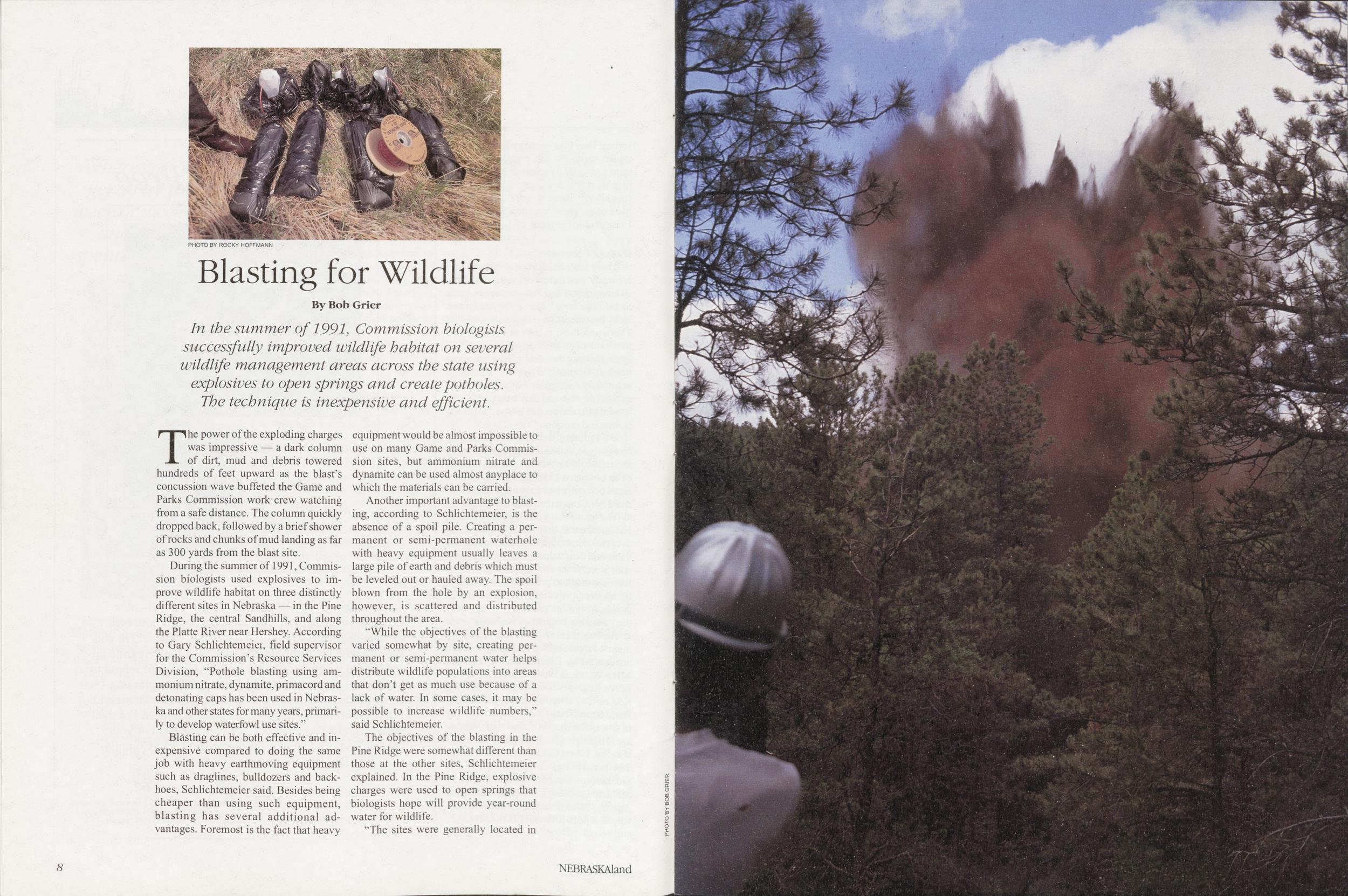
Blasting for Wildlife
By Bob Grier In the summer of 1991, Commission biologists successfully improved wildlife habitat on several wildlife management areas across the state using explosives to open springs and create potholes. The technique is inexpensive a?id efficient.The power of the exploding charges was impressive — a dark column of dirt, mud and debris towered hundreds of feet upward as the blast's concussion wave buffeted the Game and Parks Commission work crew watching from a safe distance. The column quickly dropped back, followed by a brief shower of rocks and chunks of mud landing as far as 300 yards from the blast site.
During the summer of 1991, Commission biologists used explosives to improve wildlife habitat on three distinctly different sites in Nebraska — in the Pine Ridge, the central Sandhills, and along the Platte River near Hershey. According to Gary Schhchtemeier, field supervisor for the Commission's Resource Services Division, "Pothole blasting using ammonium nitrate, dynamite, primacord and detonating caps has been used in Nebraska and other states for many years, primarily to develop waterfowl use sites."
Blasting can be both effective and inexpensive compared to doing the same job with heavy earthmoving equipment such as draglines, bulldozers and backhoes, Schhchtemeier said. Besides being cheaper than using such equipment, blasting has several additional advantages. Foremost is the fact that heavy equipment would be almost impossible to use on many Game and Parks Commission sites, but ammonium nitrate and dynamite can be used almost anyplace to which the materials can be carried.
Another important advantage to blasting, according to Schhchtemeier, is the absence of a spoil pile. Creating a permanent or semi-permanent waterhole with heavy equipment usually leaves a large pile of earth and debris which must be leveled out or hauled away. The spoil blown from the hole by an explosion, however, is scattered and distributed throughout the area.
"While the objectives of the blasting varied somewhat by site, creating permanent or semi-permanent water helps distribute wildlife populations into areas that don't get as much use because of a lack of water. In some cases, it may be possible to increase wildlife numbers," said Schhchtemeier.
The objectives of the blasting in the Pine Ridge were somewhat different than those at the other sites, Schhchtemeier explained. In the Pine Ridge, explosive charges were used to open springs that biologists hope will provide year-round water for wildlife.
"The sites were generally located in 8 NEBRASKAland
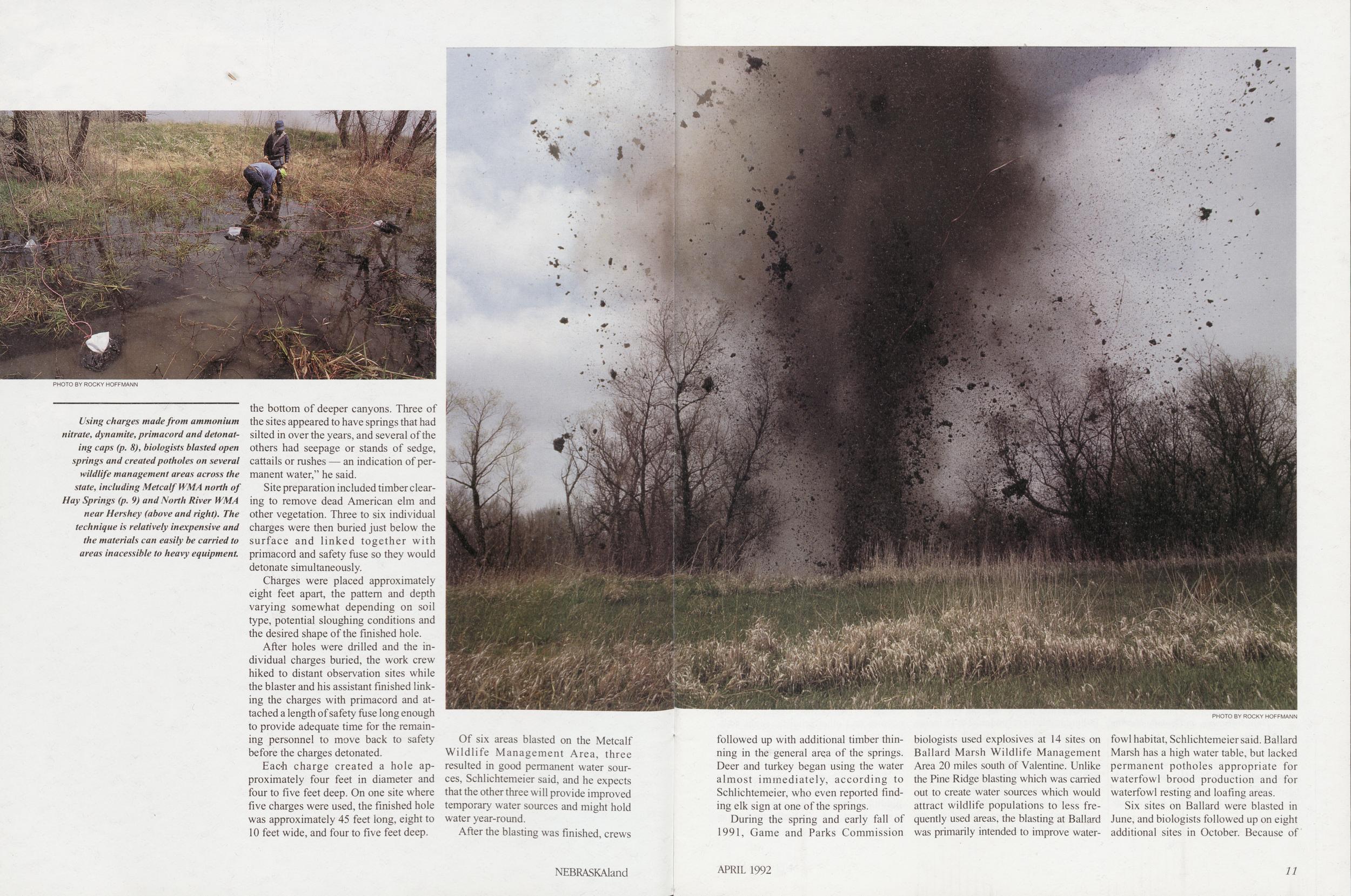
Site preparation included timber clearing to remove dead American elm and other vegetation. Three to six individual charges were then buried just below the surface and linked together with primacord and safety fuse so they would detonate simultaneously.
Charges were placed approximately eight feet apart, the pattern and depth varying somewhat depending on soil type, potential sloughing conditions and the desired shape of the finished hole.
After holes were drilled and the individual charges buried, the work crew hiked to distant observation sites while the blaster and his assistant finished linking the charges with primacord and attached a length of safety fuse long enough to provide adequate time for the remaining personnel to move back to safety before the charges detonated.
Each charge created a hole approximately four feet in diameter and four to five feet deep. On one site where five charges were used, the finished hole was approximately 45 feet long, eight to 10 feet wide, and four to five feet deep.
Of six areas blasted on the Metcalf Wildlife Management Area, three resulted in good permanent water sources, Schlichtemeier said, and he expects that the other three will provide improved temporary water sources and might hold water year-round.
After the blasting was finished, crews NEBRASKAland followed up with additional timber thinning in the general area of the springs. Deer and turkey began using the water almost immediately, according to Schlichtemeier, who even reported finding elk sign at one of the springs.
During the spring and early fall of 1991, Game and Parks Commission APRIL 1992 biologists used explosives at 14 sites on Ballard Marsh Wildlife Management Area 20 miles south of Valentine. Unlike the Pine Ridge blasting which was carried out to create water sources which would attract wildlife populations to less frequently used areas, the blasting at Ballard was primarily intended to improve waterfowl habitat, Schlichtemeier said. Ballard Marsh has a high water table, but lacked permanent potholes appropriate for waterfowl brood production and for waterfowl resting and loafing areas.
Six sites on Ballard were blasted in
June, and biologists followed up on eight
additional sites in October. Because of
APRIL 1992
11
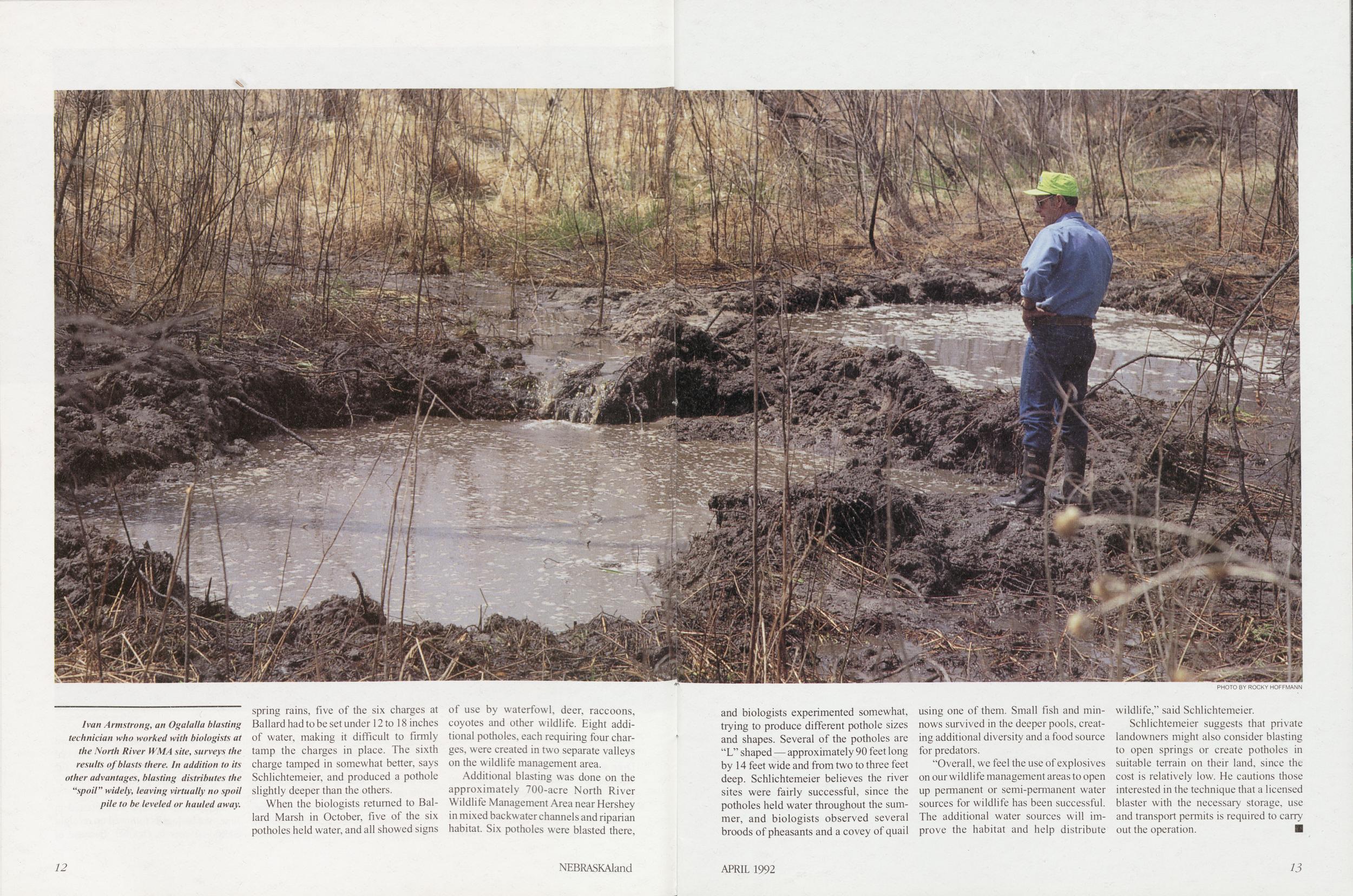
When the biologists returned to Ballard Marsh in October, five of the six potholes held water, and all showed signs of use by waterfowl, deer, raccoons, coyotes and other wildlife. Eight additional potholes, each requiring four charges, were created in two separate valleys on the wildlife management area.
Additional blasting was done on the approximately 700-acre North River Wildlife Management Area near Hershey in mixed backwater channels and riparian habitat. Six potholes were blasted there, 12 NEBRASKAland and biologists experimented somewhat, trying to produce different pothole sizes and shapes. Several of the potholes are "L" shaped — approximately 90 feet long by 14 feet wide and from two to three feet deep. Schlichtemeier believes the river sites were fairly successful, since the potholes held water throughout the summer, and biologists observed several broods of pheasants and a covey of quail using one of them. Small fish and minnows survived in the deeper pools, creating additional diversity and a food source for predators.
"Overall, we feel the use of explosives on our wildlife management areas to open up permanent or semi-permanent water sources for wildlife has been successful. The additional water sources will improve the habitat and help distribute wildlife," said Schlichtemeier.
Schlichtemeier suggests that private landowners might also consider blasting to open springs or create potholes in suitable terrain on their land, since the cost is relatively low. He cautions those interested in the technique that a licensed blaster with the necessary storage, use and transport permits is required to carry out the operation.
APRIL 1992 13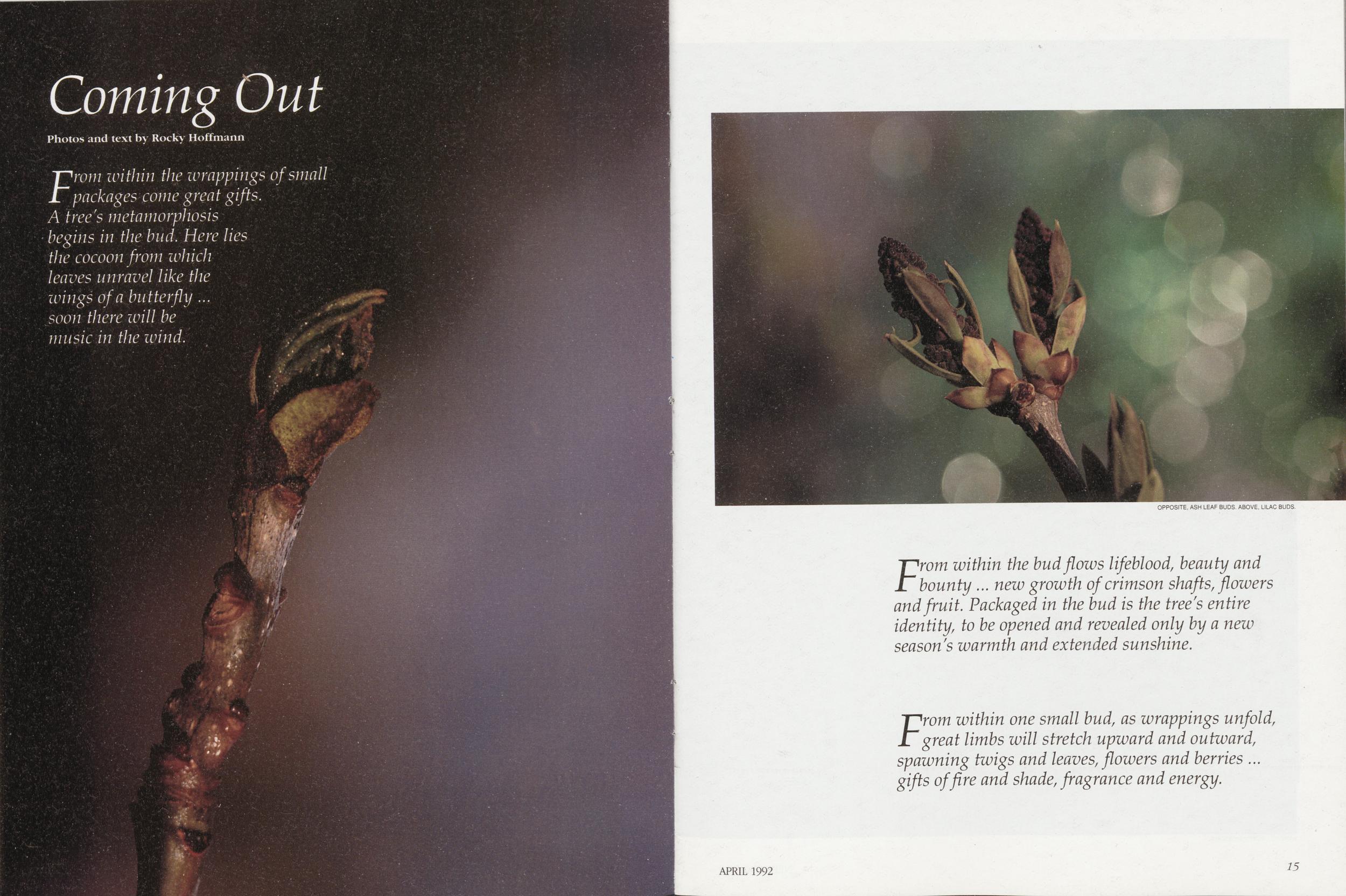
Coming Out
Photos and text by Rocky Hoffmann from within the wrappings of small packages come great gifts. A tree's metamorphosis begins in the bud. Here lies the cocoon from which leaves unravel like the wings of a butterfly soon there will be music in the wind.From within the bud flows lifeblood, beauty and bounty ... new growth of crimson shafts, flowers and fruit. Packaged in the bud is the tree's entire identity, to be opened and revealed only by a new season's warmth and extended sunshine.
From within one small bud, as wrappings unfold, great limbs will stretch upward and outward, spawning twigs and leaves, flowers and berries gifts of fire and shade, fragrance and energy.
APRIL 1992 15
From within all its buds, a tree will crown, and there will be acres of leaf surface. Free oxygen and water will pour through a vast network of stomata on each leaf gifts to the earth, products of radiant energy, carbon dioxide and chlorophyll.
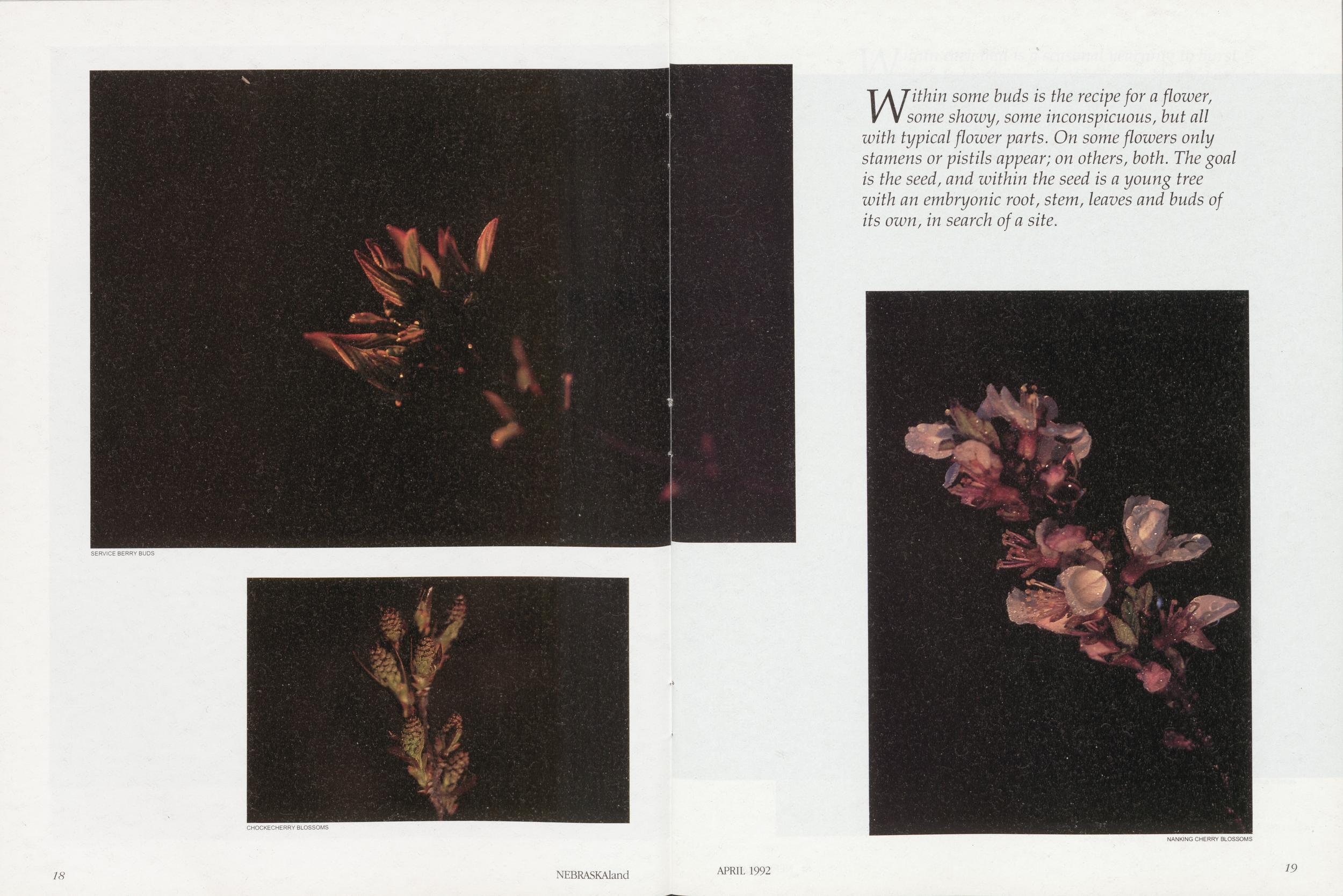
Writhin some buds is the recipe for a flower, some showy, some inconspicuous, but all with typical flower parts. On some flowers only stamens or pistils appear; on others, both. The goal is the seed, and within the seed is a young tree with an embryonic root, stem, leaves and buds of its own, in search of a site.
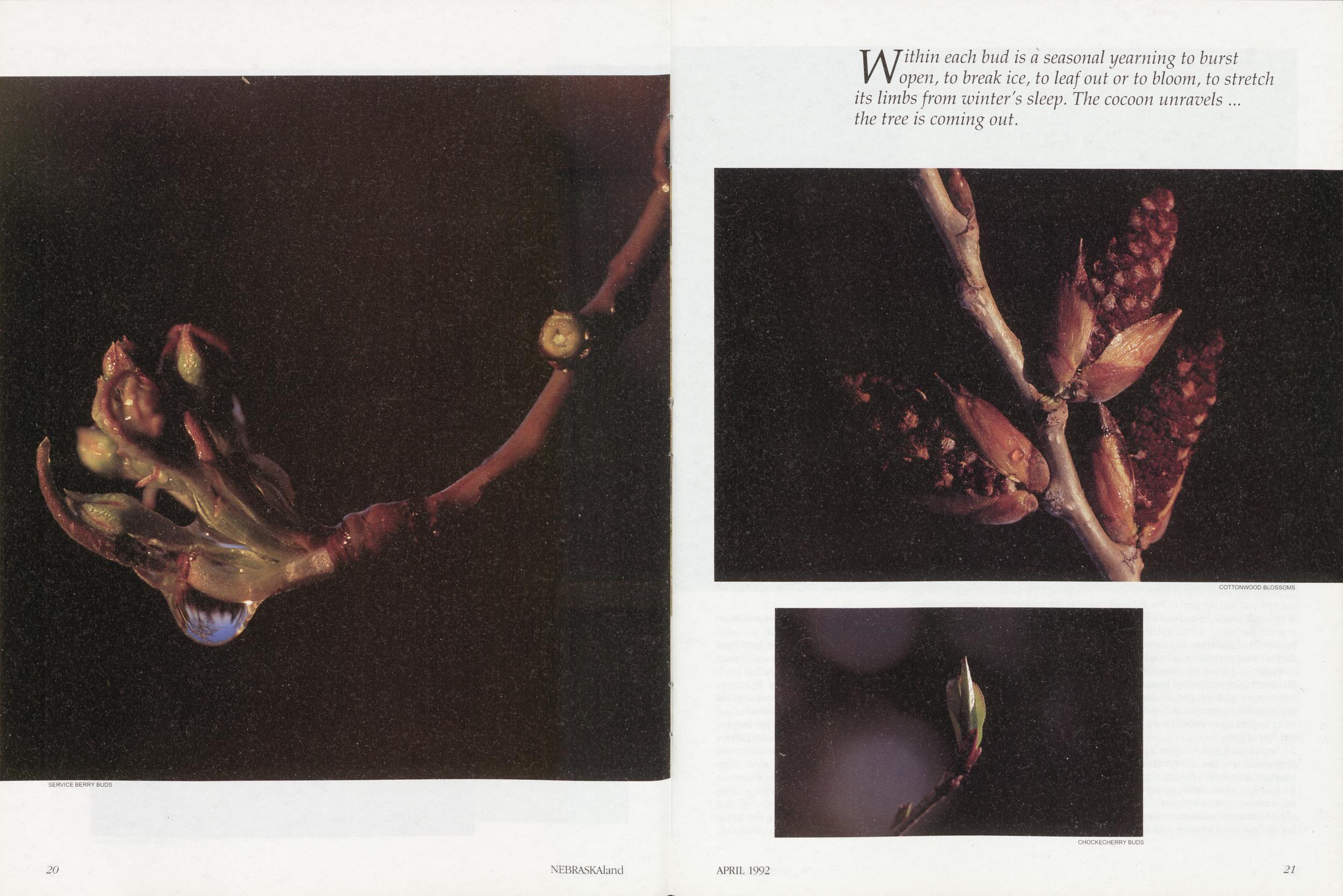
Writhin each hud is a seasonal yearning to burst open, to break ice, to leaf out or to bloom, to stretch its limbs from winter's sleep. The cocoon unravels the tree is coming out.
New 1992 Fishing Regulations
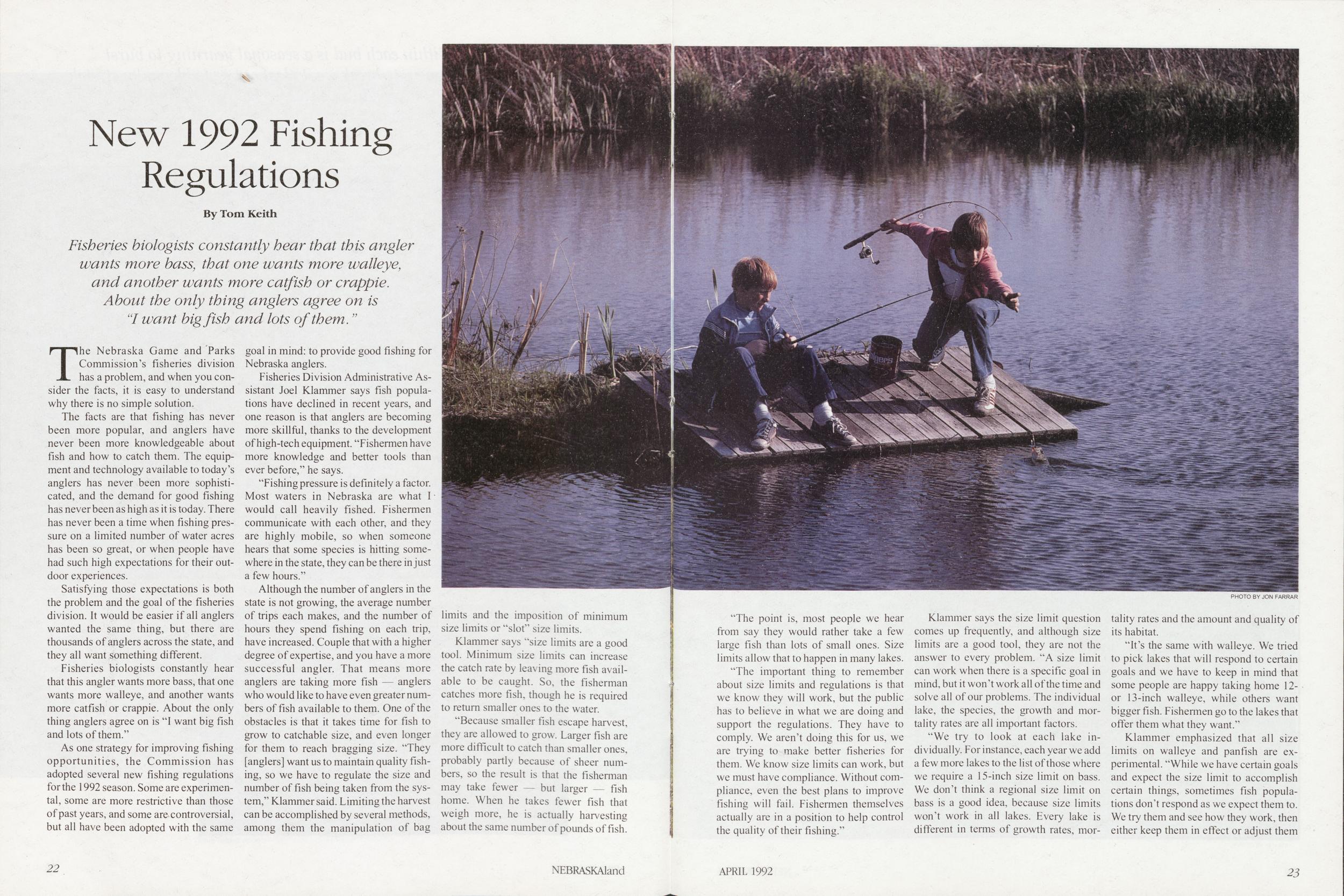
By Tom Keith Fisheries biologists constantly hear that this angler wants more bass, that one wants more walleye, and another wants more catfish or crappie. About the only thing anglers agree on is "I want big fish and lots of them."The Nebraska Game and Parks Commission's fisheries division has a problem, and when you consider the facts, it is easy to understand why there is no simple solution.
The facts are that fishing has never been more popular, and anglers have never been more knowledgeable about fish and how to catch them. The equipment and technology available to today's anglers has never been more sophisticated, and the demand for good fishing has never been as high as it is today. There has never been a time when fishing pressure on a limited number of water acres has been so great, or when people have had such high expectations for their outdoor experiences.
Satisfying those expectations is both the problem and the goal of the fisheries division. It would be easier if all anglers wanted the same thing, but there are thousands of anglers across the state, and they all want something different.
Fisheries biologists constantly hear that this angler wants more bass, that one wants more walleye, and another wants more catfish or crappie. About the only thing anglers agree on is "I want big fish and lots of them."
As one strategy for improving fishing opportunities, the Commission has adopted several new fishing regulations for the 1992 season. Some are experimental, some are more restrictive than those of past years, and some are controversial, but all have been adopted with the same goal in mind: to provide good fishing for Nebraska anglers.
Fisheries Division Administrative Assistant Joel Klammer says fish populations have declined in recent years, and one reason is that anglers are becoming more skillful, thanks to the development of high-tech equipment. "Fishermen have more knowledge and better tools than ever before," he says.
"Fishing pressure is definitely a factor. Most waters in Nebraska are what I would call heavily fished. Fishermen communicate with each other, and they are highly mobile, so when someone hears that some species is hitting somewhere in the state, they can be there in just a few hours."
Although the number of anglers in the state is not growing, the average number of trips each makes, and the number of hours they spend fishing on each trip, have increased. Couple that with a higher degree of expertise, and you have a more successful angler. That means more anglers are taking more fish — anglers who would like to have even greater numbers offish available to them. One of the obstacles is that it takes time for fish to grow to catchable size, and even longer for them to reach bragging size. They [anglers] want us to maintain quality fishing, so we have to regulate the size and number offish being taken from the system," Klammer said. Limiting the harvest can be accomplished by several methods, among them the manipulation of bag limits and the imposition of minimum size limits or "slot" size limits.
Klammer says "size limits are a good tool. Minimum size limits can increase the catch rate by leaving more fish available to be caught. So, the fisherman catches more fish, though he is required to return smaller ones to the water.
"Because smaller fish escape harvest, they are allowed to grow. Larger fish are more difficult to catch than smaller ones, probably partly because of sheer numbers, so the result is that the fisherman may take fewer — but larger — fish home. When he takes fewer fish that weigh more, he is actually harvesting about the same number of pounds offish.
22 NEBRASKAlandThe point is, most people we hear from say they would rather take a few large fish than lots of small ones. Size limits allow that to happen in many lakes.
"The important thing to remember about size limits and regulations is that we know they will work, but the public has to believe in what we are doing and support the regulations. They have to comply. We aren't doing this for us, we are trying to make better fisheries for them. We know size limits can work, but we must have compliance. Without compliance, even the best plans to improve fishing will fail. Fishermen themselves actually are in a position to help control the quality of their fishing."
Klammer says the size limit question comes up frequently, and although size limits are a good tool, they are not the answer to every problem. "A size limit can work when there is a specific goal in mind, but it won't work all of the time and solve all of our problems. The individual lake, the species, the growth and mortality rates are all important factors.
"We try to look at each lake individually. For instance, each year we add a few more lakes to the list of those where we require a 15-inch size limit on bass. We don't think a regional size limit on bass is a good idea, because size limits won't work in all lakes. Every lake is different in terms of growth rates, mortality rates and the amount and quality of its habitat.
"It's the same with walleye. We tried to pick lakes that will respond to certain goals and we have to keep in mind that some people are happy taking home 12-or 13-inch walleye, while others want bigger fish. Fishennen go to the lakes that offer them what they want."
Klammer emphasized that all size limits on walleye and panfish are experimental. "While we have certain goals and expect the size limit to accomplish certain things, sometimes fish populations don't respond as we expect them to. We try them and see how they work, then either keep them in effect or adjust them to better suit the fisherman's needs."
APRIL 1992 23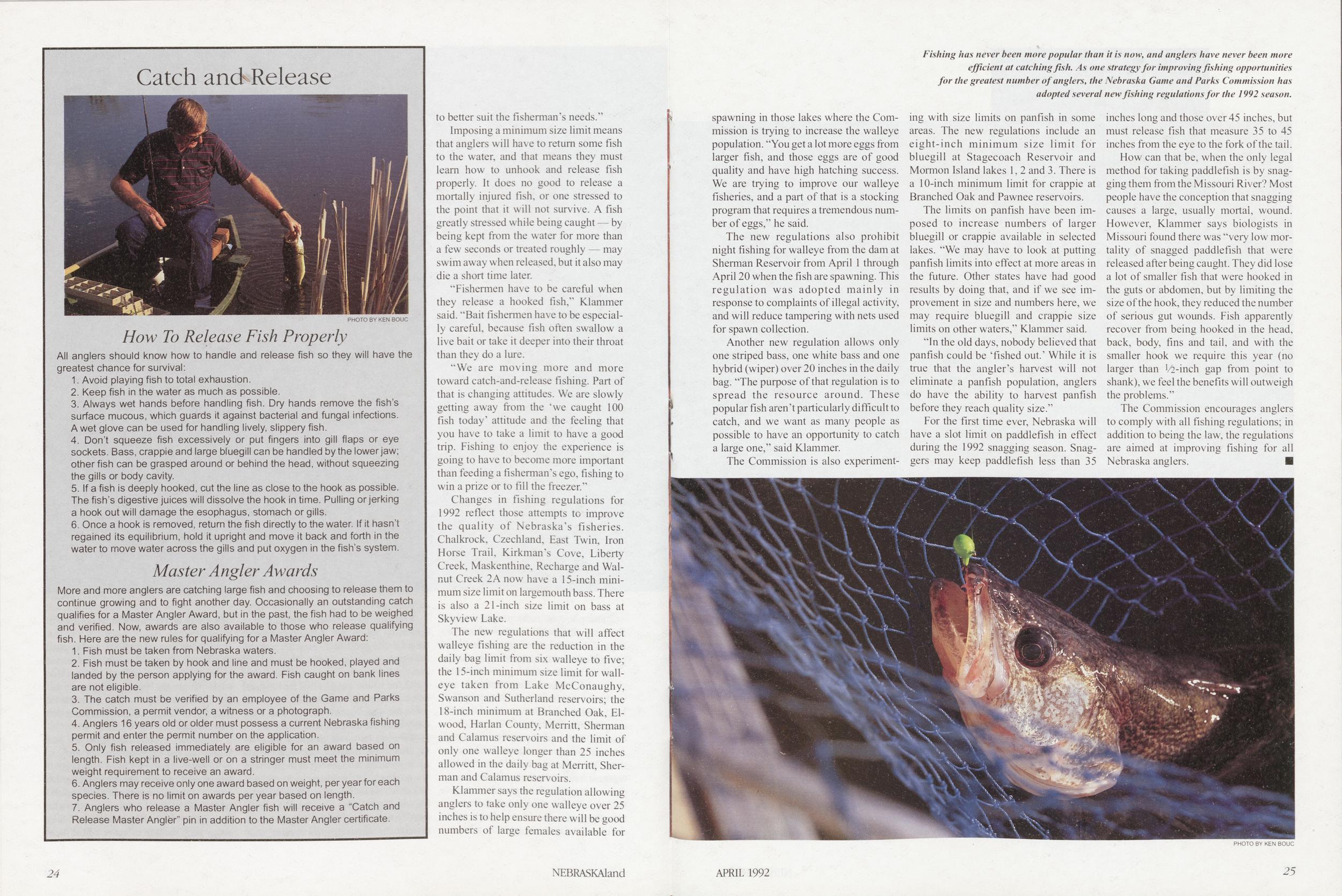 Catch and Release
All anglers should know how to handle and release fish so they will have the greatest chance for survival:
1. Avoid playing fish to total exhaustion. 2. Keep fish in the water as much as possible. 3. Always wet hands before handling fish. Dry hands remove the fish's surface mucous, which guards it against bacterial and fungal infections. A wet glove can be used for handling lively, slippery fish. 4. Don't squeeze fish excessively or put fingers into gill flaps or eye sockets. Bass, crappie and large bluegill can be handled by the lower jaw; other fish can be grasped around or behind the head, without squeezing the gills or body cavity. 5. If a fish is deeply hooked, cut the line as close to the hook as possible. The fish's digestive juices will dissolve the hook in time. Pulling or jerking a hook out will damage the esophagus, stomach or gills. 6. Once a hook is removed, return the fish directly to the water. If it hasn't regained its equilibrium, hold it upright and move it back and forth in the water to move water across the gills and put oxygen in the fish's system. Master Angler AwardsMore and more anglers are catching large fish and choosing to release them to continue growing and to fight another day. Occasionally an outstanding catch qualifies for a Master Angler Award, but in the past, the fish had to be weighed and verified. Now, awards are also available to those who release qualifying fish. Here are the new rules for qualifying for a Master Angler Award:
1. Fish must be taken from Nebraska waters. 2. Fish must be taken by hook and line and must be hooked, played and landed by the person applying for the award. Fish caught on bank lines are not eligible. 3. The catch must be verified by an employee of the Game and Parks Commission, a permit vendor, a witness or a photograph. 4. Anglers 16 years old or older must possess a current Nebraska fishing permit and enter the permit number on the application. 5. Only fish released immediately are eligible for an award based on length. Fish kept in a live-well or on a stringer must meet the minimum weight requirement to receive an award. 6. Anglers may receive only one award based on weight, per year for each species. There is no limit on awards per year based on length. 7. Anglers who release a Master Angler fish will receive a "Catch and Release Master Angler" pin in addition to the Master Angler certificate.Imposing a minimum size limit means that anglers will have to return some fish to the water, and that means they must learn how to unhook and release fish properly. It does no good to release a mortally injured fish, or one stressed to the point that it will not survive. A fish greatly stressed while being caught — by being kept from the water for more than a few seconds or treated roughly — may swim away when released, but it also may die a short time later.
"Fishermen have to be careful when they release a hooked fish," Klammer said. "Bait fishermen have to be especially careful, because fish often swallow a live bait or take it deeper into their throat than they do a lure.
"We are moving more and more toward catch-and-release fishing. Part of that is changing attitudes. We are slowly getting away from the kwe caught 100 fish today' attitude and the feeling that you have to take a limit to have a good trip. Fishing to enjoy the experience is going to have to become more important than feeding a fisherman's ego, fishing to win a prize or to fill the freezer."
Changes in fishing regulations for 1992 reflect those attempts tc improve the quality of Nebraska's fisheries. Chalkrock, Czechland, East Twin, Iron Horse Trail, Kirkman's Cove, Liberty Creek, Maskenthine, Recharge and Walnut Creek 2A now have a 15-inch minimum size limit on largemouth bass. There is also a 21-inch size limit on bass at Sky view Lake.
The new regulations that will affect walleye fishing are the reduction in the daily bag limit from six walleye to five; the 15-inch minimum size limit for walleye taken from Lake MeConaughy, Swanson and Sutherland reservoirs; the 18-inch minimum at Branched Oak, Elwood, Harlan County, Merritt, Sherman and Calamus reservoirs and the limit of only one walleye longer than 25 inches allowed in the daily bag at Merritt, Sherman and Calamus reservoirs.
Klammer says the regulation allowing anglers to take only one walleye over 25 inches is to help ensure there will be good numbers of large females available for 24 NEBRASKAland spawning in those lakes where the Commission is trying to increase the walleye population. "You get a lot more eggs from larger fish, and those eggs are of good quality and have high hatching success. We are trying to improve our walleye fisheries, and a part of that is a stocking program that requires a tremendous number of eggs," he said.
The new regulations also prohibit night fishing for walleye from the dam at Sherman Reservoir from April 1 through April 20 when the fish are spawning. This regulation was adopted mainly in response to complaints of illegal activity, and will reduce tampering with nets used for spawn collection.
Another new regulation allows only one striped bass, one white bass and one hybrid (wiper) over 20 inches in the daily bag. "The purpose of that regulation is to spread the resource around. These popular fish aren't particularly difficult to catch, and we want as many people as possible to have an opportunity to catch a large one," said Klammer.
The Commission is also experimenting with size limits on panfish in some areas. The new regulations include an eight-inch minimum size limit for bluegill at Stagecoach Reservoir and Mormon Island lakes 1, 2 and 3. There is a 10-inch minimum limit for crappie at Branched Oak and Pawnee reservoirs.
The limits on panfish have been imposed to increase numbers of larger bluegill or crappie available in selected lakes. "We may have to look at putting panfish limits into effect at more areas in the future. Other states have had good results by doing that, and if we see improvement in size and numbers here, we may require bluegill and crappie size limits on other waters," Klammer said.
"In the old days, nobody believed that panfish could be Tished out.' While it is true that the angler's harvest will not eliminate a panfish population, anglers do have the ability to harvest panfish before they reach quality size."
For the first time ever, Nebraska will have a slot limit on paddlefish in effect during the 1992 snagging season. Snaggers may keep paddlefish less than 35 inches long and those over 45 inches, but must release fish that measure 35 to 45 inches from the eye to the fork of the tail.
How can that be, when the only legal method for taking paddlefish is by snagging them from the Missouri River? Most people have the conception that snagging causes a large, usually mortal, wound. However, Klammer says biologists in Missouri found there was "very low mortality of snagged paddlefish that were released after being caught. They did lose a lot of smaller fish that were hooked in the guts or abdomen, but by 'limiting the size of the hook, they reduced the number of serious gut wounds. Fish apparently recover from being hooked in the head, back, body, fins and tail, and with the smaller hook we require this year (no larger than vz-inch gap from point to shank), we feel the benefits will outweigh the problems."
The Commission encourages anglers to comply with all fishing regulations; in addition to being the law, the regulations are aimed at improving fishing for all Nebraska anglers.
DAWES COUNTY WHOOPER
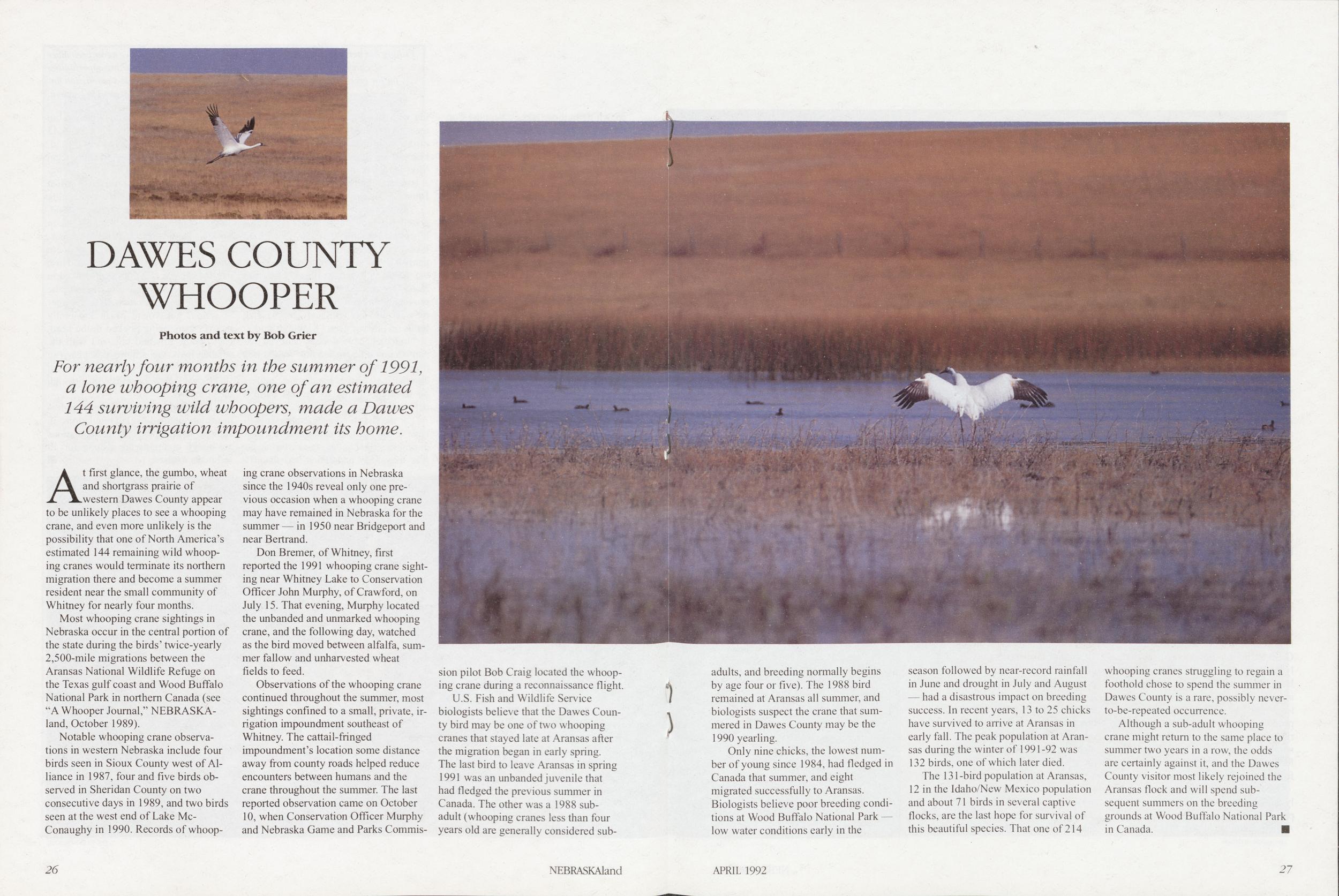
Photos and text by Bob Grier For nearly four months in the summer of1991, a lone whooping crane, one of an estimated 144 surviving wild whoopers, made a Dawes County irrigation impoundment its home.At first glance, the gumbo, wheat and shortgrass prairie of western Dawes County appear to be unlikely places to see a whooping crane, and even more unlikely is the possibility that one of North America's estimated 144 remaining wild whooping cranes would terminate its northern migration there and become a summer resident near the small community of Whitney for nearly four months.
Most whooping crane sightings in Nebraska occur in the central portion of the state during the birds' twice-yearly 2,500-mile migrations between the Aransas National Wildlife Refuge on the Texas gulf coast and Wood Buffalo National Park in northern Canada (see "A Whooper Journal," NEBRASKAland, October 1989).
Notable whooping crane observations in western Nebraska include four birds seen in Sioux County west of Alliance in 1987, four and five birds observed in Sheridan County on two consecutive days in 1989, and two birds seen at the west end of Lake McConaughy in 1990. Records of whooping crane observations in Nebraska since the 1940s reveal only one previous occasion when a whooping crane may have remained in Nebraska for the summer — in 1950 near Bridgeport and near Bertrand.
Don Bremer, of Whitney, first reported the 1991 whooping crane sighting near Whitney Lake to Conservation Officer John Murphy, of Crawford, on July 15. That evening, Murphy located the unhanded and unmarked whooping crane, and the following day, watched as the bird moved between alfalfa, summer fallow and unharvested wheat fields to feed.
Observations of the whooping crane continued throughout the summer, most sightings confined to a small, private, irrigation impoundment southeast of Whitney. The cattail-fringed impoundment's location some distance away from county roads helped reduce encounters between humans and the crane throughout the summer. The last reported observation came on October 10, when Conservation Officer Murphy and Nebraska Game and Parks Commission pilot Bob Craig located the whooping crane during a reconnaissance flight.
U.S. Fish and Wildlife Service biologists believe that the Dawes County bird may be one of two whooping cranes that stayed late at Aransas after the migration began in early spring. The last bird to leave Aransas in spring 1991 was an unbanded juvenile that had fledged the previous summer in Canada. The other was a 1988 subadult (whooping cranes less than four years old are generally considered sub 26 NEBRASKAland adults, and breeding normally begins by age four or five). The 1988 bird remained at Aransas all summer, and biologists suspect the crane that summered in Dawes County may be the 1990 yearling.
Only nine chicks, the lowest number of young since 1984, had fledged in Canada that summer, and eight migrated successfully to Aransas. Biologists believe poor breeding conditions at Wood Buffalo National Park low water conditions early in the season followed by near-record rainfall in June and drought in July and August — had a disastrous impact on breeding success. In recent years, 13 to 25 chicks have survived to arrive at Aransas in early fall. The peak population at Aransas during the winter of 1991 -92 was 132 birds, one of which later died.
The 131-bird population at Aransas, 12 in the Idaho/New Mexico population and about 71 birds in several captive flocks, are the last hope for survival of this beautiful species. That one of 214 whooping cranes struggling to regain a foothold chose to spend the summer in Dawes County is a rare, possibly never-to-be-repeated occurrence.
Although a sub-adult whooping crane might return to the same place to summer two years in a row, the odds are certainly against it, and the Dawes County visitor most likely rejoined the Aransas flock and will spend subsequent summers on the breeding grounds at Wood Buffalo National Park in Canada.
APRIL 1992 27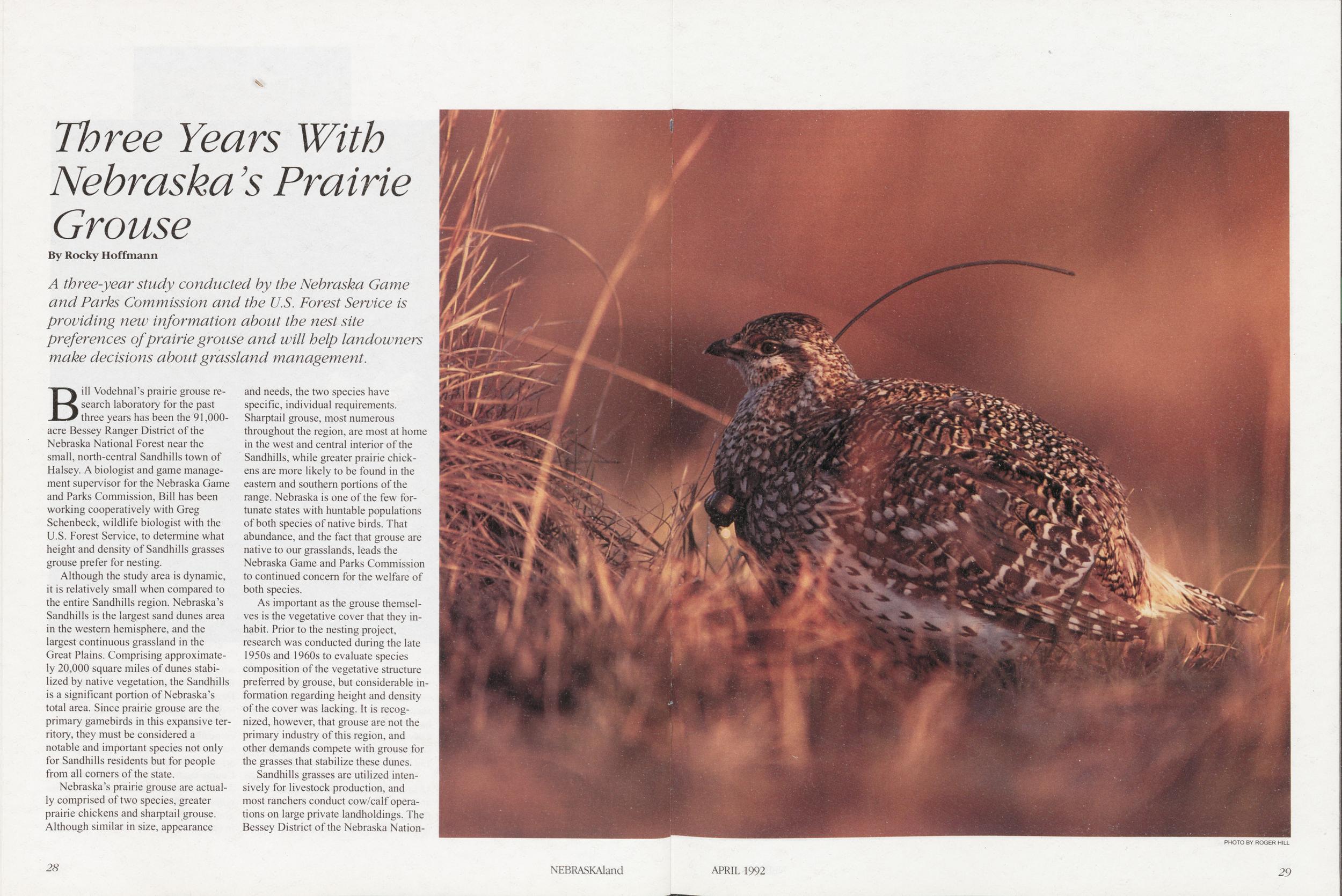
Three Years With Nebraska's Prairie Grouse
By Rocky Hoffmann A three-year study conducted by the Nebraska Game and Parks Commission and the U.S. Forest Service is providing new information about the nest site preferences of prairie grouse and will help landowners make decisions about grassland management.Bill Vodehnal's prairie grouse research laboratory for the past three years has been the 91,000-acre Bessey Ranger District of the Nebraska National Forest near the small, north-central Sandhills town of Halsey. A biologist and game management supervisor for the Nebraska Game and Parks Commission, Bill has been working cooperatively with Greg Schenbeck, wildlife biologist with the U.S. Forest Service, to determine what height and density of Sandhills grasses grouse prefer for nesting.
Although the study area is dynamic, it is relatively small when compared to the entire Sandhills region. Nebraska's Sandhills is the largest sand dunes area in the western hemisphere, and the largest continuous grassland in the Great Plains. Comprising approximately 20,000 square miles of dunes stabilized by native vegetation, the Sandhills is a significant portion of Nebraska's total area. Since prairie grouse are the primary gamebirds in this expansive territory, they must be considered a notable and important species not only for Sandhills residents but for people from all corners of the state.
Nebraska's prairie grouse are actually comprised of two species, greater prairie chickens and sharptail grouse. Although similar in size, appearance and needs, the two species have specific, individual requirements. Sharptail grouse, most numerous throughout the region, are most at home in the west and central interior of the Sandhills, while greater prairie chickens are more likely to be found in the eastern and southern portions of the range. Nebraska is one of the few fortunate states with huntable populations of both species of native birds. That abundance, and the fact that grouse are native to our grasslands, leads the Nebraska Game and Parks Commission to continued concern for the welfare of both species.
As important as the grouse themselves is the vegetative cover that they inhabit. Prior to the nesting project, research was conducted during the late 1950s and 1960s to evaluate species composition of the vegetative structure preferred by grouse, but considerable information regarding height and density of the cover was lacking. It is recognized, however, that grouse are not the primary industry of this region, and other demands compete with grouse for the grasses that stabilize these dunes.
Sandhills grasses are utilized intensively for livestock production, and most ranchers conduct cow/calf operations on large private landholdings. The Bessey District of the Nebraska National 28 NEBRASKAland
Since the management of livestock grazing can influence the amount of cover left for grouse nesting, information from the three-year study will be used to coordinate grazing practices and sharptail grouse habitat needs on the National Forest. Data from this study will also be useful to the U.S. Fish and Wildlife Service and to ranchers concerned about grouse populations on their land.
Arriving at his blind overlooking a windswept dune an hour before sunrise, Bill Vodehnal prepares to wait out the waning minutes of an April night to watch a spectacle that has occurred at this exact location perhaps for decades.
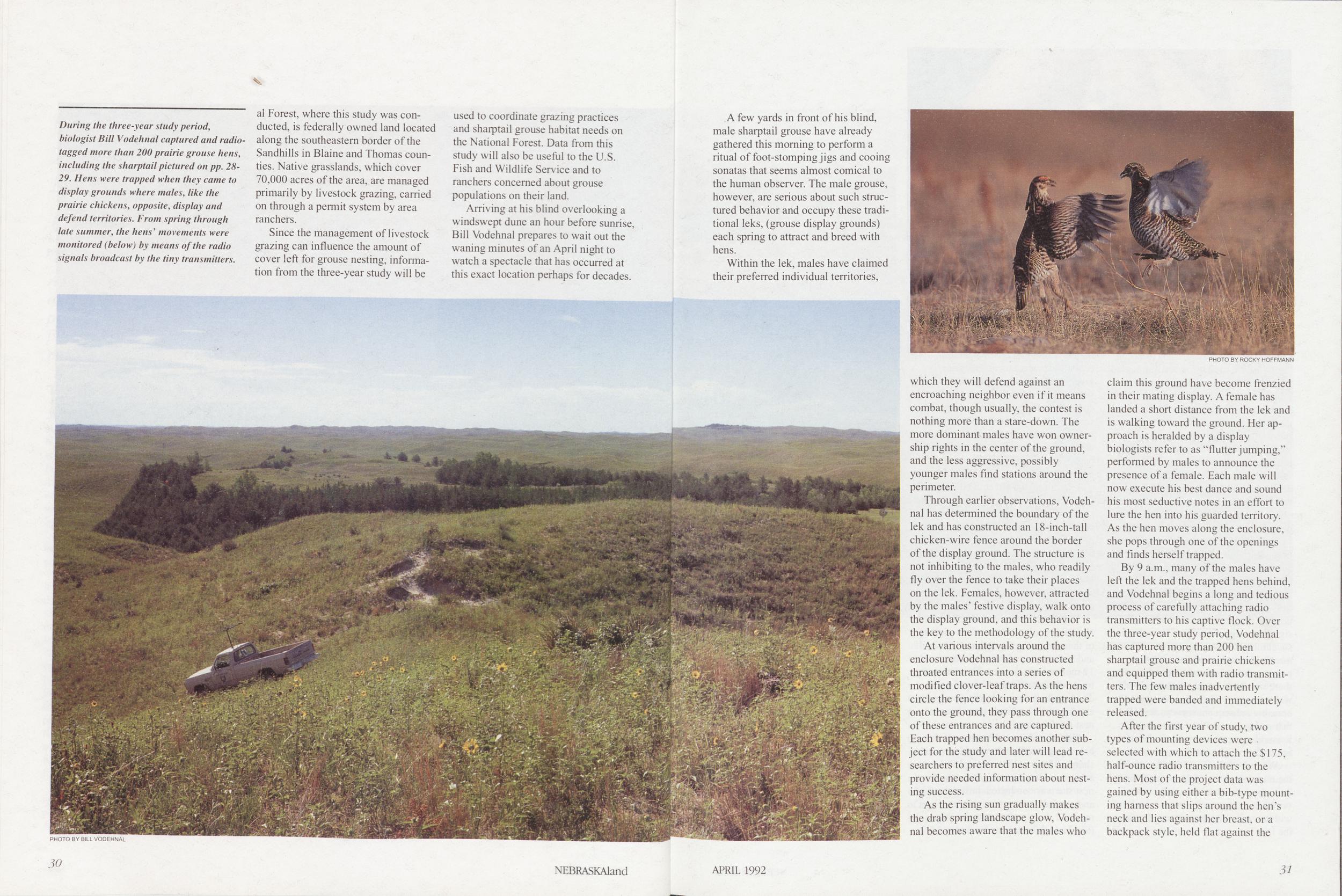
A few yards in front of his blind, male sharptail grouse have already gathered this morning to perform a ritual of foot-stomping jigs and cooing sonatas that seems almost comical to the human observer. The male grouse, however, are serious about such structured behavior and occupy these traditional leks, (grouse display grounds) each spring to attract and breed with hens.
Within the lek, males have claimed their preferred individual territories, which they will defend against an encroaching neighbor even if it means combat, though usually, the contest is nothing more than a stare-down. The more dominant males have won ownership rights in the center of the ground, and the less aggressive, possibly younger males find stations around the perimeter.
Through earlier observations, Vodehnal has determined the boundary of the lek and has constructed an 18-inch-tall chicken-wire fence around the border of the display ground. The structure is not inhibiting to the males, who readily fly over the fence to take their places on the lek. Females, however, attracted by the males' festive display, walk onto the display ground, and this behavior is the key to the methodology of the study.
At various intervals around the enclosure Vodehnal has constructed throated entrances into a series of modified clover-leaf traps. As the hens circle the fence looking for an entrance onto the ground, they pass through one of these entrances and are captured. Each trapped hen becomes another subject for the study and later will lead researchers to preferred nest sites and provide needed information about nesting success.
As the rising sun gradually makes the drab spring landscape glow, Vodehnal becomes aware that the males who claim this ground have become frenzied in their mating display. A female has landed a short distance from the lek and is walking toward the ground. Her approach is heralded by a display biologists refer to as "flutter jumping," performed by males to announce the presence of a female. Each male will now execute his best dance and sound his most seductive notes in an effort to lure the hen into his guarded territory. As the hen moves along the enclosure, she pops through one of the openings and finds herself trapped.
By 9 a.m., many of the males have left the lek and the trapped hens behind, and Vodehnal begins a long and tedious process of carefully attaching radio transmitters to his captive flock. Over the three-year study period, Vodehnal has captured more than 200 hen sharptail grouse and prairie chickens and equipped them with radio transmitters. The few males inadvertently trapped were banded and immediately released.
After the first year of study, two
types of mounting devices were
selected with which to attach the $175,
half-ounce radio transmitters to the
hens. Most of the project data was
gained by using either a bib-type mounting harness that slips around the hen's
neck and lies against her breast, or a
backpack style, held flat against the
APRIL 1992
31
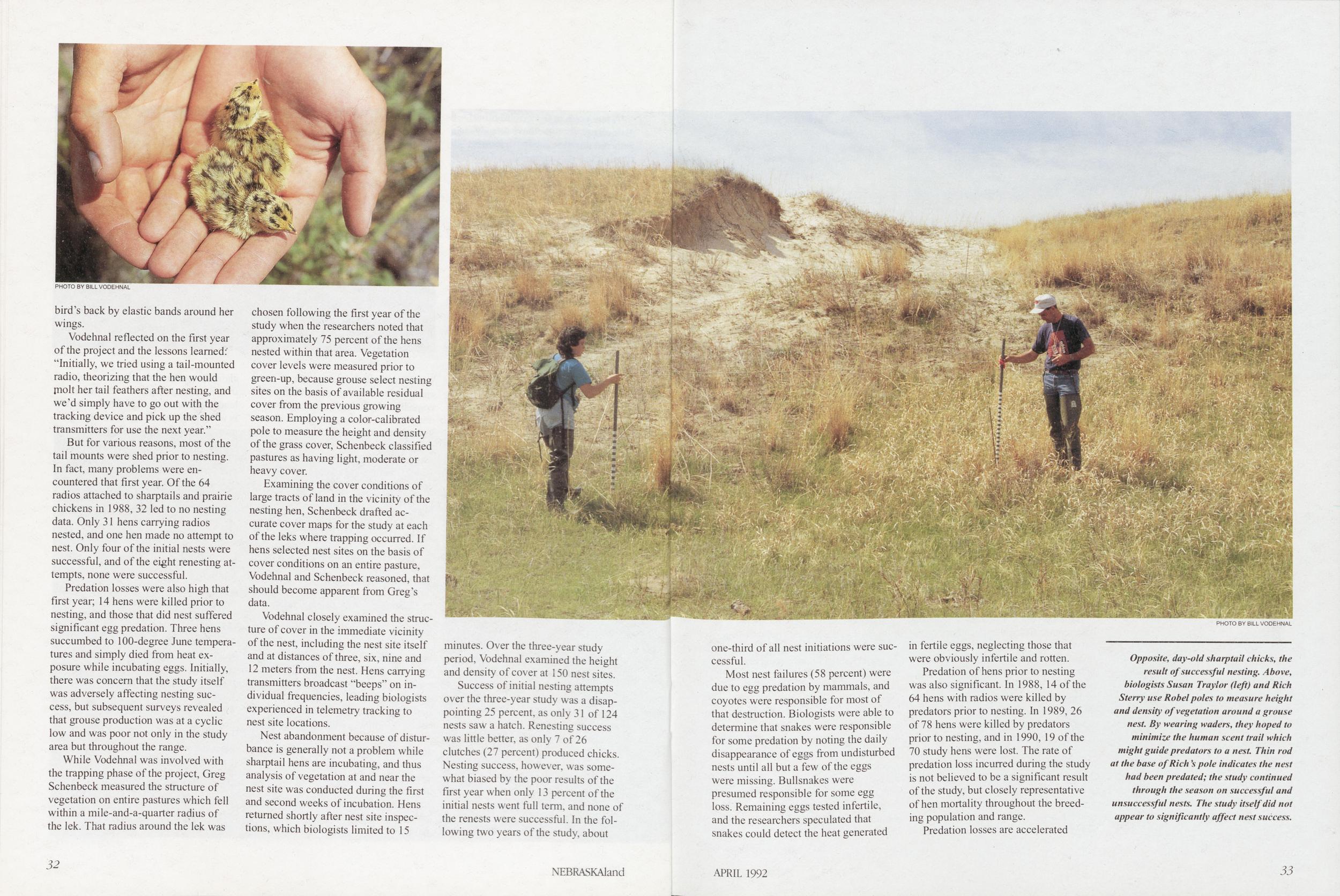
Vodehnal reflected on the first year of the project and the lessons learned: "Initially, we tried using a tail-mounted radio, theorizing that the hen would piolt her tail feathers after nesting, and we'd simply have to go out with the tracking device and pick up the shed transmitters for use the next year."
But for various reasons, most of the tail mounts were shed prior to nesting. In fact, many problems were encountered that first year. Of the 64 radios attached to sharptails and prairie chickens in 1988, 32 led to no nesting data. Only 31 hens carrying radios nested, and one hen made no attempt to nest. Only four of the initial nests were successful, and of the eight renesting attempts, none were successful.
Predation losses were also high that first year; 14 hens were killed prior to nesting, and those that did nest suffered significant egg predation. Three hens succumbed to 100-degree June temperatures and simply died from heat exposure while incubating eggs. Initially, there was concern that the study itself was adversely affecting nesting success, but subsequent surveys revealed that grouse production was at a cyclic low and was poor not only in the study area but throughout the range.
While Vodehnal was involved with the trapping phase of the project, Greg Schenbeck measured the structure of vegetation on entire pastures which fell within a mile-and-a-quarter radius of the lek. That radius around the lek was chosen following the first year of the study when the researchers noted that approximately 75 percent of the hens nested within that area. Vegetation cover levels were measured prior to green-up, because grouse select nesting sites on the basis of available residual cover from the previous growing season. Employing a color-calibrated pole to measure the height and density of the grass cover, Schenbeck classified pastures as having light, moderate or heavy cover.
Examining the cover conditions of large tracts of land in the vicinity of the nesting hen, Schenbeck drafted accurate cover maps for the study at each of the leks where trapping occurred. If hens selected nest sites on the basis of cover conditions on an entire pasture, Vodehnal and Schenbeck reasoned, that should become apparent from Greg's data.
Vodehnal closely examined the structure of cover in the immediate vicinity of the nest, including the nest site itself and at distances of three, six, nine and 12 meters from the nest. Hens carrying transmitters broadcast "beeps" on individual frequencies, leading biologists experienced in telemetry tracking to nest site locations.
Nest abandonment because of disturbance is generally not a problem while sharptail hens are incubating, and thus analysis of vegetation at and near the nest site was conducted during the first and second weeks of incubation. Hens returned shortly after nest site inspections, which biologists limited to 15 minutes. Over the three-year study period, Vodehnal examined the height and density of cover at 150 nest sites.
Success of initial nesting attempts over the three-year study was a disappointing 25 percent, as only 31 of 124 nests saw a hatch. Renesting success was little better, as only 7 of 26 clutches (27 percent) produced chicks. Nesting success, however, was somewhat biased by the poor results of the first year when only 13 percent of the initial nests went full term, and none of the renests were successful. In the following two years of the study, about 32 NEBRASKAland one-third of all nest initiations were successful.
Most nest failures (58 percent) were due to egg predation by mammals, and coyotes were responsible for most of that destruction. Biologists were able to determine that snakes were responsible for some predation by noting the daily disappearance of eggs from undisturbed nests until all but a few of the eggs were missing. Bullsnakes were presumed responsible for some egg loss. Remaining eggs tested infertile, and the researchers speculated that snakes could detect the heat generated in fertile eggs, neglecting those that were obviously infertile and rotten.
Predation of hens prior to nesting was also significant. In 1988, 14 of the 64 hens with radios were killed by predators prior to nesting. In 1989, 26 of 78 hens were killed by predators prior to nesting, and in 1990, 19 of the 70 study hens were lost. The rate of predation loss incurred during the study is not believed to be a significant result of the study, but closely representative of hen mortality throughout the breeding population and range.
Predation losses are accelerated
APRIL 1992
33
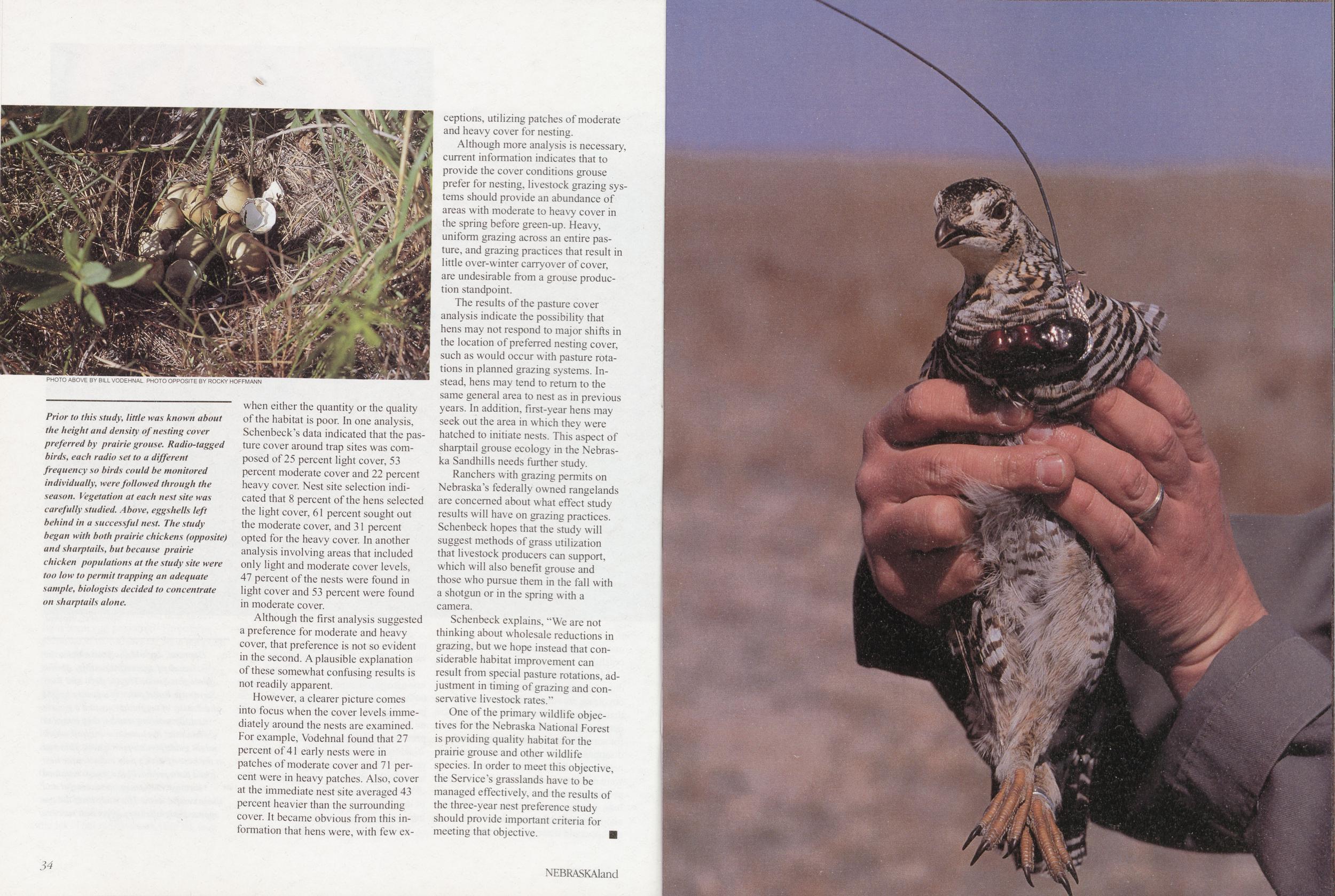
Although the first analysis suggested a preference for moderate and heavy cover, that preference is not so evident in the second. A plausible explanation of these somewhat confusing results is not readily apparent.
However, a clearer picture comes into focus when the cover levels immediately around the nests are examined. For example, Vodehnal found that 27 percent of 41 early nests were in patches of moderate cover and 71 percent were in heavy patches. Also, cover at the immediate nest site averaged 43 percent heavier than the surrounding cover. It became obvious from this information that hens were, with few exceptions, utilizing patches of moderate and heavy cover for nesting.
Although more analysis is necessary, current information indicates that to provide the cover conditions grouse prefer for nesting, livestock grazing systems should provide an abundance of areas with moderate to heavy cover in the spring before green-up. Heavy, uniform grazing across an entire pasture, and grazing practices that result in little over-winter carryover of cover, are undesirable from a grouse produc-tion standpoint.
The results of the pasture cover analysis indicate the possibility that hens may not respond to major shifts in the location of preferred nesting cover, such as would occur with pasture rotations in planned grazing systems. Instead, hens may tend to return to the same general area to nest as in previous years. In addition, first-year hens may seek out the area in which they were hatched to initiate nests. This aspect of sharptail grouse ecology in the Nebraska Sandhills needs further study.
Ranchers with grazing permits on Nebraska's federally owned rangelands are concerned about what effect study results will have on grazing practices. Schenbeck hopes that the study will suggest methods of grass utilization that livestock producers can support, which will also benefit grouse and those who pursue them in the fall with a shotgun or in the spring with a camera.
Schenbeck explains, "We are not thinking about wholesale reductions in grazing, but we hope instead that considerable habitat improvement can result from special pasture rotations, adjustment in timing of grazing and conservative livestock rates."
One of the primary wildlife objectives for the Nebraska National Forest is providing quality habitat for the prairie grouse and other wildlife species. In order to meet this objective, the Service's grasslands have to be managed effectively, and the results of the three-year nest preference study should provide important criteria for meeting that objective.
34 NEBRASKAland
1991 Annual Report
OUT OF THE PASTEarly in Nebraska's history, the Territorial Legislature recognized the need to regulate wildlife harvest, and in 1859 they imposed the first restrictions on the harvest of Nebraska deer, elk, prairie chicken, grouse, woodcock, turkey and quail. It was not until 1879 that responsibility for wildlife was first assigned to a separate agency, when the Legislature created the Board of Fish Commissioners, with three positions and funding of $500.
The Commission purchased the first major property for the agency in 1881 when, for $1,200, they bought a fish hatchery on some 52 acres of land near Gretna. Game was added to the board's duties in 1901, when it became the Game and Fish Commission. It became a bureau in 1919, and 10 years later, it was combined with a Parks Board into the Game, Forestation and Parks Commission.
Over the years, the Nebraska Game and Parks Commission has evolved into a dynamic agency of state government charged with managing the state's wildlife and aquatic resources, operating the state park system and providing outdoor recreation opportunities.
Few state agencies have as wide a scope of duties as the Game and Parks Commission, which touches the lives of virtualresiaen state and of thousands of out-of-state visitors. State parks and wildlife lands receive more than 10 million visits each year. Hunting and fishing involve thousands of participants, and nongame management touches every wildlife enthusiast. The agency's information and education efforts, including brochures, news releases, NEBRASKAIand Magazine, radio and television shows, presentations, workshops and school programs, are wide-reaching.
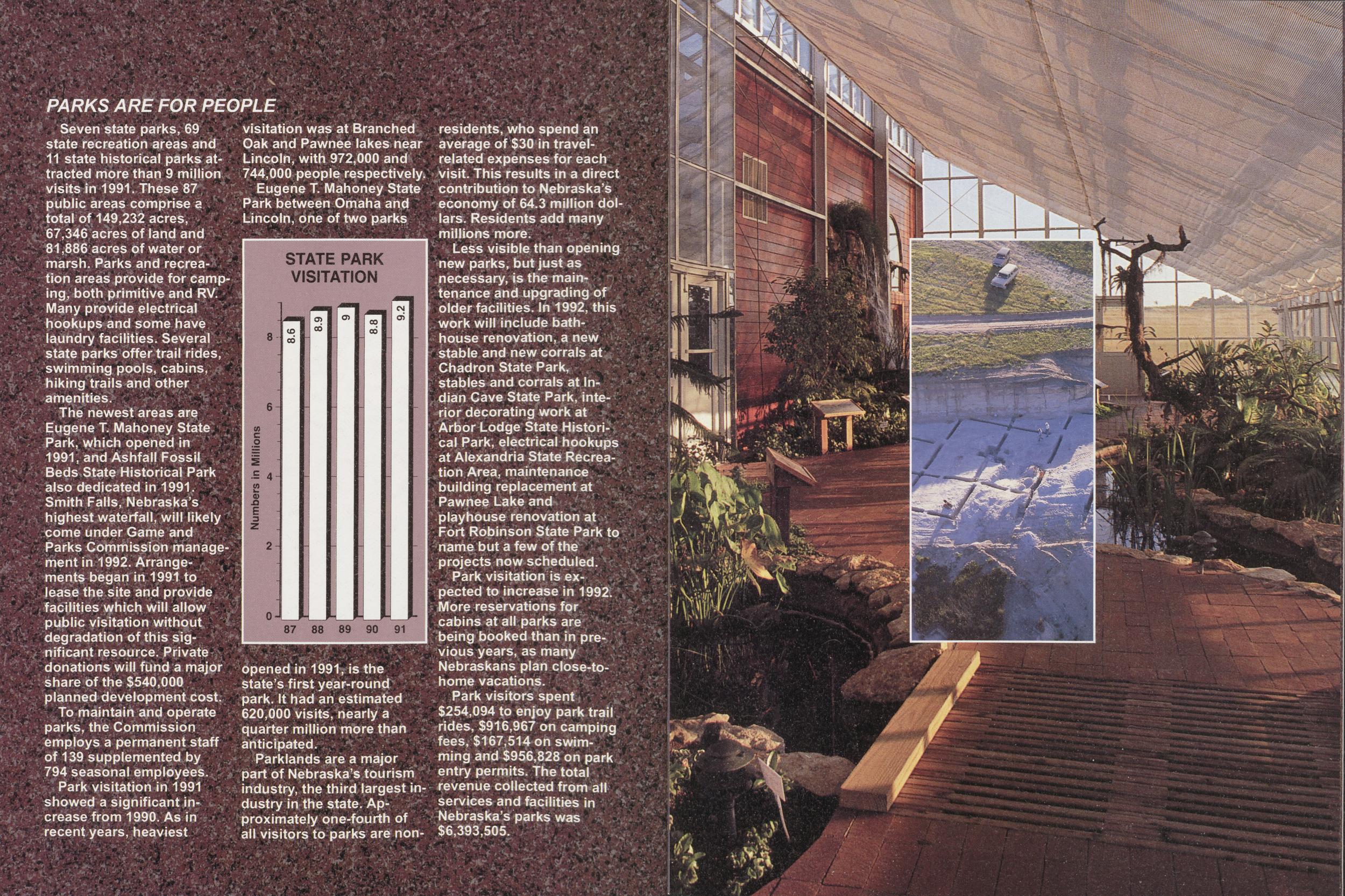 PARKS ARE FOR PEOPLE
Seven state parks, 69 state recreation areas and 11 state historical parks at tracted more than 9 million visits in 1991. These 87 public areas comprise a total of 149,232 acres, 67,346 acres of land and 81,886 acres of water or marsh. Parks and recreation areas provide for camp ing, both primitive and RV. Many provide electrical hookups and some have laundry facilities. Several state parks offer trail rides, swimming pools, cabins, hiking trails and other amenities.
The newest areas are Eugene T. Mahoney State Park, which opened in 1991, and Ashfall Fossil Beds State Historical Park also dedicated in 1991. Smith Falls, Nebraska's highest waterfall, will likely come under Game and Parks Commission management in 1992. Arrangements began in 1991 to lease the site and provide facilities which will allow public visitation without degradation of this significant resource. Private donations will fund a major share of the $540,000 planned development cost.
To maintain and operate parks, the Commission employs a permanent staff of 139 supplemented by 794 seasonal employees.
Park visitation in 1991 showed a significant increase from 1990. As in recent years, heaviest 744,000 people respectively.
Eugene T. Mahoney State Park between Omaha and Lincoln, one of two parks opened in 1991, is the state's first year-round park. It had an estimated 620,000 visits, nearly a quarter million more than anticipated.
Parklands are a major part of Nebraska's tourism industry, the third largest industry in the state. Approximately one-fourth of all visitors to parks are nonresidents, who spend an average of $30 in travelrelated expenses for each visit. This results in a direct contribution to Nebraska's economy of 64.3 million dollars. Residents add many millions more.
Less visible than opening new parks, but just as necessary, is the maintenance and upgrading of older facilities. In 1992, this work will include bathhouse renovation, a new stable and new corrals at Chadron State Park, stables and corrals at Indian Cave State Park, interior decorating work at Arbor Lodge State Historical Park, electrical hookups at Alexandria State Recreation Area, maintenance building replacement at Pawnee Lake and playhouse renovation at Fort Robinson State Park to name but a few of the projects now scheduled.
Park visitation is expected to increase in 1992. More reservations for cabins at all parks are being booked than in previous years, as many Nebraskans plan close-to-home vacations.
Park visitors spent $254,094 to enjoy park trail rides, $916,967 on camping fees, $167,514 on swimming and $956,828 on park entry permits. The total revenue collected from all services and facilities in Nebraska's parks was $6,393,505.
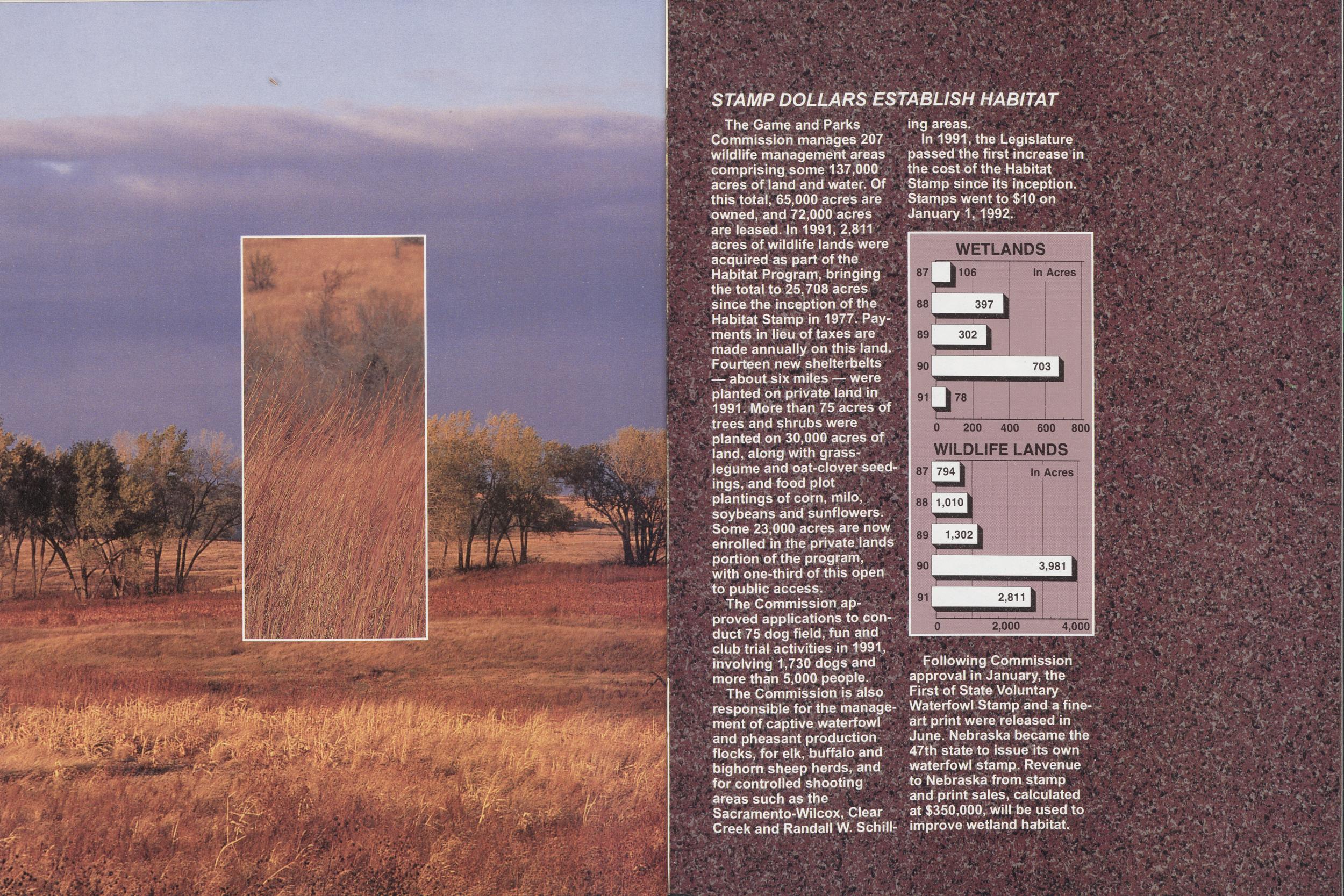
The Game and Parks Commission manages 207 wildlife management areas comprising some 137,000 acres of land and water. Of this total, 65,000 acres are owned, and 72,000 acres are leased. In 1991, 2,811 acres of wildlife lands were acquired as part of the Habitat Program, bringing the total to 25,708 acres since the inception of the Habitat Stamp in 1977. Payments in lieu of taxes are made annually on this land. Fourteen new shelterbelts — about six miles — were planted on private land in 1991. More than 75 acres of trees and shrubs were planted on 30,000 acres of land, along with grasslegume and oat-clover seedings, and food plot plantings of corn, milo, soybeans and sunflowers. Some 23,000 acres are now enrolled in the private lands portion of the program, with one-third of this open to public access.
The Commission apoved applications to conduct 75 dog field, fun and club trial activities in 1991, involving 1,730 dogs and more than 5,000 people.
The Commission is alsc responsible for the management of captive waterfowl and pheasant production flocks, for elk, buffalo and bighorn sheep herds, and for controlled shooting areas such as the Sacramento-Wilcox, Clear Creek and Randall W. Schilling areas.
In 1991, the Legislature passed the first increase in the cost of the Habitat Stamp since its inception. Stamps went to $10 on January 1,1992.
WETLANDS In Acres 0 200 400 600 800 WILDLIFE LANDS 871 794 In Acres 8811,010 2,000 4,000Following Commission approval in January, the First of State Voluntary Waterfowl Stamp and a fineart print were released in June. Nebraska became the 47th state to issue its own waterfowl stamp. Revenue to Nebraska from stamp and print sales, calculated at $350,000, will be used to improve wetland habitat.
 LAW ENFORCEMENT
Conservation officers of the Law Enforcement Division are perhaps the most visible representatives of the Game and Parks Commission. Spending virtually all their working time in the field, they encounter a vast number of hunters, fishermen and park users. In addition to patrol duties, they also give programs, conduct hunter and boating safety meetings and make other appearances. They patrol agency lands, enforcing the law and assisting citizens.
Nebraska conservation officers are equipped to patrol anywhere, anytime, and use such special equipment as airplanes, snowmobiles, all-terrain vehicles, horses and airboats. Officers have radio-equipped, four-wheel-drive trucks and other equipment such as binoculars and spotting scopes to make them more efficient and effective.
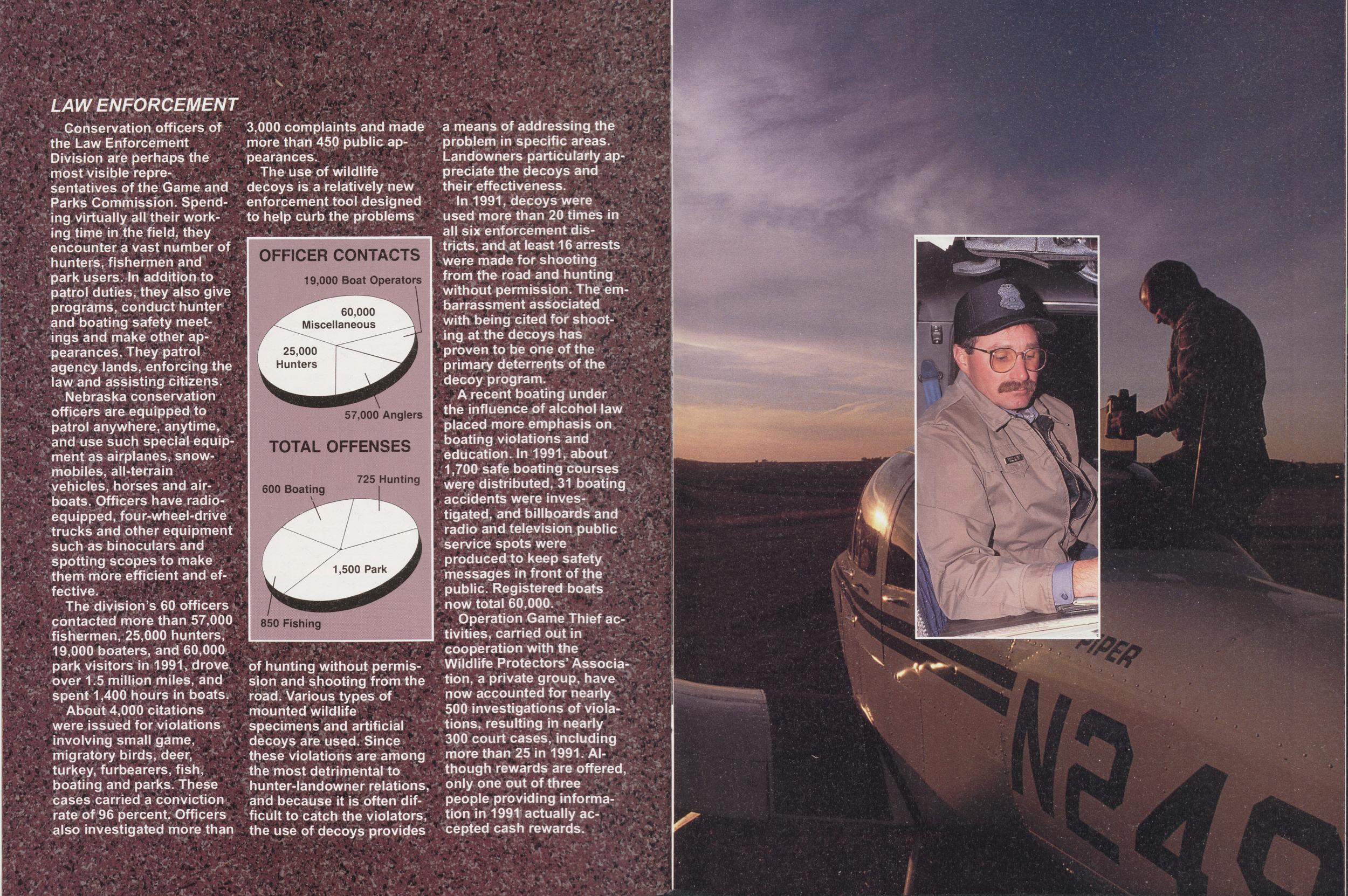
The division's 60 officers contacted more than 57,000 fishermen, 25,000 hunters, 19,000 boaters, and 60,000 park visitors in 1991, drove over 1.5 million miles, and spent 1,400 hours in boats.
About 4,000 citations were issued for violati involving small game, migratory birds, deer, turkey, furbearers, fish, boating and parks. These cases carried a conviction rate of 96 percent. Officers also investigated more than more than 450 public appearances.
The use of wildlife decoys is a relatively new enforcement tool designed to help curb the problems of hunting without permission and shooting from the road. Various types of mounted wildlife specimens and artificial addressing t problem in specific areas. Landowners particularly appreciate the decoys and their effectiveness.
In 1991, decoys were used more than 20 times in all six enforcement districts, and at least 16 arrests were made for shooting from the road and hunting without permission. The embarrassment associated with being cited for shooting at the decoys has proven to be one of the primary deterrents of the decoy program.
A recent boating under the influence of alcohol law placed more emphasis on boating violations and education. In 1991, about 1,700 safe boating courses were distributed, 31 boating accidents were investigated, and billboards and radio and television public service spots were produced to keep safety messages in front of the public. Registered boats now total 60,000.
Operation Game Thief activities, carried out in cooperation with the Wildlife Protectors' Association, a private group, have now accounted for nearly 500 investigations of violations, resulting in nearly decoys are used. Since 300 court cases, including these violations are amonq more than 25 in 1991. Althese violations are among the most detrimental to hunter-landowner relations, and because it is often difficult to catch the violators, the use of decoys provides more than 25 in 1991. Although rewards are offered, only one out of three people providing information in 1991 actually accepted cash rewards.
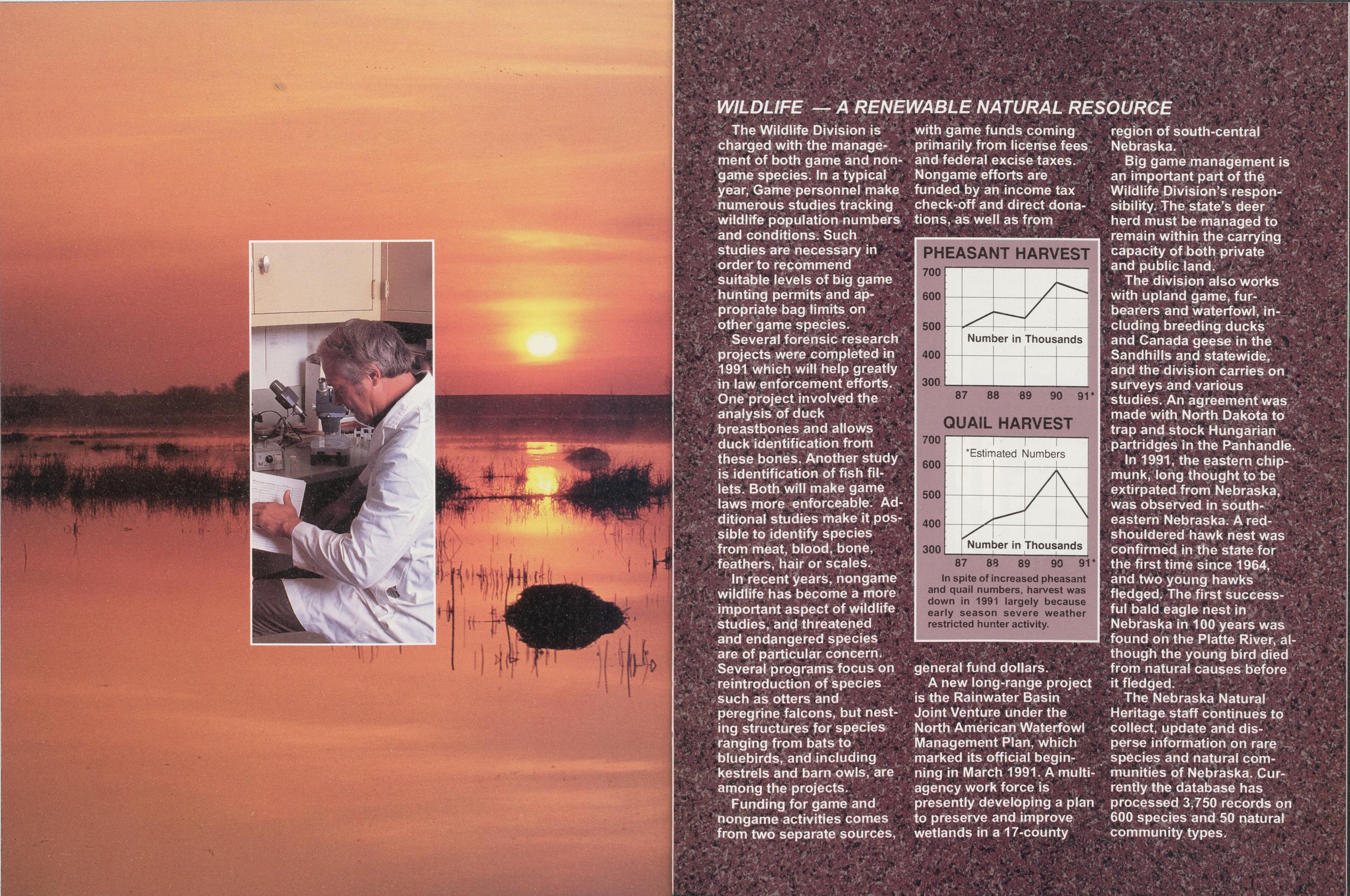
The Wildlife Division is charged with the management of both game and nongame species. In a typical year, Game personnel make numerous studies tracking wildlife population numbers and conditions. Such studies are necessary in order to recommend suitable levels of big game hunting permits and appropriate bag limits on other game species.
Several forensic research projects were completed in 1991 which will help greatly in law enforcement efforts. One project involved the analysis of duck breastbones and allows duck identification from these bones. Another study is identification of fish fillets. Both will make game laws more enforceable. Additional studies make it possible to identify species from meat, blood, bone, feathers, hair or scales.
In recent years, nongame wildlife has become a more important aspect of wildlife studies, and threatened and endangered species are of particular concern. Several programs focus on reintroduction of species such as otters and peregrine falcons, but nesting structures for species ranging from bats to bluebirds, and including kestrels and barn owls, are among the projects.
Funding for game and nongame activities comes from two separate sources, with game funds coming primarily from license fees and federal excise taxes. Nongame efforts are funded by an income tax check-off and direct donations, as well as from general fund dollars.
A new long-range project is the Rainwater Basin Joint Venture under the North American Waterfowl Management Plan, which marked its official beginning in March 1991. A multiagency work force is presently developing a plan to preserve and improve wetlands in a 17-county region of south-central Nebraska.
Big game management is an important part of the Wildlife Division's responsibility. The state's deer herd must be managed to remain within the carrying capacity of both private and public land.
The division also works with upland game, furbearers and waterfowl, including breeding ducks and Canada geese in the Sandhills and statewide, and the division carries on surveys and various studies. An agreement was made with North Dakota to trap and stock Hungarian partridges in the Panhandle.
In 1991, the eastern chipmunk, long thought to be extirpated from Nebraska, was observed in southeastern Nebraska. A redshouldered hawk nest was confirmed in the state for the first time since 1964, and two young hawks fledged. The first successful bald eagle nest in Nebraska in 100 years was found on the Platte River, although the young bird died from natural causes before it fledged.
The Nebraska Natural Heritage staff continues to collect, update and disperse information on rare species and natural communities of Nebraska. Currently the database has processed 3,750 records on 600 species and 50 natural community types.
 ONE OF EVERY THREE NEBRASKANS FISHES
Fishing is a popular pastime in Nebraska, with one of every three residents wetting a line during the year more than 43,000 anglers used Branched Oak Lake in 1991. Many anglers take their fishing seriously, evidenced by the fact that more than 750 people attended seven public meetings concerning walleye management in 1991.
Fisheries Division personnel carry on studies of all types aimed at improving conditions for fish and anglers, handle special permits including commercial fishing, conduct creel surveys, monitor in-stream flow and other matters related to fish.
Renovation of aging lakes has also been done more frequently in recent years. The Stagecoach Lake project was completed in 1991, achieving the goal of stabilizing the shoreline, providing bank anglers with access to deep water, and developing islands to slow water flow. I Less routine in 1991 was the dedication of the new Calamus Hatchery at Calamus Reservoir. The hatchery, which will rear fish to catchable size for stocking in state waters, sits on a 136-acre tract just below the reservoir near Burwell. It includes a main hatchery building, 51 lined ponds and 24 concrete raceways, with water supplied by the reservoir and by eight groundwater wells. This $8.5 million hatchery received 75 percent federal funding.
Other hatcheries operated by the Fisheries Division are at Valentine, Parks and North Platte; the Grove Trout Rearing Station is located near Royal.
The Fisheries staff operates the Ak-Sar-Ben Aquarium at the old Gretna Hatchery site near Gretna. A perennial favorite of school groups, Ak-Sar-Ben averaged more than 300 visitors per day, for a total of 93,000 in 1991. In addition to its handsome landscaping, scenic canyon ponds and quain museum, the aquarium houses more than 300 fish representing 52 native fish species. The aquarium also sponsors workshops and meetings during the year.
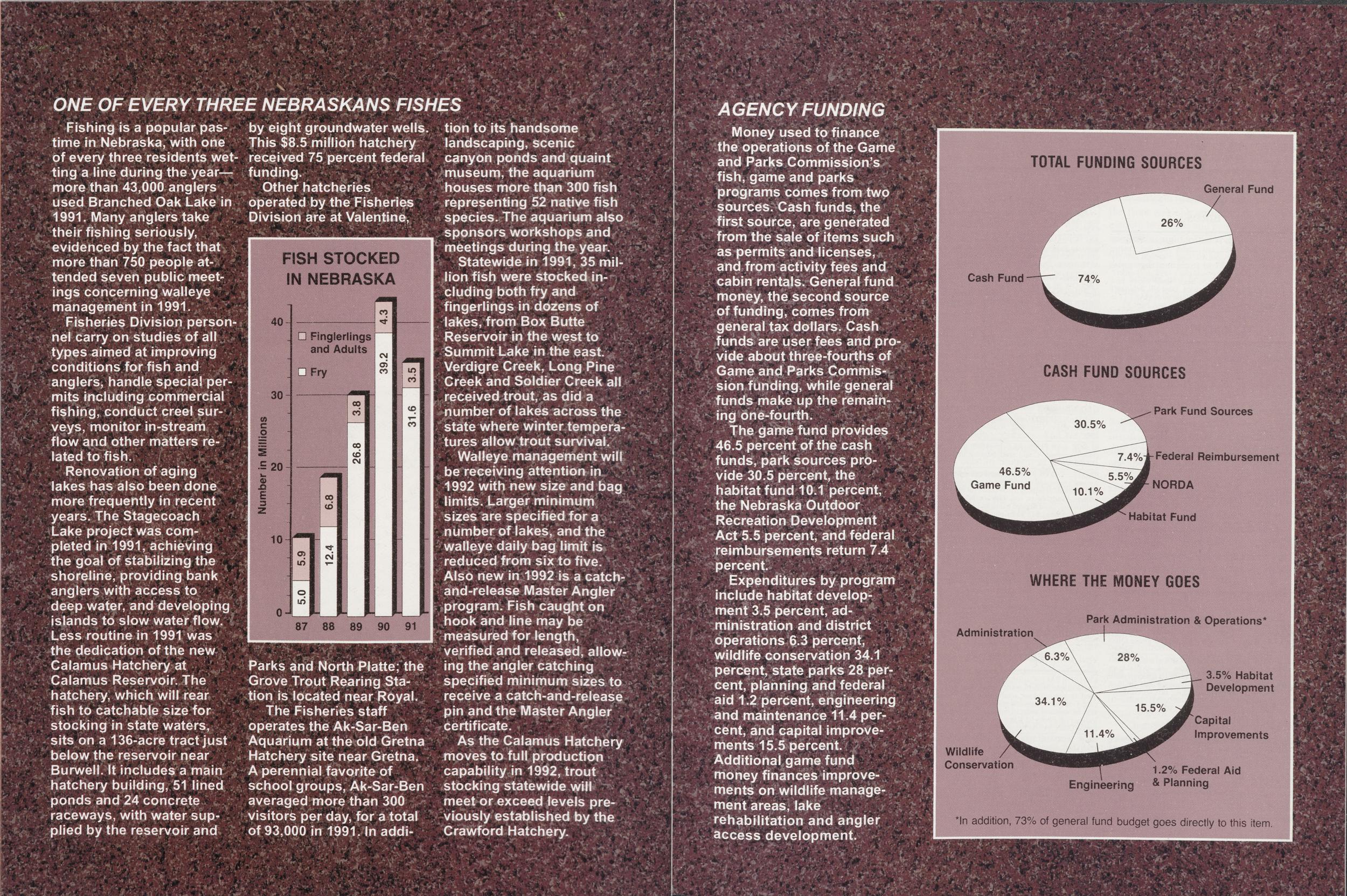
Statewide in 1991, 35 million fish were stocked including both fry and fingerlings in dozens of lakes, from Box Butte Reservoir in the west to Summit Lake in the east. Verdigre Creek, Long Pine Creek and Soldier Creek all received trout, as did a number of lakes across the state where winter temperatures allow trout survival.
Walleye management will be receiving attention in 1992 with new size and bag limits. Larger minimum sizes are specified for a number of lakes, and the walleye daily bag limit is reduced from six to five. Also new in 1992 is a catch-and-release Master Angler program. Fish caught on hook and line may be measured for length, verified and released, allowing the angler catching specified minimum sizes to receive a catch-and-release pin and the Master Angler certificate.
As the Calamus Hatchery moves to full production capability in 1992, trout stocking statewide will meet or exceed levels previously established by the Crawford Hatchery.
AGENCY FUNDINGMoney used to finance the operations of the Game and Parks Commission's fish, game and parks programs comes from two sources. Cash funds, the first source, are generated from the sale of items such as permits and licenses, and from activity fees and cabin rentals. General fund money, the second source of funding, comes from general tax dollars. Cash funds are user fees and provide about three-fourths of Game and Parks Commission funding, while general funds make up the remaining one-fourth.
The game fund provides 46.5 percent of the cash funds, park sources provide 30.5 percent, the habitat fund 10.1 percent, the Nebraska Outdoor Recreation Development Act 5.5 percent, and federal reimbursements return 7.4 percent.
Expenditures by program include habitat development 3.5 percent, ministration and district operations 6.3 percent, wildlife conservation 34.1 percent, state parks 28 percent, planning and federal aid 1.2 percent, engineering and maintenance 11.4 percent, and capital improvements 15.5 percent. Additional game fund money finances improvements on wildlife management areas, lake rehabilitation and angler access development.
TOTAL FUNDING SOURCES Genera! Fund Cash Fund CASH FUND SOURCES Park Fund Sources 7.4% irFederal Reimbursement NORDA Habitat Fund WHERE THE MONEY GOES Park Administration & Operations Administration Wildlife Conservation 3.5% Habitat Development Capital Improvements Engineering 1.2% Federal Aid & Planning In addition, 73% of general fund budget goes directly to this item.
Classified
ARTS/CRAFTSBUILT TO ORDER. Best in the business. Specializing in cedar and pine mailboxes starting at $49.95. (402) 896-5029.
BIRDSPHEASANTS-WILD TURKEYS-CHUKARS & HUNS! Eggs, chicks, started and adults. National Poultry Improvement Plan Approved. Live overnight delivery guaranteed. THE BEST for propagation, hunting, eating, and taxidermy. Call now to place 1992 chick orders! Bargain prices on ringneck hens. Toubl Game Bird Farms, 8716 W. St., Lawrence Rd., Dept NE, Beloit, WI 535 1 1. Phone (608) 365-1789. "Our birds MAKE IT in the WILD!"
BOOKS/PRINTINGFREE! Booklets on northeastern Nevada; fishing, rock hounding maps, Carl Hayden, Box 528, Jackpot, Nevada 89825.
FREE BOOK CATALOG. Novels, westerns, romances, children's; old out of print, found barns, attic. Authors: Grey, Bower, Connor, Fox, Curwood, Raine, Wright, Aldrige, Pollyanna, Freckles, many others. Postage appreciated. Pierce, 4400 N. Pine Cluster, Oroville, CA 95965.
COMPLETE ROADSIDE GUIDE to Nebraska by Alan Boye is a mile-by-mile description of historical, geographical and folklore sites along all major highways. Over 10,000 miles are included in all 93 counties. The book includes museums, festivals, and those out-of-the-way unusual places for the resident and the tourist. $11.95 plus $1.50 postage. SALTILLO Press, 57 Lafayette, St. Johnsbury VT 05819.
NEBRASKA COOKBOOK-TASTE THE GOOD LIFE. Contains 356 tested recipes emphasizing products grown or raised in Nebraska. Sections include beef, pork, corn, desserts, other products, old fashioned recipes, fish, and wild game. Nebraska history, memorabilia, and landmarks come to life through color photos and brilliant watercolors. $10.95 plus $2.50 postage. Leafie Mae's Kitchen, P.O. 233, Kearney, NE 68848.
CLOTHINGFUR MANUFACTURING—Manufacturer of all fur garments. Bring or mail your skins and we will custom make your coats, hats and misc. Also large inventory of new garments for sale. 55 years' experience. Write for free brochure. HAEKER FURRIERS, INC., P.O. Box 230, 615 W. Main St., Alma, NE 68920. Phone (308) 928-2515.
GET YOUR ORIGINAL ARTWORK of windmill and stock tank, with "Nebraska" across tank. Available on T-shirts or sweatshirts, (ash or red) or on tan snap-close jacket. Sizes Small to XXL. Write or call for free brochure — Mikolyck Designs, RR 2 Box 46, Oshkosh, NE 69154; (308) 772-3574 or 1-800-682-7785.
COLLECTIBLESWANTED: Nebraska stock certificates, letters, old checks, etc.—particularly pre-1900. A. A. Armstrong Jr. M.D., 21 1 West 39th, Scottsbluff, NE 69361.
WANTED: Collector wants to buy all brands old 2-piece cardboard shot-shell boxes. Also wood ammo boxes, old firearm and cartridge company posters, calendars, advertising cardboards, and catalogs. Allan H. Hahn,Rt 1 Box 147, Gibbon, NE 68840. Phone (308) 647-5228.
WANTED: 1942 Nebraska license plate for (# 1), Douglas County. Good condition please. Helen Cohn, 36 West Lamar Rd., Phoenix, AZ 85013.
DOGSTRAINING ALL BREEDS bird dogs—Vizslas and English Pointers for sale. Rozanek Kennels, R 2, Schuyler, NE 68661. Phone (402) 352-8769.
PINKERTON BIRD DOGS—English setter, English pointer puppies. Started dogs available this fall. Our dogs are bred for nose and style. Give us a call at (402) 673-4540.
AKC GERMAN SHORTHAIR pointers and brittany spaniels. Pups, started and trained dogs. Birdland Kennels, Hunter Ingwerson, Nehawka, NE 68413,402-227-4655. Wayne Clark, 712-529-4238 also will be doing some training.
YELLOW-BLACK Lab pups. FC-AFC sired. AKC. Hips OFA certified. Dew claws removed. Excellent hunting potential. Contact Bob Bendler, Lexington, NE, (308) 324-4247.
CHESAPEAKE BAY OR BLACK LABRADOR puppies and started dogs. Available year-round. NAFC pedigree available. Training and stud service. Call PLATTE VALLEY RETRIEVERS, (308) 995-2318.
GUN DOG TRAINING. All sporting breeds. All dogs worked on game birds. Over 25 years experience. Henry Sader, Wilderness Kennels, Roca, NE (402) 423-4212.
GERMAN SHORTHAIR POINTERS/ENGLISH POINTERS—pups, started dogs, stud service. Training available for pointing and retrieving dogs. Wayne Clark (712) 529-4238. Close to Omaha. Leave mesage.
GERMAN SHORTHAIR pointers. Puppies, started and trained dogs. Gun dog training available. (308) 235-3237.
BLACK LAB PUPS. AKC, excellent bloodlines, dew claws removed. Could start hunting this fall. (402) 464-9578.
PROTECT YOUR PUP! Personalized dog collar. Animal's name and owner's phone number embroidered on adjustable (18-inch) nylon collar for instant identification. Available in red, blue or black with white embroidery. Send desired name and phone number (up to 20 characters). $ 12.95 ea. plus 5% Nebraska sales tax, shipping and handling included in price. DUNMAR DIRECT, PO Box 65, Humphrey, NE 68642. 30-day money-back guarantee, allow 2-4 weeks delivery.
EVENTS/ATTRACTIONSSUMMER OPPORTUNITIES for field courses in 1992 offered at biological field stations, are summarized in a poster prepared by the Organization of Biological Field Stations. Most offerings are intended for undergraduate and graduate students in biology. For a copy, contact Dr. Richard W. Coles, Secretary OBFS, Washington University Tyson Research Center, PO Box 35 1, Eureka, MO 63025.
FISH/FISHINGFISH FOR SALE. Catfish, perch, coho salmon, rainbow trout, crappie, bluegill, walleye, minnows, goldfish, bullhead, largemouth bass, smallmouth bass, triploid grass carp. Commercial grower prices on catfish, perch, coho salmon, rainbow trout. Consulting available. Pleasant Valley Fish Farm, Rt 1 Box 147, McCook, NE 69001. Phone(308)345-6599.
WAX WORMS: 500 $8.50; 1000-$ 15,00. Add 5% sales tax. Postpaid first class. No. C.O.D. Harold Malicky, Burwell, NE 68823.
DOUGHBALL FISH BAIT recipe plus many fish recipes from the prairie. Send $3.50 to Prairie Recipes, PO Box 642333, Omaha, NE 68164-2333.
WILLOW LAKE FISH HATCHERY. Channel cat, bluegill, hybrid bluegill, largemouth bass, crappie, triploid grass carp, walleye, perch, minnows available for stocking. Gaylord Crawford, Rt. 3 Box 46, Hastings, NE 68901 or phone (402) 463-8022 day or night. Also pond consultant, We deliver, grower price.
FOODNEBRASKA BASKETS: The original Nebraska company specializing in fine foods from Nebraska. A beautiful array of baskets filled with ethnic, healthful and long-time favorite foods. Call or write for our brochure: P.O. Box 98, McCook, NE 69001. 1-800-345-7725.
GUIDES/OUTFITTERSMAD RIVER CANOES offers the finest quality and performance. For the finest canoes and accessories look to Great Plains Canoe Co., 205 Main, Springfield, NE. Phone(402)253-2001.
GUIDED CANOEING AND KAYAKING adventures on the Niobrara River in Nebraska. Completely outfitted, first-class equipment and instruction. Family and private trips available. For brochure contact Jim at Wilderness Adventures, 2725 N. 65th Ave. Omaha, NE 68104. Phone (402) 556-3741.
DISMAL RIVER/MIDDLE LOUP RIVER Canoe Trips. Powderhorn Outfitters — Thedford, NE 69166 1-800-373-1648.
EXPERIENCE NEBRASKA with an affordable canoe trip by Dryland Aquatics. One and two-day trips full service or canoes only. Your Niobrara River specialists Call for other rivers We do it your way! For free brochure: Dryland Aquatics, Dept. N, 1837 E. Cuming, Fremont, NE 68025 or phone (402) 721-4177.
EXPERIENCE A TRIP back in time. The adventure begins when you enter primitive Americana. Sleep in a tipi — fun and educational. Crafts, scrimshaw, fire starting, story telling at the campfire by Winded Bird Head. Groups, children welcome — April 4 thru November 1st. 2 days, 1 night — $100. For more information and directions send $1 for postage and handling to: Sonny Union, 7335 LaVista Drive, LaVista, NE 68157.
GRAHAM CANOE OUTFITTERS: Top quality fullservice camping and canoe trips on the Niobrara River. Daily canoe rentals and car shuttle-service available. Contact Doug & Twyla Graham, HC 13 Box 16, Valentine, NE 69201 or phone (402) 376-3708.
GUNS/SHOOTINGGUNS — Browning, Winchester, Remington, others, Hi-powers; shotguns, new, used, antiques. Want Pre-'64 Winchesters. Buy-Sell-Trade. (402) 729-6112. Bedlan's Sporting Goods, Fairbury, NE 68352.
AIR GUNS repaired—Benjamin, Crosman, Daisy, other American made. Restoration; old guns wanted. Jack's Air Guns, 1225 No. 46th, Lincoln, NE 68503. Phone (402) 466-9223.
HEALTH/FITNESSGUARANTEE: REDUCE CHOLESTEROL, lose fat; for information send $3.50 to Adel Enterprizes, P.O. Box 30047, Lincoln, NE 68503-0047.
OUTDOOR EQUIPMENTCORDLESS LEISURE LAMP — perfect for camping or backyard activity. Valuable emergency aid. 13 inches tall, made of rugged lightweight polyethylene. Walnut colored base with white shade and fitted with metal hanging ring. Runs on one 6-volt lantern battery (not included). Wonderful gift for "the hard to buy for." $6.50 ea. or two lamps for $10.00 plus 5% Nebraska sales tax if applicable and $2.25 per unit shipping and handling. Send to DUNMAR DIRECT, PO Box 65, Humphrey, NE 68642. 30-day money-back guarantee. Allow 2-4 weeks delivery.
48 NEBRASKAland TAXIDERMYALLISON'S TAXIDERMY STUDIO & GIFT GALLERY. Wally and Betty Allison Licensed Taxidermist. We've mounted 32 Nebraska State Record fish. Specializing in fish, birds and small game. We use freeze-dry. 421 North Dewey, North Platte. NE 69101. (308) 534-2324 or (308) 534-4267 home.
PEISTER TAXIDERMY—Award winning taxidermy and fish carvings. 1020 Central Avenue, Box 3201, Kearney, NE 68847. Phone (308) 236-9700 or (308) 237-7575 evening.
VACATION/RESORTSNE NEBRASKA trout fishing. 3 modern cottages, 1 available year round. 5 spring fed lakes with open water all year. Trout up to 7 pounds. Other varieties fish also. Diamond E. Trout Resort, Orchard. NE 69764. Phone (402) 893-4745.
CHESLEY'S LODGE: Rooms year-around. Moderate rates. Ideal for hunters, family gatherings, anniversary retreats. (308) 836-2658, Rt. 1 Box 76, Callaway, NE 68825.
Classified ad rates: 75ct per word, minimum $ 15. Closing date is the first business day 2 months preceding date of issue. To place ads or for more information write NEBRASKAland Magazine, P.O. Box 30370, Lincoln, NE 68503, or call (402) 471-5478. Country Music Star Randy Travis speaks out for Country Conservation: More than half our country's wetlands are gone. Our wetlands are a precious natural resource we can't afford to lose. So join me and other country stars for Country Conservation. Write: Country Conservation, Washington, DC 20240 North AmeriamWaterfowl ManagementPlanPage forty-nine
Fishing is ChangingFishing is changing. Just ask Floyd, who had two decades of fishing experience under his belt before I was able to pull myself up on the coffee table and walk to grandpa's rocker without help.
"It's disgraceful," Floyd told me last fall as we sat enjoying a glass of iced tea on his back porch. "Fishing's just flat gone to the dogs. All these young guys running around in big boats and designer jeans think they're fishing, but they ain't. There ain't one in ten that can catch a fish on his own."
Floyd likes to get me involved in philosophical outdoor discussions and I had the feeling he was setting me up, but I played along. "Huh?" I answered.
"I said, most fishermen today couldn't catch a fish on a bet without all their fancy gear to do it for them. We used to catch all the fish we wanted, and we did it without no showy gadgets. And we had fun doing it." He frowned down at his pipe as if deep in thought as he packed tobacco into its bowl.
He waited for me to protest, but I just sat there swirling the ice cubes around in my glass.
"Like that guy across the street thinks he's a fisherman. Couple days ago he called me over to look at his new boat. It's one of them supersonic jobs that has a pointed nose, real thick seats, an engine that's dam near as powerful as the one in my car and carpet all over. Silly thing's painted purple and has silver speckles in it so it glitters. Glitters!" Floyd grimaced. "Ever hear of a fishing boat that glitters? Makes me wonder just what he's trolling for."
"Outfits like that don't come cheap," I offered.
"Why, I bet it set him back a good ten grand. And that's just for the boat. He's got all kinds of new equipment. You know, the stuff a real fisherman needs."
"He's got a depth finder, does he?" I asked.
"Depth finder?" Floyd sputtered. "Yeah, he's got a depth finder all right, and a fish locator and a contraption that tells him what kind and color lure to use and another one that tells him how deep to fish it." Floyd popped the head of a wooden match with his thumbnail and lit his pipe.
"Fool's got two trolling motors, one on the front and one on the back, he's got electric live wells and bait wells, a water temperature gauge that also tells him how much oxygen is in the water, and something else that gives him a pH reading."
"Sounds like he's got it all," I said. "Must be a real fishing machine."
"Oh, 1 ain't done. He's got a tackle box about the size of Emma's stove, with maybe three, four hundred lures in it. He's got stuff he sprays on his lures that he says makes fish hungry, plugs that hum and rattle to attract fish and some special lures that have velcro on them so the fish get their teeth caught in it.
"And," he continued, "I'll bet you a dollar to a donut he has another thousand in rods and reels. All his rods are graphite and boron or kryptonite or something, and the reels look like little winches. A couple of them new-model reels have two retrieve speeds and an automatic shift control to make them work. He even has one with something he calls 'self adjusting magnetic control' that he says makes it impossible to get a backlash when you cast. If you can't learn how to cast a fishing reel right, you oughta use a cane pole."
"But along with all the goodies," I said, "modern fishermen know a lot more about fish and how they behave than they did in the past. That makes them better fishermen."
Floyd shook his head. "No it don't. It just means they know more about fish. If they really knew what a fisherman needs to know they wouldn't need all that expensive gear."
"Then you think it's all the high-tech gear that puts fish into a boat that the fisherman really doesn't have much to do with it?" I asked sarcastically.
"Listen, 1 could take my neighbor or
any of his friends out in my rowboat, hand
him one of my fiberglass rods and a plug
and let him have a go at it, and left on his
own he wouldn't get a bite. He hasn't
APRIL 1992
49
 learned to think the situations out for himself, because he relies on gadgets to do
all
the finding and choosing for him. He'd be
lost without all that gaudy stuff
learned to think the situations out for himself, because he relies on gadgets to do
all
the finding and choosing for him. He'd be
lost without all that gaudy stuff
I had to think about that one.
"Besides that, I ain't sure having all that electric stuff in a boat is safe. I'd be afraid to touch anything. If all those batteries and wires got wet, a man could get fried out there. Or his batteries might go kaput and he'd be stranded out in the middle of the lake. That'd be a shame."
"Now you're stretching," I countered. "There's nothing dangerous about electronic fishing gear."
"Well, maybe. But how about those guys that don't fish for fun, only to win prizes? I don't get it. Why can't they just go out to have a good time, rather than thinking they have to win something? I always thought a fish was the prize you fished for. Now they aren't happy unless money changes hands or somebody gives them a big trophy or a new boat or something. If s just flat disgusting."
"A lot of people like the competition factor. They like to see if they can do things better than other guy," I said.
"Takes all the fun out of it." Floyd snorted. "You ought to fish to relax and enjoy it. Ever been on a lake when a tournament is going on?" He made a face like he'd tasted something foul. "They aren't considerate of other fishermen, they cast right over your line, they float right up next to you and disturb your spot and when you yell at them, they look at you real disgusted-like and say "Hey, I'm in a tournament. " Like you're supposed to apologize for being on the lake.
"There's a lot of demand for water," I admitted. "There are all the fishermen, water skiers, jet skiers, swimmers, boaters, sailboaters, wind surfers "
"Aw, come on," Floyd groaned. "You're ruining my whole afternoon. It's getting so a man can't just go fishing and enjoy hisself. People get into arguments, even fist fights, about using the boat ramp. Some people sit on the dock and fish and get real disgusted when a boat pulls up and they have to move. One time some old lady yelled at me for five minutes because she was catching carp off the dock and I had to ask her to move so I could take my boat out of the water.
"Last week," he continued around his pipe stem, "I was out trying to fish, and on shore there was a heck of a commotion going on. There was a bunch of collegeage kids running around in the trees on the bank yelling and laughing and giggling and throwing rocks in the water and scaring geese that were trying to nest and making a heck of a mess.
'You know, it's agin' the law for a man to take his dog out to these areas in spring 'cause they say the dog disturbs birds while they're nesting, but it's all right for people to run around like they're stupid, shooting gobs of paint at each other, scaring the same birds, disturbing fishermen and marking up trees. Beats me."
He pulled on his pipe and shook his head. "The whole thing just makes me mad. Some people even sign up their kids for fishing tournaments where they can win a bike or some other prize for catching a fish. Why do they do that? To my way of thinking the parents are telling their kids that they have to catch the most, or the biggest to have a good time. They oughta be showing their kids how to be content just enjoying the experience. It's fun to catch fish, but it's also all right not to — to just have fun trying.
"They ought to teach kids that it's just as important to be outdoors, watching and learning about the fish and the bugs and the birds and the sky and the grass. It's good to get away from traffic and television. People aren't teaching their kids that, and I think it's because they don't believe it themselves. It's a shame."
We sat on the porch in silence for a couple of long minutes, while Floyd puffed on his pipe. I sipped my tea and thought about what he'd said.
Floyd finally glanced my way. "Well, how come you're so quiet. Aren't you going to argue with me?"
I smiled and shook my head at him. How could I argue? I agreed with everything he had said.
Tom Keith Please Don't! 50 NEBRASKAland WtMjlowers of Nebraska There's no better way to be ready for a full summer of wildflowers. Nearly 300 wildflowers in full color with descriptions, flowering period, range and identification tips. $17.95 BLOODROOT Name Address. City State. Check enclosed Card Number VISA. Zip MASTERCARD Expr. Date Enclose $17.95. Nebraska residents please include sales tax. Send to: NEBRASKAland Magazine, P.O. Box 30370, Lincoln, NE 68503
Position: 541 (20 views)