Volume 70, Issue 2, 1992
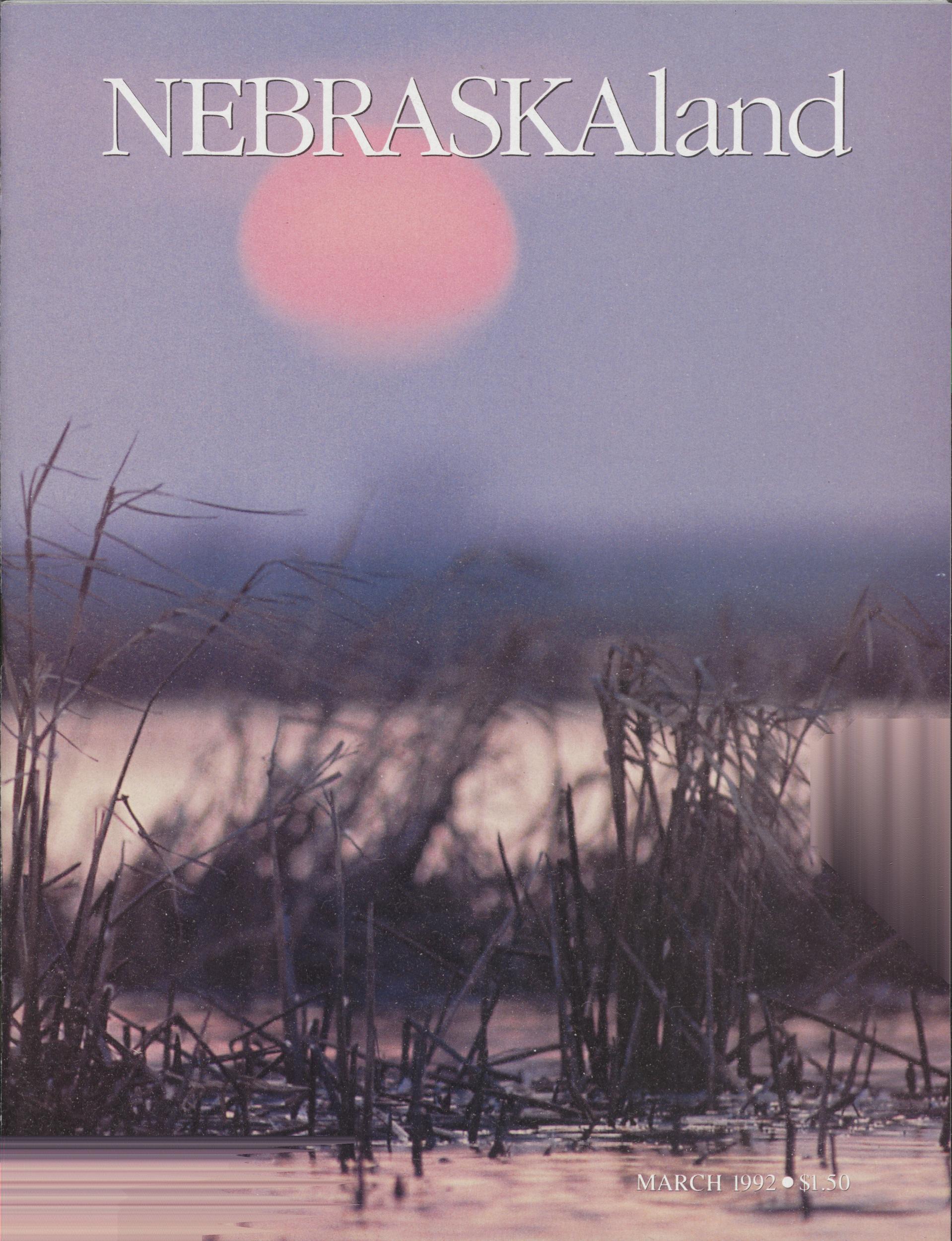
NEBRASKAland
March 1992 $1.50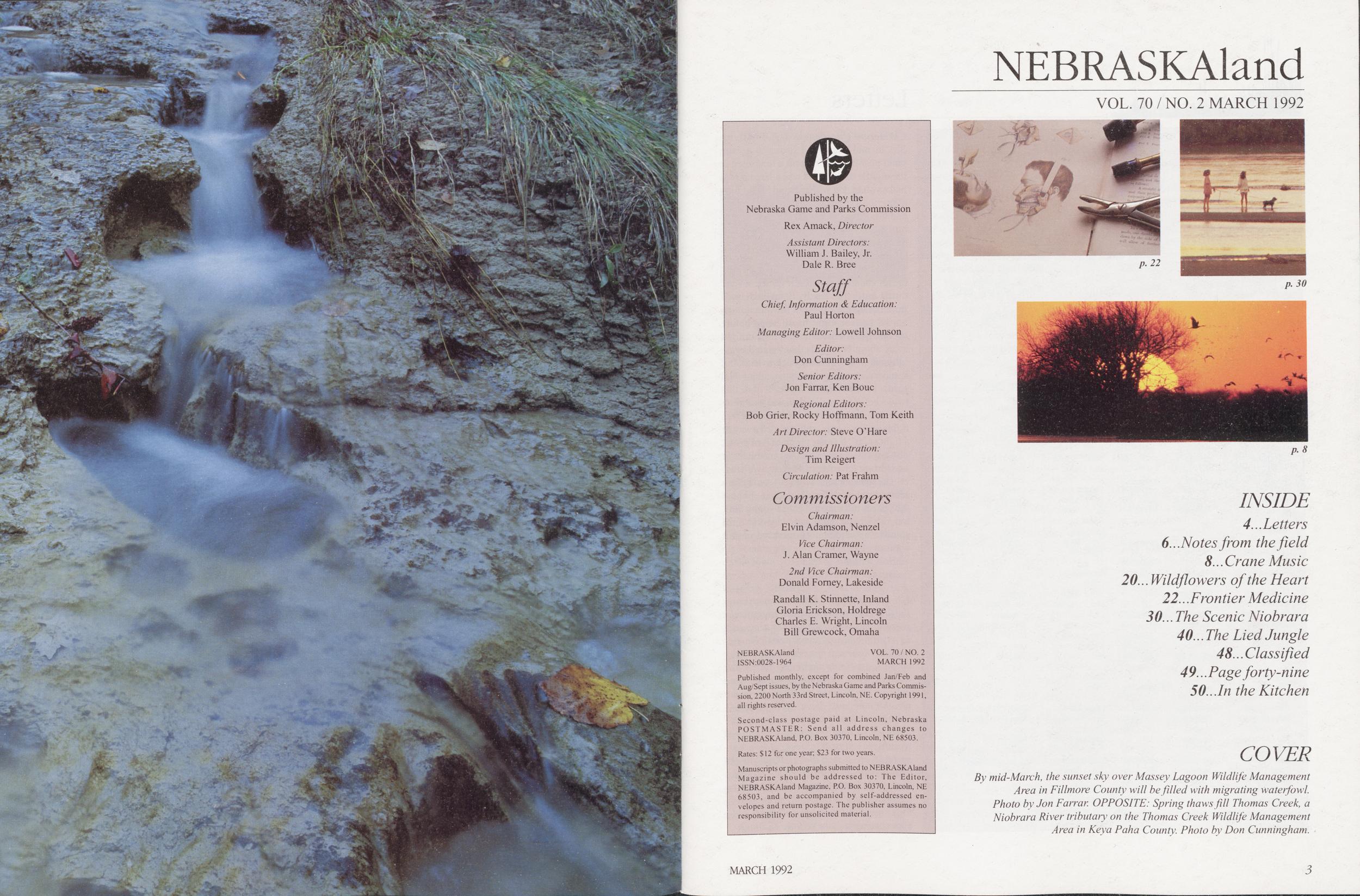
NEBRASKAland
VOL. 70 / NO. 2 MARCH 1992 Published by the Nebraska Game and Parks Commission Rex Amack, Director Assistant Directors: William J. Bailey, Jr. Dale R. Bree Staff Chief, Information & Education: Paul Horton Managing Editor: Lowell Johnson Editor: Don Cunningham Senior Editors: Jon Farrar, Ken Bouc Regional Editors: Bob Grier, Rocky Hoffmann, Tom Keith Art Director: Steve O'Hare Design and Illustration: Tim Reigert Circulation: Pat Frahm Commissioners Chairman: Elvin Adamson, Nenzel Vice Chairman: J. Alan Cramer, Wayne 2nd Vice Chairman: Donald Forney, Lakeside Randall K. Stinnette, Inland Gloria Erickson, Holdrege Charles E. Wright, Lincoln Bill Grewcock, Omaha NEBRASKAland ISSN :0028-1964 VOL. 70 / NO. 2 MARCH 1992 Published monthly, except for combined Jan/Feb and Aug/Sept issues, by the Nebraska Game and Parks Commission, 2200 North 33rd Street, Lincoln. NE. Copyright 1991, ail rights reserved. Second-class postage paid at Lincoln, Nebraska POSTMASTER: Send all address changes to NEBRASKAland, P.O. Box 30370, Lincoln, NE 68503. Rates: $ 12 for one year; $23 for two years. Manuscripts or photographs submitted to NEBRASKAland Magazine should be addressed to: The Editor, NEBRASKAland Magazine, P.O. Box 30370, Lincoln, NE 68503, and be accompanied by self-addressed envelopes and return postage. The publisher assumes no responsibility for unsolicited material.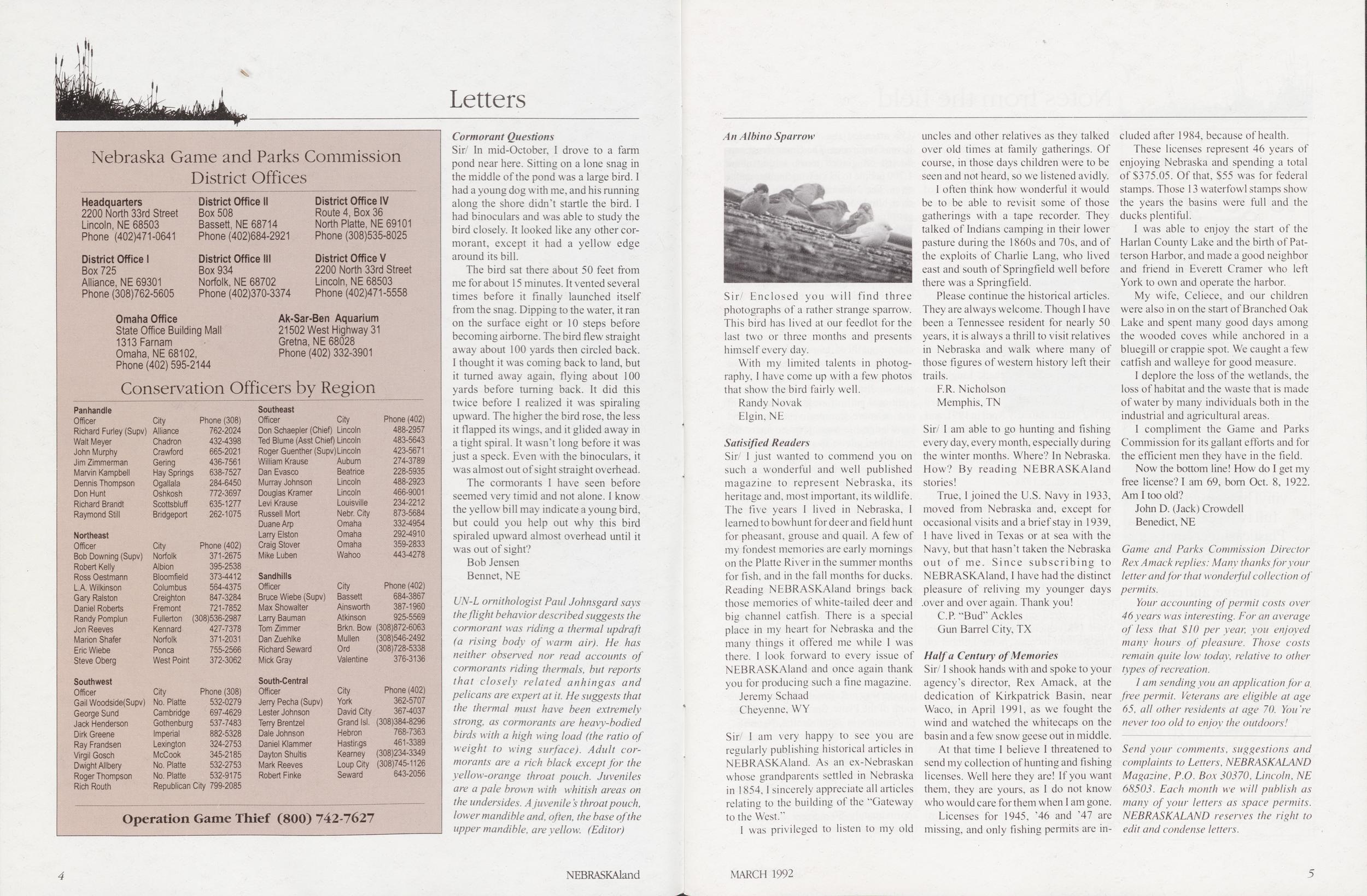 Nebraska Game and Parks Commission
District Offices
Headquarters District Office II District Office IV
2200 North 33rd Street Box 508 Route 4, Box 36
Lincoln, NE 68503 Bassett, NE 68714 North Platte, NE 69101
Phone (402)471-0641 Phone (402)684-2921 Phone (308)535-8025
District Office 1 District Office III District Office V
Box 725 Box 934 2200 North 33rd Street
Alliance, NE 69301 Norfolk, NE 68702 Lincoln, NE 68503
Phone (308)762-5605 Phone (402)370-3374 Phone (402)471-5558
Omaha Office Ak-Sar-Ben Aquarium
State Office Building Mall 21502 West Highway 31
1313Farnam Gretna, NE 68028
Omaha, NE 68102 Phone (402) 332-3901
Phone (402) 595-2144
Conservation Officers by Region
Panhandle Southeast
Officer City Phone (308) Officer City Phone (402)
Richard Furley (Supv) Alliance 762-2024 Don Schaepler (Chief) Lincoln 488-2957
Walt Meyer Chadron 432-4398 Ted Biume (Asst Chief) Lincoln 483-5643
John Murphy Crawford 665-2021 Roger Guenther (Supv) Lincoln 423-5671
Jim Zimmerman Gering 436-7561 William Krause Auburn 274-3789
Marvin Kampbell Hay Springs 638-7527 Dan Evasco Beatrice 228-5935
Dennis Thompson Ogallala 284-6450 Murray Johnson Lincoln 488-2923
Don Hunt Oshkosh 772-3697 Douglas Kramer Lincoln 466-9001
Richard Brandt Scottsbluff 635-1277 Levi Krause Louisville 234-2212
Raymond Still Bridgeport 262-1075 Russell Mort Nebr. City Duane Arp
Omaha 873-5684 332-4954
Northeast Larry Elston Omaha 292-4910
Officer City Phone (402) Craig Stover Omaha 359-2833
Bob Downing (Supv) Norfolk 371-2675 Mike Luben Wahoo 443-4278
Robert Kelly Albion 395-2538
Ross Oestmann Bloomfield 373-4412 Sandhills
L.A. Wilkinson Columbus 564-4375 Officer City Phone (402)
Gary Ralston Creighton 847-3284 Bruce Wiebe (Supv) Bassett 684-3867
Daniel Roberts Fremont 721-7852 Max Showalter Ainsworth 387-1960
Randy Pomplun Fullerton (308)536-2987 Larry Bauman Atkinson 925-5569
Jon Reeves Kennard 427-7378 Tom Zimmer Brkn. Bow (308)872-6063
Marion Shafer Norfolk 371-2031 Dan Zuehlke Mullen (308)546-2492
Eric Wiebe Ponca 755-2566 Richard Seward Ord (308)728-5338
Steve Oberg West Point 372-3062 Mick Gray Valentine 376-3136
Southwest South-Central
Officer City Phone (308) Officer City Phone (402)
Gail Woodside(Supv) No. Platte 532-0279 Jerry Pecha (Supv) York 362-5707
George Sund Cambridge 697-4629 Lester Johnson David City 367-4037
Jack Henderson Gothenburg 537-7483 Terry Brentzel Grand Isl. (308)384-8296
Dirk Greene Imperial 882-5328 Dale Johnson Hebron 768-7363
Ray Frandsen Lexington 324-2753 Daniel Klammer Hastings 461-3389
Virgil Gosch McCook 345-2185 Dayton Shultis Kearney (308)234-3349
Dwight Allbery No. Platte 532-2753 Mark Reeves Loup City (308)745-1126
Roger Thompson No. Platte 532-9175 Robert Finke Seward 643-2056
Rich Routh Republican City 799-2085
Operation Game Thief (800) 742-7627
Nebraska Game and Parks Commission
District Offices
Headquarters District Office II District Office IV
2200 North 33rd Street Box 508 Route 4, Box 36
Lincoln, NE 68503 Bassett, NE 68714 North Platte, NE 69101
Phone (402)471-0641 Phone (402)684-2921 Phone (308)535-8025
District Office 1 District Office III District Office V
Box 725 Box 934 2200 North 33rd Street
Alliance, NE 69301 Norfolk, NE 68702 Lincoln, NE 68503
Phone (308)762-5605 Phone (402)370-3374 Phone (402)471-5558
Omaha Office Ak-Sar-Ben Aquarium
State Office Building Mall 21502 West Highway 31
1313Farnam Gretna, NE 68028
Omaha, NE 68102 Phone (402) 332-3901
Phone (402) 595-2144
Conservation Officers by Region
Panhandle Southeast
Officer City Phone (308) Officer City Phone (402)
Richard Furley (Supv) Alliance 762-2024 Don Schaepler (Chief) Lincoln 488-2957
Walt Meyer Chadron 432-4398 Ted Biume (Asst Chief) Lincoln 483-5643
John Murphy Crawford 665-2021 Roger Guenther (Supv) Lincoln 423-5671
Jim Zimmerman Gering 436-7561 William Krause Auburn 274-3789
Marvin Kampbell Hay Springs 638-7527 Dan Evasco Beatrice 228-5935
Dennis Thompson Ogallala 284-6450 Murray Johnson Lincoln 488-2923
Don Hunt Oshkosh 772-3697 Douglas Kramer Lincoln 466-9001
Richard Brandt Scottsbluff 635-1277 Levi Krause Louisville 234-2212
Raymond Still Bridgeport 262-1075 Russell Mort Nebr. City Duane Arp
Omaha 873-5684 332-4954
Northeast Larry Elston Omaha 292-4910
Officer City Phone (402) Craig Stover Omaha 359-2833
Bob Downing (Supv) Norfolk 371-2675 Mike Luben Wahoo 443-4278
Robert Kelly Albion 395-2538
Ross Oestmann Bloomfield 373-4412 Sandhills
L.A. Wilkinson Columbus 564-4375 Officer City Phone (402)
Gary Ralston Creighton 847-3284 Bruce Wiebe (Supv) Bassett 684-3867
Daniel Roberts Fremont 721-7852 Max Showalter Ainsworth 387-1960
Randy Pomplun Fullerton (308)536-2987 Larry Bauman Atkinson 925-5569
Jon Reeves Kennard 427-7378 Tom Zimmer Brkn. Bow (308)872-6063
Marion Shafer Norfolk 371-2031 Dan Zuehlke Mullen (308)546-2492
Eric Wiebe Ponca 755-2566 Richard Seward Ord (308)728-5338
Steve Oberg West Point 372-3062 Mick Gray Valentine 376-3136
Southwest South-Central
Officer City Phone (308) Officer City Phone (402)
Gail Woodside(Supv) No. Platte 532-0279 Jerry Pecha (Supv) York 362-5707
George Sund Cambridge 697-4629 Lester Johnson David City 367-4037
Jack Henderson Gothenburg 537-7483 Terry Brentzel Grand Isl. (308)384-8296
Dirk Greene Imperial 882-5328 Dale Johnson Hebron 768-7363
Ray Frandsen Lexington 324-2753 Daniel Klammer Hastings 461-3389
Virgil Gosch McCook 345-2185 Dayton Shultis Kearney (308)234-3349
Dwight Allbery No. Platte 532-2753 Mark Reeves Loup City (308)745-1126
Roger Thompson No. Platte 532-9175 Robert Finke Seward 643-2056
Rich Routh Republican City 799-2085
Operation Game Thief (800) 742-7627
Letters
Cormorant QuestionsSir/ In mid-October, I drove to a farm pond near here. Sitting on a lone snag in the middle of the pond was a large bird. I had a young dog with me, and his running along the shore didn't startle the bird. I had binoculars and was able to study the bird closely. It looked like any other cormorant, except it had a yellow edge around its bill.
The bird sat there about 50 feet from me for about 15 minutes. It vented several times before it finally launched itself from the snag. Dipping to the water, it ran on the surface eight or 10 steps before becoming airborne. The bird flew straight away about 100 yards then circled back. I thought it was coming back to land, but it turned away again, flying about 100 yards before turning back. It did this twice before I realized it was spiraling upward. The higher the bird rose, the less it flapped its wings, and it glided away in a tight spiral. It wasn't long before it was just a speck. Even with the binoculars, it was almost out of sight straight overhead.
The cormorants I have seen before seemed very timid and not alone. I know the yellow bill may indicate a young bird, but could you help out why this bird spiraled upward almost overhead until it was out of sight?
Bob Jensen Bennet, NEUN-L ornithologist Paul Johnsgard says the flight behavior described suggests the cormorant was riding a thermal updraft (a rising body of warm air). He has neither observed nor read accounts of cormorants riding thermals, but reports that closely related anhingas and pelicans are expert at it. He suggests that the thermal must have been extremely strong, as cormorants are heavy-bodied birds with a high wing load (the ratio of weight to wing surface). Adult cormorants are a rich black except for the yellow-orange throat pouch. Juveniles are a pale brown with whitish areas on the undersides. A juvenile s throat pouch, lower mandible and, often, the base oft he upper mandible, are yellow. (Editor)
4 NEBRASKAland An Albino SparrowSir/ Enclosed you will find three photographs of a rather strange sparrow. This bird has lived at our feedlot for the last two or three months and presents himself every day.
With my limited talents in photography, I have come up with a few photos that show the bird fairly well.
Randy Novak Elgin, NE Satisified ReadersSir/ I just wanted to commend you on such a wonderful and well published magazine to represent Nebraska, its heritage and, most important, its wildlife. The five years I lived in Nebraska, I learned to bowhunt for deer and field hunt for pheasant, grouse and quail. A few of my fondest memories are early mornings on the Platte River in the summer months for fish, and in the fall months for ducks. Reading NEBRASKAland brings back those memories of white-tailed deer and big channel catfish. There is a special place in my heart for Nebraska and the many things it offered me while I was there. I look forward to every issue of NEBRASKAland and once again thank you for producing such a fine magazine.
Jeremy Schaad Cheyenne, WYSir/ I am very happy to see you are regularly publishing historical articles in NEBRASKAland. As an ex-Nebraskan whose grandparents settled in Nebraska in 1854, I sincerely appreciate all articles relating to the building of the "Gateway to the West."
I was privileged to listen to my old uncles and other relatives as they talked over old times at family gatherings. Of course, in those days children were to be seen and not heard, so we listened avidly.
I often think how wonderful it would be to be able to revisit some of those gatherings with a tape recorder. They talked of Indians camping in their lower pasture during the 1860s and 70s, and of the exploits of Charlie Lang, who lived east and south of Springfield well before there was a Springfield.
Please continue the historical articles. They are always welcome. Though I have been a Tennessee resident for nearly 50 years, it is always a thrill to visit relatives in Nebraska and walk where many of those figures of western history left their trails.
F.R. Nicholson Memphis, TNSir/ I am able to go hunting and fishing every day, every month, especially during the winter months. Where? In Nebraska. How? By reading NEBRASKAland stories!
True, I joined the U.S. Navy in 1933, moved from Nebraska and, except for occasional visits and a brief stay in 1939, I have lived in Texas or at sea with the Navy, but that hasn't taken the Nebraska out of me. Since subscribing to NEBRASKAland, I have had the distinct pleasure of reliving my younger days over and over again. Thank you!
C.P. "Bud" Ackles Gun Barrel City, TX Haifa Century of MemoriesSir/1 shook hands with and spoke to your agency's director, Rex Amack, at the dedication of Kirkpatrick Basin, near Waco, in April 1991, as we fought the wind and watched the whitecaps on the basin and a few snow geese out in middle.
At that time I believe I threatened to send my collection of hunting and fishing licenses. Well here they are! If you want them, they are yours, as I do not know who would care for them when I am gone.
Licenses for 1945, '46 and '47 are missing, and only fishing permits are included after 1984, because of health.
These licenses represent 46 years of enjoying Nebraska and spending a total of $375.05. Of that, $55 was for federal stamps. Those 13 waterfowl stamps show the years the basins were full and the ducks plentiful.
I was able to enjoy the start of the Harlan County Lake and the birth of Patterson Harbor, and made a good neighbor and friend in Everett Cramer who left York to own and operate the harbor.
My wife, Celiece, and our children were also in on the start of Branched Oak Lake and spent many good days among the wooded coves while anchored in a bluegill or crappie spot. We caught a few catfish and walleye for good measure.
I deplore the loss of the wetlands, the loss of habitat and the waste that is made of water by many individuals both in the industrial and agricultural areas.
I compliment the Game and Parks Commission for its gallant efforts and for the efficient men they have in the field.
Now the bottom line! How do I get my free license? I am 69, bom Oct. 8, 1922. Am I too old?
John D. (Jack) Crowdell Benedict, NEGame and Parks Commission Director Rex Amack replies: Many thanks for your letter and for that wonderful collection of permits.
Your accounting of permit costs over 46 years was interesting. For an average of less that $10 per year, you enjoyed many hours of pleasure. Those costs remain quite low today, relative to other types of recreation.
1 am sending you an application for a, free permit. Veterans are eligible at age 65, all other residents at age 70. You 're never too old to enjoy the outdoors!
Send your comments, suggestions and complaints to Letters, NEBRASKALAND Magazine, P.O. Box 30370, Lincoln, NE 68503. Each month we will publish as many of your letters as space permits. NEBRASKALAND reserves the right to edit and condense letters. MARCH 1992 5
Notes from the field
The Economics of Crane Watching"The Impact of Crane Watching" (NEBRASKAland, March 1991) reported that crane watchers contributed some S700,000 to local economies in March of 1988. This figure was based on an estimate made by Platte River Whooping Crane Maintenance Trust Executive Director John VanDerwalker that 10,000 to 12,000 people had visited the Grand Island-Kearney area to see cranes that year.
In 1991, Gary Lingle, a biologist with the Whooping Crane Trust, compiled information to produce a new estimate of the impact crane watching has on local Nebraska economies. Using vehicle counters, questionnaires and a tabulation of visitor lists from various programs which serve crane watchers, Lingle estimated that 80,000 people came to the central Platte Valley to view cranes during March and early April in 1991, and in the process pumped over $40 million into the local economies. This dramatic increase reflects both Lingle's improved data collection and the rising interest in the cranes since 1988.
For his 1974 M.S. thesis, Charles Frith counted crane watchers during four two hour periods on Sunday afternoons along the county road south of the Platte River west of Doniphan, a favored crane-viewing route. His highest count in 1971 was 29 vehicles. In 1973, the number had nearly doubled to 57 vehicles. Lingle reported that peak traffic on this road in 1991 occurred on Sunday March 24, when 188 vehicles crossed the counter. This six-fold increase in the number of crane watchers between 1971 and 1991 is probably conservative, says Lingle, as Frith's highest counts included a longer reach of the river.
While car-window viewing of cranes is casual, and in part must reflect "Sunday afternoon" drives by area residents, the number of serious crane watchers has also increased dramatically. In 1991, 222 people attended the banquet at Grand Island's Wings Over the Platte celebration, and 605 people took guided bus tours. Kearney's Crane Watch event recorded 600 people on bus tours, and 350 attended the Audubon Society's River Conference. The Crane Trust conducted 68 guided tours, taking about 1,700 people to its viewing bunker on the river. The National Audubon Society's river blinds accommodated about 1,121 people. Fort Kearny State Historical Park, which becomes a crane watcher's headquarters during March, registered about 3,900 guests. At most of these facilities and events, the number of outof-state participants exceeded the number of Nebraska residents.
The number of crane watchers is almost certain to increase," Lingle said, and suggested that local agencies and organizations need to provide more sites where the public can safely view cranes without creating a traffic hazard and without disturbing the birds. He believes additional pull-off areas, construction of one or more interpretive centers, and knowledgeable volunteers to meet the public and advise them on proper crane watching etiquette are needed.
"Perhaps more important is the need to protect adequate instream flows throughout the year so that this region will continue to serve as a life-support system for cranes and a multitude of other species dependent upon it," Lingle concluded. "Biologists have long recognized the need to protect this vital habitat. Now that it is becoming more apparent to the general public that crane watching has a direct positive economic impact, perhaps there will be increasing impetus from a broader audience to assure the protection of this habitat."
The Rainwater Basin AlternativeAn equally good March wildlife show is under way in Rainwater Basin wetlands south of the Platte. Sprinkled throughout 17 counties in south-central Nebraska, these shallow wetlands are among the most important spring staging areas for ducks and geese in the Central Flyway. About 90 percent of the midcontinent, greater white-fronted goose population stops in the basins during March, as do approximately 50 percent of the continental mallard and 30 percent of the 6 NEBRASKAland pintail breeding populations. Other species of ducks, Canada geese and an increasing number of snow geese also use these wetlands.
Most of these waterbirds roost on the wetlands at night, move off early in the morning to feed in nearby grain fields, return to loaf on the wetlands during midday and leave again to feed late in the afternoon. At sunrise and sunset, the spectacle of thousands of waterfowl milling over the basins is an awe-inspiring mix of sight and sound.
During March, access roads can become a quagmire of greasy mud. Bird watchers should not drive into a basin area if the road is muddy. Muddy roads, frozen at dawn, may be impossible to drive on if the temperature rises during the day. Because so many birds are concentrated on such small areas, bird watchers must be especially careful not to flush the birds. The spring stopover in the basins is critical, a time when birds accumulate fat and nutrient reserves to fuel spring migration and nesting. Disturbance in March can affect that year's reproduction. Birds should be observed from a distance with binoculars or spotting scopes.
A map showing the locations of U.S. Fish and Wildlife Service waterfowl production areas in the Rainwater Basin is available from the Refuge Manager, Rainwater Basin Wetland Management District, P.O. Box 1686, Kearney, NE 68848. Nebraska Game and Parks Commission wildlife management areas and federal waterfowl production areas are listed in "NEBRASKAland Magazine's Guide to Public Hunting Lands," available from the Nebraska Game and Parks Commission, P.O. Box 30370, Lincoln, NE 68503.
These public areas are purchased and managed with funds derived from the sale of federal Migratory Waterfowl Stamps and Nebraska Habitat Stamps. Both stamps are required for waterfowl hunters. Non-hunters who wish to support the effort to preserve these valuable wetlands may purchase them, too.
Jon Farrar This Poster is Free ENDANGERED Means There is Still Time THE WHOOPING CRANE 11 ben nv hear his tall we bear no were bird He is Aldo lipoid than beauty, whooping cranes symbolize the snuggle to save the vanishing creatures ui oui world untributtons to Nebraskas Nongame Endangered Program support efforts In die Game and Parks Commission to identify, protect and enhance habitat essential NONGAME A ENDANGERED WILDLIFE CONSERVATION RIND To contribute, see your state Income tax form, consult youi tax preparer, or moke .1 used donation to Or- Nebraska Game and Parks Commission lBox 30370, Lincoln, M 68503-0370 if you give a gift to wildlife! To get this full-color whooping crane poster free, donate a part of your Nebraska state income tax refund to non-game wildlife: On your state income tax form, find the line with the peregrine falcon beside it and write in the amount from your refund to be donated. Take a receipt from your tax preparer or a copy of that portion of the form to a Nebraska Game and Parks Commission office to receive your poster. For mail orders, send a receipt, a copy of your tax form or your cancelled check to Nebraska Game and Parks Commission, P.O. Box 30370, Lincoln, NE 68503 . A CHECK FOR WILDLIFE MARCH 1992 7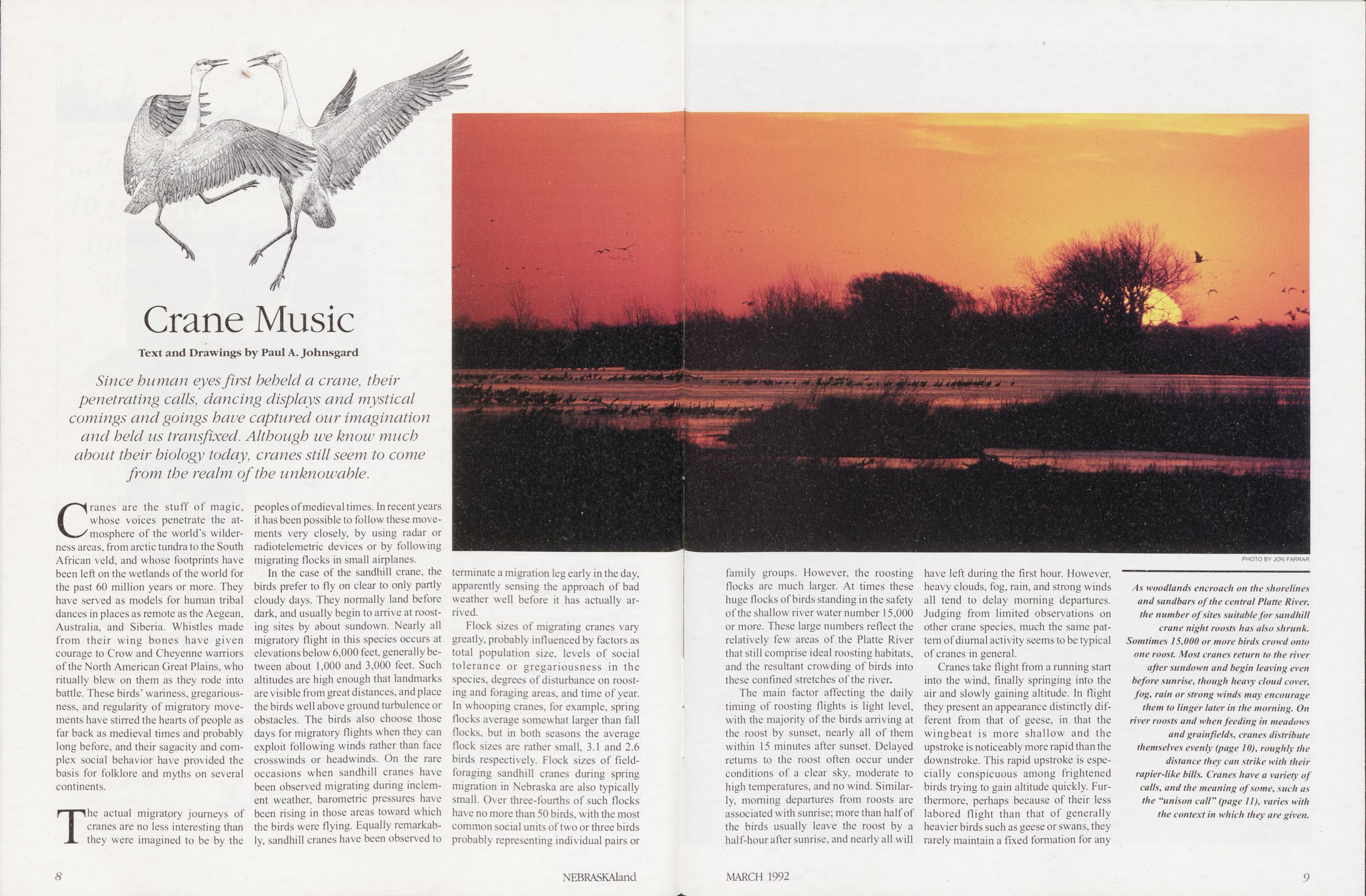
Crane Music
Text and Drawings by Paul A. Johnsgard Since human eyes first beheld a crane, their penetrating calls, dancing displays and mystical comings and goings have captured our imagination and held us transfixed. Although we know much about their biology today, cranes still seem to come from the realm of the unknowable.Cranes are the stuff of magic, whose voices penetrate the atmosphere of the world's wilderness areas, from arctic tundra to the South African veld, and whose footprints have been left on the wetlands of the world for the past 60 million years or more. They have served as models for human tribal dances in places as remote as the Aegean, Australia, and Siberia. Whistles made from their wing bones have given courage to Crow and Cheyenne warriors of the North American Great Plains, who ritually blew on them as they rode into battle. These birds' wariness, gregariousness, and regularity of migratory movements have stirred the hearts of people as far back as medieval times and probably long before, and their sagacity and complex social behavior have provided the basis for folklore and myths on several continents.
The actual migratory journeys of cranes are no less interesting than they were imagined to be by the peoples of medieval times. In recent years it has been possible to follow these movements very closely, by using radar or radiotelemetric devices or by following migrating flocks in small airplanes.
In the case of the sandhill crane, the birds prefer to fly on clear to only partly cloudy days. They normally land before dark, and usually begin to arrive at roosting sites by about sundown. Nearly all migratory flight in this species occurs at elevations below 6,000 feet, generally between about 1,000 and 3,000 feet. Such altitudes are high enough that landmarks are visible from great distances, and place the birds well above ground turbulence or obstacles. The birds also choose those days for migratory flights when they can exploit following winds rather than face crosswinds or headwinds. On the rare occasions when sandhill cranes have been observed migrating during inclement weather, barometric pressures have been rising in those areas toward which the birds were flying. Equally remarkably, sandhill cranes have been observed to terminate a migration leg early in the day, apparently sensing the approach of bad weather well before it has actually arrived.
Flock sizes of migrating cranes vary greatly, probably influenced by factors as total population size, levels of social tolerance or gregariousness in the species, degrees of disturbance on roosting and foraging areas, and time of year. In whooping cranes, for example, spring flocks average somewhat larger than fall flocks, but in both seasons the average flock sizes are rather small, 3.1 and 2.6 birds respectively. Flock sizes of field foraging sandhill cranes during spring migration in Nebraska are also typically small. Over three-fourths of such flocks have no more than 50 birds, with the most common social units of two or three birds probably representing individual pairs or 8 NEBRASKAland
The main factor affecting the daily timing of roosting flights is light level, with the majority of the birds arriving at the roost by sunset, nearly all of them within 15 minutes after sunset. Delayed returns to the roost often occur under conditions of a clear sky, moderate to high temperatures, and no wind. Similarly, morning departures from roosts are associated with sunrise; more than half of the birds usually leave the roost by a half-hour after sunrise, and nearly all will have left during the first hour. However, heavy clouds, fog, rain, and strong winds all tend to delay morning departures. Judging from limited observations on other crane species, much the same pattern of diurnal activity seems to be typical of cranes in general.
Cranes take flight from a running start
into the wind, finally springing into the
air and slowly gaining altitude. In flight
they present an appearance distinctly different from that of geese, in that the
wingbeat is more shallow and the
upstroke is noticeably more rapid than the
downstroke. This rapid upstroke is especially conspicuous among frightened
birds trying to gain altitude quickly. Furthermore, perhaps because of their less
labored flight than that of generally
heavier birds such as geese or swans, they
rarely maintain a fixed formation for any
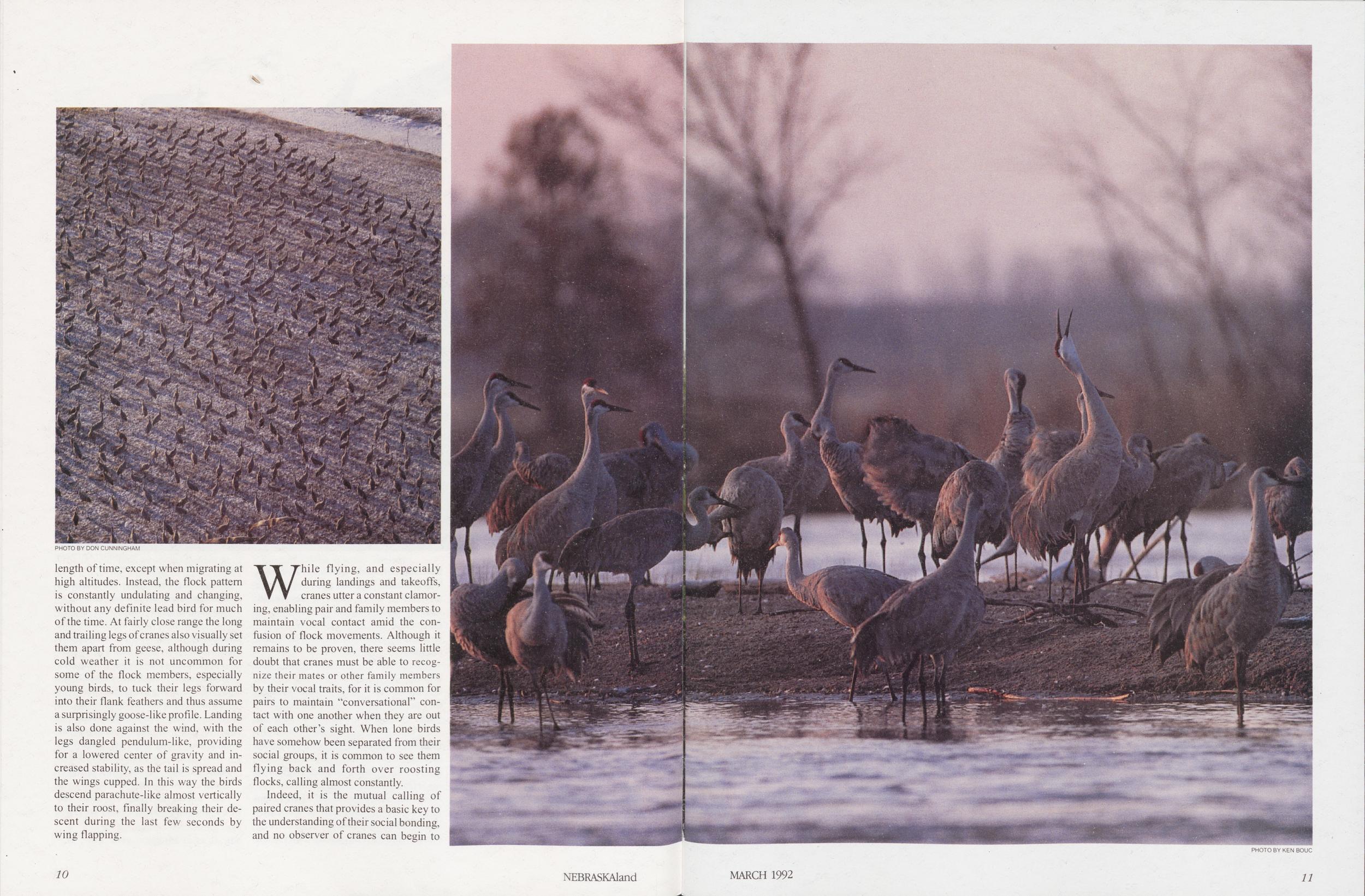
While flying, and especially during landings and takeoffs, cranes utter a constant clamoring, enabling pair and family members to maintain vocal contact amid the confusion of flock movements. Although it remains to be proven, there seems little doubt that cranes must be able to recognize their mates or other family members by their vocal traits, for it is common for pairs to maintain "conversational" contact with one another when they are out of each other's sight. When lone birds have somehow been separated from their social groups, it is common to see them flying back and forth over roosting flocks, calling almost constantly.
Indeed, it is the mutual calling of paired cranes that provides a basic key to the understanding of their social bonding, and no observer of cranes can begin to 10 NEBRASKAland
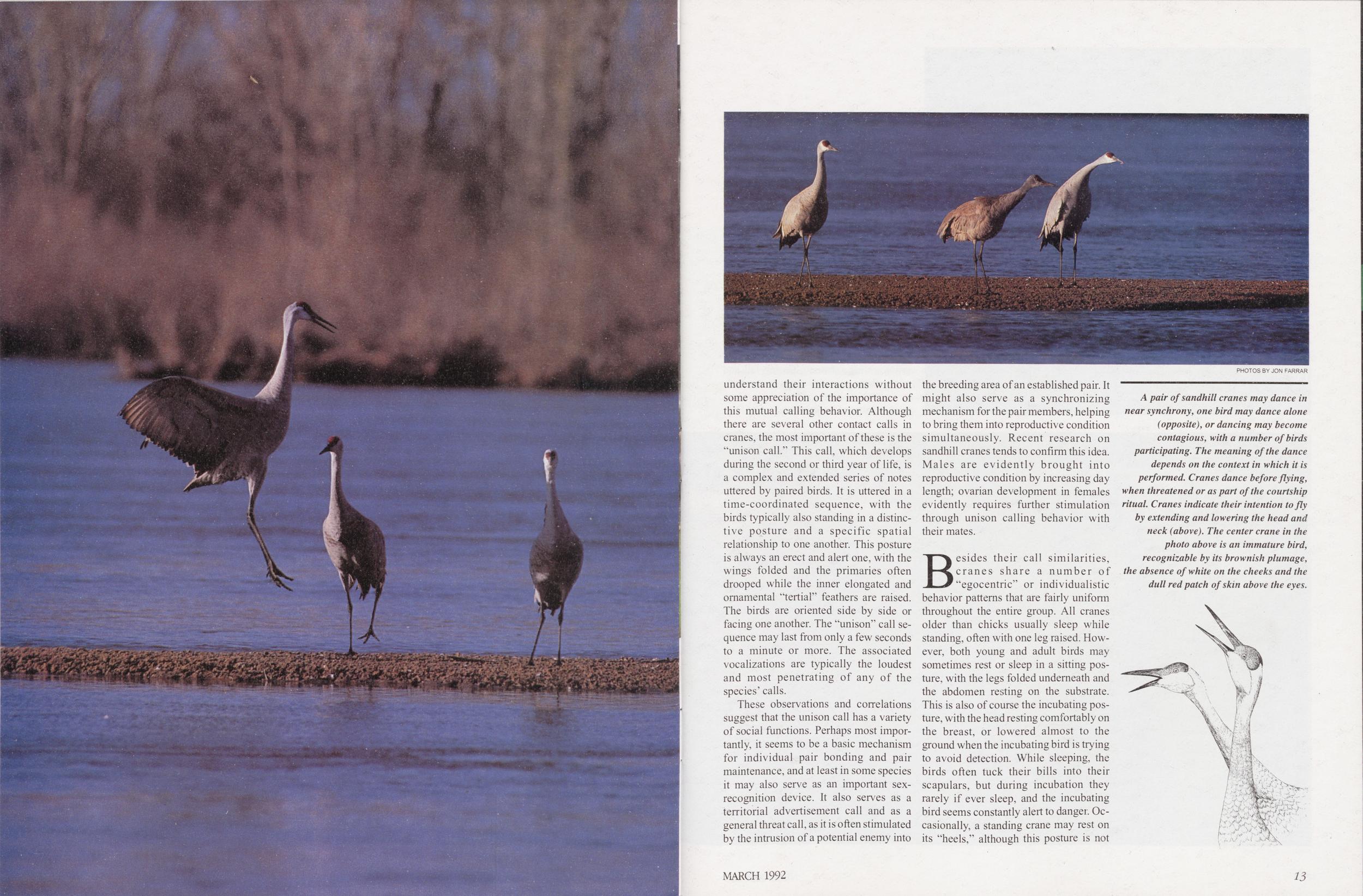
These observations and correlations suggest that the unison call has a variety of social functions. Perhaps most importantly, it seems to be a basic mechanism for individual pair bonding and pair maintenance, and at least in some species it may also serve as an important sex recognition device. It also serves as a territorial advertisement call and as a general threat call, as it is often stimulated by the intrusion of a potential enemy into the breeding area of an established pair. It might also serve as a synchronizing mechanism for the pair members, helping to bring them into reproductive condition simultaneously. Recent research on sandhill cranes tends to confirm this idea. Males are evidently brought into reproductive condition by increasing day length; ovarian development in females evidently requires further stimulation through unison calling behavior with their mates.
Besides their call similarities, cranes share a number of "egocentric" or individualistic behavior patterns that are fairly unifonn throughout the entire group. All cranes older than chicks usually sleep while standing, often with one leg raised. However, both young and adult birds may sometimes rest or sleep in a sitting posture, with the legs folded underneath and the abdomen resting on the substrate. This is also of course the incubating posture, with the head resting comfortably on the breast, or lowered almost to the ground when the incubating bird is trying to avoid detection. While sleeping, the birds often tuck their bills into their scapulars, but during incubation they rarely if ever sleep, and the incubating bird seems constantly alert to danger. Occasionally, a standing crane may rest on its "heels," although this posture is not
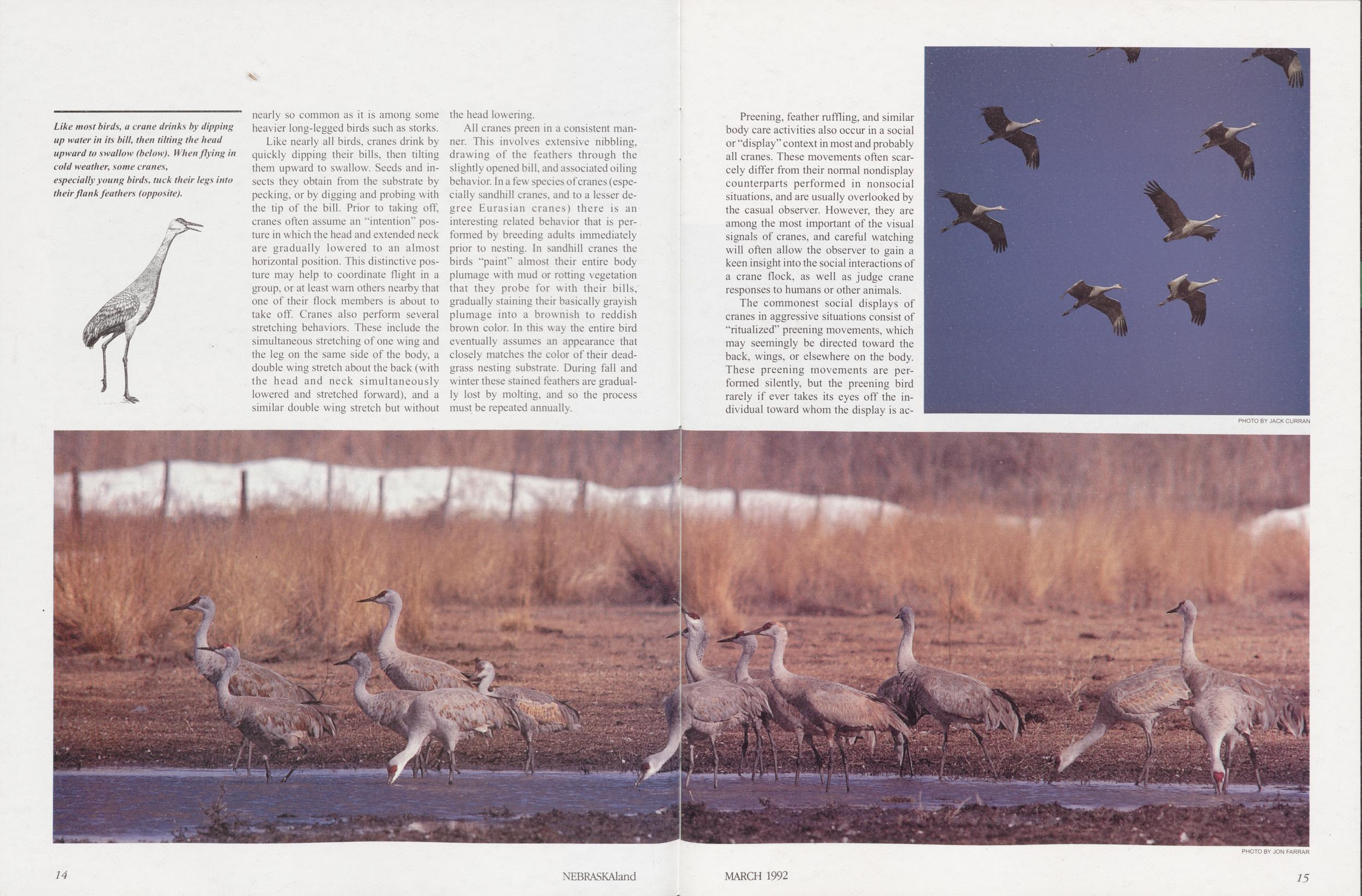
Like nearly all birds, cranes drink by quickly dipping their bills, then tilting them upward to swallow. Seeds and insects they obtain from the substrate by pecking, or by digging and probing with the tip of the bill. Prior to taking off, cranes often assume an 'intention" posture in which the head and extended neck are gradually lowered to an almost horizontal position. This distinctive posture may help to coordinate flight in a group, or at least warn others nearby that one of their flock members is about to take off. Cranes also perform several stretching behaviors. These include the simultaneous stretching of one wing and the leg on the same side of the body, a double wing stretch about the back (with the head and neck simultaneously lowered and stretched forward), and a similar double wing stretch but without the head lowering.
All cranes preen in a consistent manner. This involves extensive nibbling, drawing of the feathers through the slightly opened bill, and associated oiling behavior. In a few species of cranes (especially sandhill cranes, and to a lesser degree Eurasian cranes) there is an interesting related behavior that is performed by breeding adults immediately prior to nesting. In sandhill cranes the birds "paint" almost their entire body plumage with mud or rotting vegetation that they probe for with their bills, gradually staining their basically grayish plumage into a brownish to reddish brown color. In this way the entire bird eventually assumes an appearance that closely matches the color of their deadgrass nesting substrate. During fall and winter these stained feathers are gradually lost by molting, and so the process must be repeated annually.
Preening, feather ruffling, and similar body care activities also occur in a social or "display" context in most and probably all cranes. These movements often scarcely differ from their normal nondisplay counterparts performed in nonsocial situations, and are usually overlooked by the casual observer. However, they are among the most important of the visual signals of cranes, and careful watching will often allow the observer to gain a keen insight into the social interactions of a crane flock, as well as judge crane responses to humans or other animals.
The commonest social displays of cranes in aggressive situations consist of "ritualized" preening movements, which may seemingly be directed toward the back, wings, or elsewhere on the body. These preening movements are performed silently, but the preening bird rarely if ever takes its eyes off the individual toward whom the display is actually
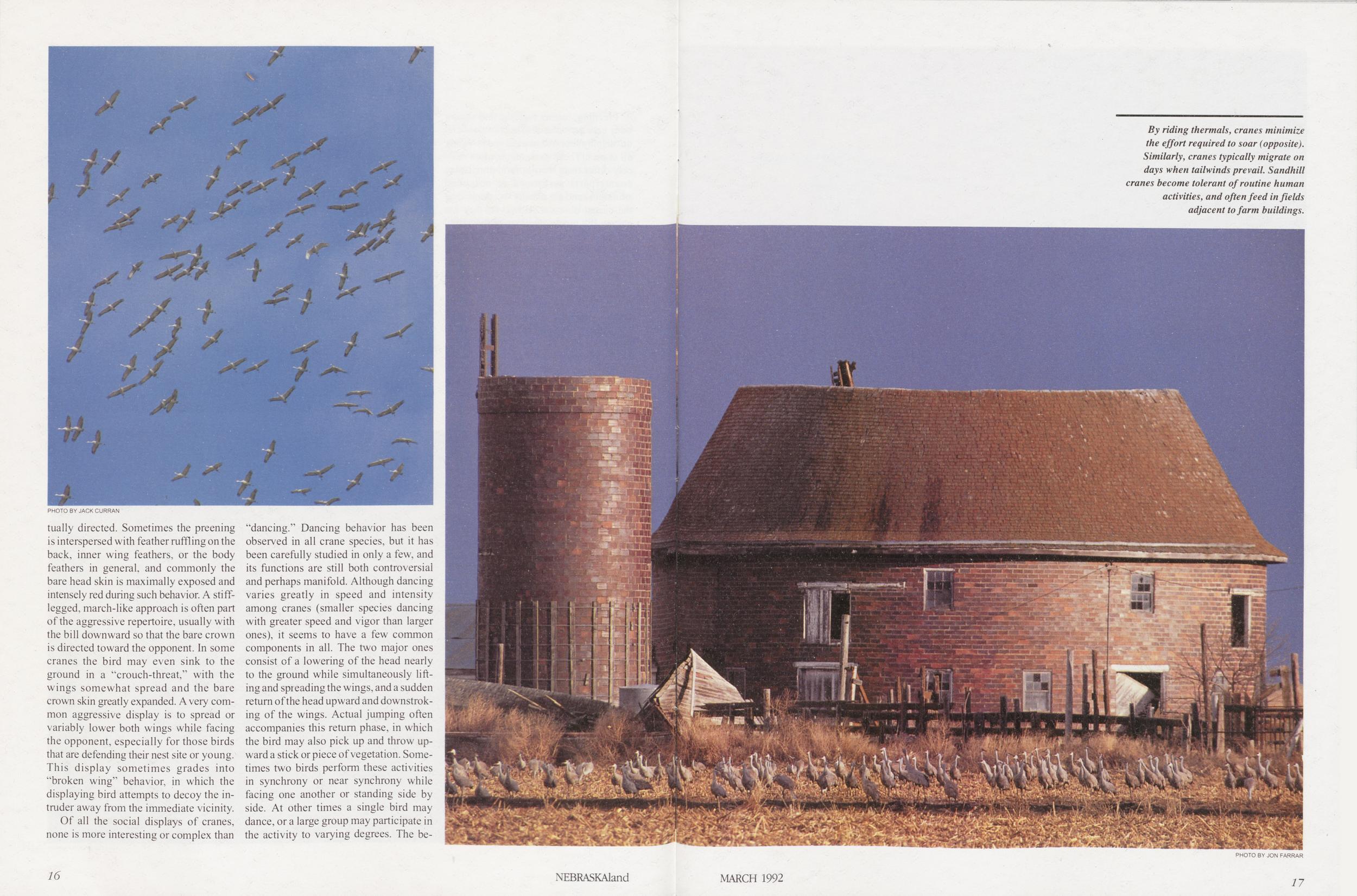
Of all the social displays of cranes, none is more interesting or complex than "dancing." Dancing behavior has been observed in all crane species, but it has been carefully studied in only a few, and its functions are still both controversial and perhaps manifold. Although dancing varies greatly in speed and intensity among cranes (smaller species dancing with greater speed and vigor than larger ones), it seems to have a few common components in all. The two major ones consist of a lowering of the head nearly to the ground while simultaneously lifting and spreading the wings, and a sudden return of the head upward and downstroking of the wings. Actual jumping often accompanies this return phase, in which the bird may also pick up and throw upward a stick or piece of vegetation. Sometimes two birds perform these activities in synchrony or near synchrony while facing one another or standing side by side. At other times a single bird may dance, or a large group may participate in the activity to varying degrees. The behavior 16 NEBRASKAland
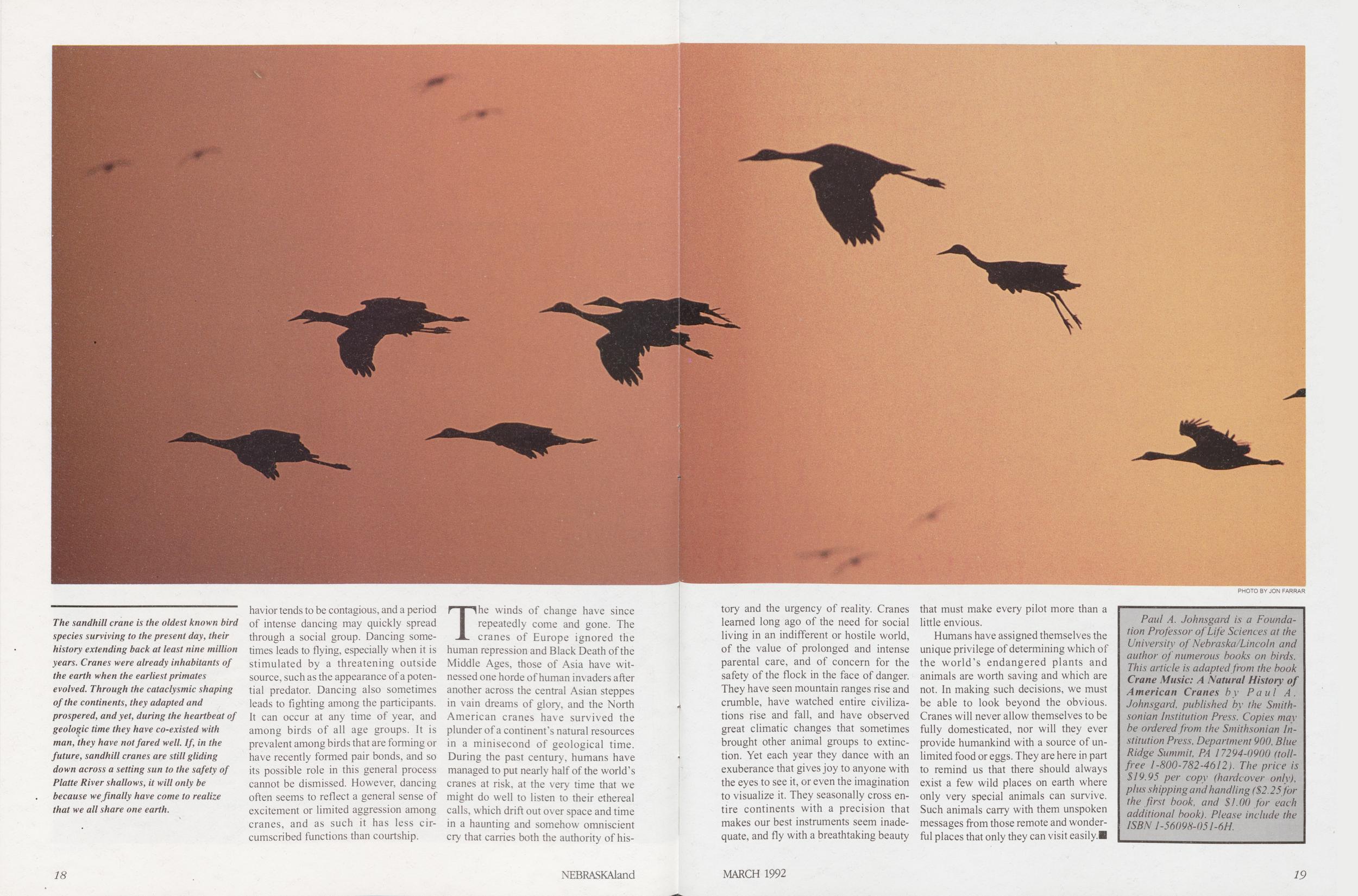
The winds of change have since repeatedly come and gone. The cranes of Europe ignored the human repression and Black Death of the Middle Ages, those of Asia have witnessed one horde of human invaders after another across the central Asian steppes in vain dreams of glory, and the North American cranes have survived the plunder of a continent's natural resources in a minisecond of geological time. During the past century, humans have managed to put nearly half of the world's cranes at risk, at the very time that we might do well to listen to their ethereal calls, which drift out over space and time in a haunting and somehow omniscient cry that carries both the authority of history 18 NEBRASKAland and the urgency of reality. Cranes learned long ago of the need for social living in an indifferent or hostile world, of the value of prolonged and intense parental care, and of concern for the safety of the flock in the face of danger. They have seen mountain ranges rise and crumble, have watched entire civilizations rise and fall, and have observed great climatic changes that sometimes brought other animal groups to extinction. Yet each year they dance with an exuberance that gives joy to anyone with the eyes to see it, or even the imagination to visualize it. They seasonally cross entire continents with a precision that makes our best instruments seem inadequate, and fly with a breathtaking beauty that must make every pilot more than a little envious.
Humans have assigned themselves the unique privilege of determining which of the world's endangered plants and animals are worth saving and which are not. In making such decisions, we must be able to look beyond the obvious. Cranes will never allow themselves to be fully domesticated, nor will they ever provide humankind with a source of unlimited food or eggs. They are here in part to remind us that there should always exist a few wild places on earth where only very special animals can survive. Such animals carry with them unspoken messages from those remote and wonderful places that only they can visit easily.
Paul A. Johnsgard is a Foundation Professor of Life Sciences at the University of Nebraska/Lincoln and author of numerous books on birds. This article is adapted from the book Crane Music: A Natural History of American Cranes by Paul A. Johnsgard, published by the Smithsonian Institution Press. Copies may be ordered from the Smithsonian Institution Press, Department 900, Blue Ridge Summit, PA 17294-0900 (tollfree 1-800-782-4612). The price is $19.95 per copy (hardcover only), plus shipping and handling ($2.25 for the first book, and $1.00 for each additional book). Please include the ISBN 1-56098-051-6H. MARCH 1992 19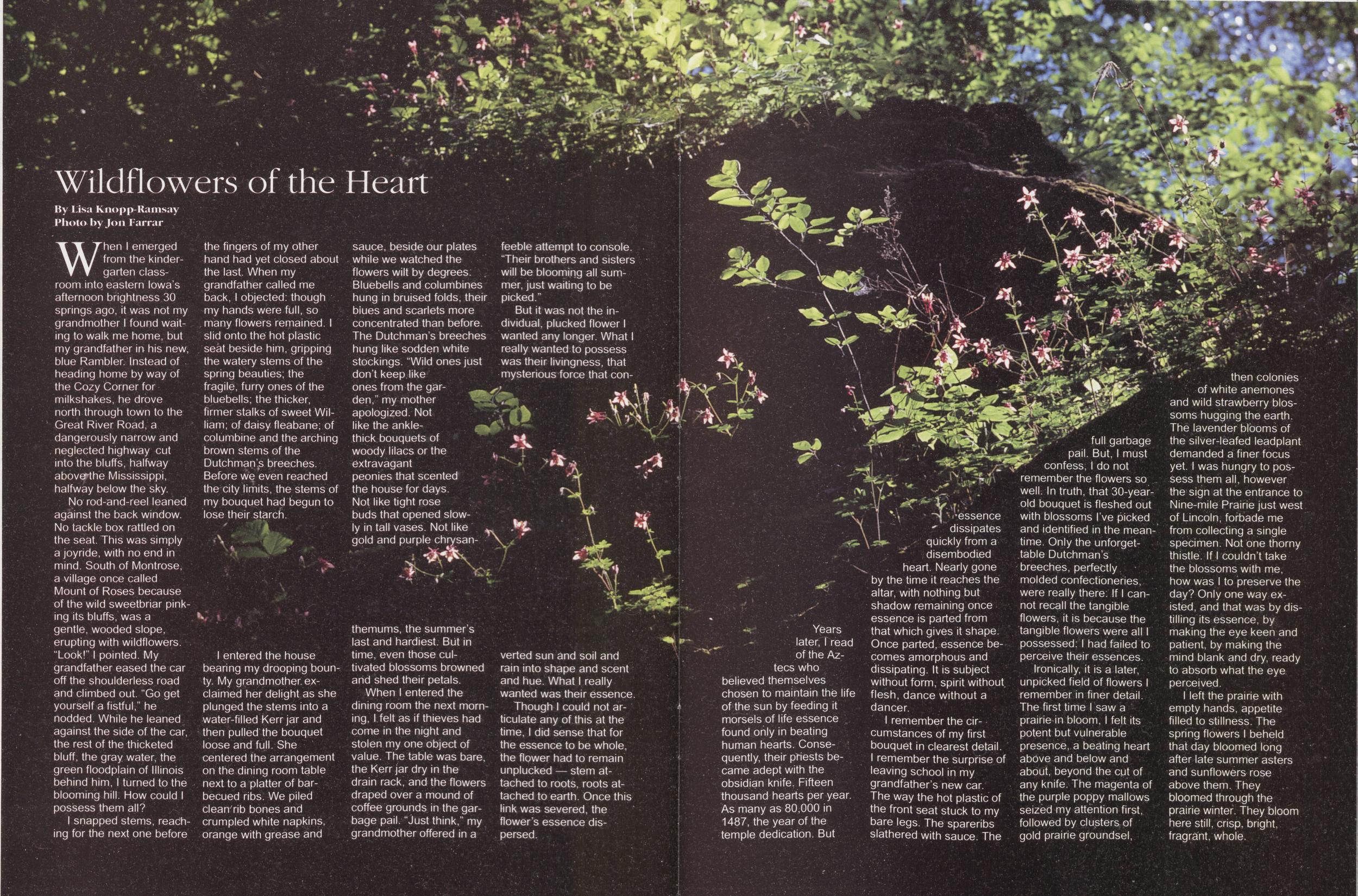
Wildflowers of the Heart
By Lisa Kiiopp-Ramsay Photo by Joii FarrarWhen I emerged from the kindergarten classroom into eastern Iowa's afternoon brightness 30 springs ago, it was not my grandmother I found waiting to walk me home, but my grandfather in his new, blue Rambler. Instead of . heading home by way of the Cozy Corner for milkshakes, he drove north through town to the Great River Road, a dangerously narrow and neglected highway cut into the bluffs, halfway aboverthe Mississippi, halfway below the sky.
No rod-and-reel leaned against the back window. No tackle box rattled on the seat. This was simply a joyride, with no end in mind. South of Montrose, a village once called Mount of Roses because of the wild sweetbriar pinking its bluffs, was a gentle, wooded slope, erupting with wildflowers. "Look!" I pointed. My grandfather eased the car off the shoulderless road and climbed out. "Go get yourself a fistful," he nodded. While he leaned against the side of the car, the rest of the thicketed bluff, the gray water, the green floodplain of Illinois behind him, I turned to the blooming hill. How could I possess them all?
I snapped stems, reaching for the next one before the fingers of my other hand had yet closed about the last. When my grandfather called me back, I objected: though my hands were full, so many flowers remained. I slid onto the hot plastic seat beside him, gripping the watery stems of the spring beauties; the fragile, furry ones of the bluebells; the thicker, firmer stalks of sweet William; of daisy fleabane; of columbine and the arching brown stems of the Dutchman's breeches. Before we even reached the city limits, the stems of my bouquet had begun to lose their starch.
I entered the house bearing my drooping bounty. My grandmother, exclaimed her delight as she plunged the stems into a water-filled Kerr jar and then pulled the bouquet loose and full. She centered the arrangement on the dining room table next to a platter of barbecued ribs. We piled cleanTib bones and crumpled white napkins, orange with grease and sauce, beside our plates while we watched the flowers wilt by degrees. Bluebells and columbines hung in bruised folds, their biues and scarlets more concentrated than before. The Dutchman's breeches hung like sodden white stockings. "Wild ones just don't keep like ones from the garden," my mother apologized. Not like the ankle thick bouquets of woody lilacs or the extravagant peonies that scented the house for days. Not like tight rose buds that opened slowly in tall vases. Not like gold and purple chrysanthemums, the summer's last and hardiest. But in time, even those cultivated blossoms browned and shed their petals.
When I entered the dining room the next morning, I felt as if thieves had come in the night and stolen my one object of value. The table was bare, the Kerr jar dry in the drain rack, and the flowers draped over a mound of coffee grounds in the garbage pail. "Just think," my grandmother offered in a feeble attempt to console. "Their brothers and sisters will be blooming all summer, just waiting to be picked."
But it was not the individual, plucked flower I wanted any longer. What I really wanted to possess was their livingness, that mysterious force that converted sun and soil and rain into shape and scent and hue. What I really wanted was their essence
Though I could not articulate any of this at the time, I did sense that for the essence to be whole, the flower had to remain unplucked — stem attached to roots, roots attached to earth. Once this link was severed, the flower's essence dispersed.
Years later, I read of the Aztecs who believed themselves chosen to maintain the life of the sun by feeding it morsels of life essence found only in beating human hearts. Consequently, their pbests became adept with the obsidian knife. Fifteen thousand hearts per year. As many as 80,000 in 1487, the year of the temple dedication. But essence dissipates quickly from a disembodied heart. Nearly gone by the time it reaches the altar, with nothing but shadow remaining once essence is parted from that which gives it shape. Once parted, essence becomes amorphous and dissipating. It is subject without form, spirit without, flesh, dance without a dancer.
I remember the circumstances of my first bouquet in clearest detail. I remember the surprise of leaving school in my grandfather's new car. The way the hot plastic of the front seat stuck to my bare legs. The spareribs slathered with sauce. The full garbage pail. But, I must confess, I do not remember the flowers so well. In truth, that 30-year-old bouquet is fleshed out with blossoms I've picked and identified in the meantime. Only the unforgettable Dutchman's breeches, perfectly, molded confectioneries, were really there: If I cannot recall the tangible flowers, it is because the tangible flowers were all I possessed: I had failed to perceive their essences.
Ironically, it is a later, unpicked field of flowers I remember in finer detail. The first time I saw a prairie in bloom, I felt its potent but vulnerable presence, a beating heart above and below and about, beyond the cut of any knife. The magenta of the purple poppy mallows seized my attention first, followed by clusters of gold prairie groundsel, then colonies of white anemones and wild strawberry blossoms hugging the earth. The lavender blooms of the silver-leafed leadplant demanded a finer focus yet. I was hungry to possess them all, however the sign at the entrance to Nine-mile Prairie just west of Lincoln, forbade me from collecting a single specimen. Not one thorny thistle. If I couldn't take the blossoms with me, how was I to preserve the day? Only one way existed, and that was by distilling its essence, by making the eye keen and patient, by making the mind blank and dry, ready to absorb what the eye perceived.
I left the prairie with empty hands, appetite filled to stillness. The spring flowers I beheld that day bloomed long after late summer asters and sunflowers rose above them. They bloomed through the prairie winter. They bloom here still, crisp, bright, fragrant, whole.
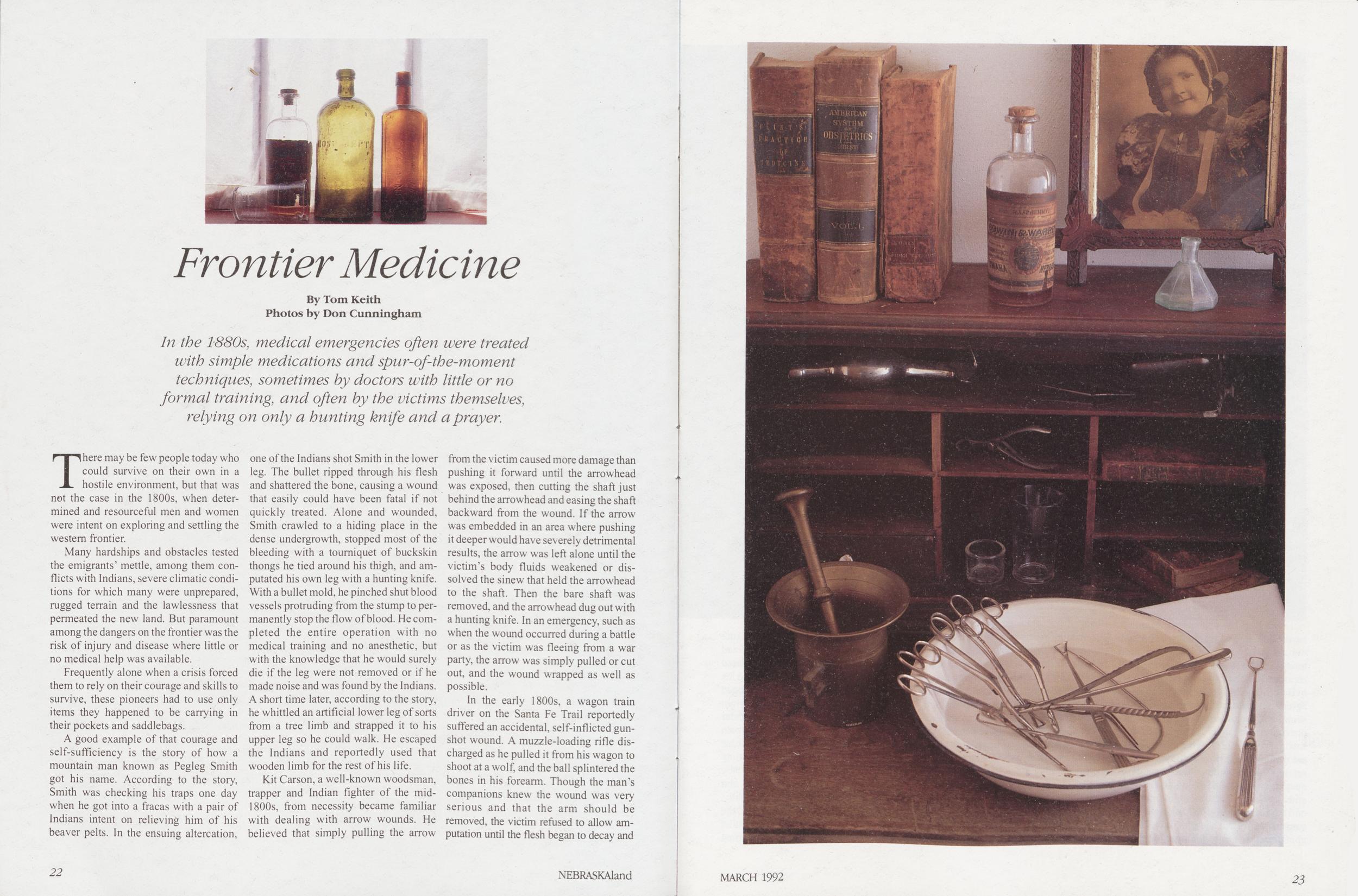
Frontier Medicine
By Tom Keith Photos by Don Cunningham In the 1880s, medical emergencies often were treated with simple medications and spur-of-the-moment techniques, sometimes by doctors with little or no formal training, and often by the victims themselves, relying on only a hunting knife and a prayerMany hardships and obstacles tested the emigrants' mettle, among them conflicts with Indians, severe climatic conditions for v/hich many were unprepared, rugged terrain and the lawlessness that permeated the new land. But paramount among the dangers on the frontier was the risk of injury and disease where little or no medical help was available.
Frequently alone when a crisis forced them to rely on their courage and skills to survive, these pioneers had to use only items they happened to be carrying in their pockets and saddlebags.
A good example of that courage and self-sufficiency is the story of how a mountain man known as Pegleg Smith got his name. According to the story, Smith was checking his traps one day when he got into a fracas with a pair of Indians intent on relieving him of his beaver pelts. In the ensuing altercation, 22 one of the Indians shot Smith in the lower leg. The bullet ripped through his flesh and shattered the bone, causing a wound that easily could have been fatal if not quickly treated. Alone and wounded. Smith crawled to a hiding place in the dense undergrowth, stopped most of the bleeding with a tourniquet of buckskin thongs he tied around his thigh, and amputated his own leg with a hunting knife. With a bullet mold, he pinched shut blood vessels protruding from the stump to permanently stop the flow of blood. He completed the entire operation with no medical training and no anesthetic, but with the knowledge that he would surely die if the leg were not removed or if he made noise and was found by the Indians. A short time later, according to the story, he whittled an artificial lower leg of sorts from a tree limb and strapped it to his upper leg so he could walk. He escaped the Indians and reportedly used that wooden limb for the rest of his life.
Kit Carson, a well-known woodsman, trapper and Indian fighter of the mid 1800s, from necessity became familiar with dealing with arrow wounds. He believed that simply pulling the arrow from the victim caused more damage than pushing it forward until the arrowhead was exposed, then cutting the shaft just behind the arrowhead and easing the shaft backward from the wound. If the arrow was embedded in an area where pushing it deeper would have severely detrimental results, the arrow was left alone until the victim's body fluids weakened or dissolved the sinew that held the arrowhead to the shaft. Then the bare shaft was removed, and the arrowhead dug out with a hunting knife. In an emergency, such as when the wound occurred during a battle or as the victim was fleeing from a war party, the arrow was simply pulled or cut out, and the wound wrapped as well as possible.
In the early 1800s, a wagon train driver on the Santa Fe Trail reportedly suffered an accidental, self-inflicted gunshot wound. A muzzle-loading rifle discharged as he pulled it from his wagon to shoot at a wolf, and the ball splintered the bones in his forearm. Though the man's companions knew the wound was very serious and that the arm should be removed, the victim refused to allow amputation until the flesh began to decay and 22 NEBRASKAland
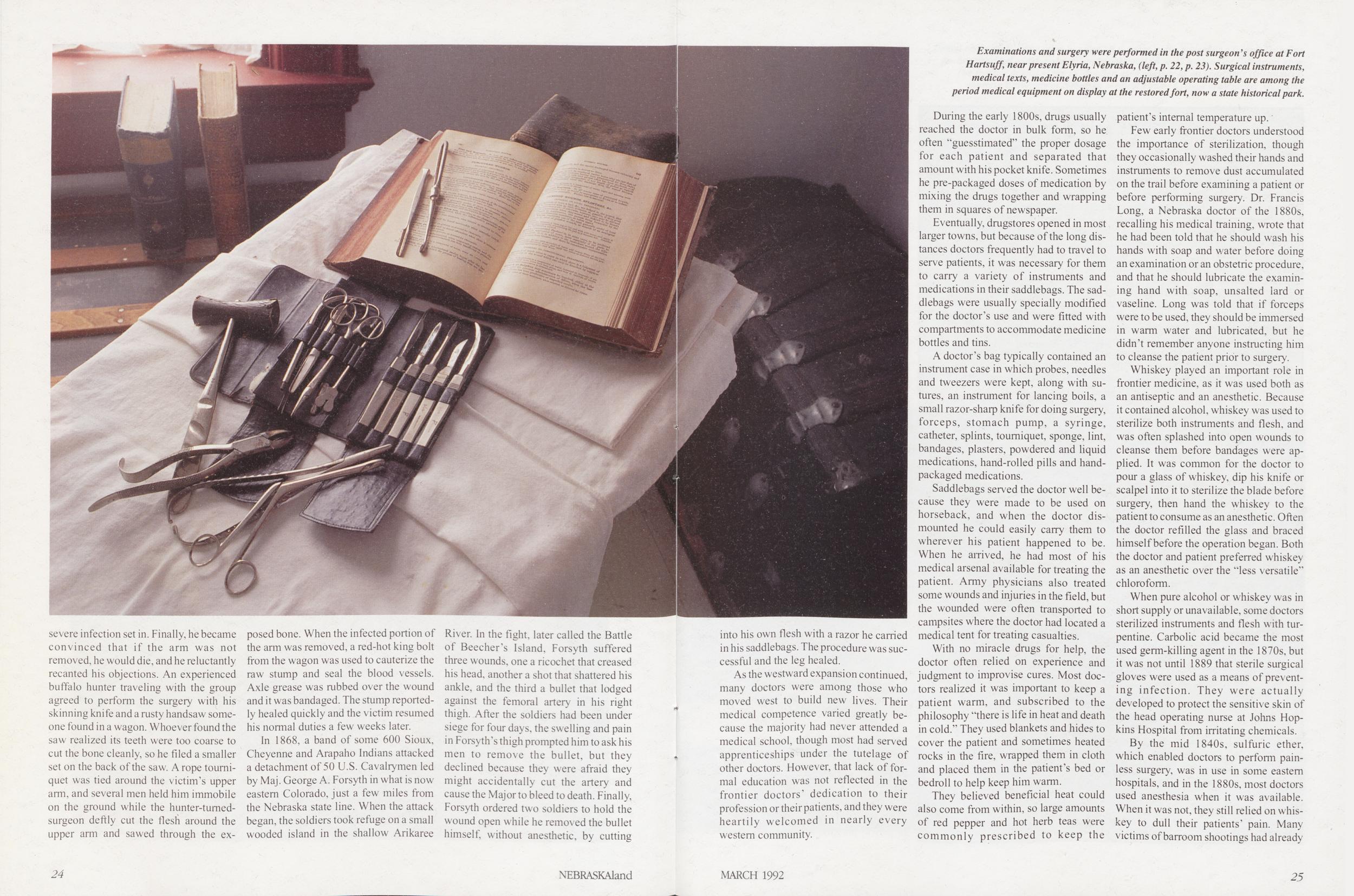
In 1868, a band of some 600 Sioux, Cheyenne and Arapaho Indians attacked a detachment of 50 U.S. Cavalrymen led by Maj. George A. Forsyth in what is now eastern Colorado, just a few miles from the Nebraska state line. When the attack began, the soldiers took refuge on a small wooded island in the shallow Arikaree River. In the fight, later called the Battle of Beecher's Island, Forsyth suffered three wounds, one a ricochet that creased his head, another a shot that shattered his ankle, and the third a bullet that lodged against the femoral artery in his right thigh. After the soldiers had been under siege for four days, the swelling and pain in Forsyth's thigh prompted him to ask his men to remove the bullet, but they declined because they were afraid they might accidentally cut the artery and cause the Major to bleed to death. Finally, Forsyth ordered two soldiers to hold the wound open while he removed the bullet himself, without anesthetic, by cutting 24 NEBRASKAland into his own flesh with a razor he carried in his saddlebags. The procedure was successful and the leg healed.
As the westward expansion continued, many doctors were among those who moved west to build new lives. Their medical competence varied greatly because the majority had never attended a medical school, though most had served apprenticeships under the tutelage of other doctors. However, that lack of formal education was not reflected in the frontier doctors' dedication to their profession or their patients, and they were heartily welcomed in nearly every western community.
During the early 1800s, drugs usually reached the doctor in bulk form, so he often "guesstimated" the proper dosage for each patient and separated that amount with his pocket knife. Sometimes he pre-packaged doses of medication by mixing the drugs together and wrapping them in squares of newspaper.
Eventually, drugstores opened in most larger towns, but because of the long distances doctors frequently had to travel to serve patients, it was necessary for them to carry a variety of instruments and medications in their saddlebags. The saddlebags were usually specially modified for the doctor's use and were fitted with compartments to accommodate medicine bottles and tins.
A doctor's bag typically contained an instrument case in which probes, needles and tweezers were kept, along with sutures, an instrument for lancing boils, a small razor-sharp knife fordoing surgery, forceps, stomach pump, a syringe, catheter, splints, tourniquet, sponge, lint, bandages, plasters, powdered and liquid medications, hand-rolled pills and handpackaged medications.
Saddlebags served the doctor well because they were made to be used on horseback, and when the doctor dismounted he could easily carry them to wherever his patient happened to be. When he arrived, he had most of his medical arsenal available for treating the patient. Army physicians also treated some wounds and injuries in the field, but the wounded were often transported to campsites where the doctor had located a medical tent for treating casualties.
With no miracle drugs for help, the doctor often relied on experience and judgment to improvise cures. Most doctors realized it was important to keep a patient warm, and subscribed to the philosophy "there is life in heat and death in cold." They used blankets and hides to cover the patient and sometimes heated rocks in the fire, wrapped them in cloth and placed them in the patient's bed or bedroll to help keep him warm.
They believed beneficial heat could also come from within, so large amounts of red pepper and hot herb teas were commonly prescribed to keep the patient's internal temperature up.
Few early frontier doctors understood the importance of sterilization, though they occasionally washed their hands and instruments to remove dust accumulated on the trail before examining a patient or before performing surgery. Dr. Francis Long, a Nebraska doctor of the 1880s, recalling his medical training, wrote that he had been told that he should wash his hands with soap and water before doing an examination or an obstetric procedure, and that he should lubricate the examining hand with soap, unsalted lard or vaseline. Long was told that if forceps were to be used, they should be immersed in warm water and lubricated, but he didn't remember anyone instructing him to cleanse the patient prior to surgery.
Whiskey played an important role in frontier medicine, as it was used both as an antiseptic and an anesthetic. Because it contained alcohol, whiskey was used to sterilize both instruments and flesh, and was often splashed into open wounds to cleanse them before bandages were applied. It was common for the doctor to pour a glass of whiskey, dip his knife or scalpel into it to sterilize the blade before surgery, then hand the whiskey to the patient to consume as an anesthetic. Often the doctor refilled the glass and braced himself before the operation began. Both the doctor and patient preferred whiskey as an anesthetic over the "less versatile" chloroform.
When pure alcohol or whiskey was in short supply or unavailable, some doctors sterilized instruments and flesh with turpentine. Carbolic acid became the most used germ-killing agent in the 1870s, but it was not until 1889 that sterile surgical gloves were used as a means of preventing infection. They were actually developed to protect the sensitive skin of the head operating nurse at Johns Hopkins Hospital from irritating chemicals.
By the mid 1840s, sulfuric ether, which enabled doctors to perform painless surgery, was in use in some eastern hospitals, and in the 1880s, most doctors used anesthesia when it was available. When it was not, they still relied on whiskey to dull their patients' pain. Many victims of barroom shootings had already anesthetized themselves, often a partial cause of the altercation that resulted in the shooting. One doctor, who had little sympathy for men who drank heavily, got into arguments and settled them with gunplay, said, "If they can get drunk and shoot one another up, they can be sewed up without drugs."
MARCH 1992 25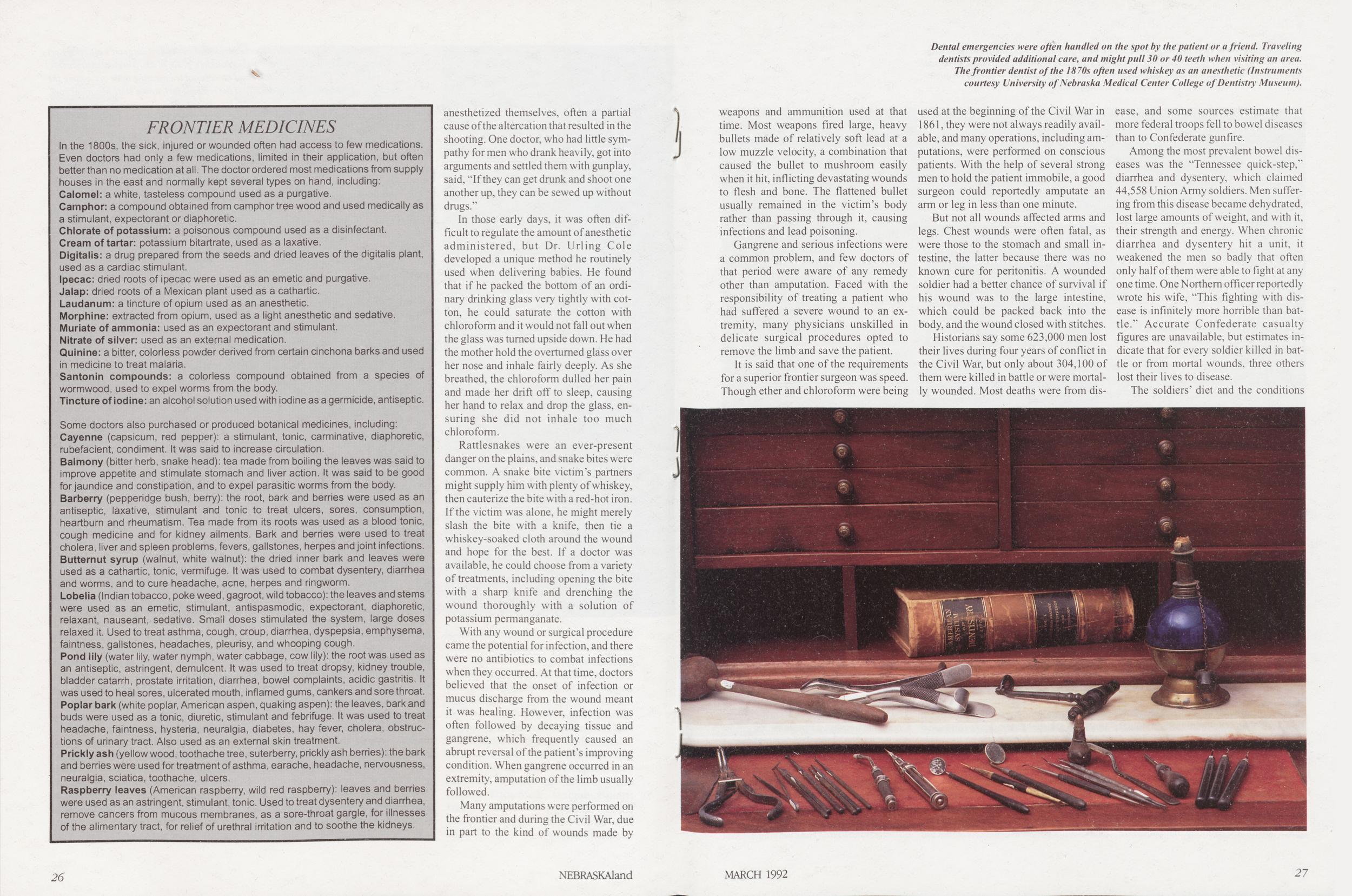 FRONTIER MEDICINES
In the 1800s, the sick, injured or wounded often had access to few medications.
Even doctors had only a few medications, limited in their application, but often
better than no medication at all. The doctor ordered most medications from supply
houses in the east and normally kept several types on hand, including:
Calomel: a white, tasteless compound used as a purgative.
Camphor: a compound obtained from camphor tree wood and used medically as
a stimulant, expectorant or diaphoretic.
Chlorate of potassium: a poisonous compound used as a disinfectant.
Cream of tartar: potassium bitartrate, used as a laxative.
Digitalis: a drug prepared from the seeds and dried leaves of the digitalis plant,
used as a cardiac stimulant.
Ipecac: dried roots of ipecac were used as an emetic and purgative.
Jalap: dried roots of a Mexican plant used as a cathartic.
Laudanum: a tincture of opium used as an anesthetic.
Morphine: extracted from opium, used as a light anesthetic and sedative.
Muriate of ammonia: used as an expectorant and stimulant.
Nitrate of silver: used as an external medication.
Quinine: a bitter, colorless powder derived from certain cinchona barks and used
in medicine to treat malaria.
Santonin compounds: a colorless compound obtained from a species of
wormwood, used to expel worms from the body.
Tincture of iodine: an alcohol solution used with iodine as a germicide, antiseptic.
Some doctors also purchased or produced botanical medicines, including:
Cayenne (capsicum, red pepper): a stimulant, tonic, carminative, diaphoretic,
rubefacient, condiment. It was said to increase circulation.
Balmony (bitter herb, snake head): tea made from boiling the leaves was said to
improve appetite and stimulate stomach and liver action, it was said to be good
for jaundice and constipation, and to expel parasitic worms from the body.
Barberry (pepperidge bush, berry): the root, bark and berries were used as an
antiseptic, laxative, stimulant and tonic to treat ulcers, sores, consumption,
heartburn and rheumatism. Tea made from its roots was used as a blood tonic,
cough medicine and for kidney ailments. Bark and berries were used to treat
cholera, liver and spleen problems, fevers, gallstones, herpes and joint infections.
Butternut syrup (walnut, white walnut): the dried inner bark and leaves were
used as a cathartic, tonic, vermifuge. It was used to combat dysentery, diarrhea
and worms, and to cure headache, acne, herpes and ringworm.
Lobelia (Indian tobacco, poke weed, gagroot, wild tobacco): the leaves and stems
were used as an emetic, stimulant, antispasmodic, expectorant, diaphoretic,
relaxant, nauseant, sedative. Small doses stimulated the system, large doses
relaxed it. Used to treat asthma, cough, croup, diarrhea, dyspepsia, emphysema,
faintness, gallstones, headaches, pleurisy, and whooping cough.
Pond lily (water lily, water nymph, water cabbage, cow lily): the root was used as
an antiseptic, astringent, demulcent. It was used to treat dropsy, kidney trouble,
bladder catarrh, prostate irritation, diarrhea, bowel complaints, acidic gastritis.
It
was used to heal sores, ulcerated mouth, inflamed gums, cankers and sore throat.
Poplar bark (white poplar, American aspen, quaking aspen): the leaves, bark and
buds were used as a tonic, diuretic, stimulant and febrifuge. It was used to treat
headache, faintness, hysteria, neuralgia, diabetes, hay fever, cholera, obstructions
of urinary tract. Also used as an external skin treatment.
Prickly ash (yellow wood, toothache tree, suterberry, prickly ash berries): the bark
and berries were used for treatment of asthma, earache, headache, nervousness,
neuralgia, sciatica, toothache, ulcers.
Raspberry leaves (American raspberry, wild red raspberry): leaves and berries
were used as an astringent, stimulant, tonic. Used to treat dysentery and diarrhea,
remove cancers from mucous membranes, as a sore-throat gargle, for illnesses
of the alimentary tract, for relief of urethral irritation and to soothe the kidneys.
FRONTIER MEDICINES
In the 1800s, the sick, injured or wounded often had access to few medications.
Even doctors had only a few medications, limited in their application, but often
better than no medication at all. The doctor ordered most medications from supply
houses in the east and normally kept several types on hand, including:
Calomel: a white, tasteless compound used as a purgative.
Camphor: a compound obtained from camphor tree wood and used medically as
a stimulant, expectorant or diaphoretic.
Chlorate of potassium: a poisonous compound used as a disinfectant.
Cream of tartar: potassium bitartrate, used as a laxative.
Digitalis: a drug prepared from the seeds and dried leaves of the digitalis plant,
used as a cardiac stimulant.
Ipecac: dried roots of ipecac were used as an emetic and purgative.
Jalap: dried roots of a Mexican plant used as a cathartic.
Laudanum: a tincture of opium used as an anesthetic.
Morphine: extracted from opium, used as a light anesthetic and sedative.
Muriate of ammonia: used as an expectorant and stimulant.
Nitrate of silver: used as an external medication.
Quinine: a bitter, colorless powder derived from certain cinchona barks and used
in medicine to treat malaria.
Santonin compounds: a colorless compound obtained from a species of
wormwood, used to expel worms from the body.
Tincture of iodine: an alcohol solution used with iodine as a germicide, antiseptic.
Some doctors also purchased or produced botanical medicines, including:
Cayenne (capsicum, red pepper): a stimulant, tonic, carminative, diaphoretic,
rubefacient, condiment. It was said to increase circulation.
Balmony (bitter herb, snake head): tea made from boiling the leaves was said to
improve appetite and stimulate stomach and liver action, it was said to be good
for jaundice and constipation, and to expel parasitic worms from the body.
Barberry (pepperidge bush, berry): the root, bark and berries were used as an
antiseptic, laxative, stimulant and tonic to treat ulcers, sores, consumption,
heartburn and rheumatism. Tea made from its roots was used as a blood tonic,
cough medicine and for kidney ailments. Bark and berries were used to treat
cholera, liver and spleen problems, fevers, gallstones, herpes and joint infections.
Butternut syrup (walnut, white walnut): the dried inner bark and leaves were
used as a cathartic, tonic, vermifuge. It was used to combat dysentery, diarrhea
and worms, and to cure headache, acne, herpes and ringworm.
Lobelia (Indian tobacco, poke weed, gagroot, wild tobacco): the leaves and stems
were used as an emetic, stimulant, antispasmodic, expectorant, diaphoretic,
relaxant, nauseant, sedative. Small doses stimulated the system, large doses
relaxed it. Used to treat asthma, cough, croup, diarrhea, dyspepsia, emphysema,
faintness, gallstones, headaches, pleurisy, and whooping cough.
Pond lily (water lily, water nymph, water cabbage, cow lily): the root was used as
an antiseptic, astringent, demulcent. It was used to treat dropsy, kidney trouble,
bladder catarrh, prostate irritation, diarrhea, bowel complaints, acidic gastritis.
It
was used to heal sores, ulcerated mouth, inflamed gums, cankers and sore throat.
Poplar bark (white poplar, American aspen, quaking aspen): the leaves, bark and
buds were used as a tonic, diuretic, stimulant and febrifuge. It was used to treat
headache, faintness, hysteria, neuralgia, diabetes, hay fever, cholera, obstructions
of urinary tract. Also used as an external skin treatment.
Prickly ash (yellow wood, toothache tree, suterberry, prickly ash berries): the bark
and berries were used for treatment of asthma, earache, headache, nervousness,
neuralgia, sciatica, toothache, ulcers.
Raspberry leaves (American raspberry, wild red raspberry): leaves and berries
were used as an astringent, stimulant, tonic. Used to treat dysentery and diarrhea,
remove cancers from mucous membranes, as a sore-throat gargle, for illnesses
of the alimentary tract, for relief of urethral irritation and to soothe the kidneys.
In those early days, it was often difficult to regulate the amount of anesthetic administered, but Dr. Urling Cole developed a unique method he routinely used when delivering babies. He found that if he packed the bottom of an ordinary drinking glass very tightly with cotton, he could saturate the cotton with chloroform and it would not fall out when the glass was turned upside down. He had the mother hold the overturned glass over her nose and inhale fairly deeply. As she breathed, the chloroform dulled her pain and made her drift off to sleep, causing her hand to relax and drop the glass, ensuring she did not inhale too much chloroform.
Rattlesnakes were an ever-present danger on the plains, and snake bites were common. A snake bite victim's partners might supply him with plenty of whiskey, then cauterize the bite with a red-hot iron. If the victim was alone, he might merely slash the bite with a knife, then tie a whiskey-soaked cloth around the wound and hope for the best. If a doctor was available, he could choose from a variety of treatments, including opening the bite with a sharp knife and drenching the wound thoroughly with a solution of potassium permanganate.
With any wound or surgical procedure came the potential for infection, and there were no antibiotics to combat infections when they occurred. At that time, doctors believed that the onset of infection or mucus discharge from the wound meant it was healing. However, infection was often followed by decaying tissue and gangrene, which frequently caused an abrupt reversal of the patient's improving condition. When gangrene occurred in an extremity, amputation of the limb usually followed.
Many amputations were performed on the frontier and during the Civil War, due in part to the kind of wounds made by 26 MEBRASKAland weapons and ammunition used at that time. Most weapons fired large, heavy bullets made of relatively soft lead at a low muzzle velocity, a combination that caused the bullet to mushroom easily when it hit, inflicting devastating wounds to flesh and bone. The flattened bullet usually remained in the victim's body rather than passing through it, causing infections and lead poisoning.
Gangrene and serious infections were a common problem, and few doctors of that period were aware of any remedy other than amputation. Faced with the responsibility of treating a patient who had suffered a severe wound to an extremity, many physicians unskilled in delicate surgical procedures opted to remove the limb and save the patient.
It is said that one of the requirements for a superior frontier surgeon was speed. Though ether and chloroform were being used at the beginning of the Civil War in 1861, they were not always readily available, and many operations, including amputations, were performed on conscious patients. With the help of several strong men to hold the patient immobile, a good surgeon could reportedly amputate an arm or leg in less than one minute.
But not all wounds affected arms and legs. Chest wounds were often fatal, as were those to the stomach and small intestine, the latter because there was no known cure for peritonitis. A wounded soldier had a better chance of survival if his wound was to the large intestine, which could be packed back into the body, and the wound closed with stitches.
Historians say some 623,000 men lost their lives during four years of conflict in the Civil War, but only about 304,100 of them were killed in battle or were mortally wounded. Most deaths were from disease, and some sources estimate that more federal troops fell to bowel diseases than to Confederate gunfire.
Among the most prevalent bowel diseases was the "Tennessee quick-step," diarrhea and dysentery, which claimed 44,558 Union Army soldiers. Men suffering from this disease became dehydrated, lost large amounts of weight, and with it, their strength and energy. When chronic diarrhea and dysentery hit a unit, it weakened the men so badly that often only halfofthem were able to fight at any one time. One Northern officer reportedly wrote his wife, "This fighting with disease is infinitely more horrible than battle." Accurate Confederate casualty figures are unavailable, but estimates indicate that for every soldier killed in battle or from mortal wounds, three others lost their lives to disease.
The soldiers' diet and the conditions
Camp fevers, such as typhoid, typhus and others claimed 40,656 soldiers, and pneumonia took another 19,971 lives.
A bowel disease infinitely worse than ordinary diarrhea and dysentery was cholera. An adage among army surgeons on the western frontier was "10 men in war die of disease for every one killed by the enemy." The most lethal killers in the west were cholera, scurvy, yellow fever, tuberculosis and typhoid fever.
An epidemic of cholera started in Asia during the 1830s, swept across Europe, came to America on ships in the 1840s and continued west on river steamers and wagon trains. It lasted for nearly 20 years and killed more than 30,000 people in 1850 alone. The first cholera epidemic in America occurred in the fall of 1832 in New Orleans where the disease killed 6,000 people in a two-week period.
Spread by polluted water, cholera was characterized by relentless diarrhea, severe cramps, chills, fever, violent vomiting and convulsions. In acute cases, it cramped the victim's stomach, bowels and arm and leg muscles. President Zachery Taylor died of Asiatic cholera in 1850 while serving in office.
Cholera ran rampant through frontier forts, and in 1855 it attacked Fort Riley, Kansas, with a vengeance. Luckily, the disease hit when most of the army personnel were away on a summer campaign, leaving only a labor force and a few soldiers on the post. During the first 24 hours of the epidemic, several men died and others came down with the disease. Many died less than 18 hours after cholera struck them. Though the epidemic lasted only about a week, it killed 75 to 100 men. Some men escaped the disease by deserting the fort and hiding in nearby hills.
Disease was one of the most formidable and deadly problems faced by emigrants traveling along wagon train routes. Historians estimate that about one in every 17 pioneers who set out on the Oregon Trail heading west died and was buried along the trail. Most of those 20,000 deaths were attributed to disease, and cholera was the most common killer. There were reportedly some 700 cholera graves near the trail route through Nebraska between the Missouri River and Fort Laramie, Wyoming. Many of the travelers are thought to have contracted the disease by drinking from stagnant pools and water holes along the trail instead of from the safer Platte River. The solemn epitaph, "Died of Cholera," was commonly carved on wooden markers along the trail.
Once a person contracted the disease, death from cholera was so certain that the victim's family or friends often dug the grave before he or she actually died. On the trail, settlers had no lumber available for building coffins, so the dead were usually wrapped in clothing or blankets for burial. Because Indians had been known to remove emigrants' bodies from their graves to mutilate them, some graves were hidden in wagon ruts on the trail. While that tactic might have fooled some Indians, it was nearly impossible to hide a grave from wolves. On the other hand, rocks placed over a grave protected it from wolves, but clearly signalled its location to Indians.
Other contagious illnesses brought to America by Europeans, including smallpox, typhus, measles, cholera and tuberculosis, took a dreadful toll on Indian tribes which had no immunity to them. Smallpox, chicken pox and measles raged through many Indian villages shortly after the Indians made contact with white parties. In 1831, smallpox swept the Pawnee nation and fully half the population succumbed to the disease. Smallpox struck again in 1837, when entire Assinniboin villages were wiped out, Blackfoot numbers were reduced by a third, and the Mandan population dropped from 1,600 people to 150. Indian numbers were again diminished in 1847, when measles accompanied wagon trains traveling over the Oregon Trail and the rapidly spreading disease swept through many villages.
Most soldiers who had grown up in cities experienced "childhood" diseases when they were young and developed immunities that protected them in later life. On the other hand, many men from rural areas had not previously been exposed to those diseases, and as a result measles, mumps and scarlet fever ran rampant through military training camps.
Typhoid fever was common during the Civil War because of poor sanitary conditions in the field. Large numbers of troops produced a large amount of waste, and during the war waste accumulated rapidly and was burned or buried. Little effort was made to bury animals killed in battle, and their remains, as well as those of animals slaughtered for food, were left on the ground to rot. The decaying carcasses 28 NEBRASKAland
Scurvy also claimed the lives of many soldiers and settlers in the new land. Cantonment Missouri, a military installation on the Missouri River about a mile and a half north of what later became Fort Atkinson in present Washington County, was the scene of a terrible scurvy epidemic in 1819-20, the first winter of its existence. It was the first military post in Nebraska, and, at that time, the western most settlement in the country.
Severe winter conditions contributed to a shortage of supplies, and game was difficult to find during the winter. The soldiers quickly exhausted their supply of fresh meat and vegetables. During that winter, some 160 men died of scurvy and fevers. Many more were hospitalized from the debilitating effects of the simple lack of vitamin C in their diet. As spring approached, two army surgeons supplemented the stricken soldiers' diets with wild onions dug from fields surrounding the camp. Finally, when spring arrived, troops from Fort Osage drove a herd of cattle to Cantonment Missouri, which provided the garrison with vitamin C in the form of fresh meat, milk and butter.
Army physicians realized scurvy and several other lesser maladies suffered by the troops were caused by their spartan diet of salted meat, black coffee, white bread, soda biscuits, hardtack, lard and syrup. Settlers also suffered from scurvy when they eliminated vitamin C from their diets, so doctors sometimes gathered wild fruits such as prickly pear, gooseberries and blackberries, and vegetables such as wild lettuce, onions and poke weed to supply to their scurvy patients. Those who enjoyed gardening raised tomatoes, cabbage and kohlrabi, which also helped combat the disease.
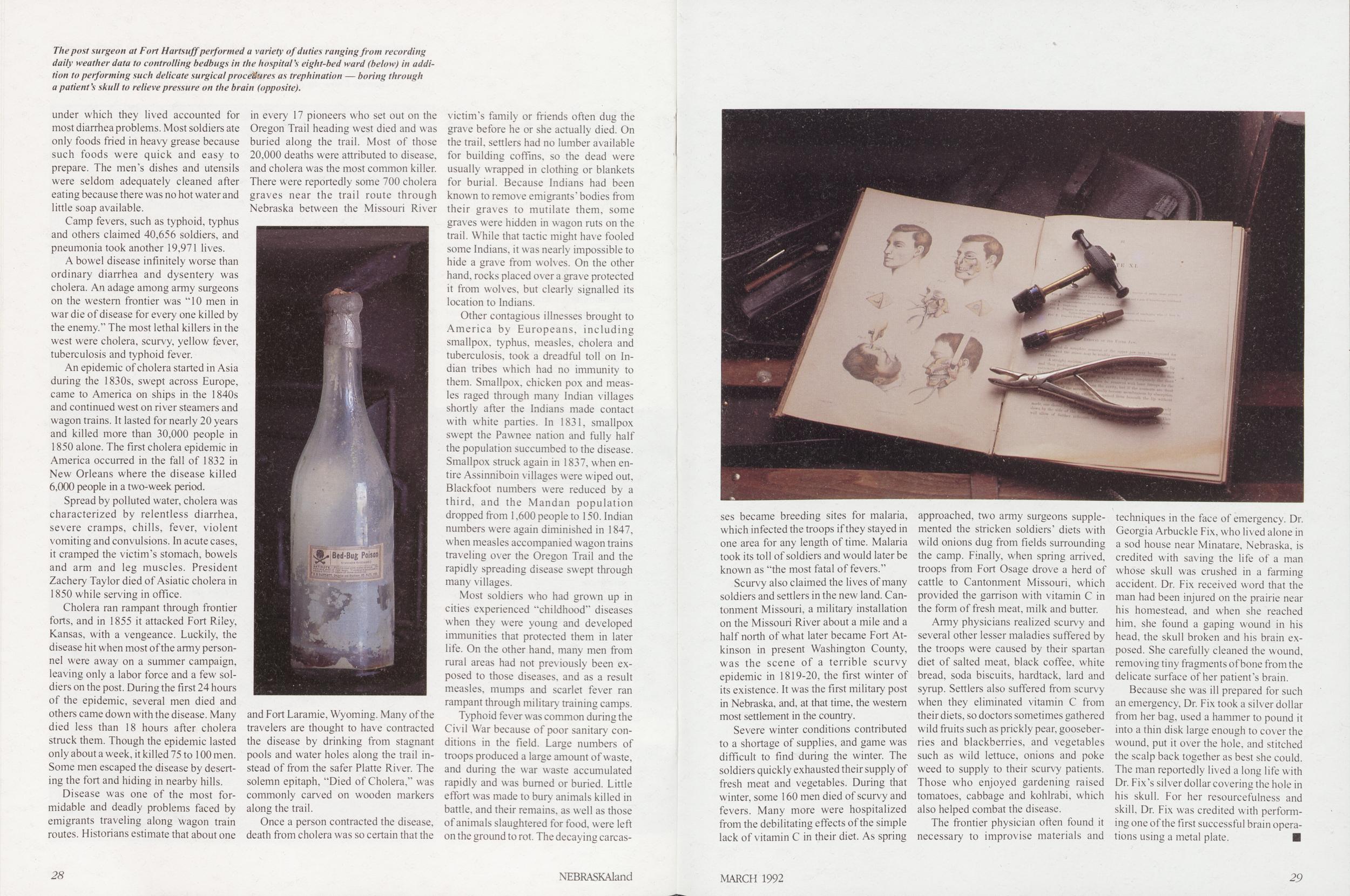
The frontier physician often found it necessary to improvise materials and techniques in the face of emergency. Dr. Georgia Arbuckle Fix, who lived alone in a sod house near Minatare, Nebraska, is credited with saving the life of a man whose skull was crushed in a farming accident. Dr. Fix received word that the man had been injured on the prairie near his homestead, and when she reached him. she found a gaping wound in his head, the skull broken and his brain exposed. She carefully cleaned the wound, removing tiny fragments of bone from the delicate surface of her patient's brain.
Because she was ill prepared for such an emergency, Dr. Fix took a silver dollar from her bag, used a hammer to pound it into a thin disk large enough to cover the wound, put it over the hole, and stitched the scalp back together as best she could. The man reportedly lived a long life with Dr. Fix's silver dollar covering the hole in his skull. For her resourcefulness and skill, Dr. Fix was credited with performing one of the first successful brain operations using a metal plate.
MARCH 1992 29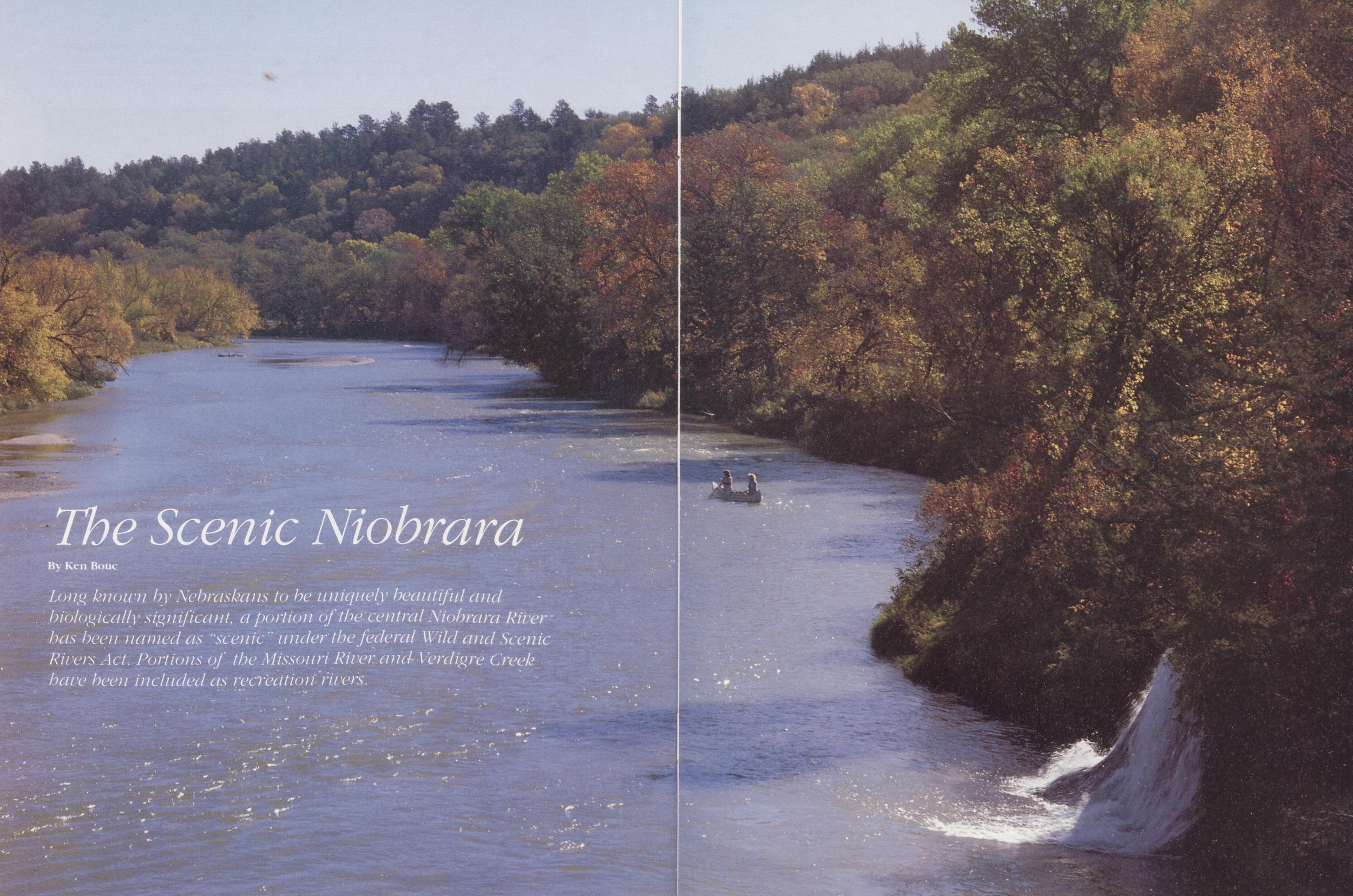
The Scenic Niobrara
By Ken Bouc Long known by Nebraskans to be uniquely beautiful and biologically significant, a portion of the. central Siohrara River has been named as "scenic" under the federal Wild and Scenic Rivers Act. For!ions of the Missouri River and erdigre Creek have been included as recreation rivers.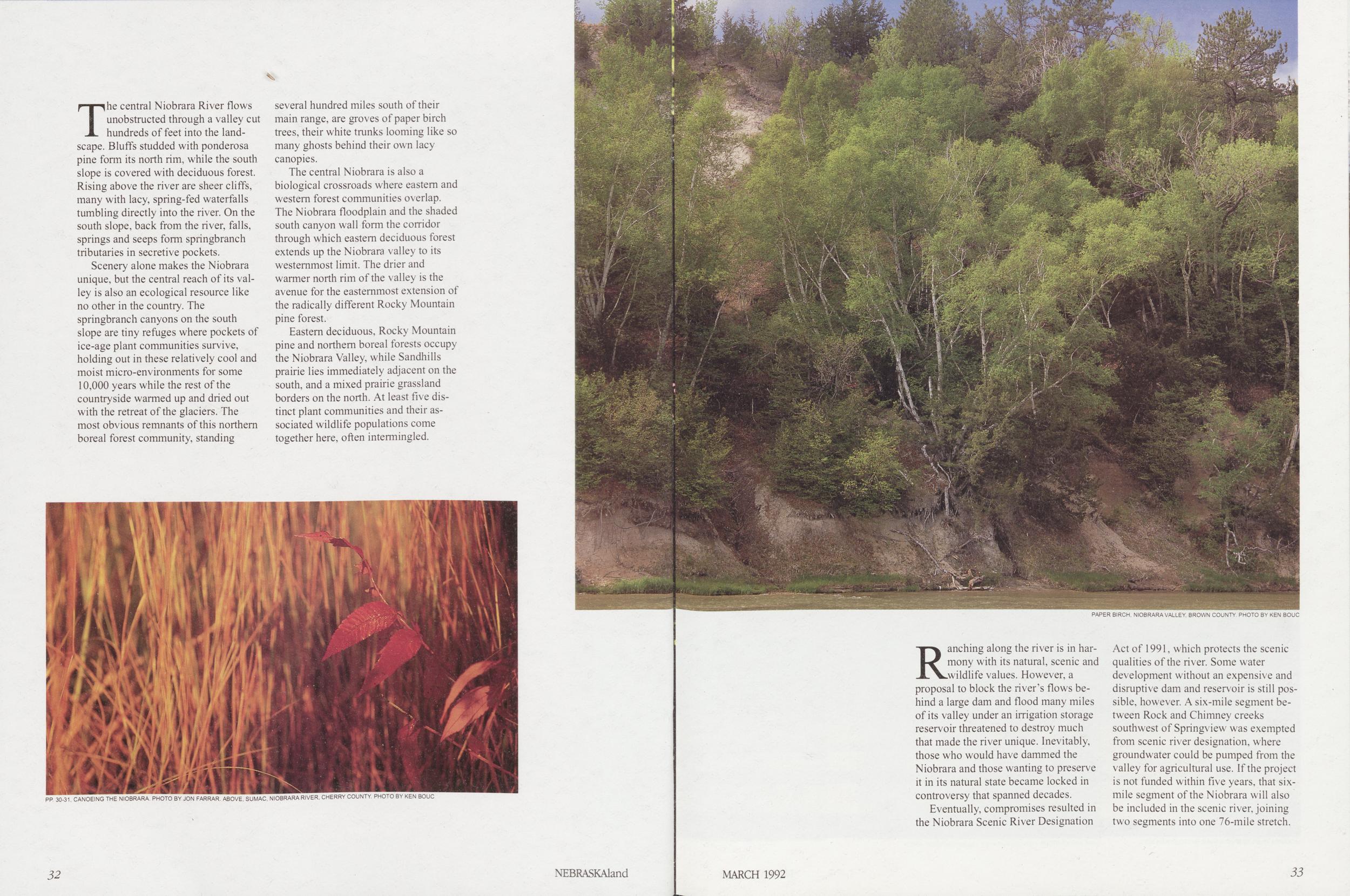
The central Niobrara River flows unobstructed through a valley cut hundreds of feet into the landscape. Bluffs studded with ponderosa pine form its north rim, while the south slope is covered with deciduous forest. Rising above the river are sheer cliffs, many with lacy, spring-fed waterfalls tumbling directly into the river. On the south slope, back from the river, falls, springs and seeps form springbranch tributaries in secretive pockets.
Scenery alone makes the Niobrara unique, but the central reach of its valley is also an ecological resource like no other in the country. The springbranch canyons on the south slope are tiny refuges where pockets of ice-age plant communities survive, holding out in these relatively cool and moist micro-environments for some 10,000 years while the rest of the countryside warmed up and dried out with the retreat of the glaciers. The most obvious remnants of this northern boreal forest community, standing several hundred miles south of their main range, are groves of paper birch trees, their white trunks looming like so many ghosts behind their own lacy canopies.
The central Niobrara is also a biological crossroads where eastern and western forest communities overlap. The Niobrara floodplain and the shaded south canyon wall form the corridor through which eastern deciduous forest extends up the Niobrara valley to its westernmost limit. The drier and warmer north rim of the valley is the avenue for the easternmost extension of the radically different Rocky Mountain pine forest.
Eastern deciduous, Rocky Mountain pine and northern boreal forests occupy the Niobrara Valley, while Sandhills prairie lies immediately adjacent on the south, and a mixed prairie grassland borders on the north. At least five distinct plant communities and their associated wildlife populations come together here, often intermingled.
Eventually, compromises resulted in
the Niobrara Scenic River Designation
Act of 1991, which protects the scenic
qualities of the river. Some water
development without an expensive and
disruptive dam and reservoir is still possible, however. A six-mile segment between
Rock and Chimney creeks
southwest of Springview was exempted
from scenic river designation, where
groundwater could be pumped from the
valley for agricultural use. If the project
is not funded within five years, that six-mile segment of the Niobrara will also
be included in the scenic river, joining
two segments into one 76-mile stretch.
MARCH 1992
33
 Nearly a year ago, the federal
government finally acknowledged what most Nebraskans
have known for a long time: The
Niobrara River is a unique and beautiful place, one worth preserving.
Nearly a year ago, the federal
government finally acknowledged what most Nebraskans
have known for a long time: The
Niobrara River is a unique and beautiful place, one worth preserving.
"Beautiful'1 may be strong language for legislators and bureaucrats, perhaps the reason the river was labeled "scenic," instead. "Scenic" may be somewhat weak descriptive language, but it is highly potent terminology under the Wild and Scenic Rivers Act.
Last year, the central Niobrara was added to the list of the nation's scenic rivers. That recognition guarantees that at least 70 miles of the central Niobrara will remain unpolluted, uncluttered, freeflowing and beautiful.
The same legislation also named waterways downstream as "recreation rivers." The Niobrara river between the western boundary of rCnox County and its confluence with the Missouri River, Verdigre Creek from the town of Verdigre to its mouth on the Niobrara and the Missouri River from Fort Randall Dam in South Dakota to Lewis and Clark Lake were included.
The Wild and Scenic Rivers Act of 1968 established three categories of rivers worth protecting and listed their qualities. Scenic rivers, such as the central Niobrara, are free of impoundments, with shorelines and watersheds mostly primitive and the river course accessible by road only in places. Recreation rivers, the Missouri and lower Niobrara rivers and Verdigre Creek included, may be somewhat more developed and accessible, but still must be free-flowing and natural in character. Wild rivers are primitive and usually accessable only by trails.
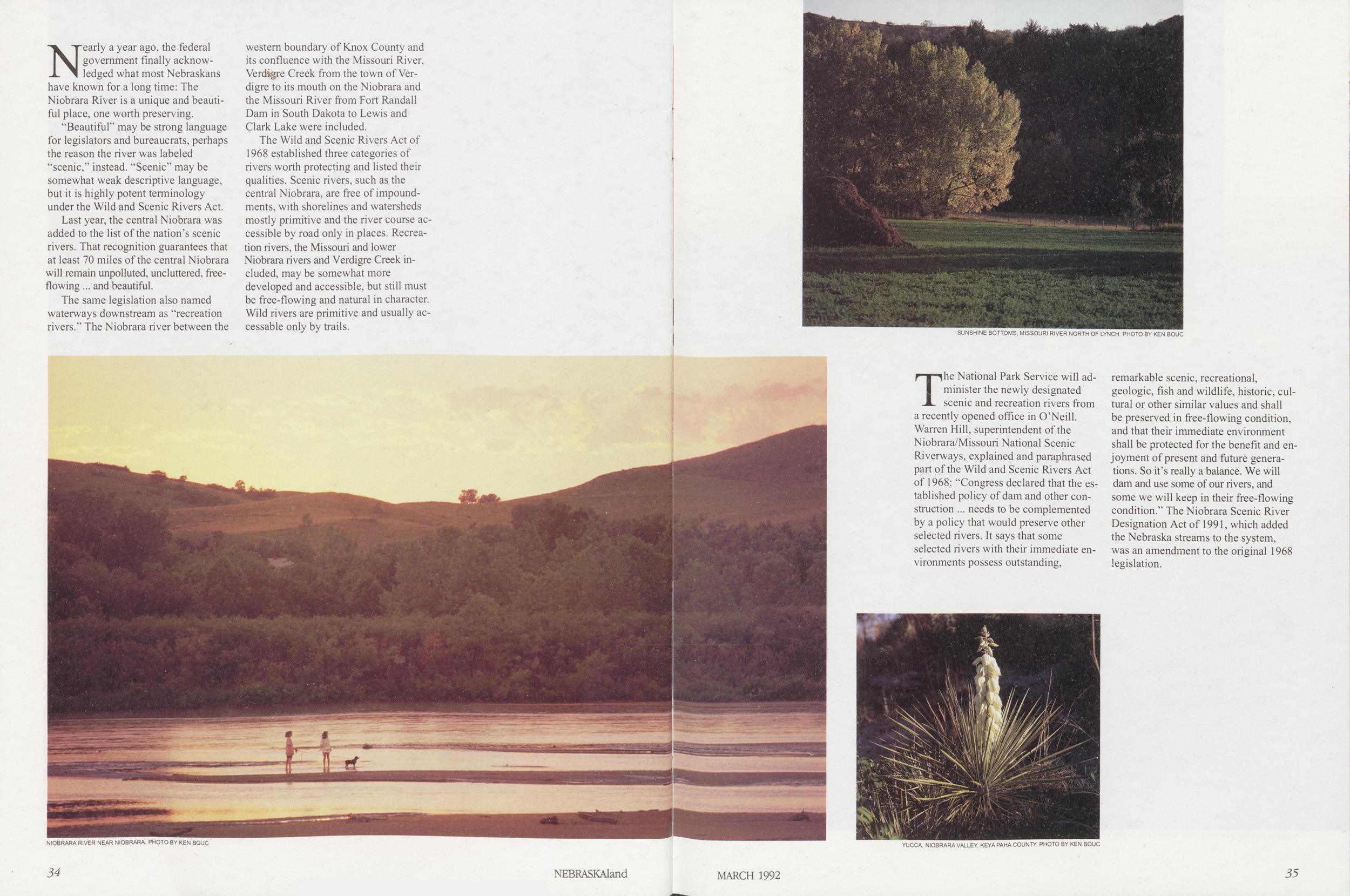
The National Park Service will administer the newly designated scenic and recreation rivers from a recently opened office in O'Neill. Warren Hill, superintendent of the Niobrara/Missouri National Scenic Riverways, explained and paraphrased part of the Wild and Scenic Rivers Act of 1968: "Congress declared that the established policy of dam and other construction needs to be complemented by a policy that would preserve other selected rivers. It says that some selected rivers with their immediate environments possess outstanding, NIOBRARA RIVER NEAR NIOBRARA. PHOTO BY KEN BOUC remarkable scenic, recreational, geologic, fish and wildlife, historic, cultural or other similar values and shall be preserved in free-flowing condition, and that their immediate environment shall be protected for the benefit and enjoyment of present and future generations. So it's really a balance. We will dam and use some of our rivers, and some we will keep in their free-flowing condition." The Niobrara Scenic River Designation Act of 1991, which added the Nebraska streams to the system, was an amendment to the original 1968 legislation.
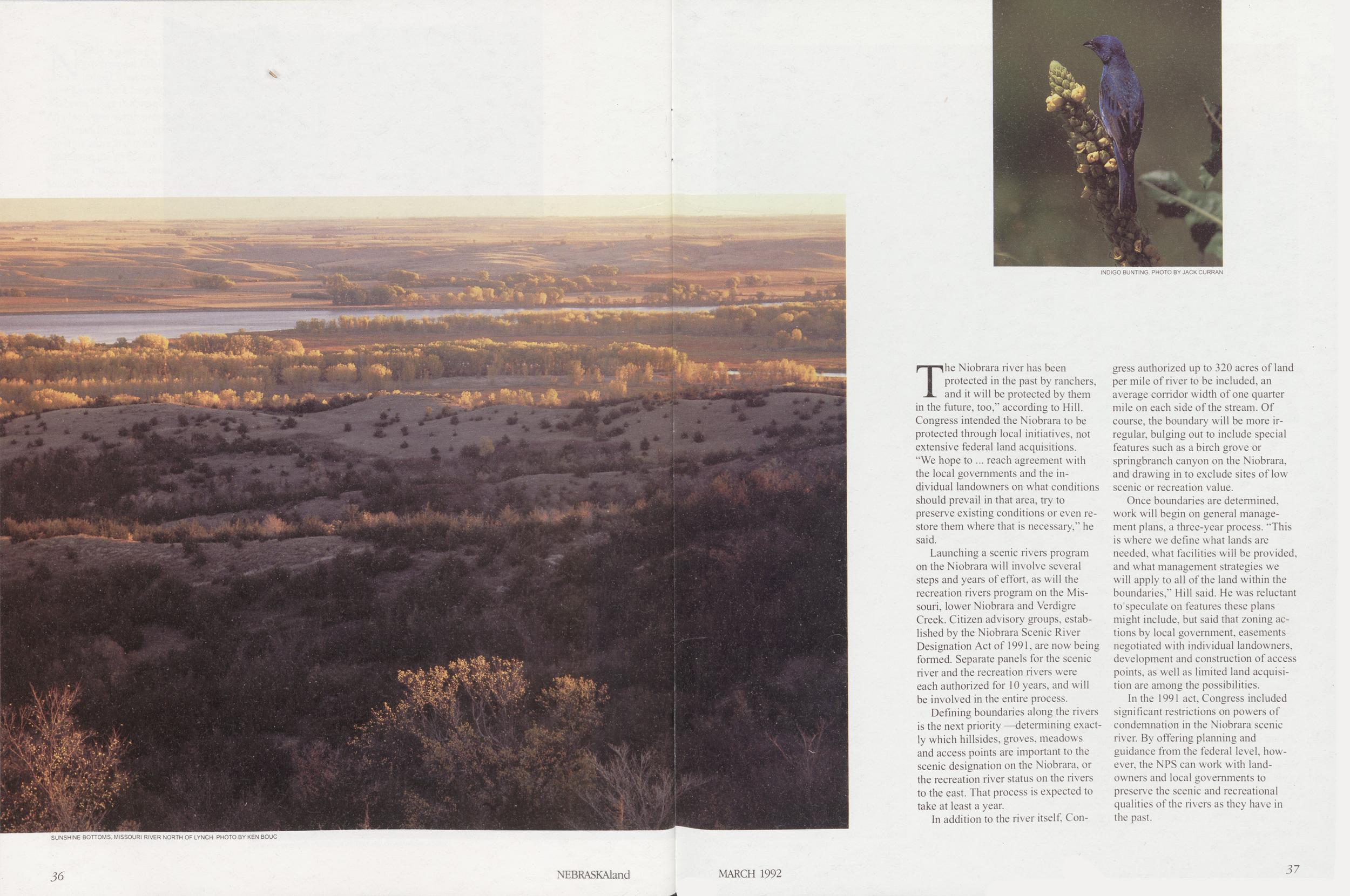
The Niobrara river has been protected in the past by ranchers, and it will be protected by them in the future, too," according to Hill. Congress intended the Niobrara to be protected through local initiatives, not extensive federal land acquisitions. "We hope to reach agreement with the local governments and the individual landowners on what conditions should prevail in that area, try to preserve existing conditions or even restore them where that is necessary," he said.
Launching a scenic rivers program on the Niobrara will involve several steps and years of effort, as will the recreation rivers program on the Missouri, lower Niobrara and Verdigre Creek. Citizen advisory groups, established by the Niobrara Scenic River Designation Act of 1991, are now being formed. Separate panels for the scenic river and the recreation rivers were each authorized for 10 years, and will be involved in the entire process.
Defining boundaries along the rivers is the next priority —determining exactly which hillsides, groves, meadows and access points are important to the scenic designation on the Niobrara, or the recreation river status on the rivers to the east. That process is expected to take at least a year.
In addition to the river itself, Congress authorized up to 320 acres of land per mile of river to be included, an average corridor width of one quarter mile on each side of the stream. Of course, the boundary will be more irregular, bulging out to include special features such as a birch grove or springbranch canyon on the Niobrara, and drawing in to exclude sites of low scenic or recreation value.
Once boundaries are determined, work will begin on general management plans, a three-year process. "This is where we define what lands are needed, what facilities will be provided, and what management strategies we will apply to all of the land within the boundaries," Hill said. He was reluctant to speculate on features these plans might include, but said that zoning actions by local government, easements negotiated with individual landowners, development and construction of access points, as well as limited land acquisition are among the possibilities.
In the 1991 act, Congress included significant restrictions on powers of condemnation in the Niobrara scenic river. By offering planning and guidance from the federal level, however, the NPS can work with landowners and local governments to preserve the scenic and recreational qualities of the rivers as they have in the past.
MARCH 1992 37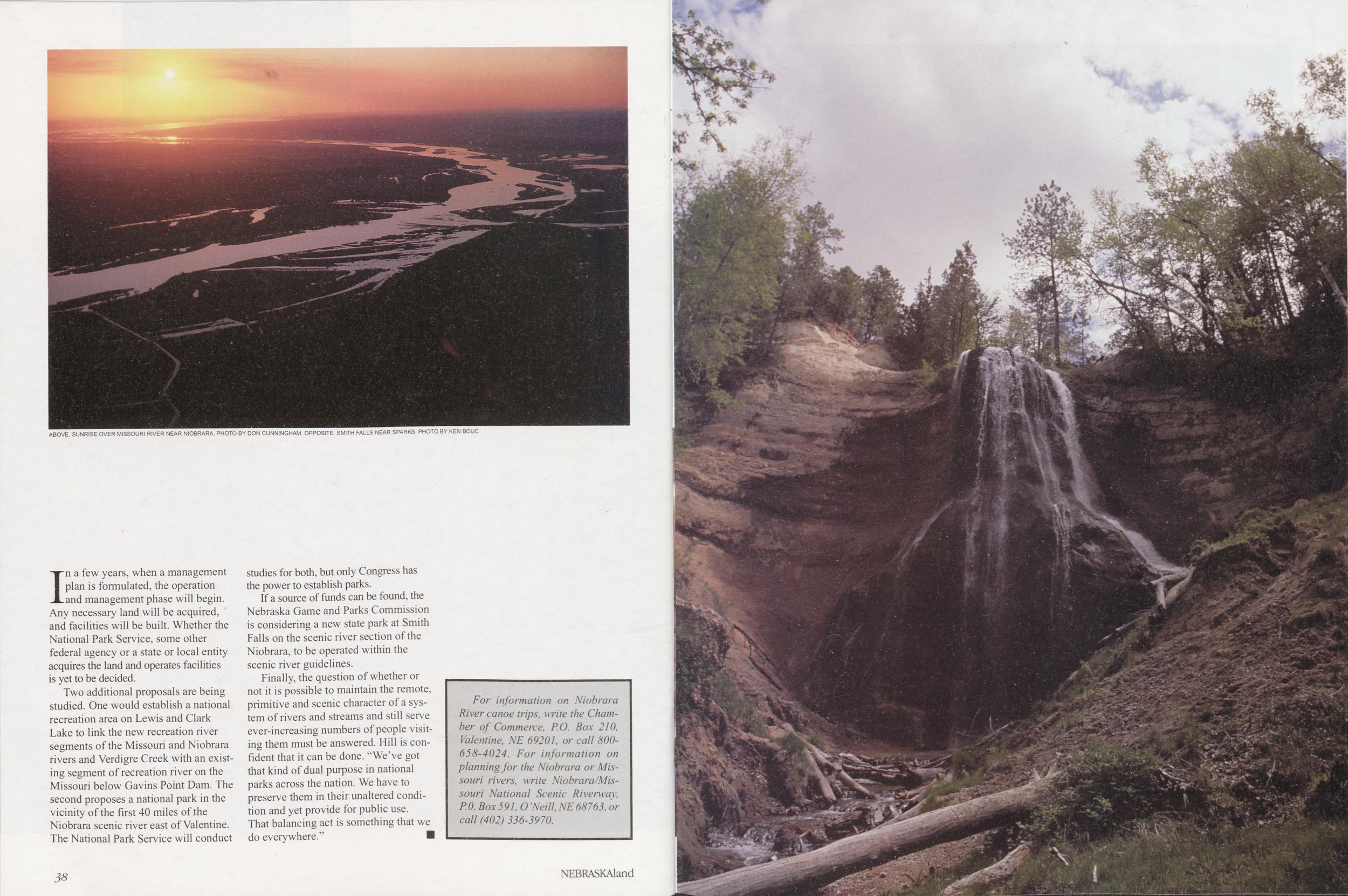
In a few years, when a management plan is formulated, the operation and management phase will begin. Any necessary land will be acquired, and facilities will be built. Whether the National Park Service, some other federal agency or a state or local entity acquires the land and operates facilities is yet to be decided.
Two additional proposals are being studied. One would establish a national recreation area on Lewis and Clark Lake to link the new recreation river segments of the Missouri and Niobrara rivers and Verdigre Creek with an existing segment of recreation river on the Missouri below Gavins Point Dam. The second proposes a national park in the vicinity of the first 40 miles of the Niobrara scenic river east of Valentine, he National Park Service will conduct studies for both, but only Congress has the power to establish parks.
If a source of funds can be found, the Nebraska Game and Parks Commission is considering a new state park at Smith Falls on the scenic river section of the Niobrara, to be operated within the scenic river guidelines.
Finally, the question of whether or not it is possible to maintain the remote, primitive and scenic character of a system of rivers and streams and still serve ever-increasing numbers of people visiting them must be answered. Hill is confident that it can be done. "We've got that kind of dual purpose in national parks across the nation. We have to preserve them in their unaltered condition and yet provide for public use. That balancing act is something that we do everywhere."
For information on Niobrara River canoe trips, write the Chamber of Commerce, P.O. Box 210, Valentine, NE 69201, or call 800-658-4024. For information on planning for the Niobrara or Missouri rivers, write Niobrara/Missouri National Scenic Riverwav, P. 0. Box 591, O Neill, NE 68763, or call (402) 336-3970. 38 NEBRASKAland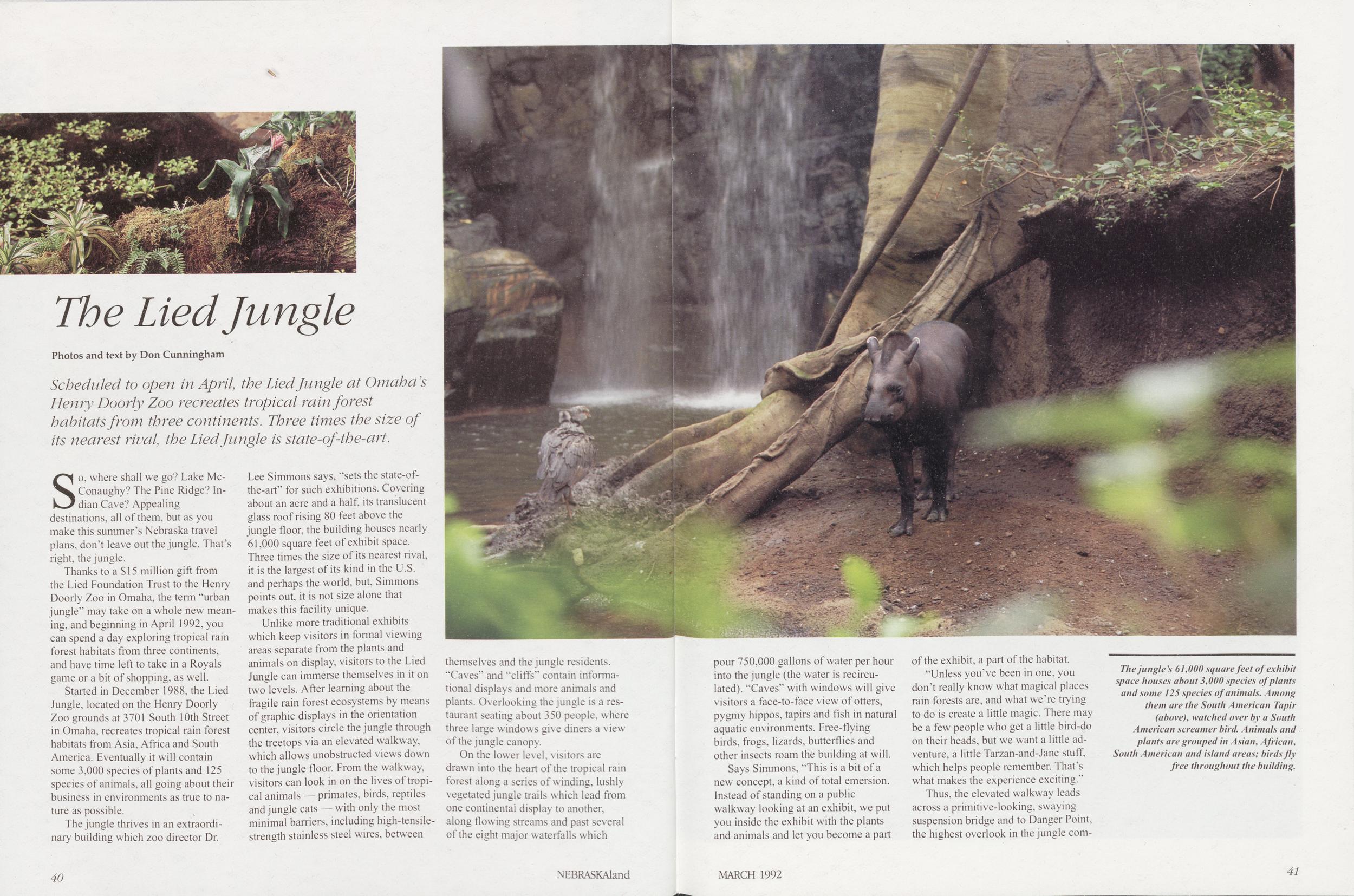
The Lied Jungle
Photos and text by Don Cunningham Scheduled to open in April, the Lied Jungle at Omaha's Henry) Doorly Zoo recreates tropical rainforest habitats from three continents. Three times the size of its nearest rival, the Lied Jungle is state-of-the-art.So, where shall we go? Lake McConaughy? The Pine Ridge? Indian Cave? Appealing destinations, all of them, but as you make this summer's Nebraska travel plans, don't leave out the jungle. That's right, the jungle.
Thanks to a $15 million gift from the Lied Foundation Trust to the Henry Doorly Zoo in Omaha, the term "urban jungle" may take on a whole new meaning, and beginning in April 1992, you can spend a day exploring tropical rain forest habitats from three continents, and have time left to take in a Royals game or a bit of shopping, as well.
Started in December 1988, the Lied Jungle, located on the Henry Doorly Zoo grounds at 3701 South 10th Street in Omaha, recreates tropical rain forest habitats from Asia, Africa and South America. Eventually it will contain some 3,000 species of plants and 125 species of animals, all going about their business in environments as true to nature as possible.
The jungle thrives in an extraordinary building which zoo director Dr. Lee Simmons says, "sets the state-of-the-art" for such exhibitions. Covering about an acre and a half, its translucent glass roof rising 80 feet above the jungle floor, the building houses nearly 61,000 square feet of exhibit space. Three times the size of its nearest rival, it is the largest of its kind in the U.S. and perhaps the world, but, Simmons points out, it is not size alone that makes this facility unique.
Unlike more traditional exhibits which keep visitors in formal viewing areas separate from the plants and animals on display, visitors to the Lied Jungle can immerse themselves in it on two levels. After learning about the fragile rain forest ecosystems by means of graphic displays in the orientation center, visitors circle the jungle through the treetops via an elevated walkway, which allows unobstructed views down to the jungle floor. From the walkway, visitors can look in on the lives of tropical animals — primates, birds, reptiles and jungle cats — with only the most minimal barriers, including high-tensile-strength stainless steel wires, between themselves and the jungle residents. "Caves" and "cliffs" contain informational displays and more animals and plants. Overlooking the jungle is a restaurant seating about 350 people, where three large windows give diners a view of the jungle canopy.
On the lower level, visitors are drawn into the heart of the tropical rain forest along a series of winding, lushly vegetated jungle trails which lead from one continental display to another, along flowing streams and past several of the eight major waterfalls which 40 NEBRASKAland
Says Simmons, "This is a bit of a new concept, a kind of total emersion. Instead of standing on a public walkway looking at an exhibit, we put you inside the exhibit with the plants and animals and let you become a part of the exhibit, a part of the habitat.
"Unless you've been in one, you don't really know what magical places rain forests are, and what we're trying to do is create a little magic. There may be a few people who get a little bird-do on their heads, but we want a little adventure, a little Tarzan-and-Jane stuff, which helps people remember. That's what makes the experience exciting."
Thus, the elevated walkway leads
across a primitive-looking, swaying
suspension bridge and to Danger Point,
the highest overlook in the jungle com
MARCH 1992
41
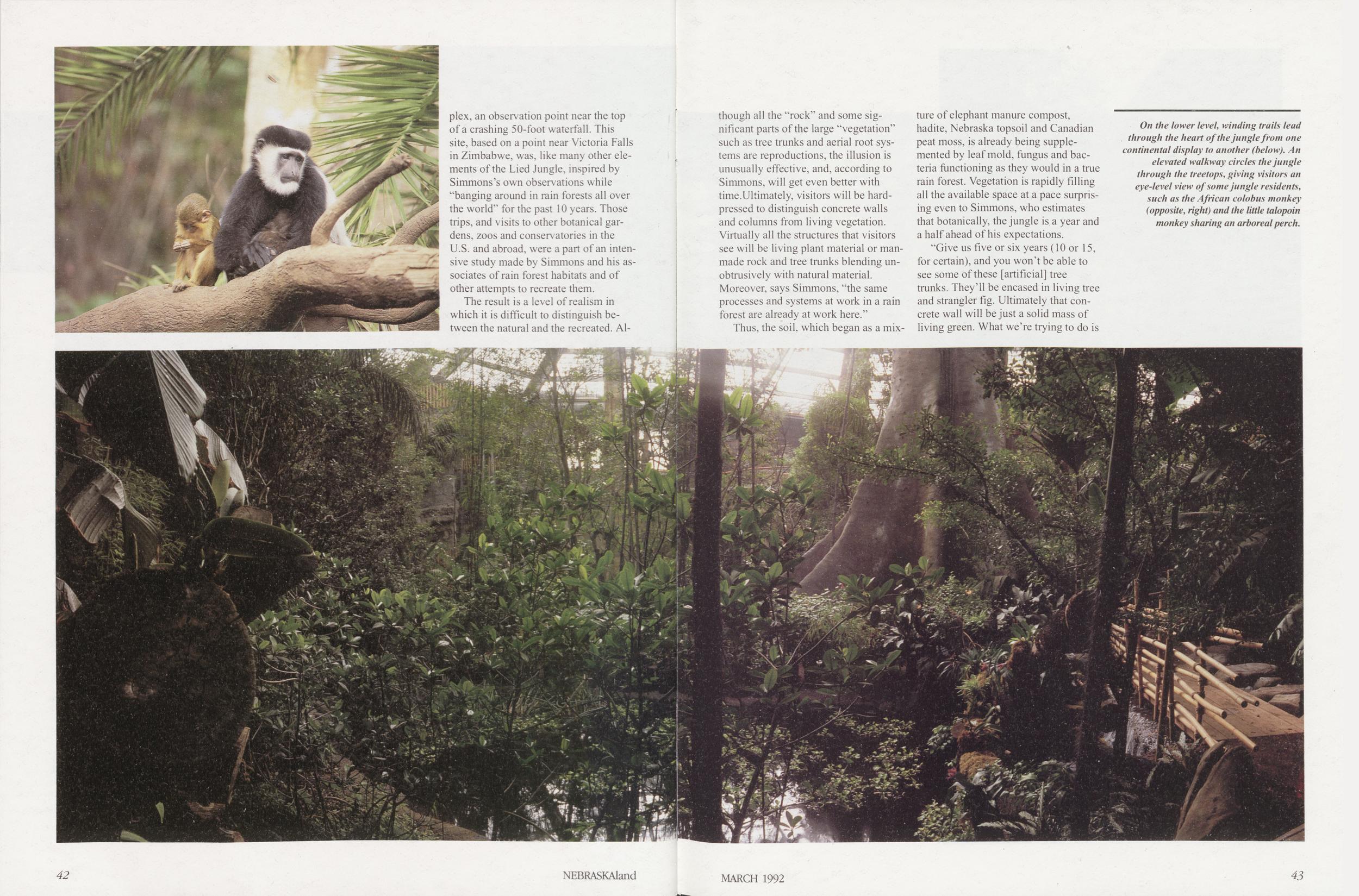
The result is a level of realism in which it is difficult to distinguish between the natural and the recreated. Although 42 NEBRASKAland
Thus, the soil, which began as a mixture of elephant manure compost, hadite, Nebraska topsoil and Canadian peat moss, is already being supplemented by leaf mold, fungus and bacteria functioning as they would in a true rain forest. Vegetation is rapidly filling all the available space at a pace surprising even to Simmons, who estimates that botanically, the jungle is a year and a half ahead of his expectations.
"Give us five or six years (10 or 15,
for certain), and you won't be able to
see some of these [artificial] tree
trunks. They'll be encased in living tree
and strangler fig. Ultimately that concrete wall will be just a solid mass of
living green. What we're trying to do is
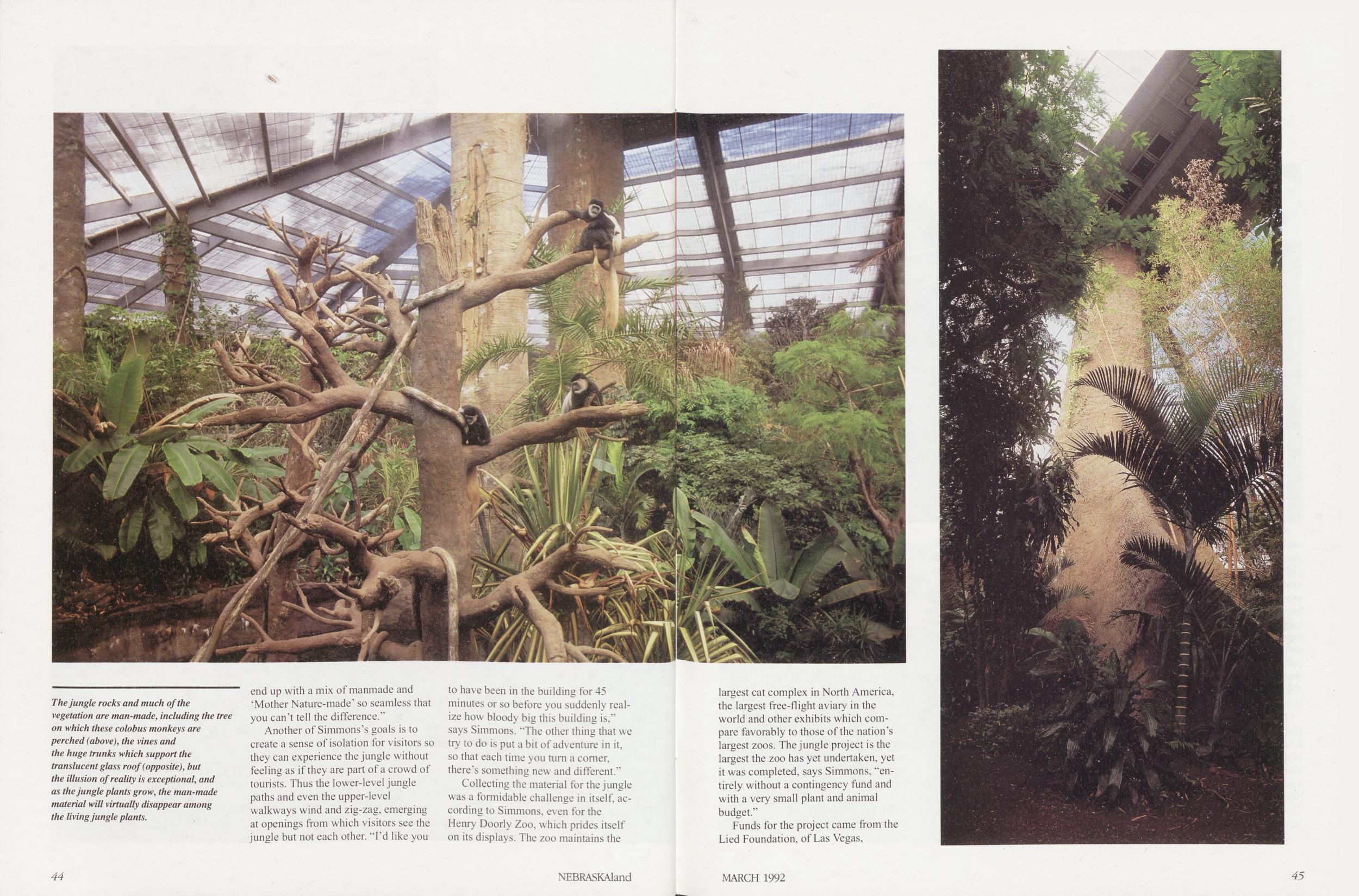
Another of Simmons's goals is to create a sense of isolation for visitors so they can experience the jungle without feeling as if they are part of a crowd of tourists. Thus the lower-level jungle paths and even the upper-level walkways wind and zig-zag, emerging at openings from which visitors see the jungle but not each other. "I'd like you to have been in the building for 45 minutes or so before you suddenly realize how bloody big this building is," says Simmons. "The other thing that we try to do is put a bit of adventure in it, so that each time you turn a comer, there's something new and different."
Collecting the material for the jungle was a formidable challenge in itself, according to Simmons, even for the Henry Doorly Zoo, which prides itself on its displays. The zoo maintains the 44 NEBRASKAland largest cat complex in North America, the largest free-flight aviary in the world and other exhibits which compare favorably to those of the nation's largest zoos. The jungle project is the largest the zoo has yet undertaken, yet it was completed, says Simmons, "entirely without a contingency fund and with a very small plant and animal budget."
Funds for the project came from the Lied Foundation, of Las Vegas,
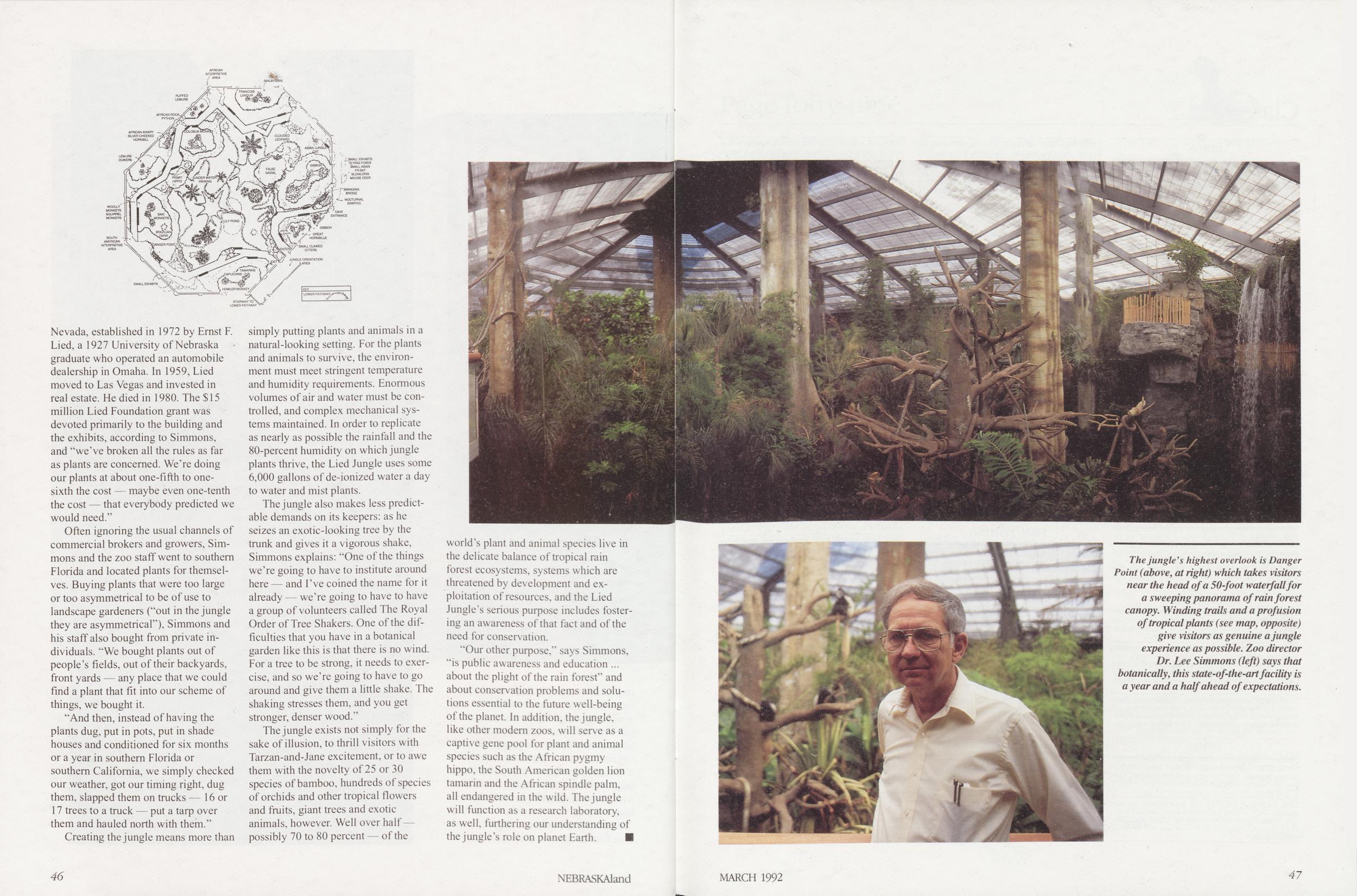
Often ignoring the usual channels of commercial brokers and growers, Simmons and the zoo staff went to southern Florida and located plants for themselves. Buying plants that were too large or too asymmetrical to be of use to landscape gardeners ("out in the jungle they are asymmetrical"), Simmons and his staff also bought from private individuals. "We bought plants out of people's fields, out of their backyards, front yards — any place that we could find a plant that fit into our scheme of things, we bought it.
"And then, instead of having the plants dug, put in pots, put in shade houses and conditioned for six months or a year in southern Florida or southern California, we simply checked our weather, got our timing right, dug them, slapped them on trucks — 16 or 17 trees to a truck — put a tarp over them and hauled north with them."
Creating the jungle means more than simply putting plants and animals in a natural-looking setting. For the plants and animals to survive, the environment must meet stringent temperature and humidity requirements. Enormous volumes of air and water must be controlled, and complex mechanical systems maintained. In order to replicate as nearly as possible the rainfall and the 80-percent humidity on which jungle plants thrive, the Lied Jungle uses some 6,000 gallons of de-ionized water a day to water and mist plants.
The jungle also makes less predictable demands on its keepers: as he seizes an exotic-looking tree by the trunk and gives it a vigorous shake, Simmons explains: "One of the things we're going to have to institute around here — and I've coined the name for it already - - we're going to have to have a group of volunteers called The Royal Order of Tree Shakers. One of the difficulties that you have in a botanical garden like this is that there is no wind. For a tree to be strong, it needs to exercise, and so we're going to have to go around and give them a little shake. The shaking stresses them, and you get stronger, denser wood."
The jungle exists not simply for the sake of illusion, to thrill visitors with Tarzan-and-Jane excitement, or to awe them with the novelty of 25 or 30 species of bamboo, hundreds of species of orchids and other tropical flowers and fruits, giant trees and exotic animals, however. Well over half possibly 70 to 80 percent of the world's plant and animal species live in the delicate balance of tropical rain forest ecosystems, systems which are threatened by development and exploitation of resources, and the Lied Jungle's serious purpose includes fostering an awareness of that fact and of the need for conservation.
"Our other purpose," says Simmons, "is public awareness and education about the plight of the rain forest" and about conservation problems and solutions essential to the future well-being of the planet. In addition, the jungle, like other modern zoos, will serve as a captive gene pool for plant and animal species such as the African pygmy hippo, the South American golden lion tamarin and the African spindle palm, all endangered in the wild. The jungle will function as a research laboratory, as well, furthering our understanding of the jungle's role on planet Earth.
46 NEBRASKAland
Classified
BIRDSPHEASANTS-WILD TURKEYS-CHUKARS & HUNS! Eggs, chicks, started and adults. National Poultry Improvement Plan Approved. Live overnight delivery guaranteed. THE BEST for propagation, hunting, eating, and taxidermy. Call now to place 1992 chick orders! Bargain prices on ringneck hens. Toubl Game Bird Farms, 8716 W. St., Lawrence Rd., Dept NE, Beloit, WI 53511. Phone (608) 365-1789. "Our birds MAKE IT in the WILD!"
MANDARIN DUCKS; nice full-wing birds, $35 pair, woodducks $25 pair. Mrs. R. W. Hansen, 3315 Ave. L, Kearney, NE 68847. Phone (308) 237-3781
BOOKS/PRINTINGFREE! Booklets on northeastern Nevada; fishing, rockhounding maps, Carl Hayden, Box 528, Jackpot, Nevada 89825.
FREE BOOK CATALOG. Novels, westerns, romances, children's; old out of print, found barns, attic. Authors: Grey, Bower, Connor, Fox, Curwood, Raine, Wright, Aldrige, Pollyanna, Freckles, many others. Postage appreciated. Pierce, 4400 N. Pine Cluster, Oroville, CA 95965.
COMPLETE ROADSIDE GUIDE to Nebraska by Alan Boye is a mile-by-mile description of historical, geographical and folklore sites along all major highways. Over 10,000 miles are included in all 93 counties. The book includes museums, festivals, and those out-of-the-way unusual places for the resident and the tourist. $11.95 plus $1.50 postage. SALTILLO Press, 57 Lafayette, St. Johnsbury VT 05819.
NEBRASKA COOKBOOK-TASTE THE GOOD LIFE. Contains 356 tested recipes emphasizing products grown or raised in Nebraska. Sections include beef, pork, corn, desserts, other products, old fashioned recipes, fish, and wild game. Nebraska history, memorabilia, and landmarks come to life through color photos and brilliant watercolors. $10.95 plus $2.50 postage. Leafie Mae's Kitchen, P.O. 233, Kearney, NE 68848.
CLOTHINGFUR MANUFACTURING—Manufacturer of all fur garments. Bring or mail your skins and we will custom make your coats, hats and misc. Also large inventory of new garments for sale. 55 years' experience. Write for free brochure. HAEKER FURRIERS, INC., P.O. Box 230, 615 W. Main St., Alma, NE 68920. Phone (308) 928-2515.
COLLECTIBLESWANTED: Nebraska stock certificates, letters, old checks, etc.—particularly pre-1900. A. A. Armstrong Jr. M.D., 211 West 39th, Scottsbluff, NE 69361.
BUYING: American Indian artifacts such as beadwork, weavings, baskets, etc.; also cowboy memorabilia such as chaps, spurs, photographs, etc. Best price first letter; photographs promptly returned. Jack Ringwalt, 1550 California St., Suite 6, #211, San Francisco, CA 94109, (415)759-6343.
WANTED: Collector wants to buy all brands old 2-piece cardboard shot-shell boxes. Also wood ammo boxes, old firearm and cartridge company posters, calendars, advertising cardboards, and catalogs. Allan H. Hahn, Rt 1 Box 147, Gibbon, NE 68840. Phone (308) 647-5228.
DOGSPINKERTON BIRD DOGS—English setter, English pointer puppies. Started dogs available this fall. Our dogs are bred for nose and style. Give us a call at (402) 673-4540.
AKC GERMAN SHORTHAIR pointers and brittany spaniels. Pups, started and trained dogs. Birdland Kennels, Hunter Ingwerson, Nehawka, NE 68413,402-227-4655. Wayne Clark, 712-529-4238 also will be doing some training.
TRAINING ALL BREEDS bird dogs—Vizslas and English Pointers for sale. Rozanek Kennels, R 2, Schuyler, NE 68661. Phone (402) 352-8769.
YELLOW-BLACK Lab pups. FC-AFC sired. AKC. Hips OFA certified. Dew claws removed. Excellent hunting potential. Contact Bob Bendler, Lexington, NE, (308) 324-4247.
CHESAPEAKE BAY OR BLACK LABRADOR puppies and started dogs. Available year-round. NAFC pedigree available. Training and stud service. Call PLATTE VALLEY RETRIEVERS, (308) 995-2318.
GUN DOG TRAINING. All sporting breeds. All dogs worked on game birds. Over 25 years experience. Henry Sader, Wilderness Kennels, Roca, NE (402) 423-4212.
GERMAN SHORTHAIR POINTERS/ENGLISH POINTERS—pups, started dogs, stud service. Training available for pointing and retrieving dogs. Wayne Clark (712) 529-4238. Close to Omaha. Leave mesage.
LABRADOR PUPPIES: yellow AKC excellent hunting background. (308) 287-2408.
GERMAN SHORTHAIR pointers. Puppies, started and trained dogs. Gun dog training available. (308) 235-3237.
AKC GERMAN SHORTHAIR POINTER puppies: guaranteed—references available. Phone (402) 353-3605.
EVENTS/ATTRACTIONSSUMMER OPPORTUNITIES for field courses in 1992 offered at biological field stations, are summarized in a poster prepared by the Organization of Biological Field Stations. Most offerings are intended for undergraduate and graduate students in biology. For a copy, contact Dr. Richard W. Coles, Secretary OBFS, Washington University Tyson Research Center, PO Box 351, Eureka, MO 63025.
GREAT OUTDOORS EXPO '92. Sports, Recreation, and Travel Show. Come see Guido Hibdon from "Bassmasters," Doug Stange from "The In Fisherman," Tess Hewett from Bass N' Gal's, The Wett Vette, the King's Collection, and more. For entire family. Bob Devaney Center. March 20, 21, 22. For more information call (402)438-1819.
FISH/FISHINGFISH FOR SALE. Catfish, perch, coho salmon, rainbow trout, crappie, bluegill, walleye, minnows, goldfish, bullhead, largemouth bass, smallmouth bass, tnploid grass carp. Commercial grower prices on catfish, perch, coho salmon, rainbow trout. Consulting available. Pleasant Valley Fish Farm, Rt 1 Box 147, McCook, NE 69001. Phone (308) 345-6599.
DEE'S CONTOUR MAPS—High quality, waterproof, tearproof, 25x35 inches. Most Nebraska and Kansas reservoirs, some Colorado. $4.95 each. Write or call Dee's Maps, P.O. Box 702, Broken Bow, NE 688220702; phone (308) 872-6539.
WAX WORMS: 500-$8.50; 1000-$15,00. Add 5% sales tax. Postpaid first class. No. C.O.D. Harold Malicky, Burwell, NE 68823.
DOUGHBALL FISH BAIT recipe plus many fish recipes from the prairie. Send $3.50 to Prairie Recipes, PO Box 642333, Omaha, NE 68164-2333.
WILLOW LAKE FISH HATCHERY. Channel cat, bluegill, hybrid bluegill, largemouth bass, crappie, triploid grass carp, walleye, perch, minnows available for stocking. Gaylord Crawford, Rt. 3 Box 46, Hastings, NE 68901 or phone (402) 463-8022 day or night. Also pond consultant. We deliver, grower price.
FOOD/ HEALTHYOU GOT YOUR DEER, now try Grandma's venison recipe. Send $2 to: T. Holland, 6642 East Arbor Ave., Mesa, AZ 85206.
GUARANTEE: REDUCE CHOLESTEROL, lose fat; for information send $3.50 to Adel Enterprizes, P.O. Box 30047, Lincoln, NE 68503-0047.
NEBRASKA BASKETS: The original Nebraska company specializing in fine foods from Nebraska. A beautiful array of baskets filled with ethnic, healthful and long-time favorite foods. Cali or write for our brochure: P.O. Box 98, McCook, NE 69001. 1-800-345-7725.
GUIDES/OUTFITTERSMAD RIVER CANOES offers the finest quality and performance. For the finest canoes and accessories look to Great Plains Canoe Co., 205 Main, Springfield, NE. Phone(402)253-2001.
GUIDED CANOEING AND KAYAKING adventures on the Niobrara River in Nebraska. Completely outfitted, first-class equipment and instruction. Family and private trips available. For brochure contact Jim at Wilderness Adventures, 2725 N. 65th Ave., Omaha, NE 68104. Phone (402) 556-3741.
ENJOY THE MAGNIFICENT beauty of North America waterfowl in Nebraska's Rainwater Basin. SPRING WING DING, March 14-15,420 S. Brown, Clay Center, NE 68933. Phone (402) 762-3223.
OUTDOOR EQUIPMENTGUNS — Browning, Winchester, Remington, others, Hi-powers; shotguns, new, used, antiques. Want Pre-'64 Winchesters. Buy-Sell-Trade. (402) 729-6112. Bedlan's Sporting Goods, Fairbury, NE 68352.
NEED A CANVAS product made? Fax your detailed drawing and phone number. I'll call back with estimate. Ogallala Canvas (308) 284-2054.
CORDLESS LEISURE LAMP — perfect for camping or backyard activity. Valuable emergency aid. 13 inches tall, made of rugged lightweight polyethylene. Walnut colored base with white shade and fitted with metal hanging ring. Runs on one 6-volt lantern battery (not included). Wonderful gift for "the hard to buy for." $6.50 ea. or two lamps for $10.00 plus 5% Nebraska sales tax if applicable and $2.25 per unit shipping and handling. Send to DUNMAR DIRECT, PO Box 65, Humphrey, NE 68642. 30-day money-back guarantee. Allow 2-4 weeks delivery.
PROTECT YOUR PUP! Personalized dog collar. Animal's name and owner's phone number embroidered on adjustable (18-inch) nylon collar for instant identification. Available in red, blue or black with white embroidery. Send desired name and phone number (up to 20 characters). $ 12.95 ea. plus 5% Nebraska sales tax, shipping and handling included in price. DUNMAR DIRECT, PO Box 65, Humphrey, NE 68642. 30-day money-back guarantee, allow 2-4 weeks delivery.
TAXIDERMYALLISON'S TAXIDERMY STUDIO & GIFT GALLERY. Wally and Betty Allison Licensed Taxidermist. We've mounted 32 Nebraska State Record fish. Specializing in fish, birds and small game. We use freeze-dry. 421 North Dewev, North Platte, NE 69101. (308) 534-2324 or (308) 534-4267 home.
PEISTER TAXIDERMY-Award winning taxidermy and fish carvings. 1020 Central Avenue, Box 3201, Kearney, NE 68847. Phone (308) 236-9700 or (308) 237-7575 evening.
VACATION/RESORTSNE NEBRASKA trout fishing. 3 modern cottages, 1 available year round. 5 spring fed lakes with open water all year. Trout up to 7 pounds. Other varieties fish also. Diamond E. Trout Resort, Orchard, NE 69764. Phone (402) 893-4745.
CHESLEVS LODGE: Rooms year-around. Moderate rates. Ideal for hunters, family gatherings, anniversarv retreats. (308) 836-2658, Rt. 1 Box 76, Callaway, NE 68825.
48 NEBRASKAlandPage forty-nine
A Place for EverythingIt's Friday afternoon, one of the days when foreign prime ministers assume I'm goofing off, but I'm pretty busy, what with the next issue threatening to come out late, and I'm sorting through important documents from one of the important document stacks under my desk when Athol shows up. We plan to get in two hours of after-work fishing our first time out this spring.
"Cleaning the office, eh? Heh, heh, heh," he smirks.
I remain calm, trying to remember if I've ever heard of a not-guilty-by- reason-of-being-smirked-at plea. I know what he'll say next. He'll puff up ostentatiously, and say "A place for everything and everything in its place," as if it were his own idea.
"A place for everything and everything in its place, of buddy," Athol booms ostentatiously.
"Right," I say. "I couldn't agree more."
"Yeah, right," he cackles. "Har, Har, Har."
I was pretty sure that in Nebraska you're allowed to strangle people who cackle "Har, Har, Har" at you, but I decided not to do it, because Athol and I have been friends for a long time, and he has some lures I want to borrow. Turns out that was the right decision. I consulted a lawyer friend about it later, and he said strangulation wasn't exactly allowed. He thought he could have gotten me off if I'd done it, but it would have taken a lot of time, and I don't have that kind of time; I have too many document stacks to sort.
"No," I say, "I really do agree: A place for everything and everything in its place."
"Yeah?" he chortles, "What about these?" he says as we leave the office.
"These" include a pile of other state magazines, a box of unsolicited manuscripts and about a ream of page proofs, all gradually being displaced by a dozen photographic equipment catalogs, a pile of review copies from publishers and an orange plastic bucket from some fast food joint's Halloween kiddie meal that I use to eat popcorn out of. The displaced material now protrudes a little way out from under my desk and into the path between the desk and the door.
"Ha," I say, running rings around him logically, "that is their place." People who congratulate themselves for being neat seem incapable of understanding this about people they look down on as messy: We like things to be in their places, too. We just have more places than they do. And more things, usually.
"Whoa, Whoa," whoops Athol as we pull out of the parking lot headed for my house. "I'm not talking about taller heaps in more places, I'm talking about systems. Storage and retrieval. Order is system, neatness is systematic. Systems are how you find things later. Order is what made this country great!
"Here's what you do," he advises, pulling up to my garage. "First you go through all your stuff and discard what you don't need. Then "
"Hold it, hold it," I interrupt, "I need all my stuff."
" then you categorize it. Then you label file folders and then you file each item. Get boxes, and label each box. Shelves! Think of all the time you'll save!"
"Right," I say, locating my rod behind the old upright vacuum cleaner I'm going to take apart for the motor one of these days. "Time. It'll take me two weeks to go through my piles. It'll take another two weeks to figure out some arbitrary categories. Then it'll take another two weeks to file the stuff. Not to mention that the way it is now, I know where everything is, but if I do it your way, I'll never see any of these things again as long as I live."
"You have things you haven't seen for years," bellows Athol. "You have things you haven't seen since you moved here."
"Sure," I say, as I haul a bag of birdseed down from the rafters and tie two hammers to the other end of the rope to replace my tackle box as the counterweight, "but if somebody else hasn't moved them, I know right where they are."
"Your desk top could be clean. You wouldn't have to live in clutter any longer," Athol whines.
"My desk top is clean," I assert as I toss my gear into his back seat. "It has the stuff on it I want on it. That's what clean means. It's not cluttered. Clutter is a term invented by people who are afraid of stuff- - their own and other peoples'. By people who don't care what their stuff is, as long as it has an assigned slot in the stuff continuum. By people who think systems are more important than the things systematized.
"People who force things into categories are afraid of the real world," I declare as we launch the boat. "You guys focus on etherial, insubstantial essences because mere physical attributes trouble you. Real neatness, my kind of neatness," I rant, "accepts attributes as real. My things are complete in themselves; I don't force things into categories by some abstract concept of essence.
"No," I continue, as we start rigging our lines, "you're not talking about real neatness, linear neatness, chronological neatness, stratified neatness things in the order they occur — you're talking about vertical, branching-tree pseudoneatness: categories. Let me borrow one of those Phragrant Phantom Bluegill Bombs, will you?"
"I haven't got any," he admits. "I put 'em away somewhere last fall and I can't find 'em. Pass me a sandwich."
"Uh, let me see," I say, stalling for time, "They've got to be around here somewhere."
Don Cunningham MARCH 1992 49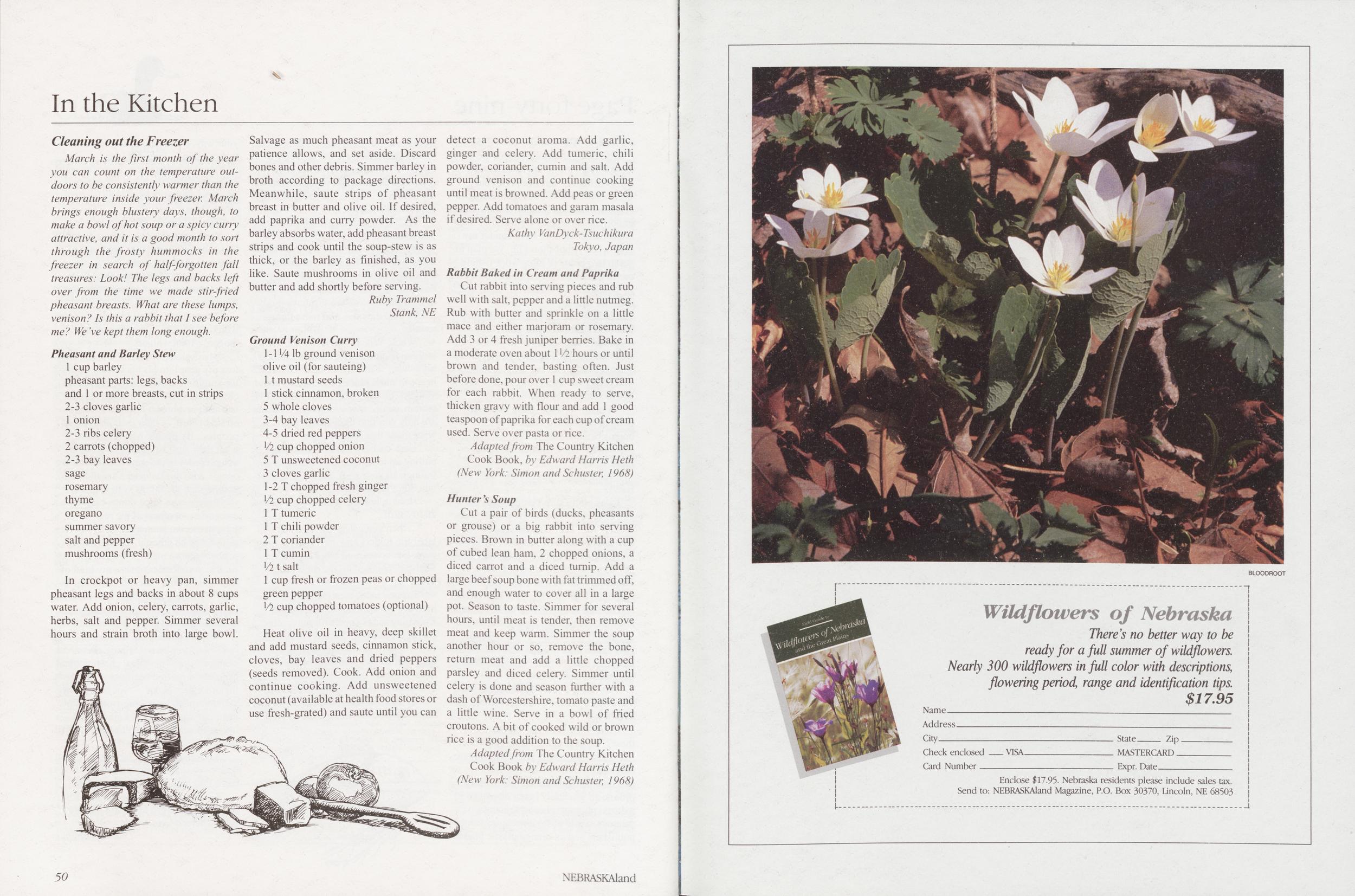
In the Kitchen
Cleaning out the FreezerMarch is the first month of the year you can count on the temperature outdoors to be consistently warmer than the temperature inside your freezer March brings enough blustery days, though, to make a bowl of hot soup or a spicy curry attractive, and it is a good month to sort through the frosty hummocks in the freezer in search of half-forgotten fall treasures: Look! The legs and backs left over from the time we made stir-fried pheasant breasts. What are these lumps, venison? Is this a rabbit that I see before me? We 've kept them long enough.
Pheasant and Barley Stew 1 cup barley pheasant parts: legs, backs and 1 or more breasts, cut in strips 2-3 cloves garlic 1 onion 2-3 ribs celery 2 carrots (chopped) 2-3 bay leaves sage rosemary thyme oregano summer savory salt and pepper mushrooms (fresh)In crockpot or heavy pan, simmer pheasant legs and backs in about 8 cups water. Add onion, celery, carrots, garlic, herbs, salt and pepper. Simmer several hours and strain broth into large bowl. Salvage as much pheasant meat as your patience allows, and set aside. Discard bones and other debris. Simmer barley in broth according to package directions. Meanwhile, saute strips of pheasant breast in butter and olive oil. If desired, add paprika and curry powder. As the barley absorbs water, add pheasant breast strips and cook until the soup-stew is as thick, or the barley as finished, as you like. Saute mushrooms in olive oil and butter and add shortly before serving.
Ruby Trammel Stank, NE Ground Venison Curry lb ground venison olive oil (for sauteing) 1 t mustard seeds 1 stick cinnamon, broken 5 whole cloves 3-4 bay leaves 4-5 dried red peppers cup chopped onion 5 T unsweetened coconut 3 cloves garlic 1-2 T chopped fresh ginger cup chopped celery 1 T tumeric 1 T chili powder 2 T coriander 1 T cumin t salt 1 cup fresh or frozen peas or chopped green pepper Vl cup chopped tomatoes (optional)Heat olive oil in heavy, deep skillet and add mustard seeds, cinnamon stick, cloves, bay leaves and dried peppers (seeds removed). Cook. Add onion and continue cooking. Add unsweetened coconut (available at health food stores or use fresh-grated) and saute until you can detect a coconut aroma. Add garlic, ginger and celery. Add tumeric, chili powder, coriander, cumin and salt. Add ground venison and continue cooking until meat is browned. Add peas or green pepper. Add tomatoes and garam masala if desired. Serve alone or over rice.
Kathy VanDyck-Tsuchikura Tokyo, Japan Rabbit Baked in Cream and PaprikaCut rabbit into serving pieces and rub well with salt, pepper and a little nutmeg. Rub with butter and sprinkle on a little mace and either marjoram or rosemary. Add 3 or 4 fresh juniper berries. Bake in a moderate oven about 1 Vl hours or until brown and tender, basting often. Just before done, pour over 1 cup sweet cream for each rabbit. When ready to serve, thicken gravy with flour and add 1 good teaspoon of paprika for each cup of cream used. Serve over pasta or rice.
Adapted from The Country Kitchen Cook Book, by Edward Harris Heth (New York: Simon and Schuster, 1968) Hunter's SoupCut a pair of birds (ducks, pheasants or grouse) or a big rabbit into serving pieces. Brown in butter along with a cup of cubed lean ham, 2 chopped onions, a diced carrot and a diced turnip. Add a large beef soup bone with fat trimmed off, and enough water to cover all in a large pot. Season to taste. Simmer for several hours, until meat is tender, then remove meat and keep warm. Simmer the soup another hour or so, remove the bone, return meat and add a little chopped parsley and diced celery. Simmer until celery is done and season further with a dash of Worcestershire, tomato paste and a little wine. Serve in a bowl of fried croutons. A bit of cooked wild or brown rice is a good addition to the soup.
Adapted from The Country Kitchen Cook Book by Edward Harris Heth (New York: Simon and Schuster, 1968) 50 NEBNRASKAland
Position: 467 (22 views)