Volume 69, Issue 10, 1991
NEBRASKAland
DECEMBER 1991 $1.50
NEBRASKAland
VOL. 69/NO. 10 DECEMBER 1991 Published by the Nebraska Game and Parks Commission Rex Amack, Director Assistant Directors: William J. Bailey, Jr. Dale R. Bree Staff Chief Information & Education: Paul Horton Managing Editor: Lowell Johnson Editor: Don Cunningham Senior Editors: Jon Farrar, Ken Bouc Regional Editors: Bob drier, Rocky Hoffmann, Tom Keith Design and Illustration: Tim Reigert Circulation: Pat Frahm Commissioners Chairman: Richard L. Coyne, Omaha Vice Chahman: Elvin Adamson, Nenzel 2nd Vice Chairman: J. Alan Cramer, Wayne Randall K. Stinnette, Inland Gloria Erickson, Holdrege Charles E. Wright, Lincoln Donald Forney, Lakeside NEBRASKAland ISSN :0028-1964 VOL. 69/NO. 10 DECEMBER 1991 Published monthly, except for combined Jan/Feb and Aug/Sept issues, by the Nebraska Game and Parks Commission, 2200 North 33rd Street, Lincoln, NE. Copyright 1991, all rights reserved. Second-class postage paid at Lincoln, Nebraska POSTMASTER: Send all address changes to NEBRASKAland, P.O. Box 30370, Lincoln, NE 68503. Rates: $12 for one year; $23 for two years. Manuscripts or photographs submitted to NEBRASKAland Magazine should be addressed to: The Editor, NEBRASKAland Magazine, P.O. Box 30370, Lincoln, NE 68503, and be accompanied by self-addressed envelopes and return postage. The publisher assumes no responsibility for unsolicited material. Nebraska Game and Parks Commission
District Offices
Headquarters
2200 North 33rd Street
Lincoln, NE 68503
Phone (402)471-0641
District Office I
Box 725
Alliance, NE 69301
Phone (308)762-5605
District Office II
Box 508
Bassett, NE 68714
Phone (402)684-2921
District Office III
Box 934
Norfolk, NE 68702
Phone (402)370-3374
District Office IV
Route 4, Box 36
North Platte, NE 69101
Phone (308)535-8025
District Office V
2200 North 33rd Street
Lincoln, NE 68503
Phone (402)471-5558
Omaha Office
State Office Building Mall
1313Farnam
Omaha, NE 681 (K -)
Phone (402) 595-2144
Ak-Sar-Ben Aquarium
21502 West Highway 31
Gretna, NE 68028
Phone (402) 332-3901
Conservation Officers by Region
Panhandle Southeast
Officer City Phone (308) Officer City Phone (402)
Richard Furley (Supv) Alliance 762-2024 Don Schaepler (Chief) Lincoln 488-2957
Watt Meyer Chadron 432-4398 Ted Blume (Asst Chief) Lincoln 483-5643
John Murphy Crawford 665-2021 Roger Guenther (Supv) Lincoln 423-5671
Jim Zimmerman Gering 436-7561 William Krause Auburn 274-3789
Marvin Kampbell Hay Springs 638-7527 Dan Evasco Beatrice 228-5935
E.W. Zimmerman Ogallala 284-3013 Murray Johnson Lincoln 488-2923
Dennis Thompson Ogallala 284-6450 Douglas Kramer Lincoln 466-9001
Don Hunt Oshkosh 772-3697 Levi Krause Louisville 234-2212
Richard Brandt Scottsbluff 635-1277 Russell Mort Nebr. City 873-5684
Raymond Still Bridgeport 262-1075 Duane Arp Omaha 332-4954
Larry Elstcn Omaha 292-4910
Northeast Craig Stover Omaha 359-2833
Officer City Phone (402) Mike Luben Wahoo 443-4278
Bob Downing (Supv) Norfolk 371-2675
Robert Keily Albion 395-2538 Sandhills
Ross Oestmann Bloomfield 373-4412 Officer City Phone (402)
LA. Wilkinson Columbus 564-4375 Bruce Wiebe (Supv) Bassett 684-3867
Gary Ralston Creighton 847-3284 Max Showalter Ainsworth 387-1960
Daniel Roberts Fremont 721-7852 Larry Bauman Atkinson 925-5569
Randy Pomplun Fullerton (308)536-2987 Tom Zimmer Brkn. Bow 308)872-6063
Jon Reeves Kennard 427-7378 Dan Zuehlke Mullen ((308)546-2492
Marion Shafer Norfolk 371-2031 Richard Seward Ord (308)728-5338
Eric Wiebe Ponca 755-2566 Mick Gray Valentine 376-3136
Steve Oberg West Point 372-3062 Southwest
South-Central Officer City Phone (308)
Officer City Phone (402) Gail Woodside(Supv) No. Platte 532-0279
Jerry Pecha (Supv) York 362-5707 George Sund Cambridge 697-4629
Lester Johnson David City 367-4037 Jack Henderson Gothenburg 537-7483
Terry Brentzel Grand Isl. (308)384-8296 Dirk Greene Imperial 882-5328
Dale Johnson Hebron 768-7363 Ray Frandsen Lexington 324-2753
Daniel Klammer Hastings 461-3389 Virgil Gosch McCook 345-2185
Dayton Shultis Kearney (308)234-3349 Dwight Allbery No. Platte 532-2753
Mark Reeves Loup City (308)745-1126 Roger Thompson No. Platte 532-9175
Robert Finke Seward 643-2056 Rich Routh Republican City 799-2085
Merry Christmas
Operation Game Thief (800) 742-7627
Nebraska Game and Parks Commission
District Offices
Headquarters
2200 North 33rd Street
Lincoln, NE 68503
Phone (402)471-0641
District Office I
Box 725
Alliance, NE 69301
Phone (308)762-5605
District Office II
Box 508
Bassett, NE 68714
Phone (402)684-2921
District Office III
Box 934
Norfolk, NE 68702
Phone (402)370-3374
District Office IV
Route 4, Box 36
North Platte, NE 69101
Phone (308)535-8025
District Office V
2200 North 33rd Street
Lincoln, NE 68503
Phone (402)471-5558
Omaha Office
State Office Building Mall
1313Farnam
Omaha, NE 681 (K -)
Phone (402) 595-2144
Ak-Sar-Ben Aquarium
21502 West Highway 31
Gretna, NE 68028
Phone (402) 332-3901
Conservation Officers by Region
Panhandle Southeast
Officer City Phone (308) Officer City Phone (402)
Richard Furley (Supv) Alliance 762-2024 Don Schaepler (Chief) Lincoln 488-2957
Watt Meyer Chadron 432-4398 Ted Blume (Asst Chief) Lincoln 483-5643
John Murphy Crawford 665-2021 Roger Guenther (Supv) Lincoln 423-5671
Jim Zimmerman Gering 436-7561 William Krause Auburn 274-3789
Marvin Kampbell Hay Springs 638-7527 Dan Evasco Beatrice 228-5935
E.W. Zimmerman Ogallala 284-3013 Murray Johnson Lincoln 488-2923
Dennis Thompson Ogallala 284-6450 Douglas Kramer Lincoln 466-9001
Don Hunt Oshkosh 772-3697 Levi Krause Louisville 234-2212
Richard Brandt Scottsbluff 635-1277 Russell Mort Nebr. City 873-5684
Raymond Still Bridgeport 262-1075 Duane Arp Omaha 332-4954
Larry Elstcn Omaha 292-4910
Northeast Craig Stover Omaha 359-2833
Officer City Phone (402) Mike Luben Wahoo 443-4278
Bob Downing (Supv) Norfolk 371-2675
Robert Keily Albion 395-2538 Sandhills
Ross Oestmann Bloomfield 373-4412 Officer City Phone (402)
LA. Wilkinson Columbus 564-4375 Bruce Wiebe (Supv) Bassett 684-3867
Gary Ralston Creighton 847-3284 Max Showalter Ainsworth 387-1960
Daniel Roberts Fremont 721-7852 Larry Bauman Atkinson 925-5569
Randy Pomplun Fullerton (308)536-2987 Tom Zimmer Brkn. Bow 308)872-6063
Jon Reeves Kennard 427-7378 Dan Zuehlke Mullen ((308)546-2492
Marion Shafer Norfolk 371-2031 Richard Seward Ord (308)728-5338
Eric Wiebe Ponca 755-2566 Mick Gray Valentine 376-3136
Steve Oberg West Point 372-3062 Southwest
South-Central Officer City Phone (308)
Officer City Phone (402) Gail Woodside(Supv) No. Platte 532-0279
Jerry Pecha (Supv) York 362-5707 George Sund Cambridge 697-4629
Lester Johnson David City 367-4037 Jack Henderson Gothenburg 537-7483
Terry Brentzel Grand Isl. (308)384-8296 Dirk Greene Imperial 882-5328
Dale Johnson Hebron 768-7363 Ray Frandsen Lexington 324-2753
Daniel Klammer Hastings 461-3389 Virgil Gosch McCook 345-2185
Dayton Shultis Kearney (308)234-3349 Dwight Allbery No. Platte 532-2753
Mark Reeves Loup City (308)745-1126 Roger Thompson No. Platte 532-9175
Robert Finke Seward 643-2056 Rich Routh Republican City 799-2085
Merry Christmas
Operation Game Thief (800) 742-7627
Letters
Merry ChristmasSir/ Enclosed is a photograph I shot from the living room of my parents' ranch home near Hyannis in Grant County.
Geri Monahan . Lincoln, NE Tanks for the MemoriesSir/ I wish to thank NEBRASKALAND Magazine and its readers for helping me to complete my master's thesis on the domestic tank houses of rural Nebraska. My first letter to NEBRASKAland (November 1990) resulted in many responses from interested readers across the state. Without their help, the research would not have been possible.
The tank house, which is simply an elevated, enclosed water tower for the farm, was once a very prominent feature on the Nebraska prairie. It was known to exist in almost all areas of the state. Although it has largely been replaced by more modern water-supplying techniques, it can still be found on a few farmsteads across the state, most likely used for storage or other purposes.
Thanks again to NEBRASKAland and its many readers who responded.
Aaron Boucher Ravenna, NE Platte River PatternsSir/1 recently received my October issue and was pleasantly surprised to see the article featuring Sara Dillow's quilts ["Platte River Patterns"]. The article was extremely nice, and Roy Farris's photography is extraordinary. The colors in the quilts and in nature juxtapose beautifully.
The article is a wonderful addition to 4 NEBRASKAland your magazine. I hope to see more things like this, as I love old stuff— especially when it emphasizes Nebraska's rich heritage and traditions. Job well done!
Leroy Schafersman Arlington, NE History and HeritageSir/ Re. the November issue: Now that was an issue! Thank you so much for including "William Henry Jackson: Photography on the Frontier" and "Karl Bodmer in America." Anyone can look outside and see a beautiful sunset, geese flying overhead or a duck decoy bobbing on a lake, but the only way we can "see" into our history is through articles such as these. Please print more of them.
Donna Anderson Ayr, NE Are You Putting Us On? Goose Talk...Sir/ In your November issue you printed excerpts from the columns of former Omaha World-Herald writer Sandy Gris wold. In one passage on Canada geese he writes about how the vigilant old leader with the unmistakable command a louder, sharper and more decisive "ca-lonk-wonk-honk" — led his flock safely out of harm's way. Geese do talk to each other, as I found out.
Last winter, on a bitterly cold evening, a flock of Canada geese landed about dusk on a pond close to a farmer's place. The farmer, a good friend of mine, called me and said that if I came early the next morning I could get my limit in short order. In the morning, to my amazement, I saw that they were all frozen in the ice.
Their leader, a big gander, saw their predicament and started honking to his flock. Then he gave three honks like people do when they count to three, and at the third honk, they flapped their wings vigorously. In doing so, the sheet of ice in which they were trapped broke loose, all in one piece, and they took off to their winter home down South, ice and all.
I was so bewildered I didn't even fire a shot.
Ferd Bogner Crofton, NE ... Hoop Snakes...Sir/ More than 65 years ago, as kids, my brother and I, living at St Edward, found a group of hoop snakes in our garden. We selected two of equal size. The moment we touched them, they swallowed their tails. We used two leaves as imaginary stakes, and proceeded to play ring-toss, but moment they touched the grass, they began to roll away.
After a bit, we took them over to the sidewalk to see which one was the fastest. They rolled side-by-side for perhaps 30 feet, and then bumped together. The collision caused them to become entangled like magicians' rings, and my brother and I about died laughing watching those crazy snakes trying to maintain their balance!
Don Schafer Hastings, NE ... and Other Unlikely PhenomonaSir/ Regarding "Page forty nine" in the November issue ["Dressing for Success"]: Certainly one would not go abroad unless one were properly dressed, and proper dress always includes a jacket and tie. I get indigestion if I even go to dinner without a jacket and tie.
Enclosed is a snap showing my shooting attire ("hunting," as you know, is pursuing the fox with horses and dogs). You may borrow this suit the next time you are in the field if you can wear a size 42 jacket and size 34 britches. You can hold up the britches with a nice pair of braces. I'm sure with this outfit and a little "aiming fluid" you could have a successful shoot.
Ansel Effstop Fremont, NE Fiddlin 'AroundSir/ We caught these 17 fiddlers (channel catfish) one afternoon on the Missouri just down from Ponca State Park. We had Doc's stink bait from head to toe. Boy, did we have fun.
From left to right, Jessie, Lynn, Nick and Myron Fleury. Blazer in the background.
Myron Fleury Ponca, NE Editor's Note Every year NEBRASKAland Magazine publishes a special, book length, combined January/February issue. The 1992 special, titled Photographing Nebraska, is a guide to outdoor photography in the state. Designed as a manual for beginning through advanced amateur photographers, this special issue is also a photographic tour of the state which we hope will be as much at home on a living room coffee table as in a photographer's darkroom. Subscribers should note that, as with previous special issues, it will reach them in the first week of February. Send your comments, suggestions and complaints to Letters, NEBRASKAland Magazine, P.O. Box 30370, Lincoln, NE 68503. Each month, we will publish as many of your letters as space permits. Photographs are also welcome. NEBRASKAland resumes the right to edit and condense letters. NOVEMBER 1991 5
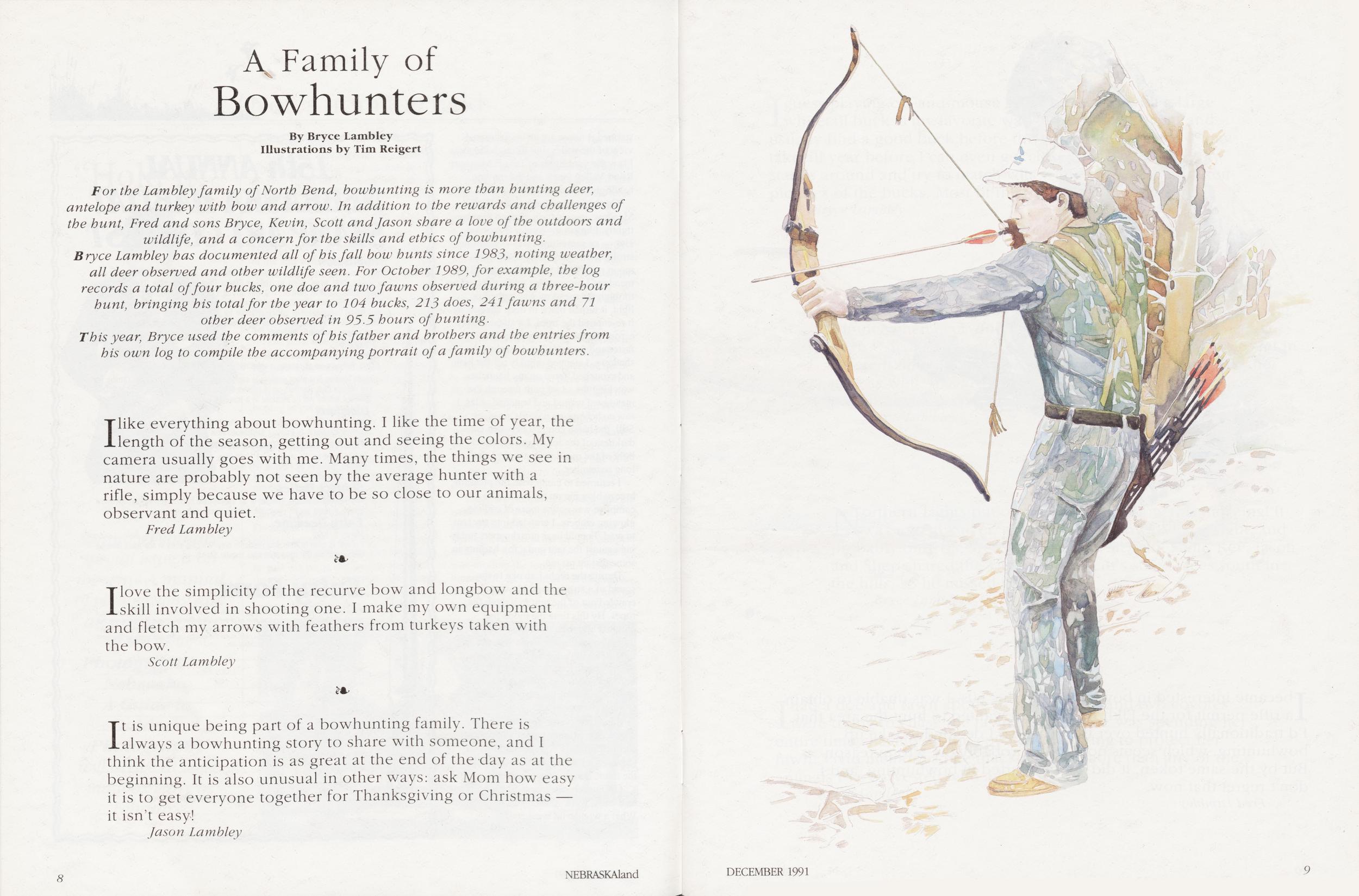
A Family of Bowhunters
By Bryce Lambley Illustrations by Tim ReigertFor the Lambley family of North Bend, bowhunting is more than hunting deer, antelope and turkey with bow and arrow. In addition to the rewards and challenges of the hunt, Fred and sons Bryce, Kevin, Scott and Jason share a love of the outdoors and wildlife, and a concern for the skills and ethics of bowhunting.
Bryce Lambley has documented all of his fall bow hunts since 1983, noting weather, all deer observed and other wildlife seen. For October 1989, for example, the log records a total of four bucks, one doe and two fawns observed during a three-hour hunt, bringing his total for the year to 104 bucks, 213 does, 241 fawns and 71 other deer observed in 95.5 hours of hunting.
This year, Bryce used the comments of his father and brothers and the entries from his own log to compile the accompanying portrait of a family of bowhunters.
I like everything about bowhunting. I like the time of year, the length of the season, getting out and seeing the colors. My camera usually goes with me. Many times, the things we see in nature are probably not seen by the average hunter with a rifle, simply because we have to be so close to our animals, observant and quiet.
Fred LambleyI love the simplicity of the recurve bow and longbow and the skill involved in shooting one. I make my own equipment and fletch my arrows with feathers from turkeys taken with the bow.
Scott LambleyIt is unique being part of a bowhunting family. There is always a bowhunting story to share with someone, and I think the anticipation is as great at the end of the day as at the beginning. It is also unusual in other ways: ask Mom how easy it is to get everyone together for Thanksgiving or Christmas — it isn't easy!
Jason Lambley 8 NEBRASKAland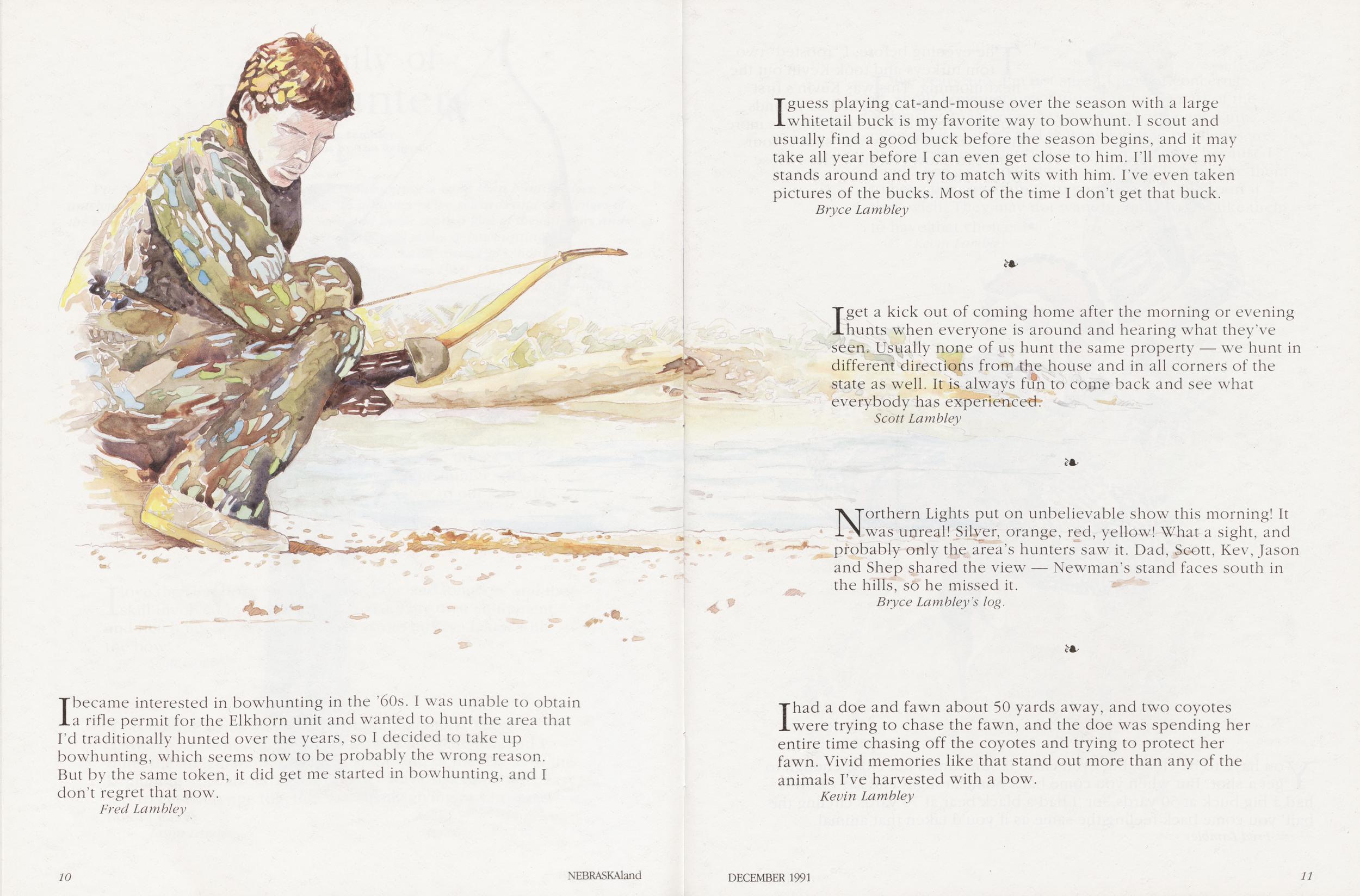
I became interested in bowhunting in the '60s. I was unable to obtain a rifle permit for the Elkhorn unit and wanted to hunt the area that Ed traditionally hunted over the years, so I decided to take up bowhunting, which seems now to be probably the wrong reason. But by the same token, it did get me started in bowhunting, and I don't regret that now.
Fred Lambley 10 NEBRASKAlandI guess playing cat-and-mouse over the season with a large whitetail buck is my favorite way to bow hunt. I scout and usually find a good buck before the season begins, and it may take all year before I can even get close to him. I'll move my stands around and try to match wits with him. I've even taken pictures of the bucks. Most of the time I don't get that buck.
Bryce LambleyI get a kick out of coming home after the morning or evening hunts when everyone is around and hearing what they've seen. ...Usually none of us hunt the same property — we hunt in different directions from the house and in all corners of the state as well. It is always fun to come back and see what everybody has experienced.
Scott LambleyNorthern Lights put on unbelievable show this morning! It ± N was unreal! Silver, orange, red, yellow! What a sight, and probably only the area's hunters saw it. Dad, Scott, Kev, Jason and Shep shared the view — Newman's stand faces south in the hills, so he missed it.
Bryce Lambley log.I had a doe and fawn about 50 yards away, and two coyotes were trying to chase the fawn, and the doe was spending her entire time chasing off the coyotes and trying to protect her fawn. Vivid memories like that stand out more than any of the animals I've harvested with a bow.
Kevin Lambley DECEMBER 1991 11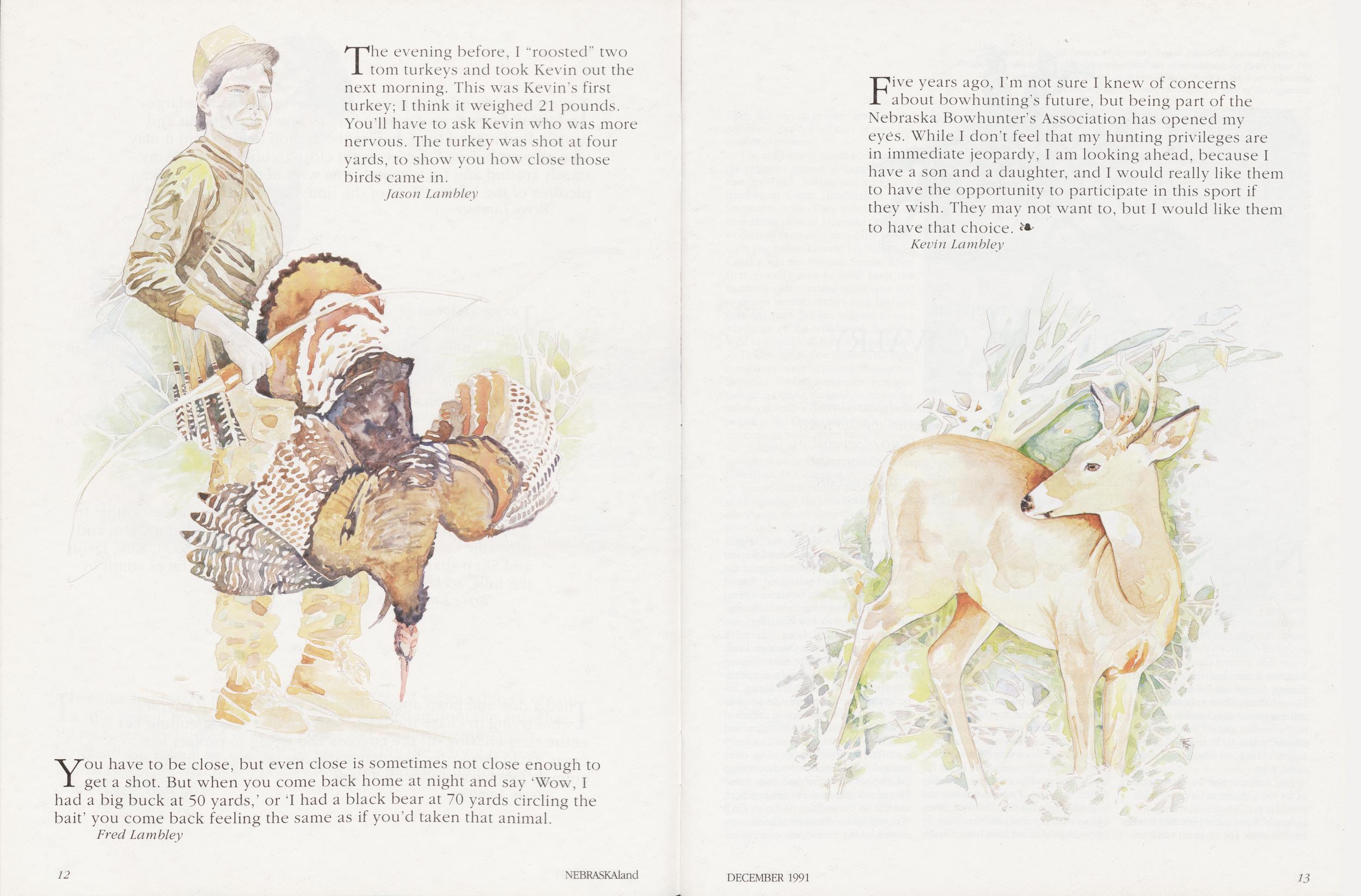
The evening before, I "roosted" two torn turkeys and took Kevin out the next morning. This was Kevin's first turkey; I think it weighed 21 pounds. You'll have to ask Kevin who was more nervous. The turkey was shot at four yards, to show you how close those birds came in.
Jason LambleyYou have to be close, but even close is sometimes not close enough to get a shot. But when you come back home at night and say 'Wow, I had a big buck at 50 yards,' or T had a black bear at 70 yards circling the bait' you come back feeling the same as if you'd taken that animal.
Fred Lambley 12 NEBRASKAlandFive years ago, I'm not sure I knew of concerns about bowhunting's future, but being part of the Nebraska Bowhunter's Association has opened my eyes. While I don't feel that my hunting privileges are in immediate jeopardy, I am looking ahead, because I have a son and a daughter, and I would really like them to have the opportunity to participate in this sport if they wish. They may not want to, but I would like them to have that choice. **
Kevin Lambley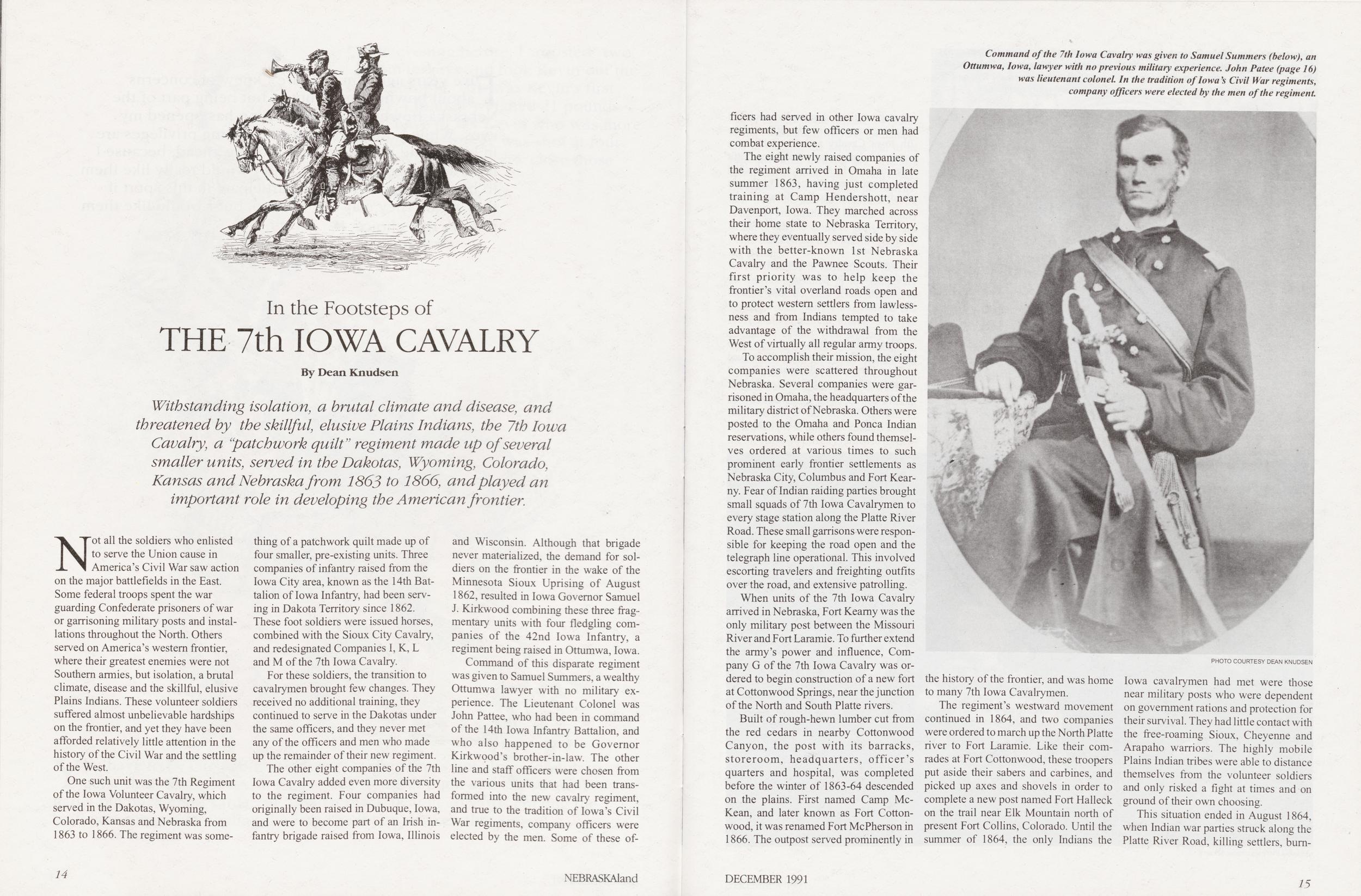
In the Footsteps of THE 7th IOWA CAVALRY
By Dean Knudsen Withstanding isolation, a brutal climate and disease, and threatened by the skillful, elusive Plains Indians, the 7th Iowa Cavalry, a "patchwork quilt" regiment made up of several smaller units, served in the Dakotas, Wyoming, Colorado, Kansas and Nebraska from 1863 to 1866, and played an important role in developing the American frontierNot all the soldiers who enlisted to serve the Union cause in America's Civil War saw action on the major battlefields in the East. Some federal troops spent the war guarding Confederate prisoners of war or garrisoning military posts and installations throughout the North. Others served on America's western frontier, where their greatest enemies were not Southern armies, but isolation, a brutal climate, disease and the skillful, elusive Plains Indians. These volunteer soldiers suffered almost unbelievable hardships on the frontier, and yet they have been afforded relatively little attention in the history of the Civil War and the settling of the West.
One such unit was the 7th Regiment of the Iowa Volunteer Cavalry, which served in the Dakotas, Wyoming, Colorado, Kansas and Nebraska from 1863 to 1866. The regiment was something of a patchwork quilt made up of four smaller, pre-existing units. Three companies of infantry raised from the Iowa City area, known as the 14th Battalion of Iowa Infantry, had been serving in Dakota Territory since 1862. These foot soldiers were issued horses, combined with the Sioux City Cavalry, and redesignated Companies I, K, L and M of the 7th Iowa Cavalry.
For these soldiers, the transition to cavalrymen brought few changes. They received no additional training, they continued to serve in the Dakotas under the same officers, and they never met any of the officers and men who made up the remainder of their new regiment.
The other eight companies of the 7th Iowa Cavalry added even more diversity to the regiment. Four companies had originally been raised in Dubuque, Iowa, and were to become part of an Irish infantry brigade raised from Iowa, Illinois and Wisconsin. Although that brigade never materialized, the demand for soldiers on the frontier in the wake of the Minnesota Sioux Uprising of August 1862, resulted in Iowa Governor Samuel J. Kirkwood combining these three fragmentary units with four fledgling companies of the 42nd Iowa Infantry, a regiment being raised in Ottumwa, Iowa.
Command of this disparate regiment was given to Samuel Summers, a wealthy Ottumwa lawyer with no military experience. The Lieutenant Colonel was John Pattee, who had been in command of the 14th Iowa Infantry Battalion, and who also happened to be Governor Kirkwood's brother-in-law. The other line and staff officers were chosen from the various units that had been transformed into the new cavalry regiment, and true to the tradition of Iowa's Civil War regiments, company officers were elected by the men. Some of these officers 14 NEBRASKAland had served in other Iowa cavalry regiments, but few officers or men had combat experience.
The eight newly raised companies of the regiment arrived in Omaha in late summer 1863, having just completed training at Camp Hendershott, near Davenport, Iowa. They marched across their home state to Nebraska Territory, where they eventually served side by side with the better-known 1st Nebraska Cavalry and the Pawnee Scouts. Their first priority was to help keep the frontier's vital overland roads open and to protect western settlers from lawlessness and from Indians tempted to take advantage of the withdrawal from the West of virtually all regular army troops.
To accomplish their mission, the eight companies were scattered throughout Nebraska. Several companies were garrisoned in Omaha, the headquarters of the military district of Nebraska. Others were posted to the Omaha and Ponca Indian reservations, while others found themselves ordered at various times to such prominent early frontier settlements as Nebraska City, Columbus and Fort Kearny. Fear of Indian raiding parties brought small squads of 7th Iowa Cavalrymen to every stage station along the Platte River Road. These small garrisons were responsible for keeping the road open and the telegraph line operational. This involved escorting travelers and freighting outfits over the road, and extensive patrolling.
When units of the 7th Iowa Cavalry arrived in Nebraska, Fort Kearny was the only military post between the Missouri River and Fort Laramie. To further extend the army's power and influence, Company G of the 7th Iowa Cavalry was ordered to begin construction of a new fort at Cottonwood Springs, near the junction of the North and South Platte rivers.
Built of rough-hewn lumber cut from the red cedars in nearby Cottonwood Canyon, the post with its barracks, storeroom, headquarters, officer's quarters and hospital, was completed before the winter of 1863-64 descended on the plains. First named Camp McKean, and later known as Fort Cottonwood, it was renamed Fort McPherson in 1866. The outpost served prominently in the history of the frontier, and was home to many 7th Iowa Cavalrymen.
The regiment's westward movement continued in 1864, and two companies were ordered to march up the North Platte river to Fort Laramie. Like their comrades at Fort Cottonwood, these troopers put aside their sabers and carbines, and picked up axes and shovels in order to complete a new post named Fort Halleck on the trail near Elk Mountain north of present Fort Collins, Colorado. Until the summer of 1864, the only Indians the Iowa cavalrymen had met were those near military posts who were dependent on government rations and protection for their survival. They had little contact with the free-roaming Sioux, Cheyenne and Arapaho warriors. The highly mobile Plains Indian tribes were able to distance themselves from the volunteer soldiers and only risked a fight at times and on ground of their own choosing.
This situation ended in August 1864,
when Indian war parties struck along the
Platte River Road, killing settlers, burning
DECEMBER 1991
15
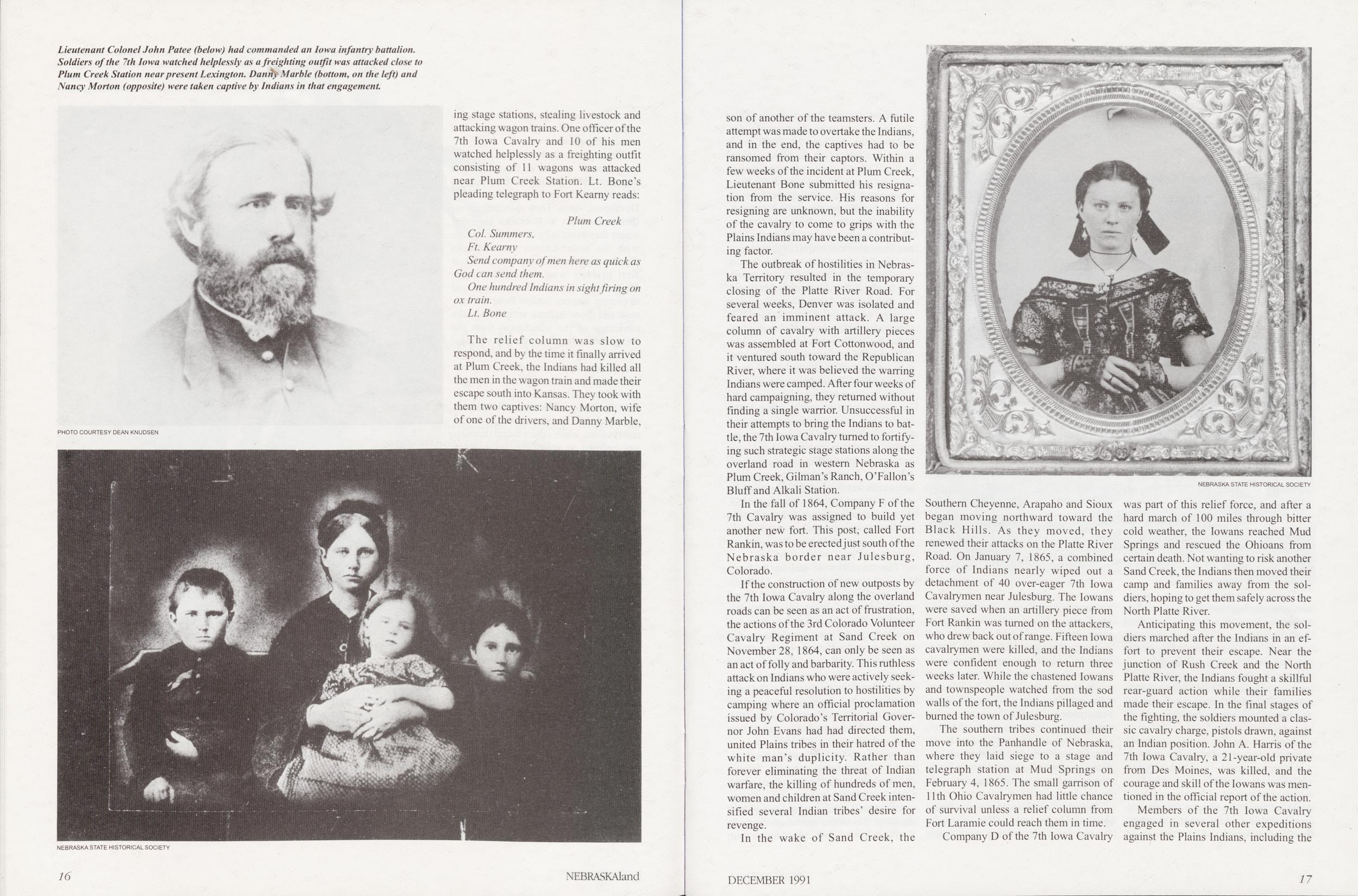
The relief column was slow to respond, and by the time it finally arrived at Plum Creek, the Indians had killed all the men in the wagon train and made their escape south into Kansas. They took with them two captives: Nancy Morton, wife of one of the drivers, and Danny Marble,
The outbreak of hostilities in Nebraska Territory resulted in the temporary closing of the Platte River Road. For several weeks, Denver was isolated and feared an imminent attack. A large column of cavalry with artillery pieces was assembled at Fort Cottonwood, and it ventured south toward the Republican River, where it was believed the warring Indians were camped. After four weeks of hard campaigning, they returned without finding a single warrior. Unsuccessful in their attempts to bring the Indians to battle, the 7th Iowa Cavalry turned to fortifying such strategic stage stations along the overland road in western Nebraska as Plum Creek, Gilman's Ranch, O'Fallon's Bluff and Alkali Station.
In the fall of 1864, Company F of the 7th Cavalry was assigned to build yet another new fort. This post, called Fort Rankin, was to be erected just south of the Nebraska border near Julesburg, Colorado.
If the construction of new outposts by the 7th Iowa Cavalry along the overland roads can be seen as an act of frustration, the actions of the 3rd Colorado Volunteer Cavalry Regiment at Sand Creek on November 28, 1864, can only be seen as an act of folly and barbarity. This ruthless attack on Indians who were actively seeking a peaceful resolution to hostilities by camping where an official proclamation issued by Colorado's Territorial Governor John Evans had had directed them, united Plains tribes in their hatred of the white man's duplicity. Rather than forever eliminating the threat of Indian warfare, the killing of hundreds of men, women and children at Sand Creek intensified several Indian tribes' desire for revenge.
In the wake of Sand Creek, the Southern Cheyenne, Arapaho and Sioux began moving northward toward the Black Hills. As they moved, they renewed their attacks on the Platte River Road. On January 7, 1865, a combined force of Indians nearly wiped out a detachment of 40 over-eager 7th Iowa Cavalrymen near Julesburg. The Iowans were saved when an artillery piece from Fort Rankin was turned on the attackers, who drew back out of range. Fifteen Iowa cavalrymen were killed, and the Indians were confident enough to return three weeks later. While the chastened Iowans and townspeople watched from the sod walls of the fort, the Indians pillaged and burned the town of Julesburg.
The southern tribes continued their move into the Panhandle of Nebraska, where they laid siege to a stage and telegraph station at Mud Springs on February 4, 1865. The small garrison of 11th Ohio Cavalrymen had little chance of survival unless a relief column from Fort Laramie could reach them in time.
Company D of the 7th Iowa Cavalry was part of this relief force, and after a hard march of 100 miles through bitter cold weather, the Iowans reached Mud Springs and rescued the Ohioans from certain death. Not wanting to risk another Sand Creek, the Indians then moved their camp and families away from the soldiers, hoping to get them safely across the North Platte River.
Anticipating this movement, the soldiers marched after the Indians in an effort to prevent their escape. Near the junction of Rush Creek and the North Platte River, the Indians fought a skillful rear-guard action while their families made their escape. In the final stages of the fighting, the soldiers mounted a classic cavalry charge, pistols drawn, against an Indian position. John A. Harris of the 7th Iowa Cavalry, a 21-year-old private from Des Moines, was killed, and the courage and skill of the Iowans was mentioned in the official report of the action.
Members of the 7th Iowa Cavalry
engaged in several other expeditions
against the Plains Indians, including the
DECEMBER 1991
17
 Wind River Expedition of 1865 and
another Republican River expedition in
January 1866. These campaigns both
failed to engage any Indians.
Wind River Expedition of 1865 and
another Republican River expedition in
January 1866. These campaigns both
failed to engage any Indians.
In the three years they served on the frontier, the 7th Iowa Cavalrymen escorted the U.S. mail, marched thousands of miles in patrols and expeditions, repaired countless miles of damaged telegraph lines, built three major military posts and fortified stage stations all along the Platte River Road, but they were never able to bring the Plains Indians to battle and win a decisive victory.
That is not to say the 7th Iowa Cavalry served on the frontier without cost. While spared the heavy casualties of such Civil War cavalry engagements as those fought at Winchester, Gettysburg or Five Forks, the 7th Iowa Cavalry paid a high price in human life. During the regiment's three years of service, 32 men were killed in action, 77 died of disease, 14 died as the result of accidents or suicides, and 58 men deserted.
Some of the 7th Iowa's suffering seems to be a part of the human condition, and is encountered by men and women in uniform today. Despair at being far from loved ones proved to be too much for some soldiers. The story of Private William Hakel is a case in point. This young man was stationed at Fort Cottonwood, and one day received a "Dear John" letter from his girlfriend back home. Private Hakel kept his feelings to himself and went for a walk down to the banks of the Platte River. What thoughts possessed him we cannot know. All that is known for certain is that his comrades found his body later in the day, a bullet in his head and his service revolver still in his hand.
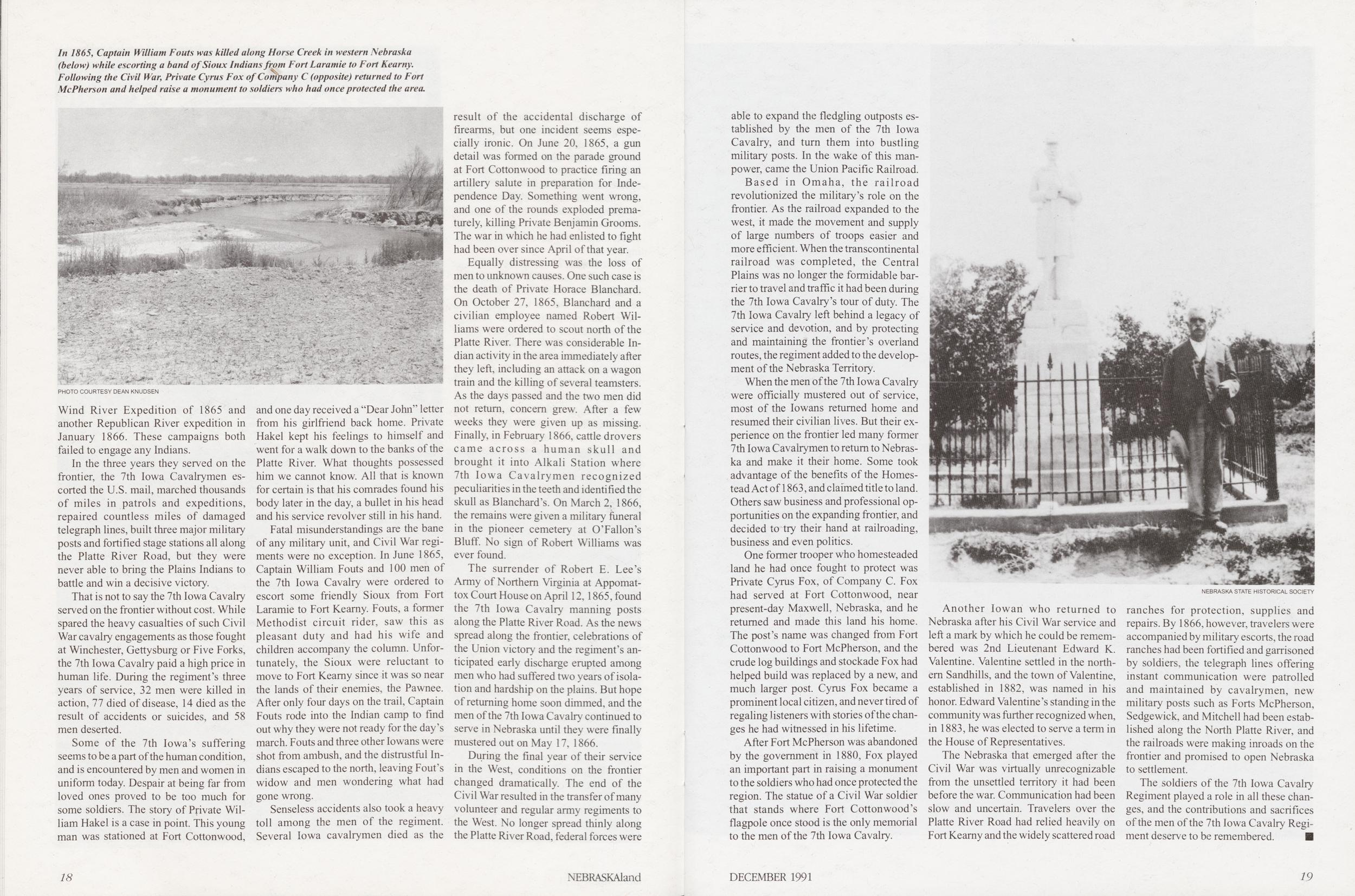
Fatal misunderstandings are the bane of any military unit, and Civil War regiments were no exception. In June 1865, Captain William Fouts and 100 men of the 7th Iowa Cavalry were ordered to escort some friendly Sioux from Fort Laramie to Fort Kearny. Fouts, a former Methodist circuit rider, saw this as pleasant duty and had his wife and children accompany the column. Unfortunately, the Sioux were reluctant to move to Fort Kearny since it was so near the lands of their enemies, the Pawnee. After only four days on the trail, Captain Fouts rode into the Indian camp to find out why they were not ready for the day's march. Fouts and three other Iowans were shot from ambush, and the distrustful Indians escaped to the north, leaving Fout's widow and men wondering what had gone wrong.
Senseless accidents also took a heavy toll among the men of the regiment. Several Iowa cavalrymen died as the result of the accidental discharge of firearms, but one incident seems espe-cially ironic. On June 20, 1865, a gun detail was formed on the parade ground at Fort Cottonwood to practice firing an artillery salute in preparation for Independence Day. Something went wrong, and one of the rounds exploded prematurely, killing Private Benjamin Grooms. The war in which he had enlisted to fight had been over since April of that year.
Equally distressing was the loss of men to unknown causes. One such case is the death of Private Horace Blanchard. On October 27, 1865, Blanchard and a civilian employee named Robert Williams were ordered to scout north of the Platte River. There was considerable Indian activity in the area immediately after they left, including an attack on a wagon train and the killing of several teamsters. As the days passed and the two men did not return, concern grew. After a few weeks they were given up as missing. Finally, in February 1866, cattle drovers came across a human skull and brought it into Alkali Station where 7th Iowa Cavalrymen recognized peculiarities in the teeth and identified the skull as Blanchard's. On March 2, 1866, the remains were given a military funeral in the pioneer cemetery at O'Fallon's Bluff. No sign of Robert Williams was ever found.
The surrender of Robert E. Lee's Army of Northern Virginia at Appomattox Court House on April 12,1865, found the 7th Iowa Cavalry manning posts along the Platte River Road. As the news spread along the frontier, celebrations of the Union victory and the regiment's anticipated early discharge erupted among men who had suffered two years of isolation and hardship on the plains. But hope of returning home soon dimmed, and the men of the 7th Iowa Cavalry continued to serve in Nebraska until they were finally mustered out on May 17, 1866.
During the final year of their service in the West, conditions on the frontier changed dramatically. The end of the Civil War resulted in the transfer of many volunteer and regular army regiments to the West. No longer spread thinly along the Platte River Road, federal forces were 18 NEBRASKAland able to expand the fledgling outposts established by the men of the 7th Iowa Cavalry, and turn them into bustling military posts. In the wake of this manpower, came the Union Pacific Railroad.
Based in Omaha, the railroad revolutionized the military's role on the frontier. As the railroad expanded to the west, it made the movement and supply of large numbers of troops easier and more efficient. When the transcontinental railroad was completed, the Central Plains was no longer the formidable barrier to travel and traffic it had been during the 7th Iowa Cavalry's tour of duty. The 7th Iowa Cavalry left behind a legacy of service and devotion, and by protecting and maintaining the frontier's overland routes, the regiment added to the development of the Nebraska Territory.
When the men of the 7th Iowa Cavalry were officially mustered out of service, most of the Iowans returned home and resumed their civilian lives. But their experience on the frontier led many former 7th Iowa Cavalrymen to return to Nebraska and make it their home. Some took advantage of the benefits of the Homestead Act of 1863, and claimed title to land. Others saw business and professional opportunities on the expanding frontier, and decided to try their hand at railroading, business and even politics.
One former trooper who homesteaded land he had once fought to protect was Private Cyrus Fox, of Company C. Fox had served at Fort Cottonwood, near present-day Maxwell, Nebraska, and he returned and made this land his home. The post's name was changed from Fort Cottonwood to Fort McPherson, and the crude log buildings and stockade Fox had helped build was replaced by a new, and much larger post. Cyrus Fox became a prominent local citizen, and never tired of regaling listeners with stories of the chan-ges he had witnessed in his lifetime.
After Fort McPherson was abandoned by the government in 1880, Fox played an important part in raising a monument to the soldiers who had once protected the region. The statue of a Civil War soldier that stands where Fort Cottonwood's flagpole once stood is the only memorial to the men of the 7th Iowa Cavalry.
Another lowan who returned to Nebraska after his Civil War service and left a mark by which he could be remembered was 2nd Lieutenant Edward K. Valentine. Valentine settled in the northern Sandhills, and the town of Valentine, established in 1882, was named in his honor. Edward Valentine's standing in the community was further recognized when, in 1883, he was elected to serve a term in the House of Representatives.
The Nebraska that emerged after the Civil War was virtually unrecognizable from the unsettled territory it had been before the war. Communication had been slow and uncertain. Travelers over the Platte River Road had relied heavily on Fort Kearny and the widely scattered road ranches for protection, supplies and repairs. By 1866, however, travelers were accompanied by military escorts, the road ranches had been fortified and garrisoned by soldiers, the telegraph lines offering instant communication were patrolled and maintained by cavalrymen, new military posts such as Forts McPherson, Sedgewick, and Mitchell had been established along the North Platte River, and the railroads were making inroads on the frontier and promised to open Nebraska to settlement.
The soldiers of the 7th Iowa Cavalry Regiment played a role in all these changes, and the contributions and sacrifices of the men of the 7th Iowa Cavalry Regiment deserve to be remembered.
DECEMBER 1991 19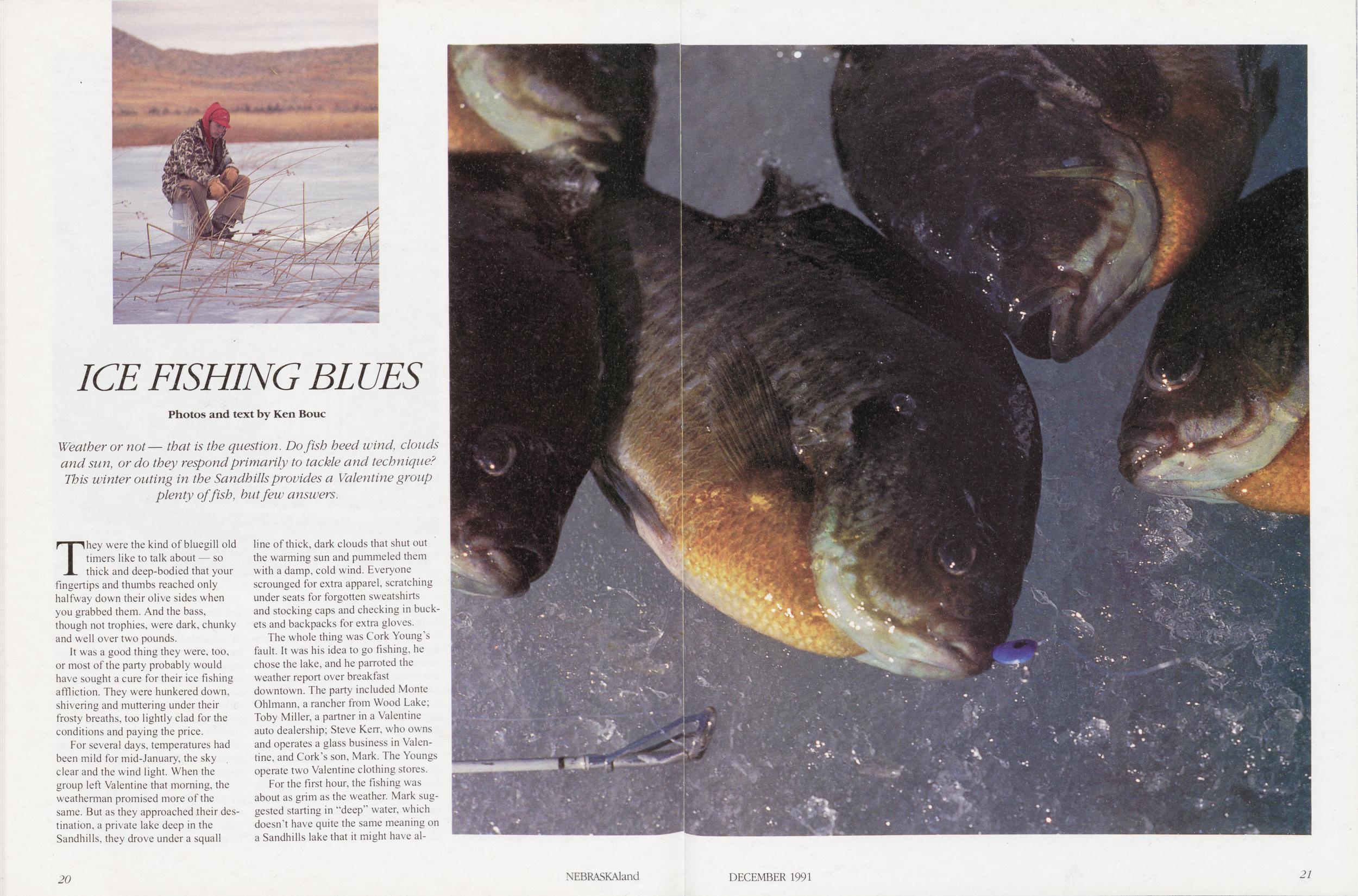
ICE FISHING BLUES
Photos and text by Ken Bouc Weather or not— that is the question. Do fish heed wind, clouds and sun, or do they respond primarily to tackle and technique? Tlois winter outing in the Sandhills provides a Valentine group plenty offish, but few answers.They were the kind of bluegill old timers like to talk about — so thick and deep-bodied that your fingertips and thumbs reached only halfway down their olive sides when you grabbed them. And the bass, though not trophies, were dark, chunky and well over two pounds.
It was a good thing they were, too, or most of the party probably would have sought a cure for their ice fishing affliction. They were hunkered down, shivering and muttering under their frosty breaths, too lightly clad for the conditions and paying the price.
For several days, temperatures had been mild for mid-January, the sky clear and the wind light. When the group left Valentine that morning, the weatherman promised more of the same. But as they approached their destination, a private lake deep in the Sandhills, they drove under a squall line of thick, dark clouds that shut out the warming sun and pummeled them with a damp, cold wind. Everyone scrounged for extra apparel, scratching under seats for forgotten sweatshirts and stocking caps and checking in buckets and backpacks for extra gloves.
The whole thing was Cork Young's fault. It was his idea to go fishing, he chose the lake, and he parroted the weather report over breakfast downtown. The party included Monte Ohlmann, a rancher from Wood Lake; Toby Miller, a partner in a Valentine auto dealership; Steve Kerr, who owns and operates a glass business in Valentine, and Cork's son, Mark. The Youngs operate two Valentine clothing stores.
For the first hour, the fishing was about as grim as the weather. Mark suggested starting in "deep" water, which doesn't have quite the same meaning on a Sandhills lake that it might have almost 20 NEBRASKAland
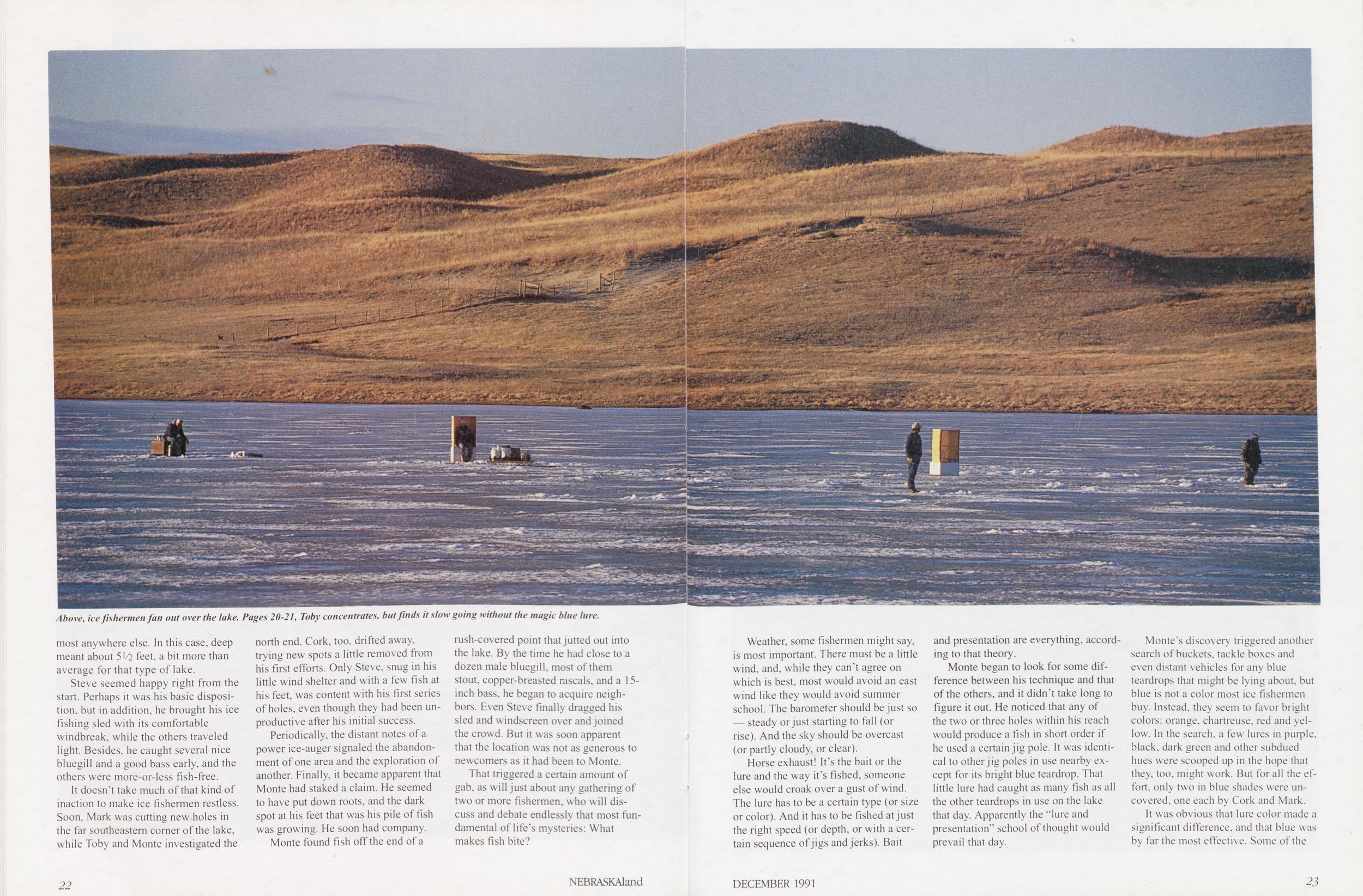
Steve seemed happy right from the start. Perhaps it was his basic disposition, but in addition, he brought his ice fishing sled with its comfortable windbreak, while the others traveled light. Besides, he caught several nice bluegill and a good bass early, and the others were more-or-less fish-free.
It doesn't take much of that kind of inaction to make ice fishermen restless. Soon, Mark was cutting new holes in the far southeastern corner of the lake, while Toby and Monte investigated the north end. Cork, too, drifted away, trying new spots a little removed from his first efforts. Only Steve, snug in his little wind shelter and with a few fish at his feet, was content with his first series of holes, even though they had been unproductive after his initial success.
Periodically, the distant notes of a power ice-auger signaled the abandonment of one area and the exploration of another. Finally, it became apparent that Monte had staked a claim. He seemed to have put down roots, and the dark spot at his feet that was his pile offish was growing. He soon had company.
Monte found fish off the end of a rush-covered point that jutted out into the lake. By the time he had close to a dozen male bluegill, most of them stout, copper-breasted rascals, and a 15-inch bass, he began to acquire neighbors. Even Steve finally dragged his sled and windscreen over and joined the crowd. But it was soon apparent that the location was not as generous to newcomers as it had been to Monte.
That triggered a certain amount of gab, as will just about any gathering of two or more fishermen, who will discuss and debate endlessly that most fundamental of life's mysteries: What makes fish bite?
22 NEBRASKAlandWeather, some fishermen might say, is most important. There must be a little wind, and, while they can't agree on which is best, most would avoid an east wind like they would avoid summer school. The barometer should be just so — steady or just starting to fall (or rise). And the sky should be overcast (or partly cloudy, or clear).
Horse exhaust! It's the bait or the lure and the way it's fished, someone else would croak over a gust of wind. The lure has to be a certain type (or size or color). And it has to be fished at just the right speed (or depth, or with a certain sequence of jigs and jerks). Bait and presentation are everything, according to that theory.
Monte began to look for some difference between his technique and that of the others, and it didn't take long to figure it out. He noticed that any of the two or three holes within his reach would produce a fish in short order if he used a certain jig pole. It was identical to other jig poles in use nearby except for its bright blue teardrop. That little lure had caught as many fish as all the other teardrops in use on the lake that day. Apparently the "lure and presentation" school of thought would prevail that day.
Monte's discovery triggered another search of buckets, tackle boxes and even distant vehicles for any blue teardrops that might be lying about, but blue is not a color most ice fishermen buy. Instead, they seem to favor bright colors: orange, chartreuse, red and yellow. In the search, a few lures in purple, black, dark green and other subdued hues were scooped up in the hope that they, too, might work. But for all the effort, only two in blue shades were uncovered, one each by Cork and Mark.
It was obvious that lure color made a
significant difference, and that blue was
by far the most effective. Some of the
DECEMBER 1991
23
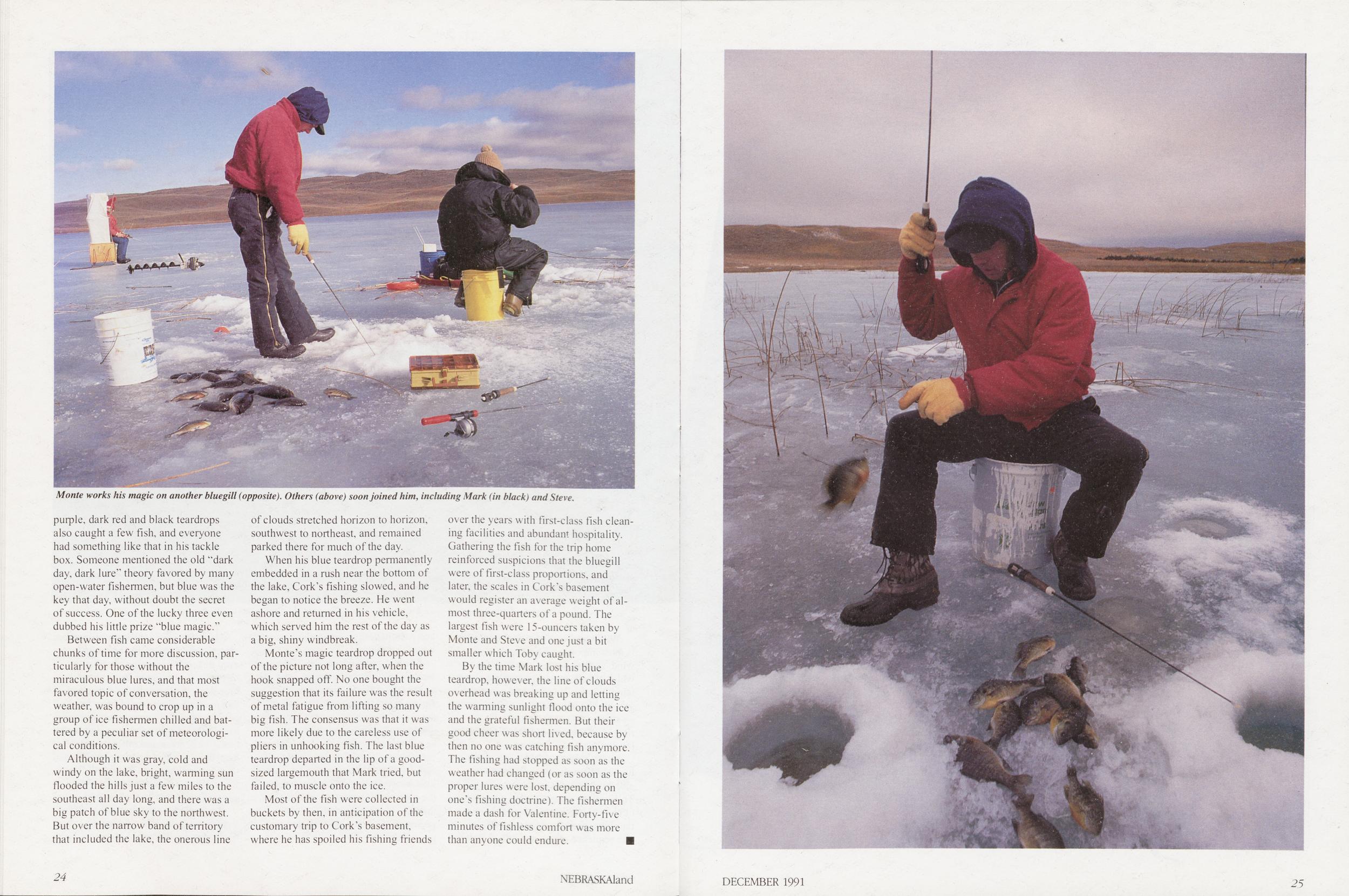
Between fish came considerable chunks of time for more discussion, particularly for those without the miraculous blue lures, and that most favored topic of conversation, the weather, was bound to crop up in a group of ice fishermen chilled and battered by a peculiar set of meteorological conditions.
Although it was gray, cold and windy on the lake, bright, wanning sun flooded the hills just a few miles to the southeast all day long, and there was a big patch of blue sky to the northwest. But over the narrow band of territory that included the lake, the onerous line of clouds stretched horizon to horizon, southwest to northeast, and remained parked there for much of the day.
When his blue teardrop permanently embedded in a rush near the bottom of the lake, Cork's fishing slowed, and he began to notice the breeze. He went ashore and returned in his vehicle, which served him the rest of the day as a big, shiny windbreak.
Monte's magic teardrop dropped out of the picture not long after, when the hook snapped off. No one bought the suggestion that its failure was the result of metal fatigue from lifting so many big fish. The consensus was that it was more likely due to the careless use of pliers in unhooking fish. The last blue teardrop departed in the lip of a good-sized largemouth that Mark tried, but failed, to muscle onto the ice.
Most of the fish were collected in buckets by then, in anticipation of the customary trip to Cork's basement, where he has spoiled his fishing friends over the years with first-class fish cleaning facilities and abundant hospitality. Gathering the fish for the trip home reinforced suspicions that the bluegill were of first-class proponions, and later, the scales in Cork's basement would register an average weight of almost three-quarters of a pound. The largest fish were 15-ouncers taken by Monte and Steve and one just a bit smaller which Toby caught.
By the time Mark lost his blue teardrop, however, the line of clouds overhead was breaking up and letting the warming sunlight flood onto the ice and the grateful fishermen. But their good cheer was short lived, because by then no one was catching fish anymore. The fishing had stopped as soon as the weather had changed (or as soon as the proper lures were lost, depending on one's fishing doctrine). The fishermen made a dash for Valentine. Forty-five minutes of Ashless comfort was more than anyone could endure.
24 NEBRASKAland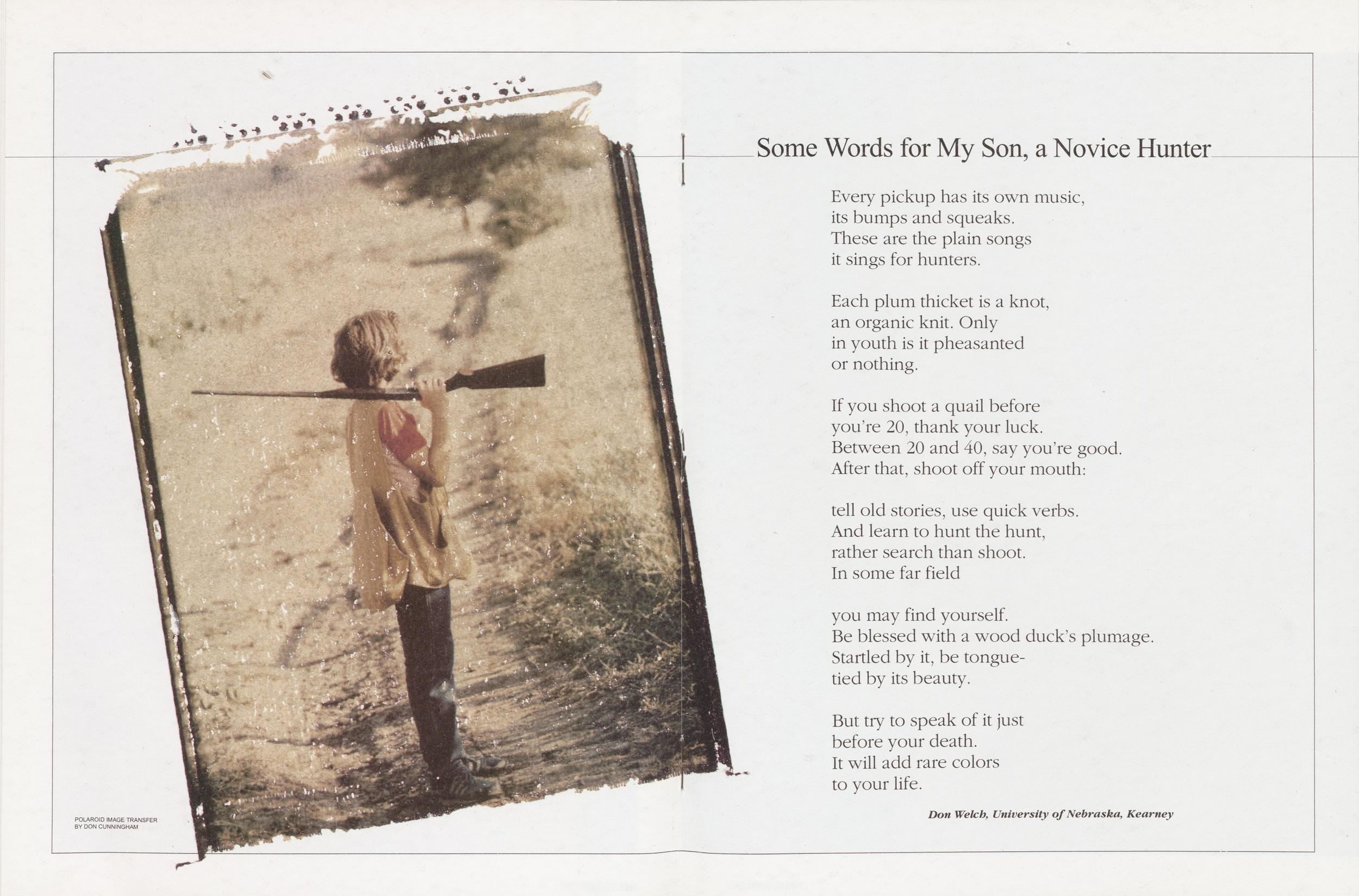
Some Words for My Son, a Novice Hunter
Every pickup has its own music, its bumps and squeaks. These are the plain songs it sings for hunters. Each plum thicket is a knot, an organic knit. Only in youth is it pheasanted or nothing. If you shoot a quail before you're 20, thank your luck. Between 20 and 40, say you're good. After that, shoot off your mouth: tell old stories, use quick verbs. And learn to hunt the hunt, rather search than shoot. In some far field you may find yourself. Be blessed with a wood duck's plumage. Startled by it, be tongue-tied by its beauty. But try to speak of it just before your death. It will add rare colors to your life. Don Welch, University of Nebraska, Kearney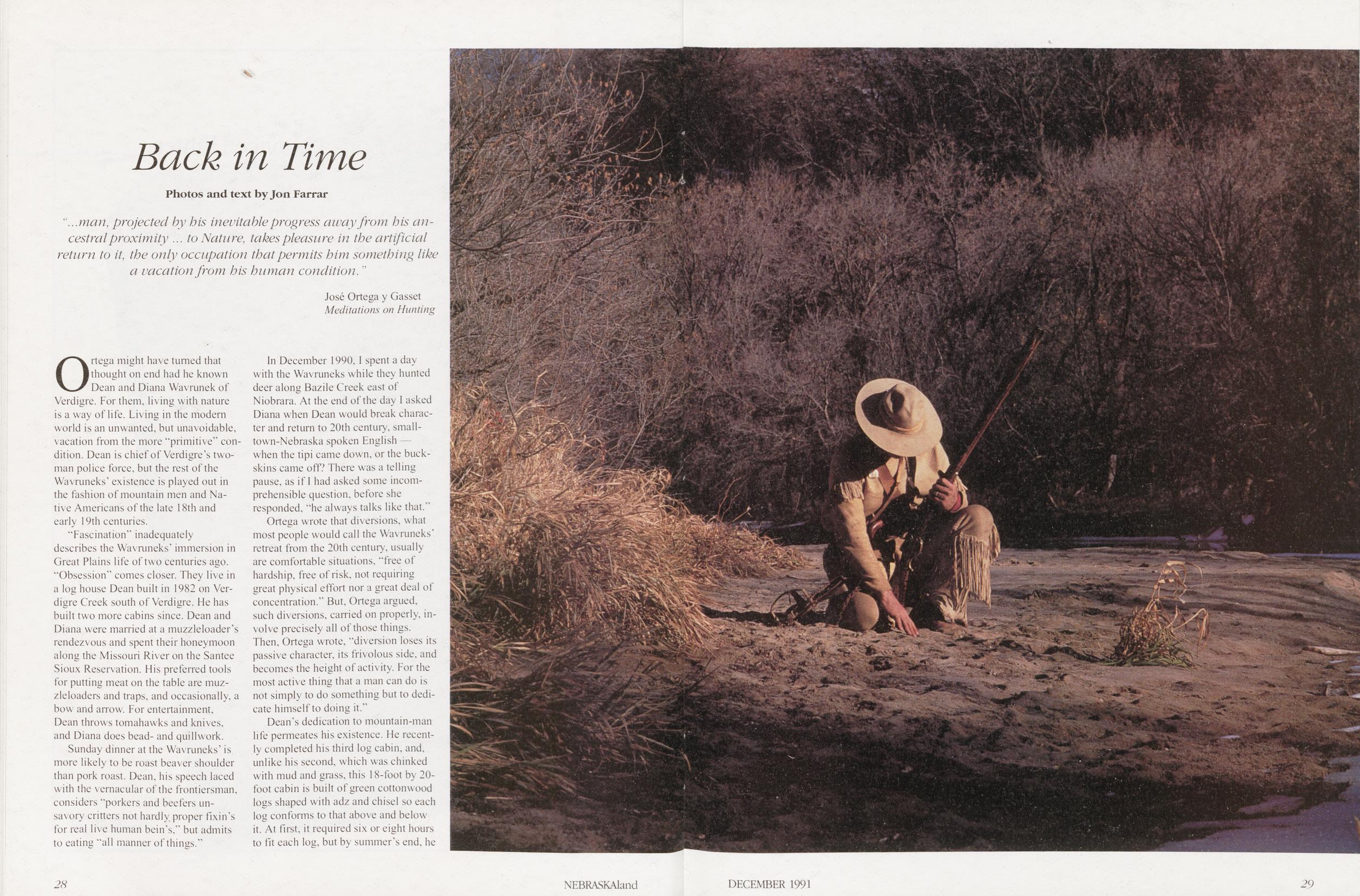
Back in Time
Photos and text by Jon Farrar ...man, projected by his inevitable progress away from his ancestral proximity ... to Nature, takes pleasure in the artificial return to it, the only occupation that permits him something like a vacation from his human condition." Jose Ortega y Gasset Meditations on HuntingOrtega might have turned that thought on end had he known Dean and Diana Wavrunek of Verdigre. For them, living with nature is a way of life. Living in the modern world is an unwanted, but unavoidable, vacation from the more ''primitive" condition. Dean is chief of Verdi tire's two man police force, but the rest of the Wavruneks1 existence is played out in the fashion of mountain men and Native Americans of the late 18th and early 19th centuries.
"Fascination" inadequately describes the Wavruneks' immersion in Great Plains life of two centuries ago. "Obsession" comes closer. They live in a Ion house Dean built in 1982 on Verdigre Creek south of Verdigre. He has built two more cabins since. Dean and Diana were married at a muzzleloader's rendezvous and spent their honeymoon along the Missouri River on the Santee Sioux Reservation. His preferred tools for putting meat on the table are muzzleloaders and traps, and occasionally, a bow and arrow. For entertainment, Dean throws tomahawks and knives, and Diana does bead- and quillwork.
Sunday dinner at the Wavruneks1 is more likely to be roast beaver shoulder than pork roast. Dean, his speech laced with the vernacular of the frontiersman, considers "porkers and beefers unsavory critters not hardly proper fix it for real live human beiiTs," but admits to eating "all manner of things."
In December 1990, I spent a day with the Wavruneks while they hunted deer along Bazile Creek east of Niobrara. At the end of the day I asked Diana when Dean would break character and return to 20th century, small town-Nebraska spoken English - when the tipi came down, or the buckskins came off? There was a telling pause, as if I had asked some incomprehensible question, before she responded, "he always talks like that."
Ortega wrote that diversions, what most people would call the Wavruneks1 retreat from the 20th century, usually are comfortable situations, "free of hardship, free of risk, not requiring great physical effort nor a great deal of concentration." But, Ortega argued, such diversions, carried on properly, involve precisely all of those things. Then, Ortega wrote, "diversion loses its passive character, its frivolous side, and becomes the height of activity. For the most active thing that a man can do is not simply to do something but to dedicate himself to doing it."
Dean's dedication to mountain-man life permeates his existence. He recently completed his third log cabin, and. unlike his second, which was chinked with mud and grass, this 18-foot by 20-foot cabin is built of green cottonwood logs shaped with adz and chisel so each log conforms to that above and below it. At first, it required six or eight hours to fit each log, but by summer's end, he 28 NEBRASKAland
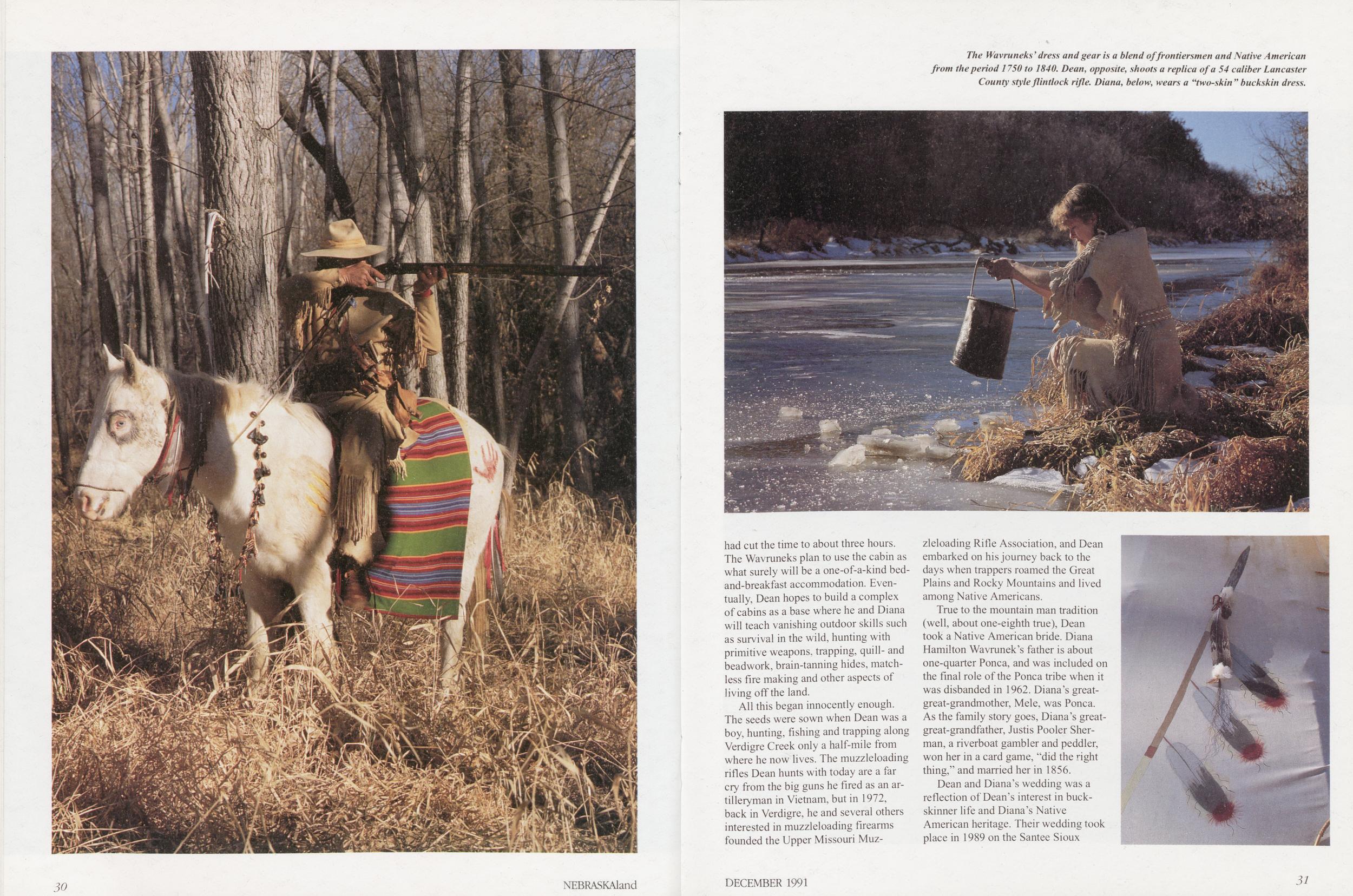
All this began innocently enough. The seeds were sown when Dean was a boy, hunting, fishing and trapping along Verdigre Creek only a half-mile from where he now lives. The muzzleloading rifles Dean hunts with today are a far cry from the big guns he fired as an artilleryman in Vietnam, but in 1972, back in Verdigre, he and several others interested in muzzleloading firearms founded the Upper Missouri Muzzleloading Rifle Association, and Dean embarked on his journey back to the days when trappers roamed the Great Plains and Rocky Mountains and lived among Native Americans.
True to the mountain man tradition (well, about one-eighth true), Dean took a Native American bride. Diana Hamilton Wavrunek's father is about one-quarter Ponca, and was included on the final role of the Ponca tribe when it was disbanded in 1962. Diana's great- great-grandmother, Mele, was Ponca. As the family story goes, Diana's great-great-grandfather, Justis Pooler Sherman, a riverboat gambler and peddler, won her in a card game, "did the right thing," and married her in 1856.
Dean and Diana's wedding was a reflection of Dean's interest in buck-skinner life and Diana's Native American heritage. Their wedding took place in 1989 on the Santee Sioux
The ceremony was a blend of a standard civil marriage, the exchange of personal vows, and traditional Plains Indian rites. As part of the ceremony, the groom presented the bride with a blanket, symbolizing his "eternal presence" even in the event of his absence. In the tradition of Great Plains Native American cultures, the couple asked for guidance from Mother Earth, Father Sky and the Four Directions with an offering of corn, venison and water — to the east for the power of the bear, to the south for the courage of the eagle, to the west for the wisdom of the owl, to the north for the peace and gentleness of the dove. A feast of roast venison and Indian fry-bread cooked over an open fire, a canon salute and tomahawk throwing and muzzleloader shooting followed. The Wavruneks spent their honeymoon in a tent on the banks of the Missouri River.
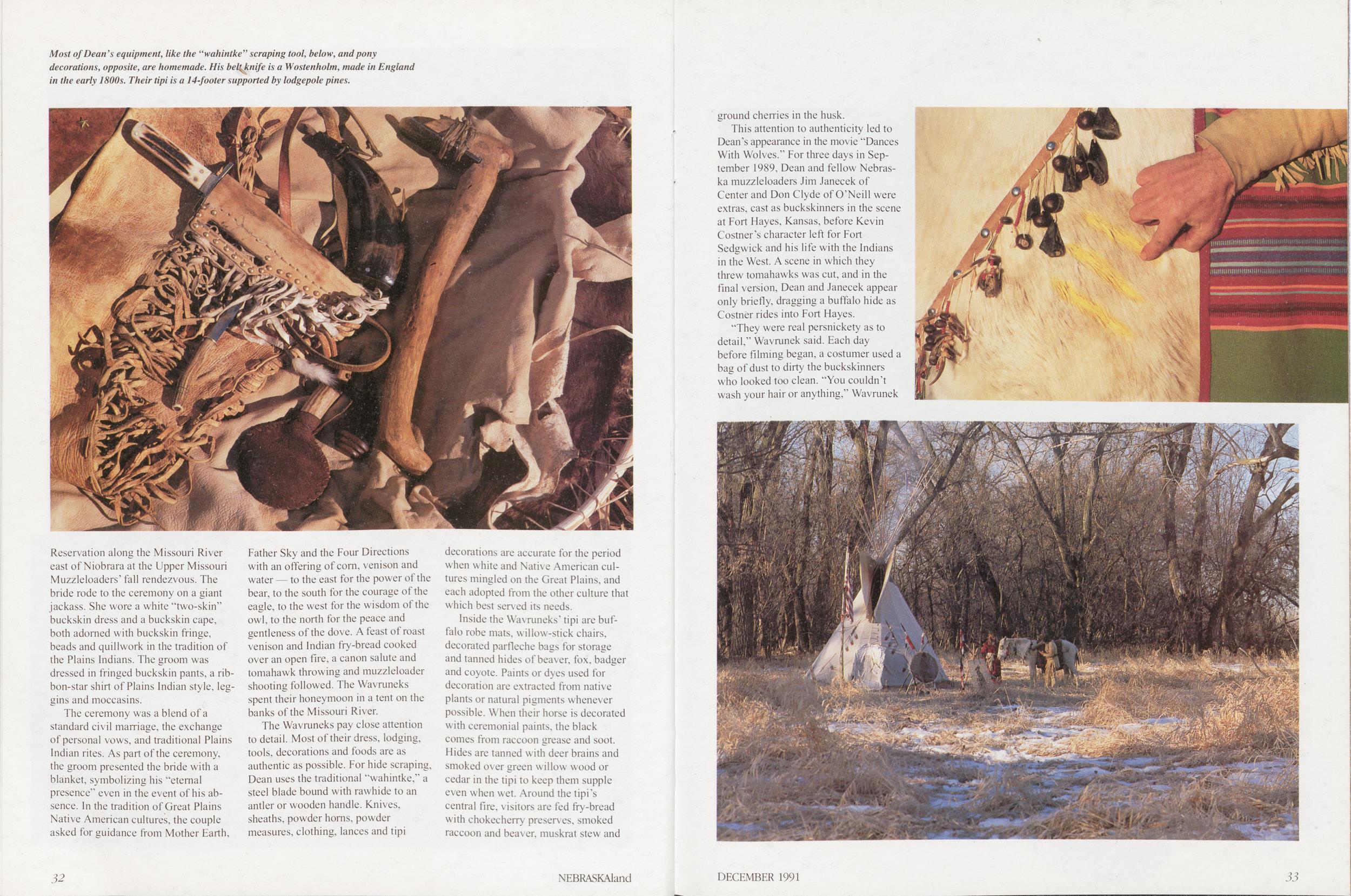
The Wavruneks pay close attention to detail. Most of their dress, lodging, tools, decorations and foods are as authentic as possible. For hide scraping, Dean uses the traditional "wahintke," a steel blade bound with rawhide to an antler or wooden handle. Knives, sheaths, powder horns, powder measures, clothing, lances and tipi decorations are accurate for the period when white and Native American cultures mingled on the Great Plains, and each adopted from the other culture that which best served its needs.
Inside the Wavruneks' tipi are buffalo robe mats, willow-stick chairs, decorated partleche bags for storage and tanned hides of beaver, fox, badger and coyote. Paints or dyes used for decoration are extracted from native plants or natural pigments whenever possible. When their horse is decorated with ceremonial paints, the black comes from raccoon grease and soot. Hides are tanned with deer brains and smoked over green willow wood or cedar in the tipi to keep them supple even when wet. Around the tipi's central fire, visitors are fed fry-bread with chokecherry preserves, smoked raccoon and beaver, muskrat stew and 32 NEBRASKAland ground cherries in the husk.
This attention to authenticity led to Dean's appearance in the movie "Dances With Wolves." For three days in September 1989, Dean and fellow Nebraska muzzleloaders Jim Janecek of Center and Don Clyde of O'Neill were extras, cast as buck skinners in the scene at Fort Hayes, Kansas, before Kevin Costner's character left for Fort Sedgwick and his life with the Indians in the West. A scene in which they threw tomahawks was cut, and in the final version, Dean and Janecek appear only briefly, dragging a buffalo hide as Costner rides into Fort Hayes.
"They were real persnickety as to detail," Wavrunek said. Each day before filming began, a costumer used a bag of dust to dirty the buckskinners who looked too clean. "You couldn't wash your hair or anything," Wavrunek
Dean said neither he nor Janecek are movie watchers, and neither knew what Costner looked like. One day, throwing their tomahawks as they waited for the filming to begin, "this cavalry officer, a lieutenant, rides up on a horse," Dean recounts. "And he stopped his horse and he sat there. He looked at me and he said, 'are you going to throw?' I said, 'well, I suppose I can.' I threw a couple of hawks, Jim threw a couple, and he said, 'oh, ok/ and he rode off. So we did some filming that morning, and at noon time ... here comes this elderly couple walking up to where we were and introduced themselves as Kevin Costner's parents. Just a fine couple. And they was shaking our hands and taking pictures and they wanted pictures of us throwing hawks and of us with them. And they said, 'Kevin was here earlier and told us to stop by and see what you guys were doing.' 1 said, 'you mean Kevin was the guy on that horse?' and they said, 'yeah.' That's kind of how it went."
Wavrunek and Janecek taught Mary McDonnell, "Dances With Wolves" leading lady, how to throw tomahawks. Dean said she was so taken with her new skill she tried to convince Costner to let her use a tomahawk rather than a rifle for a scene in which she killed a man, but didn't succeed, Dean explains, probably because Indians didn't throw tomahawks but used them in hand-to-hand fighting. Tomahawk throwing developed as competition at mountainman rendezvous.
The Wavruneks' showmanship extends from bit parts in major movies to starring roles in their own show. With Jim Janecek, the Wavruneks entertain crowds with their black powder marksmanship and their tomahawk and knife-throwing skill, traditional competitions at trapper rendezvous two centuries ago. The demonstrations feature Dean using knives and tomahawks to break balloons Diana holds in her hand, shooting a balloon off Janecek's hat, splitting a playing card in two edgewise with a muzzleloader, and having as many as four tomahawks on their way to a target at one time.
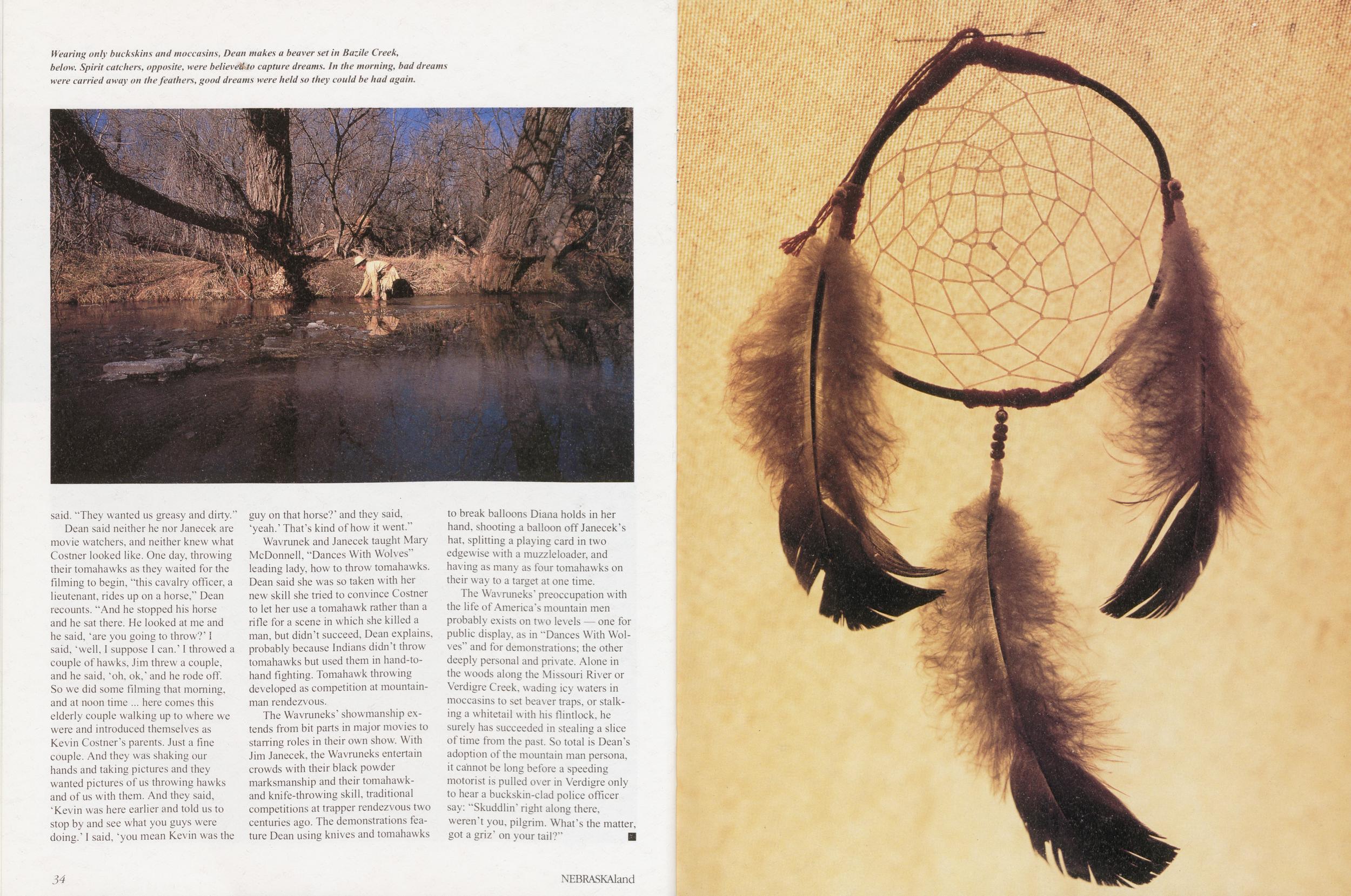
The Wavruneks' preoccupation with the life of America's mountain men probably exists on two levels — one for public display, as in "Dances With Wolves" and for demonstrations; the other deeply personal and private. Alone in the woods along the Missouri River or Verdigre Creek, wading icy waters in moccasins to set beaver traps, or stalking a whitetail with his flintlock, he surely has succeeded in stealing a slice of time from the past. So total is Dean's adoption of the mountain man persona, it cannot be long before a speeding motorist is pulled over in Verdigre only to hear a buckskin-clad police officer say: "Skuddlin' right along there, weren't you, pilgrim. What's the matter, got a griz' on your tail?"
34 NEBRASKAland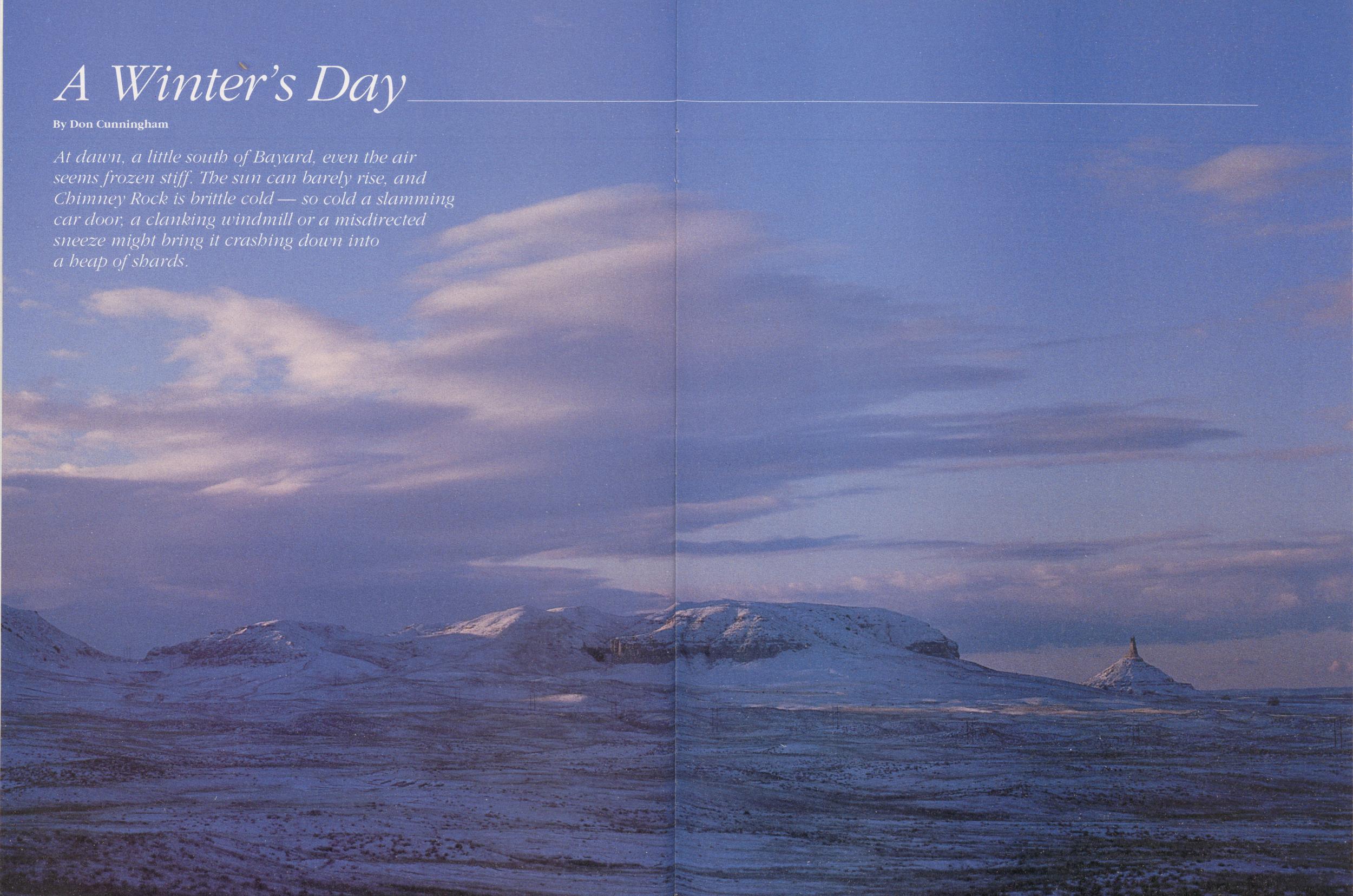
A Winter's Day
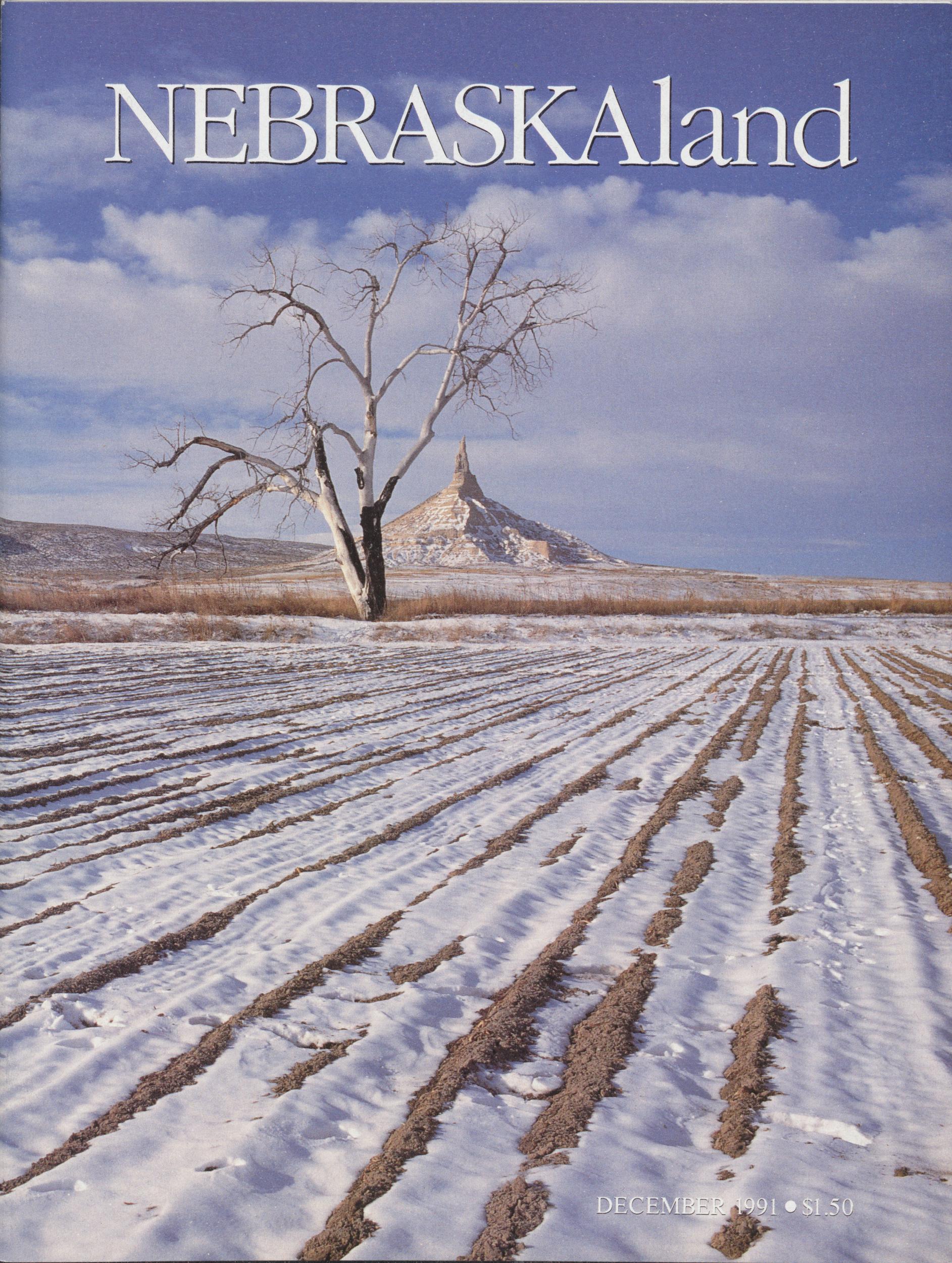
By Don Cunningham At dawn, a little south of Bayard, even the air seems frozen stiff. Voe sun can barely rise, and Chimney Rock is brittle cold— so cold a slam mine car door a clanking windmill or a misdirected sneeze might bring it crashing down into a heap of shards.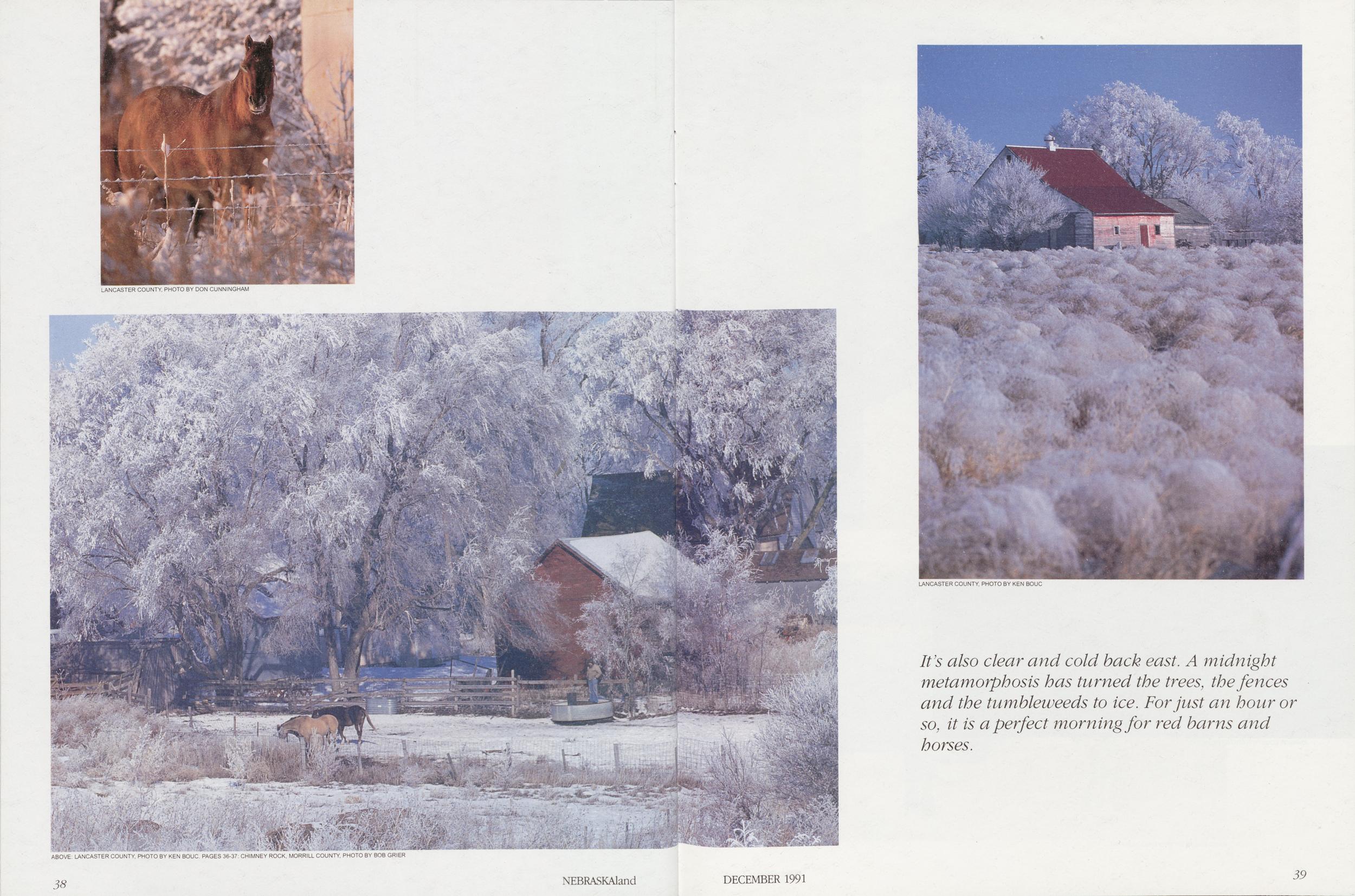
It's also clear and cold back east. A midnight metamorphosis has turned the trees, the fences and the tumbleweeds to ice. For just an hour or so, it is a perfect morning for red barns and horses.
DECEMBER 1991 39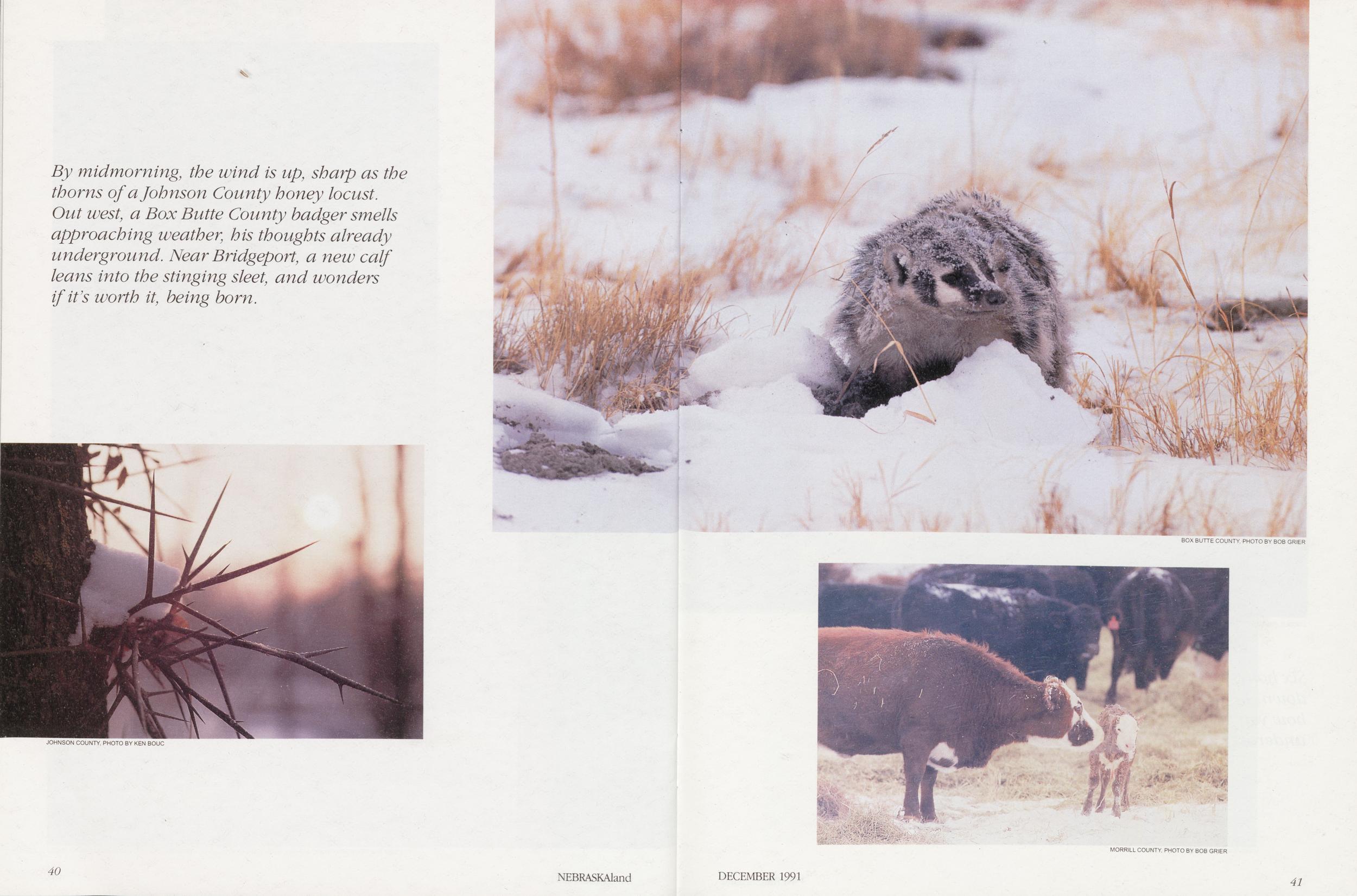
By midmorning, the wind is up, sharp as the thorns of a Johnson County honey locust. Out west, a Box Butte County badger smells approaching weather, his thoughts already underground. Near Bridgeport, a new calf leans into the stinging sleet, and wonders if it's worth it, being born.
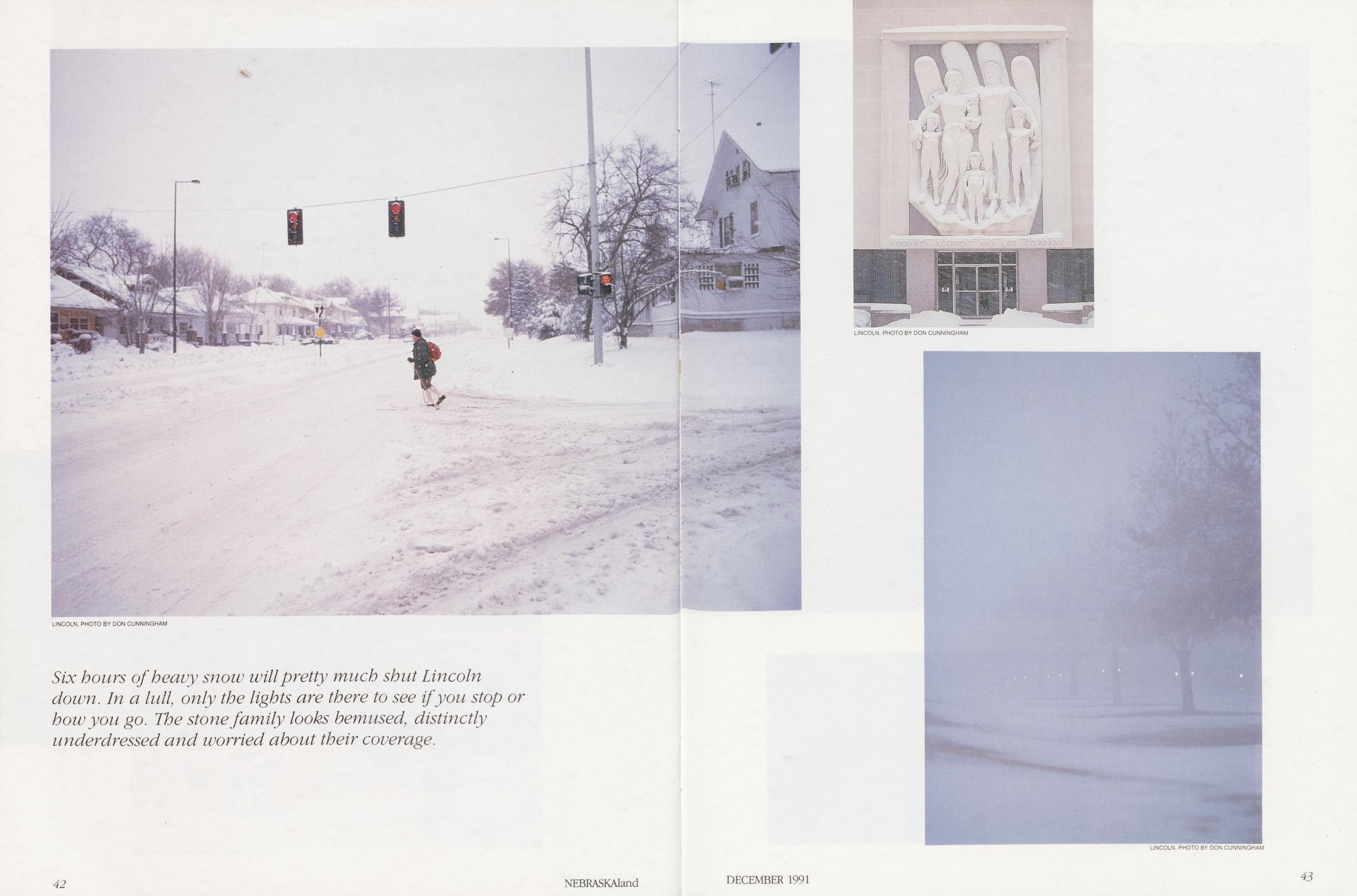
Six hours of heavy snow will pretty much shut Lincoln down. In a lull, only the lights are there to see if you stop or how you go. The stone family looks bemused, distinctly underdressed and worried about their coverage.
42 NEBRASKAland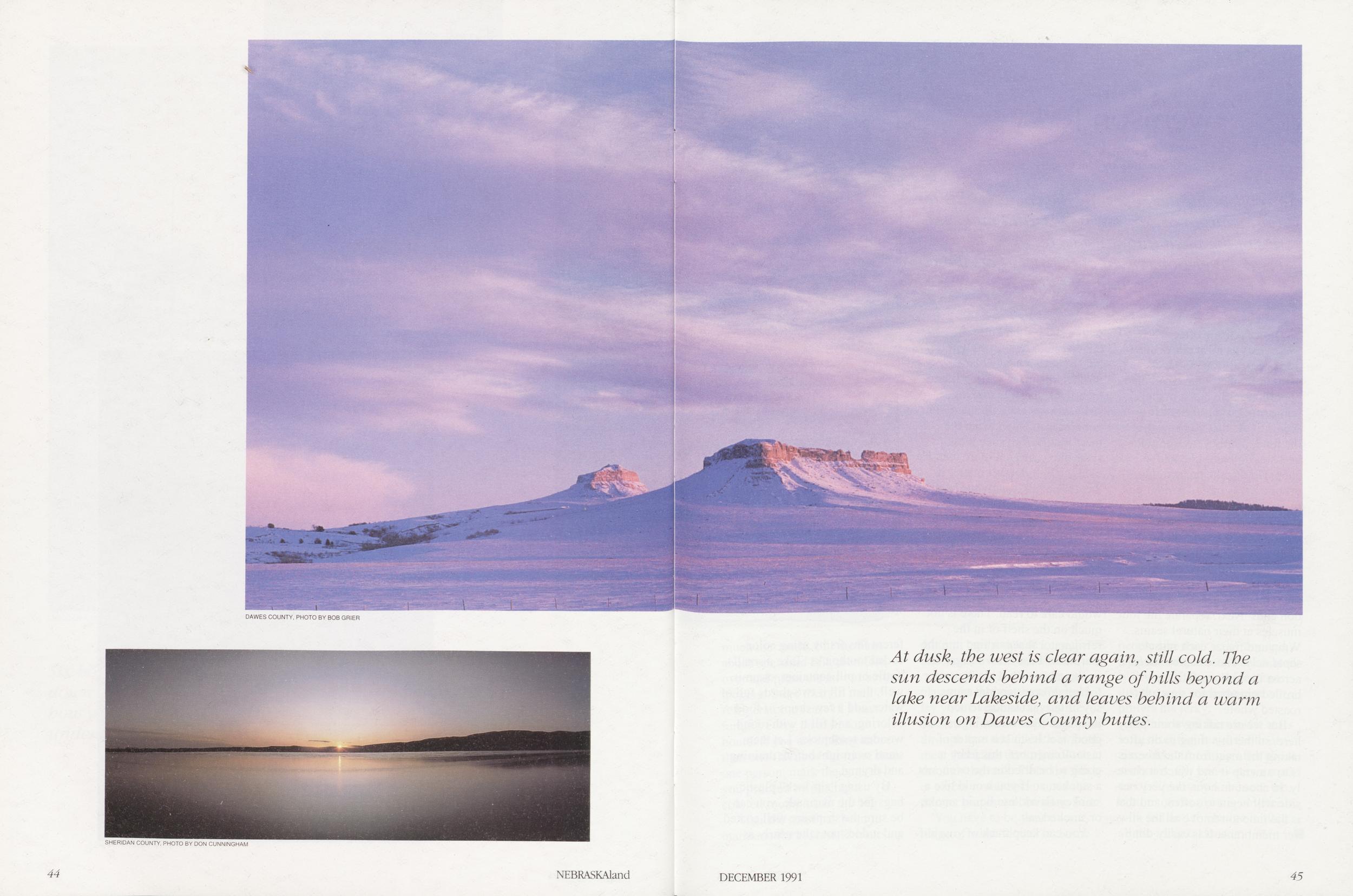
At dusk, the west is clear again, still cold. The sun descends behind a range of hills beyond a lake near Lakeside, and leaves behind a warm illusion on Dawes County buttes.
DECEMBER 1991 45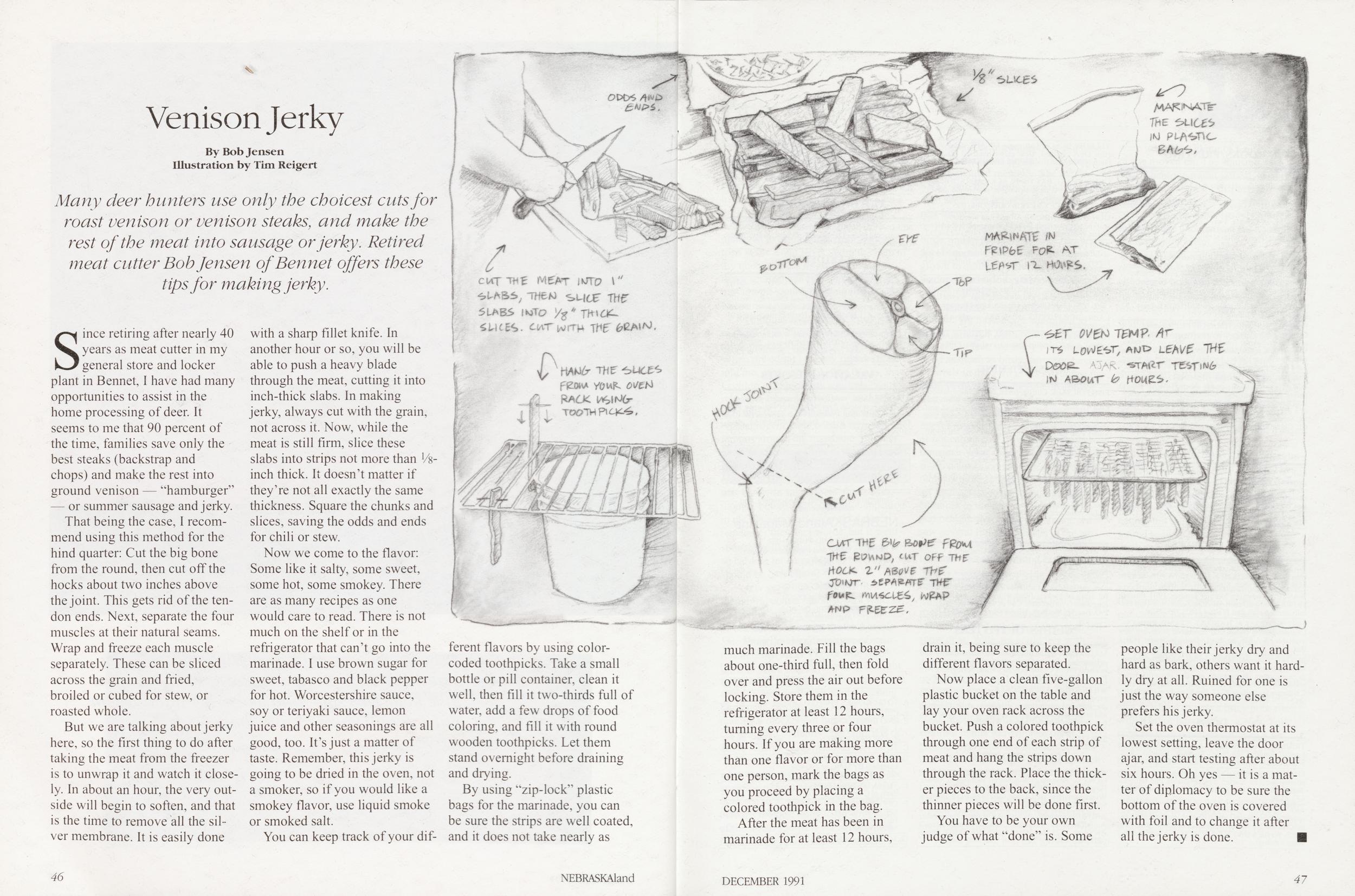
Venison Jerky
By Bob Jensen Illustration by Tim Reigert Many deer hunters use only the choicest cuts for roast venison or venison steaks, and make the rest of the meat into sausage or jerky. Retired meat cutter Boh Jensen of Bennet offers these tips for making jerky.Since retiring after nearly 40 years as meat cutter in my general store and locker plant in Bennet, I have had many opportunities to assist in the home processing of deer. It seems to me that 90 percent of the time, families save only the best steaks (back strap and chops) and make the rest into ground venison — "hamburger" — or summer sausage and jerky.
That being the case, I recommend using this method for the hind quarter: Cut the big bone from the round, then cut off the hocks about two inches above the joint. This gets rid of the tendon ends. Next, separate the four muscles at their natural seams. Wrap and freeze each muscle separately. These can be sliced across the grain and fried, broiled or cubed for stew, or roasted whole.
But we are talking about jerky here, so the first thing to do after taking the meat from the freezer is to unwrap it and watch it closely. In about an hour, the very outside will begin to soften, and that is the time to remove all the silver membrane. It is easily done with a sharp fillet knife. In another hour or so, you will be able to push a heavy blade through the meat, cutting it into inch-thick slabs. In making jerky, always cut with the grain, not across it. Now, while the meat is still firm, slice these slabs into strips not more than Vsinch thick. It doesn't matter if they're not all exactly the same thickness. Square the chunks and slices, saving the odds and ends for chili or stew.
Now we come to the flavor: Some like it salty, some sweet, some hot, some smokey. There are as many recipes as one would care to read. There is not much on the shelf or in the refrigerator that can't go into the marinade. I use brown sugar for sweet, tabasco and black pepper for hot. Worcestershire sauce, soy or teriyaki sauce, lemon juice and other seasonings are all good, too. It's just a matter of taste. Remember, this jerky is going to be dried in the oven, not a smoker, so if you would like a smokey flavor, use liquid smoke or smoked salt.
You can keep track of your different flavors by using colorcoded toothpicks. Take a small bottle or pill container, clean it well, then fill it two-thirds full of water, add a few drops of food coloring, and fill it with round wooden toothpicks. Let them stand overnight before draining and drying.
By using "zip-lock" plastic bags for the marinade, you can be sure the strips are well coated, and it does not take nearly as 46 NEBRASKAland much marinade. Fill the bags about one-third full, then fold over and press the air out before locking. Store them in the refrigerator at least 12 hours, turning every three or four hours. If you are making more than one flavor or for more than one person, mark the bags as you proceed by placing a colored toothpick in the bag.
After the meat has been in marinade for at least 12 hours, drain it, being sure to keep the different flavors separated.
Now place a clean five-gallon plastic bucket on the table and lay your oven rack across the bucket. Push a colored toothpick through one end of each strip of meat and hang the strips down through the rack. Place the thicker pieces to the back, since the thinner pieces will be done first.
You have to be your own judge of what "done" is. Some people like their jerky dry and hard as bark, others want it hardly dry at all. Ruined for one is just the way someone else prefers his jerky.
Set the oven thermostat at its lowest setting, leave the door ajar, and start testing after about six hours. Oh yes — it is a matter of diplomacy to be sure the bottom of the oven is covered with foil and to change it after all the jerky is done.
DECEMBER 1991 47
Classified
BOOKS/PRINTINGFREE! Booklets on northeastern Nevada; fishing, rockhoundinu maps, Carl Hayden, Box 528, Jackpot, Nevada 89825. _______________________________________
FREE BOOK CATALOG. Novels, westerns, romances, children's; old out of print, found barns, attic. Authors: Grey, Bower, Connor, Fox, Curwood, Raine, Wright, Aldrige, Pollyanna, Freckles, many others. Postage appreciated. Pierce, 4400 N. Pine Cluster, Oroville, CA 95965._________________________________________
COMPLETE ROADSIDE GUIDE to Nebraska by Alan Boye is a mile-by-mile description of historical, geographical and folklore sites along all major highways. Over 10,000 miles are included in all 93 counties. The book includes museums, festivals, and those out-of-the-way unusual places for the resident and the tourist. $11.95 plus $1.50 postage. SALTILLO Press, 57 Lafayette, St. Johnsbury VT 05819.________________
PERFECT FOR CHRISTMAS GIVING. Nebraska native George DeBord brings to life small towns and the values of their inhabitants. Touching reflections on Nebraska, Wyoming. Kansas. Missouri, Oregon and California. Check or monev order for $10.95 includes shipping. Sand River Press, 1319 14th St., Los Osos. CA 93402.
UNIQUF NOTE CARDS DESIGNED BY ARTIST R.M.A. Faith. Please specify desired theme: Beach, nature,dolls, school days, music, sports, children, American southwest, inspirational and scriptural, Christmas or a delightful mixed grouping. Each package contains 1 8. Send $ 1 1.27 check or money order to 1456 Nolan Ct., Chula Vista, CA 91911.
CLOTHINGFUR MANUFACTURING—Manufacturer of all fur garments. Bring or mail your skins and we will custom make your coats, hats and misc. Also large inventory of new garments for sale. 55 years' experience. Write for free brochure. HAEKER FURRIERS, INC., P.O. Box 230, 615 W. Main St., Alma, NE 68920. Phone (308) 928-2515.
COLLECTIBLESWANTED: Nebraska stock certificates, letters, old checks, etc.—particularly pre-1900. A. A. Armstrong Jr. M.D., 21 1 West 39th, Scottsbluff, NE 69361.________
WANTED: Nebraska hunting licenses 1901 through 1919. $25-$ 1,000 each. Shooting Scripts and Trap Permits needed also. Phil Pfeiffer (402) 785-7500.
1992 NEBRASKA HABITAT STAMP PRINTS- Limited-edition signed and numbered prints are now available. S.A.S.E. to L. J. Bailey's Studio, RR 1 Box 159K, Roca, NE 68430. (402) 421-8657._______
BUYING: American Indian artifacts such as beadwork, weavings, baskets, etc.; also cowboy memorabilia such as chaps, spurs, photographs, etc. Best price first letter; photographs promptly returned. Jack Ringwalt, 1550 California St., Suite 6, #2 1 1, San Francisco, C A 94109, (415)759-6343.
DOGSTRAINING ALL BREEDS bird dogs—Vizslas and English Pointers for sale. Rozanek Kennels, R 2, Schuyler, NE 68661. Phone (402) 352-8769.
PINKERTON BIRD DOGS-English setter, English pointer puppies. Started dogs available this fall. Our dogs are bred for nose and style. Give us a call at (402) 673-4540.
AKC GERMAN SHORTHAIR pointers and brittany spaniels. Pups, started and trained dogs. Birdland Kenneis. Hunter Ingwerson, Nehawka, NE 6841 3,402-227- 4655. Wayne Clark, 7 1 2-529-4238 also will be doing some training.
YELLOW-BLACK Lab pups. FC-AFC sired. AKC. Hips OFA certified. Dew claws removed. Excellent hunting potential. Contact Bob Bendler, Lexington, NE, (308)324-4247.________________________
CHESAPEAKE BAY OR BLACK LABRADOR pup- pies and started dogs. Available year-round. NAFC pedigree available. Training and stud service. Call PLATTE VALLEY RETRIEVERS, (308) 995-23 18.
GUN DOG TRAINING. All sporting breeds. All dogs worked on game birds. Over 25 years experience. Henry Sader, Wilderness Kennels, Roca, NE (402) 423-4212.
ENGLISH SETTERS AND BRITTANIES: young dogs at different stages of development. Partially trained and experienced bird dogs. Darrell Yentes, Holdrege, NE (308)995-4797.________________________________
GERMAN SHORTHAIR POINTERS/ENGLISH POINTERS—pups, started dogs, stud service. Training available for pointing and retrieving dogs. Wayne Clark (712) 529-4238. Close to Omaha. Leave message.
LABRADOR PUPPIES: yellow AKC excellent hunting background. (308) 287-2408._____________________
GERMAN SHORTHAIR pointers. Puppies, started and trained dogs. Gun dog training available. (308) 235- 3237.
FISH/FISHINGFISH FOR SALE. Catfish, perch, coho salmon, rainbow trout, crappie, bluegill, walleye, minnows, goldfish, bullhead, largemouth bass, smallmouth bass, triploid grass carp. Commercial grower prices on catfish, perch, coho salmon, rainbow trout. Consulting available. Pleasant Valley Fish Farm. Rt 1 Box 147, McCook, NE 69001. Phone (308) 345-6599.___________________________
DEE'S CONTOUR MAPS-High quality, waterproof, tearproof, 25x35 inches. Most Nebraska and Kansas reservoirs, some Colorado. $4.95 each. Write or call Dee's Maps, P.O. Box 702, Broken Bow, NE 68822- 0702; phone (308) 872-6539._____________________
WAX WORMS: 500-$8.50; 1000-$ 15,00. Add 5% sales tax. Postpaid first class. No. C.O.D. Harold Malicky, Burwe 1, NE 68823.
FOODYOU GOT YOUR DEER, now try Grandma's venison recipe. Send $2 to: T. Holland, 6642 East Arbor Ave., Mesa, AZ 85206.________________________________
NEBRASKA BASKETS: The original Nebraska company specializing in fine foods from Nebraska. A beautiful array of baskets filled with ethnic, healthful and long-time favorite foods. Call or write for our brochure: P.O. Box 98, McCook, NE 69001. 1-800-345-7725.
GUIDES/OUTFITTERSMAD RIVER CANOES offers the finest quality and performance. For the finest canoes and accessories look to Great Plains Canoe Co.. 205 Main, Springfield, NE. Phone(402)253-2001.__________________________
WILDERNESS ADVENTURES—alpine backpacking expeditions in the high country of Colorado and Wyoming. Personal instruction in wilderness skills, fly fishing and mountaineering. Family and private trips available. For brochure contact Jim at Wilderness Adventures, 2725 N. 65th Ave., Omaha, NE 68104. Phone (402) 556-3741.______________________________________
GUNS/SHOOTINGGUNS — Browning, Winchester, Remington, others, Hi-powers; shotguns, new, used, antiques. Want Pre-'64 Winchesters. Buy-Sell-Trade. (402) 729-61 12. Bedlan's Sporting Goods, Fairbury, NE 68352.
AIR GUNS repaired—Benjamin, Crosman, Daisy, other American made. Restoration; old guns wanted. Jack's Air Guns, 1225 No. 46th, Lincoln, NE 68503. Phone (402)466-9223.
HEALTH/FITNESSGUARANTEE. REDUCE CHOLESTEROL, lose fat; for information send $3.50 to Adel Enterprizes, P.O. Box 30047, Lincoln, NE 68503-0047.______________
OUTDOOR EQUIPMENTNEED A CANVAS product made? Fax your detailed drawing and phone number. I'll call back with estimate. Ogalla Canvas (308) 284-2054.________________
TAXIDERMYALLISON'S TAXIDERMY STUDIO & GIFT GALLERY. Wally and Betty Allison Licensed Taxidermist. We've mounted 32 Nebraska State Record fish. Specializing in fish, birds and small game. We use freeze-dry. 421 North Dewey, North Platte, NE 69101. (308) 534-2324 or (308) 534-4267 home.___________
PEISTER TAXIDERMY—Award winning taxidermy and fish carvings. 1020 Central Avenue, Box 3201, Kearney, NE 68847. Phone (308) 236-9700 or (308) 237-7575 evening.
VACATION/RESORTSNE NEBRASKA trout fishing. 3 modern cottages, 1 available year round. 5 spring fed lakes with open water all year. Trout up to 7 pounds. Other varieties fish also. Diamond E. Trout Resort, Orchard, NE 69764. Phone (402)893-4745.
Classified ad rates: 75cr per word, minimum $15. Closing date is the first business day 2 months preceding date of issue. To place ads or for more information write NEBRASKAland Magazine. P.O. Box 30370, Lincoln, ME 6S503. or call (402) 471-5473. Statement of ownership, management, and monthly circulation of • NEBRASKAland Magazine OWNER AND PUBLISHER: Nebraska Game and Parks Commission EDITOR: Donald B. Cunningham MANAGING EDITOR: Lowell A. Johnson HEADQUARTERS OF PUBLISHER AND PUBLICATION: 2200 N. 33rd Street, Lincoln, NE 68503 STOCKHOLDERS, BONDHOLDERS, MORTGAGE and SECURITY HOLDERS: None Average No. of copies Single issue each issue during nearest to preceding 12 months filing date A. TOTAL COPIES PRINTED (net press run)__________ Sept. '90- Oct. '91 63,083 Oct. '91 57,500 B. PAID CIRCULATION 1. Single-copy sales 2. Mail subscription 1,565 54,185 1,375 49,783 C. TOTAL PAID CIRCULATION 55,750 51,158 D. FREE DISTRIBUTION (incl. samples) BY MAIL, or OTHER MEANS (no news agency)______4,105 3,585 E. TOTAL DISTRIBUTION (sum of C and D)______ 59,855 54,743 F. OFFICE USE, LEFTOVERS, ETC. RETURNS FROM NEWS AGENTS 2,533 695 2,212 545 G. TOTAL (sum of E and F) 63,083 57,500 48 NEBRASKAlandPage forty-nine
Squirrel HuntingFor 21 years I've brooded about it. My first story for NEBRASKAland, in February 1971, was titled "Bushy tails in Ambush." It was a logical topic for a green-as-spring-grass outdoor writer. As a boy, squirrels were about all I managed to bring home from frequent trips to the Loup River. With the help of my uncle's dog, Ginger, who would tree a squirrel and then circle the tree, moving the squirrel around to my side, I became a proficient provider.
As hunting articles were measured in those days, mine was a success — my subjects killed quite a few squirrels. When my editor read my first draft, he told me, among many other things, that I couldn't keep calling squirrels "squirrels." So, I sprinkled a few "bushy tails" here and there. That wasn't enough, so "russet rodent" was born, a term still infamous around the magazine. But that was only a minor embarrassment, easily written off as the literary exuberance of youth. The "russet rodent" article was barely in subscribers' mailboxes, though, before a letter about it appeared in the Omaha World-Herald. I don't remember the exact words, but it went something like this: "If those hunters are so hard up for something to eat they should be on welfare."
A few years ago, Naomi Brill, a thoughtful conservationist, bird watcher and native-prairie admirer, wrote in one of her weekly columns for the Lincoln Star about the overabundance of squirrels in urban areas. People who feed birds in winter were becoming outright annoyed by squirrels wolfing down vast quantities of sunflower seeds, keeping birds from feeding and, worst of all, making a mockery of human contrivances designed to deprive the squirrels of a free lunch.
There was much to the article, but what most caught my attention, and the attention of a number of readers who objected to it, was her suggestion that perhaps the best thing to do with some of the urban squirrels was to eat them. Naomi grew up in Kentucky where hunting and eating squirrels was a time honored tradition. Hooray for Naomi Brill! I shouted mentally. She strode boldly into the narrowing band of common sense that separates hunters and non-hunters.
For 18 years we have fed winter birds, and in the process have fattened a lot of squirrels. Many have no doubt grown to adulthood and old age at our feeders. During an average winter, squirrels probably eat two-thirds of the 150 pounds or so of sunflower seeds we put out. We have never attempted to thwart squirrels from coming to our feeders; in fact, we enjoy watching them as much as birds. Anyway, having squirrels in the yard gives my dog something to do besides digging up apricot trees and eating screen doors.
This summer I came closer to resolving for myself the question of whether or not eating cute little mammals was immoral. What finally helped me resolve this dilemma was a cottontail rabbit. I more or less invited a rabbit to set up housekeeping by piling tree branches in the corner of the yard. Lo and behold, first thing this spring, we saw several little cottontails in the garden. Before long, there was only one. Perhaps the neighborhood cats took Naomi's advice and ate the others, perhaps they just moved on. Then came the morning when I noticed that only four or five plants remained of what had been a 20-foot row of four-inch tall snow peas. Well, we could live with that, there just wouldn't be any snow peas in the stir-fry dishes. After all, I'm no Mr. McGregor, I can share my garden. The price of admission to the cottontail show, though, continued to rise. Next, about half of the broccoli and kohlrabi plants were nipped off at ground level, then the Brussels sprouts. Our rabbit grew larger. I let the spinach and lettuce grow even after it had become bitter, hoping the rabbit would develop a taste for salads. It didn't. Next it ate its way down the first planting of sweet com.
Weeks passed, and our garden plants were less to the liking of a rabbit and he or she moved on. The squirrels took over where the rabbit left off. First they developed a taste for raspberries. In late August, when the second planting of sweet com was about ready, the squirrels returned and gnawed the kernels off every single ear.
It has taken some time to arrive at my point: Just because someone chooses to hunt and to eat the animals he or she kills does not mean that person cares any less for the creatures than do those who choose not to hunt. I have not hunted squirrels or rabbits for quite a few years, but only because I never seem to get around to it. I do hunt ducks each fall. During the spring, I'm sure I spend more days than the nation al average watching and photographing ducks, yet I am a duck hunter. This troubles many people. They find it incongruous. I do not.
It seems to me Native Americans understood our relationship to nature better than we do today. They realized the earth and its creatures sustained them. They honored and revered all things in nature, but took from it what they required to live. Today, we think of the earth as a factory where we produce what we require, and we use that factory in any way that will make it produce efficiently in the short term. At the same time, paradoxically, some in our culture have come to view the earth's natural products as something apart, something too sacred to eat.
The standard cry of many who oppose hunting is that hunters do not have to hunt to eat. They don't. They can eat beef, pork and chicken like everyone else. It's hard to beat a juicy pork roast with a bit of horseradish, a New York strip steak or a buttery chicken Kiev. But I prefer to spend my free time on the pieces of earth which grow rabbits, ducks, yellow warblers and, yes, russet rodents. We need those places and those creatures, and one way to justify keeping them is to use them. So, once in a while, I'll take fried squirrel.
Jon Farrar DECEMBER 1991 49
1991 NEBRASKAland Magazine Index
This simplified index groups magazine stories chronologically under broad, alphabetically arranged subject headings. Entries include month of publication, title, author and keywords suggesting a story s content. No attempt has been made to index every reference to narrow subjects.
Artists: November. Karl Bodmer in America. David Hunt. History; Artists; Art; Karl Bodmer; Joslyn Art Museum.
Book Reviews: March. Curt Twedt. Solomon D. Butcher: Photographing the American Dream, by John E. Carter; Dreams in Dry Places, by Roger Bruhn.
November. Tom Keith. Freshwater Fish Carving, by James Fliger.
Birds: May. Marsh Birds. Jon Farrar. Shorebirds; Water Birds; Waders; Nesting; Wetlands.
July. Seeing Red. Jon FaiTar. Birds; Wildlife; Black birds.
Aug/Sept. Return of the Bald Eagle. Jon, Farrar. Eagles; Eagle Nesting; Bald Eagle; Platte River; Banding.
October. Eagle Epilogue. Jon Farrar. "Notes from the Field." Eagles; Birds; Banding; Nesting.
Conservation: May. Cleaning up our Water Quality Act. Edward Vitzthum/Paul Brakhage. Pollution; Conservation; Water; Lakes.
July. Care, Conseration and Contentment. Norris Alfred. "Notes from the Field." Conservation; Wildlife.
July. Nebraska Salt Marshes: Last of the Least. Jon Farrar/Dick Gersib. Salt Marsh; Wetlands; History; Management; Conservation; Plants.
Aug/Sept. Tin Cans and Plastic Jugs. Judy Meyer. "Page forty nine." Recycling; Conservation.
Cooking: April. In the Kitchen. Fish Recipes.
July. In the Kitchen. Fish Recipes.
October. Eating Game. Tom Keith. Game Meat; Nutrition; Cooking; Fats; Cholesterol.
October. Grandma, You Should be Ashamed! Tom Keith. "Page forty nine." Foods; Cooking; Nostalgia.
December. Venison Jerky. Bob Jensen. Recipes; Cooking; Jerky; Venison.
Crafts: April. West's Most Versatile Ely. Tom Keith. Fishing; How-to; Flies; Fly Tying; Fly fishing.
October. Platte River Patterns. Sara Rhodes Dillow. Quilts; Collecting; Crafts.
Fauna Notes: May. American White Pelican. Paul Johnsgard. American White Pelican. Pelicans; Birds; Life History.
Aug/Sept. Dragonflies. Brett Ratcliffe. Dragonflies; Insects; Life History.
Fish: July. Footnote to History: Tale of Two Fish Species in Nebraska. John Lynch. Fish; Life History; Plains Topminnow; Mosquito Fish.
Fishing-Misc: June. Therapeutic Fishing. Tom Keith. "Page forty nine." Fishing; Humor; Hobbies; Health.
June. Fish the Weeds. Tom Keith. Fishing; Weed beds; Vegetation; Lakes.
Aug/Sept. Poor Man s Prize. Ken Bouc. Drum; Fishing; Gavins Point Dam.
Fishing-Panfish: May. Cryptic Crappie. Ken Bouc. "Page forty nine." Crappie; Fishing.
May. Spring Crappie Fishing Tactics. Tom Keith. Fishing; Crappie; Panfish; Tactics; How-to.
December. Ice Fishing Blues. Ken Bouc. Fishing; Ice Fishing; Bluegill; Bass.
Fishing-Trout: June. Fort Robinson Trout Update. Bob Grier. Trout; Fish; Fishing; Management; Stocking; Floods.
Fishing-Walleye: March. Bite is On. Ken Bouc. Missouri River; Pike; Walleye; Fishing.
Game and Parks: July. On with the Show. Moni Hourt. Theater; Playhouse; Fort Robinson; Chadron State College; History.
History: July. Last Signature. Marjorie Filley Stover. Railroads; History; Atchison & Nebraska RR.
November. Photography on the Frontier. Bob Grier. History; Photography; William H. Jackson.
December. In the Footsteps of the 7th Iowa Cavalry. Dean Knudsen. Cavalry; Army; Frontier; History.
How-To: March. Making a Traditional Turkey Call. Tom Keith. Turkey Call; Box Call; Dick Turpin.
April. Bat Boxes. Patricia Freeman. "Notes from the Field." Bats; Bat Boxes; Wildlife; Nongame.
Hunting-Big Game: April. Diary of a Spring Shotgun Turkey Hunt. John Carson/Bob McGrath. Turkeys; Hunting; Birds; Pine Ridge; BigGame.
June. Blunt Talk. Dick Turpin. "Mixed Bag." Turkeys; Archery; Hunting; Birds; Big Game; Blunts.
December. Family ofBowhunters. Bryce Lambley. Archery; Hunting.
Hunting-Misc: November. Dressing for Success. Don Cunningham. "Page forty nine." Humor; Hunting; Neckties.
Hunting-Upland: Aug/Sept. Getting an Edge on Pheasants. Tom Keith. Hunting; Pheasants; How-to.
Aug/Sept. September Recipe. Don Cunningham. Hunting; Grouse; Sandhills; Photo Essay.
November. Cockers and Preachers. Don Cunningham. Hunting; Pheasants; English Cocker Spaniels; Preachers.
December. Squirrel Hunting. Jon Farrar. "Page forty nine." Hunting; Squirrels; Reminiscences; Humor.
Hunting-Waterfowl: October. Something Fishy about Duck Hunting. Rocky Hoffmann. Hunting; Ducks; Buffleheads; Fishing; Trout; Lake Ogallala.
November. Timeless Seasons. Jon Farrar. Hunting; Waterfowl; Seasons; Photo Essay; Reminiscences.
Insects: November. Pheasant Parasites. Tom Keith. "Notes from the Field." Parasites; Lice; Mites.
Mammals: June. Little Dogs of the Prairie. Nancy McDonald/Scott Hyngstrom. Life History; Prairie Dogs; Prairie; Nongame; Wildlife.
Aug/Sept. Lucky Accidents. Gerry Steinauer. "Notes from the Field." Eastern Chipmunk.
Management-Aquatic: June. Nebraska s Walleye: Management Options. Joel Kiammer. Walleye; Management; Fishing; Lakes.
Management-Land: Jan/Feb. Wildlife Habitat Improvement Guide. Various. Wildlife; Habitat; Planting; Grasslands; Wetlands; Woodlands.
Management-Wildlife: March. Night it Hailed Geese. P. Joe Gabig. Geese; Tornados; Wildlife; Storm; Waterfowl.
March. Impact of Crane Watching. Jon Farrar. Sandhill Cranes; Cranes; Nongame; Wildlife.
March. Panhandle Cranes. Dick Nelson. "Notes from the Field." Sandhill Cranes; Nongame; Cranes; Wildlife.
March. Nebraska s New Deer Management Plan. Ken Bouc. Deer; Management; Wildlife; Seasons; Regulations.
June. Mapping Nebraska Wetlands. Charles Elliott. Mapping; Maps; Wetlands; Management; Waterfowl.
October. Bobwhite Quail in Nebraska. Susan Traylor/Jim Bruner, Norm Dey, Jack Sinn. Quail; Bobwhites; Birds; Hunting.
Outdoor Experience: June. Floods and Other Weather. Don Cunningham. "Notes from the Field." Floods; Fort Robinson; Crawford; White River.
October. Practice What You Preach. Rick Crosier. "Mixed Bag." Maskenthine Reservoir; Hunting; Rescue; Mud.
December. Full Moon Magic. Ken Haar. "Notes from the Field." Hiking; Indian Cave; Parks; Trails.
Personality: December. Back in Time. Jon Farrar. Hunting; Buckskinners; History; Muzzleloading.
Photo Essay: April. Past Collected; Future Suspected. Steven Wilson. History; Nostalgia; Agriculture; Reminiscences.
May. Family Portrait: The Sunfish. Ken Bouc. Fish; Underwater; Sunfish; Panfish.
May. Journey to the Source of the Platte. Will Locke. Platte River; Rivers; Travel; Exploring; Teaching.
June. Growing up in the Sandhills. Jack Klase. Sandhills; Photography; Nostalgia; Scenery; Wildlife.
July. Summer. Ken Bouc. Summer; Seasons; Recreation; Festivals; Wildlife.
Aug/Sept. Beaches. Ken Bouc. Recreation; Lakes; Lake McConaughy; Beaches.
Aug/Sept. Canyons: Ridges, Seasons and Time. Rocky Hoffmann. Canyons; Scenery; Landscapes.
December. Winter's Day. Don Cunningham. Winter; Landscapes; Weather.
Plants-Flowers: April. Panhandle Rock Plants. James Locklear. Wildflowers; Plants; Panhandle.
Poetry: December. Some Words for my Son, a Novice Hunter. Don Welch. Poetry; Hunting; Nostalgia.
Reminiscences: March. [No Title]. Don Cunningham. "Page forty nine." Nostalgia; Humor; Pie; Hats.
April. Old Fishing Gear. Tom Keith. "Page forty nine." Fishing; Nostalgia; Equipment; Tackle.
May. Hyperbole. Jon Farrar. "Page forty nine." Exaggeration; Travel; Humor.
July. Old Sayings and Watching Corn Grow. "Page forty nine." Nostalgia; Reminiscences; Old Sayings; Corn.
Reptiles/Amphibians: April. Night Chorus. James Krupa. Frogs; Wildlife; Mating; Behavior.
Rivers: October. Braided River. Jon Farrar. "Notes from the Field." Platte River; Sandhill Cranes; Conservation.
Special Issue: Jan/Feb. Wildlife Habitat Improvement Guide. Various. Wildlife; Habitat; Planting; Grasslands; Wetlands; Woodlands.
Travel: March. Fort Robinson Museum. Bob Grier. Museum; Fort Robinson; Historical Society; Tourism; History.
50 NEBRASKAland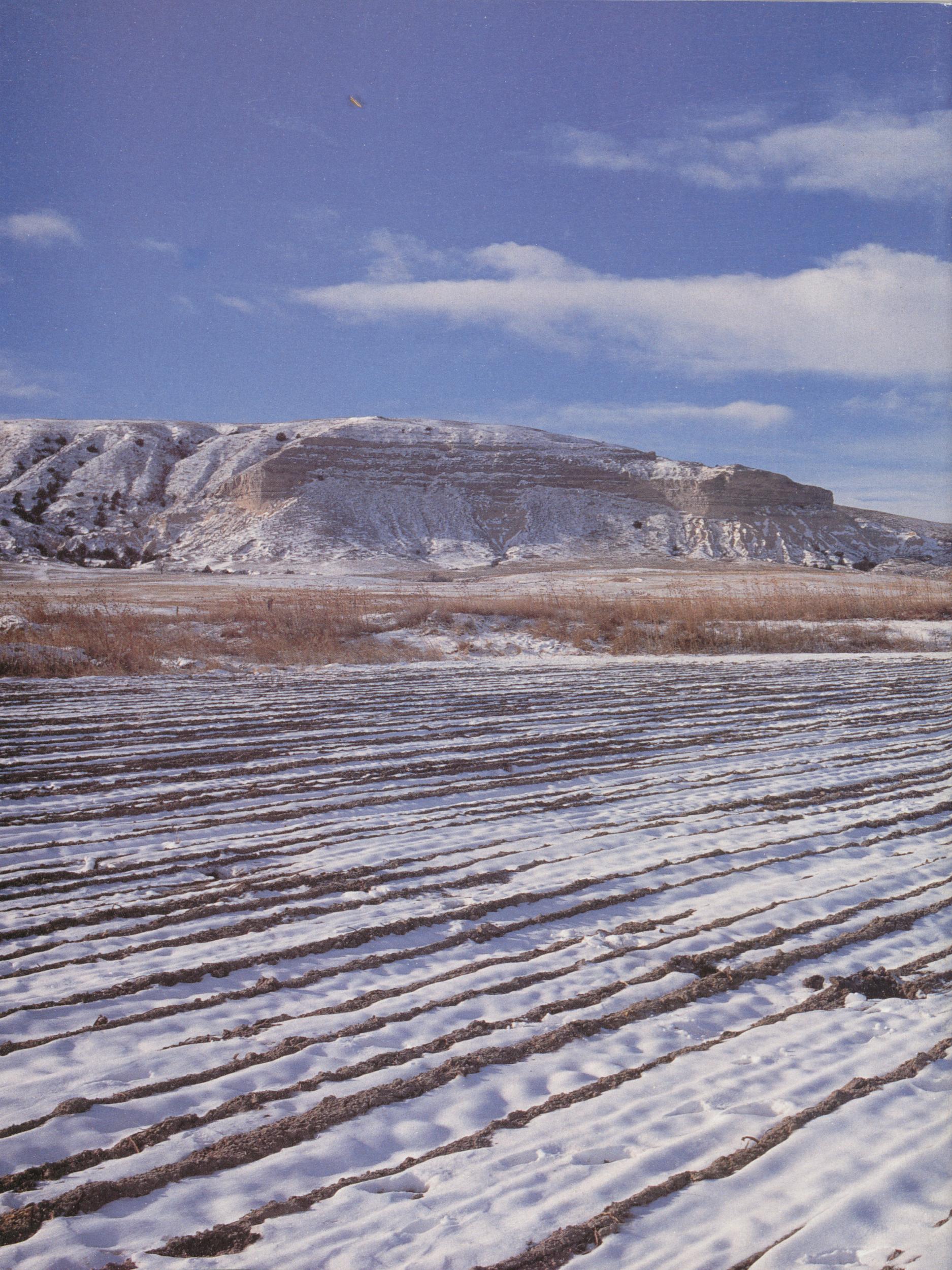
Position: 233 (33 views)