Volume 69, Issue 9, 1991
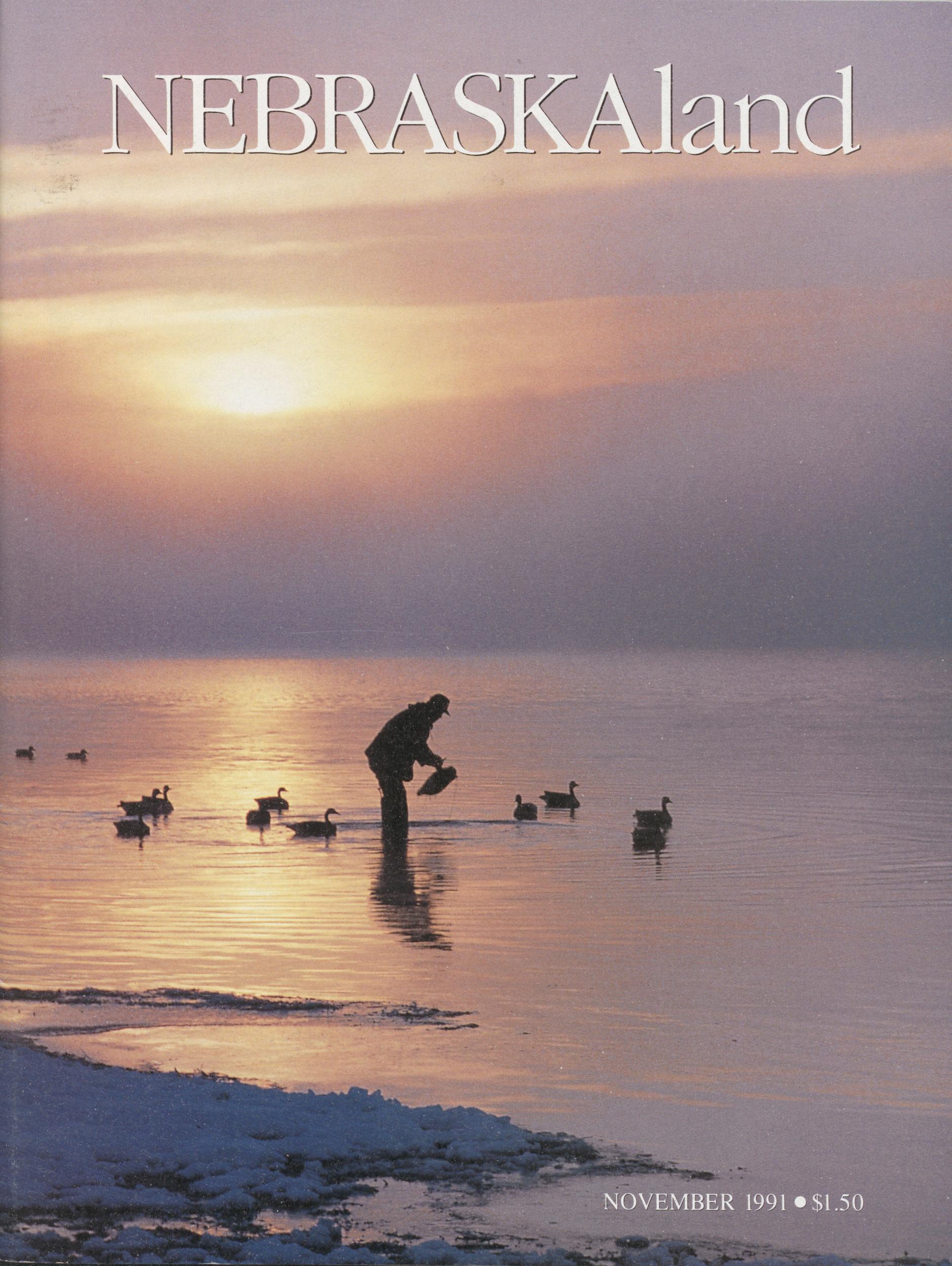
NEBRASKAland
NOVEMBER 1991 $1.50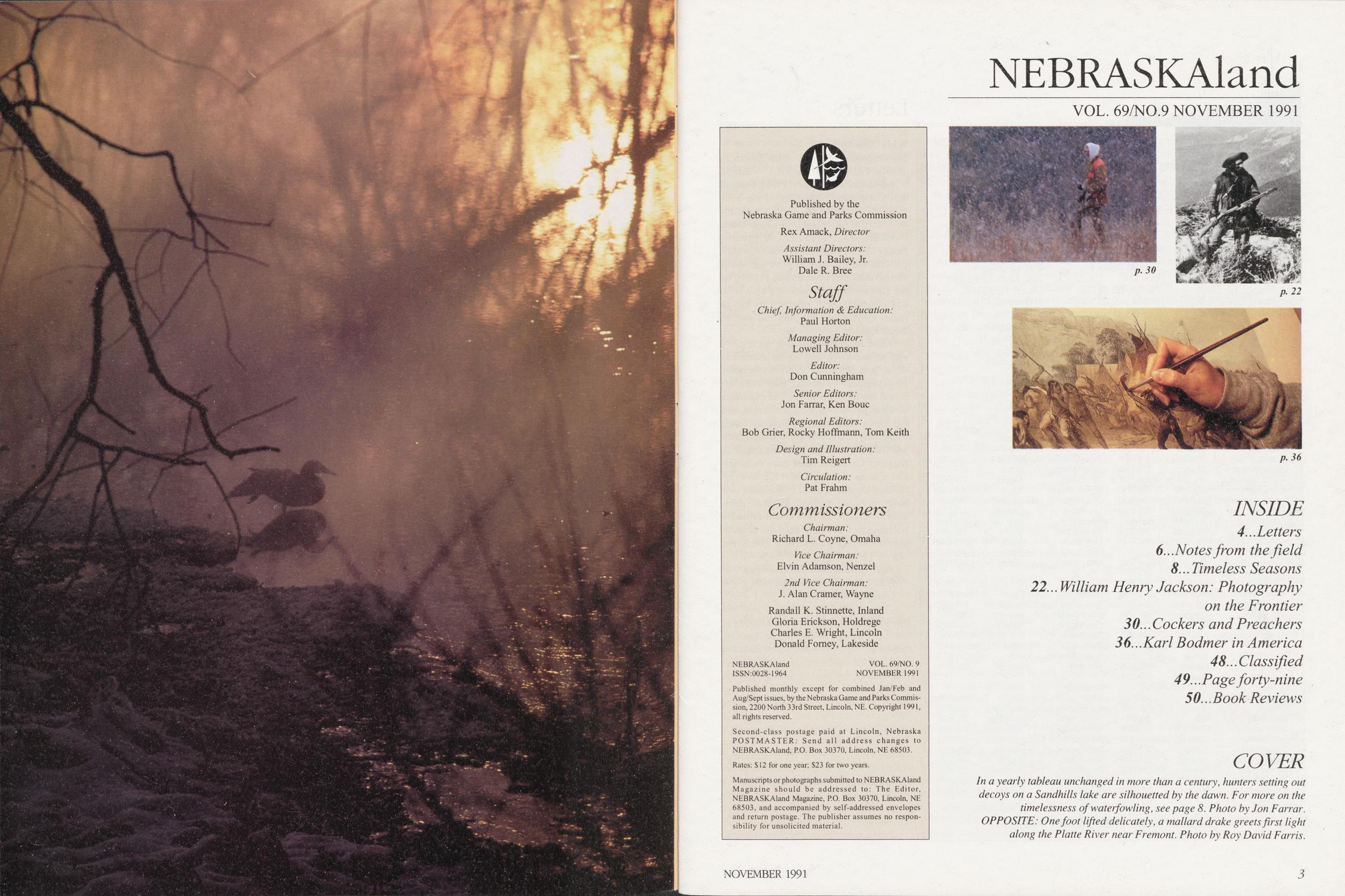
NEBRASKAland
VOL. 69/NO. 9 NOVEMBER 1991 Published by the Nebraska Game and Parks Commission Rex Amack, Director Assistant Directors: William J. Bailey, Jr. Dale R. Bree Staff Chief Information & Education: Paul Horton Managing Editor: Lowell Johnson Editor: Don Cunningham Senior Editors: Jon Farrar, Ken Bouc Regional Editors: Bob Grier, Rocky Hoffmann, Tom Keith Design and Illustration: Tim Reigert Circulation: Pat Frahm Commissioners Chairman: Richard L. Coyne, Omaha Vice Chairman: Elvin Adamson, Nenzel 2nd Vice Chairman: J. Alan Cramer, Wayne Randall K. Stinnette, Inland Gloria Erickson, Holdrege Charles E. Wright, Lincoln Donald Forney, Lakeside NEBRASKAland ISSN:0028-1964 VOL. 69/NO. 9 NOVEMBER 1991 Published monthly except for combined Jan/Feb and Aug/Sept issues, by the Nebraska Game and Parks Commission, 2200 North 33rd Street, Lincoln, NE. Copyright 1991, all rights reserved. Second-class postage paid at Lincoln, Nebraska POSTMASTER: Send all address changes to NEBRASKAland, P.O. Box 30370, Lincoln, NE 68503. Rates: $12 for one year; $23 for two years. Manuscripts or photographs submitted to NEBRASKAland Magazine should be addressed to: The Editor, NEBRASKAland Magazine, P.O. Box 30370, Lincoln, NE 68503, and accompanied by self-addressed envelopes and return postage. The publisher assumes no responsibility for unsolicited material. Nebraska Game and Parks Commission
District Offices
Headquarters
2200 North 33rd Street
Lincoln, NE 68503
Phone (402)471-0641
District Office I
Box 725
Alliance, NE 69301
Phone (308)762-5605
District Office li
Box 508
Bassett, NE 68714
Phone (402)684-2921
District Office Hi
Box 934
Norfolk, NE 68702
Phone (402)370-3374
District Office IV
Route 4, Box 36
North Platte, NE 69101
Phone (308)535-8025
District Office V
2200 North 33rd Street
Lincoln, NE 68503
Phone (402)471-5558
Omaha Office
State Office Building Mall
1313Farnam
Omaha, NE 68102,
Phone (402) 595-2144
Ak-Sar-Ben Aquarium
21502 West Highway 31
Gretna, NE 68028
Phone (402) 332-3901
Conservation Officers by Region
Panhandle Southeast
Officer City Phone (308) Officer City
Phone (402)
Richard Furley (Supv) Alliance 762-2024 Don Schaepler (Chief)
Lincoln 488-2957
Walt Meyer Chadron 432-4398 Ted Blume (Asst Chief)
Lincoln 483-5643
John Murphy Crawford 665-2021 Roger Guenther (Supv)
Lincoln 423-5671
Jim Zimmerman Gering 436-7561 William Krause
Auburn 274-3789
Marvin Kampbell Hay Springs 638-7527 Dan Evasco
Beatrice 228-5935
E.W. Zimmerman Ogallala 284-3013 Murray Johnson
Lincoln 488-2923
Dennis Thompson Ogallala 284-6450 Douglas Kramer
Lincoln 466-9001
Don Hunt Oshkosh 772-3697 Levi Krause Louisville
234-2212
Richard Brandt Scottsbluff 635-1277 Russell Mort Nebr. City
873-5684
Raymond Still Bridgeport 262-1075 Duane Arp Omaha
332-4954
Larry Elston Omaha 292-4910
Northeast Craig Stover Omaha 359-2833
Officer City Phone (402) Mike Luben Wahoo 443-4278
Bob Downing (Supv) Norfolk 371-2675
Robert Kelly Albion 395-2538 Sandhills
Ross Oestmann Bloomfield 373-4412 Officer City Phone
(402)
LA. Wilkinson Columbus 564-4375 Bruce Wiebe (Supv) Bassett
684-3867
Gary Ralston Creighton 847-3284 Max Showalter Ainsworth
387-1960
Daniel Roberts Fremont 721-7852 Larry Bauman Atkinson
925-5569
Randy Pomplun Fullerton (308)536-2987 Tom Zimmer Brkn. Bow
(308)872-6063
Jon Reeves Kennard 427-7378 Dan Zuehlke Mullen
(308)546-2492
Marion Shafer Norfolk 371-2031 Richard Seward Ord
(308)728-5338
Eric Wiebe Ponca 755-2566 Mick Gray Valentine
376-3136
Steve Oberg West Point 372-3062 Southwest
South-Central Officer City Phone (308)
Officer City Phone (402) Gail Woodside(Supv) No. Platte
532-0279
Jerry Pecha (Supv) York 362-5707 George Sund Cambridge
697-4629
Lester Johnson David City 367-4037 Jack Henderson Gothenburg
I 537-7483
Terry Brentzel Grand Isl. (308)384-8296 Dirk Greene Imperial
882-5328
Dale Johnson Hebron 768-7363 Ray Frandsen Lexington
324-2753
Daniel Klammer Hastings 461-3389 Virgil Gosch McCook
345-2185
Dayton Shultis Kearney (308)234-3349 Dwight Allbery No. Platte
532-2753
Mark Reeves Loup City (308)745-1126 Roger Thompson No. Platte
532-9175
Robert Finke Seward 643-2056 Rich Routh Republican City
799-2085
Operation Game Thief (800) 742-7627
Nebraska Game and Parks Commission
District Offices
Headquarters
2200 North 33rd Street
Lincoln, NE 68503
Phone (402)471-0641
District Office I
Box 725
Alliance, NE 69301
Phone (308)762-5605
District Office li
Box 508
Bassett, NE 68714
Phone (402)684-2921
District Office Hi
Box 934
Norfolk, NE 68702
Phone (402)370-3374
District Office IV
Route 4, Box 36
North Platte, NE 69101
Phone (308)535-8025
District Office V
2200 North 33rd Street
Lincoln, NE 68503
Phone (402)471-5558
Omaha Office
State Office Building Mall
1313Farnam
Omaha, NE 68102,
Phone (402) 595-2144
Ak-Sar-Ben Aquarium
21502 West Highway 31
Gretna, NE 68028
Phone (402) 332-3901
Conservation Officers by Region
Panhandle Southeast
Officer City Phone (308) Officer City
Phone (402)
Richard Furley (Supv) Alliance 762-2024 Don Schaepler (Chief)
Lincoln 488-2957
Walt Meyer Chadron 432-4398 Ted Blume (Asst Chief)
Lincoln 483-5643
John Murphy Crawford 665-2021 Roger Guenther (Supv)
Lincoln 423-5671
Jim Zimmerman Gering 436-7561 William Krause
Auburn 274-3789
Marvin Kampbell Hay Springs 638-7527 Dan Evasco
Beatrice 228-5935
E.W. Zimmerman Ogallala 284-3013 Murray Johnson
Lincoln 488-2923
Dennis Thompson Ogallala 284-6450 Douglas Kramer
Lincoln 466-9001
Don Hunt Oshkosh 772-3697 Levi Krause Louisville
234-2212
Richard Brandt Scottsbluff 635-1277 Russell Mort Nebr. City
873-5684
Raymond Still Bridgeport 262-1075 Duane Arp Omaha
332-4954
Larry Elston Omaha 292-4910
Northeast Craig Stover Omaha 359-2833
Officer City Phone (402) Mike Luben Wahoo 443-4278
Bob Downing (Supv) Norfolk 371-2675
Robert Kelly Albion 395-2538 Sandhills
Ross Oestmann Bloomfield 373-4412 Officer City Phone
(402)
LA. Wilkinson Columbus 564-4375 Bruce Wiebe (Supv) Bassett
684-3867
Gary Ralston Creighton 847-3284 Max Showalter Ainsworth
387-1960
Daniel Roberts Fremont 721-7852 Larry Bauman Atkinson
925-5569
Randy Pomplun Fullerton (308)536-2987 Tom Zimmer Brkn. Bow
(308)872-6063
Jon Reeves Kennard 427-7378 Dan Zuehlke Mullen
(308)546-2492
Marion Shafer Norfolk 371-2031 Richard Seward Ord
(308)728-5338
Eric Wiebe Ponca 755-2566 Mick Gray Valentine
376-3136
Steve Oberg West Point 372-3062 Southwest
South-Central Officer City Phone (308)
Officer City Phone (402) Gail Woodside(Supv) No. Platte
532-0279
Jerry Pecha (Supv) York 362-5707 George Sund Cambridge
697-4629
Lester Johnson David City 367-4037 Jack Henderson Gothenburg
I 537-7483
Terry Brentzel Grand Isl. (308)384-8296 Dirk Greene Imperial
882-5328
Dale Johnson Hebron 768-7363 Ray Frandsen Lexington
324-2753
Daniel Klammer Hastings 461-3389 Virgil Gosch McCook
345-2185
Dayton Shultis Kearney (308)234-3349 Dwight Allbery No. Platte
532-2753
Mark Reeves Loup City (308)745-1126 Roger Thompson No. Platte
532-9175
Robert Finke Seward 643-2056 Rich Routh Republican City
799-2085
Operation Game Thief (800) 742-7627
Letters
White PelicansSir/ Regarding your note on the American White Pelican in NEBRASKAland ["Nebraska Fauna," May 1991], I would add that a large percentage of the birds breed on islands in lakes with absolutely no fish life. An example is Chase Lake, North Dakota, home to 12,000 breeding pelicans. It, and other lakes where pelicans nest, is very alkaline with fairy shrimp and other invertebrates making up the aquatic fauna. In addition, by weight and volume, tiger salamander larvae make up most of the pelican's diet in North Dakota.
There is no evidence that the fertility and reproductive success of American white pelicans suffered greatly because of pesticides. Pesticides may have affected the brown pelican. The explosion of white pelicans on Canadian lakes, and the increase in colony sizes in the Great Plains may be due to improved protection and the virtual transformation of the fish fauna of Canadian lakes from commercial species to "rough fish" due to overfishing. Double-crested cormorants also have increased dramatically and commercial fishermen in Canada are now wielding their clubs, as they did decades ago, to smash pelican and cormorant eggs.
John G. Sidle, Wildlife Biologist U.S. Fish and Wildlife Service Grand Island, NEThe author, Professor Paul Johnsgard of the UNL School of Biological Science, responds: "It is true that many pelicans nest in areas where fish are uncommon or even absent, but in most cases they fly (in some cases making round trips of more than 200 kilometers) to locations where fishing is relatively easy. A great deal of quantitative information on the foods of the American white pelican is available (summarized in vol. 1 of the Handbook of North American Birds); rough fish of little economic value comprise nearly all of it. Chase Lake, ND, is the only location so far known where tiger salamanders are an important food resource.
It is a distinct understatement to say 4 NEBRASKAland that the pesticides "may have affected the brown pelican " — by 1961, the eastern subspecies was completely eliminated from Louisiana as a breeding bird, and the California race was reduced by about 90 percent during the pesticide era. These populations did not start a recovery until the domestic use of DDT was banned by the EPA in the early 1970s. The American white pelican also was certainly seriously affected by pesticides. Between 1963 and 1972 (during the period of unrestricted pesticide use), the U.S. population of breeding birds declined from about 38,000 to about 34,000, and the average number of birds per colony dropped from 3,400 to 2,200. Between 1972 and 1982 (the most recent survey) the population has gradually rebounded to about 45,000 breeding birds. Yet, as recently as the early 1980s, more than a decade after the banning of endrin, lethal levels of this pesticide were found in more than half the white pelicans found dead in California.'
"Page forty-nine n NotesSir/1 noted with interest, the "Page forty nine" in the August/September issue of NEBRASKAland ["Tin Cans and Plastic Jugs"].
To deal with plastic milk jugs, I put an old butcher knife in the opening and slice down through the handle, then reverse the knife and slice down the opposite side. Then, I use kitchen shears to cut across the heavier bottom from side to side.
Other sliced jugs fit nicely into the jug halves, and in this way two grocery sacks will take care of 36 milk jugs. It's much easier than trying to smash them. Try it, you might like it.
Mrs. Orvin (Arlinda) Karloff Yutan, NESir/ Bravo to Don Cunningham and his wonderful July "Page forty-nine" ["Old Sayings and Watching Corn Grow"]. Although I live in California, I love visits to my sister's Nebraska home. There are times that I could swear I've heard the corn grow, but realize I'm only hearing the rustle of the fields — not the typical whine of California freeway traffic.
My brother-in-law, Bill Dunavan, is a field agronomist living in York, and I'd love to think it was one of his fields Don was writing about!
Bonnie Bedford-White San Jose, CA Side-hill GougersSir/ Your letter from my niece, Jo Baeza of Arizona [August/September 1991] contained some fine compliments. "Joanie," a Stanford graduate and a Master in Literature from Nottingham College in England, is the author of four books, one of which was made into a movie. For years she has been a contributor to that fine magazine, Arizona Highways.
I grew up in Neligh as the youngest of eight children in the family of Ernie and Addie Scofield, and my nieces, including Jo, were closer to my age than were my sisters and brothers. It was Jo's father, the late Jerry Johnson, who first taught me to shoot a shotgun and drive a car. Jo was among the many grandchildren who were always at my folks' home for Thanksgiving and Christmas dinners. It would not be unusual to have 30 to 35 people.
Ernie Scofield was a great father and a kind grandfather. He was full of tales and practical jokes which he loved to tell his grandkids. He would delight in kidding them and keeping their attention on his many tales. The side-hill gouger (not "gonger" as Jo stated) was one of his favorites. These little animals were numerous in the hills of Antelope County, according to Dad, and would work in tandem with their friends, the field gophers. The gougers would go around the hillsides gouging holes where the gophers should dig their tunnels. There were both left and right-hand side-hill gougers. On one, the left side legs were much shorter than the right side legs, and on the others, the right side legs were shorter. One kind would always go around the hill clockwise, the others counterclockwise.
Ernie Scofield established the Neligh Weekly News on August 10, 1915, and shortly after the first issue was off the press he came home to deliver me (so recorded on my birth certificate). He'd worked for other newspapers in Neligh as early as the 1890s. At one time there were five weekly newspapers competing in Neligh at a time when the population ranged from 1,000 to 1,300, and even as I entered high school there were three newspapers in town. At one time (about 1913) Nebraska had a total of 720 newspapers of all types; today the total is about 190.
I have been a NEBRASKAland reader for many years; the last few years I have given Christmas gift subscriptions to Jo, to a niece in Salinas, California, and to a high school friend in California as well as to pen pal of many years in Australia. They all have told me many times how much they enjoy it.
Vern "Red" Scofield Lincoln, NE ... and Hoop SnakesSir/Your response to the letter from "Satisfied Reader" in the August/September issue regarding the sidehill gonger reminded me of an experience we had as children during the "dry thirties" near Monroe, Platte County. Our father, Hector Blaser, and neighbor, George Schmid, often talked about hoop snakes and how they would put their tails in their mouths and then roll down the road like tires. We never actually saw one. Do you have any record of actual sightings? As children, we thought they might be pulling our leg.
Donald C. Blaser Honolulu, HINEBRASKAland Senior Editor Jon Farrar, who also grew up there, says he is "pretty sure " no one from Monroe would do that. (Editor)
Send your comments, suggestions and complaints to Letters, P.O. Box 30370, Lincoln, NE 68503. Each month we will print as many letters as space permits. Photographs are also welcome. NEBRASKA land reserves the right to edit and condense letters.
NOVEMBER 1991 5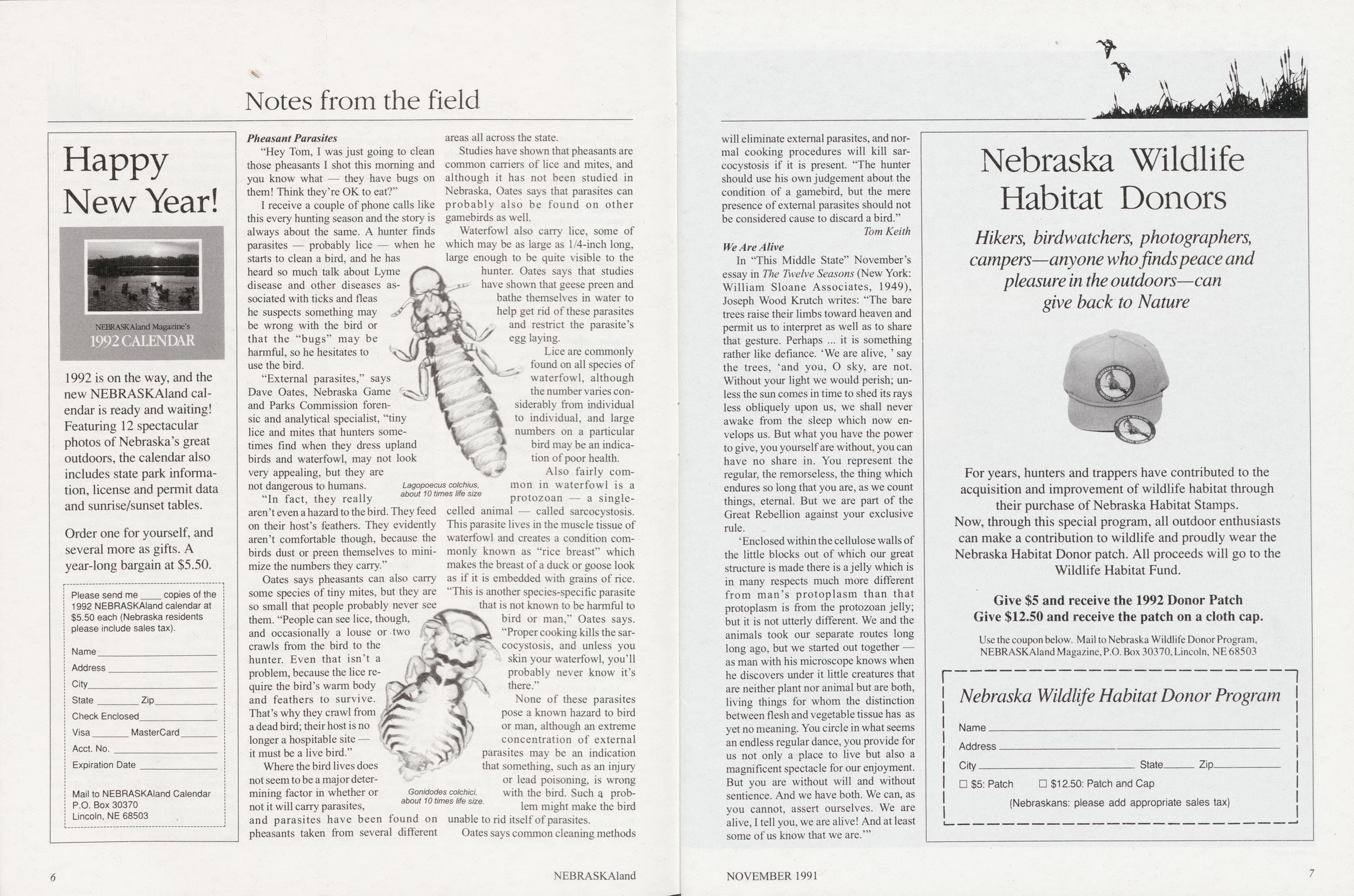 Happy
New Year!
NEBRASKAland Magazine
1992 is on the way, and the
new NEBRASKAland
calendar is ready and waiting!
Featuring 12 spectacular
photos of Nebraska's great
outdoors, the calendar also
includes state park
information, license and permit data
and sunrise/sunset tables.
Order one for yourself, and
several more as gifts. A
year-long bargain at $5.50.
Please send me
copies of the
1992 NEBRASKAland calendar at
$5.50 each (Nebraska residents
please include sales tax).
Name
Address
City____
State
Zip.
Check Enclosed________
Visa_______MasterCard
Acct. No.
Expiration Date
Mail to NEBRASKAland Calendar
P.O. Box 30370
Lincoln, NE 68503
i_________________________________________________________________________
__________i
Happy
New Year!
NEBRASKAland Magazine
1992 is on the way, and the
new NEBRASKAland
calendar is ready and waiting!
Featuring 12 spectacular
photos of Nebraska's great
outdoors, the calendar also
includes state park
information, license and permit data
and sunrise/sunset tables.
Order one for yourself, and
several more as gifts. A
year-long bargain at $5.50.
Please send me
copies of the
1992 NEBRASKAland calendar at
$5.50 each (Nebraska residents
please include sales tax).
Name
Address
City____
State
Zip.
Check Enclosed________
Visa_______MasterCard
Acct. No.
Expiration Date
Mail to NEBRASKAland Calendar
P.O. Box 30370
Lincoln, NE 68503
i_________________________________________________________________________
__________i
Notes from the field
Pheasant Parasites"Hey Tom, I was just going to clean those pheasants I shot this morning and you know what — they have bugs on them! Think they're OK to eat?"
I receive a couple of phone calls like this every hunting season and the story is always about the same. A hunter finds parasites — probably lice — when he starts to clean a bird, and he has heard so much talk about Lyme disease and other diseases associated with ticks and fleas he suspects something may be wrong with the bird or that the "bugs" may be harmful, so he hesitates to use the bird.
"External parasites," says Dave Oates, Nebraska Game and Parks Commission forensic and analytical specialist, "tiny lice and mites that hunters sometimes find when they dress upland birds and waterfowl, may not look very appealing, but they are not dangerous to humans.
"In fact, they really aren't even a hazard to the bird. They feed on their host's feathers. They evidently aren't comfortable though, because the birds dust or preen themselves to minimize the numbers they carry."
Oates says pheasants can also carry some species of tiny mites, but they are so small that people probably never see them. "People can see lice, though, and occasionally a louse or two crawls from the bird to the hunter. Even that isn't a problem, because the lice require the bird's warm body and feathers to survive. That's why they crawl from a dead bird; their host is no longer a hospitable site — it must be a live bird."
Where the bird lives does not seem to be a major determining factor in whether or and parasites have been found on pheasants taken from several different areas all across the state.
Studies have shown that pheasants are common carriers of lice and mites, and although it has not been studied in Nebraska, Oates says that parasites can probably also be found on other game birds as well.
Waterfowl also carry lice, some of which may be as large as 1/4-inch long, large enough to be quite visible to the hunter. Oates says that studies have shown that geese preen and bathe themselves in water to help get rid of these parasites and restrict the parasite's egg laying.
Lice are commonly found on all species of waterfowl, although the number varies considerably from individual to individual, and large numbers on a particular bird may be an indication of poor health.
Also fairly common in waterfowl is a protozoan — a single-celled animal — called sarcocystosis. This parasite lives in the muscle tissue of waterfowl and creates a condition commonly known as "rice breast" which makes the breast of a duck or goose look as if it is embedded with grains of rice. "This is another species-specific parasite that is not known to be harmful to bird or man," Oates says. "Proper cooking kills the sarcocystosis, and unless you skin your waterfowl, you'll probably never know it's there."
None of these parasites pose a known hazard to bird or man, although an extreme concentration of external parasites may be an indication that something, such as an injury or lead poisoning, is wrong with the bird. Such a problem might make the bird unabler to rid itself of parasites.
Oates says common cleaning methods 6 NEBRASKAland will eliminate external parasites, and normal cooking procedures will kill sarcocystosis if it is present. "The hunter should use his own judgement about the condition of a game bird, but the mere presence of external parasites should not be considered cause to discard a bird."
Tom Keith We Are AliveIn "This Middle State" November's essay in The Twelve Seasons (New York: William Sloane Associates, 1949), Joseph Wood Krutch writes: "The bare trees raise their limbs toward heaven and permit us to interpret as well as to share that gesture. Perhaps ... it is something rather like defiance. 'We are alive, ' say the trees, 'and you, O sky, are not. Without your light we would perish; unless the sun comes in time to shed its rays less obliquely upon us, we shall never awake from the sleep which now envelops us. But what you have the power to give, you yourself are without, you can have no share in. You represent the regular, the remorseless, the thing which endures so long that you are, as we count things, eternal. But we are part of the Great Rebellion against your exclusive rule.
'Enclosed within the cellulose walls of the little blocks out of which our great structure is made there is a jelly which is in many respects much more different from man's protoplasm than that protoplasm is from the protozoan jelly; but it is not utterly different. We and the animals took our separate routes long long ago, but we started out together — as man with his microscope knows when he discovers under it little creatures that are neither plant nor animal but are both, living things for whom the distinction between flesh and vegetable tissue has as yet no meaning. You circle in what seems an endless regular dance, you provide for us not only a place to live but also a magnificent spectacle for our enjoyment. But you are without will and without sentience. And we have both. We can, as you cannot, assert ourselves. We are alive, I tell you, we are alive! And at least some of us know that we are.'
Nebraska Wildlife Habitat Donors Hikers, birdwatchers, photographers, campers—anyone who finds peace and pleasure in the outdoors—can give back to Nature For years, hunters and trappers have contributed to the acquisition and improvement of wildlife habitat through their purchase of Nebraska Habitat Stamps. Now, through this special program, all outdoor enthusiasts can make a contribution to wildlife and proudly wear the Nebraska Habitat Donor patch. All proceeds will go to the Wildlife Habitat Fund. Give $5 and receive the 1992 Donor Patch Give $12.50 and receive the patch on a cloth cap. Use the coupon below. Mail to Nebraska Wildlife Donor Program, NEBRASKAland Magazine, P.O. Box 30370, Lincoln, NE 68503 Nebraska Wildlife Habitat Donor Program Name Address City___ State. Zip. □ $5: Patch D $12.50: Patch and Cap (Nebraskans: please add appropriate sales tax) NOVEMBER 1991 7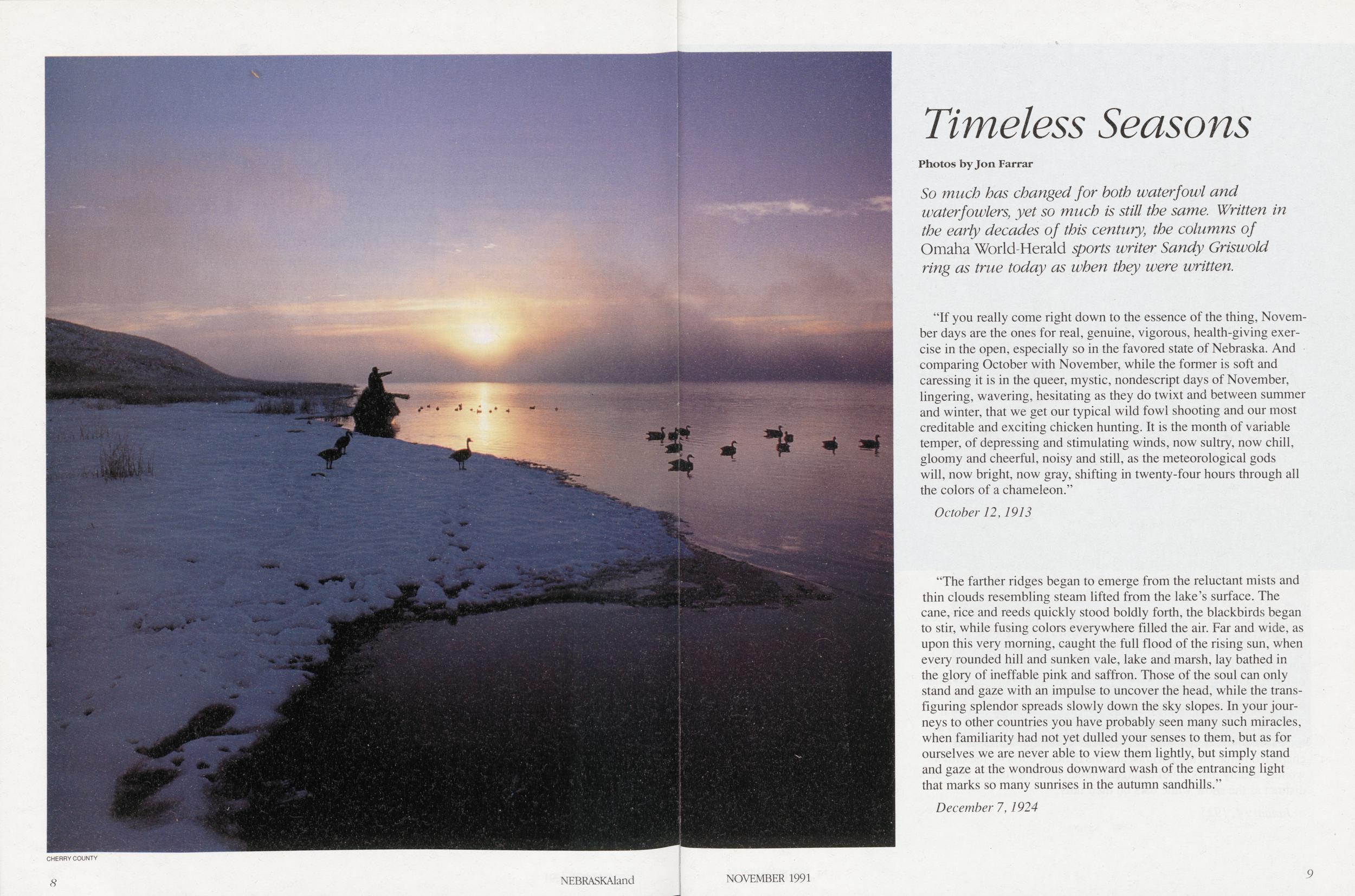
Timeless Seasons
Photos by Jon Farrar So much has changed for both waterfowl and water fowlers, yet so much is still the same. Written in the early decades of this century, the columns of Omaha World-Herald sports writer Sandy Griswold ring as true today as when they were written."If you really come right down to the essence of the thing, November days are the ones for real, genuine, vigorous, health-giving exercise in the open, especially so in the favored state of Nebraska. And comparing October with November, while the former is soft and caressing it is in the queer, mystic, nondescript days of November, lingering, wavering, hesitating as they do twixt and between summer and winter, that we get our typical wild fowl shooting and our most creditable and exciting chicken hunting. It is the month of variable temper, of depressing and stimulating winds, now sultry, now chill, gloomy and cheerful, noisy and still, as the meteorological gods will, now bright, now gray, shifting in twenty-four hours through all the colors of a chameleon."
October 12,1913"The farther ridges began to emerge from the reluctant mists and thin clouds resembling steam lifted from the lake's surface. The cane, rice and reeds quickly stood boldly forth, the blackbirds began to stir, while fusing colors everywhere filled the air. Far and wide, as upon this very morning, caught the full flood of the rising sun, when every rounded hill and sunken vale, lake and marsh, lay bathed in the glory of ineffable pink and saffron. Those of the soul can only stand and gaze with an impulse to uncover the head, while the transfiguring splendor spreads slowly down the sky slopes. In your journeys to other countries you have probably seen many such miracles, when familiarity had not yet dulled your senses to them, but as for ourselves we are never able to view them lightly, but simply stand and gaze at the wondrous downward wash of the entrancing light that marks so many sunrises in the autumn sandhills."
December 7,1924 NOVEMBER 1991 9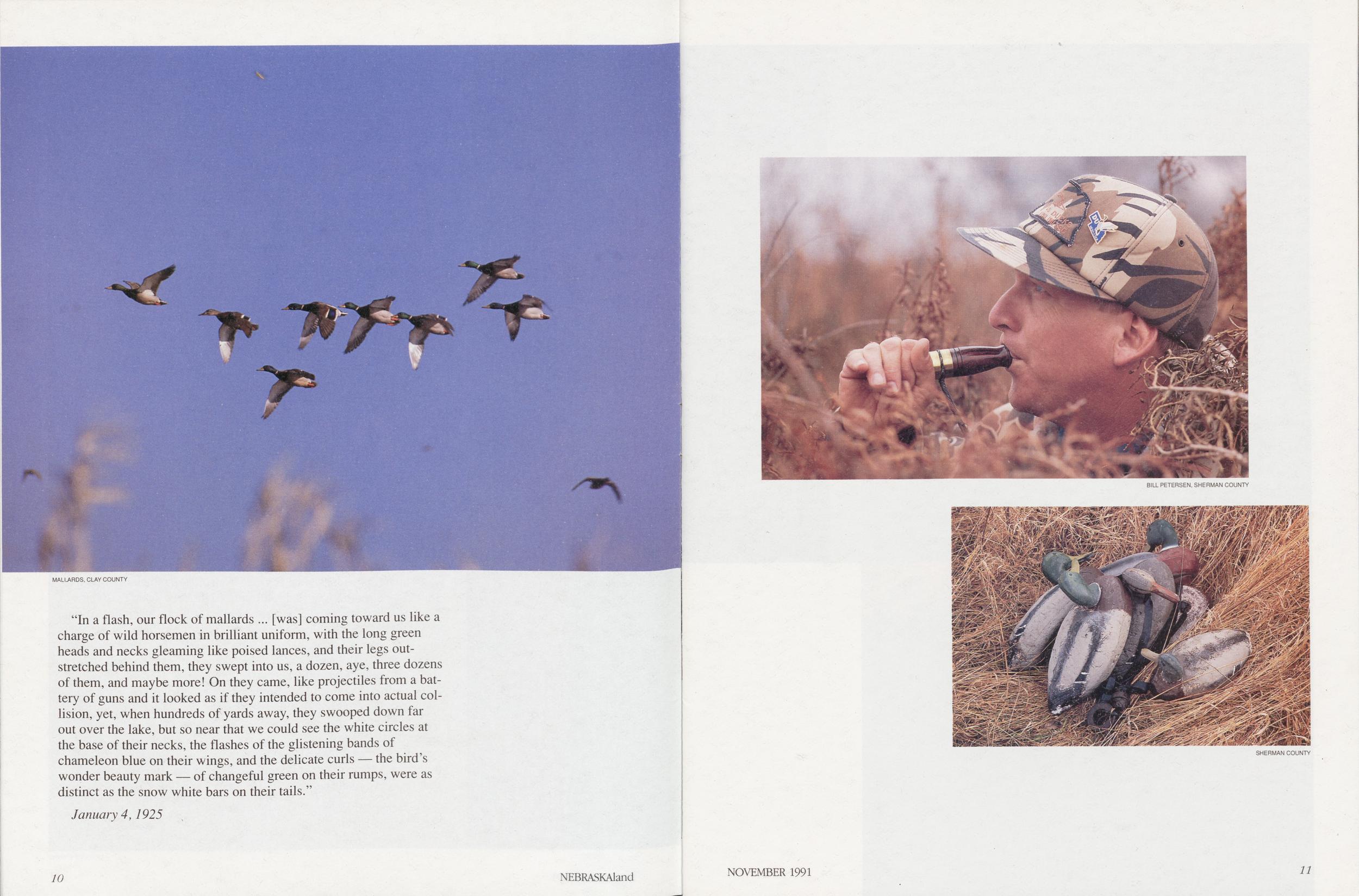
"In a flash, our flock of mallards ... [was] coming toward us like a charge of wild horsemen in brilliant uniform, with the long green heads and necks gleaming like poised lances, and their legs outstretched behind them, they swept into us, a dozen, aye, three dozens of them, and maybe more! On they came, like projectiles from a battery of guns and it looked as if they intended to come into actual collision, yet, when hundreds of yards away, they swooped down far out over the lake, but so near that we could see the white circles at the base of their necks, the flashes of the glistening bands of chameleon blue on their wings, and the delicate curls — the bird's wonder beauty mark — of changeful green on their rumps, were as distinct as the snow white bars on their tails."
January 4, 1925 10 NEBRASKAland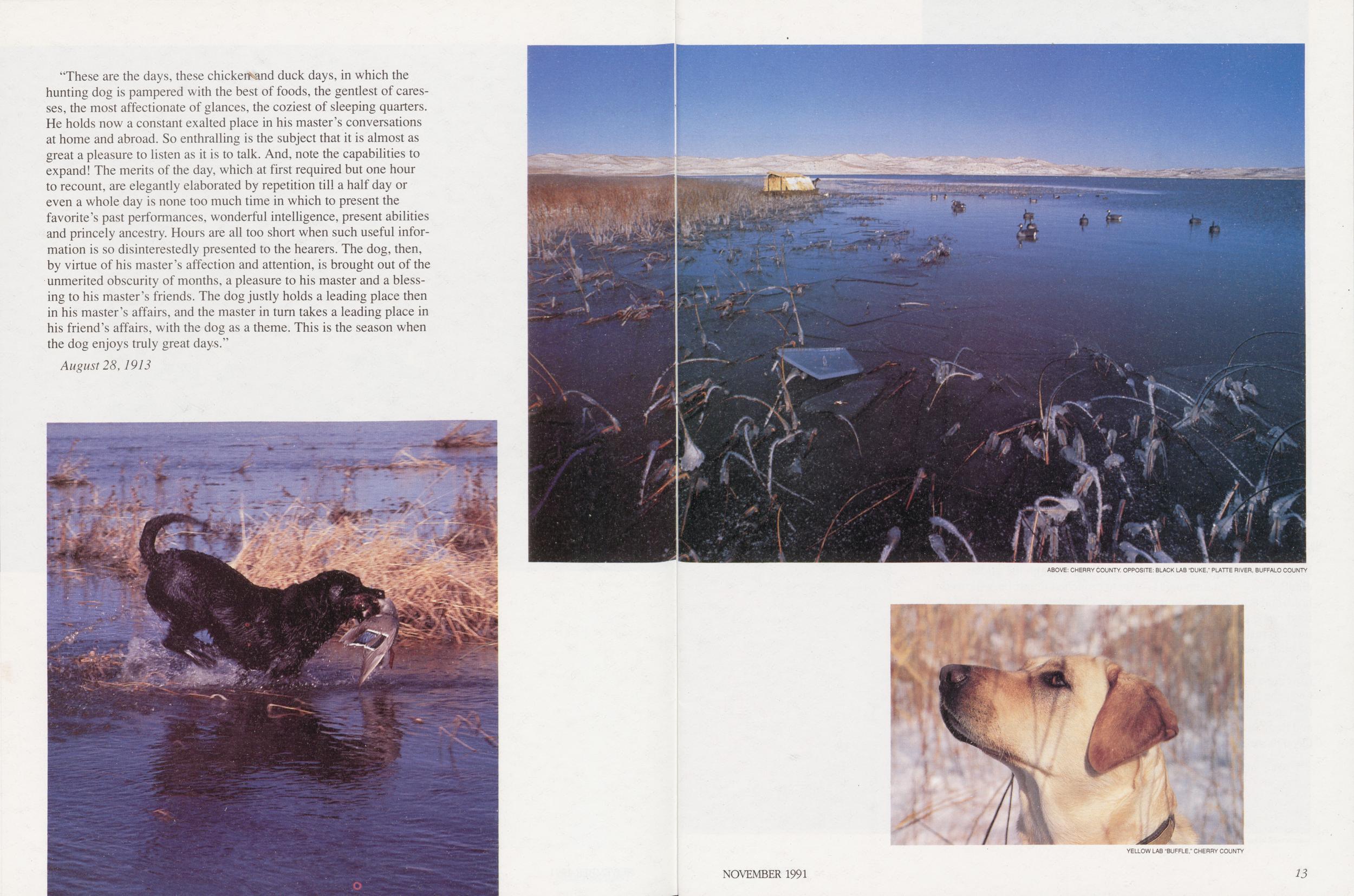
'These are the days, these chicken and duck days, in which the hunting dog is pampered with the best of foods, the gentlest of caresses, the most affectionate of glances, the coziest of sleeping quarters. He holds now a constant exalted place in his master's conversations at home and abroad. So enthralling is the subject that it is almost as great a pleasure to listen as it is to talk. And, note the capabilities to expand! The merits of the day, which at first required but one hour to recount, are elegantly elaborated by repetition till a half day or even a whole day is none too much time in which to present the favorite's past performances, wonderful intelligence, present abilities and princely ancestry. Hours are all too short when such useful information is so disinterestedly presented to the hearers. The dog, then, by virtue of his master's affection and attention, is brought out of the unmerited obscurity of months, a pleasure to his master and a blessing to his master's friends. The dog justly holds a leading place then in his master's affairs, and the master in turn takes a leading place in his friend's affairs, with the dog as a theme. This is the season when the dog enjoys truly great days."
August 28,1913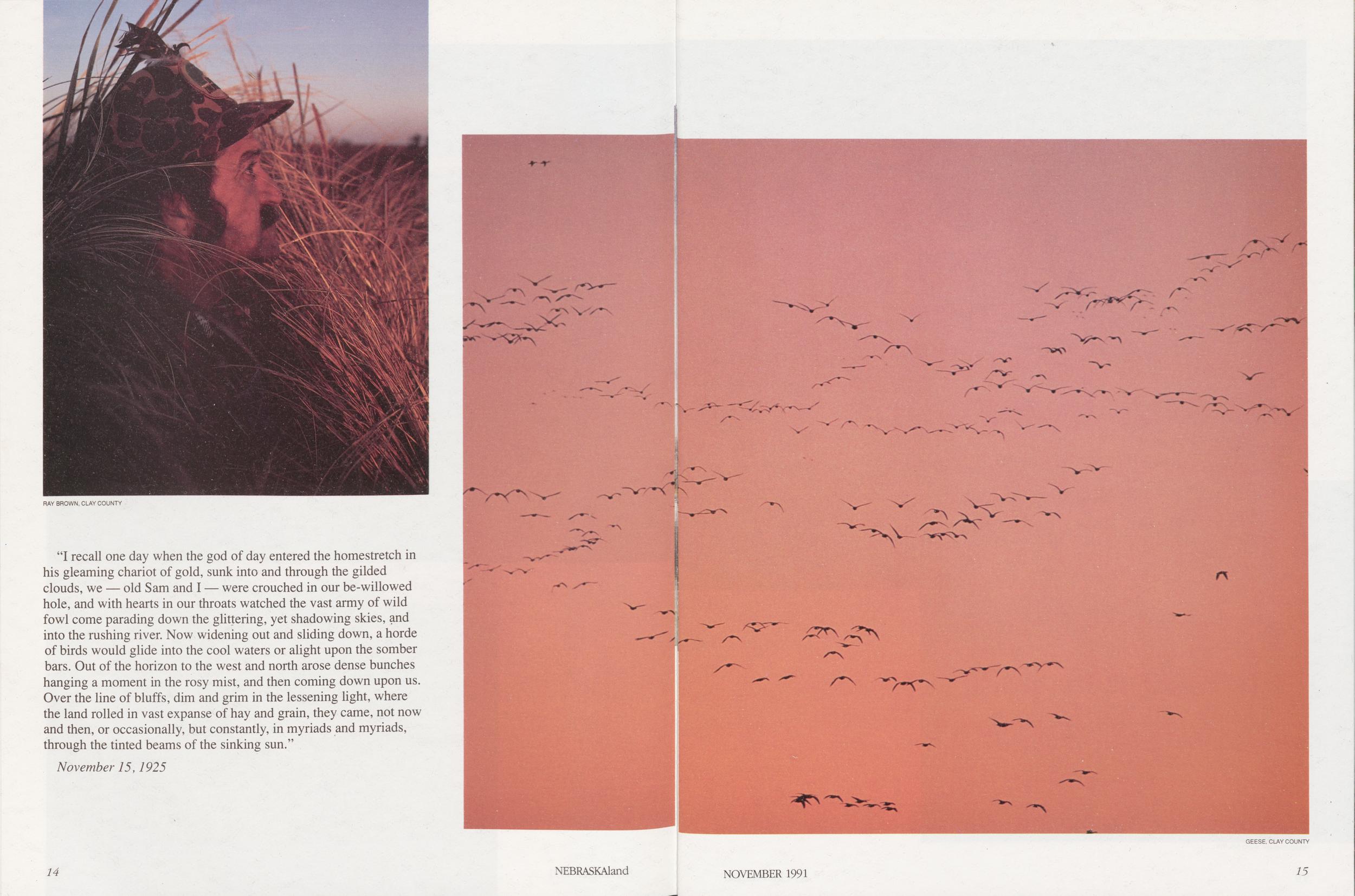
"I recall one day when the god of day entered the homestretch in his gleaming chariot of gold, sunk into and through the gilded clouds, we — old Sam and I — were crouched in our be-willowed hole, and with hearts in our throats watched the vast army of wild fowl come parading down the glittering, yet shadowing skies, and into the rushing river. Now widening out and sliding down, a horde of birds would glide into the cool waters or alight upon the somber bars. Out of the horizon to the west and north arose dense bunches hanging a moment in the rosy mist, and then coming down upon us. Over the line of bluffs, dim and grim in the lessening light, where the land rolled in vast expanse of hay and grain, they came, not now and then, or occasionally, but constantly, in myriads and myriads, through the tinted beams of the sinking sun."
November 15,1925 14 NEBRASKAland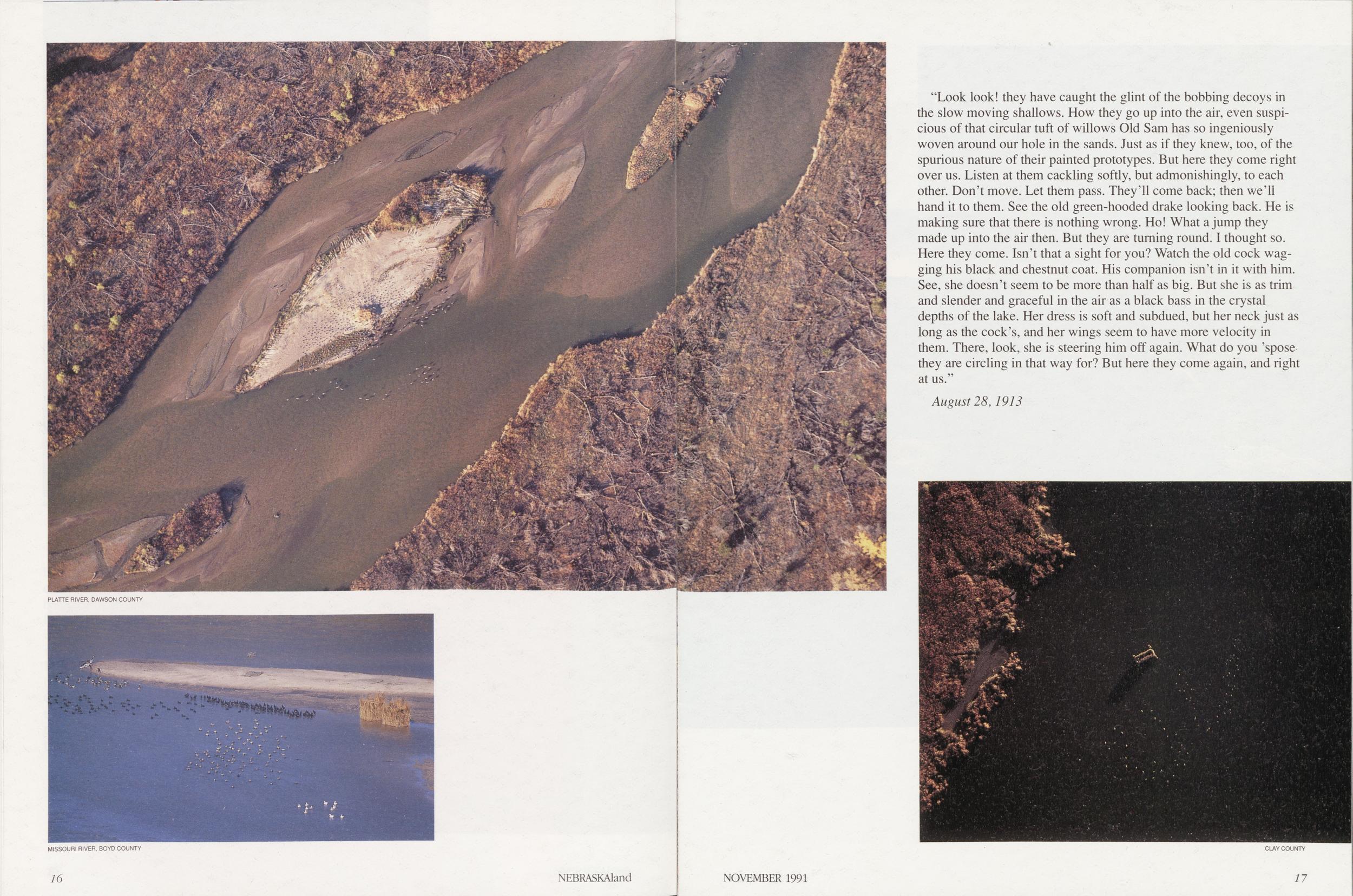
"Look look! they have caught the glint of the bobbing decoys in the slow moving shallows. How they go up into the air, even suspicious of that circular tuft of willows Old Sam has so ingeniously woven around our hole in the sands. Just as if they knew, too, of the spurious nature of their painted prototypes. But here they come right over us. Listen at them cackling softly, but admonishingly, to each other. Don't move. Let them pass. They'll come back; then we'll hand it to them. See the old green-hooded drake looking back. He is making sure that there is nothing wrong. Ho! What a jump they made up into the air then. But they are turning round. I thought so. Here they come. Isn't that a sight for you? Watch the old cock wagging his black and chestnut coat. His companion isn't in it with him. See, she doesn't seem to be more than half as big. But she is as trim and slender and graceful in the air as a black bass in the crystal depths of the lake. Her dress is soft and subdued, but her neck just as long as the cock's, and her wings seem to have more velocity in them. There, look, she is steering him off again. What do you 'spose they are circling in that way for? But here they come again, and right at us."
August 28,1913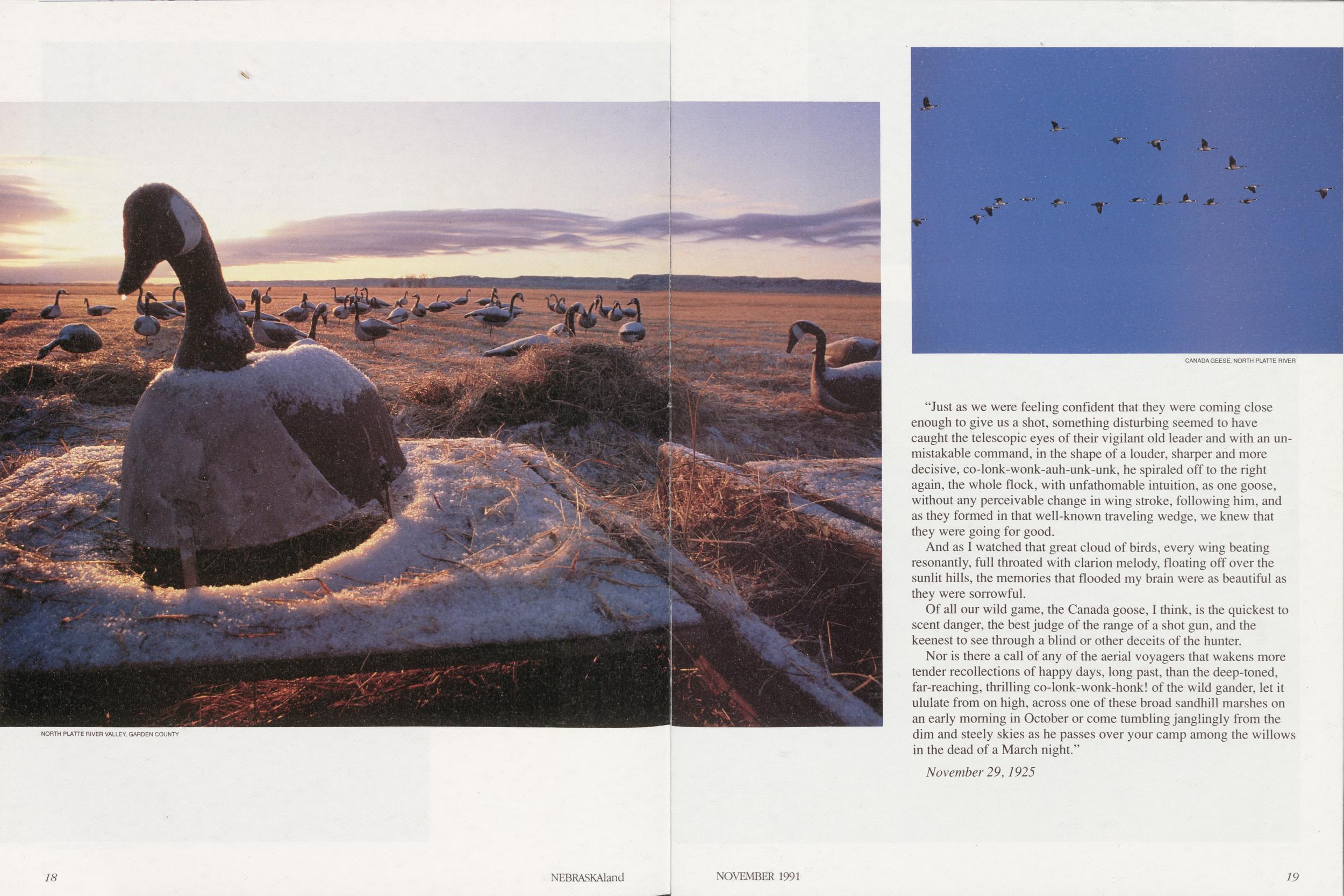
"Just as we were feeling confident that they were coming close enough to give us a shot, something disturbing seemed to have caught the telescopic eyes of their vigilant old leader and with an unmistakable command, in the shape of a louder, sharper and more decisive, co-lonk-wonk-auh-unk-unk, he spiraled off to the right again, the whole flock, with unfathomable intuition, as one goose, without any perceivable change in wing stroke, following him, and as they formed in that well-known traveling wedge, we knew that they were going for good.
And as I watched that great cloud of birds, every wing beating resonantly, full throated with clarion melody, floating off over the sunlit hills, the memories that flooded my brain were as beautiful as they were sorrowful.
Of all our wild game, the Canada goose, I think, is the quickest to scent danger, the best judge of the range of a shot gun, and the keenest to see through a blind or other deceits of the hunter.
Nor is there a call of any of the aerial voyagers that wakens more tender recollections of happy days, long past, than the deep-toned, far-reaching, thrilling co-lonk-wonk-honk! of the wild gander, let it ululate from on high, across one of these broad sandhill marshes on an early morning in October or come tumbling janglingly from the dim and steely skies as he passes over your camp among the willows in the dead of a March night."
November 29', 1925 NOVEMBER 1991 19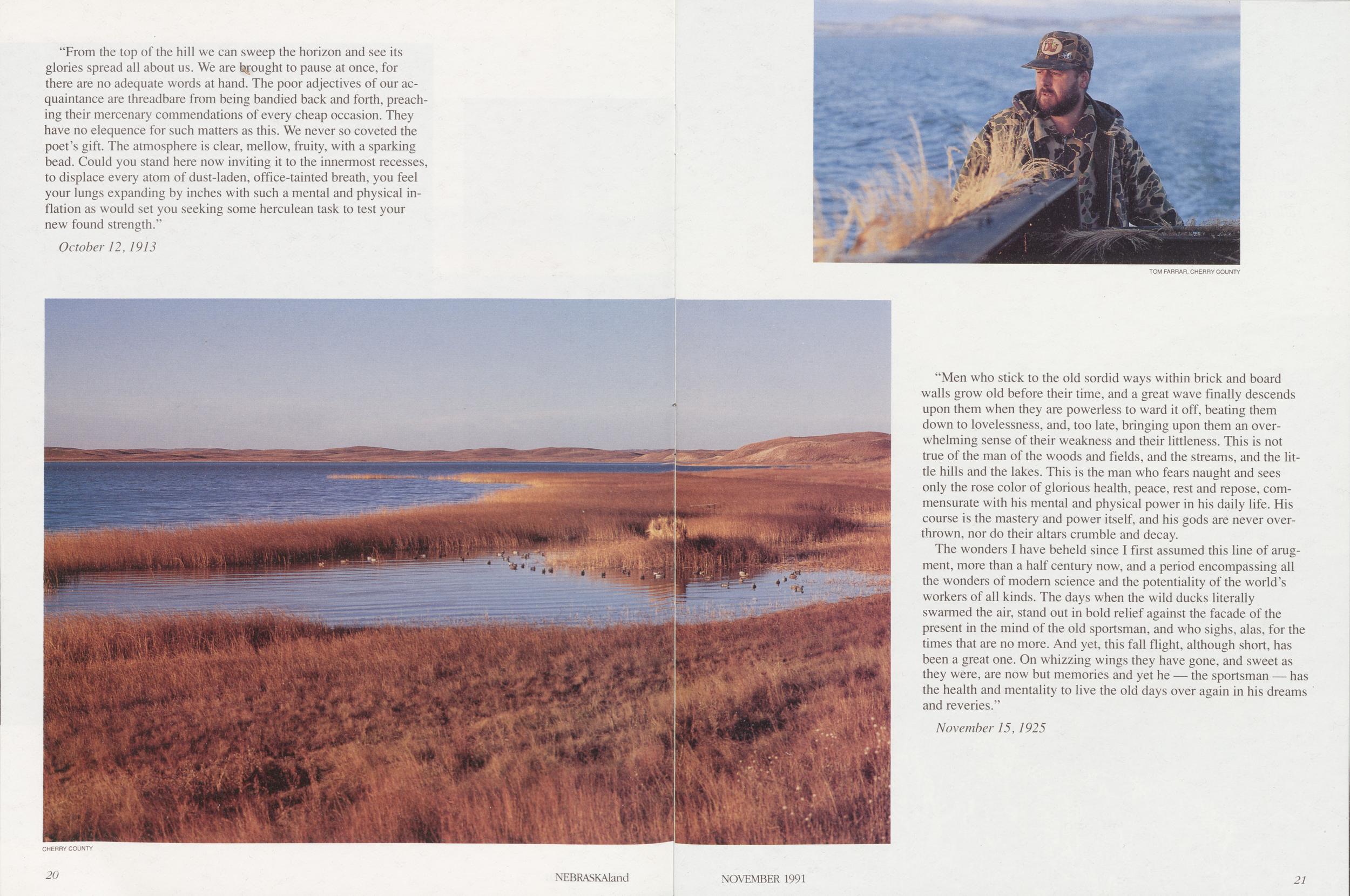
"From the top of the hill we can sweep the horizon and see its glories spread all about us. We are bought to pause at once, for there are no adequate words at hand. The poor adjectives of our acquaintance are threadbare from being bandied back and forth, preaching their mercenary commendations of every cheap occasion. They have no elequence for such matters as this. We never so coveted the poet's gift. The atmosphere is clear, mellow, fruity, with a sparking bead. Could you stand here now inviting it to the innermost recesses, to displace every atom of dust-laden, office-tainted breath, you feel your lungs expanding by inches with such a mental and physical inflation as would set you seeking some herculean task to test your new found strength."
October 12,1913"Men who stick to the old sordid ways within brick and board walls grow old before their time, and a great wave finally descends upon them when they are powerless to ward it off, beating them down to lovelessness, and, too late, bringing upon them an overwhelming sense of their weakness and their littleness. This is not true of the man of the woods and fields, and the streams, and the little hills and the lakes. This is the man who fears naught and sees only the rose color of glorious health, peace, rest and repose, commensurate with his mental and physical power in his daily life. His course is the mastery and power itself, and his gods are never overthrown, nor do their altars crumble and decay.
The wonders I have beheld since I first assumed this line of arugment, more than a half century now, and a period encompassing all the wonders of modem science and the potentiality of the world's workers of all kinds. The days when the wild ducks literally swarmed the air, stand out in bold relief against the facade of the present in the mind of the old sportsman, and who sighs, alas, for the times that are no more. And yet, this fall flight, although short, has been a great one. On whizzing wings they have gone, and sweet as they were, are now but memories and yet he — the sportsman — has the health and mentality to live the old days over again in his dreams and reveries."
November 15,1925 NOVEMBER 1991 21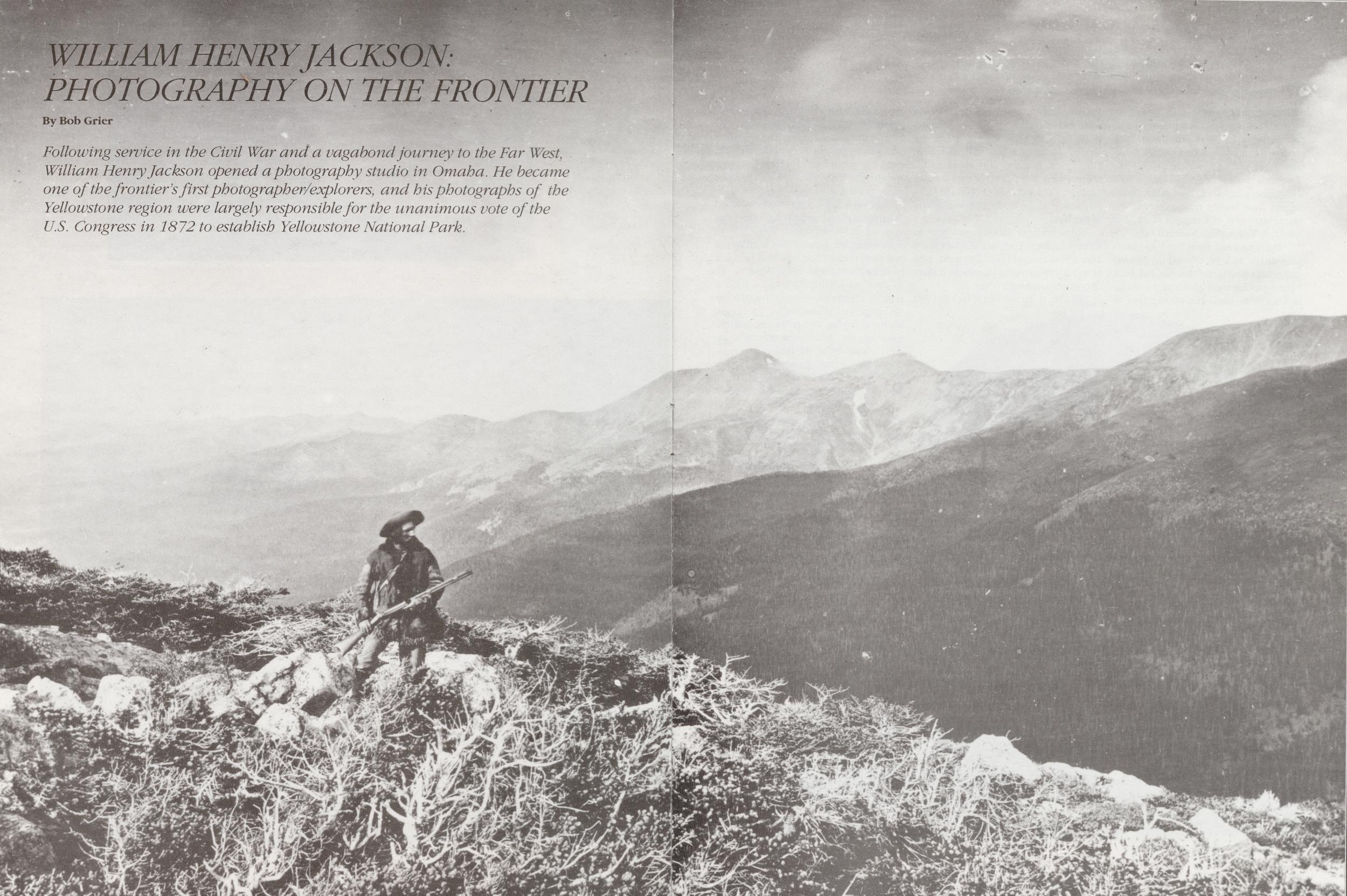
WILLIAM HENRY JACKSON: PHOTOGRAPHY ON THE FRONTIER
By Bob Grier Following service in the Civil War and a vagabond journey to the Far West, William Henry Jackson opened a photography studio in Omaha. He became one of the frontier's first photographer/explorers, and his photographs of the Yellowstone region were largely responsible for the unanimous vote of the U.S. Congress in 1872 to establish Yellowstone National Park.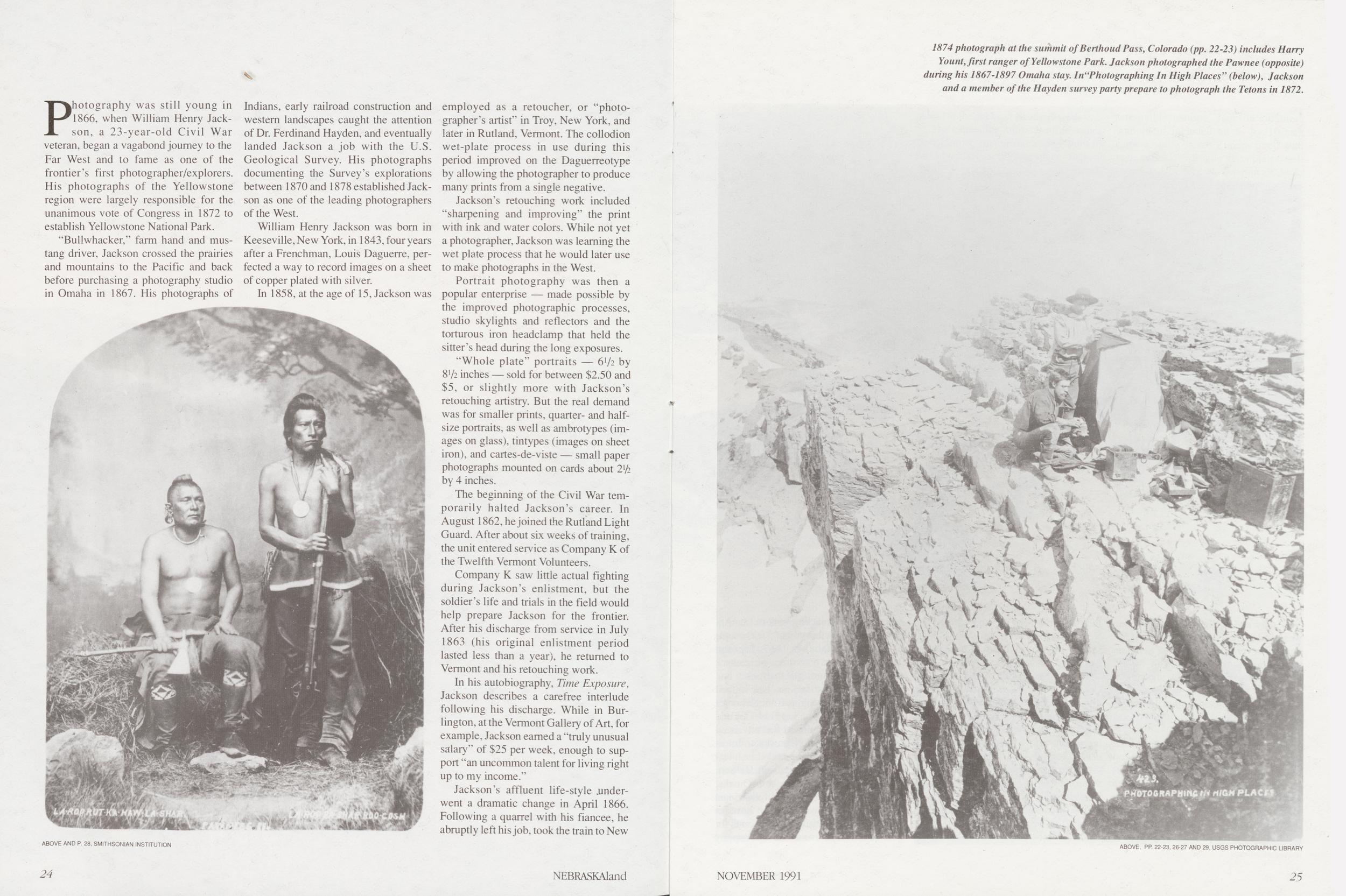
Photography was still young in 1866, when William Henry Jackson, a 23-year-old Civil War veteran, began a vagabond journey to the Far West and to fame as one of the frontier's first photographer/explorers. His photographs of the Yellowstone region were largely responsible for the unanimous vote of Congress in 1872 to establish Yellowstone National Park.
"Bullwhacker," farm hand and mustang driver, Jackson crossed the prairies and mountains to the Pacific and back before purchasing a photography studio in Omaha in 1867. His photographs of Indians, early railroad construction and western landscapes caught the attention of Dr. Ferdinand Hayden, and eventually landed Jackson a job with the U.S. Geological Survey. His photographs documenting the Survey's explorations between 1870 and 1878 established Jackson as one of the leading photographers of the West.
William Henry Jackson was born in Keeseville, New York, in 1843, four years after a Frenchman, Louis Daguerre, perfected a way to record images on a sheet of copper plated with silver.
In 1858, at the age of 15, Jackson was employed as a retoucher, or - 'photographer's artist" in Troy, New York, and later in Rutland, Vermont. The collodion wet-plate process in use during this period improved on the Daguerreotype by allowing the photographer to produce many prints from a single negative.
Jackson's retouching work included "sharpening and improving" the print with ink and water colors. While not yet a photographer, Jackson was learning the wet plate process that he would later use to make photographs in the West.
Portrait photography was then a popular enterprise — made possible by the improved photographic processes, studio skylights and reflectors and the torturous iron head clamp that held the sitter's head during the long exposures.
"Whole plate" portraits — 6V2 by 8V2 inches — sold for between $2.50 and $5, or slightly more with Jackson's retouching artistry. But the real demand was for smaller prints, quarter- and half-size portraits, as well as ambrotypes (images on glass), tintypes (images on sheet iron), and cartes-de-viste — small paper photographs mounted on cards about 2l/i by 4 inches.
The beginning of the Civil War temporarily halted Jackson's career. In August 1862, he joined the Rutland Light Guard. After about six weeks of training, the unit entered service as Company K of the Twelfth Vermont Volunteers.
Company K saw little actual fighting during Jackson's enlistment, but the soldier's life and trials in the field would help prepare Jackson for the frontier. After his discharge from service in July 1863 (his original enlistment period lasted less than a year), he returned to Vermont and his retouching work.
In his autobiography, Time Exposure, Jackson describes a carefree interlude following his discharge. While in Burlington, at the Vermont Gallery of Art, for example, Jackson earned a "truly unusual salary" of $25 per week, enough to support "an uncommon talent for living right up to my income."
Jackson's affluent life-style . underwent a dramatic change in April 1866. Following a quarrel with his fiancee, he abruptly left his job, took the train to New York City and began his travels leading westward to the Pacific.
24 NEBRASKAland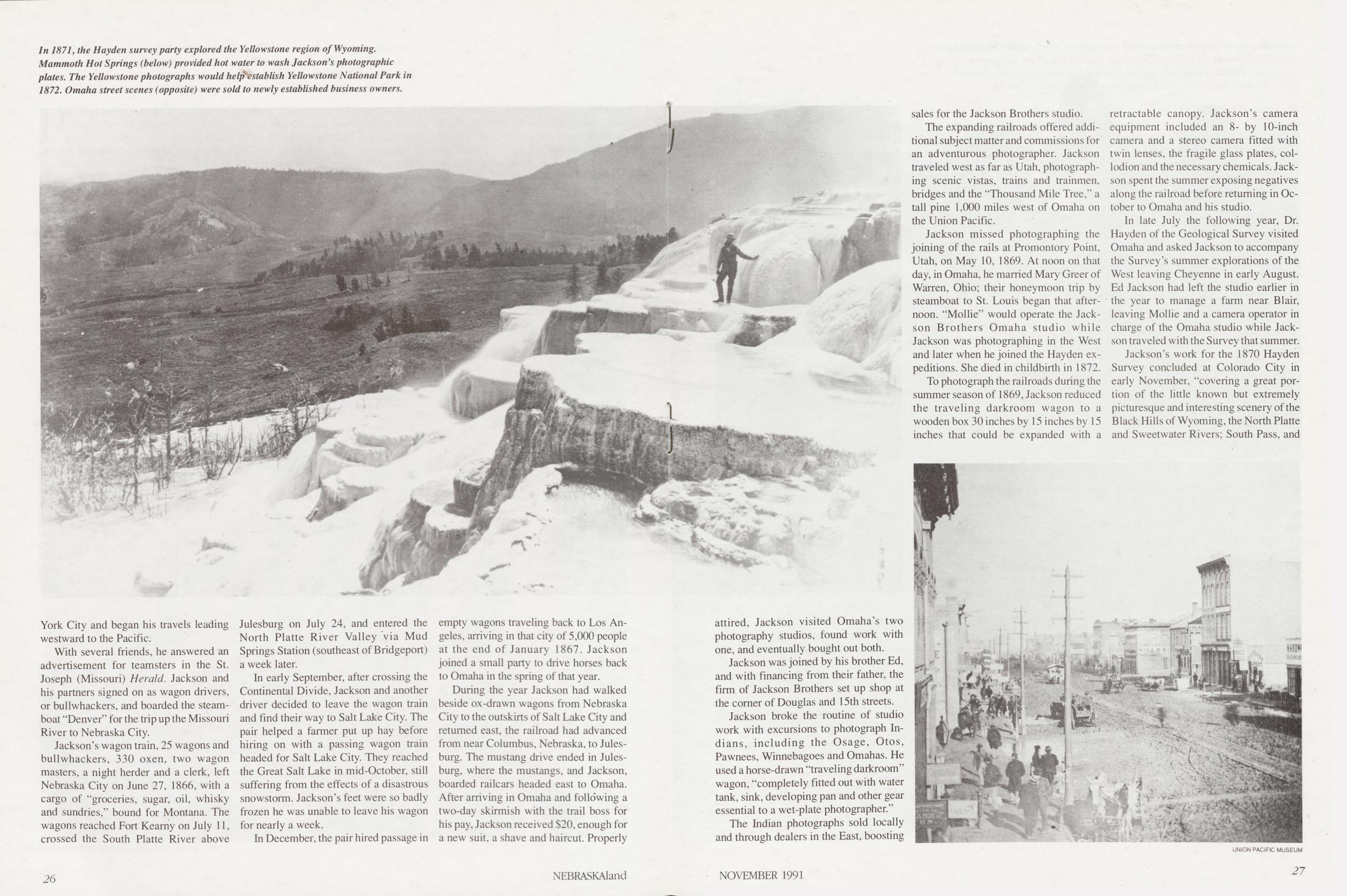
With several friends, he answered an advertisement for teamsters in the St. Joseph (Missouri) Herald. Jackson and his partners signed on as wagon drivers, or bullwhackers, and boarded the steamboat "Denver" for the trip up the Missouri River to Nebraska City.
Jackson's wagon train, 25 wagons and bullwhackers, 330 oxen, two wagon masters, a night herder and a clerk, left Nebraska City on June 27, 1866, with a cargo of "groceries, sugar, oil, whisky and sundries," bound for Montana. The wagons reached Fort Kearny on July 11, crossed the South Platte River above Julesburg on July 24, and entered the North Platte River Valley Via Mud Springs Station (southeast of Bridgeport) a week later.
In early September, after crossing the Continental Divide, Jackson and another driver decided to leave the wagon train and find their way to Salt Lake City. The pair helped a farmer put up hay before hiring on with a passing wagon train headed for Salt Lake City. They reached the Great Salt Lake in mid-October, still suffering from the effects of a disastrous snowstorm. Jackson's feet were so badly frozen he was unable to leave his wagon for nearly a week.
In December, the pair hired passage in empty wagons traveling back to Los Angeles, arriving in that city of 5,000 people at the end of January 1867. Jackson joined a small party to drive horses back to Omaha in the spring of that year.
During the year Jackson had walked beside ox-drawn wagons from Nebraska City to the outskirts of Salt Lake City and returned east, the railroad had advanced from near Columbus, Nebraska, to Julesburg. The mustang drive ended in Julesburg, where the mustangs, and Jackson, boarded railcars headed east to Omaha. After arriving in Omaha and following a two-day skirmish with the trail boss for his pay, Jackson received $20, enough for a new suit, a shave and haircut. Properly 26 NEBRASKAland attired, Jackson visited Omaha's two photography studios, found work with one, and eventually bought out both.
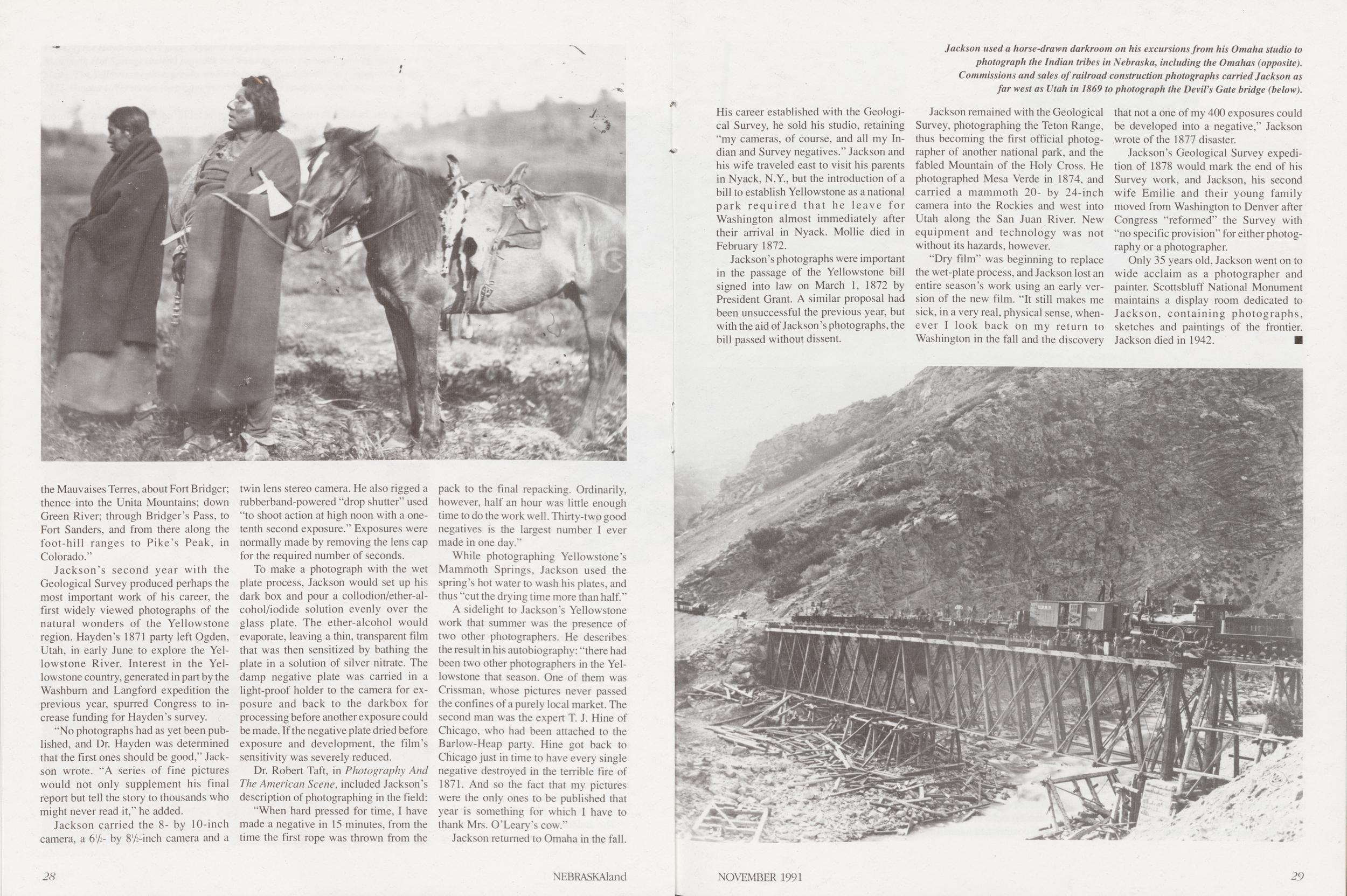
Jackson was joined by his brother Ed, and with financing from their father, the firm of Jackson Brothers set up shop at the corner of Douglas and 15th streets. Jackson broke the routine of studio work with excursions to photograph Indians, including the Osage, Otos, Pawnees, Winnebagoes and Omahas. He used a horse-drawn "traveling darkroom" wagon, "completely fitted out with water tank, sink, developing pan and other gear essential to a wet-plate photographer."
The Indian photographs sold locally and through dealers in the East, boosting sales for the Jackson Brothers studio.
The expanding railroads offered additional subject matter and commissions for an adventurous photographer. Jackson traveled west as far as Utah, photographing scenic vistas, trains and trainmen, bridges and the "Thousand Mile Tree," a tall pine 1,000 miles west of Omaha on the Union Pacific.
Jackson missed photographing the joining of the rails at Promontory Point, Utah, on May 10, 1869. At noon on that day, in Omaha, he married Mary Greer of Warren, Ohio; their honeymoon trip by steamboat to St. Louis began that afternoon. "Mollie" would operate the Jackson Brothers Omaha studio while Jackson was photographing in the West and later when he joined the Hayden expeditions. She died in childbirth in 1872.
To photograph the railroads during the summer season of 1869, Jackson reduced the traveling darkroom wagon to a wooden box 30 inches by 15 inches by 15 inches that could be expanded with a retractable canopy. Jackson's camera equipment included an 8- by 10-inch camera and a stereo camera fitted with twin lenses, the fragile glass plates, collodion and the necessary chemicals. Jackson spent the summer exposing negatives along the railroad before returning in October to Omaha and his studio.
In late July the following year, Dr. Hayden of the Geological Survey visited Omaha and asked Jackson to accompany the Survey's summer explorations of the West leaving Cheyenne in early August. Ed Jackson had left the studio earlier in the year to manage a farm near Blair, leaving Mollie and a camera operator in charge of the Omaha studio while Jackson traveled with the Survey that summer.
Jackson's work for the 1870 Hayden Survey concluded at Colorado City in early November, "covering a great portion of the little known but extremely picturesque and interesting scenery of the Black Hills of Wyoming, the North Platte and Sweet water Rivers; South Pass, and
Jackson's second year with the Geological Survey produced perhaps the most important work of his career, the first widely viewed photographs of the natural wonders of the Yellowstone region. Hayden's 1871 party left Ogden, Utah, in early June to explore the Yellowstone River. Interest in the Yellowstone country, generated in part by the Washburn and Langford expedition the previous year, spurred Congress to increase funding for Hayden's survey.
"No photographs had as yet been published, and Dr. Hayden was determined that the first ones should be good," Jackson wrote. "A series of fine pictures would not only supplement his final report but tell the story to thousands who might never read it," he added.
Jackson carried the 8- by 10-inch camera, a 6'/> by 8'/2-inch camera and a twin lens stereo camera. He also rigged a rubber band powered "drop shutter" used "to shoot action at high noon with a one-tenth second exposure." Exposures were normally made by removing the lens cap for the required number of seconds.
To make a photograph with the wet plate process, Jackson would set up his dark box and pour a collodion/ether-alcohol/iodide solution evenly over the glass plate. The ether-alcohol would evaporate, leaving a thin, transparent film that was then sensitized by bathing the plate in a solution of silver nitrate. The damp negative plate was carried in a light-proof holder to the camera for exposure and back to the darkbox for processing before another exposure could be made. If the negative plate dried before exposure and development, the film's sensitivity was severely reduced.
Dr. Robert Taft, in Photography And The American Scene, included Jackson's description of photographing in the field:
"When hard pressed for time, I have made a negative in 15 minutes, from the time the first rope was thrown from the pack to the final repacking. Ordinarily, however, half an hour was little enough time to do the work well. Thirty-two good negatives is the largest number I ever made in one day."
While photographing Yellowstone's Mammoth Springs, Jackson used the spring's hot water to wash his plates, and thus "cut the drying time more than half."
A sidelight to Jackson's Yellowstone work that summer was the presence of two other photographers. He describes the result in his autobiography: "there had been two other photographers in the Yellowstone that season. One of them was Crissman, whose pictures never passed the confines of a purely local market. The second man was the expert T. J. Hine of Chicago, who had been attached to the Barlow-Heap party. Hine got back to Chicago just in time to have every single negative destroyed in the terrible fire of 1871. And so the fact that my pictures were the only ones to be published that year is something for which I have to thank Mrs. O'Leary's cow."
Jackson returned to Omaha in the fall. 28 NEBRASKAland His career established with the Geological Survey, he sold his studio, retaining "my cameras, of course, and all my Indian and Survey negatives." Jackson and his wife traveled east to visit his parents in Nyack, N.Y, but the introduction of a bill to establish Yellowstone as a national park required that he leave for Washington almost immediately after their arrival in Nyack. Mollie died in February 1872.
Jackson's photographs were important in the passage of the Yellowstone bill signed into law on March 1, 1872 by President Grant. A similar proposal had been unsuccessful the previous year, but with the aid of Jackson's photographs, the bill passed without dissent.
Jackson remained with the Geological Survey, photographing the Teton Range, thus becoming the first official photographer of another national park, and the fabled Mountain of the Holy Cross. He photographed Mesa Verde in 1874, and carried a mammoth 20- by 24-inch camera into the Rockies and west into Utah along the San Juan River. New equipment and technology was not without its hazards, however.
"Dry film" was beginning to replace the wet-plate process, and Jackson lost an entire season's work using an early version of the new film. "It still makes me sick, in a very real, physical sense, whenever I look back on my return to Washington in the fall and the discovery that not a one of my 400 exposures could be developed into a negative," Jackson wrote of the 1877 disaster.
Jackson's Geological Survey expedition of 1878 would mark the end of his Survey work, and Jackson, his second wife Emilie and their young family moved from Washington to Denver after Congress "reformed" the Survey with "no specific provision" for either photography or a photographer.
Only 35 years old, Jackson went on to wide acclaim as a photographer and painter. Scottsbluff National Monument maintains a display room dedicated to Jackson, containing photographs, sketches and paintings of the frontier. Jackson died in 1942.
Cockers and Preachers
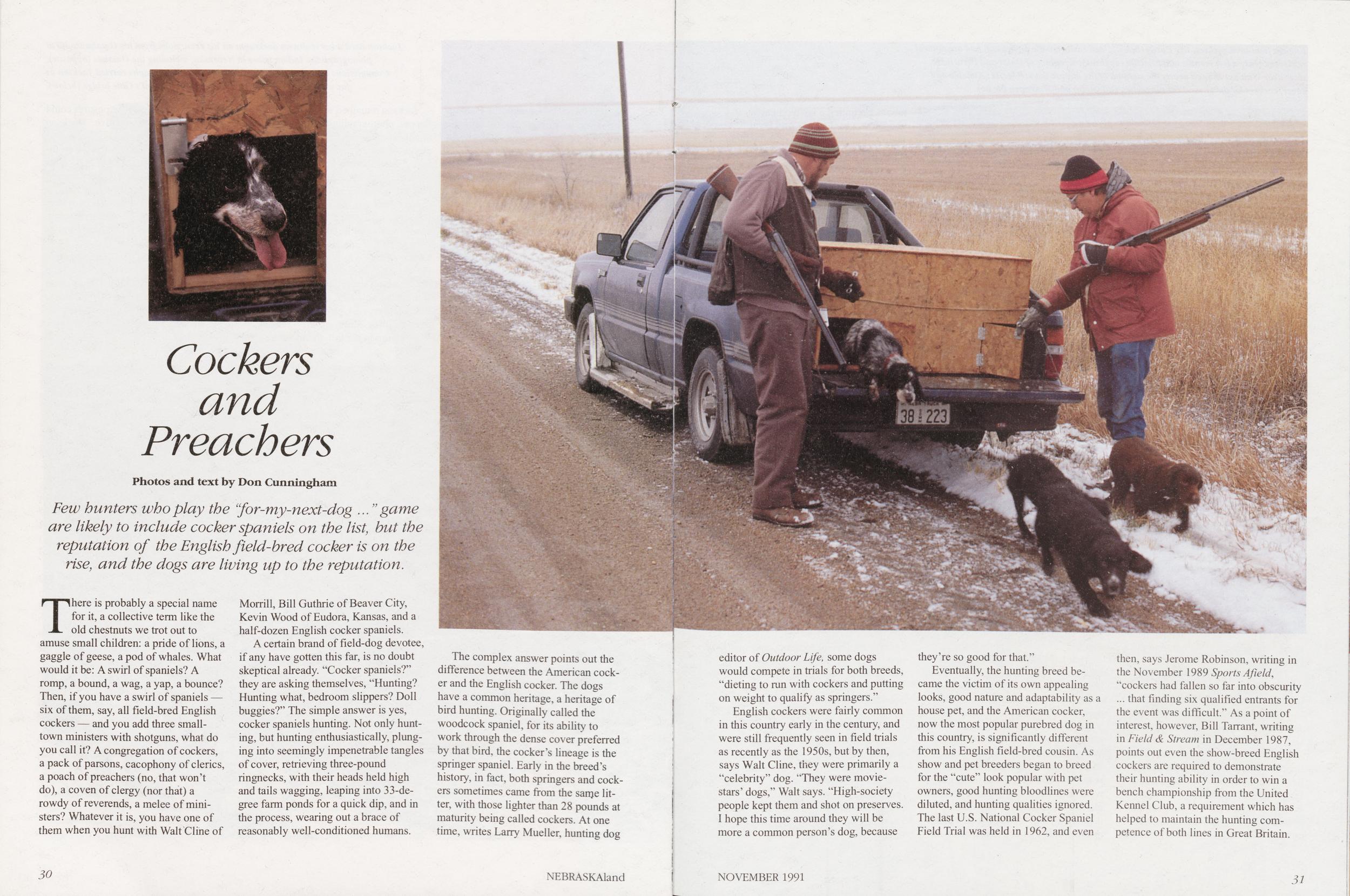
Photos and text by Don Cunningham Few hunters who play the for-my-next-dog ... "game are likely to include cocker spaniels on the list, hut the reputation of the English field-bred cocker is on the rise, and the dogs are living up to the reputation.There is probably a special name for it, a collective term like the old chestnuts we trot out to amuse small children: a pride of lions, a gaggle of geese, apod of whales. What would it be: A swirl of spaniels? A romp, a bound, a wag, a yap, a bounce? Then, if you have a swirl of spaniels — six of them, say, all field-bred English cockers — and you add three small town ministers with shotguns, what do you call it? A congregation of cockers, a pack of parsons, cacophony of clerics, a poach of preachers (no, that won't do), a coven of clergy (nor that) a rowdy of reverends, a melee of ministers? Whatever it is, you have one of them when you hunt with Walt Cline of Morrill, Bill Guthrie of Beaver City, Kevin Wood of Eudora, Kansas, and a half-dozen English cocker spaniels.
A certain brand of field-dog devotee, if any have gotten this far, is no doubt skeptical already. "Cocker spaniels?" they are asking themselves, "Hunting? Hunting what, bedroom slippers? Doll buggies?" The simple answer is yes, cocker spaniels hunting. Not only hunting, but hunting enthusiastically, plunging into seemingly impenetrable tangles of cover, retrieving three-pound ring necks, with their heads held high and tails wagging, leaping into 33-degree farm ponds for a quick dip, and in the process, wearing out a brace of reasonably well-conditioned humans.
The complex answer points out the difference between the American cocker and the English cocker. The dogs have a common heritage, a heritage of bird hunting. Originally called the woodcock spaniel, for its ability to work through the dense cover preferred by that bird, the cocker's lineage is the springer spaniel. Early in the breed's history, in fact, both springers and cockers sometimes came from the same litter, with those lighter than 28 pounds at maturity being called cockers. At one time, writes Larry Mueller, hunting dog 30 NEBRASKAland editor of Outdoor Life, some dogs would compete in trials for both breeds, "dieting to run with cockers and putting on weight to qualify as springers."
English cockers were fairly common in this country early in the century, and were still frequently seen in field trials as recently as the 1950s, but by then, says Walt Cline, they were primarily a "celebrity" dog. "They were movie stars' dogs," Walt says. "High-society people kept them and shot on preserves. I hope this time around they will be more a common person's dog, because they're so good for that."
Eventually, the hunting breed became the victim of its own appealing looks, good nature and adaptability as a house pet, and the American cocker, now the most popular purebred dog in this country, is significantly different from his English field-bred cousin. As show and pet breeders began to breed for the "cute" look popular with pet owners, good hunting bloodlines were diluted, and hunting qualities ignored. The last U.S. National Cocker Spaniel Field Trial was held in 1962, and even then, says Jerome Robinson, writing in the November 1989 Sports Afield, "cockers had fallen so far into obscurity ... that finding six qualified entrants for the event was difficult." As a point of interest, however, Bill Tarrant, writing in Field & Stream in December 1987, points out even the show-breed English cockers are required to demonstrate their hunting ability in order to win a bench championship from the United Kennel Club, a requirement which has helped to maintain the hunting competence of both lines in Great Britain.
NOVEMBER 1991 31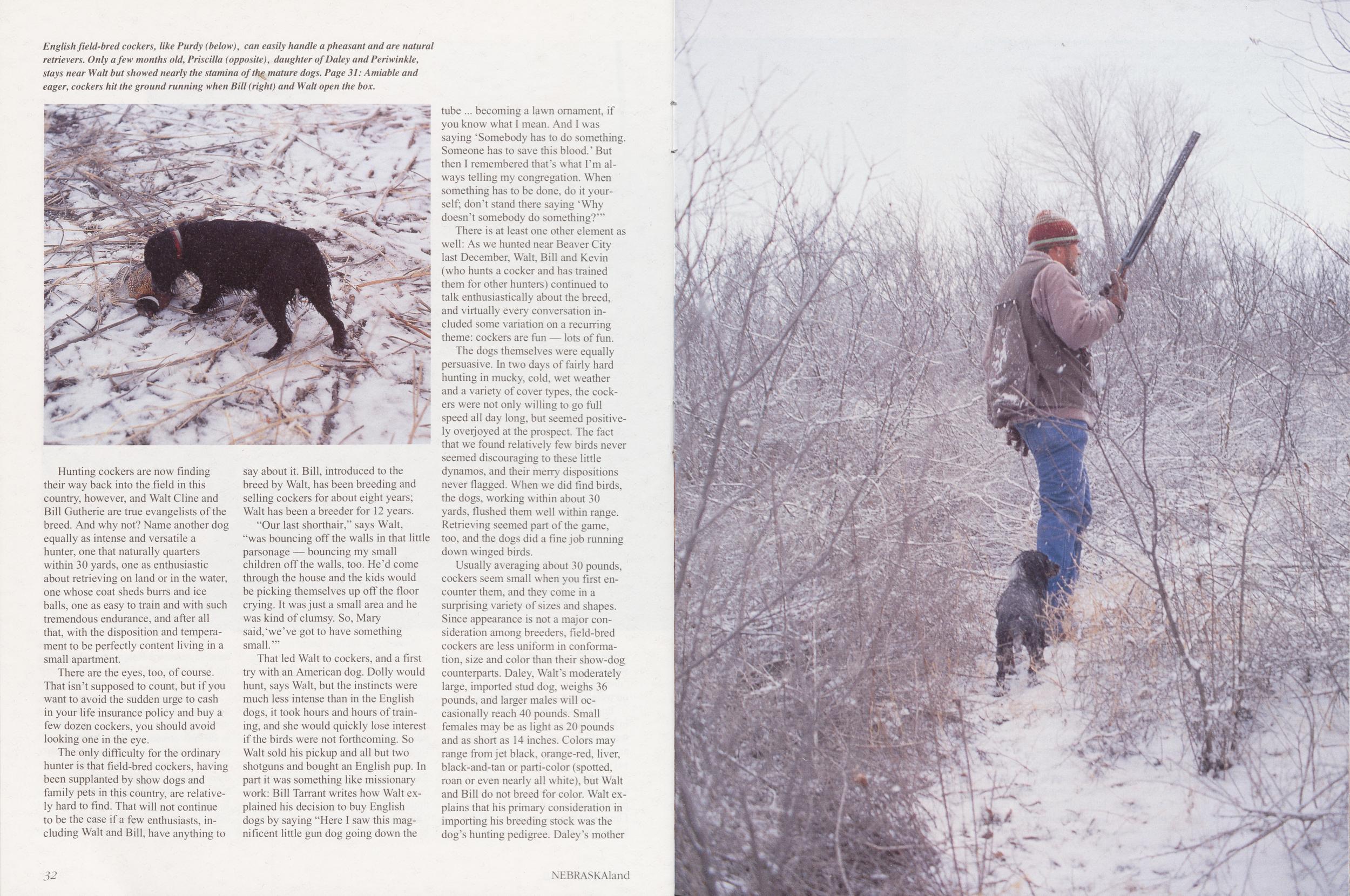
Hunting cockers are now finding their way back into the field in this country, however, and Walt Cline and Bill Gutherie are true evangelists of the breed. And why not? Name another dog equally as intense and versatile a hunter, one that naturally quarters within 30 yards, one as enthusiastic about retrieving on land or in the water, one whose coat sheds burrs and ice balls, one as easy to train and with such tremendous endurance, and after all that, with the disposition and temperament to be perfectly content living in a small apartment.
There are the eyes, too, of course. That isn't supposed to count, but if you want to avoid the sudden urge to cash in your life insurance policy and buy a few dozen cockers, you should avoid looking one in the eye.
The only difficulty for the ordinary hunter is that field-bred cockers, having been supplanted by show dogs and family pets in this country, are relatively hard to find. That will not continue to be the case if a few enthusiasts, including Walt and Bill, have anything to say about it. Bill, introduced to the breed by Walt, has been breeding and selling cockers for about eight years; Walt has been a breeder for 12 years.
"Our last shorthair," says Walt, "was bouncing off the walls in that little parsonage — bouncing my small children off the walls, too. He'd come through the house and the kids would be picking themselves up off the floor crying. It was just a small area and he was kind of clumsy. So, Mary said,'we've got to have something small.'"
That led Walt to cockers, and a first try with an American dog. Dolly would hunt, says Walt, but the instincts were much less intense than in the English dogs, it took hours and hours of training, and she would quickly lose interest if the birds were not forthcoming. So Walt sold his pickup and all but two shotguns and bought an English pup. In part it was something like missionary work: Bill Tarrant writes how Walt explained his decision to buy English dogs by saying "Here I saw this magnificent little gun dog going down the tube ... becoming a lawn ornament, if you know what I mean. And I was saying "Somebody has to do something. Someone has to save this blood.' But then I remembered that's what I'm always telling my congregation. When something has to be done, do it yourself; don't stand there saying "Why doesn't somebody do something?'"
There is at least one other element as well: As we hunted near Beaver City last December, Walt, Bill and Kevin (who hunts a cocker and has trained them for other hunters) continued to talk enthusiastically about the breed, and virtually every conversation included some variation on a recurring theme: cockers are fun — lots of fun.
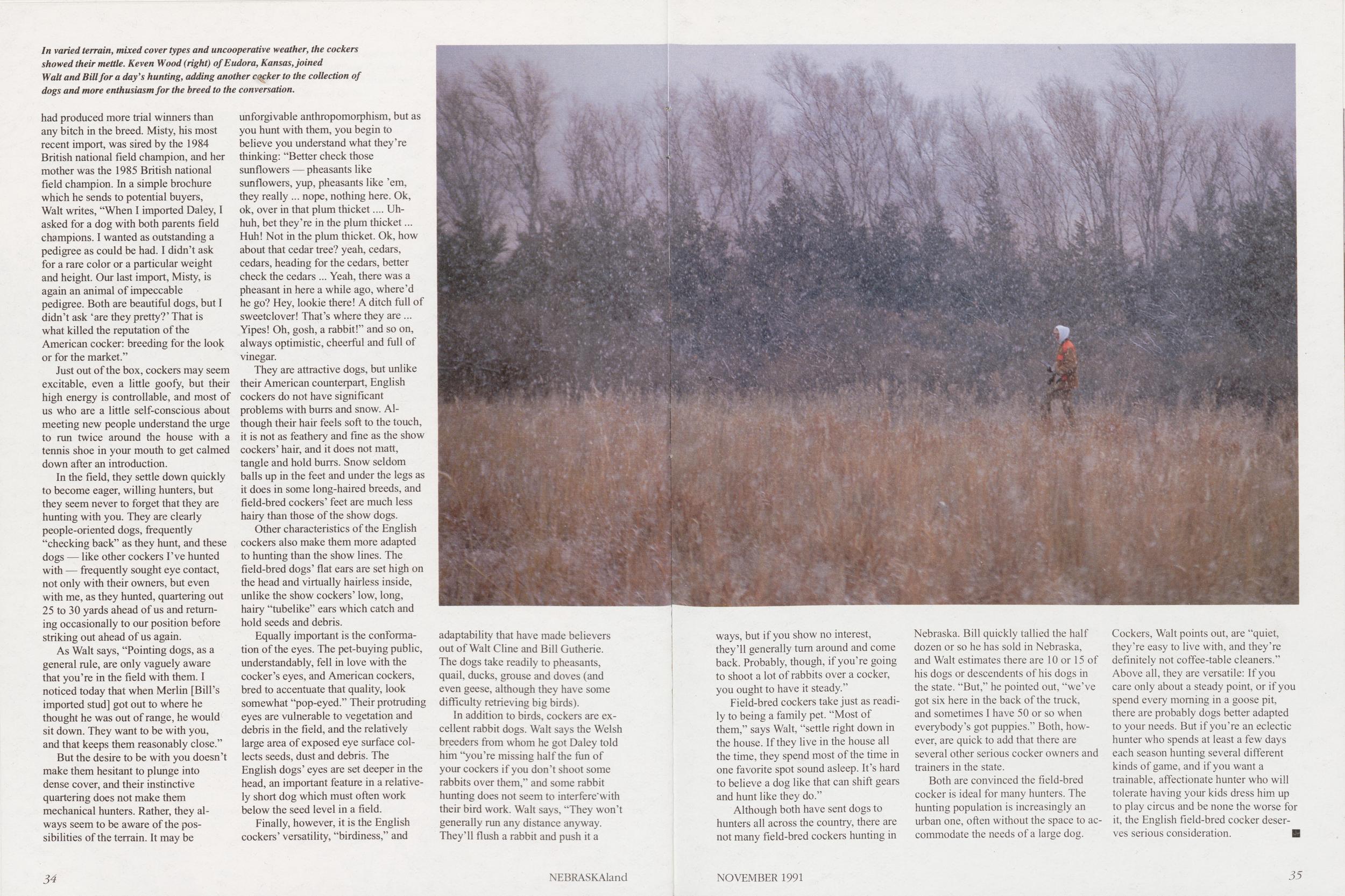
The dogs themselves were equally persuasive. In two days of fairly hard hunting in mucky, cold, wet weather and a variety of cover types, the cockers were not only willing to go full speed all day long, but seemed positively overjoyed at the prospect. The fact that we found relatively few birds never seemed discouraging to these little dynamos, and their merry dispositions never flagged. When we did find birds, the dogs, working within about 30 yards, flushed them well within range. Retrieving seemed part of the game, too, and the dogs did a fine job running down winged birds.
Usually averaging about 30 pounds, cockers seem small when you first encounter them, and they come in a surprising variety of sizes and shapes. Since appearance is not a major consideration among breeders, field-bred cockers are less uniform in conformation, size and color than their show-dog counterparts. Daley, Walt's moderately large, imported stud dog, weighs 36 pounds, and larger males will occasionally reach 40 pounds. Small females may be as light as 20 pounds and as short as 14 inches. Colors may range from jet black, orange-red, liver, black-and-tan or parti-color (spotted, roan or even nearly all white), but Walt and Bill do not breed for color. Walt explains that his primary consideration in importing his breeding stock was the dog's hunting pedigree. Daley's mother 32 NEBRASKAland
 had produced more trial winners than
any bitch in the breed. Misty, his most
recent import, was sired by the 1984
British national field champion, and her
mother was the 1985 British national
field champion. In a simple brochure
which he sends to potential buyers,
Walt writes, "When I imported Daley, I
asked for a dog with both parents field
champions. I wanted as outstanding a
pedigree as could be had. I didn't ask
for a rare color or a particular weight
and height. Our last import, Misty, is
again an animal of impeccable
pedigree. Both are beautiful dogs, but I
didn't ask 'are they pretty?' That is
what killed the reputation of the
American cocker: breeding for the look
or for the market."
had produced more trial winners than
any bitch in the breed. Misty, his most
recent import, was sired by the 1984
British national field champion, and her
mother was the 1985 British national
field champion. In a simple brochure
which he sends to potential buyers,
Walt writes, "When I imported Daley, I
asked for a dog with both parents field
champions. I wanted as outstanding a
pedigree as could be had. I didn't ask
for a rare color or a particular weight
and height. Our last import, Misty, is
again an animal of impeccable
pedigree. Both are beautiful dogs, but I
didn't ask 'are they pretty?' That is
what killed the reputation of the
American cocker: breeding for the look
or for the market."
Just out of the box, cockers may seem excitable, even a little goofy, but their high energy is controllable, and most of us who are a little self-conscious about meeting new people understand the urge to run twice around the house with a tennis shoe in your mouth to get calmed down after an introduction.
In the field, they settle down quickly to become eager, willing hunters, but they seem never to forget that they are hunting with you. They are clearly people-oriented dogs, frequently "checking back" as they hunt, and these dogs — like other cockers I've hunted with — frequently sought eye contact, not only with their owners, but even with me, as they hunted, quartering out 25 to 30 yards ahead of us and returning occasionally to our position before striking out ahead of us again.
As Walt says, "Pointing dogs, as a general rule, are only vaguely aware that you're in the field with them. I noticed today that when Merlin [Bill's imported stud] got out to where he thought he was out of range, he would sit down. They want to be with you, and that keeps them reasonably close."
But the desire to be with you doesn't make them hesitant to plunge into dense cover, and their instinctive quartering does not make them mechanical hunters. Rather, they always seem to be aware of the possibilities of the terrain. It may be unforgivable anthropomorphism, but as you hunt with them, you begin to believe you understand what they're thinking: "Better check those sunflowers — pheasants like sunflowers, yup, pheasants like 'em, they really ... nope, nothing here. Ok, ok, over in that plum thicket.... Uh- huh, bet they're in the plum thicket... Huh! Not in the plum thicket. Ok, how about that cedar tree? yeah, cedars, cedars, heading for the cedars, better check the cedars ... Yeah, there was a pheasant in here a while ago, where'd he go? Hey, lookie there! A ditch full of sweet clover! That's where they are ... Yipes! Oh, gosh, a rabbit!" and so on, always optimistic, cheerful and full of vinegar.
They are attractive dogs, but unlike their American counterpart, English cockers do not have significant problems with burrs and snow. Although their hair feels soft to the touch, it is not as feathery and fine as the show cockers' hair, and it does not matt, tangle and hold burrs. Snow seldom balls up in the feet and under the legs as it does in some long-haired breeds, and field-bred cockers' feet are much less hairy than those of the show dogs.
Other characteristics of the English cockers also make them more adapted to hunting than the show lines. The field-bred dogs' flat ears are set high on the head and virtually hairless inside, unlike the show cockers' low, long, hairy "tubelike" ears which catch and hold seeds and debris.
Equally important is the conformation of the eyes. The pet-buying public, understandably, fell in love with the cocker's eyes, and American cockers, bred to accentuate that quality, look somewhat "pop-eyed." Their protruding eyes are vulnerable to vegetation and debris in the field, and the relatively large area of exposed eye surface collects seeds, dust and debris. The English dogs' eyes are set deeper in the head, an important feature in a relatively short dog which must often work below the seed level in a field.
Finally, however, it is the English cockers' versatility, "birdiness," and adaptability that have made believers out of Walt Cline and Bill Gutherie. The dogs take readily to pheasants, quail, ducks, grouse and doves (and even geese, although they have some difficulty retrieving big birds).
In addition to birds, cockers are excellent rabbit dogs. Walt says the Welsh breeders from whom he got Daley told him "you're missing half the fun of your cockers if you don't shoot some rabbits over them," and some rabbit hunting does not seem to interfere with their bird work. Walt says, "They won't generally run any distance anyway. They'll flush a rabbit and push it a 34 NEBRASKAland
Field-bred cockers take just as readily to being a family pet. "Most of them," says Walt, "settle right down in the house. If they live in the house all the time, they spend most of the time in one favorite spot sound asleep. It's hard to believe a dog like that can shift gears and hunt like they do."
Although both have sent dogs to hunters all across the country, there are not many field-bred cockers hunting in Nebraska. Bill quickly tallied the half dozen or so he has sold in Nebraska, and Walt estimates there are 10 or 15 of his dogs or descendants of his dogs in the state. "But," he pointed out, "we've got six here in the back of the truck, and sometimes I have 50 or so when everybody's got puppies." Both, however, are quick to add that there are several other serious cocker owners and trainers in the state.
Both are convinced the field-bred cocker is ideal for many hunters. The hunting population is increasingly an urban one, often without the space to accommodate the needs of a large dog. Cockers, Walt points out, are "quiet, they're easy to live with, and they're definitely not coffee-table cleaners." Above all, they are versatile: If you care only about a steady point, or if you spend every morning in a goose pit, there are probably dogs better adapted to your needs. But if you're an eclectic hunter who spends at least a few days each season hunting several different kinds of game, and if you want a trainable, affectionate hunter who will tolerate having your kids dress him up to play circus and be none the worse for it, the English field-bred cocker deserves serious consideration.
NOVEMBER 1991 35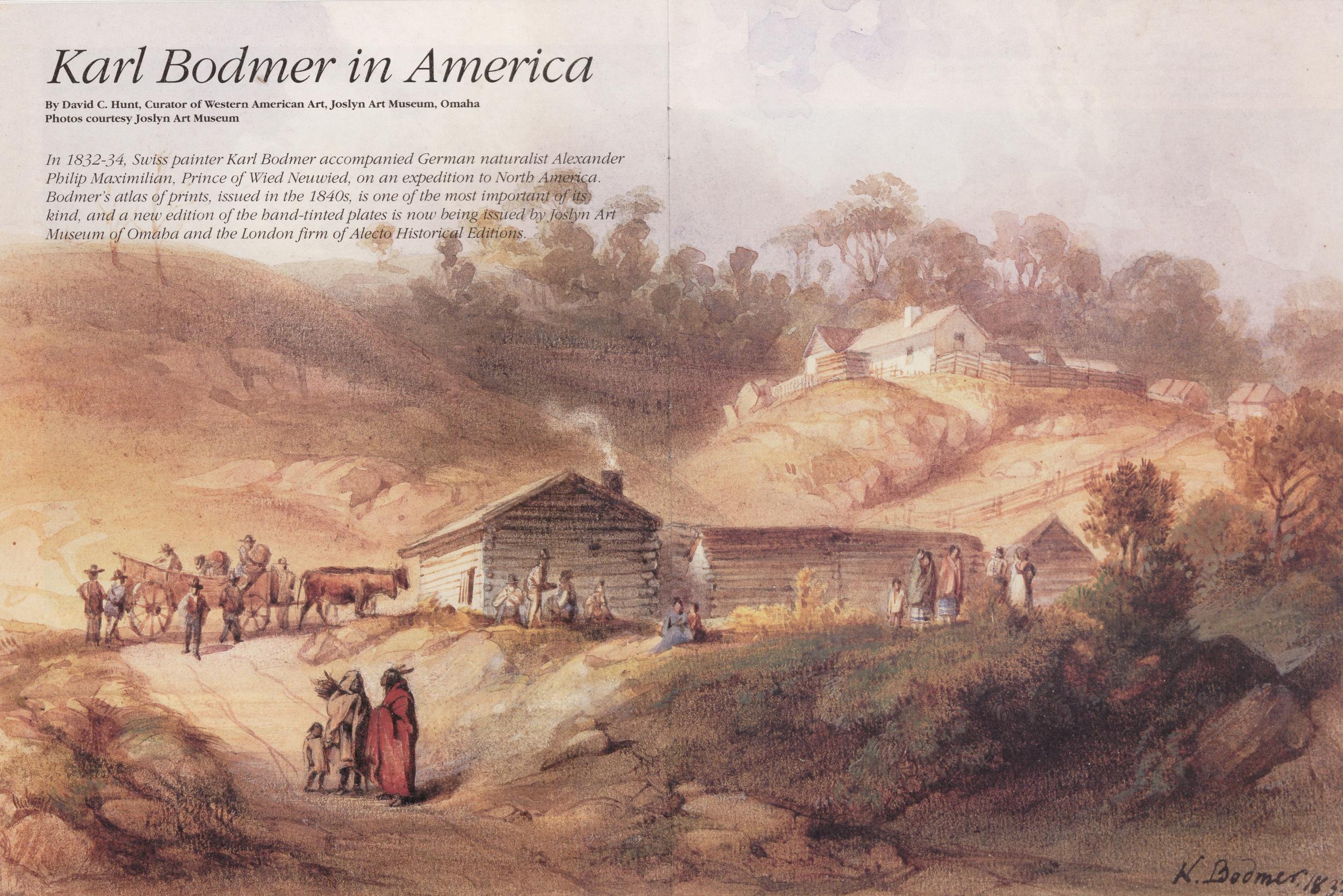
Karl Bodmer in America
By David C. Hunt, Curator of Western American Art, Joslyn Art Museum, Omaha Photos courtesy Joslyn Art Museum In 1832-34, Swiss painter Karl Bodmer accompanied German naturalist Alexander Philip Maximilian, Prince of Wied Neuwied, on an expedition to North America. Bodmer s atlas of prints, issued in the 1840s, is one of the most important q/7|p kind, and a new edition of the hand-tinted plates is now being issued by joslyn Art Museum of Omaha and the London firm of Alecto Historical Editions.Throughout the 19th century, artists were active on the frontiers of the United States. Of widely differing backgrounds, training and experience, these draftsmen and watercolorists traveled westward, rendering valuable service to history by portraying people, places and events. Accuracy of observation and skill in the handling of various media distinguished the best of them, and their pictures, on the whole, have more to convey to the viewer today than simply the particulars they depict. The wild lands beyond the Ohio, the Mississippi and the Rocky Mountains afforded resources of scenery and subject matter from which they drew inspiration, and many of their surviving works reflect a romantic preoccupation with the exotic and the picturesque typical of that time.
Among these frontier artists was Swiss painter Karl Bodmer, who produced a large collection of drawings and watercolors descriptive of an expedition to North America in 1832-34 by the German naturalist Alexander Philip Maximilian, Prince of Wied Neuwied. Most of this material remained unavailable for study until 1948, when the greater part of it was recovered at Neuwied, near Koblenz, Germany, by a museum official conducting research in the Wied family archives. Prior to this discovery, American scholars had been acquainted with Bodmer chiefly through the atlas of prints he issued in Paris in the 1840s to illustrate Prince Maximilian's published narrative of his travels. Comprising 81 etchings, hand-colored in some editions, this series was long regarded by historians and ethnologists as one of the most important documentaries of its kind to have appeared in the 19th century. Today, it still claims this distinction and continues to be the best known of all Bodmer's works.
Born in Zurich in 1809, Bodmer was 13 years old when he received his first instruction in drawing and printmaking from an uncle, Johann Jakob Meier (or Meyer), a local engraver who had studied under the Swiss landscape painter Johann Heinrich Fussli. With an elder brother, Rudolf, also an artist, Bodmer later visited Germany, delineating views of the country along the Rhine and Mosel rivers which were reproduced in scenic albums for sale to tourists. Bodmer was 23 when, at Koblenz, he met Maximilian zu Wied, who was about to embark on a voyage to North America. An experienced traveler, Maximilian was concerned that an accurate visual record should be made of his proposed anthropological survey of North America. In hiring Bodmer as his pictoriographer, he made a discerning (or perhaps fortuitous) choice.
Bodmer's journey with Maximilian took him across the continent into regions of the Far West which to that point had been little explored beyond the courses of the Missouri and the Platte rivers. Sharing with his patron the dangers and hardships of frontier life, he witnessed incidents which only a few artists before him had seen or described. Although the range of his talent as an illustrator was largely 38 NEBRASKAland untested when the expedition began, Bodmer quickly proved himself to be an astute observer of nature and an accomplished landscape painter. Picturing varied aspects of native life in the West, he preserved the likenesses of then little known and culturally diverse people, in portraits and scenes of tribal activity which since have been acknowledged as among the finest ever painted.
Prince Maximilian, Bodmer and David Dreidoppel, the prince's manservant and personal taxidermist, sailed for America from the Dutch port of Helvoet on May 18, 1832. Arriving at Boston on the morning of July 4, they visited New York City and Philadelphia before journeying through western Pennsylvania and the Ohio River country to New Harmony, Indiana, where they spent the winter. There they experienced their first real taste of wilderness life, while Maximilian recovered from an illness he described as closely resembling cholera, a disease which had reached epidemic proportions in many parts of the United States that year.
In March 1833, they were welcomed at St. Louis by retired explorer William Clark, then serving as superintendent of Indian affairs for the Western tribes. Clark advised Maximilian to continue his travels westward via the American Fur Company's posts on the Missouri River, where opportunities for scientific research and the study of native peoples were thought to be better than along the less frequented overland routes to the Rocky Mountains.
NOVEMBER 1991 39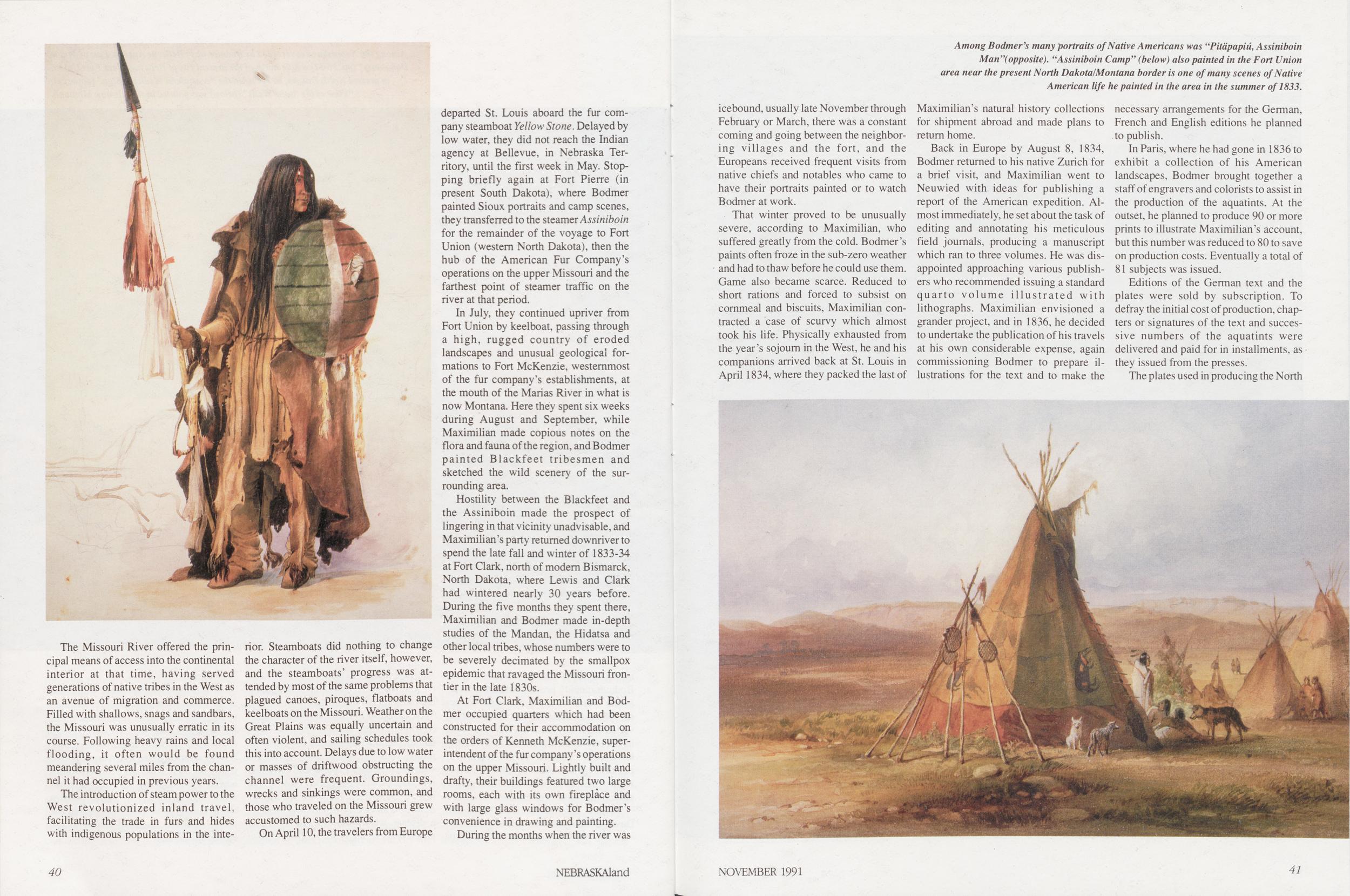
The Missouri River offered the principal means of access into the continental interior at that time, having served generations of native tribes in the West as an avenue of migration and commerce. Filled with shallows, snags and sandbars, the Missouri was unusually erratic in its course. Following heavy rains and local flooding, it often would be found meandering several miles from the channel it had occupied in previous years.
The introduction of steam power to the West revolutionized inland travel, facilitating the trade in furs and hides with indigenous populations in the interior. Steamboats did nothing to change the character of the river itself, however, and the steamboats' progress was attended by most of the same problems that plagued canoes, piroques, flatboats and keelboats on the Missouri. Weather on the Great Plains was equally uncertain and often violent, and sailing schedules took this into account. Delays due to low water or masses of driftwood obstructing the channel were frequent. Groundings, wrecks and sinkings were common, and those who traveled on the Missouri grew accustomed to such hazards.
On April 10, the travelers from Europe departed St. Louis aboard the fur company steamboat Yellow Stone. Delayed by low water, they did not reach the Indian agency at Bellevue, in Nebraska Territory, until the first week in May. Stopping briefly again at Fort Pierre (in present South Dakota), where Bodmer painted Sioux portraits and camp scenes, they transferred to the steamer Assiniboin for the remainder of the voyage to Fort Union (western North Dakota), then the hub of the American Fur Company's operations on the upper Missouri and the farthest point of steamer traffic on the river at that period.
In July, they continued upriver from Fort Union by keelboat, passing through a high, rugged country of eroded landscapes and unusual geological formations to Fort McKenzie, westernmost of the fur company's establishments, at the mouth of the Marias River in what is now Montana. Here they spent six weeks during August and September, while Maximilian made copious notes on the flora and fauna of the region, and Bodmer painted Blackfeet tribesmen and sketched the wild scenery of the surrounding area.
Hostility between the Blackfeet and the Assiniboin made the prospect of lingering in that vicinity unadvisable, and Maximilian's party returned downriver to spend the late fall and winter of 1833-34 at Fort Clark, north of modern Bismarck, North Dakota, where Lewis and Clark had wintered nearly 30 years before. During the five months they spent there, Maximilian and Bodmer made in-depth studies of the Mandan, the Hidatsa and other local tribes, whose numbers were to be severely decimated by the smallpox epidemic that ravaged the Missouri frontier in the late 1830s.
At Fort Clark, Maximilian and Bodmer occupied quarters which had been constructed for their accommodation on the orders of Kenneth McKenzie, superintendent of the fur company's operations on the upper Missouri. Lightly built and drafty, their buildings featured two large rooms, each with its own fireplace and with large glass windows for Bodmer's convenience in drawing and painting.
During the months when the river was 40 NEBRASKAland icebound, usually late November through February or March, there was a constant coming and going between the neighboring villages and the fort, and the Europeans received frequent visits from native chiefs and notables who came to have their portraits painted or to watch Bodmer at work.
That winter proved to be unusually severe, according to Maximilian, who suffered greatly from the cold. Bodmer's paints often froze in the sub-zero weather and had to thaw before he could use them. Game also became scarce. Reduced to short rations and forced to subsist on cornmeal and biscuits, Maximilian contracted a case of scurvy which almost took his life. Physically exhausted from the year's sojourn in the West, he and his companions arrived back at St. Louis in April 1834, where they packed the last of Maximilian's natural history collections for shipment abroad and made plans to return home.
Back in Europe by August 8, 1834, Bodmer returned to his native Zurich for a brief visit, and Maximilian went to Neuwied with ideas for publishing a report of the American expedition. Almost immediately, he set about the task of editing and annotating his meticulous field journals, producing a manuscript which ran to three volumes. He was disappointed approaching various publishers who recommended issuing a standard quarto volume illustrated with lithographs. Maximilian envisioned a grander project, and in 1836, he decided to undertake the publication of his travels at his own considerable expense, again commissioning Bodmer to prepare illustrations for the text and to make the necessary arrangements for the German, French and English editions he planned to publish.
In Paris, where he had gone in 1836 to exhibit a collection of his American landscapes, Bodmer brought together a staff of engravers and colorists to assist in the production of the aquatints. At the outset, he planned to produce 90 or more prints to illustrate Maximilian's account, but this number was reduced to 80 to save on production costs. Eventually a total of 81 subjects was issued.
Editions of the German text and the plates were sold by subscription. To defray the initial cost of production, chapters or signatures of the text and successive numbers of the aquatints were delivered and paid for in installments, as they issued from the presses.
The plates used in producing the North American atlas remained in Paris for several years. They were reclaimed in 1854 and entrusted to the royal secretary at the Prussian legation in Paris for safekeeping. In 1873, following the Franco-Prussian War, the plates were returned to Neuwied, where they were stored for the next 50 years.
NOVEMBER 1991 41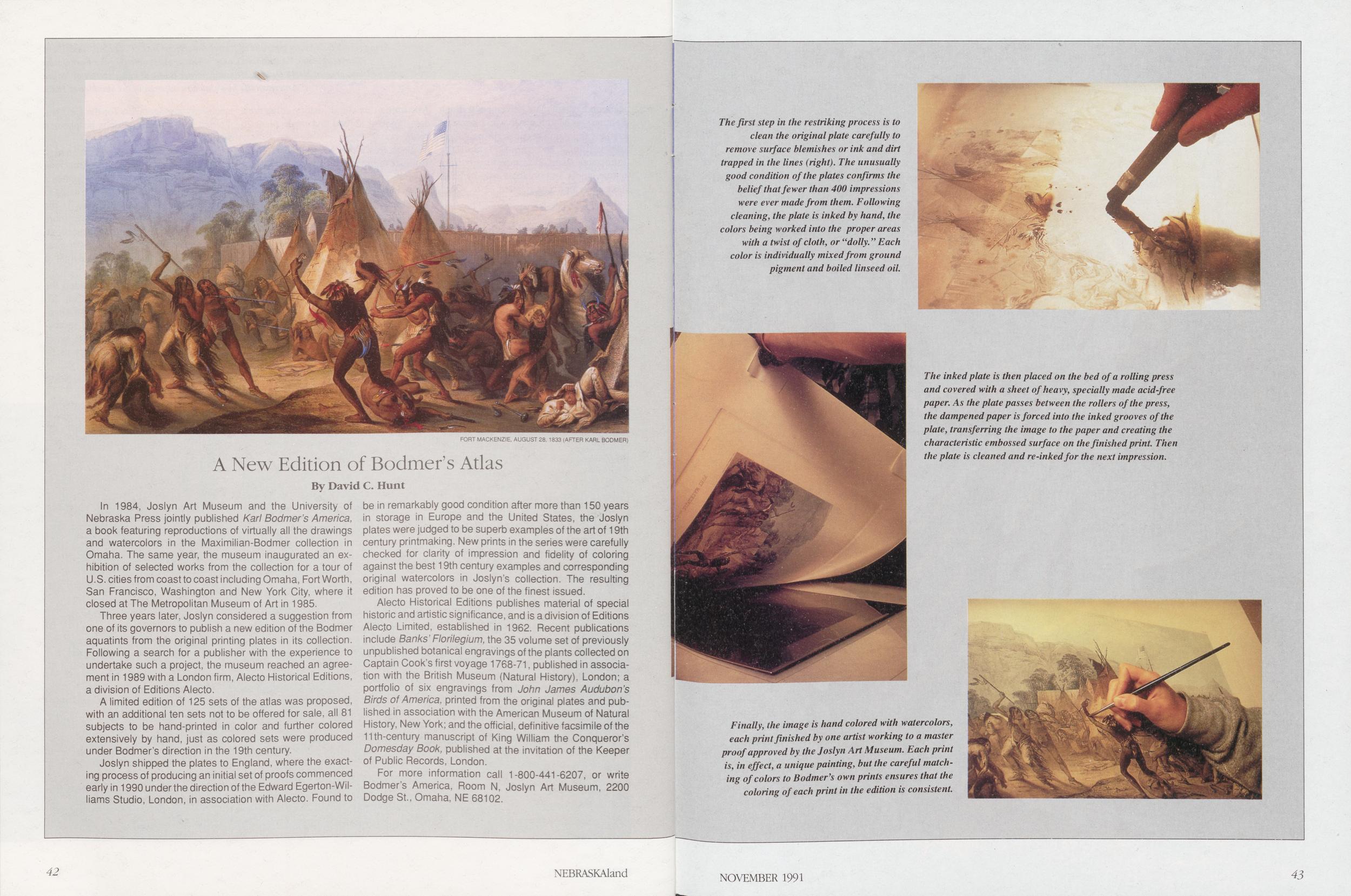
In 1984, Joslyn Art Museum and the University of Nebraska Press jointly published Karl Bodmer's America, a book featuring reproductions of virtually all the drawings and watercolors in the Maximilian-Bodmer collection in Omaha. The same year, the museum inaugurated an exhibition of selected works from the collection for a tour of U.S. cities from coast to coast including Omaha, Fort Worth, San Francisco, Washington and New York City, where it closed at The Metropolitan Museum of Art in 1985.
Three years later, Joslyn considered a suggestion from one of its governors to publish a new edition of the Bodmer aquatints from the original printing plates in its collection. Following a search for a publisher with the experience to undertake such a project, the museum reached an agree- ment in 1989 with a London firm, Alecto Historical Editions, a division of Editions Alecto.
A limited edition of 125 sets of the atlas was proposed, with an additional ten sets not to be offered for sale, all 81 subjects to be hand-printed in color and further colored extensively by hand, just as colored sets were produced under Bodmer's direction in the 19th century.
Joslyn shipped the plates to England, where the exact- ing process of producing an initial set of proofs commenced early in 1990 under the direction of the Edward Egerton-Williams Studio, London, in association with Alecto. Found to be in remarkably good condition after more than 150 years in storage in Europe and the United States, the Joslyn plates were judged to be superb examples of the art of 19th century printmaking. New prints in the series were carefully checked for clarity of impression and fidelity of coloring against the best 19th century examples and corresponding original watercolors in Joslyn's collection. The resulting edition has proved to be one of the finest issued.
Alecto Historical Editions publishes material of special historic and artistic significance, and is a division of Editions Alecto Limited, established in 1962. Recent publications include Banks' Florilegium, the 35 volume set of previously unpublished botanical engravings of the plants collected on Captain Cook's first voyage 1768-71, published in association with the British Museum (Natural History), London; a portfolio of six engravings from John James Audubon's Birds of America, printed from the original plates and published in association with the American Museum of Natural History, New York; and the official, definitive facsimile of the 11th-century manuscript of King William the Conqueror's Domesday Book, published at the invitation of the Keeper of Public Records, London.
For more information call 1-800-441-6207, or write Bodmer's America, Room N, Joslyn Art Museum, 2200 Dodge St., Omaha, NE 68102.
42 NEBRASKAland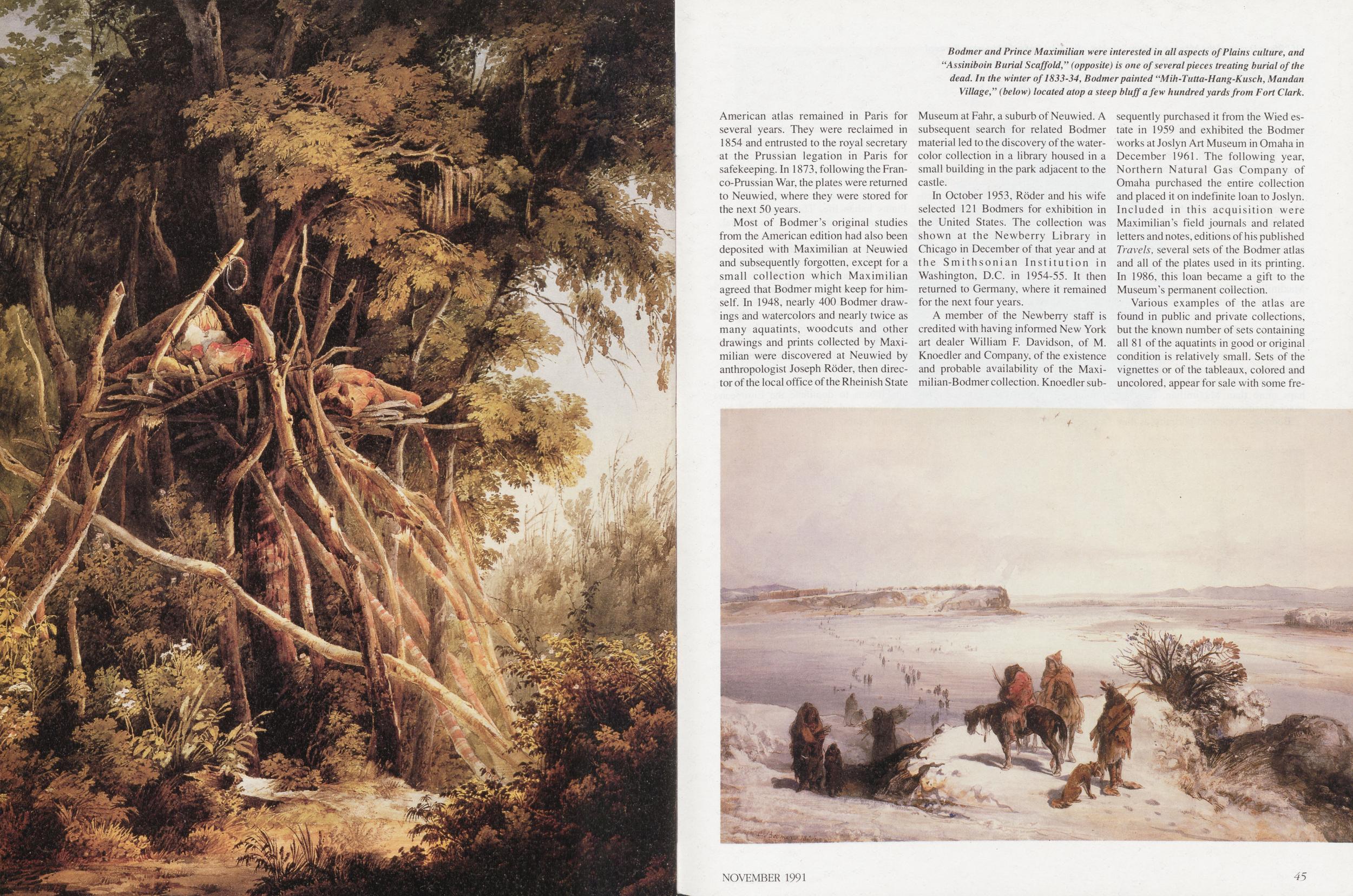
Most of Bodmer's original studies from the American edition had also been deposited with Maximilian at Neuwied and subsequently forgotten, except for a small collection which Maximilian agreed that Bodmer might keep for himself. In 1948, nearly 400 Bodmer drawings and watercolors and nearly twice as many aquatints, woodcuts and other drawings and prints collected by Maximilian were discovered at Neuwied by anthropologist Joseph Roder, then director of the local office of the Rheinish State Museum at Fahr, a suburb of Neuwied. A subsequent search for related Bodmer material led to the discovery of the watercolor collection in a library housed in a small building in the park adjacent to the castle.
In October 1953, Roder and his wife selected 121 Bodmers for exhibition in the United States. The collection was shown at the Newberry Library in Chicago in December of that year and at the Smithsonian Institution in Washington, D.C. in 1954-55. It then returned to Germany, where it remained for the next four years.
A member of the Newberry staff is credited with having informed New York art dealer William F. Davidson, of M. Knoedler and Company, of the existence and probable availability of the Maximilian-Bodmer collection. Knoedler subsequently purchased it from the Wied estate in 1959 and exhibited the Bodmer works at Joslyn Art Museum in Omaha in December 1961. The following year, Northern Natural Gas Company of Omaha purchased the entire collection and placed it on indefinite loan to Joslyn. Included in this acquisition were Maximilian's field journals and related letters and notes, editions of his published Travels, several sets of the Bodmer atlas and all of the plates used in its printing. In 1986, this loan became a gift to the Museum's permanent collection.
Various examples of the atlas are
found in public and private collections,
but the known number of sets containing
all 81 of the aquatints in good or original
condition is relatively small. Sets of the
vignettes or of the tableaux, colored and
uncolored, appear for sale with some frequency,
NOVEMBER 1991
45
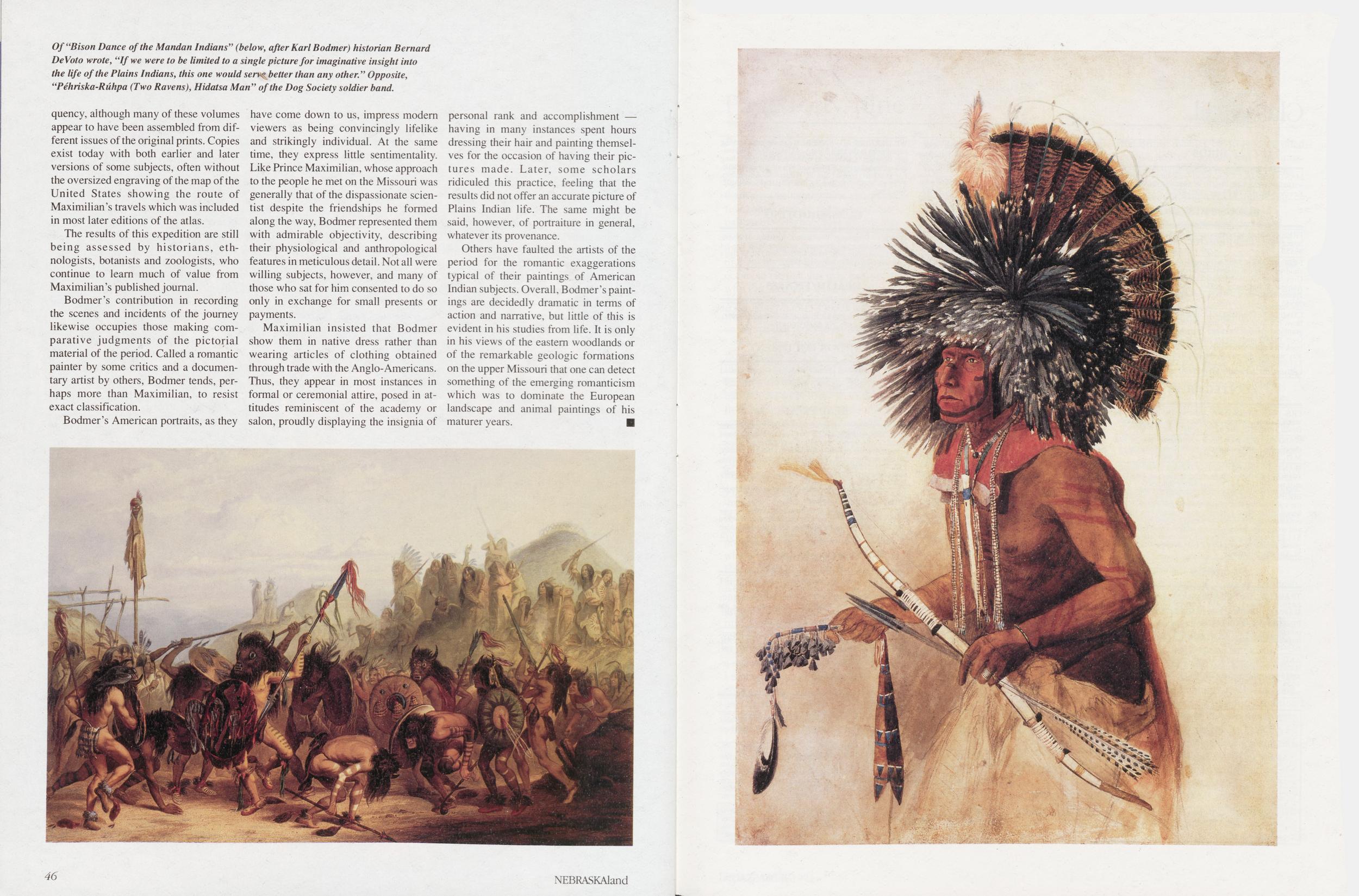
The results of this expedition are still being assessed by historians, ethnologists, botanists and zoologists, who continue to learn much of value from Maximilian's published journal.
Bodmer's contribution in recording the scenes and incidents of the journey likewise occupies those making comparative judgments of the pictorial material of the period. Called a romantic painter by some critics and a documentary artist by others, Bodmer tends, perhaps more than Maximilian, to resist exact classification.
Bodmer's American portraits, as they have come down to us, impress modern viewers as being convincingly lifelike and strikingly individual. At the same time, they express little sentimentality. Like Prince Maximilian, whose approach to the people he met on the Missouri was generally that of the dispassionate scientist despite the friendships he formed along the way, Bodmer represented them with admirable objectivity, describing their physiological and anthropological features in meticulous detail. Not all were willing subjects, however, and many of those who sat for him consented to do so only in exchange for small presents or payments.
Maximilian insisted that Bodmer show them in native dress rather than wearing articles of clothing obtained through trade with the Anglo-Americans. Thus, they appear in most instances in formal or ceremonial attire, posed in attitudes reminiscent of the academy or salon, proudly displaying the insignia of personal rank and accomplishment — having in many instances spent hours dressing their hair and painting themselves for the occasion of having their pictures made. Later, some scholars ridiculed this practice, feeling that the results did not offer an accurate picture of Plains Indian life. The same might be said, however, of portraiture in general, whatever its provenance.
Others have faulted the artists of the period for the romantic exaggerations typical of their paintings of American Indian subjects. Overall, Bodmer's paintings are decidedly dramatic in terms of action and narrative, but little of this is evident in his studies from life. It is only in his views of the eastern woodlands or of the remarkable geologic formations on the upper Missouri that one can detect something of the emerging romanticism which was to dominate the European landscape and animal paintings of his maturer years.
46 NEBRASKAland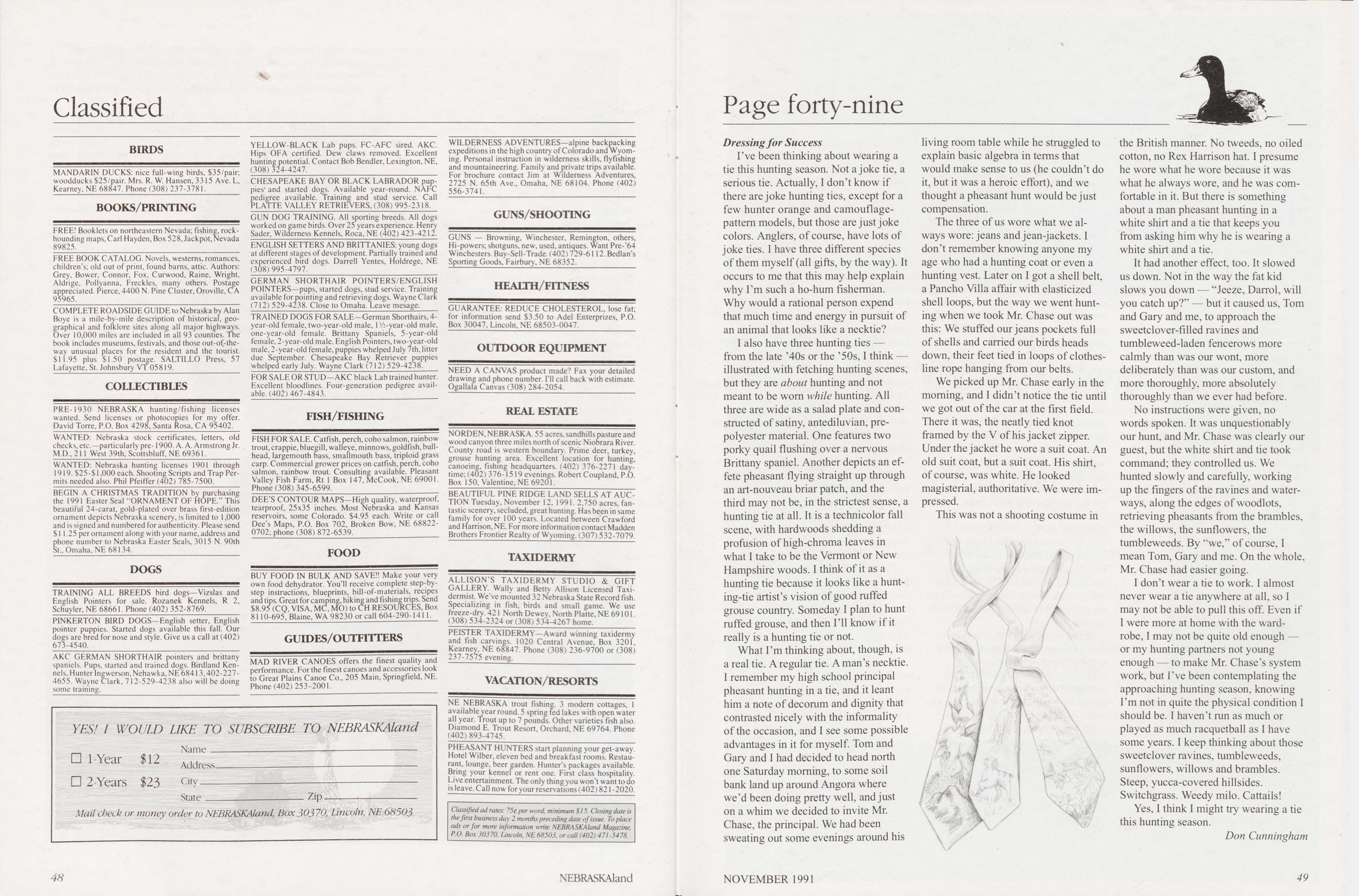
Classified
BIRDSMANDARIN DUCKS: nice full-wing birds, $35/pair; wood ducks $25/pair. Mrs. R. W. Hansen, 3315 Ave. L, Kearney, NE 68847. Phone (308) 237-3781._________
BOOKS/PRINTINGFREE! Booklets on northeastern Nevada; fishing, rockhounding maps, Carl Hayden, Box 528, Jackpot, Nevada 89825.___________________________________
FREE BOOK CATALOG. Novels, westerns, romances, children's; old out of print, found barns, attic. Authors: Grey, Bower, Connor, Fox, Curwood, Raine, Wright, Aldrige, Pollyanna, Freckles, many others. Postage appreciated. Pierce, 4400 N. Pine Cluster, Oroville, C A 95965.________________________________________
COMPLETE ROADSIDE GUIDE to Nebraska by Alan Boye is a mile-by-mile description of historical, geographical and folklore sites along all major highways. Over 10,000 miles are included in all 93 counties. The book includes museums, festivals, and those out-ot-the-way unusual places for the resident and the tourist. $11.95 plus $1.50 postage. SALTILLO Press, 57 Lafayette, St. Johnsbury VT 05819.________________
COLLECTIBLESPRE-1930 NEBRASKA hunting/fishing licenses wanted. Send licenses or photocopies for my offer. David Torre, P.O. Box 4298, Santa Rosa, CA 95402.
WANTED: Nebraska stock certificates, letters, old checks, etc.—particularly pre-1900. A. A. Armstrong Jr. M.D., 211 West 39th, Scottsbluff, NE 69361.________
WANTED: Nebraska hunting licenses 1901 through 1919. $25-$ 1,000 each. Shooting Scripts and Trap Permits needed also. Phil Pfeiffer (402) 785-7500.
BEGIN A CHRISTMAS TRADITION by purchasing the 1991 Easter Seal "ORNAMENT OF HOPE." This beautiful 24-carat, gold-plated over brass first-edition ornament depicts Nebraska scenery, is limited to 1,000 and is signed and numbered for authenticity. Please send $11.25 per ornament along with your name, address and phone number to Nebraska Easter Seals, 3015 N. 90th St., Omaha, NE 68134.___________________________
DOGSTRAINING ALL BREEDS bird dogs—Vizslas and English Pointers for sale. Rozanek Kennels, R 2, Schuyler, NE 68661. Phone (402) 352-8769.________
PINKERTON BIRD DOGS-English setter, English pointer puppies. Started dogs available this fall. Our dogs are bred for nose and style. Give us a call at (402) 673-4540._________________
AKC GERMAN SHORTHAIR pointers and brittany spaniels. Pups, started and trained dogs. Birdland Kennels, Hunter Ingwerson, Nehawka, NE 68413,402-227- 4655. Wayne Clark, 712-529-4238 also will be doing some training.
YELLOW-BLACK Lab pups. FC-AFC sired. AKC. Hips OFA certified. Dew claws removed. Excellent hunting potential. Contact Bob Bendler, Lexington, NE, (308)324-4247.________________________________
CHESAPEAKE BAY OR BLACK LABRADOR puppies' and started dogs. Available year-round. NAFC pedigree available. Training and stud service. Call PLATTE VALLEY RETRIEVERS, (308) 995-2318.
GUN DOG TRAINING. All sporting breeds. All dogs worked on game birds. Over 25 years experience. Henry Sader, Wilderness Kennels, Roca, NE (402) 423-4212.
ENGLISH SETTERS AND BRITTANIES: young dogs at different stages of development. Partially trained and experienced bird dogs. Darrell Yentes, Holdrege, NE (308)995-4797.________________________________
GERMAN SHORTHAIR POINTERS/ENGLISH POINTERS—pups, started dogs, stud service. Training available for pointing and retrieving dogs. Wayne Clark (712) 529-4238. Close to Omaha. Leave message.
TRAINED DOGS FOR SALE- German Shorthairs, 4- year-old female, two-year-old male, 1 '/2-year-old male, one-year-old female. Brittany Spaniels, 5-year-old female, 2-year-old male. English Pointers, two-year-old male, 2-year-old female, puppies whelped July 7th, litter due September. Chesapeake Bay Retriever puppies whelped early July. Wayne Clark (712) 529-4238.
FOR SALE OR STUD—AKC black Lab trained hunter. Excellent bloodlines. Four-generation pedigree available. (402) 467-4843.
FISH/FISHINGFISH FOR SALE. Catfish, perch, coho salmon, rainbow trout, crappie, bluegill, walleye, minnows, goldfish, bullhead, largemouth bass, smallmouth bass, triploid grass carp. Commercial grower prices on catfish, perch, coho salmon, rainbow trout. Consulting available. Pleasant Valley Fish Farm, Rt 1 Box 147, McCook, NE 69001. Phone (308) 345-6599.___________________________
DEE'S CONTOUR MAPS-High quality, waterproof, tearproof, 25x35 inches. Most Nebraska and Kansas reservoirs, some Colorado. $4.95 each. Write or call Dee's Maps, P.O. Box 702, Broken Bow, NE 68822- 0702; phone (308) 872-6539.
FOODBUY FOOD IN BULK AND SAVE!! Make your very own food dehydrator. You'll receive complete step-by-step instructions, blueprints, bill-of-materials, recipes and tips. Great for camping, hiking and fishing trips. Send $8.95 (CQ, VISA, MC, MO) to CH RESOURCES, Box 8110-695, Blaine, WA 98230 or call 604-290-1411.
GUIDES/OUTFITTERSMAD RIVER CANOES offers the finest quality and performance. For the finest canoes and accessories look to Great Plains Canoe Co., 205 Main, Springfield, NE. Phone(402)253-2001.
YES! I WOULD LIKE TO SUBSCRIBE TO NEBRASKAland □ 1-Year $12 □ 2-Years $23 Name Address. Citv___ State Zip Mail check or money order to NEBRASKAland, Box30370, Lincoln, NE 68503WILDERNESS ADVENTURES—alpine backpacking expeditions in the high country of Colorado and Wyoming. Personal instruction in wilderness skills, fly fishing and mountaineering. Family and private trips available. For brochure contact Jim at Wilderness Adventures, 2725 N. 65th Ave., Omaha, NE 68104. Phone (402) 556-3741.
GUNS/SHOOTINGGUNS — Browning, Winchester, Remington, others, Hi-powers; shotguns, new, used, antiques. Want Pre-'64 Winchesters Buy-Sell-Trade. (402) 729-6112. Bedlan's Sporting Goods, Fairbury, NE 68352.
HEALTH/FITNESSGUARANTEE: REDUCE CHOLESTEROL, lose fat; for information send $3.50 to Adel Enterprises, P.O. Box 30047, Lincoln, NE 68503-0047.
OUTDOOR EQUIPMENTNEED A CANVAS product made? Fax your detailed drawing and phone number. I'll call back with estimate. Ogallala Canvas (308) 284-2054.
REAL ESTATENORDEN, NEBRASKA. 55 acres, sandhills pasture and wood canyon three miles north of scenic Niobrara River. County road is western boundary. Prime deer, turkey, grouse hunting area. Excellent location for hunting, canoeing, fishing headquarters. (402) 376-2271 day- time; (402) 376-1519 evenings. Robert Coupland, P O Box 150, Valentine, NE 69201._________________
BEAUTIFUL PINE RIDGE LAND SELLS AT AUC- TION Tuesday, November 12, 1991. 2,750 acres, fantastic scenery, secluded, great hunting. Has been in same family for over 100 years. Located between Crawford and Harrison, NE. For more information contact Madden Brothers Frontier Realty of Wyoming. (307) 532-7079.
TAXIDERMYALLISON'S TAXIDERMY STUDIO & GIFT GALLERY. Wally and Betty Allison Licensed Taxidermist. We've mounted 32 Nebraska State Record fish. Specializing in fish, birds and small game. We use freeze-dry. 421 North Dewey, North Platte, NE 69101. (308) 534-2324 or (308) 534-4267 home._________
PEISTER TAXIDERMY—Award winning taxidermy and fish carvings. 1020 Central Avenue, Box 3201, Kearney, NE 68847. Phone (308) 236-9700 or (308) 237-7575 evening.
VACATION/RESORTSNE NEBRASKA trout fishing. 3 modern cottages, 1 available year round. 5 spring fed lakes with open water all year. Trout up to 7 pounds. Other varieties fish also. Diamond E. Trout Resort, Orchard, NE 69764. Phone (402) 893-4745._____________
PHEASANT HUNTERS start planning your get-away. Hotel Wilber, eleven bed and breakfast rooms. Restaurant, lounge, beer garden. Hunter's packages available. Bring your kennel or rent one. First class hospitality. Live entertainment. The only thing you won't want to do is leave. Call now for your reservations (402) 821 -2020.
Classified ad rates: 7'5e per word, minimum $15. Closing date is the first business day 2 months preceding date of issue. To place ads or for more information write NEBRASKAland Magazine, P.O. Box 30370, Lincoln, NE 68503, or call (402) 471-5478. 48 NEBRASKAlandPage forty-nine
Dressing for SuccessI've been thinking about wearing a tie this hunting season. Not a joke tie, a serious tie. Actually, I don't know if there are joke hunting ties, except for a few hunter orange and camouflage- pattern models, but those are just joke colors. Anglers, of course, have lots of joke ties. I have three different species of them myself (all gifts, by the way). It occurs to me that this may help explain why I'm such a ho-hum fisherman. Why would a rational person expend that much time and energy in pursuit of an animal that looks like a necktie?
I also have three hunting ties — from the late '40s or the '50s, I think - illustrated with fetching hunting scenes, but they are about hunting and not meant to be worn while hunting. All three are wide as a salad plate and constructed of satiny, antediluvian, prepolyester material. One features two porky quail flushing over a nervous Brittany spaniel. Another depicts an effete pheasant flying straight up through an art-nouveau briar patch, and the third may not be, in the strictest sense, a hunting tie at all. It is a technicolor fall scene, with hardwoods shedding a profusion of high-chroma leaves in what I take to be the Vermont or New Hampshire woods. I think of it as a hunting tie because it looks like a hunting-tie artist's vision of good ruffed grouse country. Someday I plan to hunt ruffed grouse, and then I'll know if it really is a hunting tie or not.
What I'm thinking about, though, is a real tie. A regular tie. A man's necktie. I remember my high school principal pheasant hunting in a tie, and it leant him a note of decorum and dignity that contrasted nicely with the informality of the occasion, and I see some possible advantages in it for myself. Tom and Gary and I had decided to head north one Saturday morning, to some soil bank land up around Angora where we'd been doing pretty well, and just on a whim we decided to invite Mr. Chase, the principal. We had been sweating out some evenings around his living room table while he struggled to explain basic algebra in terms that would make sense to us (he couldn't do it, but it was a heroic effort), and we thought a pheasant hunt would be just compensation.
The three of us wore what we always wore: jeans and jean-jackets. I don't remember knowing anyone my age who had a hunting coat or even a hunting vest. Later on I got a shell belt, a Pancho Villa affair with elasticized shell loops, but the way we went hunting when we took Mr. Chase out was this: We stuffed our jeans pockets full of shells and carried our birds heads down, their feet tied in loops of clothesline rope hanging from our belts.
We picked up Mr. Chase early in the morning, and I didn't notice the tie until we got out of the car at the first field. There it was, the neatly tied knot framed by the V of his jacket zipper. Under the jacket he wore a suit coat. An old suit coat, but a suit coat. His shirt, of course, was white. He looked magisterial, authoritative. We were impressed.
This was not a shooting costume in
It had another effect, too. It slowed us down. Not in the way the fat kid slows you down — "Jeeze, Darrol, will you catch up?" — but it caused us, Tom and Gary and me, to approach the sweetclover-filled ravines and tumbleweed-laden fencerows more calmly than was our wont, more deliberately than was our custom, and more thoroughly, more absolutely thoroughly than we ever had before.
No instructions were given, no words spoken. It was unquestionably our hunt, and Mr. Chase was clearly our guest, but the white shirt and tie took command; they controlled us. We hunted slowly and carefully, working up the fingers of the ravines and waterways, along the edges of woodlots, retrieving pheasants from the brambles, the willows, the sunflowers, the tumbleweeds. By "we," of course, I mean Tom, Gary and me. On the whole, Mr. Chase had easier going.
I don't wear a tie to work. I almost never wear a tie anywhere at all, so I may not be able to pull this off. Even if I were more at home with the wardrobe, I may not be quite old enough — or my hunting partners not young enough — to make Mr. Chase's system work, but I've been contemplating the approaching hunting season, knowing I'm not in quite the physical condition I should be. I haven't run as much or played as much racquetball as I have some years. I keep thinking about those sweet clover ravines, tumbleweeds, sunflowers, willows and brambles. Steep, yucca-covered hillsides. Switchgrass. Weedy milo. Cattails!
Yes, I think I might try wearing a tie this hunting season.
Don Cunningham NOVEMBER 1991 49
Book Reviews
Freshwater Fish Carving by James Fliger. Schiffer Publishing, Ltd., 1989. 226 pp. (Hardbound) $29.95.The first time I saw James Fliger's fish carvings, I thought I was looking at a stringer of freshly caught crappie. They were at the NEBRASKAland office being photographed for an article about Fliger that was to appear in the February 1981 issue of the magazine.
In addition to the five crappie, there were also carvings of bluegill, trout, walleye and a largemouth bass pursuing a leopard frog. Each looked like an actual specimen mounted by a talented taxidermist, but somehow these carvings seemed even more realistic than mounts.
I had seen plenty of excellent waterfowl and songbird carvings, but never a gamefish crafted from wood. This was obviously a new, unique wildlife art, one that would capture the attention of fishermen in the same way that decorative duck and goose decoys appeal to hunters. Fliger's brown trout would be an attractive addition to the bookshelves in my den at home, I thought, and the pair of bluegills would add a touch of class to my desk at the office.
I've always been fascinated by high quality wildlife art. I once watched a decoy carver work his magic at a wildlife art show in Omaha, and after talking to him for the better part of an hour, he shared the secret of his trade with me. "Decoy carving is simple. Get a sharp knife and a hunk of wood and use the knife to cut everything off the wood that doesn't look like a duck," he said. "There's a duck hiding in every piece of wood, you just have to set it free."
I tried it, but my piece of wood didn't have a duck inside. All it had was enough thin shavings to fill a wastebasket. When I saw Fliger's work, I decided fish might be easier to carve than larger, more detailed subjects like ducks, and I might have a better chance of success. Besides, there is always a chance that the piece of wood I had tried to carve earlier had actually had a fish rather than a duck inside, which would explain why I'd had so many problems trying to free a mallard.
I stopped by the lumber yard on the way home that night and bought a 1- by 2-inch piece of pine about 12 inches long that looked like it might be the home of a rainbow trout waiting to be born. A quick stop at a shop specializing in carving tools took a bite out of my checking account, but I left with two carving knives, a couple of wood gouges the clerk recommended and an assortment of sandpaper.
After supper, I settled in to "do" a fish, and a few hours later I proudly showed the finished rainbow to my wife. I thought it looked pretty good, but after examining it closely, she proclaimed that it looked like I had spent the evening rounding the corners off of a piece of wood. She apologized, but stuck by her guns; it didn't resemble any fish she'd ever seen. I hate it when she's right. Reluctantly, I put my new carving tools away, swore off carving forever and went back to tying trout flies.
A few weeks ago Jim Fliger again visited the NEBRASKAland office. This time he had a book under his arm, one he had written and illustrated himself to teach people his methods of carving realistic fish. This is what I'd been waiting for!
In the introduction to Freshwater Fish Carving, Fliger says his purpose is to introduce people to this newly developing art form, freshwater fish carving. "My approach to creating an artistic carving relies on three basic elements — composition, carving and color. My belief is that a bird, fish or animal carving should be more than anatomically accurate. It must also stand up creatively in composition and color." Fliger, an Omaha graphic artist by profession, is well qualified to teach those techniques.
In the book, Fliger includes all of the information a person needs to get started in fish caiving. He shows how he draws the patterns that are the basis of his carvings, explains why some types of wood are better for carving than others, discusses the tools, both hand and electric, that he uses in carving the fish, tells you how to obtain imitation eyes of the proper size and color and how to choose the finished base that will support the carving.
The book presents a complete beginner's how-to course on the art of carving four species of freshwater fish, bluegill, black crappie, rainbow trout and channel catfish. It is richly illustrated with Fliger's pattern sketches and literally hundreds of step-by-step black and white photos of the actual carving techniques for four fish species. As an example of his complete and detailed instructions, there are 146 photos and 19 drawings in the section on carving the bluegill alone, and another 25 full-color photos showing how to paint it.
There are two 32-page four-color sections in the book. One shows several of Fliger's finished works and several reference photographs of actual fish, and the second is devoted to step-by-step procedures for painting each of the species described.
Fliger's is a large-format book, 8 by 11 inches, printed on high quality coated paper. The pages are heavy enough that if you lay the open book down while you are carving or painting, it stays open at your page so you can refer back to it.
I'm anxious to try my luck carving another rainbow trout now that I have an expert at my elbow to talk me through it. If one of your family members or friends is a potential carver, give him or her a copy of Fliger's book for Christmas and rest assured that it will be enjoyed for years to come.
Freshwater Fish Carving may be purchased at bookstores or from the publisher, Schiffer Publishing, Ltd., 1469 Morstein Road, West Chester, PA, 19380.
Tom Keith 50 NEBRASKAland
Position: 341 (27 views)