Volume 69, Issue 8, 1991
NEBRASKAland
OCTOBER 1991 $1.50
NEBRASKAland
VOL. 69/NO. 8 OCTOBER 1991 Published by the Nebraska Game and Parks Commission Rex Amack, Director Assistant Directors: William J. Bailey, Jr. Dale R. Bree Staff Chief, Information & Education: Paul Horton Managing Editor: Lowell Johnson Editor: Don Cunningham Senior Editors: Jon Farrar, Ken Bouc Regional Editors: Bob Grier, Rocky Hoffmann, Tom Keith Art Director: Steve O'Hare Illustration and Design: Tim Reigert Circulation: Pat Frahm Commissioners Chairman: Richard L. Coyne, Omaha Vice Chairman: Elvin Adamson, Nenzel 2nd Vice Chairman: J. Alan Cramer, Wayne Marc Anthony, Scottsbluff Randall K. Stinnette, Inland Gloria Erickson, Holdrege Charles E. Wright, Lincoln NEBRASKAland ISSN:0028-1964 VOL. 69/NO. 8 OCTOBER 1991 Published monthly except for combined Jan/Feb and Aug/Sept issues, by the Nebraska Game and Parks Commission, 2200 North 33rd Street, Lincoln, NE. Copyright 1991, all rights reserved. Second-class postage paid at Lincoln, Nebraska POSTMASTER: Send all address changes to NEBRASKAland, PO Box 30370, Lincoln, NE 68503. Rates: $12 for one year; $23 for two years. Manuscripts or photographs submitted to NEBRASKAland Magazine should be addressed to: The Editor, NEBRASKAland Magazine, P O Box 30370, Lincoln, NE 68503, and accompanied by self-addressed envelopes and return postage. The publisher assumes no responsibility for unsolicited material. Nebraska Game and Parks Commission
District Offices
Headquarters
2200 North 33rd Street
Lincoln, NE 68503
Phone (402)471-0641
District Office I
Box 725
Alliance, NE 69301
Phone (308)762-5605
District Office II
Box 508
Bassett, NE 68714
Phone (402)684-2921
District Office III
Box 934
Norfolk, NE 68702
Phone (402)370-3374
District Office IV
Route 4. Box 36
North Platte, NE 69101
Phone (308)535-8025
District Office V
2200 North 33rd Street
Lincoln, NE 68503
Phone (402)471-5558
Omaha Office
State Office Building Mall
1313Farnam
Omaha, NE 68102,
Phone (402) 595-2144
Ak-Sar-Ben Aquarium
21502 West Highway 31
Gretna, NE 68028
Phone (402) 332-3901
Conservation Officers by Region
Panhandle
Officer
Richard Furley (Supv)
Walt Meyer
John Murphy
Jim Zimmerman
Marvin Kampbell
E.W. Zimmerman
Dennis Thompson
Don Hunt
Richard Brandt
Southwest
Officer
Gail Woodside(Supv)
George Sund
Jack Henderson
Dirk Greene
Ray Frandsen
Virgii Gosch
Dwight Allbery
Roger Thompson
Rich Routh
Northeast
Officer
Bob Downing (Supv)
Robert Kelly
Ross Oestmann
L.A. Wilkinson
Gary Ralston
Daniel Roberts
Randy Pomplun
Jon Reeves
Marion Shafer
Eric Wiebe
Raymond Still
City
Alliance
Chadron
Crawford
Gering
Hay Springs
Ogaliala
Ogallala
Oshkosh
Scottsbluff
Phone (308)
762-2024
432-4398
665-2021
436-7561
638-7527
284-3013
284-6450
772-3697
635-1277
South-Central
Officer
Jerry Pecha (Supv)
Lester Johnson
Terry Brentzel
Dale Johnson
Daniel Klammer
Dayton Shultis
Mark Reeves
Robert Finke
City-
York
David City
Grand Isl.
Hebron
Hastings
Kearney
Loup City
Seward
City
No. Platte
Cambridge
Gothenburg
Imperial
Lexington
McCook
No. Platte
No. Platte
Republican C
Phone (308)
532-0279
697-4629
537-7483
882-5328
324-2753
345-2185
532-2753
532-9175
ity 799-2085
Southeast
Officer City
Don Schaepler (Chief) Lincoln
Ted Blume (Asst Chief) Lincoln
Roger Guenther (Supv) Lincoln
City
Norfolk
Albion
Bloomfield
Columbus
Creighton
Fremont
Fullerton
Kennard
Norfolk
Ponca
West Point
Phone (402)
371-2675
395-2538
373-4412
564-4375
847-3284
721-7852
(308)536-2987
427-7378
371-2031
755-2566
372-5676
William Krause
Dan Evasco
Murray Johnson
Douglas Kramer
Steve Oberg
Levi Krause
Russell Mort
Duane Arp
Larry Elston
Craig Stover
Mike Luben
Sandhills
Officer
Bruce Wiebe (Supv)
Max Showalter
Larry Bauman
Tom Zimmer
Dan Zuehlke
Richard Seward
Mick Gray
Auburn
Beatrice
Lincoln
Lincoln
Lincoln
Louisville
Nebr. City
Omaha
Omaha
Omaha
Wahoo
City
Bassett
Ainsworth
Atkinson
Brkn. Bow
Muilen
Ord
Valentine
Phone (402)
362-5707
367-4037
(308)384-8296
768-7363
461-3389
(308)234-3349
(308)745-1126
643-2056
Phone (402)
488-2957
483-5643
423-5671
274-3789
228-5935
488-2923
466-9001
464-2813
234-2212
873-5684
332-4954
292-4910
359-2833
443-4278
Phone (402)
684-3867
387-1960
925-5569
(308)872-6063
(308)546-2492
(308)728-5338
376-3136
Letters
Operation Game Thief (800) 742-7627
Nebraska Game and Parks Commission
District Offices
Headquarters
2200 North 33rd Street
Lincoln, NE 68503
Phone (402)471-0641
District Office I
Box 725
Alliance, NE 69301
Phone (308)762-5605
District Office II
Box 508
Bassett, NE 68714
Phone (402)684-2921
District Office III
Box 934
Norfolk, NE 68702
Phone (402)370-3374
District Office IV
Route 4. Box 36
North Platte, NE 69101
Phone (308)535-8025
District Office V
2200 North 33rd Street
Lincoln, NE 68503
Phone (402)471-5558
Omaha Office
State Office Building Mall
1313Farnam
Omaha, NE 68102,
Phone (402) 595-2144
Ak-Sar-Ben Aquarium
21502 West Highway 31
Gretna, NE 68028
Phone (402) 332-3901
Conservation Officers by Region
Panhandle
Officer
Richard Furley (Supv)
Walt Meyer
John Murphy
Jim Zimmerman
Marvin Kampbell
E.W. Zimmerman
Dennis Thompson
Don Hunt
Richard Brandt
Southwest
Officer
Gail Woodside(Supv)
George Sund
Jack Henderson
Dirk Greene
Ray Frandsen
Virgii Gosch
Dwight Allbery
Roger Thompson
Rich Routh
Northeast
Officer
Bob Downing (Supv)
Robert Kelly
Ross Oestmann
L.A. Wilkinson
Gary Ralston
Daniel Roberts
Randy Pomplun
Jon Reeves
Marion Shafer
Eric Wiebe
Raymond Still
City
Alliance
Chadron
Crawford
Gering
Hay Springs
Ogaliala
Ogallala
Oshkosh
Scottsbluff
Phone (308)
762-2024
432-4398
665-2021
436-7561
638-7527
284-3013
284-6450
772-3697
635-1277
South-Central
Officer
Jerry Pecha (Supv)
Lester Johnson
Terry Brentzel
Dale Johnson
Daniel Klammer
Dayton Shultis
Mark Reeves
Robert Finke
City-
York
David City
Grand Isl.
Hebron
Hastings
Kearney
Loup City
Seward
City
No. Platte
Cambridge
Gothenburg
Imperial
Lexington
McCook
No. Platte
No. Platte
Republican C
Phone (308)
532-0279
697-4629
537-7483
882-5328
324-2753
345-2185
532-2753
532-9175
ity 799-2085
Southeast
Officer City
Don Schaepler (Chief) Lincoln
Ted Blume (Asst Chief) Lincoln
Roger Guenther (Supv) Lincoln
City
Norfolk
Albion
Bloomfield
Columbus
Creighton
Fremont
Fullerton
Kennard
Norfolk
Ponca
West Point
Phone (402)
371-2675
395-2538
373-4412
564-4375
847-3284
721-7852
(308)536-2987
427-7378
371-2031
755-2566
372-5676
William Krause
Dan Evasco
Murray Johnson
Douglas Kramer
Steve Oberg
Levi Krause
Russell Mort
Duane Arp
Larry Elston
Craig Stover
Mike Luben
Sandhills
Officer
Bruce Wiebe (Supv)
Max Showalter
Larry Bauman
Tom Zimmer
Dan Zuehlke
Richard Seward
Mick Gray
Auburn
Beatrice
Lincoln
Lincoln
Lincoln
Louisville
Nebr. City
Omaha
Omaha
Omaha
Wahoo
City
Bassett
Ainsworth
Atkinson
Brkn. Bow
Muilen
Ord
Valentine
Phone (402)
362-5707
367-4037
(308)384-8296
768-7363
461-3389
(308)234-3349
(308)745-1126
643-2056
Phone (402)
488-2957
483-5643
423-5671
274-3789
228-5935
488-2923
466-9001
464-2813
234-2212
873-5684
332-4954
292-4910
359-2833
443-4278
Phone (402)
684-3867
387-1960
925-5569
(308)872-6063
(308)546-2492
(308)728-5338
376-3136
Letters
Operation Game Thief (800) 742-7627
Letters
Cranes, Farmers and the EnvironmentSir/ We enjoy NEBRASKAland Magazine and have been subscribers for several years. We do have a concern that your writers and editors carefully research their material before printing articles. We refer particularly to the article "The Impact of Crane Watching" that appeared in the March 1991 issue concerning the Platte River. It was asserted that farmers and the public power and irrigation people had ruined all the habitat for the sandhill cranes.
We disagree with some of the material in the article, because it seemed as if you were trying to influence readers to believe some ideas that are not entirely true. The environmentalists have much money and other influence to get their way about things and go overboard with many of their ideas and use scare tactics to try to influence people's thinking.
Farmers, on the whole, are good environmentalists, and they have worked closely with the land and rivers and care about Nebraska land.
The businesses that stand to profit the most from the crane watchers are funneling a lot of money to the environmental groups for their own selfish gain — not what's best for our state's land and economy in the long run.
Environmentalists are going to have to work more closely with the farmers and power and irrigation groups on some of these ideas and be willing to compromise on some issues or soon there is going to be a big battle between those people and the people who want to use the land and rivers basically for hunting, fishing and other recreational pastimes.
We are renewing our subscription to NEBRASKAland hoping that our input is taken seriously.
Mr. and Mrs. Jack Schwartz Hildreth, NEThe intent of 'The Impact of Crane Watching" was to provide a background histoy of the burgeoning interest in viewing sandhill cranes on the Platte River, and to encourage cooperation among all parties affected by it — environmentalists, 4 NEBRASKAland farmers, and crane watchers. We hoped the article would help crane watchers understand that they share the county roads and bridges with residents going about their daily affairs, and encourage local residents to be tolerant of those who come to see this tremendous migration spectacle—that they would be as understanding of crane watchers driving slowly on county roads as those who do not farm are of farmers slowing traffic with their large equipment. The article was intended to help readers understand that their actions affect the cranes, whether they are crane watchers, farmers, consumers of farm products or visitors bureau event-planners. It was not intended to add fuel to the controversy.
The article did not suggest that "farmers and the public power and irrigation people had ruined all the habitat for the sandhill cranes." It did state that use of the Platte River for irrigation was the principal explanation for declining flows and resulting changes in the character of the central Platte. Since the J 940s, the number of miles of Platte River suitable for sandhill crane roosts and other traditional wildlife uses has been steadily declining. Additionally, conversion of wet meadows to row-crop production has eliminated critical feeding areas for sandhill cranes. We stand firmly behind the information in the article, but would welcome specific data which refutes it.
As for environmentalists having "much money and other influence," the battle over renewal of long-term licenses for the operation of Lake McConaughy provides some indication of who is spending how much. A July 21, 1991 Omaha World-Herald article stated that the Central Nebraska Public Power & Irrigation District and the Nebraska Public Power District, whose principal interest in the Platte is for irrigation and power generation, had spent $18 million, of which $7.7 million went for legal fees and $379,635 for public relations. The same article stated that the Platte River Whooping Crane Trust, probably the principal representative of wildlife interests in the re licensing, had spent $370,000 in legal fees. Nebraska is an agricultural state, and agriculture interests have never lacked influence at both the state and federal levels. It is unlikely that many Interstate-80 motels or restaurants are "funneling a lot of money to the environmental groups." Perhaps they should, or, at least, should funnel some into the construction of pull-offs at river bridges where well-fed and well-rested crane watchers can safely view sandhill cranes. Moreover, agriculture is not Nebraska s only industry. Tourism now ranks third and continues to increase.
NEBRASKAland Magazine is not anti-agriculture. Most of our staff grew up on farms or in small farming communities. The magazine is published by the Nebraska Game and Parks Commission whose principal mission is the protection of the state's natural resources for all creatures, including humans. We do try to promote the idea of using natural resources in a sustainable fashion, so that generations to come will have fertile land, pure water and abundant wildlife. This goal is in the interest of sandhill cranes and all humans, be they environmentalists, farmers or anything else. We welcome your comments and sincerely hope you will continue to subscribe. (Jon Farrar)
Salt MarshesSir/ Please commend those responsible for the superb research, history, maps, color photography and fine writing in NEBRASKAland Magazine's July article on salt marshes. The authors deserve identification, bylines and credits.
J.R. Seacrest Lincoln, NEBylines and photo credits for NEBRASKAland Senior Editor Jon Farrar and Richard Gersib, wetland specialist for the Game and Parks Commission s Wildlife Division followed the text. "Nebraska Salt Marshes: Last of the Least" is available as a 24-page brochure from the Nebraska Game and Parks Commission, P.O. Box 30370, Lincoln, NE 68503. (Editor)
"SEE YOU IN THE WOODS" ...let's hope so. Nebraska Hunter Education (402)471-5434 OCTOBER 1991 5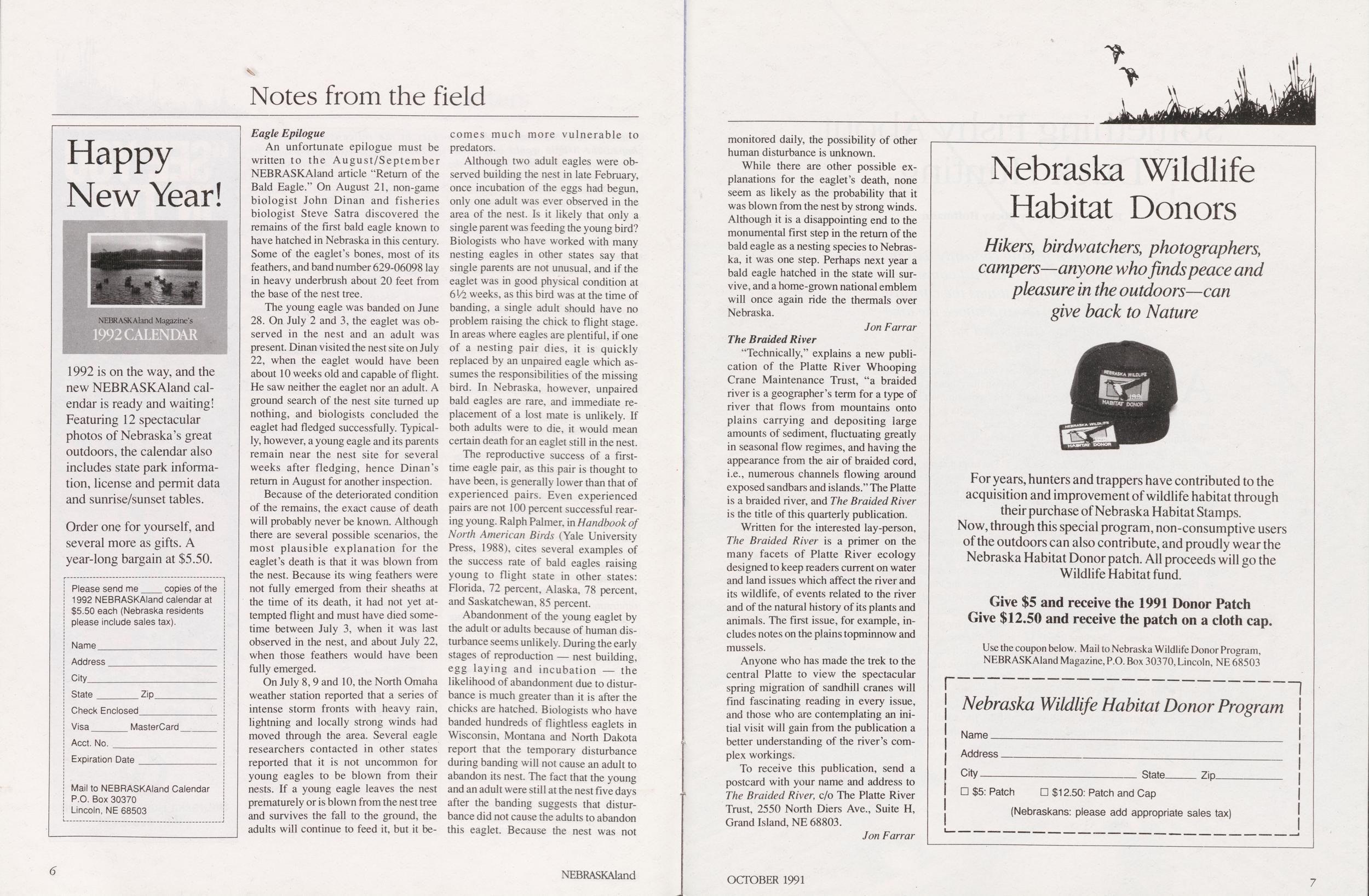 Happy
New Year!
NEBRASKAland Magazine1
1992 is on the way, and the
new NEBRASKAland calendar is ready and waiting!
Featuring 12 spectacular
photos of Nebraska's great
outdoors, the calendar also
includes state park
information, license and permit data
and sunrise/sunset tables.
Order one for yourself, and
several more as gifts. A
year-long bargain at $5.50.
Please send me
copies of the
1992 NEBRASKAland calendar at
$5.50 each (Nebraska residents
please include sales tax).
Name
Address
City____
State
Zip
Check Enclosed________
Visa_______MasterCard
Acct. No.
Expiration Date
Mai! to NEBRASKAland Calendar
P.O. Box 30370
Lincoln, NE 68503
Happy
New Year!
NEBRASKAland Magazine1
1992 is on the way, and the
new NEBRASKAland calendar is ready and waiting!
Featuring 12 spectacular
photos of Nebraska's great
outdoors, the calendar also
includes state park
information, license and permit data
and sunrise/sunset tables.
Order one for yourself, and
several more as gifts. A
year-long bargain at $5.50.
Please send me
copies of the
1992 NEBRASKAland calendar at
$5.50 each (Nebraska residents
please include sales tax).
Name
Address
City____
State
Zip
Check Enclosed________
Visa_______MasterCard
Acct. No.
Expiration Date
Mai! to NEBRASKAland Calendar
P.O. Box 30370
Lincoln, NE 68503
Notes from the field
Eagle EpilogueAn unfortunate epilogue must be written to the August/September NEBRASKAland article "Return of the Bald Eagle." On August 21, non-game biologist John Dinan and fisheries biologist Steve Satra discovered the remains of the first bald eagle known to have hatched in Nebraska in this century. Some of the eaglet's bones, most of its feathers, and band number 629-06098 lay in heavy underbrush about 20 feet from the base of the nest tree.
The young eagle was banded on June 28. On July 2 and 3, the eaglet was observed in the nest and an adult was present. Dinan visited the nest site on July 22, when the eaglet would have been about 10 weeks old and capable of flight. He saw neither the eaglet nor an adult. A ground search of the nest site turned up nothing, and biologists concluded the eaglet had fledged successfully. Typically, however, a young eagle and its parents remain near the nest site for several weeks after fledging, hence Dinan's return in August for another inspection.
Because of the deteriorated condition of the remains, the exact cause of death will probably never be known. Although there are several possible scenarios, the most plausible explanation for the eaglet's death is that it was blown from the nest. Because its wing feathers were not fully emerged from their sheaths at the time of its death, it had not yet attempted flight and must have died sometime between July 3, when it was last observed in the nest, and about July 22, when those feathers would have been fully emerged.
On July 8, 9 and 10, the North Omaha weather station reported that a series of intense storm fronts with heavy rain, lightning and locally strong winds had moved through the area. Several eagle researchers contacted in other states reported that it is not uncommon for young eagles to be blown from their nests. If a young eagle leaves the nest prematurely or is blown from the nest tree and survives the fall to the ground, the adults will continue to feed it, but it becomes much more vulnerable to predators.
Although two adult eagles were observed building the nest in late February, once incubation of the eggs had begun, only one adult was ever observed in the area of the nest. Is it likely that only a single parent was feeding the young bird? Biologists who have worked with many nesting eagles in other states say that single parents are not unusual, and if the eaglet was in good physical condition at 61/2 weeks, as this bird was at the time of banding, a single adult should have no problem raising the chick to flight stage. In areas where eagles are plentiful, if one of a nesting pair dies, it is quickly replaced by an unpaired eagle which assumes the responsibilities of the missing bird. In Nebraska, however, unpaired bald eagles are rare, and immediate replacement of a lost mate is unlikely. If both adults were to die, it would mean certain death for an eaglet still in the nest.
The reproductive success of a first time eagle pair, as this pair is thought to have been, is generally lower than that of experienced pairs. Even experienced pairs are not 100 percent successful rearing young. Ralph Palmer, in Handbook of North American Birds (Yale University Press, 1988), cites several examples of the success rate of bald eagles raising young to flight state in other states: Florida, 72 percent, Alaska, 78 percent, and Saskatchewan, 85 percent.
Abandonment of the young eaglet by the adult or adults because of human disturbance seems unlikely. During the early stages of reproduction — nest building, egg laying and incubation — the likelihood of abandonment due to disturbance is much greater than it is after the chicks are hatched. Biologists who have banded hundreds of flightless eaglets in Wisconsin, Montana and North Dakota report that the temporary disturbance during banding will not cause an adult to abandon its nest. The fact that the young and an adult were still at the nest five days after the banding suggests that disturbance did not cause the adults to abandon this eaglet. Because the nest was not 6 NEBRASKAland monitored daily, the possibility of other human disturbance is unknown.
While there are other possible explanations for the eaglet's death, none seem as likely as the probability that it was blown from the nest by strong winds. Although it is a disappointing end to the monumental first step in the return of the bald eagle as a nesting species to Nebraska, it was one step. Perhaps next year a bald eagle hatched in the state will survive, and a home-grown national emblem will once again ride the thermals over Nebraska.
Jon Farrar The Braided River"Technically," explains a new publication of the Platte River Whooping Crane Maintenance Trust, "a braided river is a geographer's term for a type of river that flows from mountains onto plains carrying and depositing large amounts of sediment, fluctuating greatly in seasonal flow regimes, and having the appearance from the air of braided cord, i.e., numerous channels flowing around exposed sandbars and islands." The Platte is a braided river, and The Braided River is the title of this quarterly publication.
Written for the interested lay-person, The Braided River is a primer on the many facets of Platte River ecology designed to keep readers current on water and land issues which affect the river and its wildlife, of events related to the river and of the natural history of its plants and animals. The first issue, for example, includes notes on the plains topminnow and mussels.
Anyone who has made the trek to the central Platte to view the spectacular spring migration of sandhill cranes will find fascinating reading in every issue, and those who are contemplating an initial visit will gain from the publication a better understanding of the river's complex workings.
To receive this publication, send a postcard with your name and address to The Braided River, c/o The Platte River Trust, 2550 North Diers Ave., Suite H, Grand Island, NE 68803.
Jon Farrar Nebraska Wildlife Habitat Donors Hikers, birdwatchers, photographers, campers—anyone who finds peace and pleasure in the outdoors—can give back to Nature For years, hunters and trappers have contributed to the acquisition and improvement of wildlife habitat through their purchase of Nebraska Habitat Stamps. Now, through this special program, non-consumptive users of the outdoors can also contribute, and proudly wear the Nebraska Habitat Donor patch. All proceeds will go the Wildlife Habitat fund. Give $5 and receive the 1991 Donor Patch Give $12.50 and receive the patch on a cloth cap. Use the coupon below. Mail to Nebraska Wildlife Donor Program, NEBRASKAland Magazine, P.O. Box 30370, Lincoln, NE 68503 Nebraska Wildlife Habitat Donor Program Name_______________ Address City___ State. Zip. D $5: Patch □ $12.50: Patch and Cap (Nebraskans: please add appropriate sales tax) OCTOBER 1991 7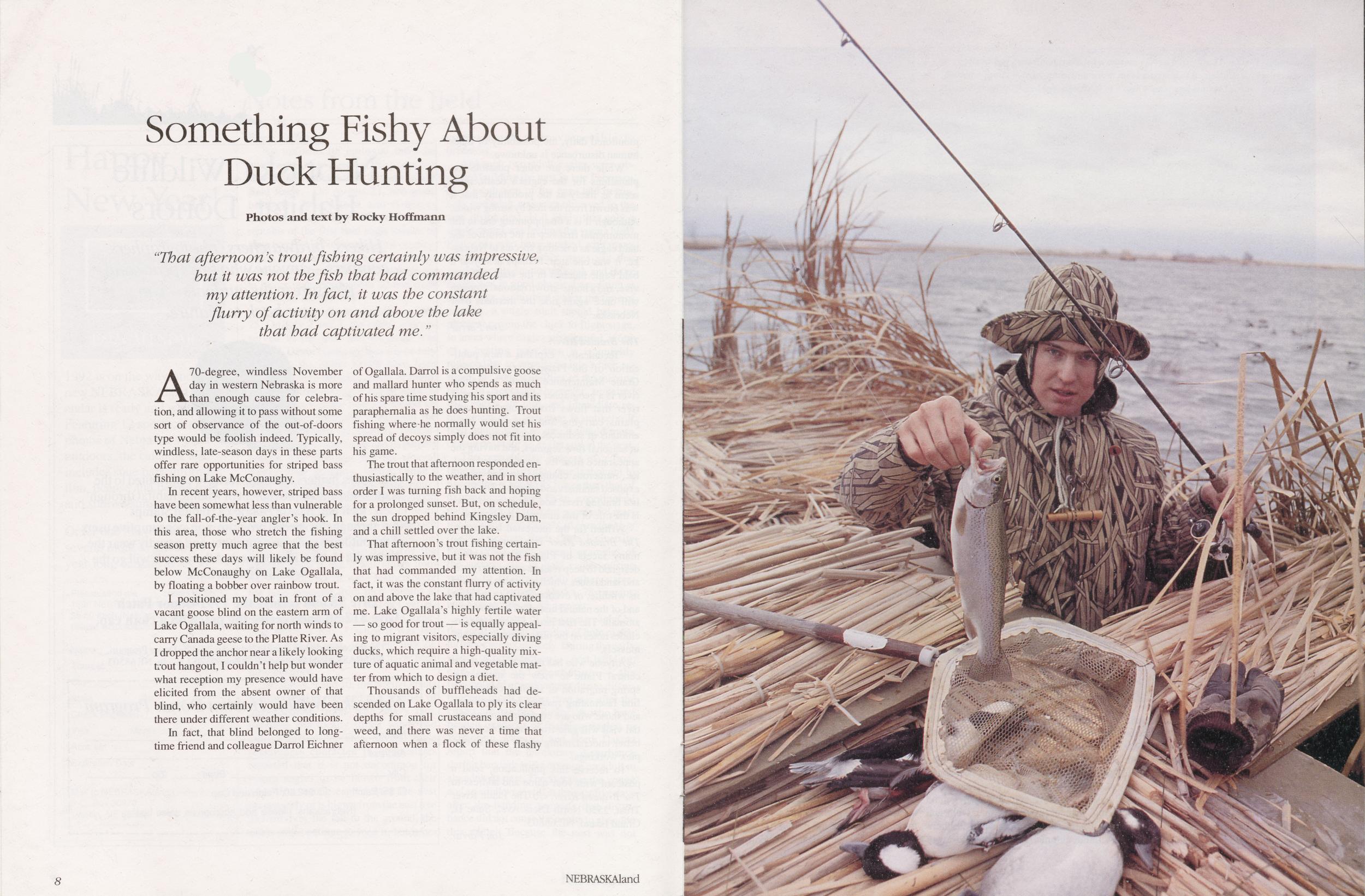
Something Fishy About Duck Hunting
Photos and text by Rocky Hoffmann That afternoon's trout fishing certainly was impressive, but it was not the fish that had commanded my attention. In fact, it was the constant flurry of activity on and above the lake that had captivated me.A70-degree, windless November day in western Nebraska is more than enough cause for celebration, and allowing it to pass without some sort of observance of the out-of-doors type would be foolish indeed. Typically, windless, late-season days in these parts offer rare opportunities for striped bass fishing on Lake McConaughy.
In recent years, however, striped bass have been somewhat less than vulnerable to the fall-of-the-year angler's hook. In this area, those who stretch the fishing season pretty much agree that the best success these days will likely be found below McConaughy on Lake Ogallala, by floating a bobber over rainbow trout.
I positioned my boat in front of a vacant goose blind on the eastern arm of Lake Ogallala, waiting for north winds to carry Canada geese to the Platte River. As I dropped the anchor near a likely looking trout hangout, I couldn't help but wonder what reception my presence would have elicited from the absent owner of that blind, who certainly would have been there under different weather conditions.
In fact, that blind belonged to long-time friend and colleague Darrol Eichner of Ogallala. Darrol is a compulsive goose and mallard hunter who spends as much of his spare time studying his sport and its paraphernalia as he does hunting. Trout fishing where-he normally would set his spread of decoys simply does not fit into his game.
The trout that afternoon responded enthusiastically to the weather, and in short order I was turning fish back and hoping for a prolonged sunset. But, on schedule, the sun dropped behind Kingsley Dam, and a chill settled over the lake.
That afternoon's trout fishing certainly was impressive, but it was not the fish that had commanded my attention. In fact, it was the constant flurry of activity on and above the lake that had captivated me. Lake Ogallala's highly fertile water — so good for trout — is equally appealing to migrant visitors, especially diving ducks, which require a high-quality mixture of aquatic animal and vegetable matter from which to design a diet.
Thousands of buffleheads had descended on Lake Ogallala to ply its clear depths for small crustaceans and pond weed, and there was never a time that afternoon when a flock of these flashy 8 NEBRASKAland
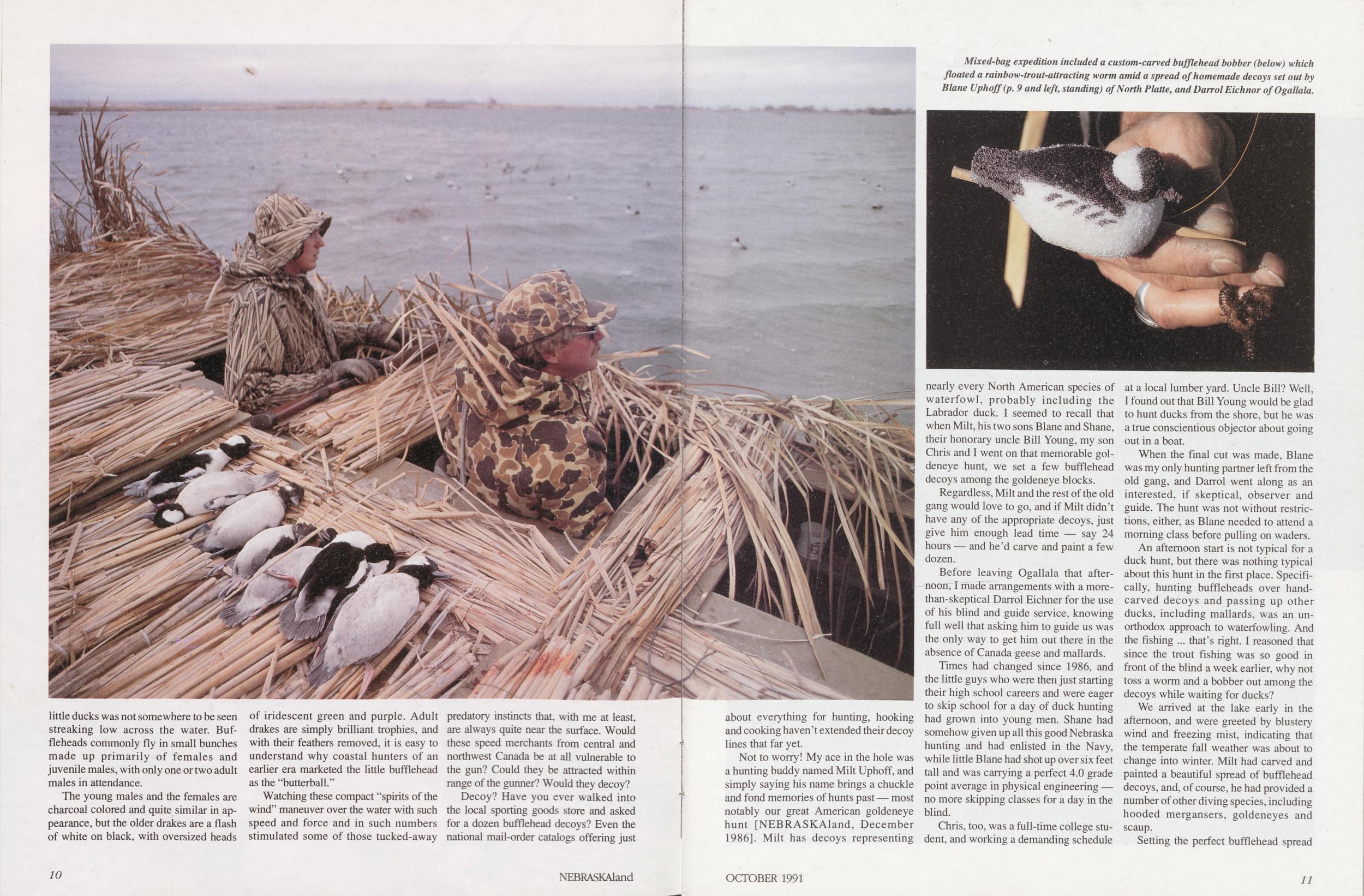
The young males and the females are charcoal colored and quite similar in appearance, but the older drakes are a flash of white on black, with oversized heads of iridescent green and purple. Adult drakes are simply brilliant trophies, and with their feathers removed, it is easy to understand why coastal hunters of an earlier era marketed the little bufflehead as the "butterball."
Watching these compact "spirits of the wind" maneuver over the water with such speed and force and in such numbers stimulated some of those tucked-away predatory instincts that, with me at least, are always quite near the surface. Would these speed merchants from central and northwest Canada be at all vulnerable to the gun? Could they be attracted within range of the gunner? Would they decoy?
Decoy? Have you ever walked into the local sporting goods store and asked for a dozen bufflehead decoys? Even the national mail-order catalogs offering just 10 NEBRASKAland about everything for hunting, hooking and cooking haven't extended their decoy lines that far yet.
Not to worry! My ace in the hole was a hunting buddy named Milt Uphoff, and simply saying his name brings a chuckle and fond memories of hunts past — most notably our great American goldeneye hunt [NEBRASKAland, December 1986]. Milt has decoys representing nearly every North American species of waterfowl, probably including the Labrador duck. I seemed to recall that when Milt, his two sons Blane and Shane, their honorary uncle Bill Young, my son Chris and I went on that memorable goldeneye hunt, we set a few bufflehead decoys among the goldeneye blocks.
Regardless, Milt and the rest of the old gang would love to go, and if Milt didn't have any of the appropriate decoys, just give him enough lead time — say 24 hours — and he'd carve and paint a few dozen.
Before leaving Ogallala that afternoon, I made arrangements with a more-than-skeptical Darrol Eichner for the use of his blind and guide service, knowing full well that asking him to guide us was the only way to get him out there in the absence of Canada geese and mallards.
Times had changed since 1986, and the little guys who were then just starting their high school careers and were eager to skip school for a day of duck hunting had grown into young men. Shane had somehow given up all this good Nebraska hunting and had enlisted in the Navy, while little Blane had shot up over six feet tall and was carrying a perfect 4.0 grade point average in physical engineering — no more skipping classes for a day in the blind.
Chris, too, was a full-time college student, and working a demanding schedule at a local lumber yard. Uncle Bill? Well, I found out that Bill Young would be glad to hunt ducks from the shore, but he was a true conscientious objector about going out in a boat.
When the final cut was made, Blane was my only hunting partner left from the old gang, and Darrol went along as an interested, if skeptical, observer and guide. The hunt was not without restrictions, either, as Blane needed to attend a morning class before pulling on waders.
An afternoon start is not typical for a duck hunt, but there was nothing typical about this hunt in the first place. Specifically, hunting buffleheads over hand-carved decoys and passing up other ducks, including mallards, was an unorthodox approach to water fowling. And the fishing ... that's right. I reasoned that since the trout fishing was so good in front of the blind a week earlier, why not toss a worm and a bobber out among the decoys while waiting for ducks?
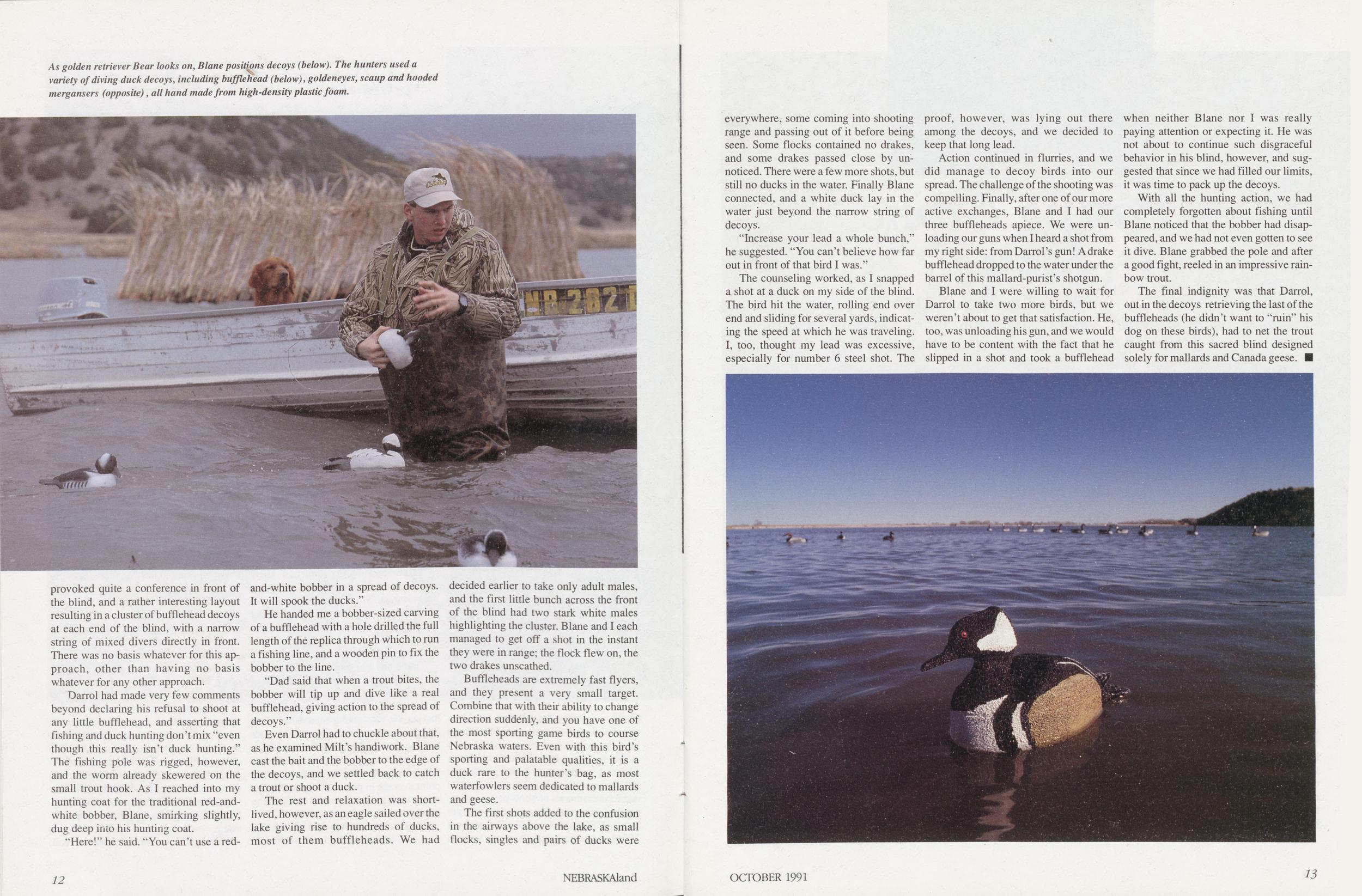
We arrived at the lake early in the afternoon, and were greeted by blustery wind and freezing mist, indicating that the temperate fall weather was about to change into winter. Milt had carved and painted a beautiful spread of bufflehead decoys, and, of course, he had provided a number of other diving species, including hooded mergansers, goldeneyes and scaup.
Setting the perfect bufflehead spread
OCTOBER 1991
11
Darrol had made very few comments beyond declaring his refusal to shoot at any little bufflehead, and asserting that fishing and duck hunting don't mix "even though this really isn't duck hunting." The fishing pole was rigged, however, and the wonn already skewered on the small trout hook. As I reached into my hunting coat for the traditional red-and-white bobber, Blane, smirking slightly, dug deep into his hunting coat.
"Here!" he said. "You can't use a red-and-white bobber in a spread of decoys. It will spook the ducks."
He handed me a bobber-sized carving of a bufflehead with a hole drilled the full length of the replica through which to run a fishing line, and a wooden pin to fix the bobber to the line.
"Dad said that when a trout bites, the bobber will tip up and dive like a real bufflehead, giving action to the spread of decoys."
Even Darrol had to chuckle about that, as he examined Milt's handiwork. Blane cast the bait and the bobber to the edge of the decoys, and we settled back to catch a trout or shoot a duck.
The rest and relaxation was short lived, however, as an eagle sailed over the lake giving rise to hundreds of ducks, most of them buffleheads. We had decided earlier to take only adult males, and the first little bunch across the front of the blind had two stark white males highlighting the cluster. Blane and I each managed to get off a shot in the instant they were in range; the flock flew on, the two drakes unscathed.
Buffleheads are extremely fast flyers, and they present a very small target. Combine that with their ability to change direction suddenly, and you have one of the most sporting game birds to course Nebraska waters. Even with this bird's sporting and palatable qualities, it is a duck rare to the hunter's bag, as most water fowlers seem dedicated to mallards and geese.
The first shots added to the confusion in the airways above the lake, as small flocks, singles and pairs of ducks were 12 NEBRASKAland everywhere, some coming into shooting range and passing out of it before being seen. Some flocks contained no drakes, and some drakes passed close by unnoticed. There were a few more shots, but still no ducks in the water. Finally Blane connected, and a white duck lay in the water just beyond the narrow string of decoys.
"Increase your lead a whole bunch," he suggested. "You can't believe how far out in front of that bird I was."
The counseling worked, as I snapped a shot at a duck on my side of the blind. The bird hit the water, rolling end over end and sliding for several yards, indicating the speed at which he was traveling. I, too, thought my lead was excessive, especially for number 6 steel shot. The proof, however, was lying out there among the decoys, and we decided to keep that long lead.
Action continued in flurries, and we did manage to decoy birds into our spread. The challenge of the shooting was compelling. Finally, after one of our more active exchanges, Blane and I had our three buffleheads apiece. We were unloading \our guns when I heard a shot from my right side: from Darrol's gun! A drake bufflehead dropped to the water under the barrel of this mallard-purist's shotgun.
Blane and I were willing to wait for Darrol to take two more birds, but we weren't about to get that satisfaction. He, too, was unloading his gun, and we would have to be content with the fact that he slipped in a shot and took a bufflehead when neither Blane nor I was really paying attention or expecting it. He was not about to continue such disgraceful behavior in his blind, however, and suggested that since we had filled our limits, it was time to pack up the decoys.
With all the hunting action, we had completely forgotten about fishing until Blane noticed that the bobber had disappeared, and we had not even gotten to see it dive. Blane grabbed the pole and after a good fight, reeled in an impressive rain- bow trout.
The final indignity was that Darrol, out in the decoys retrieving the last of the buffleheads (he didn't want to "ruin" his dog on these birds), had to net the trout caught from this sacred blind designed solely for mallards and Canada geese.
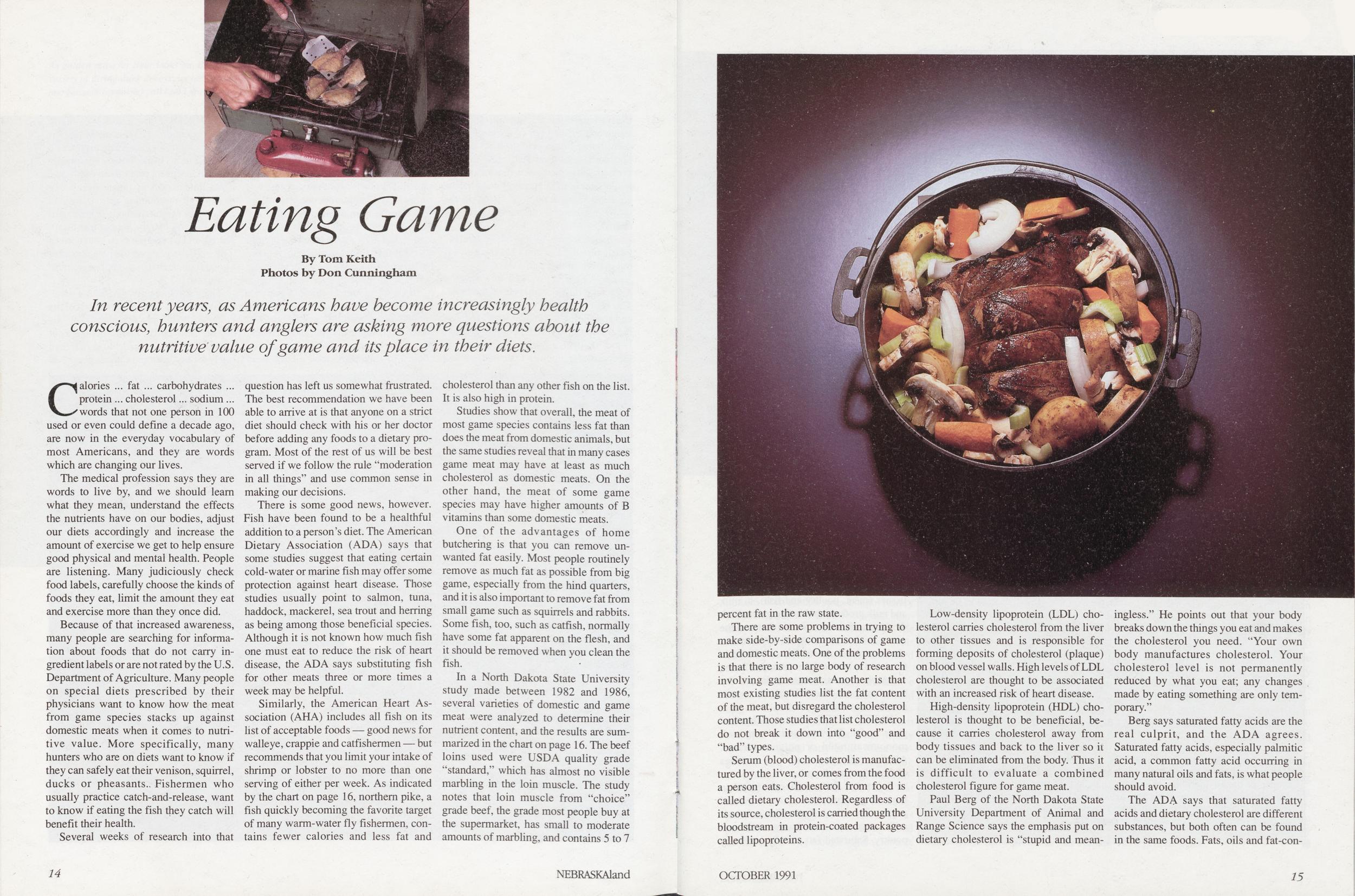
Eating Game
By Torn Keith Photos by Don Cunningham In recent years, as Americans have become increasingly health conscious, hunters and anglers are asking more questions about the nutritive value of game and its place in their diets.Calories ... fat ... carbohydrates ... protein ... cholesterol... sodium ... words that not one person in 100 used or even could define a decade ago, are now in the everyday vocabulary of most Americans, and they are words which are changing our lives.
The medical profession says they are words to live by, and we should learn what they mean, understand the effects the nutrients have on our bodies, adjust our diets accordingly and increase the amount of exercise we get to help ensure good physical and mental health. People are listening. Many judiciously check food labels, carefully choose the kinds of foods they eat, limit the amount they eat and exercise more than they once did.
Because of that increased awareness, many people are searching for information about foods that do not carry ingredient labels or are not rated by the U.S. Department of Agriculture. Many people on special diets prescribed by their physicians want to know how the meat from game species stacks up against domestic meats when it comes to nutritive value. More specifically, many hunters who are on diets want to know if they can safely eat their venison, squirrel, ducks or pheasants.. Fishermen who usually practice catch-and-release, want to know if eating the fish they catch will benefit their health.
Several weeks of research into that question has left us somewhat frustrated. The best recommendation we have been able to arrive at is that anyone on a strict diet should check with his or her doctor before adding any foods to a dietary program. Most of the rest of us will be best served if we follow the rule "moderation in all things" and use common sense in making our decisions.
There is some good news, however. Fish have been found to be a healthful addition to a person's diet. The American Dietary Association (ADA) says that some studies suggest that eating certain cold-water or marine fish may offer some protection against heart disease. Those studies usually point to salmon, tuna, haddock, mackerel, sea trout and herring as being among those beneficial species. Although it is not known how much fish one must eat to reduce the risk of heart disease, the ADA says substituting fish for other meats three or more times a week may be helpful.
Similarly, the American Heart Association (AHA) includes all fish on its list of acceptable foods — good news for walleye, crappie and catfishermen — but recommends that you limit your intake of shrimp or lobster to no more than one serving of either per week. As indicated by the chart on page 16, northern pike, a fish quickly becoming the favorite target of many warm-water fly fishermen, contains fewer calories and less fat and cholesterol than any other fish on the list. It is also high in protein.
Studies show that overall, the meat of most game species contains less fat than does the meat from domestic animals, but the same studies reveal that in many cases game meat may have at least as much cholesterol as domestic meats. On the other hand, the meat of some game species may have higher amounts of B vitamins than some domestic meats.
One of the advantages of home butchering is that you can remove unwanted fat easily. Most people routinely remove as much fat as possible from big game, especially from the hind quarters, and it is also important to remove fat from small game such as squirrels and rabbits. Some fish, too, such as catfish, normally have some fat apparent on the flesh, and it should be removed when you clean the fish.
In a North Dakota State University study made between 1982 and 1986, several varieties of domestic and game meat were analyzed to determine their nutrient content, and the results are summarized in the chart on page 16. The beef loins used were USDA quality grade "standard," which has almost no visible marbling in the loin muscle. The study notes that loin muscle from "choice" grade beef, the grade most people buy at the supermarket, has small to moderate amounts of marbling, and contains 5 to 7 14 NEBRASKAland
There are some problems in trying to make side-by-side comparisons of game and domestic meats. One of the problems is that there is no large body of research involving game meat. Another is that most existing studies list the fat content of the meat, but disregard the cholesterol content. Those studies that list cholesterol do not break it down into "good" and "bad" types.
Serum (blood) cholesterol is manufactured by the liver, or comes from the food a person eats. Cholesterol from food is called dietary cholesterol. Regardless of its source, cholesterol is carried though the bloodstream in protein-coated packages called lipoproteins.
Low-density lipoprotein (LDL) cholesterol carries cholesterol from the liver to other tissues and is responsible for forming deposits of cholesterol (plaque) on blood vessel walls. High levels of LDL cholesterol are thought to be associated with an increased risk of heart disease.
High-density lipoprotein (HDL) cholesterol is thought to be beneficial, because it carries cholesterol away from body tissues and back to the liver so it can be eliminated from the body. Thus it is difficult to evaluate a combined cholesterol figure for game meat.
Paul Berg of the North Dakota State University Department of Animal and Range Science says the emphasis put on dietary cholesterol is "stupid and meaningless." He points out that your body breaks down the things you eat and makes the cholesterol you need. "Your own body manufactures cholesterol. Your cholesterol level is not permanently reduced by what you eat; any changes made by eating something are only temporary."
Berg says saturated fatty acids are the real culprit, and the ADA agrees. Saturated fatty acids, especially palmitic acid, a common fatty acid occurring in many natural oils and fats, is what people should avoid.
The ADA says that saturated fatty acids and dietary cholesterol are different substances, but both often can be found in the same foods. Fats, oils and fat-containing foods have all three types of fatty acids — saturated, polyunsaturated and monounsaturated fats — in differing proportions.
OCTOBER 1991 15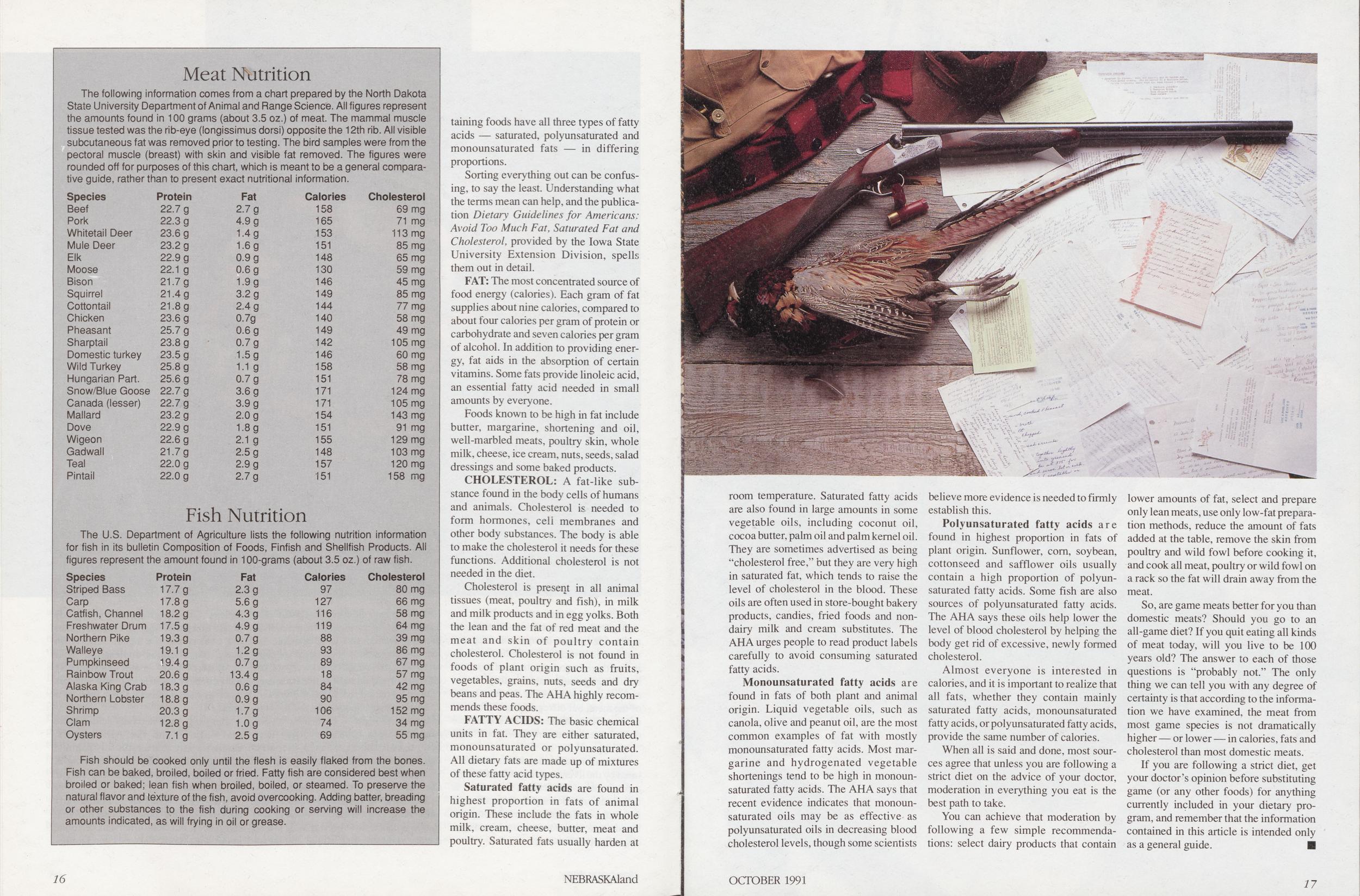 Meat Nutrition
The following information comes from a chart prepared by the North Dakota State University Department of Animal and Range Science. All figures represent the amounts found in 100 grams (about 3.5 oz.) of meat. The mammal muscle tissue tested was the rib-eye (longissimus dorsi) opposite the 12th rib. All visible subcutaneous fat was removed prior to testing. The bird samples were from the pectoral muscle (breast) with skin and visible fat removed. The figures were rounded off for purposes of this chart, which is meant to be a general comparetive guide, rather than to present exact nutritional information
Fat 2.7 g 4.9 g 1-4 g 1-6g 0.9 g 0.6 g 1.9g 3.2 g 2.4 g 0.7g 0.6 g 0.7 g 1.5 g 1.1 g 0.7 g 3.6 g 3.9 g 2.0 g 1.8g 2.1 g 2.5 g 2.9 g 2.7 g Fish NutritionThe U.S. Department of Agriculture lists the following nutrition information for fish in its bulletin Composition of Foods, Finfish and Shellfish Products. All figures represent the amount found in 100-grams (about 3.5 oz.) of raw fish.
Species Protein Beef 22.7 g Pork 22.3 g Whitetail Deer 23.6 g Mule Deer 23.2 g Elk 22.9 g Moose 22.1 g Bison 21.7 g Squirrel 21.4 g Cottontail 21.8 g Chicken 23.6 g Pheasant 25.7 g Sharptail 23,8 g Domestic turkey 23.5 g Wild Turkey 25.8 g Hungarian Part. 25.6 g Snow/Blue Goose 22.7 g Canada (lesser) 22.7 g Mallard 23.2 g Dove 22.9 g Wigeon 22.6 g Gadwall 21.7g Teal 22.0 g Pintail 22.0 g Calories Cholesterol 158 69 mg 165 71 mg 153 113 mg 151 85 mg 148 65 mg 130 59 mg 146 45 mg 149 85 mg 144 77 mg 140 58 mg 149 49 mg 142 105 mg 146 60 mg 158 58 mg 151 78 mg 171 124mg 171 105 mg 154 143mg 151 91 mg 155 129mg 148 103mg 157 120mg 151 158 mg Species Protein Fat Striped Bass 17.7g 2.3 g Carp 17.8g 5.6 g Catfish, Channel 18.2 g 4.3 g Freshwater Drum 17.5g 4.9 g Northern Pike 19.3 g 0.7 g Walleye 19.1 g 1.2g Pumpkinseed 19.4 g 0.7 g Rainbow Trout 20.6 g 13.4g Alaska King Crab 18.3 g 0.6 g Northern Lobster 18.8 g 0.9 g Shrimp 20.3 g 1.7g Clam 12.8g 1.0g Oysters 7.1 g 2.5 g Calories Cholesterol 97 80 mg 127 66 mg 116 58 mg 119 64 mg 88 39 mg 93 86 mg 89 67 mg 18 57 mg 84 42 mg 90 95 mg 106 152mg 74 34 mg 69 55 mgFish should be cooked only until the flesh is easily flaked from the bones. Fish can be baked, broiled, boiled or fried. Fatty fish are considered best when broiled or baked; lean fish when broiled, boiled, or steamed. To preserve the natural flavor and texture of the fish, avoid overcooking. Adding batter, breading or other substances to the fish during cooking or serving will increase the amounts indicated, as will frying in oil or grease.
Sorting everything out can be confusing, to say the least. Understanding what the terms mean can help, and the publication Dietary Guidelines for Americans: Avoid Too Much Fat, Saturated Fat and Cholesterol, provided by the Iowa State University Extension Division, spells them out in detail.
FAT: The most concentrated source of food energy (calories). Each gram of fat supplies about nine calories, compared to about four calories per gram of protein or carbohydrate and seven calories per gram of alcohol. In addition to providing energy, fat aids in the absorption of certain vitamins. Some fats provide linoleic acid, an essential fatty acid needed in small amounts by everyone.
Foods known to be high in fat include butter, margarine, shortening and oil, well-marbled meats, poultry skin, whole milk, cheese, ice cream, nuts, seeds, salad dressings and some baked products.
CHOLESTEROL: A fat-like substance found in the body cells of humans and animals. Cholesterol is needed to form hormones, cell membranes and other body substances. The body is able to make the cholesterol it needs for these functions. Additional cholesterol is not needed in the diet.
Cholesterol is present in all animal tissues (meat, poultry and fish), in milk and milk products and in egg yolks. Both the lean and the fat of red meat and the meat and skin of poultry contain cholesterol. Cholesterol is not found in foods of plant origin such as fruits, vegetables, grains, nuts, seeds and dry beans and peas. The AHA highly recommends these foods.
FATTY ACIDS: The basic chemical units in fat. They are either saturated, monounsaturated or polyunsaturated. All dietary fats are made up of mixtures of these fatty acid types.
Saturated fatty acids are found in highest proportion in fats of animal origin. These include the fats in whole milk, cream, cheese, butter, meat and poultry. Saturated fats usually harden at 16 NEBRASKAland
Monounsaturated fatty acids are found in fats of both plant and animal origin. Liquid vegetable oils, such as canola, olive and peanut oil, are the most common examples of fat with mostly monounsaturated fatty acids. Most margarine and hydrogenated vegetable shortenings tend to be high in monounsaturated fatty acids. The AHA says that recent evidence indicates that monounsaturated oils may be as effective as polyunsaturated oils in decreasing blood cholesterol levels, though some scientists believe more evidence is needed to firmly establish this.
Polyunsaturated fatty acids are found in highest proportion in fats of plant origin. Sunflower, corn, soybean, cottonseed and safflower oils usually contain a high proportion of polyunsaturated fatty acids. Some fish are also sources of polyunsaturated fatty acids. The AHA says these oils help lower the level of blood cholesterol by helping the body get rid of excessive, newly formed cholesterol.
Almost everyone is interested in calories, and it is important to realize that all fats, whether they contain mainly saturated fatty acids, monounsaturated fatty acids, orpolyunsaturated fatty acids, provide the same number of calories.
When all is said and done, most sources agree that unless you are following a strict diet on the advice of your doctor, moderation in everything you eat is the best path to take.
You can achieve that moderation by following a few simple recommendations: select dairy products that contain lower amounts of fat, select and prepare only lean meats, use only low-fat preparation methods, reduce the amount of fats added at the table, remove the skin from poultry and wild fowl before cooking it, and cook all meat, poultry or wild fowl on a rack so the fat will drain away from the meat.
So, are game meats better for you than domestic meats? Should you go to an all-game diet? If you quit eating all kinds of meat today, will you live to be 100 years old? The answer to each of those questions is "probably not." The only thing we can tell you with any degree of certainty is that according to the information we have examined, the meat from most game species is not dramatically higher — or lower — in calories, fats and cholesterol than most domestic meats.
If you are following a strict diet, get your doctor's opinion before substituting game (or any other foods) for anything currently included in your dietary program, and remember that the information contained in this article is intended only as a general guide.
OCTOBER 1991 17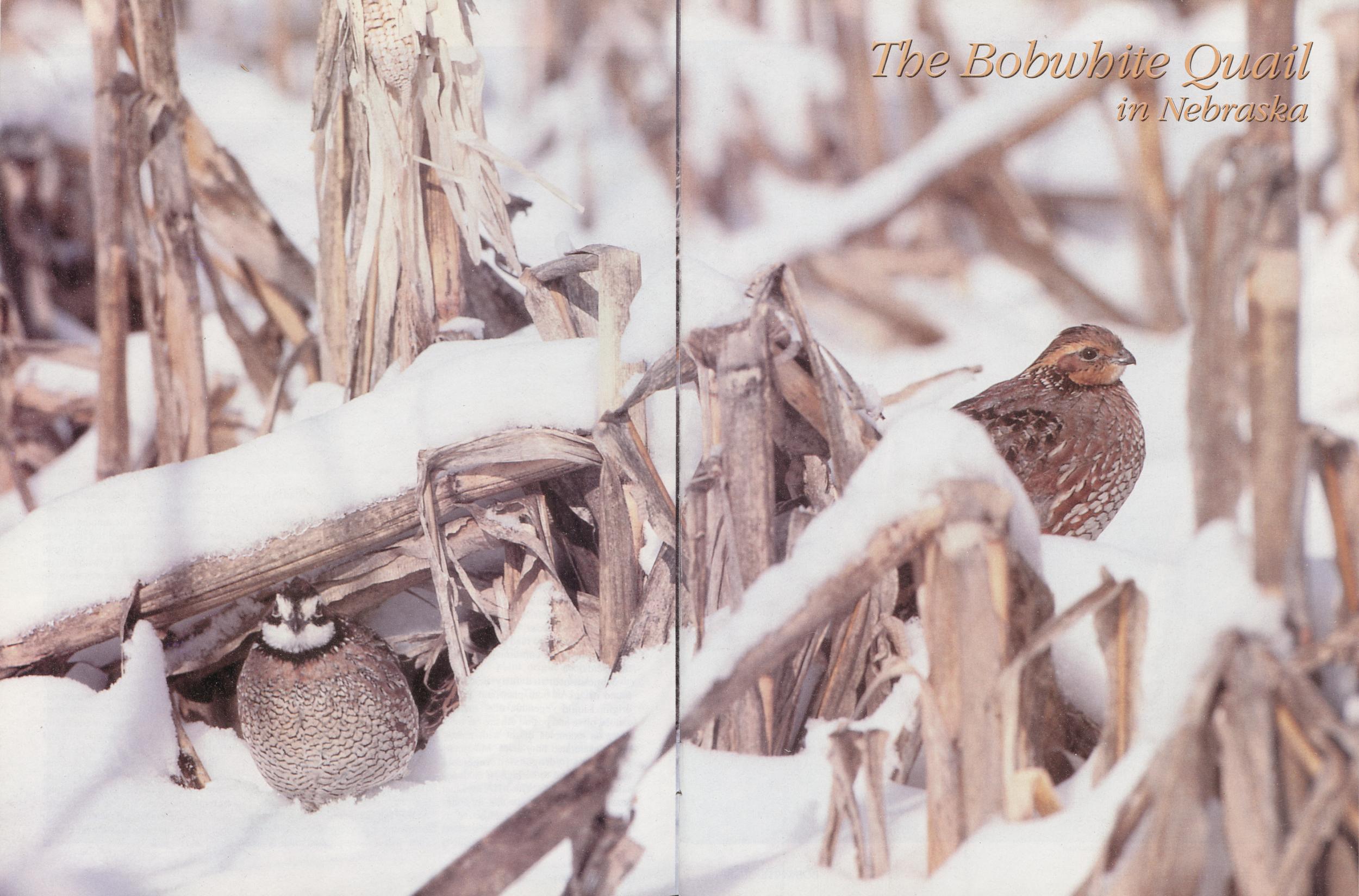
The Bobwhite Quail in Nebraska
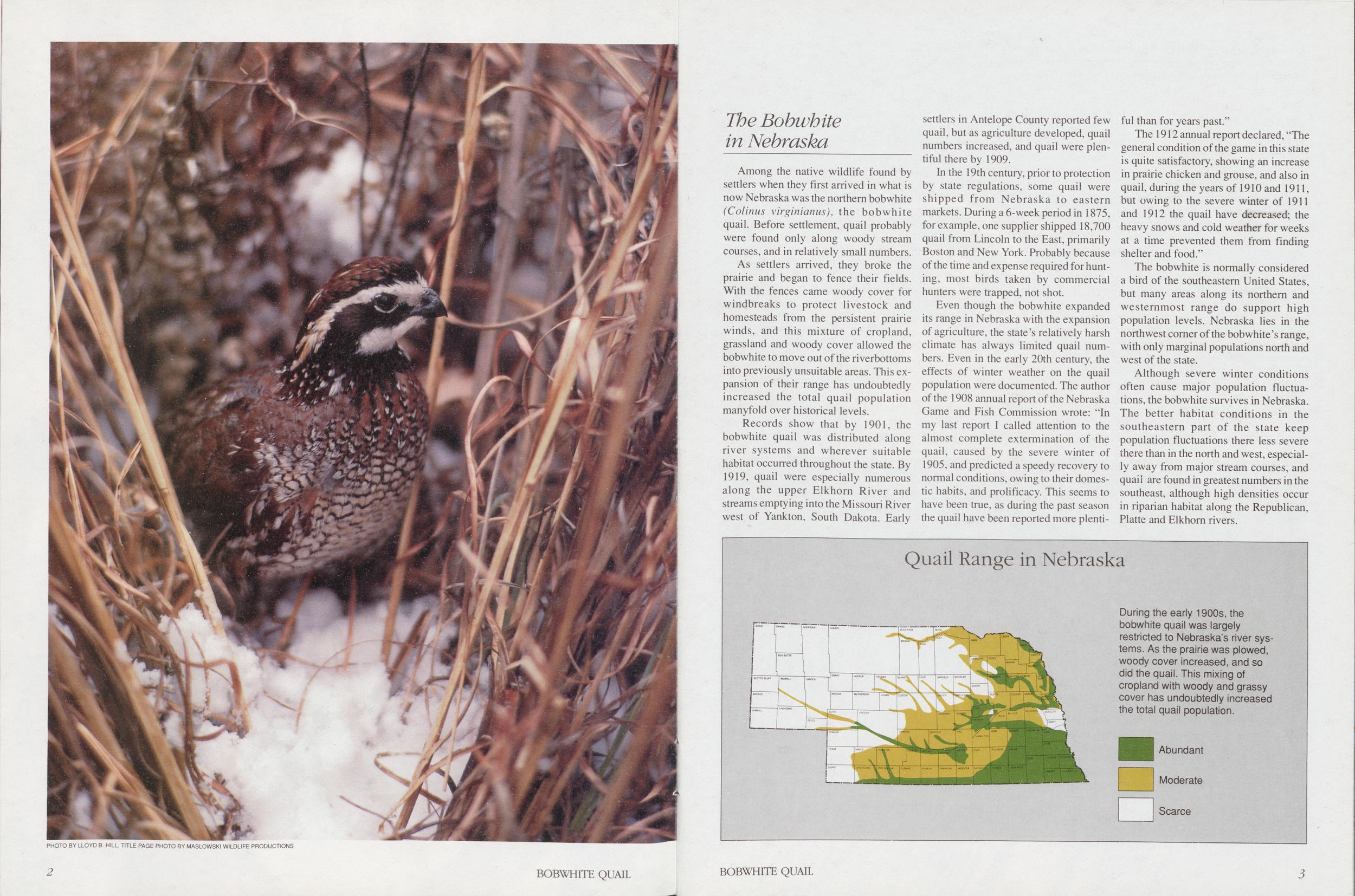
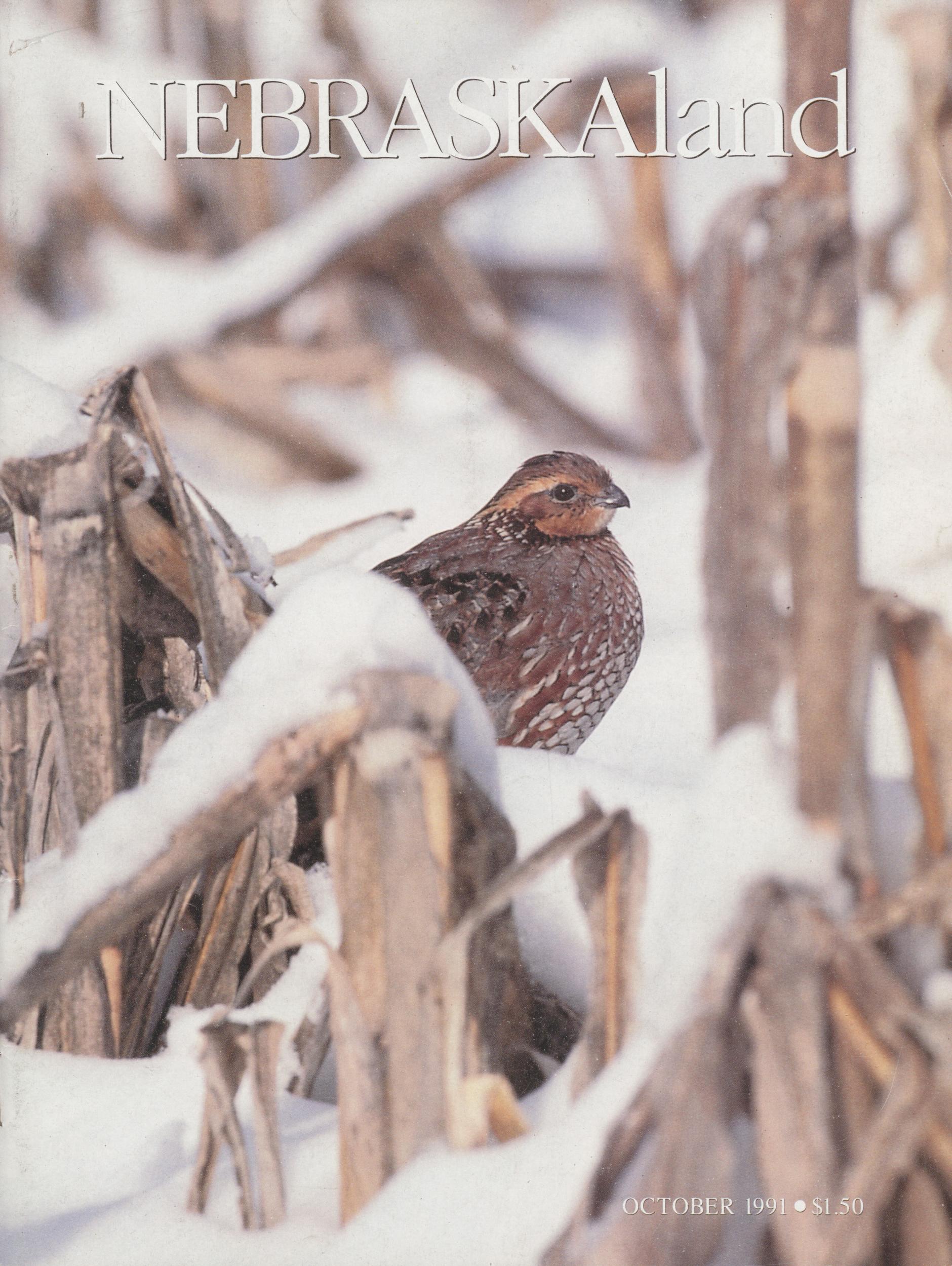
Among the native wildlife found by settlers when they first arrived in what is now Nebraska was the northern bobwhite (Colinus virginianus), the bobwhite quail. Before settlement, quail probably were found only along woody stream courses, and in relatively small numbers.
As settlers arrived, they broke the prairie and began to fence their fields. With the fences came woody cover for windbreaks to protect livestock and homesteads from the persistent prairie winds, and this mixture of cropland, grassland and woody cover allowed the bobwhite to move out of the river bottoms into previously unsuitable areas. This expansion of their range has undoubtedly increased the total quail population manyfold over historical levels.
Records show that by 1901, the bobwhite quail was distributed along river systems and wherever suitable habitat occurred throughout the state. By 1919, quail were especially numerous along the upper Elkhorn River and streams emptying into the Missouri River west of Yankton, South Dakota. Early settlers in Antelope County reported few quail, but as agriculture developed, quail numbers increased, and quail were plentiful there by 1909.
In the 19th century, prior to protection by state regulations, some quail were shipped from Nebraska to eastern markets. During a 6-week period in 1875, for example, one supplier shipped 18,700 quail from Lincoln to the East, primarily Boston and New York. Probably because of the time and expense required for hunting, most birds taken by commercial hunters were trapped, not shot.
Even though the bobwhite expanded its range in Nebraska with the expansion of agriculture, the state's relatively harsh climate has always limited quail numbers. Even in the early 20th century, the effects of winter weather on the quail population were documented. The author of the 1908 annual report of the Nebraska Game and Fish Commission wrote: "In my last report I called attention to the almost complete extermination of the quail, caused by the severe winter of 1905, and predicted a speedy recovery to normal conditions, owing to their domes- tic habits, and prolificacy. This seems to have been true, as during the past season the quail have been reported more plentiful than for years past."
The 1912 annual report declared, "The general condition of the game in this state is quite satisfactory, showing an increase in prairie chicken and grouse, and also in quail, during the years of 1910 and 1911, but owing to the severe winter of 1911 and 1912 the quail have decreased; the heavy snows and cold weather for weeks at a time prevented them from finding shelter and food."
The bobwhite is normally considered a bird of the southeastern United States, but many areas along its northern and westernmost range do support high population levels. Nebraska lies in the northwest corner of the bobwhite's range, with only marginal populations north and west of the state.
Although severe winter conditions often cause major population fluctuations, the bobwhite survives in Nebraska. The better habitat conditions in the southeastern part of the state keep population fluctuations there less severe there than in the north and west, especially away from major stream courses, and quail are found in greatest numbers in the southeast, although high densities occur in riparian habitat along the Republican, Platte and Elkhorn rivers.
Quail Range in Nebraska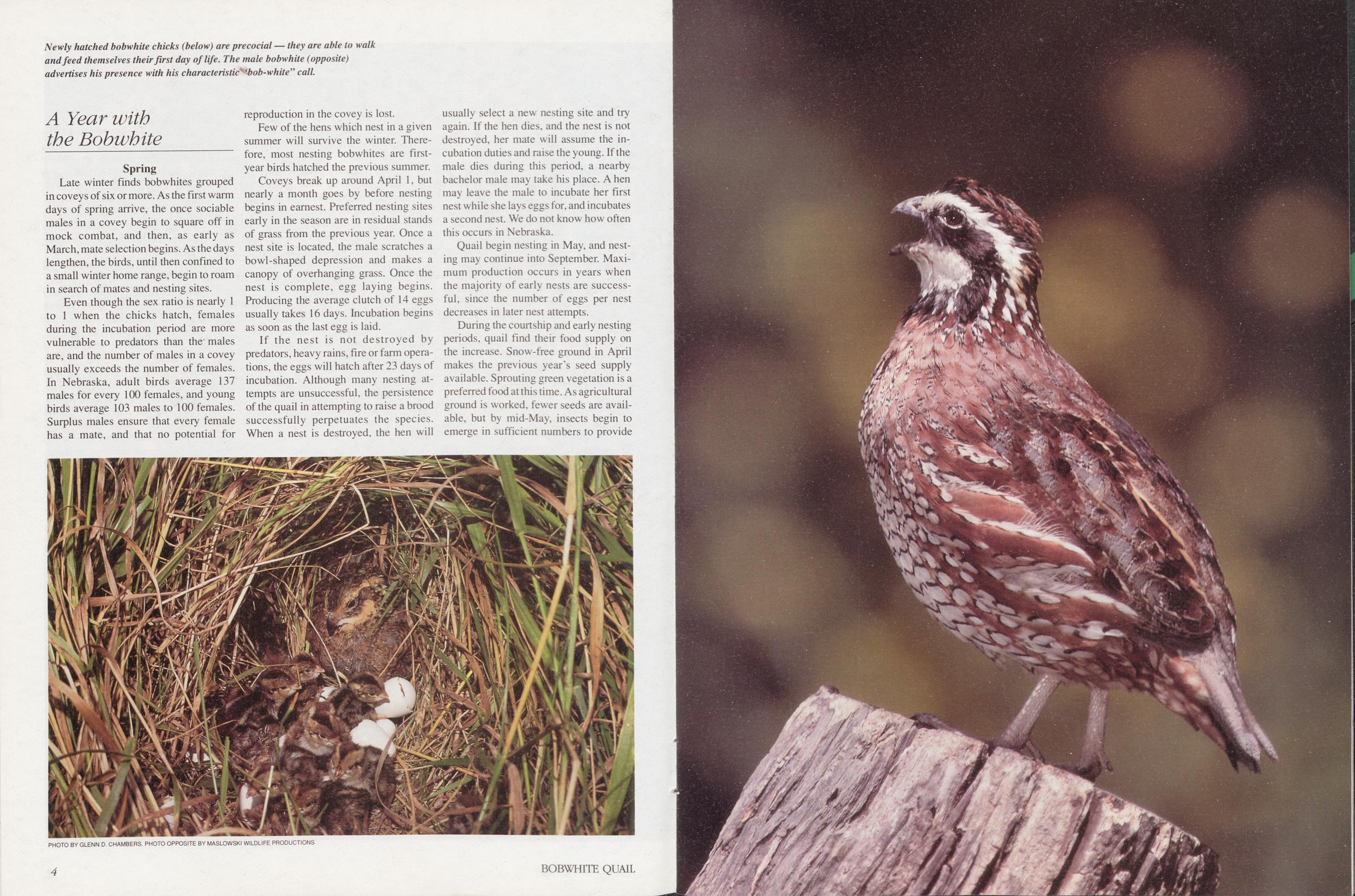
Late winter finds bobwhites grouped in coveys of six or more. As the first warm days of spring arrive, the once sociable males in a covey begin to square off in mock combat, and then, as early as March, mate selection begins. As the days lengthen, the birds, until then confined to a small winter home range, begin to roam in search of mates and nesting sites.
Even though the sex ratio is nearly 1 to 1 when the chicks hatch, females during the incubation period are more vulnerable to predators than the males are, and the number of males in a covey usually exceeds the number of females. In Nebraska, adult birds average 137 males for every 100 females, and young birds average 103 males to 100 females. Surplus males ensure that every female has a mate, and that no potential for reproduction in the covey is lost.
Few of the hens which nest in a given summer will survive the winter. Therefore, most nesting bobwhites are first year birds hatched the previous summer.
Coveys break up around April 1, but nearly a month goes by before nesting begins in earnest. Preferred nesting sites early in the season are in residual stands of grass from the previous year. Once a nest site is located, the male scratches a bowl-shaped depression and makes a canopy of overhanging grass. Once the nest is complete, egg laying begins. Producing the average clutch of 14 eggs usually takes 16 days. Incubation begins as soon as the last egg is laid.
If the nest is not destroyed by predators, heavy rains, fire or farm operations, the eggs will hatch after 23 days of incubation. Although many nesting attempts are unsuccessful, the persistence of the quail in attempting to raise a brood successfully perpetuates the species. When a nest is destroyed, the hen will usually select a new nesting site and try again. If the hen dies, and the nest is not destroyed, her mate will assume the incubation duties and raise the young. If the male dies during this period, a nearby bachelor male may take his place. A hen may leave the male to incubate her first nest while she lays eggs for, and incubates a second nest. We do not know how often this occurs in Nebraska.
Quail begin nesting in May, and nesting may continue into September. Maximum production occurs in years when the majority of early nests are successful, since the number of eggs per nest decreases in later nest attempts.
During the courtship and early nesting periods, quail find their food supply on the increase. Snow-free ground in April makes the previous year's seed supply available. Sprouting green vegetation is a preferred food at this time. As agricultural ground is worked, fewer seeds are available, but by mid-May, insects begin to emerge in sufficient numbers to provide a good food source for the nesting birds. As the season progresses, the quail's diet is primarily insects, greens and berries.
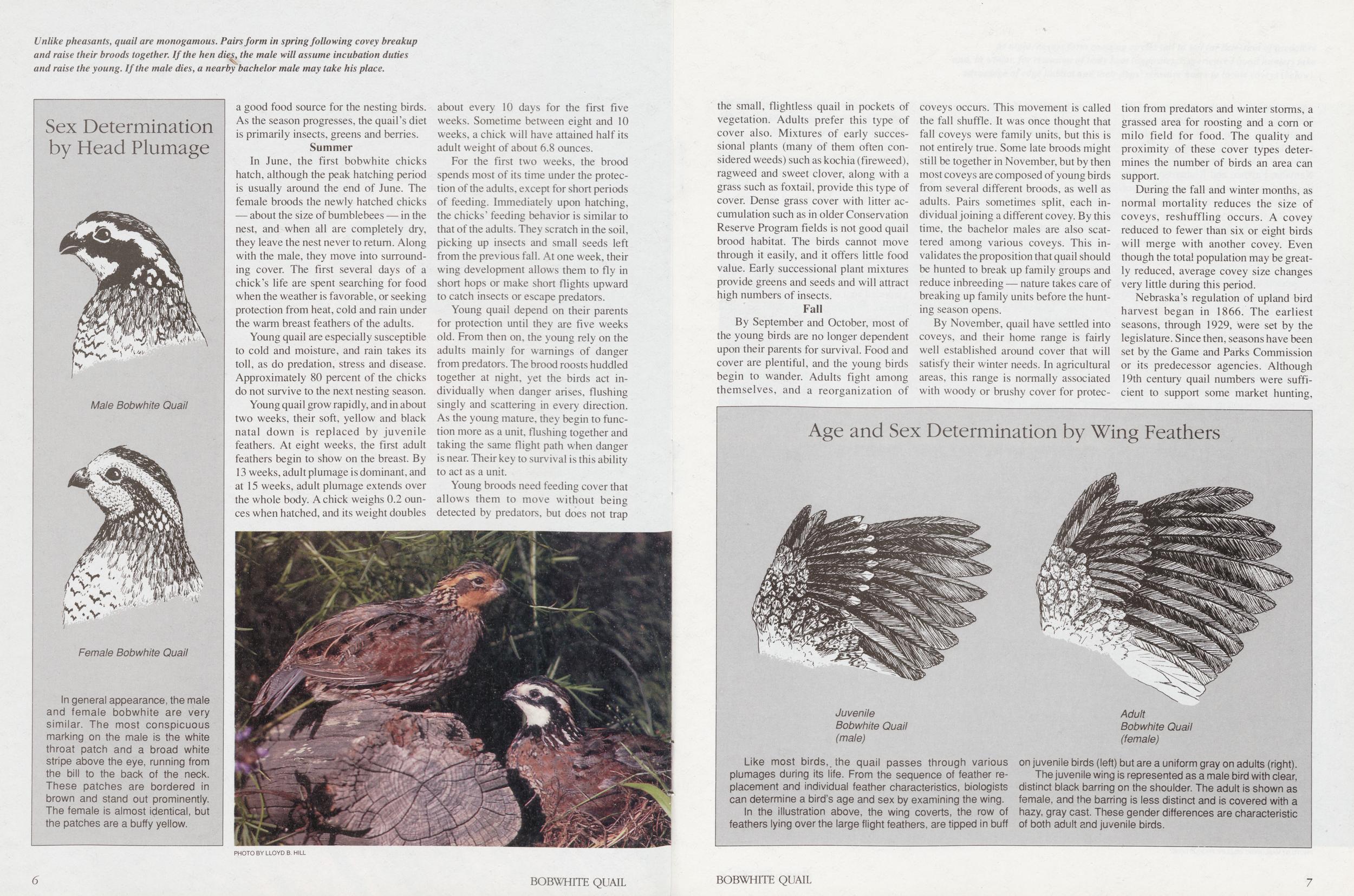
In general appearance, the male and female bobwhite are very similar. The most conspicuous marking on the male is the white throat patch and a broad white stripe above the eye, running from the bill to the back of the neck. These patches are bordered in brown and stand out prominently. The female is almost identical, but the patches are a buffy yellow.
SummerIn June, the first bobwhite chicks hatch, although the peak hatching period is usually around the end of June. The female broods the newly hatched chicks — about the size of bumblebees — in the nest, and when all are completely dry, they leave the nest never to return. Along with the male, they move into surrounding cover. The first several days of a chick's life are spent searching for food when the weather is favorable, or seeking protection from heat, cold and rain under the warm breast feathers of the adults.
Young quail are especially susceptible to cold and moisture, and rain takes its toll, as do predation, stress and disease. Approximately 80 percent of the chicks do not survive to the next nesting season.
Young quail grow rapidly, and in about two weeks, their soft, yellow and black natal down is replaced by juvenile feathers. At eight weeks, the first adult feathers begin to show on the breast. By 13 weeks, adult plumage is dominant, and at 15 weeks, adult plumage extends over the whole body. A chick weighs 0.2 ounces when hatched, and its weight doubles about every 10 days for the first five weeks. Sometime between eight and 10 weeks, a chick will have attained half its adult weight of about 6.8 ounces.
For the first two weeks, the brood spends most of its time under the protection of the adults, except for short periods of feeding. Immediately upon hatching, the chicks' feeding behavior is similar to that of the adults. They scratch in the soil, picking up insects and small seeds left from the previous fall. At one week, their wing development allows them to fly in short hops or make short flights upward to catch insects or escape predators.
Young quail depend on their parents for protection until they are five weeks old. From then on, the young rely on the adults mainly for warnings of danger from predators. The brood roosts huddled together at night, yet the birds act individually when danger arises, flushing singly and scattering in every direction. As the young mature, they begin to function more as a unit, flushing together and taking the same flight path when danger is near. Their key to survival is this ability to act as a unit.
Young broods need feeding cover that allows them to move without being detected by predators, but does not trap
By September and October, most of the young birds are no longer dependent upon their parents for survival. Food and cover are plentiful, and the young birds begin to wander. Adults fight among themselves, and a reorganization of coveys occurs. This movement is called the fall shuffle. It was once thought that fall coveys were family units, but this is not entirely true. Some late broods might still be together in November, but by then most coveys are composed of young birds from several different broods, as well as adults. Pairs sometimes split, each individual joining a different covey. By this time, the bachelor males are also scattered among various coveys. This invalidates the proposition that quail should be hunted to break up family groups and reduce inbreeding — nature takes care of breaking up family units before the hunting season opens.
By November, quail have settled into coveys, and their home range is fairly well established around cover that will satisfy their winter needs. In agricultural areas, this range is normally associated with woody or brushy cover for protection from predators and winter storms, a grassed area for roosting and a corn or milo field for food. The quality and proximity of these cover types determines the number of birds an area can support.
During the fall and winter months, as normal mortality reduces the size of coveys, reshuffling occurs. A covey reduced to fewer than six or eight birds will merge with another covey. Even though the total population may be greatly reduced, average covey size changes very little during this period.
Nebraska's regulation of upland bird harvest began in 1866. The earliest seasons, through 1929, were set by the legislature. Since then, seasons have been set by the Game and Parks Commission or its predecessor agencies. Although 19th century quail numbers were sufficient to support some market hunting, agency reports from the early years of the 20th century express concern over quail populations, and quail were completely protected from 1917 through 1943. In 1944, a 10-day season opened in Johnson, Nemaha, Pawnee and Richardson counties, with a bag and possession limit of five. The following year the season was extended to 15 days, and Gage County was added to the open area. In subsequent years, the area open to quail hunting grew, until the entire state was open in 1962.
Age and Sex Determination by Wing FeathersLike most birds, the quail passes through various plumages during its life. From the sequence of feather replacement and individual feather characteristics, biologists can determine a bird's age and sex by examining the wing.
In the illustration above, the wing coverts, the row of feathers lying over the large flight feathers, are tipped in buff on juvenile birds (left) but are a uniform gray on adults (right).
The juvenile wing is represented as a male bird with clear, distinct black barring on the shoulder. The adult is shown as female, and the barring is less distinct and is covered with a hazy, gray cast. These gender differences are characteristic of both adult and juvenile birds.
BOBWHITE QUAIL 7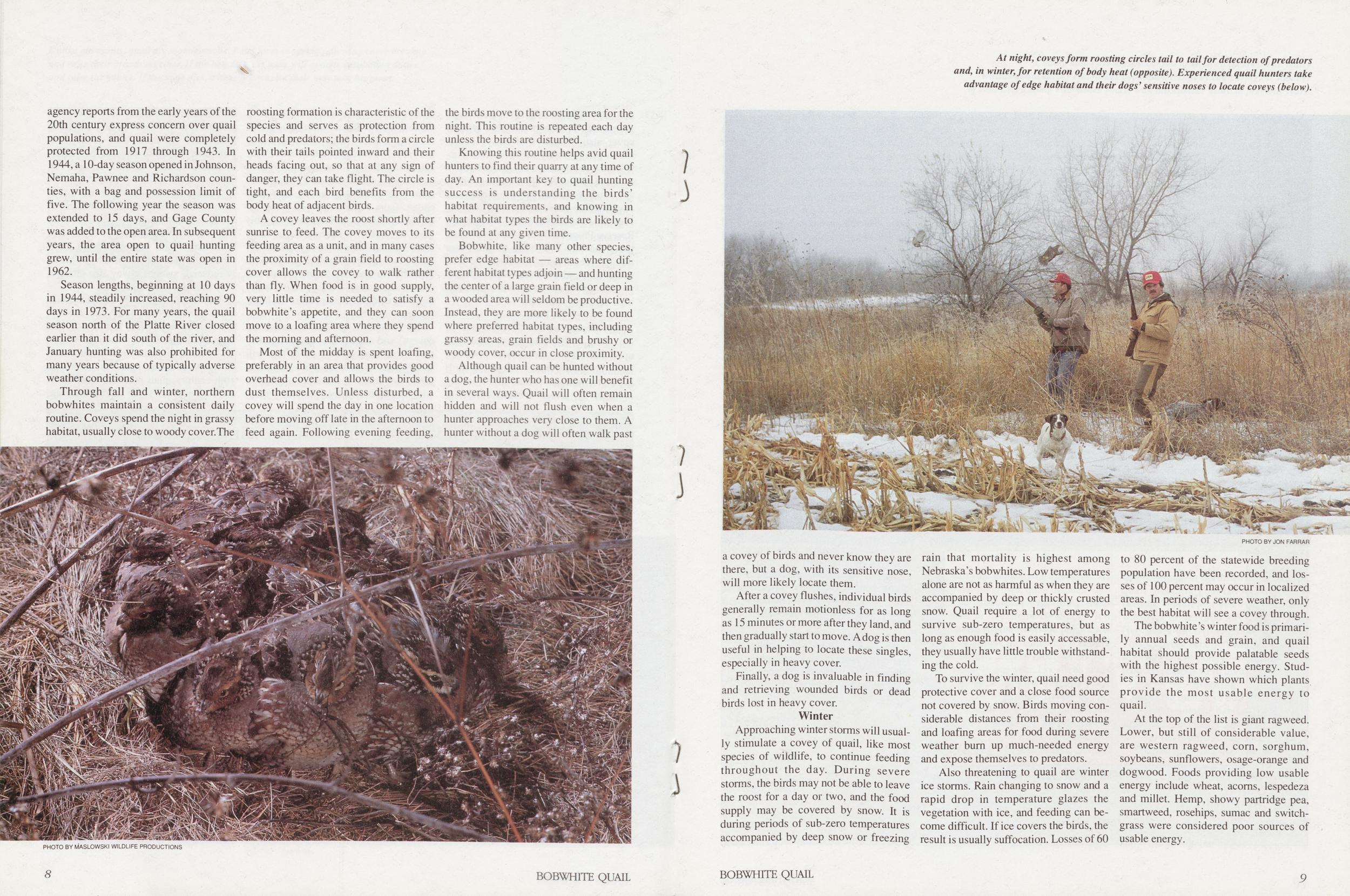
Season lengths, beginning at 10 days in 1944, steadily increased, reaching 90 days in 1973. For many years, the quail season north of the Platte River closed earlier than it did south of the river, and January hunting was also prohibited for many years because of typically adverse weather conditions.
Through fall and winter, northern bobwhites maintain a consistent daily routine. Coveys spend the night in grassy habitat, usually close to woody cover.The roosting formation is characteristic of the species and serves as protection from cold and predators; the birds form a circle with their tails pointed inward and their heads facing out, so that at any sign of danger, they can take flight. The circle is tight, and each bird benefits from the body heat of adjacent birds.
A covey leaves the roost shortly after sunrise to feed. The covey moves to its feeding area as a unit, and in many cases the proximity of a grain field to roosting cover allows the covey to walk rather than fly. When food is in good supply, very little time is needed to satisfy a bob white's appetite, and they can soon move to a loafing area where they spend the morning and afternoon.
Most of the midday is spent loafing, preferably in an area that provides good overhead cover and allows the birds to dust themselves. Unless disturbed, a covey will spend the day in one location before moving off late in the afternoon to feed again. Following evening feeding, the birds move to the roosting area for the night. This routine is repeated each day unless the birds are disturbed.
Knowing this routine helps avid quail hunters to find their quarry at any time of day. An important key to quail hunting success is understanding the birds' habitat requirements, and knowing in what habitat types the birds are likely to be found at any given time.
Bobwhite, like many other species, prefer edge habitat — areas where different habitat types adjoin — and hunting the center of a large grain field or deep in a wooded area will seldom be productive. Instead, they are more likely to be found where preferred habitat types, including grassy areas, grain fields and brushy or woody cover, occur in close proximity.
Although quail can be hunted without a dog, the hunter who has one will benefit in several ways. Quail will often remain hidden and will not flush even when a hunter approaches very close to them. A hunter without a dog will often walk past
After a covey flushes, individual birds generally remain motionless for as long as 15 minutes or more after they land, and then gradually start to move. A dog is then useful in helping to locate these singles, especially in heavy cover.
Finally, a dog is invaluable in finding and retrieving wounded birds or dead birds lost in heavy cover.
WinterApproaching winter storms will usually stimulate a covey of quail, like most species of wildlife, to continue feeding throughout the day. During severe storms, the birds may not be able to leave the roost for a day or two, and the food supply may be covered by snow. It is during periods of sub-zero temperatures accompanied by deep snow or freezing rain that mortality is highest among Nebraska's bobwhites. Low temperatures alone are not as harmful as when they are accompanied by deep or thickly crusted snow. Quail require a lot of energy to survive sub-zero temperatures, but as long as enough food is easily accessible they usually have little trouble withstanding the cold.
To survive the winter, quail need good protective cover and a close food source not covered by snow. Birds moving considerable distances from their roosting and loafing areas for food during severe weather burn up much-needed energy and expose themselves to predators.
Also threatening to quail are winter ice storms. Rain changing to snow and a rapid drop in temperature glazes the vegetation with ice, and feeding can become difficult. If ice covers the birds, the result is usually suffocation. Losses of 60 to 80 percent of the statewide breeding population have been recorded, and losses of 100 percent may occur in localized areas. In periods of severe weather, only the best habitat will see a covey through.
The bobwhite's winter food is primarily annual seeds and grain, and quail habitat should provide palatable seeds with the highest possible energy. Studies in Kansas have shown which plants provide the most usable energy to quail.
At the top of the list is giant ragweed. Lower, but still of considerable value, are western ragweed, corn, sorghum, soybeans, sunflowers, osage-orange and dogwood. Foods providing low usable energy include wheat, acorns, lespedeza and millet. Hemp, showy partridge pea, smartweed, rosehips, sumac and switchgrass were considered poor sources of usable energy.
BOBWHITE QUAIL 9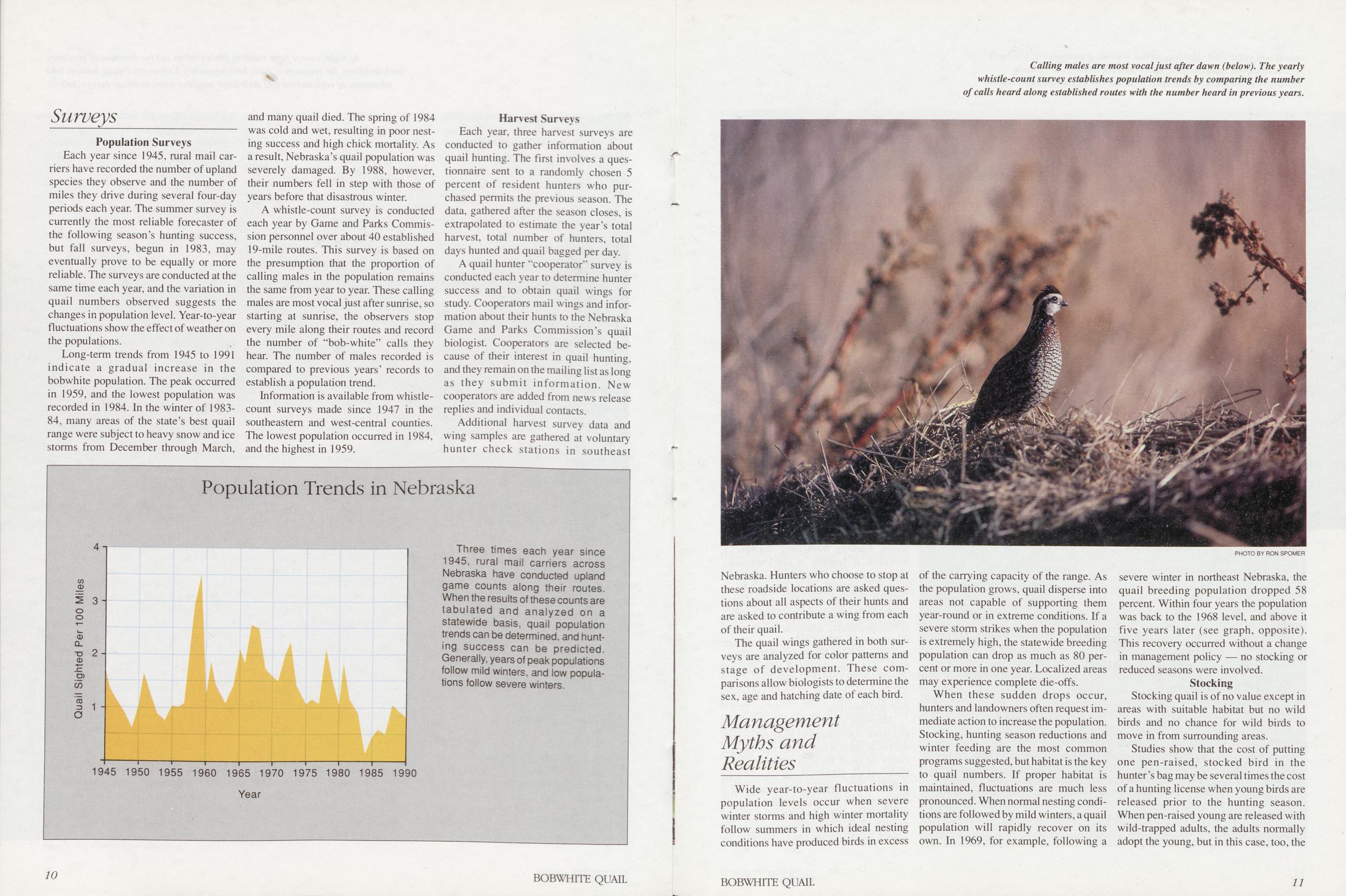 Surveys
Population Surveys
Surveys
Population Surveys
Each year since 1945, rural mail carriers have recorded the number of upland species they observe and the number of miles they drive during several four-day periods each year. The summer survey is currently the most reliable forecaster of the following season's hunting success, but fall surveys, begun in 1983, may eventually prove to be equally or more reliable. The surveys are conducted at the same time each year, and the variation in quail numbers observed suggests the changes in population level. Year-to-year fluctuations show the effect of weather on the populations.
Long-term trends from 1945 to 1991 indicate a gradual increase in the bobwhite population. The peak occurred in 1959, and the lowest population was recorded in 1984. In the winter of 1983-84, many areas of the state's best quail range were subject to heavy snow and ice storms from December through March, and many quail died. The spring of 1984 was cold and wet, resulting in poor nesting success and high chick mortality. As a result, Nebraska's quail population was severely damaged. By 1988, however, their numbers fell in step with those of years before that disastrous winter.
A whistle-count survey is conducted each year by Game and Parks Commission personnel over about 40 established 19-mile routes. This survey is based on the presumption that the proportion of calling males in the population remains the same from year to year. These calling males are most vocal just after sunrise, so starting at sunrise, the observers stop every mile along their routes and record the number of "bob-white" calls they hear. The number of males recorded is compared to previous years' records to establish a population trend.
Information is available from whistle count surveys made since 1947 in the southeastern and west-central counties. The lowest population occurred in 1984, and the highest in 1959.
Population Trends in NebraskaEach year, three harvest surveys are conducted to gather information about quail hunting. The first involves a questionnaire sent to a randomly chosen 5 percent of resident hunters who purchased permits the previous season. The data, gathered after the season closes, is extrapolated to estimate the year's total harvest, total number of hunters, total days hunted and quail bagged per day.
A quail hunter "cooperator" survey is conducted each year to determine hunter success and to obtain quail wings for study. Cooperators mail wings and information about their hunts to the Nebraska Game and Parks Commission's quail biologist. Cooperators are selected because of their interest in quail hunting, and they remain on the mailing list as long as they submit information. New cooperators are added from news release replies and individual contacts.
Additional harvest survey data and wing samples are gathered at voluntary hunter check stations in southeast 10 BOBWHITE QUAIL
The quail wings gathered in both surveys are analyzed for color patterns and stage of development. These comparisons allow biologists to determine the sex, age and hatching date of each bird.
Management Myths and RealitiesWide year-to-year fluctuations in population levels occur when severe winter storms and high winter mortality follow summers in which ideal nesting conditions have produced birds in excess of the carrying capacity of the range. As the population grows, quail disperse into areas not capable of supporting them year-round or in extreme conditions. If a severe storm strikes when the population is extremely high, the statewide breeding population can drop as much as 80 percent or more in one year. Localized areas may experience complete die-offs.
When these sudden drops occur, hunters and landowners often request immediate action to increase the population. Stocking, hunting season reductions and winter feeding are the most common programs suggested, but habitat is the key to quail numbers. If proper habitat is maintained, fluctuations are much less pronounced. When normal nesting conditions are followed by mild winters, a quail population will rapidly recover on its own. In 1969, for example, following a severe winter in northeast Nebraska, the quail breeding population dropped 58 percent. Within four years the population was back to the 1968 level, and above it five years later (see graph, opposite). This recovery occurred without a change in management policy — no stocking or reduced seasons were involved.
StockingStocking quail is of no value except in areas with suitable habitat but no wild birds and no chance for wild birds to move in from surrounding areas.
Studies show that the cost of putting
one pen-raised, stocked bird in the
hunter's bag may be several times the cost
of a hunting license when young birds are
released prior to the hunting season.
When pen-raised young are released with
wild-trapped adults, the adults normally
adopt the young, but in this case, too, the
BOBWHITE QUAIL
11
 cost of each bird eventually bagged by a
hunter is too high to justify the effort.
cost of each bird eventually bagged by a
hunter is too high to justify the effort.
Late winter and early spring release of adult breeders is also a financial bust. Survival of native birds from the end of one breeding season to the next spring averages about 30 to 60 percent, and the survival of pen-raised birds is much lower. Three major drawbacks to pen-raised quail in the wild are their tameness, which makes them susceptible to predators; their inability to recognize food, since thev are conditioned to finding food in a specific location; and their tendency to remain separate and not form the coveys which are so essential for survival of wild birds.
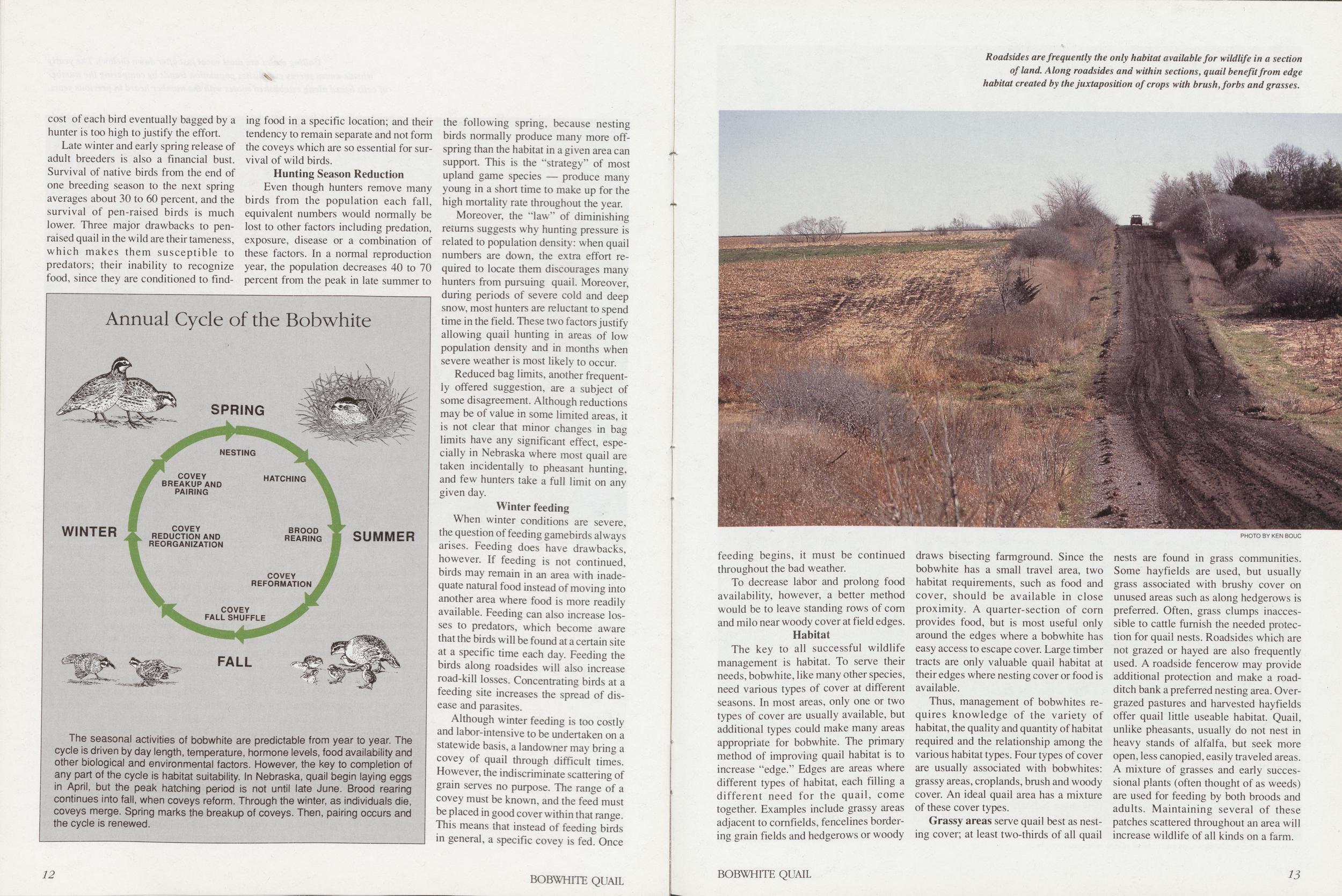
Annual Cycle of the Bob whiteThe seasonal activities of bobwhite are predictable from year to year. The cycle is driven by day length, temperature, hormone levels, food availability and other biological and environmental factors. However, the key to completion of any part of the cycle is habitat suitability. In Nebraska, quail begin laying eggs in April, but the peak hatching period is not until late June. Brood rearing continues into fall, when coveys reform. Through the winter, as individuals die, coveys merge. Spring marks the breakup of coveys. Then, pairing occurs and the cycle is renewed.
Hunting Season ReductionEven though hunters remove many birds from the population each fall, equivalent numbers would normally be lost to other factors including predation, exposure, disease or a combination of these factors. In a normal reproduction year, the population decreases 40 to 70 percent from the peak in late summer to the following spring, because nesting birds normally produce many more offspring than the habitat in a given area can support. This is the "strategy" of most upland game species — produce many young in a short time to make up for the high mortality rate throughout the year.
Moreover, the "law" of diminishing returns suggests why hunting pressure is related to population density: when quail numbers are down, the extra effort required to locate them discourages many hunters from pursuing quail. Moreover, during periods of severe cold and deep snow, most hunters are reluctant to spend time in the field. These two factors justify allowing quail hunting in areas of low population density and in months when severe weather is most likely to occur.
Reduced bag limits, another frequently offered suggestion, are a subject of some disagreement. Although reductions may be of value in some limited areas, it is not clear that minor changes in bag limits have any significant effect, especially in Nebraska where most quail are taken incidentally to pheasant hunting, and few hunters take a full limit on any given day.
Winter feedingWhen winter conditions are severe, the question of feeding game birds always arises. Feeding does have drawbacks, however. If feeding is not continued, birds may remain in an area with inadequate natural food instead of moving into another area where food is more readily available. Feeding can also increase losses to predators, which become aware that the birds will be found at a certain site at a specific time each day. Feeding the birds along roadsides will also increase road-kill losses. Concentrating birds at a feeding site increases the spread of disease and parasites.
Although winter feeding is too costly and labor-intensive to be undertaken on a statewide basis, a landowner may bring a covey of quail through difficult times. However, the indiscriminate scattering of grain serves no purpose. The range of a covey must be known, and the feed must be placed in good cover within that range. This means that instead of feeding birds in general, a specific covey is fed. Once 12 BOBWHITE QUAIL
To decrease labor and prolong food availability, however, a better method would be to leave standing rows of com and milo near woody cover at field edges.
HabitatThe key to all successful wildlife management is habitat. To serve their needs, bobwhite, like many other species, need various types of cover at different seasons. In most areas, only one or two types of cover are usually available, but additional types could make many areas appropriate for bobwhite. The primary method of improving quail habitat is to increase "edge." Edges are areas where different types of habitat, each filling a different need for the quail, come together. Examples include grassy areas adjacent to cornfields, fence lines bordering grain fields and hedgerows or woody draws bisecting farm ground. Since the bobwhite has a small travel area, two habitat requirements, such as food and cover, should be available in close proximity. A quarter-section of corn provides food, but is most useful only around the edges where a bobwhite has easy access to escape cover. Large timber tracts are only valuable quail habitat at their edges where nesting cover or food is available.
Thus, management of bobwhites requires knowledge of the variety of habitat, the quality and quantity of habitat required and the relationship among the various habitat types. Four types of cover are usually associated with bobwhites: grassy areas, croplands, brush and woody cover. An ideal quail area has a mixture of these cover types.
Grassy areas serve quail best as nesting cover; at least two-thirds of all quail nests are found in grass communities. Some hayfields are used, but usually grass associated with brushy cover on unused areas such as along hedgerows is preferred. Often, grass clumps inaccessible to cattle furnish the needed protection for quail nests. Roadsides which are not grazed or hayed are also frequently used. A roadside fencerow may provide additional protection and make a road ditch bank a preferred nesting area. Over grazed pastures and harvested hayfields offer quail little useable habitat. Quail, unlike pheasants, usually do not nest in heavy stands of alfalfa, but seek more open, less canopied, easily traveled areas. A mixture of grasses and early successional plants (often thought of as weeds) are used for feeding by both broods and adults. Maintaining several of these patches scattered throughout an area will increase wildlife of all kinds on a farm.
BOBWHITE QUAIL 13
Mixture of Cover Types
Landowners often become concerned about not seeing quail on land where they had once been abundant. However, unnoticed land-use changes occurring over time may decrease the quality of habitat below the point of supporting quail. When a shelter belt or fencerow is removed to increase field size, when roadsides are sprayed for removal of brush and weeds or when pastures are overgrazed, quail lose essential habitat components. Land with a diversity of crops and cover types will support significantly more quail than will an equivalent area devoted to large crop fields. Without diversity of cover types, even good conservation practices such as grassed terraces will not enable land to support quail.
Historically, the increasing acreage of cropland was the primary factor in expanding the quail range. Before the land was homesteaded, range fires disrupted plant succession and allowed weeds to grow, but grass succession eventually overcame these beneficial plants. Early sod-breaking and farming practices created disturbed areas and edges which were ideal quail habitat. Some modem farming techniques, however, work against quail. Herbicides and insecticides remove needed cover and food. Land leveling removes many weedy or brushy draws that previously formed necessary edge habitat. Fencerows and hedges are removed to permit the use of larger equipment.
Brush is a broad term that could include an osage-orange hedgerow, a plum thicket or even a sunflower patch. Blackberries, raspberries, plums, currants and elderberries — all of them brush — provide both food and shelter. Any woody vegetation can provide a necessary part of the quail "home," and the availability of this type of cover adjacent to cropland or other food usually determines bobwhite home range. Numerous brushy areas are one reason why southeast Nebraska and the Platte and Republican rivers and their tributaries have abundant quail populations.
Woody cover is most useful when associated with brushy undergrowth or brushy cover adjacent to the woodland edge. Most woodlands in Nebraska occur along rivers and tributaries and are not as intensively managed for timber (or for quail) as are those in the southeastern states. Their value to quail in Nebraska is limited to their association with brush and cropland. Woodlands provide some winter cover and limited food. A heavily grazed woodlot with little ground cover is practically worthless to quail. Red cedar, however, commonly used for windbreaks, provides important winter cover, since snow will bridge the branches, leaving a protective canopy and protection for the bobwhite.
The Bobwhite's FutureThe northern bobwhite was a resident of much of the area we now call Nebraska when settlers first arrived. In the early days of our coexistence, the quail flourished, as limited agriculture created new edge habitat, and the bobwhite's range and numbers increased. Modern farm practices, however, have a mixed effect on quail populations. Increased mechanization, increased pesticide and herbicide use and the trend toward monoculture (one-crop) farming have decreased the variety of cover available in many areas, and much quail habitat is now restricted to inaccessible, untillable areas such as drainages, ditches, fence rows and pastures.
On the positive side, however, are many modern conservation and minimum-till practices. The 1985 and 1990 farm bills mandated that land considered highly erodible be put into a conservation compliance plan. These requirements and other practices — grassed waterways and grassed terraces, strip farming, low- and no-till cultivation, native grass plantings such as those encouraged by recent government programs, "sodbuster" legislation and shelter belt plantings all benefit wildlife as well as the farmer.
The future of this diminutive Nebraska native is relatively bright: in spite of year-to-year fluctuations, populations have remained relatively constant. The key to the continued survival of the northem bobwhite in Nebraska will be our willingness to recognize its basic life requirements and to continue to provide a place for it in the uses we make of the environment.
14 BOBWHITE QUAIL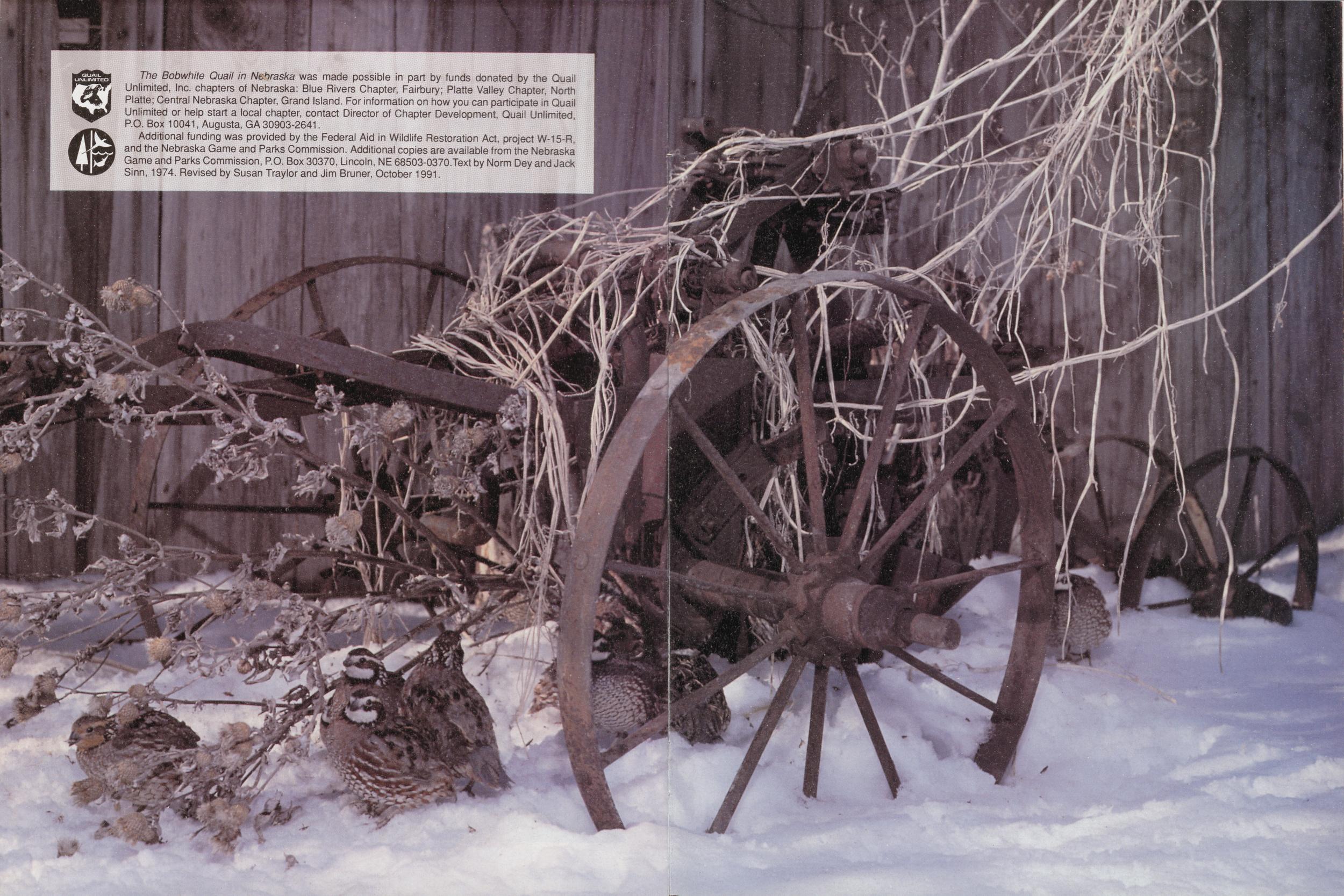
The Bobwhite Quail in Nebraska was made possible in part by funds donated by the Quail Unlimited, Inc. chapters of Nebraska: Blue Rivers Chapter, Fairbury; Platte Valley Chapter, North Platte; Central Nebraska Chapter, Grand Island. For information on how you can participate in Quail Unlimited or help start a local chapter, contact Director of Chapter Development, Quail Unlimited, P.O. Box 10041, Augusta, GA 30903-2641.
Additional funding was provided by the Federal Aid in Wildlife Restoration Act, project W-15-R, and the Nebraska Game and Parks Commission. Additional copies are available from the Nebraska Game and Parks Commission, P.O. Box 30370, Lincoln, NE 68503-0370.Text by Norm Dey and Jack Sinn, 1974. Revised by Susan Traylor and Jim Bruner, October 1991.
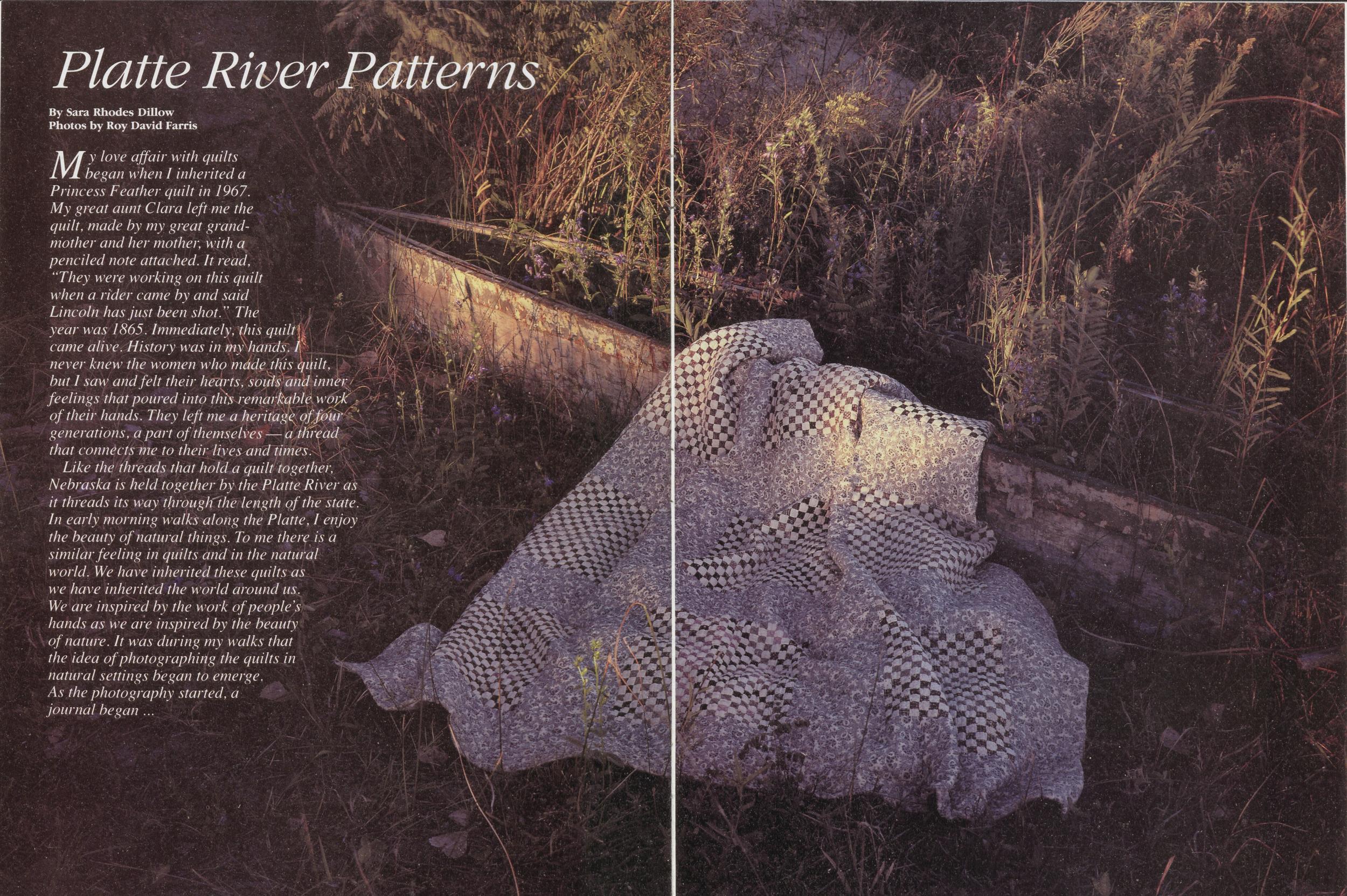
Platte River Patterns
By Sara Rhodes Dillow Photos by Roy David FarrisMy love affair with quilts began when I inherited a Princess Feather quilt in 1967. My great aunt Clara left me the quilt, made by my great grandmother and her mother, with a penciled note attached. It read, uThey were working on this quilt when a rider came by and said Lincoln has just been shot." The year was 1865. Immediately, this quilt came alive. History was in my hands, never knew the women who made this quilt, but I saw and felt their hearts, souls and inner, feelings that poured into this remarkable work of their hands. They left me a heritage of four generations, a part of themselves—-a thread that connects me to their lives and times.
Like the threads that hold a quilt together, Nebraska is held together by the Platte River as it threads its way through the length of the state. In early morning walks along the Platte, I enjoy the beauty of natural things. To me there is a similar feeling in quilts and in the natural world. We have inherited these quilts as we have inherited the world around us. We are inspired by the work of people's hands as we are inspired by the beauty of nature. It was during my walks that the idea of photographing the quilts in natural settings began to emerge. As the photography started, a journal began ...
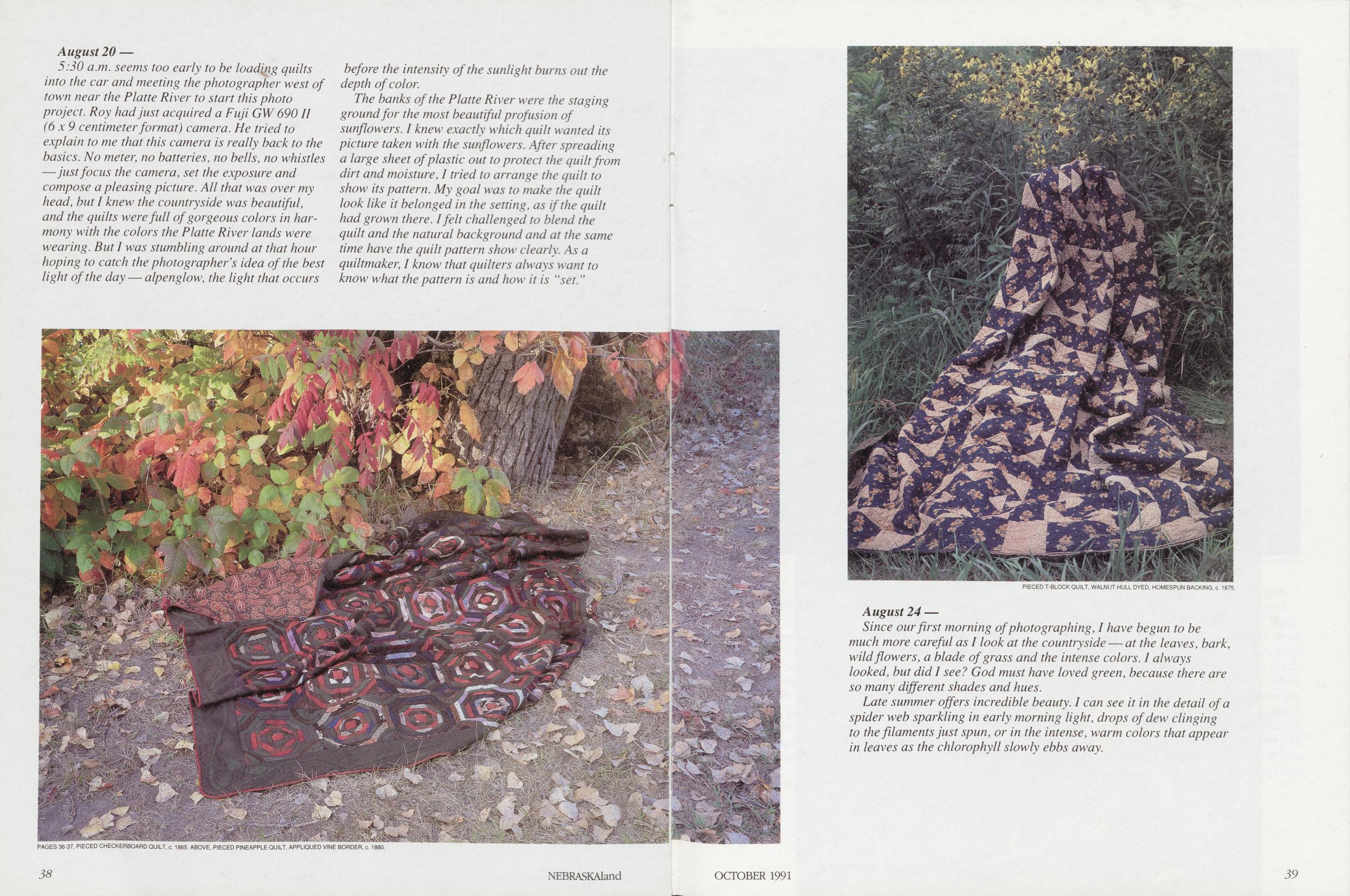 August 20 —
5:30 a.m. seems too early to be loading quilts into the car and meeting the photographer west of town near the Platte River to start this photo project. Roy had just acquired a Fuji GW 690II (6 x 9 centimeter format) camera. He tried to explain to me that this camera is really back to the basics. No meter, no batteries, no bells, no whistles —just focus the camera, set the exposure and compose a pleasing picture. All that was over my head, but I knew the countryside was beautiful, and the quilts were full of gorgeous colors in harmony with the colors the Platte River lands were wearing. But I was stumbling around at that hour hoping to catch the photographer's idea of the best light of the day — alpenglow, the light that occurs before the intensity of the sunlight burns out the depth of color.
The banks of the Platte River were the staging ground for the most beautiful profusion of sunflowers. I knew exactly which quilt wanted its picture taken with the sunflowers. After spreading a large sheet of plastic out to protect the quilt from dirt and moisture, I tried to arrange the quilt to show its pattern. My goal was to make the quilt look like it belonged in the setting, as if the quilt had grown there. I felt challenged to blend the quilt and the natural background and at the same time have the quilt pattern show clearly. As a quiltmaker, I know that quilters always want to know what the pattern is and how it is "set."
Since our first morning of photographing, I have begun to be much more careful as I look at the countryside — at the leaves, bark, wild flowers, a blade of grass and the intense colors. I always looked, but did I see? God must have loved green, because there are so many different shades and hues.
Late summer offers incredible beauty. I can see it in the detail of a spider web sparkling in early morning light, drops of dew clinging to the filaments just spun, or in the intense, warm colors that appear in leaves as the chlorophyll slowly ebbs away.
OCTOBER 1991 39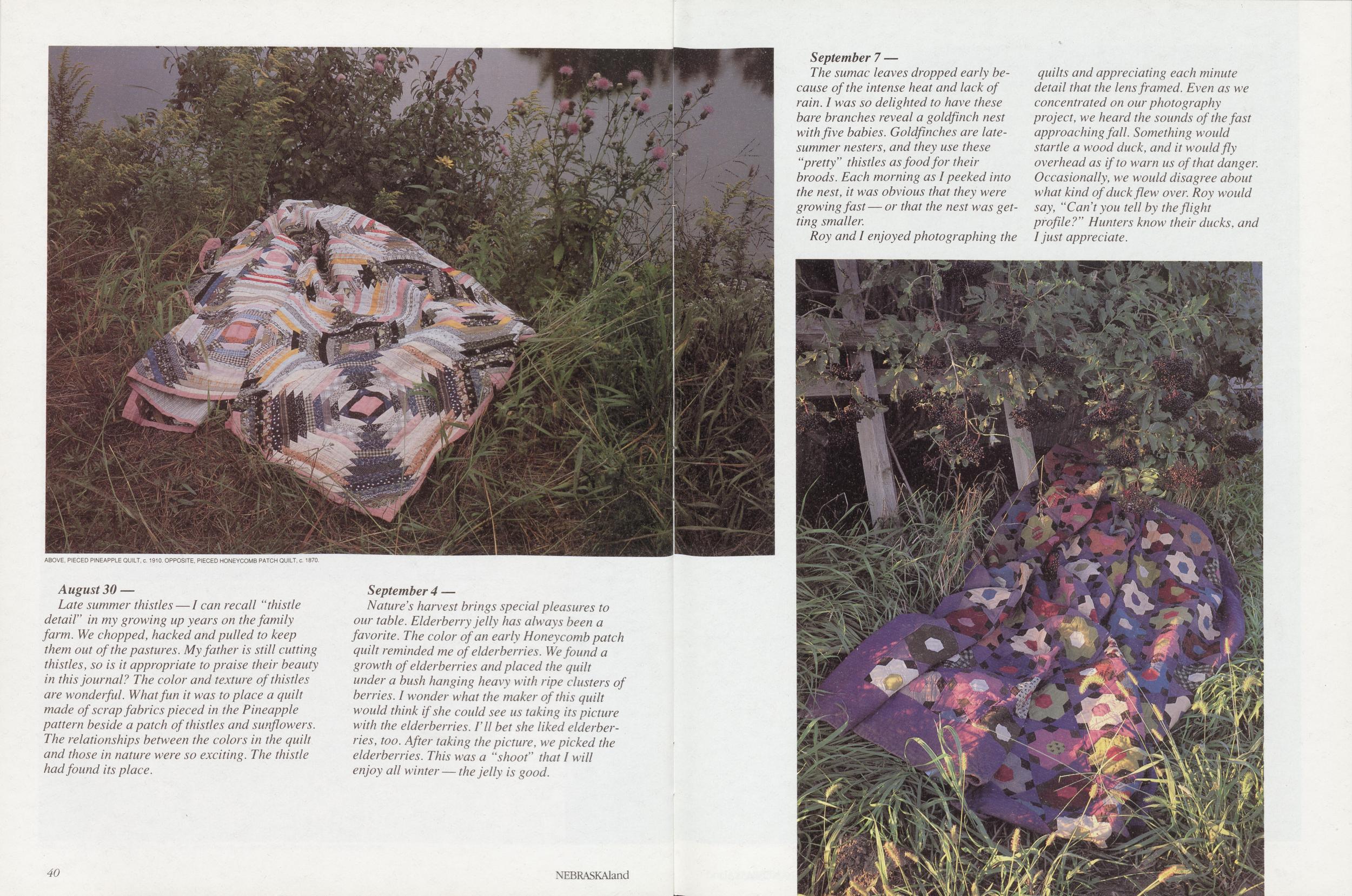
Late summer thistles — I can recall "thistle detail" in my growing up years on the family farm. We chopped, hacked and pulled to keep them out of the pastures. My father is still cutting thistles, so is it appropriate to praise their beauty in this journal? The color and texture of thistles are wonderful. What fun it was to place a quilt made of scrap fabrics pieced in the Pineapple pattern beside a patch of thistles and sunflowers. The relationships between the colors in the quilt and those in nature were so exciting. The thistle had found its place.
September 4 —Nature s harvest brings special pleasures to our table. Elderberry jelly has always been a favorite. The color of an early Honeycomb patch quilt reminded me of elderberries. We found a growth of elderberries and placed the quilt under a bush hanging heavy with ripe clusters of berries. I wonder what the maker of this quilt would think if she could see us taking its picture with the elderberries. Til bet she liked elderberries, too. After taking the picture, we picked the elderberries. This was a "shoot" that I will enjoy all winter — the jelly is good.
40 NEBRASKAland September 7 —The sumac leaves dropped early because of the intense heat and lack of rain. I was so delighted to have these bare branches reveal a goldfinch nest with five babies. Goldfinches are late summer nesters, and they use these "pretty" thistles as food for their broods. Each morning as I peeked into the nest, it was obvious that they were growing fast — or that the nest was getting smaller.
Roy and I enjoyed photographing the quilts and appreciating each minute detail that the lens framed. Even as we concentrated on our photography project, we heard the sounds of the fast approaching fall. Something would startle a wood duck, and it would fly overhead as if to warn us of that danger. Occasionally, we would disagree about what kind of duck flew over. Roy would say, "Cant you tell by the flight profile?" Hunters know their ducks, and I just appreciate.
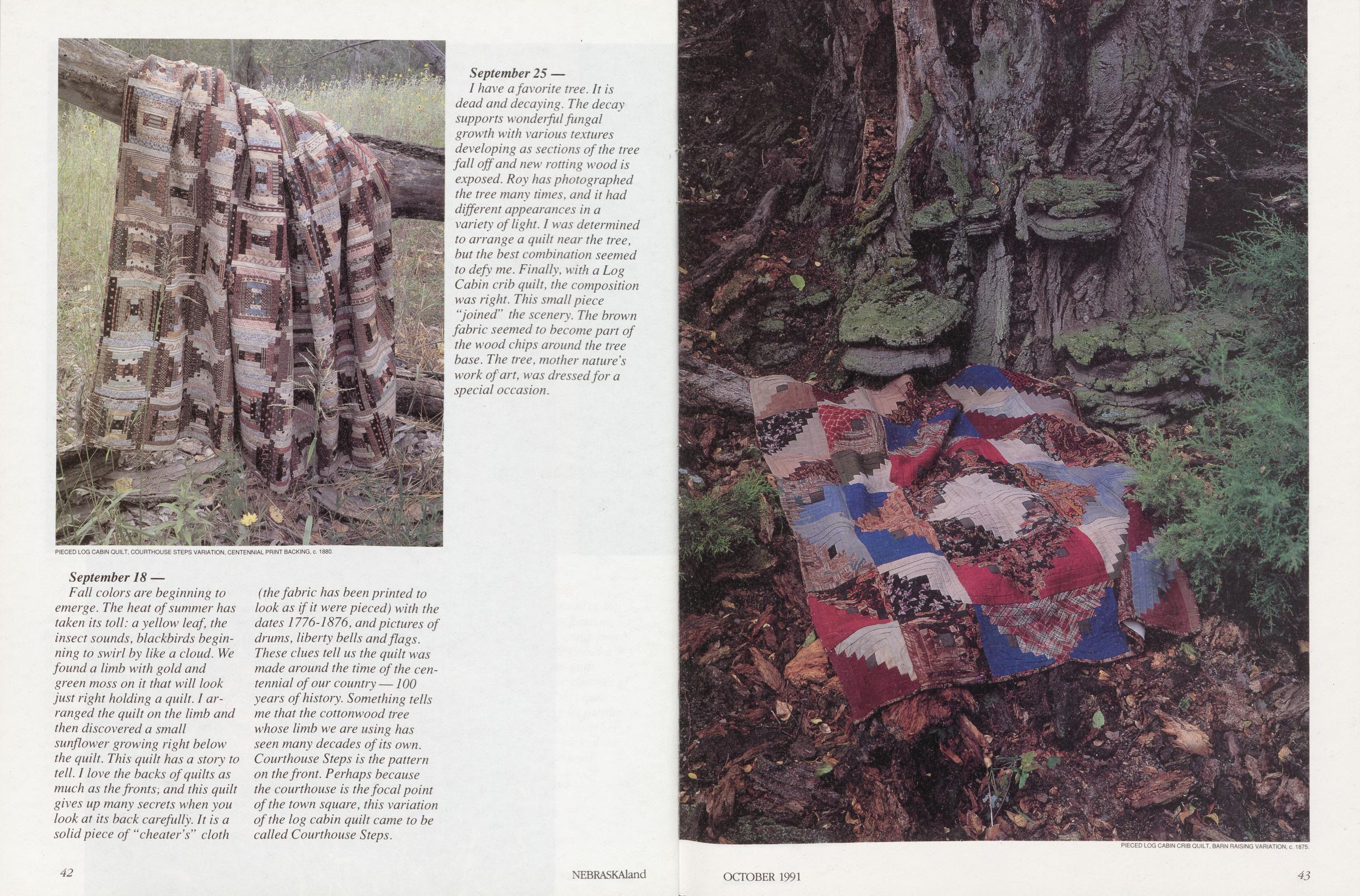
Fall colors are beginning to emerge. The heat of summer has taken its toll: a yellow leaf, the insect sounds, blackbirds beginning to swirl by like a cloud. We found a limb with gold and green moss on it that will look just right holding a quilt. I arranged the quilt on the limb and then discovered a small sunflower growing right below the quilt. This quilt has a story to tell. I love the backs of quilts as much as the fronts; and this quilt gives up many secrets when you look at its back carefully. It is a solid piece of "cheater's" cloth (the fabric has been printed to look as if it were pieced) with the dates 1776-1876, and pictures of drums, liberty bells and flags. These clues tell us the quilt was made around the time of the centennial of our country —100 years of history. Something tells me that the cottonwood tree whose limb we are using has seen many decades of its own. Courthouse Steps is the pattern on the front. Perhaps because the courthouse is the focal point of the town square, this variation of the log cabin quilt came to be called Courthouse Steps.
September 25 —I have a favorite tree. It is dead and decaying. The decay supports wonderful fungal growth with various textures developing as sections of the tree fall off and new rotting wood is exposed. Roy has photographed the tree many times, and it had different appearances in a variety of light. I was determined to arrange a quilt near the tree, but the best combination seemed to defy me. Finally, with a Log Cabin crib quilt, the composition was right. This small piece "joined" the scenery. The brown fabric seemed to become part of the wood chips around the tree base. The tree, mother nature's work of art, was dressed for a special occasion.
42 NEBRASKAland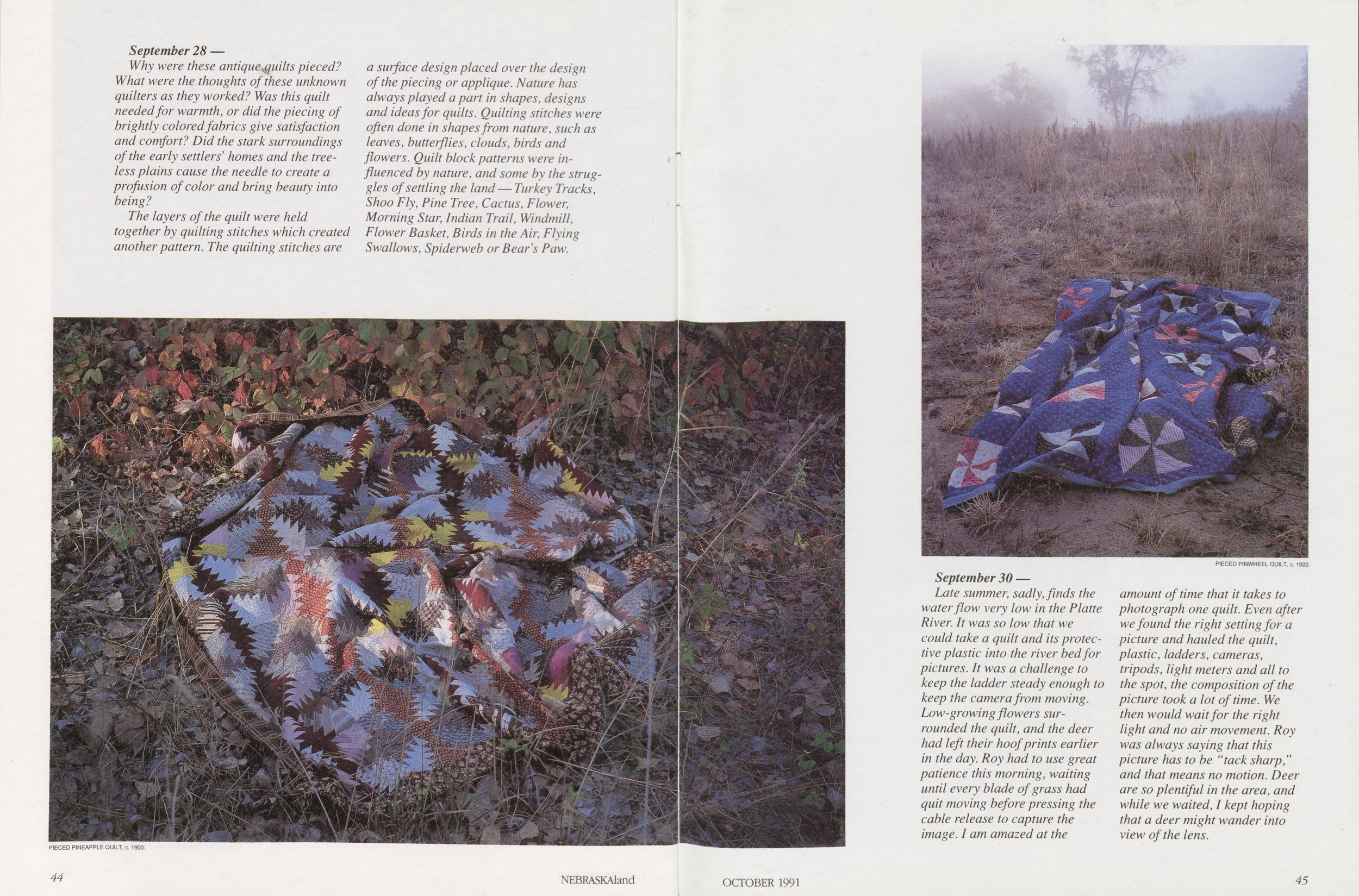 September 28 —
Why were these antique quilts pieced? What were the thoughts of these unknown quilters as they worked? Was this quilt needed for warmth, or did the piecing of brightly colored fabrics give satisfaction and comfort? Did the stark surroundings of the early settlers homes and the treeless plains cause the needle to create a profusion of color and bring beauty into being?
The layers of the quilt were held together by quilting stitches which created another pattern. The quilting stitches are a surface design placed over the design of the piecing or appliqués. Nature has always played a part in shapes, designs and ideas for quilts. Quilting stitches were often done in shapes from nature, such as leaves, butterflies, clouds, birds and flowers. Quilt block patterns were influenced by nature, and some by the struggles of settling the land — Turkey Tracks, Shoo Fly, Pine Tree, Cactus, Flower, Morning Star, Indian Trail, Windmill, Flower Basket, Birds in the Air, Flying Swallows, Spiderweb or Bear's Paw.
Late summer, sadly, finds the water flow very low in the Platte River. It was so low that we could take a quilt and its protective plastic into the river bed for pictures. It was a challenge to keep the ladder steady enough to keep the camera from moving. Low-growing flowers surrounded the quilt, and the deer had left their hoof prints earlier in the day. Roy had to use great patience this morning, waiting until every blade of grass had quit moving before pressing the cable release to capture the image. I am amazed at the amount of time that it takes to photograph one quilt. Even after we found the right setting for a picture and hauled the quilt, plastic, ladders, cameras, tripods, light meters and all to the spot, the composition of the picture took a lot of time. We then would wait for the right light and no air movement. Roy was always saying that this picture has to be "tack sharp," and that means no motion. Deer are so plentiful in the area, and while we waited, I kept hoping that a deer might wander into view of the lens.
OCTOBER 1991 45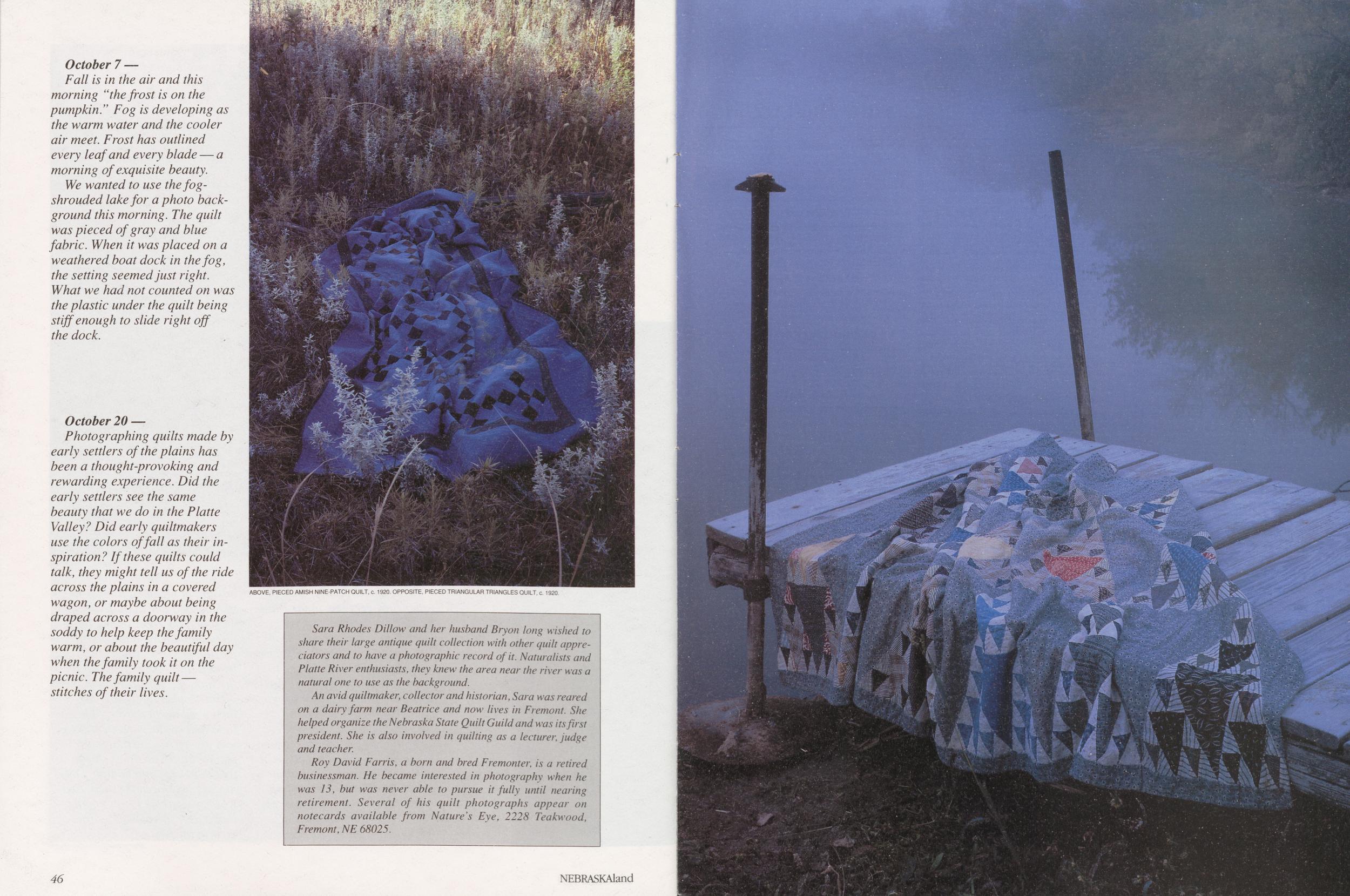 October 7 —
Fall is in the air and this morning "the frost is on the pumpkin" Fog is developing as the warm water and the cooler air meet. Frost has outlined every leaf and every blade — a morning of exquisite beauty.
We wanted to use the fog- shrouded lake for a photo background this morning. The quilt was pieced of gray and blue fabric. When it was placed on a weathered boat dock in the fog, the setting seemed just right. What we had not counted on was the plastic under the quilt being stiff enough to slide right off the dock.
October 20 —Photographing quilts made by early settlers of the plains has been a thought-provoking and rewarding experience. Did the early settlers see the same beauty that we do in the Platte Valley? Did early quilt makers use the colors of fall as their inspiration? If these quilts could talk, they might tell us of the ride across the plains in a covered wagon, or maybe about being draped across a doorway in the soddy to help keep the family warm, or about the beautiful day when the family took it on the picnic. The family quilt — stitches of their lives.
Sara Rhodes Dillow and her husband Bryon long wished to share their large antique quilt collection with other quilt appreciators and to have a photographic record of it. Naturalists and Platte River enthusiasts, they knew the area near the river was a natural one to use as the background.
An avid quilt maker, collector and historian, Sara was reared on a dairy farm near Beatrice and now lives in Fremont. She helped organize the Nebraska State Quilt Guild and was its first president. She is also involved in quilting as a lecturer, judge and teacher.
Roy David Farris, a born and bred Fremonter, is a retired businessman. He became interested in photography when he was 13, but was never able to pursue it fully until nearing retirement. Several of his quilt photographs appear on notecards available from Nature's Eye, 2228 Teakwood, Fremont, NE 68025.
46 NEBRASKAland
Classified
BIRDSMANDARIN DUCKS: nice full-wing birds, $35/pair; wood ducks $25/pair. Mrs. R. W. Hansen, 3315 Ave. L, Kearney, NE 68847. Phone (308) 237-3781.________
BOOKS/PRINTINGFREE! Booklets on northeastern Nevada; fishing, rock hounding maps, Carl Hayden, Box 528, Jackpot, Nevada 89825.______________________________________
FREE BOOK CATALOG. Novels, westerns, romances, children's; old out of print, found barns, attic. Authors: Grey, Bower, Connor, Fox, Curwood, Raine, Wright, Aldrige, Pollyanna, Freckles, many others. Postage appreciated. Pierce, 4400 N. Pine Cluster, Oroville, CA 95965.______________________________________
COMPLETE ROADSIDE GUIDE to Nebraska by Alan Boye is a mile-by-mile description of historical, geographical and folklore sites along all major highways. Over 10,000 miles are included in all 93 counties. The book includes museums, festivals, and those out-of-the-way unusual places for the resident and the tourist. $11.95 plus $1.50 postage. SALTILLO Press, 57 Lafayette, St. Johnsbury VT 05819.
COLLECTIBLESPRE-1930 NEBRASKA hunting/fishing licenses wanted. Send licenses or photocopies for my offer. David Torre, P.O. Box 4298, Santa Rosa, CA 95402.
WANTED: Nebraska stock certificates, letters, old checks, etc.—particularly pre-1900. A. A. Armstrong Jr. M.D., 211 West 39th, Scottsbluff, NE 69361.________
WANTED: Nebraska hunting licenses 1901 through 1919. $25-$ 1,000 each. Shooting Scripts and Trap Permits needed also. Phil Pfeiffer (402) 785-7500.
DOGSTRAINING ALL BREEDS bird dogs—Vizslas and English Pointers for sale. Rozanek Kennels, R 2, Schuyler, NE 68661. Phone (402) 352-8769.________
PINKERTON bird dogs—English setter, English pointer puppies. Started dogs available this fall. Our dogs are bred for nose and style. Give us a call at (402) 673-4540.
AKC GERMAN SHORTHAIR pointers and brittany spaniels. Pups, started and trained dogs. Birdland Kennels, Hunter Ingwerson, Nehawka, NE 68413,402-227- 4655. Wayne Clark, 712-529-4238 also will be doing some training.
YELLOW-BLACK Lab pups. FC-AFC sired. AKC. Hips OFA certified. Dew claws removed. Excellent hunting potential. Contact Bob Bendler, Lexington, NE, (308) 324-4247.______________________________
CHESAPEAKE BAY OR BLACK LABRADOR pup- pies and started dogs. Available year-round. NAFC pedigree available. Training and stud service. Call PLATTE VALLEY RETRIEVERS, (308) 995-2318.
GUN DOG TRAINING. All sporting breeds. All dogs worked on game birds. Over 25 years experience. Henry Sader, Wilderness Kennels, Roca, NE (402) 423-4212.
ENGLISH SETTERS AND BRITTANIES: young dogs at different stages of development. Partially trained and experienced bird dogs. Darrell Yentes, Holdrege, NE (308)995-4797.______________________________
GERMAN SHORTHAIR POINTERS/ENGLISH POINTERS—pups, started dogs, stud service. Training available for pointing and retrieving dogs. Wayne Clark (712) 529-4238. Close to Omaha. Leave message.
TRAINED DOGS FOR SALE—German Shorthairs, 4- year-old female, two-year-old male, 1 '/2-year-old male, one-year-old female. Brittany Spaniels, 5-year-old female, 2-year-old male. English Pointers, two-year-old male, 2-year-old female, puppies whelped July 7th, litter due September. Chesapeake Bay Retriever puppies whelped early July. Wayne Clark (712) 529-4238.
AKC BLACK LABRADOR puppies. Health guaranteed. Excellent breeding for hunting and Field Trials. Litter due September 19. Contact Ron Green, North Platte, NE (308) 534-7582. ______________
DEUTSCH DRAHTHAARS: puppies out of line-breed litters available, parents are proven hunters. Bred by strict VDD standards in a German registered kennel. Versatile hunting DRAHTHAARS for furred and feathered game. Wildflugel Kennel, RR 2 Box 24A Ravenna, NE 68869. (308) 452-4333.
FISH/FISHINGFISH FOR SALE. Catfish, perch, coho salmon, rainbow trout, crappie, bluegill, walleye, minnows, goldfish, bullhead, largemouth bass, smallmouth bass, triploid grass carp. Commercial grower prices on catfish, perch, coho salmon, rainbow trout. Consulting available. Pleasant Valley Fish Farm, Rt 1 Box 147, McCook, NE 69001. Phone (308) 345-6599._________
DEE'S CONTOUR MAPS-High quality, waterproof, tearproof, 25x35 inches. Most Nebraska and Kansas reservoirs, some Colorado. $4.95 each. Write or call Dee's Maps, P.O. Box 702, Broken Bow, NE 68822- 0702; phone (308) 872-6539. _________________
WILLOW LAKE FISH HATCHERY. Channel cat, blue- gill, hybrid bluegill, largemouth bass, crappie, bullheads, triploid grass carp, walleye, perch, minnows available for stocking. Gaylord Crawford, Rt. 3 Box 46, Hastings, NE 68901 or phone (402) 463-8022 day or night. Also pond consultant.
FOODDEER PROCESSING: Jerky, summer sausage and more! Seward Locker, 715 Main St., Seward, NE 68434 (402) 643-3849. Same location since 1946.
GUIDES/OUTFITTERSMAD RIVER CANOES offers the finest quality and performance. For the finest canoes and accessories look to Great Plains Canoe Co., 205 Main, Springfield, NE. Phone(402)253-2001.
YES! I WOULD LIKE TO SUBSCRIBE TO NEBRASKAland U 1-Year $12 ? 2-Years $23 Name Address. City___ State Zip Mail check or money order to NEBRASKAland, Box30370, Lincoln, NE 68503WILDERNESS ADVENTURES—alpine backpacking expeditions in the high country of Colorado and Wyoming. Personal instruction in wilderness skills, fly fishing and mountaineering. Family and private trips available. For brochure contact Jim at Wilderness Adventures, 2725 N. 65th Ave., Omaha, NE 68104. Phone (402) 556-3741.___________________________________
GUNS/SHOOTINGGUNS — Browning, Winchester. Remington, others, Hi-powers; shotguns, new, used, antiques. Want Pre-'64 Winchesters. Buy-Sell-Trade. (402) 729-6112. Bedlan's Sporting Goods, Fairbury, NE 68352.
HEALTH/FITNESSGUARANTEE: REDUCE CHOLESTEROL, lose fat; for information send $3.50 to Adel Ententes P O Box 30047, Lincoln, NE 68503-0047.
OUTDOOR EQUIPMENTNEED A CANVAS product made? Fax your detailed drawing and phone number. I'll call back with estimate. Ogallala Canvas (308) 284-2054.
REAL ESTATEGREAT POTENTIAL-90 acres of rolling grassland overlooking Summit Lake State Recreation Area. Lots of possibilities. No zoning in Burt County. Phone (402) 374-2732, Tekamah, NE.___________
HUNTING/FISHING PROPERTIES-458 acres of farmland, pasture, trees, and fishing ponds in Cuming County. 266 acres of farm and pasture—50 acres heavily wooded in Johnson County. For information on these and other properties, contact AgLand Realty & Auction 800-869-0421._________________
TAXIDERMYALLISON'S TAXIDERMY STUDIO & GIFT GALLERY. Wally and Betty Allison Licensed Taxidermist. We've mounted 32 Nebraska State Record fish. Specializing in fish, birds and small game. We use freeze-dry. 421 North Dewey, North Platte, NE 69101 (308) 534-2324 or (308) 534-4267 home.__________
PEISTER TAXIDERMY—Award winning taxidermy and fish carvings. 1020 Central Avenue, Box 3201 Kearney, NE 68847. Phone (308) 236-9700 or (308) 237-7575 evening.
VACATION/RESORTSNE NEBRASKA trout fishing. 3 modern cottages, 1 available year round. 5 spring fed lakes with open water all year. Trout up to 7 pounds. Other varieties fish also. Diamond E. Trout Resort, Orchard, NE 69764. Phone (402) 893-4745.______________________________
NATIONAL PARK VACATIONS. 6 days and 5 nights start at $238 or 3 days and 2 nights for $99. Enchanting cottages in Ozark tranquility. Canoe the Jacks Fork and Current rivers, hike, auto tour or horseback ride. Eminence Canoes, Cottages and Campgrounds. Phone (314)226-3642.______________________________
PHEASANT HUNTERS start planning your get-away. Hotel Wilber, eleven bed and breakfast rooms. Restaurant, lounge, beer garden. Hunter's packages available. Bring your kennel or rent one. First class hospitality. Live entertainment. The only thing you won't want to do is leave. Call now for your reservations (402) 821 -2020.
Classified ad rates: 75^ per word, minimum $15. Closing date is the first business day 2 months preceding date of issue. To place ads or for more information write NEBRASKAland Magazine, P.O. Box 30370, Lincoln, NE 68503, or call (402) 471-5478.
48 NBEBRASKAlandPage forty-nine
Grandma, You Should Be Ashamed!When I was kid, I liked to stay all night with my grandparents — especially my dad's folks, because they went fishing every Saturday when the weather was nice, and I got to go along. But as much as I enjoyed the fishing, that was only part of the reason I liked to stay with them.
A visit to Grandma's house was an adventure in home cooking. When I walked into her house, and the first delicious aromas swirled from the kitchen, my salivary glands kicked into high gear, and I was instantly ready to eat.
At a very early age I learned one of life's hardest lessons: the best tasting foods take the longest to prepare. There were no microwaves or frozen dinners in the 1940s; those were the days when food was prepared from scratch and cooked on the stove or in the oven, and it took time. Waiting and waiting in the midst of delicate aromas was a subtle kind of torture for an always-hungry, fast-growing boy, but the results were well worth the wait. Food cooked slowly had one thing that many of today's microwave or flash-zap dishes don't: flavor.
I loved to watch Grandma cook, and if I hung around in the kitchen, she gave me tastes — it was kind of like me throwing little bits and pieces to our dog when I'm preparing a meal. That's where I learned that her cookies tasted darned near as good before they were baked as after, and that most vegetables have a lot more flavor raw than cooked.
It was fascinating to watch her pour some of this, a little of that and a whole heap of something else into a bowl and turn it into something special before it got to the table. It was magic, a special kind of magic passed down from generation to generation.
But the scientific reports I've read lately [see "Eating Game," page 14] have made me take a second look at how that food was prepared, and all I can say is, "Grandma, you should be ashamed!"
When I think about the dietary crimes Grandma committed in her kitchen, I wonder how so many people lasted so long. Take breakfast for example: The first meal of the day at Grandma's usually began with a skillet of fat, salty bacon, sizzling on the stove. Then hashbrowns were fried in the bacon grease, and when the "browns" were done, she'd fry eggs in the same grease. There was freshly baked bread, usually made with white flour, and a deep bowl of real butter. Because they had a cow, the kids drank fresh, whole milk, and grandpa put whole cream in his non-decaffeinated coffee. Incidentally, the coffee pot was always steaming on the stove, and friends and relatives consumed caffeine all day long.
One of my favorite breakfasts was thick slices of fat ham fried in bacon grease and served with bread and eggs. Grandma would cut out a circle from the center of a piece of bread with the rim of a glass, put those slices into the hot bacon grease, then crack an egg and let it fry in the hole. That way the bread fried crisp, absorbed the good-tasting bacon grease and was served right along with the fried egg. Delicious!
Lunch was usually some kind of a sandwich made with fresh bread and meat left over from the night before. Sometimes there was soup, wonderful chicken soup with lots of noodles and vegetables, or potato soup made with big chunks of potato and celery, whole milk and butter. There was always a plate of cookies, and usually when I was there, homemade ice cream for dessert.
Suppers were best of all. One of my favorites was crispy fried chicken with the skin left on, double-dipped in a batter of egg and milk, then dusted in flour and fried in bacon grease or lard. There were always potatoes, usually fried, but sometimes mashed and served with thick gravy or huge pats of fresh butter. Vegetables were always on the table, and more times than not, butter was melted on them "to add a little flavor."
Grandma was the world's uncrowned Queen of Fruit Pies, and a piece of pie was served after every evening meal, usually topped with a scoop of homemade ice cream. In the evening we'd have heaping bowls of salted popcorn bathed in melted butter.
I could go on and tell you about fried fish, beef and pork roasts, pork chops, barbecued ribs, homemade hot dogs and sausages, dumplings, rolls and doughnuts; and how I always chose the steak with the most fat around the edges because it tasted best, but in view of what I know today, we shouldn't even be thinking about that kind of food.
Recently, I compared what I eat and how I live with what I did 10 years ago. I've quit smoking, I don't drink alcohol anymore, I use a salt substitute, I eat very few sweets, little cheese or other dairy products and no eggs, and I've cut way back on red meats. I watch my calorie, cholesterol and fat intake. I walk, ride the exercise bike and lift weights.
Grandpa never worried about those things. But he didn't sit behind a desk every day and in front of a television every night. He worked outside during the day and in the evenings, after a big meal, he worked in his garden or in his shop. He used a push lawn mower (for people born after 1960, that's one without a motor), and chopped wood for the fireplace. He shoveled snow instead of using a snow blower.
Maybe I owe Grandma an apology. She raised her kids and kept her family healthy for many years with her delicious home cooking and traditional values. Maybe we have changed and are having to pay for it. Our lives are less strenuous, but more hectic. Most of us remember v/hat hard physical work was, but haven't seen any lately. Instead of working off our meals and our frustrations, we sit back and get fat and get ulcers. Somebody said, "it's not what you eat, but what eats you that makes you sick."
Sorry Grandma, I shouldn't have blamed you. Times have changed since you were here, and we've changed with them. Now that I think about it, instead of eating diet food and watching football on the tube this weekend, I'd lots rather be able to turn back the clock to the time when I could spend the weekend at your house, help Grandpa with the chores and enjoy your great home cooking.
Tom Keith OCTOBER 1991 49
Mixed Bag
Practice What You PreachSunday October 8, 1989, the second day of the 1989 duck season. It was going to be "bluebird" weather, but since I was unable to go duck hunting on opening day, it would have to do.
My usual duck hunting partner was unable to hunt that morning, so I decided to take one of my golden retrievers, Lazer, and head north of Stanton to Maskenthine Lake for some local ducks. As I was preparing to leave my home in Norfolk, I left my wife Pat a note telling her where I was going, and that I would be home by noon.
When I arrived at Maskenthine, a flood control impoundment, it was still dark, but with the help of my flashlight I could see that the lake was extremely low, and in some spots the bare shoreline between the vegetation and the water was 20 yards wide. Lazer and I left the decoys in the truck and headed to the tail end of the lake to find the right spot to sit and wait.
The area we located had tall standing vegetation and an open shore of almost 20 yards to the water. We crouched down and waited. As legal shooting time approached the teal began to move. At last, the alarm on my watch sounded, and it was legal shooting time.
As I scanned the horizon, a small flock of teal came into view. I crouched and began to call. They responded and swung toward us. As I continued to call, they came closer and closer, and finally they were in range. I jumped up, and two shots later, two green-winged teal lay on the shore, one five yards from the blind, the other 15 yards out. I set my unloaded gun down to retrieve the ducks, and suddenly a single, low-flying teal came into view. I crouched down again and started to call, and the single responded. I jumped up and shot, and the greenwing splashed at the water's edge. I looked at my watch. It was fifteen minutes into legal shooting time and I was three for three — my limit for the day. What a great way to start the season!
I unloaded my gun and set it down, preparing to retrieve my ducks. I sent Lazer for the duck at the water's edge, while I went to pick up the two on shore. As I picked up the first one, I noticed that Lazer was having trouble with the moss around his duck, so I called him back. I was five feet from the second duck when the surface began to get muddy. At first it was about ankle deep; the next step it was knee deep. Then I found myself about five yards from the water, waist deep in mud and still sinking.
I commanded Lazer to stay by the blind, and slowly began to turn myself back around. Forty-five minutes later, I was again facing the shore, but I was still sinking. I started blowing my dog training whistle, three long blasts at a time, praying that someone would hear. My mind flashed to my wife and family, then to the note on the table. I had said 12 noon. Had I ever been late? How long would Pat wait before calling someone for help, or driving out here alone? Did she even know where Maskenthine was? What would she find when she got here? No, I was not ready to die. I wouldn't let myself die. Think! Take control! Say a prayer.
Suddenly, I saw a silver pickup enter the recreation area and drive slowly toward the dam. I waved my arms, but to no avail. Of course, I was dressed in full camouflage, and now in mud up almost over my chest waders. Then a second silver pickup entered the recreation area following the path of the first. Was my mind going, or were there two silver pickups, just like the ones the Nebraska conservation officers drive?
As I continued to blow the dog whistle, I thought of the many Hunter Safety classes I had taught, and the many times I had told the students, "Never go hunting alone." Why couldn't I have practiced what I had preached? Had I ever read about mud pits? Quicksand yes, but this was mud. I am 6 feet 6 inches tall and weigh 220 pounds, and I was in mud more than five feet deep. Would a child be swallowed up by this, or would weight make the difference? Every future Hunter Safety class would be warned, if I got the chance to warn them.
The silver pickups appeared again, and this time they heard me and saw me in the mud. Officers Bob Downing and Raymond Still came to the rescue, and I was saved! Officer Still had a rope in his truck, and he carried it down to the lake. When they got there, Downing and Still looked at me, and neither could believe what had happened. I was in mud up to my armpits, and yet I was five yards from the water. They couldn't reach me safely, so they threw me the rope, and I tied it around myself. They both pulled, and I slowly slid back to the vegetation. My legs hurt so badly I could hardly stand, and when Officer Still lifted my chest waders, he estimated they weighed more than 100 pounds. As the three of us and Lazer walked up the hill, we reflected on the incident. Apparently I had stepped into silt which had become, in effect, "quickmud."
Why had both officers been checking the same lake at the same time? Each had heard the sheriff of Stanton County get a radio call, and each knew that the sheriff usually checked Maskenthine on Sun- days, so, without the other's knowledge, each decided to check the lake himself. I think it was an answer to my prayers.
Officers Downing and Still had just saved my life, yet to them it was all in a day's work. But my life was changed forever. Now, I never go hunting alone, and I smile and thank God every time I see a conservation officer.
Rick Crosier Hunter Safety Instructor Norfolk, NE 50 NEBRASKAland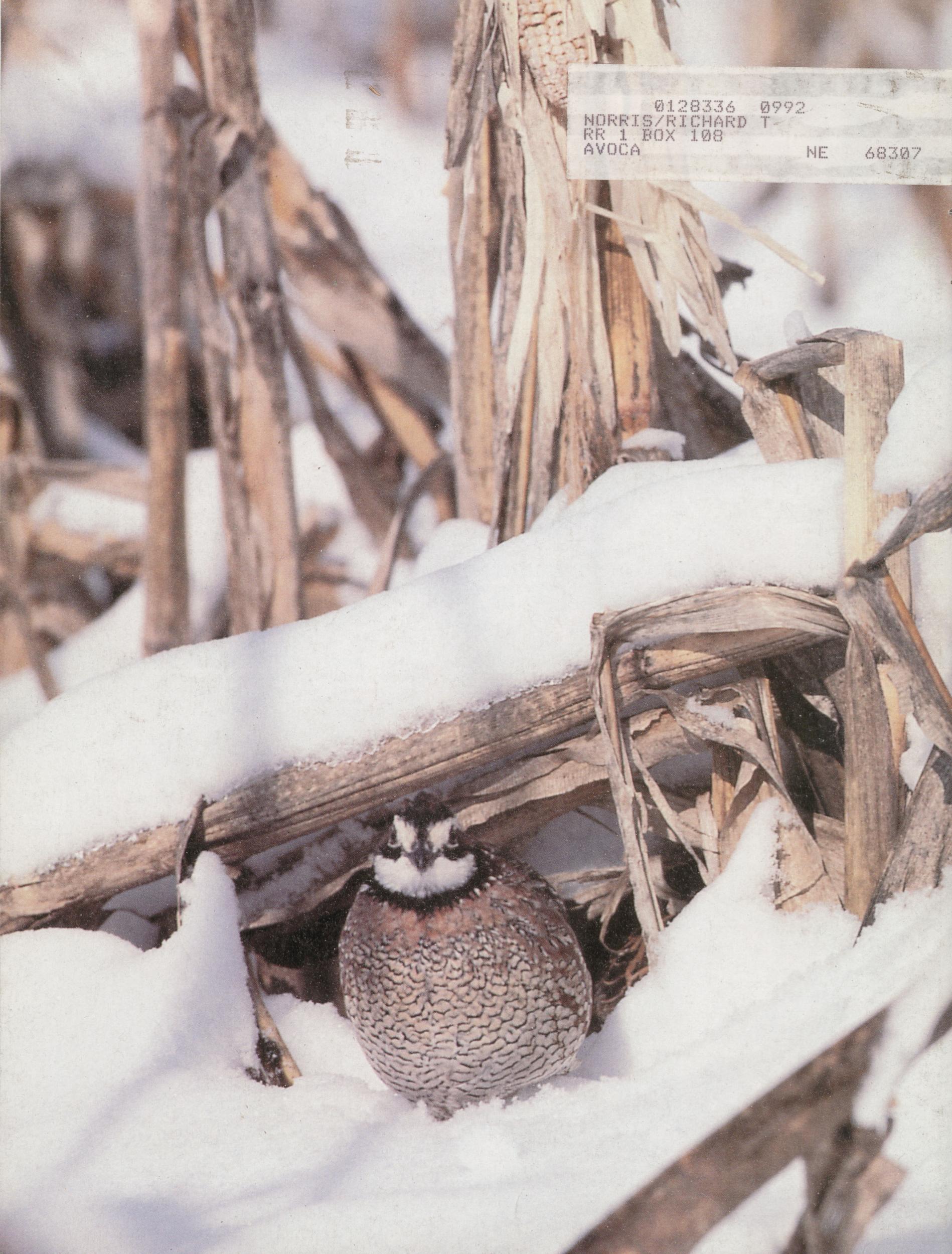
Position: 123 (49 views)