Volume 69, Issue 7, 1991
NEBRASKAland
AUGUST/SEPTEMBER 1991 $1.50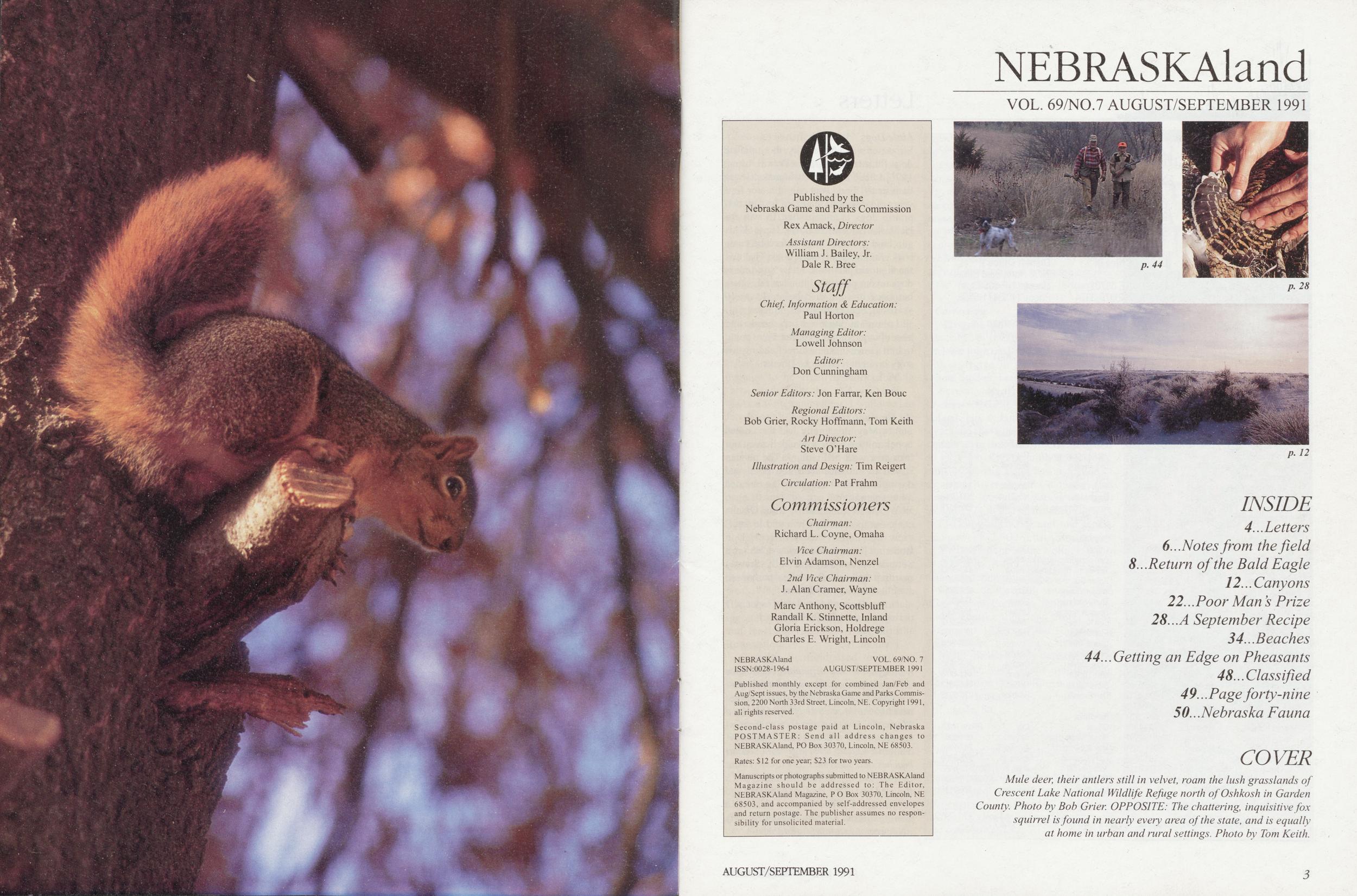
NEBRASKAland
VOL. 69/NO.7 AUGUST/SEPTEMBER 1991p.44
p.28
p.12
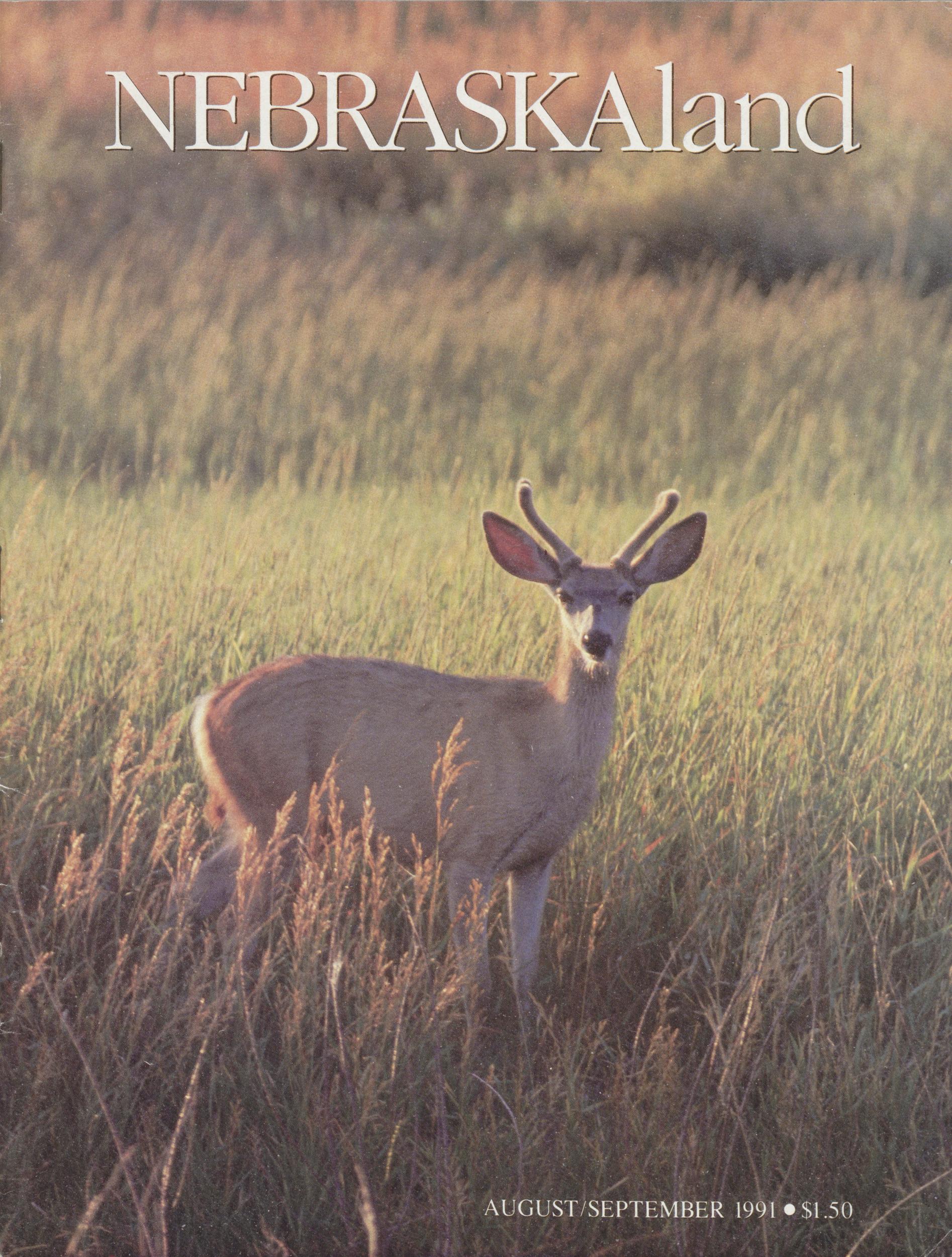
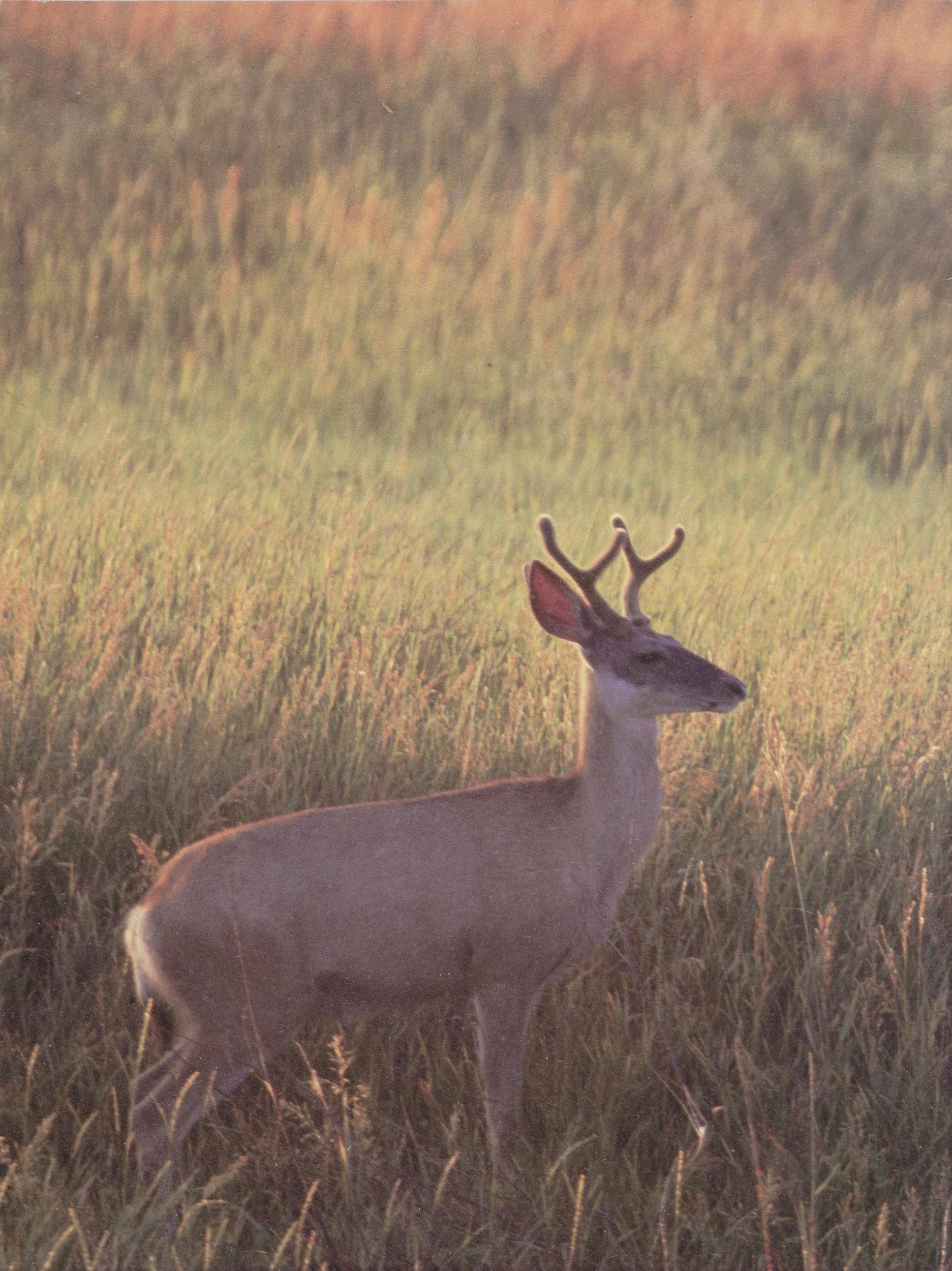
Mule deer, their antlers still in velvet, roam the lush grasslands of Crescent Lake National Wildlife Refuge north of Oshkosh in Garden County. Photo by Bob Grier. OPPOSITE: The chattering, inquisitive fox squirrel is found in nearly every area of the state, and is equally at home in urban and rural settings. Photo by Tom Keith.
Letters
Little DogsSir/ After reading the story about prairie dogs ["Little Dogs of the Prairie," June 1991] I have a comment to make. I was bom in 1917 and was only three or four years old when my dad said he saw two prairie dogs in our pasture in western Nebraska (Morrill County). He took his gun, and it wasn't long before he came back with two dead prairie dogs. That was the first and last time I saw any prairie dogs on our property. I think of this often, but since my dad died before I was 10 years old, I never got to ask him about it.
I saw many dog towns in Nebraska and have always wondered if they were going to start a town in our pasture. Reading this story brought it all back. Thanks.
Violet Wardein Sun City, AZ An Unusual VisitorSir/ In May, my family had the unique opportunity to see a brown pelican at our lake area west of Fremont. The pelican stayed in our area for three days, and during that short stopover, he created quite a sensation.
WOW-TV (channel 6) from Omaha came out to videotape him and to interview our conservation officer, Dan Roberts. The interview was done on a Saturday afternoon, and early Sunday morning the bird left our area, perhaps to start his long journey home.
He was beautiful to watch, especially diving into the lake for his dinner.
Erik Palle Fremont, NEAlthough the white pelican (Pelecanus erythrorhynchos), the subject of Professor Paul Johnsgards "Nebraska Fauna " notes in the May 1991 NEBRASKAland Magazine, is commonly seen in Nebraska, the brown pelican (Pelecanus occidentalism usually associated with coastal beaches and shorelines, is extremely rare in this state. Professor Johnsgards Revised List of the Birds of Nebraska and Adjacent Plains States (Nebraska Ornithologists' Union, 1980) lists only nine previous sightings. (Editor)
A (mostly) Satisfied ReaderSir/ From the Cherry County horses on the cover to the orange spotted sunfish on page 35, the May issue of NEBRASKAland was a joy to read. I am grateful to "Uncle Red" Scofield of Lincoln for giving me a gift subscription.
As usual, your articles were well researched and well written, and the wildlife photography was superb. You probably get a lot of letters praising these things, but what inspired this Arizonan to spend 29 cents on a stamp was your artistic typography. From the ragged left table of contents to the centered heads, the black overhead lines to the photo bleeds, the readable typefaces to the neat, understated artwork, you feasted my eyes. You manage to be creative without being "arty-trendy." Thanks.
As a writer and editor, I wallowed in Jon Farrar's marsh along with all the birds. No tricks, no pretentious vignettes, just an enviable blend of literary and journalistic styles. But, lest my comments should bring on an attack of "hyperbole," Jon, I found two typos: "commorants" on page 10, and "by tree farms" on page 49.
My grandparents, Ernest and Addie Scofield, were early day Nebraska newspeople. The Neligh News was Scofield owned-and-operated for about 50 years. My Uncle Red was secretary for the Nebraska Press Association for many years. What am I doing in Arizona? Well, I've lived here for 40 years. Been ranching and raising a family, newspapering and teaching English on the Apache Reservation.
Grandpa Scofield used to tell me stories about the elusive sidehill gonger that roamed the outback. That's one critter you haven't featured yet.
Seeing your magazine, I am beginning to understand what it was about the Nebraska prairie that turned out, and continues to turn out, such gifted writers and artists.
Jo Baeza Pinetop, AZOur grateful thanks for the praise, and our humble apology for the errors, the blame for which lies with the editor, not the writer in whose work they appeared. Unfortunately, we have neglected the wily sidehill gonger; sightings have been extremely infrequent, and if you would interview Uncle Red —for anecdotal information at least — you might add to our meager store of knowledge. In the meantime, see "Sandcat Safari" [NEBRASKAland, August 1984] for the story of an expedition to capture another of the state s rarest animals. (Editor)
A CorrectionSir/ Over the last couple of years, I have subscribed to your magazine. As a recent graduate from the University of Nebraska with a degree in Geography/Environ- mental Studies, I enjoy it very much.
Several years ago I purchased Nebraska Rivers [NEBRASKAland Magazine Vol. 61, No. 1, Jan-Feb 1983], and for some time I have been itching to point out a minor error in it. The structure pictured on page 89 is not a mill house, but the ruins of the Big Bend Power Station of the Blue River Power Company. This automatic "peaking" station was built around 1924. It had an installed capacity of 150 kilowatts in one unit, and generated power at 2,400 volts. Transformers on the roof stepped the voltage up to 24,000 volts. A fire in 1954 gutted the plant, rendering it useless.
Owners of the plant were the Blue River Power Company until 1925, the Iowa-Nebraska Light and Power Company until 1939 and the Consumer's Public Power District (now NPPD).
A mill, the West Mills, did exist nearby at one time, however the mill building was located on the opposite (north) bank.
David Budka Lincoln, NESend your comments, suggestions and complaints to Letters, P.O. Box 30370, Lincoln, NE 68503. Each month, as many letters as space permits will be printed. Photographs are also welcome. NEBRASKAland reserves the right to edit and condense letters.
"SEE YOU IN THE WOODS"
...let's hope so. Nebraska Game and Parks Commission Nebraska Hunter Education (402) 471-5434 4 NEBRASKAland AUGUST/SEPTEMBER 1991 5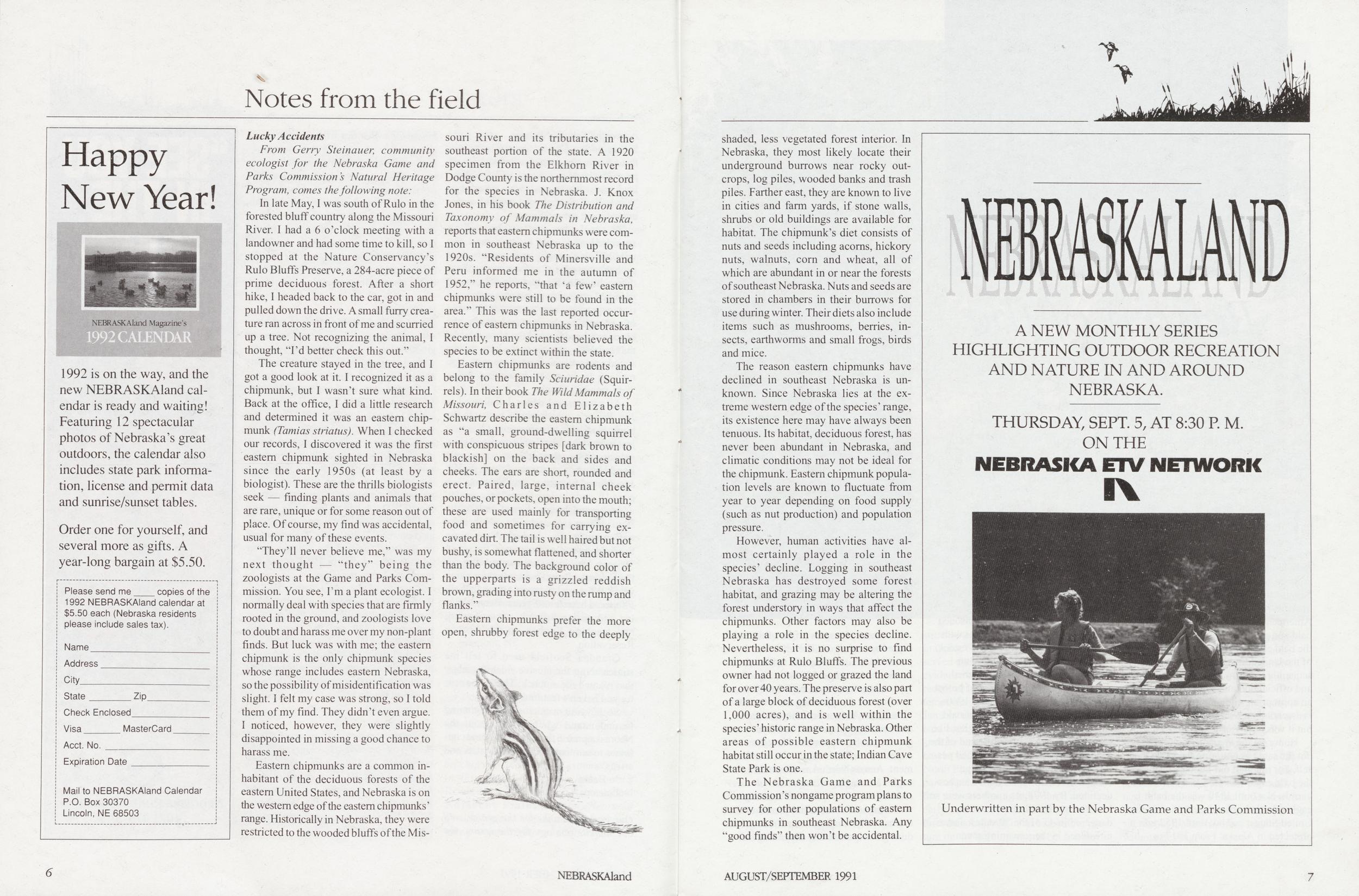
Happy New Year!
NEBRASKAland' Magazine's 1992 CALENDAR 1992 is on the way, and the new NEBRASKAland calendar is ready and waiting! Featuring 12 spectacular photos of Nebraska's great outdoors, the calendar also includes state park information, license and permit data and sunrise/sunset tables. Order one for yourself, and several more as gifts. A year-long bargain at $5.50. Please send me__copies of the 1992 NEBRASKAland calendar at $5.50 each (Nebraska residents please include sales tax). Name Address City State Zip Check Enclosed Visa MasterCard Acct. No. Expiration Date Mail to NEBRASKAland Calendar P.O. Box 30370 Lincoln, NE 68503Notes from the field
Lucky AccidentsFrom Gerry Steinauer, community ecologist for the Nebraska Game and Parks Commission s Natural Heritage Program, comes the following note:
In late May, I was south of Rulo in the forested bluff country along the Missouri River. I had a 6 o'clock meeting with a landowner and had some time to kill, so I stopped at the Nature Conservancy's Rulo Bluffs Preserve, a 284-acre piece of prime deciduous forest. After a short hike, I headed back to the car, got in and pulled down the drive. A small furry creature ran across in front of me and scurried up a tree. Not recognizing the animal, I thought, "I'd better check this out."
The creature stayed in the tree, and I got a good look at it. I recognized it as a chipmunk, but I wasn't sure what kind. Back at the office, I did a little research and determined it was an eastern chipmunk (Tamias striatus). When I checked our records, I discovered it was the first eastern chipmunk sighted in Nebraska since the early 1950s (at least by a biologist). These are the thrills biologists seek — finding plants and animals that are rare, unique or for some reason out of place. Of course, my find was accidental, usual for many of these events.
"They'll never believe me," was my next thought — "they" being the zoologists at the Game and Parks Commission. You see, I'm a plant ecologist. I normally deal with species that are firmly rooted in the ground, and zoologists love to doubt and harass me over my non-plant finds. But luck was with me; the eastern chipmunk is the only chipmunk species whose range includes eastern Nebraska, so the possibility of misidentification was slight. I felt my case was strong, so I told them of my find. They didn't even argue. I noticed, however, they were slightly disappointed in missing a good chance to harass me.
Eastern chipmunks are a common inhabitant of the deciduous forests of the eastern United States, and Nebraska is on the western edge of the eastern chipmunks' range. Historically in Nebraska, they were restricted to the wooded bluffs of the Missouri River and its tributaries in the southeast portion of the state. A 1920 specimen from the Elkhorn River in Dodge County is the northernmost record for the species in Nebraska. J. Knox Jones, in his book The Distribution and Taxonomy of Mammals in Nebraska, reports that eastern chipmunks were common in southeast Nebraska up to the 1920s. "Residents of Minersville and Peru informed me in the autumn of 1952," he reports, "that 'a few' eastern chipmunks were still to be found in the area." This was the last reported occurrence of eastern chipmunks in Nebraska. Recently, many scientists believed the species to be extinct within the state.
Eastern chipmunks are rodents and belong to the family Sciuridae (Squirrels). In their book The Wild Mammals of Missouri, Charles and Elizabeth Schwartz describe the eastern chipmunk as "a small, ground-dwelling squirrel with conspicuous stripes [dark brown to blackish] on the back and sides and cheeks. The ears are short, rounded and erect. Paired, large, internal cheek pouches, or pockets, open into the mouth; these are used mainly for transporting food and sometimes for carrying excavated dirt. The tail is well haired but not bushy, is somewhat flattened, and shorter than the body. The background color of the upper parts is a grizzled reddish brown, grading into rusty on the rump and flanks."
Eastern chipmunks prefer the more open, shubby forest edge to the deeply shaded, less vegetated forest interior. In Nebraska, they most likely locate their underground burrows near rocky out-crops, log piles, wooded banks and trash piles. Farther east, they are known to live in cities and farm yards, if stone walls, shrubs or old buildings are available for habitat. The chipmunk's diet consists of nuts and seeds including acorns, hickory nuts, walnuts, corn and wheat, all of which are abundant in or near the forests of southeast Nebraska. Nuts and seeds are stored in chambers in their burrows for use during winter. Their diets also include items such as mushrooms, berries, in- sects, earthworms and small frogs, birds and mice.
The reason eastern chipmunks have declined in southeast Nebraska is unknown. Since Nebraska lies at the extreme western edge of the species' range, its existence here may have always been tenuous. Its habitat, deciduous forest, has never been abundant in Nebraska, and climatic conditions may not be ideal for the chipmunk. Eastern chipmunk population levels are known to fluctuate from year to year depending on food supply (such as nut production) and population pressure.
However, human activities have almost certainly played a role in the species' decline. Logging in southeast Nebraska has destroyed some forest habitat, and grazing may be altering the forest understory in ways that affect the chipmunks. Other factors may also be playing a role in the species decline. Nevertheless, it is no surprise to find chipmunks at Rulo Bluffs. The previous owner had not logged or grazed the land for over 40 years. The preserve is also part of a large block of deciduous forest (over 1,000 acres), and is well within the species' historic range in Nebraska. Other areas of possible eastern chipmunk habitat still occur in the state; Indian Cave State Park is one.
The Nebraska Game and Parks Commission's nongame program plans to survey for other populations of eastern chipmunks in southeast Nebraska. Any "good finds" then won't be accidental.
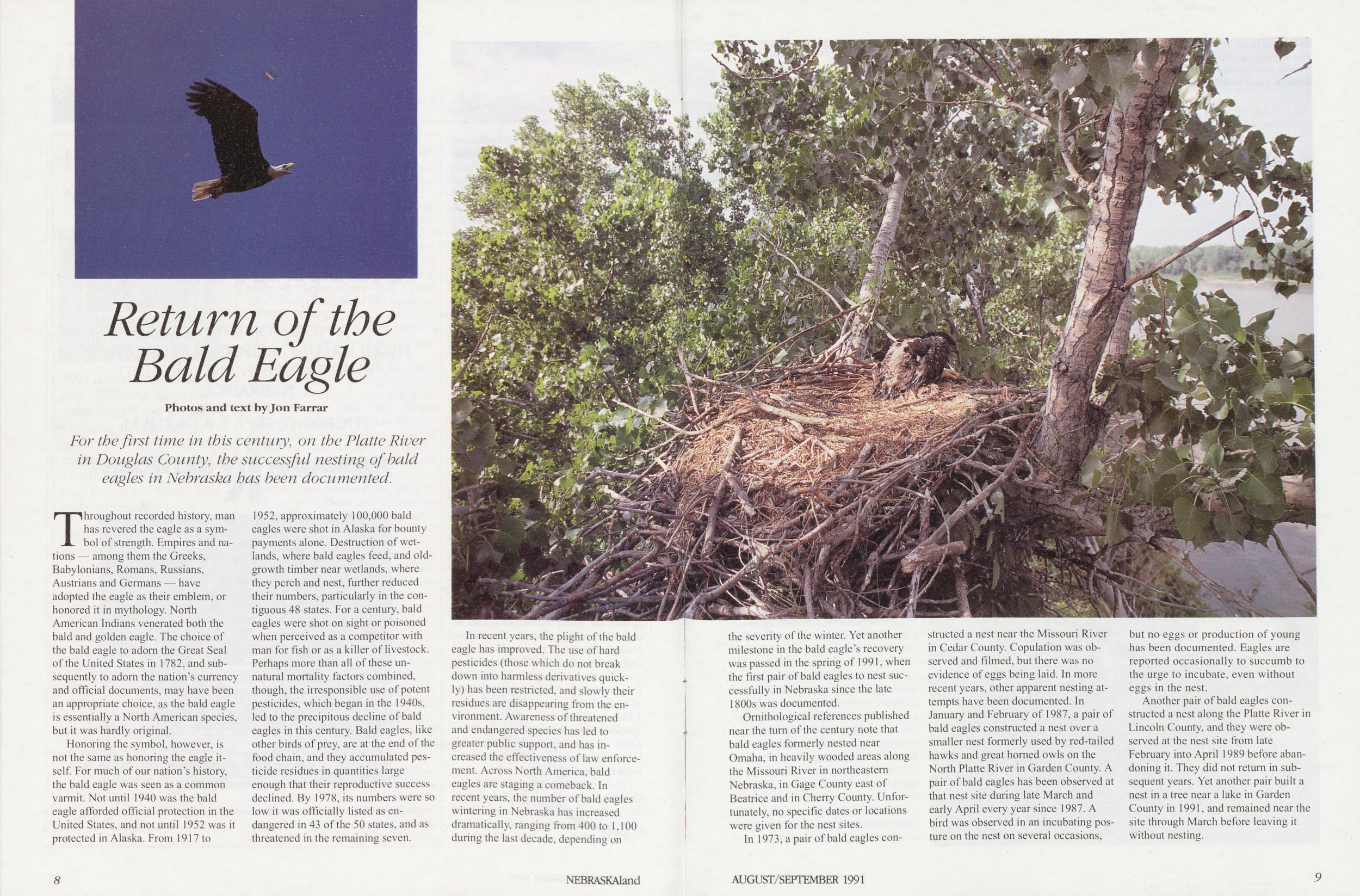
Return of the Bald Eagle
Photos and text by Jon Farrar For the first time in this century, on the Platte River in Douglas County, the successful nesting of bald eagles in Nebraska has been documented.Throughout recorded history, man has revered the eagle as a symbol of strength. Empires and nations — among them the Greeks, Babylonians, Romans, Russians, Austrians and Germans — have adopted the eagle as their emblem, or honored it in mythology. North American Indians venerated both the bald and golden eagle. The choice of the bald eagle to adorn the Great Seal of the United States in 1782, and subsequently to adorn the nation's currency and official documents, may have been an appropriate choice, as the bald eagle is essentially a North American species, but it was hardly original.
Honoring the symbol, however, is not the same as honoring the eagle itself. For much of our nation's history, the bald eagle was seen as a common varmint. Not until 1940 was the bald eagle afforded official protection in the United States, and not until 1952 was it protected in Alaska. From 1917 to 1952, approximately 100,000 bald eagles were shot in Alaska for bounty payments alone. Destruction of wetlands, where bald eagles feed, and old-growth timber near wetlands, where they perch and nest, further reduced their numbers, particularly in the contiguous 48 states. For a century, bald eagles were shot on sight or poisoned when perceived as a competitor with man for fish or as a killer of livestock. Perhaps more than all of these unnatural mortality factors combined, though, the irresponsible use of potent pesticides, which began in the 1940s, led to the precipitous decline of bald eagles in this century. Bald eagles, like other birds of prey, are at the end of the food chain, and they accumulated pesticide residues in quantities large enough that their reproductive success declined. By 1978, its numbers were so low it was officially listed as endangered in 43 of the 50 states, and as threatened in the remaining seven.
In recent years, the plight of the bald eagle has improved. The use of hard pesticides (those which do not break down into harmless derivatives quickly) has been restricted, and slowly their residues are disappearing from the environment. Awareness of threatened and endangered species has led to greater public support, and has increased the effectiveness of law enforcement. Across North America, bald eagles are staging a comeback. In recent years, the number of bald eagles wintering in Nebraska has increased dramatically, ranging from 400 to 1,100 during the last decade, depending on the severity of the winter. Yet another milestone in the bald eagle's recovery was passed in the spring of 1991, when the first pair of bald eagles to nest successfully in Nebraska since the late 1800s was documented.
Ornithological references published near the turn of the century note that bald eagles formerly nested near Omaha, in heavily wooded areas along the Missouri River in northeastern Nebraska, in Gage County east of Beatrice and in Cherry County. Unfortunately, no specific dates or locations were given for the nest sites.
In 1973, a pair of bald eagles constructed a nest near the Missouri River in Cedar County. Copulation was observed and filmed, but there was no evidence of eggs being laid. In more recent years, other apparent nesting attempts have been documented. In January and February of 1987, a pair of bald eagles constructed a nest over a smaller nest formerly used by red-tailed hawks and great horned owls on the North Platte River in Garden County. A pair of bald eagles has been observed at that nest site during late March and early April every year since 1987. A bird was observed in an incubating posture on the nest on several occasions, but no eggs or production of young has been documented. Eagles are reported occasionally to succumb to the urge to incubate, even without eggs in the nest.
Another pair of bald eagles constructed a nest along the Platte River in Lincoln County, and they were ob- served at the nest site from late February into April 1989 before abandoning it. They did not return in subsequent years. Yet another pair built a nest in a tree near a lake in Garden County in 1991, and remained near the site through March before leaving it without nesting.
8 NEBRASKAland AUGUST/SEPTEMBER 1991 9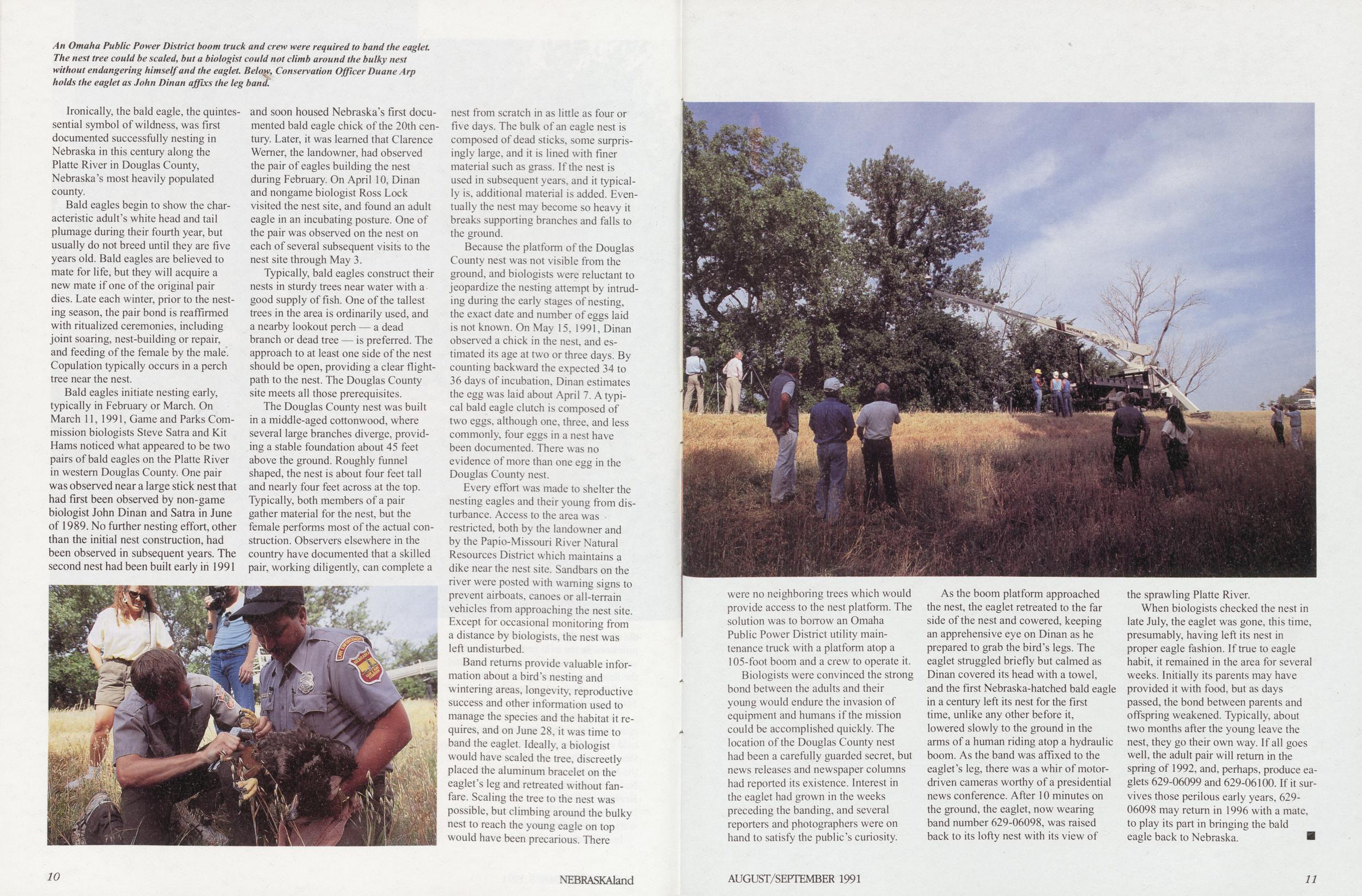
Ironically, the bald eagle, the quintessential symbol of wildness, was first documented successfully nesting in Nebraska in this century along the Platte River in Douglas County, Nebraska's most heavily populated county.
Bald eagles begin to show the char- acteristic adult's white head and tail plumage during their fourth year, but usually do not breed until they are five years old. Bald eagles are believed to mate for life, but they will acquire a new mate if one of the original pair dies. Late each winter, prior to the nesting season, the pair bond is reaffirmed with ritualized ceremonies, including joint soaring, nest-building or repair, and feeding of the female by the male. Copulation typically occurs in a perch tree near the nest.
Bald eagles initiate nesting early, typically in February or March. On March 11, 1991, Game and Parks Com- mission biologists Steve Satra and Kit Hams noticed what appeared to be two pairs of bald eagles on the Platte River in western Douglas County. One pair was observed near a large stick nest that had first been observed by non-game biologist John Dinan and Satra in June of 1989. No further nesting effort, other than the initial nest construction, had been observed in subsequent years. The second nest had been built early in 1991 and soon housed Nebraska's first documented bald eagle chick of the 20th century. Later, it was learned that Clarence Werner, the landowner, had observed the pair of eagles building the nest during February. On April 10, Dinan and nongame biologist Ross Lock visited the nest site, and found an adult eagle in an incubating posture. One of the pair was observed on the nest on each of several subsequent visits to the nest site through May 3.
Typically, bald eagles construct their nests in sturdy trees near water with a good supply offish. One of the tallest trees in the area is ordinarily used, and a nearby lookout perch — a dead branch or dead tree — is preferred. The approach to at least one side of the nest should be open, providing a clear flight path to the nest. The Douglas County site meets all those prerequisites.
The Douglas County nest was built in a middle-aged cottonwood, where several large branches diverge, providing a stable foundation about 45 feet above the ground. Roughly funnel shaped, the nest is about four feet tall and nearly four feet across at the top. Typically, both members of a pair gather material for the nest, but the female performs most of the actual construction. Observers elsewhere in the country have documented that a skilled pair, working diligently, can complete a nest from scratch in as little as four or five days. The bulk of an eagle nest is composed of dead sticks, some surprisingly large, and it is lined with finer material such as grass. If the nest is used in subsequent years, and it typically is, additional material is added. Eventually the nest may become so heavy it breaks supporting branches and falls to the ground.
Because the platform of the Douglas County nest was not visible from the ground, and biologists were reluctant to jeopardize the nesting attempt by intruding during the early stages of nesting, the exact date and number of eggs laid is not known. On May 15, 1991, Dinan observed a chick in the nest, and estimated its age at two or three day s. By counting backward the expected 34 to 36 days of incubation, Dinan estimates the egg was laid about April 7. A typical bald eagle clutch is composed of two eggs, although one, three, and less commonly, four eggs in a nest have been documented. There was no evidence of more than one egg in the Douglas County nest.
Every effort was made to shelter the nesting eagles and their young from disturbance. Access to the area was restricted, both by the landowner and by the Papio-Missouri River Natural Resources District which maintains a dike near the nest site. Sandbars on the river were posted with warning signs to prevent airboats, canoes or all-terrain vehicles from approaching the nest site. Except for occasional monitoring from a distance by biologists, the nest was left undisturbed.
Band returns provide valuable information about a bird's nesting and wintering areas, longevity, reproductive success and other information used to manage the species and the habitat it requires, and on June 28, it was time to band the eaglet. Ideally, a biologist would have scaled the tree, discreetly placed the aluminum bracelet on the eaglet's leg and retreated without fanfare. Scaling the tree to the nest was possible, but climbing around the bulky nest to reach the young eagle on top would have been precarious. There were no neighboring trees which would provide access to the nest platform. The solution was to borrow an Omaha Public Power District utility maintenance truck with a platform atop a 105-foot boom and a crew to operate it.
Biologists were convinced the strong bond between the adults and their young would endure the invasion of equipment and humans if the mission could be accomplished quickly. The location of the Douglas County nest had been a carefully guarded secret, but news releases and newspaper columns had reported its existence. Interest in the eaglet had grown in the weeks preceding the banding, and several reporters and photographers were on hand to satisfy the public's curiosity.
As the boom platform approached the nest, the eaglet retreated to the far side of the nest and cowered, keeping an apprehensive eye on Dinan as he prepared to grab the bird's legs. The eaglet struggled briefly but calmed as Dinan covered its head with a towel, and the first Nebraska-hatched bald eagle in a century left its nest for the first time, unlike any other before it, lowered slowly to the ground in the arms of a human riding atop a hydraulic boom. As the band was affixed to the eaglet's leg, there was a whir of motor-driven cameras worthy of a presidential news conference. After 10 minutes on the ground, the eaglet, now wearing band number 629-06098, was raised back to its lofty nest with its view of the sprawling Platte River.
When biologists checked the nest in late July, the eaglet was gone, this time, presumably, having left its nest in proper eagle fashion. If true to eagle habit, it remained in the area for several weeks. Initially its parents may have provided it with food, but as days passed, the bond between parents and offspring weakened. Typically, about two months after the young leave the nest, they go their own way. If all goes well, the adult pair will return in the spring of 1992, and, perhaps, produce eaglets 629-06099 and 629-06100. If it survives those perilous early years, 629- 06098 may return in 1996 with a mate, to play its part in bringing the bald eagle back to Nebraska.
10 NEBRASKAland AUGUST/SEPTEMBER 1991 11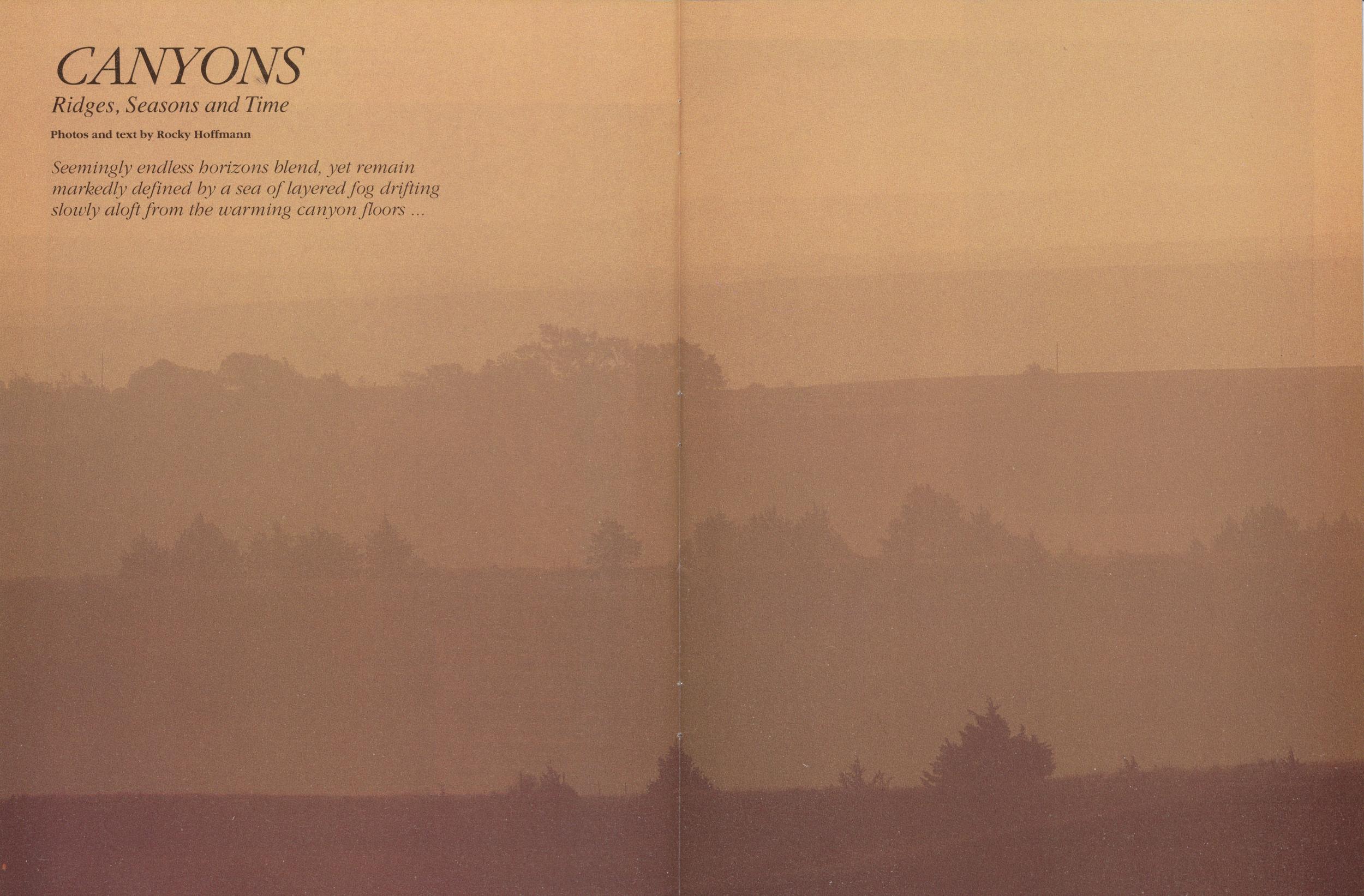
CANYONS
Ridges, Seasons and Time Photos and text by Rocky Hoffmann Seemingly endless horizons blend, yet remain markedly defined by a sea of layered fog drifting slowly aloft from the warming canyon floors ...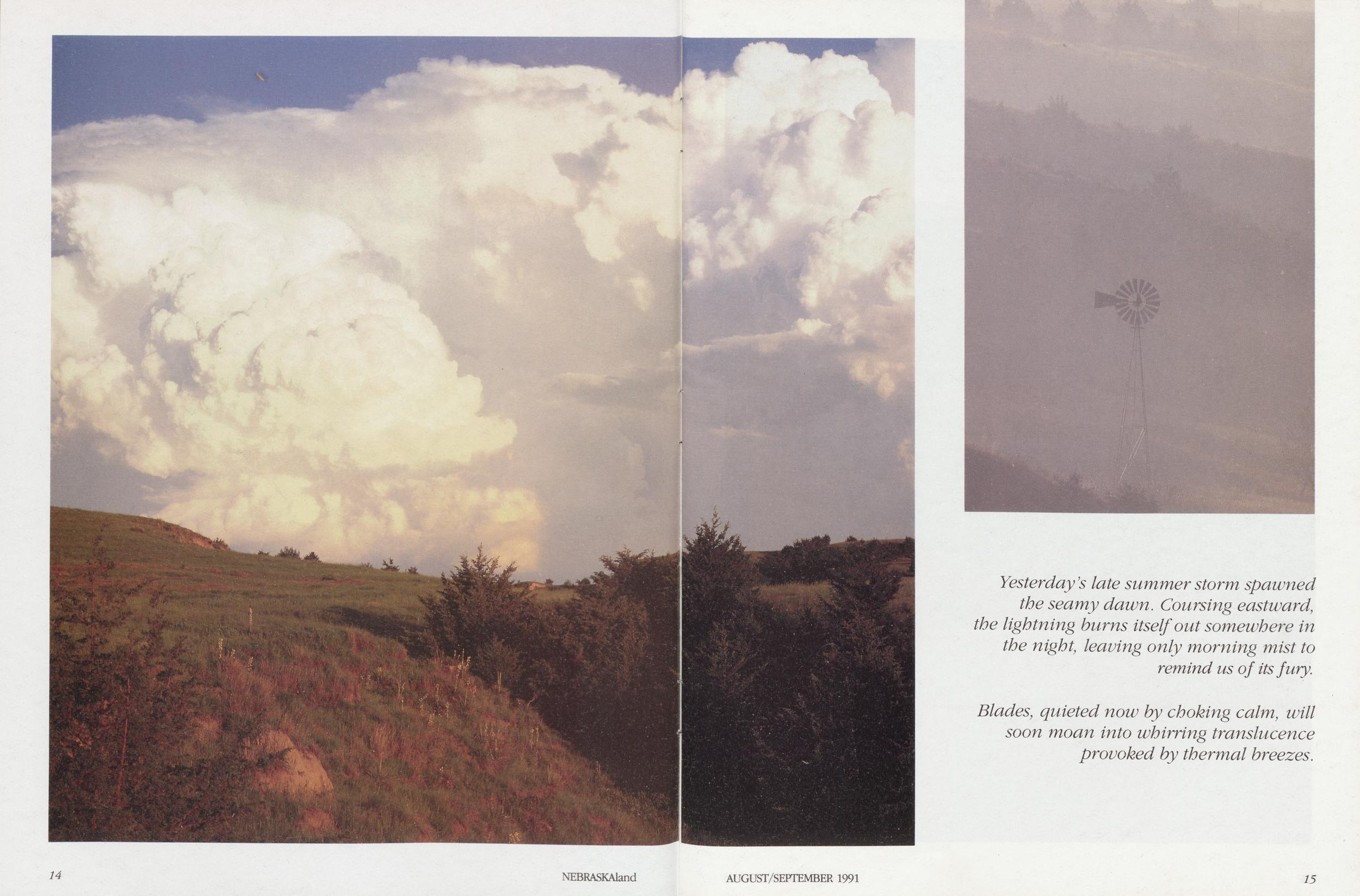 Yesterday's late summer storm spawned
the seamy dawn. Coursing eastward,
the lightning burns itself out somewhere in
the night, leaving only morning mist to
remind us of its fury.
Blades, quieted now by choking calm, will
soon moan into whirring translucence
provoked by thermal breezes.
14 NEBRASKAland
AUGUST/SEPTEMBER 1991 15
Yesterday's late summer storm spawned
the seamy dawn. Coursing eastward,
the lightning burns itself out somewhere in
the night, leaving only morning mist to
remind us of its fury.
Blades, quieted now by choking calm, will
soon moan into whirring translucence
provoked by thermal breezes.
14 NEBRASKAland
AUGUST/SEPTEMBER 1991 15
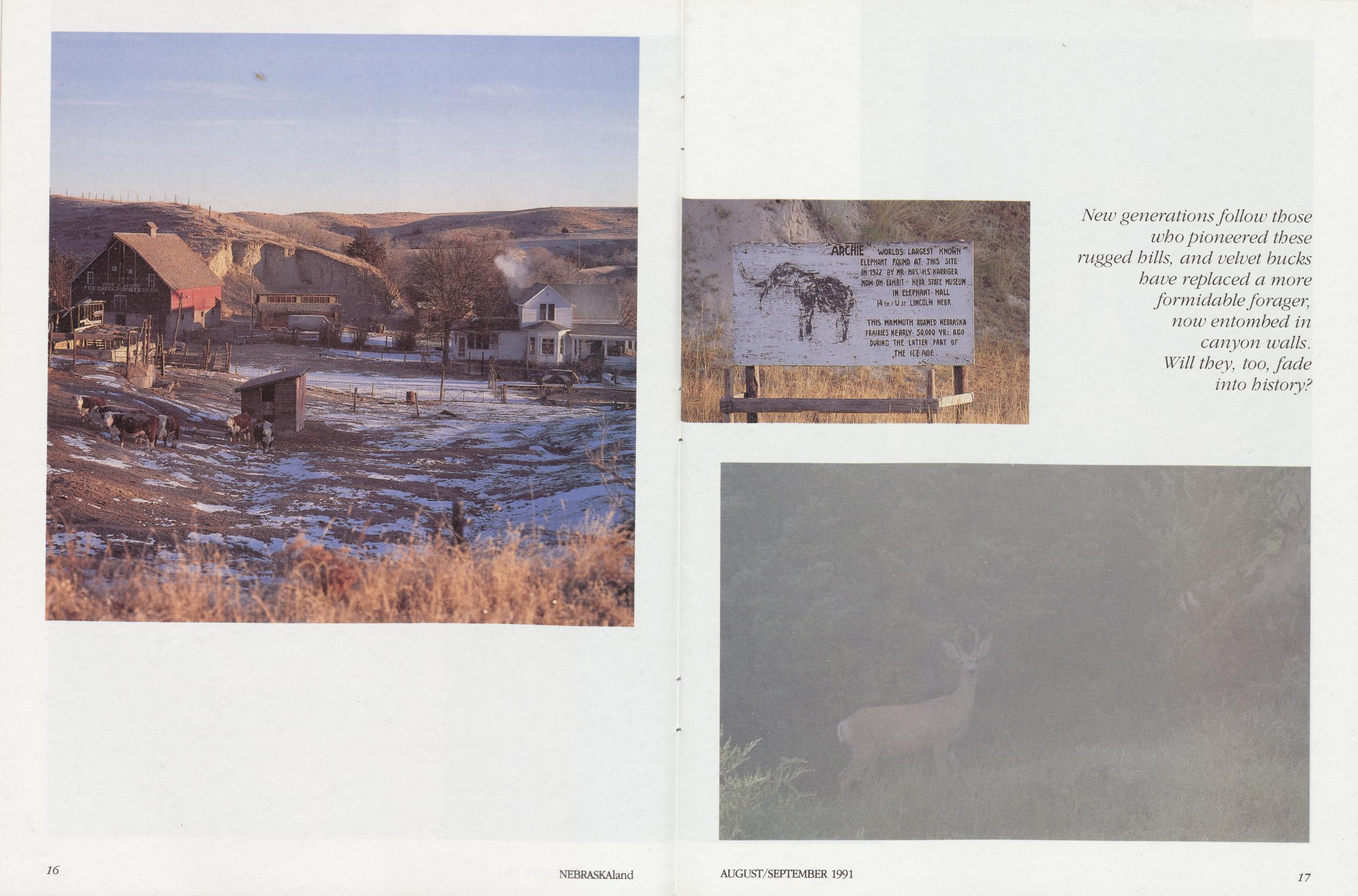 New generations follow those
who pioneered these
rugged hills, and velvet bucks
have replaced a more
formidable forager,
now entombed in
canyon walls.
Will they, too, fade
into history?
16 NEBRASKAland
AUGUST/SEPTEMBER 1991 17
New generations follow those
who pioneered these
rugged hills, and velvet bucks
have replaced a more
formidable forager,
now entombed in
canyon walls.
Will they, too, fade
into history?
16 NEBRASKAland
AUGUST/SEPTEMBER 1991 17
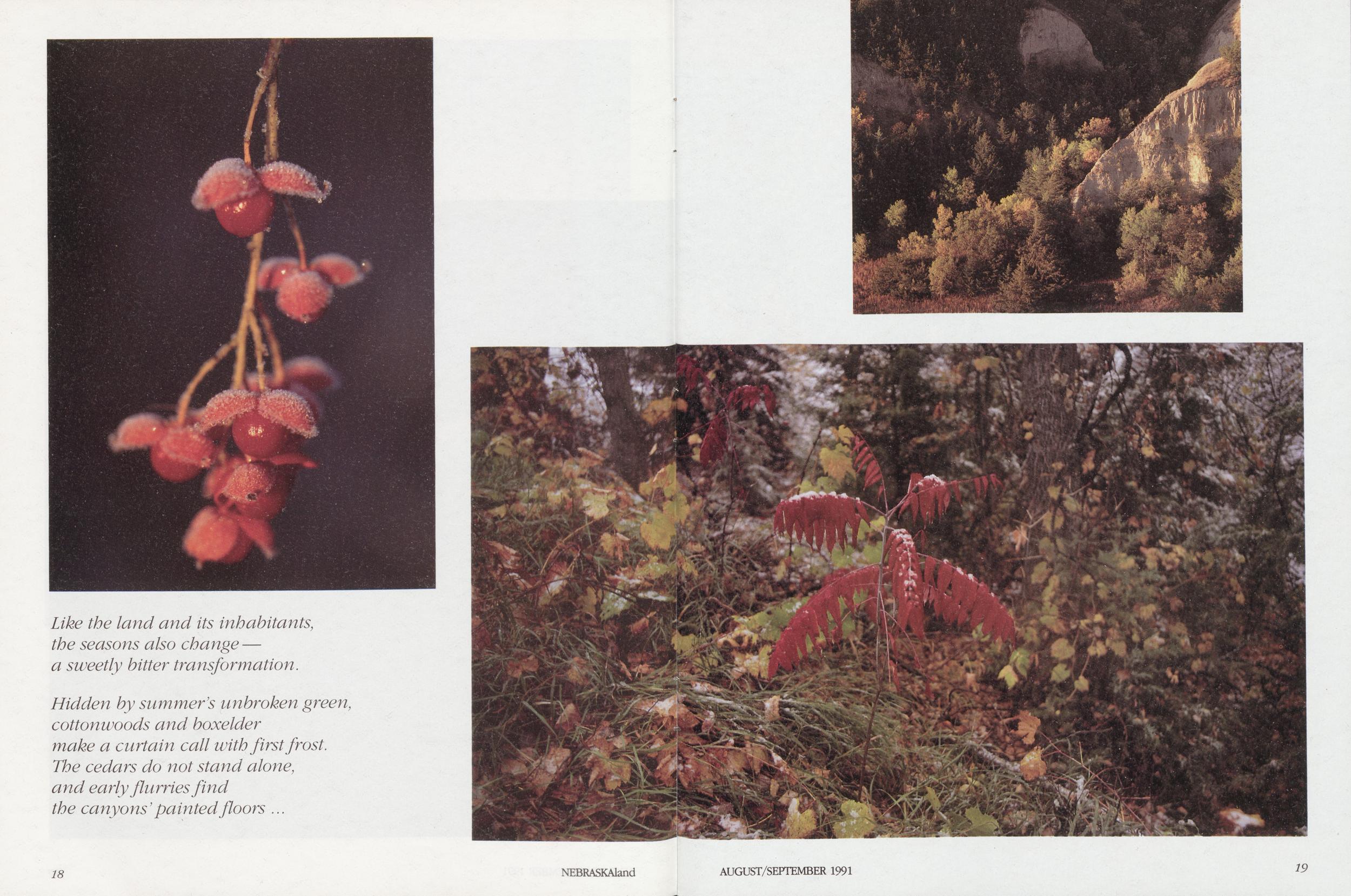 Like the land and its inhabitants,
the seasons also change —
a sweetly bitter transformation.
Hidden by summer's unbroken green,
cottonwoods and boxelder
make a curtain call with first frost.
The cedars do not stand alone,
and early flurries find
the canyons' painted floors ...
18 NEBRASKAland
AUGUST/SEPTEMBER 1991 19
Like the land and its inhabitants,
the seasons also change —
a sweetly bitter transformation.
Hidden by summer's unbroken green,
cottonwoods and boxelder
make a curtain call with first frost.
The cedars do not stand alone,
and early flurries find
the canyons' painted floors ...
18 NEBRASKAland
AUGUST/SEPTEMBER 1991 19
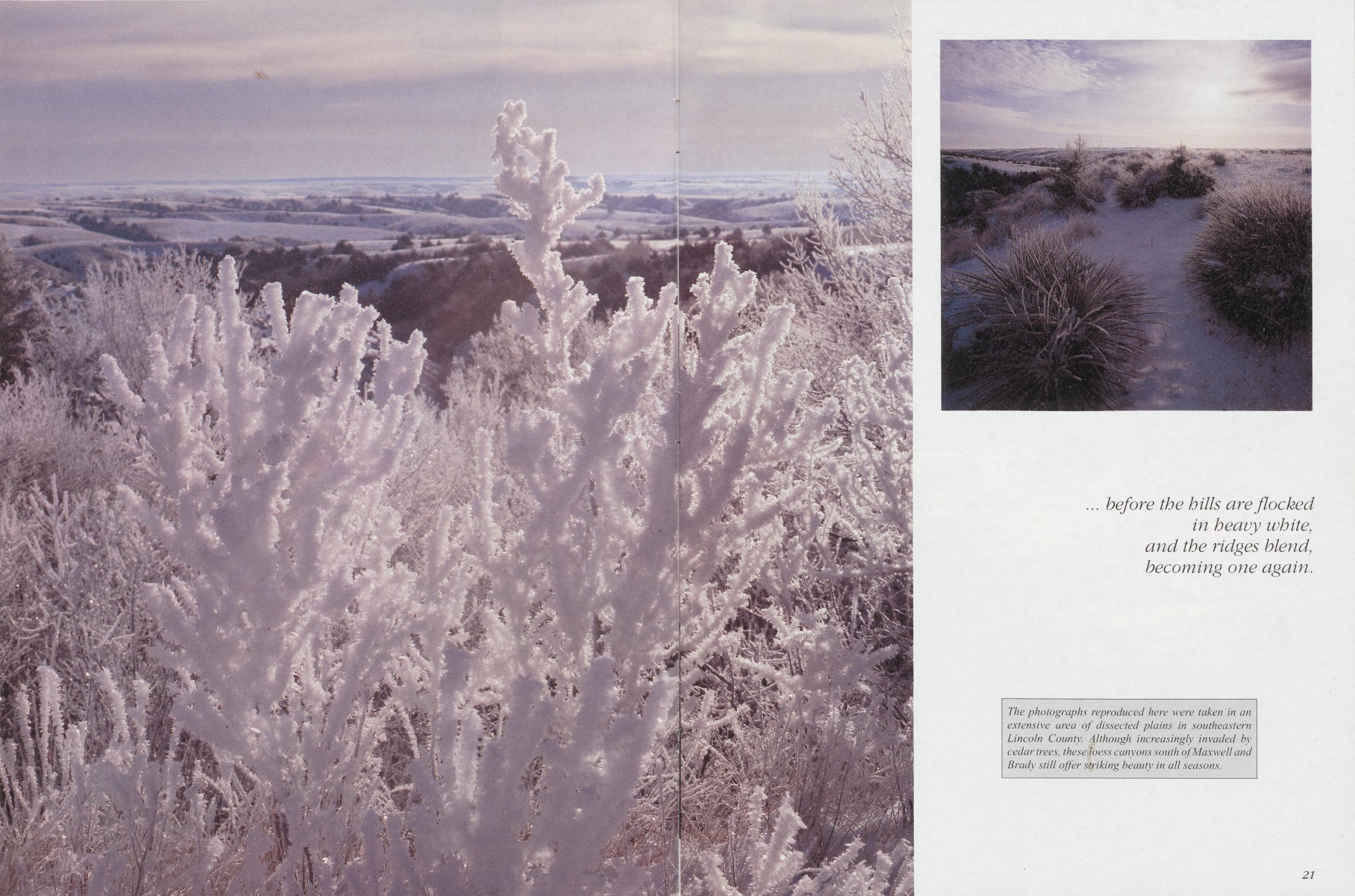 ... before the hills are flocked
in heavy white,
and the ridges blend,
becoming one again.
... before the hills are flocked
in heavy white,
and the ridges blend,
becoming one again.
The photographs reproduced here were taken in an extensive area of dissected plains in southeastern Lincoln County. Although increasingly invaded by cedar trees, these loess canyons south of Maxwell and Brady still offer striking beauty in all seasons.
21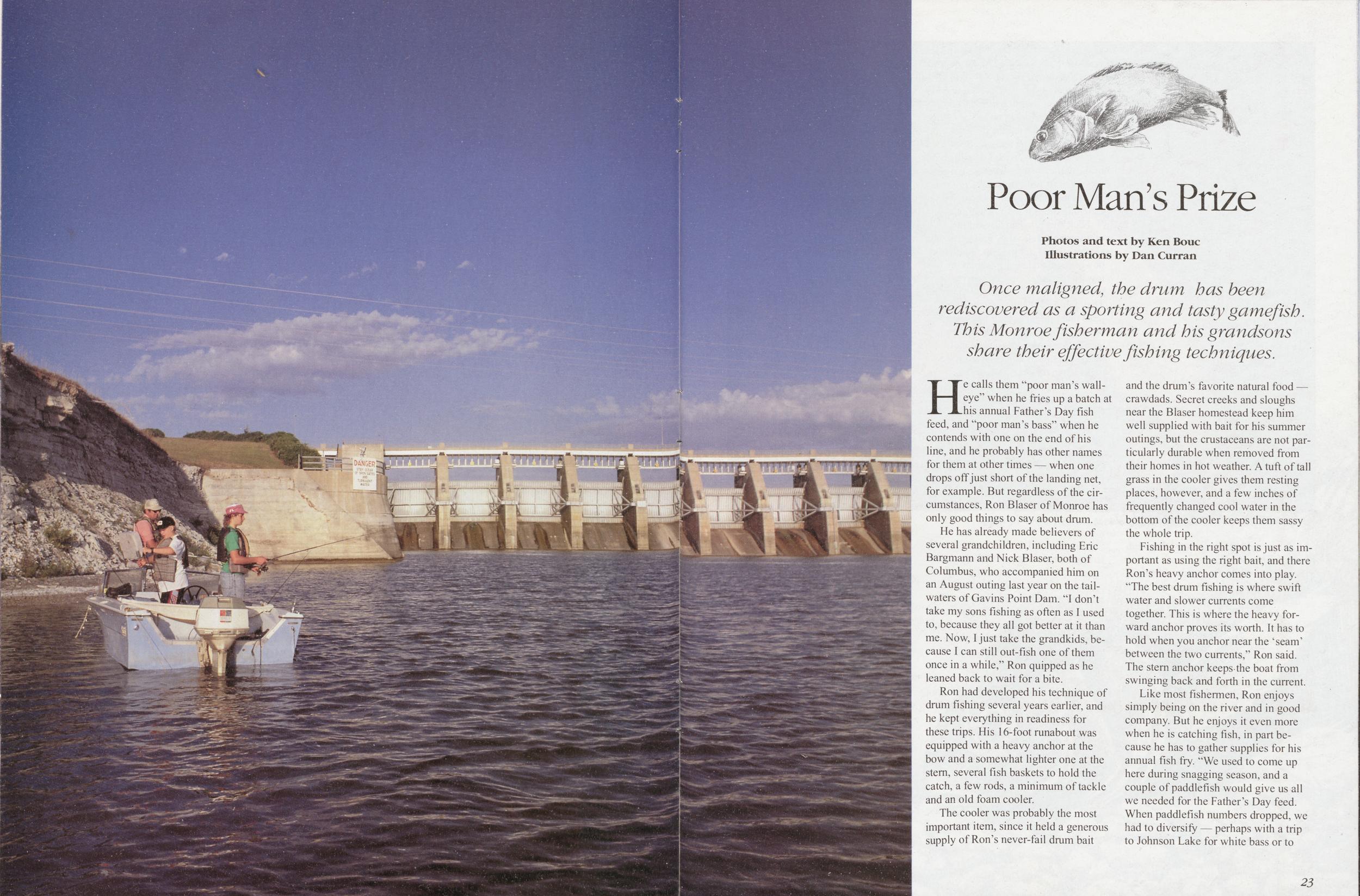
Poor Man's Prize
Photos and text by Ken Bouc Illustrations by Dan Curran Once maligned, the drum has been rediscovered as a sporting and tasty game fish. This Monroe fisherman and his grandsons share their effective fishing techniques.He calls them "poor man's walleye" when he fries up a batch at his annual Father's Day fish feed, and "poor man's bass" when he contends with one on the end of his line, and he probably has other names for them at other times — when one drops off just short of the landing net, for example. But regardless of the circumstances, Ron Blaser of Monroe has only good things to say about drum.
He has already made believers of several grandchildren, including Eric Bargmann and Nick Blaser, both of Columbus, who accompanied him on an August outing last year on the tailwaters of Gavins Point Dam. "I don't take my sons fishing as often as I used to, because they all got better at it than me. Now, I just take the grandkids, because I can still out-fish one of them once in a while," Ron quipped as he leaned back to wait for a bite.
Ron had developed his technique of drum fishing several years earlier, and he kept everything in readiness for these trips. His 16-foot runabout was equipped with a heavy anchor at the bow and a somewhat lighter one at the stem, several fish baskets to hold the catch, a few rods, a minimum of tackle and an old foam cooler.
The cooler was probably the most important item, since it held a generous supply of Ron's never-fail drum bait and the drum's favorite natural food crawdads. Secret creeks and sloughs near the Blaser homestead keep him well supplied with bait for his summer outings, but the crustaceans are not particularly durable when removed from their homes in hot weather. A tuft of tall grass in the cooler gives them resting places, however, and a few inches of frequently changed cool water in the bottom of the cooler keeps them sassy the whole trip.
Fishing in the right spot is just as important as using the right bait, and there Ron's heavy anchor comes into play. "The best drum fishing is where swift water and slower currents come together. This is where the heavy forward anchor proves its worth. It has to hold when you anchor near the 'seam' between the two currents," Ron said. The stern anchor keeps-the boat from swinging back and forth in the current.
Like most fishermen, Ron enjoys
simply being on the river and in good
company. But he enjoys it even more
when he is catching fish, in part
because he has to gather supplies for his
annual fish fry. "We used to come up
here during snagging season, and a
couple of paddlefish would give us all
we needed for the Father's Day feed.
When paddlefish numbers dropped, we
had to diversify — perhaps with a trip
to Johnson Lake for white bass or to
23
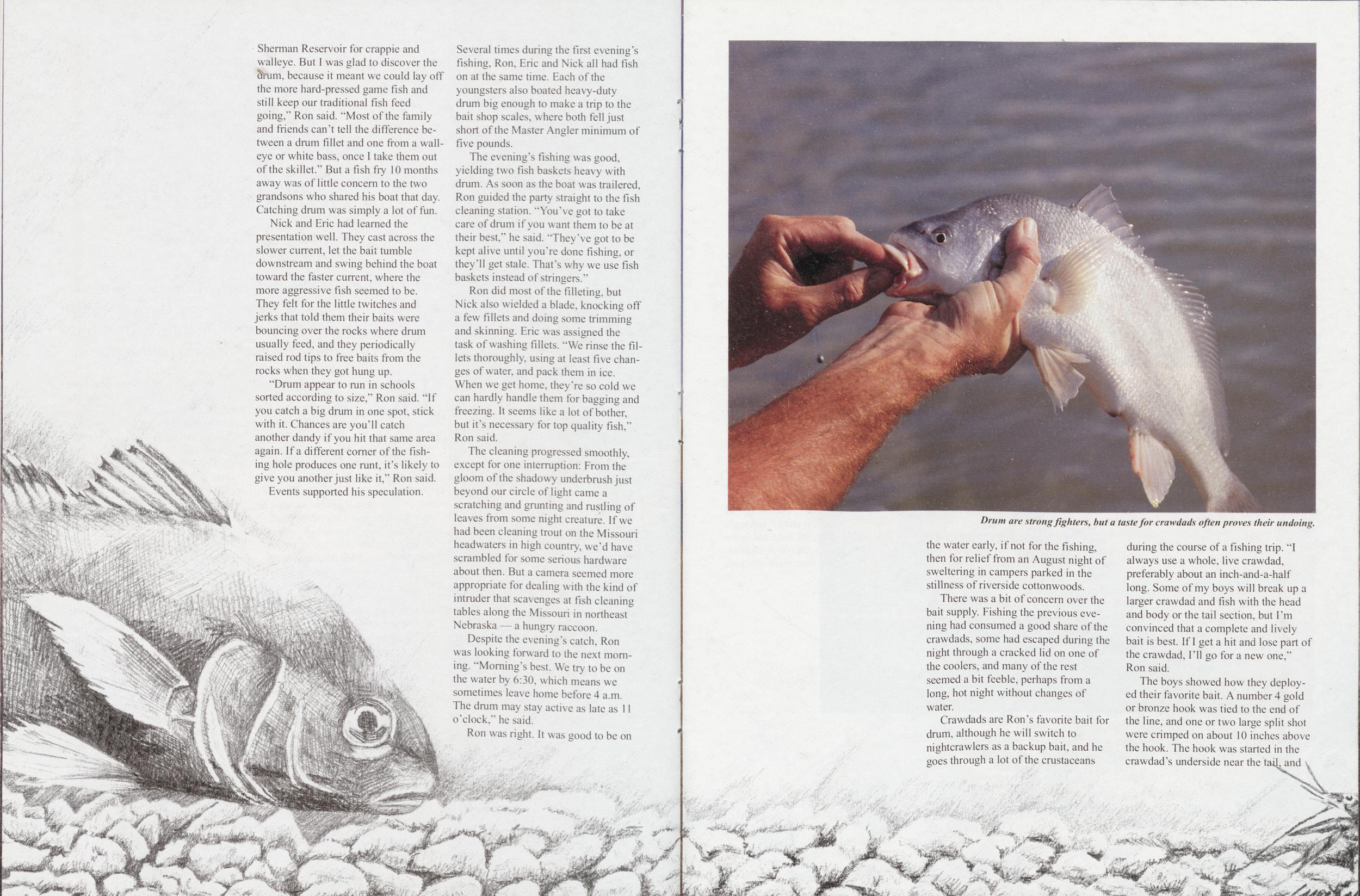 Sherman Reservoir for crappie and
walleye. But I was glad to discover the
oYum, because it meant we could lay off
the more hard-pressed game fish and
still keep our traditional fish feed
going," Ron said. "Most of the family
and friends can't tell the difference
between a drum fillet and one from a
walleye or white bass, once I take them out
of the skillet." But a fish fry 10 months
away was of little concern to the two
grandsons who shared his boat that day.
Catching drum was simply a lot of fun.
Sherman Reservoir for crappie and
walleye. But I was glad to discover the
oYum, because it meant we could lay off
the more hard-pressed game fish and
still keep our traditional fish feed
going," Ron said. "Most of the family
and friends can't tell the difference
between a drum fillet and one from a
walleye or white bass, once I take them out
of the skillet." But a fish fry 10 months
away was of little concern to the two
grandsons who shared his boat that day.
Catching drum was simply a lot of fun.
Nick and Eric had learned the presentation well. They cast across the slower current, let the bait tumble downstream and swing behind the boat toward the faster current, where the more aggressive fish seemed to be. They felt for the little twitches and jerks that told them their baits were bouncing over the rocks where drum usually feed, and they periodically raised rod tips to free baits from the rocks when they got hung up.
"Drum appear to run in schools sorted according to size," Ron said. "If you catch a big drum in one spot, stick with it. Chances are you'll catch another dandy if you hit that same area again. If a different corner of the fishing hole produces one runt, it's likely to give you another just like it," Ron said.
Events supported his speculation. Several times during the first evening's fishing, Ron, Eric and Nick all had fish on at the same time. Each of the youngsters also boated heavy-duty drum big enough to make a trip to the bait shop scales, where both fell just short of the Master Angler minimum of five pounds.
The evening's fishing was good, yielding two fish baskets heavy with drum. As soon as the boat was trailered, Ron guided the party straight to the fish cleaning station. "You've got to take care of drum if you want them to be at their best," he said. "They've got to be kept alive until you're done fishing, or they'll get stale. That's why we use fish baskets instead of stringers."
Ron did most of the filleting, but Nick also wielded a blade, knocking off a few fillets and doing some trimming and skinning. Eric was assigned the task of washing fillets. "We rinse the fillets thoroughly, using at least five changes of water, and pack them in ice. When we get home, they're so cold we can hardly handle them for bagging and freezing. It seems like a lot of bother, but it's necessary for top quality fish," Ron said.
The cleaning progressed smoothly, except for one interruption: From the gloom of the shadowy underbrush just beyond our circle of light came a scratching and grunting and rustling of leaves from some night creature. If we had been cleaning trout on the Missouri headwaters in high country, we'd have scrambled for some serious hardware about then. But a camera seemed more appropriate for dealing with the kind of intruder that scavenges at fish cleaning tables along the Missouri in northeast Nebraska — a hungry raccoon.
Despite the evening's catch, Ron was looking forward to the next morn- ing. "Morning's best. We try to be on the water by 6:30, which means we sometimes leave home before 4 a.m. The drum may stay active as late as 11 o'clock," he said.
Ron was right. It was good to be on
There was a bit of concern over the bait supply. Fishing the previous evening had consumed a good share of the crawdads, some had escaped during the night through a cracked lid on one of the coolers, and many of the rest seemed a bit feeble, perhaps from a long, hot night without changes of water.
Crawdads are Ron's favorite bait for drum, although he will switch to nightcrawlers as a backup bait, and he goes through a lot of the crustaceans during the course of a fishing trip. "I always use a whole, live crawdad, preferably about an inch-and-a-half long. Some of my boys will break up a larger crawdad and fish with the head and body or the tail section, but I'm convinced that a complete and lively bait is best. If I get a hit and lose part of the crawdad, I'll go for a new one," Ron said.
The boys showed how they deployed their
favorite bait. A number 4 gold
or bronze hook was tied to the end of
the line, and one or two large split shot
were crimped on about 10 inches above
the hook. The hook was started in the
crawdad's underside near the tail, and
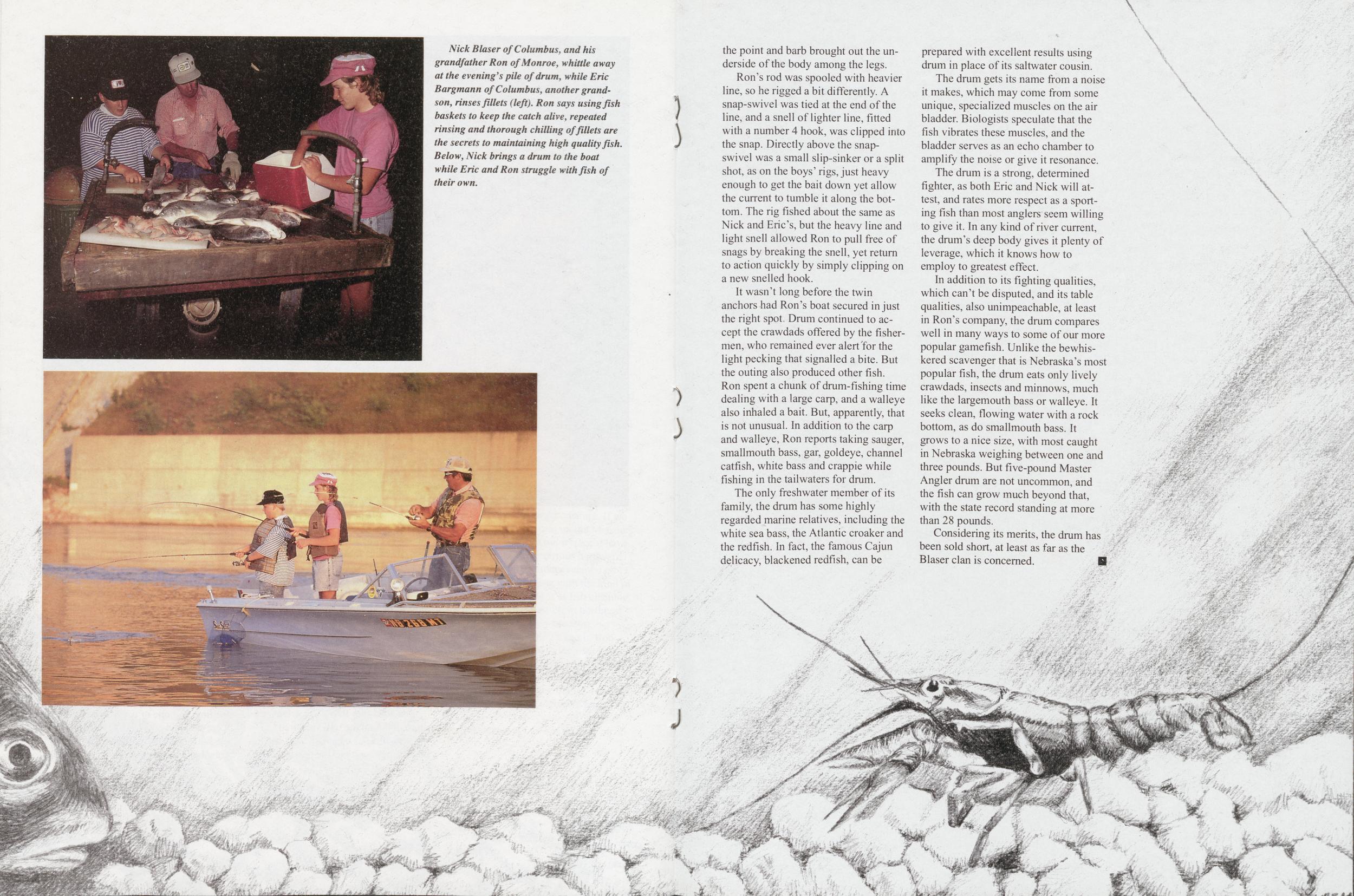
Ron's rod was spooled with heavier line, so he rigged a bit differently. A snap-swivel was tied at the end of the line, and a snell of lighter line, fitted with a number 4 hook, was clipped into the snap. Directly above the snap- swivel was a small slip-sinker or a split shot, as on the boys' rigs, just heavy enough to get the bait down yet allow the current to tumble it along the bottom. The rig fished about the same as Nick and Eric's, but the heavy line and light snell allowed Ron to pull free of snags by breaking the snell, yet return to action quickly by simply clipping on a new snelled hook.
It wasn't long before the twin anchors had Ron's boat secured in just the right spot. Drum continued to accept the crawdads offered by the fishermen, who remained ever alert Tor the light pecking that signaled a bite. But the outing also produced other fish. Ron spent a chunk of drum-fishing time dealing with a large carp, and a walleye also inlaid a bait. But, apparently, that is not unusual. In addition to the carp and walleye, Ron reports taking sauger, smallmouth bass, gar, goldeye, channel catfish, white bass and crappie while fishing in the tail waters for drum.
The only freshwater member of its family, the drum has some highly regarded marine relatives, including the white sea bass, the Atlantic croaker and the redfish. In fact, the famous Cajun delicacy, blackened redfish, can be prepared with excellent results using drum in place of its saltwater cousin.
The drum gets its name from a noise it makes, which may come from some unique, specialized muscles on the air bladder. Biologists speculate that the fish vibrates these muscles, and the bladder serves as an echo chamber to amplify the noise or give it resonance.
The drum is a strong, determined fighter, as both Eric and Nick will attest, and rates more respect as a sporting fish than most anglers seem willing to give it. In any kind of river current, the drum's deep body gives it plenty of leverage, which it knows how to employ to greatest effect.
In addition to its fighting qualities, which can't be disputed, and its table qualities, also unimpeachable, at least in Ron's company, the drum compares well in many ways to some of our more popular gamefish. Unlike the bewhiskered scavenger that is Nebraska's most popular fish, the drum eats only lively crawdads, insects and minnows, much like the largemouth bass or walleye. It seeks clean, flowing water with a rock bottom, as do smallmouth bass. It grows to a nice size, with most caught in Nebraska weighing between one and three pounds. But five-pound Master Angler drum are not uncommon, and the fish can grow much beyond that, with the state record standing at more than 28 pounds.
Considering its merits, the drum has been sold short, at least as far as the Blaser clan is concerned.
A September Recipe
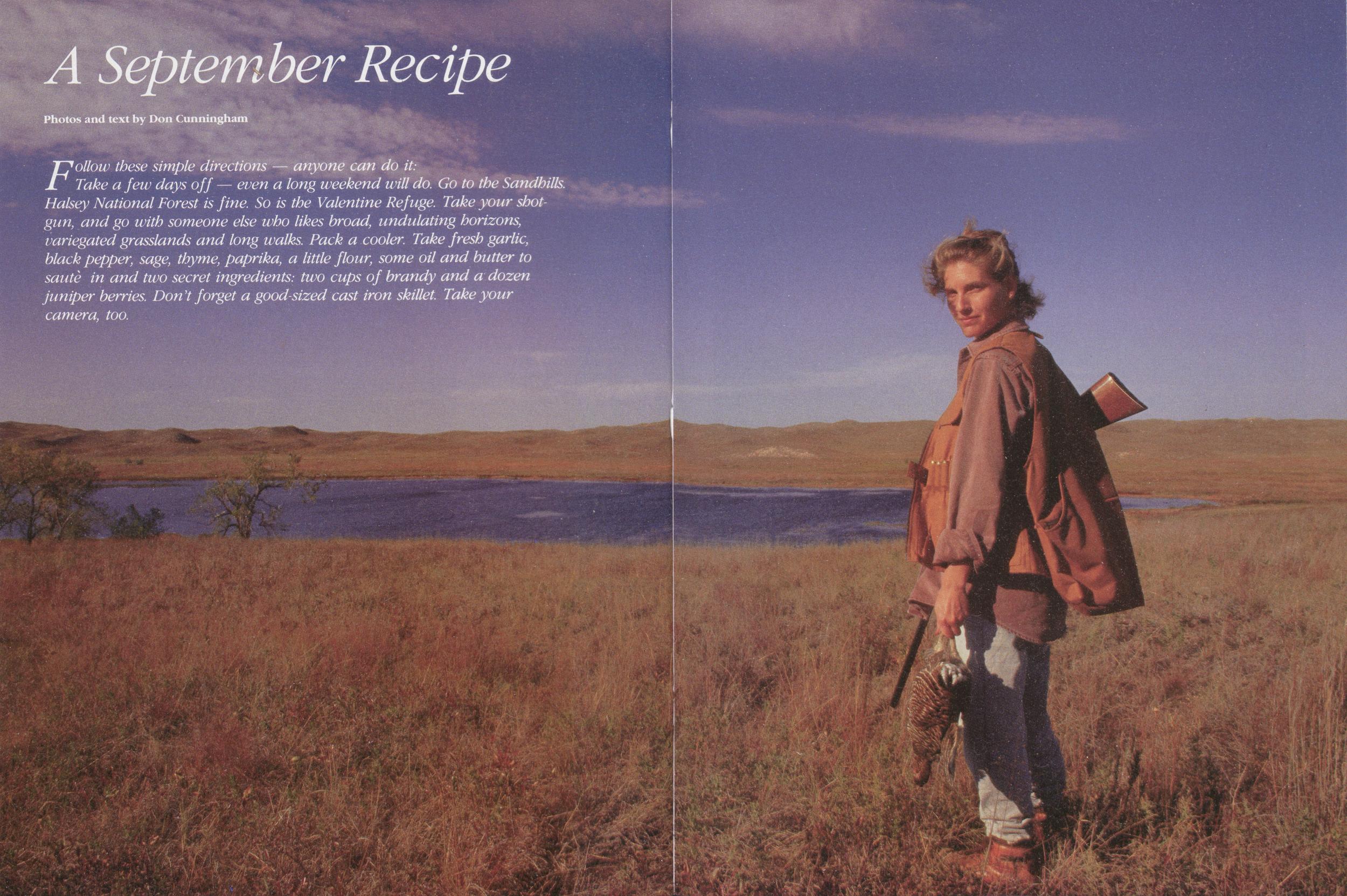
Photos and text by Don Cunningham Follow these simple directions — anyone can do it: Take a few days off — even a long weekend will do. Go to the Sandhill Halsey National Forest is fine. So is the Valentine Refuge. Take your shotgun, and go with someone else who likes broad, undulating horizons, variegated grasslands and long walks. Pack a cooler. Take fresh garlic, black pepper, sage, thyme, paprika, a little flour, some oil and butter to saute in and two secret ingredients: two cups of brandy and a dozen juniper berries. Don't forget a good-sized cast iron skillet. Take your camera, too.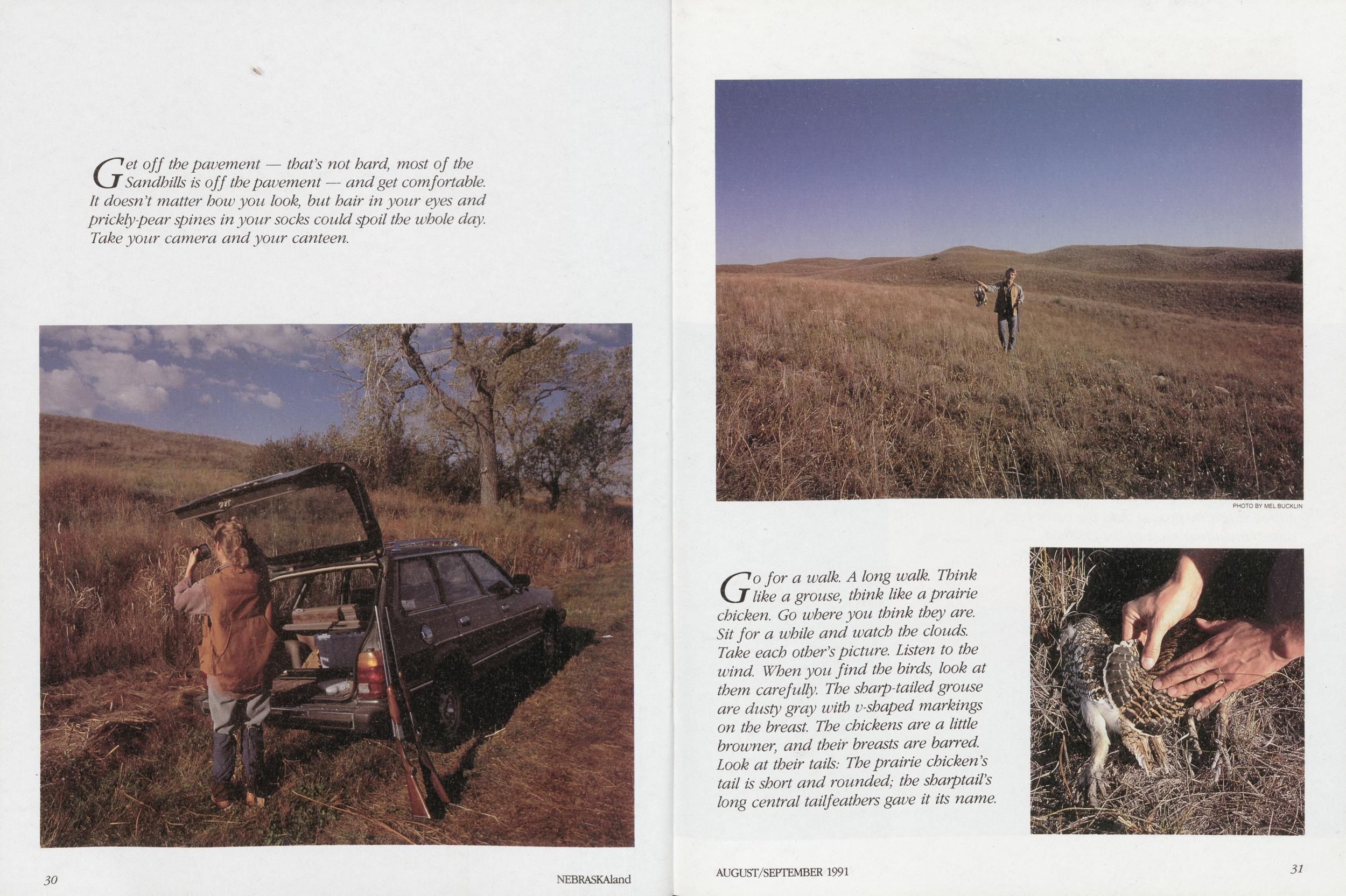 Get off the pavement — that's not hard, most of the
Sandhills is off the pavement — and get comfortable.
It doesn't matter how you look, but hair in your eyes and
prickly-pear spines in your socks could spoil the whole day.
Take your camera and your canteen.
Get off the pavement — that's not hard, most of the
Sandhills is off the pavement — and get comfortable.
It doesn't matter how you look, but hair in your eyes and
prickly-pear spines in your socks could spoil the whole day.
Take your camera and your canteen.
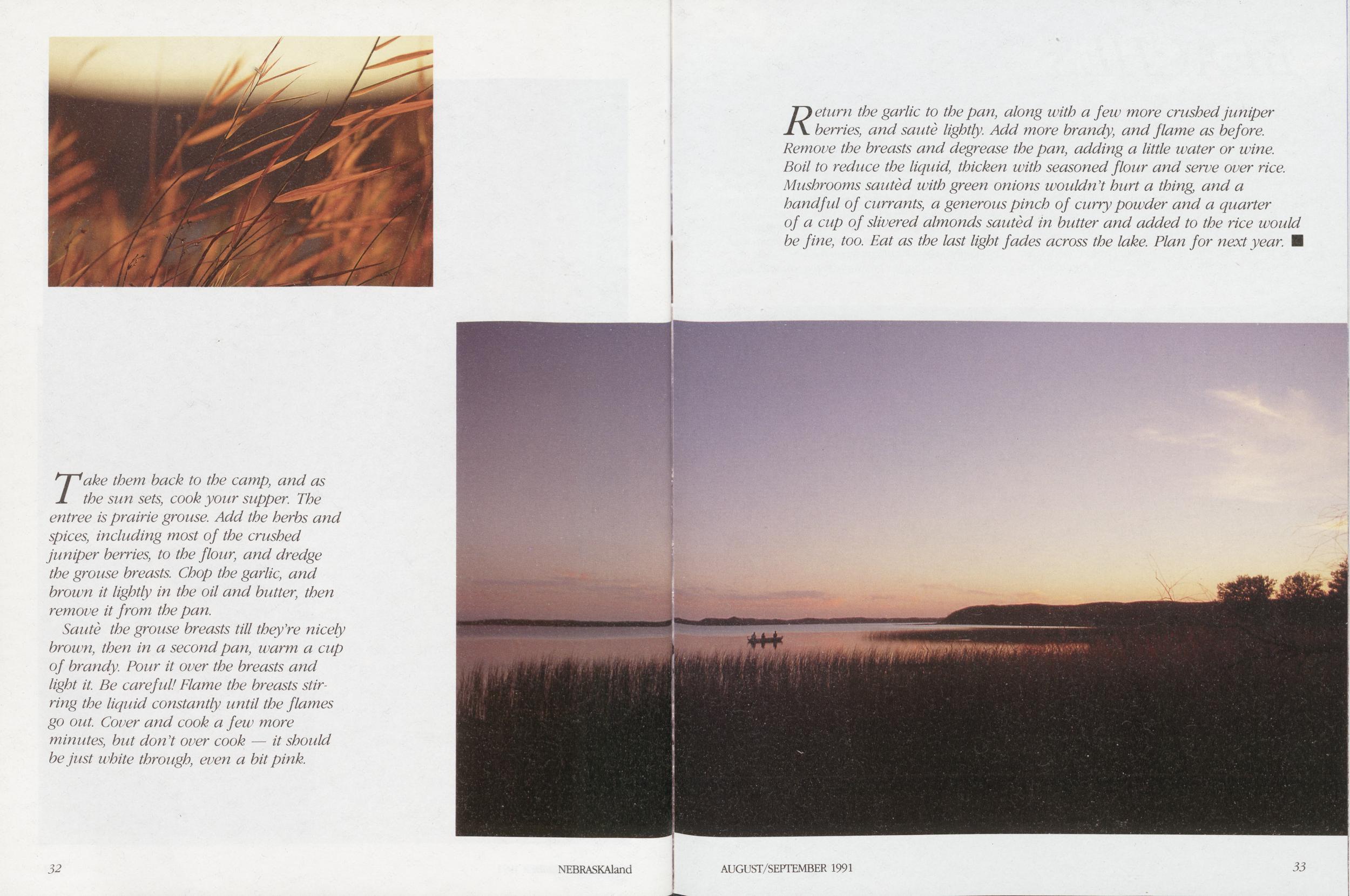 Take them back to the camp, and as
the sun sets, cook your supper. The
entree is prairie grouse. Add the herbs and
spices, including most of the crushed
juniper berries, to the flour, and dredge
the grouse breasts. Chop the garlic, and
brown it lightly in the oil and butter, then
remove it from the pan.
Sauté the grouse breasts till they're nicely
brown, then in a second pan, warm a cup
of brandy. Pour it over the breasts and
light it. Be careful! Flame the breasts
stirring the liquid constantly until the flames
go out. Cover and cook a few more
minutes, but don't over cook — it should
be just white through, even a bit pink.
return the garlic to the pan, along with a few more crushed juniper
berries, and sauté lightly. Add more brandy, and flame as before.
Remove the breasts and degrease the pan, adding a little water or wine.
Boil to reduce the liquid, thicken with seasoned flour and serve over rice.
Mushrooms sautéd with green onions wouldn't hurt a thing, and a
handful of currants, a generous pinch of curry powder and a quarter
of a cup of slivered almonds sautéd in butter and added to the rice would
be fine, too. Eat as the last light fades across the lake. Plan for next year.
32 NEBRASKAland
AUGUST/SEPTEMBER 1991 33
Take them back to the camp, and as
the sun sets, cook your supper. The
entree is prairie grouse. Add the herbs and
spices, including most of the crushed
juniper berries, to the flour, and dredge
the grouse breasts. Chop the garlic, and
brown it lightly in the oil and butter, then
remove it from the pan.
Sauté the grouse breasts till they're nicely
brown, then in a second pan, warm a cup
of brandy. Pour it over the breasts and
light it. Be careful! Flame the breasts
stirring the liquid constantly until the flames
go out. Cover and cook a few more
minutes, but don't over cook — it should
be just white through, even a bit pink.
return the garlic to the pan, along with a few more crushed juniper
berries, and sauté lightly. Add more brandy, and flame as before.
Remove the breasts and degrease the pan, adding a little water or wine.
Boil to reduce the liquid, thicken with seasoned flour and serve over rice.
Mushrooms sautéd with green onions wouldn't hurt a thing, and a
handful of currants, a generous pinch of curry powder and a quarter
of a cup of slivered almonds sautéd in butter and added to the rice would
be fine, too. Eat as the last light fades across the lake. Plan for next year.
32 NEBRASKAland
AUGUST/SEPTEMBER 1991 33
BEACHES
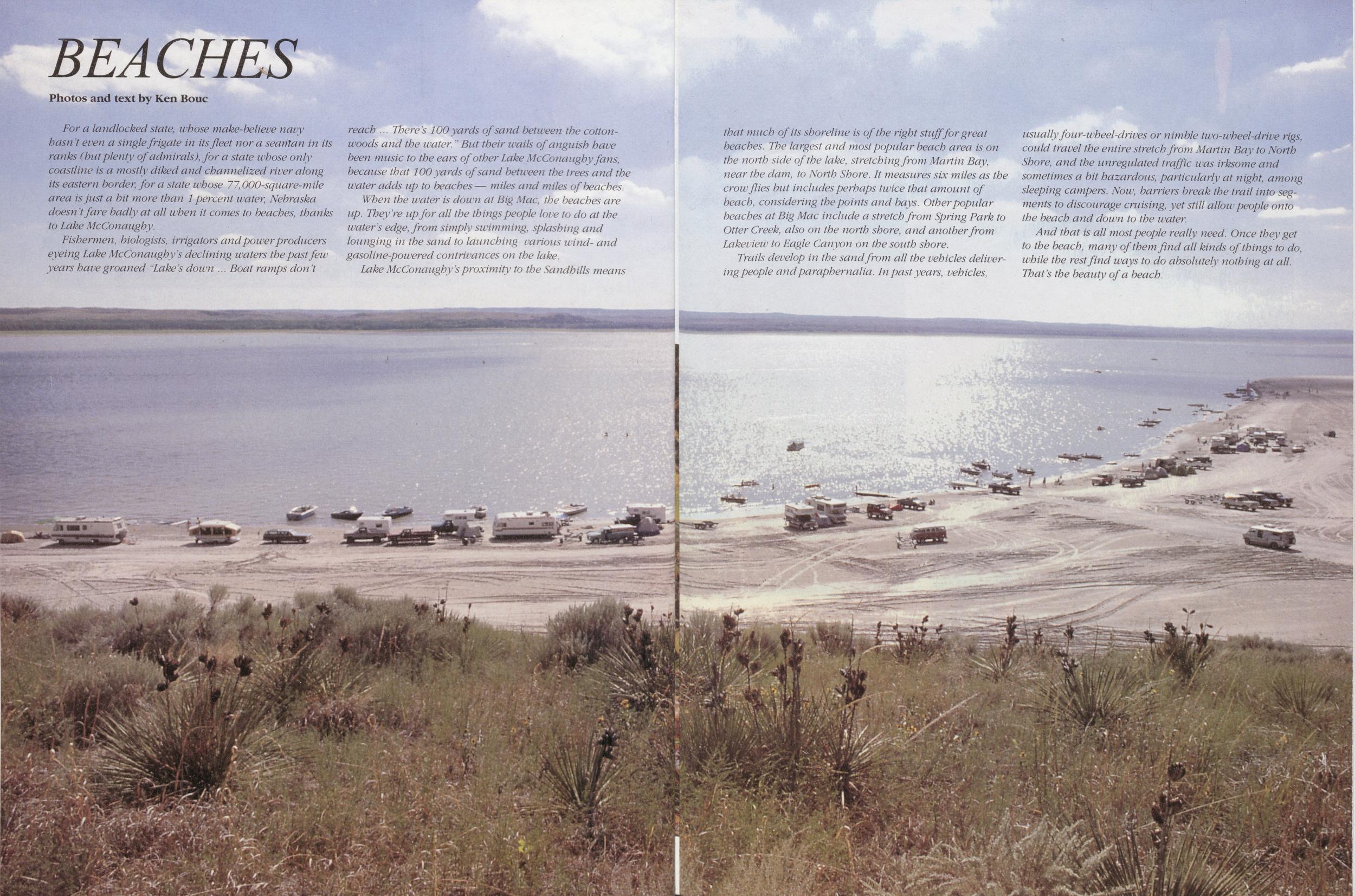
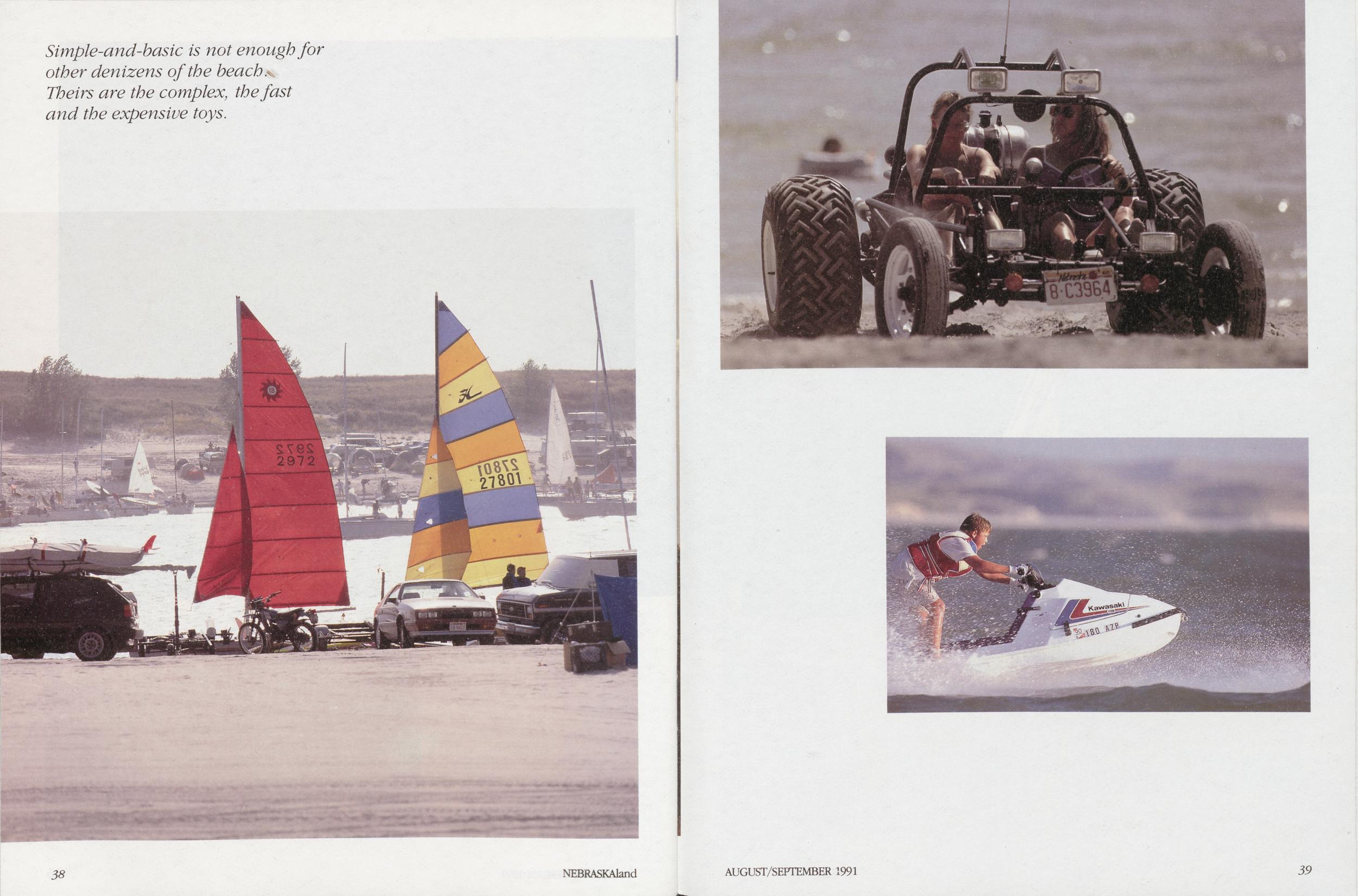
Photos and text by Ken BoucFor a landlocked state, whose make-believe navy hasn't even a single frigate in its fleet nor a seantan in its ranks (but plenty of admirals), for a state whose only coastline is a mostly diked and channelized river along its eastern border, for a state whose 77,000-square-mile area is just a bit more than 1 percent water, Nebraska doesn't fare badly at all when it comes to beaches, thanks to Lake McConaughy.
Fishermen, biologists, irrigators and power producers eyeing Lake McConaughy's declining waters the past few years have groaned Lake's down ... Boat ramps don't reach ... There's 100 yards of sand between the cottonwoods and the water." But their wails of anguish have been music to the ears of other Lake McConaughy fans, because that 100 yards of sand between the trees and the water adds up to beaches— miles and miles of beaches.
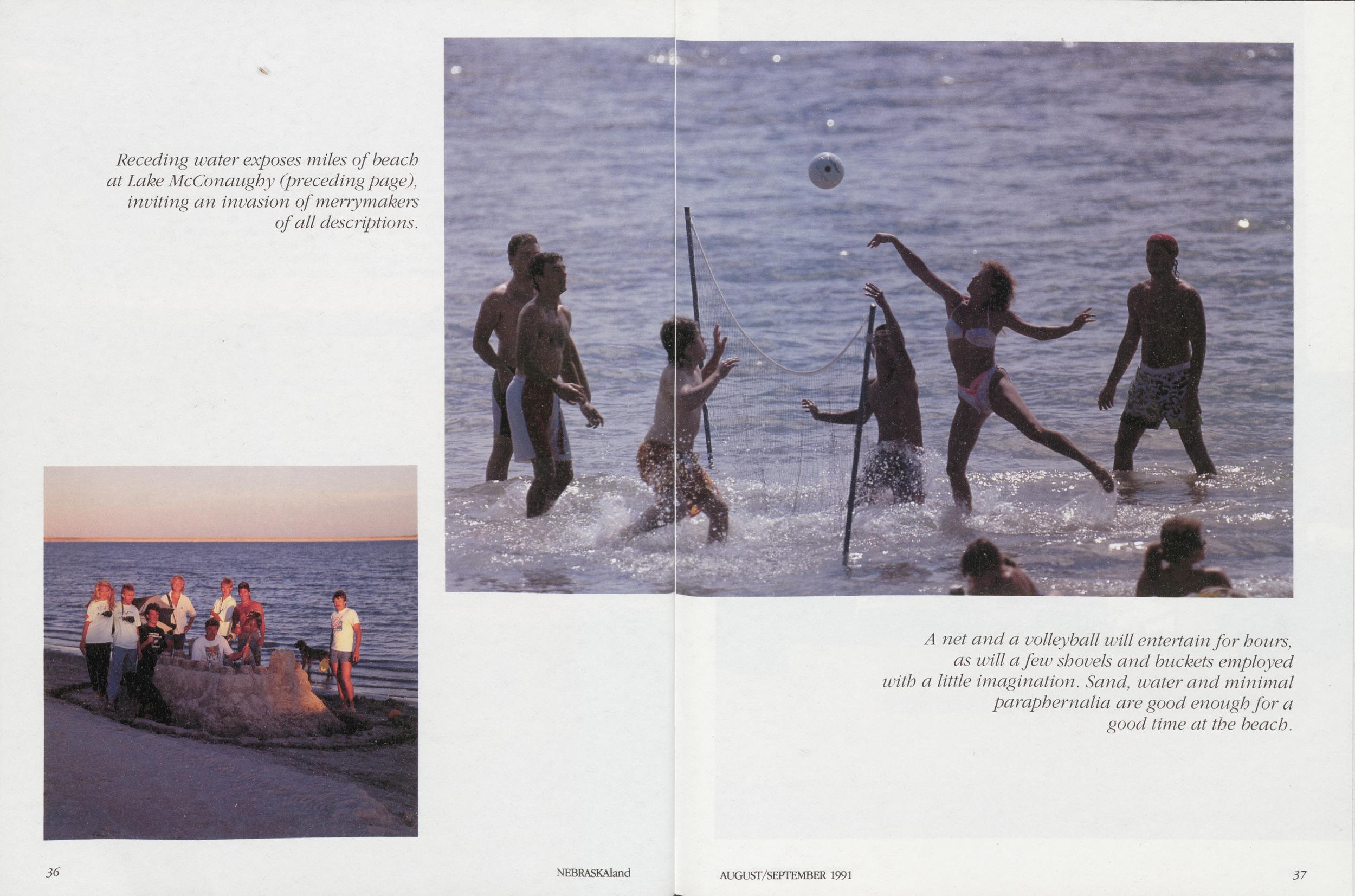
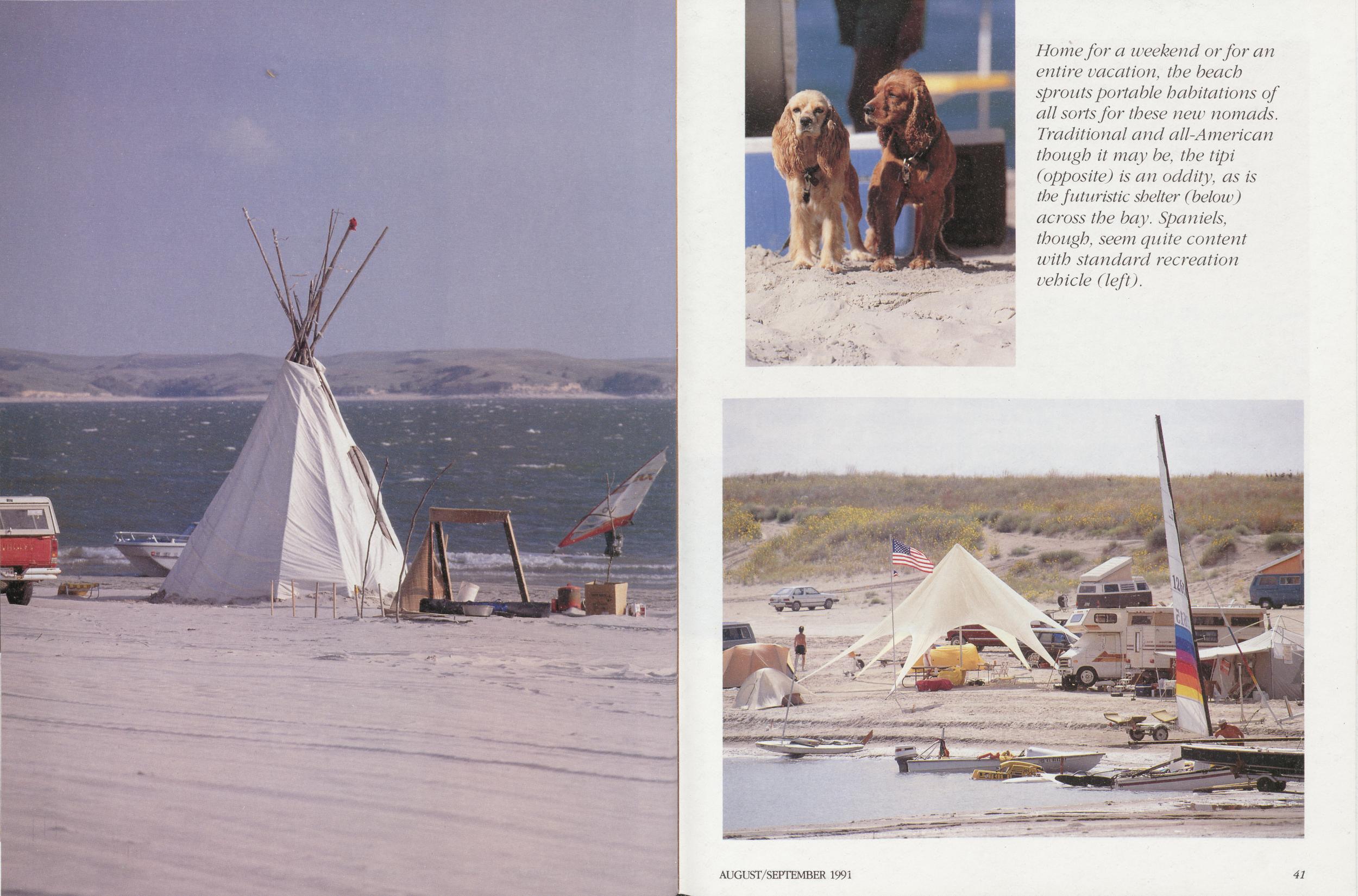
When the water is down at Big Mac, the beaches are up. They're up for all the things people love to do at the water's edge, from simply swimming, splashing and lounging in the sand to launching various wind- and gasoline-powered contrivances on the lake.
Lake McConaughy's proximity to the Sandhills means that much of its shoreline is of the right stuff for great beaches. The largest and most popidar beach area is on the north side of the lake, stretching from Martin Bay, near the dam, to North Shore. It measures six miles as the crow flies but includes perhaps twice that amount of beach, considering the points and bays. Other popidar beaches at Big Mac include a stretch from Spring Park to Otter Creek, also on the north shore, and another from Lakeview to Eagle Canyon on the south shore.
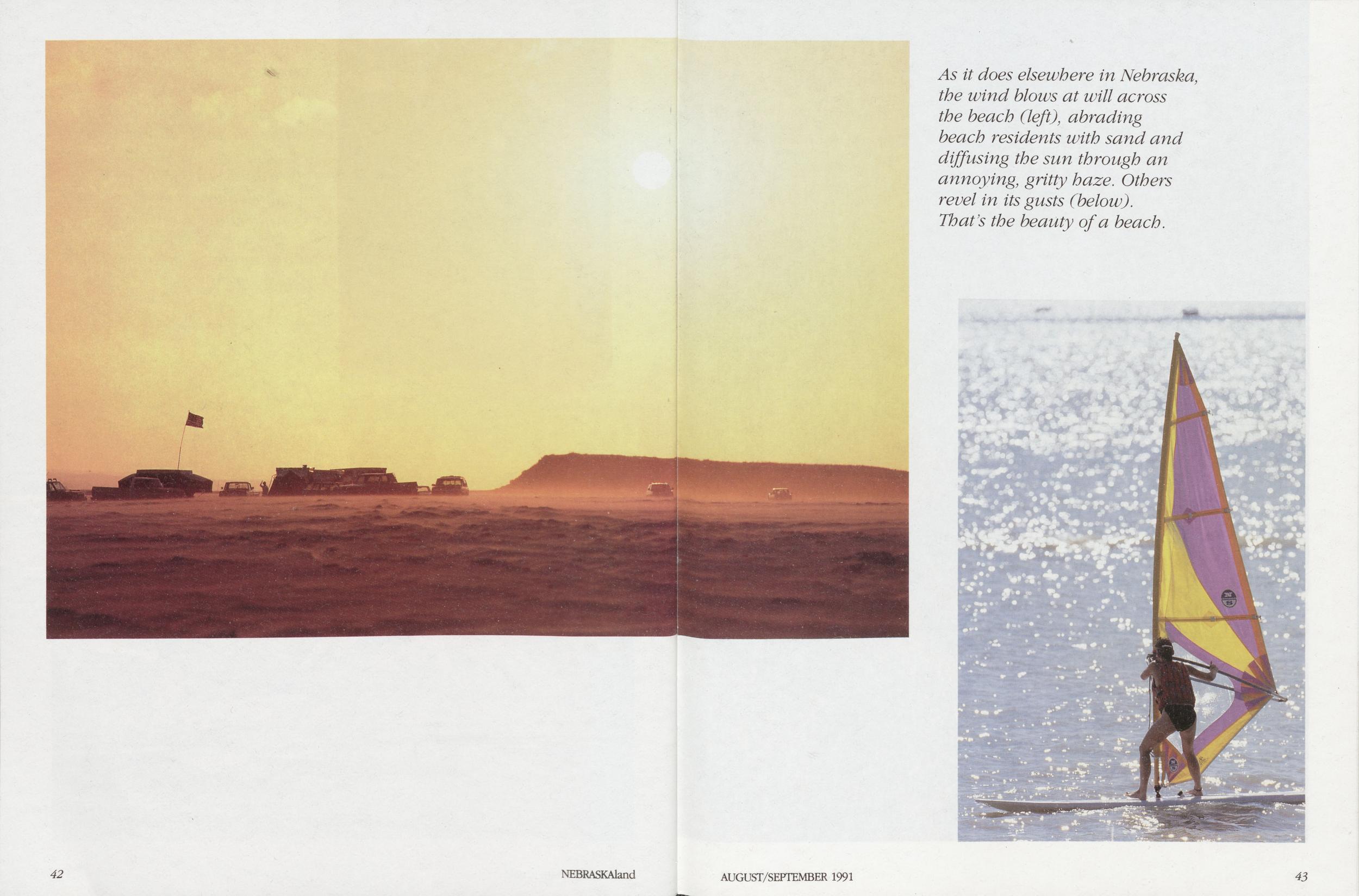
Trails develop in the sand from all the vehicles delivering people and paraphernalia. In past years, vehicles, usually four-wheel-drives or nimble two-wheel-d five rigs, could travel the entire stretch from Martin Bay to No fib Shore, and the unregulated traffic was irksome and sometimes a bit hazardous, particularly at night, among sleeping campers. Now, barriers break the trail into segments to discourage cruising, yet still allow people onto the beach and down to the water.
And that is all most people really need. Once they get to the beach, many of them find all kinds of things to do, while the rest find ways to do absolutely nothing at all. That's the beauty of a beach.
Getting an Edge on Pheasants
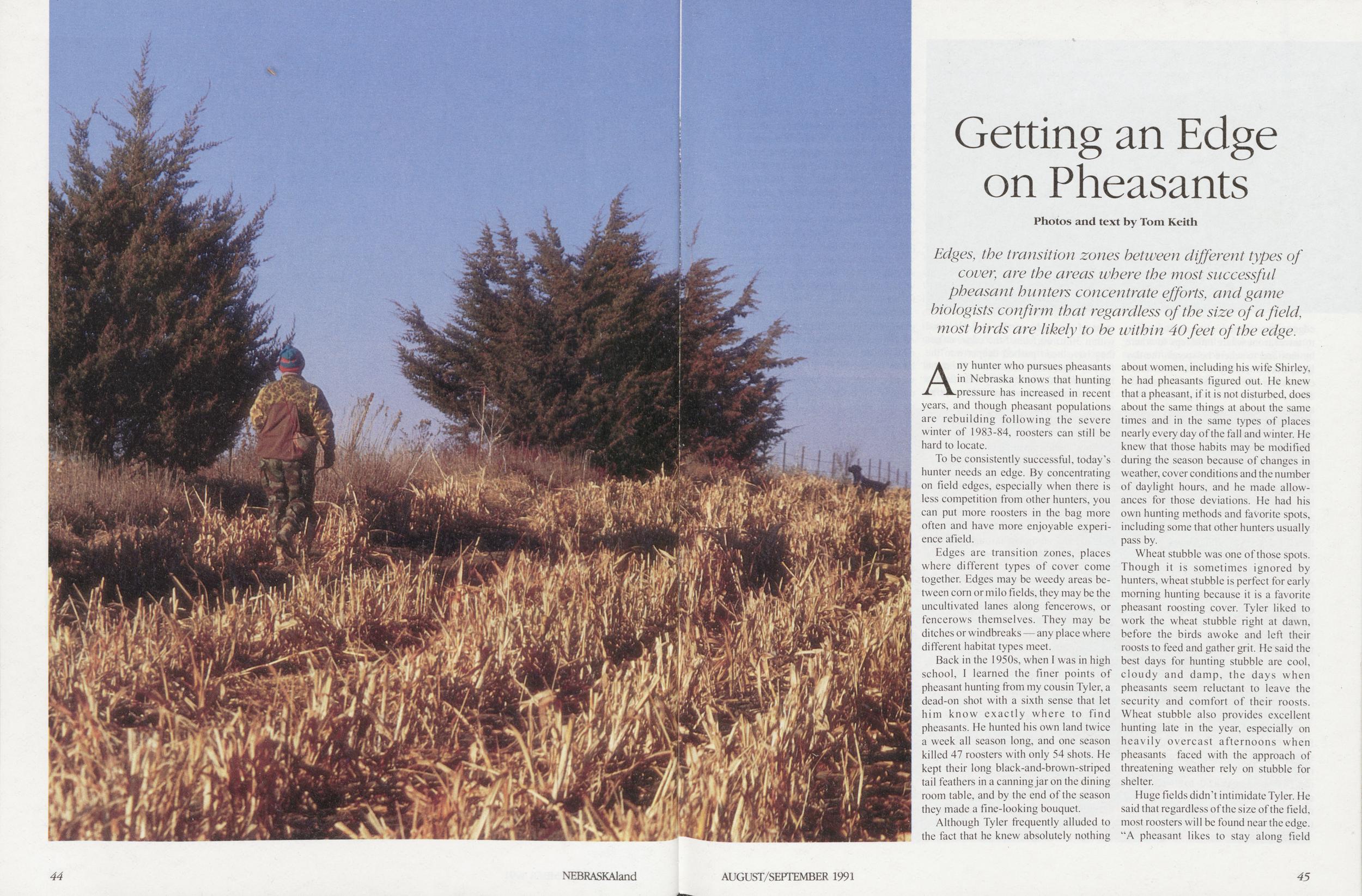
Photos and text by Tom Keith Edges, the transition zones between different types of cover, are the areas where the most successful pheasant hunters concentrate efforts, and game biologists confirm that regardless of the size of a field, most birds are likely to be within 40 feet of the edge.Any hunter who pursues pheasants in Nebraska knows that hunting pressure has increased in recent years, and though pheasant populations are rebuilding following the severe winter of 1983-84, roosters can still be hard to locate.
To be consistently successful, today's hunter needs an edge. By concentrating on field edges, especially when there is less competition from other hunters, you can put more roosters in the bag more often and have more enjoyable experience afield.
Edges are transition zones, places where different types of cover come together. Edges may be weedy areas between corn or milo fields, they may be the uncultivated lanes along fencerows, or fencerows themselves. They may be ditches or windbreaks — any place where different habitat types meet.
Back in the 1950s, when I was in high school, I learned the finer points of pheasant hunting from my cousin Tyler, a dead-on shot with a sixth sense that let him know exactly where to find pheasants. He hunted his own land twice a week all season long, and one season killed 47 roosters with only 54 shots. He kept their long black-and-brown-striped tail feathers in a canning jar on the dining room table, and by the end of the season they made a fine-looking bouquet.
Although Tyler frequently alluded to the fact that he knew absolutely nothing about women, including his wife Shirley, he had pheasants figured out. He knew that a pheasant, if it is not disturbed, does about the same things at about the same times and in the same types of places nearly every day of the fall and winter. He knew that those habits may be modified during the season because of changes in weather, cover conditions and the number of daylight hours, and he made allowances for those deviations. He had his own hunting methods and favorite spots, including some that other hunters usually pass by.
Wheat stubble was one of those spots. Though it is sometimes ignored by hunters, wheat stubble is perfect for early morning hunting because it is a favorite pheasant roosting cover. Tyler liked to work the wheat stubbie right at dawn, before the birds awoke and left their roosts to feed and gather grit. He said the best days for hunting stubble are cool, cloudy and damp, the days when pheasants seem reluctant to leave the security and comfort of their roosts. Wheat stubble also provides excellent hunting late in the year, especially on heavily overcast afternoons when pheasants faced with the approach of threatening weather rely on stubble for shelter.
Huge fields didn't intimidate Tyler. He
said that regardless of the size of the field,
most roosters will be found near the edge.
"A pheasant likes to stay along field
44 NEBRASKAland
AUGUST/SEPTEMBER 1991 45
 edges where he has only a short distance
to travel from where he sleeps to where
he eats and to where he spends the day
lying back enjoying life. He likes those
edges where he can hot-foot it from thin
cover into heavy cover to get away from
a hunter or a farm cat or a hawk or
anything else that wants to invite him to
dinner."
edges where he has only a short distance
to travel from where he sleeps to where
he eats and to where he spends the day
lying back enjoying life. He likes those
edges where he can hot-foot it from thin
cover into heavy cover to get away from
a hunter or a farm cat or a hawk or
anything else that wants to invite him to
dinner."
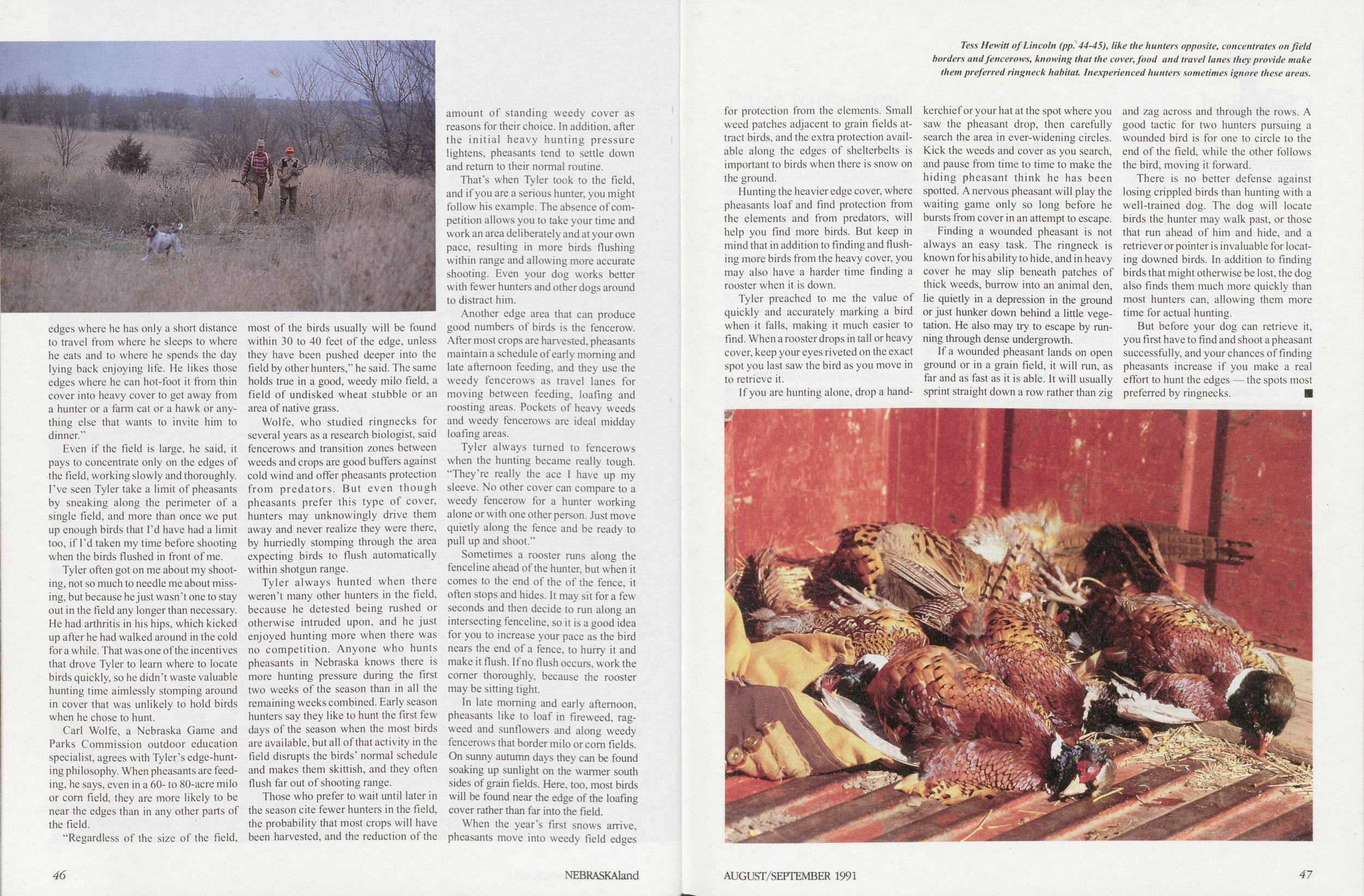
Even if the field is large, he said, it pays to concentrate only on the edges of the field, working slowly and thoroughly. I've seen Tyler take a limit of pheasants by sneaking along the perimeter of a single field, and more than once we put up enough birds that I'd have had a limit too, if I'd taken my time before shooting when the birds flushed in front of me.
Tyler often got on me about my shooting, not so much to needle me about missing, but because he just wasn't one to stay out in the field any longer than necessary. He had arthritis in his hips, which kicked up after he had walked around in the cold for a while. That was one of the incentives that drove Tvler to learn where to locate birds quickly, so he didn't waste valuable hunting time aimlessly stomping around in cover that was unlikely to hold birds when he chose to hunt.
Carl Wolfe, a Nebraska Game and Parks Commission outdoor education specialist, agrees with Tyler's edge-hunting philosophy. When pheasants are feeding, he says, even in a 60- to 80-acre milo or corn field, they are more likely to be near the edges than in any other parts of the field.
"Regardless of the size of the field, most of the birds usually will be found within 30 to 40 feet of the edge, unless they have been pushed deeper into the field by other hunters," he said. The same holds true in a good, weedy milo field, a field of undisked wheat stubble or an area of native grass.
Wolfe, who studied ring necks for several years as a research biologist, said fencerows and transition zones between weeds and crops are good buffers against cold wind and offer pheasants protection from predators. But even though pheasants prefer this type of cover, hunters may unknowingly drive them away and never realize they were there, by hurriedly stomping through the area expecting birds to flush automatically within shotgun range.
Tyler always hunted when there weren't many other hunters in the field, because he detested being rushed or otherwise intruded upon, and he just enjoyed hunting more when there was no competition. Anyone who hunts pheasants in Nebraska knows there is more hunting pressure during the first two weeks of the season than in all the remaining weeks combined. Early season hunters say they like to hunt the first few days of the season when the most birds are available, but all of that activity in the field disrupts the birds' normal schedule and makes them skittish, and they often flush far out of shooting range.
Those who prefer to wait until later in the season cite fewer hunters in the field, the probability that most crops will have been harvested, and the reduction of the amount of standing weedy cover as reasons for their choice. In addition, after the initial heavy hunting pressure lightens, pheasants tend to settle down and return to their normal routine.
That's when Tyler took to the field, and if you are a serious hunter, you might follow his example. The absence of competition allows you to take your time and work an area deliberately and at your own pace, resulting in more birds flushing within range and allowing more accurate shooting. Even your dog works better with fewer hunters and other dogs around to distract him.
Another edge area that can produce good numbers of birds is the fencerow. After most crops are harvested, pheasants maintain a schedule of early morning and late afternoon feeding, and they use the weedy fencerows as travel lanes for moving between feeding, loafing and roosting areas. Pockets of heavy weeds and weedy fencerows are ideal midday loafing areas.
Tyler always turned to fencerows when the hunting became really tough. "They're really the ace I have up my sleeve. No other cover can compare to a weedy fencerow for a hunter working alone or with one other person. Just move quietly along the fence and be ready to pull up and shoot."
Sometimes a rooster runs along the fence line ahead of the hunter, but when it comes to the end of the of the fence, it often stops and hides. It may sit for a few seconds and then decide to run along an intersecting fence line, so it is a good idea for you to increase your pace as the bird nears the end of a fence, to hurry it and make it flush. If no flush occurs, work the corner thoroughly, because the rooster may be sitting tight.
In late morning and early afternoon, pheasants like to loaf in fireweed, rag weed and sunflowers and along weedy fencerows that border milo or corn fields. On sunny autumn days they can be found soaking up sunlight on the warmer south sides of grain fields. Here, too, most birds will be found near the edge of the loafing cover rather than far into the field.
When the year's first snows arrive, pheasants move into weedy field edges for protection from the elements. Small weed patches adjacent to grain fields attract birds, and the extra protection available along the edges of shelter belts is important to birds when there is snow on the ground.
Hunting the heavier edge cover, where pheasants loaf and find protection from the elements and from predators, will help you find more birds. But keep in mind that in addition to finding and flushing more birds from the heavy cover, you may also have a harder time finding a rooster when it is down.
Tyler preached to me the value of quickly and accurately marking a bird when it falls, making it much easier to find. When a rooster drops in tall or heavy cover, keep your eyes riveted on the exact spot you last saw the bird as you move in to retrieve it.
If you are hunting alone, drop a handkerchief or your hat at the spot where you saw the pheasant drop, then carefully search the area in ever-widening circles. Kick the weeds and cover as you search, and pause from time to time to make the hiding pheasant think he has been spotted. A nervous pheasant will play the waiting game only so long before he bursts from cover in an attempt to escape.
Finding a wounded pheasant is not always an easy task. The ringneck is known for his ability to hide, and in heavy cover he may slip beneath patches of thick weeds, burrow into an animal den, lie quietly in a depression in the ground or just hunker down behind a little vegetation. He also may try to escape by running through dense undergrowth.
If a wounded pheasant lands on open ground or in a grain field, it will run, as far and as fast as it is able. It will usually sprint straight down a row rather than zig and zag across and through the rows. A good tactic for two hunters pursuing a wounded bird is for one to circle to the end of the field, while the other follows the bird, moving it forward.
There is no better defense against losing crippled birds than hunting with a well-trained dog. The dog will locate birds the hunter may walk past, or those that run ahead of him and hide, and a retriever or pointer is invaluable for locating downed birds. In addition to finding birds that might otherwise be lost, the dog also finds them much more quickly than most hunters can, allowing them more time for actual hunting.
But before your dog can retrieve it, you first have to find and shoot a pheasant successfully, and your chances of finding pheasants increase if you make a real effort to hunt the edges — the spots most preferred by ring necks.
INDIAN BEADWORK, baskets, pottery wanted by local collector. Send photos/prices to Frank, 3074 S. 44th St., Omaha. NE 68105; or call (402) 444-3401.
BOOKS/PRINTINGFREE! Booklets on northeastern Nevada; fishing, rock- hounding maps, Carl Hayden, Box 528, Jackpot, Nevada 89825.
FREE BOOK CATALOG. Novels, westerns, romances, children's; old out of print, found barns, attic. Authors: Grey, Bower, Connor, Fox, Curwood, Raine, Wright, Aldrige, Pollyanna, Freckles, many others. Postage appreciated. Pierce, 4400 N. Pine Cluster, Oroville, C A 95965.
COMPLETE ROADSIDE GUIDE to Nebraska by Alan Boye is a mile-by-mile description of historical, geographical and folklore sites along all major highways. Over 10,000 miles are included in all 93 counties. The book includes museums, festivals, and those out-of-the- way unusual places for the resident and the tourist. $11.95 plus $1.50 postage. SALTILLO Press, 57 Lafavette, St. Johnsburv VT 05819.
COLLECTIBLESBUYING: American Indian artifacts such as beadwork, weavings, baskets, etc.; also cowboy memorabilia such as chaps, spurs, photographs, etc. Best price first letter; photographs promptly returned. Jack Ringwalt, 1550 California St., Suite 6, #211, San Francisco, CA 94109, (415)759-6343.
PRE-1930 NEBRASKA hunting/fishing licenses wanted. Send licenses or photocopies for my offer. David Torre, P.O. Box 4298, Santa Rosa, CA 95402.
DOGSTRAINING ALL BREEDS bird dogs—Vizslas and English Pointers for sale. Rozanek Kennels, R 2, Schuyler, NE 68661. Phone (402) 352-8769.
PINKERTON BIRD DOGS—English setter, brittany puppies. Started dogs available this fall. Our dogs are bred for nose and stvle. Give us a call at (402) 673-4540.
FISH/FISHINGFISH FOR SALE. Catfish, perch, coho salmon, rainbow trout, crappie, bluegill, walleye, minnows, goldfish, bullhead, largemouth bass, smallmouth bass, triploid grass carp. Commercial grower prices on catfish, perch, coho salmon, rainbow trout. Consulting available. Pleasant Valley Fish Farm, Rt 1 Box 147, McCook, NE 69001. Phone (308) 345-6599.
DEE'S CONTOUR MAPS—High quality, waterproof, tearproof, 25x35 inches. Most Nebraska and Kansas reservoirs, some Colorado. $4.95 each. Write or call Dee's Maps, P.O. Box 702, Broken Bow, NE 68822- 0702; phone (308) 872-6539.
WILLOW LAKE FISH HATCHERY. Channel cat, blue- gill, hybrid bluegill, largemouth bass, crappie, bullheads, triploid grass carp, walleye, perch, minnows available for stocking. Gaylord Crawford, Rt. 3 Box 46, Hastings, NE 68901 or phone (402) 463-8022 day or night. Also pond consultant.
FISHING FLIES—Large selection of trout, panfish and northern pike flies, bass bugs. All types and sizes. Handtied in USA with top-quality materials. Write or phone for price list or to order. Keith Flies, Box 30036, Lincoln, NE 68503, (402) 489-3403.
GUIDES/OUTFITTERSMAD RIVER CANOES offers the finest quality and performance. For the finest canoes and accessories look to Great Plains Canoe Co., 205 Main, Springfield, NE. Phone(402)253-2001.
AKC GERMAN SHORTHAIR pointers and brittany spaniels. Pups, started and trained dogs. Birdland Kennels, Hunter Ingwerson, Nehawka, NE 68413,402-227- 4655. Wayne Clark, 712-529-4238 also will be doing some training.
YELLOW-BLACK Lab pups. FC-AFC sired. AKC. Hips OFA certified. Dew claws removed. Excellent hunting potential. Contact Bob Bendler, Lexington. NE, (308)324-4247.
CHESAPEAKE BAY OR BLACK LABRADOR pup- pies and started dogs. Available year-round. NAFC pedigree available. Training and stud service. Call PLATTE VALLEY RETRIEVERS, (308) 995-2318.
GUN DOG TRAINING. All sporting breeds. All dogs worked on game birds. Over 25 years experience. Henry Sader, Wilderness Kennels, Roca, NE (402)423-4212.
GRAHAM CANOE OUTFITTERS: Top quality full- service camping and canoe trips on the Niobrara River. Daily canoe rentals and car shuttle-service available. Contact Doug & Twyla Graham, HC 13 Box 16, Valentine, NE 69201 or phone (402) 376-3708.
EXPERIENCE NEBRASKA.. .with an affordable canoe trip by Dry land Aquatics. One and two-day trips ... canoe rental or fully catered. Niobrara.. .Dismal .. .Platte.. .Elkhorn.. .We do it your way! For free brochure: Drv land Aquatics, Dept. N, 1837 E. Cuming, Fremont, NE 68025 or phone (402) 721-4177.
CANOE RENTALS: Kamp Kaleo, Burwell, NE. 17 ft. aluminum canoes, $ 15 per day. Call (308) 346-5083 for information and reservations.
EXPLORE THE SCENIC NIOBRARA RIVER and spectacular Smith Falls. For canoe rentals, camping reservations and shuttle service call 12 MILE CAMP, (402)376-1306.
HEALTH/FITNESSGUARANTEE: REDUCE CHOLESTEROL, lose fat; for information send $3.50 to Adel Enterprizes, P.O. Box 30047, Lincoln, NE 68503-0047.
OUTDOOR EQUIPMENTGUNS — Browning, Winchester, Remington, others, Hi-powers, shotguns, new, used, antiques. Want Pre-'64 Winchesters. Buy-Sell-Trade. (402) 729-6112. Bedlan's Sporting Goods, Fairbury, NE 68352.
AIR GUNS repaired—Benjamin, Crosman, Daisy, other American made. Restoration; old guns wanted. Jack's Air Guns, 1225 No. 46th, Lincoln, NE 68503 Phone (402) 466-9223.
REAL ESTATEGREAT POTENTIAL-90 acres of rolling grassland overlooking Summit Lake State Recreation Area. Lots of possibilities. No zoning in Burt County. Phone (402) 374-2732, Tekamah, NE.
TAXIDERMYALLISON'S TAXIDERMY STUDIO & GIFT GALLERY. Wally and Betty Allison Licensed Taxidermist. We've mounted 32 Nebraska State Record fish. Specializing in fish, birds and small same. We use freeze-dry. 421 North Dewey, North Platte, NE 69101. (308) 534-2324 or (308) 534-4267 home.
PEISTER TAXIDERMY—Award winning taxidermy and fish carvings. 1020 Central Avenue, Box 3201, Kearney, NE 68847. Phone (308) 236-9700 or (308) 237-7575 evening.
VACATION/RESORTSNE NEBRASKA trout fishing. 3 modern cottages, 1 available year round. 5 spring fed lakes with open water all year. Trout up to 7 pounds. Other varieties fish also. Diamond E. Trout Resort, Orchard, NE 69764. Phone (402) 893-4745.
NATIONAL PARK VACATIONS. 6 days and 5 nights start at $238 or 3 days and 2 nights for $99. Enchanting cottages in Ozark tranquility. Canoe the Jacks Fork and Current rivers, hike, auto tour or horseback ride. Eminence Canoes, Cottages and Campgrounds. Phone (314)226-3642.
Classified ad rates: 75 ¢ per word minimum $15. Closing date is the first business day 2 months preceding date of issue. To place ads or for more information write NEBRASKAland Magazine, P.O. Box 30370, Lincoln, NE 68503, or call (402) 471-5478
Page forty-nine
Tin Cans and Plastic JugsScrubbing the Kal Kan "choice cuts" remains off the inside of a tin can at the end of a tiring day, I have to ask myself: Is it worth if?
Is it worth removing the labels and washing out every tin can I come across in my life? Is it worth taking up my precious kitchen counter space with plastic milk jugs until I have time to put on a sturdy pair of shoes and mash them down so more will fit in the grocery bags I use for collecting recyclables? Is it worth it to alienate my guests by following them around like the gestapo until they finish a drink so I can nab an aluminum can?
Actually, I have my husband to thank for my venture into the world of recycling. Being the futuristic thinker that he is, the picture he painted of a world freed from gargantuan piles of trash was downright attractive, and in his way of thinking, entirely possible, with our help. Moreover, it didn't seem reasonable to argue with a man who orders compact discs via late-night television even though he doesn't own a compact disc player. Surely, some cosmic force causes him to generate these ideas. So, over time, recycling has become an obsession with me, as well as an educational experience.
I collect newspapers by the thousands. I diligently sort jars and bottles by color, keeping the green, brown and clear glass separated. I wash out glass jars and plastic bottles and bottle lids and tin cans. I reuse freezer bags, washing them after each use, until I'm certain the air-tight, surelock system has finally failed. I have washed tiny scraps of aluminum foil for recycling, and when shopping, I inspect packaging for its recyclability, rejecting items that will result in exorbitant waste.
I continuously monitor my collection containers and miraculously have been able to find room in our tiny garage for an amazing number of grocery bags filled to the brim. I carve time out of my monthly schedule to load the bags, bottles and newspapers into the car and drive them down to the local collection center.
I secretly wonder whether I should cart the neighbors' recyclable products home, because I know they don't have grocery bags in their garage.
Always a worrier, I have new-found concerns; for example, just what are we going to do with that leftover paint thinner, cleaning fluid and antifreeze living in the garage? For years, I must admit, I somehow believed the garbagemen thoughtfully sorted through my discards to find the items we really shouldn't have disposed of in the household garbage. Now, I watch for hazardous product collection dates and locations.
I feel pangs of guilt whenever I leave a fast-food restaurant holding a foam container, carrying it sheepishly to the car hoping no one I know will see me. Heaven knows I was in quite a quandary when I discovered that waxed paper cups are just as harmful to the environment as foam cups. 1 have tried carrying a washable cup to avoid this awkward fast-food dilemma, but I keep forgetting it.
When you think about it, recycling is labor-intensive and somewhat complicated in terms of how items must be sorted and prepared for the recycle bin. I found a flyer in a box at the recycle center to which I take my cans and bottles ex- plaining what can and cannot be recycled, and how to process items for deposit. I do it, but secretly, sometimes, I'd rather just throw the stuff away.
How was I to know that I could have been arrested for littering, because aluminum foil is not recyclable, and any found in my collection bag is considered litter? And just how are you supposed to flatten a tin can? It's stressful to have to change shoes to flatten plastic milk jugs. I dread the day I'm at the depository and the recycle police arrest me for putting those unflattened cans into the dumpster.
Without meaning to sound under- privileged, what about those of us who do not have benefit of curbside recycle pickup? To think that there are some cities in America where this service is available, and people don't use it!
At a time when your time and energy are stretched to the maximum, sooner or later you ask yourself if it's worth it. The little I do seems to be such a diminutive effort compared to the estimated 60-70 million tons of trash disposed of in America each year. Just when you think you have eliminated potential trash - - by buying bulk, for example — you find a new product has been invented and is packaged in an unbreakable plastic bottle with a tamper-resistant plastic seal, and is displayed shrink-wrapped in plastic.
But I keep thinking about the day in April — it was Earth Day, April 21 — that I was driving into Lincoln on West O Street. Looking down from the viaduct, I did a double-take. There was the Earth, or at least a huge, round replica of the Earth, sitting in a scrap yard (scrap yards were recycling before I'd ever heard the word). Among the piles of old manhole covers, fire hydrants and indescribable, multi- ton, industrial iron knick-knacks, was a battered blue globe. I'd guess it was about eight feet in diameter, mostly blue (the earth is mostly ocean) and pretty badly scarred up. It had clearly been kicked around about as much as it could stand, and had been retired to the scrap yard, from which, I suppose, it would eventually go to a smelter, be melted down and finally made into something new.
Every time I think about that view of the scrap-yard Earth, my desire to recycle is rekindled. Although I have obviously belabored the idea, and the process of recycling is a hassle, I fear a vision of the real Earth in the future.
I can't help but wonder who's going to wash it out, take its label off and send it off for recycling. For that matter what recycling center would be capable of handling it?
I really must change my shoes and head for that stack of milk jugs.
Judy Meyer 48 NEBRASKAland AUGUST/SEPTEMBER 1991 49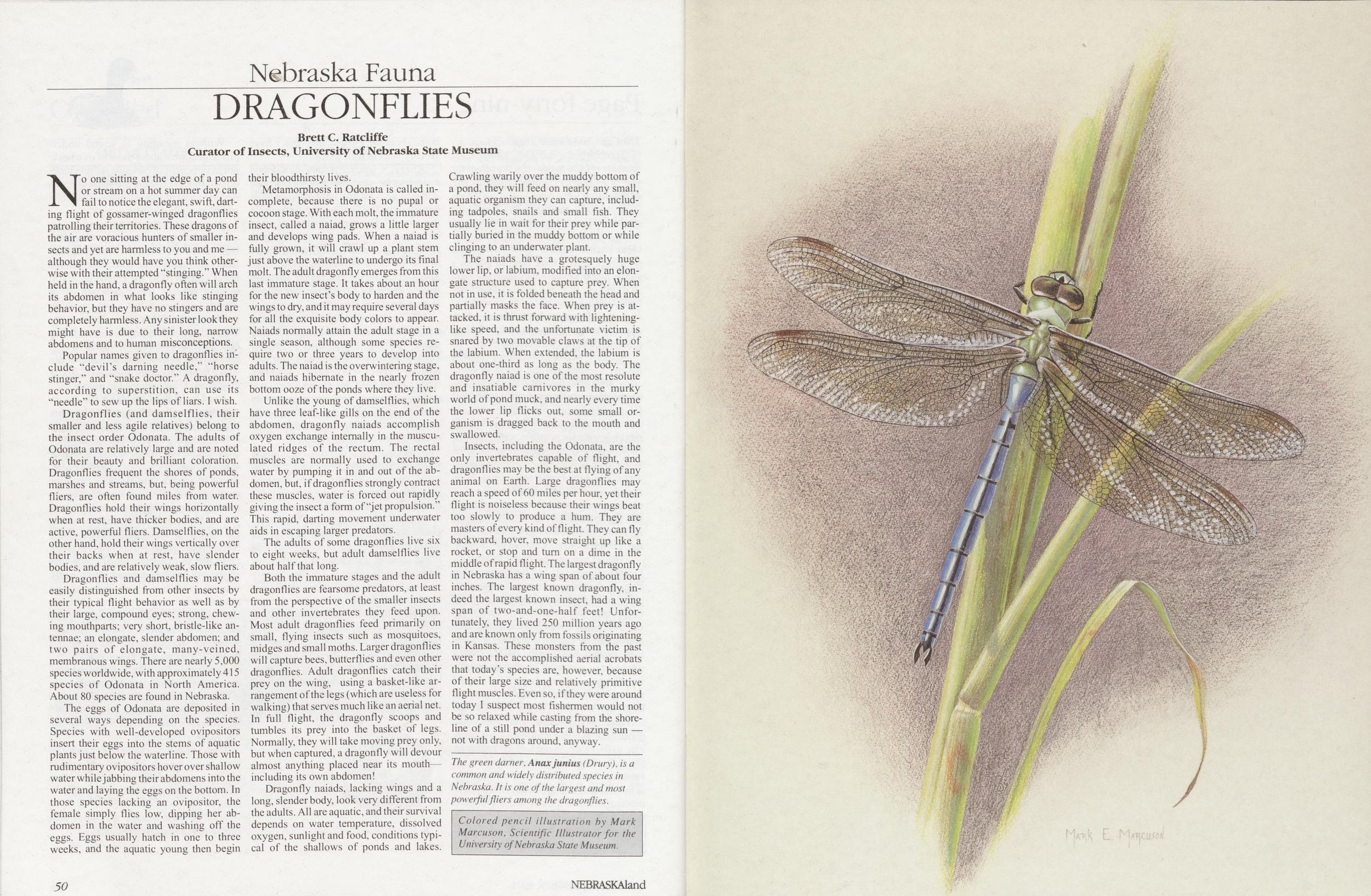
Nebraska Fauna
DRAGONFLIES Brett C. Ratcliffe Curator of Insects, University of Nebraska State MuseumNo one sitting at the edge of a pond or stream on a hot summer day can fail to notice the elegant, swift, darting flight of gossamer-winged dragonflies patrolling their territories. These dragons of the air are voracious hunters of smaller in- sects and yet are harmless to you and me — although they would have you think otherwise with their attempted ''stinging." When held in the hand, a dragonfly often will arch its abdomen in what looks like stinging behavior, but they have no stingers and are completely harmless. Any sinister look they might have is due to their long, narrow abdomens and to human misconceptions.
Popular names given to dragonflies include "devil's darning needle," "horse stinger," and "snake doctor." A dragonfly, according to superstition, can use its "needle" to sew up the lips of liars. I wish.
Dragonflies (and damselflies, their smaller and less agile relatives) belong to the insect order Odonata. The adults of Odonata are relatively large and are noted for their beauty and brilliant coloration. Dragonflies frequent the shores of ponds, marshes and streams, but, being powerful fliers, are often found miles from water. Dragonflies hold their wings horizontally when at rest, have thicker bodies, and are active, powerful fliers. Damselflies, on the other hand, hold their wings vertically over their backs when at rest, have slender bodies, and are relatively weak, slow fliers.
Dragonflies and damselflies may be easily distinguished from other insects by their typical flight behavior as well as by their large, compound eyes; strong, chewing mouthparts; very short, bristle-like antennae; an elongate, slender abdomen; and two pairs of elongate, many-veined, membranous wings. There are nearly 5,000 species worldwide, with approximately 415 species of Odonata in North America. About 80 species are found in Nebraska.
The eggs of Odonata are deposited in several ways depending on the species. Species with well-developed ovipositors insert their eggs into the stems of aquatic plants just below the waterline. Those with rudimentary ovipositors hover over shallow water while jabbing their abdomens into the water and laying the eggs on the bottom. In those species lacking an ovipositor, the female simply flies low, dipping her abdomen in the water and washing off the eggs. Eggs usually hatch in one to three weeks, and the aquatic young then begin their bloodthirsty lives.
Metamorphosis in Odonata is called incomplete, because there is no pupal or cocoon stage. With each molt, the immature insect, called a naiad, grows a little larger and develops wing pads. When a naiad is fully grown, it will crawl up a plant stem just above the waterline to undergo its final molt. The adult dragonfly emerges from this last immature stage. It takes about an hour for the new insect's body to harden and the wings to dry, and it may require several days for all the exquisite body colors to appear. Naiads normally attain the adult stage in a single season, although some species require two or three years to develop into adults. The naiad is the overwintering stage, and naiads hibernate in the nearly frozen bottom ooze of the ponds where they live.
Unlike the young of damselflies, which have three leaf-like gills on the end of the abdomen, dragonfly naiads accomplish oxygen exchange internally in the musculated ridges of the rectum. The rectal muscles are normally used to exchange water by pumping it in and out of the abdomen, but, if dragonflies strongly contract these muscles, water is forced out rapidly giving the insect a form of "jet propulsion." This rapid, darting movement underwater aids in escaping larger predators.
The adults of some dragonflies live six to eight weeks, but adult damselflies live about half that long.
Both the immature stages and the adult dragonflies are fearsome predators, at least from the perspective of the smaller insects and other invertebrates they feed upon. Most adult dragonflies feed primarily on small, flying insects such as mosquitoes, midges and small moths. Larger dragonflies will capture bees, butterflies and even other dragonflies. Adult dragonflies catch their prey on the wing, using a basket-like arrangement of the legs (which are useless for walking) that serves much like an aerial net. In full flight, the dragonfly scoops and tumbles its prey into the basket of legs. Normally, they will take moving prey only, but when captured, a dragonfly will devour almost anything placed near its mouth— including its own abdomen!
Dragonfly naiads, lacking wings and a long, slender body, look very different from the adults. All are aquatic, and their survival depends on water temperature, dissolved oxygen, sunlight and food, conditions typical of the shallows of ponds and lakes. Crawling warily over the muddy bottom of a pond, they will feed on nearly any small, aquatic organism they can capture, including tadpoles, snails and small fish. They usually lie in wait for their prey while partially buried in the muddy bottom or while clinging to an underwater plant.
The naiads have a grotesquely huge lower lip, or labium, modified into an elongate structure used to capture prey. When not in use, it is folded beneath the head and partially masks the face. When prey is attacked, it is thrust forward with lightening- like speed, and the unfortunate victim is snared by two movable claws at the tip of the labium. When extended, the labium is about one-third as long as the body. The dragonfly naiad is one of the most resolute and insatiable carnivores in the murky world of pond muck, and nearly every time the lower lip flicks out, some small organism is dragged back to the mouth and swallowed.
Insects, including the Odonata, are the only invertebrates capable of flight, and dragonflies may be the best at flying of any animal on Earth. Large dragonflies may reach a speed of 60 miles per hour, yet their flight is noiseless because their wings beat too slowly to produce a hum. They are masters of every kind of flight. They can fly backward, hover, move straight up like a rocket, or stop and turn on a dime in the middle of rapid flight. The largest dragonfly in Nebraska has a wing span of about four inches. The largest known dragonfly, in- deed the largest known insect, had a wing span of two-and-one-half feet! Unfortunately, they lived 250 million years ago and are known only from fossils originating in Kansas. These monsters from the past were not the accomplished aerial acrobats that today's species are, however, because of their large size and relatively primitive flight muscles. Even so, if they were around today I suspect most fishermen would not be so relaxed while casting from the shoreline of a still pond under a blazing sun not with dragons around, anyway.
The green darner, Anax Junius (Drury), is a common and widely distributed species in Nebraska. It is one of the largest and most powerful fliers among the dragonflies.
Position: 52 (167 views)