Volume 69, Issue 4, 1991
NEBRASKAland
MAY 1991 $1.50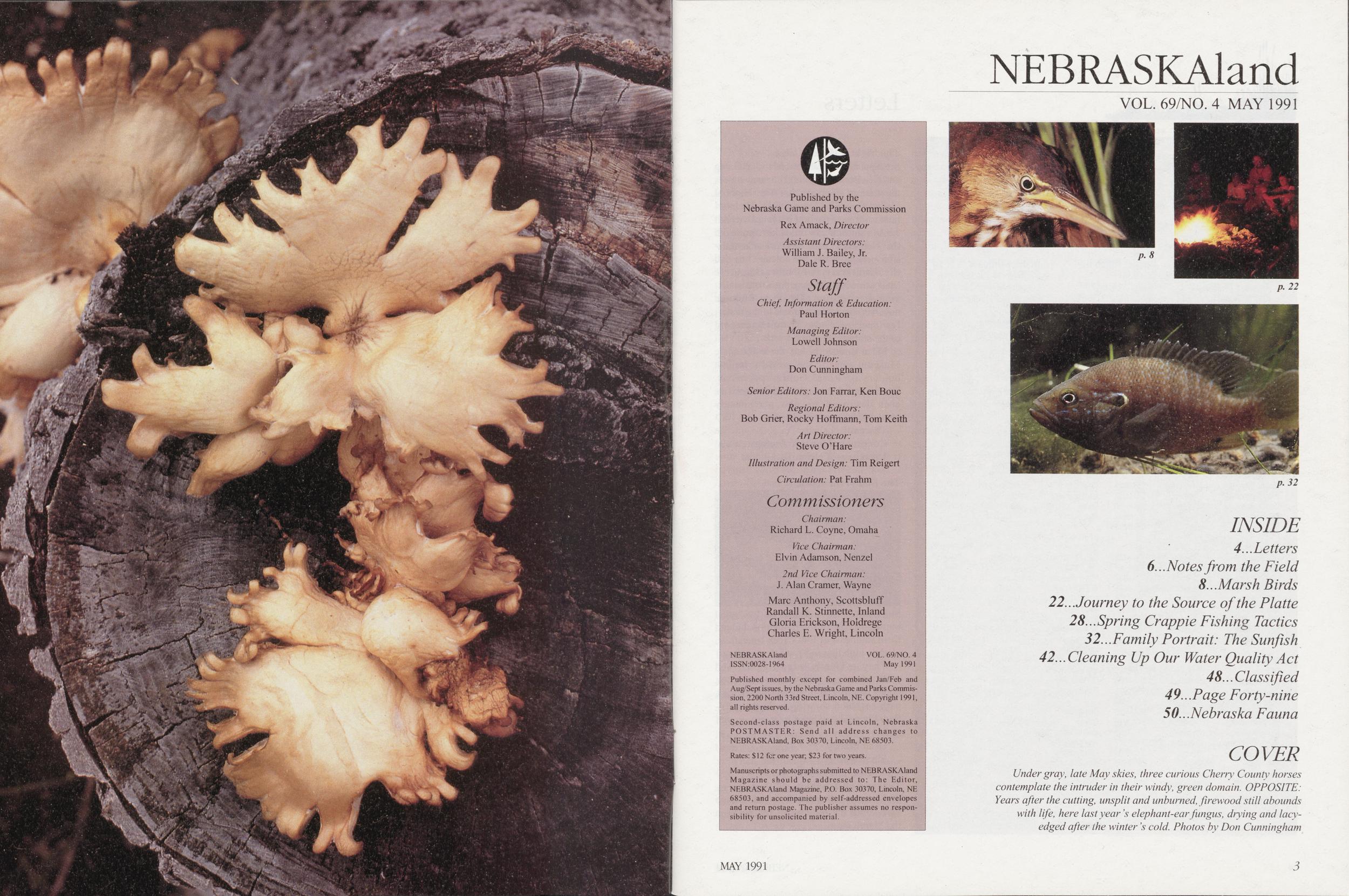
NEBRASKAland
VOL. 69/NO. 4 MAY 1991 Published by the Nebraska Game and Parks Commission Rex Amack, Director Assistant Directors: William J. Bailey, Jr. Dale R. Bree Staff Chief, Information & Education: Paul Horton Managing Editor: Lowell Johnson Editor: Don Cunningham Senior Editors: Jon Farrar, Ken Bouc Regional Editors: Bob Grier, Rocky Hoffmann, Tom Keith Art Director: Steve O'Hare Illustration and Design: Tim Reigert Circulation: Pat Frahm Commissioners Chairman: Richard L. Coyne, Omaha Vice Chairman: Elvin Adamson, Nenzel 2nd Vice Chairman: J. Alan Cramer, Wayne Marc Anthony, Scottsbluff Randall K. Stinnette, Inland Gloria Erickson, Holdrege Charles E. Wright, Lincoln NEBRASKAland ISSN:0028-1964 VOL. 69/NO. 4 May 1991 Published monthly except for combined Jan/Feb and Aug^Sept issues, by the Nebraska Game and Parks Commission, 2200 North 33rd Street, Lincoln, NE. Copyright 1991, all rights reserved. Second-class postage paid at Lincoln, Nebraska POSTMASTER: Send all address changes to NEBRASKAland, Box 30370, Lincoln, NE 68503. Rates: $12 for one year; $23 for two years. Manuscripts or photographs submitted to NEBRASKAland Magazine should be addressed to: The Editor, NEBRASKAland Magazine, P.O. Box 30370. Lincoln, NE 68503, and accompanied by self-addressed envelopes and return postage. The publisher assumes no responsibility for unsolicited material. Nebraska Game and Parks Commission District Offices Headquarters 2200 North 33rd Street Lincoln, NE 68503 Phone (402)471-0641 District Office I Box 725 Alliance, NE 69301 Phone (308)762-5605 District Office II Box 508 Bassett, NE 68714 Phone (402)684-2921 District Office III Box 934 Norfolk, NE 68702 Phone (402)370-3374 District Office IV Route 4, Box 36 North Platte, NE 69101 Phone (308)535-8025 District Office V 2200 North 33rd Street Lincoln, NE 68503 Phone (402)471-5558 Omaha Office State Office Building Mall 1313 Farnam Omaha, NE 68102, Phone (402) 595-2144 Ak-Sar-Ben Aquarium 21502 West Highway 31 Gretna, NE 68028 Phone (402) 332-3901 Conservation Officers by Region Panhandle Southwest Officer City Phone (308) Officer City Phone(308) Richard Furfey (Supv) Alliance 762-2024 Gail Wbodside (Supv) No. Platte 532-0279 Joseph Ulrich Bridgeport 262-0541 George Sund Cambridge 697-4629 Walt Meyer Chadron 432-4398 Jack Henderson Gothenburg 537-7483 John Murphy Crawford 665-2021 Dirk Greene Imperial 882-5328 Jim Zimmerman Gering 436-7561 Ray Frandsen Lexington 324-2753 Marvin Kampbell Hay Spring* 638-7527 Virgil Gosch McCook 345-2185 E.W.Zimmerman Ogalala 284-3013 Dwight Allbery No. Platte 532-2753 Dennis Thompson Ogallala 284-6450 Roger Thompson No. Platte 532-9175 Don Hunt Oshkosh 772-3697 Rich Routh Republican City 799-2085 Richard Brandt Scottsbluff 635-1277 Southeast South-Central Officer City Phone(402) Officer City Phone (402) Don Schaepier (Chief) Lincoln 488-2957 Jerry Pecha (Supv) York 362-5707 Ted Blume (Asst Chief) Lincoln 483-5643 Lester Johnson David City 367-4037 Roger Guenther (Supv) Lincoln 423-5671 Terry Brentzel Grand Is!. (308)384-8296 William Krause Auburn 274-3789 Dale Johnson Hebron 768-7363 Murray Johnson Lincoln 488-2923 Daniel Klammer Hastings 461-3389 Douglas Kramer Lincoln 466-9001 Dayton Shultis Kearney (308)234-3349 Levi Krause Louisville 234-2212 Mark Reeves Loup City (308)745-1126 Russell Mort Nebr. City 873-5684 Robert Finke Seward 643-2056 Duane Arp Omaha 332-4954 Larry Elston Omaha 292-4910 Northeast Craig Stover Omaha 359-2833 Officer City Phone (402) Mike Luben Wahoo 443-4278 Bob Downing (Supv) Norfolk 371-2675 Steve Oberg Lincoln 464-2813 Robert Kelly Albion 395-2538 Dan Evasco Beatrice 228-5935 Ross Oestmann Bloomfield 373-4412 L.A. Wilkinson Columbus 564-4375 Sandhills Gary Ralston Creighton 847-3284 Officer City Phone(402) Daniel Roberts Fremont 721-7852 Bruce Wiebe (Supv) Bassett 684-3867 Randy Pomplun Fullerton (308)536-2987 Max Showaiter Ainsworth 387-1960 Marion Shafer Norfolk 371-2031 Larry Bauman Atkinson 925-5569 Eric Wiebe Ponca 755-2566 Tom Zimmer Brkn.Bow (308)872-6063 Jon Reeves Tekamah 374-1339 Richard Seward Ord (308)728-5338 Raymond Still West Point 372-5676 Mick Gray Valentine 376-3136 Operation Game Thief (800) 7427627
Letters
The Night it Hailed GeeseSir/ Special congratulations to Joe Gabig and Ken Bouc for pulling the many pieces together in their article "The Night it Hailed Geese" [March 1991]. Their article is some of the best reading I've had!
As a side note, I would like to point out that Nebraska Game and Parks Commission personnel had the foresight to call the University of Nebraska State Museum when the magnitude of the disaster was realized. The State Museum now has specimens of most of the waterfowl species killed as a pennanent record of the storm's intensity.
That one storm has made the State Museum one of the world's largest holders of Ross' Goose specimens. Specimens that might have otherwise been destroyed are now permanently available for scientific study.
Thomas E. Labedz Collections Manager-Zoology University of Nebraska-Lincoln The End of the BattleSir/ Enclosed is a picture of two great homed owls in a no-win situation. I found them southeast of Elm Creek beneath an electric high line.
They evidently were fighting and came in contact with the electric lines, talons still locked. They were both dead, with no blood showing or feathers ruffled. I hope it will be of interest to someone.
Dean Braddy Elm Creek, NE Turkey Call TroublesSir/ I must tell you of my success in fabricating the turkey call described in the March issue.
4 NEBRASKAlandI followed the directions, I thought carefully, and I felt it sounded life-like.
It was when I thought it was complete, I loaned it to a father and son I work with. I told the son he should practice on a wild turkey hen that lives on their farm, and they took the call home and tried it the very same evening. The father took the call and struck a few commanding calls. The guineas went berserk and flew to the tall trees, and the hogs came running from the sheds, ears in the air, the boar's jaws foaming and hair on end. The dog tried to get the call from his master by force, and the turkey flew off into the timber.
Question: do you suppose it could be a tuning problem?
Don Verbeek Fremont, NECall-maker Dick Turpin replies: Never in all my years of turkey hunting have I heard a comparable story. In defense of your handmade call, I can say that turkeys have run from mv call, too. I have also had my dog show grave concern over my calling (it hurts their ears) and guineas, of course, will spook from almost anything.
Where you stopped me cold is with the hogs. I have never witnessed a parade of porkies as a result of my calling. This I cannot explain. I can advise, however, not to stroke that call near a hog lot. As far as tuning the call goes, if it sounds good to you, Don, just keep on strokin '. Good luck to you.
Panhandle Rock FlowersSir/ Glancing through the April NEBRASKAland, I found the wildflower article ["Panhandle Rock Plants"]. What a joy! My second love is wildflowers. I've always liked to look for wildflowers in our native pastures, especially if it has been a wet spring.
When our daughter moved to Crawford, I discovered the wildflowers of the area from Bridgeport to Crawford. One walk in the Pine Ridge area yielded 22 varieties. When the men are busy in the fields, I grab my camera and head northwest. You'd be surprised at what is right beside the road. It only whets your appetite for more pictures farther from the road.
Try another area next April. These flowers are tiny treasures that produce gems of pleasure.
Shirley Forster Smithfield, NE Rose Hip Jelly ReduxSir/ I remember seeing in one of your recent issues a request from a reader for rose hip jelly. I've always wanted to try my hand at this also.
After picking two plastic bags full of rose hips recently (just the red, moist ones), I developed a recipe with help from Frank and Shirley Marsh, of Lincoln, Kay Moore, a naturalist at Chet Ager Nature Center in Lincoln, and information on the pectin enclosure! It turned out great.
Rinse rose hips, cover with plenty of water, bring to a rolling boil. Boil one-half hour, add more water if necessary (it smells like straw or cornstalks). Pour mixture into cheesecloth or cotton tea towel in colander; drain. If not able to make jelly soon, refrigerate juice immediately to retard enzyme action.
ROSE HIP JELLY
3 cups rose hip juice (extra juice can be frozen) 1/2 cup lemon juice 1 pkg. Pen-Jel or MCP Pectin 5 cups white sugarBring the first three ingredients to a rolling boil, add sugar and boil for three minutes, stirring constantly. Pour immediately into sterilized jars. When cool, seal with paraffin. Fills eight jelly jars.
This makes pretty, dark rose-colored jelly, and it has its own unique flavor, as well as being high in Vitamin C.
Good luck to your readers!
Nancy L. Savery Lincoln, NE Send your comments and complaints to Letters, P.O. Box 30370, Lincoln, NE 68503. NEBRASKAland reserves the right to edit and condense letters.
Notes from the field
The Cryptic CrappieFrom the sound of its title, it seems this column is intended to include particularly interesting tidbits from the field diaries often kept by wildlife professionals. These are little pocket-sized notebooks whose tidy pages record the sighting of rare or unusual plants or animals, a seldom-seen courtship ritual, a youngster's first adventure away from the den or nest or a poignant encounter of predator and prey.
Keeping a field diary is a bit too structured for my tastes, and tidiness in any form has always seemed to elude me. But there are times when I wish I kept such a journal to document things that can't be photographed but are still informative and worth saving. What I saw the past several summers is a good example, although it was not at all unusual. In fact, the events were common as dirt, things that happen all over Nebraska all the time. But very few people see them, and most of those few who do observe them do not recognize what they have seen.
In my underwater stalking of Nebraska's sunfishes for their family portrait (pages 32-41 of this issue) it seemed as if I had emptied a truckload of air tanks. But in all that time, I never encountered a good-sized crappie, even though I was snooping around in good crappie waters and had seen lots of smaller ones among the bluegill and other fish. Not until the last air tank of the next-to-last trip did it dawn on me: I had undoubtedly looked at mature crappies often. I just hadn't seen them.
I came to this conclusion among the submerged branches of a cottonwood toppled into the water. Peering in from alongside revealed nothing, but by going down to where a few branches touched the bottom, I could swim underneath the snag and look up to see what was silhouetted against the bright surface.There were crappie in those branches, after all (about then, just before attempting to steady myself with a hand on the floor of the lake, I discovered that snapping turtles lying motionless on the bottom are also hard to see).
Moving back up to their level and into the branches, however, still failed to reveal crappies—or did it? After what seemed like several minutes of hanging motionless and staring intently into the Cottonwood's shadowy superstructure, I finally located a tiny object suspended in the gloom. It was an eye, staring back at me, just a bit more than arm's length away. It was an eerie feeling to look something in the eye without seeing the rest of it. I studied that eye for a minute or so, knowing there was a crappie attached, but I could not even tell whether the fish faced right or left. Not until I moved in and forced it to leave did its motion reveal the crappie's form to me.
I was impressed, but figured that fish was just hiding in the darkness—until I spotted another eye in more or less open water. Without deep shadows to hide in, this fish should have been visible. But again, the fish was absolutely imperceptible until it moved.
It was then I began to appreciate what a marvelous adaptation the crappie's coloration and markings represent. Its camouflage must be part of what makes it such an efficient predator on the smaller fish it hunts and eats in those shadowy environs. But it works only in the dim, diffused light of deeper water, brushpiles, and late afternoons or evenings. When the crappie swims in the brightness near the surface, or is blasted with photo flash, its camouflage fails.
Another important characteristic is the way a mature crappie moves through its world. Bass, bluegill and other fish, even small crappie, charge and dart in all directions, muscular sides flexing and tail fins flashing. Not so the bigger crappie. They glide unhurriedly from shadow to shadow, drift into position, slip into view and steal away almost without the apparent movement of body or fin. Even when pressed from their cover, they leave with unhurried grace.
In another lake, I repeatedly intimidated a male black crappie guarding his nondescript nest beneath a floating dock. Whenever I came within two feet of his nest, he drifted slowly out of view. 6 NEBRASKAland When I backed off he simply reappeared over his claim, often without my seeing him approach. If "ghost" were a verb of locomotion, it would suit the crappie.
Young crappie, on the other hand, are tinfoil-colored little fish that dart around in open water like escaped party balloons. At that early stage in life, crappie don't eat minnows. They live on zooplankton and any insects or crustaceans they might happen onto, just like bluegill. So they can act just like bluegill, they can dart around in the open, and they can be tin-foil-colored, and it will make not one bit of difference.
But it's another story when they graduate to minnows. That's when nature equips them with the darker, mottled coat of specks and spots for camouflage and gives them secretive ways, when it sends them to cover to live by the hunt. That's not scientific gospel, of course, but just the way I see things. But one or two fisheries biologists I tried the theory on agree that the scenario makes sense and is probably more right than wrong, and that's not bad for a conservative bunch like biologists.
There. We've dealt with the crappie question. But I still have other questions about sunfish family matters.
For example, on the smallmouth bass nests I've watched, the only looters in the owner's absence were other bass. And when observing bluegill spawning beds, the only raiders of bluegill nests that I've observed have been other bluegill. Is there a reason that the sunfish seem to raid only their own kind?
When the bluegill are spawning, the males are constantly picking at the gravel on the bottom of their nests, then spitting out bunches of little white flakes. Is this feeding, or cleaning the nest, or disposal of defective eggs?
And why do spawning bluegill tolerate 200-pound divers just inches away, yet spook at the mere shadow of a dragonfly?
And what about the smallmouth bass at Lake McConaughy? How do they know that...
Ken Bouc May Flowers and NEBRASKAland's Field Guide to the Wild/lowers of Nebraska and the Great Plains is the perfect tool to help you identify them, or the perfect gift for the hard-to-buy-for naturalist Available for only $17.95. The Field Guide features ... • 216 pages • Full-color photographs and descriptions of 282 species • Handy 6x9-inch size, stitched binding durable paper • Organized by flower color and time of flowering • Accurate, complete entries, minimal technical language • Complete index and glossary 1 Available at most bookstores, or use the coupon below. Name Address City___ State. Zip- Check enclosed. VISA MASTERCARD. Card Number/Expr. Date____________________________________ Enclose $17.95. Nebraska residents please include sales tax. Send to: NEBRASKAland Magazine, P.O. Box 30370, Lincoln, NE 68503 MAY 1991 7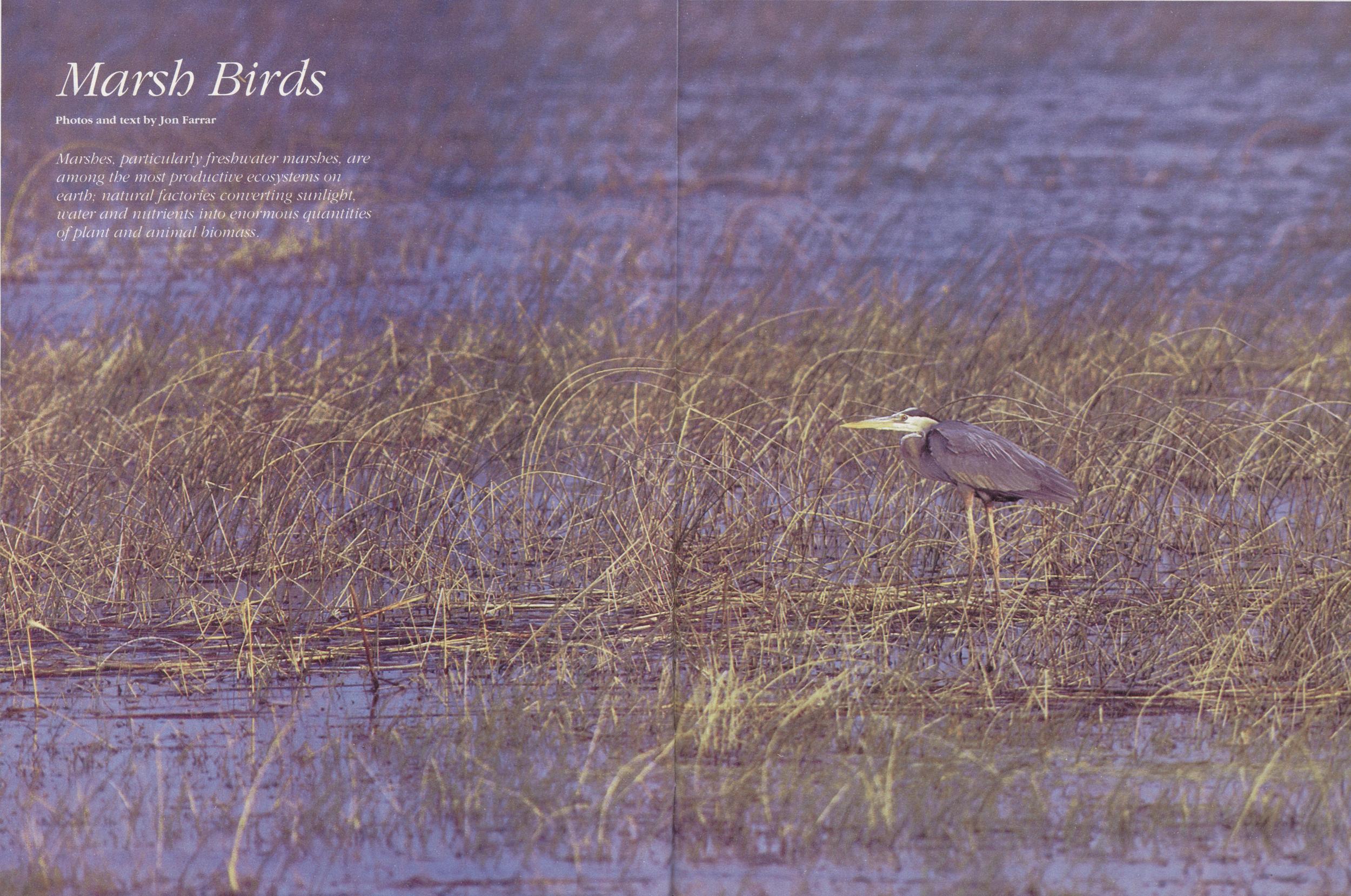
Marsh Birds
Photos and text by Jon Farrar Marshes, particularly freshwater marshes, are among the most productive ecosystems on earth: natural factories concerting sunlight, water and nutrients into enormous quantities of plant and animal hiomass.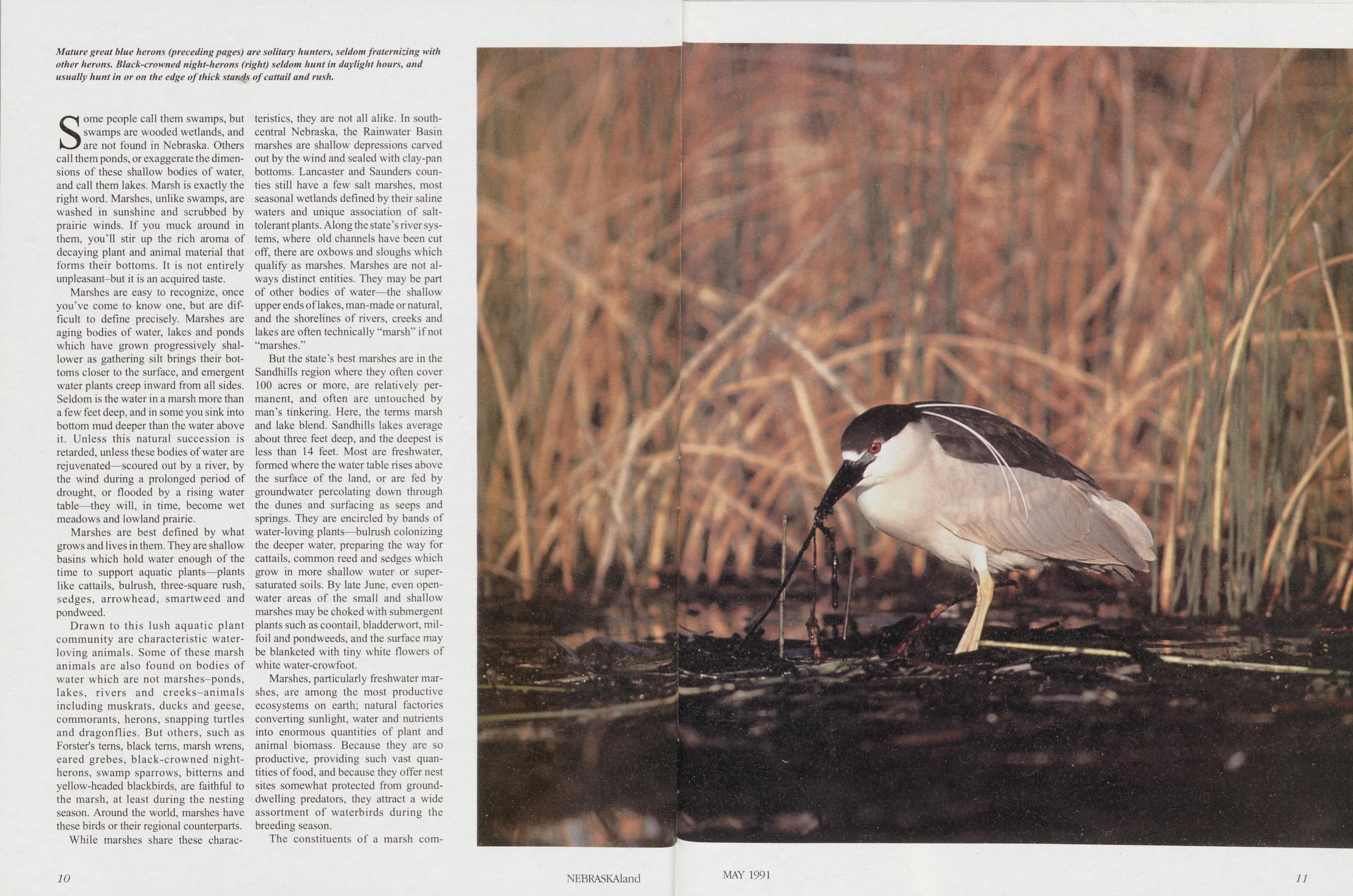
Some people call them swamps, but swamps are wooded wetlands, and are not found in Nebraska. Others call them ponds, or exaggerate the dimensions of these shallow bodies of water, and call them lakes. Marsh is exactly the right word. Marshes, unlike swamps, are washed in sunshine and scrubbed by prairie winds. If you muck around in them, you'll stir up the rich aroma of decaying plant and animal material that forms their bottoms. It is not entirely unpleasant-but it is an acquired taste.
Marshes are easy to recognize, once you've come to know one, but are difficult to define precisely. Marshes are aging bodies of water, lakes and ponds which have grown progressively shallower as gathering silt brings their bottoms closer to the surface, and emergent water plants creep inward from all sides. Seldom is the water in a marsh more than a few feet deep, and in some you sink into bottom mud deeper than the water above it. Unless this natural succession is retarded, unless these bodies of water are rejuvenated—scoured out by a river, by the wind during a prolonged period of drought, or flooded by a rising water table—they will, in time, become wet meadows and lowland prairie.
Marshes are best defined by what grows and lives in them. They are shallow basins which hold water enough of the time to support aquatic plants—plants like cattails, bulrush, three-square rush, sedges, arrowhead, smartweed and pondweed.
Drawn to this lush aquatic plant community are characteristic water loving animals. Some of these marsh animals are also found on bodies of water which are not marshes-ponds, lakes, rivers and creeks-animals including muskrats, ducks and geese, cormorants, herons, snapping turtles and dragonflies. But others, such as Forster's terns, black terns, marsh wrens, eared grebes, black-crowned night- herons, swamp sparrows, bitterns and yellow-headed blackbirds, are faithful to the marsh, at least during the nesting season. Around the world, marshes have these birds or their regional counterparts.
While marshes share these characteristics, they are not all alike. In south-central Nebraska, the Rainwater Basin marshes are shallow depressions carved out by the wind and sealed with clay-pan bottoms. Lancaster and Saunders counties still have a few salt marshes, most seasonal wetlands defined by their saline waters and unique association of salt- tolerant plants. Along the state's river systems, where old channels have been cut off, there are oxbows and sloughs which qualify as marshes. Marshes are not always distinct entities. They may be part of other bodies of water—the shallow upper ends of lakes, man-made or natural, and the shorelines of rivers, creeks and lakes are often technically "marsh" if not "marshes."
But the state's best marshes are in the Sandhills region where they often cover 100 acres or more, are relatively permanent, and often are untouched by man's tinkering. Here, the terms marsh and lake blend. Sandhills lakes average about three feet deep, and the deepest is less than 14 feet. Most are freshwater, formed where the water table rises above the surface of the land, or are fed by groundwater percolating down through the dunes and surfacing as seeps and springs. They are encircled by bands of water-loving plants—bulrush colonizing the deeper water, preparing the way for cattails, common reed and sedges which grow in more shallow water or super-saturated soils. By late June, even open water areas of the small and shallow marshes may be choked with submergent plants such as coontail, bladderwort, milfoil and pondweeds, and the surface may be blanketed with tiny white flowers of white water-crowfoot.
Marshes, particularly freshwater marshes, are among the most productive ecosystems on earth; natural factories converting sunlight, water and nutrients into enormous quantities of plant and animal biomass. Because they are so productive, providing such vast quantities of food, and because they offer nest sites somewhat protected from ground dwelling predators, they attract a wide assortment of waterbirds during the breeding season.
The constituents of a marsh community, 10 NEBRASKAland
like those of a human community, share enough common traits to draw them together, but each species, like each individual in a human community, must also be somewhat specialized, must fill a "niche" in that community. In a human community there can be only so many shoe salesmen, construction workers or elementary school teachers; a marsh community can support only so many marsh wrens, night-herons or coots.
The diverse blend of wild creatures on a spring marsh is a wonderful display of nature's efficiency. Each animal has its own precise requirements—a reliable food supply, a place for courtship and sites to raise its young somewhat protected from the elements and predators. A great variety and number of birds may use a Sandhills marsh in the course of migration, but only a limited number can remain to rear their young. During the breeding season, competition for living space is greatest. Even though each species is specialized to some degree by where it nests and feeds, only a limited number of any one species can occupy a single marsh.
There is competition among members of the same species and, to a lesser degree, between species requiring similar habitats and foods. Textbook examples of natural communities imply that each species occupies a precise niche, but nature, in all its complexity, refuses to tidily pigeonhole its creatures. On a marsh, and throughout the natural world, there is an order which minimizes competition between species, and yet, at the same time, there is constant competition which ensures efficient use of the limited space.
Blackbirds are a good example. Two species are found on Sandhills marshes during the breeding season—the ubiquitous red-winged blackbird, found in wetlands virtually across the continent, and the yellow-headed blackbird found in central and western North America. Yellow heads are said to nest in emergent vegetation over deeper water than is preferred by redwings. That is roughly true on a Sandhills marsh. Redwings are more versatile in their choice of nest sites, requiring only that they be near water. They will nest in cattail or bulrush, in rank patches of sunflower and ragweed, in trees and shrubs and occasionally even on the ground in meadows. But the preferred nest site of both species on a Sandhills marsh seems to be the occasional stands of cattail along shorelines lined mostly with bulrush. These stands of cattail afford greater concealment and protection from the elements than does bulrush, and the previous season's growth is still standing in early spring when territories are defined and nest construction begins.
Even though redwings usually arrive and stake claims to nesting territories before the yellow heads, the yellow heads almost always possess the choicest sites in the end. Perhaps this is because yellow heads are larger and more aggressive, feel a stronger urge to nest in colonies than the redwings do and so by sheer numbers overwhelm the redwings. Perhaps it is because redwings are less specialized in their choice of nest sites. Whatever the reason, prime nesting sites in shoreline cattail colonies are almost always occupied by yellow heads.
Beyond the boundaries of their stridently defended nesting territories, the two species seem to share amicably the seemingly limitless supply of insects available in shoreline vegetation and adjacent meadows, and when threatened by predators, redwings and yellow heads present a united front. Abull snake swimming through shoreline vegetation is hazed and scolded by a continuous legion of both redwings and yellow heads. Such cooperative mobbing of predators, be they snake or human, is common during the nesting season. Occasionally, as many as half a dozen different species will join forces to expel, or at least befuddle, a common threat. Nesting terns often sound the early alert, but they are quickly MAY 1991 13 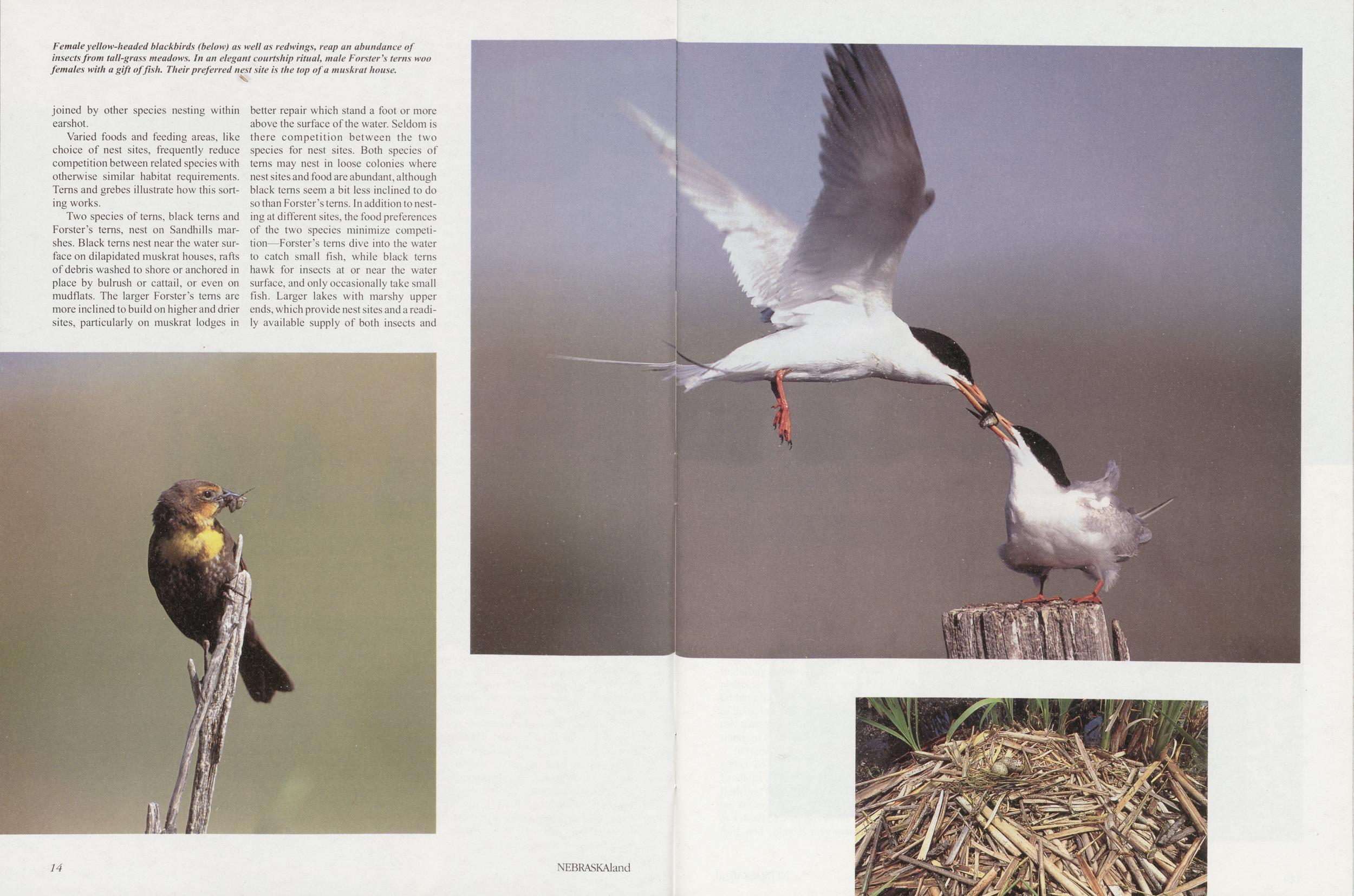 joined by other species nesting within earshot.
Varied foods and feeding areas, like choice of nest sites, frequently reduce competition between related species with otherwise similar habitat requirements. Terns and grebes illustrate how this sorting works.
Two species of terns, black terns and Forster's terns, nest on Sandhills marshes. Black terns nest near the water surface on dilapidated muskrat houses, rafts of debris washed to shore or anchored in place by bulrush or cattail, or even on mudflats. The larger Forster's terns are more inclined to build on higher and drier sites, particularly on muskrat lodges in better repair which stand a foot or more above the surface of the water. Seldom is there competition between the two species for nest sites. Both species of terns may nest in loose colonies where nest sites and food are abundant, although black terns seem a bit less inclined to do so than Forster's terns. In addition to nesting at different sites, the food preferences of the two species minimize competition—Forster's terns dive into the water to catch small fish, while black terns hawk for insects at or near the water surface, and only occasionally take small fish. Larger lakes with marshy upper ends, which provide nest sites and a readily available supply of both insects and
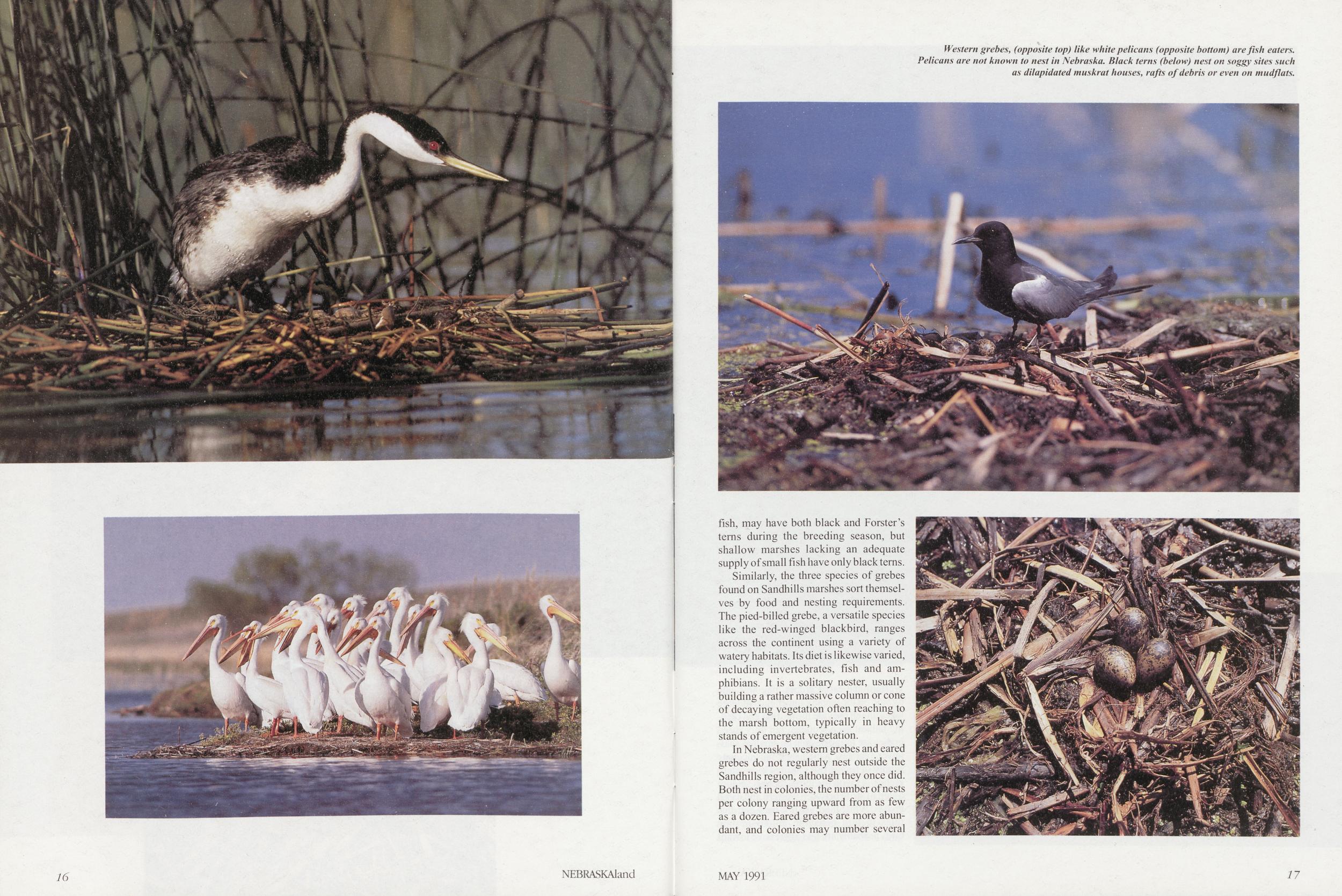
Similarly, the three species of grebes found on Sandhills marshes sort themselves by food and nesting requirements. The pied-billed grebe, a versatile species like the red-winged blackbird, ranges across the continent using a variety of watery habitats. Its diet is likewise varied, including invertebrates, fish and amphibians. It is a solitary nester, usually building a rather massive column or cone of decaying vegetation often reaching to the marsh bottom, typically in heavy stands of emergent vegetation.
In Nebraska, western grebes and eared grebes do not regularly nest outside the Sandhills region, although they once did. Both nest in colonies, the number of nests per colony ranging upward from as few as a dozen. Eared grebes are more abundant, and colonies may number several MAY 1991 17 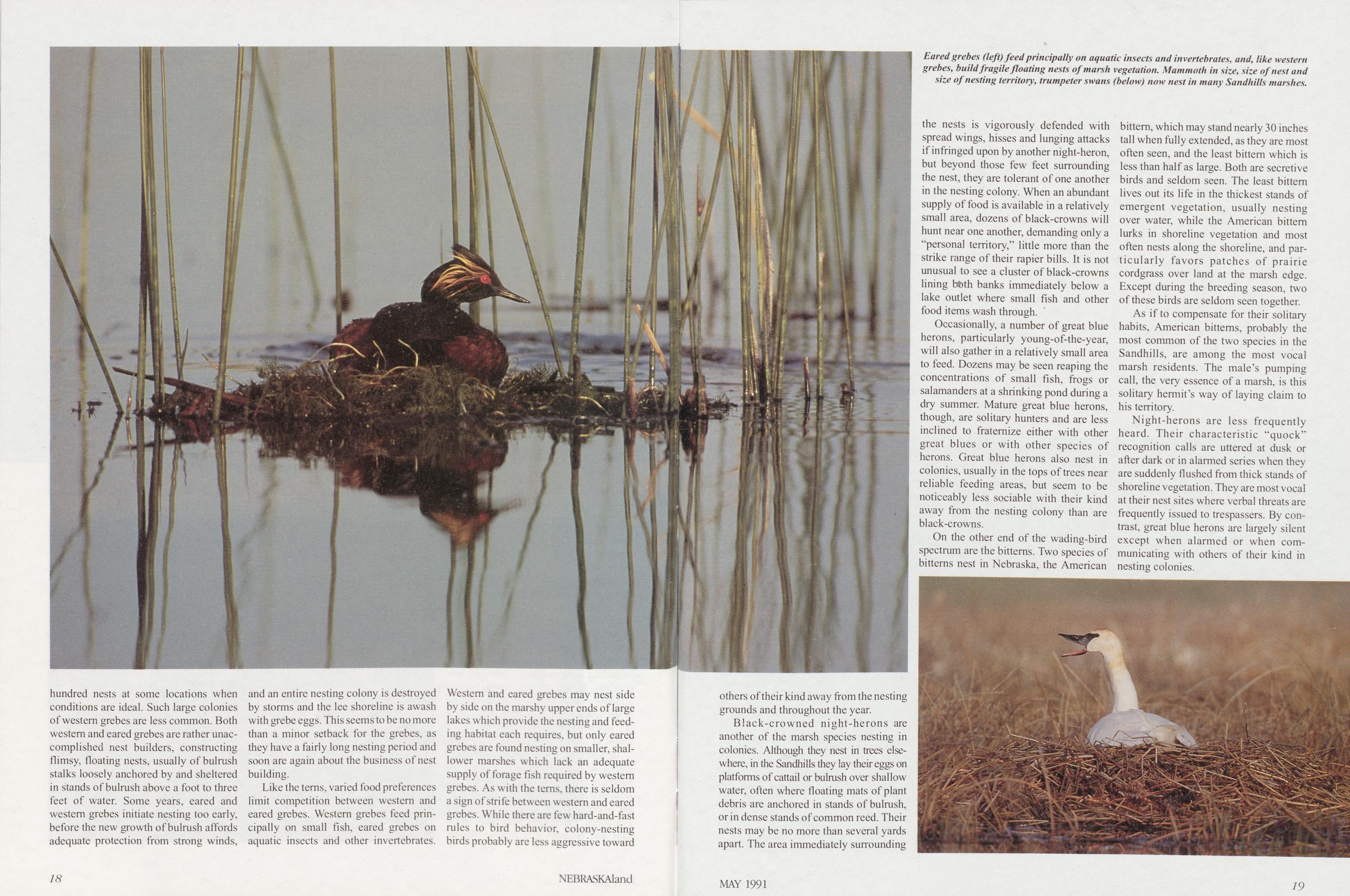
Like the terns, varied food preferences limit competition between western and eared grebes. Western grebes feed principally on small fish, eared grebes on aquatic insects and other invertebrates. Western and eared grebes may nest side by side on the marshy upper ends of large lakes which provide the nesting and feed- ing habitat each requires, but only eared grebes are found nesting on smaller, shallower marshes which lack an adequate supply of forage fish required by western grebes. As with the terns, there is seldom a sign of strife between western and eared grebes. While there are few hard-and-fast rules to bird behavior, colony-nesting birds probably are less aggressive toward 18 NEBRASKAland others of their kind away from the nesting grounds and throughout the year.
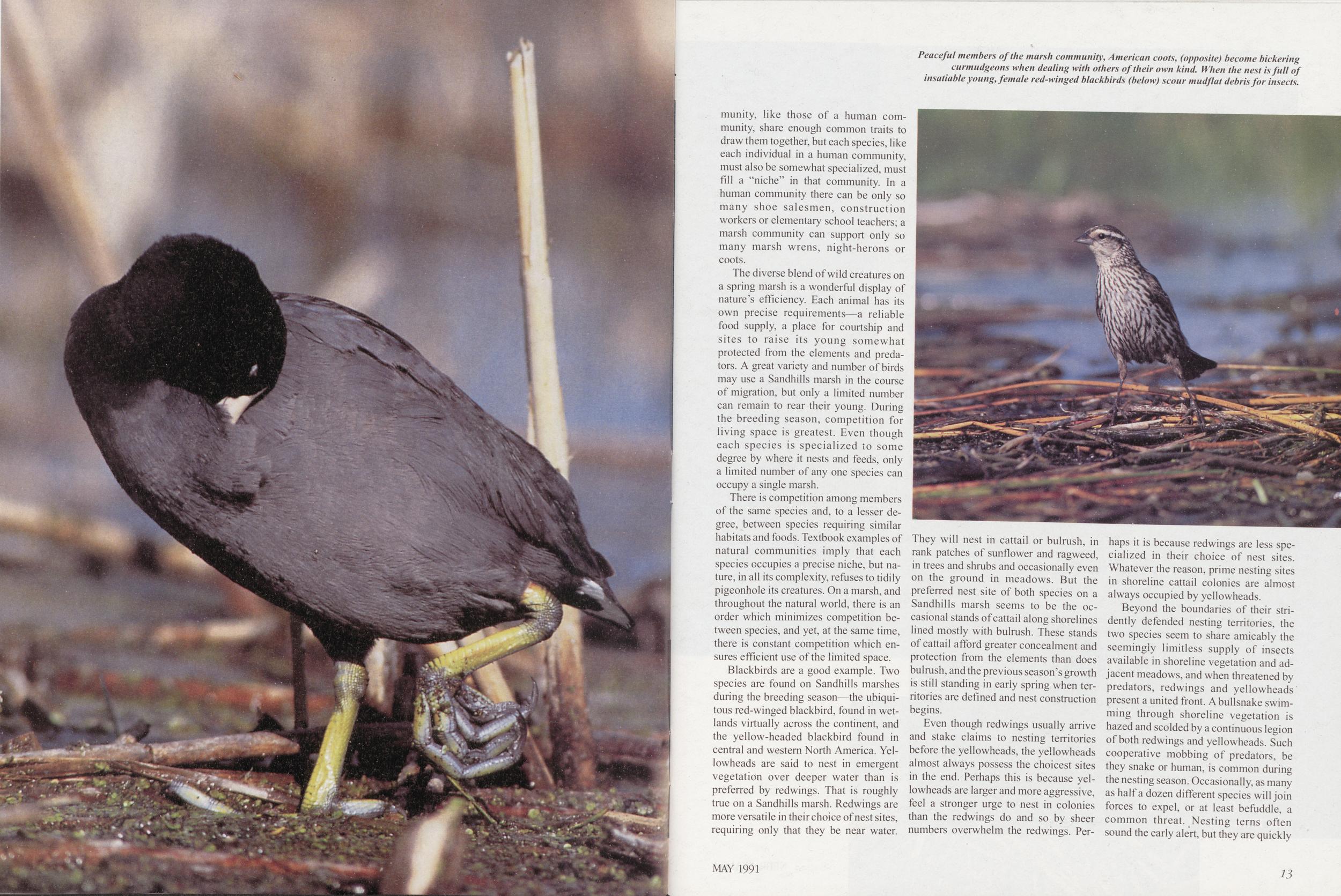
Black-crowned night-herons are another of the marsh species nesting in colonies. Although they nest in trees elsewhere, in the Sandhills they lay their eggs on platforms of cattail or bulrush over shallow water, often where floating mats of plant debris are anchored in stands of bulrush, or in dense stands of common reed. Their nests may be no more than several yards apart. The area immediately surrounding the nests is vigorously defended with spread wings, hisses and lunging attacks if infringed upon by another night-heron, but beyond those few feet surrounding the nest, they are tolerant of one another in the nesting colony. When an abundant supply of food is available in a relatively small area, dozens of black-crowns will hunt near one another, demanding only a "personal territory," little more than the strike range of their rapier bills. It is not unusual to see a cluster of black-crowns lining both banks immediately below a lake outlet where small fish and other food items wash through.
Occasionally, a number of great blue herons, particularly young-of-the-year, will also gather in a relatively small area to feed. Dozens may be seen reaping the concentrations of small fish, frogs or salamanders at a shrinking pond during a dry summer. Mature great blue herons, though, are solitary hunters and are less inclined to fraternize either with other great blues or with other species of herons. Great blue herons also nest in colonies, usually in the tops of trees near reliable feeding areas, but seem to be noticeably less sociable with their kind away from the nesting colony than are black-crowns.
On the other end of the wading-bird spectrum are the bitterns. Two species of bitterns nest in Nebraska, the American bittern, which may stand nearly 30 inches tall when fully extended, as they are most often seen, and the least bittern which is less than half as large. Both are secretive birds and seldom seen. The least bittern lives out its life in the thickest stands of emergent vegetation, usually nesting over water, while the American bittern lurks in shoreline vegetation and most often nests along the shoreline, and particularly favors patches of prairie cordgrass over land at the marsh edge. Except during the breeding season, two of these birds are seldom seen together.
As if to compensate for their solitary habits, American bitterns, probably the most common of the two species in the Sandhills, are among the most vocal marsh residents. The male's pumping call, the very essence of a marsh, is this solitary hermit's way of laying claim to his territory.
Night-herons are less frequently heard. Their characteristic "quock" recognition calls are uttered at dusk or after dark or in alarmed series when they are suddenly flushed from thick stands of shoreline vegetation. They are most vocal at their nest sites where verbal threats are frequently issued to trespassers. By contrast, great blue herons are largely silent except when alarmed or when communicating with others of their kind in nesting colonies.
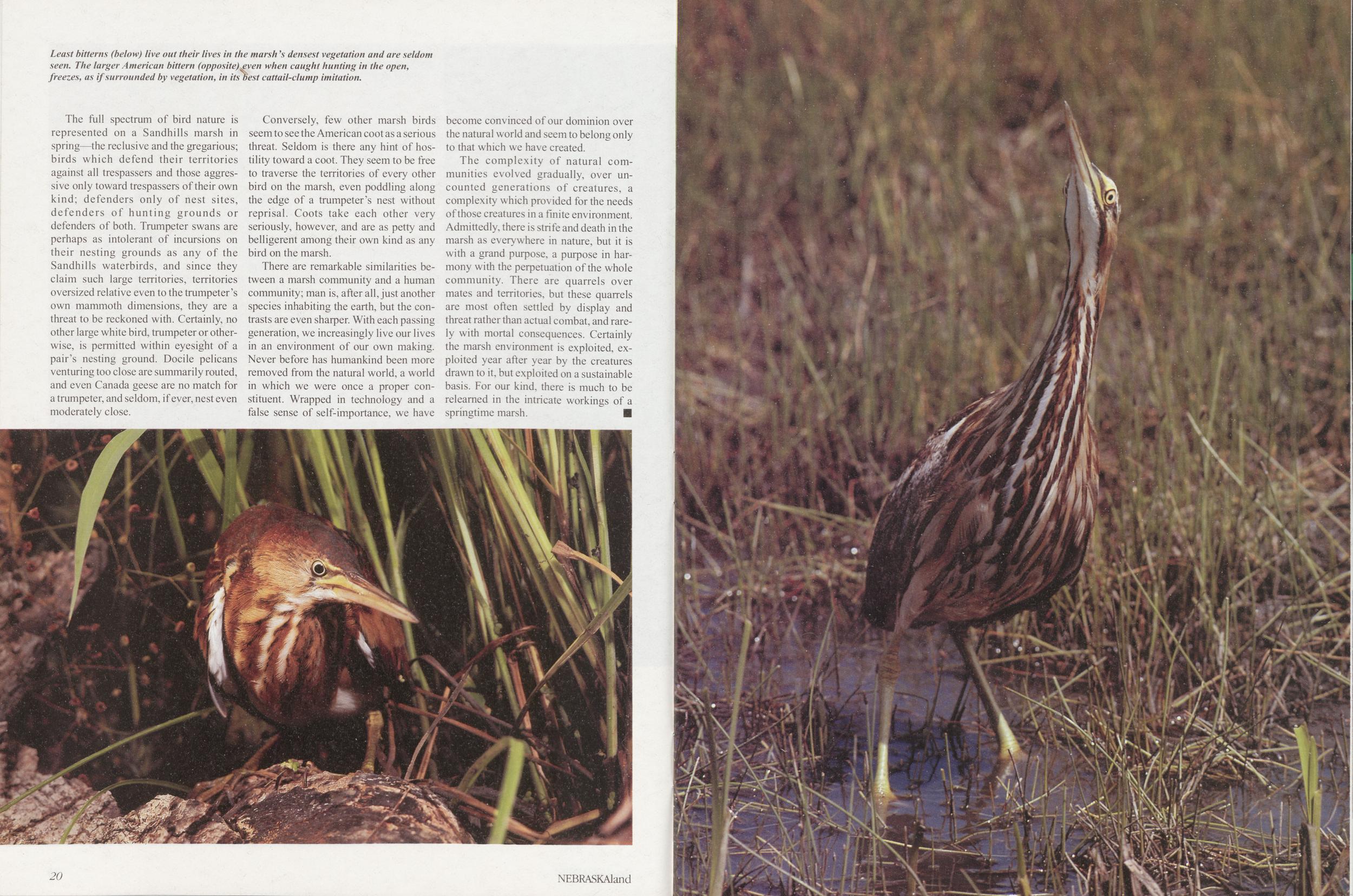
The full spectrum of bird nature is represented on a Sandhills marsh in spring—the reclusive and the gregarious; birds which defend their territories against all trespassers and those aggressive only toward trespassers of their own kind; defenders only of nest sites, defenders of hunting grounds or defenders of both. Trumpeter swans are perhaps as intolerant of incursions on their nesting grounds as any of the Sandhills waterbirds, and since they claim such large territories, territories oversized relative even to the trumpeter's own mammoth dimensions, they are a threat to be reckoned with. Certainly, no other large white bird, trumpeter or otherwise, is permitted within eyesight of a pair's nesting ground. Docile pelicans venturing too close are summarily routed, and even Canada geese are no match for a trumpeter, and seldom, if ever, nest even moderately close.
Conversely, few other marsh birds seem to see the American coot as a serious threat. Seldom is there any hint of hostility toward a coot. They seem to be free to traverse the territories of every other bird on the marsh, even paddling along the edge of a trumpeter's nest without reprisal. Coots take each other very seriously, however, and are as petty and belligerent among their own kind as any bird on the marsh.
There are remarkable similarities between a marsh community and a human community; man is, after all, just another species inhabiting the earth, but the contrasts are even sharper. With each passing generation, we increasingly live our lives in an environment of our own making. Never before has humankind been more removed from the natural world, a world in which we were once a proper constituent. Wrapped in technology and a false sense of self-importance, we have become convinced of our dominion over the natural world and seem to belong only to that which we have created.
The complexity of natural communities evolved gradually, over uncounted generations of creatures, a complexity which provided for the needs of those creatures in a finite environment. Admittedly, there is strife and death in the marsh as everywhere in nature, but it is with a grand purpose, a purpose in harmony with the perpetuation of the whole community. There are quarrels over mates and territories, but these quarrels are most often settled by display and threat rather than actual combat, and rarely with mortal consequences. Certainly the marsh environment is exploited, exploited year after year by the creatures drawn to it, but exploited on a sustainable basis. For our kind, there is much to be relearned in the intricate workings of a springtime marsh.
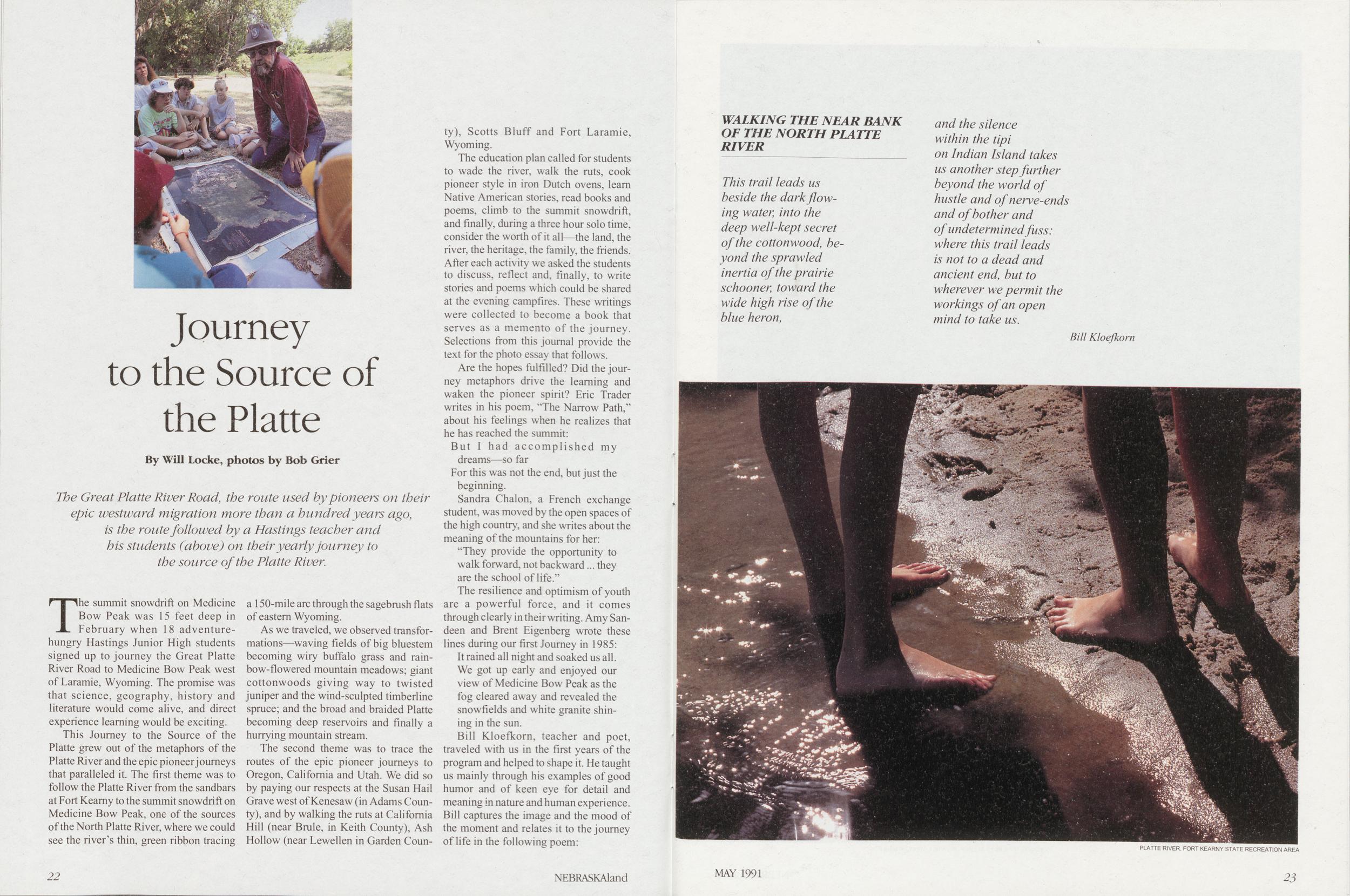
Journey to the Source of the Platte
By Will Locke, photos by Bob Grier The Great Platte River Road, the route used by pioneers on their epic westward migration more than a hundred years ago, is the route followed by a Hastings teacher and his students (above) on their yearly journey to the source of the Platte River.The summit snowdrift on Medicine Bow Peak was 15 feet deep in February when 18 adventure hungry Hastings Junior High students signed up to journey the Great Platte River Road to Medicine Bow Peak west of Laramie, Wyoming. The promise was that science, geography, history and literature would come alive, and direct experience learning would be exciting.
This Journey to the Source of the Platte grew out of the metaphors of the Platte River and the epic pioneer journeys that paralleled it. The first theme was to follow the Platte River from the sandbars at Fort Kearny to the summit snowdrift on Medicine Bow Peak, one of the sources of the North Platte River, where we could see the river's thin, green ribbon tracing a 150-mile arc through the sagebrush flats of eastern Wyoming.
As we traveled, we observed transformations waving fields of big bluestem becoming wiry buffalo grass and rainbow-flowered mountain meadows; giant cottonwoods giving way to twisted juniper and the wind-sculpted timberline spruce; and the broad and braided Platte becoming deep reservoirs and finally a hurrying mountain stream.
The second theme was to trace the routes of the epic pioneer journeys to Oregon, California and Utah. We did so by paying our respects at the Susan Hail Grave west of Kenesaw (in Adams County), and by walking the ruts at California Hill (near Brule, in Keith County), Ash Hollow (near Lewellen in Garden County), Scotts Bluff and Fort Laramie, Wyoming.
The education plan called for students to wade the river, walk the ruts, cook pioneer style in iron Dutch ovens, learn Native American stories, read books and poems, climb to the summit snowdrift, and finally, during a three hour solo time, consider the worth of it all—the land, the river, the heritage, the family, the friends. After each activity we asked the students to discuss, reflect and, finally, to write stories and poems which could be shared at the evening campfires. These writings were collected to become a book that serves as a memento of the journey. Selections from this journal provide the text for the photo essay that follows.
Are the hopes fulfilled? Did the journey metaphors drive the learning and waken the pioneer spirit? Eric Trader writes in his poem, 'The Narrow Path," about his feelings when he realizes that he has reached the summit:
But I had accomplished my dreams—so far For this was not the end, but just the beginning.Sandra Chalon, a French exchange student, was moved by the open spaces of the high country, and she writes about the meaning of the mountains for her:
"They provide the opportunity to walk forward, not backward... they are the school of life."
The resilience and optimism of youth are a powerful force, and it comes through clearly in their writing. Amy Sandeen and Brent Eigenberg wrote these lines during our first Journey in 1985:
It rained all night and soaked us all. We got up early and enjoyed our view of Medicine Bow Peak as the fog cleared away and revealed the snowfields and white granite shining in the sun.
Bill Kloefkorn, teacher and poet, traveled with us in the first years of the program and helped to shape it. He taught us mainly through his examples of good humor and of keen eye for detail and meaning in nature and human experience. Bill captures the image and the mood of the moment and relates it to the journey of life in the following poem:
22 NEBRASKAland WALKING THE NEAR BANK OF THE NORTH PLATTE RIVER This trail leads us beside the dark flowing water, into the deep well-kept secret of the cottonwood, beyond the sprawled inertia of the prairie schooner, toward the wide high rise of the blue heron, and the silence within the tipi on Indian Island takes us another step further beyond the world of hustle and of nerve-ends and of bother and of undetermined fuss: where this trail leads is not to a dead and ancient end, but to wherever we permit the workings of an open mind to take us. Bill Kloefkorn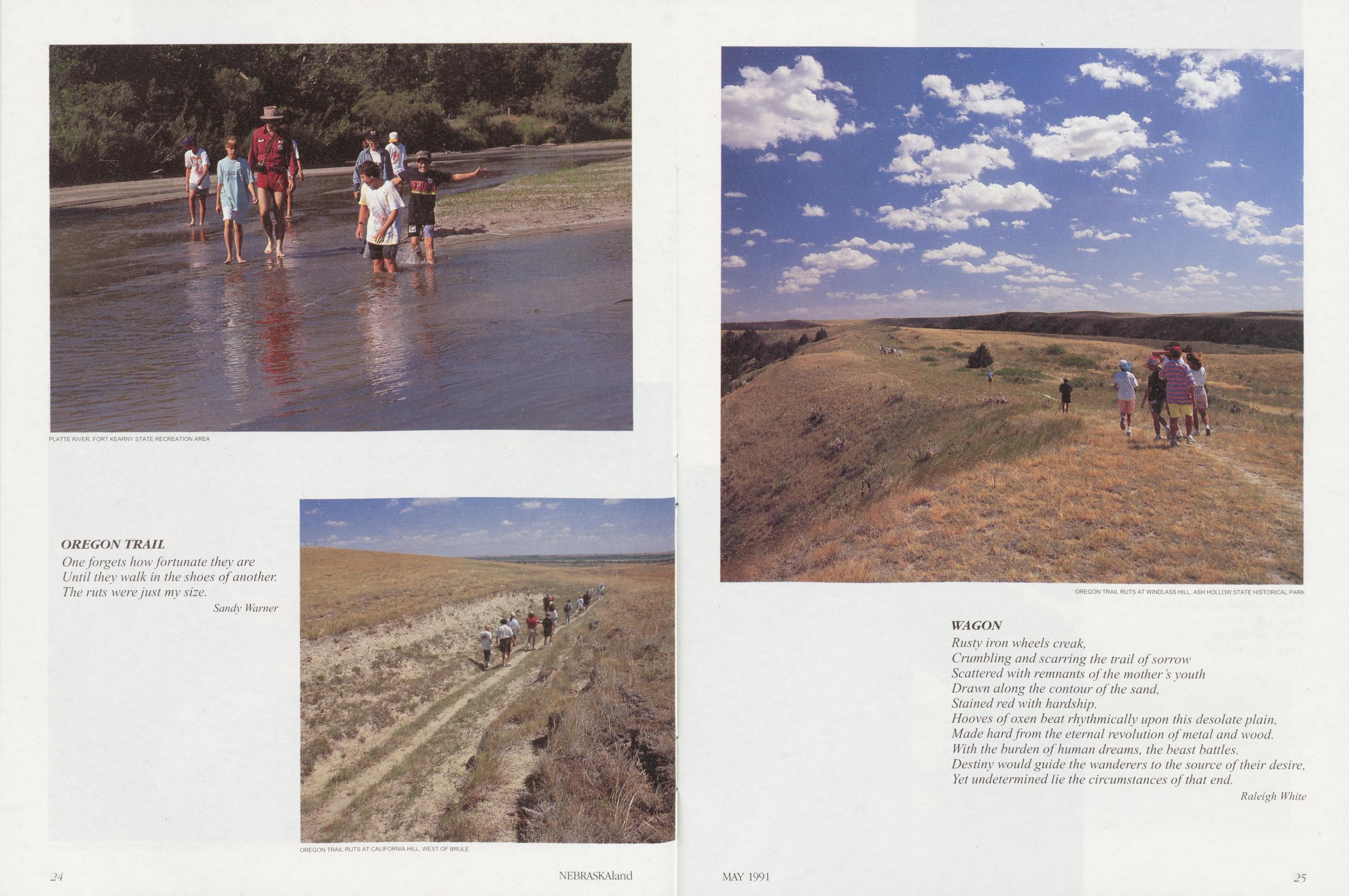
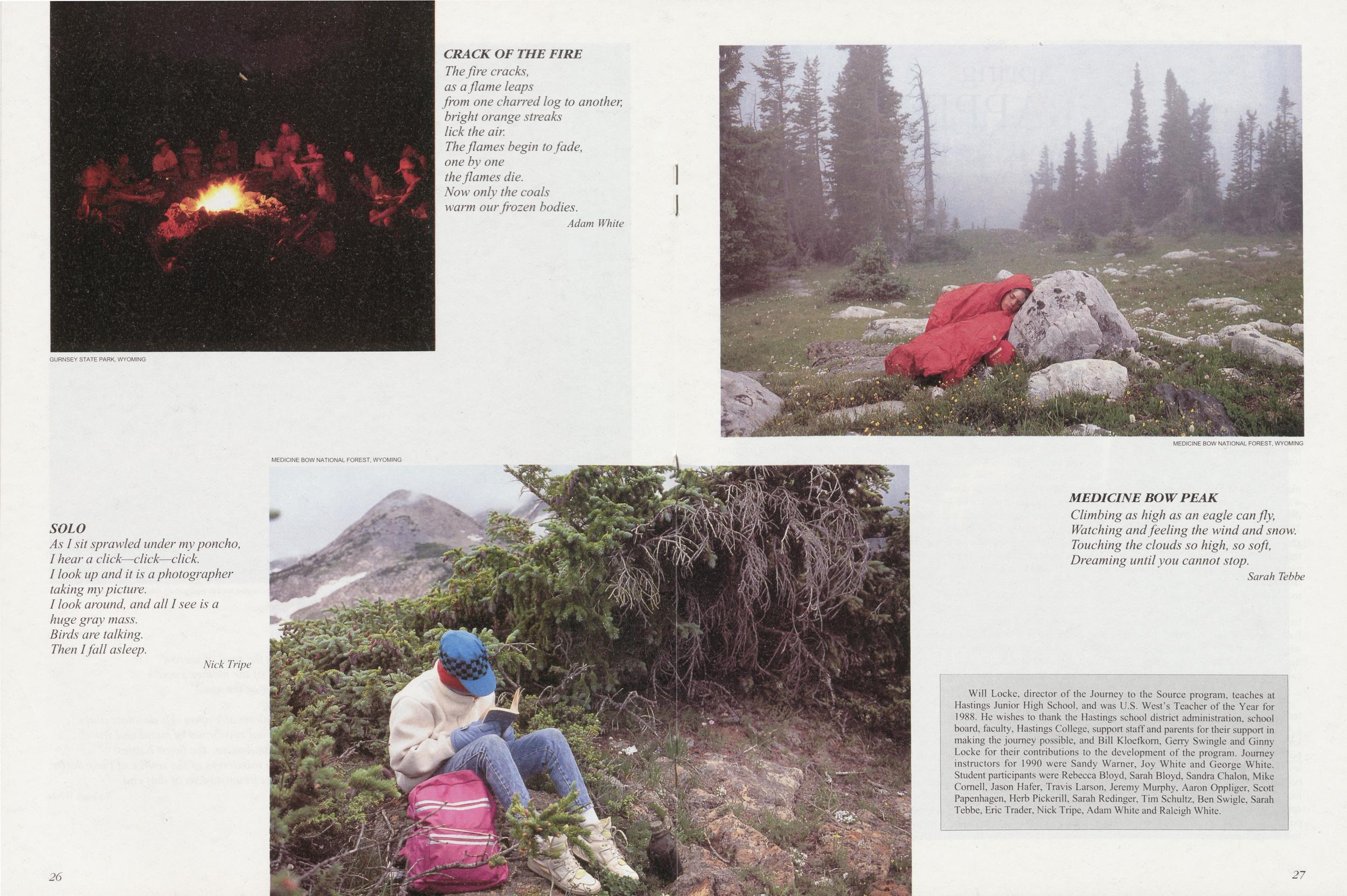
Spring CRAPPIE Fishing Tactics
Photos and text by Tom KeithWhether the thermometer reads 20 degrees below zero in December, hovers around 100 in July, or falls somewhere in between for the rest of the year, a fisherman can always count on it being good weather for crappie fishing if he knows the techniques to use for the existing conditions.
Versatility is the key to being a consistently successful crappie fisherman regardless of the season or the weather. Some fishermen handicap themselves by using only one or two techniques whenever and wherever they fish, but with a little more effort they can increase both their catches and their enjoyment on the water.
The most basic crappie locating technique of all is to look for them in shallow water during spring and fall, and in deeper water during summer and winter. Their movements to and from different areas of the lake and at various depths mean that to catch fish in significant numbers regardless of the season, a fisherman must have an entire series of techniques at his disposal
Seven basic crappie fishing methods have proved to be successful in specific fishing conditions, and the fisherman who takes the time to learn and practice them all will increase his chances of catching crappie throughout the year.
Live BaitThe traditional—and most popular technique is to suspend a minnow below a small bobber, and fish it in fairly shallow water. That can be done with a cane pole, the line hanging vertically into the water directly below the rod's tip, or the bobber and bait can be cast to a likely looking spot some distance away with spin-cast or spinning equipment. A cane pole is generally used in water one to six feet deep, and the bait stays in a small area, but if it is cast with spin-cast or spinning gear, the fisherman can retrieve the bait in super-slow-motion, which provides the advantage of moving the bait and covering more area during the retrieve, increasing the chances that a fish will see the bait and take it.
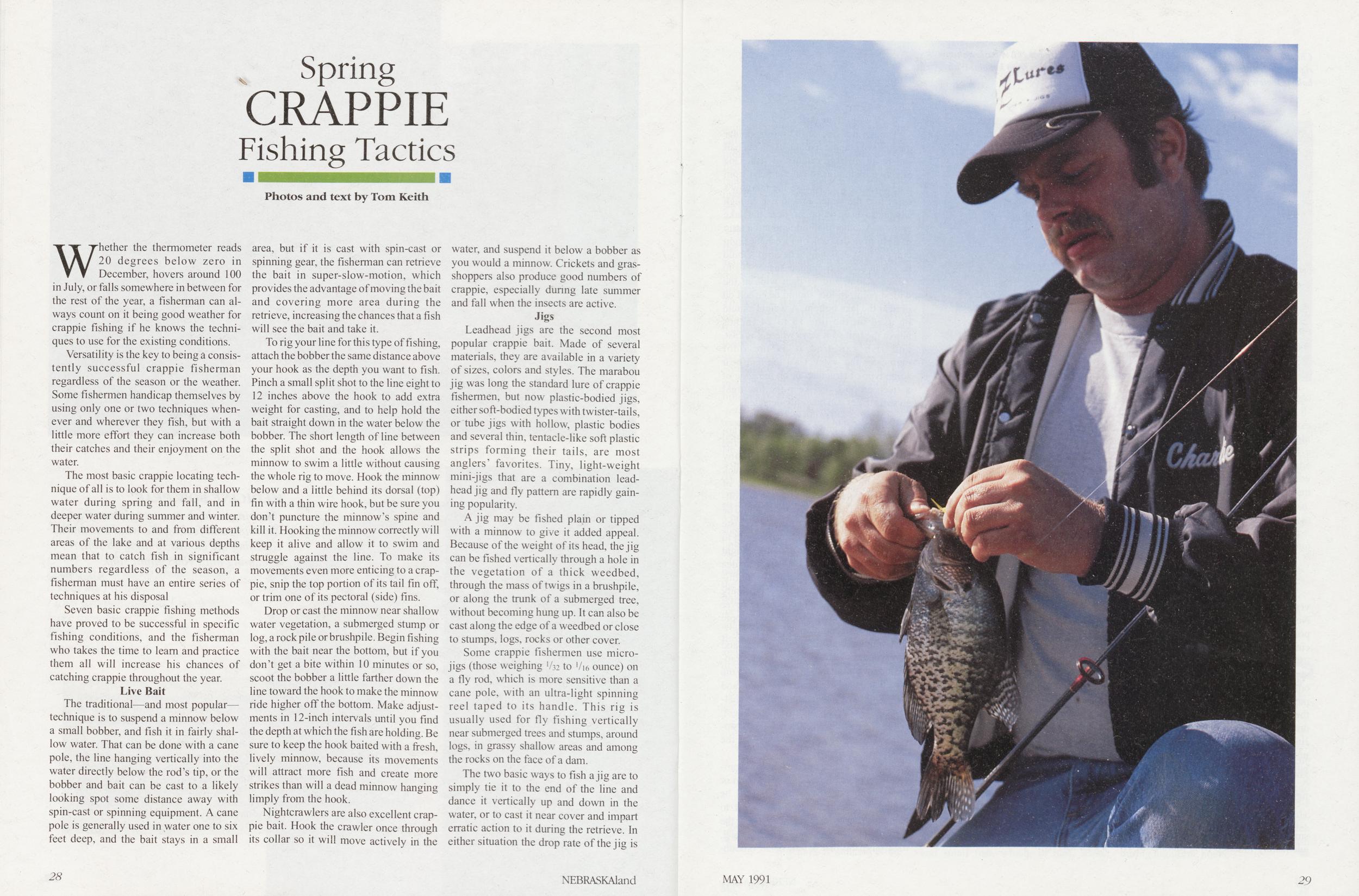
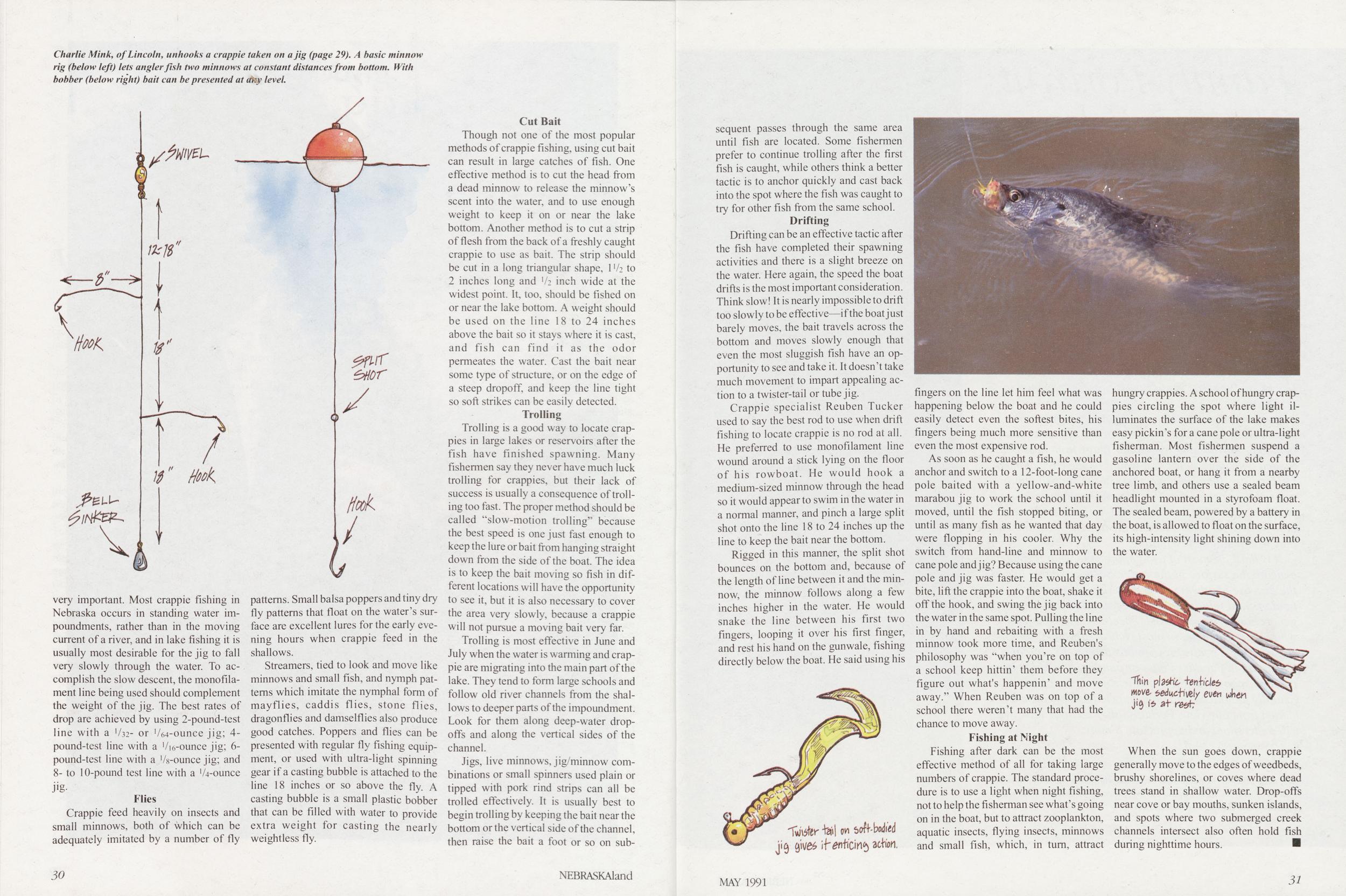
To rig your line for this type of fishing, attach the bobber the same distance above your hook as the depth you want to fish. Pinch a small split shot to the line eight to 12 inches above the hook to add extra weight for casting, and to help hold the bait straight down in the water below the bobber. The short length of line between the split shot and the hook allows the minnow to swim a little without causing the whole rig to move. Hook the minnow below and a little behind its dorsal (top) fin with a thin wire hook, but be sure you don't puncture the minnow's spine and kill it. Hooking the minnow correctly will keep it alive and allow it to swim and struggle against the line. To make its movements even more enticing to a crappie, snip the top portion of its tail fin off, or trim one of its pectoral (side) fins.
Drop or cast the minnow near shallow water vegetation, a submerged stump or log, a rock pile or brush pile. Begin fishing with the bait near the bottom, but if you don't get a bite within 10 minutes or so, scoot the bobber a little farther down the line toward the hook to make the minnow ride higher off the bottom. Make adjustments in 12-inch intervals until you find the depth at which the fish are holding. Be sure to keep the hook baited with a fresh, lively minnow, because its movements will attract more fish and create more strikes than will a dead minnow hanging limply from the hook.
Nightcrawlers are also excellent crappie bait. Hook the crawler once through its collar so it will move actively in the water, and suspend it below a bobber as you would a minnow. Crickets and grasshoppers also produce good numbers of crappie, especially during late summer and fall when the insects are active.
JigsLead head jigs are the second most popular crappie bait. Made of several materials, they are available in a variety of sizes, colors and styles. The marabou jig was long the standard lure of crappie fishermen, but now plastic-bodied jigs, either soft-bodied types with twister-tails, or tube jigs with hollow, plastic bodies and several thin, tentacle-like soft plastic strips forming their tails, are most anglers' favorites. Tiny, light-weight mini-jigs that are a combination lead head jig and fly pattern are rapidly gaining popularity.
A jig may be fished plain or tipped with a minnow to give it added appeal. Because of the weight of its head, the jig can be fished vertically through a hole in the vegetation of a thick weed bed, through the mass of twigs in a brush pile, or along the trunk of a submerged tree, without becoming hung up. It can also be cast along the edge of a weed bed or close to stumps, logs, rocks or other cover.
Some crappie fishermen use micro-jigs (those weighing V32 to Vi6 ounce) on a fly rod, which is more sensitive than a cane pole, with an ultra-light spinning reel taped to its handle. This rig is usually used for fly fishing vertically near submerged trees and stumps, around logs, in grassy shallow areas and among the rocks on the face of a dam.
The two basic ways to fish a jig are to simply tie it to the end of the line and dance it vertically up and down in the water, or to cast it near cover and impart erratic action to it during the retrieve. In either situation the drop rate of the jig is 28 NEBRASKAland
Flies
Crappie feed heavily on insects and small minnows, both of which can be adequately imitated by a number of fly patterns. Small balsa poppers and tiny dry fly patterns that float on the water's surface are excellent lures for the early evening hours when crappie feed in the shallows.
Streamers, tied to look and move like minnows and small fish, and nymph patterns which imitate the nymphal form of mayflies, caddis flies, stone flies, dragonflies and damselflies also produce good catches. Poppers and flies can be presented with regular fly fishing equipment, or used with ultra-light spinning gear if a casting bubble is attached to the line 18 inches or so above the fly. A casting bubble is a small plastic bobber that can be filled with water to provide extra weight for casting the nearly weightless fly.
Cut BaitThough not one of the most popular methods of crappie fishing, using cut bait can result in large catches of fish. One effective method is to cut the head from a dead minnow to release the minnow's scent into the water, and to use enough weight to keep it on or near the lake bottom. Another method is to cut a strip of flesh from the back of a freshly caught crappie to use as bait. The strip should be cut in a long triangular shape, IV2 to 2 inches long and xli inch wide at the widest point. It, too, should be fished on or near the lake bottom. A weight should be used on the line 18 to 24 inches above the bait so it stays where it is cast, and fish can find it as the odor permeates the water. Cast the bait near some type of structure, or on the edge of a steep drop off, and keep the line tight so soft strikes can be easily detected.
TrollingTrolling is a good way to locate crappies in large lakes or reservoirs after the fish have finished spawning. Many fishermen say they never have much luck trolling for crappies, but their lack of success is usually a consequence of trolling too fast. The proper method should be called "slow-motion trolling" because the best speed is one just fast enough to keep the lure or bait from hanging straight down from the side of the boat. The idea is to keep the bait moving so fish in different locations will have the opportunity to see it, but it is also necessary to cover the area very slowly, because a crappie will not pursue a moving bait very far.
Trolling is most effective in June and July when the water is warming and crappie are migrating into the main part of the lake. They tend to form large schools and follow old river channels from the shallows to deeper parts of the impoundment. Look for them along deep-water drop offs and along the vertical sides of the channel.
Jigs, live minnows, jig/minnow combinations or small spinners used plain or tipped with pork rind strips can all be trolled effectively. It is usually best to begin trolling by keeping the bait near the bottom or the vertical side of the channel, then raise the bait a foot or so on subsequent 30 NEBRASKAland passes through the same area until fish are located. Some fishermen prefer to continue trolling after the first fish is caught, while others think a better tactic is to anchor quickly and cast back into the spot where the fish was caught to try for other fish from the same school.
DriftingDrifting can be an effective tactic after the fish have completed their spawning activities and there is a slight breeze on the water. Here again, the speed the boat drifts is the most important consideration. Think slow! It is nearly impossible to drift too slowly to be effective—if the boat just barely moves, the bait travels across the bottom and moves slowly enough that even the most sluggish fish have an opportunity to see and take it. It doesn't take much movement to impart appealing action to a twister-tail or tube jig.
Crappie specialist Reuben Tucker used to say the best rod to use when drift fishing to locate crappie is no rod at all. He preferred to use monofilament line wound around a stick lying on the floor of his rowboat. He would hook a medium-sized minnow through the head so it would appear to swim in the water in a normal manner, and pinch a large split shot onto the line 18 to 24 inches up the line to keep the bait near the bottom.
Rigged in this manner, the split shot bounces on the bottom and, because of the length of line between it and the minnow, the minnow follows along a few inches higher in the water. He would snake the line between his first two fingers, looping it over his first finger, and rest his hand on the gunwale, fishing directly below the boat. He said using his fingers on the line let him feel what was happening below the boat and he could easily detect even the softest bites, his fingers being much more sensitive than even the most expensive rod.
As soon as he caught a fish, he would anchor and switch to a 12-foot-long cane pole baited with a yellow-and-white marabou jig to work the school until it moved, until the fish stopped biting, or until as many fish as he wanted that day were flopping in his cooler. Why the switch from hand-line and minnow to cane pole and jig? Because using the cane pole and jig was faster. He would get a bite, lift the crappie into the boat, shake it off the hook, and swing the jig back into the water in the same spot. Pulling the line in by hand and rebating with a fresh minnow took more time, and Reuben's philosophy was "when you're on top of a school keep hittin' them before they figure out what's happenin' and move away." When Reuben was on top of a school there weren't many that had the chance to move away.
Fishing at NightFishing after dark can be the most effective method of all for taking large numbers of crappie. The standard procedure is to use a light when night fishing, not to help the fisherman see what's going on in the boat, but to attract zooplankton, aquatic insects, flying insects, minnows and small fish, which, in turn, attract hungry crappies. A school of hungry crappies circling the spot where light illuminates the surface of the lake makes easy pickin's for a cane pole or ultra-light fisherman. Most fishermen suspend a gasoline lantern over the side of the anchored boat, or hang it from a nearby tree limb, and others use a sealed beam headlight mounted in a styrofoam float. The sealed beam, powered by a battery in the boat, is allowed to float on the surface, its high-intensity light shining down into the water.
Family Portrait: The Sunfish
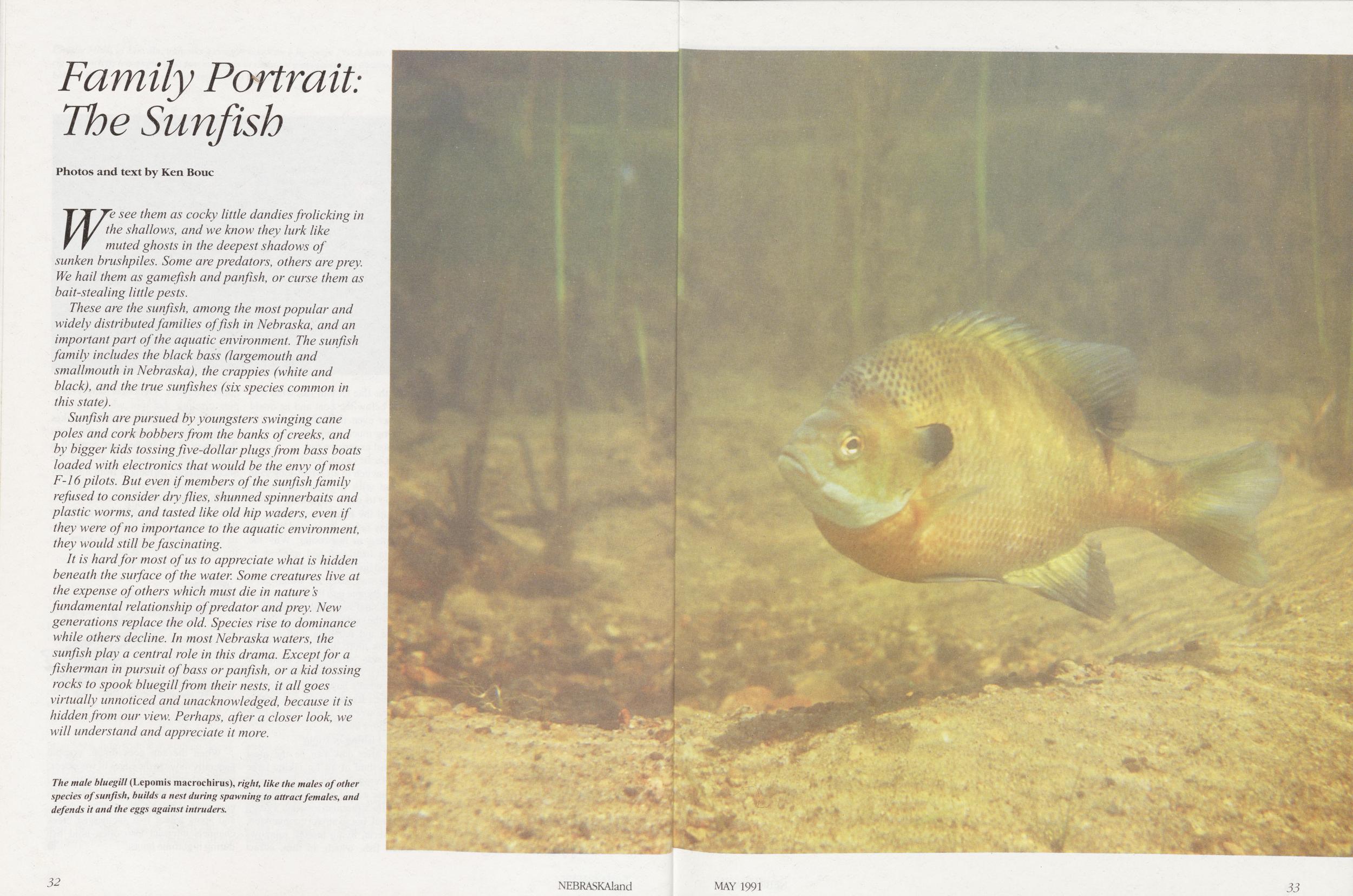
Photos and text by Ken BoucWsee them as cocky little dandies frolicking in shallows, and we know they lurk like muted ghosts in the deepest shadows of sunken brushpiles. Some are predators, others are prey. We hail them as gamefish and panfish, or curse them as bait-stealing little pests.
These are the sunfish, among the most popular and widely distributed families offish in Nebraska, and an important part of the aquatic environment. The sunfish family includes the black bass (largemouth and smallmouth in Nebraska), the crappies (white and black), and the true sunfishes (six species common in this state).
Sunfish are pursued by youngsters swinging cane poles and cork bobbers from the banks of creeks, and by bigger kids tossing five-dollar plugs from bass boats loaded with electronics that would be the envy of most F-l6 pilots. But even if members of the sunfish family refused to consider dry flies, shunned spinner aits and plastic worms, and tasted like old hip waders, even if they were of no importance to the aquatic environment, they would still be fascinating.
It is hard for most of us to appreciate what is hidden beneath the surface of the water. Some creatures live at the expense of others which must die in nature's fundamental relationship of predator and prey. New generations replace the old. Species rise to dominance while others decline. In most Nebraska waters, the sunfish play a central role in this drama. Except for a fisherman in pursuit of bass or panfish, or a kid tossing rocks to spook bluegill from their nests, it all goes virtually unnoticed and unacknowledged, because it is hidden from our view. Perhaps, after a closer look, we will understand and appreciate it more.
32 NEBRASKAland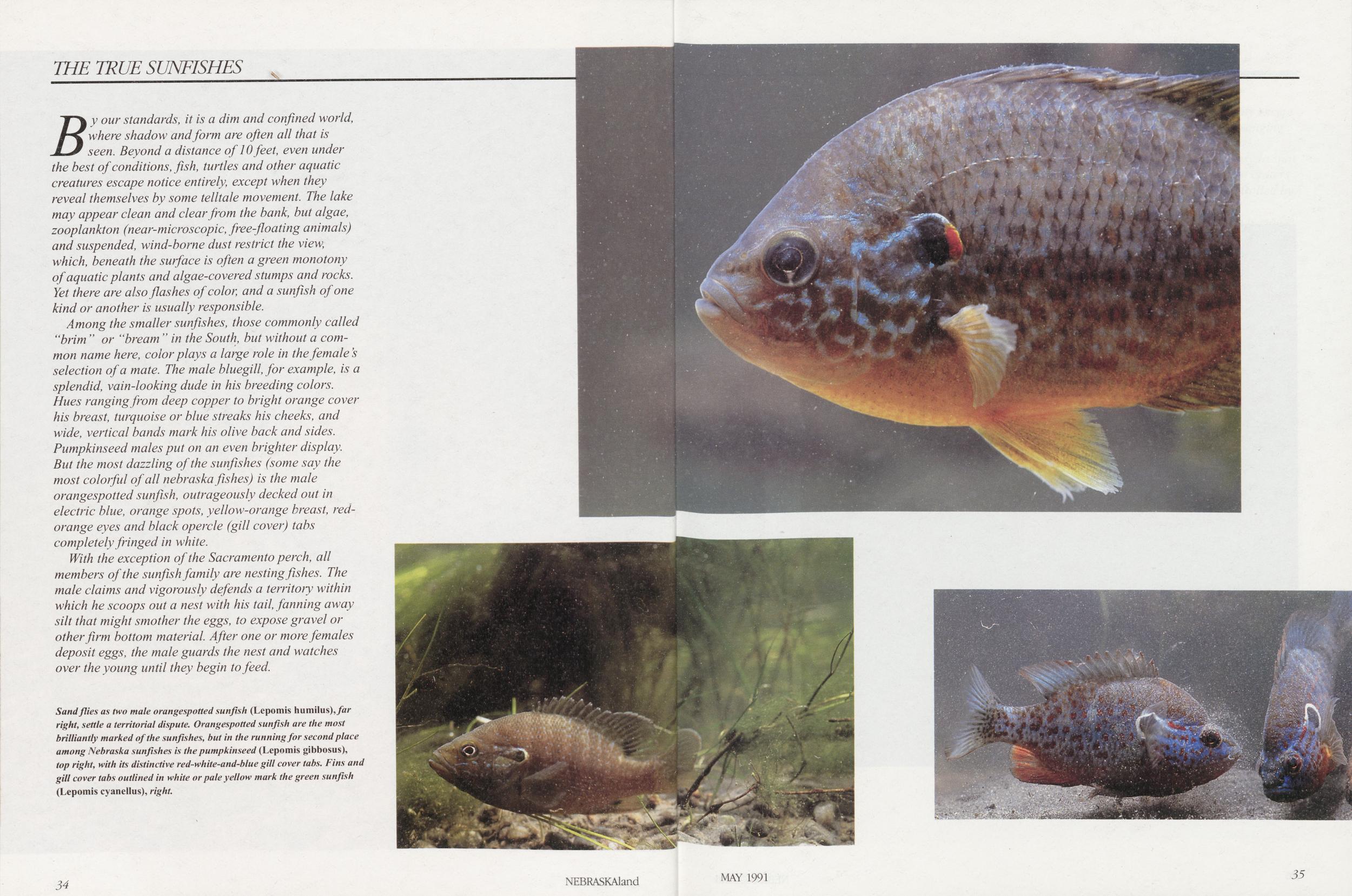 THE TRUE SUNFISHES
By our standards, it is a dim and confined world, g*\ where shadow and form are often all that is J—J seen. Beyond a distance of10 feet, even under the best of conditions, fish, turtles and other aquatic creatures escape notice entirely, except when they reveal themselves bv some telltale movement. The lake may appear clean and clear from the bank, but algae, zooplankton (near-microscopic, free floating animals) and suspended, wind-borne dust restrict the view, which, beneath the surface is often a green monotony of aquatic plants and algae-covered stumps and rocks. Yet there are also flashes of color, and a sunfish of one kind or another is usually responsible.
Among the smaller sunfishes, those commonly called "brim " or "bream " in the South, but without a common name here, color plays a large role in the female s selection of a mate. The male bluegill, for example, is a splendid, vain-looking dude in his breeding colors. Hues ranging from deep copper to bright orange cover his breast, turquoise or blue streaks his cheeks, and wide, vertical bands mark his olive back and sides. Pumpkinseed males put on an even brighter display. But the most dazzling of the sunfishes (some say the most colorful of all Nebraska fishes) is the male oranges potted sunfish, outrageously decked out in electric blue, orange spots, yellow-orange breast, red-orange eyes and black opercle (gill cover) tabs completely fringed in white.
With the exception of the Sacramento perch, all members of the sunfish family are nesting fishes. The male claims and vigorously defends a territory within which he scoops out a nest with his tail, fanning away silt that might smother the eggs, to expose gravel or other firm bottom material. After one or more females deposit eggs, the male guards the nest and watches over the young until they begin to feed.
In general, all members of the sunfish family except the black bass nest in colonies or "beds " ranging from a few to several dozen individual nests. Bluegill beds are particularly common and easy to spot in shallow areas as a series of one- to two-foot craters immediately adjacent to one another, each patrolled by a feisty male guarding his turf
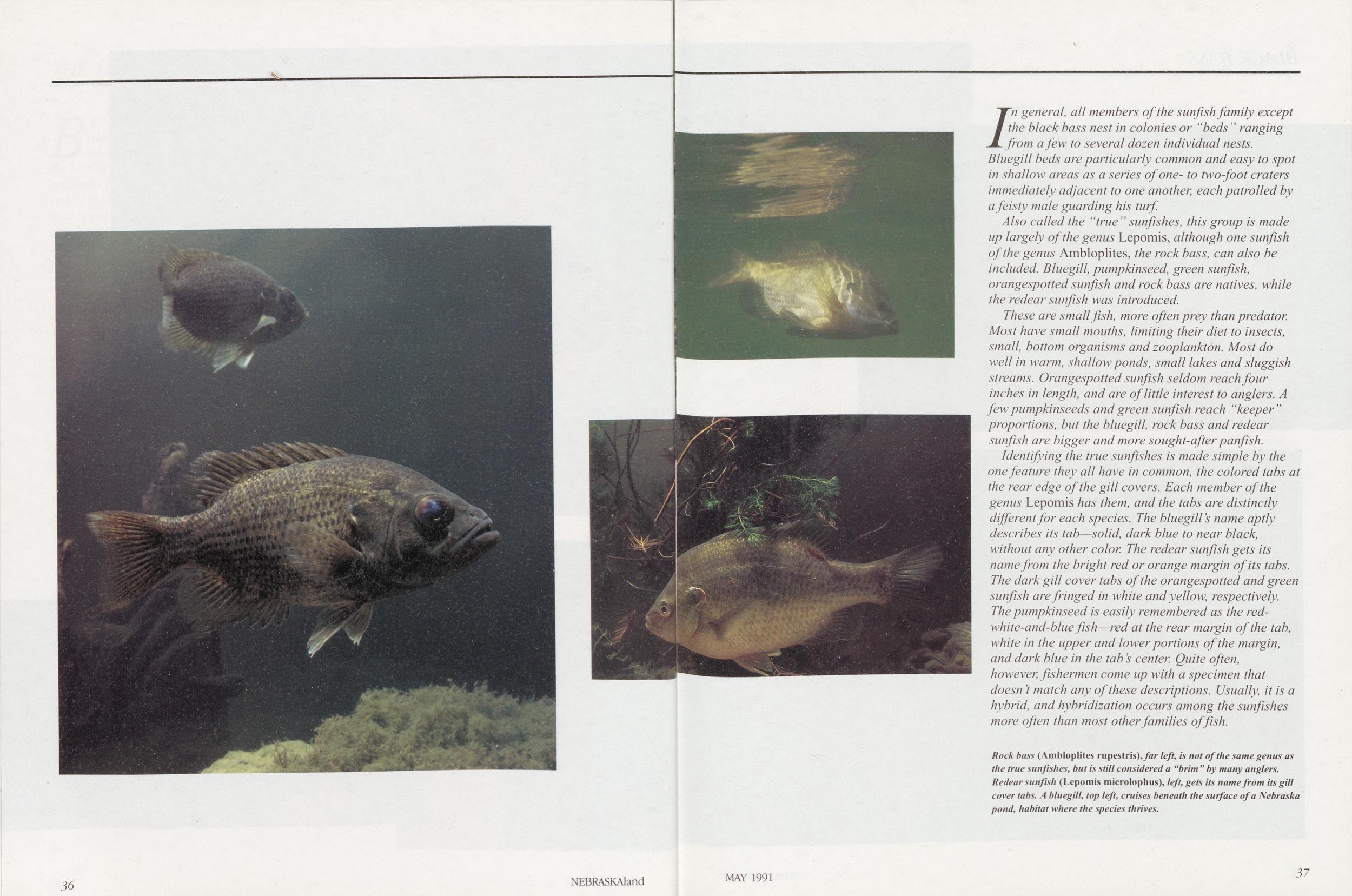
Also called the "true" sunfishes, this group is made up largely of the genus Lepomis, although one sunfish of the genus Ambloplites, the rock bass, can also be included. Bluegill, pumpkinseed, green sunfish, oranges potted sunfish and rock bass are natives, while the redear sunfish was introduced.
These are small fish, more often prey than predator. Most have small mouths, limiting their diet to insects, small, bottom organisms and zooplankton. Most do well in warm, shallow ponds, small lakes and sluggish streams. Orang espotted sunfish seldom reach four inches in length, and are of little interest to anglers. A few pumpkinseeds and green sunfish reach "keeper" proportions, but the bluegill, rock bass and redear sunfish are bigger and more sought-after panfish.
Identifying the true sunfishes is made simple by the one feature they all have in common, the colored tabs at the rear edge of the gill covers. Each member of the genus Lepomis has them, and the tabs are distinctly different for each species. The bluegills name aptly describes its tab—solid, dark blue to near black, without any other color. The redear sunfish gets its name from the bright red or orange margin of its tabs. The dark gill cover tabs of the orange spotted and green sunfish are fringed in white and yellow, respectively. The pumpkinseed is easily remembered as the red- white-and-blue fish—red at the rear margin of the tab, white in the upper and lower portions of the margin, and dark blue in the tab s center. Quite often, however, fishermen come up with a specimen that doesn't match any of these descriptions. Usually, it is a hybrid, and hybridization occurs among the sunfishes more often than most other families of fish.
MAY 1991 37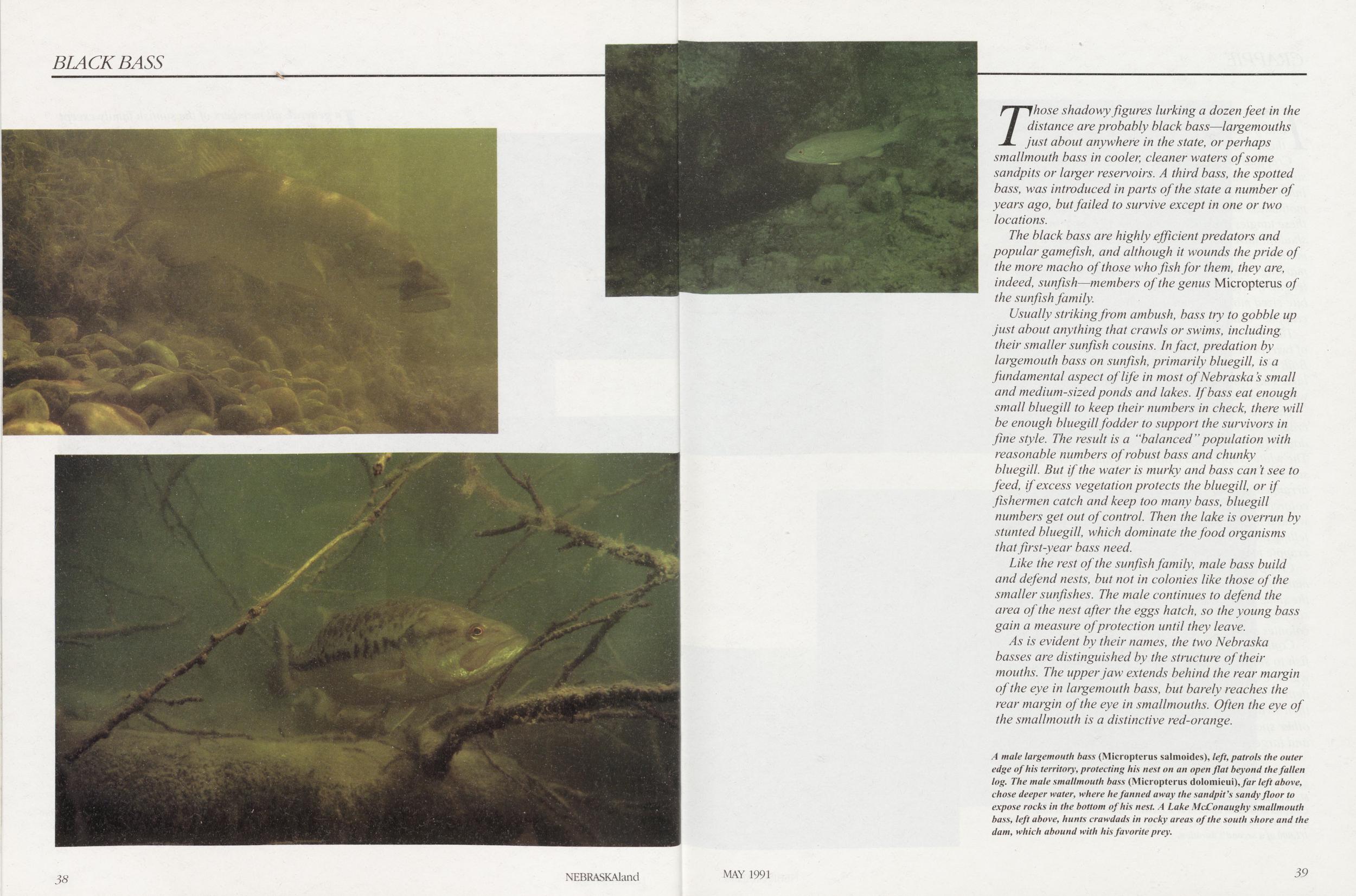 BLACK BASS
Those shadowy figures lurking a dozen feet in the distance are probably black bass—largemouths just about anywhere in the state, or perhaps smallmouth bass in cooler, cleaner waters of some sandpits or larger reservoirs. A third bass, the spotted bass, was introduced in parts of the state a number of years ago, but failed to survive except in one or two locations.
The black bass are highly efficient predators and popular gamefish, and although it wounds the pride of the more macho of those who fish for them, they are, indeed, sunfish—members of the genus Micropterus of the sunfish family.
Usually striking from ambush, bass try to gobble up just about anything that crawls or swims, including, their smaller sunfish cousins. In fact, predation by largemouth bass on sunfish, primarily bluegill, is a fundamental aspect of life in most of Nebraska s small and medium-sized ponds and lakes. If bass eat enough small bluegill to keep their numbers in check, there will be enough bluegill fodder to support the survivors in fine style. The result is a "balanced"population with reasonable numbers of robust bass and chunky bluegill. But if the water is murky and bass can't see to feed, if excess vegetation protects the bluegill, or if fishermen catch and keep too many bass, bluegill numbers get out of control. Then the lake is overrun by stunted bluegill, which dominate the food organisms that first-year bass need.
Like the rest of the sunfish family, male bass build and defend nests, but not in colonies like those of the smaller sunfishes. The male continues to defend the area of the nest after the eggs hatch, so the young bass gain a measure of protection until they leave.
As is evident by their names, the two Nebraska basses are distinguished by the structure of their mouths. The upper jaw extends behind the rear margin of the eye in largemouth bass, but barely reaches the rear margin of the eye in smallmouths. Often the eye of the smallmouth is a distinctive red-orange.
MAY 1991 39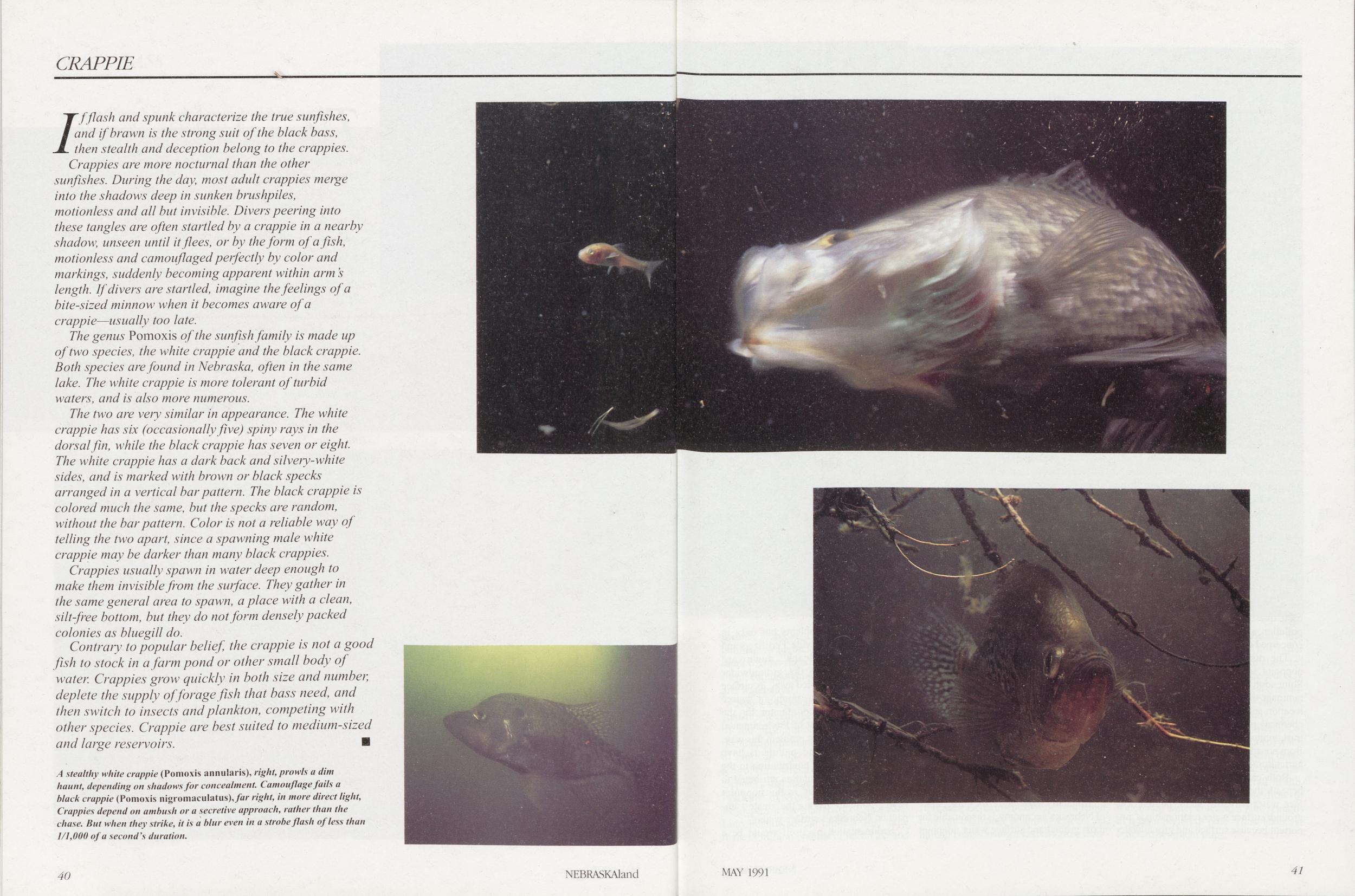 CRAPPIE
If flash and spunk characterize the true sunfishes, and if brawn is the strong suit of the black bass, then stealth and deception belong to the crappies.
Crappies are more nocturnal than the other sunfishes. During the day, most adult crappies merge into the shadows deep in sunken brushpiles, motionless and all but invisible. Divers peering into these tangles are often startled by a crappie in a nearby shadow, unseen until it flees, or by the form of a fish, motionless and camouflaged perfectly by color and markings, suddenly becoming apparent within arm s length. If divers are startled, imagine the feelings of a bite-sized minnow when it becomes aware of a crappie—usually too late.
The genus Pomoxis of the sunfish family is made up of two species, the white crappie and the black crappie. Both species are found in Nebraska, often in the same lake. The white crappie is more tolerant of turbid waters, and is also more numerous.
The two are very similar in appearance. The white crappie has six (occasionally five) spiny rays in the dorsal fin, while the black crappie has seven or eight. The white crappie has a dark back and silvery-white sides, and is marked with brown or black specks arranged in a vertical bar pattern. The black crappie is colored much the same, but the specks are random, without the bar pattern. Color is not a reliable way of telling the two apart, since a spawning male white crappie may be darker than many black crappies.
Crappies usually spawn in water deep enough to make them invisible from the surface. They gather in the same general area to spawn, a place with a clean, silt-free bottom, but they do not form densely packed colonies as bluegill do.
Contrary to popular belief, the crappie is not a good fish to stock in a farm pond or other small body of water. Crappies grow quickly in both size and number, deplete the supply of forage fish that bass need, and then switch to insects and plankton, competing with other species. Crappie are best suited to medium-sized and large reservoirs.
CLEANING UP OUR WATER QUALITY ACT The Nonpoint Source Pollution Dilemma
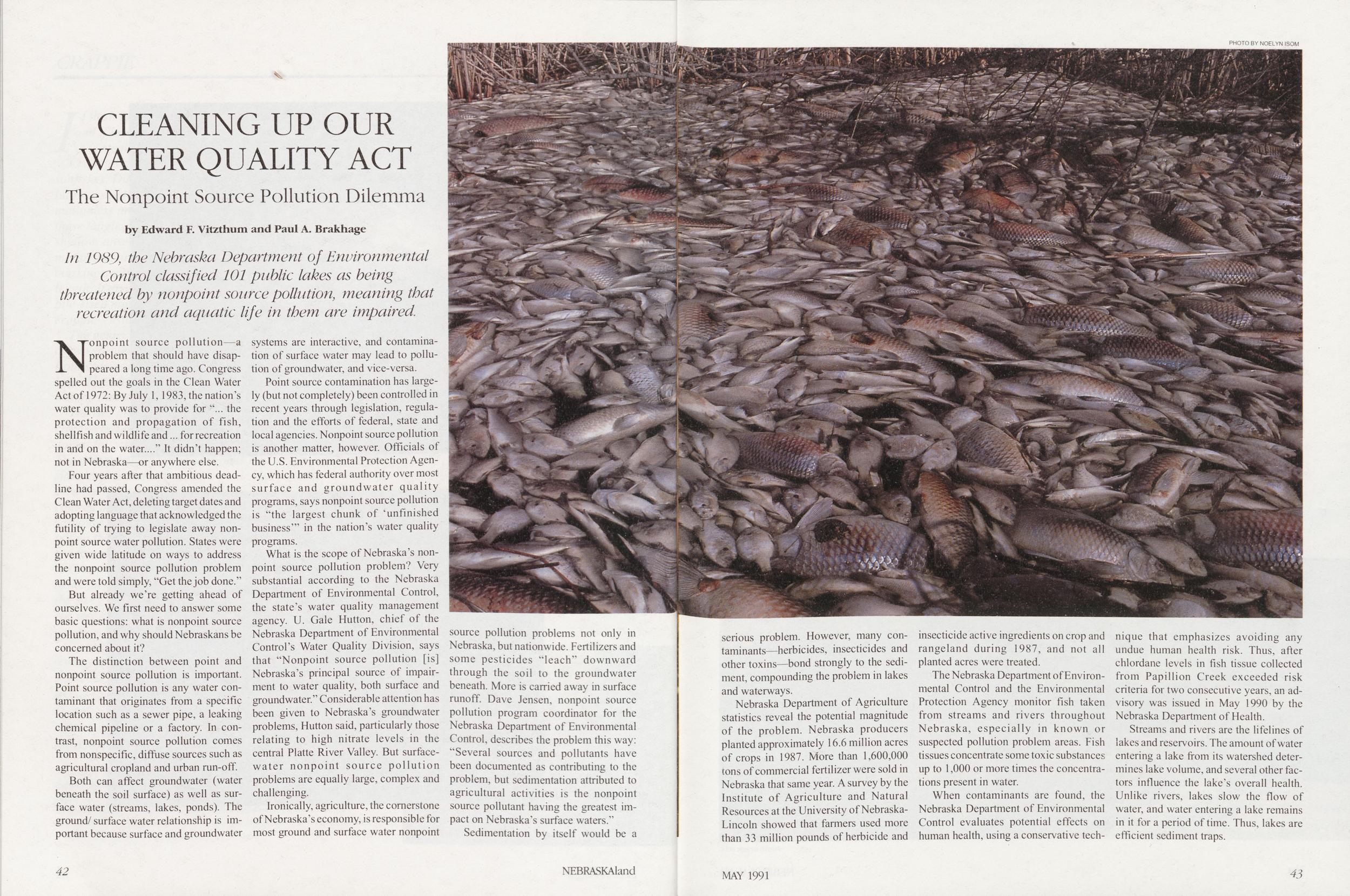
by Edward F. Vitzthum and Paul A. Brakhage In 1989, the Nebraska Department of Environmental Control classified 101 public lakes as being threatened by nonpoint source pollution, meaning that recreation and aquatic life in them are impaired.Nonpoint source pollution—a problem that should have disappeared a long time ago. Congress spelled out the goals in the Clean Water Act of 1972: By July 1, 1983, the nation's water quality was to provide for "... the protection and propagation of fish, shellfish and wildlife and... for recreation in and on the water...." It didn't happen; not in Nebraska—or anywhere else.
Four years after that ambitious dead-line had passed, Congress amended the Clean Water Act, deleting target dates and adopting language that acknowledged the futility of trying to legislate away nonpoint source water pollution. States were given wide latitude on ways to address the nonpoint source pollution problem and were told simply, "Get the job done."
But already we're getting ahead of ourselves. We first need to answer some basic questions: what is nonpoint source pollution, and why should Nebraskans be concerned about it?
The distinction between point and nonpoint source pollution is important. Point source pollution is any water contaminant that originates from a specific location such as a sewer pipe, a leaking chemical pipeline or a factory. In contrast, nonpoint source pollution comes from nonspecific, diffuse sources such as agricultural cropland and urban run-off.
Both can affect groundwater (water beneath the soil surface) as well as surface water (streams, lakes, ponds). The ground/ surface water relationship is important because surface and groundwater systems are interactive, and contamination of surface water may lead to pollution of groundwater, and vice-versa.
Point source contamination has largely (but not completely) been controlled in recent years through legislation, regulation and the efforts of federal, state and local agencies. Nonpoint source pollution is another matter, however. Officials of the U.S. Environmental Protection Agency, which has federal authority over most surface and groundwater quality programs, says nonpoint source pollution is "the largest chunk of 'unfinished business'" in the nation's water quality programs.
What is the scope of Nebraska's nonpoint source pollution problem? Very substantial according to the Nebraska Department of Environmental Control, the state's water quality management agency. U. Gale Hutton, chief of the Nebraska Department of Environmental Control's Water Quality Division, says that "Nonpoint source pollution [is] Nebraska's principal source of impairment to water quality, both surface and groundwater." Considerable attention has been given to Nebraska's groundwater problems, Hutton said, particularly those relating to high nitrate levels in the central Platte River Valley. But surface water nonpoint source pollution problems are equally large, complex and challenging.
Ironically, agriculture, the cornerstone of Nebraska's economy, is responsible for most ground and surface water nonpoint source pollution problems not only in Nebraska, but nationwide. Fertilizers and some pesticides "leach" downward through the soil to the groundwater beneath. More is carried away in surface runoff. Dave Jensen, nonpoint source pollution program coordinator for the Nebraska Department of Environmental Control, describes the problem this way: "Several sources and pollutants have been documented as contributing to the problem, but sedimentation attributed to agricultural activities is the nonpoint source pollutant having the greatest impact on Nebraska's surface waters."
Sedimentation by itself would be a 42 NEBRASKAland
Nebraska Department of Agriculture statistics reveal the potential magnitude of the problem. Nebraska producers planted approximately 16.6 million acres of crops in 1987. More than 1,600,000 tons of commercial fertilizer were sold in Nebraska that same year. A survey by the Institute of Agriculture and Natural Resources at the University of Nebraska- Lincoln showed that farmers used more than 33 million pounds of herbicide and insecticide active ingredients on crop and rangeland during 1987, and not all planted acres were treated.
The Nebraska Department of Environmental Control and the Environmental Protection Agency monitor fish taken from streams and rivers throughout Nebraska, especially in known or suspected pollution problem areas. Fish tissues concentrate some toxic substances up to 1,000 or more times the concentrations present in water.
When contaminants are found, the Nebraska Department of Environmental Control evaluates potential effects on human health, using a conservative technique that emphasizes avoiding any undue human health risk. Thus, after chlordane levels in fish tissue collected from Papillion Creek exceeded risk criteria for two consecutive years, an advisory was issued in May 1990 by the Nebraska Department of Health.
Streams and rivers are the lifelines of lakes and reservoirs. The amount of water entering a lake from its watershed determines lake volume, and several other factors influence the lake's overall health. Unlike rivers, lakes slow the flow of water, and water entering a lake remains in it for a period of time. Thus, lakes are efficient sediment traps.
MAY 1991 43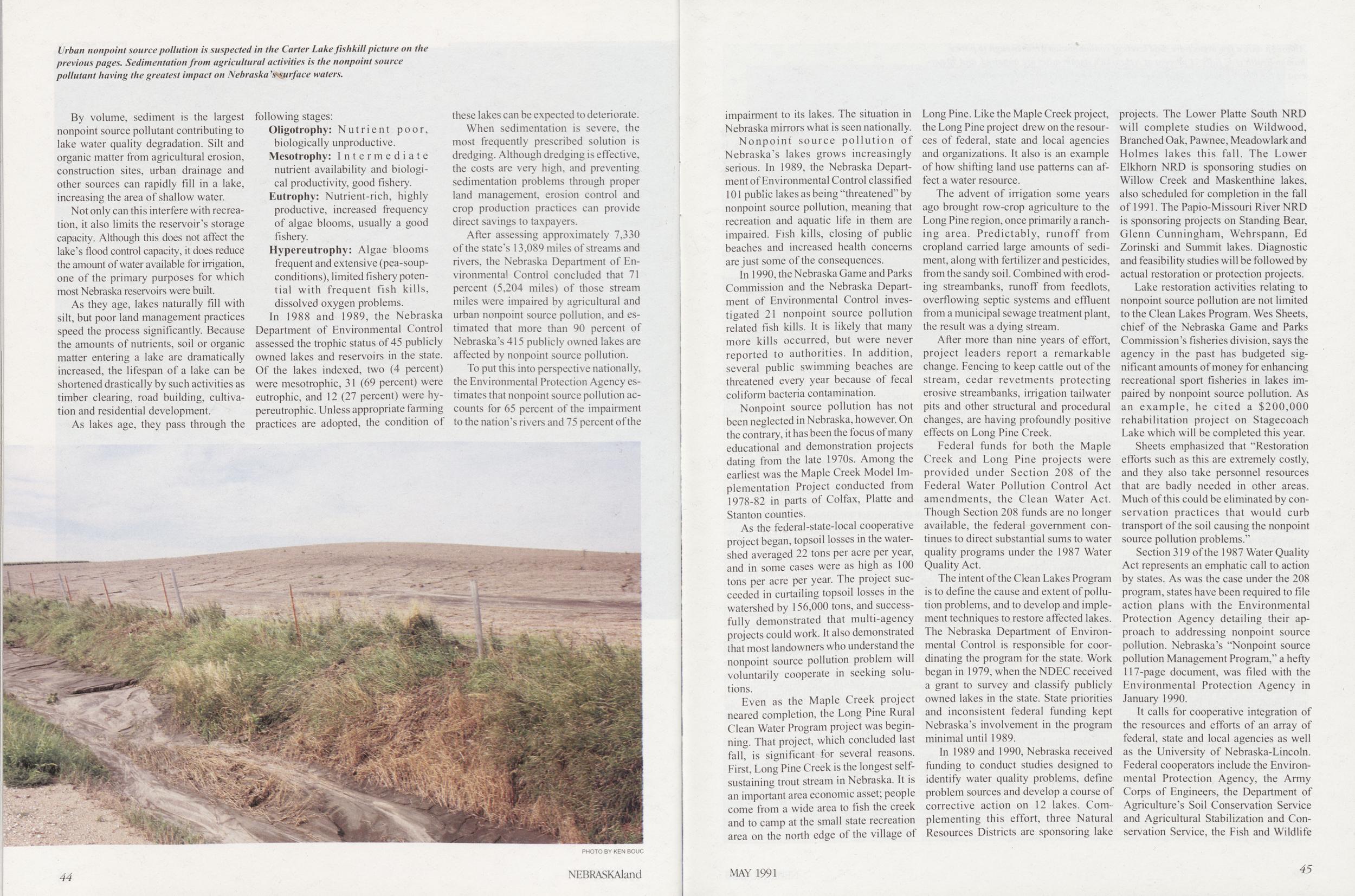
By volume, sediment is the largest nonpoint source pollutant contributing to lake water quality degradation. Silt and organic matter from agricultural erosion, construction sites, urban drainage and other sources can rapidly fill in a lake, increasing the area of shallow water.
Not only can this interfere with recreation, it also limits the reservoir's storage capacity. Although this does not affect the lake's flood control capacity, it does reduce the amount of water available for irrigation, one of the primary purposes for which most Nebraska reservoirs were built.
As they age, lakes naturally fill with silt, but poor land management practices speed the process significantly. Because the amounts of nutrients, soil or organic matter entering a lake are dramatically increased, the lifespan of a lake can be shortened drastically by such activities as timber clearing, road building, cultivation and residential development.
As lakes age, they pass through the following stages:
Oligotrophy: Nutrient poor, biologically unproductive. Mesotrophy: Intermediate nutrient availability and biological productivity, good fishery. Eutrophy: Nutrient-rich, highly productive, increased frequency of algae blooms, usually a good fishery. Hypereutrophy: Algae blooms frequent and extensive (pea-soup-conditions), limited fishery potential with frequent fish kills, dissolved oxygen problems.In 1988 and 1989, the Nebraska Department of Environmental Control assessed the trophic status of 45 publicly owned lakes and reservoirs in the state. Of the lakes indexed, two (4 percent) were mesotrophic, 31 (69 percent) were eutrophic, and 12 (27 percent) were hypereutrophic. Unless appropriate farming practices are adopted, the condition of these lakes can be expected to deteriorate.
When sedimentation is severe, the most frequently prescribed solution is dredging. Although dredging is effective, the costs are very high, and preventing sedimentation problems through proper land management, erosion control and crop production practices can provide direct savings to taxpayers.
After assessing approximately 7,330 of the state's 13,089 miles of streams and rivers, the Nebraska Department of Environmental Control concluded that 71 percent (5,204 miles) of those stream miles were impaired by agricultural and urban nonpoint source pollution, and estimated that more than 90 percent of Nebraska's 415 publicly owned lakes are affected by nonpoint source pollution.
To put this into perspective nationally, the Environmental Protection Agency estimates that nonpoint source pollution accounts for 65 percent of the impairment to the nation's rivers and 75 percent of the 44 NEBRASKAland impairment to its lakes. The situation in Nebraska mirrors what is seen nationally.
Nonpoint source pollution of Nebraska's lakes grows increasingly serious. In 1989, the Nebraska Department of Environmental Control classified 101 public lakes as being "threatened" by nonpoint source pollution, meaning that recreation and aquatic life in them are impaired. Fish kills, closing of public beaches and increased health concerns are just some of the consequences.
In 1990, the Nebraska Game and Parks Commission and the Nebraska Department of Environmental Control investigated 21 nonpoint source pollution related fish kills. It is likely that many more kills occurred, but were never reported to authorities. In addition, several public swimming beaches are threatened every year because of fecal coliform bacteria contamination.
Nonpoint source pollution has not been neglected in Nebraska, however. On the contrary, it has been the focus of many educational and demonstration projects dating from the late 1970s. Among the earliest was the Maple Creek Model Implementation Project conducted from 1978-82 in parts of Colfax, Platte and Stanton counties.
As the federal-state-local cooperative project began, topsoil losses in the watershed averaged 22 tons per acre per year, and in some cases were as high as 100 tons per acre per year. The project succeeded in curtailing topsoil losses in the watershed by 156,000 tons, and successfully demonstrated that multi-agency projects could work. It also demonstrated that most landowners who understand the nonpoint source pollution problem will voluntarily cooperate in seeking solutions.
Even as the Maple Creek project neared completion, the Long Pine Rural Clean Water Program project was beginning. That project, which concluded last fall, is significant for several reasons. First, Long Pine Creek is the longest selfsustaining trout stream in Nebraska. It is an important area economic asset; people come from a wide area to fish the creek and to camp at the small state recreation area on the north edge of the village of Long Pine. Like the Maple Creek project, the Long Pine project drew on the resources of federal, state and local agencies and organizations. It also is an example of how shifting land use patterns can affect a water resource.
The advent of irrigation some years ago brought row-crop agriculture to the Long Pine region, once primarily a ranching area. Predictably, runoff from cropland carried large amounts of sediment, along with fertilizer and pesticides, from the sandy soil. Combined with eroding stream banks, runoff from feedlots, overflowing septic systems and effluent from a municipal sewage treatment plant, the result was a dying stream.
The advent of irrigation some years ago brought row-crop agriculture to the Long Pine region, once primarily a ranching area. Predictably, runoff from cropland carried large amounts of sediment, along with fertilizer and pesticides, from the sandy soil. Combined with eroding stream banks, runoff from feedlots, overflowing septic systems and effluent from a municipal sewage treatment plant, the result was a dying stream.
After more than nine years of effort, project leaders report a remarkable change. Fencing to keep cattle out of the stream, cedar revetments protecting erosive streambanks, irrigation tailwater pits and other structural and procedural changes, are having profoundly positive effects on Long Pine Creek.
Federal funds for both the Maple Creek and Long Pine projects were provided under Section 208 of the Federal Water Pollution Control Act amendments, the Clean Water Act. Though Section 208 funds are no longer available, the federal government continues to direct substantial sums to water quality programs under the 1987 Water Quality Act.
The intent of the Clean Lakes Program is to define the cause and extent of pollution problems, and to develop and implement techniques to restore affected lakes. The Nebraska Department of Environmental Control is responsible for coordinating the program for the state. Work began in 1979, when the NDEC received a grant to survey and classify publicly owned lakes in the state. State priorities and inconsistent federal funding kept Nebraska's involvement in the program minimal until 1989.
In 1989 and 1990, Nebraska received funding to conduct studies designed to identify water quality problems, define problem sources and develop a course of corrective action on 12 lakes. Complementing this effort, three Natural Resources Districts are sponsoring lake projects. The Lower Platte South NRD will complete studies on Wildwood, Branched Oak, Pawnee, Meadowlark and Holmes lakes this fall. The Lower Elkhorn NRD is sponsoring studies on Willow Creek and Maskenthine lakes, also scheduled for completion in the fall of 1991. The Papio-Missouri River NRD is sponsoring projects on Standing Bear, Glenn Cunningham, Wehrspann, Ed Zorinski and Summit lakes. Diagnostic and feasibility studies will be followed by actual restoration or protection projects.
Lake restoration activities relating to nonpoint source pollution are not limited to the Clean Lakes Program. Wes Sheets, chief of the Nebraska Game and Parks Commission's fisheries division, says the agency in the past has budgeted significant amounts of money for enhancing recreational sport fisheries in lakes impaired by nonpoint source pollution. As an example, he cited a $200,000 rehabilitation project on Stagecoach Lake which will be completed this year.
Sheets emphasized that "Restoration efforts such as this are extremely costly, and they also take personnel resources that are badly needed in other areas. Much of this could be eliminated by conservation practices that would curb transport of the soil causing the nonpoint source pollution problems."
Section 319 of the 1987 Water Quality Act represents an emphatic call to action by states. As was the case under the 208 program, states have been required to file action plans with the Environmental Protection Agency detailing their approach to addressing nonpoint source pollution. Nebraska's "Nonpoint source pollution Management Program," a hefty 117-page document, was filed with the Environmental Protection Agency in January 1990.
It calls for cooperative integration of the resources and efforts of an array of federal, state and local agencies as well as the University of Nebraska-Lincoln. Federal cooperators include the Environmental Protection Agency, the Army Corps of Engineers, the Department of Agriculture's Soil Conservation Service and Agricultural Stabilization and Conservation Service, the Fish and Wildlife MAY 1991 45 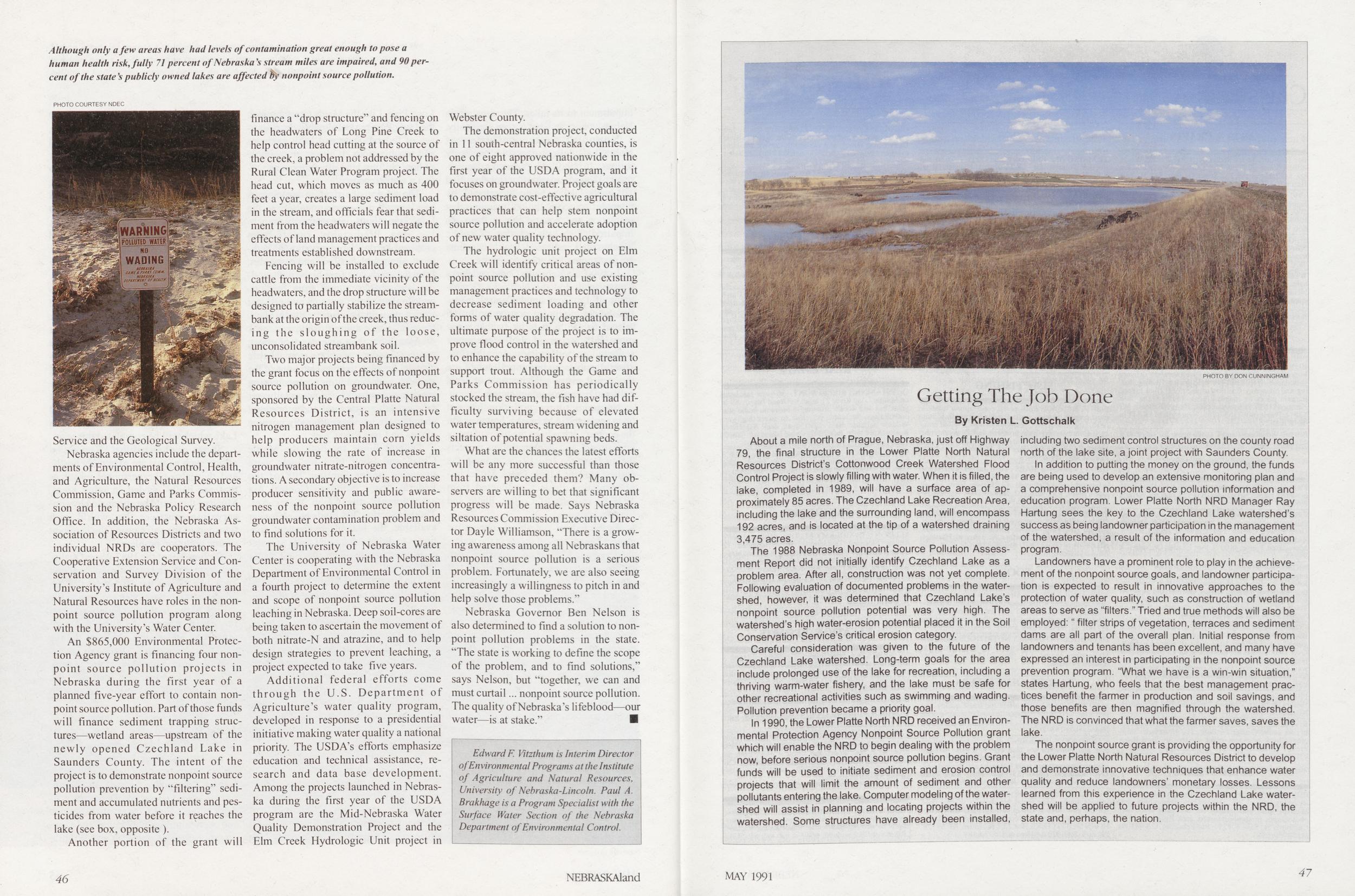
Nebraska agencies include the departments of Environmental Control, Health, and Agriculture, the Natural Resources Commission, Game and Parks Commission and the Nebraska Policy Research Office. In addition, the Nebraska Association of Resources Districts and two individual NRDs are cooperators. The Cooperative Extension Service and Conservation and Survey Division of the University's Institute of Agriculture and Natural Resources have roles in the nonpoint source pollution program along with the University's Water Center.
An $865,000 Environmental Protection Agency grant is financing four nonpoint source pollution projects in Nebraska during the first year of a planned five-year effort to contain nonpoint source pollution. Part of those funds will finance sediment trapping structures—wetland areas—upstream of the newly opened Czech land Lake in Saunders County. The intent of the project is to demonstrate nonpoint source pollution prevention by "filtering" sediment and accumulated nutrients and pesticides from water before it reaches the lake (see box, opposite ).
Another portion of the grant will finance a "drop structure" and fencing on the headwaters of Long Pine Creek to help control head cutting at the source of the creek, a problem not addressed by the Rural Clean Water Program project. The head cut, which moves as much as 400 feet a year, creates a large sediment load in the stream, and officials fear that sediment from the headwaters will negate the effects of land management practices and treatments established downstream.
Fencing will be installed to exclude cattle from the immediate vicinity of the headwaters, and the drop structure will be designed to partially stabilize the stream bank at the origin of the creek, thus reducing the sloughing of the loose, unconsolidated stream bank soil.
Two major projects being financed by the grant focus on the effects of nonpoint source pollution on groundwater. One, sponsored by the Central Platte Natural Resources District, is an intensive nitrogen management plan designed to help producers maintain corn yields while slowing the rate of increase in groundwater nitrate-nitrogen concentrations. A secondary objective is to increase producer sensitivity and public awareness of the nonpoint source pollution groundwater contamination problem and to find solutions for it.
The University of Nebraska Water Center is cooperating with the Nebraska Department of Environmental Control in a fourth project to determine the extent and scope of nonpoint source pollution leaching in Nebraska. Deep soil-cores are being taken to ascertain the movement of both nitrate-N and atrazine, and to help design strategies to prevent leaching, a project expected to take five years.
Additional federal efforts come through the U.S. Department of Agriculture's water quality program, developed in response to a presidential initiative making water quality a national priority. The USDA's efforts emphasize education and technical assistance, research and data base development. Among the projects launched in Nebraska during the first year of the USDA program are the Mid-Nebraska Water Quality Demonstration Project and the Elm Creek Hydrologic Unit project in Webster County.
The demonstration project, conducted in 11 south-central Nebraska counties, is one of eight approved nationwide in the first year of the USDA program, and it focuses on groundwater. Project goals are to demonstrate cost-effective agricultural practices that can help stem nonpoint source pollution and accelerate adoption of new water quality technology.
The hydrologic unit project on Elm Creek will identify critical areas of nonpoint source pollution and use existing management practices and technology to decrease sediment loading and other forms of water quality degradation. The ultimate purpose of the project is to improve flood control in the watershed and to enhance the capability of the stream to support trout. Although the Game and Parks Commission has periodically stocked the stream, the fish have had difficulty surviving because of elevated water temperatures, stream widening and siltation of potential spawning beds.
What are the chances the latest efforts will be any more successful than those that have preceded them? Many observers are willing to bet that significant progress will be made. Says Nebraska Resources Commission Executive Director Dayle Williamson, "There is a growing awareness among all Nebraskans that nonpoint source pollution is a serious problem. Fortunately, we are also seeing increasingly a willingness to pitch in and help solve those problems."
Nebraska Governor Ben Nelson is also determined to find a solution to nonpoint pollution problems in the state. The state is working to define the scope of the problem, and to find solutions," says Nelson, but "together, we can and must curtail... nonpoint source pollution. The quality of Nebraska's lifeblood—our water—is at stake."
Edward F. Vitzthum is Interim Director of Environmental Programs at the Institute °f Agriculture and Natural Resources, University of Nebraska-Lincoln. Paul A. Brakhage is a Program Specialist with the Surface Water Section of the Nebraska Department of Environmental Control. 46 NEBRASKAlandAbout a mile north of Prague, Nebraska, just off Highway 79, the final structure in the Lower Platte North Natural Resources District's Cottonwood Creek Watershed Flood Control Project is slowly filling with water. When it is filled, the lake, completed in 1989, will have a surface area of approximately 85 acres. The Czech land Lake Recreation Area, including the lake and the surrounding land, will encompass 192 acres, and is located at the tip of a watershed draining 3,475 acres.
The 1988 Nebraska Nonpoint Source Pollution Assessment Report did not initially identify Czech land Lake as a problem area. After all, construction was not yet complete. Following evaluation of documented problems in the watershed, however, it was determined that Czech land Lake's nonpoint source pollution potential was very high. The watershed's high water-erosion potential placed it in the Soil Conservation Service's critical erosion category.
Careful consideration was given to the future of the Czech land Lake watershed. Long-term goals for the area include prolonged use of the lake for recreation, including a thriving warm-water fishery, and the lake must be safe for other recreational activities such as swimming and wading. Pollution prevention became a priority goal.
In 1990, the Lower Platte North NRD received an Environmental Protection Agency Nonpoint Source Pollution grant which will enable the NRD to begin dealing with the problem now, before serious nonpoint source pollution begins. Grant funds will be used to initiate sediment and erosion control projects that will limit the amount of sediment and other pollutants entering the lake. Computer modeling of the watershed will assist in planning and locating projects within the watershed. Some structures have already been installed, including two sediment control structures on the county road north of the lake site, a joint project with Saunders County.
In addition to putting the money on the ground, the funds are being used to develop an extensive monitoring plan and a comprehensive nonpoint source pollution information and education program. Lower Platte North NRD Manager Ray Hartung sees the key to the Czec hland Lake watershed's success as being landowner participation in the management of the watershed, a result of the information and education program.
Landowners have a prominent role to play in the achievement of the nonpoint source goals, and landowner participation is expected to result in innovative approaches to the protection of water quality, such as construction of wetland areas to serve as "filters." Tried and true methods will also be employed:" filter strips of vegetation, terraces and sediment dams are all part of the overall plan. Initial response from landowners and tenants has been excellent, and many have expressed an interest in participating in the nonpoint source prevention program. "What we have is a win-win situation," states Hartung, who feels that the best management practices benefit the farmer in production and soil savings, and those benefits are then magnified through the watershed. The NRD is convinced that what the farmer saves, saves the lake.
The nonpoint source grant is providing the opportunity for the Lower Platte North Natural Resources District to develop and demonstrate innovative techniques that enhance water quality and reduce landowners' monetary losses. Lessons learned from this experience in the Czech land Lake watershed will be applied to future projects within the NRD, the state and, perhaps, the nation.
MAY 1991 47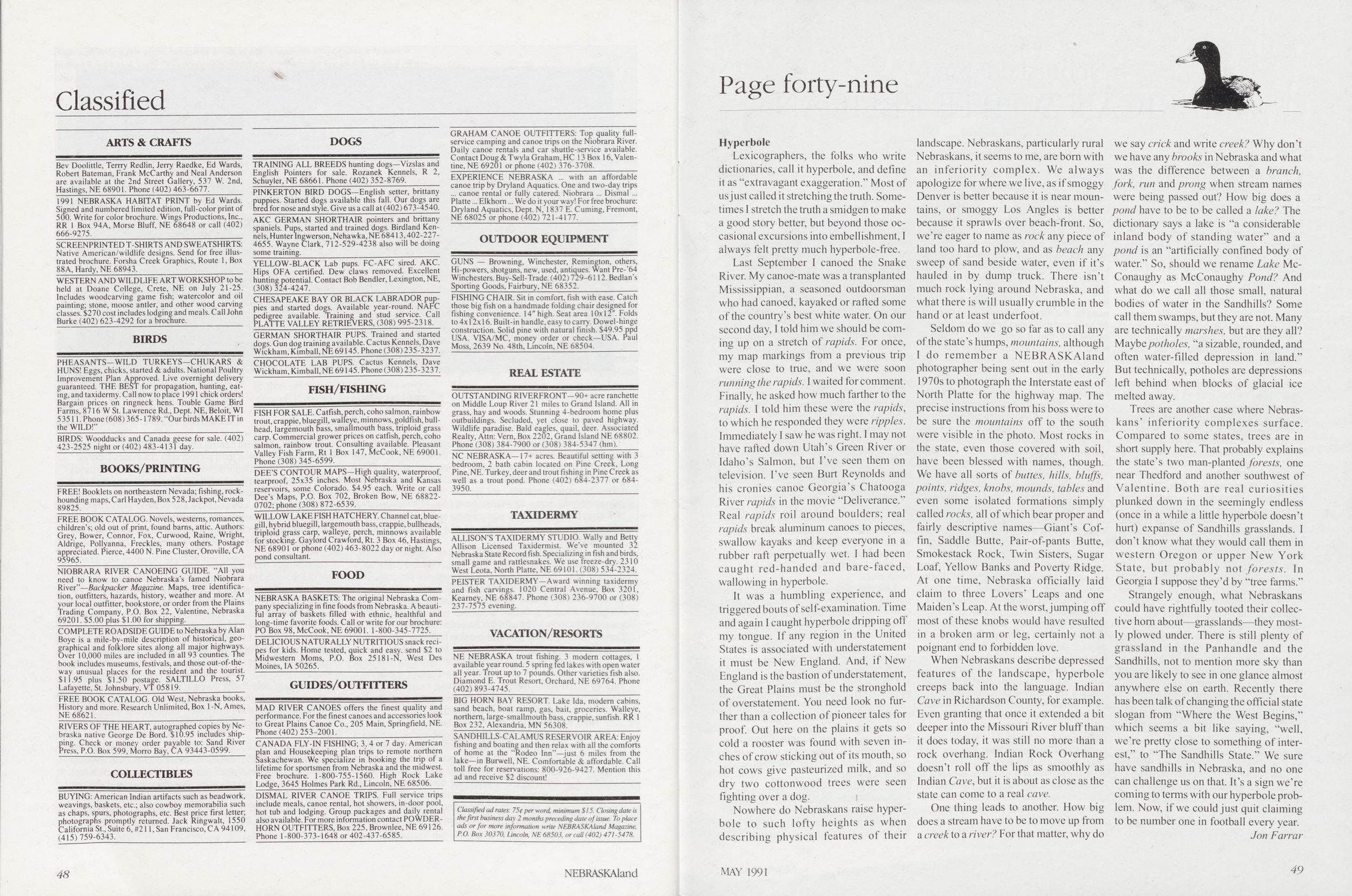
Classified
ARTS & CRAFTSBev Doolittle, Terrry Redlin, Jerry Raedke, Ed Wards, Robert Bateman, Frank McCarthy and Neal Anderson are available at the 2nd Street Gallery, 537 W. 2nd, Hastings, NE 68901. Phone (402) 463-6677.________
1991 NEBRASKA HABITAT PRINT by Ed Wards. Signed and numbered limited edition, full-color print of 500. Write for color brochure. Wings Productions, Inc., RR 1 Box 94A, Morse Bluff, NE 68648 or call (402) 666-9275.___________________________________
SCREENPRINTED T-SHIRTS AND SWEATSHIRTS: Native American/wildlife designs. Send for free illustrated brochure. Forsha Creek Graphics, Route 1, Box 88A, Hardy, NE 68943._________________________
WESTERN AND WILDLIFE ART WORKSHOP to be held at Doane College, Crete, NE on July 21-25. Includes woodcarving game fish; watercolor and oil painting; stone, moose antler, and other wood carving classes. $270 cost includes lodging and meals. Call John Burke (402) 623-4292 for a brochure._____________
BIRDSPHEASANTS—WILD TURKEYS—CHUKARS & HUNS! Eggs, chicks, started & adults. National Poultry Improvement Plan Approved. Live overnight delivery guaranteed. THE BEST for propagation, hunting, eating, and taxidermy. Call now to place 1991 chick orders! Bargain prices on ringneck hens. Touble Game Bird Farms, 8716 W St. Lawrence Rd., Dept. NE, Beloit, WI 53511. Phone (608) 365-1789. "Our birds MAKE IT in the WILD!"__________________________________
BIRDS: Wood ducks and Canada geese for sale. (402) 423-2525 night or (402) 483-4131 day.____________
BOOKS/PRINTINGFREE! Booklets on northeastern Nevada; fishing, rock-hounding maps, Carl Hayden, Box 528, Jackpot, Nevada 89825.______________________________________
FREE BOOK CATALOG. Novels, westerns, romances, children's; old out of print, found barns, attic. Authors: Grey, Bower, Connor, Fox, Curwood, Raine, Wright, Aldrige, Pollyanna, Freckles, many others. Postage appreciated. Pierce, 4400 N. Pine Cluster, Oroville, CA 95965.______________________________________
NIOBRARA RIVER CANOEING GUIDE. "All you need to know to canoe Nebraska's famed Niobrara River"—Backpacker Magazine. Maps, tree identification, outfitters, hazards, history, weather and more. At your local outfitter, bookstore, or order from the Plains Trading Company, P.O. Box 22, Valentine, Nebraska 69201. $5.00 plus $1.00 for shipping.______________
COMPLETE ROADSIDE GUIDE to Nebraska by Alan Boye is a mile-by-mile description of historical, geographical and folklore sites along all major highways. Over 10,000 miles are included in all 93 counties. The book includes museums, festivals, and those out-of-the-way unusual places for the resident and the tourist. $11.95 plus $1.50 postage. SALTILLO Press, 57 Lafayette, St. Johnsbury, VT 05819._______________
FREE BOOK CATALOG. Old West, Nebraska books, History and more. Research Unlimited, Box 1 -N, Ames, NE 68621.___________________________________
RIVERS OF THE HEART, autographed copies by Nebraska native George De Bord. $10.95 includes shiping. Check or money order payable to: Sand River ress, P.O. Box 599, Morro Bay, CA 93443-0599.
COLLECTIBLESBUYING: American Indian artifacts such as beadwork, weavings, baskets, etc.; also cowboy memorabilia such as chaps, spurs, photographs, etc. Best price first letter; photographs promptly returned. Jack Ringwalt, 1550 California St., Suite 6, #211, San Francisco, CA 94109, (415)759-6343. ______
DOGSTRAINING ALL BREEDS hunting dogs—Vizslas and English Pointers for sale. Rozanek Kennels, R 2, Schuylei, NE 68661. Phone (402) 352-8769.________
PINKERTON BIRD DOGS—English setter, brittany puppies. Started dogs available this fall. Our dogs are bred for nose and style. Give us a call at (402) 673-4540.
AKC GERMAN SHORTHAIR pointers and brittany spaniels. Pups, started and trained dogs. Birdland Kennels, Hunter Ingwerson, Nehawka, NE 68413,402-227-4655. Wayne Clark, 712-529-4238 also will be doing some training.___________________
YELLOW-BLACK Lab pups. FC-AFC sired. AKC. Hips OFA certified. Dew claws removed. Excellent hunting potential. Contact Bob Bendler, Lexington, NE, (308) 324-4247.______________________________
CHESAPEAKE BAY OR BLACK LABRADOR puppies and started dogs. Available year-round. NAFC pedigree available. Training and stud service. Call PLATTE VALLEY RETRIEVERS, (308) 995-2318.
GERMAN SHORTHAIR PUPS. Trained and started dogs. Gun dog training available. Cactus Kennels, Dave Wickham, Kimball, NE 69145. Phone (308) 235-3237.
CHOCOLATE LAB PUPS. Cactus Kennels, Dave Wickham, Kimball, NE 69145. Phone (308) 235-3237.
FISH/FISHINGFISH FOR SALE. Catfish, perch, coho salmon, rainbow trout, crappie, bluegill, walleye, minnows, goldfish, bullhead, largemouth bass, smallmouth bass, triploid grass carp. Commercial grower prices on catfish, perch, coho salmon, rainbow trout. Consulting available. Pleasant Valley Fish Farm, Rt 1 Box 147, McCook, NE 69001. Phone (308) 345-6599._________________________
DEE'S CONTOUR MAPS—High quality, waterproof, tearproof, 25x35 inches. Most Nebraska and Kansas reservoirs, some Colorado. $4.95 each. Write or call Dee's Maps, P.O. Box 702, Broken Bow, NE 68822-0702; phone (308) 872-6539.____________________
WILLOW LAKE FISH HATCHERY. Channel cat, bluegill, hybrid bluegill, largemouth bass, crappie, bullheads, triploid grass carp, walleye, perch, minnows available for stocking. Gaylord Crawford, Rt. 3 Box 46, Hastings, NE 68901 or phone (402) 463-8022 day or night. Also pond consultant.
FOODNEBRASKA BASKETS: The original Nebraska Company specializing in fine foods from Nebraska. A beautiful array of baskets filled with ethnic, healthful and long-time favorite foods. Call or write for our brochure: PO Box 98, McCook, NE 69001. 1-800-345-7725.
DELICIOUS NATURALLY NUTRITIOUS snack recipes for kids. Home tested, quick and easy, send $2 to Midwestern Moms, P.O. Box 25181-N, West Des Moines, IA 50265._____________________________
GUIDES/OUTFITTERSMAD RIVER CANOES offers the finest quality and performance. For the finest canoes and accessories look to Great Plains Canoe Co., 205 Main, Springfield, NE. Phone (402) 253-2001._________________________
CANADA FLY-IN FISHING; 3, 4 or 7 day. American plan and Housekeeping plan trips to remote northern saskachewan. We specialize in booking the trip of a lifetime for sportsmen from Nebraska and the midwest. Free brochure. 1-800-755-1560. High Rock Lake Lodge, 3645 Holmes Park Rd., Lincoln, NE 68506.
DISMAL RIVER CANOE TRIPS. Full service trips include meals, canoe rental, hot showers, in-door pool, hot tub and lodging. Group packages and daily rental also available. For more information contact POWDER-HORN OUTFITTERS, Box 225, Brownlee, NE 69126.
Phone 1-800-373-1648 or 402-437-6585. GRAHAM CANOE OUTFITTERS: Top quality full- service camping and canoe trips on the Niobrara River. Daily canoe rentals and car shuttle-service available. Contact Doug & Twyla Graham, HC 13 Box 16, Valentine, NE 69201 or phone (402) 376-3708.__________
EXPERIENCE NEBRASKA ... with an affordable canoe trip by Dry land Aquatics. One and two-day trips ... canoe rental or fully catered. Niobrara ... Dismal ... Platte... Elkhorn... We do it your way! For free brochure: Dry land Aquatics, Dept. N, 1837 E. Cuming, Fremont, NE 68025 or phone (402) 721-4177.______________
OUTDOOR EQUIPMENTGUNS — Browning, Winchester, Remington, others, Hi-powers, shotguns, new, used, antiques. Want Pre-'64 Winchesters. Buy-Sell-Trade. (402) 729-6112. Bedlan's Sporting Goods, Fairbury, NE 68352.______________
FISHING CHAIR. Sit in comfort, fish with ease. Catch those big fish on a handmade folding chair designed for fishing convenience. 14" high. Seat area 10x12". Folds to 4x 12x 16. Built-in handle, easy to carry Dowel-hinge construction. Solid pine with natural finish. $49.95 ppd USA. VISA/MC, money order or check—USA. Paul Moss, 2639 No. 48th, Lincoln, NE 68504.
REAL ESTATEOUTSTANDING RIVERFRONT—90+ acre ranchette on Middle Loup River 21 miles to Grand Island. All in grass, hay and woods. Stunning 4-bedroom home plus outbuildings. Secluded, yet close to paved highway. Wildlife paradise. Bald eagles, quail, deer. Associated Realty, Attn: Vern, Box 2202, Grand Island NE 68802. Phone (308) 384-7900 or (308) 384-5347 (hm).
NC NEBRASKA—17+ acres. Beautiful setting with 3 bedroom, 2 bath cabin located on Pine Creek, Long Pine, NE. Turkey, deer and trout fishing in Pine Creek as well as a trout pond. Phone (402) 684-2377 or 684-3950.
TAXIDERMYALLISON'S TAXIDERMY STUDIO. Wally and Betty Allison Licensed Taxidermist. We've mounted 32 Nebraska State Record fish. Specializing in fish and birds, small game and rattlesnakes. We use freeze-dry. 2310 West Leota, North Platte, NE 69101. (308) 534-2324.
PEISTER TAXIDERMY—Award winning taxidermy and fish carvings. 1020 Central Avenue, Box 3201, Kearney, NE 68847. Phone (308) 236-9700 or (308) 237-7575 evening.
VACATION/RESORTSNE NEBRASKA trout fishing. 3 modern cottages, 1 available year round. 5 spring fed lakes with open water all year. Trout up to 7 pounds. Other varieties fish also. Diamond E. Trout Resort, Orchard, NE 69764. Phone (402) 893-4745._____________________________
BIG HORN BAY RESORT. Lake Ida, modern cabins, sand beach, boat ramp, gas, bait, groceries. Walleye, northern, large-smallmouth bass, crappie, sunfish. RR 1 Box 232, Alexandria, MN 56308._________________
SANDHILLS-CALAMUS RESERVOIR AREA: Enjoy fishing and boating and then relax with all the comforts of home at the "Rodeo Inn"—just 6 miles from the lake—in Burwell, NE. Comfortable & affordable. Call toll free for reservations: 800-926-9427. Mention this ad and receive $2 discount!
Classified ad rates: 75c per word, minimum $15. Closing date is the first business day 2 months preceding date of issue. To place ads or for more information write NEBRASKAland Magazine, P.O. Box 30370, Lincoln, NE 68503, or call (402) 471-5478. 48 NEBRASKAlandPage forty-nine
HyperboleLexicographers, the folks who write dictionaries, call it hyperbole, and define it as "extravagant exaggeration/' Most of us just called it stretching the truth. Sometimes I stretch the truth a smidgen to make a good story better, but beyond those occasional excursions into embellishment, I always felt pretty much hyperbole-free.
Last September I canoed the Snake River. My canoe-mate was a transplanted Mississippian, a seasoned outdoorsman who had canoed, kayaked or rafted some of the country's best white water. On our second day, I told him we should be coming up on a stretch of rapids. For once, my map markings from a previous trip were close to true, and we were soon running the rapids. I waited for comment. Finally, he asked how much farther to the rapids. I told him these were the rapids, to which he responded they were ripples. Immediately I saw he was right. I may not have rafted down Utah's Green River or Idaho's Salmon, but I've seen them on television. I've seen Burt Reynolds and his cronies canoe Georgia's Chatooga River rapids in the movie "Deliverance." Real rapids roil around boulders; real rapids break aluminum canoes to pieces, swallow kayaks and keep everyone in a rubber raft perpetually wet. I had been caught red-handed and bare-faced, wallowing in hyperbole.
It was a humbling experience, and triggered bouts of self-examination. Time and again I caught hyperbole dripping off my tongue. If any region in the United States is associated with understatement it must be New England. And, if New England is the bastion of understatement, the Great Plains must be the stronghold of overstatement. You need look no further than a collection of pioneer tales for proof. Out here on the plains it gets so cold a rooster was found with seven inches of crow sticking out of its mouth, so hot cows give pasteurized milk, and so dry two cottonwood trees were seen fighting over a dog.
Nowhere do Nebraskans raise hyperbole to such lofty heights as when describing physical features of their landscape. Nebraskans, particularly rural Nebraskans, it seems to me, are born with an inferiority complex. We always apologize for where we live, as if smoggy Denver is better because it is near mountains, or smoggy Los Angles is better because it sprawls over beach-front. So, we're eager to name as rock any piece of land too hard to plow, and as beach any sweep of sand beside water, even if it's hauled in by dump truck. There isn't much rock lying around Nebraska, and what there is will usually crumble in the hand or at least underfoot.
Seldom do we go so far as to call any of the state's humps, mountains, although I do remember a NEBRASKAland photographer being sent out in the early 1970s to photograph the Interstate east of North Platte for the highway map. The precise instructions from his boss were to be sure the mountains off to the south were visible in the photo. Most rocks in the state, even those covered with soil, have been blessed with names, though. We have all sorts of buttes, hills, bluffs, points, ridges, knobs, mounds, tables and even some isolated formations simply called rocks, all of which bear proper and fairly descriptive names—Giant's Coffin, Saddle Butte, Pair-of-pants Butte, Smokestack Rock, Twin Sisters, Sugar Loaf, Yellow Banks and Poverty Ridge. At one time, Nebraska officially laid claim to three Lovers' Leaps and one Maiden's Leap. At the worst, jumping off most of these knobs would have resulted in a broken arm or leg, certainly not a poignant end to forbidden love.
When Nebraskans describe depressed features of the landscape, hyperbole creeps back into the language. Indian Cave in Richardson County, for example. Even granting that once it extended a bit deeper into the Missouri River bluff than it does today, it was still no more than a rock overhang. Indian Rock Overhang doesn't roll off the lips as smoothly as Indian Cave, but it is about as close as the state can come to a real cave.
One thing leads to another. How big does a stream have to be to move up from a creek to a river? For that matter, why do we say crick and write creek? Why don't we have any brooks in Nebraska and what was the difference between a branch, fork, run and prong when stream names were being passed out? How big does a pond have to be to be called a lake? The dictionary says a lake is "a considerable inland body of standing water" and a pond is an "artificially confined body of water." So, should we rename Lake McConaughy as McConaughy Pond? And what do we call all those small, natural bodies of water in the Sandhills? Some call them swamps, but they are not. Many are technically marshes, but are they all? Maybe potholes, "a sizable, rounded, and often water-filled depression in land." But technically, potholes are depressions left behind when blocks of glacial ice melted away.
Trees are another case where Nebraskans' inferiority complexes surface. Compared to some states, trees are in short supply here. That probably explains the state's two man-planted forests, one near Thedford and another southwest of Valentine. Both are real curiosities plunked down in the seemingly endless (once in a while a little hyperbole doesn't hurt) expanse of Sandhills grasslands. I don't know what they would call them in western Oregon or upper New York State, but probably not forests. In Georgia I suppose they'd by "tree farms."
Strangely enough, what Nebraskans could have rightfully tooted their collective horn about—grasslands—they mostly plowed under. There is still plenty of grassland in the Panhandle and the Sandhills, not to mention more sky than you are likely to see in one glance almost anywhere else on earth. Recently there has been talk of changing the official state slogan from "Where the West Begins," which seems a bit like saying, "well, we're pretty close to something of interest," to "The Sandhills State." We sure have sandhills in Nebraska, and no one can challenge us on that. It's a sign we're coming to terms with our hyperbole problem. Now, if we could just quit claiming to be number one in football every year.
Jon Farrar MAY 1991 49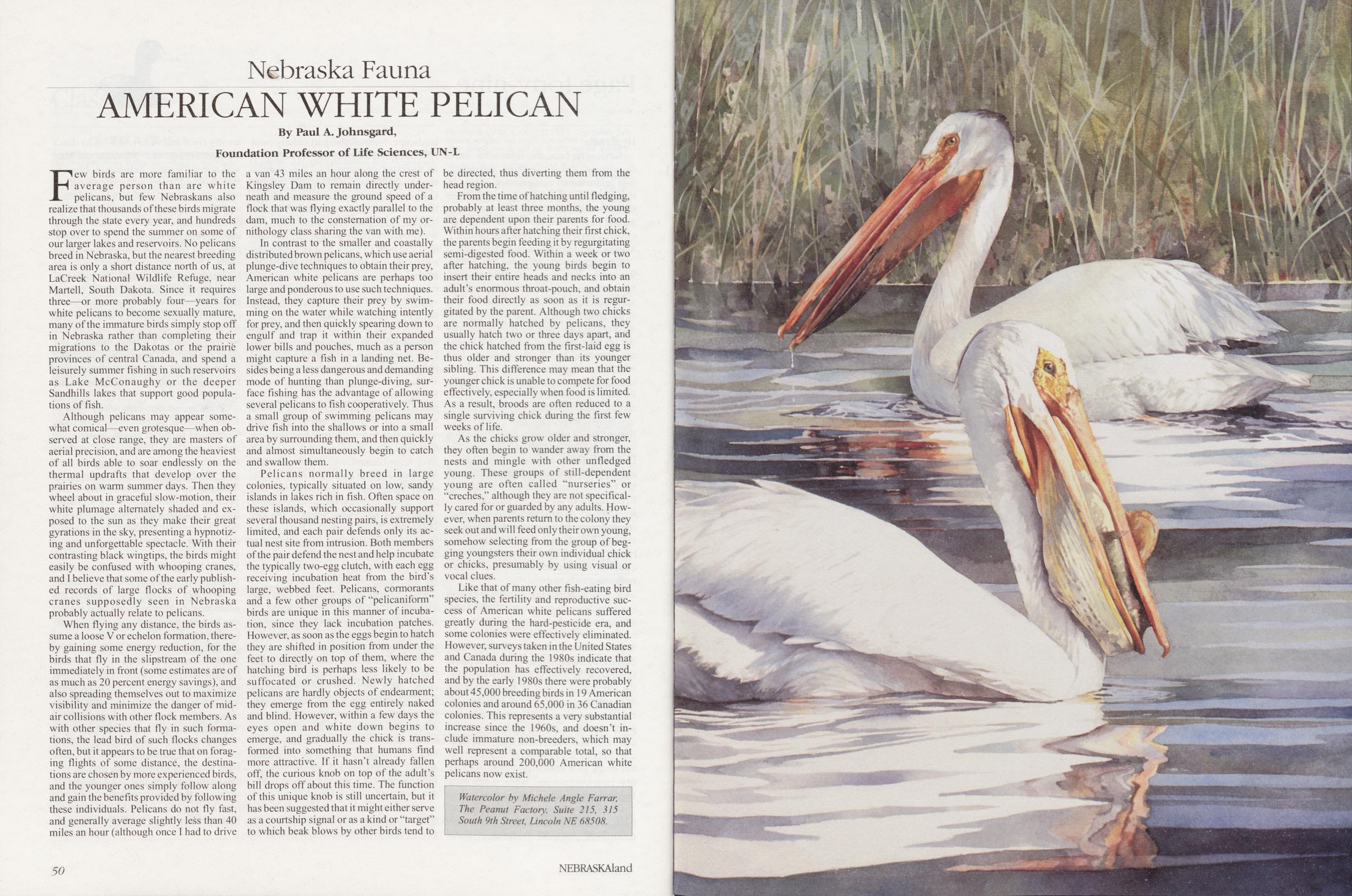
Nebraska Fauna AMERICAN WHITE PELICAN
By Paul A. Johnsgard, Foundation Professor of Life Sciences, UNLFew birds are more familiar to the average person than are white pelicans, but few Nebraskans also realize that thousands of these birds migrate through the state every year, and hundreds stop over to spend the summer on some of our larger lakes and reservoirs. No pelicans breed in Nebraska, but the nearest breeding area is only a short distance north of us, at LaCreek National Wildlife Refuge, near Martell, South Dakota. Since it requires three—or more probably four—years for white pelicans to become sexually mature, many of the immature birds simply stop off in Nebraska rather than completing their migrations to the Dakotas or the prairie provinces of central Canada, and spend a leisurely summer fishing in such reservoirs as Lake McConaughy or the deeper Sandhills lakes that support good populations offish.
Although pelicans may appear somewhat comical—even grotesque—when observed at close range, they are masters of aerial precision, and are among the heaviest of all birds able to soar endlessly on the thermal updrafts that develop over the prairies on warm summer days. Then they wheel about in graceful slow-motion, their white plumage alternately shaded and exposed to the sun as they make their great gyrations in the sky, presenting a hypnotizing and unforgettable spectacle. With their contrasting black wingtips, the birds might easily be confused with whooping cranes, and I believe that some of the early published records of large flocks of whooping cranes supposedly seen in Nebraska probably actually relate to pelicans.
When flying any distance, the birds assume a loose V or echelon formation, thereby gaining some energy reduction, for the birds that fly in the slipstream of the one immediately in front (some estimates are of as much as 20 percent energy savings), and also spreading themselves out to maximize visibility and minimize the danger of mid-air collisions with other flock members. As with other species that fly in such formations, the lead bird of such flocks changes often, but it appears to be true that on foraging flights of some distance, the destinations are chosen by more experienced birds, and the younger ones simply follow along and gain the benefits provided by following these individuals. Pelicans do not fly fast, and generally average slightly less than 40 miles an hour (although once I had to drive a van 43 miles an hour along the crest of Kingsley Dam to remain directly underneath and measure the ground speed of a flock that was flying exactly parallel to the dam, much to the consternation of my ornithology class sharing the van with me).
In contrast to the smaller and coastally distributed brown pelicans, which use aerial plunge-dive techniques to obtain their prey, American white pelicans are perhaps too large and ponderous to use such techniques. Instead, they capture their prey by swimming on the water while watching intently for prey, and then quickly spearing down to engulf and trap it within their expanded lower bills and pouches, much as a person might capture a fish in a landing net. Besides being a less dangerous and demanding mode of hunting than plunge-diving, surface fishing has the advantage of allowing several pelicans to fish cooperatively. Thus a small group of swimming pelicans may drive fish into the shallows or into a small area by surrounding them, and then quickly and almost simultaneously begin to catch and swallow them.
Pelicans normally breed in large colonies, typically situated on low, sandy islands in lakes rich in fish. Often space on these islands, which occasionally support several thousand nesting pairs, is extremely limited, and each pair defends only its actual nest site from intrusion. Both members of the pair defend the nest and help incubate the typically two-egg clutch, with each egg receiving incubation heat from the bird's large, webbed feet. Pelicans, cormorants and a few other groups of "pelican form" birds are unique in this manner of incubation, since they lack incubation pitches. However, as soon as the eggs begin to hatch they are shifted in position from under the feet to directly on top of them, where the hatching bird is perhaps less likely to be suffocated or crushed. Newly hatched pelicans are hardly objects of endearment; they emerge from the egg entirely naked and blind. However, within a few days the eyes open and white down begins to emerge, and gradually the chick is transformed into something that humans find more attractive. If it hasn't already fallen off, the curious knob on top of the adult's bill drops off about this time. The function of this unique knob is still uncertain, but it has been suggested that it might either serve as a courtship signal or as a kind or "target" to which beak blows by other birds tend to be directed, thus diverting them from the head region.
From the time of hatching until fledging, probably at least three months, the young are dependent upon their parents for food. Within hours after hatching their first chick, the parents begin feeding it by regurgitating semi-digested food. Within a week or two after hatching, the young birds begin to insert their entire heads and necks into an adult's enormous throat-pouch, and obtain their food directly as soon as it is regurgitated by the parent. Although two chicks are normally hatched by pelicans, they usually hatch two or three days apart, and the chick hatched from the first-laid egg is thus older and stronger than its younger sibling. This difference may mean that the younger chick is unable to compete for food effectively, especially when food is limited. As a result, broods are often reduced to a single surviving chick during the first few weeks of life.
As the chicks grow older and stronger, they often begin to wander away from the nests and mingle with other unfledged young. These groups of still-dependent young are often called "nurseries" or "creches," although they are not specifically cared for or guarded by any adults. However, when parents return to the colony they seek out and will feed only their own young, somehow selecting from the group of begging youngsters their own individual chick or chicks, presumably by using visual or vocal clues.
Like that of many other fish-eating bird species, the fertility and reproductive success of American white pelicans suffered greatly during the hard-pesticide era, and some colonies were effectively eliminated. However, surveys taken in the United States and Canada during the 1980s indicate that the population has effectively recovered, and by the early 1980s there were probably about 45,000 breeding birds in 19 American colonies and around 65,000 in 36 Canadian colonies. This represents a very substantial increase since the 1960s, and doesn't include immature non-breeders, which may well represent a comparable total, so that perhaps around 200,000 American white pelicans now exist.
Watercolor by Michele Angle Farrar, The Peanut Factory, Suite 215, 315 South 9th Street, Lincoln NE 68508. 50 NEBRASKAland
Position: 126 (47 views)