Volume 69, Issue 3, 1991
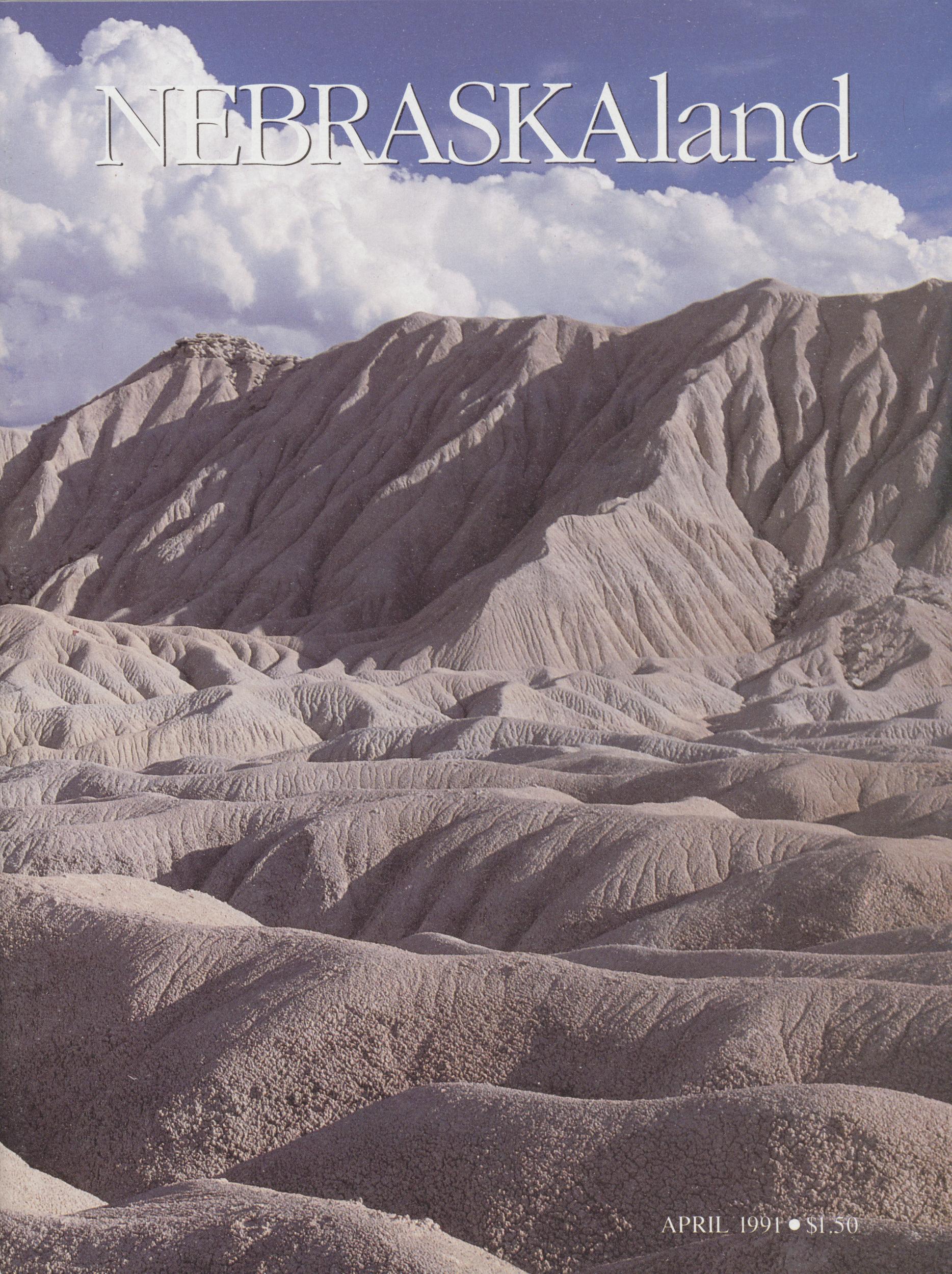
NEBRASKAland
APRIL 1991 $1.50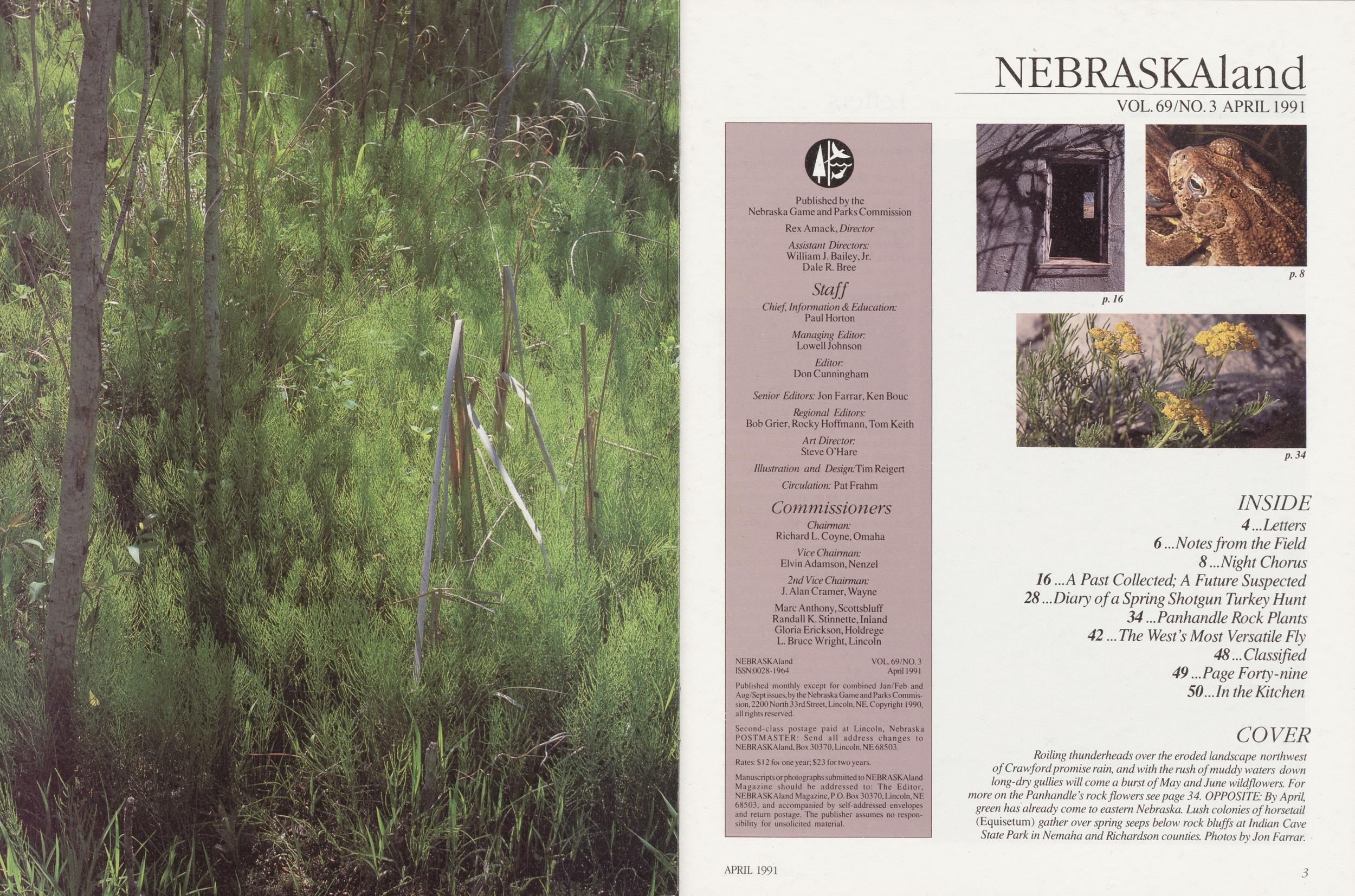
NEBRASKAland
VOL. 69/NO. 3 APRIL 1991 Published by the Nebraska Game and Parks Commission Rex Amack, Director Assistant Directors: William J. Bailey, Jr. Dale R. Bree Staff Chief Information & Education: Paul Horton Managing Editor: Lowell Johnson Editor: Don Cunningham Senior Editors: Jon Farrar, Ken Bouc Regional Editors: Bob Grier, Rocky Hoffmann, Tom Keith Art Director: Steve O'Hare Illustration and Design Tim Reigert Circulation: Pat Frahm Commissioners Chairman: Richard L. Coyne, Omaha Vice Chairman: Elvin Adamson, Nenzel 2nd Vice Chairman: J. Alan Cramer, Wayne Marc Anthony, Scottsbluff Randall K. Stinnette, Inland Gloria Erickson, Holdrege L. Bruce Wright, Lincoln NEBRASKAland ISSN:0028-i964 VOL.69/N0.3 April 1991 Published monthly except for combined Jan/Feb and Aug/Sept issues, by the Nebraska Game and Parks Commission, 2200 North 33rd Street, Lincoln, NE. Copyright 1990, all rights reserved. Second-class postage paid at Lincoln, Nebraska POSTMASTER: Send all address changes to NEBRASKAland, Box 30370, Lincoln, NE 68503. Rates: $ 12 for one year; $23 for two years. Manuscripts or photographs submitted to NEBRASKAland Magazine should be addressed to: The Editor, NEBRASKAland Magazine, P.O. Box 30370, Lincoln, NE 68503, and accompanied by self-addressed envelopes and return postage. The publisher assumes no responsibility for unsolicited material.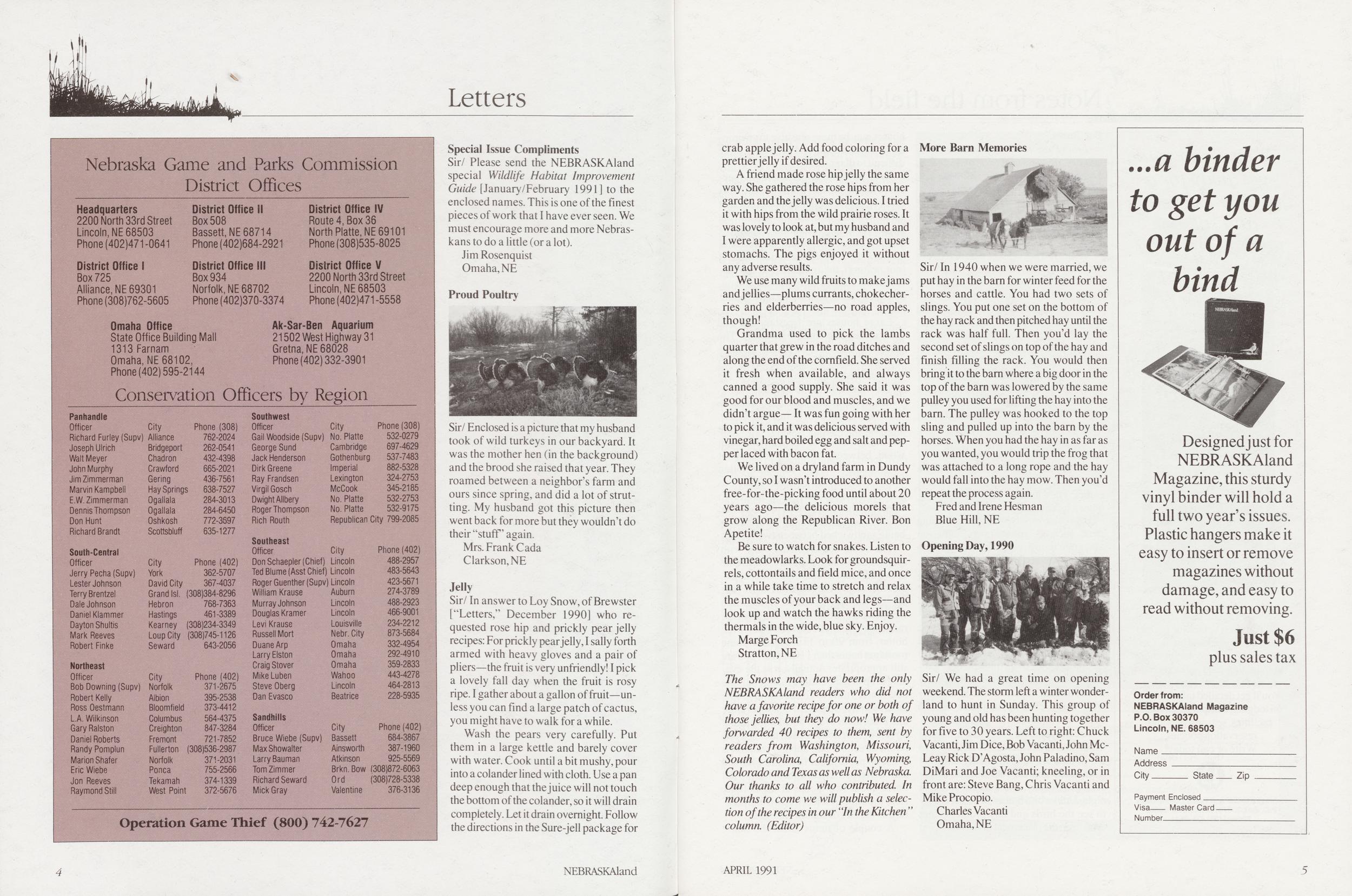 Nebraska Game and Parks Commission
District Offices
Headquarters
2200 North 33rd Street
Lincoln, NE 68503
Phone (402)471-0641
District Office I
Box 725
Alliance, NE 69301
Phone (308)762-5605
District Office li
Box 508
Bassett, NE68714
Phone (402)684-2921
District Office ill
Box 934
Norfolk, NE 68702
Phone (402)370-3374
District Office IV
Route 4, Box 36
North Platte, NE 69101
Phone (308)535-8025
District Office V
2200 North 33rd Street
Lincoln, NE 68503
Phone (402)471-5558
Omaha Office
State Office Building Mall
1313Farnam
Omaha, NE 68102,
Phone(402)595-2144
Ak-Sar-Ben Aquarium
21502 West Highway 31
Gretna, NE 68028
Phone(402)332-3901
Conservation Officers by Region
Panhandle
Officer
Richard Furley (Supv)
Joseph Ulrich
Wait Meyer
John Murphy
Jim Zimmerman
Marvin Kampbeii
E.W.Zimmerman
Dennis Thompson
Don Hunt
Richard Brandt
South-Central
Officer
Jerry Pecha (Supv)
Lester Johnson
Terry Brentzei
Dale Johnson
Danie! Klammer
Dayton Shultis
Mark Reeves
Robert Finke
Northeast
Officer
Bob Downing (Supv)
Robert Kelly
Ross Oestmann
L.A. Wilkinson
Gary Ralston
Daniel Roberts
Randy Pomplun
Marion Shafer
Eric Wiebe
Jon Reeves
Raymond Still
City
Alliance
Bridgeport
Chadron
Crawford
Gering
Hay Springs
Ogallala
Ogallala
Oshkosh
Scottsbluff
Phone (308)
762-2024
262-0541
432-4398
665-2021
436-7561
638-7527
284-3013
284-6450
772-3697
635-1277
City
York
David City
Grand Is!.
Hebron
Hastings
Kearney
Loup City
Seward
Phone (402)
362-5707
367-4037
(308)384-8296
768-7363
461-3389
(308)234-3349
(308)745-1126
643-2056
City
Norfolk
Albion
Bloomfield
Columbus
Creighton
Fremont
Fullerton
Norfolk
Ponca
Tekamah
West Point
Phone (402)
371-2675
395-2538
373-4412
564-4375
847-3284
721-7852
(308)536-2987
371-2031
755-2566
374-1339
372-5676
Southwest
Officer
Gail Woodside (Supv)
George Sund
Jack Henderson
Dirk Greene
Ray Frandsen
Virgil Gosch
DwightAllbery
Roger Thompson
Rich Routh
Southeast
Officer
Don Schaepler (Chief)
Ted BlumefAsst Chief)
Roger Guenther (Supv)
William Krause
Murray Johnson
Douglas Kramer
Levi Krause
Russell Mort
Duane Arp
Larry Elston
Craig Stover
Mike Luben
Steve Oberg
Dan Evasco
Sandhills
Officer
Bruce Wiebe (Supv)
MaxShowalter
Larry Bauman
Tom Zimmer
Richard Seward
Mick Gray
City
No. Platte
Cambridge
Gothenburg
Imperial
Lexington
McCook
No. Platte
No. Platte
Phone(308)
532-0279
697-4629
537-7483
882-5328
324-2753
345-2185
532-2753
532-9175
Republican City 799-2085
City
Lincoln
Lincoln
Lincoln
Auburn
Lincoln
Lincoln
Louisville
Nebr. City
Omaha
Omaha
Omaha
Wahoo
Lincoln
Beatrice
City
Bassett
Ainsworth
Atkinson
Broken Bow
Ord
Valentine
Phone(402)
488-2957
483-5643
423-5671
274-3789
488-2923
466-9001
234-2212
873-5684
332-4954
292-4910
359-2833
443-4278
464-2813
228-5935
Phone(402)
684-3867
387-1960
925-5569
(308)872-6063
(308)728-5338
376-3136
Operation Game Thief (800) 742-7627
Nebraska Game and Parks Commission
District Offices
Headquarters
2200 North 33rd Street
Lincoln, NE 68503
Phone (402)471-0641
District Office I
Box 725
Alliance, NE 69301
Phone (308)762-5605
District Office li
Box 508
Bassett, NE68714
Phone (402)684-2921
District Office ill
Box 934
Norfolk, NE 68702
Phone (402)370-3374
District Office IV
Route 4, Box 36
North Platte, NE 69101
Phone (308)535-8025
District Office V
2200 North 33rd Street
Lincoln, NE 68503
Phone (402)471-5558
Omaha Office
State Office Building Mall
1313Farnam
Omaha, NE 68102,
Phone(402)595-2144
Ak-Sar-Ben Aquarium
21502 West Highway 31
Gretna, NE 68028
Phone(402)332-3901
Conservation Officers by Region
Panhandle
Officer
Richard Furley (Supv)
Joseph Ulrich
Wait Meyer
John Murphy
Jim Zimmerman
Marvin Kampbeii
E.W.Zimmerman
Dennis Thompson
Don Hunt
Richard Brandt
South-Central
Officer
Jerry Pecha (Supv)
Lester Johnson
Terry Brentzei
Dale Johnson
Danie! Klammer
Dayton Shultis
Mark Reeves
Robert Finke
Northeast
Officer
Bob Downing (Supv)
Robert Kelly
Ross Oestmann
L.A. Wilkinson
Gary Ralston
Daniel Roberts
Randy Pomplun
Marion Shafer
Eric Wiebe
Jon Reeves
Raymond Still
City
Alliance
Bridgeport
Chadron
Crawford
Gering
Hay Springs
Ogallala
Ogallala
Oshkosh
Scottsbluff
Phone (308)
762-2024
262-0541
432-4398
665-2021
436-7561
638-7527
284-3013
284-6450
772-3697
635-1277
City
York
David City
Grand Is!.
Hebron
Hastings
Kearney
Loup City
Seward
Phone (402)
362-5707
367-4037
(308)384-8296
768-7363
461-3389
(308)234-3349
(308)745-1126
643-2056
City
Norfolk
Albion
Bloomfield
Columbus
Creighton
Fremont
Fullerton
Norfolk
Ponca
Tekamah
West Point
Phone (402)
371-2675
395-2538
373-4412
564-4375
847-3284
721-7852
(308)536-2987
371-2031
755-2566
374-1339
372-5676
Southwest
Officer
Gail Woodside (Supv)
George Sund
Jack Henderson
Dirk Greene
Ray Frandsen
Virgil Gosch
DwightAllbery
Roger Thompson
Rich Routh
Southeast
Officer
Don Schaepler (Chief)
Ted BlumefAsst Chief)
Roger Guenther (Supv)
William Krause
Murray Johnson
Douglas Kramer
Levi Krause
Russell Mort
Duane Arp
Larry Elston
Craig Stover
Mike Luben
Steve Oberg
Dan Evasco
Sandhills
Officer
Bruce Wiebe (Supv)
MaxShowalter
Larry Bauman
Tom Zimmer
Richard Seward
Mick Gray
City
No. Platte
Cambridge
Gothenburg
Imperial
Lexington
McCook
No. Platte
No. Platte
Phone(308)
532-0279
697-4629
537-7483
882-5328
324-2753
345-2185
532-2753
532-9175
Republican City 799-2085
City
Lincoln
Lincoln
Lincoln
Auburn
Lincoln
Lincoln
Louisville
Nebr. City
Omaha
Omaha
Omaha
Wahoo
Lincoln
Beatrice
City
Bassett
Ainsworth
Atkinson
Broken Bow
Ord
Valentine
Phone(402)
488-2957
483-5643
423-5671
274-3789
488-2923
466-9001
234-2212
873-5684
332-4954
292-4910
359-2833
443-4278
464-2813
228-5935
Phone(402)
684-3867
387-1960
925-5569
(308)872-6063
(308)728-5338
376-3136
Operation Game Thief (800) 742-7627
Letters
Special Issue ComplimentsSir/ Please send the NEBRASKAland special Wildlife Habitat Improvement Guide [January/February 1991] to the enclosed names. This is one of the finest pieces of work that I have ever seen. We must encourage more and more Nebraskans to do a little (or a lot).
Jim Rosenquist Omaha, NE Proud PoultrySir/ Enclosed is a picture that my husband took of wild turkeys in our backyard. It was the mother hen (in the background) and the brood she raised that year. They roamed between a neighbor's farm and ours since spring, and did a lot of strutting. My husband got this picture then went back for more but they wouldn't do their "stuff again.
Mrs. Frank Cada Clarkson,NE JellySir/ In answer to Loy Snow, of Brewster ["Letters," December 1990] who requested rose hip and prickly pear jelly recipes: For prickly pear jelly, I sally forth armed with heavy gloves and a pair of pliers—the fruit is very unfriendly! I pick a lovely fall day when the fruit is rosy ripe. I gather about a gallon of fruit unless you can find a large patch of cactus, you might have to walk for a while.
Wash the pears very carefully. Put them in a large kettle and barely cover with water. Cook until a bit mushy, pour into a colander lined with cloth. Use a pan deep enough that the juice will not touch the bottom of the colander, so it will drain completely. Let it drain overnight. Follow the directions in the Sure-jell package for 4 NEBRASKAland crab apple jelly. Add food coloring for a prettier jelly if desired.
A friend made rose hip jelly the same way. She gathered the rose hips from her garden and the jelly was delicious. I tried it with hips from the wild prairie roses. It was lovely to look at, but my husband and I were apparently allergic, and got upset stomachs. The pigs enjoyed it without any adverse results.
We use many wild fruits to make jams and jellies—plums currants, chokecherries and elderberries—no road apples, though!
Grandma used to pick the lambs quarter that grew in the road ditches and along the end of the cornfield. She served it fresh when available, and always canned a good supply. She said it was good for our blood and muscles, and we didn't argue— It was fun going with her to pick it, and it was delicious served with vinegar, hard boiled Qgg and salt and pepper laced with bacon fat.
We lived on a dry land farm in Dundy County, so I wasn't introduced to another free-for-the-picking food until about 20 years ago—the delicious morels that grow along the Republican River. Bon Apetite!
Be sure to watch for snakes. Listen to the meadowlarks. Look for ground squirrels, cottontails and field mice, and once in a while take time to stretch and relax the muscles of your back and legs—and look up and watch the hawks riding the thermals in the wide, blue sky. Enjoy.
Marge Forch Stratton, NEThe Snows may have been the only NEBRASKAland readers who did not have a favorite recipe for one or both of those jellies, but they do now! We have forwarded 40 recipes to them, sent by readers from Washington, Missouri, South Carolina, California, Wyoming, Colorado and Texas as well as Nebraska. Our thanks to all who contributed. In months to come we will publish a selection of the recipes in our "In the Kitchen' column. (Editor)
More Barn MemoriesSir/ In 1940 when we were married, we put hay in the barn for winter feed for the horses and cattle. You had two sets of slings. You put one set on the bottom of the hay rack and then pitched hay until the rack was half full. Then you'd lay the second set of slings on top of the hay and finish filling the rack. You would then bring it to the barn where a big door in the top of the barn was lowered by the same pulley you used for lifting the hay into the barn. The pulley was hooked to the top sling and pulled up into the barn by the horses. When you had the hay in as far as you wanted, you would trip the frog that was attached to a long rope and the hay would fall into the hay mow. Then you'd repeat the process again.
Fred and Irene Hesman Blue Hill, NE Opening Day, 1990Sir/ We had a great time on opening weekend. The storm left a winter wonderland to hunt in Sunday. This group of young and old has been hunting together for five to 30 years. Left to right: Chuck Vacanti, Jim Dice, Bob Vacanti, John McLeay Rick D'Agosta, John Paladino, Sam DiMari and Joe Vacanti; kneeling, or in front are: Steve Bang, Chris Vacanti and Mike Procopio.
Charles Vacanti Omaha, NE ...a binder to get you out of a bind Designed just for NEBRASKAland Magazine, this sturdy vinyl binder will hold a full two year's issues. Plastic hangers make it easy to insert or remove magazines without damage, and easy to read without removing. Just $6 plus sales tax Order from: NEBRASKAland Magazine P.O. Box 30370 Lincoln, NE. 68503 Name_____________________ Address __________________ City_______ State Zip Payment Enclosed___ Visa------ Master Card Number____________ APRIL 1991 5
Notes from the field
Where can you get away for a week or weekend, and still not spend a bundle? Nebraska's state park areas are still your best bet for the perfect vacation or weekend break. Get the new 48-page, color brochure highlighting state parks, recreation areas and historic parks. You'll get detailed information on lodging, camping, activities, facilities, seasons, fees and reservation policies. Write or call today! Nebraska Game and Parks Commission P.O. Box 30370, Lincoln, NE 68503 Phone (402) 471-0641 Bat BoxesFrom Patricia W. Freeman, curator of zoology at the University of Nebraska State Museum, comes the following note about these gentle night-fliers—which, as everyone should know by now, do not get tangled in women's hair, do not suck blood, and are not significant carriers of rabies:
Of the forty species of bats that live in the United States, all but three are insecteaters. Those three are nectar feeders living near the Arizona-Mexico border. There are estimates that one mouse-eared bat weighing 10 grams (about the weight of 5 dimes) eats 3,000 insects a night. Other insect-eating bats are said to eat 600 mosquitoes in an hour, to eat half their body weight in three hours, and by one estimate, a colony of 20 million bats consumes 125 to 150 tons of insects each night. This last sounds preposterous, but having spent a night outside this very cave in Texas in late June, I can vouch that there are indeed a lot of bats, and that absolutely no flying insects bothered me that night. Bats are voracious insect eaters. They have to be because flying takes a lot of energy.
Bats eat a variety of insects including pests such as grasshoppers, cutworm and grain moths, corn borers and potato beetles, not to mention mosquitoes. Europeans have recognized this beneficial aspect of bats and for some time and have erected bat houses to attract them. Here in the United States, the resort community of Chautauqua, New York, has, for 50 years or more, tried to attract bats in the summer as an alternative to chemical controls for mosquitoes. Evenings there are reported to be remarkably free of insects, important to a community with many evening activities on the streets and in outdoor amphitheaters.
Recently, and for good reason, interest in bat houses has increased. But bats and bat houses are fundamentally different from birds and bird houses. Birds are active in the day, and bats are active at night. Unlike bird houses, where it is easy to see the birds and any problems that arise from the placement of the house, bat houses may be more sensitive to environmental conditions, and problems more difficult to diagnose.
Probably most important for the success of a bat house is the daily temperature regime. The physical factors that affect temperature are the size of the house, its shape, insulation and placement. Also important are the size and shape of the internal spaces for roosting (not nesting), the roughness of the surfaces bats cling to and climb around on, and the distance to drinking and feeding areas.
Large houses are freestanding, and look rather like small barn roofs. The smaller ones should be placed 10 to 15 feet or more off the ground facing east or southeast to catch first light. No obstructions should block the entry, which is the entire bottom of the box, not a hole in the front as in a bird house. The idea is that bats will enter from the bottom, and climb or crawl on the rough wood between boards spaced about three quarters of an inch apart. Often they can be found to enter spaces as narrow as a quarter to a half inch between the clapboards of a house. There must be something secure about being sandwiched between two boards.
The roost requirements vary with species and social group and climate. One of two adjacent houses may be occupied, the other empty. Large species such as our big brown bat, Eptesicus fuscus, like roost temperatures in the 80- to 90-degree range, but the smaller species like it even hotter, from 90 to 110 degrees. Some roosts get hotter than 110 degrees and are still appropriate. Actually, it is the evening drop in temperature that signals the bats that it's time to go eat. Some people have solved the problem of temperature and placement of bat houses by putting up sets of four houses, each facing a different direction. Still another solution is to use tar paper about 18 inches wide and skirt a tree so that it is tight at the top but flares about two inches at the bottom. Here the bat can select its own temperature as the day or season changes.
A couple of items about the house 6 NEBRASKAland itself: use rough wood for the inside, and don't paint it or treat it with preservative. Old planks have been used successfully. Finally, all cracks in the sides, front, back and roof should be caulked This eliminates air circulation except from the bottom, and allows the house to trap the bats' body heat. Tall houses may be more successful than short ones because there is a greater internal temperature gradient that permits flexibility in adjusting to daily and seasonal temperatures.
Much of what we know about the success of bat houses is still trial and error. If you decide to put up a house, and you find a successful solution for this part of the country, it would be interesting to know about, and I would be happy to hear from you. If we can learn the specific requirements for bats, then, we can provide roosts for them when natural roosts are scarce or, if necessary, remove them from undesirable places and provide desirable homes elsewhere.
Much of this information comes from a book titled America's Neighborhood Bats, by Merlin Tuttle, of Bat Conservation International (P.O. Box 162603, Austin, TX 78716). The plans for building a bat house are reproduced with permission from Bat Conservation International.
Night Chorus
Photos and text by James J. Krupa A road-ditch encounter on a rainy night led this biologist to research into the mating systems of the Great Plains toad, a widely distributed species found throughout NebraskaDriving down a country road on a rain-drenched May night 10 years ago, I heard a raucous commotion from the roadside. My curiosity having gotten the best of me, I stopped the car, grabbed a flashlight and waded into the water-filled ditch to investigate, and was amazed by what I saw.
Vast numbers of frogs and toads of all shapes and sizes sat on the bank, hung from bushes over the pool, floated on the water's surface, chased one another, and clung to partially submerged grasses. Balls of toads rolled in the shallows and on the mud, grunting and kicking one another.
Closer listening revealed that their cacophony was comprised of several unique calls. Among them were the soft, delicate trills of dwarf American toads, the low, mournful trills of Woodhouse toads, the deep grunts of leopard frogs, the nasal whines of spade foot toads, the warbles of gray tree frogs and the rapid, sharp, high-pitched peeps of Strecker's chorus frogs.
Some of the calls resembled other sounds. The narrow-mouthed frog's call sounded like the bleating of a tiny sheep. That of the spotted chorus frog sounded like running one's thumb over the teeth of a comb, and the cricket frog produced a sound very similar to that made by hitting two pebbles together repeatedly. The most obvious and overwhelming call resonating through this cacophony was the ear-piercing, metallic trill of the Great Plains toad.
It was primarily this sound that first caught my attention and pulled me toward this amazing spectacle. I was mesmerized by the scene, and anxious to learn more about the behavior of these creatures. As it turned out, frogs and toads (collectively referred to as anurans) are of great interest to biologists who work on animal mating systems and sexual selection theory. I was so fascinated with this area of research and what I witnessed on that May night, that anuran mating behavior, specifically that of the Great Plains toad, became the subject of my graduate work.
Anuran breeding rituals begin in February for some species and end in June for others. Breeding activity can be sporadic depending on precipitation, ground saturation and temperature. Depending on the interaction of these conditions, breeding can be continuous for weeks, sporadic over months, or entirely lacking. When the conditions are right, one can find a male anuran in virtually every puddle of water trying desperately to woo a mate. Great Plains toads breed from April through June; so, during these months from 1984 to 1988, I spent much of my time listening to weather reports and scanning the western horizon for dark, threatening clouds.
On many nights, I watched with anxious anticipation as spectacular thunderstorms approached, only to slip north or south, leaving my study sites nothing more than dry depressions over grown with Bermuda grass. When I had the good fortune of getting hit head-on by a storm, my life took a dramatic turn from that of diurnal creature to nocturnal toad watcher. Special preparations were needed to work the night shift. On went the hip waders and head lamp. Clipboard, tape recorder and flags were strapped on for easy access. With buckets in hand, I was ready to head off into the night to collect data.
Studying anurans had its drawbacks, however. The sudden shift to nocturnal activity was a shock to my system. Wind storms, sheets of rain, tornado sirens and lightning crashing around me were common occurrences that added an element of risk, but on the whole, the experiences were pleasurable. On some nights, the distant rumbling of thunder and dim, orange flashes of lightning to the east was 8 NEBRASKAland
The Great Plains toad (Bufo cognatus) is a widely distributed species ranging from Canada to central Mexico, and from central Missouri and Minnesota to California. It is found throughout Nebraska, although not seen as commonly as other species. This toad is a rather large member of the true toad family, noted for its thick, warty skin.
To me, the Great Plains toad is a handsome species with large, greenish blotches surrounded by cream-colored borders, and eyes flecked with gold. The suggestion of a slight grin gives the impression of passive contentment—an anthropomorphism for sure, but an image that comes to mind every time I see one.
This species, like a number of others
in the mid- and southwestern United
States, is referred to as an "explosive
breeder" because it is normally secretive
and seldom seen, but literally explodes up
out of the ground on rainy nights to
initiate a furious breeding ritual that may
last for only a single evening. Almost as
suddenly, these explosive breeders
disappear back into the ground until the next
thunderstorm rolls through. This is a bit
of an exaggeration, since they do come up
to feed on warm, damp nights even when
APRIL 1991
9
Explosive breeders avoid permanent water such as ponds and streams; instead, they breed in temporary pools in flooded fields, roadside ditches, and even backyard depressions. Strangely, they often choose pools which evaporate before the tadpoles have a chance to grow and transform into toadlets. In fact, the entire reproductive process from beginning to end is a harsh struggle which most individuals lose. Great Plains toads certainly exemplify the difficulties that many animals face in trying to reproduce.
When adequate precipitation has fallen to form pools (usually an inch or more), males begin to arrive at traditional breeding sites just after sunset. They immediately begin to emit advertisement calls, which attract females—potential mates—to the pool. Depending on the location and pool size, any number from a few to several hundred males may congregate to form a deafening chorus.
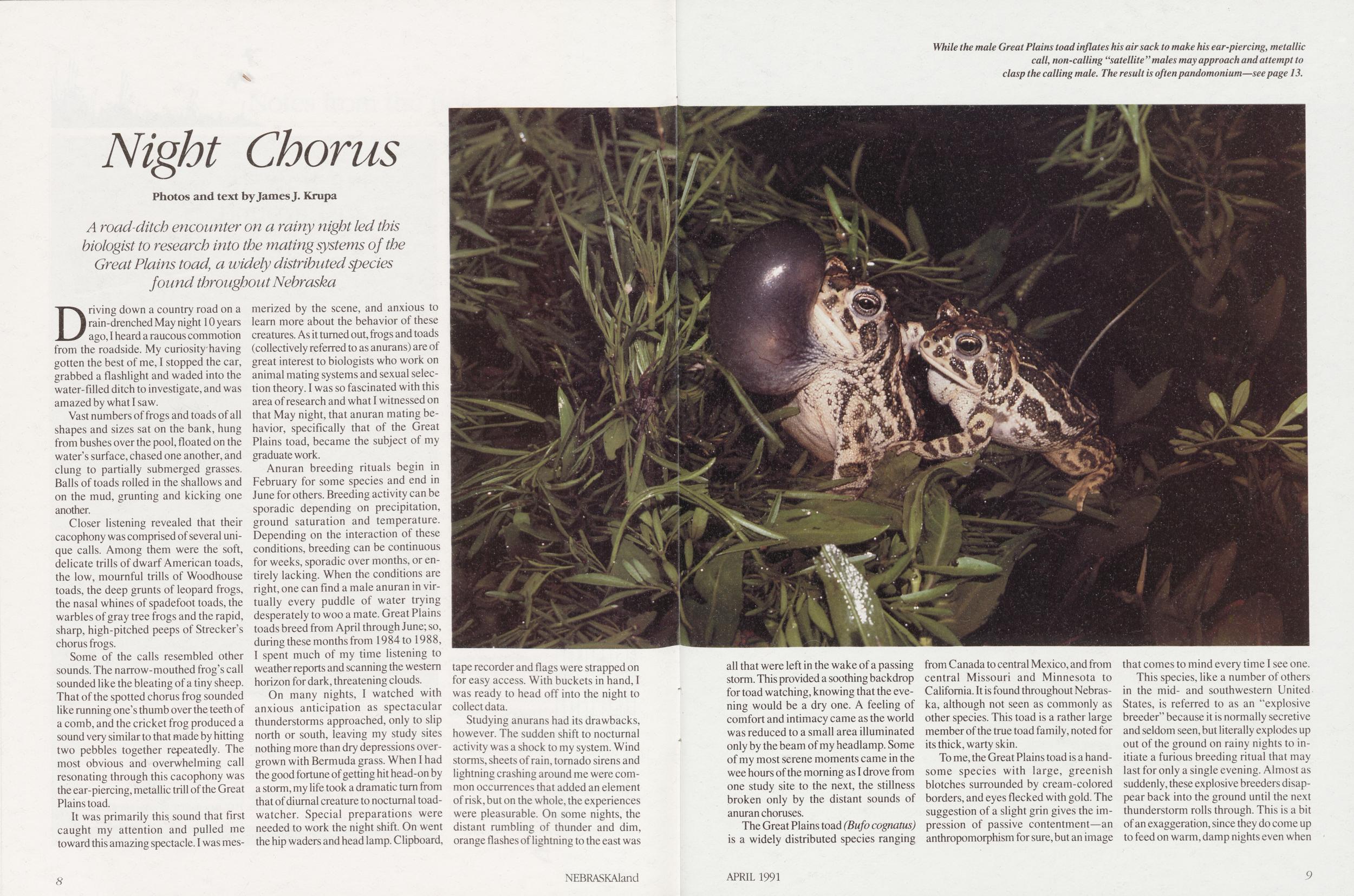
The length of a call can vary greatly but averages 30 seconds. This is followed by a brief period of silence, during which the male sits motionless, then inhales, filling its lungs and swelling its body in preparation for the next call. To make the call, the toad inflates a relatively large, sausage-shaped air sack. Then the air is rapidly oscillated back and forth from air sack to lungs across the vocal chords. Choruses often continue throughout the night, but tend to be most intense during the first four or five hours after sunset. A congregation of amorous toads gives the impression of complete chaos, but in reality, a somewhat ordered mating system is taking place.
Although most males arrive together early in the evening, females tend to straggle in over a period of hours beginning shortly after the chorus has begun. A female will appear at the pool only when she has a ripe clutch of eggs to lay (this may occur once or twice a year). Much of the rest of the time, she will be burrowed beneath the ground and inactive, but on warm, damp nights she may be found feeding on insects attracted to street lights. In contrast, most males are found at the pool each night of breeding. As a consequence, the sex ratio is usually heavily biased toward males. Typically, a pool will have seven males to every female; at times, this has been as extreme as 120 males per female.
It is not certain what makes one male successful over another; possibly the amount of time spent at a pool, the amount of time spent calling, or possibly some attribute such as size or a call component that females find attractiveWhatever the secret, females are without doubt in control, and for the most part chose their mates.
Females tend to enter a pool quietly and unnoticed. They often swim parallel to the shoreline where calling males are spaced out about every 10 feet. When nearing a caller, females will float or sit for several minutes before moving to the next. In this fashion, females may "sample" anywhere from one to 20 males (typically two or three) before mating. It is unmistakable once the female has made her choice. She will rush toward the calling male, frantically spinning in circles in front of or around him.
Paradoxically, as hard as females are to acquire, calling males are oblivious to the females' presence. As a result, females must make some effort to gain the attention of a mate-to-be. If the spining fails to produce results, a female resorts to jumping on the male or repeatedly bumping him until he stops calling and clasps her. The male then rides his mate's back with his fists securely buried into her sides just behind the forelimbs. This is called amplexus, and averages 12 hours from the time the pair forms until the last eggs are laid.
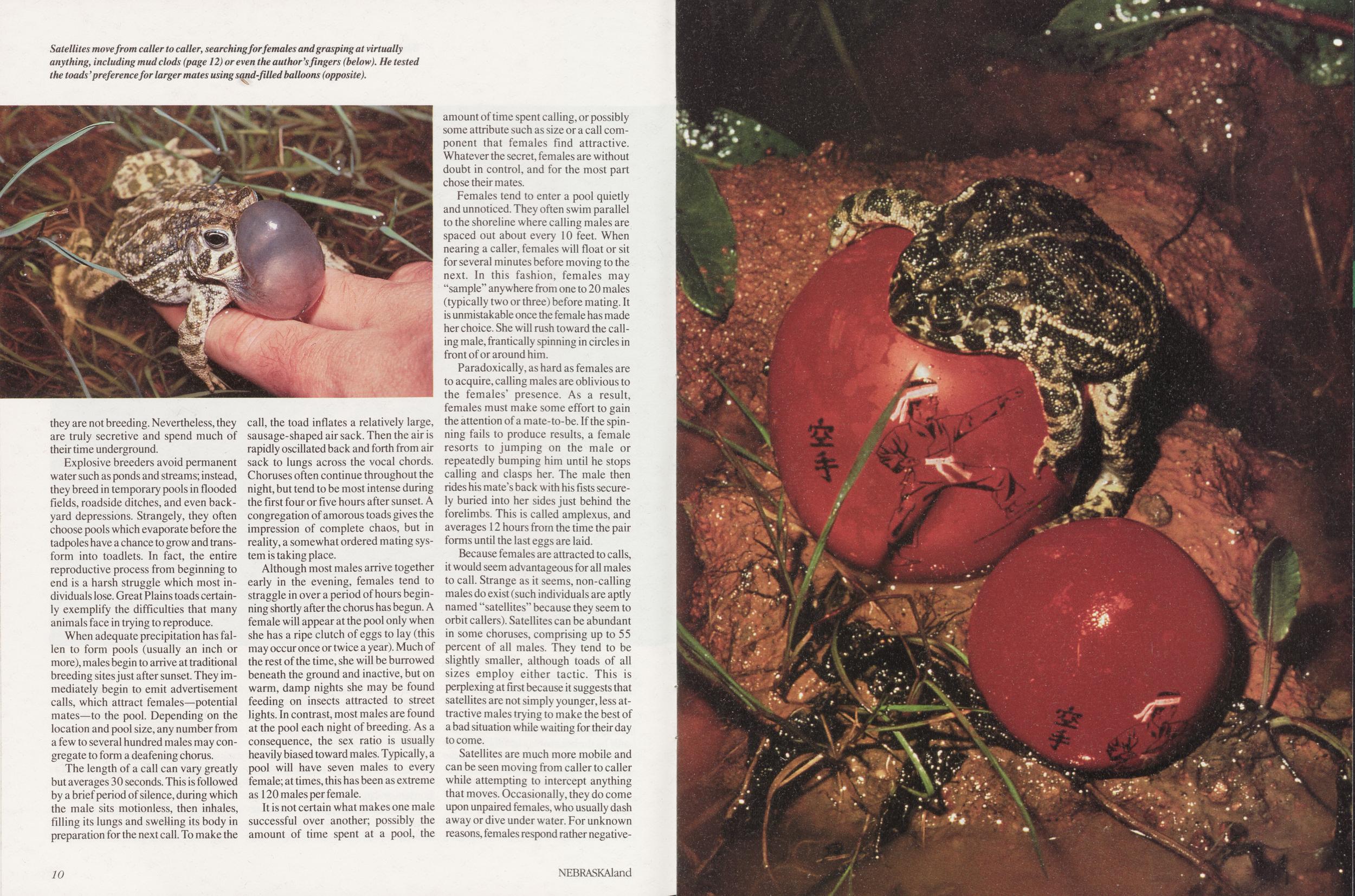
Because females are attracted to calls, it would seem advantageous for all males to call. Strange as it seems, non-calling males do exist (such individuals are aptly named "satellites" because they seem to orbit callers). Satellites can be abundant in some choruses, comprising up to 55 percent of all males. They tend to be slightly smaller, although toads of all sizes employ either tactic. This is perplexing at first because it suggests that satellites are not simply younger, less attractive males trying to make the best of a bad situation while waiting for their day to come.
Satellites are much more mobile and
can be seen moving from caller to caller
while attempting to intercept anything
that moves. Occasionally, they do come
upon unpaired females, who usually dash
away or dive under water. For unknown
reasons, females respond rather negatively
10
NEBRASKAland
 to being intercepted, perhaps because
they have not been able to identify the
satellite's species via the calls, or possibly
because the satellites are not preferred
mates.
to being intercepted, perhaps because
they have not been able to identify the
satellite's species via the calls, or possibly
because the satellites are not preferred
mates.
On those rare occasions when one is captured, a female often inflates herself until she resembles a balloon floating on the water. With the suitor on her back, the female rolls over, leaving both of them upside down, and the male completely submerged. This usually causes the pair to split; although on occasion, the female must leave the pool dragging the male behind. I am not certain of the outcome, although I suspect the male is eventually dislodged and the female later returns to the pool.
Satellites do exhibit other behaviors that are more successful. When callers advertise, satellites also are attracted to the trills. When the caller takes a break between calls, the satellites begin to approach. This routine can continue for several minutes while more satellites accumulate (I have seen up to seven around one caller) and are virtually on top of the caller. Once this close, satellites sit tight until the next call ends, and then a virtual circus act ensues. First, the satellites begin to grab at anything nearby. Often a "ball" of toads forms and rolls around grunting and kicking as they rapidly grab and release each other. Males, unlike females, emit noises called "male release" calls whenever they are clasped. This signals that a mistake has been made (a male clasping another male), and the pair quickly splits. Once the members of the ball discover the absence of females, they scatter, leaving one male behind to resume calling.
As hideous as this scene sounds, occasionally satellites get lucky. Sometimes a caller stops calling because he is bumped by a female. If a satellite happens to be grabbing at this moment, there is a chance he will clasp the female first. Apparently, females tend not to inflate or otherwise discard the satellite in this situation, perhaps because they are fooled into thinking they have paired with the caller.
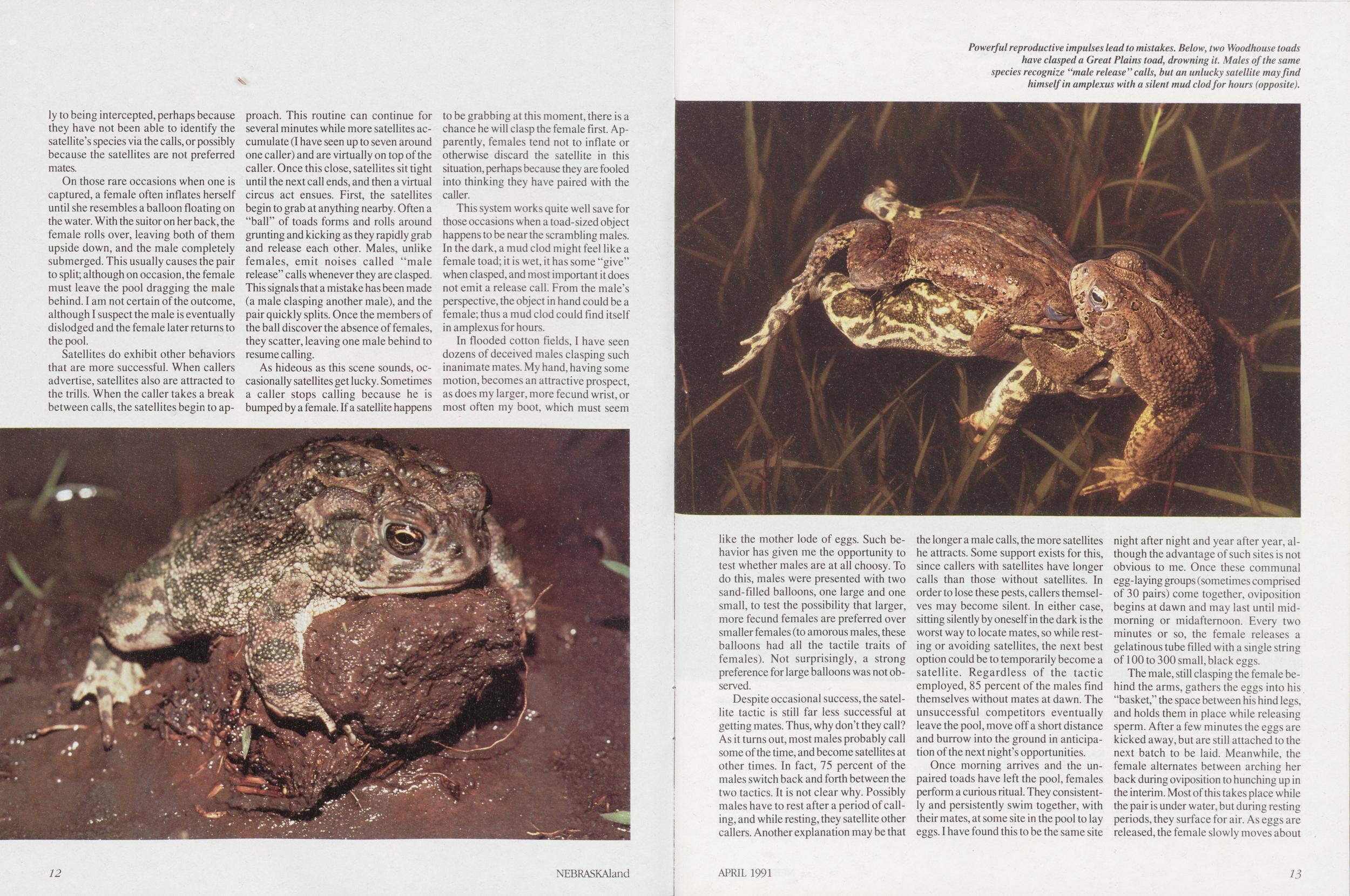
This system works quite well save for those occasions when a toad-sized object happens to be near the scrambling males. In the dark, a mud clod might feel like a female toad; it is wet, it has some "give" when clasped, and most important it does not emit a release call. From the male's perspective, the object in hand could be a female; thus a mud clod could find itself in amplexus for hours.
In flooded cotton fields, I have seen dozens of deceived males clasping such inanimate mates. My hand, having some motion, becomes an attractive prospect, as does my larger, more fecund wrist, or most often my boot, which must seem
Despite occasional success, the satellite tactic is still far less successful at getting mates. Thus, why don't they call? As it turns out, most males probably call some of the time, and become satellites at other times. In fact, 75 percent of the males switch back and forth between the two tactics. It is not clear why. Possibly males have to rest after a period of call- ing, and while resting, they satellite other callers. Another explanation may be that the longer a male calls, the more satellites he attracts. Some support exists for this, since callers with satellites have longer calls than those without satellites. In order to lose these pests, callers themselves may become silent. In either case, sitting silently by oneself in the dark is the worst way to locate mates, so while resting or avoiding satellites, the next best option could be to temporarily become a satellite. Regardless of the tactic employed, 85 percent of the males find themselves without mates at dawn. The unsuccessful competitors eventually leave the pool, move off a short distance and burrow into the ground in anticipation of the next night's opportunities.
Once morning arrives and the unpaired toads have left the pool, females perform a curious ritual. They consistently and persistently swim together, with their mates, at some site in the pool to lay eggs. I have found this to be the same site night after night and year after year, although the advantage of such sites is not obvious to me. Once these communal egg-laying groups (sometimes comprised of 30 pairs) come together, poition begins at dawn and may last until mid-morning or midafternoon. Every two minutes or so, the female releases a gelatinous tube filled with a single string of 100 to 300 small, black eggs.
The male, still clasping the female
behind the arms, gathers the eggs into his
"basket," the space between his hind legs,
and holds them in place while releasing
sperm. After a few minutes the eggs are
kicked away, but are still attached to the
next batch to be laid. Meanwhile, the
female alternates between arching her
back during oviposition to hunching up in
the interim. Most of this takes place while
the pair is under water, but during resting
periods, they surface for air. As eggs are
released, the female slowly moves about
APRIl 1991
13
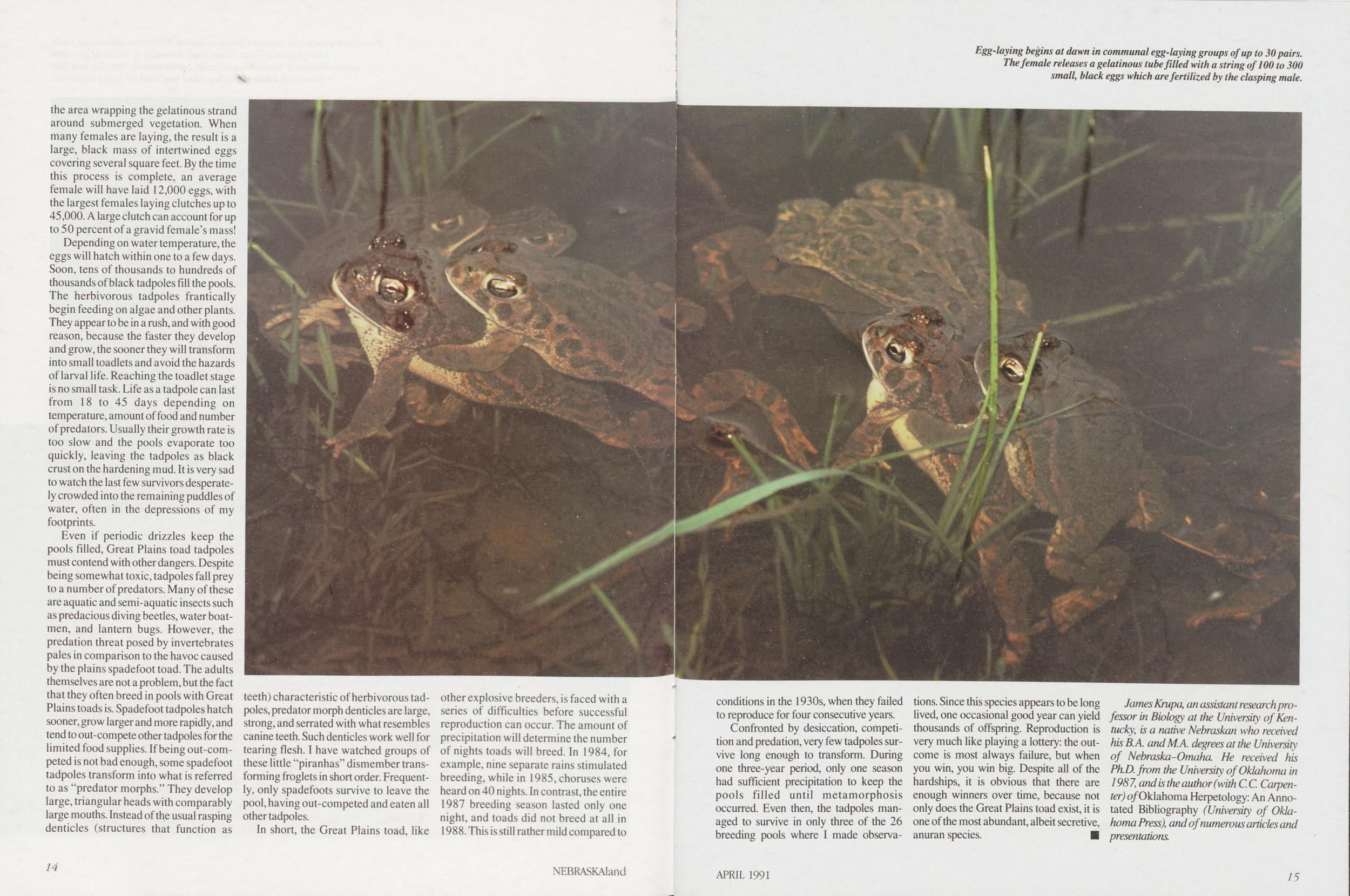 the area wrapping the gelatinous strand
around submerged vegetation. When
many females are laying, the result is a
large, black mass of intertwined eggs
covering several square feet. By the time
this process is complete, an average
female will have laid 12,000 eggs, with
the largest females laying clutches up to
45,000. A large clutch can account for up
to 50 percent of a gravid female's mass!
the area wrapping the gelatinous strand
around submerged vegetation. When
many females are laying, the result is a
large, black mass of intertwined eggs
covering several square feet. By the time
this process is complete, an average
female will have laid 12,000 eggs, with
the largest females laying clutches up to
45,000. A large clutch can account for up
to 50 percent of a gravid female's mass!
Depending on water temperature, the eggs will hatch within one to a few days. Soon, tens of thousands to hundreds of thousands of black tadpoles fill the pools. The herbivorous tadpoles frantically begin feeding on algae and other plants. They appear to be in a rush, and with good reason, because the faster they develop and grow, the sooner they will transform into small toadlets and avoid the hazards of larval life. Reaching the toadlet stage is no small task. Life as a tadpole can last from 18 to 45 days depending on temperature, amount of food and number of predators. Usually their growth rate is too slow and the pools evaporate too quickly, leaving the tadpoles as black crust on the hardening mud. It is very sad to watch the last few survivors desperately crowded into the remaining puddles of water, often in the depressions of my footprints.
Even if periodic drizzles keep the pools filled, Great Plains toad tadpoles must contend with other dangers. Despite being somewhat toxic, tadpoles fall prey to a number of predators. Many of these are aquatic and semi-aquatic insects such as predacious diving beetles, water boatmen, and lantern bugs. However, the predation threat posed by invertebrates pales in comparison to the havoc caused by the plains spadefoot toad. The adults themselves are not a problem, but the fact that they often breed in pools with Great Plains toads is. Spadefoot tadpoles hatch sooner, grow larger and more rapidly, and tend to out-compete other tadpoles for the limited food supplies. If being out-competed is not bad enough, some spadefoot tadpoles transform into what is referred to as "predator morphs." They develop large, triangular heads with comparably large mouths. Instead of the usual rasping denticles (structures that function as teeth) characteristic of herbivorous tadpoles, predator morph denticles are large, strong, and serrated with what resembles canine teeth. Such denticles work well for tearing flesh. I have watched groups of these little "piranhas" dismember transforming froglets in short order. Frequently, only spadefoots survive to leave the pool, having out-competed and eaten all other tadpoles.
In short, the Great Plains toad, like other explosive breeders, is faced with a series of difficulties before successful reproduction can occur. The amount of precipitation will determine the number of nights toads will breed. In 1984, for example, nine separate rains stimulated breeding, while in 1985, choruses were heard on 40 nights. In contrast, the entire 1987 breeding season lasted only one night, and toads did not breed at all in 1988. This is still rather mild compared to 14 NEBRASKAland
Confronted by desiccation, competition and predation, very few tadpoles survive long enough to transform. During one three-year period, only one season had sufficient precipitation to keep the pools filled until metamorphosis occurred. Even then, the tadpoles managed to survive in only three of the 26 breeding pools where I made observations. Since this species appears to be long lived, one occasional good year can yield thousands of offspring. Reproduction is very much like playing a lottery: the outcome is most always failure, but when you win, you win big. Despite all of the hardships, it is obvious that there are enough winners over time, because not only does the Great Plains toad exist, it is one of the most abundant, albeit secretive, anuran species.
James Krupa, an assistant research professor in Biology at the University of Kentucky, is a native Nebraskan who received hisB.A. and MA. degrees at the University of Nebraska-Omalia He received his PhD. from the University of Oklahoma in 198 7, and is the author (with C. C. Carpenter) Oklahoma Herpetology: An Annotated Bibliography (University of Oklahoma Press), and of numerous articles and presentations.
APRIL 1991 15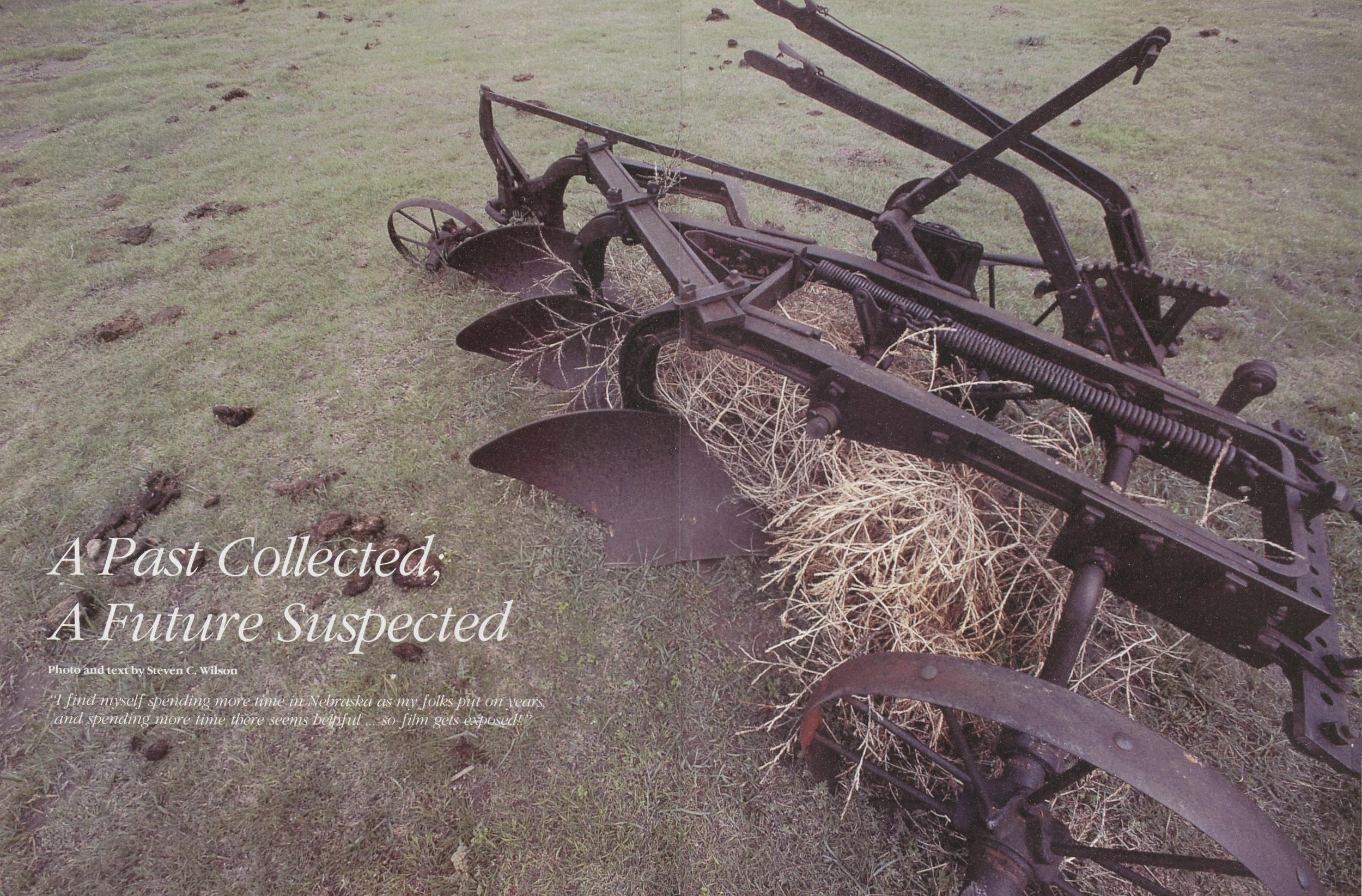
A Past Collected, A Future Suspected
Photo and text by Steven C Wilson "l find myself spending more time in Nebraska as my folks put on years, and spending more time there seems helpful... so film gets exposed!. "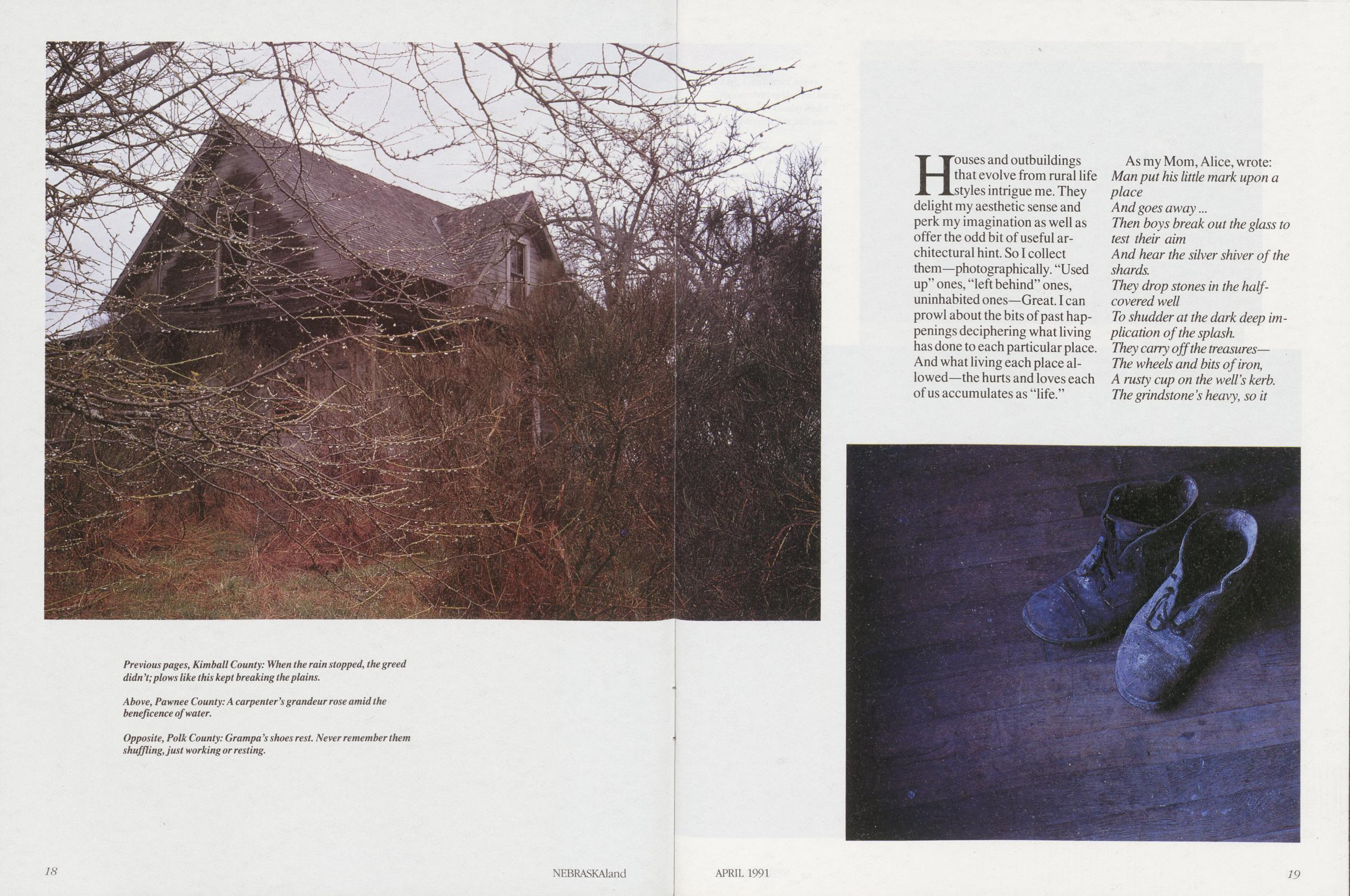 Previous pages, Kimball County: When the rain stopped, the greed
didn't; plows like this kept breaking the plains.
Previous pages, Kimball County: When the rain stopped, the greed
didn't; plows like this kept breaking the plains.
Houses and outbuildings that evolve from rural life styles intrigue me. They delight my aesthetic sense and perk my imagination as well as offer the odd bit of useful architectural hint. So I collect them—photographically. "Used up" ones, "left behind" ones, uninhabited ones—Great. I can prowl about the bits of past happenings deciphering what living has done to each particular place. And what living each place allowed—the hurts and loves each of us accumulates as "life."
As my Mom, Alice, wrote:
Man put his little mark upon a place And goes away... Then boys break out the glass to test their aim And hear the silver shiver of the shards. They drop stones in the half covered well To shudder at the dark deep implication of the splash. They carry off the treasures The wheels and bits of iron, A rusty cup on the welTs kerb. The grindstone ofs heavy, so it APRIL 1991 19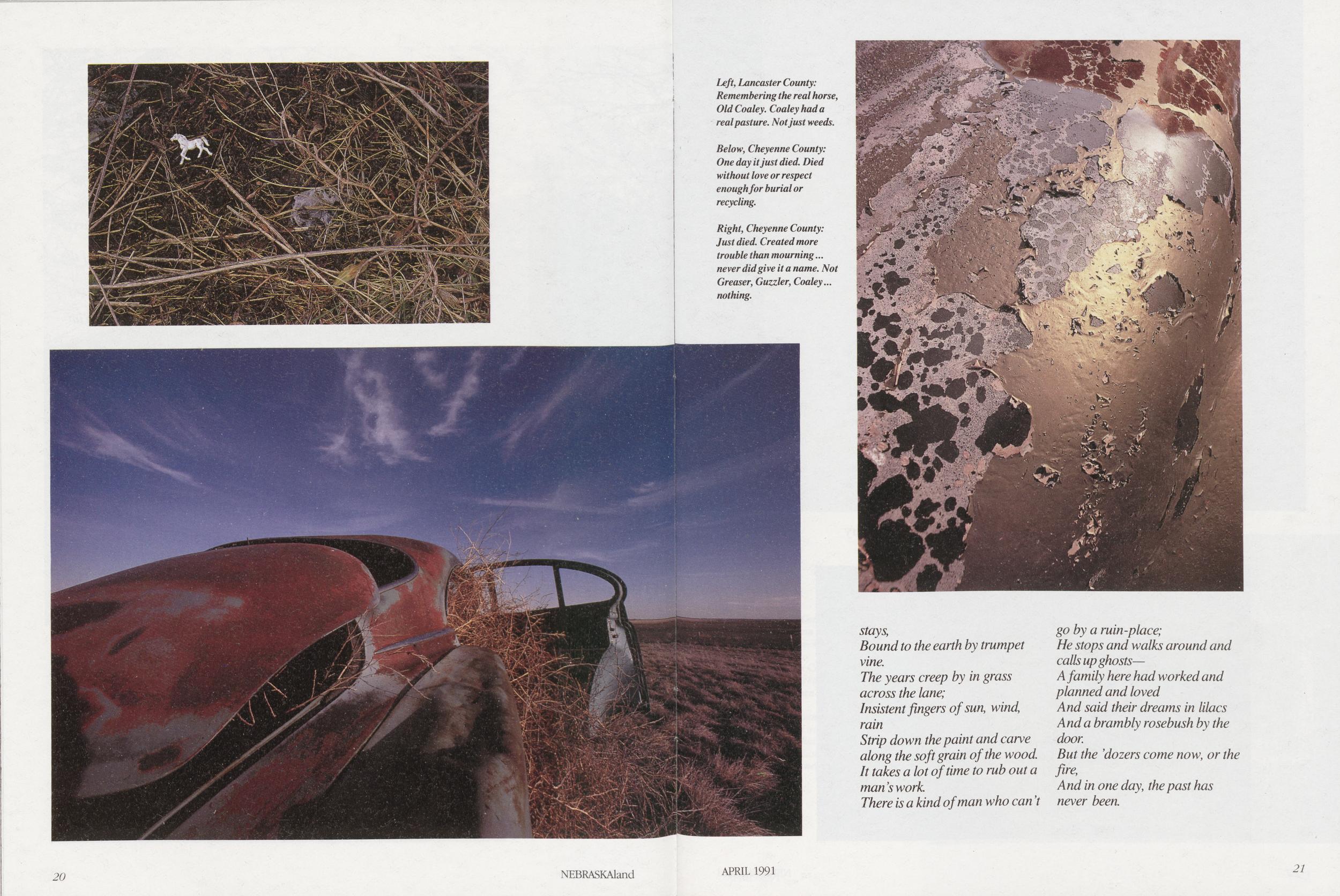
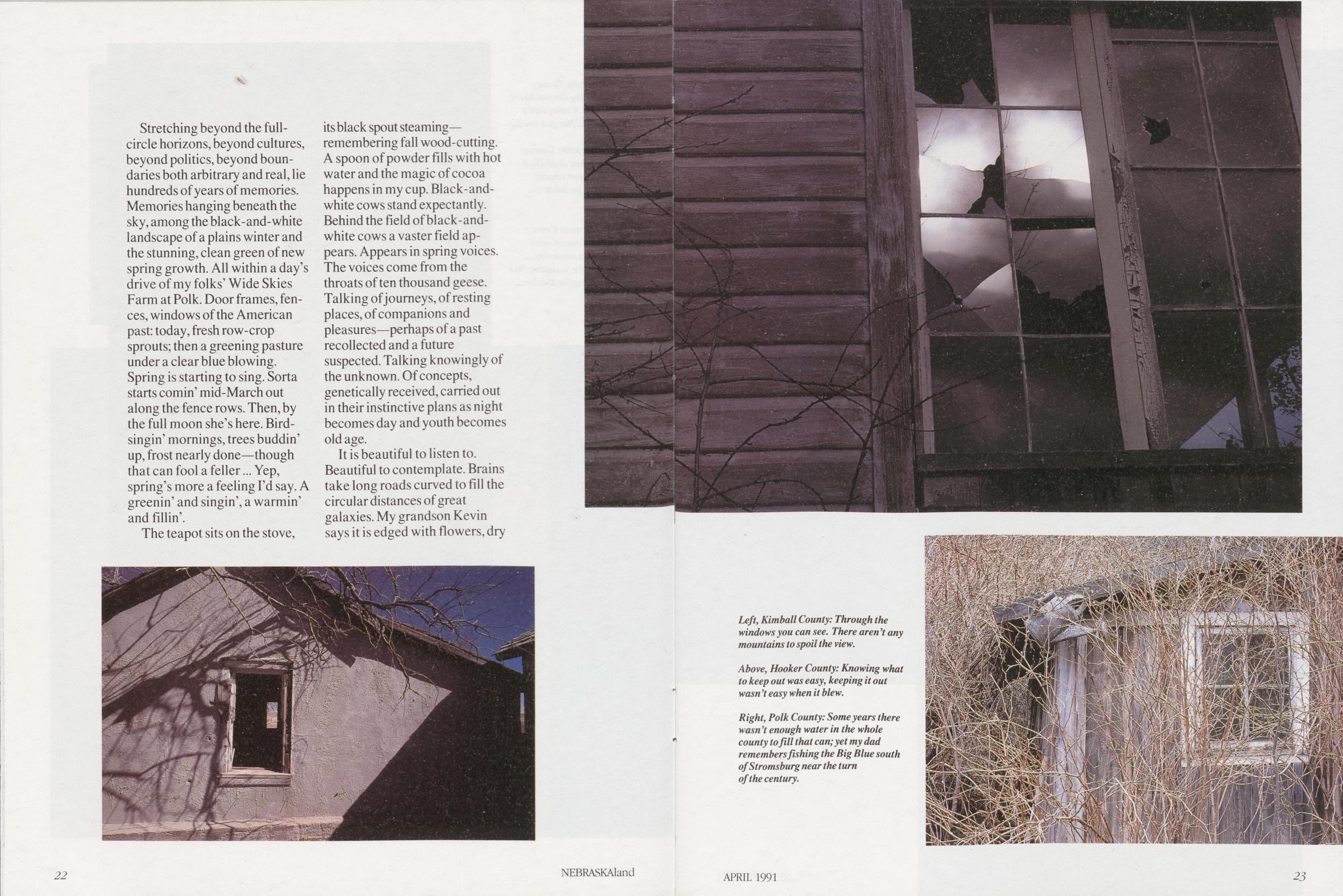
Stretching beyond the full circle horizons, beyond cultures, beyond politics, beyond boundaries both arbitrary and real, lie hundreds of years of memories. Memories hanging beneath the sky, among the black-and-white landscape of a plains winter and the stunning, clean green of new spring growth. All within a day's drive of my folks' Wide Skies Farm at Polk. Door frames, fences, windows of the American past: today, fresh row-crop sprouts; then a greening pasture under a clear blue blowing. Spring is starting to sing. Sorta starts comin' mid-March out along the fence rows. Then, by the full moon she's here. Birdsingin' mornings, trees buddin' up, frost nearly done—though that can fool a feller... Yep, spring's more a feeling I'd say. A greenin' and singin', a warmin' and fillin'.
The teapot sits on the stove, its black spout steaming remembering fall wood-cutting. A spoon of powder fills with hot water and the magic of cocoa happens in my cup. Black-and-white cows stand expectantly. Behind the field of black-and-white cows a vaster field appears. Appears in spring voices. The voices come from the throats often thousand geese. Talking of journeys, of resting places, of companions and pleasures—perhaps of a past recollected and a future suspected. Talking knowingly of the unknown. Of concepts, genetically received, carried out in their instinctive plans as night becomes day and youth becomes old age.
It is beautiful to listen to. Beautiful to contemplate. Brains take long roads curved to fill the circular distances of great galaxies. My grandson Kevin says it is edged with flowers, dry
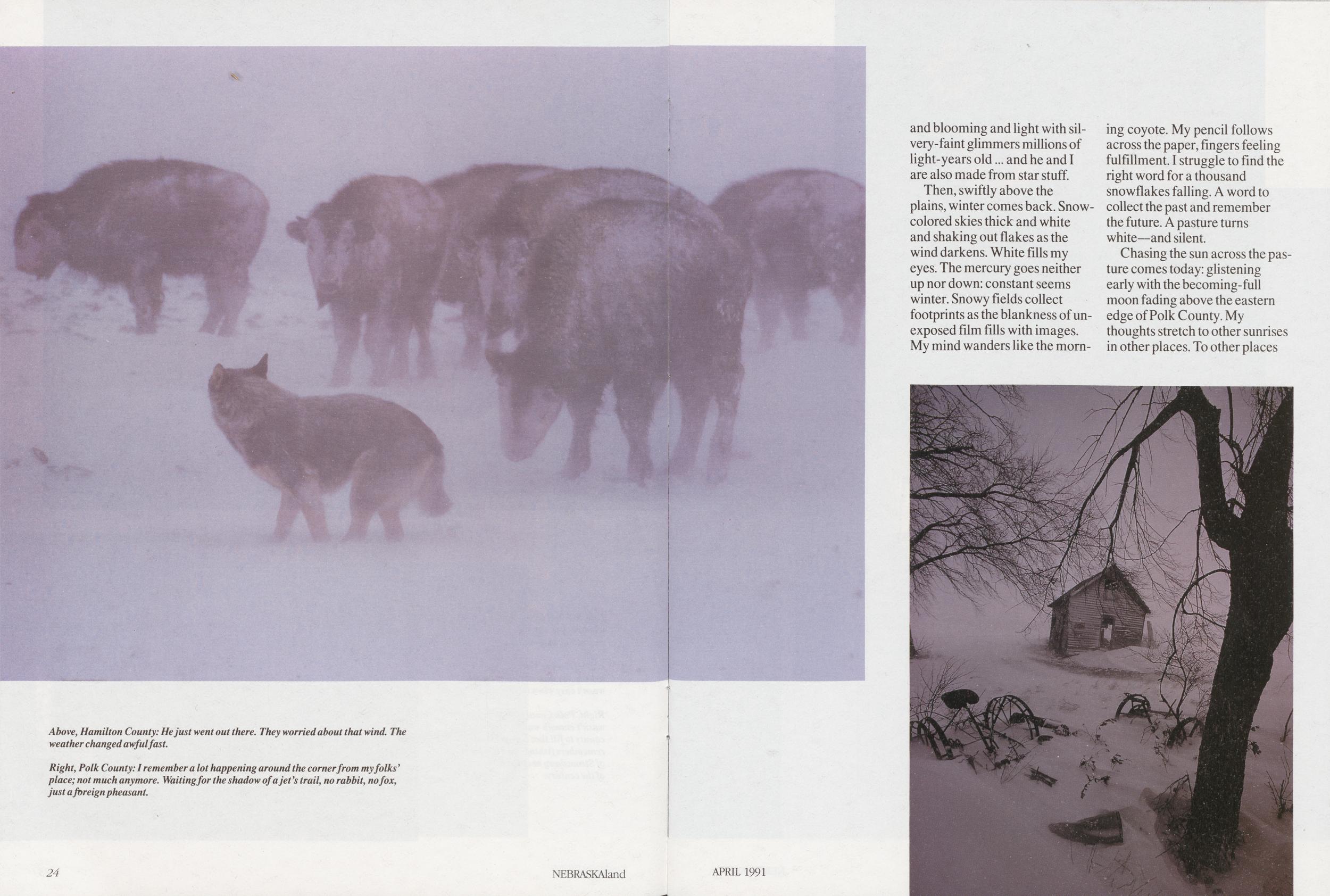
Then, swiftly above the plains, winter comes back. Snow colored skies thick and white and shaking out flakes as the wind darkens. White fills my eyes. The mercury goes neither up nor down: constant seems winter. Snowy fields collect footprints as the blankness of unexposed film fills with images. My mind wanders like the morning coyote. My pencil follows across the paper, fingers feeling fulfillment. I struggle to find the right word for a thousand snowflakes falling. A word to collect the past and remember the future. A pasture turns white—and silent.
Chasing the sun across the
pasture comes today: glistening
early with the becoming-full
moon fading above the eastern
edge of Polk County. My
thoughts stretch to other sunrises
in other places. To other places
APRIL 1991
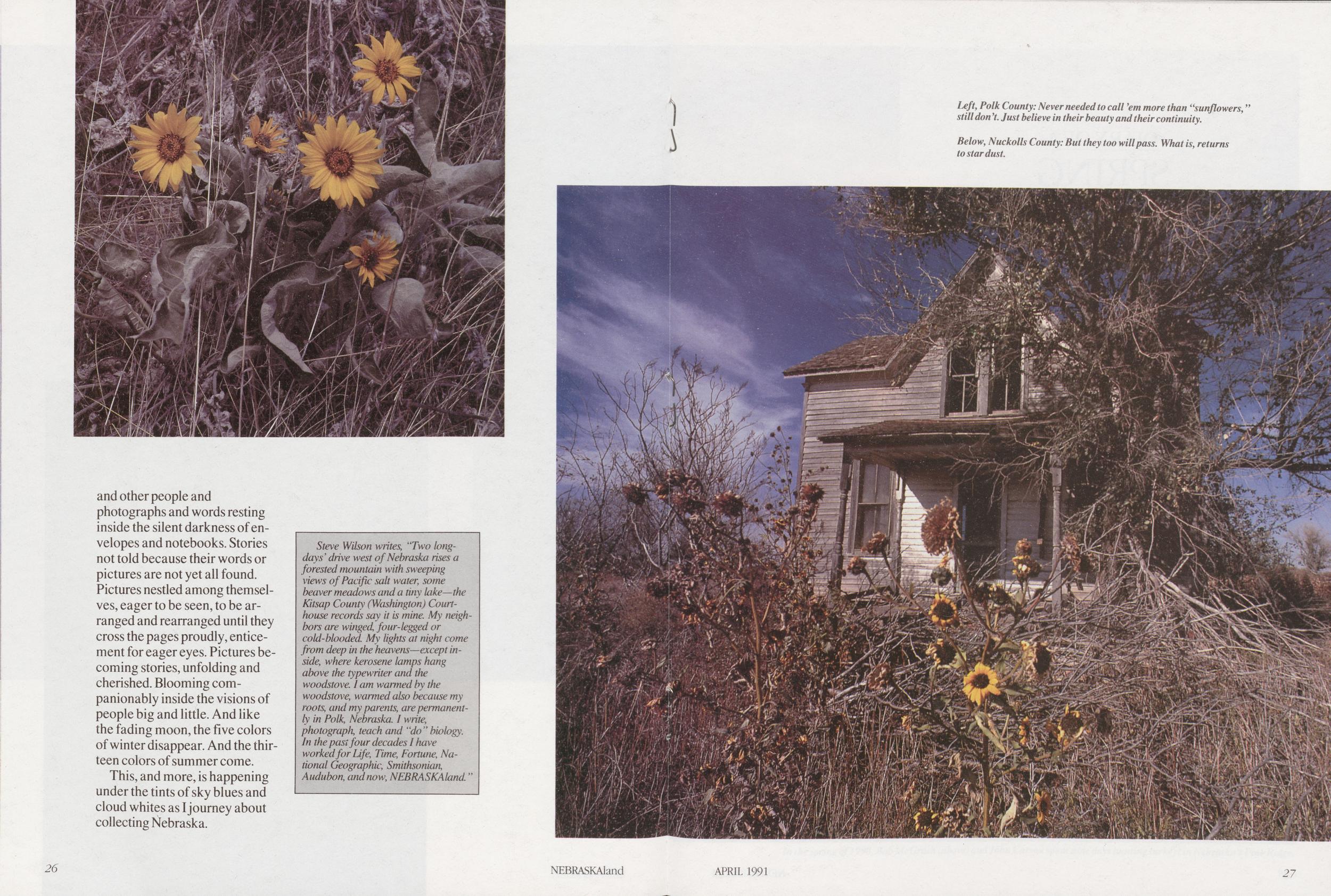 and other people and
photographs and words resting
inside the silent darkness of
envelopes and notebooks. Stories
not told because their words or
pictures are not yet all found.
Pictures nestled among
themselves, eager to be seen, to be
arranged and rearranged until they
cross the pages proudly,
enticement for eager eyes. Pictures
becoming stories, unfolding and
cherished. Blooming companionably
inside the visions of
people big and little. And like
the fading moon, the five colors
of winter disappear. And the
thirteen colors of summer come.
and other people and
photographs and words resting
inside the silent darkness of
envelopes and notebooks. Stories
not told because their words or
pictures are not yet all found.
Pictures nestled among
themselves, eager to be seen, to be
arranged and rearranged until they
cross the pages proudly,
enticement for eager eyes. Pictures
becoming stories, unfolding and
cherished. Blooming companionably
inside the visions of
people big and little. And like
the fading moon, the five colors
of winter disappear. And the
thirteen colors of summer come.
This, and more, is happening under the tints of sky blues and cloud whites as I journey about collecting Nebraska.
Steve Wilson writes, "Two long days* drive west of Nebraska rises a forested mountain with sweeping views of Pacific salt water, some beaver meadows and a tiny lake—the Kitsap County (Washington) Courthouse records say it is mine. My neighbors are winged, four-legged or cold-blooded. My lights at night come from deep in the heavens—except inside, where kerosene lamps hang above the typewriter and the wood stove. I am warmed by the wood stove, warmed also because my roots, and my parents, are permanently in Polk, Nebraska. I write, photograph, teach and "do " biology. In the past four decades I have worked for Life, Time, Fortune, National Geographic, Smithsonian, Audubon, and now, NEBRASKAland'
DIARY OF A SPRING SHOTGUN TURKEY HUNT
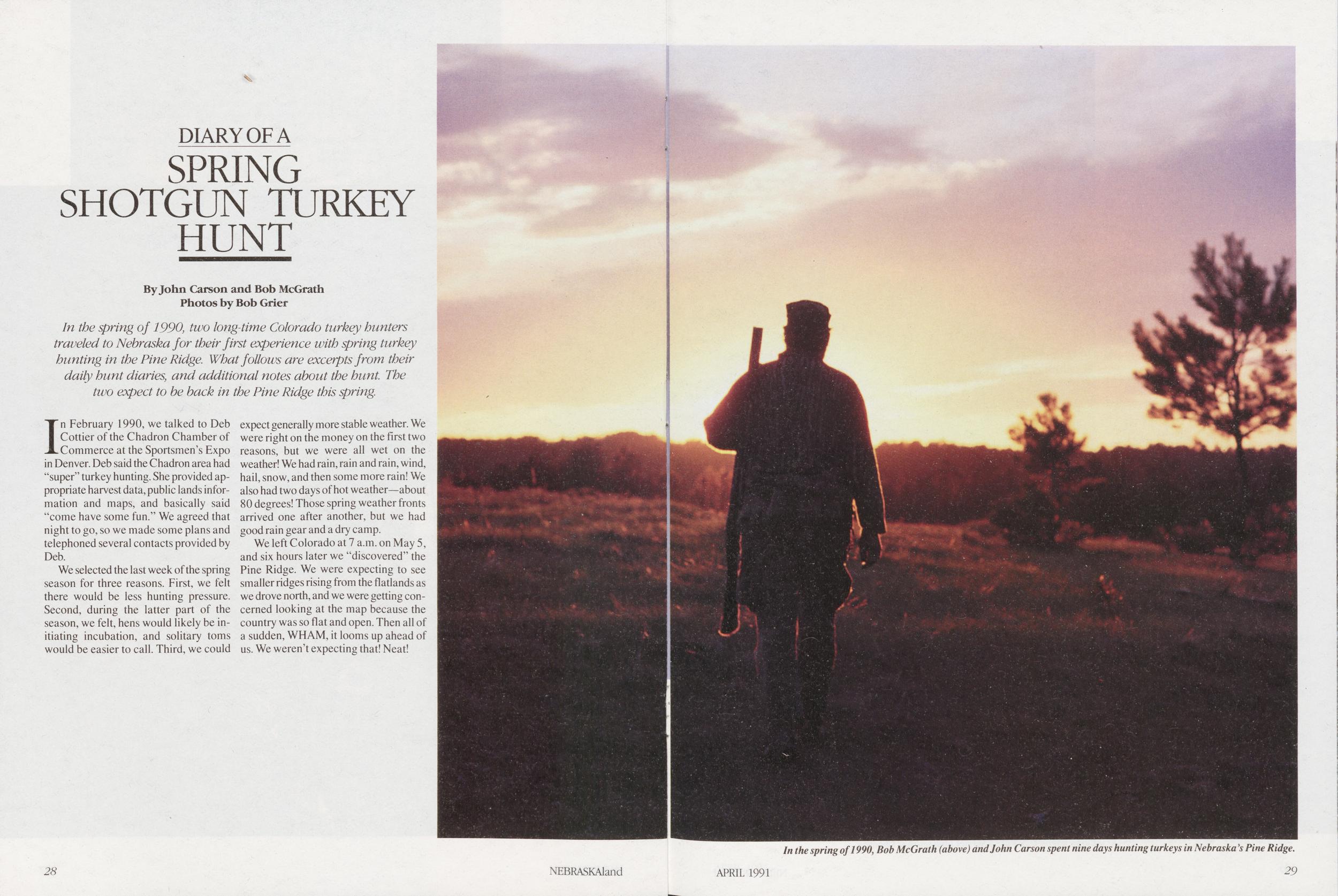
By John Carson and Bob McGrath Photos by Bob Grier In the spring of 1990, two long-time Colorado turkey hunters traveled to Nebraska for their first experience with spring turkey hunting in the Pine Ridge. What follows are excerpts from their daily hunt diaries, and additional notes about the hunt. The two expect to be back in the Pine Ridge this spring.In February 1990, we talked to Deb Cottier of the Chadron Chamber of Commerce at the Sportsmen's Expo in Denver. Deb said the Chadron area had "super" turkey hunting. She provided appropriate harvest data, public lands information and maps, and basically said "come have some fun." We agreed that night to go, so we made some plans and telephoned several contacts provided by Deb.
We selected the last week of the spring season for three reasons. First, we felt there would be less hunting pressure. Second, during the latter part of the season, we felt, hens would likely be initiating incubation, and solitary toms would be easier to call. Third, we could expect generally more stable weather. We were right on the money on the first two reasons, but we were all wet on the weather! We had rain, rain and rain, wind, hail, snow, and then some more rain! We also had two days of hot weather—about 80 degrees! Those spring weather fronts arrived one after another, but we had good rain gear and a dry camp.
We left Colorado at 7 a.m. on May 5, and six hours later we "discovered" the Pine Ridge. We were expecting to see smaller ridges rising from the flatlands as we drove north, and we were getting concerned looking at the map because the country was so flat and open. Then all of a sudden, WHAM, it looms up ahead of us. We weren't expecting that! Neat!
28 NEBRASKAland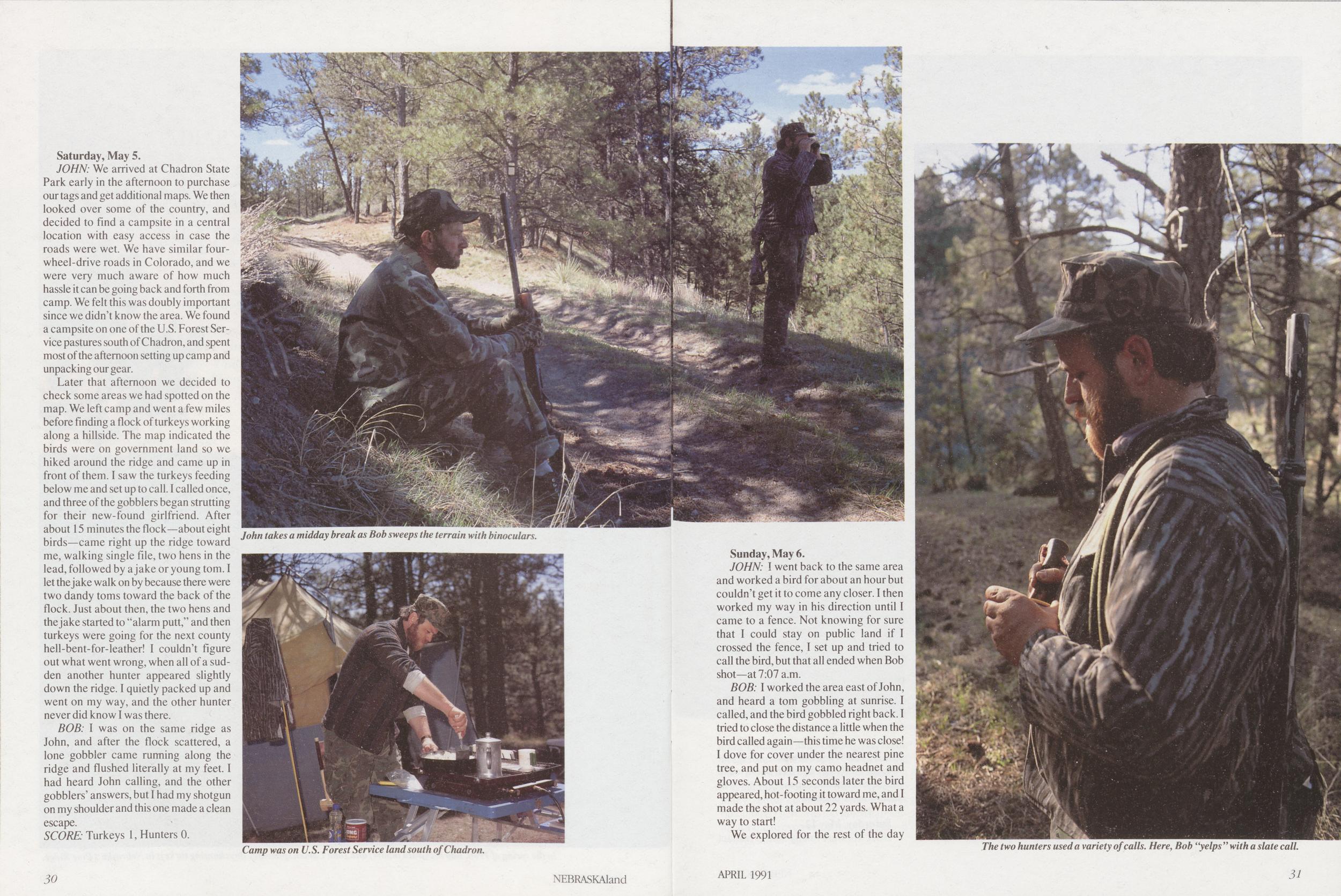 Saturday, May 5.
JOHN: We arrived at Chadron State Park early in the afternoon to purchase our tags and get additional maps. We then looked over some of the country, and decided to find a campsite in a central location with easy access in case the roads were wet. We have similar four-wheel-drive roads in Colorado, and we were very much aware of how much hassle it can be going back and forth from camp. We felt this was doubly important since we didn't know the area. We found a campsite on one of the U.S. Forest Service pastures south of Chadron, and spent most of the afternoon setting up camp and unpacking our gear.
Later that afternoon we decided to check some areas we had spotted on the map. We left camp and went a few miles before finding a flock of turkeys working along a hillside. The map indicated the birds were on government land so we hiked around the ridge and came up in front of them. I saw the turkeys feeding below me and set up to call. I called once, and three of the gobblers began strutting for their new-found girlfriend. After about 15 minutes the flock—about eight birds—came right up the ridge toward me, walking single file, two hens in the lead, followed by a jake or young torn. I let the jake walk on by because there were two dandy toms toward the back of the flock. Just about then, the two hens and the jake started to "alarm putt," and then turkeys were going for the next county hell-bent-for-leather! I couldn't figure out what went wrong, when all of a sudden another hunter appeared slightly down the ridge. I quietly packed up and went on my way, and the other hunter never did know I was there.
BOB: I was on the same ridge as John, and after the flock scattered, a lone gobbler came running along the ridge and flushed literally at my feet. I had heard John calling, and the other gobblers' answers, but I had my shotgun on my shoulder and this one made a clean escape.
SCORE: Turkeys 1, Hunters 0.
JOHN: I went back to the same area and worked a bird for about an hour but couldn't get it to come any closer. I then worked my way in his direction until I came to a fence. Not knowing for sure that I could stay on public land if I crossed the fence, I set up and tried to call the bird, but that all ended when Bob shot—at 7:07 a.m.
BOB: I worked the area east of John, and heard a torn gobbling at sunrise. I called, and the bird gobbled right back. I tried to close the distance a little when the bird called again—this time he was close! I dove for cover under the nearest pine tree, and put on my camo head net and gloves. About 15 seconds later the bird appeared, hot-footing it toward me, and I made the shot at about 22 yards. What a way to start!
We explored for the rest of the day
APRIL 1991
31
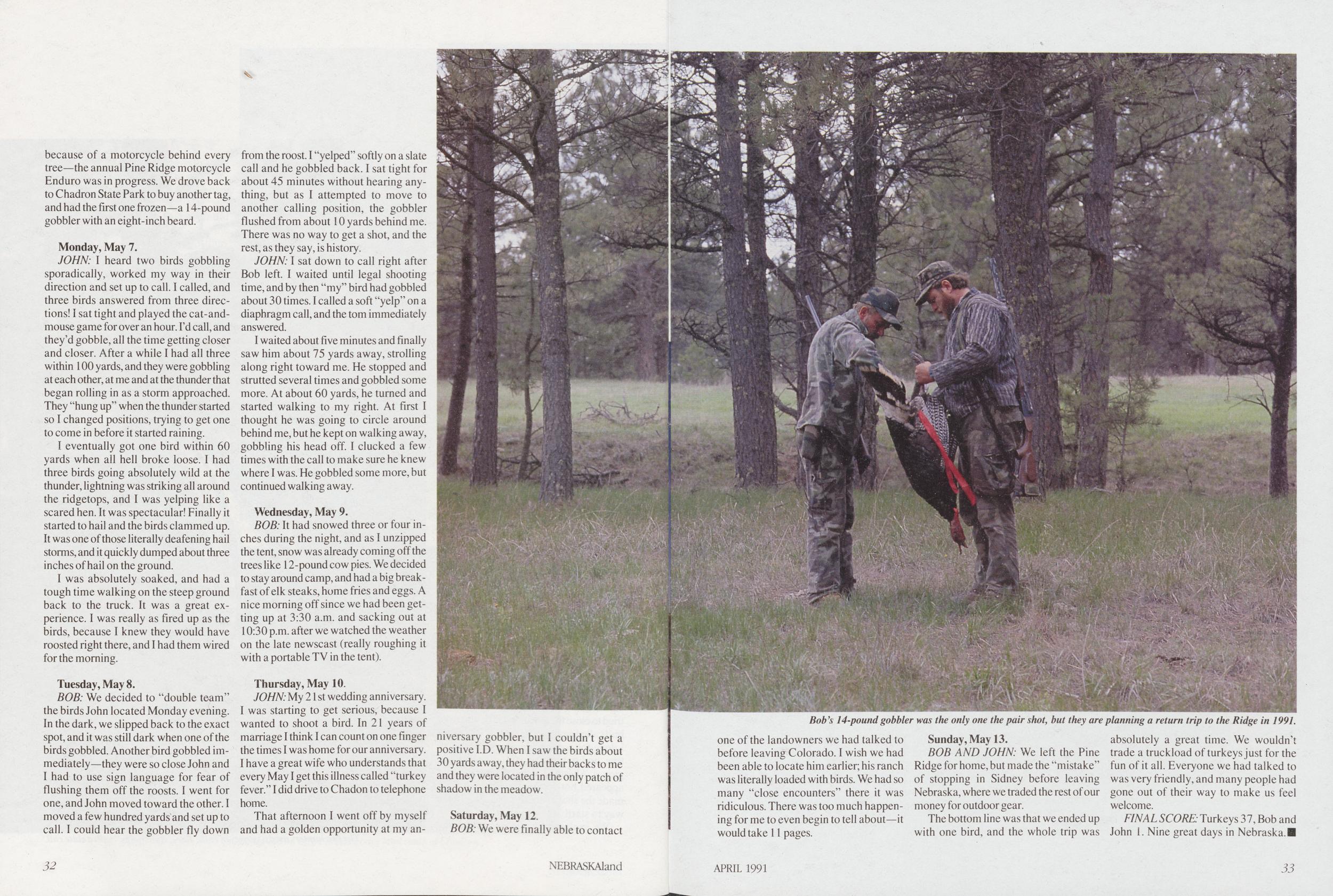 because of a motorcycle behind every
tree—the annual Pine Ridge motorcycle
Enduro was in progress. We drove back
to Chadron State Park to buy another tag,
and had the first one frozen—a 14-pound
gobbler with an eight-inch beard.
because of a motorcycle behind every
tree—the annual Pine Ridge motorcycle
Enduro was in progress. We drove back
to Chadron State Park to buy another tag,
and had the first one frozen—a 14-pound
gobbler with an eight-inch beard.
JOHN: I heard two birds gobbling sporadically, worked my way in their direction and set up to call. I called, and three birds answered from three directions! I sat tight and played the cat-and- mouse game for over an hour. I'd call, and they'd gobble, all the time getting closer and closer. After a while I had all three within 100 yards, and they were gobbling at each other, at me and at the thunder that began rolling in as a storm approached. They "hung up" when the thunder started so I changed positions, trying to get one to come in before it started raining.
I eventually got one bird within 60 yards when all hell broke loose. I had three birds going absolutely wild at the thunder, lightning was striking all around the ridge tops, and I was yelping like a scared hen. It was spectacular! Finally it started to hail and the birds clammed up. It was one of those literally deafening hail storms, and it quickly dumped about three inches of hail on the ground.
I was absolutely soaked, and had a tough time walking on the steep ground back to the truck. It was a great experience. I was really as fired up as the birds, because I knew they would have roosted right there, and I had them wired for the morning.
Tuesday, May 8.BOB: We decided to "double team" the birds John located Monday evening. In the dark, we slipped back to the exact spot, and it was still dark when one of the birds gobbled. Another bird gobbled immediately—they were so close John and I had to use sign language for fear of flushing them off the roosts. I went for one, and John moved toward the other. I moved a few hundred yards and set up to call. I could hear the gobbler fly down from the roost. I "yelped" softly on a slate call and he gobbled back. I sat tight for about 45 minutes without hearing anything, but as I attempted to move to another calling position, the gobbler flushed from about 10 yards behind me. There was no way to get a shot, and the rest, as they say, is history.
JOHN: I sat down to call right after Bob left. I waited until legal shooting time, and by then "my" bird had gobbled about 30 times. I called a soft "yelp" on a diaphragm call, and the torn immediately answered.
I waited about five minutes and finally saw him about 75 yards away, strolling along right toward me. He stopped and strutted several times and gobbled some more. At about 60 yards, he turned and started walking to my right. At first I thought he was going to circle around behind me, but he kept on walking away, gobbling his head off. I clucked a few times with the call to make sure he knew where I was. He gobbled some more, but continued walking away.
Wednesday, May 9.BOB: It had snowed three or four inches during the night, and as I unzipped the tent, snow was already coming off the trees like 12-pound cow pies. We decided to stay around camp, and had a big breakfast of elk steaks, home fries and eggs. A nice morning off since we had been getting up at 3:30 a.m. and sacking out at 10:30 p.m. after we watched the weather on the late newscast (really roughing it with a portable TV in the tent).
Thursday, May 10.JOHN: My 21 st wedding anniversary. I was starting to get serious, because I wanted to shoot a bird. In 21 years of marriage I think I can count on one finger the times I was home for our anniversary. I have a great wife who understands that every May I get this illness called "turkey fever." I did drive to Chadon to telephone home.
That afternoon I went off by myself and had a golden opportunity at my anniversary gobbler, but I couldn't get a positive I.D. When I saw the birds about 30 yards away, they had their backs to me and they were located in the only patch of shadow in the meadow.
Saturday, May 12.BOB: We were finally able to contact
BOB AND JOHN: We left the Pine Ridge for home, but made the "mistake" of stopping in Sidney before leaving Nebraska, where we traded the rest of our money for outdoor gear.
The bottom line was that we ended up with one bird, and the whole trip was absolutely a great time. We wouldn't trade a truckload of turkeys just for the fun of it all. Everyone we had talked to was very friendly, and many people had gone out of their way to make us feel welcome.
FINAL SCORE: Turkeys 37, Bob and John 1. Nine great days in Nebraska.
APRIL 1991 33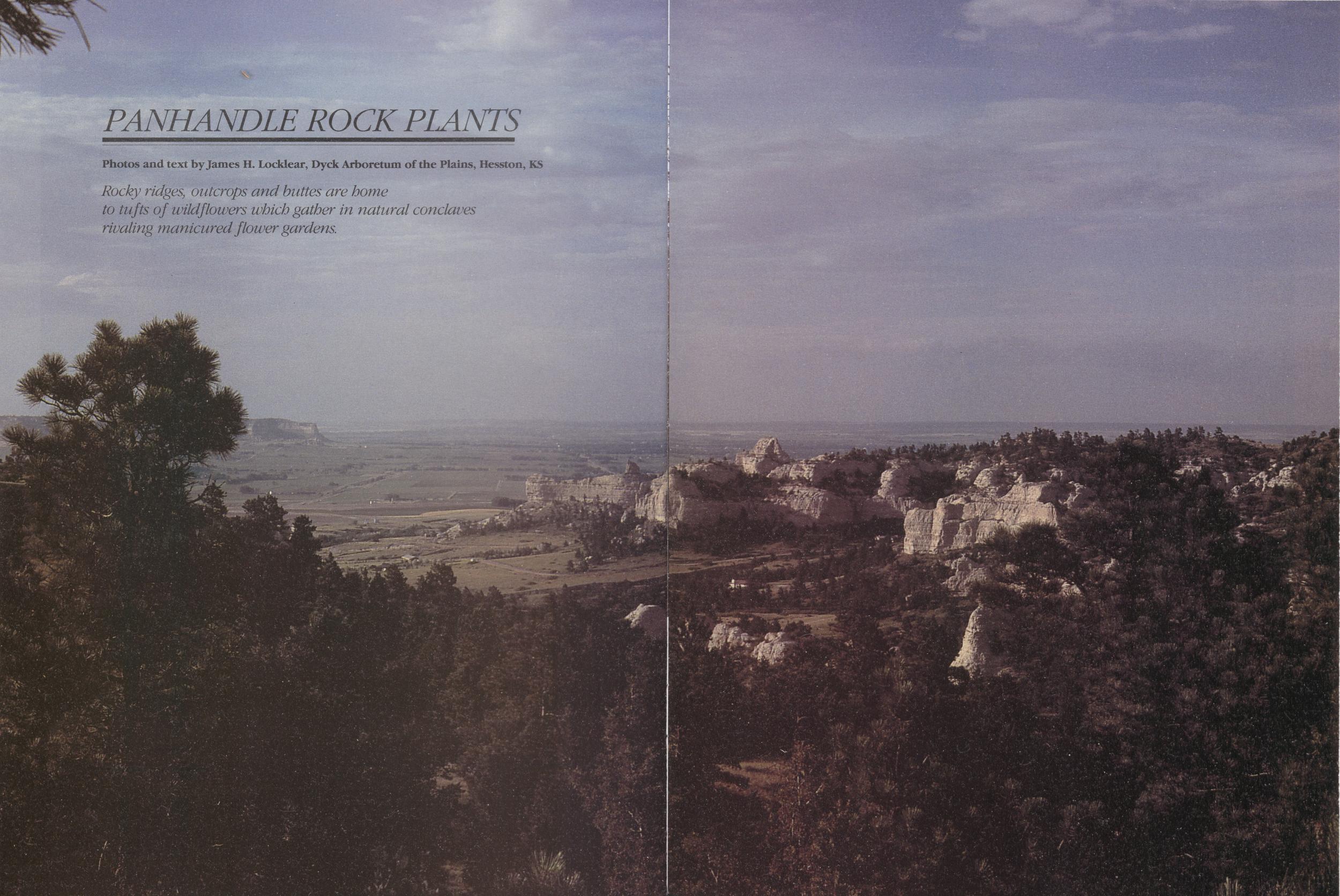
PANHANDLE ROCK PLANTS
Photos and text by James H. Loddear, Dyck Arboretum of the Plains, Hesston, KS Rocky ridges, outcrops and buttes are home to tufts of ivild flowers which gather in natural conclaves rivaling manicured flower gardens.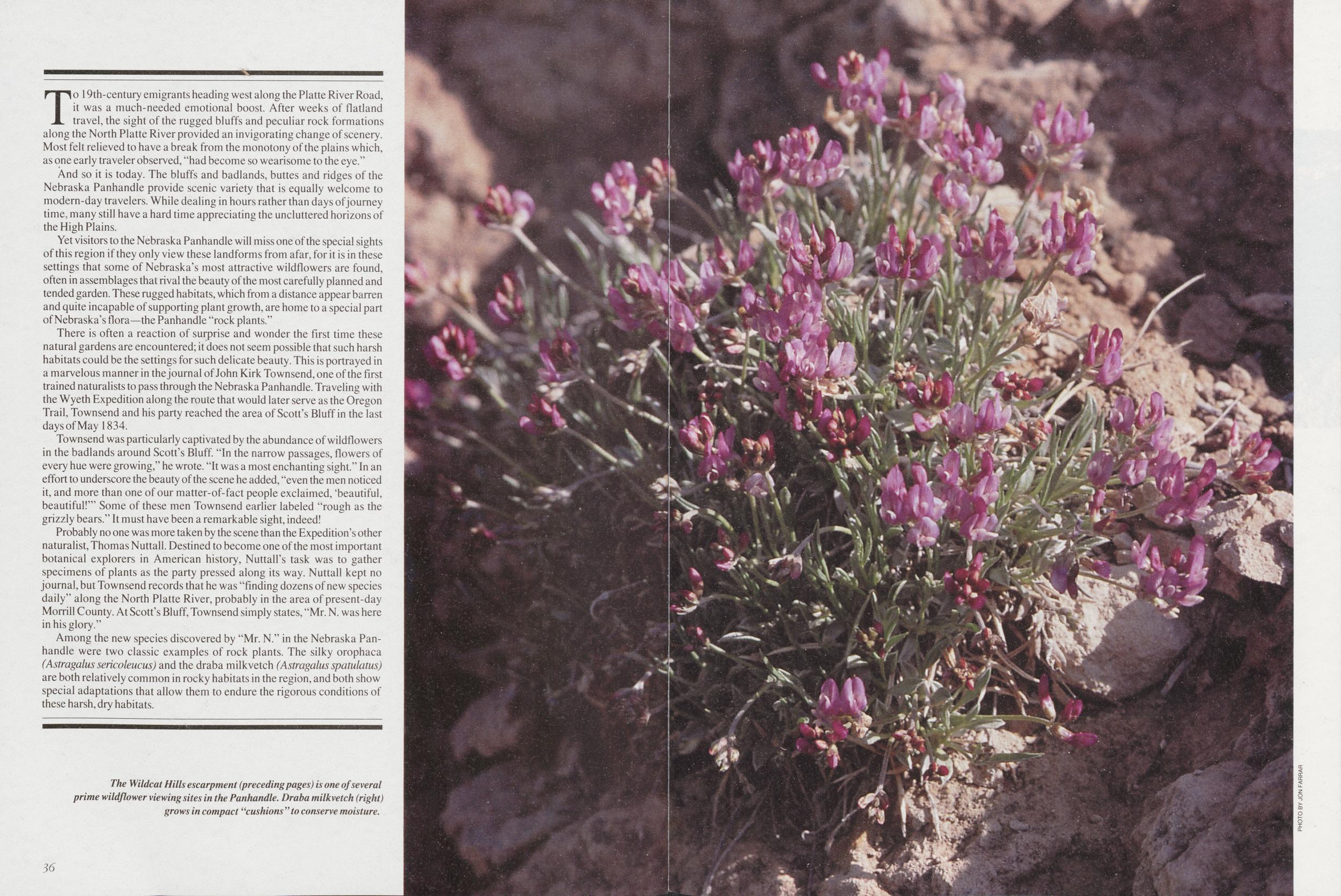
To 19th-century emigrants heading west along the Platte River Road, it was a much-needed emotional boost. After weeks of flatland travel, the sight of the rugged bluffs and peculiar rock formations along the North Platte River provided an invigorating change of scenery. Most felt relieved to have a break from the monotony of the plains which, as one early traveler observed, "had become so wearisome to the eye."
And so it is today. The bluffs and badlands, buttes and ridges of the Nebraska Panhandle provide scenic variety that is equally welcome to modern-day travelers. While dealing in hours rather than days of journey time, many still have a hard time appreciating the uncluttered horizons of the High Plains.
Yet visitors to the Nebraska Panhandle will miss one of the special sights of this region if they only view these landforms from afar, for it is in these settings that some of Nebraska's most attractive wildflowers are found, often in assemblages that rival the beauty of the most carefully planned and tended garden. These rugged habitats, which from a distance appear barren and quite incapable of supporting plant growth, are home to a special part of Nebraska's flora—the Panhandle "rock plants."
There is often a reaction of surprise and wonder the first time these natural gardens are encountered; it does not seem possible that such harsh habitats could be the settings for such delicate beauty. This is portrayed in a marvelous manner in the journal of John Kirk Townsend, one of the first trained naturalists to pass through the Nebraska Panhandle. Traveling with the Wyeth Expedition along the route that would later serve as the Oregon Trail, Townsend and his party reached the area of Scott's Bluff in the last days of May 1834.
Townsend was particularly captivated by the abundance of wildflowers in the badlands around Scott's Bluff. "In the narrow passages, flowers of every hue were growing," he wrote. "It was a most enchanting sight." In an effort to underscore the beauty of the scene he added, "even the men noticed it, and more than one of our matter-of-fact people exclaimed, 'beautiful, beautiful!'" Some of these men Townsend earlier labeled "rough as the grizzly bears." It must have been a remarkable sight, indeed!
Probably no one was more taken by the scene than the Expedition's other naturalist, Thomas Nuttall. Destined to become one of the most important botanical explorers in American history, Nuttall's task was to gather specimens of plants as the party pressed along its way. Nuttall kept no journal, but Townsend records that he was "finding dozens of new species daily" along the North Platte River, probably in the area of present-day Morrill County. At Scott's Bluff, Townsend simply states, "Mr. N. was here in his glory."
Among the new species discovered by "Mr. N." in the Nebraska Panhandle were two classic examples of rock plants. The silky orophaca (Astragalus sericoleucus) and the draba milkvetch (Astragalus spatulatus) are both relatively common in rocky habitats in the region, and both show special adaptations that allow them to endure the rigorous conditions of these harsh, dry habitats.
36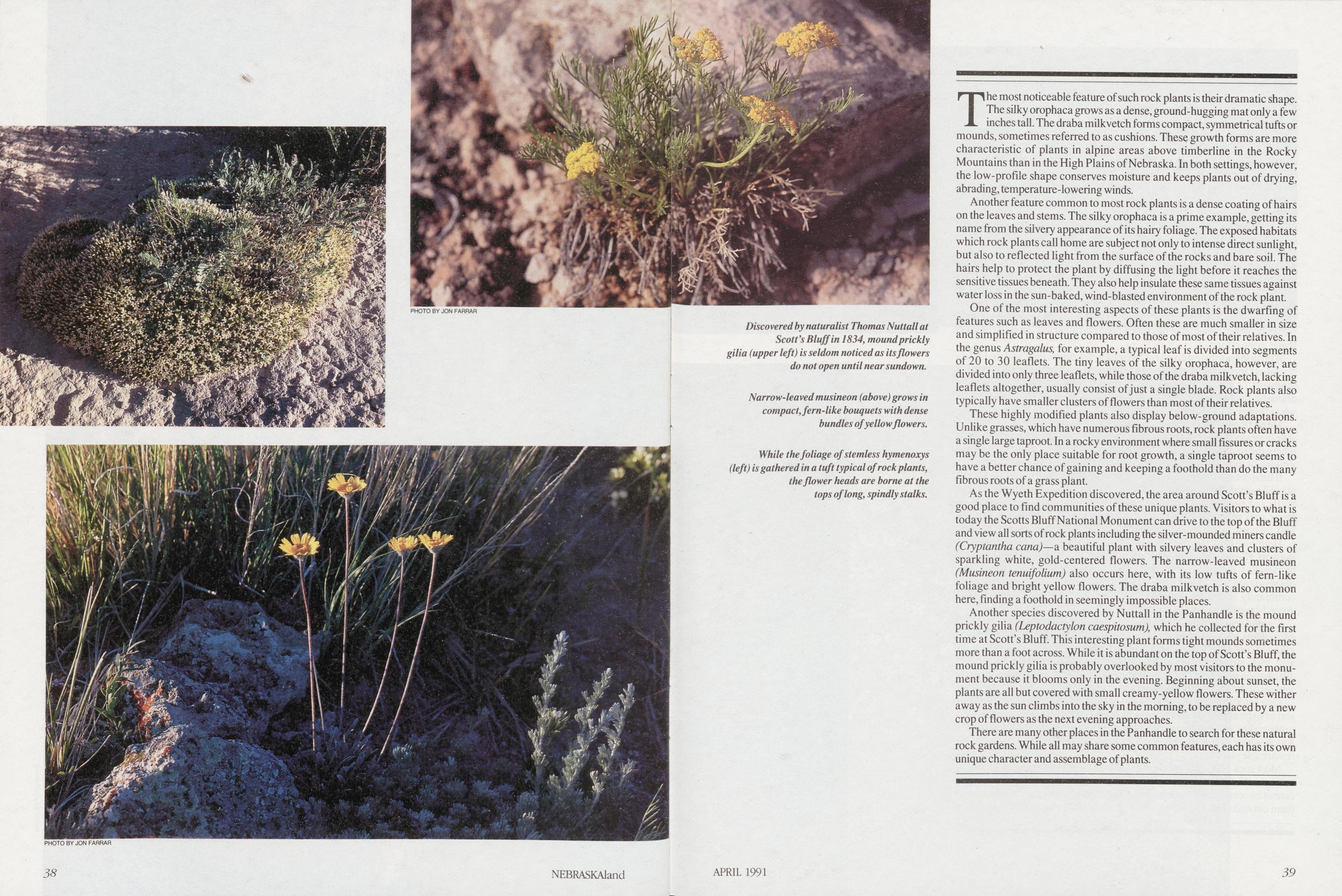
The most noticeable feature of such rock plants is their dramatic shape. The silky orophaca grows as a dense, ground-hugging mat only a few inches tall. The draba milkvetch forms compact, symmetrical tufts or mounds, sometimes referred to as cushions. These growth forms are more characteristic of plants in alpine areas above timberline in the Rocky Mountains than in the High Plains of Nebraska. In both settings, however, the low-profile shape conserves moisture and keeps plants out of drying, abrading, temperature-lowering winds.
Another feature common to most rock plants is a dense coating of hairs on the leaves and stems. The silky orophaca is a prime example, getting its name from the silvery appearance of its hairy foliage. The exposed habitats which rock plants call home are subject not only to intense direct sunlight, but also to reflected light from the surface of the rocks and bare soil. The hairs help to protect the plant by diffusing the light before it reaches the sensitive tissues beneath. They also help insulate these same tissues against water loss in the sun-baked, wind-blasted environment of the rock plant.
One of the most interesting aspects of these plants is the dwarfing of features such as leaves and flowers. Often these are much smaller in size and simplified in structure compared to those of most of their relatives. In the genus Astragalus, for example, a typical leaf is divided into segments of 20 to 30 leaflets. The tiny leaves of the silky orophaca, however, are divided into only three leaflets, while those of the draba milk-vetch, lacking leaflets altogether, usually consist of just a single blade. Rock plants also typically have smaller clusters of flowers than most of their relatives.
These highly modified plants also display below-ground adaptations. Unlike grasses, which have numerous fibrous roots, rock plants often have a single large taproot. In a rocky environment where small fissures or cracks may be the only place suitable for root growth, a single taproot seems to have a better chance of gaining and keeping a foothold than do the many fibrous roots of a grass plant.
As the Wyeth Expedition discovered, the area around Scott's Bluff is a good place to find communities of these unique plants. Visitors to what is today the Scotts Bluff National Monument can drive to the top of the Bluff and view all sorts of rock plants including the silver-mounded miners candle (Cryptantha cana)—a beautiful plant with silvery leaves and clusters of sparkling white, gold-centered flowers. The narrow-leaved musineon (Musineon tenuifolium) also occurs here, with its low tufts of fern-like foliage and bright yellow flowers. The draba milkvetch is also common here, finding a foothold in seemingly impossible places.
Another species discovered by Nuttall in the Panhandle is the mound prickly gilia (Leptodactylon caespitosum), which he collected for the first time at Scott's Bluff. This interesting plant forms tight mounds sometimes more than a foot across. While it is abundant on the top of Scott's Bluff, the mound prickly gilia is probably overlooked by most visitors to the monument because it blooms only in the evening. Beginning about sunset, the plants are all but covered with small creamy-yellow flowers. These wither away as the sun climbs into the sky in the morning, to be replaced by a new crop of flowers as the next evening approaches.
There are many other places in the Panhandle to search for these natural rock gardens. While all may share some common features, each has its own unique character and assemblage of plants.
APRIL 1991 39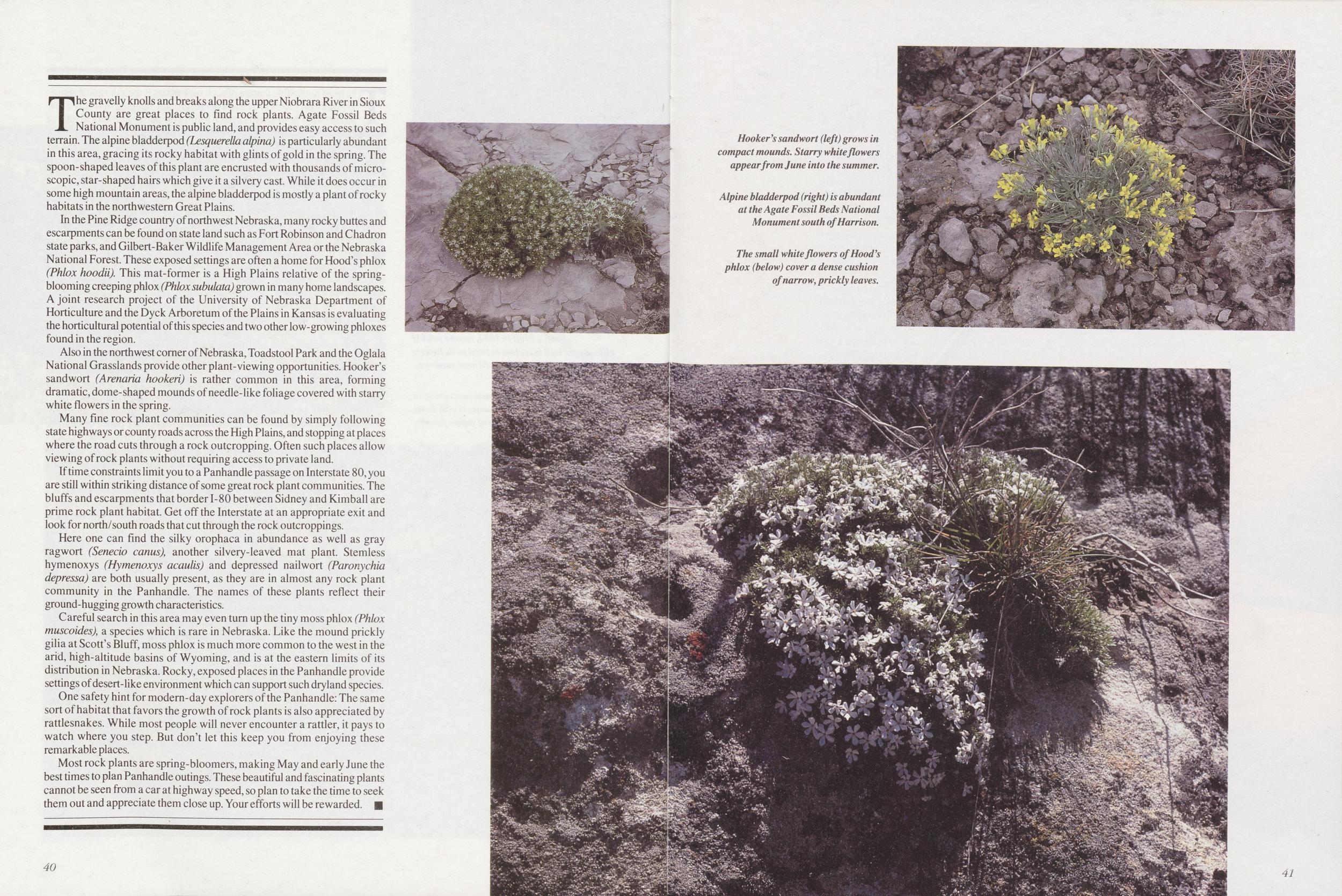
The gravelly knolls and breaks along the upper Niobrara River in Sioux County are great places to find rock plants. Agate Fossil Beds National Monument is public land, and provides easy access to such terrain. The alpine bladder pod (Lesquerella alpina) is particularly abundant in this area, gracing its rocky habitat with glints of gold in the spring. The spoon-shaped leaves of this plant are encrusted with thousands of microscopic, star-shaped hairs which give it a silvery cast. While it does occur in some high mountain areas, the alpine bladder pod is mostly a plant of rocky habitats in the northwestern Great Plains.
In the Pine Ridge country of northwest Nebraska, many rocky buttes and escarpments can be found on state land such as Fort Robinson and Chadron state parks, and Gilbert-Baker Wildlife Management Area or the Nebraska National Forest. These exposed settings are often a home for Hood's phlox (Phlox hoodii). This mat-former is a High Plains relative of the spring blooming creeping phlox (Phlox subulata) grown in many home landscapes. A joint research project of the University of Nebraska Department of Horticulture and the Dyck Arboretum of the Plains in Kansas is evaluating the horticultural potential of this species and two other low-growing phloxes found in the region.
Also in the northwest corner of Nebraska, Toadstool Park and the Oglala National Grasslands provide other plant-viewing opportunities. Hooker's sandwort (Arenaria hooked) is rather common in this area, forming dramatic, dome-shaped mounds of needle-like foliage covered with starry white flowers in the spring.
Many fine rock plant communities can be found by simply following state highways or county roads across the High Plains, and stopping at places where the road cuts through a rock outcropping. Often such places allow viewing of rock plants without requiring access to private land.
If time constraints limit you to a Panhandle passage on Interstate 80, you are still within striking distance of some great rock plant communities. The bluffs and escarpments that border 1-80 between Sidney and Kimball are prime rock plant habitat. Get off the Interstate at an appropriate exit and look for north/south roads that cut through the rock outcroppings.
Here one can find the silky orophaca in abundance as well as gray ragwort (Senecio canus), another silvery-leaved mat plant. Stemless hymenoxys (Hymenoxys acaulis) and depressed nailwort (Paronychia depressa) are both usually present, as they are in almost any rock plant community in the Panhandle. The names of these plants reflect their ground-hugging growth characteristics.
Careful search in this area may even turn up the tiny moss phlox (Phlox muscoides), a species which is rare in Nebraska. Like the mound prickly gilia at Scott's Bluff, moss phlox is much more common to the west in the arid, high-altitude basins of Wyoming, and is at the eastern limits of its distribution in Nebraska. Rocky, exposed places in the Panhandle provide settings of desert-like environment which can support such dry land species.
One safety hint for modern-day explorers of the Panhandle: The same sort of habitat that favors the growth of rock plants is also appreciated by rattlesnakes. While most people will never encounter a rattler, it pays to watch where you step. But don't let this keep you from enjoying these remarkable places.
Most rock plants are spring-bloomers, making May and early June the best times to plan Panhandle outings. These beautiful and fascinating plants cannot be seen from a car at highway speed, so plan to take the time to seek them out and appreciate them close up. Your efforts will be rewarded.
The West's Most Versatile Fly
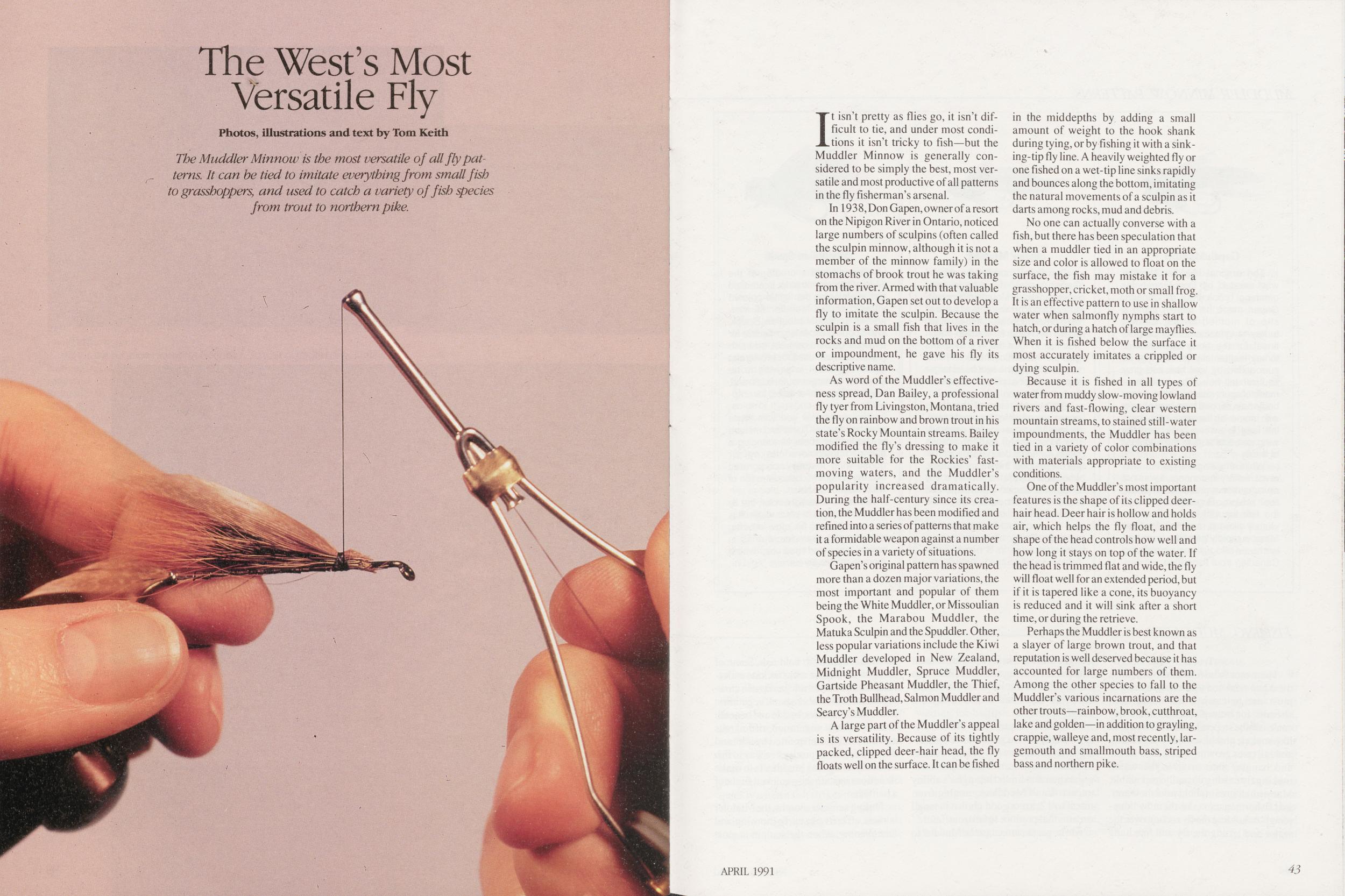
Photos, illustrations and text by Tom Keith The Muddler Minnow is the most versatile of all fly pat- terns. It can he tied to imitate everything from small fish to grasshoppers, and used to catch a variety offish species from trout to northern pike.It isn't pretty as flies go, it isn't difficult to tie, and under most conditions it isn't tricky to fish—but the Muddler Minnow is generally considered to be simply the best, most versatile and most productive of all patterns in the fly fisherman's arsenal.
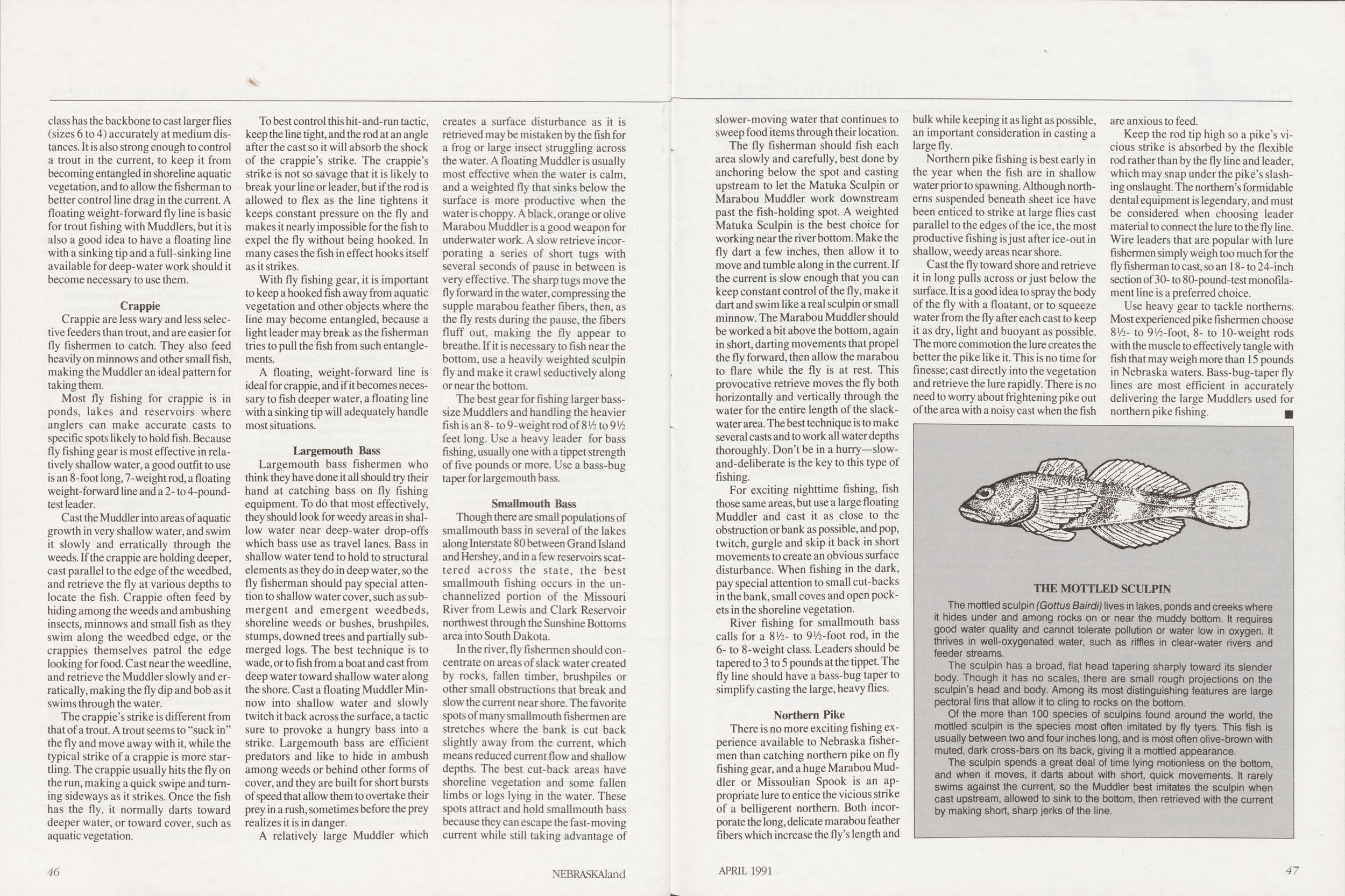
In 193 8, Don Gapen, owner of a resort on the Nipigon River in Ontario, noticed large numbers of sculpins (often called the sculpin minnow, although it is not a member of the minnow family) in the stomachs of brook trout he was taking from the river. Armed with that valuable information, Gapen set out to develop a fly to imitate the sculpin. Because the sculpin is a small fish that lives in the rocks and mud on the bottom of a river or impoundment, he gave his fly its descriptive name.
As word of the Muddler's effectiveness spread, Dan Bailey, a professional fly tyer from Livingston, Montana, tried the fly on rainbow and brown trout in his state's Rocky Mountain streams. Bailey modified the fly's dressing to make it more suitable for the Rockies' fast moving waters, and the Muddler's popularity increased dramatically. During the half-century since its creation, the Muddler has been modified and refined into a series of patterns that make it a formidable weapon against a number of species in a variety of situations.
Gapen's original pattern has spawned more than a dozen major variations, the most important and popular of them being the White Muddler, or Missoulian Spook, the Marabou Muddler, the Matuka Sculpin and the Spuddler. Other, less popular variations include the Kiwi Muddler developed in New Zealand, Midnight Muddler, Spruce Muddler, Gartside Pheasant Muddler, the Thief, the Troth Bullhead, Salmon Muddler and Searcy's Muddler.
A large part of the Muddler's appeal is its versatility. Because of its tightly packed, clipped deer-hair head, the fly floats well on the surface. It can be fished in the mid-depths by adding a small amount of weight to the hook shank during tying, or by fishing it with a sinking-tip fly line. A heavily weighted fly or one fished on a wet-tip line sinks rapidly and bounces along the bottom, imitating the natural movements of a sculpin as it darts among rocks, mud and debris.
No one can actually converse with a fish, but there has been speculation that when a muddler tied in an appropriate size and color is allowed to float on the surface, the fish may mistake it for a grasshopper, cricket, moth or small frog. It is an effective pattern to use in shallow water when salmon fly nymphs start to hatch, or during a hatch of large mayflies. When it is fished below the surface it most accurately imitates a crippled or dying sculpin.
Because it is fished in all types of water from muddy slow-moving lowland rivers and fast-flowing, clear western mountain streams, to stained still-water impoundments, the Muddler has been tied in a variety of color combinations with materials appropriate to existing conditions.
One of the Muddler's most important features is the shape of its clipped deer hair head. Deer hair is hollow and holds air, which helps the fly float, and the shape of the head controls how well and how long it stays on top of the water. If the head is trimmed flat and wide, the fly will float well for an extended period, but if it is tapered like a cone, its buoyancy is reduced and it will sink after a short time, or during the retrieve.
Perhaps the Muddler is best known as a slayer of large brown trout, and that reputation is well deserved because it has accounted for large numbers of them. Among the other species to fall to the Muddler's various incarnations are the other trouts—rainbow, brook, cutthroat, lake and golden—in addition to grayling, crappie, walleye and, most recently, largemouth and smallmouth bass, striped bass and northern pike.
APRIL 1991 43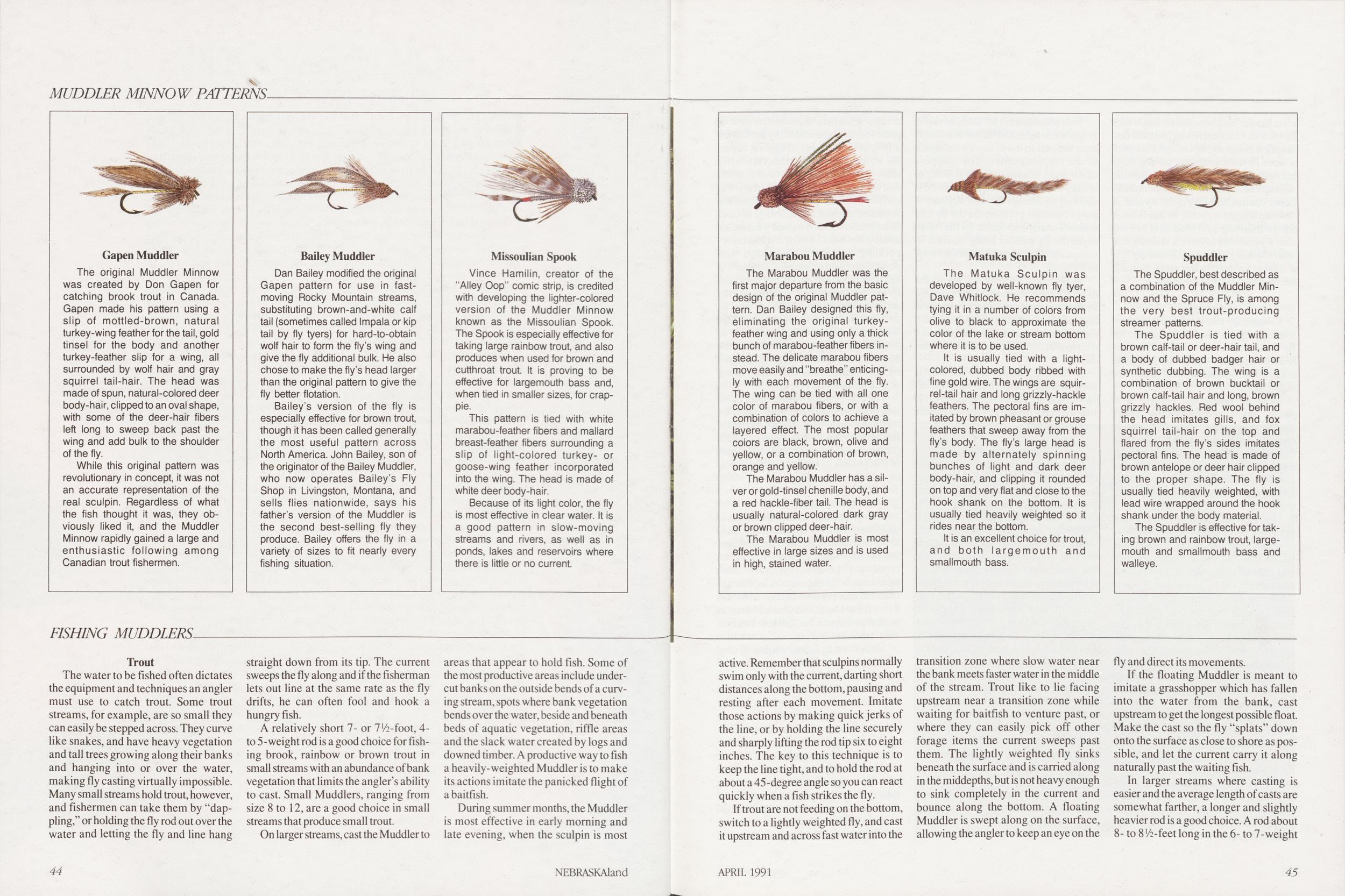 MUDDLER MINNOW PATTERNS
The original Muddler Minnow was created by Don Gapen for catching brook trout in Canada. Gapen made his pattern using a slip of mottled-brown, natural turkey-wing feather for the tail, gold tinsel for the body and another turkey-feather slip for a wing, all surrounded by wolf hair and gray squirrel tail-hair. The head was made of spun, natural-colored deer body-hair, clipped to an oval shape, with some of the deer-hair fibers left long to sweep back past the wing and add bulk to the shoulder of the fly.
While this original pattern was revolutionary in concept, it was not an accurate representation of the real sculpin. Regardless of what the fish thought it was, they obviously liked it, and the Muddler Minnow rapidly gained a large and enthusiastic following among Canadian trout fishermen.
Dan Bailey modified the original Gapen pattern for use in fast moving Rocky Mountain streams, substituting brown-and-white calf tail (sometimes called Impala or kip tail by fly tyers) for hard-to-obtain wolf hair to form the fly's wing and give the fly additional bulk. He also chose to make the fly's head larger than the original pattern to give the fly better flotation.
Bailey's version of the fly is especially effective for brown trout, though it has been called generally the most useful pattern across North America. John Bailey, son of the originator of the Bailey Muddler, who now operates Bailey's Fly Shop in Livingston, Montana, and sells flies nationwide, says his father's version of the Muddler is the second best-selling fly they produce. Bailey offers the fly in a variety of sizes to fit nearly every fishing situation.
Vince Hamilin, creator of the "Alley Oop" comic strip, is credited with developing the lighter-colored version of the Muddler Minnow known as the Missoulian Spook. The Spook is especially effective for taking large rainbow trout, and also produces when used for brown and cutthroat trout. It is proving to be effective for largemouth bass and, when tied in smaller sizes, for crappie.
This pattern is tied with white marabou-feather fibers and mallard breast-feather fibers surrounding a slip of light-colored turkey- or goose-wing feather incorporated into the wing. The head is made of white deer body-hair.
Because of its light color, the fly is most effective in clear water. It is a good pattern in slow-moving streams and rivers, as well as in ponds, lakes and reservoirs where there is little or no current.
The water to be fished often dictates the equipment and techniques an angler must use to catch trout. Some trout streams, for example, are so small they can easily be stepped across. They curve like snakes, and have heavy vegetation and tall trees growing along their banks and hanging into or over the water, making fly casting virtually impossible. Many small streams hold trout, however, and fishermen can take them by "dappling," or holding the fly rod out over the water and letting the fly and line hang straight down from its tip. The current sweeps the fly along and if the fisherman lets out line at the same rate as the fly drifts, he can often fool and hook a hungry fish.
A relatively short 7- or 7!/2-foot, 4 to 5-weight rod is a good choice for fishing brook, rainbow or brown trout in small streams with an abundance of bank vegetation that limits the angler's ability to cast. Small Muddlers, ranging from size 8 to 12, are a good choice in small streams that produce small trout.
On larger streams, cast the Muddler to areas that appear to hold fish. Some of the most productive areas include undercut banks on the outside bends of a curving stream, spots where bank vegetation bends over the water, beside and beneath beds of aquatic vegetation, riffle areas and the slack water created by logs and downed timber. A productive way to fish a heavily-weighted Muddler is to make its actions imitate the panicked flight of a baitfish.
The Marabou Muddler was the first major departure from the basic design of the original Muddler pattern. Dan Bailey designed this fly, eliminating the original turkey feather wing and using only a thick bunch of marabou-feather fibers instead. The delicate marabou fibers move easily and "breathe" enticingly with each movement of the fly. The wing can be tied with all one color of marabou fibers, or with a combination of colors to achieve a layered effect. The most popular colors are black, brown, olive and yellow, or a combination of brown, orange and yellow.
The Marabou Muddler has a silver or gold-tinsel chenille body, and a red hackle-fiber tail. The head is usually natural-colored dark gray or brown clipped deer-hair.
The Marabou Muddler is most effective in large sizes and is used in high, stained water.
The Matuka Sculpin was developed by well-known fly tyer, Dave Whitlock. He recommends tying it in a number of colors from olive to black to approximate the color of the lake or stream bottom where it is to be used.
It is usually tied with a light colored, dubbed body ribbed with fine gold wire. The wings are squirrel-tail hair and long grizzly-hackle feathers. The pectoral fins are imitated by brown pheasant or grouse feathers that sweep away from the fly's body. The fly's large head is made by alternately spinning bunches of light and dark deer body-hair, and clipping it rounded on top and very flat and close to the hook shank on the bottom. It is usually tied heavily weighted so it rides near the bottom.
It is an excellent choice for trout, and both largemouth and smallmouth bass.
The Spuddler, best described as a combination of the Muddler Minnow and the Spruce Fly, is among the very best trout-producing streamer patterns.
The Spuddler is tied with a brown calf-tail or deer-hair tail, and a body of dubbed badger hair or synthetic dubbing. The wing is a combination of brown buck tail or brown calf-tail hair and long, brown grizzly hackles. Red wool behind the head imitates gills, and fox squirrel tail-hair on the top and flared from the fly's sides imitates pectoral fins. The head is made of brown antelope or deer hair clipped to the proper shape. The fly is usually tied heavily weighted, with lead wire wrapped around the hook shank under the body material.
The Spuddler is effective for taking brown and rainbow trout, largemouth and smallmouth bass and walleye.
If trout are not feeding on the bottom, switch to a lightly weighted fly, and cast it upstream and across fast water into the transition zone where slow water near the bank meets faster water in the middle of the stream. Trout like to lie facing upstream near a transition zone while waiting for baitfish to venture past, or where they can easily pick off other forage items the current sweeps past them. The lightly weighted fly sinks beneath the surface and is carried along in the mid-depths, but is not heavy enough to sink completely in the current and bounce along the bottom. A floating Muddler is swept along on the surface, allowing the angler to keep an eye on the fly and direct its movements.
If the floating Muddler is meant to imitate a grasshopper which has fallen into the water from the bank, cast upstream to get the longest possible float. Make the cast so the fly "splats" down onto the surface as close to shore as possible, and let the current carry it along naturally past the waiting fish.
In larger streams where casting is
easier and the average length of casts are
somewhat farther, a longer and slightly
heavier rod is a good choice. A rod about
8- to 8 Vi-feet long in the 6- to 7-weight
APRIL 1991
45
 class has the backbone to cast larger flies
(sizes 6 to 4) accurately at medium
distances. It is also strong enough to control
a trout in the current, to keep it from
becoming entangled in shoreline aquatic
vegetation, and to allow the fisherman to
better control line drag in the current. A
floating weight-forward fly line is basic
for trout fishing with Muddlers, but it is
also a good idea to have a floating line
with a sinking tip and a full-sinking line
available for deep-water work should it
become necessary to use them.
class has the backbone to cast larger flies
(sizes 6 to 4) accurately at medium
distances. It is also strong enough to control
a trout in the current, to keep it from
becoming entangled in shoreline aquatic
vegetation, and to allow the fisherman to
better control line drag in the current. A
floating weight-forward fly line is basic
for trout fishing with Muddlers, but it is
also a good idea to have a floating line
with a sinking tip and a full-sinking line
available for deep-water work should it
become necessary to use them.
Crappie are less wary and less selective feeders than trout, and are easier for fly fishermen to catch. They also feed heavily on minnows and other small fish, making the Muddler an ideal pattern for taking them.
Most fly fishing for crappie is in ponds, lakes and reservoirs where anglers can make accurate casts to specific spots likely to hold fish. Because fly fishing gear is most effective in relatively shallow water, a good outfit to use is an 8-foot long, 7-weight rod, a floating weight-forward line and a 2- to 4-poundtest leader.
Cast the Muddler into areas of aquatic growth in very shallow water, and swim it slowly and erratically through the weeds. If the crappie are holding deeper, cast parallel to the edge of the weed bed, and retrieve the fly at various depths to locate the fish. Crappie often feed by hiding among the weeds and ambushing insects, minnows and small fish as they swim along the weed bed edge, or the crappies themselves patrol the edge looking for food. Cast near the weed line, and retrieve the Muddler slowly and erratically, making the fly dip and bob as it swims through the water.
The crappie's strike is different from that of a trout. A trout seems to "suck in" the fly and move away with it, while the typical strike of a crappie is more startling. The crappie usually hits the fly on the run, making a quick swipe and turning sideways as it strikes. Once the fish has the fly, it normally darts toward deeper water, or toward cover, such as aquatic vegetation.
To best control this hit-and-run tactic, keep the line tight, and the rod at an angle after the cast so it will absorb the shock of the crappie's strike. The crappie's strike is not so savage that it is likely to break your line or leader, but if the rod is allowed to flex as the line tightens it keeps constant pressure on the fly and makes it nearly impossible for the fish to expel the fly without being hooked. In many cases the fish in effect hooks itself as it strikes.
With fly fishing gear, it is important to keep a hooked fish away from aquatic vegetation and other objects where the line may become entangled, because a light leader may break as the fisherman tries to pull the fish from such entanglements.
A floating, weight-forward line is ideal for crappie, and if it becomes necessary to fish deeper water, a floating line with a sinking tip will adequately handle most situations.
Largemouth BassLargemouth bass fishermen who think they have done it all should try their hand at catching bass on fly fishing equipment. To do that most effectively, they should look for weedy areas in shallow water near deep-water drop-offs which bass use as travel lanes. Bass in shallow water tend to hold to structural elements as they do in deep water, so the fly fisherman should pay special attention to shallow water cover, such as submerged and emergent weed beds, shoreline weeds or bushes, brushpiles, stumps, downed trees and partially sub- merged logs. The best technique is to wade, or to fish from a boat and cast from deep water toward shallow water along the shore. Cast a floating Muddler Minnow into shallow water and slowly twitch it back across the surface, a tactic sure to provoke a hungry bass into a strike. Largemouth bass are efficient predators and like to hide in ambush among weeds or behind other forms of cover, and they are built for short bursts of speed that allow them to overtake their prey in a rush, sometimes before the prey realizes it is in danger.
A relatively large Muddler which creates a surface disturbance as it is retrieved may be mistaken by the fish for a frog or large insect struggling across the water. A floating Muddler is usually most effective when the water is calm, and a weighted fly that sinks below the surface is more productive when the water is choppy. A black, orange or olive Marabou Muddler is a good weapon for underwater work. A slow retrieve incorporating a series of short tugs with several seconds of pause in between is very effective. The sharp tugs move the fly forward in the water, compressing the supple marabou feather fibers, then, as the fly rests during the pause, the fibers fluff out, making the fly appear to breathe. If it is necessary to fish near the bottom, use a heavily weighted sculpin fly and make it crawl seductively along or near the bottom.
The best gear for fishing larger bass size Muddlers and handling the heavier fish is an 8- to 9-weight rod of 8 Vi to 9 Vi feet long. Use a heavy leader for bass fishing, usually one with a tippet strength of five pounds or more. Use a bass-bug taper for largemouth bass.
Smallmouth BassThough there are small populations of smallmouth bass in several of the lakes along Interstate 80 between Grand Island and Hershey, and in a few reservoirs scattered across the state, the best smallmouth fishing occurs in the unchannelized portion of the Missouri River from Lewis and Clark Reservoir northwest through the Sunshine Bottoms area into South Dakota.
In the river, fly fishermen should concentrate on areas of slack water created by rocks, fallen timber, brushpiles or other small obstructions that break and slow the current near shore. The favorite spots of many smallmouth fishermen are stretches where the bank is cut back slightly away from the current, which means reduced current flow and shallow depths. The best cut-back areas have shoreline vegetation and some fallen limbs or logs lying in the water. These spots attract and hold smallmouth bass because they can escape the fast-moving current while still taking advantage of 46 NEBRASKAland slower-moving water that continues to sweep food items through their location.
The fly fisherman should fish each area slowly and carefully, best done by anchoring below the spot and casting upstream to let the Matuka Sculpin or Marabou Muddler work downstream past the fish-holding spot. A weighted Matuka Sculpin is the best choice for working near the river bottom. Make the fly dart a few inches, then allow it to move and tumble along in the current. If the current is slow enough that you can keep constant control of the fly, make it dart and swim like a real sculpin or small minnow. The Marabou Muddler should be worked a bit above the bottom, again in short, darting movements that propel the fly forward, then allow the marabou to flare while the fly is at rest. This provocative retrieve moves the fly both horizontally and vertically through the water for the entire length of the slack water area. The best technique is to make several casts and to work all water depths thoroughly. Don't be in a hurry—slow-and-deliberate is the key to this type of fishing.
For exciting nighttime fishing, fish those same areas, but use a large floating Muddler and cast it as close to the obstruction or bank as possible, and pop, twitch, gurgle and skip it back in short movements to create an obvious surface disturbance. When fishing in the dark, pay special attention to small cut-backs in the bank, small coves and open pockets in the shoreline vegetation.
River fishing for smallmouth bass calls for a 8V2- to 91/2-foot rod, in the 6- to 8-weight class. Leaders should be tapered to 3 to 5 pounds at the tippet. The fly line should have a bass-bug taper to simplify casting the large, heavy flies.
Northern PikeThere is no more exciting fishing experience available to Nebraska fishermen than catching northern pike on fly fishing gear, and a huge Marabou Muddler or Missoulian Spook is an appropriate lure to entice the vicious strike of a belligerent northern. Both incorporate the long, delicate marabou feather fibers which increase the fly's length and bulk while keeping it as light as possible, an important consideration in casting a large fly.
Northern pike fishing is best early in the year when the fish are in shallow water prior to spawning. Although northerns suspended beneath sheet ice have been enticed to strike at large flies cast parallel to the edges of the ice, the most productive fishing is just after ice-out in shallow, weedy areas near shore.
Cast the fly toward shore and retrieve it in long pulls across or just below the surface. It is a good idea to spray the body of the fly with a floatant, or to squeeze water from the fly after each cast to keep it as dry, light and buoyant as possible. The more commotion the lure creates the better the pike like it. This is no time for finesse; cast directly into the vegetation and retrieve the lure rapidly. There is no need to worry about frightening pike out of the area with a noisy cast when the fish are anxious to feed.
Keep the rod tip high so a pike's vicious strike is absorbed by the flexible rod rather than by the fly line and leader, which may snap under the pike's slashing onslaught. The northern's formidable dental equipment is legendary, and must be considered when choosing leader material to connect the lure to the fly line. Wire leaders that are popular with lure fishermen simply weigh too much for the fly fisherman to cast, so an 18- to 24-inch section of 30- to 80-pound-test monofilament line is a preferred choice.
Use heavy gear to tackle northerns. Most experienced pike fishermen choose 8V2- to 91/2-foot, 8- to 10-weight rods with the muscle to effectively tangle with fish that may weigh more than 15 pounds in Nebraska waters. Bass-bug-taper fly lines are most efficient in accurately delivering the large Muddlers used for northern pike fishing.
The mottled sculpin (Gottus Bairdi) lives in lakes, ponds and creeks where it hides under and among rocks on or near the muddy bottom. It requires good water quality and cannot tolerate pollution or water low in oxygen. It thrives in well-oxygenated water, such as riffles in clear-water rivers and feeder streams.
The sculpin has a broad, flat head tapering sharply toward its slender body. Though it has no scales, there are small rough projections on the sculpin's head and body. Among its most distinguishing features are large pectoral fins that allow it to cling to rocks on the bottom.
Of the more than 100 species of sculpins found around the world, the mottled sculpin is the species most often imitated by fly tyers. This fish is usually between two and four inches long, and is most often olive-brown with muted, dark cross-bars on its back, giving it a mottled appearance.
The sculpin spends a great deal of time lying motionless on the bottom, and when it moves, it darts about with short, quick movements, it rarely swims against the current, so the Muddler best imitates the sculpin when cast upstream, allowed to sink to the bottom, then retrieved with the current by making short, sharp jerks of the line.
APRIL 1991 47
Classified
ARTS & CRAFTSBev Doolittle, Terrry Redlin, Jerry Raedke, Ed Wards, Robert Bateman, Frank McCarthy and Neal Anderson are available at the 2nd Street Gallery, 537 W. 2nd, Hastings, NE 68901. Phone (402) 463-6677.________
1991 NEBRASKA HABITAT PRINT by Ed Wards. Signed and numbered limited edition, full-color print of 500. Write for color brochure. Wings Productions, Inc., RR 1 Box 94A, Morse Bluff, NE 68648 or call (402) 666-9275.___________________________________
SCREENPRINTED T-SHIRTS AND SWEATSHIRTS: Native American/wildlife designs. Send for free illustrated brochure. Forsha Creek Graphics, Route 1, Box 88A, Hardy, NE 68943.
BIRDSPLEASANTS-WILD TURKEYS-CHUKARS & HUNS! Eggs, chicks, started & adults. National Poultry Improvement Plan Approved. Live overnight delivery guaranteed. THE BEST for propagation, hunting, eating, and taxidermy. Call now to place 1991 chick orders! Bargain prices on ringneck hens. Touble Game Bird Farms, 8716 W St. Lawrence Rd., Dept. NE, Beloit, WI 53511. Phone (608) 365-1789. "Our birds MAKE IT in the WILD!"__________________________________
HATCHING EGGS—Wood duck eggs $36/dozen, Mandarin eggs $48/dozen, plus shipping charges. Mrs. R. W. Hansen, 3315 Ave. L, Kearney, NE 68847. Phone (308)237-3781._______________
BOOKS/PRINTINGFREE! Booklets on northeastern Nevada; fishing, rock- hounding maps, Carl Hayden, Box 528, Jackpot, Nevada 89825.______________________________________
FREE BOOK CATALOG. Novels, westerns, romances, children's; old out of print, found barns, attic. Authors: Grey, Bower, Connor, Fox, Curwood, Raine, Wright, Aldrige, Pollyanna, Freckles, many others. Postage appreciated. Pierce, 4400 N. Pine Cluster, Oroville, CA 95965.______________________________________
NIOBRARA RIVER CANOEING GUIDE. "All you need to know to canoe Nebraska's famed Niobrara River"—Backpacker Magazine. Maps, tree identification, outfitters, hazards, history, weather and more. At your local outfitter, bookstore, or order from the Plains Trading Company, P.O. Box 22, Valentine, Nebraska 69201. $5.00 plus $1.00 for shipping.______________
NEBRASKA TRIVIA—What do you know about Nebraska? Probably not enough to crack this 100 question nut. Send $5.00 and a self-addressed envelope to Nebraska Trivia, Box 209, Morey Hall, Wayne, NE 68787.______________________________________
NOTECARDS FROM FLATLAND IMPRESSIONS. Letterpress printed on recycled paper; pen and ink illustrations of prairie plants and birds by William S. Whitney. Send for a sampler—The Platte River Collection includes 20 cards of sandhill cranes, least tern, piping plover and botanicals. $12 per package, plus 5% Nebraska sales tax. Additional 10% for shipping. Free catalog upon request. 1307 "L" Street, Aurora, NE 68818. Phone (402) 694-5535.___________________
COMPLETE ROADSIDE GUIDE to Nebraska by Alan Boye is a mile-by-mile description of historical, geographical and folklore sites along all major highways. Over 10,000 miles are included in all 93 counties. The book includes museums, festivals, and those out-of-the- way unusual places for the resident and the tourist. $11.95 plus $1.50 postage. SALTILLO Press, 57 Lafayette, St. Johnsbury, Vf 05819._______________
FREE BOOK CATALOG. Old West, Nebraska books, History and more. Research Unlimited, Box 1-N, Ames, NE 68621.
COLLECTIBLESBUYING: American Indian artifacts such as beadwork, weavings, baskets, etc.; also cowboy memorabilia such as chaps, spurs, photographs, etc. Best price first letter; photographs promptly returned. Jack Ringwalt, 1550 California St., Suite 6, #211, San Francisco, CA 94109, (415)759-6343.______________________________
NEBRASKA WILDLIFE HABITAT NUMBERED Limited edition belt buckles. 1991 now available. Brass, Gold/Silver plate, Sterling. Write for our brochure. Malcolm Gun Club, P.O. Box 194, Malcolm, NE 68402 or call (402) 796-2244. Some 1984 through 1990 also available.
DOGSTRAINING ALL BREEDS hunting dogs-Vizslas and English Pointers for sale. Rozanek Kennels, R 2, Schuyler, NE 68661. Phone (402) 352-8769.________
PINKERTON BIRD DOGS-English setter, brittany puppies. Started dogs available this fall. Our dogs are bred for nose and style. Give us a call at (402) 673-4540.
AKC GERMAN SHORTHAIR pointers and brittany spaniels. Pups, started and trained dogs. Birdland Kennels, Hunter Ingwerson, Nehawka, NE 68413,402-227-4655. Wayne Clark, 712-529-4238 also will be doing some training.
YELLOW-BLACK Lab pups. FC-AFC sired. AKC. Hips OFA certified. Dew claws removed. Excellent hunting potential. Contact Bob Bendler, Lexington, NE, (308) 324-4247.______________________________
CHESAPEAKE BAY OR BLACK LABRADOR puppies and started dogs. Available year-round. NAFC pedigree available. Training and stud service. Call PLATTE VALLEY RETRIEVERS, (308) 995-2318.
LABRADOR PUPS—black, AKC. Parents OFA. 24 Field Champions last five generations. Outstanding hunting background. Ready April 13. Larry Dvorak, Cottonwood Kennels (402) 359-4155._____________
BLACK LABRADOR PUPS. Mother out of a national champion—her mother out of a national champion. Pups' dad out of national champion. 12 champions out of 14 dogs in his background. Albert Leisy, 2821 W. 20th, North Platte, NE 69101. __________
FISH/FISHINGFISH FOR SALE. Catfish, perch, coho salmon, rainbow trout, crappie, bluegill, walleye, minnows, goldfish, bullhead, largemouth bass, smallmouth bass, triploid grass carp. Commercial grower prices on catfish, perch, coho salmon, rainbow trout. Consulting available. Pleasant Valley Fish Farm, Rt 1 Box 147, McCook, NE 69001. Phone (308) 345-6599.________________________
DEE'S CONTOUR MAPS—High quality, waterproof, tear proof, 25x35 inches. Most Nebraska and Kansas reservoirs, some Colorado. $4.95 each. Write or call Dee's Maps, P.O. Box 702, Broken Bow, NE 68822- 0702; phone (308) 872-6539.____________________
WILLOW LAKE FISH HATCHERY. Channel cat, blu- egill, hybrid bluegill, largemouth bass, crappie, bullheads, triploid grass carp, walleye, perch, minnows available for stocking. Gaylord Crawford, Rt. 3 Box 46, Hastings, NE 68901 or phone (402) 463-8022 day or night. Also pond consultant.
FOODNEBRASKA BASKETS: The original Nebraska Company specializing in fine foods from Nebraska. A beautiful array of baskets filled with ethnic, healthful and long-time favorite foods. Call or write for our brochure: PO Box 98, McCook, NE 69001. 1-800-345-7725.
GUIDES/OUTFITTERSMAD RIVER CANOES offers the finest quality and performance. For the finest canoes and accessories look to Great Plains Canoe Co., 205 Main, Springfield, NE. Phone(402)253-2001._________________________
CANADA FLY-IN FISHING; 3, 4 or 7 day. American glan and Housekeeping plan trips to remote northern askachewan. We specialize in booking the trip of a lifetime for sportsmen from Nebraska and the midwest. Free brochure. 1-800-755-1560. High Rock Lake Lodge, 3645 Holmes Park Rd., Lincoln, NE 68506.
DISMAL RIVER CANOE TRIPS. Full service trips include meals, canoe rental, hot showers, in-door pool, hot tub and lodging. Group packages and daily rental also available. For more information contact POWDERHORN OUTFITTERS, Box 225, Brownlee, NE 69126. Phone 1-800-373-1648 or 308-748-2218.
OUTDOOR EQUIPMENTGUNS — Browning, Winchester, Remington, others, Hi-powers, shotguns, new, used, antiques. Want Pre-'64 Winchesters. Buy-Sell-Trade. (402) 729-6112. Bedlan's Sporting Goods, Fairbury, NE 68352.
REAL ESTATEOUTSTANDING RIVERFRONT—90+ acre ranchette on Middle Loup River 21 miles to Grand Island. All in grass, hay and woods. Stunning 4-bedroom home plus outbuildings. Secluded, yet close to paved highway. Wildlife paradise. Bald eagles, quail, deer. Associated Realty, Attn: Vern, Box 2202, Grand Island NE 68802. Phone (308) 384-7900 or (308) 384-5347 (hm).
TAXIDERMYALLISON'S TAXIDERMY STUDIO. Wally and Betty Allison Licensed Taxidermist. We've mounted 32 Nebraska State Record fish. Specializing in fish and birds, small game and rattlesnakes. We use freeze-dry. 2310 West Leota, North Platte, NE 69101. (308) 534-2324.
SWANSON PHEASANT CO. Professionally mounted pheasants for sale. Flying $87.95, standing $92.95 and crowing $99.95. Shipping and handling included. Visa/MC accepted. (402) 571-0961, 6123 No. 100th Plaza, Omaha, NE 68134._______________________
PEISTER TAXIDERMY-Award winning taxidermy and fish carvings. 1020 Central Avenue, Box 3201, Kearney, NE 68847. Phone (308) 236-9700 or (308) 237-7575 evening.
VACATION/RESORTSNE NEBRASKA trout fishing. 3 modern cottages, 1 available year round. 5 spring fed lakes with open water all year. Trout up to 7 pounds. Other varieties fish also. Diamond E. Trout Resort, Orchard, NE 69764. Phone (402) 893-4745.
Classified ad rates: 75ct per word, minimum $15. Closing date is the first business day 2 months preceding date of issue. To place ads or for more information write NEBRASKAland Magazine, P.O. Box 30370, Lincoln, NE 68503, or call (402) 471-5478.Page forty-nine
Old Fishing GearA few years ago, when my cousin Ed died, his wife, Mae, gave me his fishing gear. I had grown up fishing with Ed, and she knew I would appreciate having his equipment, and would take care of it.
When I started going through his stuff, I realized I was touching a special part of the life of a man who had a strong influence on me as I was growing up. These were the things he had chosen to help him enjoy his valuable leisure time and they had been very important to him. Going through his things triggered memories accumulated during nearly four decades of fishing with Ed, from my eighth birthday in 1951 when he gave me my first fishing rod, until our last trip together in 1989 when he was 72. His rods and reels were typical of the gear a man gathers over a lifetime of fishing. Among his arsenal were several ancient thin metal rods, a half-dozen 1950s-vintage square fiberglass models, and a large selection of inexpensive modern rods.
His reels weren't fancy or expensive, they were older models built to perform well and absorb a large amount of hard use, and he had done his part by taking good care of them. There were five Pflueger level-wind bait-casting reels wound with nylon line. There was a medium-sized Penn level-wind reel with a long handle capped by a worn over sized wooden knob. That had been Ed's favorite reel for flathead catfishing.
There was a five-gallon bucket containing an assortment of spin-cast reels Zebco 404s, 808s and 33s, Johnson Centurys and Lakers and a well-used Daiwa 9300. There were three early model Mitchell 300 spinning reels and a shiny red Ambassadeur 5000 bait casting reel in a red leather pouch that he rarely used because it had been a gift from his daughter and was "too pretty to get bunged up."
Ed's tackle box was large and hip roofed, a sturdy, brown metal model that had three trays on each side of the lid when opened, and a large compartment in the bottom. The trays held an assortment of lures, among them several four- and five-inch-long spoons with huge treble hooks. Most were traditional Daredevles, red with a diagonal white stripe, but there were also green and white ones, yellow ones with green spots, and a few with hammered copper and silver finishes.
There were three wooden Bass-O-Reno plugs, the paint flaking badly from two of them, the third with deep tooth marks, evidence of a struggle Ed had with a northern pike more than a quarter of a century ago when Wagon Train Lake was young and we were fishing there for largemouth bass. I was sitting in the front of his row boat when the northern attacked the red-and-white plug as it skipped across the surface. I remember the look on my cousin's face when the 30-some-inch northern struggled violently at the boat, drenching Ed as he pulled it over the side. In those days no one released a fish that measured in the neighborhood of a yard long, and later that evening Ed fried a heaping plate of thin pike steaks and we ate them with fire-baked potatoes and home-grown green beans.
Also in the trays were a large Jitterbug, Ed's favorite bass lure, a few wooden Zara Spooks and Dalton Specials, and several Johnson Silver Minnows, a couple with dry, shriveled pork-rind strips clinging to their large single hooks.
There were the brown-and-black River Runts that caught nearly a dozen three- to five-pound walleye from the Missouri River near Niobrara when we fished there the weekend after I graduated from high school in 1960, and the old Silver Darter plugs he taught me to use when we were white bass fishing at Harlan County Reservoir later that fall.
There were a couple dozen tiny black-and-yellow Beetle Spin lures Ed and I used to catch crappie at Red Willow Reservoir in the early 1970s. I remember we met a young couple from Kansas fishing from shore near the boat ramp with little success. Injuries from a car accident had confined the man to a wheelchair, and he was unable to maneuver over the rough ground to better fishing spots. We visited with them for a while, and Ed insisted that the man join him in his boat and enjoy some good fishing. Ed's new friend agreed to the trip, and they spent the afternoon together on the water. They returned shortly before dinnertime triumphantly displaying fish baskets heavy with crappie. We spent the evening filleting and packaging fish, and before we left Ed slipped away and secretly put a half-dozen packages of fish we had caught earlier into their cooler.
Ed had an assortment of large Lazy Ike and Flatfish plugs, those distinctive banana-shaped lures he insisted we use for walleye fishing at Lake McConaughy when I was still in high school. I remember we caught plenty offish, and I had a good deal of trouble keeping my line— and everything else that came close to the lure—from becoming tangled in the Ike's three treble hooks.
I found a tangled mass of Mepps, Shyster and Herter's spinners in the bottom of the box. Ed and I had used them to catch rainbow trout from the Snake River below Merritt Reservoir in the early 1970s when we camped there for six days in Ed's old army tent. We made a pact that the only meat we'd eat during the trip would be the fish we caught, and, with the exception of breakfast the day we arrived, we ate trout for every meal.
The box also held old stringers and small plastic boxes containing split shot, swivels, snaps, spare line guides and rod tips. There were nail clippers, partially used tubes of reel lubricant, a thin-bladed screwdriver and a two-bladed stainless steel pocket knife I remember giving him on his birthday several years ago. There were three pairs of pliers, the ever-present tool of the catfisherman, a dozen or so old spark plugs Ed used to weight his trot lines, and the coiled trot lines themselves, each wrapped around a thick stick, the points of the heavy hooks buried back into the cord wrappings. An old metal Velvet tobacco can contained more large hooks and several three-way swivels.
I miss Ed and our fishing trips, but whenever I rummage through his fishing gear and tackle box it helps me relive the times we spent together.
Tom Keith APRIL 1991 49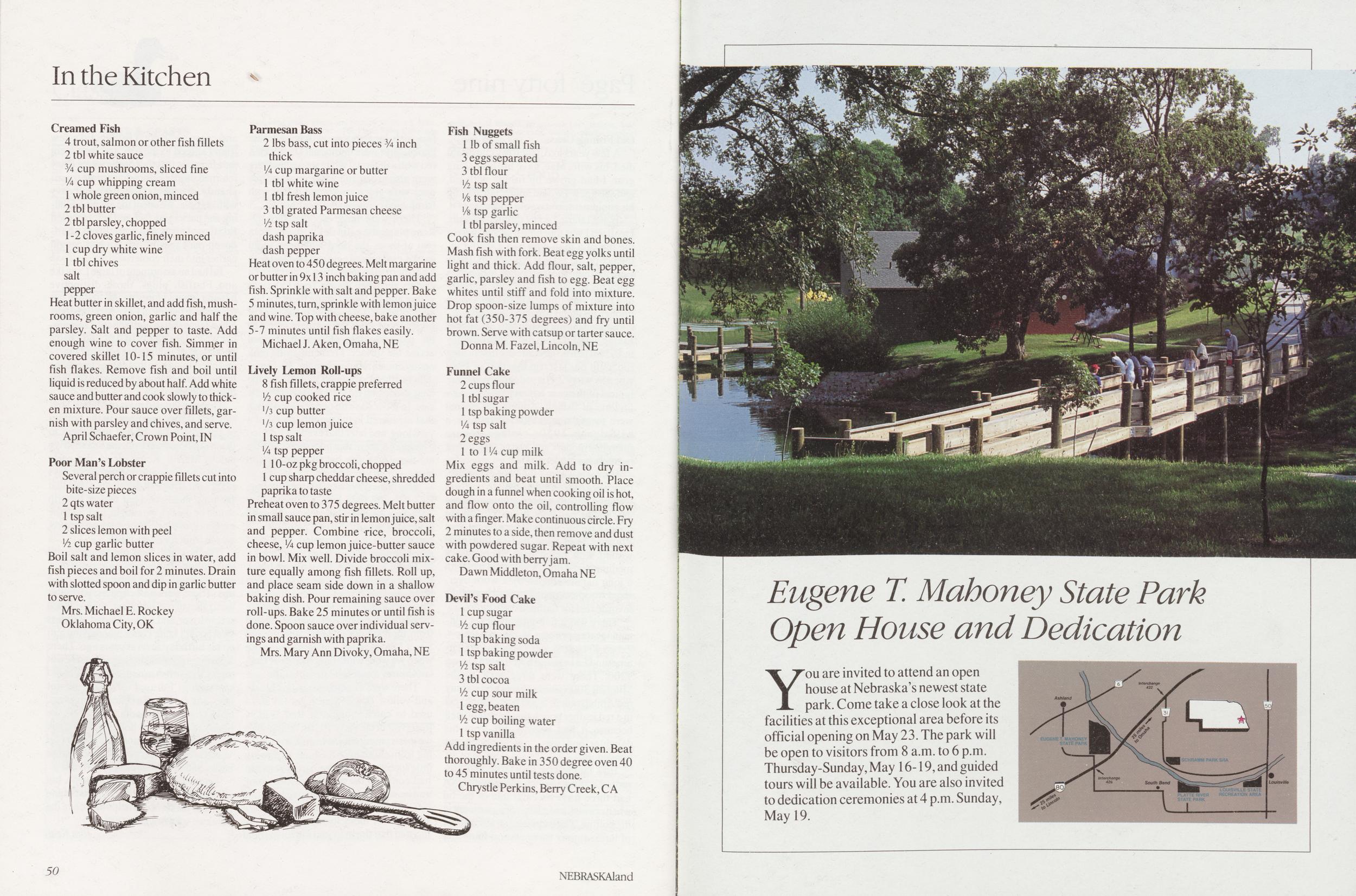
In the Kitchen
Creamed Fish 4 trout, salmon or other fish fillets 2 tbl white sauce Va cup mushrooms, sliced fine Va cup whipping cream 1 whole green onion, minced 2 tbl butter 2 tbl parsley, chopped 1 -2 cloves garlic, finely minced 1 cup dry white wine 1 tbl chives salt pepperHeat butter in skillet, and add fish, mushrooms, green onion, garlic and half the parsley. Salt and pepper to taste. Add enough wine to cover fish. Simmer in covered skillet 10-15 minutes, or until fish flakes. Remove fish and boil until liquid is reduced by about half. Add white sauce and butter and cook slowly to thicken mixture. Pour sauce over fillets, garnish with parsley and chives, and serve.
April Schaefer, Crown Point, IN Poor Man's Lobster Several perch or crappie fillets cut into bite-size pieces 2 qts water 1 tsp salt 2 slices lemon with peel Vi cup garlic butterBoil salt and lemon slices in water, add fish pieces and boil for 2 minutes. Drain with slotted spoon and dip in garlic butter to serve.
Mrs. Michael E. Rockey Oklahoma City, OKHeat oven to 450 degrees. Melt margarine or butter in 9x 13 inch baking pan and add fish. Sprinkle with salt and pepper. Bake 5 minutes, turn, sprinkle with lemon juice and wine. Top with cheese, bake another 5-7 minutes until fish flakes easily.
Michael J. Aken, Omaha, NE Lively Lemon Roll-ups 8 fish fillets, crappie preferred Vi cup cooked rice V3 cup butter lh cup lemon juice 1 tsp salt Va tsp pepper 1 10-oz pkg broccoli, chopped 1 cup sharp cheddar cheese, shredded paprika to tastePreheat oven to 375 degrees. Melt butter in small sauce pan, stir in lemon juice, salt and pepper. Combine rice, broccoli, cheese, Va cup lemon juice-butter sauce in bowl. Mix well. Divide broccoli mixture equally among fish fillets. Roll up, and place seam side down in a shallow baking dish. Pour remaining sauce over roll-ups. Bake 25 minutes or until fish is done. Spoon sauce over individual servings and garnish with paprika.
Mrs. Mary Ann Divoky, Omaha, NE Fish Nuggets 1 lb of small fish 3 eggs separated 3 tbl flour Vi tsp salt Vs tsp pepper Vs tsp garlic 1 tbl parsley, mincedCook fish then remove skin and bones. Mash fish with fork. Beat egg yolks until light and thick. Add flour, salt, pepper, garlic, parsley and fish to egg. Beat egg whites until stiff and fold into mixture. Drop spoon-size lumps of mixture into hot fat (350-375 degrees) and fry until brown. Serve with catsup or tarter sauce.
Donna M. Fazel, Lincoln, NE Funnel Cake 2 cups flour 1 tbl sugar 1 tsp baking powder Va tsp salt 2 eggs 1 to 1 Va cup milkMix eggs and milk. Add to dry ingredients and beat until smooth. Place dough in a funnel when cooking oil is hot, and flow onto the oil, controlling flow with a finger. Make continuous circle. Fry 2 minutes to a side, then remove and dust with powdered sugar. Repeat with next cake. Good with berry jam.
Dawn Middleton, Omaha NE Devil's Food Cake 1 cup sugar Vi cup flour 1 tsp baking soda 1 tsp baking powder Vi tsp salt 3 tbl cocoa Vi cup sour milk 1 egg, beaten Vi cup boiling water 1 tsp vanillaAdd ingredients in the order given. Beat thoroughly. Bake in 350 degree oven 40 to 45 minutes until tests done.
Chrystle Perkins, Berry Creek, C A 50 NEBRASKAlandYou are invited to attend an open house at Nebraska's newest state park. Come take a close look at the facilities at this exceptional area before its official opening on May 23. The park will be open to visitors from 8 a.m. to 6 p.m. Thursday-Sunday, May 16-19, and guided tours will be available. You are also invited to dedication ceremonies at 4 p.m. Sunday, May 19.
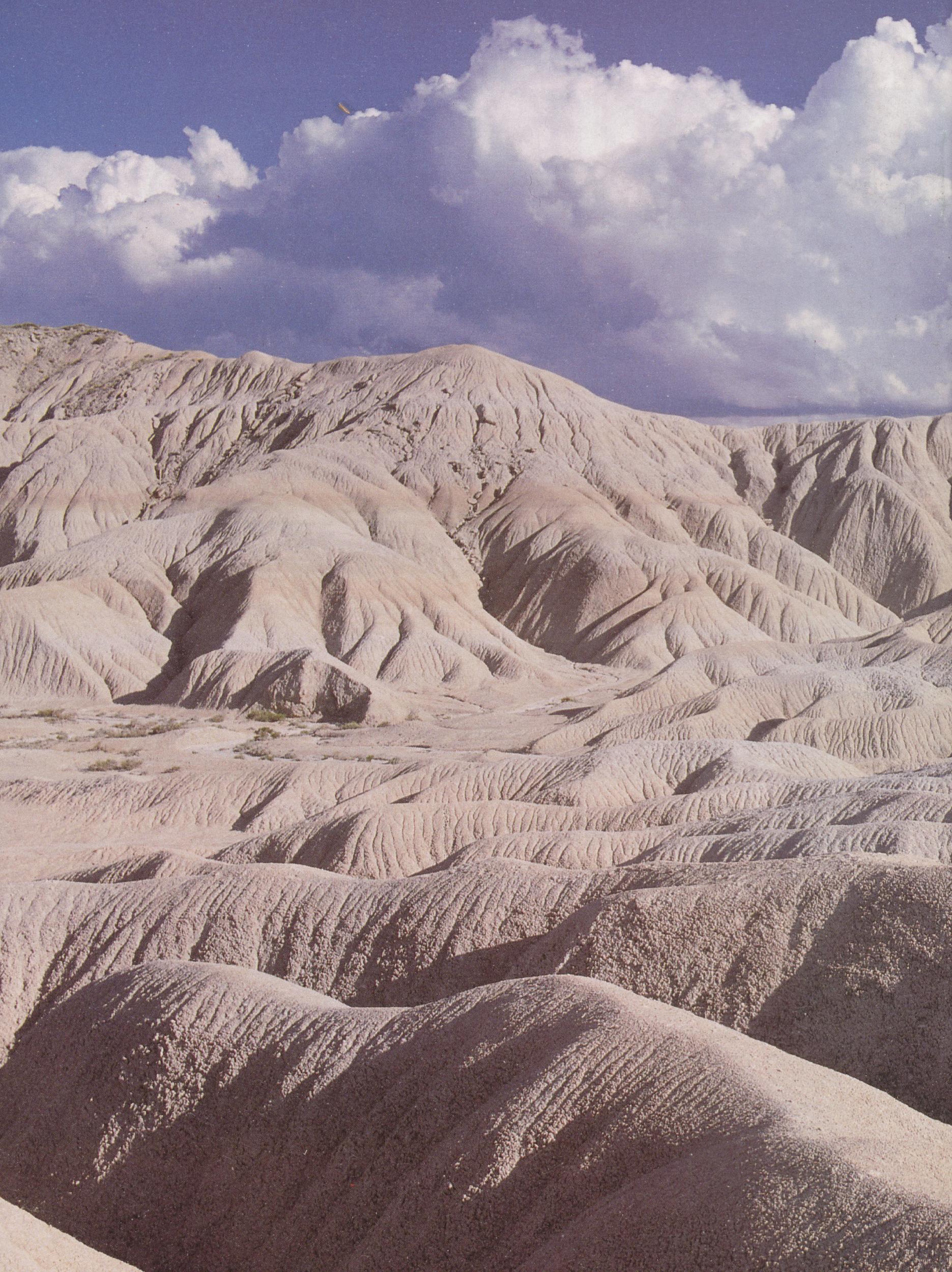
Position: 21 (367 views)