Volume 69, Issue 2, 1991
NEBRASKAland
MARCH 1991 $1.50
NEBRASKAland
VOL.69/N0.2 MARCH 1991 Published by the Nebraska Game and Parks Commission Rex Amack, Director Assistant Directors: William J. Bailey, Jr. Dale R. Bree Staff Chief, Information & Education: Paul Horton Managing Editor: Lowell Johnson Editor: Don Cunningham Senior Editors: Jon Farrar, Ken Bouc Regional Editors: Bob Grier, Rocky Hoffmann, Tom Keith Art Director: Steve O'Hare Illustration and Design: Tim Reigert Circulation: Pat Frahm Commissioners Chairman: Richard L. Coyne, Omaha Vice Chairman: Elvin Adamson, Nenzel 2nd Vice Chairman: J. Alan Cramer, Wayne Marc Anthony, Scottsbluff Randall K. Stinnette, Inland Gloria Erickson, Holdrege L. Bruce Wright, Lincoln NEBRASKAland ISSN:0028-1964 VOL.69/N0.2 March 1991 Published monthly except for combined Jan/Feb and Aug/Sept issues, by the Nebraska Game and Parks Commission, 2200 North 33rd Street, Lincoln, NE. Copyright 1990, all rights reserved. Second-class postage paid at Lincoln, Nebraska POSTMASTER: Send all address changes to NEBRASKAland, Box 30370, Lincoln, NE 68503. Rates: $ 12 for one year, $23 for two years. Manuscripts or photographs submitted to NEBRASKAland Magazine should be addressed to: The Editor. NEBRASKAland Magazine, P.O. Box 30370, Lincoln, NE 68503, and accompanied by self-addressed envelopes and return postage. The publisher assumes no responsibility for unsolicited material.
Notes from the field
Summer Fun! ...at Nebraska's State Parks Nebraska summers mean outdoor fun, and the perfect setting is a State Park. For history or horseback rides, flowers or fishing, swimming or solitude, Nebraska State Parks are your summer-fun invitation! Cabins are still available at many parks. For up-to-date information and reservations phone the following numbers: Ft. Robinson Chadron Platte River Ponca Niobrara Two Rivers (308) 665- (308)432- (402) 234- (402) 755- (402) 857- (402)359- 2660 2036 2217 2284 3373 5165 Victoria Springs (308)749-2235 Nebraska Game and Parks Commission The Panhandle CranesFrom Dick Nelson, district supervisor of resource services in the Game and Parks Commission of North Platte office, comes the following note about the relatively little-known spring concentration of sandhill cranes in Nebraska's Panhandle:
The spring arrival of sandhill cranes along the Platte is as gradual a process as the thawing of this river's channels, which by late March, will fill with nearly half a million of these Arctic-bound migrants. Sandhill cranes trickle northward in February and March from their wintering grounds in west Texas and Mexico to gather in diminishing yet protein-rich wet meadows of the Platte Valley, where they build the necessary body reserves to continue their journey to the breeding grounds in the Canadian, Alaskan and Soviet Arctic.
The spring habitat that sandhill cranes find so attractive in Nebraska includes not only the fertile wet meadows along the river, but also grain fields that tender the previous year's crop residues, and shallow-water sandbars that offer secure roosting sanctuaries on the Platte and North Platte rivers.
Most technical and popular literature locates this impressive assembly of cranes at major staging areas along the Platte River from Kearney to Grand Island and from Overton to Elm Creek. A third major staging area located along the North Platte River between Sutherland and North Platte has recently gained more widespread attention.
Another small but noteworthy Nebraska concentration of sandhill cranes, however, extends this narrow corridor of passage to similar wet meadows and croplands in western Keith and Garden counties many miles west of the more well known concentrations. Although not at all similar in appearance to the Big Bend roosts on the central Platte today, where towering cottonwoods continue to invade the river, this expanse of shallow-river sandbars west of Lake McConaughy probably more closely approximates the historic habitats of the entire river that cranes once knew.
In 1988 and 1990, the Nebraska Game and Parks Commission conducted surveys of this population of sandhill cranes to determine the number of birds using the North Platte River above Lake McConaughy, and to identify their preferred habitats.
The Gander Roost, southeast of Lewellen, an off-river wetland and wet meadow site operated seasonally for commercial goose hunting, is a focal point of crane use. In 1988, Gander was 6 NEBRASKAland a major off-river roost, but because of drought conditions, Gander was not used as a night roost in 1990.
Three other roost sites were located during the staggered, two-year study, all of them sandbars and shallow areas on channels of the North Platte River. Roosting sites used in both 1988 and 1990 are located southeast of Lewellen and on a primary channel through private property southwest of Lewellen. The third roost, probably adopted by the displaced wet-meadow roosters in 1990, is located on the North Platte River where it adjoins Gander.
Accurate crane counts are facilitated by the birds' compulsion to congregate at sundown in gregarious roosting concentrations, and surveyors counted a total roosting population of 7,000 birds in 1988 and 13,800 two years later.
Confirmation of the 1990 roost survey came on March 12 at the Gander meadow when 12,500 cranes gathered to preen tattered flight feathers, and probe the moist soil for invertebrates. A similar count was made at the same location two days later when 10,500 cranes were observed, leading biologists to conclude that Nebraska's western-staging flock of sandhill cranes could have numbered as high as 15,000 birds last year.
The rugged, rocky outcroppings that border the south channel of this stretch of North Platte River, with its associated marshes and wet meadows along treeless, braided channels, adds a new dimension to the sights and sounds of Nebraska's most heralded spring visitors. Probably a traditional staging site for centuries past, this unique sanctuary has escaped the attention of the majority of casual observers and maybe even of some professionals who have focussed their attention on the major eastern concentrations.
We know that all habitats used by a species are absolute prerequisites of life, and certainly included is this key sandhill crane spring migration habitat on the North Platte River in western Nebraska.
Nebraska Wildlife Habitat Donors Hikers, birdwatchers, photographers, campers—anyone who finds peace and pleasure in the outdoors—can give back to Nature For years, hunters and trappers have contributed to the acquisition and improvement of wildlife habitat through their purchase of Nebraska Habitat Stamps. Now, through this special program, non-consumptive users of the outdoors can also contribute, and proudly wear the Nebraska Habitat Donor patch. All proceeds will go the Wildlife Habitat fund. Give $5 and receive the 1991 Donor Patch Give $12.50 and receive the patch on a cloth cap. Use the coupon below. Mail to Nebraska Wildlife Donor Program, NEBRASKAland Magazine, P.O. Box 30370, Lincoln, NE 68503 Nebraska Wildlife Habitat Donor Program Name Address City___ State. Zip. □ $5: Patch □ $12.50: Patch and Cap (Nebraskans: please add appropriate sales tax) MARCH 1991 7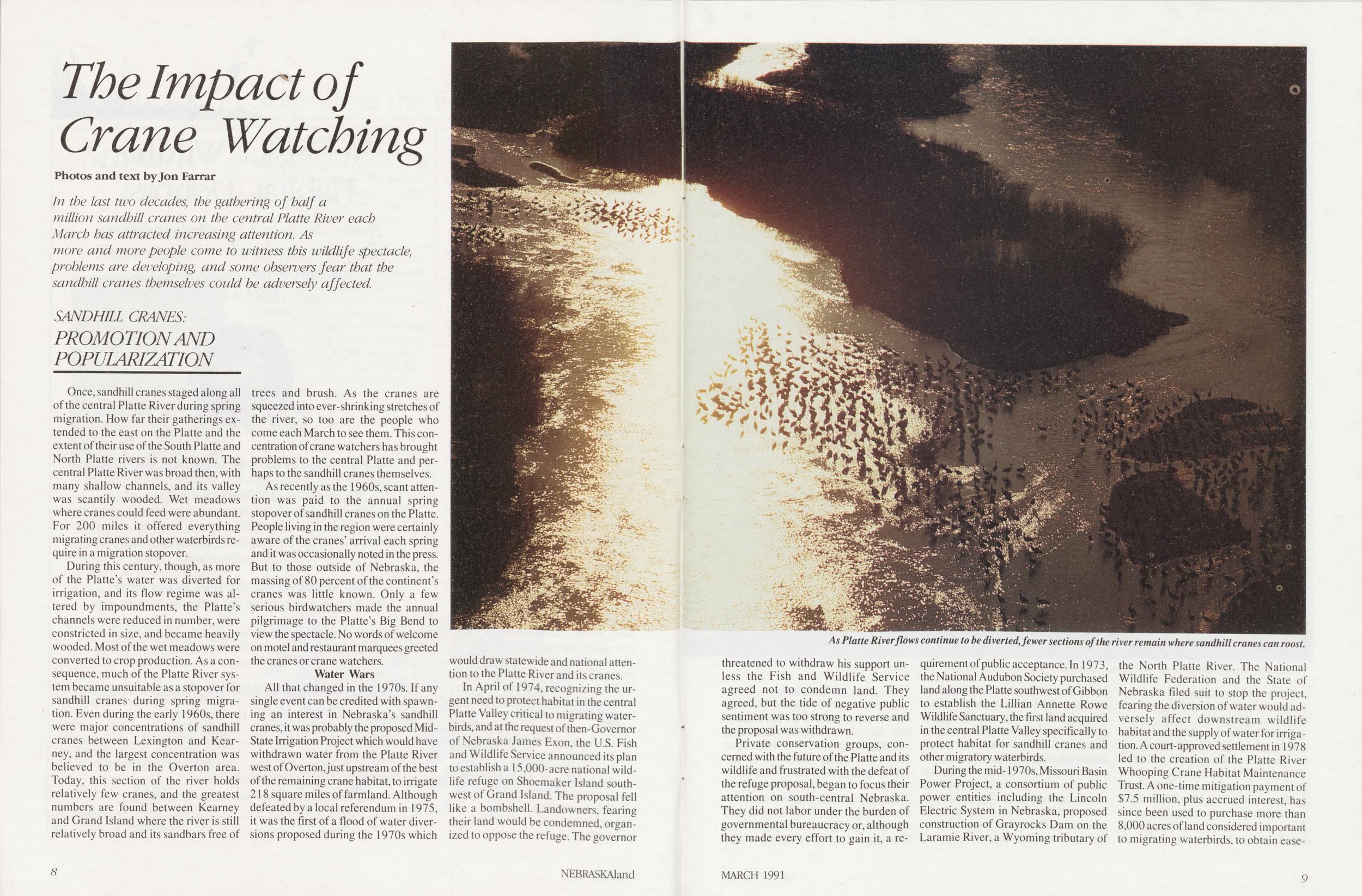
The Impact of Crane Watching
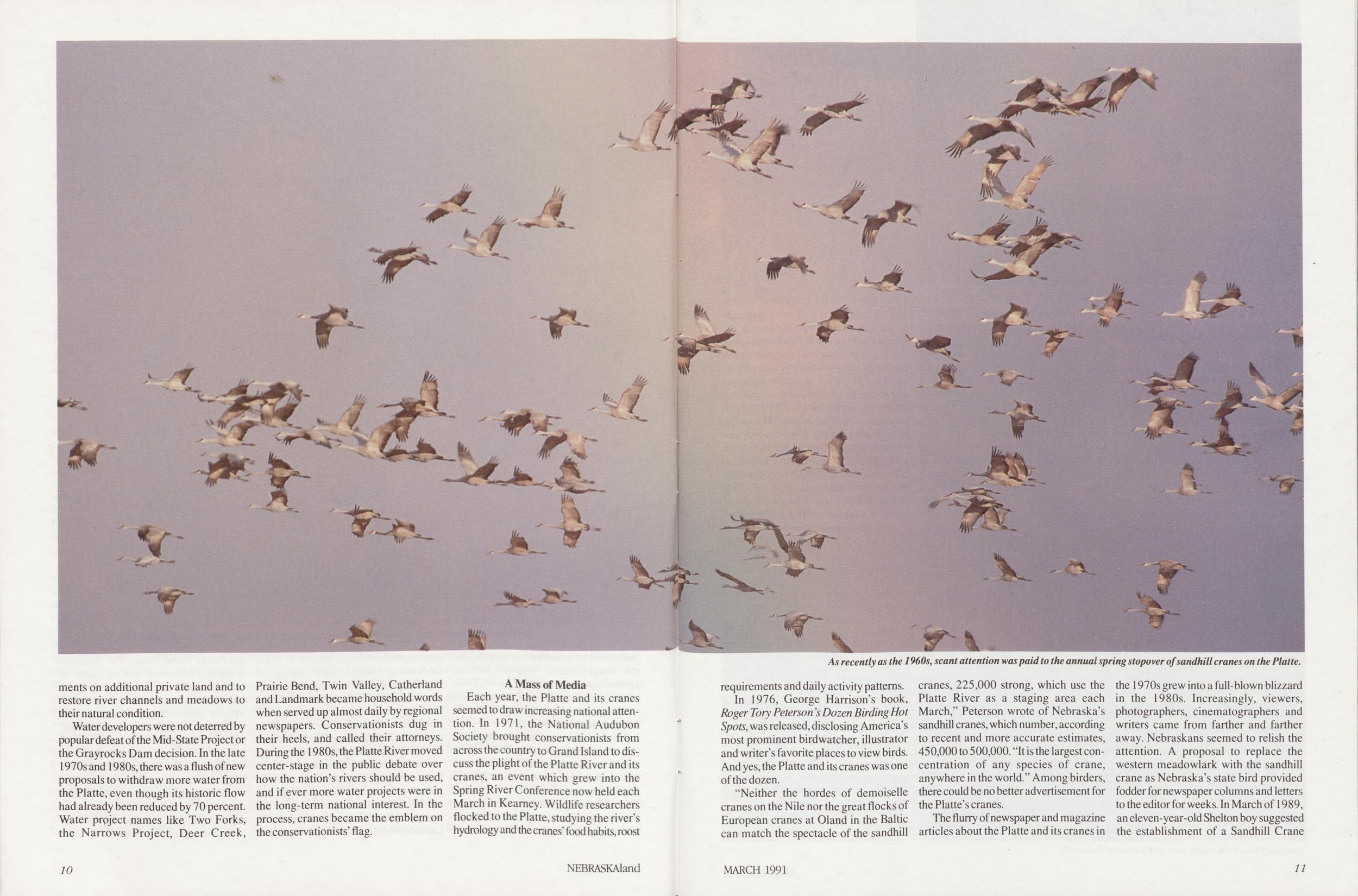
Photos and text by Jon Farrar In the last two decades, the gathering of half a million sandhill cranes on the central Platte River each March has attracted increasing attention. As more and more people come to witness this wildlife spectacle, problems are developing, and some observers fear that the sandhill cranes themselves could be adversely affected. SANDHILL CRANES: PROMOTIONAND POPULARIZATIONOnce, sandhill cranes staged along all of the central Platte River during spring migration. How far their gatherings extended to the east on the Platte and the extent of their use of the South Platte and North Platte rivers is not known. The central Platte River was broad then, with many shallow channels, and its valley was scantily wooded. Wet meadows where cranes could feed were abundant. For 200 miles it offered everything migrating cranes and other waterbirds require in a migration stopover.
Once, sandhill cranes staged along all of the central Platte River during spring migration. How far their gatherings extended to the east on the Platte and the extent of their use of the South Platte and North Platte rivers is not known. The central Platte River was broad then, with many shallow channels, and its valley was scantily wooded. Wet meadows where cranes could feed were abundant. For 200 miles it offered everything migrating cranes and other waterbirds require in a migration stopover.
As recently as the 1960s, scant attention was paid to the annual spring stopover of sandhill cranes on the Platte. People living in the region were certainly aware of the cranes' arrival each spring and it was occasionally noted in the press. But to those outside of Nebraska, the massing of 80 percent of the continent's cranes was little known. Only a few serious birdwatchers made the annual pilgrimage to the Platte's Big Bend to view the spectacle. No words of welcome on motel and restaurant marquees greeted the cranes or crane watchers.
Water WarsAll that changed in the 1970s. If any single event can be credited with spawning an interest in Nebraska's sandhill cranes, it was probably the proposed MidState Irrigation Project which would have withdrawn water from the Platte River west of Overton just upstream of the best of the remaining crane habitat, to irrigate 218 square miles of farmland. Although defeated by a local referendum in 1975, it was the first of a flood of water diversions proposed during the 1970s which
In April of 1974, recognizing the urgent need to protect habitat in the central Platte Valley critical to migrating water birds, and at the request of then-Governor of Nebraska James Exon, the U.S. Fish and Wildlife Service announced its plan to establish a 15,000-acre national wildlife refuge on Shoemaker Island southwest of Grand Island. The proposal fell like a bombshell. Landowners, fearing their land would be condemned, organized to oppose the refuge. The governor 8 NEBRASKAland threatened to withdraw his support unless the Fish and Wildlife Service agreed not to condemn land. They agreed, but the tide of negative public sentiment was too strong to reverse and the proposal was withdrawn.
Private conservation groups, concerned with the future of the Platte and its wildlife and frustrated with the defeat of the refuge proposal, began to focus their attention on south-central Nebraska. They did not labor under the burden of governmental bureaucracy or, although they made every effort to gain it, a requirement of public acceptance. In 1973, the National Audubon Society purchased land along the Platte southwest of Gibbon to establish the Lillian Annette Rowe Wildlife Sanctuary, the first land acquired in the central Platte Valley specifically to protect habitat for sandhill cranes and other migratory waterbirds.
During the mid-1970s, Missouri Basin
Power Project, a consortium of public
power entities including the Lincoln
Electric System in Nebraska, proposed
construction of Grayrocks Dam on the
Laramie River, a Wyoming tributary of
the North Platte River. The National
Wildlife Federation and the State of
Nebraska filed suit to stop the project,
fearing the diversion of water would ad-
versely affect downstream wildlife
habitat and the supply of water for
irrigation. A court-approved settlement in 1978
led to the creation of the Platte River
Whooping Crane Habitat Maintenance
Trust. A one-time mitigation payment of
$7.5 million, plus accrued interest, has
since been used to purchase more than
8,000 acres of land considered important
to migrating waterbirds, to obtain easements
MARCH 1991
9
Water developers were not deterred by popular defeat of the Mid-State Project or the Grayrocks Dam decision. In the late 1970s and 1980s, there was a flush of new proposals to withdraw more water from the Platte, even though its historic flow had already been reduced by 70 percent. Water project names like Two Forks, the Narrows Project, Deer Creek, Prairie Bend, Twin Valley, Catherland and Landmark became household words when served up almost daily by regional newspapers. Conservationists dug in their heels, and called their attorneys. During the 1980s, the Platte River moved center-stage in the public debate over how the nation's rivers should be used, and if ever more water projects were in the long-term national interest. In the process, cranes became the emblem on the conservationists' flag.
A Mass of MediaEach year, the Platte and its cranes seemed to draw increasing national attention. In 1971, the National Audubon Society brought conservationists from across the country to Grand Island to discuss the plight of the Platte River and its cranes, an event which grew into the Spring River Conference now held each March in Kearney. Wildlife researchers flocked to the Platte, studying the river's hydrology and the cranes' food habits, roost 10 NEBRASKAland requirements and daily activity patterns.
In 1976, George Harrison's book, Roger Tory Peterson's Dozen Birding Hot Spots, was released, disclosing America's most prominent birdwatcher, illustrator and writer's favorite places to view birds. And yes, the Platte and its cranes was one of the dozen.
"Neither the hordes of demoiselle cranes on the Nile nor the great flocks of European cranes at Oland in the Baltic can match the spectacle of the sandhill cranes, 225,000 strong, which use the Platte River as a staging area each March," Peterson wrote of Nebraska's sandhill cranes, which number, according to recent and more accurate estimates, 450,000 to 500,000. "It is the largest concentration of any species of crane, anywhere in the world." Among birders, there could be no better advertisement for the Platte's cranes.
The flurry of newspaper and magazine
articles about the Platte and its cranes in
the 1970s grew into a full-blown blizzard
in the 1980s. Increasingly, viewers,
photographers, cinematographers and
writers came from farther and farther
away. Nebraskans seemed to relish the
attention. A proposal to replace the
western meadowlark with the sandhill
crane as Nebraska's state bird provided
fodder for newspaper columns and letters
to the editor for weeks. In March of 1989,
an eleven-year-old Shelton boy suggested
the establishment of a Sandhill Crane
MARCH 1991
11
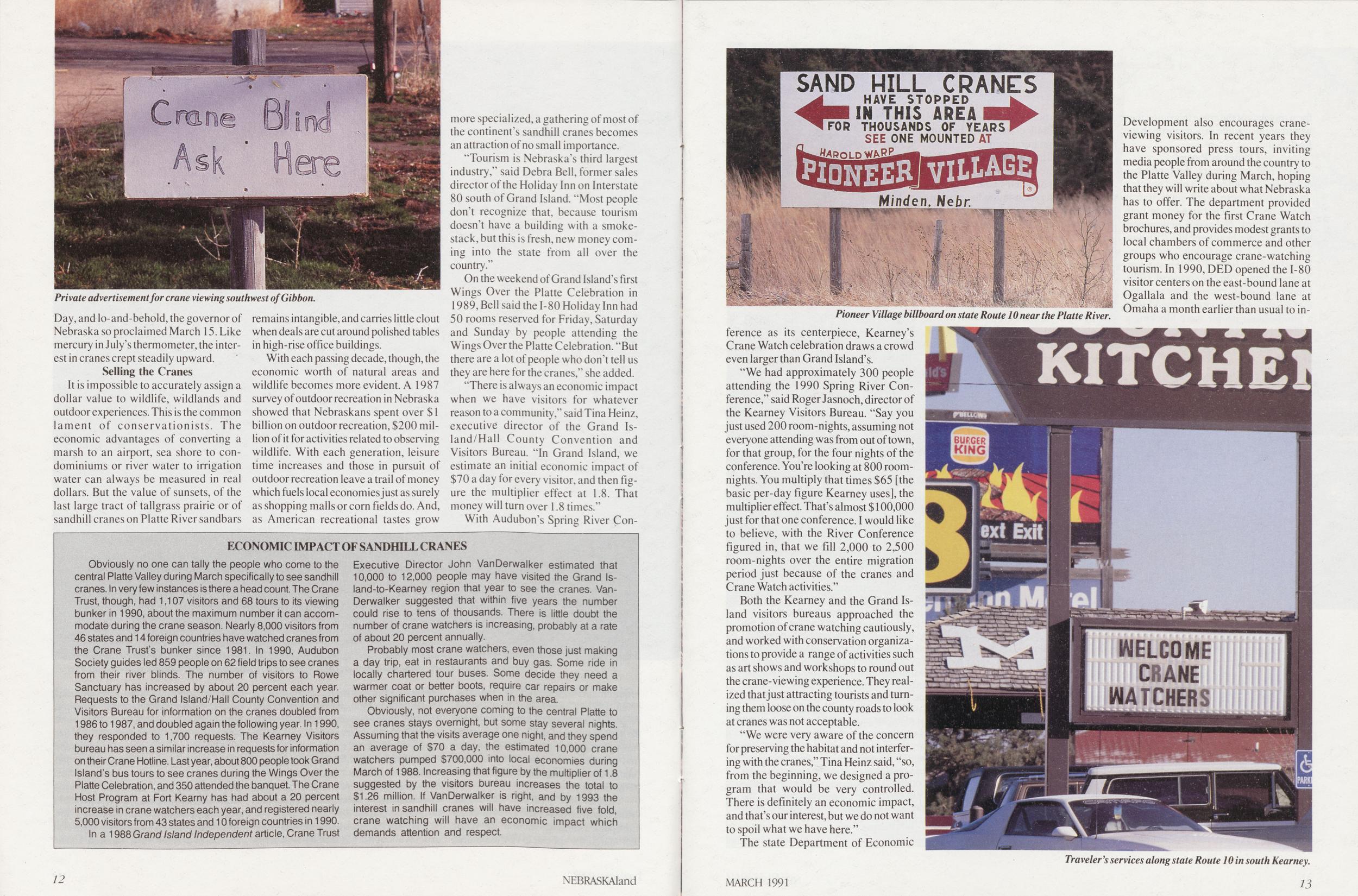
It is impossible to accurately assign a dollar value to wildlife, wild lands and outdoor experiences. This is the common lament of conservationists. The economic advantages of converting a marsh to an airport, sea shore to condominiums or river water to irrigation water can always be measured in real dollars. But the value of sunsets, of the last large tract of tall grass prairie or of sandhill cranes on Platte River sandbars remains intangible, and carries little clout when deals are cut around polished tables in high-rise office buildings.
With each passing decade, though, the economic worth of natural areas and wildlife becomes more evident. A 1987 survey of outdoor recreation in Nebraska showed that Nebraskans spent over $ 1 billion on outdoor recreation, $200 million of it for activities related to observing wildlife. With each generation, leisure time increases and those in pursuit of outdoor recreation leave a trail of money which fuels local economiesjust as surely as shopping malls or corn fields do. And, as American recreational tastes grow more specialized, a gathering of most of the continent's sandhill cranes becomes an attraction of no small importance.
'Tourism is Nebraska's third largest industry," said Debra Bell, former sales director of the Holiday Inn on Interstate 80 south of Grand Island. "Most people don't recognize that, because tourism doesn't have a building with a smokestack, but this is fresh, new money coming into the state from all over the country."
On the weekend of Grand Island's first Wings Over the Platte Celebration in 1989, Bell said the 1-80 Holiday Inn had 50 rooms reserved for Friday, Saturday and Sunday by people attending the Wings Over the Platte Celebration. "But there are a lot of people who don't tell us they are here for the cranes," she added.
"There is always an economic impact when we have visitors for whatever reason to a community," said Tina Heinz, executive director of the Grand Island/Hall County Convention and Visitors Bureau. "In Grand Island, we estimate an initial economic impact of $70 a day for every visitor, and then figure the multiplier effect at 1.8. That money will turn over 1.8 times."
With Audubon's Spring River Conference as its centerpiece, Kearney's Crane Watch celebration draws a crowd even larger than Grand Island's.
ECONOMIC IMPACT OF SANDHILL CRANESObviously no one can tally the people who come to the central Platte Valley during March specifically to see sandhill cranes. In very few instances is there a head count. The Crane Trust, though, had 1,107 visitors and 68 tours to its viewing bunker in 1990, about the maximum number it can accommodate during the crane season. Nearly 8,000 visitors from 46 states and 14 foreign countries have watched cranes from the Crane Trust's bunker since 1981. In 1990, Audubon Society guides led 859 people on 62 field trips to see cranes from their river blinds. The number of visitors to Rowe Sanctuary has increased by about 20 percent each year. Requests to the Grand Island/Hall County Convention and Visitors Bureau for information on the cranes doubled from 1986 to 1987, and doubled again the following year. In 1990, they responded to 1,700 requests. The Kearney Visitors bureau has seen a similar increase in requests for information on their Crane Hotline. Last year, about 800 people took Grand Island's bus tours to see cranes during the Wings Over the Platte Celebration, and 350 attended the banquet. The Crane Host Program at Fort Kearny has had about a 20 percent increase in crane watchers each year, and registered nearly 5,000 visitors from 43 states and 10 foreign countries in 1990.
in a 1988 Grand Island Independent article, Crane Trust Executive Director John VanDerwalker estimated that 10,000 to 12,000 people may have visited the Grand Island-to-Kearney region that year to see the cranes. VanDerwalker suggested that within five years the number could rise to tens of thousands. There is little doubt the number of crane watchers is increasing, probably at a rate of about 20 percent annually.
Probably most crane watchers, even those just making a day trip, eat in restaurants and buy gas. Some ride in locally chartered tour buses. Some decide they need a warmer coat or better boots, require car repairs or make other significant purchases when in the area.
Obviously, not everyone coming to the central Platte to see cranes stays overnight, but some stay several nights. Assuming that the visits average one night, and they spend an average of $70 a day, the estimated 10,000 crane watchers pumped $700,000 into local economies during March of 1988. Increasing that figure by the multiplier of 1.8 suggested by the visitors bureau increases the total to $1.26 million. If VanDerwalker is right, and by 1993 the interest in sandhill cranes will have increased five fold, crane watching will have an economic impact which demands attention and respect.
12 NEBRASKAland"We had approximately 300 people attending the 1990 Spring River Conference," said Roger Jasnoch, director of the Kearney Visitors Bureau. "Say you just used 200 room-nights, assuming not everyone attending was from out of town, for that group, for the four nights of the conference. You're looking at 800 room-nights. You multiply that times $65 [the basic per-day figure Kearney uses], the multiplier effect. That's almost $ 100,000 just for that one conference. I would like to believe, with the River Conference figured in, that we fill 2,000 to 2,500 room-nights over the entire migration period just because of the cranes and Crane Watch activities."
Both the Kearney and the Grand Island visitors bureaus approached the promotion of crane watching cautiously, and worked with conservation organizations to provide a range of activities such as art shows and workshops to round out the crane-viewing experience. They realized that just attracting tourists and turning them loose on the county roads to look at cranes was not acceptable.
"We were very aware of the concern for preserving the habitat and not interfering with the cranes," Tina Heinz said, "so, from the beginning, we designed a program that would be very controlled. There is definitely an economic impact, and that's our interest, but we do not want to spoil what we have here."
The state Department of Economic Development also encourages craneviewing visitors. In recent years they have sponsored press tours, inviting media people from around the country to the Platte Valley during March, hoping that they will write about what Nebraska has to offer. The department provided grant money for the first Crane Watch brochures, and provides modest grants to local chambers of commerce and other groups who encourage crane-watching tourism. In 1990, DED opened the 1-80 visitor centers on the east-bound lane at Ogallala and the west-bound lane at Omaha a month earlier than usual to
 form travelers of the crane migration they
would witness while driving through the
Platte Valley.
Cranes as Pawns
form travelers of the crane migration they
would witness while driving through the
Platte Valley.
Cranes as Pawns
In a few short years, the interest in cranes burgeoned beyond most people's imagination; there were signs it was having an unexpected impact on both man and bird. Nebraska newspapers began carrying headlines like "Visitors are Loving Cranes to Death," and "Conservationists Fear Problems From 'Crane-Mania'." In the spring of 1989, Lincoln's Sunday Journal-Star reported that a "landowner reportedly brandished a gun because people were blocking a bridge." Newspapers have a penchant for eye-catching headlines, but still they indicated all was not well in the central Platte Valley during March.
In the late 1940s, naturalist Aldo Leopold recognized the public's need to see wildlife if they are to value it, but that access did not come without a price. He wrote: "Conservation of wildness is self-defeating, for to cherish we must see and fondle, and when enough have seen and fondled, there is no wilderness left to cherish." For better or worse, the Platte Valley's sandhill cranes had become pawns in an unnatural game.
When a fall hunting season on sandhill cranes was proposed by the Nebraska Council of Sportsmen's Clubs in 1986, the public outcry was immediate and intense. Birds such as whooping cranes, piping plovers, least terns and bald eagles, because of their threatened or endangered status, have legal protection which gives water developers pause, but these species are seldom seen by the public at all, and are never seen in impressive numbers. Rather, it is the spectacular gathering of sandhill cranes with which people form an emotional bond. Sandhill cranes had become a powerful symbol for preserving the Platte as a natural ecosystem, a more critical issue than just preserving sandhill cranes or any other single species which depends on the river. The irony is that while to some, sandhill cranes have become a symbol of preserving the Platte River, they have come to symbolize an impediment to progress to those who see the river only for what it can do for man.
CRANES IN THE SPOTLIGHTThe spring gathering of sandhill cranes in Nebraska began to attract national attention in the 1970s. By the 1980s, they were making regular appearances in newspapers, magazines and on television. Marlin Perkins stomped up and down the Platte and watched sandhill cranes on his "Wild Kingdom" program. The Platte Valley cranes ended Charles Kuralf s CBS "Sunday Morning" program. Most years, at least one of the national networks includes a segment on the cranes and the Platte River water wars.
Recently, two hour-long television documentaries about sandhill cranes have been aired nationally—"Cranes of the Grey Wind" and "Crane River," most of the latter filmed in Nebraska. Part of a National Geographic documentary following a few of the remaining whooping cranes through their year-long journey was filmed in Nebraska. A BBC crew flew in from England to film the Platte's cranes.
Audubon Magazine, the publication of the National Audubon Society, periodically brings its readers to south-central Nebraska. The majority of the May 1989 issue was devoted to the Platte River and its cranes. USA Today carried a short article on the crane's return to the Platte, comparing them to San Juan Capistrano's swallows and quoting Roger Jasnoch with the Kearney Visitors Bureau as saying: "We don't have Mount Rushmore. We don't have a Disney World. But we sure do have plenty of sandhill cranes." Life Magazine, in a article about the swelling number of wildlife watchers, recommends the Platte's cranes as being as impressive as viewing whooping cranes at Aransas refuge in Texas. The Philadelphia Inquirer gave Nebraska's cranes the front page of its Sunday travel section calling their migration "a world-class wildlife event." A Chicago newspaper recommended crane-watching in Nebraska to travelers from the Windy City. A Des Moines Register writer poetically described the spectacle: "Across time and space the cranes had come to this place, a virtual speck of ground in the cosmic scheme of things." Articles appeared in Natural History, National Wildlife, Ranger Rick and even Sports Illustrated and People Magazine. Newsweek Magazine gave Nebraska's cranes and the controversy over the Platte's water a full page, quoting Audubon Society biologist Ron Klataske's reaction to Denver's offer to buy a few acres of land along the central Platte as mitigation for habitat loss for the proposed Two Forks dam on the South Platte River, as being like "putting up poles and birdhouses instead of having trees and forests," to which Denver's water board lawyer responded: "The environment I'm interested in is the shower I take every day." In the past two decades, the Platte River and its cranes have gotten lots of ink and been exposed on miles of film.
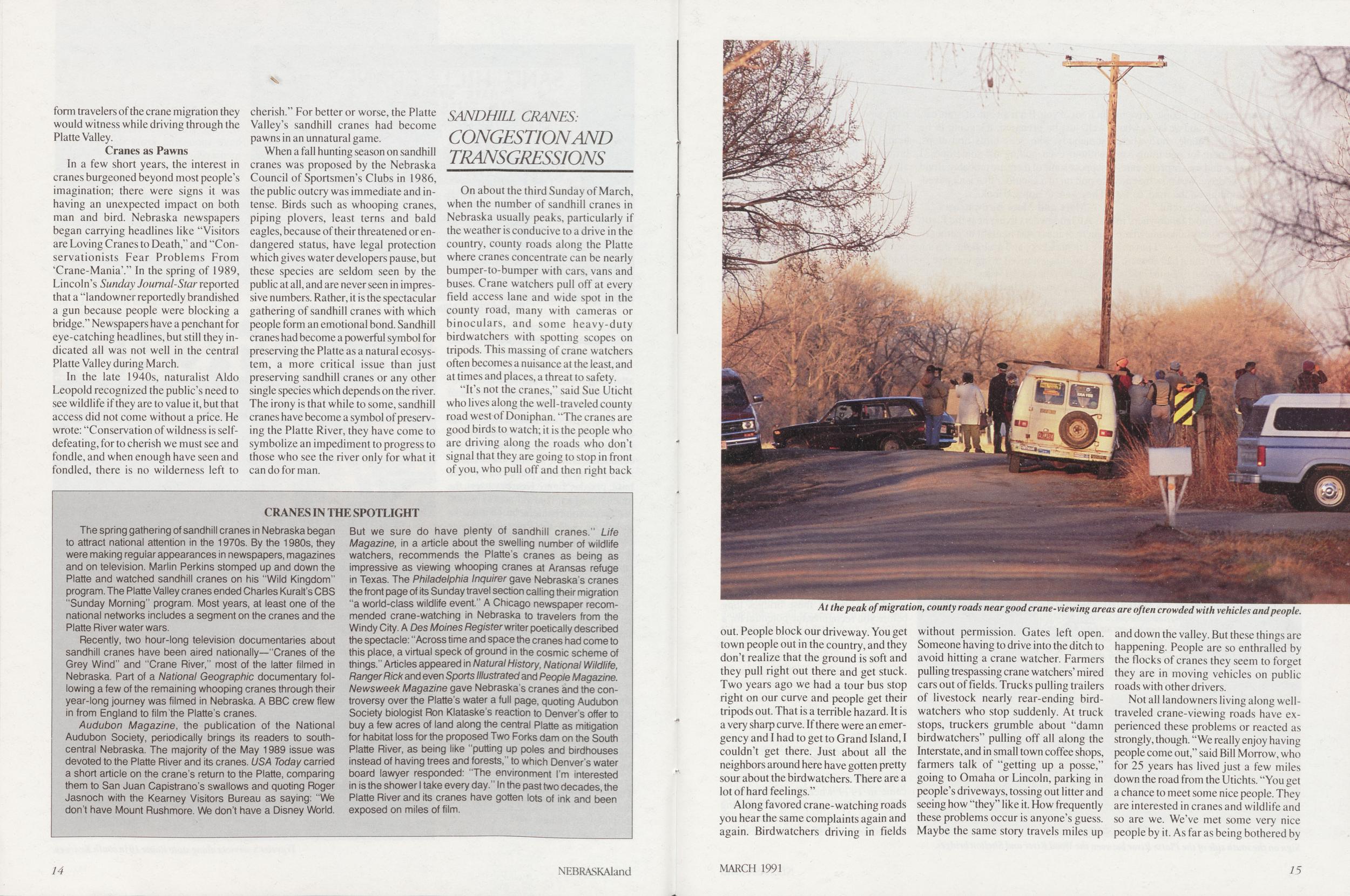
SANDHILL CRANES: CONGESTION AND TRANSGRESSIONSOn about the third Sunday of March, when the number of sandhill cranes in Nebraska usually peaks, particularly if the weather is conducive to a drive in the country, county roads along the Platte where cranes concentrate can be nearly bumper-to-bumper with cars, vans and buses. Crane watchers pull off at every field access lane and wide spot in the county road, many with cameras or binoculars, and some heavy-duty birdwatchers with spotting scopes on tripods. This massing of crane watchers often becomes a nuisance at the least, and at times and places, a threat to safety.
"It's not the cranes," said Sue Uticht who lives along the well-traveled county road west of Doniphan. "The cranes are good birds to watch; it is the people who are driving along the roads who don't signal that they are going to stop in front of you, who pull off and then right back 14 NEBRASKAland
Along favored crane-watching roads you hear the same complaints again and again. Birdwatchers driving in fields without permission. Gates left open. Someone having to drive into the ditch to avoid hitting a crane watcher. Farmers pulling trespassing crane watchers' mired cars out of fields. Trucks pulling trailers of livestock nearly rear-ending bird watchers who stop suddenly. At truck stops, truckers grumble about "damn birdwatchers" pulling off all along the Interstate, and in small town coffee shops, farmers talk of "getting up a posse," going to Omaha or Lincoln, parking in people's driveways, tossing out litter and seeing how "they" like it. How frequently these problems occur is anyone's guess. Maybe the same story travels miles up and down the valley. But these things are happening. People are so enthralled by the flocks of cranes they seem to forget they are in moving vehicles on public roads with other drivers.
Not all landowners living along
well traveled crane-viewing roads have
experienced these problems or reacted as
strongly, though. "We really enjoy having
people come out," said Bill Morrow, who
for 25 years has lived just a few miles
down the road from the Utichts. "You get
a chance to meet some nice people. They
are interested in cranes and wildlife and
so are we. We've met some very nice
people by it. As far as being bothered by
MARCH 1991
15
 them, we are really not. People drive in
the driveway and stop, and we know what
they are out here for. People who live here
realize they are here for one thing—to
watch the birds—and we are pretty
careful about how we drive. We know they are
going to be stopping on the road, so we
are just that much more careful."
them, we are really not. People drive in
the driveway and stop, and we know what
they are out here for. People who live here
realize they are here for one thing—to
watch the birds—and we are pretty
careful about how we drive. We know they are
going to be stopping on the road, so we
are just that much more careful."
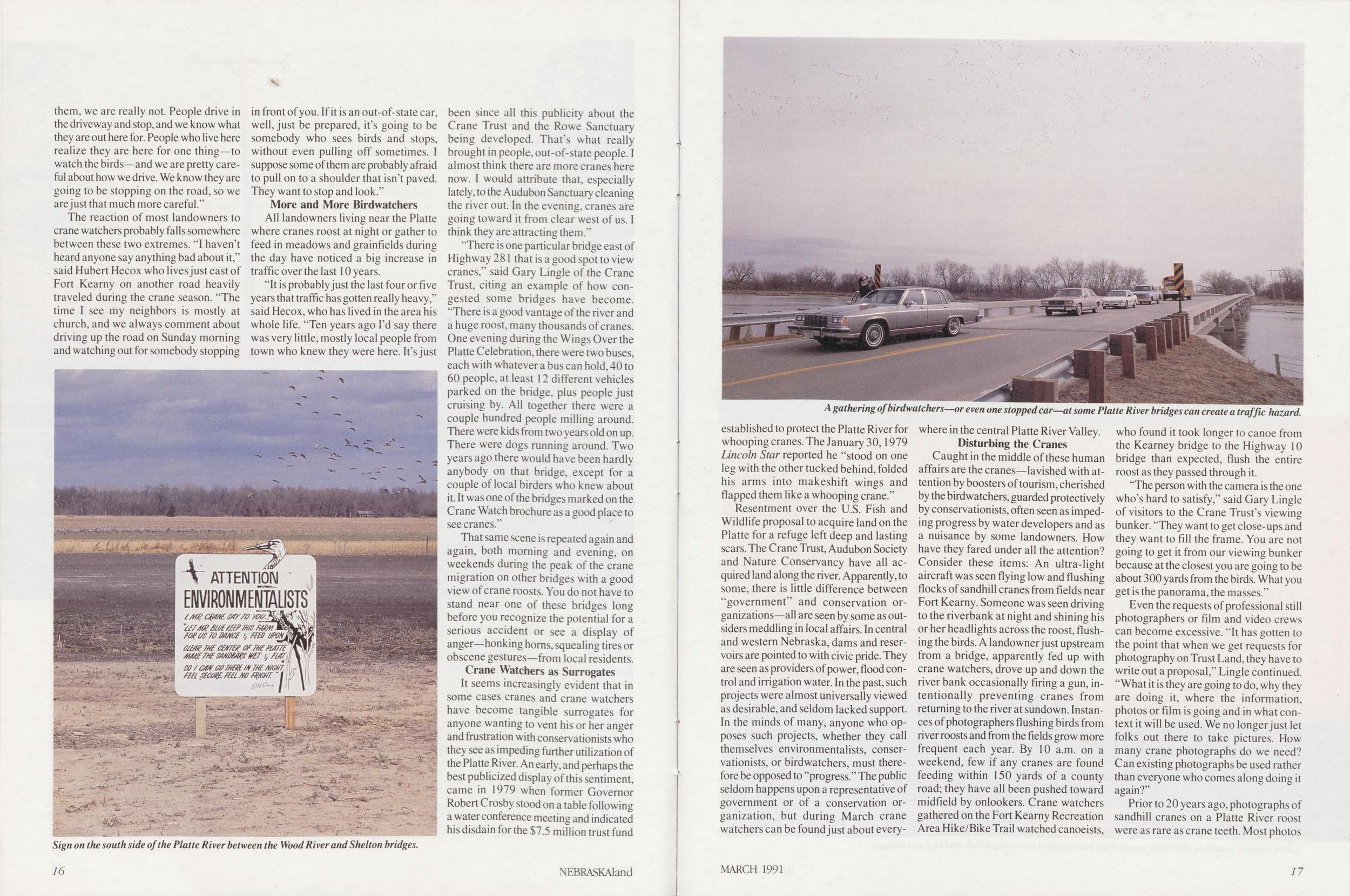
The reaction of most landowners to crane watchers probably falls somewhere between these two extremes. "I haven't heard anyone say anything bad about it," said Hubert Hecox who lives just east of Fort Kearny on another road heavily traveled during the crane season. 'The time I see my neighbors is mostly at church, and we always comment about driving up the road on Sunday morning and watching out for somebody stopping in front of you. If it is an out-of-state car, well, just be prepared, it's going to be somebody who sees birds and stops, without even pulling off sometimes. I suppose some of them are probably afraid to pull on to a shoulder that isn't paved. They want to stop and look."
All landowners living near the Platte where cranes roost at night or gather to feed in meadows and grain fields during the day have noticed a big increase in traffic over the last 10 years.
"It is probably just the last four or five years that traffic has gotten really heavy," said Hecox, who has lived in the area his whole life. "Ten years ago I'd say there was very little, mostly local people from town who knew they were here. It's just been since all this publicity about the Crane Trust and the Rowe Sanctuary being developed. That's what really brought in people, out-of-state people. I almost think there are more cranes here now. I would attribute that, especially lately, to the Audubon Sanctuary cleaning the river out. In the evening, cranes are going toward it from clear west of us. I think they are attracting them."
"There is one particular bridge east of Highway 281 that is a good spot to view cranes," said Gary Lingle of the Crane Trust, citing an example of how congested some bridges have become. "There is a good vantage of the river and a huge roost, many thousands of cranes. One evening during the Wings Over the Platte Celebration, there were two buses, each with whatever a bus can hold, 40 to 60 people, at least 12 different vehicles parked on the bridge, plus people just cruising by. All together there were a couple hundred people milling around. There were kids from two years old on up. There were dogs running around. Two years ago there would have been hardly anybody on that bridge, except for a couple of local birders who knew about it. It was one of the bridges marked on the Crane Watch brochure as a good place to see cranes."
That same scene is repeated again and again, both morning and evening, on weekends during the peak of the crane migration on other bridges with a good view of crane roosts. You do not have to stand near one of these bridges long before you recognize the potential for a serious accident or see a display of anger—honking horns, squealing tires or obscene gestures—from local residents.
Crane Watchers as SurrogatesIt seems increasingly evident that in some cases cranes and crane watchers have become tangible surrogates for anyone wanting to vent his or her anger and frustration with conservationists who they see as impeding further utilization of the Platte River. An early, and perhaps the best publicized display of this sentiment, came in 1979 when former Governor Robert Crosby stood on a table following a water conference meeting and indicated his disdain for the $7.5 million trust fund 16 NEBRASKAland
Resentment over the U.S. Fish and Wildlife proposal to acquire land on the Platte for a refuge left deep and lasting scars. The Crane Trust, Audubon Society and Nature Conservancy have all acquired land along the river. Apparently, to some, there is little difference between "government" and conservation organizations all are seen by some as outsiders meddling in local affairs. In central and western Nebraska, dams and reservoirs are pointed to with civic pride. They are seen as providers of power, flood control and irrigation water. In the past, such projects were almost universally viewed as desirable, and seldom lacked support. In the minds of many, anyone who opposes such projects, whether they call themselves environmentalists, conservationists, or birdwatchers, must therefore be opposed to "progress." The public seldom happens upon a representative of government or of a conservation organization, but during March crane watchers can be found just about everywhere in the central Platte River Valley.
Disturbing the CranesCaught in the middle of these human affairs are the cranes—lavished with attention by boosters of tourism, cherished by the birdwatchers, guarded protectively by conservationists, often seen as impeding progress by water developers and as a nuisance by some landowners. How have they fared under all the attention? Consider these items: An ultra-light aircraft was seen flying low and flushing flocks of sandhill cranes from fields near Fort Kearny. Someone was seen driving to the riverbank at night and shining his or her headlights across the roost, flushing the birds. A landowner just upstream from a bridge, apparently fed up with crane watchers, drove up and down the river bank occasionally firing a gun, intentionally preventing cranes from returning to the river at sundown. Instances of photographers flushing birds from river roosts and from the fields grow more frequent each year. By 10 a.m. on a weekend, few if any cranes are found feeding within 150 yards of a county road; they have all been pushed toward midfield by onlookers. Crane watchers gathered on the Fort Kearny Recreation Area Hike/Bike Trail watched canoeists, who found it took longer to canoe from the Kearney bridge to the Highway 10 bridge than expected, flush the entire roost as they passed through it.
"The person with the camera is the one who's hard to satisfy," said Gary Lingle of visitors to the Crane Trust's viewing bunker. "They want to get close-ups and they want to fill the frame. You are not going to get it from our viewing bunker because at the closest you are going to be about 300 yards from the birds. What you get is the panorama, the masses."
Even the requests of professional still photographers or film and video crews can become excessive. "It has gotten to the point that when we get requests for photography on Trust Land, they have to write out a proposal," Lingle continued. "What it is they are going to do, why they are doing it, where the information, photos or film is going and in what context it will be used. We no longer just let folks out there to take pictures. How many crane photographs do we need? Can existing photographs be used rather than everyone who comes along doing it again 1
Prior to 20 years ago, photographs of
sandhill cranes on a Platte River roost
were as rare as crane teeth. Most photos
MARCH 1991
17
 published were of cranes in meadows,
fields or in flight. During the 1970s that
changed. No wildlife photographer felt
he had truly captured the cranes' spring
migration unless he had photos of them
on the Platte's sandbars and shallows.
Once the professional photographers'
photos were seen by the public, the public
wanted to see cranes on the river as well.
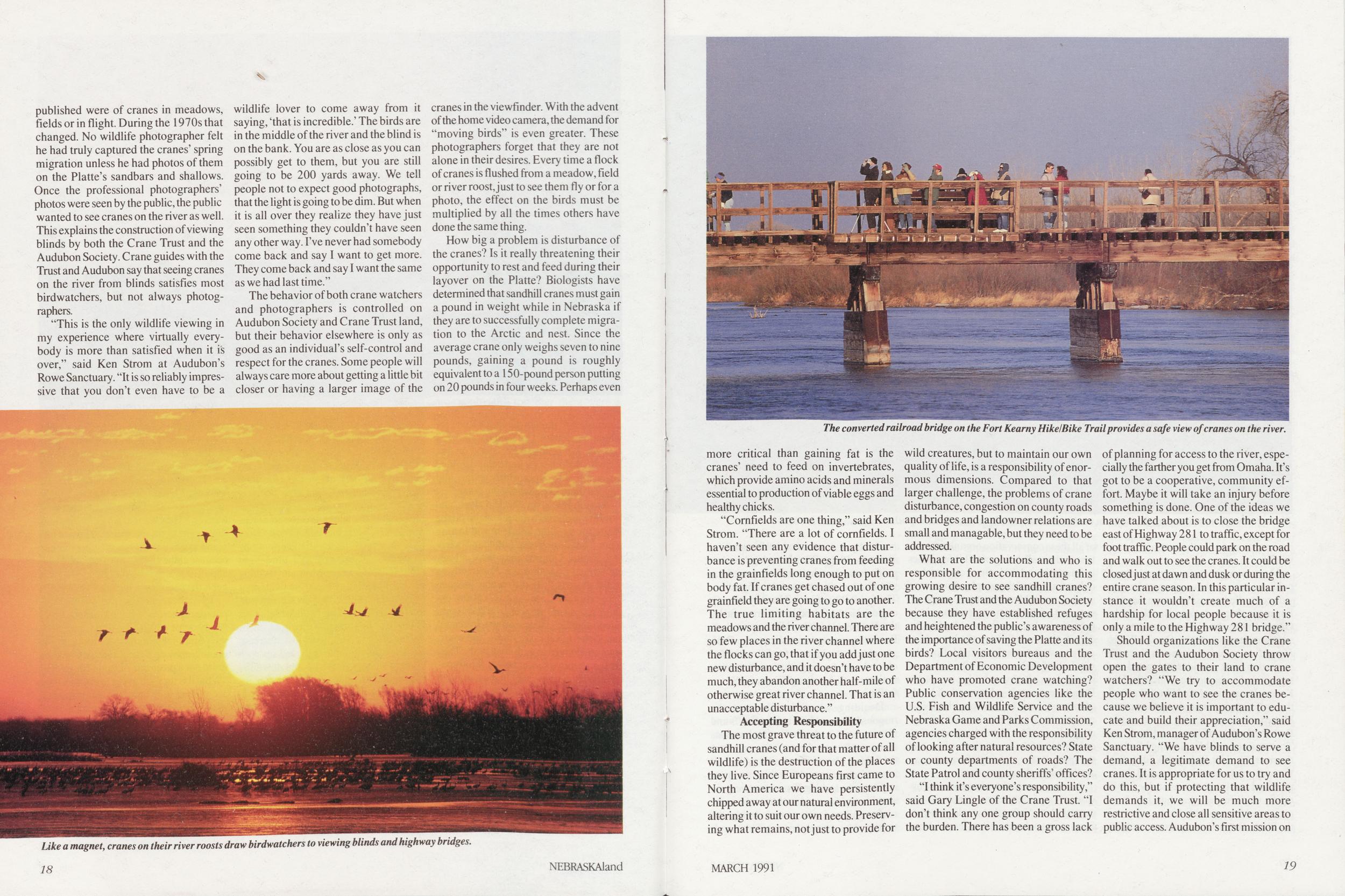
This explains the construction of viewing
blinds by both the Crane Trust and the
Audubon Society. Crane guides with the
Trust and Audubon say that seeing cranes
on the river from blinds satisfies most
birdwatchers, but not always
photographers.
published were of cranes in meadows,
fields or in flight. During the 1970s that
changed. No wildlife photographer felt
he had truly captured the cranes' spring
migration unless he had photos of them
on the Platte's sandbars and shallows.
Once the professional photographers'
photos were seen by the public, the public
wanted to see cranes on the river as well.
This explains the construction of viewing
blinds by both the Crane Trust and the
Audubon Society. Crane guides with the
Trust and Audubon say that seeing cranes
on the river from blinds satisfies most
birdwatchers, but not always
photographers.
"This is the only wildlife viewing in my experience where virtually everybody is more than satisfied when it is over," said Ken Strom at Audubon's Rowe Sanctuary. "It is so reliably impressive that you don't even have to be a wildlife lover to come away from it saying, 'that is incredible.' The birds are in the middle of the river and the blind is on the bank. You are as close as you can possibly get to them, but you are still going to be 200 yards away. We tell people not to expect good photographs, that the light is going to be dim. But when it is all over they realize they have just seen something they couldn't have seen any other way. I've never had somebody come back and say I want to get more. They come back and say I want the same as we had last time."
The behavior of both crane watchers and photographers is controlled on Audubon Society and Crane Trust land, but their behavior elsewhere is only as good as an individual's self-control and respect for the cranes. Some people will always care more about getting a little bit closer or having a larger image of the cranes in the viewfinder. With the advent of the home video camera, the demand for "moving birds" is even greater. These photographers forget that they are not alone in their desires. Every time a flock of cranes is flushed from a meadow, field or river roost, just to see them fly or for a photo, the effect on the birds must be multiplied by all the times others have done the same thing.
How big a problem is disturbance of the cranes? Is it really threatening their opportunity to rest and feed during their layover on the Platte? Biologists have determined that sandhill cranes must gain a pound in weight while in Nebraska if they are to successfully complete migration to the Arctic and nest. Since the average crane only weighs seven to nine pounds, gaining a pound is roughly equivalent to a 150-pound person putting on 20 pounds in four weeks. Perhaps even
"Cornfields are one thing," said Ken Strom. "There are a lot of cornfields. I haven't seen any evidence that disturbance is preventing cranes from feeding in the grain fields long enough to put on body fat. If cranes get chased out of one grain field they are going to go to another. The true limiting habitats are the meadows and the river channel. There are so few places in the river channel where the flocks can go, that if you add just one new disturbance, and it doesn't have to be much, they abandon another half-mile of otherwise great river channel. That is an unacceptable disturbance."
Accepting ResponsibilityThe most grave threat to the future of sandhill cranes (and for that matter of all wildlife) is the destruction of the places they live. Since Europeans first came to North America we have persistently chipped away at our natural environment, altering it to suit our own needs. Preserving what remains, not just to provide for wild creatures, but to maintain our own quality of life, is a responsibility of enormous dimensions. Compared to that larger challenge, the problems of crane disturbance, congestion on county roads and bridges and landowner relations are small and manageable, but they need to be addressed.
What are the solutions and who is responsible for accommodating this growing desire to see sandhill cranes? The Crane Trust and the Audubon Society because they have established refuges and heightened the public's awareness of the importance of saving the Platte and its birds? Local visitors bureaus and the Department of Economic Development who have promoted crane watching? Public conservation agencies like the U.S. Fish and Wildlife Service and the Nebraska Game and Parks Commission, agencies charged with the responsibility of looking after natural resources? State or county departments of roads? The State Patrol and county sheriffs' offices?
"I think it's everyone's responsibility," said Gary Lingle of the Crane Trust. "I don't think any one group should carry the burden. There has been a gross lack of planning for access to the river, especially the farther you get from Omaha. It's got to be a cooperative, community effort. Maybe it will take an injury before something is done. One of the ideas we have talked about is to close the bridge east of Highway 281 to traffic, except for foot traffic. People could park on the road and walk out to see the cranes. It could be closed just at dawn and dusk or during the entire crane season. In this particular instance it wouldn't create much of a hardship for local people because it is only a mile to the Highway 281 bridge."
Should organizations like the Crane
Trust and the Audubon Society throw
open the gates to their land to crane
watchers? "We try to accommodate
people who want to see the cranes
because we believe it is important to
educate and build their appreciation," said
Ken Strom, manager of Audubon's Rowe
Sanctuary. "We have blinds to serve a
demand, a legitimate demand to see
cranes. It is appropriate for us to try and
do this, but if protecting that wildlife
demands it, we will be much more
restrictive and close all sensitive areas to
public access. Audubon's first mission on
MARCH 1991
19
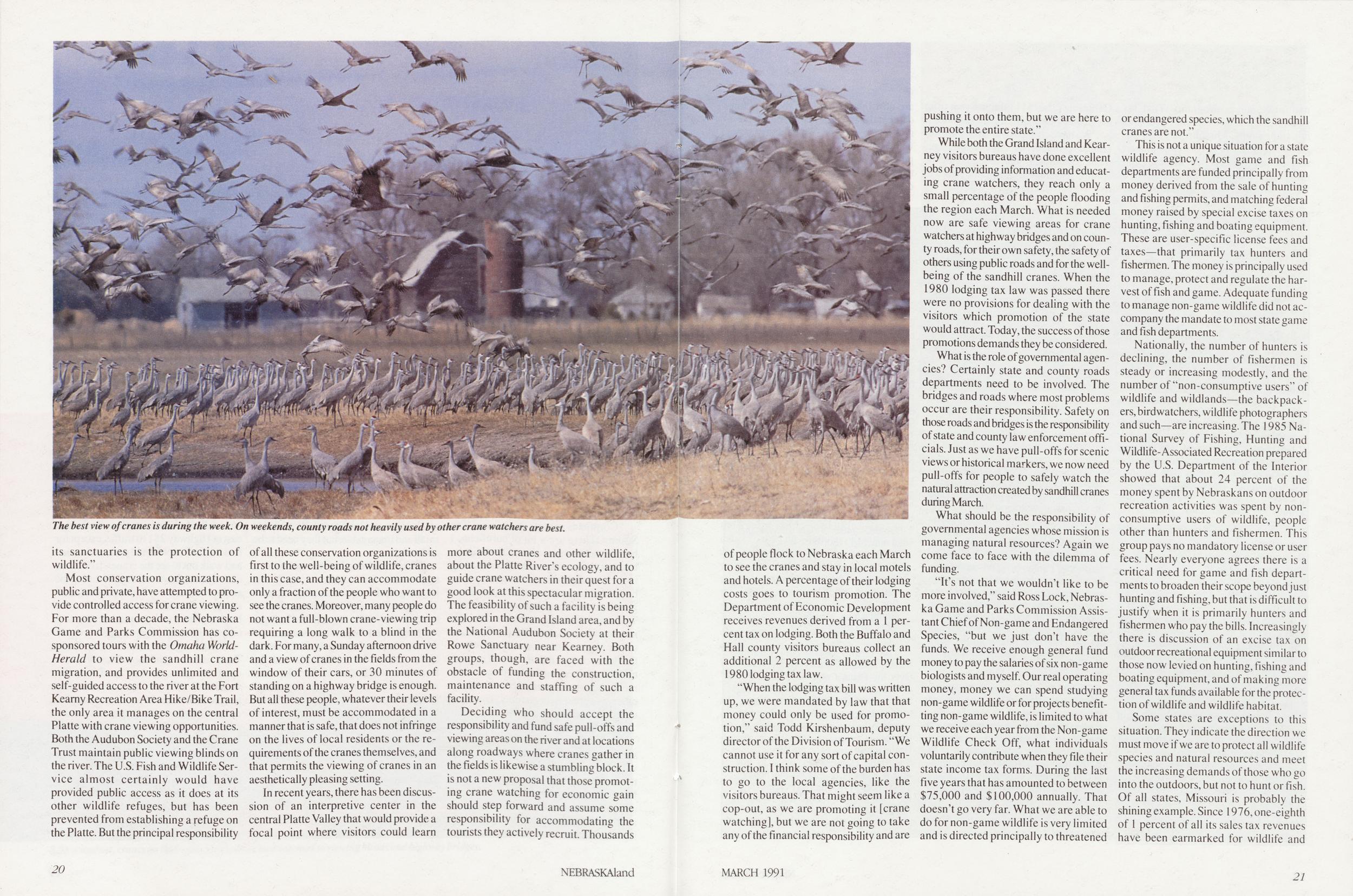
Most conservation organizations, public and private, have attempted to provide controlled access for crane viewing. For more than a decade, the Nebraska Game and Parks Commission has cosponsored tours with the Omaha World- Herald to view the sandhill crane migration, and provides unlimited and self-guided access to the river at the Fort Kearny Recreation Area Hike/Bike Trail, the only area it manages on the central Platte with crane viewing opportunities. Both the Audubon Society and the Crane Trust maintain public viewing blinds on the river. The U.S. Fish and Wildlife Service almost certainly would have provided public access as it does at its other wildlife refuges, but has been prevented from establishing a refuge on the Platte. But the principal responsibility of all these conservation organizations is first to the well-being of wildlife, cranes in this case, and they can accommodate only a fraction of the people who want to see the cranes. Moreover, many people do not want a full-blown crane-viewing trip requiring a long walk to a blind in the dark. For many, a Sunday afternoon drive and a view of cranes in the fields from the window of their cars, or 30 minutes of standing on a highway bridge is enough. But all these people, whatever their levels of interest, must be accommodated in a manner that is safe, that does not infringe on the lives of local residents or the requirements of the cranes themselves, and that permits the viewing of cranes in an aesthetically pleasing setting.
In recent years, there has been discussion of an interpretive center in the central Platte Valley that would provide a focal point where visitors could learn more about cranes and other wildlife, about the Platte River's ecology, and to guide crane watchers in their quest for a good look at this spectacular migration. The feasibility of such a facility is being explored in the Grand Island area, and by the National Audubon Society at their Rowe Sanctuary near Kearney. Both groups, though, are faced with the obstacle of funding the construction, maintenance and staffing of such a facility.
Deciding who should accept the responsibility and fund safe pull-offs and viewing areas on the river and at locations along roadways where cranes gather in the fields is likewise a stumbling block. It is not a new proposal that those promoting crane watching for economic gain should step forward and assume some responsibility for accommodating the tourists they actively recruit. Thousands 20 NEBRASKAland of people flock to Nebraska each March to see the cranes and stay in local motels and hotels. A percentage of their lodging costs goes to tourism promotion. The Department of Economic Development receives revenues derived from a 1 percent tax on lodging. Both the Buffalo and Hall county visitors bureaus collect an additional 2 percent as allowed by the 1980 lodging tax law.
"When the lodging tax bill was written up, we were mandated by law that that money could only be used for promotion," said Todd Kirshenbaum, deputy director of the Division of Tourism. "We cannot use it for any sort of capital construction. I think some of the burden has to go to the local agencies, like the visitors bureaus. That might seem like a cop-out, as we are promoting it [crane watching], but we are not going to take any of the financial responsibility and are pushing it onto them, but we are here to promote the entire state."
While both the Grand Island and Kearney visitors bureaus have done excellent jobs of providing information and educating crane watchers, they reach only a small percentage of the people flooding the region each March. What is needed now are safe viewing areas for crane watchers at highway bridges and on county roads, for their own safety, the safety of others using public roads and for the well-being of the sandhill cranes. When the 1980 lodging tax law was passed there were no provisions for dealing with the visitors which promotion of the state would attract. Today, the success of those promotions demands they be considered.
What is the role of governmental agencies? Certainly state and county roads departments need to be involved. The bridges and roads where most problems occur are their responsibility. Safety on those roads and bridges is the responsibility of state and county law enforcement officials. Just as we have pull-offs for scenic views or historical markers, we now need pull-offs for people to safely watch the natural attraction created by sandhill cranes during March.
What should be the responsibility of governmental agencies whose mission is managing natural resources? Again we come face to face with the dilemma of funding.
"It's not that we wouldn't like to be more involved," said Ross Lock, Nebraska Game and Parks Commission Assistant Chief of Non-game and Endangered Species, "but we just don't have the funds. We receive enough general fund money to pay the salaries of six non-game biologists and myself. Our real operating money, money we can spend studying non-game wildlife or for projects benefitting non-game wildlife, is limited to what we receive each year from the Non-game Wildlife Check Off, what individuals voluntarily contribute when they file their state income tax forms. During the last five years that has amounted to between $75,000 and $100,000 annually. That doesn't go very far. What we are able to do for non-game wildlife is very limited and is directed principally to threatened or endangered species, which the sandhill cranes are not."
This is not a unique situation for a state wildlife agency. Most game and fish departments are funded principally from money derived from the sale of hunting and fishing permits, and matching federal money raised by special excise taxes on hunting, fishing and boating equipment. These are user-specific license fees and taxes—that primarily tax hunters and fishermen. The money is principally used to manage, protect and regulate the harvest offish and game. Adequate funding to manage non-game wildlife did not accompany the mandate to most state game and fish departments.
Nationally, the number of hunters is declining, the number of fishermen is steady or increasing modestly, and the number of "non-consumptive users" of wildlife and wild lands—the backpackers, birdwatchers, wildlife photographers and such—are increasing. The 1985 National Survey of Fishing, Hunting and Wildlife-Associated Recreation prepared by the U.S. Department of the Interior showed that about 24 percent of the money spent by Nebraskans on outdoor recreation activities was spent by nonconsumptive users of wildlife, people other than hunters and fishermen. This group pays no mandatory license or user fees. Nearly everyone agrees there is a critical need for game and fish departments to broaden their scope beyond just hunting and fishing, but that is difficult to justify when it is primarily hunters and fishermen who pay the bills. Increasingly there is discussion of an excise tax on outdoor recreational equipment similar to those now levied on hunting, fishing and boating equipment, and of making more general tax funds available for the protection of wildlife and wildlife habitat.
Some states are exceptions to this
situation. They indicate the direction we
must move if we are to protect all wildlife
species and natural resources and meet
the increasing demands of those who go
into the outdoors, but not to hunt or fish.
Of all states, Missouri is probably the
shining example. Since 1976, one-eighth
of 1 percent of all its sales tax revenues
have been earmarked for wildlife and
MARCH 1991
21
 natural resources programs. That tax
generates about $52 million a year and,
not surprisingly, Missouri has 30
nongame biologists. Other states fund their
non-game programs with income from
other mandatory fees. Florida assesses a
$4 fee when cars are registered, and
California raises $ 11 million a year from
the sale of personalized license plates.
natural resources programs. That tax
generates about $52 million a year and,
not surprisingly, Missouri has 30
nongame biologists. Other states fund their
non-game programs with income from
other mandatory fees. Florida assesses a
$4 fee when cars are registered, and
California raises $ 11 million a year from
the sale of personalized license plates.
"We have crossed over from the most critical problem of wildlife management," Strom said, "that of managing the wildlife itself and the places they need to live. We sort of know how to do that. We are now in an era where the most fundamental problem is managing people in relation to wildlife. We can't just put a wall around wildlife. The most difficult problem we face for the long-term is how to mix the needs of wildlife with the desire of people to enjoy it."
AREAS, EVENTS AND ORGANIZATIONS OF INTEREST TO CRANE WATCHERS Platte River Whooping Crane Habitat Maintenance Trust 2550 North Diers Avenue Suite H Grand island, NE 68803 (308) 384-4633The principal mission of the Crane Trust is to protect and maintain the Big Bend segment of the Platte River for migrating whooping cranes and other migratory species. The Crane Trust maintains a public viewing blind on the river southwest of Grand Island. The blind is glass enclosed and heated. A maximum of 25 people can be taken to the blind each morning and evening during the crane season. Included in the 2- to 21/2-hour tour is a slide and film presentation. Reservations are accepted in January. Weekends are generally booked early. There is no charge.
National Audubon Society Lillian Annette Rowe Sanctuary RR 2 Box 146 Gibbon, NE 68840 (308) 468-5282The priority of the Audubon Society is to protect the habitat and wildlife on its sanctuary located southwest of Gibbon. The Audubon Society maintains several public viewing blinds on the river, of which only one is generally used at one time. The elevated wooden blinds are not heated, have open viewing windows and require a walk of about three-quarters of a mile to reach. Morning tours begin in the dark, and evening tours end in the dark.
The Audubon tours are somewhat strenuous and may not be for everyone. Group size is limited to 24. Reservations are accepted by mail after January 1. Tours generally begin about March 10 and continue into the first week of April. There is a $5 per person fee. Information is also available about Audubon's annual Spring River Conference which is generally held in the third week of March.
Nebraska Game and Parks Commission Box 30370 Lincoln, NE 68503 (402) 471 -0641 Fort Kearny State Historical Park RR4 Kearney, NE 68847 (308) 234-9513Although the Game and Parks Commission does not manage land specifically as sandhill crane migration habitat or for crane watching, Fort Kearny State Historical Park and Recreation Area is a popular headquarters for crane watchers. With the cooperation of the Kearney Visitors Bureau, the interpretive center is open during the crane season to provide information and slide presentations about the cranes. Camping is available on the recreation area and the converted railway bridge over a Platte River channel on the Hike/Bike trail is an excellent self-guided tour to see sandhill cranes on a river roost.
A 16-page color publication, Sandhill Cranes: Wings Over the Platte, is available from all commission offices. Most years, the Game and Parks Commission, in cooperation with the Omaha World-Herald, conducts a bus tour to view cranes as part of its Know Nebraska Tours. Tour information is available in January. Duplicate slides of cranes which have appeared in NEBRASKAland Magazine are available from the Lincoln office.
Kearney Visitors Bureau Box 607 Kearney, NE 68848 (308) 237-3101Kearney is the center of the annual Crane Watch celebration with events beginning on February 15, and running through April 15. The Audubon Society's Spring River Conference is also held in Kearney, generally in the third week of March. In addition to providing visitors with crane-viewing information, the Bureau also sponsors a number of associated events such as workshops, art contests and exhibits. For the first time this year it will sponsor guided bus tours to see cranes on the four major weekends of migration. The Bureau maintains a toll-free number for people wanting information about viewing cranes or the Crane Watch celebration. Within Nebraska, call 1-800-652-9435; those outside the state may call 1 -800-227-8340.
Grand Island/Hall County Convention & Visitors Bureau 309 West 2nd St. Box 1486 Grand Island, NE 68802 (308) 382-4400The Grand Island/Hall County bureau sponsors the three-day Wings Over the Platte Celebration which includes bus tours to view the cranes, informational films, a wildlife art exhibit, free workshops and a banquet with a nationally known speaker. For more information on crane viewing in the Grand Island area or on the Wings Over the Platte Celebration, write to the above address or call on the hotline; 1 -800-658-3178. The 1991 Wings Over the Platte Celebration will be held March 15-17.
SANDHILL CRANES: WHERE TO GO AND HOW TO WATCH
Approached with respect, the spectacular gathering of sandhill cranes on the Platte River each spring can be enjoyed without adversely affecting the birds, annoying local residents, or creating a safety hazard. Today, the sandhill cranes concentrate on several reaches of the Platte and North Platte rivers where the channels are still suitable for roost sites. Some cranes may be found nearly anywhere between Lewellen and Chapman, but there are three principal staging areas. The largest, supporting about three-fifths of the midcontinental sandhill crane population during March, is between Kearney and Grand Island. A smaller number of cranes gather in the Overton and Elm Creek areas. The third principal concentration is from west of North Platte to Sutherland along the North Platte River. A relatively small number of sandhill cranes stop over on the North Platte River above Lake McConaughy near Lewellen.
Most crane watchers concentrate in the Kearney and Grand Island areas because of the large number of cranes, the crane viewing facilities, lodging accommodations, crane watching celebrations and the media attention this segment of the river has received. That does not mean there are not enough cranes at other staging areas to satisfy the desire of most crane watchers. In fact, the crane viewing on other segments of the Platte, where the press of humanity is less intense, may be significantly better.
There are relatively few public access sites on the river where cranes may be observed. Access to the cranes at public viewing areas is generally limited and tightly regulated to protect the birds. Most river roosts and fields used by cranes are on private land. Crane watchers should remember that landowner permission is required by law before entering private land, and even if permission is obtained, the birds should in no way be disturbed.
To avoid the congestion along the better known crane drives, car-seat crane watchers might consider driving some of the less heavily used county roads near the river and avoiding weekends. The most frequently traveled roads are south of the river, west of Grand Island and east of Kearney. If you avoid these areas you will generally avoid much of the traffic and find cranes closer to the roads. Although the peak of the crane migration, and consequently the peak of crane viewing pressure, comes about the third week of March, there are plenty of cranes to see a week earlier or a week later.
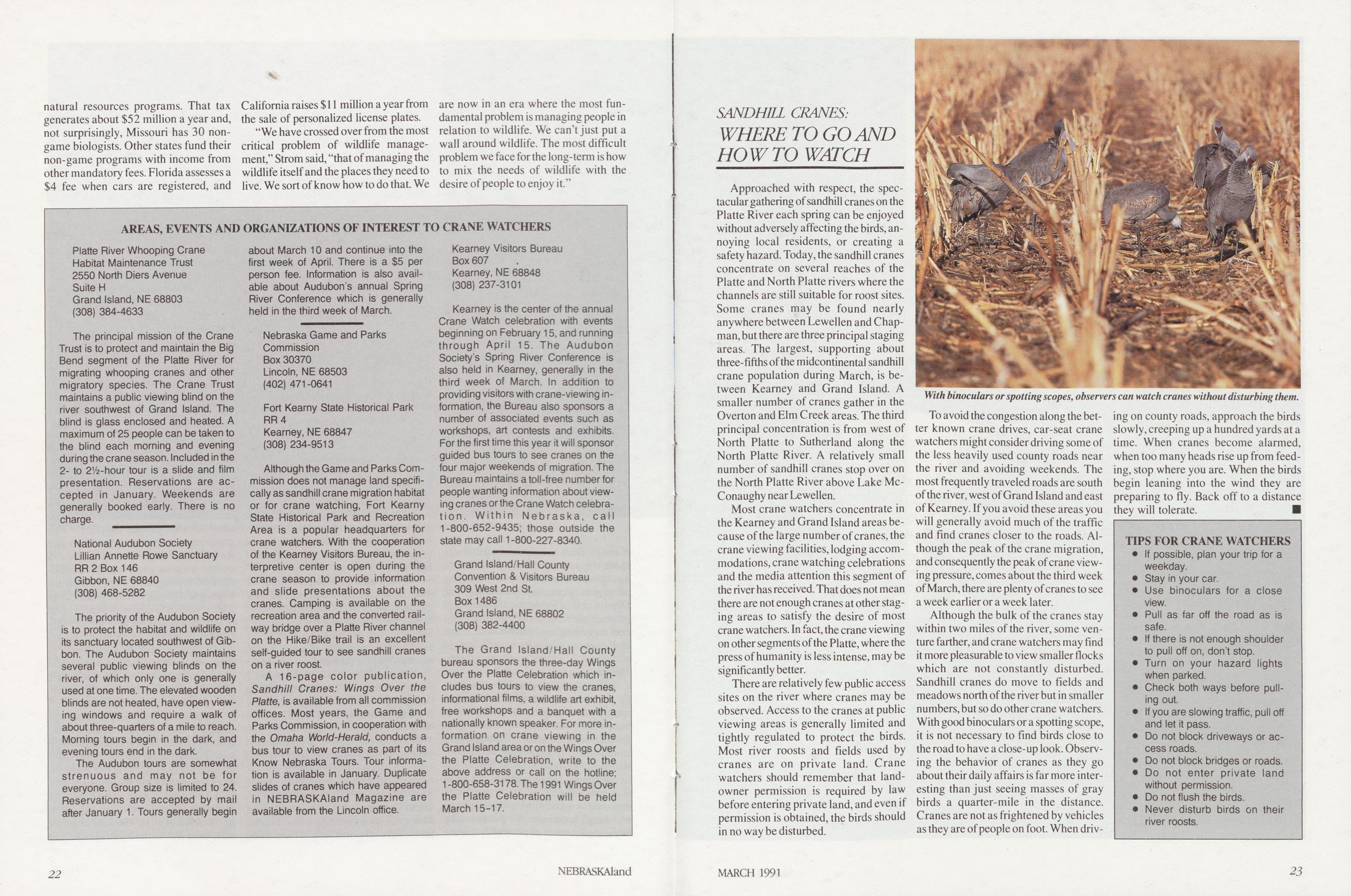
Although the bulk of the cranes stay within two miles of the river, some venture farther, and crane watchers may find it more pleasurable to view smaller flocks which are not constantly disturbed. Sandhill cranes do move to fields and meadows north of the river but in smaller numbers, but so do other crane watchers. With good binoculars or a spotting scope, it is not necessary to find birds close to the road to have a close-up look. Observing the behavior of cranes as they go about their daily affairs is far more interesting than just seeing masses of gray birds a quarter-mile in the distance. Cranes are not as frightened by vehicles as they are of people on foot. When driving on county roads, approach the birds slowly, creeping up a hundred yards at a time. When cranes become alarmed, when too many heads rise up from feeding, stop where you are. When the birds begin leaning into the wind they are preparing to fly. Back off to a distance they will tolerate.
TIPS FOR CRANE WATCHERS• If possible, plan your trip for a weekday.
• Stay In your car.
• Use binoculars for a close view.
• Pull as far off the road as is safe.
• If there is not enough shoulder to pull off on, don't stop.
• Turn on your hazard lights when parked.
• Check both ways before pulling out.
• If you are slowing traffic, pull off and let it pass.
• Do not block driveways or access roads.
• Do not block bridges or roads.
• Do not enter private land without permission.
• Do not flush the birds.
• Never disturb birds on their river roosts.
MARCH 1991 23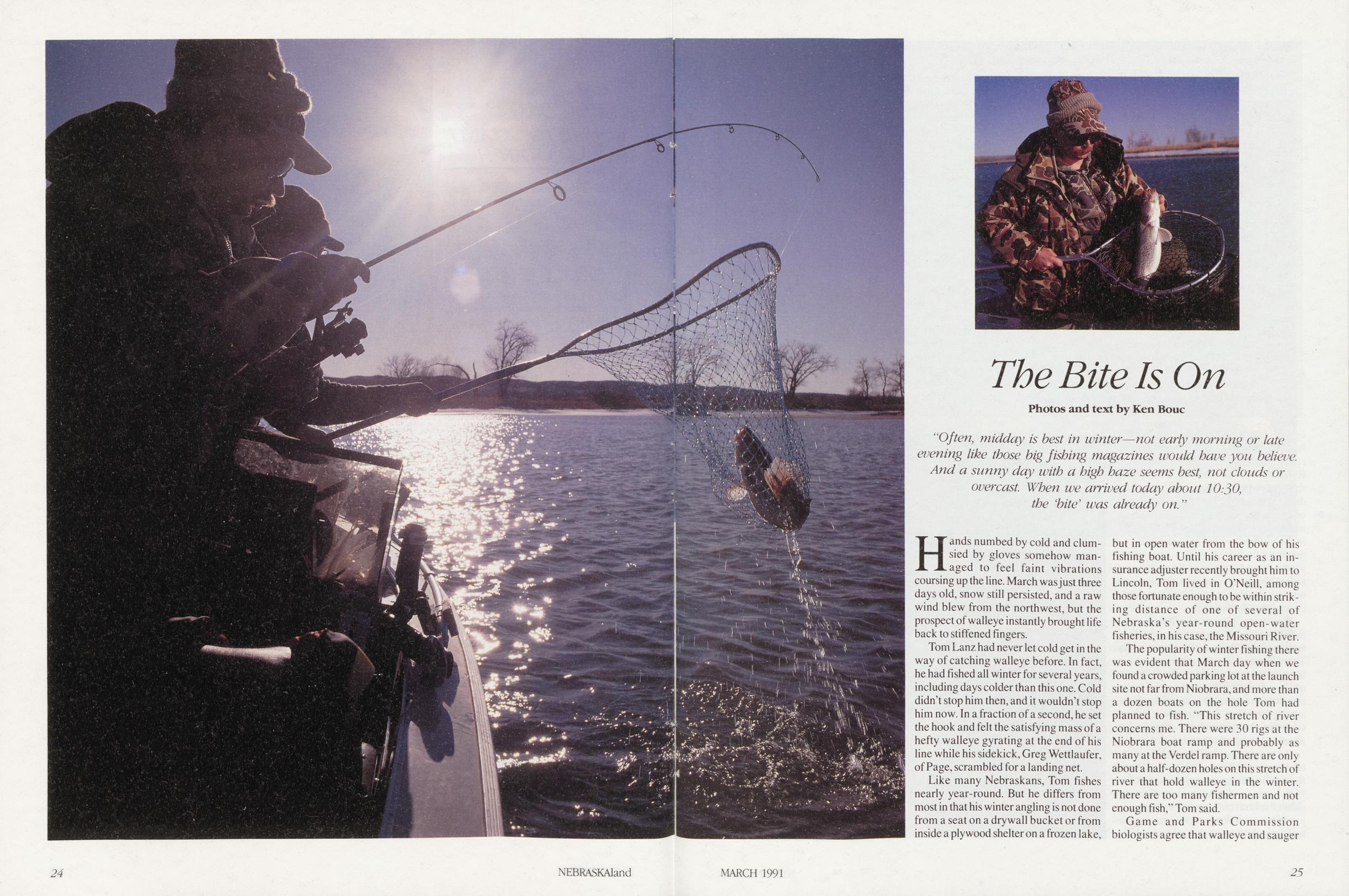
The Bite Is On
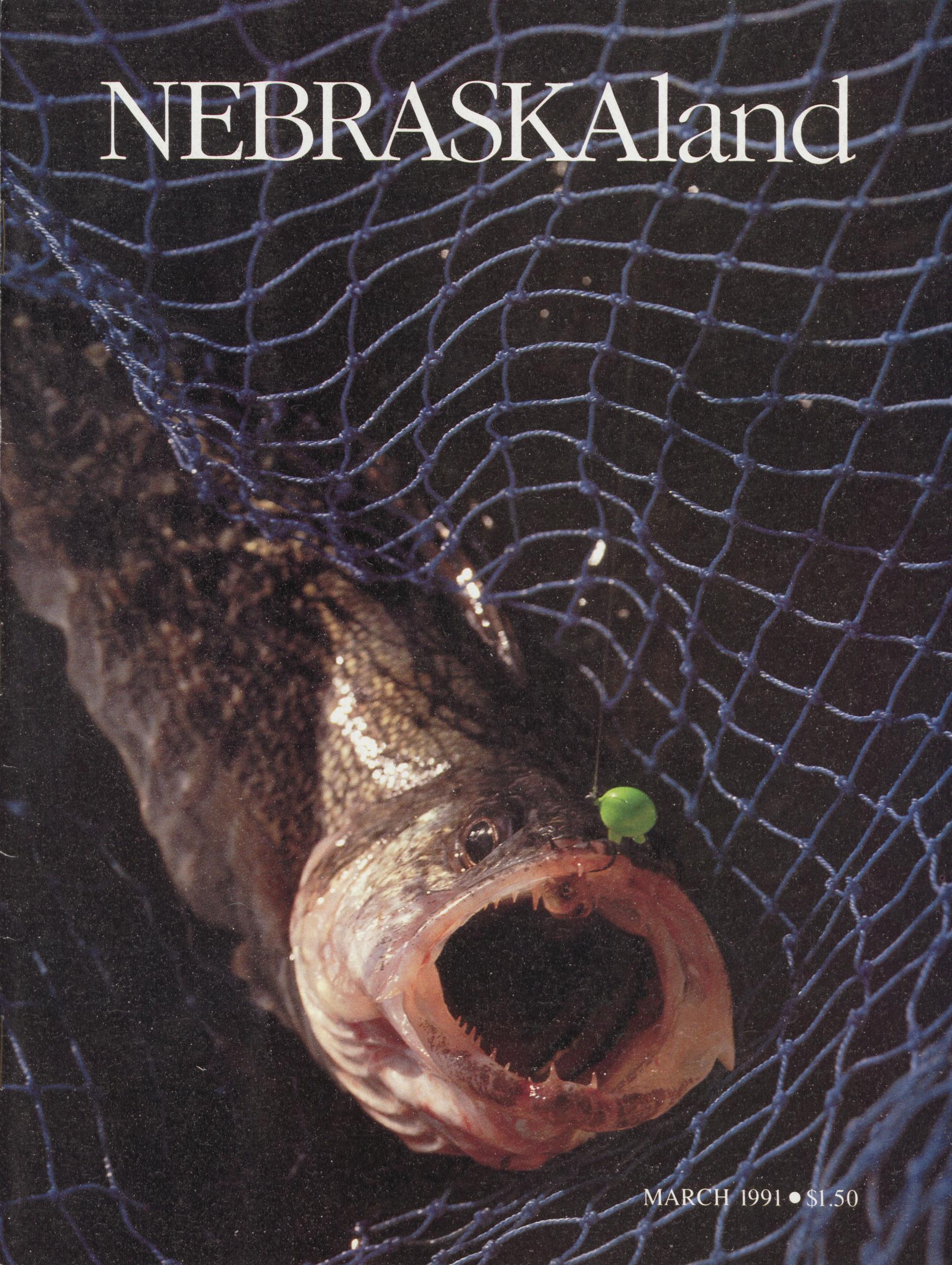
Photos and text by Ken Bouc "Often, midday is best in winter—not early morning or late evening like those big fishing magazines would have you believe. And a sunny day with a high haze seems best, not clouds or overcast. When we arrived today about 10:30, the 'bite' was already on."Hands numbed by cold and clumsied by gloves somehow managed to feel faint vibrations coursing up the line. March was just three days old, snow still persisted, and a raw wind blew from the northwest, but the prospect of walleye instantly brought life back to stiffened fingers.
Tom Lanz had never let cold get in the way of catching walleye before. In fact, he had fished all winter for several years, including days colder than this one. Cold didn't stop him then, and it wouldn't stop him now. In a fraction of a second, he set the hook and felt the satisfying mass of a hefty walleye gyrating at the end of his line while his sidekick, Greg Wettlaufer, of Page, scrambled for a landing net.
Like many Nebraskans, Tom fishes nearly year-round. But he differs from most in that his winter angling is not done from a seat on a dry wall bucket or from inside a plywood shelter on a frozen lake, but in open water from the bow of his fishing boat. Until his career as an insurance adjuster recently brought him to Lincoln, Tom lived in O'Neill, among those fortunate enough to be within striking distance of one of several of Nebraska's year-round open-water fisheries, in his case, the Missouri River.
The popularity of winter fishing there was evident that March day when we found a crowded parking lot at the launch site not far from Niobrara, and more than a dozen boats on the hole Tom had planned to fish. 'This stretch of river concerns me. There were 30 rigs at the Niobrara boat ramp and probably as many at the Verdel ramp. There are only about a half-dozen holes on this stretch of river that hold walleye in the winter. There are too many fishermen and not enough fish," Tom said.
Game and Parks Commission biologists agree that walleye and sauger in the stretch of river above Niobrara have been particularly vulnerable in recent years because releases from Fort Randall Dam have been less than one-third of normal. Despite a five-year drought in the Missouri Basin, the Corps of Engineers has been maintaining normal summer flows to support navigation in the lower Missouri, then attempting to refill reservoirs after the navigation season by reducing river flows. If more normal flows were maintained, the river's walleye and sauger would not be so concentrated and vulnerable.
MARCH 1991 25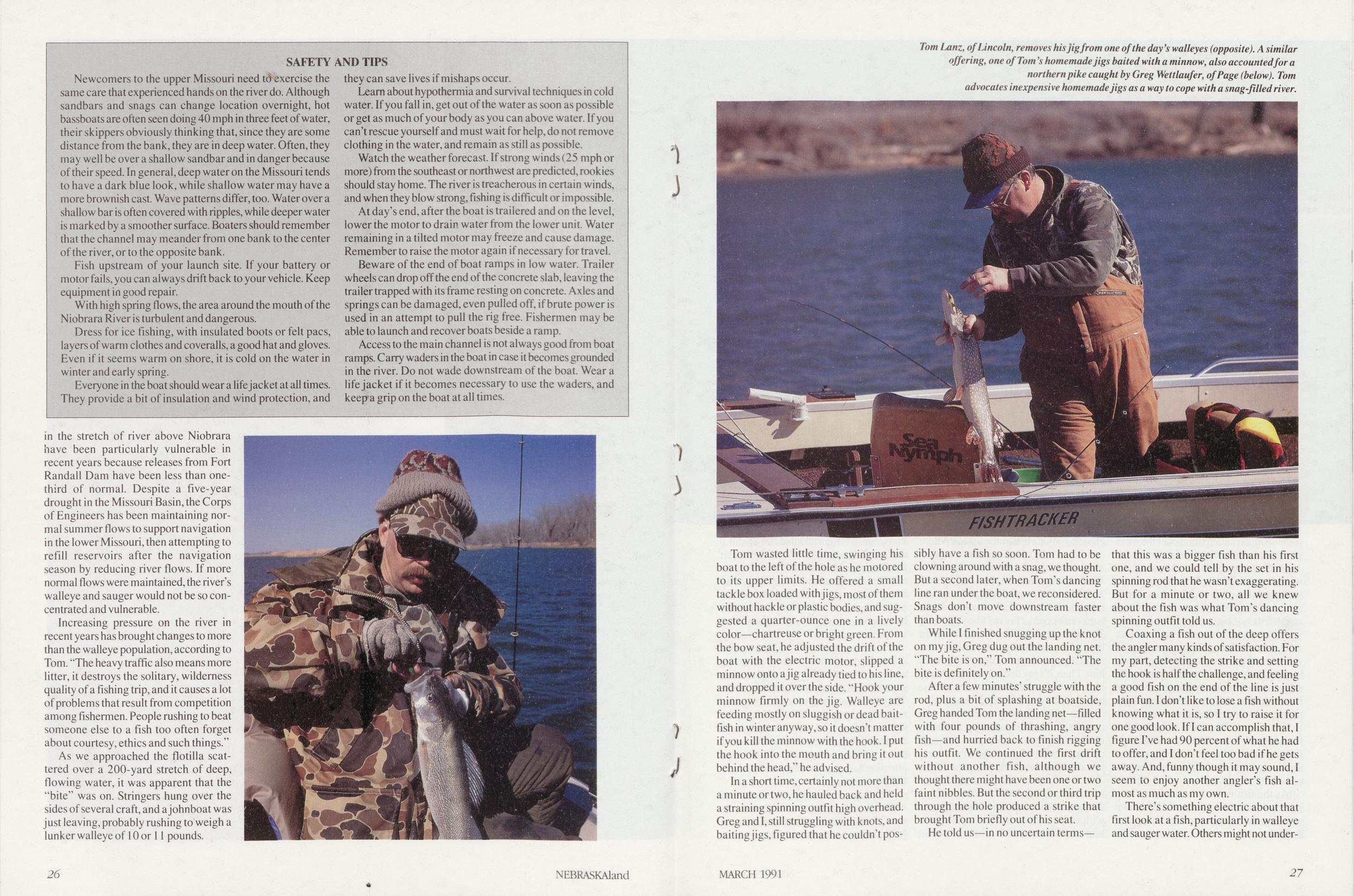 SAFETY AND TIPS
Newcomers to the upper Missouri need td exercise the same care that experienced hands on the river do. Although sandbars and snags can change location overnight, hot bass boats are often seen doing 40 mph in three feet of water, their skippers obviously thinking that, since they are some distance from the bank, they are in deep water. Often, they may well be over a shallow sandbar and in danger because of their speed. In general, deep water on the Missouri tends to have a dark blue look, while shallow water may have a more brownish cast. Wave patterns differ, too. Water over a shallow bar is often covered with ripples, while deeper water is marked by a smoother surface. Boaters should remember that the channel may meander from one bank to the center of the river, or to the opposite bank.
Fish upstream of your launch site. If your battery or motor fails, you can always drift back to your vehicle. Keep equipment in good repair.
With high spring flows, the area around the mouth of the Niobrara River is turbulent and dangerous.
Dress for ice fishing, with insulated boots or felt pacs, layers of warm clothes and coveralls, a good hat and gloves. Even if it seems warm on shore, it is cold on the water in winter and early spring.
Everyone in the boat should wear a life jacket at all times. They provide a bit of insulation and wind protection, and they can save lives if mishaps occur.Learn about hypothermia and survival techniques in cold water. If you fall in, get out of the water as soon as possible or get as much of your body as you can above water. If you can't rescue yourself and must wait for help, do not remove clothing in the water, and remain as still as possible.
Watch the weather forecast. If strong winds (25 mph or more) from the southeast or northwest are predicted, rookies should stay home. The river is treacherous in certain winds, and when they blow strong, fishing is difficult or impossible.
At day's end, after the boat is trailered and on the level, lower the motor to drain water from the lower unit. Water remaining in a tilted motor may freeze and cause damage. Remember to raise the motor again if necessary for travel.
Beware of the end of boat ramps in low water. Trailer wheels can drop off the end of the concrete slab, leaving the trailer trapped with its frame resting on concrete. Axles and springs can be damaged, even pulled off, if brute power is used in an attempt to pull the rig free. Fishermen may be able to launch and recover boats beside a ramp.
Access to the main channel is not always good from boat ramps. Carry waders in the boat in case it becomes grounded in the river. Do not wade downstream of the boat. Wear a life jacket if it becomes necessary to use the waders, and keep a grip on the boat at all times.
Increasing pressure on the river in recent years has brought changes to more than the walleye population, according to Tom. "The heavy traffic also means more litter, it destroys the solitary, wilderness quality of a fishing trip, and it causes a lot of problems that result from competition among fishermen. People rushing to beat someone else to a fish too often forget about courtesy, ethics and such things."
As we approached the flotilla scattered over a 200-yard stretch of deep, flowing water, it was apparent that the "bite" was on. Stringers hung over the sides of several craft, and a johnboat was just leaving, probably rushing to weigh a lunker walleye of 10 or 11 pounds.
Tom wasted little time, swinging his boat to the left of the hole as he motored to its upper limits. He offered a small tackle box loaded with jigs, most of them without hackle or plastic bodies, and suggested a quarter-ounce one in a lively color—chartreuse or bright green. From the bow seat, he adjusted the drift of the boat with the electric motor, slipped a minnow onto a jig already tied to his line, and dropped it over the side. "Hook your minnow firmly on the jig. Walleye are feeding mostly on sluggish or dead bait fish in winter anyway, so it doesn't matter if you kill the minnow with the hook. I put the hook into the mouth and bring it out behind the head," he advised.
In a short time, certainly not more than a minute or two, he hauled back and held a straining spinning outfit high overhead. Greg and I, still struggling with knots, and baiting jigs, figured that he couldn't possibly have a fish so soon. Tom had to be clowning around with a snag, we thought. But a second later, when Tom's dancing line ran under the boat, we reconsidered. Snags don't move downstream faster than boats.
While I finished snugging up the knot on my jig, Greg dug out the landing net. "The bite is on," Tom announced. "The bite is definitely on."
After a few minutes' struggle with the rod, plus a bit of splashing at boat side, Greg handed Tom the landing net—filled with four pounds of thrashing, angry fish—and hurried back to finish rigging his outfit. We continued the first drift without another fish, although we thought there might have been one or two faint nibbles. But the second or third trip through the hole produced a strike that brought Tom briefly out of his seat.
He told us—in no uncertain terms—that this was a bigger fish than his first one, and we could tell by the set in his spinning rod that he wasn't exaggerating. But for a minute or two, all we knew about the fish was what Tom's dancing spinning outfit told us.
Coaxing a fish out of the deep offers the angler many kinds of satisfaction. For my part, detecting the strike and setting the hook is half the challenge, and feeling a good fish on the end of the line is just plain fun. I don't like to lose a fish without knowing what it is, so I try to raise it for one good look. If I can accomplish that, I figure I've had 90 percent of what he had to offer, and I don't feel too bad if he gets away. And, funny though it may sound, I seem to enjoy another angler's fish almost as much as my own.
There's something electric about that
first look at a fish, particularly in walleye
and sauger water. Others might not understand
MARCH 1991
27
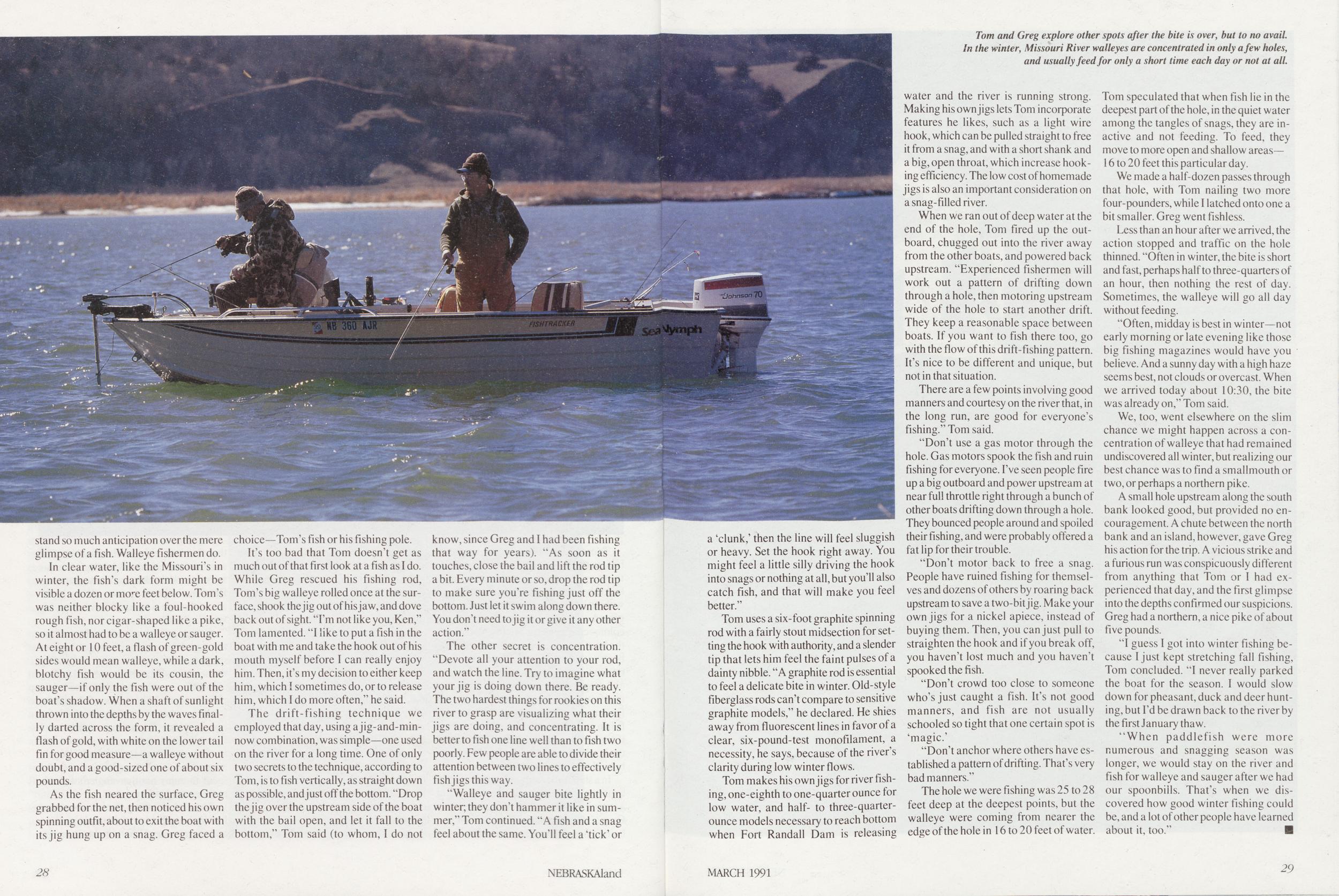
In clear water, like the Missouri's in winter, the fish's dark form might be visible a dozen or more feet below. Tom's was neither blocky like a foul-hooked rough fish, nor cigar-shaped like a pike, so it almost had to be a walleye or sauger. At eight or 10 feet, a flash of green-gold sides would mean walleye, while a dark, blotchy fish would be its cousin, the sauger—if only the fish were out of the boat's shadow. When a shaft of sunlight thrown into the depths by the waves finally darted across the form, it revealed a flash of gold, with white on the lower tail fin for good measure—a walleye without doubt, and a good-sized one of about six pounds.
As the fish neared the surface, Greg grabbed for the net, then noticed his own spinning outfit, about to exit the boat with its jig hung up on a snag. Greg faced a choice—Tom's fish or his fishing pole.
It's too bad that Tom doesn't get as much out of that first look at a fish as I do. While Greg rescued his fishing rod, Tom's big walleye rolled once at the surface, shook the jig out of his jaw, and dove back out of sight. "I'm not like you, Ken," Tom lamented. "I like to put a fish in the boat with me and take the hook out of his mouth myself before I can really enjoy him. Then, it's my decision to either keep him, which I sometimes do, or to release him, which I do more often," he said.
The drift-fishing technique we employed that day, using a jig-and-minnow combination, was simple—one used on the river for a long time. One of only two secrets to the technique, according to Tom, is to fish vertically, as straight down as possible, and just off the bottom. "Drop the jig over the upstream side of the boat with the bail open, and let it fall to the bottom," Tom said (to whom, I do not know, since Greg and I had been fishing that way for years). "As soon as it touches, close the bail and lift the rod tip a bit. Every minute or so, drop the rod tip to make sure you're fishing just off the bottom. Just let it swim along down there. You don't need tojig it or give it any other action."
The other secret is concentration. "Devote all your attention to your rod, and watch the line. Try to imagine what your jig is doing down there. Be ready. The two hardest things for rookies on this river to grasp are visualizing what their jigs are doing, and concentrating. It is better to fish one line well than to fish two poorly. Few people are able to divide their attention between two lines to effectively fish jigs this way.
"Walleye and sauger bite lightly in winter; they don't hammer it like in summer," Tom continued. "A fish and a snag feel about the same. You'll feel a 'tick' or 28 NEBRASKAland a 'clunk,' then the line will feel sluggish or heavy. Set the hook right away. You might feel a little silly driving the hook into snags or nothing at all, but you'll also catch fish, and that will make you feel better."
Tom uses a six-foot graphite spinning rod with a fairly stout midsection for setting the hook with authority, and a slender tip that lets him feel the faint pulses of a dainty nibble. "A graphite rod is essential to feel a delicate bite in winter. Old-style fiberglass rods can't compare to sensitive graphite models," he declared. He shies away from fluorescent lines in favor of a clear, six-pound-test monofilament, a necessity, he says, because of the river s clarity during low winter flows.
Tom makes his own jigs for river fishing, one-eighth to one-quarter ounce for low water, and half- to three-quarter-ounce models necessary to reach bottom when Fort Randall Dam is releasing water and the river is running strong. Making his own jigs lets Tom incorporate features he likes, such as a light wire hook, which can be pulled straight to free it from a snag, and with a short shank and a big, open throat, which increase hooking efficiency. The low cost of homemade jigs is also an important consideration on a snag-filled river.
When we ran out of deep water at the end of the hole, Tom fired up the outboard, chugged out into the river away from the other boats, and powered back upstream. "Experienced fishermen will work out a pattern of drifting down through a hole, then motoring upstream wide of the hole to start another drift. They keep a reasonable space between boats. If you want to fish there too, go with the flow of this drift-fishing pattern. It's nice to be different and unique, but not in that situation.
There are a few points involving good manners and courtesy on the river that, in the long run, are good for everyone's fishing." Tom said.
"Don't use a gas motor through the hole. Gas motors spook the fish and ruin fishing for everyone. I've seen people fire up a big outboard and power upstream at near full throttle right through a bunch of other boats drifting down through a hole. They bounced people around and spoiled their fishing, and were probably offered a fat lip for their trouble.
"Don't motor back to free a snag. People have ruined fishing for themselves and dozens of others by roaring back upstream to save a two-bit jig. Make your own jigs for a nickel apiece, instead of buying them. Then, you can just pull to straighten the hook and if you break off, you haven't lost much and you haven't spooked the fish.
"Don't crowd too close to someone who's just caught a fish. It's not good manners, and fish are not usually schooled so tight that one certain spot is 'magic'
"Don't anchor where others have established a pattern of drifting. That's very bad manners,"
The hole we were fishing was 25 to 28 feet deep at the deepest points, but the walleye were coming from nearer the edge of the hole in 16 to 20 feet of water. Tom speculated that when fish lie in the deepest part of the hole, in the quiet water among the tangles of snags, they are inactive and not feeding. To feed, they move to more open and shallow areas 16 to 20 feet this particular day.
We made a half-dozen passes through that hole, with Tom nailing two more four-pounders, while I latched onto one a bit smaller. Greg went Ashless.
Less than an hour after we arrived, the action stopped and traffic on the hole thinned. "Often in winter, the bite is short and fast, perhaps half to three-quarters of an hour, then nothing the rest of day. Sometimes, the walleye will go all day without feeding.
"Often, midday is best in winter—not early morning or late evening like those big fishing magazines would have you believe. And a sunny day with a high haze seems best, not clouds or overcast. When we arrived today about 10:30, the bite was already on," Tom said.
We, too, went elsewhere on the slim chance we might happen across a concentration of walleye that had remained undiscovered all winter, but realizing our best chance was to find a smallmouth or two, or perhaps a northern pike.
A small hole upstream along the south bank looked good, but provided no encouragement. A chute between the north bank and an island, however, gave Greg his action for the trip. A vicious strike and a furious run was conspicuously different from anything that Tom or I had experienced that day, and the first glimpse into the depths confirmed our suspicions. Greg had a northern, a nice pike of about five pounds.
"I guess I got into winter fishing because I just kept stretching fall fishing, Tom concluded. "I never really parked the boat for the season. I would slow down for pheasant, duck and deer hunting, but I'd be drawn back to the river by the first January thaw.
'When paddlefish were more numerous and snagging season was longer, we would stay on the river and fish for walleye and sauger after we had our spoonbills. That's when we dis- covered how good winter fishing could be, and a lot of other people have learned about it, too."
MARCH 1991 29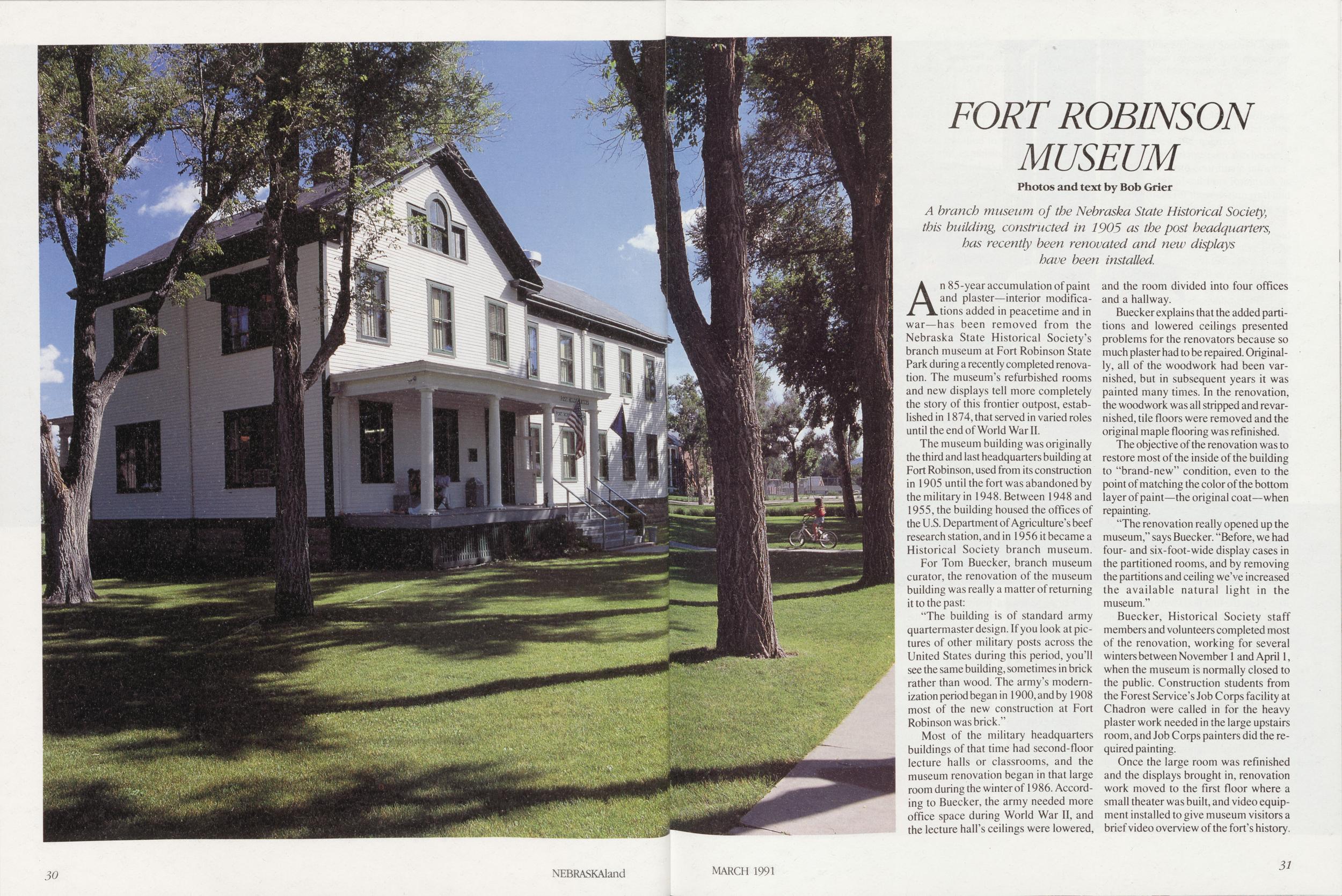
FORT ROBINSON MUSEUM
Photos and text by Bob Grier A branch museum of the Nebraska State Historical Society, this building, constructed in 1905 as the post headquarters, has recently been renovated and new displays have been installed.An 85-year accumulation of paint and plaster—interior modifications added in peacetime and in war—has been removed from the Nebraska State Historical Society's branch museum at Fort Robinson State Park during a recently completed renovation. The museum's refurbished rooms and new displays tell more completely the story of this frontier outpost, established in 1874, that served in varied roles until the end of World War II.
The museum building was originally the third and last headquarters building at Fort Robinson, used from its construction in 1905 until the fort was abandoned by the military in 1948. Between 1948 and 1955, the building housed the offices of the U.S. Department of Agriculture's beef research station, and in 1956 it became a Historical Society branch museum.
For Tom Buecker, branch museum curator, the renovation of the museum building was really a matter of returning it to the past:
"The building is of standard army quartermaster design. If you look at pictures of other military posts across the United States during this period, you'll see the same building, sometimes in brick rather than wood. The army's modernization period began in 1900, and by 1908 most of the new construction at Fort Robinson was brick."
Most of the military headquarters buildings of that time had second-floor lecture halls or classrooms, and the museum renovation began in that large room during the winter of 1986. According to Buecker, the army needed more office space during World War II, and the lecture hall's ceilings were lowered, and the room divided into four offices and a hallway.
Buecker explains that the added partitions and lowered ceilings presented problems for the renovators because so much plaster had to be repaired. Originally, all of the woodwork had been varnished, but in subsequent years it was painted many times. In the renovation, the woodwork was all stripped and revannished, tile floors were removed and the original maple flooring was refinished.
The objective of the renovation was to restore most of the inside of the building to "brand-new" condition, even to the point of matching the color of the bottom layer of paint—the original coat—when repainting.
"The renovation really opened up the museum," says Buecker. "Before, we had four- and six-foot-wide display cases in the partitioned rooms, and by removing the partitions and ceiling we've increased the available natural light in the museum."
Buecker, Historical Society staff members and volunteers completed most of the renovation, working for several winters between November 1 and April 1, when the museum is normally closed to the public. Construction students from the Forest Service's Job Corps facility at Chadron were called in for the heavy plaster work needed in the large upstairs room, and Job Corps painters did the required painting.
Once the large room was refinished
and the displays brought in, renovation
work moved to the first floor where a
small theater was built, and video
equipment installed to give museum visitors a
brief video overview of the fort's history.
MARCH 1991
31
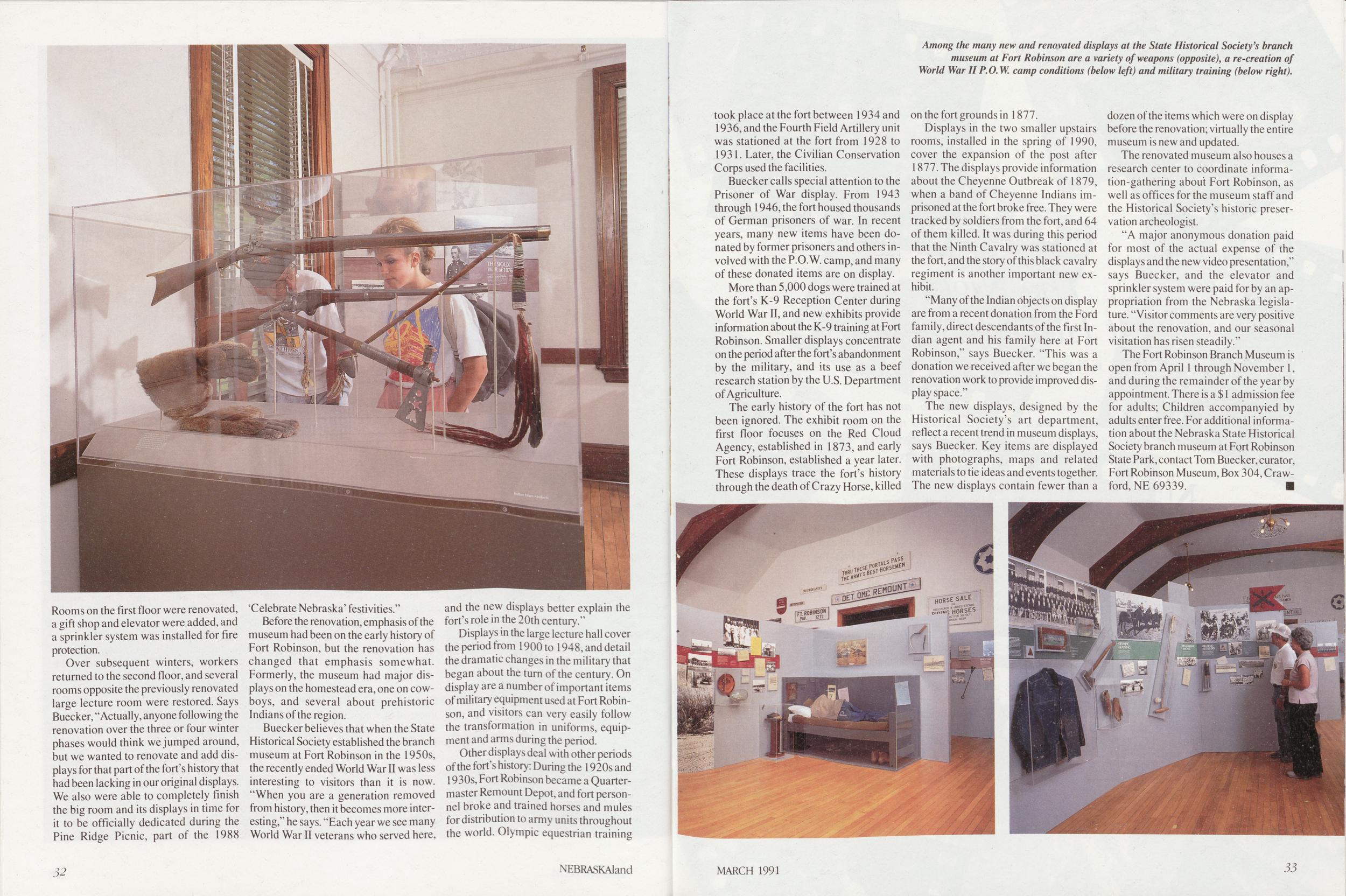
Over subsequent winters, workers returned to the second floor, and several rooms opposite the previously renovated large lecture room were restored. Says Buecker, "Actually, anyone following the renovation over the three or four winter phases would think we jumped around, but we wanted to renovate and add displays for that part of the fort's history that had been lacking in our original displays. We also were able to completely finish the big room and its displays in time for it to be officially dedicated during the Pine Ridge Picnic, part of the 1988 'Celebrate Nebraska' festivities."
Before the renovation, emphasis of the museum had been on the early history of Fort Robinson, but the renovation has changed that emphasis somewhat. Formerly, the museum had major displays on the homestead era, one on cowboys, and several about prehistoric Indians of the region.
Buecker believes that when the State Historical Society established the branch museum at Fort Robinson in the 1950s, the recently ended World War II was less interesting to visitors than it is now. "When you are a generation removed from history, then it becomes more interesting," he says. "Each year we see many World War II veterans who served here, and the new displays better explain the fort's role in the 20th century."
Displays in the large lecture hall cover the period from 1900 to 1948, and detail the dramatic changes in the military that began about the turn of the century. On display are a number of important items of military equipment used at Fort Robinson, and visitors can very easily follow the transformation in uniforms, equipment and arms during the period.
Other displays deal with other periods of the fort's history: During the 1920s and 1930s, Fort Robinson became a Quartermaster Remount Depot, and fort personnel broke and trained horses and mules for distribution to army units throughout the world. Olympic equestrian training 32 NEBRASKAland took place at the fort between 1934 and 1936, and the Fourth Field Artillery unit was stationed at the fort from 1928 to 1931. Later, the Civilian Conservation Corps used the facilities.
Buecker calls special attention to the Prisoner of War display. From 1943 through 1946, the fort housed thousands of German prisoners of war. In recent years, many new items have been donated by former prisoners and others involved with the P.O.W. camp, and many of these donated items are on display.
More than 5,000 dogs were trained at the fort's K-9 Reception Center during World War II, and new exhibits provide information about the K-9 training at Fort Robinson. Smaller displays concentrate on the period after the fort's abandonment by the military, and its use as a beef research station by the U.S. Department of Agriculture.
The early history of the fort has not been ignored. The exhibit room on the first floor focuses on the Red Cloud Agency, established in 1873, and early Fort Robinson, established a year later. These displays trace the fort's history through the death of Crazy Horse, killed on the fort grounds in 1877.
Displays in the two smaller upstairs rooms, installed in the spring of 1990, cover the expansion of the post after 1877. The displays provide information about the Cheyenne Outbreak of 1879, when a band of Cheyenne Indians imprisoned at the fort broke free. They were tracked by soldiers from the fort, and 64 of them killed. It was during this period that the Ninth Cavalry was stationed at the fort, and the story of this black cavalry regiment is another important new exhibit.
"Many of the Indian objects on display are from a recent donation from the Ford family, direct descendants of the first Indian agent and his family here at Fort Robinson," says Buecker. "This was a donation we received after we began the renovation work to provide improved display space."
The new displays, designed by the Historical Society's art department, reflect a recent trend in museum displays, says Buecker. Key items are displayed with photographs, maps and related materials to tie ideas and events together. The new displays contain fewer than a dozen of the items which were on display before the renovation; virtually the entire museum is new and updated.
The renovated museum also houses a research center to coordinate information-gathering about Fort Robinson, as well as offices for the museum staff and the Historical Society's historic preservation archeologist.
"A major anonymous donation paid for most of the actual expense of the displays and the new video presentation," says Buecker, and the elevator and sprinkler system were paid for by an appropriation from the Nebraska legislature. "Visitor comments are very positive about the renovation, and our seasonal visitation has risen steadily."
The Fort Robinson Branch Museum is open from April 1 through November 1, and during the remainder of the year by appointment. There is a $ 1 admission fee for adults; Children accompanied by adults enter free. For additional information about the Nebraska State Historical Society branch museum at Fort Robinson State Park, contact Tom Buecker, curator, Fort Robinson Museum, Box 304, Crawford, NE 69339.
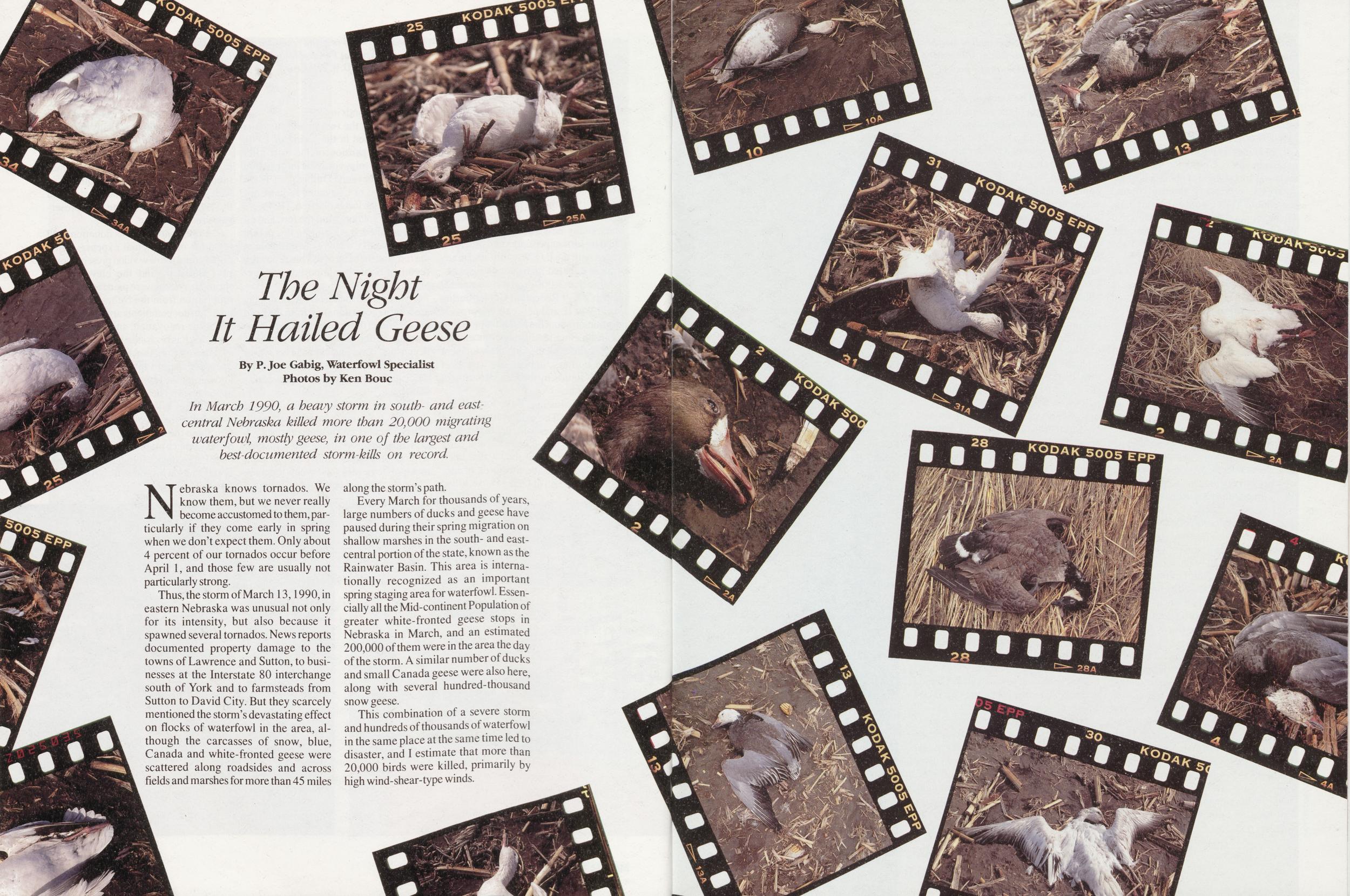
The Night It Hailed Geese
By P.Joe Gabig, Waterfowl Specialist Photos by Ken Bouc In March 1990, a heavy storm in south- and eastcentral Nebraska killed more than 20,000 migrating waterfowl, mostly geese, in one of the largest and best-documented storm-kills on record.Nebraska knows tornados. We know them, but we never really become accustomed to them, particularly if they come early in spring when we don't expect them. Only about 4 percent of our tornados occur before April 1, and those few are usually not particularly strong.
Thus, the storm of March 13,1990, in eastern Nebraska was unusual not only for its intensity, but also because it spawned several tornados. News reports documented property damage to the towns of Lawrence and Sutton, to businesses at the Interstate 80 interchange south of York and to farmsteads from Sutton to David City. But they scarcely mentioned the storm's devastating effect on flocks of waterfowl in the area, although the carcasses of snow, blue, Canada and white-fronted geese were scattered along roadsides and across fields and marshes for more than 45 miles along the storm's path.
Every March for thousands of years, large numbers of ducks and geese have paused during their spring migration on shallow marshes in the south- and eastcentral portion of the state, known as the Rainwater Basin. This area is internationally recognized as an important spring staging area for waterfowl. Essencially all the Mid-continent Population of greater white-fronted geese stops in Nebraska in March, and an estimated 200,000 of them were in the area the day of the storm. A similar number of ducks and small Canada geese were also here, along with several hundred-thousand snow geese.
This combination of a severe storm and hundreds of thousands of waterfowl in the same place at the same time led to disaster, and I estimate that more than 20,000 birds were killed, primarily by high wind-shear-type winds.
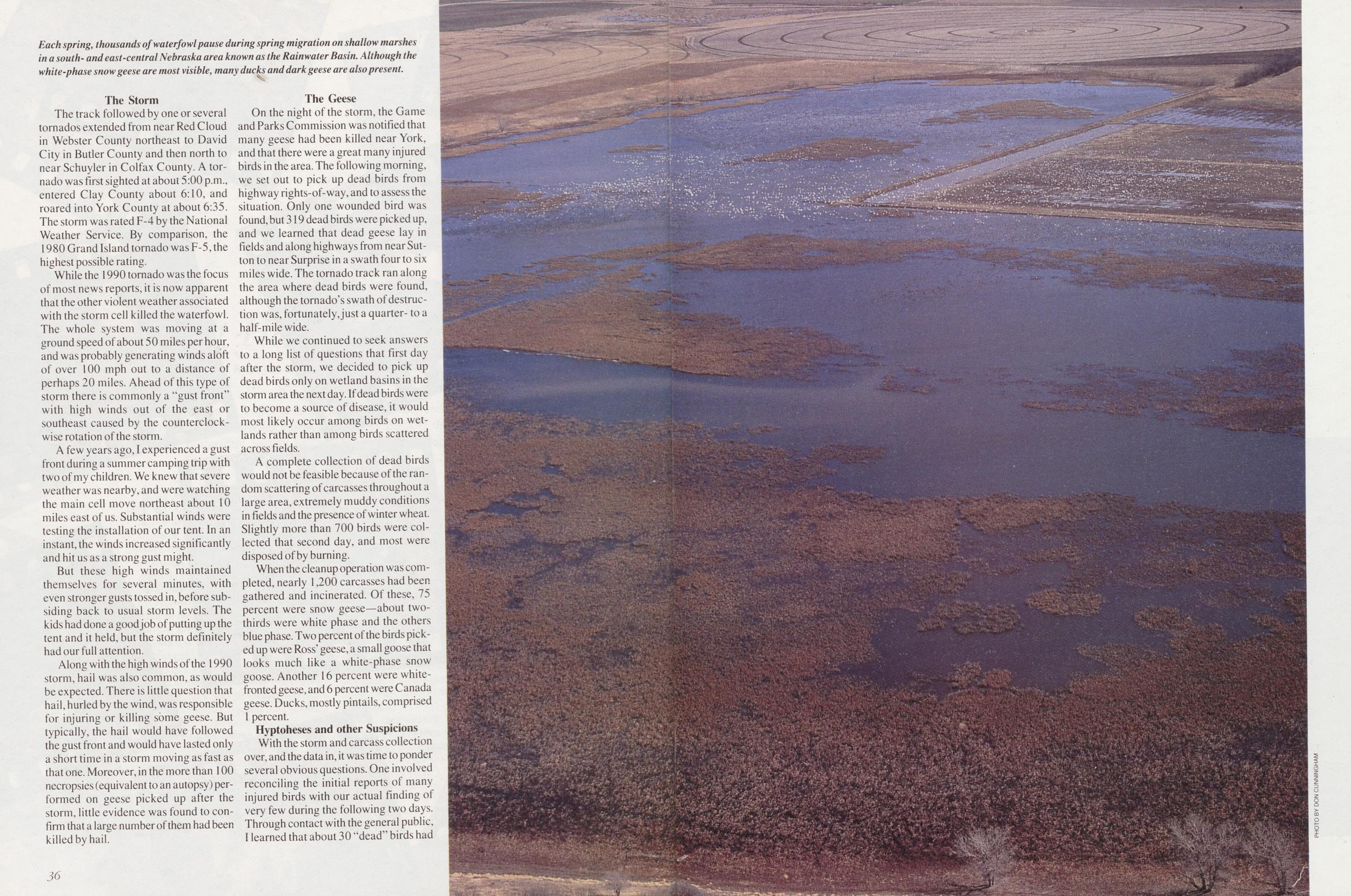
The track followed by one or several tornados extended from near Red Cloud in Webster County northeast to David City in Butler County and then north to near Schuyler in Colfax County. A tornado was first sighted at about 5:00 p.m., entered Clay County about 6:10, and roared into York County at about 6:35. The storm was rated F-4 by the National Weather Service. By comparison, the 1980 Grand Island tornado was F-5, the highest possible rating.
While the 1990 tornado was the focus of most news reports, it is now apparent that the other violent weather associated with the storm cell killed the waterfowl. The whole system was moving at a ground speed of about 50 miles per hour, and was probably generating winds aloft of over 100 mph out to a distance of perhaps 20 miles. Ahead of this type of storm there is commonly a "gust front" with high winds out of the east or southeast caused by the counterclockwise rotation of the storm.
A few years ago, I experienced a gust front during a summer camping trip with two of my children. We knew that severe weather was nearby, and were watching the main cell move northeast about 10 miles east of us. Substantial winds were testing the installation of our tent. In an instant, the winds increased significantly and hit us as a strong gust might.
But these high winds maintained themselves for several minutes, with even stronger gusts tossed in, before subsiding back to usual storm levels. The kids had done a good job of putting up the tent and it held, but the storm definitely had our full attention.
Along with the high winds of the 1990 storm, hail was also common, as would be expected. There is little question that hail, hurled by the wind, was responsible for injuring or killing some geese. But typically, the hail would have followed the gust front and would have lasted only a short time in a storm moving as fast as that one. Moreover, in the more than 100 necropsies (equivalent to an autopsy) performed on geese picked up after the storm, little evidence was found to confirm that a large number of them had been killed by hail.
The GeeseOn the night of the storm, the Game and Parks Commission was notified that many geese had been killed near York, and that there were a great many injured birds in the area. The following morning, we set out to pick up dead birds from highway rights-of-way, and to assess the situation. Only one wounded bird was found, but 319 dead birds were picked up, and we learned that dead geese lay in fields and along highways from near Sutton to near Surprise in a swath four to six miles wide. The tornado track ran along the area where dead birds were found, although the tornado's swath of destruction was, fortunately, just a quarter- to a half-mile wide.
While we continued to seek answers to a long list of questions that first day after the storm, we decided to pick up dead birds only on wetland basins in the storm area the next day. If dead birds were to become a source of disease, it would most likely occur among birds on wetlands rather than among birds scattered across fields.
A complete collection of dead birds would not be feasible because of the random scattering of carcasses throughout a large area, extremely muddy conditions in fields and the presence of winter wheat. Slightly more than 700 birds were collected that second day, and most were disposed of by burning.
When the cleanup operation was completed, nearly 1,200 carcasses had been gathered and incinerated. Of these, 75 percent were snow geese—about two-thirds were white phase and the others blue phase. Two percent of the birds picked up were Ross' geese, a small goose that looks much like a white-phase snow goose. Another 16 percent were white-fronted geese, and 6 percent were Canada geese. Ducks, mostly pintails, comprised 1 percent.
Hypotheses and other SuspicionsWith the storm and carcass collection
over, and the data in, it was time to ponder
several obvious questions. One involved
reconciling the initial reports of many
injured birds with our actual finding of
very few during the following two days.
Through contact with the general public,
I learned that about 30 "dead" birds had
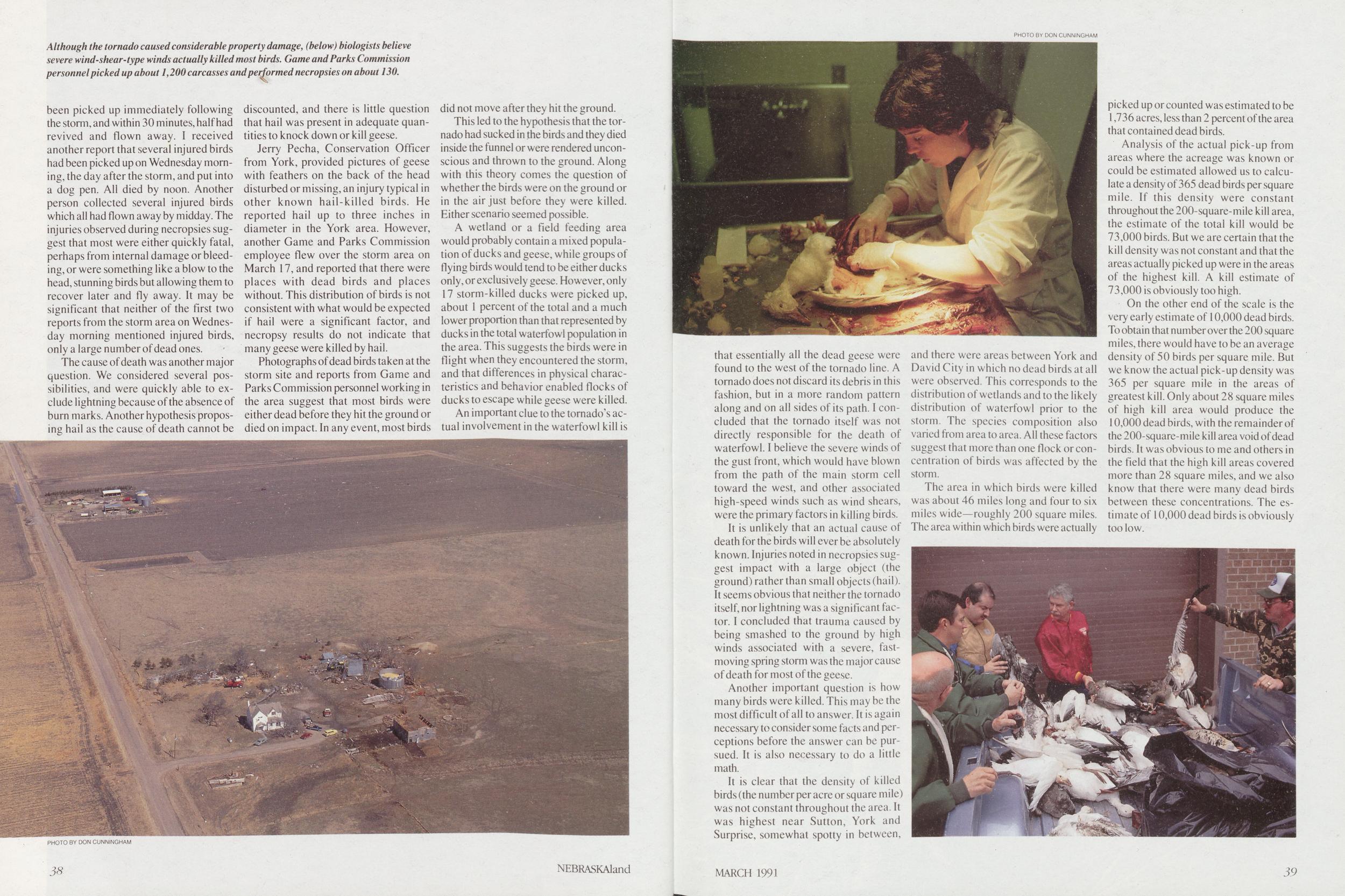
The cause of death was another major question. We considered several possibilities, and were quickly able to exclude lightning because of the absence of burn marks. Another hypothesis proposing hail as the cause of death cannot be discounted, and there is little question that hail was present in adequate quantities to knock down or kill geese.
Jerry Pecha, Conservation Officer from York, provided pictures of geese with feathers on the back of the head disturbed or missing, an injury typical in other known hail-killed birds. He reported hail up to three inches in diameter in the York area. However, another Game and Parks Commission employee flew over the storm area on March 17, and reported that there were places with dead birds and places without. This distribution of birds is not consistent with what would be expected if hail were a significant factor, and necropsy results do not indicate that many geese were killed by hail.
Photographs of dead birds taken at the storm site and reports from Game and Parks Commission personnel working in the area suggest that most birds were either dead before they hit the ground or died on impact. In any event, most birds did not move after they hit the ground.
This led to the hypothesis that the tornado had sucked in the birds and they died inside the funnel or were rendered unconscious and thrown to the ground. Along with this theory comes the question of whether the birds were on the ground or in the air just before they were killed. Either scenario seemed possible.
A wetland or a field feeding area would probably contain a mixed population of ducks and geese, while groups of flying birds would tend to be either ducks only, or exclusively geese. However, only 17 storm-killed ducks were picked up, about 1 percent of the total and a much lower proportion than that represented by ducks in the total waterfowl population in the area. This suggests the birds were in flight when they encountered the storm, and that differences in physical characteristics and behavior enabled flocks of ducks to escape while geese were killed.
An important clue to the tornado's actual involvement in the waterfowl kill is 38 NEBRASKAland
It is unlikely that an actual cause of death for the birds will ever be absolutely known. Injuries noted in necropsies suggest impact wiith a large object (the ground) rather than small objects (hail). It seems obvious that neither the tornado itself, nor lightning was a significant factor. I concluded that trauma caused by being smashed to the ground by high winds associated with a severe, fast moving spring storm was the major cause of death for most of the geese.
Another important question is how many birds were killed. This may be the most difficult of all to answer. It is again necessary to consider some facts and perceptions before the answer can be pursued. It is also necessary to do a little math.
It is clear that the density of killed birds (the number per acre or square mile) was not constant throughout the area. It was highest near Sutton, York and Surprise, somewhat spotty in between, and there were areas between York and David City in which no dead birds at all were observed. This corresponds to the distribution of wetlands and to the likely distribution of waterfowl prior to the storm. The species composition also varied from area to area. All these factors suggest that more than one flock or concentration of birds was affected by the storm.
The area in which birds were killed was about 46 miles long and four to six miles wide—roughly 200 square miles. The area within which birds were actually picked up or counted was estimated to be 1,736 acres, less than 2 percent of the area that contained dead birds.
Analysis of the actual pick-up from areas where the acreage was known or could be estimated allowed us to calculate a density of 365 dead birds per square mile. If this density were constant throughout the 200-square-mile kill area, the estimate of the total kill would be 73,000 birds. But we are certain that the kill density was not constant and that the areas actually picked up were in the areas of the highest kill. A kill estimate of 73,000 is obviously too high.
On the other end of the scale is the very early estimate of 10,000 dead birds. To obtain that number over the 200 square miles, there would have to be an average density of 50 birds per square mile. But we know the actual pick-up density was 365 per square mile in the areas of greatest kill. Only about 28 square miles of high kill area would produce the 10,000 dead birds, with the remainder of the 200-square-mile kill area void of dead birds. It was obvious to me and others in the field that the high kill areas covered more than 28 square miles, and we also know that there were many dead birds between these concentrations. The estimate of 10,000 dead birds is obviously too low.
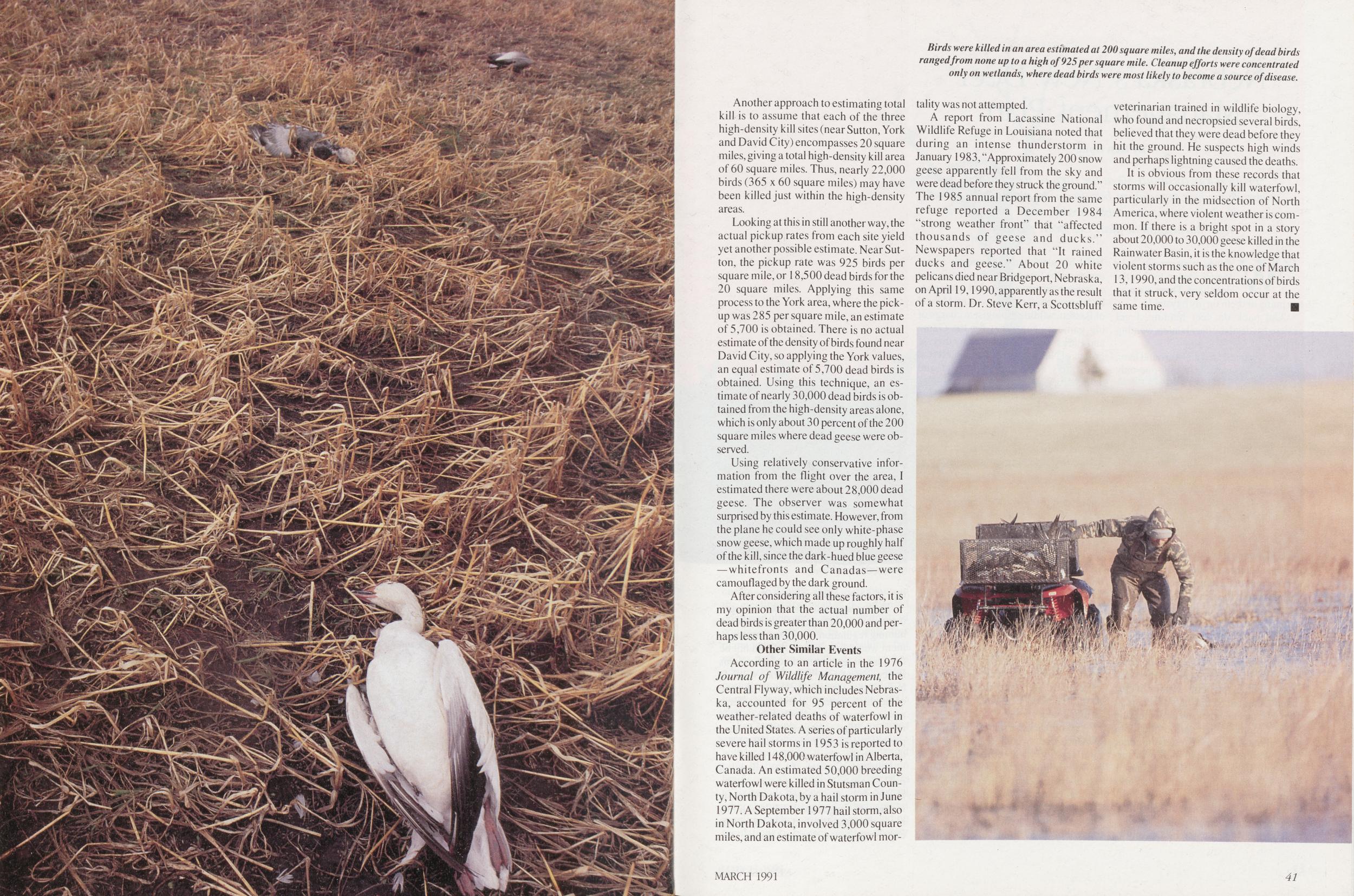
Another approach to estimating total kill is to assume that each of the three high-density kill sites (near Sutton, York and David City) encompasses 20 square miles, giving a total high-density kill area of 60 square miles. Thus, nearly 22,000 birds (365 x 60 square miles) may have been killed just within the high-density areas.
Looking at this in still another way, the actual pickup rates from each site yield yet another possible estimate. Near Sutton, the pickup rate was 925 birds per square mile, or 18,500 dead birds for the 20 square miles. Applying this same process to the York area, where the pickup was 285 per square mile, an estimate of 5,700 is obtained. There is no actual estimate of the density of birds found near David City, so applying the York values, an equal estimate of 5,700 dead birds is obtained. Using this technique, an estimate of nearly 30,000 dead birds is obtained from the high-density areas alone, which is only about 30 percent of the 200 square miles where dead geese were observed.
Using relatively conservative information from the flight over the area, I estimated there were about 28,000 dead geese. The observer was somewhat surprised by this estimate. However, from the plane he could see only white-phase snow geese, which made up roughly half of the kill, since the dark-hued blue geese —whitefronts and Canadas—were camouflaged by the dark ground.
After considering all these factors, it is my opinion that the actual number of dead birds is greater than 20,000 and perhaps less than 30,000.
Other Similar EventsAccording to an article in the 1976 Journal of Wildlife Management, the Central Fly way, which includes Nebraska, accounted for 95 percent of the weather-related deaths of waterfowl in the United States. A series of particularly severe hail storms in 1953 is reported to have killed 148,000 waterfowl in Alberta, Canada. An estimated 50,000 breeding waterfowl were killed in Stutsman County, North Dakota, by a hail storm in June 1977. A September 1977 hail storm, also in North Dakota, involved 3,000 square miles, and an estimate of waterfowl mortality was not attempted
A report from Lacassine National Wildlife Refuge in Louisiana noted that during an intense thunderstorm in January 1983, "Approximately 200 snow geese apparently fell from the sky and were dead before they struck the ground." The 1985 annual report from the same refuge reported a December 1984 "strong weather front" that "affected thousands of geese and ducks." Newspapers reported that "It rained ducks and geese." About 20 white pelicans died near Bridgeport, Nebraska, on April 19,1990, apparently as the result of a storm. Dr. Steve Kerr, a Scottsbluff veterinarian trained in wildlife biology, who found and necropsied several birds, believed that they were dead before they hit the ground. He suspects high winds and perhaps lightning caused the deaths.
It is obvious from these records that storms will occasionally kill waterfowl, particularly in the midsection of North America, where violent weather is common. If there is a bright spot in a story about 20,000 to 30,000 geese killed in the Rainwater Basin, it is the knowledge that violent storms such as the one of March 13,1990, and the concentrations of birds that it struck, very seldom occur at the same time.
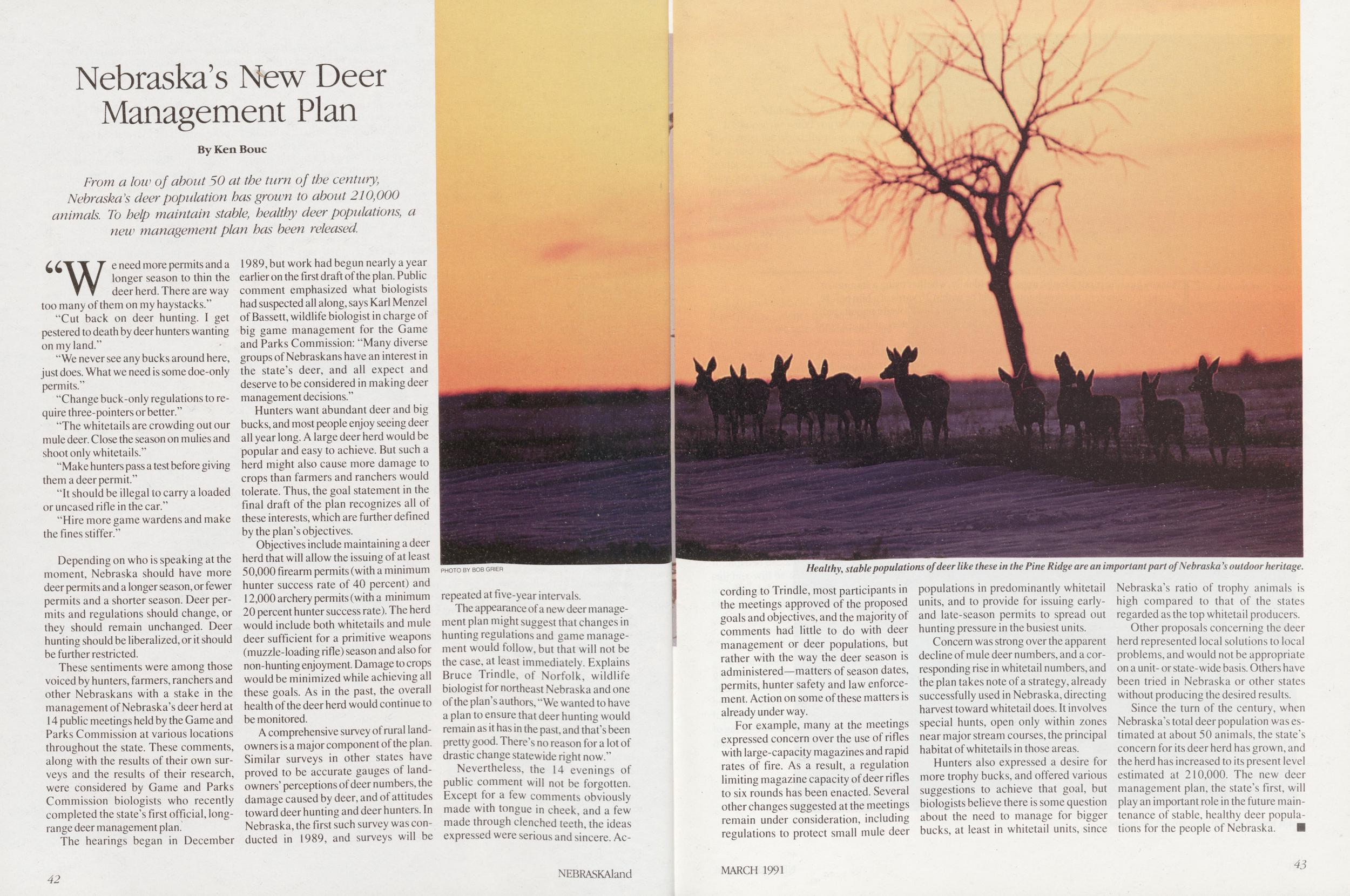
Nebraska's New Deer Management Plan
By Ken Bouc From a low of about 50 at the turn of the centry, Nebraska's deer population has grown to about 210,000 animals. To help maintain stable, healthy deer populations, a new management plan has been released."We need more permits and a longer season to thin the deer herd. There are way too many of them on my haystacks."
"Cut back on deer hunting. I get pestered to death by deer hunters wanting on my land."
"We never see any bucks around here, just does. What we need is some doe-only permits."
"Change buck-only regulations to require three-pointers or better."
The whitetails are crowding out our mule deer. Close the season on mulies and shoot only whitetails."
"Make hunters pass a test before giving them a deer permit."
"It should be illegal to carry a loaded or uncased rifle in the car."
"Hire more game wardens and make the fines stiffen"
Depending on who is speaking at the moment, Nebraska should have more deer permits and a longer season, or fewer permits and a shorter season. Deer permits and regulations should change, or they should remain unchanged. Deer hunting should be liberalized, or it should be further restricted.
These sentiments were among those voiced by hunters, farmers, ranchers and other Nebraskans with a stake in the management of Nebraska's deer herd at 14 public meetings held by the Game and Parks Commission at various locations throughout the state. These comments, along with the results of their own surveys and the results of their research, were considered by Game and Parks Commission biologists who recently completed the state's first official, longrange deer management plan.
The hearings began in December 1989, but work had begun nearly a year earlier on the first draft of the plan. Public comment emphasized what biologists had suspected all along, says Karl Menzel of Bassett, wildlife biologist in charge of big game management for the Game and Parks Commission: "Many diverse groups of Nebraskans have an interest in the state's deer, and all expect and deserve to be considered in making deer management decisions."
Hunters want abundant deer and big bucks, and most people enjoy seeing deer all year long. A large deer herd would be popular and easy to achieve. But such a herd might also cause more damage to crops than farmers and ranchers would tolerate. Thus, the goal statement in the final draft of the plan recognizes all of these interests, which are further defined by the plan's objectives.
Objectives include maintaining a deer herd that will allow the issuing of at least 50,000 firearm permits (with a minimum hunter success rate of 40 percent) and 12,000 archery permits (with a minimum 20 percent hunter success rate). The herd would include both whitetails and mule deer sufficient for a primitive weapons (muzzle-loading rifle) season and also for non-hunting enjoyment. Damage to crops would be minimized while achieving all these goals. As in the past, the overall health of the deer herd would continue to be monitored.
A comprehensive survey of rural landowners is a major component of the plan. Similar surveys in other states have proved to be accurate gauges of landowners' perceptions of deer numbers, the damage caused by deer, and of attitudes toward deer hunting and deer hunters. In Nebraska, the first such survey was conducted in 1989, and surveys will be repeated at five-year intervals.
The appearance of a new deer management plan might suggest that changes in hunting regulations and game management would follow, but that will not be the case, at least immediately. Explains Bruce Trindle, of Norfolk, wildlife biologist for northeast Nebraska and one of the plan's authors, "We wanted to have a plan to ensure that deer hunting would remain as it has in the past, and that's been pretty good. There's no reason for a lot of drastic change statewide right now."
Nevertheless, the 14 evenings of public comment will not be forgotten. Except for a few comments obviously made with tongue in cheek, and a few made through clenched teeth, the ideas expressed were serious and sincere. According 42 NEBRASKAland to Trindle, most participants in the meetings approved of the proposed goals and objectives, and the majority of comments had little to do with deer management or deer populations, but rather with the way the deer season is administered—matters of season dates, permits, hunter safety and law enforcement. Action on some of these matters is already under way.
For example, many at the meetings expressed concern over the use of rifles with large-capacity magazines and rapid rates of fire. As a result, a regulation limiting magazine capacity of deer rifles to six rounds has been enacted. Several other changes suggested at the meetings remain under consideration, including regulations to protect small mule deer populations in predominantly whitetail units, and to provide for issuing early and late-season permits to spread out hunting pressure in the busiest units.
Concern was strong over the apparent decline of mule deer numbers, and a corresponding rise in whitetail numbers, and the plan takes note of a strategy, already successfully used in Nebraska, directing harvest toward whitetail does. It involves special hunts, open only within zones near major stream courses, the principal habitat of whitetails in those areas.
Hunters also expressed a desire for more trophy bucks, and offered various suggestions to achieve that goal, but biologists believe there is some question about the need to manage for bigger bucks, at least in whitetail units, since Nebraska's ratio of trophy animals is high compared to that of the states regarded as the top whitetail producers.
Other proposals concerning the deer herd represented local solutions to local problems, and would not be appropriate on a unit- or state-wide basis. Others have been tried in Nebraska or other states without producing the desired results.
Since the turn of the century, when Nebraska's total deer population was estimated at about 50 animals, the state's concern for its deer herd has grown, and the herd has increased to its present level estimated at 210,000. The new deer management plan, the state's first, will play an important role in the future maintenance of stable, healthy deer populations for the people of Nebraska.
MARCH 1991 43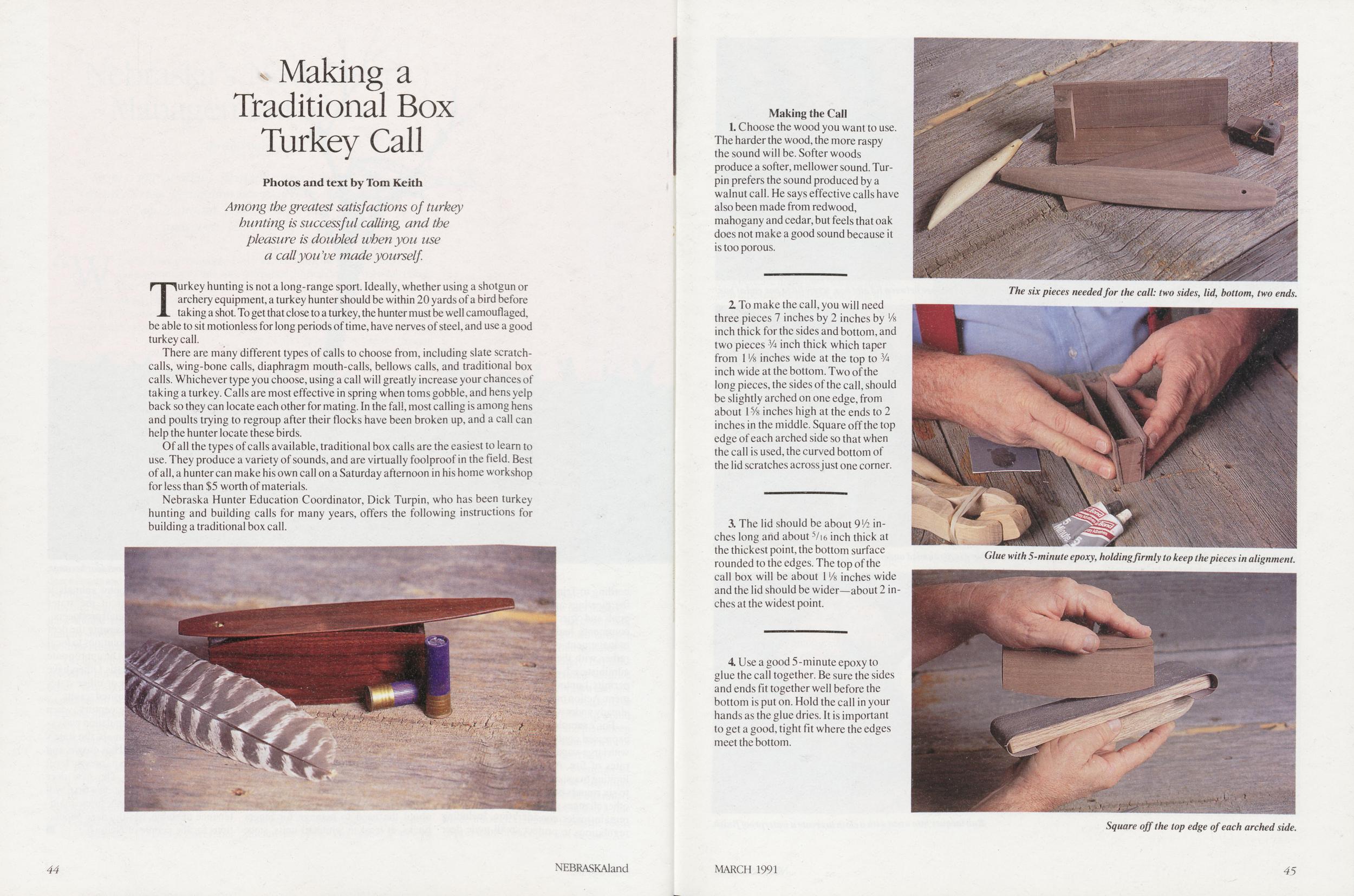
Making a Traditional Box Turkey Call
Photos and text by Tom Keith Among the greatest satisfactions of turkey hunting is successful calling and the pleasure is doubled when you use a call you've made yourself.Turkey hunting is not a long-range sport. Ideally, whether using a shotgun or archery equipment, a turkey hunter should be within 20 yards of a bird before taking a shot. To get that close to a turkey, the hunter must be well camouflaged, be able to sit motionless for long periods of time, have nerves of steel, and use a good turkey call.
There are many different types of calls to choose from, including slate scratchcalls, wing-bone calls, diaphragm mouth-calls, bellows calls, and traditional box calls. Whichever type you choose, using a call will greatly increase your chances of taking a turkey. Calls are most effective in spring when toms gobble, and hens yelp back so they can locate each other for mating. In the fall, most calling is among hens and poults trying to regroup after their flocks have been broken up, and a call can help the hunter locate these birds.
Of all the types of calls available, traditional box calls are the easiest to learn to use. They produce a variety of sounds, and are virtually foolproof in the field. Best of all, a hunter can make his own call on a Saturday afternoon in his home workshop for less than $5 worth of materials.
Nebraska Hunter Education Coordinator, Dick Turpin, who has been turkey hunting and building calls for many years, offers the following instructions for building a traditional box call.
1. Choose the wood you want to use. The harder the wood, the more raspy the sound will be. Softer woods produce a softer, mellower sound. Turpin prefers the sound produced by a walnut call. He says effective calls have also been made from redwood, mahogany and cedar, but feels that oak does not make a good sound because it is too porous.
2 To make the call, you will need three pieces 7 inches by 2 inches by V% inch thick for the sides and bottom, and two pieces 3A inch thick which taper from 1 Vh inches wide at the top to 3/4 inch wide at the bottom. Two of the long pieces, the sides of the call, should be slightly arched on one edge, from about IVs inches high at the ends to 2 inches in the middle. Square off the top edge of each arched side so that when the call is used, the curved bottom of the lid scratches across just one corner.
3. The lid should be about 9Vi inches long and about 5/i6 inch thick at the thickest point, the bottom surface rounded to the edges. The top of the call box will be about 1 V% inches wide and the lid should be wider—about 2 iches at the widest point.
4. Use a good 5-minute epoxy to glue the call together. Be sure the sides and ends fit together well before the bottom is put on. Hold the call in your hands as the glue dries. It is important to get a good, tight fit where the edges meet the bottom.
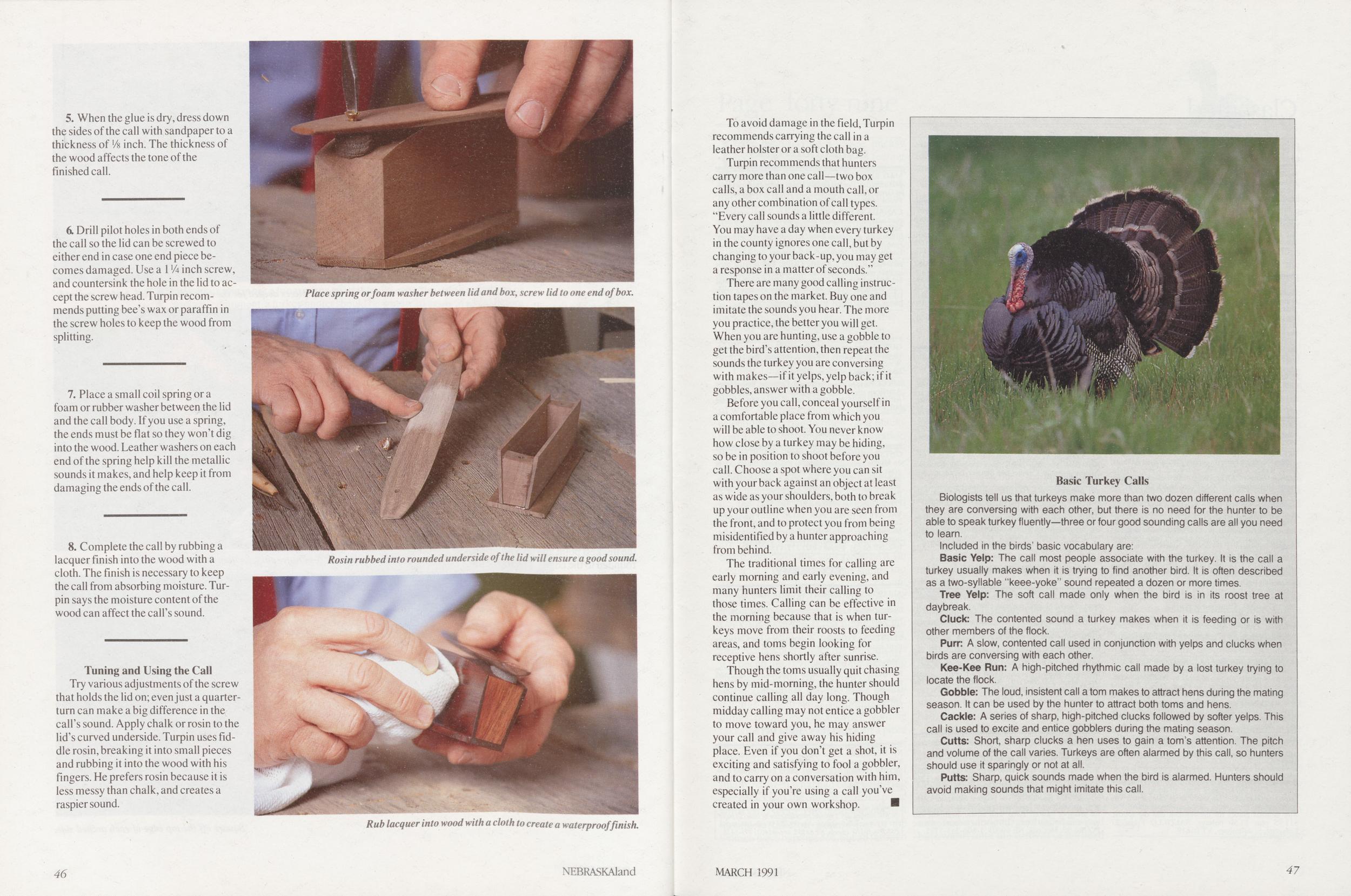
5. When the glue is dry, dress down the sides of the call with sandpaper to a thickness of Vs inch. The thickness of the wood affects the tone of the finished call.
6. Drill pilot holes in both ends of the call so the lid can be screwed to either end in case one end piece becomes damaged. Use a 1Va inch screw, and countersink the hole in the lid to accept the screw head. Turpin recommends putting bee's wax or paraffin in the screw holes to keep the wood from splitting.
7. Place a small coil spring or a foam or rubber washer between the lid and the call body. If you use a spring, the ends must be flat so they won't dig into the wood. Leather washers on each end of the spring help kill the metallic sounds it makes, and help keep it from damaging the ends of the call.
8. Complete the call by rubbing a lacquer finish into the wood with a cloth. The finish is necessary to keep the call from absorbing moisture. Turpin says the moisture content of the wood can affect the call's sound.
Tuning and Using the CallTry various adjustments of the screw that holds the lid on; even just a quarterturn can make a big difference in the call's sound. Apply chalk or rosin to the lid's curved underside. Turpin uses fiddle rosin, breaking it into small pieces and rubbing it into the wood with his fingers. He prefers rosin because it is less messy than chalk, and creates a raspier sound.
To avoid damage in the field, Turpin recommends carrying the call in a leather holster or a soft cloth bag.
Turpin recommends that hunters carry more than one call—two box calls, a box call and a mouth call, or any other combination of call types. "Every call sounds a little different. You may have a day when every turkey in the county ignores one call, but by changing to your back-up, you may get a response in a matter of seconds."
There are many good calling instruction tapes on the market. Buy one and imitate the sounds you hear. The more you practice, the better you will get. When you are hunting, use a gobble to get the bird's attention, then repeat the sounds the turkey you are conversing with makes—if it yelps, yelp back; if it gobbles, answer with a gobble.
Before you call, conceal yourself in a comfortable place from which you will be able to shoot. You never know how close by a turkey may be hiding, so be in position to shoot before you call. Choose a spot where you can sit with your back against an object at least as wide as your shoulders, both to break up your outline when you are seen from the front, and to protect you from being misidentified by a hunter approaching from behind.
The traditional times for calling are early morning and early evening, and many hunters limit their calling to those times. Calling can be effective in the morning because that is when turkeys move from their roosts to feeding areas, and toms begin looking for receptive hens shortly after sunrise.
Though the toms usually quit chasing hens by mid-morning, the hunter should continue calling all day long. Though midday calling may not entice a gobbler to move toward you, he may answer your call and give away his hiding place. Even if you don't get a shot, it is exciting and satisfying to fool a gobbler, and to carry on a conversation with him, especially if you're using a call you've created in your own workshop.
Biologists tell us that turkeys make more than two dozen different calls when they are conversing with each other, but there is no need for the hunter to be able to speak turkey fluently—three or four good sounding calls are all you need to learn.
Included in the birds' basic vocabulary are:
Basic Yelp: The call most people associate with the turkey. It is the call a turkey usually makes when it is trying to find another bird. It is often described as a two-syllable "keee-yoke" sound repeated a dozen or more times.
Tree Yelp: The soft call made only when the bird is in its roost tree at daybreak.
Cluck: The contented sound a turkey makes when it is feeding or is with other members of the flock.
Purr: A slow, contented call used in conjunction with yelps and clucks when birds are conversing with each other.
Kee-Kee Run: A high-pitched rhythmic call made by a lost turkey trying to locate the flock.
Gobble: The loud, insistent call a torn makes to attract hens during the mating season. It can be used by the hunter to attract both toms and hens.
Cackle: A series of sharp, high-pitched clucks followed by softer yelps. This call is used to excite and entice gobblers during the mating season.
Cutts: Short, sharp clucks a hen uses to gain a tom's attention. The pitch and volume of the call varies. Turkeys are often alarmed by this call, so hunters should use it sparingly or not at all.
Putts: Sharp, quick sounds made when the bird is alarmed. Hunters should avoid making sounds that might imitate this call.
MARCH 1991 47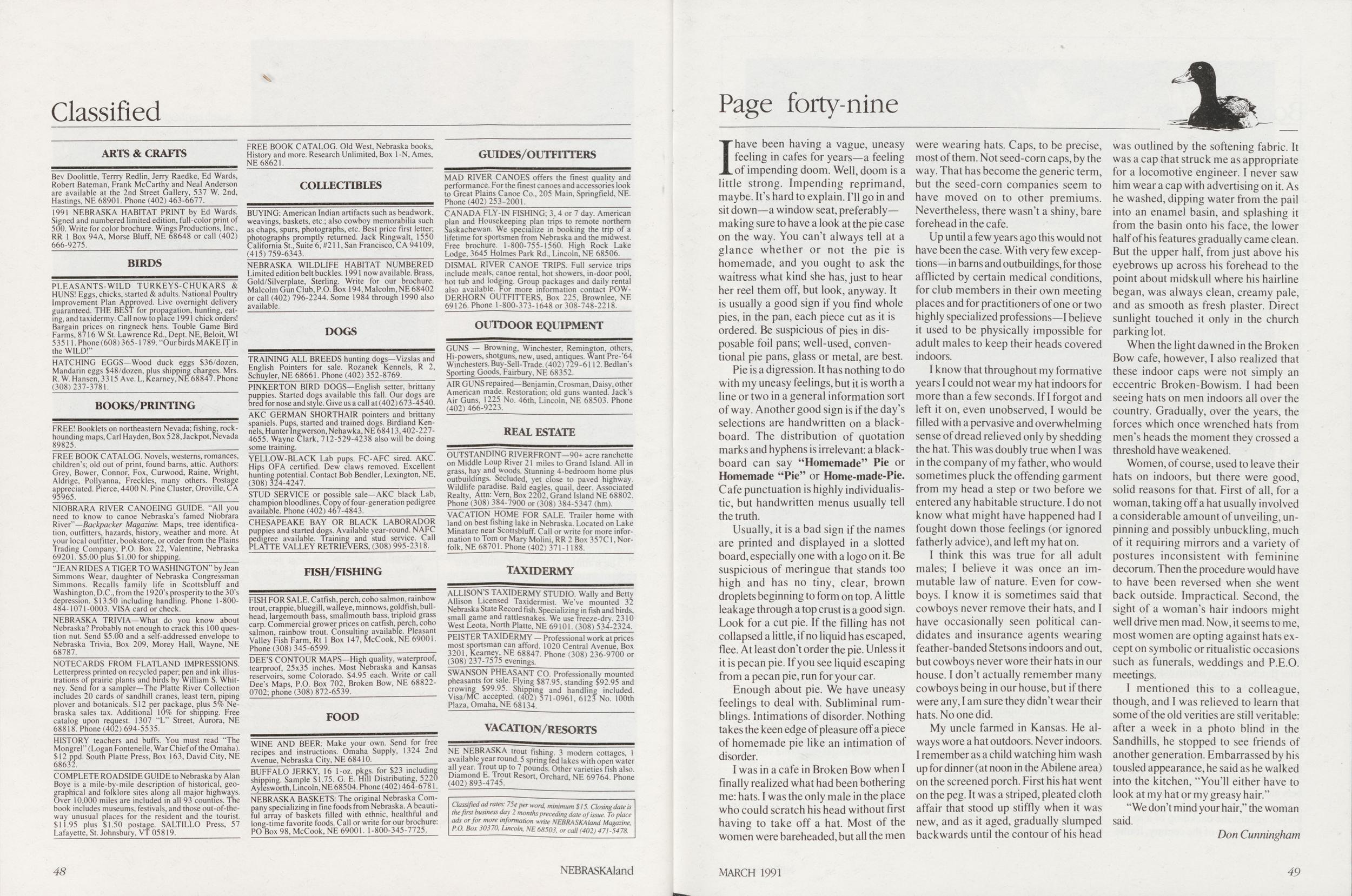
Classified
ARTS & CRAFTSBev Doolittle, Terrry Redlin, Jerry Raedke, Ed Wards, Robert Bateman, Frank McCarthy and Neal Anderson are available at the 2nd Street Gallery, 537 W. 2nd, Hastings, NE 68901. Phone (402) 463-6677.________
1991 NEBRASKA HABITAT PRINT by Ed Wards. Signed and numbered limited edition, full-color print of 500. Write for color brochure. Wings Productions, Inc., RR 1 Box 94A, Morse Bluff, NE 68648 or call (402) 666-9275.
BIRDSPLEASANTS-WILD TURKEYS-CHUKARS & HUNS! Eggs, chicks, started & adults. National Poultry Improvement Plan Approved. Live overnight delivery guaranteed. THE BEST for propagation, hunting, eating, and taxidermy. Call now to place 1991 chick orders! Bargain prices on ringneck hens. Trouble Game Bird Farms, 8716 W St. Lawrence Rd., Dept. NE, Beloit, WI 53511. Phone (608) 365-1789. "Our birds MAKE IT in the WILD!"__________________________________
HATCHING EGGS—Wood duck eggs $36/dozen, Mandarin eggs $48/dozen, plus shipping charges. Mrs. R. W. Hansen, 3315 Ave. L, Kearney, NE 68847. Phone (308)237-3781.______________________________
BOOKS/PRINTINGFREE! Booklets on northeastern Nevada; fishing, rock- hounding maps, Carl Hayden, Box 528, Jackpot, Nevada 89825.______________________________________
FREE BOOK CATALOG. Novels, westerns, romances, children's; old out of print, found barns, attic. Authors: Grey, Bower, Connor, Fox, Curwood, Raine, Wright, Aldrige, Pollyanna, Freckles, many others. Postage appreciated. Pierce, 4400 N. Pine Cluster, Oroville, CA 95965.______________________________________
NIOBRARA RIVER CANOEING GUIDE. "All you need to know to canoe Nebraska's famed Niobrara River"—Backpacker Magazine. Maps, tree identification, outfitters, hazards, history, weather and more. At your local outfitter, bookstore, or order from the Plains Trading Company, P.O. Box 22, Valentine, Nebraska 69201. $5.00 plus $1.00 for shipping.______________
"JEAN RIDES A TIGER TO WASHINGTON" by Jean Simmons Wear, daughter of Nebraska Congressman Simmons. Recalls family life in Scottsbluff and Washington, D.C., from the 1920's prosperity to the 30's depression. $13.50 including handling. Phone 1-800- 484-1071-0003. VISA card or check.______________
NEBRASKA TRIVIA—What do you know about Nebraska? Probably not enough to crack this 100 question nut. Send $5.00 and a self-addressed envelope to Nebraska Trivia, Box 209, Morey Hall, Wavne, NE 68787.______________________________________
NOTECARDS FROM FLATLAND IMPRESSIONS. Letterpress printed on recycled paper; pen and ink illustrations of prairie plants and birds by William S. Whitney. Send for a sampler—The Platte River Collection includes 20 cards of sandhill cranes, least tern, piping plover and botanicals. $12 per package, plus 5% Nebraska sales tax. Additional 10% for shipping. Free catalog upon request. 1307 "L" Street, Aurora, NE 68818. Phone (402) 694-5535.___________________
HISTORY teachers and buffs. You must read "The Mongrel" (Logan Fontenelle, War Chief of the Omaha). $12 ppd. South Platte Press, Box 163, David City, NE 68632.______________________________________
COMPLETE ROADSIDE GUIDE to Nebraska by Alan Boye is a mile-by-mile description of historical, geographical and folklore sites along all major highways. Over 10,000 miles are included in all 93 counties. The book includes museums, festivals, and those out-of-the-way unusual places for the resident and the tourist. $11.95 plus $1.50 postage. SALTILLO Press, 57 Lafayette, St. Johnsbury, VT 05 819. ___________
FREE BOOK CATALOG. Old West, Nebraska books, History and more. Research Unlimited, Box 1-N, Ames, NE 68621.
COLLECTIBLESBUYING: American Indian artifacts such as beadwork, weavings, baskets, etc.; also cowboy memorabilia such as chaps, spurs, photographs, etc. Best price first letter; photographs promptly returned. Jack Ringwalt, 1550 California St., Suite 6, #211, San Francisco, CA 94109, (415)759-6343.______________________________
NEBRASKA WILDLIFE HABITAT NUMBERED Limited edition belt buckles. 1991 now available. Brass, Gold/Silver plate, Sterling. Write for our brochure. Malcolm Gun Club, P.O. Box 194, Malcolm, NE 68402 or call (402) 796-2244. Some 1984 through 1990 also available.
DOGSTRAINING ALL BREEDS hunting dogs—Vizslas and English Pointers for sale. Rozanek Kennels, R 2, Schuyler, NE 68661. Phone (402) 352-8769.________
PINKERTON BIRD DOGS—English setter, brittany puppies. Started dogs available this fall. Our dogs are bred for nose and style. Give us a call at (402) 673-4540.
AKC GERMAN SHORTHAIR pointers and brittany spaniels. Pups, started and trained dogs. Birdland Kennels, Hunter Ingwerson, Nehawka, NE 68413,402-227- 4655. Wayne Clark, 712-529-4238 also will be doing some training.________________________________
YELLOW-BLACK Lab pups. FC-AFC sired. AKC. Hips OFA certified. Dew claws removed. Excellent hunting potential. Contact Bob Bendler, Lexington, NE, (308) 324-4247.______________________________
STUD SERVICE or possible sale—AKC black Lab, champion bloodlines. Copy of four-generation pedigree available. Phone (402) 467-4843._________________
CHESAPEAKE BAY OR BLACK LABORADOR puppies and started dogs. Available year-round. NAFC pedigree available. Training and stud service. Call PLATTE VALLEY RETRIEVERS, (308) 995-2318.
FISH/FISHINGFISH FOR SALE. Catfish, perch, coho salmon, rainbow trout, crappie, bluegill, walleye, minnows, goldfish, bullhead, largemouth bass, smallmouth bass, triploid grass carp. Commercial grower prices on catfish, perch, coho salmon, rainbow trout. Consulting available. Pleasant Valley Fish Farm, Rt 1 Box 147, McCook, NE 69001. Phone (308) 345-6599.________________
DEE'S CONTOUR MAPS—High quality, waterproof, tearproof, 25x35 inches. Most Nebraska and Kansas reservoirs, some Colorado. $4.95 each. Write or call Dee's Maps, P.O. Box 702, Broken Bow, NE 68822-0702; phone (308) 872-6539.____________________
FOODWINE AND BEER: Make your own. Send for free recipes and instructions. Omaha Supply, 1324 2nd Avenue, Nebraska City, NE 68410._______________
BUFFALO JERKY, 16 1-oz. pkgs. for $23 including shipping. Sample $1.75. G. E. Hill Distributing, 5220 Aylesworth, Lincoln, NE 68504. Phone (402) 464-6781.
NEBRASKA BASKETS: The original Nebraska Com- pany specializing in fine foods from Nebraska. A beautiful array of baskets filled with ethnic, healthful and long-time favorite foods. Call or write for our brochure: PO Box 98, McCook, NE 69001. 1-800-345-7725.
GUIDES/OUTFITTERSMAD RIVER CANOES offers the finest quality and performance. For the finest canoes and accessories look to Great Plains Canoe Co., 205 Main, Springfield, NE. Phone(402)253-2001._________________________
CANADA FLY-IN FISHING; 3, 4 or 7 day. American plan and Housekeeping plan trips to remote northern Saskachewan. We specialize in booking the trip of a lifetime for sportsmen from Nebraska and the midwest. Free brochure. 1-800-755-1560. High Rock Lake Lodge, 3645 Holmes Park Rd., Lincoln, NE 68506.
DISMAL RIVER CANOE TRIPS. Full service trips include meals, canoe rental, hot showers, in-door pool, hot tub and lodging. Group packages and daily rental also available. For more information contact POWDERHORN OUTFITTERS, Box 225, Brownlee, NE 69126. Phone 1 -800-373-1648 or 308-748-2218.
OUTDOOR EQUIPMENTGUNS — Browning, Winchester, Remington, others, Hi-powers, shotguns, new, used, antiques. Want Pre-'64 Winchesters. Buy-Sell-Trade. (402) 729-6112. Bedlan's Sporting Goods, Fairbury, NE 68352.______________
AIR GUNS repaired—Benjamin, Crosman, Daisy, other American made. Restoration; old guns wanted. Jack's Air Guns, 1225 No. 46th, Lincoln, NE 68503. Phone (402) 466-9223.
REAL ESTATEOUTSTANDING RIVERFRONT-90+ acre ranchette on Middle Loup River 21 miles to Grand Island. All in grass, hay and woods. Stunning 4-bedroom home plus outbuildings. Secluded, yet close to paved highway. Wildlife paradise. Bald eagles, quail, deer. Associated Realty, Attn: Vern, Box 2202, Grand Island NE 68802. Phone (308) 384-7900 or (308) 384-5347 (hm).
VACATION HOME FOR SALE. Trailer home with land on best fishing lake in Nebraska. Located on Lake Minatare near Scottsbluff. Call or write for more information to Tom or Mary Molini, RR 2 Box 357C1, Norfolk, NE 68701. Phone (402) 371-1188.
TAXIDERMYALLISON'S TAXIDERMY STUDIO. Wally and Betty Allison Licensed Taxidermist. We've mounted 32 Nebraska State Record fish. Specializing in fish and birds, small game and rattlesnakes. We use freeze-dry. 2310 West Leota, North Platte, NE 69101. (308) 534-2324.
PEISTER TAXIDERMY - Professional work at prices most sportsman can afford. 1020 Central Avenue, Box 3201, Kearney, NE 68847. Phone (308) 236-9700 or (308) 237-7575 evenings._______________________
SWANSON PHEASANT CO. Professionally mounted pheasants for sale. Flying $87.95, standing $92.95 and crowing $99.95. Shipping and handling included. Visa/MC accepted. (402) 571-0961, 6123 No. 100th Plaza, Omaha, NE 68134
VACATION/RESORTSNE NEBRASKA trout fishing. 3 modern cottages, 1 available year round. 5 spring fed lakes with open water all year. Trout up to 7 pounds. Other varieties fish also. Diamond E. Trout Resort, Orchard, NE 69764. Phone (402) 893-4745.
NE NEBRASKA trout fishing. 3 modern cottages, 1 available year round. 5 spring fed lakes with open water all year. Trout up to 7 pounds. Other varieties fish also. Diamond E. Trout Resort, Orchard, NE 69764. Phone (402) 893-4745. 48 NEBRASKAlandPage forty-nine
I have been having a vague, uneasy feeling in cafes for years—a feeling of impending doom. Well, doom is a little strong. Impending reprimand, maybe. It's hard to explain. I'll go in and sit down—a window seat, preferably— making sure to have a look at the pie case on the way. You can't always tell at a glance whether or not the pie is homemade, and you ought to ask the waitress what kind she has, just to hear her reel them off, but look, anyway. It is usually a good sign if you find whole pies, in the pan, each piece cut as it is ordered. Be suspicious of pies in disposable foil pans; well-used, conventional pie pans, glass or metal, are best.
Pie is a digression. It has nothing to do with my uneasy feelings, but it is worth a line or two in a general information sort of way. Another good sign is if the day's selections are handwritten on a blackboard. The distribution of quotation marks and hyphens is irrelevant: a blackboard can say "Homemade" Pie or Homemade "Pie" or Home-made-Pie. Cafe punctuation is highly individualistic, but handwritten menus usually tell the truth.
Usually, it is a bad sign if the names are printed and displayed in a slotted board, especially one with a logo on it. Be suspicious of meringue that stands too high and has no tiny, clear, brown droplets beginning to form on top. A little leakage through a top crust is a good sign. Look for a cut pie. If the filling has not collapsed a little, if no liquid has escaped, flee. At least don't order the pie. Unless it it is pecan pie. If you see liquid escaping from a pecan pie, run for your car.
Enough about pie. We have uneasy feelings to deal with. Subliminal rumblings. Intimations of disorder. Nothing takes the keen edge of pleasure off a piece of homemade pie like an intimation of disorder.
I was in a cafe in Broken Bow when I finally realized what had been bothering me: hats. I was the only male in the place who could scratch his head without first having to take off a hat. Most of the women were bareheaded, but all the men were wearing hats. Caps, to be precise, most of them. Not seed-corn caps, by the way. That has become the generic term, but the seed-corn companies seem to have moved on to other premiums. Nevertheless, there wasn't a shiny, bare forehead in the cafe.
Up until a few years ago this would not have been the case. With very few exceptions—in barns and outbuildings, for those afflicted by certain medical conditions, for club members in their own meeting places and for practitioners of one or two highly specialized professions—I believe it used to be physically impossible for adult males to keep their heads covered indoors.
I know that throughout my formative years I could not wear my hat indoors for more than a few seconds. If I forgot and left it on, even unobserved, I would be filled with a pervasive and overwhelming sense of dread relieved only by shedding the hat. This was doubly true when I was in the company of my father, who would sometimes pluck the offending garment from my head a step or two before we entered any habitable structure. I do not know what might have happened had I fought down those feelings (or ignored fatherly advice), and left my hat on.
I think this was true for all adult males; I believe it was once an immutable law of nature. Even for cowboys. I know it is sometimes said that cowboys never remove their hats, and I have occasionally seen political candidates and insurance agents wearing feather-banded Stetsons indoors and out, but cowboys never wore their hats in our house. I don't actually remember many cowboys being in our house, but if there were any, I am sure they didn't wear their hats. No one did.
My uncle farmed in Kansas. He always wore a hat outdoors. Never indoors. I remember as a child watching him wash up for dinner (at noon in the Abilene area) on the screened porch. First his hat went on the peg. It was a striped, pleated cloth affair that stood up stiffly when it was new, and as it aged, gradually slumped backwards until the contour of his head was outlined by the softening fabric. It was a cap that struck me as appropriate for a locomotive engineer. I never saw him wear a cap with advertising on it. As he washed, dipping water from the pail into an enamel basin, and splashing it from the basin onto his face, the lower half of his features gradually came clean. But the upper half, from just above his eyebrows up across his forehead to the point about midskull where his hairline began, was always clean, creamy pale, and as smooth as fresh plaster. Direct sunlight touched it only in the church parking lot.
When the light dawned in the Broken Bow cafe, however, I also realized that these indoor caps were not simply an eccentric Broken-Bowism. I had been seeing hats on men indoors all over the country. Gradually, over the years, the forces which once wrenched hats from men's heads the moment they crossed a threshold have weakened.
Women, of course, used to leave their hats on indoors, but there were good, solid reasons for that. First of all, for a woman, taking off a hat usually involved a considerable amount of unveiling, unpinning and possibly unbuckling, much of it requiring mirrors and a variety of postures inconsistent with feminine decorum. Then the procedure would have to have been reversed when she went back outside. Impractical. Second, the sight of a woman's hair indoors might well drive men mad. Now, it seems to me, most women are opting against hats except on symbolic or ritualistic occasions such as funerals, weddings and P.E.O. meetings.
I mentioned this to a colleague, though, and I was relieved to learn that some of the old verities are still veritable: after a week in a photo blind in the Sandhills, he stopped to see friends of another generation. Embarrassed by his tousled appearance, he said as he walked into the kitchen, "You'll either have to look at my hat or my greasy hair."
"We don't mind your hair," the woman said.
Don Cunningham MARCH 1991 49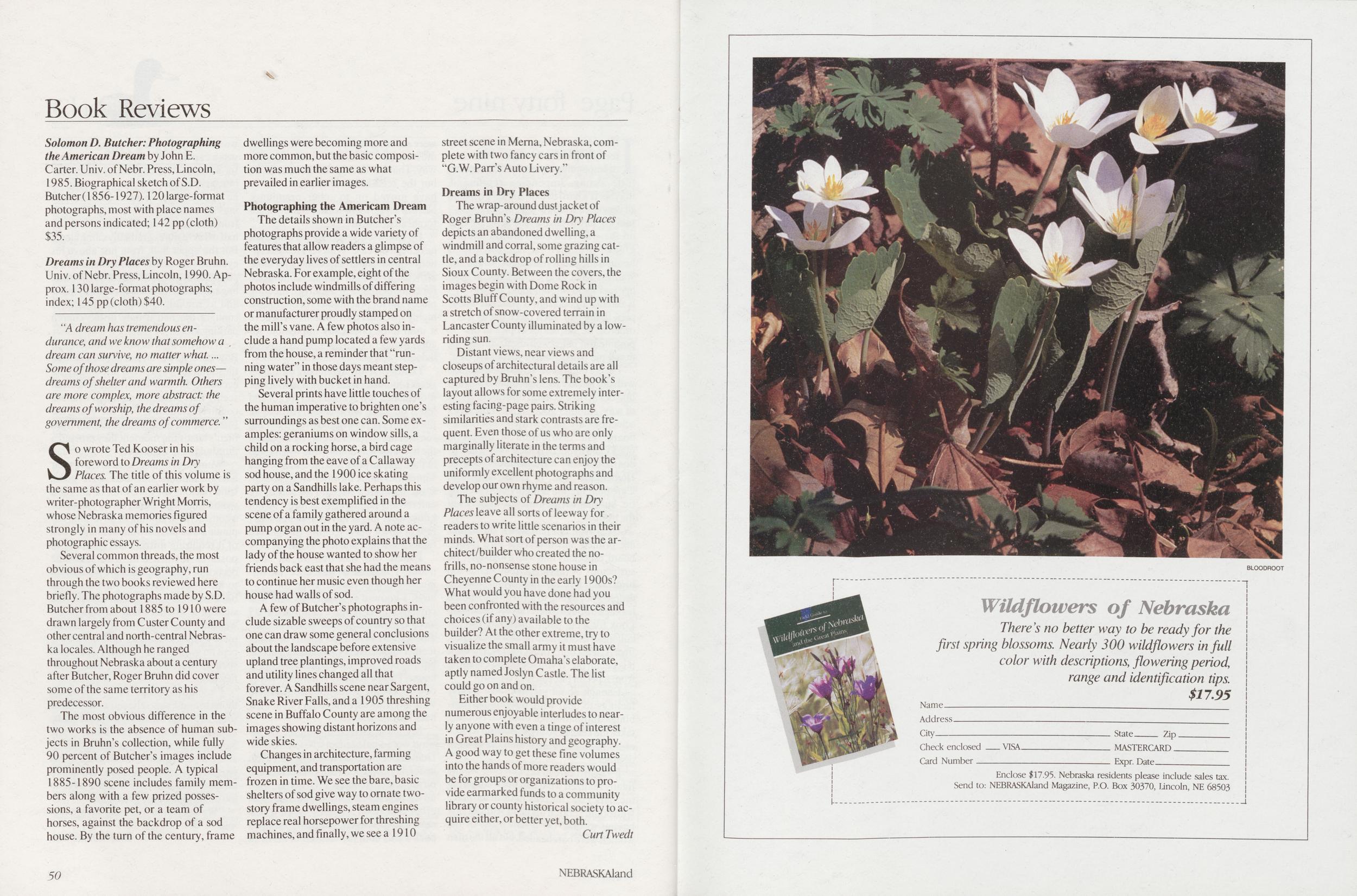
Book Reviews
Solomon D. Butcher: Photographing the American Dream by John E. Carter. Univ. of Nebr. Press, Lincoln, 1985. Biographical sketch of S.D. Butcher (1856-1927). 120 large-format photographs, most with place names and persons indicated; 142 pp (cloth) $35. Dreams in Dry Places by Roger Bruhn. Univ. of Nebr. Press, Lincoln, 1990. Approx. 130 large-format photographs; index; 145 pp (cloth) $40."A dream has tremendous endurance, and we know that somehow a dream can survive, no matter what.... Some of those dreams are simple ones dreams of shelter and warmth. Others are more complex, more abstract: the dreams of worship, the dreams of government, the dreams of commerce.'
So wrote Ted Kooser in his foreword to Dreams in Dry Places. The title of this volume is the same as that of an earlier work by writer-photographer Wright Morris, whose Nebraska memories figured strongly in many of his novels and photographic essays.
Several common threads, the most obvious of which is geography, run through the two books reviewed here briefly. The photographs made by S.D. Butcher from about 1885 to 1910 were drawn largely from Custer County and other central and north-central Nebraska locales. Although he ranged throughout Nebraska about a century after Butcher, Roger Bruhn did cover some of the same territory as his predecessor.
The most obvious difference in the two works is the absence of human subjects in Bruhn's collection, while fully 90 percent of Butcher's images include prominently posed people. A typical 1885-1890 scene includes family members along with a few prized possessions, a favorite pet, or a team of horses, against the backdrop of a sod house. By the turn of the century, frame dwellings were becoming more and more common, but the basic composition was much the same as what prevailed in earlier images.
Photographing the American DreamThe details shown in Butcher's photographs provide a wide variety of features that allow readers a glimpse of the everyday lives of settlers in central Nebraska. For example, eight of the photos include windmills of differing construction, some with the brand name or manufacturer proudly stamped on the mill's vane. A few photos also include a hand pump located a few yards from the house, a reminder that "running water" in those days meant stepping lively with bucket in hand.
Several prints have little touches of the human imperative to brighten one's surroundings as best one can. Some examples: geraniums on window sills, a child on a rocking horse, a bird cage hanging from the eave of a Callaway sod house, and the 1900 ice skating party on a Sandhills lake. Perhaps this tendency is best exemplified in the scene of a family gathered around a pump organ out in the yard. A note accompanying the photo explains that the lady of the house wanted to show her friends back east that she had the means to continue her music even though her house had walls of sod.
A few of Butcher's photographs include sizable sweeps of country so that one can draw some general conclusions about the landscape before extensive upland tree plantings, improved roads and utility lines changed all that forever. A Sandhills scene near Sargent, Snake River Falls, and a 1905 threshing scene in Buffalo County are among the images showing distant horizons and wide skies.
Changes in architecture, farming equipment, and transportation are frozen in time. We see the bare, basic shelters of sod give way to ornate two story frame dwellings, steam engines replace real horsepower for threshing machines, and finally, we see a 1910 street scene in Merna, Nebraska, complete with two fancy cars in front of "G.W. Parr's Auto Livery."
Dreams in Dry PlacesThe wrap-around dust jacket of Roger Bruhn's Dreams in Dry Places depicts an abandoned dwelling, a windmill and corral, some grazing cattle, and a backdrop of rolling hills in Sioux County. Between the covers, the images begin with Dome Rock in Scotts Bluff County, and wind up with a stretch of snow-covered terrain in Lancaster County illuminated by a low riding sun.
Distant views, near views and closeups of architectural details are all captured by Bruhn's lens. The book's layout allows for some extremely interesting facing-page pairs. Striking similarities and stark contrasts are frequent. Even those of us who are only marginally literate in the terms and precepts of architecture can enjoy the uniformly excellent photographs and develop our own rhyme and reason.
The subjects of Dreams in Dry Places leave all sorts of leeway for readers to write little scenarios in their minds. What sort of person was the architect/builder who created the nofrills, no-nonsense stone house in Cheyenne County in the early 1900s? What would you have done had you been confronted with the resources and choices (if any) available to the builder? At the other extreme, try to visualize the small army it must have taken to complete Omaha's elaborate, aptly named Joslyn Castle. The list could go on and on.
Either book would provide numerous enjoyable interludes to nearly anyone with even a tinge of interest in Great Plains history and geography. A good way to get these fine volumes into the hands of more readers would be for groups or organizations to provide earmarked funds to a community library or county historical society to acquire either, or better yet, both.
Curt Twedt 50 NEBRASKAland
Position: 305 (29 views)