Volume 69, Issue 1, 1991
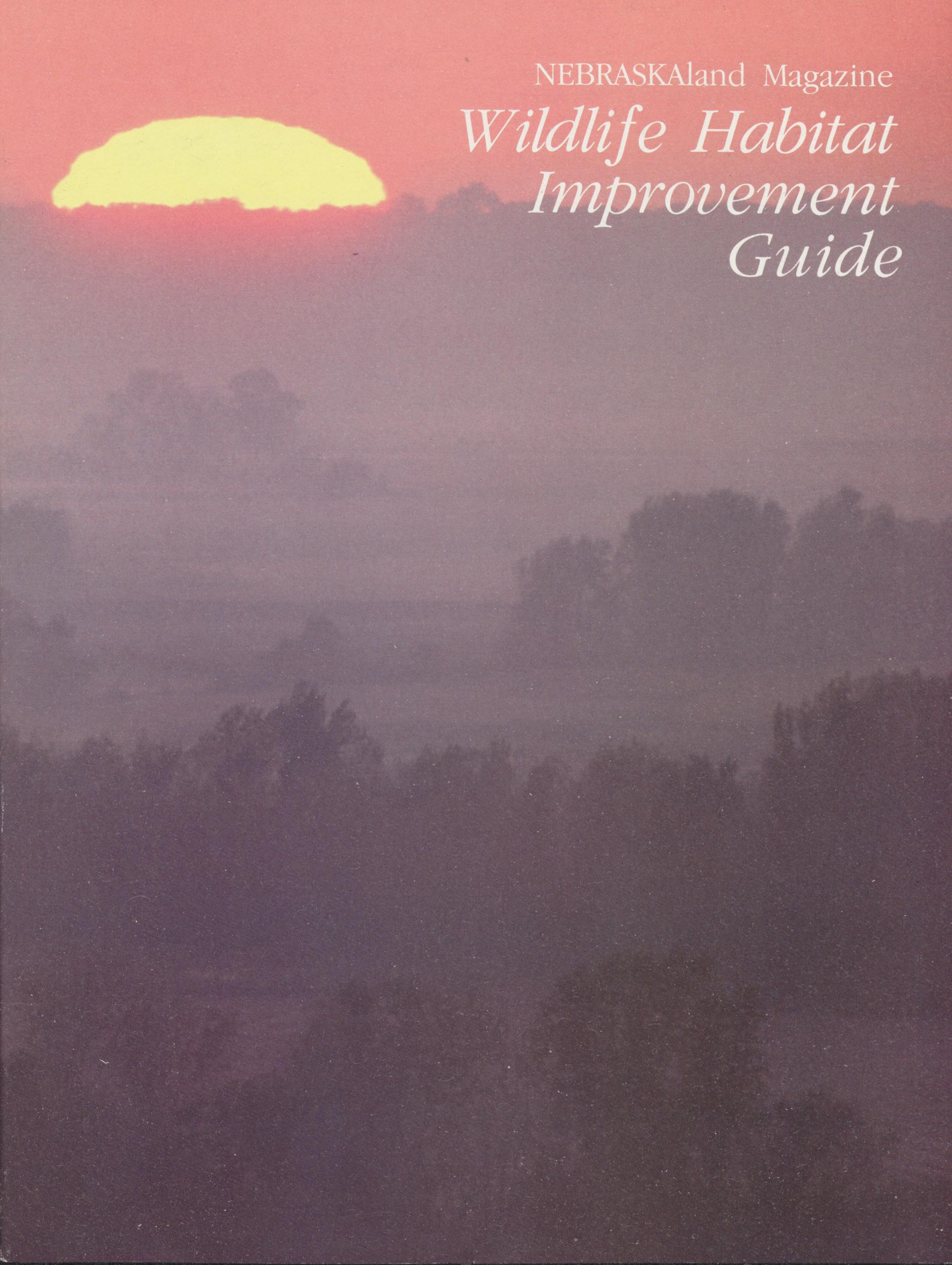
NEBRASKAland Magazine Wildlife Habitat Improvement Guide
NEBRASKAland Magazine Wildlife Habitat Improvement Guide
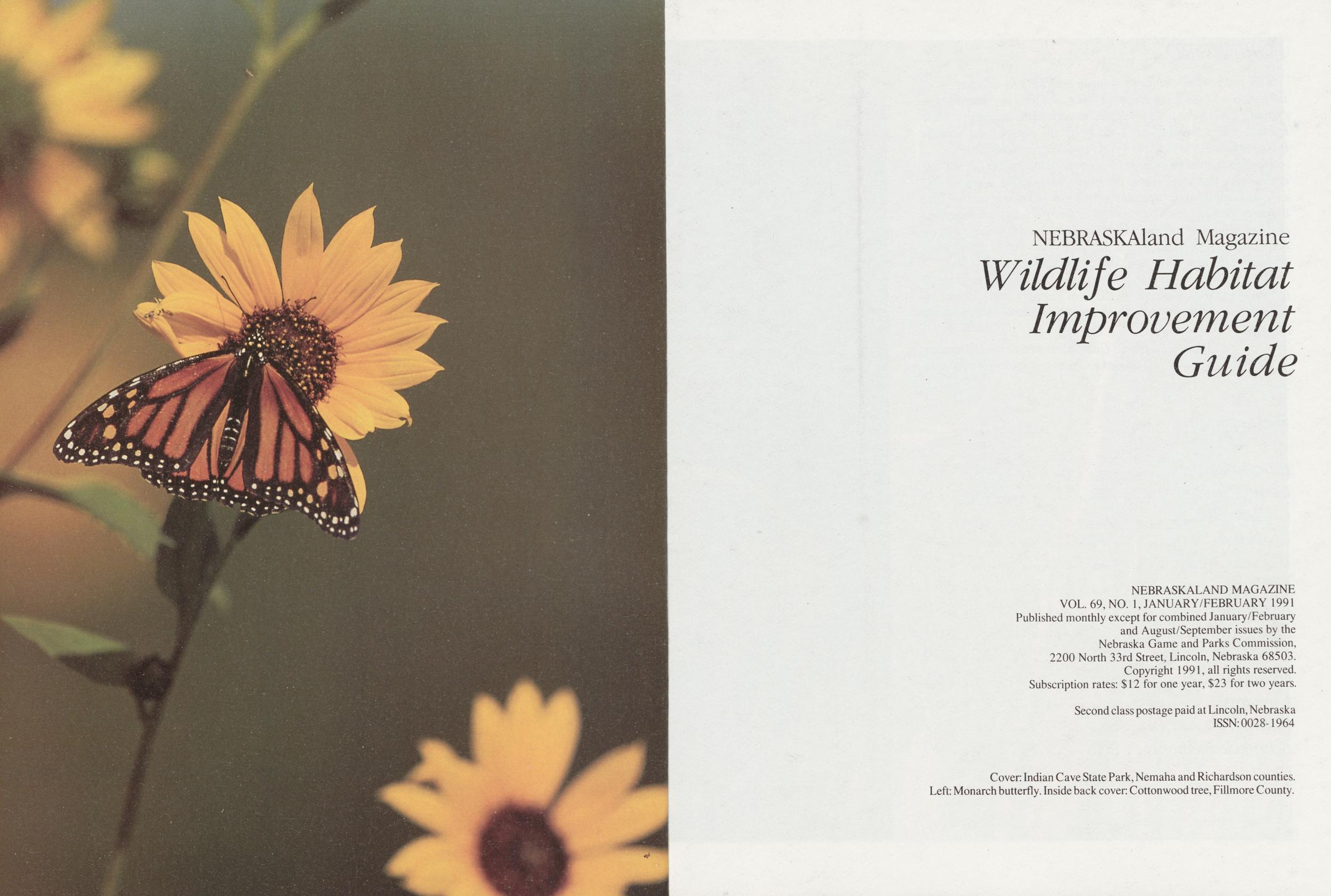
NEBRASKALAND MAGAZINE VOL. 69, NO. 1, JANUARY/FEBRUARY 1991 Published monthly except for combined January/February and August/September issues by the Nebraska Game and Parks Commission, 2200 North 33rd Street, Lincoln, Nebraska 68503. Copyright 1991, all rights reserved. Subscription rates: $12 for one year, $23 for two years. Second class postage paid at Lincoln, Nebraska ISSN: 0028-1964 Cover: Indian Cave State Park, Nemaha and Richardson counties. Left: Monarch butterfly. Inside back cover: Cottonwood tree, Fillmore County. FOREWORD
This publication brings to print in one binding a selection of subjects useful for landowners in Nebraska who are interested in creating new habitat for wildlife, or managing existing wildlife habitat. Each section was written by an experienced wildlife biologist familiar with farming and ranching in Nebraska.
Wildlife habitat management is not a simple recipe for wildlife abundance, nor is it an exact science. Nonetheless, planned and executed habitat improvement is still our recommendation. The owner of the land and water, as well as the effects of farm programs or other economic uses, will have much to do with wildlife species and numbers found on the land. We hope you will find the contents of this publication interesting, understandable and "do-able."
This publication is the result of our best efforts to provide information and guidance, but it also requires some degree of commitment by the landowner to improve wildlife habitat on his property.
Harold Edwards, Chief, Resource Services Division Nebraska Game and Parks Commission CONTENTS Introduction....................6 Getting Started................ 8 Grasslands......................10 Croplands......................24 Wooded Areas....................36 Wetlands.......................52 Farmponds......................58 Rivers and Streams.............64 Backyards......................70 Glossary.......................86 Directory.......................88 Index.........................89 Acknowledgements.................90 4
Nebraskans are fortunate, blessed with a bountiful land supporting rich and diverse plant and animal communities. However, part of our natural heritage slips away each year. Agricultural technology, transportation and urbanization all affect wildlife, and its natural environment has become increasingly hostile.
The very existence of a species in a specific area depends upon weather and habitat. Their interaction is a complex relationship, but because habitat is the factor most easily controlled and modified by man, this volume is devoted to providing an understanding of the habitat concept and specific suggestions that can be employed to create or improve existing wildlife habitat.
Man modifies his environment with wood, steel, cement and stone, and by the manipulation of plant and animal communities. Wildlife, in contrast, relies upon naturally occurring or man-modified plant communities. Few species other than man have the ability to modify the environment to create their own habitat.
The land-use decisions landowners make are the key to the number of wildlife species and the number of individual animals on their land. Decisions you make for economic, aesthetic or other reasons affect wildlife habitat and wildlife itself.
Wildlife habitat is not just trees, shrubs, grass, weeds or even crops. It is a complex mixture of plant communities or cover types. All play a role in meeting the needs of a particular species, and all must be present within the species' normal range for that species to be present.
Some species are sedentary, and the cover types they require must be present in a restricted area. For example, bob white quail must be able to meet all of their needs within a quarter-section or so, while deer may range over several square miles and don't need to have all of their habitat requirements met in a small area.
The arrangement or interspersion of cover types or plant communities is important to wildlife. While two equal-size units of land can have exactly the same quantities of cover types, and be managed in the same manner, the wildlife populations they support may be very different depending on how the cover types are interspersed or arranged.
Wildlife biologists call junctions between communities "edge," and refer to the phenomenon of increased numbers of a species at these junctions as "the edge effect." Avid quail hunters may not call those areas anything, but they gravitate to them because they know from experience they can expect to see more birds there. The edge effect is real, and all you may need to do to increase wildlife on your land is to rearrange the existing cover to produce more edge.
We all have fond memories of "the good old days" when clouds of pheasants rose from a weed patch, or hordes of ducks rode the leading edge of a storm. Cherish those memories, for that time is gone and we will probably never see many species attain their former numbers. Times and technology have changed, and the result is intensified land use, loss of wildlife habitat and a decline of many wildlife species. While it is impractical—in fact impossible—to turn back the clock, reverse technology and relive those idyllic days, all is not lost.
Consideration of wildlife habitat needs can ensure that sufficient numbers will be present to provide many hours of viewing or hunting pleasure. In many cases, it may be as simple as selecting the right alternative. For example, if you have a hedge that is competing for moisture with adjacent crops and reducing yields, you can live with the losses, remove the hedge, or root-prune the hedge with a root plow available from the Soil Conservation Service or the Game and Parks Commission. We hope you opt for the third alternative. However, and more important, we hope you realize that in most land-use decisions you have several options, some of which are more beneficial, or at least less damaging to wildlife, than others. In this special issue of NEBRASKAland Magazine, we hope to acquaint you with some of those alternatives and show you how to improve habitat in order to have more wildlife in your life.
Bill Baxter, Assistant Chief, Wildlife Division Nebraska Game and Parks Commission 7
GETTING STARTED-
With increased demands on land in recent decades, thousands of acres of wildlife habitat have been lost. The loss usually goes unnoticed, and habitat is "nickel-and-dimed" to death: a hedgerow is pushed out, a fencerow is removed; cattle overgraze a woodlot, a wetland is drained; a tract of native grassland is plowed under or paved over. Unfortunately, these small occurrences add up to a huge loss of wildlife habitat.
A concerned landowner can take steps to stop the loss, and actually reverse the trend of decreasing habitat and wildlife by taking action on his or her own property. Depending on the condition of habitat on your property and the wildlife species you would like to attract or increase, your plan might be as simple as constructing a couple of brush piles or as complex as designing a grass, shrub and tree planting several acres in size. However complex, habitat improvement projects can be broken down into four basic steps:
Determine the species of wildlife that live in your area.
This is generally easy. Unless you have just moved in from Siberia, you probably have a pretty good idea of what species of wildlife to expect in your area and on your land. You may already know what species you would like to increase. Tailor your plan to benefit wildlife native to your area to ensure success.
Select the species you want to manage for and learn their habitat requirements.
This step is not difficult, but does require you to do a little homework. This guide includes some information about the needs of many common species. Additional information can be found in the nearest library or obtained from the Nebraska Game and Parks Commission and Natural Resources Districts throughout the state.
Identify the habitat elements lacking or in need of improvement.
Begin by taking a broad view of your property and assessing its condition. Is it flat farmland, clean right up to the fences? Is it rolling rangeland with pine-studded canyons overgrazed by cattle? Does it have a stream or wetland? Has the woodlot been pastured? Do you mow the road ditches? Do you have a backyard that can be developed for songbird habitat? Are there erodible areas you shouldn't be farming? By taking this initial broad view of your land, you can begin to get a 8 perspective of your property's suitability for wildlife. You can then begin focusing on specific areas for habitat improvement. An aerial photo (check with your county ASCS or SCS office) or a hand sketched map of your property is a valuable tool.
Once the concepts of food and cover relationships and the individual requirements of your targeted wildlife species are understood, interpreting the results of the habitat survey and making management plans becomes easier.
Design and carry out projects to establish or improve wildlife habitat.
As you begin designing your project, refer to the aerial photo or sketch map of your property, and sketch in specific projects and notes. If your project will involve major vegetative manipulations and plantings, obtain a copy of the most recent county soil survey from the SCS. The soil survey contains useful information relating soil types to suitability for wildlife habitat.
Regardless of where you live, you should be able to find information in this guide to help you plan your habitat projects. The chapters are devoted to major habitat types in Nebraska: grasslands, croplands, wooded habitats, wetlands, small reservoirs or farm ponds, rivers and streams, acreage and backyard habitat.
Throughout the guide you will find information about selected habitat features such as brush piles, food plots, fence lines, nut trees and many others that can benefit wildlife.
Cost-sharing may be available for certain projects. Check with your Natural Resources District, county Soil Conservation Service and ASCS offices to determine if your project qualifies. If you need additional help planning or designing a habitat improvement project, technical assistance can be obtained from the Game and Parks Commission.
As you plan, design and work on your projects, you will find satisfaction in knowing you are doing something positive for wildlife. Remember, however, that none of the things you do is a "quick fix" for low populations, and it will take several years to see tangible results. Be patient, give vegetation time to establish and the wildlife will move in and multiply. Perhaps, as neighbors and friends see the results of your habitat improvement projects, they will also want to help wildlife on their property.
9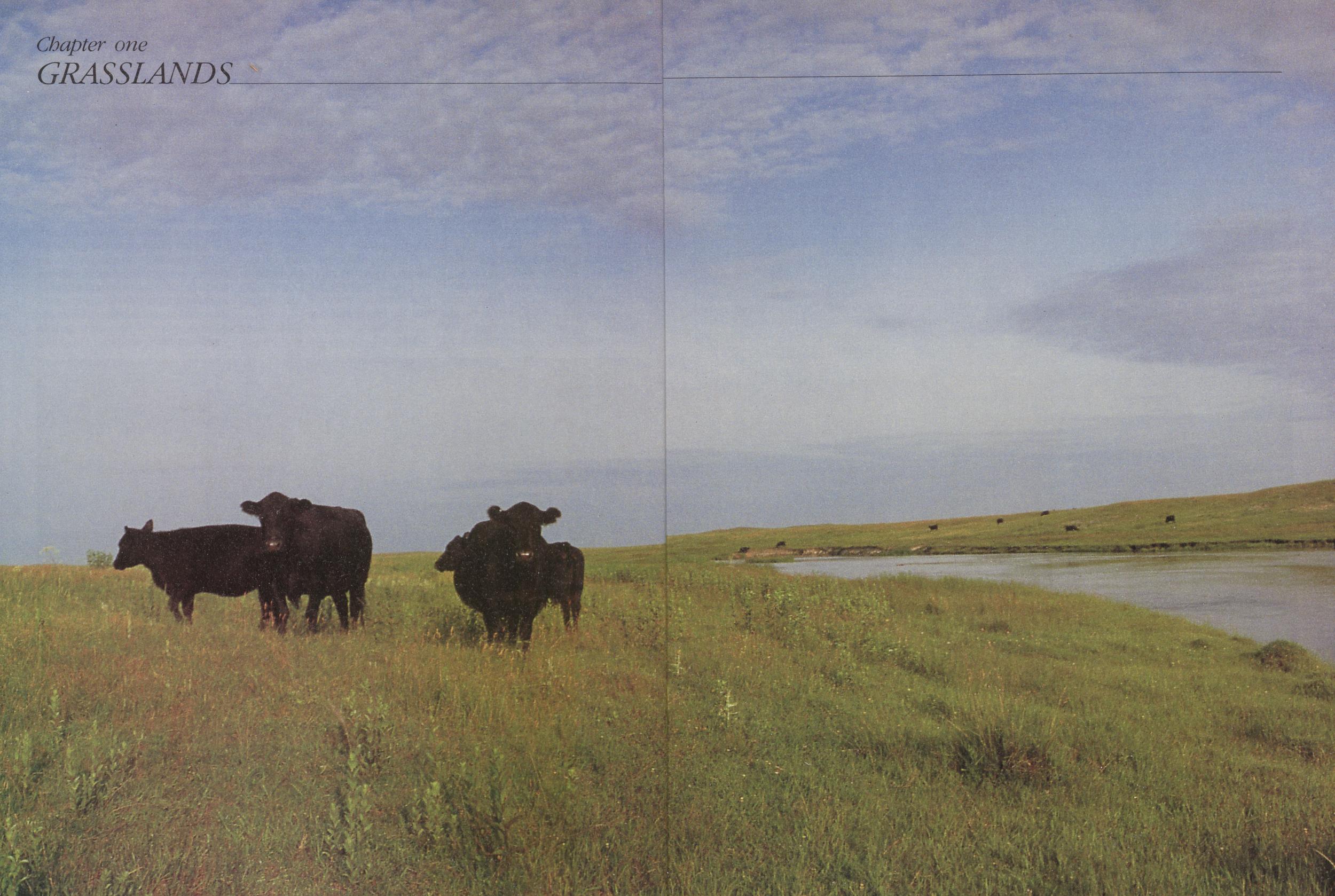
Chapter one GRASSLANDS
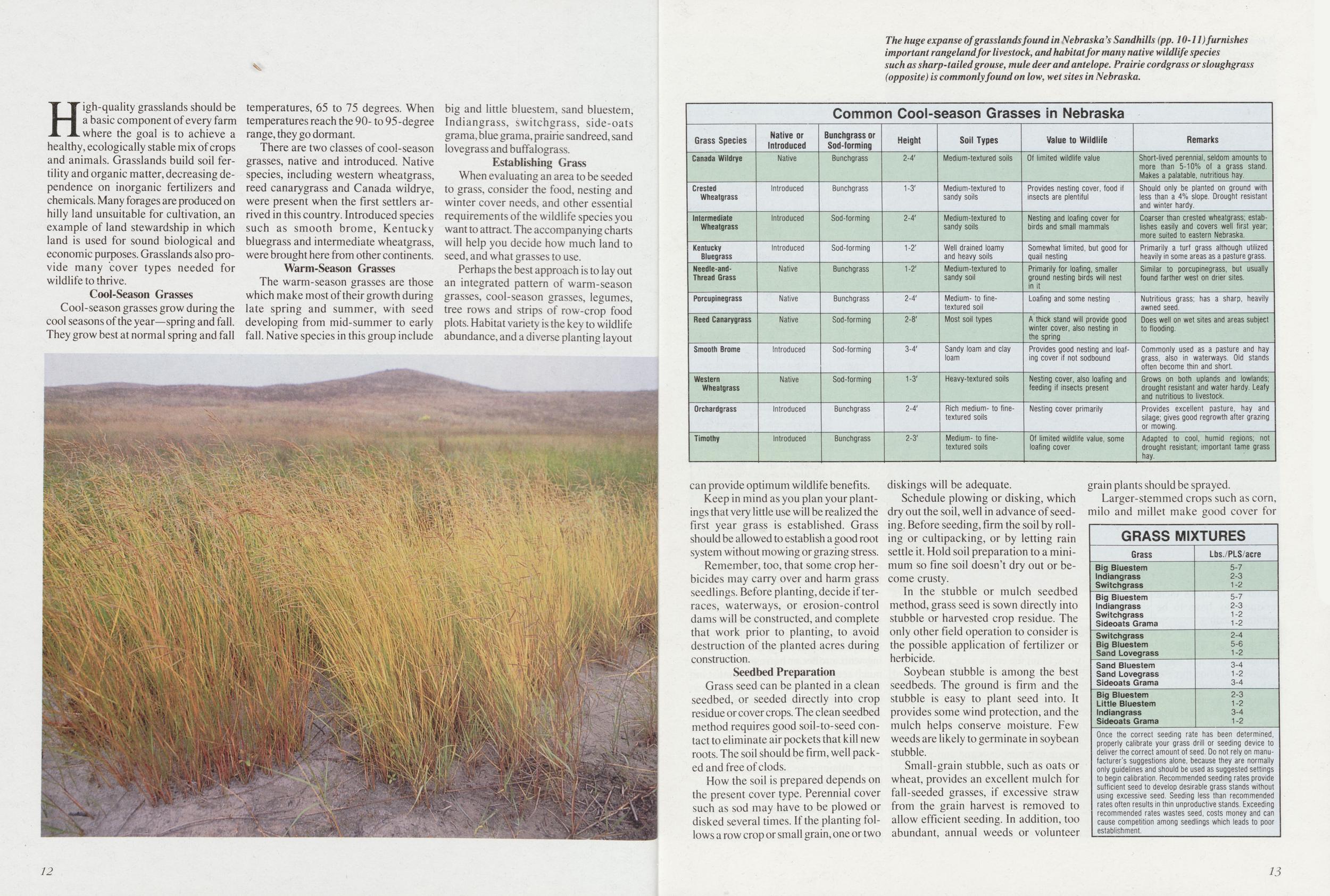
High-quality grasslands should be a basic component of every farm where the goal is to achieve a healthy, ecologically stable mix of crops and animals. Grasslands build soil fertility and organic matter, decreasing dependence on inorganic fertilizers and chemicals. Many forages are produced on hilly land unsuitable for cultivation, an example of land stewardship in which land is used for sound biological and economic purposes. Grasslands also provide many cover types needed for wildlife to thrive.
Cool-season grasses grow during the cool seasons of the year—spring and fall. They grow best at normal spring and fall temperatures, 65 to 75 degrees. When temperatures reach the 90- to 95-degree range, they go dormant.
There are two classes of cool-season grasses, native and introduced. Native species, including western wheatgrass, reed canary grass and Canada wild rye, were present when the first settlers arrived in this country. Introduced species such as smooth brome, Kentucky bluegrass and intermediate wheatgrass, were brought here from other continents.
Warm-Season GrassesThe warm-season grasses are those which make most of their growth during late spring and summer, with seed developing from mid-summer to early fall. Native species in this group include big and little bluestem, sand bluestem, Indian grass, switchgrass, side-oats grama, blue grama, prairie sand reed, sand love grass and buffalo grass.
Establishing GrassWhen evaluating an area to be seeded to grass, consider the food, nesting and winter cover needs, and other essential requirements of the wildlife species you want to attract. The accompanying charts will help you decide how much land to seed, and what grasses to use.
Perhaps the best approach is to lay out an integrated pattern of warm-season grasses, cool-season grasses, legumes, tree rows and strips of row-crop food plots. Habitat variety is the key to wildlife abundance, and a diverse planting layout 12 can provide optimum wildlife benefits.
Common Cool-season Grasses in Nebraska Grass Species Canada Wildrye Crested Wheatgrass Intermediate Wheatgrass Kentucky Bluegrass Needle-and- Thread Grass Native or Introduced Native Introduced Introduced Introduced Native Bunchgrass or Sod-forming Bunchgrass Bunchgrass Sod-forming Sod-forming Bunchgrass Porcupine grass Reed Canarygrass Smooth Brome Western Wheatgrass Orchardgrass Timothy Height 2-4' 1-3' 2-4' Soil Types Medium-textured soils Medium-textured to sandy soils Medium-textured to sandy soils 1-2' 1-2' Native Native Introduced Native Introduced Bunchgrass Sod-forming Sod-forming Sod-forming Bunchgrass 2-4' 2-8' 3-4' 1-3' Well drained loamy and heavy soils Medium-textured to sandy soil Value to Wildlife Of limited wildlife value Provides nesting cover, food if insects are plentiful Nesting and loafing cover for birds and small mammals Somewhat limited, but good for quail nesting Remarks Short-lived perennial, seldom amounts to more than 5-10% of a grass stand. Makes a palatable, nutritious hay. Should only be planted on ground with less than a 4% slope. Drought resistant and winter hardy. Coarser than crested wheatgrass; establishes easily and covers well first year; more suited to eastern Nebraska. Primarily for loafing, smaller ground nesting birds will nest in it Medium- to fine textured soil Most soil types Sandy loam and clay loam Heavy-textured soils 2-4' Introduced Bunchgrass 2-3' Rich medium- to fine textured soils Medium to fine textured soils Loafing and some nesting A thick stand will provide good winter cover, also nesting in the spring Provides good nesting and loafing cover if not sodbound Nesting cover, also loafing and feeding if insects present Primarily a turf grass although utilized heavily in some areas as a pasture grass. Similar to porcupine grass, but usually found farther west on drier sites. Nutritious grass; has a sharp, heavily awned seed. Does well on wet sites and areas subject to flooding. Commonly used as a pasture and hay grass, also in waterways. Old stands often become thin and short. Nesting cover primarily Of limited wildlife value, some loafing cover Grows on both uplands and lowlands; drought resistant and water hardy. Leafy and nutritious to livestock. Provides excellent pasture, hay and silage; gives good regrowth after grazing or mowing. Adapted to cool, humid regions; not drought resistant; important tame grass hay.Keep in mind as you plan your plantings that very little use will be realized the first year grass is established. Grass should be allowed to establish a good root system without mowing or grazing stress.
Remember, too, that some crop herbicides may carry over and harm grass seedlings. Before planting, decide if terraces, waterways, or erosion-control dams will be constructed, and complete that work prior to planting, to avoid destruction of the planted acres during construction.
Seedbed PreparationGrass seed can be planted in a clean seedbed, or seeded directly into crop residue or cover crops. The clean seedbed method requires good soil-to-seed contact to eliminate air pockets that kill new roots. The soil should be firm, well packed and free of clods.
How the soil is prepared depends on the present cover type. Perennial cover such as sod may have to be plowed or disked several times. If the planting follows a row crop or small grain, one or two diskings will be adequate.
Schedule plowing or disking, which dry out the soil, well in advance of seeding. Before seeding, firm the soil by rolling or cultipacking, or by letting rain settle it. Hold soil preparation to a minimum so fine soil doesn't dry out or become crusty.
In the stubble or mulch seedbed method, grass seed is sown directly into stubble or harvested crop residue. The only other field operation to consider is the possible application of fertilizer or herbicide.
Soybean stubble is among the best seedbeds. The ground is firm and the stubble is easy to plant seed into. It provides some wind protection, and the mulch helps conserve moisture. Few weeds are likely to germinate in soybean stubble.
Small-grain stubble, such as oats or wheat, provides an excellent mulch for fall-seeded grasses, if excessive straw from the grain harvest is removed to allow efficient seeding. In addition, too abundant, annual weeds or volunteer grain plants should be sprayed.
Larger-stemmed crops such as corn, milo and millet make good cover for spring seedings, and provide protection from wind and water erosion. Stubble should be 12 to 18 inches high; taller residue may have to be shredded to facilitate seeding.
GRASS MIXTURES Grass Lbs./PLS/acre Big Bluestem Indianorass 5-7 2-3 1-2 bwitcngrass Big Bluestem Indiangrass Switchgrass Sideoats Grama 5-7 2-3 1-2 1-2 Switchgrass Big Bluestem Sand Lovegrass 2-4 5-6 1-2 Sand Bluestem Sand Lovegrass Sideoats Grama 3-4 1-2 3-4 Big Bluestem Little Bluestem Indiangrass Sideoats Grama 2-3 1-2 3-4 1-2 Once the correct seeding rate has been determined, properly calibrate your grass drill or seeding device to deliver the correct amount of seed. Do not rely on manufacturer's suggestions alone, because they are normally only guidelines and should be used as suggested settings to begin calibration. Recommended seeding rates provide sufficient seed to develop desirable grass stands without using excessive seed. Seeding less than recommended rates often results in thin unproductive stands. Exceeding recommended rates wastes seed, costs money and can cause competition among seedlings which leads to poor establishment. 13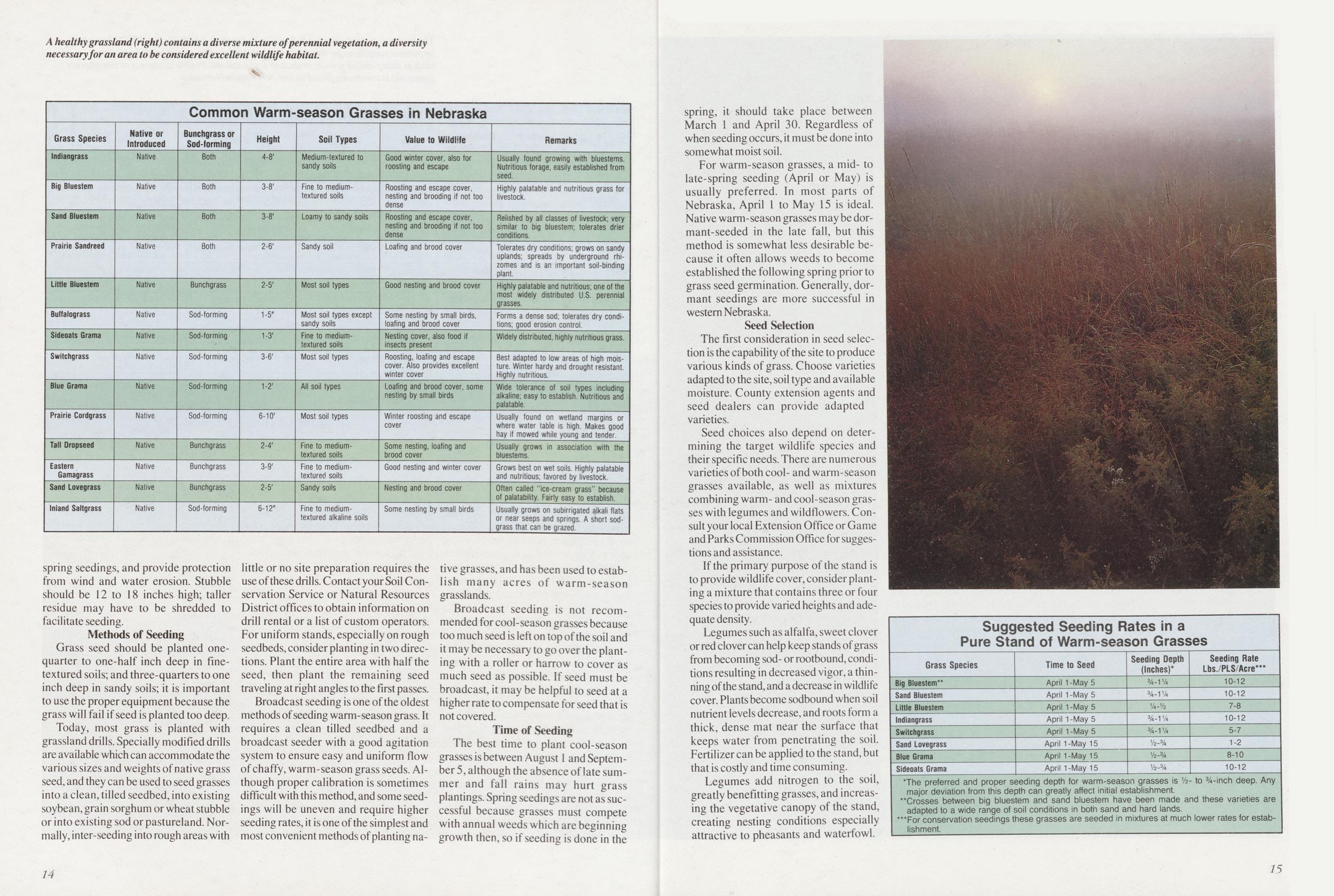
Grass seed should be planted one quarter to one-half inch deep in fine-textured soils; and three-quarters to one inch deep in sandy soils; it is important to use the proper equipment because the grass will fail if seed is planted too deep.
Today, most grass is planted with grassland drills. Specially modified drills are available which can accommodate the various sizes and weights of native grass seed, and they can be used to seed grasses into a clean, tilled seedbed, into existing soybean, grain sorghum or wheat stubble or into existing sod or pastureland. Normally, inter-seeding into rough areas with little or no site preparation requires the use of these drills. Contact your Soil Conservation Service or Natural Resources District offices to obtain information on drill rental or a list of custom operators. For uniform stands, especially on rough seedbeds, consider planting in two directions. Plant the entire area with half the seed, then plant the remaining seed traveling at right angles to the first passes.
Broadcast seeding is one of the oldest methods of seeding warm-season grass. It requires a clean tilled seedbed and a broadcast seeder with a good agitation system to ensure easy and uniform flow of chaffy, warm-season grass seeds. Although proper calibration is sometimes difficult with this method, and some seedings will be uneven and require higher seeding rates, it is one of the simplest and most convenient methods of planting native grasses, and has been used to establish many acres of warm-season grasslands.
Broadcast seeding is not recommended for cool-season grasses because too much seed is left on top of the soil and it may be necessary to go over the planting with a roller or harrow to cover as much seed as possible. If seed must be broadcast, it may be helpful to seed at a higher rate to compensate for seed that is not covered.
Time of SeedingThe best time to plant cool-season grasses is between August I and Septembers, although the absence of late summer and fall rains may hurt grass plantings. Spring seedings are not as successful because grasses must compete with annual weeds which are beginning growth then, so if seeding is done in the 14 spring, it should take place between March 1 and April 30. Regardless of when seeding occurs, it must be done into somewhat moist soil.
For warm-season grasses, a mid- to late-spring seeding (April or May) is usually preferred. In most parts of Nebraska, April 1 to May 15 is ideal. Native warm-season grasses may be dormant-seeded in the late fall, but this method is somewhat less desirable because it often allows weeds to become established the following spring prior to grass seed germination. Generally, dormant seedings are more successful in western Nebraska.
Seed SelectionThe first consideration in seed selection is the capability of the site to produce various kinds of grass. Choose varieties adapted to the site, soil type and available moisture. County extension agents and seed dealers can provide adapted varieties.
Seed choices also depend on determining the target wildlife species and their specific needs. There are numerous varieties of both cool- and warm-season grasses available, as well as mixtures combining warm- and cool-season grasses with legumes and wildflowers. Consult your local Extension Office or Game and Parks Commission Office for suggestions and assistance.
If the primary purpose of the stand is to provide wildlife cover, consider planting a mixture that contains three or four species to provide varied heights and adequate density.
Legumes such as alfalfa, sweet clover or red clover can help keep stands of grass from becoming sod- or root bound, conditions resulting in decreased vigor, a thinning of the stand, and a decrease in wildlife cover. Plants become sodbound when soil nutrient levels decrease, and roots form a thick, dense mat near the surface that keeps water from penetrating the soil. Fertilizer can be applied to the stand, but that is costly and time consuming.
Legumes add nitrogen to the soil, greatly benefitting grasses, and increasing the vegetative canopy of the stand, creating nesting conditions especially attractive to pheasants and waterfowl.
Suggested Seeding Rates in a Pure Stand of Warm-season Grasses Grass Species Time to Seed Seeding Depth (Inches)* Seeding Rate Lbs./PLS/Access Big Bluestem** April 1 -May 5 3/4-1 VA 10-12 Sand Bluestem April 1-May 5 3/4-1 1/4 10-12 Little Bluestem April 1-May 5 V4-V2 7-8 Indiangrass April 1 -May 5 3/4-1 1/4 10-12 Switchgrass April 1 -May 5 3/4-1 1/4 5-7 Sand Lovegrass April 1-May 15 V2-3/4 1-2 Blue Grama April 1-May 15 1/2-3/4 8-10 Sideoats Grama April 1 -May 15 1/2-3/4 10-12 *The preferred and proper seeding depth for warm-season grasses is 1/2- to 3/4-inch deep. Any major deviation from this depth can greatly affect initial establishment. **Crosses between big bluestem and sand bluestem have been made and these varieties are adapted to a wide range of soil conditions in both sand and hard lands. ***For conservation seedings these grasses are seeded in mixtures at much lower rates for establishment. 15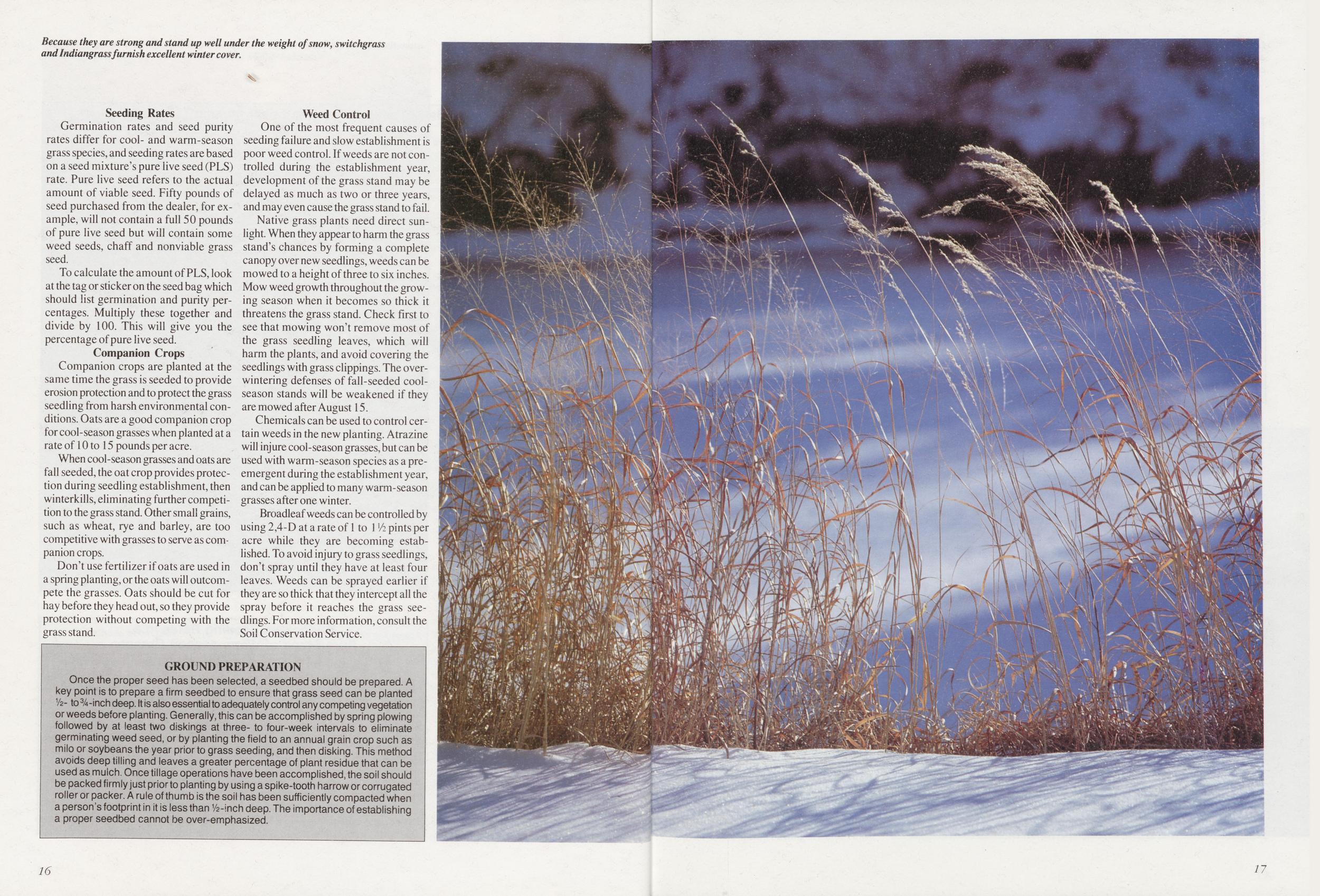
Germination rates and seed purity rates differ for cool- and warm-season grass species, and seeding rates are based on a seed mixture's pure live seed (PLS) rate. Pure live seed refers to the actual amount of viable seed. Fifty pounds of seed purchased from the dealer, for example, will not contain a full 50 pounds of pure live seed but will contain some weed seeds, chaff and nonviable grass seed.
To calculate the amount of PLS, look at the tag or sticker on the seed bag which should list germination and purity percentages. Multiply these together and divide by 100. This will give you the percentage of pure live seed.
Companion CropsCompanion crops are planted at the same time the grass is seeded to provide erosion protection and to protect the grass seedling from harsh environmental conditions. Oats are a good companion crop for cool-season grasses when planted at a rate of 10 to 15 pounds per acre.
When cool-season grasses and oats are fall seeded, the oat crop provides protection during seedling establishment, then winter kills, eliminating further competition to the grass stand. Other small grains, such as wheat, rye and barley, are too competitive with grasses to serve as companion crops.
Don't use fertilizer if oats are used in a spring planting, or the oats will outcompete the grasses. Oats should be cut for hay before they head out, so they provide protection without competing with the grass stand.
Weed ControlOne of the most frequent causes of seeding failure and slow establishment is poor weed control. If weeds are not controlled during the establishment year, development of the grass stand may be delayed as much as two or three years, and may even cause the grass stand to fail.
Native grass plants need direct sunlight. When they appear to harm the grass stand's chances by forming a complete canopy over new seedlings, weeds can be mowed to a height of three to six inches. Mow weed growth throughout the growing season when it becomes so thick it threatens the grass stand. Check first to see that mowing won't remove most of the grass seedling leaves, which will harm the plants, and avoid covering the seedlings with grass clippings. The over wintering defenses of fall-seeded cool season stands will be weakened if they are mowed after August 15.
Chemicals can be used to control certain weeds in the new planting. Atrazine will injure cool-season grasses, but can be used with warm-season species as agreemergent during the establishment year, and can be applied to many warm-season grasses after one winter.
Broadleaf weeds can be controlled by using 2,4-D at a rate of 1 to 1 Vi pints per acre while they are becoming established. To avoid injury to grass seedlings, don't spray until they have at least four leaves. Weeds can be sprayed earlier if they are so thick that they intercept all the spray before it reaches the grass seedlings. For more information, consult the Soil Conservation Service.
GROUND PREPARATIONOnce the proper seed has been selected, a seedbed should be prepared. A key point is to prepare a firm seedbed to ensure that grass seed can be planted 1/a- to 3/4-inch deep. It is also essential to adequately control any competing vegetation or weeds before planting. Generally, this can be accomplished by spring plowing followed by at least two diskings at three- to four-week intervals to eliminate germinating weed seed, or by planting the field to an annual grain crop such as milo or soybeans the year prior to grass seeding, and then disking. This method avoids deep tilling and leaves a greater percentage of plant residue that can be used as mulch. Once tillage operations have been accomplished, the soil should be packed firmly just prior to planting by using a spike-tooth harrow or corrugated roller or packer. A rule of thumb is the soil has been sufficiently compacted when a person's footprint in it is less than 1/2-lnch deep. The importance of establishing a proper seedbed cannot be over-emphasized.
16 17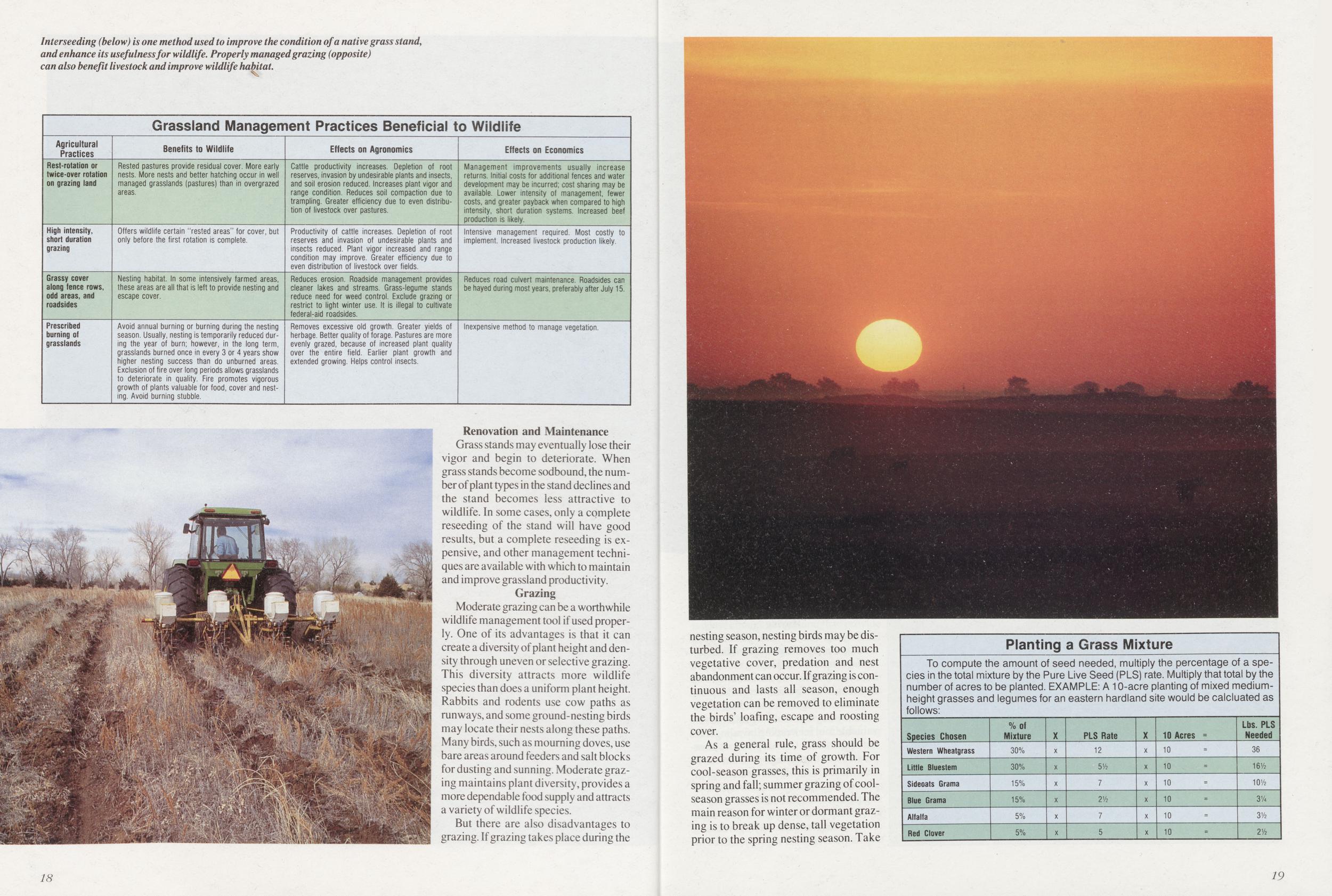
Grass stands may eventually lose their vigor and begin to deteriorate. When grass stands become sodbound, the number of plant types in the stand declines and the stand becomes less attractive to wildlife. In some cases, only a complete reseeding of the stand will have good results, but a complete reseeding is expensive, and other management techniques are available with which to maintain and improve grassland productivity.
GrazingModerate grazing can be a worthwhile wildlife management tool if used properly. One of its advantages is that it can create a diversity of plant height and density through uneven or selective grazing. This diversity attracts more wildlife species than does a uniform plant height. Rabbits and rodents use cow paths as runways, and some ground-nesting birds may locate their nests along these paths. Many birds, such as mourning doves, use bare areas around feeders and salt blocks for dusting and sunning. Moderate grazing maintains plant diversity, provides a more dependable food supply and attracts a variety of wildlife species.
But there are also disadvantages to grazing. If grazing takes place during the 18 nesting season, nesting birds may be disturbed. If grazing removes too much vegetative cover, predation and nest abandonment can occur. If grazing is continuous and lasts all season, enough vegetation can be removed to eliminate the birds' loafing, escape and roosting cover.
As a general rule, grass should be grazed during its time of growth. For cool-season grasses, this is primarily in spring and fall; summer grazing of cool season grasses is not recommended. The main reason for winter or dormant grazing is to break up dense, tall vegetation prior to the spring nesting season. Take great care to prevent livestock from removing or trampling too much vegetation, which could seriously deplete the amount of spring nesting cover. On steep ground, winter grazing can cause erosion.
Planting a Grass Mixture To compute the amount of seed needed, multiply the percentage of a species in the total mixture by the Pure Live Seed (PLS) rate. Multiply that total by the number of acres to be planted. EXAMPLE: A 10-acre planting of mixed medium-height grasses and legumes for an eastern hard land site would be calculated as follows: Species Chosen %0f Mixture X PLS Rate X 10 Acres = Lbs. PLS Needed Western Wheatgrass 30% X 12 X 10 36 Little Bluestem 30% X 51/2 X 10 16V2 Sideoats Grama 15% X 7 X 10 10V2 Blue Grama 15% X 21/2 X 10 31/4 Alfalfa 5% X 7 X 10 31/2 Red Clover 5% X 5 X 10 21/2 19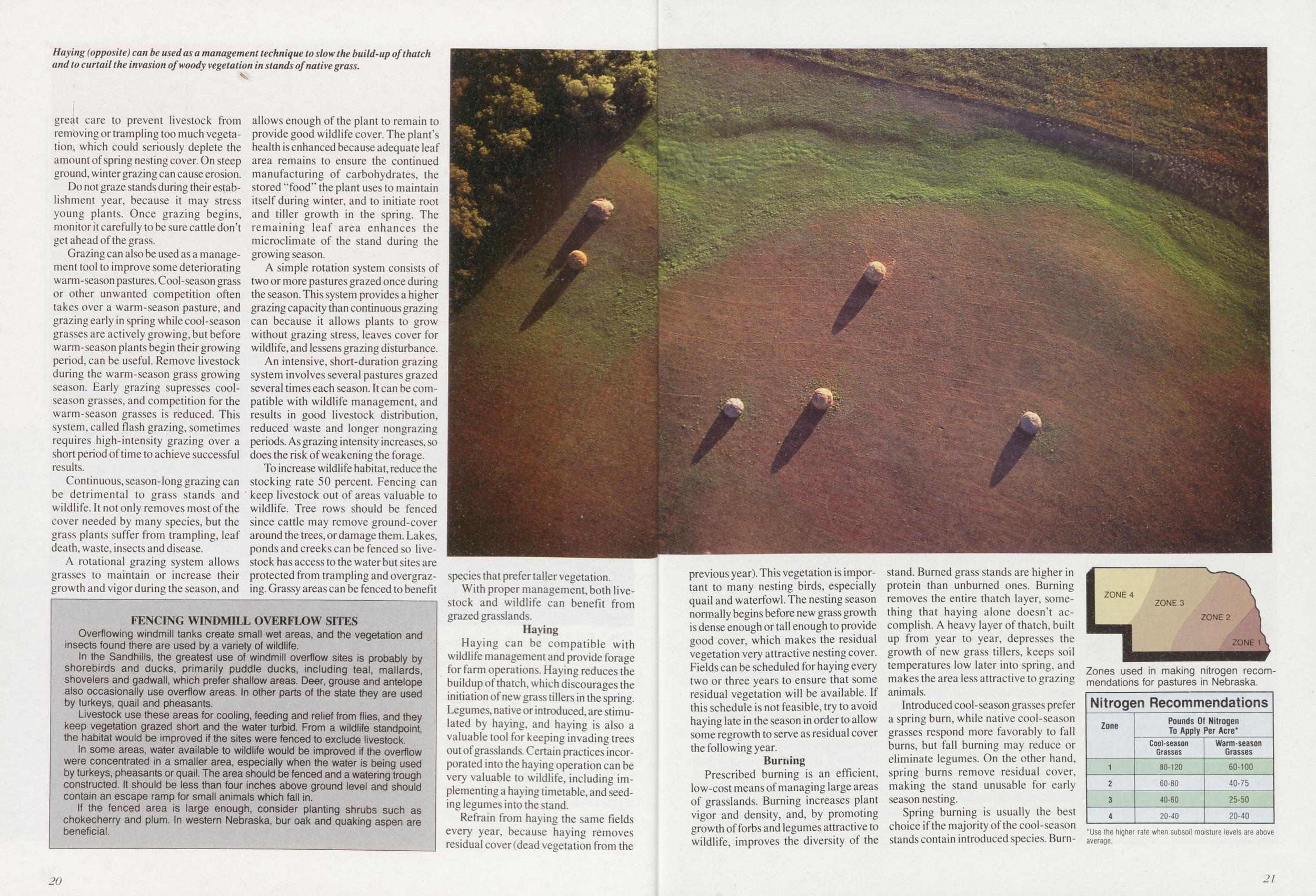
Do not graze stands during their establishment year, because it may stress young plants. Once grazing begins, monitor it carefully to be sure cattle don't get ahead of the grass.
Grazing can also be used as a management tool to improve some deteriorating warm-season pastures. Cool-season grass or other unwanted competition often takes over a warm-season pasture, and grazing early in spring while cool-season grasses are actively growing, but before warm-season plants begin their growing period, can be useful. Remove livestock during the warm-season grass growing season. Early grazing supresses cool season grasses, and competition for the warm-season grasses is reduced. This system, called flash grazing, sometimes requires high-intensity grazing over a short period of time to achieve successful results.
Continuous, season-long grazing can be detrimental to grass stands and wildlife. It not only removes most of the cover needed by many species, but the grass plants suffer from trampling, leaf death, waste, insects and disease.
A rotational grazing system allows grasses to maintain or increase their growth and vigor during the season, and allows enough of the plant to remain to provide good wildlife cover. The plant's health is enhanced because adequate leaf area remains to ensure the continued manufacturing of carbohydrates, the stored "food" the plant uses to maintain itself during winter, and to initiate root and tiller growth in the spring. The remaining leaf area enhances the microclimate of the stand during the growing season.
A simple rotation system consists of two or more pastures grazed once during the season. This system provides a higher grazing capacity than continuous grazing can because it allows plants to grow without grazing stress, leaves cover for wildlife, and lessens grazing disturbance.
An intensive, short-duration grazing system involves several pastures grazed several times each season. It can be compatible with wildlife management, and results in good livestock distribution, reduced waste and longer nongrazing periods. As grazing intensity increases, so does the risk of weakening the forage.
To increase wildlife habitat, reduce the stocking rate 50 percent. Fencing can keep livestock out of areas valuable to wildlife. Tree rows should be fenced since cattle may remove ground-cover around the trees, or damage them. Lakes, ponds and creeks can be fenced so livestock has access to the water but sites are protected from trampling and overgrazing. Grassy areas can be fenced to benefit species that prefer taller vegetation.
With proper management, both livestock and wildlife can benefit from grazed grasslands.
FENCING WINDMILL OVERFLOW SITESOverflowing windmill tanks create small wet areas, and the vegetation and insects found there are used by a variety of wildlife.
In the Sandhills, the greatest use of windmill overflow sites is probably by shorebirds and ducks, primarily puddle ducks, including teal, mallards, shovelers and gadwall, which prefer shallow areas. Deer, grouse and antelope also occasionally use overflow areas. In other parts of the state they are used by turkeys, quail and pheasants.
Livestock use these areas for cooling, feeding and relief from flies, and they keep vegetation grazed short and the water turbid. From a wildlife standpoint, the habitat would be improved if the sites were fenced to exclude livestock.
In some areas, water available to wildlife would be improved if the overflow were concentrated in a smaller area, especially when the water is being used by turkeys, pheasants or quail. The area should be fenced and a watering trough constructed. It should be less than four inches above ground level and should contain an escape ramp for small animals which fall in.
If the fenced area is large enough, consider planting shrubs such as chokecherry and plum. In western Nebraska, bur oak and quaking aspen are beneficial.
HayingHaying can be compatible with wildlife management and provide forage for farm operations. Haying reduces the buildup of thatch, which discourages the initiation of new grass tillers in the spring. Legumes, native or introduced, are stimulated by haying, and haying is also a valuable tool for keeping invading trees out of grasslands. Certain practices incorporated into the haying operation can be very valuable to wildlife, including implementing a haying timetable, and seeding legumes into the stand.
Refrain from haying the same fields every year, because haying removes residual cover (dead vegetation from the 20 previous year). This vegetation is important to many nesting birds, especially quail and waterfowl. The nesting season normally begins before new grass growth is dense enough or tall enough to provide good cover, which makes the residual vegetation very attractive nesting cover. Fields can be scheduled for haying every two or three years to ensure that some residual vegetation will be available. If this schedule is not feasible, try to avoid haying late in the season in order to allow some regrowth to serve as residual cover the following year.
BurningPrescribed burning is an efficient, low-cost means of managing large areas of grasslands. Burning increases plant vigor and density, and, by promoting growth of forbs and legumes attractive to wildlife, improves the diversity of the stand. Burned grass stands are higher in protein than unburned ones. Burning removes the entire thatch layer, something that haying alone doesn't accomplish. A heavy layer of thatch, built up from year to year, depresses the growth of new grass tillers, keeps soil temperatures low later into spring, and makes the area less attractive to grazing animals.
Introduced cool-season grasses prefer a spring burn, while native cool-season grasses respond more favorably to fall burns, but fall burning may reduce or eliminate legumes. On the other hand, spring burns remove residual cover, making the stand unusable for early season nesting.
Spring burning is usually the best choice if the majority of the cool-season stands contain introduced species. Burning can take place as soon as grass and ground litter dry enough to allow an efficient burn, and can continue until cool season grasses begin active growth. This period normally runs from March 1 to April 1, although conditions may vary. The benefits of burning cool-season grasses are shorter lived than those derived from burning warm-season grasses; and cool-season grasses should be burned about every third year.
Burn-Zones used in making nitrogen recommendations for pastures in Nebraska. Nitrogen Recommendations Zone Pounds Of Nitrogen To Apply Per Acre* Cool-season Grasses Warm-season Grasses 1 80-120 60-100 2 60-80 40-75 3 40-60 25-50 4 20-40 20-40 *Use the higher rate when subsoil moisture levels are above average. 21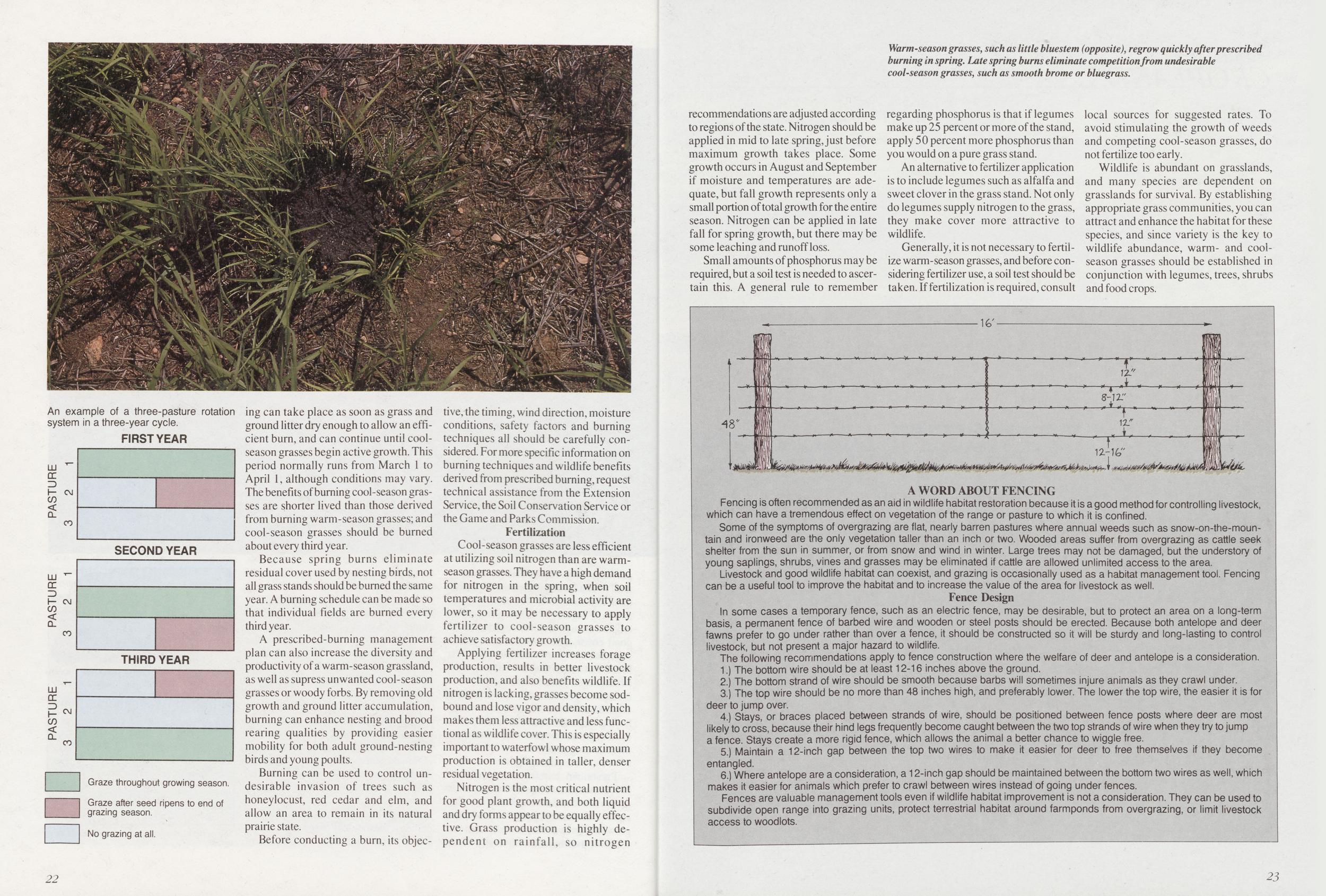
Because spring burns eliminate residual cover used by nesting birds, not all grass stands should be burned the same year. A burning schedule can be made so that individual fields are burned every third year.
A prescribed-burning management plan can also increase the diversity and productivity of a warm-season grassland, as well as supress unwanted cool-season grasses or woody forbs. By removing old growth and ground litter accumulation, burning can enhance nesting and brood rearing qualities by providing easier mobility for both adult ground-nesting birds and young poults.
Burning can be used to control undesirable invasion of trees such as honeylocust, red cedar and elm, and allow an area to remain in its natural prairie state.
Before conducting a burn, its objective, the timing, wind direction, moisture conditions, safety factors and burning techniques all should be carefully considered. For more specific information on burning techniques and wildlife benefits derived from prescribed burning, request technical assistance from the Extension Service, the Soil Conservation Service or the Game and Parks Commission.
FertilizationCool-season grasses are less efficient at utilizing soil nitrogen than are warm season grasses. They have a high demand for nitrogen in the spring, when soil temperatures and microbial activity are lower, so it may be necessary to apply fertilizer to cool-season grasses to achieve satisfactory growth.
Applying fertilizer increases forage production, results in better livestock production, and also benefits wildlife. If nitrogen is lacking, grasses become sodbound and lose vigor and density, which makes them less attractive and less functional as wildlife cover. This is especially important to waterfowl whose maximum production is obtained in taller, denser residual vegetation.
Nitrogen is the most critical nutrient for good plant growth, and both liquid and dry forms appear to be equally effective. Grass production is highly dependent on rainfall, so nitrogen 22 recommendations are adjusted according to regions of the state. Nitrogen should be applied in mid to late spring, just before maximum growth takes place. Some growth occurs in August and September if moisture and temperatures are adequate, but fall growth represents only a small portion of total growth for the entire season. Nitrogen can be applied in late fall for spring growth, but there may be some leaching and runoff loss.
Small amounts of phosphorus may be required, but a soil test is needed to ascertain this. A general rule to remember regarding phosphorus is that if legumes make up 25 percent or more of the stand, apply 50 percent more phosphorus than you would on a pure grass stand.
An alternative to fertilizer application is to include legumes such as alfalfa and sweet clover in the grass stand. Not only do legumes supply nitrogen to the grass, they make cover more attractive to wildlife.
Generally, it is not necessary to fertilize warm-season grasses, and before considering fertilizer use, a soil test should be taken. If fertilization is required, consult local sources for suggested rates. To avoid stimulating the growth of weeds and competing cool-season grasses, do not fertilize too early.
Wildlife is abundant on grasslands, and many species are dependent on grasslands for survival. By establishing appropriate grass communities, you can attract and enhance the habitat for these species, and since variety is the key to wildlife abundance, warm- and cool season grasses should be established in conjunction with legumes, trees, shrubs and food crops.
Fencing is often recommended as an aid in wildlife habitat restoration because it is a good method for controlling livestock, which can have a tremendous effect on vegetation of the range or pasture to which it is confined.
Some of the symptoms of overgrazing are flat, nearly barren pastures where annual weeds such as snow-on-the-mountain and ironweed are the only vegetation taller than an inch or two. Wooded areas suffer from overgrazing as cattle seek shelter from the sun in summer, or from snow and wind in winter. Large trees may not be damaged, but the understory of young saplings, shrubs, vines and grasses may be eliminated if cattle are allowed unlimited access to the area.
Livestock and good wildlife habitat can coexist, and grazing is occasionally used as a habitat management tool. Fencing can be a useful tool to improve the habitat and to increase the value of the area for livestock as well.
Fence DesignIn some cases a temporary fence, such as an electric fence, may be desirable, but to protect an area on a long-term basis, a permanent fence of barbed wire and wooden or steel posts should be erected. Because both antelope and deer fawns prefer to go under rather than over a fence, it should be constructed so it will be sturdy and long-lasting to control livestock, but not present a major hazard to wildlife.
The following recommendations apply to fence construction where the welfare of deer and antelope is a consideration.
1.) The bottom wire should be at least 12-16 inches above the ground.
2.) The bottom strand of wire should be smooth because barbs will sometimes injure animals as they crawl under.
3.) The top wire should be no more than 48 inches high, and preferably lower. The lower the top wire, the easier it is for deer to jump over.
4.) Stays, or braces placed between strands of wire, should be positioned between fence posts where deer are most likely to cross, because their hind legs frequently become caught between the two top strands of wire when they try to jump a fence. Stays create a more rigid fence, which allows the animal a better chance to wiggle free.
5.) Maintain a 12-inch gap between the top two wires to make it easier for deer to free themselves if they become entangled.
6.) Where antelope are a consideration, a 12-inch gap should be maintained between the bottom two wires as well, which makes it easier for animals which prefer to crawl between wires instead of going under fences.
Fences are valuable management tools even if wildlife habitat improvement is not a consideration. They can be used to subdivide open range into grazing units, protect terrestrial habitat around farm ponds from overgrazing, or limit livestock access to woodlots.
23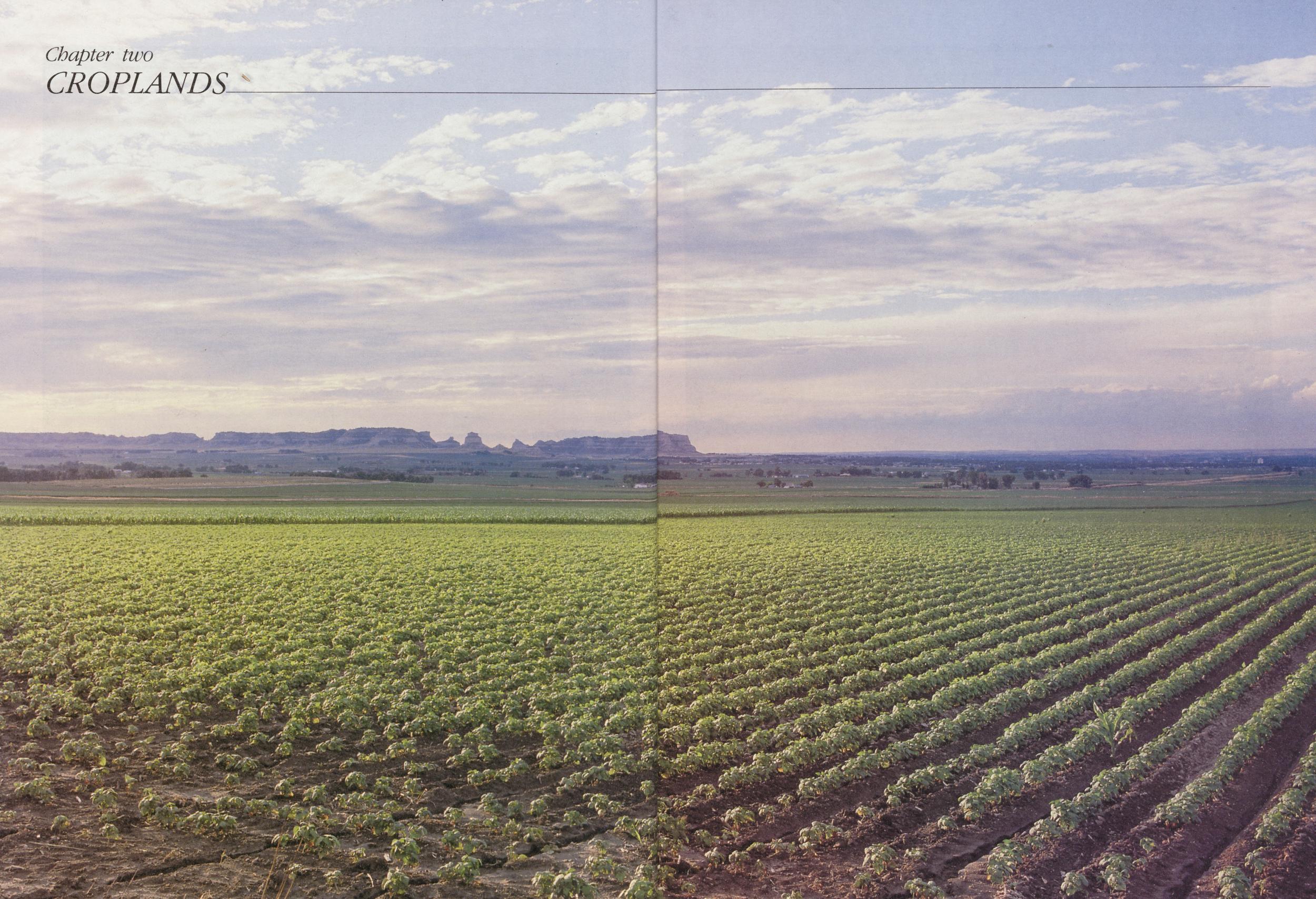
Chapter two CROPLANDS.
Usually, good land management is good wildlife management, and the road agriculture takes in the next century will most likely determine the path wildlife populations take. Wildlife is a resource that has some intrinsic value to farmers, and even if it has little economic value, that does not mean it has no value at all. Actual land health is reflected by wildlife populations, and wildlife can be one barometer of American agriculture. Wildlife's welfare might well be considered as important as the food crops raised on the land.
Each parcel of land has a unique set of characteristics (geology, soil type, hydrological conditions and biotic community, for example) which define the bounds of its long-term productive capabilities. To see an issue in terms of long-range practicality, we must over look narrow selfish interest and judge all costs and benefits by how they affect the common good. Real costs involve more than dollar values.
The assumed lack of profit in "waste" areas is a problem that must be dealt with for these areas to remain in at least a semi-natural state, A patch of native grasses and wild plants may bring a sigh to a narrow, economically minded person who assumes only that the owner is probably too lazy to cut those "weeds." Yet these native grasses and wildflowers are an integral part of our biotic community. These plants helped build the soil. In what unsuspected ways may they be essential to soil maintenance and maintenance of the entire community?
Aldo Leopold said "quit thinking about decent land-use as solely an economic problem. Examine each question in terms of what is ethically and aesthetically right, as well as what is economically expedient. A thing is right when it tends to preserve the integrity, stability, and beauty of the biotic community. It is wrong when it tends otherwise. It of course goes without saying that economic feasibility limits... what can or cannot be done for land. It always has and it always will. We now need to cast off the belief that economics determine all land use. This is simply not true. An innumerable host of actions and attitudes, comprising perhaps the bulk of all land relations, is determined by the land-user's tastes and predilections, rather than by his purse. The bulk of all land relations hinges on investments of time, forethought, skill, and faith rather than on investments of cash. As a land-user thinketh, so is he."
Conservation TillageConservation tillage is one of the practices a land-user can consider. Essentially, it is a reduction in the number of tillage operations used, so that protective amounts of crop residue are left on the surface throughout the year. No one system of conservation tillage is clearly superior for all areas of Nebraska, and greater management ability is required with conservation tillage than with conventional operations because it offers fewer opportunities to correct mistakes.
Conservation tillage provides year round cover for erosion control and good quality wildlife habitat in areas left bare under conventional tillage methods. Inadequate nesting cover severely limits pheasant production and that of other 26 ground-nesting birds in large cropland areas. Nests in cropland are seldom successful under conventional tillage and harvesting operations, but conservation tillage can significantly reduce disturbance of those nests. Studies indicate that there may be as many as seven times the number of nests in no-till fields as there are in conventionally tilled fields.
The use of herbicides rather than tillage operations to control weeds in small grain stubble may permit nesting cover maintenance throughout the nesting season. However, untreated small-grain stubble containing some weeds is much more beneficial to wildlife than is herbicide-treated stubble, probably because of its greater variety and quantity of seeds and the additional diversified cover. Another method of weed control utilizes an under cutter without treaders, which leaves a large portion of the stubble surface undisturbed while still allowing weed control.
Conservation tillage does, however, demand increased pesticide applications, which may reduce the amount of food and cover available for farmland wildlife, and may have other serious effects. Insecticides and herbicides affect wildlife through chronic or acute toxicity, secondary toxicity, depletion of food resources or physiological changes that affect reproduction and behavior.
Chemical insecticides can, for the most part, be divided into two major categories, the organochlorines and the organophosphates and carbamates. Organochlorines are relatively persistent in the environment, are easily translocated, and have been documented as causing significant direct wildlife mortality. They also have significant reproductive effects on wildlife species. Some examples of this group are lindane, chlordane, heptachlor, aldrin, DDT, toxaphene and mirex. Few of these chemicals are still available for agricultural use. Avoid using all organochlorines if possible.
Organophosphates and carbamates comprise most of the chemical insecticides currently in use. Some, including parathion, malathion, and carbofuran Furadan are extremely toxic to humans and wildlife, and should be avoided if possible, or used only sparingly with extreme caution and care. Those which recommend a long waiting period between chemical application and crop harvesting are usually the most toxic.
The hazard of all chemicals is based not only on their toxicity, but also on application rates, chemical formulation, spray mixture, persistence and environmental conditions. As a general rule, aerial applications have a more severe effect on wildlife populations than do ground applications. In addition, ultralow-volume formulations are more apt to cause problems than dilute formulations. Water formulations are generally less damaging to wildlife populations and the environment than are oil formulations.
LEGUMES FOR WILDLIFE PLANTINGS Native Legumes Showy Partridge Pea Illinois Bundle-flower Purple Prairie Clover White Prairie Clover Leadplant Canada Milkvetch American Deervetch Trailing Wildbean Wild Licorice Scurf Pea Roundhead Bushclover Introduced Legumes Alfalfa Sweetclover White Clover Crownvetch Hairy Vetch Birdsfoot Trefoil Roundhead Lespedeza Korean Lespedezrs icer Milkvetch Sericea Lespedeza Intended UseSelecting a legume or legumes for a wildlife planting depends on the type of habitat you want to create. Taller legumes such as alfalfa, sweetclover, hairy vetch and sericea lespedeza provide cover for roosting, loafing, escape and winter protection. Medium height legumes such as alfalfa, birdsfoot trefoil and red clover are especially valuable as nesting cover, and they will also attract insects, providing a high protein food source for young chicks. Short legumes such as birdsfoot trefoil and white clover are used by birds and mammals as loafing areas.
Many legumes, especially introduced species, are grown for forage and hay crops. The time of their first cutting coincides with the peak upland bird nesting period, and many birds are killed and nests destroyed by haying equipment. To prevent this high mortality of upland birds, the first cutting should be delayed until after July 5. The quality of the forage may suffer, but the benefit to wildlife will certainly be enhanced.
Legumes for ground cover on eroded sites and steep banks include crownvetch, hairy vetch, birdsfoot trefoil and white and red clover.
Species SelectionTo select the variety best suited for your location, soil, climate and other factors consult the local county agent or extension office. When selecting seed, buy certified seed, use seed adapted to the local climate and resistant to local diseases. Before seeding, inoculate your seed with the correct inoculate.
Seedbed Preparation and Seeding MethodSeedbed preparation can be by either of two methods: clean seedbed and mulch seedbed. The clean seedbed method entails cultivating the soil by plowing, disking or dragging to ensure a level, uniform seedbed. The mulch seedbed method entails planting into a small-grain stubble field or lightly disking a stubble field to leave a layer of mulch on the seedbed. This is a good method on steep and eroded lands. A variation of the mulch method is to plant the legume with a companion or nurse crop such as oats or wheat seeded at the same time. At maturity, the companion crop is harvested leaving a stubble that protects the small legume seedlings.
Some legumes can be planted by broadcast seeding and others with a seeder or drill. The drill is the better of the two methods especially if it has depth bands and packer wheels which will place the seed at a specified and uniform depth, and then pack the soil around it.
For more detailed information about using legumes in wildlife plantings, contact your local extension office, the University of Nebraska Agronomy Department or the Nebraska Game and Parks Commission.
27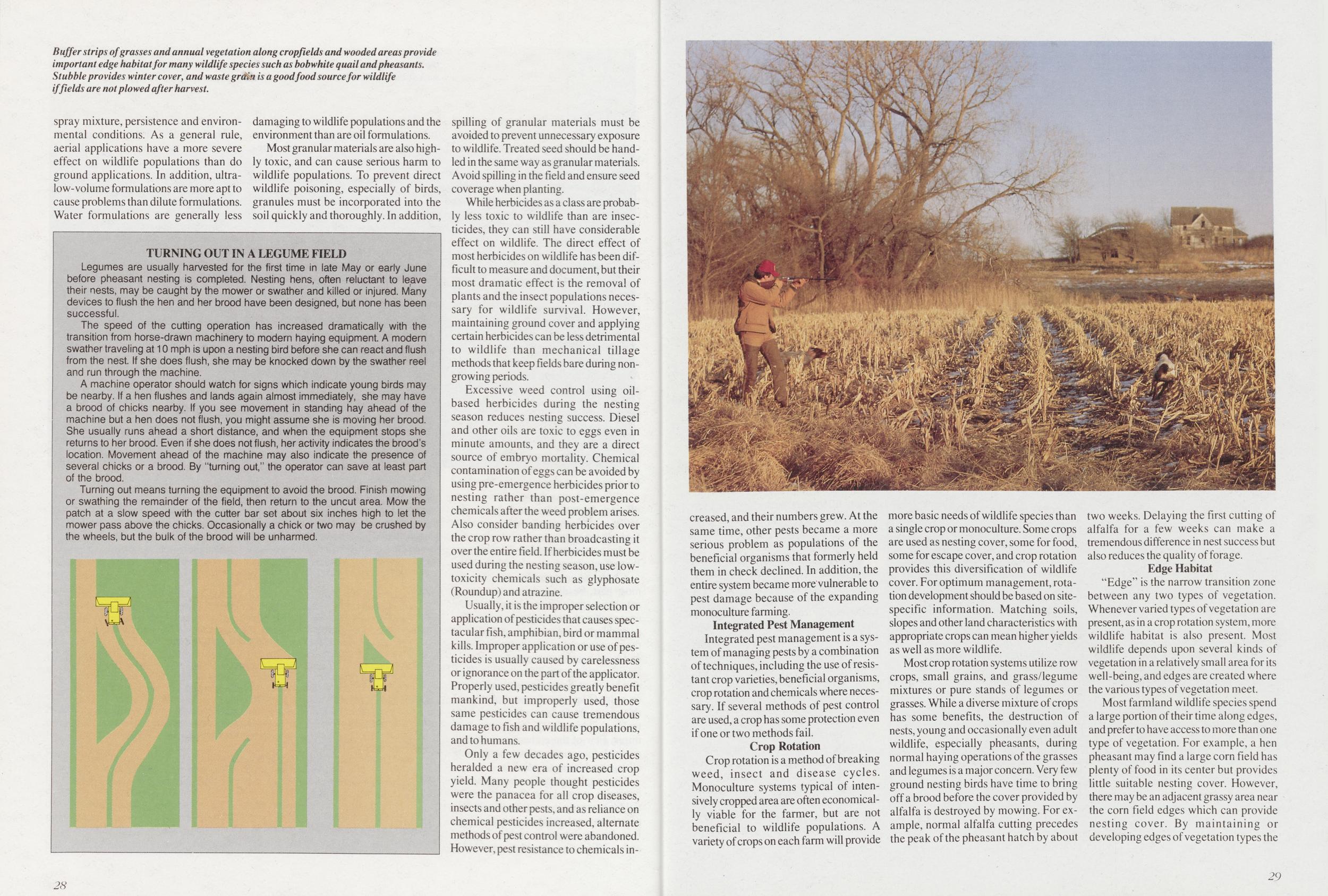
Legumes are usually harvested for the first time in late May or early June before pheasant nesting is completed. Nesting hens, often reluctant to leave their nests, may be caught by the mower or swather and killed or injured. Many devices to flush the hen and her brood have been designed, but none has been successful.
The speed of the cutting operation has increased dramatically with the transition from horse-drawn machinery to modern haying equipment. A modern swather traveling at 10 mph is upon a nesting bird before she can react and flush from the nest. If she does flush, she may be knocked down by the swather reel and run through the machine.
A machine operator should watch for signs which indicate young birds may be nearby. If a hen flushes and lands again almost immediately, she may have a brood of chicks nearby. If you see movement in standing hay ahead of the machine but a hen does not flush, you might assume she is moving her brood. She usually runs ahead a short distance, and when the equipment stops she returns to her brood. Even if she does not flush, her activity indicates the brood's location. Movement ahead of the machine may also indicate the presence of several chicks or a brood. By "turning out," the operator can save at least part of the brood.
Turning out means turning the equipment to avoid the brood. Finish mowing or swathing the remainder of the field, then return to the uncut area. Mow the patch at a slow speed with the cutter bar set about six inches high to let the mower pass above the chicks. Occasionally a chick or two may be crushed by the wheels, but the bulk of the brood will be unharmed.
Most granular materials are also highly toxic, and can cause serious harm to wildlife populations. To prevent direct wildlife poisoning, especially of birds, granules must be incorporated into the soil quickly and thoroughly. In addition, spilling of granular materials must be avoided to prevent unnecessary exposure to wildlife. Treated seed should be handled in the same way as granular materials. Avoid spilling in the field and ensure seed coverage when planting.
While herbicides as a class are probably less toxic to wildlife than are insecticides, they can still have considerable effect on wildlife. The direct effect of most herbicides on wildlife has been difficult to measure and document, but their most dramatic effect is the removal of plants and the insect populations necessary for wildlife survival. However, maintaining ground cover and applying certain herbicides can be less detrimental to wildlife than mechanical tillage methods that keep fields bare during nongrowing periods.
Excessive weed control using oil based herbicides during the nesting season reduces nesting success. Diesel and other oils are toxic to eggs even in minute amounts, and they are a direct source of embryo mortality. Chemical contamination of eggs can be avoided by using pre-emergence herbicides prior to nesting rather than post-emergence chemicals after the weed problem arises. Also consider banding herbicides over the crop row rather than broadcasting it over the entire field. If herbicides must be used during the nesting season, use low toxicity chemicals such as glyphosate (Roundup) and atrazine.
Usually, it is the improper selection or application of pesticides that causes s pectacular fish, amphibian, bird or mammal kills. Improper application or use of pesticides is usually caused by carelessness or ignorance on the part of the applicator. Properly used, pesticides greatly benefit mankind, but improperly used, those same pesticides can cause tremendous damage to fish and wildlife populations, and to humans.
Only a few decades ago, pesticides heralded a new era of increased crop yield. Many people thought pesticides were the panacea for all crop diseases, insects and other pests, and as reliance on chemical pesticides increased, alternate methods of pest control were abandoned. However, pest resistance to chemicals 28 increased, and their numbers grew. At the same time, other pests became a more serious problem as populations of the beneficial organisms that formerly held them in check declined. In addition, the entire system became more vulnerable to pest damage because of the expanding monoculture farming.
Integrated Pest ManagementIntegrated pest management is a system of managing pests by a combination of techniques, including the use of resistant crop varieties, beneficial organisms, crop rotation and chemicals where necessary. If several methods of pest control are used, a crop has some protection even if one or two methods fail.
Crop RotationCrop rotation is a method of breaking weed, insect and disease cycles. Monoculture systems typical of intensively cropped area are often economically viable for the farmer, but are not beneficial to wildlife populations. A variety of crops on each farm will provide more basic needs of wildlife species than a single crop or monoculture. Some crops are used as nesting cover, some for food, some for escape cover, and crop rotation provides this diversification of wildlife cover. For optimum management, rotation development should be based on site specific information. Matching soils, slopes and other land characteristics with appropriate crops can mean higher yields as well as more wildlife.
Most crop rotation systems utilize row crops, small grains, and grass/legume mixtures or pure stands of legumes or grasses. While a diverse mixture of crops has some benefits, the destruction of nests, young and occasionally even adult wildlife, especially pheasants, during normal haying operations of the grasses and legumes is a major concern. Very few ground nesting birds have time to bring off a brood before the cover provided by alfalfa is destroyed by mowing. For example, normal alfalfa cutting precedes the peak of the pheasant hatch by about two weeks. Delaying the first cutting of alfalfa for a few weeks can make a tremendous difference in nest success but also reduces the quality of forage.
Edge Habitat"Edge" is the narrow transition zone between any two types of vegetation. Whenever varied types of vegetation are present, as in a crop rotation system, more wildlife habitat is also present. Most wildlife depends upon several kinds of vegetation in a relatively small area for its well-being, and edges are created where the various types of vegetation meet.
Most farmland wildlife species spend
a large portion of their time along edges,
and prefer to have access to more than one
type of vegetation. For example, a hen
pheasant may find a large corn field has
plenty of food in its center but provides
little suitable nesting cover. However,
there may be an adjacent grassy area near
the corn field edges which can provide
nesting cover. By maintaining or
developing edges of vegetation types the
29
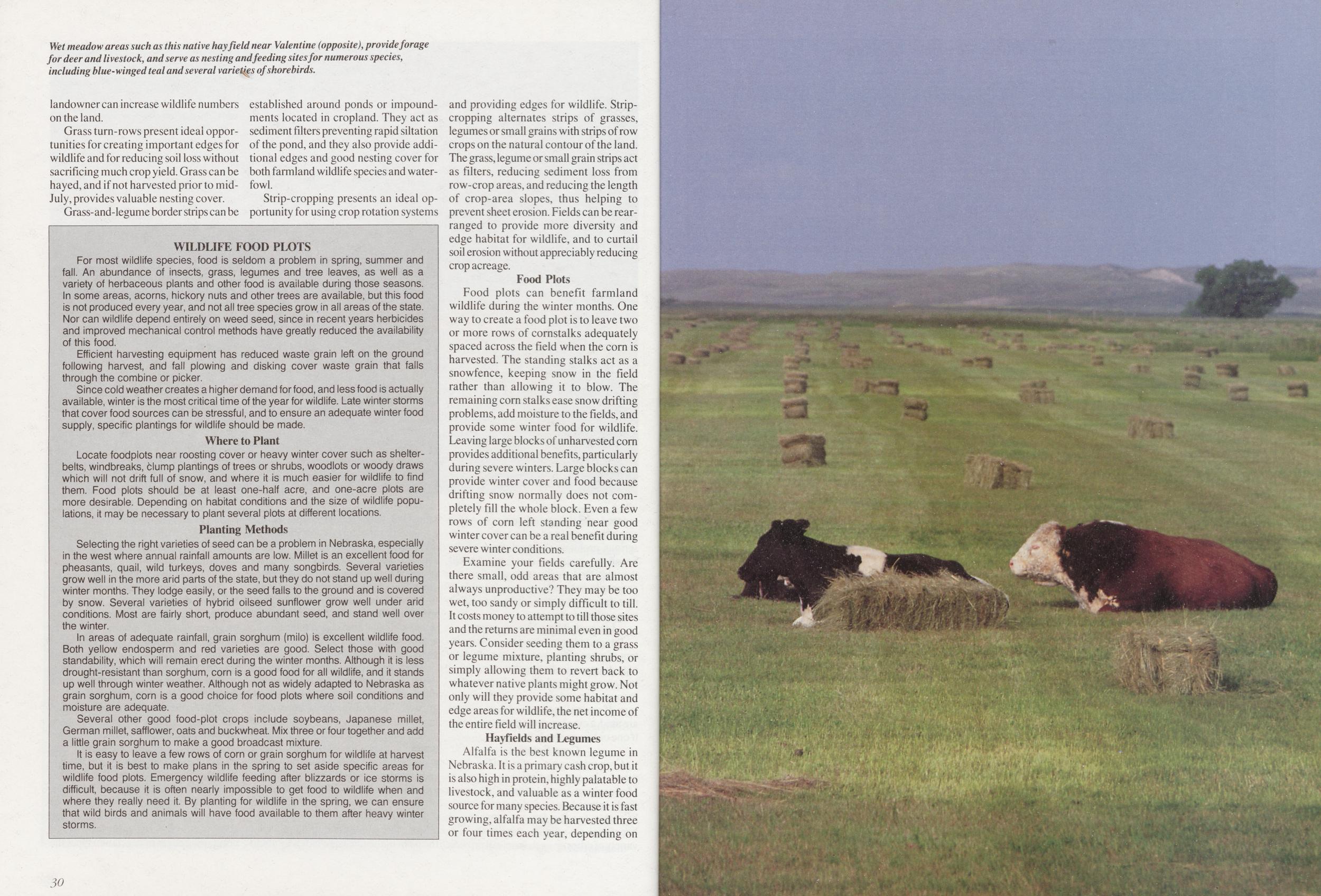
Grass turn-rows present ideal opportunities for creating important edges for wildlife and for reducing soil loss without sacrificing much crop yield. Grass can be hayed, and if not harvested prior to mid-July, provides valuable nesting cover.
Grass-and-legume border strips can be established around ponds or impoundments located in cropland. They act as sediment filters preventing rapid siltation of the pond, and they also provide additional edges and good nesting cover for both farmland wildlife species and water fowl.
Strip-cropping presents an ideal opportunity for using crop rotation systems and providing edges for wildlife. Strip cropping alternates strips of grasses, legumes or small grains with strips of row crops on the natural contour of the land. The grass, legume or small grain strips act as filters, reducing sediment loss from row-crop areas, and reducing the length of crop-area slopes, thus helping to prevent sheet erosion. Fields can be rearranged to provide more diversity and edge habitat for wildlife, and to curtail soil erosion without appreciably reducing crop acreage.
WILDLIFE FOOD PLOTSFor most wildlife species, food is seldom a problem in spring, summer and fall. An abundance of insects, grass, legumes and tree leaves, as well as a variety of herbaceous plants and other food is available during those seasons. In some areas, acorns, hickory nuts and other trees are available, but this food is not produced every year, and not all tree species grow in all areas of the state. Nor can wildlife depend entirely on weed seed, since in recent years herbicides and improved mechanical control methods have greatly reduced the availability of this food.
Efficient harvesting equipment has reduced waste grain left on the ground following harvest, and fall plowing and disking cover waste grain that falls through the combine or picker.
Since cold weather creates a higher demand for food, and less food is actually available, winter is the most critical time of the year for wildlife. Late winter storms that cover food sources can be stressful, and to ensure an adequate winter food supply, specific plantings for wildlife should be made.
Where to PlantLocate food plots near roosting cover or heavy winter cover such as shelter belts, windbreaks, clump plantings of trees or shrubs, woodlots or woody draws which will not drift full of snow, and where it is much easier for wildlife to find them. Food plots should be at least one-half acre, and one-acre plots are more desirable. Depending on habitat conditions and the size of wildlife populations, it may be necessary to plant several plots at different locations.
Planting MethodsSelecting the right varieties of seed can be a problem in Nebraska, especially in the west where annual rainfall amounts are low. Millet is an excellent food for pheasants, quail, wild turkeys, doves and many songbirds. Several varieties grow well in the more arid parts of the state, but they do not stand up well during winter months. They lodge easily, or the seed falls to the ground and is covered by snow. Several varieties of hybrid oilseed sunflower grow well under arid conditions. Most are fairly short, produce abundant seed, and stand well over the winter.
In areas of adequate rainfall, grain sorghum (milo) is excellent wildlife food. Both yellow endosperm and red varieties are good. Select those with good stand-ability, which will remain erect during the winter months. Although it is less drought-resistant than sorghum, corn is a good food for ail wildlife, and it stands up well through winter weather. Although not as widely adapted to Nebraska as grain sorghum, corn is a good choice for food plots where soil conditions and moisture are adequate.
Several other good food-plot crops include soybeans, Japanese millet, German millet, safflower, oats and buckwheat. Mix three or four together and add a little grain sorghum to make a good broadcast mixture.
It is easy to leave a few rows of corn or grain sorghum for wildlife at harvest time, but it is best to make plans in the spring to set aside specific areas for wildlife food plots. Emergency wildlife feeding after blizzards or ice storms is difficult, because it is often nearly impossible to get food to wildlife when and where they really need it. By planting for wildlife in the spring, we can ensure that wild birds and animals will have food available to them after heavy winter storms.
Food PlotsFood plots can benefit farmland wildlife during the winter months. One way to create a food plot is to leave two or more rows of cornstalks adequately spaced across the field when the corn is harvested. The standing stalks act as a snow fence, keeping snow in the field rather than allowing it to blow. The remaining corn stalks ease snow drifting problems, add moisture to the fields, and provide some winter food for wildlife. Leaving large blocks of unharvested corn provides additional benefits, particularly during severe winters. Large blocks can provide winter cover and food because drifting snow normally does not completely fill the whole block. Even a few rows of corn left standing near good winter cover can be a real benefit during severe winter conditions.
Examine your fields carefully. Are there small, odd areas that are almost always unproductive? They may be too wet, too sandy or simply difficult to till. It costs money to attempt to till those sites and the returns are minimal even in good years. Consider seeding them to a grass or legume mixture, planting shrubs, or simply allowing them to revert back to whatever native plants might grow. Not only will they provide some habitat and edge areas for wildlife, the net income of the entire field will increase.
Hayfields and LegumesAlfalfa is the best known legume in Nebraska. It is a primary cash crop, but it is also high in protein, highly palatable to livestock, and valuable as a winter food source for many species. Because it is fast growing, alfalfa may be harvested three or four times each year, depending on rainfall. It is also valuable to wildlife, providing nesting, brood and escape cover for pheasants, quail and other small birds.
30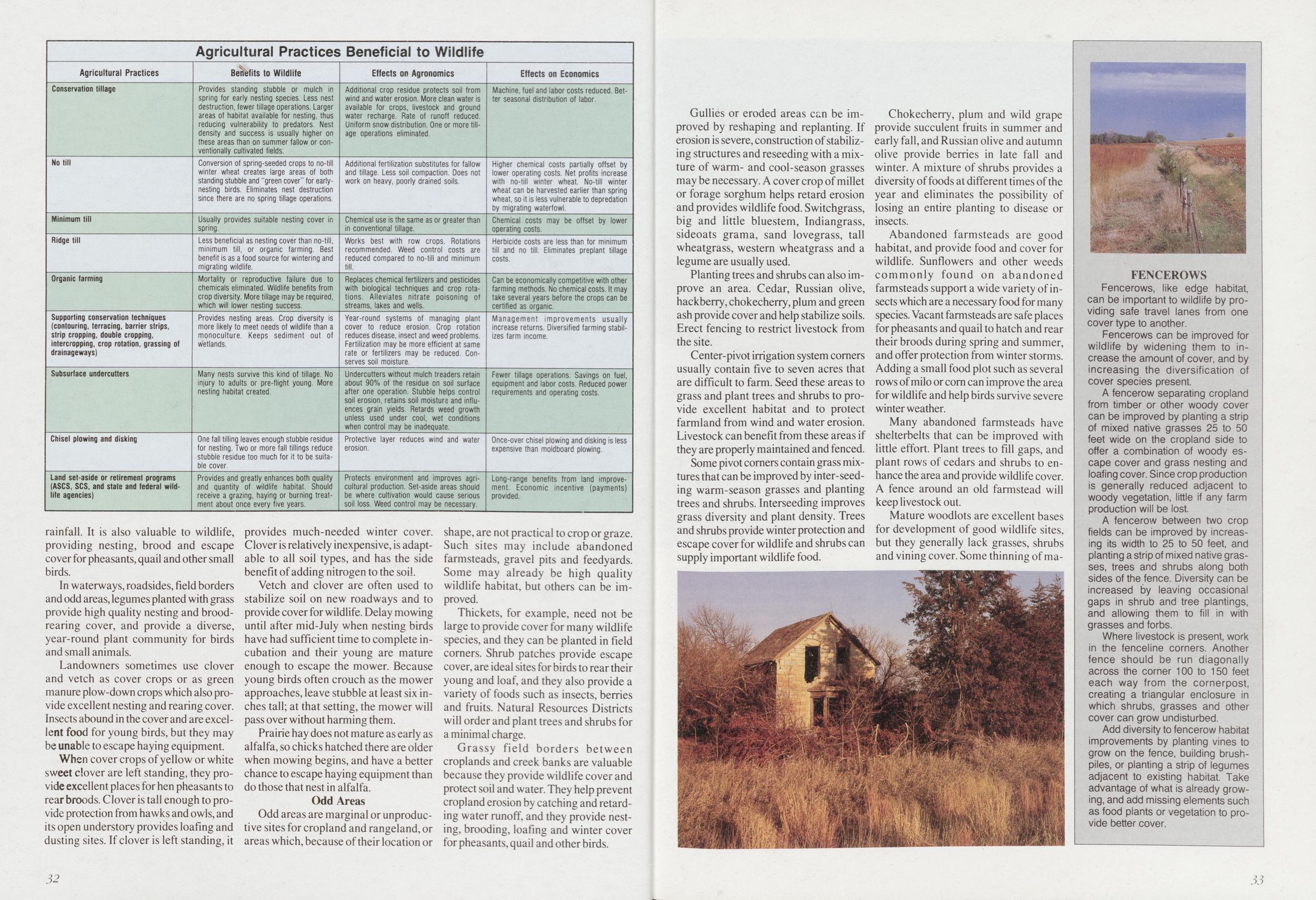 Agricultural Practices Beneficial to Wildlife
Agricultural Practices Benefits to Wildlife Effects on Agronomics Effects on Economics
Conservation tillage Provides standing stubble or mulch in spring for early nesting
species. Less nest destruction, fewer tillage operations. Larger areas of habitat
available for nesting, thus reducing vulnerability to predators. Nest density and
success is usually higher on these areas than on summer fallow or conventionally cultivated
fields. Additional crop residue protects soil from wind and water erosion. More clean
water is available for crops, livestock and ground water recharge. Rate of runoff
reduced. Uniform snow distribution. One or more tillage operations eliminated. Machine,
fuel and labor costs reduced. Better seasonal distribution of labor.
No till Conversion of spring-seeded crops to no-till winter wheat creates large areas
of both standing stubble and "green cover" for early-nesting birds. Eliminates nest
destruction since there are no spring tillage operations. Additional fertilization
substitutes for fallow and tillage. Less soil compaction. Does not work on heavy,
poorly drained soils. Higher chemical costs partially offset by lower operating costs.
Net profits increase with no-till winter wheat. No-till winter wheat can be harvested
earlier than spring wheat, so it is less vulnerable to depredation by migrating waterfowl.
Minimum till Usually provides suitable nesting cover in spring. Chemical use is the
same as or greater than in conventional tillage. Chemical costs may be offset by lower
operating costs.
Ridge till Less beneficial as nesting cover than no-till, minimum till, or organic
farming. Best benefit is as a food source for wintering and migrating wildlife. Works
best with row crops. Rotations recommended. Weed control costs are reduced compared
to no-till and minimum till. Herbicide costs are less than for minimum till and no
till. Eliminates preplant tillage costs.
Organic farming Mortality or reproductive failure due to chemicals eliminated. Wildlife
benefits from crop diversity. More tillage may be required, which will lower nesting
success. Replaces chemical fertilizers and pesticides with biological techniques and
crop rotations. Alleviates nitrate poisoning of streams, lakes and wells. Can
be economically competitive with other farming methods. No chemical costs. It may
take several years before the crops can be certified as organic.
Supporting conservation techniques (contouring, terracing, barrier strips, strip cropping,
double cropping, intercropping, crop rotation, grassing of drainage ways) Provides
nesting areas. Crop diversity is more likely to meet needs of wildlife than a monoculture.
Keeps sediment out of wetlands. Year-round systems of managing plant cover to reduce
erosion. Crop rotation reduces disease, insect and weed problems. Fertilization may
be more efficient at same rate or fertilizers may be reduced. Conserves soil moisture. Management
improvements usually increase returns. Diversified farming stabilizes farm income.
Subsurface undercutters Many nests survive this kind of tillage. No injury to adults
or pre-flight young. More nesting habitat created. Undercutters without mulch treaders
retain about 90% of the residue on soil surface after one operation. Stubble helps
control soil erosion, retains soil moisture and influences grain yields. Retards weed
growth unless used under cool, wet conditions when control may be inadequate. Fewer
tillage operations. Savings on fuel, equipment and labor costs. Reduced power requirements
and operating costs.
Chisel plowing and disking One fall tilling leaves enough stubbie residue for nesting.
Two or more fall fillings reduce stubble residue too much for it to be suitable cover. Protective
layer reduces wind and water erosion. Once-over chisel plowing and disking is less
expensive than moldboard plowing.
Land set-aside or retirement programs (ASCS, SCS, and state and federal wildlife agencies)
Provides and greatly enhances both quality and quantity of wildlife habitat. Should
receive a grazing, haying or burning treatment about once every five years. Protects
environment and improves agricultural production. Set-aside areas should be where
cultivation would cause serious soil loss. Weed control may be necessary. Long-range
benefits from land improvement. Economic incentive (payments) provided.
Agricultural Practices Beneficial to Wildlife
Agricultural Practices Benefits to Wildlife Effects on Agronomics Effects on Economics
Conservation tillage Provides standing stubble or mulch in spring for early nesting
species. Less nest destruction, fewer tillage operations. Larger areas of habitat
available for nesting, thus reducing vulnerability to predators. Nest density and
success is usually higher on these areas than on summer fallow or conventionally cultivated
fields. Additional crop residue protects soil from wind and water erosion. More clean
water is available for crops, livestock and ground water recharge. Rate of runoff
reduced. Uniform snow distribution. One or more tillage operations eliminated. Machine,
fuel and labor costs reduced. Better seasonal distribution of labor.
No till Conversion of spring-seeded crops to no-till winter wheat creates large areas
of both standing stubble and "green cover" for early-nesting birds. Eliminates nest
destruction since there are no spring tillage operations. Additional fertilization
substitutes for fallow and tillage. Less soil compaction. Does not work on heavy,
poorly drained soils. Higher chemical costs partially offset by lower operating costs.
Net profits increase with no-till winter wheat. No-till winter wheat can be harvested
earlier than spring wheat, so it is less vulnerable to depredation by migrating waterfowl.
Minimum till Usually provides suitable nesting cover in spring. Chemical use is the
same as or greater than in conventional tillage. Chemical costs may be offset by lower
operating costs.
Ridge till Less beneficial as nesting cover than no-till, minimum till, or organic
farming. Best benefit is as a food source for wintering and migrating wildlife. Works
best with row crops. Rotations recommended. Weed control costs are reduced compared
to no-till and minimum till. Herbicide costs are less than for minimum till and no
till. Eliminates preplant tillage costs.
Organic farming Mortality or reproductive failure due to chemicals eliminated. Wildlife
benefits from crop diversity. More tillage may be required, which will lower nesting
success. Replaces chemical fertilizers and pesticides with biological techniques and
crop rotations. Alleviates nitrate poisoning of streams, lakes and wells. Can
be economically competitive with other farming methods. No chemical costs. It may
take several years before the crops can be certified as organic.
Supporting conservation techniques (contouring, terracing, barrier strips, strip cropping,
double cropping, intercropping, crop rotation, grassing of drainage ways) Provides
nesting areas. Crop diversity is more likely to meet needs of wildlife than a monoculture.
Keeps sediment out of wetlands. Year-round systems of managing plant cover to reduce
erosion. Crop rotation reduces disease, insect and weed problems. Fertilization may
be more efficient at same rate or fertilizers may be reduced. Conserves soil moisture. Management
improvements usually increase returns. Diversified farming stabilizes farm income.
Subsurface undercutters Many nests survive this kind of tillage. No injury to adults
or pre-flight young. More nesting habitat created. Undercutters without mulch treaders
retain about 90% of the residue on soil surface after one operation. Stubble helps
control soil erosion, retains soil moisture and influences grain yields. Retards weed
growth unless used under cool, wet conditions when control may be inadequate. Fewer
tillage operations. Savings on fuel, equipment and labor costs. Reduced power requirements
and operating costs.
Chisel plowing and disking One fall tilling leaves enough stubbie residue for nesting.
Two or more fall fillings reduce stubble residue too much for it to be suitable cover. Protective
layer reduces wind and water erosion. Once-over chisel plowing and disking is less
expensive than moldboard plowing.
Land set-aside or retirement programs (ASCS, SCS, and state and federal wildlife agencies)
Provides and greatly enhances both quality and quantity of wildlife habitat. Should
receive a grazing, haying or burning treatment about once every five years. Protects
environment and improves agricultural production. Set-aside areas should be where
cultivation would cause serious soil loss. Weed control may be necessary. Long-range
benefits from land improvement. Economic incentive (payments) provided.
In waterways, roadsides, field borders and odd areas, legumes planted with grass provide high quality nesting and broodrearing cover, and provide a diverse, year-round plant community for birds and small animals.
Landowners sometimes use clover and vetch as cover crops or as green manure plow-down crops which also provide excellent nesting and rearing cover. Insects abound in the cover and are excellent food for young birds, but they may be unable to escape haying equipment.
When cover crops of yellow or white sweet clover are left standing, they provide excellent places for hen pheasants to rear broods. Clover is tall enough to provide protection from hawks and owls, and its open understory provides loafing and dusting sites. If clover is left standing, it provides much-needed winter cover. Clover is relatively inexpensive, is adaptable to all soil types, and has the side benefit of adding nitrogen to the soil.
Vetch and clover are often used to stabilize soil on new roadways and to provide cover for wildlife. Delay mowing until after mid-July when nesting birds have had sufficient time to complete incubation and their young are mature enough to escape the mower. Because young birds often crouch as the mower approaches, leave stubble at least six inches tall; at that setting, the mower will pass over without harming them.
Prairie hay does not mature as early as alfalfa, so chicks hatched there are older when mowing begins, and have a better chance to escape haying equipment than do those that nest in alfalfa.
Odd AreasOdd areas are marginal or unproductive sites for cropland and rangeland, or areas which, because of their location or shape, are not practical to crop or graze. Such sites may include abandoned farmsteads, gravel pits and feed yards. Some may already be high quality wildlife habitat, but others can be improved.
Thickets, for example, need not be large to provide cover for many wildlife species, and they can be planted in field corners. Shrub patches provide escape cover, are ideal sites for birds to rear their young and loaf, and they also provide a variety of foods such as insects, berries and fruits. Natural Resources Districts will order and plant trees and shrubs for a minimal charge.
Grassy field borders between croplands and creek banks are valuable because they provide wildlife cover and protect soil and water. They help prevent cropland erosion by catching and retarding water runoff, and they provide nesting, brooding, loafing and winter cover for pheasants, quail and other birds.
32Gullies or eroded areas can be improved by reshaping and replanting. If erosion is severe, construction of stabilizing structures and reseeding with a mixture of warm- and cool-season grasses may be necessary. A cover crop of millet or forage sorghum helps retard erosion and provides wildlife food. Switchgrass, big and little bluestem, Indiangrass, sideoats grama, sand lovegrass, tall wheatgrass, western wheatgrass and a legume are usually used.
Planting trees and shrubs can also improve an area. Cedar, Russian olive, hackberry, chokecherry, plum and green ash provide cover and help stabilize soils. Erect fencing to restrict livestock from the site.
Center-pivot irrigation system corners usually contain five to seven acres that are difficult to farm. Seed these areas to grass and plant trees and shrubs to provide excellent habitat and to protect farmland from wind and water erosion. Livestock can benefit from these areas if they are properly maintained and fenced.
Some pivot corners contain grass mixtures that can be improved by inter-seeding warm-season grasses and planting trees and shrubs. Inter-seeding improves grass diversity and plant density. Trees and shrubs provide winter protection and escape cover for wildlife and shrubs can supply important wildlife food.
Chokecherry, plum and wild grape provide succulent fruits in summer and early fall, and Russian olive and autumn olive provide berries in late fall and winter. A mixture of shrubs provides a diversity of foods at different times of the year and eliminates the possibility of losing an entire planting to disease or insects.
Abandoned farmsteads are good habitat, and provide food and cover for wildlife. Sunflowers and other weeds commonly found on abandoned farmsteads support a wide variety of insects which are a necessary food for many species. Vacant farmsteads are safe places for pheasants and quail to hatch and rear their broods during spring and summer, and offer protection from winter storms. Adding a small food plot such as several rows of milo or corn can improve the area for wildlife and help birds survive severe winter weather.
Many abandoned farmsteads have shelter belts that can be improved with little effort. Plant trees to fill gaps, and plant rows of cedars and shrubs to enhance the area and provide wildlife cover. A fence around an old farmstead will keep livestock out.
Mature woodlots are excellent bases for development of good wildlife sites, but they generally lack grasses, shrubs and vining cover. Some thinning of ma-
Fencerows, like edge habitat, can be important to wildlife by providing safe travel lanes from one cover type to another.
Fencerows can be improved for wildlife by widening them to increase the amount of cover, and by increasing the diversification of cover species present.
A fencerow separating cropland from timber or other woody cover can be improved by planting a strip of mixed native grasses 25 to 50 feet wide on the cropland side to offer a combination of woody escape cover and grass nesting and loafing cover. Since crop production is generally reduced adjacent to woody vegetation, little if any farm production will be lost.
A fencerow between two crop fields can be improved by increasing its width to 25 to 50 feet, and planting a strip of mixed native grasses, trees and shrubs along both sides of the fence. Diversity can be increased by leaving occasional gaps in shrub and tree plantings, and allowing them to fill in with grasses and forbs.
Where livestock is present, work in the fence line corners. Another fence should be run diagonally across the corner 100 to 150 feet each way from the corner post, creating a triangular enclosure in which shrubs, grasses and other cover can grow undisturbed.
Add diversity to fencerow habitat
improvements by planting vines to
grow on the fence, building
brushpiles, or planting a strip of legumes
adjacent to existing habitat. Take
advantage of what is already
growing, and add missing elements such
as food plants or vegetation top
provide better cover.
33
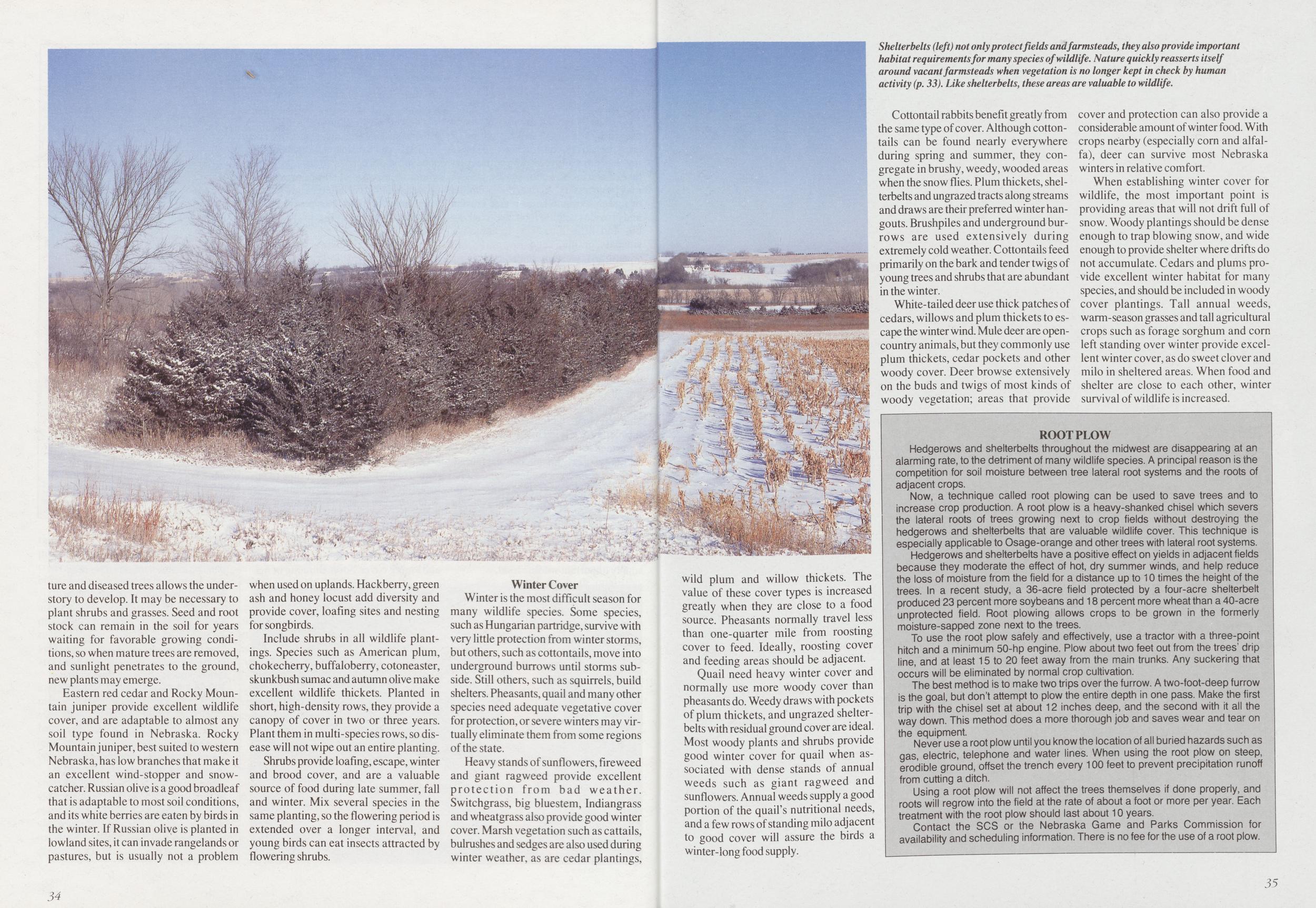
Eastern red cedar and Rocky Mountain juniper provide excellent wildlife cover, and are adaptable to almost any soil type found in Nebraska. Rocky Mountain juniper, best suited to western Nebraska, has low branches that make it an excellent wind-stopper and snow catcher. Russian olive is a good broadleaf that is adaptable to most soil conditions, and its white berries are eaten by birds in the winter. If Russian olive is planted in lowland sites, it can invade rangelands or pastures, but is usually not a problem when used on uplands. Hackberry, green ash and honey locust add diversity and provide cover, loafing sites and nesting for songbirds.
Include shrubs in all wildlife plantings. Species such as American plum, chokecherry, buffaloberry, cotoneaster, skunkbush sumac and autumn olive make excellent wildlife thickets. Planted in short, high-density rows, they provide a canopy of cover in two or three years. Plant them in multi-species rows, so disease will not wipe out an entire planting.
Shrubs provide loafing, escape, winter and brood cover, and are a valuable source of food during late summer, fall and winter. Mix several species in the same planting, so the flowering period is extended over a longer interval, and young birds can eat insects attracted by flowering shrubs.
Winter CoverWinter is the most difficult season for many wildlife species. Some species, such as Hungarian partridge, survive with very little protection from winter storms, but others, such as cottontails, move into underground burrows until storms sub- side. Still others, such as squirrels, build shelters. Pheasants, quail and many other species need adequate vegetative cover for protection, or severe winters may virtually eliminate them from some regions of the state.
Heavy stands of sunflowers, fire weed and giant ragweed provide excellent protection from bad weather. Switchgrass, big bluestem, Indiangrass and wheatgrass also provide good winter cover. Marsh vegetation such as cattails, bulrushes and sedges are also used during winter weather, as are cedar plantings, 34 wild plum and willow thickets. The value of these cover types is increased greatly when they are close to a food source. Pheasants normally travel less than one-quarter mile from roosting cover to feed. Ideally, roosting cover and feeding areas should be adjacent.
Quail need heavy winter cover and normally use more woody cover than pheasants do. Weedy draws with pockets of plum thickets, and ungrazed shelterbelts with residual ground cover are ideal. Most woody plants and shrubs provide good winter cover for quail when associated with dense stands of annual weeds such as giant ragweed and sunflowers. Annual weeds supply a good portion of the quail's nutritional needs, and a few rows of standing milo adjacent to good cover will assure the birds a winter-long food supply.
Cottontail rabbits benefit greatly from the same type of cover. Although cottontails can be found nearly everywhere during spring and summer, they congregate in brushy, weedy, wooded areas when the snow flies. Plum thickets, shelterbelts and ungrazed tracts along streams and draws are their preferred winter hangouts. Brushpiles and underground burrows are used extensively during extremely cold weather. Cottontails feed primarily on the bark and tender twigs of young trees and shrubs that are abundant in the winter.
White-tailed deer use thick patches of cedars, willows and plum thickets to escape the winter wind. Mule deer are opencountry animals, but they commonly use plum thickets, cedar pockets and other woody cover. Deer browse extensively on the buds and twigs of most kinds of woody vegetation; areas that provide cover and protection can also provide a considerable amount of winter food. With crops nearby (especially corn and alfalfa), deer can survive most Nebraska winters in relative comfort.
When establishing winter cover for wildlife, the most important point is providing areas that will not drift full of snow. Woody plantings should be dense enough to trap blowing snow, and wide enough to provide shelter where drifts do not accumulate. Cedars and plums provide excellent winter habitat for many species, and should be included in woody cover plantings. Tall annual weeds, warm-season grasses and tall agricultural crops such as forage sorghum and corn left standing over winter provide excellent winter cover, as do sweet clover and milo in sheltered areas. When food and shelter are close to each other, winter survival of wildlife is increased.
ROOT PLOWHedgerows and shelterbelts throughout the midwest are disappearing at an alarming rate, to the detriment of many wildlife species. A principal reason is the competition for soil moisture between tree lateral root systems and the roots of adjacent crops.
Now, a technique called root plowing can be used to save trees and to increase crop production. A root plow is a heavy-shanked chisel which severs the lateral roots of trees growing next to crop fields without destroying the hedgerows and shelterbelts that are valuable wildlife cover. This technique is especially applicable to Osage-orange and other trees with lateral root systems.
Hedgerows and shelterbelts have a positive effect on yields in adjacent fields because they moderate the effect of hot, dry summer winds, and help reduce the loss of moisture from the field for a distance up to 10 times the height of the trees. In a recent study, a 36-acre field protected by a four-acre shelterbelt produced 23 percent more soybeans and 18 percent more wheat than a 40-acre unprotected field. Root plowing allows crops to be grown in the formerly moisture-sapped zone next to the trees.
To use the root plow safely and effectively, use a tractor with a three-point hitch and a minimum 50-hp engine. Plow about two feet out from the trees' drip line, and at least 15 to 20 feet away from the main trunks. Any suckering that occurs will be eliminated by normal crop cultivation.
The best method is to make two trips over the furrow. A two-foot-deep furrow is the goal, but don't attempt to plow the entire depth in one pass. Make the first trip with the chisel set at about 12 inches deep, and the second with it all the way down. This method does a more thorough job and saves wear and tear on the equipment
Never use a root plow until you know the location of all buried hazards such as gas, electric, telephone and water lines. When using the root plow on steep, erodible ground, offset the trench every 100 feet to prevent precipitation runoff from cutting a ditch.
Using a root plow will not affect the trees themselves if done properly, and roots will regrow into the field at the rate of about a foot or more per year. Each treatment with the root plow should last about 10 years.
Contact the SCS or the Nebraska Game and Parks Commission for availability and scheduling information. There is no fee for the use of a root plow.
35
Chapter, three WOODED AREAS
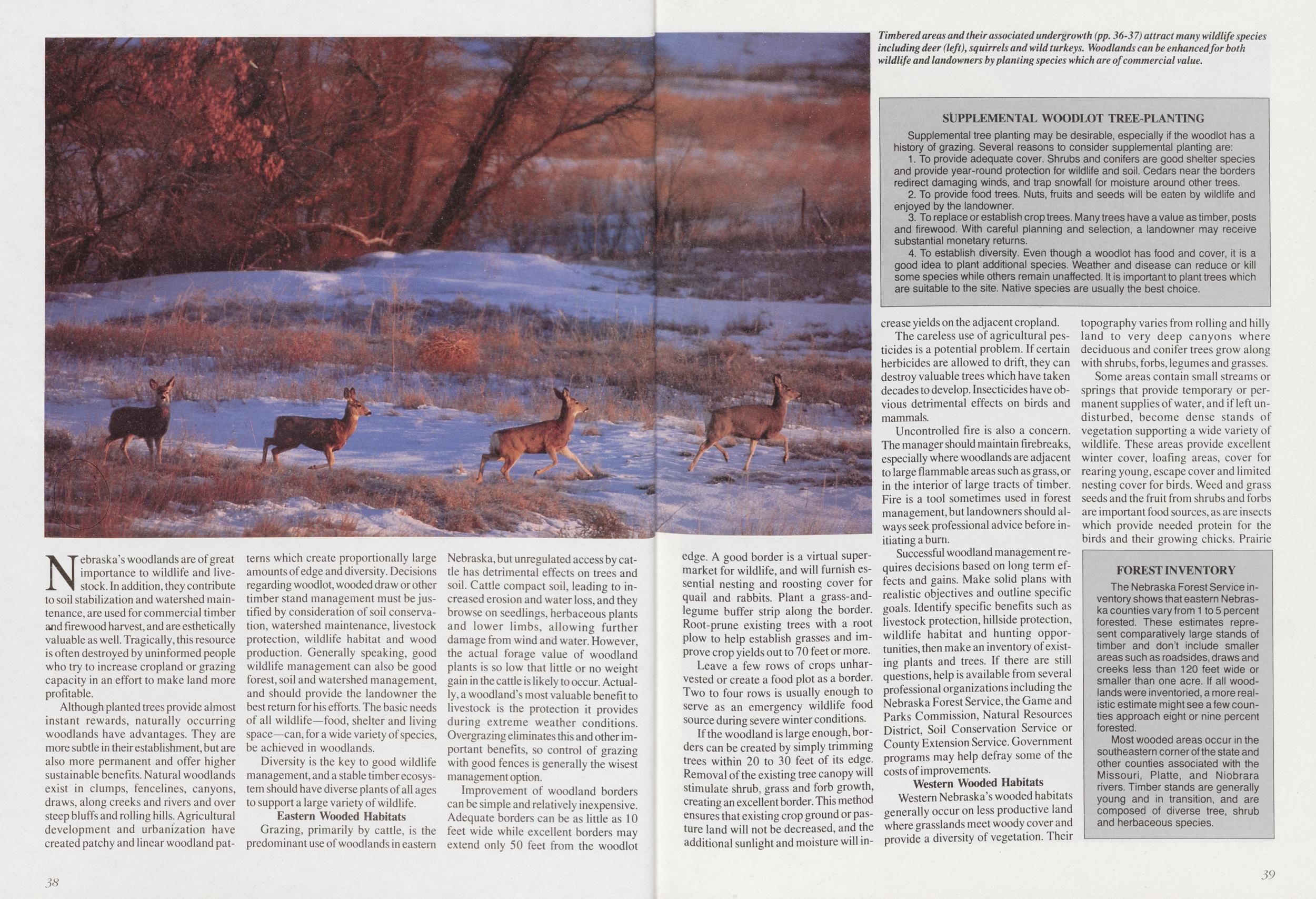
Nebraska's woodlands are of great importance to wildlife and livestock. In addition, they contribute to soil stabilization and watershed maintenance, are used for commercial timber and firewood harvest, and are esthetically valuable as well. Tragically, this resource is often destroyed by uninformed people who try to increase cropland or grazing capacity in an effort to make land more profitable.
Although planted trees provide almost instant rewards, naturally occurring woodlands have advantages. They are more subtle in their establishment, but are also more permanent and offer higher sustainable benefits. Natural woodlands exist in clumps, fence lines, canyons, draws, along creeks and rivers and over steep bluffs and rolling hills. Agricultural development and urbanization have created patchy and linear woodland patterns which create proportionally large amounts of edge and diversity. Decisions regarding woodlot, wooded draw or other timber stand management must be justified by consideration of soil conservation, watershed maintenance, livestock protection, wildlife habitat and wood production. Generally speaking, good wildlife management can also be good forest, soil and watershed management, and should provide the landowner the best return for his efforts. The basic needs of all wildlife—food, shelter and living space—can, for a wide variety of species, be achieved in woodlands.
Diversity is the key to good wildlife management, and a stable timber ecosystem should have diverse plants of all ages to support a large variety of wildlife.
Eastern Wooded HabitatsGrazing, primarily by cattle, is the predominant use of woodlands in eastern Nebraska, but unregulated access by cattle has detrimental effects on trees and soil. Cattle compact soil, leading to increased erosion and water loss, and they browse on seedlings, herbaceous plants and lower limbs, allowing further damage from wind and water. However, the actual forage value of woodland plants is so low that little or no weight gain in the cattle is likely to occur. Actually, a woodland's most valuable benefit to livestock is the protection it provides during extreme weather conditions. Overgrazing eliminates this and other important benefits, so control of grazing with good fences is generally the wisest management option.
Improvement of woodland borders can be simple and relatively inexpensive. Adequate borders can be as little as 10 feet wide while excellent borders may extend only 50 feet from the woodlot 39 edge. A good border is a virtual supermarket for wildlife, and will furnish essential nesting and roosting cover for quail and rabbits. Plant a grass-and-legume buffer strip along the border. Root-prune existing trees with a root plow to help establish grasses and improve crop yields out to 70 feet or more.
Leave a few rows of crops unharvested or create a food plot as a border. Two to four rows is usually enough to serve as an emergency wildlife food source during severe winter conditions.
If the woodland is large enough, borders can be created by simply trimming trees within 20 to 30 feet of its edge. Removal of the existing tree canopy will stimulate shrub, grass and forb growth, creating an excellent border. This method ensures that existing crop ground or pasture land will not be decreased, and the additional sunlight and moisture will increase yields on the adjacent cropland.
SUPPLEMENTAL WOODLOT TREE-PLANTINGSupplemental tree planting may be desirable, especially if the woodlot has a history of grazing. Several reasons to consider supplemental planting are:
1. To provide adequate cover. Shrubs and conifers are good shelter species and provide year-round protection for wildlife and soil. Cedars near the borders redirect damaging winds, and trap snowfall for moisture around other trees.
2. To provide food trees. Nuts, fruits and seeds will be eaten by wildlife and enjoyed by the landowner.
3. To replace or establish crop trees. Many trees have a value as timber, posts and firewood. With careful planning and selection, a landowner may receive substantial monetary returns.
4. To establish diversity. Even though a woodlot has food and cover, it is a good idea to plant additional species. Weather and disease can reduce or kill some species while others remain unaffected. It is important to plant trees which are suitable to the site. Native species are usually the best choice.
The careless use of agricultural pesticides is a potential problem. If certain herbicides are allowed to drift, they can destroy valuable trees which have taken decades to develop. Insecticides have obvious detrimental effects on birds and mammals.
Uncontrolled fire is also a concern. The manager should maintain firebreaks, especially where woodlands are adjacent to large flammable areas such as grass, or in the interior of large tracts of timber. Fire is a tool sometimes used in forest management, but landowners should always seek professional advice before initiating a burn.
Successful woodland management requires decisions based on long term effects and gains. Make solid plans with realistic objectives and outline specific goals. Identify specific benefits such as livestock protection, hillside protection, wildlife habitat and hunting opportunities, then make an inventory of exist- ing plants and trees. If there are still questions, help is available from several professional organizations including the Nebraska Forest Service, the Game and Parks Commission, Natural Resources District, Soil Conservation Service or County Extension Service. Government programs may help defray some of the costs of improvements.
Western Wooded HabitatsWestern Nebraska's wooded habitats generally occur on less productive land where grasslands meet woody cover and provide a diversity of vegetation. Their topography varies from rolling and hill land to very deep canyons where deciduous and conifer trees grow along with shrubs, forbs, legumes and grasses.
Some areas contain small streams or springs that provide temporary or permanent supplies of water, and if left undisturbed, become dense stands of vegetation supporting a wide variety of wildlife. These areas provide excellent winter cover, loafing areas, cover for rearing young, escape cover and limited nesting cover for birds. Weed and grass seeds and the fruit from shrubs and forbs are important food sources, as are insects which provide needed protein for the birds and their growing chicks. Prairie grouse and bob white quail are attracted to the canyons, especially in the winter, because of the habitat they offer.
FOREST INVENTORYThe Nebraska Forest Service inventory shows that eastern Nebraska counties vary from 1 to 5 percent forested. These estimates represent comparatively large stands of timber and don't include smaller areas such as roadsides, draws and creeks less than 120 feet wide or smaller than one acre. If all woodlands were inventoried, a more realistic estimate might see a few counties approach eight or nine percent forested.
Most wooded areas occur in the southeastern corner of the state and other counties associated with the Missouri, Platte, and Niobrara rivers. Timber stands are generally young and in transition, and are composed of diverse tree, shrub and herbaceous species.
39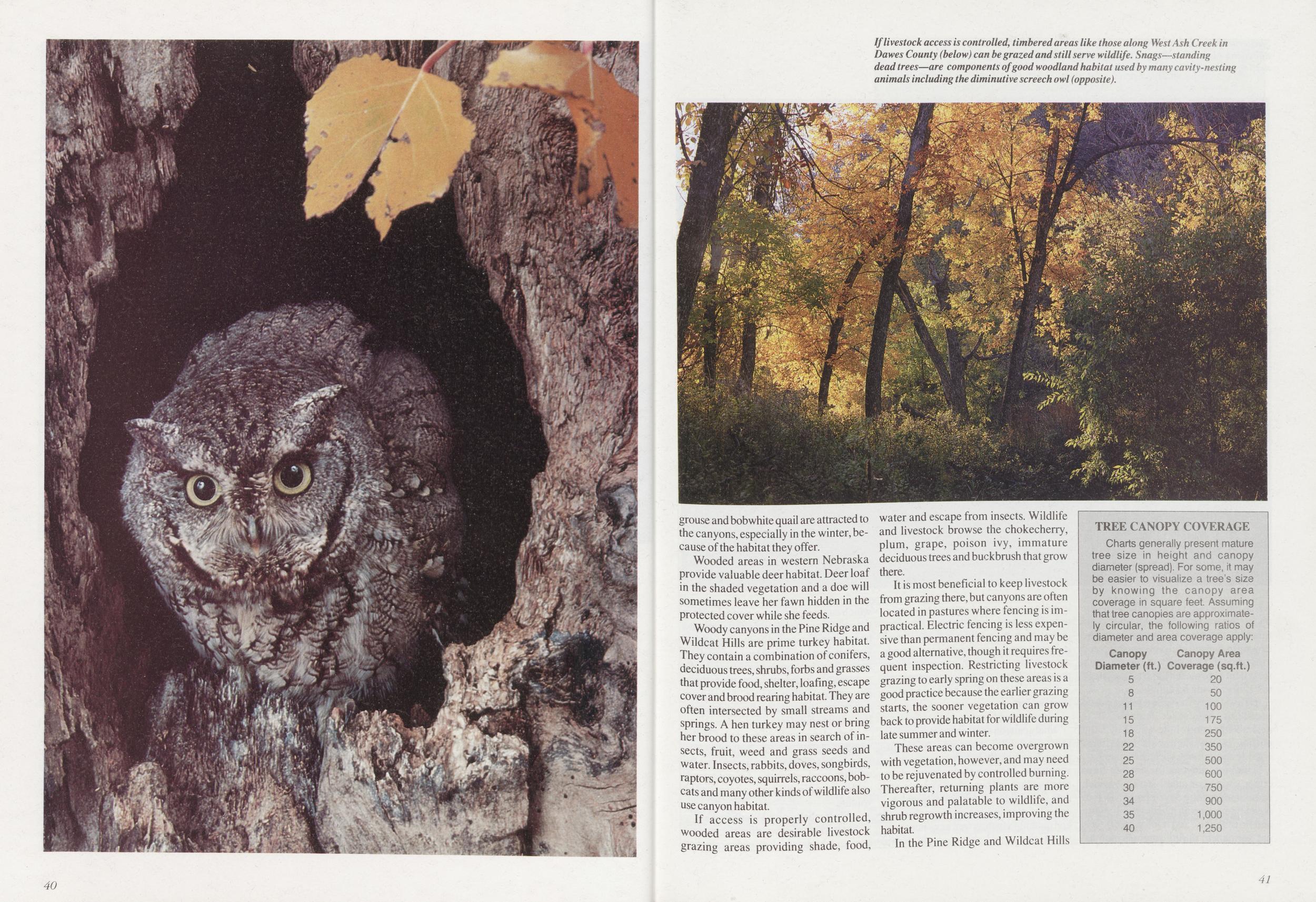
Wooded areas in western Nebraska provide valuable deer habitat. Deer loaf in the shaded vegetation and a doe will sometimes leave her fawn hidden in the protected cover while she feeds.
Woody canyons in the Pine Ridge and Wildcat Hills are prime turkey habitat. They contain a combination of conifers, deciduous trees, shrubs, forbs and grasses that provide food, shelter, loafing, escape cover and brood rearing habitat. They are often intersected by small streams and springs. A hen turkey may nest or bring her brood to these areas in search of insects, fruit, weed and grass seeds and water. Insects, rabbits, doves, songbirds, raptors, coyotes, squirrels, raccoons, bobcats and many other kinds of wildlife also use canyon habitat.
If access is properly controlled, wooded areas are desirable livestock grazing areas providing shade, food, water and escape from insects. Wildlife and livestock browse the chokecherry, plum, grape, poison ivy, immature deciduous trees and buckbrush that grow there.
It is most beneficial to keep livestock from grazing there, but canyons are often located in pastures where fencing is impractical. Electric fencing is less expensive than permanent fencing and may be a good alternative, though it requires frequent inspection. Restricting livestock grazing to early spring on these areas is a good practice because the earlier grazing starts, the sooner vegetation can grow back to provide habitat for wildlife during late summer and winter.
These areas can become overgrown with vegetation, however, and may need to be rejuvenated by controlled burning. Thereafter, returning plants are more vigorous and palatable to wildlife, and shrub regrowth increases, improving the habitat.
In the Pine Ridge and Wildcat Hills
TREE CANOPY COVERAGECharts generally present mature tree size in height and canopy diameter (spread). For some, it may be easier to visualize a tree's size by knowing the canopy area coverage in square feet. Assuming that tree canopies are approximately circular, the following ratios of diameter and area coverage apply: where pine or cedar trees are thick and the understory vegetation is retarded, hand thinning may be needed to open the canopy to sunlight and promote shrub and grass growth. Generally, desirable plants for wildlife are present, and all they need to begin growing is sunlight.
Canopy Canopy Area Diameter (ft.) Coverage (sq.ft.) 5 8 11 15 18 22 25 28 30 34 35 40 20 50 100 175 250 350 500 600 750 900 1,000 1,250 41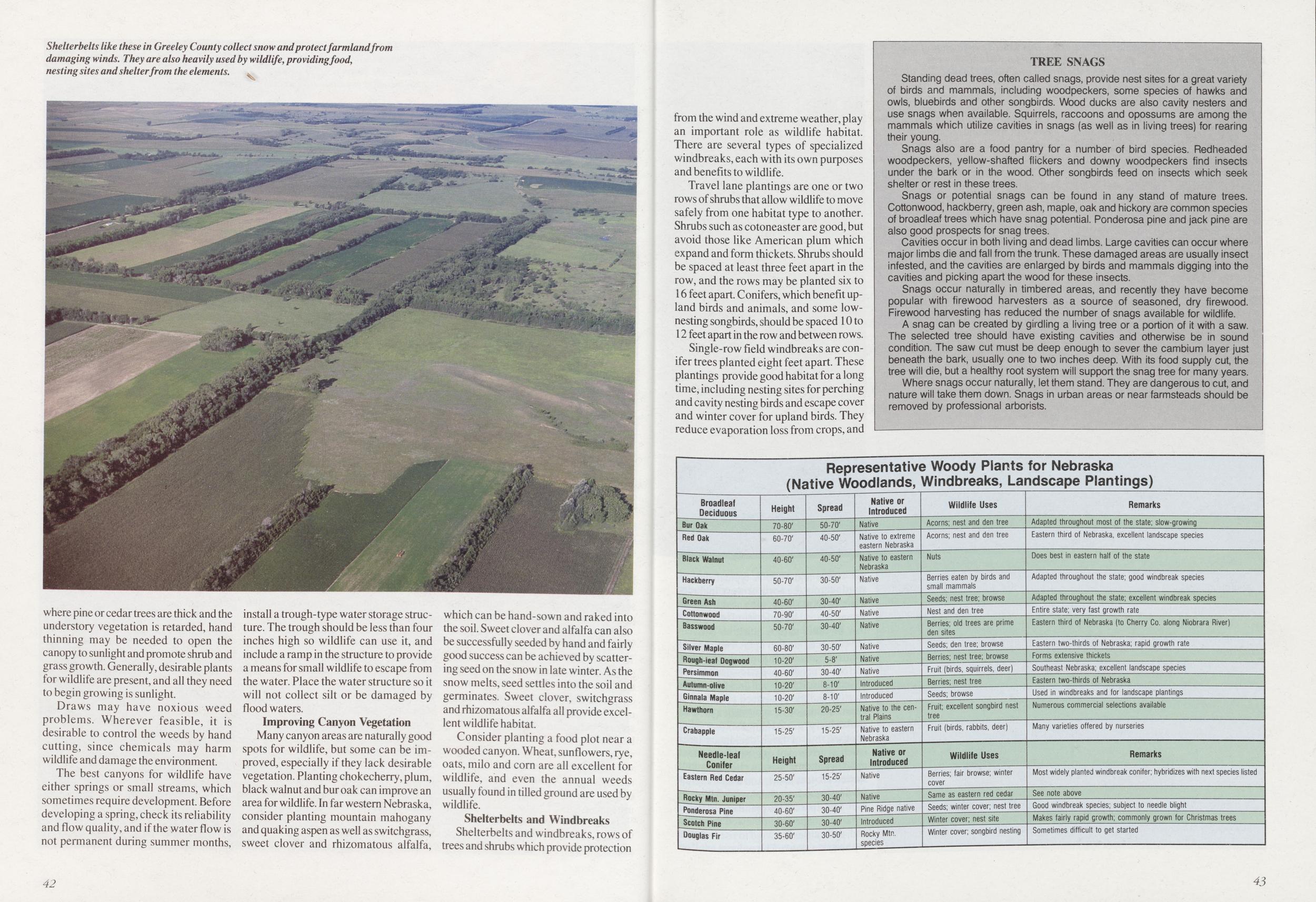
Draws may have noxious weed problems. Wherever feasible, it is desirable to control the weeds by hand cutting, since chemicals may harm wildlife and damage the environment.
The best canyons for wildlife have either springs or small streams, which sometimes require development. Before developing a spring, check its reliability and flow quality, and if the water flow is not permanent during summer months, install a trough-type water storage structure. The trough should be less than four inches high so wildlife can use it, and include a ramp in the structure to provide a means for small wildlife to escape from the water. Place the water structure so it will not collect silt or be damaged by flood waters.
Improving Canyon VegetationMany canyon areas are naturally good spots for wildlife, but some can be improved, especially if they lack desirable vegetation. Planting chokecherry, plum, black walnut and bur oak can improve an area for wildlife. In far western Nebraska, consider planting mountain mahogany and quaking aspen as well as switchgrass, sweet clover and rhizomatous alfalfa, which can be hand-sown and raked into the soil. Sweet clover and alfalfa can also be successfully seeded by hand and fairly good success can be achieved by scattering seed on the snow in late winter. As the snow melts, seed settles into the soil and germinates. Sweet clover, switchgrass and rhizomatous alfalfa all provide excellent wildlife habitat.
Consider planting a food plot near a wooded canyon. Wheat, sunflowers, rye, oats, milo and corn are all excellent for wildlife, and even the annual weeds usually found in tilled ground are used by wildlife.
Shelterbelts and WindbreaksShelterbelts and windbreaks, rows of trees and shrubs which provide protection 42 from the wind and extreme weather, play an important role as wildlife habitat. There are several types of specialized windbreaks, each with its own purposes and benefits to wildlife.
Travel lane plantings are one or two rows of shrubs that allow wildlife to move safely from one habitat type to another. Shrubs such as cotoneaster are good, but avoid those like American plum which expand and form thickets. Shrubs should be spaced at least three feet apart in the row, and the rows may be planted six to 16 feet apart. Conifers, which benefit upland birds and animals, and some low-nesting songbirds, should be spaced 10 to 12 feet apart in the row and between rows.
Single-row field windbreaks are conifer trees planted eight feet apart. These plantings provide good habitat for a long time, including nesting sites for perching and cavity nesting birds and escape cover and winter cover for upland birds. They reduce evaporation loss from crops, and add soil moisture from drifted snow.
TREE SNAGSStanding dead trees, often called snags, provide nest sites for a great variety of birds and mammals, including woodpeckers, some species of hawks and owls, bluebirds and other songbirds. VVbod ducks are also cavity nesters and use snags when available. Squirrels, raccoons and opossums are among the mammals which utilize cavities in snags (as well as in living trees) for rearing their young.
Snags also are a food pantry for a number of bird species. Redheaded woodpeckers, yellow-shafted flickers and downy woodpeckers find insects under the bark or in the wood. Other songbirds feed on insects which seek shelter or rest in these trees.
Snags or potential snags can be found in any stand of mature trees. Cottonwood, hackberry, green ash, maple, oak and hickory are common species of broadleaf trees which have snag potential. Ponderosa pine and jack pine are also good prospects for snag trees.
Cavities occur in both living and dead limbs. Large cavities can occur where major limbs die and fall from the trunk. These damaged areas are usually insect infested, and the cavities are enlarged by birds and mammals digging into the cavities and picking apart the wood for these insects.
Snags occur naturally in timbered areas, and recently they have become popular with firewood harvesters as a source of seasoned, dry firewood. Firewood harvesting has reduced the number of snags available for wildlife.
A snag can be created by girdling a living tree or a portion of it with a saw. The selected tree should have existing cavities and otherwise be in sound condition. The saw cut must be deep enough to sever the cambium layer just beneath the bark, usually one to two inches deep. With its food supply cut, the tree will die, but a healthy root system will support the snag tree for many years.
Where snags occur naturally, let them stand. They are dangerous to cut, and nature will take them down. Snags in urban areas or near farmsteads should be removed by professional arborists.
Representative Woody Plants for Nebraska (Native Woodlands, Windbreaks, Landscape Plantings) Broadleaf Deciduous Bur Oak Red Oak Black Walnut Hackberry Green Ash Cottonwood Basswood Height 70-80' 60-70' 40-60' 50-70' 40-60' 70-90' 50-70' Spread 50-70' 40-50' 40-50' 30-50' 30-40' 40-50' 30-40' Silver Maple Dogwood Persimmon Autumn-olive Ginnala Maple 60-80' 10-20' 40-60' 30-50' Native or Introduced Native Native to extreme eastern Nebraska Native to eastern Nebraska Native Native Native Native Wildlife Uses Acorns; nest and den tree Acorns; nest and den tree Nuts Berries eaten by birds and small mammals Seeds; nest tree; browse Nest and den tree 5-8' 10-20' Hawthorn Crabapple Needle-leaf Conifer Eastern Red Cedar Rocky Mtn. Juniper Ponderosa Pine Scotch Pine Douglas Fir 10-20' 15-30' 15-25' Height 25-50' 20-35' 40-60' 30-60' 35-60' 30-40' 8-10' 8-10' 20-25' 15-25' Spread 15-25' 30-40' 30-40' Native Berries; old trees are prime den sites Remarks Adapted throughout most of the state; slow-growing Eastern third of Nebraska, excellent landscape species Does best in eastern half of the state Adapted throughout the state; good windbreak species Adapted throughout the state; excellent windbreak species Entire state; very fast growth rate Native Native Introduced Introduced Native to the central Plains Native to eastern Nebraska Native or Introduced Native Native 30-40' 30-50' Pine Ridge native Introduced Seeds; den tree; browse Eastern third of Nebraska (to Cherry Co. along Niobrara River) Berries; nest tree; browse Fruit (birds, squirrels, deer) Berries; nest tree Seeds; browse Fruit; excellent songbird nest tree Fruit (birds, rabbits, deer) Wildlife Uses Berries; fair browse; winter cover Same as eastern red cedar Seeds; winter cover; nest tree Rocky Mtn. species Winter cover; nest site Eastern two-thirds of Nebraska; rapid growth rate Forms extensive thickets Southeast Nebraska; excellent landscape species Eastern two-thirds of Nebraska Used in windbreaks and for landscape plantings Numerous commercial selections available Many varieties offered by nurseries Remarks Most widely planted windbreak conifer; hybridizes with next species listed See note above Good windbreak species; subject to needle blight Winter cover; songbird nesting Makes fairly rapid growth; commonly grown for Christmas trees Sometimes difficult to get started 43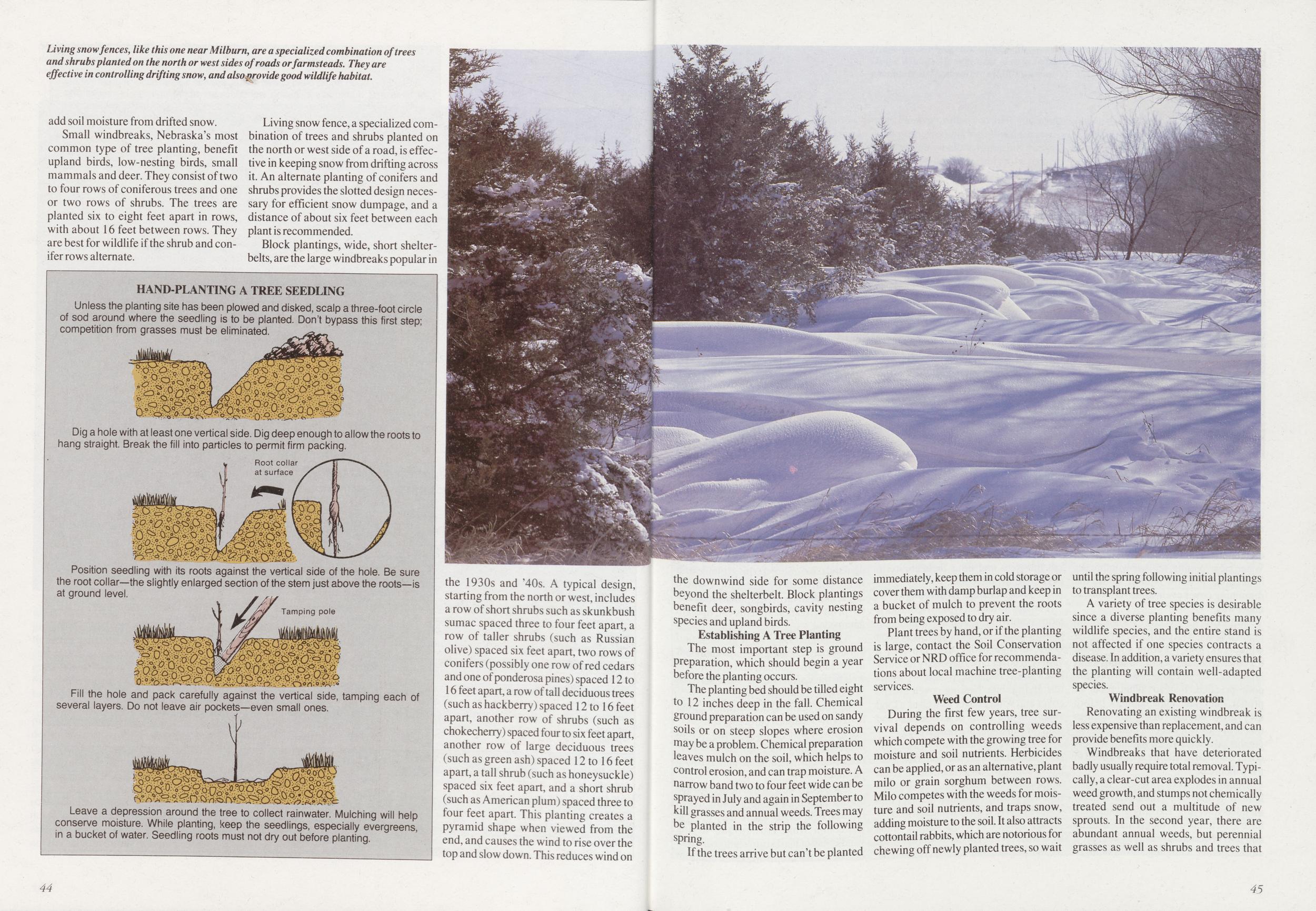
Small windbreaks, Nebraska's most common type of tree planting, benefit upland birds, low-nesting birds, small mammals and deer. They consist of two to four rows of coniferous trees and one or two rows of shrubs. The trees are planted six to eight feet apart in rows, with about 16 feet between rows. They are best for wildlife if the shrub and conifer rows alternate.
Living snow fence, a specialized combination of trees and shrubs planted on the north or west side of a road, is effective in keeping snow from drifting across it. An alternate planting of conifers and shrubs provides the slotted design necessary for efficient snow dumpage, and a distance of about six feet between each plant is recommended.
HAND-PLANTING A TREE SEEDLINGUnless the planting site has been plowed and disked, scalp a three-foot circle of sod around where the seedling is to be planted. Don't bypass this first step; competition from grasses must be eliminated.
Dig a hole with at least one vertical side. Dig deep enough to allow the roots to hang straight. Break the fill into particles to permit firm packing.
Position seedling with its roots against the vertical side of the hole. Be sure the root collar—the slightly enlarged section of the stem just above the roots—is at ground level.
Fill the hole and pack carefully against the vertical, tamping each of several layers. Do not leave air pockets—even small ones.
Leave a depression around the tree to collect rainwater. Mulching will help conserve moisture. While planting, keep the seedlings, especially evergreens, in a bucket of water. Seedling roots must not dry out before planting.
Block plantings, wide, short shelterbelts, are the large windbreaks popular in the 1930s and '40s. A typical design, starting from the north or west, includes a row of short shrubs such as skunkbush sumac spaced three to four feet apart, a row of taller shrubs (such as Russian olive) spaced six feet apart, two rows of conifers (possibly one row of red cedars and one of ponderosa pines) spaced 12 to 16 feet apart, a row of tall deciduous trees (such as hackberry) spaced 12 to 16 feet apart, another row of shrubs (such as chokecherry) spaced four to six feet apart, another row of large deciduous trees (such as green ash) spaced 12 to 16 feet apart, a tall shrub (such as honeysuckle) spaced six feet apart, and a short shrub (such as American plum) spaced three to four feet apart. This planting creates a pyramid shape when viewed from the end, and causes the wind to rise over the top and slow down. This reduces wind on 44 the downwind side for some distance beyond the shelterbelt. Block plantings benefit deer, songbirds, cavity nesting species and upland birds.
Establishing A Tree PlantingThe most important step is ground preparation, which should begin a year before the planting occurs.
The planting bed should be tilled eight to 12 inches deep in the fall. Chemical ground preparation can be used on sandy soils or on steep slopes where erosion may be a problem. Chemical preparation leaves mulch on the soil, which helps to control erosion, and can trap moisture. A narrow band two to four feet wide can be sprayed in July and again in September to kill grasses and annual weeds. Trees may be planted in the strip the following spring.
If the trees arrive but can't be planted immediately, keep them in cold storage or cover them with damp burlap and keep in a bucket of mulch to prevent the roots from being exposed to dry air.
Plant trees by hand, or if the planting is large, contact the Soil Conservation Service or NRD office for recommendations about local machine tree-planting services.
Weed ControlDuring the first few years, tree survival depends on controlling weeds which compete with the growing tree for moisture and soil nutrients. Herbicides can be applied, or as an alternative, plant milo or grain sorghum between rows. Milo competes with the weeds for moisture and soil nutrients, and traps snow, adding moisture to the soil. It also attracts cottontail rabbits, which are notorious for chewing off newly planted trees, so wait until the spring following initial plantings to transplant trees.
A variety of tree species is desirable since a diverse planting benefits many wildlife species, and the entire stand is not affected if one species contracts a disease. In addition, a variety ensures that the planting will contain well-adapted species.
Windbreak RenovationRenovating an existing windbreak is less expensive than replacement, and can provide benefits more quickly.
Windbreaks that have deteriorated
badly usually require total removal.
Typically, a clear-cut area explodes in annual
weed growth, and stumps not chemically
treated send out a multitude of new
sprouts. In the second year, there are
abundant annual weeds, but perennial
grasses as well as shrubs and trees that
45
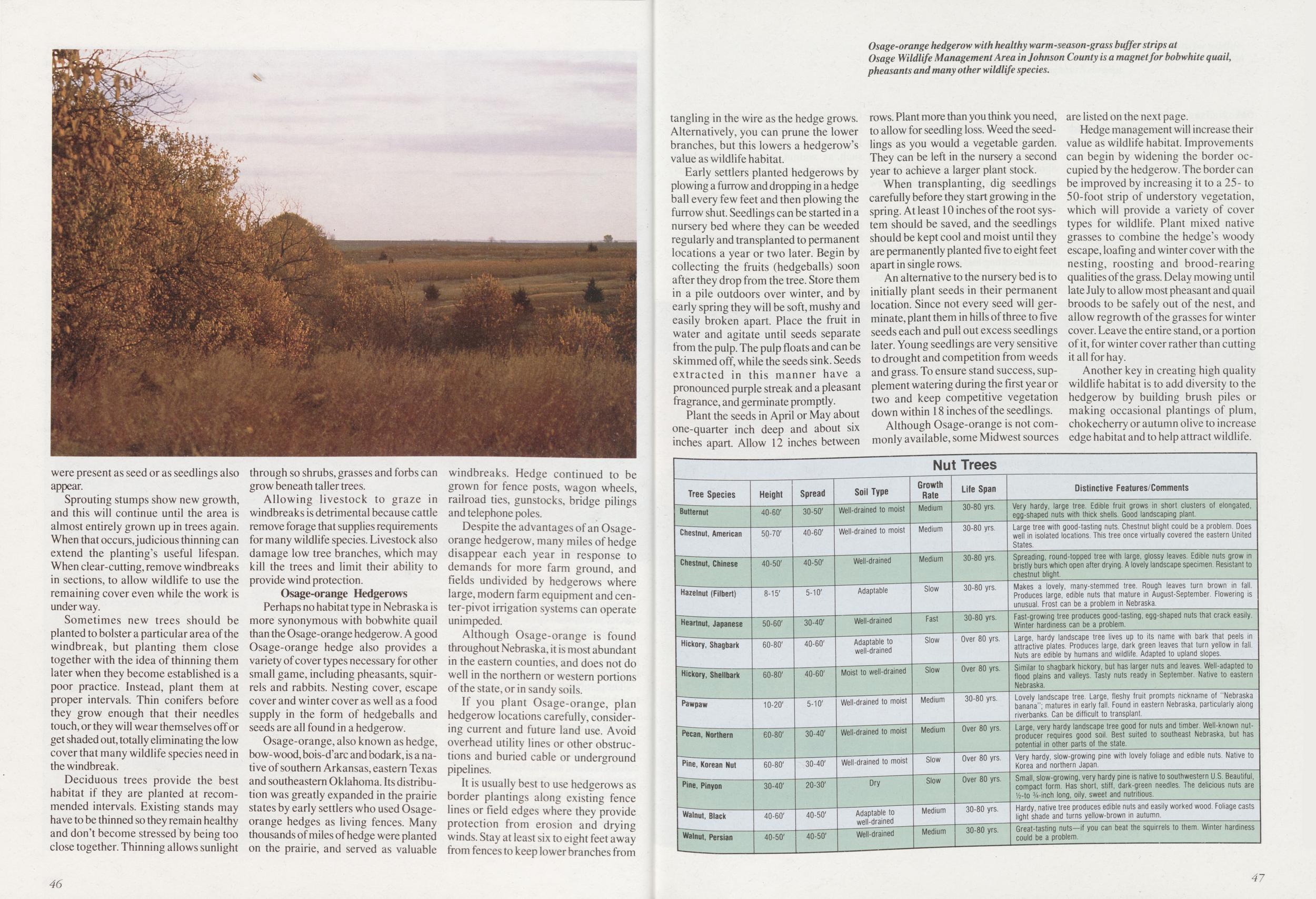
Sprouting stumps show new growth, and this will continue until the area is almost entirely grown up in trees again. When that occurs, judicious thinning can extend the planting's useful lifespan. When clear-cutting, remove windbreaks in sections, to allow wildlife to use the remaining cover even while the work is underway.
Sometimes new trees should be planted to bolster a particular area of the windbreak, but planting them close together with the idea of thinning them later when they become established is a poor practice. Instead, plant them at proper intervals. Thin conifers before they grow enough that their needles touch, or they will wear themselves off or get shaded out, totally eliminating the low cover that many wildlife species need in the windbreak.
Deciduous trees provide the best habitat if they are planted at recommended intervals. Existing stands may have to be thinned so they remain healthy and don't become stressed by being too close together. Thinning allows sunlight through so shrubs, grasses and forbs can grow beneath taller trees.
Allowing livestock to graze in windbreaks is detrimental because cattle remove forage that supplies requirements for many wildlife species. Livestock also damage low tree branches, which may kill the trees and limit their ability to provide wind protection.
Osage-orange HedgerowsPerhaps no habitat type in Nebraska is more synonymous with bobwhite quail than the Osage-orange hedgerow. A good Osage-orange hedge also provides a variety of cover types necessary for other small game, including pheasants, squirrels and rabbits. Nesting cover, escape cover and winter cover as well as a food supply in the form of hedgeballs and seeds are all found in a hedgerow.
Osage-orange, also known as hedge, bow-wood, bois-d'arc and bodark, is a native of southern Arkansas, eastern Texas and southeastern Oklahoma. Its distribution was greatly expanded in the prairie states by early settlers who used Osageorange hedges as living fences. Many thousands of miles of hedge were planted on the prairie, and served as valuable windbreaks. Hedge continued to be grown for fence posts, wagon wheels, railroad ties, gunstocks, bridge pilings and telephone poles.
Despite the advantages of an Osageorange hedgerow, many miles of hedge disappear each year in response to demands for more farm ground, and fields undivided by hedgerows where large, modern farm equipment and center-pivot irrigation systems can operate unimpeded.
Although Osage-orange is found throughout Nebraska, it is most abundant in the eastern counties, and does not do well in the northern or western portions of the state, or in sandy soils.
If you plant Osage-orange, plan hedgerow locations carefully, considering current and future land use. Avoid overhead utility lines or other obstructions and buried cable or underground pipelines.
It is usually best to use hedgerows as border plantings along existing fence lines or field edges where they provide protection from erosion and drying winds. Stay at least six to eight feet away from fences to keep lower branches from 46 tangling in the wire as the hedge grows. Alternatively, you can prune the lower branches, but this lowers a hedgerow's value as wildlife habitat.
Early settlers planted hedgerows by plowing a furrow and dropping in a hedge ball every few feet and then plowing the furrow shut. Seedlings can be started in a nursery bed where they can be weeded regularly and transplanted to permanent locations a year or two later. Begin by collecting the fruits (hedgeballs) soon after they drop from the tree. Store them in a pile outdoors over winter, and by early spring they will be soft, mushy and easily broken apart. Place the fruit in water and agitate until seeds separate from the pulp. The pulp floats and can be skimmed off, while the seeds sink. Seeds extracted in this manner have a pronounced purple streak and a pleasant fragrance, and germinate promptly.
Plant the seeds in April or May about one-quarter inch deep and about six inches apart. Allow 12 inches between rows. Plant more than you think you need, to allow for seedling loss. Weed the seedlings as you would a vegetable garden. They can be left in the nursery a second year to achieve a larger plant stock.
When transplanting, dig seedlings carefully before they start growing in the spring. At least 10 inches of the root system should be saved, and the seedlings should be kept cool and moist until they are permanently planted five to eight feet apart in single rows.
An alternative to the nursery bed is to initially plant seeds in their permanent location. Since not every seed will germinate, plant them in hills of three to five seeds each and pull out excess seedlings later. Young seedlings are very sensitive to drought and competition from weeds and grass. To ensure stand success, supplement watering during the first year or two and keep competitive vegetation down within 18 inches of the seedlings.
Although Osage-orange is not commonly available, some Midwest sources are listed on the next page.
Hedge management will increase their value as wildlife habitat. Improvements can begin by widening the border occupied by the hedgerow. The border can be improved by increasing it to a 25- to 50-foot strip of understory vegetation, which will provide a variety of cover types for wildlife. Plant mixed native grasses to combine the hedge's woody escape, loafing and winter cover with the nesting, roosting and brood-rearing qualities of the grass. Delay mowing until late July to allow most pheasant and quail broods to be safely out of the nest, and allow regrowth of the grasses for winter cover. Leave the entire stand, or a portion of it, for winter cover rather than cutting it all for hay.
Another key in creating high quality wildlife habitat is to add diversity to the hedgerow by building brush piles or making occasional plantings of plum, chokecherry or autumn olive to increase edge habitat and to help attract wildlife.
Nut Trees Tree Species Butternut Chestnut, American Chestnut, Chinese Hazelnut (Filbert) Height 40-60' 50-70' 40-50' 8-15' Heartnut, Japanese Hickory, Shagbark Hickory, Shellbark Pawpaw 50-60' Spread 30-50' 40-60' 40-50' 5-10' 30-40' 60-80' 60-80' 10-20' Pecan, Northern Pine, Korean Nut Pine, Pinyon Walnut, Black Walnut, Persian 60-80' Soil Type Well-drained to moist Well-drained to moist Well-drained Adaptable Well-drained Growth Rate Medium Medium Medium Slow Life Span 30-80 yrs. 30-80 yrs. 30-80 yrs. Fast 40-60' 40-60' 5-10' 60-80' 30-40' 40-60' 40-50' 30-40' 30-40' 20-30' Adaptable to well-drained Moist to well-drained Well-drained to moist Well-drained to moist Well-drained to moist 40-50' 40-50' Dry Slow Slow Medium 30-80 yrs. Distinctive Features/Comments Very hardy, large tree. Edible fruit grows in short clusters of elongated, egg-shaped nuts with thick shells. Good landscaping plant. Large tree with good-tasting nuts. Chestnut blight could be a problem. Does well in isolated locations. This tree once virtually covered the eastern United States. Spreading, round-topped tree with large, glossy leaves. Edible nuts grow in bristly burs which open after drying. A lovely landscape specimen. Resistant to chestnut blight. 30-80 yrs. Over 80 yrs. Over 80 yrs. 30-80 yrs. Medium Slow Slow Adaptable to well-drained Well-drained Medium Medium Over 80 yrs. Makes a lovely, many-stemmed tree. Rough leaves turn brown in fall. Produces large, edible nuts that mature in August-September. Flowering is unusual. Frost can be a problem in Nebraska. Fast-growing tree produces good-tasting, egg-shaped nuts that crack easily. Winter hardiness can be a problem. Large, hardy landscape tree lives up to its name with bark that peels in attractive plates. Produces large, dark green leaves that turn yellow in fall. Nuts are edible by humans and wildlife. Adapted to upland slopes. Similar to shagbark hickory, but has larger nuts and leaves. Well-adapted to flood plains and valleys. Tasty nuts ready in September. Native to eastern Nebraska. Lovely landscape tree. Large, fleshy fruit prompts nickname of "Nebraska banana"; matures in early fall. Found in eastern Nebraska, particularly along riverbanks. Can be difficult to transplant. Over 80 yrs. Over 80 yrs. 30-80 yrs. 30-80 yrs. Large, very hardy landscape tree good for nuts and timber. Well-known nut-producer requires good soil. Best suited to southeast Nebraska, but has potential in other parts of the state._______________________________ Very hardy, slow-growing pine with lovely foliage and edible nuts. Native to Korea and northern Japan. Small, slow-growing, very hardy pine is native to southwestern U.S. Beautiful, compact form. Has short, stiff, dark-green needles. The delicious nuts are y2-to 3/4-inch long, oily, sweet and nutritious. Hardy, native tree produces edible nuts and easily worked wood. Foliage casts light shade and turns yellow-brown in autumn._______________________ Great-tasting nuts—if you can beat the squirrels to them. Winter hardiness could be a problem. 47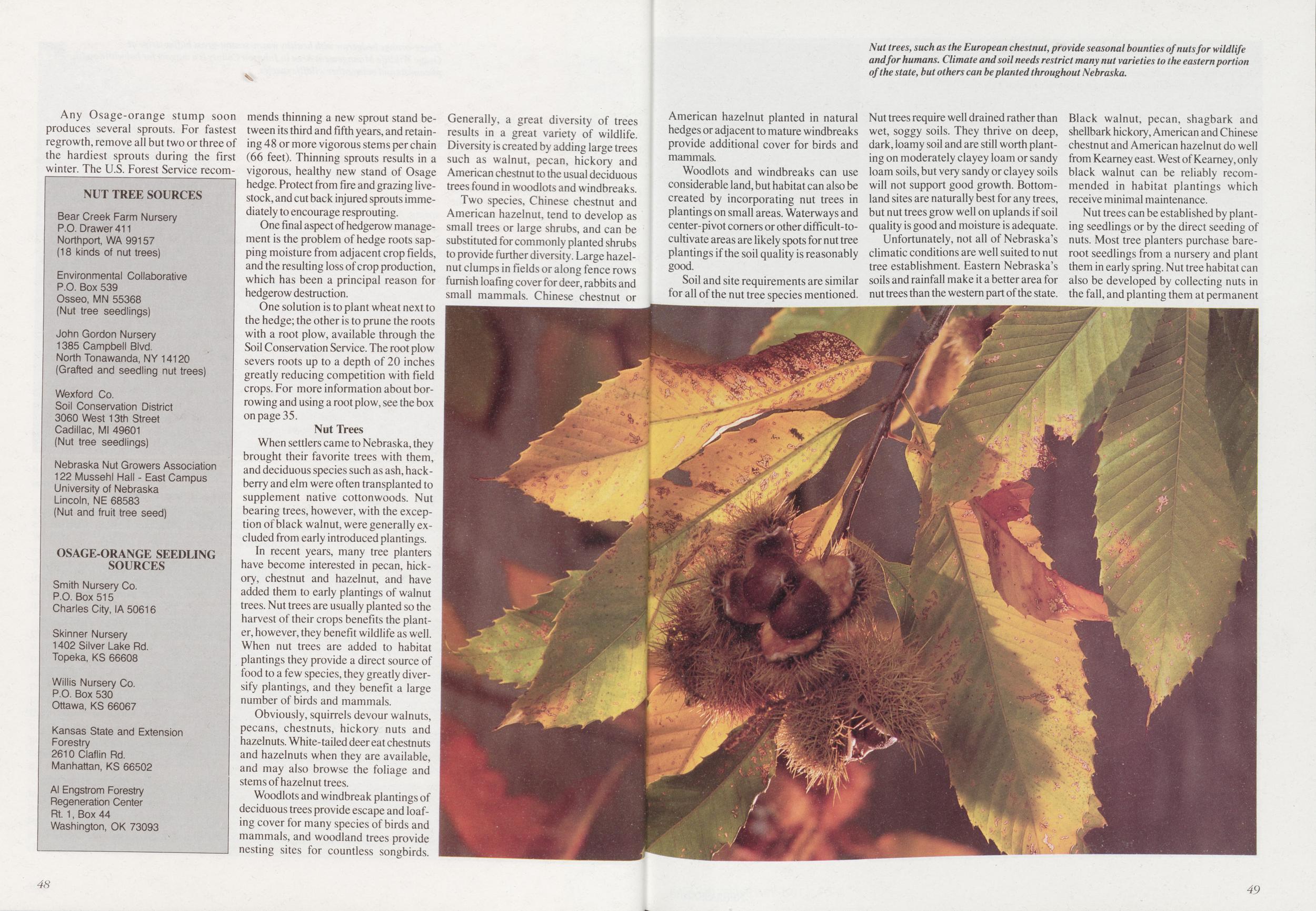
Any Osage-orange stump soon produces several sprouts. For fastest regrowth, remove all but two or three of the hardiest sprouts during the first winter. The U.S. Forest Service recommends thinning a new sprout stand between its third and fifth years, and retaining 48 or more vigorous stems per chain (66 feet). Thinning sprouts results in a vigorous, healthy new stand of Osage hedge. Protect from fire and grazing livestock, and cut back injured sprouts immediately to encourage resprouting.
NUT TREE SOURCES Bear Creek Farm Nursery P.O. Drawer 411 Northport, WA 99157 (18 kinds of nut trees) Environmental Collaborative P.O. Box 539 Osseo, MN 55368 (Nut tree seedlings) John Gordon Nursery 1385 Campbell Blvd. North Tonawanda, NY 14120 (Grafted and seedling nut trees) Wexford Co. Soil Conservation District 3060 West 13th Street Cadillac, Ml 49601 (Nut tree seedlings) Nebraska Nut Growers Association 122 Mussehl Hail - East Campus University of Nebraska Lincoln, NE 68583 (Nut and fruit tree seed) OSAGE-ORANGE SEEDLING SOURCES Smith Nursery Co. P.O. Box 515 Charles City, IA 50616 Skinner Nursery 1402 Silver Lake Rd. Topeka, KS 66608 Willis Nursery Co. P.O. Box 530 Ottawa, KS 66067 Kansas State and Extension Forestry 2610 Claflin Rd. Manhattan, KS 66502 Al Engstrom Forestry Regeneration Center Rt. 1, Box 44 Washington, OK 73093One final aspect of hedgerow management is the problem of hedge roots sapping moisture from adjacent crop fields, and the resulting loss of crop production, which has been a principal reason for hedgerow destruction.
One solution is to plant wheat next to the hedge; the other is to prune the roots with a root plow, available through the Soil Conservation Service. The root plow severs roots up to a depth of 20 inches greatly reducing competition with field crops. For more information about borrowing and using a root plow, see the box on page 35.
Nut TreesWhen settlers came to Nebraska, they brought their favorite trees with them, and deciduous species such as ash, hackberry and elm were often transplanted to supplement native cottonwoods. Nut bearing trees, however, with the exception of black walnut, were generally excluded from early introduced plantings.
In recent years, many tree planters have become interested in pecan, hickory, chestnut and hazelnut, and have added them to early plantings of walnut trees. Nut trees are usually planted so the harvest of their crops benefits the planter, however, they benefit wildlife as well. When nut trees are added to habitat plantings they provide a direct source of food to a few species, they greatly diversify plantings, and they benefit a large number of birds and mammals.
Obviously, squirrels devour walnuts, pecans, chestnuts, hickory nuts and hazelnuts. White-tailed deer eat chestnuts and hazelnuts when they are available, and may also browse the foliage and stems of hazelnut trees.
Woodlots and windbreak plantings of deciduous trees provide escape and loafing cover for many species of birds and mammals, and woodland trees provide nesting sites for countless songbirds. Generally, a great diversity of trees results in a great variety of wildlife. Diversity is created by adding large trees such as walnut, pecan, hickory and American chestnut to the usual deciduous trees found in woodlots and windbreaks.
Two species, Chinese chestnut and American hazelnut, tend to develop as small trees or large shrubs, and can be substituted for commonly planted shrubs to provide further diversity. Large hazelnut clumps in fields or along fence rows furnish loafing cover for deer, rabbits and small mammals. Chinese chestnut or 48 American hazelnut planted in natural hedges or adjacent to mature windbreaks provide additional cover for birds and mammals.
Woodlots and windbreaks can use considerable land, but habitat can also be created by incorporating nut trees in plantings on small areas. Waterways and center-pivot corners or other difficult to cultivate areas are likely spots for nut tree plantings if the soil quality is reasonably good.
Soil and site requirements are similar for all of the nut tree species mentioned. Nut trees require well drained rather than wet, soggy soils. They thrive on deep, dark, loamy soil and are still worth planting on moderately clayey loam or sandy loam soils, but very sandy or clayey soils will not support good growth. Bottomland sites are naturally best for any trees, but nut trees grow well on uplands if soil quality is good and moisture is adequate.
Unfortunately, not all of Nebraska's climatic conditions are well suited to nut tree establishment. Eastern Nebraska's soils and rainfall make it a better area for nut trees than the western part of the state. Black walnut, pecan, shagbark and shellbark hickory, American and Chinese chestnut and American hazelnut do well from Kearney east. West of Kearney, only black walnut can be reliably recommended in habitat plantings which receive minimal maintenance.
Nut trees can be established by
planting seedlings or by the direct seeding of
nuts. Most tree planters purchase
bareroot seedlings from a nursery and plant
them in early spring. Nut tree habitat can
also be developed by collecting nuts in
the fall, and planting them at permanent
49
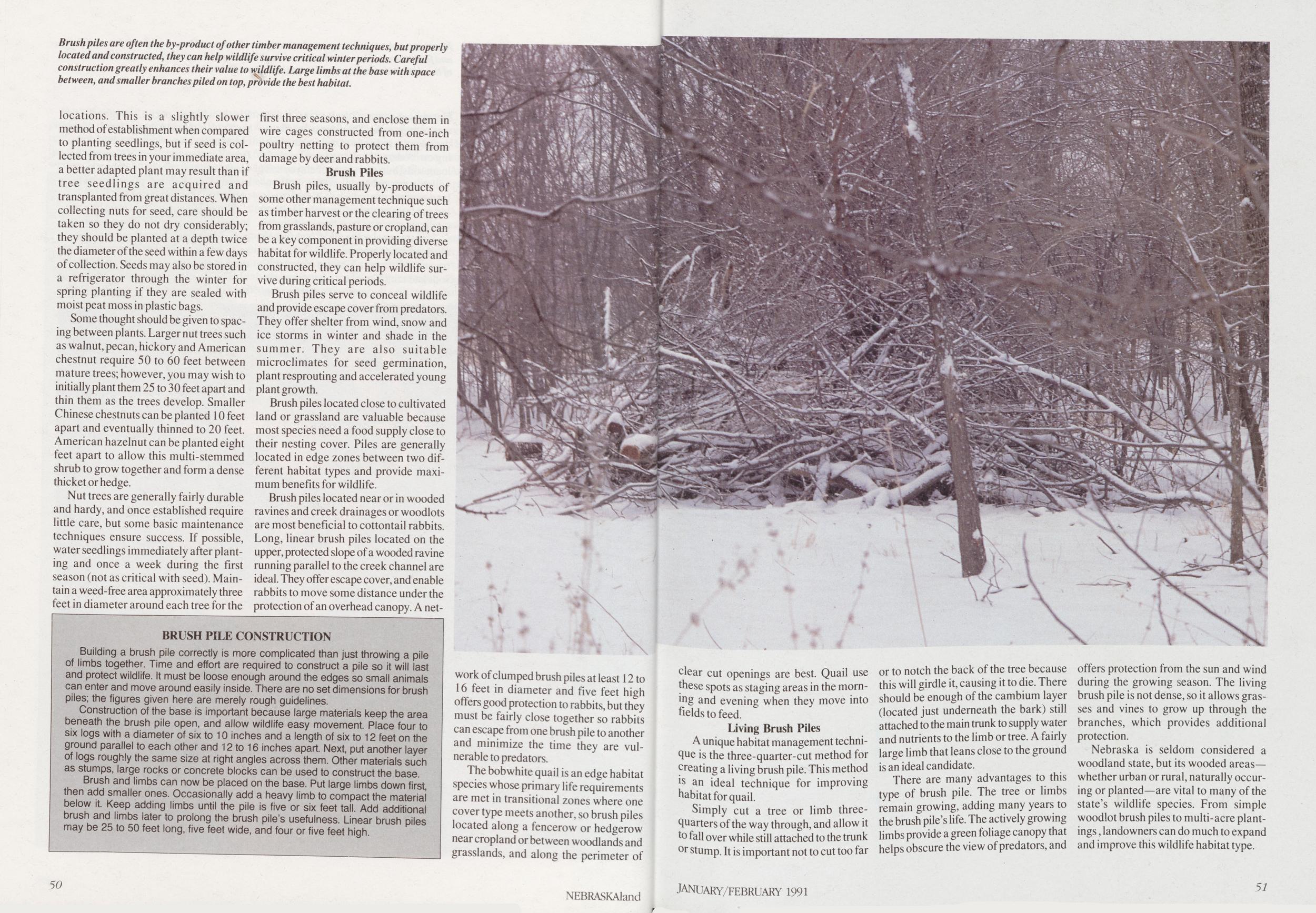
Some thought should be given to spacing between plants. Larger nut trees such as walnut, pecan, hickory and American chestnut require 50 to 60 feet between mature trees; however, you may wish to initially plant them 25 to 30 feet apart and thin them as the trees develop. Smaller Chinese chestnuts can be planted 10 feet apart and eventually thinned to 20 feet. American hazelnut can be planted eight feet apart to allow this multi-stemmed shrub to grow together and form a dense thicket or hedge.
Nut trees are generally fairly durable and hardy, and once established require little care, but some basic maintenance techniques ensure success. If possible, water seedlings immediately after planting and once a week during the first season (not as critical with seed). Maintain a weed-free area approximately three feet in diameter around each tree for the first three seasons, and enclose them in wire cages constructed from one-inch poultry netting to protect them from damage by deer and rabbits.
Brush PilesBrush piles, usually by-products of some other management technique such as timber harvest or the clearing of trees from grasslands, pasture or cropland, can be a key component in providing diverse habitat for wildlife. Properly located and constructed, they can help wildlife survive during critical periods.
Brush piles serve to conceal wildlife and provide escape cover from predators. They offer shelter from wind, snow and ice storms in winter and shade in the summer. They are also suitable microclimates for seed germination, plant resprouting and accelerated young plant growth.
Brush piles located close to cultivated land or grassland are valuable because most species need a food supply close to their nesting cover. Piles are generally located in edge zones between two different habitat types and provide maximum benefits for wildlife.
Brush piles located near or in wooded ravines and creek drainages or woodlots are most beneficial to cottontail rabbits. Long, linear brush piles located on the upper, protected slope of a wooded ravine running parallel to the creek channel are ideal. They offer escape cover, and enable rabbits to move some distance under the protection of an overhead canopy. A network work of clumped brush piles at least 12 to 16 feet in diameter and five feet high offers good protection to rabbits, but they must be fairly close together so rabbits can escape from one brush pile to another and minimize the time they are vulnerable to predators.
BRUSH PILE CONSTRUCTIONBuilding a brush pile correctly is more complicated than just throwing a pile of limbs together. Time and effort are required to construct a pile so it will last and protect wildlife. It must be loose enough around the edges so small animals can enter and move around easily inside. There are no set dimensions for brush piles; the figures given here are merely rough guidelines.
Construction of the base is important because large materials keep the area beneath the brush pile open, and allow wildlife easy movement. Place four to six logs with a diameter of six to 10 inches and a length of six to 12 feet on the ground parallel to each other and 12 to 16 inches apart. Next, put another layer of logs roughly the same size at right angles across them. Other materials such as stumps, large rocks or concrete blocks can be used to construct the base.
Brush and limbs can now be placed on the base. Put large limbs down first, then add smaller ones. Occasionally add a heavy limb to compact the material below it. Keep adding limbs until the pile is five or six feet tall. Add additional brush and limbs later to prolong the brush pile's usefulness. Linear brush piles may be 25 to 50 feet long, five feet wide, and four or five feet high.
The bobwhite quail is an edge habitat species whose primary life requirements are met in transitional zones where one cover type meets another, so brush piles located along a fencerow or hedgerow near cropland or between woodlands and grasslands, and along the perimeter of 50 NEBRASKAland clear cut openings are best. Quail use these spots as staging areas in the morning and evening when they move into fields to feed.
Living Brush PilesA unique habitat management technique is the three-quarter-cut method for creating a living brush pile. This method is an ideal technique for improving habitat for quail.
Simply cut a tree or limb three-quarters of the way through, and allow it to fall over while still attached to the trunk or stump. It is important not to cut too far or to notch the back of the tree because this will girdle it, causing it to die. There should be enough of the cambium layer (located just underneath the bark) still attached to the main trunk to supply water and nutrients to the limb or tree. A fairly large limb that leans close to the ground is an ideal candidate.
There are many advantages to this type of brush pile. The tree or limbs remain growing, adding many years to the brush pile's life. The actively growing limbs provide a green foliage canopy that helps obscure the view of predators, and offers protection from the sun and wind during the growing season. The living brush pile is not dense, so it allows grasses and vines to grow up through the branches, which provides additional protection.
Nebraska is seldom considered a woodland state, but its wooded areas whether urban or rural, naturally occuring or planted—are vital to many of the state's wildlife species. From simple woodlot brush piles to multi-acre plantings , landowners can do much to expand and improve this wildlife habitat type.
JANUARY/FEBRUARY 1991 51
Chapter four WETLANDS
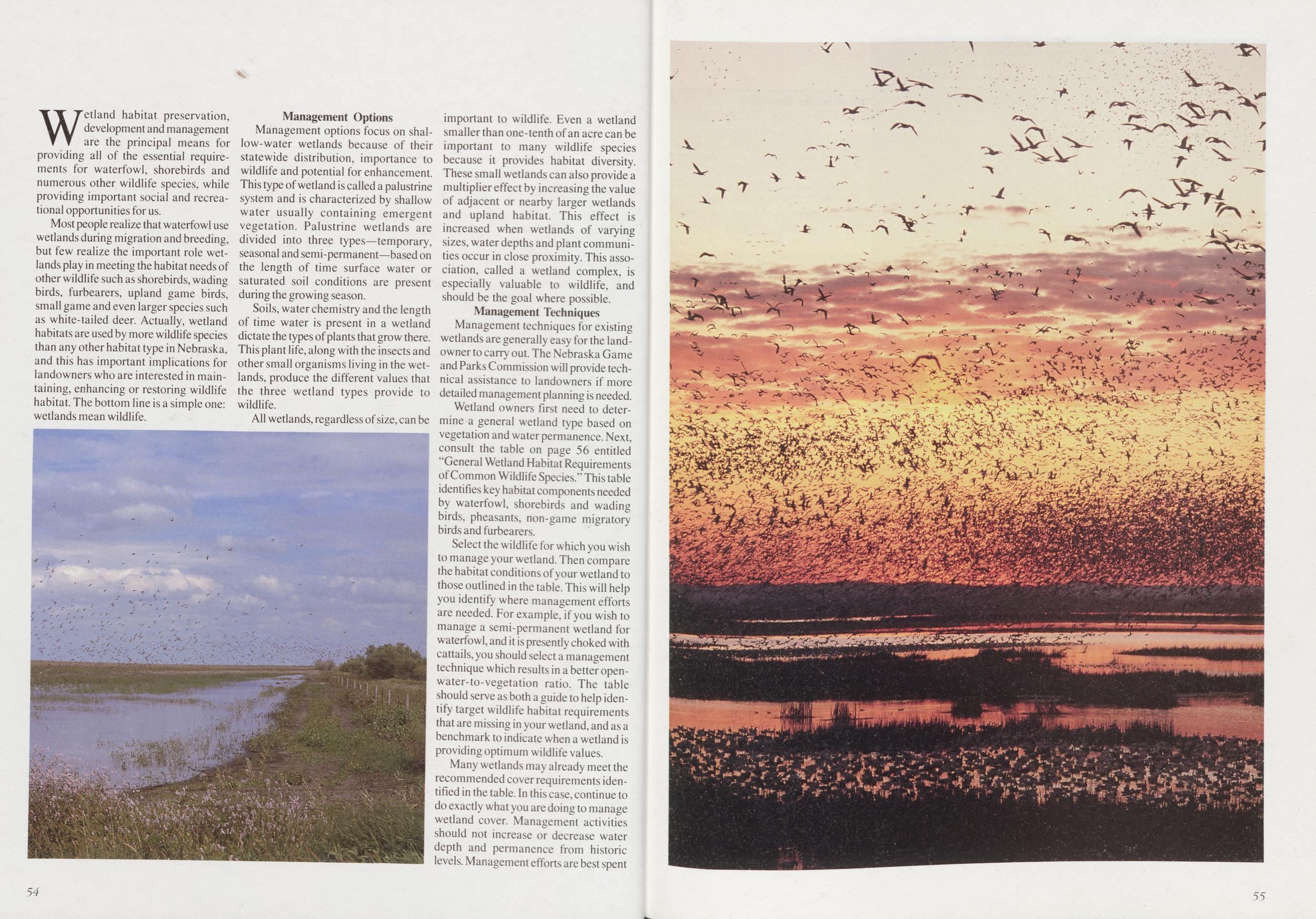
Wetland habitat preservation, development and management are the principal means for providing all of the essential requirements for waterfowl, shorebirds and numerous other wildlife species, while providing important social and recreational opportunities for us.
Most people realize that waterfowl use wetlands during migration and breeding, but few realize the important role wetlands play in meeting the habitat needs of other wildlife such as shorebirds, wading birds, furbearers, upland game birds, small game and even larger species such as white-tailed deer. Actually, wetland habitats are used by more wildlife species than any other habitat type in Nebraska, and this has important implications for landowners who are interested in maintaining, enhancing or restoring wildlife habitat. The bottom line is a simple one: wetlands mean wildlife.
Management OptionsManagement options focus on shallow-water wetlands because of their statewide distribution, importance to wildlife and potential for enhancement. This type of wetland is called a palustrine system and is characterized by shallow water usually containing emergent vegetation. Palustrine wetlands are divided into three types—temporary, seasonal and semi-permanent—based on the length of time surface water or saturated soil conditions are present during the growing season.
Soils, water chemistry and the length of time water is present in a wetland dictate the types of plants that grow there. This plant life, along with the insects and other small organisms living in the wetlands, produce the different values that the three wetland types provide to wildlife.
All wetlands, regardless of size, can be important to wildlife. Even a wetland smaller than one-tenth of an acre can be important to many wildlife species because it provides habitat diversity. These small wetlands can also provide a multiplier effect by increasing the value of adjacent or nearby larger wetlands and upland habitat. This effect is increased when wetlands of varying sizes, water depths and plant communities occur in close proximity. This association, called a wetland complex, is especially valuable to wildlife, and should be the goal where possible.
Management TechniquesManagement techniques for existing wetlands are generally easy for the landowner to carry out. The Nebraska Game and Parks Commission will provide technical assistance to landowners if more detailed management planning is needed.
Wetland owners first need to determine a general wetland type based on vegetation and water permanence. Next, consult the table on page 56 entitled "General Wetland Habitat Requirements of Common Wildlife Species." This table identifies key habitat components needed by waterfowl, shorebirds and wading birds, pheasants, non-game migratory birds and furbearers.
Select the wildlife for which you wish to manage your wetland. Then compare the habitat conditions of your wetland to those outlined in the table. This will help you identify where management efforts are needed. For example, if you wish to manage a semi-permanent wetland for waterfowl, and it is presently choked with cattails, you should select a management technique which results in a better open-water-to-vegetation ratio. The table should serve as both a guide to help identify target wildlife habitat requirements that are missing in your wetland, and as a benchmark to indicate when a wetland is providing optimum wildlife values.
Many wetlands may already meet the recommended cover requirements identified in the table. In this case, continue to do exactly what you are doing to manage wetland cover. Management activities should not increase or decrease water depth and permanence from historic levels. Management efforts are best spent enhancing wildlife values historically associated with that wetland type.
54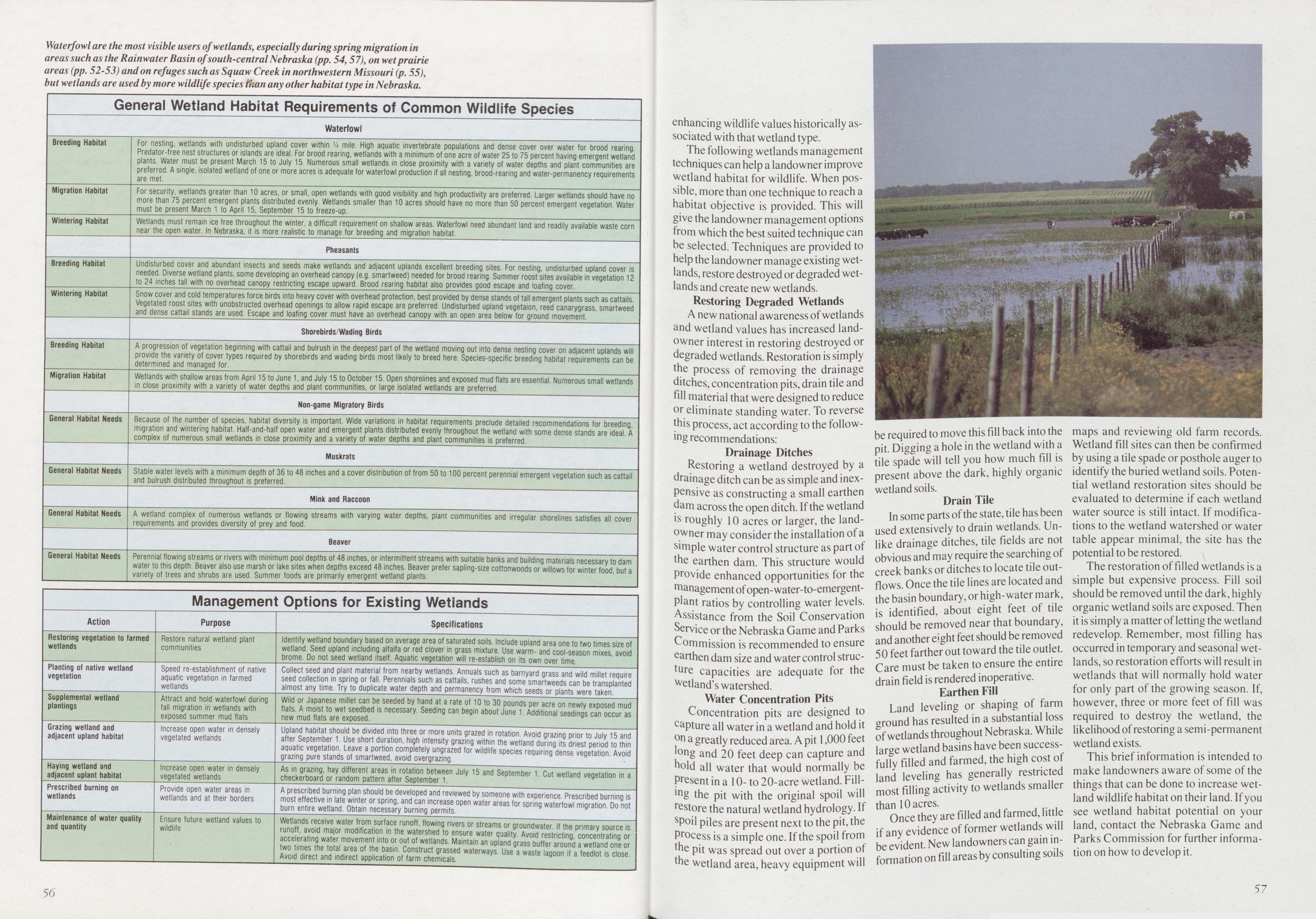
The following wetlands management techniques can help a landowner improve wetland habitat for wildlife. When possible, more than one technique to reach a habitat objective is provided. This will give the landowner management options from which the best suited technique can be selected. Techniques are provided to help the landowner manage existing wetlands, restore destroyed or degraded wetlands and create new wetlands.
Restoring Degraded WetlandsA new national awareness of wetlands and wetland values has increased landowner interest in restoring destroyed or degraded wetlands. Restoration is simply the process of removing the drainage ditches, concentration pits, drain tile and fill material that were designed to reduce or eliminate standing water. To reverse this process, act according to the following recommendations:
Drainage DitchesRestoring a wetland destroyed by a drainage ditch can be as simple and inexpensive as constructing a small earthen dam across the open ditch. If the wetland is roughly 10 acres or larger, the landowner may consider the installation of a simple water control structure as part of the earthen dam. This structure would Provide enhanced opportunities for the management of open-water-to-emergent- ratios by controlling water levels. Assistance from the Soil Conservation Service or the Nebraska Game and Parks Commission is recommended to ensure earthen dam size and water control structure capacities are adequate for the wetland's watershed.
Water Concentration PitsConcentration pits are designed to capture all water in a wetland and hold it a greatly reduced area. A pit 1,000 feet and 20 feet deep can capture and hold all water that would normally be Present in a 10- to 20-acre wetland. Filing the pit with the original spoil will restore the natural wetland hydrology. If sPoil piles are present next to the pit, the Process is a simple one. If the spoil from the pit was spread out over a portion of the wetland area, heavy equipment will be required to move this fill back into the pit. Digging a hole in the wetland with a tile spade will tell you how much fill is present above the dark, highly organic wetland soils.
Drain TileIn some parts of the state, tile has been used extensively to drain wetlands. Unlike drainage ditches, tile fields are not obvious and may require the searching of creek banks or ditches to locate tile outflows. Once the tile lines are located and the basin boundary, or high-water mark, is identified, about eight feet of tile should be removed near that boundary, and another eight feet should be removed 50 feet farther out toward the tile outlet. Care must be taken to ensure the entire drain field is rendered inoperative.
Earthen FillLand leveling or shaping of farm ground has resulted in a substantial loss of wetlands throughout Nebraska. While large wetland basins have been successfully filled and farmed, the high cost of land leveling has generally restricted most filling activity to wetlands smaller than 10 acres.
Once they are filled and farmed, little if any evidence of former wetlands will be evident. New landowners can gain information on fill areas by consulting soils maps and reviewing old farm records. Wetland fill sites can then be confirmed by using a tile spade or posthole auger to identify the buried wetland soils. Potential wetland restoration sites should be evaluated to determine if each wetland water source is still intact. If modifications to the wetland watershed or water table appear minimal, the site has the potential to be restored.
The restoration of filled wetlands is a simple but expensive process. Fill soil should be removed until the dark, highly organic wetland soils are exposed. Then it is simply a matter of letting the wetland redevelop. Remember, most filling has occurred in temporary and seasonal wetlands, so restoration efforts will result in wetlands that will normally hold water for only part of the growing season. If, however, three or more feet of fill was required to destroy the wetland, the likelihood of restoring a semi-permanent wetland exists.
This brief information is intended to make landowners aware of some of the things that can be done to increase wetland wildlife habitat on their land. If you see wetland habitat potential on your land, contact the Nebraska Game and Parks Commission for further information on how to develop it.
57
Chapter five FARMPONDS
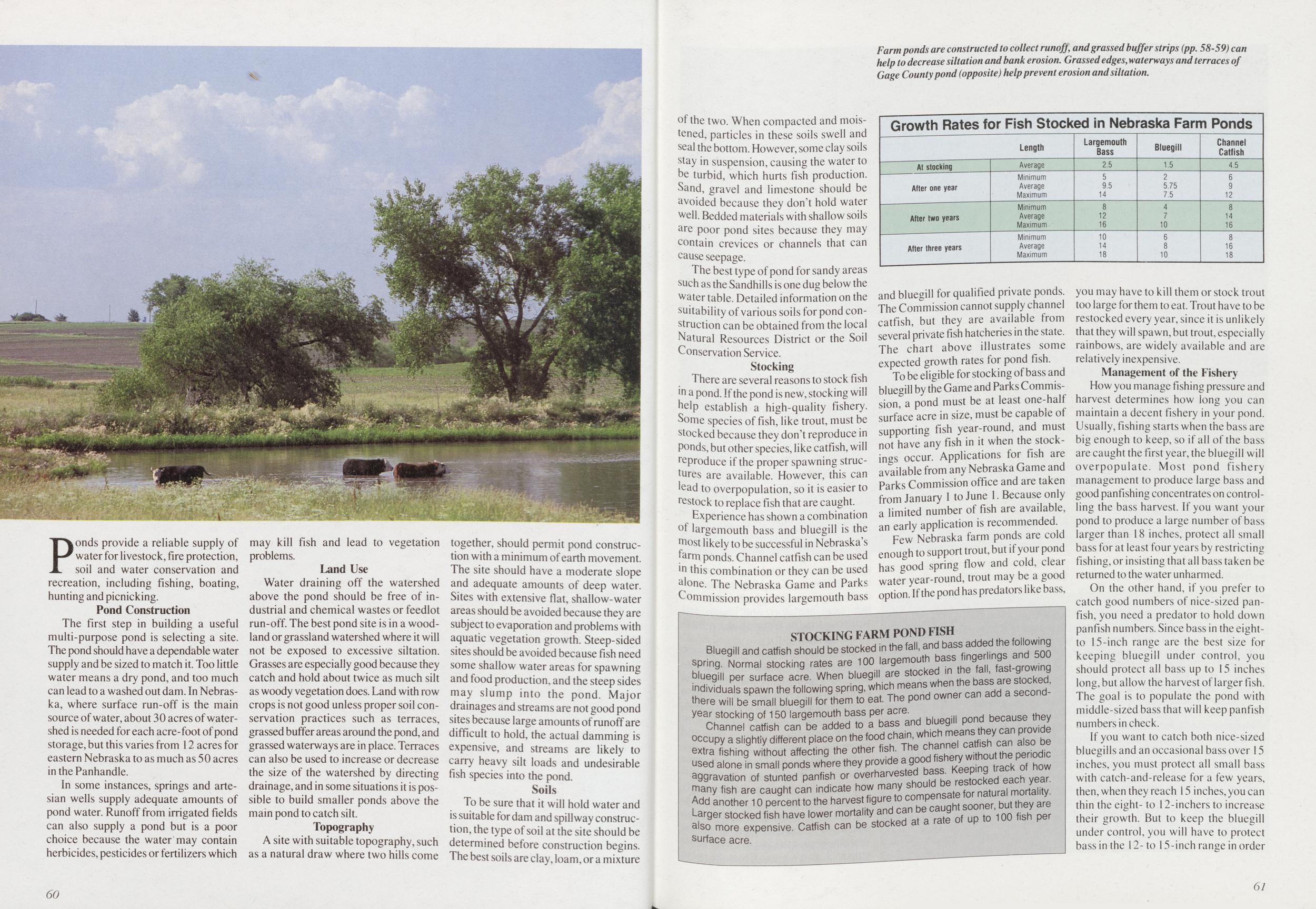
Ponds provide a reliable supply of water for livestock, fire protection, soil and water conservation and recreation, including fishing, boating, hunting and picnicking.
Pond ConstructionThe first step in building a useful multi-purpose pond is selecting a site. The pond should have a dependable water supply and be sized to match it. Too little water means a dry pond, and too much can lead to a washed out dam. In Nebraska, where surface run-off is the main source of water, about 30 acres of watershed is needed for each acre-foot of pond storage, but this varies from 12 acres for eastern Nebraska to as much as 50 acres in the Panhandle.
In some instances, springs and artesian wells supply adequate amounts of pond water. Runoff from irrigated fields can also supply a pond but is a poor choice because the water may contain herbicides, pesticides or fertilizers which may kill fish and lead to vegetation problems.
Land UseWater draining off the watershed above the pond should be free of industrial and chemical wastes or feedlot run-off. The best pond site is in a woodland or grassland watershed where it will not be exposed to excessive siltation. Grasses are especially good because they catch and hold about twice as much silt as woody vegetation does. Land with row crops is not good unless proper soil conservation practices such as terraces, grassed buffer areas around the pond, and grassed waterways are in place. Terraces can also be used to increase or decrease the size of the watershed by directing drainage, and in some situations it is possible to build smaller ponds above the main pond to catch silt.
TopographyA site with suitable topography, such as a natural draw where two hills come together, should permit pond construction with a minimum of earth movement. The site should have a moderate slope and adequate amounts of deep water. Sites with extensive flat, shallow-water areas should be avoided because they are subject to evaporation and problems with aquatic vegetation growth. Steep-sided sites should be avoided because fish need some shallow water areas for spawning and food production, and the steep sides may slump into the pond. Major drainages and streams are not good pond sites because large amounts of runoff are difficult to hold, the actual damming is expensive, and streams are likely to carry heavy silt loads and undesirable fish species into the pond.
SoilsTo be sure that it will hold water and is suitable for dam and spillway construction, the type of soil at the site should be determined before construction begins. The best soils are clay, loam, or a mixture 60 of the two. When compacted and moistened, particles in these soils swell and seal the bottom. However, some clay soils stay in suspension, causing the water to be turbid, which hurts fish production. Sand, gravel and limestone should be avoided because they don't hold water well. Bedded materials with shallow soils are poor pond sites because they may contain crevices or channels that can cause seepage.
The best type of pond for sandy areas such as the Sandhills is one dug below the water table. Detailed information on the suitability of various soils for pond construction can be obtained from the local Natural Resources District or the Soil Conservation Service.
Growth Rates for Fish Stocked in Nebraska Farm Ponds Length Largemouth Bass Bluegill Channel Catfish At stocking Average 2.5 1.5 4.5 After one year Minimum Average Maximum 5 9.5 14 2 5.75 7.5 6 9 12 After two years Minimum Average Maximum 8 12 16 4 7 10 8 14 16 After three years Minimum Average Maximum 10 14 18 6 8 10 8 16 18 StockingThere are several reasons to stock fish in a pond. If the pond is new, stocking will help establish a high-quality fishery. Some species of fish like trout must be stocked because they don't reproduce in ponds, but other species, like catfish, will repreoduce if the proper spawning structures are available. However, , this can lead to overpopulation, so it is easier to restock to replace fish that are caught.
Experience has shown a combination °f largemouth bass and bluegill is the most likely to be successful in Nebraska's farm ponds. Channel catfish can be used in this combination or they can be used alone. The Nebraska Game and Parks Commission provides largemouth bass and bluegill for qualified private ponds, The Commission cannot supply channel catfish, but they are available from several private fish hatcheries in the state. The chart above illustrates some expected growth rates for pond fish.
To be eligible for stocking of bass and bluegill by the Game and Parks Commission a pond must be at least one-half surface acre in size, must be capable of supporting fish year-round, and must not have any fish in it when the stockings occur. Applications for fish are available from any Nebraska Game and Parks Commission office and are taken from January 1 to June 1. Because only a limited number of fish are available, an early application is recommended.
Few Nebraska farm ponds are cold enough to support trout, but if you pond has good spring flow and cold, clear water year-round, trout may be a good option. If the pond has predators like bass, you may have to kill them or stock trout too large for them to eat. Trout have to be restocked every year, since it is unlikely that they will spawn, but trout, especially rainbows, are widely available and are relatively inexpensive.
STOCKING FARM POND FISHBluegill and catfish1^6 be stocked in the fall, and bass add* •» faHo^ng spring. Normal stocking rates are 100 largemouth ^J^^8^ bluegill per surface ac?e. When bluegill are ^^J"2S21SS individuals spawn the following spring, which.means^ *e£^ ^J there will be small bluegill for them to eat. The pond owner can add a secona year stocking of 150 largemouth bass per acre.
Channel catfish can be added to a bass ^"J^^ ut affecting the other fish, inec fe used alone in small ponds where they provide^J^^^ track of how aggravation of stunted panfish or overharvested I^IJW many fish are caught can indicate how ^f^ Add another 10 percenttothe ^^U^°^^^Z^, Je Larger stocked fish have lower mortality anc can, b^" ^ • M fjshy also more expensive. Catfish can be stocked at a rate or up surface acre.
Management of the FisheryHow you manage fishing pressure and harvest determines how long you can maintain a decent fishery in your pond. Usually, fishing starts when the bass are big enough to keep, so if all of the bass are caught the first year, the bluegill will overpopulate. Most pond fishery management to produce large bass and good panfishing concentrates on controlling the bass harvest. If you want your pond to produce a large number of bass larger than 18 inches, protect all small bass for at least four years by restricting fishing, or insisting that all bass taken be returned to the water unharmed.
On the other hand, if you prefer to catch good numbers of nice-sized panfish, you need a predator to hold down panfish numbers. Since bass in the eight-to 15-inch range are the best size for keeping bluegill under control, you should protect all bass up to 15 inches long, but allow the harvest of larger fish. The goal is to populate the pond with middle-sized bass that will keep panfish numbers in check.
If you want to catch both nice-sized
bluegills and an occasional bass over 15
inches, you must protect all small bass
with catch-and-release for a few years,
then, when they reach 15 inches, you can
thin the eight- to 12-inchers to increase
their growth. But to keep the bluegill
under control, you will have to protect
bass in the 12- to 15-inch range in order
61
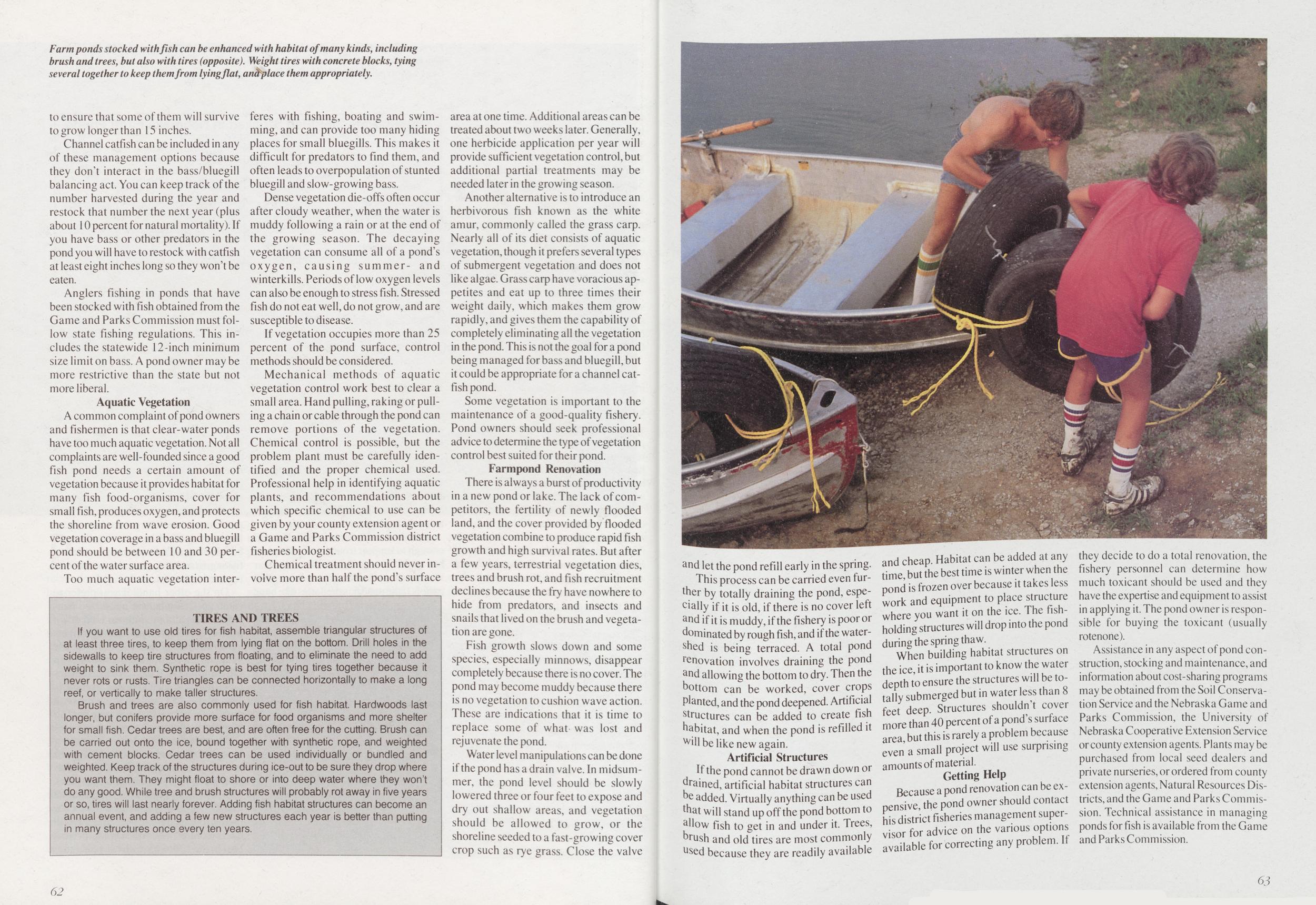 to ensure that some of them will survive
to grow longer than 15 inches.
to ensure that some of them will survive
to grow longer than 15 inches.
Channel catfish can be included in any of these management options because they don't interact in the bass/bluegill balancing act. You can keep track of the number harvested during the year and restock that number the next year (plus about 10 percent for natural mortality). If you have bass or other predators in the pond you will have to restock with catfish at least eight inches long so they won't be eaten.
Anglers fishing in ponds that have been stocked with fish obtained from the Game and Parks Commission must follow state fishing regulations. This includes the statewide 12-inch minimum size limit on bass. A pond owner may be more restrictive than the state but not more liberal.
Aquatic VegetationA common complaint of pond owners and fishermen is that clear-water ponds have too much aquatic vegetation. Not all complaints are well-founded since a good fish pond needs a certain amount of vegetation because it provides habitat for many fish food-organisms, cover for small fish, produces oxygen, and protects the shoreline from wave erosion. Good vegetation coverage in a bass and bluegill pond should be between 10 and 30 percent of the water surface area.
Too much aquatic vegetation interferes with fishing, boating and swimming, and can provide too many hiding places for small bluegills. This makes it difficult for predators to find them, and often leads to overpopulation of stunted bluegill and slow-growing bass.
Dense vegetation die-offs often occur after cloudy weather, when the water is muddy following a rain or at the end of the growing season. The decaying vegetation can consume all of a pond's oxygen, causing summer- and winterkills. Periods of low oxygen levels can also be enough to stress fish. Stressed fish do not eat well, do not grow, and are susceptible to disease.
If vegetation occupies more than 25 percent of the pond surface, control methods should be considered.
Mechanical methods of aquatic vegetation control work best to clear a small area. Hand pulling, raking or pulling a chain or cable through the pond can remove portions of the vegetation. Chemical control is possible, but the problem plant must be carefully identified and the proper chemical used. Professional help in identifying aquatic plants, and recommendations about which specific chemical to use can be given by your county extension agent or a Game and Parks Commission district fisheries biologist.
Chemical treatment should never involve more than half the pond's surface area at one time. Additional areas can be treated about two weeks later. Generally, one herbicide application per year will provide sufficient vegetation control, but additional partial treatments may be needed later in the growing season.
Another alternative is to introduce an herbivorous fish known as the white amur, commonly called the grass carp. Nearly all of its diet consists of aquatic vegetation, though it prefers several types of submergent vegetation and does not like algae. Grass carp have voracious appetites and eat up to three times their weight daily, which makes them grow rapidly, and gives them the capability of completely eliminating all the vegetation in the pond. This is not the goal for a pond being managed for bass and bluegill, but it could be appropriate for a channel catfish pond.
Some vegetation is important to the maintenance of a good-quality fishery. Pond owners should seek professional advice to determine the type of vegetation control best suited for their pond.
TIRES AND TREESIf you want to use old tires for fish habitat, assemble triangular structures of at least three tires, to keep them from lying flat on the bottom. Drill holes in the sidewalls to keep tire structures from floating, and to eliminate the need to add weight to sink them. Synthetic rope is best for tying tires together because it never rots or rusts. Tire triangles can be connected horizontally to make a long reef, or vertically to make taller structures.
Brush and trees are also commonly used for fish habitat. Hardwoods last longer, but conifers provide more surface for food organisms and more shelter for small fish. Cedar trees are best, and are often free for the cutting. Brush can be carried out onto the ice, bound together with synthetic rope, and weighted with cement blocks. Cedar trees can be used individually or bundled and weighted. Keep track of the structures during ice-out to be sure they drop where you want them. They might float to shore or into deep water where they won't do any good. While tree and brush structures will probably rot away in five years or so, tires will last nearly forever. Adding fish habitat structures can become an annual event, and adding a few new structures each year is better than putting in many structures once every ten years.
Farmpond RenovationThere is always a burst of productivity in a new pond or lake. The lack of competitors, the fertility of newly flooded land, and the cover provided by flooded vegetation combine to produce rapid fish growth and high survival rates. But after a few years, terrestrial vegetation dies, trees and brush rot, and fish recruitment declines because the fry have nowhere to hide from predators, and insects and snails that lived on the brush and vegetation are gone.
Fish growth slows down and some species, especially minnows, disappear completely because there is no cover. The pond may become muddy because there is no vegetation to cushion wave action. These are indications that it is time to replace some of what was lost and rejuvenate the pond.
Water level manipulations can be done if the pond has a drain valve. In midsummer, the pond level should be slowly lowered three or four feet to expose and dry out shallow areas, and vegetation should be allowed to grow, or the shoreline seeded to a fast-growing cover crop such as rye grass. Close the valve and let the pond refill early in the spring.
This process can be carried even further by totally draining the pond, especially if it is old, if there is no cover left and if it is muddy, if the fishery is poor or dominated by rough fish, and if the watershed is being terraced. A total pond ^novation involves draining the pond and allowing the bottom to dry. Then the bottom can be worked, cover crops Planted, and the pond deepened. Artificial structures can be added to create fish habitat, and when the pond is refilled it will be like new again.
Artificial StructuresIf the pond cannot be drawn down or drained, artificial habitat structures can be added. Virtually anything can be used that will stand up off the pond bottom to ahow fish to get in and under it. Trees, brush and old tires are most commonly used because they are readily available and cheap. Habitat can be added at any time, but the best time is winter when the pond is frozen over because it takes less work and equipment to place structure where you want it on the ice. The fish-holding structures will drop into the pond during the spring thaw.
When building habitat structures on the ice, it is important to know the water depth to ensure the structures will be totally submerged but in water less than 8 feet deep. Structures shouldn't cover more than 40 percent of a pond's surface area but this is rarely a problem because even a small project will use surprising amounts of material.
Getting HelpBecause a pond renovation can be expensive, the pond owner should contact his district fisheries management supervisor for advice on the various options available for correcting any problem. If they decide to do a total renovation, the fishery personnel can determine how much toxicant should be used and they have the expertise and equipment to assist in applying it. The pond owner is responsible for buying the toxicant (usually rotenone).
Assistance in any aspect of pond construction, stocking and maintenance, and information about cost-sharing programs may be obtained from the Soil Conservation Service and the Nebraska Game and Parks Commission, the University of Nebraska Cooperative Extension Service or county extension agents. Plants may be purchased from local seed dealers and private nurseries, or ordered from county extension agents, Natural Resources Districts, and the Game and Parks Commission. Technical assistance in managing ponds for fish is available from the Game and Parks Commission.
63
Chapter six RIVERS AND STREAMS
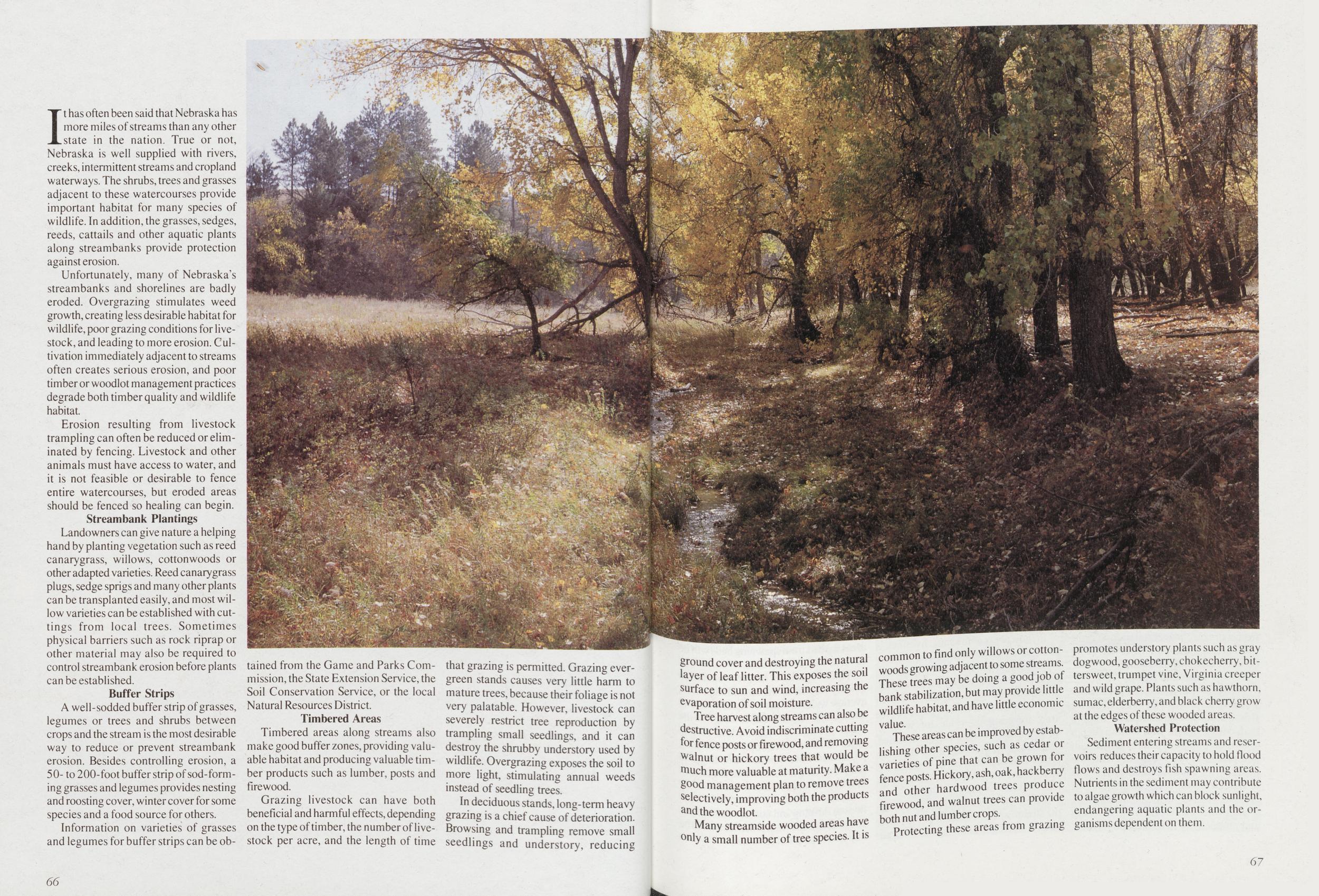
It has often been said that Nebraska has more miles of streams than any other state in the nation. True or not, Nebraska is well supplied with rivers, creeks, intermittent streams and cropland waterways. The shrubs, trees and grasses adjacent to these watercourses provide important habitat for many species of wildlife. In addition, the grasses, sedges, reeds, cattails and other aquatic plants along streambanks provide protection against erosion.
Unfortunately, many of Nebraska's streambanks and shorelines are badly eroded. Overgrazing stimulates weed growth, creating less desirable habitat for wildlife, poor grazing conditions for livestock, and leading to more erosion. Cultivation immediately adjacent to streams often creates serious erosion, and poor timber or woodlot management practices degrade both timber quality and wildlife habitat.
Erosion resulting from livestock trampling can often be reduced or eliminated by fencing. Livestock and other animals must have access to water, and it is not feasible or desirable to fence entire watercourses, but eroded areas should be fenced so healing can begin.
Streambank PlantingsLandowners can give nature a helping hand by planting vegetation such as reed canarygrass, willows, cottonwoods or other adapted varieties. Reed canarygrass plugs, sedge sprigs and many other plants can be transplanted easily, and most willow varieties can be established with cuttings from local trees. Sometimes physical barriers such as rock riprap or other material may also be required to control streambank erosion before plants can be established.
Buffer StripsA well-sodded buffer strip of grasses, legumes or trees and shrubs between crops and the stream is the most desirable way to reduce or prevent streambank erosion. Besides controlling erosion, a 50- to 200-foot buffer strip of sod-forming grasses and legumes provides nesting and roosting cover, winter cover for some species and a food source for others.
Information on varieties of grasses and legumes for buffer strips can be obtained from the Game and Parks Commission, the State Extension Service, the Soil Conservation Service, or the local Natural Resources District.
Timbered AreasTimbered areas along streams also make good buffer zones, providing valuable habitat and producing valuable timber products such as lumber, posts and firewood.
Grazing livestock can have both beneficial and harmful effects, depending on the type of timber, the number of livestock per acre, and the length of time that grazing is permitted. Grazing evergreen stands causes very little harm to mature trees, because their foliage is not very palatable. However, livestock can severely restrict tree reproduction by trampling small seedlings, and it can destroy the shrubby understory used by wildlife. Overgrazing exposes the soil to more light, stimulating annual weeds instead of seedling trees.
In deciduous stands, long-term heavy grazing is a chief cause of deterioration. Browsing and trampling remove small seedlings and understory, reducing 66 ground cover and destroying the natural •ayer of leaf litter. This exposes the soil surface to sun and wind, increasing the evaporation of soil moisture.
Tree harvest along streams can also be destructive. Avoid indiscriminate cutting for fence posts or firewood, and removing walnut or hickory trees that would be rnuch more valuable at maturity. Make a good management plan to remove trees selectively, improving both the products and the woodlot.
Many streamside wooded areas have °nly a small number of tree species. It is common to find only willows or cottonwoods growing adjacent to some stream* These trees may be doing a good job of bank stabilization, but may provide little wildlife habitat, and have little economic
These areas can be improved by establishing other species, such as cedar or varieties of pine that can be grown for fence posts. Hickory, ash, oak, hackberry and other hardwood trees produce firewood, and walnut trees can provide both nut and lumber crops
These areas can be improved by establishing other species, such as cedar or varieties of pine that can be grown for fence posts. Hickory, ash, oak, hackberry and other hardwood trees produce firewood, and walnut trees can provide both nut and lumber crops
Watershed ProtectionSediment entering streams and reservoirs reduces their capacity to hold flood flows and destroys fish spawning areas. Nutrients in the sediment may contribute to algae growth which can block sunlight, endangering aquatic plants and the organisms dependent on them.
67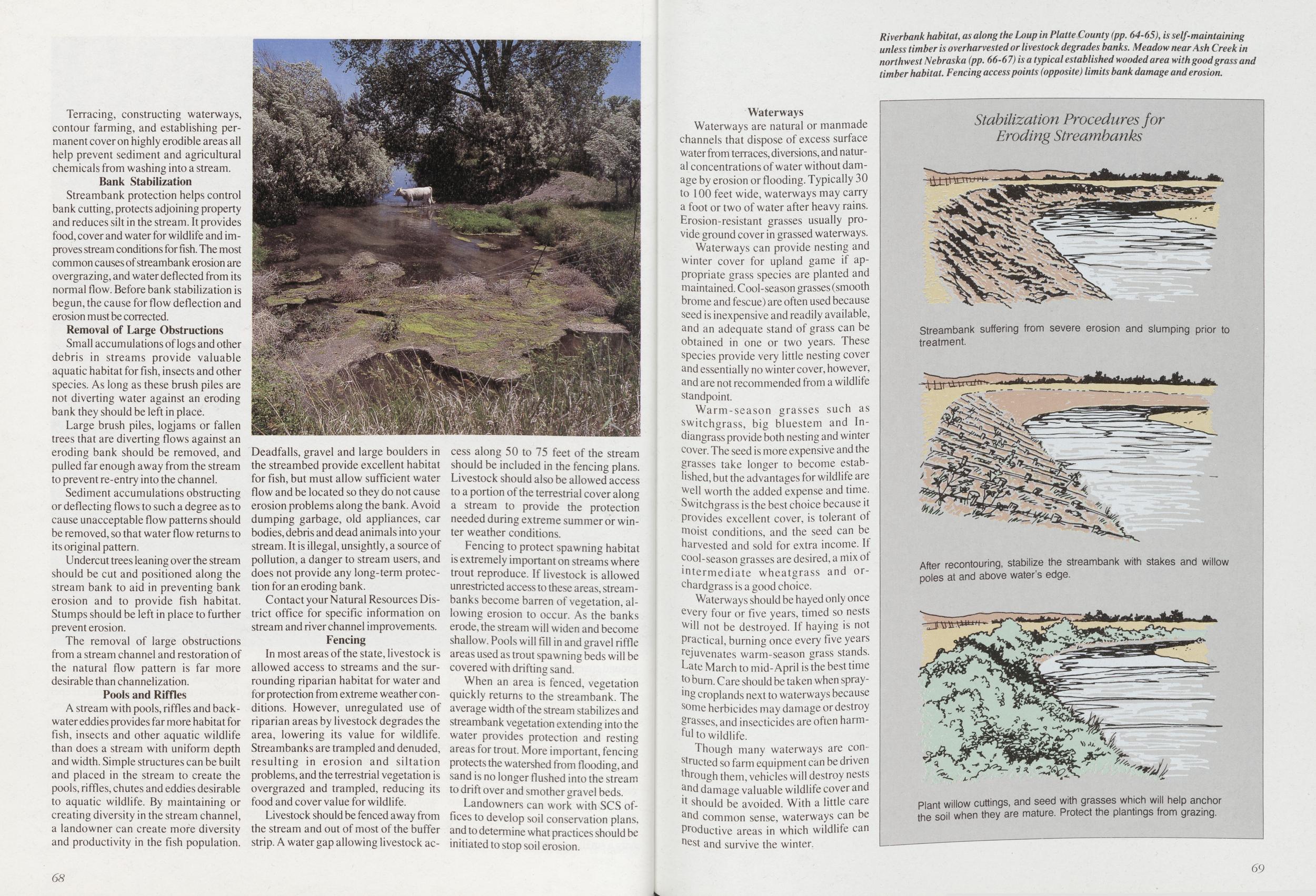
Terracing, constructing waterways, contour farming, and establishing permanent cover on highly erodible areas all help prevent sediment and agricultural chemicals from washing into a stream.
Streambank protection helps control bank cutting, protects adjoining property and reduces silt in the stream. It provides food, cover and water for wildlife and improves stream conditions for fish. The most common causes of streambank erosion are overgrazing, and water deflected from its normal flow. Before bank stabilization is begun, the cause for flow deflection and erosion must be corrected.
Removal of Large ObstructionsSmall accumulations of logs and other debris in streams provide valuable aquatic habitat for fish, insects and other species. As long as these brush piles are not diverting water against an eroding bank they should be left in place.
Large brush piles, logjams or fallen trees that are diverting flows against an eroding bank should be removed, and pulled far enough away from the stream to prevent re-entry into the channel.
Sediment accumulations obstructing or deflecting flows to such a degree as to cause unacceptable flow patterns should be removed, so that water flow returns to its original pattern,
Undercut trees leaning over the stream should be cut and positioned along the stream bank to aid in preventing bank erosion and to provide fish habitat. Stumps should be left in place to further prevent erosion.
The removal of large obstructions from a stream channel and restoration of the natural flow pattern is far more desirable than channelization.
Pools and RifflesA stream with pools, riffles and backwater eddies provides far more habitat for fish, insects and other aquatic wildlife than does a stream with uniform depth and width. Simple structures can be built and placed in the stream to create the pools, riffles, chutes and eddies desirable to aquatic wildlife. By maintaining or creating diversity in the stream channel, a landowner can create more diversity and productivity in the fish population. Deadfalls, gravel and large boulders in the streambed provide excellent habitat for fish, but must allow sufficient water flow and be located so they do not cause erosion problems along the bank. Avoid dumping garbage, old appliances, car bodies, debris and dead animals into your stream. It is illegal, unsightly, a source of pollution, a danger to stream users, and does not provide any long-term protection for an eroding bank.
Contact your Natural Resources District office for specific information on stream and river channel improvements.
FencingIn most areas of the state, livestock is allowed access to streams and the surrounding riparian habitat for water and for protection from extreme weather conditions. However, unregulated use of riparian areas by livestock degrades the area, lowering its value for wildlife. Streambanks are trampled and denuded, resulting in erosion and siltation problems, and the terrestrial vegetation is overgrazed and trampled, reducing its food and cover value for wildlife.
Livestock should be fenced away from the stream and out of most of the buffer strip. A water gap allowing livestock access along 50 to 75 feet of the stream should be included in the fencing plans. Livestock should also be allowed access to a portion of the terrestrial cover along a stream to provide the protection needed during extreme summer or winter weather conditions.
Fencing to protect spawning habitat is extremely important on streams where trout reproduce. If livestock is allowed unrestricted access to these areas, stream-banks become barren of vegetation, allowing erosion to occur. As the banks erode, the stream will widen and become shallow. Pools will fill in and gravel riffle areas used as trout spawning beds will be covered with drifting sand.
When an area is fenced, vegetation quickly returns to the streambank. The average width of the stream stabilizes and streambank vegetation extending into the water provides protection and resting areas for trout. More important, fencing protects the watershed from flooding, and sand is no longer flushed into the stream to drift over and smother gravel beds.
Landowners can work with SCS offices to develop soil conservation plans, and to determine what practices should be initiated to stop soil erosion.
68 WaterwaysWaterways are natural or manmade channels that dispose of excess surface water from terraces, diversions, and natural concentrations of water without damage by erosion or flooding. Typically 30 to 100 feet wide, waterways may carry a foot or two of water after heavy rains. Erosion-resistant grasses usually provide ground cover in grassed waterways.
Waterways can provide nesting and winter cover for upland game if appropriate grass species are planted and maintained. Cool-season grasses (smooth brome and fescue) are often used because seed is inexpensive and readily available, and an adequate stand of grass can be obtained in one or two years. These species provide very little nesting cover and essentially no winter cover, however, and are not recommended from a wildlife standpoint.
Warm-season grasses such as switchgrass, big bluestem and Indiangrass provide both nesting and winter cover. The seed is more expensive and the grasses take longer to become established, but the advantages for wildlife are well worth the added expense and time. Switchgrass is the best choice because it Provides excellent cover, is tolerant of moist conditions, and the seed can be harvested and sold for extra income. If cool-season grasses are desired, a mix ot intermediate wheatgrass and orchardgrass is a good choice.
Waterways should be hayed only once every four or five years, timed so nests will not be destroyed. If haying is not Practical, burning once every five years rejuvenates warm-season grass stands. Late March to mid-April is the best time to burn. Care should be taken when spraying croplands next to waterways because some herbicides may damage or destroy passes, and insecticides are often harmful to wildlife.
Though many waterways are constructed so farm equipment can be driven through them, vehicles will destroy nests and damage valuable wildlife cover and h should be avoided. With a little care and common sense, waterways can be Productive areas in which wildlife can nest and survive the winter.
Stabilization Procedures for Eroding Streambanks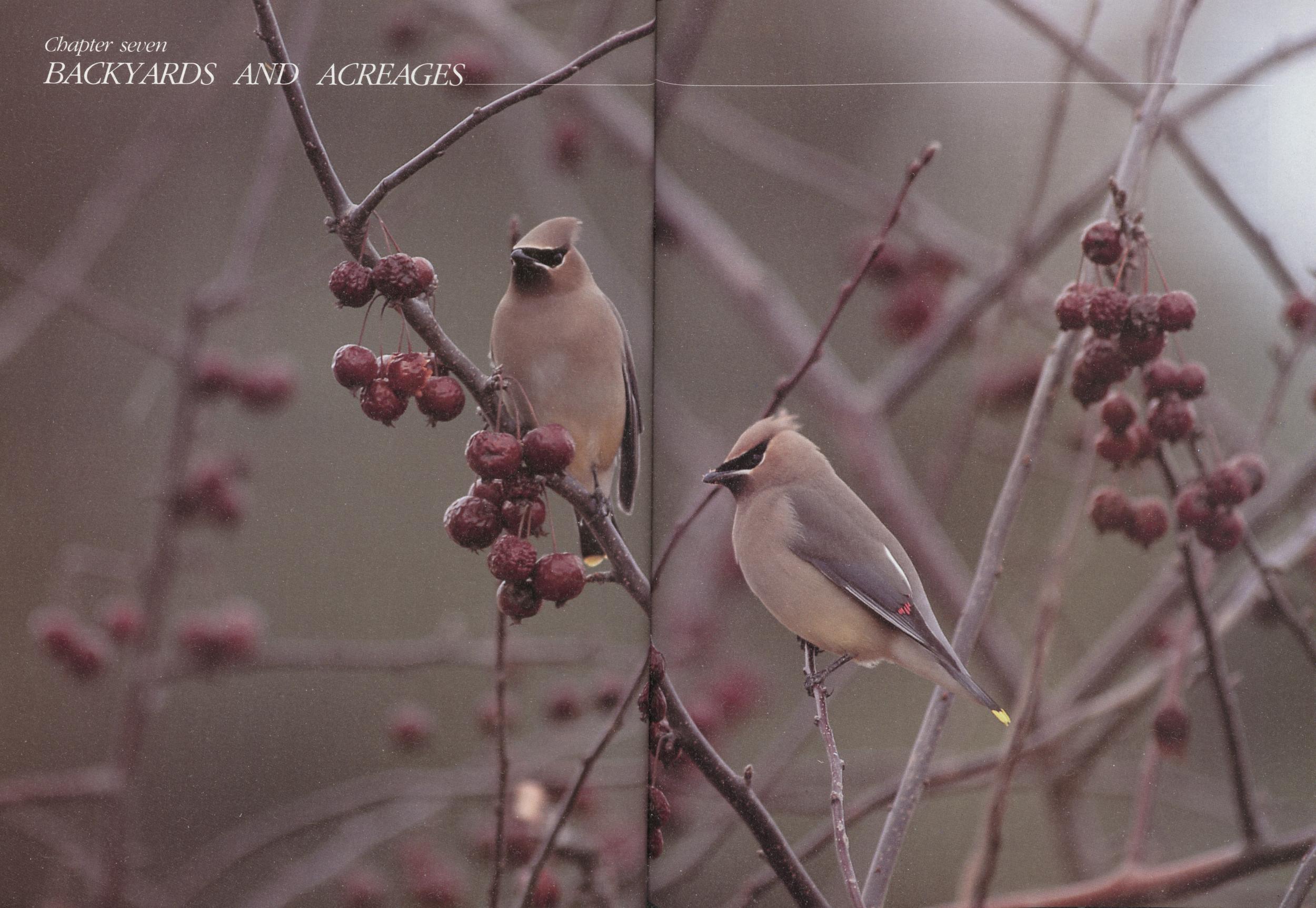
Chapter seven BACKYARDS AND ACREAGES
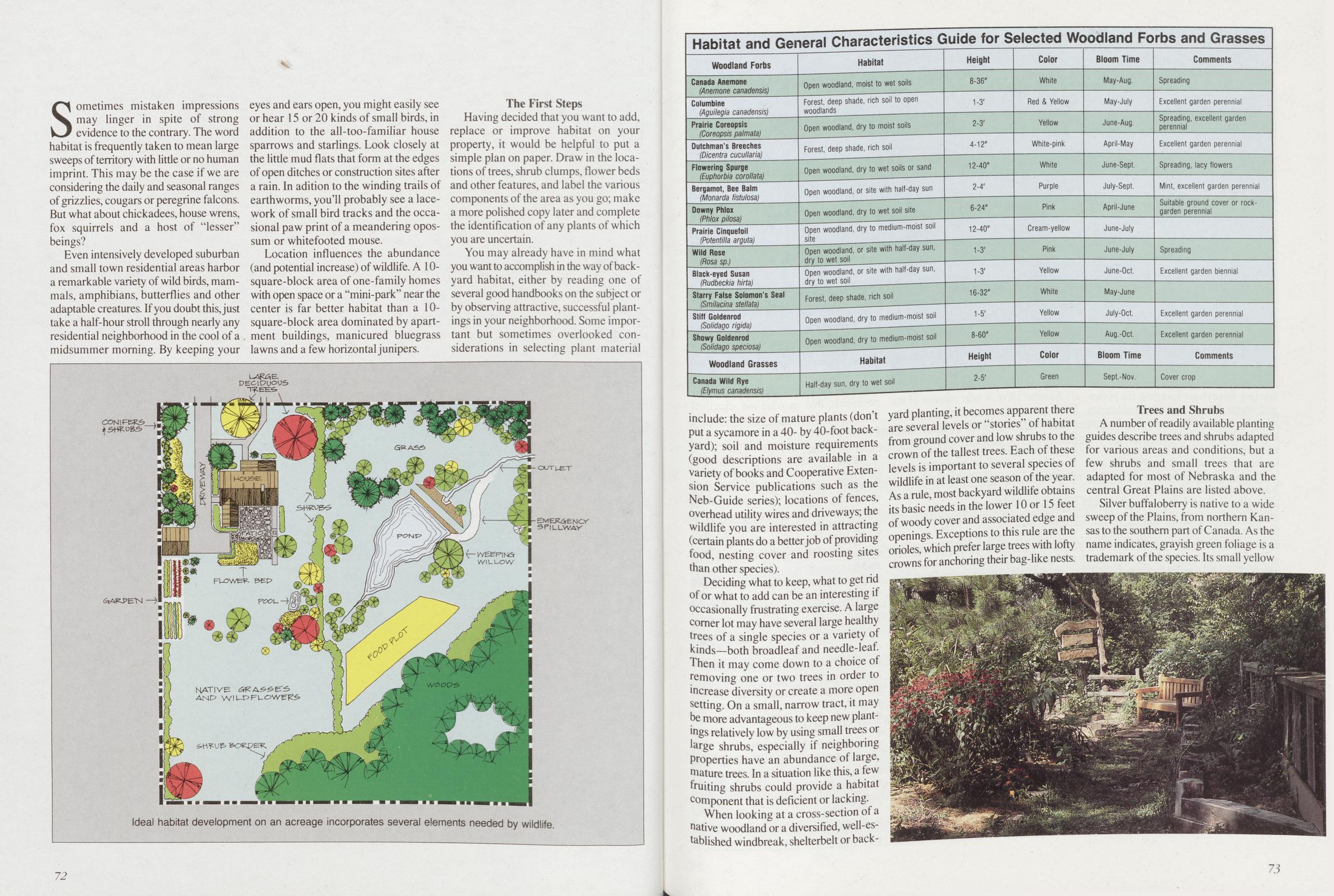
Sometimes mistaken impressions may linger in spite of strong evidence to the contrary. The word habitat is frequently taken to mean large sweeps of territory with little or no human imprint. This may be the case if we are considering the daily and seasonal ranges of grizzlies, cougars or peregrine falcons. But what about chickadees, house wrens, fox squirrels and a host of "lesser" beings?
Even intensively developed suburban and small town residential areas harbor a remarkable variety of wild birds, mammals, amphibians, butterflies and other adaptable creatures. If you doubt this, just take a half-hour stroll through nearly any residential neighborhood in the cool of a midsummer morning. By keeping your eyes and ears open, you might easily see or hear 15 or 20 kinds of small birds, in addition to the all-too-familiar house sparrows and starlings. Look closely at the little mud flats that form at the edges of open ditches or construction sites after a rain. In adition to the winding trails of earthworms, you'll probably see a lacework of small bird tracks and the occasional paw print of a meandering opossum or whitefooted mouse.
Location influences the abundance (and potential increase) of wildlife. A 10-square-block area of one-family homes with open space or a "mini-park" near the center is far better habitat than a 10-square-block area dominated by apartment buildings, manicured bluegrass lawns and a few horizontal junipers.
Having decided that you want to add, replace or improve habitat on your property, it would be helpful to put a simple plan on paper. Draw in the locations of trees, shrub clumps, flower beds and other features, and label the various components of the area as you go; make a more polished copy later and complete the identification of any plants of which you are uncertain.
You may already have in mind what you want to accomplish in the way of backyard habitat, either by reading one of several good handbooks on the subject or by observing attractive, successful plantings in your neighborhood. Some important but sometimes overlooked considerations in selecting plant material include: the size of mature plants (don't put a sycamore in a 40- by 40-foot backyard); soil and moisture requirements (good descriptions are available in a variety of books and Cooperative Extension Service publications such as the Neb-Guide series); locations of fences, overhead utility wires and driveways; the wildlife you are interested in attracting (certain plants do a better job of providing food, nesting cover and roosting sites than other species).
Habitat and General Characteristics Guide for Selected Woodland Forbs and Grasses Woodland Forbs Canada Anemone (Anemone canadensis) Columbine (Aguilegia canadensis) Prairie Coreopsis (Coreopsis palmata) Dutchman's Breeches (Dicentra cucullaria) Flowering Spurge (Euphorbia corollata) Bergamot, Bee Balm (Monarda fistulosa) Downy Phlox (Phlox pilosa) Prairie Cinquefoil (Potentilla arguta) Wild Rose (Rosa sp.) Black-eyed Susan (Rudbeckia hirta) Starry False Solomon's Seal (Smilacina stellata) Stiff Goldenrod (Solidago rigida) Showy Goldenrod (Solidago speciosa) Woodland Grasses Canada Wild Rye (Elymus canadensis) Habitat Open woodland, moist to wet soils Forest, deep shade, rich soil to open woodlands__________________ Open woodland, dry to moist soils Forest, deep shade, rich soil Open woodland, dry to wet soils or sand Open woodland, or site with half-day sun Open woodland, dry to wet soil site Open woodland, dry to medium-moist soil site_____________________ Open woodland, or site with half-day sun, dry to wet soil Open woodland, or site with half-day sun, dry to wet soil____________________. Forest, deep shade, rich soil Open woodland, dry to medium-moist soil Open woodland, dry to medium-moist soil Habitat Half-day sun, dry to wet soil Height 8-36" 1-3' 2-3' 4-12" 12-40" 2-4' 6-24" 12-40" 1-3' 1-3' 16-32" 1-5' 8-60" Height 2-5' Color White Red & Yellow Yellow White-pink White Purple Pink Cream-yellow Pink Yellow White Yellow Yellow Color Green Bloom Time May-Aug. May-July June-Aug April-May June-Sept. July-Sept. April-June June-July June-July une-Oct. May-June July-Oct. Aug.-Oct. Bloom Time Sept.-Nov. Comments Spreading Excellent garden perennial Spreading, excellent garden perennial Excellent garden perennial Spreading, lacy flowers Mint, excellent garden perennial Suitable ground cover or rockgarden perennial Spreading Excellent garden biennial Excellent garden perennial Excellent garden perennial Comments Cover cropDeciding what to keep, what to get rid of or what to add can be an interesting if occasionally frustrating exercise. A large corner lot may have several large healthy trees of a single species or a variety of kinds—both broadleaf and needle-leaf. Then it may come down to a choice of removing one or two trees in order to increase diversity or create a more open setting. On a small, narrow tract, it may be more advantageous to keep new plant- ings relatively low by using small trees or 'arge shrubs, especially if neighboring Properties have an abundance of large, rnature trees. In a situation like this, a few fruiting shrubs could provide a habitat component that is deficient or lacking.
When looking at a cross-section of a native woodland or a diversified, well-es- tablished windbreak, shelterbelt or back- yard planting, it becomes apparent there are several levels or "stories" of habitat from ground cover and low shrubs to the crown of the tallest trees. Each of these levels is important to several species of wildlife in at least one season of the year. As a rule, most backyard wildlife obtains its basic needs in the lower 10 or 15 feet of woody cover and associated edge and openings. Exceptions to this rule are the orioles, which prefer large trees with lofty crowns for anchoring their bag-like nests.
Trees and ShrubsA number of readily available planting guides describe trees and shrubs adapted for various areas and conditions, but a few shrubs and small trees that are adapted for most of Nebraska and the central Great Plains are listed above.
Silver buffaloberry is native to a wide
sweep of the Plains, from northern Kansas
to the southern part of Canada. As the
name indicates, grayish green foliage is a
trademark of the species. Its small yellow
73
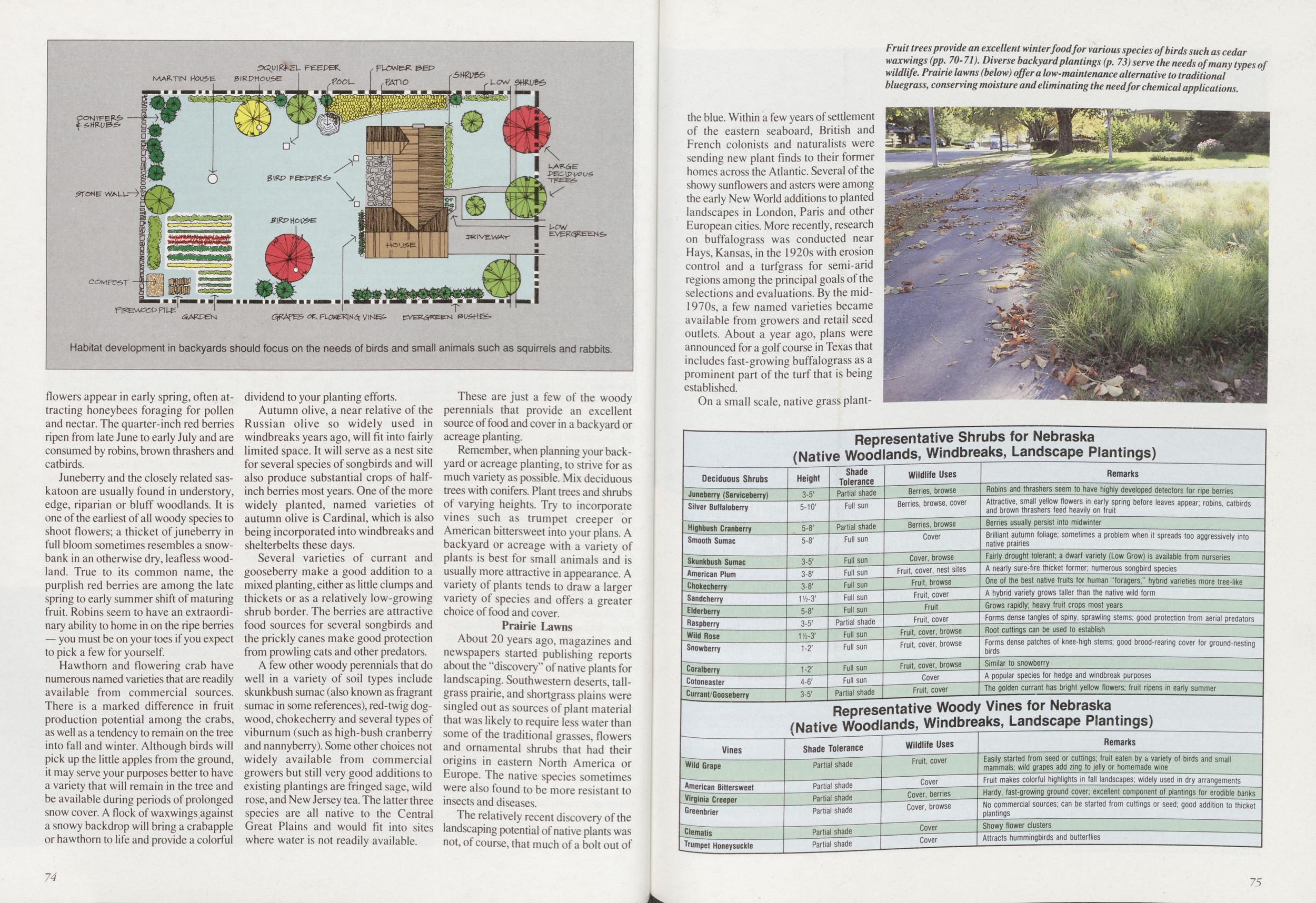
Juneberry and the closely related saskatoon are usually found in understory, edge, riparian or bluff woodlands. It is one of the earliest of all woody species to shoot flowers; a thicket of juneberry in full bloom sometimes resembles a snowbank in an otherwise dry, leafless woodland. True to its common name, the purplish red berries are among the late spring to early summer shift of maturing fruit. Robins seem to have an extraordinary ability to home in on the ripe berries — you must be on your toes if you expect to pick a few for yourself.
Hawthorn and flowering crab have numerous named varieties that are readily available from commercial sources. There is a marked difference in fruit production potential among the crabs, as well as a tendency to remain on the tree into fall and winter. Although birds will pick up the little apples from the ground, it may serve your purposes better to have a variety that will remain in the tree and be available during periods of prolonged snow cover. A flock of wax wings against a snowy backdrop will bring a crabapple or hawthorn to life and provide a colorful dividend to your planting efforts.
Autumn olive, a near relative of the Russian olive so widely used in windbreaks years ago, will fit into fairly limited space. It will serve as a nest site for several species of songbirds and will also produce substantial crops of half-inch berries most years. One of the more widely planted, named varieties ot autumn olive is Cardinal, which is also being incorporated into windbreaks and shelterbelts these days.
Several varieties of currant and gooseberry make a good addition to a mixed planting, either as little clumps and thickets or as a relatively low-growing shrub border. The berries are attractive food sources for several songbirds and the prickly canes make good protection from prowling cats and other predators.
A few other woody perennials that do well in a variety of soil types include skunkbush sumac (also known as fragrant sumac in some references), red-twig dogwood, chokecherry and several types of viburnum (such as high-bush cranberry and nannyberry). Some other choices not widely available from commercial growers but still very good additions to existing plantings are fringed sage, wild rose, and New Jersey tea. The latter three species are all native to the Central Great Plains and would fit into sites where water is not readily available.
These are just a few of the woody perennials that provide an excellent source of food and cover in a backyard or acreage planting.
Remember, when planning your backyard or acreage planting, to strive for as much variety as possible. Mix deciduous trees with conifers. Plant trees and shrubs of varying heights. Try to incorporate vines such as trumpet creeper or American bittersweet into your plans. A backyard or acreage with a variety of plants is best for small animals and is usually more attractive in appearance. A variety of plants tends to draw a larger variety of species and offers a greater choice of food and cover.
Prairie LawnsAbout 20 years ago, magazines and newspapers started publishing reports about the "discovery" of native plants for landscaping. Southwestern deserts, tall- grass prairie, and shortgrass plains were singled out as sources of plant material that was likely to require less water than some of the traditional grasses, flowers and ornamental shrubs that had their origins in eastern North America or Europe. The native species sometimes were also found to be more resistant to insects and diseases.
The relatively recent discovery of the landscaping potential of native plants was not, of course, that much of a bolt out of 74 the blue. Within a few years of settlement of the eastern seaboard, British and French colonists and naturalists were sending new plant finds to their former homes across the Atlantic. Several of the showy sunflowers and asters were among the early New World additions to planted landscapes in London, Paris and other European cities. More recently, research on buffalograss was conducted near Hays, Kansas, in the 1920s with erosion control and a turfgrass for semi-arid regions among the principal goals of the selections and evaluations. By the mid-1970s, a few named varieties became available from growers and retail seed outlets. About a year ago, plans were announced for a golf course in Texas that includes fast-growing buffalograss as a prominent part of the turf that is being established.
On a small scale, native grass plantings for the backyard setting should emphasize the short grasses (e.g. buffalograss and blue grama) and the mid-grasses (e.g. little bluestem, side-oats grama and porcupine grass), which reach heights of one to two feet at maturity. Several forbs (wildflowers) that occur with these grasses in wild stands are obvious choices for mixed plantings.
Representative Shrubs for Nebraska (Native wnndlands1Windbreaks, Landscape Plantings) Deciduous Shrubs Juneberry (Serviceberry) Silver Buffaloberry Highbush Cranberry Smooth Sumac Skunkbush Sumac American Plum Chokecherry Sandcherry jjderberry Raspberry Wild Rose Snowberry Coralberry Cotoneaster Currant/Gooseberry Height 5-10' Remarks Robins and thrashers seem to have highly developed detectors for ripe berries Attractive, small yellow flowers in early spring before leaves appear; robins, catbirds and brown thrashers feed heavily on fruit_______________ Berries usually persist into midwinter Brilliant autumn foliage; sometimes a problem when i native prairies_______________________________ spreads too aggressively into Fairly drought tolerant; a dwarf variety (Low Grow) is available from nurseries A nearly sure-fire thicket former; numerous songbird species One of the best native fruits for human "foragers," hybrid varieties more tree-like 1V2-3' A hybrid variety grows taller than the native wild form Grows rapidly; heavy fruit crops most years Forms dense tangles of spiny, sprawling stems; good protection from aerial predators 1 Vz-3' Root cuttings can be used to establish Forms dense patches of knee-high stems; good brood-rearing cover for ground-nesting birds__________________________________________________________ Similar to snowberry A popular species for hedge and windbreak purposes The golden currant has bright yellow flowers; fruit ripens in early summer Representative Woody Vines for Nebraska ncr,vw. ....__iu-^#»u«% I onHcrano Plan (NatiVeWoodlanjs^^ Plantings) Vines Wild Grape American Bittersweet Virginia Creeper Greenbri Clematis trumpet Honeysuckle Shade Tolerance Remarks Easily started from seed or cuttings; fruit eaten by a variety of birds and small mammals; wild grapes add zing to jelly or homemade wine_________________ Fruit makes colorful highlights in fall landscapes; widely used in dry arrangements Hardy, fast-growing ground cover; excellent component of plantings for erodible banks No commercial sources; can be started from cuttings or seed; good addition to thicket plantings________________________________________________________________ Showy flower clusters Attracts hummingbirds and butterflies 75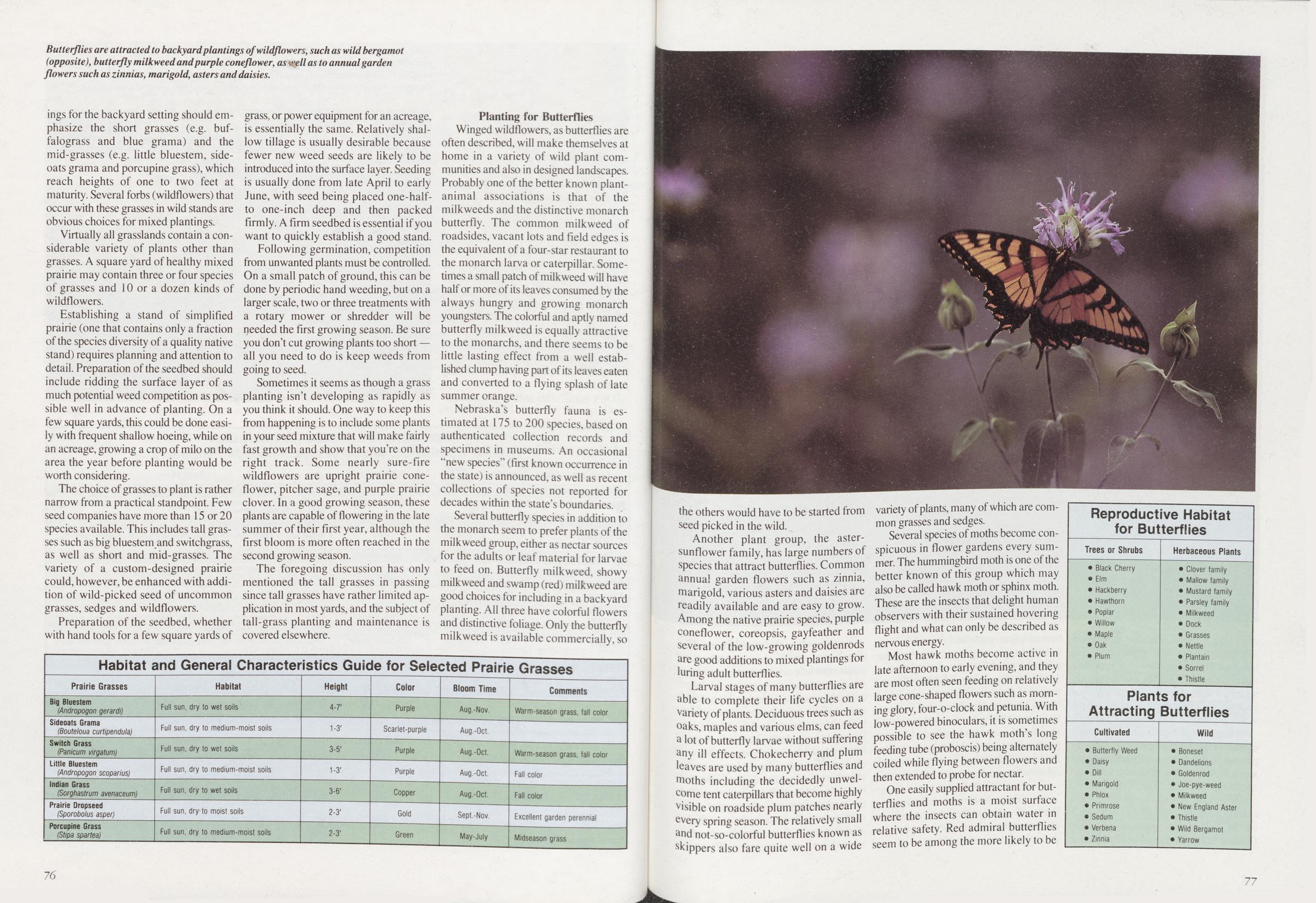
Virtually all grasslands contain a considerable variety of plants other than grasses. A square yard of healthy mixed prairie may contain three or four species of grasses and 10 or a dozen kinds of wildflowers.
Establishing a stand of simplified prairie (one that contains only a fraction of the species diversity of a quality native stand) requires planning and attention to detail. Preparation of the seedbed should include ridding the surface layer of as much potential weed competition as possible well in advance of planting. On a few square yards, this could be done easily with frequent shallow hoeing, while on an acreage, growing a crop of milo on the area the year before planting would be worth considering.
The choice of grasses to plant is rather narrow from a practical standpoint. Few seed companies have more than 15 or 20 species available. This includes tall grasses such as big bluestem and switchgrass, as well as short and mid-grasses. The variety of a custom-designed prairie could, however, be enhanced with addition of wild-picked seed of uncommon grasses, sedges and wildflowers.
Preparation of the seedbed, whether with hand tools for a few square yards of grass, or power equipment for an acreage, is essentially the same. Relatively shallow tillage is usually desirable because fewer new weed seeds are likely to be introduced into the surface layer. Seeding is usually done from late April to early June, with seed being placed one-half-to one-inch deep and then packed firmly. A firm seedbed is essential if you want to quickly establish a good stand.
Following germination, competition from unwanted plants must be controlled. On a small patch of ground, this can be done by periodic hand weeding, but on a larger scale, two or three treatments with a rotary mower or shredder will be needed the first growing season. Be sure you don't cut growing plants too short — all you need to do is keep weeds from going to seed.
Sometimes it seems as though a grass planting isn't developing as rapidly as you think it should. One way to keep this from happening is to include some plants in your seed mixture that will make fairly fast growth and show that you're on the right track. Some nearly sure-fire wildflowers are upright prairie coneflower, pitcher sage, and purple prairie clover. In a good growing season, these plants are capable of flowering in the late summer of their first year, although the first bloom is more often reached in the second growing season.
The foregoing discussion has only mentioned the tall grasses in passing since tall grasses have rather limited application in most yards, and the subject of tall-grass planting and maintenance is covered elsewhere.
Planting for ButterfliesWinged wildflowers, as butterflies are often described, will make themselves at home in a variety of wild plant communities and also in designed landscapes. Probably one of the better known plant-animal associations is that of the milkweeds and the distinctive monarch butterfly. The common milkweed of roadsides, vacant lots and field edges is the equivalent of a four-star restaurant to the monarch larva or caterpillar. Sometimes a small patch of milkweed will have half or more of its leaves consumed by the always hungry and growing monarch youngsters. The colorful and aptly named butterfly milkweed is equally attractive to the monarchs, and there seems to be little lasting effect from a well established clump having part of its leaves eaten and converted to a flying splash of late summer orange.
Nebraska's butterfly fauna is estimated at 175 to 200 species, based on authenticated collection records and specimens in museums. An occasional "new species" (first known occurrence in the state) is announced, as well as recent collections of species not reported for decades within the state's boundaries.
Several butterfly species in addition to the monarch seem to prefer plants of the milkweed group, either as nectar sources for the adults or leaf material for larvae to feed on. Butterfly milkweed, showy milkweed and swamp (red) milkweed are good choices for including in a backyard planting. All three have colorful flowers and distinctive foliage. Only the butterfly milkweed is available commercially, so the others would have to be started from seed picked in the wild.
Habitat and General Characteristics Guide for Selected Prairie Grasses Prairie Grasses Habitat Height Color Bloom Time Comments Big Bluestem (Andropogon gerardi) Full sun, dry to wet soils 4 -7' Purple Aug.-Nov. Warm-season grass, fall color Sideoats Grama (Bouteloua curtipendula) Full sun, dry to medium-moist soils 1-3' Scarlet-purple Aug.-Oct. Switch Grass (Panicum virgatum) Full sun, dry to wet soils 3-5' Purple Aug.-Oct. Warm-season grass, fall color Little Bluestem (Andropogon scoparius) Full sun, dry to medium-moist soils 1-3' Purple Aug.-Oct. Fall color Indian Grass (Sorghastrum avenaceum) Full sun, dry to wet soils 3 -6' Copper Aug.-Oct. Fall color Prairie Dropseed (Sporobolus asper) Full sun, dry to moist soils 2 -3' Gold Sept.-Nov. Excellent garden perennial Porcupine Grass (Stipa spartea) Full sun, dry to medium-moist soils 2 -3' Green May-July Midseason grass 76Another plant group, the aster-sunflower family, has large numbers of species that attract butterflies. Common annual garden flowers such as zinnia, marigold, various asters and daisies are readily available and are easy to grow. Among the native prairie species, purple coneflower, coreopsis, gayfeather and several of the low-growing goldenrods are good additions to mixed plantings for luring adult butterflies.
Larval stages of many butterflies are able to complete their life cycles on a variety of plants. Deciduous trees such as oaks, maples and various elms, can feed a lot of butterfly larvae without suffering any ill effects. Chokecherry and plum leaves are used by many butterflies and moths including the decidedly unwelcome tent caterpillars that become highly visible on roadside plum patches nearly every spring season. The relatively small and not-so-colorful butterflies known as skippers also fare quite well on a wide variety of plants, many of which are common grasses and sedges.
Several species of moths become conspicuous in flower gardens every summer The hummingbird moth is one of the better known of this group which may also be called hawk moth or sphinx moth. These are the insects that delight human observers with their sustained hovering flight and what can only be described as nervous energy.
Most hawk moths become active in late afternoon to early evening, and they are most often seen feeding on relatively large cone-shaped flowers such as morning glory, four-o-clock and petunia. With low-powered binoculars, it is sometimes possible to see the hawk moth's long feeding tube (proboscis) being alternately coiled while flying between flowers and then extended to probe for nectar
One easily supplied attractant for butterflies and moths is a moist surface where the insects can obtain water in relative safety. Red admiral butterflies seem to be among the more likely to be drawn to a moist mud flat or even a sidewalk or driveway immediately following a quick rain shower or exposure to the sprinkler. Another way to provide water for butterflies is to place a porous rock or brick in a shallow basin, where water is drawn to the surface.
Reproductive Habitat for Butterflies Trees or Shrubs Herbaceous Plants • Black Cherry • Clover family • Elm • Mallow family • Hackberry • Mustard family • Hawthorn • Parsley family • Poplar • Milkweed • Willow • Dock • Maple • Grasses • Oak • Nettle • Plum • Plantain • Sorrel • Thistle Plants for Attracting Butterflies Cultivated Wild • Butterfly Weed • Boneset • Daisy • Dandelions • Dill • Goldenrod • Marigold • Joe-pye-weed • Phlox • Milkweed • Primrose • New England Aster • Sedum • Thistle • Verbena • Wild Bergamot • Zinnia • Yarrow 77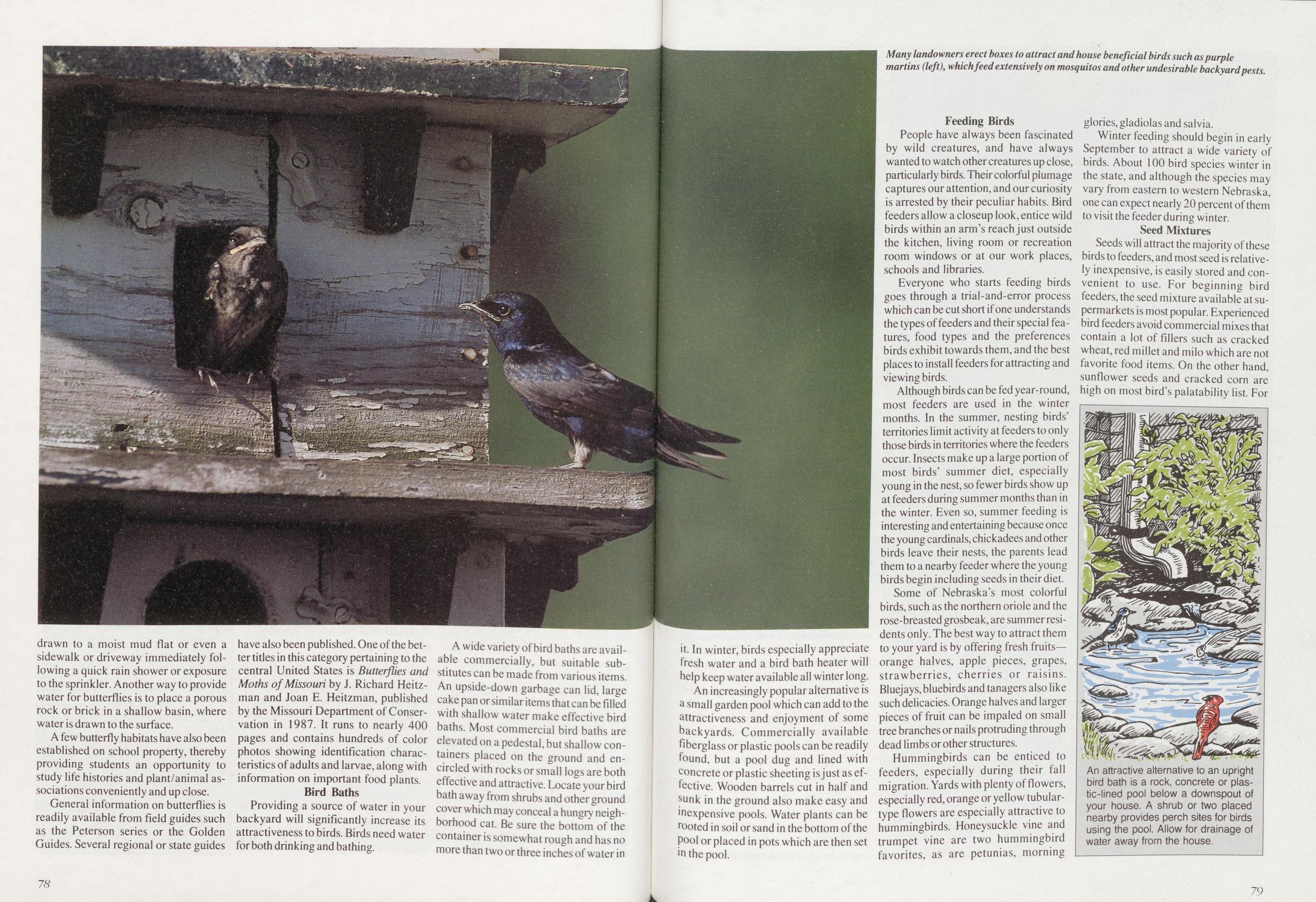
A few butterfly habitats have also been established on school property, thereby providing students an opportunity to study life histories and plant/animal associations conveniently and up close.
General information on butterflies is readily available from field guides such as the Peterson series or the Golden Guides. Several regional or state guides have also been published. One of the better titles in this category pertaining to the central United States is Butterflies and Moths of Missouri by J. Richard Heitzman and Joan E. Heitzman, published by the Missouri Department of Conservation in 1987. It runs to nearly 400 pages and contains hundreds of color photos showing identification characteristics of adults and larvae, along with information on important food plants.
Bird BathsProviding a source of water in your backyard will significantly increase its attractiveness to birds. Birds need water for both drinking and bathing.
A wide variety of bird baths are avail- able commercially, but suitable sub- stitutes can be made from various items. An upside-down garbage can lid, large cake pan or similar items that can be filled with shallow water make effective bird baths. Most commercial bird baths are elevated on a pedestal, but shallow con- tainers placed on the ground and en- circled with rocks or small logs are both effective and attractive. Locate your bird bath away from shrubs and other ground cover which may conceal a hungry neigh- borhood cat. Be sure the bottom of the container is somewhat rough and has no more than two or three inches of water in 78 it. In winter, birds especially appreciate fresh water and a bird bath heater will help keep water available all winter long.
An increasingly popular alternative is a small garden pool which can add to the attractiveness and enjoyment of some backyards. Commercially available fiberglass or plastic pools can be readily found, but a pool dug and lined with concrete or plastic sheeting is just as effective. Wooden barrels cut in half and sunk in the ground also make easy and inexpensive pools. Water plants can be rooted in soil or sand in the bottom of the pool or placed in pots which are then set in the pool.
Feeding BirdsPeople have always been fascinated by wild creatures, and have always wanted to watch other creatures up close, particularly birds. Their colorful plumage captures our attention, and our curiosity is arrested by their peculiar habits. Bird feeders allow a closeup look, entice wild birds within an arm's reach just outside the kitchen, living room or recreation room windows or at our work places, schools and libraries.
Everyone who starts feeding birds goes through a trial-and-error process which can be cut short if one understands the types of feeders and their special features, food types and the preferences birds exhibit towards them, and the best places to install feeders for attracting and viewing birds.
Although birds can be fed year-round, most feeders are used in the winter months. In the summer, nesting birds' territories limit activity at feeders to only those birds in territories where the feeders occur. Insects make up a large portion of most birds' summer diet, especially young in the nest, so fewer birds show up at feeders during summer months than in the winter. Even so, summer feeding is interesting and entertaining because once the young cardinals, chickadees and other birds leave their nests, the parents lead them to a nearby feeder where the young birds begin including seeds in their diet.
Some of Nebraska's most colorful birds, such as the northern oriole and the rose-breasted grosbeak, are summer residents only. The best way to attract them to your yard is by offering fresh fruits orange halves, apple pieces, grapes, strawberries, cherries or raisins. Bluejays, bluebirds and tanagers also like such delicacies. Orange halves and larger pieces of fruit can be impaled on small tree branches or nails protruding through dead limbs or other structures.
Hummingbirds can be enticed to feeders, especially during their fall migration. Yards with plenty of flowers, especially red, orange or yellow tubular-type flowers are especially attractive to hummingbirds. Honeysuckle vine and trumpet vine are two hummingbird favorites, as are petunias, morning glories, gladiolas and salvia.
Winter feeding should begin in early September to attract a wide variety of birds. About 100 bird species winter in the state, and although the species may vary from eastern to western Nebraska, one can expect nearly 20 percent of them to visit the feeder during winter.
Seed MixturesSeeds will attract the majority of these birds to feeders, and most seed is relatively inexpensive, is easily stored and convenient to use. For beginning bird feeders, the seed mixture available at supermarkets is most popular. Experienced bird feeders avoid commercial mixes that contain a lot of fillers such as cracked wheat, red millet and milo which are not favorite food items. On the other hand, sunflower seeds and cracked corn are high on most bird's palatability list. For most Nebraska birds, a mix of 50 to 70 percent sunflower seed, and the remainder equal parts of cracked corn and white millet is a preferred mixture. The oil-seed variety of sunflower is considered slightly better than the "eating" variety because of its higher food value and its higher nutmeat-to-shell-ratio; however, any of the sunflower seeds provided will be eaten.
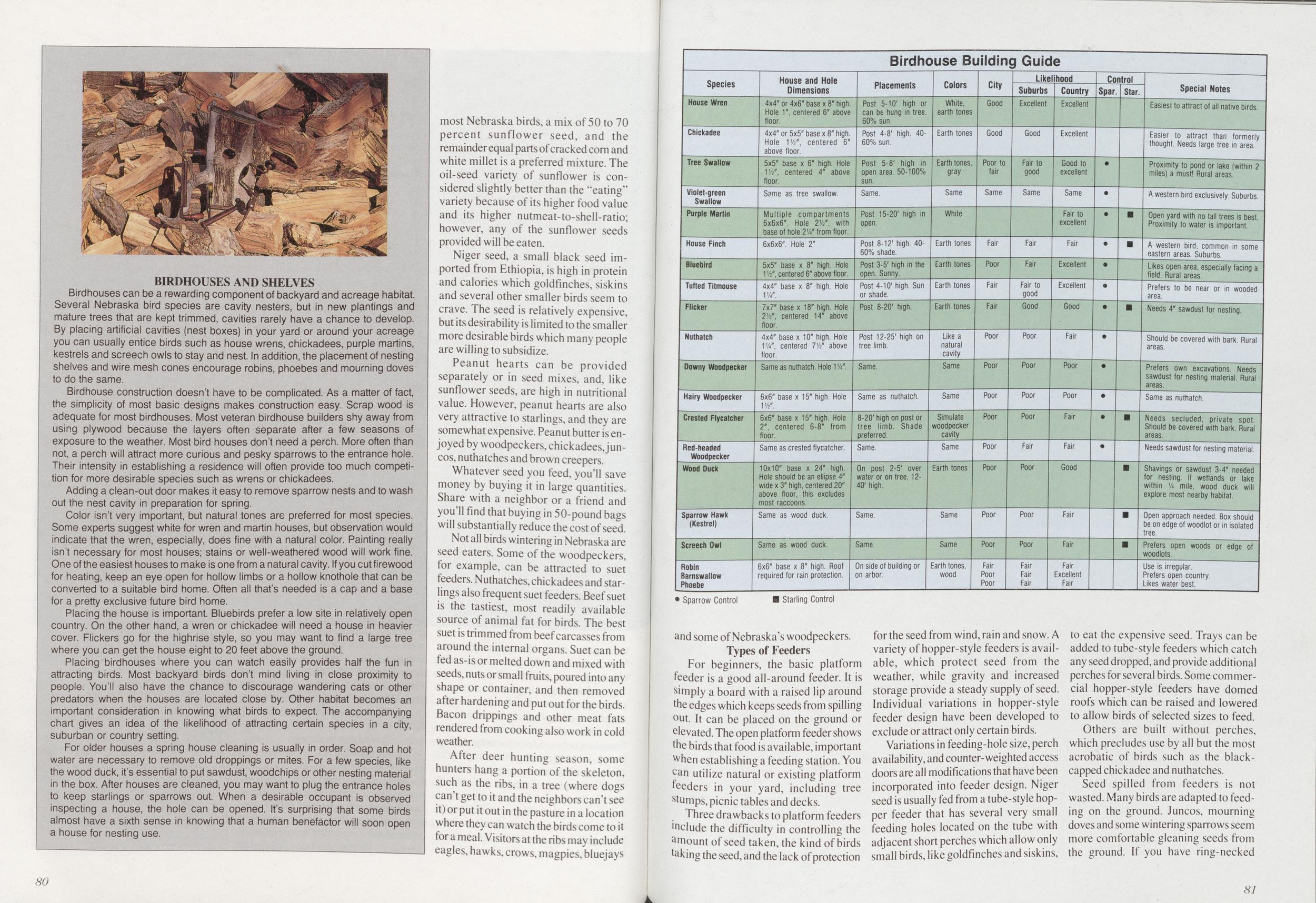
Birdhouses can be a rewarding component of backyard and acreage habitat. Several Nebraska bird species are cavity nesters, but in new plantings and mature trees that are kept trimmed, cavities rarely have a chance to develop. By placing artificial cavities (nest boxes) in your yard or around your acreage you can usually entice birds such as house wrens, chickadees, purple martins, kestrels and screech owls to stay and nest. In addition, the placement of nesting shelves and wire mesh cones encourage robins, phoebes and mourning doves to do the same.
Birdhouse construction doesn't have to be complicated. As a matter of fact, the simplicity of most basic designs makes construction easy. Scrap wood is adequate for most birdhouses. Most veteran birdhouse builders shy away from using plywood because the layers often separate after a few seasons of exposure to the weather. Most bird houses don't need a perch. More often than not, a perch will attract more curious and pesky sparrows to the entrance hole. Their intensity in establishing a residence will often provide too much competition for more desirable species such as wrens or chickadees.
Adding a clean-out door makes it easy to remove sparrow nests and to wash out the nest cavity in preparation for spring.
Color isn't very important, but natural tones are preferred for most species. Some experts suggest white for wren and martin houses, but observation would indicate that the wren, especially, does fine with a natural color. Painting really isn't necessary for most houses; stains or well-weathered wood will work fine. One of the easiest houses to make is one from a natural cavity. If you cut firewood for heating, keep an eye open for hollow limbs or a hollow knothole that can be converted to a suitable bird home. Often all that's needed is a cap and a base for a pretty exclusive future bird home.
Placing the house is important. Bluebirds prefer a low site in relatively open country. On the other hand, a wren or chickadee will need a house in heavier cover. Flickers go for the highrise style, so you may want to find a large tree where you can get the house eight to 20 feet above the ground.
Placing birdhouses where you can watch easily provides half the fun in attracting birds. Most backyard birds don't mind living in close proximity to people. You'll also have the chance to discourage wandering cats or other predators when the houses are located close by. Other habitat becomes an important consideration in knowing what birds to expect. The accompanying chart gives an idea of the likelihood of attracting certain species in a city, suburban or country setting.
For older houses a spring house cleaning is usually in order. Soap and hot water are necessary to remove old droppings or mites. For a few species, like the wood duck, it's essential to put sawdust, woodchips or other nesting material in the box. After houses are cleaned, you may want to plug the entrance holes to keep starlings or sparrows out. When a desirable occupant is observed inspecting a house, the hole can be opened. It's surprising that some birds almost have a sixth sense in knowing that a human benefactor will soon open a house for nesting use.
Niger seed, a small black seed imported from Ethiopia, is high in protein and calories which goldfinches, siskins and several other smaller birds seem to crave. The seed is relatively expensive, but its desirability is limited to the smaller more desirable birds which many people are willing to subsidize.
Peanut hearts can be provided separately or in seed mixes, and, like sunflower seeds, are high in nutritional value. However, peanut hearts are also very attractive to starlings, and they are somewhat expensive. Peanut butter is enjoyed by woodpeckers, chickadees, juncos, nuthatches and brown creepers.
Whatever seed you feed, you'll save money by buying it in large quantities. Share with a neighbor or a friend and you'll find that buying in 50-pound bags will substantially reduce the cost of seed.
Not all birds wintering in Nebraska are seed eaters. Some of the woodpeckers, for example, can be attracted to suet feeders. Nuthatches, chickadees and starlings also frequent suet feeders. Beef suet is the tastiest, most readily available source of animal fat for birds. The best suet is trimmed from beef carcasses from around the internal organs. Suet can be fed as-is or melted down and mixed with seeds, nuts or small fruits, poured into any shape or container, and then removed after hardening and put out for the birds. Bacon drippings and other meat fats rendered from cooking also work in cold weather.
After deer hunting season, some hunters hang a portion of the skeleton, such as the ribs, in a tree (where dogs can't get to it and the neighbors can't see it) or put it out in the pasture in a location where they can watch the birds come to it for a meal. Visitors at the ribs may include eagles, hawks, crows, magpies, bluejays and some of Nebraska's woodpeckers.
80 Birdhouse Building Guide Species House and Hole Dimensions Placements Colors City Likelihood Control Suburbs Country Spar Star. Special Notes 1 House Wren 4x4" or 4x6" base x 8" high. Hole 1", centered 6" above floor. I Post 5-10' high or can be hung in tree. 60% sun. White, earth tones Good Excellent Excellent Easiest to attract of all native birds""] Chickadee 1 4x4" or 5x5" base x 8" high. Hole Vhn, centered 6" | above floor. Post 4-8' high. 40-60% sun. Earth tones Good Good Excellent Easier to attract than formerly thought. Needs large tree in area. 1 Tree Swallow 5x5" base x 6" high. Hole Yk\ centered 4" above floor. I Post 5-8' high in open area. 50-100% sun. i Earth tones, gray Poor to fair Fair to good I Good to excellent I Proximity to pond or lake (within 2 miles) a must! Rural areas. 1 Violet-green Swallow Same as tree swallow. Same. Same Same Same Same I A western bird exclusively. Suburbs. 1 Purple Martin Multiple compartments 6x6x6". Hole 2W, with base of hole 2Va from floor. Post 15-20' high in open. White Fair to excellent ■ Open yard with no tall trees is best. Proximity to water is important. 1 House Finch 6x6x6". Hole 2" Post 8-12' high. 40-| 60% shade. Earth tones Fair Fair Fair ■ A western bird, common in some] eastern areas. Suburbs. Bluebird 5x5" base x 8" high. Hole 1W, centered 6" above floor. Post 3-5' high in the open. Sunny. Earth tones Poor Fair Excellent Likes open area, especially facing a field. Rural areas. Tufted Titmouse 4x4" base x 8" high. Hole V/a". Post 4-10' high. Sun or shade. Earth tones Fair Fair to good Excellent Prefers to be near or in wooded"] area Flicker 7x7" base x 18" high. Hole 2W, centered 14" above floor. Post 8-20' high. Earth tones Fair Good Good ■ Needs 4" sawdust for nesting. Nuthatch 4x4" base x 10" high. Hole I1//', centered 7W above floor. Post 12-25' high on tree limb. Like a natura cavity Poor Poor Fair Should be covered with bark. Rural"] areas. Downy Woodpecker Same as nuthatch. Hole 11/»". Same. Same Poor Poor Poor Prefers own excavations. Needs] sawdust for nesting material. Rural areas. Hairy Woodpecker 6x6" base x 15" high. Hole 1V2". Same as nuthatch. Same Poor Poor Poor Same as nuthatch. Crested Flycatcher 6x6" base x 15" high. Hole 2", centered 6-8" from floor. 8-20'high on post or tree limb. Shade preferred. Simulate woodpecker cavity Poor Poor Fair ■ Needs secluded, private spot. Should be covered with bark. Rural areas. Red-headed Woodpecker Same as crested flycatcher. Same. Same Poor Fair Fair Needs sawdust for nesting mater al. Wood Duck 10x10" base x 24" high. | Hole should be an ellipse 4" wide x 3" high, centered 20" above floor, this excludes most raccoons. On post 2-5' over water or on tree, 12-40' high. Earth tones Poor Poor Good ■ Shavings or sawdust 3-4" needed for nesting. If wetlands or lake within Va mile, wood duck will explore most nearby habitat. Sparrow Hawk (Kestrel) Same as wood duck. Same. Same Poor Poor Fair ■ Open approach needed. Box shouid be on edge of woodlot or in isolated tree. Screech Owl Same as wood duck. Same. Same Poor Poor Fair ■ Prefers open woods or edge of woodlots. Robin Barnswailow Phoebe 6x6" base x 8" high. Roof | required for rain protection. I On side of building or on arbor. I Earth tones, wood Fair Poor Poor Fair Fair Fair Fair Excellent Fair Use is irregular. Prefers open country. Likes water best. 1 Sparrow Control I Starling Control Types of FeedersFor beginners, the basic platform feeder is a good all-around feeder. It is simply a board with a raised lip around the edges which keeps seeds from spilling °ut. It can be placed on the ground or elevated. The open platform feeder shows the birds that food is available, important when establishing a feeding station. You can utilize natural or existing platform feeders in your yard, including tree stumps, picnic tables and decks.
Three drawbacks to platform feeders include the difficulty in controlling the amount of seed taken, the kind of birds taking the seed, and the lack of protection for the seed from wind, rain and snow. A variety of hopper-style feeders is available, which protect seed from the weather, while gravity and increased storage provide a steady supply of seed. Individual variations in hopper-style feeder design have been developed to exclude or attract only certain birds.
Variations in feeding-hole size, perch availability, and counter-weighted access doors are all modifications that have been incorporated into feeder design. Niger seed is usually fed from a tube-style hopper feeder that has several very small feeding holes located on the tube with adjacent short perches which allow only small birds, like goldfinches and siskins, to eat the expensive seed. Trays can be added to tube-style feeders which catch any seed dropped, and provide additional perches for several birds. Some commercial hopper-style feeders have domed roofs which can be raised and lowered to allow birds of selected sizes to feed.
Others are built without perches, which precludes use by all but the most acrobatic of birds such as the blackcapped chickadee and nuthatches.
Seed spilled from feeders is not wasted. Many birds are adapted to feeding on the ground. Juncos, mourning doves and some wintering sparrows seem more comfortable gleaning seeds from the ground. If you have ring-necked pheasants or bob white quail nearby, scatter a mixture of cracked corn and white millet on the ground near protective cover such as a shelterbelt or shrub planting.
81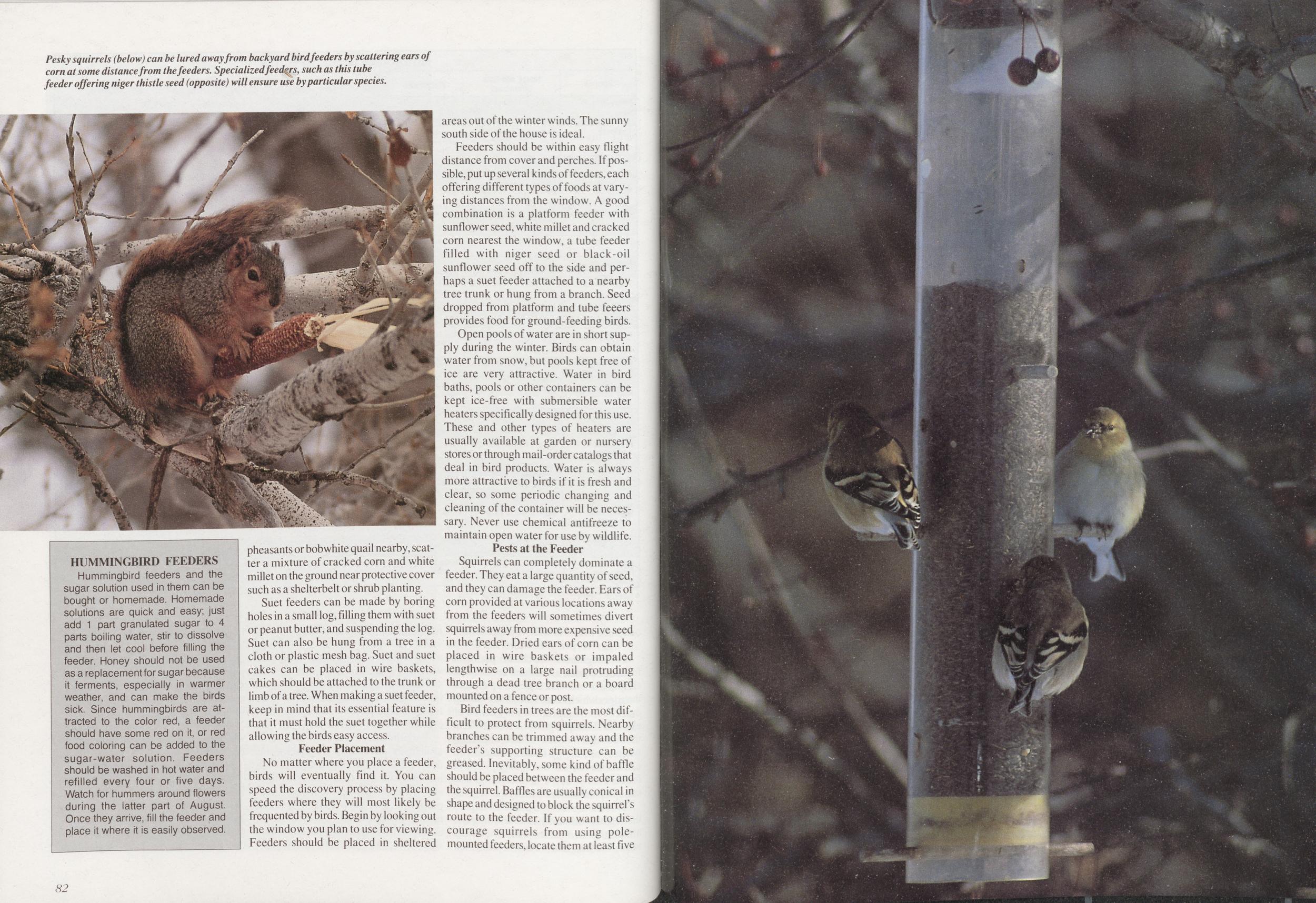
Hummingbird feeders and the sugar solution used in them can be bought or homemade. Homemade solutions are quick and easy; just add 1 part granulated sugar to 4 parts boiling water, stir to dissolve and then let cool before filling the feeder. Honey should not be used as a replacement for sugar because it ferments, especially in warmer weather, and can make the birds sick. Since hummingbirds are attracted to the color red, a feeder should have some red on it, or red food coloring can be added to the sugar-water solution. Feeders should be washed in hot water and refilled every four or five days. Watch for hummers around flowers during the latter part of August. Once they arrive, fill the feeder and place it where it is easily observed.
Suet feeders can be made by boring holes in a small log, filling them with suet or peanut butter, and suspending the log. Suet can also be hung from a tree in a cloth or plastic mesh bag. Suet and suet cakes can be placed in wire baskets, which should be attached to the trunk or limb of a tree. When making a suet feeder, keep in mind that its essential feature is that it must hold the suet together while allowing the birds easy access.
Feeder PlacementNo matter where you place a feeder, birds will eventually find it. You can speed the discovery process by placing feeders where they will most likely be frequented by birds. Begin by looking out the window you plan to use for viewing. Feeders should be placed in sheltered areas out of the winter winds. The sunny south side of the house is ideal.
Feeders should be within easy flight distance from cover and perches. If possible, put up several kinds of feeders, each offering different types of foods at varying distances from the window. A good combination is a platform feeder with sunflower seed, white millet and cracked corn nearest the window, a tube feeder filled with niger seed or black-oil sunflower seed off to the side and perhaps a suet feeder attached to a nearby tree trunk or hung from a branch. Seed dropped from platform and tube feeers provides food for ground-feeding birds.
Open pools of water are in short supply during the winter. Birds can obtain water from snow, but pools kept free of ice are very attractive. Water in bird baths, pools or other containers can be kept ice-free with submersible water heaters specifically designed for this use. These and other types of heaters are usually available at garden or nursery stores or through mail-order catalogs that deal in bird products. Water is always more attractive to birds if it is fresh and clear, so some periodic changing and cleaning of the container will be necessary. Never use chemical antifreeze to maintain open water for use by wildlife.
Pests at the FeederSquirrels can completely dominate a feeder. They eat a large quantity of seed, and they can damage the feeder. Ears of corn provided at various locations away from the feeders will sometimes divert squirrels away from more expensive seed in the feeder. Dried ears of corn can be placed in wire baskets or impaled lengthwise on a large nail protruding through a dead tree branch or a board mounted on a fence or post.
Bird feeders in trees are the most difficult to protect from squirrels. Nearby branches can be trimmed away and the feeder's supporting structure can be greased. Inevitably, some kind of baffle should be placed between the feeder and the squirrel. Baffles are usually conical in shape and designed to block the squirrel's route to the feeder. If you want to discourage squirrels from using pole-mounted feeders, locate them at least five
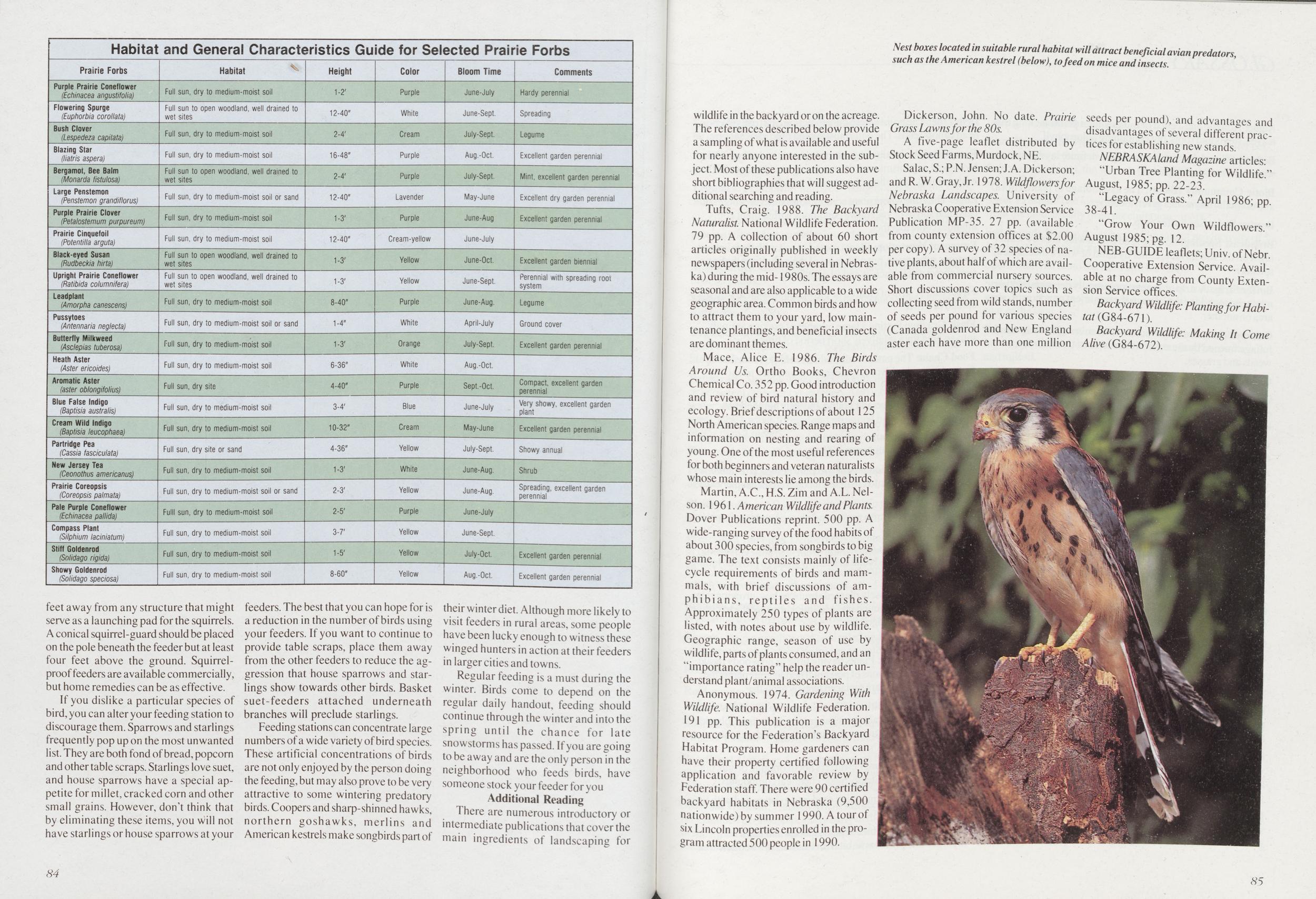 feet away from any structure that
might serve as a launching pad for the
squirrels. A conical squirrel-guard
should be placed on the pole beneath
the feeder but at least four feet above
the ground. Squirrel- proof
feeders are
available commercially, but home
remedies can be as effective.
feet away from any structure that
might serve as a launching pad for the
squirrels. A conical squirrel-guard
should be placed on the pole beneath
the feeder but at least four feet above
the ground. Squirrel- proof
feeders are
available commercially, but home
remedies can be as effective.
If you dislike a particular species of bird, you can alter your feeding station to discourage them. Sparrows and starlings frequently pop up on the most unwanted list. They are both fond of bread, popcorn and other table scraps. Starlings love suet, and house sparrows have a special appetite for millet, cracked corn and other small grains. However, donÕt think that by eliminating these items, you will not have starlings or house sparrows at your feeders. The best that you can hope for is a reduction in the number of birds using your feeders. If you want to continue to provide table scraps, place them away from the other feeders to reduce the aggression that house sparrows and starlings show towards other birds. Basket suet-feeders attached underneath branches will preclude starlings.
Feeding stations can concentrate large numbers of a wide variety of bird species. These artificial concentrations of birds are not only enjoyed by the person doing the feeding, but may also prove to be very attractive to some wintering predatory birds. Coopers and sharp-shinned hawks, northern goshawks, merlins and American kestrels make songbirds part of their winter diet. Although more likely to visit feeders in rural areas, some people have been lucky enough to witness these winged hunters in action at their feeders in larger cities and towns.
Regular feeding is a must during the winter. Birds come to depend on the regular daily handout, feeding should continue through the winter and into the spring until the chance for late snowstorms has passed. If you are going to be away and are the only person in the neighborhood who feeds birds, have someone stock your feeder for you
Additional ReadingThere are numerous introductory or intermediate publications that cover the main ingredients of landscaping for 84 wildlife in the backyard or on the acreage. The references described below provide a sampling of what is available and useful for nearly anyone interested in the subject. Most of these publications also have short bibliographies that will suggest additional searching and reading.
Tufts, Craig. 1988. The Backyard Naturalist. National Wildlife Federation. 79 pp. A collection of about 60 short articles originally published in weekly newspapers (including several in Nebraska) during the mid-1980s. The essays are seasonal and are also applicable to a wide geographic area. Common birds and how to attract them to your yard, low maintenance plantings, and beneficial insects are dominant themes.
Mace, Alice E. 1986. The Birds Around Us. Ortho Books, Chevron Chemical Co. 352 pp. Good introduction and review of bird natural history and ecology. Brief descriptions of about 125 North American species. Range maps and information on nesting and rearing of young. One of the most useful references for both beginners and veteran naturalists whose main interests lie among the birds.
Martin, A.C., H.S. Zim and A.L. Nelson. 1961. American Wildlife and Plants. Dover Publications reprint. 500 pp. A wide-ranging survey of the food habits of about 300 species, from songbirds to big game. The text consists mainly of life-cycle requirements of birds and mammals, with brief discussions of amphibians, reptiles and fishes. Approximately 250 types of plants are listed, with notes about use by wildlife. Geographic range, season of use by wildlife, parts of plants consumed, and an "importance ratingÓ help the reader understand plant/animal associations.
Anonymous. 1974. Gardening With Wildlife. National Wildlife Federation. 191 pp. This publication is a major resource for the FederationÕs Backyard Habitat Program. Home gardeners can have their property certified following application and favorable review by Federation staff. There were 90 certified backyard habitats in Nebraska (9,500 nationwide) by summer 1990. A tour of six Lincoln properties enrolled in the program attracted 500 people in 1990.
Dickerson, John. No date. Prairie Grass Lawns for the 80s.
A five-page leaflet distributed by Stock Seed Farms, Murdock, NE.
Salac, S.; P.N. Jensen; J. A. Dickerson; and R. W. Gray, Jr. 1978. Wildflowersfor Nebraska Landscapes. University of Nebraska Cooperative Extension Service Publication MP-35. 27 pp. (available from county extension offices at $2.00 per copy). A survey of 32 species of native plants, about half of which are available from commercial nursery sources. Short discussions cover topics such as collecting seed from wild stands, number of seeds per pound for various species (Canada goldenrod and New England aster each have more than one million seeds per pound), and advantages and disadvantages of several different practices for establishing new stands.
NEBRASKAland Magazine articles:
"Urban Tree Planting for Wildlife." August, 1985; pp. 22-23.
"Legacy of Grass." April 1986; pp. 38-41.
"Grow Your Own Wildflowers." August 1985; pg. 12.
NEB-GUIDE leaflets; Univ. of Nebr. Cooperative Extension Service. Available at no charge from County Extension Service offices.
Backyard Wildlife: Planting for Habitat (G84-671).
Backyard Wildlife: Making It Come Alive (G84-672).
85
Glossary
Algae: Aquatic one-celled or multicellular plants lacking true leaves, stems and roots, but containing chlorophyll. Bedded Materials: Soils occurring in definite layers such as silt loam over sand or gravel. Biotic Community (Biota): The assemblage of plants (flora) and animals (fauna) in a given locality. Border Strip: See buffer strip. Broadcast Seeding: Sowing seed over a wide area by scattering it on the soil surface, either by hand or with a mechanical spreader. Buffer Strip: A strip of vegetation (usually perennial) left or managed to reduce the impact of a treatment or action of one area on another. Canopy: The more or less continuous cover of branches and foliage formed by the collective crowns of trees, shrubs, weeds and grasses. Clearcutting: Removal of all the trees in an area. Coniferous: A diverse group of trees and shrubs, mostly evergreens; the conifers bear cones and have needle-shaped leaves. Conservation Tillage: A farming system of relatively few field operations which allows a greater amount of crop residue to remain on the surface of the soil throughout the year, thus reducing erosion and conserving soil moisture. Cool-Season Grasses: Grasses that initiate and do most of their growing during the cool seasons of the year when temperatures range from 60-85 degrees, such as smooth brome, Kentucky blugrass and needle-and-thread grass. Cover Crop: A temporary crop planted to reduce soil erosion in winter, and not planted with the primary intention of harvesting the grain. Crop Rotation: Planting different crops in alternating years to reduce disease, insect and weed problems. Cutting: A twig or small stem treated so it will form roots and propagate a new plant. Deciduous: Trees shedding their foliage at the end of the growing season. Diversity: The relative numbers of species, wildlife and plant communities, habitats or habitat features per unit of area. Dormancy: A relatively inactive or resting condition in which some processes are slowed down or suspended. Broad-leaf trees and shrubs are dormant in winter, but cool-season grasses go into dormancy in midsummer. Dormant-seeded: Planted after the growing season. The seed will remain in the ground for several months and initiate growth when conditions are right. Drip Line: The point where the protection of a treeÕs overhead canopy ends. The outermost spread of a treeÕs canopy. Ecosystem: An interacting natural system including all the biological organisms and the nonliving components of the environment, including climate and geology. Edge: The zone where plant communities meet or where successional stages or vegetative conditions within plant communities come together. Emergent Vegetation: Plants rooted in soil with their lower portions submersed, but with most of their photosynthetic tissues above water, such as cattail or bulrush. Firebreak: A strip of cleared or plowed land used to stop the spread of a fire. Flash Grazing: Putting a large number of grazing animals into an area for a relatively short period of time. Food Chain: The path through which energy is transferred from plants to herbivores (plant eaters) and then to carnivores (meat eaters). Fry: Small fish, especially young, recently hatched fish. Girdling: A method of killing woody vegetation by cutting more or less continuously around the stem or trunk, through the bark and cambium (growing layer). Grassland Drills: Equipment specially designed to plant grass seed directly into clean seedbeds, a cover crop or existing sod. Green Manure: A crop grown and plowed under to improve the soil. Habitat Structures: Artificial structures of tires or brush bundled together and sunk in shallow water to provide hiding places for fish. Hedge: A row of closely planted shrubs or low-growing trees forming a fence or boundary. Also used in reference to Osage-orange trees and hedgerows. Hedgerow: See hedge. Herbaceous Plants: Plants having little or no woody tissue. Above-ground portions of perennial herbaceous plants die back each year and are replaced by new growth. Hydrological Conditions: The relationship of soil and water influenced by such factors as geography of the land, physical structures such as terraces and farmponds, and soil permeability. Inorganic Fertilizers: Fertilizers not of organic origin, but composed of synthetically made chemical compounds. Interseeding: Planting grass seed into existing sod with little or no site preparation. Interspersion: The mix of plant species and plant communities that provides habitat for animals in a defined area. 86 Land Health: The overall condition of an area as reflected by its plant and animal populations. Leaching: Removal by water of soluble compounds from leaf litter or soil. Legumes: Plants with nitrogen-fixing nodules on the roots, making them capable of using atmospheric nitrogen. Lodge: To bend over or be broken down from wind and precipitation. Most commonly used in describing small-grain crop damage. Monoculture: Cultivation of a single crop to the exclusion of other plants. Mulch: Any nonliving material that forms a covering on the soil surface. Organic Matter: Compounds of carbon combined with other chemical elements and generally manufactured in the life processes of plants and animals. Palustrine: Shallow water areas dominated by trees, shrubs or persistent emergent vegetation. Also includes shallow water areas lacking vegetation if they are smaller than 20 acres, lack a wave-formed shoreline and have a water depth of less than 2 meters. Perennial: A plant having a life span of more than two years. Pesticide: Any poison used to kill pests such as insects, rodents or unwanted plants. Phytoplankton: Minute, floating aquatic plants also called planktonic algae. Prescribed Burning: Deliberately burning a stand of grass or other vegetation to achieve management objectives. Pure Live Seed (PLS): The actual amount of viable seed which will germinate when planted. Residual Cover: The standing, dead portion of herbaceous vegetation from the previous growing season. Residual Cover: The standing, dead portion of herbaceous vegetation from the previous growing season. Riprap: Rocks or other material piled or dumped on a slope to prevent erosion of soil by waves or water currents. Root-bound: See sod-bound. Root-prune: To sever shallow, horizontal tree roots, usually with a root plow. Root Plow: A heavy-shanked chisel designed to be pulled by a tractor to sever shallow, horizontal tree roots. Rotational Grazing: A system of pasture management characterized by periods of heavy stocking followed by periods of rest to allow vegetation regrowth during the same season. Seasonal Wetland: An area where surface water is present for extended periods, especially early in the growing season. In most years, surface water is absent by the end of the season. When surface water is absent, however, the water table is often near the land surface. Semi-Permanent Wetland: An area where surface water persists throughout the growing season in most years. When surface water is absent, the water table is usually at or very near the land surface. Sheet Erosion: The loss or movement of soil in thin layers from the land, usually from precipitation runoff. Sod-bound: Used to describe the low rate of productivity of grass stands due to lack of nitrogen. Spoil: Material removed from an excavation. Strip Cropping: Strips of grasses, legumes or small grains with strips of row crops planted parallel with the natural contour of the land. Submergent Vegetation: Plants rooted in the soil and existing entirely below the surface of the water such as coontail and milfoil. Suckering: New growth in the form of shoots arising from below ground level from a rhizome or a root. Typical of plum, chokecherry and other deciduous shrubs. Temporary Wetland: An area where surface water is present for brief periods during the growing season. The water table usually lies well below the soil surface for most of the year. Thatch: The accumulation of dead vegetation on the surface of the soil. Thatch: The accumulation of dead vegetation on the surface of the soil. Tiller: A shoot that sprouts from the base of a grass plant. Toxicity: The degree to which a substance is poisonous. Toxicity: The degree to which a substance is poisonous. Travel Lanes: Areas of cover commonly used by animals moving from one location to another. Tree Snag: A standing, dead tree. Turn Rows: A narrow strip of rows perpendicular to the general pattern in a row-crop tract, located at field ends. Turning Out: Turning a mower or swather from its normal path to avoid something, such as a pheasant nest or brood. Warm-Season Grasses: Grasses that do most of their g rowing during late spring and summer when temperatures reach or exceed 85 degrees, such as big bluestem, side-oats grama andbuffalograss. Watershed: The entire region of land draining into a river, river system or body of water; also called a drainage basin. Waterway: A natural or constructed channel which carries excess water from cropland. Wetland Complex: A collection of wetlands of varying sizes, water depths and plant communities in close proximity. Woodlot: A relatively small tract of trees, often planted rather than naturally occurring, near a farmstead or cropland. 87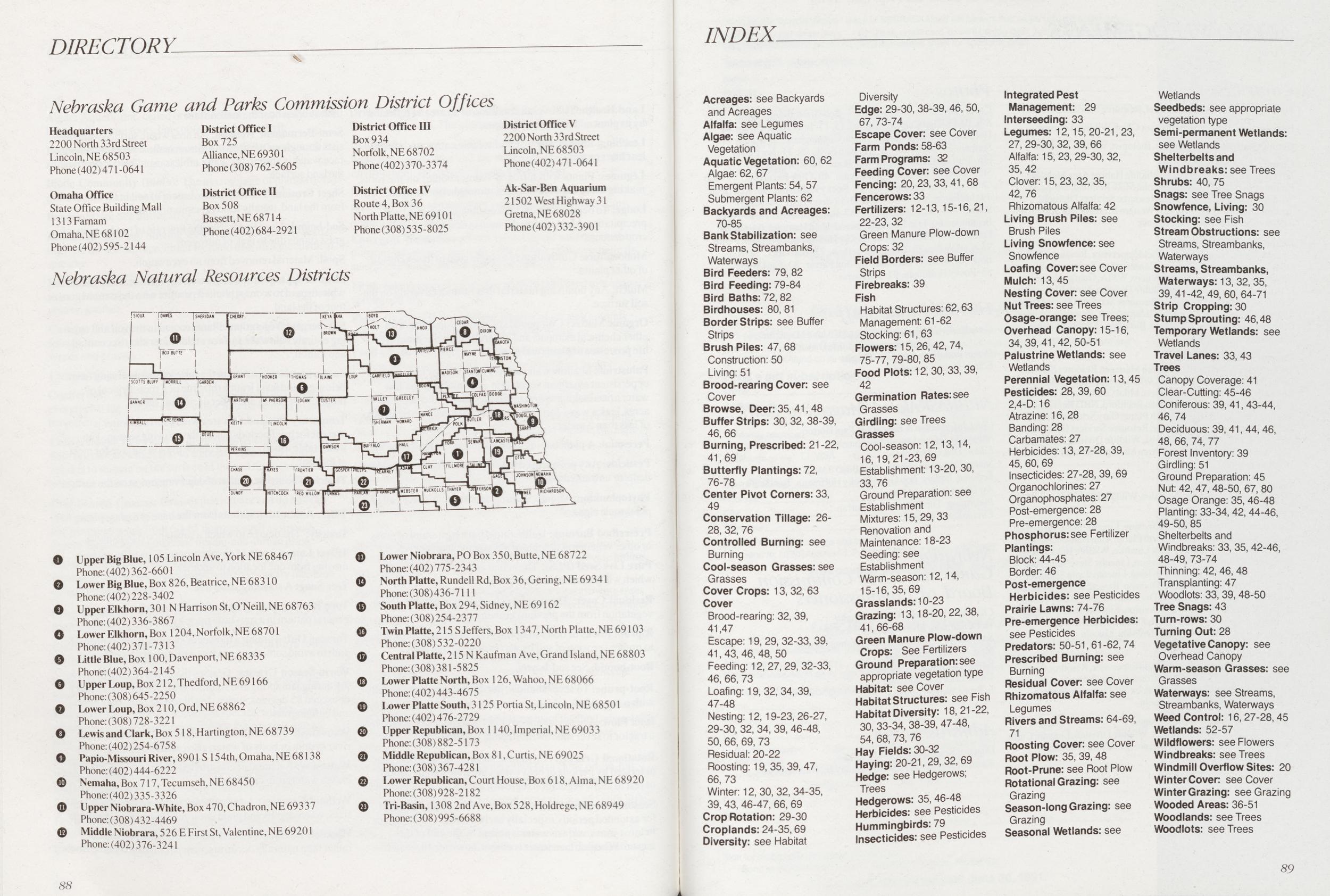
DIRECTORY
Nebraska Game and Parks Commission District Offices Headquarters 2200 North 33rd Street Lincoln, NE 68503 Phone(402)471-0641 Omaha Office State Office Building Mall 1313Famam Omaha, NE 68102 Phone (402) 595-2144 District Office I Box 725 Alliance, NE 69301 Phone (308) 762-5605 District Office II Box 508 Bassett, NE 68714 Phone (402) 684-2921 District Office III Box 934 Norfolk, NE 68702 Phone (402) 370-3374 District Office IV Route 4, Box 36 North Platte, NE 69101 Phone(308)535-8025 District Office V 2200 North 33rd Street Lincoln, NE 68503 Phone (402) 471-0641 Ak-Sar-Ben Aquarium 21502 West Highway 31 Gretna, NE 68028 Phone (402) 332-3901 Nebraska Natural Resources DistrictsINDEX
Acreages: see Backyards and Acreages Alfalfa: see Legumes Algae: see Aquatic Vegetation Aquatic Vegetation: 60, 62 Algae: 62, 67 Emergent Plants: 54, 57 Submergent Plants: 62 Backyards and Acreages: 70-85 Bank Stabilization: see Streams, Streambanks, Waterways Bird Feeders: 79, 82 Bird Feeding: 79-84 Bird Baths: 72,82 Birdhouses: 80, 81 Border Strips: see Buffer Strips Brush Piles: 47, 68 Construction: 50 Living: 51 Brood-rearing Cover: see Cover Browse, Deer: 35, 41,48 Buffer Strips: 30, 32, 38-39, 46, 66 Burning, Prescribed: 21-22, 41,69 Butterfly Plantings: 72, 76-78 Center Pivot Corners: 33, 49 Conservation Tillage: 26- 28, 32, 76 Controlled Burning: see Burning Cool-season Grasses: see Grasses Cover Crops: 13, 32, 63 Cover Brood-rearing: 32, 39, 41,47 Escape: 19, 29, 32-33, 39, 41,43, 46, 48, 50 Feeding: 12, 27, 29, 32-33, 46, 66, 73 Loafing: 19, 32, 34, 39, 47-48 Nesting: 12,19-23, 26-27, 29- 30, 32, 34, 39, 46-48, 50, 66, 69, 73 Residual: 20-22 Roosting: 19, 35, 39, 47, 66, 73 Winter: 12, 30, 32, 34-35, 39, 43, 46-47, 66, 69 Crop Rotation: 29-30 Croplands: 24-35,69 Diversity: see Habitat Diversity Edge: 29-30, 38-39, 46, 50, 67, 73-74 Escape Cover: see Cover Farm Ponds: 58-63 Farm Programs: 32 Feeding Cover: see Cover Fencing: 20, 23, 33, 41,68 Fencerows: 33 Fertilizers: 12-13,15-16, 21, 22-23, 32 Green Manure Plow-down Crops: 32 Field Borders: see Buffer Strips Firebreaks: 39 Fish Habitat Structures: 62,63 Management: 61 -62 Stocking: 61,63 Flowers: 15, 26, 42, 74, 75-77, 79-80, 85 Food Plots: 12, 30, 33, 39, 42 Germination Rates: see Grasses Germination Rates: see Grasses Girdling: see Trees Grasses Cool-season: 12,13,14, 16,19, 21-23, 69 Establishment: 13-20, 30, 33, 76 Ground Preparation: see Establishment Mixtures: 15, 29, 33 Renovation and Maintenance: 18-23 Seeding: see Establishment Warm- season: 12,14, 15-16, 35, 69 Grasslands: 10-23 Grazing: 13,18-20, 22, 38, 41,66-68 Green Manure Plow-down Crops: See Fertilizers Ground Preparation: see appropriate vegetation type Habitat: see Cover Habitat Structures: see Fish Habitat Diversity: 18,21-22, 30, 33-34, 38- 39, 47-48, 54, 68, 73, 76 Hay Fields: 30-32 Haying: 20-21,29, 32, 69 Hedge: see Hedgerows; Trees Hedgerows: 35, 46-48 Herbicides: see Pesticides Hummingbirds: 79 Insecticides: see Pesticides Integrated Pest Management: 29 Interseeding: 33 Legumes: 12,15, 20-21,23, 27, 29-30, 32, 39, 66 Alfalfa: 15, 23, 29-30, 32, 35, 42 Clover: 15, 23, 32, 35, 42, 76 Rhizomatous Alfalfa: 42 Living Brush Piles: see Brush Piles Living Snowfence: see Snowfence Loafing Cover: see Cover Mulch: 13,45 Nesting Cover: see Cover Nut Trees: see Trees Osage-orange: see Trees; Overhead Canopy: 15- 16, 34, 39,41,42, 50-51 Palustrine Wetlands: see Wetlands Perennial Vegetation: 13,45 Pesticides: 28, 39. 60 2,4-D: 16 Atrazine: 16, 28 Banding: 28 Carbamates: 27 Herbicides: 13, 27-28, 39, 45, 60, 69 Insecticides: 27-28, 39, 69 Organochlorines: 27 Organophosphates: 27 Post-emergence: 28 Pre-emergence: 28 Phosphorus: see Fertilizer Plantings: Block: 44-45 Border: 46 Post-emergence Herbicides: see Pesticides Prairie Lawns: 74-76 Pre-emergence Herbicides: see Pesticides Predators: 50-51,61 -62,74 Prescribed Burning: see Burning Residual Cover: see Cover Rhizomatous Alfalfa: see Legumes Rivers and Streams: 64-69, 71 Roosting Cover: see Cover Root Plow: 35, 39, 48 Root-Prune: see Root Plow Rotational Grazing: see Grazing Season-long Grazing: see Grazing Seasonal Wetlands: see Wetlands Seedbeds: see appropriate vegetation type Semi-permanent Wetlands: see Wetlands Shelterbeltsand Windbreaks: see Trees Shrubs: 40, 75 Snags: see Tree Snags Snowfence, Living: 30 Stocking: see Fish Stream Obstructions: see Streams, Streambanks, Waterways Streams, Streambanks, Waterways: 13, 32, 35, 39,41- 42, 49, 60, 64-71 Strip Cropping: 30 Stump Sprouting: 46,48 Temporary Wetlands: see Wetlands Travel Lanes: 33, 43 Trees Canopy Coverage: 41 Clear- Cutting: 45-46 Coniferous: 39, 41,43-44, 46, 74 Deciduous: 39, 41,44, 46, 48, 66, 74, 77 Forest Inventory: 39 Girdling: 51 Ground Preparation: 45 Nut: 42, 47, 48- 50, 67, 80 Osage Orange: 35, 46-48 Planting: 33- 34, 42, 44-46, 49-50, 85 Shelterbelts and Windbreaks: 33, 35, 42-46, 48-49, 73-74 Thinning: 42, 46, 48 Transplanting: 47 Woodlots: 33, 39, 48-50 Tree Snags: 43 Turn-rows: 30 Turning Out: 28 Vegetative Canopy: see Overhead Canopy Warm-season Grasses: see Grasses Waterways: see Streams, Streambanks, Waterways Weed Control: 16, 27-28,45 Wetlands: 52-57 Wildflowers: see Flowers Windbreaks: see Trees Windmill Overflow Sites: 20 Windmill Overflow Sites: 20 inter Grazing: see Grazing Wooded Areas: 36-51 Woodlands: see Trees Woodlots: see
ACKNOWLEDGEMENTS
Contributors Foreword: Harold Edwards, Chief, Resource Services Division Introduction: Bill Baxter, Assistant Chief, Wildlife Division Getting Started: Randy Stutheit, Biologist, Wildlife Division Chapter 1, Grasslands: Jeff Hoffman, Salt Valley Lakes Wildlife Habitat Area Manager, R esource Services Division, Lincoln; Mike Remund, District V Wildlife Habitat Area Manager, Resource Services Division, Tecumseh; Gary Schlichtemeier, Western Section Field Supervisor, Resource Services Division, Alliance Chapter 2, Croplands: Chet McClain, Eastern Section Field Supervisor, Resource Services Division, Lincoln; Bob Meduna, Conservation Technician, Resource Services Division, Sacramento-Wilcox WM A; George Nason, District IV Game Supervisor, Wildlife Division, North Platte; Dan Rochford, NRD Representative, Resource Services Division, North Platte; Clayton Stalling, District III Supervisor, Resource Services D ivision, Norfolk; Randy Stutheit, Biologist, Wildlife Division, Lincoln Chapter 3, Wooded Areas: Mick Bresley, Wildlife Habitat Area Manager, Resource Services Division, Kearney; Mark Feeney, Wildlife Habitat Area Manager, Resource Services Division, Bassett; Mike Groenewold, Horticulturist, Parks Division, Lincoln; Dan Rochford, NRD Representative, Resource Services Division, North Platte; Gary Schlichtemeier, Western Section Field Supervisor, Resource Services Division, Alliance; Randy Stutheit, Biologist, Wildlife Division, Lincoln; Tom Welstead, Wildlife Habitat Area Manager, Resource Services Division, Norfolk Chapter 4, Wetlands: Richard Gersib, Wetlands Specialist, Wildlife Division, Lincoln Chapter 5, Farmponds: Jeff Blaser, Biologist, Fisheries Division, Lincoln; Steve Brezenski, Biologist, Fisheries Division, North Platte; Alan Hanson, Biologist, Fisheries Division, Alliance; Scott Luedtke, Wildlife Habitat Area Manager, Resource Services Division, Lincoln; Steve Schainost, Research Specialist, Fisheries Division, Lincoln; Lynn Schlueter, District II Supervisor, Fisheries Division, Bassett; Jeff Schuckman, District III Supervisor, Fisheries Division, Norfolk; David Tunink, District V Supervisor, Fisheries Division, Lincoln; Randy Winter, Biologist, Fisheries Division, Lincoln; Larry Zadina, Fish Production Supervisor, Fisheries Division, Lincoln Chapter 6, Rivers and Streams: Chet McClain, Eastern Section Field Supervisor, Resource Services Division, Lincoln; Bob Meduna, Conservation Technician, Resource Services Division, Sacramento- Wilcox WM A; Randy Stutheit, Biologist, Wildlife Division, Lincoln Chapter 7, Backyards and Acreages: John Dinan, Non-Game Biologist, Wildlife Division, Lincoln; Curtis Twedt, Environmental Analyst, Planning and Programming Division, Lincoln Photos Cover-Jon Farrar. 2-Ken Bouc. 5-Bob Grier. 6-Jon Farrar. 8-9,10-11-Don Cunningham. 12,15,17-Jon Farrar. 18- Rocky Hoffmann. 19-Jon Farrar. 21-Don Cunningham. 22-Randy Stutheit. 24- 25-Bob Grier. 26-Ken Bouc. 29,31-Jon Farrar. 33 top-Tom Keith. 33 bottom- Ken Bouc. 34-Ken Bouc. 36-37- Steve OÕHare. 38-Don Cunningham. 40-Greg Beaumont. 41-Bob Grier. 42-Don Cunningham. 45-Rocky Hoffmann. 46-Ken Bouc. 49-Jon Farrar. 51- Tom Keith. 52-53-Jon Farrar. 54-Randy Stutheit. 55-Don Cunningham. 57-Randy Stutheit. 58-59-Greg Beaumont. 60-Don Cunningham. 63 -PaulHammel. 64-65-Jon Farrar. 66-67-Bob Grier. 68-Rocky Hoffmann. 70-71- Jon Farrar. 73-Carl Wolfe. 75-Duane Westerholt. 77-Bob Grier. 78-Ken Bouc. 80-Rocky Hoffmann. 82- Jon Farrar. 83-Carl Wolfe. 85-Rocky Hoffmann. 91 - Jon Farrar. Habitat Guide Staff Coordinators: Tom Keith, NEBRASKAland Magazine Randy Stutheit, Wildlife Division Design and Illustration: Tim Reigert Editor: Don Cunningham NEBRASKAland Magazine Staff Chief, Information & Education: Paul Horton Managing Editor: Lowell Johnson Editor: Don Cunningham Senior Editors: Jon Farrar, Ken Bouc Regional Editors: Bob Grier, Rocky Hoffmann, Tom Keith Art Director: Steve OÕHare Illustration: Tim Reigert, Dan Curran Circulation: PatFrahm Nebraska Game and Parks Commission Board of Commissioners Chairman: Richard L. Coyne, Omaha Vice Chairman: Elvin Adamson, Nenzel Second Vice Chairman: J. Alan Cramer, Wayne Marc Anthony, Scottsbluff Randall K. Stinnette, Inland Gloria Erickson, Holdrege L. Bruce Wright, Lincoln Administration Director: Rex Amack Assistant Directors: William J. Bailey Jr., Dale R. Bree
Position: 152 (41 views)