Volume 68, Issue 10, 1990
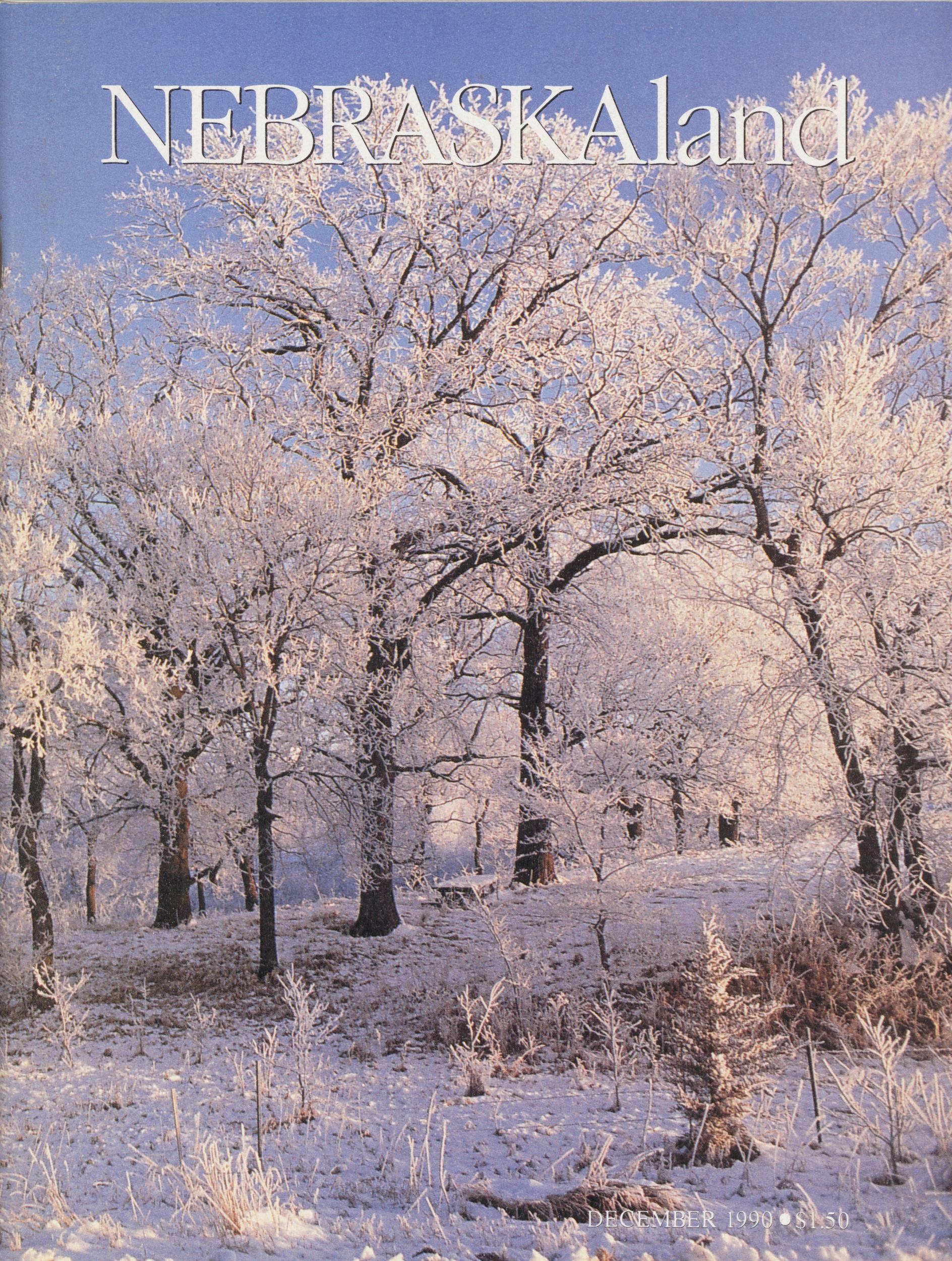
NEBRASKAland
DECEMBER 1990 $1.50
NEBRASKAland
VOL.68/NO. 10 DECEMBER 1990 Published by the Nebraska Game and Parks Commission Rex Amack, Director Assistant Directors: William J. Bailey, Jr. Dale R. Bree Staff Chief, Information & Education: Paul Horton Managing Editor: Lowell Johnson Editor: Don Cunningham Senior Editors: Jon Farrar, Ken Bouc Regional Editors: Bob Grier, Rocky Hoffmann, Tom Keith Art Director: Steve O'Hare Illustration: Tim Reigert, Dan Curran Circulation: Pat Frahm Commissioners Chairman: L. Bruce Wright, Lincoln Vice Chairman: Richard L. Coyne, Omaha 2nd Vice Chairman: Elvin Adamson, Nenzel J. Alan Cramer, Wayne Marc Anthony, Scottsbluff Randall K. Stinnette, Inland Gloria Erickson, HoldregePublished monthly except for combined Jan/Feb and Aug/Sept issues, by the Nebraska Game and Parks Commission. 2200 North 33rd Street, Lincoln, NE. Copyright 1990, ail rights reserved. Second-class postage paid at Lincoln, Nebraska POSTMASTER: Send all address changes to NEBRASKAIand, Box 30370, Lincoln, NE 68503. Rates: $ 12 for one year; $23 for two years. Manuscripts or photographs submitted to NEBRASKAIand Magazine should be addressed to: The Editor, N EBR ASK Aland Magazine, P.O. Box 30370, Lincoln, NE 68503, and accompanied by self-addressed envelopes and return postage. The publisher assumes no responsibility for unsolicited material.
Letters
Editor's Note Each year, NEBRASKAland Magazine publishes a special booklengthy combined January/'February issue. The 1991 special will be a landowner's guide to habitat, a fully il- lustrated introduction to establishing and maintaining both rural and urban wildlife habitat. Subscribers should note that, as with previous special issues, it will reach them in the first week of February. Too Many Heads?Sir/ While looking at the photo on page 45 of the August/September issue of NEBRASKAland Magazine, I noticed a deer head that seemed to be floating around, and I couldn't find any body for it. I wish you could reply and tell me where the body is or what happened. I just thought it was weird.
J. J. Winkler Broken Bow, NEAs the sketch above illustrates, the floating head is actually attached to a deer. The deer in the foreground, looking directly at the camera, has turned its head at nearly a right angle to its body. The deer behind it is looking to the left, and its neck appears to join the body of the animal in the foreground, but that is an illusion created by low light conditions and the foreshortening effect of the telephoto lens. (Editor)
4 NEBRASKAland The Golden SeasonSir/1 really enjoyed the photos by Bob Grier ['The Golden Season," October 1990]. He captured the arrival of autumn in a very picturesque landscape. However, I do have a correction for the caption with the large photo on page 27. This photo was taken just south of Toadstool Park, and the scene is of land owned by my parents, Bernard and Evaline Norman. Again, I really enjoyed the beautiful photos. Sometimes when you live near such beauty you don't completely appreciate it until someone else does.
Ben Norman Crawford, NE Rose Hip and Prickly Pear Jelly?Sir/We enjoy NEBRASKAland Magazine so much, and the special editions you send are very informative, especially the Nebraska Wildflower issue. When reading about our beautiful wildflowers, it reminded me of things I had read in the past about the native Nebraskans and early pioneers. I know they survived and did quite well on things we consider to be weeds or nuisances.
We live in the beautiful Nebraska Sandhills where rose hips and prickly pear cactus are commonplace. I would like to know if you would happen to have a recipe for making jelly from rose hips and prickly pear cactus. I think these would be a wonderful and unusual Christmas gift.
Loy Snow Brewster, NEWe found no rose hip or prickly pear jelly recipes in our files. Any help from other readers? (Editor)
How About Apple-Cinnamon Instead?Sir/ In your fall issue of 19 8 8 we saw the recipe for corn cob jelly. Around here we hadn't heard of it. So, living in farm and dairy land, when the corn was ready, we gave it a try. Since then we have made it for family and neighbors and given out the recipe to numerous people. We just put up our corn for winter and made five batches of the jelly. Thought maybe you'd like a recipe that's real popular around here. We make this for everyone when fresh apple cider is out in the fall.
Apple-Cinnamon Jelly 7 cups fresh apple cider (or apple juice) 1 cup red cinnamon candies 9 cups sugar (4 lbs.) 1 box Sure-jelPut the cider and Sure-jel in a large kettle and bring to a boil. Add sugar and candies. Boil 5 minutes. Skim, put in jars and seal. Makes 6 pints.
My sister has been getting your magazine for several years now and we enjoy reading it every month.
Marion Rounds Scio, NY Tankhouse MemoriesSir/ I see in the last issue of NEBRASKAland that you would like information about the elevated watertower tanks that provided pressure using windmill power.
I grew up in Butler County, where in the '30s, my parents, Anton and Mary Shonka, built a new home and such a water system. The stand, or tower for the wooden tank, was made of concrete blocks. The windmill was close by, and pumped the water up into the tank.
It was all new and comfortable for us. Before, we had to bring water in with a bucket for drinking, cooking, washing clothes and of course baths—then there was the little square house out of doors.
This system worked very well. We had indoor plumbing, and always had plenty of water pressure. For drinking, we got fresh water at the windmill. I don't remember it ever freezing up. The fresh water pumped in every day must have kept it from doing so. The tank also provided water for the stock tank, so was kept running a lot. The pipe going up to the tank from the windmill was in the center of the stand. In winter, father would fill it with straw to keep the pipe from freezing up. When it was very cold one time, he had to go to the top and poke a hole in the ice. This photo was taken in 1983. The windmill and tank still stand, although the place hasn't been lived in since 1959, when my mother died.
Another nice water tower tank used to be west of Bellwood on the Bell farm. It was a fancier tank on a metal tower. The tank is now gone, but I think the base is still there.
Brings back memories—enjoyed sharing this bit of old times with you.
ErmaBartek Wahoo, NESir/The letter in your November issue about tankhouses brought back old memories of my very early days in Nebraska. My father worked a farm somewhere near Ewing. There was a large tankhouse across the driveway from the house. The tank itself was made of wood held together with iron straps. The area from the ground to the bottom of the tank was of red brick, and it had a small doorway to enter. It was very cool inside on a hot day, and there was a makeshift shower that my father used after a Nebraska work dav in the field. This farm also had a wind charger. Imagine electric lights and running water in the '30s! Some reader might recognize the name Sheets—they were our neighbors to the north.
Sidney Kindler Lynn, MASend your comments, suggestions and complaints to Letters, NEBRASKAland Magazine, P.O. Box 30370, Lincoln, NE 68503. NEBRASKAland reserves the right to edit and condense letters.
DECEMBER 1990 5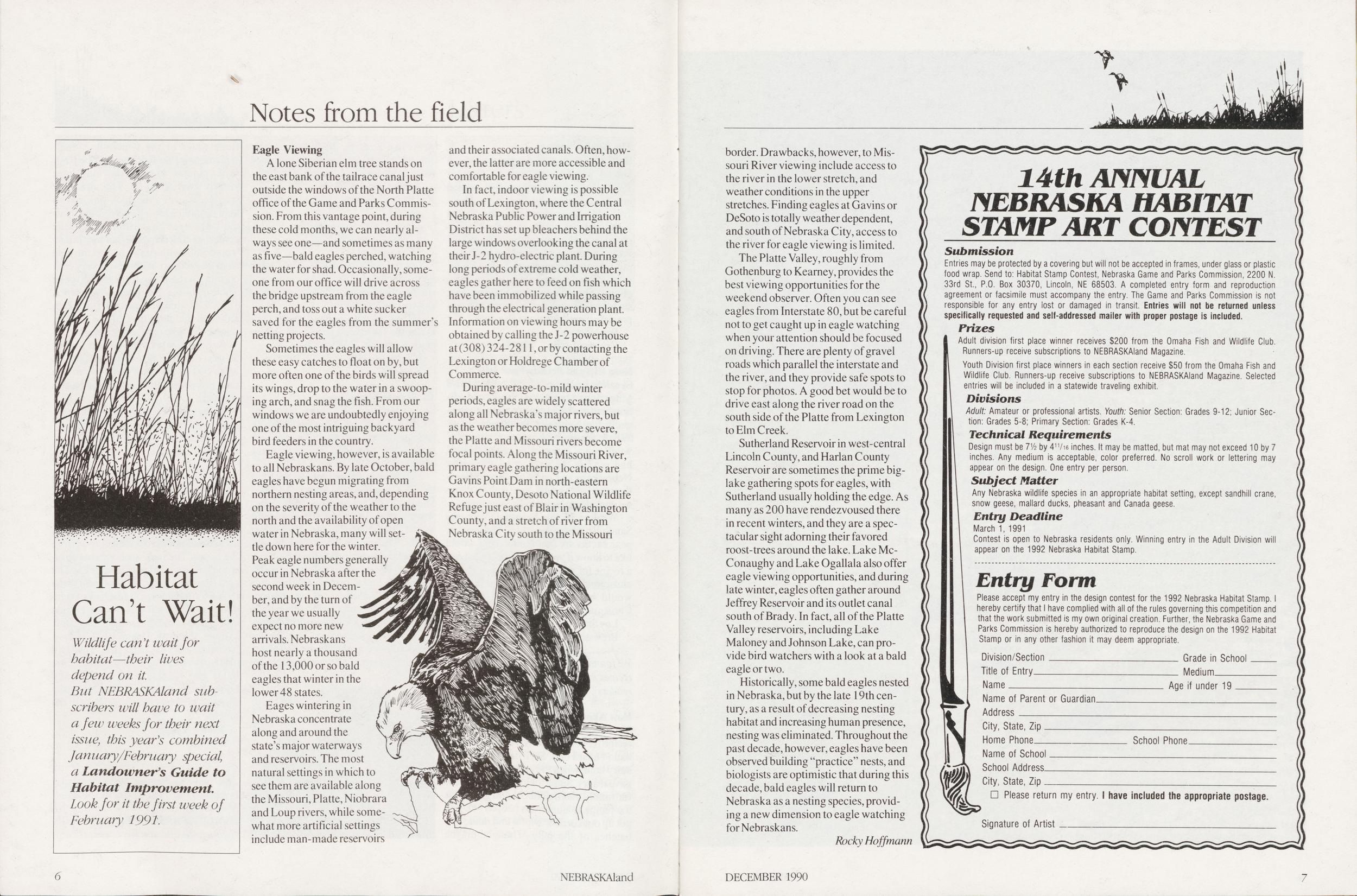
Notes from the field
Eagle ViewingA lone Siberian elm tree stands on the east bank of the tailrace canal just outside the windows of the North Platte office of the Game and Parks Commission. From this vantage point, during these cold months, we can nearly always see one—and sometimes as many as five—bald eagles perched, watching the water for shad. Occasionally, someone from our office will drive across the bridge upstream from the eagle perch, and toss out a white sucker saved for the eagles from the summer's netting projects.
Sometimes the eagles will allow these easy catches to float on by, but more often one of the birds will spread its wings, drop to the water in a swooping arch, and snag the fish. From our windows we are undoubtedly enjoying one of the most intriguing backyard bird feeders in the country.
Eagle viewing, however, is available to all Nebraskans. By late October, bald eagles have begun migrating from northern nesting areas, and, depending on the severity of the weather to the north and the availability of open water in Nebraska, many will settle down here for the winter. Peak eagle numbers generally occur in Nebraska after the second week in December, and by the turn of the year we usually expect no more new arrivals. Nebraskans host nearly a thousand of the 13,000 or so bald eagles that winter in the lower 48 states.
Eages wintering in Nebraska concentrate along and around the state's major waterways and reservoirs. The most natural settings in which to see them are available along the Missouri, Platte, Niobrara and Loup rivers, while somewhat more artificial settings include man-made reservoirs and their associated canals. Often, however, the latter are more accessible and comfortable for eagle viewing.
In fact, indoor viewing is possible south of Lexington, where the Central Nebraska Public Power and Irrigation District has set up bleachers behind the large windows overlooking the canal at their J-2 hydro-electric plant. During long periods of extreme cold weather, eagles gather here to feed on fish which have been immobilized while passing through the electrical generation plant. Information on viewing hours may be obtained by calling the J-2 powerhouse at (308) 324-2811, or by contacting the Lexington or Holdrege Chamber of Commerce.
During average-to-mild winter periods, eagles are widely scattered along all Nebraska's major rivers, but as the weather becomes more severe, the Platte and Missouri rivers become focal points. Along the Missouri River, primary eagle gathering locations are Gavins Point Dam in north-eastern Knox County, Desoto National Wildlife Refuge just east of Blair in Washington County, and a stretch of river from Nebraska City south to the Missouri 6 NEBRASKAland border. Drawbacks, however, to Missouri River viewing include access to the river in the lower stretch, and weather conditions in the upper stretches. Finding eagles at Gavins or DeSoto is totally weather dependent, and south of Nebraska City, access to the river for eagle viewing is limited.
The Platte Valley, roughly from Gothenburg to Kearney, provides the best viewing opportunities for the weekend observer. Often you can see eagles from Interstate 80, but be careful not to get caught up in eagle watching when your attention should be focused on driving. There are plenty of gravel roads which parallel the interstate and the river, and they provide safe spots to stop for photos. A good bet would be to drive east along the river road on the south side of the Platte from Lexington to Elm Creek.
Sutherland Reservoir in west-central Lincoln County, and Harlan County Reservoir are sometimes the prime biglake gathering spots for eagles, with Sutherland usually holding the edge. As many as 200 have rendezvoused there in recent winters, and they are a spectacular sight adorning their favored roost-trees around the lake. Lake McConaughy and Lake Ogallala also offer eagle viewing opportunities, and during late winter, eagles often gather around Jeffrey Reservoir and its outlet canal south of Brady. In fact, all of the Platte Valley reservoirs, including Lake Maloney and Johnson Lake, can provide bird watchers with a look at a bald eagle or two.
Historically, some bald eagles nested in Nebraska, but by the late 19th century, as a result of decreasing nesting habitat and increasing human presence, nesting was eliminated. Throughout the past decade, however, eagles have been observed building "practice" nests, and biologists are optimistic that during this decade, bald eagles will return to Nebraska as a nesting species, providing a new dimension to eagle watching for Nebraskans.
Rocky Hoffmann 14th ANNUAL NEBRASKA HABITAT STAMP ART CONTEST Submission Entries may be protected by a covering but will not be accepted in frames, under glass or plastic food wrap. Send to: Habitat Stamp Contest, Nebraska Game and Parks Commission, 2200 N. 33rd St., P.O. Box 30370, Lincoln, NE 68503. A completed entry form and reproduction agreement or facsimile must accompany the entry. The Game and Parks Commission is not responsible for any entry iost or damaged in transit. Entries will not be returned unless specifically requested and self-addressed mailer with proper postage is included. Prizes Adult division first place winner receives $200 from the Omaha Fish and Wildlife Club. Runners-up receive subscriptions to NEBRASKAland Magazine. Youth Division first place winners in each section receive $50 from the Omaha Fish and Wildlife Club. Runners-up receive subscriptions to NEBRASKAland Magazine. Selected entries will be included in a statewide traveling exhibit. Divisions Adult: Amateur or professional artists. Youth: Senior Section: Grades 9-12; Junior Section: Grades 5-8; Primary Section: Grades K-4. Technical Requirements Design must be Vk by 411/ie inches. It may be matted, but mat may not exceed 10 by 7 inches. Any medium is acceptable, color preferred. No scroll work or lettering may appear on the design. One entry per person. Subject Matter Any Nebraska wildlife species in an appropriate habitat setting, except sandhill crane, snow geese, mallard ducks, pheasant and Canada geese. Entry Deadline March 1, 1991 Contest is open to Nebraska residents only. Winning entry in the Adult Division will appear on the 1992 Nebraska Habitat Stamp. Entry Form Please accept my entry in the design contest for the 1992 Nebraska Habitat Stamp. I hereby certify that I have complied with all of the rules governing this competition and that the work submitted is my own original creation. Further, the Nebraska Game and Parks Commission is hereby authorized to reproduce the design on the 1992 Habitat Stamp or in any other fashion it may deem appropriate. Division/Section Title of Entry Name Grade in School Medium Age if under 19 Name of Parent or Guardian. Address City, State, Zip Home Phone School Phone Name of School School Address. City, State, Zip Li Please return my entry. I have included the appropriate postage. Signature of Artist
Quail by the Numbers
Photos and text by Ken Bouc Quail hunting is more than just hunting quail to this southeast Nebraska father and son. It also involves learning about quail habits and habitats, keeping tabs on coveys, and working with their dogs.The dogs raised little puffs of dust underfoot, and often the hunters wore their coats with a button or two undone. The dry, warm conditions were a far cry from the picturesque snowscapes that most everyone usually associates with late-season quail hunting in Nebraska.
Except for a few snowfalls, dry and relatively warm has been the rule for most of the Nebraska bird seasons the past few years, and Wyman Stedman and his son, Steve, had adjusted. But Jano, Wy's Vizsla, along with Coco and Butch, Steve's drathaars, occasionally had trouble calibrating their noses to the arid conditions.
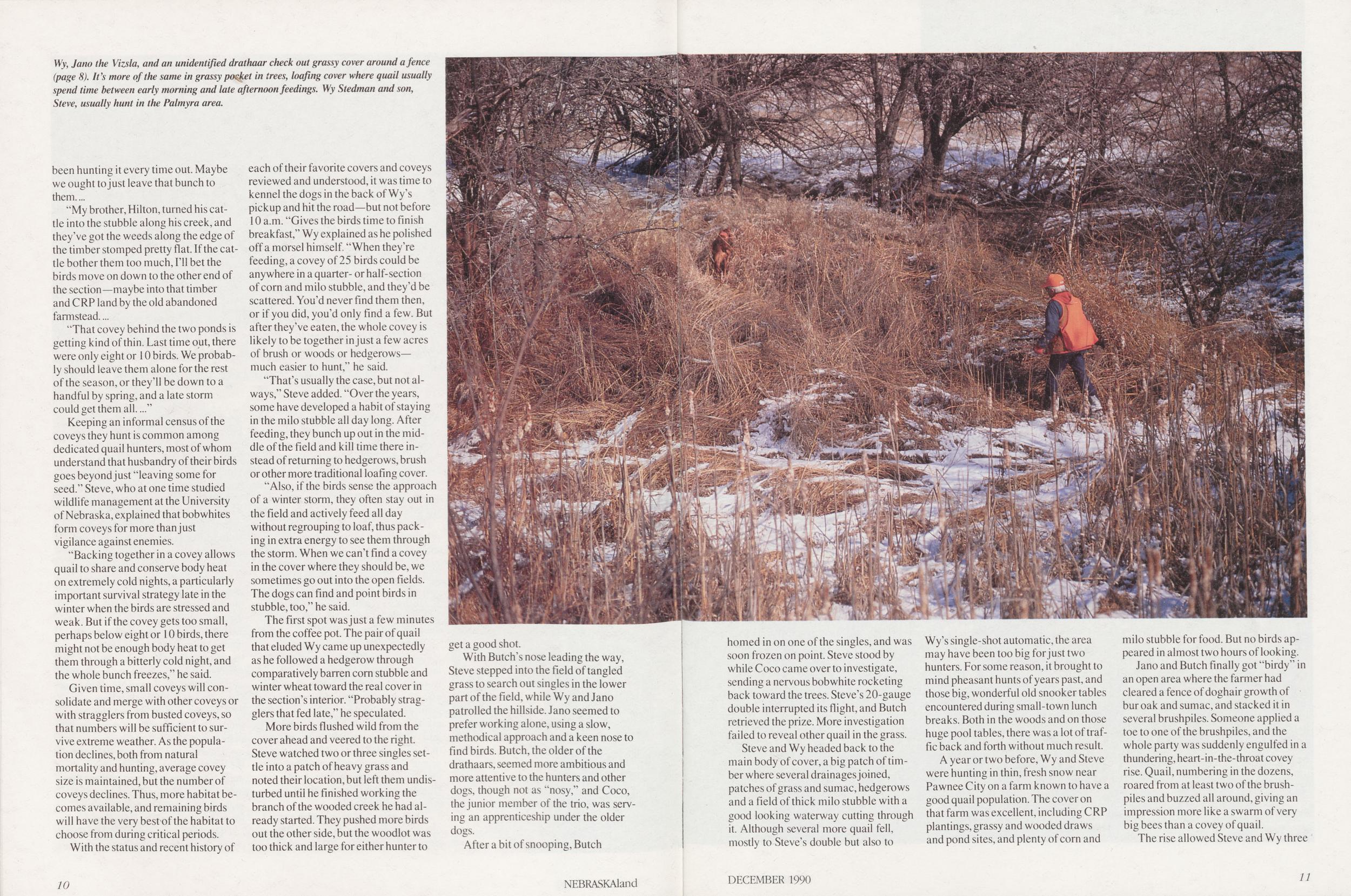
Perhaps that's why the two quail were able to avoid detection when the dogs passed by. When they blasted from the grass at Wy's feet, and peeled away from the hedgerow, he was somewhat startled and a bit tardy in shouldering his gun. Since they were the first birds of the day, it was half-expected that the initial shot might be wasted, except to shake out the cobwebs and get the feel of things. No matter. A 20-gauge automatic offers plenty of opportunity to make amends.
Wy's gun spoke once, with no effect on the rapidly exiting bobwhite. The second shot was due a split second later, and would be the one to find the birds. But the gun spoke no more. Instead, Wy spoke—to or about the gun, and not in a kindly tone. His trusty tubular magazine, vent ribbed, openchoked, gas operated automatic had become a glorified single-shot for the rest of the day. And since a balky ejector seemed to be the problem, the gun would prove a rather awkward singleshot, at that.
The pair was hunting near Palmyra, in territory Wy had served as a rural mail carrier until his retirement in 1980. Steve had plenty of time to drive up that morning from his home in Beatrice. All the preliminaries of the hunt took place at a reasonable pace and a civilized hour, since there is no need for pre-dawn heroics when hunting quail.
As always, the first order of business was a session in the kitchen over sweet rolls and hot coffee. Wy and Steve seemed to know just about every quail in the county by its first name.
"Haven't seen the beaver dam covey the last two times out, and it was a good-sized bunch. Do you suppose they moved across the road? There's good looking food and cover there, enough for a couple of coveys, I'd guess.
"Terry and John have found that big
covey out by the windmills and they've
DECEMBER 1990
9
 been hunting it every time out. Maybe
we ought to just leave that bunch to
them....
been hunting it every time out. Maybe
we ought to just leave that bunch to
them....
"My brother, Hilton, turned his cattle into the stubble along his creek, and they've got the weeds along the edge of the timber stomped pretty flat. If the cattle bother them too much, I'll bet the birds move on down to the other end of the section—maybe into that timber and CRP land by the old abandoned fannstead.
"That covey behind the two ponds is getting kind of thin. Last time out, there were only eight or 10 birds. We probably should leave them alone for the rest of the season, or they'll be down to a handful by spring, and a late storm could get them all."
Keeping an informal census of the coveys they hunt is common among dedicated quail hunters, most of whom understand that husbandry of their birds goes beyond just "leaving some for seed." Steve, who at one time studied wildlife management at the University of Nebraska, explained that bob whites form coveys for more than just vigilance against enemies.
"Backing together in a covey allows quail to share and conserve body heat on extremely cold nights, a particularly important survival strategy late in the winter when the birds are stressed and weak. But if the covey gets too small, perhaps below eight or 10 birds, there might not be enough body heat to get them through a bitterly cold night, and the whole bunch freezes," he said.
Given time, small coveys will consolidate and merge with other coveys or with stragglers from busted coveys, so that numbers will be sufficient to survive extreme weather. As the population declines, both from natural mortality and hunting, average covey size is maintained, but the number of coveys declines. Thus, more habitat becomes available, and remaining birds will have the very best of the habitat to choose from during critical periods.
With the status and recent history of each of their favorite covers and coveys reviewed and understood, it was time to kennel the dogs in the back of Wy's pickup and hit the road—but not before 10 a.m. "Gives the birds time to finish breakfast," Wy explained as he polished off a morsel himself "When they're feeding, a covey of 25 birds could be anywhere in a quarter- or half-section of corn and milo stubble, and they'd be scattered. You'd never find them then, or if you did, you'd only find a few. But after they've eaten, the whole covey is likely to be together in just a few acres of brush or woods or hedgerows much easier to hunt," he said.
"That's usually the case, but not always," Steve added. "Over the years, some have developed a habit of staying in the milo stubble all day long. After feeding, they bunch up out in the middle of the field and kill time there instead of returning to hedgerows, brush or other more traditional loafing cover.
"Also, if the birds sense the approach of a winter storm, they often stay out in the field and actively feed all day without regrouping to loaf, thus packing in extra energy to see them through the storm. When we can't find a covey in the cover where they should be, we sometimes go out into the open fields. The dogs can find and point birds in stubble, too," he said.
The first spot was just a few minutes from the coffee pot. The pair of quail that eluded Wy came up unexpectedly as he followed a hedgerow through comparatively barren corn stubble and winter wheat toward the real cover in the section's interior. "Probably stragglers that fed late," he speculated.
More birds flushed wild from the cover ahead and veered to the right. Steve watched two or three singles settle into a patch of heavy grass and noted their location, but left them undisturbed until he finished working the branch of the wooded creek he had already started. They pushed more birds out the other side, but the woodlot was too thick and large for either hunter to get a good shot.
With Butch's nose leading the way, Steve stepped into the field of tangled grass to search out singles in the lower part of the field, while Wy and Jano patrolled the hillside. Jano seemed to prefer working alone, using a slow, methodical approach and a keen nose to find birds. Butch, the older of the drathaars, seemed more ambitious and more attentive to the hunters and other dogs, though not as "nosy," and Coco, the junior member of the trio, was serving an apprenticeship under the older dogs.
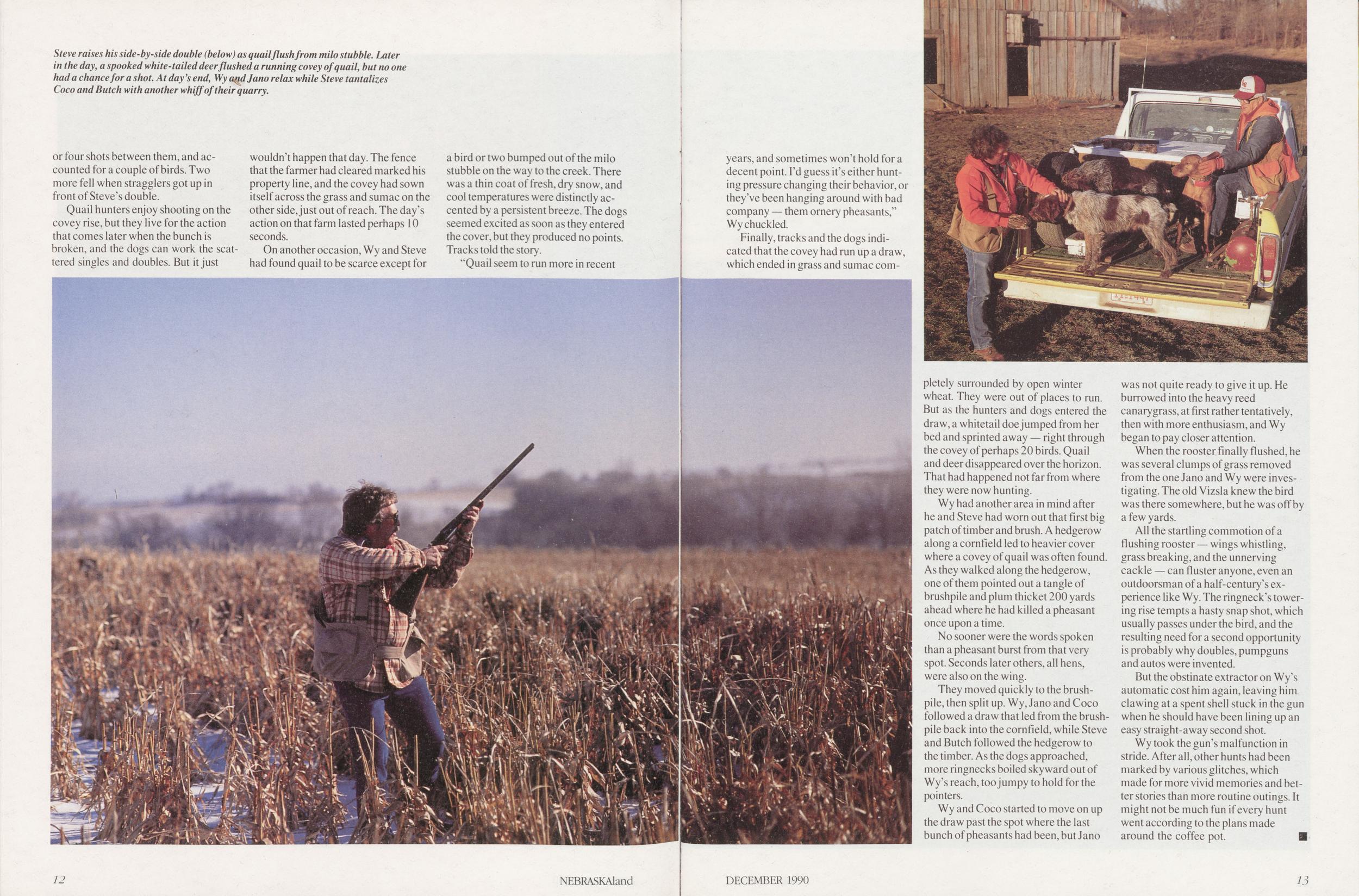
After a bit of snooping, Butch 10 NEBRASKAland homed in on one of the singles, and was soon frozen on point. Steve stood by while Coco came over to investigate, sending a nervous bobwhite rocketing back toward the trees. Steve's 20-gauge double interrupted its flight, and Butch retrieved the prize. More investigation failed to reveal other quail in the grass.
Steve and Wy headed back to the main body of cover, a big patch of timber where several drainages joined, patches of grass and sumac, hedgerows and a field of thick milo stubble with a good looking waterway cutting through it. Although several more quail fell, mostly to Steve's double but also to Wy's single-shot automatic, the area may have been too big for just two hunters. For some reason, it brought to mind pheasant hunts of years past, and those big, wonderful old snooker tables encountered during small-town lunch breaks. Both in the woods and on those huge pool tables, there was a lot of traffic back and forth without much result.
A year or two before, Wy and Steve were hunting in thin, fresh snow near Pawnee City on a farm known to have a good quail population. The cover on that farm was excellent, including CRP plantings, grassy and wooded draws and pond sites, and plenty of corn and milo stubble for food. But no birds appeared in almost two hours of looking.
Jano and Butch finally got "birdy" in an open area where the farmer had cleared a fence of doghair growth of bur oak and sumac, and stacked it in several brushpiles. Someone applied a toe to one of the brushpiles, and the whole party was suddenly engulfed in a thundering, heart-in-the-throat covey rise. Quail, numbering in the dozens, roared from at least two of the brushpiles and buzzed all around, giving an impression more like a swarm of very big bees than a covey of quail.
The rise allowed Steve and Wy three
DECEMBER 1990
11
 or four shots between them, and accounted for a couple of birds. Two
more fell when stragglers got up in
front of Steve's double.
or four shots between them, and accounted for a couple of birds. Two
more fell when stragglers got up in
front of Steve's double.
Quail hunters enjoy shooting on the covey rise, but they live for the action that comes later when the bunch is broken, and the dogs can work the scattered singles and doubles. But it just wouldn't happen that day. The fence that the farmer had cleared marked his property line, and the covey had sown itself across the grass and sumac on the other side, just out of reach. The day's action on that farm lasted perhaps 10 seconds.
On another occasion, Wy and Steve had found quail to be scarce except for a bird or two bumped out of the milo stubble on the way to the creek. There was a thin coat of fresh, dry snow, and cool temperatures were distinctly accented by a persistent breeze. The dogs seemed excited as soon as they entered the cover, but they produced no points. Tracks told the story.
"Quail seem to run more in recent 12 NEBRASKAland years, and sometimes won't hold for a decent point. I'd guess it's either hunting pressure changing their behavior, or they've been hanging around with bad company — them ornery pheasants," Wy chuckled.
Finally, tracks and the dogs indicated that the covey had run up a draw, which ended in grass and sumac completely surrounded by open winter wheat. They were out of places to run. But as the hunters and dogs entered the draw, a whitetail doe jumped from her bed and sprinted away — right through the covey of perhaps 20 birds. Quail and deer disappeared over the horizon. That had happened not far from where they were now hunting.
Wy had another area in mind after he and Steve had worn out that first big patch of timber and brush. A hedgerow along a cornfield led to heavier cover where a covey of quail was often found. As they walked along the hedgerow, one of them pointed out a tangle of brushpile and plum thicket 200 yards ahead where he had killed a pheasant once upon a time.
No sooner were the words spoken than a pheasant burst from that very spot. Seconds later others, all hens, were also on the wing.
They moved quickly to the brushpile, then split up. Wy, Jano and Coco followed a draw that led from the brushpile back into the cornfield, while Steve and Butch followed the hedgerow to the timber. As the dogs approached, more ringnecks boiled skyward out of Wy's reach, too jumpy to hold for the pointers.
Wy and Coco started to move on up the draw past the spot where the last bunch of pheasants had been, but Jano was not quite ready to give it up. He burrowed into the heavy reed canary grass, at first rather tentatively, then with more enthusiasm, and Wy began to pay closer attention.
When the rooster finally flushed, he was several clumps of grass removed from the one Jano and Wy were investigating. The old Vizsla knew the bird was there somewhere, but he was off by a few yards.
All the startling commotion of a flushing rooster — wings whistling, grass breaking, and the unnerving cackle — can fluster anyone, even an outdoorsman of a half-century's experience like Wy. The ringneck's towering rise tempts a hasty snap shot, which usually passes under the bird, and the resulting need for a second opportunity is probably why doubles, pumpguns and autos were invented.
But the obstinate extractor on Wy's automatic cost him again, leaving him. clawing at a spent shell stuck in the gun when he should have been lining up an easy straight-away second shot.
Wy took the gun's malfunction in stride. After all, other hunts had been marked by various glitches, which made for more vivid memories and better stories than more routine outings. It might not be much fun if every hunt went according to the plans made around the coffee pot.
DECEMBER 1990 13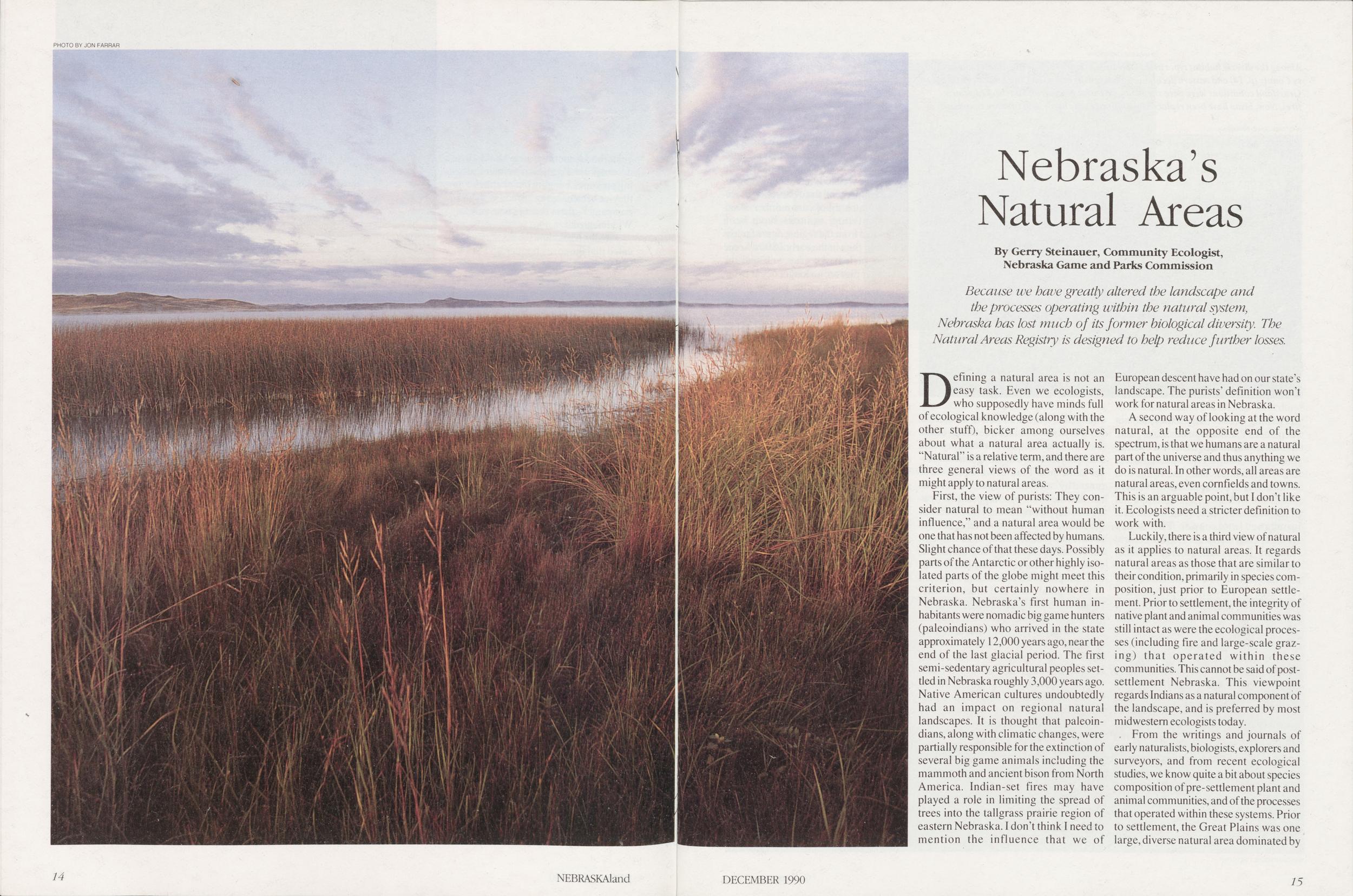
Nebraska's Natural Areas
By Gerry Steinauer, Community Ecologist, Nebraska Game and Parks Commission Because we have greatly altered the landscape and the processes operating within the natural system, Nebraska has lost much of its former biological diversity. The Natural Areas Registry) is designed to help reduce further losses.Defining a natural area is not an easy task. Even we ecologists, who supposedly have minds full of ecological knowledge (along with the other stuff), bicker among ourselves about what a natural area actually is. "Natural" is a relative term, and there are three general views of the word as it might apply to natural areas.
First, the view of purists: They consider natural to mean "without human influence," and a natural area would be one that has not been affected by humans. Slight chance of that these days. Possibly parts of the Antarctic or other highly isolated parts of the globe might meet this criterion, but certainly nowhere in Nebraska. Nebraska's first human inhabitants were nomadic big game hunters (paleoindians) who arrived in the state approximately 12,000 years ago, near the end of the last glacial period. The first semi-sedentary agricultural peoples settled in Nebraska roughly 3,000 years ago. Native American cultures undoubtedly had an impact on regional natural landscapes. It is thought that paleoindians, along with climatic changes, were partially responsible for the extinction of several big game animals including the mammoth and ancient bison from North America. Indian-set fires may have played a role in limiting the spread of trees into the tallgrass prairie region of eastern Nebraska. I don't think I need to mention the influence that we of European descent have had on our state's landscape. The purists' definition won't work for natural areas in Nebraska.
A second way of looking at the word natural, at the opposite end of the spectrum, is that we humans are a natural part of the universe and thus anything we do is natural. In other words, all areas are natural areas, even cornfields and towns. This is an arguable point, but I don't like it. Ecologists need a stricter definition to work with.
Luckily, there is a third view of natural as it applies to natural areas. It regards natural areas as those that are similar to their condition, primarily in species composition, just prior to European settlement. Prior to settlement, the integrity of native plant and animal communities was still intact as were the ecological processes (including fire and large-scale grazing) that operated within these communities. This cannot be said of postsettlement Nebraska. This viewpoint regards Indians as a natural component of the landscape, and is preferred by most midwestern ecologists today.
From the writings and journals of
early naturalists, biologists, explorers and
surveyors, and from recent ecological
studies, we know quite a bit about species
composition of pre-settlement plant and
animal communities, and of the processes
that operated within these systems. Prior
to settlement, the Great Plains was one
large, diverse natural area dominated by
DECEMBER 1990
15
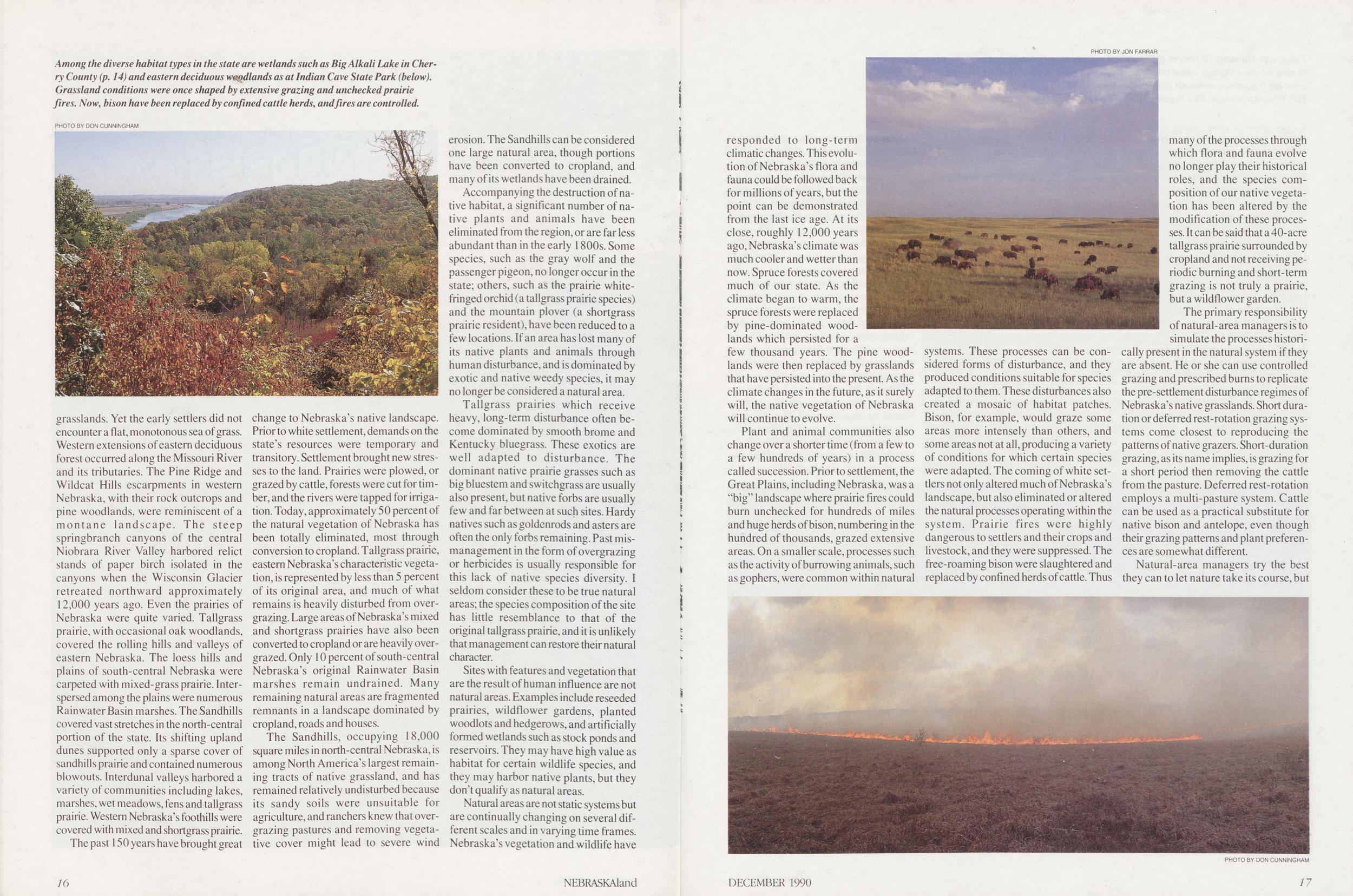 grasslands. Yet the early settlers did not
encounter a flat, monotonous sea of grass.
Western extensions of eastern deciduous
forest occurred along the Missouri River
and its tributaries. The Pine Ridge and
Wildcat Hills escarpments in western
Nebraska, with their rock outcrops and
pine woodlands, were reminiscent of a
montane landscape. The steep
springbranch canyons of the central
Niobrara River Valley harbored relict
stands of paper birch isolated in the
canyons when the Wisconsin Glacier
retreated northward approximately
12,000 years ago. Even the prairies of
Nebraska were quite varied. Tallgrass
prairie, with occasional oak woodlands,
covered the rolling hills and valleys of
eastern Nebraska. The loess hills and
plains of south-central Nebraska were
carpeted with mixed-grass prairie. Interspersed among the plains were numerous
Rainwater Basin marshes. The Sandhills
covered vast stretches in the north-central
portion of the state. Its shifting upland
dunes supported only a sparse cover of
sandhills prairie and contained numerous
blowouts. Interdunal valleys harbored a
variety of communities including lakes,
marshes, wet meadows, fens and tallgrass
prairie. Western Nebraska's foothills were
covered with mixed and shortgrass prairie.
grasslands. Yet the early settlers did not
encounter a flat, monotonous sea of grass.
Western extensions of eastern deciduous
forest occurred along the Missouri River
and its tributaries. The Pine Ridge and
Wildcat Hills escarpments in western
Nebraska, with their rock outcrops and
pine woodlands, were reminiscent of a
montane landscape. The steep
springbranch canyons of the central
Niobrara River Valley harbored relict
stands of paper birch isolated in the
canyons when the Wisconsin Glacier
retreated northward approximately
12,000 years ago. Even the prairies of
Nebraska were quite varied. Tallgrass
prairie, with occasional oak woodlands,
covered the rolling hills and valleys of
eastern Nebraska. The loess hills and
plains of south-central Nebraska were
carpeted with mixed-grass prairie. Interspersed among the plains were numerous
Rainwater Basin marshes. The Sandhills
covered vast stretches in the north-central
portion of the state. Its shifting upland
dunes supported only a sparse cover of
sandhills prairie and contained numerous
blowouts. Interdunal valleys harbored a
variety of communities including lakes,
marshes, wet meadows, fens and tallgrass
prairie. Western Nebraska's foothills were
covered with mixed and shortgrass prairie.
The past 150 years have brought great change to Nebraska's native landscape. Prior to white settlement, demands on the state's resources were temporary and transitory. Settlement brought new stresses to the land. Prairies were plowed, or grazed by cattle, forests were cut for timber, and the rivers were tapped for irrigation. Today, approximately 50 percent of the natural vegetation of Nebraska has been totally eliminated, most through conversion to cropland. Tallgrass prairie, eastern Nebraska's characteristic vegetation, is represented by less than 5 percent of its original area, and much of what remains is heavily disturbed from overgrazing. Large areas of Nebraska's mixed and shortgrass prairies have also been converted to cropland or are heavily overgrazed. Only 10 percent of south-central Nebraska's original Rainwater Basin marshes remain undrained. Many remaining natural areas are fragmented remnants in a landscape dominated by cropland, roads and houses.
The Sandhills, occupying 18,000 square miles in north-central Nebraska, is among North America's largest remaining tracts of native grassland, and has remained relatively undisturbed because its sandy soils were unsuitable for agriculture, and ranchers knew that overgrazing pastures and removing vegetative cover might lead to severe wind erosion. The Sandhills can be considered one large natural area, though portions have been converted to cropland, and many of its wetlands have been drained.
Accompanying the destruction of native habitat, a significant number of native plants and animals have been eliminated from the region, or are far less abundant than in the early 1800s. Some species, such as the gray wolf and the passenger pigeon, no longer occur in the state; others, such as the prairie whitefringed orchid (a tallgrass prairie species) and the mountain plover (a shortgrass prairie resident), have been reduced to a few locations. If an area has lost many of its native plants and animals through human disturbance, and is dominated by exotic and native weedy species, it may no longer be considered a natural area.
Tallgrass prairies which receive heavy, long-term disturbance often become dominated by smooth brome and Kentucky bluegrass. These exotics are well adapted to disturbance. The dominant native prairie grasses such as big bluestem and switchgrass are usually also present, but native forbs are usually few and far between at such sites. Hardy natives such as goldenrods and asters are often the only forbs remaining. Past mismanagement in the form of overgrazing or herbicides is usually responsible for this lack of native species diversity. I seldom consider these to be true natural areas; the species composition of the site has little resemblance to that of the original tallgrass prairie, and it is unlikely that management can restore their natural character.
Sites with features and vegetation that are the result of human influence are not natural areas. Examples include reseeded prairies, wildflower gardens, planted woodlots and hedgerows, and artificially formed wetlands such as stock ponds and reservoirs. They may have high value as habitat for certain wildlife species, and they may harbor native plants, but they don't qualify as natural areas.
Natural areas are not static systems but are continually changing on several different scales and in varying time frames. Nebraska's vegetation and wildlife have 16 NEBRASKAland responded to long-term climatic changes. This evolution of Nebraska's flora and fauna could be followed back for millions of years, but the point can be demonstrated from the last ice age. At its close, roughly 12,000 years ago, Nebraska's climate was much cooler and wetter than now. Spruce forests covered much of our state. As the climate began to warm, the spruce forests were replaced by pine-dominated woodlands which persisted for a few thousand years. The pine woodlands were then replaced by grasslands that have persisted into the present. As the climate changes in the future, as it surely will, the native vegetation of Nebraska will continue to evolve.
Plant and animal communities also change over a shorter time (from a few to a few hundreds of years) in a process called succession. Prior to settlement, the Great Plains, including Nebraska, was a "big" landscape where prairie fires could burn unchecked for hundreds of miles and huge herds ofbison, numbering in the hundred of thousands, grazed extensive areas. On a smaller scale, processes such as the activity of burrowing animals, such as gophers, were common within natural systems. These processes can be considered forms of disturbance, and they produced conditions suitable for species adapted to them. These disturbances also created a mosaic of habitat patches. Bison, for example, would graze some areas more intensely than others, and some areas not at all, producing a variety of conditions for which certain species were adapted. The coming of white settlers not only altered much of Nebraska's landscape, but also eliminated or altered the natural processes operating within the system. Prairie fires were highly dangerous to settlers and their crops and livestock, and they were suppressed. The free-roaming bison were slaughtered and replaced by confined herds of cattle. Thus many of the processes through which flora and fauna evolve no longer play their historical roles, and the species composition of our native vegetation has been altered by the modification of these processes. It can be said that a 40- acre tallgrass prairie surrounded by cropland and not receiving periodic burning and short-term grazing is not truly a prairie, but a wildflower garden.
The primary responsibility of natural-area managers is to simulate the processes historically present in the natural system if they are absent. He or she can use controlled grazing and prescribed burns to replicate the pre-settlement disturbance regimes of Nebraska's native grasslands. Short duration or deferred rest-rotation grazing systems come closest to reproducing the patterns of native grazers. Short-duration grazing, as its name implies, is grazing for a short period then removing the cattle from the pasture. Deferred rest-rotation employs a multi-pasture system. Cattle can be used as a practical substitute for native bison and antelope, even though their grazing patterns and plant preferences are somewhat different.
Natural-area managers try the best they can to let nature take its course, but
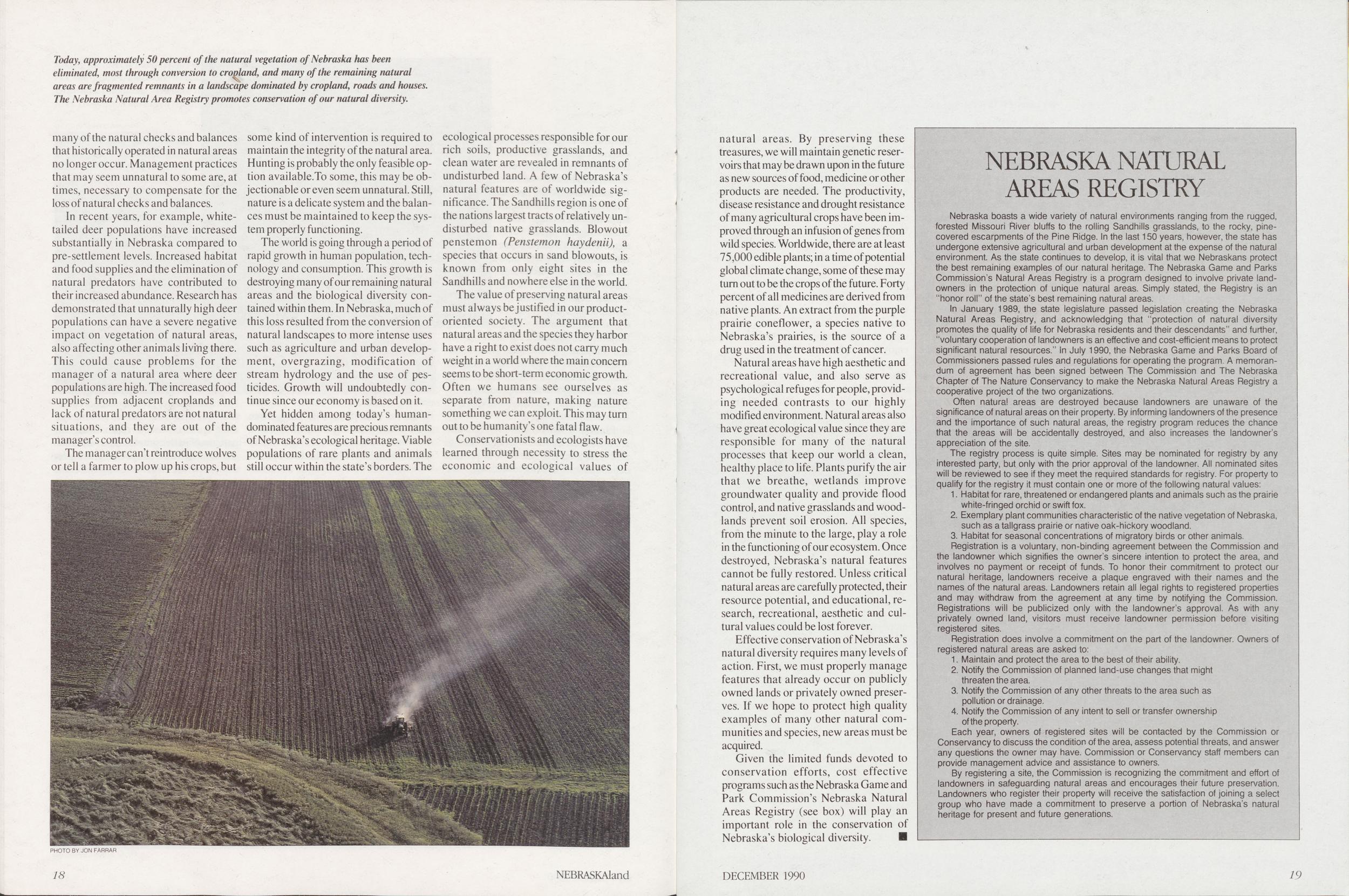 many of the natural checks and balances
that historically operated in natural areas
no longer occur. Management practices
that may seem unnatural to some are, at
times, necessary to compensate for the
loss of natural checks and balances.
many of the natural checks and balances
that historically operated in natural areas
no longer occur. Management practices
that may seem unnatural to some are, at
times, necessary to compensate for the
loss of natural checks and balances.
In recent years, for example, whitetailed deer populations have increased substantially in Nebraska compared to pre-settlement levels. Increased habitat and food supplies and the elimination of natural predators have contributed to their increased abundance. Research has demonstrated that unnaturally high deer populations can have a severe negative impact on vegetation of natural areas, also affecting other animals living there. This could cause problems for the manager of a natural area where deer populations are high. The increased food supplies from adjacent croplands and lack of natural predators are not natural situations, and they are out of the manager's control.
The manager can't reintroduce wolves or tell a farmer to plow up his crops, but some kind of intervention is required to maintain the integrity of the natural area. Hunting is probably the only feasible option available.To some, this may be objectionable or even seem unnatural. Still, nature is a delicate system and the balances must be maintained to keep the system properly functioning.
The world is going through a period of rapid growth in human population, technology and consumption. This growth is destroying many of our remaining natural areas and the biological diversity contained within them. In Nebraska, much of this loss resulted from the conversion of natural landscapes to more intense uses such as agriculture and urban development, overgrazing, modification of stream hydrology and the use of pesticides. Growth will undoubtedly continue since our economy is based on it.
Yet hidden among today's humandominated features are precious remnants of Nebraska's ecological heritage. Viable populations of rare plants and animals still occur within the state's borders. The ecological processes responsible for our rich soils, productive grasslands, and clean water are revealed in remnants of undisturbed land. A few of Nebraska's natural features are of worldwide significance. The Sandhills region is one of the nations largest tracts of relatively undisturbed native grasslands. Blowout penstemon (Penstemon haydenii), a species that occurs in sand blowouts, is known from only eight sites in the Sandhills and nowhere else in the world.
The value of preserving natural areas must always be justified in our productoriented society. The argument that natural areas and the species they harbor have a right to exist does not carry much weight in a world where the main concern seems to be short-term economic growth. Often we humans see ourselves as separate from nature, making nature something we can exploit. This may turn out to be humanity's one fatal flaw.
Conservationists and ecologists have learned through necessity to stress the economic and ecological values of 18 NEBRASKAland natural areas. By preserving these treasures, we will maintain genetic reservoirs that may be drawn upon in the future as new sources of food, medicine or other products are needed. The productivity, disease resistance and drought resistance of many agricultural crops have been improved through an infusion of genes from wild species. Worldwide, there are at least 75,000 edible plants; in a time of potential global climate change, some of these may turn out to be the crops of the future. Forty percent of all medicines are derived from native plants. An extract from the purple prairie coneflower, a species native to Nebraska's prairies, is the source of a drug used in the treatment of cancer.
Natural areas have high aesthetic and recreational value, and also serve as psychological refuges for people, providing needed contrasts to our highly modified environment. Natural areas also have great ecological value since they are responsible for many of the natural processes that keep our world a clean, healthy place to life. Plants purify the air that we breathe, wetlands improve groundwater quality and provide flood control, and native grasslands and woodlands prevent soil erosion. All species, from the minute to the large, play a role in the functioning of our ecosystem. Once destroyed, Nebraska's natural features cannot be fully restored. Unless critical natural areas are carefully protected, their resource potential, and educational, research, recreational, aesthetic and cultural values could be lost forever.
Effective conservation of Nebraska's natural diversity requires many levels of action. First, we must properly manage features that already occur on publicly owned lands or privately owned preserves. If we hope to protect high quality examples of many other natural communities and species, new areas must be acquired.
Given the limited funds devoted to conservation efforts, cost effective programs such as the Nebraska Game and Park Commission's Nebraska Natural Areas Registry (see box) will play an important role in the conservation of Nebraska's biological diversity.
NEBRASKA NATURAL AREAS REGISTRYNebraska boasts a wide variety of natural environments ranging from the rugged, forested Missouri River bluffs to the roiling Sandhills grasslands, to the rocky, pinecovered escarpments of the Pine Ridge. In the last 150 years, however, the state has undergone extensive agricultural and urban development at the expense of the natural environment. As the state continues to develop, it is vital that we Nebraskans protect the best remaining examples of our natural heritage. The Nebraska Game and Parks Commission's Natural Areas Registry is a program designed to involve private landowners in the protection of unique natural areas. Simply stated, the Registry is an "honor roll" of the state's best remaining natural areas.
In January 1989, the state legislature passed legislation creating the Nebraska Natural Areas Registry, and acknowledging that "protection of natural diversity promotes the quality of life for Nebraska residents and their descendants" and further, "voluntary cooperation of landowners is an effective and cost-efficient means to protect significant natural resources." In July 1990, the Nebraska Game and Parks Board of Commissioners passed rules and regulations for operating the program. A memorandum of agreement has been signed between The Commission and The Nebraska Chapter of The Nature Conservancy to make the Nebraska Natural Areas Registry a cooperative project of the two organizations.
Often natural areas are destroyed because landowners are unaware of the significance of natural areas on their property. By informing landowners of the presence and the importance of such natural areas, the registry program reduces the chance that the areas will be accidentally destroyed, and also increases the landowner's appreciation of the site.
The registry process is quite simple. Sites may be nominated for registry by any interested party, but only with the prior approval of the landowner. All nominated sites will be reviewed to see if they meet the required standards for registry. For property to qualify for the registry it must contain one or more of the following natural values:
1. Habitat for rare, threatened or endangered plants and animals such as the prairie white-fringed orchid or swift fox.
2. Exemplary plant communities characteristic of the native vegetation of Nebraska, such as a tallgrass prairie or native oak-hickory woodland.
3. Habitat for seasonal concentrations of migratory birds or other animals.
Registration is a voluntary, non-binding agreement between the Commission and the landowner which signifies the owner's sincere intention to protect the area, and involves no payment or receipt of funds. To honor their commitment to protect our natural heritage, landowners receive a plaque engraved with their names and the names of the natural areas. Landowners retain all legal rights to registered properties and may withdraw from the agreement at any time by notifying the Commission. Registrations will be publicized only with the landowner's approval. As with any privately owned land, visitors must receive landowner permission before visiting registered sites.
Registration does involve a commitment on the part of the landowner. Owners of registered natural areas are asked to:
1. Maintain and protect the area to the best of their ability.
2. Notify the Commission of planned land-use changes that might threaten the area
3. Notify the Commission of any other threats to the area such as pollution or drainage.
4. Notify the Commission of any intent to sell or transfer ownership of the property.
Each year, owners of registered sites will be contacted by the Commission or Conservancy to discuss the condition of the area, assess potential threats, and answer any questions the owner may have. Commission or Conservancy staff members can provide management advice and assistance to owners.
By registering a site, the Commission is recognizing the commitment and effort of landowners in safeguarding natural areas and encourages their future preservation. Landowners who register their property will receive the satisfaction of joining a select group who have made a commitment to preserve a portion of Nebraska's natural heritage for present and future generations.
DECEMBER 1990 19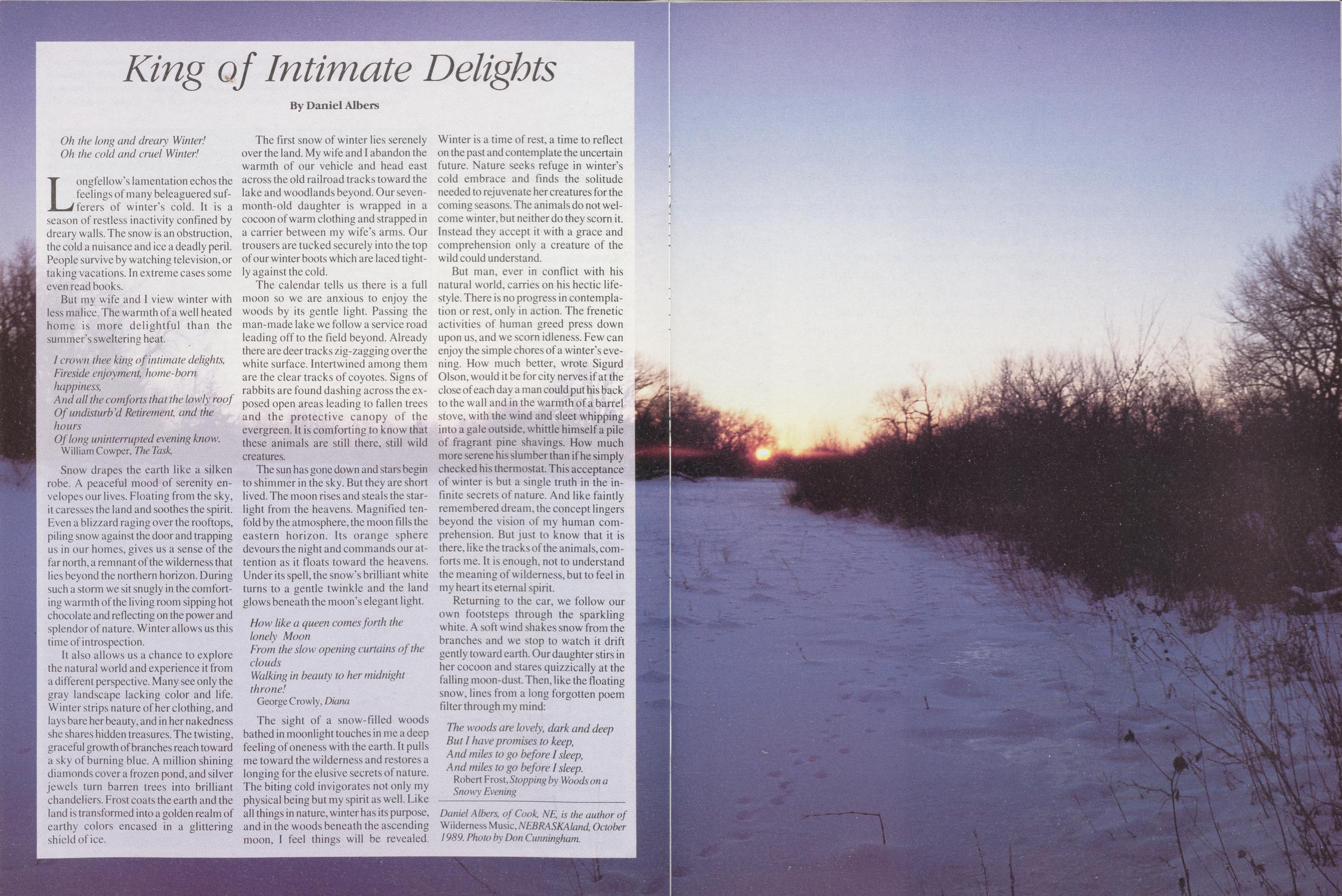
King of Intimate Delights
By Daniel Albers Oh the long and dreary Winter! Oh the cold and cruel Winter!Longfellow's lamentation echos the feelings of many beleaguered sufferers of winter's cold. It is a season of restless inactivity confined by dreary walls. The snow is an obstruction, the cold a nuisance and ice a deadly peril. People survive by watching television, or taking vacations. In extreme cases some even read books.
But my wife and I view winter with less malice. The warmth of a well heated home is more delightful than the summer's sweltering heat.
/ crown thee king of intimate delights, Fireside enjoyment, home-born happiness, And all the comforts that the lowly roof Of undisturbed Retirement, and the hours Of long uninterrupted evening know. William Cowper, The Task,Snow drapes the earth like a silken robe. A peaceful mood of serenity envelopes our lives. Floating from the sky, it caresses the land and soothes the spirit. Even a blizzard raging over the rooftops, piling snow against the door and trapping us in our homes, gives us a sense of the far north, a remnant of the wilderness that lies beyond the northern horizon. During such a storm we sit snugly in the comforting warmth of the living room sipping hot chocolate and reflecting on the power and splendor of nature. Winter allows us this time of introspection.
It also allows us a chance to explore the natural world and experience it from a different perspective. Many see only the gray landscape lacking color and life. Winter strips nature of her clothing, and lays bare her beauty, and in her nakedness she shares hidden treasures. The twisting, graceful growth of branches reach toward a sky of burning blue. A million shining diamonds cover a frozen pond, and silver jewels turn barren trees into brilliant chandeliers. Frost coats the earth and the land is transformed into a golden realm of earthy colors encased in a glittering shield of ice.
The first snow of winter lies serenely over the land. My wife and I abandon the warmth of our vehicle and head east across the old railroad tracks toward the lake and woodlands beyond. Our seven-month-old daughter is wrapped in a cocoon of warm clothing and strapped in a carrier between my wife's arms. Our trousers are tucked securely into the top of our winter boots which are laced tightly against the cold.
The calendar tells us there is a full moon so we are anxious to enjoy the woods by its gentle light. Passing the man-made lake we follow a service road leading off to the field beyond. Already there are deer tracks zig-zagging over the white surface. Intertwined among them are the clear tracks of coyotes. Signs of rabbits are found dashing across the exposed open areas leading to fallen trees and the protective canopy of the evergreen. It is comforting to know that these animals are still there, still wild creatures.
The sun has gone down and stars begin to shimmer in the sky. But they are short lived. The moon rises and steals the starlight from the heavens. Magnified tenfold by the atmosphere, the moon fills the eastern horizon. Its orange sphere devours the night and commands our attention as it floats toward the heavens. Under its spell, the snow's brilliant white turns to a gentle twinkle and the land glows beneath the moon's elegant light.
How like a queen comes forth the lonely Moon From the slow opening curtains of the clouds Walking in beauty to her midnight throne! George Crowly, DianaThe sight of a snow-filled woods bathed in moonlight touches in me a deep feeling of oneness with the earth. It pulls me toward the wilderness and restores a longing for the elusive secrets of nature. The biting cold invigorates not only my physical being but my spirit as well. Like all things in nature, winter has its purpose, and in the woods beneath the ascending moon, I feel things will be revealed Winter is a time of rest, a time to reflect on the past and contemplate the uncertain future. Nature seeks refuge in winter's cold embrace and finds the solitude needed to rejuvenate her creatures for the coming seasons. The animals do not welcome winter, but neither do they scorn it. Instead they accept it with a grace and comprehension only a creature of the wild could understand.
But man, ever in conflict with his natural world, carries on his hectic lifestyle. There is no progress in contemplation or rest, only in action. The frenetic activities of human greed press down upon us, and we scorn idleness. Few can enjoy the simple chores of a winter's evening. How much better, wrote Sigurd Olson, would it be for city nerves if at the close of each day a man could put his back to the wall and in the warmth of a barrel stove, with the wind and sleet whipping into a gale outside, whittle himself a pile of fragrant pine shavings. How much more serene his slumber than if he simply checked his thermostat. This acceptance of winter is but a single truth in the infinite secrets of nature. And like faintly remembered dream, the concept lingers beyond the vision of my human comprehension. But just to know that it is there, like the tracks of the animals, comforts me. It is enough, not to understand the meaning of wilderness, but to feel in my heart its eternal spirit.
Returning to the car, we follow our own footsteps through the sparkling white. A soft wind shakes snow from the branches and we stop to watch it drift gently toward earth. Our daughter stirs in her cocoon and stares quizzically at the falling moon-dust. Then, like the floating snow, lines from a long forgotten poem filter through my mind:
The woods are lovely, dark and deep But I have promises to keep, And miles to go before I sleep, And miles to go before I sleep. Robert Frost, Stopping by Woods on a Snowy Evening Daniel Albers, of Cook, NE, is the author of Wilderness Music, NEBRASKAland, October 1989. Photo by Don Cunningham.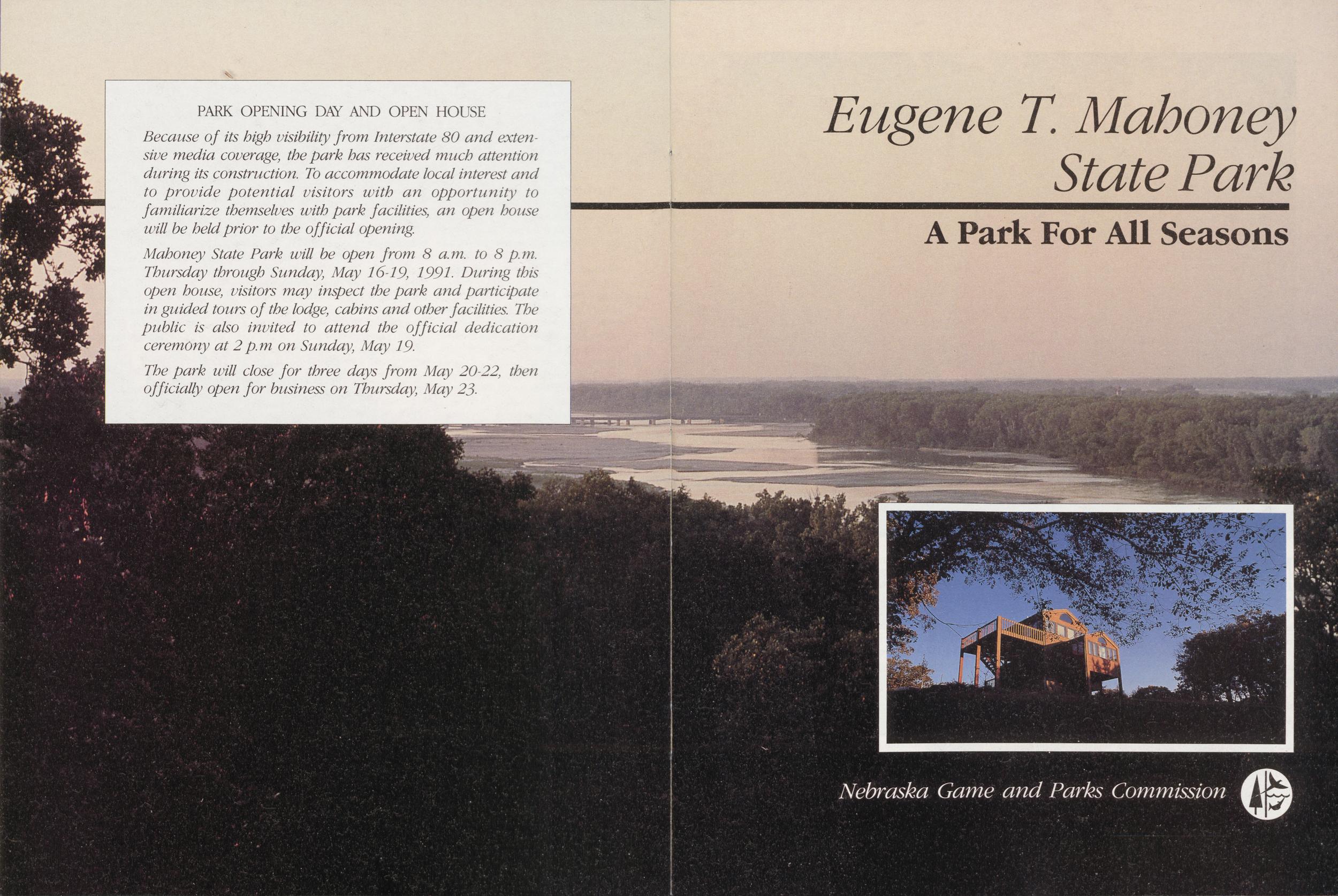
Eugene T. Mahoney State Park
A Park For All Seasons PARK OPENING DAY AND OPEN HOUSE Because of its high visibility from Interstate 80 and extensive media coverage, the park has received much attention during its construction. To accommodate local interest and to provide potential visitors with an opportunity to familiarize themselves with park facilities, an open house will be held prior to the official opening. Mahoney State Park will be open from 8 a. m. to 8 p. m. Thursday through Sunday, May 16-19, 199T During this open house, visitors may inspect the park and participate in guided tours of the lodge, cabins and other facilities. The public is also invited to attend the official dedication ceremony at 2p.m on Sunday, May 19. The park will close for three days from May 20-22, then officially open for business on Thursday, May 23.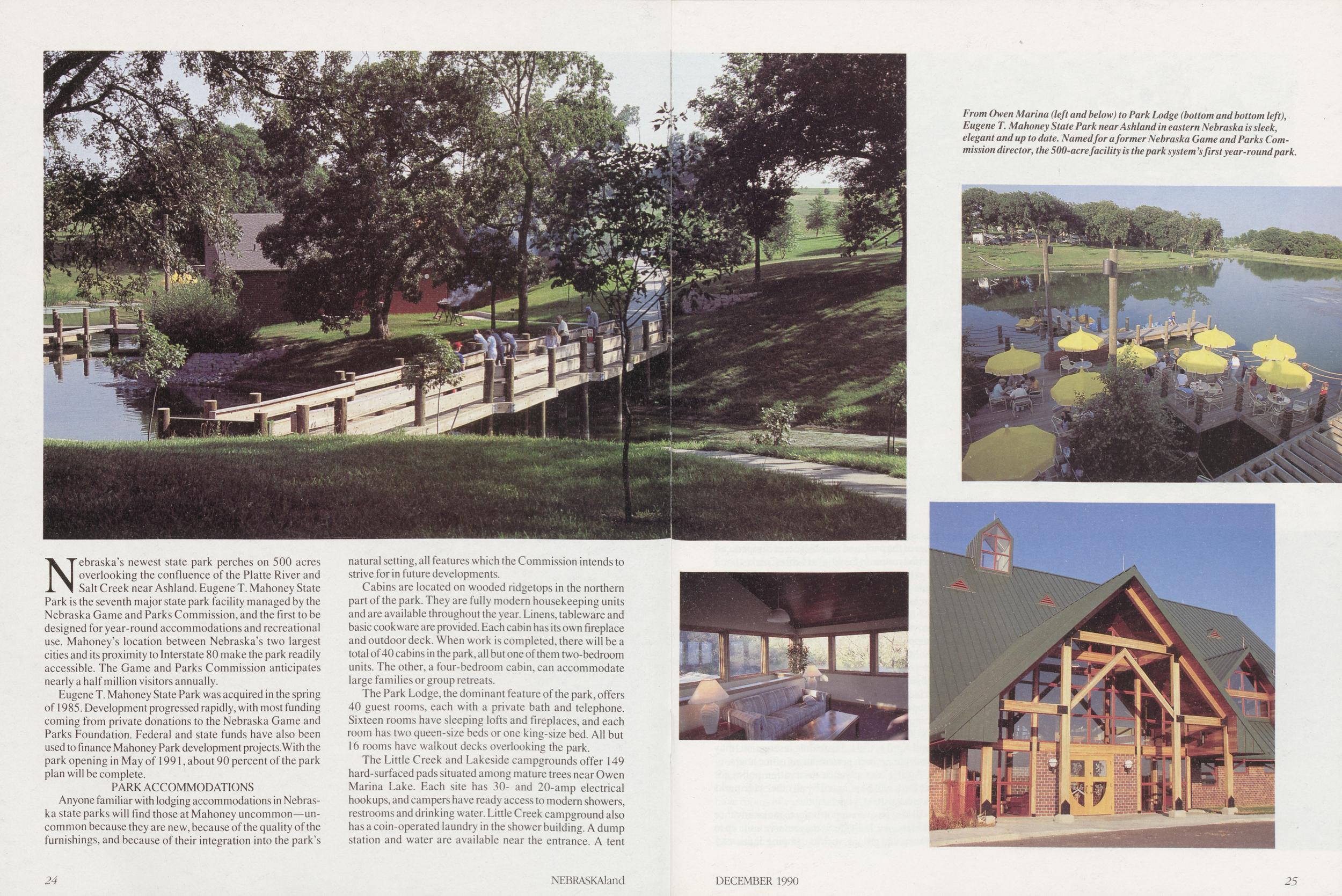
Nebraska's newest state park perches on 500 acres overlooking the confluence of the Platte River and Salt Creek near Ashland. Eugene T. Mahoney State Park is the seventh major state park facility managed by the Nebraska Game and Parks Commission, and the first to be designed for year-round accommodations and recreational use. Mahoney's location between Nebraska's two largest cities and its proximity to Interstate 80 make the park readily accessible. The Game and Parks Commission anticipates nearly a half million visitors annually.
Eugene T. Mahoney State Park was acquired in the spring of 1985. Development progressed rapidly, with most funding coming from private donations to the Nebraska Game and Parks Foundation. Federal and state funds have also been used to finance Mahoney Park development projects.With the park opening in May of 1991, about 90 percent of the park plan will be complete.
PARK ACCOMMODATIONSAnyone familiar with lodging accommodations in Nebraska state parks will find those at Mahoney uncommon—uncommon because they are new, because of the quality of the furnishings, and because of their integration into the park's natural setting, all features which the Commission intends to strive for in future developments.
Cabins are located on wooded ridgetops in the northern part of the park. They are fully modern housekeeping units and are available throughout the year. Linens, tableware and basic cook ware are provided. Each cabin has its own fireplace and outdoor deck. When work is completed, there will be a total of 40 cabins in the park, all but one of them two-bedroom units. The other, a four-bedroom cabin, can accommodate large families or group retreats.
The Park Lodge, the dominant feature of the park, offers 40 guest rooms, each with a private bath and telephone. Sixteen rooms have sleeping lofts and fireplaces, and each room has two queen-size beds or one king-size bed. All but 16 rooms have walkout decks overlooking the park.
The Little Creek and Lakeside campgrounds offer 149 hard-surfaced pads situated among mature trees near Owen Marina Lake. Each site has 30- and 20-amp electrical hookups, and campers have ready access to modern showers, restrooms and drinking water. Little Creek campground also has a coin-operated laundry in the shower building. A dump station and water are available near the entrance. A tent 24 NEBRASKAland
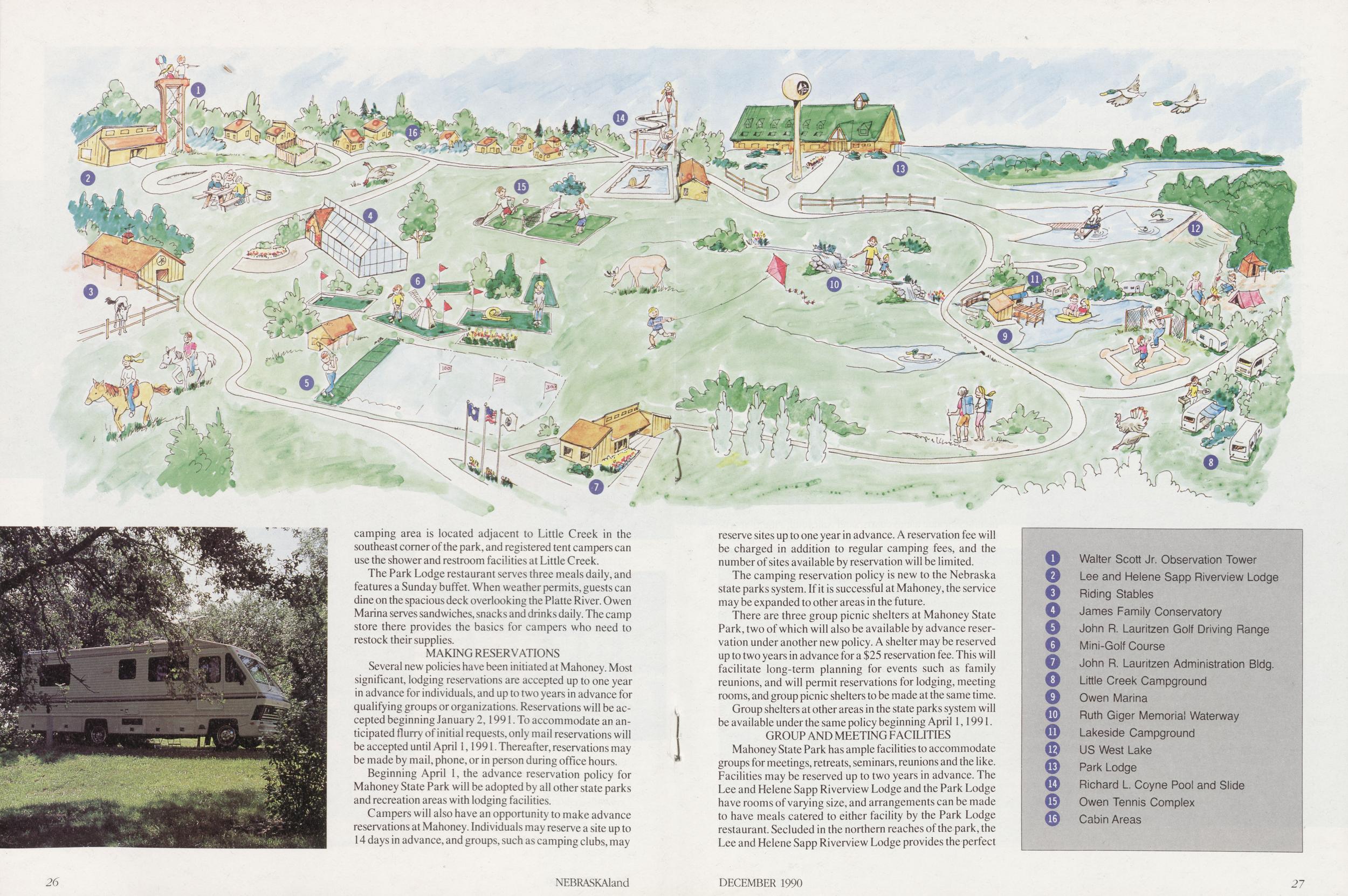
The Park Lodge restaurant serves three meals daily, and features a Sunday buffet. When weather permits, guests can dine on the spacious deck overlooking the Platte River. Owen Marina serves sandwiches, snacks and drinks daily. The camp store there provides the basics for campers who need to restock their supplies.
MAKING RESERVATIONSSeveral new policies have been initiated at Mahoney. Most significant, lodging reservations are accepted up to one year in advance for individuals, and up to two years in advance for qualifying groups or organizations. Reservations will be accepted beginning January 2,1991. To accommodate an anticipated flurry of initial requests, only mail reservations will be accepted until April 1,1991. Thereafter, reservations may be made by mail, phone, or in person during office hours.
Beginning April 1, the advance reservation policy for Mahoney State Park will be adopted by all other state parks and recreation areas with lodging facilities.
Campers will also have an opportunity to make advance reservations at Mahoney. Individuals may reserve a site up to 14 days in advance, and groups, such as camping clubs, may 26 NEBRASKAland reserve sites up to one year in advance. A reservation fee will be charged in addition to regular camping fees, and the number of sites available by reservation will be limited.
The camping reservation policy is new to the Nebraska state parks system. If it is successful at Mahoney, the service may be expanded to other areas in the future.
There are three group picnic shelters at Mahoney State Park, two of which will also be available by advance reservation under another new policy. A shelter may be reserved up to two years in advance for a $25 reservation fee. This will facilitate long-term planning for events such as family reunions, and will permit reservations for lodging, meeting rooms, and group picnic shelters to be made at the same time.
Group shelters at other areas in the state parks system will be available under the same policy beginning April 1,1991.
GROUP AND MEETING FACILITIESMahoney State Park has ample facilities to accommodate groups for meetings, retreats, seminars, reunions and the like. Facilities may be reserved up to two years in advance. The Lee and Helene Sapp Riverview Lodge and the Park Lodge have rooms of varying size, and arrangements can be made to have meals catered to either facility by the Park Lodge restaurant. Secluded in the northern reaches of the park, the Lee and Helene Sapp Riverview Lodge provides the perfect setting for a group meeting or retreat. The hall seats 144 people at tables, and is rented with a fully equipped kitchen. Riverview has a fireplace and a deck overlooking the Platte River, and is only a short walk from the Walter Scott, Jr., Observation Tower. During the summer months, the lower level houses the park arts and crafts center.
Walter Scott Jr. Observation Tower Lee and Helene Sapp Riverview Lodge Riding Stables James Family Conservatory John R. Lauritzen Golf Driving Range Mini-Golf Course John R. Lauritzen Administration Bldg. Little Creek Campground Owen Marina Ruth Giger Memorial Waterway Lakeside Campground US West Lake Park Lodge Richard L Coyne Pool and Slide Owen Tennis Complex Cabin Areas DECEMBER 1990 27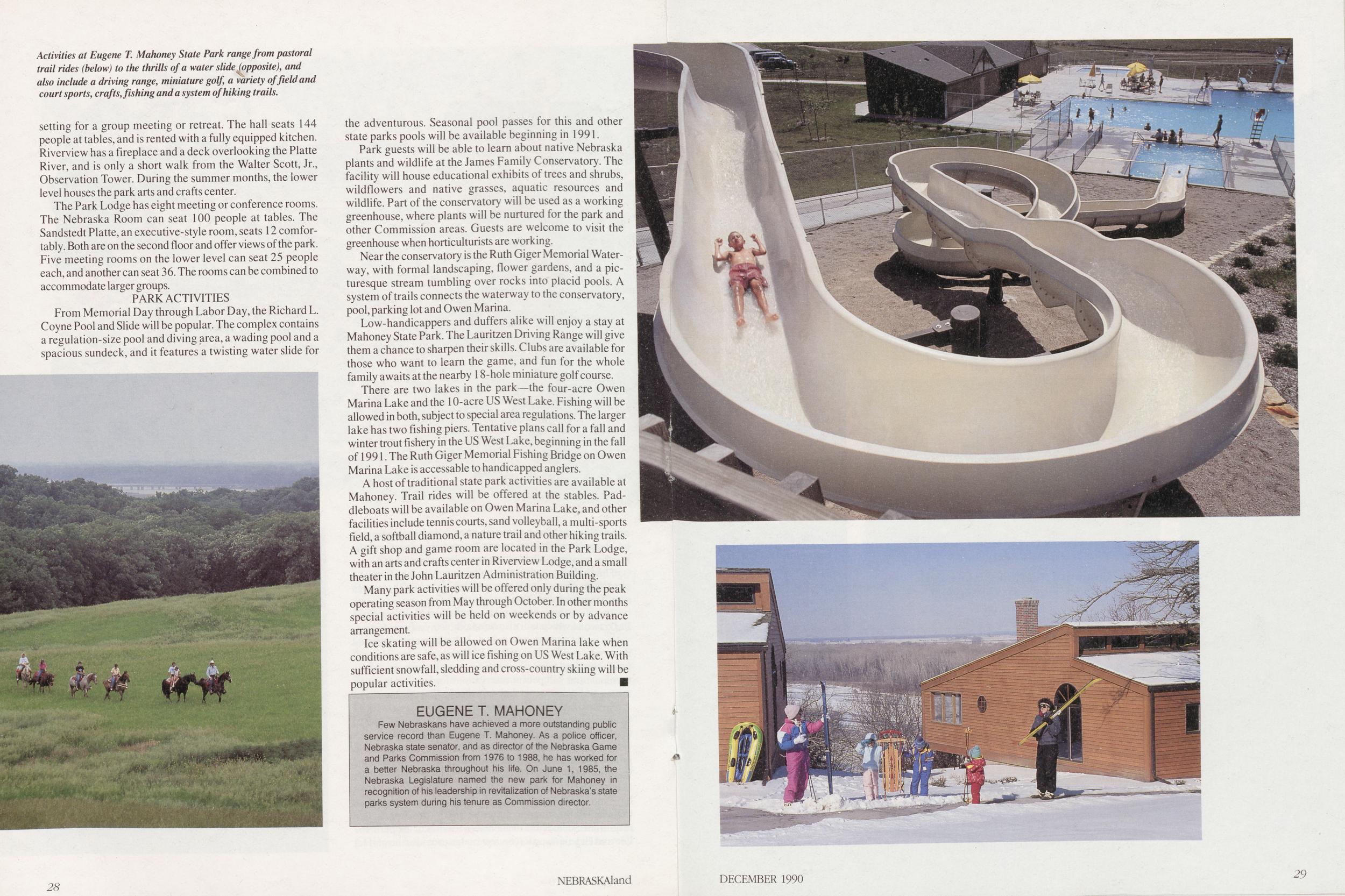
The Park Lodge has eight meeting or conference rooms. The Nebraska Room can seat 100 people at tables. The Sandstedt Platte, an executive-style room, seats 12 comfortably. Both are on the second floor and offer views of the park. Five meeting rooms on the lower level can seat 25 people each, and another can seat 36. The rooms can be combined to accommodate larger groups.
PARK ACTIVITIESFrom Memorial Day through Labor Day, the Richard L. Coyne Pool and Slide will be popular. The complex contains a regulation-size pool and diving area, a wading pool and a spacious sundeck, and it features a twisting water slide for the adventurous. Seasonal pool passes for this and other state parks pools will be available beginning in 1991.
Park guests will be able to learn about native Nebraska plants and wildlife at the James Family Conservatory. The facility will house educational exhibits of trees and shrubs, wildflowers and native grasses, aquatic resources and wildlife. Part of the conservatory will be used as a working greenhouse, where plants will be nurtured for the park and other Commission areas. Guests are welcome to visit the greenhouse when horticulturists are working.
Near the conservatory is the Ruth Giger Memorial Waterway, with formal landscaping, flower gardens, and a picturesque stream tumbling over rocks into placid pools. A system of trails connects the waterway to the conservatory, pool, parking lot and Owen Marina.
Low-handicappers and duffers alike will enjoy a stay at Mahoney State Park. The Lauritzen Driving Range will give them a chance to sharpen their skills. Clubs are available for those who want to learn the game, and fun for the whole family awaits at the nearby 18-hole miniature golf course.
There are two lakes in the park—the four-acre Owen Marina Lake and the 10-acre US West Lake. Fishing will be allowed in both, subject to special area regulations. The larger lake has two fishing piers. Tentative plans call for a fall and winter trout fishery in the US West Lake, beginning in the fall of 1991. The Ruth Giger Memorial Fishing Bridge on Owen Marina Lake is accessable to handicapped anglers.
A host of traditional state park activities are available at Mahoney. Trail rides will be offered at the stables. Paddleboats will be available on Owen Marina Lake, and other facilities include tennis courts, sand volleyball, a multi-sports field, a softball diamond, a nature trail and other hiking trails. A gift shop and game room are located in the Park Lodge, with an arts and crafts center in Riverview Lodge, and a small theater in the John Lauritzen Administration Building.
Many park activities will be offered only during the peak operating season from May through October. In other months special activities will be held on weekends or by advance arrangement.
Ice skating will be allowed on Owen Marina lake when conditions are safe, as will ice fishing on US West Lake. With sufficient snowfall, sledding and cross-country skiing will be popular activities.
EUGENE T. MAHONEYFew Nebraskans have achieved a more outstanding public service record than Eugene T. Mahoney. As a police officer, Nebraska state senator, and as director of the Nebraska Game and Parks Commission from 1976 to 1988, he has worked for a better Nebraska throughout his life. On June 1, 1985, the Nebraska Legislature named the new park for Mahoney in recognition of his leadership in revitalization of Nebraska's state parks system during his tenure as Commission director.
28 NEBRASKAland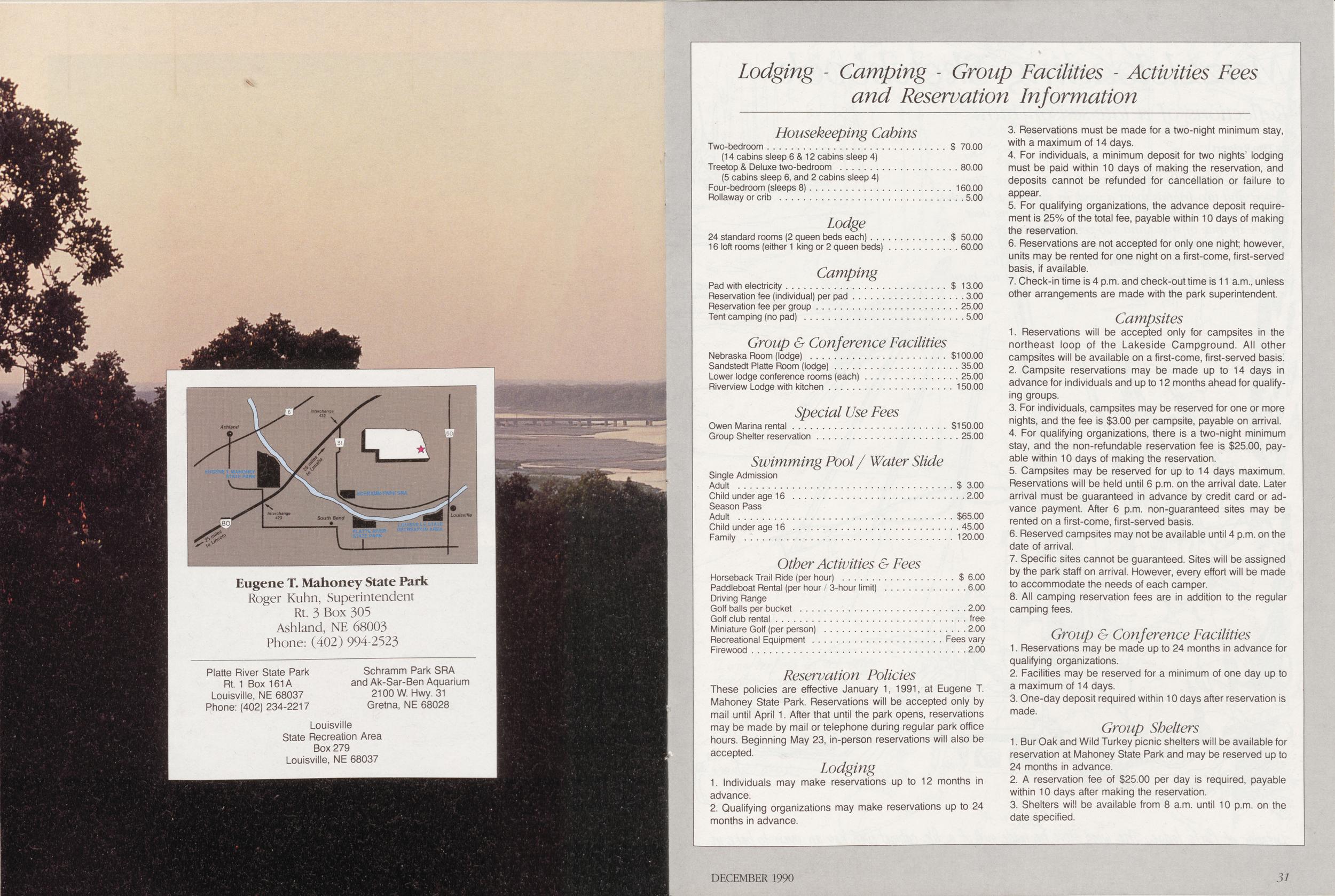
Lodging - Camping - Group Facilities - Activities Fees and Reservation Information
Housekeeping Cabins Two-bedroom $ 70.00 (14 cabins sleep 6 & 12 cabins sleep 4) Treetop & Deluxe two-bedroom 80.00 (5 cabins sleep 6, and 2 cabins sleep 4) Four-bedroom (sleeps 8) 160.00 Rollaway or crib 5.00 Lodge 24 standard rooms (2 queen beds each) $ 50.00 16 loft rooms (either 1 king or 2 queen beds) 60.00 Camping Pad with electricity $ 13.00 Reservation fee (individual) per pad 3.00 Reservation fee per group 25.00 Tent camping (no pad) 5.00 Group & Conference Facilities Nebraska Room (lodge) $100.00 Sandstedt Platte Room (lodge) 35.00 Lower lodge conference rooms (each) 25.00 Riverview Lodge with kitchen 150.00 Special Use Fees Owen Marina rental $150.00 Group Shelter reservation 25.00 Swimming Pool / Water Slide Single Admission Adult $ 3.00 Child under age 16 2.00 Season Pass Adult $65.00 Child under age 16 45.00 Family 120.00 Other Activities & Fees Horseback Trail Ride (per hour) $ 6.00 Paddleboat Rental (per hour / 3-hour limit) 6.00 Driving Range Golf balls per bucket 2.00 Golf club rental free Miniature Golf (per person) 2.00 Recreational Equipment Fees vary Firewood 2.00 Reservation PoliciesThese policies are effective January 1, 1991, at Eugene T. Mahoney State Park. Reservations will be accepted only by mail until April 1. After that until the park opens, reservations may be made by mail or telephone during regular park office hours. Beginning May 23, in-person reservations will also be accepted.
Lodging1. Individuals may make reservations up to 12 months in advance.
2. Qualifying organizations may make reservations up to 24 months in advance.
3. Reservations must be made for a two-night minimum stay, with a maximum of 14 days.
4. For individuals, a minimum deposit for two nights' lodging must be paid within 10 days of making the reservation, and deposits cannot be refunded for cancellation or failure to appear.
5. For qualifying organizations, the advance deposit requirement is 25% of the total fee, payable within 10 days of making the reservation.
6. Reservations are not accepted for only one night; however, units may be rented for one night on a first-come, first-served basis, if available.
7. Check-in time is 4 p.m. and check-out time is 11 am, unless other arrangements are made with the park superintendent.
Campsites1. Reservations will be accepted only for campsites in the northeast loop of the Lakeside Campground. All other campsites will be available on a first-come, first-served basis.
2. Campsite reservations may be made up to 14 days in advance for individuals and up to 12 months ahead for qualifying groups.
3. For individuals, campsites may be reserved for one or more nights, and the fee is $3.00 per campsite, payable on arrival.
4. For qualifying organizations, there is a two-night minimum stay, and the non-refundable reservation fee is $25.00, payable within 10 days of making the reservation.
5. Campsites may be reserved for up to 14 days maximum. Reservations will be held until 6 p.m. on the arrival date. Later arrival must be guaranteed in advance by credit card or advance payment. After 6 p.m. non-guaranteed sites may be rented on a first-come, first-served basis.
6. Reserved campsites may not be available until 4 p.m. on the date of arrival.
7. Specific sites cannot be guaranteed. Sites will be assigned by the park staff on arrival. However, every effort will be made to accommodate the needs of each camper.
8. All camping reservation fees are in addition to the regular camping fees.
Group & Conference Facilities1. Reservations may be made up to 24 months in advance for qualifying organizations.
2. Facilities may be reserved for a minimum of one day up to a maximum of 14 days.
3. One-day deposit required within 10 days after reservation is made.
Group Shelters1. Bur Oak and Wild Turkey picnic shelters will be available for reservation at Mahoney State Park and may be reserved up to 24 months in advance.
2. A reservation fee of $25.00 per day is required, payable within 10 days after making the reservation.
3. Shelters will be available from 8 a.m. until 10 p.m. on the date specified.
DECEMBER 1990 31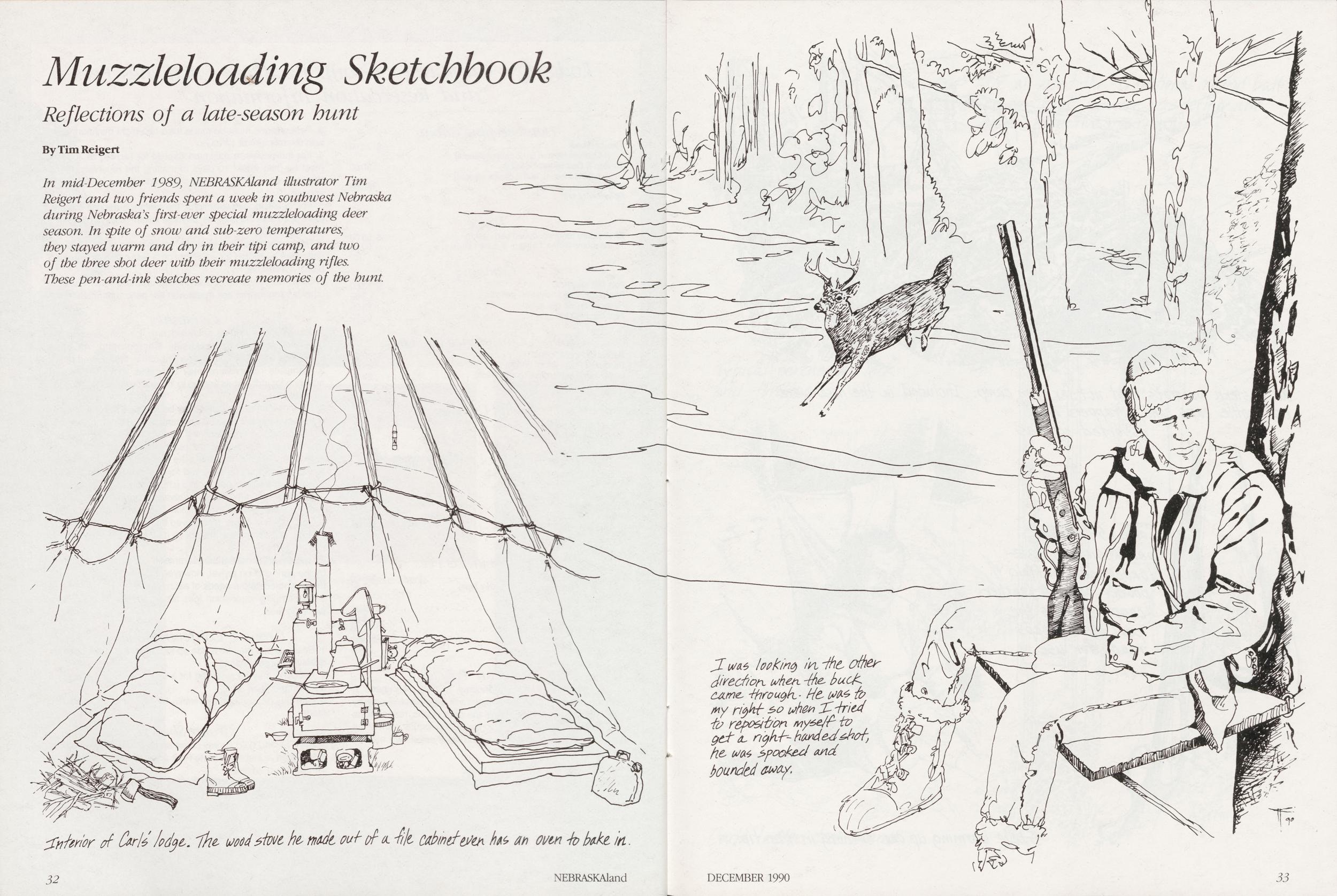
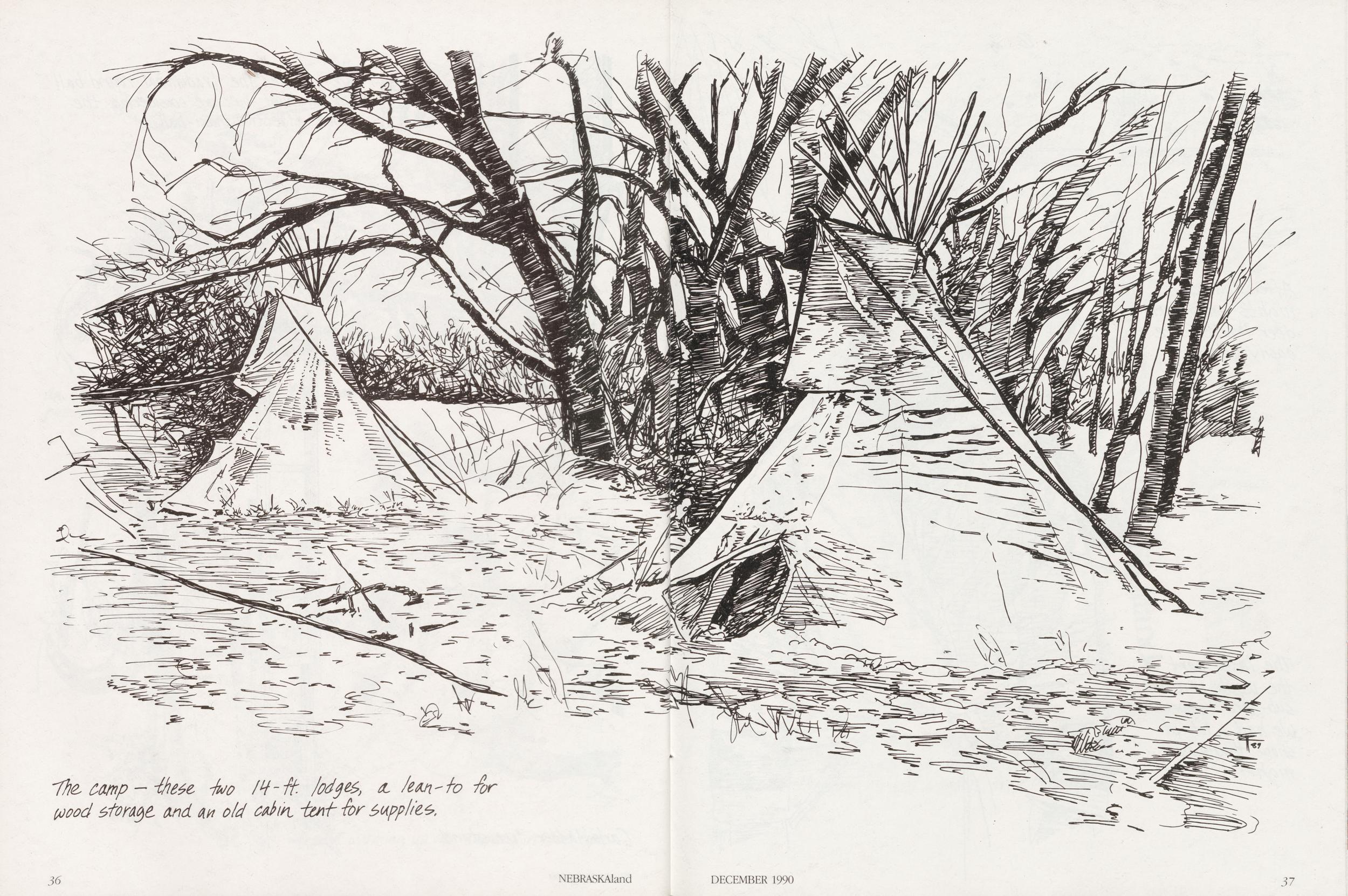
Muzzleloading Sketchbook Reflections of a late-season hunt
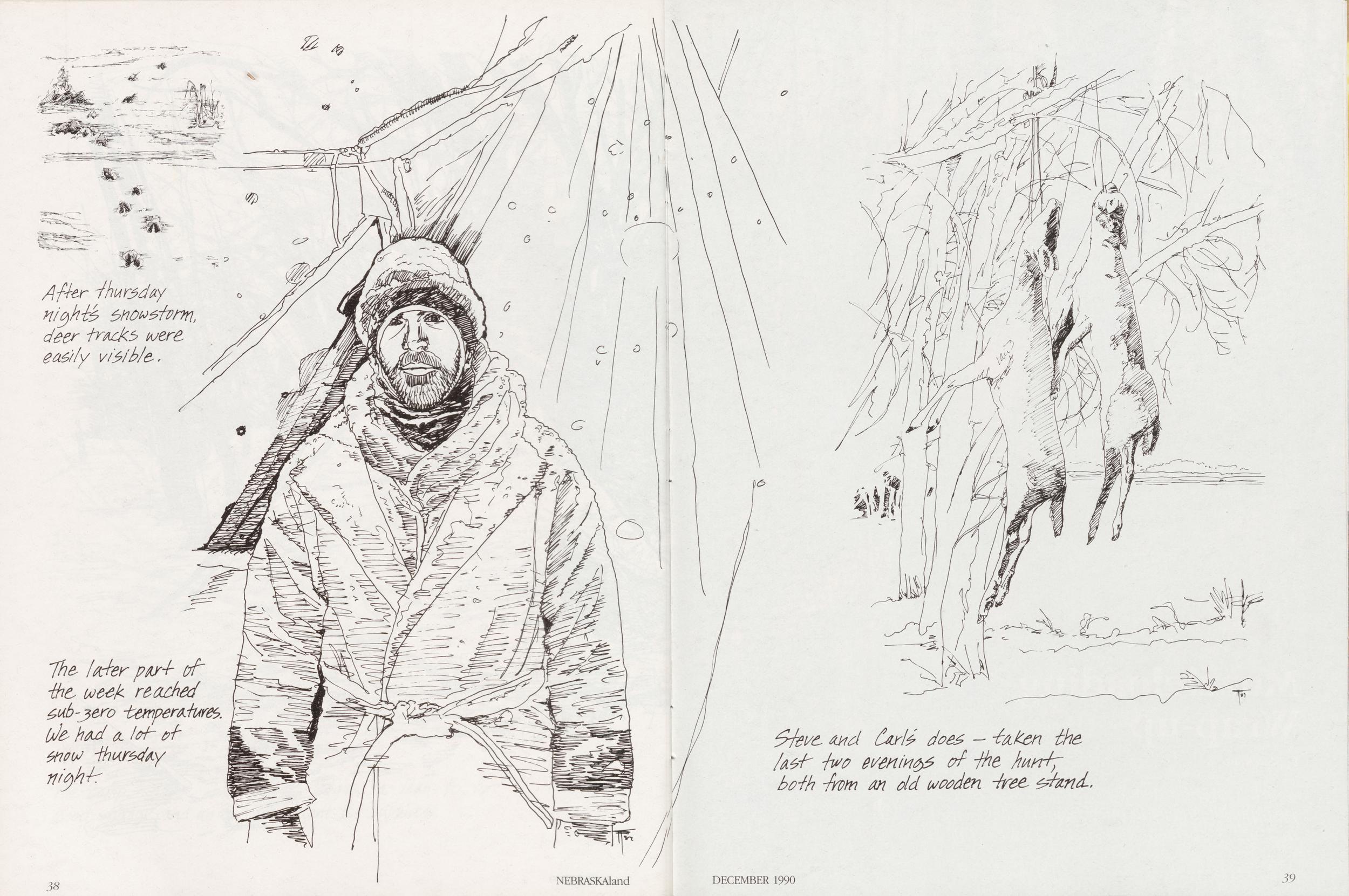
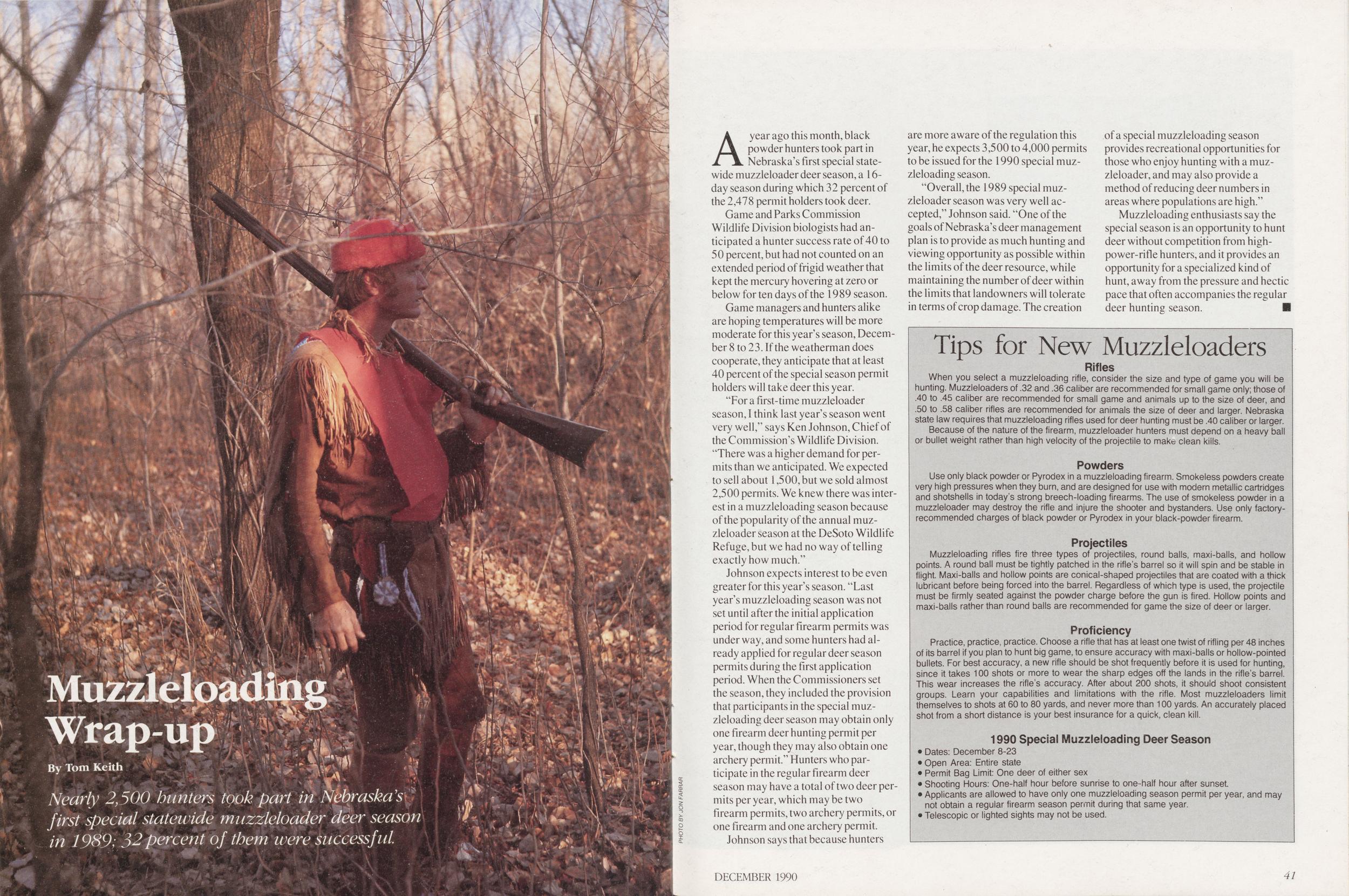
By Tim Reigert In mid-December 1989, NEBRASKAland illustrator Tim Reigert and two friends spent a week in southwest Nebraska during Nebraska's first-ever special muzzleloading deer season. In spite of snow and sub-zero temperatures, they stayed warm and dry in their tipi camp, and two of the three shot deer with their muzzleloading rifles. These pen-and-ink sketches recreate memories of the hunt.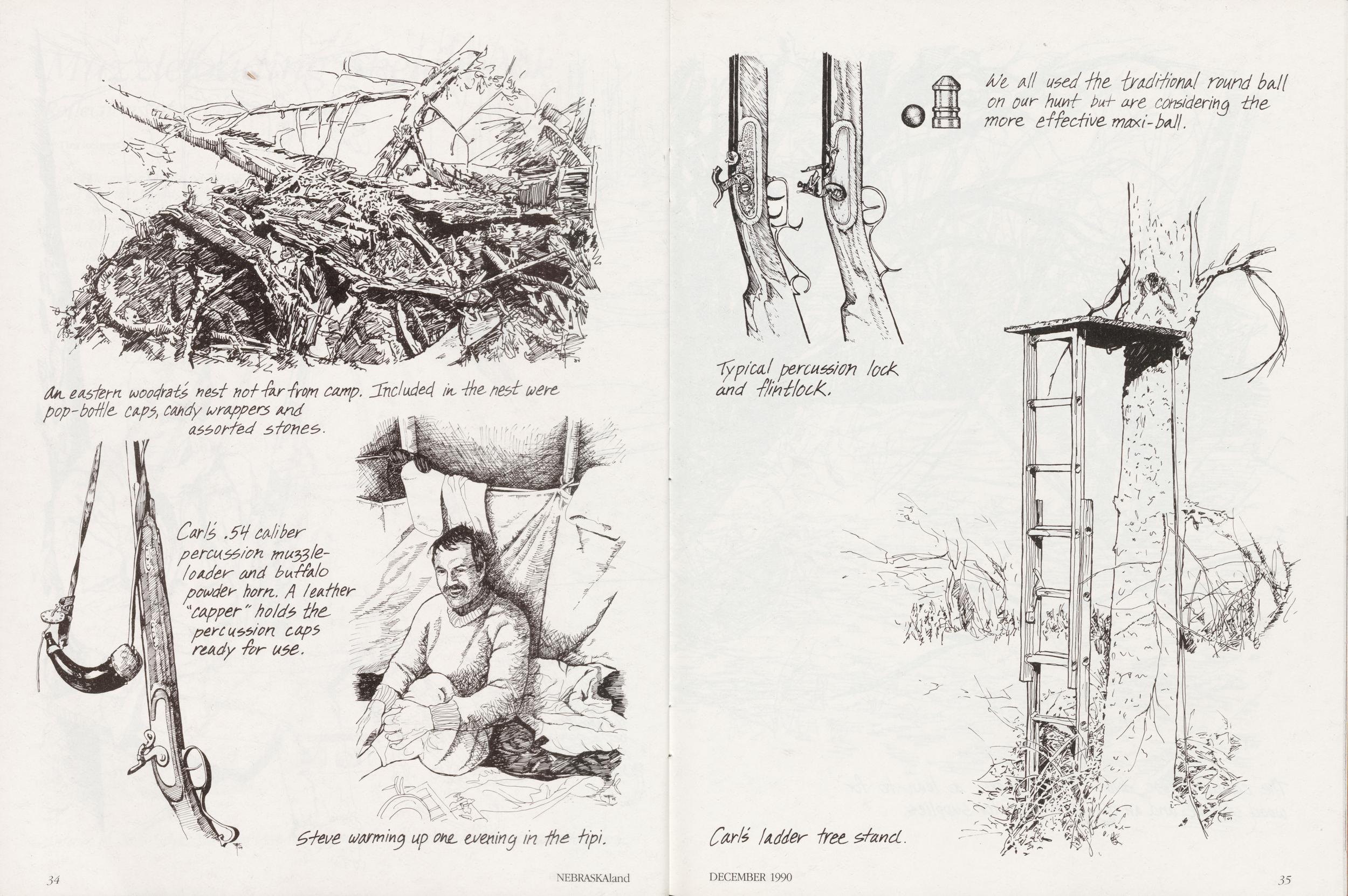
Muzzleoading Wrap-up
By Tom Keith Nearly 2,500 hunters took part in Nebraska's first special statewide muzzleloader deer season in 1989; 32 percent of them were successful.A year ago this month, black powder hunters took part in Nebraska's first special statewide muzzleloader deer season, a 16-day season during which 32 percent of the 2,478 permit holders took deer.
Game and Parks Commission Wildlife Division biologists had anticipated a hunter success rate of 40 to 50 percent, but had not counted on an extended period of frigid weather that kept the mercury hovering at zero or below for ten days of the 1989 season.
Game managers and hunters alike are hoping temperatures will be more moderate for this year's season, December 8 to 23. If the weatherman does cooperate, they anticipate that at least 40 percent of the special season permit holders will take deer this year.
"For a first-time muzzleloader season, I think last year's season went very well," says Ken Johnson, Chief of the Commission's Wildlife Division. "There was a higher demand for permits than we anticipated. We expected to sell about 1,500, but we sold almost 2,500 permits. We knew there was interest in a muzzleloading season because of the popularity of the annual muzzleloader season at the DeSoto Wildlife Refuge, but we had no way of telling exactly how much."
Johnson expects interest to be even greater for this year's season. "Last year's muzzleloading season was not set until after the initial application period for regular firearm permits was under way, and some hunters had already applied for regular deer season permits during the first application period. When the Commissioners set the season, they included the provision that participants in the special muzzleloading deer season may obtain only one firearm deer hunting permit per year, though they may also obtain one archery permit." Hunters who participate in the regular firearm deer season may have a total of two deer permits per year, which may be two firearm permits, two archery permits, or one firearm and one archery permit.
Johnson says that because hunters are more aware of the regulation this year, he expects 3,500 to 4,000 permits to be issued for the 1990 special muzzleloading season.
"Overall, the 1989 special muzzleloader season was very well accepted," Johnson said. "One of the goals of Nebraska's deer management plan is to provide as much hunting and viewing opportunity as possible within the limits of the deer resource, while maintaining the number of deer within the limits that landowners will tolerate in terms of crop damage. The creation of a special muzzleloading season provides recreational opportunities for those who enjoy hunting with a muzzleloader, and may also provide a method of reducing deer numbers in areas where populations are high."
Muzzleloading enthusiasts say the special season is an opportunity to hunt deer without competition from highpower-rifle hunters, and it provides an opportunity for a specialized kind of hunt, away from the pressure and hectic pace that often accompanies the regular deer hunting season.
Tips for New Muzzleloaders RiflesWhen you select a muzzleloading rifle, consider the size and type of game you will be hunting. Muzzleloaders of .32 and .36 caliber are recommended for small game only; those of .40 to .45 caliber are recommended for small game and animals up to the size of deer, and .50 to .58 caliber rifles are recommended for animals the size of deer and larger. Nebraska state law requires that muzzleloading rifles used for deer hunting must be ,40 caliber or larger.
Because of the nature of the firearm, muzzleloader hunters must depend on a heavy ball or bullet weight rather than high velocity of the projectile to makt; clean kills.
PowdersUse only black powder or Pyrodex in a muzzleloading firearm. Smokeless powders create very high pressures when they burn, and are designed for use with modern metallic cartridges and shotshells in today's strong breech-loading firearms. The use of smokeless powder in a muzzleloader may destroy the rifle and injure the shooter and bystanders. Use only factory recommended charges of black powder or Pyrodex in your black-powder firearm.
ProjectilesMuzzleloading rifles fire three types of projectiles, round balls, maxi-balls, and hollow points. A round ball must be tightly patched in the rifle's barrel so it will spin and be stable in flight. Maxi-balls and hollow points are conical-shaped projectiles that are coated with a thick lubricant before being forced into the barrel. Regardless of which type is used, the projectile must be firmly seated against the powder charge before the gun is fired. Hollow points and maxi-balls rather than round balls are recommended for game the size of deer or larger.
ProficiencyPractice, practice, practice. Choose a rifle that has at least one twist of rifling per 48 inches of its barrel if you plan to hunt big game, to ensure accuracy with maxi-balls or hollow-pointed bullets. For best accuracy, a new rifle should be shot frequently before it is used for hunting, since it takes 100 shots or more to wear the sharp edges off the lands in the rifle's barrel. This wear increases the rifle's accuracy. After about 200 shots, it should shoot consistent groups. Learn your capabilities and limitations with the rifle. Most muzzleloaders limit themselves to shots at 60 to 80 yards, and never more than 100 yards. An accurately placed shot from a short distance is your best insurance for a quick, clean
1990 Special Muzzleloading Deer Season Dates: December 8-23 Open Area: Entire state Permit Bag Limit: One deer of either sex Shooting Hours: One-half hour before sunrise to one-half hour after sunset. Applicants are allowed to have only one muzzleloading season permit per year, and may not obtain a regular firearm season permit during that same year. Telescopic or lighted sights may not be used. DECEMBER 1990 41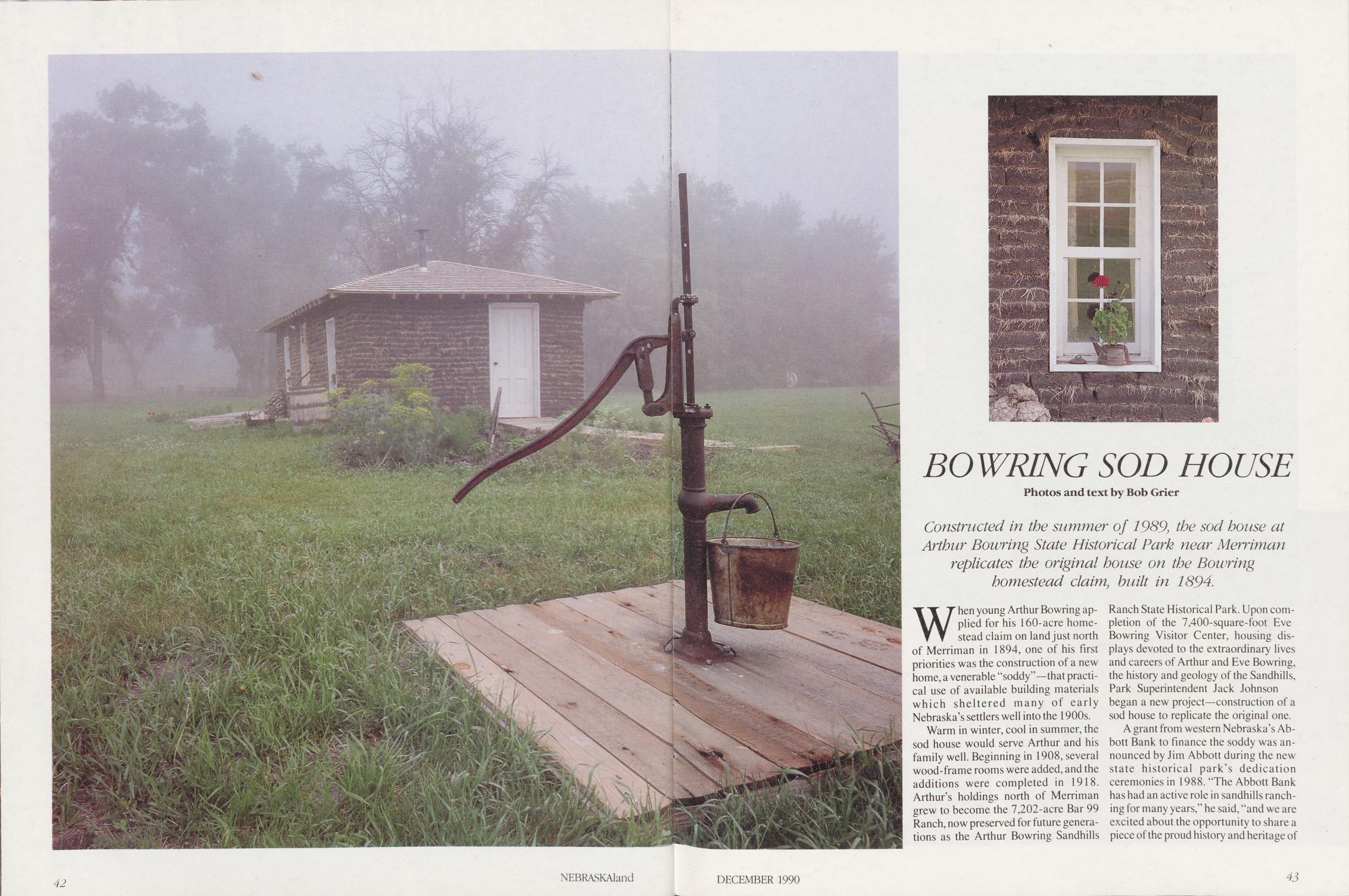
BOWRING SOD HOUSE
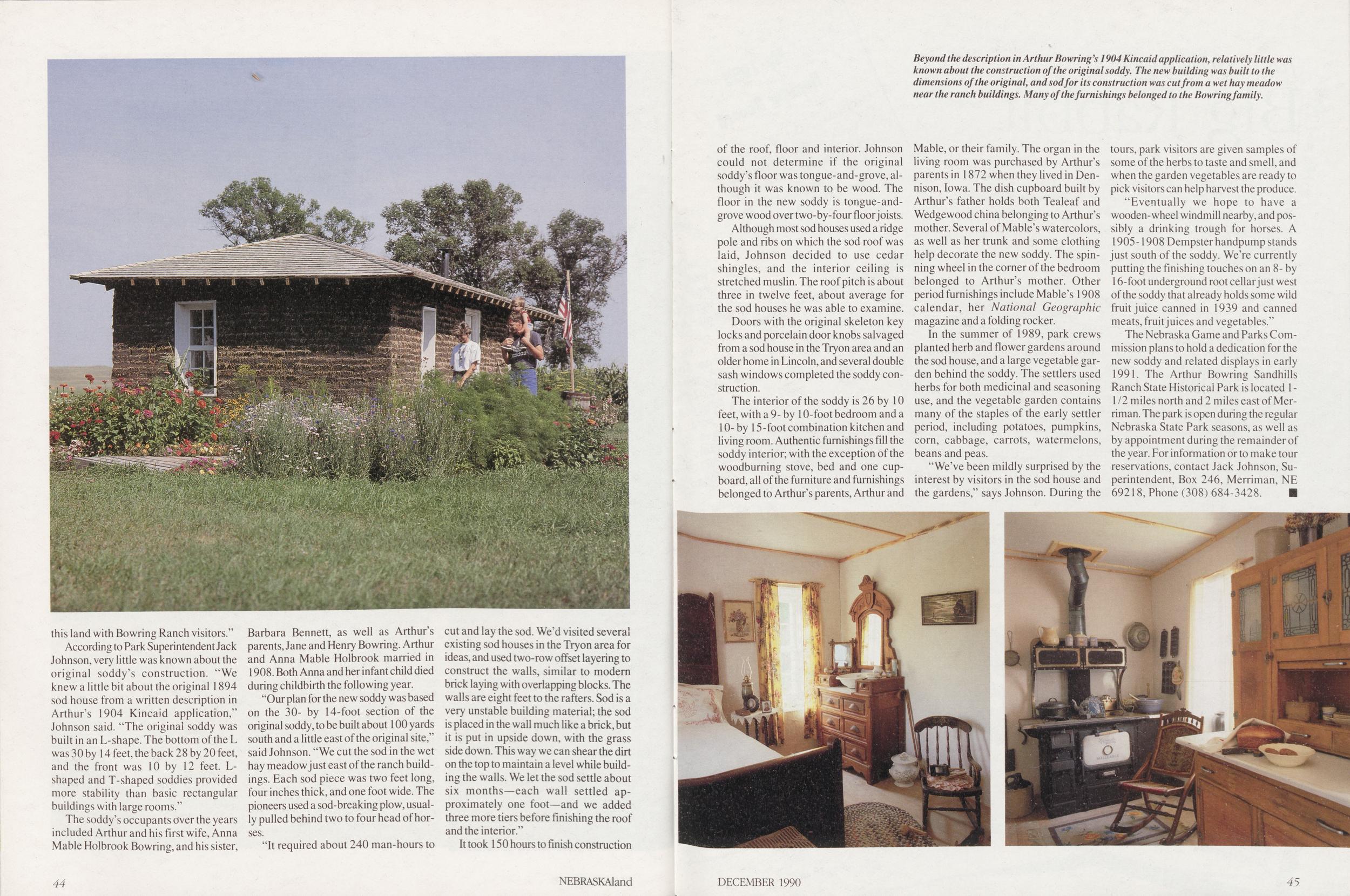
Photos and text by Bob Grier Constructed in the summer of 1989, the sod house at Arthur Bowring State Historical Park near Merriman replicates the original house on the Bowring homestead claim, built in 1894.When young Arthur Bowring applied for his 160-acre homestead claim on land just north of Merriman in 1894, one of his first priorities was the construction of a new home, a venerable "soddy"—that practical use of available building materials which sheltered many of early Nebraska's settlers well into the 1900s.
Warm in winter, cool in summer, the sod house would serve Arthur and his family well. Beginning in 1908, several wood-frame rooms were added, and the additions were completed in 1918. Arthur's holdings north of Merriman grew to become the 7,202-acre Bar 99 Ranch, now preserved for future generations as the Arthur Bowring Sandhills Ranch State Historical Park. Upon completion of the 7,400-square-foot Eve Bowring Visitor Center, housing displays devoted to the extraordinary lives and careers of Arthur and Eve Bowring, the history and geology ofthe Sandhills, Park Superintendent Jack Johnson began a new project—construction of a sod house to replicate the original one.
A grant from western Nebraska's Abbott Bank to finance the soddy was announced by
Jim Abbott during the new
state historical park's dedication
ceremonies in 1988. "The Abbott Bank
has had an active role in sandhills ranching for many years," he said, "and we are
excited about the opportunity to share a
piece ofthe proud history and heritage of
DECEMBER 1990
43
 this land with Bowring Ranch visitors."
According to Park Superintendent Jack Johnson, very little was known about the original soddy's construction. "We knew a little bit about the original 1894 sod house from a written description in Arthur's 1904 Kincaid application," Johnson said. "The original soddy was built in an L-shape. The bottom of the L was 30 by 14 feet, the back 28 by 20 feet, and the front was 10 by 12 feet. L-shaped and T-shaped soddies provided more stability than basic rectangular buildings with large rooms."
The soddy's occupants over the years included Arthur and his first wife, Anna Mable Holbrook Bowring, and his sister, Barbara Bennett, as well as Arthur's parents, Jane and Henry Bowring. Arthur and Anna Mable Holbrook married in 1908. Both Anna and her infant child died during childbirth the following year.
"Our plan for the new soddy was based on the 30- by 14-foot section of the original soddy, to be built about 100 yards south and a little east of the original site," said Johnson. "We cut the sod in the wet hay meadow just east of the ranch buildings. Each sod piece was two feet long, four inches thick, and one foot wide. The pioneers used a sod-breaking plow, usually pulled behind two to four head of horses.
"It required about 240 man-hours to cut and lay the sod. We'd visited several existing sod houses in the Tryon area for ideas, and used two-row offset layering to construct the walls, similar to modern brick laying with overlapping blocks. The walls are eight feet to the rafters. Sod is a very unstable building material; the sod is placed in the wall much like a brick, but it is put in upside down, with the grass side down. This way we can shear the dirt on the top to maintain a level while building the walls. We let the sod settle about six months—each wall settled approximately one foot—and we added three more tiers before finishing the roof and the interior."
It took 150 hours to finish construction 44 NEBRASKAland of the roof, floor and interior. Johnson could not determine if the original soddy's floor was tongue-and-grove, although it was known to be wood. The floor in the new soddy is tongue-andgrove wood over two-by-four floor joists.
Although most sod houses used a ridge pole and ribs on which the sod roof was laid, Johnson decided to use cedar shingles, and the interior ceiling is stretched muslin. The roof pitch is about three in twelve feet, about average for the sod houses he was able to examine.
Doors with the original skeleton key locks and porcelain door knobs salvaged from a sod house in the Tryon area and an older home in Lincoln, and several double sash windows completed the soddy construction.
The interior of the soddy is 26 by 10 feet, with a 9- by 10-foot bedroom and a 10- by 15-foot combination kitchen and living room. Authentic furnishings fill the soddy interior; with the exception of the woodburning stove, bed and one cupboard, all of the furniture and furnishings belonged to Arthur's parents, Arthur and Mable, or their family. The organ in the living room was purchased by Arthur's parents in 1872 when they lived in Dennison, Iowa. The dish cupboard built by Arthur's father holds both Tealeaf and Wedgewood china belonging to Arthur's mother. Several of Mable's watercolors, as well as her trunk and some clothing help decorate the new soddy. The spinning wheel in the corner of the bedroom belonged to Arthur's mother. Other period furnishings include Mable's 1908 calendar, her National Geographic magazine and a folding rocker.
In the summer of 1989, park crews planted herb and flower gardens around the sod house, and a large vegetable garden behind the soddy. The settlers used herbs for both medicinal and seasoning use, and the vegetable garden contains many of the staples of the early settler period, including potatoes, pumpkins, corn, cabbage, carrots, watermelons, beans and peas.
'We've been mildly surprised by the interest by visitors in the sod house and the gardens," says Johnson. During the tours, park visitors are given samples of some of the herbs to taste and smell, and when the garden vegetables are ready to pick visitors can help harvest the produce.
"Eventually we hope to have a wooden-wheel windmill nearby, and possibly a drinking trough for horses. A 1905-1908 Dempster handpump stands just south of the soddy. We're currently putting the finishing touches on an 8- by 16-foot underground root cellar just west of the soddy that already holds some wild fruit juice canned in 1939 and canned meats, fruit juices and vegetables."
The Nebraska Game and Parks Commission plans to hold a dedication for the new soddy and related displays in early 1991. The Arthur Bowring Sandhills Ranch State Historical Park is located 1 112 miles north and 2 miles east of Merriman. The park is open during the regular Nebraska State Park seasons, as well as by appointment during the remainder of the year. For information or to make tour reservations, contact Jack Johnson, Superintendent, Box 246, Merriman, NE 69218, Phone (308) 684-3428.
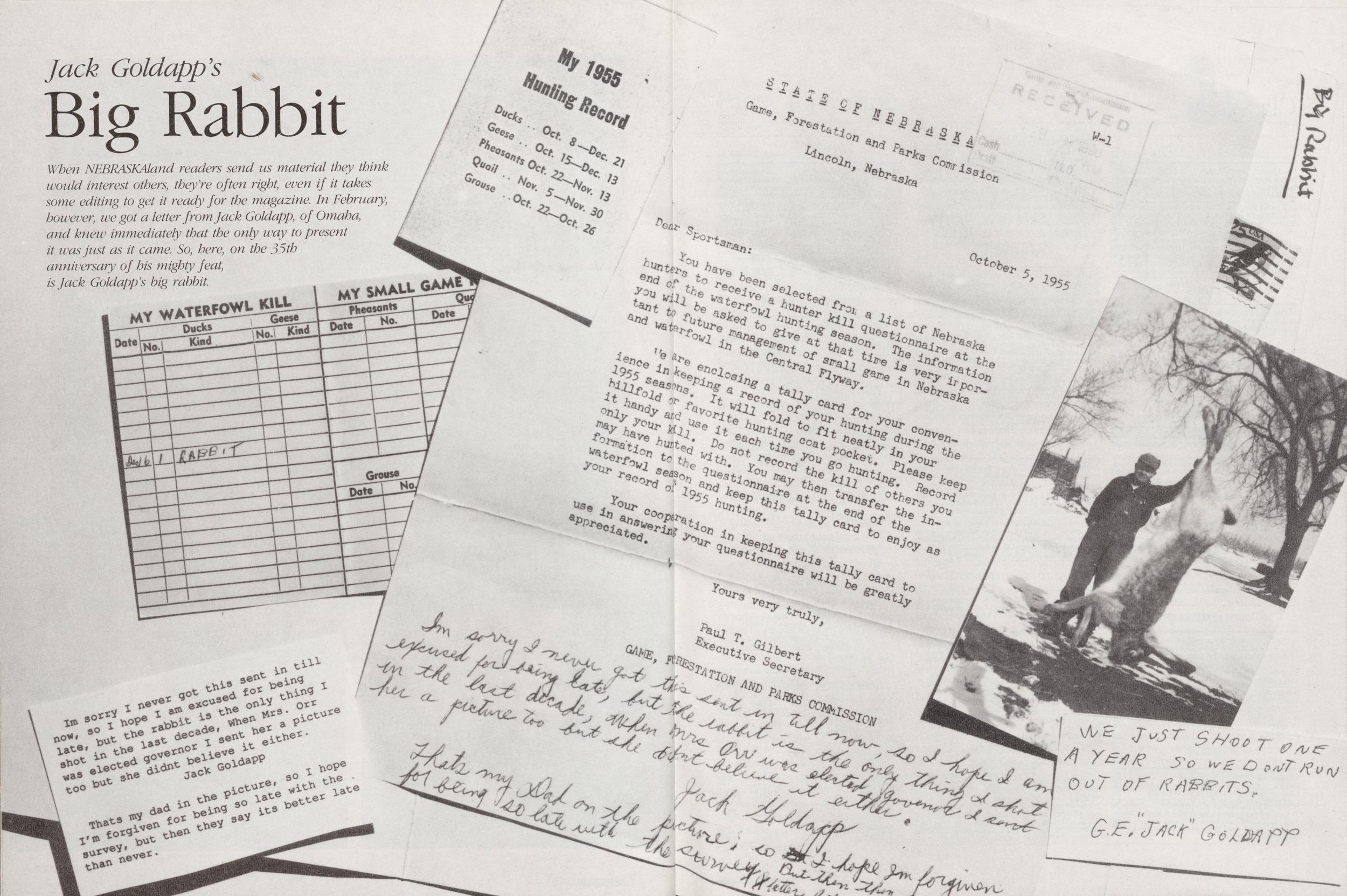
Jack Goldapp's Big Rabbit
When NEBRASKAland readers send us material they think would interest others, they're ojten right, even if it takes some editing to get it ready for the magazine. In February, however, we got a letter from Jack Goldapp, of Omaha, and knew immediately that the only way to present it was just as it came. So, here, on the 35th anniversary of his mighty feat, is Jack Goldapp's big rabbit.
Classified
ARTS & CRAFTSBev Doolittle, Terrry Redlin, Jerry Raedke, Ed Wards, Robert Bateman, Frank McCarthy and Neal Anderson are available at the 2nd Street Gallery, 537 W. 2nd, Hastings, NE 68901. Phone (402) 463-6677.
PERFECT GIFT for that special person: Limited Edi- tion Display Print “Plains Windmill Silhouetted Against Blazing Sunrise” by Nebraska photographer Chas Hicks. Signed and numbered. Mounted 8x10 print in 11x14 double mat that enhances print colors: $ 19.95; In 11x14 polished gold frame: $34.95; Print only: $ 14.95; Add $2.00 S+H; NE residents add sales tax. Send check or M.O. to: Great Plains Image, Box 281143-N, Papil- lion, NE 68128.
BIRDSMANDARIN DUCKS: nice full-wing birds. $35/pair; woodducks $25/pair. Mrs. R. W. Hansen, 3315 Ave. L, Kearney, NE 68847. Phone 308-237-3781.
BOATS/MOTORSTROLLING MOTOR REPAIR. Factory authorized Minn Kota and Motor Guide, parts and service. Wolfs Repair and Tackle Supply, 5950 Colfax Ave., Lincoln, NE 68507. Phone (402) 464-4265.
BOOKS/PRINTINGFREE! Booklets on northeastern Nevada; fishing, rock- hounding maps, Carl Hayden, Box 528, Jackpot, Nevada 89825.
FREE BOOK CATALOG. Novels, westerns, romances, children’s; old out of print, found barns, attic. Authors: Grey, Bower, Connor, Fox, Curwood, Raine, Wright, Aldrige, Pollyanna, Freckles, many others. Postage appreciated. Pierce, 4400 N. Pine Cluster, Oroville, C A 95965.
EATING NEBRASKA: A Field Guide to Unique Eater- ies. A humorous and informative new book describing 128 unique places to eat across Nebraska. $9.95 + $ 1.50 shipping. Rt. 1, Box 120A, Pleasant Dale, NE 68423.
NEBRASKA CHRISTMAS gift ideas. Neligh (Nebr) Mills Cookbook. Researched and printed by Nebraska State Historical Society. $6.00 postpaid. First Gentle- man’s Cookbook, by Bill Orr (husband of Nebraska Governor Kay Orr). $ 15.00 ppd. Upper Missouri Trad- ing Co., Box 191, Crofton, NE 68730. Phone (402) 388-4844.
COLLECTIBLESBUYING: American Indian artifacts such as beadwork, weavings, baskets, etc.; also cowboy memorabilia such as chaps, spurs, photographs, etc. Best price first letter; photographs promptly returned. Jack Ringwait, 1550 California St., Suite 6, #211, San Francisco, CA 94109, (415) 759-6343.
NEBRASKA WILDLIFE HABITAT NUMBERED Limited edition belt buckles. 1991 now available. Brass, Gold/Silverplate, Sterling. Write for our brochure. Malcolm Gun Club, P.O. Box 194, Malcolm, NE 68402 or call (402) 796-2244. Some 1984 through 1990 also available.
DOGSTRAINING ALL BREEDS hunting dogs—Vizslas and English Pointers for sale. Rozanek Kennels, R 2, Schuyler, NE 68661. Phone (402) 352-8769.
ENGLISH SETTERS: “Bred for the hunter”; select pup- pies and started dogs available from Outstanding blood- lines. Stud service available by proven hunters. High Plains Kennels, 1411 Emerson, Alliance, NE 69301, Phone (308) 762-6709.
PINKERTON BIRD DOGS—English setter, brittany puppies. Started dogs available this fall. Our dogs are bred for nose and style. Give us a call at (402) 673-4540. LABRADOR PUPS for Christmas. Blacks/yellows. AKC. Hips OFA. Outstanding bloodlines. Bob Bendler, Lexington, NE, (308) 324-4247.
AKC GERMAN SHORTHAIR pointers and brittany spaniels. Pups, started and trained dogs. Birdland Ken- nels, Hunter Ingwerson, Nehawka, NE 68413,402-227- 4655. Wayne Clark, 712-529-4238 also will be doing some training.
FISH/FISHINGFISH FOR SALE. Catfish, perch, coho salmon, rainbow trout, crappie, bluegill, walleye, minnows, goldfish, bull- head, largemouth bass, smallmouth bass, triploid grass carp. Commercial grower prices on catfish, perch, coho salmon, rainbow trout. Consulting available. Pleasant Valley Fish Farm, Rt 1 Box 147, McCook, NE 69001. Phone(308) 345-6599.
FISH FOR POND STOCKING. Bass, bluegill, crappie, perch, channel catfish, Triploid grass carp, rainbow trout and walleye. Available April-October. Write Orchard Fish Hatchery, Rt 2, Box 117, Orchard, NE 68764 or phone (402) 893-2521,
WAX WORMS 500/$8.25, 1,000/$ 14.50. Add 5% sales tax. Postpaid first class. No C O D. Harold Malicky, Burwell, NE 68823.
ICE FISHERMEN. “Magnum” Tip-up hooks, signals, plays and reels in fish automatically. Free details. Key- stone, 1000 No. 9th, Beatrice, NE 68310.
FOODWINE AND BEER: Make your own. Send for free recipes and instructions. Omaha Supply, 1324 2nd Avenue, Nebraska City, NE 68410.
BUFFALO JERKY, 16 1-oz. pkgs, for $23 including shipping. Sample $1.75. G. E. Hill Distributing, 5220 Aylesworth, Lincoln, NE 68504, Phone (402) 464-6781.
NEBRASKA BASKETS: The original Nebraska Com- pany specializing in fine foods from Nebraska. A beauti- ful array of baskets filled with ethnic, healthful and long-time favorite foods. Call or write for our brochure: PQ Box 98, McCook, NE 69001. 1-800-345-7725.
GUIDES/OUTFITTERSMAD RIVER CANOES offers the finest quality and performance. For the finest canoes and accessories look to Great Plains Canoe Co., 205 Main, Springfield, NE. Phone(402)253-2001.
CANADA FLY-IN FISHING; 3, 4 or 7 day. American plan and Housekeeping plan trips to remote northern Saskachewan. We specialize in booking the trip of a lifetime for sportsmen from Nebraska and the midwest. Free brochure. 1-800-755-1560. High Rock Lake Lodge, 3645 Holmes Park Rd., Lincoln, NE 68506.
OUTDOOR EQUIPMENTGUNS — Browning, Winchester, Remington, others, Hi-powers, shotguns, new, used, antiques. Want Pre-’64 Winchesters. Buy Sell-Trade. (402) 729-6112. Bedlan’s Sporting Goods, Fairbury, NE 68352.
REAL ESTATEOUTSTANDING RIVERFRONT—90+ acre ranchette on Middle Loup River 21 miles to Grand Island. All in grass, hay and woods. Stunning 4-bedroom home plus outbuildings. Secluded, yet close to paved highway. Wildlife paradise. Bald eagles, quail, deer. Associated Realty, Attn: Vern, Box 2202, Grand Island NE 68802. Phone (308) 384-7900 or (308) 384-5347 (hm).
TAXIDERMYALLISON’S TAXIDERMY STUDIO. Wally and Betty Allison Licensed Taxidermist. We’ve mounted 32 Nebraska State Record fish. Specializing in fish and birds, small game and rattlesnakes. We use freeze-dry. 2310 West Leota, North Platte, NE 69101. (308) 534-2324.
PEISTER TAXIDERMY — Professional work at prices most sportsman can afford. 1020 Central Avenue, Box 3201, Kearney, NE 68847. Phone (308) 236-9700 or (308) 237-7575 evenings.
SWANSON PHEASANT CO. Professionally mounted pheasants for sale. Flying $87.95, standing $92.95 and crowing $99.95. Shipping and handling included. Visa/MC accepted. (402) 571-0961, 6123 No. 100th Plaza, Omaha, NE 68134.
VACATION/RESORTSCABIN FOR RENT. Modern three-bedroom, fully equipped cabin overlooking secluded, scenic 3-acre pond. Call or write Orchard Fish Hatchery, Rt. 2, Box 117, Orchard, NE 68764 or phone (402) 893-2521.
NE NEBRASKA trout fishing. 3 modern cottages, 1 available year round. 5 spring fed lakes with open water all year. Trout up to 7 pounds. Other varieties fish also. Diamond E. Trout Resort, Orchard, NE 69764. Phone (402) 893-4745.
RICHARDSON HOUSE Bed and Breakfast. Catering to hunting parties. Great cook available. 202 N. Webster St., Red Cloud, NE 68970, Phone (402) 746-3264,
Classified ad rates: 75$ per word, minimum $15. Closing date is the first business day 2 months preceding date of issue. To place ads or for more information write NEBRASKAland Magazine, P.O. Box 30370, Lincoln, NE 68503, or call (402) 471-5478.
Statement of ownership, management, and monthly circulation of NEBRASKAland Magazine OWNER AND PUBLISHER: Nebraska Game and Parks Commission EDITOR: Donald B. Cunningham MANAGING EDITOR: Lowell A. Johnson HEADQUARTERS OF PUBLISHER AND PUBLICATION: 2200 N. 33rd Street, Lincoln, NE 68503 STOCKHOLDERS, BONDHOLDERS, MORTGAGE and SECURITY HOLDERS: None Average No. of copies Single issue each issue during nearest to preceding 12 months filing date A. TOTAL COPIES PRINTED (net press run) Sept. '89 Oct. '90 63,950 Oct. '90 58,000 B. PAID CIRCULATION 1. Single-copy sales 2. Mail subscription 1,583 54,603 1,425 49,813 C. TOTAL PAID CIRCULATION 56,186 51,238 D. FREE DISTRIBUTION (incl. samples) BY MAIL, or OTHER MEANS (no news agency) 4,927 4,100 E. TOTAL DISTRIBUTION (sum of C and D) 61,113 55,338 F. OFFICE USE, LEFTOVERS, ETC. RETURNS FROM NEWS AGENTS 2,162 675 2,067 595 G. TOTAL (sum of E and F) 63,950 58,000Page forty-nine
Hunting Alone
When people hunted because they had to rather than because they wanted to, they went afield with one goal in mind: putting food on the table. But now that hunting is no longer necessary for survival, it has become primarily a social activity.
Bringing home a deer or bagging a pheasant for Sunday dinner is still im- portant, but for many hunters the oppor- tunity to spend time afield with family or friends is an equally appealing part of the hunt. Many people hunt only when someone else can go along to share the experience, but others, like me, welcome the chance to hunt alone.
There are many reasons why I like to hunt by myself. If I hunt alone, I never have to make my plans conform to someone else’s schedule. I under- stand that most people have obligations in the evenings and on weekends, and it is difficult for them to drop everything and go out when they already have plans to attend a midget football game, to take a daughter shopping, or to help the wife around the house.
Even when someone else is free to go, it still doesn’t always work out. I like to get up and on the road early so I can arrive at my hunting spot by the time the sun comes up. If I make plans to hunt with someone else, he is in- variably late, and I end up fidgeting in the driveway waiting for him to arrive. When I go alone, I get my gear ready the night before, hit the floor the instant the alarm goes off, and I’m on my way in a matter of minutes. Alone, I hunt only the places I like to go (or think look like good spots), and I stay as long as I want, or head for home as soon as I decide I’ve had enough.
Once in the field, I hunt at my own pace. I don’t have to wait for someone who moves slower than I do, and I don’t have to push myself to keep up with a faster companion. If I want to, I stop and take a few pictures, spend a few minutes examining plants or rocks, smoke a pipe or share a sandwich with my dog.
I know my dog’s limitations and I overlook her small errors rather than spend my time constantly trying to make her mind me and not embarass me in front of a companion. I’m not concerned about her hunting perfectly and I don’t yell at her every few steps— it makes the hunt more pleasant for us both.
I’ve also found I hunt better when I’m alone, and that helps me both to see and to bag more game. One person walking through a field or brush patch makes less noise than two or more people, and I get closer to the game before it flushes. I can take my time, use my instincts and make instan- taneous decisions that are frequently impossible when I have to consider a companion’s location or route. When I’m hunting with others, I tend to give them the best shooting positions, let them hunt the best-looking cover and take the best shots. I also tend to try too hard to make my own shots.
I don’t like to hunt or fish competi- tively. I don’t go outdoors to enter a contest, take more game or fish than another person, or win a prize. To me, hunting and fishing are personal ac- tivities and it really doesn’t matter if anyone else knows that I took a limit or no birds at all.
When a bird does get up, it’s always my turn to shoot, and I don’t have to worry about where my companion is or if it should be his shot. If I miss, I don’t have to make excuses, and if I happen to make a good shot I can be satisfied just knowing it happened.
Hunting can be an excellent form of therapy, a chance to get away and regroup after a tough week at the office or an argument with the wife or kids. Alone, I have a chance to think, sort things out, and consult my own private analyst—it’s amazing how a few hours with your dog can help you to get your head together. When it comes right down to it, there are really very few people I feel comfortable hunting with. There are plenty of people I like to fish with, but hunting is different. You have to know a hunting partner’s attitude about hunting, how he handles the responsibilities inherent in the activity, and be able to predict what he will do in various situations in the field. Other than my wife, my son and my step- father, there are only a few people I feel comfortable with in the field.
On extended hunting trips, I like to camp rather than rent a motel room, not only because it makes a smaller dent in my already anorexic billfold, but be- cause it lets me stay in the area I want to hunt rather than spend time and money traveling back and forth to a nearby town.
Like hunting, camping is more relaxed when you have only yourself and your dog to satisfy. Meal planning is easier, choosing equipment is less hassle, and there is no arguing about the division of camp chores. You’re on your own, but you get to do things the way you like, without compromise or debate.
Solo hunters and campers should, however, take a few precautions that might not be necessary when accom- panied by a partner. For instance, I al- ways tell someone where I plan to hunt and when I expect to return home, regardless of whether I’m going on a morning trip within a hour or so of home, or on a week-long trip to the other end of the state. I try to anticipate situations that might occur and be prepared for potential problems and emergencies. That’s only common sense, and it’s important for the hunter who enjoys spending time afield alone.
Lots of people just don’t like to hunt alone. I’ve been asked if I am afraid of having an accident while hunting alone. It’s no secret that hunting accidents do happen, but the possibility of my being injured by another hunter is far greater than my chances of injuring myself. I read somewhere that when asked if he was afraid to hunt alone, a hunter replied, “No, but I was terrified when I got back into my car and realized I had to drive home on the highway.”
48 NEBRASKAland DECEMBER 1990 49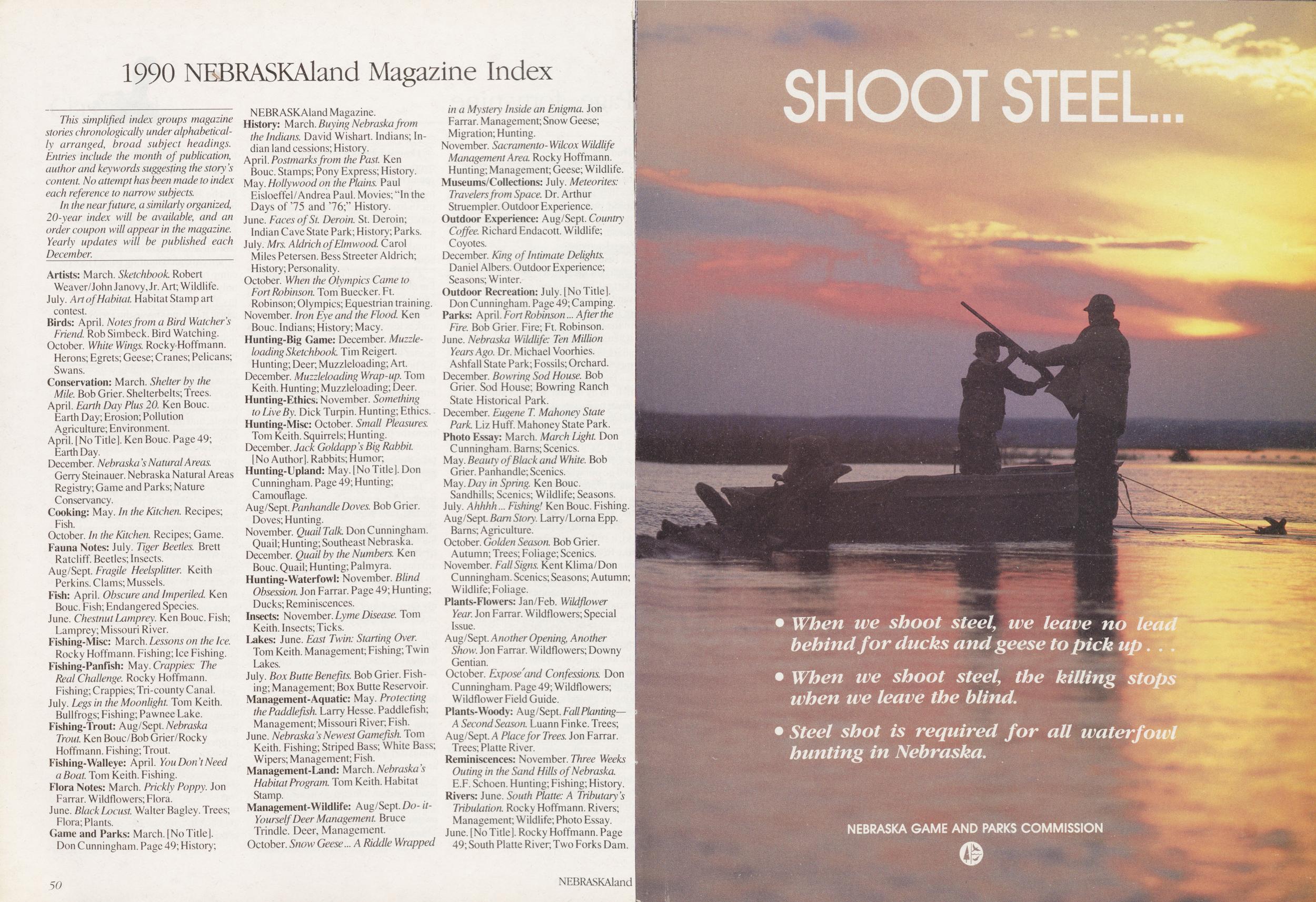
1990 NBBRASKAland Magazine Index
This simplified index groups magazine stories chronologically under alphabetically arranged, broad subject headings. Entries include the month of publication, author and keywords suggesting the story ys content. No attempt has been made to index each reference to narrow subjects. In the near future, a similarly organized, 20-year index will be available, and an order coupon will appear in the magazine. Yearly updates will be published each December. Artists: March. Sketchbook. Robert Weaver/John Janovy, Jr. Art; Wildlife. July. Art of Habitat. Habitat Stamp art contest. Birds: April. Notes from a Bird Watcher's Eriend. Rob Simbeck. Bird Watching. October. White Wings. Rocky Hoffmann. Herons; Egrets; Geese; Cranes; Pelicans; Swans. Conservation: March. Shelter by the Mile. Bob Grier. Shelterbelts; frees. April. Earth Day Plus 20. Ken Bouc. Earth Day; Erosion; Pollution Agriculture; Environment. April. [No Title]. Ken Bouc. Page 49; Earth Day. December. Nebraskafs Natural Areas. Gerry Steinauer. Nebraska Natural Areas Registry; Game and Parks; Nature Conservancy. Cooking: May. In the Kitchen. Recipes; Fish. October. In the Kitchen. Recipes; Game. Fauna Notes: July. Tiger Beetles. Brett Ratcliff. Beetles; Insects. Aug/Sept. Fragile Heelsplitter. Keith Perkins. Clams; Mussels. Fish: April. Obscure and Imperiled. Ken Bouc. Fish; Endangered Species. June. Chestnut Lamprey. Ken Bouc. Fish; Lamprey; Missouri River. Fishing-Misc: March. Lessons on the Ice. Rocky Hoffmann. Fishing; Ice Fishing. Fishing-Panfish: May. Crappies: The Real Challenge. Rocky Hoffmann. Fishing; Crappies; Tri-county Canal. July. Legs in the Moonlight. Tom Keith. Bullfrogs; Fishing; Pawnee Lake. Fishing-Trout: Aug/Sept. Nebraska Trout. Ken Bouc/Bob Grier/ Rocky Hoffmann. Fishing; Trout. Fishing-Walleye: April. You Don t Need a Boat. Tom Keith. Fishing. Flora Notes: March. Prickly Poppy. Jon Farrar. Wildflowers; Flora. June. Black Locust. Walter Bagley. Trees; Flora; Plants. Game and Parks: March. [NoTitle]. Don Cunningham. Page 49; History; NEBRASKAland Magazine. History: March. Buying Nebraska from the Indians. David Wishart. Indians; Indian land cessions; History. April. Postmarks from the Past. Ken Bouc. Stamps; Pony Express; History. May. Hollywood on the Plains. Paul Eisloeffel/Andrea Paul. Movies; "In the Days of 75 and 76;" History. June. Faces of St. Deroin. St. Deroin; Indian Cave State Park; History; Parks. July. Mrs. Aldrich of Elmwood. Carol Miles Petersen. Bess Streeter Aldrich; History; Personality. October. When the Olympics Came to Fort Robinson. Tom Buecker. Ft. Robinson; Olympics; Equestrian training. November. Iron Eye and the Flood. Ken Bouc. Indians; History; Macy. Hunting-Big Game: December. Muzzleloading Sketchbook. Tim Reigert. Hunting; Deer; Muzzleloading; Art. December. Muzzleloading Wrap-up. Tom Keith. Hunting; Muzzleloading; Deer. Hunting-Ethics. November. Something to Live By. Dick Tuipin. Hunting; Ethics. Hunting-Misc: October. Small Pleasures. Tom Keith. Squirrels; Hunting. December. Jack Goldapp fs Big Rabbit. [No Author]. Rabbits; Humor; Hunting-Upland: May. [No Title]. Don Cunningham. Page 49; Hunting; Camouflage. Aug/Sept. Panhandle Doves. Bob Grier. Doves; Hunting. November. QuailTalk Don Cunningham. Quail; Hunting; Southeast Nebraska. December. Quail by the Numbers. Ken Bouc. Quail; Hunting; Palmyra. Hunting-Waterfowl: November. Blind Obsession. Jon Farrar. Page 49; Hunting; Ducks; Reminiscences. Insects: November. Lyme Disease. Tom Keith. Insects; Ticks. Lakes: June. East Twin: Starting Over. Tom Keith. Management; Fishing; Twin Lakes. July. Box Butte Benefits. Bob Grier. Fishing; Management; Box Butte Reservoir. Management-Aquatic: May. Protecting the Paddlefish. Larry Hesse. Paddlefish; Management; Missouri River; Fish. June. Nebraska s Newest Gamefish. Tom Keith. Fishing; Striped Bass; White Bass; Wipers; Management; Fish. Management-Land: March.Nebraska's Habitat Program. Tom Keith. Habitat Stamp. Management-Wildlife: Aug/Sept. Do- it-YourselfDeer Management. Bruce Trindle. Deer, Management. October. Snow Geese A Riddle Wrapped in a Mystery Inside an Enigma. Jon Farrar. Management; Snow Geese; Migration; Hunting. November. Sacramento- Wilcox Wildlife Management Area. Rocky Hoffmann. Hunting; Management; Geese; Wildlife. Museums/Collections: July. Meteorites: Travelers from Space. Dr. Arthur Struempler. Outdoor Experience. Outdoor Experience: Aug/Sept. Country Coffee. Richard Endacott. Wildlife; Coyotes. December. King of Intimate Delights. Daniel Albers. Outdoor Experience; Seasons; Winter. Outdoor Recreation: July. [No Title]. Don Cunningham. Page 49; Camping. Parks: April. Fort Robinson... After the Fire. Bob Grier. Fire; Ft. Robinson. June. Nebraska Wildlife: Ten Million Years Ago. Dr. Michael Voorhies. Ashfall State Park; Fossils; Orchard. December. Bowring Sod House. Bob Grier. Sod House; Bowring Ranch State Historical Park. December. Eugene T Mahoney State Park Liz Huff. Mahoney State Park. Photo Essay: March. March Light. Don Cunningham. Barns; Scenics. May. Beauty of Black and White. Bob Grier. Panhandle; Scenics. May. Day in Spring. Ken Bouc. Sandhills; Scenics; Wildlife; Seasons. July. Ahhhh... Fishing! Ken Bouc. Fishing. Aug/Sept. Barn Story. Larry/Lorna Epp. Barns; Agriculture. October. Golden Season. Bob Grier. Autumn; Trees; Foliage; Scenics. November. Fall Signs. KentKlima/Don Cunningham. Scenics; Seasons; Autumn; Wildlife; Foliage. Plants-Flowers: Jan/Feb. Wildflower Year. Jon Farrar. Wildflowers; Special Issue. Aug/Sept. Another Opening, Another Show. Jon Farrar. Wildflowers; Downy Gentian. October. Expose and Confessions. Don Cunningham. Page 49; Wildflowers; Wildflower Field Guide. Plants-Woody: Aug/Sept. Fall Planting A Second Season. Luann Finke. Trees; Aug/Sept. A Place for Trees. Jon Farrar. Trees; Platte River. Reminiscences: November. Three Weeks Outing in the Sand Hills of Nebraska. E.F. Schoen. Hunting; Fishing; History. Rivers: June. South Platte: A Tributary's Tribulation. Rocky Hoffmann. Rivers; Management; Wildlife; Photo Essay. June. [No Title]. Rocky Hoffmann. Page 49; South Platte River; Two Forks Dam. 50 NEBRASKAland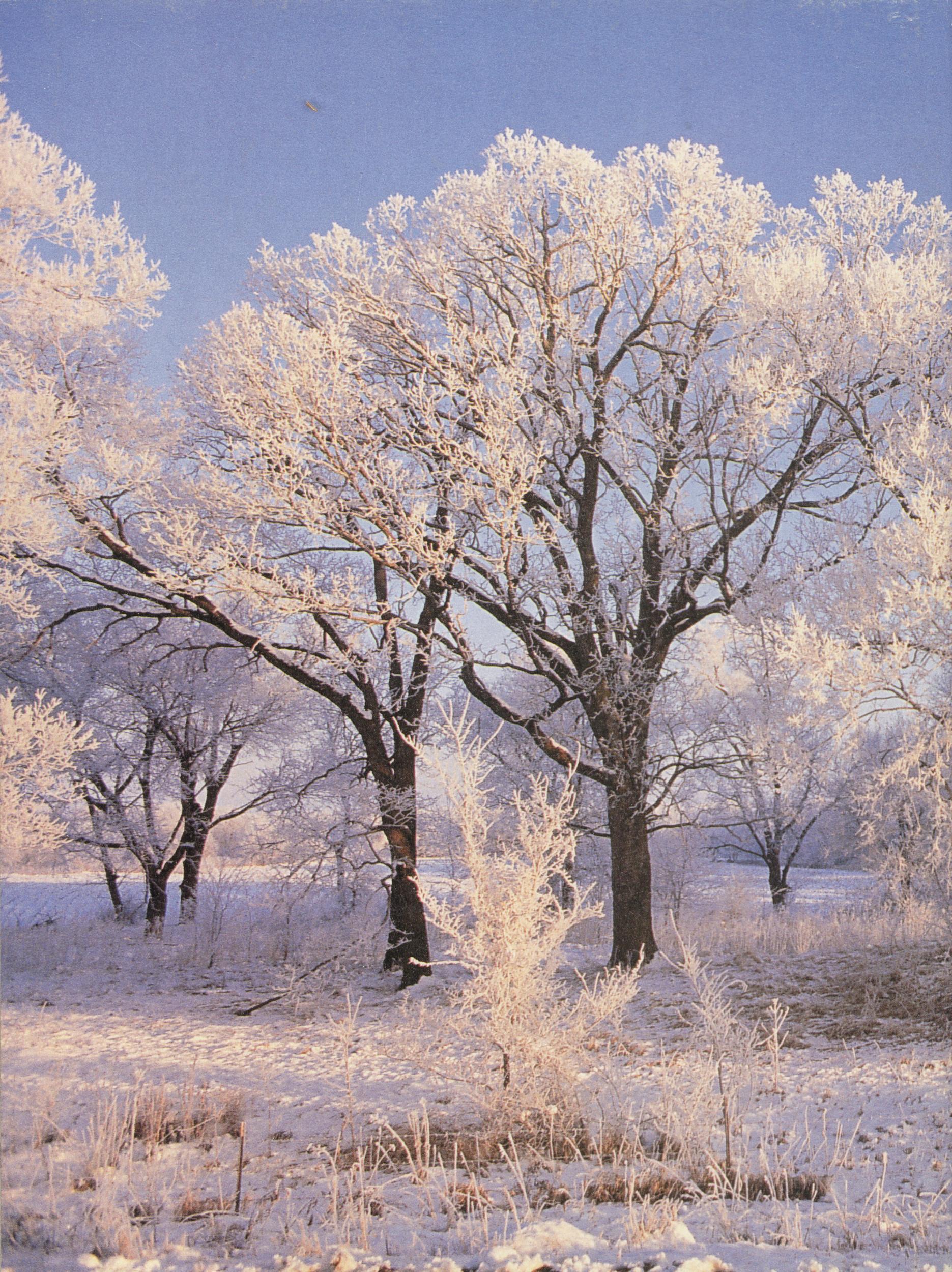
Position: 270 (30 views)