Volume 68, Issue 9, 1990
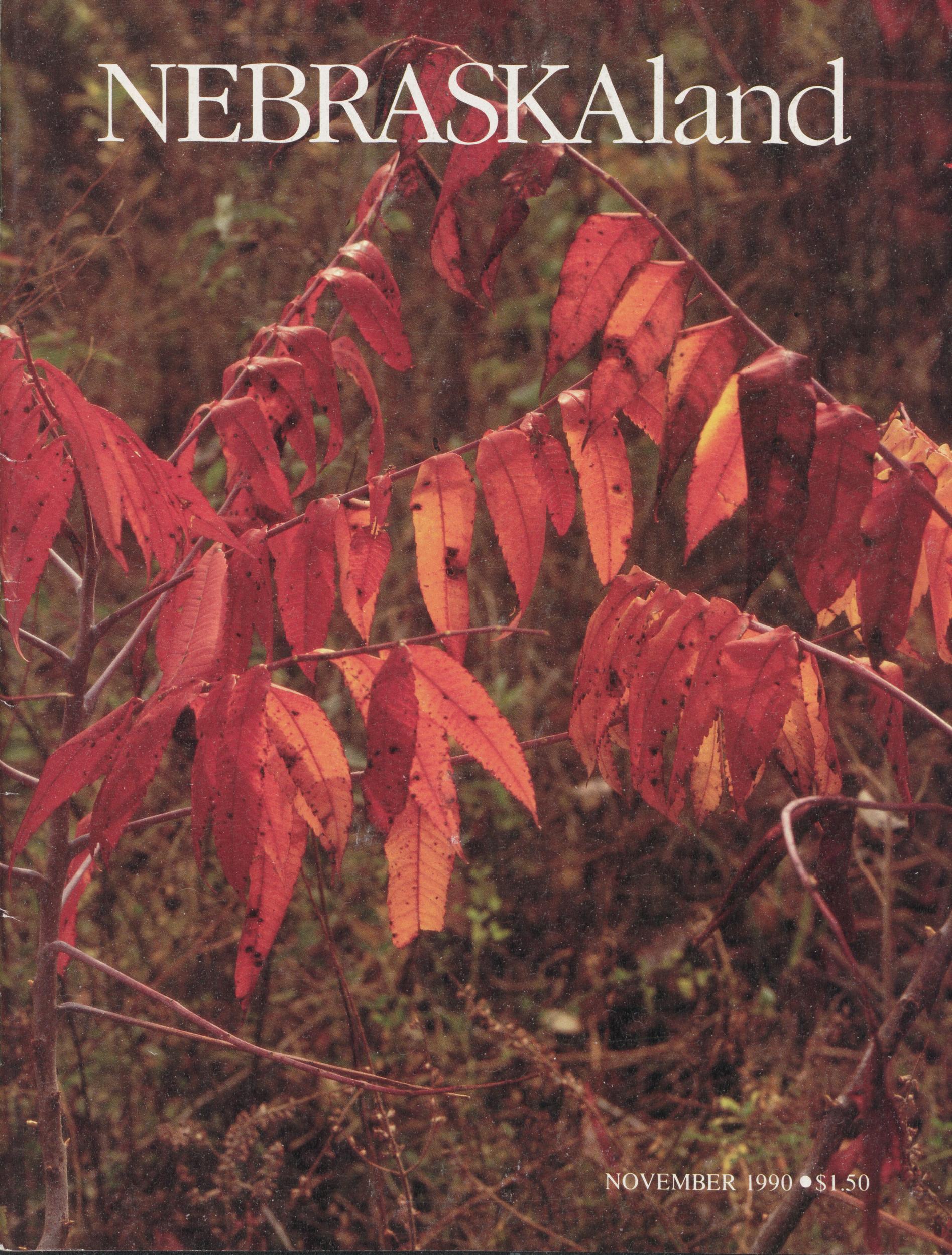
NEBRASKAland
NOVEMBER 1990 $1.50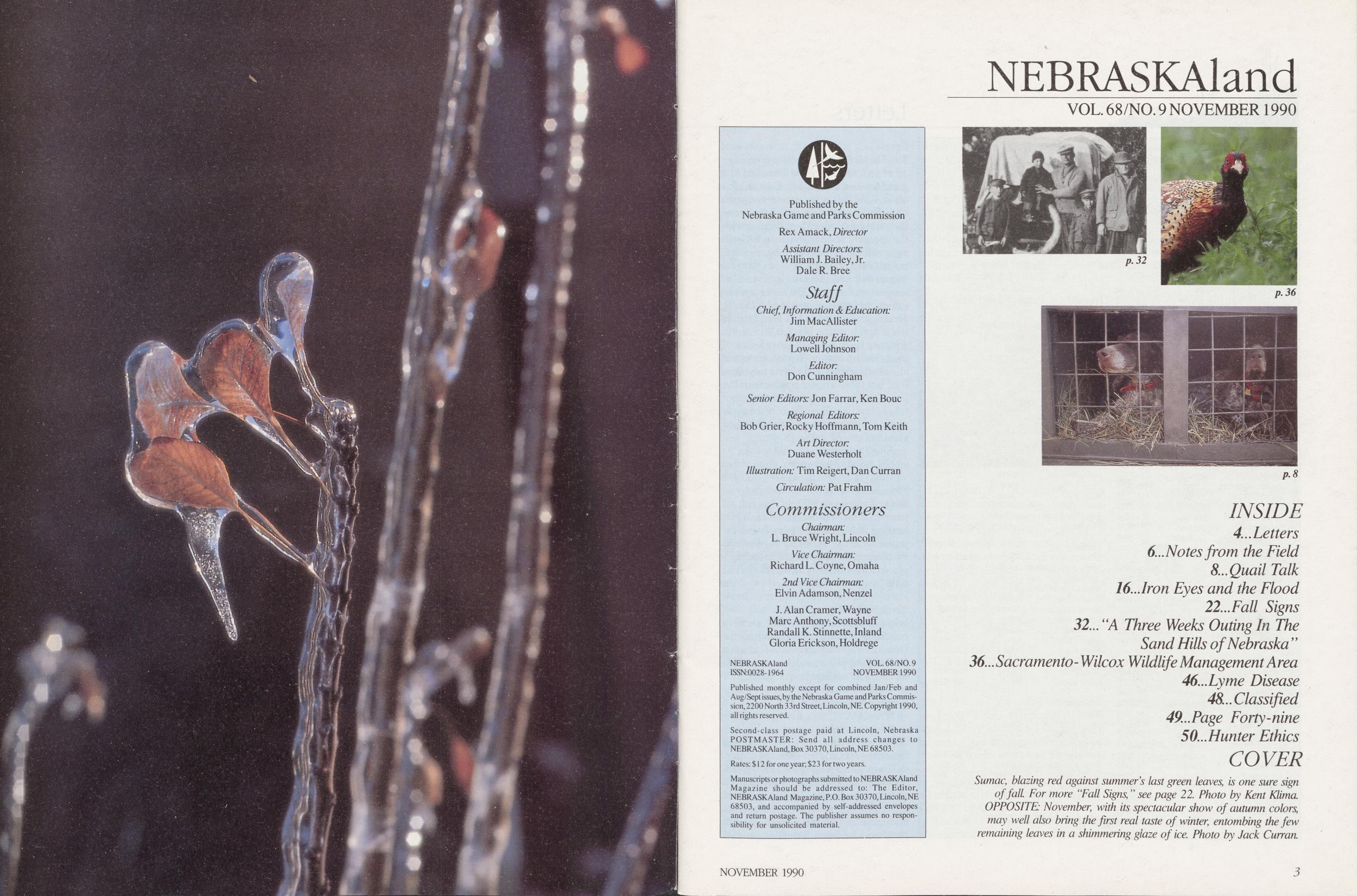
NEBRASKAland
VOL.68/N0.9 NOVEMBER 1990 Published monthly except for combined Jan/Feb and Aug/Sept issues, by the Nebraska Game and Parks Commission, 2200 North 33rd Street, Lincoln, NE. Copyright 1990, all rights reserved. Second-class postage paid at Lincoln, Nebraska POSTMASTER: Send all address changes to NEBRASKAland, Box 30370, Lincoln, NE 68503. Rates: $ 12 for one year; $23 for two years. Manuscripts or photographs submitted to NEBRASKAland Magazine should be addressed to: The Editor, NEBRASKAland Magazine, P.O. Box 30370, Lincoln, NE 68503, and accompanied by self-addressed envelopes and return postage. The publisher assumes no responsibility for unsolicited material. INSIDE 4 Letters 6 Notes from the Field 8 Quail Talk 16 Iron Eyes and the Flood 22 Fall Signs 32 "A Three Weeks Outing In The Sand Hills of Nebraska " 36 Sacramento- Wilcox Wildlife Management Area 46 Lyme Disease 48 Classified 49 Page Forty-nine 50 Hunter Ethics COVER Sumac, blazing red against summers last green leaves, is one sure sign of fall For more 'Fall Signs," see page 22. Photo by Kent Klima. OPPOSITE: November, with its spectacular show of autumn colors, may well also bring the first real taste of winter, entombing the few remaining leaves in a shimmering glaze of ice. Photo by Jack Curran. NOVEMBER 1990 3
Letters
EgretsSir/ The bird in the photograph on page 12 of your October issue identified as a great (or common) egret, Casmerodius albus, is, in fact, a snowy egret, Egretta thula. Snowies are roughly 2/3 the size of the great egret, which is in keeping with the apparent scale of the picture. Great egrets also seldom perch in that posture, but snowies commonly do. The relatively shorter bill and greenish legs are also suggestive of a snowy. But the unequivocal identifying feature is the black bill: great egrets all have yellow bills; the only white heron with a black bill in North America is the snowy. During much of the breeding season, Snowy egrets are also characterized by their lemon-yellow feet, but these are not apparent in the photo. Evidently, either the shot was not taken at the right time of year, or the angle of the light was wrong for proper foot viewing.
Alan B. Bond UNL State Museum Pheasant FanciersSir/1 have enjoyed hunting pheasants in your state for the past six years. While hunting in Nebraska, I have found the people to be the friendliest anywhere in the country. We had no problem finding a place to hunt, as long as we asked. The state land was well kept, and provided lots of birds. One of the main reasons we have been coming back to Nebraska is the help we received the first year we were out there. Officer Dayton Shultis of the Game Commission helped us find some good hunting places, and was very nice to us. I think he needs to be commended for his work.
Edwin Danagan Rome, GASir/1 have been receiving your magazine for many years, and it is the finest conservation magazine of any state I have read. If I live till pheasant season, I will return to Nebraska for my 33rd year. I have made lots of friends around Hastings, Harwood and Guide Rock area. The people are the finest, friendliest people I 4 NEBRASKAland have ever met.
I was introduced to pheasants when I was stationed at McCook in 1943 and '44.1 am approaching 70 years old, and the cornrows are getting longer, but just to be there on opening day, and to hear a rooster cackle, and hunt with good friends is a great experience.
I believe you could improve your magazine a little: after the commission has had its meeting, I believe you should publish in NEBRASKAland the seasons of your game birds and animals, giving opening and closing days and cost of licenses.
Thank you for your great state of Nebraska and the wonderful times I have had there. Hope to see you this fall.
Harold A. Straughan Farmington,MOUnfortunately, the date of the Commission meeting at which season dates are set allows too little lead time for their publication in a timely issue of the magazine. The Game and Parks Commission does maintain an out-of-state hunter list, however, and if you write and request that your name be added, you will be sent season information as soon as it becomes available. Write to The Nebraska Game and Parks Commission, P. O. Box 303 70, Lincoln, NE 68503. (Editor)
BarnsSir/1 just returned from a visit with my sister in the Kearney area and had a wonderful time. Things look so good in good old Nebraska where I was born.
Everyone knows NEBRASKAland Magazine is perhaps the best in the states—I know it rates in the top five. I've been taking it for many years. My mother sent it to me even after I left before WW II. It's the greatest. Is that too much flattery? Hope not.
I was real pleased with the August/September issue because of uThe Barn Story." I am enclosing a photo that I feel ties in with the excellent barn story and hope you, with the Epps, can help identify this barn. On my way home from Nebraska, I photographed the enclosed barn. I was born in Nebraska and had never seen a barn like it.
Lo and behold, this spring I got a letter from my sister filled with newspaper clippings of the cranes in migration (Swede Lind and I went bird watching together about three weeks ago. Norris Alfred of Polk Progress fame usually goes with us but since he retired he is hard to find).
In with the crane clippings was one of a barn. My first reaction was that I knew that barn, but then I realized there was a mite of difference and my barn is from south of York; this one was near Weston.
I believe these barns have the same blueprints and are made by Swedes, Germans, who knows? The architecture is the same. Could you help me find information as to its use, etc? Maybe the Epps could help. Are there any more examples around? Maybe one of your readers could help us identify this barn. Keep up the good work.
Lisle Carlson Jackson, MS TankhousesSir/1 am a graduate student majoring in geography at the University of Akron in Akron, Ohio. Although I am attending school in Ohio, my hometown is Ravenna, Nebraska, located about 2 hours west of Lincoln. I am writing to you concerning my proposed research thesis idea, which has to do with the cultural geography of Nebraska.
The subject of my research is the number, location and distribution of domestic tankhouses in Nebraska, most likely in the southwestern part of the state. Originally thought only to exist in California, recent research has shown that tankhouses are numerous in the northwestern section of Kansas, and it is my assumption that there exist a number of them in the southwestern part of Nebraska.
I was wondering if your magazine would have published an article on tankhouses, or referred to them in any way. If so, please let me know the year and volume number so I can refer it in my research. Any information that you may have on this subject would be greatly appreciated.
Aaron Boucher 1008 Grand Avenue Ravenna, NE 68869NEBRASKAland has not published anything on tankhouses—the elevated, usually enclosed windmill water tanks that provided a gravity water pressure system—but perhaps our readers can help. The accompanying illustration is one of many possible types.
Sir/1 was wondering if there is an index of NEBRASKAland Magazine articles. If there is I would appreciate it if you would send a copy to me. Thank you.
Don Bader Lexington, NEAn index to NEBRASKAland is currently in preparation. We hope it will be finished and ready for distribution early next year. When it is available, we will announce it in the magazine. (Editor)
NOVEMBER 1990 5
Notes from the field
From P. Joe Gabig, Nebraska Game and Parks Commission waterfowl biologist, comes the following note:
/ want more mallards. I want more mallards in the fall, in the winter in the spring and in the summer. I want more in the nest and in the bag. I want more mallards on the marsh, on the lake, on the pond, and in the air. I want "more mallards '' on more people's minds.
If, as a youngster, I had said this to Mom and Dad, they would have offered the standard fare I offer to my own children: "That's all you say: 7 want. I want.' Well you can 'thave everything you want. "But I praise the child who finds 11 grass cutting or babysitting jobs, and saves, and finally gets the shotgun she wants. Perhaps by showing resolve in working toward her goal she will find her Dad willing to contribute to the effort.
I am resolved to have more mallards. But I want more than that. I want better flood and pollution control, more timber, more muskrats, cleaner streams, more fish and clams, more shorebirds, more and healthier ducks and geese of all kinds. Mom would surely say: "you can 9t have it all!" Maybe, just maybe, with mallards, it's different.
To have more mallards, we need more wet places near which mallards can nest, and on which they can raise broods, rest during migration, and spend the winter. These wet places must have high quality vegetation and food, either on them or nearby. If we can have more high quality places for mallards to live, then we can have it all What a bargain—just do some things to get more mallards and, like a high-class magic act, other benefits come out of the hat.
I was explaining these things to a fellow duck hunter and she asked: "Since you listed so many places where, and times when you want more mallards, where will you start?" "Good question," I said, giving myself time to think.
Over the course of a year, mallards have a large home range. At some time during their annual cycle, they use places near most of us. We can do something to have more mallards almost everywhere, and no one knows the local haunts of mallards better than the people who live there. As locals, we know where the mallards used to be—places now developed somehow. Therefore, knowing our own local mallards like we do, we can each be very effective in providing new places for mallards, virtually in our own backyards.
Many people point to the need to increase production of young as a first step to having more mallards. I strongly subscribe to that idea. That must be priority one. But given the high degree of wetland loss throughout North America, we must also take the steps necessary to preserve migration and wintering habitat.
"I'll start right here in Nebraska," I finally answered. "Otherpeople can start where they live. If we all work together, there will be plenty of places for mallards year round." Without hesitation, she asked, "But how would someone like me start working for more mallards? What would I do?"
"Another good question," I thought, but I said, "Let me get you another cup of coffee." Setting the steaming coffee on the table, I explained that there are many local ways to get involved. They range from raising local money to hands-on wetland preservation and enhancement. One thing to keep in mind is that the word local does not mean the same thing to everyone. A wetland on your own land may need attention—that's about as local as you can get. For others, local might mean a region. For yet others, the entire state might be the place to work.
A starting point for a work assignment might be to contact a member of a local conservation organization. Some national organizations that have chapters and representatives in many home towns include the Wildlife Federation, Izaak Walton League, Ducks Unlimited, Audubon Society, Sierra Club and others. You might contact your local game warden or conservation officer to learn which of these organizations have representatives near you. In addition, he should be able to put you in touch with the right person in the state wildlife 6 NEBRASKAland agency. In many places, local government bodies have—or should have—an interest in preserving wetlands.
At this point, I had to warn my friend: it may take several phone calls to finally make connection with someone as enthusiastic about having more mallards as we are. It may actually take someone like you to generate the excitement you feel people should already have. Once you have located your new-found friend, be honest. If it becomes clear that the person is contributing to the cause by getting other people to donate money, and you don't have money to give, say so. But all organizations need people who can write to legislators, write articles for newsletters, lobby effectively by knowing what is wanted, or who have organizational skills. Other organizations already have on-the-ground mallard projects underway and need a work crew for a day.
There are ways to gauge how much time or money to set aside to help have more mallards. Perhaps an amount of time equal to the time you spend hunting would be appropriate to donate to organizing or fund raising within a local conservation group. If you don't hunt often (or at all), but still care about having more mallards, perhaps it would be possible to bank your conservation time against the hours you spend playing softball or golf or watching wildlife. You might take a similar approach to allocating "conservation dollars." If you spend $100 on duck hunting, consider spending that much through donations or the purchase of federal or state duck stamps.
"One more question," she said. ' 'Won't you be called greedy for shouting 7 want more mallards?'"
I was ready for that one. "If all I did was shout, and were not willing to get to work and pay my way, I could rightfully be called greedy. Some people may call me that anyway. As it is, I am willing to endure a bit of name calling while I work to get what I want."
So let the bells toll and the politicians and name callers hear the cry. I (shamelessly) want more mallards. I'm willing to work for that, and I hope you are too.
Quail Talk
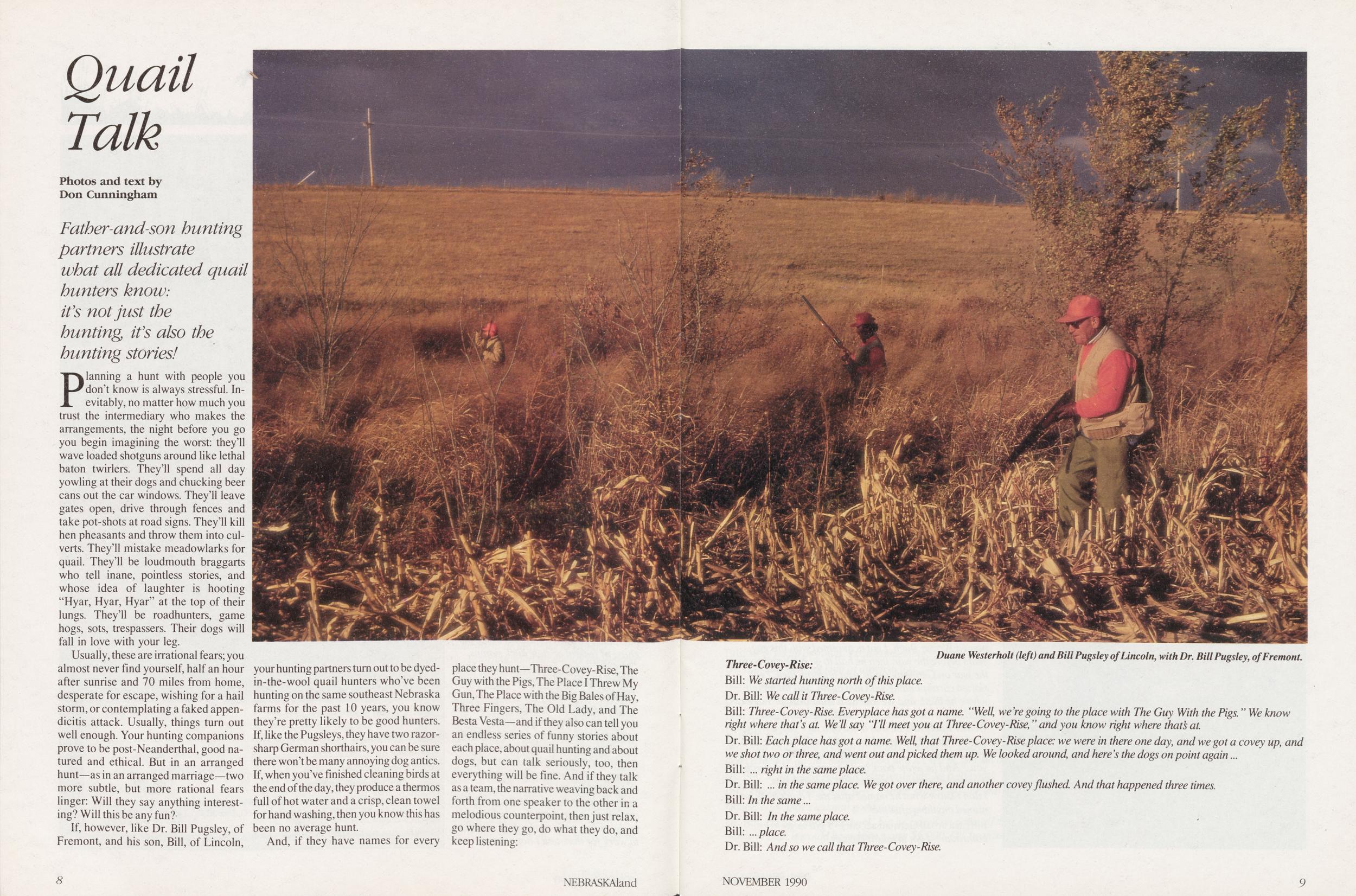
Photos and text by Don Cunningham Father-and-son hunting partners illustrate what all dedicated quail hunters know: it's not just the hunting it's also the hunting stories!Planning a hunt with people you don't know is always stressful. Inevitably, no matter how much you trust the intermediary who makes the arrangements, the night before you go you begin imagining the worst: they'll wave loaded shotguns around like lethal baton twirlers. They'll spend all day yowling at their dogs and chucking beer cans out the car windows. They'll leave gates open, drive through fences and take pot-shots at road signs. They'll kill hen pheasants and throw them into culverts. They'll mistake meadowlarks for quail. They'll be loudmouth braggarts who tell inane, pointless stories, and whose idea of laughter is hooting "Hyar, Hyar, Hyar" at the top of their lungs. They'll be roadhunters, game hogs, sots, trespassers. Their dogs will fall in love with your leg.
Usually, these are irrational fears; you almost never find yourself, half an hour after sunrise and 70 miles from home, desperate for escape, wishing for a hail storm, or contemplating a faked appendicitis attack. Usually, things turn out well enough. Your hunting companions prove to be post-Neanderthal, good natured and ethical. But in an arranged hunt—as in an arranged marriage—two more subtle, but more rational fears linger: Will they say anything interesting? Will this be any fun?
If, however, like Dr. Bill Pugsley, of Fremont, and his son, Bill, of Lincoln, your hunting partners turn out to be dyed-in-the-wool quail hunters who've been hunting on the same southeast Nebraska farms for the past 10 years, you know they're pretty likely to be good hunters. If, like the Pugsleys, they have two razorsharp German shorthairs, you can be sure there won't be many annoying dog antics. If, when you've finished cleaning birds at the end of the day, they produce a thermos full of hot water and a crisp, clean towel for hand washing, then you know this has been no average hunt.
And, if they have names for every place they hunt—Three-Covey-Rise, The Guy with the Pigs, The Place I Threw My Gun, The Place with the Big Bales of Hay, Three Fingers, The Old Lady, and The Besta Vesta—and if they also can tell you an endless series of funny stories about each place, about quail hunting and about dogs, but can talk seriously, too, then everything will be fine. And if they talk as a team, the narrative weaving back and forth from one speaker to the other in a melodious counterpoint, then just relax, go where they go, do what they do, and keep listening:
8 NEBRASKAlandBill: We started hunting north of this place.
Dr. Bill: We call it Three-Covey-Rise.
Bill: Three-Covey-Rise. Everyplace has got a name. i(Well, we're going to the place with The Guy With the Pigs." We know right where that's at. We'll say lTU meet you at Three-Covey-Rise," and you know right where that's at.
Dr. Bill: Each place has got a name. Well, that Three- Covey-Rise place: we were in there one day, and we got a covey up, and we shot two or three, and went out and picked them up. We looked around, and here's the dogs on point again
Bill: right in the same place.
Dr. Bill: in the same place. We got over there, and another covey flushed. And that happened three times.
Bill: In the same
Dr. Bill: In the same place.
Bill: place.
Dr. Bill: And so we call that Three-Covey-Rise.
NOVEMBER 1990 9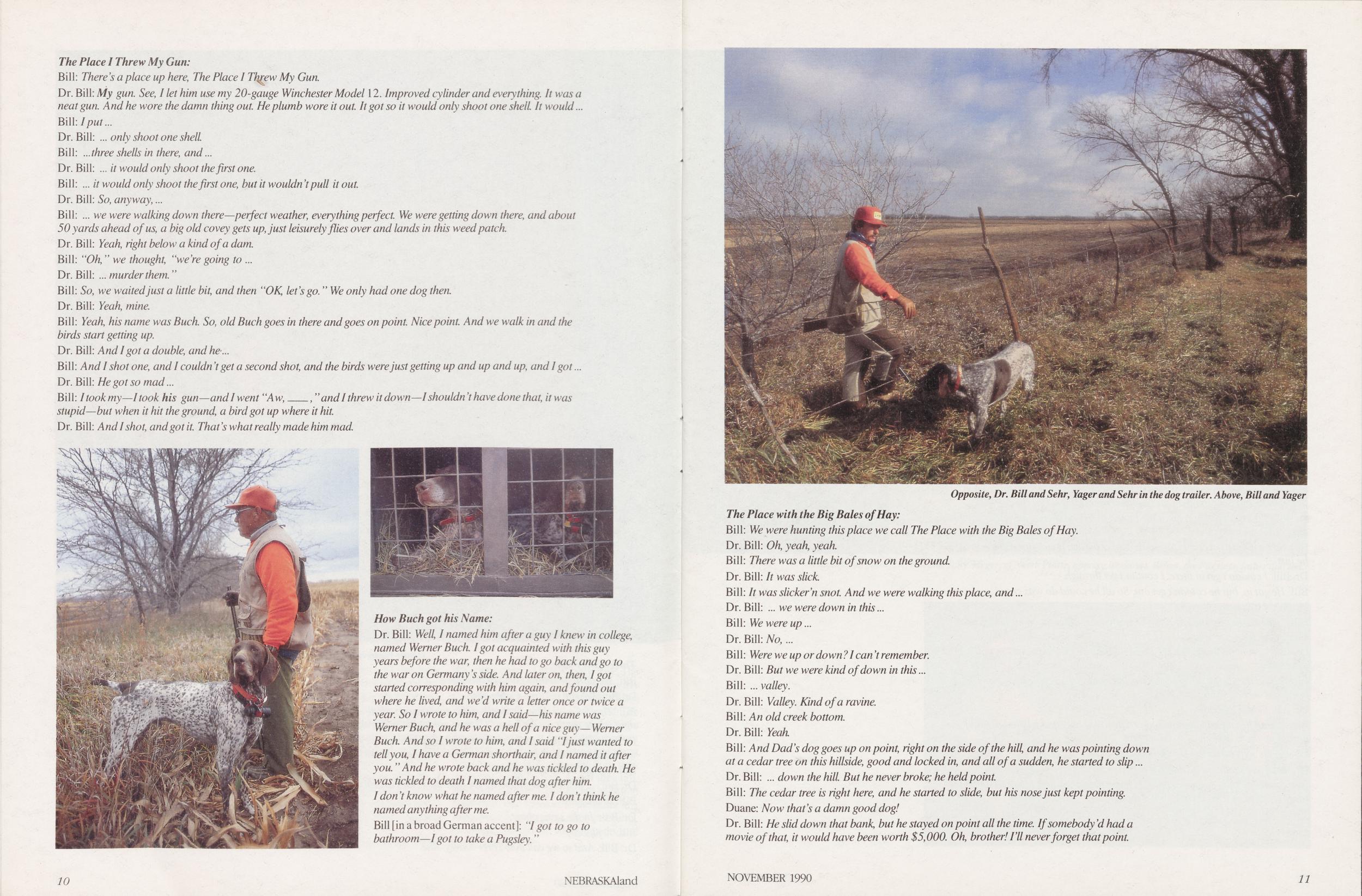 The Place I Threw My Gun:
Bill: There's a place up here, The Place I Tlwew My Gun.
Dr. Bill: My gun. See, I let him use my 20-gauge Winchester Model 12. Improved cylinder and everything. It was a neat gun. And he wore the damn thing out. He plumb wore it out. It got so it would only shoot one shell. It would...
Bill: I put
Dr. Bill: only shoot one shell.
Bill: three shells in there, and
Dr. Bill: it would only shoot the first one.
Bill: it would only shoot the first one, but it wouldn 'tpull it out.
Dr. Bill: So, anyway,
Bill: we were walking down there—perfect weather, everything perfect. We were getting down there, and about 50 yards ahead of us, a big old covey gets up, just leisurely flies over and lands in this weed patch.
Dr. Bill: Yeah, right below a kind of a dam.
Bill: "Oh," we thought, "we're going to
Dr. Bill: murder them."
Bill: So, we waited just a little bit, and then "OK, let's go." We only had one dog then.
Dr. Bill: Yeah, mine.
Bill: Yeah, his name was Buck So, old Buch goes in there and goes on point. Nicepoint. And we walk in and the birds start getting up.
Dr. Bill: And I got a double, and he
Bill: Andl shotone, and I couldn't get a second shot, and the birds were just getting up and up and up, and I got
Dr. Bill: He got so mad
Bill: I took my—I took his gun—andl went "Aw," and I threw it down I shouldn't have done that, itwas stupid—but when it hit the ground, a bird got up where it hit.
Dr. Bill: And I shot, and got it. That's what really made him mad.
Dr. Bill: Well, I named him after a guy I knew in college, named Werner Buch. I got acquainted with this guy years before the war, then he had to go back and go to the war on Germany's side. And later on, then, I got started corresponding with him again, and found out where he lived, and we'd write a letter once or twice a year. So I wrote to him, and I said—his name was Werner Buch, and he was a hell of a nice guy Werner Buch. And so I wrote to him, and I said "Ijust wanted to tell you, I have a German shorthair, and I named it after you." And he wrote back and he was tickled to death. He was tickled to death I named that dog after him. I don't know what he named after me. I don't think he named anything after me.
Bill [in a broad German accent]: "I got to go to bathroom—I got to take a Pugsley."
10 NEBRASKAlandBill: We were hunting this place we call The Place with the Big Bales of Hay.
Dr. Bill: Oh, yeah, yeah.
Bill: There was a little bit of snow on the ground.
Dr. Bill: It was slick.
Bill: It was slicker'n snot. And we were walking this place, and
Dr. Bill: we were down in this
Bill: We were up
Dr. Bill: No,
Bill: Were we up or down?I can't remember.
Dr. Bill: But we were kind of down in this
Bill: valley.
Dr. Bill: Valley. Kind of a ravine.
Bill: An old creek bottom.
Dr. Bill: Yeah
Bill: And Dad's dog goes up on point, right on the side of the hill and he was pointing down at a cedar tree on this hillside, good and locked in, and all of a sudden, he started to slip
Dr. Bill: down the hill. But he never broke; he held point.
Bill: The cedar tree is right here, and he started to slide, but his nose just kept pointing.
Duane: Now that's a damn good dog!
Dr. Bill: He slid down that bank, but he stayed on point all the time. If somebody d had a movie of that, it would have been worth $5,000. Oh, brother! I'll never forget that point.
NOVEMBER 1990 11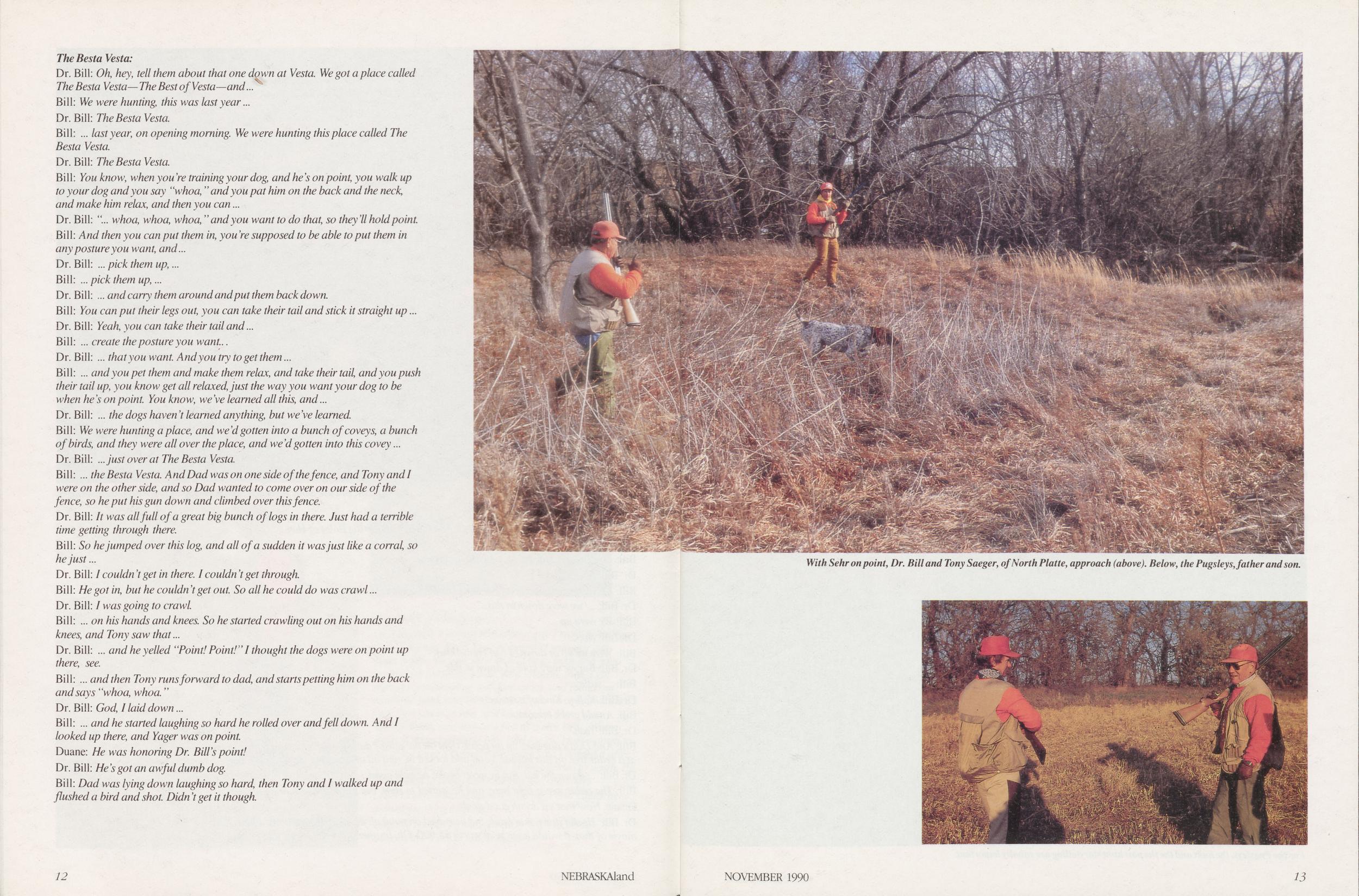 The Besta Vesta:
Dr. Bill: Oh, hey, tell them about that one down at Vesta. We got a place called The Besta Vesta—The Best of Vesta—and
Bill: We were hunting, this was last year
Dr. Bill: The Besta Vesta.
Bill: last year, on opening morning. We were hunting this place called The Besta Vesta.
Dr. Bill: The Besta Vesta.
Bill: You know, when you Ye training your dog, and he's on point, you walk up to your dog and you say "whoa, "and you pat him on the back and the neck, and make him relax, and then you can
Dr. Bill: " whoa, whoa, whoa, "and you want to do that, so they'll hold point.
Bill: And then you can put them in, you Ye supposed to be able to put them in any posture you want, and
Dr. Bill: pick them up,
Bill: pick them up,
Dr. Bill: and carry them around and put them back down.
Bill: You can put their legs out, you can take their tail and stick it straight up
Dr. Bill: Yeah, you can take their tail and
Bill: create the posture you want
Dr. Bill: that you want. And you try to get them
Bill: and you pet them and make them relax, and take their tail, and you push their tail up, you know get all relaxed, just the way you want your dog to be when he's on point. You know, we 've learned all this, and
Dr. Bill: the dogs haven 't learned anything, but we've learned.
Bill: We were hunting a place, and we'd gotten into a bunch of coveys, a bunch of birds, and they were all over the place, and we'd gotten into this covey
Dr. Bill: just over at The Besta Vesta.
Bill: the Besta Vesta. And Dad was on one side of the fence, and Tony and I were on the other side, and so Dad wanted to come over on our side of the fence, so he put his gun down and climbed over this fence.
Dr. Bill: It was all full of a great big bunch of logs in there. Just had a terrible time getting through there.
Bill: So he jumped over this log, and all of a sudden it was just like a corral, so he just
Dr. Bill: / couldn 'tget in there. I couldn 'tget through.
Bill: He got in, but he couldn 'tget out. So all he could do was crawl
Dr. Bill: / was going to crawl.
Bill: on his hands and knees. So he started crawling out on his hands and knees, and Tony saw that
Dr. Bill: and he yelled "Point! Point!" I thought the dogs were on point up there, see.
Bill: and then Tony runs forward to dad, and starts petting him on the back and says "whoa, whoa."
Dr. Bill: God, I laid down
Bill: and he started laughing so hard he rolled over and fell down. And I looked up there, and Yager was on point.
Duane: He was honoring Dr. Bill's point!
Dr. Bill: He's got an awful dumb dog.
Bill: Dad was lying down laughing so hard, then Tony and I walked up and flushed a bird and shot. Didn 't get it though.
12 NEBRASKAland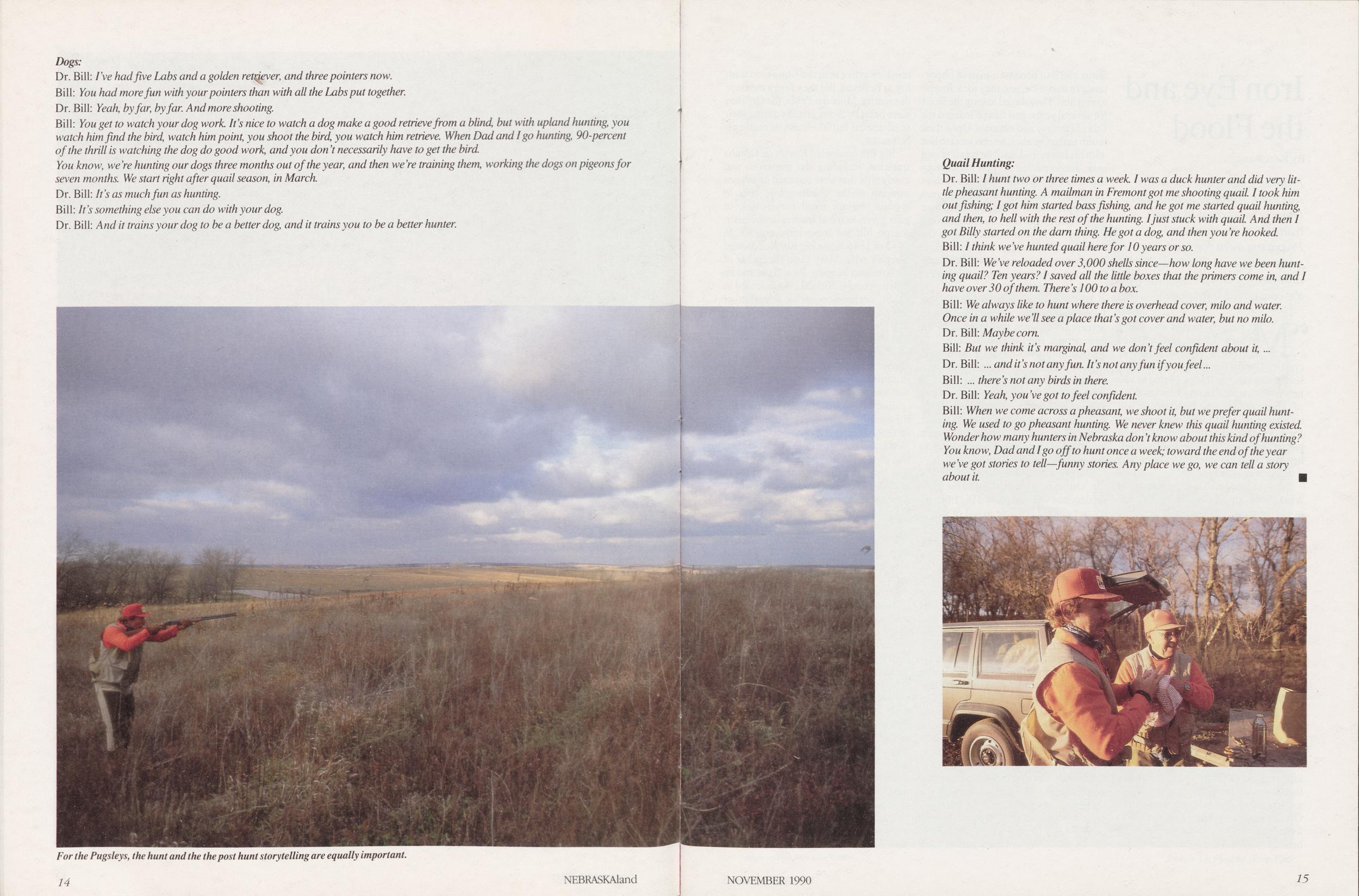 Dogs:
Dogs:
Dr. Bill: Tve had five Labs and a golden retqever, and three pointers now.
Bill: You had more fun with your pointers than with all the Labs put together.
Dr. Bill: Yeah, by far, by far. And more shooting.
Bill: You get to watch your dog work. It's nice to watch a dog make a good retrieve from a blind, but with upland hunting, you watch him find the bird, watch him point, you shoot the bird, you watch him retrieve. When Dad and I go hunting, 90-percent of the thrill is watching the dog do good work, and you don't necessarily have to get the bird. You know, we're hunting our dogs three months out of the year, andthen we're training them, working the dogs on pigeons for seven months. We start right after quail season, in March.
Dr. Bill: It's as much fun as hunting.
Bill: It's something else you can do with your dog.
Dr. Bill: And it trains your dog to be a better dog, and it trains you to be a better hunter.
Dr. Bill: / hunt two or three times a week. I was a duck hunter and did very little pheasant hunting. A mailman in Fremont got me shooting quail. I took him out fishing; I got him started bass fishing, and he got me started quail hunting, and then, to hell with the rest of the hunting. I just stuck with quail And then I got Billy started on the darn thing. He got a dog, and then you 're hooked.
Bill: / think we 've hunted quail here for 10 years or so.
Dr. Bill: We've reloaded over 3,000 shells since—how long have we been hunting quail? Ten years? I saved all the little boxes that the primers come in, and I have over 30 of them. There's 100 to a box.
Bill: We always like to hunt where there is overhead cover, milo and water. Once in a while we '11 see a place that's got cover and water, but no milo.
Dr. Bill: Maybe corn.
Bill: But we think it's marginal and we don't feel confident about it,
Dr. Bill: and it's not any fun. It's not any fun if you feel
Bill: there's not any birds in there.
Dr. Bill: Yeah, you've got to feel confident.
Bill: When we come across a pheasant, we shoot it, but we prefer quail hunting. We used to go pheasant hunting. We never knew this quail hunting existed. Wonder how many hunters in Nebraska don't know about this kind of hunting? You know, Dad and I go off to hunt once a week; toward the end of the year we've got stories to tell—funny stories. Any place we go, we can tell a story about it.
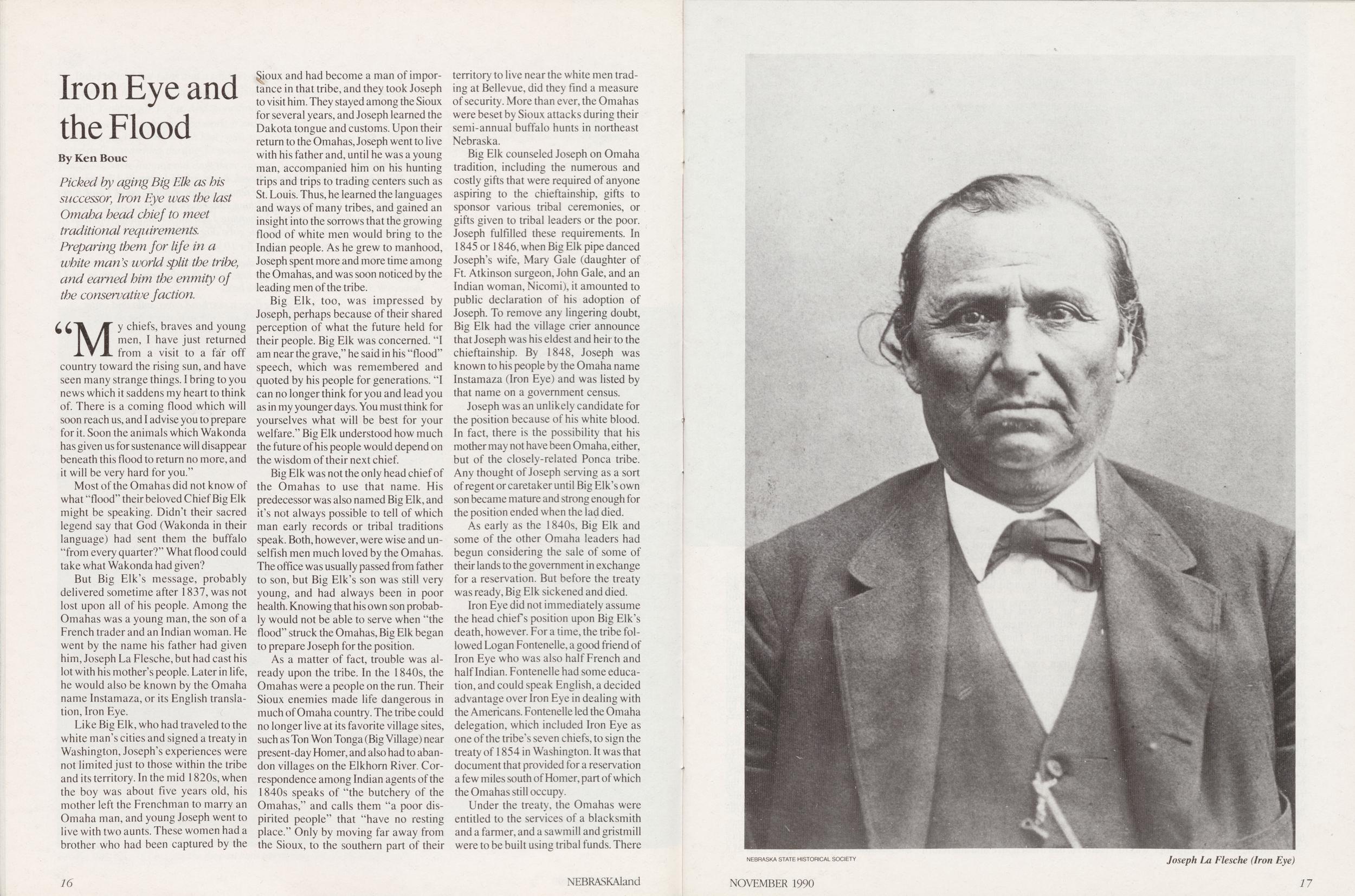
Iron Eye and the Flood
By Ken Bouc Picked by aging Big Elk as his successor, Iron Eye was the last Omaha head chief to meet traditional requirements Preparing them for life in a white man 's world split the tribe, and earned him the enmity of the conservative faction."My chiefs, braves and young men, I have just returned from a visit to a far off country toward the rising sun, and have seen many strange things. I bring to you news which it saddens my heart to think of. There is a coming flood which will soon reach us, and I advise you to prepare for it. Soon the animals which Wakonda has given us for sustenance will disappear beneath this flood to return no more, and it will be very hard for you."
Most of the Omahas did not know of what "flood" their beloved Chief Big Elk might be speaking. Didn't their sacred legend say that God (Wakonda in their language) had sent them the buffalo "from every quarter?" What flood could take what Wakonda had given?
But Big Elk's message, probably delivered sometime after 1837, was not lost upon all of his people. Among the Omahas was a young man, the son of a French trader and an Indian woman. He went by the name his father had given him, Joseph La Flesche, but had cast his lot with his mother's people. Later in life, he would also be known by the Omaha name Instamaza, or its English translation, Iron Eye.
Like Big Elk, who had traveled to the white man's cities and signed a treaty in Washington, Joseph's experiences were not limited just to those within the tribe and its territory. In the mid 1820s, when the boy was about five years old, his mother left the Frenchman to marry an Omaha man, and young Joseph went to live with two aunts. These women had a brother who had been captured by the Sioux and had become a man of importance in that tribe, and they took Joseph to visit him. They stayed among the Sioux for several years, and Joseph learned the Dakota tongue and customs. Upon their return to the Omahas, Joseph went to live with his father and, until he was a young man, accompanied him on his hunting trips and trips to trading centers such as St. Louis. Thus, he learned the languages and ways of many tribes, and gained an insight into the sorrows that the growing flood of white men would bring to the Indian people. As he grew to manhood, Joseph spent more and more time among the Omahas, and was soon noticed by the leading men of the tribe.
Big Elk, too, was impressed by Joseph, perhaps because of their shared perception of what the future held for their people. Big Elk was concerned. "I am near the grave," he said in his "flood" speech, which was remembered and quoted by his people for generations. "I can no longer think for you and lead you as in my younger days. You must think for yourselves what will be best for your welfare." Big Elk understood how much the future of his people would depend on the wisdom of their next chief.
Big Elk was not the only head chief of the Omahas to use that name. His predecessor was also named Big Elk, and it's not always possible to tell of which man early records or tribal traditions speak. Both, however, were wise and unselfish men much loved by the Omahas. The office was usually passed from father to son, but Big Elk's son was still very young, and had always been in poor health. Knowing that his own son probably would not be able to serve when "the flood" struck the Omahas, Big Elk began to prepare Joseph for the position.
As a matter of fact, trouble was already upon the tribe. In the 1840s, the Omahas were a people on the run. Their Sioux enemies made life dangerous in much of Omaha country. The tribe could no longer live at its favorite village sites, such as Ton Won Tonga (Big Village) near present-day Homer, and also had to abandon villages on the Elkhorn River. Correspondence among Indian agents of the 1840s speaks of "the butchery of the Omahas," and calls them "a poor dispirited people" that "have no resting place." Only by moving far away from the Sioux, to the southern part of their territory to live near the white men trading at Bellevue, did they find a measure of security. More than ever, the Omahas were beset by Sioux attacks during their semi-annual buffalo hunts in northeast Nebraska.
Big Elk counseled Joseph on Omaha tradition, including the numerous and costly gifts that were required of anyone aspiring to the chieftainship, gifts to sponsor various tribal ceremonies, or gifts given to tribal leaders or the poor. Joseph fulfilled these requirements. In 1845 or 1846, when Big Elk pipe danced Joseph's wife, Mary Gale (daughter of Ft. Atkinson surgeon, John Gale, and an Indian woman, Nicomi), it amounted to public declaration of his adoption of Joseph. To remove any lingering doubt, Big Elk had the village crier announce that Joseph was his eldest and heir to the chieftainship. By 1848, Joseph was known to his people by the Omaha name Instamaza (Iron Eye) and was listed by that name on a government census.
Joseph was an unlikely candidate for the position because of his white blood. In fact, there is the possibility that his mother may not have been Omaha, either, but of the closely-related Ponca tribe. Any thought of Joseph serving as a sort of regent or caretaker until Big Elk's own son became mature and strong enough for the position ended when the lad died.
As early as the 1840s, Big Elk and some of the other Omaha leaders had begun considering the sale of some of their lands to the government in exchange for a reservation. But before the treaty was ready, Big Elk sickened and died.
Iron Eye did not immediately assume the head chiefs position upon Big Elk's death, however. For a time, the tribe followed Logan Fontenelle, a good friend of Iron Eye who was also half French and half Indian. Fontenelle had some education, and could speak English, a decided advantage over Iron Eye in dealing with the Americans. Fontenelle led the Omaha delegation, which included Iron Eye as one of the tribe's seven chiefs, to sign the treaty of 1854 in Washington. It was that document that provided for a reservation a few miles south of Homer, part of which the Omahas still occupy.
Under the treaty, the Omahas were entitled to the services of a blacksmith and a farmer, and a sawmill and gristmill were to be built using tribal funds. There 16 NEBRASKAland
 was to be a $25,000 payment to settle
claims under former treaties, and the
document also had a provision allowing
individual tribe members to take tracts of
reservation land for their own use. In
addition, a school was to be provided by
the Presbyterian Board of Foreign Missions.
was to be a $25,000 payment to settle
claims under former treaties, and the
document also had a provision allowing
individual tribe members to take tracts of
reservation land for their own use. In
addition, a school was to be provided by
the Presbyterian Board of Foreign Missions.
The government dragged its feet in making the payment, proposing instead to give the Omahas an equivalent in food, tools, clothing and other goods. But Joseph La Flesche and Logan Fontenelle led the Omahas in insisting on a cash payment. They understood the freedom of choice that cash would give their people to buy what they needed. If they accepted payment in government goods, they might be burdened with spoiled food, unsuitable clothing and tools they did not know how to use.
Fontenelle and La Flesche finally prevailed, and on May 31, 1855, the government paid. But, it was to be Fontenelle's last victory. A few weeks later, as the Omahas hunted buffalo along Beaver Creek in what is now Boone County, he was killed by Sioux raiders.
That attack panicked the Omahas, who had felt all along that the new reservation was too near their enemies. They fled south once again, and did not return to the reservation until the next year. With Fontenelle dead, Joseph became head chief.
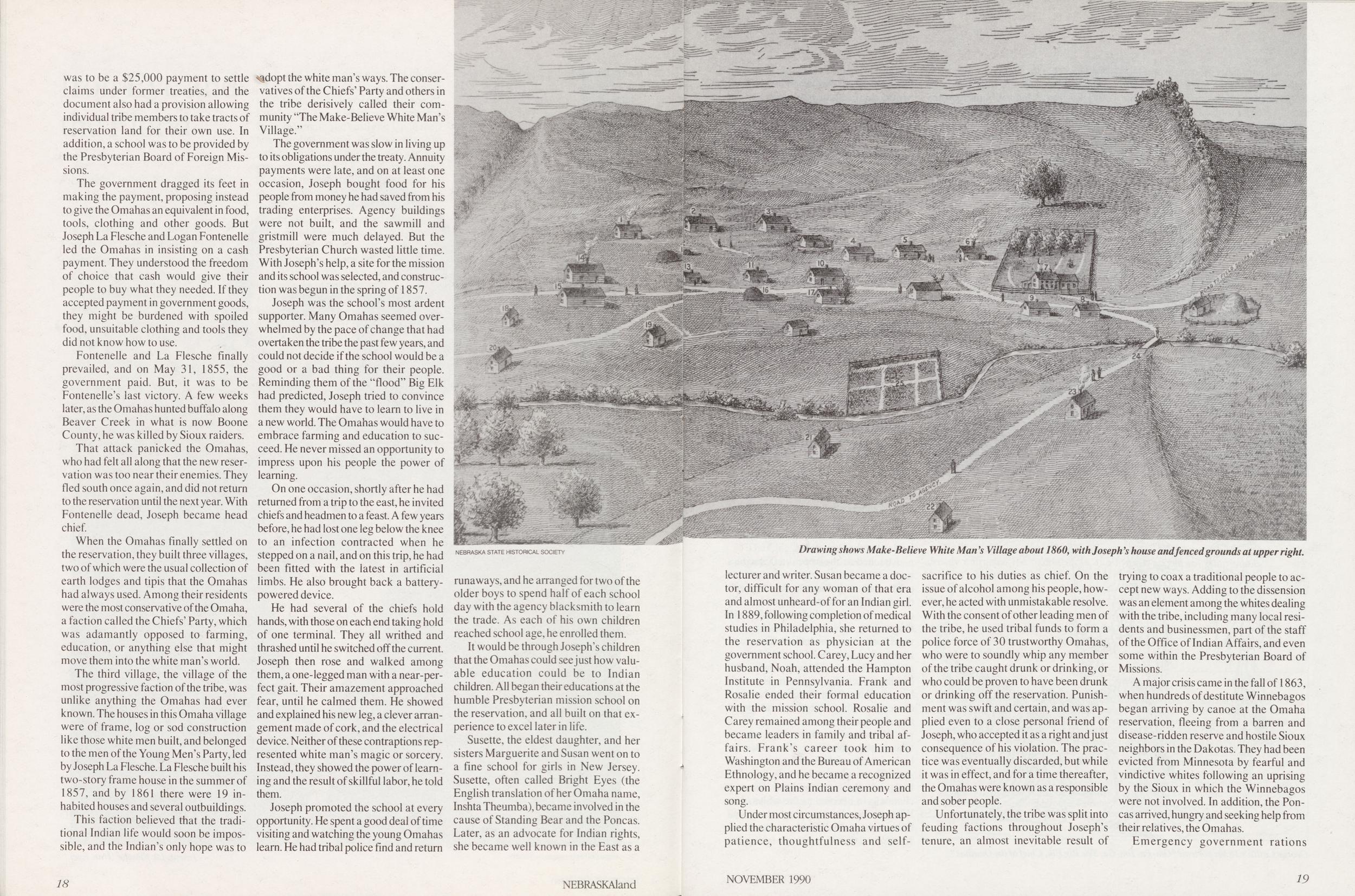
When the Omahas finally settled on the reservation, they built three villages, two of which were the usual collection of earth lodges and tipis that the Omahas had always used. Among their residents were the most conservative of the Omaha, a faction called the Chiefs' Party, which was adamantly opposed to farming, education, or anything else that might move them into the white man's world.
The third village, the village of the most progressive faction of the tribe, was unlike anything the Omahas had ever known. The houses in this Omaha village were of frame, log or sod construction like those white men built, and belonged to the men of the Young Men's Party, led by Joseph La Flesche. La Flesche built his two-story frame house in the summer of 1857, and by 1861 there were 19 inhabited houses and several outbuildings.
This faction believed that the traditional Indian life would soon be impossible, and the Indian's only hope was to ^idopt the white man's ways. The conservatives of the Chiefs' Party and others in the tribe derisively called their community "The Make-Believe White Man's Village."
The government was slow in living up to its obligations under the treaty. Annuity payments were late, and on at least one occasion, Joseph bought food for his people from money he had saved from his trading enterprises. Agency buildings were not built, and the sawmill and gristmill were much delayed. But the Presbyterian Church wasted little time. With Joseph's help, a site for the mission and its school was selected, and construction was begun in the spring of 1857.
Joseph was the school's most ardent supporter. Many Omahas seemed overwhelmed by the pace of change that had overtaken the tribe the past few years, and could not decide if the school would be a good or a bad thing for their people. Reminding them of the "flood" Big Elk had predicted, Joseph tried to convince them they would have to learn to live in a new world. The Omahas would have to embrace farming and education to succeed. He never missed an opportunity to impress upon his people the power of learning.
On one occasion, shortly after he had returned from a trip to the east, he invited chiefs and headmen to a feast. A few years before, he had lost one leg below the knee to an infection contracted when he stepped on a nail, and on this trip, he had been fitted with the latest in artificial limbs. He also brought back a batterypowered device.
He had several of the chiefs hold hands, with those on each end taking hold of one terminal. They all writhed and thrashed until he switched off the current. Joseph then rose and walked among them, a one-legged man with a near-perfect gait. Their amazement approached fear, until he calmed them. He showed and explained his new leg, a clever arrangement made of cork, and the electrical device. Neither of these contraptions represented white man's magic or sorcery. Instead, they showed the power of learning and the result of skillful labor, he told them.
Joseph promoted the school at every opportunity. He spent a good deal of time visiting and watching the young Omahas learn. He had tribal police find and return runaways, and he arranged for two of the older boys to spend half of each school day with the agency blacksmith to learn the trade. As each of his own children reached school age, he enrolled them.
It would be through Joseph's children that the Omahas could see just how valuable education could be to Indian children. All began their educations at the humble Presbyterian mission school on the reservation, and all built on that experience to excel later in life.
Susette, the eldest daughter, and her sisters Marguerite and Susan went on to a fine school for girls in New Jersey. Susette, often called Bright Eyes (the English translation of her Omaha name, Inshta Theumba), became involved in the cause of Standing Bear and the Poncas. Later, as an advocate for Indian rights, she became well known in the East as a 18 NEBRASKAland
Under most circumstances, Joseph applied the characteristic Omaha virtues of patience, thoughtfulness and selfsacrifice to his duties as chief. On the issue of alcohol among his people, however, he acted with unmistakable resolve. With the consent of other leading men of the tribe, he used tribal funds to form a police force of 30 trustworthy Omahas, who were to soundly whip any member of the tribe caught drunk or drinking, or who could be proven to have been drunk or drinking off the reservation. Punishment was swift and certain, and was applied even to a close personal friend of Joseph, who accepted it as a right and just consequence of his violation. The practice was eventually discarded, but while it was in effect, and for a time thereafter, the Omahas were known as a responsible and sober people.
Unfortunately, the tribe was split into feuding factions throughout Joseph's tenure, an almost inevitable result of trying to coax a traditional people to accept new ways. Adding to the dissension was an element among the whites dealing with the tribe, including many local residents and businessmen, part of the staff of the Office of Indian Affairs, and even some within the Presbyterian Board of Missions.
A major crisis came in the fall of 1863, when hundreds of destitute Winnebagos began arriving by canoe at the Omaha reservation, fleeing from a barren and disease-ridden reserve and hostile Sioux neighbors in the Dakotas. They had been evicted from Minnesota by fearful and vindictive whites following an uprising by the Sioux in which the Winnebagos were not involved. In addition, the Poncas arrived, hungry and seeking help from their relatives, the Omahas.
Emergency government rations
NOVEMBER 1990
19
 relieved some of the short-term problem,
and an abrasive and ambitious new agent,
Robert Furnas, proposed that part of the
Omaha Reservation be sold to the Winnebagos. Many of the tribe, including
Joseph, vigorously opposed the idea. The
treaty that placed the Omahas on the
reservation provided for individual allotments of land for tribe members, yet the
reservation had not even been surveyed.
They feared that any sale of land to the
Winnebagos or any other tribe might
leave the Omahas with too little land to
make the allotments. Yet Furnas aggressively pushed his idea through. A treaty
was signed in March of 1865 and ratified
about a year later.
relieved some of the short-term problem,
and an abrasive and ambitious new agent,
Robert Furnas, proposed that part of the
Omaha Reservation be sold to the Winnebagos. Many of the tribe, including
Joseph, vigorously opposed the idea. The
treaty that placed the Omahas on the
reservation provided for individual allotments of land for tribe members, yet the
reservation had not even been surveyed.
They feared that any sale of land to the
Winnebagos or any other tribe might
leave the Omahas with too little land to
make the allotments. Yet Furnas aggressively pushed his idea through. A treaty
was signed in March of 1865 and ratified
about a year later.
Knowing that part of their reservation was gone, that the Nebraska Territorial legislature was debating a bill mandating the removal of all Indians from Nebraska, and chafing under the authoritarian Agent Furnas, the Omahas grumbled in discontentment. And the whites remembered Joseph's resistance to their policies. In the spring of 1866, the government withdrew its recognition of Joseph as head chief of the Omahas and the Presbyterian Mission Board dismissed the Rev. R. J. Burtt of the Mission school, a supporter of Joseph and an ally in his promotion of education among the Omahas. Without government recognition, no chief could be effective, even if he held the tribe's loyalty. Moreover, most of the more conservative elements of the Omahas were opposed to Joseph. He left the reservation for a time, while one of his former policemen was named chief, although this man had not fulfilled traditional requirements. The chieftainship was eliminated altogether in 1880.
Joseph was back on the reservation within a year or two. He lived in his house at the "Make-Believe White Man's Village," or "Joe's Village," as it was often called, tending his livestock and small farm. In 1867, the government finally began granting land to individual Omahas, although it took many years for the certificates to be delivered. Joseph took land on Logan Creek near Bancroft, where he set up a large farm with all the latest equipment.
With these certificates of title, the Omahas felt that they could no longer be removed because they owned land. But with the sudden removal of their relatives, the Poncas, to Oklahoma in 1877, they again became uneasy. Some had their land certificates examined by lawyers, and were told that their lands were not secure, since the papers granted no patent rights.
Many of the Omahas looked to Joseph for leadership, even after he lost the chieftainship. He was among the 55 Omahas to petition Congress for the necessary patent rights to their land titles, for example, which were granted in a special allotment act for the Omahas in 1882, five years before other Indians were allotted land under the Dawes Act.
Attached to the appeal to Congress were statements made by the various petitioners, including one from Joseph that preserves a rare declaration, in his own words, of his beliefs. "I was born in this country, in Nebraska, and I have always lived among the Indians. There was a time when I used to look at the Indians and think they were the only people the country was empty, only animals were to be seen. Then after a while the white men came, just as blackbirds do, and spread over the country
"We Indians see you now and want to take our steps your way The white man looks into the future and sees what is good. That is what the Indian is doing. He looks into the future and sees his only chance is to become as the white man. When a person lives in a place a long time he loves the place. We love our lands and want titles then we can leave our land to 20 NEBRASKAland our children
The reason you do not look upon us as men is because we have not law, because we are not citizens. We are strangers in the land where we were born. We want the law that we may be regarded as men.... We know that in asking for titles we are asking for that which will bring responsibility. We are ready to accept it and to strive to fulfill its requirements."
Joseph certainly did not speak for all of his people. Most Omahas were neither ready nor willing to live like white men, and they resisted. Joseph and The Young Men's Party even drew criticism from other tribes. In a letter to his brother, a chief of the Poncas, dictated to his eldest daughter, Susette, Joseph told of one such occasion.
"Dear Brother: I have some news to send you, but it is not good news. The Otoes came up here to visit us. Instantly upon their arrival, the whole tribe got together and had a council. I did not hear all that was done, but I know that it is the same thing that I have been hearing for the last 10 years. The Otoes told them that all the Indians where they came from sent word to the Omahas that trying to be like the white man was very bad; that all who had tried it were badly off, but that those who had staid in the Indian customs were doing well They had been sent to say that all who attempted to do like the white people had given it up and should go back to their old ways. It was too hard.
"The Chiefs Party believed what they said, and they are more determined than ever to resist any step toward advancement. I think, however, that all of the Young Men's Party turned their backs on them," he reported.
Even today, a number of Joseph's statements might draw criticism from some, who would understandably object to the notion that the Indian "sees his only chance is to become as the white man." Even Joseph's son, Frank, could not agree to put aside all of the old ways, and devoted a career as an ethnographer to preserving the ancient culture of the Omaha and other Plains tribes in the white man's books and museums.
Frank often used Joseph's influence with the old men of the tribe entrusted with the care of ancient relics and rituals. Joseph would convince the old men that the rituals would die with them, and the relics might be treated with disrespect if not placed in the care of ethnologists to preserve for future generations of Omahas, as well as white men.
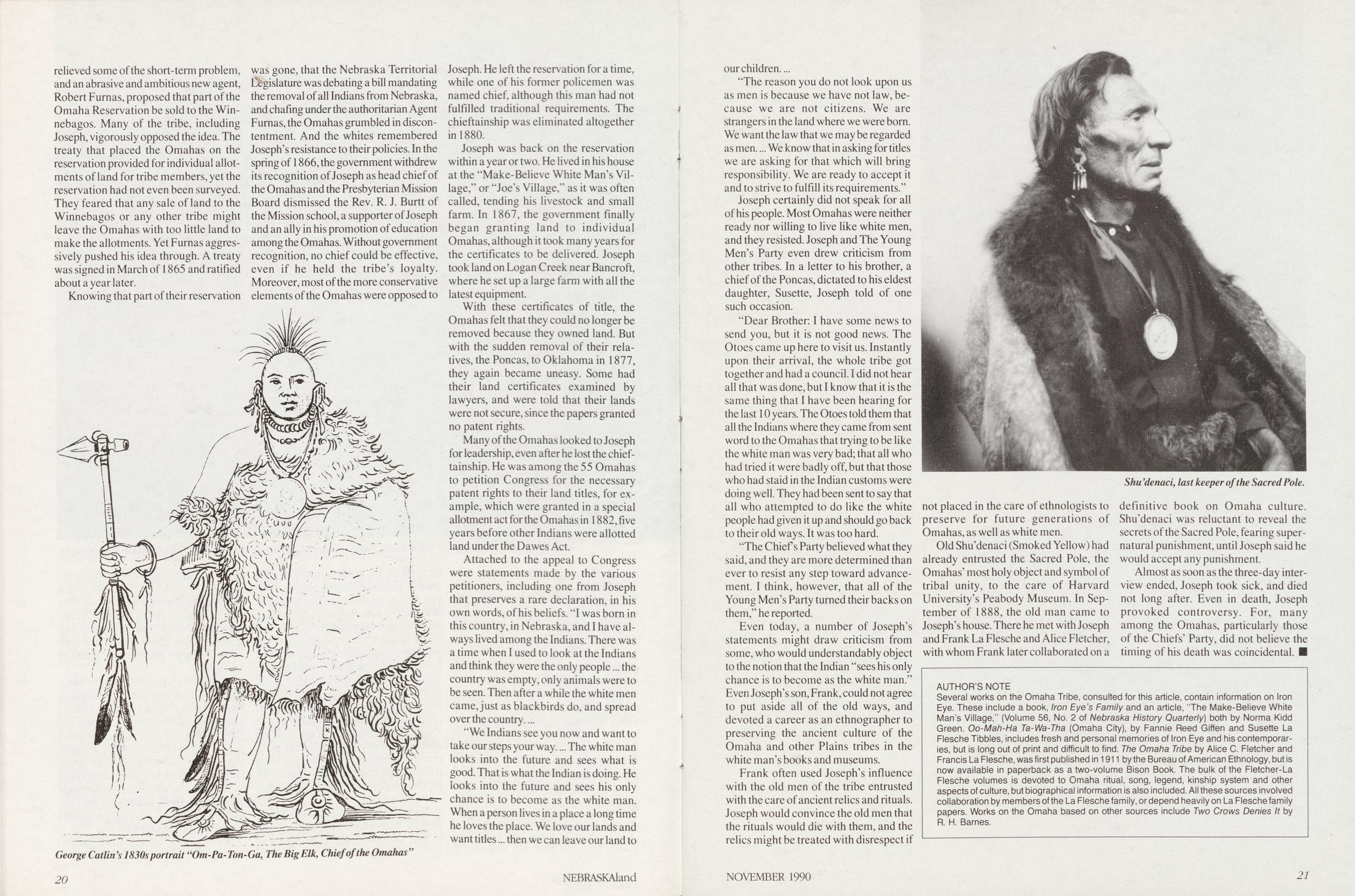
Old Shu'denaci (Smoked Yellow) had already entrusted the Sacred Pole, the Omahas' most holy object and symbol of tribal unity, to the care of Harvard University's Peabody Museum. In September of 1888, the old man came to Joseph's house. There he met with Joseph and Frank La Flesche and Alice Fletcher, with whom Frank later collaborated on a definitive book on Omaha culture. Shu'denaci was reluctant to reveal the secrets of the Sacred Pole, fearing supernatural punishment, until Joseph said he would accept any punishment.
Almost as soon as the three-day interview ended, Joseph took sick, and died not long after. Even in death, Joseph provoked controversy. For, many among the Omahas, particularly those of the Chiefs' Party, did not believe the timing of his death was coincidental.
AUTHOR'S NOTESeveral works on the Omaha Tribe, consulted for this article, contain information on Iron Eye. These include a book, Iron Eye's Family and an article, "The Make-Believe White Man's Village," (Volume 56, No. 2 of Nebraska History Quarterly) both by Norma Kidd Green. Oo-Mah-Ha Ta-Wa-Tha (Omaha City), by Fannie Reed Giffen and Susette La Flesche Tibbies, includes fresh and personal memories of Iron Eye and his contemporaries, but is long out of print and difficult to find. The Omaha Tribe by Alice C. Fletcher and Francis La Flesche, was first published in 1911 by the Bureau of American Ethnology, but is now available in paperback as a two-volume Bison Book. The bulk of the Fletcher-La Flesche volumes is devoted to Omaha ritual, song, legend, kinship system and other aspects of culture, but biographical information is also included. All these sources involved collaboration by members of the La Flesche family, or depend heavily on La Flesche family papers. Works on the Omaha based on other sources include Two Crows Denies It by R. H. Barnes.
NOVEMBER 1990 21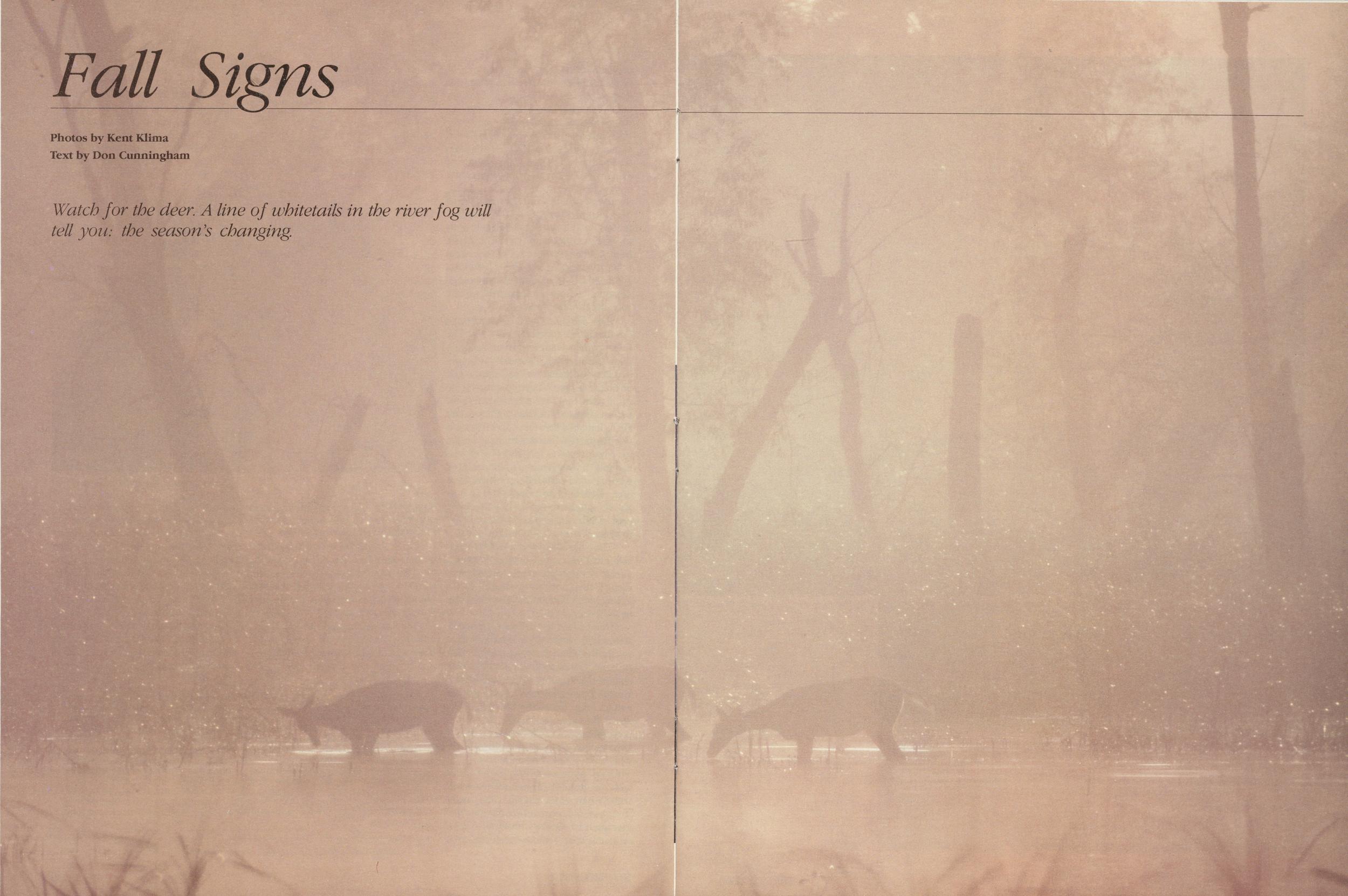
Fall Signs
Photos by Kent Klima Text by Don Cunningham Watch for the deer. A line of whitetails in the river fog will tell you: the season's changing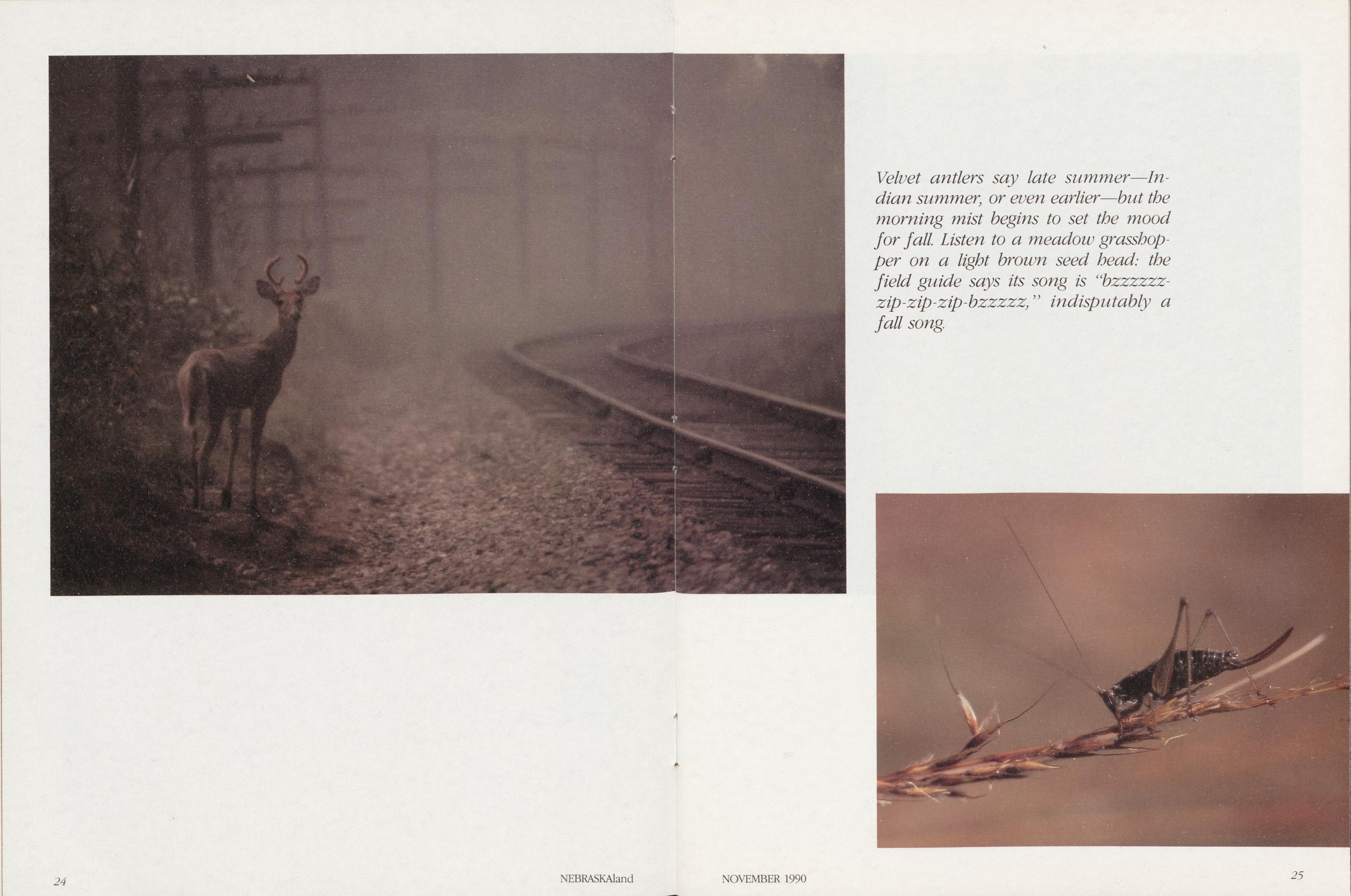
Velvet antlers say late summer—Indian summer, or even earlier—but the morning mist begins to set the mood for fall. Listen to a meadow grasshopper on a light brown seed head: the field guide says its song is "bzzzzzz-zip-zip-zip-bzzzzz," indisputably a fall song
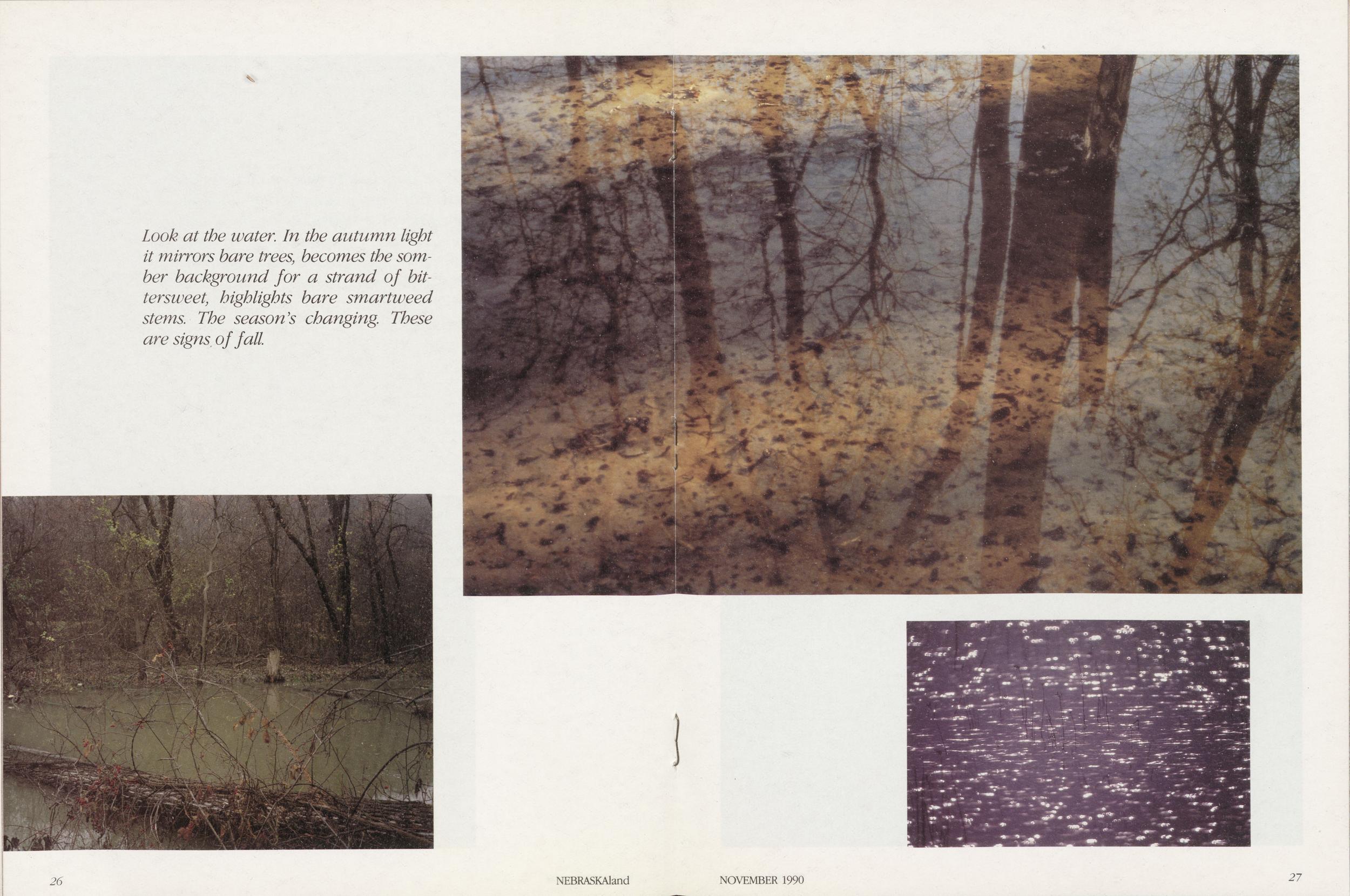
Look at the water. In the autumn light it mirrors bare trees, becomes the somber background for a strand of bittersweet, highlights bare smartweed stems. The season's changing. These are signs, of fall.
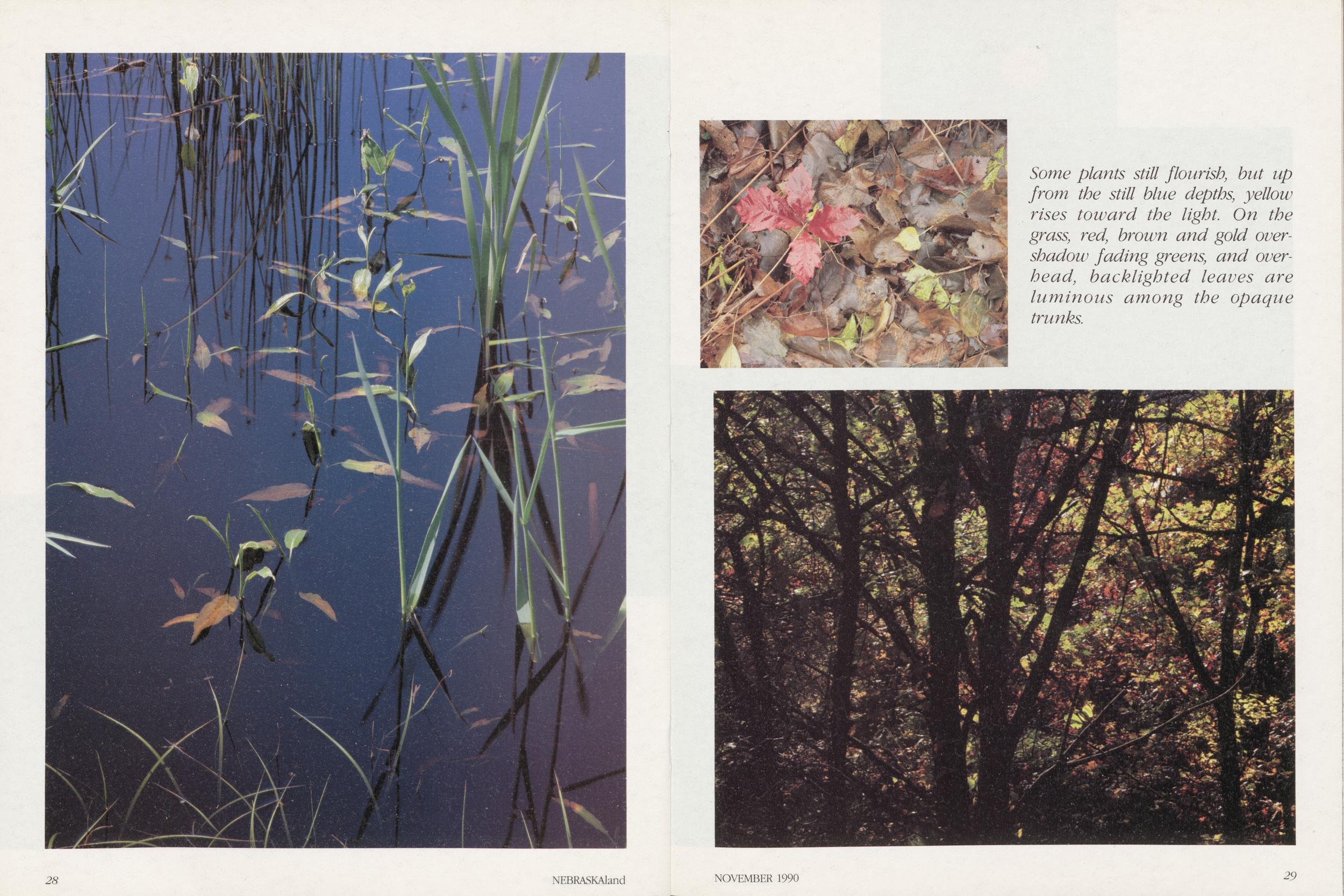
Some plants still flourish, but up from the still blue depths, yellow rises toward the light. On the grass, red, brown and gold overshadow fading greens, and overhead, backlighted leaves are luminous among the opaque trunks.
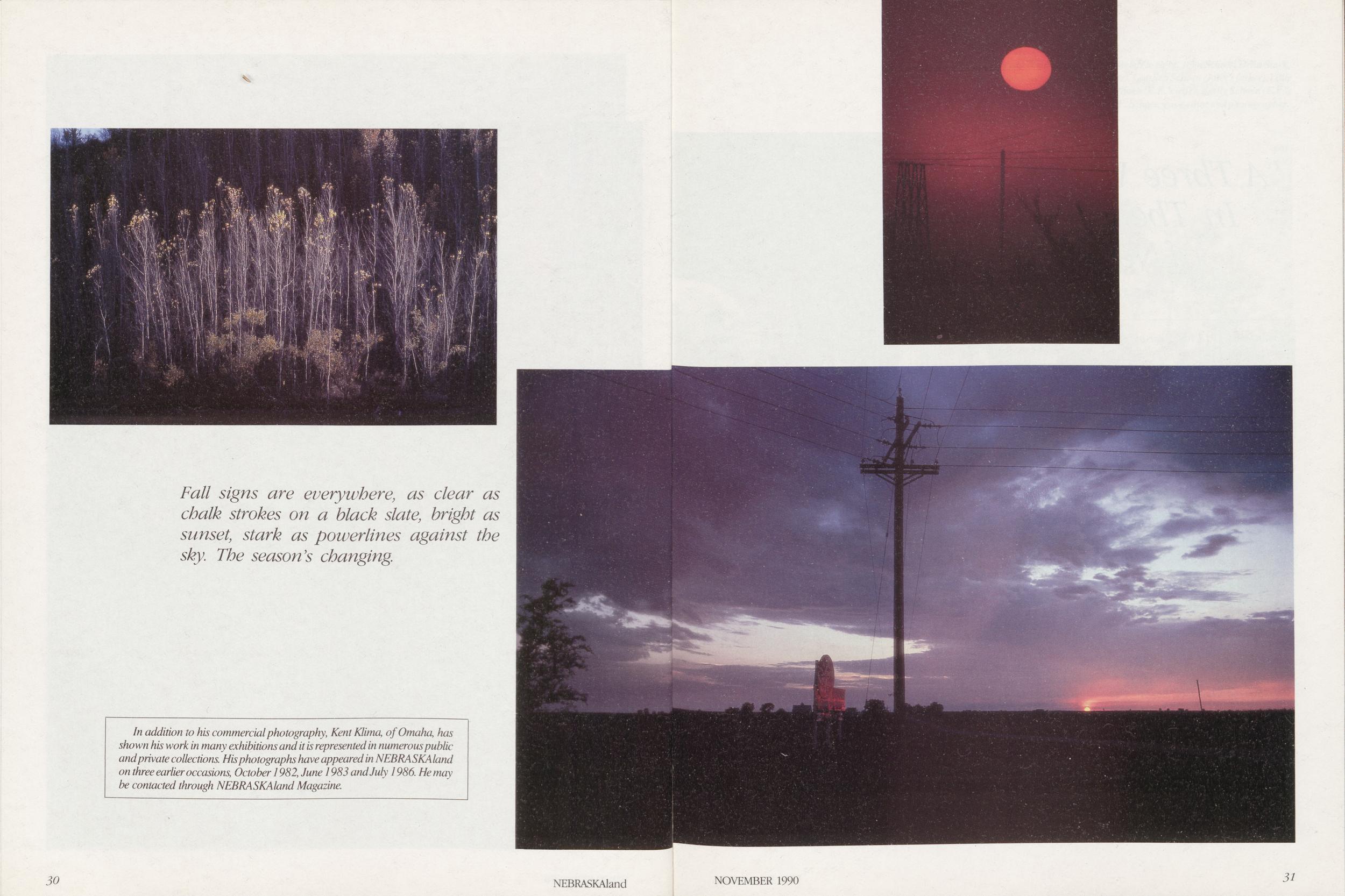
Fall signs are everywhere, as clear as chalk strokes on a black slate, bright as sunset, stark as powerlines against the sky. The season's changing.
In addition to his commercial photography, KentKlima, of Omaha, has shown his work in many exhibitions and it is represented in numerous public and private collections. His photographs have appeared in NEBRASKAland on three earlier occasions, October 1982, June 1983 and July 1986. He may be contacted through NEBRASKAland Magazine.
30 NEBRASKAland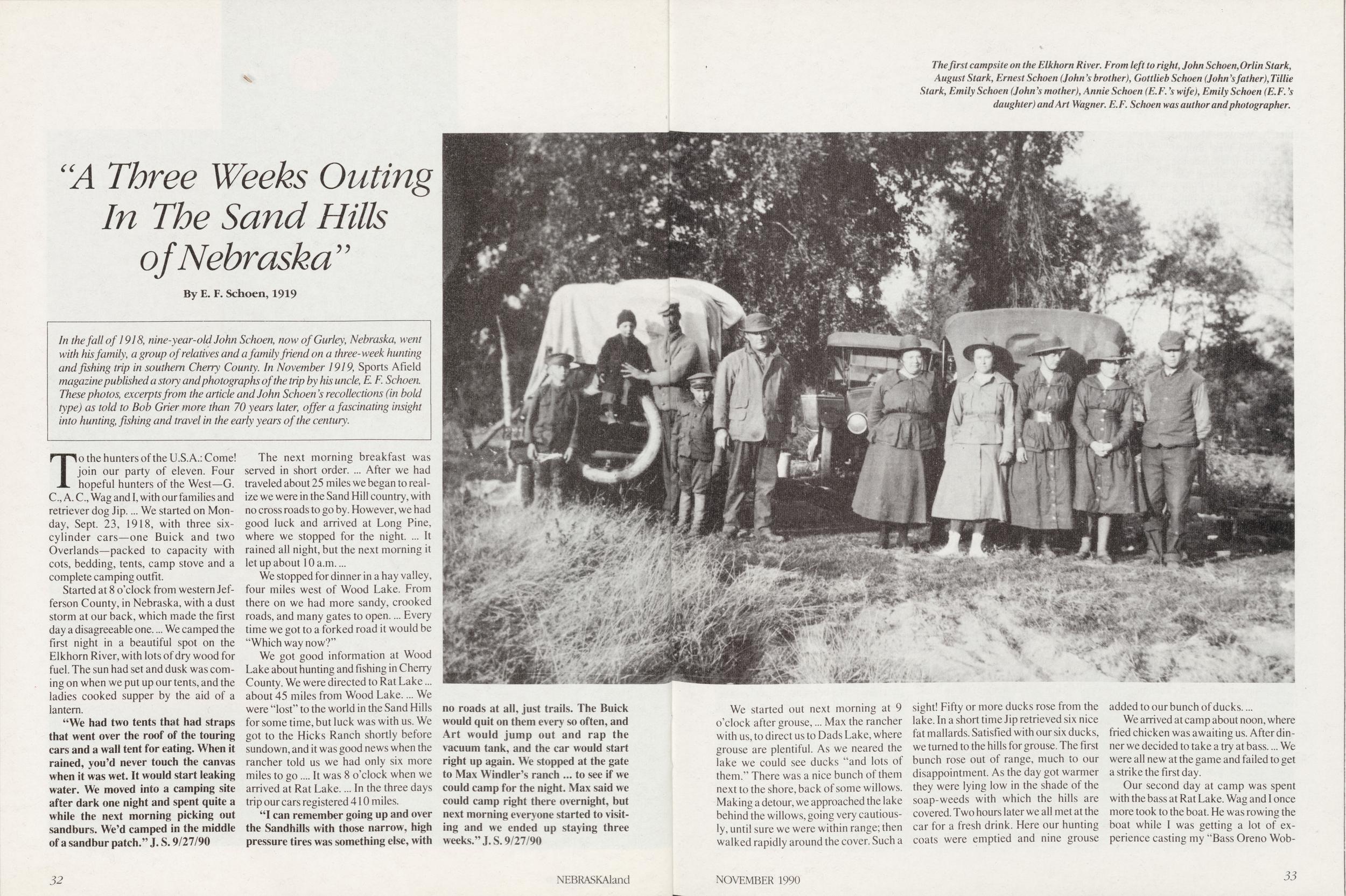
"A Three Weeks Outing In The Sand Hills of Nebraska"
In the fall of 1918, nine-year-old John Schoen, nowofGurley, Nebraska, went with his family, a group of relatives and a family friend on a three-week hunting and fishing trip in southern Chetry County. In November 1919, Sports Afield magazine published a story and photographs of the trip by his uncle, E. F. Schoen. These photos, excerpts from the article and John Schoen's recollections (in bold type) as told to Bob Grier more than 70 years later, offer a fascinating insight into hunting, fishing and travel in the early years of the century.
To the hunters of the U.S.A.: Come! join our party of eleven. Four hopeful hunters of the West—G. C, A. C., Wag and I, with our families and retriever dog Jip We started on Monday, Sept. 23, 1918, with three six-cylinder cars—one Buick and two Overlands—packed to capacity with cots, bedding, tents, camp stove and a complete camping outfit.
Started at 8 o'clock from western Jefferson County, in Nebraska, with a dust storm at our back, which made the first day a disagreeable one We camped the first night in a beautiful spot on the Elkhorn River, with lots of dry wood for fuel. The sun had set and dusk was coming on when we put up our tents, and the ladies cooked supper by the aid of a lantern.
"We had two tents that had straps that went over the roof of the touring cars and a wall tent for eating. When it rained, you'd never touch the canvas when it was wet. It would start leaking water. We moved into a camping site after dark one night and spent quite a while the next morning picking out sandburs. We'd camped in the middle of a sandbur patch." J. S. 9/27/90
The next morning breakfast was served in short order. After we had traveled about 25 miles we began to realize we were in the Sand Hill country, with no cross roads to go by. However, we had good luck and arrived at Long Pine, where we stopped for the night. It rained all night, but the next morning it let up about 10 a.m.
We stopped for dinner in a hay valley, four miles west of Wood Lake. From there on we had more sandy, crooked roads, and many gates to open. Every time we got to a forked road it would be "Which way now?"
We got good information at Wood Lake about hunting and fishing in Cherry County. We were directed to Rat Lake. about 45 miles from Wood Lake. We were "lost" to the world in the Sand Hills for some time, but luck was with us. We got to the Hicks Ranch shortly before sundown, and it was good news when the rancher told us we had only six more miles to go . It was 8 o'clock when we arrived at Rat Lake. In the three days trip our cars registered 410 miles.
"I can remember going up and over the Sandhills with those narrow, high pressure tires was something else, with no roads at all, just trails. The Buick would quit on them every so often, and Art would jump out and rap the vacuum tank, and the car would start right up again. We stopped at the gate to Max Windler's ranch . to see if we could camp for the night. Max said we could camp right there overnight, but next morning everyone started to visiting and we ended up staying three weeks." J. S. 9/27/90
We started out next morning at 9 o'clock after grouse, Max the rancher with us, to direct us to Dads Lake, where grouse are plentiful. As we neared the lake we could see ducks "and lots of them." There was a nice bunch of them next to the shore, back of some willows. Making a detour, we approached the lake behind the willows, going very cautiously, until sure we were within range; then walked rapidly around the cover. Such a sight! Fifty or more ducks rose from the lake. In a short time Jip retrieved six nice fat mallards. Satisfied with our six ducks, we turned to the hills for grouse. The first bunch rose out of range, much to our disappointment. As the day got warmer they were lying low in the shade of the soap-weeds with which the hills are covered. Two hours later we all met at the car for a fresh drink. Here our hunting coats were emptied and nine grouse added to our bunch of ducks.
We arrived at camp about noon, where fried chicken was awaiting us. After dinner we decided to take a try at bass We were all new at the game and failed to get a strike the first day.
Our second day at camp was spent with the bass at Rat Lake. Wag and I once more took to the boat. He was rowing the boat while I was getting a lot of experience casting my "Bass Oreno Wobier."
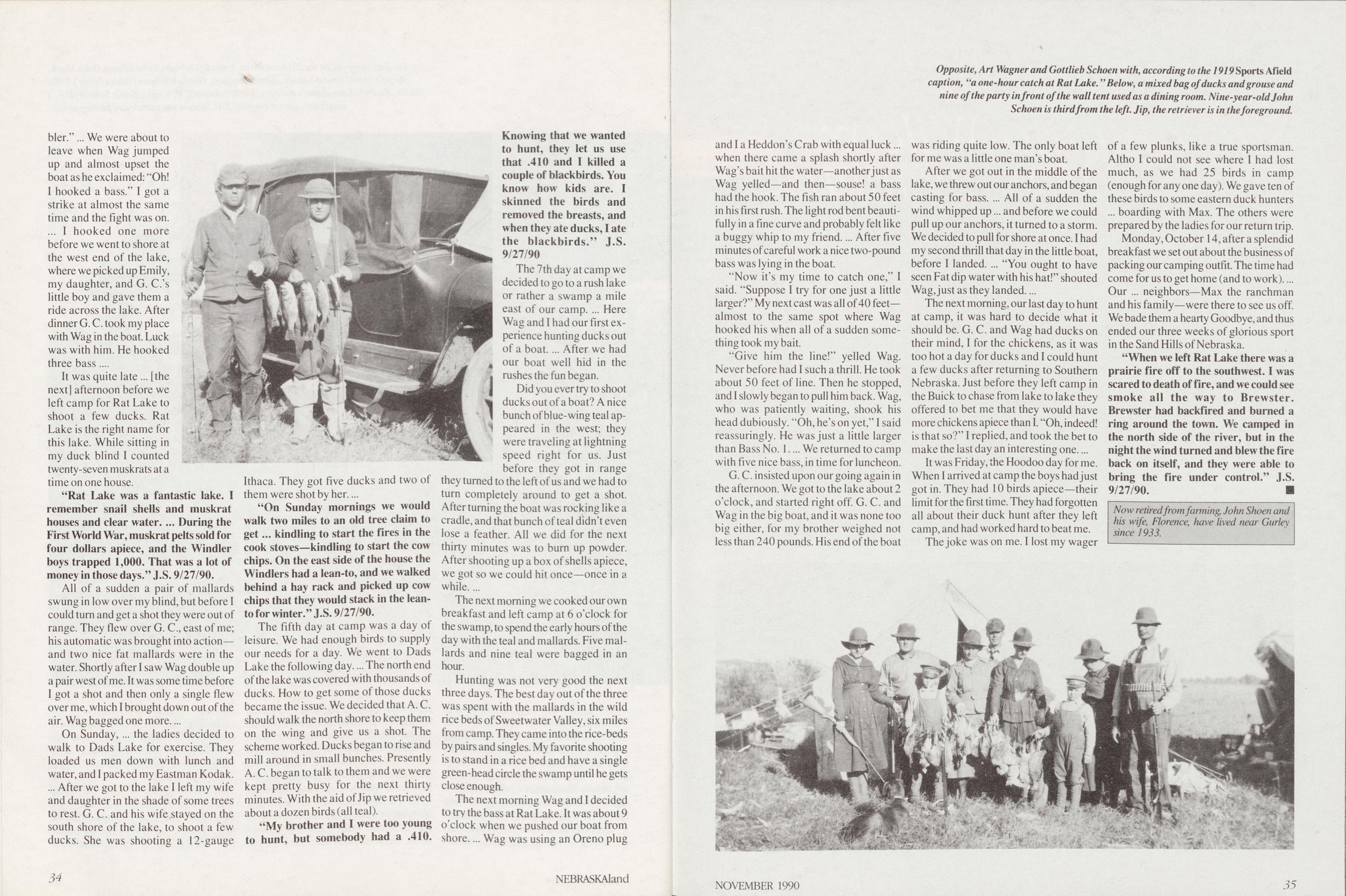
We were about to leave when Wag jumped up and almost upset the boat as he exclaimed: "Oh! I hooked a bass." I got a strike at almost the same time and the fight was on. I hooked one more before we went to shore at the west end of the lake, where we picked up Emily, my daughter, and G. C.'s little boy and gave them a ride across the lake. After dinner G. C. took my place with Wag in the boat. Luck was with him. He hooked three bass
It was quite late [the next] afternoon before we left camp for Rat Lake to shoot a few ducks. Rat Lake is the right name for this lake. While sitting in my duck blind I counted twenty-seven muskrats at a time on one house.
"Rat Lake was a fantastic lake. I remember snail shells and muskrat houses and clear water. During the First World War, muskrat pelts sold for four dollars apiece, and the Windier boys trapped 1,000. That was a lot of money in those days." J.S. 9/27/90.
All of a sudden a pair of mallards swung in low over my blind, but before I could turn and get a shot they were out of range. They flew over G. C., east of me; his automatic was brought into action and two nice fat mallards were in the water. Shortly after I saw Wag double up a pair west of me. It was some time before I got a shot and then only a single flew over me, which I brought down out of the air. Wag bagged one more
On Sunday, the ladies decided to walk to Dads Lake for exercise. They loaded us men down with lunch and water, and I packed my Eastman Kodak. After we got to the lake I left my wife and daughter in the shade of some trees to rest. G. C. and his wife stayed on the south shore of the lake, to shoot a few ducks. She was shooting a 12-gauge Ithaca. They got five ducks and two of them were shot by her
"On Sunday mornings we would walk two miles to an old tree claim to get... kindling to start the fires in the cook stoves—kindling to start the cow chips. On the east side of the house the Windlers had a lean-to, and we walked behind a hay rack and picked up cow chips that they would stack in the lean to for winter." J.S. 9/27/90.
The fifth day at camp was a day of leisure. We had enough birds to supply our needs for a day. We went to Dads Lake the following day The north end of the lake was covered with thousands of ducks. How to get some of those ducks became the issue. We decided that A. C. should walk the north shore to keep them on the wing and give us a shot. The scheme worked. Ducks began to rise and mill around in small bunches. Presently A. C. began to talk to them and we were kept pretty busy for the next thirty minutes. With the aid of Jip we retrieved about a dozen birds (all teal).
"My brother and I were too young to hunt, but somebody had a .410. Knowing that we wanted to hunt, they let us use that .410 and I killed a couple of blackbirds. You know how kids are. I skinned the birds and removed the breasts, and when they ate ducks, I ate the blackbirds." J.S. 9/27/90
The 7th day at camp we decided to go to a rush lake or rather a swamp a mile east of our camp. Here Wag and I had our first experience hunting ducks out of a boat. After we had our boat well hid in the rushes the fun began.
Did you ever try to shoot ducks out of a boat? A nice bunch of blue-wing teal appeared in the west; they were traveling at lightning speed right for us. Just before they got in range they turned to the left of us and we had to turn completely around to get a shot. After turning the boat was rocking like a cradle, and that bunch cfteal didn't even lose a feather. All we did for the next thirty minutes was to burn up powder. After shooting up a box of shells apiece, we got so we could hit once—once in a while.
The next morning we cooked our own breakfast and left camp at 6 o'clock for the swamp, to spend the early hours of the day with the teal and mallards. Five mallards and nine teal were bagged in an hour.
Hunting was not very good the next three days. The best day out of the three was spent with the mallards in the wild rice beds of Sweetwater Valley, six miles from camp. They came into the rice-beds by pairs and singles. My favorite shooting is to stand in a rice bed and have a single green-head circle the swamp until he gets close enough.
The next morning Wag and I decided to try the bass at Rat Lake. It was about 9 o'clock when we pushed our boat from shore. Wag was using an Oreno plug
34 NEBRASKAlandand I a Heddon's Crab with equal luck. when there came a splash shortly after Wag's bait hit the water—another just as Wag yelled—and then—souse! a bass had the hook. The fish ran about 50 feet in his first rush. The light rod bent beautifully in a fine curve and probably felt like a buggy whip to my friend After five minutes of careful work a nice two-pound bass was lying in the boat.
"Now it's my time to catch one," I said. "Suppose I try for one just a little larger?" My next cast was all of 40 feet almost to the same spot where Wag hooked his when all of a sudden something took my bait.
"Give him the line!" yelled Wag. Never before had I such a thrill. He took about 50 feet of line. Then he stopped, and I slowly began to pull him back. Wag, who was patiently waiting, shook his head dubiously. "Oh, he's on yet," I said reassuringly. He was just a little larger than Bass No. 1 We returned to camp with five nice bass, in time for luncheon.
G. C. insisted upon our going again in the afternoon. We got to the lake about 2 o'clock, and started right off. G. C. and Wag in the big boat, and it was none too big either, for my brother weighed not less than 240 pounds. His end of the boat was riding quite low. The only boat left for me was a little one man's boat.
After we got out in the middle of the lake, we threw out our anchors, and began casting for bass. All of a sudden the wind whipped up and before we could pull up our anchors, it turned to a storm. We decided to pull for shore at once. I had my second thrill that day in the little boat, before I landed. "You ought to have seen Fat dip water with his hat!" shouted Wag, just as they landed
The next morning, our last day to hunt at camp, it was hard to decide what it should be. G. C. and Wag had ducks on their mind, I for the chickens, as it was too hot a day for ducks and I could hunt a few ducks after returning to Southern Nebraska. Just before they left camp in the Buick to chase from lake to lake they offered to bet me that they would have more chickens apiece than I. "Oh, indeed! is that so?" I replied, and took the bet to make the last day an interesting one
It was Friday, the Hoodoo day for me. When I arrived at camp the boys had just got in. They had 10 birds apiece—their limit for the first time. They had forgotten all about their duck hunt after they left camp, and had worked hard to beat me.
The joke was on me. I lost my wager of a few plunks, like a true sportsman. Altho I could not see where I had lost much, as we had 25 birds in camp (enough for any one day). We gave ten of these birds to some eastern duck hunters boarding with Max. The others were prepared by the ladies for our return trip.
Monday, October 14, after a splendid breakfast we set out about the business of packing our camping outfit. The time had come for us to get home (and to work). Our neighbors—Max the ranchman and his family—were there to see us off. We bade them a hearty Goodbye, and thus ended our three weeks of glorious sport in the Sand Hills of Nebraska.
"When we left Rat Lake there was a prairie fire off to the southwest. I was scared to death of fire, and we could see smoke all the way to Brewster. Brewster had backfired and burned a ring around the town. We camped in the north side of the river, but in the night the wind turned and blew the fire back on itself, and they were able to bring the fire under control." J.S. 9/27/90.
Now retired from farming, John Shoen and his wife, Florence, have lived near Gurley since 1933.
NOVEMBER 1990 35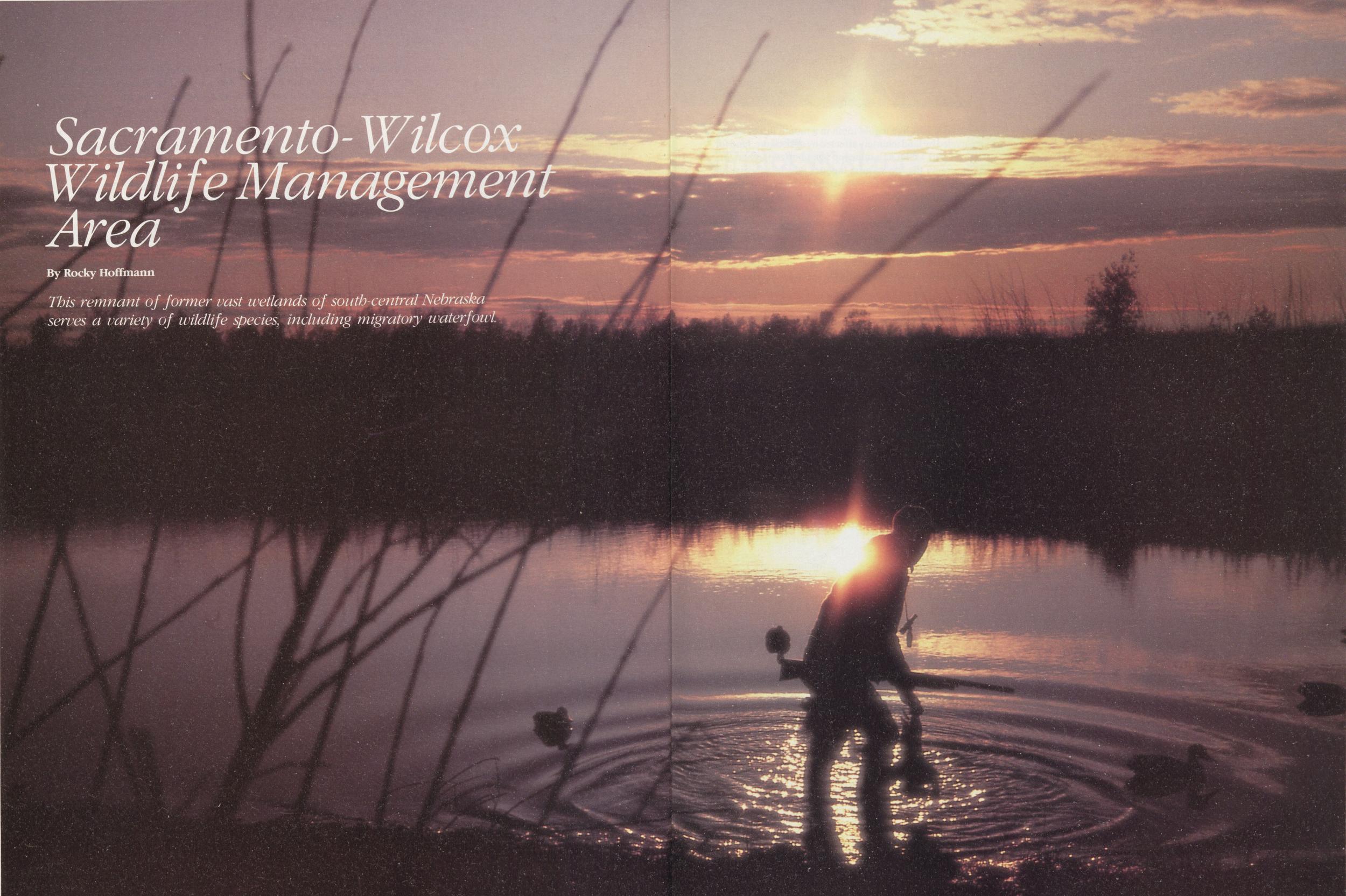
Scaramento-Wilcox Wildlife Management Area
This remnant of former vast wetlands of south-central Nebraska serves a variety of wildlife species, including migratory waterfowl.
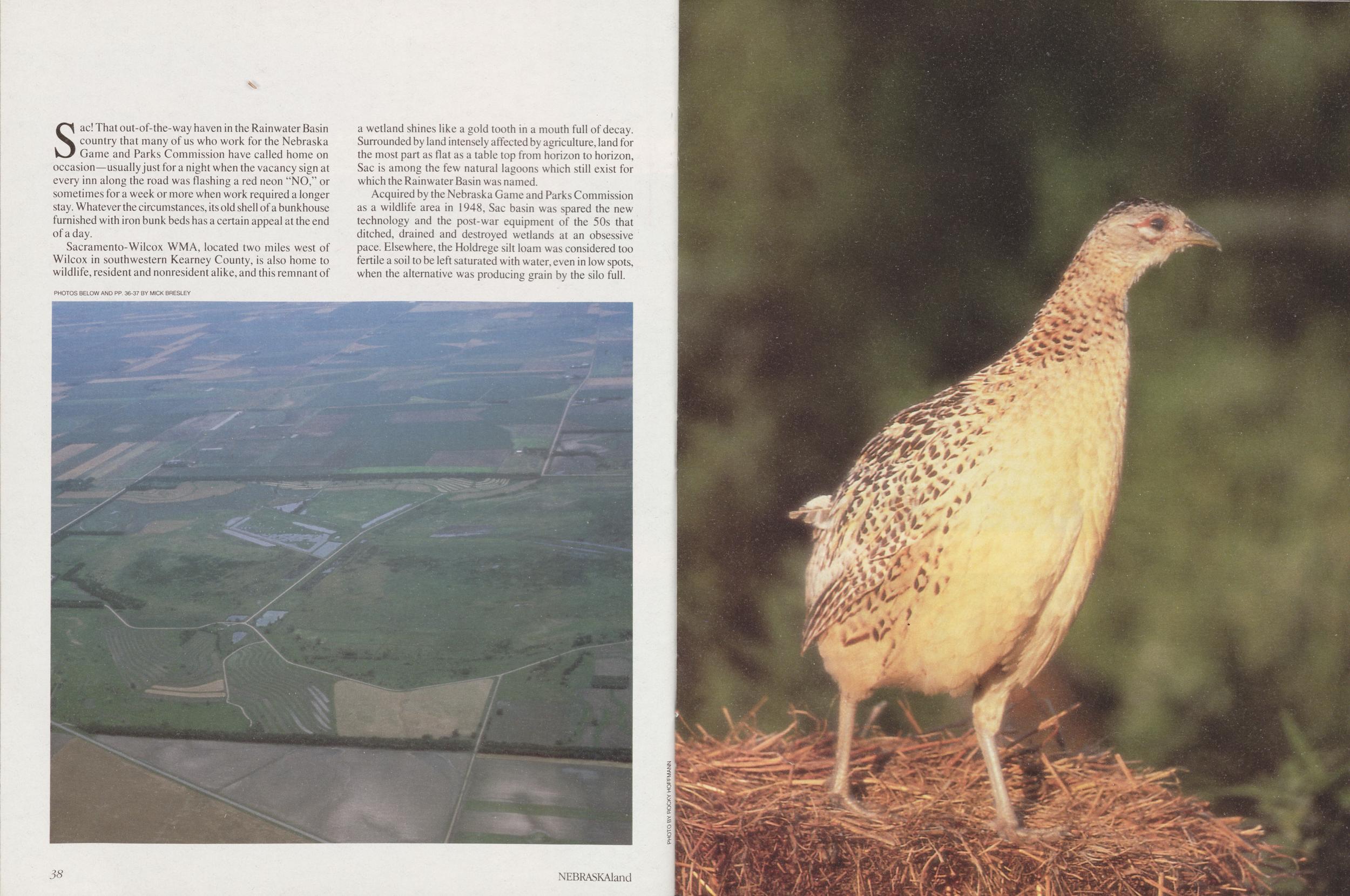
Sac! That out-of-the-way haven in the Rainwater Basin country that many of us who work for the Nebraska Game and Parks Commission have called home on occasion—usually just for a night when the vacancy sign at every inn along the road was flashing a red neon "NO," or sometimes for a week or more when work required a longer stay. Whatever the circumstances, its old shell of a bunkhouse furnished with iron bunk beds has a certain appeal at the end of a day.
Sacramento-Wilcox WMA, located two miles west of Wilcox in southwestern Kearney County, is also home to wildlife, resident and nonresident alike, and this remnant of a wetland shines like a gold tooth in a mouth full of decay. Surrounded by land intensely affected by agriculture, land for the most part as flat as a table top from horizon to horizon, Sac is among the few natural lagoons which still exist for which the Rainwater Basin was named.
Acquired by the Nebraska Game and Parks Commission as a wildlife area in 1948, Sac basin was spared the new technology and the post-war equipment of the 50s that ditched, drained and destroyed wetlands at an obsessive pace. Elsewhere, the Holdrege silt loam was considered too fertile a soil to be left saturated with water, even in low spots, when the alternative was producing grain by the silo full.
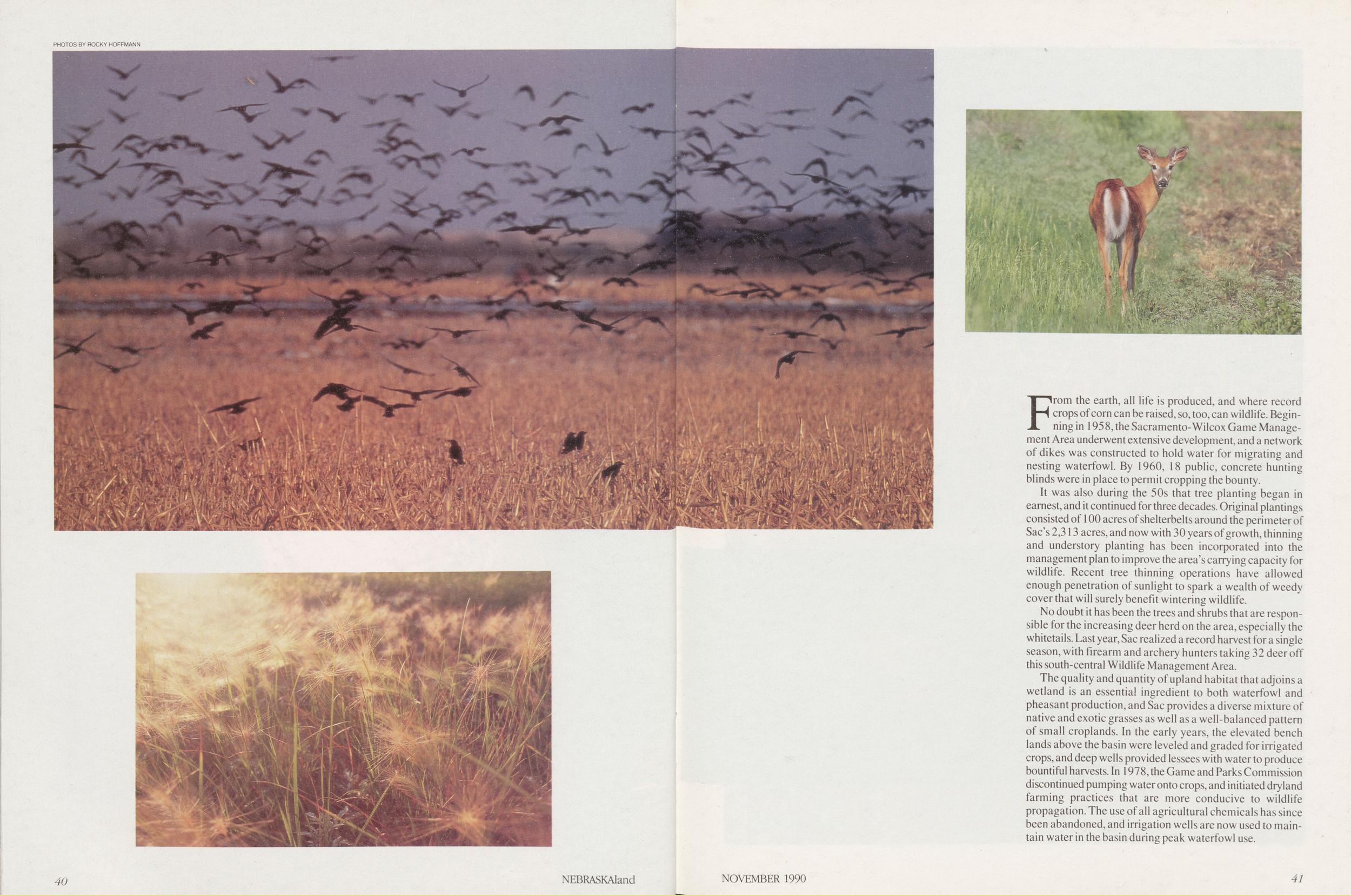
From the earth, all life is produced, and where record crops of corn can be raised, so, too, can wildlife. Begin- ning in 1958, the Sacramento-Wilcox Game Manage- ment Area underwent extensive development, and a network of dikes was constructed to hold water for migrating and nesting waterfowl. By I960, 18 public, concrete hunting blinds were in place to permit cropping the bounty.
It was also during the 50s that tree planting began in earnest, and it continued for three decades. Original plantings consisted of 100 acres of shelterbelts around the perimeter of Sac's 2,313 acres, and now with 30 years of growth, thinning and understory planting has been incorporated into the management plan to improve the area's carrying capacity for wildlife. Recent tree thinning operations have allowed enough penetration of sunlight to spark a wealth of weedy cover that will surely benefit wintering wildlife.
No doubt it has been the trees and shrubs that are respon- sible for the increasing deer herd on the area, especially the whitetails. Last year, Sac realized a record harvest for a single season, with firearm and archery hunters taking 32 deer off this south-central Wildlife Management Area.
The quality and quantity of upland habitat that adjoins a wetland is an essential ingredient to both waterfowl and pheasant production, and Sac provides a diverse mixture of native and exotic grasses as well as a well-balanced pattern of small croplands. In the early years, the elevated bench lands above the basin were leveled and graded for irrigated crops, and deep wells provided lessees with water to produce bountiful harvests. In 1978, the Game and Parks Commission discontinued pumping water onto crops, and initiated dryland farming practices that are more conducive to wildlife propagation. The use of all agricultural chemicals has since been abandoned, and irrigation wells are now used to main- tain water in the basin during peak waterfowl use.
40 NEBRASKAland NOVEMBER 1990 41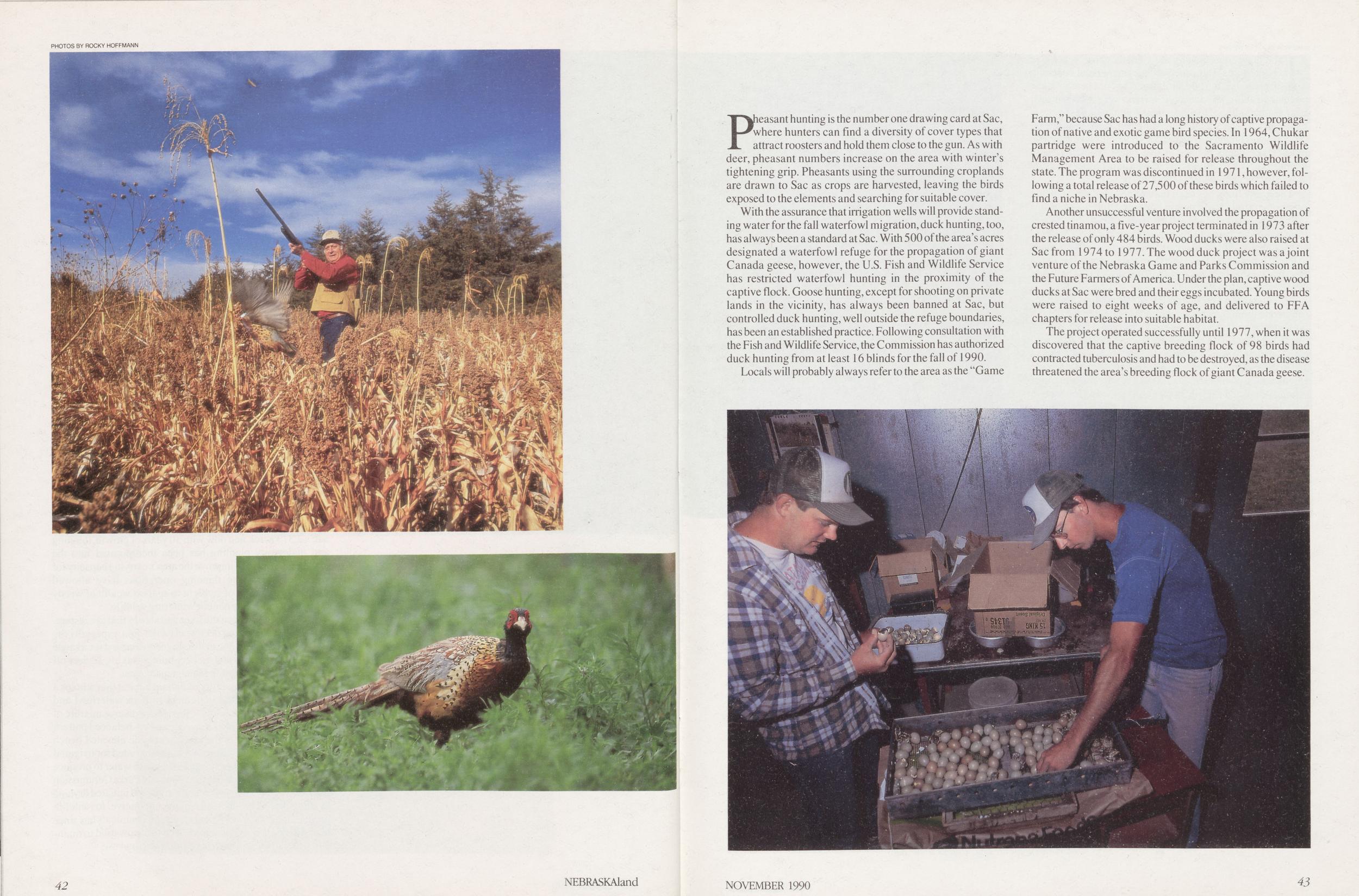
Pheasant hunting is the number one drawing card at Sac, where hunters can find a diversity of cover types that attract roosters and hold them close to the gun. As with deer, pheasant numbers increase on the area with winter's tightening grip. Pheasants using the surrounding croplands are drawn to Sac as crops are harvested, leaving the birds exposed to the elements and searching for suitable cover.
With the assurance that irrigation wells will provide stand- ing water for the fall waterfowl migration, duck hunting, too, has always been a standard at Sac. With 500 of the area's acres designated a waterfowl refuge for the propagation of giant Canada geese, however, the U.S. Fish and Wildlife Service has restricted waterfowl hunting in the proximity of the captive flock. Goose hunting, except for shooting on private lands in the vicinity, has always been banned at Sac, but controlled duck hunting, well outside the refuge boundaries, has been an established practice. Following consultation with the Fish and Wildlife Service, the Commission has authorized duck hunting from at least 16 blinds for the fall of 1990.
Locals will probably always refer to the area as the "Game Farm," because Sac has had a long history of captive propaga- tion of native and exotic game bird species. In 1964, Chukar partridge were introduced to the Sacramento Wildlife Management Area to be raised for release throughout the state. The program was discontinued in 1971, however, fol- lowing a total release of 27,500 of these birds which failed to find a niche in Nebraska.
Another unsuccessful venture involved the propagation of crested tinamou, a five-year project terminated in 1973 after the release of only 484 birds. Wood ducks were also raised at Sac from 1974 to 1977. The wood duck project was a joint venture of the Nebraska Game and Parks Commission and the Future Farmers of America. Under the plan, captive wood ducks at Sac were bred and their eggs incubated. Young birds were raised to eight weeks of age, and delivered to FFA chapters for release into suitable habitat.
The project operated successfully until 1977, when it was discovered that the captive breeding flock of 98 birds had contracted tuberculosis and had to be destroyed, as the disease threatened the area's breeding flock of giant Canada geese.
42 NEBRASKAland NOVEMBER 1990 43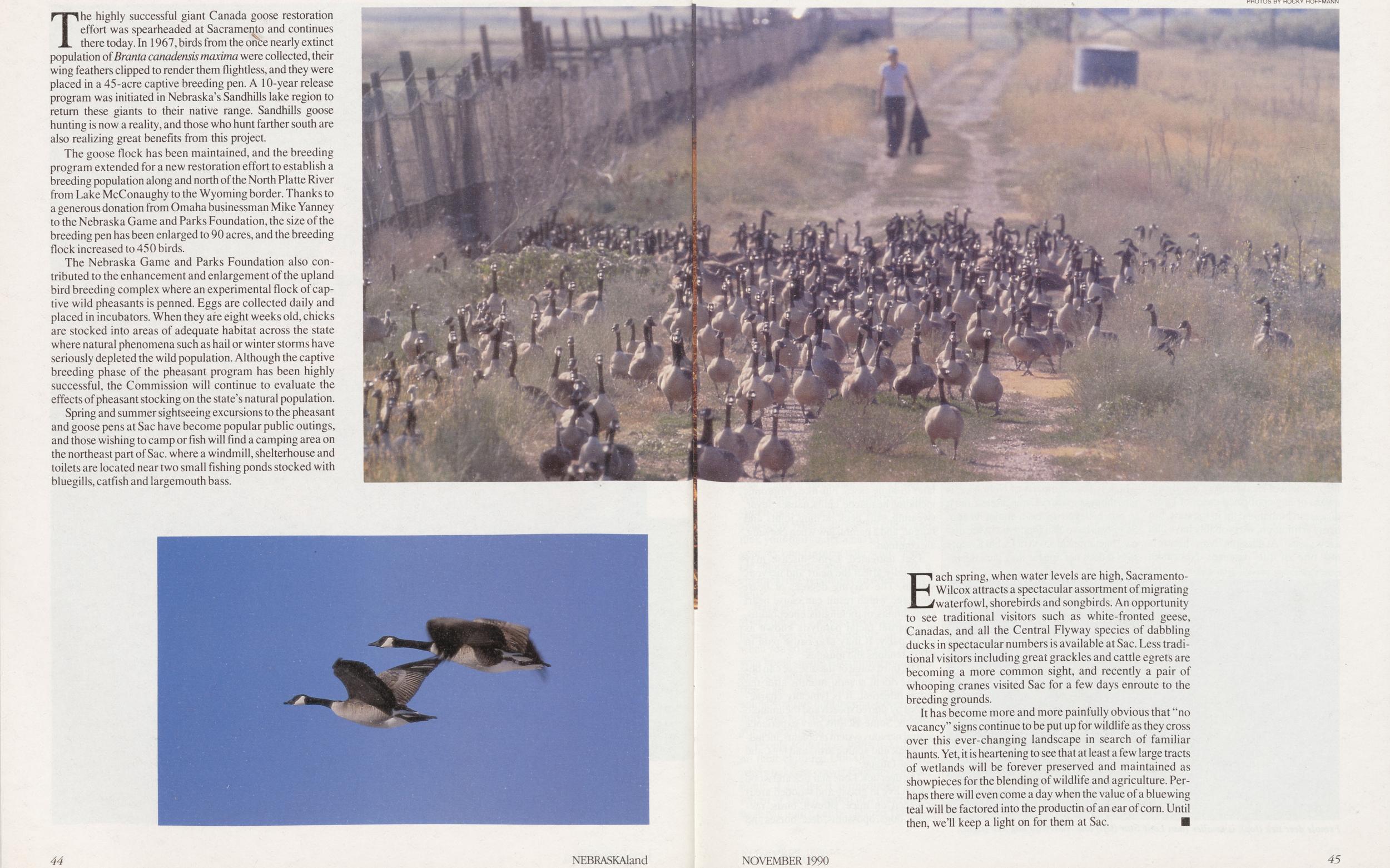
The highly successful giant Canada goose restoration effort was spearheaded at Sacramento and continues there today. In 1967, birds from the once nearly extinct population of Branta canadensis maxima were collected, their wing feathers clipped to render them flightless, and they were placed in a 45-acre captive breeding pen. A 10-year release program was initiated in Nebraska's Sandhills lake region to return these giants to their native range. Sandhills goose hunting is now a reality, and those who hunt farther south are also realizing great benefits from this project.
The goose flock has been maintained, and the breeding program extended for a new restoration effort to establish a breeding population along and north of the North Platte River from Lake McConaughy to the Wyoming border. Thanks to a generous donation from Omaha businessman Mike Yanney to the Nebraska Game and Parks Foundation, the size of the breeding pen has been enlarged to 90 acres, and the breeding flock increased to 450 birds.
The Nebraska Game and Parks Foundation also con- tributed to the enhancement and enlargement of the upland bird breeding complex where an experimental flock of cap- tive wild pheasants is penned. Eggs are collected daily and placed in incubators. When they are eight weeks old, chicks are stocked into areas of adequate habitat across the state where natural phenomena such as hail or winter storms have seriously depleted the wild population. Although the captive breeding phase of the pheasant program has been highly successful, the Commission will continue to evaluate the effects of pheasant stocking on the state's natural population.
Spring and summer sightseeing excursions to the pheasant and goose pens at Sac have become popular public outings, and those wishing to camp or fish will find a camping area on the northeast part of Sac. where a windmill, shelterhouse and toilets are located near two small fishing ponds stocked with bluegills, catfish and largemouth bass.
Each spring, when water levels are high, Sacramento- Wilcox attracts a spectacular assortment of migrating waterfowl, shorebirds and songbirds. An opportunity to see traditional visitors such as white-fronted geese, Canadas, and all the Central Flyway species of dabbling ducks in spectacular numbers is available at Sac. Less tradi- tional visitors including great grackles and cattle egrets are becoming a more common sight, and recently a pair of whooping cranes visited Sac for a few days enroute to the breeding grounds.
It has become more and more painfully obvious that "no vacancy" signs continue to be put up for wildlife as they cross over this ever-changing landscape in search of familiar haunts. Yet, it is heartening to see that at least a few large tracts of wetlands will be forever preserved and maintained as showpieces for the blending of wildlife and agriculture. Per- haps there will even come a day when the value of a blue wing teal will be factored into the productin of an ear of corn. Until then, we'll keep a light on for them at Sac. ■
44 NEBRASKAland NOVEMBER 1990 45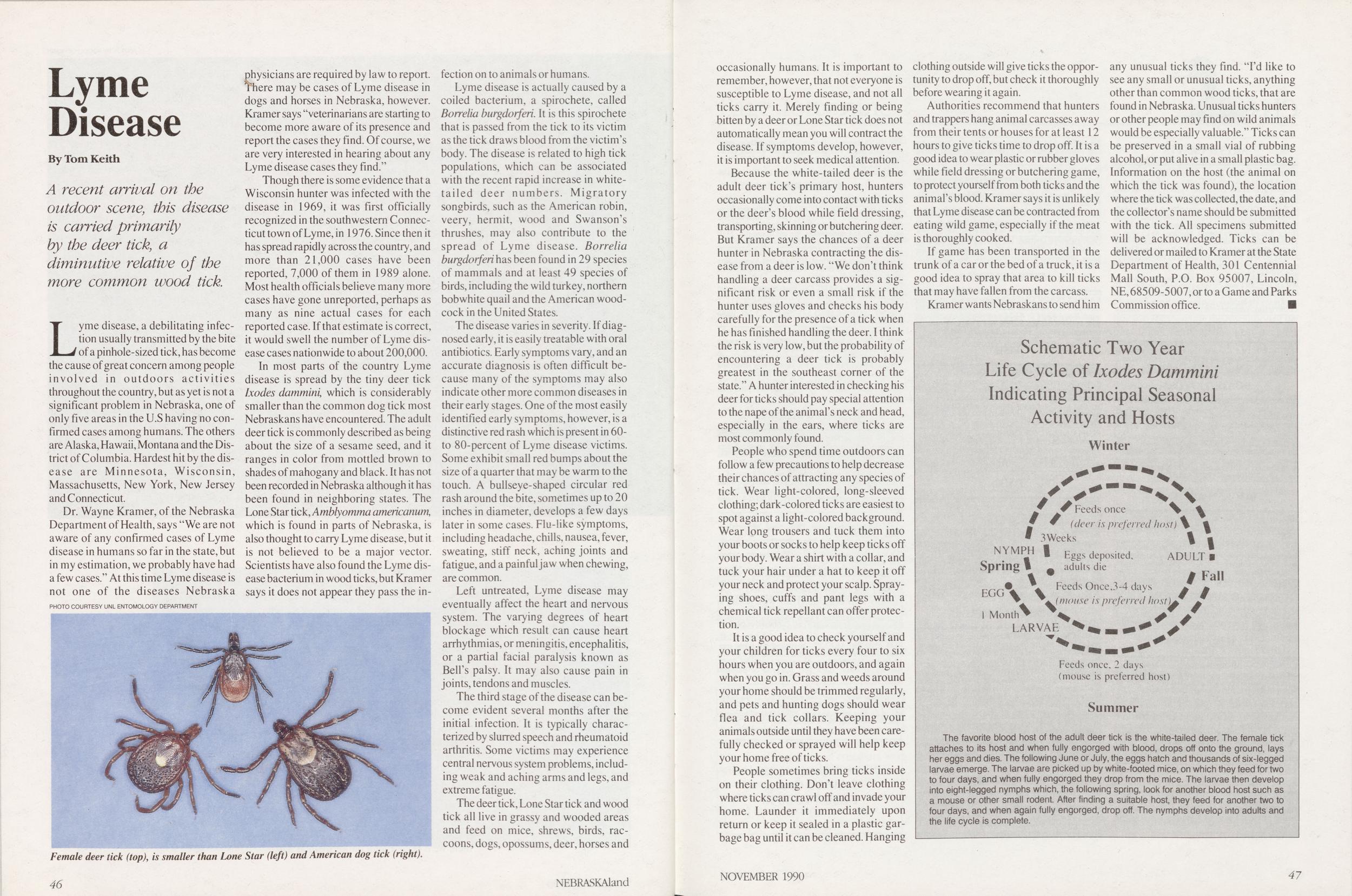
Lyme Disease
A recent arrival on the outdoor scene, this disease is carried primarily by the deer tick, a diminutive relative of the more common wood tick
Lyme disease, a debilitating infec- tion usually transmitted by the bite of a pinhole-sized tick, has become the cause of great concern among people involved in outdoors activities throughout the country, but as yet is not a significant problem in Nebraska, one of only five areas in the U.S having no con- firmed cases among humans. The others are Alaska, Hawaii, Montana and the Dis- trict of Columbia. Hardest hit by the dis- ease are Minnesota, Wisconsin, Massachusetts, New York, New Jersey and Connecticut.
Dr. Wayne Kramer, of the Nebraska Department of Health, says "We are not aware of any confirmed cases of Lyme disease in humans so far in the state, but in my estimation, we probably have had a few cases." At this time Lyme disease is not one of the diseases Nebraska
physicians are required by law to report. There may be cases of Lyme disease in dogs and horses in Nebraska, however. Kramer says "veterinarians are starting to become more aware of its presence and report the cases they find. Of course, we are very interested in hearing about any Lyme disease cases they find."
Though there is some evidence that a Wisconsin hunter was infected with the disease in 1969, it was first officially recognized in the southwestern Connec- ticut town of Lyme, in 1976. Since then it has spread rapidly across the country, and more than 21,000 cases have been reported, 7,000 of them in 1989 alone. Most health officials believe many more cases have gone unreported, perhaps as many as nine actual cases for each reported case. If that estimate is correct, it would swell the number of Lyme dis- ease cases nationwide to about 200,000.
In most parts of the country Lyme disease is spread by the tiny deer tick Ixodes dammini, which is considerably smaller than the common dog tick most Nebraskans have encountered. The adult deer tick is commonly described as being about the size of a sesame seed, and it ranges in color from mottled brown to shades of mahogany and black. It has not been recorded in Nebraska although it has been found in neighboring states. The Lone Star tick, Amblyomma americanum, which is found in parts of Nebraska, is also thought to carry Lyme disease, but it is not believed to be a major vector. Scientists have also found the Lyme dis- ease bacterium in wood ticks, but Kramer says it does not appear they pass the in- fection on to animals or humans.
Lyme disease is actually caused by a coiled bacterium, a spirochete, called Borrelia burgdorferi. It is this spirochete that is passed from the tick to its victim as the tick draws blood from the victim's body. The disease is related to high tick populations, which can be associated with the recent rapid increase in white- tailed deer numbers. Migratory songbirds, such as the American robin, veery, hermit, wood and Swanson's thrushes, may also contribute to the spread of Lyme disease. Borrelia burgdorferiha.s been found in 29 species of mammals and at least 49 species of birds, including the wild turkey, northern bobwhite quail and the American wood- cock in the United States.
The disease varies in severity. If diag- nosed early, it is easily treatable with oral antibiotics. Early symptoms vary, and an accurate diagnosis is often difficult be- cause many of the symptoms may also indicate other more common diseases in their early stages. One of the most easily identified early symptoms, however, is a distinctive red rash which is present in 60- to 80-percent of Lyme disease victims. Some exhibit small red bumps about the size of a quarter that may be warm to the touch. A bullseye-shaped circular red rash around the bite, sometimes up to 20 inches in diameter, develops a few days later in some cases. Flu-like symptoms, including headache, chills, nausea, fever, sweating, stiff neck, aching joints and fatigue, and a painful jaw when chewing, are common.
Left untreated, Lyme disease may eventually affect the heart and nervous system. The varying degrees of heart blockage which result can cause heart arrhythmias, or meningitis, encephalitis, or a partial facial paralysis known as Bell's palsy. It may also cause pain in joints, tendons and muscles.
The third stage of the disease can be- come evident several months after the initial infection. It is typically charac- terized by slurred speech and rheumatoid arthritis. Some victims may experience central nervous system problems, includ- ing weak and aching arms and legs, and extreme fatigue.
The deer tick, Lone Star tick and wood tick all live in grassy and wooded areas and feed on mice, shrews, birds, rac- coons, dogs, opossums, deer, horses and 46 NEBRASKAland occasionally humans. It is important to remember, however, that not everyone is susceptible to Lyme disease, and not all ticks carry it. Merely finding or being bitten by a deer or Lone Star tick does not automatically mean you will contract the disease. If symptoms develop, however, it is important to seek medical attention.
Because the white-tailed deer is the adult deer tick's primary host, hunters occasionally come into contact with ticks or the deer's blood while field dressing, transporting, skinning or butchering deer. But Kramer says the chances of a deer hunter in Nebraska contracting the dis- ease from a deer is low. "We don't think handling a deer carcass provides a sig- nificant risk or even a small risk if the hunter uses gloves and checks his body carefully for the presence of a tick when he has finished handling the deer. I think the risk is very low, but the probability of encountering a deer tick is probably greatest in the southeast corner of the state." A hunter interested in checking his deer for ticks should pay special attention to the nape of the animal's neck and head, especially in the ears, where ticks are most commonly found.
People who spend time outdoors can follow a few precautions to help decrease their chances of attracting any species of tick. Wear light-colored, long-sleeved clothing; dark-colored ticks are easiest to spot against a light-colored background. Wear long trousers and tuck them into your boots or socks to help keep ticks off your body. Wear a shirt with a collar, and tuck your hair under a hat to keep it off your neck and protect your scalp. Spray- ing shoes, cuffs and pant legs with a chemical tick repellant can offer protec- tion.
It is a good idea to check yourself and your children for ticks every four to six hours when you are outdoors, and again when you go in. Grass and weeds around your home should be trimmed regularly, and pets and hunting dogs should wear flea and tick collars. Keeping your animals outside until they have been care- fully checked or sprayed will help keep your home free of ticks.
People sometimes bring ticks inside on their clothing. Don't leave clothing where ticks can crawl off and invade your home. Launder it immediately upon return or keep it sealed in a plastic gar- bage bag until it can be cleaned. Hanging clothing outside will give ticks the oppor- tunity to drop off, but check it thoroughly before wearing it again.
Authorities recommend that hunters and trappers hang animal carcasses away from their tents or houses for at least 12 hours to give ticks time to drop off. It is a good idea to wear plastic or rubber gloves while field dressing or butchering game, to protect yourself from both ticks and the animal's blood. Kramer says it is unlikely that Lyme disease can be contracted from eating wild game, especially if the meat is thoroughly cooked.
If game has been transported in the trunk of a car or the bed of a truck, it is a good idea to spray that area to kill ticks that may have fallen from the carcass.
Kramer wants Nebraskans to send him any unusual ticks they find. "I'd like to see any small or unusual ticks, anything other than common wood ticks, that are found in Nebraska. Unusual ticks hunters or other people may find on wild animals would be especially valuable." Ticks can be preserved in a small vial of rubbing alcohol, or put alive in a small plastic bag. Information on the host (the animal on which the tick was found), the location where the tick was collected, the date, and the collector's name should be submitted with the tick. All specimens submitted will be acknowledged. Ticks can be delivered or mailed to Kramer at the State Department of Health, 301 Centennial Mall South, P.O. Box 95007, Lincoln, NE, 68509-5007, or to a Game and Parks Commission office. ■
Schematic Two Year Life Cycle of Ixodes Dammini Indicating Principal Seasonal Activity and Hosts Winter Jr Feeds once (deer is preferred host) * 3Weeks NYMPH Spring 1 g Fall Feeds Once,3-4 days Eggs deposited, adults die ADULT EGG 1 Month LARVAE (mouse is preferred host) Feeds once, 2 days (mouse is preferred host) Summer The favorite blood host of the adult deer tick is the white-tailed deer. The female tick attaches to its host and when fully engorged with blood, drops off onto the ground, lays her eggs and dies. The following June or July, the eggs hatch and thousands of six-legged larvae emerge. The larvae are picked up by white-footed mice, on which they feed for two to four days, and when fully engorged they drop from the mice. The larvae then develop into eight-legged nymphs which, the following spring, look for another blood host such as a mouse or other small rodent. After finding a suitable host, they feed for another two to four days, and when again fully engorged, drop off. The nymphs develop into adults and the life cycle is complete. NOVEMBER 1990 47
Classified
ARTS & CRAFTS Bev Doolittle, Terrry Redlin, Jerry Raedke, Ed Wards, Robert Bateman, Frank McCarthy and Neal Anderson are available at the 2nd Street Gallery, 537 W. 2nd, Hastings, NE 68901. Phone (402) 463-6677. PERFECT GIFT for that special person: Limited Edi- tion Display Print "Plains Windmill Silhouetted Against Blazing Sunrise" by Nebraska photographer Chas Hicks. Signed and numbered. Mounted 8x10 print in 11x14 double mat that enhances print colors: $ 19.95; In 11x14 polished gold frame: $34.95; Print only: $ 14.95; Add $2.00 S+H; NE residents add sales tax. Send check or M.O. to: Great Plains Image, Box 281143-N, Papil- lion,NE 68128. WILDLIFE ART and carving show—November 9, 10 and 11 at Regency Fashion Court in Omaha. Collectible art of many kinds. Show hours are 5 to 9 p.m. Friday; 10 a.m. to 6 p.m. Saturday; and noon to 4:30 p.m. Sunday. BIRDS MANDARIN DUCKS: nice full-wing birds. $35/pair; woodducks $25/pair. Mrs. R. W. Hansen, 3315 Ave. L, Kearney, NE 68847. Phone 308-237-3781. BOATS/MOTORS TROLLING MOTOR REPAIR. Factory authorized Minn Kota and Motor Guide, parts and service. Wolfs Repair and Tackle Supplv, 5950 Colfax Ave., Lincoln, NE 68507. Phone (402) 464-4265. BLUEBILL DUCK BOATS—sturdy fiberglass, weighs less than 50 lbs., 91/: ft. long, 40" beam, 15" height, 2 person. Extremely portable—go places where others can't. Contact RCM Marketing, P.O. Box 166, Water- town, SD 57201. Phone 1-800-658-4778. BOOKS/PRINTING FREE! Booklets on northeastern Nevada; fishing, rock- hounding maps, Carl Hayden, Box 528, Jackpot, Nevada 89825. FREE BOOK CATALOG. Novels, westerns, romances, children's; old out of print, found barns, attic. Authors: Grey, Bower, Connor, Fox, Curwood, Raine, Wright, Aldrige, Pollyanna, Freckles, many others. Postage appreciated. Pierce, 4400 N. Pine Cluster, Oroville, C A 95965. EATING NEBRASKA: A Field Guide to Unique Eater- ies. A humorous and informative new book describing 128 unique places to eat across Nebraska. $9.95 + $ 1.50 shipping. Rt. 1, Box 120A, Pleasant Dale, NE 68423. COLLECTIBLES BUYING: American Indian artifacts such as beadwork, weavings, baskets, etc.; also cowboy memorabilia such as chaps, spurs, photographs, etc. Best price first letter; photographs promptly returned. Jack Ringwalt, 1550 California St., Suite 6, #211, San Francisco, CA 94109, (415)759-6343. NEBRASKA WILDLIFE HABITAT NUMBERED Limited edition belt buckles. 1991 now available. Brass, Gold/Silverplate, Sterling. Write for our brochure. Malcolm Gun Club, P.O. Box 194, Malcolm, NE 68402 or call (402) 796-2244. Some 1984 through 1990 also available. DOGS YELLOW-BLACK Lab pups. FC-AFC sired. AKC. Hips OFA ceritified. Dew claws removed. Excellent hunting potential. Contact Bob Bendler, Lexington, NE (308)324-4247. TRAINING ALL BREEDS hunting dogs—Vizslas for sale. Rozanek Kennels, R 2, Schuyler, NE 68661. Phone (402) 352-8769. ENGLISH SETTERS: "Bred for the hunter"; select pup- pies and started dogs available from outstanding blood- lines. Stud service available by proven hunters. High Plains Kennels, 1411 Emerson, Alliance, NE 69301, Phone (308) 762-6709. PINKERTON BIRD DOGS—English setter, brittany puppies. Started dogs available this fall. Our dogs are bred for nose and style. Give us a call at (402) 673-4540. GUN DOG TRAINING. All sporting breeds. All dogs worked on game birds. Over 25 years experience. Henry Sader, Wilderness Kennels, Roca, NE (402) 423-4212. EMPLOYMENT EARN EXTRA INCOME selling new low-priced Dancing Decoys. These silhouette decoys twist and turn with the wind. Retail $3.98 or $4.50 each. Set of six costs you $ 18. Invest in two sets and become a Dealer Rep. Write to Dancing Decoys, Box 144, Brule, NE 69127. FISH FISH FOR SALE. Catfish, perch, coho salmon, rainbow trout, crappie, bluegill, walleye, minnows, goldfish, bull- head, largemouth bass, smallmouth bass, triploid grass carp. Commercial grower prices on catfish, perch, coho salmon, rainbow trout. Consulting available. Pleasant Valley Fish Farm, Rt 1 Box 147, McCook, NE 69001. Phone (308) 345-6599. FISH FOR POND STOCKING. Bass, bluegill, crappie, perch, channel catfish, Triploid grass carp, rainbow trout and walleye. Available April-October. Write Orchard Fish Hatchery, Rt 2, Box 117, Orchard, NE 68764 or phone (402) 893-2521. FOOD WINE AND BEER: Make your own. Send for free recipes and instructions. Omaha Supply, 1324 2nd Avenue, Nebraska City, NE 68410. BUFFALO JERKY, 16 1-oz. pkgs. for $23 including shipping. Sample $1.75. G. E. Hill Distributing, 5220 Aylesworth, Lincoln, NE 68504. Phone (402) 464-6781. NEBRASKA BASKETS: The original Nebraska Com- pany specializing in fine foods from Nebraska. A beauti- ful array of baskets filled with ethnic, healthful and long-time favorite foods. Call or write for our brochure: PO Box 98, McCook, NE 69001. 1-800-345-7725. GUIDES/OUTFITTERS MAD RIVER CANOES offers the finest quality and performance. For the finest canoes and accessories look to Great Plains Canoe Co., 205 Main, Springfield, NE. Phone(402)253-2001. CANADA FLY-IN FISHING; 3, 4 or 7 day. American plan and Housekeeping plan trips to remote northern Saskatchewan. We specialize in booking the trip of a lifetime for sportsmen from Nebraska and the midwest. Free brochure. 1-800-755-1560. High Rock Lake Lodge, 3645 Holmes Park Rd., Lincoln, NE 68506. FOR GUIDE SERVICE to hunt pheasants in northeast Nebraska call (402) 385-3506. IDEAL HUNTING ENVIRONMENT. Will lease exclu- sive hunting rights. Eagle Creek location, north of O'Neill, Nebraska. (402) 336-3424. OUTDOOR EQUIPMENT AIR GUNS repaired—Benjamin, Crosman, Daisy, other American made. Restoration; old guns wanted. Jack's Air Guns, 1225 No. 46th, Lincoln, NE 68503. Phone (402) 466-9223. TAXIDERMY ALLISON'S TAXIDERMY STUDIO. Wally and Betty Allison Licensed Taxidermist. We've mounted 32 Nebraska State Record fish. Specializing in fish and birds, small game and rattlesnakes. We use freeze-dry. 2310 West Leota, North Platte, NE 69101. (308) 534-2324. PEISTER TAXIDERMY — Professional work at prices most sportsman can afford. 1020 Central Avenue, Box 3201, Kearney, NE 68847. Phone (308) 236-9700 or (308) 237-7575 evenings. SWANSON PHEASANT CO. Professionally mounted pheasants for sale. Flying $87.95, standing $92.95 and crowing $99.95. Shipping and handling included. Visa/MC accepted. (402) 571-0961, 6123 No. 100th Plaza, Omaha, NE 68134. KRAFT'S TAXIDERMY STUDIO. Specializing in unique one of a kind wildlife creations. Our museum approved methods will give your trophy a long lasting mount with realism and expression. African, North American birds, fish. Stop in and visit our new studio and display room. Studio hours 8:00-5:30 Mon.-Fri. Open most Sat. 403 Midland Ave., P.O. Box 163, Waco, NE 68460. Phone (402) 728-5591 or (402) 728-5403 after hours. VACATION/RESORTS CABIN FOR RENT. Modern three-bedroom, fully- equipped cabin overlooking secluded, scenic 3-acre pond. Call or write Orchard Fish Hatchery, Rt. 2, Box 117, Orchard, NE 68764 or phone (402) 893-2521. NE NEBRASKA trout fishing. 3 modern cottages, 1 available year round. 5 spring fed lakes with open water all year. Trout up to 7 pounds. Other varieties fish also. Diamond E. Trout Resort, Orchard, NE 69764. Phone (402) 893-4745. NW NEBRASKA—two cabins, daily, weekly, scenic, rustic. Secluded but handy. Prime trout, turkey, deer. Phone (308) 487-5247. HUNTERS MAKE your reservations at Jefco Inn in Gordon, NE. Phone (308) 282-2935. Pheasants, grouse, deer and turkey. RICHARDSON HOUSE Bed and Breakfast. Catering to hunting parties. Great cook available. 202 N. Webster St., Red Cloud, NE 68970. Phone (402) 746-3264. TURKEY AND DEER HUNTERS: While hunting in Boyd County, stay at the Niobrara Valley House of Renewal Retreat Center, Lynch, Nebraska, just south of Lynch. Suggested donation $ 13 a night. (402) 569-3433 or (402) 569-2421. BED AND BREAKFAST—southwest NE lakes area. Pheasant Hill Farm, Dona Nelms, Hostess, HCR 68 Bex 12, Bartley, NE 69020 or evenings call (308) 692-3278. Hunters welcome; filled first weekend of pheasant season.Classified ad rates: 75c per word, minimum $15. Closing date is the first business day 2 months preceding date of issue. To place ads or for more information write NEBRASKAland Magazine, P.O. Box 30370, Lincoln, NE 68503, or call (402) 471-5478. GUNS — Browning, Winchester, Remington, others, Hi-powers, shotguns, new, used, antiques. Want Pre-'64 Winchesters. Buy-Sell-Trade. (402) 729-6112. Bedlan's Sporting Goods, Fairbury, NE 68352.
NEBRASKAland Magazine Toll Free Orders 1-800-742-0056
48 NEBRASKAlandPage forty-nine
Blind Obsession
The sense of smell is a powerful stimulus for the memory. I can be in a cafe crowded with smokers, and seconds after one of them lights up a Camel straight I'm magically transported to a willow duck blind on a Loup River sandbar. Sometimes I'm fooled by a Lucky Strike or a Chesterfield but not often: my first duck hunting partner smoked Camel straights. I'm not an ad- vocate of inhaling toxic fumes, but I love the smell of the tobacco they pack in those little smokes, and I also love the scent of dried willow leaves. To me, they smell like crisp November mornings, river backwaters, and the whistle of bluebills over decoys.
Every summer when I was young we built a new 'Tort" along the Loup River or Looking Glass Creek. One year it was made of driftwood logs, another year of willows lashed to cedar trees and woven with grass; once it was an elaborate lean- to, once a dug-out in a clay bank. But such play is considered deviant if carried into adulthood, so I graduated to duck blinds, an equivalent but socially acceptable be- havior.
From my Camel-smoking cousin, who learned it from the generation of duck hunters before him, I learned to build willow duck blinds in the tradition of 1950s Loup River duck hunters. Willow blinds are built in early or mid-September when the leaves are still firmly attached. A twist of used baling wire was the only man-made material required. Construc- tion equipment was only slightly more extensive—a corn knife and a spade— and I remember getting along without the spade most years. The principal materials were there for the taking on every sandbar. With the spade or the corn knife, you dug six holes for the corner posts and the baffle which concealed the open door- way. Smaller driftwood crossbars were wired to the post tops. Sandbar willows, some six or seven feet tall, and an equal number of shorter ones were cut, a job falling mostly to the junior hunter, since the senior hunting partner claimed to know best just how to place them for maximum coverage and durability. One by one the taller willows were pushed a foot or so into the wet sand at the base of the blind, their bases angling away from it so the flexible stems would arch back and press firmly against the driftwood framework. Then a row of shorter wil- lows was added to cover the nearly leaf- less lower stems of the taller ones.
If the Loup River suddenly rose, all you stood to loose was a bit of baling wire; the decoys were always left in gunny sacks on a high bank in the trees. Well, usually they were. There were oc- casions when dozens of papier-mache mallards migrated downstream never to be seen again.
Until I left the security of Loup River waterf owling, it never occurred to me that anyone hunted out of anything but a wil- low blind. With each new duck hunting experience, my horizons widened. Soon the quest for the perfect blind began.
After the willow blind phase, a more worldly hunting partner introduced me to portable blinds. I could hardly believe that someone would actually use dimen- sion lumber, much less new dimension lumber, to build a duck blind. That blind was covered with store-bought, camouflaged nylon cloth. Can you im- agine that? On opening morning, we learned that if you don't leave an opening for a Labrador retriever he will make one for himself when the first shots are fired.
Under that same partner's tutelage I advanced to the concept of a permanent pit blind and learned that dry, Rainwater Basin claypan is akin to concrete, and digging in it should be done by young men with picks—or a skilled backhoe operator. I also learned not to put off covering a new pit blind with canary grass until the night before the season opens, when it must be done in the head- lights of a pickup. The time it takes to properly cover a blind slightly exceeds the life of a standard battery. And head- lights still shine dimly when the battery will no longer turn over the engine.
On Sandhills marshes I learned more about portable blinds—chicken wire af- fairs covered with reed and rush and held upright with steel posts. Later I dis- covered the joy of driving wooden posts into spongy marsh bottoms, and of ele- vated blinds with a stall for a small jon- boat underneath, just like those of the old Chesapeake Bay hunters I'd read about. But all these blinds had failings. The portables weren't comfortable enough for hunters wheezing and creaking into mid- dle age, and permanent blinds couldn't be moved when the wind switched or the water shrank back in dry years. Then, on a hunt with a pair of inveterate rainbasin marsh hunters, came the revelation of the boat blind. Here, in one neat package easily slipped into the bed of a pickup, was a blind both portable and comfort- able. I would not see another season without one.
With my brother at the welding torch (but against his recommendation) we added more and more conduit to the ever heavier framework. Later I covered it with chicken wire and a dense mat of cordgrass. It looked wonderful, and a duck would have had to open the door to see a hunter secreted within. But, alas, it was all too much for my little 10-foot jon-boat. Loaded with one dog and four dozen decoys, it had only two inches of freeboard. In spite of that we used it for a couple of years, towing it behind my brother's fishing boat or pulling it through a rainbasin marsh and perching it on sawhorses in shallow water.
Blind building is highly addictive, and addicts are always actively recruiting. Soon my brother added a 16-foot jon-boat to his flotilla, and built a proper blind on it with just enough conduit covered by light-weight aluminum sheeting ade- quately camouflaged with broom corn. It even had a motor. But he wasn't satisfied. It wasn't quite right. The shooting lids caught the wind and the door wasn't con- venient for the dogs. This year, he says, it's improved. I suspect in '91 it will be improved some more. It's a far cry from a willow blind, a lot more expensive and more comfortable, but it just doesn't smell as good. Maybe I can get my cousin to start smoking again.
NOVEMBER 1990 49
Hunter Ethics
Something to Live By
Ethics are a much desired standard of conduct in any field of endeavor, but good moral judgment is often clouded by a plethora of temptations or weaknesses. How are we to know what is ethical, and who sets the standards?
The truth is, ethics are as different and as varied as the factions of society who prescribe them and subscribe to them. Confusing as ethics may be, they exist in everything we do at work and at play.
It seems our nation is obsessed with competition. On any given weekend, ath- letic fields are busy with young players of all types of sports, plus the parents, cheer- ing on son or daughter. Lessons learned here are important to the future of these youngsters, for here, in theory, is where respect, humility and sportsmanship are learned.
Well, times change, and our values do also. One group in our society affected by some of these changes is that of the hunter. There are similarities in athletics and hunting in that competitiveness seems to thrive in both. In theory, the challenges in hunting should exist be- tween man and the wilderness, but today, the challenge seems to be between hunters. You bet other hunters by taking more pheasants or killing a bigger buck. This kind of competitive attitude tends to encourage undesirable hunter behavior.
There are those hunters who are quick to tell you they had their limit by 9:30 a.m., but may be somewhat reluctant to tell you how they did it. The competitive spirit has led to behavioral problems in hunting just as it has in athletics.
Ever wonder what a professional game would be like with no fans and no umpires? Fans and officials are what keep the game in check. Now ask yourself where are the umpires and fans in hunt- ing? The maintenance of ethical behavior has to come from the hunter himself.
The importance of ethics in hunting is probably underestimated simply because most of the time, violations of ethics or laws are not witnessed. The hunter may justify any wrongdoing in his own mind, and all too often, when he relates his story to friends, his peers will condone what he has done. This philosophy of carelessness is deteriorating our ethical standards. Does it matter?
Remember that ethics are conforming to the standards of conduct of society as a whole, not of a few acquaintances whose behavior may not be up to par. Those peers may accept our behavior, but we must look at behavior from a better perspective.
Hunters in this nation make up about 10 percent of the population, which leaves roughly 200 million people who may or may not hold the same opinions. A hunter is one in 10—a definite minority. It doesn't take much figuring to conclude that if hunting is to continue in our society, the hunter must improve his image. For as private as hunting may be, there are always bad examples in front of the non-hunting public. The deer hunter who legally and ethically kills a nice buck can be proud of his hunting activity. When he ties that buck to his car to return home, other hunters are not of- fended, but what of the other 200 million people? They, most likely, won't be thinking about the challenges and quality of the hunt. They would, however, probably be "turned off by the sight of a dead animal, perhaps with blood dripping from it, prominently displayed on the vehicle. Transporting game animals on top of vehicles is legal, but if there is even a slight chance of offending another segment of society, why do it?
Field dressing game birds is necessary to maintain their quality, and many hunters do it. It is truly an ethical thing to do, but why would a hunter dress birds beside the road for all passersby to see?
How we are perceived as hunters depends totally on us, the hunters, and so does the future of hunting. Are we to be seen as Rambos with automatic weapons and belts of ammunition, or as dedicated, responsible outdoorspeople who care for the resource and subscribe to the highest ethical standards? Hunting in this country is a privilege, not a right. Our defense is not in a constitutional challenge, for hunt- ing is not mentioned in the Bill of Rights. Our defense is that regulated hunting is biologically sound and is done by respon- sible people. Do all you can to ensure that your neighbors and friends see you as a good hunter ... one never needs to be ashamed of having ethics.
50 NEBRASKAland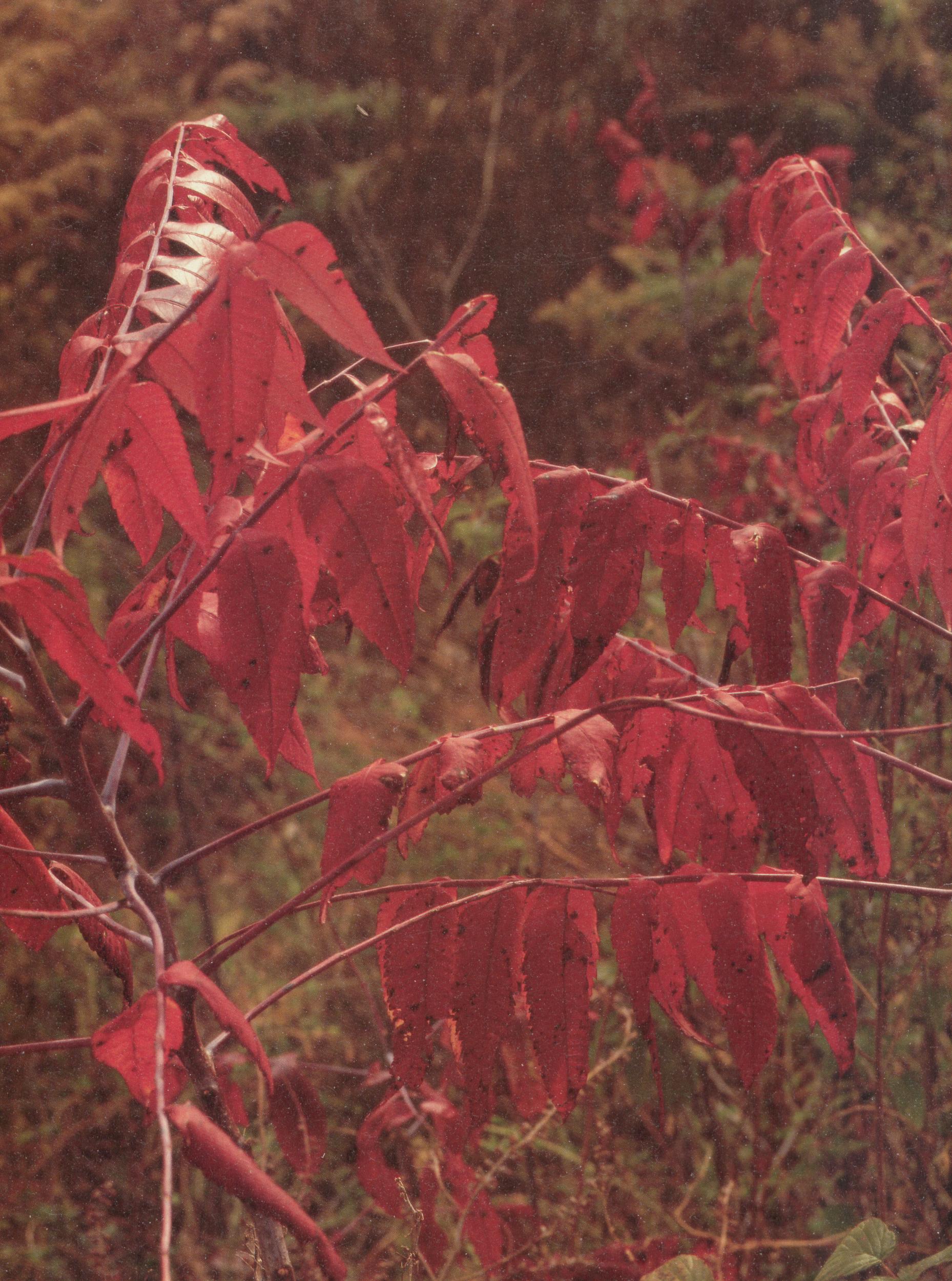
Position: 488 (21 views)