Volume 68, Issue 8, 1990
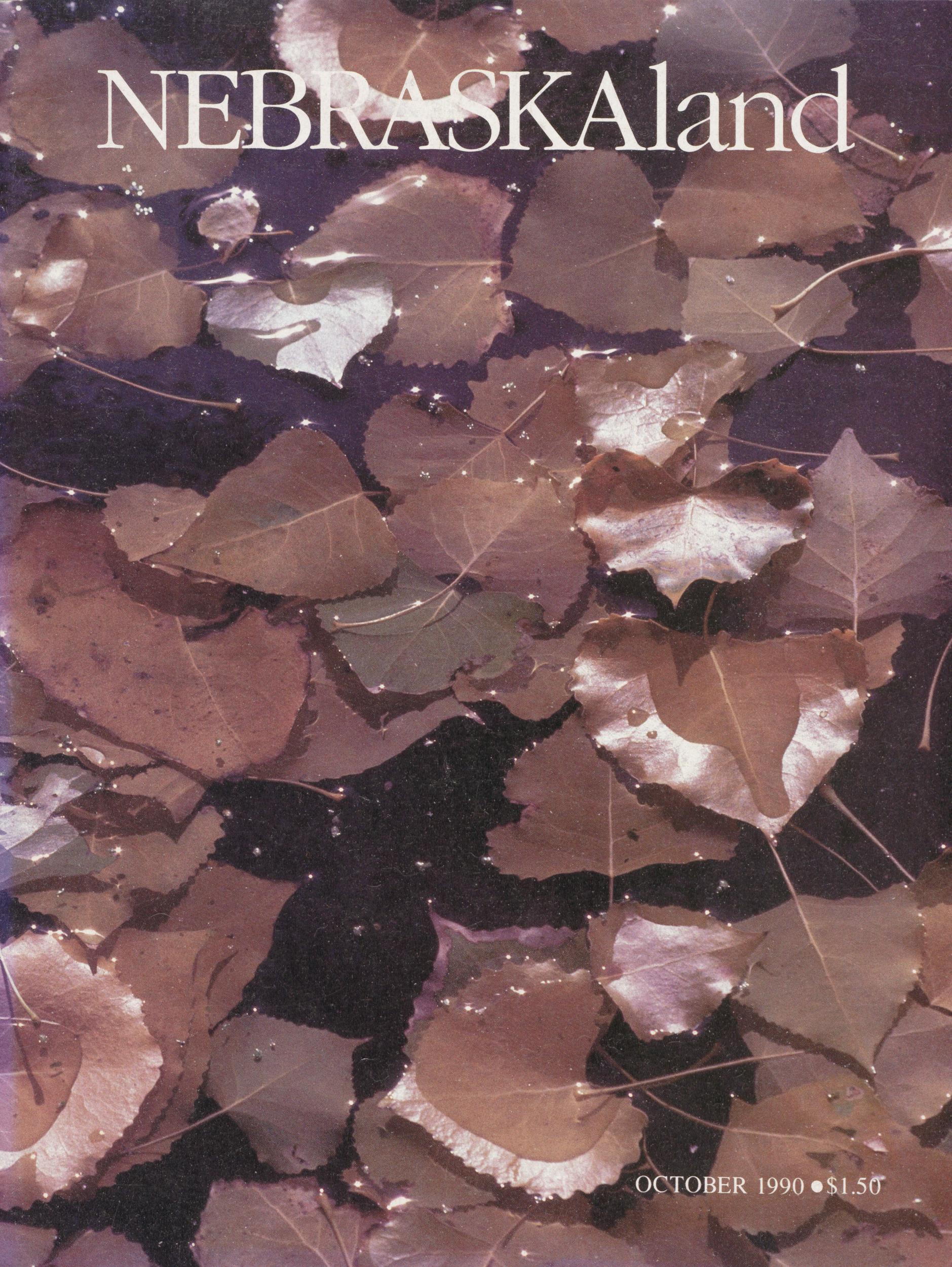
NEBRASKAland
OCTOBER 1990 $1.50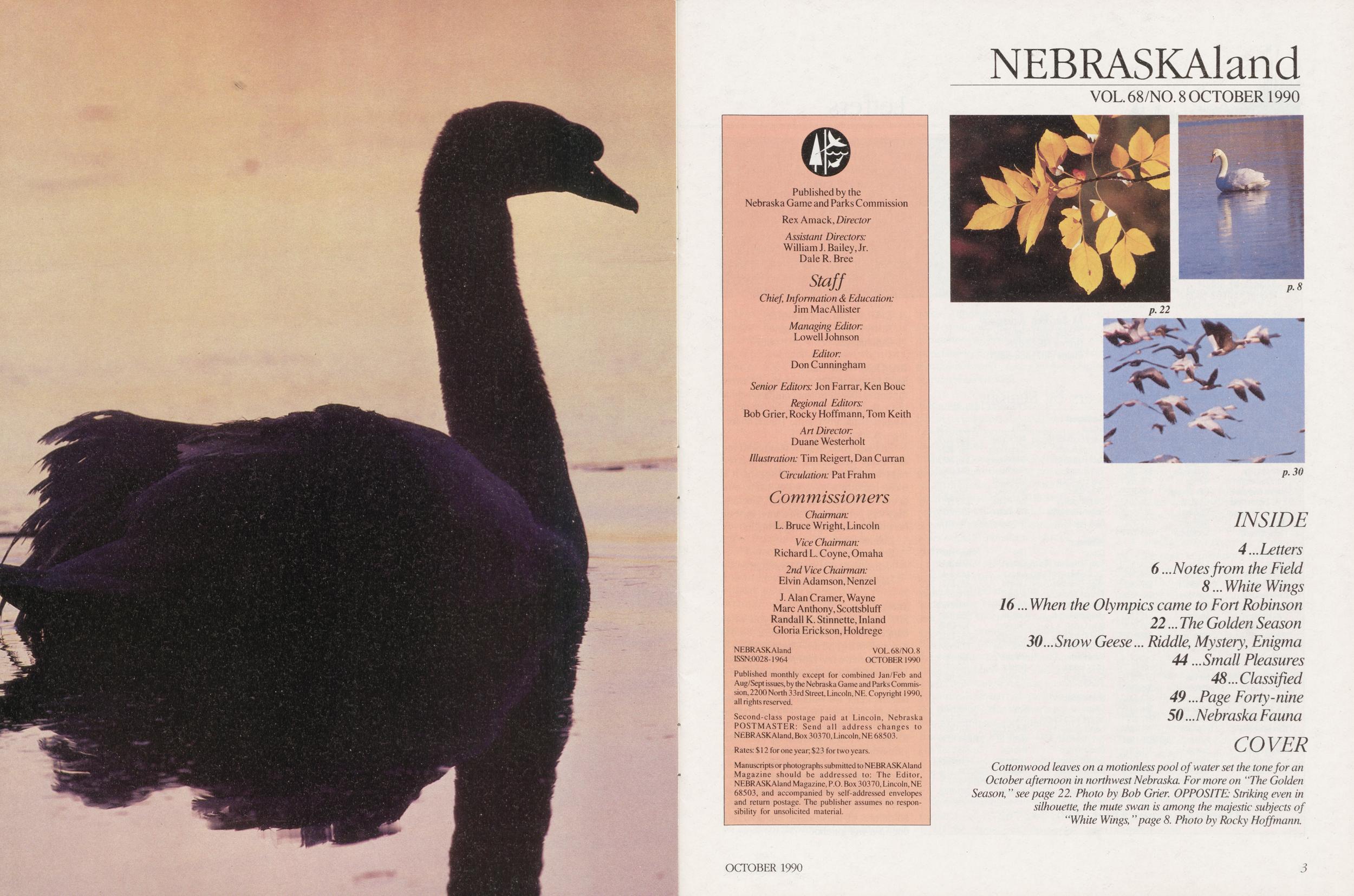
NEBRASKAland
VOL. 68/NO. 8 OCTOBER 1990 Published by the Nebraska Game and Parks Commission Rex Amack, Director Assistant Directors: William J. Bailey, Jr. Dale R. Bree Staff Chief Information & Education: Jim MacAllister Managing Editor: Lowell Johnson Editor Don Cunningham Senior Editors: Jon Farrar, Ken Bouc Regional Editors: Bob Grier, Rocky Hoffmann, Tom Keith Art Director: Duane Westerholt Illustration: Tim Reigert, Dan Curran Circulation: Pat Frahm Commissioners Chairman: L. Bruce Wright, Lincoln Vice Chairman: Richard L. Coyne, Omaha 2nd Vice Chairman: Elvin Adamson, Nenzel J. Alan Cramer, Wayne Marc Anthony, Scottsbluff Randall K. Stinnette, Inland Gloria Erickson, Holdrege NEBRASKAland ISSN:0028-1964 VOL. 68/NO. 8 OCTOBER 1990 Published monthly except for combined Jan/Feb and Aug/Sept issues, by the Nebraska Game and Parks Commis- sion, 2200 North 3 3rd Street, Lincoln, NE. Copyright 1990, all rights reserved. Second-class postage paid at Lincoln, Nebraska POSTMASTER: Send all address changes to NEBRASKAland, Box 30370, Lincoln, NE 68503. Rates: $ 12 for one year; $23 for two years. Manuscripts or photographs submitted to NEBRASKAland Magazine should be addressed to: The Editor, NEBRASKAland Magazine, P.O. Box 30370, Lincoln, NE 68503, and accompanied by self-addressed envelopes and return postage. The publisher assumes no responsibility for unsolicited material.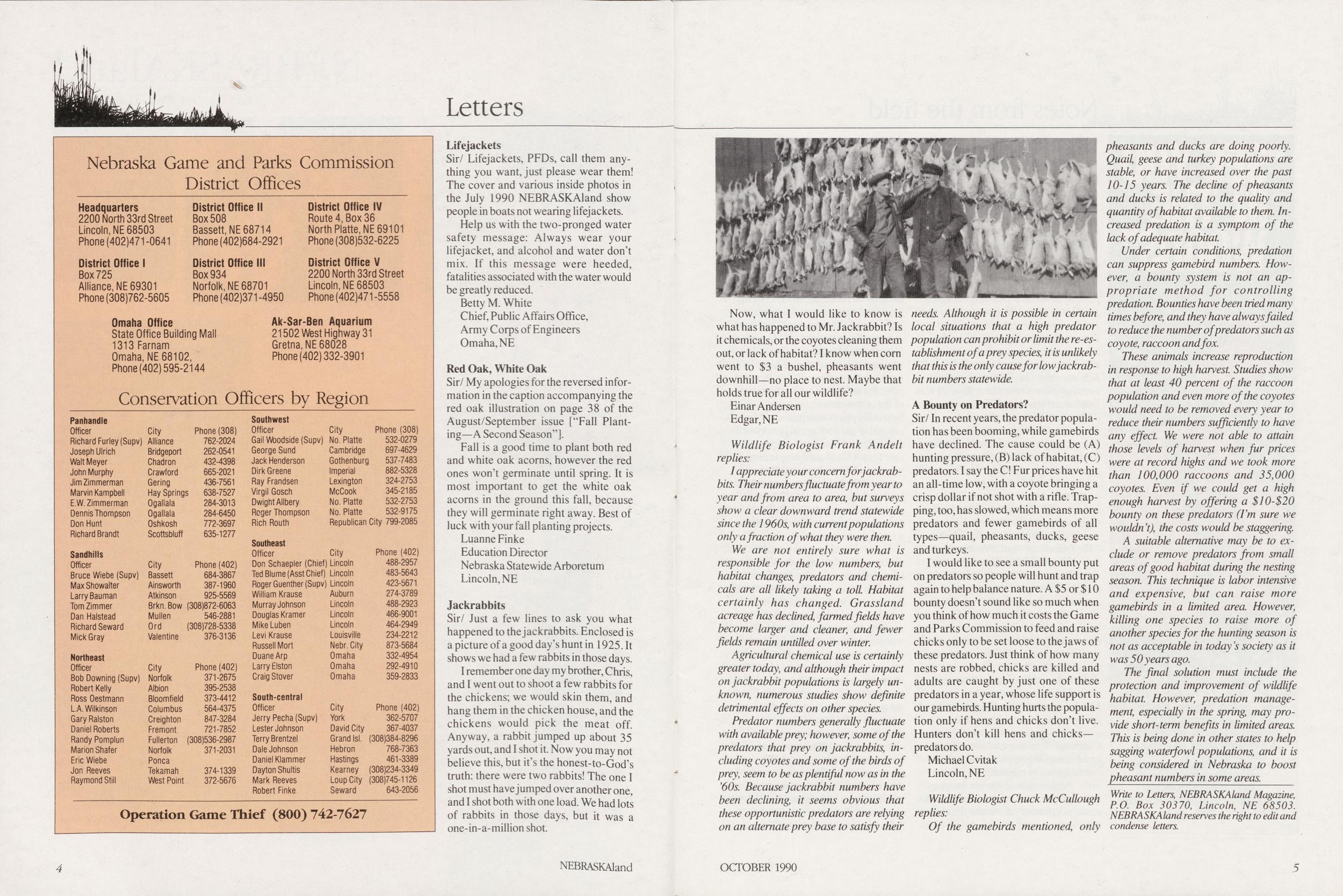
Letters
LifejacketsSir/ Lifejackets, PFDs, call them anything you want, just please wear them! The cover and various inside photos in the July 1990 NEBRASKAland show people in boats not wearing lifejackets.
Help us with the two-pronged water safety message: Always wear your lifejacket, and alcohol and water don't mix. If this message were heeded, fatalities associated with the water would be greatly reduced.
Betty M. White Chief, Public Affairs Office, Army Corps of Engineers Omaha, NE Red Oak, White OakSir/ My apologies for the reversed information in the caption accompanying the red oak illustration on page 38 of the August/September issue ["Fall Planting—A Second Season"].
Fall is a good time to plant both red and white oak acorns, however the red ones won't germinate until spring. It is most important to get the white oak acorns in the ground this fall, because they will germinate right away. Best of luck with your fall planting projects.
Luanne Finke Education Director Nebraska Statewide Arboretum Lincoln, NE JackrabbitsSir/ Just a few lines to ask you what happened to the jackrabbits. Enclosed is a picture of a good day's hunt in 1925. It shows we had a few rabbits in those days.
I remember one day my brother, Chris, and I went out to shoot a few rabbits for the chickens; we would skin them, and hang them in the chicken house, and the chickens would pick the meat off. Anyway, a rabbit jumped up about 35 yards out, and I shot it. Now you may not believe this, but it's the honest-to-God's truth: there were two rabbits! The one I shot must have jumped over another one, and I shot both with one load. We had lots of rabbits in those days, but it was a one-in-a-million shot.
4 NEBRASKAlandNow, what I would like to know is what has happened to Mr. Jackrabbit? Is it chemicals, or the coyotes cleaning them out, or lack of habitat? I know when corn went to $3 a bushel, pheasants went downhill—no place to nest. Maybe that holds true for all our wildlife?
Einar Andersen Edgar, NEWildlife Biologist Frank Andelt replies:
I appreciate your concern for jackrabbits. Their numbers fluctuate from year to year and from area to area, but surveys show a clear downward trend statewide since the 1960s, with current populations only a fraction of what they were then.
We are not entirely sure what is responsible for the low numbers, but habitat changes, predators and chemicals are all likely taking a toll Habitat certainly has changed. Grassland acreage has declined, farmed fields have become larger and cleaner, and fewer fields remain untilled over winter.
Agricultural chemical use is certainly greater today, and although their impact on jackrabbit populations is largely unknown, numerous studies show definite detrimental effects on other species.
Predator numbers generally fluctuate with available prey; however, some of the predators that prey on jackrabbits, including coyotes and some of the birds of prey, seem to be as plentiful now as in the '60s. Because jackrabbit numbers have been declining, it seems obvious that these opportunistic predators are relying on an alternate prey base to satisfy their needs. Although it is possible in certain local situations that a high predator population can prohibit or limit the re-establishment of a prey species, it is unlikely that this is the only cause for low jackrabbit numbers statewide.
A Bounty on Predators?Sir/ In recent years, the predator population has been booming, while gamebirds have declined. The cause could be (A) hunting pressure, (B) lack of habitat, (C) predators. I say the C! Fur prices have hit an all-time low, with a coyote bringing a crisp dollar if not shot with a rifle. Trapping, too, has slowed, which means more predators and fewer gamebirds of all types—quail, pheasants, ducks, geese and turkeys.
I would like to see a small bounty put on predators so people will hunt and trap again to help balance nature. A $5 or $ 10 bounty doesn't sound like so much when you think of how much it costs the Game and Parks Commission to feed and raise chicks only to be set loose to the jaws of these predators. Just think of how many nests are robbed, chicks are killed and adults are caught by just one of these predators in a year, whose life support is our gamebirds. Hunting hurts the population only if hens and chicks don't live. Hunters don't kill hens and chickspredators do.
Michael Cvitak Lincoln, NEWildlife Biologist Chuck McCullough replies:
Of the gamebirds mentioned, only pheasants and ducks are doing poorly. Quail geese and turkey populations are stable, or have increased over the past 10-15 years. The decline of pheasants and ducks is related to the quality and quantity of habitat available to them. Increased predation is a symptom of the lack of adequate habitat.
Under certain conditions, predation can suppress gamebird numbers. However, a bounty system is not an appropriate method for controlling predation. Bounties have been tried many times before, and they have always failed to reduce the number of predators such as coyote, raccoon and fox.
These animals increase reproduction in response to high harvest. Studies show that at least 40 percent of the raccoon population and even more of the coyotes would need to be removed every year to reduce their numbers sufficiently to have any effect. We were not able to attain those levels of harvest when fur prices were at record highs and we took more than 100,000 raccoons and 35,000 coyotes. Even if we could get a high enough harvest by offering a $10-$20 bounty on these predators (Tm sure we wouldn 't), the costs would be staggering.
A suitable alternative may be to exclude or remove predators from small areas of good habitat during the nesting season. This technique is labor intensive and expensive, but can raise more gamebirds in a limited area. However, killing one species to raise more of another species for the hunting season is not as acceptable in today ys society as it was 50 years ago.
The final solution must include the protection and improvement of wildlife habitat. However, predation management, especially in the spring, may provide short-term benefits in limited areas. This is being done in other states to help sagging waterfowl populations, and it is being considered in Nebraska to boost pheasant numbers in some areas.
Write to Letters, NEBRASKAland Magazine, P.O. Box 30370, Lincoln, NE 68503. NEBRASKAland reserves the right to edit and condense letters.
OCTOBER 1990 5 "SEE YOU
IN THE
WOODS"
... let's hope so.
Nebraska Hunter Education
(402 471-5434
"SEE YOU
IN THE
WOODS"
... let's hope so.
Nebraska Hunter Education
(402 471-5434
Notes from the field
Of Rivers and TreesIn his "Page Forty-nine" essay, "A Place for Trees," in the August/September issue, Senior Editor Jon Farrar mused on his own and Nebraska's affection for trees, and on the appropriate place for trees in the vegetation of this once-grassland state. John DeTuerk, of Ogallala, wrote to disagree with some points expressed in the essay:
I would like to take exception to parts of Jon Farrar s article "A Place for Trees." He states that "trees do not belong everywhere," and that the central Platte Valley is a place where trees should not be the dominant vegetation. From the general drift of the article one might be led to believe that trees are alien to the Platte River system, an artifact introduced by the meddling or exploitation of modern civilization. Later he says "the central Platte, though, was, and could again be, a broad, braided river with sandbars and grassed islands, a prairie river.'
Apparently Mr. Farrar has also fallen into the trap of oversimplification, just after having taken a writer from Ogallala to task for the same error. I would direct him to an article titled "The Island" by Paul Johnsgard in the July 1984NEBRASKAland. If trees don yt belong on this prairie river, why does Mr. Johnsgard so eloquently describe the cottonwoods, willows, elms, ashes, hackberries, boxelders, mulberries and dogwoods, and the natural progression of ascendancy and decline of these species on two of many islands in the Platte?
Perhaps, as Mr. Farrar dreams, the central Platte could again be a broad, braided river with sandbars and grassed islands. I doubt, however, if most of the human inhabitants of rural Colorado, Wyoming and Nebraska would be willing to put up with the inconveniences of returning it to that state. Inconveniences like the terror of spring floods and ice jams which would again so effectively scour the floodplain of young trees and shrubs, and incidently the towns, farms, ranches and inhabitants which have also established themselves along this not always barren prairie river.
John DeTuerkJon Farrar replies:
Paul Johnsgard's article in the July 1984 issue of NEBR ASK Aland was an excerpt from his book The Platte Channels in Time. The perspective of the book clearly is that dewatering of the river has dramatically altered the Platte's natural association of plants and animals. The excerpt "The Island" is a specific description of Mormon and Shoemaker islands in the Grand Island area and is not intended to describe the establishment of woodlands on any other Platte River islands. His account of the colonization of those two islands by woody plants was presented in the context of the geological history of the Platte River. Historical writings indicate these two islands were indeed wooded when white men first encountered them, as were some other islands, peninsulas and bluff sides protected from periodic wildfires which discouraged the establishment of woody plants elsewhere.
But we should not, as has often been the case recently during the sometimes heated debate over what the Platte River was and should be, draw sweeping conclusions from just one historical account. Just because one site was wooded does not mean the entire river was wooded nor, conversely, just because one account says a site was not wooded should we assume none of the Platte was wooded. When all historical accounts available are examined, and the accuracy of each weighed according to the reliability of the writer, though, it is evident that woodlands along the central Platte were restricted to sites protected from prairie fires. For the most part the Platte was a braided river of many channels meandering at will through a wide, grassed valley with occasional pockets of trees, and even those becoming rare west of Kearney.
6 NEBRASKAlandThis is well documented in the research publication The Case of the Shrinking Channels—the North Platte and Platte Rivers in Nebraska, U.S. Department of the Interior Geological Survey Circular 781, from which the following passage is taken: "The decreases in channel width are related to decreases in water discharge. Such flow reductions have resulted primarily from the regulating effects of major upstream dams and the greater use of river water by man. Much of the former river channel is now overgrown with vegetation." Photo comparisons of the same sites at the turn of the century and in the 1970s irrefutably illustrate how the Platte has dramatically changed just in this century.
Numerous personal accounts are equally convincing. For example, Joe Jeffrey of Lexington gave the following testimony at a federal hearing in North Platte on September 11,1989 regarding the relicensing of Kingsley Dam:
"My dad told me [that] as a youngster back in [the] early 1900s, on our island in the middle [of the Platte River] between Overton and Lexington, he could stand on his saddle and see both the Overton bridge and the Lexington bridge, a span of 11 miles, so if you are in the middle, about five-and-a-half miles [each way]. You can't see off our island today because of the trees."
Bridges which span the river today are shorter than earlier bridges, and certainly have played a role in constricting the flow of the Platte and altering the system of braided channels for which the river was once noted. Once, periodic floods were a natural component of the Platte River ecosystem which scoured tree seedings from sandbars and shorelines. Obviously floods of historic dimensions would not be well received by those living in the floodplain today. But, should the fate of an ancient river be determined by decisions made by men in the relatively recent past? Floods threaten life and property because we have persisted in building in floodplains. Impoundments for flood control were our response to protect those who had.
But there are alternatives. In many European countries and increasingly in the United States, expanses of grass or trees (whichever is appropriate for that region) or pastureland are replacing man's developments in floodplains. Governmental agencies are beginning to realize that in many cases the costs of establishing these "greenbelts" are, in the long term, significantly less than construction and maintenance of dams, bank stabilization and financial aid to flood victims.
Rapid City, South Dakota, is a classic example. Following the June 9, 1972 flood, resulting in the loss of 238 lives, the city council refused to issue new building permits in the floodplain and used federal aid and local matching funds to move more than 1,000 families and 157 businesses out of the floodplain. Today, parks and open spaces occupy the floodplain through Rapid City.
In Nebraska, Beatrice has followed a similar approach following a flood on the Big Blue River in 1973. Since then, about 100 homes have been removed from the floodplain and the land purchased by the city. Eventually Beatrice hopes to link existing parks on the northwest and southeast sides of town in development-free parkland.
Additionally, it should not be forgotten that the periodic deposition of silt by floods on floodplains is the very mechanism which makes them such fertile farm ground. When rivers are dammed, rich deposits of silt are no longer spread over floodplains to enrich future crops, but are gathered many feet deep behind impoundments of ever decreasing capacity.
As all the ramifications of our manipulation of the land and its rivers become evident, the need to live in harmony with our finite bit of earth, not exploiting it for short-term gain but reaping its bounty in a sustainable fashion, becomes ever more evident.
Jon Farrar Do You Know? Do you know of a group or individual deserving recognition for volunteer work on Nebraska's public lands or our environment? Annual state and national awards ceremonies recognize these special efforts through the Take Pride in America Program. November 15 is the deadline for this year's entries. To receive a nomination form and program information call or write: Take Pride in America Nebraska Natural Resources Commission P.O. Box 94876 Lincoln, NE 68509-4876 (402) 471-2081 OCTOBER 1990 7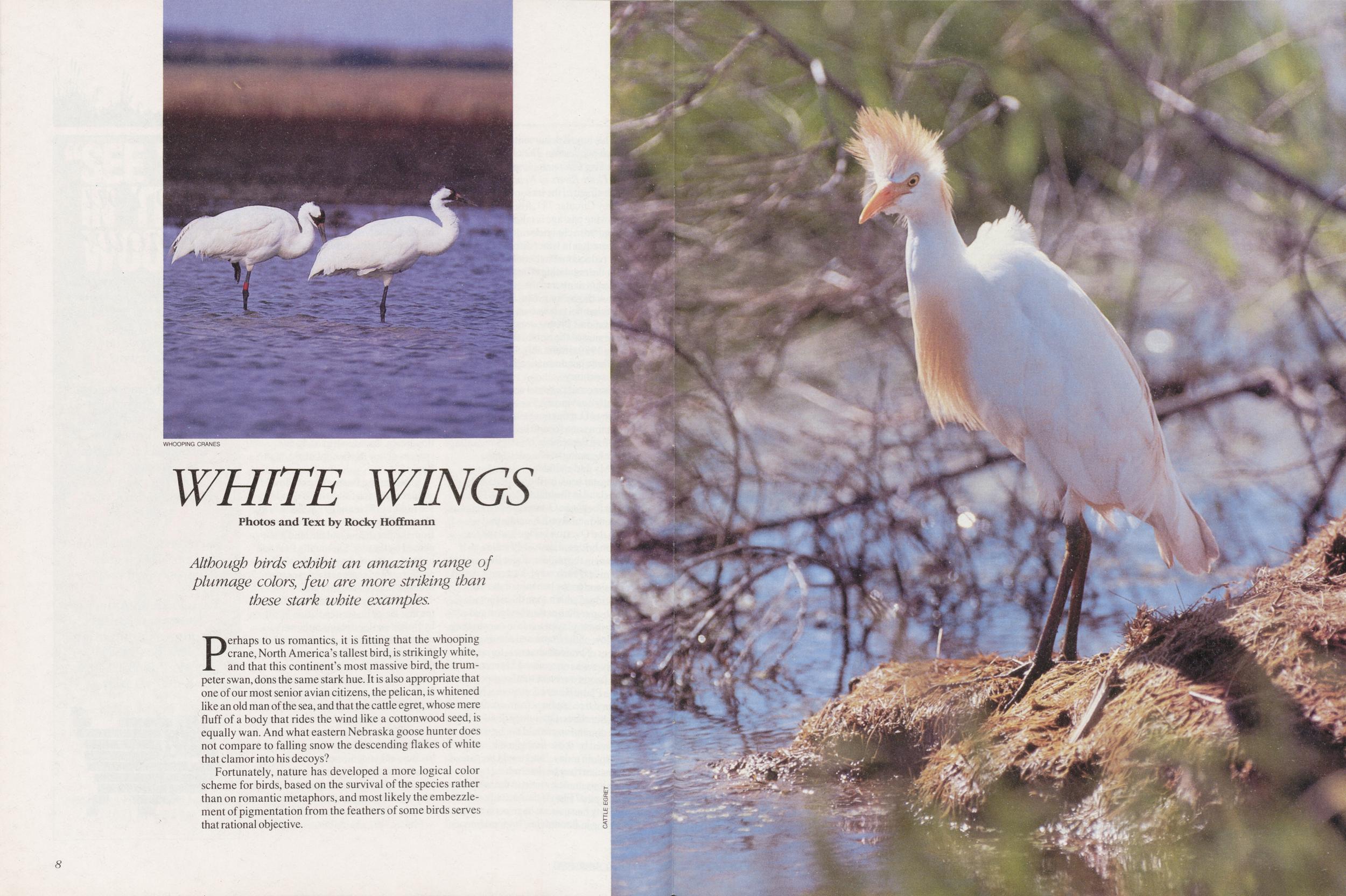
WHITE WINGS
Photos and Text by Rocky Hoffmann Although birds exhibit an amazing range of plumage colors, few are more striking than these stark white examples.Perhaps to us romantics, it is fitting that the whooping crane, North America's tallest bird, is strikingly white, and that this continent's most massive bird, the trumpeter swan, dons the same stark hue. It is also appropriate that one of our most senior avian citizens, the pelican, is whitened like an old man of the sea, and that the cattle egret, whose mere fluff of a body that rides the wind like a cottonwood seed, is equally wan. And what eastern Nebraska goose hunter does not compare to falling snow the descending flakes of white that clamor into his decoys?
Fortunately, nature has developed a more logical color scheme for birds, based on the survival of the species rather than on romantic metaphors, and most likely the embezzlement of pigmentation from the feathers of some birds serves that rational objective.
8 NEBRASKAland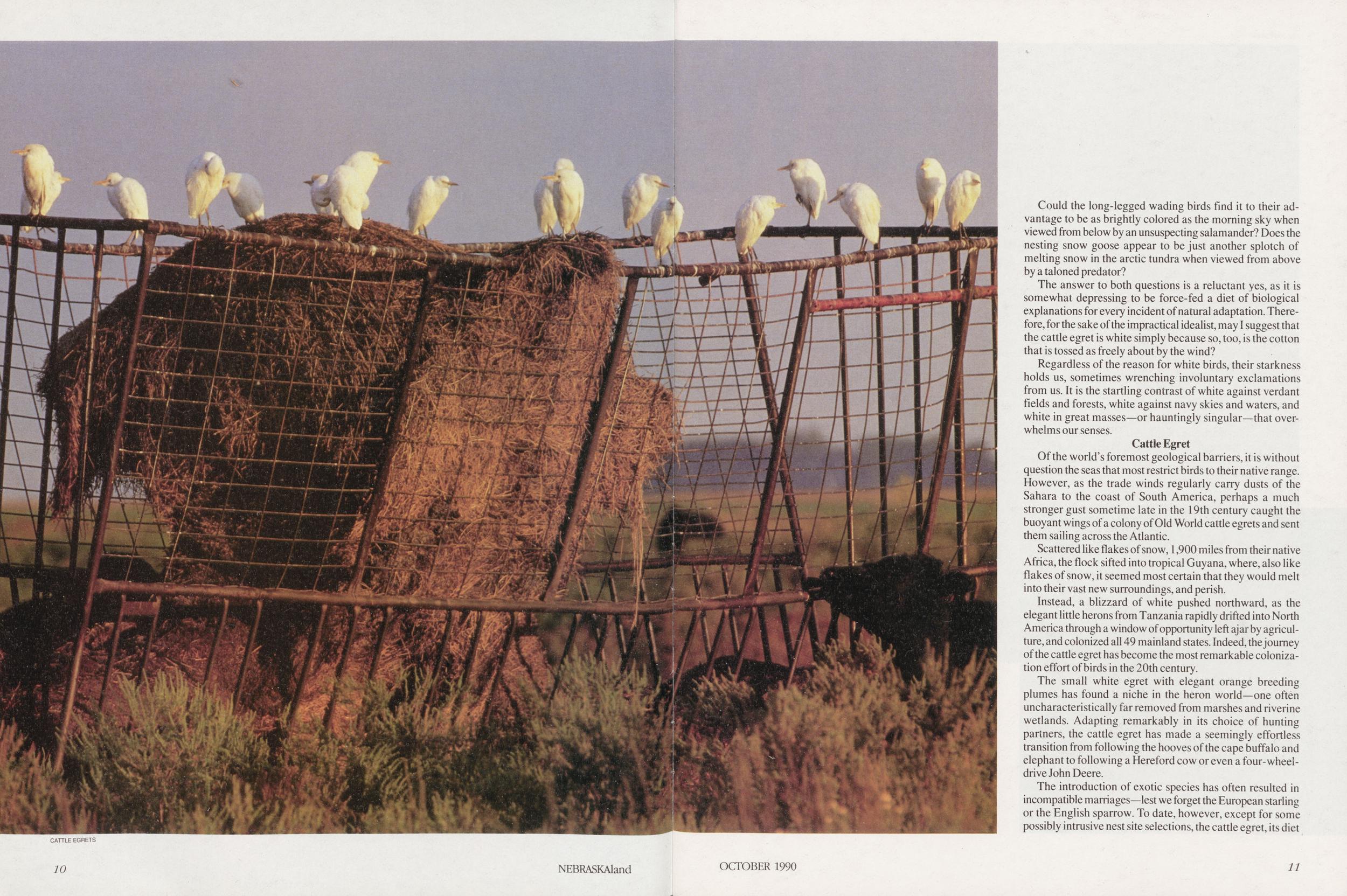
Could the long-legged wading birds find it to their advantage to be as brightly colored as the morning sky when viewed from below by an unsuspecting salamander? Does the nesting snow goose appear to be just another splotch of melting snow in the arctic tundra when viewed from above by a taloned predator?
The answer to both questions is a reluctant yes, as it is somewhat depressing to be force-fed a diet of biological explanations for every incident of natural adaptation. Therefore, for the sake of the impractical idealist, may I suggest that the cattle egret is white simply because so, too, is the cotton that is tossed as freely about by the wind?
Regardless of the reason for white birds, their starkness holds us, sometimes wrenching involuntary exclamations from us. It is the startling contrast of white against verdant fields and forests, white against navy skies and waters, and white in great masses—or hauntingly singular—that overwhelms our senses.
Cattle EgretOf the world's foremost geological barriers, it is without question the seas that most restrict birds to their native range. However, as the trade winds regularly carry dusts of the Sahara to the coast of South America, perhaps a much stronger gust sometime late in the 19th century caught the buoyant wings of a colony of Old World cattle egrets and sent them sailing across the Atlantic.
Scattered like flakes of snow, 1,900 miles from their native Africa, the flock sifted into tropical Guyana, where, also like flakes of snow, it seemed most certain that they would melt into their vast new surroundings, and perish.
Instead, a blizzard of white pushed northward, as the elegant little herons from Tanzania rapidly drifted into North America through a window of opportunity left ajar by agriculture, and colonized all 49 mainland states. Indeed, the journey of the cattle egret has become the most remarkable colonization effort of birds in the 20th century.
The small white egret with elegant orange breeding plumes has found a niche in the heron world—one often uncharacteristically far removed from marshes and riverine wetlands. Adapting remarkably in its choice of hunting partners, the cattle egret has made a seemingly effortless transition from following the hooves of the cape buffalo and elephant to following a Hereford cow or even a four-wheel-drive John Deere.
The introduction of exotic species has often resulted in
incompatible marriages—lest we forget the European starling
or the English sparrow. To date, however, except for some
possibly intrusive nest site selections, the cattle egret, its diet
OCTOBER 1990
11
 primarily insects stirred by the feet of cattle and the wheels
of farm implements, has been cautiously welcomed ashore.
primarily insects stirred by the feet of cattle and the wheels
of farm implements, has been cautiously welcomed ashore.
Unlike its stoop-shouldered cousin, the highly erect great, or common, egret is a North American native and, because of its attraction to wetlands and swimming prey, a more typical heron. Elegant aflight and afoot, the common egret is a decorative percher, often adorning trees like unstriped candy canes on a Christmas pine.
Its stoic presence along the reed line of a Sandhills lake erupts like white lightning as a sunfish trapped in the forceps of its spear-like beak is tossed, turned, and headed down its serpentine throat. For such fishing rights, the common egret will lash out with equal quickness and ferocity, using its frontal dagger effectively to ward off any winged intruder.
The flowing aigrettes—the spray of breeding plumage of the male's nuptial costume is strikingly veil-like in appearance, but such beauty nearly caused this egret's demise. An ounce of feathers, once more valuable than an equal weight of pure gold, prompted a vanity in well-to-do ladies and a greed in the gunner's heart, and the common egret was no longer so common.
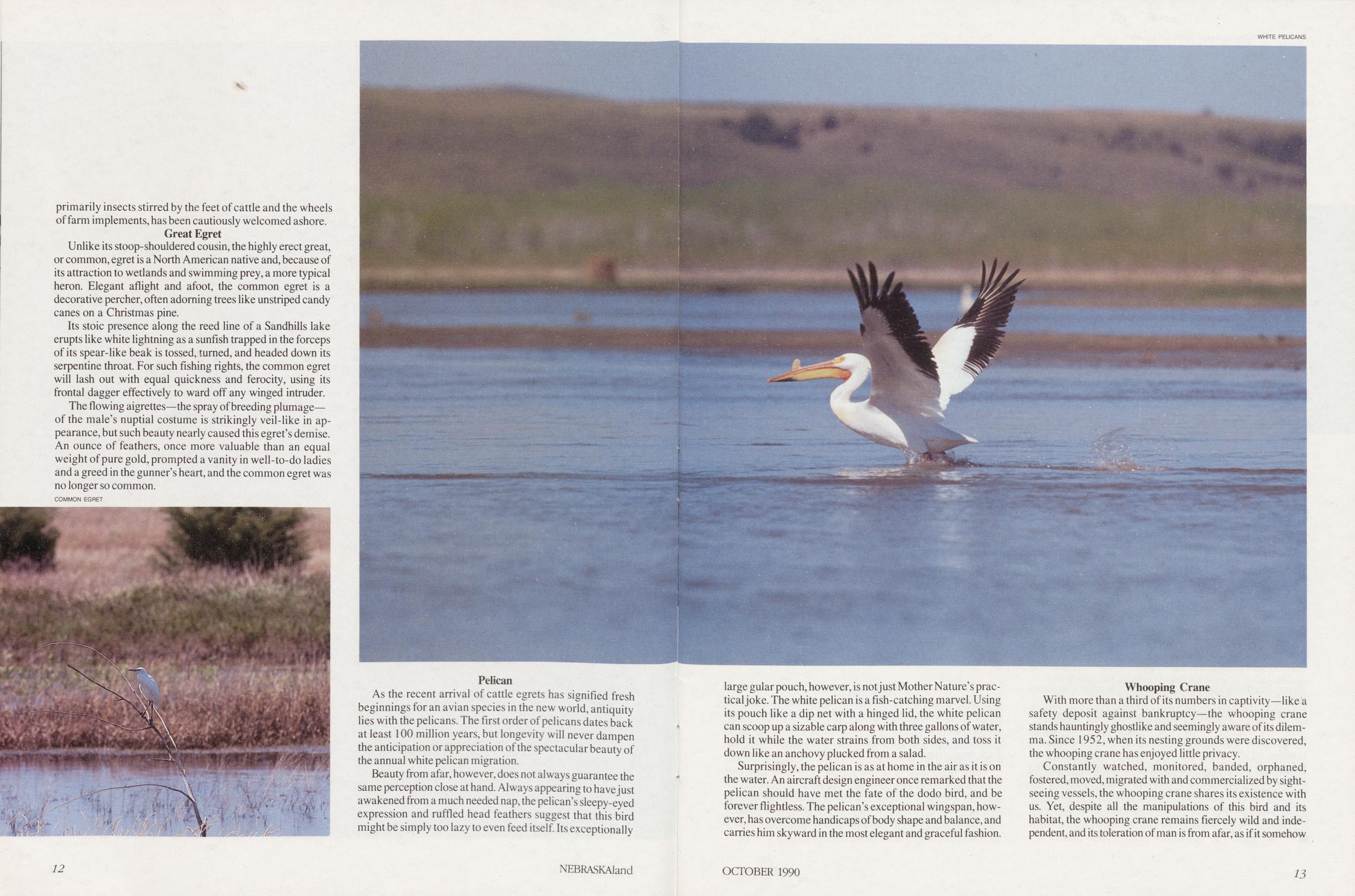
As the recent arrival of cattle egrets has signified fresh beginnings for an avian species in the new world, antiquity lies with the pelicans. The first order of pelicans dates back at least 100 million years, but longevity will never dampen the anticipation or appreciation of the spectacular beauty of the annual white pelican migration.
Beauty from afar, however, does not always guarantee the same perception close at hand. Always appearing to have just awakened from a much needed nap, the pelican's sleepy-eyed expression and ruffled head feathers suggest that this bird might be simply too lazy to even feed itself. Its exceptionally 12 NEBRASKAland
Surprisingly, the pelican is as at home in the air as it is on the water. An aircraft design engineer once remarked that the pelican should have met the fate of the dodo bird, and be forever flightless. The pelican's exceptional wingspan, however, has overcome handicaps of body shape and balance, and carries him skyward in the most elegant and graceful fashion.
Whooping CraneWith more than a third of its numbers in captivity—like a safety deposit against bankruptcy—the whooping crane stands hauntingly ghostlike and seemingly aware of its dilemma. Since 1952, when its nesting grounds were discovered, the whooping crane has enjoyed little privacy.
Constantly watched, monitored, banded, orphaned,
fostered, moved, migrated with and commercialized by sightseeing vessels, the whooping
crane shares its existence with
us. Yet, despite all the manipulations of this bird and its
habitat, the whooping crane remains fiercely wild and independent, and its toleration
of man is from afar, as if it somehow
OCTOBER 1990
13
Although remarkable steps have been taken to ensure its recovery, we still are ultimately accountable for the threats that continue to challenge the whooping crane's existence. A massive oil spill along the Texas coast, for example, is no longer just a possibility, and the destruction of migration habitat has not ended; it just continues at a slower pace. For now, at least, it appears that this monarch of the North American marshes will continue to resonate the far-reaching call for which it was named in increasing harmony with a growing population.
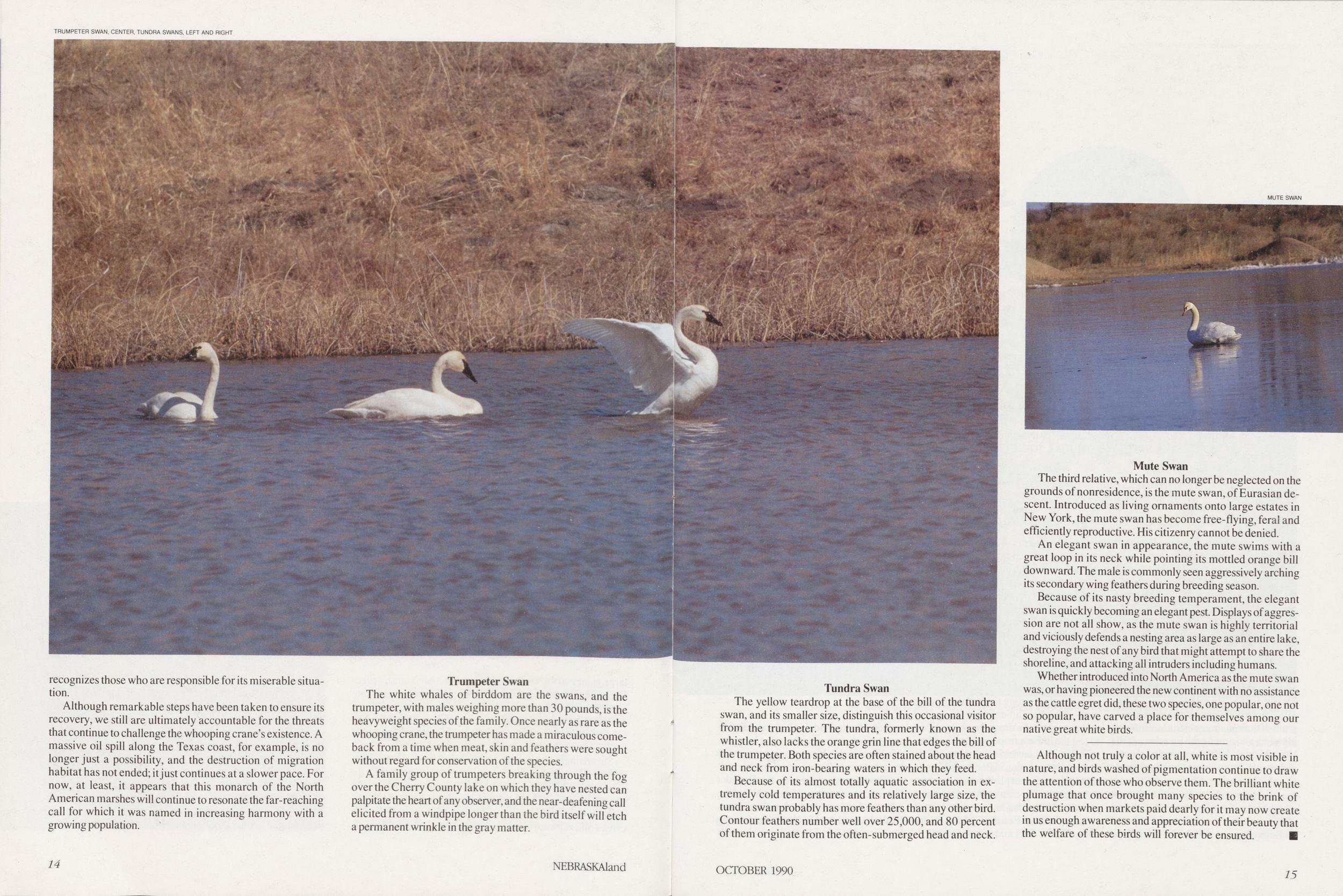
Trumpeter SwanThe white whales of birddom are the swans, and the trumpeter, with males weighing more than 30 pounds, is the heavyweight species of the family. Once nearly as rare as the whooping crane, the trumpeter has made a miraculous comeback from a time when meat, skin and feathers were sought without regard for conservation of the species.
A family group of trumpeters breaking through the fog over the Cherry County lake on which they have nested can palpitate the heart of any observer, and the near-deafening call elicited from a windpipe longer than the bird itself will etch a permanent wrinkle in the gray matter.
14 NEBRASKAland Tundra SwanThe yellow teardrop at the base of the bill of the tundra swan, and its smaller size, distinguish this occasional visitor from the trumpeter. The tundra, formerly known as the whistler, also lacks the orange grin line that edges the bill of the trumpeter. Both species are often stained about the head and neck from iron-bearing waters in which they feed.
Because of its almost totally aquatic association in extremely cold temperatures and its relatively large size, the tundra swan probably has more feathers than any other bird. Contour feathers number well over 25,000, and 80 percent of them originate from the often-submerged head and neck.
The third relative, which can no longer be neglected on the grounds of nonresidence, is the mute swan, of Eurasian descent. Introduced as living ornaments onto large estates in New York, the mute swan has become free-flying, feral and efficiently reproductive. His citizenry cannot be denied.
An elegant swan in appearance, the mute swims with a great loop in its neck while pointing its mottled orange bill downward. The male is commonly seen aggressively arching its secondary wing feathers during breeding season.
Because of its nasty breeding temperament, the elegant swan is quickly becoming an elegant pest. Displays of aggression are not all show, as the mute swan is highly territorial and viciously defends a nesting area as large as an entire lake, destroying the nest of any bird that might attempt to share the shoreline, and attacking all intruders including humans.
Whether introduced into North America as the mute swan was, or having pioneered the new continent with no assistance as the cattle egret did, these two species, one popular, one not so popular, have carved a place for themselves among our native great white birds.
Although not truly a color at all, white is most visible in nature, and birds washed of pigmentation continue to draw the attention of those who observe them. The brilliant white plumage that once brought many species to the brink of destruction when markets paid dearly for it may now create in us enough awareness and appreciation of their beauty that the welfare of these birds will forever be ensured.
OCTOBER 1990 15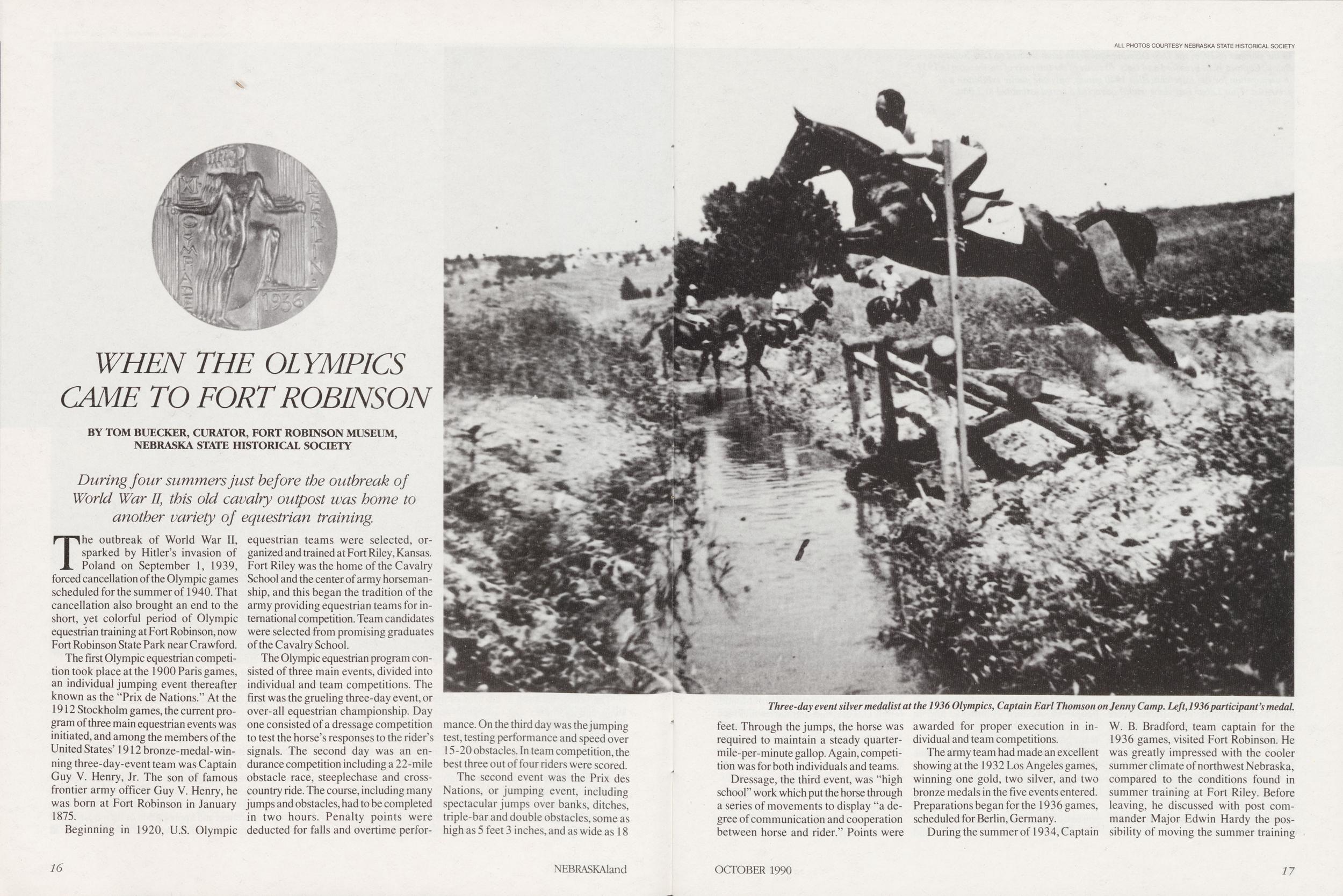
WHEN THE OL YMPICS CAME TO FORT ROBEVSON
BY TOM BUECKER, CURATOR, FORT ROBINSON MUSEUM, NEBRASKA STATE HISTORICAL SOCIETY During four summers just before the outbreak of World War II, this old cavalry outpost was home to another variety of equestrian trainingThe outbreak of World War II, sparked by Hitler's invasion of Poland on September 1, 1939, forced cancellation of the Olympic games scheduled for the summer of 1940. That cancellation also brought an end to the short, yet colorful period of Olympic equestrian training at Fort Robinson, now Fort Robinson State Park near Crawford.
The first Olympic equestrian competition took place at the 1900 Paris games, an individual jumping event thereafter known as the "Prix de Nations." At the 1912 Stockholm games, the current program of three main equestrian events was initiated, and among the members of the United States' 1912 bronze-medal-winning three-day-event team was Captain Guy V. Henry, Jr. The son of famous frontier army officer Guy V. Henry, he was born at Fort Robinson in January 1875.
Beginning in 1920, U.S. Olympic equestrian teams were selected, organized and trained at Fort Riley, Kansas. Fort Riley was the home of the Cavalry School and the center of army horsemanship, and this began the tradition of the army providing equestrian teams for international competition. Team candidates were selected from promising graduates of the Cavalry School.
The Olympic equestrian program consisted of three main events, divided into individual and team competitions. The first was the grueling three-day event, or over-all equestrian championship. Day one consisted of a dressage competition to test the horse's responses to the rider's signals. The second day was an endurance competition including a 22-mile obstacle race, steeplechase and crosscountry ride. The course, including many jumps and obstacles, had to be completed in two hours. Penalty points were deducted for falls and overtime performance. On the third day was the jumping test, testing performance and speed over 15-20 obstacles. In team competition, the best three out of four riders were scored.
The second event was the Prix des Nations, or jumping event, including spectacular jumps over banks, ditches, triple-bar and double obstacles, some as high as 5 feet 3 inches, and as wide as 18 16 NEBRASKAland
Dressage, the third event, was "high school" work which put the horse through a series of movements to display "a degree of communication and cooperation between horse and rider." Points were awarded for proper execution in individual and team competitions.
The army team had made an excellent showing at the 1932 Los Angeles games, winning one gold, two silver, and two bronze medals in the five events entered. Preparations began for the 1936 games, scheduled for Berlin, Germany.
During the summer of 1934, Captain
W. B. Bradford, team captain for the
1936 games, visited Fort Robinson. He
was greatly impressed with the cooler
summer climate of northwest Nebraska,
compared to the conditions found in
summer training at Fort Riley. Before
leaving, he discussed with post commander Major Edwin Hardy the possibility of moving
the summer training
OCTOBE 1990
17
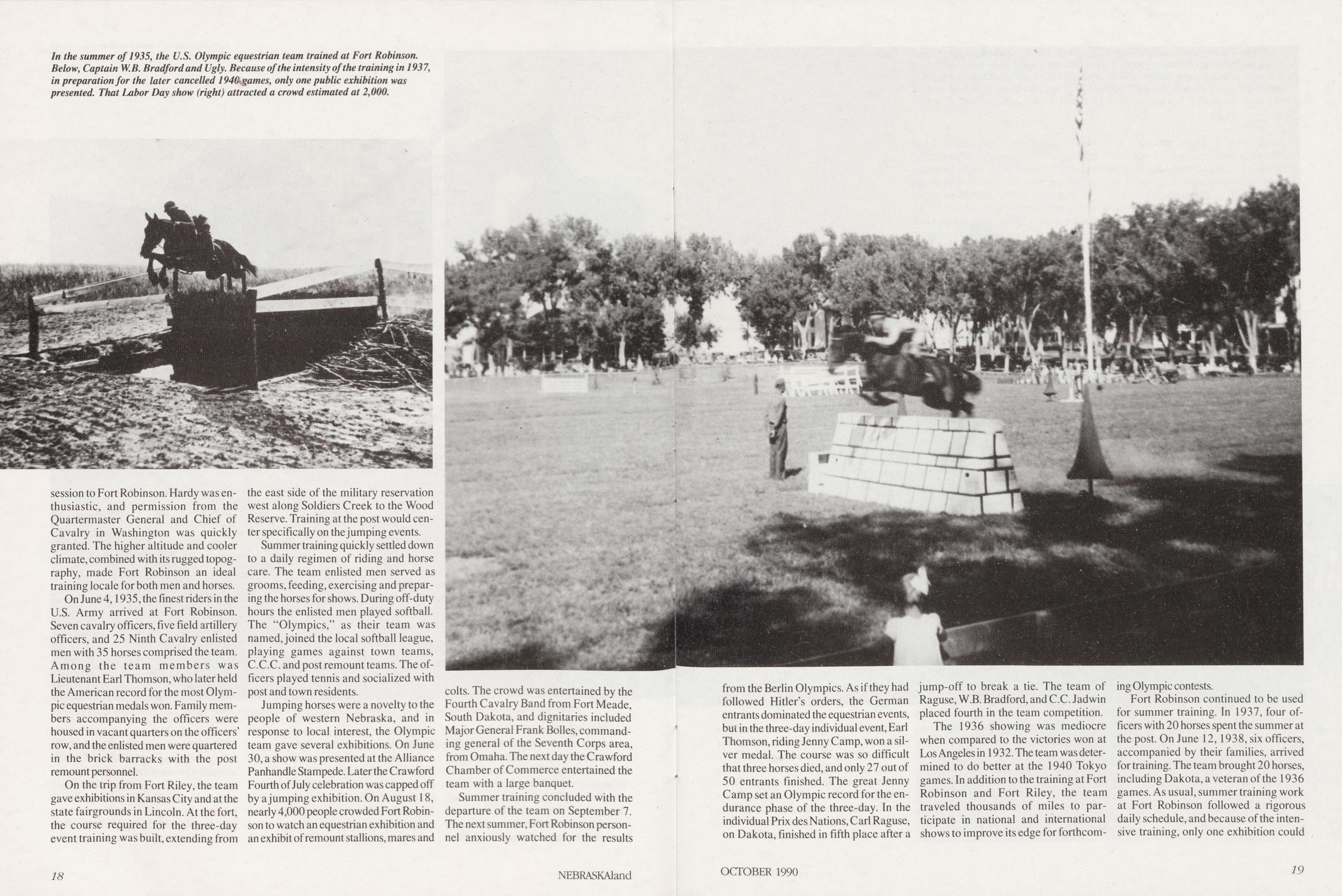
On June 4,1935, the finest riders in the U.S. Army arrived at Fort Robinson. Seven cavalry officers, five field artillery officers, and 25 Ninth Cavalry enlisted men with 35 horses comprised the team. Among the team members was Lieutenant Earl Thomson, who later held the American record for the most Olympic equestrian medals won. Family members accompanying the officers were housed in vacant quarters on the officers' row, and the enlisted men were quartered in the brick barracks with the post remount personnel.
On the trip from Fort Riley, the team gave exhibitions in Kansas City and at the state fairgrounds in Lincoln. At the fort, the course required for the three-day event training was built, extending from the east side of the military reservation west along Soldiers Creek to the Wood Reserve. Training at the post would center specifically on the jumping events.
Summer training quickly settled down to a daily regimen of riding and horse care. The team enlisted men served as grooms, feeding, exercising and preparing the horses for shows. During off-duty hours the enlisted men played softball. The "Olympics," as their team was named, joined the local softball league, playing games against town teams, C.C.C. and post remount teams. The officers played tennis and socialized with post and town residents.
Jumping horses were a novelty to the people of western Nebraska, and in response to local interest, the Olympic team gave several exhibitions. On June 30, a show was presented at the Alliance Panhandle Stampede. Later the Crawford Fourth of July celebration was capped off by a jumping exhibition. On August 18, nearly 4,000 people crowded Fort Robinson to watch an equestrian exhibition and an exhibit ofremount stallions, mares and colts. The crowd was entertained by the Fourth Cavalry Band from Fort Meade, South Dakota, and dignitaries included Major General Frank Bolles, commanding general of the Seventh Corps area, from Omaha. The next day the Crawford Chamber of Commerce entertained the team with a large banquet.
Summer training concluded with the departure of the team on September 7. The next summer, Fort Robinson personnel anxiously watched for the results 18 NEBRASKAland
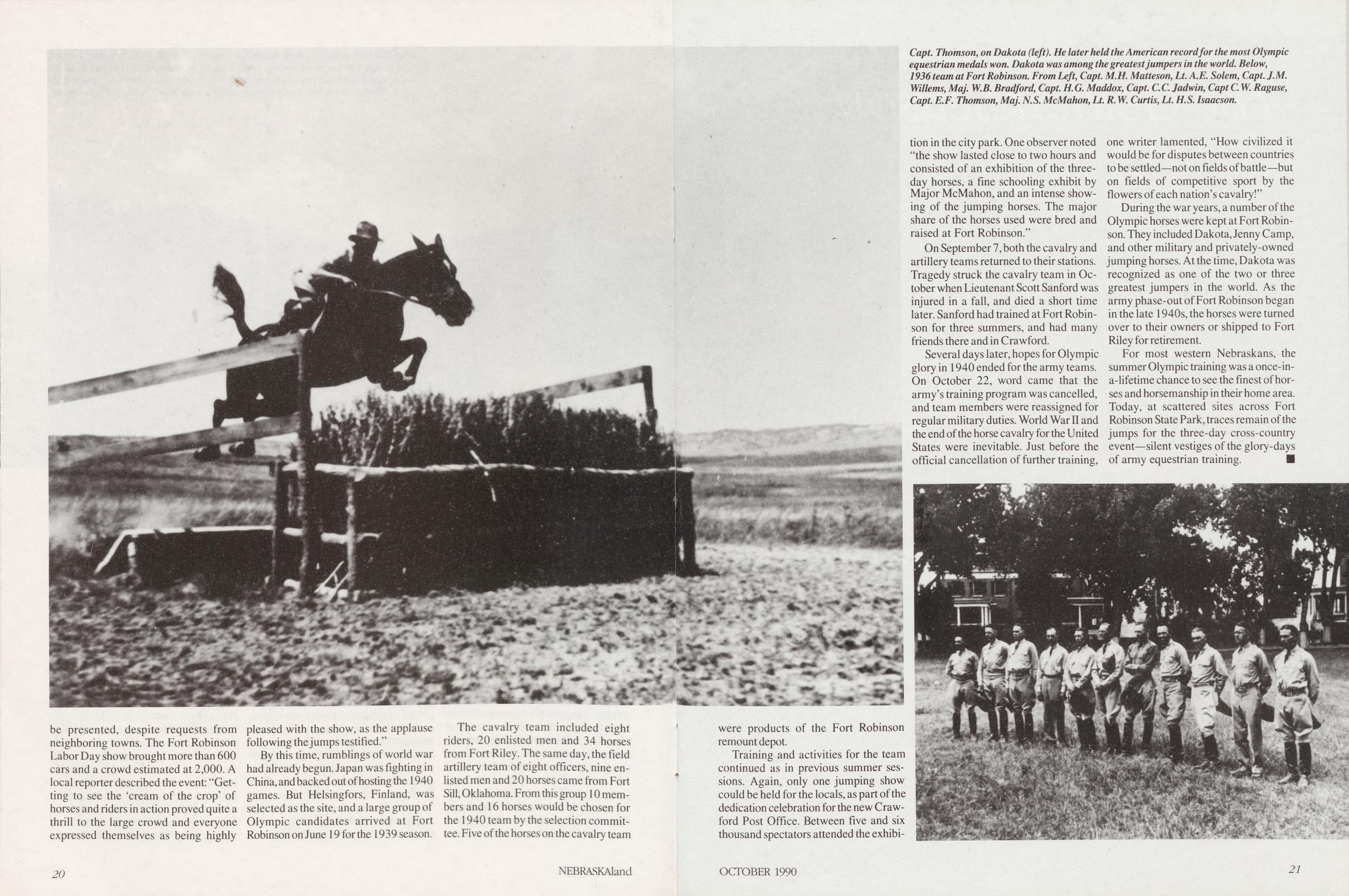
The 1936 showing was mediocre when compared to the victories won at Los Angeles in 1932. The team was determined to do better at the 1940 Tokyo games. In addition to the training at Fort Robinson and Fort Riley, the team traveled thousands of miles to participate in national and international shows to improve its edge for forthcoming Olympic contests.
Fort Robinson continued to be used
for summer training. In 1937, four officers with 20 horses spent the summer at
the post. On June 12,1938, six officers,
accompanied by their families, arrived
for training. The team brought 20 horses,
including Dakota, a veteran of the 1936
games. As usual, summer training work
at Fort Robinson followed a rigorous
daily schedule, and because of the intensive training, only one exhibition could
OCTOBER 1990
19
By this time, rumblings of world war had already begun. Japan was fighting in China, and backed out of hosting the 1940 games. But Helsingfors, Finland, was selected as the site, and a large group of Olympic candidates arrived at Fort Robinson on June 19 for the 1939 season.
The cavalry team included eight riders, 20 enlisted men and 34 horses from Fort Riley. The same day, the field artillery team of eight officers, nine enlisted men and 20 horses came from Fort Sill, Oklahoma. From this group 10 members and 16 horses would be chosen for the 1940 team by the selection committee. Five ofthe horses on the cavalry team 20 NEBRASKAland were products of the Fort Robinson remount depot.
Training and activities for the team continued as in previous summer sessions. Again, only one jumping show could be held for the locals, as part ofthe dedication celebration for the new Crawford Post Office. Between five and six thousand spectators attended the exhibition in the city park. One observer noted "the show lasted close to two hours and consisted of an exhibition of the three-day horses, a fine schooling exhibit by Major McMahon, and an intense showing of the jumping horses. The major share of the horses used were bred and raised at Fort Robinson."
On September 7, both the cavalry and artillery teams returned to their stations. Tragedy struck the cavalry team in October when Lieutenant Scott Sanford was injured in a fall, and died a short time later. Sanford had trained at Fort Robinson for three summers, and had many friends there and in Crawford.
Several days later, hopes for Olympic glory in 1940 ended for the army teams. On October 22, word came that the army's training program was cancelled, and team members were reassigned for regular military duties. World War II and the end ofthe horse cavalry for the United States were inevitable. Just before the official cancellation of further training, one writer lamented, "How civilized it would be for disputes between countries to be settled—not on fields of battle—but on fields of competitive sport by the flowers of each nation's cavalry!"
During the war years, a number ofthe Olympic horses were kept at Fort Robinson. They included Dakota, Jenny Camp, and other military and privately-owned jumping horses. At the time, Dakota was recognized as one of the two or three greatest jumpers in the world. As the army phase-out of Fort Robinson began in the late 1940s, the horses were turned over to their owners or shipped to Fort Riley for retirement.
For most western Nebraskans, the summer Olympic training was a once-ina-lifetime chance to see the finest of horses and horsemanship in their home area. Today, at scattered sites across Fort Robinson State Park, traces remain ofthe jumps for the three-day cross-country event—silent vestiges ofthe glory-days of army equestrian training.
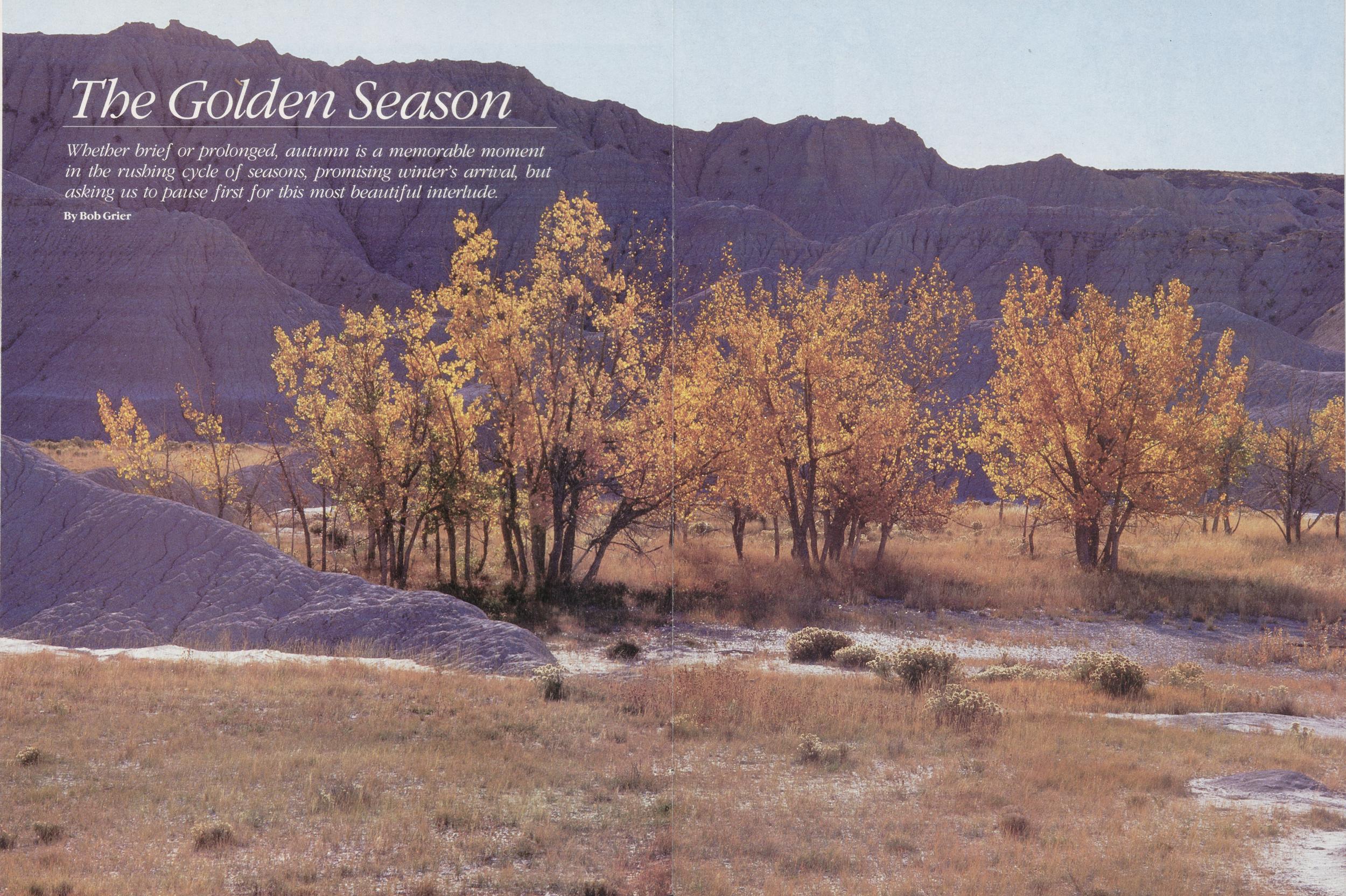
The Golden Season
Whether brief or prolonged, autumn is a memorable moment in the rushing cycle of seasons, promising winter's arrival, but asking us to pause first for this most beautiful interlude. By Bob Grier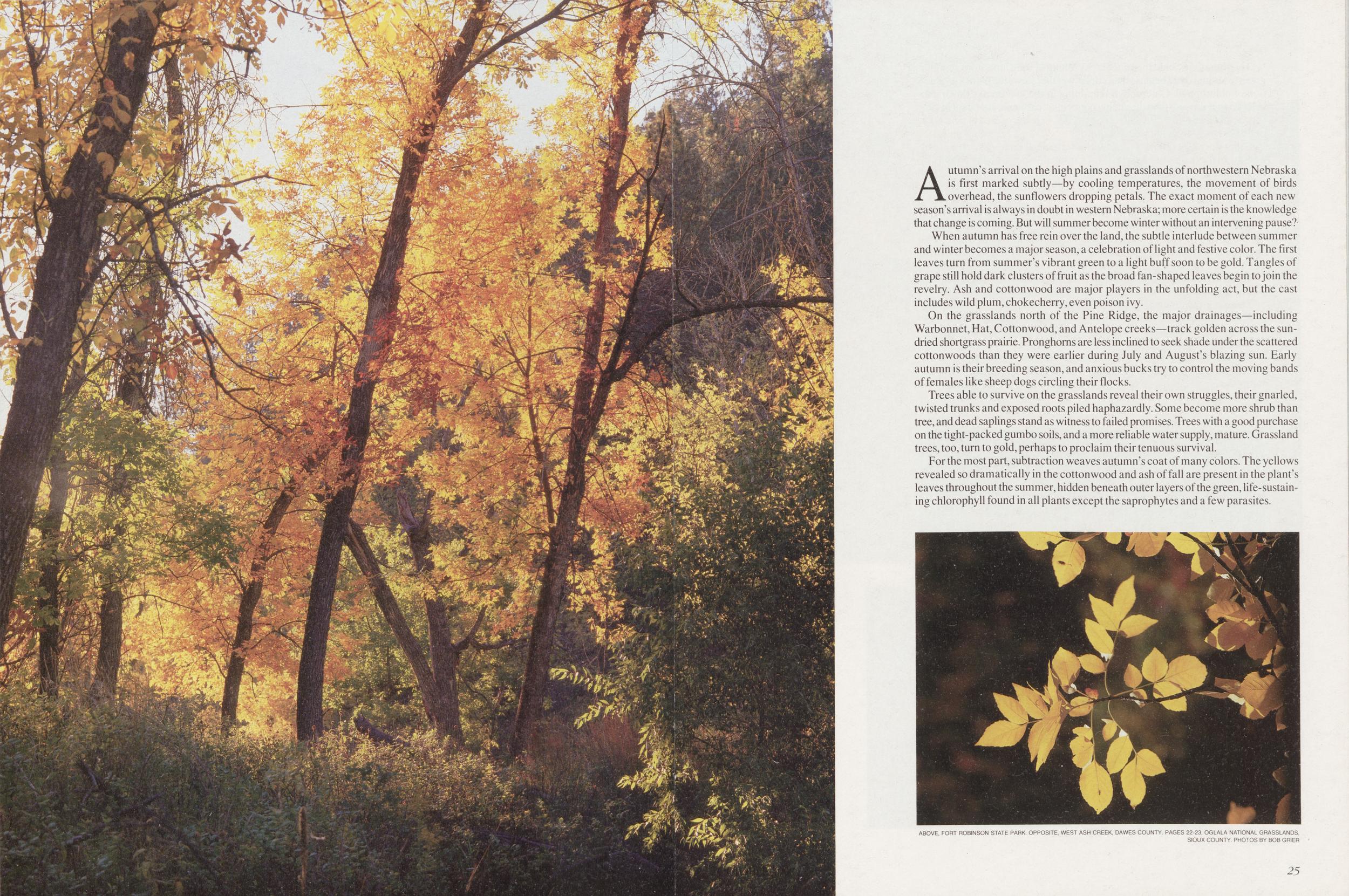
Autumn's arrival on the high plains and grasslands of northwestern Nebraska is first marked subtly—by cooling temperatures, the movement of birds overhead, the sunflowers dropping petals. The exact moment of each new season's arrival is always in doubt in western Nebraska; more certain is the knowledge that change is coming. But will summer become winter without an intervening pause?
When autumn has free rein over the land, the subtle interlude between summer and winter becomes a major season, a celebration of light and festive color. The first leaves turn from summer's vibrant green to a light buff soon to be gold. Tangles of grape still hold dark clusters of fruit as the broad fan-shaped leaves begin to join the revelry. Ash and cottonwood are major players in the unfolding act, but the cast includes wild plum, chokecherry, even poison ivy.
On the grasslands north of the Pine Ridge, the major drainages—including Warbonnet, Hat, Cottonwood, and Antelope creeks—track golden across the sundried shortgrass prairie. Pronghorns are less inclined to seek shade under the scattered cottonwoods than they were earlier during July and August's blazing sun. Early autumn is their breeding season, and anxious bucks try to control the moving bands of females like sheep dogs circling their flocks.
Trees able to survive on the grasslands reveal their own struggles, their gnarled, twisted trunks and exposed roots piled haphazardly. Some become more shrub than tree, and dead saplings stand as witness to failed promises. Trees with a good purchase on the tight-packed gumbo soils, and a more reliable water supply, mature. Grassland trees, too, turn to gold, perhaps to proclaim their tenuous survival.
For the most part, subtraction weaves autumn's coat of many colors. The yellows revealed so dramatically in the cottonwood and ash of fall are present in the plant's leaves throughout the summer, hidden beneath outer layers of the green, life-sustaining chlorophyll found in all plants except the saprophytes and a few parasites.
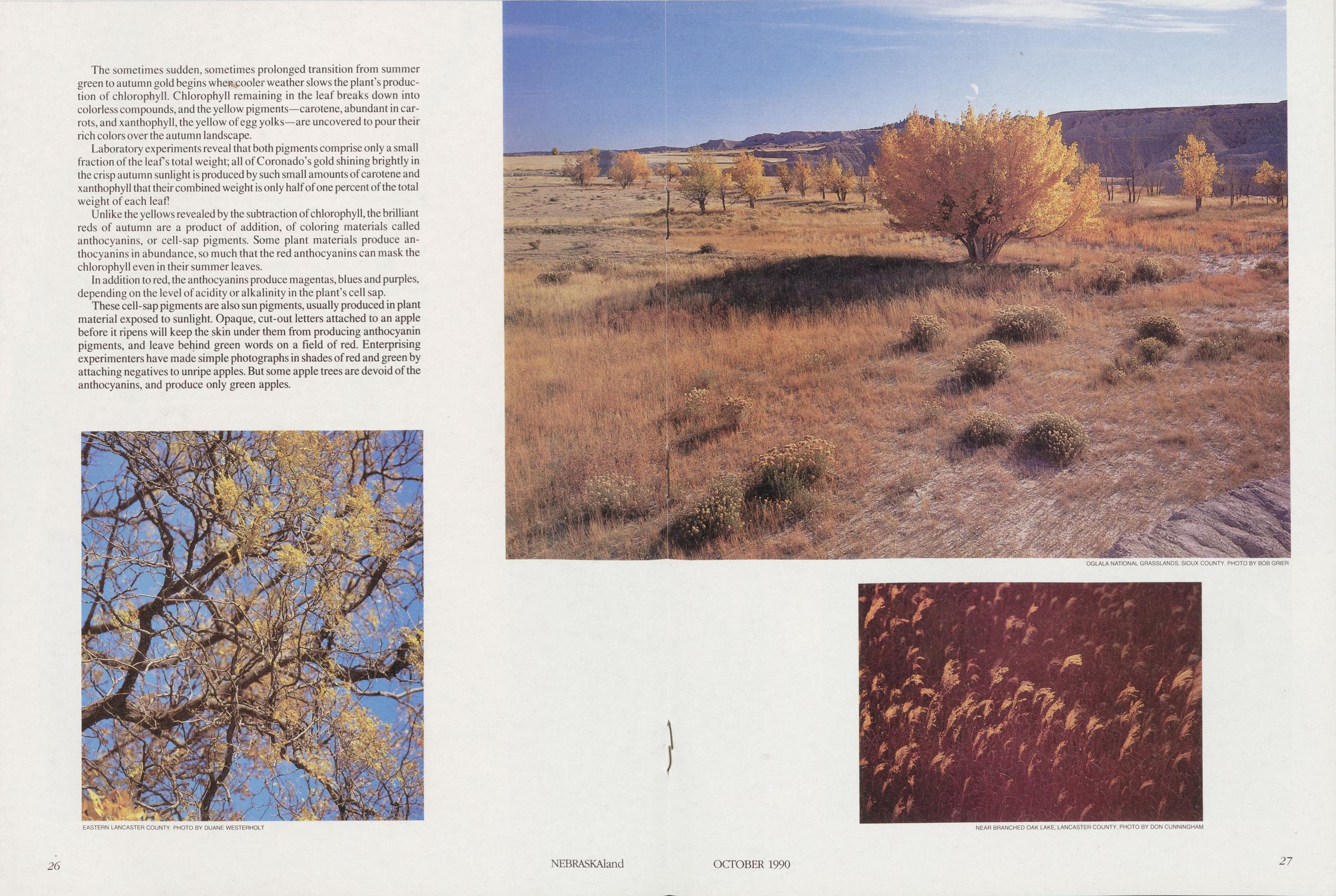
The sometimes sudden, sometimes prolonged transition from summer green to autumn gold begins wheR£ooler weather slows the plant's production of chlorophyll. Chlorophyll remaining in the leaf breaks down into colorless compounds, and the yellow pigments—carotene, abundant in carrots, and xanthophyll, the yellow of egg yolks—are uncovered to pour their rich colors over the autumn landscape.
Laboratory experiments reveal that both pigments comprise only a small fraction of the leafs total weight; all of Coronado's gold shining brightly in the crisp autumn sunlight is produced by such small amounts of carotene and xanthophyll that their combined weight is only half of one percent of the total weight of each leaf!
Unlike the yellows revealed by the subtraction of chlorophyll, the brilliant reds of autumn are a product of addition, of coloring materials called anthocyanins, or cell-sap pigments. Some plant materials produce anthocyanins in abundance, so much that the red anthocyanins can mask the chlorophyll even in their summer leaves.
In addition to red, the anthocyanins produce magentas, blues and purples, depending on the level of acidity or alkalinity in the plant's cell sap.
These cell-sap pigments are also sun pigments, usually produced in plant material exposed to sunlight. Opaque, cut-out letters attached to an apple before it ripens will keep the skin under them from producing anthocyanin pigments, and leave behind green words on a field of red. Enterprising experimenters have made simple photographs in shades of red and green by attaching negatives to unripe apples. But some apple trees are devoid of the anthocyanins, and produce only green apples.
Weather adds yet another variable to the annual progression from green to bright fall colors. Occasional hard frosts or freezes may paint the leaves a dull brown or even black, cloaking the landscape in dull, funeral colors to greet the arrival of winter.
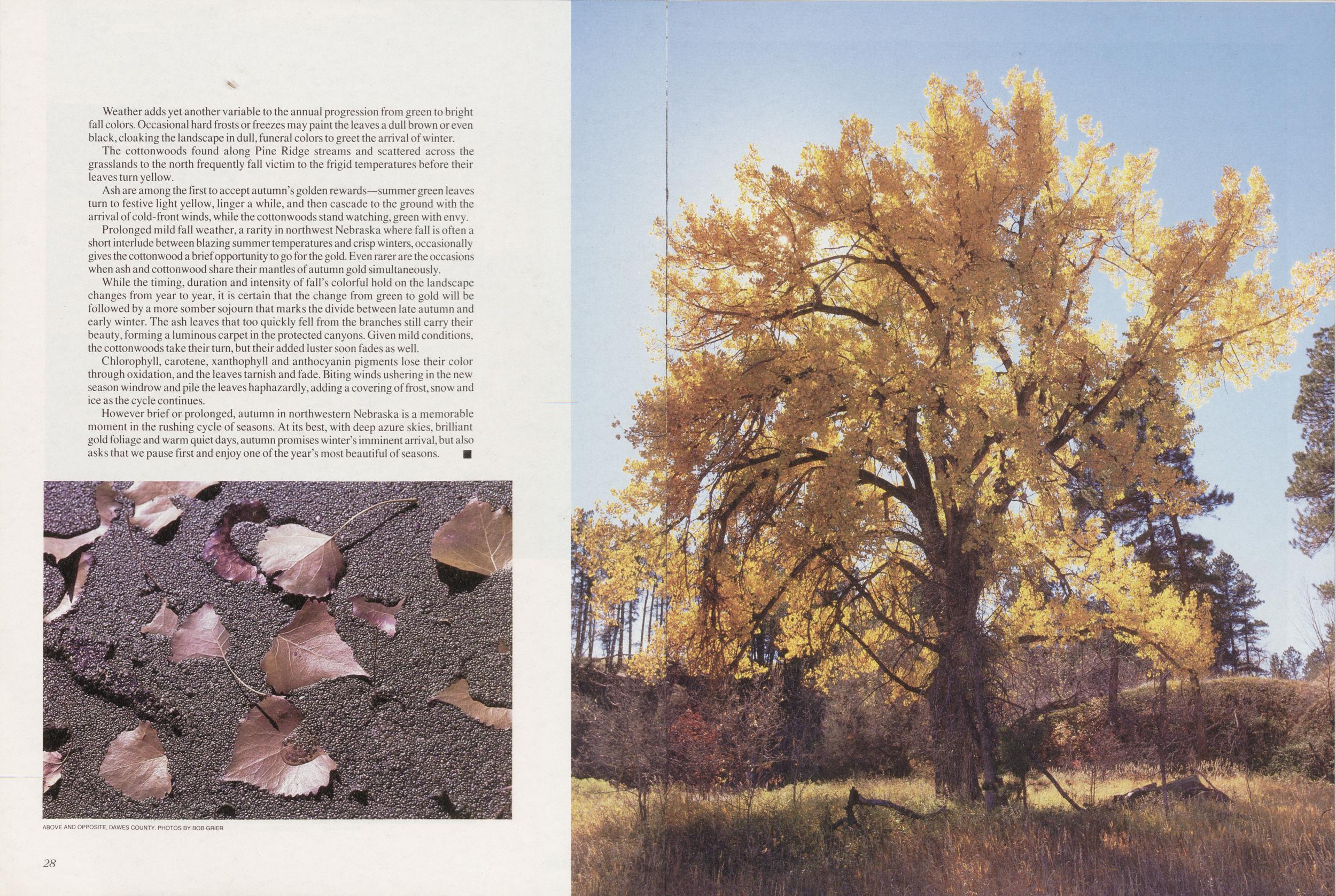
The cottonwoods found along Pine Ridge streams and scattered across the grasslands to the north frequently fall victim to the frigid temperatures before their leaves turn yellow.
Ash are among the first to accept autumn's golden rewards—summer green leaves turn to festive light yellow, linger a while, and then cascade to the ground with the arrival of cold-front winds, while the cottonwoods stand watching, green with envy.
Prolonged mild fall weather, a rarity in northwest Nebraska where fall is often a short interlude between blazing summer temperatures and crisp winters, occasionally gives the cottonwood a brief opportunity to go for the gold. Even rarer are the occasions when ash and cottonwood share their mantles of autumn gold simultaneously.
While the timing, duration and intensity of fall's colorful hold on the landscape changes from year to year, it is certain that the change from green to gold will be followed by a more somber sojourn that marks the divide between late autumn and early winter. The ash leaves that too quickly fell from the branches still carry their beauty, forming a luminous carpet in the protected canyons. Given mild conditions, the cottonwoods take their turn, but their added luster soon fades as well.
Chlorophyll, carotene, xanthophyll and anthocyanin pigments lose their color through oxidation, and the leaves tarnish and fade. Biting winds ushering in the new season windrow and pile the leaves haphazardly, adding a covering of frost, snow and ice as the cycle continues.
However brief or prolonged, autumn in northwestern Nebraska is a memorable moment in the rushing cycle of seasons. At its best, with deep azure skies, brilliant gold foliage and warm quiet days, autumn promises winter's imminent arrival, but also asks that we pause first and enjoy one of the year's most beautiful of seasons.
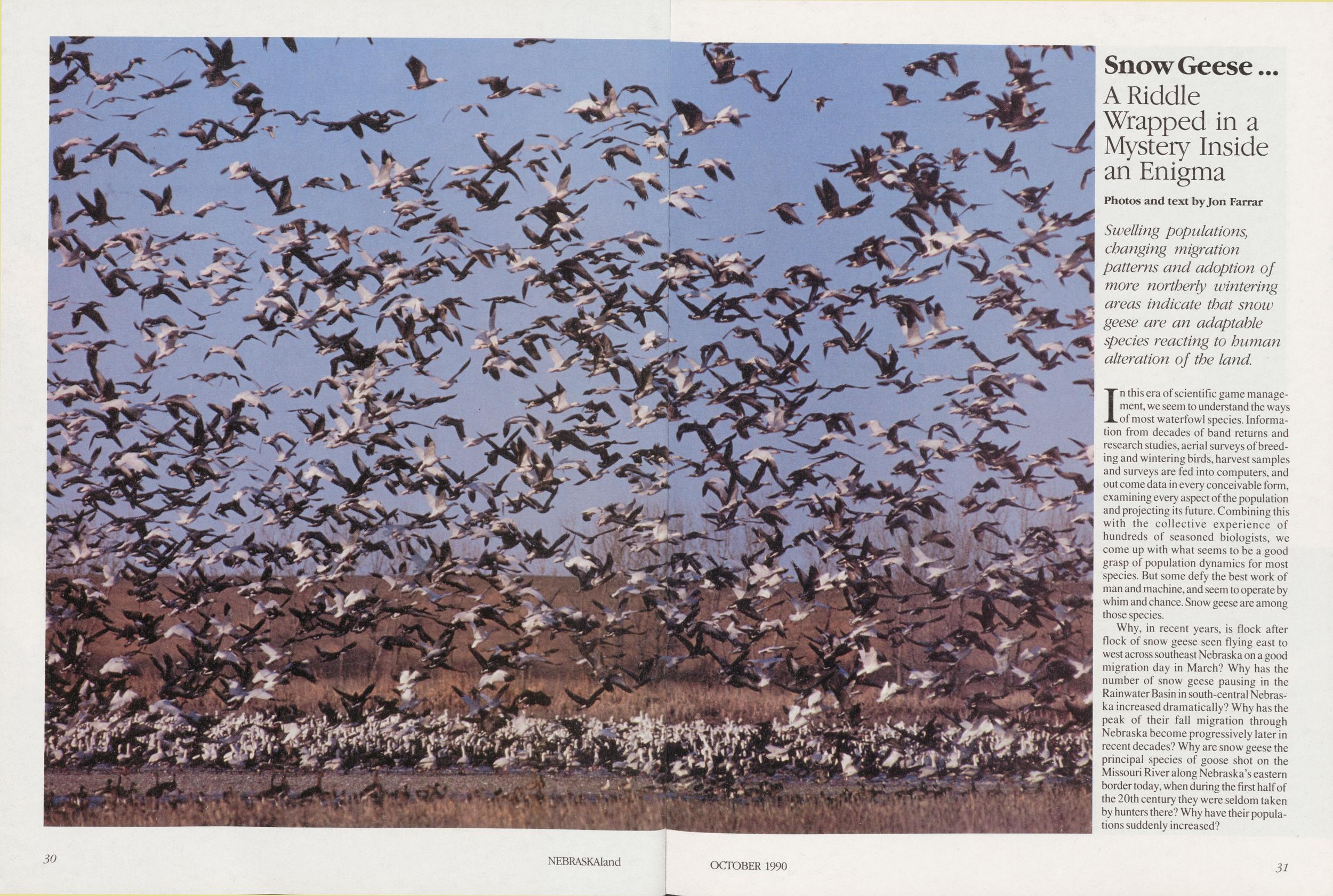
Snow Geese A Riddle a Wrapped in a J Mystery Inside an Enigma
Photos and text by Jon Farrar Swelling populations, changing migration patterns and adoption of more northerly wintering areas indicate that snow geese are an adaptable 4g| species reacting to human alteration of the land.In this era of scientific game management, we seem to understand the ways of most waterfowl species. Information from decades of band returns and research studies, aerial surveys of breeding and wintering birds, harvest samples and surveys are fed into computers, and out come data in every conceivable form, examining every aspect of the population and projecting its future. Combining this with the collective experience of hundreds of seasoned biologists, we come up with what seems to be a good grasp of population dynamics for most species. But some defy the best work of man and machine, and seem to operate by whim and chance. Snow geese are among those species.
Why, in recent years, is flock after flock of snow geese seen flying east to west across southeast Nebraska on a good migration day in March? Why has the number of snow geese pausing in the Rainwater Basin in south-central Nebraska increased dramatically? Why has the peak of their fall migration through Nebraska become progressively later in recent decades? Why are snow geese the principal species of goose shot on the Missouri River along Nebraska's eastern border today, when during the first half of the 20th century they were seldom taken by hunters there? Why have their populations suddenly increased?
OCTOBER 1990 31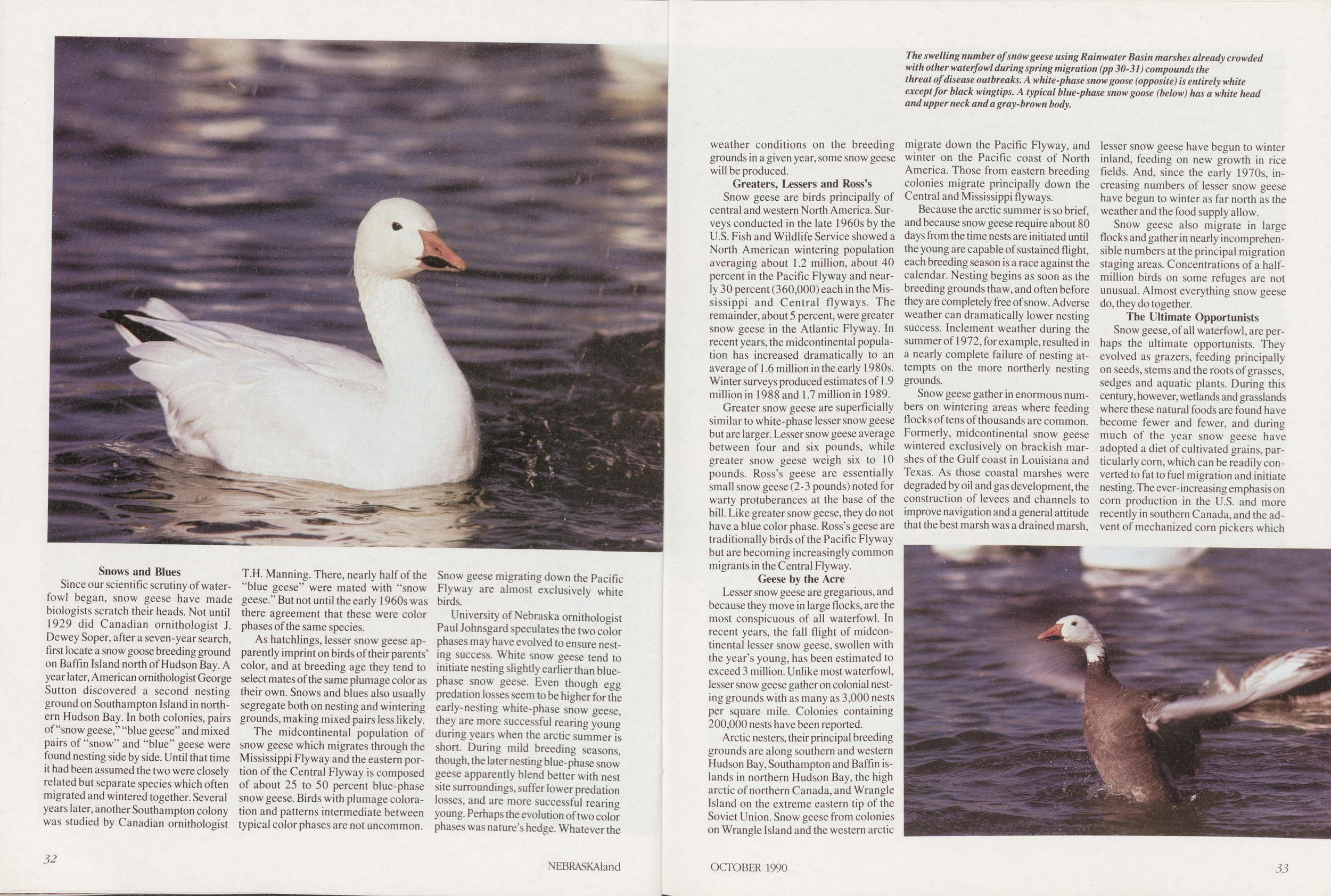
Since our scientific scrutiny of waterfowl began, snow geese have made biologists scratch their heads. Not until 1929 did Canadian ornithologist J. Dewey Soper, after a seven-year search, first locate a snow goose breeding ground on Baffin Island north of Hudson Bay. A year later, American ornithologist George Sutton discovered a second nesting ground on Southampton Island in northern Hudson Bay. In both colonies, pairs of "snow geese," "blue geese" and mixed pairs of "snow" and "blue" geese were found nesting side by side. Until that time it had been assumed the two were closely related but separate species which often migrated and wintered together. Several years later, another Southampton colony was studied by Canadian ornithologist T.H. Manning. There, nearly half of the "blue geese" were mated with "snow geese." But not until the early 1960s was there agreement that these were color phases of the same species.
As hatchlings, lesser snow geese apparently imprint on birds of their parents' color, and at breeding age they tend to select mates of the same plumage color as their own. Snows and blues also usually segregate both on nesting and wintering grounds, making mixed pairs less likely.
The midcontinental population of snow geese which migrates through the Mississippi Fly way and the eastern portion of the Central Fly way is composed of about 25 to 50 percent blue-phase snow geese. Birds with plumage coloration and patterns intermediate between typical color phases are not uncommon. Snow geese migrating down the Pacific Flyway are almost exclusively white birds.
University of Nebraska ornithologist Paul Johnsgard speculates the two color phases may have evolved to ensure nesting success. White snow geese tend to initiate nesting slightly earlier than bluephase snow geese. Even though egg predation losses seem to be higher for the early-nesting white-phase snow geese, they are more successful rearing young during years when the arctic summer is short. During mild breeding seasons, though, the later nesting blue-phase snow geese apparently blend better with nest site surroundings, suffer lower predation losses, and are more successful rearing young. Perhaps the evolution of two color phases was nature's hedge. Whatever the 32 NEBRASKAland weather conditions on the breeding grounds in a given year, some snow geese will be produced.
Greaters, Lessers and Ross'sSnow geese are birds principally of central and western North America. Surveys conducted in the late 1960s by the U.S. Fish and Wildlife Service showed a North American wintering population averaging about 1.2 million, about 40 percent in the Pacific Flyway and nearly 30 percent (360,000) each in the Mississippi and Central flyways. The remainder, about 5 percent, were greater snow geese in the Atlantic Flyway. In recent years, the midcontinental population has increased dramatically to an average of 1.6 million in the early 1980s. Winter surveys produced estimates of 1.9 million in 1988 and 1.7 million in 1989.
Greater snow geese are superficially similar to white-phase lesser snow geese but are larger. Lesser snow geese average between four and six pounds, while greater snow geese weigh six to 10 pounds. Ross's geese are essentially small snow geese (2-3 pounds) noted for warty protuberances at the base of the bill. Like greater snow geese, they do not have a blue color phase. Ross's geese are traditionally birds of the Pacific Flyway but are becoming increasingly common migrants in the Central Flyway.
Geese by the AcreLesser snow geese are gregarious, and because they move in large flocks, are the most conspicuous of all waterfowl. In recent years, the fall flight of midcontinental lesser snow geese, swollen with the year's young, has been estimated to exceed 3 million. Unlike most waterfowl, lesser snow geese gather on colonial nesting grounds with as many as 3,000 nests per square mile. Colonies containing 200,000 nests have been reported.
Arctic nesters, their principal breeding grounds are along southern and western Hudson Bay, Southampton and Baffin islands in northern Hudson Bay, the high arctic of northern Canada, and Wrangle Island on the extreme eastern tip of the Soviet Union. Snow geese from colonies on Wrangle Island and the western arctic migrate down the Pacific Flyway, and winter on the Pacific coast of North America. Those from eastern breeding colonies migrate principally down the Central and Mississippi flyways.
Because the arctic summer is so brief, and because snow geese require about 80 days from the time nests are initiated until the young are capable of sustained flight, each breeding season is a race against the calendar. Nesting begins as soon as the breeding grounds thaw, and often before they are completely free of snow. Adverse weather can dramatically lower nesting success. Inclement weather during the summer of 1972, for example, resulted in a nearly complete failure of nesting attempts on the more northerly nesting grounds.
Snow geese gather in enormous numbers on wintering areas where feeding flocks of tens of thousands are common. Formerly, midcontinental snow geese wintered exclusively on brackish marshes of the Gulf coast in Louisiana and Texas. As those coastal marshes were degraded by oil and gas development, the construction of levees and channels to improve navigation and a general attitude that the best marsh was a drained marsh, lesser snow geese have begun to winter inland, feeding on new growth in rice fields. And, since the early 1970s, increasing numbers of lesser snow geese have begun to winter as far north as the weather and the food supply allow.
Snow geese also migrate in large flocks and gather in nearly incomprehensible numbers at the principal migration staging areas. Concentrations of a half-million birds on some refuges are not unusual. Almost everything snow geese do, they do together.
The Ultimate OpportunistsSnow geese, of all waterfowl, are perhaps the ultimate opportunists. They evolved as grazers, feeding principally on seeds, stems and the roots of grasses, sedges and aquatic plants. During this century, however, wetlands and grasslands where these natural foods are found have become fewer and fewer, and during much of the year snow geese have adopted a diet of cultivated grains, particularly corn, which can be readily converted to fat to fuel migration and initiate nesting. The ever-increasing emphasis on corn production in the U.S. and more recently in southern Canada, and the advent of mechanized corn pickers which
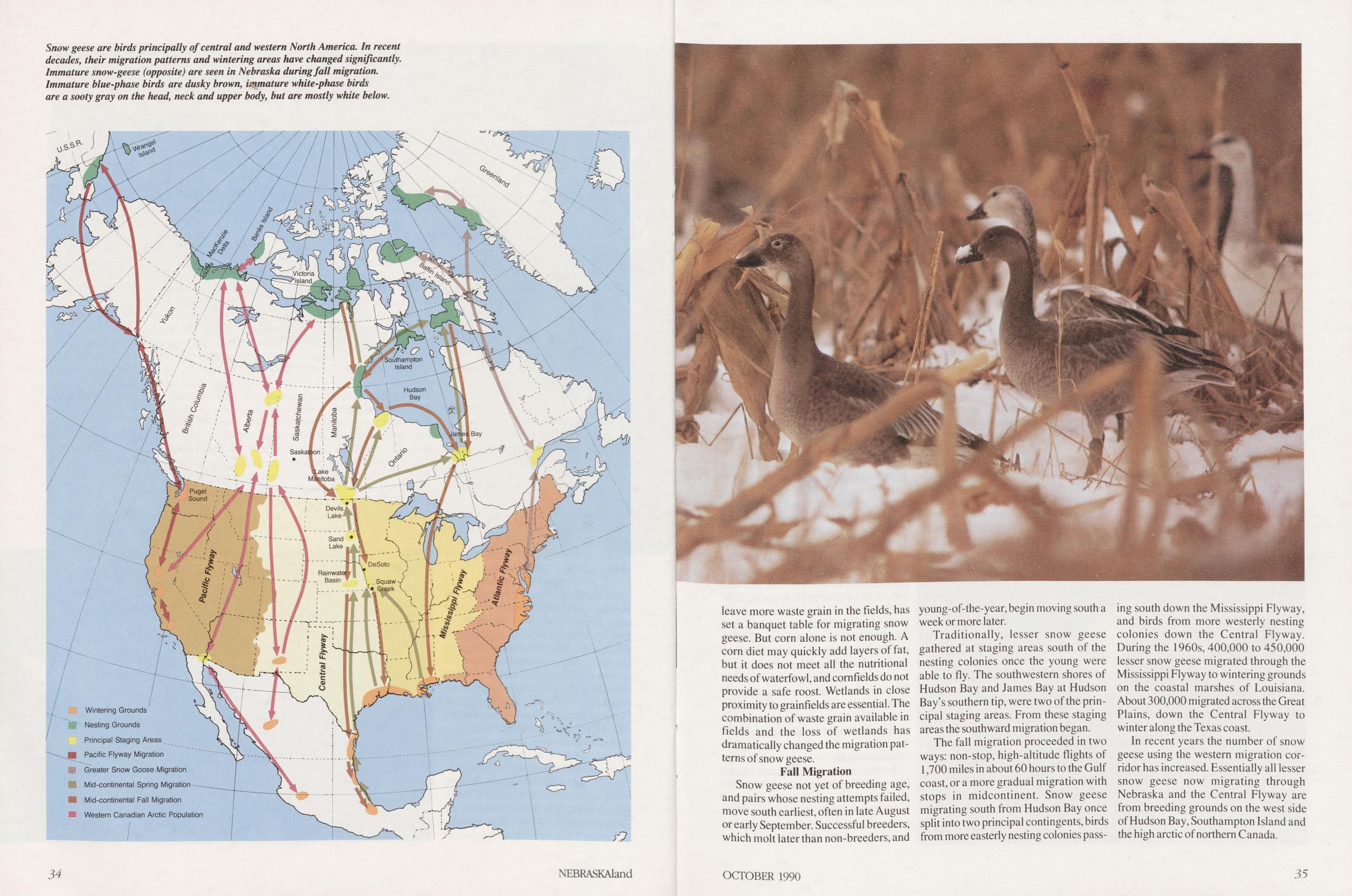
Snow geese not yet of breeding age, and pairs whose nesting attempts failed, move south earliest, often in late August or early September. Successful breeders, which molt later than non-breeders, and young-of-the-year, begin moving south a week or more later.
Traditionally, lesser snow geese gathered at staging areas south of the nesting colonies once the young were able to fly. The southwestern shores of Hudson Bay and James Bay at Hudson Bay's southern tip, were two of the principal staging areas. From these staging areas the southward migration began.
The fall migration proceeded in two ways: non-stop, high-altitude flights of 1,700 miles in about 60 hours to the Gulf coast, or a more gradual migration with stops in midcontinent. Snow geese migrating south from Hudson Bay once split into two principal contingents, birds from more easterly nesting colonies passing south down the Mississippi Flyway, and birds from more westerly nesting colonies down the Central Flyway. During the 1960s, 400,000 to 450,000 lesser snow geese migrated through the Mississippi Flyway to wintering grounds on the coastal marshes of Louisiana. About 300,000 migrated across the Great Plains, down the Central Flyway to winter along the Texas coast.
In recent years the number of snow geese using the western migration corridor has increased. Essentially all lesser snow geese now migrating through Nebraska and the Central Flyway are from breeding grounds on the west side of Hudson Bay, Southampton Island and the high arctic of northern Canada.
OCTOBER 1990 35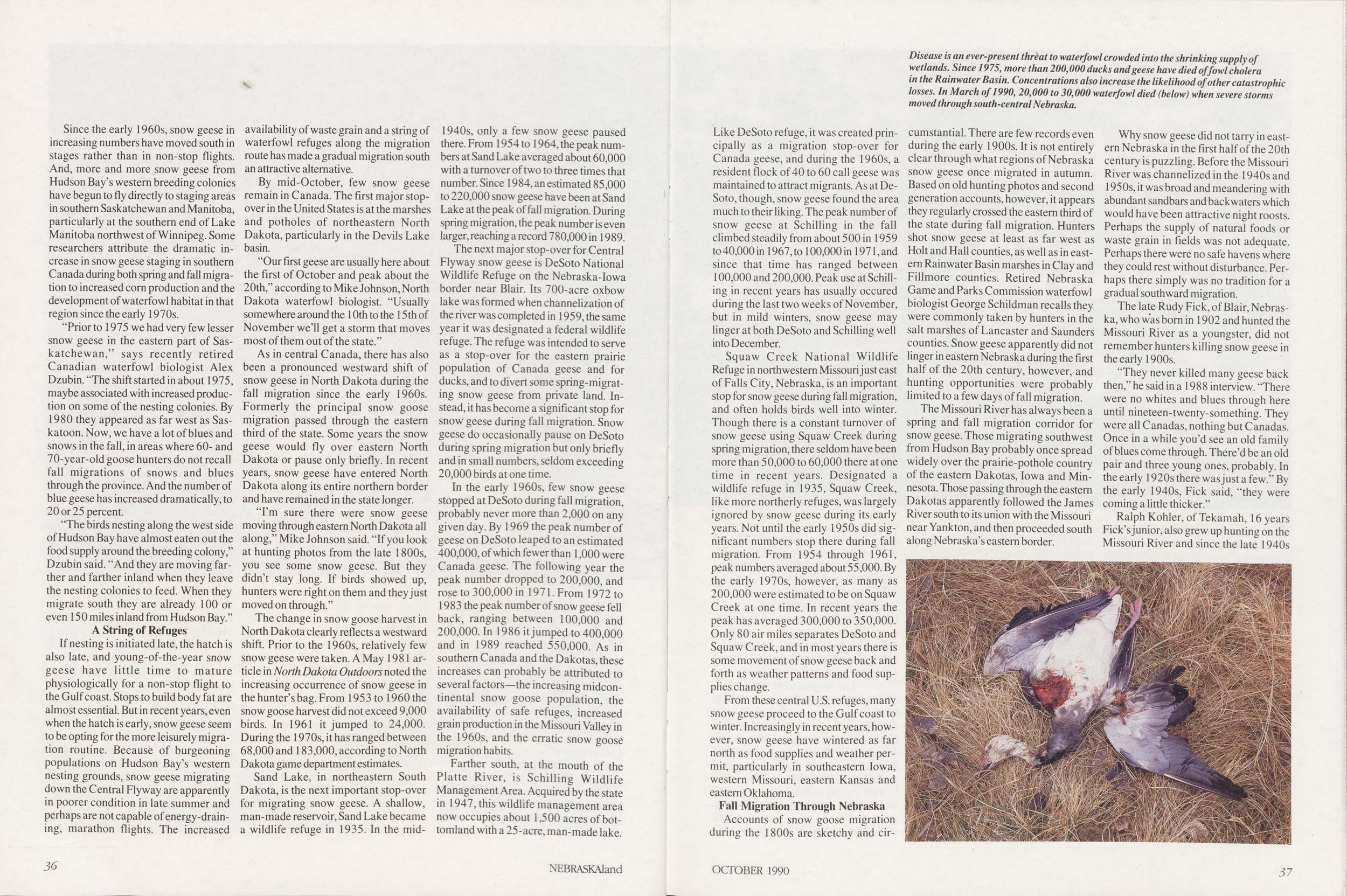
Since the early 1960s, snow geese in increasing numbers have moved south in stages rather than in non-stop flights. And, more and more snow geese from Hudson Bay's western breeding colonies have begun to fly directly to staging areas in southern Saskatchewan and Manitoba, particularly at the southern end of Lake Manitoba northwest of Winnipeg. Some researchers attribute the dramatic increase in snow geese staging in southern Canada during both spring and fall migration to increased corn production and the development of waterfowl habitat in that region since the early 1970s.
"Prior to 1975 we had very few lesser snow geese in the eastern part of Saskatchewan,'' says recently retired Canadian waterfowl biologist Alex Dzubin. "The shift started in about 1975, maybe associated with increased production on some of the nesting colonies. By 1980 they appeared as far west as Saskatoon. Now, we have a lot of blues and snows in the fall, in areas where 60- and 70-year-old goose hunters do not recall fall migrations of snows and blues through the province. And the number of blue geese has increased dramatically, to 20 or 25 percent.
"The birds nesting along the west side of Hudson Bay have almost eaten out the food supply around the breeding colony," Dzubin said. "And they are moving farther and farther inland when they leave the nesting colonies to feed. When they migrate south they are already 100 or even 150 miles inland from Hudson Bay."
A String of RefugesIf nesting is initiated late, the hatch is also late, and young-of-the-year snow geese have little time to mature physiologically for a non-stop flight to the Gulf coast. Stops to build body fat are almost essential. But in recent years, even when the hatch is early, snow geese seem to be opting for the more leisurely migration routine. Because of burgeoning populations on Hudson Bay's western nesting grounds, snow geese migrating down the Central Flyway are apparently in poorer condition in late summer and perhaps are not capable of energy-draining, marathon flights. The increased availability of waste grain and a string of waterfowl refuges along the migration route has made a gradual migration south an attractive alternative.
By mid-October, few snow geese remain in Canada. The first major stopover in the United States is at the marshes and potholes of northeastern North Dakota, particularly in the Devils Lake basin.
"Our first geese are usually here about the first of October and peak about the 20th," according to Mike Johnson, North Dakota waterfowl biologist. "Usually somewhere around the 10th to the 15 th of November we'll get a storm that moves most of them out of the state."
As in central Canada, there has also been a pronounced westward shift of snow geese in North Dakota during the fall migration since the early 1960s. Formerly the principal snow goose migration passed through the eastern third of the state. Some years the snow geese would fly over eastern North Dakota or pause only briefly. In recent years, snow geese have entered North Dakota along its entire northern border and have remained in the state longer.
"I'm sure there were snow geese moving through eastern North Dakota all along," Mike Johnson said. "If you look at hunting photos from the late 1800s, you see some snow geese. But they didn't stay long. If birds showed up, hunters were right on them and they just moved on through."
The change in snow goose harvest in North Dakota clearly reflects a westward shift. Prior to the 1960s, relatively few snow geese were taken. A May 1981 article in North Dakota Outdoors noted the increasing occurrence of snow geese in the hunter's bag. From 1953 to 1960 the snow goose harvest did not exceed 9,000 birds. In 1961 it jumped to 24,000. During the 1970s, it has ranged between 68,000 and 183,000, according to North Dakota game department estimates.
Sand Lake, in northeastern South Dakota, is the next important stop-over for migrating snow geese. A shallow, man-made reservoir, Sand Lake became a wildlife refuge in 1935. In the mid19408, only a few snow geese paused there. From 1954 to 1964, the peak numbers at Sand Lake averaged about 60,000 with a turnover of two to three times that number. Since 1984, an estimated 85,000 to 220,000 snow geese have been at Sand Lake at the peak of fall migration. During spring migration, the peak number is even larger, reaching a record 780,000 in 1989.
The next major stop-over for Central Flyway snow geese is DeSoto National Wildlife Refuge on the Nebraska-Iowa border near Blair. Its 700-acre oxbow lake was formed when channelization of the river was completed in 1959, the same year it was designated a federal wildlife refuge. The refuge was intended to serve as a stop-over for the eastern prairie population of Canada geese and for ducks, and to divert some spring-migrating snow geese from private land. Instead, it has become a significant stop for snow geese during fall migration. Snow geese do occasionally pause on DeSoto during spring migration but only briefly and in small numbers, seldom exceeding 20,000 birds at one time.
In the early 1960s, few snow geese stopped at DeSoto during fall migration, probably never more than 2,000 on any given day. By 1969 the peak number of geese on DeSoto leaped to an estimated 400,000, of which fewer than 1,000 were Canada geese. The following year the peak number dropped to 200,000, and rose to 300,000 in 1971. From 1972 to 1983 the peak number of snow geese fell back, ranging between 100,000 and 200,000. In 1986 it jumped to 400,000 and in 1989 reached 550,000. As in southern Canada and the Dakotas, these increases can probably be attributed to several factors—the increasing midcontinental snow goose population, the availability of safe refuges, increased grain production in the Missouri Valley in the 1960s, and the erratic snow goose migration habits.
Farther south, at the mouth of the Platte River, is Schilling Wildlife Management Area. Acquired by the state in 1947, this wildlife management area now occupies about 1,500 acres of bottomland with a 25-acre, man-made lake. 36 NEBRASKAland
Squaw Creek National Wildlife Refuge in northwestern Missouri just east of Falls City, Nebraska, is an important stop for snow geese during fall migration, and often holds birds well into winter. Though there is a constant turnover of snow geese using Squaw Creek during spring migration, there seldom have been more than 50,000 to 60,000 there at one time in recent years. Designated a wildlife refuge in 1935, Squaw Creek, like more northerly refuges, was largely ignored by snow geese during its early years. Not until the early 1950s did significant numbers stop there during fall migration. From 1954 through 1961, peak numbers averaged about 55,000. By the early 1970s, however, as many as 200,000 were estimated to be on Squaw Creek at one time. In recent years the peak has averaged 300,000 to 350,000. Only 80 air miles separates DeSoto and Squaw Creek, and in most years there is some movement of snow geese back and forth as weather patterns and food supplies change.
From these central U.S. refuges, many snow geese proceed to the Gulf coast to winter. Increasingly in recent years, however, snow geese have wintered as far north as food supplies and weather permit, particularly in southeastern Iowa, western Missouri, eastern Kansas and eastern Oklahoma.
Fall Migration Through NebraskaAccounts of snow goose migration during the 1800s are sketchy and circumstantial. There are few records even during the early 1900s. It is not entirely clear through what regions of Nebraska snow geese once migrated in autumn. Based on old hunting photos and second generation accounts, however, it appears they regularly crossed the eastern third of the state during fall migration. Hunters shot snow geese at least as far west as Holt and Hall counties, as well as in eastern Rainwater Basin marshes in Clay and Fillmore counties. Retired Nebraska Game and Parks Commission waterfowl biologist George Schildman recalls they were commonly taken by hunters in the salt marshes of Lancaster and Saunders counties. Snow geese apparently did not linger in eastern Nebraska during the first half of the 20th century, however, and hunting opportunities were probably limited to a few days of fall migration.
The Missouri River has always been a spring and fall migration corridor for snow geese. Those migrating southwest from Hudson Bay probably once spread widely over the prairie-pothole country of the eastern Dakotas, Iowa and Minnesota. Those passing through the eastern Dakotas apparently followed the James River south to its union with the Missouri near Yankton, and then proceeded south along Nebraska's eastern border.
Why snow geese did not tarry in eastern Nebraska in the first half of the 20th century is puzzling. Before the Missouri River was channelized in the 1940s and 1950s, it was broad and meandering with abundant sandbars and backwaters which would have been attractive night roosts. Perhaps the supply of natural foods or waste grain in fields was not adequate. Perhaps there were no safe havens where they could rest without disturbance. Perhaps there simply was no tradition for a gradual southward migration.
The late Rudy Fick, of Blair, Nebraska, who was born in 1902 and hunted the Missouri River as a youngster, did not remember hunters killing snow geese in the early 1900s.
"They never killed many geese back then," he said in a 1988 interview. "There were no whites and blues through here until nineteen-twenty-something. They were all Canadas, nothing but Canadas. Once in a while you'd see an old family of blues come through. There'd be an old pair and three young ones, probably. In the early 1920s there was just a few." By the early 1940s, Fick said, "they were coming a little thicker."
Ralph Kohler, of Tekamah, 16 years
Fick's junior, also grew up hunting on the
Missouri River and since the late 1940s
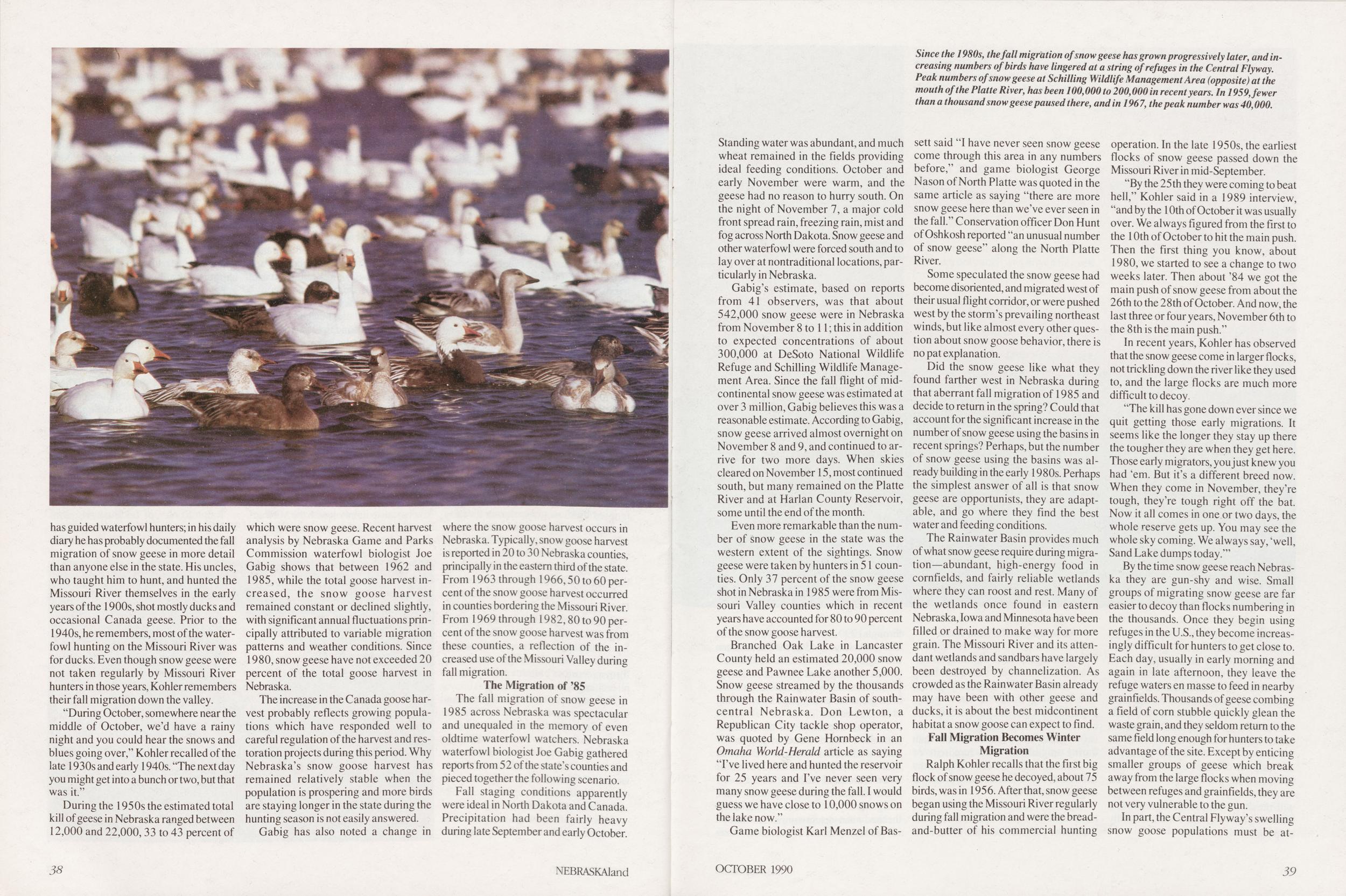
"During October, somewhere near the middle of October, we'd have a rainy night and you could hear the snows and blues going over," Kohler recalled of the late 1930s and early 1940s. "The next day you might get into a bunch or two, but that was it."
During the 1950s the estimated total kill of geese in Nebraska ranged between 12,000 and 22,000, 33 to 43 percent of which were snow geese. Recent harvest analysis by Nebraska Game and Parks Commission waterfowl biologist Joe Gabig shows that between 1962 and 1985, while the total goose harvest increased, the snow goose harvest remained constant or declined slightly, with significant annual fluctuations principally attributed to variable migration patterns and weather conditions. Since 1980, snow geese have not exceeded 20 percent of the total goose harvest in Nebraska.
The increase in the Canada goose harvest probably reflects growing populations which have responded well to careful regulation of the harvest and restoration projects during this period. Why Nebraska's snow goose harvest has remained relatively stable when the population is prospering and more birds are staying longer in the state during the hunting season is not easily answered.
Gabig has also noted a change in where the snow goose harvest occurs in Nebraska. Typically, snow goose harvest is reported in 20 to 30 Nebraska counties, principally in the eastern third of the state. From 1963 through 1966,50 to 60 percent of the snow goose harvest occurred in counties bordering the Missouri River. From 1969 through 1982,80 to 90 percent of the snow goose harvest was from these counties, a reflection of the increased use of the Missouri Valley during fall migration.
The Migration of '85The fall migration of snow geese in 1985 across Nebraska was spectacular and unequaled in the memory of even oldtime waterfowl watchers. Nebraska waterfowl biologist Joe Gabig gathered reports from 52 of the state's counties and pieced together the following scenario.
Fall staging conditions apparently were ideal in North Dakota and Canada. Precipitation had been fairly heavy during late September and early October. 38 NEBRASKAland Standing water was abundant, and much wheat remained in the fields providing ideal feeding conditions. October and early November were warm, and the geese had no reason to hurry south. On the night of November 7, a major cold front spread rain, freezing rain, mist and fog across North Dakota. Snow geese and other waterfowl were forced south and to lay over at nontraditional locations, particularly in Nebraska.
Gabig's estimate, based on reports from 41 observers, was that about 542,000 snow geese were in Nebraska from November 8 to 11; this in addition to expected concentrations of about 300,000 at DeSoto National Wildlife Refuge and Schilling Wildlife Management Area. Since the fall flight of midcontinental snow geese was estimated at over 3 million, Gabig believes this was a reasonable estimate. According to Gabig, snow geese arrived almost overnight on November 8 and 9, and continued to arrive for two more days. When skies cleared on November 15, most continued south, but many remained on the Platte River and at Harlan County Reservoir, some until the end of the month.
Even more remarkable than the number of snow geese in the state was the western extent of the sightings. Snow geese were taken by hunters in 51 counties. Only 37 percent of the snow geese shot in Nebraska in 1985 were from Missouri Valley counties which in recent years have accounted for 80 to 90 percent of the snow goose harvest.
Branched Oak Lake in Lancaster County held an estimated 20,000 snow geese and Pawnee Lake another 5,000. Snow geese streamed by the thousands through the Rainwater Basin of southcentral Nebraska. Don Lewton, a Republican City tackle shop operator, was quoted by Gene Hornbeck in an Omaha World-Herald article as saying "I've lived here and hunted the reservoir for 25 years and I've never seen very many snow geese during the fall. I would guess we have close to 10,000 snows on the lake now."
Game biologist Karl Menzel of Bassett said "I have never seen snow geese come through this area in any numbers before," and game biologist George Nason of North Platte was quoted in the same article as saying "there are more snow geese here than we've ever seen in the fall." Conservation officer Don Hunt of Oshkosh reported "an unusual number of snow geese" along the North Platte River.
Some speculated the snow geese had become disoriented, and migrated west of their usual flight corridor, or were pushed west by the storm's prevailing northeast winds, but like almost every other question about snow goose behavior, there is no pat explanation.
Did the snow geese like what they found farther west in Nebraska during that aberrant fall migration of 1985 and decide to return in the spring? Could that account for the significant increase in the number of snow geese using the basins in recent springs? Perhaps, but the number of snow geese using the basins was already building in the early 1980s. Perhaps the simplest answer of all is that snow geese are opportunists, they are adaptable, and go where they find the best water and feeding conditions.
The Rainwater Basin provides much of what snow geese require during migration—abundant, high-energy food in cornfields, and fairly reliable wetlands where they can roost and rest. Many of the wetlands once found in eastern Nebraska, Iowa and Minnesota have been filled or drained to make way for more grain. The Missouri River and its attendant wetlands and sandbars have largely been destroyed by channelization. As crowded as the Rainwater Basin already may have been with other geese and ducks, it is about the best midcontinent habitat a snow goose can expect to find.
Fall Migration Becomes Winter MigrationRalph Kohler recalls that the first big flock of snow geese he decoyed, about 75 birds, was in 1956. After that, snow geese began using the Missouri River regularly during fall migration and were the breadand-butter of his commercial hunting operation. In the late 1950s, the earliest flocks of snow geese passed down the Missouri River in mid-September.
"By the 25th they were coming to beat hell," Kohler said in a 1989 interview, "and by the 10th of October it was usually over. We always figured from the first to the 10th of October to hit the main push. Then the first thing you know, about 1980, we started to see a change to two weeks later. Then about '84 we got the main push of snow geese from about the 26th to the 28th of October. And now, the last three or four years, November 6th to the 8th is the main push."
In recent years, Kohler has observed that the snow geese come in larger flocks, not trickling down the river like they used to, and the large flocks are much more difficult to decoy.
The kill has gone down ever since we quit getting those early migrations. It seems like the longer they stay up there the tougher they are when they get here. Those early migrators, you just knew you had 'em. But it's a different breed now. When they come in November, they're tough, they're tough right off the bat. Now it all comes in one or two days, the whole reserve gets up. You may see the whole sky coming. We always say, 'well, Sand Lake dumps today."'
By the time snow geese reach Nebraska they are gun-shy and wise. Small groups of migrating snow geese are far easier to decoy than flocks numbering in the thousands. Once they begin using refuges in the U.S., they become increasingly difficult for hunters to get close to. Each day, usually in early morning and again in late afternoon, they leave the refuge waters en masse to feed in nearby grainfields. Thousands of geese combing a field of corn stubble quickly glean the waste grain, and they seldom return to the same field long enough for hunters to take advantage of the site. Except by enticing smaller groups of geese which break away from the large flocks when moving between refuges and grainfields, they are not very vulnerable to the gun.
In part, the Central Fly way's swelling
snow goose populations must be attributed
OCTOBER 1990
39
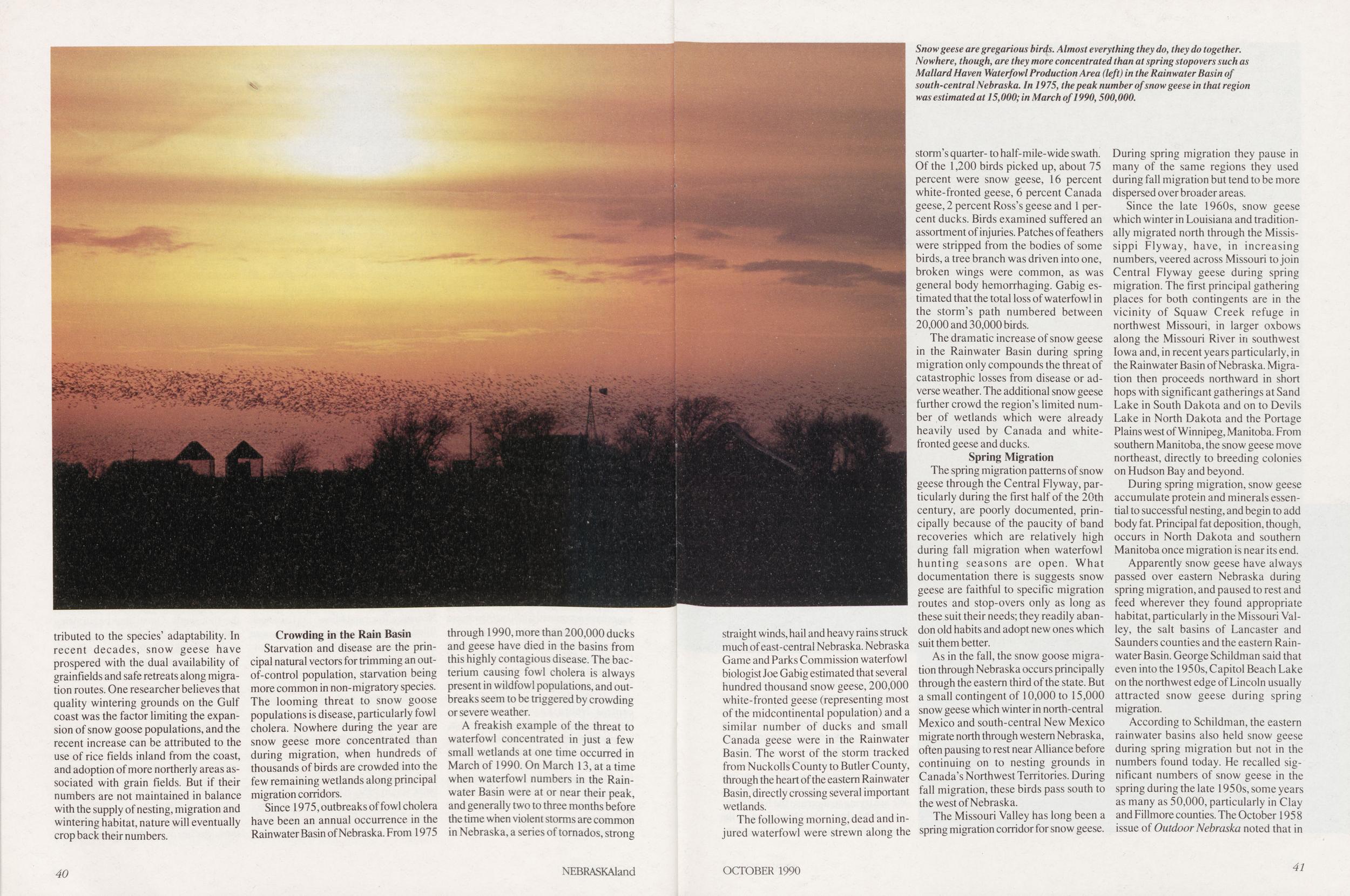
Starvation and disease are the principal natural vectors for trimming an out-of-control population, starvation being more common in non-migratory species. The looming threat to snow goose populations is disease, particularly fowl cholera. Nowhere during the year are snow geese more concentrated than during migration, when hundreds of thousands of birds are crowded into the few remaining wetlands along principal migration corridors.
Since 1975, outbreaks of fowl cholera have been an annual occurrence in the Rainwater Basin of Nebraska. From 1975 through 1990, more than 200,000 ducks and geese have died in the basins from this highly contagious disease. The bacterium causing fowl cholera is always present in wildfowl populations, and outbreaks seem to be triggered by crowding or severe weather.
A freakish example of the threat to waterfowl concentrated in just a few small wetlands at one time occurred in March of 1990. On March 13, at a time when waterfowl numbers in the Rainwater Basin were at or near their peak, and generally two to three months before the time when violent storms are common in Nebraska, a series of tornados, strong 40 NEBRASKAland straight winds, hail and heavy rains struck much of east-central Nebraska. Nebraska Game and Parks Commission waterfowl biologist Joe Gabig estimated that several hundred thousand snow geese, 200,000 white-fronted geese (representing most of the midcontinental population) and a similar number of ducks and small Canada geese were in the Rainwater Basin. The worst of the storm tracked from Nuckolls County to Butler County, through the heart of the eastern Rainwater Basin, directly crossing several important wetlands.
The following morning, dead and injured waterfowl were strewn along the storm's quarter- to half-mile-wide swath. Of the 1,200 birds picked up, about 75 percent were snow geese, 16 percent white-fronted geese, 6 percent Canada geese, 2 percent Ross's geese and 1 percent ducks. Birds examined suffered an assortment of injuries. Patches of feathers were stripped from the bodies of some birds, a tree branch was driven into one, broken wings were common, as was general body hemorrhaging. Gabig estimated that the total loss of waterfowl in the storm's path numbered between 20,000 and 30,000 birds.
The dramatic increase of snow geese in the Rainwater Basin during spring migration only compounds the threat of catastrophic losses from disease or adverse weather. The additional snow geese further crowd the region's limited number of wetlands which were already heavily used by Canada and whitefronted geese and ducks.
Spring MigrationThe spring migration patterns of snow geese through the Central Flyway, particularly during the first half of the 20th century, are poorly documented, principally because of the paucity of band recoveries which are relatively high during fall migration when waterfowl hunting seasons are open. What documentation there is suggests snow geese are faithful to specific migration routes and stop-overs only as long as these suit their needs; they readily abandon old habits and adopt new ones which suit them better.
As in the fall, the snow goose migration through Nebraska occurs principally through the eastern third of the state. But a small contingent of 10,000 to 15,000 snow geese which winter in north-central Mexico and south-central New Mexico migrate north through western Nebraska, often pausing to rest near Alliance before continuing on to nesting grounds in Canada's Northwest Territories. During fall migration, these birds pass south to the west of Nebraska.
The Missouri Valley has long been a spring migration corridor for snow geese. During spring migration they pause in many of the same regions they used during fall migration but tend to be more dispersed over broader areas.
Since the late 1960s, snow geese which winter in Louisiana and traditionally migrated north through the Mississippi Flyway, have, in increasing numbers, veered across Missouri to join Central Flyway geese during spring migration. The first principal gathering places for both contingents are in the vicinity of Squaw Creek refuge in northwest Missouri, in larger oxbows along the Missouri River in southwest Iowa and, in recent years particularly, in the Rainwater Basin of Nebraska. Migration then proceeds northward in short hops with significant gatherings at Sand Lake in South Dakota and on to Devils Lake in North Dakota and the Portage Plains west of Winnipeg, Manitoba. From southern Manitoba, the snow geese move northeast, directly to breeding colonies on Hudson Bay and beyond.
During spring migration, snow geese accumulate protein and minerals essential to successful nesting, and begin to add body fat. Principal fat deposition, though, occurs in North Dakota and southern Manitoba once migration is near its end.
Apparently snow geese have always passed over eastern Nebraska during spring migration, and paused to rest and feed wherever they found appropriate habitat, particularly in the Missouri Valley, the salt basins of Lancaster and Saunders counties and the eastern Rainwater Basin. George Schildman said that even into the 1950s, Capitol Beach Lake on the northwest edge of Lincoln usually attracted snow geese during spring migration.
According to Schildman, the eastern
rainwater basins also held snow geese
during spring migration but not in the
numbers found today. He recalled significant numbers of snow geese in the
spring during the late 1950s, some years
as many as 50,000, particularly in Clay
and Fillmore counties. The October 195 8
issue of Outdoor Nebraska noted that in
OCTOBER 1990
41
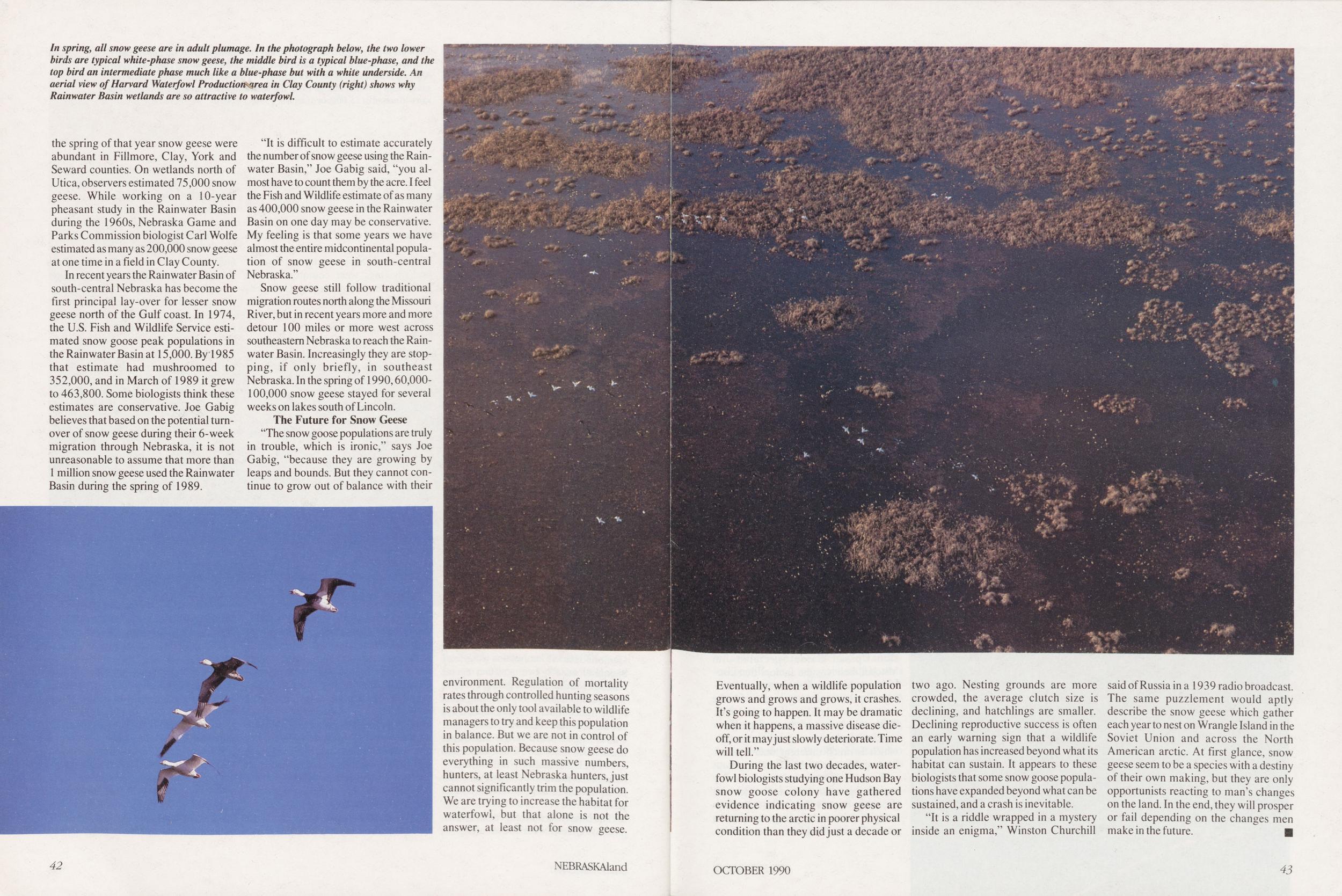
In recent years the Rainwater Basin of south-central Nebraska has become the first principal lay-over for lesser snow geese north of the Gulf coast. In 1974, the U.S. Fish and Wildlife Service estimated snow goose peak populations in the Rainwater Basin at 15,000. By 1985 that estimate had mushroomed to 352,000, and in March of 1989 it grew to 463,800. Some biologists think these estimates are conservative. Joe Gabig believes that based on the potential turnover of snow geese during their 6-week migration through Nebraska, it is not unreasonable to assume that more than 1 million snow geese used the Rainwater Basin during the spring of 1989.
"It is difficult to estimate accurately the number of snow geese using the Rainwater Basin," Joe Gabig said, "you almost have to count them by the acre. I feel the Fish and Wildlife estimate of as many as 400,000 snow geese in the Rainwater Basin on one day may be conservative. My feeling is that some years we have almost the entire midcontinental population of snow geese in south-central Nebraska."
Snow geese still follow traditional migration routes north along the Missouri River, but in recent years more and more detour 100 miles or more west across southeastern Nebraska to reach the Rainwater Basin. Increasingly they are stopping, if only briefly, in southeast Nebraska. In the spring of 1990,60,000-100,000 snow geese stayed for several weeks on lakes south of Lincoln.
The Future for Snow Geese"The snow goose populations are truly in trouble, which is ironic," says Joe Gabig, "because they are growing by leaps and bounds. But they cannot continue to grow out of balance with their environment. Regulation of mortality rates through controlled hunting seasons is about the only tool available to wildlife managers to try and keep this population in balance. But we are not in control of this population. Because snow geese do everything in such massive numbers, hunters, at least Nebraska hunters, just cannot significantly trim the population. We are trying to increase the habitat for waterfowl, but that alone is not the answer, at least not for snow geese. 42 NEBRASKAland Eventually, when a wildlife population grows and grows and grows, it crashes. It's going to happen. It may be dramatic when it happens, a massive disease die off, or it may just slowly deteriorate. Time will tell."
During the last two decades, waterfowl biologists studying one Hudson Bay snow goose colony have gathered evidence indicating snow geese are returning to the arctic in poorer physical condition than they did just a decade or two ago. Nesting grounds are more crowded, the average clutch size is declining, and hatchlings are smaller. Declining reproductive success is often an early warning sign that a wildlife population has increased beyond what its habitat can sustain. It appears to these biologists that some snow goose populations have expanded beyond what can be sustained, and a crash is inevitable.
"It is a riddle wrapped in a mystery inside an enigma," Winston Churchill said of Russia in a 1939 radio broadcast. The same puzzlement would aptly describe the snow geese which gather each year to nest on Wrangle Island in the Soviet Union and across the North American arctic. At first glance, snow geese seem to be a species with a destiny of their own making, but they are only opportunists reacting to man's changes on the land. In the end, they will prosper or fail depending on the changes men make in the future.
OCTOBER 1990 43
Small Pleasures
Photos and text by Tom Keith Squirrels are abundant, wary, exciting to hunt, and delicious on the table, but relatively jew Nebraskans take advantage of the opportunity to spend a solitary afternoon pursuing them.The squirrel is Nebraska's smallest game animal, but when it comes to hunting them, the excitement and enjoyment squirrels provide is far out of proportion to their size.
In many parts of the country, squirrel hunting is an important tradition, but most Nebraska hunters have yet to discover its appeal. Few hunters in this state go out specifically to hunt squirrels, and most squirrels killed by hunters are taken by pheasant hunters who happen upon them by chance.
Why Nebraskans are not more interested in hunting squirrels is a mystery. There are plenty of squirrels available, the season is long (a full six months, Aug. 1-Jan. 31), the daily bag limit of seven and the possession limit of 21 are generous, and squirrel is delicious and can be prepared in a variety of ways. Squirrel hunters don't have to purchase expensive, specialized equipment, and they don't have to travel far to find good hunting areas. In addition, the hunting itself doesn't take a great deal of stamina or agility, hunting pressure is light, and the chances of taking game are excellent. But even so, during the 1989 season hunters took only about 82,000 squirrels, a figure far below the number that could be harvested.
Nebraska Game and Parks Commission Upland Game Specialist Jim Mitchell believes the factors that contribute to the low interest in squirrel hunting may have nothing to do with the animal's availability or desirability. "Nebraska is a state where people grow up hunting pheasants, quail and grouse, which is much different than squirrel hunting. Most upland bird hunters go out with several friends, and spend the day socializing and in constant contact with the other hunters. Squirrel hunting is a solitary sport, and if you grow up in an area where hunting is a social activity, NEBRASKAland
But whatever the reasons, interest in squirrel hunting is low, and biologists have labeled them one of Nebraska's two most under-utilized game species—the other is the cottontail rabbit.
Mitchell, himself an avid squirrel hunter, says Nebraskans are passing up excellent hunting opportunities. "Nebraska has some of the best squirrel hunting OCTOBER 1990 in the nation in terms of success. Squirrels are abundant, and few landowners refuse to grant permission for squirrel hunting on their property."
Squirrels are found in most areas of the state, including the Sandhills and the Pine Ridge, but hunting is considered to be best in the southeast because that area has the largest variety of timber. Good areas are easily recognizable because they have large patches of nut-producing deciduous trees.
The fox squirrel, found from border to border, is the most common species in Nebraska. A large male fattened-up for winter may weigh in the neighborhood of three pounds. That same large squirrel may be nearly 25 inches long, but about half of that length will be its impressive, flowing tail. In Nebraska the smaller gray squirrel is found almost exclusively along the Missouri River in the southeastern portion of the state. An adult gray averages from 17 to 23 inches long and weighs about two and a half pounds.
Squirrels are a challenging and exciting quarry, especially in the early season
when the trees provide heavy leaf cover.
Hunters often look at leaves as a detriment, saying that they can't locate squirrels
because of the leaves. But a hunter
can turn the leaves into an advantage by
using them as a tip-off to squirrel movement—a squirrel can't help but disturb
OCTOBER 1990
45
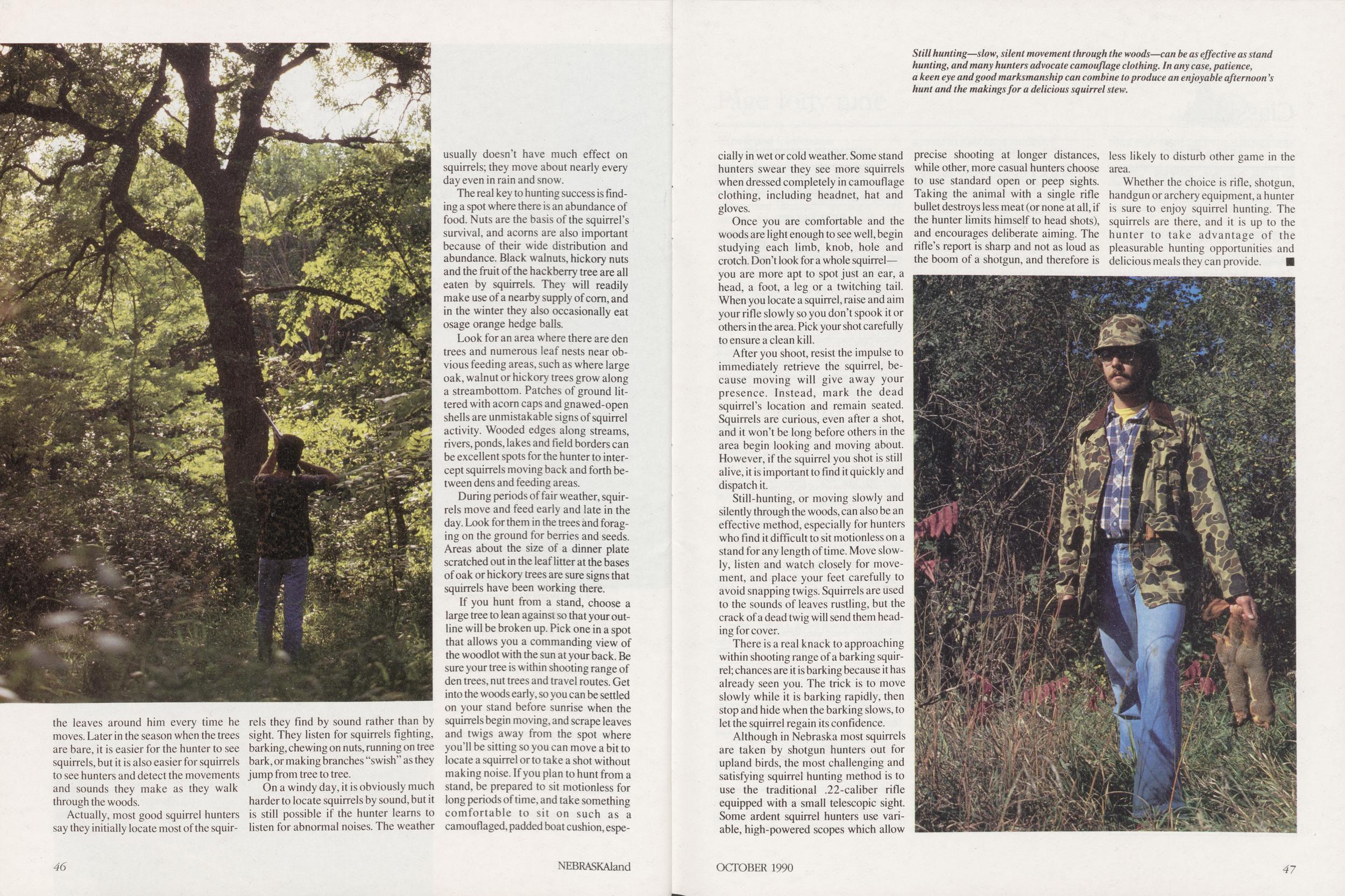
Actually, most good squirrel hunters say they initially locate most of the squirrels they find by sound rather than by sight. They listen for squirrels fighting, barking, chewing on nuts, running on tree bark, or making branches "swish" as they jump from tree to tree.
On a windy day, it is obviously much harder to locate squirrels by sound, but it is still possible if the hunter learns to listen for abnormal noises. The weather usually doesn't have much effect on squirrels; they move about nearly every day even in rain and snow.
The real key to hunting success is finding a spot where there is an abundance of food. Nuts are the basis of the squirrel's survival, and acorns are also important because of their wide distribution and abundance. Black walnuts, hickory nuts and the fruit of the hackberry tree are all eaten by squirrels. They will readily make use of a nearby supply of corn, and in the winter they also occasionally eat osage orange hedge balls.
Look for an area where there are den trees and numerous leaf nests near obvious feeding areas, such as where large oak, walnut or hickory trees grow along a streambottom. Patches of ground littered with acorn caps and gnawed-open shells are unmistakable signs of squirrel activity. Wooded edges along streams, rivers, ponds, lakes and field borders can be excellent spots for the hunter to intercept squirrels moving back and forth between dens and feeding areas.
During periods of fair weather, squirrels move and feed early and late in the day. Look for them in the trees and foraging on the ground for berries and seeds. Areas about the size of a dinner plate scratched out in the leaf litter at the bases of oak or hickory trees are sure signs that squirrels have been working there.
If you hunt from a stand, choose a large tree to lean against so that your outline will be broken up. Pick one in a spot that allows you a commanding view of the woodlot with the sun at your back. Be sure your tree is within shooting range of den trees, nut trees and travel routes. Get into the woods early, so you can be settled on your stand before sunrise when the squirrels begin moving, and scrape leaves and twigs away from the spot where you'll be sitting so you can move a bit to locate a squirrel or to take a shot without making noise. If you plan to hunt from a stand, be prepared to sit motionless for long periods of time, and take something comfortable to sit on such as a camouflaged, padded boat cushion, especially 46 NEBRASKAland in wet or cold weather. Some stand hunters swear they see more squirrels when dressed completely in camouflage clothing, including headnet, hat and gloves.
Once you are comfortable and the woods are light enough to see well, begin studying each limb, knob, hole and crotch. Don't look for a whole squirrel you are more apt to spot just an ear, a head, a foot, a leg or a twitching tail. When you locate a squirrel, raise and aim your rifle slowly so you don't spook it or others in the area. Pick your shot carefully to ensure a clean kill.
After you shoot, resist the impulse to immediately retrieve the squirrel, because moving will give away your presence. Instead, mark the dead squirrel's location and remain seated. Squirrels are curious, even after a shot, and it won't be long before others in the area begin looking and moving about. However, if the squirrel you shot is still alive, it is important to find it quickly and dispatch it.
Still-hunting, or moving slowly and silently through the woods, can also be an effective method, especially for hunters who find it difficult to sit motionless on a stand for any length of time. Move slowly, listen and watch closely for movement, and place your feet carefully to avoid snapping twigs. Squirrels are used to the sounds of leaves rustling, but the crack of a dead twig will send them heading for cover.
There is a real knack to approaching within shooting range of a barking squirrel; chances are it is barking because it has already seen you. The trick is to move slowly while it is barking rapidly, then stop and hide when the barking slows, to let the squirrel regain its confidence.
Although in Nebraska most squirrels are taken by shotgun hunters out for upland birds, the most challenging and satisfying squirrel hunting method is to use the traditional .22-caliber rifle equipped with a small telescopic sight. Some ardent squirrel hunters use variable, high-powered scopes which allow precise shooting at longer distances, while other, more casual hunters choose to use standard open or peep sights. Taking the animal with a single rifle bullet destroys less meat (or none at all, if the hunter limits himself to head shots), and encourages deliberate aiming. The rifle's report is sharp and not as loud as the boom of a shotgun, and therefore is less likely to disturb other game in the area.
Whether the choice is rifle, shotgun, handgun or archery equipment, a hunter is sure to enjoy squirrel hunting. The squirrels are there, and it is up to the hunter to take advantage of the pleasurable hunting opportunities and delicious meals they can provide.
Classified
ARTS & CRAFTSBev Doolittle, Terrry Redlin, Jerry Raedke, Ed Wards, Robert Bateman, Frank McCarthy and Neal Anderson are available at the 2nd Street Gallery, 537 W. 2nd, Hastings, NE 68901. Phone (402) 463-6677.
BIRDSMANDARIN DUCKS: nice full-wing birds. $35/pair; woodducks $25/pair. Mrs. R. W. Hansen, 3315 Ave. L, Kearney, NE 68847. Phone 308-237-3781.
BOATS/MOTORSTROLLING MOTOR REPAIR. Factory authorized Minn Kota and Motor Guide, parts and service. Wolf Repair and Tackle Supply, 1529 David Drive, Lincoln, NE 68504. Phone (402) 464-4265.
BLUEBILL DUCK BOATS—sturdy fiberglass, weighs less than 50 lbs., 9Vi ft. long, 40" beam, 15" height, 2 person. Extremely portable—go places where others can't. Contact RCM Marketing, P.O. Box 166, Watertown, SD 57201. Phone 1-800-658-4778.
BOOKS/PRINTINGFREE! Booklets on northeastern Nevada; fishing, rockhounding maps, Carl Hayden, Box 528, Jackpot, Nevada 89825.
FREE BOOK CATALOG. Novels, westerns, romances, children's; old out of print, found barns, attic. Authors: Grey, Bower, Connor, Fox, Curwood, Raine, Wright, Aldrige, Pollyanna, Freckles, many others. Postage appreciated. Pierce, 4400 N. Pine Cluster, Oroville, CA 95965.
READ: "Blowouts, Blizzards & Bunk." EXPERIENCE: The sandhills of Nebraska. ENJOY: The blessings and horrors of settling the west. GET YOURS TODAY! Prairie Dog Books, 18150 SW Rosa Rd., Suite 125, Aloha, OR 97007. $9.95 plus 900 postage.
COLLECTIBLESBUYING: American Indian artifacts such as beadwork, weavings, baskets, etc.; also cowboy memorabilia such as chaps, spurs, photographs, etc. Best price first letter; photographs promptly returned. Jack Ringwalt, 1550 California St., Suite 6, #211, San Francisco, CA 94109, (415)759-6343.
YELLOW-BLACK Lab pups. FC-AFC sired. AKC. Hips OFA ceritified. Dew claws removed. Excellent hunting potential. Contact Bob Bendler, Lexington, NE (308) 324-4247.
TRAINING ALL BREEDS bird dogs-Vizslas & English Pointers—for sale. Rozanek Kennels, R 2, Schuyler, NE 68661. Phone (402) 352-8769.
ENGLISH SETTERS: "Bred for the hunter"; select puppies and started dogs available from outstanding bloodlines. Stud service available by proven hunters. High Plains Kennels, 1411 Emerson, Alliance, NE 69301, Phone (308) 762-6709.
PINKERTON BIRD DOGS—English setter, brittany uppies. Started dogs available this fall. Our dogs are red for nose and style. Give us a call at (402) 673-4540.
GUN DOG TRAINING. All sporting breeds. All dogs worked on game birds. Over 25 years experience. Henry Sader, Wilderness Kennels, Roca, NE (402) 423-4212.
AKC GERMAN SHORTHAIR pointers and brittany spaniels. Pups, started and trained dogs. Birdland Kennels, Hunter Ingwerson, Nehawka, NE 68413,402-227-4655. Wayne Clark, 712-529-4238 also will be doing some training.
STUD SERVICES: AKC Golden Retriever. FCH and AFCH background. For pedigree and information call (308)728-7713.
FISHFISH FOR SALE. Catfish, perch, coho salmon, rainbow trout, crappie, bluegill, walleye, minnows, goldfish, bullhead, largemouth bass, smallmouth bass, triploid grass carp. Commercial grower prices on catfish, perch, coho salmon, rainbow trout. Consulting available. Pleasant Valley Fish Farm, Rt 1 Box 147, McCook, NE 69001. Phone (308) 345-6599.
FISH FOR POND STOCKING. Bass, bluegill, crappie, perch, channel catfish, Triploid grass carp, rainbow trout and walleye. Available April-October. Write Orchard Fish Hatchery, Rt 2, Box 117, Orchard, NE 68764 or phone (402) 893-2521.
WILLOW LAKE FISH HATCHERY. Channel cat, bluegill, hybrid bluegill, largemouth bass, crappie, bullheads, triploid grass carp, walleye, perch, minnows available for stocking. Gaylord Crawford, Rt 3 Box 46, Hastings, NE 68901 or phone (402) 463-8022 day or night. Also pond consultant.
FOODWINE AND BEER: Make your own. Send for free recipes and instructions. Omaha Supply, 1324 2nd Avenue, Nebraska City, NE 68410.
BUFFALO JERKY, 16 1-oz. pkgs. for $23 including shipping. Sample $1.75. G. E. Hill Distributing, 5220 Aylesworth, Lincoln, NE 68504. Phone (402) 464-6781.
NEBRASKA BASKETS: The original Nebraska Company specializing in fine foods from Nebraska. A beautiful array of baskets filled with ethnic, healthful and long-time favorite foods. Call or write for our brochure: PO Box 98, McCook, NE 69001. 1-800-345-7725.
GUIDES/OUTFITTERSMAD RIVER CANOES offers the finest quality and performance. For the finest canoes and accessories look to Great Plains Canoe Co., 205 Main, Springfield, NE. Phone(402) 253-2001.
OUTDOOR EQUIPMENTGUNS — Browning, Winchester, Remington, others, Hi-powers, shotguns, new, used, antiques. Want Pre-'64 Winchesters. Buy-Sell-Trade. (402) 729-6112. Bedlan's Sporting Goods, Fairbury, NE 68352.
REAL ESTATESTERLING, NE (03600) 80 acres on Nemaha River. Hunter's paradise in your own backyard; abundance of deer, turkey, pheasant, quail, beaver. Newer 4-bedroom family home. WOODS BROS REALTY, 402-423- 2373; 3737 So. 27th, Lincoln, NE 68502. Call MIM1 COTTON, 402-423-0804.
ANSELMO, NE (03760) 8.8 acres 20 miles north of Broken Bow. Restored 5-BR hunting lodge. Abundance of deer, pheasant, quail, grouse, etc. More land available. Close to 5 fishing lakes. WOODS BROS REALTY, 402-423-2373; 3737 So. 27th, Lincoln, NE 68502. Call MIMI COTTON, 402-423-0804.
OUTSTANDING RIVERFRONT—90+ acre ranchette on Middle Loup River 21 miles to Grand Island. All in grass, hay and woods. Stunning 4-bedroom home plus outbuildings. Secluded, yet close to paved highway. Wildlife paradise. Bald eagles, quail, deer. Associated Realty, Attn: Vern, Box 2202, Grand Island, NE 68802. Phone (308) 384-7900 or (308) 384-5347 (hm).
TAXIDERMYALLISON'S TAXIDERMY STUDIO. Wally and Betty Allison Licensed Taxidermist. We've mounted 32 Nebraska State Record fish. Specializing in fish and birds, small game and rattlesnakes. We use freeze-dry 2310 West Leota, North Platte, NE 69101. (308) 534-2324.
PEISTER TAXIDERMY — Professional work at prices most sportsman can afford. 1020 Central Avenue, Box 3201, Kearney, NE 68847. Phone (308) 236-9700 or (308) 237-7575 evenings.
SWANSON PHEASANT CO. Professionally mounted pheasants for sale. Flying $87.95, standing $92.95 and crowing $99.95. Shipping and handling included. Visa/MC accepted. (402) 571-0961, 6123 No. 100th Plaza, Omaha, NE 68134.
VACATION/RESORTSCABIN FOR RENT. Modern three-bedroom, fullyequipped cabin overlooking secluded, scenic 3-acre pond. Call or write Orchard Fish Hatchery, Rt 2 Box 117, Orchard, NE 68764 or phone (402) 893-2521.
NE NEBRASKA trout fishing. 3 modern cottages, 1 available year round. 5 spring fed lakes with open water all year. Trout up to 7 pounds. Other varieties fish also. Diamond E. Trout Resort, Orchard, NE 69764 Phone (402) 893-4745.
NW NEBRASKA—two cabins, daily, weekly, scenic, rustic. Secluded but handy. Prime trout, turkey deer' Phone (308) 487-5247.
HUNTERS MAKE your reservations at Jefco Inn in Gordon, NE. Phone (308) 282-2935. Pheasants, grouse, deer and turkey.
RICHARDSON HOUSE Bed and Breakfast. Catering to hunting parties. Great cook available. 202 N Webster St., Red Cloud, NE 68970. Phone (402) 746-3264.
TURKEY AND DEER HUNTERS: While hunting in Boyd County, stay at the Niobrara Valley House of Renewal Retreat Center, Lynch, Nebraska, just south of Lynch. Suggested donation $ 13 a night. (402) 569-3433 or (402) 569-2421.
Classified ad rates: 75ct per word, minimum $15. Closing date is the first business day 2 months preceding date of issue. To place ads or for more information write NEBRASKAland Magazine P.O. Box 30370, Lincoln, NE 68503, or call (402) 471-5478.' 48 NEBRASKAlandPage forty-nine
Expose and ConfessionsNEBRASKAland Magazine has recently published a book, a field guide to Nebraska wildflowers. It has been advertised here in the magazine and elsewhere, and obviously we hope every literate American will skip lunch for a few days and save up enough change to buy one. But don't worry—this is not a sales pitch. Instead, it is an expose: the hitherto untold secrets of the Field Guide to Wildflowers of Nebraska and the Great Plains, together with the confession of a wildflower ignoramus.
The book was conceived several years ago, and for me it promised to be the perfect project. Someone else was going to be the author and principal photographer. Like the rest of the staff, I would also shoot photos, but my real job would be reading copy—over and over. In the process, I would learn, effortlessly, everything I wanted to know about wildflowers. I wouldn't really have to study, I would just learn; I would get to look up over the top of my glasses and ask the author things like "Say, Jon, don't we hyphenate shell-leaf penstemon?" and 'Is this brooklime or brookli/ie speedwell—you've got it both ways," and he'd say "yes" and "lime," and in the meantime I'd be painlessly absorbing information, and later on, out in the field, people would ask me about some little yellow flower, and I'd casually answer: "That? Oh, that's hoary puccoon. This over here is hairy puccoon."
A few years ago I'd never even heard of hoary puccoon, but soon—as soon as I'd proofread this book a time or two—I'd not only have heard of it, I'd know where to find it, when it was in bloom, and how to distinguish it from its narrow-leaved and hirsute cousins. And if I could keep from laughing, I'd be able to say "That? Oh, that's hoary puccoon."
Yes, it would be pretty impressive, all right, except that the more wildflowers you learn about, the more you run into flowers with hoary-puccoon-type names, and how can you possibly say "hoary puccoon" with a straight face? Hoary, hairy or narrow-leaved, how can you take a name like puccoon seriously?
Sunflower, yes. Milkweed, no problem. Even pincushion cactus and black-eyed Susan. All of them exquisitely descriptive. Delightfully metaphoric. Winsomely anthropomorphic. But try saying "wedgeleaf fog-fruit" without cracking a smile.
Sunflower, yes. Milkweed, no problem. Even pincushion cactus and black-eyed Susan. All of them exquisitely descriptive. Delightfully metaphoric. Winsomely anthropomorphic. But try saying "wedgeleaf fog-fruit" without cracking a smile.
Puccoon and fog-fruit are not isolated examples, either. Try some of these: Plainleaf pussy-toes. Dutchman's breeches. Cow parsnip. Nodding lady'stresses. Sneezeweed. Nodding beggarsticks. Skeletonweed. Allegheny monkey-flower. Spotted Joe-Pye weed. Rough gayfeather. Blue lettuce. Spotted bee-balm. Clammy ground-cherry. Need I mention bastard toad-flax?
Now, I'm not trying to impress you with obscure, local common names; wedgeleaf fog-fruit is an accepted common name. So are all the others. Western wallflower is not the girl no one dances with at the Hyannis senior prom, it's an accepted common name. You just can't help wondering who it is that does the accepting. If these are accepted names, where can you get a list of the rejects?
But there are "other" common names, too; not exactly accepted, but good enough to be listed as "other." If I don't like plainleaf pussy-toes, for example, I can always call it pearly mouse-ears. There's an alternative to wedgeleaf fog fruit, too: wedgeleaf frog-fruit.
Actually, the more you go on reading these names, the better you start liking them, and here is the real confession all this has been leading up to: After all my plans to become a competent student of wildflowers, I'm starting to like the names better than the flowers: Starstrikers, for example, or poverty weed. Shamevine. Butterfly banners and blue staggers. Nosebleed weed. Old man's pepper. Thunderflower, snake rattle, wolfs milk, rabbit tobacco, shoes-and-stockings, crow toes.
I'm considering a wildflower garden between my sidewalk and the curb. I think I'll start with a row of leather flowers (they ought to be able to take lots of skateboard and bike punishment), then add a row of blue sailors backed by a little thimbleweed (good protection from the needle-and-thread grass), a whiff of cowboy's delight and a puff of prairie smoke, and next to the street, a row of black rattle-pod to warn me when I'm about to scrape my white sidewalls against the curb (white sidewalls are not a wildflower—they're my tires).
Apple-of-sodom might make the neighbors uncomfortable, but I can call it bull nettle or tread-softly. To keep the grass clippings off the walk I'll need a stand of whisk-broom parsley; the value of a little live-forever patch should be obvious. I'll plant some umbrella plant near the door, just in case, and to keep the rain off weary Susan, but I just can't decide where to put the fairy spuds. Sounds like a good garden, though, doesn't it? They're all in the book—you can look them up.
But now I'm afraid I have to reveal our shameful little secret. We just won't feel right about it without telling you: We left some flowers out of the field guide. You understand, of course, that it would be virtually impossible to put together a truly comprehensive book. There are just too many flowers to find, to identify, to photograph. But some of them were left out because no one has ever been able to locate them—not in Nebraska, not anywhere. They must grow somewhere; the names are too plausible to be made up. Better luck to the writers, photographers and editors of the next edition of the field guide:
Sandy-bottle picnic weed Roughnight bloodeye Nodding dribblevine Sharp-tongued loverspotter Loose-lip spillasecret Spinster's lacythings Drooping bachelor's truss Zipperstick flybur Placket ripper Rayon prairie-slipper Highpocket stonewash bean Showy flutterslip Fatfinger buttertort Spotted teachersmock Don Cunningham OCTOBER 1990 49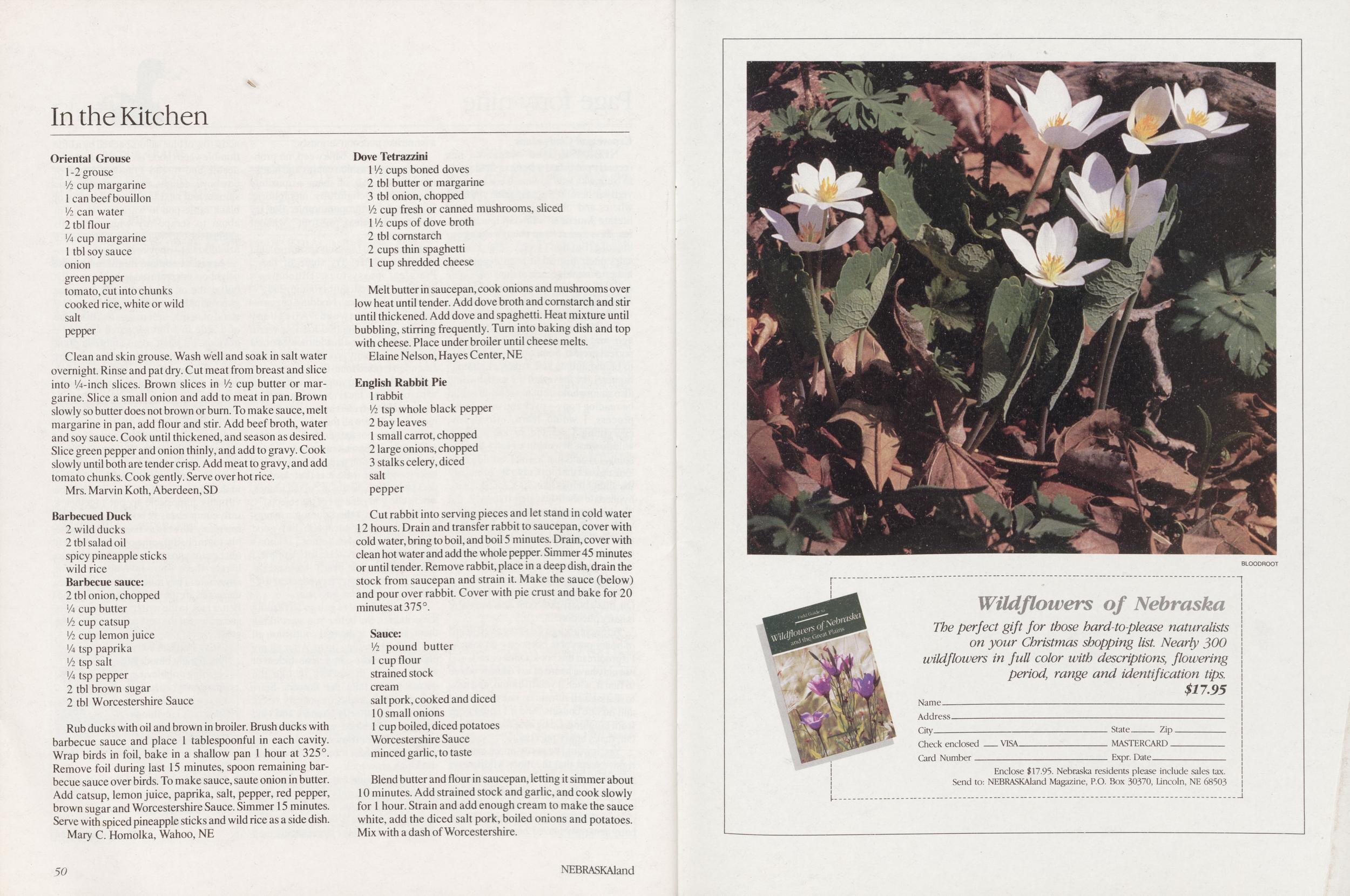
In the Kitchen
Oriental Grouse 1-2 grouse cup margarine 1 can beef bouillon can water 2 tbl flour Va cup margarine 1 tbl soy sauce onion green pepper tomato, cut into chunks cooked rice, white or wild salt pepperClean and skin grouse. Wash well and soak in salt water overnight. Rinse and pat dry. Cut meat from breast and slice into Vi-inch slices. Brown slices in Vi cup butter or margarine. Slice a small onion and add to meat in pan. Brown slowly so butter does not brown or burn. To make sauce, melt margarine in pan, add flour and stir. Add beef broth, water and soy sauce. Cook until thickened, and season as desired. Slice green pepper and onion thinly, and add to gravy. Cook slowly until both are tender crisp. Add meat to gravy, and add tomato chunks. Cook gently. Serve over hot rice.
Mrs. Marvin Koth, Aberdeen, SD Barbecued Duck 2 wild ducks 2 tbl salad oil spicy pineapple sticks wild rice Barbecue sauce: 2 tbl onion, chopped Va cup butter Vi cup catsup Vi cup lemon juice Va tsp paprika Vi tsp salt Va tsp pepper 2 tbl brown sugar 2 tbl Worcestershire SauceRub ducks with oil and brown in broiler. Brush ducks with barbecue sauce and place 1 tablespoonful in each cavity. Wrap birds in foil, bake in a shallow pan 1 hour at 325°. Remove foil during last 15 minutes, spoon remaining barbecue sauce over birds. To make sauce, saute onion in butter. Add catsup, lemon juice, paprika, salt, pepper, red pepper, brown sugar and Worcestershire Sauce. Simmer 15 minutes. Serve with spiced pineapple sticks and wild rice as a side dish.
Mary C. Homolka, Wahoo, NE Dove Tetrazzini 1 1/2 cups boned doves 2 tbl butter or margarine 3 tbl onion, chopped Vi cup fresh or canned mushrooms, sliced 1 Vi cups of dove broth 2 tbl cornstarch 2 cups thin spaghetti 1 cup shredded cheeseMelt butter in saucepan, cook onions and mushrooms over low heat until tender. Add dove broth and cornstarch and stir until thickened. Add dove and spaghetti. Heat mixture until bubbling, stirring frequently. Turn into baking dish and top with cheese. Place under broiler until cheese melts.
Elaine Nelson, Hayes Center, NE English Rabbit Pie 1 rabbit Vi tsp whole black pepper 2 bay leaves 1 small carrot, chopped 2 large onions, chopped 3 stalks celery, diced salt pepperCut rabbit into serving pieces and let stand in cold water 12 hours. Drain and transfer rabbit to saucepan, cover with cold water, bring to boil, and boil 5 minutes. Drain, cover with clean hot water and add the whole pepper Simmer 45 minutes or until tender. Remove rabbit, place in a deep dish, drain the stock from saucepan and strain it. Make the sauce (below) and pour over rabbit. Cover with pie crust and bake for 20 minutes at 375°.
Sauce: Vi pound butter 1 cup flour strained stock cream salt pork, cooked and diced 10 small onions 1 cup boiled, diced potatoes Worcestershire Sauce minced garlic, to tasteBlend butter and flour in saucepan, letting it simmer about 10 minutes. Add strained stock and garlic, and cook slowly for 1 hour. Strain and add enough cream to make the sauce white, add the diced salt pork, boiled onions and potatoes. Mix with a dash of Worcestershire.
50 NEBRASKAland
Position: 511 (21 views)