Volume 68, Issue 7, 1990
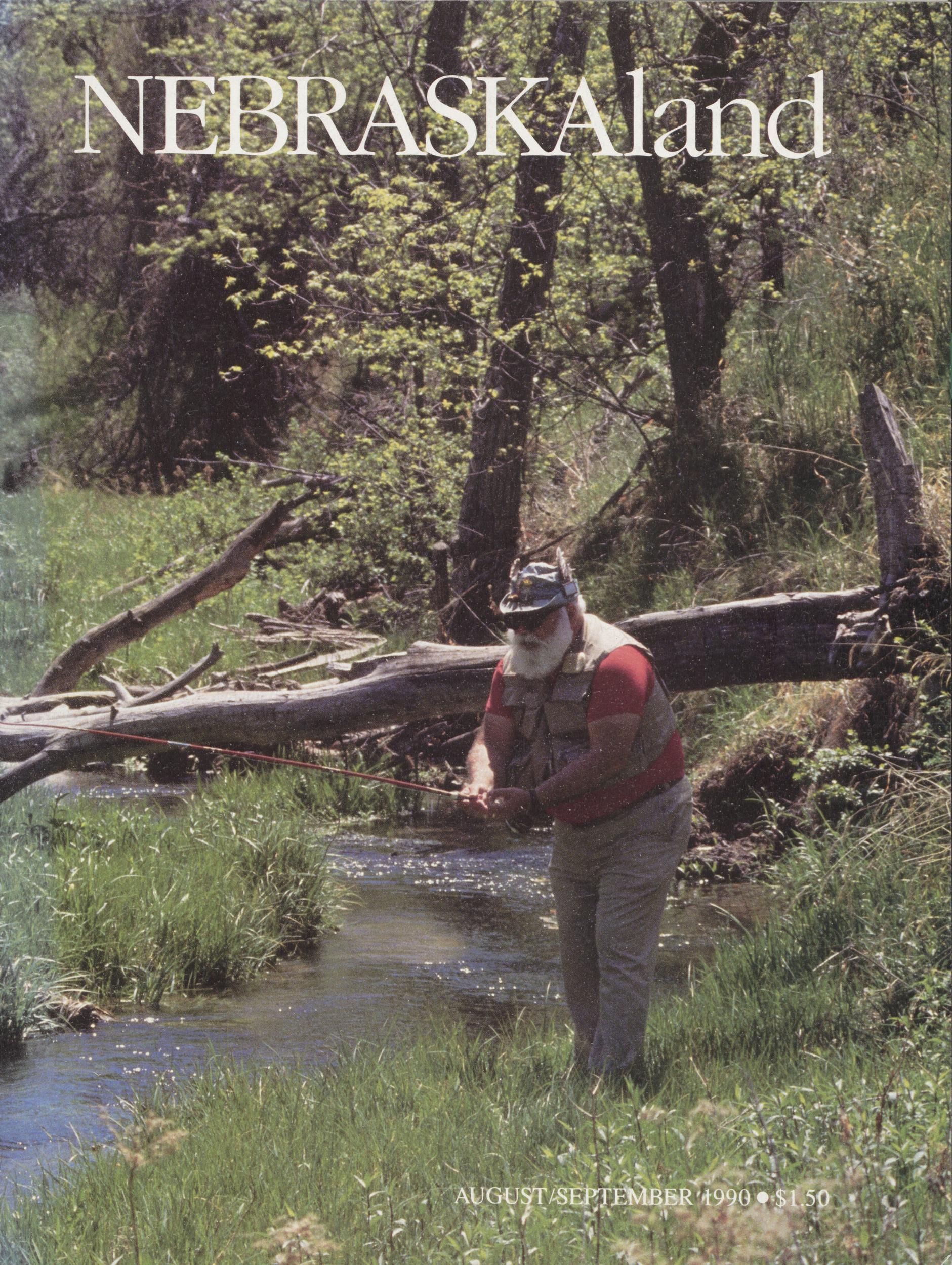
NEBRASKAland
AUGUST/SEPTEMBER 1990 $1.50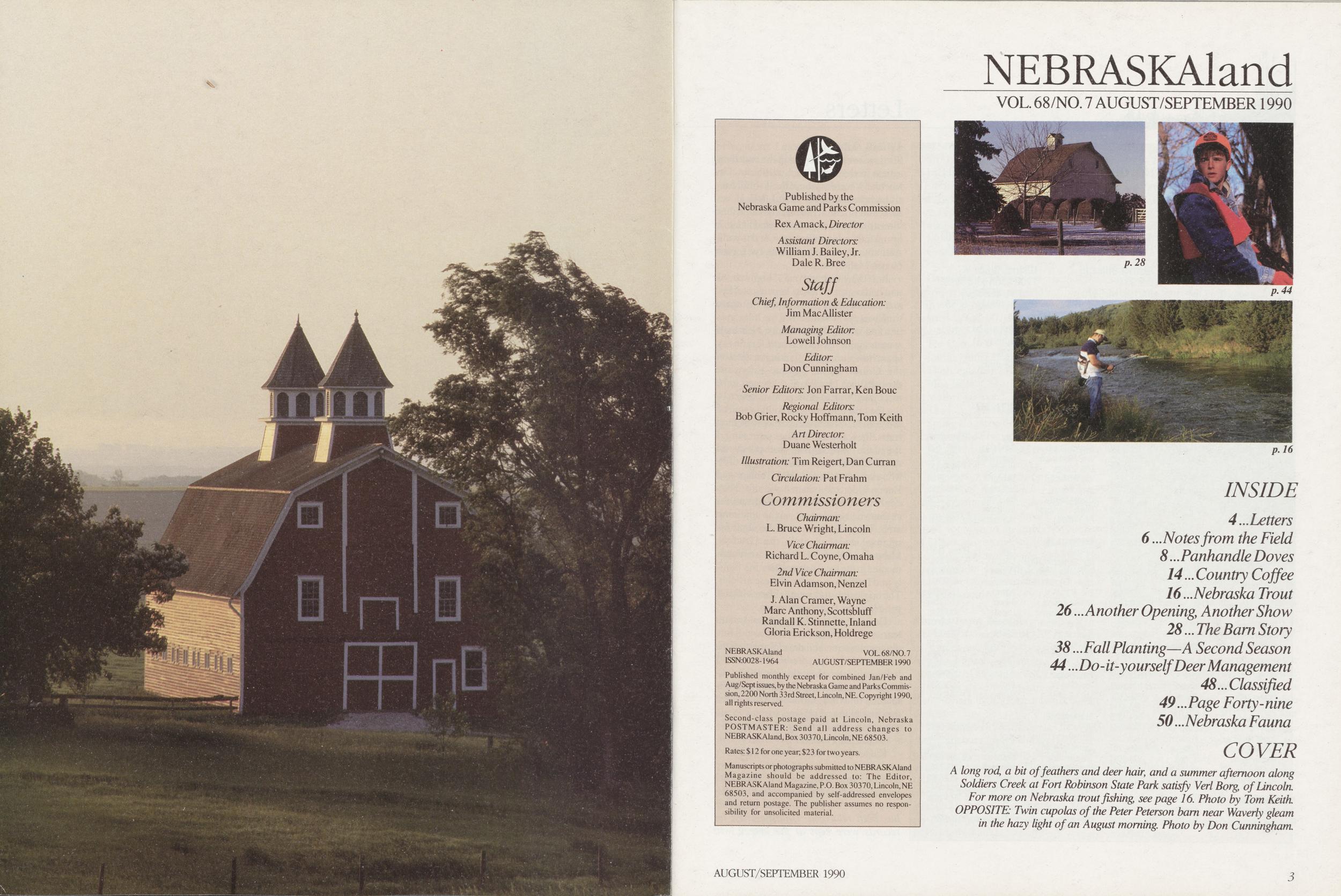
NEBRASKAland
VOL. 68/NO. 7 AUGUST/SEPTEMBER 1990 Published by the Nebraska Game and Parks Commission Rex Amack, Director Assistant Directors: William J. Bailey, Jr. Dale R. Bree Staff Chief Information & Education: Jim Mac Allister Managing Editor: Lowell Johnson Editor. Don Cunningham Senior Editors: Jon Farrar, Ken Bouc Regional Editors: Bob Grier, Rocky Hoffmann, Tom Keith Art Director: Duane Westerholt Illustration: Tim Reigert, Dan Curran Circulation: PatFrahm Commissioners Chairman: L. Bruce Wright, Lincoln Vice Chairman: Richard L. Coyne, Omaha 2nd Vice Chairman: Elvin Adamson, Nenzel J. Alan Cramer, Wayne Marc Anthony, Scottsbluff Randall K. Stinnette, Inland Gloria Erickson, Holdrege NEBRASKAland ISSN:0028-1964 VOL.68/N0.7 AUGUST/SEPTEMBER 1990 Published monthly except for combined Jan/Eeb and Aug/Sept issues, by the Nebraska Game and Parks Commission, 2200 North 33rd Street, Lincoln, NE. Copyright 1990, all rights reserved. Second-class postage paid at Lincoln, Nebraska POSTMASTER: Send all address changes to NEBRASKAland, Box 30370, Lincoln, NE 68503. Rates: $ 12 for one year; $23 for two years. Manuscripts or photographs submitted to NEBRASKAland Magazine should be addressed to: The Editor, NEBRASKAland Magazine, P.O. Box 30370,Lincoln, NE 68503, and accompanied by self-addressed envelopes and return postage. The publisher assumes no responsibility for unsolicited material.
Letters
Ashfall AnimalsSir/1 was very interested in the excellent article in the June issue, written by Dr. Michael Voorhies, about the Ashfall fossil beds located near Royal, NE. However, I believe that the records show that these fossil beds were discovered in 195 3 by my father, James Peterson, and myself. At that time we were planting rye for the owner, Melvin Colson.
In 1953,1 was just out of high school and had a great interest in paleontology and Indian artifacts. Much of my spare time was spent wandering the hills, gullies and streams of northeast Nebraska searching for fossils and artifacts. In my spare time during the planting session on the Colson farm, I noted the white deposits that I had earlier learned to be associated with fossil deposits. On searching the hills and gullies, I found some of the gullies full of fossil parts protruding from the walls. On further searching, I found the first complete, well-preserved rhino skull. We then notified the U. of N. Museum, and Drs. Lloyd Tanner and Henry Rider soon visited the site. They confirmed the rhino skull find and the extensive fossil deposits in the adjoining area. They then prepared the skull for removal and took it to the U. of N. Museum. All these facts were documented in the local newspapers. My family and I still have copies of these articles. The originally-discovered rhino skull still resides at the U. of N. Museum.
Dr. Michael Voorhies apparently later learned of this discovery and began further exploration and development of the site, much to his credit. However, I believe that the scientific community accepts first discovery as the first documented find of significant fossils, which the first rhino skull and extensive associated fossils certainly were.
Donald W. Peterson Ridgecrest,CAAfter a long search in the Museum's warehouse, the very interesting fossil discovered by Mr. Peterson and his father has been relocated. Unfortunately, no records were kept at the time it was 4 NEBRASKAland brought to Lincoln in 1953, and the specimen remained for nearly 40 years in an unnumbered plaster cast until recognized by one of its collectors, Lloyd Tanner. Judging from the sandstone matrix still adhering to the partial rhino skull found by the Petersons, the fossil is not part of the assemblage of skeletons buried in volcanic ash at the Ashfall site, but is from the layer of sandstone beneath the ash bed. The Peterson rhino (a very old female with heavily worn teeth) lived and died long before the ash bed was deposited. It is an excellent example of the kind of fossil usually found in "time exposure" deposits that accumulate over a long period of time, in contrast to "snapshot" deposits like the ash bed. The Museum plans to feature the Petersons' specimen in an exhibit at the Visitor Center at the park now being developed.
Apparently the volcanic ash bed was not yet exposed by erosion in 1953 when the Petersons reported their discovery. Only a few square feet of the bed were exposed in 1971 when I noticed the first of many complete skeletons beginning to erode from the ash. At the time, I was unaware of the Peterson's find and the subsequent visit of a Museum team to the vicinity, since I did not come to work for the Museum until 1975. (Mike Voorhies, UNL State Museum)
High Grades, Low GradesSir/ An A+, certainly, to all the fine young Nebraska artists whose pictures appear in the July issue. A+, also, to the Game and Parks Commission for sponsoring the Nebraska Habitat Stamp Art Contest, and to NEBRASKAland for publishing the notable entries. But, sadly, a D- to the editors and layout people who allowed the almost unreadable legends to accompany the color prints. Surely the young artists deserved to have their names in type larger than what must be 4- or 5-point, and it would have been nice to have included the names of the proud parents. Hard to understand such a goof from such a quality publication!
Ken Keller Lincoln, NE Bess Streeter AldrichSir/ In her article about Bess Streeter Aldrich in the July Issue ["Mrs. Aldrich of Elmwood"], Carol Miles Petersen said that some of Aldrich's books are still in print. Please let me know which books are in print, and where they can be purchased.
Mrs. Harold Smith Granite Shoals, TXCarol Miles Peterson reports that the following titles are available from the University of Nebraska Press, 327 Nebraska Hall, 901 North 17th St., Lincoln, NE' 68588-0520.
The Cutters Journey into Christmas The Lieutenant's Lady Miss Bishop Mother Mason The Rim of the Prairie Spring Came on Forever White Bird Flying A Lantern in Her Hand is published by New American Library.Mr. Chester Bornmeier, of Elmwood, Chairman of the Aldrich Foundation, wishes to remind readers that the Aldrich house in Elmwood is a private residence, and is not open to the public except for limited periods on special occasions. One such occasion will be the Aldrich Day celebration on October 7. For information contact the Foundation at P. O. Box 172, Elmwood, NE 68349. (Editor)
Thanks from ParaguaySir/ To all of you at NEBRASKAland and to your wonderful, responsive readers [see "An Appeal from Paraguay," Letters, June 1990]: I have received six shucking mitts and a spike, two brochures showing their availability, and one or two different designs.
Mr. Robert Diller, of Steele City, NE, sent a brochure from Lehman Hardware in Kidron, OH, offering huskers and other old-style implements. Thanks ever so much, Mr. Diller. Mr. Gary Tuxhorn, of Yardley, PA sent a copied page from NASCO Farm and Ranch of Fort Atkin- son, WI; they, too, offer husking mitts and pegs. Many thanks.
A very special thanks to Caroll and Thelma Thomas, of North Loup; Bill Svoboda, of Lincoln; Ken Bowman, of Scottsbluff; Mark Buckley, of Wilcox; J. Mark Martin, of Warrenton, VA.
I cannot tell you how pleased I am in your generous responses. These simple tools will save hundreds of bushels of corn from rain damage on farms of often no more than three or four acres which support families of seven on up to 25 or 30 people, mostly youngsters. A few bushels of corn is a large positive advance against the problems of the coming year.
Again, thanks so much to all of you. As time permits, I shall answer each of you, and try to include a photo of life in Paraguay. The enclosed photo is the evercommon "carreta con buey," the oxen and wagon of Paraquay.
By the way, an error occurred in the publication of my last letter, probably due to my terrible writing habits: I am not a pastor or Reverend, I am a PC V—a Peace Corps Volunteer. Sorry for the misinterpretation.
You people are wonderful!
PVC Dan Hibbs CuerpoDePaz Asuncion, ParaguayWrite to Letters, NEBRASKAland Magazine, P.O. Box 30370, Lincoln, NE 68503. NEBRASKAland reserves the right to edit and condense letters.
AUGUST/SEPTEMBER 1990 5 Happy
New Year!
1991 is on its way, and the
new NEBRASKAland calen
dar is ready and waiting!
Featuring 12 spectacular
photos of Nebraska's great
outdoors, the calendar also
includes state park information, license and permit data
and sunrise/sunset tables.
Order one for yourself, and
several more as gifts. Still
only $5.00.
Please send me copies of the
1991 NEBRASKAland calendar at
$5.00 each (Nebraska residents
please include sales tax).
Name
Address
City
State
Zip
Check Enclosed.
Visa
Mastercard
Acct. No..
Expiration Date.
Mail to NEBRASKAland Calendar
P.O. Box 30370
Lincoln, NE 68503,
Happy
New Year!
1991 is on its way, and the
new NEBRASKAland calen
dar is ready and waiting!
Featuring 12 spectacular
photos of Nebraska's great
outdoors, the calendar also
includes state park information, license and permit data
and sunrise/sunset tables.
Order one for yourself, and
several more as gifts. Still
only $5.00.
Please send me copies of the
1991 NEBRASKAland calendar at
$5.00 each (Nebraska residents
please include sales tax).
Name
Address
City
State
Zip
Check Enclosed.
Visa
Mastercard
Acct. No..
Expiration Date.
Mail to NEBRASKAland Calendar
P.O. Box 30370
Lincoln, NE 68503,
Notes from the field
Pawnee County PrairiesFrom Gerry Steinauer, Community Ecologist for the Nebraska Game and Parks Commission's Natural Heritage Program, comes the following note:
This summer I've been loading up the pickup and trekking to Pawnee County in search of native tallgrass prairies. Prior to European settlement, tallgrass prairies dominated the landscape of eastern Nebraska. Grasses such as big bluestem and Indian grass, along with a multitude of wildflowers, reached from horizon to horizon. Large grazers—bison, elk, antelope and mule deer—roamed this expansive grassland. Now, corn, milo and soybeans stretch from fencerow tofencerow and cows roam the back forty. In the last 120 years the Nebraska landscape has been greatly manipulated to meet the needs of its human inhabitants. But some prairie has survived the upheaval mostly as small isolated pockets amid the sea of agriculture. Relative to most of eastern Nebraska, Pawnee County has more prairie remaining because of its rocky, glacially-derived soils that weren 't suitable for plowing (though most was).
Today, farmers hay or graze their prairies, or both Done correctly, haying and cattle grazing can simulate the beneficial effect that fire and native grazers such as bison historically had on the prairie vegetation—primarily the removal of excess litter which retards plant growth, the recycling of nutrients locked up in the litter, control of shrub and tree encroachment, and the creation of habitat diversity.
I find that hayed prairies are almost always in better condition than grazed prairies. To be rather blunt, grazed prairies in eastern Nebraska usually are overgrazed, or have been overgrazed in the past. This is detrimental to many native prairie plants. Historically, bison would graze an area, and then move on to "greener pastures,' giving the plants in the grazed area a chance to recover. Today, livestock are confined to pastures, usually for the entire summer. Native plants are not adapted to this constant grazing pressure and soon lose vigor and are displaced by more grazing-tolerant exotic plants (usually European and Asian in origin) such as smooth brome, downy brome, Kentucky bluegrass, musk thistle and yellow goatsbeard. These species are indicators of disturbance— they 're telling us something is awry in the system.
Prairies in eastern Nebraska are usually hayed once a year, twice at the most. This is similar to a single episode of grazing, and allows plants a period ofregrowth and recovery after having their stems, leaves and flower heads removed Haying is beneficial in that it removes excess litter and controls woody plant encroachment. However, haying does have a negative aspect. If prairies are hayed annually at the same time each year, some plants never produce seed crops because their flower heads are always destroyed by the haying. This will eventually reduce their population. Over time, the continual removal of the nutrient-rich hay crop also depletes the productivity of prairie soils. Bison and cattle return a good share of the nutrients to the soil via manure.
Compared to grazed prairies, hayed prairies harbor a greater abundance and diversity of native wildflowers including gay feathers, downy gentian, compass plant, purple prairie coneflower, New Jersey tea and numerous others. I judge the quality of a prairie by its native grass and wildflower composition.
The problem with hayed prairies is that they are generally small (in Pawnee County, usually less than 30 acres), and these parcels produce just enough hay to get the farmer's cattle through the winter. We ecologists question the long-term ability of small prairies to survive the onslaught of exotic species invasion, herbicides and other human-caused disturbances. The one thing that really irks my "prairie consciousness" is to see a prairie which has taken a shot of herbicide. Herbicides kill native wildflowers in addition to weeds. Sometimes the herbicide is drift from adjacent crop fields or road ditches, other times it's from broadcast spraying of prairies. Farmers sometimes confuse wildflowers with weeds. Once I asked a farmer why he sprayed his prairie. His response was "to kill those weeds." Many of his "weeds" were highly nutritious native plants, some of which are also nitrogen-fixing legumes similar to alfalfa.
As I roam through a prairie on a hot muggy day—common in Pawnee County in summer—the thought of finding a prairie white-fringed orchid or Mead's milkweed, both of them federally endangered plants, keeps my spirits up. The thought of the air-conditioned truck has the same effect.
For months it seemed only a rumor, but finally it's a reality— NEBRASKAland's Field Guide to the Wildflowers of Nebraska and the Great Plains is now available, just in time to help you identify those confusing asters, goldenrods and sunflowers of September, and just in time to be a Christmas gift for that hard-to-buy-for naturalist. Available for only $17.95 The Field Guide features •216 pages • Full-color photographs and descriptions of 282 species •Handy 6x9-inch size, stitched binding and durable paper •Organized by flower-color and time of flowering •Accurate, complete entries, minimal technical language • Complete index and glossary Available now at most bookstores, or use the coupon below. Name Address, City State Zip Check enclosed VISA Card Number/Expr. Date MASTERCARD Enclose $17.95. Nebraska residents please include sales tax. Send to: NEBRASKAland Magazine, P.O. Box 30370, Lincoln, NE 68503 AUGUST/SEPTEMBER 1990 7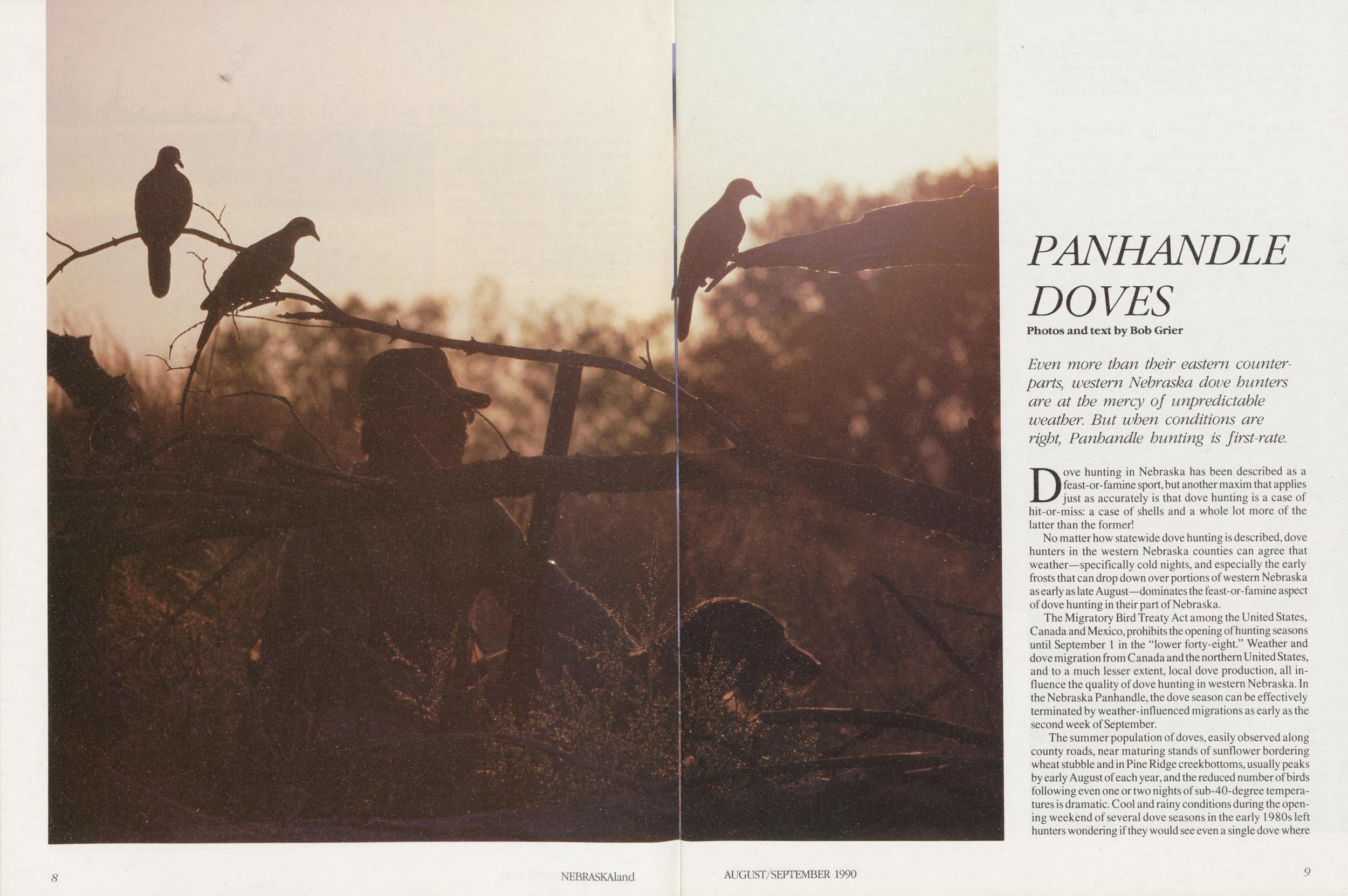
PANHANDLE DOVES
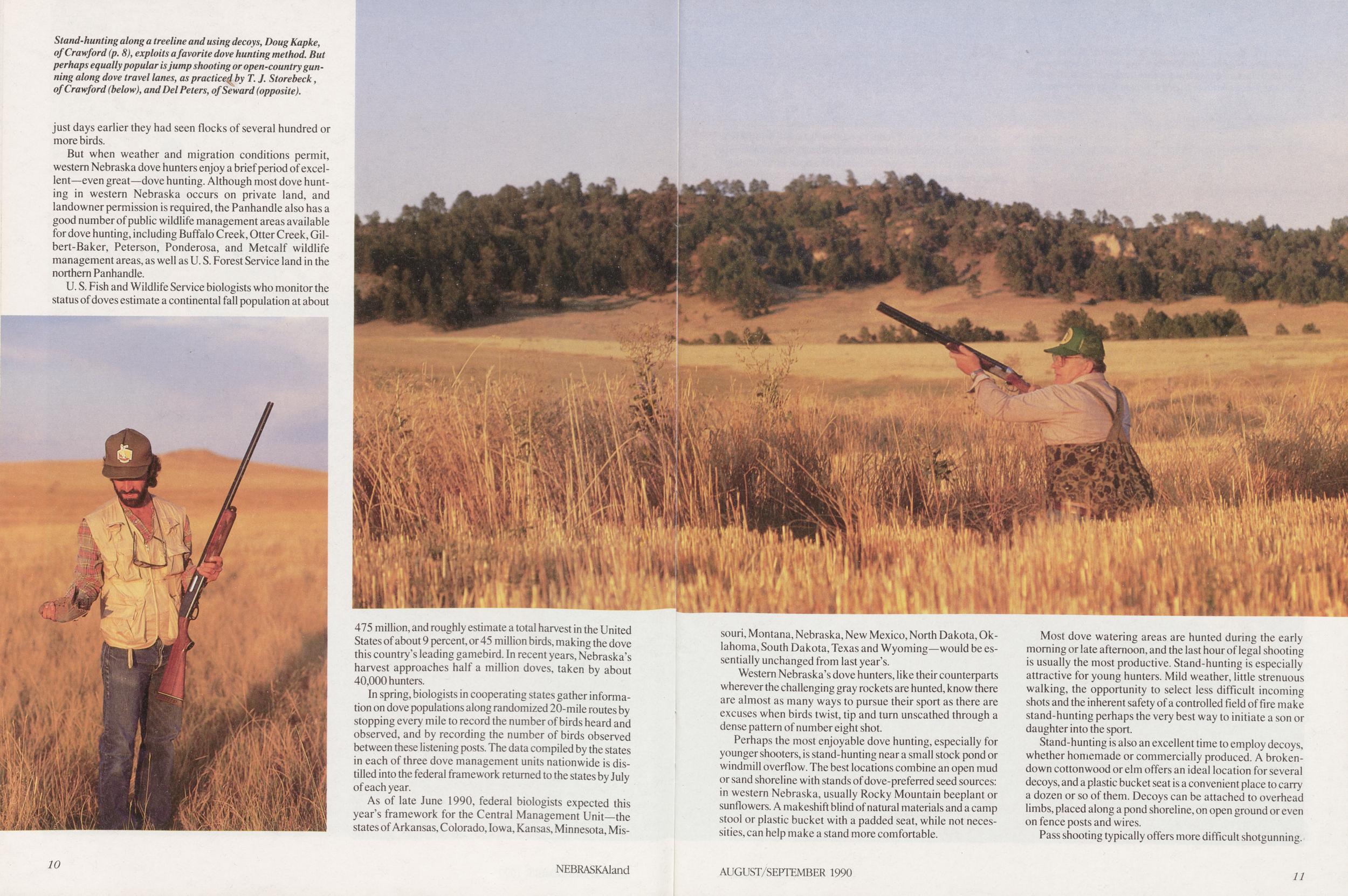
Photos and text by Bob Grier Even more than their eastern counterparts, western Nebraska dove hunters are at the mercy of unpredictable weather. But when conditions are right, Panhandle hunting is first-rate.Dove hunting in Nebraska has been described as a feast-or-famine sport, but another maxim that applies just as accurately is that dove hunting is a case of hit-or-miss: a case of shells and a whole lot more of the latter than the former!
No matter how statewide dove hunting is described, dove hunters in the western Nebraska counties can agree that weather—specifically cold nights, and especially the early frosts that can drop down over portions of western Nebraska as early as late August—dominates the feast-or-famine aspect of dove hunting in their part of Nebraska.
The Migratory Bird Treaty Act among the United States, Canada and Mexico, prohibits the opening of hunting seasons until September 1 in the "lower forty-eight." Weather and dove migration from C anada and the northern United States, and to a much lesser extent, local dove production, all influence the quality of dove hunting in western Nebraska. In the Nebraska Panhandle, the dove season can be effectively terminated by weather-influenced migrations as early as the second week of September.
The summer population of doves, easily observed along
county roads, near maturing stands of sunflower bordering
wheat stubble and in Pine Ridge creekbottoms, usually peaks
by early August of each year, and the reduced number of birds
following even one or two nights of sub-40-degree temperatures is dramatic. Cool and
rainy conditions during the opening weekend of several dove seasons in the early 1980s
left
hunters wondering if they would see even a single dove where
AUGUST/SEPTEMBER 1990
9
But when weather and migration conditions permit, western Nebraska dove hunters enjoy a brief period of excellent—even great—dove hunting. Although most dove hunting in western Nebraska occurs on private land, and landowner permission is required, the Panhandle also has a good number of public wildlife management areas available for dove hunting, including Buffalo Creek, Otter Creek, Gilbert-Baker, Peterson, Ponderosa, and Metcalf wildlife management areas, as well as U. S. Forest Service land in the northern Panhandle.
U. S. Fish and Wildlife Service biologists who monitor the status of doves estimate a continental fall population at about 475 million, and roughly estimate a total harvest in the United States of about 9 percent, or 45 million birds, making the dove this country's leading gamebird. In recent years, Nebraska's harvest approaches half a million doves, taken by about 40,000 hunters.
In spring, biologists in cooperating states gather information on dove populations along randomized 20-mile routes by stopping every mile to record the number of birds heard and observed, and by recording the number of birds observed between these listening posts. The data compiled by the states in each of three dove management units nationwide is distilled into the federal framework returned to the states by July of each year.
As of late June 1990, federal biologists expected this year's framework for the Central Management Unit—the states of Arkansas, Colorado, Iowa, Kansas, Minnesota, Missouri, 10 NEBRASKAland Montana, Nebraska, New Mexico, North Dakota, Oklahoma, South Dakota, Texas and Wyoming—would be essentially unchanged from last year's.
Western Nebraska's dove hunters, like their counterparts wherever the challenging gray rockets are hunted, know there are almost as many ways to pursue their sport as there are excuses when birds twist, tip and turn unscathed through a dense pattern of number eight shot.
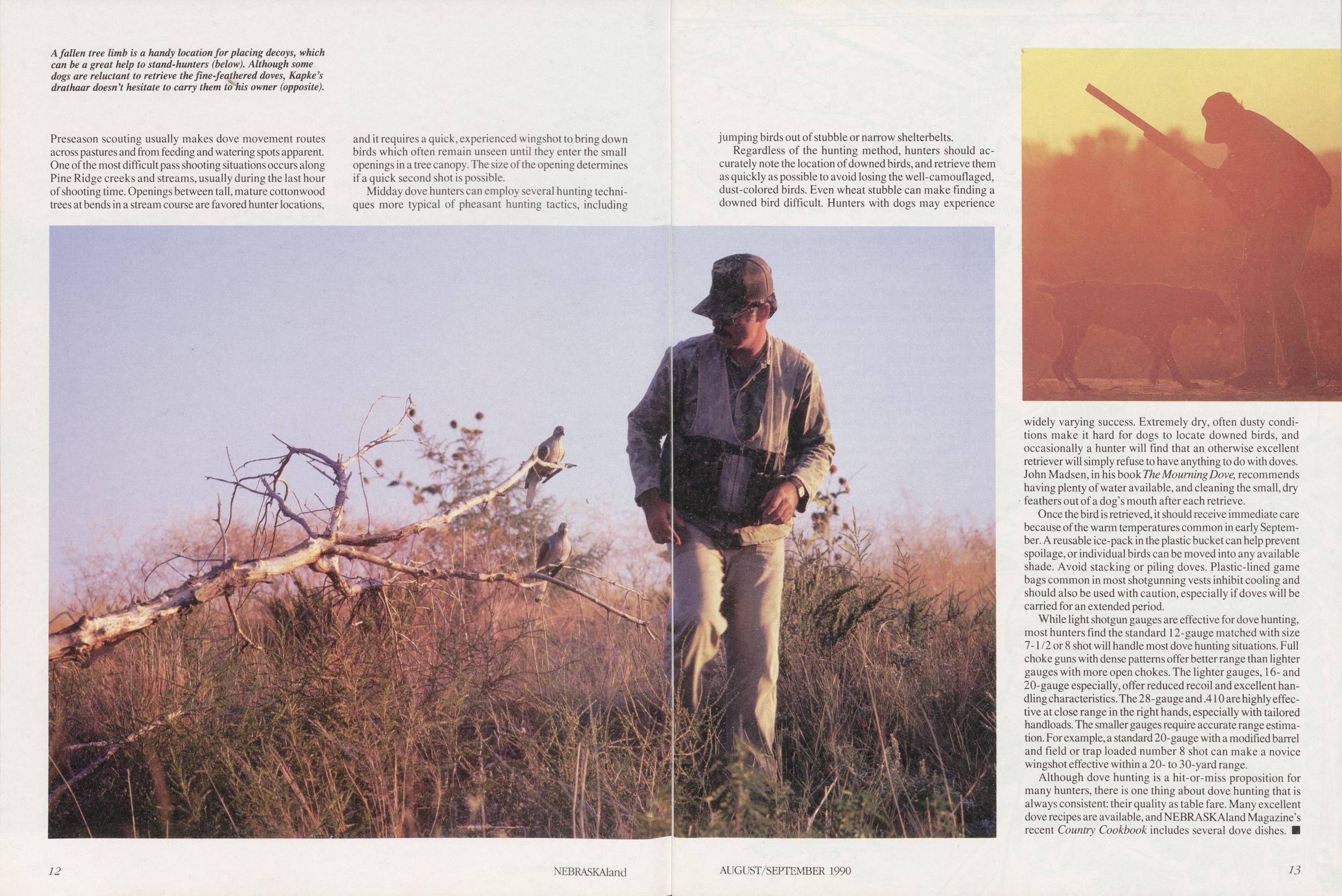
Perhaps the most enjoyable dove hunting, especially for younger shooters, is stand-hunting near a small stock pond or windmill overflow. The best locations combine an open mud or sand shoreline with stands of dove-preferred seed sources: in western Nebraska, usually Rocky Mountain beeplant or sunflowers. A makeshift blind of natural materials and a camp stool or plastic bucket with a padded seat, while not necessities, can help make a stand more comfortable.
Most dove watering areas are hunted during the early morning or late afternoon, and the last hour of legal shooting is usually the most productive. Stand-hunting is especially attractive for young hunters. Mild weather, little strenuous walking, the opportunity to select less difficult incoming shots and the inherent safety of a controlled field of fire make stand-hunting perhaps the very best way to initiate a son or daughter into the sport.
Stand-hunting is also an excellent time to employ decoys, whether homemade or commercially produced. A brokendown cottonwood or elm offers an ideal location for several decoys, and a plastic bucket seat is a convenient place to carry a dozen or so of them. Decoys can be attached to overhead limbs, placed along a pond shoreline, on open ground or even on fence posts and wires.
Pass shooting typically offers more difficult shotgunning.
AUGUST/SEPTEMBER 1990
11
Midday dove hunters can employ several hunting techniques more typical of pheasant hunting tactics, including 12 NEBRSAKAland jumping birds out of stubble or narrow shelterbelts.
Regardless of the hunting method, hunters should accurately note the location of downed birds, and retrieve them as quickly as possible to avoid losing the well-camouflaged, dust-colored birds. Even wheat stubble can make finding a downed bird difficult. Hunters with dogs may experience widely varying success. Extremely dry, often dusty conditions make it hard for dogs to locate downed birds, and occasionally a hunter will find that an otherwise excellent retriever will simply refuse to have anything to do with doves. John Madsen, in his book The Mourning Dove, recommends having plenty of water available, and cleaning the small, dry feathers out of a dog's mouth after each retrieve.
Once the bird is retrieved, it should receive immediate care because of the warm temperatures common in early September. A reusable ice-pack in the plastic bucket can help prevent spoilage, or individual birds can be moved into any available shade. Avoid stacking or piling doves. Plastic-lined game bags common in most shotgunning vests inhibit cooling and should also be used with caution, especially if doves will be carried for an extended period.
While light shotgun gauges are effective for dove hunting, most hunters find the standard 12-gauge matched with size 7-112 or 8 shot will handle most dove hunting situations. Full choke guns with dense patterns offer better range than lighter gauges with more open chokes. The lighter gauges, 16- and 20-gauge especially, offer reduced recoil and excellent handling characteristics. The 28-gauge and .410 are highly effective at close range in the right hands, especially with tailored handloads. The smaller gauges require accurate range estimation. For example, a standard 20-gauge with a modified barrel and field or trap loaded number 8 shot can make a novice wingshot effective within a 20- to 30-yard range.
Although dove hunting is a hit-or-miss proposition for many hunters, there is one thing about dove hunting that is always consistent: their quality as table fare. Many excellent dove recipes are available, and NEBRASKAland Magazine's recent Country Cookbook includes several dove dishes.
AUGUST/SEPTEMBER 1990 13
Country Coffee
By Richard Endacott "The rabbit, the cows, the coyote, the morning and me—we are all awake now."Three minutes ago I was sound asleep. Now I shuffle through the kitchen mechanically sipping my first cup of coffee. My body is up, but my mind is still in bed. Like my pickup on a cold morning, I can be hard to start. At the sink, I gaze out the window into the pasture just north of the house. It's 5:00 a.m. on a warm August morning. The first streaks of light paint the eastern Nebraska sky. Steadying myself, I close my eyes, concentrating on the next swallow. Coffee and sleep must butt heads for a while before I waken. I stretch, drift to the pot for a second cup, return to the window and stare blankly at the prairie before me. Sharing my sleepiness, it gently blinks back. A wash of color becomes tall native grasses, white Charolais cattle, still cottonwoods and a gray mist rising from the pond at the bottom of the prairie slope. It's a slow-motion morning: nature's way of easing the transition from sleep to activity.
A breeze stirs. The grasses resist, then bend from the waist. The wind, a disturbing intrusion, nags the day and me to action. The wind passes, and stillness returns.
The cows, with spring calves at their sides, are directly in front of me. The wind frisks up again. This time it is stronger, signaling the herd's second wake-up call. Most are standing now. A couple of late risers begin the awkward struggle to stand up, back legs first, forming a bovine triangle, then the front rises, changing the triangle into a four-legged rectangle. The cows search, heads down, for their calves. Gentle lowing builds to insistent bellowing, a move from soft Bach to hard rock. Cows and calves pair up for breakfast. The calves eagerly nurse. The pace of my coffee drinking also moves from sip to slurp.
A movement to the left catches my eye and my gaze shifts to the steep hill of shorter prairie grass. A fleck of bobbing white at the top of the hill moves down the slope, looking like a handkerchief racing down the hill. A brown breadbox with spindly legs appears behind it. The handkerchief becomes a jackrabbit running for his life. The breadbox becomes a pursuing coyote, ears back, running for his breakfast. They careen down the slope, the rabbit escaping with desperate zigzag moves, as they approach the herd. Entering the taller grass, the rabbit disappears and the coyote briefly loses sight of him. Confused and frustrated, the coyote stops, then bounds up over the grass, head high, front paws held up in front of him as if praying before his meal. He hangs in the air like a ballet dancer. Concentrating on the rabbit, he is oblivious to his surroundings.
The rabbit darts into a low patch of grass directly in front of me. The coyote spies him in mid-leap, races to the spot, sniffs urgently, loses him again, and then resumes his bounding search.
I take another sip and start to turn away, but the antics are not over yet. The coyote leaps again, but this time the game suddenly changes. The cows notice him. With heads down, they hoarsely bellow the alarm. Instantly, the herd is transformed into a white regiment, moving toward the coyote, heads lowered.
The abrupt change from pursuer to pursued is like shifting gears from drive to reverse at high speed. In mid-leap, the coyote senses the danger. He twists his body and is scrambling in the other direction by the time he hits the ground. He is too late. Before he can scurry free, an 1,800-pound, white freight train rumbles over him.
As I have watched, the morning has exploded into action. The sun glares bright and harsh, a gusting wind erupts. My coffee spills. I nearly drop my cup.
The trampled coyote leaps up, but a second cow hits him and rolls him over and over. He's up again, but now he limps. Outnumbered, his speed and agility compromised, only coyote brains can save him now. Dodging a third rush, he darts toward a nearby barbed-wire fence. Quickly changing his course to the south, he struggles under the wire. The frustrated cows line the fence bellowing:" and don't come back."
Once on the other side of the fence, the coyote slows to a walk. Head down and tail low, he limps in the direction of a grove of trees. He stops, raises his head defiantly and looks back at the herd. Then he looks away, and trots casually on.
The rabbit appears at the bottom of the hill; he's moving in the direction from which he came. Then he stops and looks back toward the coyote and cows before disappearing in the brush.
I take a last swig, and the cold dregs jerk my thoughts back inside. I turn abruptly from the window. Chores beckon. The rabbit, the cows, the coyote, the morning and me we are all awake now.
Richard Endacott, of Lincoln, is the author of Eating Nebraska: A Humorous Look at Life and Food in the Cornhusker State. For more information, contact the author at P.O. Box 120-A, Pleasant Dak, NE 68423. 14 NEBRASKAland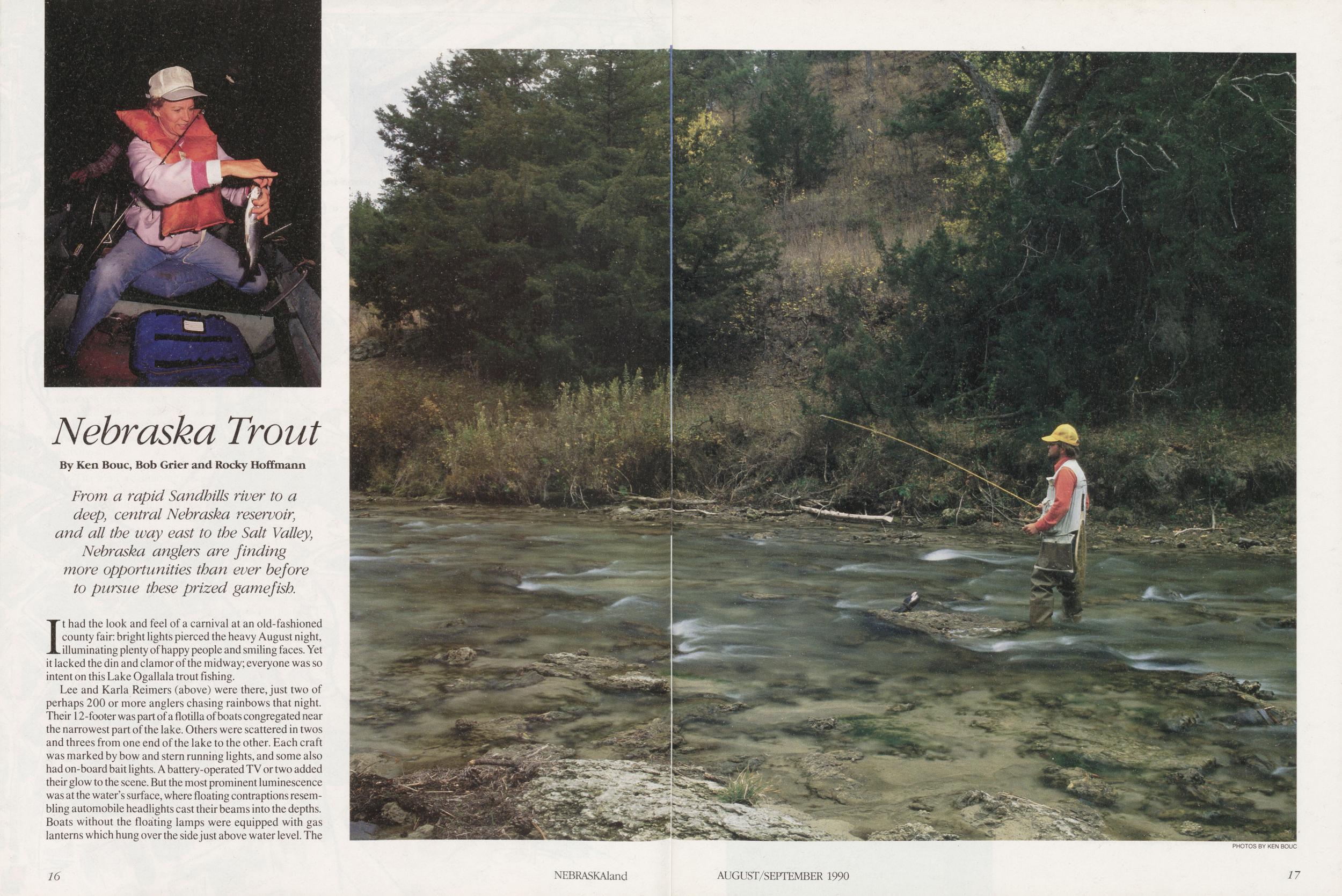
Nebraska Trout
By Ken Bouc, Bob Grier and Rocky Hoffmann From a rapid Sandhills river to a deep, central Nebraska reservoir, and all the way east to the Salt Valley, Nebraska anglers are finding more opportunities than ever before to pursue these prized gamefish.It had the look and feel of a carnival at an old-fashioned county fair: bright lights pierced the heavy August night, illuminating plenty of happy people and smiling faces. Yet it lacked the din and clamor of the midway; everyone was so intent on this Lake Ogallala trout fishing.
Lee and Karla Reimers (above) were there, just two of perhaps 200 or more anglers chasing rainbows that night. Their 12-footer was part of a flotilla of boats congregated near the narrowest part of the lake. Others were scattered in twos and threes from one end of the lake to the other. Each craft was marked by bow and stern running lights, and some also had on-board bait lights. A battery-operated TV or two added their glow to the scene. But the most prominent luminescence was at the water's surface, where floating contraptions resembling automobile headlights cast their beams into the depths. Boats without the floating lamps were equipped with gas lanterns which hung over the side just above water level. The 16 NEBRASKAland
Like most of the other anglers there that night, Lee and Karla did well. They caught fish of two sizes, nine-inchers stocked just the week before, and longer, broader-shouldered rainbows still abundant in the lake from spring stockings. Except for injured fish, smaller trout were released, and most limits filled with the bigger rainbows.
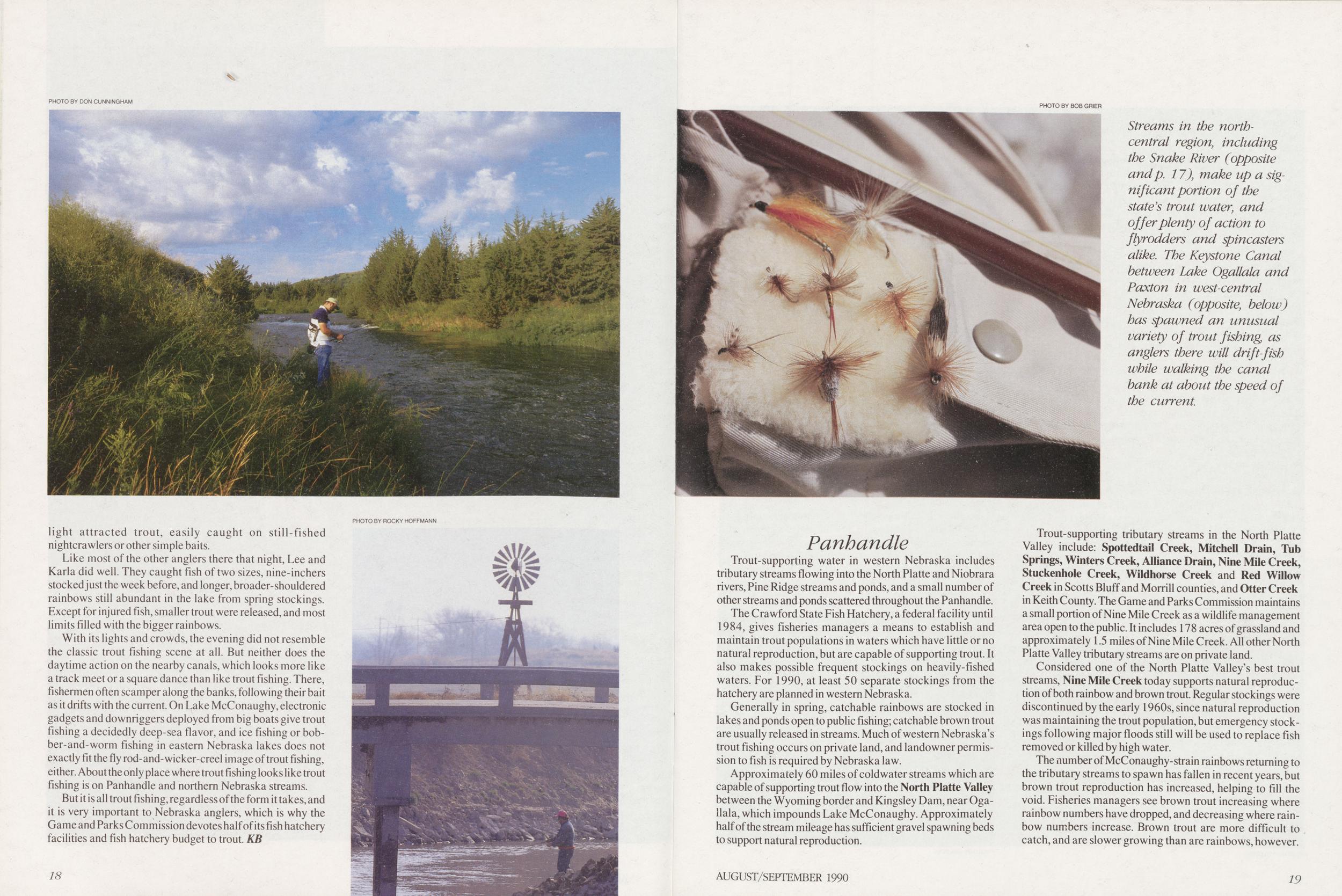
With its lights and crowds, the evening did not resemble the classic trout fishing scene at all. But neither does the daytime action on the nearby canals, which looks more like a track meet or a square dance than like trout fishing. There, fishermen often scamper along the banks, following their bait as it drifts with the current. On Lake McConaughy, electronic gadgets and downriggers deployed from big boats give trout fishing a decidedly deep-sea flavor, and ice fishing or bobber-and-worm fishing in eastern Nebraska lakes does not exactly fit the fly rod-and- wicker-creel image of trout fishing, either. About the only place where trout fishing looks like trout fishing is on Panhandle and northern Nebraska streams.
But it is all trout fishing, regardless of the form it takes, and it is very important to Nebraska anglers, which is why the Game and Parks Commission devotes half of its fish hatchery facilities and fish hatchery budget to trout.
KBTrout-supporting water in western Nebraska includes tributary streams flowing into the North Platte and Niobrara rivers, Pine Ridge streams and ponds, and a small number of other streams and ponds scattered throughout the Panhandle.
The Crawford State Fish Hatchery, a federal facility until 1984, gives fisheries managers a means to establish and maintain trout populations in waters which have little or no natural reproduction, but are capable of supporting trout. It also makes possible frequent stockings on heavily-fished waters. For 1990, at least 50 separate stockings from the hatchery are planned in western Nebraska.
Generally in spring, catchable rainbows are stocked in lakes and ponds open to public fishing; catchable brown trout are usually released in streams. Much of western Nebraska's trout fishing occurs on private land, and landowner permission to fish is required by Nebraska law.
Approximately 60 miles of cold water streams which are capable of supporting trout flow into the North Platte Valley between the Wyoming border and Kingsley Dam, near Ogallala, which impounds Lake McConaughy. Approximately half of the stream mileage has sufficient gravel spawning beds to support natural reproduction.
Trout-supporting tributary streams in the North Platte Valley include: Spottedtail Creek, Mitchell Drain, Tub Springs, Winters Creek, Alliance Drain, Nine Mile Creek, Stuckenhole Creek, Wildhorse Creek and Red Willow Creek in Scotts Bluff and Morrill counties, and Otter Creek in Keith County. The Game and Parks Commission maintains a small portion of Nine Mile Creek as a wildlife management area open to the public. It includes 178 acres of grassland and approximately 1.5 miles of Nine Mile Creek. All other North Platte Valley tributary streams are on private land.
Considered one of the North Platte Valley's best trout streams, Nine Mile Creek today supports natural reproduction of both rainbow and brown trout. Regular stockings were discontinued by the early 1960s, since natural reproduction was maintaining the trout population, but emergency stockings following major floods still will be used to replace fish removed or killed by high water.
The number of McConaughy-strain rainbows returning to
the tributary streams to spawn has fallen in recent years, but
brown trout reproduction has increased, helping to fill the
void. Fisheries managers see brown trout increasing where
rainbow numbers have dropped, and decreasing where rainbow numbers increase. Brown
trout are more difficult to
catch, and are slower growing than are rainbows, however.
AUGUST/SEPTEMBER 1990
19
 Several of the North Platte tributary streams received stockings of Snake River cutthroat
trout, and continued work with
these fish is scheduled in coming years.
Several of the North Platte tributary streams received stockings of Snake River cutthroat
trout, and continued work with
these fish is scheduled in coming years.
The Game and Parks Commission stocks the upper Niobrara River with catchable trout from the Agate Fossil Beds National Monument upstream to the Wyoming border, and makes some stockings below Agate also. Occasional large, "carry-over" fish are taken as well. Low water in the Niobrara River in recent years has prompted a reduction in trout stockings below Agate.
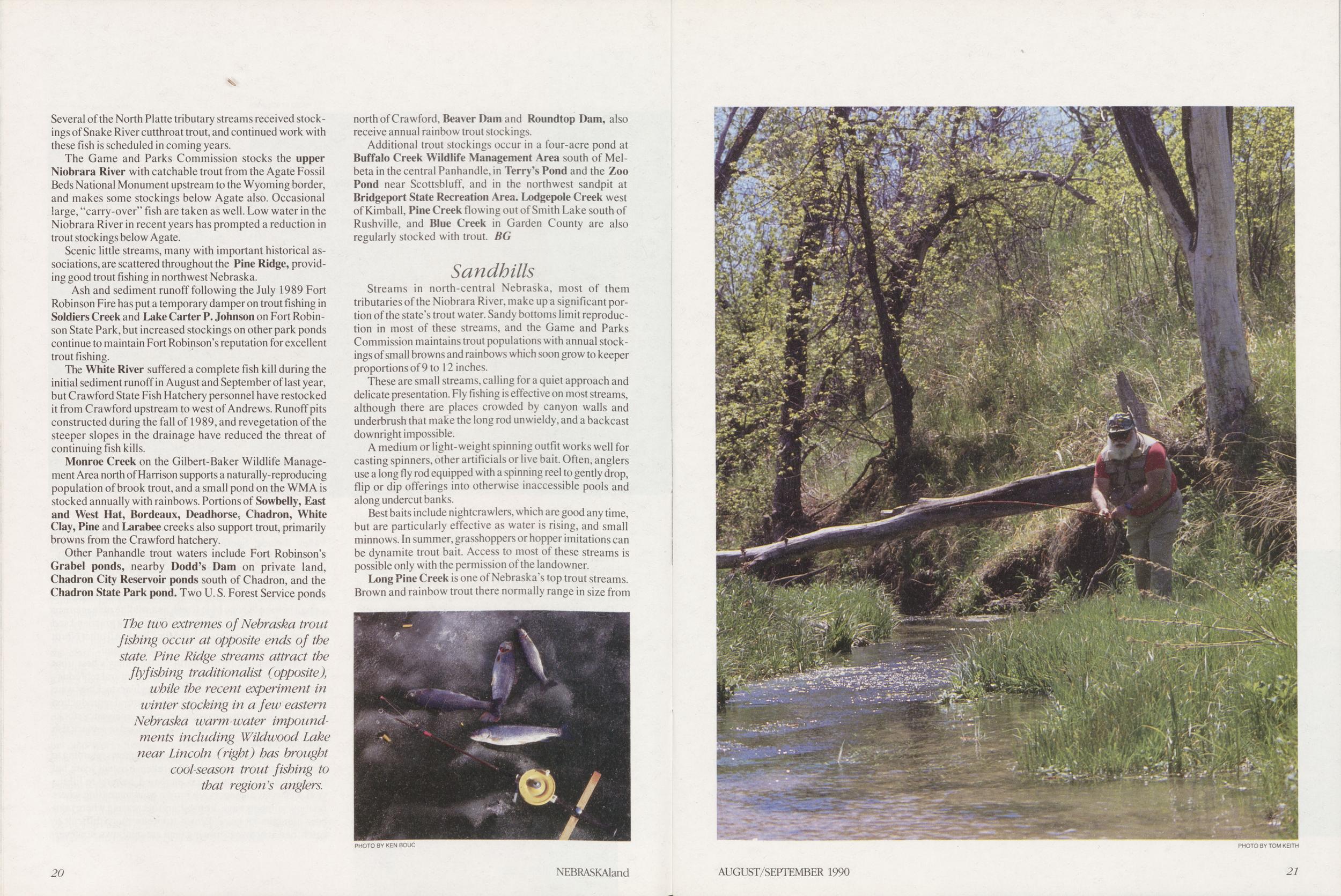
Scenic little streams, many with important historical associations, are scattered throughout the Pine Ridge, providing good trout fishing in northwest Nebraska.
Ash and sediment runoff following the July 1989 Fort Robinson Fire has put a temporary damper on trout fishing in Soldiers Creek and Lake Carter P. Johnson on Fort Robinson State Park, but increased stockings on other park ponds continue to maintain Fort Robinson's reputation for excellent trout fishing.
The White River suffered a complete fish kill during the initial sediment runoff in August and September of last year, but Crawford State Fish Hatchery personnel have restocked it from Crawford upstream to west of Andrews. Runoff pits constructed during the fall of 1989, and revegetation of the steeper slopes in the drainage have reduced the threat of continuing fish kills.
Monroe Creek on the Gilbert-Baker Wildlife Management Area north of Harrison supports a naturally-reproducing population of brook trout, and a small pond on the WMA is stocked annually with rainbows. Portions of Sowbelly, East and West Hat, Bordeaux, Deadhorse, Chadron, White Clay, Pine and Larabee creeks also support trout, primarily browns from the Crawford hatchery.
Other Panhandle trout waters include Fort Robinson's Grabel ponds, nearby Dodd's Dam on private land, Chadron City Reservoir ponds south of Chadron, and the Chadron State Park pond. Two U. S. Forest Service ponds north of Crawford, Beaver Dam and Roundtop Dam, also receive annual rainbow trout stockings.
Additional trout stockings occur in a four-acre pond at Buffalo Creek Wildlife Management Area south of Melbeta in the central Panhandle, in Terry's Pond and the Zoo Pond near Scottsbluff, and in the northwest sandpit at Bridgeport State Recreation Area. Lodgepole Creek west of Kimball, Pine Creek flowing out of Smith Lake south of Rushville, and Blue Creek in Garden County are also regularly stocked with trout.
BG SandhillsStreams in north-central Nebraska, most of them tributaries of the Niobrara River, make up a significant portion of the state's trout water. Sandy bottoms limit reproduction in most of these streams, and the Game and Parks Commission maintains trout populations with annual stockings of small browns and rainbows which soon grow to keeper proportions of 9 to 12 inches.
These are small streams, calling for a quiet approach and delicate presentation. Fly fishing is effective on most streams, although there are places crowded by canyon walls and underbrush that make the long rod unwieldy, and a backcast downright impossible.
A medium or light-weight spinning outfit works well for casting spinners, other artificials or live bait. Often, anglers use a long fly rod equipped with a spinning reel to gently drop, flip or dip offerings into otherwise inaccessible pools and along undercut banks.
Best baits include nightcrawlers, which are good any time, but are particularly effective as water is rising, and small minnows. In summer, grasshoppers or hopper imitations can be dynamite trout bait. Access to most of these streams is possible only with the permission of the landowner.
Long Pine Creek is one of Nebraska's top trout streams. Brown and rainbow trout there normally range in size from
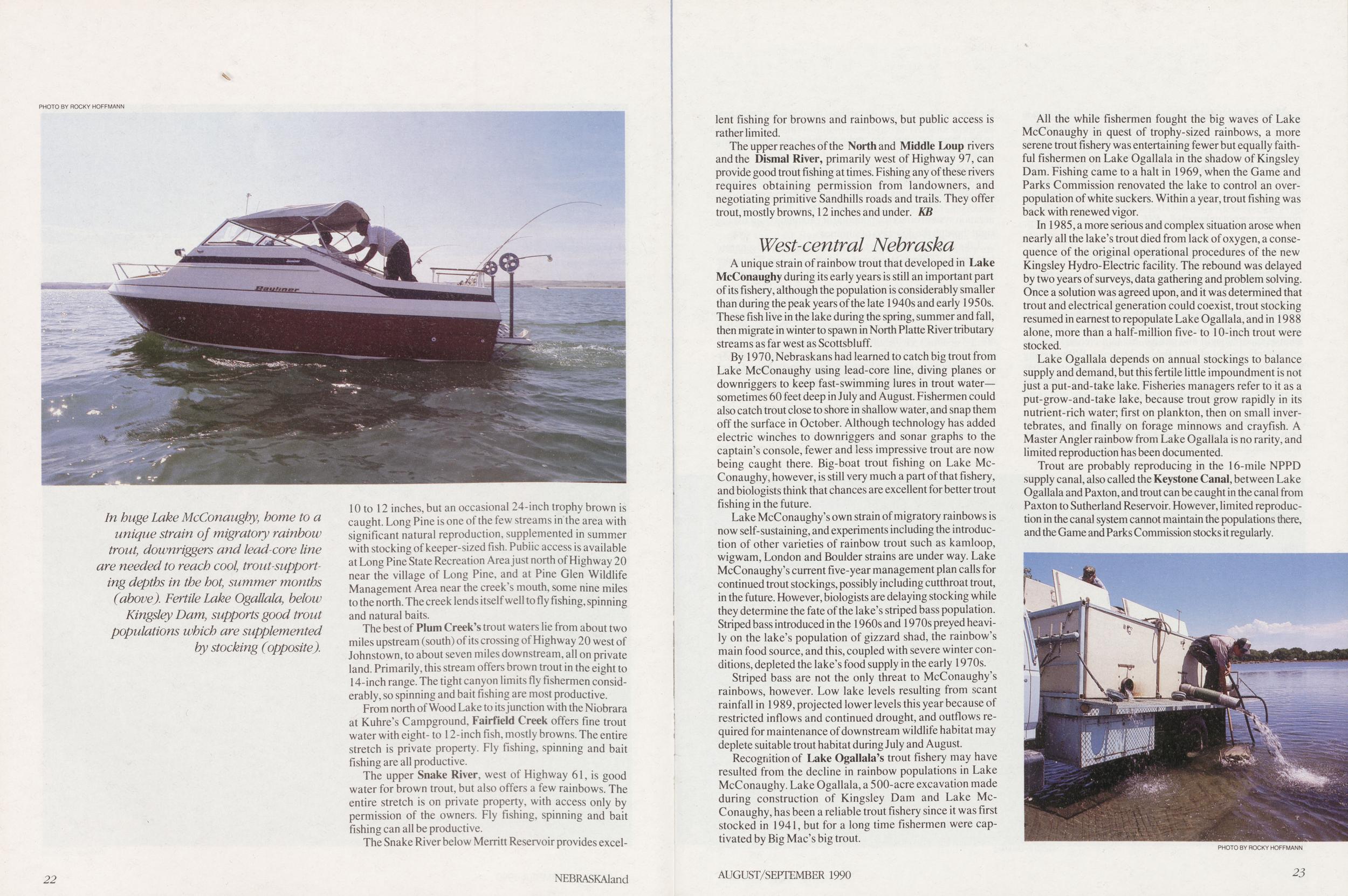
The best of Plum Creek's trout waters lie from about two miles upstream (south) of its crossing of Highway 20 west of Johnstown, to about seven miles downstream, all on private land. Primarily, this stream offers brown trout in the eight to 14-inch range. The tight canyon limits fly fishermen considerably, so spinning and bait fishing are most productive.
From north of Wood Lake to its junction with the Niobrara at Kuhre's Campground, Fairfield Creek offers fine trout water with eight- to 12-inch fish, mostly browns. The entire stretch is private property. Fly fishing, spinning and bait fishing are all productive.
The upper Snake River, west of Highway 61, is good water for brown trout, but also offers a few rainbows. The entire stretch is on private property, with access only by permission of the owners. Fly fishing, spinning and bait fishing can all be productive.
The Snake River below Merritt Reservoir provides excellent 22 NEBRASKAland fishing for browns and rainbows, but public access is rather limited.
The upper reaches of the North and Middle Loup rivers and the Dismal River, primarily west of Highway 97, can provide good trout fishing at times. Fishing any of these rivers requires obtaining permission from landowners, and negotiating primitive Sandhills roads and trails. They offer trout, mostly browns, 12 inches and under.
KB West-central NebraskaA unique strain of rainbow trout that developed in Lake McConaughy during its early years is still an important part of its fishery, although the population is considerably smaller than during the peak years of the late 1940s and early 1950s. These fish live in the lake during the spring, summer and fall, then migrate in winter to spawn in North Platte River tributary streams as far west as Scottsbluff.
By 1970, Nebraskans had learned to catch big trout from Lake McConaughy using lead-core line, diving planes or downriggers to keep fast-swimming lures in trout water sometimes 60 feet deep in July and August. Fishermen could also catch trout close to shore in shallow water, and snap them off the surface in October. Although technology has added electric winches to downriggers and sonar graphs to the captain's console, fewer and less impressive trout are now being caught there. Big-boat trout fishing on Lake McConaughy, however, is still very much a part of that fishery, and biologists think that chances are excellent for better trout fishing in the future.
Lake McConaughy's own strain of migratory rainbows is now self-sustaining, and experiments including the introduction of other varieties of rainbow trout such as kamloop, wigwam, London and Boulder strains are under way. Lake McConaughy's current five-year management plan calls for continued trout stockings, possibly including cutthroat trout, in the future. However, biologists are delaying stocking while they determine the fate of the lake's striped bass population. Striped bass introduced in the 1960s and 1970s preyed heavily on the lake's population of gizzard shad, the rainbow's main food source, and this, coupled with severe winter conditions, depleted the lake's food supply in the early 1970s.
Striped bass are not the only threat to McConaughy's rainbows, however. Low lake levels resulting from scant rainfall in 1989, projected lower levels this year because of restricted inflows and continued drought, and outflows required for maintenance of downstream wildlife habitat may deplete suitable trout habitat during July and August.
Recognition of Lake Ogallala's trout fishery may have resulted from the decline in rainbow populations in Lake McConaughy. Lake Ogallala, a 500-acre excavation made during construction of Kingsley Dam and Lake McConaughy, has been a reliable trout fishery since it was first stocked in 1941, but for a long time fishermen were captivated by Big Mac's big trout.
All the while fishermen fought the big waves of Lake McConaughy in quest of trophy-sized rainbows, a more serene trout fishery was entertaining fewer but equally faithful fishermen on Lake Ogallala in the shadow of Kingsley Dam. Fishing came to a halt in 1969, when the Game and Parks Commission renovated the lake to control an over-population of white suckers. Within a year, trout fishing was back with renewed vigor.
In 1985, a more serious and complex situation arose when nearly all the lake's trout died from lack of oxygen, a consequence of the original operational procedures of the new Kingsley Hydro-Electric facility. The rebound was delayed by two years of surveys, data gathering and problem solving. Once a solution was agreed upon, and it was determined that trout and electrical generation could coexist, trout stocking resumed in earnest to repopulate Lake Ogallala, and in 1988 alone, more than a half-million five- to 10-inch trout were stocked.
Lake Ogallala depends on annual stockings to balance supply and demand, but this fertile little impoundment is not just a put-and-take lake. Fisheries managers refer to it as a put-grow-and-take lake, because trout grow rapidly in its nutrient-rich water; first on plankton, then on small invertebrates, and finally on forage minnows and crayfish. A Master Angler rainbow from Lake Ogallala is no rarity, and limited reproduction has been documented.
Trout are probably reproducing in the 16-mile NPPD supply canal, also called the Keystone Canal, between Lake Ogallala and Paxton, and trout can be caught in the canal from Paxton to Sutherland Reservoir. However, limited reproduction in the canal system cannot maintain the populations there, and the Game and Parks Commission stocks it regularly.
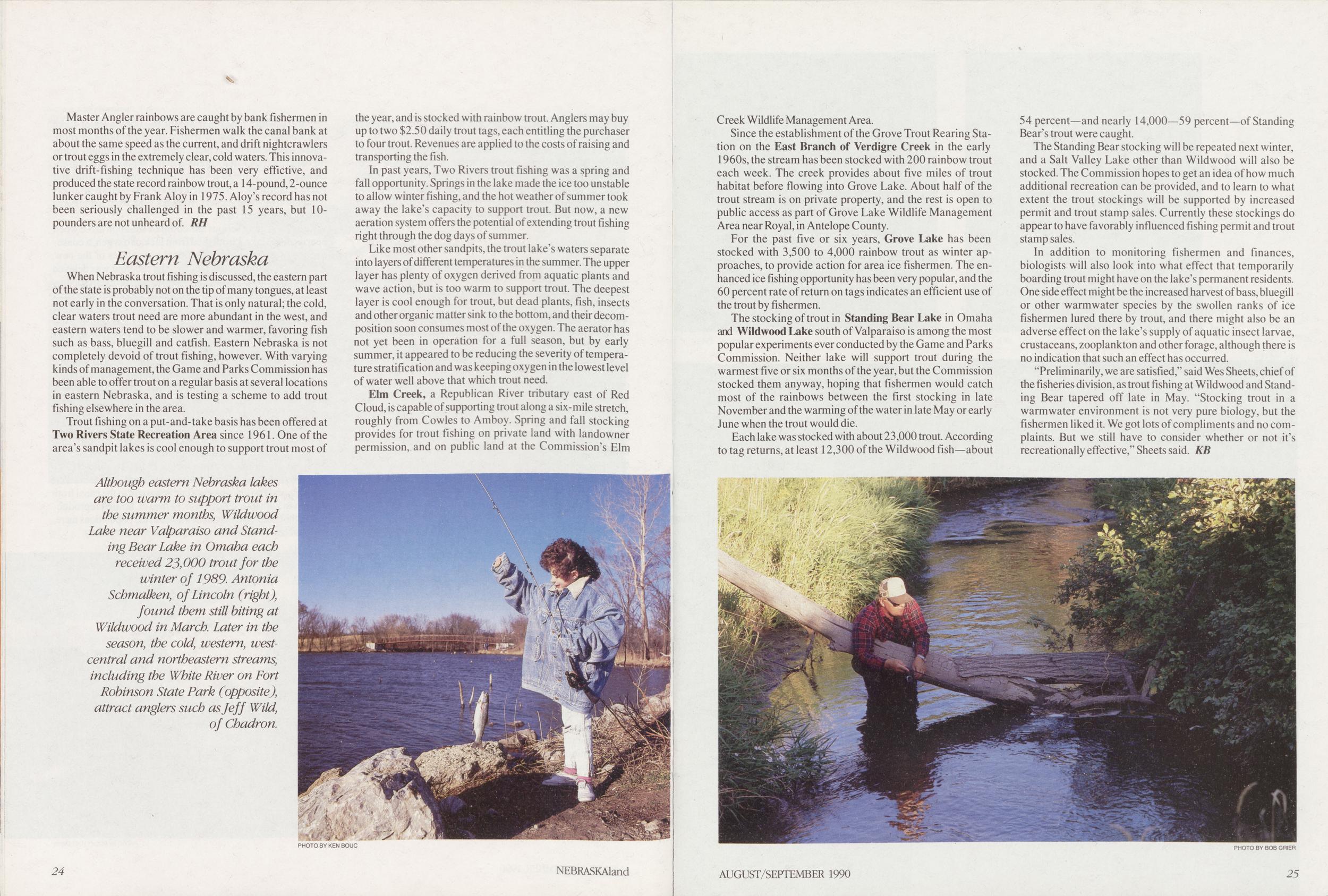
Master Angler rainbows are caught by bank fishermen in most months of the year. Fishermen walk the canal bank at about the same speed as the current, and drift nightcrawlers or trout eggs in the extremely clear, cold waters. This innovative drift-fishing technique has been very effictive, and produced the state record rainbow trout, a 14-pound, 2-ounce lunker caught by Frank Aloy in 1975. Aloy's record has not been seriously challenged in the past 15 years, but 10-pounders are not unheard of.
RH Eastern NebraskaWhen Nebraska trout fishing is discussed, the eastern part of the state is probably not on the tip of many tongues, at least not early in the conversation. That is only natural; the cold, clear waters trout need are more abundant in the west, and eastern waters tend to be slower and warmer, favoring fish such as bass, bluegill and catfish. Eastern Nebraska is not completely devoid of trout fishing, however. With varying kinds of management, the Game and Parks Commission has been able to offer trout on a regular basis at several locations in eastern Nebraska, and is testing a scheme to add trout fishing elsewhere in the area.
Trout fishing on a put-and-take basis has been offered at Two Rivers State Recreation Area since 1961. One of the area's sandpit lakes is cool enough to support trout most of the year, and is stocked with rainbow trout. Anglers may buy up to two $2.50 daily trout tags, each entitling the purchaser to four trout. Revenues are applied to the costs of raising and transporting the fish.
In past years, Two Rivers trout fishing was a spring and fall opportunity. Springs in the lake made the ice too unstable to allow winter fishing, and the hot weather of summer took away the lake's capacity to support trout. But now, a new aeration system offers the potential of extending trout fishing right through the dog days of summer.
Like most other sandpits, the trout lake's waters separate into layers of different temperatures in the summer. The upper layer has plenty of oxygen derived from aquatic plants and wave action, but is too warm to support trout. The deepest layer is cool enough for trout, but dead plants, fish, insects and other organic matter sink to the bottom, and their decomposition soon consumes most of the oxygen. The aerator has not yet been in operation for a full season, but by early summer, it appeared to be reducing the severity of temperature stratification and was keeping oxygen in the lowest level of water well above that which trout need.
Elm Creek, a Republican River tributary east of Red Cloud, is capable of supporting trout along a six-mile stretch, roughly from Cowles to Amboy. Spring and fall stocking provides for trout fishing on private land with landowner permission, and on public land at the Commission's Elm
Since the establishment of the Grove Trout Rearing Station on the East Branch of Verdigre Creek in the early 1960s, the stream has been stocked with 200 rainbow trout each week. The creek provides about five miles of trout habitat before flowing into Grove Lake. About half of the trout stream is on private property, and the rest is open to public access as part of Grove Lake Wildlife Management Area near Royal, in Antelope County.
For the past five or six years, Grove Lake has been stocked with 3,500 to 4,000 rainbow trout as winter approaches, to provide action for area ice fishermen. The enhanced ice fishing opportunity has been very popular, and the 60 percent rate of return on tags indicates an efficient use of the trout by fishermen.
The stocking of trout in Standing Bear Lake in Omaha and Wildwood Lake south of Valparaiso is among the most popular experiments ever conducted by the Game and Parks Commission. Neither lake will support trout during the warmest five or six months of the year, but the Commission stocked them anyway, hoping that fishermen would catch most of the rainbows between the first stocking in late November and the warming of the water in late May or early June when the trout would die.
Each lake was stocked with about 23,000 trout. According to tag returns, at least 12,300 of the Wildwood fish—about 54 percent—and nearly 14,000—59 percent—of Standing Bear's trout were caught.
The Standing Bear stocking will be repeated next winter, and a Salt Valley Lake other than Wildwood will also be stocked. The Commission hopes to get an idea of how much additional recreation can be provided, and to learn to what extent the trout stockings will be supported by increased permit and trout stamp sales. Currently these stockings do appear to have favorably influenced fishing permit and trout stamp sales.
In addition to monitoring fishermen and finances, biologists will also look into what effect that temporarily boarding trout might have on the lake's permanent residents. One side effect might be the increased harvest of bass, bluegill or other warmwater species by the swollen ranks of ice fishermen lured there by trout, and there might also be an adverse effect on the lake's supply of aquatic insect larvae, crustaceans, zooplankton and other forage, although there is no indication that such an effect has occurred.
"Preliminarily, we are satisfied," said Wes Sheets, chief of the fisheries division, as trout fishing at Wildwood and Standing Bear tapered off late in May. "Stocking trout in a warmwater environment is not very pure biology, but the fishermen liked it. We got lots of compliments and no complaints. But we still have to consider whether or not it's recreationally effective," Sheets said.
KB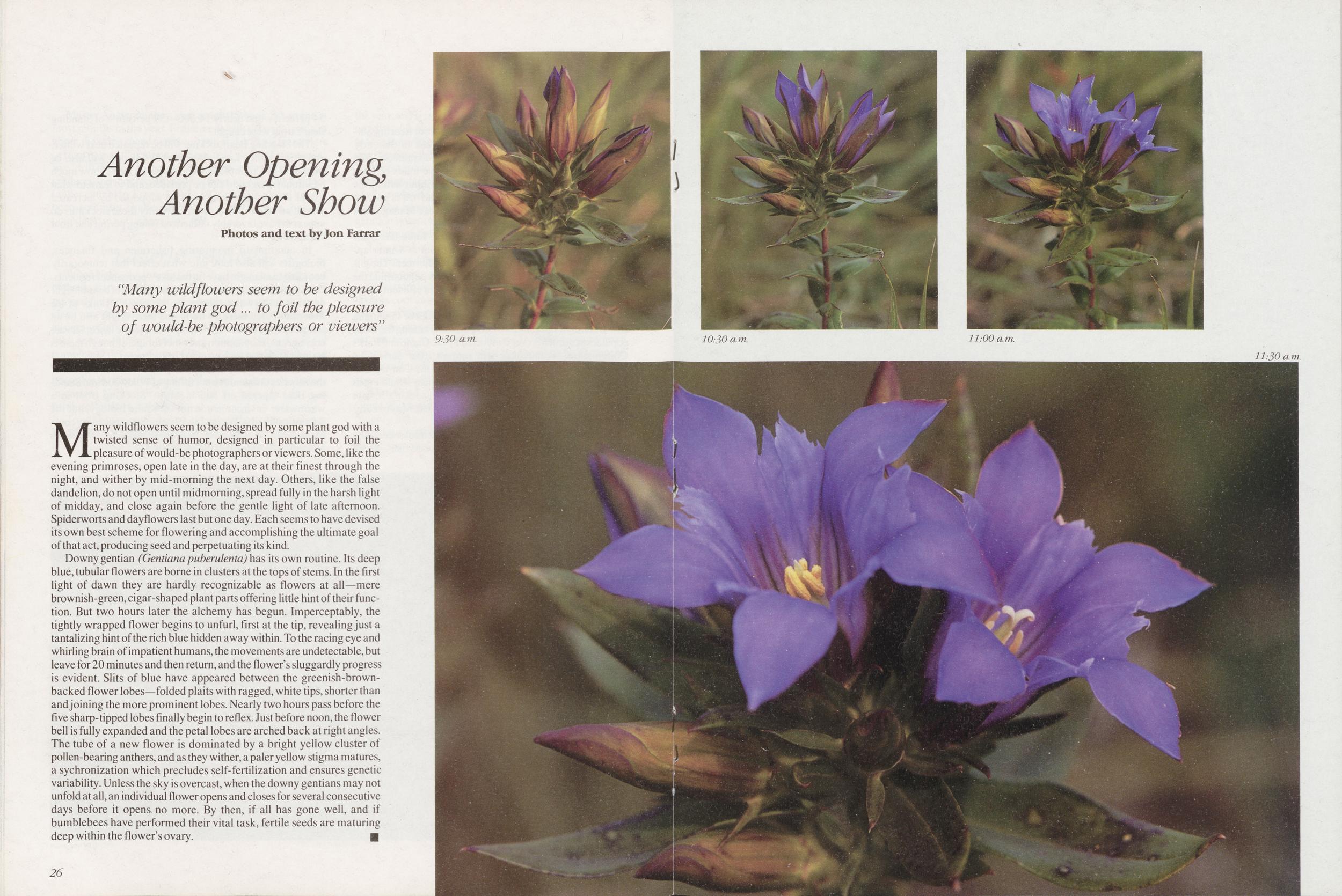
Another Opening Another Show
Photos and text by Jon Farrar "Many wild/lowers seem to be designed by some plant god to foil the pleasure of would-be photographers or viewers"Many wildflowers seem to be designed by some plant god with a twisted sense of humor, designed in particular to foil the pleasure of would-be photographers or viewers. Some, like the evening primroses, open late in the day, are at their finest through the night, and wither by mid-morning the next day. Others, like the false dandelion, do not open until midmorning, spread fully in the harsh light of midday, and close again before the gentle light of late afternoon. Spiderworts and dayflowers last but one day. Each seems to have devised its own best scheme for flowering and accomplishing the ultimate goal of that act, producing seed and perpetuating its kind.
Downy gentian (Gentiana puberulenta) has its own routine. Its deep blue, tubular flowers are borne in clusters at the tops of stems. In the first light of dawn they are hardly recognizable as flowers at all—mere brownish-green, cigar-shaped plant parts offering little hint of their function. But two hours later the alchemy has begun. Imperceptably, the tightly wrapped flower begins to unfurl, first at the tip, revealing just a tantalizing hint of the rich blue hidden away within. To the racing eye and whirling brain of impatient humans, the movements are undetectable, but leave for 20 minutes and then return, and the flower's sluggardly progress is evident. Slits of blue have appeared between the greenish-brown-backed flower lobes—folded plaits with ragged, white tips, shorter than and joining the more prominent lobes. Nearly two hours pass before the five sharp-tipped lobes finally begin to reflex. Just before noon, the flower bell is fully expanded and the petal lobes are arched back at right angles. The tube of a new flower is dominated by a bright yellow cluster of pollen-bearing anthers, and as they wither, a paler yellow stigma matures, a sychronization which precludes self-fertilization and ensures genetic variability. Unless the sky is overcast, when the downy gentians may not unfold at all, an individual flower opens and closes for several consecutive days before it opens no more. By then, if all has gone well, and if bumblebees have performed their vital task, fertile seeds are maturing deep within the flower's ovary.
The Barn Story
Photos and Text by Larry and Lorna Epp Once the most visible symbol of rural America, many big barns have fallen victim to time and changing farm needs. Others remain, however, monuments to a former way of life.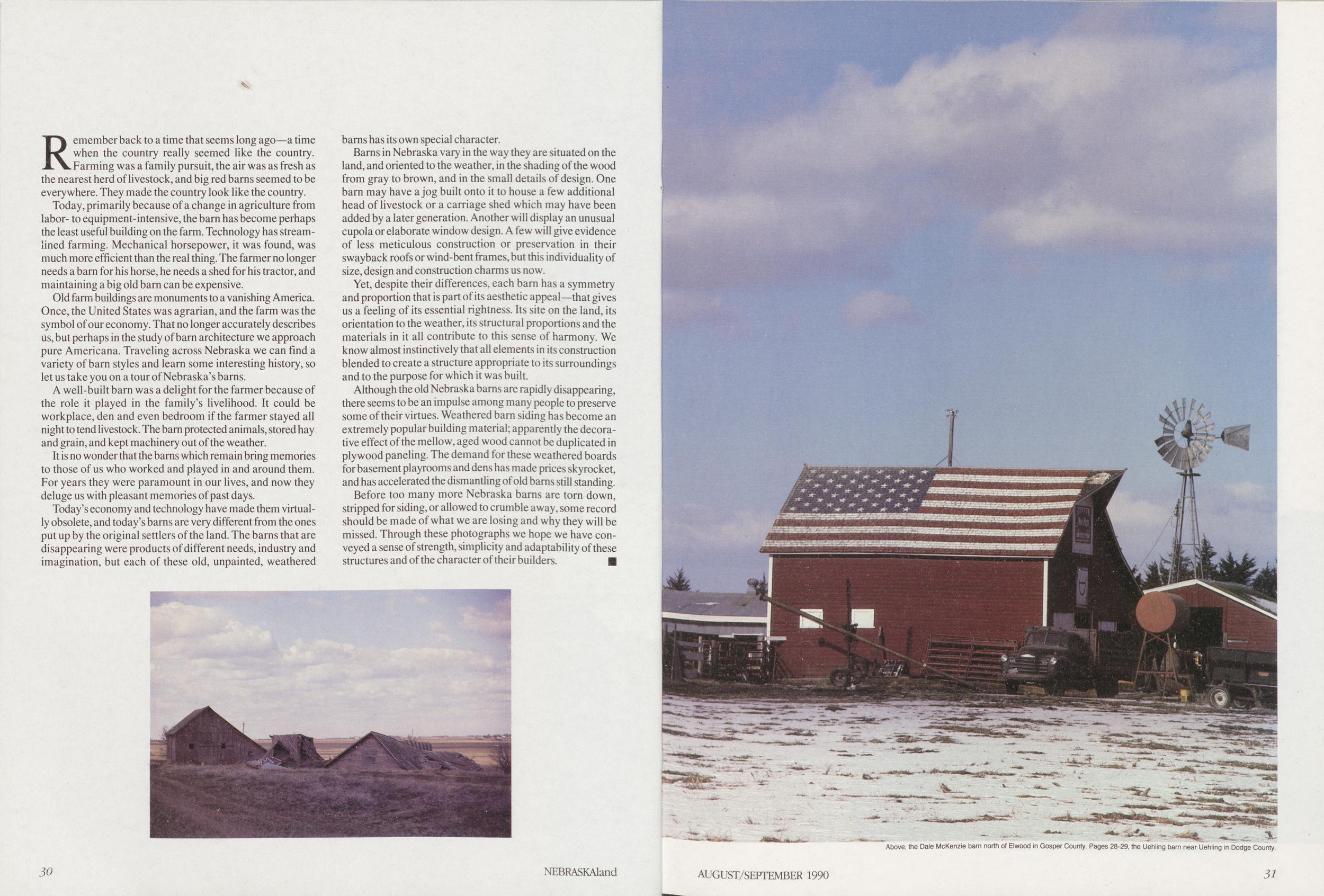
Remember back to a time that seems long ago—a time when the country really seemed like the country. Farming was a family pursuit, the air was as fresh as the nearest herd of livestock, and big red barns seemed to be everywhere. They made the country look like the country.
Today, primarily because of a change in agriculture from labor- to equipment-intensive, the barn has become perhaps the least useful building on the farm. Technology has streamlined farming. Mechanical horsepower, it was found, was much more efficient than the real thing. The farmer no longer needs a barn for his horse, he needs a shed for his tractor, and maintaining a big old barn can be expensive.
Old farm buildings are monuments to a vanishing America. Once, the United States was agrarian, and the farm was the symbol of our economy. That no longer accurately describes us, but perhaps in the study of barn architecture we approach pure Americana. Traveling across Nebraska we can find a variety of barn styles and learn some interesting history, so let us take you on a tour of Nebraska's barns.
A well-built barn was a delight for the farmer because of the role it played in the family's livelihood. It could be workplace, den and even bedroom if the farmer stayed all night to tend livestock. The barn protected animals, stored hay and grain, and kept machinery out of the weather.
It is no wonder that the barns which remain bring memories to those of us who worked and played in and around them. For years they were paramount in our lives, and now they deluge us with pleasant memories of past days.
Today's economy and technology have made them virtually obsolete, and today's barns are very different from the ones put up by the original settlers of the land. The barns that are disappearing were products of different needs, industry and imagination, but each of these old, unpainted, weathered barns has its own special character.
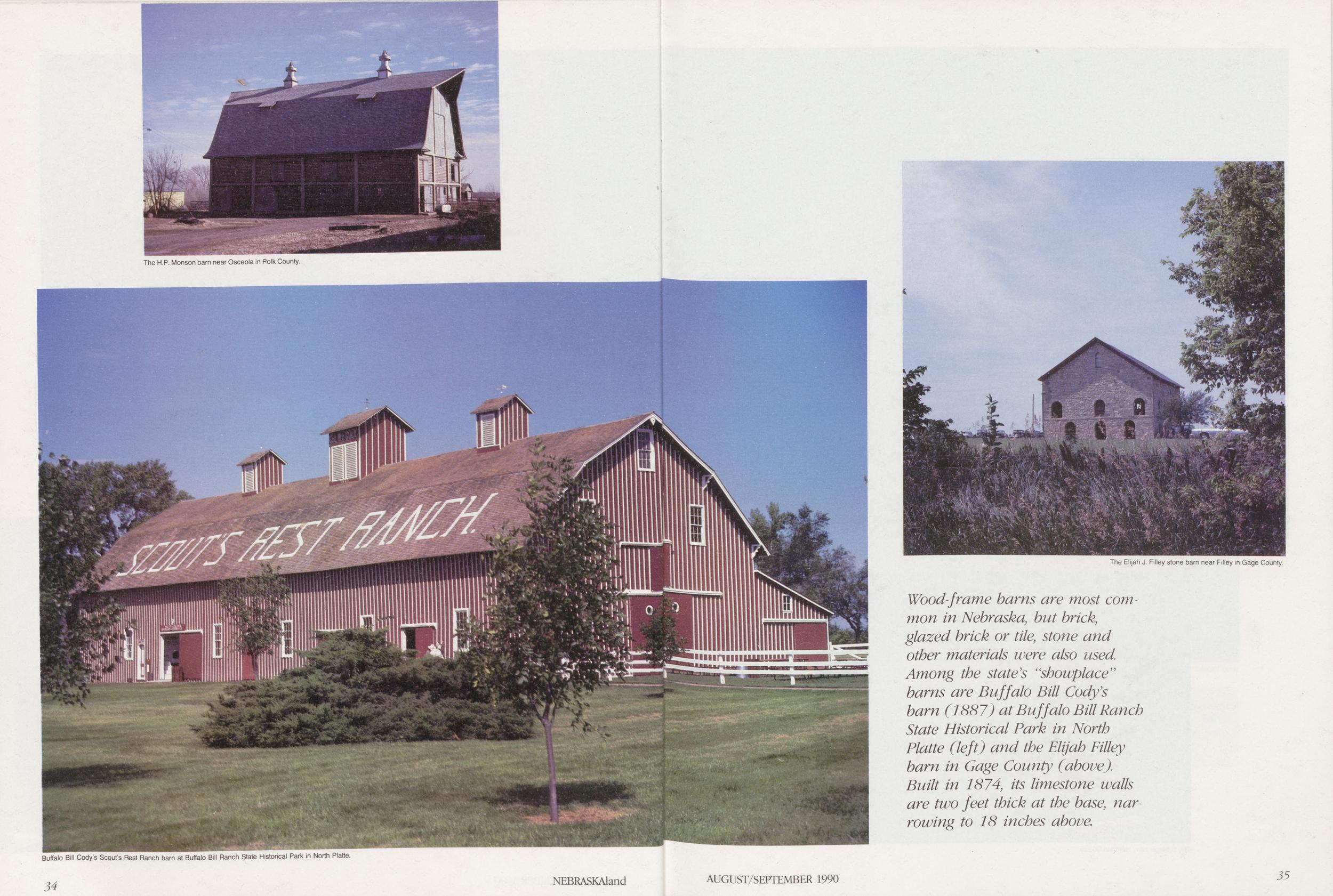
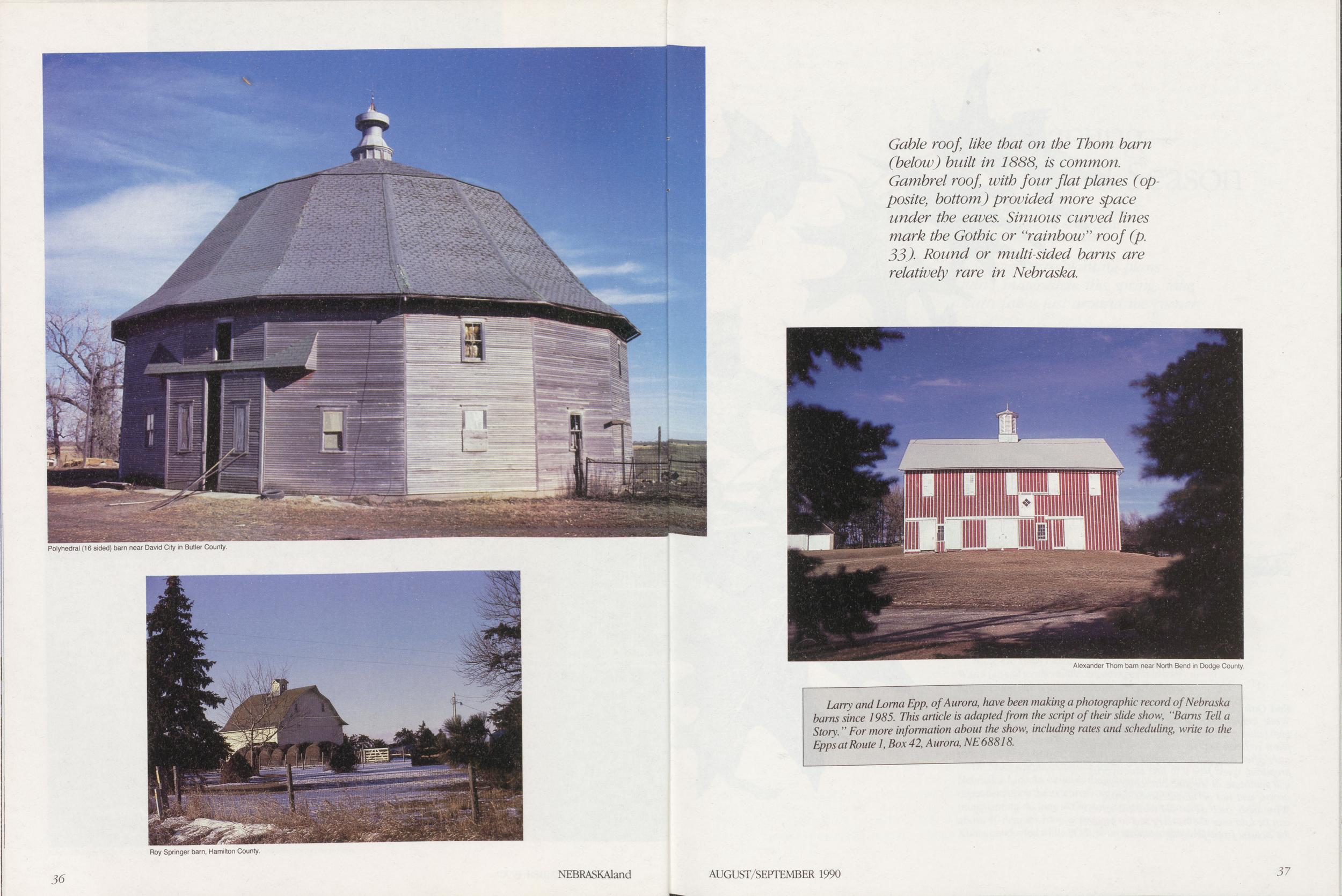
Barns in Nebraska vary in the way they are situated on the land, and oriented to the weather, in the shading of the wood from gray to brown, and in the small details of design. One barn may have a jog built onto it to house a few additional head of livestock or a carriage shed which may have been added by a later generation. Another will display an unusual cupola or elaborate window design. A few will give evidence of less meticulous construction or preservation in their swayback roofs or wind-bent frames, but this individuality of size, design and construction charms us now.
Yet, despite their differences, each barn has a symmetry and proportion that is part of its aesthetic appeal—that gives us a feeling of its essential lightness. Its site on the land, its orientation to the weather, its structural proportions and the materials in it all contribute to this sense of harmony. We know almost instinctively that all elements in its construction blended to create a structure appropriate to its surroundings and to the purpose for which it was built.
Although the old Nebraska barns are rapidly disappearing, there seems to be an impulse among many people to preserve some of their virtues. Weathered barn siding has become an extremely popular building material; apparently the decorative effect of the mellow, aged wood cannot be duplicated in plywood paneling. The demand for these weathered boards for basement playrooms and dens has made prices skyrocket, and has accelerated the dismantling of old barns still standing.
Before too many more Nebraska barns are torn down, stripped for siding, or allowed to crumble away, some record should be made of what we are losing and why they will be missed. Through these photographs we hope we have conveyed a sense of strength, simplicity and adaptability of these structures and of the character of their builders.
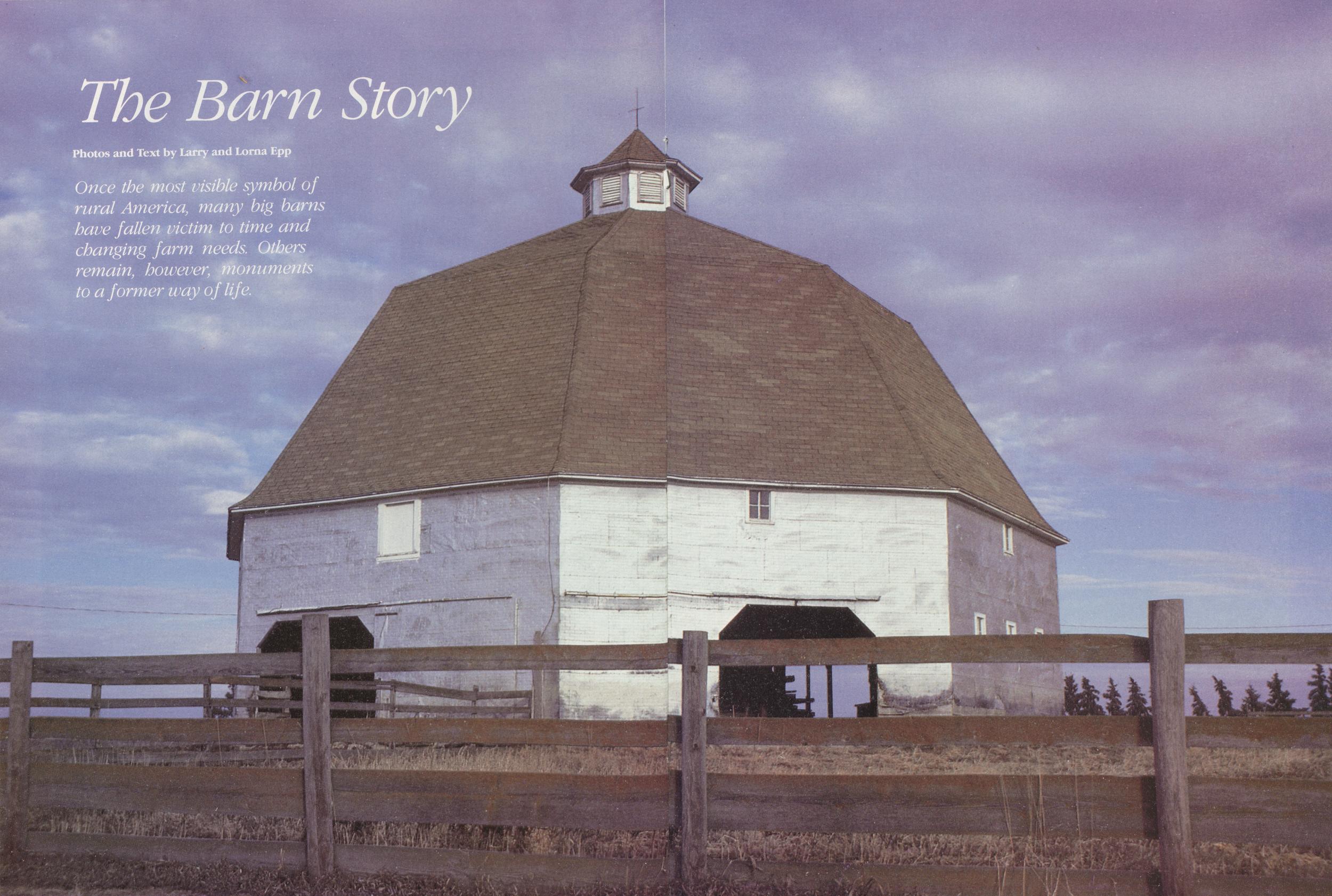
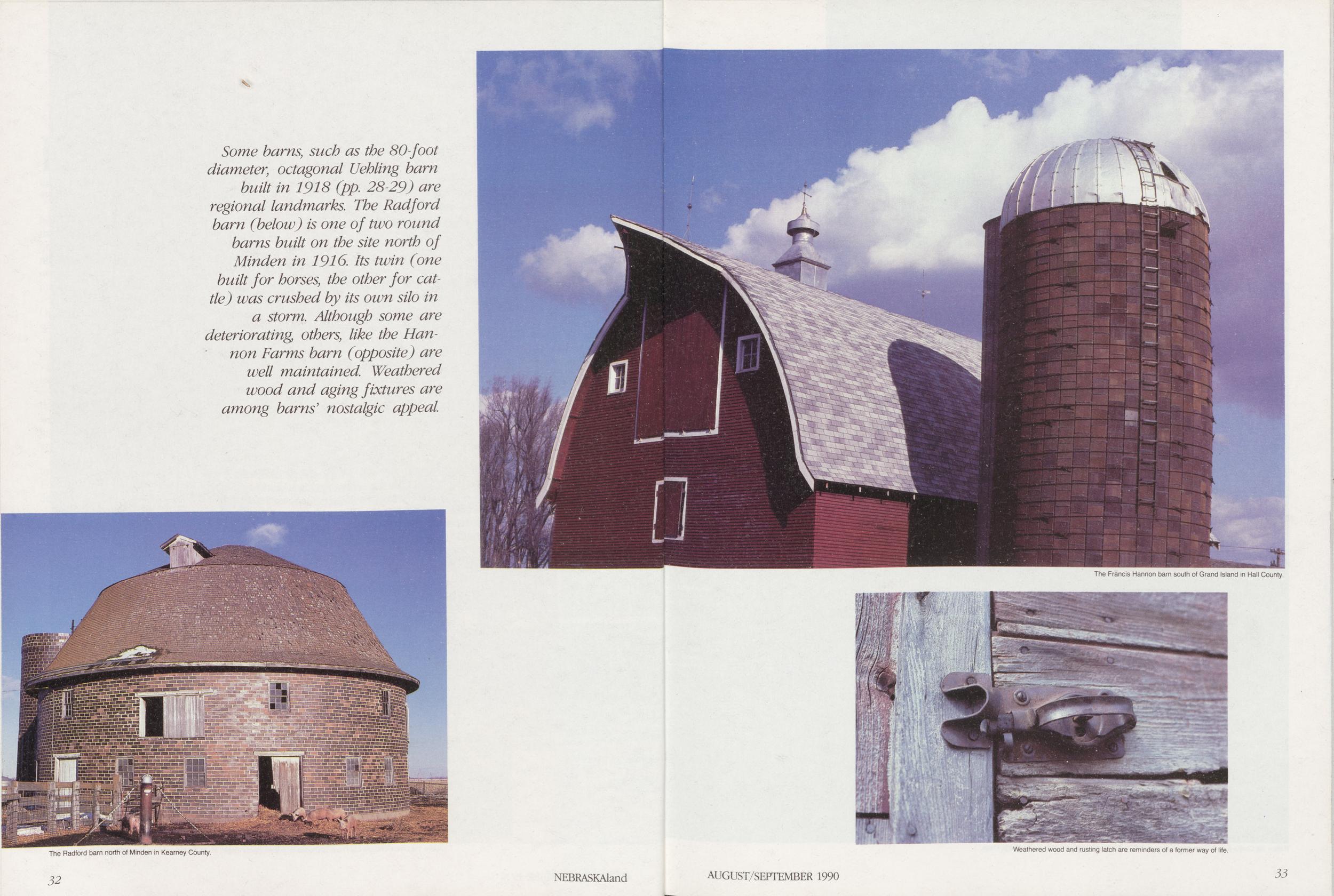 Some barns, such as the 80-foot
diameter, octagonal Uehling barn
built in 1918 (pp. 28-29) are
regional landmarks. The Radford
barn (below) is one of two round
barns built on the site north of
Minden in 1916. Its twin (one
built for horses, the other for cattle) was crushed by its own silo in
a storm. Although some are
deteriorating others, like the Hannon Farms barn (opposite) are
well maintained. Weathered
wood and aging fixtures are
among barns' nostalgic appeal.
Some barns, such as the 80-foot
diameter, octagonal Uehling barn
built in 1918 (pp. 28-29) are
regional landmarks. The Radford
barn (below) is one of two round
barns built on the site north of
Minden in 1916. Its twin (one
built for horses, the other for cattle) was crushed by its own silo in
a storm. Although some are
deteriorating others, like the Hannon Farms barn (opposite) are
well maintained. Weathered
wood and aging fixtures are
among barns' nostalgic appeal.
Fall Planting— A Second Season
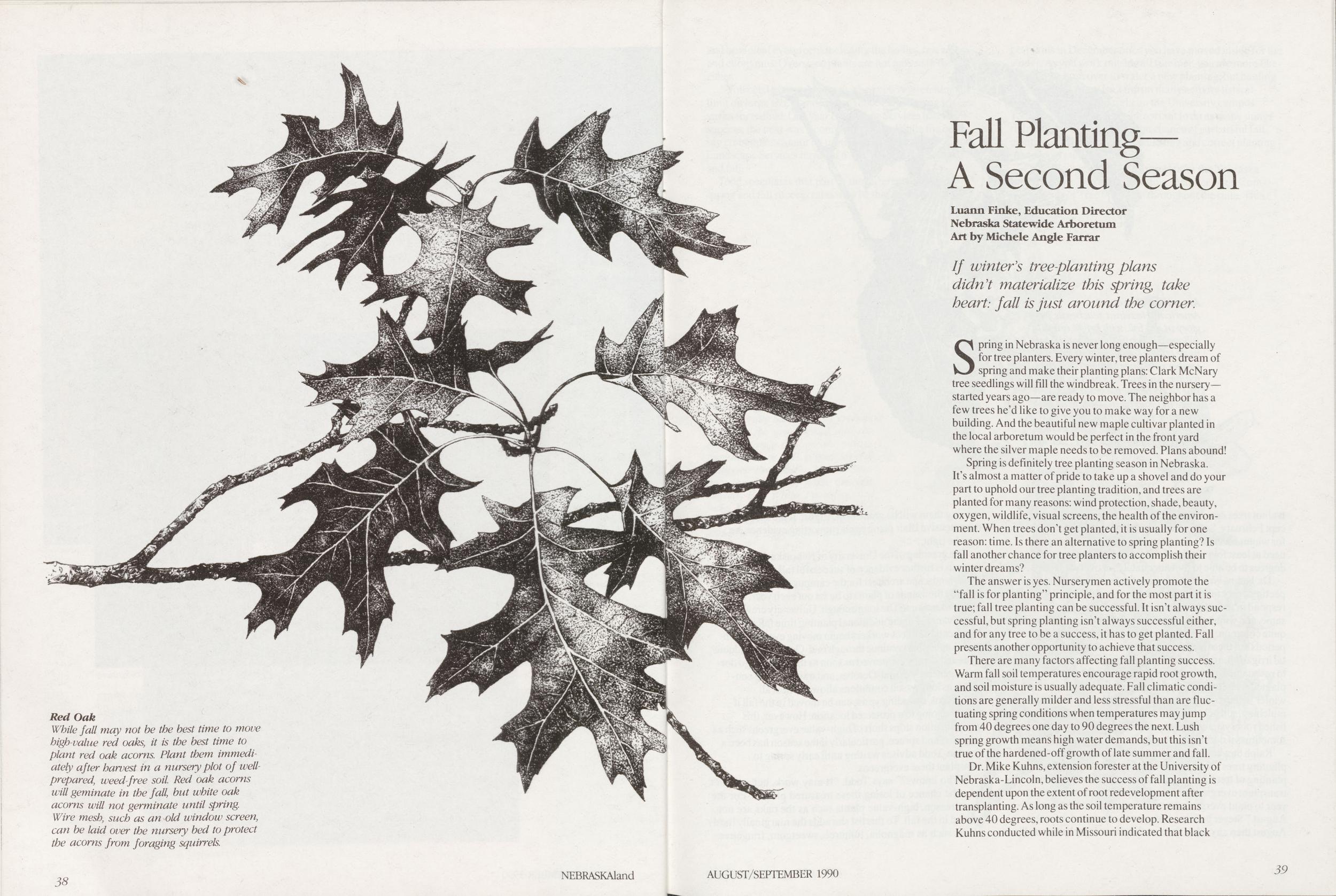
Luann Finke, Education Director Nebraska Statewide Arboretum Art by Michele Angle Farrar If winter's tree-planting plans didn't materialize this spring take heart: fall is just around the corner.Spring in Nebraska is never long enough—especially for tree planters. Every winter, tree planters dream of spring and make their planting plans: Clark McNary tree seedlings will fill the windbreak. Trees in the nursery started years ago—are ready to move. The neighbor has a few trees he'd like to give you to make way for a new building. And the beautiful new maple cultivar planted in the local arboretum would be perfect in the front yard where the silver maple needs to be removed. Plans abound!
Spring is definitely tree planting season in Nebraska. It's almost a matter of pride to take up a shovel and do your part to uphold our tree planting tradition, and trees are planted for many reasons: wind protection, shade, beauty, oxygen, wildlife, visual screens, the health of the environment. When trees don't get planted, it is usually for one reason: time. Is there an alternative to spring planting? Is fall another chance for tree planters to accomplish their winter dreams?
The answer is yes. Nurserymen actively promote the "fall is for planting" principle, and for the most part it is true; fall tree planting can be successful. It isn't always successful, but spring planting isn't always successful either, and for any tree to be a success, it has to get planted. Fall presents another opportunity to achieve that success.
There are many factors affecting fall planting success. Warm fall soil temperatures encourage rapid root growth, and soil moisture is usually adequate. Fall climatic conditions are generally milder and less stressful than are fluctuating spring conditions when temperatures may jump from 40 degrees one day to 90 degrees the next. Lush spring growth means high water demands, but this isn't true of the hardened-off growth of late summer and fall.
Dr. Mike Kuhns, extension forester at the University of
Nebraska-Lincoln, believes the success of fall planting is
dependent upon the extent of root redevelopment after
transplanting. As long as the soil temperature remains
above 40 degrees, roots continue to develop. Research
Kuhns conducted while in Missouri indicated that black
AUGUST/SEPTEMBER 1990
39
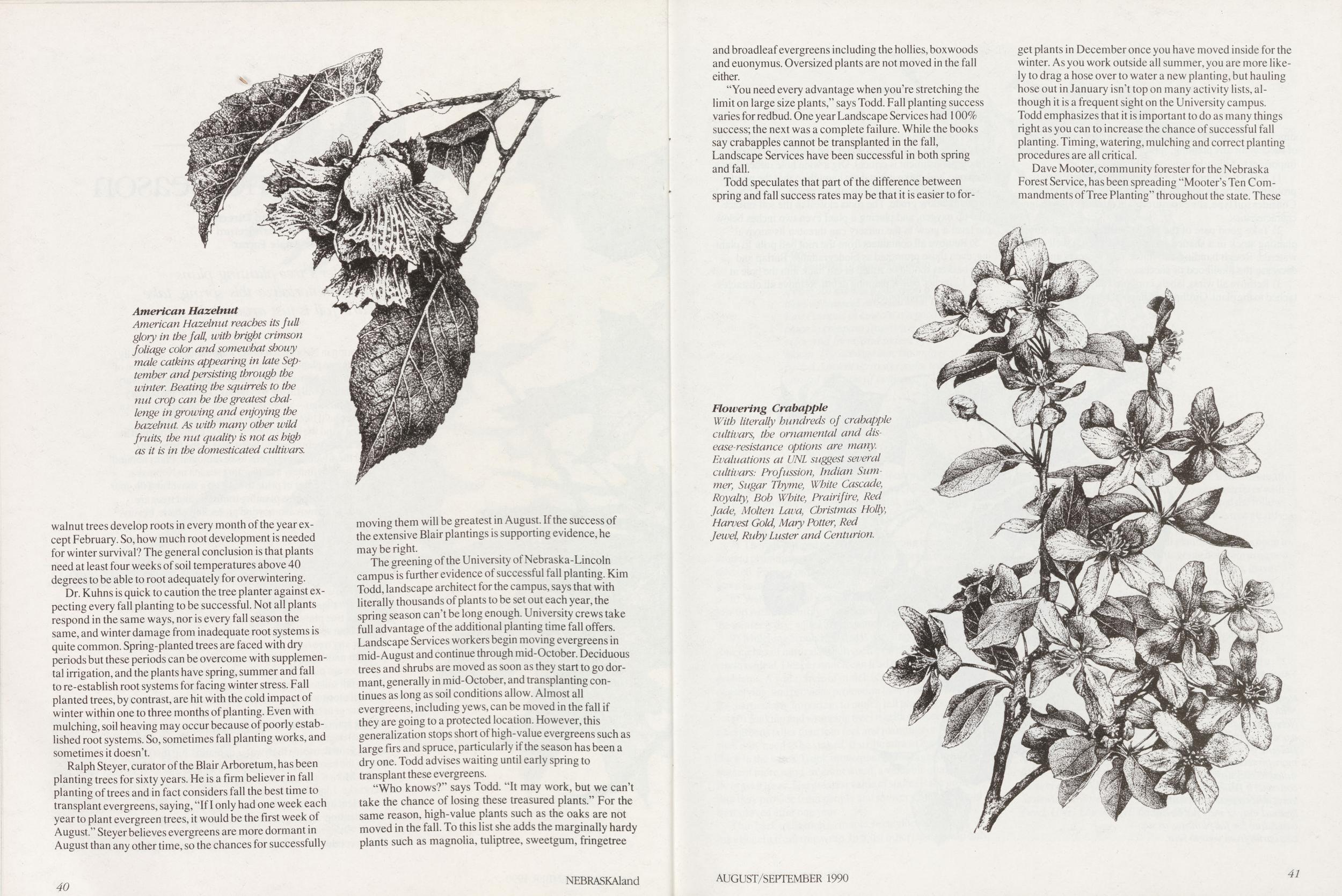
Dr. Kuhns is quick to caution the tree planter against expecting every fall planting to be successful. Not all plants respond in the same ways, nor is every fall season the same, and winter damage from inadequate root systems is quite common. Spring-planted trees are faced with dry periods but these periods can be overcome with supplemental irrigation, and the plants have spring, summer and fall to re-establish root systems for facing winter stress. Fall planted trees, by contrast, are hit with the cold impact of winter within one to three months of planting. Even with mulching, soil heaving may occur because of poorly established root systems. So, sometimes fall planting works, and sometimes it doesn't.
Ralph Steyer, curator of the Blair Arboretum, has been planting trees for sixty years. He is a firm believer in fall planting of trees and in fact considers fall the best time to transplant evergreens, saying, "If I only had one week each year to plant evergreen trees, it would be the first week of August." Steyer believes evergreens are more dormant in August than any other time, so the chances for successfully moving them will be greatest in August. If the success of the extensive Blair plantings is supporting evidence, he may be right.
The greening of the University of Nebraska-Lincoln campus is further evidence of successful fall planting. Kim Todd, landscape architect for the campus, says that with literally thousands of plants to be set out each year, the spring season can't be long enough. University crews take full advantage of the additional planting time fall offers. Landscape Services workers begin moving evergreens in mid-August and continue through mid-October. Deciduous trees and shrubs are moved as soon as they start to go dormant, generally in mid-October, and transplanting continues as long as soil conditions allow. Almost all evergreens, including yews, can be moved in the fall if they are going to a protected location. However, this generalization stops short of high-value evergreens such as large firs and spruce, particularly if the season has been a dry one. Todd advises waiting until early spring to transplant these evergreens.
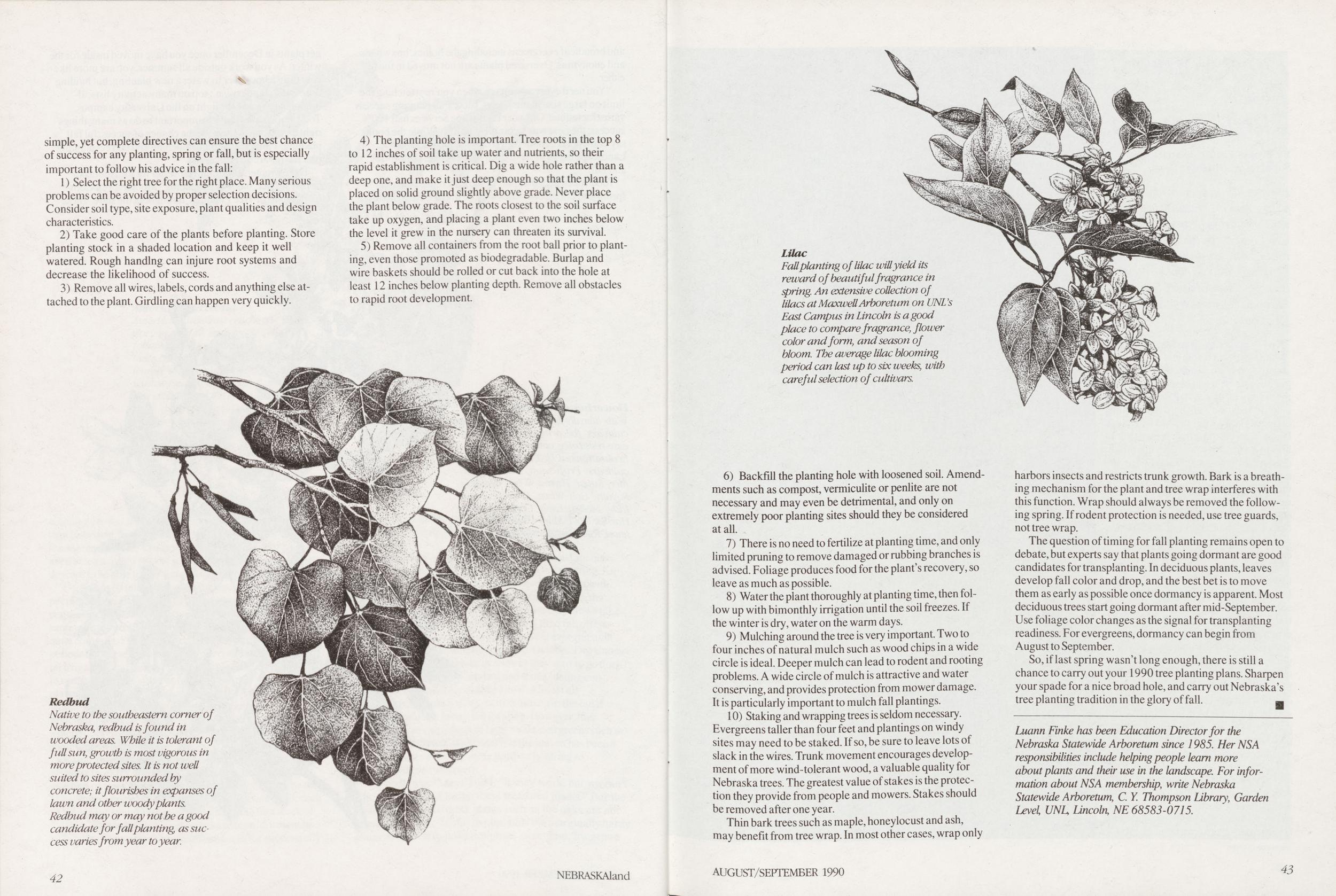
"Who knows?" says Todd. "It may work, but we can't take the chance of losing these treasured plants." For the same reason, high-value plants such as the oaks are not moved in the fall. To this list she adds the marginally hardy plants such as magnolia, tuliptree, sweetgum, fringetree 40 NEBRASKAland and broadleaf evergreens including the hollies, boxwoods and euonymus. Oversized plants are not moved in the fall either.
You need every advantage when you're stretching the limit on large size plants," says Todd. Fall planting success varies for redbud. One year Landscape Services had 100% success; the next was a complete failure. While the books say crabapples cannot be transplanted in the fall, Landscape Services have been successful in both spring and fall.
Todd speculates that part of the difference between spring and fall success rates may be that it is easier to forget plants in December once you have moved inside for the winter. As you work outside all summer, you are more likely to drag a hose over to water a new planting, but hauling hose out in January isn't top on many activity lists, although it is a frequent sight on the University campus. Todd emphasizes that it is important to do as many things right as you can to increase the chance of successful fall planting. Timing, watering, mulching and correct planting procedures are all critical.
Dave Mooter, community forester for the Nebraska Forest Service, has been spreading "Mooter's Ten Commandments of Tree Planting" throughout the state. These
 simple, yet complete directives can ensure the best chance
of success for any planting, spring or fall, but is especially
important to follow his advice in the fall:
simple, yet complete directives can ensure the best chance
of success for any planting, spring or fall, but is especially
important to follow his advice in the fall:
1) Select the right tree for the right place. Many serious problems can be avoided by proper selection decisions. Consider soil type, site exposure, plant qualities and design characteristics.
2) Take good care of the plants before planting. Store planting stock in a shaded location and keep it well watered. Rough handing can injure root systems and decrease the likelihood of success.
3) Remove all wires, labels, cords and anything else attached to the plant. Girdling can happen very quickly.
4) The planting hole is important. Tree roots in the top 8 to 12 inches of soil take up water and nutrients, so their rapid establishment is critical. Dig a wide hole rather than a deep one, and make it just deep enough so that the plant is placed on solid ground slightly above grade. Never place the plant below grade. The roots closest to the soil surface take up oxygen, and placing a plant even two inches below the level it grew in the nursery can threaten its survival.
5) Remove all containers from the root ball prior to planting, even those promoted as biodegradable. Burlap and wire baskets should be rolled or cut back into the hole at least 12 inches below planting depth. Remove all obstacles to rapid root development.
6) Backfill the planting hole with loosened soil. Amendments such as compost, vermiculite or penlite are not necessary and may even be detrimental, and only on extremely poor planting sites should they be considered at all.
7) There is no need to fertilize at planting time, and only limited pruning to remove damaged or rubbing branches is advised. Foliage produces food for the plant's recovery, so leave as much as possible.
8) Water the plant thoroughly at planting time, then follow up with bimonthly irrigation until the soil freezes. If the winter is dry, water on the warm days.
9) Mulching around the tree is very important. Two to four inches of natural mulch such as wood chips in a wide circle is ideal. Deeper mulch can lead to rodent and rooting problems. A wide circle of mulch is attractive and water conserving, and provides protection from mower damage. It is particularly important to mulch fall plantings.
10) Staking and wrapping trees is seldom necessary. Evergreens taller than four feet and plantings on windy sites may need to be staked. If so, be sure to leave lots of slack in the wires. Trunk movement encourages development of more wind-tolerant wood, a valuable quality for Nebraska trees. The greatest value of stakes is the protection they provide from people and mowers. Stakes should be removed after one year.
Thin bark trees such as maple, honeylocust and ash, may benefit from tree wrap. In most other cases, wrap only harbors insects and restricts trunk growth. Bark is a breathing mechanism for the plant and tree wrap interferes with this function. Wrap should always be removed the following spring. If rodent protection is needed, use tree guards, not tree wrap.
The question of timing for fall planting remains open to debate, but experts say that plants going dormant are good candidates for transplanting. In deciduous plants, leaves develop fall color and drop, and the best bet is to move them as early as possible once dormancy is apparent. Most deciduous trees start going dormant after mid-September. Use foliage color changes as the signal for transplanting readiness. For evergreens, dormancy can begin from August to September.
So, if last spring wasn't long enough, there is still a chance to carry out your 1990 tree planting plans. Sharpen your spade for a nice broad hole, and carry out Nebraska's tree planting tradition in the glory of fall.
Luann Finke has been Education Director for the Nebraska Statewide Arboretum since 1985. Her NSA responsibilities include helping people learn more about plants and their use in the landscape. For information about NSA membership, write Nebraska Statewide Arboretum, C. Y. Thompson Library, Garden Level UNL, Lincoln, NE 68583-0715. AUGUST/SEPTEMBER 1990 43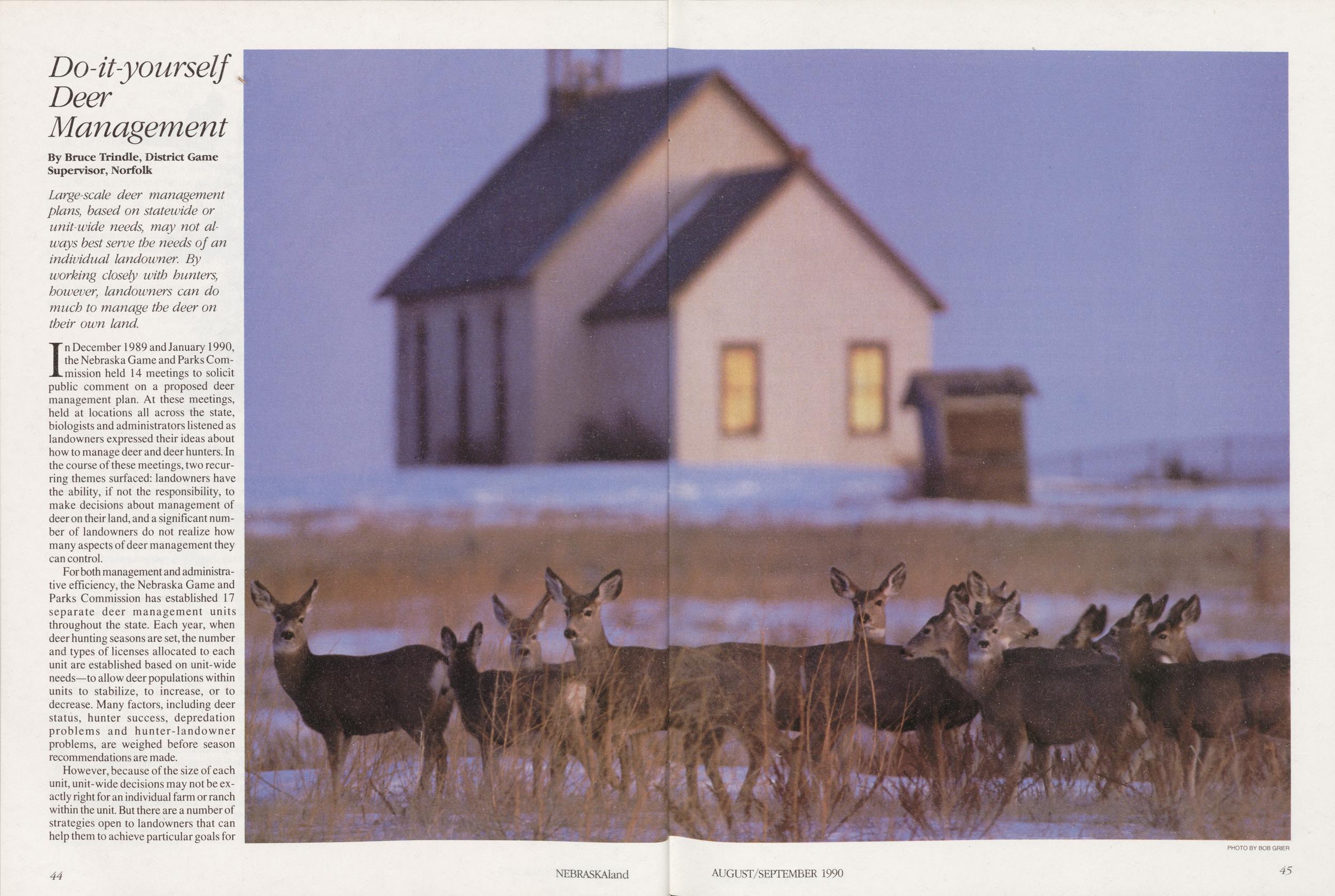
Do-it-yourself Deer Management
By Bruce Trindle, District Game Supervisor, Norfolk Large-scale deer management plans, based on statewide or unit-wide needs, may not always best serve the needs of an individual landowner. By working closely with hunters, however, landowners can do much to manage the deer on their own land.In December 1989 and January 1990, the Nebraska Game and Parks Commission held 14 meetings to solicit public comment on a proposed deer management plan. At these meetings, held at locations all across the state, biologists and administrators listened as landowners expressed their ideas about how to manage deer and deer hunters. In the course of these meetings, two recurring themes surfaced: landowners have the ability, if not the responsibility, to make decisions about management of deer on their land, and a significant number of landowners do not realize how many aspects of deer management they can control.
For both management and administrative efficiency, the Nebraska Game and Parks Commission has established 17 separate deer management units throughout the state. Each year, when deer hunting seasons are set, the number and types of licenses allocated to each unit are established based on unit-wide needs—to allow deer populations within units to stabilize, to increase, or to decrease. Many factors, including deer status, hunter success, depredation problems and hunter-landowner problems, are weighed before season recommendations are made.
However, because of the size of each unit, unit-wide decisions may not be exactly right for an individual farm or ranch within the unit. But there are a number of strategies open to landowners that can help them to achieve particular goals for 44 NEBRASKAland
 the deer population on their own land or
in their local areas.
the deer population on their own land or
in their local areas.
The first principle is this: the deer population on your land, as in any area, will ultimately be determined by the number of does present. As with cattle, the number of females that give birth determines the size of the herd from one year to the next. The more fawns produced, the more rapidly the population grows. Because one buck can breed many does, buck removal has little effect on whether the population will increase or decrease; buck numbers have very little impact on population growth.Thus, if you are interested in having more deer on your land, you need to reduce the number of does taken by hunters. On the other hand, if deer are causing problems, be sure that more does are removed from the herd.
As the landowner, you can accomplish either of these strategies by telling hunters with the correct permit type what sex deer you would like them to take. It is perfectly reasonable for you to ask a hunter with an either-sex permit to shoot a deer of the sex which would best help accomplish your management goals. Explain your situation and your goals; most hunters will be glad to cooperate. You might also need to enlist the help of your neighbors so that the strategy is accomplished over a wider area. Again, explain your situation, and encourage them to ask their hunters to shoot selectively.
Effective management requires good record keeping, however, and you need to know what deer are being taken off your property. Thus it is a good idea to ask hunters to let you know what sex deer they have shot. Over the course of a few years this will give you a feel for how the population responds to certain levels of hunting pressure. Accurate yearly records can help you to predict both the deer population in your area, and the probable hunter success rate from one year to the next.
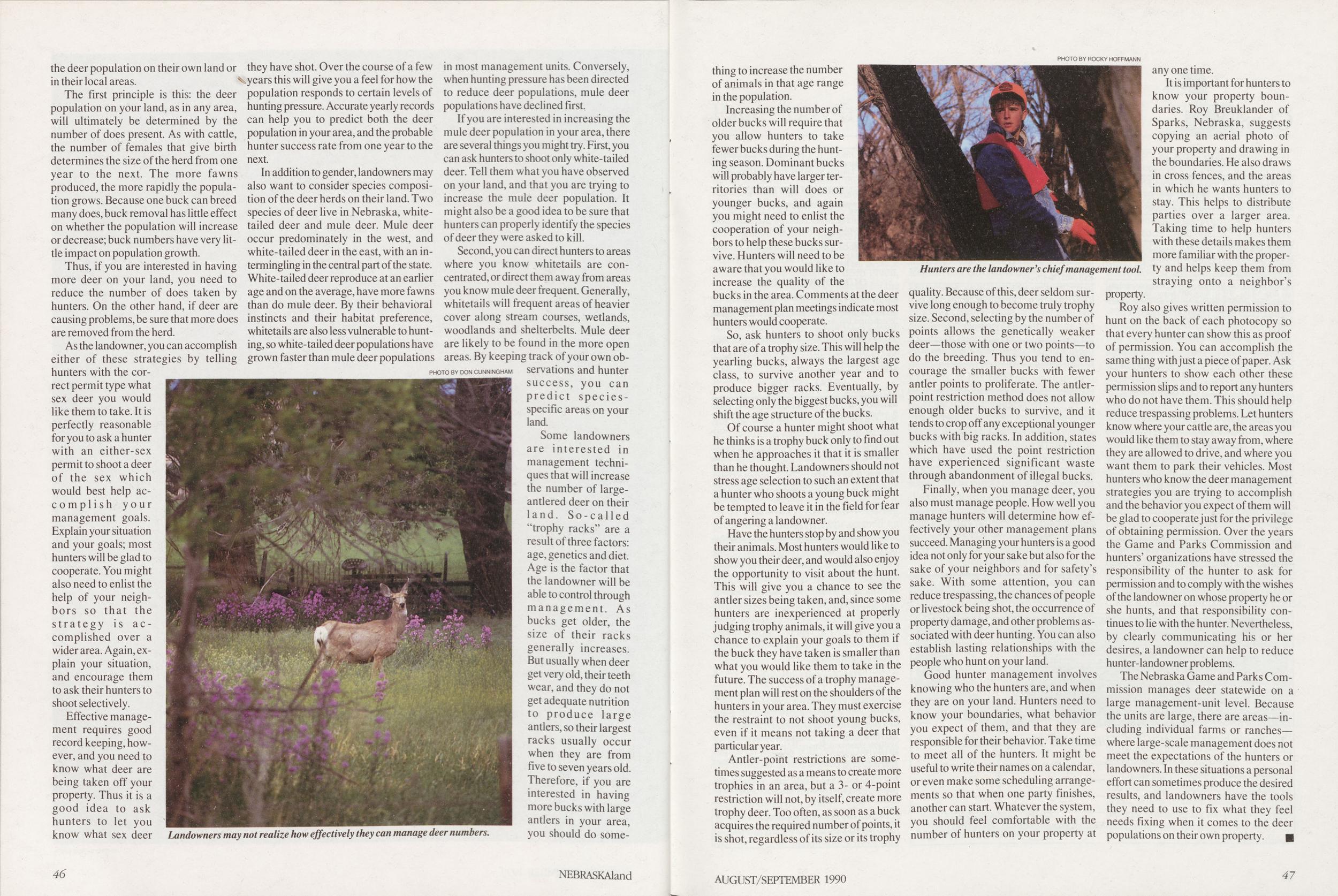
In addition to gender, landowners may also want to consider species composition of the deer herds on their land. Two species of deer live in Nebraska, white-tailed deer and mule deer. Mule deer occur predominately in the west, and white-tailed deer in the east with an intermingling in the central part of the state. White-tailed deer reproduce at an earlier age and on the average, have more fawns than do mule deer. By their behavioral instincts and their habitat preference, whitetails are also less vulnerable to hunting, so white-tailed deer populations have grown faster than mule deer populations in most management units. Conversely, when hunting pressure has been directed to reduce deer populations, mule deer population have declined first.
If you are interested in increasing the mule deer population in your area, there are several things you might try. First, you can ask hunters to shoot only white-tailed deer. Tell them what you have observed on your land, and that you are trying to increase the mule deer population. It might also be a good idea to be sure that hunters can properly identify the species of deer they were asked to kill.
Second, you can direct hunters to areas where you know whitetails are concentrated, or direct them away from areas you know mule deer frequent. Generally, whitetails will frequent areas of heaviercover along stream courses, wetlands, woodlands and shelterbelts. Mule deer are likely to be found in the more open areas. By keeping track of your own observations and hunter success, you can predict speciesspecific areas on your land.
Some landowners are interested in management techniques that will increase the number of largeantlered deer on their land. So-called "trophy racks" are a result of three factors: age, genetics and diet. Age is the factor that the landowner will be able to control through management. As bucks get older, the size of their racks generally increases. But usually when deer get very old, their teeth wear, and they do not get adequate nutrition to produce large antlers, so their largest racks usually occur when they are from five to seven years old. Therefore, if you are interested in having more bucks with large antlers in your area, you should do something 46 NEBRASKAland to increase the number of animals in that age range in the population.
Increasing the number of older bucks will require that you allow hunters to take fewer bucks during the hunting season. Dominant bucks will probably have larger territories than will does or younger bucks, and again you might need to enlist the cooperation of your neighbors to help these bucks survive. Hunters will need to be aware that you would like to increase the quality of the bucks in the area. Comments at the deer management plan meetings indicate most hunters would cooperate.
So, ask hunters to shoot only bucks that are of a trophy size. This will help the yearling bucks, always the largest age class, to survive another year and to produce bigger racks. Eventually, by selecting only the biggest bucks, you will shift the age structure of the bucks.
Of course a hunter might shoot what he thinks is a trophy buck only to find out when he approaches it that it is smaller than he thought. Landowners should not stress age selection to such an extent that a hunter who shoots a young buck might be tempted to leave it in the field for fear of angering a landowner.
Have the hunters stop by and show you their animals. Most hunters would like to show you their deer, and would also enjoy the opportunity to visit about the hunt. This will give you a chance to see the antler sizes being taken, and, since some hunters are inexperienced at properly judging trophy animals, it will give you a chance to explain your goals to them if the buck they have taken is smaller than what you would like them to take in the future. The success of a trophy management plan will rest on the shoulders of the hunters in your area. They must exercise the restraint to not shoot young bucks, even if it means not taking a deer that particular year.
Antler-point restrictions are sometimes suggested as a means to create more trophies in an area, but a 3- or 4-point restriction will not, by itself, create more trophy deer. Too often, as soon as a buck acquires the required number of points, it is shot, regardless of its size or its trophy quality. Because of this, deer seldom survive long enough to become truly trophy size. Second, selecting by the number of points allows the genetically weaker deer—those with one or two points—to do the breeding. Thus you tend to encourage the smaller bucks with fewer antler points to proliferate. The antlerpoint restriction method does not allow enough older bucks to survive, and it tends to crop off any exceptional younger bucks with big racks. In addition, states which have used the point restriction have experienced significant waste through abandonment of illegal bucks.
Finally, when you manage deer, you also must manage people. How well you manage hunters will determine how effective succeed. Managing your hunters is a good idea not only for your sake but also for the sake of your neighbors and for safety's sake. With some attention, you can reduce trespassing, the chances of people or livestock being shot, the occurrence of property damage, and other problems associated with deer hunting. You can also establish lasting relationships with the people who hunt on your land.
Good hunter management involves knowing who the hunters are, and when they are on your land. Hunters need to know your boundaries, what behavior you expect of them, and that they are responsible for their behavior. Take time to meet all of the hunters. It might be useful to write their names on a calendar, or even make some scheduling arrangements so that when one party finishes, another can start. Whatever the system, you should feel comfortable with the number of hunters on your property at any one time.
It is important for hunters to know your property boundaries. Roy Breuklander of Sparks, Nebraska, suggests copying an aerial photo of your property and drawing in the boundaries. He also draws in cross fences, and the areas in which he wants hunters to stay. This helps to distribute parties over a larger area. Taking time to help hunters with these details makes them more familiar with the property and helps keep them from straying onto a neighbor's property.
Roy also gives written permission to hunt on the back of each photocopy so that every hunter can show this as proof of permission. You can accomplish the same thing with just a piece of paper. Ask your hunters to show each other these permission slips and to report any hunters who do not have them. This should help reduce trespassing problems. Let hunters know where your cattle are, the areas you would like them to stay away from, where they are allowed to drive, and where you want them to park their vehicles. Most hunters who know the deer management strategies you are trying to accomplish and the behavior you expect of them will be glad to cooperate just for the privilege fectively your other management plans 0f obtaining permission. Over the years the Game and Parks Commission and hunters' organizations have stressed the responsibility of the hunter to ask for permission and to comply with the wishes of the landowner on whose property he or she hunts, and that responsibility continues to lie with the hunter. Nevertheless, by clearly communicating his or her desires, a landowner can help to reduce hunter-landowner problems.
The Nebraska Game and Parks Commission manages deer statewide on a large management-unit level. Because the units are large, there are areas—including individual farms or ranches— where large-scale management does not meet the expectations of the hunters or landowners. In these situations a personal effort can sometimes produce the desired results, and landowners have the tools they need to use to fix what they feel needs fixing when it comes to the deer populations on their own property.
AUGUST/SEPTEMBER 1990 47
Classified
ARTS & CRAFTSBev Doolittle, Terrry Redlin, Jerry Raedke, Ed Wards, Robert Bateman, Frank McCarthy' and Neal Anderson are available at the 2nd Street Gallery, 537 W. 2nd, Hastings, NE 68901. Phone (402) 463-6677.
BOATS/MOTORSTROLLING MOTOR REPAIR. Factory authorized Minn Kota and Motor Guide, parts and service. Wolfs Tackle Supply, 5950 Colfax Ave., Lincoln, NE 68507. Phone (402) 464-4265.
BLUEBILL DUCK BOATS—sturdy fiberglass, weighs less than 50 lbs., 9'/2 ft. long, 40" beam, 15" height, 2 person. Extremely portable—go places where others can't. Contact RCM Marketing, P.O. Box 166, Watertown,SD 57201. Phone 1-800-658-4778._
BOOKS/PRINTINGFREE! Booklets on northeastern Nevada; fishing, rockhounding maps, Carl Hayden, Box 528, Jackpot, Nevada 89825.
FREE BOOK CATALOG. Novels, westerns, romances, children's; old out of print, found barns, attic. Authors: Grey, Bower, Connor, Fox, Curwood, Raine, Wright, Aldrige, Pollyanna, Freckles, many others. Postage appreciated. Pierce, 4400 N. Pine Cluster, Oroville, CA 95965.
COLLECTIBLESBUYING: American Indian artifacts such as beadwork, weavings, baskets, etc.; also cowboy memorabilia such as chaps, spurs, photographs, etc. Best price first letter; photographs promptly returned. Jack Ring wait, 1550 California St., Suite 6, #211, San Francisco, CA 94109, (415)759-6343.
DOGSYELLOW-BLACK Lab pups. FC-AFC sired. AKC. Hips OFA ceritified. Dew claws removed. Excellent hunting potential. Contact Bob Bendler, Lexington, NE (308) 324-4247.
TRAINING ALL BREEDS bird dogs—Vizslas & English Pointers—for sale. Rozanek Kennels, R 2, Schuyler, NE 68661. Phone (402) 352-8769.
ENGLISH SETTERS: "Bred for the hunter"; select puppies and started dogs available from outstanding bloodlines. Stud service available by proven hunters. High Plains Kennels, 1411 Emerson, Alliance, NE 69301, Phone (308) 762-6709.
PINKERTON BIRD DOGS—English setter, brittany puppies. Started dogs available this fall. Our dogs are bred for nose and style. Give us a call at (402) 673-4540.
GUN DOG TRAINING. All sporting breeds. All dogs worked on game birds. Over 25 years experience. Henry Sader, Wilderness Kennels, Roca, NE (402) 423-4212.
QUALITY RARE reg. standard and miniature Australian shepherds: livestock, tracking, travel companions, obedience, home raised, pet priority, pups occasionally. Call (402) 643-6449.
BRITT PUPS for sale. Grouseway's Jessie James x Grouse way's Gem. Proven cross. Pups due August 15. Booking orders now. Don Bennett (404) 643-3664 late evening.
EMPLOYMENTHOME WORKERS urgently needed. Call immediately toll-free 1-800-777-7332.
FISHFISH FOR SALE. Catfish, perch, coho salmon, rainbow trout, crappie, bluegill, walleye, minnows, goldfish, bullhead, largemouth bass, smallmouth bass, triploid grass carp. Commercial grower prices on catfish, perch, coho salmon, rainbow trout. Consulting available. Pleasant Valley Fish Farm, Rt 1 Box 147, McCook, NE 69001. Phone (308) 345-6599.
FISH FOR POND STOCKING. Bass, bluegill, crappie, perch, channel catfish, Triploid grass carp, rainbow trout and walleye. Available April-October. Write Orchard Fish Hatchery, Rt 2. Box 117, Orchard, NE 68764 or phone (402) 893-2521.
WILLOW LAKE FISH HATCHERY. Channel cat, bluegill, hybrid bluegill, largemouth bass, crappie, bullheads, triploid grass carp, walleye, perch, minnows available for stocking. Gaylord Crawford, Rt 3 Box 46, Hastings, NE 68901 or phone (402) 463-8022 day or night. Also pond consultant.
WILLOW LAKE FISH HATCHERY. Channel cat, bluegill, hybrid bluegill, largemouth bass, crappie, bullheads, triploid grass carp, walleye, perch, minnows available for stocking. Gaylord Crawford, Rt 3 Box 46, Hastings, NE 68901 or phone (402) 463-8022 day or night. Also pond consultant.
FOODWINE AND BEER: Make your own. Send for free recipes and instructions. Omaha Supply, 1324 2nd Avenue, Nebraska City, NE 68410.
YES! I WOULD LIKE TO SUBSCRIBE TO NEBRASKAland Name 1-Year $12 Address 2-Years $23 CitY State Zip Mail check or money order to NEBRASKAland, Box30370, Lincoln, NE 68503BUFFALO JERKY, 16 1-oz. pkgs. for $23 including shipping. Sample $1.75. G. E. Hill Distributing, 5220 Ayiesworth, Lincoln, NE 68504. Phone (402) 464-6781.
GUIDES/OUTFITTERSMAD RIVER CANOES offers the finest quality and performance. For the finest canoes and accessories look to Great Plains Canoe Co., 205 Main, Springfield, NE. Phone(402)253-2001.
FERGUSON GUIDE SERVICE. Call Dan Ferguson (308) 785-2413 to book your 1990 fishing trip. Elwood, Calamus and Johnson Lake.
OUTDOOR EQUIPMENTGUNS — Browning, Winchester, Remington, others, Hi-powers, shoteuns, new, used, antiques. Want Pre-'64 Winchesters. Buy-Sell-Trade. (402) 729-6112. Bedlan's Sporting Goods, Fairbury, NE 68352.
AIR GUNS repaired—Benjamin, Crosman, Daisy, other American made. Restoration; old guns wanted. Jack's Air Guns, 1225 No. 46th, Lincoln, NE 68503. Phone (402)466-9223.
REAL ESTATEATLANTIC CITY, WYOMING-40 acres with 30x20 ft. cabin. Water rights from spring. Some mineral rights. Scenic view of mountains. Call (307) 332-5070 or (308) 332-3158. $55,000.
CLASSIC OPPORTUNITY. Overlooking the Niobrara River in North-central Nebraska; 80+ acres in the heart of hunting and fishing country. Spacious home/cabin and other outbuildings. 1/4-mile from Plum Creek and Niobrara. A breath-taking view of the river valley descriptive brochure available on request. Durre & Associates, Inc., Real Estate Brokers and Auctioneers, 109 No. 5th, O'Neill, NE 68763. Phone (402) 336-1588 or 1-800456-4705.
TAXIDERMYALLISON'S TAXIDERMY STUDIO. Wally and Betty Allison Licensed Taxidermist. We've mounted 32 Nebraska State Record fish. Specializing in fish and birds, small game and rattlesnakes. We use freeze-dry 2310 West Leota, North Platte, NE 69101. (308) 534-2324.
PEISTER TAXIDERMY - Professional work at prices most sportsman can afford. 1020 Central Avenue Box 3201, Kearney, NE 68847. Phone (308) 236-9700 or (308) 237-7575 evenings.
SWANSON PHEASANT CO. Professionally mounted pheasants for sale. Flying $87.95, standing $92.95 and crowing $99.95. Shipping and handling included Visa/MC accepted. (402) 571-0961, 6123 No 100th Plaza, Omaha, NE 68134.
VACATION/RESORTSCABIN FOR RENT. Modern three-bedroom, fully equipped cabin overlooking secluded, scenic 3-acre pond. Call or write Orchard Fish Hatchery, Rt. 2, Box 117, Orchard, NE 68764 or phone (402) 893-2521.
NE NEBRASKA trout fishing. 3 modern cottages, 1 available year round. 5 spring fed lakes with open water all year. Trout up to 7 pounds. Other varieties fish also. Diamond E. Trout Resort, Orchard, NE 69764 Phone (402) 893-4745.
NW NEBRASKA—two cabins, daily, weekly, scenic, rustic. Secluded but handy. Prime trout, turkev deer' Phone (308) 487-5247. 7'
Classified ad rates: 75( per word, minimum $15. Closing date is the first business day 2 months preceding date of issue. To place ads or for more information write NEBRASKAland Magazine, P.O. Box 30370, Lincoln, NE 68503, or call (402) 471-5478
48 NEBRASKAlandPage forty-nine
In the darkness, under the English oak in our backyard, I counted the seconds between lightning flashes and rolls of thunder. First the neighbor's maple bent, and then the English oak, as the storm's leading edge passed. As quickly as it had come, the wind abated and light rain began to fall. But I stayed in the lawn chair under the canopy of deep green, delicately lobed leaves, dry at least for the time being, until the rain trickled down through the foliage. The oak's canopy had spread wide enough to shelter me from last July's sun, and now from June's rains. At such times it is difficult not to love a tree, particularly one you planted and pruned ever upward.
This was no ordinary tree. It was given to me as a seedling by an old German horticulturalist with whom I worked for two summers, and had grown to love. It was planted the same month my daughter was born, in the backyard of a house where only a handful of hybrid roses and as many peonies stood above a blanket of bluegrass.
The second year, the seedling prospered, putting on what seemed an unwise amount of new growth. By fall, the leading branch was chest high, but its tender growth did not endure winter's cold. In the spring, the side branches leafed out, but the leader was dead. The side branches clambered to take its position, and by summer the oak was more bush than tree. The old German was a practical man, a nurseryman trained in the old country. In his nurseries there was no place or time for cripples. Their bit of earth and sky belonged to healthy, thriving plants. I had learned some things from him, the general principles, but not the wisdom of when to apply them and when to make the exception. The crippled oak had to go. But my wife is a soft touch for any living thing. She argued persuasively for the tree. I pruned most of the side branches, leaving the most central to become the oak's new shaft.
The following summer I cut away the remaining side branches, leaving a two-foot-tall, broom-handle-thick trunk that abruptly turned 90 degrees to the side for a few inches before resuming its skyward climb. Three years later, it was 12 feet tall, the trunk as true and sound as any oak. We built a patio around it, the oak ensconced on a raised throne of railroad ties, where wild columbine soon grew as attendants.
Now, 16 years after it was planted, the English oak is 30 feet tall—as tall as our two-story house—and shades our daughter's window. Thistle and sunflower feeders hang from it in winter, and when we remember, hummingbird feeders in August. It is a safe harbor for jays, cardinals, siskins and finches, and a mother-lode of acorns for neighborhood squirrels. It has become, on a modest scale, a magnificent tree, and (though not by intent) our daughter's tree.
I've planted more trees than most people, far fewer than many. I like trees. I grew up in a house towered over by an elm, a cotton wood and two silver maples. In their shade it was amazingly cool in the summer. The maple provided a home for flickers, the elm a place for our gunnysack swing, the cottonwood a lofty tree house for my brother, and much to my mother's dismay, an abundance of cottony fluff on spring laundry days.
I am not alone in liking trees. Nebraskans have a special reverence for trees. How else could we claim to be "The Tree Planter State" or to have "the nation's largest man-planted forest." Who would expect a grassland state like Nebraska to be the home of Arbor Day and Arbor Lodge?
But this love of trees can be misplaced. We should not lose sight of who we are and where we live. From an ecological view, there are few places in Nebraska where trees belong. They certainly don't belong in the native grasslands that remain. Trees bring us comfort and joy in urban areas and on farmsteads. Shelterbelts protect our fields. The native grasslands once found on these places are gone; they are man's turf now, and since we've plowed and planted and built, we'd just as well have something between us and the Great Plains' winds and sun.
But parts of Nebraska are still natural enough, still true to our natural heritage, still essential to our native grassland animals. There, trees should not be the dominant vegetation. The central Platte Valley is one of these places.
Several months ago, in a letter to the editor of the Omaha World-Herald, a writer from Ogallala condemned the Platte River Whooping Crane Trust for cutting trees on land the trust manages along the Platte. The gist of the letter was that trees clean the air, and if we cared about the environment we should all be happy the Platte's trees are cleaning the skies of "air pollution we get from Denver." The argument is often broadened to a global scale: Nebraskans should not bemoan the clearing of the Amazon, contributing to the destruction of the ozone layer and global warming, while here at home "environmentalists" are cutting the Platte's trees. But this point of view is an oversimplification of an amazingly complex natural system. Trees do not belong everywhere. Trees belong in the Amazon; they are the land cover best suited to that environment, they are a sustainable vegetation with an attendant array of wild creatures. The central Platte, though, was, and could again be, a broad, braided river with sandbars and grassed islands, a prairie river. It is too essential to migrating waterbirds of all sorts to allow it to become a meandering forest.
There are places for trees, cardinals and white-tailed deer, and other places for grass, white-fronted geese and piping plovers. The latter are too few to sacrifice just for our love of trees.
Jon Farrar AUGUST/SEPTEMBER 1990 49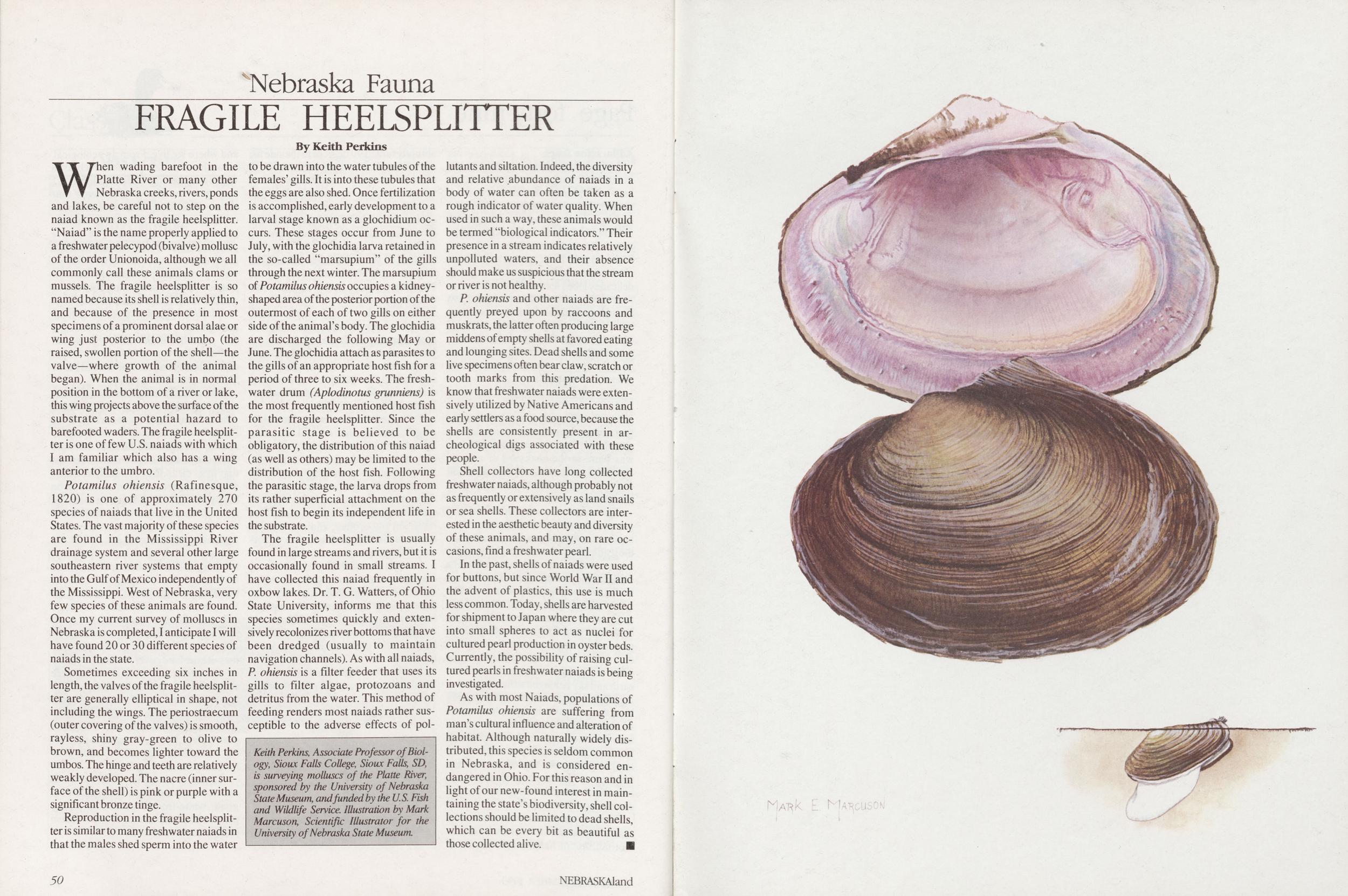
"Nebraska Fauna FRAGILE HEELSPLITTER
By Keith PerkinsWhen wading barefoot in the Platte River or many other Nebraska creeks, rivers, ponds and lakes, be careful not to step on the naiad known as the fragile heelsplitter. "Naiad" is the name properly applied to a freshwater pelecypod (bivalve) mollusc of the order Unionoida, although we all commonly call these animals clams or mussels. The fragile heelsplitter is so named because its shell is relatively thin, and because of the presence in most specimens of a prominent dorsal alae or wing just posterior to the umbo (the raised, swollen portion of the shell—the valve—where growth of the animal began). When the animal is in normal position in the bottom of a river or lake, this wing projects above the surface of the substrate as a potential hazard to barefooted waders. The fragile heelsplitter is one of few U.S. naiads with which I am familiar which also has a wing anterior to the umbro.
Potamilus ohiensis (Rafinesque, 1820) is one of approximately 270 species of naiads that live in the United States. The vast majority of these species are found in the Mississippi River drainage system and several other large southeastern river systems that empty into the Gulf of Mexico independently of the Mississippi. West of Nebraska, very few species of these animals are found. Once my current survey of molluscs in Nebraska is completed, I anticipate I will have found 20 or 30 different species of naiads in the state.
Sometimes exceeding six inches in length, the valves of the fragile heelsplitter are generally elliptical in shape, not including the wings. The periostraecum (outer covering of the valves) is smooth, rayless, shiny gray-green to olive to brown, and becomes lighter toward the umbos. The hinge and teeth are relatively weakly developed. The nacre (inner surface of the shell) is pink or purple with a significant bronze tinge.
Reproduction in the fragile heelsplitter is similar to many freshwater naiads in that the males shed sperm into the water to be drawn into the water tubules of the females' gills. It is into these tubules that the eggs are also shed. Once fertilization is accomplished, early development to a larval stage known as a glochidium occurs. These stages occur from June to July, with the glochidia larva retained in the so-called "marsupium" of the gills through the next winter. The marsupium of Potamilus ohiensis occupies a kidneyshaped area of the posterior portion of the outermost of each of two gills on either side of the animal's body. The glochidia are discharged the following May or June. The glochidia attach as parasites to the gills of an appropriate host fish for a period of three to six weeks. The freshwater drum (Aplodinotus grunniens) is the most frequently mentioned host fish for the fragile heelsplitter. Since the parasitic stage is believed to be obligatory, the distribution of this naiad (as well as others) may be limited to the distribution of the host fish. Following the parasitic stage, the larva drops from its rather superficial attachment on the host fish to begin its independent life in the substrate.
The fragile heelsplitter is usually found in large streams and rivers, but it is occasionally found in small streams. I have collected this naiad frequently in oxbow lakes. Dr. T. G. Watters, of Ohio State University, informs me that this species sometimes quickly and extensively recolonizes river bottoms that have been dredged (usually to maintain navigation channels). As with all naiads, P. ohiensis is a filter feeder that uses its gills to filter algae, protozoans and detritus from the water. This method of feeding renders most naiads rather susceptible to the adverse effects of pollutants and siltation. Indeed, the diversity and relative abundance of naiads in a body of water can often be taken as a rough indicator of water quality. When used in such a way, these animals would be termed "biological indicators." Their presence in a stream indicates relatively unpolluted waters, and their absence should make us suspicious that the stream or river is not healthy.
Keith Perkins, Associate Professor of Biology, Sioux Falls College, Sioux Falls, SD, is surveying molluscs of the Platte River, sponsored by the University of Nebraska State Museum, and funded by the U.S. Fish and Wildlife Service. Illustration by Mark Marcuson, Scientific Illustrator for the University of Nebraska State Museum.P. ohiensis and other naiads are frequently preyed upon by raccoons and muskrats, the latter often producing large middens of empty shells at favored eating and lounging sites. Dead shells and some live specimens often bear claw, scratch or tooth marks from this predation. We know that freshwater naiads were extensively utilized by Native Americans and early settlers as a food source, because the shells are consistently present in archeological digs associated with these people.
Shell collectors have long collected freshwater naiads, although probably not as frequently or extensively as land snail s or sea shells. These collectors are interested in the aesthetic beauty and diversity of these animals, and may, on rare occasions, find a freshwater pearl.
In the past, shells of naiads were used for buttons, but since World War II and the advent of plastics, this use is much less common. Today, shells are harvested for shipment to Japan where they are cut into small spheres to act as nuclei for cultured pearl production in oyster beds. Currently, the possibility of raising cultured pearls in freshwater naiads is being investigated.
As with most Naiads, populations of Potamilus ohiensis are suffering from man's cultural influence and alteration of habitat. Although naturally widely distributed, this species is seldom common in Nebraska, and is considered endangered in Ohio. For this reason and in light of our new-found interest in maintaining the state's biodiversity, shell collections should be limited to dead shells, which can be every bit as beautiful as those collected alive.
50 NEBRASKAland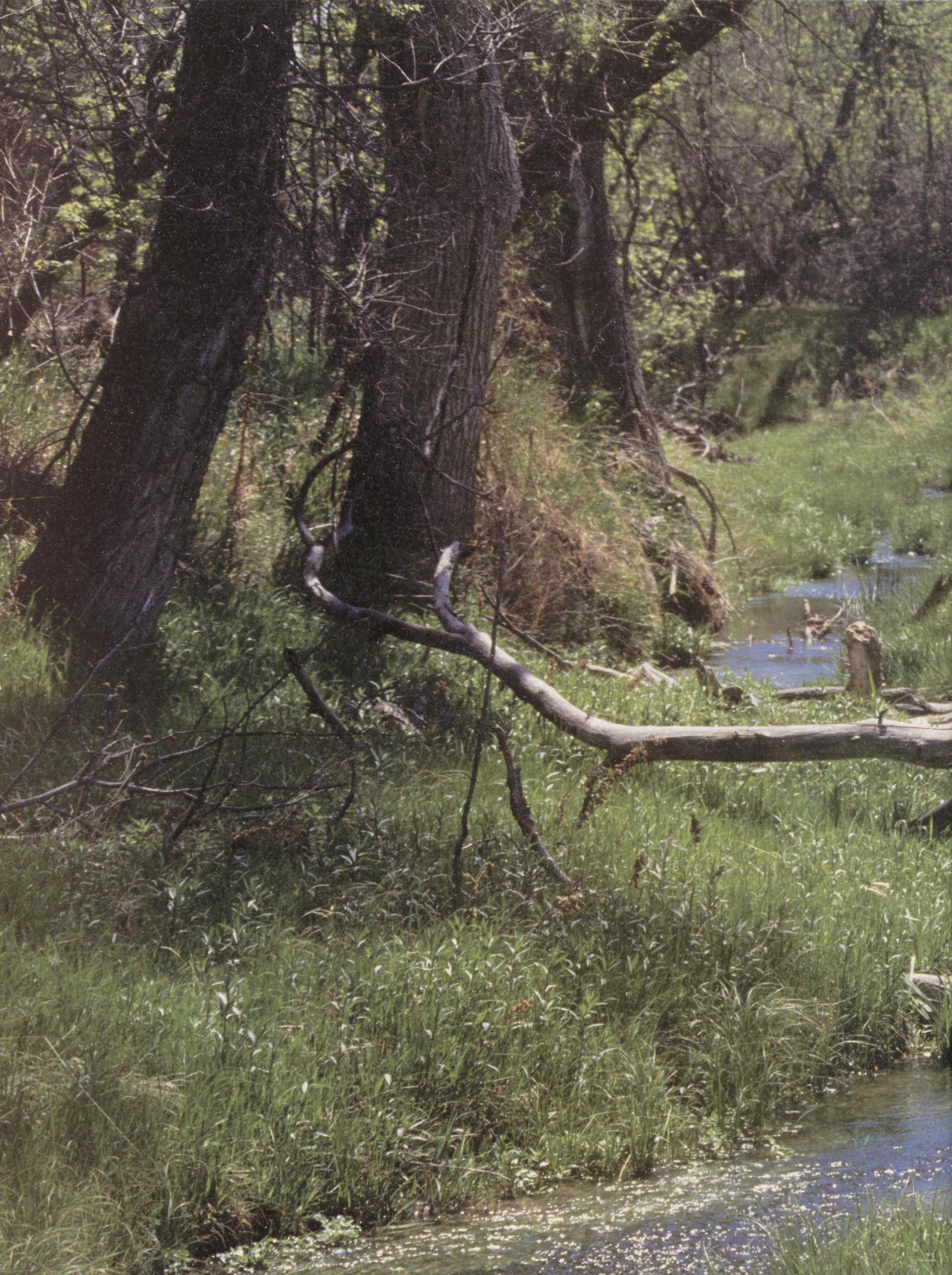
Position: 353 (26 views)