Volume 68, Issue 6, 1990
NEBRASKAland
JULY 1990 $1.50
NEBRASKAland
VOL. 68/NO.6 JULY 1990 Published by the Nebraska Game and Parks Commission Rex Amack, Director Assistant Directors: William J. Bailey, Jr. Dale R. Bree Staff Chief Information & Education: Jim MacAllister Managing Editor: Lowell Johnson Editor. Don Cunningham Senior Editors: Jon Farrar, Ken Bouc Regional Editors: Bob Grier, Rocky Hoffmann, Tom Keith Art Director: DuaneWesterholt Illustration: Tim Reigert, Dan Curran Circulation: PatFrahm Commissioners Chairman: L. Bruce Wright, Lincoln Vice Chairman: Richard L. Coyne, Omaha 2nd Vice Chairman: Elvin Adamson, Nenzel J. Alan Cramer, Wayne Marc Anthony, Scottsbluff Randall K. Stinnette, Inland La Vern Schneider, McCook NEBRASKAland ISSN:0028-1964 VOL.68/N0.6 JULY 1990 Published monthly except for combined Jan/Feb and Aug/Sept issues,by the Nebraska Game and Parks Commission, 2200 North 33rd Street, Lincoln, NE. Copyright 1990, all rights reserved. Second-class postage paid at Lincoln, Nebraska POSTMASTER: Send all address changes to NEBRASKAland, Box 30370, Lincoln, NE 68503. Rates: $ 12 for one year; $23 for two years. Manuscripts or photographs submitted to NEBRASKAland Magazine should be addressed to: The Editor, NEBRASKAland Magazine, P.O. Box 30370, Lincoln, NE 68503, and accompanied by self-addressed envelopes and return postage. The publisher assumes no responsibility for unsolicited material.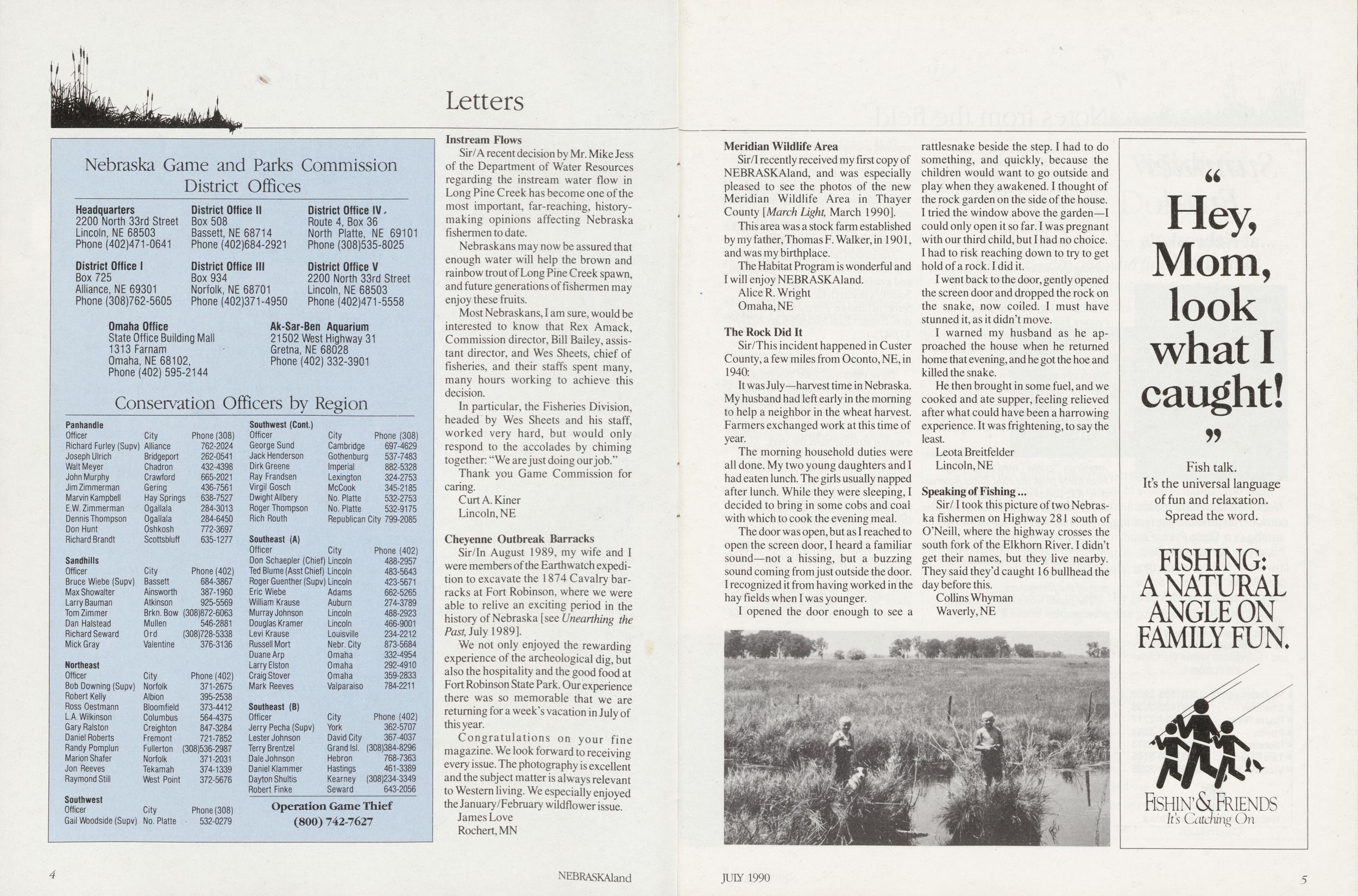
Letters
Instream FlowsSir/A recent decision by Mr. Mike Jess of the Department of Water Resources regarding the instream water flow in Long Pine Creek has become one of the most important, far-reaching, history- making opinions affecting Nebraska fishermen to date.
Nebraskans may now be assured that enough water will help the brown and rainbow trout of Long Pine Creek spawn, and future generations of fishermen may enjoy these fruits.
Most Nebraskans, I am sure, would be interested to know that Rex Amack, Commission director, Bill Bailey, assis- tant director, and Wes Sheets, chief of fisheries, and their staffs spent many, many hours working to achieve this decision.
In particular, the Fisheries Division, headed by Wes Sheets and his staff, worked very hard, but would only respond to the accolades by chiming together: "We are just doing our job."
Thank you Game Commission for caring.
CurtA.Kiner Lincoln, NE Cheyenne Outbreak BarracksSir/In August 1989, my wife and I were members of the Earthwatch expedition to excavate the 1874 Cavalry barracks at Fort Robinson, where we were able to relive an exciting period in the history of Nebraska [see Unearthing the Past, July 1989].
We not only enjoyed the rewarding experience of the archeological dig, but also the hospitality and the good food at Fort Robinson State Park. Our experience there was so memorable that we are returning for a week's vacation in July of this year.
Congratulations on your fine magazine. We look forward to receiving every issue. The photography is excellent and the subject matter is always relevant to Western living. We especially enjoyed the January/February wildflo wer issue.
James Love Rochert,MN 4 NEBRASKAland Meridian Wildlife AreaSir/I recently received my first copy of NEBRASKAland, and was especially pleased to see the photos of the new Meridian Wildlife Area in Thayer County [March Light, March 1990].
This area was a stock farm established by my father, Thomas F. Walker, in 1901, and was my birthplace.
The Habitat Program is wonderful and I will enjoy NEBRASKAland.
Alice R. Wright Omaha, NE The Rock Did ItSir/This incident happened in Custer County, a few miles from Oconto, NE, in 1940:
It was July—harvest time in Nebraska. My husband had left early in the morning to help a neighbor in the wheat harvest. Farmers exchanged work at this time of year.
The morning household duties were all done. My two young daughters and I had eaten lunch. The girls usually napped after lunch. While they were sleeping, I decided to bring in some cobs and coal with which to cook the evening meal.
The door was open, but as I reached to open the screen door, I heard a familiar sound—not a hissing, but a buzzing sound coming from just outside the door. I recognized it from having worked in the hay fields when I was younger.
I opened the door enough to see a rattlesnake beside the step. I had to do something, and quickly, because the children would want to go outside and play when they awakened. I thought of the rock garden on the side of the house. I tried the window above the garden—I could only open it so far. I was pregnant with our third child, but I had no choice. I had to risk reaching down to try to get hold of a rock. I did it.
I went back to the door, gently opened the screen door and dropped the rock on the snake, now coiled. I must have stunned it, as it didn't move.
I warned my husband as he approached the house when he returned home that evening, and he got the hoe and killed the snake.
He then brought in some fuel, and we cooked and ate supper, feeling relieved after what could have been a harrowing experience. It was frightening, to say the least.
Leota Breitfelder Lincoln, NE Speaking of Fishing...Sir/1 took this picture of two Nebraska fishermen on Highway 281 south of O'Neill, where the highway crosses the south fork of the Elkhorn River. I didn't get their names, but they live nearby. They said they'd caught 16 bullhead the day before this.
Collins Whyman Waverly, NE Summer
Fun!
at Nebraska's
State Parks
Nebraska summers mean
outdoor fun, and the perfect
setting is a State Park. For
history or horseback rides,
flowers or fishing, swimming
or solitude, Nebraska State
Parks are your summer-fun
invitation!
Cabins are still available at many
parks. For up-to-date information
and reservations phone the following numbers:
Ft. Robinson (308) 665-2660
Chadron
Platte River
Ponca
Niobrara
Two Rivers
(308)432
(402)234
(402)755
(402)857
(402)359
2036
2217
2284
3373
5165
Victoria Springs (308)749-2235
Nebraska Game and Parks
Commission
Summer
Fun!
at Nebraska's
State Parks
Nebraska summers mean
outdoor fun, and the perfect
setting is a State Park. For
history or horseback rides,
flowers or fishing, swimming
or solitude, Nebraska State
Parks are your summer-fun
invitation!
Cabins are still available at many
parks. For up-to-date information
and reservations phone the following numbers:
Ft. Robinson (308) 665-2660
Chadron
Platte River
Ponca
Niobrara
Two Rivers
(308)432
(402)234
(402)755
(402)857
(402)359
2036
2217
2284
3373
5165
Victoria Springs (308)749-2235
Nebraska Game and Parks
Commission
Notes from the field
Update: Hollywood on the PlainsFrom Paul Eisloeffel, co-author of a recent NEBRASKAland story on the discovery and restoration of Nebraska's earliest-known feature film [Hollywood on the Plains, May 1990] comes the following note and photograph:
The Nebraska State Historical Society reports more developments concerning the western movie In the Days of '75 and '76, the earliest-known Nebraska-made feature film.
Made in 1915 by the Black Hills Feature Film Company of Chadron, the film recounts the fictitious adventures of James "Wild Bill" Hickok and Martha "Calamity Jane" Cannary. The Society, which obtained the film and saw to its restoration, recently acquired from Scout's Rest Ranch State Historical Park in North Platte, the accompanying panoramic photograph showing part of the cast.
The photo shows many of the Native American "extras" used in the film, most likely from the Pine Ridge Reservation. A.L Johnson, the Chadron merchant who portrayed Hickok in the film, is shown in character just to the right of center. Costumes worn by the Native Americans represent the different tribes depicted in the film—evidence of a remarkable attention to detail on the part of the filmmakers.
The photo was taken by Omaha photographer Walter W. Scott. Scott enjoyed a long career in Omaha, beginning around 1910. As he was on location near Chadron to record this scene, it is likely that he was the photographer behind the movie camera as well commissioned for the job by the film's technical producers, Hartman Brothers Film Manufacturers, also of Omaha.
The Historical Society also reports that the entire film is now fully restored and available for viewing at the Society's research facility at 1500 R Street in Lincoln. For more information, contact Paul Eisloeffel at (402) 471-4750.
Mosasaurus missouriensisThree years ago, John Morgenson and Steve Brey, Nebraska Game and Parks Commission horticulturists working at the new Niobrara State Park near Niobrara in Knox County, went for an evening stroll around the park. Along an access road to the park's new cabin area, they noticed bones protruding from a hillside roadcut.
Excavations this summer overseen by Highway Salvage Paleontologist Bruce Bailey of the University of Nebraska State Museum in Lincoln have revealed that the bones are those of a Mosasaurus missouriensis, a swimming reptile that lived 68-70 million years ago. Estimated to have been about 30 feet long, it would have propelled itself through the ancient seas
"It's an important find for Nebraska," according to Bailey. "This species is the first of its kind known in Nebraska, and judging from its size, possibly one of the largest on record."
"We thought it might be something a museum would be interested in," Morgenson said. "Now it has turned into a big find."
The bones are being removed and transported to the museum's paleontology lab in Lincoln for preparation and study.
Calamus Hatchery UpdateThe headquarters and hatch house building at the new Calamus State Fish Hatchery has been finished by the contractor and turned over to the Game and Parks Commission. Doug Kapke, the new hatchery superintendent, is now living on the area and is keeping tabs on the remaining work. He reports that rearing ponds and raceways are beginning to take shape, and workmen are preparing to connect pipes to seven wells already in place. At the end of the 1990 irrigation season, when water releases can be halted, workmen will be able to connect the hatchery to its Calamus Reservoir water source. Operations may begin as early as January or February of 1990 with the production of trout in the hatch house.
Nebraska Wildlife Habitat Donors Hikers, birdwatchers, photographers, campers—anyone who finds peace and pleasure in the outdoors—can give back to Nature For years, hunters and trappers have contributed to the acquisition and improvement of wildlife habitat through their purchase of Nebraska Habitat Stamps. Now, through this special program, non-consumptive users of the outdoors can also contribute, and proudly wear the Nebraska Habitat Donor patch. All proceeds will go the Wildlife Habitat fund. Give $5 and receive the 1990 Donor Patch Give $12.50 and receive the patch on a cloth cap. Use the coupon below. Mail to Nebraska Wildlife Donor Program, NEBRASKAland Magazine, P.O. Box 30370, Lincoln, NE 68503 Nebraska Wildlife Habitat Donor Program Name Address City State. Zip. $5: Patch $12.50: Patch and Cap (Nebraskans: please add appropriate sales tax) JULY 1990 7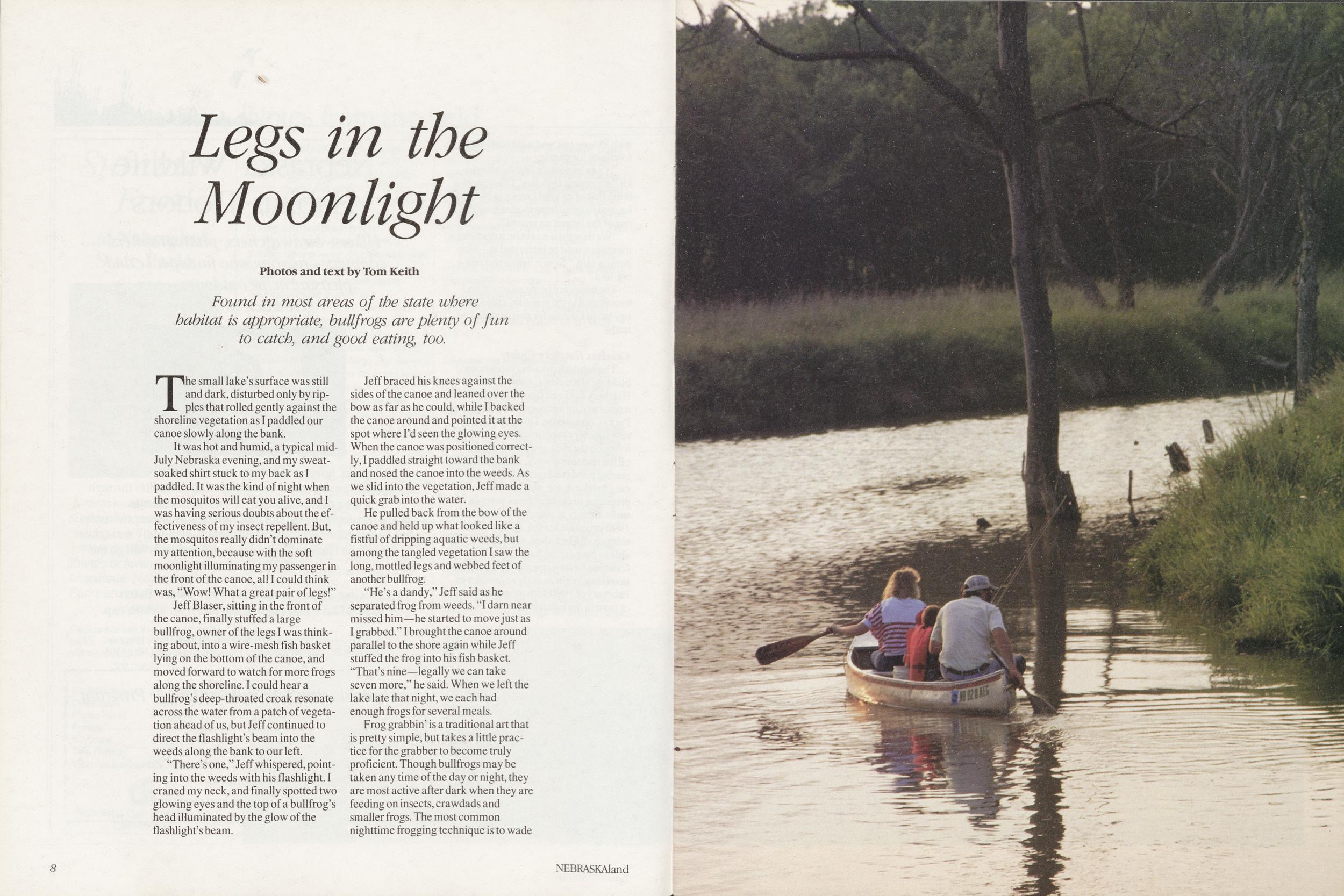
Legs in the Moonlight
Photos and text by Tom Keith Found in most areas of the state where habitat is appropriate, bullfrogs are plenty of fun to catch, and good eating too.The small lake's surface was still and dark, disturbed only by ripples that rolled gently against the shoreline vegetation as I paddled our canoe slowly along the bank.
It was hot and humid, a typical mid-July Nebraska evening, and my sweat-soaked shirt stuck to my back as I paddled. It was the kind of night when the mosquitos will eat you alive, and I was having serious doubts about the effectiveness of my insect repellent. But, the mosquitos really didn't dominate my attention, because with the soft moonlight illuminating my passenger in the front of the canoe, all I could think was, "Wow! What a great pair of legs!" Jeff Blaser, sitting in the front of the canoe, finally stuffed a large bullfrog, owner of the legs I was thinking about, into a wire-mesh fish basket along the shoreline. I could hear a bullfrog's deep-throated croak resonate across the water from a patch of vegetation ahead of us, but Jeff continued to direct the flashlight's beam into the weeds along the bank to our left.
"There's one," Jeff whispered, pointing ing into the weeds with his flashlight. craned my neck, and finally spotted two glowing eyes and the top of a bullfrog's head illuminated by the glow of the flashlight's beam.
Jeff braced his knees against the sides of the canoe and leaned over the bow as far as he could, while I backed the canoe around and pointed it at the spot where I'd seen the glowing eyes. When the canoe was positioned correctly, I paddled straight toward the bank and nosed the canoe into the weeds. As we slid into the vegetation, Jeff made aquick grab into the water.
He pulled back from the bow of the canoe and held up what looked like a fistful of dripping aquatic weeds, but among the tangled vegetation I saw the long, mottled legs and webbed feet of another bullfrog.
"He's a dandy," Jeff said as he separated frog from weeds. "I darn near missed him—he started to move just as I grabbed." I brought the canoe around parallel to the shore again while Jeff stuffed the frog into his fish basket. "That's nine—legally we can take seven more," he said. When we left the lake late that night, we each had enough frogs for several meals.
Frog grabbin' is a traditional art that is pretty simple, but takes a little practice for the grabber to become truly proficient. Though bullfrogs may be taken any time of the day or night, they are most active after dark when they are feeding on insects, crawdads and smaller frogs. The most common nighttime frogging technique is to wade 8 NEBRASKAland
The real skill in froggin' is in the grab. It must be lightning quick and very tight. Larger frogs will try to force your grip apart with their front legs, and as often as not, a successful grab will yield the frog, a mess of floating algae and a small bucketful of aquatic weeds.
When hunting from a canoe, the grabber sits in the front and holds the light in his left hand to dazzle the frog with its beam. He leans far over the bow of the canoe and waits until he is very close to a frog before making the grab. He must be careful not to block the light, or the frog will see the hand coming and try to jump out of the way. If a frog is in shallow water, it is sometimes possible to pin it to the lake bottom while closing the grip, but in deeper water the hand must be closed very tightly and quickly upon contact, or the frog will get away.
Some froggers prefer to wade quietly along the bank rather than to use a canoe, but a thorough knowledge of the area being waded is essential to avoid an unexpected moonlight dunking, the consequence of stepping into a hole or tripping over a log, tree root, or submerged debris.
Nebraska's bullfrog season opens July 15 and continues through October 31 each year. The fishing regulations stipulate that bullfrogs must be taken by hand, hand net or hook and line. The idea is that they must be taken unharmed, so that frogs which don't stretch to the legal size limit of 4-1 12 inches from snout to vent can be released in good health. Nebraska's bag and possession limit is eight frogs per person.
The late summer season opening date is far from being a random one; it is set then to give bullfrogs a chance to spawn before they are harvested, according to Blaser, a Game and Parks Commission fisheries division biologist: "Delaying the hunting season until after the spawn helps ensure a frog population at the lake next year."
Bullfrogs are extremely vulnerable to hunting, especially in lakes where there is not much shoreline vegetation. Without sufficient vegetation to conceal them, they are also very vulnerable to predation by raccoons, herons and snakes. Larger predator fish such as bass, northern pike and catfish feed on them when they are in the water.
Frogs may hide in shoreline vegetation during the day to escape the heat of the sun, but when sunset approaches they head for the water to feed. If the lake is low and the water has receded a long way from shoreline vegetation, frogs will be exposed for some distance as they head for the water. This is when they are in the most danger from raccoons, herons and snakes.
Crayfish are a favorite and important food item, and frogs take them with a vengeance. A bullfrog can easily catch a crawdad on dry land, or capture it in shallow water and use his stubby front feet to stuff the crawdad into his wide mouth. In fact, they take crawdads so readily that Jeff says the best daytime frog lure he has used is an imitation crawdad bass plug.
His favorite froggin' rig is a 6-112 foot, stiff-spined rod with an artificial crawdad tied directly to 10-pound-test monofilament line. He paddles a canoe, 10 NEBRASKAland or wades slowly along the bank and drops the lure into weedy areas, or flips it under overhanging branches that shade the bank. When a frog grabs the lure, Jeff gives the rod a short jerk and lip-hooks the frog. He says a goodsized frog can put up a pretty good tussle, even on a stiff rod.
Daytime froggin' is an entirely different game, and requires some very different tactics. During the day, frogs are most often found hiding in weeds along shady shorelines. Because they are on the bank among the weeds, frogs are difficult to see and to approach because they can see the frogger coming.
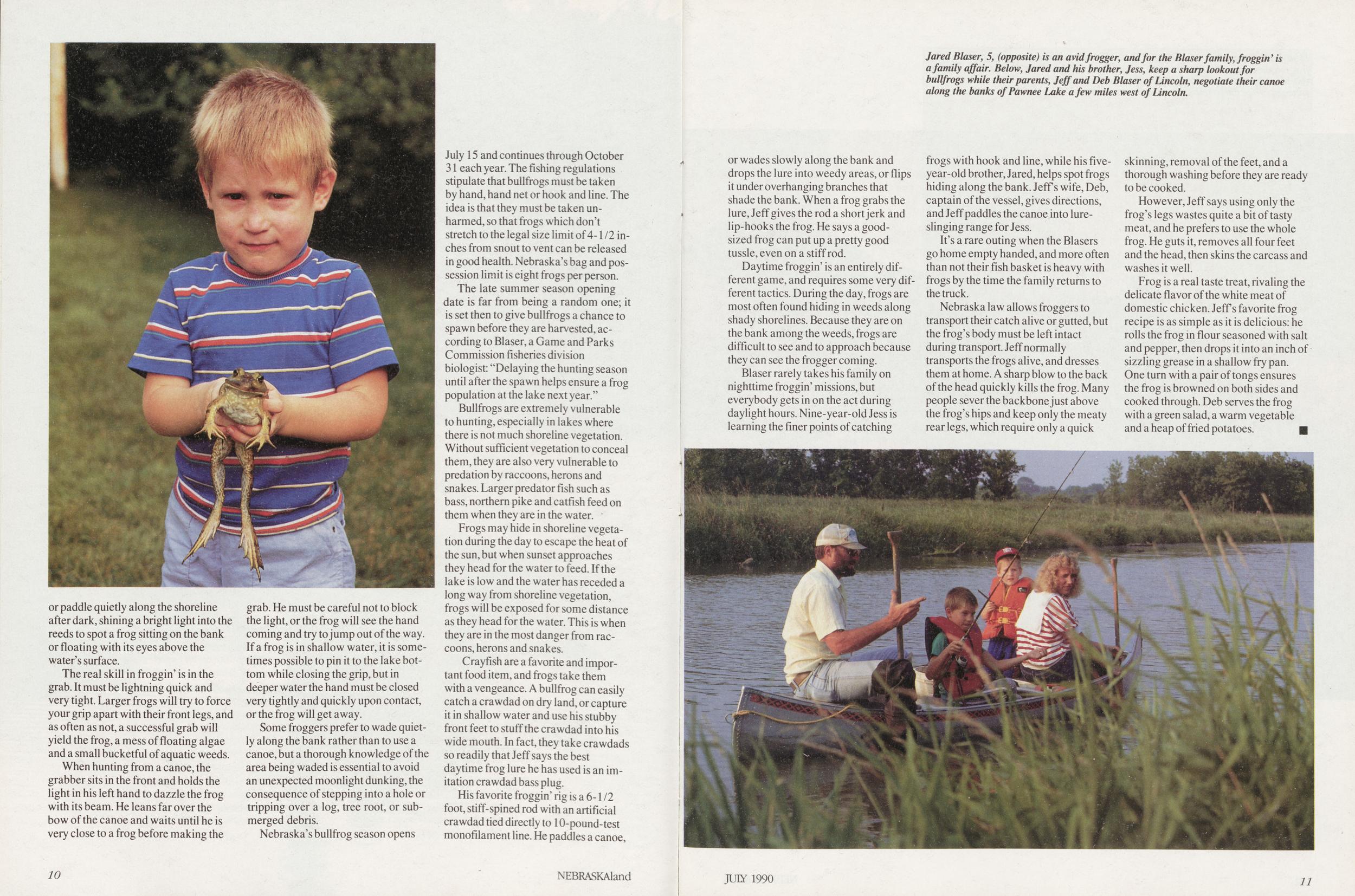
Blaser rarely takes his family on nighttime froggin' missions, but everybody gets in on the act during daylight hours. Nine-year-old Jess is learning the finer points of catching frogs with hook and line, while his fiveyear-old brother, Jared, helps spot frogs hiding along the bank. Jeffs wife, Deb, captain of the vessel, gives directions, and Jeff paddles the canoe into lureslinging range for Jess.
It's a rare outing when the Blasers go home empty handed, and more often than not their fish basket is heavy with frogs by the time the family returns to the truck.
Nebraska law allows froggers to transport their catch alive or gutted, but the frog's body must be left intact during transport. Jeff normally transports the frogs alive, and dresses them at home. A sharp blow to the back of the head quickly kills the frog. Many people sever the backbone just above the frog's hips and keep only the meaty rear legs, which require only a quick skinning, removal of the feet, and a thorough washing before they are ready to be cooked.
However, Jeff says using only the frog's legs wastes quite a bit of tasty meat, and he prefers to use the whole frog. He guts it, removes all four feet and the head, then skins the carcass and washes it well.
Frog is a real taste treat, rivaling the delicate flavor of the white meat of domestic chicken. Jeffs favorite frog recipe is as simple as it is delicious: he rolls the frog in flour seasoned with salt and pepper, then drops it into an inch of sizzling grease in a shallow fry pan. One turn with a pair of tongs ensures the frog is browned on both sides and cooked through. Deb serves the frog with a green salad, a warm vegetable and a heap of fried potatoes.
Bullfrogs can be found In most areas across Nebraska, but the largest numbers occur In the southeast, where the weather is warmer than in other parts of the state.
Wes Sheets, chief of the Game and Parks Commission's fisheries division, says habitat is the key factor that determines if a lake or pond will have a good bullfrog population. "Bullfrogs like swampy areas with lots of vegetation," he said. The best areas have shoreline vegetation growing right at the water's edge.
"Drought cycles can be devastating to frogs. The lake's water should be right at normal conservation pool, or predation on them by birds is tremendous. Lots and lots of birds, such as magpies, crows, blackbirds, grackles and herons can easily spot small frogs on exposed muddy banks and have little trouble catching them."
Sheets says bullfrogs are sometimes stocked at public areas, but not as a part of an intended stocking program. He says frogs commonly share the state's fish hatchery ponds with fish being raised there, and instead of wasting them, the biologists stock them right along with the fish.
"The thing is," Sheets said, "if you have the right habitat, you are going to have frogs. If the habitat isn't right, any frogs you stock will just move away to an area where there is better habitat."
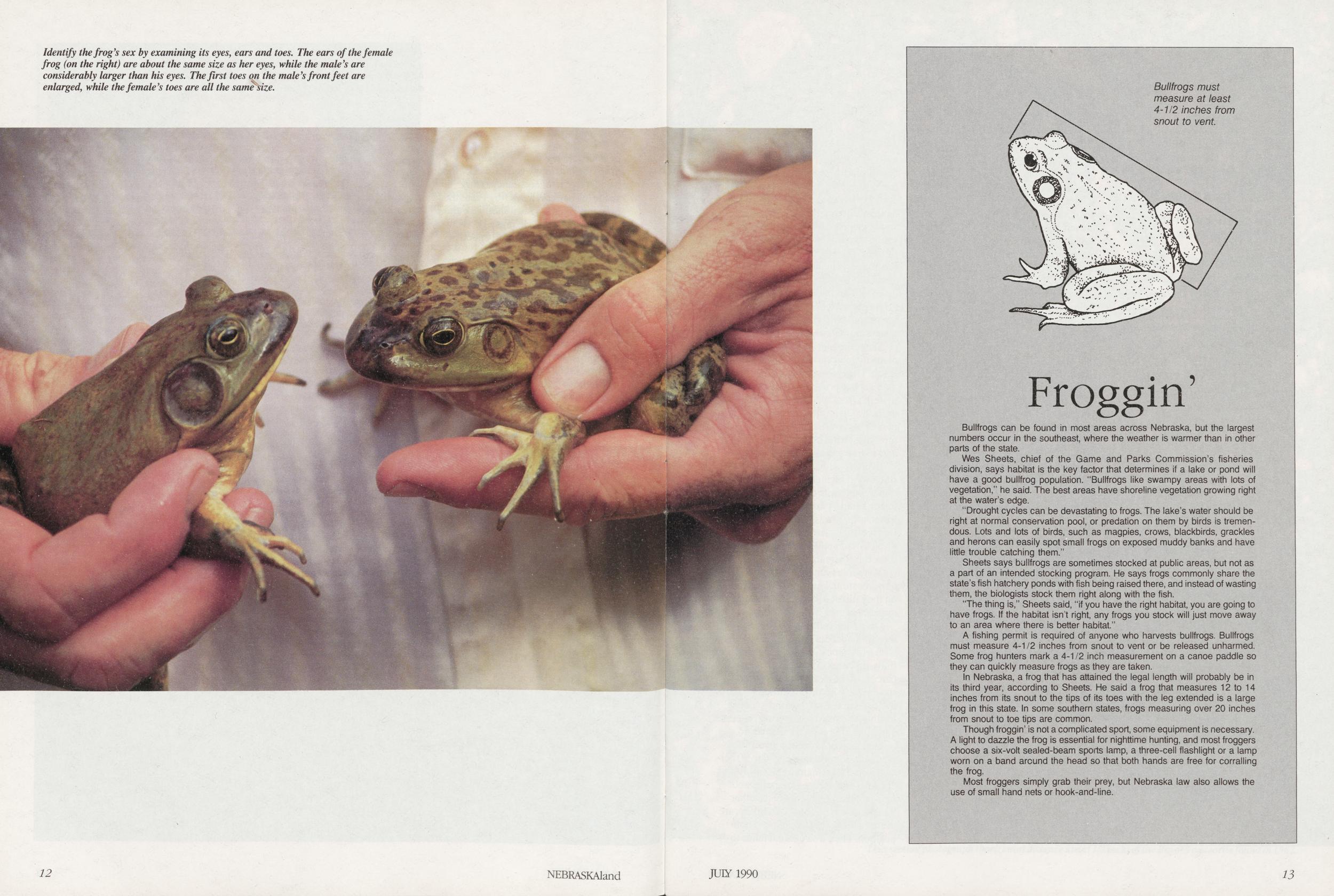
A fishing permit is required of anyone who harvests bullfrogs. Bullfrogs must measure 4-112 inches from snout to vent or be released unharmed. Some frog hunters mark a 4-112 inch measurement on a canoe paddle so they can quickly measure frogs as they are taken.
In Nebraska, a frog that has attained the legal length will probably be in its third year, according to Sheets. He said a frog that measures 12 to 14 inches from its snout to the tips of its toes with the leg extended is a large frog in this state. In some southern states, frogs measuring over 20 inches from snout to toe tips are common.
Though froggin' is not a complicated sport, some equipment is necessary. A light to dazzle the frog is essential for nighttime hunting, and most froggers choose a six-volt sealed-beam sports lamp, a three-cell flashlight or a lamp worn on a band around the head so that both hands are free for corralling the frog.
Most froggers simply grab their prey, but Nebraska law also allows the use of small hand nets or hook-and-line.
JULY 1990 13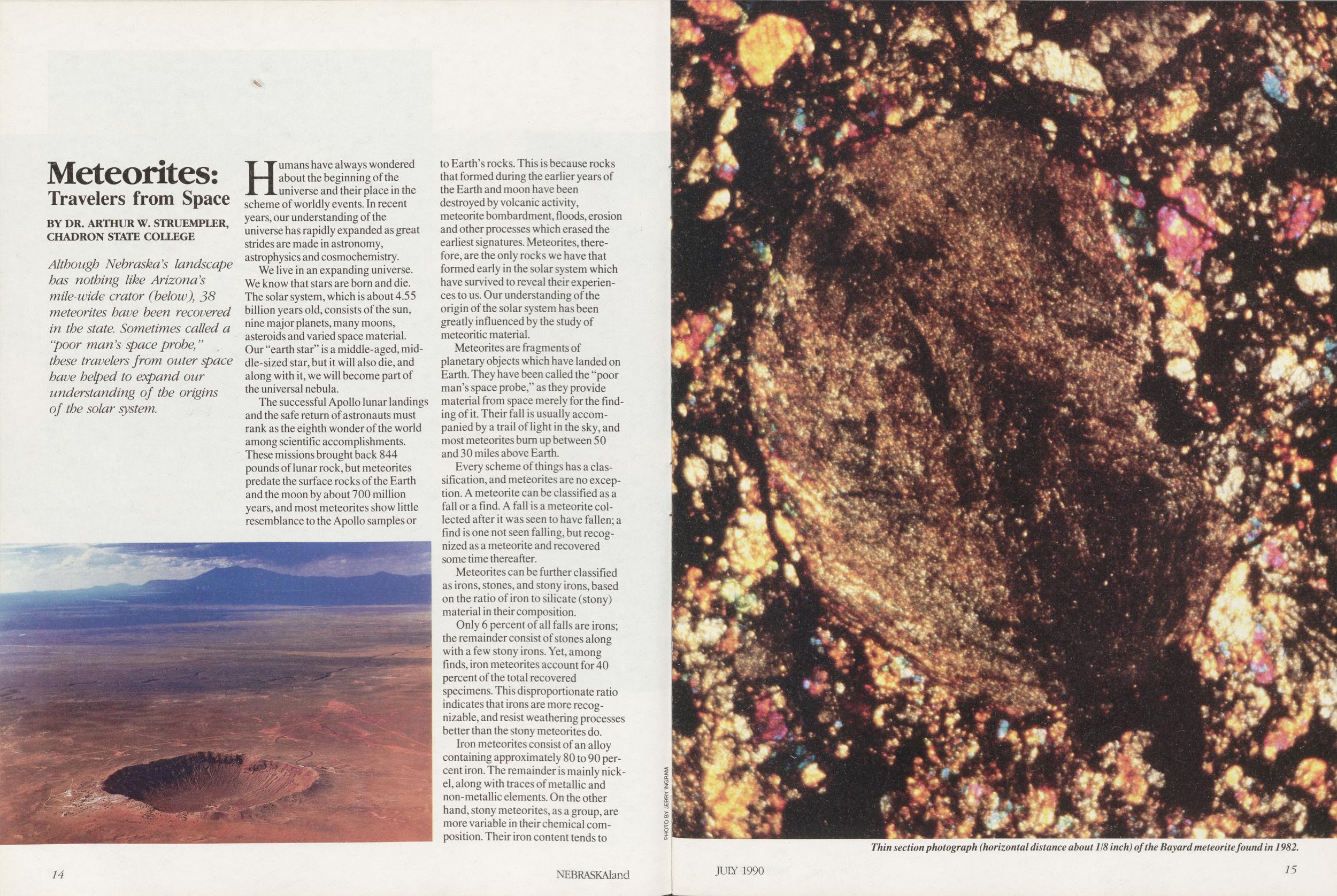
Meteorites: Travelers from Space
BY DR. ARTHUR W. STRUEMPLER, CHADRON STATE COLLEGE Although Nebraska's landscape has nothing like Arizona's mile-wide crator (below), 38 meteorites have been recovered in the state. Sometimes called a 'poor man's space probe," these travelers from outer space have helped to expand our understanding of the origins of the solar system.Humans have always wondered about the beginning of the universe and their place in the scheme of worldly events. In recent years, our understanding of the universe has rapidly expanded as great strides are made in astronomy, astrophysics and cosmochemistry.
We live in an expanding universe. We know that stars are born and die. The solar system, which is about 4.55 billion years old, consists of the sun, nine major planets, many moons, asteroids and varied space material. Our "earth star" is a middle-aged, middle-sized star, but it will also die, and along with it, we will become part of the universal nebula.
The successful Apollo lunar landings and the safe return of astronauts must rank as the eighth wonder of the world among scientific accomplishments. These missions brought back 844 pounds of lunar rock, but meteorites predate the surface rocks of the Earth and the moon by about 700 million years, and most meteorites show little resemblance to the Apollo samples or to Earth's rocks. This is because rocks that formed during the earlier years of the Earth and moon have been destroyed by volcanic activity, meteorite bombardment, floods, erosion and other processes which erased the earliest signatures. Meteorites, therefore, are the only rocks we have that formed early in the solar system which have survived to reveal their experiences to us. Our understanding of the origin of the solar system has been greatly influenced by the study of meteoritic material.
Meteorites are fragments of planetary objects which have landed on Earth. They have been called the "poor man's space probe," as they provide material from space merely for the finding of it. Their fall is usually accompanied by a trail of light in the sky, and most meteorites burn up between 50 and 30 miles above Earth.
Every scheme of things has a classification, and meteorites are no exception. A meteorite can be classified as a fall or a find. A fall is a meteorite collected after it was seen to have fallen; a find is one not seen falling, but recognized as a meteorite and recovered some time thereafter.
Meteorites can be further classified as irons, stones, and stony irons, based on the ratio of iron to silicate (stony) material in their composition.
Only 6 percent of all falls are irons; the remainder consist of stones along with a few stony irons. Yet, among finds, iron meteorites account for 40 percent of the total recovered specimens. This disproportionate ratio indicates that irons are more recognizable, and resist weathering processes better than the stony meteorites do.
Iron meteorites consist of an alloy containing approximately 80 to 90 percent iron. The remainder is mainly nickel, along with traces of metallic and non-metallic elements. On the other hand, stony meteorites, as a group, are more variable in their chemical composition. Their iron content tends to 14 NEBRASKAland
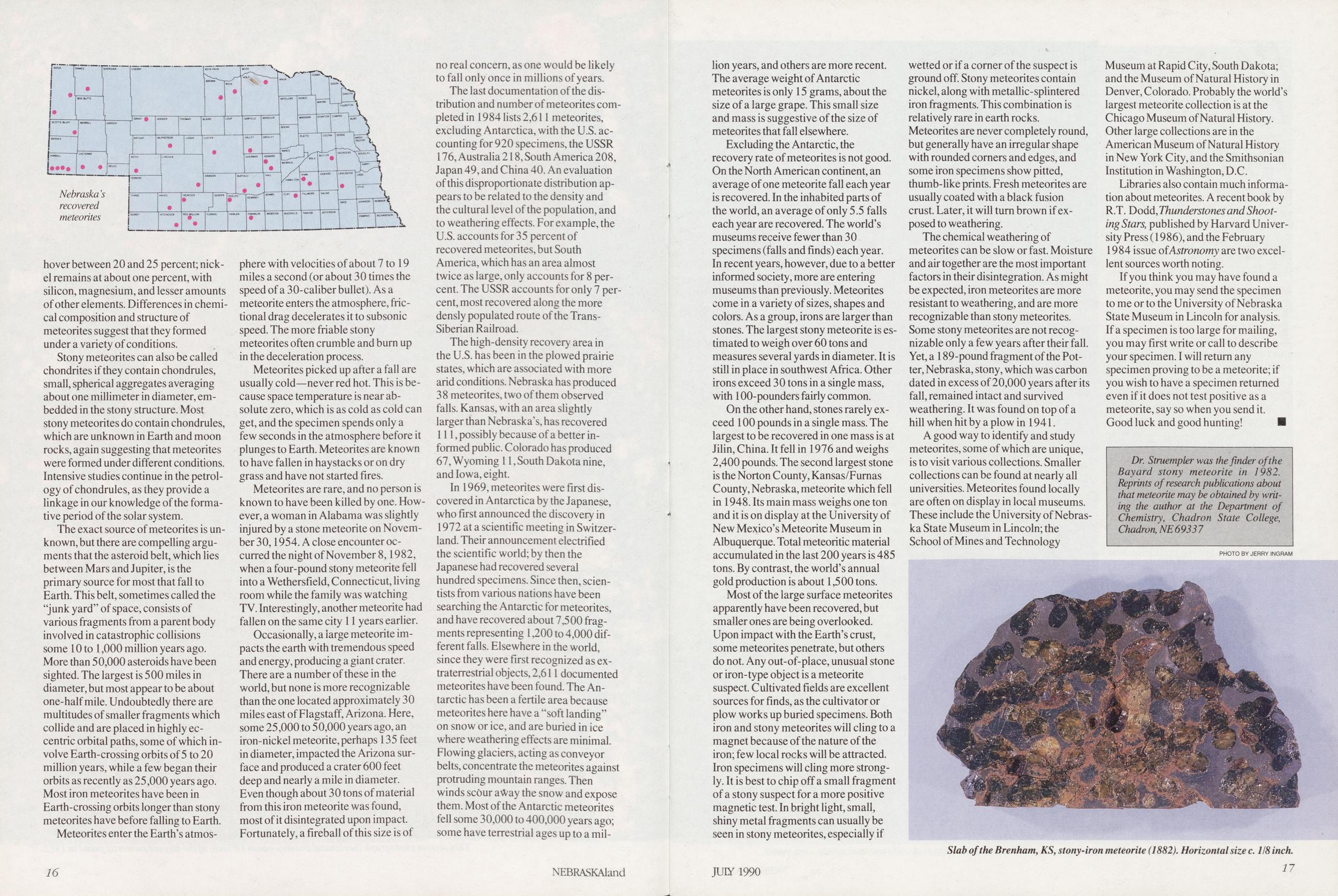
Stony meteorites can also be called chondrites if they contain chondrules, small, spherical aggregates averaging about one millimeter in diameter, embedded in the stony structure. Most stony meteorites do contain chondrules, which are unknown in Earth and moon rocks, again suggesting that meteorites were formed under different conditions. Intensive studies continue in the petrology of chondrules, as they provide a linkage in our knowledge of the formative period of the solar system.
The exact source of meteorites is unknown, but there are compelling arguments that the asteroid belt, which lies between Mars and Jupiter, is the primary source for most that fall to Earth. This belt, sometimes called the "junk yard" of space, consists of various fragments from a parent body involved in catastrophic collisions some 10 to 1,000 million years ago. More than 50,000 asteroids have been sighted. The largest is 500 miles in diameter, but most appear to be about one-half mile. Undoubtedly there are multitudes of smaller fragments which collide and are placed in highly eccentric orbital paths, some of which involve Earth-crossing orbits of 5 to 20 million years, while a few began their orbits as recently as 25,000 years ago. Most iron meteorites have been in Earth-crossing orbits longer than stony meteorites have before falling to Earth.
Meteorites enter the Earth's atmosphere with velocities of about 7 to 19 miles a second (or about 30 times the speed of a 30-caliber bullet). As a meteorite enters the atmosphere, frictional drag decelerates it to subsonic speed. The more friable stony meteorites often crumble and burn up in the deceleration process.
Meteorites picked up after a fall are usually cold—never red hot. This is because space temperature is near absolute zero, which is as cold as cold can get, and the specimen spends only a few seconds in the atmosphere before it plunges to Earth. Meteorites are known to have fallen in haystacks or on dry grass and have not started fires.
Meteorites are rare, and no person is known to have been killed by one. However, a woman in Alabama was slightly injured by a stone meteorite on November 30, 1954. A close encounter occurred the night of November 8, 1982, when a four-pound stony meteorite fell into a Wethersfield, Connecticut, living room while the family was watching TV. Interestingly, another meteorite had fallen on the same city 11 years earlier.
Occasionally, a large meteorite impacts the earth with tremendous speed and energy, producing a giant crater. There are a number of these in the world, but none is more recognizable than the one located approximately 30 miles east of Flagstaff, Arizona. Here, some 25,000 to 50,000 years ago, an iron-nickel meteorite, perhaps 135 feet in diameter, impacted the Arizona surface and produced a crater 600 feet deep and nearly a mile in diameter. Even though about 30 tons of material from this iron meteorite was found, most of it disintegrated upon impact. Fortunately, a fireball of this size is of no real concern, as one would be likely to fall only once in millions of years.
The last documentation of the distribution and number of meteorites completed in 1984 lists 2,611 meteorites, excluding Antarctica, with the U.S. accounting for 920 specimens, the USSR 176, Australia 218, South America 208, Japan 49, and China 40. An evaluation of this disproportionate distribution appears to be related to the density and the cultural level of the population, and to weathering effects. For example, the U.S. accounts for 35 percent of recovered meteorites, but South America, which has an area almost twice as large, only accounts for 8 percent. The USSR accounts for only 7 percent, most recovered along the more densly populated route of the TransSiberian Railroad.
The high-density recovery area in the U.S. has been in the plowed prairie states, which are associated with more arid conditions. Nebraska has produced 38 meteorites, two of them observed falls. Kansas, with an area slightly larger than Nebraska's, has recovered 111, possibly because of a better informed public. Colorado has produced 67, Wyoming 11, South Dakota nine, and Iowa, eight.
In 1969, meteorites were first discovered in Antarctica by the Japanese, who first announced the discovery in 1972 at a scientific meeting in Switzerland. Their announcement electrified the scientific world; by then the Japanese had recovered several hundred specimens. Since then, scientists from various nations have been searching the Antarctic for meteorites, and have recovered about 7,500 fragments representing 1,200 to 4,000 different falls. Elsewhere in the world, since they were first recognized as extraterrestrial objects, 2,61 1 documented meteorites have been found. The Antarctic has been a fertile area because meteorites here have a "soft landing" on snow or ice, and are buried in ice where weathering effects are minimal. Flowing glaciers, acting as conveyor belts, concentrate the meteorites against protruding mountain ranges. Then winds scour away the snow and expose them. Most of the Antarctic meteorites fell some 30,000 to 400,000 years ago; some have terrestrial ages up to a million 16 NEBRASKAland years, and others are more recent. The average weight of Antarctic meteorites is only 15 grams, about the size of a large grape. This small size and mass is suggestive of the size of meteorites that fall elsewhere.
Excluding the Antarctic, the recovery rate of meteorites is not good. On the North American continent, an average of one meteorite fall each year is recovered. In the inhabited parts of the world, an average of only 5.5 falls each year are recovered. The world's museums receive fewer than 30 specimens (falls and finds) each year. In recent years, however, due to a better informed society, more are entering museums than previously. Meteorites come in a variety of sizes, shapes and colors. As a group, irons are larger than stones. The largest stony meteorite is estimated to weigh over 60 tons and measures several yards in diameter. It is still in place in south west Africa. Other irons exceed 30 tons in a single mass, with 100-pounders fairly common.
On the other hand, stones rarely exceed 100 pounds in a single mass. The largest to be recovered in one mass is at Jilin, China. It fell in 1976 and weighs 2,400 pounds. The second largest stone is the Norton County, Kansas/Furnas County, Nebraska, meteorite which fell in 1948. Its main mass weighs one ton and it is on display at the University of New Mexico's Meteorite Museum in Albuquerque. Total meteoritic material accumulated in the last 200 years is 485 tons. By contrast, the world's annual gold production is about 1,500 tons.
Most of the large surface meteorites apparently have been recovered, but smaller ones are being overlooked. Upon impact with the Earth's crust, some meteorites penetrate, but others do not. Any out-of-place, unusual stone or iron-type object is a meteorite suspect. Cultivated fields are excellent sources for finds, as the cultivator or plow works up buried specimens. Both iron and stony meteorites will cling to a magnet because of the nature of the iron; few local rocks will be attracted. Iron specimens will cling more strongly. It is best to chip off a small fragment of a stony suspect for a more positive magnetic test. In bright light, small, shiny metal fragments can usually be seen in stony meteorites, especially if wetted or if a corner of the suspect is ground off. Stony meteorites contain nickel, along with metallic-splintered iron fragments. This combination is relatively rare in earth rocks. Meteorites are never completely round, but generally have an irregular shape with rounded corners and edges, and some iron specimens show pitted, thumb-like prints. Fresh meteorites are usually coated with a black fusion crust. Later, it will turn brown if exposed to weathering.
The chemical weathering of meteorites can be slow or fast. Moisture and air together are the most important factors in their disintegration. As might be expected, iron meteorites are more resistant to weathering, and are more recognizable than stony meteorites. Some stony meteorites are not recognizable only a few years after their fall. Yet, a 189-pound fragment of the Potter, Nebraska, stony, which was carbon dated in excess of 20,000 years after its fall, remained intact and survived weathering. It was found on top of a hill when hit by a plow in 1941.
A good way to identify and study meteorites, some of which are unique, is to visit various collections. Smaller collections can be found at nearly all universities. Meteorites found locally are often on display in local museums. These include the University of Nebraska State Museum in Lincoln; the School of Mines and Technology Museum at Rapid City, South Dakota; and the Museum of Natural History in Denver, Colorado. Probably the world's largest meteorite collection is at the Chicago Museum of Natural History. Other large collections are in the American Museum of Natural History in New York City, and the Smithsonian Institution in Washington, D.C.
Libraries also contain much information about meteorites. A recent book by R.T. Dodd,Thunderstones and Shooting Stars, published by Harvard University Press (1986), and the February 1984 issue of Astronomy are two excellent sources worth noting.
If you think you may have found a meteorite, you may send the specimen to me or to the University of Nebraska State Museum in Lincoln for analysis. If a specimen is too large for mailing, you may first write or call to describe your specimen. I will return any specimen proving to be a meteorite; if you wish to have a specimen returned even if it does not test positive as a meteorite, say so when you send it. Good luck and good hunting!
Dr. Struempler was the finder of the Bayard stony meteorite in 1982. Reprints of research publications about that meteorite may be obtained by writing the author at the Department of Chemistry, Chadron State College, ChadronNE69337
Box Butte Benefits
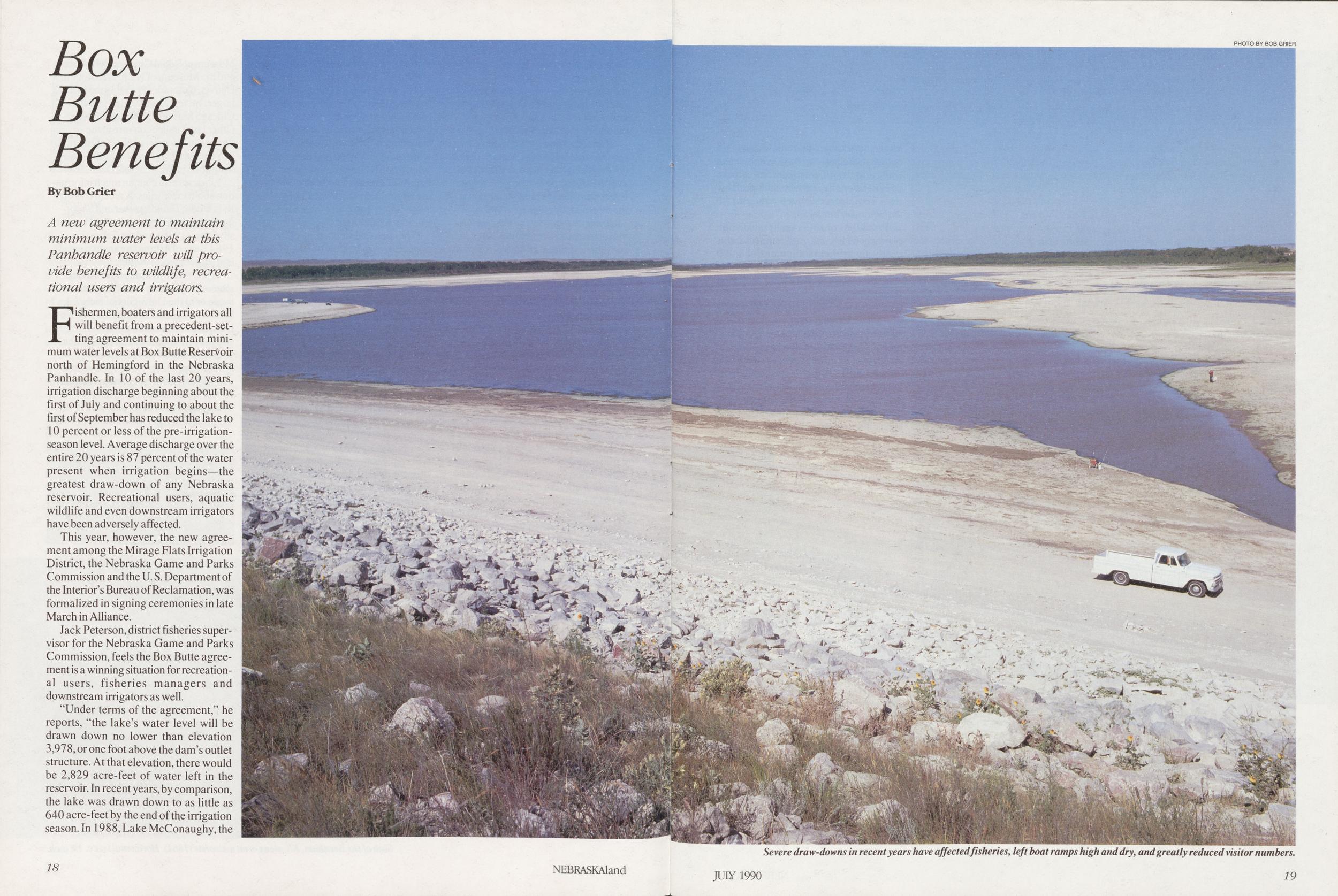
ByBobGrier A new agreement to maintain minimum water levels at this Panhandle reservoir will provide benefits to wildlife, recreational users and irrigators.Fishermen, boaters and irrigators all will benefit from a precedent-setting agreement to maintain minimum water levels at Box Butte Reservoir north of Hemingford in the Nebraska Panhandle. In 10 of the last 20 years, irrigation discharge beginning about the first of July and continuing to about the first of September has reduced the lake to 10 percent or less of the pre-irrigation season level. Average discharge over the entire 20 years is 87 percent of the water present when irrigation begins—the greatest draw-down of any Nebraska reservoir. Recreational users, aquatic wildlife and even downstream irrigators have been adversely affected.
This year, however, the new agreement among the Mirage Flats Irrigation District, the Nebraska Game and Parks Commission and the U. S. Department of the Interior's Bureau of Reclamation, was formalized in signing ceremonies in late March in Alliance.
Jack Peterson, district fisheries supervisor for the Nebraska Game and Parks Commission, feels the Box Butte agreement is a winning situation for recreational users, fisheries managers and downstream irrigators as well.
"Under terms of the agreement," he reports, "the lake's water level will be drawn down no lower than elevation 3,978, or one foot above the dam's outlet structure. At that elevation, there would be 2,829 acre-feet of water left in the reservoir. In recent years, by comparison, the lake was drawn down to as little as 640 acre-feet by the end of the irrigation season. In 1988, Lake McConaughy, the 18 NEBRASKAland
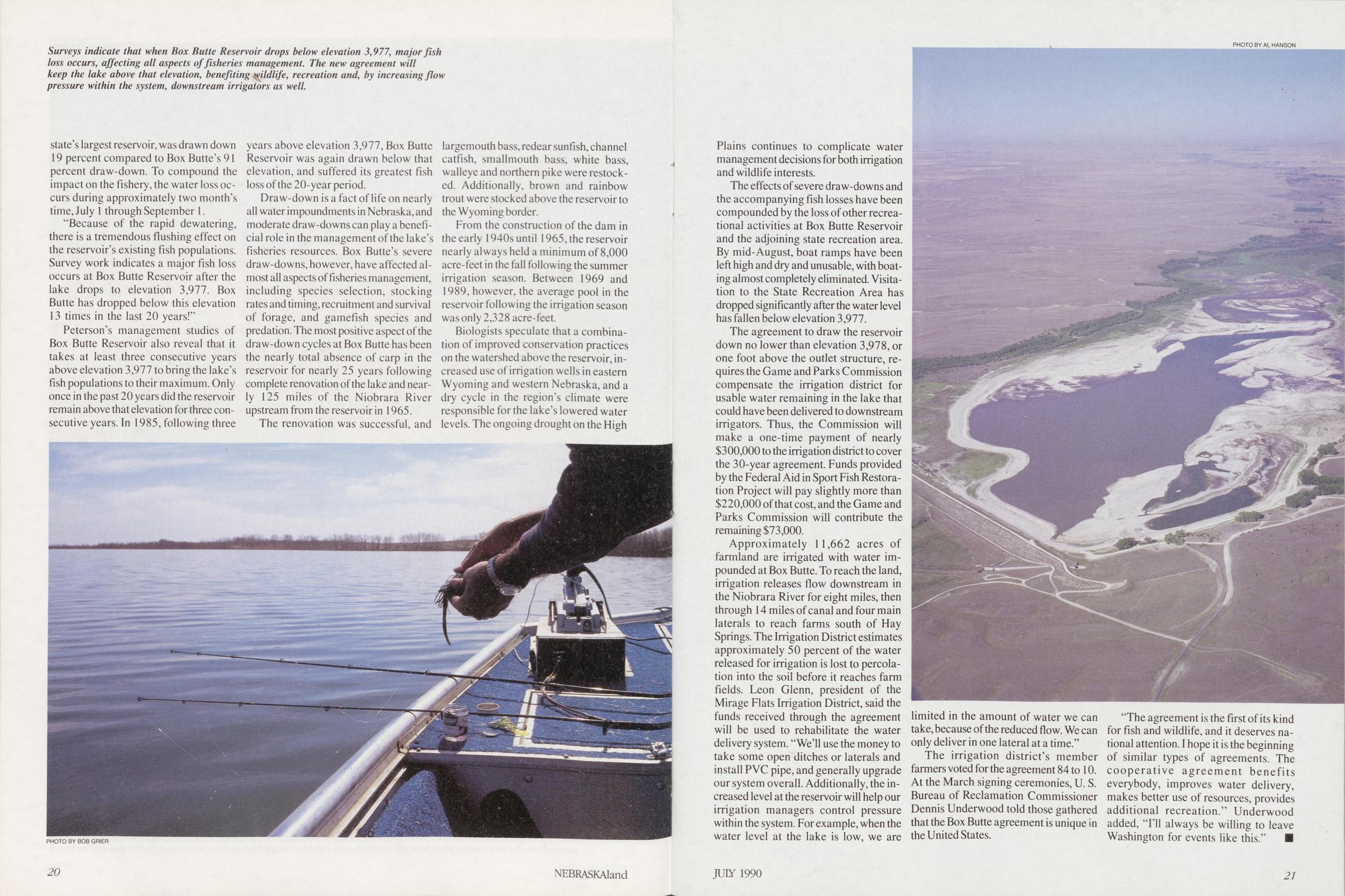
"Because of the rapid dewatering, there is a tremendous flushing effect on the reservoir's existing fish populations. Survey work indicates a major fish loss occurs at Box Butte Reservoir after the lake drops to elevation 3,977. Box Butte has dropped below this elevation 13 times in the last 20 years!"
Peterson's management studies of Box Butte Reservoir also reveal that it takes at least three consecutive years above elevation 3,977 to bring the lake's fish populations to their maximum. Only once in the past 20 years did the reservoir remain above that elevation for three consecutive years. In 1985, following three years above elevation 3,977, Box Butte Reservoir was again drawn below that elevation, and suffered its greatest fish loss of the 20-year period.
Draw-down is a fact of life on nearly all water impoundments in Nebraska, and moderate draw-downs can play a beneficial roie in the management of the lake's fisheries resources. Box Butte's severe draw-downs, however, have affected almost all aspects of fisheries management, including species selection, stocking rates and timing, recruitment and survival of forage, and gamefish species and predation. The most positive aspect of the draw-down cycles at Box Butte has been the nearly total absence of carp in the reservoir for nearly 25 years following complete renovation of the lake and nearly 125 miles of the Niobrara River upstream from the reservoir in 1965.
The renovation was successful, and largemouth bass, redear sunfish, channel catfish, smallmouth bass, white bass, walleye and northern pike were restocked. Additionally, brown and rainbow trout were stocked above the reservoir to the Wyoming border.
From the construction of the dam in the early 1940s until 1965, the reservoir nearly always held a minimum of 8,000 acre-feet in the fall following the summer irrigation season. Between 1969 and 1989, however, the average pool in the reservoir following the irrigation season was only 2,328 acre-feet.
Biologists speculate that a combination of improved conservation practices on the watershed above the reservoir, increased use of irrigation wells in eastern Wyoming and western Nebraska, and a dry cycle in the region's climate were responsible for the lake's lowered water levels. The ongoing drought on the High 20 NEBRASKAland
The effects of severe draw-downs and the accompanying fish losses have been compounded by the loss of other recreational activities at Box Butte Reservoir and the adjoining state recreation area. By mid-August, boat ramps have been left high and dry and unusable, with boating almost completely eliminated. Visitation to the State Recreation Area has dropped significantly after the water level has fallen below elevation 3,977.
The agreement to draw the reservoir down no lower than elevation 3,978, or one foot above the outlet structure, requires the Game and Parks Commission compensate the irrigation district for usable water remaining in the lake that could have been delivered to downstream irrigators. Thus, the Commission will make a one-time payment of nearly $300,000 to the irrigation district to cover the 30-year agreement. Funds provided by the Federal Aid in Sport Fish Restoration Project will pay slightly more than $220,000 of that cost, and the Game and Parks Commission will contribute the remaining $73,000.
Approximately 11,662 acres of farmland are irrigated with water impounded at Box Butte. To reach the land, irrigation releases flow downstream in the Niobrara River for eight miles, then through 14 miles of canal and four main laterals to reach farms south of Hay Springs. The Irrigation District estimates approximately 50 percent of the water released for irrigation is lost to percolation into the soil before it reaches farm fields. Leon Glenn, president of the Mirage Flats Irrigation District, said the funds received through the agreement will be used to rehabilitate the water delivery system. "We'll use the money to take some open ditches or laterals and install PVC pipe, and generally upgrade our system overall. Additionally, the increased level at the reservoir will help our irrigation managers control pressure within the system. For example, when the water level at the lake is low, we are limited in the amount of water we can take, because of the reduced flow. We can only deliver in one lateral at a time."
The irrigation district's member farmers voted for the agreement 84 to 10. At the March signing ceremonies, U. S. Bureau of Reclamation Commissioner Dennis Underwood told those gathered that the Box Butte agreement is unique in the United States.
"The agreement is the first of its kind for fish and wildlife, and it deserves national attention. I hope it is the beginning of similar types of agreements. The cooperative agreement benefits everybody, improves water delivery, makes better use of resources, provides additional recreation." Underwood added, "I'll always be willing to leave Washington for events like this."
JULY 1990 21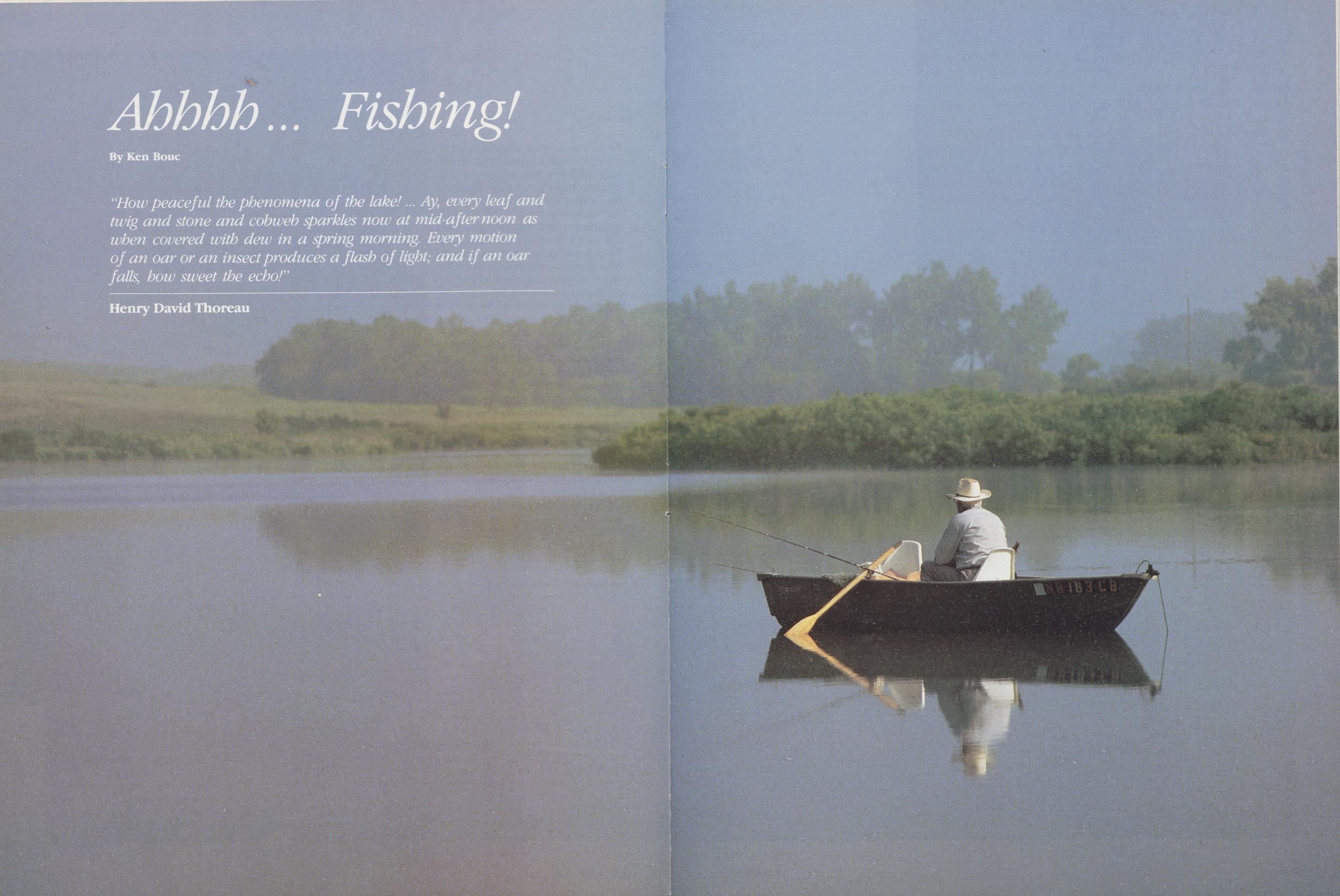
Ahhhh... Fishing!
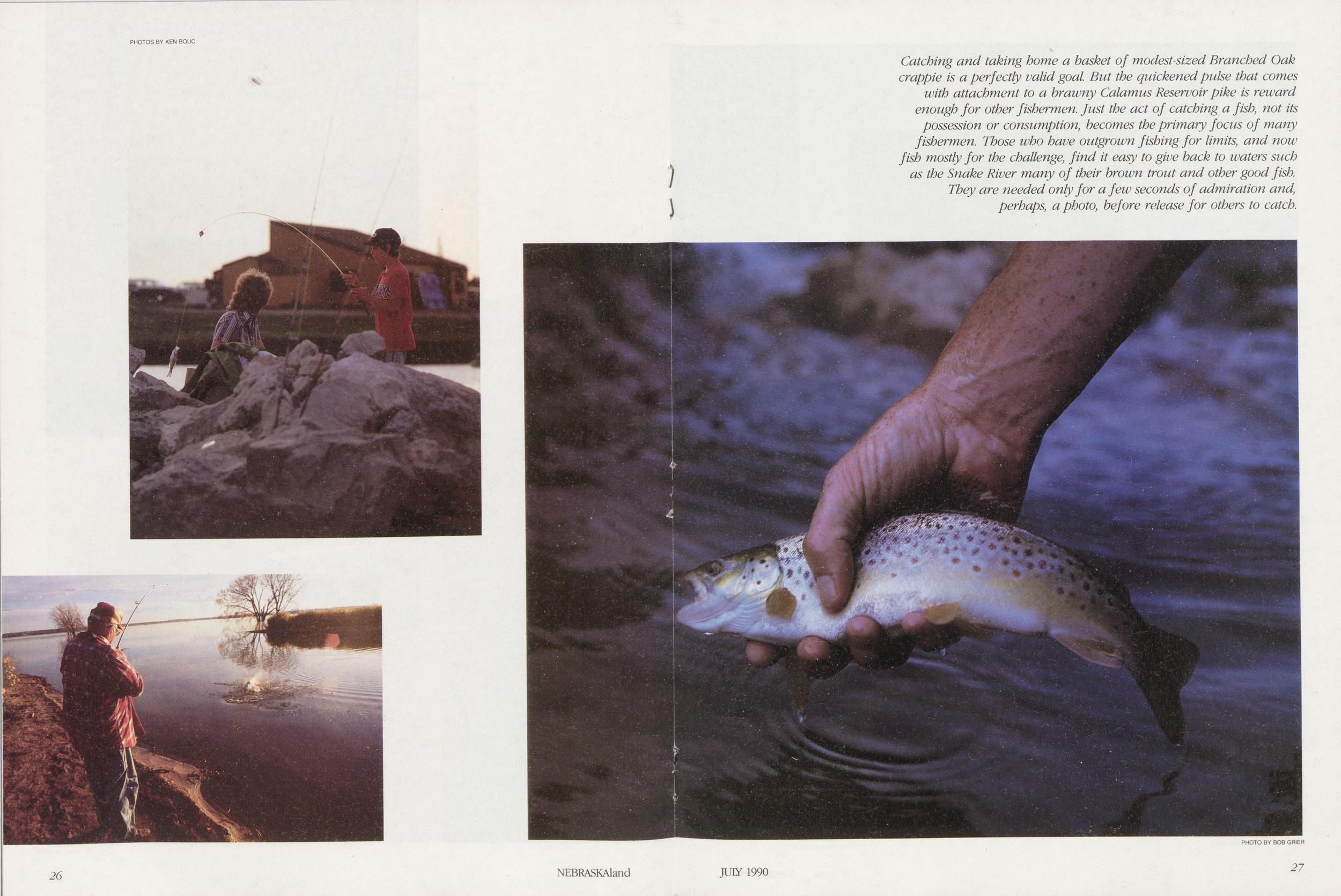
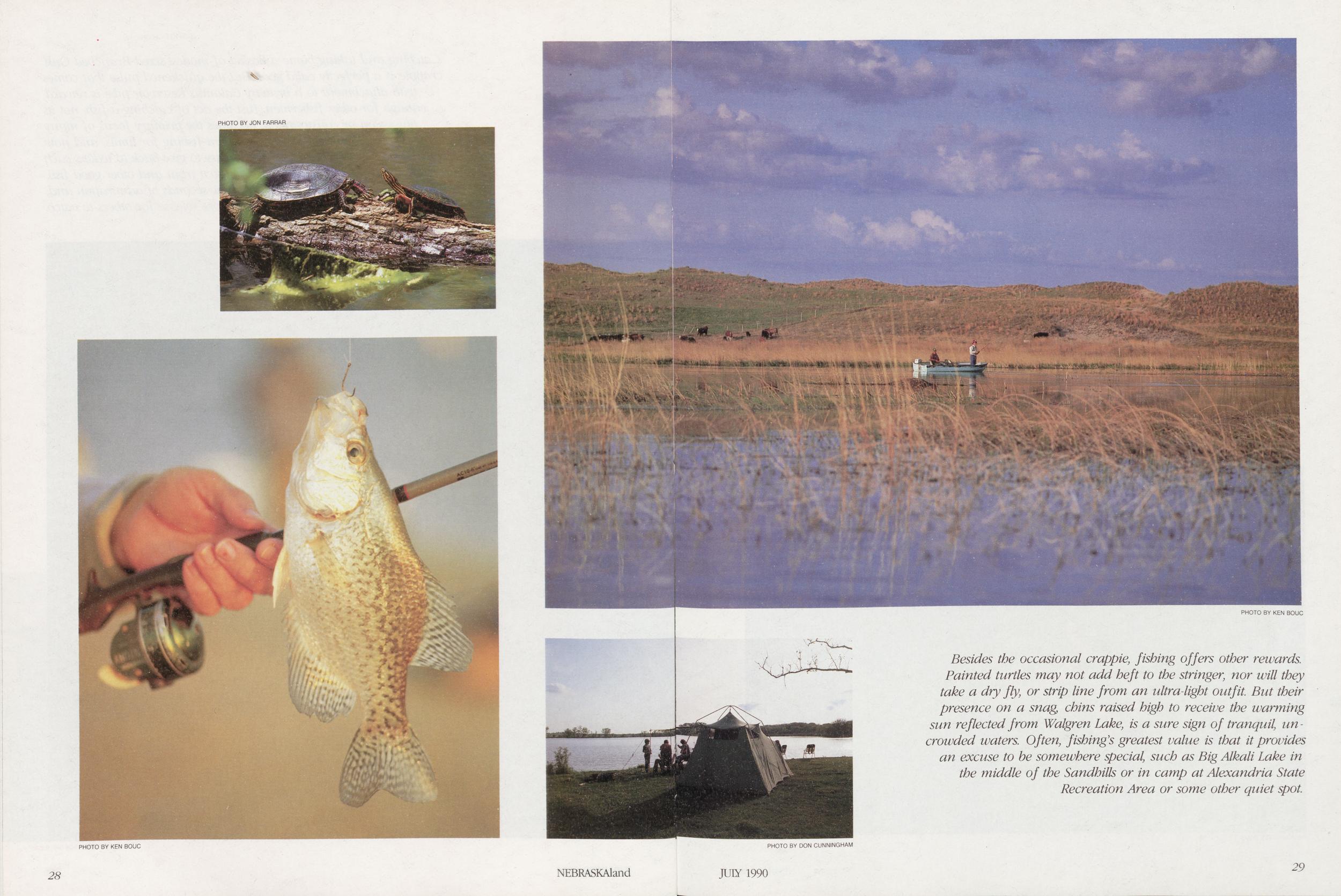
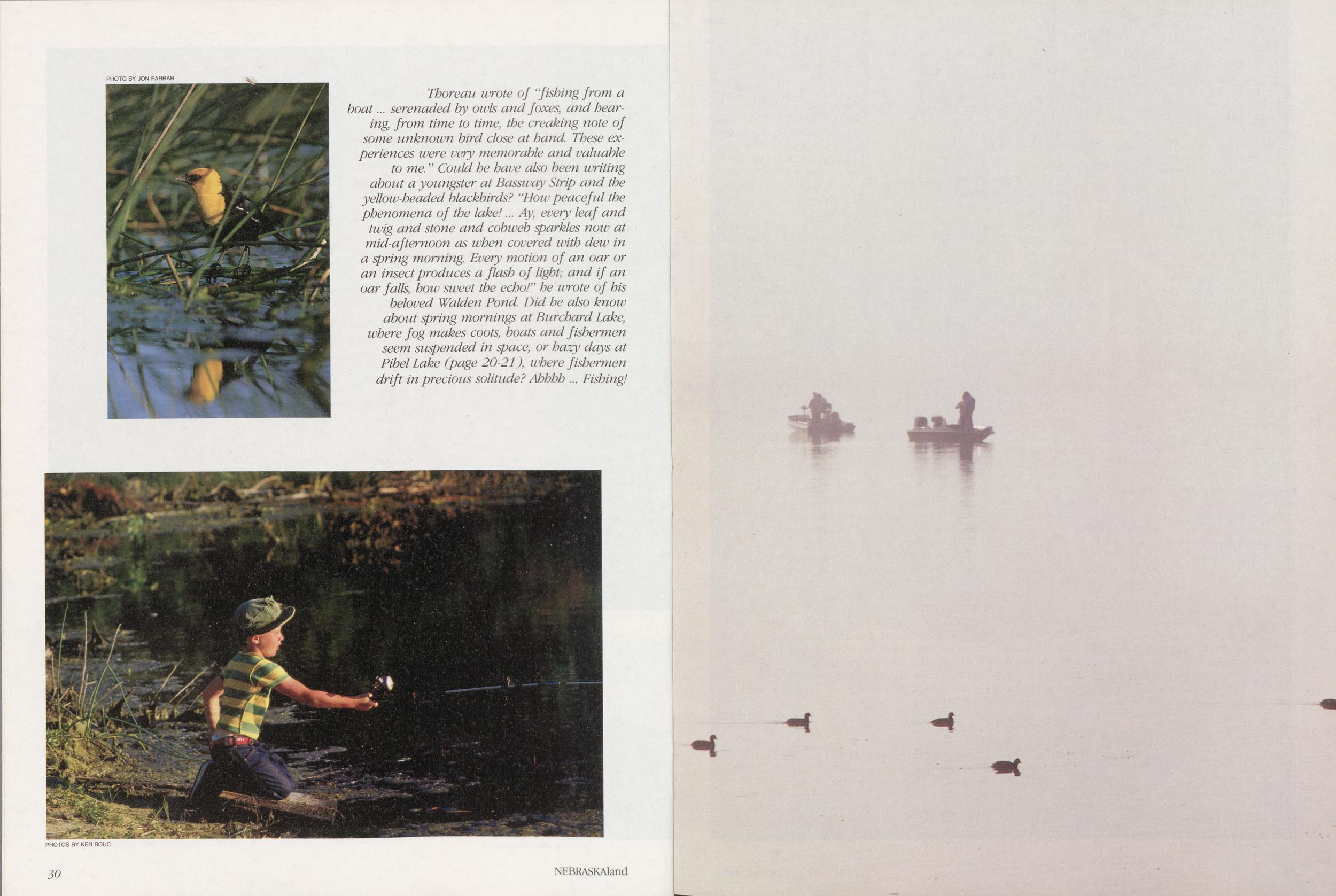
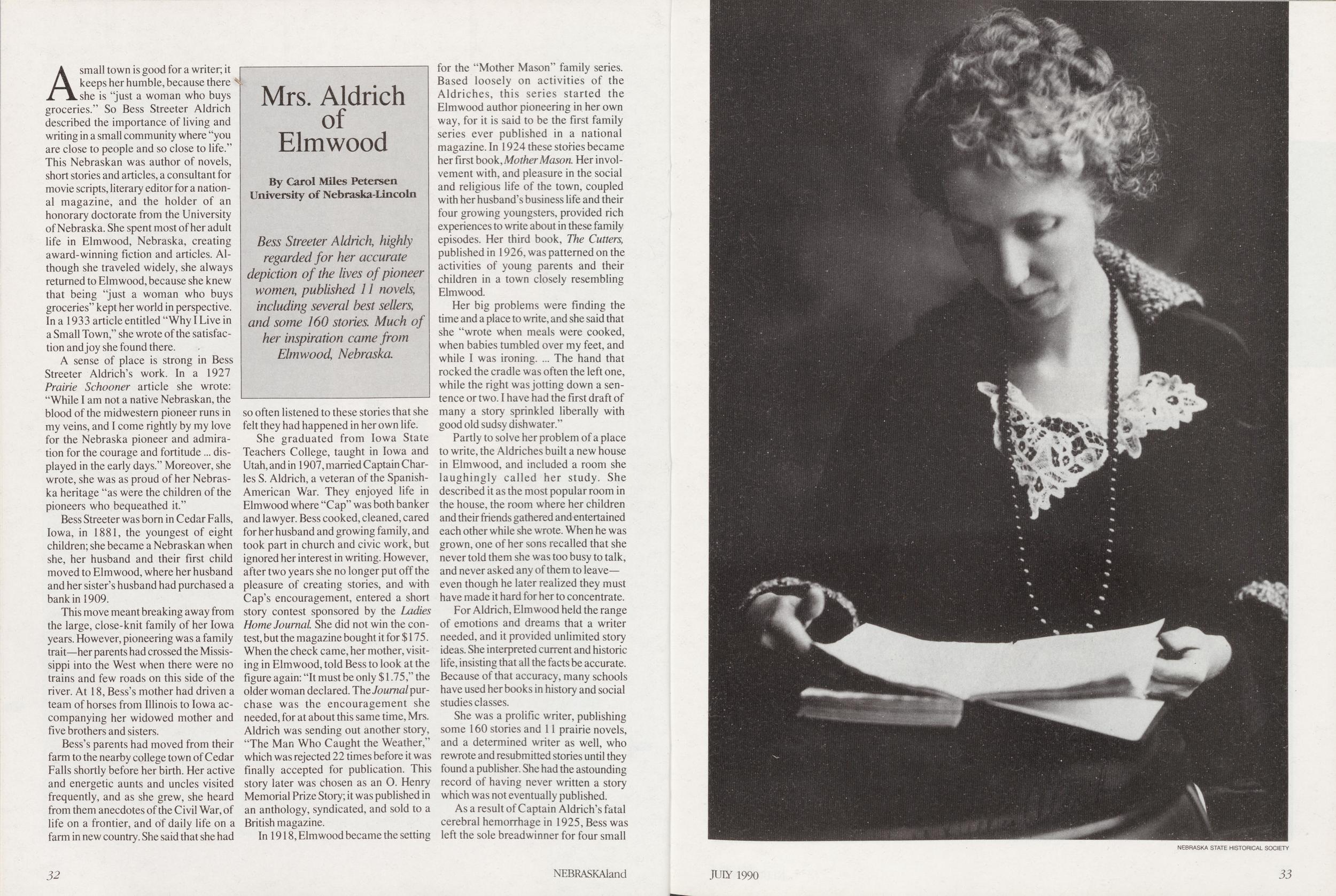
By Ken Bouc "How peaceful the phenomena of the lake! ...Ay, every leaf and twig and stone and cobweb sparkles now at mid-after noon as when covered with dew in a spring morning Every motion of an oar or an insect produces a flash of light; and if an oar falls, how sweet the echo!" Henry David Thoreau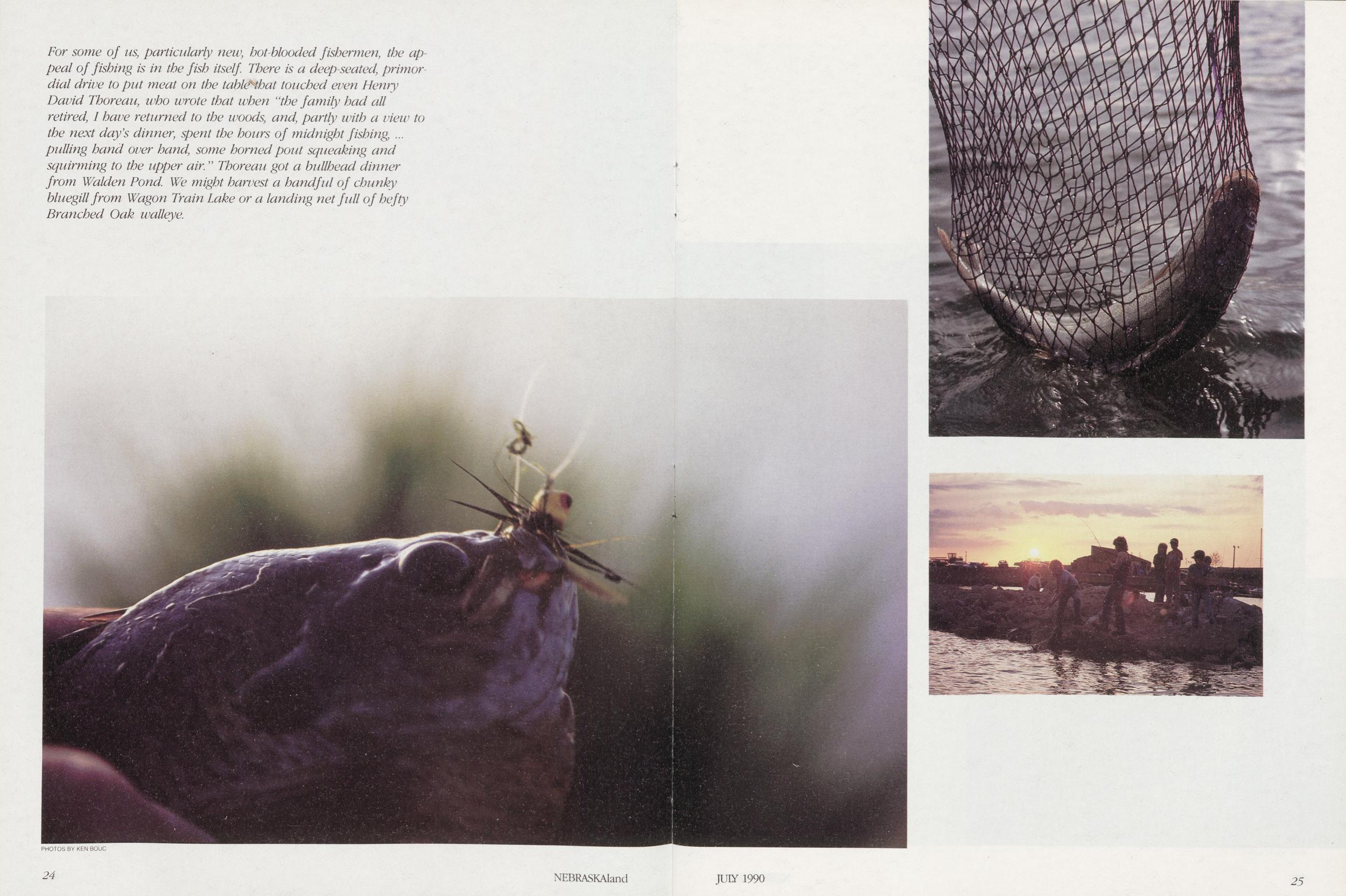 For some of us, particularly new, hot-blooded fishermen, the appeal of fishing is
in the fish itself. There is a deep-seated, primor
dial drive to put meat on the tabldHhat touched even Henry
David Thoreau, who wrote that when "the family had all
retired, I have returned to the woods, and, partly with a view to
the next day's dinner, spent the hours of midnight fishing
pulling hand over hand, some horned pout squeaking and
squirming to the upper air." Thoreau got a bullhead dinner
from Walden Pond. We might harvest a handful of chunky
bluegill from Wagon Train Lake or a landing net full of hefty
Branched Oak walleye.
For some of us, particularly new, hot-blooded fishermen, the appeal of fishing is
in the fish itself. There is a deep-seated, primor
dial drive to put meat on the tabldHhat touched even Henry
David Thoreau, who wrote that when "the family had all
retired, I have returned to the woods, and, partly with a view to
the next day's dinner, spent the hours of midnight fishing
pulling hand over hand, some horned pout squeaking and
squirming to the upper air." Thoreau got a bullhead dinner
from Walden Pond. We might harvest a handful of chunky
bluegill from Wagon Train Lake or a landing net full of hefty
Branched Oak walleye.
Mrs. Aldrich of Elmwood
By Carol Miles Petersen UIniversity of Nebraska-Lincoln Bess Streeter Aldrich highly regarded for her accurate depiction of the lives of pioneer women, published 11 novels, including several best sellers, and some 160 stories. Much of her inspiration came from Elmwood, Nebraska.A small town is good for a writer; it keeps her humble, because there she is "just a woman who buys groceries." So Bess Streeter Aldrich described the importance of living and writing in a small community where "you are close to people and so close to life." This Nebraskan was author of novels, short stories and articles, a consultant for movie scripts, literary editor for a national magazine, and the holder of an honorary doctorate from the University of Nebraska. She spent most of her adult life in Elmwood, Nebraska, creating award-winning fiction and articles. Although she traveled widely, she always returned to Elmwood, because she knew that being "just a woman who buys groceries" kept her world in perspective. In a 1933 article entitled "Why I Live in a Small Town," she wrote of the satisfaction and joy she found there.
A sense of place is strong in Bess Streeter Aldrich's work. In a 1927 Prairie Schooner article she wrote: "While I am not a native Nebraskan, the blood of the midwestern pioneer runs in my veins, and I come rightly by my love for the Nebraska pioneer and admiration for the courage and fortitude displayed in the early days." Moreover, she wrote, she was as proud of her Nebraska heritage "as were the children of the pioneers who bequeathed it."
Bess Streeter was born in Cedar Falls, Iowa, in 1881, the youngest of eight children; she became a Nebraskan when she, her husband and their first child moved to Elmwood, where her husband and her sister's husband had purchased a bank in 1909.
This move meant breaking away from the large, close-knit family of her Iowa years. However, pioneering was a family trait—her parents had crossed the Mississippi into the West when there were no trains and few roads on this side of the river. At 18, Bess's mother had driven a team of horses from Illinois to Iowa accompanying her widowed mother and five brothers and sisters.
Bess's parents had moved from their farm to the nearby college town of Cedar Falls shortly before her birth. Her active and energetic aunts and uncles visited frequently, and as she grew, she heard from them anecdotes of the Civil War, of life on a frontier, and of daily life on a farm in new country. She said that she had so often listened to these stories that she felt they had happened in her own life.
She graduated from Iowa State Teachers College, taught in Iowa and Utah, and in 1907, married Captain Charles S. Aldrich, a veteran of the Spanish-American War. They enjoyed life in Elmwood where "Cap" was both banker and lawyer. Bess cooked, cleaned, cared for her husband and growing family, and took part in church and civic work, but ignored her interest in writing. However, after two years she no longer put off the pleasure of creating stories, and with Cap's encouragement, entered a short story contest sponsored by the Ladies Home Journal. She did not win the contest, but the magazine bought it for $ 175. When the check came, her mother, visiting in Elmwood, told Bess to look at the figure again: "It must be only $ 1.75," the older woman declared. The Journal purchase was the encouragement she needed, for at about this same time, Mrs. Aldrich was sending out another story, "The Man Who Caught the Weather," which was rejected 22 times before it was finally accepted for publication. This story later was chosen as an O. Henry Memorial Prize Story; it was published in an anthology, syndicated, and sold to a British magazine.
In 1918, Elmwood became the setting for the "Mother Mason" family series. Based loosely on activities of the Aldriches, this series started the Elmwood author pioneering in her own way, for it is said to be the first family series ever published in a national magazine. In 1924 these stones became her first book, Mother Mason. Her involvement with, and pleasure in the social and religious life of the town, coupled with her husband's business life and their four growing youngsters, provided rich experiences to write about in these family episodes. Her third book, The Cutters, published in 1926, was patterned on the activities of young parents and their children in a town closely resembling Elmwood.
Her big problems were finding the time and a place to write, and she said that she "wrote when meals were cooked, when babies tumbled over my feet, and while I was ironing. The hand that rocked the cradle was often the left one, while the right was jotting down a sentence or two. I have had the first draft of many a story sprinkled liberally with good old sudsy dishwater."
Partly to solve her problem of a place to write, the Aldriches built a new house in Elmwood, and included a room she laughingly called her study. She described it as the most popular room in the house, the room where her children and their friends gathered and entertained each other while she wrote. When he was grown, one of her sons recalled that she never told them she was too busy to talk, and never asked any of them to leave even though he later realized they must have made it hard for her to concentrate.
For Aldrich, Elmwood held the range of emotions and dreams that a writer needed, and it provided unlimited story ideas. She interpreted current and historic life, insisting that all the facts be accurate. Because of that accuracy, many schools have used her books in history and social studies classes.
She was a prolific writer, publishing some 160 stories and 11 prairie novels, and a determined writer as well, who rewrote and resubmitted stories until they found a publisher. She had the astounding record of having never written a story which was not eventually published.
As a result of Captain Aldrich's fatal cerebral hemorrhage in 1925, Bess was left the sole breadwinner for four small 32 NEBRSAKAland
After its publication, an Omaha radio station in 1927 asked her to talk on the air about "The Pioneer in Fiction." Radio was still a new medium, and there was only one receiver in Elmwood; in the entire area there would be few who would hear her. However, she wanted to write about pioneers, and at the end of the program she asked listeners who had information about life in early Nebraska to send her whatever they would. She hoped for a half-dozen replies, but her request over the airways also spread by word of mouth, and from rural areas, small towns and big towns, the mail brought diaries, journals, clippings, scrapbooks and offers for interviews. This flood of information took her 14 months to sort through, and from it emerged many of the realistic details of A Lantern in Her Hand(1928), the novel that was to become the first of her best sellers.
Others had written about the experience of women coming to the Midwest in those early days, of how difficult their lives were, of how often they were portrayed as "gaunt, brow-beaten creatures, despairing women whom life seemed to defeat." But Aldrich did not believe pioneering women should be pictured so bleakly, and looked at the example of her own mother. She had told the young Bess what it had been like to ride into the new country where horses and oxen had to plunge through the water of unbridged creeks, where evening camp was made to the song of the night wind, and where the scent of prairie grasses engulfed the travelers.
These recollections had been told as exciting adventures, and confirmed as such on one occasion when the older woman, then in her 80s, had been describing a winter storm with snow drifting through cracks in the cabin's log walls, making strange patterns on the beds. Aldrich reacted sympathetically: she was sorry her mother's life had held so many difficulties while her own was filled with
A Lantern in Her Hand was that book, and the main character, Abbie Deal, was in part Bess's mother, as well as being an embodiment of the spirit of American frontier women. Aldrich said that Abbie might have lived anywhere—in the Mohawk Valley, the wheat country of the Dakotas, a ranch in Montana or the apple-growing regions of Washington and Oregon—and she would have been at home in any of these settings. The story she tells is of strong women, certainly not "gaunt and brow-beaten," to whom sacrifice and hard work, disappointments and discouragements were everyday happenings—women whose lives were tempered by these elements. These were women whose lives also held laughter, friendship, and satisfaction in accomplishment.
A Lantern in Her Hand is set in an area of the Great Plains much like that around Elmwood, an area Bess describes in the first paragraph as between "the effete east and the distinctive west, neither effete nor distinctive, nor even particularly pleasing to the passing tourist. It is beautiful only in the eyes of those who live here or [recall] the low rolling hills, the swell and dip of the ripening wheat, the fields of sinuously waving corn and the elusively fragrant odor of alfalfa." Aldrich often described the beauty she knew around Elmwood: the land, the wildflowers, the sunsets and even the violent storms.
The sequel, A White Bird Flying, is also set in an area like Elmwood as well as in Lincoln and at Arbor Lodge in Nebraska City. Published in 1931, it was a best seller that year, sharing honors with the works of two other women writers—one, Nebraskan Willa Cather's Shadows on the Rock, and the other, Pearl S. Buck's The Good Earth.
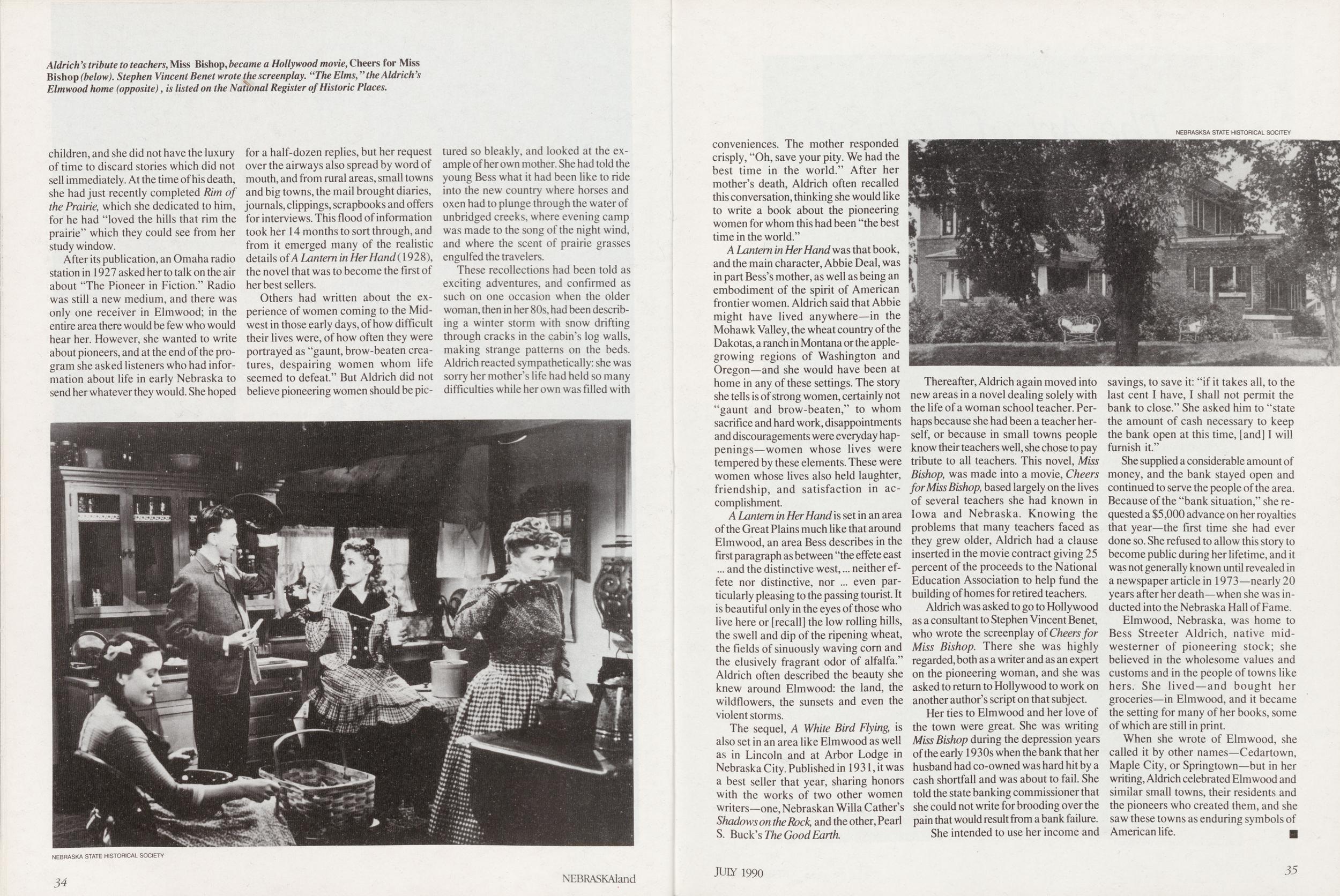
Thereafter, Aldrich again moved into new areas in a novel dealing solely with the life of a woman school teacher. Perhaps because she had been a teacher herself, or because in small towns people know their teachers well, she chose to pay tribute to all teachers. This novel, Miss Bishop, was made into a movie, Cheers for Miss Bishop, based largely on the lives of several teachers she had known in Iowa and Nebraska. Knowing the problems that many teachers faced as they grew older, Aldrich had a clause inserted in the movie contract giving 25 percent of the proceeds to the National Education Association to help fund the building of homes for retired teachers.
Aldrich was asked to go to Hollywood as a consultant to Stephen Vincent Benet, who wrote the screenplay of Cheers for Miss Bishop. There she was highly regarded, both as a writer and as an expert on the pioneering woman, and she was asked to return to Hollywood to work on another author's script on that subject.
Her ties to Elmwood and her love of the town were great. She was writing Miss Bishop during the depression years of the early 1930s when the bank that her husband had co-owned was hard hit by a cash shortfall and was about to fail. She told the state banking commissioner that she could not write for brooding over the pain that would result from a bank failure.
She intended to use her income and savings, to save it: "if it takes all, to the last cent I have, I shall not permit the bank to close." She asked him to "state the amount of cash necessary to keep the bank open at this time, [and] I will furnish it."
She supplied a considerable amount of money, and the bank stayed open and continued to serve the people of the area. Because of the "bank situation," she requested a $5,000 advance on her royalties that year—the first time she had ever done so. She refused to allow this story to become public during her lifetime, and it was not generally known until revealed in a newspaper article in 1973—nearly 20 years after her death—when she was inducted into the Nebraska Hall of Fame.
Elmwood, Nebraska, was home to Bess Streeter Aldrich, native midwesterner of pioneering stock; she believed in the wholesome values and customs and in the people of towns like hers. She lived—and bought her groceries—in Elmwood, and it became the setting for many of her books, some of which are still in print.
When she wrote of Elmwood, she called it by other names—Cedartown, Maple City, or Springtown—but in her writing, Aldrich celebrated Elmwood and similar small towns, their residents and the pioneers who created them, and she saw these towns as enduring symbols of American life.
JULY 1990 35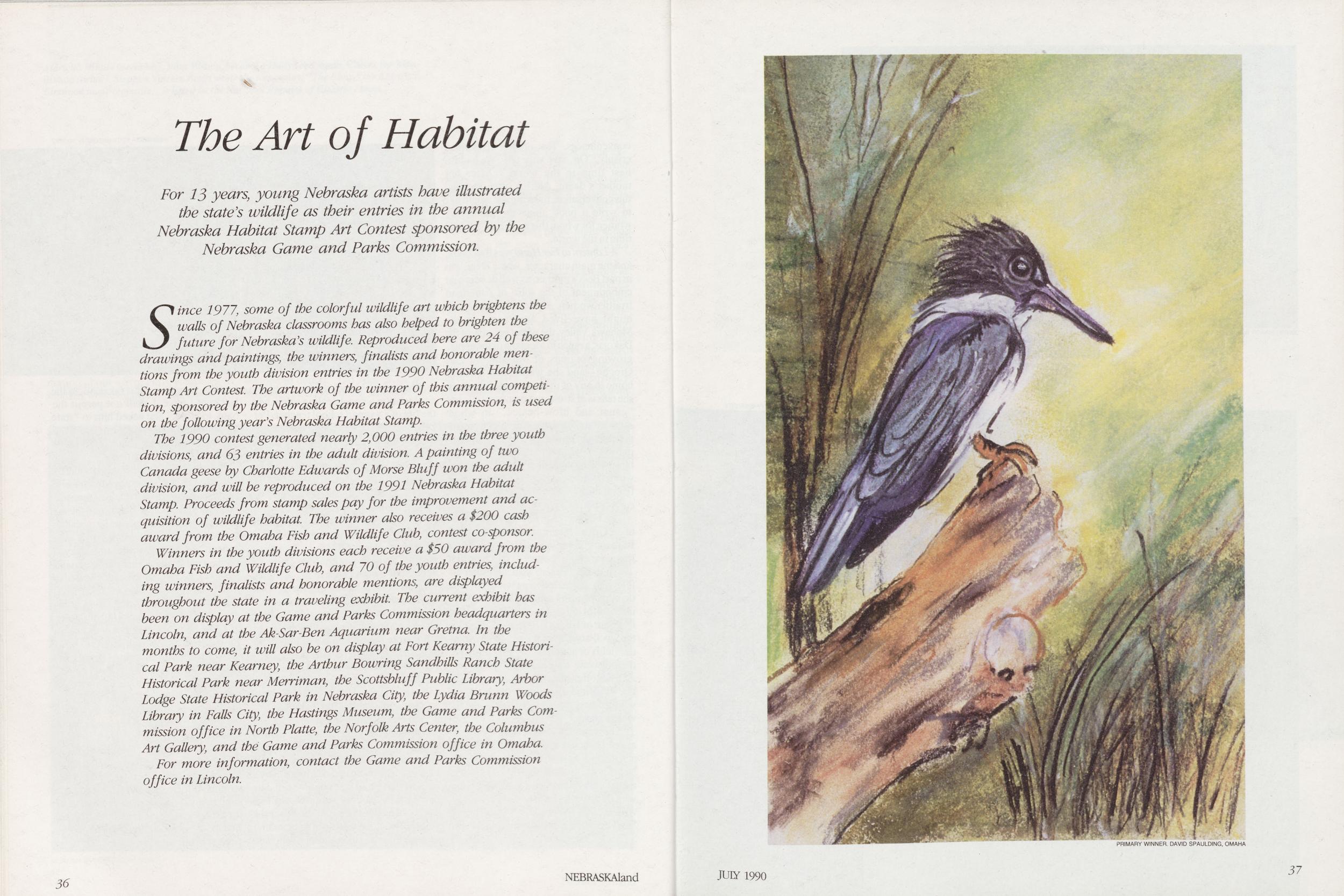
The Art of Habitat
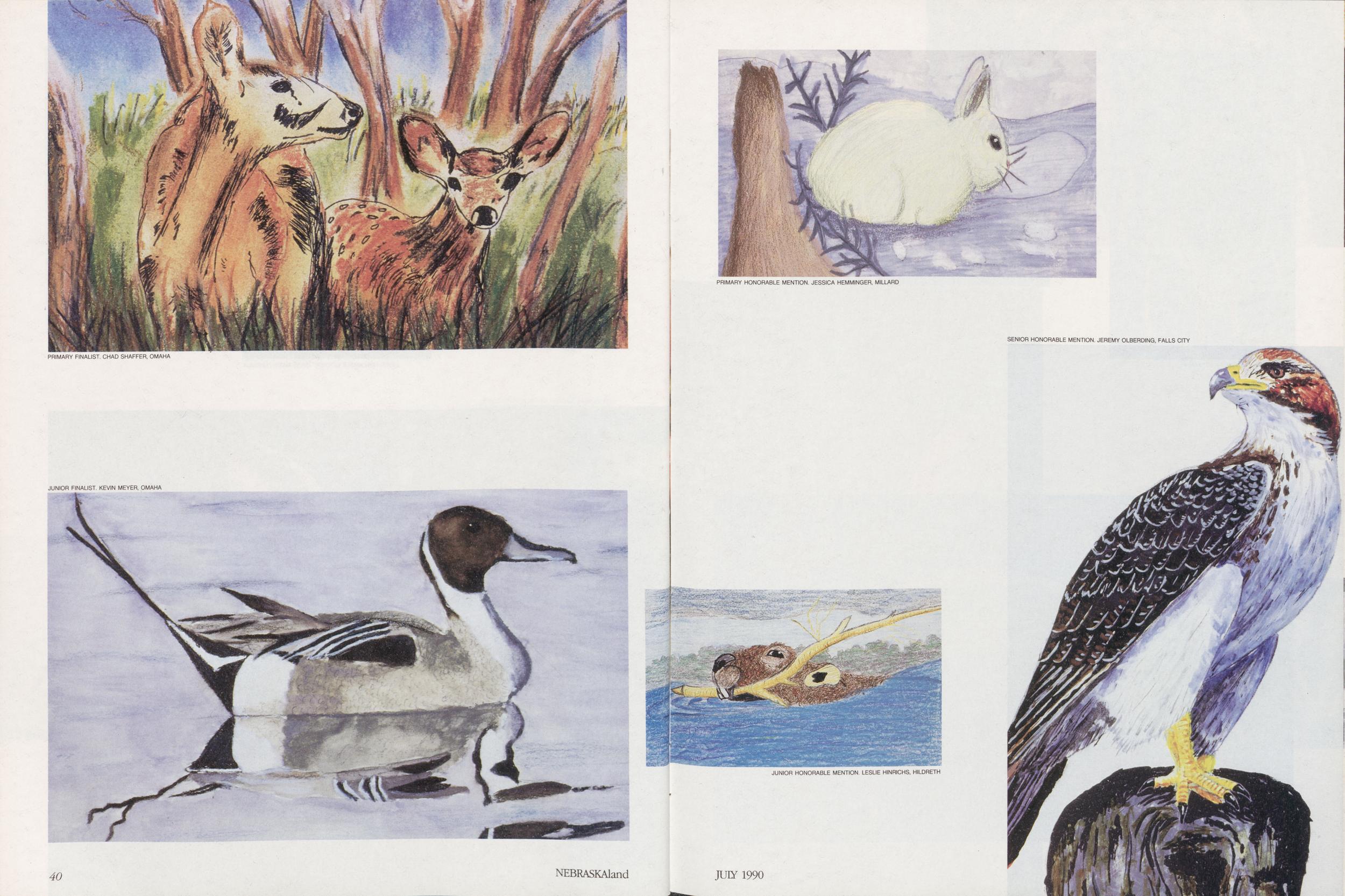
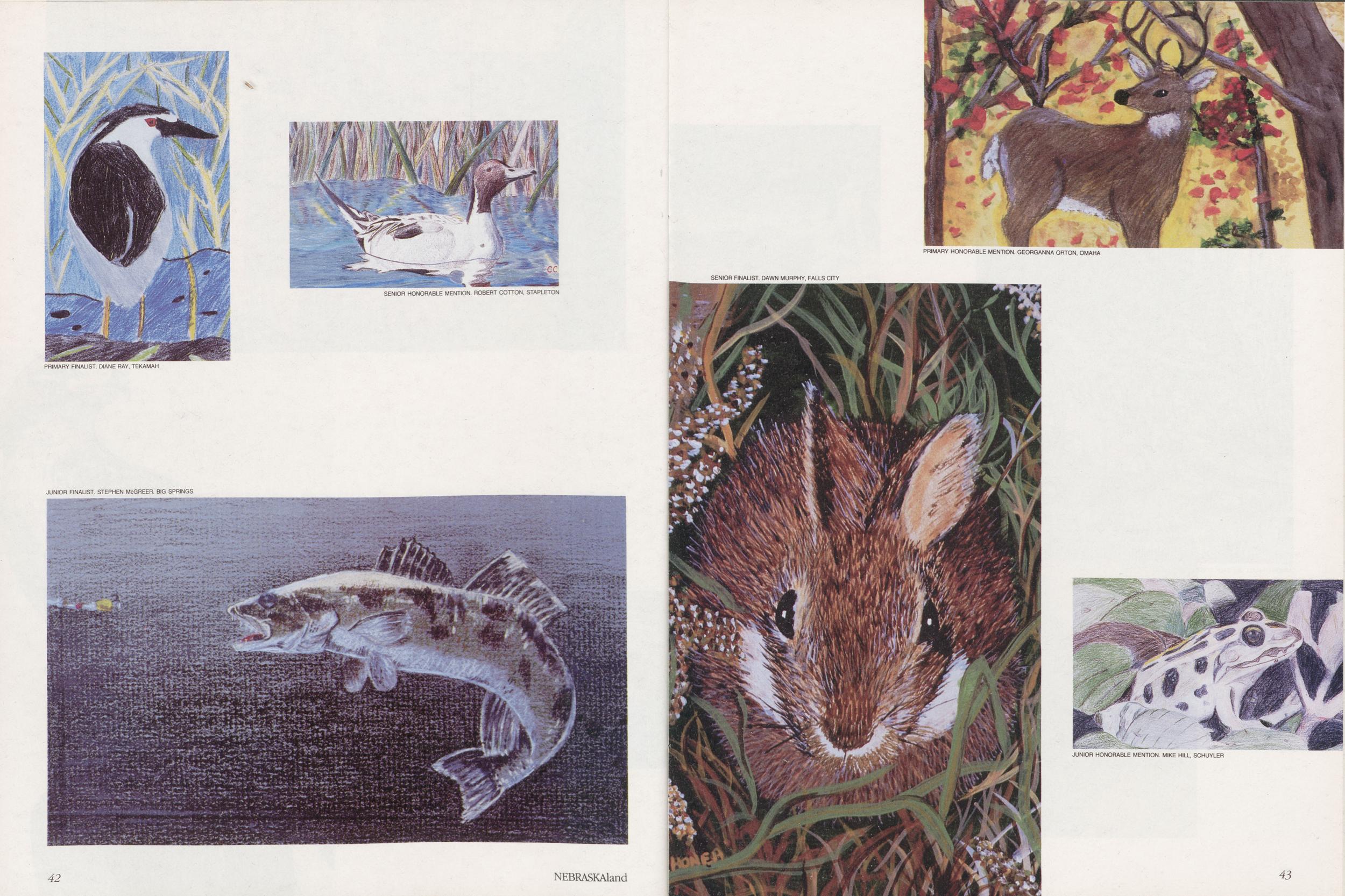
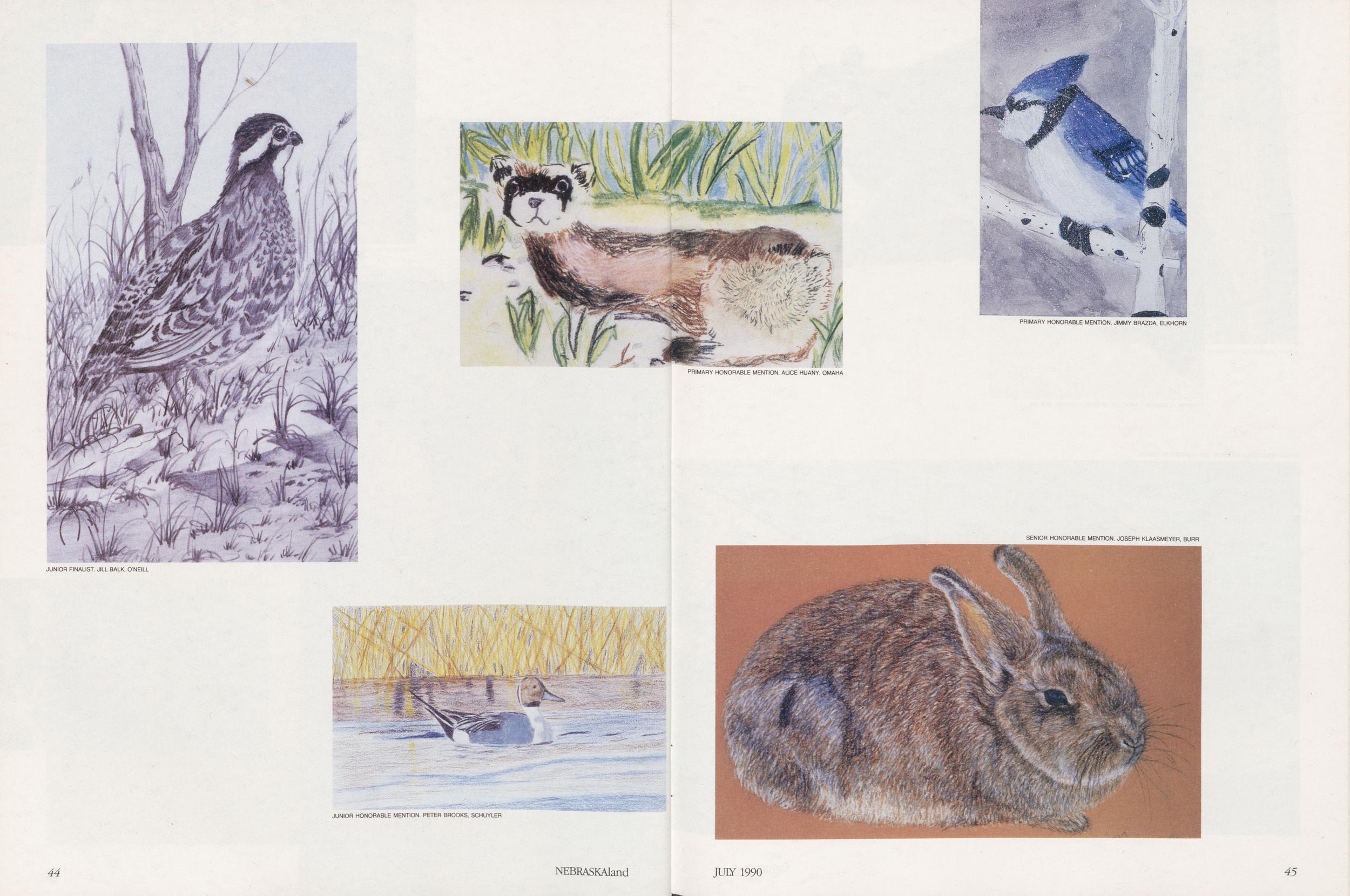
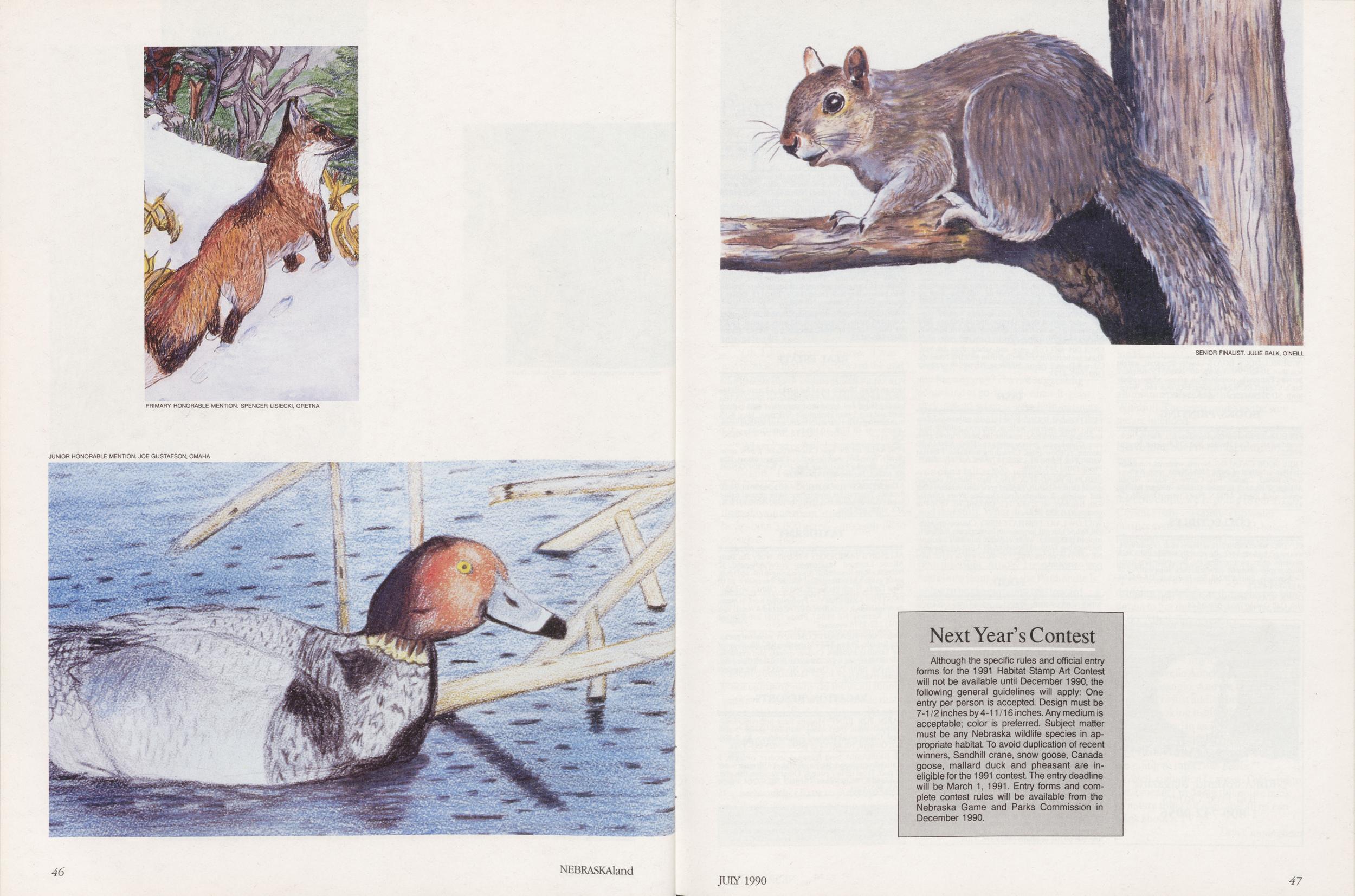
For 13 years, young Nebraska artists have illustrated the state's wildlife as their entries in the annual Nebraska Habitat Stamp Art Contest sponsored by the Nebraska Game and Parks Commission.Since 1977, some of the colorful wildlife art which brightens the walls of Nebraska classrooms has also helped to brighten the future for Nebraska's wildlife. Reproduced here are 24 of these drawings and paintings, the winners, finalists and honorable mentions from the youth division entries in the 1990 Nebraska Habitat Stamp Art Contest. The artwork of the winner of this annual competition, sponsored by the Nebraska Game and Parks Commission, is used on the following year's Nebraska Habitat Stamp.
The 1990 contest generated nearly 2,000 entries in the three youth divisions, and 63 entries in the adult division. A painting of two Canada geese by Charlotte Edwards of Morse Bluff won the adult division, and will be reproduced on the 1991 Nebraska Habitat Stamp. Proceeds from stamp sales pay for the improvement and acquisition of wildlife habitat. The winner also receives a $200 cash award from the Omaha Fish and Wildlife Club, contest co-sponsor.
Winners in the youth divisions each receive a $50 award from the Omaha Fish and Wildlife Club, and 70 of the youth entries, including winners, finalists and honorable mentions, are displayed throughout the state in a traveling exhibit. The current exhibit has been on display at the Game and Parks Commission headquarters in Lincoln, and at the Ak-Sar-Ben Aquarium near Gretna. In the months to come, it will also be on display at Fort Kearny State Historical Park near Kearney, the Arthur Bowring Sandhills Ranch State Historical Park near Merriman, the Scottsbluff Public Library) Arbor Lodge State Historical Park in Nebraska City, the Lydia Brunn Woods Library in Falls City, the Hastings Museum, the Game and Parks Commission office in North Platte, the Norfolk Arts Center, the Columbus Art Gallery, and the Game and Parks Commission office in Omaha.
For more information, contact the Game and Parks Commission office in Lincoln.
36 NEBRASKAland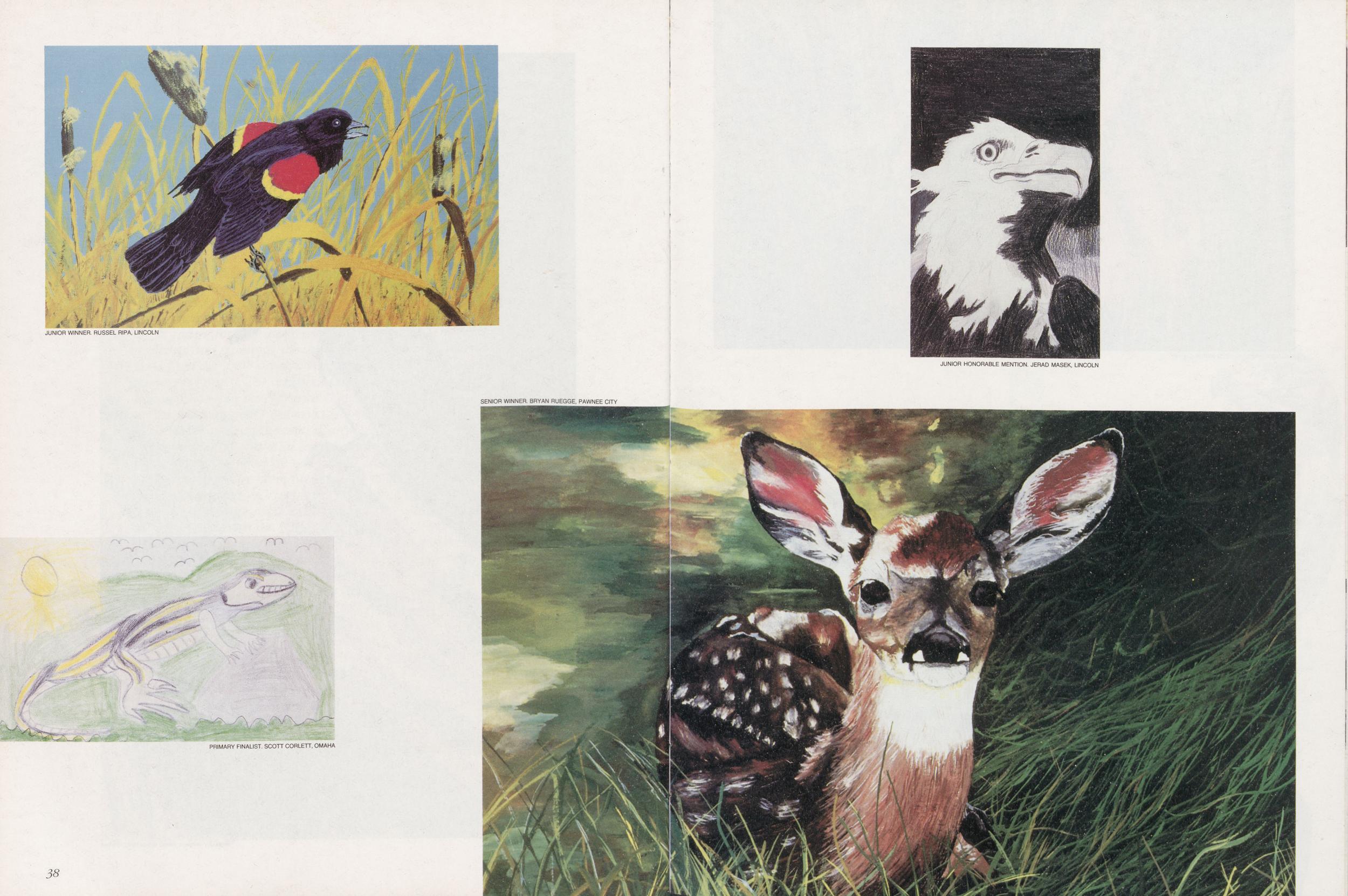
Although the specific rules and official entry forms for the 1991 Habitat Stamp Art Contest will not be available until December 1990, the following general guidelines will apply: One entry per person is accepted. Design must be 7-1 /2 inches by 4-11 /16 inches. Any medium is acceptable; color is preferred. Subject matter must be any Nebraska wildlife species in appropriate habitat To avoid duplication of recent winners, Sandhill crane, snow goose, Canada goose, mallard duck and pheasant are ineligible for the 1991 contest. The entry deadline will be March 1, 1991. Entry forms and complete contest rules will be available from the Nebraska Game and Parks Commission in December 1990.
JULY 1990 47
Classified
ARTS & CRAFTSBev Doolittle, Terrry Redlin, Jerry Raedke, Ed Wards, Robert Bateman, Frank McCarthy and Neal Anderson are available at the 2nd Street Gallery, 537 W. 2nd, Hastings, NE 68901. Phone (402) 463-6677.
BIRDSGAMEBIRDS: Pheasants, partridges, wild turkeys, eggs, chicks, adults. National Poultry Improvement Plan participants—guaranteed top quality for propagation, hunting, eating and taxidermy. Call now to place 1990 chick orders. Bargain prices on hen chicks. Toubl Game Bird Farms, Beloit, WI (608) 365-1789.
BOATS/MOTORSTROLLING MOTOR REPAIR. Factory authorized Minn Kota and Motor Guide, parts and service. Wolfs Tackle Supply, 5950 Colfax Ave., Lincoln, NE 68507. Phone (402) 464-4265
BLUEBILL DUCK BOATS—sturdy fiberglass, weighs less than 50 lbs., 9Vi ft. long, 40" beam, 15" height, 2 person. Extremely portable—go places where others can't. Contact RCM Marketing, P.O. Box 166, Watertown, SD 57201. Phone 1-800-658-4778
BOOKS/PRINTINGFREE! Booklets on northeastern Nevada; fishing, rockhounding maps, Carl Hayden, Box 528, Jackpot, Nevada 89825.
FREE BOOK CATALOG. Novels, westerns, romances, children's; old out of print, found barns, attic. Authors: Grey, Bower, Connor, Fox, Curwood, Raine, Wright, Aldrige, Pollyanna, Freckles, many others. Postage appreciated. Pierce, 4400 N. Pine Cluster, Orovilie, CA 95965.
COLLECTIBLESBUYING: American Indian artifacts such as beadwork, weavings, baskets, etc.; also cowboy memorabilia such as chaps, spurs, photographs, etc. Best price first letter; photographs promptly returned. Jack Ringwalt, 1550 California St., Suite 6, #211, San Francisco, C A 94109, (415)759-6343.
DUCK STAMP collection for sale. Complete. No singles. Call Omaha (402) 330-1648.
NEBRASKAland Magazine Toll Free Orders 1-800-742-0056 DOGSYELLOW-BLACK Lab pups. FC-AFC sired. AKC. Hips OFA ceritified. Dew claws removed. Excellent hunting potential. Contact Bob Bendler, Lexington, NE (308) 324-4247.
TRAINING ALL BREEDS bird dogs—Vizslas & English Pointers—for sale. Rozanek Kennels, R 2, Schuyler, NE 68661. Phone (402) 352-8769.
ENGLISH SETTERS: "Bred for the hunter"; select puppies and started dogs available from outstanding bloodlines. Stud service available by proven hunters. High Plains Kennels, 1411 Emerson, Alliance, NE 69301, Phone (308) 762-6709.
PINKERTON BIRD DOGS—English setter, brittany puppies. Started dogs available this fall. Our dogs are Dred for nose and style. Give us a call at (402) 673-4540.
GERMAN SHORTHAIR and springer spaniel pup- pies—also started dogs. Outstanding bloodlines. Bird dog training. Cactus Kennels, Dave Wickham, Kimball, NE 69145. (308) 235-3237.
ENGLISH SETTER pups and young dogs for sale. These are beautiful, stylish dogs from selective breeding. Contact Darrell Yentes, Holdrege, NE 68949 or phone (308) 995-4797.
FISHFISH FOR SALE. Catfish, perch, coho salmon, rainbow trout, crappie, bluegill, walleye, minnows, goldfish, bullhead, largemouth bass, smallmouth bass, triploid grass carp. Commercial grower prices on catfish, perch, coho salmon, rainbow trout. Consulting available. Pleasant Valley Fish Farm, Rt 1 Box 147, McCook, NE 69001. Phone (308) 345-6599.
FISH FOR POND STOCKING. Bass, bluegill, crappie, perch, channel catfish, Triploid grass carp, rainbow trout and walleye. Available April-October. Write Orchard Fish Hatchery, Rt 2, Box 117, Orchard, NE 68764 or phone (402) 893-2521.
WILLOW LAKE FISH HATCHERY. Channel cat, bluegill, hybrid bluegill, largemouth bass, crappie, bullheads, triploid grass carp, walleye, perch, minnows available for stocking. Gaylord Crawford, Rt 3 Box 46, Hastings, NE 68901 or phone (402) 463-8022 day or night. Also pond consultant.
FOODWINE AND BEER: Make your own. Send for free recipes and instructions. Omaha Supply, 1324 2nd Avenue, Nebraska City, NE 68410.
BUFFALO JERKY, 16 1-oz. pkgs. for $23 including shipping. Sample $1.75. G. E. Hill Distributing, 5220 Ayfesworth, Lincoln, NE 68504. Phone (402) 464-6781.
GUIDES/OUTFITTERSMAD RIVER CANOES offers the finest quality and performance. For the finest canoes and accessories look to Great Plains Canoe Co., 205 Main, Springfield, NE. Phone (402) 253-2001.
EXPERIENCE NEBRASKA with an affordable canoe trip by Dryland Aquatics. One and two-day trips canoe rental or fully catered. Niobrara Dismal Platte Elkhorn We do it your way! For free brochure: Dryland Aquatics, Dept. N, 1837 E. Cuming, Fremont, NE 68025 or phone (402) 721-4177.
FERGUSON GUIDE SERVICE. Call Dan Ferguson (308) 785-2413 to book your 1990 fishing trip. Elwood, Calamus and Johnson Lake.
GRAHAM CANOE OUTFITTERS: Top quality fullservice camping and canoe trips on the Niobrara River. Daily canoe rentals and car shuttle-service available. Contact Doug & Twyla Graham, HC 13 Box 16, Valentine, NE 69201 or phone (402) 376-3708.
CANOE RENTALS: Kamp Kaleo, Burwell, NE. 17-ft. aluminum canoes, $ 15 per day. Call (308) 346-5083 for information and reservations.
KEN KO INC. Spend a day fishing the scenic Missouri River with Fishing Guide Kenneth Cooksey. For information write 2002 2nd Ave., Nebraska City, NE 68025 or call (402) 873-6288 mornings/evenings.
GOOD PHEASANT hunting this fall in the North Platte River Valley 30 miles west of North Platte, NE. Phone or write Darrell White, Box 355, Sutherland, NE 69165. Phone (308) 386-4609 evenings.
OUTDOOR EQUIPMENTGUNS — Browning, Winchester, Remington, others, Hi-powers, shotguns, new, used, antiques. Want Pre-'64 Winchesters. Buy-Sell-Trade. (402) 729-6112. Bedlan's Sporting Goods, Fairbury, NE 68352.
AIR GUNS repaired—Benjamin, Crosman, Daisy, other American made. Restoration; old guns wanted. Jack's Air Guns, 1225 No. 46th, Lincoln, NE 68503. Phone (402) 466-9223.
REAL ESTATEFOR SALE—Hunting camp on 90-acre Missouri River bottom farm; 10-acre pond for ducks, 12-acre wildlife habitat for pheasants and quail, balance as cropland. Has hunting lodge and decoy shed; deepwater well to flood pond and two 5-man steel pits in duck pond. Ideal 8-12 man hunting club. Four miles northeast of Modale, Iowa, interchange on 1-29, 30 minutes from Omaha. (712) 328-3157.
FOR SALE on the new Calamus Lake, a new completely furnished mobile home. Please contact Ron Shonka, Shonka Real Estate, Inc., P.O. Box 509, O'Neill, NE 68763. Phone (402) 336-3500.
ATLANTIC CITY, WYOMING-40 acres with 30x20 ft. cabin. Water rights from spring. Some mineral rights. Scenic view of mountains. Call (307) 332-5070 or (308) 332-3158. $55,000.
TAXIDERMYALLISON'S TAXIDERMY STUDIO. Wally and Betty Allison Licensed Taxidermist. We've mounted 32 Nebraska State Record fish. Specializing in fish and birds, small game and rattlesnakes. We use freeze-dry 2310 West Leota, North Platte, NE 69101. (308) 534-2324.
PEISTER TAXIDERMY - Professional work at prices most sportsman can afford. 1020 Central Avenue Box 3201, Kearney, NE 68847. Phone (308) 236-9700 or (308) 237-7575 evenings.
SWANSON PHEASANT COMPANY: mounted pheasants for sale. Flying $87.95; standing $92.95; shipping and handling included. Custom mounts also available. Tell us what you want. Swanson Pheasant Company 6123 No. 100th Plz., Omaha, NE 68134. We support pheasant stocking.
VACATION/RESORTSCABIN FOR RENT. Modern three-bedroom, fullyequipped cabin overlooking secluded, scenic 3-acre pond. Call or write OrchardFish Hatchery, Rt 2 Box 117, Orchard, NE 68764 or phone (402) 893-2521.
NE NEBRASKA trout fishing. 3 modern cottages 1 available year round. 5 spring fed lakes with open water all year. Trout up to 7 pounds. Other varieties fish also Diamond E. Trout Resort, Orchard, NE 69764 Phone (402) 893-4745.
Classifted ad rates: 75* per word, minimum $15. Cbsing date is the first business day 2 months preceding date of issue. To place ads or for more information write NEBRASKAland Magazine, P.O. Box 30370, Lincoln, NE 68503, or call (402) 471-5478 ' 48 NEBRASKAlandPage Forty-nine
"Let's go camping," I say to my old buddy Athol. "Great Idea!" says Athol. Actually, he doesn't so much say as boom it: "GREAT IDEA!" booms Athol. Athol is an enthusiast. A good many innocent, randomly conceived proposals strike him as great ideas, and he greatly loves to wax enthusiastic about great ideas, because for Athol, enthusiasm leads to planning, and among the greatest of his enthusiasms is fullcontact planning.
"When and where?" asks Athol, not exactly booming now, but still resonating, at least.
"Oh, I don't know," I muse, "I was just thinking that maybe toward the end of the month we could stretch a weekend by a couple of extra days, and head out west somewhere—I haven't spent any time at Buffalo Creek out near the Wildcat Hills, and"
"Whoa," says Athol, serious now. "I thought you said camping."
"Right," I aver. "Drive out to Buffalo Creek, maybe, or somewhere else if you'd rather, camp for a couple or three days, and roam around. We'd have about 3,000 acres—probably all to ourselves—and..."
"Whoa," neighs Athol again. "Whoa. No hookups."
"No," I explain, beginning to wonder why I'd even brought it up. "I don't want to take your RV, I want to camp."
"Let me clarify two points, Bucko," condescends Athol. "First, I, too, want to camp, but allow me to ask you this cogent question: If what you do in them is not camping, why do they call them campers? Second, may I conclude that you are thinking of sleeping—of both of us sleeping—in that wispy little blueand-tan nylon slipcover you like to call a tent?"
"Well," I admit, "I thought we'd take the tent, but if the weather stays dry we wouldn't have to put it up. We'd just throw down a ground sheet, and roll out our sleeping bags under"
"Don't say it!" Now Athol is waving his arms and sloshing coffee on his necktie. "Don't say 'under the stars.' I don't want under the stars. I don't want to sleep on a plastic tarp spread out over a cow pie. I hate undressing in a half-crouch. I v/cintcamping! Camping: Check the propane bottles! Fill the water tanks! Test the generator! Add freon to the AC! Fill the fridge with assorted beverages! Lash the threewheeler to the bumper! Buy mesquite charcoal for the grill! Rent video tapes! Head for the great outdoors! Camping!"
"Stay calm, Athol," I counsel. I can see how I am going to have to handle this one. Stupid of me not to have seen it right away."You've got me all wrong," I protest. "What do you take me for, anyway? I'm not suggesting some kind of go- to-bed-when-it- gets-dark-get-up- when-it-gets-light-eat-nuts-and-berries deal. Hey, Athol, I don't expect you to sit on a dirt clod and eat boiled noodles with your Swiss army knife, you know. Jeeze, Athol, I know you can't fall asleep without synthesizer music—you won't have to listen to crickets and owls and coyotes and that stuff. What do you take me for, Athol?
"Listen," I elaborate, "This is the 20th century. Almost the 21 st. If we plan this right, Athol," I tempt him, "this little jaunt out to the Panhandle is going to be the camping trip toward which civilization has been evolving since some slope-forehead Neanderthal stirred up a handful of sandburs and monkey teeth, and made primordial gorp!"
I can see that his planning enthusiasm has kicked in again, and the Neanderthal allusion is working, too. Athol is a social Darwinist; he thinks of himself as an evolutionary benchmark; he considers it cosmically significant that he was born the same year the Lava Light was invented.
"I'm not talking about the way it was when we were kids," I reminisce, "especially the way it was when I was a kid. This is the age of Cordura, Athol, the age of Lexan polycarbonate and Gore-Tex. I'm not talking about a lumpy kapok bag spread out on a stinking chunk of wrinkled irrigation-dam canvas. I'm talking about a self-inflating Heatchur-fanny pad and a Comfylouver, Maxi-loft, Luxu-lounger sleep-system bag. Shockcorded 7075 aluminum poles, Athol. Geodesic Windfoil. The great outdoors the way nature intended."
"Gosh," whispers Athol, and I know I have him, but I'm too far into it to stop.
"Listen, Athol," I insist, "We're not going to boil water over a pile of sparking cow chips, we're going to get a Crystal Pistol—a safety-grip water purifier system with a charcoal-based filter that'll trap Giardia, pathogenic flukes, tapeworm cysts and protozoa larger than 0.4 microns, and most agricultural chemicals. This is not like dripping melted snow through your bandanna to get out the ashes like we used to do, Athol, this is science.
"And for supper—get this, Athol— we're having freeze-dried Cantonese shrimp the first night, and the second night, Nouvelle Aubergine avec Fettucini de Bangio. And we're not cooking it, we're just adding boiling water, and it's cooking itself! This is not just fooling around in an RV, Athol," I tell him, "this is camping!'
"Yeah, great," he whines, "but aren't we going to miss Turn Peaks?"
Well, right then I cancel. That's it for me. I mean, I'm doing this entire back to nature thing for him, and all he can think about is TV.
Don Cunningham JULY 1990 49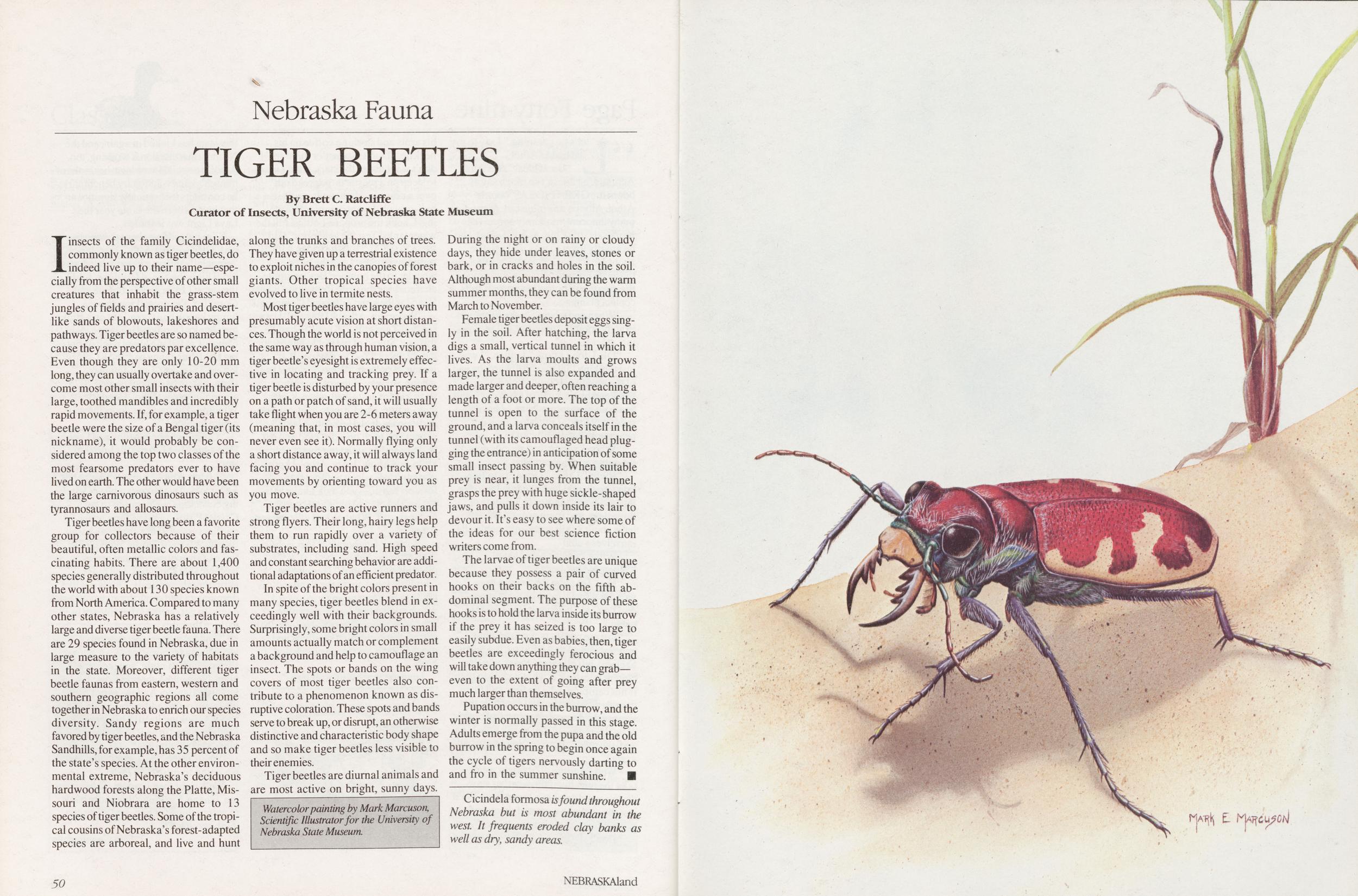
Nebraska Fauna TIGER BEETLES
By Brett C. Ratcliffe Curator of Insects, University of Nebraska State MuseumI insects of the family Cicindelidae, commonly known as tiger beetles, do indeed live up to their name—especially from the perspective of other small creatures that inhabit the grass-stem jungles of fields and prairies and desertlike sands of blowouts, lakeshores and pathways. Tiger beetles are so named because they are predators par excellence. Even though they are only 10-20 mm long, they can usually overtake and overcome most other small insects with their large, toothed mandibles and incredibly rapid movements. If, for example, a tiger beetle were the size of a Bengal tiger (its nickname), it would probably be considered among the top two classes of the most fearsome predators ever to have lived on earth. The other would have been the large carnivorous dinosaurs such as tyrannosaurs and allosaurs.
Tiger beetles have long been a favorite group for collectors because of their beautiful, often metallic colors and fascinating habits. There are about 1,400 species generally distributed throughout the world with about 130 species known from North America. Compared to many other states, Nebraska has a relatively large and diverse tiger beetle fauna. There are 29 species found in Nebraska, due in large measure to the variety of habitats in the state. Moreover, different tiger beetle faunas from eastern, western and southern geographic regions all come together in Nebraska to enrich our species diversity. Sandy regions are much favored by tiger beetles, and the Nebraska Sandhills, for example, has 35 percent of the state's species. At the other environmental extreme, Nebraska's deciduous hardwood forests along the Platte, Missouri and Niobrara are home to 13 species of tiger beetles. Some of the tropical cousins of Nebraska's forest-adapted species are arboreal, and live and hunt along the trunks and branches of trees. They have given up a terrestrial existence to exploit niches in the canopies of forest giants. Other tropical species have evolved to live in termite nests.
Most tiger beetles have large eyes with presumably acute vision at short distances. Though the world is not perceived in the same way as through human vision, a tiger beetle's eyesight is extremely effective in locating and tracking prey. If a tiger beetle is disturbed by your presence on a path or patch of sand, it will usually take flight when you are 2-6 meters away (meaning that, in most cases, you will never even see it). Normally flying only a short distance away, it will always land facing you and continue to track your movements by orienting toward you as you move.
Tiger beetles are active runners and strong flyers. Their long, hairy legs help them to run rapidly over a variety of substrates, including sand. High speed and constant searching behavior are additional adaptations of an efficient predator.
In spite of the bright colors present in many species, tiger beetles blend in exceedingly well with their backgrounds. Surprisingly, some bright colors in small amounts actually match or complement a background and help to camouflage an insect. The spots or bands on the wing covers of most tiger beetles also contribute to a phenomenon known as disruptive coloration. These spots and bands serve to break up, or disrupt, an otherwise distinctive and characteristic body shape and so make tiger beetles less visible to their enemies.
Tiger beetles are diurnal animals and are most active on bright, sunny days. During the night or on rainy or cloudy days, they hide under leaves, stones or bark, or in cracks and holes in the soil. Although most abundant during the warm summer months, they can be found from March to November.
Female tiger beetles deposit eggs singly in the soil. After hatching, the larva digs a small, vertical tunnel in which it lives. As the larva moults and grows larger, the tunnel is also expanded and made larger and deeper, often reaching a length of a foot or more. The top of the tunnel is open to the surface of the ground, and a larva conceals itself in the tunnel (with its camouflaged head plugging the entrance) in anticipation of some small insect passing by. When suitable prey is near, it lunges from the tunnel, grasps the prey with huge sickle-shaped jaws, and pulls it down inside its lair to devour it. It's easy to see where some of the ideas for our best science fiction writers come from.
The larvae of tiger beetles are unique because they possess a pair of curved hooks on their backs on the fifth abdominal segment. The purpose of these hooks is to hold the larva inside its burrow if the prey it has seized is too large to easily subdue. Even as babies, then, tiger beetles are exceedingly ferocious and will take down anything they can grab even to the extent of going after prey much larger than themselves.
Pupation occurs in the burrow, and the winter is normally passed in this stage. Adults emerge from the pupa and the old burrow in the spring to begin once again the cycle of tigers nervously darting to and fro in the summer sunshine.
Watercobr painting by Mark Marcuson, Scientific Illustrator for the University of Nebraska State Museum. Cicindela formosa is found throughout Nebraska but is most abundant in the west. It frequents eroded clay banks as well as dry, sandy areas. 50 NEBRASKAland
Position: 270 (30 views)