Volume 68, Issue 5, 1990
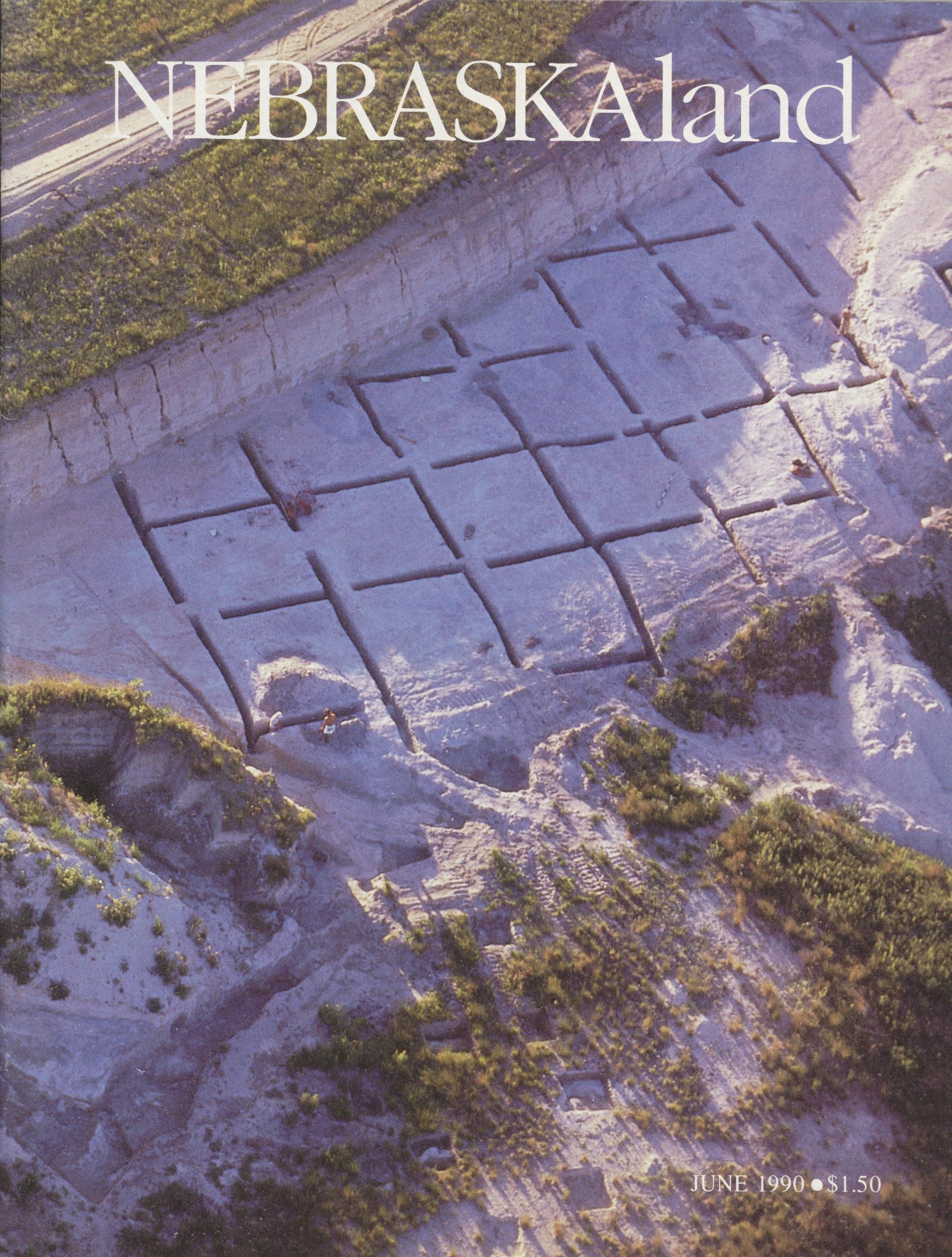
NEBRASKAland
JUNE 1990 $1.50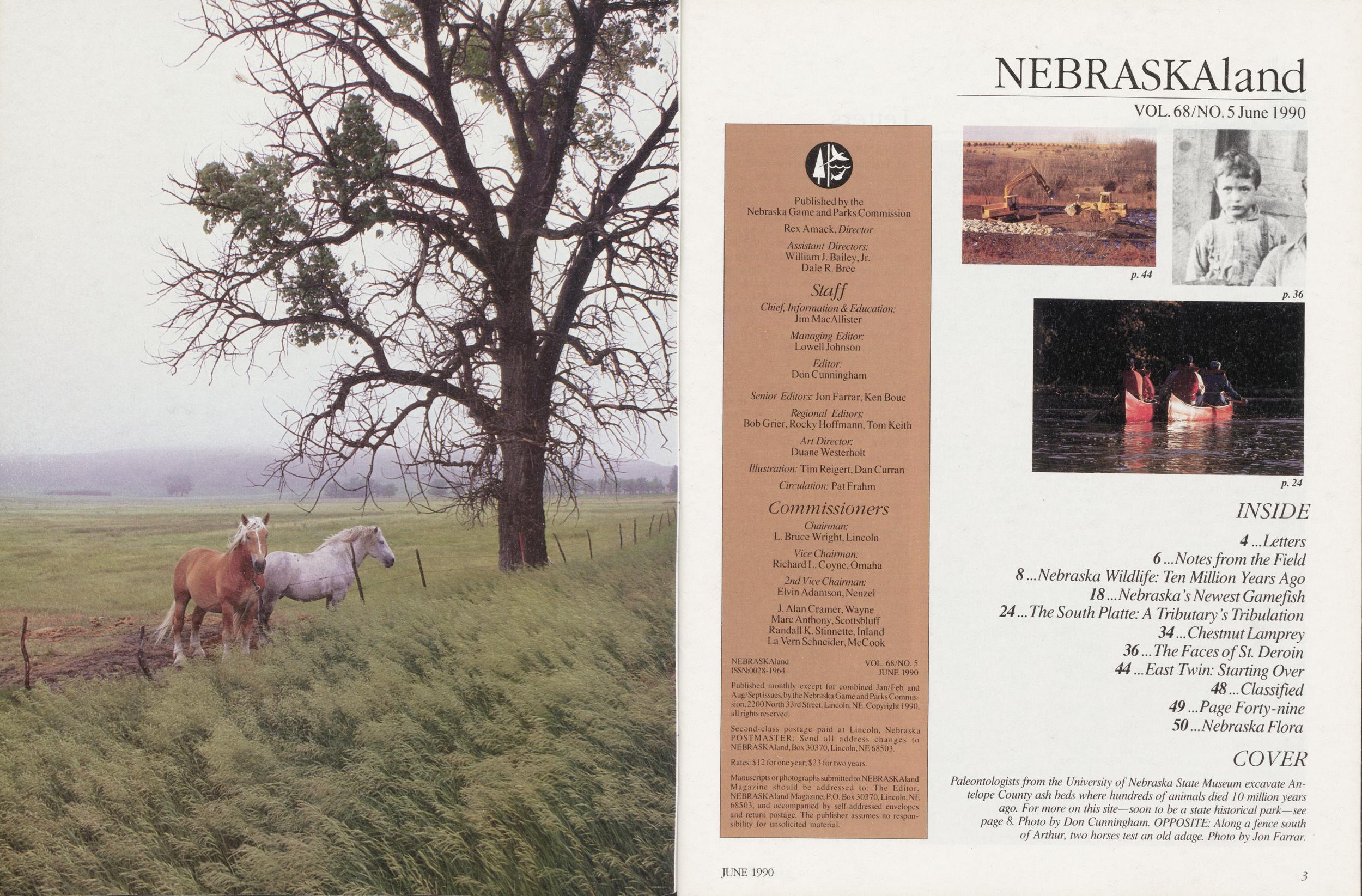
NEBRASKAland
VOL. 68/NO.5 June 1990 Published by the Nebraska Game and Parks Commission Rex Amack, Director Assistant Directors: William J. Bailey, Jr. Dale R. Bree Staff Chief Information & Education: Jim MacAllister Managing Editor: Lowell Johnson Editor: Don Cunningham Senior Editors: Jon Farrar, Ken Boue Regional Editors: Bob Grier, Rocky Hoffmann, Tom Keith Art Director: Duane Westerholt Illustration: Tim Reigert, Dan Curran Circulation: Pat Frahm Commissioners Chairman: L. Bruce Wright, Lincoln Vice Chairman: Richard L. Coyne, Omaha 2nd Vice Chairman: Elvin Adamson, Nenzel J. Alan Cramer, Wayne Marc Anthony, Scottsbluff Randall K. Stinnette, Inland La Vern Schneider, McCook NEBRASKAland ISSN.0028-1964 VOL. 68/NO. 5 JUNE 1990 Published monthly except for combined Jan/Feb and Aug/Sept issues, by the Nebraska Game and Parks Commission, 2200 North 33rd Street, Lincoln, NE. Copyright 1990, all rights reserved. Second-class postage paid at Lincoln, Nebraska POSTMASTER: Send all address chances to NEBRASKAland, Box 303 70, Lincoln, NE 68503. Rates: $ i 2 for one year; $23 for two years. Manuscripts or photographs submitted to NEBRASKAIand Magazine should be addressed to: The Editor. NEBRASKAIand Magazine, P.O. Box 30370, Lincoln,NE 68503, and accompanied by self-addressed envelopes and return postage. The publisher assumes no responsibility for unsolicited material.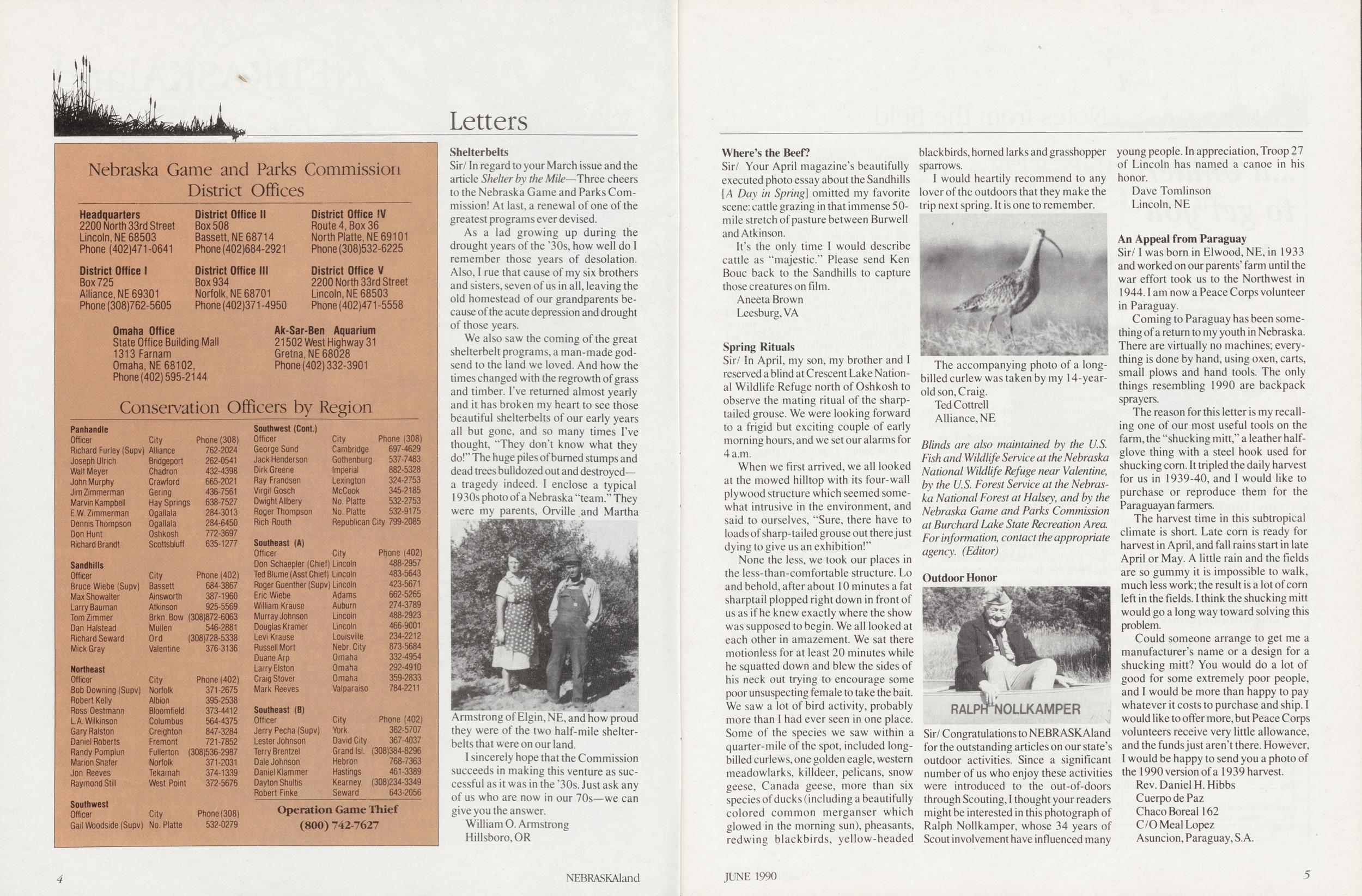
Letters
ShelterbeltsSir/ In regard to your March issue and the article Shelter by the Mile—Three cheers to the Nebraska Game and Parks Commission! At last, a renewal of one of the greatest programs ever devised.
As a lad growing up during the drought years of the '30s, how well do I remember those years of desolation. Also, I rue that cause of my six brothers and sisters, seven of us in all, leaving the old homestead of our grandparents because of the acute depression and drought of those years.
We also saw the coming of the great shelterbelt programs, a man-made god send to the land we loved. And how the times changed with the regrowth of grass and timber. Eve returned almost yearly and it has broken my heart to see those beautiful shelterbelts of our early years all but gone, and so many times I've thought, "They don't know what they do!" The huge piles of burned stumps and dead trees bulldozed out and destroyed a tragedy indeed. I enclose a typical 1930s photo of a Nebraska "team." They were my parents, Orville and Martha Armstrong of Elgin, NE, and how proud they were of the two half-mile shelterbelts that were on our land.
I sincerely hope that the Commission succeeds in making this venture as successful as it was in the '30s. Just ask any of us who are now in our 70s—we can give you the answer.
William O. Armstrong Hillsboro,OR 4 NEBRASKAland Where's the Beef?Sir Your April magazine's beautifully executed photo essay about the Sandhills A Day in Spring] omitted my favorite scene: cattle grazing in that immense 50-mile stretch of pasture between Burwell and Atkinson.
It's the only time I would describe cattle as "majestic." Please send Ken Bouc back to the Sandhills to capture those creatures on film.
Aneeta Brown Leesburg, VA Spring RitualsSir In April, my son, my brother and I reserved a blind at Crescent Lake National Wildlife Refuge north of Oshkosh to observe the mating ritual of the sharptailed grouse. We were looking forward to a frigid but exciting couple of early morning hours, and we set our alarms for 4 a.m.
When we first arrived, we all looked at the mowed hilltop with its four-wall plywood structure which seemed somewhat intrusive in the environment, and said to ourselves, "Sure, there have to loads of sharp-tailed grouse out there just dying to give us an exhibition!"
None the less, we took our places in the less-than-comfortable structure. Lo and behold, after about 10 minutes a fat sharptail plopped right down in front of us as if he knew exactly where the show was supposed to begin. We all looked at each other in amazement. We sat there motionless for at least 20 minutes while he squatted down and blew the sides of his neck out trying to encourage some poor unsuspecting female to take the bait. We saw a lot of bird activity, probably more than I had ever seen in one place. Some of the species we saw within a quarter-mile of the spot, included longbilled curlews, one golden eagle, western meadowlarks, killdeer, pelicans, snow geese, Canada geese, more than six species of ducks (including a beautifully colored common merganser which glowed in the morning sun), pheasants, redwing blackbirds, yellow-headed blackbirds, horned larks and grasshopper sparrows.
I would heartily recommend to any lover of the outdoors that they make the trip next spring. It is one to remember.
The accompanying photo of a longbilled curlew was taken by my 14-year-old son, Craig.
TedCottrell Alliance, NEBlinds are also maintained by the U.S. Fish and Wildlife Service at the Nebraska National Wildlife Refuge near Valentine, by the U.S. Forest Service at the Nebraska National Forest at Halsey, and by the Nebraska Game and Parks Commission at Burchard Lake State Recreation Area. For information, contact the appropriate agency. (Editor)
Outdoor HonorSir/ Congratulations to NEBRASKAland for the outstanding articles on our state's outdoor activities. Since a significant number of us who enjoy these activities were introduced to the out-of-doors through Scouting, I thought your readers might be interested in this photograph of Ralph Nollkamper, whose 34 years of Scout involvement have influenced many young people. In appreciation, Troop 27 of Lincoln has named a canoe in his honor.
Dave Tomlinson Lincoln, NE An Appeal from ParaguaySir/1 was born in Elwood, NE, in 1933 and worked on our parents' farm until the war effort took us to the Northwest in 1944.1 am now a Peace Corps volunteer in Paraguay.
Coming to Paraguay has been something of a return to my youth in Nebraska. There are virtually no machines; everything is done by hand, using oxen, carts, small plows and hand tools. The only things resembling 1990 are backpack sprayers.
The reason for this letter is my recalling one of our most useful tools on the farm, the "shucking mitt," a leather halfglove thing with a steel hook used for shucking corn. It tripled the daily harvest for us in 1939-40, and I would like to purchase or reproduce them for the Paraguayan farmers.
The harvest time in this subtropical climate is short. Late corn is ready for harvest in April, and fall rains start in late April or May. A little rain and the fields are so gummy it is impossible to walk, much less work; the result is a lot of corn left in the fields. I think the shucking mitt would go a long way toward solving this problem.
Could someone arrange to get me a manufacturer's name or a design for a shucking mitt? You would do a lot of good for some extremely poor people, and I would be more than happy to pay whatever it costs to purchase and ship. I would like to offer more, but Peace Corps volunteers receive very little allowance, and the funds just aren't there. However, I would be happy to send you a photo of the 1990 version of a 1939 harvest.
Rev. Daniel H. Hibbs CuerpodePaz Chaco Boreal 162 C/O Meal Lopez Asuncion, Paraguay, S. A. JUNE 1990 5 a binder
to get you
out of a
bind
Designed just for
NEBRASKAland
Magazine, this sturdy
vinyl binder will hold a
full two year's issues.
Plastic hangers make it
easy to insert or remove
magazines without
damage, and easy to
read without removing.
Just $6
plus sales tax
Order from:
NEBRASKAland Magazine
P.O. Box 30370
Lincoln, NE. 68503
Name
Address
City
State
Zip
Payment Enclosed
Visa Master Card
Number
a binder
to get you
out of a
bind
Designed just for
NEBRASKAland
Magazine, this sturdy
vinyl binder will hold a
full two year's issues.
Plastic hangers make it
easy to insert or remove
magazines without
damage, and easy to
read without removing.
Just $6
plus sales tax
Order from:
NEBRASKAland Magazine
P.O. Box 30370
Lincoln, NE. 68503
Name
Address
City
State
Zip
Payment Enclosed
Visa Master Card
Number
Notes from the field
Notes from the CarwashA self-service carwash in downtown Lincoln seems about as far from the field as you can get and still be in Nebraska, but it is a good place to take refuge, and think about being in the field while you wait out the worst of a spring downpour—at least when no one is washing a car. Among the many virtues of a spring downpour—including the good it does for winter wheat and the encouragement it gives to the nightcrawlers on the neighbors' lawn is the chance that it will produce a rainbow, especially late in the afternoon when the low spring sun illuminates a rapidly eastward-moving storm. A carwash is not a bad place from which to watch rainbows.
This recent carwash rainbow was the first of the season, and it will be a hard one to beat. Almost supernaturally intense, the entire spectrum seemed distinct and clear, each color pure and saturated at the center of its band, the outer arc red, the inner arc violet. Where they met, the colors merged, and there was no point at which you could say for sure that one ended and the next began. A second full rainbow, above the first, was less distinct, but still better than average. Its color sequence was reversed, red inside, violet at the edge.
They lasted a good 10 minutes, long enough for someone standing under a carwash to finish wondering if the roof at home were leaking again, and to wish he were somewhere else—somewhere with a better foreground—and that he had a camera along. There was time to think about how this rainbow would look over Chimney Rock, and how it would just frame the east end of Big Alkali Lake, if you happened to look up from the Thin-Fin you were tying to your line in time to see it.
There was even time to wonder why it never seems possible to get an entire rainbow on film, even with a wideangle lens. Rainbows are almost always too big, and you can't just take a few steps back from one the way you can when the whole family reunion won't fit in the frame. Rainbows are not very substantial; they are refracted and reflected light (refracted as it enters a raindrop, then reflected forward toward the light source from the rear surface of the drop, and again refracted as it leaves the drop), and a rainbow's position changes as you move, but its size remains the same. A family reunion, on the other hand, is quintessentially substantial. Its position is usually fixed, but its size seems to change infinitely, depending on whether or not it is raining and the cousins have to stay inside and play "quiet" games after supper.
Sometimes further exploration is necessary. From an encyclopedia you can learn that the center of a rainbow's arc is always on a line connecting the eye of the observer and the light source, so your shadow will always point directly at its center. That also means no two people ever see exactly the same rainbow, because even when they are side by side, those lines are minutely different, and different drops of rain are momentarily at exactly the right spots to refract and reflect and refract a separate rainbow to each observer.
You also can learn that the drop of rain that is 42° from the plane of the observer's shadow will be in the red arc, that ocasionally a secondary rainbow is seen above the first, and that the sequence of colors in a secondary rainbow is always reversed because there are two reflections within the drops (it would have been unrealistic to have thought the carwash rainbow was unique in this respect).
It is interesting to discover that the rainbow was first correctly explained by M. A. de Dominis in 1611, and that his explanation was further developed and confirmed by Descartes in 1637. It is less heartening to learn that completely understanding the explanation is very difficult.
But when you learn that the center of the rainbow is as far below the horizon as the sun is above it, so at sunrise 6 NEBRASKAland and sunset the rainbow will be a semicricle, that when the sun is higher in the sky the arc will be less than a semicircle, and when the sun is higher in the sky than 42°, no rainbow can be seen, you may have discovered why almost every rainbow you ever see is too tall or too wide for any lens you own.
A 50mm lens on a 35mm camera has a horizontal field of view of about 47°, and a vertical field of view of about 30°. To photograph a sunrise or sunset rainbow you'd need a lens with an 84° horizontal field, and a 42° vertical one. For a midmorning or midafternoon rainbow you'd still need a 42° vertical field, and the horizontal field could increase up to about 96°.
This is the kind of thinking that can leave a downpour refugee a little confused and wishing that deDominis and Descartes had pulled into the car wash to simplify their explanations for him, and confirm his calculations.
Don Cunningham Ripeness is AllAlthough a wild fruit ripening-date chart might take some of the pleasure out of just happening onto a patch of ripe gooseberries, or eating the unexpected mulberry that falls on your picnic cloth, nevertheless it is worth stashing one behind the visor of your car along with the county license plate number chart, just in case.
Approximate Ripening Dates For Native Fruits and Berries Strawberry Mid-June to mid-July Mulberry Mid-June to mid-July Raspberry Late June to mid-July Chokecherry Mid-July to mid-August Currant Mid-July to early August Sand cherry Early July to early August Gooseberry Mid-July to mid August Ground cherry July to September Blackberry Late July to early August Buffalo berry Late July to early September Elderberry Mid-August to mid-September Wild grape Late August to early October Plum Late August to early October Nebraska Wildlife Habitat Donors Hikers, birdwatchers, photographers, campers—anyone who finds peace and pleasure in the outdoors—can give back to Nature For years, hunters and trappers have contributed to the acquisition and improvement of wildlife habitat through their purchase of Nebraska Habitat Stamps. Now, through this special program, non-consumptive users of the outdoors can also contribute, and proudly wear the Nebraska Habitat Donor patch. All proceeds will go the Wildlife Habitat fund. Give $5 and receive the 1990 Donor Patch Give $12.50 and receive the patch on a cloth cap. Use the coupon below. Mail to Nebraska Wildlife Donor Program, NEBRASKAland Magazine, P.O. Box 30370, Lincoln, NE 68503 Nebraska Wildlife Habitat Donor Program Name Address City State. Zip. $5: Patch $12.50: Patch and Cap (Nebraskans: please add appropriate sales tax) JUNE 1990 7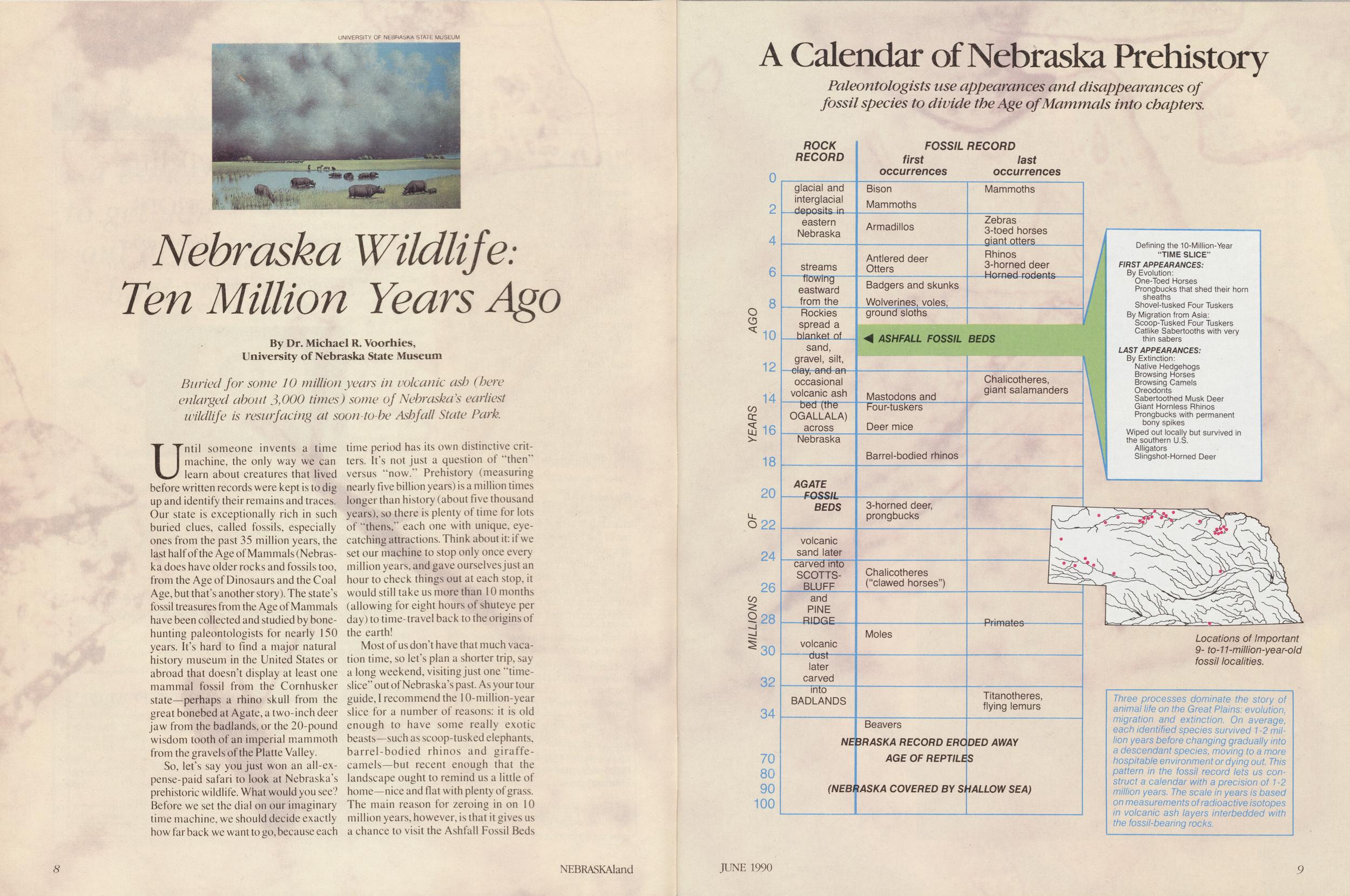
Nebraska Wildlife: Ten Million Years Ago
By Dr. Michael R. Voorhies, University of Nebraska State Museum Buried for some 10 million years in volcanic ash (here enlarged about 3,000 times) some of Nebraska's earliest wildlife is resurfacing at soon-to-be Ash fall State ParkUntil someone invents a time machine, the only way we can learn about creatures that lived before written records were kept is to dig up and identify their remains and traces. Our state is exceptionally rich in such buried clues, called fossils, especially ones from the past 35 million years, the last half of the Age of Mammals (Nebraska does have older rocks and fossils too, from the Age of Dinosaurs and the Coal Age, but that's another story). The state's fossil treasures from the Age of Mammals have been collected and studied by bone-hunting paleontologists for nearly 150 years. It's hard to find a major natural history museum in the United States or abroad that doesn't display at least one mammal fossil from the Cornhusker state—perhaps a rhino skull from the great bonebed at Agate, a two-inch deer jaw from the badlands, or the 20-pound wisdom tooth of an imperial mammoth from the gravels of the Platte Valley.
So, let's say you just won an all-expense-paid safari to look at Nebraska's prehistoric wildlife. What would you see? Before we set the dial on our imaginary time machine, we should decide exactly how far back we want to go, because each time period has its own distinctive critters. It's not just a question of "then" versus "now." Prehistory (measuring nearly five billion years) is a million times longer than history (about five thousand years), so there is plenty of time for lots of "thens," each one with unique, eye-catching attractions. Think about it: if we set our machine to stop only once every million years, and gave ourselves just an hour to check things out at each stop, it would still take us more than 10 months (allowing for eight hours of shuteye per day) to time-travel back to the origins of the earth!
Most of us don't have that much vacation time, so let's plan a shorter trip, say a long weekend, visiting just one "timeslice" out of Nebraska's past. As your tour guide, I recommend the 10-million-year slice for a number of reasons: it is old enough to have some really exotic beasts—such as scoop-tusked elephants, barrel-bodied rhinos and giraffe camels—but recent enough that the landscape ought to remind us a little of home—nice and flat with plenty of grass. The main reason for zeroing in on 10 million years, however, is that it gives us a chance to visit the Ashfall Fossil Beds and see the animals there before they became fossils. The Ashfall site is slated for development as a state historical park [see box, page 17] where visitors can peer through a sort of window into the past. Like the windows at a bone hunter's field camp, this one is a little dusty, but you can still see more through it than any similar one I know of.
8 NEBRASKAland A Calendar of Nebraska Prehistory Paleontologists use appearances and disappearances of fossil species to divide the Age of Mammals into chapters. ROCK RECORD glacial and interglacial deposits in FOSSIL RECORD first last occurrences occurrences Bison Mammoths eastern Nebraska streams flowing eastward from the Rockies spread a iket of Armadillos Antlered deer Otters sand, gravel, silt, clay, and an occasional volcanic ash bed (the OGALLALA) across Nebraska AGATE FOSSIL- BEDS Badgers and skunks Wolverines, voles, ground sioths 4 ASHFALL FOSSIL BEDS Mammoths Zebras 3-toed horses giant otters Rhinos 3-horned deer Horned rodents Mastodons and Four-tuskers Deer mice Barrel-bodied rhinos volcanic sand later carved into SCOTTSBLUFF 3-horned deer, prongbucks and PINE RIDGE volcanic dust later carved into BADLANDS Chalicotheres ("clawed horses") Moles Chalicotheres, giant salamanders Defining the 10-Million-Year 'TIME SLICE" FIRST APPEARANCES: By Evolution: One-Toed Horses Prongbucks that shed their horn sheaths Shovel-tusked Four Tuskers By Migration from Asia: Scoop-Tusked Four Tuskers Catlike Sabertooths with very thin sabers LAST APPEARANCES: By Extinction: Native Hedgehogs Browsing Horses Browsing Camels Oreodonts Sabertoothed Musk Deer Giant Hornless Rhinos Prongbucks with permanent bony spikes Wiped out locally but survived in the southern U.S. Alligators Slingshot-Horned Deer Frimatos Titanotheres, flying lemurs Beavers NEBRASKA RECORD ERODED AWAY AGE OF REPTILES (NEBRASKA COVERED BY SHALLOW SEA)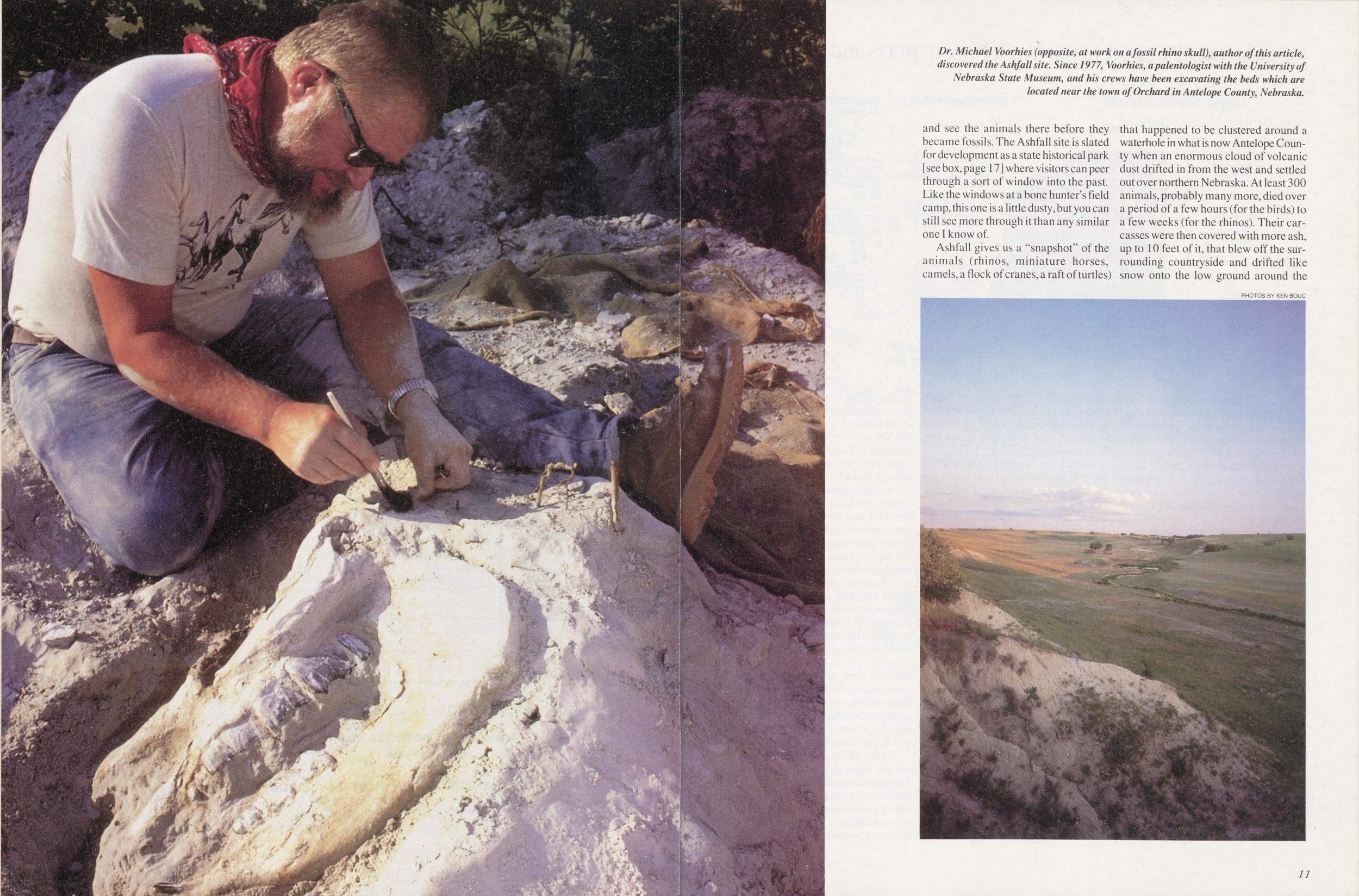
and see the animals there before they became fossils. The Ashfall site is slated for development as a state historical park [see box, page 17] where visitors can peer through a sort of window into the past. Like the windows at a bone hunter's field camp, this one is a little dusty, but you can still see more through it than any similar one I know of.
Ashfall gives us a "snapshot" of the animals (rhinos, miniature horses, camels, a flock ofcranes, a raft of turtles) that happened to be clustered around a waterhole in what is now Antelope County when an enormous cloud of volcanic dust drifted in from the west and settled out over northern Nebraska. At least 300 animals, probably many more, died over a period of a few hours (for the birds) to a few weeks (for the rhinos). Their carcasses were then covered with more ash, up to 10 feet of it, that blew off the surrounding countryside and drifted like snow onto the low ground around the waterhole. There the skeletons have remained, locked in a natural time capsule, until a crew from the University of Nebraska State Museum began excavating the ash bed in 1977. Many skeletons at the site are preserved to the last detail in the fine-grained volcanic dust; they include some of the most complete specimens any paleontologist has been privileged to work on. Some specimens have food remains inside their ribcages; one of the fossil cranes, for example, has a partly digested lizard inside; another's last meal was a mouse. Many of the barrel-bodied rhinos had grass seeds in their throats and bellies, solving the mystery of what these odd-shaped critters ate. Since we have good reason to believe that an entire population perished and was preserved together, we can also explore the behavior of this long-extinct species.
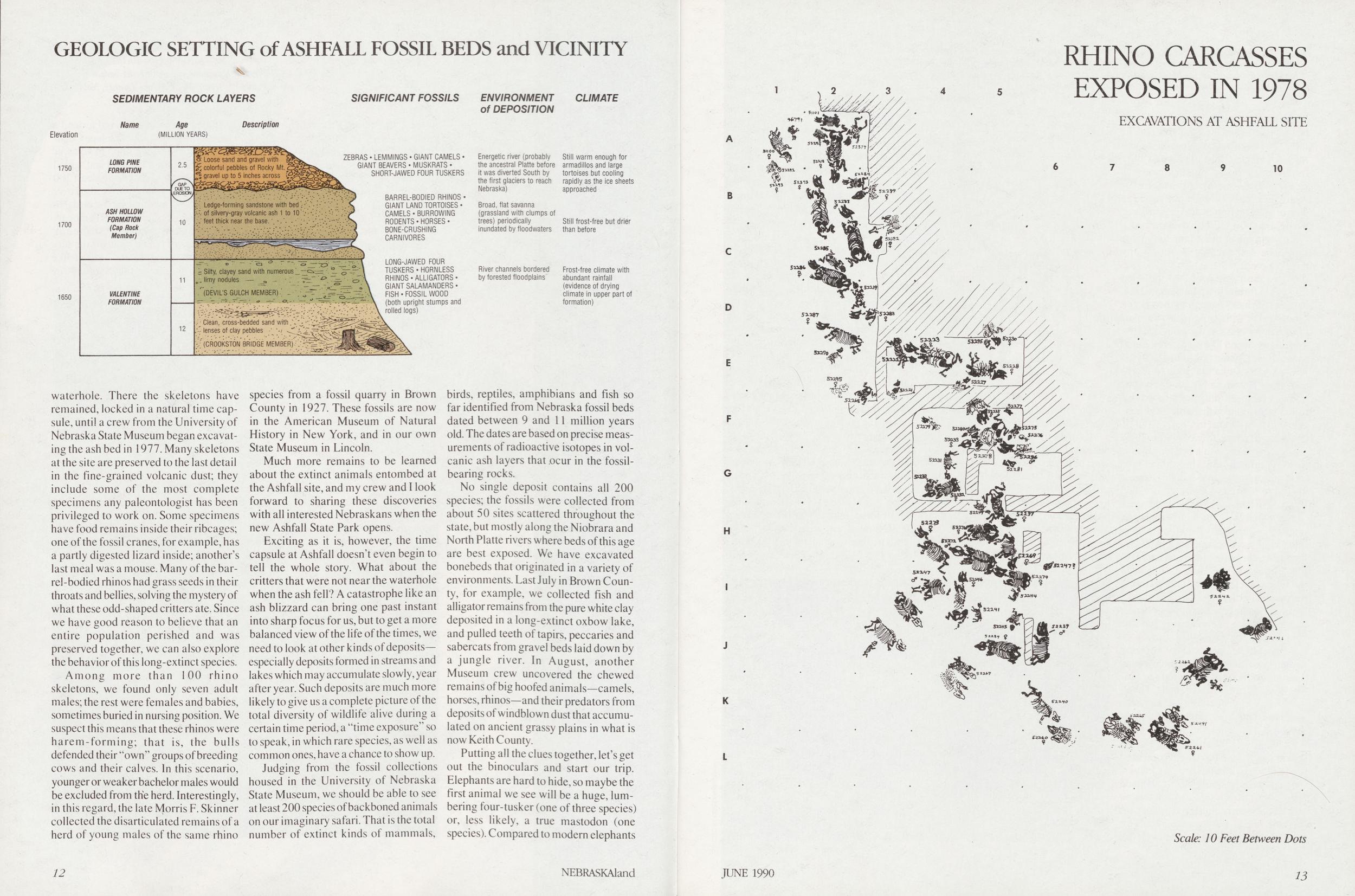 GEOLOGIC SETTING of ASHFALL FOSSIL BEDS and VICINITY
Among more than 100 rhino skeletons, we found only seven adult males; the rest were females and babies, sometimes buried in nursing position. We suspect this means that these rhinos were harem-forming; that is, the bulls defended their "own" groups of breeding cows and their calves. In this scenario, younger or weaker bachelor males would be excluded from the herd. Interestingly, in this regard, the late Morris F. Skinner collected the disarticulated remains of a herd of young males of the same rhino species from a fossil quarry in Brown County in 1927. These fossils are now in the American Museum of Natural History in New York, and in our own State Museum in Lincoln.
Much more remains to be learned about the extinct animals entombed at the Ashfall site, and my crew and I look forward to sharing these discoveries with all interested Nebraskans when the new Ashfall State Park opens.
Exciting as it is, however, the time capsule at Ashfall doesn't even begin to tell the whole story. What about the critters that were not near the waterhole when the ash fell? A catastrophe like an ash blizzard can bring one past instant into sharp focus for us, but to get a more balanced view of the life of the times, we need to look at other kinds of deposits especially deposits formed in streams and lakes which may accumulate slowly, year after year. Such deposits are much more likely to give us a complete picture of the total diversity of wildlife alive during a certain time period, a "time exposure" so to speak, in which rare species, as well as common ones, have a chance to show up.
Judging from the fossil collections housed in the University of Nebraska State Museum, we should be able to see at least 200 species of backboned animals on our imaginary safari. That is the total number of extinct kinds of mammals, birds, reptiles, amphibians and fish so far identified from Nebraska fossil beds dated between 9 and 11 million years old. The dates are based on precise measurements of radioactive isotopes in volcanic ash layers that ocur in the fossilbearing rocks.
No single deposit contains all 200 species; the fossils were collected from about 50 sites scattered throughout the state, but mostly along the Niobrara and North Platte rivers where beds of this age are best exposed. We have excavated bonebeds that originated in a variety of environments. Last July in Brown County, for example, we collected fish and alligator remains from the pure white clay deposited in a long-extinct oxbow lake, and pulled teeth of tapirs, peccaries and sabercats from gravel beds laid down by a jungle river. In August, another Museum crew uncovered the chewed remains of big hoofed animals—camels, horses, rhinos—and their predators from deposits of windblown dust that accumulated on ancient grassy plains in what is now Keith County.
Putting all the clues together, let's get out the binoculars and start our trip. Elephants are hard to hide, so maybe the first animal we see will be a huge, lumbering four-tusker (one of three species) or, less likely, a true mastodon (one species). Compared to modern elephants the Nebraska natives will be longer in the head and shorter in the leg. and two of the three species of four-tuskers have such long lower jaws that they won't have free-hanging trunks. Most common will be a primitive version of a shovel-tusker with a long, narrow lower jaw bearing a pair of slightly flattened ivory tusks at the tip, and short, chisel-like upper tusks. Family groups of these four-ton giants should be seen wading in almost any river we cross.
12 NEBRASKAland RHINO CARCASSES EXPOSED IN 1978 EXCAVATIONS AT ASHFALL SITE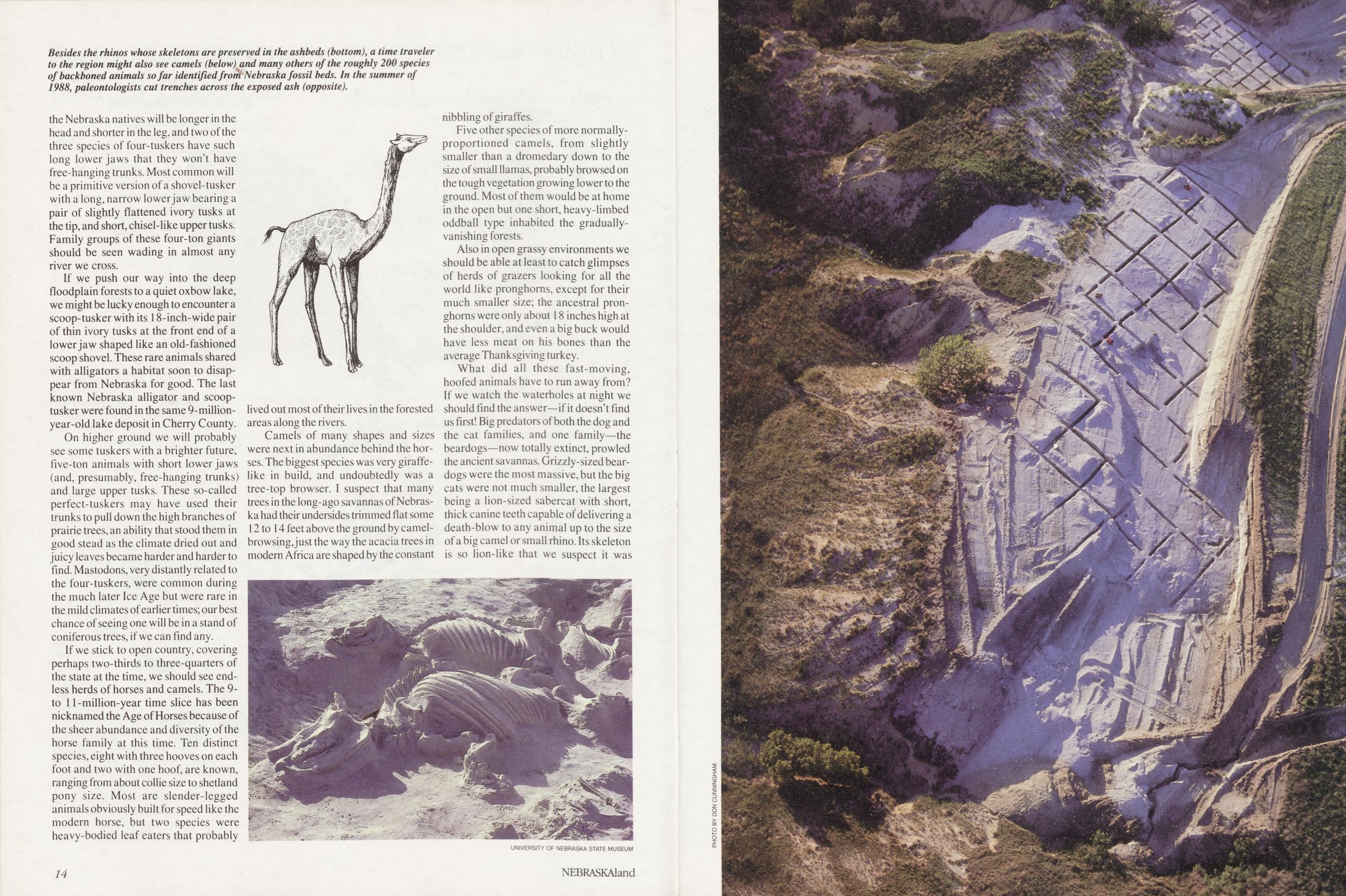
If we push our way into the deep floodplain forests to a quiet oxbow lake, we might be lucky enough to encounter a scoop-tusker with its 18-inch-wide pair of thin ivory tusks at the front end of a lower jaw shaped like an old-fashioned scoop shovel. These rare animals shared with alligators a habitat soon to disappear from Nebraska for good. The last known Nebraska alligator and scooptusker were found in the same 9-million-year-old lake deposit in Cherry County.
On higher ground we will probably see some tuskers with a brighter future, five-ton animals with short lower jaws (and, presumably, free-hanging trunks) and large upper tusks. These so-called perfect-tuskers may have used their trunks to pull down the high branches of prairie trees, an ability that stood them in good stead as the climate dried out and juicy leaves became harder and harder to find. Mastodons, very distantly related to the four-tuskers, were common during the much later Ice Age but were rare in the mild climates of earlier times; our best chance of seeing one will be in a stand of coniferous trees, if we can find any.
If we stick to open country, covering perhaps two-thirds to three-quarters of the state at the time, we should see endless herds of horses and camels. The 9 to 11-million-year time slice has been nicknamed the Age of Horses because of the sheer abundance and diversity of the horse family at this time. Ten distinct species, eight with three hooves on each foot and two with one hoof, are known, ranging from about collie size to Shetland pony size. Most are slender-legged animals obviously built for speed like the modern horse, but two species were heavy-bodied leaf eaters that probably lived out most of their lives in the forested areas along the rivers.
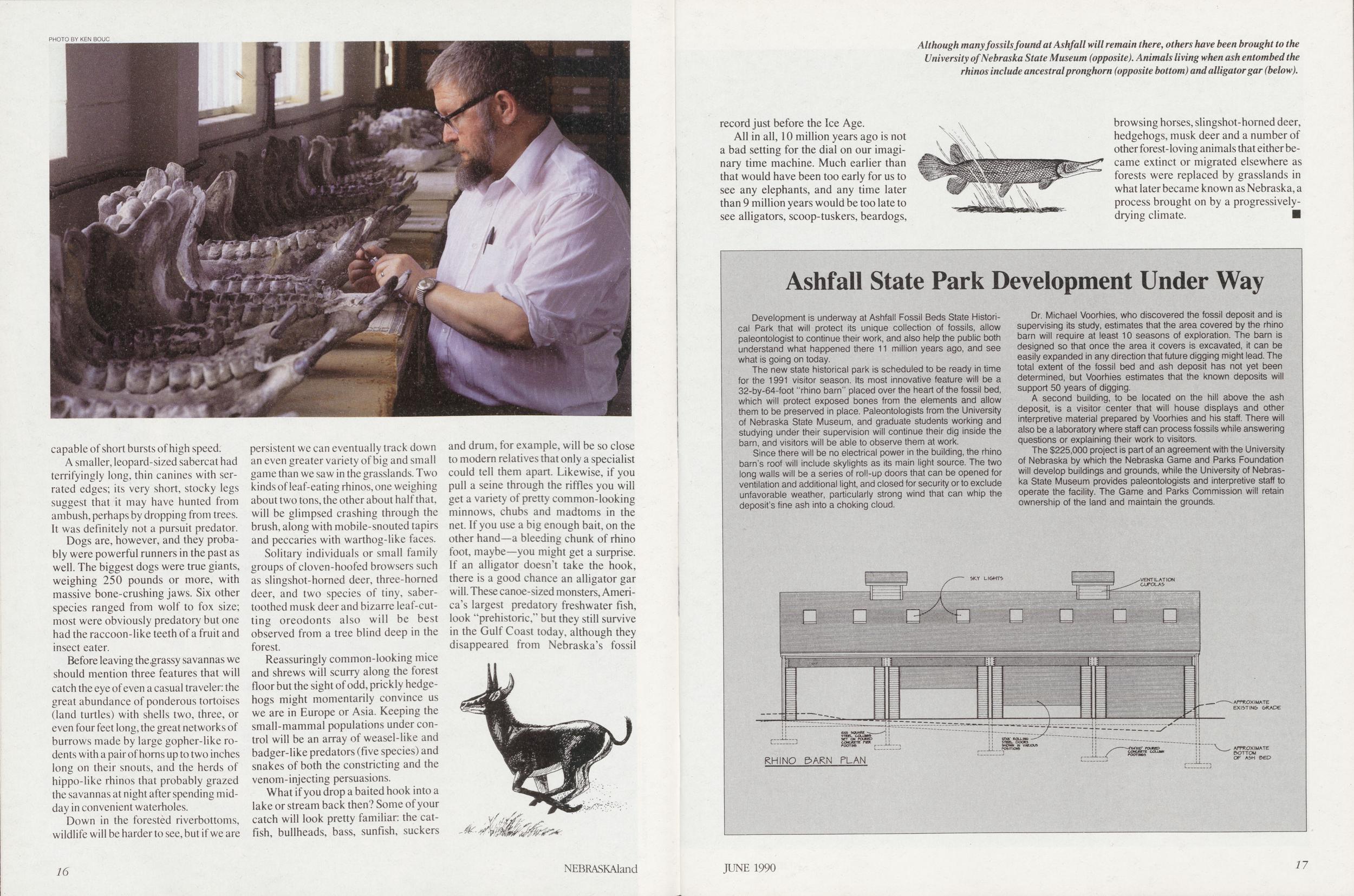
Camels of many shapes and sizes were next in abundance behind the horses. The biggest species was very giraffelike in build, and undoubtedly was a tree-top browser. I suspect that many trees in the long-ago savannas of Nebraska had their undersides trimmed flat some 12 to 14 feet above the ground by camelbrowsing, just the way the acacia trees in modern Africa are shaped by the constant nibbling of giraffes.
Five other species of more normally proportioned camels, from slightly smaller than a dromedary down to the size of small llamas, probably browsed on the tough vegetation growing lower to the ground. Most of them would be at home in the open but one short, heavy-limbed oddball type inhabited the gradually vanishing forests.
Also in open grassy environments we should be able at least to catch glimpses of herds of grazers looking for all the world like pronghorns, except for their much smaller size; the ancestral pronghorns were only about 18 inches high at the shoulder, and even a big buck would have less meat on his bones than the average Thanksgiving turkey.
What did all these fast-moving, hoofed animals have to run away from? If we watch the waterholes at night we should find the answer—if it doesn't find us first! Big predators of both the dog and the cat families, and one family—the beardogs—now totally extinct, prowled the ancient savannas. Grizzly-sized beardogs were the most massive, but the big cats were not much smaller, the largest being a lion-sized sabercat with short, thick canine teeth capable of delivering a death-blow to any animal up to the size of a big camel or small rhino. Its skeleton is so lion-like that we suspect it was 14 NEBRASKAland
A smaller, leopard-sized sabercat had terrifyingly long, thin canines with serrated edges; its very short, stocky legs suggest that it may have hunted from ambush, perhaps by dropping from trees. It was definitely not a pursuit predator.
Dogs are, however, and they probably were powerful runners in the past as well. The biggest dogs were true giants, weighing 250 pounds or more, with massive bone-crushing jaws. Six other species ranged from wolf to fox size; most were obviously predatory but one had the raccoon-like teeth of a fruit and insect eater.
Before leaving the,grassy savannas we should mention three features that will catch the eye of even a casual traveler: the great abundance of ponderous tortoises (land turtles) with shells two, three, or even four feet long, the great networks of burrows made by large gopher-like rodents with a pair of horns up to two inches long on their snouts, and the herds of hippo-like rhinos that probably grazed the savannas at night after spending midday in convenient waterholes.
Down in the forested riverbottoms, wildlife will be harder to see, but if we are persistent we can eventually track down an even greater variety of big and small game than we saw in the grasslands. Two kinds of leaf-eating rhinos, one weighing about two tons, the other about half that, will be glimpsed crashing through the brush, along with mobile-snouted tapirs and peccaries with warthog-like faces.
Solitary individuals or small family groups of cloven-hoofed browsers such as slingshot-horned deer, three-horned deer, and two species of tiny, sabertoothed musk deer and bizarre leaf-cutting oreodonts also will be best observed from a tree blind deep in the forest.
Reassuringly common-looking mice and shrews will scurry along the forest floor but the sight of odd, prickly hedgehogs might momentarily convince us we are in Europe or Asia. Keeping the small-mammal populations under control will be an array of weasel-like and badger-like predators (five species) and snakes of both the constricting and the venom-injecting persuasions.
What if you drop a baited hook into a lake or stream back then? Some of your catch will look pretty familiar: the catfish, bullheads, bass, sunfish, suckers and drum, for example, will be so close to modern relatives that only a specialist could tell them apart. Likewise, if you pull a seine through the riffles you will get a variety of pretty common-looking minnows, chubs and madtoms in the net. If you use a big enough bait, on the other hand—a bleeding chunk of rhino foot, maybe—you might get a surprise. If an alligator doesn't take the hook, there is a good chance an alligator gar will. These canoe-sized monsters, America's largest predatory freshwater fish, look "prehistoric," but they still survive in the Gulf Coast today, although they disappeared from Nebraska's fossil 16 NEBRASKAland record just before the Ice Age.
All in all, 10 million years ago is not a bad setting for the dial on our imaginary time machine. Much earlier than that would have been too early for us to see any elephants, and any time later than 9 million years would be too late to see alligators, scoop-tuskers, beardogs, browsing horses, slingshot-horned deer, hedgehogs, musk deer and a number of other forest-loving animals that either became extinct or migrated elsewhere as forests were replaced by grasslands in what later became known as Nebraska, a process brought on by a progressively drying climate.
Development is underway at Ashf all Fossil Beds State Historical Park that will protect its unique collection of fossils, allow paleontologist to continue their work, and also help the public both understand what happened there 11 million years ago, and see what is going on today.
The new state historical park is scheduled to be ready in time for the 1991 visitor season, its most innovative feature will be a 32-by-64-foot "rhino barn" placed over the heart of the fossil bed, which will protect exposed bones from the elements and allow them to be preserved in place. Paleontologists from the University of Nebraska State Museum, and graduate students working and studying under their supervision will continue their dig inside the barn, and visitors will be able to observe them at work.
Since there will be no electrical power in the building, the rhino barn's roof will include skylights as its main light source. The two long walls will be a series of roll-up doors that can be opened for ventilation and additional light, and closed for security or to exclude unfavorable weather, particularly strong wind that can whip the deposit's fine ash into a choking cloud.
Dr. Michael Voorhies, who discovered the fossil deposit and is supervising its study, estimates that the area covered by the rhino barn will require at least 10 seasons of exploration. The barn is designed so that once the area it covers is excavated, it can be easily expanded in any direction that future digging might lead. The total extent of the fossil bed and ash deposit has not yet been determined, but Voorhies estimates that the known deposits will support 50 years of digging.
A second building, to be located on the hill above the ash deposit, is a visitor center that will house displays and other interpretive material prepared by Voorhies and his staff. There will also be a laboratory where staff can process fossils while answering questions or explaining their work to visitors.
The $225,000 project is part of an agreement with the University of Nebraska by which the Nebraska Game and Parks Foundation will develop buildings and grounds, while the University of Nebraska State Museum provides paleontologists and interpretive staff to operate the facility. The Game and Parks Commission will retain ownership of the land and maintain the grounds.
Nebraska's Newest Game fish
Photos and text by Tom Keith A relative newcomer to Nebraska's waters, these hybrid offsprinS °f white and striped bass—often called wipers—are popular with many anglers, and may help to alleviate the decline in fishing success which accompanies the natural aging of lakes.Although a Game and Parks Commission survey concluded recently that channel catfish and largemouth bass are the species most sought by Nebraska's fishermen, another fish is becoming increasingly popular, and may nudge one of the favorites from its high ranking in the not-too-distant future.
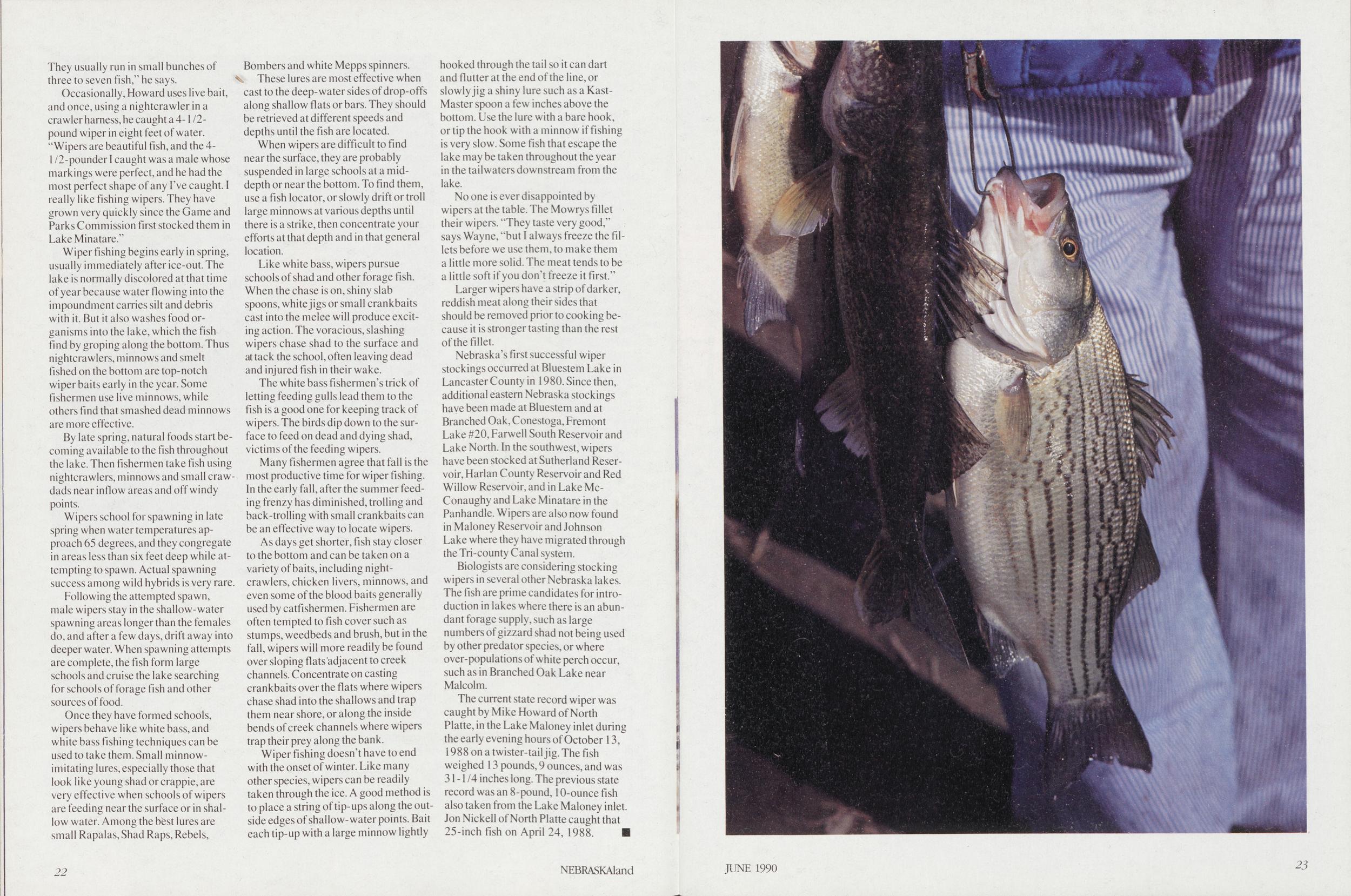
Relative newcomers to Nebraska's fishing scene, "wipers" are the hybrid offspring of female striped bass and male white bass, and they exhibit the best traits of both species.
Wipers are a welcome addition to the state's fishery for a variety of reasons. They exhibit good growth rates and are typically larger than white bass, but smaller than striped bass, a desirable characteristic because they are less likely to create forage depletion problems similar to those caused by large stripers. They have the potential for growing to about 20 pounds, which puts them in the trophy category. Wipers are aggressive and are reputed to be among the hardest fighters of all freshwater fish. Add all of these qualities to the wiper's superiority on the table, and you have a great gamefish.
Many southeast Nebraska reservoirs are rapidly losing the shoreline habitat necessary for sustaining good bass and 18 NEBRASKAland
Often, fishermen believe that replacing lost habitat is the obvious solution to the problem, but it is not that simple. Habitat replacement is expensive, time consuming and labor intensive. While it is true that several sportsmen's groups have donated valuable time and effort to assist Game and Parks Commission fisheries biologists with habitat projects on various lakes throughout the state, that work is actually only a drop in the bucket compared to that which needs to be done. The amount of work and the expense involved in returning a lake to its original condition are staggering.
A factor the Game and Parks Commission cannot control is the natural aging process which all lakes and reservoirs undergo. Aging lakes that originally had plenty of high-quality shoreline habitat to support large bass and bluegill populations become better suited for open-water species as the shoreline habitat declines.
Wipers do not require great amounts of shoreline vegetation. They are effective predators, and can make use of abundant forage fish populations, such as gizzard shad, that are not fully utilized by other predator species. Because reproduction of the hybrid fish is rare in the wild, biologists can control wiper numbers by stocking, and thus avoid the frustrating "boom or bust" cycles common in white bass populations.
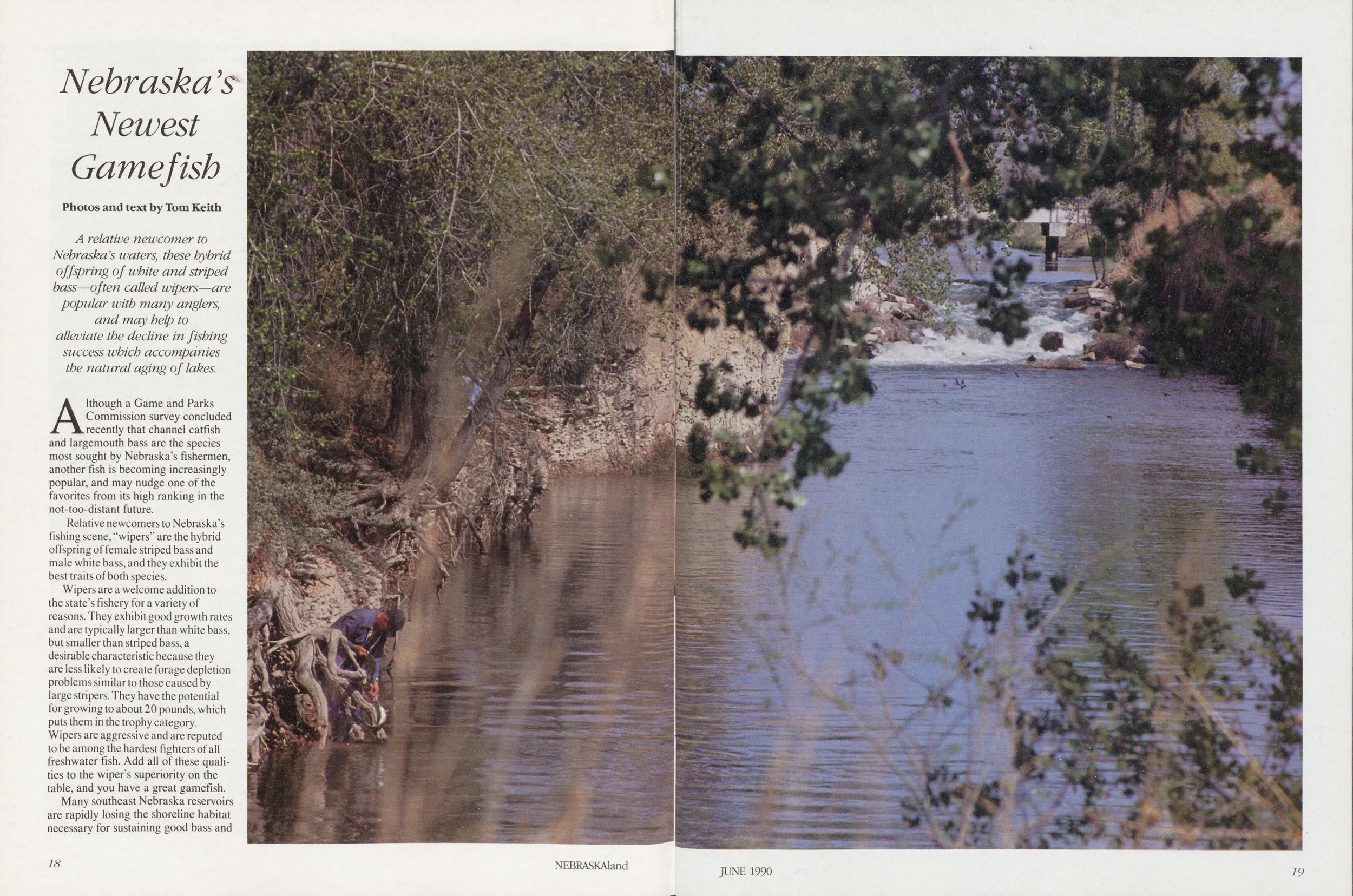
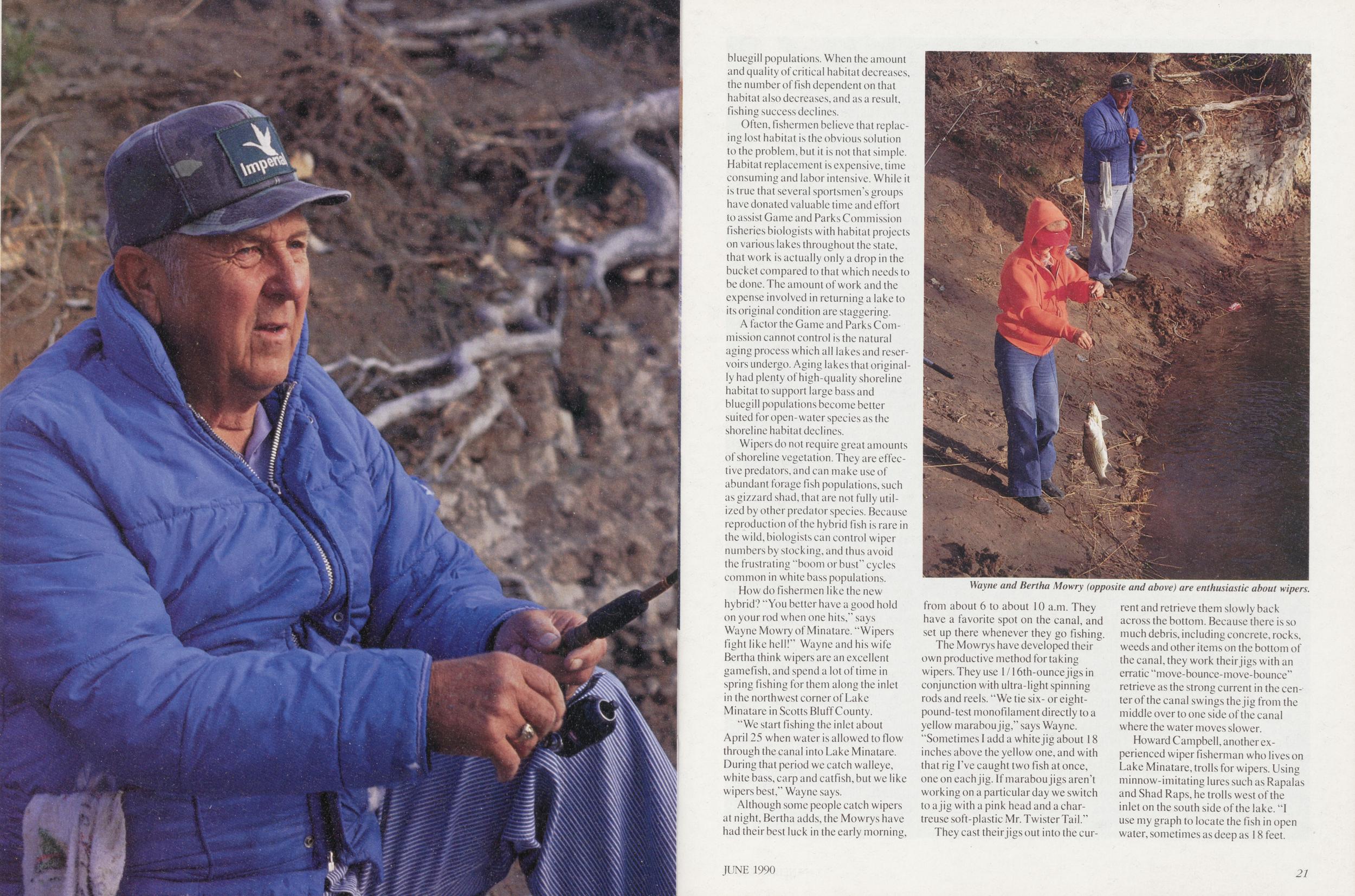
How do fishermen like the new hybrid? "You better have a good hold on your rod when one hits," says Wayne Mowry of Minatare. "Wipers fight like hell!" Wayne and his wife Bertha think wipers are an excellent gamefish, and spend a lot of time in spring fishing for them along the inlet in the northwest corner of Lake Minatare in Scotts Bluff County.
"We start fishing the inlet about April 25 when water is allowed to flow through the canal into Lake Minatare. During that period we catch walleye, white bass, carp and catfish, but we like wipers best," Wayne says.
Although some people catch wipers at night, Bertha adds, the Mowrys have had their best luck in the early morning, from about 6 to about 10 a.m. They have a favorite spot on the canal, and set up there whenever they go fishing.
The Mowrys have developed their own productive method for taking wipers. They use 1 /16th-ounce jigs in conjunction with ultra-light spinning rods and reels. "We tie six- or eightpound-test monofilament directly to a yellow marabou jig," says Wayne. "Sometimes I add a white jig about 18 inches above the yellow one, and with that rig Eve caught two fish at once, one on each jig. If marabou jigs aren't working on a particular day we switch to a jig with a pink head and a chatreuse soft-plastic Mr. Twister Tail."
They cast their jigs out into the current and retrieve them slowly back across the bottom. Because there is so much debris, including concrete, rocks, weeds and other items on the bottom of the canal, they work their jigs with an erratic "move-bounce-move-bounce" retrieve as the strong current in the center of the canal swings the jig from the middle over to one side of the canal where the water moves slower.
Howard Campbell, another experienced wiper fisherman who lives on
Lake Minatare, trolls for wipers. Using
minnow-imitating lures such as Rapalas
and Shad Raps, he trolls west of the
inlet on the south side of the lake. "I
use my graph to locate the fish in open
water, sometimes as deep as 18 feet.
JUNE 1990
21
 They usually run in small bunches of
three to seven fish," he says.
They usually run in small bunches of
three to seven fish," he says.
Occasionally, Howard uses live bait, and once, using a nightcrawler in a crawler harness, he caught a 4-1/2-pound wiper in eight feet of water. "Wipers are beautiful fish, and the 4-1/2-pounder I caught was a male whose markings were perfect, and he had the most perfect shape of any five caught. I really like fishing wipers. They have grown very quickly since the Game and Parks Commission first stocked them in Lake Minatare."
Wiper fishing begins early in spring, usually immediately after ice-out. The lake is normally discolored at that time of year because water flowing into the impoundment carries silt and debris with it. But it also washes food organisms into the lake, which the fish find by groping along the bottom. Thus nightcrawlers, minnows and smelt fished on the bottom are top-notch wiper baits early in the year. Some fishermen use live minnows, while others find that smashed dead minnows are more effective.
By late spring, natural foods start becoming available to the fish throughout the lake. Then fishermen take fish using nightcrawlers, minnows and small crawdads near inflow areas and off windy points.
Wipers school for spawning in late spring when water temperatures approach 65 degrees, and they congregate in areas less than six feet deep while attempting to spawn. Actual spawning success among wild hybrids is very rare.
Following the attempted spawn, male wipers stay in the shallow-water spawning areas longer than the females do, and after a few days, drift away into deeper water. When spawning attempts are complete, the fish form large schools and cruise the lake searching for schools of forage fish and other sources of food.
Once they have formed schools, wipers behave like white bass, and white bass fishing techniques can be used to take them. Small minnowimitating lures, especially those that look like young shad or crappie, are very effective when schools of wipers are feeding near the surface or in shallow water. Among the best lures are small Rapalas, Shad Raps, Rebels, Bombers and white Mepps spinners.
These lures are most effective when cast to the deep-water sides of drop-offs along shallow flats or bars. They should be retrieved at different speeds and depths until the fish are located.
When wipers are difficult to find near the surface, they are probably suspended in large schools at a middepth or near the bottom. To find them, use a fish locator, or slowly drift or troll large minnows at various depths until there is a strike, then concentrate your efforts at that depth and in that general location.
Like white bass, wipers pursue schools of shad and other forage fish. When the chase is on, shiny slab spoons, white jigs or small crankbaits cast into the melee will produce exciting action. The voracious, slashing wipers chase shad to the surface and at tack the school, often leaving dead and injured fish in their wake.
The white bass fishermen's trick of letting feeding gulls lead them to the fish is a good one for keeping track of wipers. The birds dip down to the surface to feed on dead and dying shad, victims of the feeding wipers.
Many fishermen agree that fall is the most productive time for wiper fishing. In the early fall, after the summer feeding frenzy has diminished, trolling and back-trolling with small crankbaits can be an effective way to locate wipers.
As days get shorter, fish stay closer to the bottom and can be taken on a variety of baits, including nightcrawlers, chicken livers, minnows, and even some of the blood baits generally used by catfishermen. Fishermen are often tempted to fish cover such as stumps, weedbeds and brush, but in the fall, wipers will more readily be found over sloping flats adjacent to creek channels. Concentrate on casting crankbaits over the flats where wipers chase shad into the shallows and trap them near shore, or along the inside bends of creek channels where wipers trap their prey along the bank.
Wiper fishing doesn't have to end with the onset of winter. Like many other species, wipers can be readily taken through the ice. A good method is to place a string of tip-ups along the outside edges of shallow-water points. Bait each tip-up with a large minnow lightly hooked through the tail so it can dart and flutter at the end of the line, or slowly jig a shiny lure such as a KastMaster spoon a few inches above the bottom. Use the lure with a bare hook, or tip the hook with a minnow if fishing is very slow. Some fish that escape the lake may be taken throughout the year in the tailwaters downstream from the lake.
No one is ever disappointed by wipers at the table. The Mowrys fillet their wipers. 'They taste very good," says Wayne, "but I always freeze the fillets before we use them, to make them a little more solid. The meat tends to be a little soft if you don't freeze it first."
Larger wipers have a strip of darker, reddish meat along their sides that should be removed prior to cooking because it is stronger tasting than the rest of the fillet.
Nebraska's first successful wiper stockings occurred at Bluestem Lake in Lancaster County in 1980. Since then, additional eastern Nebraska stockings have been made at Bluestem and at Branched Oak, Conestoga, Fremont Lake #20, Farwell South Reservoir and Lake North. In the southwest, wipers have been stocked at Sutherland Reservoir, Harlan County Reservoir and Red Willow Reservoir, and in Lake McConaughy and Lake Minatare in the Panhandle. Wipers are also now found in Maloney Reservoir and Johnson Lake where they have migrated through the Tri-county Canal system.
Biologists are considering stocking wipers in several other Nebraska lakes. The fish are prime candidates for introduction in lakes where there is an abundant forage supply, such as large numbers of gizzard shad not being used by other predator species, or where over-populations of white perch occur, such as in Branched Oak Lake near Malcolm.
The current state record wiper was caught by Mike Howard of North Platte, in the Lake Maloney inlet during the early evening hours of October 13, 1988 on a twister-tail jig. The fish weighed 13 pounds, 9 ounces, and was 31-1/4 inches long. The previous state record was an 8-pound, 10-ounce fish also taken from the Lake Maloney inlet. Jon Nickell of North Platte caught that 25-inch fish on April 24, 1988.
22 NEBRASKAland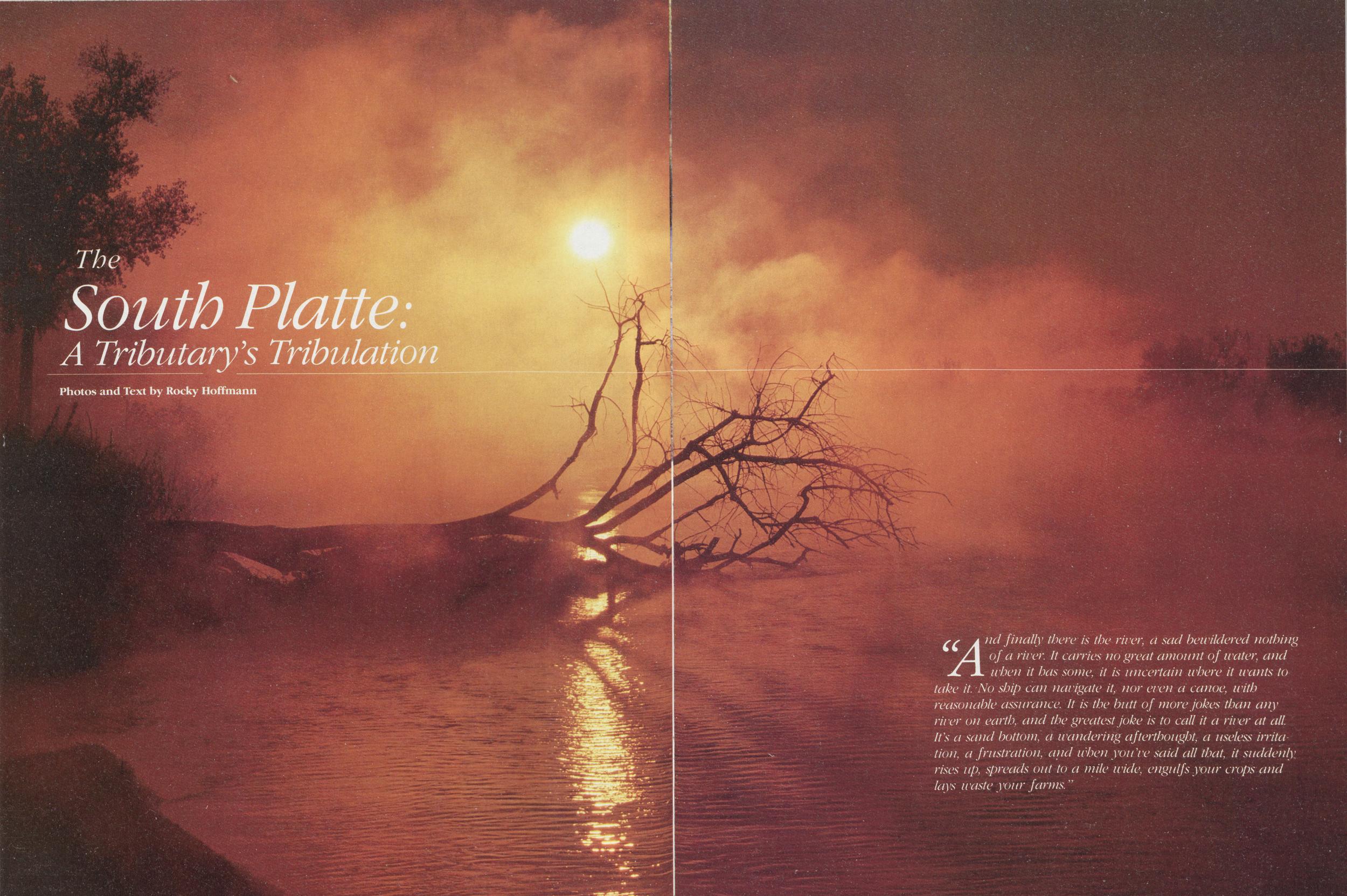
The South Platte: A Tributary's Tribulation
Photos and Text by Rocky Hoffmann And finally there is the rirer, a sad bewildered nothing of a rirer It carries no great amount of water and _ L when it has some, it is uncertain where it wants to take it. No ship can uarigate it, nor eren a canoe, with reasonable assurance, ft is the butt of more jokes than any rirer on earth, and the greatest joke is to call it a rirer at all. Iks a sand bottom, a wandering afterthought, a useless irritation, a frustration, and when yoiCre said all that, it suddenly rises up, spreads out to a mile wide, engulfs your crops and lays waste your farms."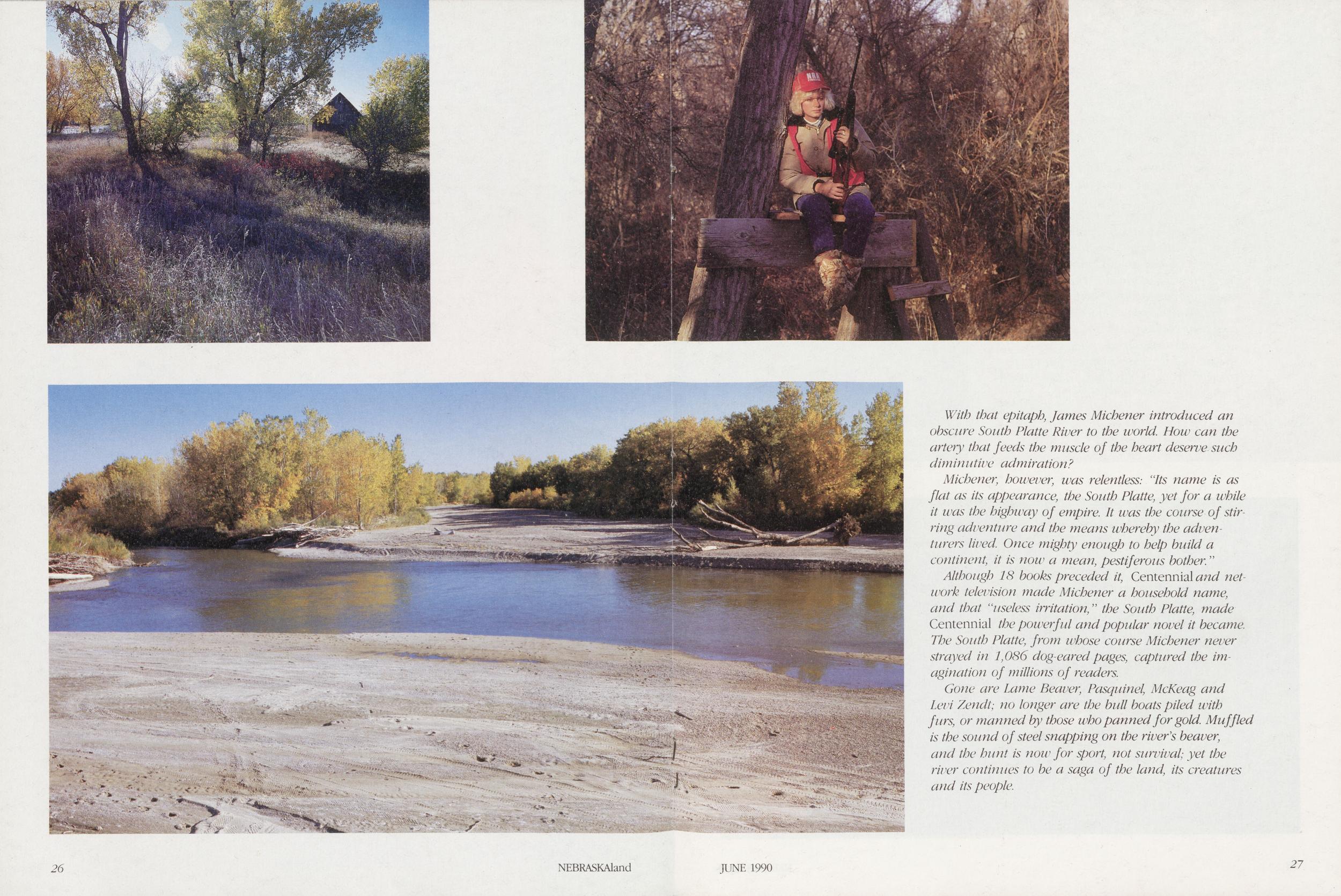
With that epitaph, fames Michener introduced an obscure South Platte River to the world. How can the artery that feeds the muscle of the heart deserve such diminutive admiration?
Michener, however, was relentless: "Its name is as flat as its appearance, the South Platte, yet for a while it was the highivay of empire. It was the course of stirring adventure and the means whereby the adventurers lived. Once mighty enough to help build a continent, it is now a mean, pestiferous bother."
Although 18 books preceded it, Centennials; network television made Michener a household name, and that "useless irritation," the South Platte, made Centennial the powerful and popular novel it became. The South Platte, from whose course Michener nether strayed in 1,086 dog-eared pages, captured the imagination of millions of readers.
Gone are Lame Beaver, Pasquinel, McKeag and Levi Zendt; no longer are the bull boats piled with furs, or manned by those who panned for gold. Muffled is the sound of steel snapping on the river's beaver, and the hunt is now for sport, not survival; yet the river continues to be a saga of the land, its creatures and its people.
JUNE 1990 27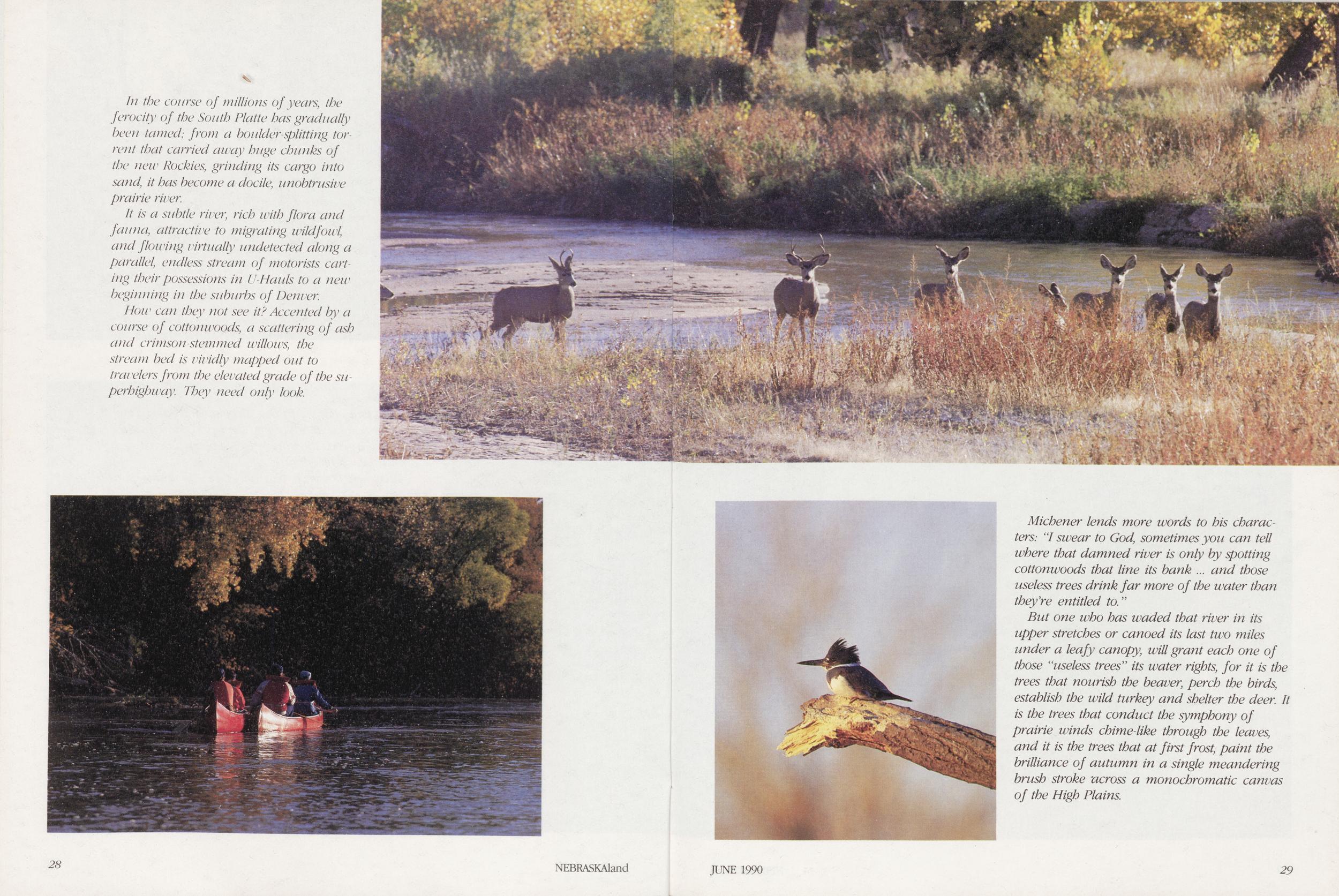
In the course of millions of years, the ferocity of the South Platte has gradually been tamed; from a boulder-splitting torrent that carried away huge chunks of the new Rockies, grinding its cargo into sand, it has become a docile, unobtrusive prairie river
It is a subtle river, rich with flora and fauna, attractive to migrating wildfowl, and flowing virtually undetected along a parallel, endless stream of motorists carting their possessions in U-Hauls to a new beginning in the suburbs of Denver.
How can they not see it? Accented by a course of cottonwoods, a scattering of ash and crimson stemmed willows, the stream bed is vividly mapped out to travelers from the elevated grade of the superhighway They need only look.
Michener lends more words to his characters: "I swear to God, sometimes you can tell where that damned river is only by spotting cottonwoods that line its bank and those useless trees drink far more of the water than they're entitled to."
But one who has waded that river in its upper stretches or canoed its last two miles under a leafy canopy, will grant each one of those "useless trees" its water rights, for it is the trees that nourish the beaver, perch the birds, establish the wild turkey and shelter the deer. It is the trees that conduct the symphony of prairie winds chime-like through the leaves, and it is the trees that at first frost, paint the brilliance of autumn in a single meandering brush stroke across a monochromatic canvas of the High Plains.
JUNe 1990 29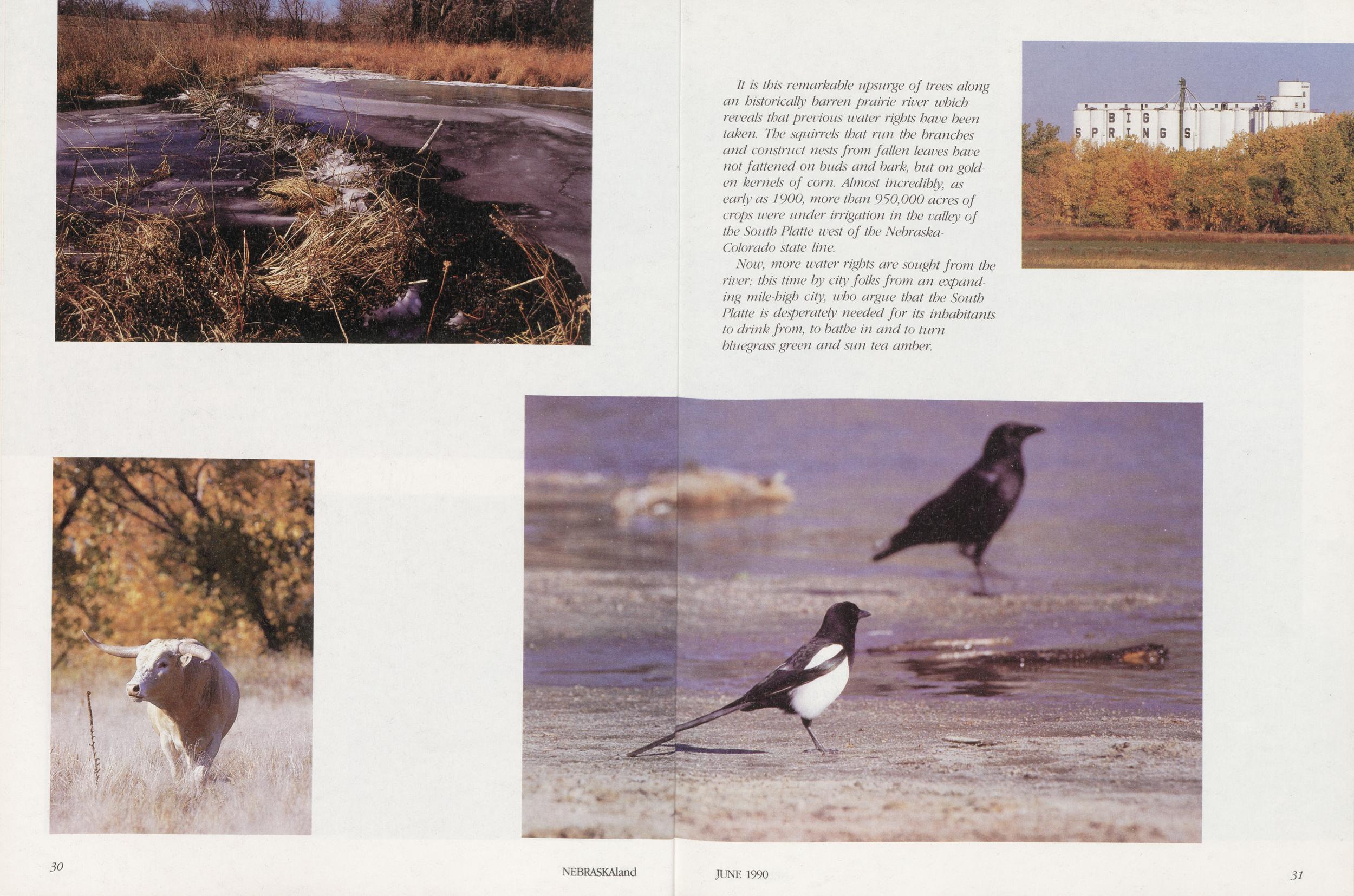
It is this remarkable upsurge of trees along an historically barren prairie river which reveals that previous water rights have been taken. The squirrels that run the branches and construct nests from fallen leaves have not fattened on buds and bark, but on golden kernels of corn. Almost incredibly, as early as 1900, more than 950,000 acres of crops were under irrigation in the valley of the South Platte west of the NebraskaColorado state line.
Noiv, more water rights are sought from the river; this time by city folks from an expanding mile-high city, who argue that the South Platte is desperately needed for its inhabitants to drink from, to bathe in and to turn bluegrass green and sun tea amber.
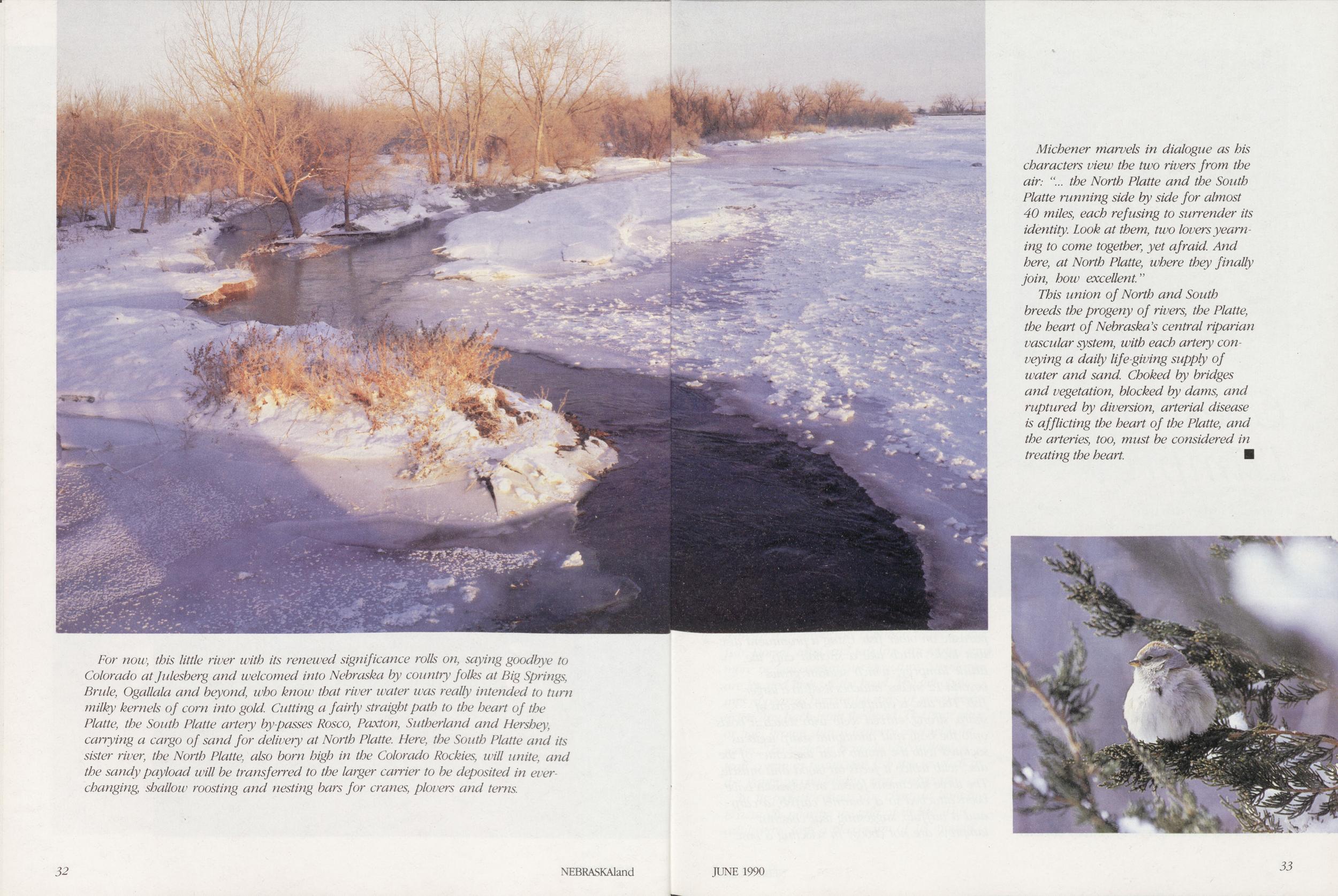
For now, this little river with its renewed significance rolls on, saying goodbye to Colorado at Julesberg and welcomed into Nebraska by country folks at Big Springs, Brule, Ogallala and beyond, who know that river water was really intended to turn milky kernels of corn into gold. Cutting a fairly straight path to the heart of the Platte, the South Platte artery bypasses Rosco, Paxton, Sutherland and Hershey, carrying a cargo of sand for delivery at North Platte. Here, the South Platte and its sister river, the North Platte, also born high in the Colorado Rockies, will unite, and the sandy payload will be transferred to the larger carrier to be deposited in everchanging shallow roosting and nesting bars for cranes, plovers and terns.
32 NEBRASKAlandMichener marvels in dialogue as his characters view the two rivers from the air: " the North Platte and the South Platte running side by side for almost 40 miles, each refusing to surrender its identity. Look at them, two lovers yearning to come together, yet afraid. And here, at North Platte, where they finally join, how excellent."
This union of North and South breeds the progeny of rivers, the Platte, the heart of Nebraska's central riparian vascular system, with each artery conveying a daily life-giving supply of water and sand. Choked by bridges and vegetation, blocked by dams, and ruptured by diversion, arterial disease is afflicting the heart of the Platte, and the arteries, too, must be considered in treating the heart.
Chestnut Lamprey
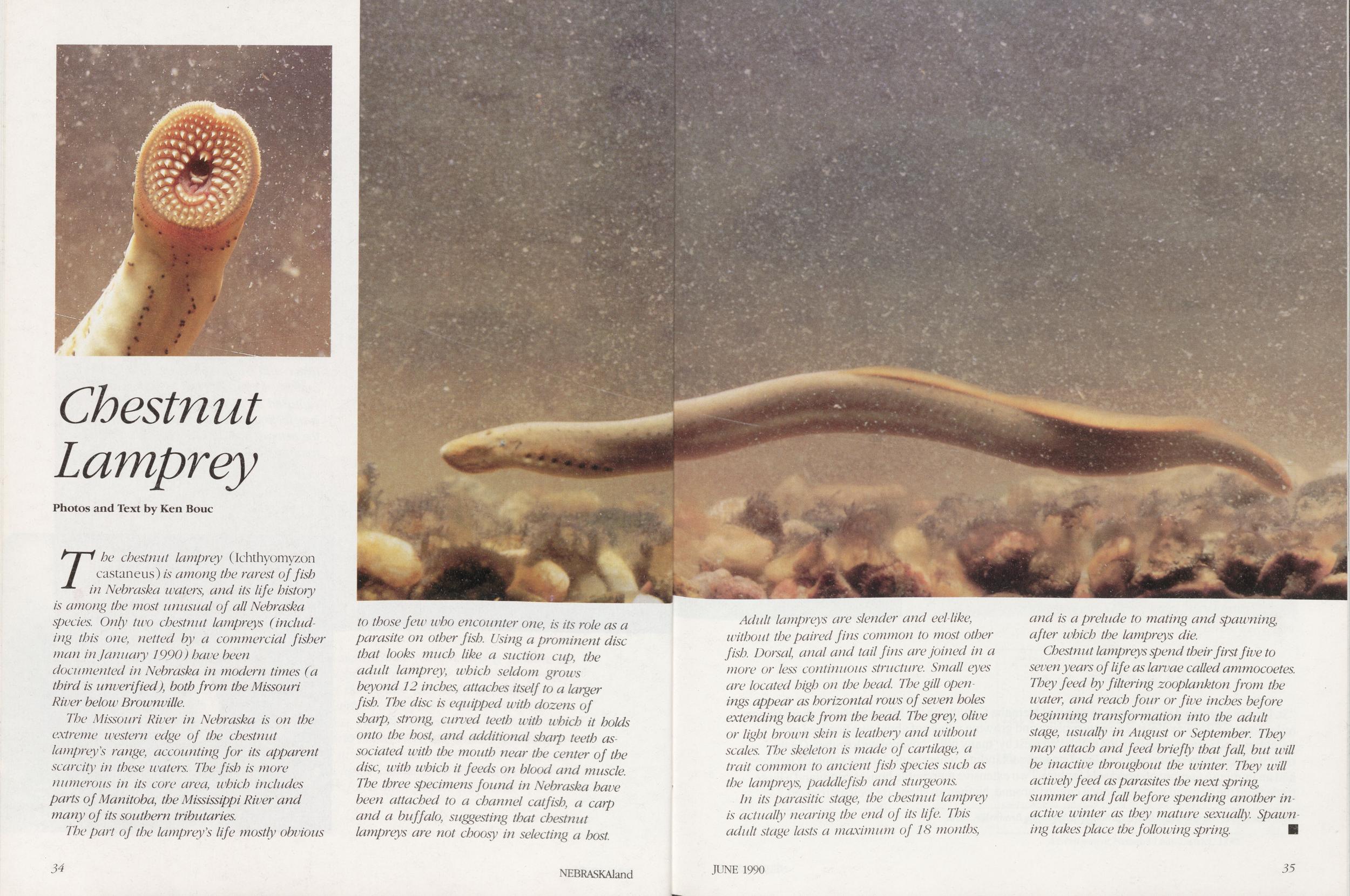
Photos and Text by Ken BoucThe chestnut lamprey (Ichthyomyzon castaneus) is among the rarest of fish in Nebraska waters, and its life history is among the most unusual of all Nebraska species. Only two chestnut lampreys (including this one, netted by a commercial fisher man in January 1990) have been documented in Nebraska in modern times (a third is unverified), both from the Missouri River below Brownville.
The Missouri River in Nebraska is on the extreme western edge of the chestnut lamprey's range, accounting for its apparent scarcity in these waters. The fish is more numerous in its core area, which includes parts of Manitoba, the Mississippi River and many of its southern tributaries.
The part of the lamprey's life mostly obvious to those few who encounter one, is its role as a parasite on other fish. Using a prominent disc that looks much like a suction cup, the adult lamprey, which seldom grows beyond 12 inches, attaches itself to a larger fish. The disc is equipped with dozens of sharp, strong curved teeth with which it holds onto the host, and additional sharp teeth associated with the mouth near the center of the disc, with which it feeds on blood and muscle. The three specimens found in Nebraska have been attached to a channel catfish, a carp and a buffalo, suggesting that chestnut lampreys are not choosy in selecting a host.
34 NEBRASKAlandAdult lampreys are slender and eel-like, without the paired fins common to most other fish. Dorsal, anal and tail fins are joined in a more or less continuous structure. Small eyes are located high on the head. The gill openings appear as horizontal rows of seven holes extending back from the head. The grey, olive or light brown skin is leathery and without scales. The skeleton is made of cartilage, a trait common to ancient fish species such as the lampreys, paddlefish and sturgeons.
In its parasitic stage, the chestnut lamprey is actually Hearing the end of its life. This adult stage lasts a maximum of 18 months, and is a prelude to mating and spawning after which the lampreys die.
Chestnut lampreys spend their first five to seven years of life as lawae called ammocoetes. They feed by filtering zooplankton from the water, and reach four or five inches before beginning transformation into the adult stage, usually in August or September. They may attach and feed briefly that fall, but will be inactive throughout the winter. They will actively feed as parasites the next spring summer and fall before spending another inactive winter as they mature sexually. Spawn ing takes place the following spring.
JUNE 1990 35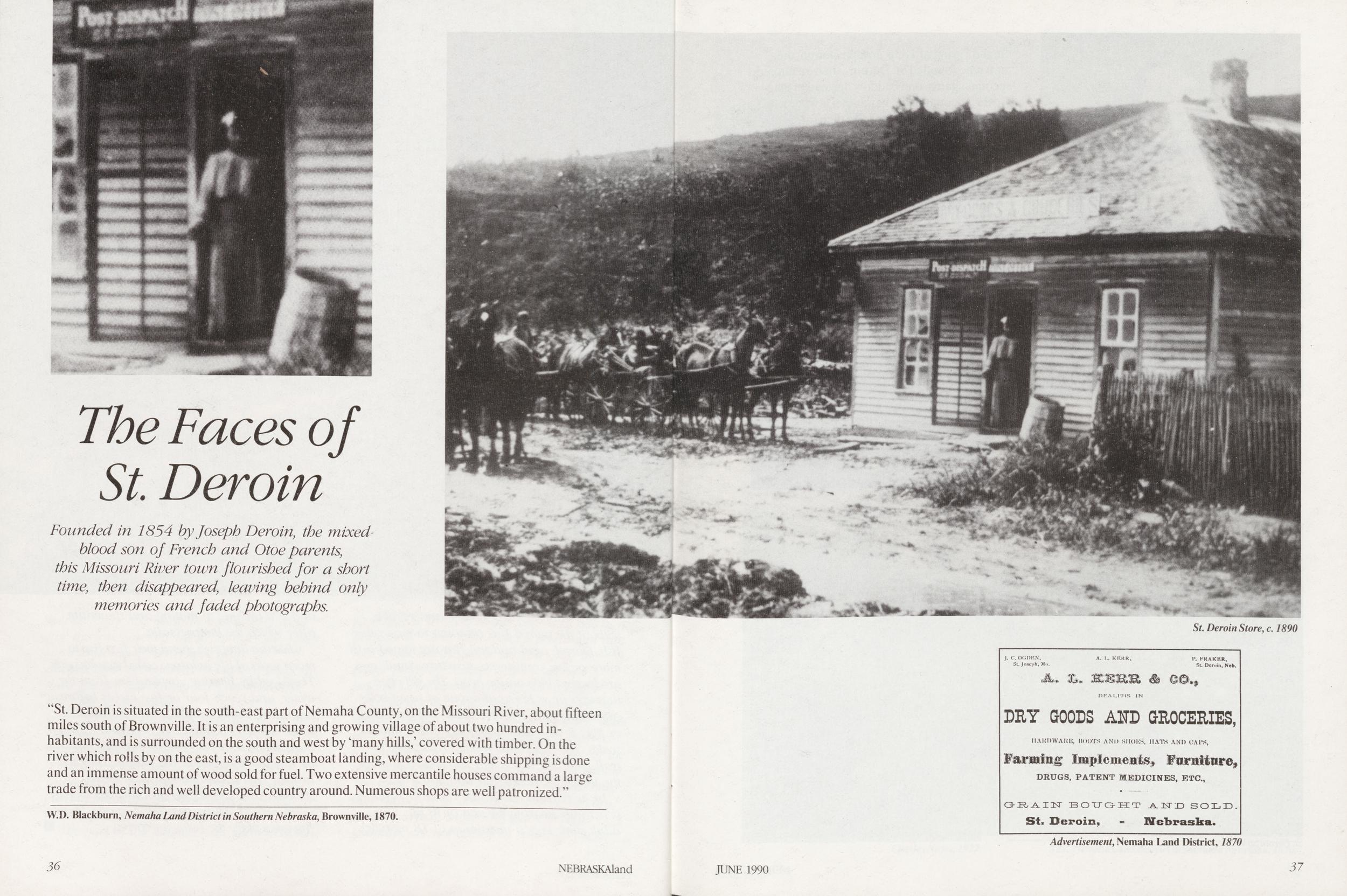
The Faces of St. Deroin
Founded in 1854 by Joseph Deroin, the mixedblood son of French and Otoe parents, this Missouri River town flourished for a short time, then disappeared, leaving behind only memories and faded photographs."St. Deroin is situated in the south-east part of Nemaha County, on the Missouri River, about fifteen miles south of Brownville. It is an enterprising and growing village of about two hundred in- habitants, and is surrounded on the south and west by 'many hills,' covered with timber. On the river which rolls by on the east, is a good steamboat landing, where considerable shipping is done and an immense amount of wood sold for fuel. Two extensive mercantile houses command a large trade from the rich and well developed country around. Numerous shops are well patronized"
W.D. Blackburn, Nemaha Land District in Southern Nebraska, Brownville, 1870. 36 NEBRASKAland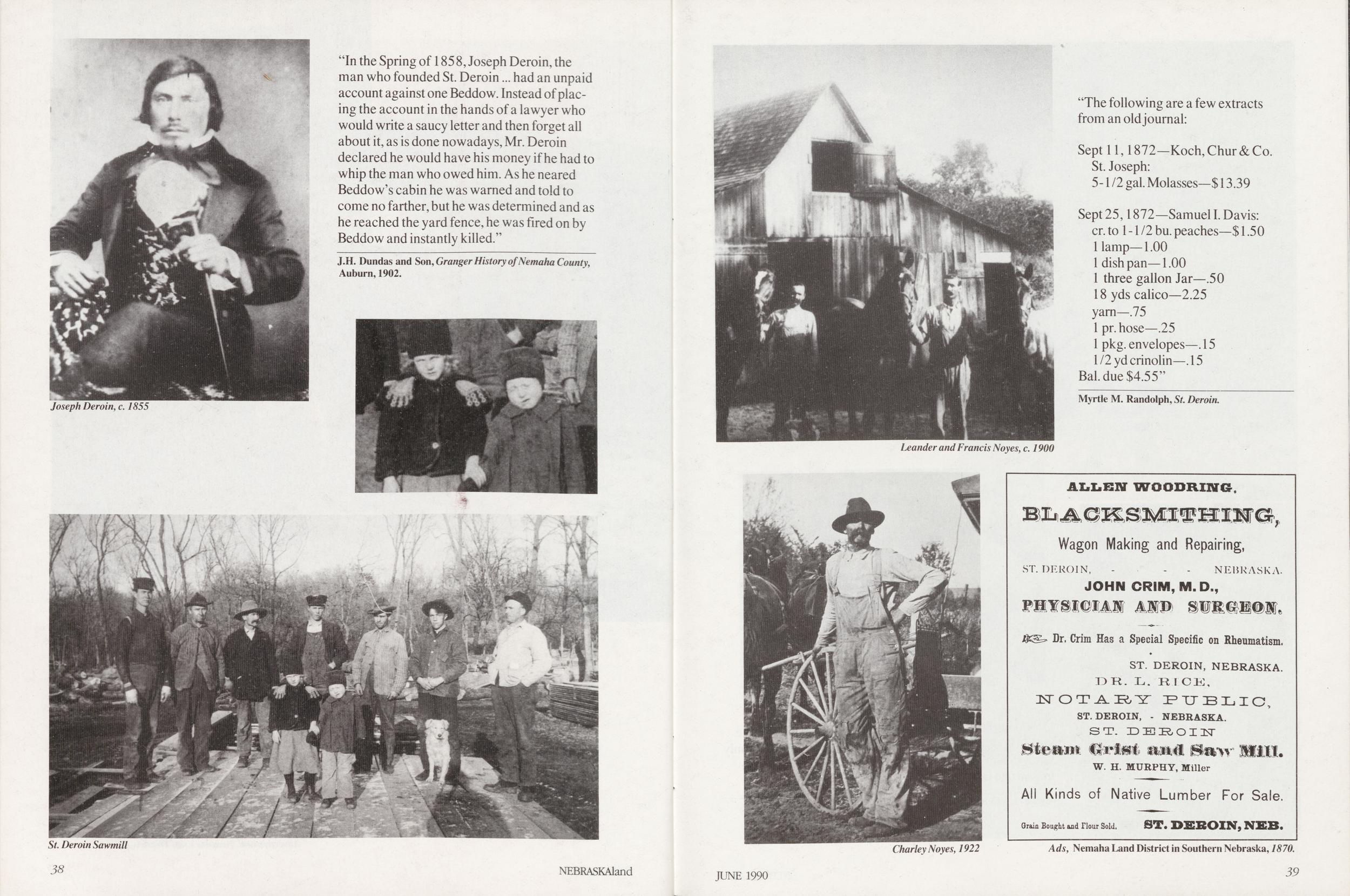
"In the Spring of 185 8, Joseph Deroin, the man who founded St. Deroin had an unpaid account against one Beddow. Instead of placing the account in the hands of a lawyer who would write a saucy letter and then forget all about it, as is done nowadays, Mr. Deroin declared he would have his money if he had to whip the man who owed him. As he neared Beddow's cabin he was warned and told to come no farther, but he was determined and as he reached the yard fence, he was fired on by Beddow and instantly killed."
J.H. Dundas and Son, Granger History of Nemaha County, Auburn, 1902.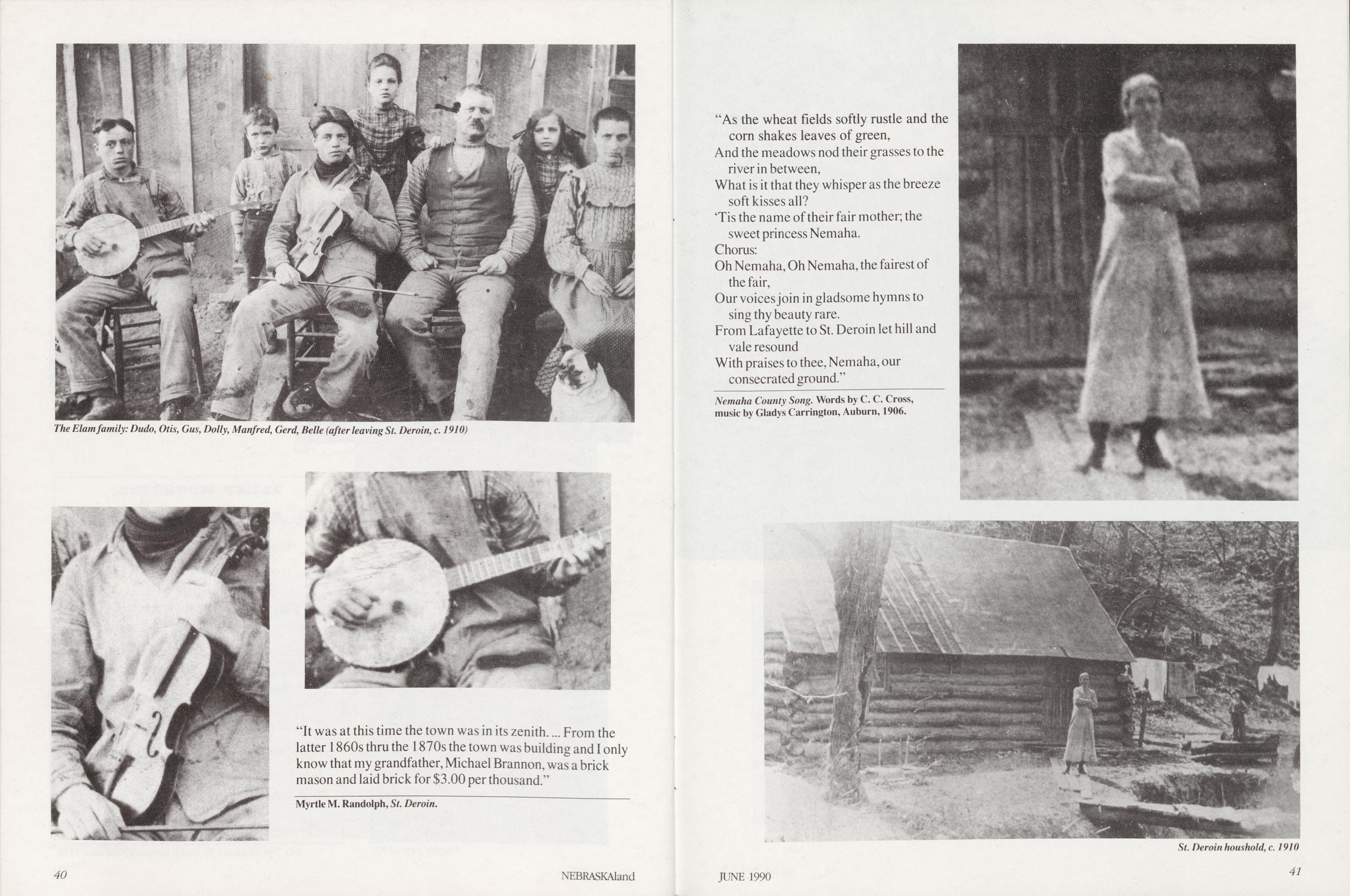
"It was at this time the town was in its zenith From the latter 1860s thru the 1870s the town was building and I only know that my grandfather, Michael Brannon, was a brick mason and laid brick for $3.00 per thousand."
Myrtle M. Randolph, St. Deroin. 40 NEBNRASKAland "As the wheat fields softly rustle and the corn shakes leaves of green, And the meadows nod their grasses to the river in between, What is it that they whisper as the breeze soft kisses all? Tis the name of their fair mother; the sweet princess Nemaha. Chorus: Oh Nemaha, Oh Nemaha, the fairest of the fair, Our voices join in gladsome hymns to sing thy beauty rare. From Lafayette to St. Deroin let hill and vale resound With praises to thee, Nemaha, our consecrated ground." Nemaha County Song. Words by C. C. Cross, music by Gladys Carrington, Auburn, 1906.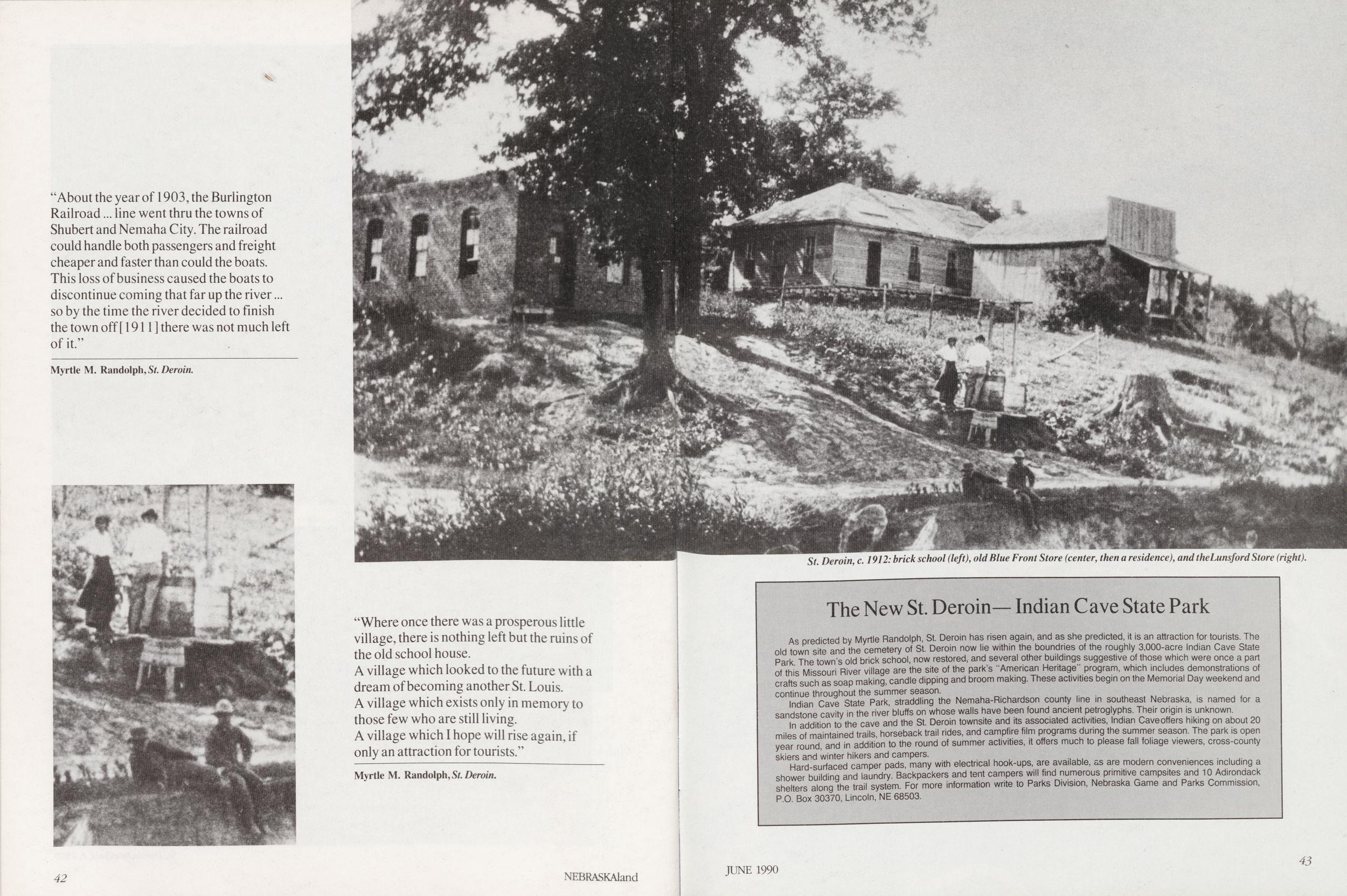
"About the year of 1903, the Burlington Railroad line went thru the towns of Shubert and Nemaha City. The railroad could handle both passengers and freight cheaper and faster than could the boats. This loss of business caused the boats to discontinue coming that far up the river so by the time the river decided to finish the town off [ 1911 ] there was not much left of it."
Myrtle M. Randolph, St. Deroin.As predicted by Myrtle Randolph, St Deroin has risen again, and as she predicted, it is an attraction for tourists. The old town site and the cemetery of St. Deroin now lie within the boundries of the roughly 3,000-acre Indian Cave State Park The town's old brick school, now restored, and several other buildings suggestive of those which were once a part of this Missouri River village are the site of the park's "American Heritage" program, which includes demonstrations of crafts such as soap making, candle dipping and broom making. These activities begin on the Memorial Day weekend and continue throughout the summer season.
Indian Cave State Park, straddling the Nemaha-Richardson county line in southeast Nebraska, is named for a sandstone cavity in the river bluffs on whose walls have been found ancient petrogiyphs. Their origin is unknown.
In addition to the cave and the St. Deroin townsite and its associated activities, Indian Caveoffers hiking on about 20 miles of maintained trails, horseback trail rides, and campfire film programs during the summer season. The park is open year round, and in addition to the round of summer activities, it offers much to please fall foliage viewers, cross-county skiers and winter hikers and campers.
Hard-surfaced camper pads, many with electrical hook-ups, are available, as are modern conveniences including a shower building and laundry. Backpackers and tent campers will find numerous primitive campsites and 10 Adirondack shelters along the trail system. For more information write to Parks Division, Nebraska Game and Parks Commission, P.O. Box 30370, Lincoln, NE 68503.
JUNE 1990 43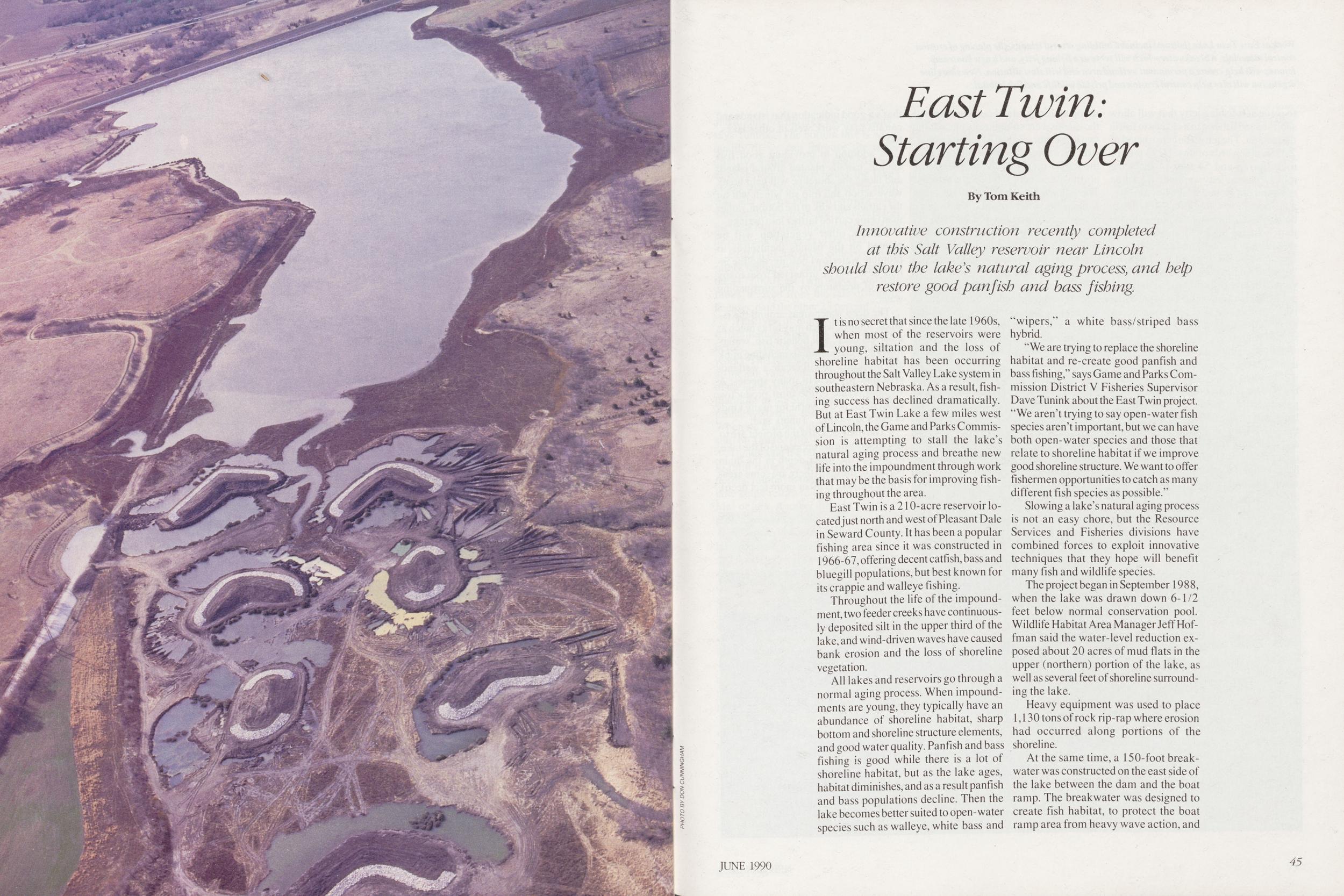
East Twin: Starting Over
By Tom Keith Innovative construction recently completed at this Salt Valley reservoir near Lincoln should slow the lake's natural aging process, and help restore good panfish and bass fishingIt is no secret that since the late 1960s, when most of the reservoirs were young, siltation and the loss of shoreline habitat has been occurring throughout the Salt Valley Lake system in southeastern Nebraska. As a result, fishing success has declined dramatically. But at East Twin Lake a few miles west of Lincoln, the Game and Parks Commission is attempting to stall the lake's natural aging process and breathe new life into the impoundment through work that may be the basis for improving fishing throughout the area.
East Twin is a 210-acre reservoir locatedjust north and west of Pleasant Dale in Seward County. It has been a popular fishing area since it was constructed in 1966-67, offering decent catfish, bass and bluegill populations, but best known for its crappie and walleye fishing.
Throughout the life of the impoundment, two feeder creeks have continuously deposited silt in the upper third of the lake, and wind-driven waves have caused bank erosion and the loss of shoreline vegetation.
All lakes and reservoirs go through a normal aging process. When impoundments are young, they typically have an abundance of shoreline habitat, sharp bottom and shoreline structure elements, and good water quality. Panfish and bass fishing is good while there is a lot of shoreline habitat, but as the lake ages, habitat diminishes, and as a result panfish and bass populations decline. Then the lake becomes better suited to open-water species such as walleye, white bass and ''wipers," a white bass/striped bass hybrid.
"We are trying to replace the shoreline habitat and re-create good panfish and bass fishing," says Game and Parks Commission District V Fisheries Supervisor Dave Tunink about the East Twin project. 'We aren't trying to say open-water fish species aren't important, but we can have both open-water species and those that relate to shoreline habitat if we improve good shoreline structure. We want to offer fishermen opportunities to catch as many different fish species as possible."
Slowing a lake's natural aging process is not an easy chore, but the Resource Services and Fisheries divisions have combined forces to exploit innovative techniques that they hope will benefit many fish and wildlife species.
The project began in September 1988, when the lake was drawn down 6-112 feet below normal conservation pool. Wildlife Habitat Area Manager Jeff Hoffman said the water-level reduction exposed about 20 acres of mud flats in the upper (northern) portion of the lake, as well as several feet of shoreline surrounding the lake.
Heavy equipment was used to place 1,130 tons of rock rip-rap where erosion had occurred along portions of the shoreline.
At the same time, a 150-foot breakwater was constructed on the east side of
the lake between the dam and the boat
ramp. The breakwater was designed to
create fish habitat, to protect the boat
ramp area from heavy wave action, and
JUNE 1990
45
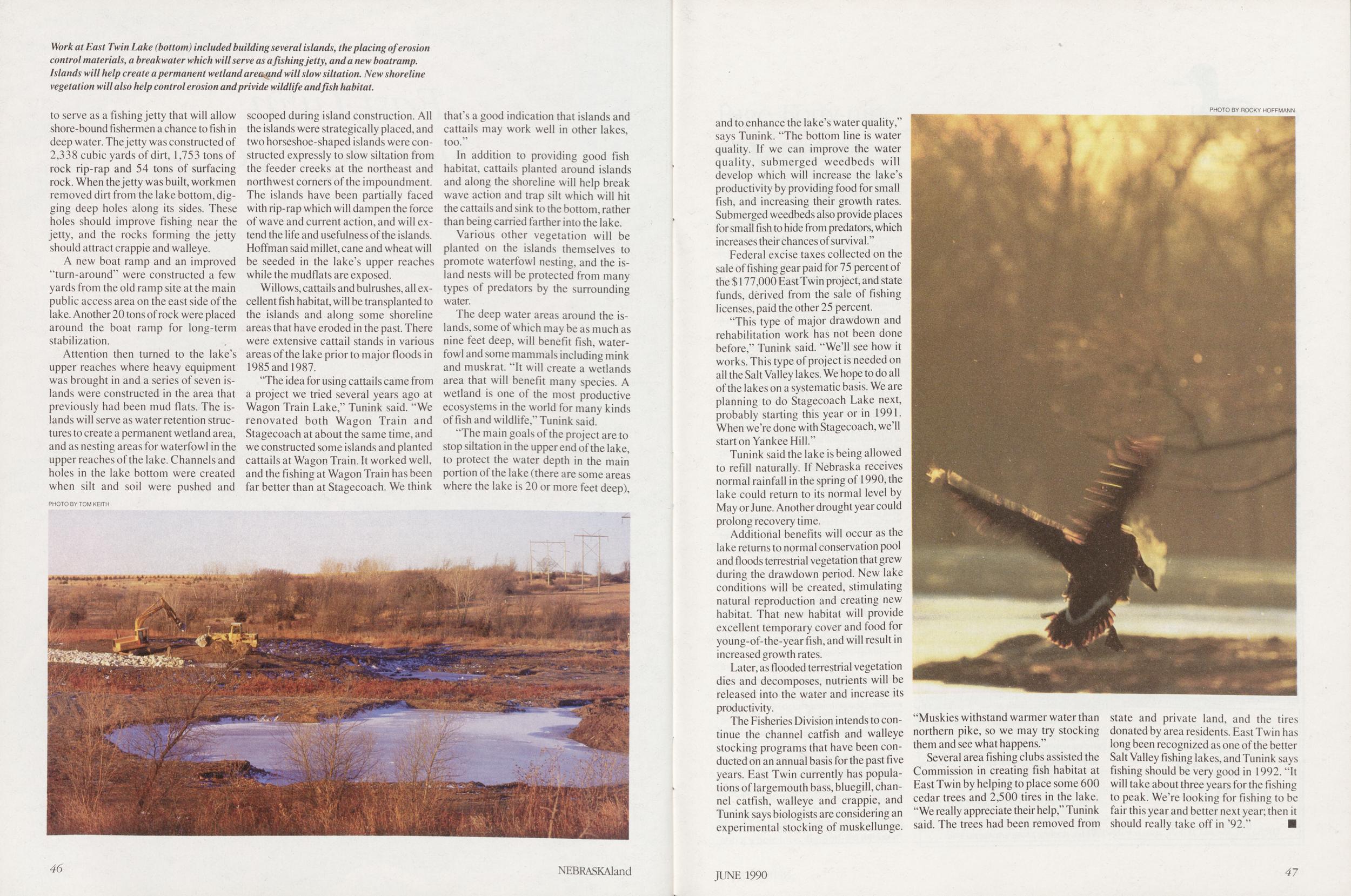
A new boat ramp and an improved "turn-around" were constructed a few yards from the old ramp site at the main public access area on the east side of the lake. Another 20 tons of rock were placed around the boat ramp for long-term stabilization.
Attention then turned to the lake's upper reaches where heavy equipment was brought in and a series of seven islands were constructed in the area that previously had been mud flats. The islands will serve as water retention structures to create a permanent wetland area, and as nesting areas for waterfowl in the upper reaches of the lake. Channels and holes in the lake bottom were created when silt and soil were pushed and scooped during island construction. All the islands were strategically placed, and two horseshoe-shaped islands were constructed expressly to slow siltation from the feeder creeks at the northeast and northwest corners of the impoundment. The islands have been partially faced with rip-rap which will dampen the force of wave and current action, and will extend the life and usefulness of the islands. Hoffman said millet, cane and wheat will be seeded in the lake's upper reaches while the mudflats are exposed.
Willows, cattails and bulrushes, all excellent fish habitat, will be transplanted to the islands and along some shoreline areas that have eroded in the past. There were extensive cattail stands in various areas of the lake prior to major floods in 1985 and 1987.
"The idea for using cattails came from a project we tried several years ago at Wagon Train Lake," Tunink said. "We renovated both Wagon Train and Stagecoach at about the same time, and we constructed some islands and planted cattails at Wagon Train. It worked well, and the fishing at Wagon Train has been far better than at Stagecoach. We think that's a good indication that islands and cattails may work well in other lakes, too."
In addition to providing good fish habitat, cattails planted around islands and along the shoreline will help break wave action and trap silt which will hit the cattails and sink to the bottom, rather than being carried farther into the lake.
Various other vegetation will be planted on the islands themselves to promote waterfowl nesting, and the island nests will be protected from many types of predators by the surrounding water.
The deep water areas around the islands, some of which may be as much as nine feet deep, will benefit fish, waterfowl and some mammals including mink and muskrat. "It will create a wetlands area that will benefit many species. A wetland is one of the most productive ecosystems in the world for many kinds offish and wildlife," Tunink said.
"The main goals of the project are to stop siltation in the upper end of the lake, to protect the water depth in the main portion of the lake (there are some areas where the lake is 20 or more feet deep), 46 NEBRASKAland and to enhance the lake's water quality," says Tunink. "The bottom line is water quality. If we can improve the water quality, submerged weedbeds will develop which will increase the lake's productivity by providing food for small fish, and increasing their growth rates. Submerged weedbeds also provide places for small fish to hide from predators, which increases their chances of survival."
Federal excise taxes collected on the sale of fishing gear paid for 75 percent of the $ 177,000 East Twin project, and state funds, derived from the sale of fishing licenses, paid the other 25 percent.
"This type of major drawdown and rehabilitation work has not been done before," Tunink said. "We'll see how it works. This type of project is needed on all the Salt Valley lakes. We hope to do all of the lakes on a systematic basis. We are planning to do Stagecoach Lake next, probably starting this year or in 1991. When we're done with Stagecoach, we'll start on Yankee Hill."
Tunink said the lake is being allowed to refill naturally. If Nebraska receives normal rainfall in the spring of 1990, the lake could return to its normal level by May or June. Another drought year could prolong recovery time.
Additional benefits will occur as the lake returns to normal conservation pool and floods terrestrial vegetation that grew during the drawdown period. New lake conditions will be created, stimulating natural reproduction and creating new habitat. That new habitat will provide excellent temporary cover and food for young-of-the-year fish, and will result in increased growth rates.
Later, as flooded terrestrial vegetation dies and decomposes, nutrients will be released into the water and increase its productivity.
The Fisheries Division intends to continue the channel catfish and walleye stocking programs that have been conducted on an annual basis for the past five years. East Twin currently has populations of largemouth bass, bluegill, channel catfish, walleye and crappie, and Tunink says biologists are considering an experimental stocking of muskellunge. "Muskies withstand warmer water than northern pike, so we may try stocking them and see what happens."
Several area fishing clubs assisted the Commission in creating fish habitat at East Twin by helping to place some 600 cedar trees and 2,500 tires in the lake. "We really appreciate their help," Tunink said. The trees had been removed from state and private land, and the tires donated by area residents. East Twin has long been recognized as one of the better Salt Valley fishing lakes, and Tunink says fishing should be very good in 1992. "It will take about three years for the fishing to peak. We're looking for fishing to be fair this year and better next year; then it should really take off in '92."
Classified
ARTS & CRAFTSBev Doolittle, Terrry Redlin, Jerry Raedke, Ed Wards, Robert Bateman, Frank McCarthy and Neal Anderson are available at the 2nd Street Gallery, 537 W. 2nd, Hastings, NE 68901. Phone (402) 463-6677.
BIRDSGAMEBIRDS: Pheasants, partridges, wild turkeys, eggs, chicks, adults. National Poultry Improvement Plan participants—guaranteed top quality for propagation, hunting, eating and taxidermy. Call now to place 1990 chick orders. Bargain prices on hen chicks. Toubl Game Bird Farms, Beloit, WI (608) 365-1789.
BOATS/MOTORSTROLLING MOTOR REPAIR. Factory authorized Minn Kota and Motor Guide, parts and service. Wolfs Tackle Supply, 5950 Colfax Ave., Lincoln, NE 68507. Phone(402)464-4265.
BOOKS/PRINTINGFREE! Booklets on northeastern Nevada; fishing, rockhounding maps, Carl Hayden. Box 528, Jackpot, Nevada 89825.
FREE BOOK CATALOG. Novels, westerns, romances, children's; old out of print, found barns, attic. Authors: Grey, Bower, Connor, Fox, Curwood, Raine, Wright, Aldrige, Pollyanna, Freckles, many others. Postage appreciated. Pierce, 4400 N. Pine Cluster, Oroville, C A 95965.
COLLECTIBLESBUYING: American Indian artifacts such as beadwork, weavings, baskets, etc.; also cowboy memorabilia such as chaps, spurs, photographs, etc. Best price first letter; photographs promptly returned. Jack Ringwalt, 1550 California St., Suite 6, #211, San Francisco, C A 94109, (415)759-6343.
DOGSYELLOW-BLACK Lab pups. FC-AFC sired. AKC. Hips OFA ceritified. Dew claws removed. Excellent hunting potential. Contact Bob Bendler, Lexington, NE (308)324-4247.
TRAINING ALL BREEDS bird dogs—Vizslas & English Pointers—for sale. Rozanek Kennels, R 2, Schuyler, NE 68661. Phone(402)352-8769.
Classified ad rates: 75 C per word, minimum $15. Closing date is the first business day 2 months preceding date of issue. To place ads or for more information write NEBRASKAland Magazine, P.O. Box 30370, Lincoln, NE 68503, or call (402) 471-5478. NEBRASKA OPERATION GAME THIEF STOP POACHING TOLL-FREE HOTLINE (800) 742-7627ENGLISH SETTERS: kBred for the hunter"; select puppies and started dogs available from outstanding bloodlines. Stud service available by proven hunters. High Plains Kennels, 1411 Emerson, Alliance, NE 69301, Phone(308)762-6709.
PINKERTON BIRD DOGS—English setter, brittany puppies. Started dogs available this fall. Our dogs are bred for nose and style. Give us a call at (402) 673-4540.
GERMAN SHORTHAIR and springer spaniel puppies—also started dogs. Outstanding bloodlines. Bird dog training. Cactus Kennels, Dave Wickham, Kimball, NE 69145. (308) 235-3237.
ENGLISH SETTER pups and young dogs for sale. These are beautiful, stylish dogs from selective breeding. Contact Darrell Yentes, Holdrege, NE 68949 or phone (308)995-4797.
FISHFISH FOR SALE. Catfish, perch, coho salmon, rainbow trout, crappie, bluegill, walleye, minnows, goldfish, bullhead, largemouth bass, smallmouth bass, triploid grass carp. Commercial grower prices on catfish, perch, coho salmon, rainbow trout. Consulting available. Pleasant Valley Fish Farm, Rt 1 Box 147, McCook, NE 69001. Phone (308) 345-6599.
FISH FOR POND STOCKING. Bass, bluegill, crappie, perch, channel catfish, Triploid grass carp, rainbow trout and walleye. Available April-October. Write Orchard Fish Hatchery, Rt 2, Box 117, Orchard, NE 68764 or phone (402) 893-2521.
WILLOW LAKE FISH HATCHERY. Channel cat, blue-gill, hybrid bluegill, largemouth bass, crappie, bullheads, triploid grass carp, walleye, perch, minnows available for stocking. Gaylord Crawford, Rt 3 Box 46, Hastings, NE 68901 or phone (402) 463-8022 day or night. Also pond consultant.
FOODWINE AND BEER: Make your own. Send for free recipes and instructions. Omaha Supply, 1324 2nd Avenue, Nebraska City, NE 68410.
BUFFALO JERKY, 16 1-oz. pkgs. for $23 including shipping. Sample $1.75. G. E. Hill Distributing, 5220 Aylesworth, Lincoln, NE 68504. Phone (402) 464-6781.
GUIDES/OUTFITTERSMAD RIVER CANOES offers the finest quality and performance. For the finest canoes and accessories look to Great Plains Canoe Co., 205 Main, Springfield, NE. Phone(402)253-2001.
EXPERIENCE NEBRASKA with an affordable canoe trip by Dryland Aquatics. One and two-day trips canoe rental or fully catered. Niobrara Dismal Platte Elkhorn We do it your way! For free brochure: Dryland Aquatics, Dept. N, 1837 E. Cuming, Fremont, NE 68025 or phone (402) 721-4177.
FERGUSON GUIDE SERVICE. Call Dan Ferguson (308) 785-2413 to book your 1990 fishing trip. Elwood, Calamus and Johnson Lake.
BLACK HILLS FIELD CAMPS: Visit sites of geologic interest—badlands, caves, mines, mountains, fossil quarries and museums. Based from the Trailside Museum at Fort Robinson State Park in the scenic Pine Ridge. Most stops involve hiking and time enough to enjoy each. Visitors need provide a sleeping bag and clothing appropriate for travel and an evening around a campfire. Each two-day camp includes a souvenir T-shirt, equipment, admissions, meals, and presentation along the 400 mile route selected for its lack of developed tourism. Rates: Adults $95, Children (6 yrs. thru 15 yrs.) $49: 10% discount for families/groups of four or more. For information/reservations contact David Nixon, Trailside Supt., 307 Morrill Hall, UNL, Lincoln, NE 68588-0338, (402) 472-6365. After May 15th Trailside Museum, P.O. 462, Crawford, NE 69339, (308) 665-2730. Dates: June (1-2), (15-16), and (28-29); July (13-14), (27-28), and August (3-4).
GRAHAM CANOE OUTFITTERS: Top quality fullservice camping and canoe trips on the Niobrara River. Daily canoe rentals and car shuttle-service available. Contact Doug & Twyla Graham, HC 13 Box 16, Valentine, NE 69201 or phone (402) 376-3708.
CANOE RENTALS: Kamp Kaleo, Burwell, NE. 17-ft. aluminum canoes, $ 15 per day. Call (308) 346-5083 for information and reservations.
KEN KO INC. Spend a day fishing the scenic Missouri River with Fishing Guide Kenneth Cooksey. For information write 2002 2nd Ave., Nebraska City, NE 68025 or call (402) 873-6288 mornings/evenings.
OUTDOOR EQUIPMENTGUNS — Browning, Winchester, Remington, others, Hi-powers, shotguns, new, used, antiques. Want Pre-'64 Winchesters. Buy-Sell-Trade. (402) 729-61 12. Bedlan's Sporting Goods, Fairbury, NE 68352.
REAL ESTATEHIDDEN COVE. Lake-front development. Nestled among the trees. Located 1.3 miles south of North Bend on Hwy 79. Excellent fishing, central water system on site electricity, easy highway access, lots starting at $15,950. Don Peterson Associates Real Estate Co., 100 East 6th, Fremont, NE 68025. Phone (402) 72 1 -9700.
FOR SALE—40 acres in north central Nebraska on headwaters of Pine Creek. 2-Bedroom home, unat- tached 2-car garage. Attached lean-to and wood shed, 2 trout ponds, satellite dish. Year-round living, retirement, or get-away. Beautiful and quiet. Call (308) 234-3798 or (402) 273-4113.
TAXIDERMYALLISON'S TAXIDERMY STUDIO. Wally and Betty Allison Licensed Taxidermist. We've mounted 28 Nebraska State Record fish. Specializing in fish and birds, small game and rattlesnakes. We use freeze-dry 2310 West Leota, North Platte, NE 69101. (308) 534-2324.
NABITY'S TAXIDERMY. 31 years experience. Speciahzing in natural grass backgrounds for mammals, birds and fish. 13901 "O" St., Lincoln, NE 68504 — 4 miles east of 84th and "O". (402) 489-6351.
PEISTER TAXIDERMY - Professional work at prices most sportsman can afford. 1020 Central Avenue, Box 3201, Kearney, NE 68847. Phone (308) 236-9700 or (308)237-7575 evenings.
SWANSON PHEASANT COMPANY: mounted pheasants for sale. Flying $87.95; standing $92.95; shipping and handling included. Custom mounts also available. Tell us what you want. Swanson Pheasant Company, 6123 No. 100th Plz., Omaha, NE 68134. We support pheasant stocking.
VACATION/RESORTSBERGMAN'S JOHNSON LAKE RESORT. Lakefront cabins, full RV hookups, groceries, beer, bait, tackle, restaurant, lounge, boat rentals, boat ramp Fish, swim, ski. Free brochure: Rt 2, Elwood, NE 68937 or phone (308) 785-2298.
CABIN FOR RENT. Modern three-bedroom, fullyequipped cabin overlooking secluded, scenic 3-acre pond. Call or write Orchard Fish Hatchery, Rt. 2, Box 117, Orchard, NE 68764 or phone (402) 893-2521.
NE NEBRASKA trout fishing. 3 modern cottages, 1 available year round. 5 spring fed lakes with open water all year. Trout up to 7 pounds. Other varieties fish also. Diamond E. Trout Resort, Orchard, NE 69764. Phone (402)893-4745.
HUNTING OR VACATIONING in central Nebraska'7 Rooms available year-round. Guided deer hunts, too. Chesley's Lodge, Rt 1 Box 76, Callaway, NE 68825. Phone (308) 836-2658.
48 NEBRASKAlandPage Forty-nine
"Whiskey's for drinkin' Water's for fightin'!" This tarnished frontier saying of lost origin is getting a lot of new mileage these days from both sides of the water development fence, and there are some memorable, although contemptuous, quotations as well from James Michener concerning the cherished waters of the South Platte River [see The South Platte: A Tributary's Tribulations, page 24].
"A useless irritation, a frustration a mean, pestiferous bother the greatest joke is to call it a river at all a nothing of a river" Break out the ropes! Let's lynch old Jim from one of the strongest limbs of those "useless trees that drink far more of the water than they're entitled to."
But read on. These lines are from the first 100 of more than 1,000 pages. In its conclusion, Centennials accurately prophetic, and Michener a strong confederate of this little prairie river which has gained national attention since the author handed his manuscript to the publisher nearly two decades ago.
Prophet? "We face a real dilly, because Colorado is such a popular state, 50,000 newcomers want to move in each year. We'd like to welcome them, but we haven't enough water. And within the state itself, 20,000 of our rural people a year want to move into Denver. Love to have them, but no water. We also have scores of industries that want to establish their headquarters here. Executives want instant skiing, and we need their tax dollars. But we simply don't have the water."
Confederate? "It was the confluence of these two forks that formed the South Platte,... and there was not a single error in their utilization. So long as the streams kept to the mountains, they were pure and free; it was when they mingled with men that the abuses began."
The men, however, are going to the mountains now for their water, and this time the water's for drinkin', yet there's still a whole lot of fightin'. Two Forks, a dam planned to wet the parched tongue of an urbanized front range, is provoking a sharp tongue from those farther down stream, including environmentalists, farmers and water resource managers.
"He's just a wimp!" Nebraska Water Resource Director J. Michael Jess lashed out publicly in January of 1989 at Colonel Steven G. West who made the decision for the Army Corps of Engineers to issue a tentative building permit for the $ 1 billion Two Forks Dam project.
"A classic example of bureaucratic arrogance," Two Forks backers countered when the Environmental Protection Agency's decision officer, Lee DeHihns, announced his intentions to veto.
Staffers within the Corps of Engineers screamed "cover-up" of inside environmental opinion memorandums, and Senator J. James Exon of Nebraska cried foul, while Senator Bill Armstrong of Colorado proclaimed that the South Platte isn't a natural river at all: "It's a man-made miracle." And so it went, and so it continues.
The chronology of events that are to decide whether to dam or not to dam has been an exercise in frustration for both backers and foes of the project. Both sides have witnessed an on-again, off-again battle, with each veto spawning renewed hope and each victory realizing defeat. Neither side has claimed conquest, nor has either side recognized loss.
Be assured, the battle over the South Platte will continue as will battles over other water resources, and be equally assured that in the enlightened decade to come, environmentalists will not be ridiculed as narrow-minded special interest groups, but will be recognized as special groups interested in a quality of life for all.
"It was the river which had laid down the new land; it was the river which took it away. The endless cycle of building up, tearing down and rebuilding, using the same material over and over, was contributed to by the river. It was the brawling undisciplined, violent artery of life and would always be."
Always is a long time—even for the South Platte's confederate-prophet, James Michener.
Rocky Hoffmann Give a hoot. Don't pollute. YES! I WOULD LIKE TO SUBSCRIBE TO NEBRASKAland Name 1-Year $12 Address 2-Years $23 Citv State Zip Mail check or money order to NEBRASKAland, Box 30370, Lincoln, NE 68503 JUNE 1990 JUNE 1990 49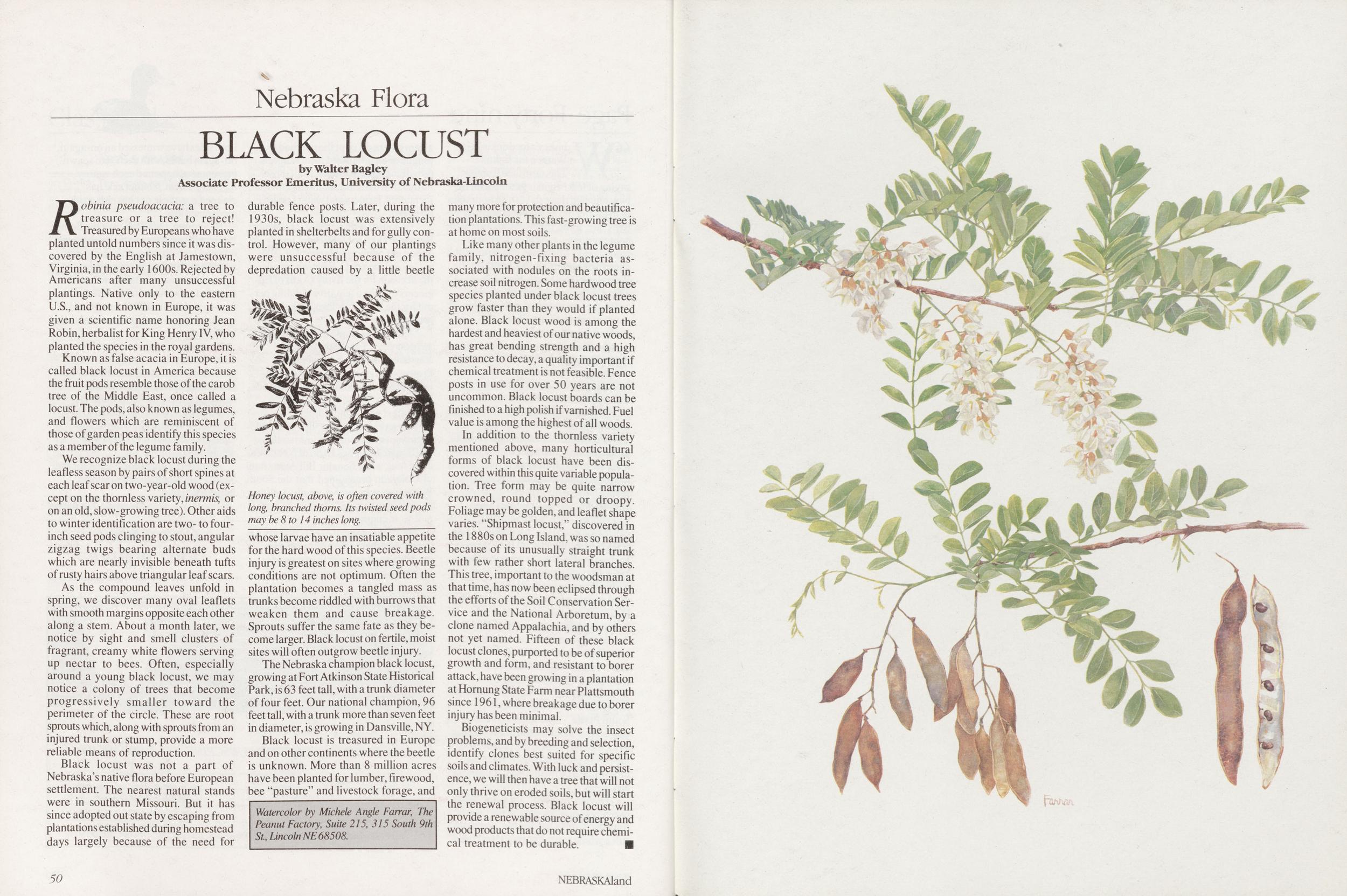
Nebraska Flora BLACK LOCUST
by Walter Bagley Associate Professor Emeritus, University of Nebraska-LincolnR obinia pseudoacacia: a tree to treasure or a tree to reject! A. V Treasured by Europeans who have planted untold numbers since it was discovered by the English at Jamestown, Virginia, in the early 1600s. Rejected by Americans after many unsuccessful plantings. Native only to the eastern U.S., and not known in Europe, it was given a scientific name honoring Jean Robin, herbalist for King Henry IV, who planted the species in the royal gardens.
Known as false acacia in Europe, it is called black locust in America because the fruit pods resemble those of the carob tree of the Middle East, once called a locust. The pods, also known as legumes, and flowers which are reminiscent of those of garden peas identify this species as a member of the legume family.
We recognize black locust during the leafless season by pairs of short spines at each leaf scar on two-year-old wood (except on the thornless variety, inermis, or on an old, slow-growing tree). Other aids to winter identification are two- to fourinch seed pods clinging to stout, angular zigzag twigs bearing alternate buds which are nearly invisible beneath tufts of rusty hairs above triangular leaf scars.
As the compound leaves unfold in spring, we discover many oval leaflets with smooth margins opposite each other along a stem. About a month later, we notice by sight and smell clusters of fragrant, creamy white flowers serving up nectar to bees. Often, especially around a young black locust, we may notice a colony of trees that become progressively smaller toward the perimeter of the circle. These are root sprouts which, along with sprouts from an injured trunk or stump, provide a more reliable means of reproduction.
Black locust was not a part of Nebraska's native flora before European settlement. The nearest natural stands were in southern Missouri. But it has since adopted out state by escaping from plantations established during homestead days largely because of the need for durable fence posts. Later, during the 1930s, black locust was extensively planted in shelterbelts and for gully control. However, many of our plantings were unsuccessful because of the depredation caused by a little beetle whose larvae have an insatiable appetite for the hard wood of this species. Beetle injury is greatest on sites where growing conditions are not optimum. Often the plantation becomes a tangled mass as trunks become riddled with burrows that weaken them and cause breakage. Sprouts suffer the same fate as they become larger. Black locust on fertile, moist sites will often outgrow beetle injury.
The Nebraska champion black locust, growing at Fort Atkinson State Historical Park, is 63 feet tall, with a trunk diameter of four feet. Our national champion, 96 feet tall, with a trunk more than seven feet in diameter, is growing in Dansville, NY.
Black locust is treasured in Europe and on other continents where the beetle is unknown. More than 8 million acres have been planted for lumber, firewood, bee "pasture" and livestock forage, and many more for protection and beautification plantations. This fast-growing tree is at home on most soils.
Watercobr by Michele Angle Farrar, The Peanut Factory, Suite 215, 315 South 9th St., Lincoln NE68508.Like many other plants in the legume family, nitrogen-fixing bacteria associated with nodules on the roots increase soil nitrogen. Some hardwood tree species planted under black locust trees grow faster than they would if planted alone. Black locust wood is among the hardest and heaviest of our native woods, has great bending strength and a high resistance to decay, a quality important if chemical treatment is not feasible. Fence posts in use for over 50 years are not uncommon. Black locust boards can be finished to a high polish if varnished. Fuel value is among the highest of all woods.
In addition to the thornless variety mentioned above, many horticultural forms of black locust have been discovered within this quite variable population. Tree form may be quite narrow crowned, round topped or droopy. Foliage may be golden, and leaflet shape varies. "Shipmast locust," discovered in the 1880s on Long Island, was so named because of its unusually straight trunk with few rather short lateral branches. This tree, important to the woodsman at that time, has now been eclipsed through the efforts of the Soil Conservation Service and the National Arboretum, by a clone named Appalachia, and by others not yet named. Fifteen of these black locust clones, purported to be of superior growth and form, and resistant to borer attack, have been growing in a plantation at Hornung State Farm near Plattsmouth since 1961, where breakage due to borer injury has been minimal.
Biogeneticists may solve the insect problems, and by breeding and selection, identify clones best suited for specific soils and climates. With luck and persistence, we will then have a tree that will not only thrive on eroded soils, but will start the renewal process. Black locust will provide a renewable source of energy and wood products that do not require chemical treatment to be durable.
50 NEBRASKAland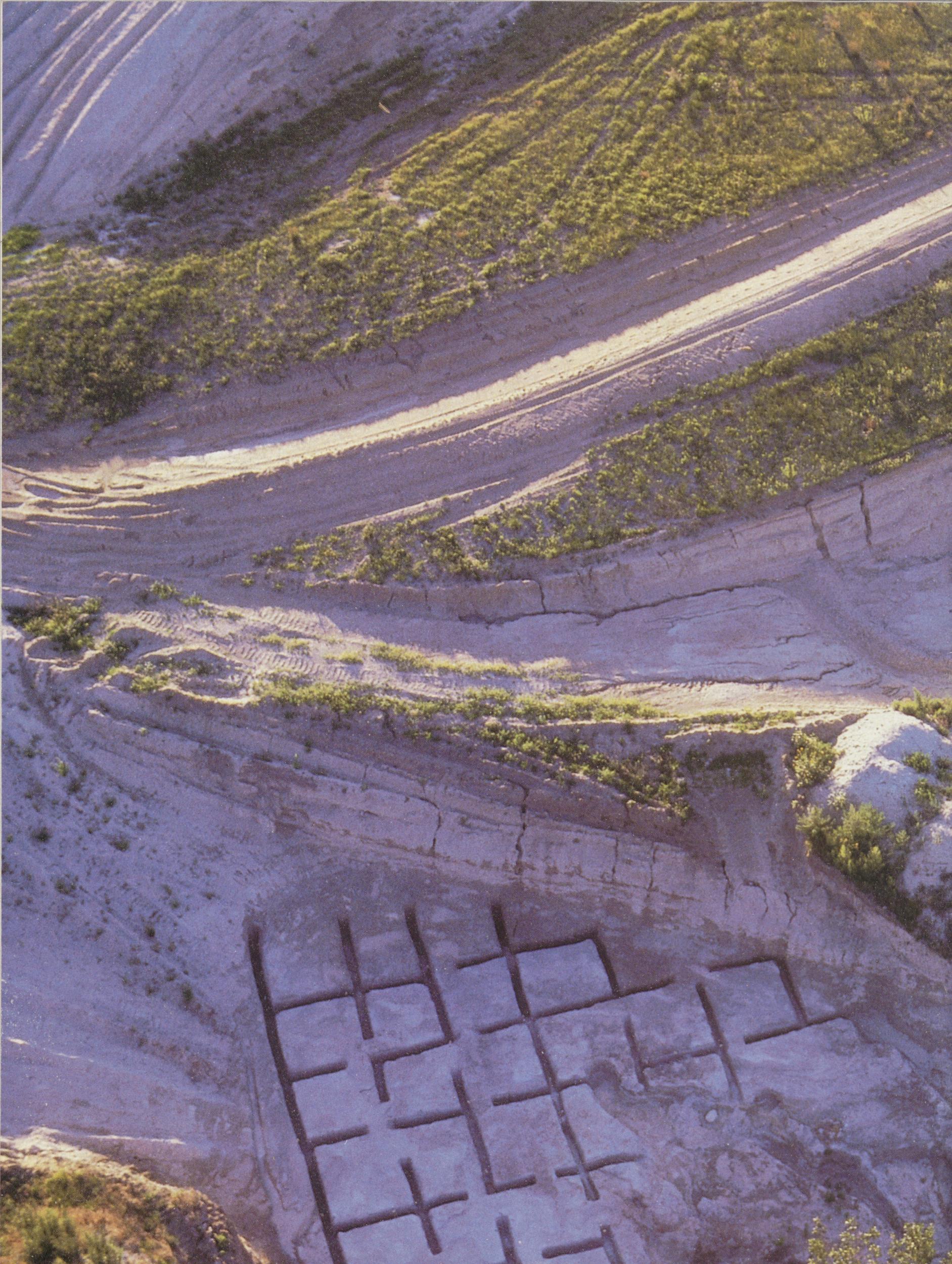
Position: 637 (17 views)