Volume 68, Issue 4, 1990
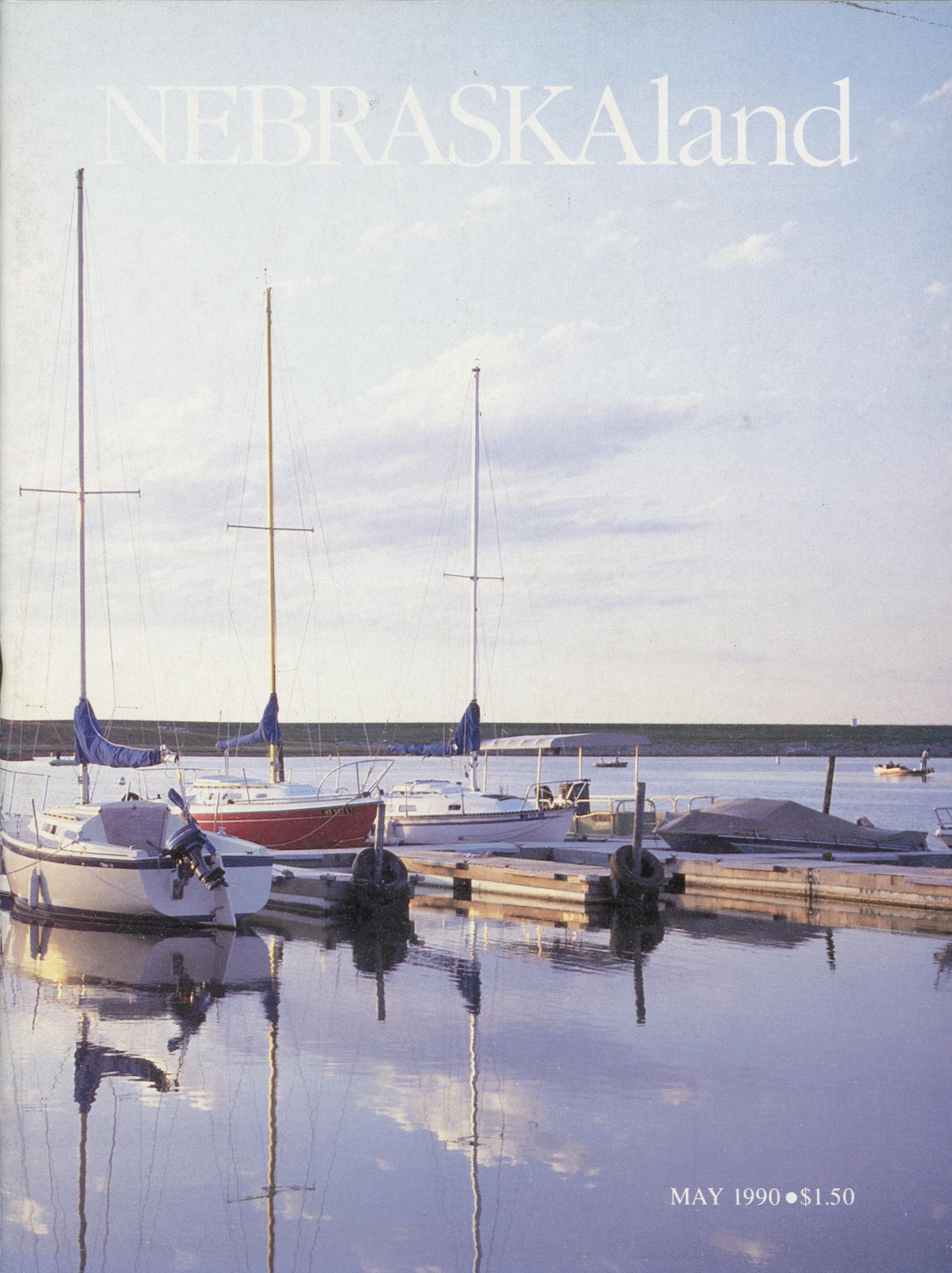
NEBRASKAland
MAY 1990 $1.50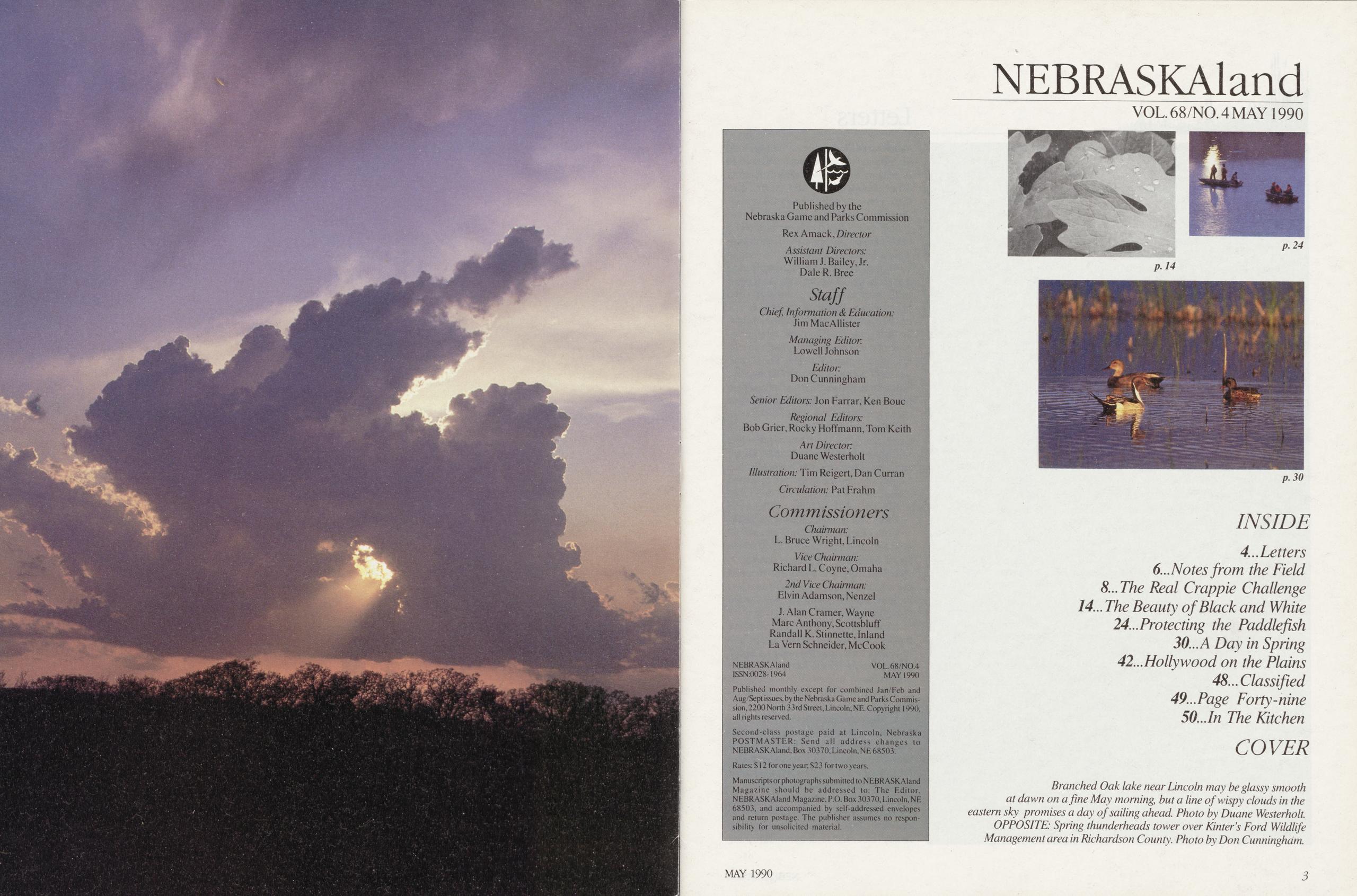
NEBRASKAland
VOL 68/NO.4 May 1990 Published by the Nebraska Game and Parks Commission Rex A mack. Director Assistant Directors: William J. Bailey Jr. Dale R. Bree Staff Chief Information & Education: Jim MacAllister Managing Editor: Lowell Johnson Editor: Don Cunningham Senior Editors: Jon Farrar, Ken Bouc Regional Editors: Bob Grier, Rocky Hoffmann, Tom Keith Art Director: Duane Westerholt Illustration: Tim Reigert, Dan Curran Circulation: Pat Frahm Comm issi oners Chairman: L. Bruce Wright, Lincoln Vice Chairman: Richard L. Coyne, Omaha 2nd Vice Chairman: Elvin Adamson, Nenzel J. Alan Cramer, Wayne Marc Anthony, Scottsbluff Randall K. Stinnette, inland La Vern Schneider, McCook NEBRASKAland VOL. 68/NO.4 ISSN:0028-1964 MAY 1990 Published monthly except for combined Jan/Feb and Aug/Sept issues, by the Nebraska Game and Parks Commis- sion, 2200 North 33rd Street, Lincoln, NE. Copyright 1990, all rights reserved. Second-class postage paid at Lincoln, Nebraska POSTMASTER: Send all address changes to NEBR ASKAland, Box 30370. Lincoln. NE 68503? Rates: $ 12 for one year; 823 for two years. Manuscripts or photographs submitted to NEBR ASK Aland Magazine should be addressed to: The Editor, NEBR ASKAland Magazine, P.O. Box 30370, Lincoln, NE 68503, and accompanied by self-addressed envelopes and return postage. The publisher assumes no respon- sibility for unsolicited material. NEBRASKAland VOL. 68/NO. 4 MAY 1990
Letters
Wildflower NotesSir/ About four years ago, I read a letter in your magazine while in a doctor’s office. The writer mentioned that you were going to publish a book on wild flowers the next year. I subscribed, and waited most impatiently for it to come out—I am finally rewarded for the long wait! It is really gorgeous.
I hope I may be forgiven for offering one correction about the American bellflower (Campanula americana). On page 59, it is described as being an an- nual. I found one in bloom 50 years ago, and collected seed. It is a biennial. The first year the plant closely resembles a plant of violets. The second year it creates the tall plant. Flowering occurs from midsummer, and often some blooms come on until late September or even October.
Helen Field Fischer, Henry Field’s sister, identified the plant for me. She said Shawnee Indians used it as greens, and it was often called “Shawny.” It has a milky sap, and the stem must be seared if one uses it as a cut flower.
Ella Travnicek, Wildflower ChairmanFederated Garden Clubs of Nebraska
Cedar Bluffs, NE
Sir/ I have been enjoying reading A Wildflower Year. The text and pictures are outstanding. This edition surpasses the previous special editions, which were also excellent.
Most of the forest plants described are found in the forests of west-central Il- linois, so I am familiar with many of them. I became familiar with many of the plants found in the eastern Sandhills during the six years I spent as a science teacher at Ainsworth High School.
In your description of the jack-in-the- pulpit (Arisaema triphyllum), you indi- cate that both male and female flowers are found on the “jack” or spadix during the growing season, and that the pollen is transferred by gravity.
The jack-in-the-pulpit produces either male flowers or female flowers, or occasionally is sterile. The sex of a plant is not fixed, but is determined by the photosynthetic activity of the previous season. When a plant, either male or female, produces a good food surplus, it will become a female plant the next season. Low production results in male or possibly sterile plants the next season. Pollination is carried out by fungus gnats. The male plant spathe (the leaf- like sheath that forms the “pulpit”) has a small opening formed by a gap in its overlapping edges. The gnats move downward over the male flowers and are able to exit with pollen through the open- ing. The spathes of the female plants do not have the gap, and the gnats cannot escape after passing over the pistillate flowers.
Pauletter Bierzychudek, Pomona College, has an article describing the biology of the jack-in-the-pulpit in the March 1982 issue of Natural History. Congratulations on another excellent special edition.
Alfred F. Pogge, PhDProfessor of Biology
Quincy College
Quincy, IL First Pheasants
Sir/ Reading the letter in the March issue of NEBRASKAland on the ring-necked pheasant written by D. William Miller of Novato, C A, has prompted me to write, and to enclose a clipping from the Grand Island Independent. [The I960 news story, bylined Jack Bailey, is too long to quote in its entirety. It summarizes the reminiscences of Melvia Hochreiter; then 83, of Ravenna, who helped her husband, Charles Hochreiter, rear and release 25 pheasants in 1910. Mrs. Hochreiter is quoted as saying “We received the ship- ment on May 28, 1910. They cost $125. The money was raised by popular sub- scription by the businessmen of Raven- na. ” Mrs. Hochreiter believed these may have been the first pheasants released in Nebraska. (Editor)]
Charles Hochreiter was my uncle. He was born in New York in 1874. Grandmother Hochreiter owned the half block where we all lived, first the grandparents, John and Teressa Hochreiter, next the Otto Hochreiters, then Charles and Melvia Hochreiter and my parents, the Louis J. Hochreiters. We children played in the backyards where they raised the pheasants. Uncle Charles was an avid sportsman, and at one time was State Trapshoot champion. He was presented an engraved shotgun as an award, and the gun is still in the family. Thought perhaps you would like this bit of information about the Nebraska pheasants.
Bethyne (Hochreiter) HannaRavenna, NE
Sir/ We really enjoy your magazine. My husband is 91 years old, and looks forward to it every month. About the pheasant article: If I remember right, my uncle Adam Helzer from Sheridan, Wyoming, brought the first pheasants to Nebraska. I couldn’t tell you what year, but he always told us he did. He’s dead and gone, so there’s no way to ask him now.
He was a railroad man in Sheridan for almost 60 years.
Evelyn SinnerRialto, CA As we reported in the 16-page special section, The Ring-necked Pheasant in Nebraska, published in November 1989, pheasants were first reported in the state along the Kansas border in about 1900. Those are believed to have been stragglers from Kansas. At the time of that publication, we believed that the first stockings by this agency occurred in 1915, but subsequent research pushed the date back to 1911 or 1912. Many individuals and organizations in Nebraska also raised and released birds, but records are often no longer available. Thus we will probably never be sure who was actually first. (Editor) Carter P. Johnson
Sir/ In reading the June 1989 issue of NEBRASKAland Magazine, I noticed in the article by Thomas Buecker on Carter P. Johnson that the author several times mentions “Stauton,” Virginia. I believe the author meant to write Staunton, Virginia, which is some 40 miles north of Lexington.
Being a native Nebraskan, I do enjoy your magazine even though I’m often months behind in reading it.
Jean Eisenhauer Lexington, V A Reader Eisenhauer is correct. (Editor) The New LookSir/ Superb! That new NEBRASKAland! I have just read it cover to cover (well, at this stage in my life, I don’t need to know much about icefishing!) and I greatly enjoyed the whole magazine. With my diminishing vision, the new type is helpful, and I like the easy ‘ragged’ right effect. And all the extra color is cheery. A long step ahead.
So much for the mechanics!
I think you have exceeded yourselves on the content. I truly did read every page—even the icefishing which gave me a new comprehension of what technology has done for fishing. I was glad to learn about the Habitat Program, and the new push for shelterbelts. And I learned more bad things I hadn’t known about our “Buying Nebraska From the Indians” (The Pawnees got 1.8 cents an acre for the land our grandparents (Jim’s and mine) settled on by 1870. Did they give a thought to the dispossessed Indians?).
“The Sketchbook” pictures and Janovy’s imaginative text—a turtle is a metaphor, the dragonfly an etude! As for “March Light”—lovely, lovely. Our warm congratulations on Vol. 68, No. 2.
Alice and Jim WilsonPolk, NE NEBRASKAland Magazine invites readers to send their comments, suggestions and com- plaints to Letters, NEBRASKAland Magazine, P.O. Box 30370, Lincoln, NE 68503. Pictures are also welcome. NEBRA SKA land reserves the right to edit and condense letters. (Editor) 4 NEBRASKAland MAY 1990 5
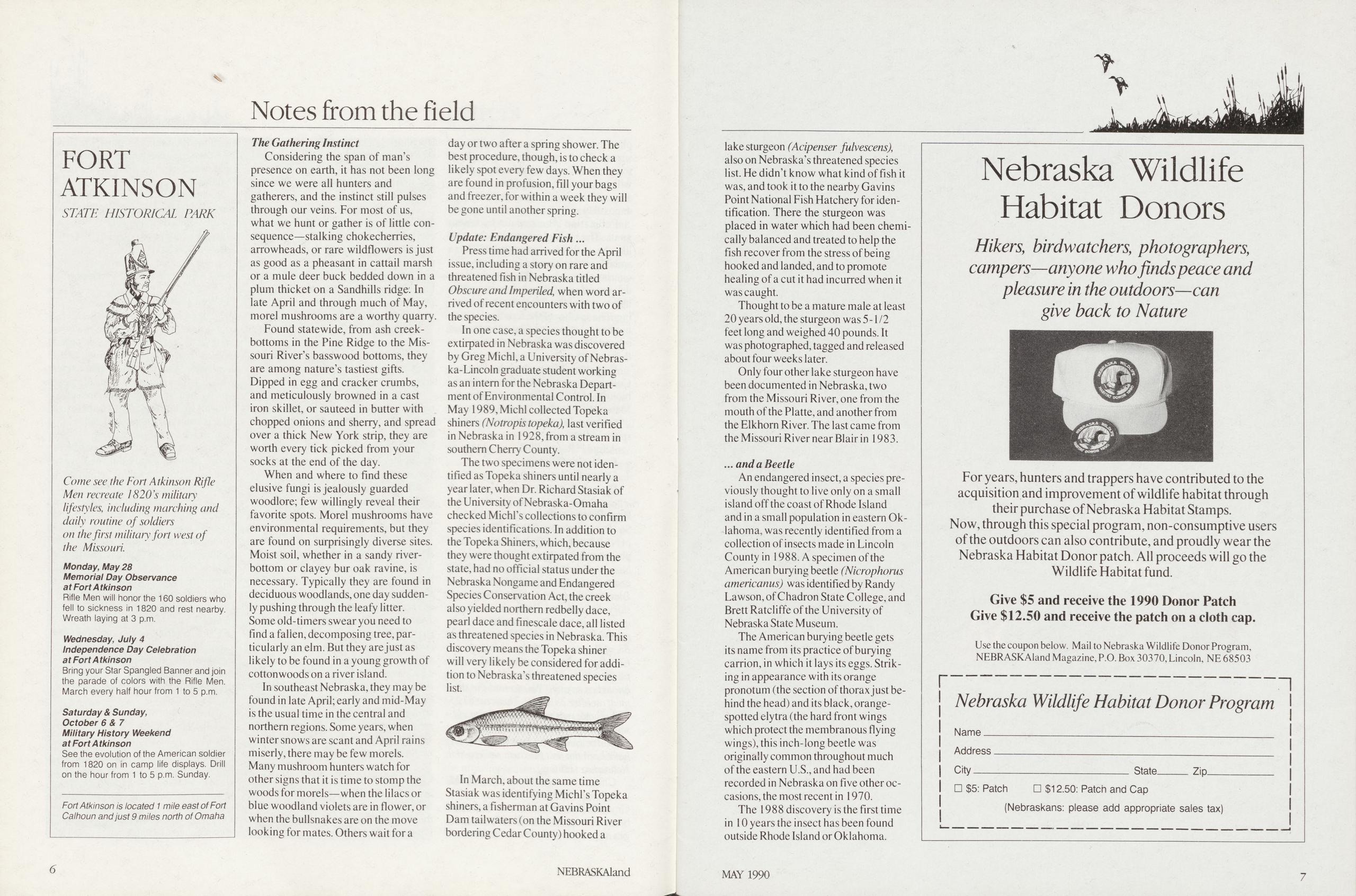
Considering the span of man’s presence on earth, it has not been long since we were all hunters and gatherers, and the instinct still pulses through our veins. For most of us, what we hunt or gather is of little consequence—stalking chokecherries, arrowheads, or rare wildflowers is just as good as a pheasant in cattail marsh or a mule deer buck bedded down in a plum thicket on a Sandhills ridge. In late April and through much of May, morel mushrooms are a worthy quarry. Found statewide, from ash creek- bottoms in the Pine Ridge to the Missouri River’s basswood bottoms, they are among nature’s tastiest gifts. Dipped in egg and cracker crumbs, and meticulously browned in a cast iron skillet, or sauteed in butter with chopped onions and sherry, and spread over a thick New York strip, they are worth every tick picked from your socks at the end of the day.
When and where to find these elusive fungi is jealously guarded woodlore; few willingly reveal their favorite spots. Morel mushrooms have environmental requirements, but they are found on surprisingly diverse sites. Moist soil, whether in a sandy riverbottom or clayey bur oak ravine, is necessary. Typically they are found in deciduous woodlands, one day suddenly pushing through the leafy litter. Some old-timers swear you need to find a fallen, decomposing tree, particularly an elm. But they are just as likely to be found in a young growth of cottonwoods on a river island.
In southeast Nebraska, they may be found in late April; early and mid-May is the usual time in the central and northern regions. Some years, when winter snows are scant and April rains miserly, there may be few morels. Many mushroom hunters watch for other signs that it is time to stomp the woods for morels—when the lilacs or blue woodland violets are in flower, or when the bullsnakes are on the move looking for mates. Others wait for a day or two after a spring shower. The best procedure, though, is to check a likely spot every few days. When they are found in profusion, fill your bags and freezer, for within a week they will be gone until another spring.
Update: Endangered Fish ...Press time had arrived for the April issue, including a story on rare and threatened fish in Nebraska titled Obscure and Imperiled, when word arrived of recent encounters with two of the species.
In one case, a species thought to be extirpated in Nebraska was discovered by Greg Michl, a University of Nebraska-Lincoln graduate student working as an intern for the Nebraska Department of Environmental Control. In May 1989, Michl collected Topeka shiners (Notropistopeka), last verified in Nebraska in 1928, from a stream in southern Cherry County.
The two specimens were not identified as Topeka shiners until nearly a year later, when Dr. Richard Stasiak of the University of Nebraska-Omaha checked Michl’s collections to confirm species identifications. In addition to the Topeka Shiners, which, because they were thought extirpated from the state, had no official status under the Nebraska Nongame and Endangered Species Conservation Act, the creek also yielded northern redbelly dace, pearl dace and finescale dace, all listed as threatened species in Nebraska. This discovery means the Topeka shiner will very likely be considered for addi- tion to Nebraska’s threatened species list.
In March, about the same time Stasiak was identifying Michl’s Topeka shiners, a fisherman at Gavins Point Dam tailwaters (on the Missouri River bordering Cedar County) hooked a lake sturgeon (Acipenser fulvescens), also on Nebraska’s threatened species list. He didn’t know what kind of fish it was, and took it to the nearby Gavins Point National Fish Hatchery for identification. There the sturgeon was placed in water which had been chemically balanced and treated to help the fish recover from the stress of being hooked and landed, and to promote healing of a cut it had incurred when it was caught.
Thought to be a mature male at least 20 years old, the sturgeon was 5-1/2 feet long and weighed 40 pounds. It was photographed, tagged and released about four weeks later.
Only four other lake sturgeon have been documented in Nebraska, two from the Missouri River, one from the mouth of the Platte, and another from the Elkhorn River. The last came from the Missouri River near Blair in 1983.
...and a BeetleAn endangered insect, a species previously thought to live only on a small island off the coast of Rhode Island and in a small population in eastern Oklahoma, was recently identified from a collection of insects made in Lincoln County in 1988. A specimen of the American burying beetle (Nicrophorus americanus) was identified by Randy Lawson, of Chadron State College, and Brett Ratcliffe of the University of Nebraska State Museum.
The American burying beetle gets its name from its practice of burying carrion, in which it lays its eggs. Striking in appearance with its orange pronotum (the section of thorax just behind the head) and its black, orange-spotted elytra (the hard front wings which protect the membranous flying wings), this inch-long beetle was originally common throughout much of the eastern U.S., and had been recorded in Nebraska on five other occasions, the most recent in 1970. The 1988 discovery is the first time in 10 years the insect has been found outside Rhode Island or Oklahoma.
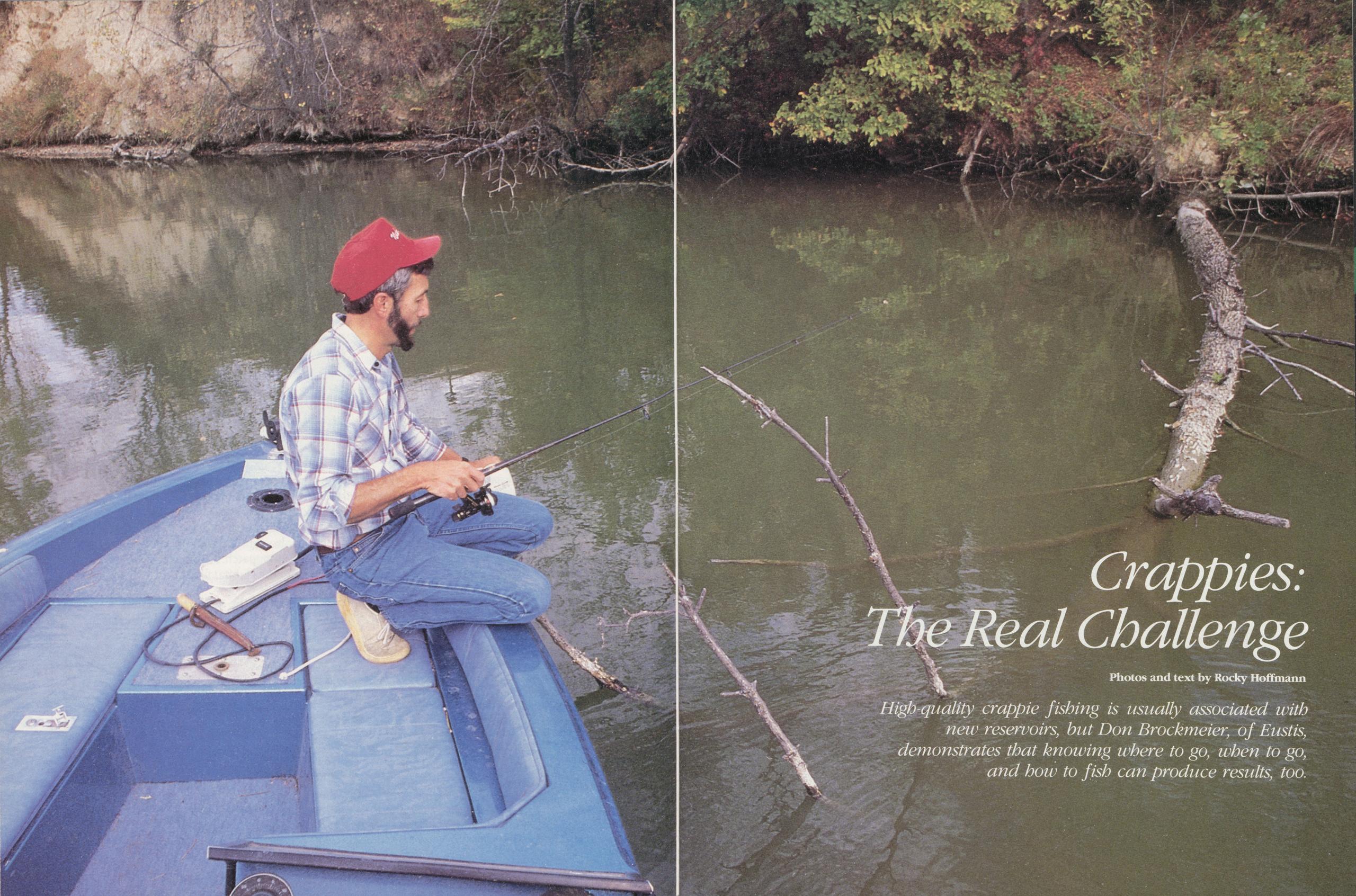
Crappies: The Real Challenge
Photos and text by Rocky Hoffmann High-quality crappie fishing is usually associated with new reservoirs, but Don Brockmeier, of Eustis, demonstrates that knowing where to go, when to go, and how to fish can produce results, too.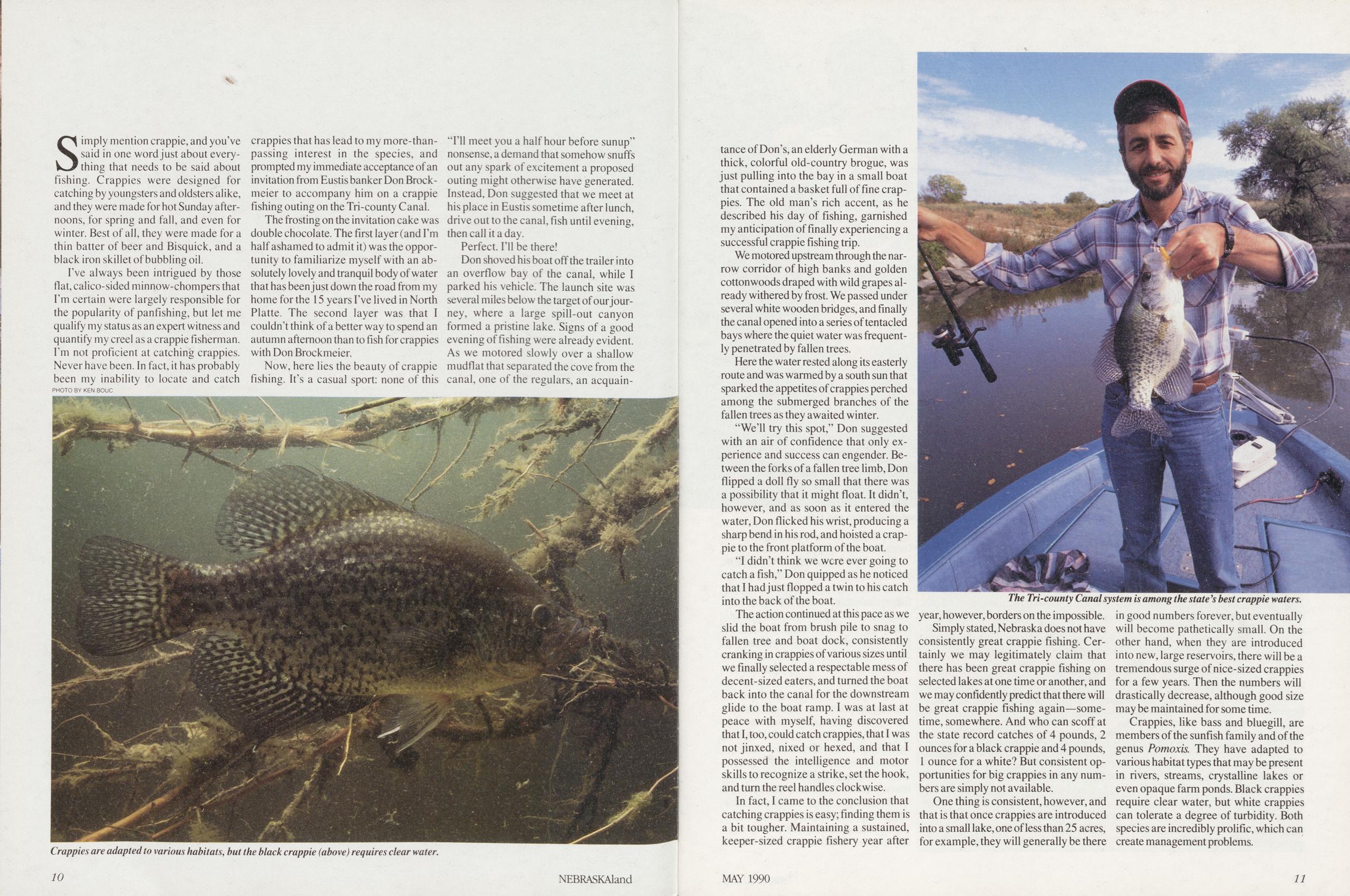
Simply mention crappie, and you’ve said in one word just about everything that needs to be said about fishing. Crappies were designed for catching by youngsters and oldsters alike, and they were made for hot Sunday afternoons, for spring and fall, and even for winter. Best of all, they were made for a thin batter of beer and Bisquick, and a black iron skillet of bubbling oil.
I’ve always been intrigued by those flat, calico-sided minnow-chompers that I’m certain were largely responsible for the popularity of panfishing, but let me qualify my status as an expert witness and quantify my creel as a crappie fisherman. I’m not proficient at catching crappies. Never have been. In fact, it has probably been my inability to locate and catch
crappies that has lead to my more-than- passing interest in the species, and prompted my immediate acceptance of an invitation from Eustis banker Don Brockmeier to accompany him on a crappie fishing outing on the Tri-county Canal.
The frosting on the invitation cake was double chocolate. The first layer (and I’m half ashamed to admit it) was the opportunity to familiarize myself with an absolutely lovely and tranquil body of water that has been just down the road from my home for the 15 years I’ve lived in North Platte. The second layer was that I couldn’t think of a better way to spend an autumn afternoon than to fish for crappies with Don Brockmeier.
Now, here lies the beauty of crappie fishing. It’s a casual sport: none of this “I'll meet you a half hour before sunup” nonsense, a demand that somehow snuffs out any spark of excitement a proposed outing might otherwise have generated. Instead, Don suggested that we meet at his place in Eustis sometime after lunch, drive out to the canal, fish until evening, then call it a day.
Perfect. I’ll be there!
Don shoved his boat off the trailer into an overflow bay of the canal, while I parked his vehicle. The launch site was several miles below the target of our journey, where a large spill-out canyon formed a pristine lake. Signs of a good evening of fishing were already evident. As we motored slowly over a shallow mudflat that separated the cove from the canal, one of the regulars, an acquaintance of Don’s, an elderly German with a thick, colorful old-country brogue, was just pulling into the bay in a small boat that contained a basket full of fine crappies. The old man’s rich accent, as he described his day of fishing, garnished my anticipation of finally experiencing a successful crappie fishing trip.
We motored upstream through the narrow corridor of high banks and golden cottonwoods draped with wild grapes already withered by frost. We passed under several white wooden bridges, and finally the canal opened into a series of tentacled bays where the quiet water was frequently penetrated by fallen trees.
Here the water rested along its easterly route and was warmed by a south sun that sparked the appetites of crappies perched among the submerged branches of the fallen trees as they awaited winter.
“We’ll try this spot,” Don suggested with an air of confidence that only experience and success can engender. Between the forks of a fallen tree limb, Don flipped a doll fly so small that there was a possibility that it might float. It didn’t, however, and as soon as it entered the water, Don flicked his wrist, producing a sharp bend in his rod, and hoisted a crappie to the front platform of the boat.
“I didn’t think we were ever going to catch a fish,” Don quipped as he noticed that I had just flopped a twin to his catch into the back of the boat.
The action continued at this pace as we slid the boat from brush pile to snag to fallen tree and boat dock, consistently cranking in crappies of various sizes until we finally selected a respectable mess of decent-sized eaters, and turned the boat back into the canal for the downstream glide to the boat ramp. I was at last at peace with myself, having discovered that I, too, could catch crappies, that I was not jinxed, nixed or hexed, and that I possessed the intelligence and motor skills to recognize a strike, set the hook, and turn the reel handles clockwise.
In fact, I came to the conclusion that catching crappies is easy; finding them is a bit tougher. Maintaining a sustained, keeper-sized crappie fishery year after year, however, borders on the impossible. Simply stated, Nebraska does not have consistently great crappie fishing. Certainly we may legitimately claim that there has been great crappie fishing on selected lakes at one time or another, and we may confidently predict that there will be great crappie fishing again—sometime, somewhere. And who can scoff at the state record catches of 4 pounds, 2 ounces for a black crappie and 4 pounds, 1 ounce for a white? But consistent opportunities for big crappies in any numbers are simply not available.
One thing is consistent, however, and that is that once crappies are introduced into a small lake, one of less than 25 acres, for example, they will generally be there in good numbers forever, but eventually will become pathetically small. On the other hand, when they are introduced into new, large reservoirs, there will be a tremendous surge of nice-sized crappies for a few years. Then the numbers will drastically decrease, although good size may be maintained for some time.
Crappies, like bass and bluegill, are members of the sunfish family and of the genus Pomoxis. They have adapted to various habitat types that may be present in rivers, streams, crystalline lakes or even opaque farm ponds. Black crappies require clear water, but white crappies can tolerate a degree of turbidity. Both species are incredibly prolific, which can create management problems.
10 NEBRASKAland MAY 1990 11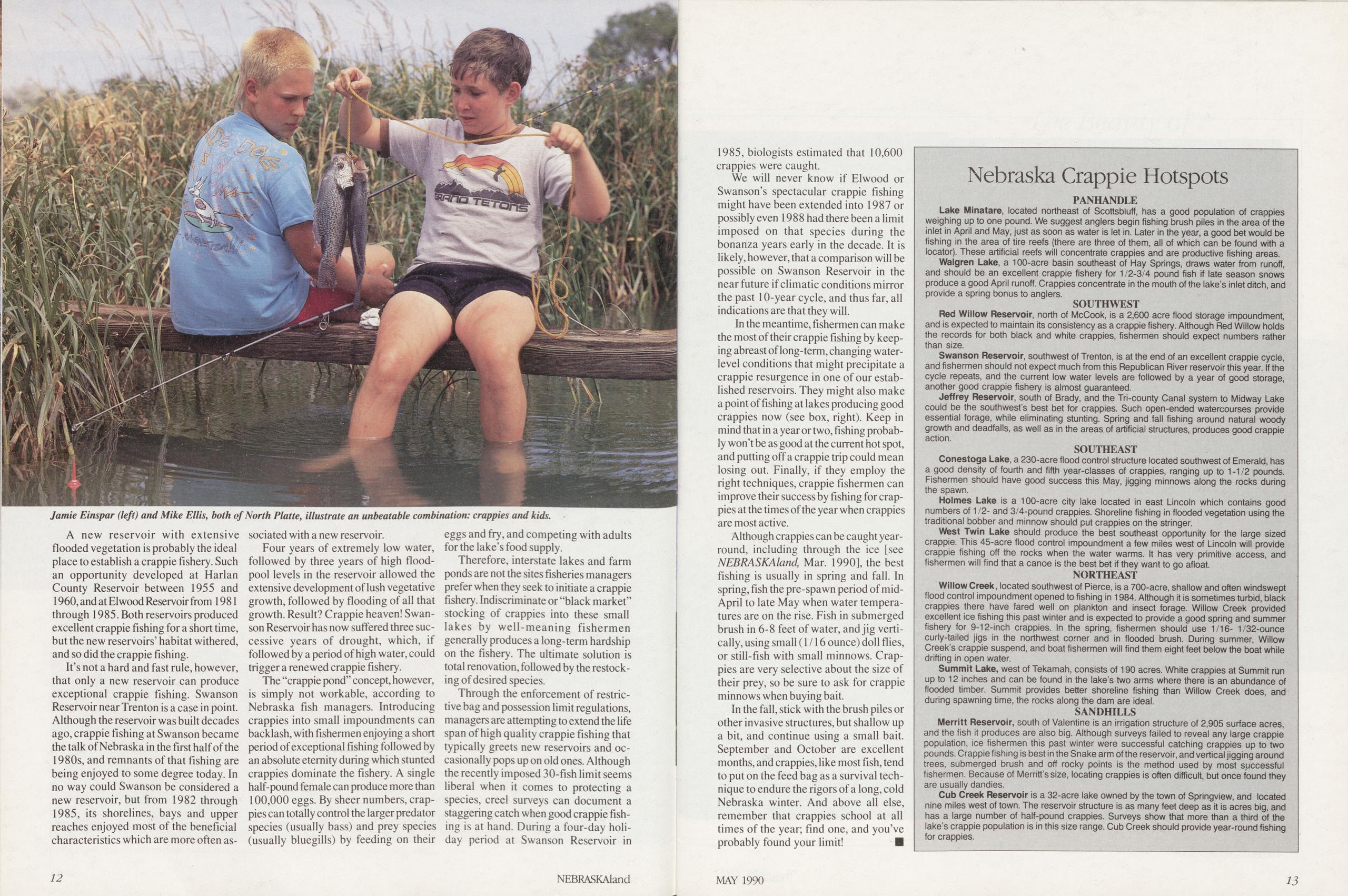
A new reservoir with extensive flooded vegetation is probably the ideal place to establish a crappie fishery. Such an opportunity developed at Harlan County Reservoir between 1955 and 1960, and at Elwood Reservoir from 1981 through 1985. Both reservoirs produced excellent crappie fishing for a short time, but the new reservoirs’ habitat withered, and so did the crappie fishing.
It’s not a hard and fast rule, however, that only a new reservoir can produce exceptional crappie fishing. Swanson Reservoir near Trenton is a case in point. Although the reservoir was built decades ago, crappie fishing at Swanson became the talk of Nebraska in the first half of the 1980s, and remnants of that fishing are being enjoyed to some degree today. In no way could Swanson be considered a new reservoir, but from 1982 through 1985, its shorelines, bays and upper reaches enjoyed most of the beneficial characteristics which are more often as- sociated with a new reservoir.
Four years of extremely low water, followed by three years of high flood-pool levels in the reservoir allowed the extensive development of lush vegetative growth, followed by flooding of all that growth. Result? Crappie heaven! Swanson Reservoir has now suffered three successive years of drought, which, if followed by a period of high water, could trigger a renewed crappie fishery.
The "crappie pond” concept, however, is simply not workable, according to Nebraska fish managers. Introducing crappies into small impoundments can backlash, with fishermen enjoying a short period of exceptional fishing followed by an absolute eternity during which stunted crappies dominate the fishery. A single half-pound female can produce more than 100,000 eggs. By sheer numbers, crappies can totally control the larger predator species (usually bass) and prey species (usually bluegills) by feeding on their eggs and fry, and competing with adults for the lake’s food supply.
Therefore, interstate lakes and farm ponds are not the sites fisheries managers prefer when they seek to initiate a crappie fishery. Indiscriminate or "black market” stocking of crappies into these small lakes by well-meaning fishermen generally produces a long-term hardship on the fishery. The ultimate solution is total renovation, followed by the restocking of desired species.
Through the enforcement of restrictive bag and possession limit regulations, managers are attempting to extend the life span of high quality crappie fishing that typically greets new reservoirs and occasionally pops up on old ones. Although the recently imposed 30-fish limit seems liberal when it comes to protecting a species, creel surveys can document a staggering catch when good crappie fishing is at hand. During a four-day holiday period at Swanson Reservoir in 1985, biologists estimated that 10,600 crappies were caught.
We will never know if Elwood or Swanson’s spectacular crappie fishing might have been extended into 1987 or possibly even 1988 had there been a limit imposed on that species during the bonanza years early in the decade. It is likely, however, that a comparison will be possible on Swanson Reservoir in the near future if climatic conditions mirror the past 10-year cycle, and thus far, all indications are that they will.
In the meantime, fishermen can make the most of their crappie fishing by keeping abreast of long-term, changing water- level conditions that might precipitate a crappie resurgence in one of our established reservoirs. They might also make a point of fishing at lakes producing good crappies now (see box, right). Keep in mind that in a year or two, fishing probably won’t be as good at the current hot spot, and putting off a crappie trip could mean losing out. Finally, if they employ the right techniques, crappie fishermen can improve their success by fishing for crappies at the times of the year when crappies are most active.
Although crappies can be caught year-round, including through the ice [see NEBRASKAland, Mar. 1990], the best fishing is usually in spring and fall. In spring, fish the pre-spawn period of mid-April to late May when water temperatures are on the rise. Fish in submerged brush in 6-8 feet of water, and jig vertically, using small (1/16 ounce) doll flies, or still-fish with small minnows. Crappies are very selective about the size of their prey, so be sure to ask for crappie minnows when buying bait.
In the fall, stick with the brush piles or other invasive structures, but shallow up a bit, and continue using a small bait. September and October are excellent months, and crappies, like most fish, tend to put on the feed bag as a survival technique to endure the rigors of a long, cold Nebraska winter. And above all else, remember that crappies school at all times of the year; find one, and you’ve probably found your limit!
Nebraska Crappie Hotspots PANHANDLELake Minatare, located northeast of Scottsbluff, has a good population of crappies weighing up to one pound. We suggest anglers begin fishing brush piles in the area of the inlet in April and May, just as soon as water is let in. Later in the year, a good bet would be fishing in the area of tire reefs (there are three of them, all of which can be found with a locator). These artificial reefs will concentrate crappies and are productive fishing areas.
Walgren Lake, a 100-acre basin southeast of Hay Springs, draws water from runoff, and should be an excellent crappie fishery for 1Z2-3/4 pound fish if late season snows produce a good April runoff. Crappies concentrate in the mouth of the lake’s inlet ditch, and provide a spring bonus to anglers.
SOUTHWESTRed Willow Reservoir, north of McCook, is a 2,600 acre flood storage impoundment, and is expected to maintain its consistency as a crappie fishery. Although Red Willow holds the records for both black and white crappies, fishermen should expect numbers rather than size.
Swanson Reservoir, southwest of Trenton, is at the end of an excellent crappie cycle, and fishermen should not expect much from this Republican River reservoir this year. If the cycle repeats, and the current low water levels are followed by a year of good storage, another good crappie fishery is almost guaranteed.
Jeffrey Reservoir, south of Brady, and the Tri-county Canal system to Midway Lake could be the southwest’s best bet for crappies. Such open-ended watercourses provide essential forage, while eliminating stunting. Spring and fall fishing around natural woody growth and deadfalls, as well as in the areas of artificial structures, produces good crappie action.
SOUTHEASTConestoga Lake, a 230-acre flood control structure located southwest of Emerald, has a good density of fourth and fifth year-classes of crappies, ranging up to 1 -1/2 pounds. Fishermen should have good success this May, jigging minnows along the rocks during the spawn.
Holmes Lake is a 100-acre city lake located in east Lincoln which contains good numbers of 1/2- and 3/4-pound crappies. Shoreline fishing in flooded vegetation using the traditional bobber and minnow should put crappies on the stringer.
West Twin Lake should produce the best southeast opportunity for the large sized crappie. This 45-acre flood control impoundment a few miles west of Lincoln will provide crappie fishing off the rocks when the water warms. It has very primitive access, and fishermen will find that a canoe is the best bet if they want to go afloat.
NORTHEASTWillow Creek, located southwest of Pierce, is a 700-acre, shallow and often windswept flood control impoundment opened to fishing in 1984. Although it is sometimes turbid, black crappies there have fared well on plankton and insect forage. Willow Creek provided excellent ice fishing this past winter and is expected to provide a good spring and summer fishery for 9-12-inch crappies. In the spring, fishermen should use 1/16- 1/32-ounce curly-tailed jigs in the northwest corner and in flooded brush. During summer, Willow Creek’s crappie suspend, and boat fishermen will find them eight feet below the boat while drifting in open water.
Summit Lake, west of Tekamah, consists of 190 acres. White crappies at Summit run up to 12 inches and can be found in the lake’s two arms where there is an abundance of flooded timber. Summit provides better shoreline fishing than Willow Creek does, and during spawning time, the rocks along the dam are ideal.
SANDHILLSMerritt Reservoir, south of Valentine is an irrigation structure of 2,905 surface acres, and the fish it produces are also big. Although surveys failed to reveal any large crappie population, ice fishermen this past winter were successful catching crappies up to two pounds. Crappie fishing is best in the Snake arm of the reservoir, and vertical jigging around trees, submerged brush and off rocky points is the method used by most successful fishermen. Because of Merritt’s size, locating crappies is often difficult, but once found they are usually dandies.
Cub Creek Reservoir is a 32-acre lake owned by the town of Springview, and located nine miles west of town. The reservoir structure is as many feet deep as it is acres big, and has a large number of half-pound crappies. Surveys show that more than a third of the lake’s crappie population is in this size range. Cub Creek should provide year-round fishing for crappies.
12 NEBRASKAland MAY 1990 13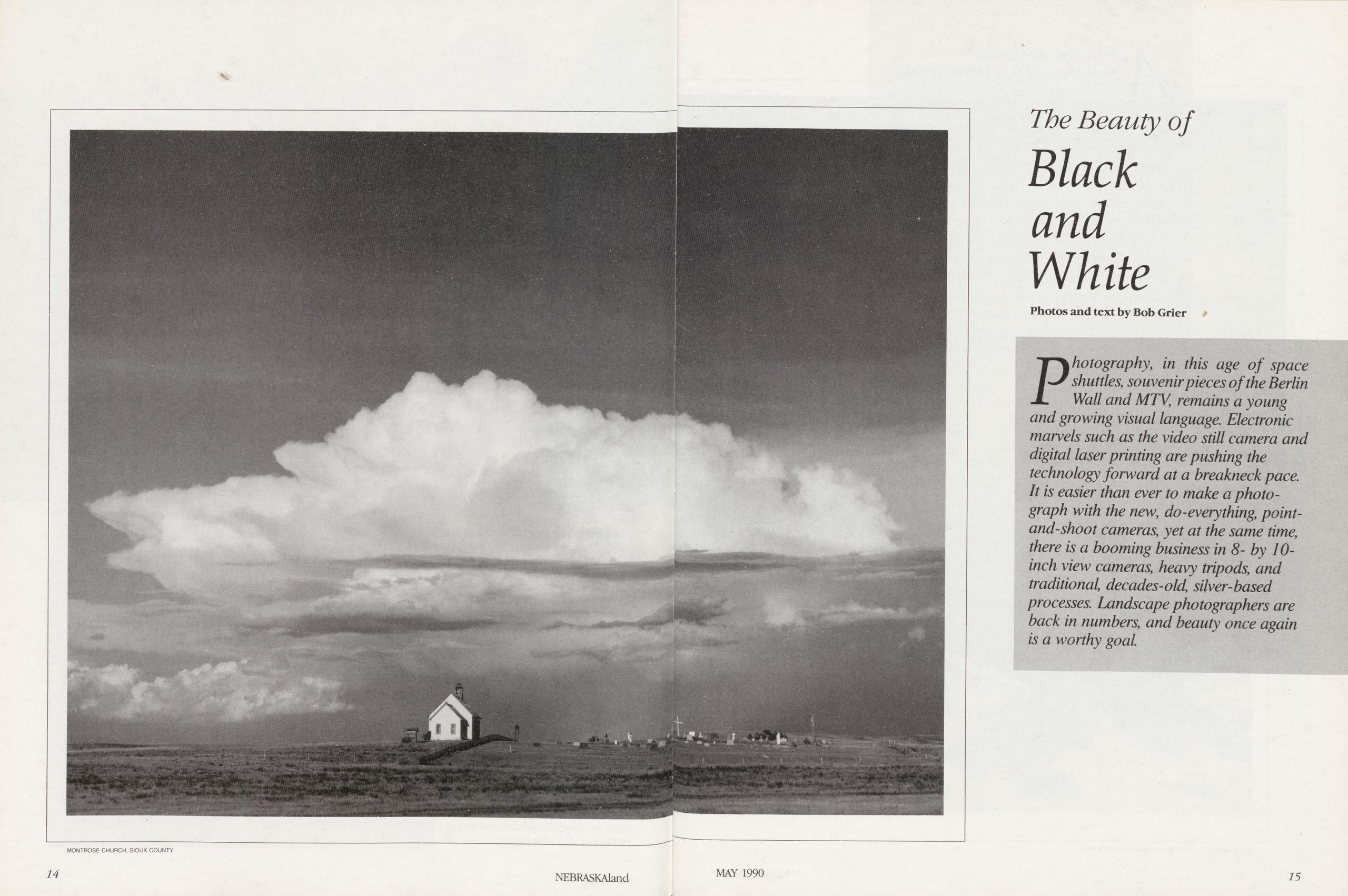
The Beauty of Black and White
Photos and text by Bob Grier Photography, in this age of space shuttles, souvenir pieces of the Berlin Wall and MTV, remains a young and growing visual language. Electronic marvels such as the video still camera and digital laser printing are pushing the technology forward at a breakneck pace. It is easier than ever to make a photograph with the new, do-everything, point-and-shoot cameras, yet at the same time, there is a booming business in 8- by 10- inch view cameras, heavy tripods, and traditional, decades-old, silver-based processes. Landscape photographers are back in numbers, and beauty once again is a worthy goal. 14 NEBRASKAland MAY 1990 15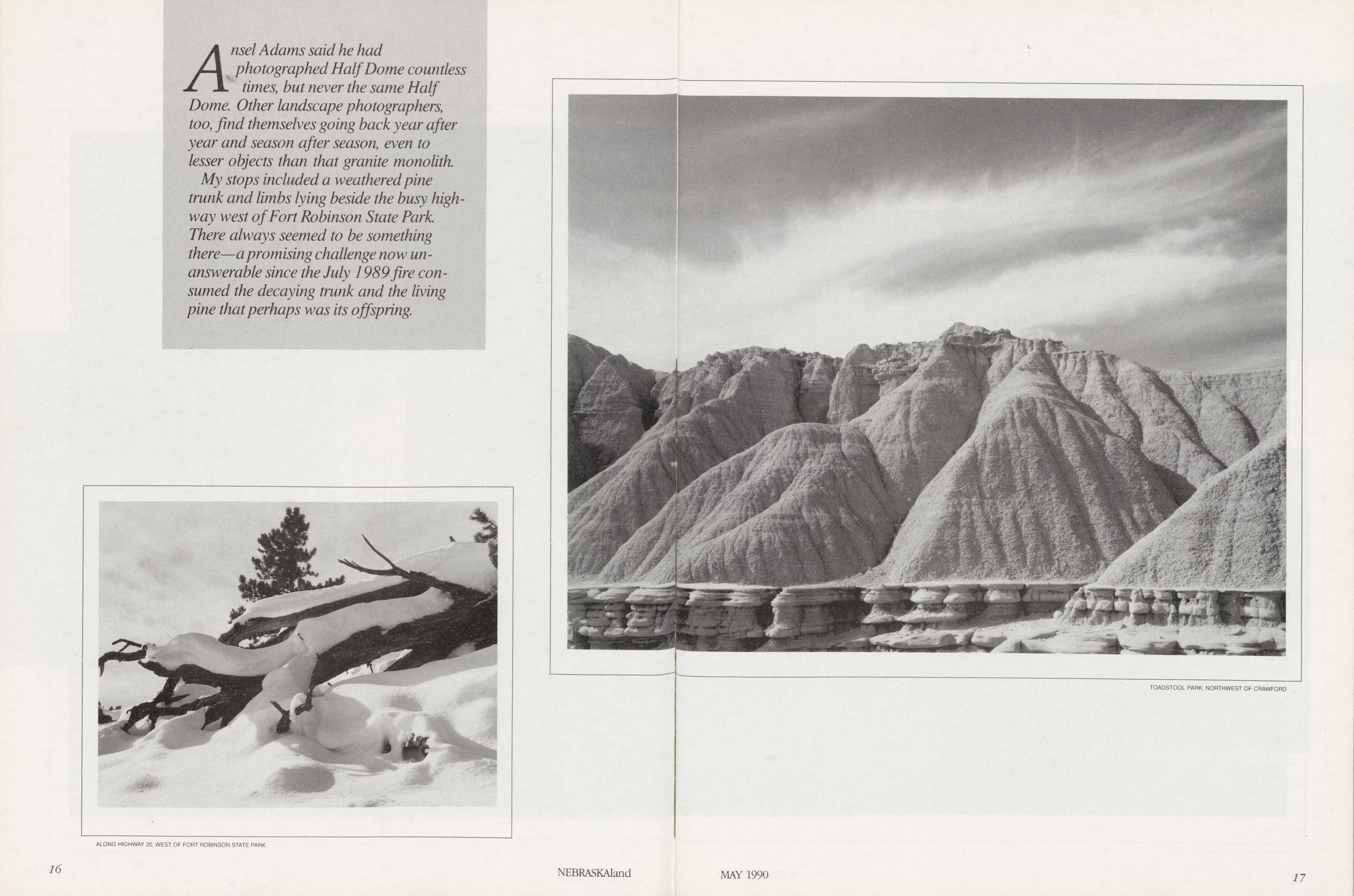 Ansel Adams said he had
photographed Half Dome coun tless
times, but never the same Half
Dome. Other landscape photographers,
too, find themselves going back year after
year and season after season, even to
lesser objects than that granite monolith.
My stops included a weathered pine
trunk and limbs lying beside the busy highway west of Fort Robinson State Park.
There always seemed to be something
there—a promising challenge now un-
answerable since the July 1989 fire consumed the decaying trunk and the living
pine that perhaps was its offspring.
Ansel Adams said he had
photographed Half Dome coun tless
times, but never the same Half
Dome. Other landscape photographers,
too, find themselves going back year after
year and season after season, even to
lesser objects than that granite monolith.
My stops included a weathered pine
trunk and limbs lying beside the busy highway west of Fort Robinson State Park.
There always seemed to be something
there—a promising challenge now un-
answerable since the July 1989 fire consumed the decaying trunk and the living
pine that perhaps was its offspring.
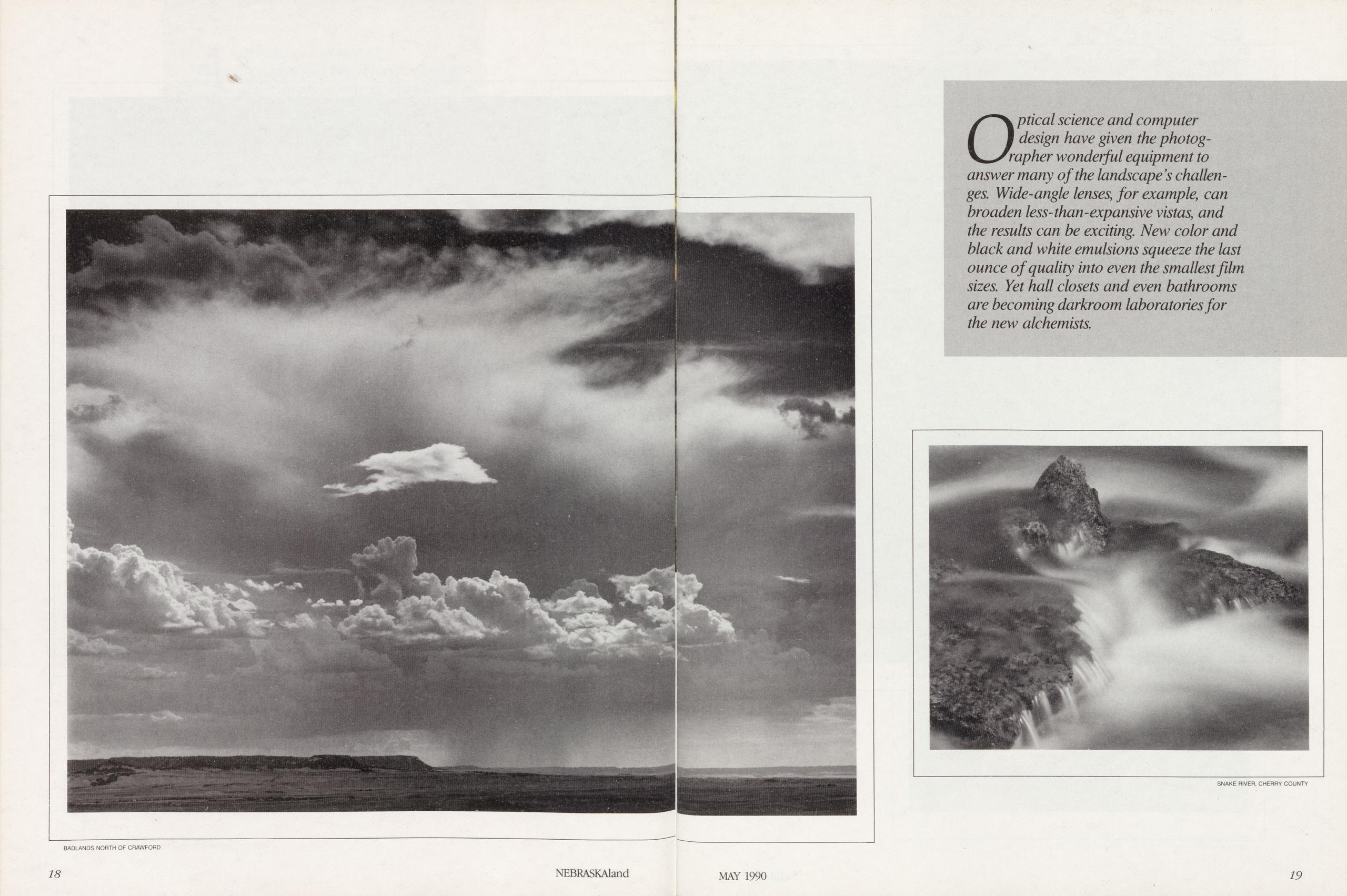
BADLANDS NORTH OF CRAWFORD
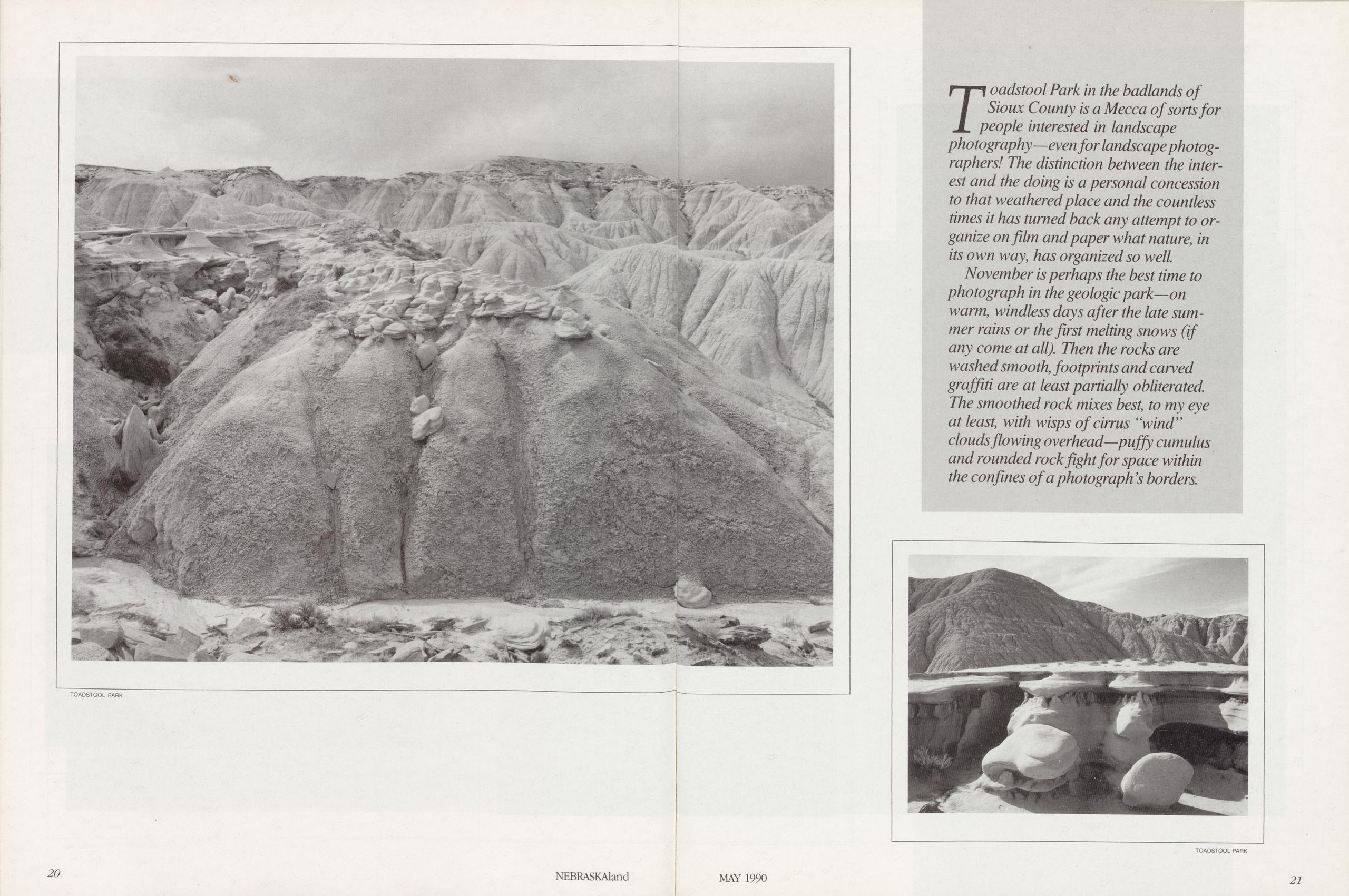
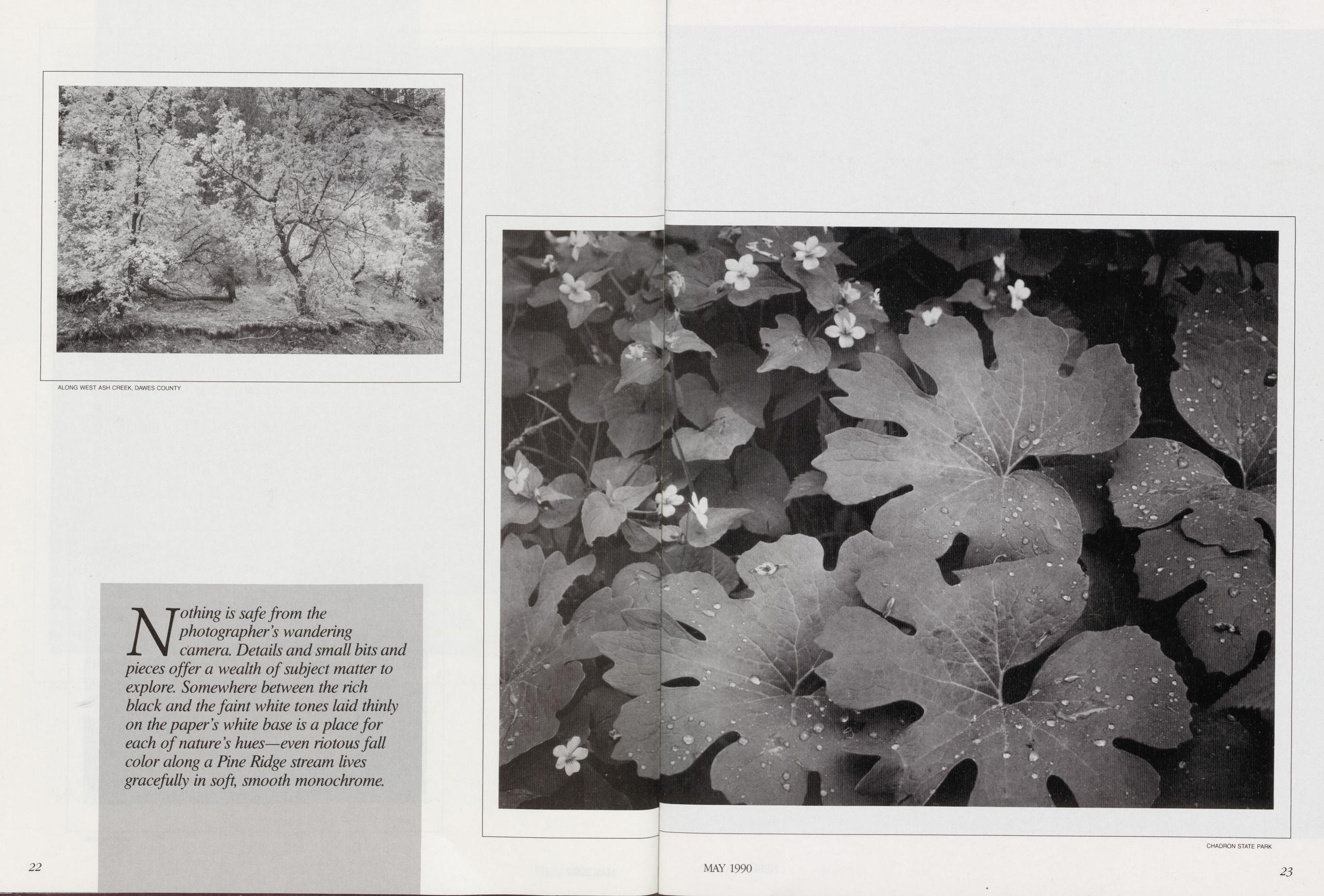
ALONG WEST ASH CREEK, DAWES COUNTY
CHADRON STATE PARK
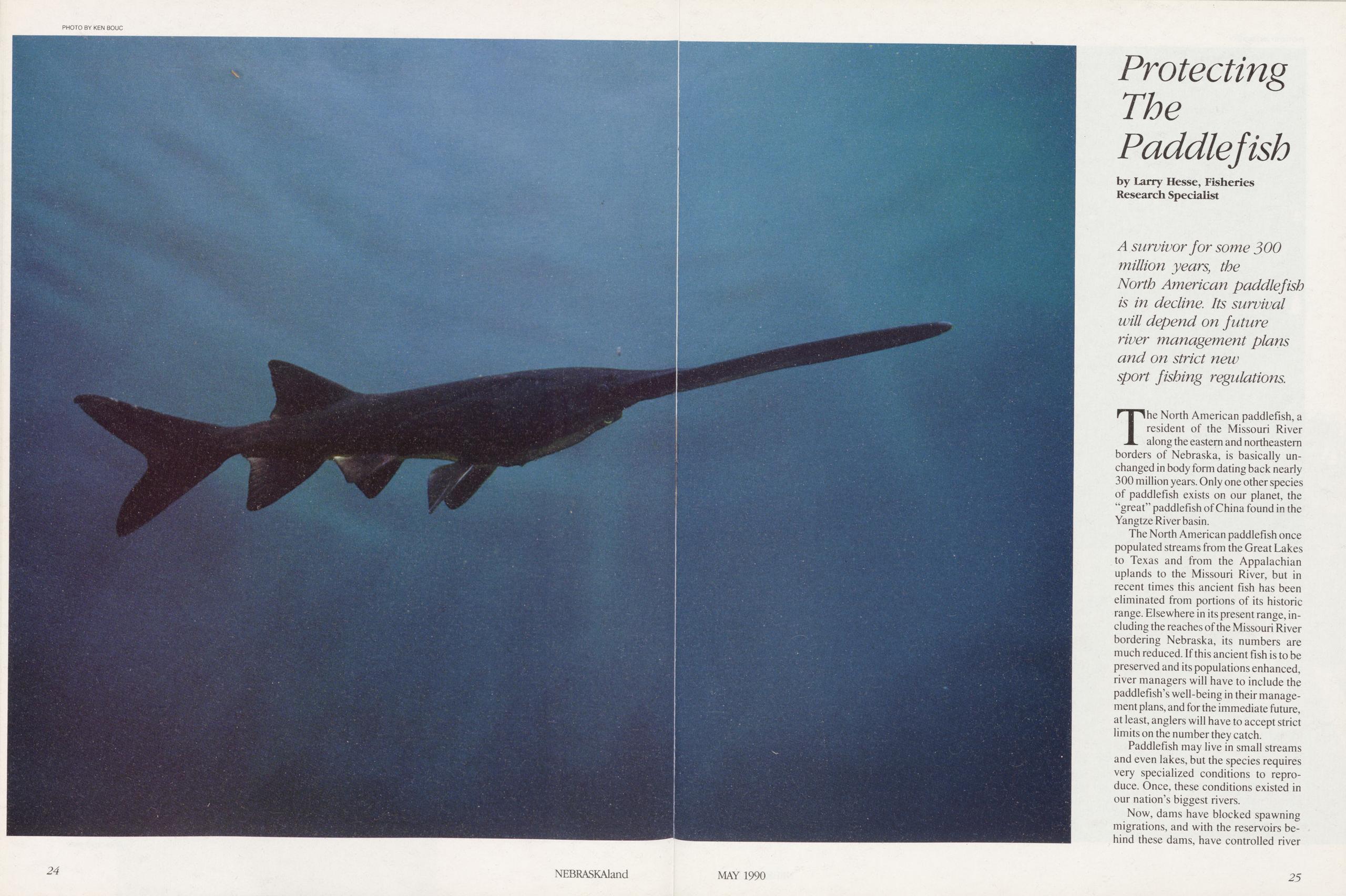 PHOTO BY KEN BOUC
Protecting
The
Paddlefisb
by Larry Hesse, Fisheries
Research Specialist
PHOTO BY KEN BOUC
Protecting
The
Paddlefisb
by Larry Hesse, Fisheries
Research Specialist
A survivor for some 300 million years, the North American paddlefish is in decline. Its survival will depend on future river management plans and on strict new sport fishing regulations. The North American paddlefish, a resident of the Missouri River along the eastern and northeastern borders of Nebraska, is basically unchanged in body form dating back nearly 300 million years. Only one other species of paddlefish exists on our planet, the “great” paddlefish of China found in the Yangtze River basin.
The North American paddlefish once populated streams from the Great Lakes to Texas and from the Appalachian uplands to the Missouri River, but in recent times this ancient fish has been eliminated from portions of its historic range. Elsewhere in its present range, including the reaches of the Missouri River bordering Nebraska, its numbers are much reduced. If this ancient fish is to be preserved and its populations enhanced, river managers will have to include the paddlefish’s well-being in their management plans, and for the immediate future, at least, anglers will have to accept strict limits on the number they catch.
Paddlefish may live in small streams and even lakes, but the species requires very specialized conditions to reproduce. Once, these conditions existed in our nation’s biggest rivers. Now, dams have blocked spawning migrations, and with the reservoirs behind these dams, have controlled river
24 NEBRASKAland MAY 1990 25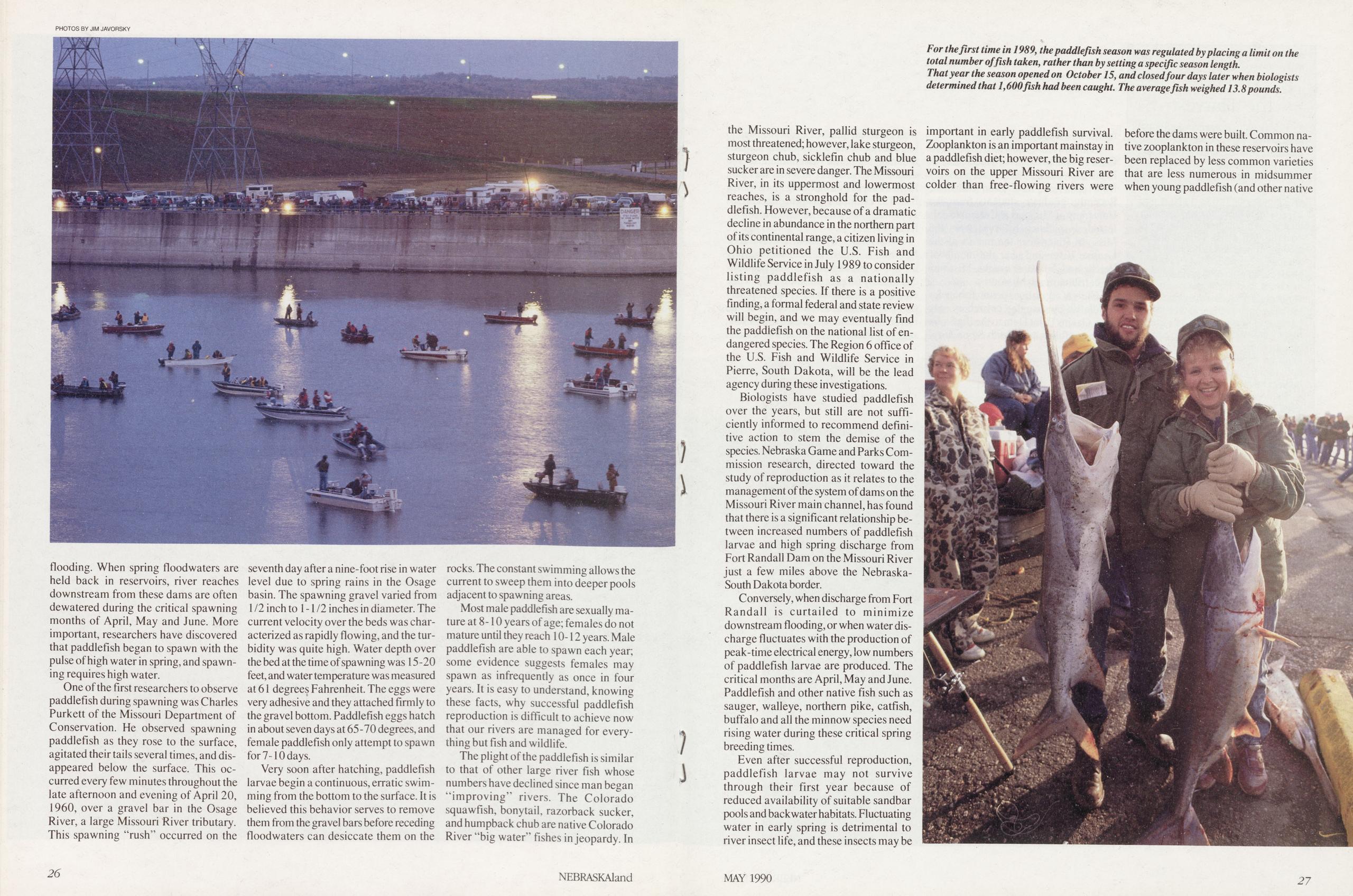 PHOTOS BY JIM JAVORSKY
For the first time in 1989, the paddlefish season was regulated by placing a limit
on the
total number offish taken, rather than by setting a specific season length.
That year the season opened on October 15, and closed four days later when biologists
determined that 1,600fish had been caught. The average fish weighed 13.8 pounds.
PHOTOS BY JIM JAVORSKY
For the first time in 1989, the paddlefish season was regulated by placing a limit
on the
total number offish taken, rather than by setting a specific season length.
That year the season opened on October 15, and closed four days later when biologists
determined that 1,600fish had been caught. The average fish weighed 13.8 pounds.
flooding. When spring floodwaters are held back in reservoirs, river reaches downstream from these dams are often dewatered during the critical spawning months of April, May and June. More important, researchers have discovered that paddlefish began to spawn with the pulse of high water in spring, and spawning requires high water.
One of the first researchers to observe paddlefish during spawning was Charles Purkett of the Missouri Department of Conservation. He observed spawning paddlefish as they rose to the surface, agitated their tails several times, and disappeared below the surface. This oc- curred every few minutes throughout the late afternoon and evening of April 20, 1960, over a gravel bar in the Osage River, a large Missouri River tributary. This spawning “rush” occurred on the seventh day after a nine-foot rise in water level due to spring rains in the Osage basin. The spawning gravel varied from 1 /2 inch to 1-1/2 inches in diameter. The current velocity over the beds was characterized as rapidly flowing, and the turbidity was quite high. Water depth over the bed at the time of spawning was 15-20 feet, and water temperature was measured at 61 degrees Fahrenheit. The eggs were very adhesive and they attached firmly to the gravel bottom. Paddlefish eggs hatch in about seven days at 65-70 degrees, and female paddlefish only attempt to spawn for 7-10 days.
Very soon after hatching, paddlefish larvae begin a continuous, erratic swimming from the bottom to the surface. It is believed this behavior serves to remove them from the gravel bars before receding floodwaters can desiccate them on the rocks. The constant swimming allows the current to sweep them into deeper pools adjacent to spawning areas.
Most male paddlefish are sexually mature at 8-10 years of age; females do not mature until they reach 10-12 years. Male paddlefish are able to spawn each year; some evidence suggests females may spawn as infrequently as once in four years. It is easy to understand, knowing these facts, why successful paddlefish reproduction is difficult to achieve now that our rivers are managed for everything but fish and wildlife.
The plight of the paddlefish is similar to that of other large river fish whose numbers have declined since man began “improving” rivers. The Colorado squawfish, bonytail, razorback sucker, and humpback chub are native Colorado River “big water” fishes in jeopardy. In the Missouri River, pallid sturgeon is most threatened; however, lake sturgeon, sturgeon chub, sicklefin chub and blue sucker are in severe danger. The Missouri River, in its uppermost and lowermost reaches, is a stronghold for the paddlefish. However, because of a dramatic decline in abundance in the northern part of its continental range, a citizen living in Ohio petitioned the U.S. Fish and Wildlife Service in July 1989 to consider listing paddlefish as a nationally threatened species. If there is a positive finding, a formal federal and state review will begin, and we may eventually find the paddiefish on the national list of endangered species. The Region 6 office of the U.S. Fish and Wildlife Service in Pierre, South Dakota, will be the lead agency during these investigations.
Biologists have studied paddlefish over the years, but still are not suffi- ciently informed to recommend definitive action to stem the demise of the species. Nebraska Game and Parks Commission research, directed toward the study of reproduction as it relates to the management of the system of dams on the Missouri River main channel, has found that there is a significant relationship between increased numbers of paddlefish larvae and high spring discharge from Fort Randall Dam on the Missouri River just a few miles above the Nebraska-South Dakota border.
Conversely, when discharge from Fort Randall is curtailed to minimize downstream flooding, or when water discharge fluctuates with the production of peak-time electrical energy, low numbers of paddlefish larvae are produced. The critical months are April, May and June. Paddlefish and other native fish such as sauger, walleye, northern pike, catfish, buffalo and all the minnow species need rising water during these critical spring breeding times.
Even after successful reproduction, paddlefish larvae may not survive through their first year because of reduced availability of suitable sandbar pools and backwater habitats. Fluctuating water in early spring is detrimental to river insect life, and these insects may be important in early paddlefish survival. Zooplankton is an important mainstay in a paddlefish diet; however, the big reservoirs on the upper Missouri River are colder than free-flowing rivers were before the dams were built. Common native zooplankton in these reservoirs have been replaced by less common varieties that are less numerous in midsummer when young paddlefish (and other native
26 NEBRASKAland MAY 1990 27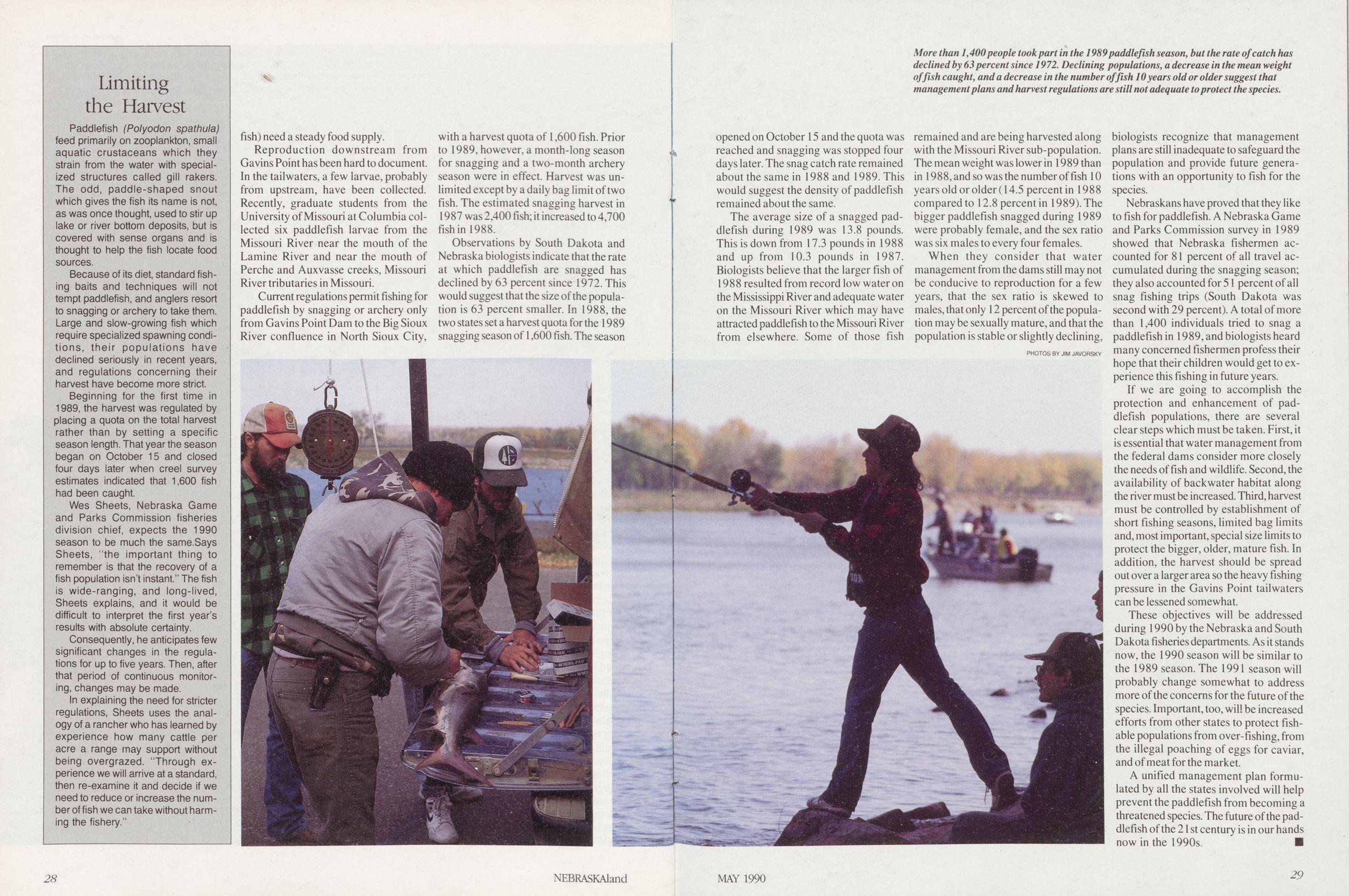 Limiting
the Harvest
Limiting
the Harvest
Paddlefish (Polyodon spathula) feed primarily on zooplankton, small aquatic crustaceans which they strain from the water with specialized structures called gill rakers. The odd, paddle-shaped snout which gives the fish its name is not, as was once thought, used to stir up lake or river bottom deposits, but is covered with sense organs and is thought to help the fish locate food sources.
Because of its diet, standard fishing baits and techniques will not tempt paddlefish, and anglers resort to snagging or archery to take them. Large and slow-growing fish which require specialized spawning conditions, their populations have declined seriously in recent years, and regulations concerning their harvest have become more strict. Beginning for the first time in 1989, the harvest was regulated by placing a quota on the total harvest rather than by setting a specific season length. That year the season began on October 15 and closed four days later when creel survey estimates indicated that 1,600 fish had been caught.
Wes Sheets, Nebraska Game and Parks Commission fisheries division chief, expects the 1990 season to be much the same. Says Sheets, ‘the important thing to remember is that the recovery of a fish population isn’t instant.” The fish is wide-ranging, and long-lived, Sheets explains, and it would be difficult to interpret the first year’s results with absolute certainty.
Consequently, he anticipates few significant changes in the regulations for up to five years. Then, after that period of continuous monitor- ing, changes may be made.
In explaining the need for stricter regulations, Sheets uses the analogy of a rancher who has learned by experience how many cattle per acre a range may support without being overgrazed. “Through experience we will arrive at a standard, then re-examine it and decide if we need to reduce or increase the number of fish we can take without harming the fishery.”
fish) need a steady food supply. Reproduction downstream from Gavins Point has been hard to document. In the tailwaters, a few larvae, probably from upstream, have been collected. Recently, graduate students from the University of Missouri at Columbia collected six paddlefish larvae from the Missouri River near the mouth of the Lamine River and near the mouth of Perche and Auxvasse creeks, Missouri River tributaries in Missouri.
Current regulations permit fishing for paddlefish by snagging or archery only from Gavins Point Dam to the Big Sioux River confluence in North Sioux City, with a harvest quota of 1,600 fish. Prior to 1989, however, a month-long season for snagging and a two-month archery season were in effect. Harvest was unlimited except by a daily bag limit of two fish. The estimated snagging harvest in 1987 was 2,400 fish; it increased to 4,700 fish in 1988.
Observations by South Dakota and Nebraska biologists indicate that the rate at which paddlefish are snagged has declined by 63 percent since 1972. This would suggest that the size of the population is 63 percent smaller. In 1988, the two states set a harvest quota for the 1989 snagging season of 1,600 fish. The season opened on October 15 and the quota was reached and snagging was stopped four days later. The snag catch rate remained about the same in 1988 and 1989. This would suggest the density of paddlefish remained about the same.
The average size of a snagged paddlefish during 1989 was 13.8 pounds. This is down from 17.3 pounds in 1988 and up from 10.3 pounds in 1987. Biologists believe that the larger fish of 1988 resulted from record low water on the Mississippi River and adequate water on the Missouri River which may have attracted paddlefish to the Missouri River from elsewhere. Some of those fish
More than 1,400people took part in the 1989paddlefish season, but the rate of catch has declined by 63 percent since 1972. Declining populations, a decrease in the mean weight of fish caught, and a decrease in the number offish 10years old or older suggest that management plans and harvest regulations are still not adequate to protect the species.remained and are being harvested along with the Missouri River sub-population. The mean weight was lower in 1989 than in 1988, and so was the number offish 10 years old or older (14.5 percent in 1988 compared to 12.8 percent in 1989). The bigger paddlefish snagged during 1989 were probably female, and the sex ratio was six males to every four females.
When they consider that water management from the dams still may not be conducive to reproduction for a few years, that the sex ratio is skewed to males, that only 12 percent of the population may be sexually mature, and that the population is stable or slightly declining,
PHOTOS BY JIM JAVORSKYbiologists recognize that management plans are still inadequate to safeguard the population and provide future genera- tions with an opportunity to fish for the species.
Nebraskans have proved that they like to fish for paddlefish. A Nebraska Game and Parks Commission survey in 1989 showed that Nebraska fishermen accounted for 81 percent of all travel accumulated during the snagging season; they also accounted for 51 percent of all snag fishing trips (South Dakota was second with 29 percent). A total of more than 1,400 individuals tried to snag a paddlefish in 1989, and biologists heard many concerned fishermen profess their hope that their children would get to experience this fishing in future years.
If we are going to accomplish the protection and enhancement of paddlefish populations, there are several clear steps which must be taken. First, it is essential that water management from the federal dams consider more closely the needs of fish and wildlife. Second, the availability of backwater habitat along the river must be increased. Third, harvest must be controlled by establishment of short fishing seasons, limited bag limits and, most important, special size limits to protect the bigger, older, mature fish. In addition, the harvest should be spread out over a larger area so the heavy fishing pressure in the Gavins Point tailwaters can be lessened somewhat.
These objectives will be addressed during 1990 by the Nebraska and South Dakota fisheries departments. As it stands now, the 1990 season will be similar to the 1989 season. The 1991 season will probably change somewhat to address more of the concerns for the future of the species. Important, too, will be increased efforts from other states to protect fishable populations from over-fishing, from the illegal poaching of eggs for caviar, and of meat for the market.
A unified management plan formulated by all the states involved will help prevent the paddlefish from becoming a threatened species. The future of the paddlefish of the 21 st century is in our hands now in the 1990s.
28 NEBRASKAland MAY 1990 29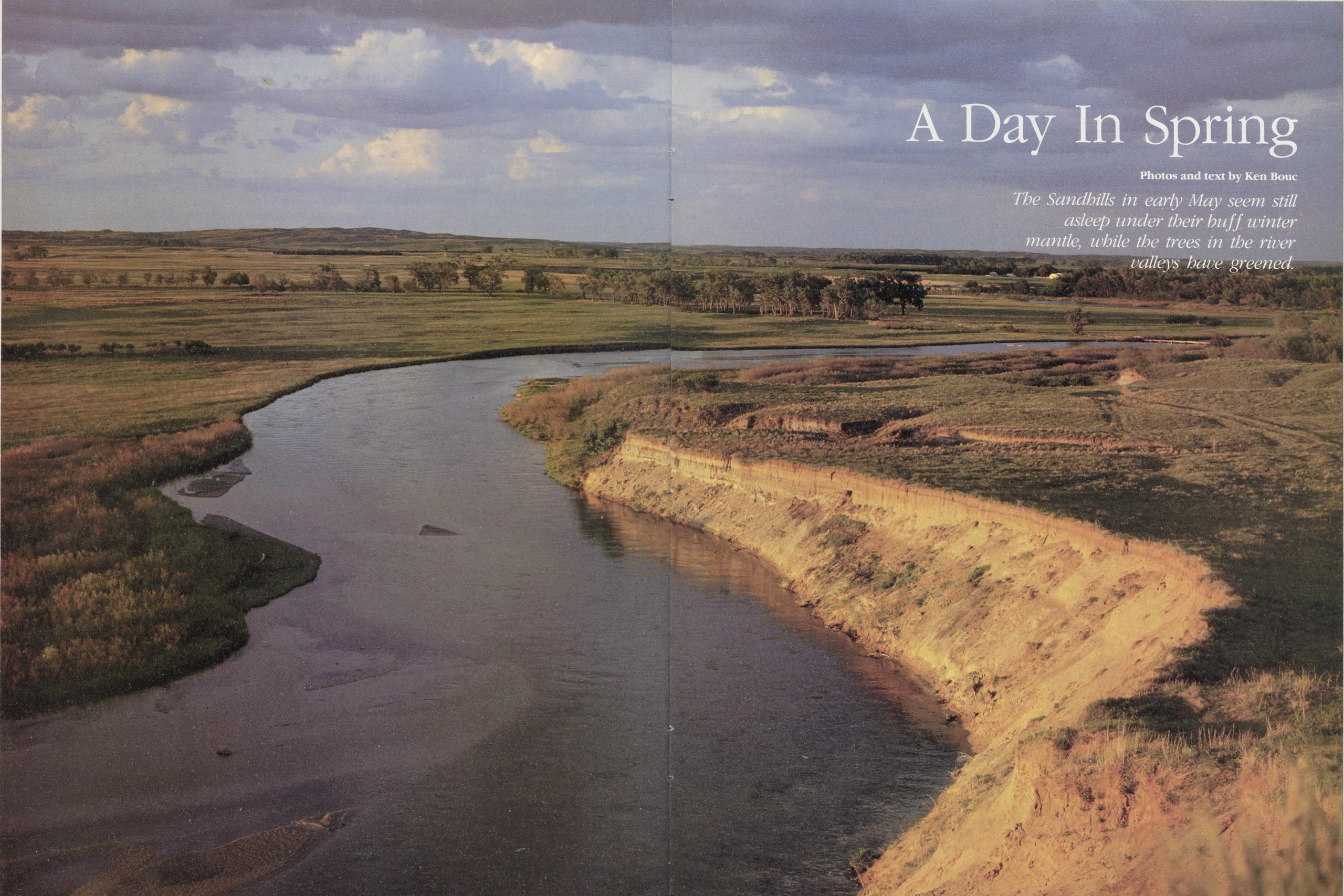
Day In Spring
Photos and text by Ken Bouc The Sandhills in early May seem still asleep under their buff winter mantle, while the trees in the river valleys have greened.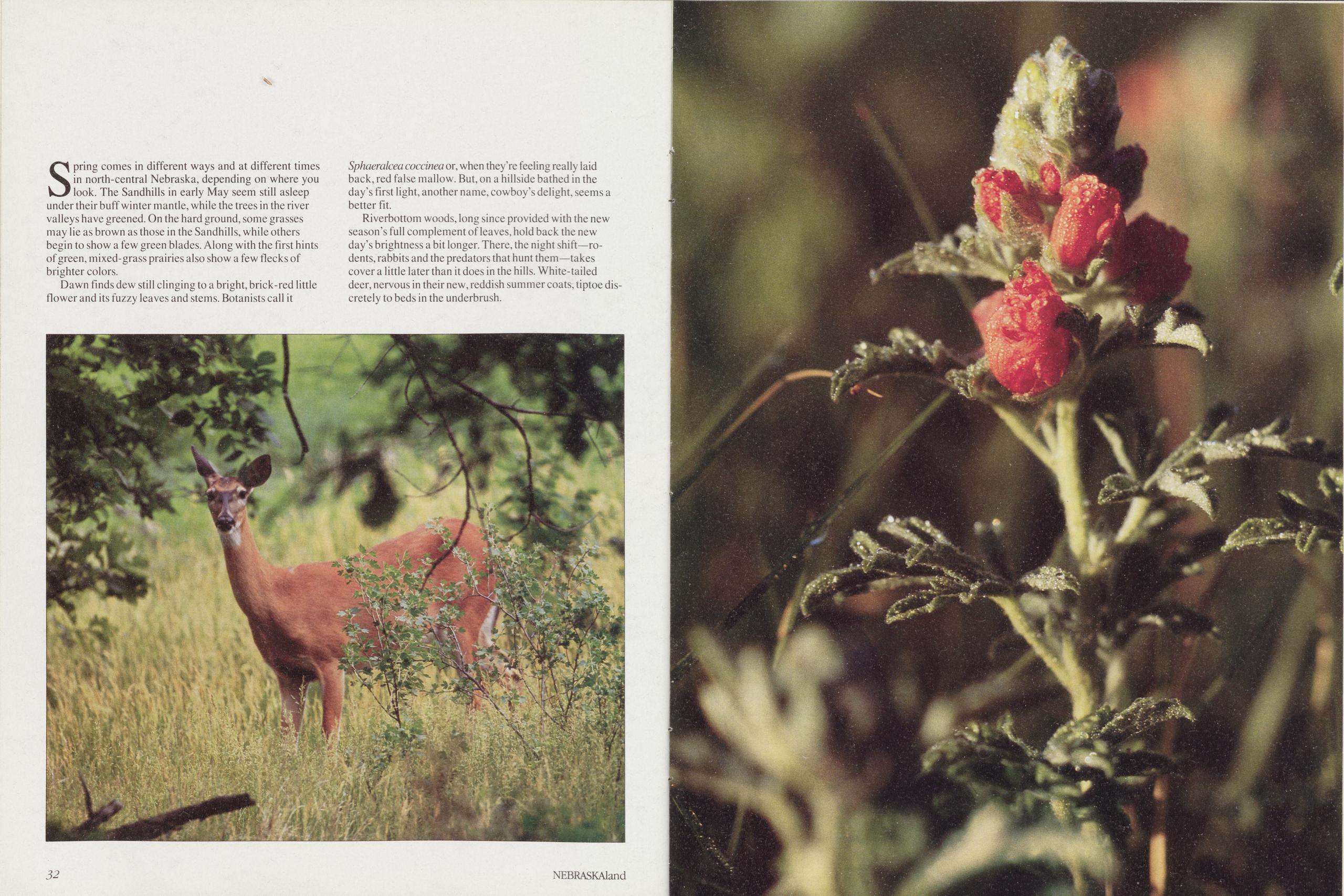
Spring comes in different ways and at different times in north-central Nebraska, depending on where you look. The Sandhills in early May seem still asleep under their buff winter mantle, while the trees in the river valleys have greened. On the hard ground, some grasses may lie as brown as those in the Sandhills, while others begin to show a few green blades. Along with the first hints of green, mixed-grass prairies also show a few flecks of brighter colors.
Dawn finds dew still clinging to a bright, brick-red little flower and its fuzzy leaves and stems. Botanists call it Sphaeralcea coccinea or, when they’re feeling really laid back, red false mallow. But, on a hillside bathed in the day’s first light, another name, cowboy’s delight, seems a better fit.
Riverbottom woods, long since provided with the new season’s full complement of leaves, hold back the new day’s brightness a bit longer. There, the night shift—rodents, rabbits and the predators that hunt them—takes cover a little later than it does in the hills. White-tailed deer, nervous in their new, reddish summer coats, tiptoe discretely to beds in the underbrush.
32 NEBRASKAland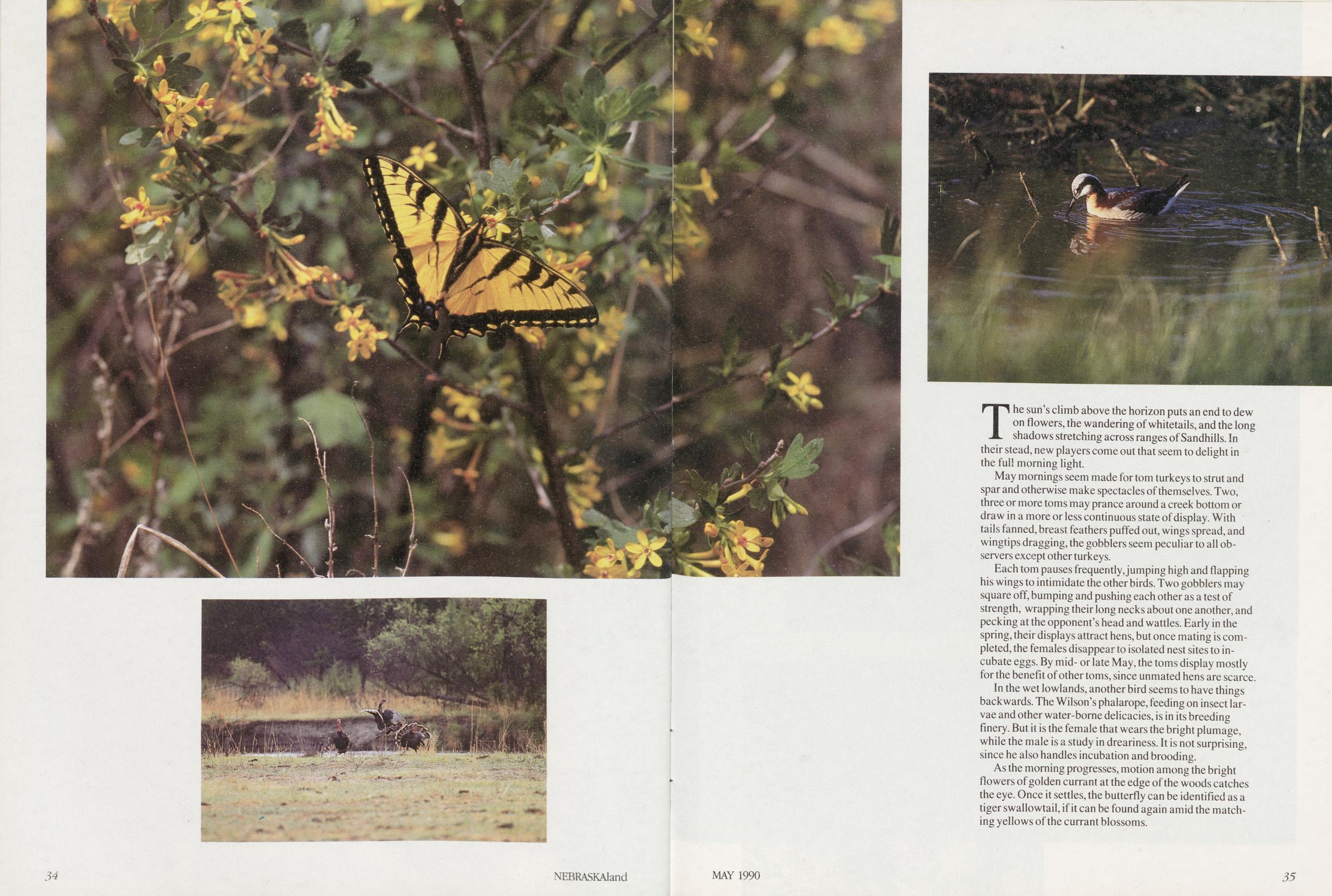
The sun’s climb above the horizon puts an end to dew on flowers, the wandering of whitetails, and the long shadows stretching across ranges of Sandhills. In their stead, new players come out that seem to delight in the full morning light.
May mornings seem made for tom turkeys to strut and spar and otherwise make spectacles of themselves. Two, three or more toms may prance around a creek bottom or draw in a more or less continuous state of display. With tails fanned, breast feathers puffed out, wings spread, and wingtips dragging, the gobblers seem peculiar to all ob- servers except other turkeys.
Each tom pauses frequently, jumping high and flapping his wings to intimidate the other birds. Two gobblers may square off, bumping and pushing each other as a test of strength, wrapping their long necks about one another, and pecking at the opponent’s head and wattles. Early in the spring, their displays attract hens, but once mating is completed, the females disappear to isolated nest sites to in- cubate eggs. By mid- or late May, the toms display mostly for the benefit of other toms, since unmated hens are scarce. In the wet lowlands, another bird seems to have things backwards. The Wilson’s phalarope, feeding on insect larvae and other water-borne delicacies, is in its breeding finery. But it is the female that wears the bright plumage, while the male is a study in dreariness. It is not surprising, since he also handles incubation and brooding.
As the morning progresses, motion among the bright flowers of golden currant at the edge of the woods catches the eye. Once it settles, the butterfly can be identified as a tiger swallowtail, if it can be found again amid the matching yellows of the currant blossoms.
Midday, with its harder light and deeper shadows, takes some of the appeal from the mottled landscapes that catch the eye in the gentler light of morning and evening. Midday finds fewer animals abroad as well. Still, spring is apparent to those who know where to look.
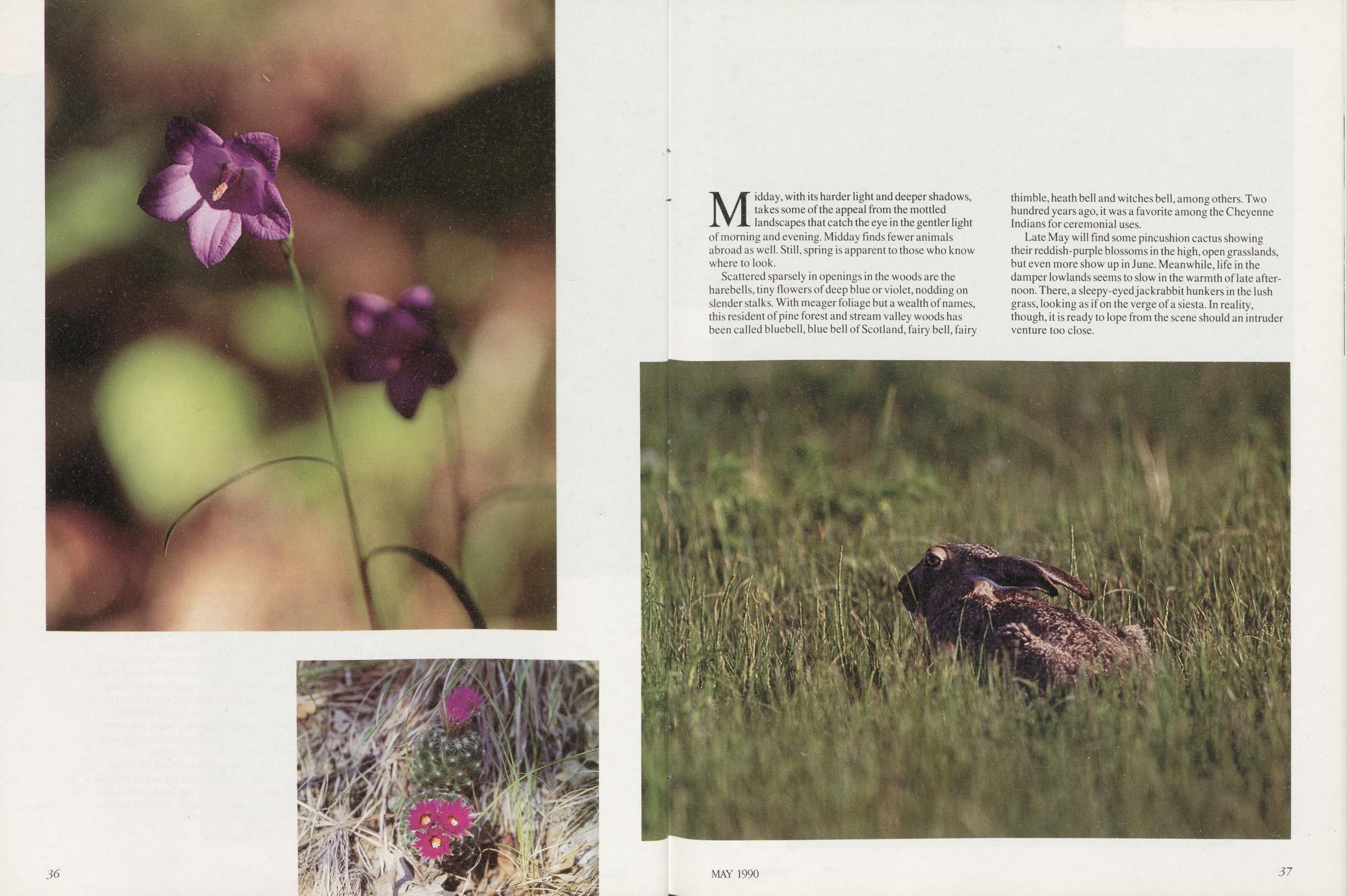
Scattered sparsely in openings in the woods are the harebells, tiny flowers of deep blue or violet, nodding on slender stalks. With meager foliage but a wealth of names, this resident of pine forest and stream valley woods has been called bluebell, blue bell of Scotland, fairy bell, fairy thimble, heath bell and witches bell, among others. Two hundred years ago, it was a favorite among the Cheyenne Indians for ceremonial uses.
Late May will find some pincushion cactus showing their reddish-purple blossoms in the high, open grasslands, but even more show up in June. Meanwhile, life in the damper lowlands seems to slow in the warmth of late after- noon. There, a sleepy-eyed jackrabbit hunkers in the lush grass, looking as if on the verge of a siesta. In reality, though, it is ready to lope from the scene should an intruder venture too close.
MAY 1990 37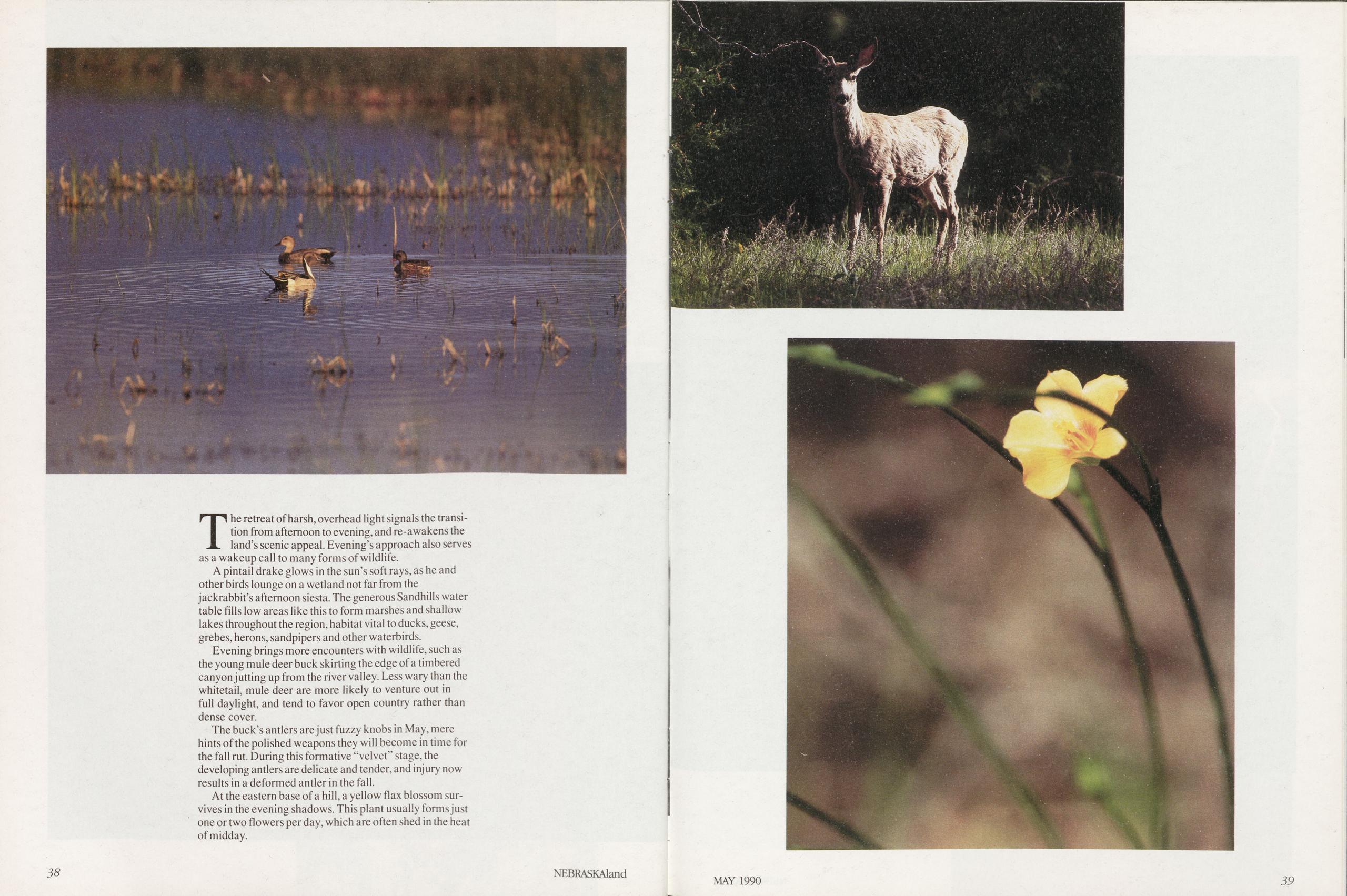
The retreat of harsh, overhead light signals the transition from afternoon to evening, and re-awakens the land’s scenic appeal. Evening’s approach also serves as a wakeup call to many forms of wildlife.
A pintail drake glows in the sun’s soft rays, as he and other birds lounge on a wetland not far from the jackrabbit’s afternoon siesta. The generous Sandhills water table fills low areas like this to form marshes and shallow lakes throughout the region, habitat vital to ducks, geese, grebes, herons, sandpipers and other waterbirds.
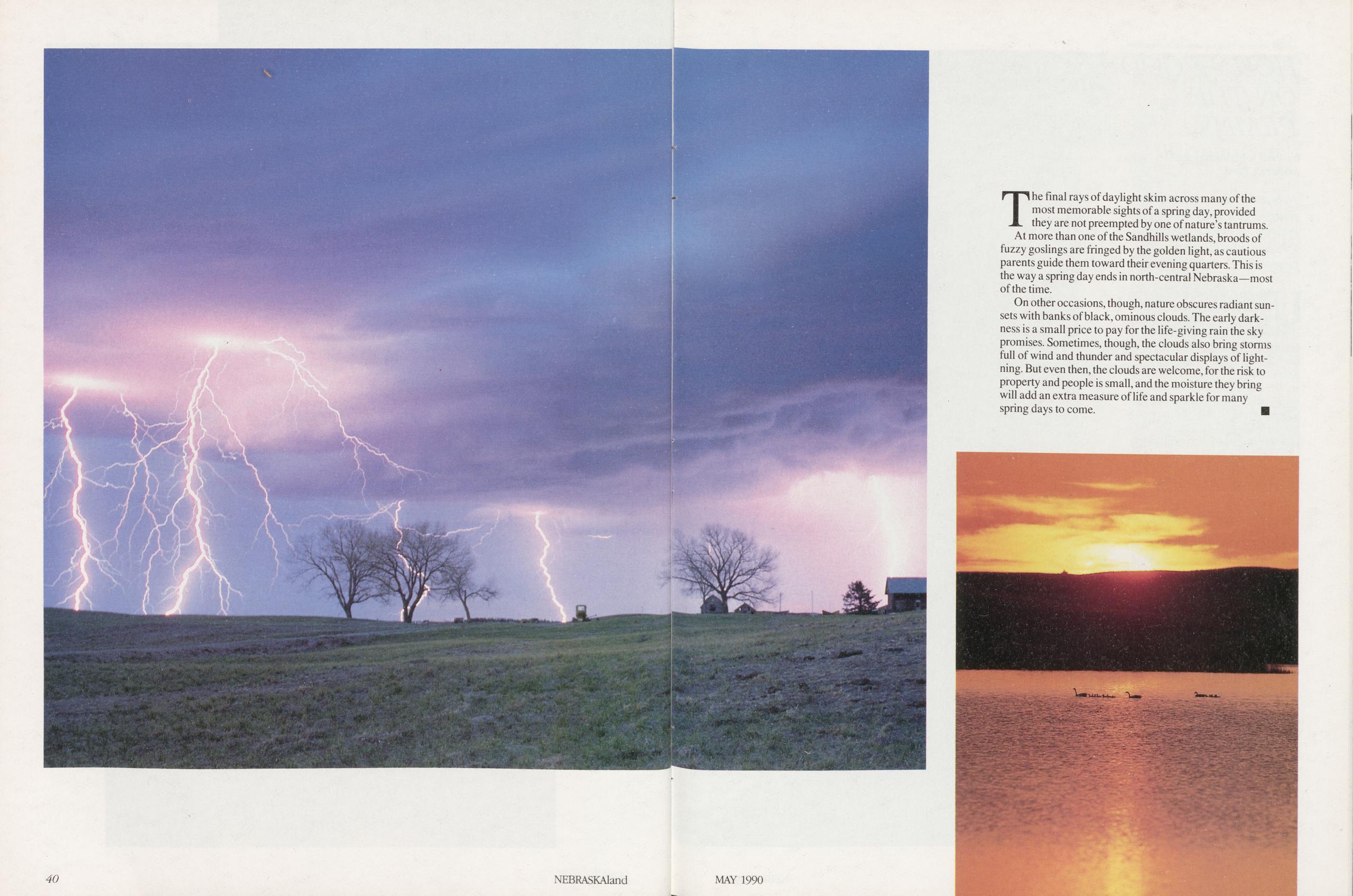
Evening brings more encounters with wildlife, such as the young mule deer buck skirting the edge of a timbered canyon jutting up from the river valley. Less wary than the whitetail, mule deer are more likely to venture out in full daylight, and tend to favor open country rather than dense cover.
The buck’s antlers are just fuzzy knobs in May. mere hints of the polished weapons they will become in time for the fall rut. During this formative “velvet” stage, the developing antlers are delicate and tender, and injury now results in a deformed antler in the fall.
At the eastern base of a hill, a yellow flax blossom sur- vives in the evening shadows. This plant usually forms just one or two flowers per day, which are often shed in the heat of midday.
The final rays of daylight skim across many of the most memorable sights of a spring day, provided they are not preempted by one of nature’s tantrums. At more than one of the Sandhills wetlands, broods of fuzzy goslings are fringed by the golden light, as cautious parents guide them toward their evening quarters. This is the way a spring day ends in north-central Nebraska—most of the time.
On other occasions, though, nature obscures radiant sunsets with banks of black, ominous clouds. The early dark- ness is a small price to pay for the life-giving rain the sky promises. Sometimes, though, the clouds also bring storms full of wind and thunder and spectacular displays of lightning. But even then, the clouds are welcome, for the risk to property and people is small, and the moisture they bring will add an extra measure of life and sparkle for many spring days to come.
40 NEBRASKAland MAY 1990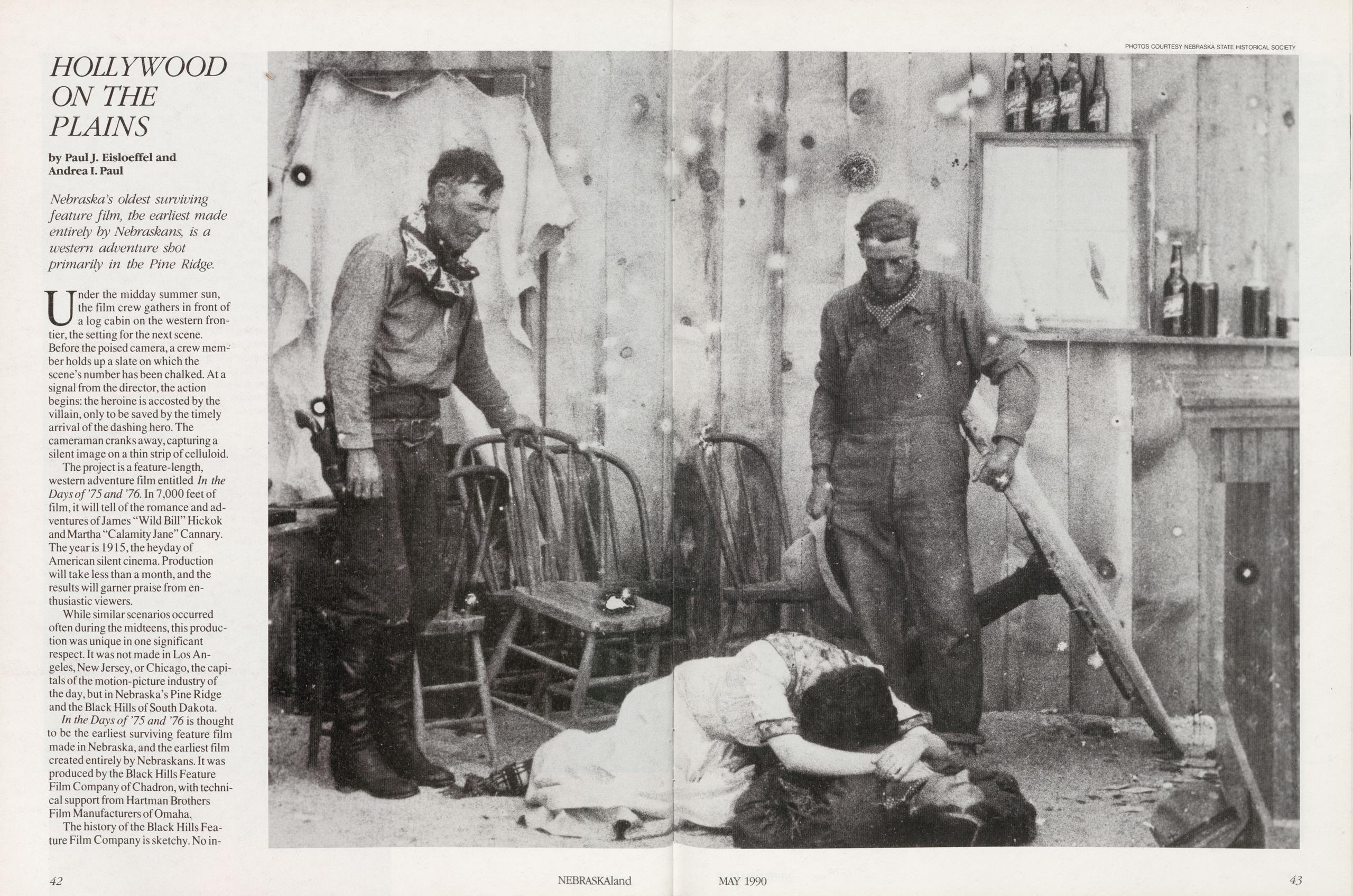
HOLLYWOOD ON THE PLAINS
by Paul J. Eisloeffel and Andrea I. Paul Nebraska's oldest surviving feature film, the earliest made entirely by Nebraskans, is a western adventure shot primarily in the Pine Ridge.Under the midday summer sun, the film crew gathers in front of a log cabin on the western frontier, the setting for the next scene.
Before the poised camera, a crew member holds up a slate on which the scene’s number has been chalked. At a signal from the director, the action begins: the heroine is accosted by the villain, only to be saved by the timely arrival of the dashing hero. The cameraman cranks away, capturing a silent image on a thin strip of celluloid.
The project is a feature-length, western adventure film entitled In the Days of ’75 and ’76. In 7,000 feet of film, it will tell of the romance and adventures of James “Wild Bill” Hickok and Martha “Calamity Jane” Cannary. The year is 1915, the heyday of American silent cinema. Production will take less than a month, and the results will garner praise from enthusiastic viewers.
While similar scenarios occurred often during the midteens, this production was unique in one significant respect. It was not made in Los Angeles, New Jersey, or Chicago, the capitals of the motion-picture industry of the day, but in Nebraska’s Pine Ridge and the Black Hills of South Dakota.
In the Days of ’75 and ’76 is thought to be the earliest surviving feature film made in Nebraska, and the earliest film created entirely by Nebraskans. It was produced by the Black Hills Feature Film Company of Chadron, with technical support from Hartman Brothers Film Manufacturers of Omaha, The history of the Black Hills Feature Film Company is sketchy. No incorporation
PHOTOS COURTESY NEBRASKA STATE HISTORICAL SOCIETY 42 NEBRASKAland MAY 1990 43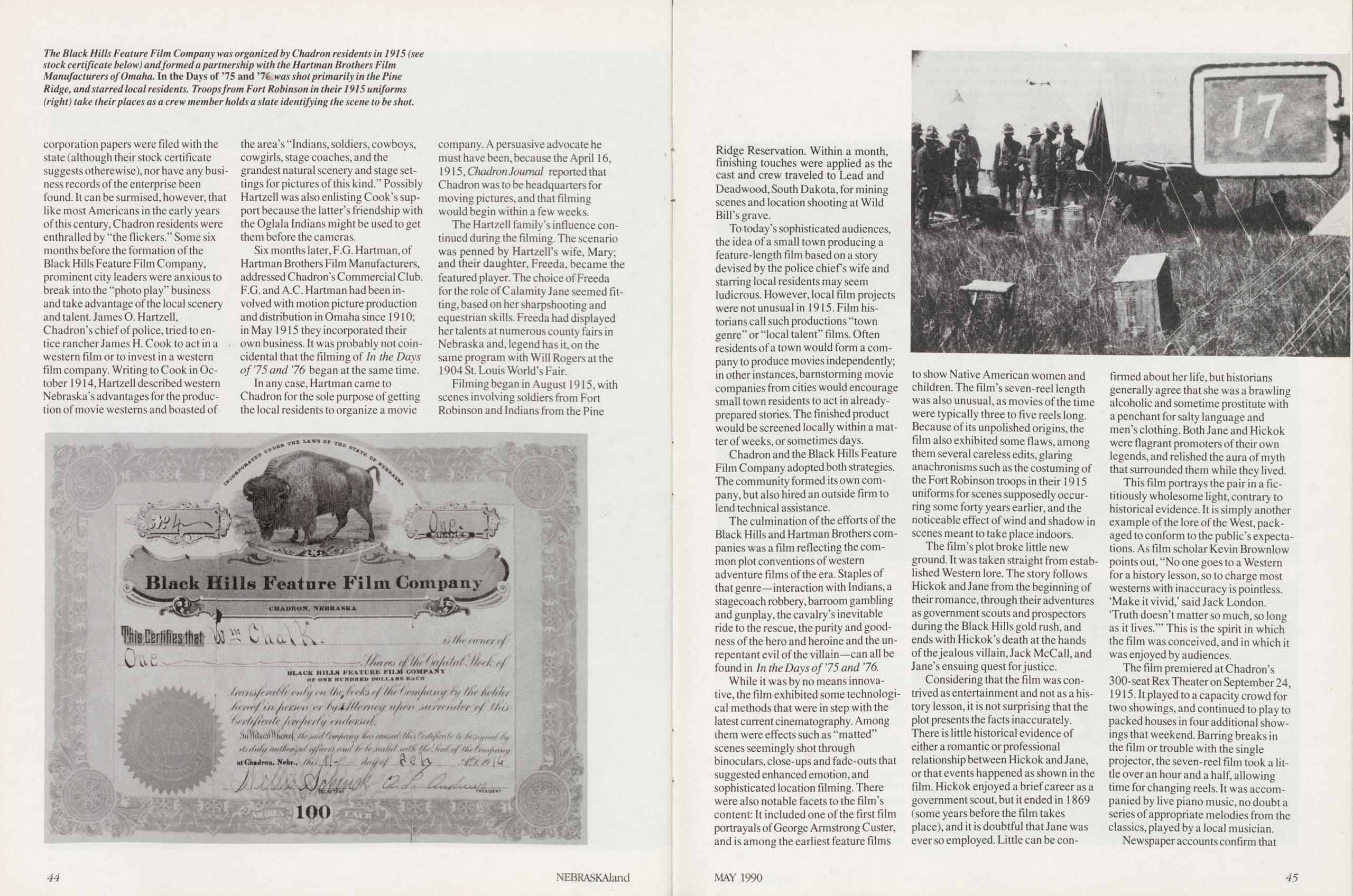
papers were filed with the state (although their stock certificate suggests otherewise), nor have any business records of the enterprise been found. It can be surmised, however, that like most Americans in the early years of this century, Chadron residents were enthralled by “the flickers.” Some six months before the formation of the Black Hills Feature Film Company, prominent city leaders were anxious to break into the “photo play” business and take advantage of the local scenery and talent. James O. Hartzell, Chadron’s chief of police, tried to entice rancher James H. Cook to act in a western film or to invest in a western film company. Writing to Cook in October 1914, Hartzell described western Nebraska’s advantages for the produc- tion of movie westerns and boasted of the area’s “Indians, soldiers, cowboys, cowgirls, stage coaches, and the grandest natural scenery and stage settings for pictures of this kind.” Possibly Hartzell was also enlisting Cook’s support because the latter’s friendship with the Oglala Indians might be used to get them before the cameras.
Six months later, F.G. Hartman, of Hartman Brothers Film Manufacturers, addressed Chadron’s Commercial Club. F.G. and A C. Hartman had been involved with motion picture production and distribution in Omaha since 1910; in May 1915 they incorporated their own business. It was probably not coincidental that the filming of In the Days of 75 and 76 began at the same time.
In any case, Hartman came to Chadron for the sole purpose of getting the local residents to organize a movie company. A persuasive advocate he must have been, because the April 16, 1915. Chadron Journal reported that Chadron was to be headquarters for moving pictures, and that filming would begin within a few weeks.
The Hartzell family’s influence continued during the filming. The scenario was penned by Hartzell’s wife, Mary; and their daughter, Freeda, became the featured player. The choice of Freeda for the role of Calamity Jane seemed fitting, based on her sharpshooting and equestrian skills. Freeda had displayed her talents at numerous county fairs in Nebraska and, legend has it, on the same program with Will Rogers at the 1904 St. Louis World’s Fair.
Filming began in August 1915, with scenes involving soldiers from Fort Robinson and Indians from the Pine Ridge Reservation. Within a month, finishing touches were applied as the cast and crew traveled to Lead and Deadwood, South Dakota, for mining scenes and location shooting at Wild Bill’s grave.
To today’s sophisticated audiences, the idea of a small town producing a feature-length film based on a story devised by the police chiefs wife and starring local residents may seem ludicrous. However, local film projects were not unusual in 1915. Film historians call such productions “town genre” or “local talent” films. Often residents of a town would form a company to produce movies independently; in other instances, barnstorming movie companies from cities would encourage small town residents to act in already-prepared stories. The finished product would be screened locally within a matter of weeks, or sometimes days.
Chadron and the Black Hills Feature Film Company adopted both strategies. The community formed its own company, but also hired an outside firm to lend technical assistance.
The culmination of the efforts of the Black Hills and Hartman Brothers companies was a film reflecting the common plot conventions of western adventure films of the era. Staples of that genre—interaction with Indians, a stagecoach robbery, barroom gambling and gunplay, the cavalry’s inevitable ride to the rescue, the purity and goodness of the hero and heroine and the unrepentant evil of the villain—can all be found in In the Days of 75 and 76.
While it was by no means innova- tive, the film exhibited some technological methods that were in step with the latest current cinematography. Among them were effects such as “matted” scenes seemingly shot through binoculars, close-ups and fade-outs that suggested enhanced emotion, and sophisticated location filming. There were also notable facets to the film’s content: It included one of the first film portrayals of George Armstrong Custer, and is among the earliest feature films to show Native American women and children. The film’s seven-reel length was also unusual, as movies of the time were typically three to five reels long. Because of its unpolished origins, the film also exhibited some flaws, among them several careless edits, glaring anachronisms such as the costuming of the Fort Robinson troops in their 1915 uniforms for scenes supposedly occur- ring some forty years earlier, and the noticeable effect of wind and shadow in scenes meant to take place indoors.
The film’s plot broke little new ground. It was taken straight from established Western lore. The story follows Hickok and Jane from the beginning of their romance, through their adventures as government scouts and prospectors during the Black Hills gold rush, and ends with Hickok’s death at the hands of the jealous villain, Jack McCall, and Jane’s ensuing quest for justice.
Considering that the film was con- trived as entertainment and not as a history lesson, it is not surprising that the plot presents the facts inaccurately. There is little historical evidence of either a romantic or professional relationship between Hickok and Jane, or that events happened as shown in the film. Hickok enjoyed a brief career as a government scout, but it ended in 1869 (some years before the film takes place), and it is doubtful that Jane was ever so employed. Little can be con- firmed about her life, but historians generally agree that she was a brawling alcoholic and sometime prostitute with a penchant for salty language and men’s clothing. Both Jane and Hickok were flagrant promoters of their own legends, and relished the aura of myth that surrounded them while they lived.
This film portrays the pair in a fic- titiously wholesome light, contrary to historical evidence. It is simply another example of the lore of the West, pack- aged to conform to the public’s expectations. As film scholar Kevin Brownlow points out, “No one goes to a Western for a history lesson, so to charge most westerns with inaccuracy is pointless. ‘Make it vivid,’ said Jack London. ‘Truth doesn’t matter so much, so long as it lives.’” This is the spirit in which the film was conceived, and in which it was enjoyed by audiences.
The film premiered at Chadron’s ZOO-seat Rex Theater on September 24, 1915. It played to a capacity crowd for two showings, and continued to play to packed houses in four additional showings that weekend. Barring breaks in the film or trouble with the single projector, the seven-reel film took a little over an hour and a half, allowing time for changing reels. It was accompanied by live piano music, no doubt a series of appropriate melodies from the classics, played by a local musician.
Newspaper accounts confirm that
44 NEBRASKAland MAY 1990 45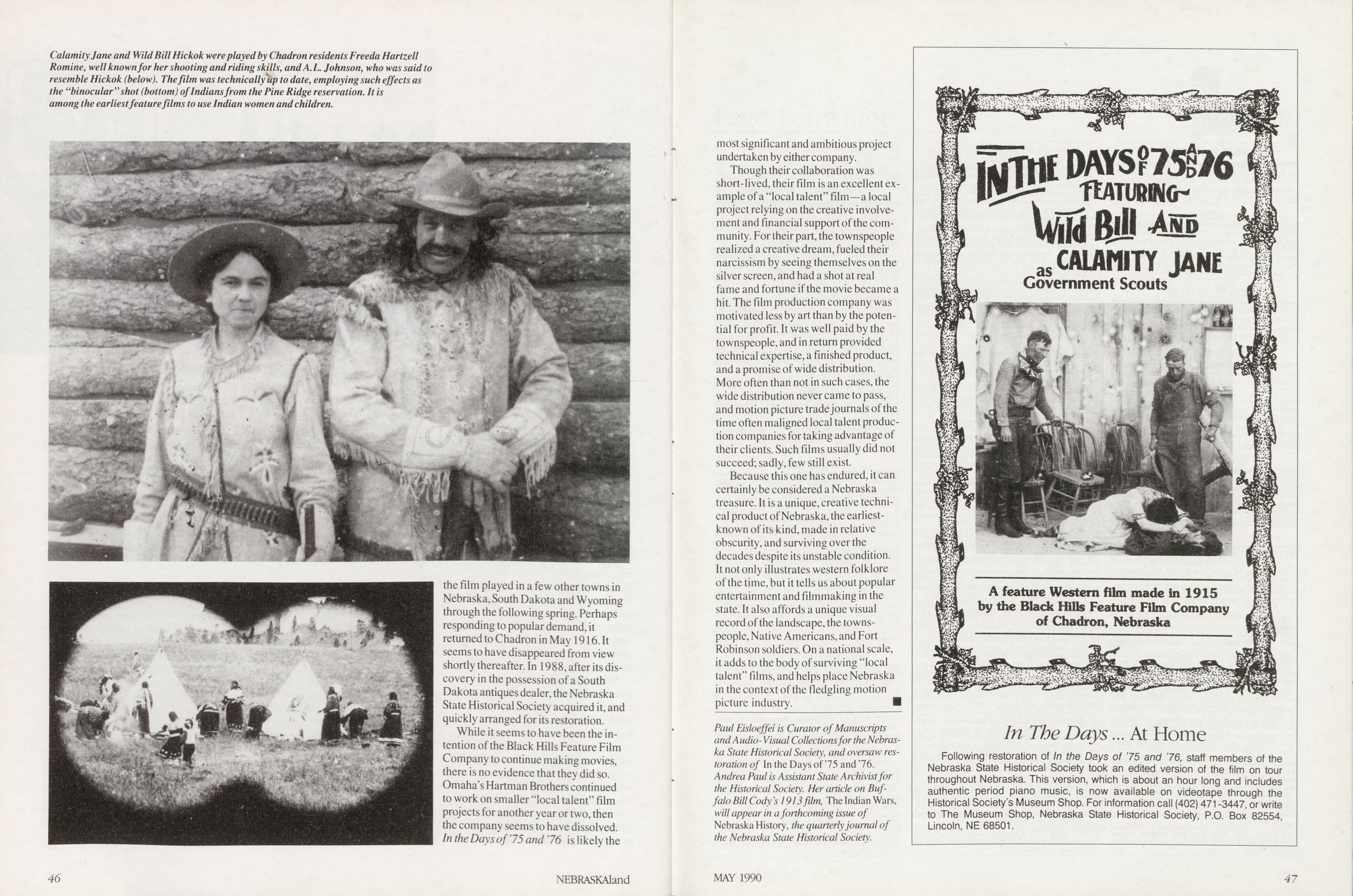
the film played in a few other towns in Nebraska, South Dakota and Wyoming through the following spring. Perhaps responding to popular demand, it returned to Chadron in May 1916. It seems to have disappeared from view shortly thereafter. In 1988, after its discovery in the possession of a South Dakota antiques dealer, the Nebraska State Historical Society acquired it, and quickly arranged for its restoration.
While it seems to have been the intention of the Black Hills Feature Film Company to continue making movies, there is no evidence that they did so. Omaha’s Hartman Brothers continued to work on smaller "local talent” film projects for another year or two, then the company seems to have dissolved. In the Days of ’75 and ’76 is likely the most significant and ambitious project undertaken by either company.
Though their collaboration was short-lived, their film is an excellent example of a "local talent” film—a local project relying on the creative involvement and financial support of the community. For their part, the townspeople realized a creative dream, fueled their narcissism by seeing themselves on the silver screen, and had a shot at real fame and fortune if the movie became a hit. The film production company was motivated less by art than by the potential for profit. It was well paid by the townspeople, and in return provided technical expertise, a finished product, and a promise of wide distribution. More often than not in such cases, the wide distribution never came to pass, and motion picture trade journals of the time often maligned local talent production companies for taking advantage of their clients. Such films usually did not succeed; sadly, few still exist.
Because this one has endured, it can certainly be considered a Nebraska treasure. It is a unique, creative technical product of Nebraska, the earliest- known of its kind, made in relative obscurity, and surviving over the decades despite its unstable condition. It not only illustrates western folklore of the time, but it tells us about popular entertainment and filmmaking in the state. It also affords a unique visual record of the landscape, the towns- people, Native Americans, and Fort Robinson soldiers. On a national scale, it adds to the body of surviving "local talent” films, and helps place Nebraska in the context of the fledgling motion picture industry.
Paul Eisloeffei is Curator of Manuscripts and Audio-Visual Collections for the Nebras- ka State Historical Society, and oversaw res- toration of In the Days of’75 and ’76. Andrea Paul is Assistant State Archivist for the Historical Society. Her article on Buffalo Bill Cody's 1913 film, The Indian Wars, will appear in a forthcoming issue of Nebraska History, the quarterly journal of the Nebraska State Historical Society.
Bev Doolittle, Terrry Redlin, Jerry Raedke, Ed Wards, Robert Bateman, Frank McCarthy and Neal Anderson are available at the 2nd Street Gallery, 537 W. 2nd, Hastings, NE 68901. Phone (402) 463-6677.
BIRDSGAMEBIRDS: Pheasants, partridges, wild turkeys, eggs, chicks, adults. National Poultry Improvement Plan participants—guaranteed top quality for propagation, hunting, eating and taxidermy. Call now to place 1990 chick orders. Bargain prices on hen chicks. Toubl Game Bird Farms, Beloit, WI (608) 365-1789.
BOATS/MOTORSTROLLING MOTOR REPAIR. Factory authorized .Minn Kota and Motor Guide, parts and service. Wolf s Repair and Tackle Supply, 1529 David Drive, Lincoln, NE 68504. Phone (402) 464 4265.
BOOKS/PRINTINGFREE! Booklets on northeastern Nevada; fishing, rock- hounding maps, Carl Hayden, Box 528, Jackpot, Nevada 89825.
FREE BOOK CATALOG. Novels, westerns, romances, children's; old out of print, found barns, attic. Authors: Grey, Bower, Connor, Fox, Curwood, Raine, Wright, Aldrige, Pollyanna, Freckles, many others. Postage appreciated. Pierce, 4400 N. Pine Cluster, Oroville, CA 95965.
COLLECTIBLESBUYING: American Indian artifacts such as beadwork, weavings, baskets, etc.; also cowboy memorabilia such as chaps, spurs, photographs, etc. Best price first letter; photographs promptly returned. Jack Ringwait, 1550 California St., Suite 6, #21 1, San Francisco, CA 94109, (415) 759-6343.
DOGSYELLOW-BLACK Lab pups. FC-AFC sired. AKC. Hips OFA ceritified. Dew claws removed. Excellent hunting potential. Contact Bob Bendler, Lexington, NE (308) 324-4247.
TRAINING ALL BREEDS bird dogs—Vizslas—for sale. Rozanek Kennels, R 2, Schuyler, NE 68661. Phone (402)352-8769.
ENGLISH SETTERS: “Bred for the hunter”; select pup- pies and started dogs available from outstanding blood- lines. Stud service available by proven hunters. High Plains Kennels, 1411 Emerson, Alliance, NE 69301, Phone (308) 762-6709.
PINKERTON BIRD DOGS-English setter, brittany puppies. Started dogs available this fall. Our dogs are bred for nose and style. Give us a call at (402)673-4540.
GERMAN SHORTHAIR and springer spaniel pup- pies—also started dogs. Outstanding bloodlines. Bird dog training. Cactus Kennels, Dave Wickham, Kimball, NE 69145. (308) 235-3237.
ENGLISH SETTER pups and young dogs for sale. These are beautiful, stylish dogs from selective bleeding. Contact Darrell Yentes, Holdrege, NE 68949 or phone (308)995-4797.
BLACK LAB PUPS. Born April 1. Sired by national champion. Mother’s dad national champion. Her mother’s dad national champion. Sire’s granddad two- time national champion. Contact Albert Leisy, 2821 W. 20th, North Platte, NE 69101, Phone (308) 532-4784.
CHOCOLATE AND BLACK lab pups. AKC. Excellent bloodlines and hunting potential. Contact Ric Wyrens, Lincoln, NE (402) 483-2187.
FOR SALE: AKC brittany spaniel puppies, welped 3/17/90. Wormed, shots. Parents both excellent hunters. (402)362-5108.
FISHFISH FOR SALE. Catfish, perch, coho salmon, rainbow trout, crappie, bluegill, walleye, minnows, goldfish, bull- head, largemouth bass, smallmouth bass, triploid grass carp. Commercial grower prices on catfish, perch, coho salmon, rainbow trout. Consulting available. Pleasant Valley Fish Farm, Rt 1 Box 147, McCook, NE 69001. Phone (308) 345-6599.
FISH FOR POND STOCKING. Bass, bluegill, crappie, perch, channel catfish, Triploid grass carp, rainbow trout and walleye. Available April-October. Write Orchard Fish Hatcherv, Rt 2, Box 117, Orchard, NE 68764 or phone (402) 893-2521.
WILLOW LAKE FISH HATCHERY. Channel cat, blue- gill, hybrid bluegill, largemouth bass, crappie, bullheads, triploid grass carp, walleye, perch, minnows available for stocking. Gaylord Crawford, Rt 3 Box 46, Hastings, NE 68901 or phone (402) 463-8022 day or night. Also pond consultant.
FOODWINE AND BEER: Make your own. Send for free recipes and instructions. Omaha Supply, 1324 2nd Avenue, Nebraska City, NE 68410. BUFFALO JERKY, 16 1-oz. pkgs, for $23 including shipping. Sample $1.75. G. E. Hill Distributing, 5220 Aylesworth, Lincoln, NE 68504. Phone (402) 464-6781.
GUIDES/OUTFITTERSMAD RIVER CANOES offers the finest quality and performance. For the finest canoes and accessories look to Great Plains Canoe Co., 205 Main, Springfield, NE. Phone (402)253-2001.
EXPERIENCE NEBRASKA. . . with an affordable canoe trip by Dryland Aquatics. One and two-day trips . . . canoe rental or fully catered. Niobrara . . . Dismal . . . Platte . . Elkhorn . . . We do it your way! For free brochure: Dryland Aquatics, Dept. N, 1837 E. Cuming, Fremont, NE 68025 or phone (402) 721-4177.
FERGUSON GUIDE SERVICE. Call Dan Ferguson (308) 785-2413 to book your 1990 fishing trip. Elwood, Calamus and Johnson Lake.
DISMAL RIVER canoe trips. Full service trips. (Includes meals, shuttle, canoe rental, hot showers, indoor pool and lodging). Daily canoe rentals and shuttle service also available. 2nd Annual Dismal Derby Days Canoe Race, $200—1st Place, June 16. Open & Women’s Divisions. Dance and sand volleyball tourna- ment. For information write Powderhorn Outfitters, Box 225, Brownlee, NE 69126 or call (308) 748-2218 or (402)486-1208.
BLACK HILLS FIELD CAMPS: Visit sites of geologic interest—badlands, caves, mines, mountains, fossil quarries and museums. Based from the Trailside Museum at Fort Robinson State Park in the scenic Pine Ridge. Most stops involve hiking and time enough to enjoy each. Visitors need provide a sleeping bag and clothing appropriate for travel and an evening around a campfire. Each two-day camp includes a souvenir T- shirt, equipment, admissions, meals, and presentation along the 400 mile route selected for its lack of devel- oped tourism. Rates: Adults $95,Children (6yrs. thru 15 yrs.) $49: 10% discount for families/groups of four or more. For information/reservations contact David Nixon, Trailside Supt., 307 Morrill Hall, UNL, Lincoln, NE 68588-0338, (402) 472-6365. After May 15th Trailside Museum, P.O. 462, Crawford, NE 69339, (308) 665-2730. Dates: June (1-2), (15-16), and (28- 29); July (13-14), (27-28), and August (3-4).
GRAHAM CANOE OUTFITTERS: Top quality full- service camping and canoe trips on the Niobrara River. Daily canoe rentals and car shuttle-service available. Contact Doug & Twyla Graham, HC 13 Box 16, Valen- tine, NE 69201 or phone (402) 376-3708.
CANOE RENTALS: Kamp Kaleo, Burwell, NE. 17-ft. aluminum canoes, $ 15 per day. Call (308) 346-5083 for information and reservations.
KEN KO INC. Spend a day fishing the scenic Missouri River with Fishing Guide Kenneth Cooksey. For infor- mation write 2002 2nd Ave., Nebraska City, NE 68025 or call (402) 873-6288 mornings/evenings.
OUTDOOR EQUIPMENTAIR GUNS repaired — Benjamin, Crosman, Daisy, other American made. Restoration; old guns wanted, Jack’s Air Guns, 1225 No. 46th, Lincoln, NE 68503. Phone (402) 466-9223.
GUNS — Browning, Winchester, Remington, others, Hi-powers, shotguns, new, used, antiques. Want Pre-’64 Winchesters. Buy-Sell-Trade. (402)729-6112. Bedlan’s Sporting Goods, Fairbury, NE 68352.
REAL ESTATEFOR SALE—40 acres with modern 2-bedroom log cabin. Good water well—fireplace—great summer home or hunting lodge. 14 miles northwest of Crawford, NE. Write N. Rawhouser, 517 Annin, Crawford, NE 69339. Phone (308)665-1822.
HIDDEN COVE. Lake-front development. Nestled among the trees. Located 1.3 miles south of North Bend on Hwy 79. Excellent fishing, central water system on site electricity, easy highway access, lots starting at $15,950. Don Peterson Associates Real Estate Co., 100 East 6th, Fremont, NE 68025. Phone (402) 721-9700.
FOR SALE—40 acres in north central Nebraska on headwaters of Pine Creek. 2-Bedroom home, unat- tached 2-car garage. Attached lean-to and wood shed, 2 trout ponds, satellite dish. Year-round living, retirement, or get-away. Beautiful and quiet. Call (308) 234-3798 or (402) 273-4113.
TAXIDERMYALLISON’S TAXIDERMY STUDIO. Wally and Betty Allison Licensed Taxidermist. We’ve mounted 28 Ne- braska State Record fish. Specializing in fish and birds, small game and rattlesnakes. We use freeze-dry. 2310 West Leota, North Platte, NE 69101, (308) 534-2324.
NABITY’S TAXIDERMY. 31 years experience. Spe- cializing in natural grass backgrounds for mammals, birds and fish. 13901 “O” St., Lincoln, NE 68504 — 4 miles east of 84th and “O”. (402) 489-6351.
PEISTER TAXIDERMY — Professional work at prices most sportsman can afford. 1020 Central Avenue, Box 3201, Kearney, NE 68847. Phone (308) 236-9700 or (308) 237-7575 evenings.
SWANSON PHEASANT COMPANY: mounted pheas- ants for sale. Flying $87.95; standing $92.95; shipping and handling included. Custom mounts also available. Tell us what you want. Swanson Pheasant Company, 6123 No. 100th Plz„ Omaha, NE 68134. We support pheasant stocking.
VACATION/RESORTSBERGMAN’S JOHNSON LAKE RESORT. Lakefront cabins, full RV hookups, groceries, beer, bait, tackle, restaurant, lounge, boat rentals, boat ramp . . . Fish, swim, ski. Free brochure: Rt 2, Elwood, NE 68937 or phone (308) 785-2298.
CABIN FOR RENT. Modern three-bedroom, fully- equipped cabin overlooking secluded, scenic 3-acre pond. Call or write Orchard Fish Hatchery, Rt. 2, Box 117, Orchard, NE 68764 or phone (402) 893-2521.
NE NEBRASKA trout fishing. 3 modern cottages, 1 available year round. 5 spring fed lakes with open water all year. Trout up to 7 pounds. Other varieties fish also. Diamond E. Trout Resort, Orchard, NE 69764. Phone (402) 893-4745.
N.W. NEBRASKA. Two cabins—daily/weekly. Scenic, rustic. Secluded but handy. Prime trout, turkey, deer. Phone (308) 487-5247.
HUNTING OR VACATIONING in central Nebraska? Rooms available year-round. Guided deer hunts, too. Chesley’s Lodge, Rt 1 Box 76, Callaway, NE 68825. Phone (308) 836-2658.
Page Forty-nineOozing pale yellow across the gray asphalt of highway 6, dawn slithered over the horizon like the yolk of a lunch counter over- easy. The grass hung limp, heavy with last night’s drizzle. In 30 miles or so I was going to have to walk around in it. The coffee in my Gas ‘n Guzzle Travel Mug (Refills 25 Cents Day or Night!) tasted like iodine filtered through burnt toast (If you haven’t checked your cup for a day or two, refill it through the little drinking hole. Or, if you do pop off the cap, avoid looking inside).
Periodically the coffee flavor was embellished by a gustatory bulletin from the past—from last night, actual- ly—a consequence of the fact that after 1 1 pm, the only food available in Stank, Nebraska, is Ruby’s Roadapple Ranch Tuna Casserole, out of the freezer and into the microwave (but still in the cellophane) at the Stock Tank Lounge (no kids after 9).
But why was I feeling sorry for myself? This is my job: Outdoor Writer. Privy to the mysteries of Sport. Fluent in Pheasant. Conversant in Covey. Graduate degree in Gear. At home in Habitat. And this was the big one, the break I needed: Opening Day. But when they called me, I felt that old, familiar ice cube slide along my spine. The one that warns me when something isn’t quite right.
Now 1 knew why, and I started to panic. When it hit me, I almost lost control of the big four wheel drive Verbomobile, my home in the field: I couldn’t see anyone! It was opening morning, and no one was in sight! Oh, I won’t try to kid you, there were cars all right, cars up and down the highway—most of them tough cars: Flamers and Buckers, or pickups with mud in all the right places. I’d been driving into their headlights for an hour. But now the sun was up and the lights were off, and I could see through their windshields as they growled past me: no one was driving them! No passengers!
It was half an hour after sunrise, and there were mud-caked and steaming vehicles parked beside cornfields and grass-choked creekbottoms, but I couldn’t see anyone! There had to be hunters around here. Where were they? Mind racing, I tried the old strategy Outdoor Writers use when a story goes wrong, but it didn’t work—I couldn’t make up even a single fact.
Then I remembered. Last night, in the Stock Tank—who had been there? The short old man with a white walrus mustache smoking an old, cracked pipe. He hadn’t said anything. Two women in satin “Bomber-Bowl Alley Cats” jackets, saying “Then she goes..., then he goes..., so she goes....” A skinny kid with a bag of quarters who spent the evening in the corner disintegrating the military hardware of some other galaxy. No one else. But the place had been buzzing with Hunter Talk! There was a clue there, and only someone stupified by tuna casserole could have missed it.
This was too much. I needed caf- feine again. Hands shaking, I pulled into Ethel’s Egg-ceptional Eats (breakfast any time) for another cup of morning tonic. My brain was on fire, and I was glad there was no one else there. Ignoring the conversation around me, I poured half a cup of coffee into my saucer and blew on it. Then the old, keen instincts returned. The Outdoor Writer’s chief tool (after invention, of course): observation. No one else there... the conversations around me!
Outdoor Writers can call up deep reserves of calm when they have to, and I had to. I heard all the tip-off phrases:"... you shoulda been here yesterday...," "... the thing about steel shot...,” "... so I says, ‘it’s a miracle, there flies a dead rooster ..."... not like when I was a kid...,” and so on. They were there, no question about it.
But where?
Then it happened. The door opened. No one was there. But the light from the Opening Morning milk-of-mag- nesia sky was blocked for a moment as a form passed invisibly through the door, and in that instant, as the dank outside light and the fetid indoor dim met across the invisible form, I saw it: the random, mottled pattern that means only one thing—Camo!
Camo. The new shield of invulnerability. The armor of the hunt. The scholar’s gown, the surgeon’s coat, the playboy’s gold chain, the archbishop’s vestments. No wonder I hadn’t seen anyone. They were all camouflaged.
I began to relax. Nothing to worry about here. Outdoor Writers know a trick or two. If I needed to talk to anyone, I could just watch for shadows—even camo can’t hide the shadows. The old ice cube was wrong for once.
I drained the last of Ethel’s iodine, and stood up. In the sudden silence, it hit me like a sash weight on the brain pan. They were all looking at me, and they didn’t like what they saw. Solid colors. Brown duck. Blue denim. Gloves without spots on them. Corduroy cap. And (I’m sorry to have to say this) plaid.
Sometimes you have to walk head high even when you feel like a puppy who’s been whapped with a rolled up newspaper. 1 made it back to the Verbomobile without stumbling, and I hope they couldn’t see the shame in my eyes, or the wrenching in my guts (but come to think of it, they’d been drinking Ethel’s coffee, too, so that part they’d understand). Maybe the giggling was about some earlier sturdy, manly, hunter joke, and not about solid- color clothes (or the tartan affectation).
I’m better now. Now I know it doesn’t have to be all over for me. I’m in training again, spending hours in the outfitters’ stores and reading all the catalogs. You’d really envy my new stuff, I think. Hat, coat, coveralls, socks? Sure, but that’s just kid stuff. I found a place that has boxer shorts and handkerchiefs, too. You ought to see my fountain pen and my notebook cover! Or try to, anyway. Just wait till you don’t see me next year!
Don Cunningham 48 NEBRASKA! and MAY 1990 49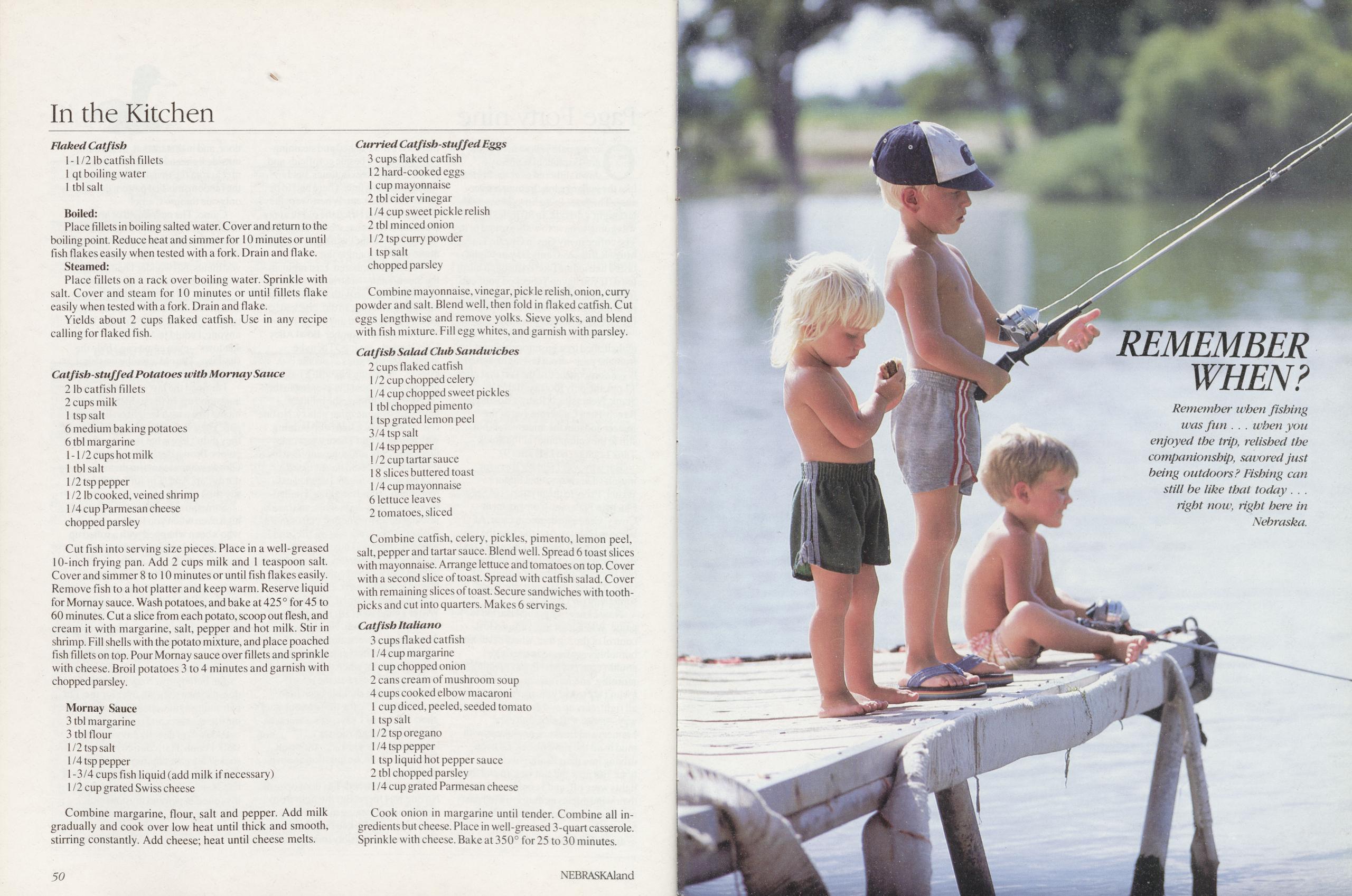
In the Kitchen
Flaked Catfish1-1/2 lb catfish fillets
1 qt boiling water
1 tbl salt Boiled:
Place fillets in boiling salted water. Cover and return to the boiling point. Reduce heat and simmer for 10 minutes or until fish flakes easily when tested with a fork. Drain and flake.
Steamed:Place fillets on a rack over boiling water. Sprinkle with salt. Cover and steam for 10 minutes or until fillets flake easily when tested with a fork. Drain and flake. Yields about 2 cups flaked catfish. Use in any recipe calling for flaked fish.
ab>Catfish-stuffed Potatoes with Mornay Sauce 2 lb catfish fillets2 cups milk
1 tsp salt
6 medium baking potatoes
6 tbl margarine
1-1/2 cups hot milk
1 tbl salt
1/2 tsp pepper
112 lb cooked, veined shrimp
114 cup Parmesan cheese
chopped parsley
Cut fish into serving size pieces. Place in a well-greased 10-inch frying pan. Add 2 cups milk and 1 teaspoon salt. Cover and simmer 8 to 10 minutes or until fish flakes easily. Remove fish to a hot platter and keep warm. Reserve liquid for Mornay sauce. Wash potatoes, and bake at 425 ° for 45 to 60 minutes. Cut a slice from each potato, scoop out flesh, and cream it with margarine, salt, pepper and hot milk. Stir in shrimp. Fill shells with the potato mixture, and place poached fish fillets on top. Pour Mornay sauce over fillets and sprinkle with cheese. Broil potatoes 3 to 4 minutes and garnish with chopped parsley.
Mornay Sauce 3 tbl margarine3 tbl flour
1 /2 tsp salt
1 /4 tsp pepper
1 -3/4 cups fish liquid (add milk if necessary)
1 1/2 cup grated Swiss cheese
Combine margarine, flour, salt and pepper. Add milk gradually and cook over low heat until thick and smooth, stirring constantly. Add cheese; heat until cheese melts.
Curried Catfish-stuffed Eggs 3 cups flaked catfish12 hard-cooked eggs
1 cup mayonnaise
2 tbl cider vinegar
1 /4 cup sweet pickle relish
2 tbl minced onion
1 /2 tsp curry powder
1 tsp salt
chopped parsley
Combine mayonnaise, vinegar, pickle relish, onion, curry powder and salt. Blend well, then fold in flaked catfish. Cut eggs lengthwise and remove yolks. Sieve yolks, and blend with fish mixture. Fill egg whites, and garnish with parsley.
Catfish Salad Club Sandwiches 2 cups flaked catfish112 cup chopped celery
1 /4 cup chopped sweet pickles
1 tbl chopped pimento
1 tsp grated lemon peel
3/4 tsp salt
1 /4 tsp pepper
1/2 cup tartar sauce
18 slices buttered toast
1 /4 cup mayonnaise
6 lettuce leaves
2 tomatoes, sliced
Combine catfish, celery, pickles, pimento, lemon peel, salt, pepper and tartar sauce. Blend well. Spread 6 toast slices with mayonnaise. Arrange lettuce and tomatoes on top. Cover with a second slice of toast. Spread with catfish salad. Cover with remaining slices of toast. Secure sandwiches with tooth- picks and cut into quarters. Makes 6 servings.
Catfish Italiano3 cups flaked catfish
I /4 cup margarine
1 cup chopped onion
2 cans cream of mushroom soup
4 cups cooked elbow macaroni
1 cup diced, peeled, seeded tomato
1 tsp salt
112 tsp oregano
1 /4 tsp pepper
1 tsp liquid hot pepper sauce
2 tbl chopped parsley
1 /4 cup grated Parmesan cheese
Cook onion in margarine until tender. Combine all ingredients but cheese. Place in well-greased 3-quart casserole. Sprinkle with cheese. Bake at 350° for 25 to 30 minutes.
REMEMBER WHEN?
Remember when fishing was fun . . . when you enjoyed the trip, relished the companionship, savored just being outdoors? Fishing can still be like that today . . . right now, right here in Nebraska. 50 NEBRASKAland
Position: 373 (26 views)