Volume 68, Issue 3, 1990
NEBRASKAland
APRIL 1990 $1.50
NEBRASKAland
VOL 68/NO.3 APRIL 1990 Published by the Nebraska Game and Parks Commission Staff Chief, Information & Education: Jim MacAllister Managing Editor: Lowell Johnson Editor: Don Cunningham Senior Editors: Jon Farrar, Ken Bouc Regional Editors: Bob Grier, Rocky Hoffmann, Tom Keith Art Director: Duane Westerholt Illustration: Tim Reigert. Dan Curran Circulation: Pat Frahm Commissioners Chairman: L. Bruce Wright, Lincoln Vice Cluiirman: Richard L. Coyne, Omaha 2nd Vice Chairman: Elvin Adamson, Nenzel J. Alan Cramer, Wayne Marc Anthony, Scottsbluff Randall K. Stinnette, Inland La Vern Schneider, McCook NEBRASKAland ISSN:0028-1964 VOL.68/N0.3 APRIL 1990 Published monthly except for combined Jan/Feb and Aug/Sept issues,by the Nebraska Game and Parks Commission. 2200North 33rd Street, Lincoln,NE. Copyright 1990, ail rights reserved. Second-class postage paid at Lincoln, Nebraska POSTMASTER: Send all address chances to NEBRASKAIand, Box 30370, Lincoln, NE 68503? Rates: $ 12 for one year; $2 3 for two years. Manuscripts or photographs submitted to NEBRASKAIand Magazine should be addressed to: The Editor, NFBRASKAIand Magazine,P.O. Box 30370,Lincoln, NE 68503, and accompanied by self-addressed envelopes and return postage. The publisher assumes no responsibility for unsolicited material.
Letters
A Wildflower YearSir/ The January /February 1990 issue— A Wildflower Year, by Jon Farrar—is exquisite! Thank you, and him for such a beautiful and careful portrait and description of the wildflowers found in our state.
There is one thing I wish the magazine would have had: photo identification numbers next to each photo and noted in the text. Such a system would surely ease cross-referencing.
A Wildflower Year is a classic. Congratulations!
Sr. Elizabeth Frenzel, OSB Norfolk, NESir/ Just a note to thank you for A Wildflower Year. As a child in the Sandhills northwest of Valentine, I herded the cattle on our quarter, and how I enjoyed the wildflowers. I would pick wild sweet peas and enjoyed taking big bouquets home. I didn't see them in the magazine, but so many others were the ones I used to pick and take home for bouquets, as we never had any tame flowers.
Blanche Woodward Overton, NESir/1 can't tell you how pleased I am to have A Wildflower Year. I prize all my special editions, but this one is so special, and I have been waiting for it.
Nebraska wildflowers have been special to our family for as long as I can remember. Dad used to take us out in the country for a treat to gather wildflowers. I picked hundreds of deep-purple violets along Wood River in the late 1920s. We visited my grandmother in the summer in the Sandhills in Blaine County. I looked forward to hunting for "poppy busters" (painted milk-vetch, page 74).
My mother, Henrietta Wilkenson, remembers picking wild sweet peas. We picked them in the Sandhills to take to the cemetery back in the '30s. Could it be the wild indigo on page 30, or the ground-plum on page 31 ? Neither seems just like the sweet pea we picked in Blaine County.
4 NEBRASKAlandThank you so very much for bringing Nebraska wildflowers into my home.
Georgia Bishel Hastings, NEAuthor Jon Farrar replies, A number of wildflowers are known as wild sweet peas, but the name is most commonly applied to hoary vetchling (Lathyrus poly morphus), pictured below.
It is found statewide, but prefers sandy soil and is particularly abundant in the Sandhills region. It is one of Nebraska's native legumes, and bears a typical pealike flower. Seldom more than 10 or 12 inches tall, it is one of the earliest spring wildflowers. Hoary vetchling was not illustrated in A Wildflower Year but was mentioned in the text on page 40.
Hoary vetchling and nearly 200 additional wildflowers not illustrated in A Wildflower Year vv/7/ be included in the Field Guide to Wildflowers of Nebraska and the Great Plains to be published later this spring. It was beyond the scope of a special issue to illustrate more than the 100 species included. It was tough to decide which ones to choose. In part, that is the reason we decided to publish our first NEBRASKA land book, the field guide." (Editor)
1989 Hunting Season: PositiveSir/ We have just returned from Nebraska from a memorable vacation. I spent three weeks hunting wild turkeys, pheasant and quail. We had such an enjoyable time and were treated so well that this letter is certainly in order.
I would like to thank the Nebraska Game and Parks Commission for their help in direction and licensing. The people and landowners that I met and hunted with were very cooperative, safety-minded, and friendly. I think if more hunters asked permission, more landowners would cooperate.
On two occasions I was approached by other hunters, and told to watch out for the landowner because he was a grouchy old cuss. I laughed and said that I knew the landowner, and if they had asked permission, they would have found him very friendly!
We spent the last couple of days trying to shoot quail with the camera. After about twenty coveys, I think we might have one good picture! But we sure had fun trying!
Special thanks to Jesse Sheilds, Steve Anderson, Ken Cobb, and John Gingery (the coaches).
Rick Hubbs The Pas, Manitoba, Canada ... and NegativeSir/1 have had this uneasy feeling gnawing at me for quite some time, and after my first Nebraska deer hunt, I felt it was time to express my opinions.
I had heard stories of hunting accidents in the firearm season and was apprehensive about my safety and the safety of others in my party. Soon after the season opened, I realized that many people didn't use the same rules we had set for ourselves.
I could not believe what was happening around me. Hunters were shooting over hilltops, into tree-lines and ravines where people could have been sitting or walking. It wasn't only the fact that they couldn't see, but it seemed that many of them didn't care if there were people in the line of fire. Getting the deer seemed to be the only thing that mattered. Rules and laws were flagrantly ignored. Deer were chased by trucks, permission to hunt was not obtained, pickups ran rampant through fields, and total disregard for other hunters and landowners was common.
That is not what hunting is about and I hope that these people will someday realize what the real essence of hunting involves. I like to believe that these people are the minority of the hunters, and I pray that I am right.
We Nebraskans love this land and it's our responsibility to care for it. We should be proud of our rich tradition of hunting. We should not tolerate such behavior and do everything in our power to stop it when it does occur.
JeffCurrie Elkhorn,NE Litter KillsSir/ I am enclosing pictures taken at Calamus Lake in September 1989 of a cormorant hanging by three strands of monofilament fish line. I am hoping this will serve as a reminder to fishermen to dispose of line properly!
Arnold Jelinek Grand Island, NEEach year many birds and animals die when they become entangled in discarded monofilament, plastic six-pack rings, and other litter. Many more die from ingesting plastic bags and other trash which they mistake for food. Besides being unsightly and polluting, litter kills. (Editor)
NEBRASKAland Magazine invites readers to send their comments, suggestions and complaints to Letters, NEBRASKAland Magazine, P.O. Box 30370, Lincoln, NE 68503. Each month we will publish as many letters as space permits. Pictures are also welcome. NEBRASKAland reserves the right to condense and edit letters. Please do not send one-of-a-kind items or photos for which you do not have negatives. (Editor)
APRIl 1990 5
Notes from the field
Sofas and Salt MarshesFrom Gerry Steinauer, Community Ecologist for the Nebraska Game and Parks Commission's Natural Heritage Program comes the following note:
/ live in the village of Ceresco, north of Lincoln on Highway 77. Lots of people associate Ceresco with a famous furniture store located there (sometimes confused with another famous furniture store in Crete). But Ceresco has something more interesting to me than sofas and recliners.
If yoU've ever passed through Ceresco—with a truckload of furniture, for example—you might have wondered why no one farms that nice floodplain land in the Rock Creek bottoms just south of town. Well, they tried, but the soil was just too salty.
Salt marshes are among Nebraska's most rare and threatened natural community types, and they occur in only two areas of the state: In the North Platte River Valley in the Panhandle, and in the Salt Creek watershed in Lancaster and southern Saunders counties in eastern Nebraska.
Salt marshes in the Great Plains are often associated with subsurface deposits of Dakota sandstone, an ancient, ocean-deposited sediment laden with sea salts. In Lancaster County, Dakota sandstone occurs near the surface, just below a mantle of glacial till and wind-deposited loess. When groundwater passes through the sandstone, it accumulates dissolved salts. Salt marshes occur adjacent to saline groundwater seeps, or in floodplain depressions where the salts are eventually deposited.
The Lancaster County salt marshes are classified as temporary and seasonal wetlands because they usually go dry in summer. This is important, because as they dry, soil water and dissolved salts are drawn to the surface by evaporation, often leaving a white surface crust. Historically, salt crusts up to 1/2 inch thick formed on eastern saline marshes, but human manipulation of salt marsh hydrology has greatly reduced the salt concentrations.
Saltmarshes have a depauperate flora—that is, a low diversity of plants—and only halophytes, or "salt loving" species tolerant of high salinity levels and temporary flooding can survive here (depauperate also means impoverished, which can happen if you buy too much furniture).
Salt marsh vegetation often occurs in concentric zones corresponding to soil salt concentrations. The center of a marsh is usually the most saline. Saltwort and sea blite occur here. Spearscale, inland saltgrass, saltmarsh aster, foxtail barley, and plains bluegrass occur in less saline areas. Narrow-leaved cattail and prairie bulrush are abundant near saline seeps, and where standing water is present for long periods. Sterol plants found in the marshes are considered rare in Nebraska, including saltwort, saltmarsh aster, seaside heliotrope and Texas dropseed.
A unique characteristic of halophytes is their ability to store high concentrations of salts in their cell sap. This allows their roots to absorb soil moisture, since water moves from areas of low salt concentration to areas of high salt concentration. If the salt concentration in their roots were less than that in the soil, water would move out of the roots instead of in.
The salt marshes support a diversity of bird life, especially shorebirds. In the past 90 years, ornithologists have observed more than 230 species using the Lancaster County marshes. The birds are attracted to the marshes because of the diversity of habitats, ranging from exposed mudflats to dense cattail stands, and an abundance of invertebrate life. These marshes have the only known breeding records for king rail and moorhen in Nebraska.
This past summer, Dick Gersib, a Game and Parks Commission wetlands biologist, and I inventoried the Lancaster County salt marshes, with funding from the Environmental Protection Agency. Some of what we found was depressing. Manipulation of marsh hydrology by humans has destroyed some of the saline characteristics of the marshes. Where they have been artificially deepened and made to permanently hold water, the downward movement of surface water to the water table removes the salts from the marshes. When they are ditched, increased surface runoff carries the salts out of the marsh. Destruction has been widespread.
It was the salt deposits from Lancaster County marshes that first attracted settlers to the Lincoln area [NEBRASKAland, July and October 1985j and a portion of Lincoln was developed on one of the larger marsh complexes near Salt Creek. Channelization and down-cutting of Salt Creek and its tributaries drained many others. Still more were intentionally drained and converted to cropland.
In our report to the EPA, we recommend several strategies for preserving the few remaining salt marshes. Tighter enforcement of federal regulations designed to protect wetlands, acquisition of marshes by government agencies and private conservation groups, and increased public awareness of the existence and value of salt marshes may, if we are lucky, preserve some salt marshes, and the wildlife they attract, for our children to enjoy.
Spring is in the Air and the Field Guide to Wildflowers of Nebraska and the Great Plains is on the way! $1295 Special pre-publication price The perfect companion to A Wildflower Year, NEBRASKAland Magazine's 1990 special issue, the field guide is a complete guide to the wildflowers of the state and the region. More than 200 pages Nearly 300 wildflowers in full color Text and photo on the same page Handy 6x9-inch size Flowers arranged by color for easy ID Plant descriptions in easily-understood language Sturdy, stitched binding Name Address City Check enclosed Card Number/Expr. Date State. VISA Zip MASTERCARD Send to: NEBRASKAland Magazine, P.O. Box 30370 Lincoln, NE 68503. Field Guides will be shipped in late spring. APRIL 1990 7
Obscure and Imperiled
Photos and Text by Ken Bouc Living in obscurity below the surface of Nebraska rivers and streams, rare fish fight for survival against long odds.WE HAVE ail heard stories— perhaps even told some ourselves—of unusual creatures encountered in the wild, some of them threatened or endangered species: stories about watching from a duck blind as a bald eagle soared high over the river, or of spooking a peregrine falcon in the canyons while on the way to a deer stand.
A fortunate few might also tell of seeing a whooping crane on its autumn or spring migration through Nebraska, or of surprising a river otter at play in the catfishing hole down at the creek. It is not every day that a threatened or endangered bird or mammal presents itself to human observers, but it happens often enough that most outdoor enthusiasts are on the lookout for them, and are willing to share the experience with anyone who will listen.
Now, from all those past exchanges of outdoor yarns, count those involving a northern redbelly dace, a blacknose shiner, or any of the other rare fishes. Except for the remote possibility that you or someone you know may have once upon a time caught a rare sturgeon, the chances are there are no fish stories among them.
The simple fact is, fish, whether unusual or common, are not often visible in their watery haunts, and few people know enough about them to recognize an endangered or threatened variety even if they could see it. Consequently, although these fish are fighting for survival, very few Nebraskans seem to know or care.
8 NEBRASKAland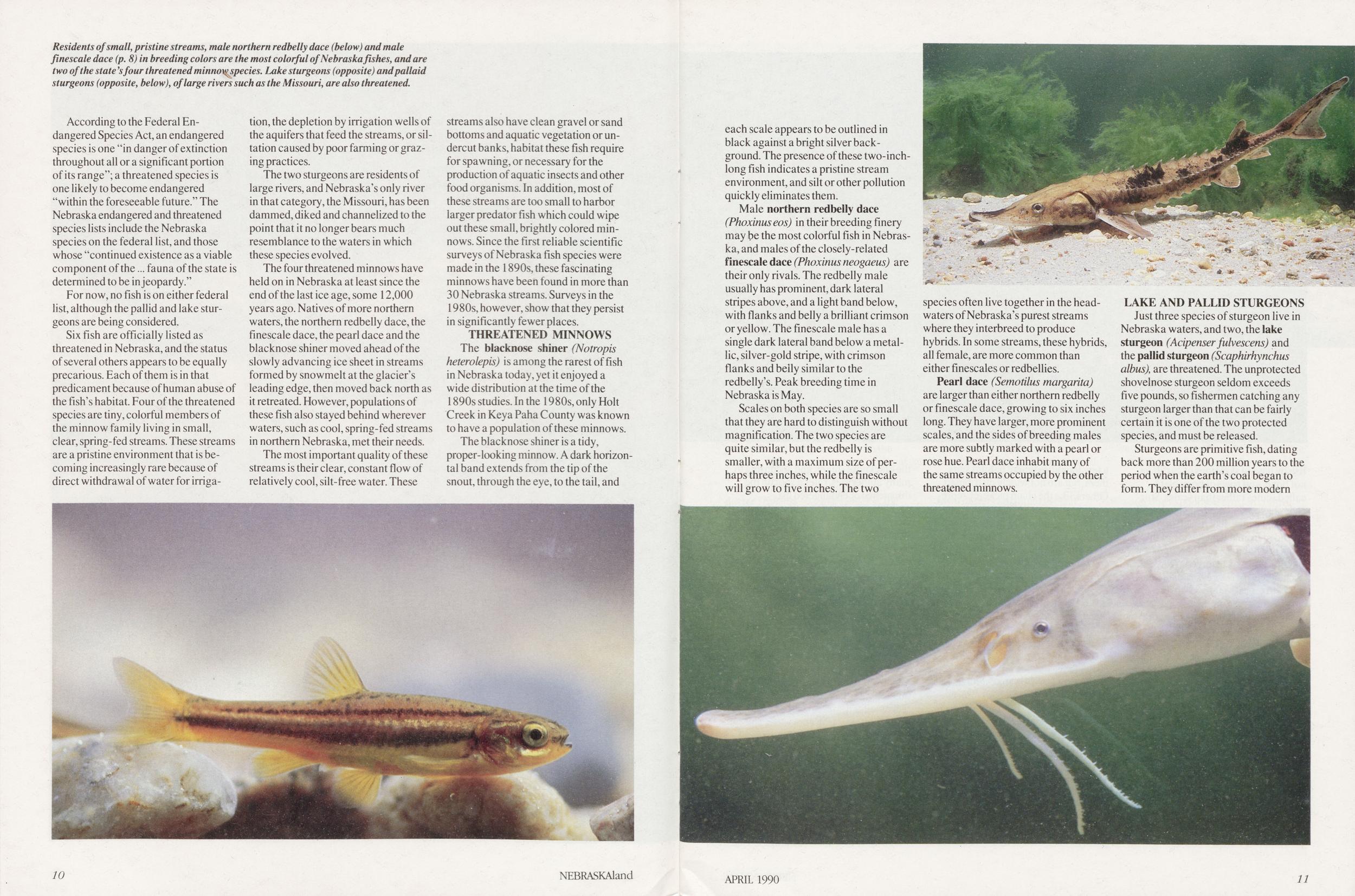 Residents of small, pristine streams, male northern redbelly dace (below) and male
finescale dace (p. 8) in breeding colors are the most colorful of Nebraska fishes,
and are
two of the state's four threatened minnow species. Lake sturgeons (opposite) andpallaid
sturgeons (opposite, below), of large rivers such as the Missouri, are also threatened.
Residents of small, pristine streams, male northern redbelly dace (below) and male
finescale dace (p. 8) in breeding colors are the most colorful of Nebraska fishes,
and are
two of the state's four threatened minnow species. Lake sturgeons (opposite) andpallaid
sturgeons (opposite, below), of large rivers such as the Missouri, are also threatened.
According to the Federal Endangered Species Act, an endangered species is one "in danger of extinction throughout all or a significant portion of its range"; a threatened species is one likely to become endangered "within the foreseeable future." The Nebraska endangered and threatened species lists include the Nebraska species on the federal list, and those whose "continued existence as a viable component of the... fauna of the state is determined to be in jeopardy."
For now, no fish is on either federal list, although the pallid and lake sturgeons are being considered.
Six fish are officially listed as threatened in Nebraska, and the status of several others appears to be equally precarious. Each of them is in that predicament because of human abuse of the fish's habitat. Four of the threatened species are tiny, colorful members of the minnow family living in small, clear, spring-fed streams. These streams are a pristine environment that is becoming increasingly rare because of direct withdrawal of water for irrigation, the depletion by irrigation wells of the aquifers that feed the streams, or siltation caused by poor farming or grazing practices.
The two sturgeons are residents of large rivers, and Nebraska's only river in that category, the Missouri, has been dammed, diked and channelized to the point that it no longer bears much resemblance to the waters in which these species evolved.
The four threatened minnows have held on in Nebraska at least since the end of the last ice age, some 12,000 years ago. Natives of more northern waters, the northern redbelly dace, the finescale dace, the pearl dace and the blacknose shiner moved ahead of the slowly advancing ice sheet in streams formed by snowmelt at the glacier's leading edge, then moved back north as it retreated. However, populations of these fish also stayed behind wherever waters, such as cool, spring-fed streams in northern Nebraska, met their needs.
The most important quality of these streams is their clear, constant flow of relatively cool, silt-free water. These streams also have clean gravel or sand bottoms and aquatic vegetation or undercut banks, habitat these fish require for spawning, or necessary for the production of aquatic insects and other food organisms. In addition, most of these streams are too small to harbor larger predator fish which could wipe out these small, brightly colored minnows. Since the first reliable scientific surveys of Nebraska fish species were made in the 1890s, these fascinating minnows have been found in more than 30 Nebraska streams. Surveys in the 1980s, however, show that they persist in significantly fewer places.
THREATENED MINNOWSThe blacknose shiner (Notropis heterolepis) is among the rarest offish in Nebraska today, yet it enjoyed a wide distribution at the time of the 1890s studies. In the 1980s, only Holt Creek in Keya Paha County was known to have a population of these minnows.
The blacknose shiner is a tidy, proper-looking minnow. A dark horizontal band extends from the tip of the snout, through the eye, to the tail, and 10 NEBRASKAland each scale appears to be outlined in black against a bright silver background. The presence of these two-inch-long fish indicates a pristine stream environment, and silt or other pollution quickly eliminates them.
Male northern redbelly dace (Phoxinus eos) in their breeding finery may be the most colorful fish in Nebraska, and males of the closely-related finescale dace (Phoxinus neogaeus) are their only rivals. The redbelly male usually has prominent, dark lateral stripes above, and a light band below, with flanks and belly a brilliant crimson or yellow. The finescale male has a single dark lateral band below a metallic, silver-gold stripe, with crimson flanks and belly similar to the redbelly's. Peak breeding time in Nebraska is May.
Scales on both species are so small that they are hard to distinguish without magnification. The two species are quite similar, but the redbelly is smaller, with a maximum size of perhaps three inches, while the finescale will grow to five inches. The two species often live together in the headwaters of Nebraska's purest streams where they interbreed to produce hybrids. In some streams, these hybrids, all female, are more common than either finescales or redbellies.
Pearl dace (Semotilus margatita) are larger than either northern redbelly or finescale dace, growing to six inches long. They have larger, more prominent scales, and the sides of breeding males are more subtly marked with a pearl or rose hue. Pearl dace inhabit many of the same streams occupied by the other threatened minnows.
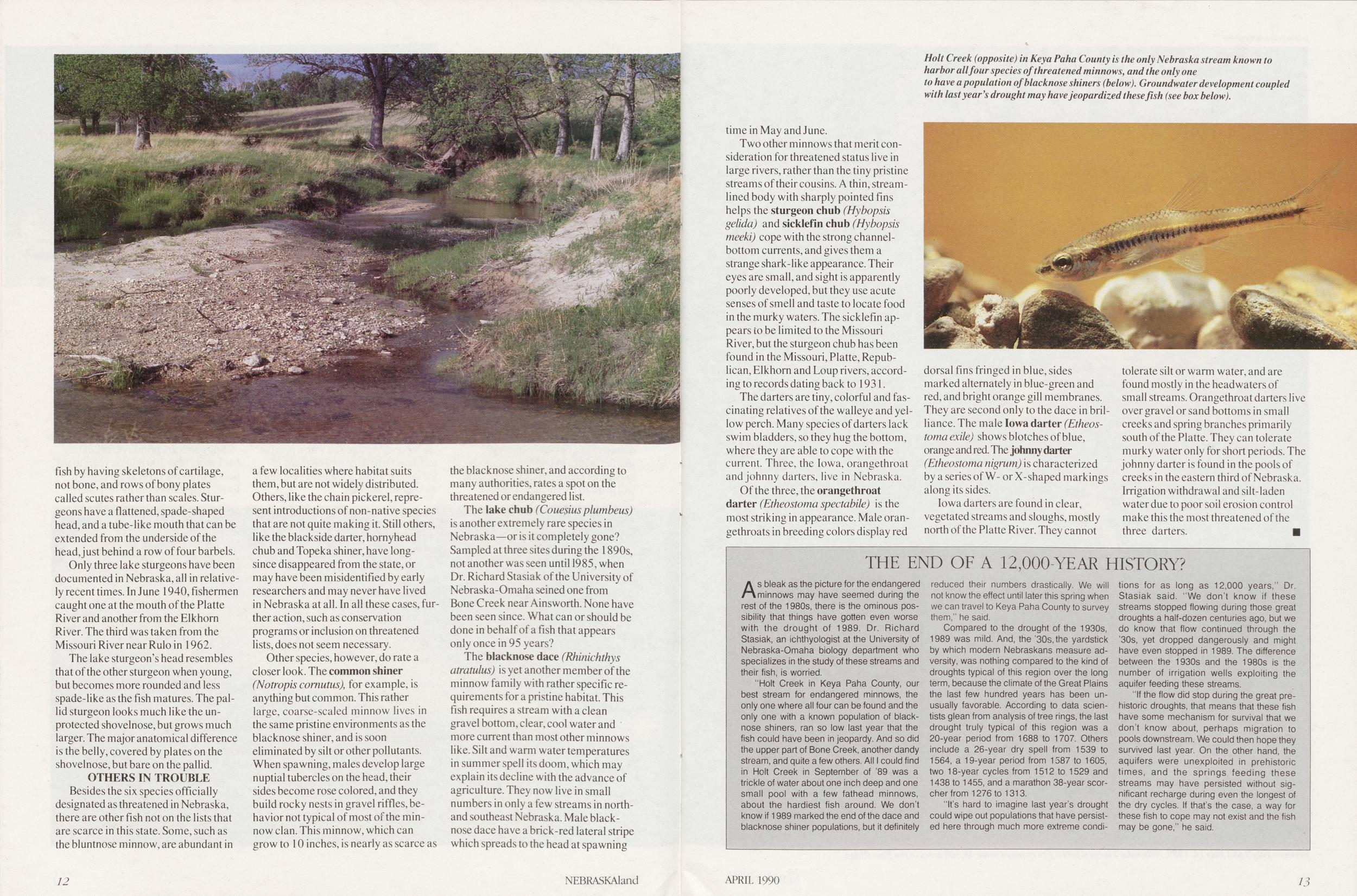
LAKE AND PALLID STURGEONSJust three species of sturgeon live in Nebraska waters, and two, the lake sturgeon (Acipenser fulvescens) and the pallid sturgeon (Scaphirhynchus albus), are threatened. The unprotected shovelnose sturgeon seldom exceeds five pounds, so fishermen catching any sturgeon larger than that can be fairly certain it is one of the two protected species, and must be released.
Sturgeons are primitive fish, dating back more than 200 million years to the period when the earth's coal began to form. They differ from more modern
Only three lake sturgeons have been documented in Nebraska, all in relatively recent times. In June 1940, fishermen caught one at the mouth of the Platte River and another from the Elkhorn River. The third was taken from the Missouri River near Rulo in 1962.
The lake sturgeon's head resembles that of the other sturgeon when young, but becomes more rounded and less spade-like as the fish matures. The pallid sturgeon looks much like the unprotected shovelnose, but grows much larger. The major anatomical difference is the belly, covered by plates on the shovelnose, but bare on the pallid.
OTHERS IN TROUBLEBesides the six species officially designated as threatened in Nebraska, there are other fish not on the lists that are scarce in this state. Some, such as the bluntnose minnow, are abundant in a few localities where habitat suits them, but are not widely distributed. Others, like the chain pickerel, represent introductions of non-native species that are not quite making it. Still others, like the blackside darter, hornyhead chub and Topeka shiner, have longsince disappeared from the state, or may have been misidentified by early researchers and may never have lived in Nebraska at all. In all these cases, further action, such as conservation programs or inclusion on threatened lists, does not seem necessary.
Other species, however, do rate a closer look. The common shiner (Notropis cornutusX for example, is anything but common. This rather large, coarse-scaled minnow lives in the same pristine environments as the blacknose shiner, and is soon eliminated by silt or other pollutants. When spawning, males develop large nuptial tubercles on the head, their sides become rose colored, and they build rocky nests in gravel riffles, behavior not typical of most of the minnow clan. This minnow, which can grow to 10 inches, is nearly as scarce as the blacknose shiner, and according to many authorities, rates a spot on the threatened or endangered list.
The lake chub (Couesius plumbeus) is another extremely rare species in Nebraska—or is it completely gone? Sampled at three sites during the 1890s, not another was seen until 1985, when Dr. Richard Stasiak of the University of Nebraska-Omaha seined one from Bone Creek near Ainsworth. None have been seen since. What can or should be done in behalf of a fish that appears only once in 95 years?
The blacknose dace (Rhinichthys atratulus) is yet another member of the minnow family with rather specific requirements for a pristine habitat. This fish requires a stream with a clean gravel bottom, clear, cool water and more current than most other minnows like. Silt and warm water temperatures in summer spell its doom, which may explain its decline with the advance of agriculture. They now live in small numbers in only a few streams in northand southeast Nebraska. Male blacknose dace have a brick-red lateral stripe which spreads to the head at spawning time in May and June.
Two other minnows that merit consideration for threatened status live in large rivers, rather than the tiny pristine streams of their cousins. A thin, streamlined body with sharply pointed fins helps the sturgeon chub (Hybopsis gelida) and sicklefin chub (Hybopsis meeki) cope with the strong channel-bottom currents, and gives them a strange shark-like appearance. Their eyes are small, and sight is apparently poorly developed, but they use acute senses of smell and taste to locate food in the murky waters. The sicklefin appears to be limited to the Missouri River, but the sturgeon chub has been found in the Missouri, Platte, Republican, Elkhorn and Loup rivers, according to records dating back to 1931.
The darters are tiny, colorful and fascinating relatives of the walleye and yellow perch. Many species of darters lack swim bladders, so they hug the bottom, where they are able to cope with the current. Three, the Iowa, orangethroat and johnny darters, live in Nebraska.
Of the three, the orangethroat darter (Etheostoma spectabile) is the most striking in appearance. Male orangethroats in breeding colors display red dorsal fins fringed in blue, sides marked alternately in blue-green and red, and bright orange gill membranes. They are second only to the dace in brilliance. The male Iowa darter (Etheostoma exile) shows blotches of blue, orange and red. The johnny darter (Etheostoma nigrum) is characterized by a series of W- or X-shaped markings along its sides.
Iowa darters are found in clear, vegetated streams and sloughs, mostly north of the Platte River. They cannot tolerate silt or warm water, and are found mostly in the headwaters of small streams. Orangethroat darters live over gravel or sand bottoms in small creeks and spring branches primarily south of the Platte. They can tolerate murky water only for short periods. The johnny darter is found in the pools of creeks in the eastern third of Nebraska. Irrigation withdrawal and silt-laden water due to poor soil erosion control make this the most threatened of the three darters.
THE END OF A 12,000-YEAR HISTORY?As bleak as the picture for the endangered minnows may have seemed during the rest of the 1980s, there is the ominous possibility that things have gotten even worse with the drought of 1989. Dr. Richard Stasiak, an ichthyologist at the University of Nebraska-Omaha biology department who specializes in the study of these streams and their fish, is worried.
"Holt Creek in Keya Paha County, our best stream for endangered minnows, the only one where all four can be found and the only one with a known population of blacknose shiners, ran so low last year that the fish could have been in jeopardy. And so did the upper part of Bone Creek, another dandy stream, and quite a few others. All I could find in Holt Creek in September of '89 was a trickle of water about one inch deep and one small pool with a few fathead minnows, about the hardiest fish around. We don't know if 1989 marked the end of the dace and blacknose shiner populations, but it definitely reduced their numbers drastically. We will not know the effect until later this spring when we can travel to Keya Paha County to survey them," he said.
Compared to the drought of the 1930s, 1989 was mild. And, the '30s, the yardstick by which modern Nebraskans measure adversity, was nothing compared to the kind of droughts typical of this region over the long term, because the climate of the Great Plains the last few hundred years has been unusually favorable. According to data scientists glean from analysis of tree rings, the last drought truly typical of this region was a 20-year period from 1688 to 1707. Others include a 26-year dry spell from 1539 to 1564, a 19-year period from 1587 to 1605, two 18-year cycles from 1512 to 1529 and 1438 to 1455, and a marathon 38-year scorcher from 1276 to 1313.
'it's hard to imagine last year's drought could wipe out populations that have persisted here through much more extreme conditions for as long as 12,000 years," Dr. Stasiak said. "We don't know if these streams stopped flowing during those great droughts a half-dozen centuries ago, but we do know that flow continued through the '30s, yet dropped dangerously and might have even stopped in 1989. The difference between the 1930s and the 1980s is the number of irrigation wells exploiting the aquifer feeding these streams.
"If the flow did stop during the great prehistoric droughts, that means that these fish have some mechanism for survival that we don't know about, perhaps migration to pools downstream. We could then hope they survived last year. On the other hand, the aquifers were unexploited in prehistoric times, and the springs feeding these streams may have persisted without significant recharge during even the longest of the dry cycles. If that's the case, a way for these fish to cope may not exist and the fish may be gone," he said.
APRIl 1990 13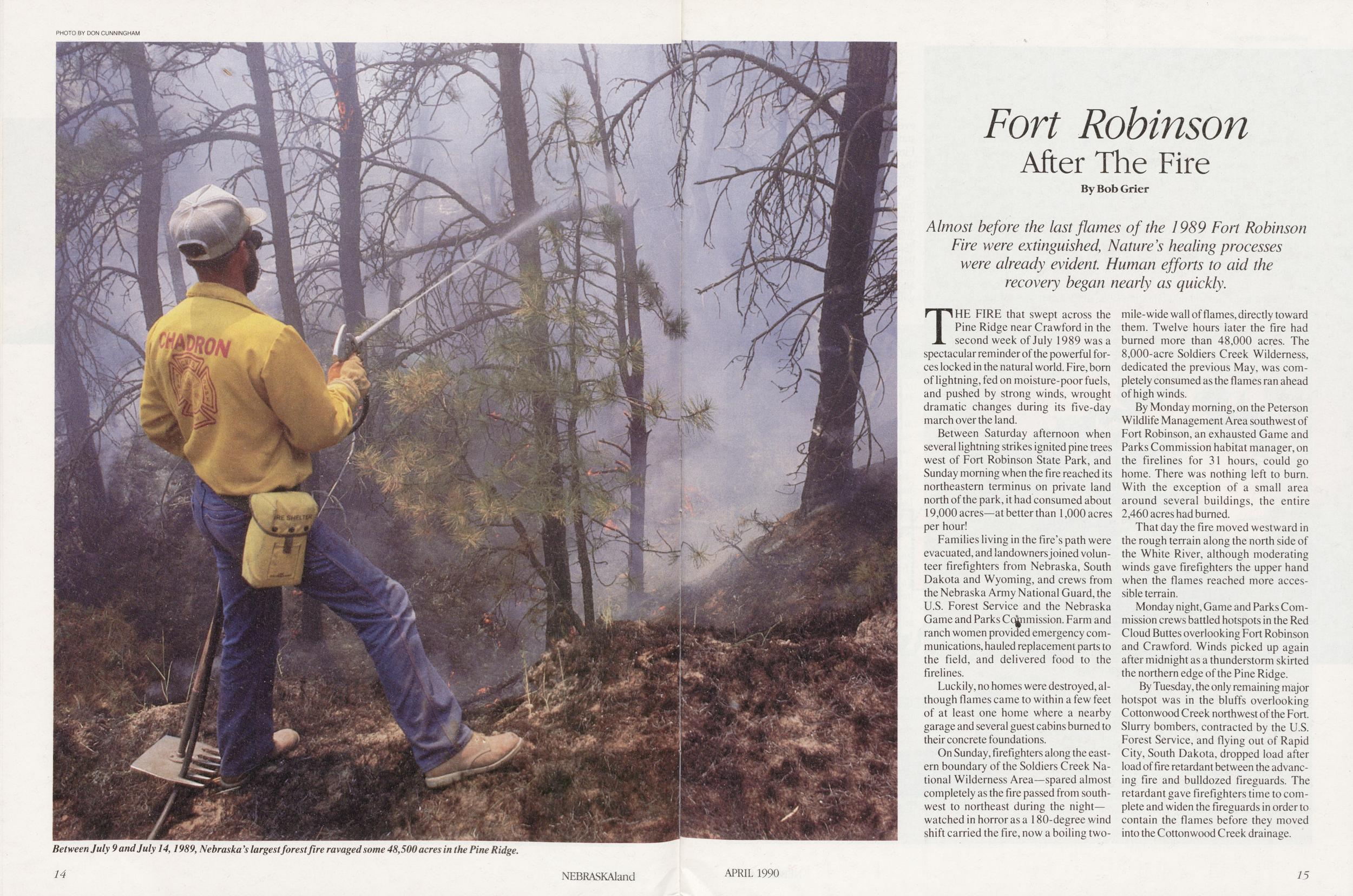
Fort Robinson After the Fire
By Bob Grier Almost before the last flames of the 1989 Fort Robinson Fire were extinguished, Nature's healing processes were already evident Human efforts to aid the recovery began nearly as quickly.THE FIRE that swept across the Pine Ridge near Crawford in the second week of July 1989 was a spectacular reminder of the powerful forces locked in the natural world. Fire, born of lightning, fed on moisture-poor fuels, and pushed by strong winds, wrought dramatic changes during its five-day march over the land.
Between Saturday afternoon when several lightning strikes ignited pine trees west of Fort Robinson State Park, and Sunday morning when the fire reached its northeastern terminus on private land north of the park, it had consumed about 19,000 acres—at better than 1,000 acres per hour!
Families living in the fire's path were evacuated, and landownersjoined volunteer firefighters from Nebraska, South Dakota and Wyoming, and crews from the Nebraska Army National Guard, the U.S. Forest Service and the Nebraska Game and Parks C remission. Farm and ranch women provided emergency communications, hauled replacement parts to the field, and delivered food to the firelines.
Luckily, no homes were destroyed, although flames came to within a few feet of at least one home where a nearby garage and several guest cabins burned to their concrete foundations.
On Sunday, firefighters along the eastern boundary of the Soldiers Creek National Wilderness Area—spared almost completely as the fire passed from southwest to northeast during the nightwatched in horror as a 180-degree wind shift carried the fire, now a boiling twomile-wide wall of flames, directly toward them. Twelve hours later the fire had burned more than 48,000 acres. The 8,000-acre Soldiers Creek Wilderness, dedicated the previous May, was completely consumed as the flames ran ahead of high winds.
By Monday morning, on the Peterson Wildlife Management Area southwest of Fort Robinson, an exhausted Game and Parks Commission habitat manager, on the firelines for 31 hours, could go home. There was nothing left to burn. With the exception of a small area around several buildings, the entire 2,460 acres had burned.
That day the fire moved westward in the rough terrain along the north side of the White River, although moderating winds gave firefighters the upper hand when the flames reached more accessible terrain.
Monday night, Game and Parks Commission crews battled hotspots in the Red Cloud Buttes overlooking Fort Robinson and Crawford. Winds picked up again after midnight as a thunderstorm skirted the northern edge of the Pine Ridge.
By Tuesday, the only remaining major hotspot was in the bluffs overlooking Cottonwood Creek northwest of the Fort. Slurry bombers, contracted by the U.S. Forest Service, and flying out of Rapid City, South Dakota, dropped load after load of fire retardant between the advancing fire and bulldozed fireguards. The retardant gave firefighters time to complete and widen the fireguards in order to contain the flames before they moved into the Cottonwood Creek drainage.
APRIL 1990 15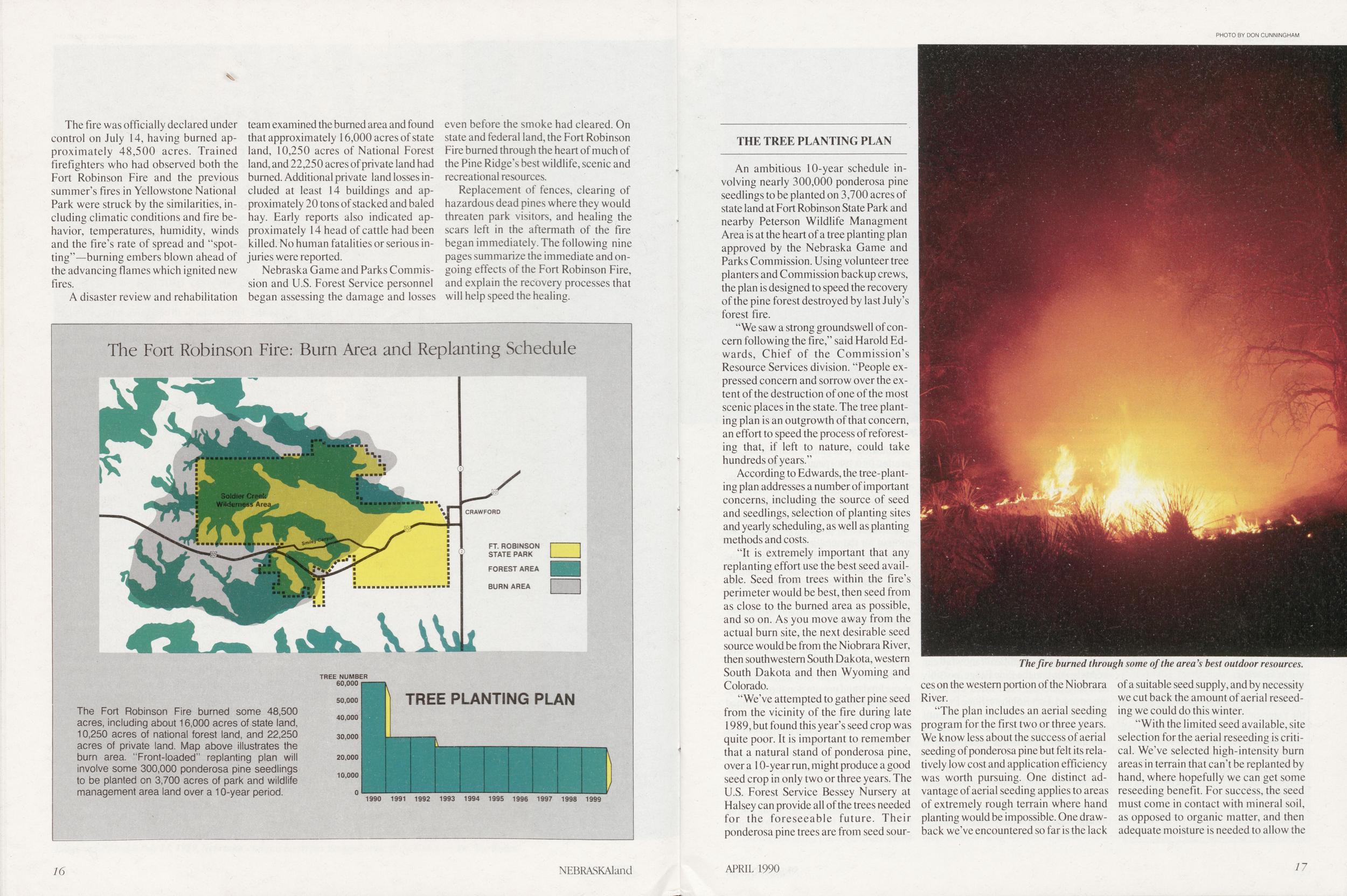
The fire was officially declared under control on July 14, having burned approximately 48,500 acres. Trained firefighters who had observed both the Fort Robinson Fire and the previous summer's fires in Yellowstone National Park were struck by the similarities, including climatic conditions and fire behavior, temperatures, humidity, winds and the fire's rate of spread and "spotting"—burning embers blown ahead of the advancing flames which ignited new fires.
A disaster review and rehabilitation team examined the burned area and found that approximately 16,000 acres of state land, 10,250 acres of National Forest land, and 22,250 acres of private land had burned. Additional private land losses included at least 14 buildings and approximately 20 tons of stacked and baled hay. Early reports also indicated approximately 14 head of cattle had been killed. No human fatalities or serious injuries were reported.
Nebraska Game and Parks Commission and U.S. Forest Service personnel began assessing the damage and losses even before the smoke had cleared. On state and federal land, the Fort Robinson Fire burned through the heart of much of the Pine Ridge's best wildlife, scenic and recreational resources.
Replacement of fences, clearing of hazardous dead pines where they would threaten park visitors, and healing the scars left in the aftermath of the fire began immediately. The following nine pages summarize the immediate and ongoing effects of the Fort Robinson Fire, and explain the recovery processes that will help speed the healing.
The Fort Robinson Fire: Burn Area and Replanting ScheduleAn ambitious 10-year schedule involving nearly 300,000 ponderosa pine seedlings to be planted on 3,700 acres of state land at Fort Robinson State Park and nearby Peterson Wildlife Managment Area is at the heart of a tree planting plan approved by the Nebraska Game and Parks Commission. Using volunteer tree planters and Commission backup crews, the plan is designed to speed the recovery of the pine forest destroyed by last July's forest fire.
"We saw a strong groundswell of concern following the fire," said Harold Edwards, Chief of the Commission's Resource Services division. "People expressed concern and sorrow over the extent of the destruction of one of the most scenic places in the state. The tree planting plan is an outgrowth of that concern, an effort to speed the process of reforesting that, if left to nature, could take hundreds of years."
According to Edwards, the tree-planting plan addresses a number of important concerns, including the source of seed and seedlings, selection of planting sites and yearly scheduling, as well as planting methods and costs.
"It is extremely important that any replanting effort use the best seed available. Seed from trees within the fire's perimeter would be best, then seed from as close to the burned area as possible, and so on. As you move away from the actual burn site, the next desirable seed source would be from the Niobrara River, then southwestern South Dakota, western South Dakota and then Wyoming and Colorado.
"We've attempted to gather pine seed from the vicinity of the fire during late 1989, but found this year's seed crop was quite poor. It is important to remember that a natural stand of ponderosa pine, over a 10-year run, might produce a good seed crop in only two or three years. The U.S. Forest Service Bessey Nursery at Halsey can provide all of the trees needed for the foreseeable future. Their ponderosa pine trees are from seed sour ces on the western portion of the Niobrara River.
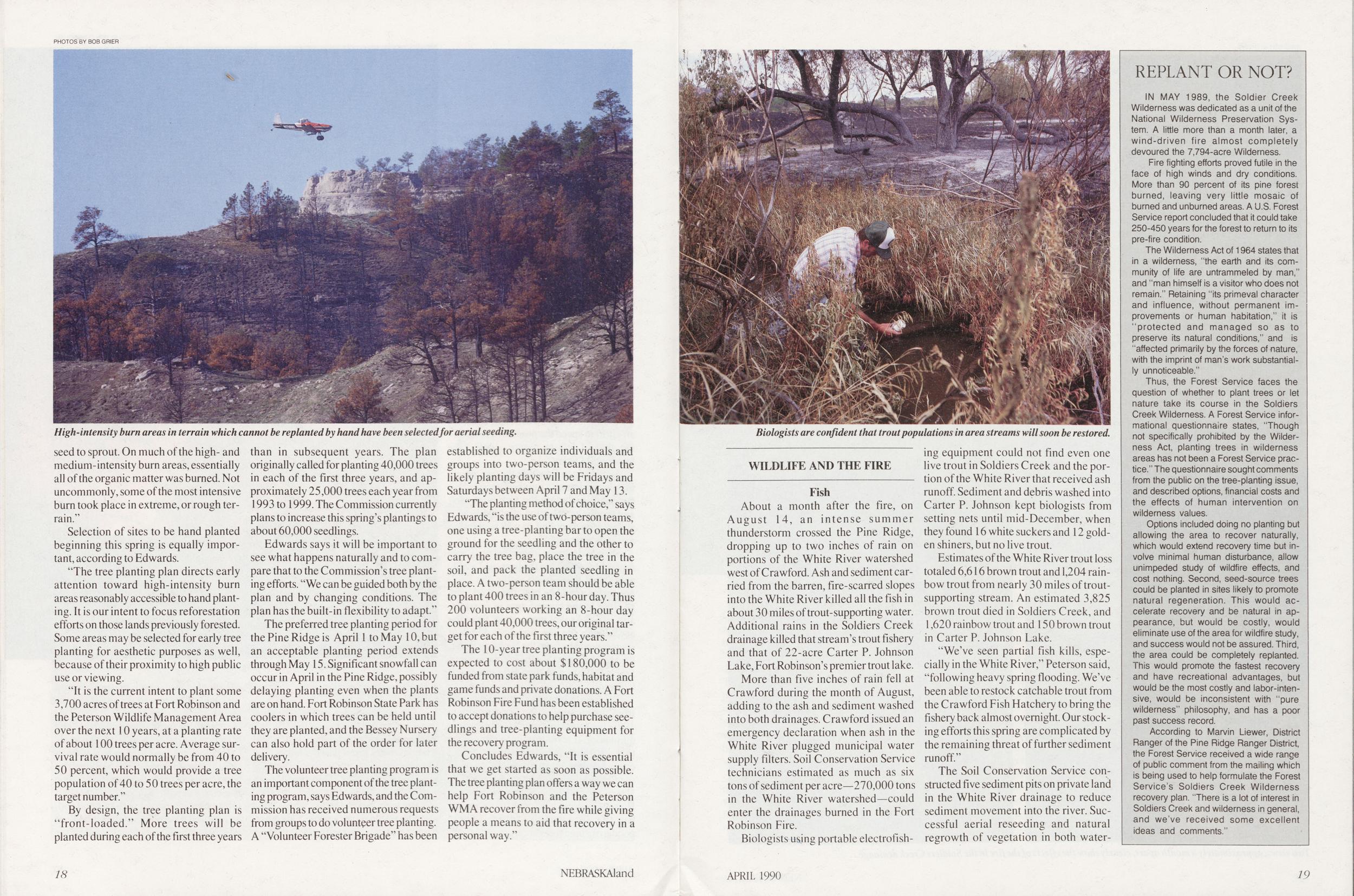
"The plan includes an aerial seeding program for the first two or three years. We know less about the success of aerial seeding of ponderosa pine but felt its relatively low cost and application efficiency was worth pursuing. One distinct advantage of aerial seeding applies to areas of extremely rough terrain where hand planting would be impossible. One drawback we've encountered so far is the lack of a suitable seed supply, and by necessity we cut back the amount of aerial reseeding we could do this winter.
"With the limited seed available, site
selection for the aerial reseeding is critical. We've selected high-intensity burn
areas in terrain that can't be replanted by
hand, where hopefully we can get some
reseeding benefit. For success, the seed
must come in contact with mineral soil,
as opposed to organic matter, and then
adequate moisture is needed to allow the
APRIl 1990
17
Selection of sites to be hand planted beginning this spring is equally important, according to Edwards.
"The tree planting plan directs early attention toward high-intensity burn areas reasonably accessible to hand planting. It is our intent to focus reforestation efforts on those lands previously forested. Some areas may be selected for early tree planting for aesthetic purposes as well, because oftheir proximity to high public use or viewing.
"It is the current intent to plant some 3,700 acres of trees at Fort Robinson and the Peterson Wildlife Management Area over the next 10 years, at a planting rate of about 100 trees per acre. Average survival rate would normally be from 40 to 50 percent, which would provide a tree population of 40 to 50 trees per acre, the target number."
By design, the tree planting plan is "front-loaded.' More trees will be planted during each of the first three years than in subsequent years. The plan originally called for planting 40,000 trees in each of the first three years, and approximately 25,000 trees each year from 1993 to 1999. The Commission currently plans to increase this spring's plantings to about 60,000 seedlings.
Edwards says it will be important to see what happens naturally and to compare that to the Commission's tree planting efforts. "We can be guided both by the plan and by changing conditions. The plan has the built-in flexibility to adapt."
The preferred tree planting period for the Pine Ridge is April 1 to May 10, but an acceptable planting period extends through May 15. Significant snowfall can occur in April in the Pine Ridge, possibly delaying planting even when the plants are on hand. Fort Robinson State Park has coolers in which trees can be held until they are planted, and the Bessey Nursery can also hold part of the order for later delivery.
The volunteer tree planting program is an important component of the tree planting program, says Edwards, and the Commission has received numerous requests from groups to do volunteer tree planting. A "Volunteer Forester Brigade" has been established to organize individuals and groups into two-person teams, and the likely planting days will be Fridays and Saturdays between April 7 and May 13.
"The planting method of choice," says Edwards, "is the use of two-person teams, one using a tree-planting bar to open the ground for the seedling and the other to carry the tree bag, place the tree in the soil, and pack the planted seedling in place. A two-person team should be able to plant 400 trees in an 8-hour day. Thus 200 volunteers working an 8-hour day could plant 40,000 trees, our original target for each of the first three years."
The 10-year tree planting program is expected to cost about $180,000 to be funded from state park funds, habitat and game funds and private donations. A Fort Robinson Fire Fund has been established to accept donations to help purchase seedlings and tree-planting equipment for the recovery program.
Concludes Edwards, "It is essential that we get started as soon as possible. The tree planting plan offers a way we can help Fort Robinson and the Peterson WMA recover from the fire while giving people a means to aid that recovery in a personal way."
18 NEBRASKAlandAbout a month after the fire, on August 14, an intense summer thunderstorm crossed the Pine Ridge, dropping up to two inches of rain on portions of the White River watershed west of Crawford. Ash and sediment carried from the barren, fire-scarred slopes into the White River killed all the fish in about 30 miles of trout-supporting water. Additional rains in the Soldiers Creek drainage killed that stream's trout fishery and that of 22-acre Carter P. Johnson Lake, Fort Robinson's premier trout lake.
More than five inches of rain fell at Crawford during the month of August, adding to the ash and sediment washed into both drainages. Crawford issued an emergency declaration when ash in the White River plugged municipal water supply filters. Soil Conservation Service technicians estimated as much as six tons of sediment per acre—270,000 tons in the White River watershed—could enter the drainages burned in the Fort Robinson Fire.
Biologists using portable electrofishing equipment could not find even one live trout in Soldiers Creek and the portion of the White River that received ash runoff. Sediment and debris washed into Carter P. Johnson kept biologists from setting nets until mid-December, when they found 16 white suckers and 12 golden shiners, but no live trout.
Estimates of the White River trout loss totaled 6,616 brown trout and 1,204 rainbow trout from nearly 30 miles of troutsupporting stream. An estimated 3,825 brown trout died in Soldiers Creek, and 1,620 rainbow trout and 150 brown trout in Carter P. Johnson Lake.
"We've seen partial fish kills, especially in the White River," Peterson said, "following heavy spring flooding. We've been able to restock catchable trout from the Crawford Fish Hatchery to bring the fishery back almost overnight. Our stocking efforts this spring are complicated by the remaining threat of further sediment runoff."
The Soil Conservation Service constructed five sediment pits on private land in the White River drainage to reduce sediment movement into the river. Successful aerial reseeding and natural regrowth of vegetation in both water sheds can also help reduce the ash and sediment runoff
REPLANT OR NOT?IN MAY 1989, the Soldier Creek Wilderness was dedicated as a unit of the National Wilderness Preservation System. A little more than a month later, a wind-driven fire almost completely devoured the 7,794-acre Wilderness.
Fire fighting efforts proved futile in the face of high winds and dry conditions. More than 90 percent of its pine forest burned, leaving very little mosaic of burned and unburned areas. A U.S. Forest Service report concluded that it could take 250-450 years for the forest to return to its pre-fire condition.
The Wilderness Act of 1964 states that in a wilderness, "the earth and its community of life are untrammeled by man," and "man himself is a visitor who does not remain." Retaining "its primeval character and influence, without permanent improvements or human habitation," it is "protected and managed so as to preserve its natural conditions," and is "affected primarily by the forces of nature, with the imprint of man's work substantially unnoticeable."
Thus, the Forest Service faces the question of whether to plant trees or let nature take its course in the Soldiers Creek Wilderness. A Forest Service informational questionnaire states, "Though not specifically prohibited by the Wilderness Act, planting trees in wilderness areas has not been a Forest Service practice." The questionnaire sought comments from the public on the tree-planting issue, and described options, financial costs and the effects of human intervention on wilderness values.
Options included doing no planting but allowing the area to recover naturally, which would extend recovery time but involve minimal human disturbance, allow unimpeded study of wildfire effects, and cost nothing. Second, seed-source trees could be planted in sites likely to promote natural regeneration. This would accelerate recovery and be natural in appearance, but would be costly, would eliminate use of the area for wildfire study, and success would not be assured. Third, the area could be completely replanted. This would promote the fastest recovery and have recreational advantages, but would be the most costly and labor-intensive, would be inconsistent with "pure wilderness" philosophy, and has a poor past success record.
According to Marvin Liewer, District Ranger of the Pine Ridge Ranger District, the Forest Service received a wide range of public comment from the mailing which is being used to help formulate the Forest Service's Soldiers Creek Wilderness recovery plan. "There is a lot of interest in Soldiers Creek and wilderness in general, and we've received some excellent ideas and comments."
APRIl 1990 19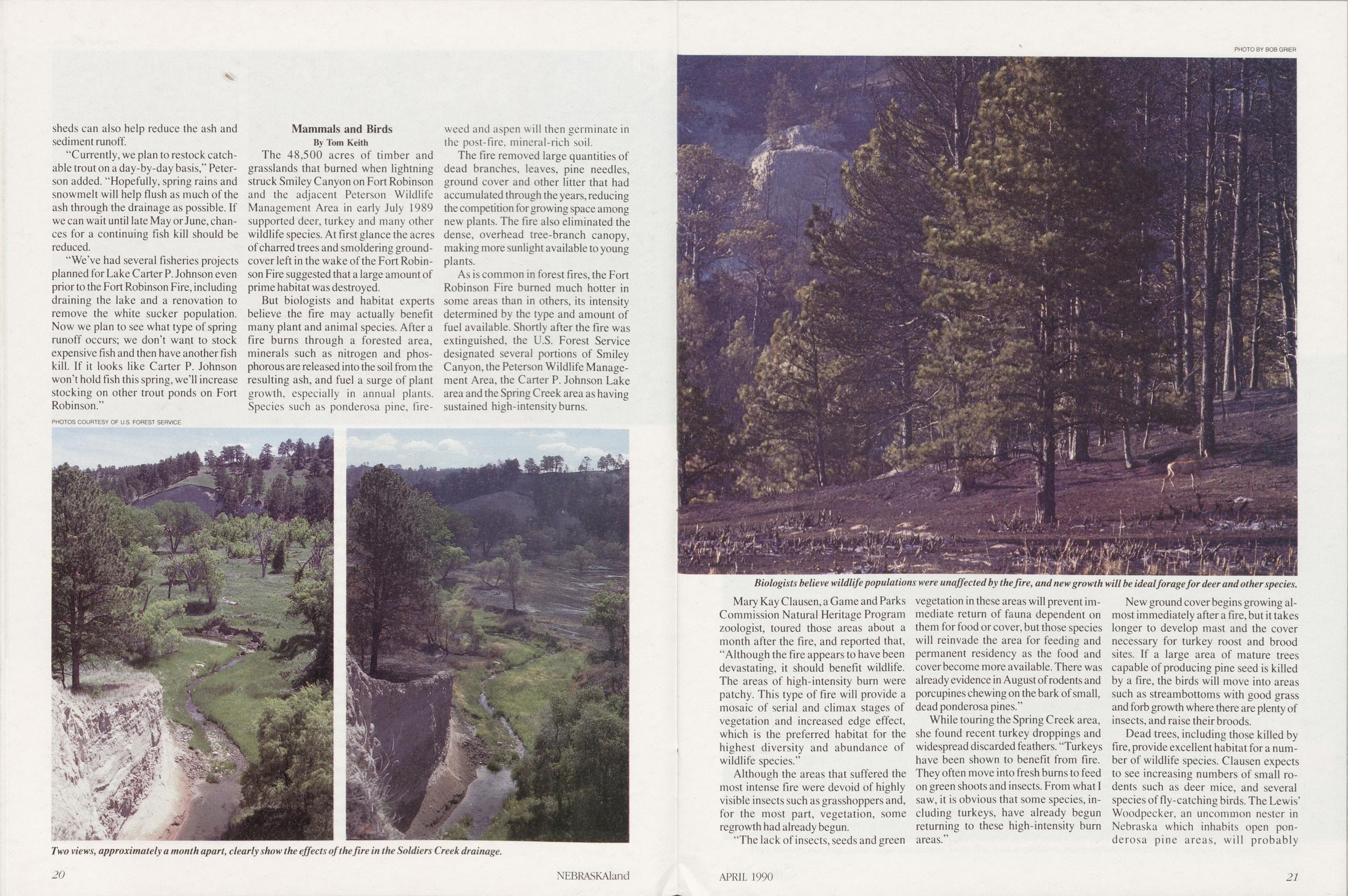
"Currently, we plan to restock catchable trout on a day-by-day basis," Peterson added. "Hopefully, spring rains and snowmelt will help flush as much of the ash through the drainage as possible. If we can wait until late May or June, chances for a continuing fish kill should be reduced.
'We've had several fisheries projects planned for Lake Carter P. Johnson even prior to the Fort Robinson Fire, including draining the lake and a renovation to remove the white sucker population. Now we plan to see what type of spring runoff occurs; we don't want to stock expensive fish and then have another fish kill. If it looks like Carter P. Johnson won't hold fish this spring, we'll increase stocking on other trout ponds on Fort Robinson."
The 48,500 acres of timber and grasslands that burned when lightning struck Smiley Canyon on Fort Robinson and the adjacent Peterson Wildlife Management Area in early July 1989 supported deer, turkey and many other wildlife species. At first glance the acres of charred trees and smoldering groundcover left in the wake of the Fort Robinson Fire suggested that a large amount of prime habitat was destroyed.
The fire removed large quantities of dead branches, leaves, pine needles, ground cover and other litter that had accumulated through the years, reducing the competition for growing space among new plants. The fire also eliminated the dense, overhead tree-branch canopy, making more sunlight available to young plants.
As is common in forest fires, the Fort Robinson Fire burned much hotter in some areas than in others, its intensity determined by the type and amount of fuel available. Shortly after the fire was extinguished, the U.S. Forest Service designated several portions of Smiley Canyon, the Peterson Wildlife Management Area, the Carter P. Johnson Lake area and the Spring Creek area as having sustained high-intensity burns.
20 NEBRASKAlandMary Kay Clausen, a Game and Parks vegetation in these areas will prevent imCommission Natural Heritage Program zoologist, toured those areas about a month after the fire, and reported that, "Although the fire appears to have been devastating, it should benefit wildlife. The areas of high-intensity burn were patchy. This type of fire will provide a mosaic of serial and climax stages of vegetation and increased edge effect, which is the preferred habitat for the highest diversity and abundance of wildlife species." mediate return of fauna dependent on them for food or cover, but those species will reinvade the area for feeding and permanent residency as the food and cover become more available. There was already evidence in August of rodents and porcupines chewing on the bark of small, dead ponderosa pines." While touring the Spring Creek area, she found recent turkey droppings and widespread discarded feathers. "Turkeys have been shown to benefit from fire.
Although the areas that suffered the They often move into fresh burns to feed Two views, approximately a month apart, clearly show the effects of the fire in the Soldiers Creek drainage. most intense fire were devoid of highly visible insects such as grasshoppers and, for the most part, vegetation, some regrowth had already begun.
"The lack of insects, seeds and green vegetation in these areas will prevent immediate return of fauna dependent on them for food or cover, but thoise species will reinvade the area for feeding and permanent residency as the food and cover become more available. There was already evidence in August of rodents and porcupines chewing on the bark of small dead ponderosa pines."
While touring the Spring Creek area, she found recent turkey droppings and widespread discarded feathers. "Turkeys have been shown to benefit from fire. They often move into fresh burns to feed on green shoots and insects. From what I saw, it is obvious that some species, including turkeys, have already begun returning to these high-intensity burn areas."
New ground cover begins growing almost immediately after a fire, but it takes longer to develop mast and the cover necessary for turkey roost and brood sites. If a large area of mature trees capable of producing pine seed is killed by a fire, the birds will move into areas such as streambottoms with good grass and forb growth where there are plenty of insects, and raise their broods.
Dead trees, including those killed by fire, provide excellent habitat for a number of wildlife species. Clausen expects to see increasing numbers of small rodents such as deer mice, and several species of fly-catching birds. The Lewis' Woodpecker, an uncommon nester in Nebraska which inhabits open ponderosa pine areas, will probably
APRIL 1990 21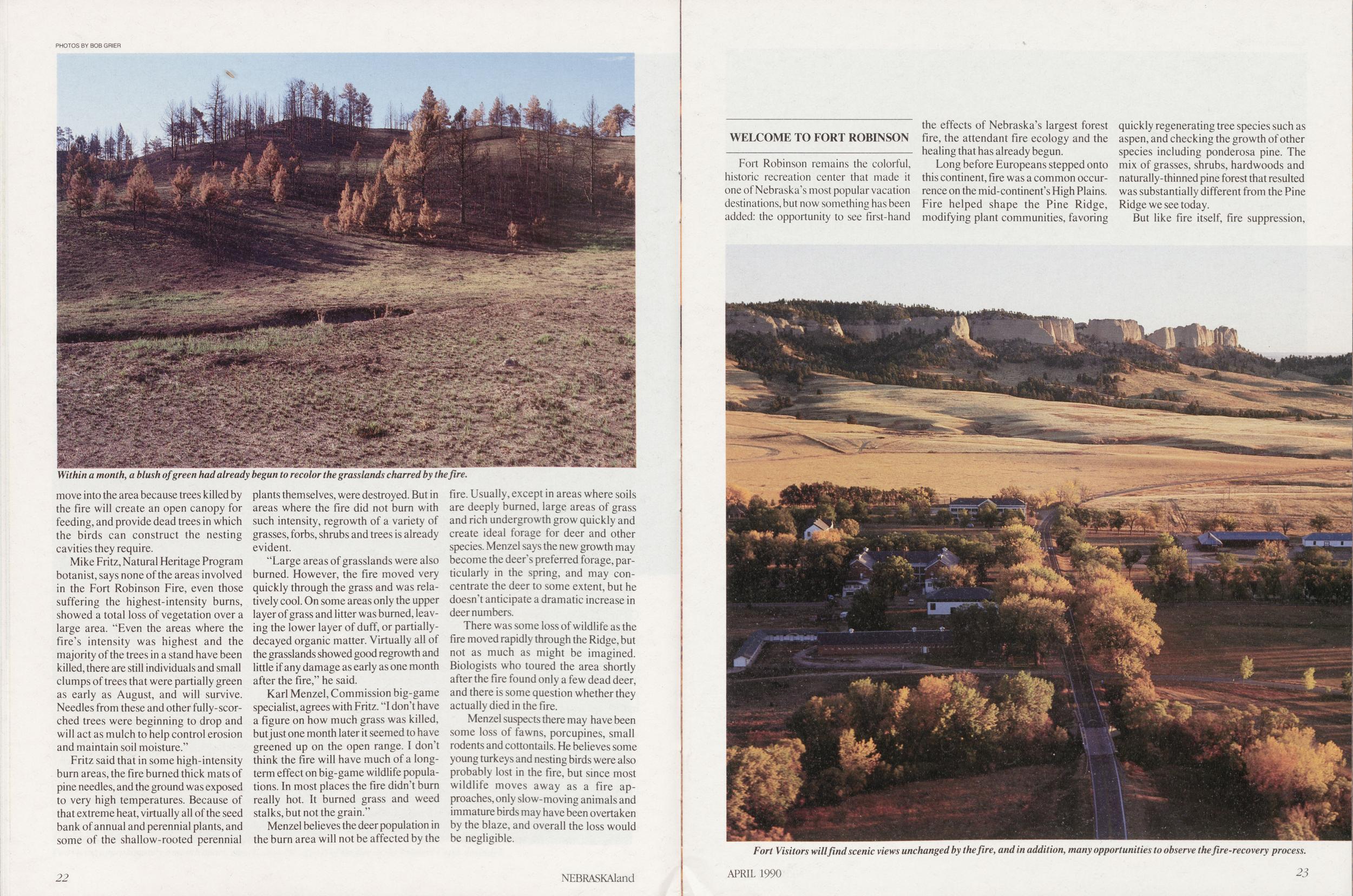
Within a month, a blush of green had already begun to recolor the grasslands charred by the fire.
Mike Fritz, Natural Heritage Program botanist, says none of the areas involved in the Fort Robinson Fire, even those suffering the highest-intensity burns, showed a total loss of vegetation over a large area. "Even the areas where the fire's intensity was highest and the majority of the trees in a stand have been killed, there are still individuals and small clumps of trees that were partially green as early as August, and will survive. Needles from these and other fully-scorched trees were beginning to drop and will act as mulch to help control erosion and maintain soil moisture."
Fritz said that in some high-intensity burn areas, the fire burned thick mats of pine needles, and the ground was exposed to very high temperatures. Because of that extreme heat, virtually all of the seed bank of annual and perennial plants, and some of the shallow-rooted perennial plants themselves, were destroyed. But in areas where the fire did not burn with such intensity, regrowth of a variety of grasses, forbs, shrubs and trees is already evident.
"Large areas of grasslands were also burned. However, the fire moved very quickly through the grass and was relatively cool. On some areas only the upper layer of grass and litter was burned, leaving the lower layer of duff, or partiallydecayed organic matter. Virtually all of the grasslands showed good regrowth and little if any damage as early as one month after the fire," he said.
Karl Menzel, Commission big-game specialist, agrees with Fritz. "I don't have a figure on how much grass was killed, but just one month later it seemed to have greened up on the open range. I don't think the fire will have much of a longterm effect on big-game wildlife populations. In most places the fire didn't burn really hot. It burned grass and weed stalks, but not the grain."
Menzel believes the deer population in the burn area will not be affected by the fire. Usually, except in areas where soils are deeply burned, large areas of grass and rich undergrowth grow quickly and create ideal forage for deer and other species. Menzel says the new growth may become the deer's preferred forage, particularly in the spring, and may concentrate the deer to some extent, but he doesn't anticipate a dramatic increase in deer numbers.
There was some loss of wildlife as the fire moved rapidly through the Ridge, but not as much as might be imagined. Biologists who toured the area shortly after the fire found only a few dead deer, and there is some question whether they actually died in the fire.
Menzel suspects there may have been some loss of fawns, porcupines, small rodents and cottontails. He believes some young turkeys and nesting birds were also probably lost in the fire, but since most wildlife moves away as a fire approaches, only slow-moving animals and immature birds may have been overtaken by the blaze, and overall the loss would be negligible.
22 NEBRASKAland WELCOME TO FORT ROBINSONFort Robinson remains the colorful, historic recreation center that made it one of Nebraska's most popular vacation destinations, but now something has been added: the opportunity to see first-hand the effects of Nebraska's largest forest fire, the attendant fire ecology and the healing that has already begun.
Long before Europeans stepped onto this continent, fire was a common occurrence on the mid-continent's High Plains. Fire helped shape the Pine Ridge, modifying plant communities, favoring quickly regenerating tree species such as aspen, and checking the growth of other species including ponderosa pine. The mix of grasses, shrubs, hardwoods and naturally-thinned pine forest that resulted was substantially different from the Pine Ridge we see today.
But like fire itself, fire suppression,
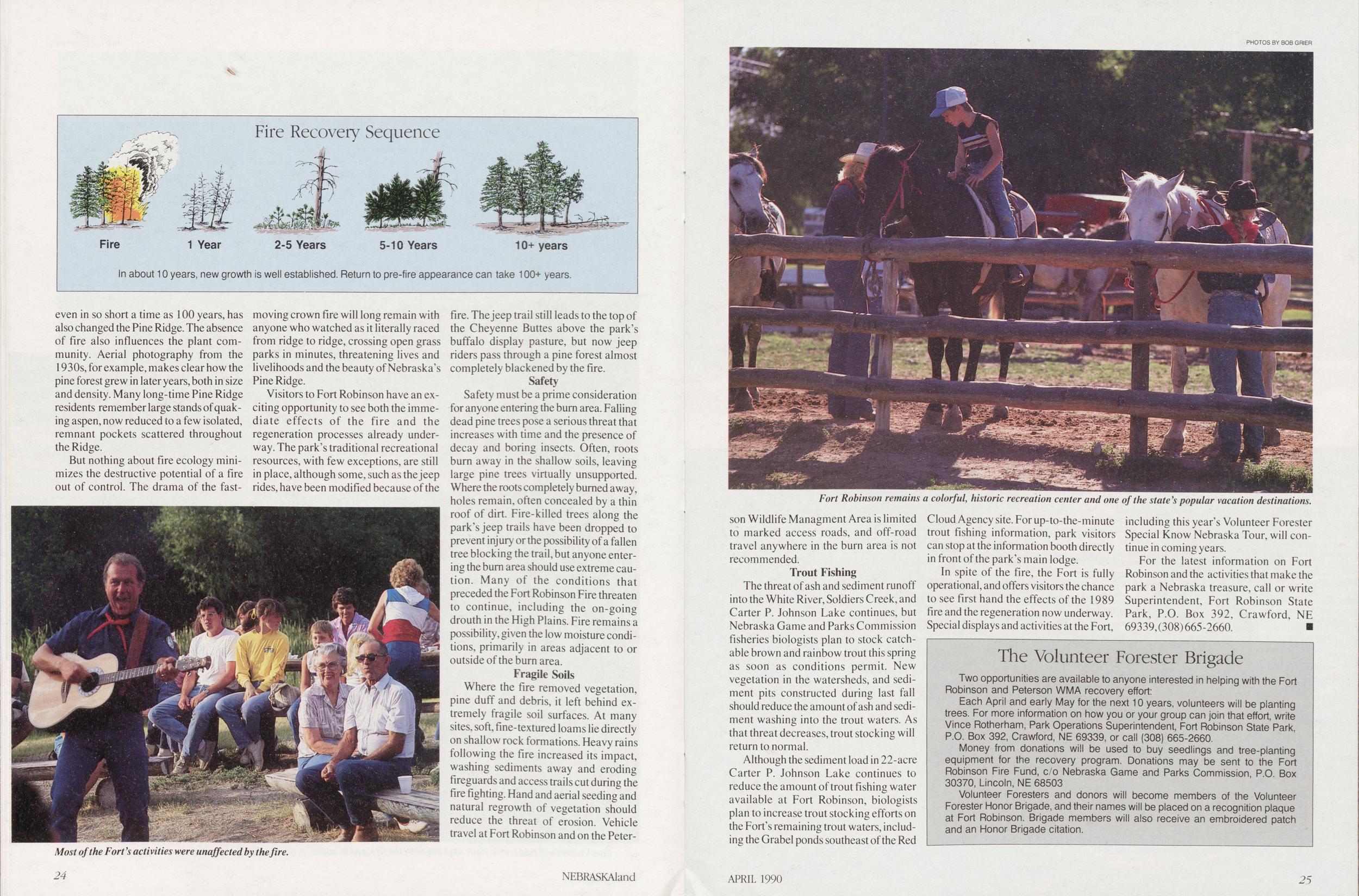
But nothing about fire ecology minimizes the destructive potential of a fire out of control. The drama of the fastmoving crown fire will long remain with anyone who watched as it literally raced from ridge to ridge, crossing open grass parks in minutes, threatening lives and livelihoods and the beauty of Nebraska's Pine Ridge.
Visitors to Fort Robinson have an exciting opportunity to see both the immediate effects of the fire and the regeneration processes already underway. The park's traditional recreational resources, with few exceptions, are still in place, although some, such as the jeep rides, have been modified because of the fire. The jeep trail still leads to the top of the Cheyenne Buttes above the park's buffalo display pasture, but now jeep riders pass through a pine forest almost completely blackened by the fire.
SafetySafety must be a prime consideration for anyone entering the burn area. Falling dead pine trees pose a serious threat that increases with time and the presence of decay and boring insects. Often, roots burn away in the shallow soils, leaving large pine trees virtually unsupported. Where the roots completely burned away, holes remain, often concealed by a thin roof of dirt. Fire-killed trees along the park's jeep trails have been dropped to prevent injury or the possibility of a fallen tree blocking the trail, but anyone entering the burn area should use extreme caution. Many of the conditions that preceded the Fort Robinson Fire threaten to continue, including the on-going drouth in the High Plains. Fire remains a possibility, given the low moisture conditions, primarily in areas adjacent to or outside of the burn area.
Fragile SoilsWhere the fire removed vegetation, pine duff and debris, it left behind extremely fragile soil surfaces. At many sites, soft, fine-textured loams lie directly on shallow rock formations. Heavy rains following the fire increased its impact, washing sediments away and eroding fireguards and access trails cut during the fire fighting. Hand and aerial seeding and natural regrowth of vegetation should reduce the threat of erosion. Vehicle travel at Fort Robinson and on the Peterson
The threat of ash and sediment runoff into the White River, Soldiers Creek, and Carter P. Johnson Lake continues, but Nebraska Game and Parks Commission fisheries biologists plan to stock catchable brown and rainbow trout this spring as soon as conditions permit. New vegetation in the watersheds, and sediment pits constructed during last fall should reduce the amount of ash and sediment washing into the trout waters. As that threat decreases, trout stocking will return to normal.
Although the sediment load in 22-acre Carter P. Johnson Lake continues to reduce the amount of trout fishing water available at Fort Robinson, biologists plan to increase trout stocking efforts on the Fort's remaining trout waters, including the Grabel ponds southeast of the Red Cloud Agency site. For up-to-the-minute trout fishing information, park visitors can stop at the information booth directly in front of the park's main lodge.
In spite of the fire, the Fort is fully operational, and offers visitors the chance to see first hand the effects of the 1989 fire and the regeneration now underway. Special displays and activities at the Fort, including this year's Volunteer Forester Special Know Nebraska Tour, will continue in coming years.
For the latest information on Fort Robinson and the activities that make the park a Nebraska treasure, call or write Superintendent, Fort Robinson State Park, P.O. Box 392, Crawford, NE 69339,(308)665-2660.
The Volunteer Forester BrigadeTwo opportunities are available to anyone interested in helping with the Fort Robinson and Peterson WMA recovery effort:
Each April and early May for the next 10 years, volunteers will be planting trees. For more information on how you or your group can join that effort, write Vince Rotherham, Park Operations Superintendent, Fort Robinson State Park. P.O. Box 392, Crawford, NE 69339, or call (308) 665-2660.
Money from donations will be used to buy seedlings and tree-planting equipment for the recovery program. Donations may be sent to the Fort Robinson Fire Fund, c/o Nebraska Game and Parks Commission, P.O. Box 30370, Lincoln, NE 68503
Volunteer Foresters and donors will become members of the Volunteer Forester Honor Brigade, and their names will be placed on a recognition plaque at Fort Robinson. Brigade members will also receive an embroidered patch and an Honor Brigade citation.
APRIL 1990 25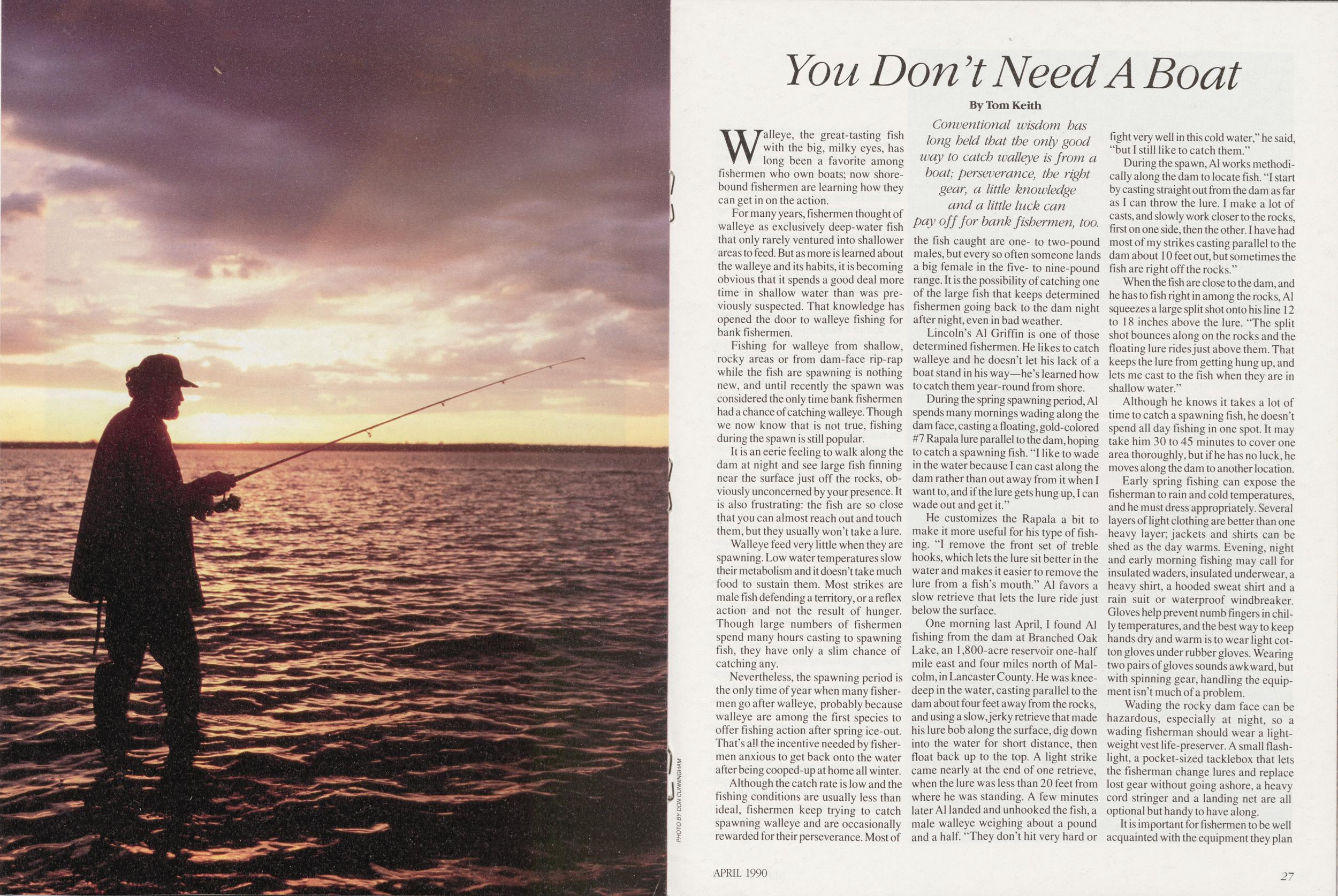
You Don'tNeed A Boat
By Tom Keith Conventional wisdom has long held that the only good way to catch walleye is from a boat; perseverance, the right gear, a little knowledge and a little luck can pay off for bank fishermen, too.Walleye, the great-tasting fish with the big, milky eyes, has long been a favorite among fishermen who own boats; now shorebound fishermen are learning how they can get in on the action.
For many years, fishermen thought of walleye as exclusively deep-water fish that only rarely ventured into shallower areas to feed. But as more is learned about the walleye and its habits, it is becoming obvious that it spends a good deal more time in shallow water than was previously suspected. That knowledge has opened the door to walleye fishing for bank fishermen.
Fishing for walleye from shallow, rocky areas or from dam-face rip-rap while the fish are spawning is nothing new, and until recently the spawn was considered the only time bank fishermen had a chance of catching walleye. Though we now know that is not true, fishing during the spawn is still popular.
It is an eerie feeling to walk along the dam at night and see large fish finning near the surface just off the rocks, obviously unconcerned by your presence. It is also frustrating: the fish are so close that you can almost reach out and touch them, but they usually won't take a lure.
Walleye feed very little when they are spawning. Low water temperatures slow their metabolism and it doesn't take much food to sustain them. Most strikes are male fish defending a territory, or a reflex action and not the result of hunger. Though large numbers of fishermen spend many hours casting to spawning fish, they have only a slim chance of catching any.
Nevertheless, the spawning period is the only time of year when many fishemen go after walleye, probably because walleye are among the first species to offer fishing action after spring ice-out. That's all the incentive needed by fishermen anxious to get back onto the water after being cooped-up at home all winter.
Although the catch rate is low and the fishing conditions are usually less than ideal, fishermen keep trying to catch spawning walleye and are occasionally rewarded for their perseverance. Most of the fish caught are one- to two-pound males, but every so often someone lands a big female in the five- to nine-pound range. It is the possibility of catching one of the large fish that keeps determined fishermen going back to the dam night after night, even in bad weather.
Lincoln's Al Griffin is one of those determined fishermen. He likes to catch walleye and he doesn't let his lack of a boat stand in his way—he's learned how to catch them year-round from shore.
During the spring spawning period, Al spends many mornings wading along the dam face, casting a floating, gold-colored #7 Rapala lure parallel to the dam, hoping to catch a spawning fish. "I like to wade in the water because I can cast along the dam rather than out away from it when I want to, and if the lure gets hung up, I can wade out and get it."
He customizes the Rapala a bit to make it more useful for his type of fishing. "I remove the front set of treble hooks, which lets the lure sit better in the water and makes it easier to remove the lure from a fish's mouth." Al favors a slow retrieve that lets the lure ride just below the surface.
One morning last April, I found Al fishing from the dam at Branched Oak Lake, an 1,800-acre reservoir one-half mile east and four miles north of Malcolm, in Lancaster County. He was kneedeep in the water, casting parallel to the dam about four feet away from the rocks, and using a slow,jerky retrieve that made his lure bob along the surface, dig down into the water for short distance, then float back up to the top. A light strike came nearly at the end of one retrieve, when the lure was less than 20 feet from where he was standing. A few minutes later Al landed and unhooked the fish, a male walleye weighing about a pound and a half. 'They don't hit very hard or fight very well in this cold water," he said, "but I still like to catch them."
During the spawn, Al works methodically along the dam to locate fish. "I start by casting straight out from the dam as far as I can throw the lure. I make a lot of casts, and slowly work closer to the rocks, first on one side, then the other. I have had most of my strikes casting parallel to the dam about 10 feet out, but sometimes the fish are right off the rocks."
When the fish are close to the dam, and he has to fish right in among the rocks, Al squeezes a large split shot onto his line 12 to 18 inches above the lure. "The split shot bounces along on the rocks and the floating lure ridesjust above them. That keeps the lure from getting hung up, and lets me cast to the fish when they are in shallow water."
Although he knows it takes a lot of time to catch a spawning fish, he doesn't spend all day fishing in one spot. It may take him 30 to 45 minutes to cover one area thoroughly, but if he has no luck, he moves along the dam to another location.
Early spring fishing can expose the fisherman to rain and cold temperatures, and he must dress appropriately. Several layers of light clothing are better than one heavy layer; jackets and shirts can be shed as the day warms. Evening, night and early morning fishing may call for insulated waders, insulated underwear, a heavy shirt, a hooded sweat shirt and a rain suit or waterproof windbreaker. Gloves help prevent numb fingers in chilly temperatures, and the best way to keep hands dry and warm is to wear light cotton gloves under rubber gloves. Wearing two pairs of gloves sounds awkward, but with spinning gear, handling the equipment isn't much of a problem.
Wading the rocky dam face can be hazardous, especially at night, so a wading fisherman should wear a lightweight vest life-preserver. A small flashlight, a pocket-sized tacklebox that lets the fisherman change lures and replace lost gear without going ashore, a heavy cord stringer and a landing net are all optional but handy to have along.
It is important for fishermen to be well
acquainted with the equipment they plan
APRIL 1990
27
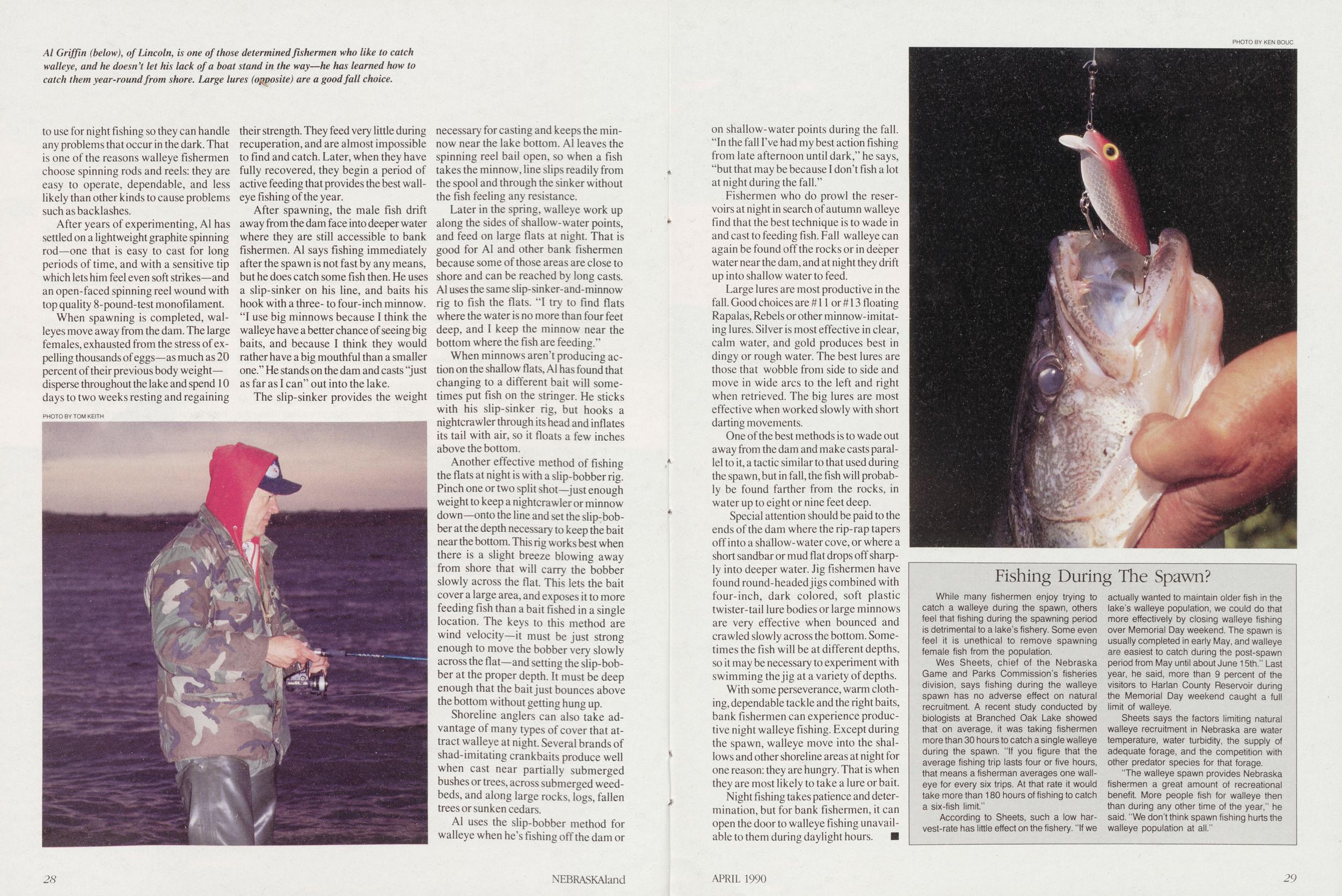
After years of experimenting, Al has settled on a lightweight graphite spinning rod—one that is easy to cast for long periods of time, and with a sensitive tip which lets him feel even soft strikes—and an open-faced spinning reel wound with top quality 8-pound-test monofilament.
When spawning is completed, walleyes move away from the dam. The large females, exhausted from the stress of expelling thousands of eggs—as much as 20 percent of their previous body weight— disperse throughout the lake and spend 10 days to two weeks resting and regaining their strength. They feed very little during recuperation, and are almost impossible to find and catch. Later, when they have fully recovered, they begin a period of active feeding that provides the best walleye fishing of the year.
After spawning, the male fish drift away from the dam face into deeper water where they are still accessible to bank fishermen. Al says fishing immediately after the spawn is not fast by any means, but he does catch some fish then. He uses a slip-sinker on his line, and baits his hook with a three- to four-inch minnow. "I use big minnows because I think the walleye have a better chance of seeing big baits, and because I think they would rather have a big mouthful than a smaller one." He stands on the dam and casts "just as far as I can" out into the lake.
The slip-sinker provides the weight necessary for casting and keeps the minnow near the lake bottom. Al leaves the spinning reel bail open, so when a fish takes
Later in the spring, walleye work up along the sides of shallow-water points, and feed on large flats at night. That is good for Al and other bank fishermen because some of those areas are close to shore and can be reached by long casts. Al uses the same slip-sinker-and-minnow rig to fish the flats. "I try to find flats where the water is no more than four feet deep, and I keep the minnow near the bottom where the fish are feeding."
When minnows aren't producing action on the shallow flats, Al has found that changing to a different bait will sometimes put fish on the stringer. He sticks with his slip-sinker rig, but hooks a nightcrawler through its head and inflates its tail with air, so it floats a few inches above the bottom.
Another effective method of fishing the flats at night is with a slip-bobber rig. Pinch one or two split shot—just enough weight to keep a nightcrawler or minnow down—onto the line and set the slip-bobber at the depth necessary to keep the bait near the bottom. This rig works best when there is a slight breeze blowing away from shore that will carry the bobber slowly across the flat. This lets the bait cover a large area, and exposes it to more feeding fish than a bait fished in a single location. The keys to this method are wind velocity—it must be just strong enough to move the bobber very slowly across the flat—and setting the slip-bobber at the proper depth. It must be deep enough that the bait just bounces above the bottom without getting hung up.
Shoreline anglers can also take advantage of many types of cover that attract walleye at night. Several brands of shad-imitating crankbaits produce well when cast near partially submerged bushes or trees, across submerged weedbeds, and along large rocks, logs, fallen trees or sunken cedars.
Al uses the slip-bobber method for walleye when he's fishing off the dam or 28 NEBRASKAland on shallow-water points during the fall. "In the fall I've had my best action fishing from late afternoon until dark," he says, "but that may be because I don't fish a lot at night during the fall."
Fishermen who do prowl the reservoirs at night in search of autumn walleye find that the best technique is to wade in and cast to feeding fish. Fall walleye can again be found off the rocks or in deeper water near the dam, and at night they drift up into shallow water to feed.
Large lures are most productive in the fall. Good choices are # 11 or # 13 floating Rapalas, Rebels or other minnow-imitating lures. Silver is most effective in clear, calm water, and gold produces best in dingy or rough water. The best lures are those that wobble from side to side and move in wide arcs to the left and right when retrieved. The big lures are most effective when worked slowly with short darting movements.
One of the best methods is to wade out away from the dam and make casts parallel to it, a tactic similar to that used during the spawn, but in fall, the fish will probably be found farther from the rocks, in water up to eight or nine feet deep.
Special attention should be paid to the ends of the dam where the rip-rap tapers off into a shallow-water cove, or where a short sandbar or mud flat drops off sharply into deeper water. Jig fishermen have found round-headed jigs combined with four-inch, dark colored, soft plastic twister-tail lure bodies or large minnows are very effective when bounced and crawled slowly across the bottom. Sometimes the fish will be at different depths, so it may be necessary to experiment with swimming the jig at a variety of depths.
With some perseverance, warm clothing, dependable tackle and the right baits, bank fishermen can experience productive night walleye fishing. Except during the spawn, walleye move into the shallows and other shoreline areas at night for one reason: they are hungry. That is when they are most likely to take a lure or bait.
Night fishing takes patience and mination, but for bank fishermen, it can open the door to walleye fishing unavailable to them during daylight hours.
While many fishermen enjoy trying to catch a walleye during the spawn, others feel that fishing during the spawning period is detrimental to a lake's fishery. Some even feel it is unethical to remove spawning female fish from the population.
Wes Sheets, chief of the Nebraska Game and Parks Commission's fisheries division, says fishing during the walleye spawn has no adverse effect on natural recruitment. A recent study conducted by biologists at Branched Oak Lake showed that on average, it was taking fishermen more than 30 hours to catch a single walleye during the spawn. "If you figure that the average fishing trip lasts four or five hours, that means a fisherman averages one walleye for every six trips. At that rate it would take more than 180 hours of fishing to catch a six-fish limit."
According to Sheets, such a low harvest-rate has little effect on the fishery. "If we actually wanted to maintain older fish in the lake's walleye population, we could do that more effectively by closing walleye fishing over Memorial Day weekend. The spawn is usually completed in early May, and walleye are easiest to catch during the post-spawn period from May until about June 15th." Last year, he said, more than 9 percent of the visitors to Harlan County Reservoir during the Memorial Day weekend caught a full limit of walleye.
Sheets says the factors limiting natural walleye recruitment in Nebraska are water temperature, water turbidity, the supply of adequate forage, and the competition with other predator species for that forage.
"The walleye spawn provides Nebraska fishermen a great amount of recreational benefit. More people fish for walleye then than during any other time of the year," he said. "We don't think spawn fishing hurts the walleye population at all."
APRIL 1990 29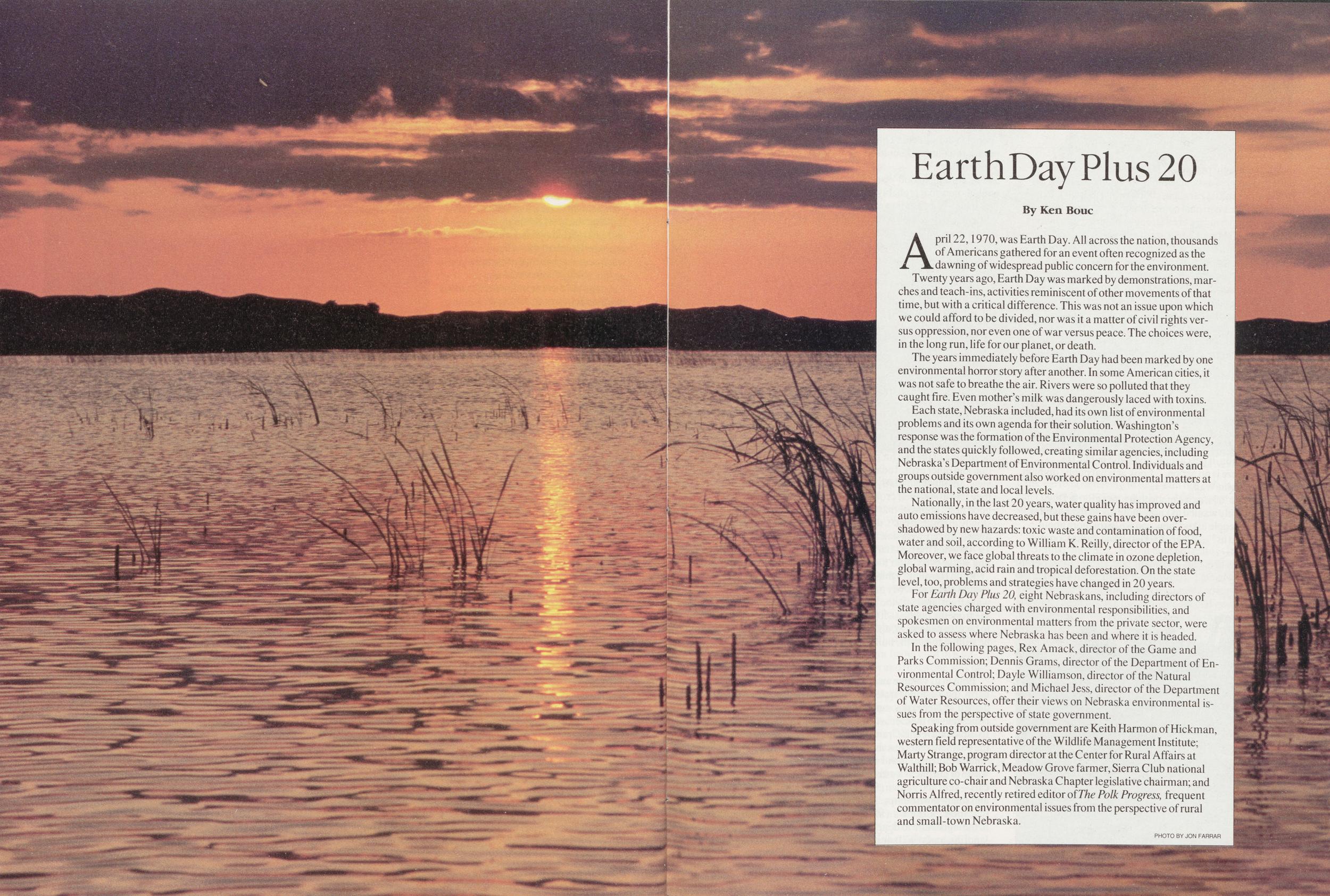
Earth Day Plus 20
By Ken BoucApril 22,1970, was Earth Day. All across the nation, thousands of Americans gathered for an event often recognized as the dawning of widespread public concern for the environment. Twenty years ago, Earth Day was marked by demonstrations, marches and teach-ins, activities reminiscent of other movements of that time, but with a critical difference. This was not an issue upon which we could afford to be divided, nor was it a matter of civil rights versus oppression, nor even one of war versus peace. The choices were, in the long run, life for our planet, or death.
The years immediately before Earth Day had been marked by one environmental horror story after another. In some American cities, it was not safe to breathe the air. Rivers were so polluted that they caught fire. Even mother's milk was dangerously laced with toxins.
Each state, Nebraska included, had its own list of environmental problems and its own agenda for their solution. Washington's response was the formation of the Environmental Protection Agency, and the states quickly followed, creating similar agencies, including Nebraska's Department of Environmental Control. Individuals and groups outside government also worked on environmental matters at the national, state and local levels.
Nationally, in the last 20 years, water quality has improved and auto emissions have decreased, but these gains have been overshadowed by new hazards: toxic waste and contamination of food, water and soil, according to William K. Reilly, director of the EPA. Moreover, we face global threats to the climate in ozone depletion, global warming, acid rain and tropical deforestation. On the state level, too, problems and strategies have changed in 20 years.
For Earth Day Plus 20, eight Nebraskans, including directors of state agencies charged with environmental responsibilities, and spokesmen on environmental matters from the private sector, were asked to assess where Nebraska has been and where it is headed.
In the following pages, Rex Amack, director of the Game and Parks Commission; Dennis Grams, director of the Department of Environmental Control; Dayle Williamson, director of the Natural Resources Commission; and Michael Jess, director of the Department of Water Resources, offer their views on Nebraska environmental issues from the perspective of state government.
Speaking from outside government are Keith Harmon of Hickman, western field representative of the Wildlife Management Institute; Marty Strange, program director at the Center for Rural Affairs at Walthill; Bob Warrick, Meadow Grove farmer, Sierra Club national agriculture co-chair and Nebraska Chapter legislative chairman; and Norris Alfred, recently retired editor of The Polk Progress, frequent commentator on environmental issues from the perspective of rural and small-town Nebraska.
PHOTO BY JON FARRAR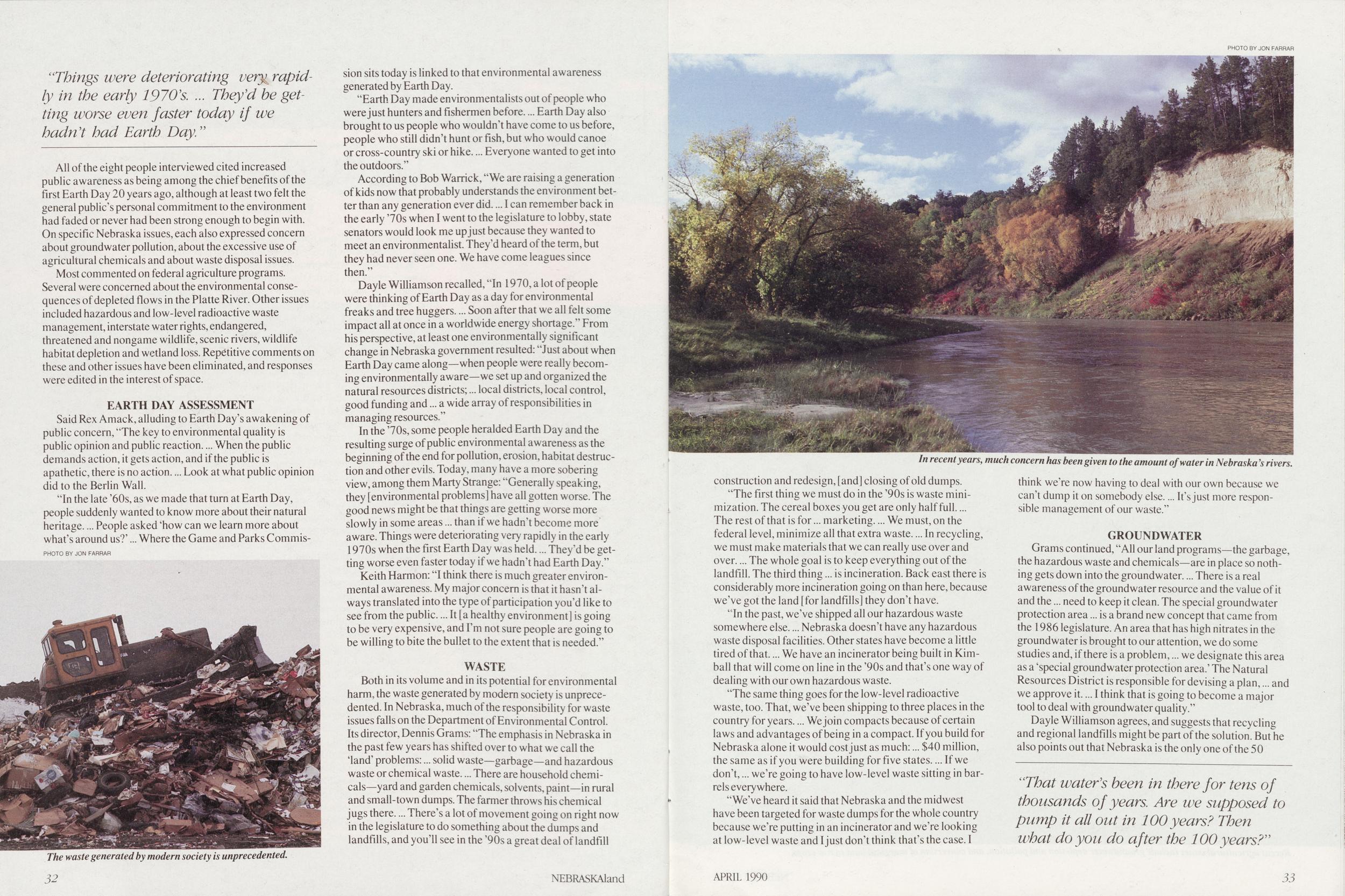 "Things were deteriorating very rapidly in the early 197 O's They'd be getting worse
even faster today if we
hadn't had Earth Day."
"Things were deteriorating very rapidly in the early 197 O's They'd be getting worse
even faster today if we
hadn't had Earth Day."
All of the eight people interviewed cited increased public awareness as being among the chief benefits of the first Earth Day 20 years ago, although at least two felt the general public's personal commitment to the environment had faded or never had been strong enough to begin with. On specific Nebraska issues, each also expressed concern about groundwater pollution, about the excessive use of agricultural chemicals and about waste disposal issues.
Most commented on federal agriculture programs. Several were concerned about the environmental consequences of depleted flows in the Platte River. Other issues included hazardous and low-level radioactive waste management, interstate water rights, endangered, threatened and nongame wildlife, scenic rivers, wildlife habitat depletion and wetland loss. Repetitive comments on these and other issues have been eliminated, and responses were edited in the interest of space.
EARTH DAY ASSESSMENTSaid Rex Amack, alluding to Earth Day's awakening of public concern, "The key to environmental quality is public opinion and public reaction When the public demands action, it gets action, and if the public is apathetic, there is no action Look at what public opinion did to the Berlin Wall.
"In the late '60s, as we made that turn at Earth Day, people suddenly wanted to know more about their natural heritage People asked now can we learn more about what's around us? Where the Game and Parks Commission sits today is linked to that environmental awareness generated by Earth Day.
"Earth Day made environmentalists out of people who were just hunters and fishermen before Earth Day also brought to us people who wouldn't have come to us before, people who still didn't hunt or fish, but who would canoe or cross-country ski or hike Everyone wanted to get into the outdoors."
According to Bob Warrick, "We are raising a generation of kids now that probably understands the environment better than any generation ever did I can remember back in the early '70s when I went to the legislature to lobby, state senators would look me up just because they wanted to meet an environmentalist. They'd heard of the term, but they had never seen one. We have come leagues since then."
Dayle Williamson recalled, "In 1970, a lot of people were thinking of Earth Day as a day for environmental freaks and tree huggers.... Soon after that we all felt some impact all at once in a worldwide energy shortage." From his perspective, at least one environmentally significant change in Nebraska government resulted: "Just about when Earth Day came along—when people were really becoming environmentally aware—we set up and organized the natural resources districts; local districts, local control, good funding and a wide array of responsibilities in managing resources."
In the '70s, some people heralded Earth Day and the resulting surge of public environmental awareness as the beginning of the end for pollution, erosion, habitat destruction and other evils. Today, many have a more sobering view, among them Marty Strange: "Generally speaking, they [environmental problems] have all gotten worse. The good news might be that things are getting worse more slowly in some areas... than if we hadn't become more aware. Things were deteriorating very rapidly in the early 1970s when the first Earth Day was held. They'd be getting worse even faster today if we hadn't had Earth Day."
Keith Harmon: "I think there is much greater environmental awareness. My major concern is that it hasn't always translated into the type of participation you'd like to see from the public.... It [a healthy environment] is going to be very expensive, and I'm not sure people are going to be willing to bite the bullet to the extent that is needed."
WASTEBoth in its volume and in its potential for environmental harm, the waste generated by modern society is unprecedented. In Nebraska, much of the responsibility for waste issues falls on the Department of Environmental Control. Its director, Dennis Grams: "The emphasis in Nebraska in the past few years has shifted over to what we call the land' problems:... solid waste—garbage—and hazardous waste or chemical waste.... There are household chemicals—yard and garden chemicals, solvents, paint—in rural and small-town dumps. The farmer throws his chemical jugs there.... There's a lot of movement going on right now in the legislature to do something about the dumps and landfills, and you'll see in the '90s a great deal of landfill 32 NEBRASKAland construction and redesign, [and] closing of old dumps.
"The first thing we must do in the '90s is waste minimization. The cereal boxes you get are only half full The rest of that is for marketing We must, on the federal level, minimize all that extra waste In recycling, we must make materials that we can really use over and over The whole goal is to keep everything out of the landfill. The third thing is incineration. Back east there is considerably more incineration going on than here, because we've got the land [for landfills] they don't have.
"In the past, we've shipped all our hazardous waste somewhere else Nebraska doesn't have any hazardous waste disposal facilities. Other states have become a little tired of that We have an incinerator being built in Kimball that will come on line in the '90s and that's one way of dealing with our own hazardous waste.
"The same thing goes for the low-level radioactive waste, too. That, we've been shipping to three places in the country for years We join compacts because of certain laws and advantages of being in a compact. If you build for Nebraska alone it would cost just as much: $40 million, the same as if you were building for five states If we don't, we're going to have low-level waste sitting in barrels everywhere.
"We've heard it said that Nebraska and the midwest have been targeted for waste dumps for the whole country because we're putting in an incinerator and we're looking at low-level waste and I just don't think that's the case. I think we're now having to deal with our own because we can't dump it on somebody else If s just more responsible management of our waste."
GROUNDWATERGrams continued, "All our land programs—the garbage, the hazardous waste and chemicals—are in place so nothing gets down into the groundwater. There is a real awareness of the groundwater resource and the value of it and the. need to keep it clean. The special groundwater protection area. is a brand new concept that came from the 1986 legislature. An area that has high nitrates in the groundwater is brought to our attention, we do some studies and, if there is a problem, we designate this area as a 'special groundwater protection area.' The Natural Resources District is responsible for devising a plan, and we approve it. I think that is going to become a major tool to deal with groundwater quality."
Dayle Williamson agrees, and suggests that recycling and regional landfills might be part of the solution. But he also points out that Nebraska is the only one of the 50 states which permits unlicensed landfills.
"That water's been in there for tens of thousands of years. Are we supposed to pump it all out in 100 years? Then what do you do after the 100 years?" APRIL 1990 33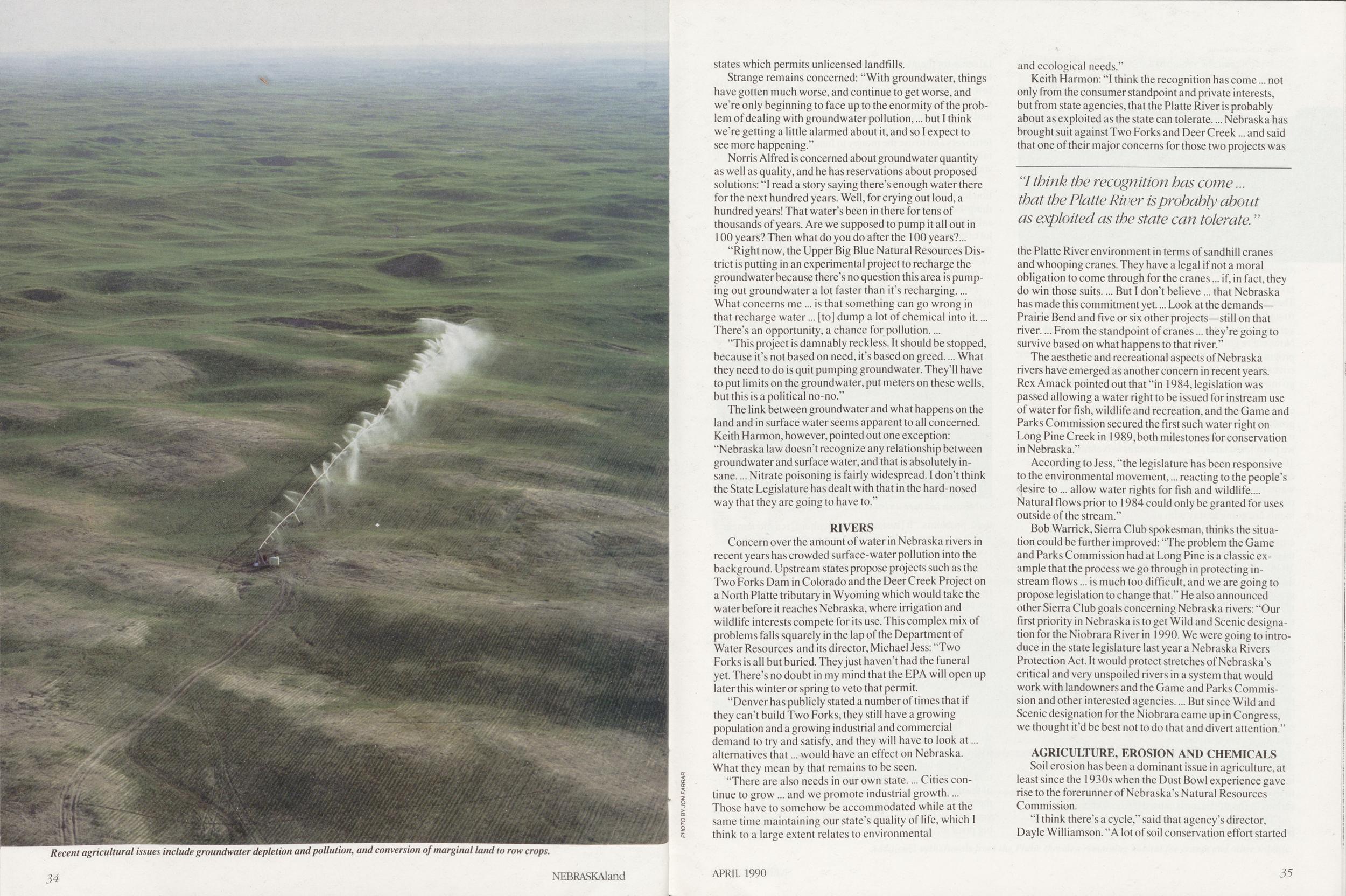
Strange remains concerned: "With groundwater, things have gotten much worse, and continue to get worse, and we're only beginning to face up to the enormity of the problem of dealing with groundwater pollution, but I think we're getting a little alarmed about it, and so I expect to see more happening."
Norris Alfred is concerned about groundwater quantity as well as quality, and he has reservations about proposed solutions: "I read a story saying there's enough water there for the next hundred years. Well, for crying out loud, a hundred years! That water's been in there for tens of thousands of years. Are we supposed to pump it all out in 100 years? Then what do you do after the 100 years?
"Right now, the Upper Big Blue Natural Resources District is putting in an experimental project to recharge the groundwater because there's no question this area is pumping out groundwater a lot faster than it's recharging What concerns me is that something can go wrong in that recharge water [to] dump a lot of chemical into it There's an opportunity, a chance for pollution.
"This project is damnably reckless. It should be stopped, because it's not based on need, it's based on greed. What they need to do is quit pumping groundwater. They'll have to put limits on the groundwater, put meters on these wells, but this is a political no-no."
The link between groundwater and what happens on the land and in surface water seems apparent to all concerned. Keith Harmon, however, pointed out one exception: "Nebraska law doesn't recognize any relationship between groundwater and surface water, and that is absolutely insane. Nitrate poisoning is fairly widespread. I don't think the State Legislature has dealt with that in the hard-nosed way that they are going to have to."
RIVERSConcern over the amount of water in Nebraska rivers in recent years has crowded surface-water pollution into the background. Upstream states propose projects such as the Two Forks Dam in Colorado and the Deer Creek Project on a North Platte tributary in Wyoming which would take the water before it reaches Nebraska, where irrigation and wildlife interests compete for its use. This complex mix of problems falls squarely in the lap of the Department of Water Resources and its director, Michael Jess: "Two Forks is all but buried. They just haven't had the funeral yet. There's no doubt in my mind that the EPA will open up later this winter or spring to veto that permit.
"Denver has publicly stated a number of times that if they can't build Two Forks, they still have a growing population and a growing industrial and commercial demand to try and satisfy, and they will have to look at. alternatives that. would have an effect on Nebraska. What they mean by that remains to be seen.
"There are also needs in our own state Cities continue to grow and we promote industrial growth Those have to somehow be accommodated while at the same time maintaining our state's quality of life, which I think to a large extent relates to environmental and ecological needs."
Keith Harmon: "I think the recognition has come not only from the consumer standpoint and private interests, but from state agencies, that the Platte River is probably about as exploited as the state can tolerate Nebraska has brought suit against Two Forks and Deer Creek and said that one of their major concerns for those two projects was the Platte River environment in terms of sandhill cranes and whooping cranes. They have a legal if not a moral obligation to come through for the cranes if, in fact, they do win those suits But I don't believe that Nebraska has made this commitment yet Look at the demands Prairie Bend and five or six other projects—still on that river From the standpoint of cranes they're going to survive based on what happens to that river."
"I think the recognition has come that the Platte River is probably about as exploited as the state can tolerate."The aesthetic and recreational aspects of Nebraska rivers have emerged as another concern in recent years. Rex Amack pointed out that "in 1984, legislation was passed allowing a water right to be issued for instream use of water for fish, wildlife and recreation, and the Game and Parks Commission secured the first such water right on Long Pine Creek in 1989, both milestones for conservation in Nebraska."
According to Jess, "the legislature has been responsive to the environmental movement, reacting to the people's desire to allow water rights for fish and wildlife Natural flows prior to 1984 could only be granted for uses outside of the stream."
Bob Warrick, Sierra Club spokesman, thinks the situation could be further improved: "The problem the Game and Parks Commission had at Long Pine is a classic example that the process we go through in protecting instream flows is much too difficult, and we are going to propose legislation to change that." He also announced other Sierra Club goals concerning Nebraska rivers: "Our first priority in Nebraska is to get Wild and Scenic designation for the Niobrara River in 1990. We were going to introduce in the state legislature last year a Nebraska Rivers Protection Act. It would protect stretches of Nebraska's critical and very unspoiled rivers in a system that would work with landowners and the Game and Parks Commission and other interested agencies But since Wild and Scenic designation for the Niobrara came up in Congress, we thought it'd be best not to do that and divert attention."
AGRICULTURE, EROSION AND CHEMICALSSoil erosion has been a dominant issue in agriculture, at least since the 1930s when the Dust Bowl experience gave rise to the forerunner of Nebraska's Natural Resources Commission.
"I think there's a cycle," said that agency's director,
Dayle Williamson. "A lot of soil conservation effort started
APRIL 1990
35
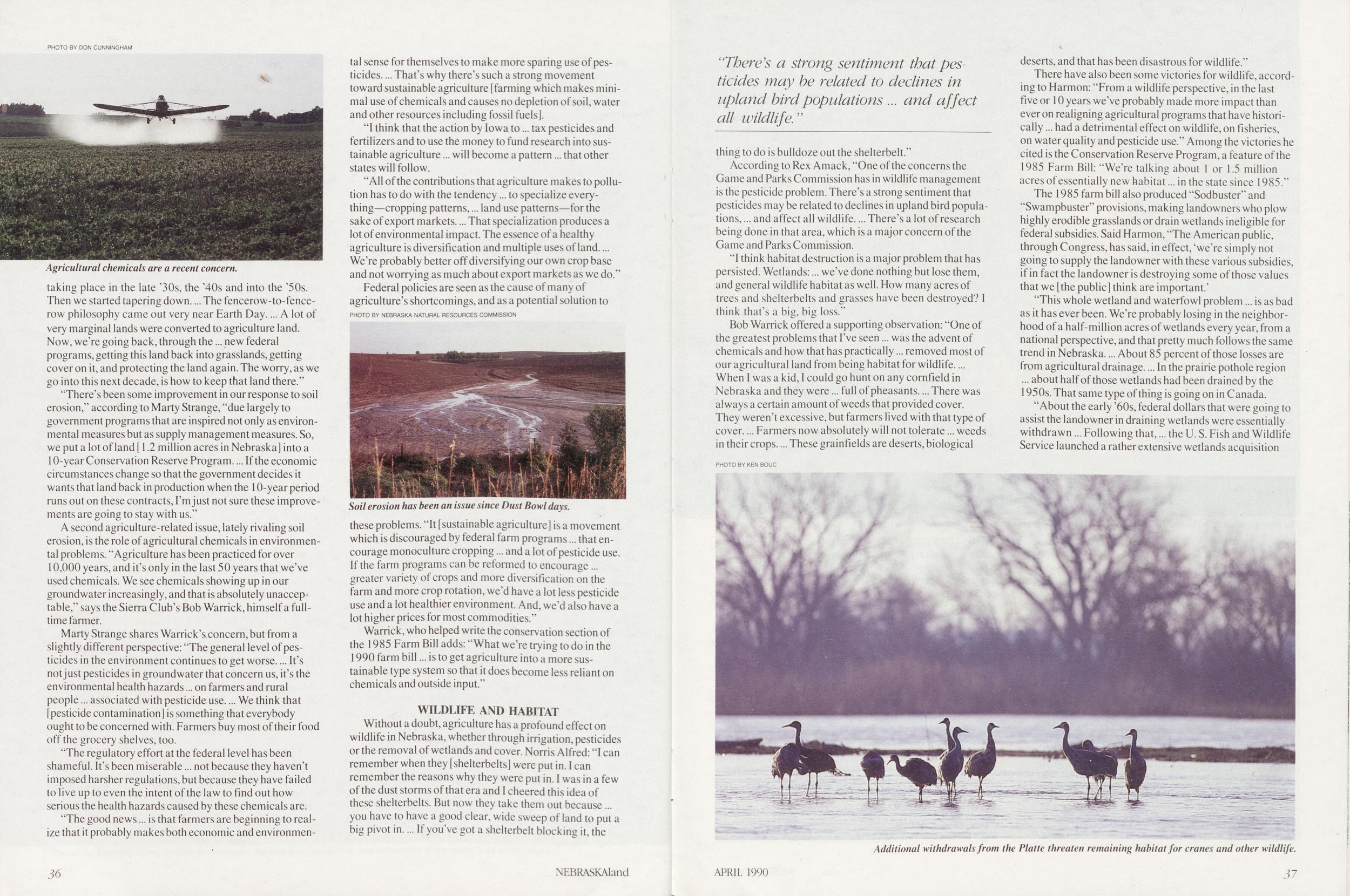
"There's been some improvement in our response to soil erosion," according to Marty Strange, "due largely to government programs that are inspired not only as environmental measures but as supply management measures. So, we put a lot of land [ 1.2 million acres in Nebraska] into a 10-year Conservation Reserve Program If the economic circumstances change so that the government decides it wants that land back in production when the 10-year period runs out on these contracts, I'm just not sure these improvements are going to stay with us."
A second agriculture-related issue, lately rivaling soil erosion, is the role of agricultural chemicals in environmental problems. "Agriculture has been practiced for over 10,000 years, and it's only in the last 50 years that we've used chemicals. We see chemicals showing up in our groundwater increasingly, and that is absolutely unacceptable," says the Sierra Club's Bob Warrick, himself a fulltime farmer.
Marty Strange shares Warrick's concern, but from a slightly different perspective: "The general level of pesticides in the environment continues to get worse It's not just pesticides in groundwater that concern us, it's the environmental health hazards on farmers and rural people associated with pesticide use We think that [pesticide contamination] is something that everybody ought to be concerned with. Farmers buy most of their food off the grocery shelves, too.
"The regulatory effort at the federal level has been shameful. It's been miserable not because they haven't imposed harsher regulations, but because they have failed to live up to even the intent of the law to find out how serious the health hazards caused by these chemicals are.
"The good news is that farmers are beginning to realize that it probably makes both economic and environmental sense for themselves to make more sparing use of pesticides. ... That's why there's such a strong movement toward sustainable agriculture [farming which makes minimal use of chemicals and causes no depletion of soil, water and other resources including fossil fuels].
"I think that the action by Iowa to tax pesticides and fertilizers and to use the money to fund research into sustainable agriculture will become a pattern that other states will follow.
"All of the contributions that agriculture makes to pollution has to do with the tendency to specialize everything—cropping patterns, land use patterns—for the sake of export markets That specialization produces a lot of environmental impact. The essence of a healthy agriculture is diversification and multiple uses of land We're probably better off diversifying our own crop base and not worrying as much about export markets as we do."
Federal policies are seen as the cause of many of agriculture's shortcomings, and as a potential solution to these problems. "It [sustainable agriculture] is a movement which is discouraged by federal farm programs that encourage monoculture cropping and a lot of pesticide use. If the farm programs can be reformed to encourage greater variety of crops and more diversification on the farm and more crop rotation, we'd have a lot less pesticide use and a lot healthier environment. And, we'd also have a lot higher prices for most commodities."
Warrick, who helped write the conservation section of the 1985 Farm Bill adds: "What we're trying to do in the 1990 farm bill is to get agriculture into a more sustainable type system so that it does become less reliant on chemicals and outside input."
WILDLIFE AND HABITATWithout a doubt, agriculture has a profound effect on wildlife in Nebraska, whether through irrigation, pesticides or the removal of wetlands and cover. Norris Alfred: "I can remember when they [shelterbelts] were put in. I can remember the reasons why they were put in. I was in a few of the dust storms of that era and I cheered this idea of these shelterbelts. But now they take them out because you have to have a good clear, wide sweep of land to put a big pivot in If you've got a shelterbelt blocking it, the thing to do is bulldoze out the shelterbelt."
"There's a strong sentiment that pesticides may be related to declines in upland bird populations and affect all wildlife."According to Rex Amack, "One of the concerns the Game and Parks Commission has in wildlife management is the pesticide problem. There's a strong sentiment that pesticides may be related to declines in upland bird populations, and affect all wildlife There's a lot of research being done in that area, which is a major concern of the Game and Parks Commission.
"I think habitat destruction is a major problem that has persisted. Wetlands: we've done nothing but lose them, and general wildlife habitat as well. How many acres of trees and shelterbelts and grasses have been destroyed? I think that's a big, big loss."
Bob Warrick offered a supporting observation: "One of the greatest problems that I've seen was the advent of chemicals and how that has practically removed most of our agricultural land from being habitat for wildlife When I was a kid, I could go hunt on any cornfield in Nebraska and they were full of pheasants There was always a certain amount of weeds that provided cover. They weren't excessive, but farmers lived with that type of cover Farmers now absolutely will not tolerate weeds in their crops These grainfields are deserts, biological deserts, and that has been disastrous for wildlife."
There have also been some victories for wildlife, according to Harmon: "From a wildlife perspective, in the last five or 10 years we've probably made more impact than ever on realigning agricultural programs that have historically had a detrimental effect on wildlife, on fisheries, on water quality and pesticide use." Among the victories he cited is the Conservation Reserve Program, a feature of the 1985 Farm Bill: "We're talking about 1 or 1.5 million acres of essentially new habitat in the state since 1985."
The 1985 farm bill also produced "Sodbuster" and "Swampbuster" provisions, making landowners who plow highly erodible grasslands or drain wetlands ineligible for federal subsidies. Said Harmon, "The American public, through Congress, has said, in effect, 'we're simply not going to supply the landowner with these various subsidies, if in fact the landowner is destroying some of those values that we [the public] think are important.'
"This whole wetland and waterfowl problem is as bad as it has ever been. We're probably losing in the neighborhood of a half-million acres of wetlands every year, from a national perspective, and that pretty much follows the same trend in Nebraska About 85 percent of those losses are from agricultural drainage In the prairie pothole region about half of those wetlands had been drained by the 1950s. That same type of thing is going on in Canada.
"About the early '60s, federal dollars that were going to assist the landowner in draining wetlands were essentially withdrawn Following that, the U. S. Fish and Wildlife Service launched a rather extensive wetlands acquisition
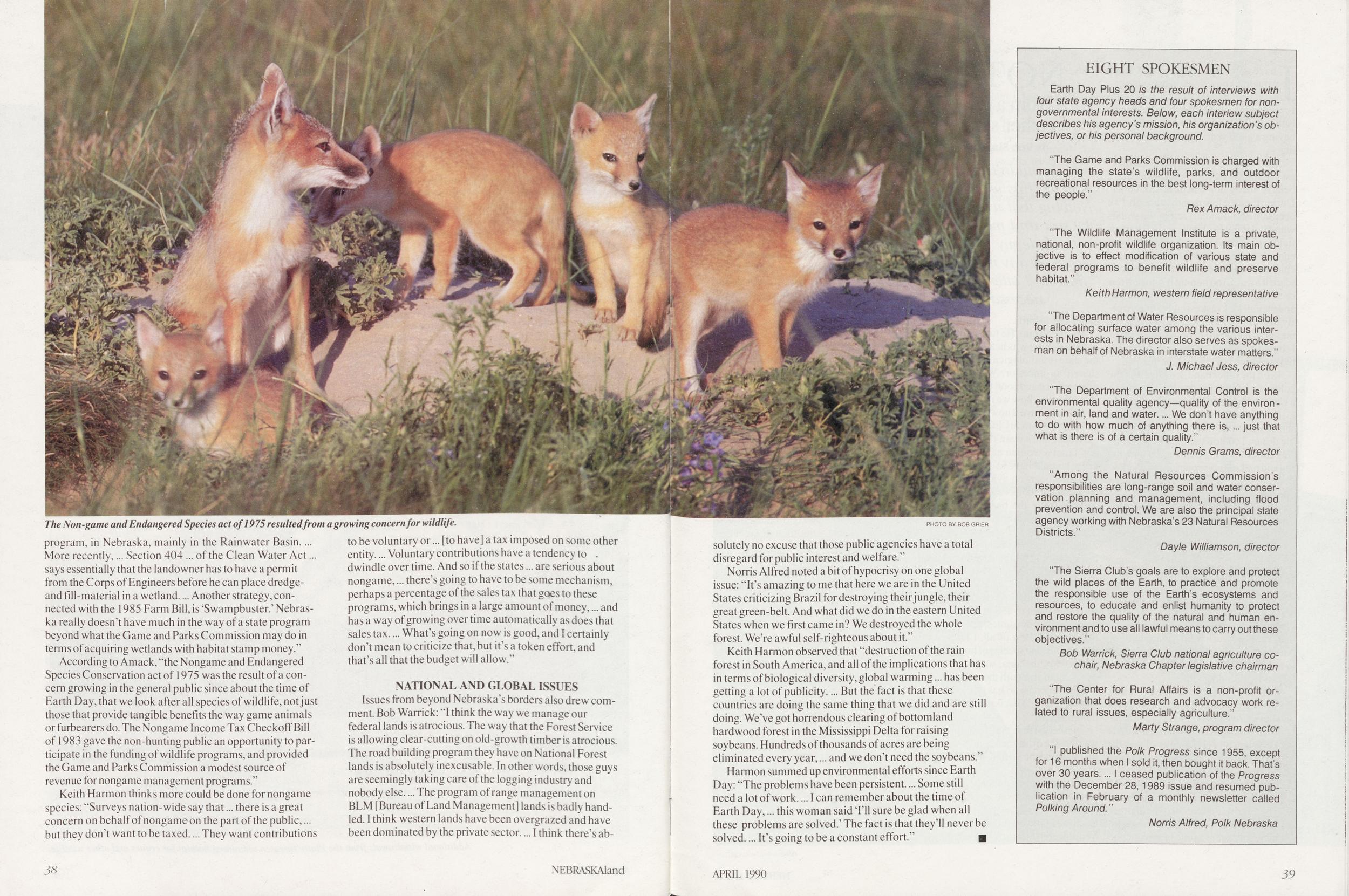
According to Amack, "the Nongame and Endangered Species Conservation act of 1975 was the result of a concern growing in the general public since about the time of Earth Day, that we look after all species of wildlife, not just those that provide tangible benefits the way game animals or furbearers do. The Nongame Income Tax Checkoff Bill of 1983 gave the non-hunting public an opportunity to participate in the funding of wildlife programs, and provided the Game and Parks Commission a modest source of revenue for nongame management programs."
Keith Harmon thinks more could be done for nongame species: "Surveys nation-wide say that there is a great concern on behalf of nongameon the part of the public, but they don't want to be taxed. They want contributions a growing concern for wildlife. to be voluntary or [to have] a tax imposed on some other entity Voluntary contributions have a tendency to . dwindle over time. And so if the states are serious about nongame, there's going to have to be some mechanism, perhaps a percentage of the sales tax that goes to these programs, which brings in a large amount of money and has a way of growing over time automatically as does that sales tax What's going on now is good, and I certainly don't mean to criticize that, but it's a token effort, and that's all that the budget will allow."
NATIONAL AND GLOBAL ISSUESIssues from beyond Nebraska's borders also drew comment. Bob Warrick: "I think the way we manage our federal lands is atrocious. The way that the Forest Service is allowing clear-cutting on old-growth timber is atrocious. The road building program they have on National Forest lands is absolutely inexcusable. In other words, those guys are seemingly taking care of the logging industry and nobody else The program of range management on BLM [Bureau of Land Management] lands is badly handled. I think western lands have been overgrazed and have been dominated by the private sector I think there's absolutely 38 NEBRASKAland no excuse that those public agencies have a total disregard for public interest and welfare."
Norris Alfred noted a bit of hypocrisy on one global issue: "It's amazing to me that here we are in the United States criticizing Brazil for destroying their jungle, their great green-belt. And what did we do in the eastern United States when we first came in? We destroyed the whole forest. We're awful self-righteous about it."
Keith Harmon observed that "destruction of the rain forest in South America, and all of the implications that has in terms of biological diversity, global warming has been getting a lot of publicity But the fact is that these countries are doing the same thing that we did and are still doing. We've got horrendous clearing of bottomland hardwood forest in the Mississippi Delta for raising soybeans. Hundreds of thousands of acres are being eliminated every year, and we don't need the soybeans."
Harmon summed up environmental efforts since Earth Day: "The problems have been persistent Some still need a lot of work I can remember about the time of Earth Day, this woman said Til sure be glad when all these problems are solved.' The fact is that they'll never be solved It's going to be a constant effort."
EIGHT SPOKESMENEarth Day Plus 20 is the result of interviews with four state agency heads and four spokesmen for nongovernmental interests. Below, each interiew subject describes his agency's mission, his organization's objectives, or his personal background.
"The Game and Parks Commission is charged with managing the state's wildlife, parks, and outdoor recreational resources in the best long-term interest of the people."
Rex Amack, director"The Wildlife Management Institute is a private, national, non-profit wildlife organization. Its main objective is to effect modification of various state and federal programs to benefit wildlife and preserve habitat."
Keith Harmon, western field representative"The Department of Water Resources is responsible for allocating surface water among the various interests in Nebraska. The director also serves as spokesman on behalf of Nebraska in interstate water matters."
J. Michael Jess, director"The Department of Environmental Control is the environmental quality agency—quality of the environment in air, land and water We don't have anything to do with how much of anything there is, just that what is there is of a certain quality."
Dennis Grams, director"Among the Natural Resources Commission's responsibilities are long-range soil and water conservation planning and management, including flood prevention and control. We are also the principal state agency working with Nebraska's 23 Natural Resources Districts."
Dayle Williamson, director"The Sierra Club's goals are to explore and protect the wild places of the Earth, to practice and promote the responsible use of the Earth's ecosystems and resources, to educate and enlist humanity to protect and restore the quality of the natural and human environment and to use all lawful means to carry out these objectives."
Bob Warrick, Sierra Club national agriculture cochair, Nebraska Chapter legislative chairman"The Center for Rural Affairs is a non-profit organization that does research and advocacy work related to rural issues, especially agriculture."
Marty Strange, program director"I published the Polk Progress since 1955, except for 16 months when I sold it, then bought it back. That's over 30 years I ceased publication of the Progress with the December 28, 1989 issue and resumed publication in February of a monthly newsletter called Polking Around."
Norris Alfred, Polk Nebraska APRIL 1990 39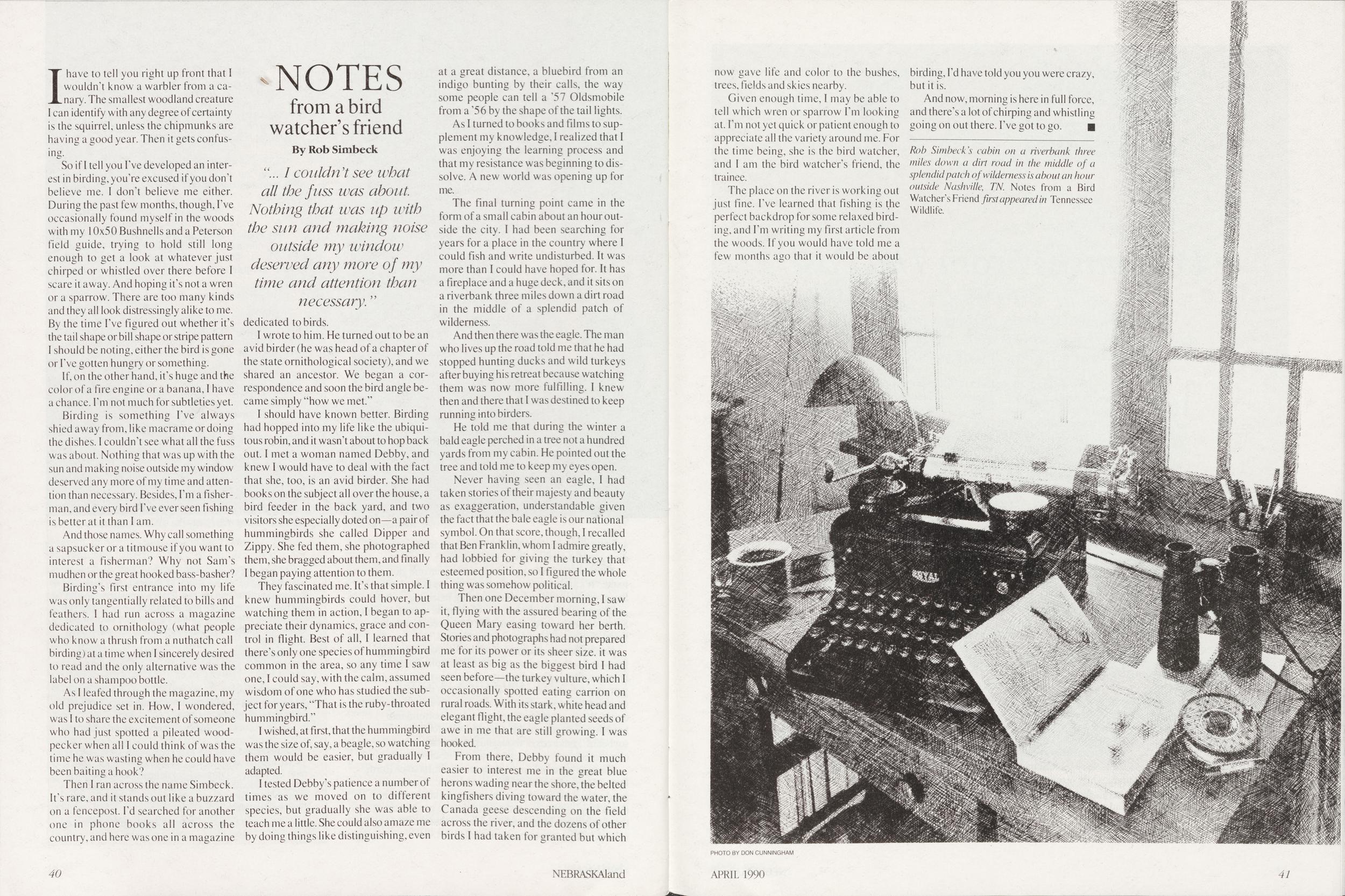
NOTES from a biurd watcher's friend
By Rob Simbreck " I couldn't see what all the fuss was about Nothing that was up with the sun and making noise outside my window deserved any more of my time and attention than necessary."I have to tell you right up front that I wouldn't know a warbler from a canary. The smallest woodland creature I can identify with any degree of certainty is the squirrel, unless the chipmunks are having a good year. Then it gets confusing.
So if I tell you I've developed an interest in birding, you're excused if you don't believe me. I don't believe me either. During the past few months, though, I've occasionally found myself in the woods with my 10x50 Bushnells and a Peterson field guide, trying to hold still long enough to get a look at whatever just chirped or whistled over there before I scare it away. And hoping it's not a wren or a sparrow. There are too many kinds and they all look distressingly alike to me. By the time I've figured out whether it's the tail shape or bill shape or stripe pattern I should be noting, either the bird is gone or I've gotten hungry or something.
If, on the other hand, it's huge and the color of a fire engine or a banana, I have a chance. I'm not much for subtleties yet.
Birding is something I've always shied away from, like macrame or doing the dishes. I couldn't see what all the fuss was about. Nothing that was up with the sun and making noise outside my window deserved any more of my time and attention than necessary. Besides, I'm a fisherman, and every bird I've ever seen fishing is better at it than I am.
And those names. Why call something a sapsucker or a titmouse if you want to interest a fisherman? Why not Sam's mudhen or the great hooked bass-basher?
Birding's first entrance into my life was only tangentially related to bills and feathers. I had run across a magazine dedicated to ornithology (what people who know a thrush from a nuthatch call birding) at a time when I sincerely desired to read and the only alternative was the label on a shampoo bottle.
As I leafed through the magazine, my old prejudice set in. How, I wondered, was I to share the excitement of someone who had just spotted a pileated woodpecker when all I could think of was the time he was wasting when he could have been baiting a hook?
Then I ran across the name Simbeck. It's rare, and it stands out like a buzzard on a fencepost. I'd searched for another one in phone books all across the country, and here was one in a magazine dedicated to birds.
I wrote to him. He turned out to be an avid birder (he was head of a chapter of the state ornithological society), and we shared an ancestor. We began a correspondence and soon the bird angle became simply "how we met."
I should have known better. Birding had hopped into my life like the ubiquitous robin, and it wasn't about to hop back out. I met a woman named Debby, and knew I would have to deal with the fact that she, too, is an avid birder. She had books on the subject all over the house, a bird feeder in the back yard, and two visitors she especially doted on—a pair of hummingbirds she called Dipper and Zippy. She fed them, she photographed them, she bragged about them, and finally I began paying attention to them.
They fascinated me. It's that simple. I knew hummingbirds could hover, but watching them in action, I began to appreciate their dynamics, grace and control in flight. Best of all, I learned that there's only one species of hummingbird common in the area, so any time I saw one, I could say, with the calm, assumed wisdom of one who has studied the subject for years, "That is the ruby-throated hummingbird."
I wished, at first, that the hummingbird was the size of, say, a beagle, so watching them would be easier, but gradually I adapted.
I tested Debby's patience a number of times as we moved on to different species, but gradually she was able to teach me a little. She could also amaze me by doing things like distinguishing, even at a great distance, a bluebird from an indigo bunting by their calls, the way some people can tell a '57 Oldsmobile from a '56 by the shape of the tail lights.
As I turned to books and films to supplement my knowledge, I realized that I was enjoying the learning process and that my resistance was beginning to dissolve. A new world was opening up for me.
The final turning point came in the form of a small cabin about an hour outside the city. I had been searching for years for a place in the country where I could fish and write undisturbed. It was more than I could have hoped for. It has a fireplace and a huge deck, and it sits on a riverbank three miles down a dirt road in the middle of a splendid patch of wilderness.
And then there was the eagle. The man who lives up the road told me that he had stopped hunting ducks and wild turkeys after buying his retreat because watching them was now more fulfilling. I knew then and there that I was destined to keep running into birders.
He told me that during the winter a bald eagle perched in a tree not a hundred yards from my cabin. He pointed out the tree and told me to keep my eyes open.
Never having seen an eagle, I had taken stories of their majesty and beauty as exaggeration, understandable given the fact that the bale eagle is our national symbol. On that score, though, I recalled that Ben Franklin, whom I admire greatly, had lobbied for giving the turkey that esteemed position, so I figured the whole thing was somehow political.
Then one December morning, I saw it, flying with the assured bearing of the Queen Mary easing toward her berth. Stories and photographs had not prepared me for its power or its sheer size, it was at least as big as the biggest bird I had seen before—the turkey vulture, which I occasionally spotted eating carrion on rural roads. With its stark, white head and elegant flight, the eagle planted seeds of awe in me that are still growing. I was hooked.
From there, Debby found it much easier to interest me in the great blue herons wading near the shore, the belted kingfishers diving toward the water, the Canada geese descending on the field across the river, and the dozens of other birds I had taken for granted but which 40 NEBRASKAland now gave life and color to the bushes, trees, fields and skies nearby.
Given enough time, I may be able to tell which wren or sparrow I'm looking at. I'm not yet quick or patient enough to appreciate all the variety around me. For the time being, she is the bird watcher, and I am the bird watcher's friend, the trainee.
The place on the river is working out just fine. I've learned that fishing is the perfect backdrop for some relaxed birding, and I'm writing my first article from the woods. If you would have told me a few months aso that it would be about birding, I'd have told you you were crazy, but it is.
And now, morning is here in full force, and there's a lot of chirping and whistling going on out there. I've got to go.
Rob Sim beck's cabin on a riverbank three miles down a dirt road in the middle of a splendid patch of wilderness is about an hour outside Nashville, . Notes from a Bird Watchefs Friend first appeared in Tennessee Wildlife.

Postmarks From The Past
By Ken Bouc Postal artifacts from pre-territorial and territorial days give insight into early periods of Nebraska settlement. Former Nebraskan Charles Winter is collection ys owner.V~T anderburgh has arrived this afternoon from the poncas having left his peltries at Pratt's house with two of his hands who could hardly stand up. V is very poor indeed, he has nearly starv'd since he left Carson because the Poncas had not a mouth full to eat, he was oblige to buy dogs to come down and he could not get anought to last him to this place, he traded altogether about 2 1 /4 pks of beaver and 27 pks of robes"
Accounts of hunger in the Indian villages, the hardships of trading there, and the petty details of day-to-day commerce retain a spark of authenticity over the span of 170 years, surviving in a letter written in 1820 by Lucien Fontenelle at Fort Lisa, located on the Missouri River in present-day Washington County. Fontenelle's letter is part of a collection belonging to Charles W. Winter, a native of the Norfolk area now living in California. His postal "covers" (any envelope, wrapper or card bearing postage and address for mailing) makes up perhaps the most extensive existing collection of postal history materials from Nebraska's territorial and pre-territorial period.
Winter first became interested in Nebraska postal history by looking for old family letters while researching his family's history. Winter's greatgrandparents had settled near Norfolk in 1866, and even after his career as a chemist took him out of the state when his formal education was complete, he retained an interest in Nebraska. He bought a 30-year-old collection of Nebraska material, and for another 30 years has been adding to it himself.
"One thing that I learned early in this process is that old Nebraska postal material can be found almost anywhere except in Nebraska," Winter said. "Frontier people wrote letters to friends and relatives back east, and the letters and envelopes were saved with family heirlooms back there. Settlers didn't often write to another Nebraskan, or those letters were seldom saved, and the letters written to eastern addresses never found their way back to Nebraska."
The Fort Lisa letter is perhaps the collection's most fascinating piece, and is Winter's favorite. It is also a good example of early 19th century correspondence sent from the very edges of civilization. Like most others of its time, the Fort Lisa letter was written on one side of a sheet of paper, then folded and sealed shut with wax. The back of a folded letter carried the address in those days, and since stamps were not available, letters also bore hand-written notations of postage paid or postage due. Envelopes did not come into use until the mid-1840s, and the first postage stamp did not appear on Nebraska correspondence until 1851.
Before statehood, Nebraska was a vast, empty place, with permanent resi
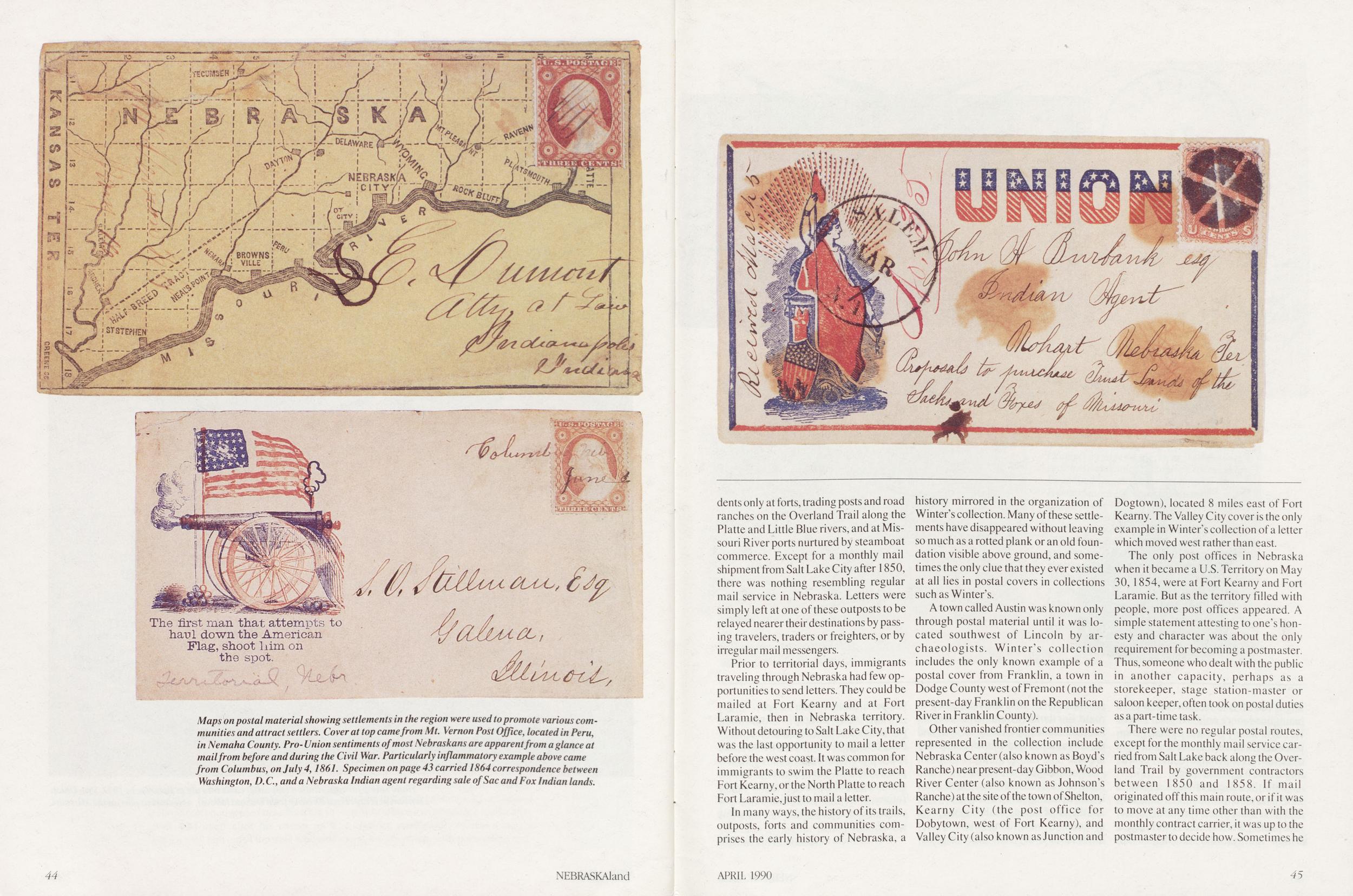
Prior to territorial days, immigrants traveling through Nebraska had few opportunities to send letters. They could be mailed at Fort Kearny and at Fort Laramie, then in Nebraska territory. Without detouring to Salt Lake City, that was the last opportunity to mail a letter before the west coast. It was common for immigrants to swim the Platte to reach Fort Kearny, or the North Platte to reach Fort Laramiejust to mail a letter.
In many ways, the history of its trails, outposts, forts and communities comprises the early history of Nebraska, a history mirrored in the organization of Winter's collection. Many of these settlements have disappeared without leaving so much as a rotted plank or an old foundation visible above ground, and sometimes the only clue that they ever existed at all lies in postal covers in collections such as Winter's.
A town called Austin was known only through postal material until it was located southwest of Lincoln by archaeologists. Winter's collection includes the only known example of a postal cover from Franklin, a town in Dodge County west of Fremont (not the present-day Franklin on the Republican River in Franklin County).
Other vanished frontier communities represented in the collection include Nebraska Center (also known as Boyd's Ranche) near present-day Gibbon, Wood River Center (also known as Johnson's Ranche) at the site of the town of Shelton, Kearny City (the post office for Dobytown, west of Fort Kearny), and Valley City (also known as Junction and Dogtown), located 8 miles east of Fort Kearny. The Valley City cover is the only example in Winter's collection of a letter which moved west rather than east.
The only post offices in Nebraska when it became a U.S. Territory on May 30, 1854, were at Fort Kearny and Fort Laramie. But as the territory filled with people, more post offices appeared. A simple statement attesting to one's honesty and character was about the only requirement for becoming a postmaster. Thus, someone who dealt with the public in another capacity, perhaps as a storekeeper, stage station-master or saloon keeper, often took on postal duties as a part-time task.
There were no regular postal routes,
except for the monthly mail service carried from Salt Lake back along the Overland
Trail by government contractors
between 1850 and 1858. If mail
originated off this main route, or if it was
to move at any time other than with the
monthly contract carrier, it was up to the
postmaster to decide how. Sometimes he
APRIL 1990
45
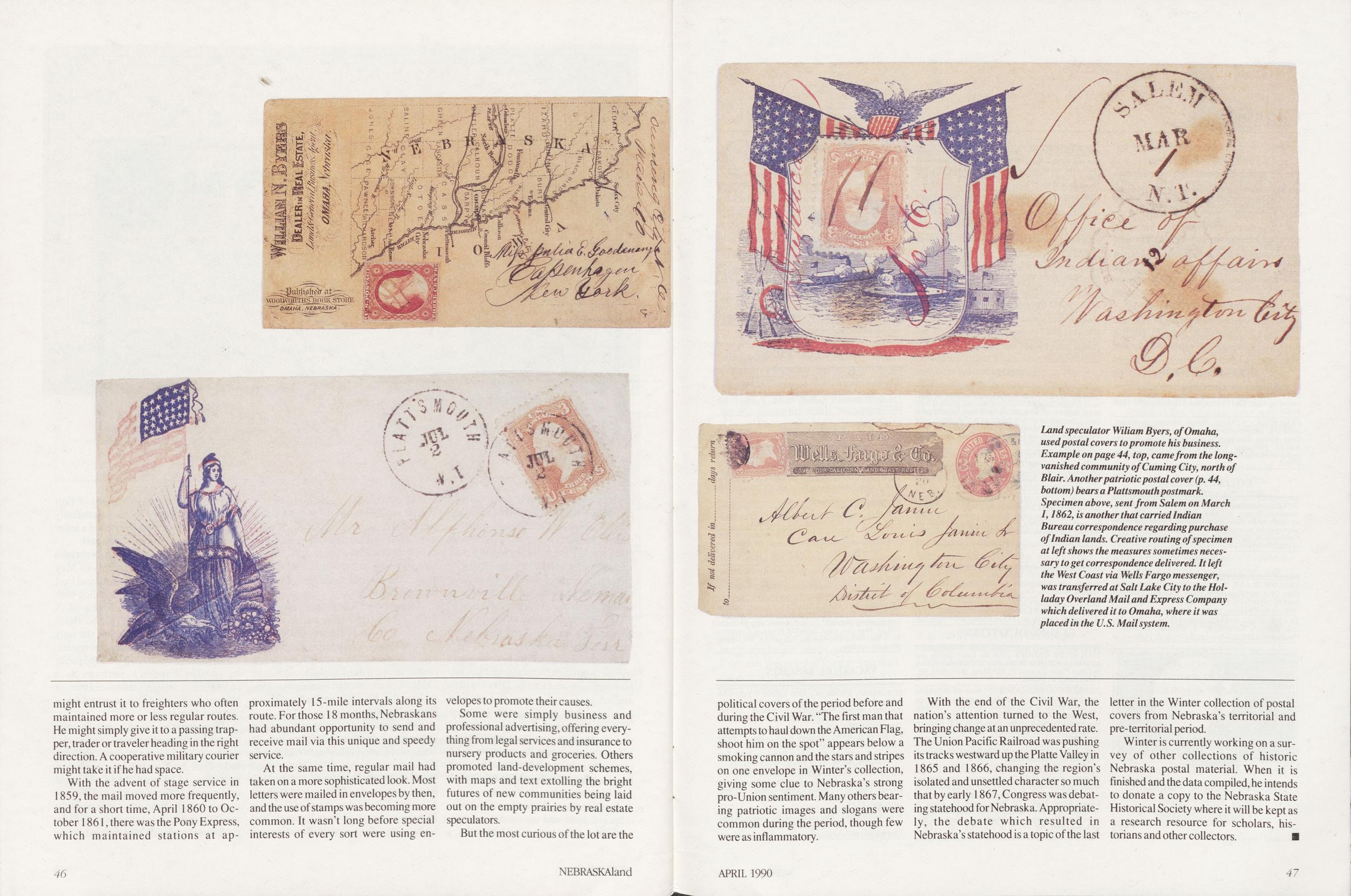
With the advent of stage service in 1859, the mail moved more frequently, and for a short time, April 1860 to October 1861, there was the Pony Express, which maintained stations at approximately 15-mile intervals along its route. For those 18 months, Nebraskans had abundant opportunity to send and receive mail via this unique and speedy service.
At the same time, regular mail had taken on a more sophisticated look. Most letters were mailed in envelopes by then, and the use of stamps was becoming more common. It wasn't long before special interests of every sort were using envelopes to promote their causes.
Some were simply business and professional advertising, offering everything from legal services and insurance to nursery products and groceries. Others promoted land-development schemes, with maps and text extolling the bright futures of new communities being laid out on the empty prairies by real estate speculators.
But the most curious of the lot are the
With the end of the Civil War, the nation's attention turned to the West, bringing change at an unprecedented rate. The Union Pacific Railroad was pushing its tracks westward up the Platte Valley in 1865 and 1866, changing the region's isolated and unsettled character so much that by early 1867, Congress was debating statehood for Nebraska. Appropriately, the debate which resulted in Nebraska's statehood is a topic of the last letter in the Winter collection of postal covers from Nebraska's territorial and pre-territorial period.
Winter is currently working on a survey of other collections of historic Nebraska postal material. When it is finished and the data compiled, he intends to donate a copy to the Nebraska State Historical Society where it will be kept as a research resource for scholars, historians and other collectors.
APRIL 1990 47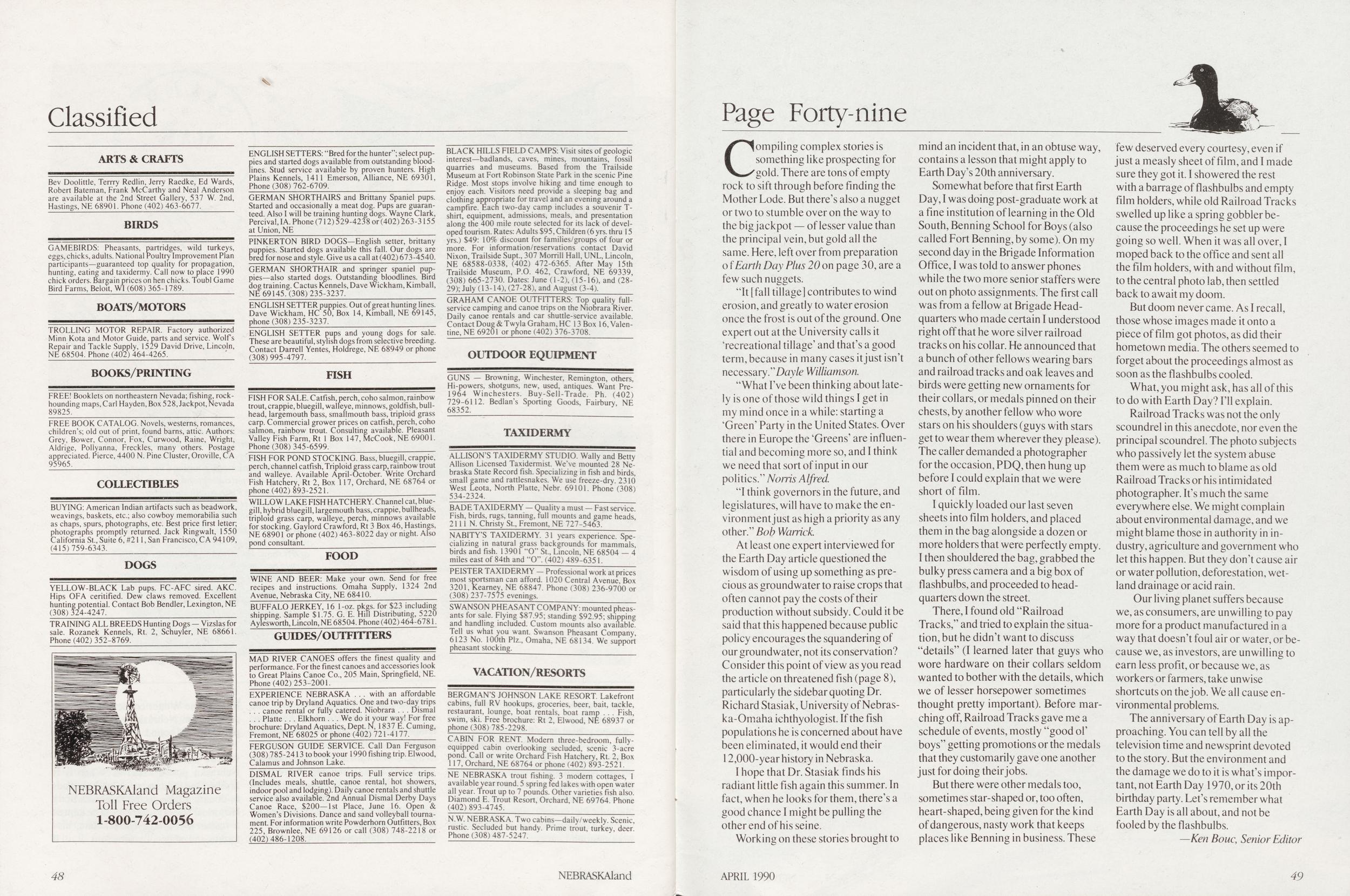
Classified
ARTS & CRAFTSBev Doolittle, Terrry Redlin, Jerry Raedke, Ed Wards, Robert Bateman, Frank McCarthy and Neal Anderson are available at the 2nd Street Gallery, 537 W. 2nd, Hastings, NE 68901. Phone (402) 463-6677.
BIRDSGAMEBIRDS: Pheasants, partridges, wild turkeys, eggs, chicks, adults. National Poultry Improvement Plan participants—guaranteed top quality for propagation, hunting, eating and taxidermy. Call now to place 1990 chick orders. Bargain prices on hen chicks. Toubl Game Bird Farms, Beloit, WI (608) 365-1789.
BOATS/MOTORSTROLLING MOTOR REPAIR. Factory authorized Minn Kota and Motor Guide, parts and service. Wolfs Repair and Tackle Supply, 1529 David Drive, Lincoln, NE 68504. Phone (402) 464-4265.
BOOKS/PRINTINGFREE! Booklets on northeastern Nevada; fishing, rock- hounding maps, Carl Hayden, Box 528, Jackpot, Nevada 89825.
FREE BOOK CATALOG. Novels, westerns, romances, children's; old out of print, found barns, attic. Authors: Grey, Bower, Connor, Fox, Curwood, Raine, Wright, Aldrige, Pollyanna, Freckles, many others. Postage appreciated. Pierce, 4400 N. Pine Cluster, Oroville, CA 95965.
COLLECTIBLESBUYING: American Indian artifacts such as beadwork, weavings, baskets, etc.; also cowboy memorabilia such as chaps, spurs, photographs, etc. Best price first letter; photographs promptly returned. Jack Ringwalt, 1550 California St., Suite 6, #211, San Francisco, CA 94109, (415)759-6343.
DOGSYELLOW-BLACK Lab pups. FC-AFC sired. AKC. Hips OFA ceritified. Dew claws removed. Excellent hunting potential. Contact Bob Bendler, Lexington, NE (308) 324-4247.
TRAINING ALL BREEDS Hunting Dogs — Vizslas for sale. Rozanek Kennels, Rt. 2, Schuyler, NE 68661. Phone (402) 352-8769.
ENGLISH SETTERS: "Bred for the hunter"; select pup- pies and started dogs available from outstanding blood- lines. Stud service available by proven hunters. High Plains Kennels, 1411 Emerson, Alliance, NE 69301, Phone (308) 762-6709.
GERMAN SHORTHAIRS and Brittany Spaniel pups. Started and occasionally a meat dog. Pups are guaranteed. Also I will be training hunting dogs. Wayne Clark, Percival, IA. Phone (712) 529-4238 or (402) 263-3155 at Union, NE
PINKERTON BIRD DOGS—English setter, brittany puppies. Started dogs available this fall. Our dogs are orecf for nose and style. Give us a call at (402) 673-4540.
GERMAN SHORTHAIR and springer spaniel puppies—also started dogs. Outstanding bloodlines. Bird dog training. Cactus Kennels, Dave Wickham, Kimball, NE 69145. (308) 235-3237.
ENGLISH SETTER puppies. Out of great hunting lines. Dave Wickham, HC 50, Box 14, Kimball, NE 69145, phone (308) 235-3237.
ENGLISH SETTER pups and young dogs for sale. These are beautiful, stylish dogs from selective breeding. Contact Darrell Yentes, Holdrege, NE 68949 or phone (308) 995-4797.
FISHFISH FOR SALE. Catfish, perch, coho salmon, rainbow trout, crappie, bluegill, walleye, minnows, goldfish, bullhead, largemouth bass, smallmouth bass, tripioid grass carp. Commercial grower prices on catfish, perch, coho salmon, rainbow trout. Consulting available. Pleasant Valley Fish Farm, Rt 1 Box 147, McCook, NE 69001. Phone (308) 345-6599.
FISH FOR POND STOCKING. Bass, bluegill, crappie, perch, channel catfish, Tripioid grass carp, rainbow trout and walleye. Available April-October. Write Orchard Fish Hatchery, Rt 2, Box 117, Orchard, NE 68764 or phone (402) 893-2521.
WILLOW LAKE FISH HATCHERY. Channel cat, bluegill, hybrid bluegill, largemouth bass, crappie, bullheads, tripioid grass carp, walleye, perch, minnows available for stocking. Gaylord Crawford, Rt 3 Box 46, Hastings, NE 68901 or phone (402) 463-8022 day or night. Also pond consultant.
FOODWINE AND BEER: Make your own. Send for free recipes and instructions. Omaha Supply, 1324 2nd Avenue, Nebraska City, NE 68410.
BUFFALO JERKEY, 16 1-oz. pkgs. for $23 including shipping. Sample $1.75. G. E. Hill Distributing, 5220 Aylesworth, Lincoln, NE 68504. Phone (402) 464-6781.
GUIDES/OUTFITTERSMAD RIVER CANOES offers the finest quality and performance. For the finest canoes and accessories look to Great Plains Canoe Co., 205 Main, Springfield, NE. Phone (402) 253-2001.
EXPERIENCE NEBRASKA with an affordable canoe trip by Dryland Aquatics. One and two-day trips canoe rental or fully catered. Niobrara Dismal Platte Elkhorn We do it your way! For free brochure: Dryland Aquatics, Dept. N, 1837 E. Cuming, Fremont, NE 68025 or phone (402) 721-4177.
FERGUSON GUIDE SERVICE. Call Dan Ferguson (308) 785-2413 to book your 1990 fishing trip. Elwood, Calamus and Johnson Lake.
DISMAL RIVER canoe trips. Full service trips. (Includes meals, shuttle, canoe rental, hot showers, indoor pool and lodging). Daily canoe rentals and shuttle service also available. 2nd Annual Dismal Derby Days Canoe Race, $200—1st Place, June 16. Open & Women's Divisions. Dance and sand volleyball tournament. For information write Powderhorn Outfitters, Box 225, Brownlee, NE 69126 or call (308) 748-2218 or (402) 486-1208.
BLACK HILLS FIELD CAMPS: Visit sites of geologic interest—badlands, caves, mines, mountains, fossil quarries and museums. Based from the Trailside Museum at Fort Robinson State Park in the scenic Pine Ridge. Most stops involve hiking and time enough to enjoy each. Visitors need provide a sleeping bag and clothing appropriate for travel and an evening around a campfire. Each two-day camp includes a souvenir T-shirt, equipment, admissions, meals, and presentation along the 400 mile route selected for its lack of developed tourism. Rates: Adults $95, Children (6 yrs. thru 15 yrs.) $49: 10% discount for families/groups of four or more. For information/reservations contact David Nixon, Trailside Supt., 307 Morrill Hall, UNL, Lincoln, NE 68588-0338, (402) 472-6365. After May 15th Trailside Museum, P.O. 462, Crawford, NE 69339, (308) 665-2730. Dates: June (1-2), (15-16), and (28-29); July (13-14), (27-28), and August (3-4).
GRAHAM CANOE OUTFITTERS: Top quality fullservice camping and canoe trips on the Niobrara River. Daily canoe rentals and car shuttle-service available. Contact Doug & Twyla Graham, HC 13 Box 16, Valentine, NE 69201 or phone (402) 376-3708.
OUTDOOR EQUIPMENTGUNS — Browning, Winchester, Remington, others, Hi-powers, shotguns, new, used, antiques. Want Pre1964 Winchesters. Buy-Sell-Trade. Ph. (402) 729-6112. Bedlan's Sporting Goods, Fairbury, NE 68352.
TAXIDERMYALLISON'S TAXIDERMY STUDIO. Wally and Betty Allison Licensed Taxidermist. We've mounted 28 Nebraska State Record fish. Specializing in fish and birds, small game and rattlesnakes. We use freeze-dry. 2310 West Leota, North Platte, Nebr. 69101. Phone (308) 534-2324.
BADE TAXIDERMY — Quality a must — Fast service. Fish, birds, rugs, tanning, full mounts and game heads 2111 N. Christy St., Fremont, NE 727-5463.
NABITY'S TAXIDERMY. 31 years experience. Specializing in natural grass backgrounds for mammals, birds and fish. 13901 "O" St., Lincoln, NE 68504 — 4 miles east of 84th and "O". (402) 489-6351.
PEISTER TAXIDERMY - Professional work at prices most sportsman can afford. 1020 Central Avenue Box 3201, Kearney, NE 68847. Phone (308) 236-9700 or (308) 237-7575 evenings.
SWANSON PHEASANT COMPANY: mounted pheasants for sale. Flying $87.95; standing $92.95; shipping and handling included. Custom mounts also available. Tell us what you want. Swanson Pheasant Company, 6123 No. 100th Plz., Omaha, NE 68134. We support pheasant stocking.
VACATION/RESORTSBERGMAN'S JOHNSON LAKE RESORT. Lakefront cabins, full RV hookups, groceries, beer, bait, tackle, restaurant, lounge, boat rentals, boat ramp Fish, swim, ski. Free brochure: Rt 2, Elwood, NE 68937 or phone (308) 785-2298.
CABIN FOR RENT. Modern three-bedroom, fullyequipped cabin overlooking secluded, scenic 3-acre pond. Call or write Orchard Fish Hatchery, Rt. 2, Box 117, Orchard, NE 68764 or phone (402) 893-2521.
NE NEBRASKA trout fishing. 3 modern cottages, 1 available year round. 5 spring fed lakes with open water all year. Trout up to 7 pounds. Other varieties fish also. Diamond E. Trout Resort, Orchard, NE 69764. Phone (402) 893-4745.
N.W. NEBRASKA. Two cabins—daily/weekly. Scenic, rustic. Secluded but handy. Prime trout, turkey, deer. Phone (308) 487-5247.
48 NEBRASKAlandPage Forty-nine
Compiling complex stories is something like prospecting for gold. There are tons of empty rock to sift through before finding the Mother Lode. But there's also a nugget or two to stumble over on the way to the big jackpot — of lesser value than the principal vein, but gold all the same. Here, left over from preparation o f Earth Day Plus 20 on page 30, are a few such nuggets.
"It [fall tillage] contributes to wind erosion, and greatly to water erosion once the frost is out of the ground. One expert out at the University calls it 'recreational tillage' and that's a good term, because in many cases it just isn't necessary."Dayle Williamson.
"What I've been thinking about lately is one of those wild things I get in my mind once in a while: starting a 'Green' Party in the United States. Over there in Europe the 'Greens' are influential and becoming more so, and I think we need that sort of input in our politics.'' Nonis Alfred.
"I think governors in the future, and legislatures, will have to make the environment just as high a priority as any other." Bob Warrick.
At least one expert interviewed for the Earth Day article questioned the wisdom of using up something as precious as groundwater to raise crops that often cannot pay the costs of their production without subsidy. Could it be said that this happened because public policy encourages the squandering of our groundwater, not its conservation? Consider this point of view as you read the article on threatened fish (page 8), particularly the sidebar quoting Dr. Richard Stasiak, University of Nebraska-Omaha ichthyologist. If the fish populations he is concerned about have been eliminated, it would end their 12,000-year history in Nebraska.
I hope that Dr. Stasiak finds his radiant little fish again this summer. In fact, when he looks for them, there's a good chance I might be pulling the other end of his seine.
Working on these stories brought to mind an incident that, in an obtuse way, contains a lesson that might apply to Earth Day's 20th anniversary.
Somewhat before that first Earth Day, I was doing post-graduate work at a fine institution of learning in the Old South, Benning School for Boys (also called Fort Benning, by some). On my second day in the Brigade Information Office, I was told to answer phones while the two more senior staffers were out on photo assignments. The first call was from a fellow at Brigade Headquarters who made certain I understood right off that he wore silver railroad tracks on his collar. He announced that a bunch of other fellows wearing bars and railroad tracks and oak leaves and birds were getting new ornaments for their collars, or medals pinned on their chests, by another fellow who wore stars on his shoulders (guys with stars get to wear them wherever they please). The caller demanded a photographer for the occasion, PDQ, then hung up before I could explain that we were short of film.
I quickly loaded our last seven sheets into film holders, and placed them in the bag alongside a dozen or more holders that were perfectly empty. I then shouldered the bag, grabbed the bulky press camera and a big box of flashbulbs, and proceeded to headquarters down the street.
There, I found old "Railroad Tracks," and tried to explain the situation, but he didn't want to discuss "details" (I learned later that guys who wore hardware on their collars seldom wanted to bother with the details, which we of lesser horsepower sometimes thought pretty important). Before marching off, Railroad Tracks gave me a schedule of events, mostly "good of boys" getting promotions or the medals that they customarily gave one another just for doing their jobs.
But there were other medals too, sometimes star-shaped or, too often, heart-shaped, being given for the kind of dangerous, nasty work that keeps places like Benning in business. These few deserved every courtesy, even if just a measly sheet of film, and I made sure they got it. I showered the rest with a barrage of flashbulbs and empty film holders, while old Railroad Tracks swelled up like a spring gobbler because the proceedings he set up were going so well. When it was all over, I moped back to the office and sent all the film holders, with and without film, to the central photo lab, then settled back to await my doom.
But doom never came. As I recall, those whose images made it onto a piece of film got photos, as did their hometown media. The others seemed to forget about the proceedings almost as soon as the flashbulbs cooled.
What, you might ask, has all of this to do with Earth Day? I'll explain.
Railroad Tracks was not the only scoundrel in this anecdote, nor even the principal scoundrel. The photo subjects who passively let the system abuse them were as much to blame as old Railroad Tracks or his intimidated photographer. It's much the same everywhere else. We might complain about environmental damage, and we might blame those in authority in industry, agriculture and government who let this happen. But they don't cause air or water pollution, deforestation, wetland drainage or acid rain.
Our living planet suffers because we, as consumers, are unwilling to pay more for a product manufactured in a way that doesn't foul air or water, or because we, as investors, are unwilling to earn less profit, or because we, as workers or farmers, take unwise shortcuts on the job. We all cause environmental problems.
The anniversary of Earth Day is approaching. You can tell by all the television time and newsprint devoted to the story. But the environment and the damage we do to it is what's important, not Earth Day 1970, or its 20th birthday party. Let's remember what Earth Day is all about, and not be fooled by the flashbulbs.
—Ken Bouc, Senior Editor APRIL 1990 49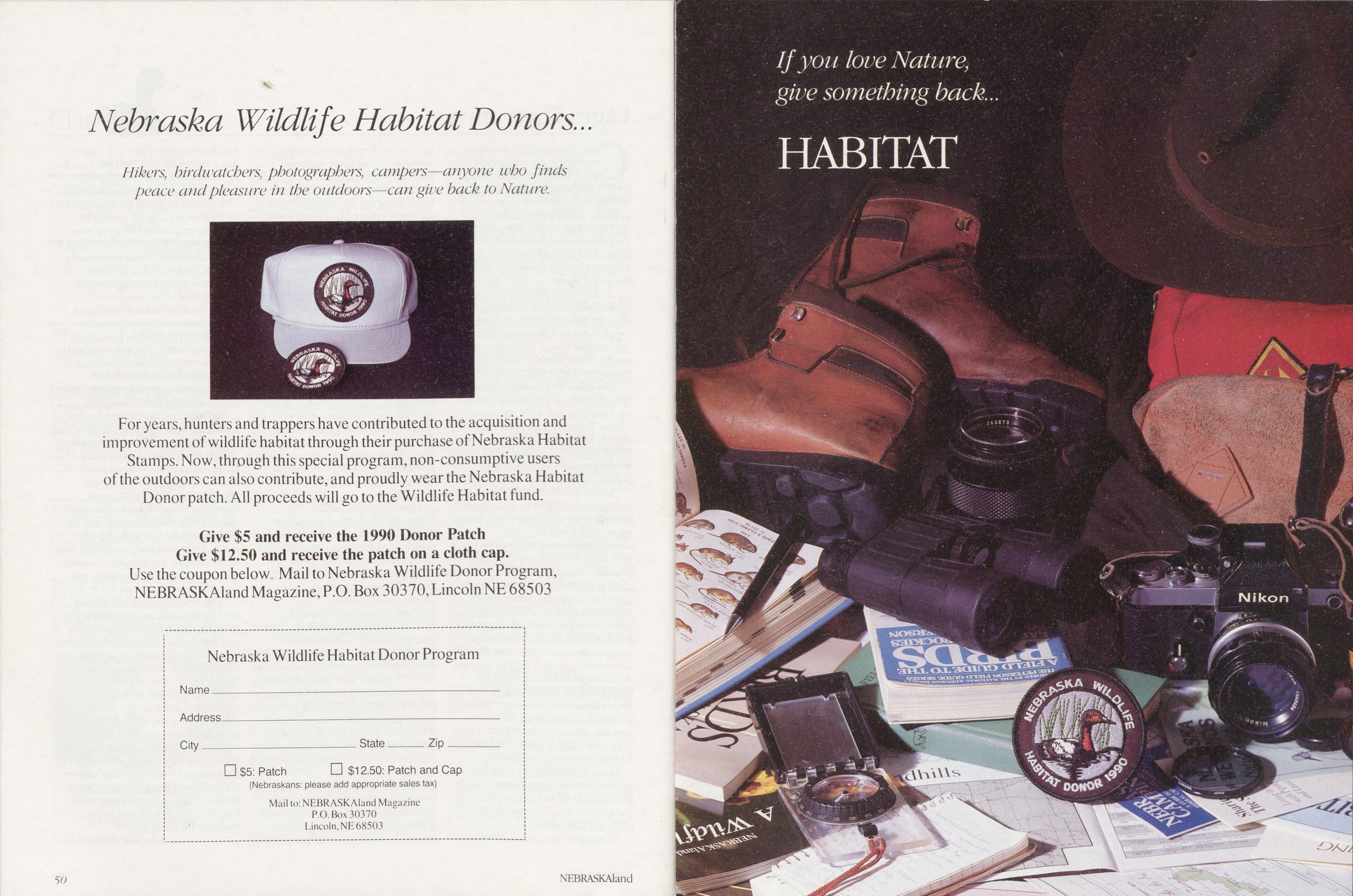
Nebraska Wildlife Habitat Donors...
Hikers, birdwatchers, photographers, campers—anyone who finds peace and pleasure in the outdoors—can give back to Nature.For years, hunters and trappers have contributed to the acquisition and improvement of wildlife habitat through their purchase of Nebraska Habitat Stamps. Now, through this special program, non-consumptive users of the outdoors can also contribute, and proudly wear the Nebraska Habitat Donor patch. All proceeds will go to the Wildlife Habitat fund.
Give $5 and receive the 1990 Donor Patch Give $12.50 and receive the patch on a cloth cap. Use the coupon below. Mail to Nebraska Wildlife Donor Program, NEBRASKAland Magazine, P.O. Box 30370, Lincoln NE 68503 Nebraska Wildlife Habitat Donor Program Name Address City State Zip $5: Patch $12.50: Patch and Cap (Nebraskans: please add appropriate sales tax) Mail to: NEBRASKAland Magazine P.O. Box 30370 Lincoln, NE 68503 50 NEBRASKAland
Position: 233 (33 views)