Volume 68, Issue 2, 1990
NEBRASKAland
MARCH 1990 $1.50
NEBRASKAland
VOL 68/NO.2 MARCH 1990 Published by the Nebraska Game and Parks Commission Rex Amack, Director Assistant Directors: William J. Bailey, Jr. Dale R. Bree Staff Chief Information & Education: Jim Mac Allister Managing Editor. Lowell Johnson Editor: Don Cunningham Senior Editors: Jon Farrar, Ken Bouc Regional Editors: Bob Grier, Rocky Hoffmann, Tom Keith Art Director: Duane Westerholt Illustration: Tim Reigert, Dan Curran Circulation: Pat Frahm Commissioners Chairman: L. Bruce Wright, Lincoln Vice Chairman: Richard L. Coyne, Omaha 2nd Vice Cliairman: Elvin Adamson, Nenzel J. Alan Cramer, Wayne Marc Anthony, Scottsbluff Wayne Ziebarth, Wilcox La Vern Schneider, McCook NEBRASKAland VOL68/N0.2/MARCH 1990 Published monthly except for combined Jan/Feb and Aug/Sept issues,by the Nebraska Game and Parks Commission, 2200 North 33rd Street, Lincoln, NE. Copyright 1990, all rights reserved. Second-class postage paid at Lincoln, Nebraska POSTMASTER: Send all address changes to NEBRASKAland, Box 30370, Lincoln, NE 68503. Rates: S12 for one year, $23 for two years. Manuscripts or photographs submitted to NEBRASKAland Magazine should be addressed to: The Editor, NEBRASKAland Magazine, P.O. Box 30370, Lincoln, NE 68503, and accompanied by self-addressed envelopes and return postage. The publisher assumes no responsibility for unsolicited material.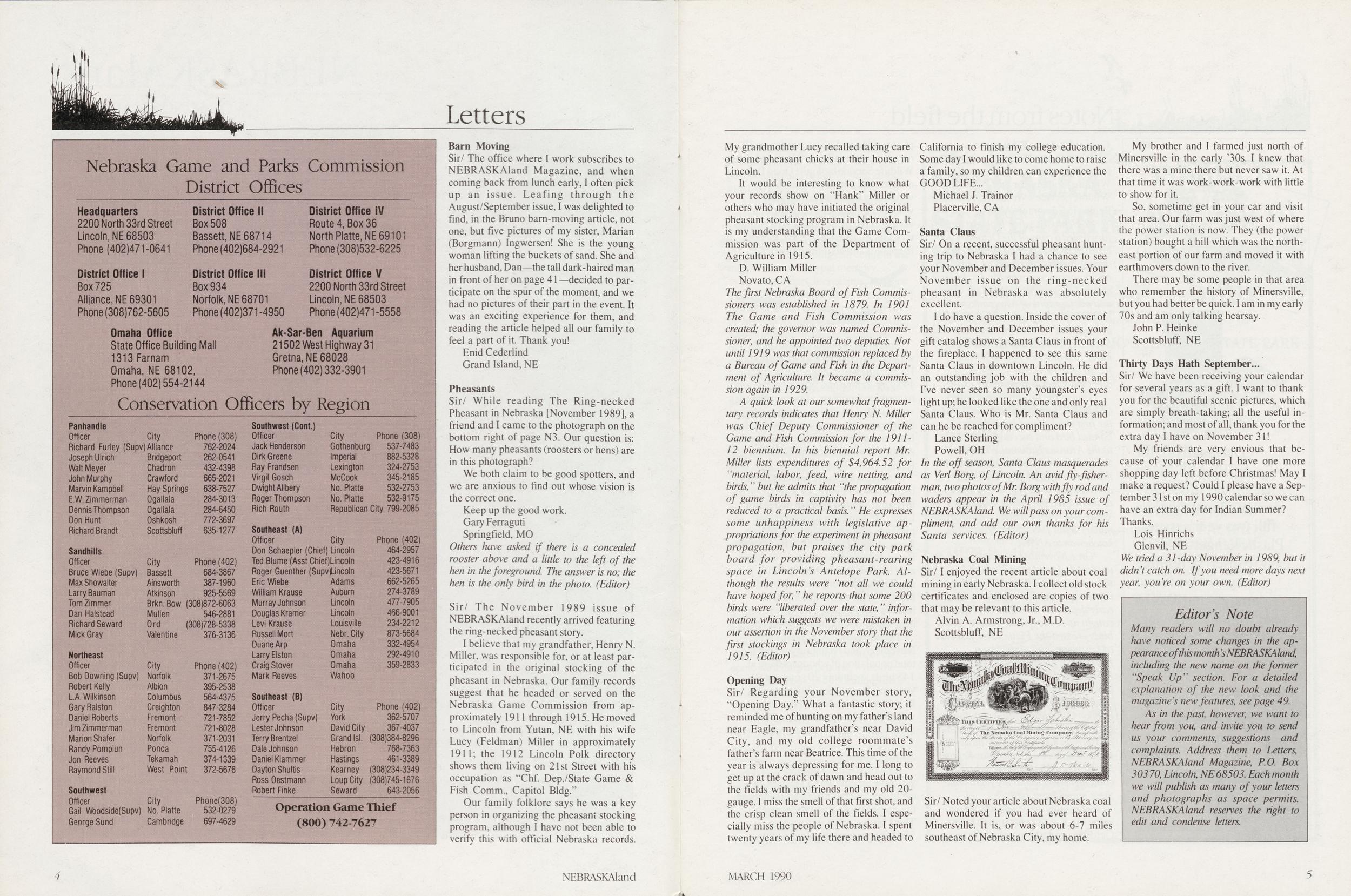
Nebraska Game and Parks Commission District Offices
Headquarters 2200 North 33rd Street Lincoln, NE 68503 Phone (402)471-0641 District Office i Box 725 Alliance. NE 69301 Phone (308)762-5605 District Office II Box 508 Bassett, NE68714 Phone (402)684-2921 District Office III Box 934 Norfolk, NE 68701 Phone (402)371-4950 District Office IV Route 4, Box 36 North Platte, NE 69101 Phone (308)532-6225 District Office V 2200 North 33rd Street Lincoln, NE 68503 Phone (402)471-5558 Omaha Office State Office Building Mall 1313Farnam Omaha, NE 68102, Phone(402)554-2144 Ak-Sar-Ben Aquarium 21502 West Highway 31 Gretna, NE 68028 Phone(402)332-3901Conservation Officers by Region
Panhandle Officer Richard Furley (Supv) Joseph Uirich Wait Meyer John Murphy Marvin Kampbeii E.W.Zimmerman Dennis Thompson Don Hunt Richard Brandt Sandhills Officer Bruce Wiebe (Supv) Max ShowaJter Larry Bauman Tom Zimmer Dan Haistead Richard Seward Mick Gray Northeast Officer Bob Downing (Supv) Robert Kelly L.A. Wilkinson Gary Ralston Daniel Roberts Jim Zimmerman Marion Shafer Randy Pomplun Jon Reeves Raymond Still City Alliance Bridgeport Chadron Crawford Hay Springs Ogallaia Ogallala Oshkosh Scottsbluff Phone(308) 762-2024 262-0541 432-4398 665-2021 638-7527 284-3013 284-6450 772-3697 635-1277 Southwest (Cont.) Officer Jack Henderson Dirk Greene Ray Frandsen Virgil Gosch Dwight Alibery Roger Thompson Rich Routh City Gothenburg Imperial Lexington McCook No. Platte No. Platte Phone (308) 537-7483 882-5328 324-2753 345-2185 532-2753 532-9175 Republican City 799-2085 City Bassett Ainsworth Atkinson Brkn. Bow Mullen Ord Valentine Phone(402) 684-3867 387-1960 925-5569 (308)872-6063 546-2881 (308)728-5338 376-3136 Southeast (A) Officer City Don Schaepler (Chief) Lincoln Ted Blume (Asst Chiet)Lincoln Roger Guenther (SupvjLincoln City Norfolk Albion Columbus Creighton Fremont Fremont Norfolk Ponca Tekamah West Point Southwest Officer City Gail Wbodside(Supv) No. Platte George Sund Cambridge Phone(402) 371-2675 395-2538 564-4375 847-3284 721-7852 721-8028 371-2031 755-4126 374-1339 372-5676 Phone(308) 532-0279 697-4629 Eric Wiebe William Krause Murray Johnson Douglas Kramer Levi Krause Russell Mort Duane Arp Larry Elston Craig Stover Mark Reeves Southeast (B) Officer Jerry Pecha (Supv) Lester Johnson Terry Brentzel Dale Johnson Daniel Klammer Dayton Shultis Ross Oestmann Robert Finke Adams Auburn Lincoln Lincoln Louisville Nebr. City Omaha Omaha Omaha Wahoo City York David City Grand Isl. Hebron Hastings Kearney Loup City Seward Phone (402) 464-2957 423-4916 423-5671 662-5265 274-3789 477-7905 466-9001 234-2212 873-5684 332-4954 292-4910 359-2833 Phone (402) 362-5707 367-4037 (308)384-8296 768-7363 461-3389 (308)234-3349 (308)745-1676 643-2056 Operation Game Thief (800) 742-7627Letters
Barn MovingSir/ The office where I work subscribes to NEBRASKAland Magazine, and when coming back from lunch early, I often pick up an issue. Leafing through the August/September issue, I was delighted to find, in the Bruno barn-moving article, not one, but five pictures of my sister, Marian (Borgmann) Ingwersen! She is the young woman lifting the buckets of sand. She and her husband, Dan—the tall dark-haired man in front of her on page 41 —decided to participate on the spur of the moment, and we had no pictures of their part in the event. It was an exciting experience for them, and reading the article helped all our family to feel a part of it. Thank you!
Enid Cederlind Grand Island, NE PheasantsSir/ While reading The Ring-necked Pheasant in Nebraska [November 1989], a friend and I came to the photograph on the bottom right of page N3. Our question is: How many pheasants (roosters or hens) are in this photograph?
We both claim to be good spotters, and we are anxious to find out whose vision is the correct one.
Keep up the good work.
Gary Ferraguti Springfield, MOOthers have asked if there is a concealed rooster above and a little to the left of the hen in the foreground. The answer is no; the hen is the only bird in the photo. (Editor)
Sir/ The November 1989 issue of NEBRASKAland recently arrived featuring the ring-necked pheasant story.
I believe that my grandfather, Henry N. Miller, was responsible for, or at least participated in the original stocking of the pheasant in Nebraska. Our family records suggest that he headed or served on the Nebraska Game Commission from approximately 1911 through 1915. He moved to Lincoln from Yutan, NE with his wife Lucy (Feldman) Miller in approximately 1911; the 1912 Lincoln Polk directory shows them living on 21st Street with his occupation as "Chf. Dep./State Game & Fish Comm., Capitol Bldg."
Our family folklore says he was a key person in organizing the pheasant stocking program, although I have not been able to verify this with official Nebraska records. 4 NEBRASKAland My grandmother Lucy recalled taking care of some pheasant chicks at their house in Lincoln.
It would be interesting to know what your records show on "Hank" Miller or others who may have initiated the original pheasant stocking program in Nebraska. It is my understanding that the Game Commission was part of the Department of Agriculture in 1915.
D. William Miller Novato, CAThe first Nebraska Board of Fish Commissioners was established in 1879. In 1901 The Game and Fish Commission was created; the governor was named Commissioner, and he appointed two deputies. Not until 1919 was that commission replaced by a Bureau of Game and Fish in the Department of Agriculture. It became a commission again in 1929.
A quick look at our somewhat fragmentary records indicates that Henry N. Miller was Chief Deputy Commissioner of the Game and Fish Commission for the 1911-12 biennium. In his biennial report Mr. Miller lists expenditures of $4,964.52 for "material, labor, feed, wire netting, and birds," but he admits that "the propagation of game birds in captivity has not been reduced to a practical basis." He expresses some unhappiness with legislative appropriations for the experiment in pheasant propagation, but praises the city park board for providing pheasant-rearing space in Lincoln's Antelope Park. Although the results were "not all we could have hoped for," he reports that some 200 birds were "liberated over the state," information which suggests we were mistaken in our assertion in the November story that the first stockings in Nebraska took place in 1915. (Editor)
Opening DaySir/ Regarding your November story, "Opening Day." What a fantastic story; it reminded me of hunting on my father's land near Eagle, my grandfather's near David City, and my old college roommate's father's farm near Beatrice. This time of the year is always depressing for me. I long to get up at the crack of dawn and head out to the fields with my friends and my old 20-gauge. I miss the smell of that first shot, and the crisp clean smell of the fields. I especially miss the people of Nebraska. I spent twenty years of my life there and headed to California to finish my college education. Some day I would like to come home to raise a family, so my children can experience the GOOD LIFE....
Michael J. Trainor Placerville, CA Santa ClausSir/ On a recent, successful pheasant hunting trip to Nebraska I had a chance to see your November and December issues. Your November issue on the ring-necked pheasant in Nebraska was absolutely excellent.
I do have a question. Inside the cover of the November and December issues your gift catalog shows a Santa Claus in front of the fireplace. I happened to see this same Santa Claus in downtown Lincoln. He did an outstanding job with the children and I've never seen so many youngster's eyes light up; he looked like the one and only real Santa Claus. Who is Mr. Santa Claus and can he be reached for compliment?
Lance Sterling Powell, OHIn the off season, Santa Claus masquerades as Verl Borg, of Lincoln. An avid fly-fisherman, two photos of Mr. Borg with fly rod and waders appear in the April 1985 issue of NEBRASKAland. We will pass on your compliment, and add our own thanks for his Santa services. (Editor)
Nebraska Coal MiningSir/1 enjoyed the recent article about coal mining in early Nebraska. I collect old stock certificates and enclosed are copies of two that may be relevant to this article.
Alvin A. Armstrong, Jr., M.D. Scottsbluff, NESir/ Noted your article about Nebraska coal and wondered if you had ever heard of Minersville. It is, or was about 6-7 miles southeast of Nebraska City, my home.
My brother and I farmed just north of Minersville in the early '30s. I knew that there was a mine there but never saw it. At that time it was work-work-work with little to show for it.
So, sometime get in your car and visit that area. Our farm was just west of where the power station is now. They (the power station) bought a hill which was the northeast portion of our farm and moved it with earthmovers down to the river.
There may be some people in that area who remember the history of Minersville, but you had better be quick. I am in my early 70s and am only talking hearsay.
John P. Heinke Scottsbluff, NE Thirty Days Hath September...Sir/ We have been receiving your calendar for several years as a gift. I want to thank you for the beautiful scenic pictures, which are simply breath-taking; all the useful information; and most of all, thank you for the extra day I have on November 31!
My friends are very envious that because of your calendar I have one more shopping day left before Christmas! May I make a request? Could I please have a September 31 st on my 1990 calendar so we can have an extra day for Indian Summer?
Thanks.
Lois Hinrichs Glenvil, NEWe tried a 31-day November in 1989, but it didn 't catch on. If you need more days next year, you 're on your own. (Editor)
Editor's NoteMany readers will no doubt already have noticed some changes in the appearance of this month sNEBRASKAland, including the new name on the former "Speak Up" section. For a detailed explanation of the new look and the magazine's new features, see page 49.
As in the past, however, we want to hear from you, and invite you to send us your comments, suggestions and complaints. Address them to Letters, NEBRASKAland Magazine, P.O. Box 303 70, Lincoln, NE 68503. Each month we will publish as many of your letters and photographs as space permits. NEBRASKAland reserves the right to edit and condense letters.
MARCH 1990 5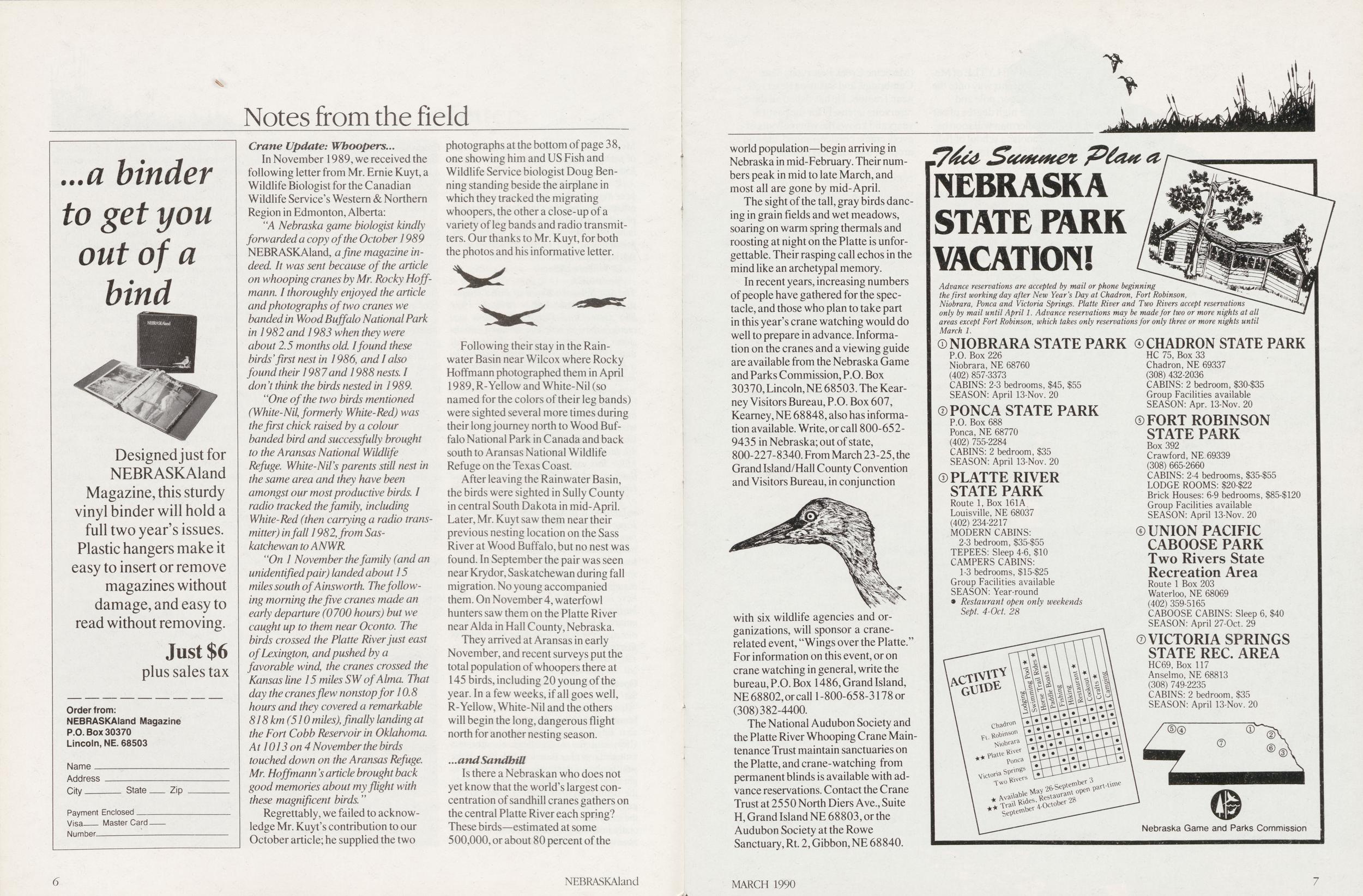 a binder
to get you
out of a
bind
Designed just for
NEBRASKAland
Magazine, this sturdy
vinyl binder will hold a
full two year's issues.
Plastic hangers make it
easy to insert or remove
magazines without
damage, and easy to
read without removing.
Just $6
plus sales tax
Order from:
NEBRASKAland Magazine
P.O. Box 30370
Lincoln, NE. 68503
Name
Address
City
State
Zip
Payment Enclosed
Visa MasterCard
Number
a binder
to get you
out of a
bind
Designed just for
NEBRASKAland
Magazine, this sturdy
vinyl binder will hold a
full two year's issues.
Plastic hangers make it
easy to insert or remove
magazines without
damage, and easy to
read without removing.
Just $6
plus sales tax
Order from:
NEBRASKAland Magazine
P.O. Box 30370
Lincoln, NE. 68503
Name
Address
City
State
Zip
Payment Enclosed
Visa MasterCard
Number
Notes from the field
Crane Update: Whoopers...In November 1989, we received the following letter from Mr. Ernie Kuyt, a Wildlife Biologist for the Canadian Wildlife Service's Western & Northern Region in Edmonton, Alberta:
"A Nebraska game biologist kindly forwarded a copy of the October 1989 NEBRASKAland, a fine magazine indeed. It was sent because of the article on whooping cranes by Mr. Rocky Hoffmann. I thoroughly enjoyed the article and photographs of two cranes we banded in Wood Buffalo National Park in 1982 and 1983 when they were about 2.5 months old. I found these birds 'first nest in 1986, and I also found their 198 7 and 1988 nests. I don 't think the birds nested in 1989.
"One of the two birds mentioned (White-Nil, formerly White-Red) was the first chick raised by a colour banded bird and successfully brought to the Aransas National Wildlife Refuge. White-Nil's parents still nest in the same area and they have been amongst our most productive birds. I radio tracked the family, including White-Red (then carrying a radio transmitter) in fall 1982, from Saskatchewan to ANWR
"On 1 November the family (and an unidentified pair) landed about 15 miles south of Ainsworth. The following morning the five cranes made an early departure (0700 hours) but we caught up to them near Oconto. The birds crossed the Platte River just east of Lexington, and pushed by a favorable wind, the cranes crossed the Kansas line 15 miles SW of Alma. That day the cranes flew nonstop for 10.8 hours and they covered a remarkable 818 km (510 miles), finally landing at the Fort Cobb Reservoir in Oklahoma. At 1013 on 4 November the birds touched down on the Aransas Refuge. Mr. Hoffmann's article brought back good memories about my flight with these magnificent birds."
Regrettably, we failed to acknowledge Mr. Kuyt's contribution to our October article; he supplied the two photographs at the bottom of page 38, one showing him and US Fish and Wildlife Service biologist Doug Benning standing beside the airplane in which they tracked the migrating whoopers, the other a close-up of a variety of leg bands and radio transmitters. Our thanks to Mr. Kuyt, for both the photos and his informative letter.
Following their stay in the Rainwater Basin near Wilcox where Rocky Hoffmann photographed them in April 1989, R-Yellow and White-Nil (so named for the colors of their leg bands) were sighted several more times during their long journey north to Wood Buffalo National Park in Canada and back south to Aransas National Wildlife Refuge on the Texas Coast.
After leaving the Rainwater Basin, the birds were sighted in Sully County in central South Dakota in mid-April. Later, Mr. Kuyt saw them near their previous nesting location on the Sass River at Wood Buffalo, but no nest was found. In September the pair was seen near Krydor, Saskatchewan during fall migration. No young accompanied them. On November 4, waterfowl hunters saw them on the Platte River near Alda in Hall County, Nebraska.
They arrived at Aransas in early November, and recent surveys put the total population of whoopers there at 145 birds, including 20 young of the year. In a few weeks, if all goes well, R-Yellow, White-Nil and the others will begin the long, dangerous flight north for another nesting season.
...and SandhillIs there a Nebraskan who does not yet know that the world's largest concentration of sandhill cranes gathers on the central Platte River each spring? These birds—estimated at some 500,000, or about 80 percent of the 6 NEBRASKAland world population—begin arriving in Nebraska in mid-February. Their numbers peak in mid to late March, and most all are gone by mid-April.
The sight of the tall, gray birds dancing in grain fields and wet meadows, soaring on warm spring thermals and roosting at night on the Platte is unforgettable. Their rasping call echos in the mind like an archetypal memory.
In recent years, increasing numbers of people have gathered for the spectacle, and those who plan to take part in this year's crane watching would do well to prepare in advance. Information on the cranes and a viewing guide are available from the Nebraska Game and Parks Commission, P.O. Box 30370, Lincoln, NE 68503. The Kearney Visitors Bureau, P.O. Box 607, Kearney, NE 68848, also has information available. Write, or call 800-652-9435 in Nebraska; out of state, 800-227-8340. From March 23-25, the Grand Island/Hall County Convention and Visitors Bureau, in conjunction
The National Audubon Society and the Platte River Whooping Crane Maintenance Trust maintain sanctuaries on the Platte, and crane-watching from permanent blinds is available with advance reservations. Contact the Crane Trust at 2550 North Diers Ave., Suite H, Grand Island NE 68803, or the Audubon Society at the Rowe Sanctuary, Rt. 2, Gibbon, NE 68840.
NEBRASKA STATE PARK VACATION! Advance reservations are accepted by mail or phone beginning the first working day after New Year's Day at Chadron, Fort Robinson, Niobrara, Ponca and Victoria Springs. Platte River and Two Rivers accept reservations only by mail until April 1. Advance reservations may be made for two or more nights at all areas except Fort Robinson, which takes only reservations for only three or more nights until March 1. ©NIOBRARA STATE PARK © CHADRON STATE PARK P.O. Box 226 Niobrara, NE 68760 (402) 857-3373 CABINS: 2-3 bedrooms, $45, $55 SEASON: April 13-Nov. 20 © PONCA STATE PARK P.O. Box 688 Ponca, NE 68770 (402) 755-2284 CABINS: 2 bedroom, $35 SEASON: April 13-Nov. 20 © PLATTE RIVER STATE PARK Route 1, Box 161A Louisville, NE 68037 (402) 234-2217 MODERN CABINS: 2-3 bedroom, $35-$55 TEPEES: Sleep 4-6, $10 CAMPERS CABINS: 1-3 bedrooms, $15-$25 Group Facilities available SEASON: Year-round • Restaurant open only weekends Sept. 4-Oct. 28 HC 75, Box 33 Chadron, NE 69337 (308) 432-2036 CABINS: 2 bedroom, $30-$35 Group Facilities available SEASON: Apr. 13-Nov. 20 © FORT ROBINSON STATE PARK Box 392 Crawford, NE 69339 (308) 665-2660 CABINS: 2-4 bedrooms, $35-$55 LODGE ROOMS: $20-$22 Brick Houses: 6-9 bedrooms, $85-$120 Group Facilities available SEASON: April 13-Nov. 20 © UNION PACIFIC CABOOSE PARK Two Rivers State Recreation Area Route 1 Box 203 Waterloo, NE 68069 (402) 359-5165 CABOOSE CABINS: Sleep 6, $40 SEASON: April 27-Oct. 29 ©VICTORIA SPRINGS STATE REC. AREA HC69, Box 117 Anselmo, NE 68813 (308) 749-2235 CABINS: 2 bedroom, $35 SEASON: April 13-Nov. 20 Chadron ponca Nebraska Game and Parks Commission MARCH 1990 7
Lessons on the Ice
PHOTOS AND TEXT BY ROCKY HOFFMANN McCook resident Steve Lytle, a tournament fisherman, guide and lure maker, has spent 15 years fishing Nebraska's southwest reservoirs. A dawn-to-dark enthusiast, his fish-locating skills speak for themselves.WHEN STEVE LYTLE of McCook cleats his way onto the ice with auger, pole and black box, there is a high degree of certainty that this fisherman will soon be working two schools: a school offish under the ice and a school for fishermen on top of it. Steve's uncanny ability to locate the under-ice schools offish is the reason for his modest gallery of students on the ice, and he never seems to mind the small crowds that keep track of him on Nebraska's southwest reservoirs. In fact, part of his business is fisherman education, ranging from classroom-style fishing workshops to actual on-the-lake experiences.
Steve Lytle is not an ordinary part-time fisherman. He spends an average of four days a week on the water whether it's frozen or not, operates his own fishing business, guides fishermen and manufactures lures. He turned professional in 1987, and fishes an average of 10 Bass Anglers Sportsman Society (B. A.S.S.) tournaments on the pro circuit annually.
While not away on tour, which may take him from California one week to New York state the next, Steve concentrates his fishing at Hugh Butler Lake (Red Willow Reservoir) near McCook, Harry Strunk Lake (Medicine Creek Reservoir) near Cambridge, and Swanson Reservoir near Trenton. He has fished all three reservoirs intensely for the past 15 years and knows the whereabouts of every crack, crevice, mound, log and drop-off that each has to offer.
His specialty is black bass, and he consistently pulls trophy largemouth, including a few weighing over eight pounds, out of these aging impoundments. He advocates catch-and-release fishing for largemouth bass, but with a sparkle of anticipation in his eyes, he lets you know that he plans to retire "the really big one" to the den wall when (and if) it comes. One has to wonder what he considers the really big one when eight-pounders have already been released.
Black bass fishing, however, is a summertime sport, and when winter temperatures lock up southwest Nebraska lakes, Steve's thoughts turn to other species and methods, and he has become as successful an ice fisherman as he is an expert in open water.
"My experience from open water fishing has been a tremendous asset to my success while ice fishing. I simply apply everything I find from the boat regarding bottom structure to ice fishing," Lytle explains.
Steve uses this day on Swanson Reservoir to demonstrate some techniques in the art of crappie catching, and he points to a black mechanical contraption, almost robotic in appearance, with one tubular steel arm extending into a recently-augered hole. "Although I have a number of fishing buddies, my best companion on the ice is that black box. Without it, I would be lost."
He refers to his locator, a flasher unit that he has modified for use on the ice, complete with motorcycle battery and carrying case. In the age of graphs and liquid crystal electronics, Steve prefers the flasher-type locator that pioneered sonar technology.
This little black box is my underwater eyes. With a simple flasher unit, I can tell how hard the bottom is, locate the drop-offs, determine the degree of that drop, find bait fish, game fish and even my lure, watch a fish approach that lure, tease him into taking a bite, and even set mv hook off the 8 NEBRASKAland
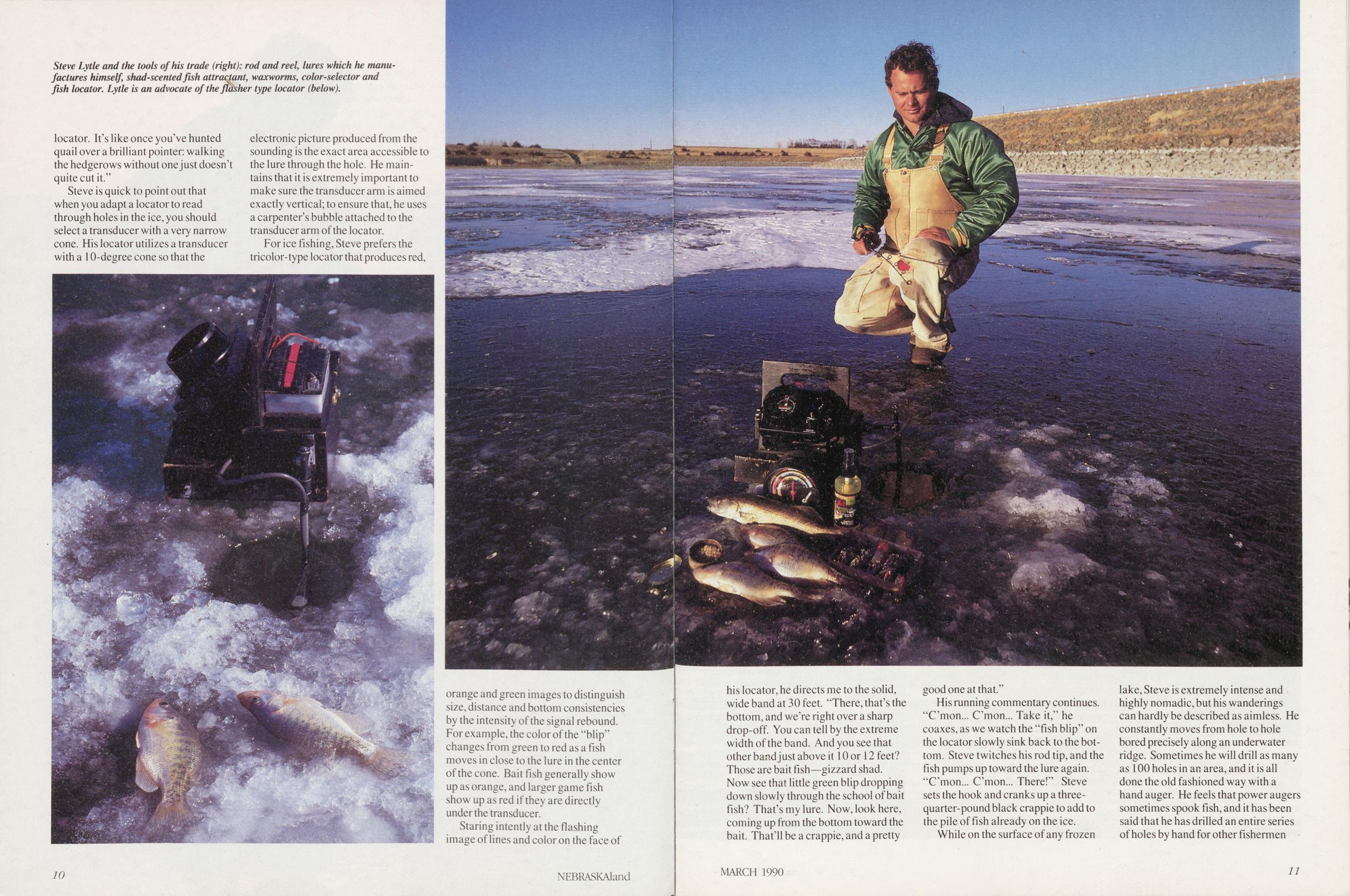
Steve is quick to point out that when you adapt a locator to read through holes in the ice, you should select a transducer with a very narrow cone. His locator utilizes a transducer with a 10-degree cone so that the electronic picture produced from the sounding is the exact area accessible to the lure through the hole. He maintains that it is extremely important to make sure the transducer arm is aimed exactly vertical; to ensure that, he uses a carpenter's bubble attached to the transducer arm of the locator.
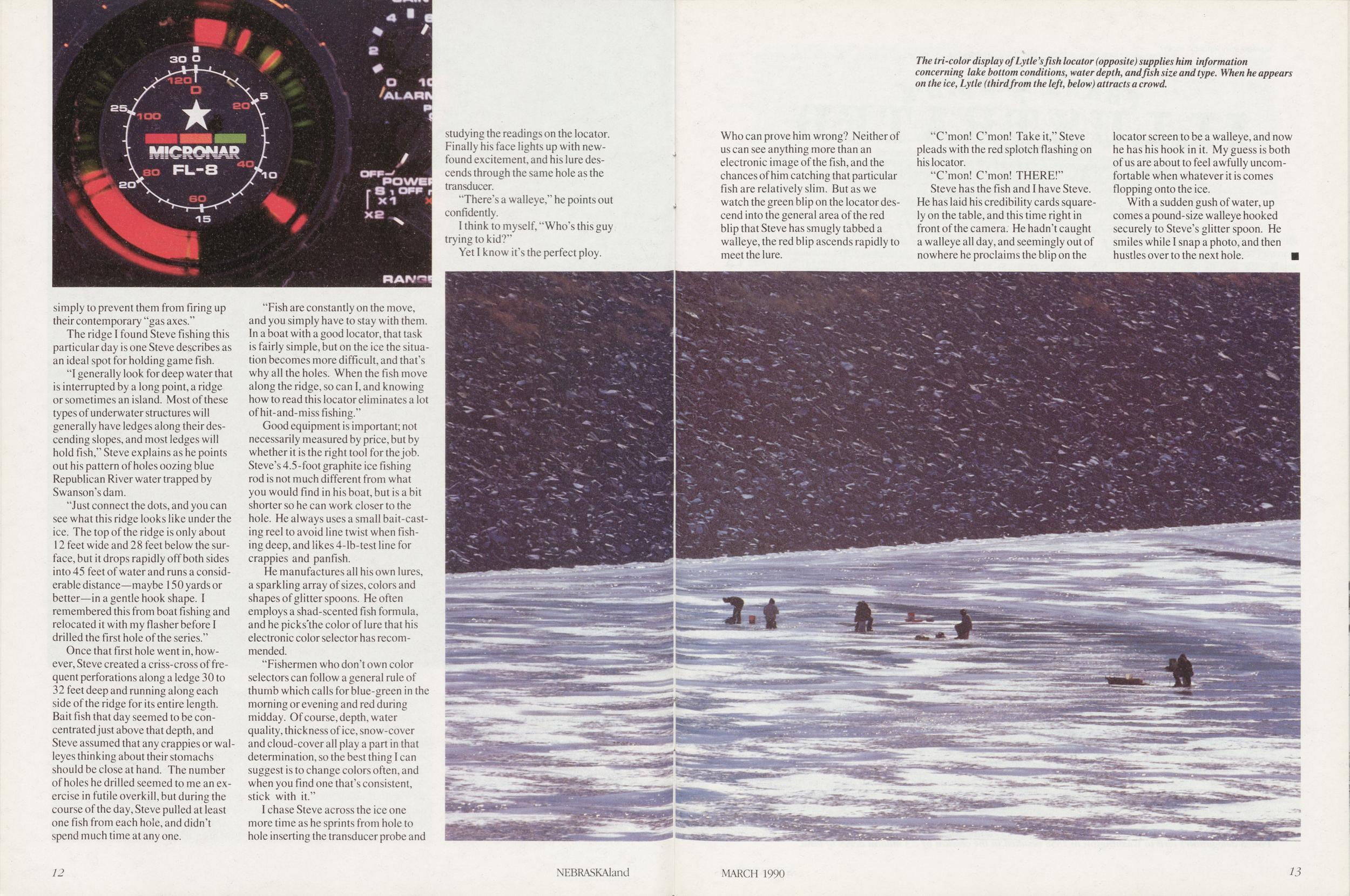
For ice fishing, Steve prefers the tricolor-type locator that produces red, orange and green images to distinguish size, distance and bottom consistencies by the intensity of the signal rebound. For example, the color of the "blip" changes from green to red as a fish moves in close to the lure in the center of the cone. Bait fish generally show up as orange, and larger game fish show up as red if they are directly under the transducer.
Staring intently at the flashing image of lines and color on the face of
his locator, he directs me to the solid, wide band at 30 feet. "There, that's the bottom, and we're right over a sharp drop-off. You can tell by the extreme width of the band. And you see that other band just above it 10 or 12 feet? Those are bait fish—gizzard shad. Now see that little green blip dropping down slowly through the school of bait fish? That's my lure. Now, look here, coming up from the bottom toward the bait. That'll be a crappie, and a pretty good one at that.
His running commentary continues. "C'mon... C'mon... Take it," he coaxes, as we watch the "fish blip" on the locator slowly sink back to the bottom. Steve twitches his rod tip, and the fish pumps up toward the lure again. "C'mon... C'mon... There!" Steve sets the hook and cranks up a three-quarter-pound black crappie to add to the pile offish already on the ice.
While on the surface of any frozen
lake, Steve is extremely intense and
highly nomadic, but his wanderings
can hardly be described as aimless. He
constantly moves from hole to hole
bored precisely along an underwater
ridge. Sometimes he will drill as many
as 100 holes in an area, and it is all
done the old fashioned way with a
hand auger. He feels that power augers
sometimes spook fish, and it has been
said that he has drilled an entire series
of holes by hand for other fishermen
MARCH 1990
11
The ridge I found Steve fishing this particular day is one Steve describes as an ideal spot for holding game fish.
"I generally look for deep water that is interrupted by a long point, a ridge or sometimes an island. Most of these types of underwater structures will generally have ledges along their descending slopes, and most ledges will hold fish," Steve explains as he points out his pattern of holes oozing blue Republican River water trapped by Swanson'sdam.
"Just connect the dots, and you can see what this ridge looks like under the ice. The top of the ridge is only about 12 feet wide and 28 feet below the surface, but it drops rapidly off both sides into 45 feet of water and runs a considerable distance—maybe 150 yards or better—in a gentle hook shape. I remembered this from boat fishing and relocated it with my flasher before I drilled the first hole of the series."
Once that first hole went in, however, Steve created a criss-cross of frequent perforations along a ledge 30 to 32 feet deep and running along each side of the ridge for its entire length. Bait fish that day seemed to be concentrated just above that depth, and Steve assumed that any crappies or walleyes thinking about their stomachs should be close at hand. The number of holes he drilled seemed to me an exercise in futile overkill, but during the course of the day, Steve pulled at least one fish from each hole, and didn't spend much time at any one.
"Fish are constantly on the move, and you simply have to stay with them. In a boat with a good locator, that task is fairly simple, but on the ice the situation becomes more difficult, and that's why all the holes. When the fish move along the ridge, so can I, and knowing how to read this locator eliminates a lot of hit-and-miss fishing."
Good equipment is important; not necessarily measured by price, but by whether it is the right tool for the job. Steve's 4.5-foot graphite ice fishing rod is not much different from what you would find in his boat, but is a bit shorter so he can work closer to the hole. He always uses a small bait-casting reel to avoid line twist when fishing deep, and likes 4-lb-test line for crappies and panfish.
He manufactures all his own lures, a sparkling array of sizes, colors and shapes of glitter spoons. He often employs a shad-scented fish formula, and he picks'the color of lure that his electronic color selector has recommended.
"Fishermen who don't own color selectors can follow a general rule of thumb which calls for blue-green in the morning or evening and red during midday. Of course, depth, water quality, thickness of ice, snow-cover and cloud-cover all play a part in that determination, so the best thing I can suggest is to change colors often, and when you find one that's consistent, stick with it."
"Fishermen who don't own color selectors can follow a general rule of thumb which calls for blue-green in the morning or evening and red during midday. Of course, depth, water quality, thickness of ice, snow-cover and cloud-cover all play a part in that determination, so the best thing I can suggest is to change colors often, and when you find one that's consistent, stick with it."
I chase Steve across the ice one more time as he sprints from hole to hole inserting the transducer probe and studying the readings on the locator. Finally his face lights up with newfound excitement, and his lure descends through the same hole as the transducer.
"There's a walleye," he points out confidently.
I think to myself, "Who's this guy trying to kid?"
Yet I know it's the perfect ploy. 12 NEBRASKAland Who can prove him wrong? Neither of us can see anything more than an electronic image of the fish, and the chances of him catching that particular fish are relatively slim. But as we watch the green blip on the locator descend into the general area of the red blip that Steve has smugly tabbed a walleye, the red blip ascends rapidly to meet the lure.
"C'mon! C'mon! Take it," Steve pleads with the red splotch flashing on his locator.
"C'mon! C'mon! THERE!"
Steve has the fish and I have Steve. He has laid his credibility cards squarely on the table, and this time right in front of the camera. He hadn't caught a walleye all day, and seemingly out of nowhere he proclaims the blip on the locator screen to be a walleye, and now he has his hook in it. My guess is both of us are about to feel awfully uncomfortable when whatever it is comes flopping onto the ice.
With a sudden gush of water, up comes a pound-size walleye hooked securely to Steve's glitter spoon. He smiles while I snap a photo, and then hustles over to the next hole.
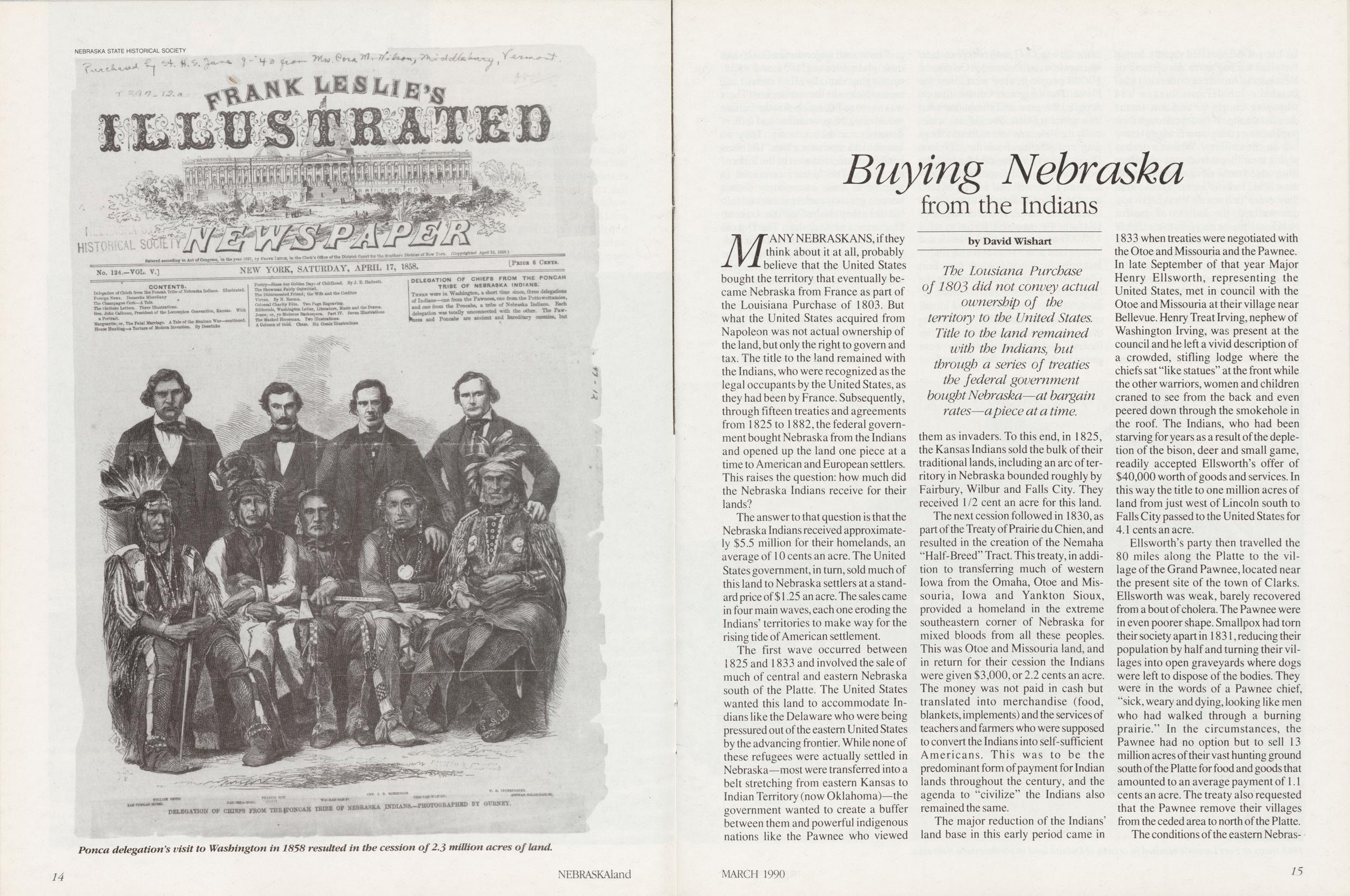
Buying Nebraska from the Indians
by David Wishart The Lousiana Purchase of 1803 did not convey actual ownership of the territory to the United States. Title to the land remained with the Indians, hut through a series of treaties the federal government bought Nebraska—at bargain rates—apiece at a time.MANY NEBRASKANS, if they think about it at all, probably believe that the United States bought the territory that eventually became Nebraska from France as part of the Louisiana Purchase of 1803. But what the United States acquired from Napoleon was not actual ownership of the land, but only the right to govern and tax. The title to the land remained with the Indians, who were recognized as the legal occupants by the United States, as they had been by France. Subsequently, through fifteen treaties and agreements from 1825 to 1882, the federal government bought Nebraska from the Indians and opened up the land one piece at a time to American and European settlers. This raises the question: how much did the Nebraska Indians receive for their lands?
The answer to that question is that the Nebraska Indians received approximately $5.5 million for their homelands, an average of 10 cents an acre. The United States government, in turn, sold much of this land to Nebraska settlers at a standard price of $ 1.25 an acre. The sales came in four main waves, each one eroding the Indians' territories to make way for the rising tide of American settlement.
The first wave occurred between 1825 and 1833 and involved the sale of much of central and eastern Nebraska south of the Platte. The United States wanted this land to accommodate Indians like the Delaware who were being pressured out of the eastern United States by the advancing frontier. While none of these refugees were actually settled in Nebraska—most were transferred into a belt stretching from eastern Kansas to Indian Territory (now Oklahoma)—the government wanted to create a buffer between them and powerful indigenous nations like the Pawnee who viewed them as invaders. To this end, in 1825, the Kansas Indians sold the bulk of their traditional lands, including an arc of territory in Nebraska bounded roughly by Fairbury, Wilbur and Falls City. They received 1/2 cent an acre for this land.
The next cession followed in 1830, as part of the Treaty of Prairie du Chien, and resulted in the creation of the Nemaha "Half-Breed" Tract. This treaty, in addition to transferring much of western Iowa from the Omaha, Otoe and Missouria, Iowa and Yankton Sioux, provided a homeland in the extreme southeastern corner of Nebraska for mixed bloods from all these peoples. This was Otoe and Missouria land, and in return for their cession the Indians were given $3,000, or 2.2 cents an acre. The money was not paid in cash but translated into merchandise (food, blankets, implements) and the services of teachers and farmers who were supposed to convert the Indians into self-sufficient Americans. This was to be the predominant form of payment for Indian lands throughout the century, and the agenda to "civilize" the Indians also remained the same.
The major reduction of the Indians' land base in this early period came in 1833 when treaties were negotiated with the Otoe and Missouria and the Pawnee. In late September of that year Major Henry Ellsworth, representing the United States, met in council with the Otoe and Missouria at their village near Bellevue. Henry Treat Irving, nephew of Washington Irving, was present at the council and he left a vivid description of a crowded, stifling lodge where the chiefs sat "like statues" at the front while the other warriors, women and children craned to see from the back and even peered down through the smokehole in the roof. The Indians, who had been starving for years as a result of the depletion of the bison, deer and small game, readily accepted Ellsworth's offer of $40,000 worth of goods and services. In this way the title to one million acres of land from just west of Lincoln south to Falls City passed to the United States for 4.1 cents an acre.
Ellsworth's party then travelled the 80 miles along the Platte to the village of the Grand Pawnee, located near the present site of the town of Clarks. Ellsworth was weak, barely recovered from a bout of cholera. The Pawnee were in even poorer shape. Smallpox had torn their society apart in 1831, reducing their population by half and turning their villages into open graveyards where dogs were left to dispose of the bodies. They were in the words of a Pawnee chief, "sick, weary and dying, looking like men who had walked through a burning prairie." In the circumstances, the Pawnee had no option but to sell 13 million acres of their vast hunting ground south of the Platte for food and goods that amounted to an average payment of 1.1 cents an acre. The treaty also requested that the Pawnee remove their villages from the ceded area to north of the Platte.
The conditions of the eastern Nebraska
MARCH 1990
15
 Indians deteriorated rapidly during
the years leading up to the opening of
Nebraska to American settlers in 1854.
Diseases—cholera, influenza and
whooping cough, in addition to the
dreaded smallpox—swept through their
populations, taking a particularly heavy
toll on the children. Whiskey dealers
plying their illegal trade out of eastern
Iowa added to the devastation and took
most of the Indians' annuities as soon as
they were delivered. Weakened and
demoralized, the Indians of eastern
Nebraska became easy prey to the Oglala
and Brule Dakota (the Sioux) who, being
more remote, had escaped the worst
ravages of disease and had actually
grown in power. The Indians were caught
in a vise, especially after 1843 when the
floodplain of the Platte became the highway to Oregon. This led to the isolated
Pawnee cession of 1848.
Indians deteriorated rapidly during
the years leading up to the opening of
Nebraska to American settlers in 1854.
Diseases—cholera, influenza and
whooping cough, in addition to the
dreaded smallpox—swept through their
populations, taking a particularly heavy
toll on the children. Whiskey dealers
plying their illegal trade out of eastern
Iowa added to the devastation and took
most of the Indians' annuities as soon as
they were delivered. Weakened and
demoralized, the Indians of eastern
Nebraska became easy prey to the Oglala
and Brule Dakota (the Sioux) who, being
more remote, had escaped the worst
ravages of disease and had actually
grown in power. The Indians were caught
in a vise, especially after 1843 when the
floodplain of the Platte became the highway to Oregon. This led to the isolated
Pawnee cession of 1848.
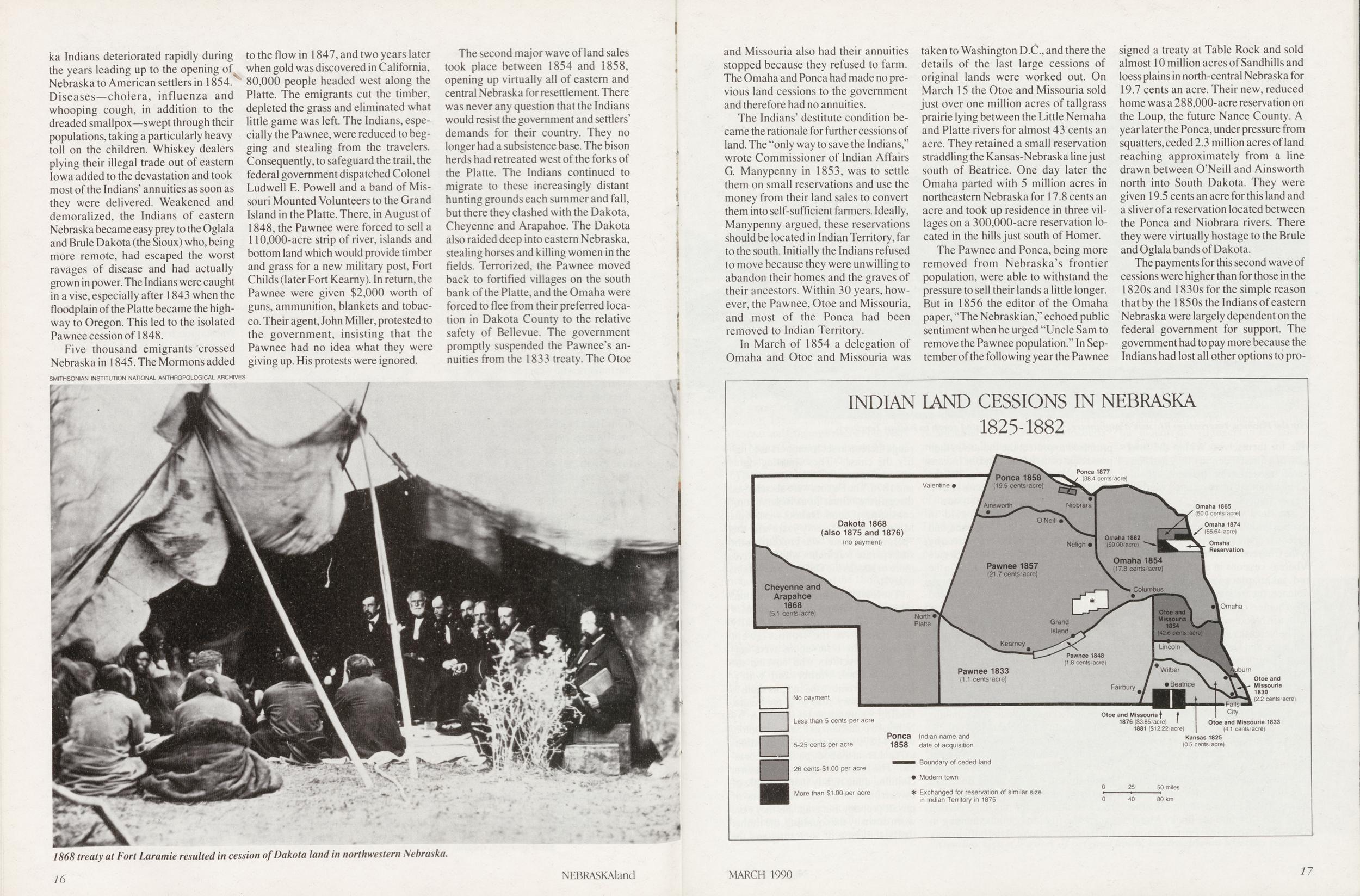
Five thousand emigrants crossed Nebraska in 1845. The Mormons added to the flow in 1847, and two years later when gold was discovered in California, 80,000 people headed west along the Platte. The emigrants cut the timber, depleted the grass and eliminated what little game was left. The Indians, especially the Pawnee, were reduced to begging and stealing from the travelers. Consequently, to safeguard the trail, the federal government dispatched Colonel Ludwell E. Powell and a band of Missouri Mounted Volunteers to the Grand Island in the Platte. There, in August of 1848, the Pawnee were forced to sell a 110,000-acre strip of river, islands and bottom land which would provide timber and grass for a new military post, Fort Childs (later Fort Kearny). In return, the Pawnee were given $2,000 worth of guns, ammunition, blankets and tobacco. Their agent, John Miller, protested to the government, insisting that the Pawnee had no idea what they were giving up. His protests were ignored.
The second major wave of land sales took place between 1854 and 1858, opening up virtually all of eastern and central Nebraska for resettlement. There was never any question that the Indians would resist the government and settlers' demands for their country. They no longer had a subsistence base. The bison herds had retreated west of the forks of the Platte. The Indians continued to migrate to these increasingly distant hunting grounds each summer and fall, but there they clashed with the Dakota, Cheyenne and Arapahoe. The Dakota also raided deep into eastern Nebraska, stealing horses and killing women in the fields. Terrorized, the Pawnee moved back to fortified villages on the south bank of the Platte, and the Omaha were forced to flee from their preferred location in Dakota County to the relative safety of Bellevue. The government promptly suspended the Pawnee's annuities from the 1833 treaty. The Otoe 16 NEBRASKAland and Missouria also had their annuities stopped because they refused to farm. The Omaha and Ponca had made no previous land cessions to the government and therefore had no annuities.
The Indians' destitute condition became the rationale for further cessions of land. The "only way to save the Indians," wrote Commissioner of Indian Affairs G. Manypenny in 1853, was to settle them on small reservations and use the money from their land sales to convert them into self-sufficient farmers. Ideally, Manypenny argued, these reservations should be located in Indian Territory, far to the south. Initially the Indians refused to move because they were unwilling to abandon their homes and the graves of their ancestors. Within 30 years, however, the Pawnee, Otoe and Missouria, and most of the Ponca had been removed to Indian Territory.
In March of 1854 a delegation of Omaha and Otoe and Missouria was taken to Washington D.C., and there the details of the last large cessions of original lands were worked out. On March 15 the Otoe and Missouria sold just over one million acres of tallgrass prairie lying between the Little Nemaha and Platte rivers for almost 43 cents an acre. They retained a small reservation straddling the Kansas-Nebraska line just south of Beatrice. One day later the Omaha parted with 5 million acres in northeastern Nebraska for 17.8 cents an acre and took up residence in three villages on a 300,000-acre reservation located in the hills just south of Homer.
The Pawnee and Ponca, being more removed from Nebraska's frontier population, were able to withstand the pressure to sell their lands a little longer. But in 1856 the editor of the Omaha paper, "The Nebraskian," echoed public sentiment when he urged "Uncle Sam to remove the Pawnee population." In September of the following year the Pawnee signed a treaty at Table Rock and sold almost 10 million acres of Sandhills and loess plains in north-central Nebraska for 19.7 cents an acre. Their new, reduced home was a 288,000-acre reservation on the Loup, the future Nance County. A year later the Ponca, under pressure from squatters, ceded 2.3 million acres of land reaching approximately from a line drawn between O'Neill and Ainsworth north into South Dakota. They were given 19.5 cents an acre for this land and a sliver of a reservation located between the Ponca and Niobrara rivers. There they were virtually hostage to the Brule and Oglala bands of Dakota.
The payments for this second wave of cessions were higher than for those in the 1820s and 1830s for the simple reason that by the 1850s the Indians of eastern Nebraska were largely dependent on the federal government for support. The government had to pay more because the Indians had lost all other options to provide
The third wave of land sales took place in the late 1860s and involved the surrender of the western part of the state by the Cheyenne, Arapahoe and Dakota. Whereas cessions in eastern Nebraska had taken place with little actual violence, the treaties with the powerful bison hunters of the western plains were written in blood.
The Nebraska lands of the Cheyenne, Arapahoe and Dakota were only a portion of their vast hunting grounds that had been recognized and defined at the first treaty of Fort Laramie in 1851. The Dakota lands stretched up from the Platte through their main holy site, the Black Hills, on to the sagebrush plains of Wyoming and Montana where buffalo, elk, deer, bear and small game were abundant. The hunting grounds of the Cheyenne and Arapahoe extended south from the Platte over the short-grass prairies of me high plains to the Arkansas River, and west into the Rocky Mountains. The treaty of Fort Laramie promised to protect the Indians in their possession of their lands, and the Indians in turn acknowledged the right of the United States to build roads across them, as well as forts to defend those roads.
After the discovery of gold in Colorado in 1858, the Cheyenne and Arapahoes' bison range was overrun by emigrants. Tensions built on each side and erupted on November 19,1864 in the Sand Creek Massacre. Totally demoralized by this atrocity, the Cheyenne and Arapahoe surrendered their hunting grounds through treaties in 1865,1867 and 1868, and eventually settled on a reservation on the arid plains of western Indian Territory. As a result, southwestern Nebraska became the property of the United States for 5.1 cents an acre.
The Dakota ceded their hunting range, including the plains and Sandhills of northwestern Nebraska on April 29, 1868 at the second treaty of Fort Laramie. The treaty ended the Powder War which had flared up following the establishment in 1865 of the Bozeman Trail to the Montana mines. The Dakota received nothing for this huge cession except the right to continue hunting in the territory "so long as the buffalo may range thereon in such numbers as to justify the chase." These hunting rights were subsequently withdrawn in 1875 and 1876. The Dakota were also allowed to retain the "Great Sioux Reservation," consisting of South Dakota west of the Missouri River. Twenty years later this "permanent home" was broken into the six separate fragments which survive, more or less, as the Dakota reservations today.
The fourth, and final wave of cessions came after 1865 when the reservations of eastern Nebraska were virtually eliminated. As the frontier swept westward, the reservations were surrounded by settlers who coveted the Indians' land, timber and water. Demands to remove the Indians south to Indian Territory rose to a crescendo, finding expression in speeches by Nebraska politicians like Senator Tipton, who in 1879 compared the reservations to "cankers in the body politic of Nebraska." The Indians resisted this pressure, claiming quite rightly that their title of ownership carried the full rights of private property. But gradually they were worn down by the squatting, the timber thefts, the sense of enclosure, and the 18 NEBRASKAland grinding poverty. By 1882 only the Omaha had managed to hold onto their reservation, and even their lands had been pared by cessions.
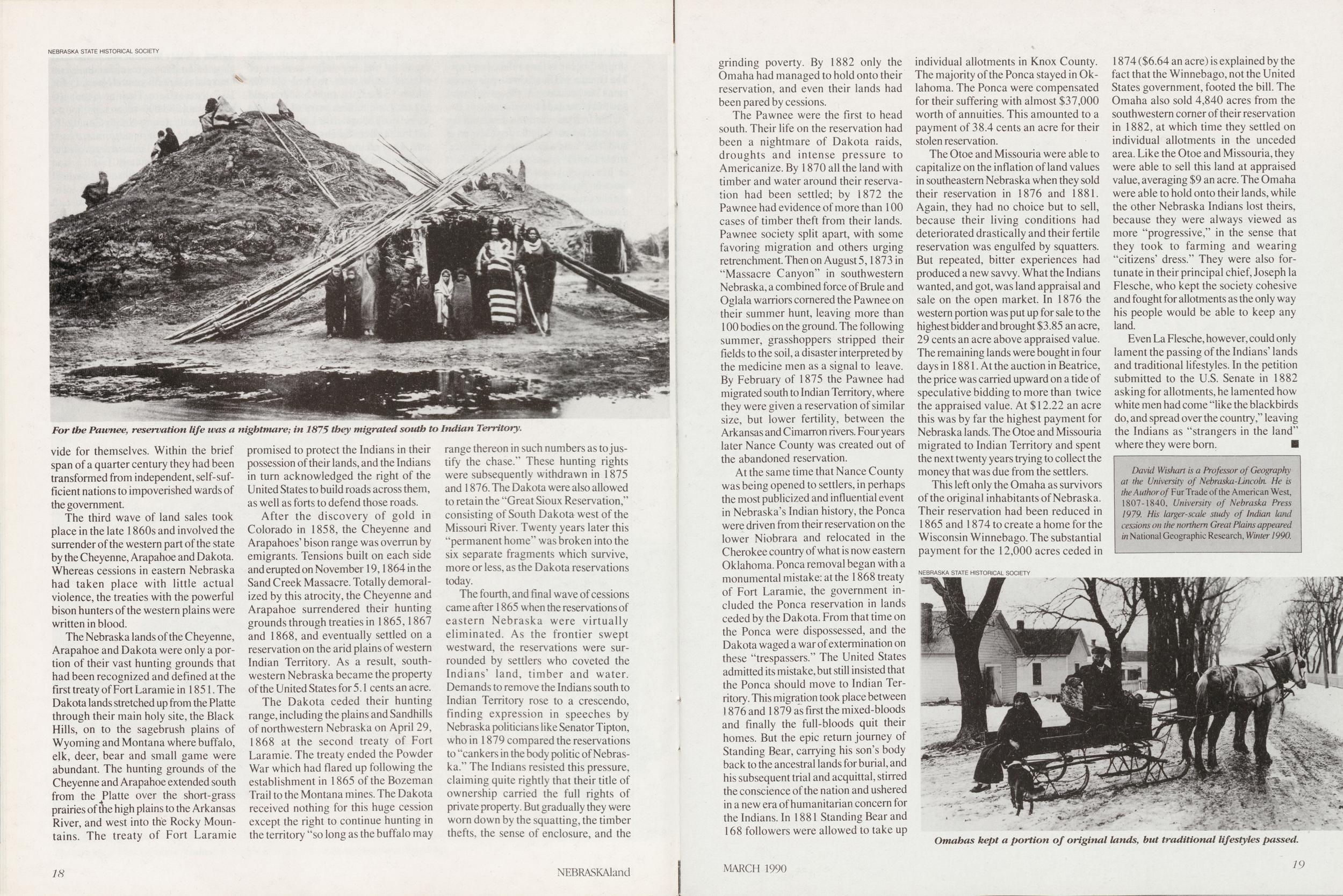
The Pawnee were the first to head south. Their life on the reservation had been a nightmare of Dakota raids, droughts and intense pressure to Americanize. By 1870 all the land with timber and water around their reservation had been settled; by 1872 the Pawnee had evidence of more than 100 cases of timber theft from their lands. Pawnee society split apart, with some favoring migration and others urging retrenchment. Then on August 5,1873 in "Massacre Canyon" in southwestern Nebraska, a combined force of Brule and Oglala warriors cornered the Pawnee on their summer hunt, leaving more than 100 bodies on the ground. The following summer, grasshoppers stripped their fields to the soil, a disaster interpreted by the medicine men as a signal to leave. By February of 1875 the Pawnee had migrated south to Indian Territory, where they were given a reservation of similar size, but lower fertility, between the Arkansas and Cimarron rivers. Four years later Nance County was created out of the abandoned reservation.
At the same time that Nance County was being opened to settlers, in perhaps the most publicized and influential event in Nebraska's Indian history, the Ponca were driven from their reservation on the lower Niobrara and relocated in the Cherokee country of what is now eastern Oklahoma. Ponca removal began with a monumental mistake: at the 1868 treaty of Fort Laramie, the government included the Ponca reservation in lands ceded by the Dakota. From that time on the Ponca were dispossessed, and the Dakota waged a war of extermination on these "trespassers." The United States admitted its mistake, but still insisted that the Ponca should move to Indian Territory. This migration took place between 1876 and 1879 as first the mixed-bloods and finally the full-bloods quit their homes. But the epic return journey of Standing Bear, carrying his son's body back to the ancestral lands for burial, and his subsequent trial and acquittal, stirred the conscience of the nation and ushered in a new era of humanitarian concern for the Indians. In 1881 Standing Bear and 168 followers were allowed to take up individual allotments in Knox County. The majority of the Ponca stayed in Oklahoma. The Ponca were compensated for their suffering with almost $37,000 worth of annuities. This amounted to a payment of 38.4 cents an acre for their stolen reservation.
The Otoe and Missouria were able to capitalize on the inflation of land values in southeastern Nebraska when they sold their reservation in 1876 and 1881. Again, they had no choice but to sell, because their living conditions had deteriorated drastically and their fertile reservation was engulfed by squatters. But repeated, bitter experiences had produced a new savvy. What the Indians wanted, and got, was land appraisal and sale on the open market. In 1876 the western portion was put up for sale to the highest bidder and brought $3.85 an acre, 29 cents an acre above appraised value. The remaining lands were bought in four days in 1881. At the auction in Beatrice, the price was carried upward on a tide of speculative bidding to more than twice the appraised value. At $12.22 an acre this was by far the highest payment for Nebraska lands. The Otoe and Missouria migrated to Indian Territory and spent the next twenty years trying to collect the money that was due from the settlers.
This left only the Omaha as survivors of the original inhabitants of Nebraska. Their reservation had been reduced in 1865 and 1874 to create a home for the Wisconsin Winnebago. The substantial payment for the 12,000 acres ceded in 1874 ($6.64 an acre) is explained by the fact that the Winnebago, not the United States government, footed the bill. The Omaha also sold 4,840 acres from the southwestern corner of their reservation in 1882, at which time they settled on individual allotments in the unceded area. Like the Otoe and Missouria, they were able to sell this land at appraised value, averaging $9 an acre. The Omaha were able to hold onto their lands, while the other Nebraska Indians lost theirs, because they were always viewed as more "progressive," in the sense that they took to farming and wearing "citizens' dress." They were also fortunate in their principal chief, Joseph la Flesche, who kept the society cohesive and fought for allotments as the only way his people would be able to keep any land.
Even La Flesche, however, could only lament the passing of the Indians' lands and traditional lifestyles. In the petition submitted to the U.S. Senate in 1882 asking for allotments, he lamented how white men had come "like the blackbirds do, and spread over the country," leaving the Indians as "strangers in the land" where they were born.
David Wishart is a Professor of Geography at the University of Nebraska-Lincoln. He is the Author of Fur Trade of the American West, 1807-1840, University of Nebraska Press 1979. His larger-scale study of Indian land cessions on the northern Great Plains appeared in National Geographic Research, Winter 1990.
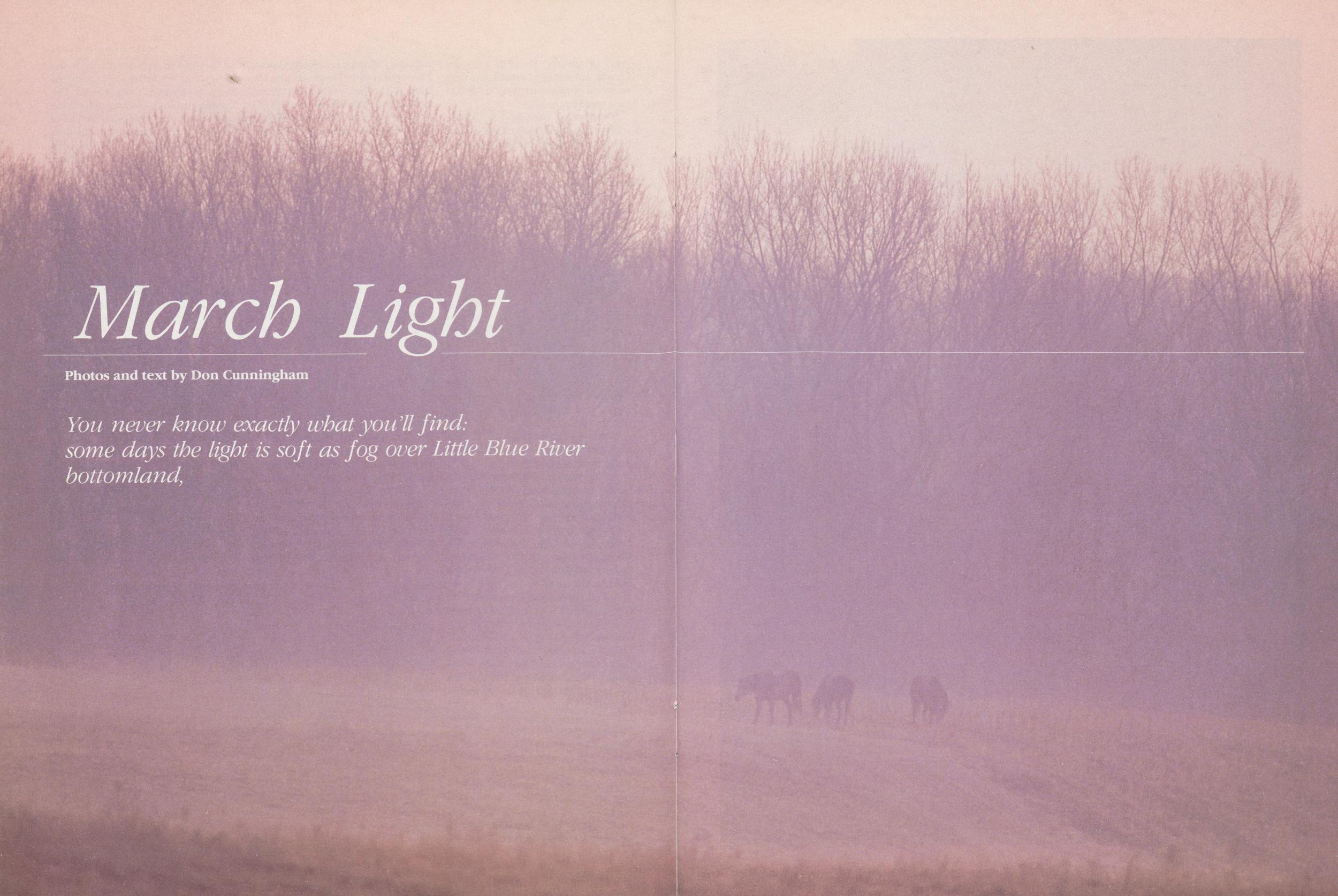
March Light
Photos and text by Don Cunningham You never know exactly what you 7 find: some days the light is soft as fog over Little Blue River bottomland,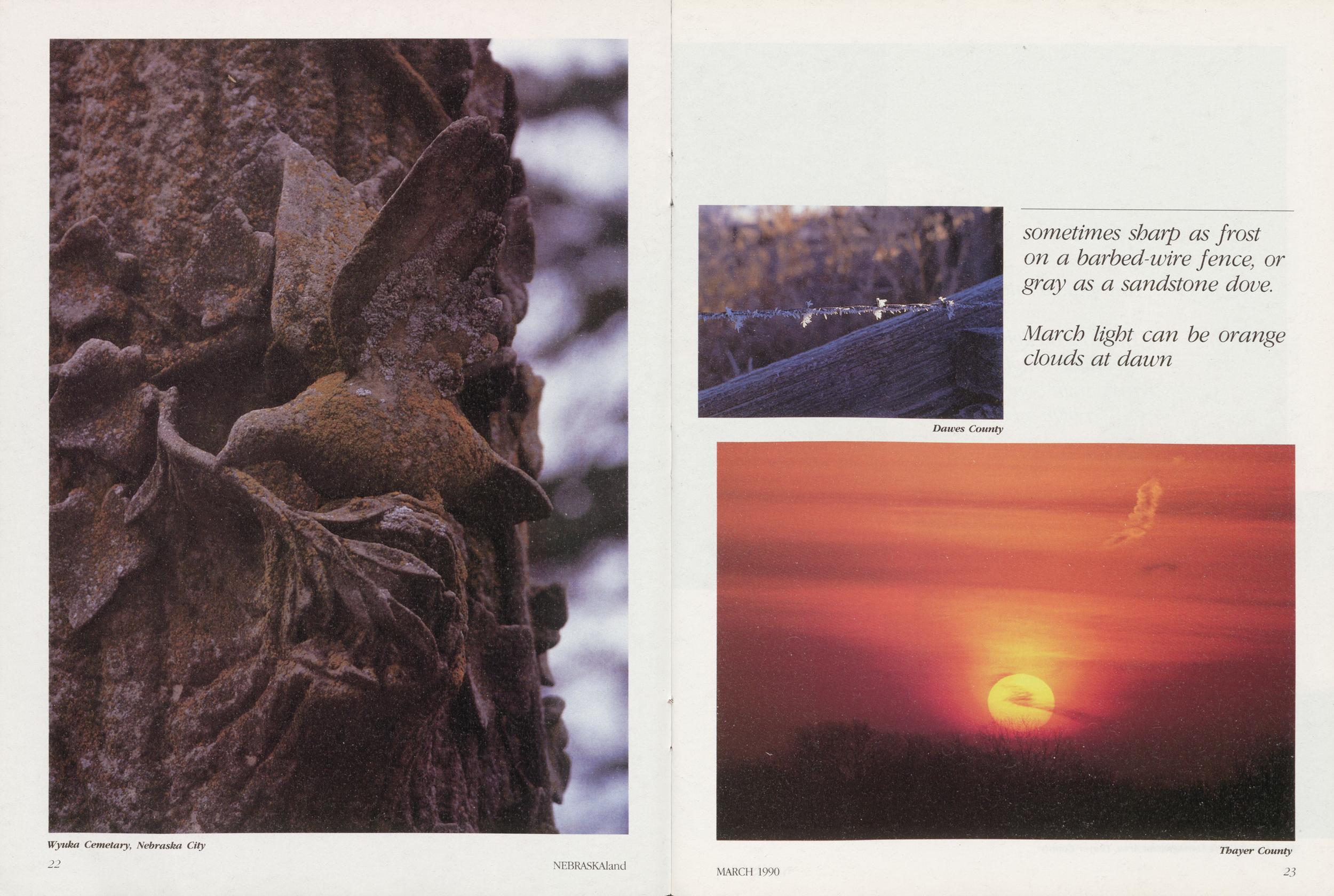
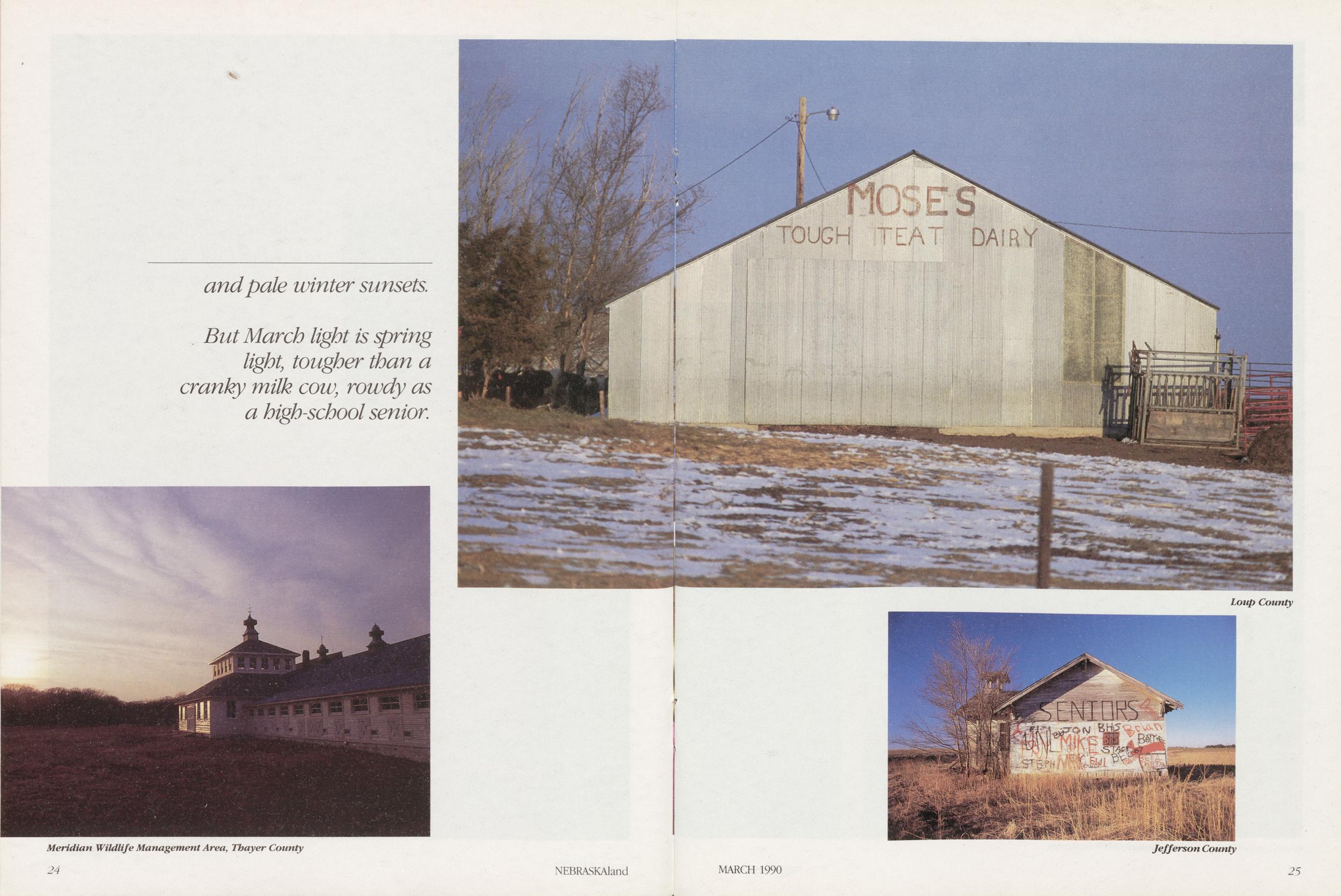 and pale winter sunsets.
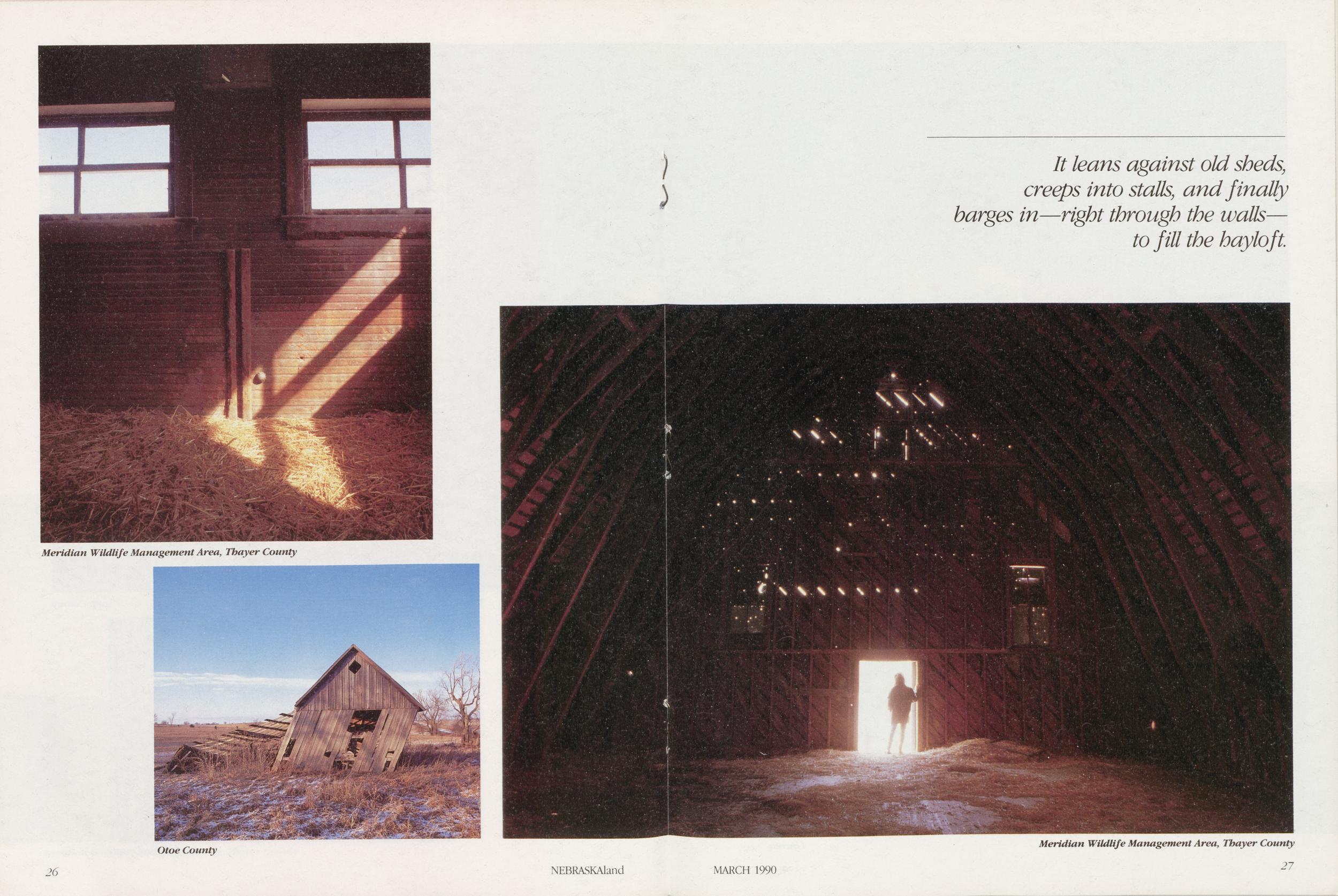
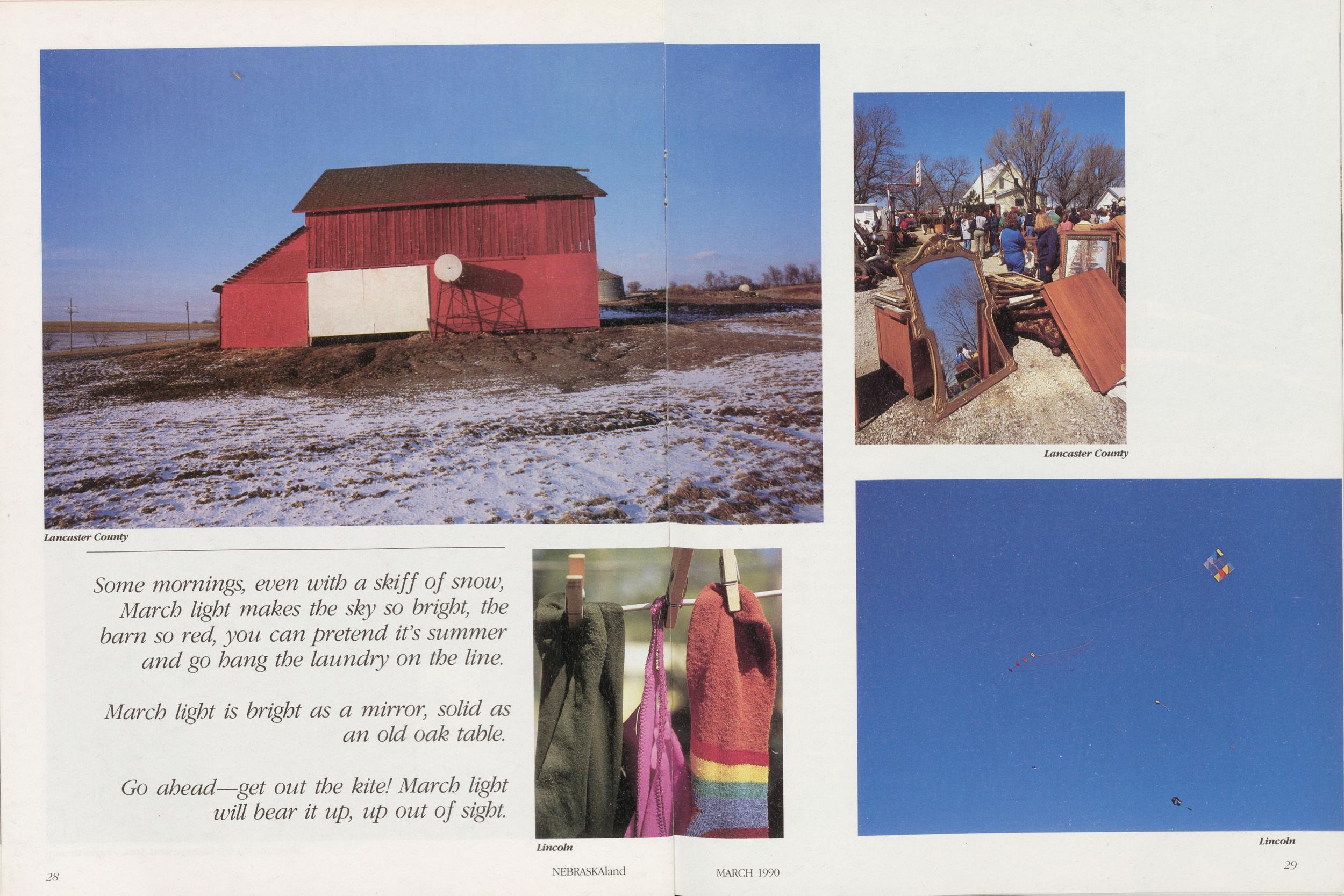
But March light is spring
light, tougher than a
cranky milk cow, rowdy as
a high-school senior.
and pale winter sunsets.
But March light is spring
light, tougher than a
cranky milk cow, rowdy as
a high-school senior.
SHELTER BY THE MILE
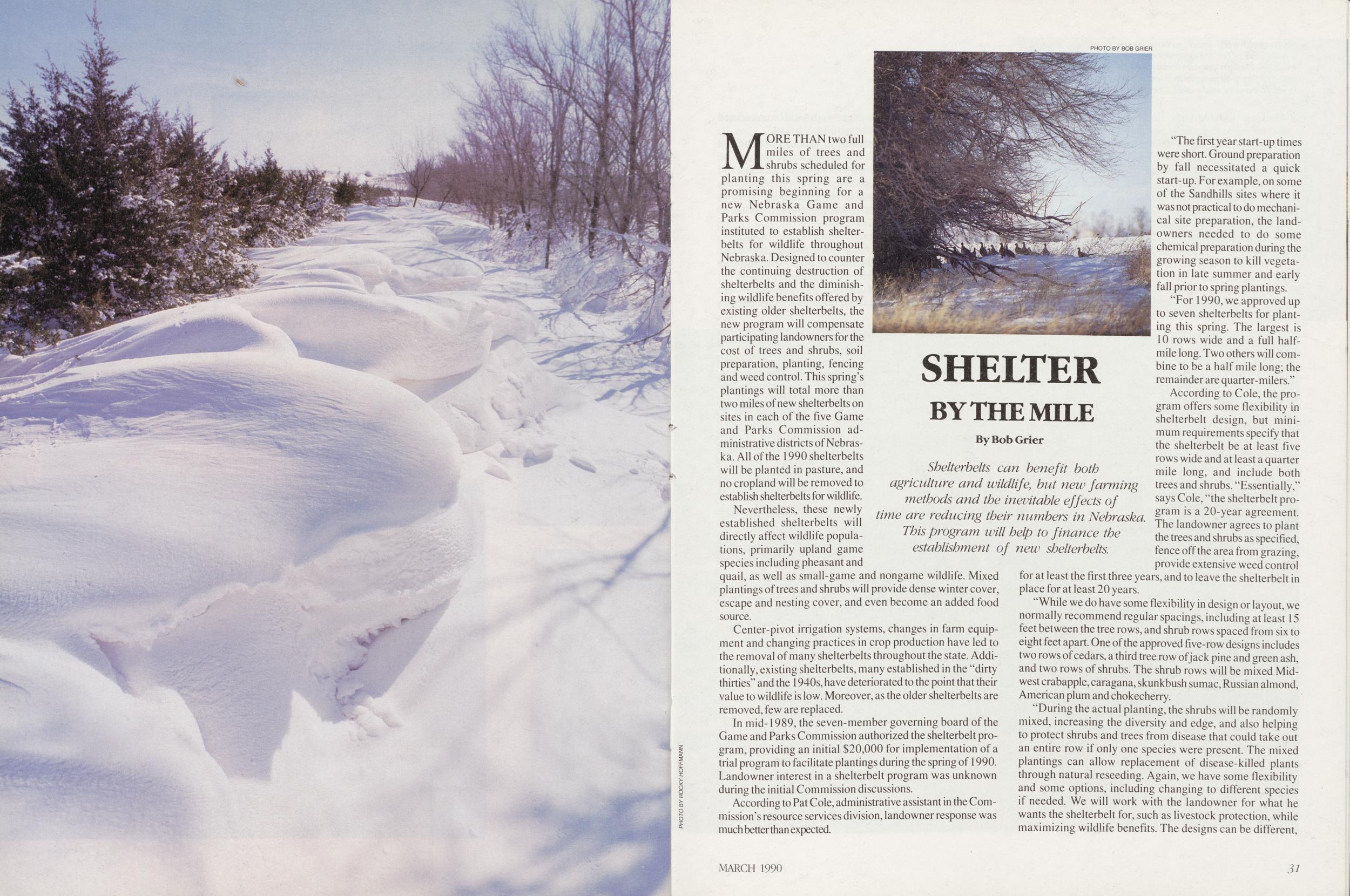
By Bob Grier Shelterbelts can benefit both agriculture and wildlife, but new farming methods and the inevitable effects of time are reducing their numbers in Nebraska. This program will help to finance the establishment of new shelterbelts.MORE THAN two full miles of trees and shrubs scheduled for planting this spring are a promising beginning for a new Nebraska Game and Parks Commission program instituted to establish shelterbelts for wildlife throughout Nebraska. Designed to counter the continuing destruction of shelterbelts and the diminishing wildlife benefits offered by existing older shelterbelts, the new program will compensate participating landowners for the cost of trees and shrubs, soil preparation, planting, fencing and weed control. This spring's plantings will total more than two miles of new shelterbelts on sites in each of the five Game and Parks Commission administrative districts of Nebraska. All of the 1990 shelterbelts will be planted in pasture, and no cropland will be removed to establish shelterbelts for wildlife.
Nevertheless, these newly established shelterbelts will directly affect wildlife populations, primarily upland game species including pheasant and quail, as well as small-game and nongame wildlife. Mixed plantings of trees and shrubs will provide dense winter cover, escape and nesting cover, and even become an added food source.
Center-pivot irrigation systems, changes in farm equipment and changing practices in crop production have led to the removal of many shelterbelts throughout the state. Additionally, existing shelterbelts, many established in the "dirty thirties" and the 1940s, have deteriorated to the point that their value to wildlife is low. Moreover, as the older shelterbelts are removed, few are replaced.
In mid-1989, the seven-member governing board of the Game and Parks Commission authorized the shelterbelt program, providing an initial $20,000 for implementation of a trial program to facilitate plantings during the spring of 1990. Landowner interest in a shelterbelt program was unknown during the initial Commission discussions.
According to Pat Cole, administrative assistant in the Commission's resource services division, landowner response was much better than expected.
"The first year start-up times were short. Ground preparation by fall necessitated a quick start-up. For example, on some of the Sandhills sites where it was not practical to do mechanical site preparation, the landowners needed to do some chemical preparation during the growing season to kill vegetation in late summer and early fall prior to spring plantings.
"For 1990, we approved up to seven shelterbelts for planting this spring. The largest is 10 rows wide and a full half-mile long. Two others will combine to be a half mile long; the remainder are quarter-milers."
According to Cole, the program offers some flexibility in shelterbelt design, but minimum requirements specify that the shelterbelt be at least five rows wide and at least a quarter mile long, and include both trees and shrubs. "Essentially," says Cole, "the shelterbelt pro Shelterbells can benefit both agriculture and wildlife, but new farming methods and the inevitable effects of gram is a 20-year agreement. time are reducing their numbers in Nebraska. |he landowner agres t0 plant This program will help to finance the the trees and shrubs as specified, establishment of new shelterbelts. fence off the area from grazing, provide extensive weed control for at least the first three years, and to leave the shelterbelt in place for at least 20 years.
"While we do have some flexibility in design or layout, we normally recommend regular spacings, including at least 15 feet between the tree rows, and shrub rows spaced from six to eight feet apart. One of the approved five-row designs includes two rows of cedars, a third tree row of jack pine and green ash, and two rows of shrubs. The shrub rows will be mixed Midwest crabapple, caragana, skunkbush sumac, Russian almond, American plum and chokecherry.
"During the actual planting, the shrubs will be randomly mixed, increasing the diversity and edge, and also helping to protect shrubs and trees from disease that could take out an entire row if only one species were present. The mixed plantings can allow replacement of disease-killed plants through natural reseeding. Again, we have some flexibility and some options, including changing to different species if needed. We will work with the landowner for what he wants the shelterbelt for, such as livestock protection, while maximizing wildlife benefits. The designs can be different, and still meet the program's minimum requirements."
MARCH 1990 31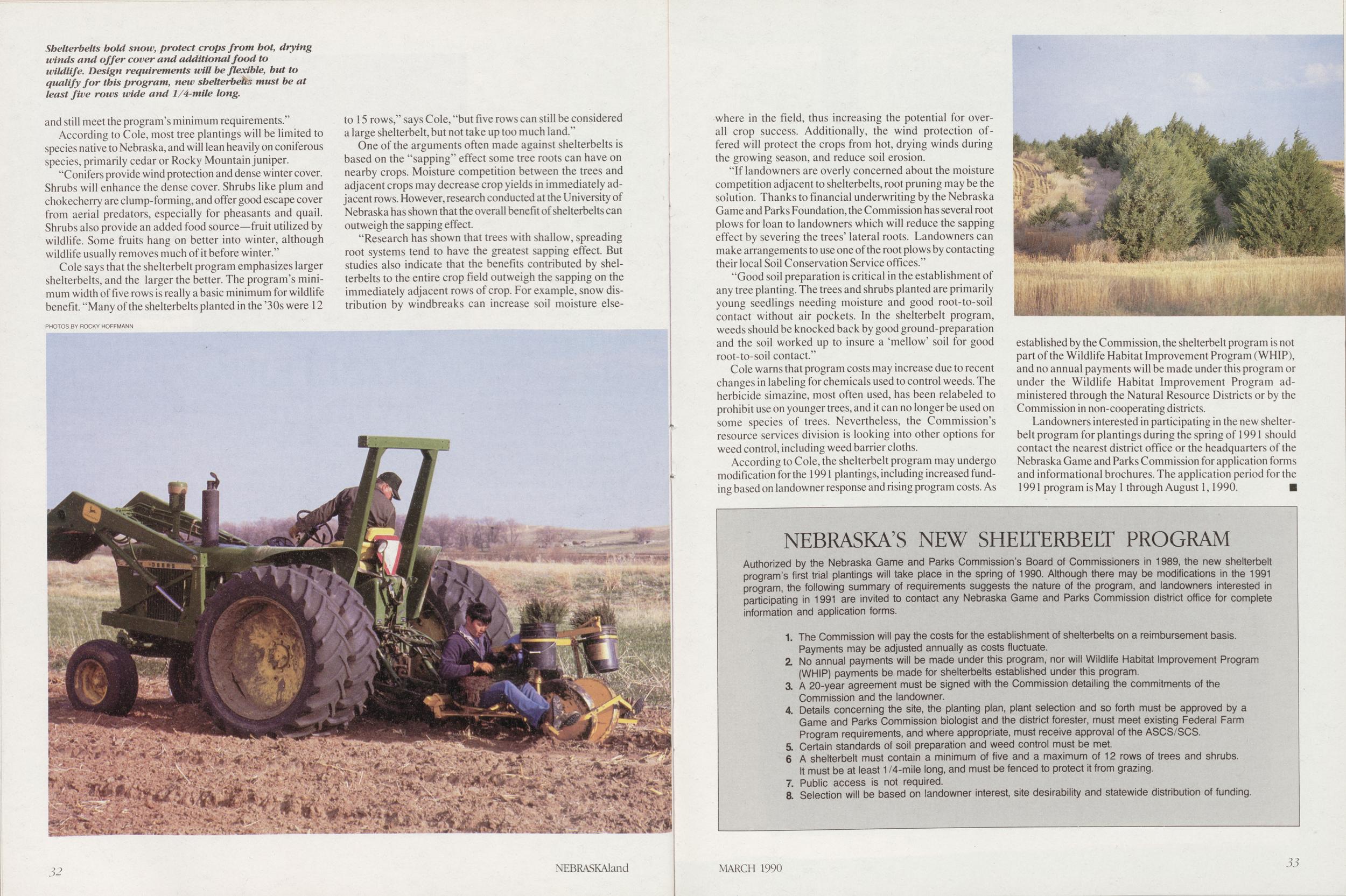 Shelterbelts hold snow, protect crops from hot, drying
winds and offer cover and additional food to
wildlife. Design requirements will he flexible, but to
qualify for this program, new shelterbews must be at
least five rows wide and 1/4-mile long.
Shelterbelts hold snow, protect crops from hot, drying
winds and offer cover and additional food to
wildlife. Design requirements will he flexible, but to
qualify for this program, new shelterbews must be at
least five rows wide and 1/4-mile long.
According to Cole, most tree plantings will be limited to species native to Nebraska, and will lean heavily on coniferous species, primarily cedar or Rocky Mountain juniper.
"Conifers provide wind protection and dense winter cover. Shrubs will enhance the dense cover. Shrubs like plum and chokecherry are clump-forming, and offer good escape cover from aerial predators, especially for pheasants and quail. Shrubs also provide an added food source—fruit utilized by wildlife. Some fruits hang on better into winter, although wildlife usually removes much of it before winter."
Cole says that the shelterbelt program emphasizes larger shelterbelts, and the larger the better. The program's minimum width of five rows is really a basic minimum for wildlife benefit. "Many of the shelterbelts planted in the '30s were 12 to 15 rows," says Cole, "but five rows can still be considered a large shelterbelt, but not take up too much land."
One of the arguments often made against shelterbelts is based on the "sapping" effect some tree roots can have on nearby crops. Moisture competition between the trees and adjacent crops may decrease crop yields in immediately adjacent rows. However, research conducted at the University of Nebraska has shown that the overall benefit of shelterbelts can outweigh the sapping effect.
"Research has shown that trees with shallow, spreading root systems tend to have the greatest sapping effect. But studies also indicate that the benefits contributed by shelterbelts to the entire crop field outweigh the sapping on the immediately adjacent rows of crop. For example, snow distribution by windbreaks can increase soil moisture elsewhere 32 NEBRASKAland where in the field, thus increasing the potential for overall crop success. Additionally, the wind protection offered will protect the crops from hot, drying winds during the growing season, and reduce soil erosion.
"If landowners are overly concerned about the moisture competition adjacent to shelterbelts, root pruning may be the solution. Thanks to financial underwriting by the Nebraska Game and Parks Foundation, the Commission has several root plows for loan to landowners which will reduce the sapping effect by severing the trees' lateral roots. Landowners can make arrangements to use one of the root plows by contacting their local Soil Conservation Service offices."
"Good soil preparation is critical in the establishment of any tree planting. The trees and shrubs planted are primarily young seedlings needing moisture and good root-to-soil contact without air pockets. In the shelterbelt program, weeds should be knocked back by good ground-preparation and the soil worked up to insure a 'mellow' soil for good root-to-soil contact."
Cole warns that program costs may increase due to recent changes in labeling for chemicals used to control weeds. The herbicide simazine, most often used, has been relabeled to prohibit use on younger trees, and it can no longer be used on some species of trees. Nevertheless, the Commission's resource services division is looking into other options for weed control, including weed barrier cloths.
According to Cole, the shelterbelt program may undergo modification for the 1991 plantings, including increased funding based on landowner response and rising program costs. As established by the Commission, the shelterbelt program is not part of the Wildlife Habitat Improvement Program (WHIP), and no annual payments will be made under this program or under the Wildlife Habitat Improvement Program ad- ministered through the Natural Resource Districts or by the Commission in non-cooperating districts.
Landowners interested in participating in the new shelterbelt program for plantings during the spring of 1991 should contact the nearest district office or the headquarters of the Nebraska Game and Parks Commission for application forms and informational brochures. The application period for the 1991 program is May 1 through August 1,1990.
NEBRASKA'S NEW SHELTERBELT PROGRAMAuthorized by the Nebraska Game and Parks Commission's Board of Commissioners in 1989, the new shelterbelt program's first trial plantings will take place in the spring of 1990. Although there may be modifications in the 1991 program, the following summary of requirements suggests the nature of the program, and landowners interested in participating in 1991 are invited to contact any Nebraska Game and Parks Commission district office for complete information and application forms.
1. The Commission will pay the costs for the establishment of shelterbelts on a reimbursement basis. Payments may be adjusted annually as costs fluctuate. 2 No annual payments will be made under this program, nor will Wildlife Habitat Improvement Program (WHIP) payments be made for shelterbelts established under this program. 3 a A 20-year agreement must be signed with the Commission detailing the commitments of the Commission and the landowner. 4 Details concerning the site, the planting plan, plant selection and so forth must be approved by a Game and Parks Commission biologist and the district forester, must meet existing Federal Farm Program requirements, and where appropriate, must receive approval of the ASCS/SCS. 5. Certain standards of soil preparation and weed control must be met 6 A shelterbelt must contain a minimum of five and a maximum of 12 rows of trees and shrubs. It must be at least 1 /4-mile long, and must be fenced to protect it from grazing. 7. Public access is not required. 8. Selection will be based on landowner interest, site desirability and statewide distribution of funding. MARCH 1990 33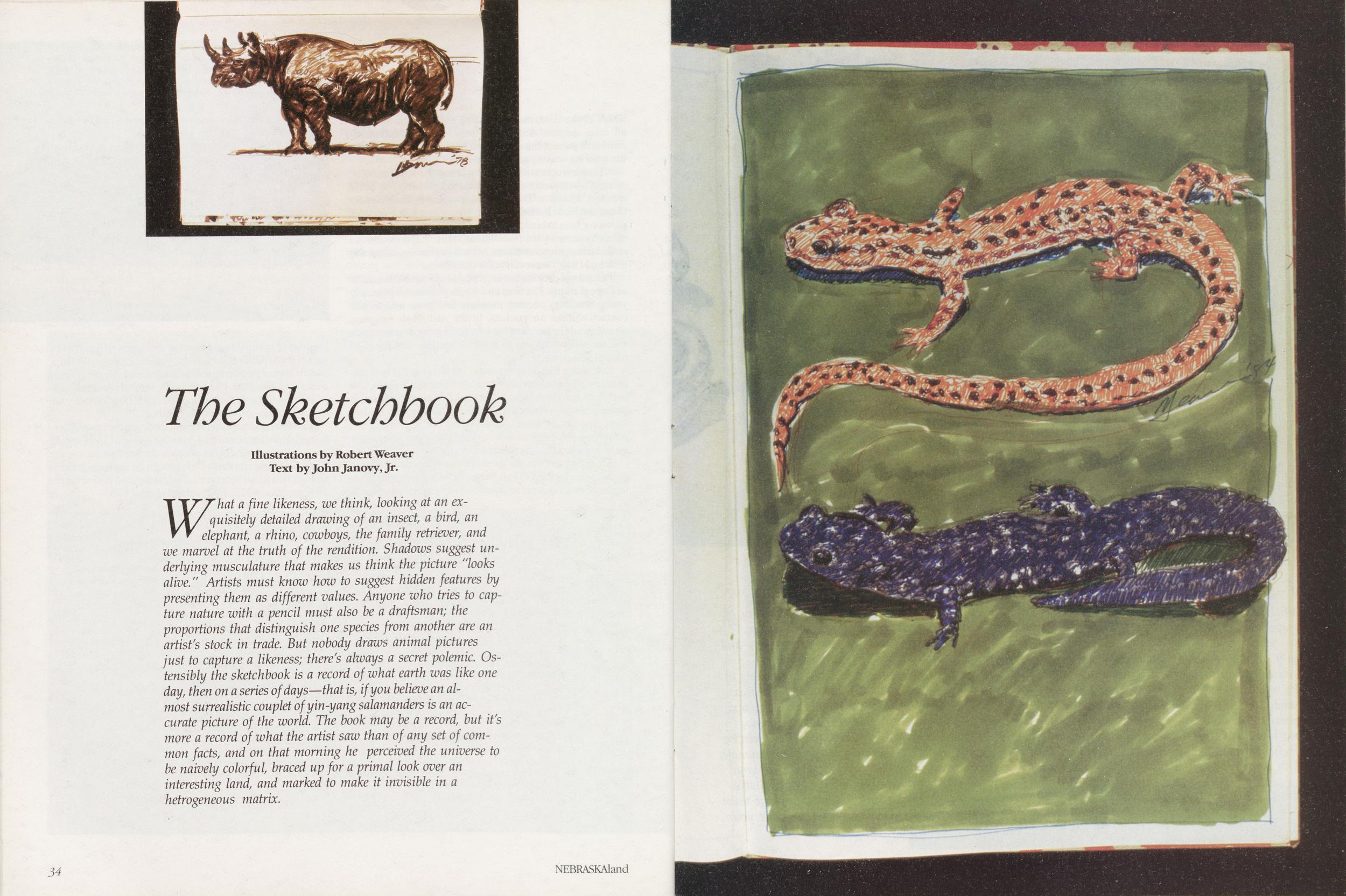
The Sketchbook
Illustrations by Robert Weaver Text by John Janovy, Jr.What a fine likeness, we think, looking at an exquisitely detailed drawing of an insect, a bird, an V y elephant, a rhino, cowboys, the family retriever, and we marvel at the truth of the rendition. Shadows suggest underlying musculature that makes us think the picture "looks alive." Artists must know how to suggest hidden features by presenting them as different values. Anyone who tries to capture nature with a pencil must also be a draftsman; the proportions that distinguish one species from another are an artist's stock in trade. But nobody draws animal pictures just to capture a likeness; there's always a secret polemic. Ostensibly the sketchbook is a record of what earth was like one day, then on a series of days—that is, if you believe an almost surrealistic couplet ofyin-yang salamanders is an accurate picture of the world. The book may be a record, but it's more a record of what the artist saw than of any set of common facts, and on that morning he perceived the universe to be naively colorful, braced up for a primal look over an interesting land, and marked to make it invisible in a hetrogeneous matrix.
34 NEBRASKAland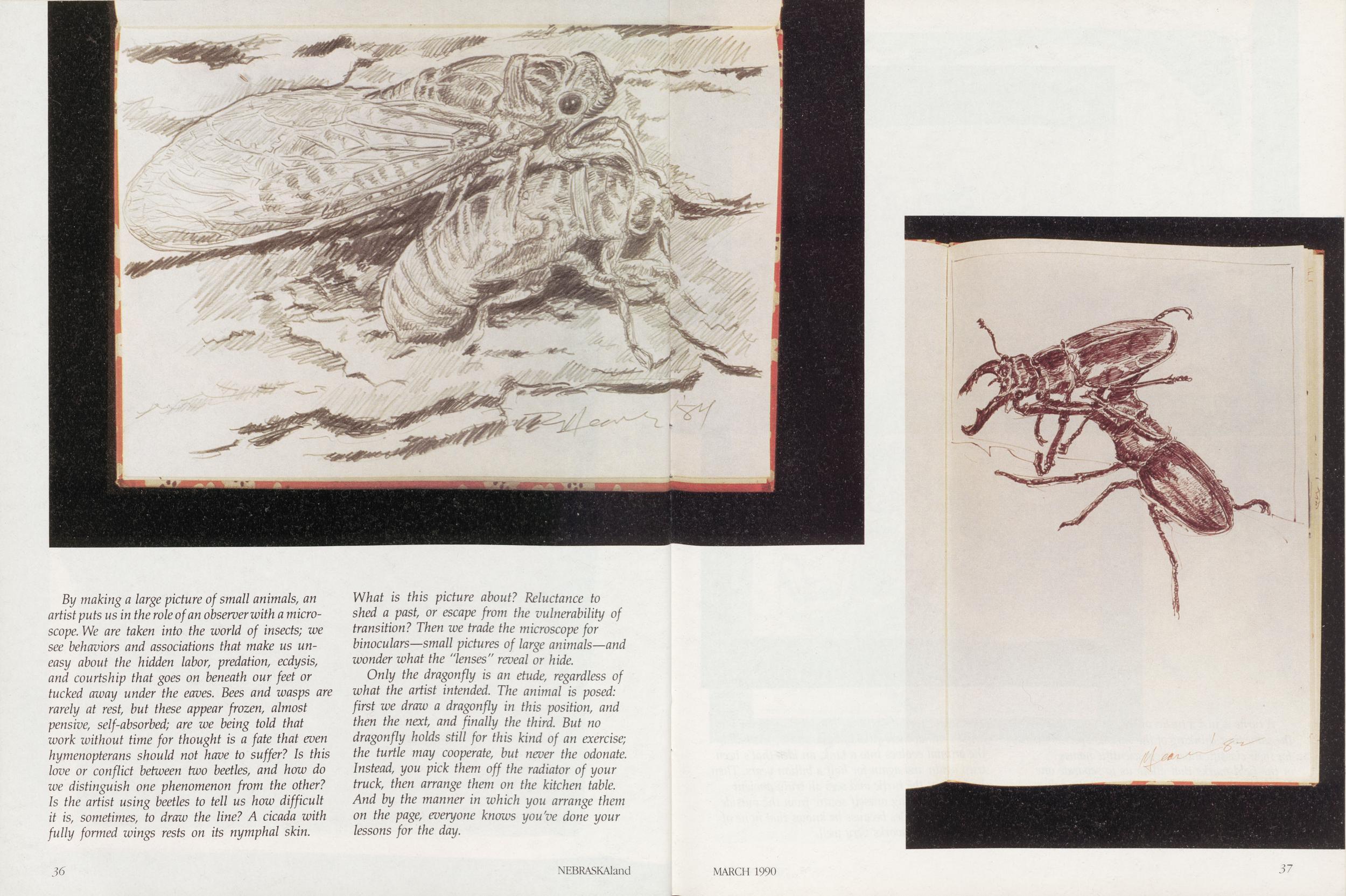
By making a large picture of small animals, an artist puts us in the role of an observer with a microscope. We are taken into the world of insects; we see behaviors and associations that make us uneasy about the hidden labor, predation, ecdysis, and courtship that goes on beneath our feet or tucked away under the eaves. Bees and wasps are rarely at rest, but these appear frozen, almost pensive, self-absorbed; are we being told that work without time for thought is a fate that even hymenopterans should not have to suffer? Is this love or conflict between two beetles, and how do we distinguish one phenomenon from the other? Is the artist using beetles to tell us how difficult it is, sometimes, to draw the line? A cicada with fully formed wings rests on its nymphal skin. What is this picture about? Reluctance to shed a past, or escape from the vulnerability of transition? Then we trade the microscope for binoculars—small pictures of large animals—and wonder what the "lenses" reveal or hide.
Only the dragonfly is an etude, regardless of what the artist intended. The animal is posed: first we draw a dragonfly in this position, and then the next, and finally the third. But no dragonfly holds still for this kind of an exercise; the turtle may cooperate, but never the odonate. Instead, you pick them off the radiator of your truck, then arrange them on the kitchen table. And by the manner in which you arrange them on the page, everyone knows you've done your lessons for the day.
36 NEBRASKAand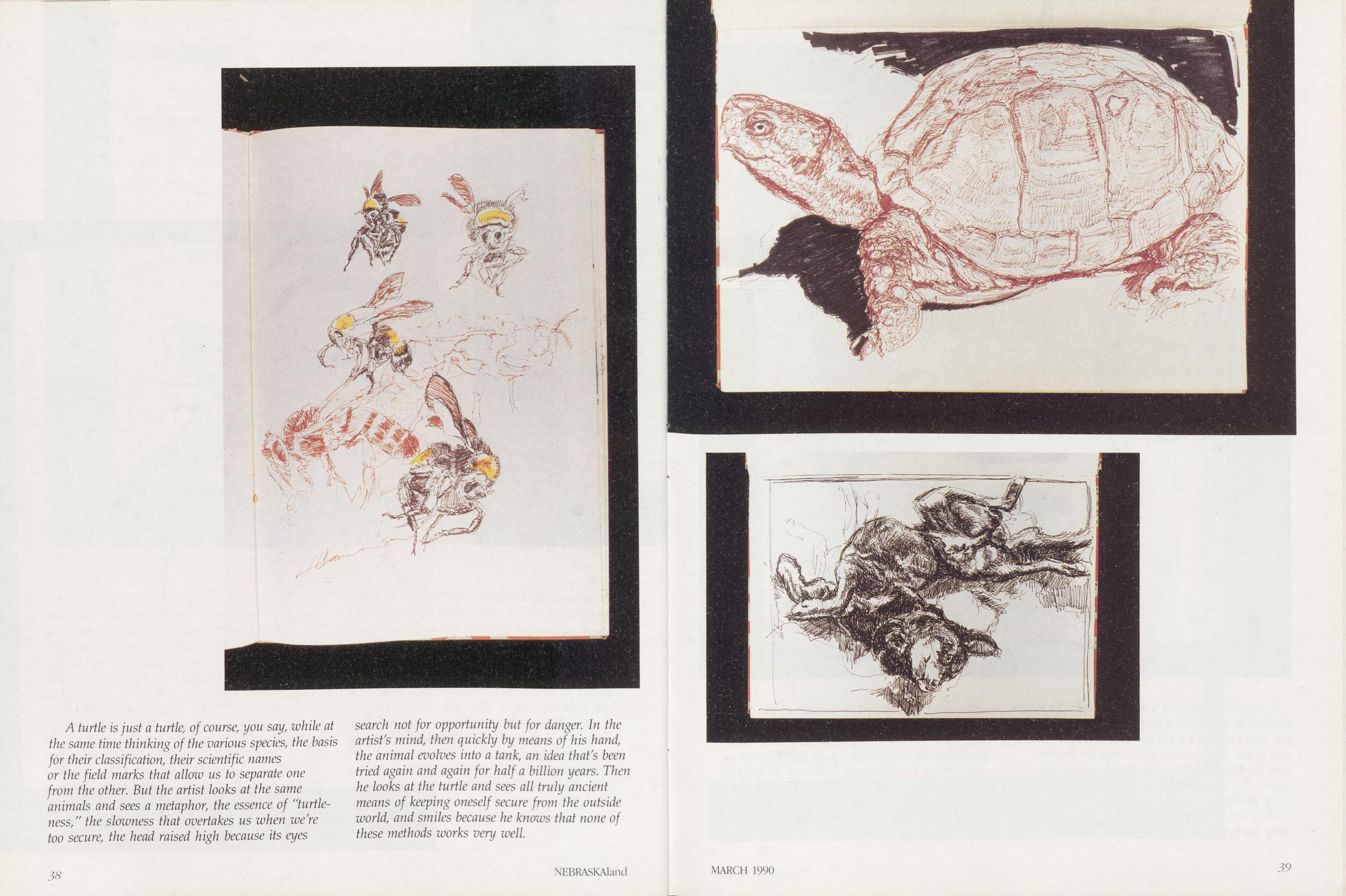
A turtle is just a turtle, of course, you say, while at the same time thinking of the various species, the basis for their classification, their scientific names or the field marks that allow us to separate one from the other. But the artist looks at the same animals and sees a metaphor, the essence of "turtleness," the slowness that overtakes us when we're too secure, the head raised high because its eyes search not for opportunity but for danger. In the artist's mind, then quickly by means of his hand, the animal evolves into a tank, an idea that's been tried again and again for half a billion years. Then he looks at the turtle and sees all truly ancient means of keeping oneself secure from the outside world, and smiles because he knows that none of these methods works very well.
38 NEBRASKAland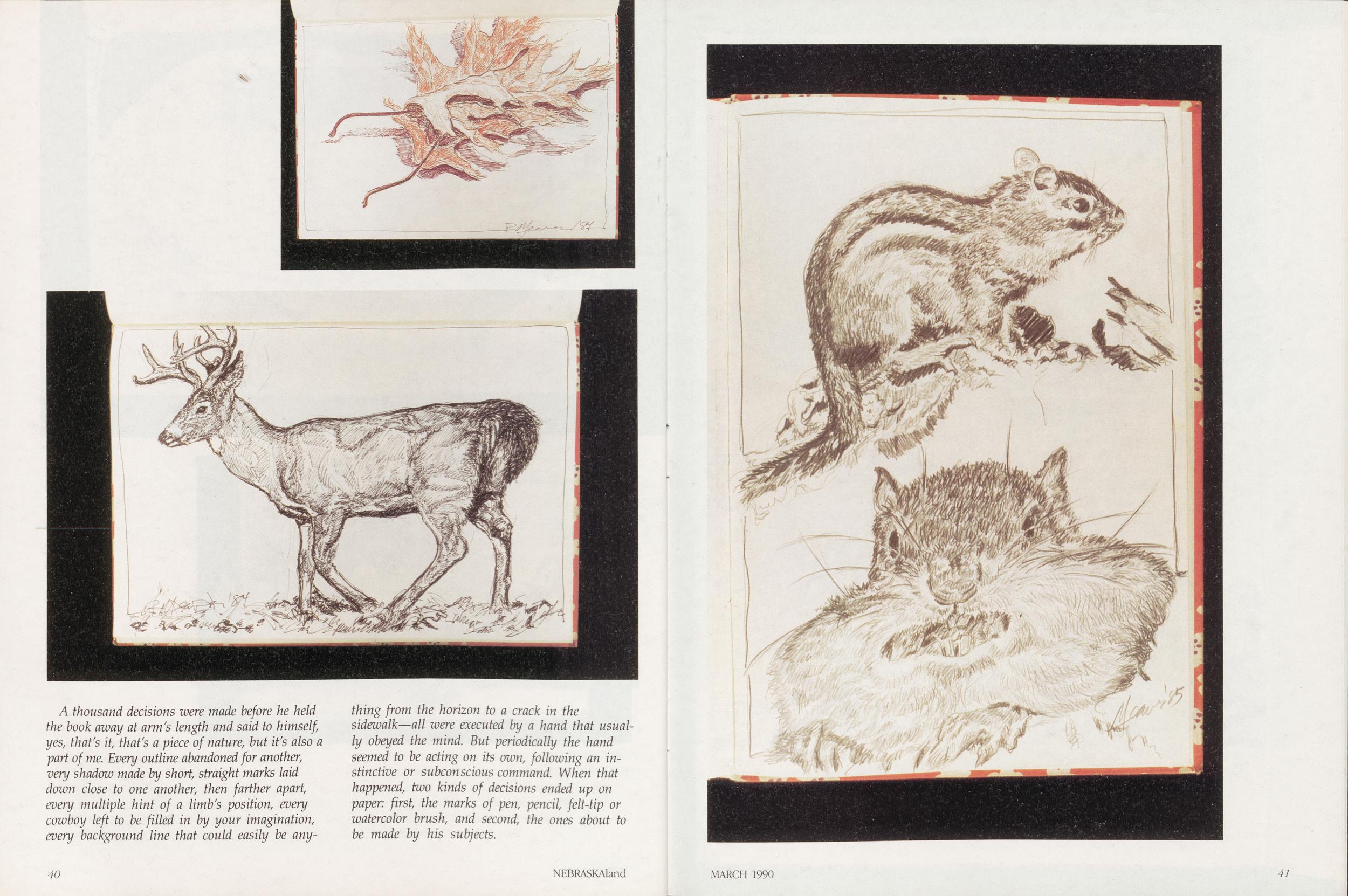
A thousand decisions were made before he held the book away at arm's length and said to himself, yes, that's it, that's a piece of nature, but it's also a part of me. Every outline abandoned for another, very shadow made by short, straight marks laid down close to one another, then farther apart, every multiple hint of a limb's position, every cowboy left to be filled in by your imagination, every background line that could easily be anything from the horizon to a crack in the sidewalk—all were executed by a hand that usually obeyed the mind. But periodically the hand seemed to be acting on its own, following an instinctive or subconscious command. When that happened, two kinds of decisions ended up on paper: first, the marks of pen, pencil, felt-tip or watercolor brush, and second, the ones about to be made by his subjects.
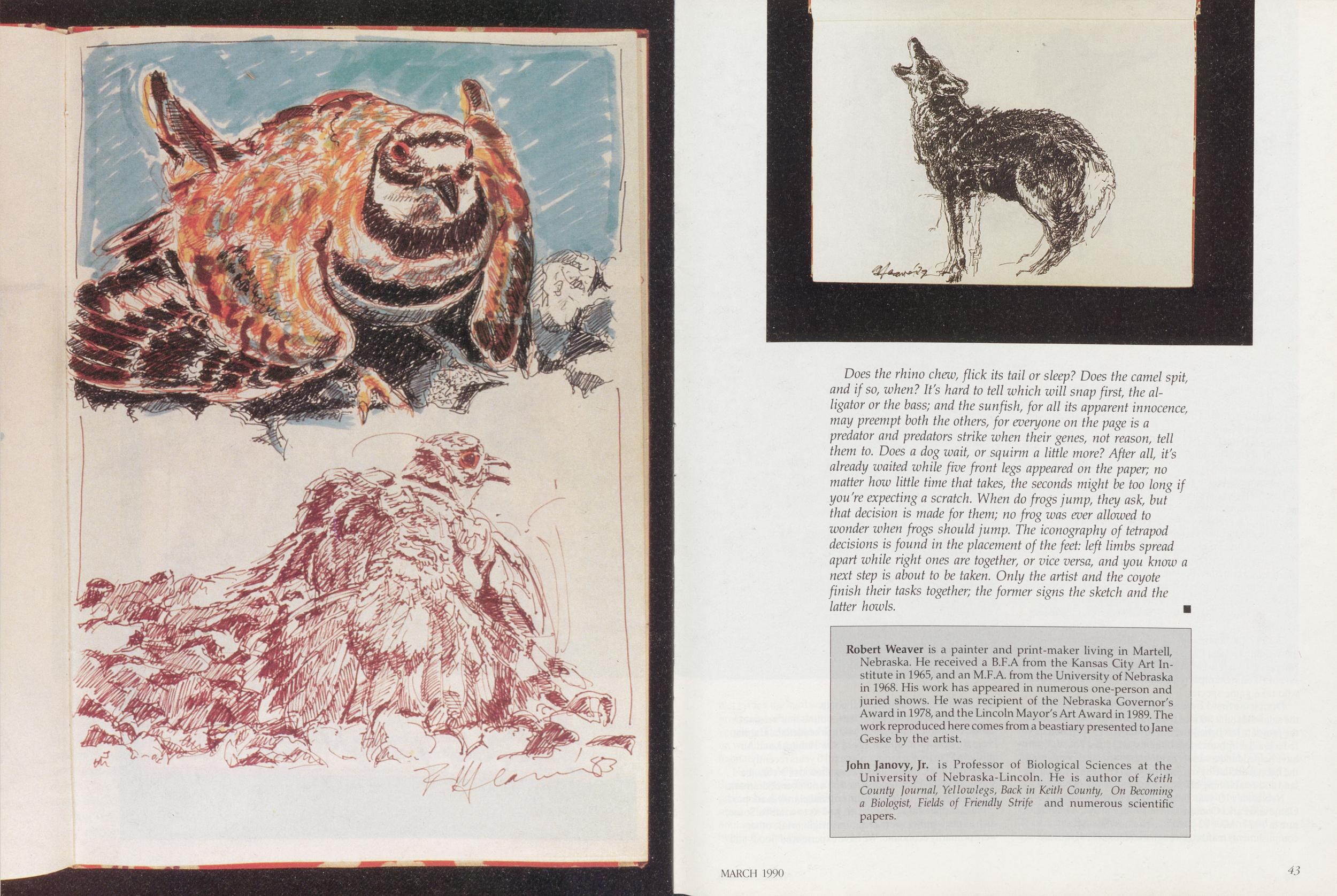
Does the rhino chew, flick its tail or sleep? Does the camel spit, and if so, when? It's hard to tell which will snap first, the alligator or the bass; and the sunfish, for all its apparent innocence, may preempt both the others, for everyone on the page is a predator and predators strike when their genes, not reason, tell them to. Does a dog wait, or squirm a little more? After all, it's already waited while five front legs appeared on the paper; no matter how little time that takes, the seconds might be too long if you're expecting a scratch. When do frogs jump, they ask, but that decision is made for them; no frog was ever allowed to wonder when frogs should jump. The iconography of tetrapod decisions is found in the placement of the feet: left limbs spread apart while right ones are together, or vice versa, and you know a next step is about to be taken. Only the artist and the coyote finish their tasks together; the former signs the sketch and the latter howls.
Robert Weaver is a painter and print-maker living in Martell, Nebraska. He received a B.F.A from the Kansas City Art Institute in 1965, and an M.F.A. from the University of Nebraska in 1968. His work has appeared in numerous one-person and juried shows. He was recipient of the Nebraska Governor's Award in 1978, and the Lincoln Mayor's Art Award in 1989. The work reproduced here comes from a beastiary presented to Jane Geske by the artist. John Janovy, Jr. is Professor of Biological Sciences at the University of Nebraska-Lincoln. He is author of Keith County Journal, Yellowlegs, Back in Keith County, On Becoming a Biologist, Fields of Friendly Strife and numerous scientific papers. MARTCH 1990 43
Nebraska's Habitat Proeram Keeping the Faith
By Tom Keith Photos by Jon Farrar In its first 12 years, this program has done much to stem the loss of essential wildlife habitat. A 10-year extension promises still more protection for the state's wildlife.HABITAT, the vegetative growth that provides food, shelter and safety for all wildlife species, is declining, and as a direct result, wildlife numbers are declining. To cushion the impact of that continuing decline, the Nebraska Game and Parks Commission has adopted a Wildlife Habitat Land Acquisition Plan to increase the amount of public wildlife lands by 15,760 acres over the next 10 years.
Adequate habitat is the most essential element in maintaining both game and non-game wildlife populations. In Nebraska, more than 95 percent of the land wildlife needs for survival is privately owned. Thus, how Nebraska's ranchers and farmers manipulate their land has a direct impact on wildlife numbers and their welfare.
The state's highest small-game populations in recent years occurred in the 1950s and early 1960s when the Soil Bank Program was in effect, and 876,000 acres of Nebraska land were retired from farm production. When the Soil Bank Program ended, most of the land was returned to cultivation.
In 1977, the Game and Parks Commission implemented the Wildlife Habitat Program designed to improve Nebraska's wildlife habitat with money derived from the sale of Habitat Stamps, required of all hunters and trappers who take game species.
During the first 12 years of the program, revenue from the sale of Habitat Stamps totalled nearly $ 14 million, and the program has benefitted from another $ 10.5 million in federal aid reimbursements, interest and gifts. Those dollars have helped fund a variety of programs aimed at combating the habitat decline by retiring marginal croplands, acquiring land and establishing habitat improvements on public land.
Nebraska's 10-year Habitat Plan was approved by the Game and Parks Commission in 1976, and by the Legislature in 1977. After 12 years it is obvious that the accomplishments realized through the Habitat Program are 44 very close to the plan's original goals.
Harold Edwards, chief of the Commission's resource services division, and the man who has headed the Habitat Program since its inception, says a new Habitat Land Acquisition Plan for the program's next 10 years recently adopted by the Commission is an extension of Nebraska's original Habitat Plan, necessitated by a number of dramatic occurrences in the state since the original plan was adopted.
"This applies to agriculture as well as to wildlife. Some, such as the weather, were of natural origin, while others were primarily economic. We have experienced floods and wet cycles, the hard winter of 1983-84, relative agricultural prosperity, a rural depression, very high land prices and very low land prices. All of these 'happenings' had impacts on wildlife and our efforts to save and improve wildlife habitat."
Nebraska's Habitat Program has attacked the problem of diminishing wildlife habitat on three fronts: habitat on private land, the acquisition of wildlife lands, the management of habitat on existing and newly-acquired lands, and management on public land not directly controlled by the Commission.
About a third of the annual revenue is earmarked for the private-land portion of the program. Of the 24 natural resources districts in the state, 21 are taking part in the administration of this aspect of the Habitat Program. As of June 30,1989, the Commission had paid some $6,733,580 to private landowners through the NRDs. The NRDs paid about $2,245,000 of their own funds during that same period, based on a cost-sharing agreement by which the Commission pays 75 percent of the costs and the NRDs pay 25 percent. There are currently about 32,000 acres and 1,500 cooperators enrolled in the program.
MARCH 1990 45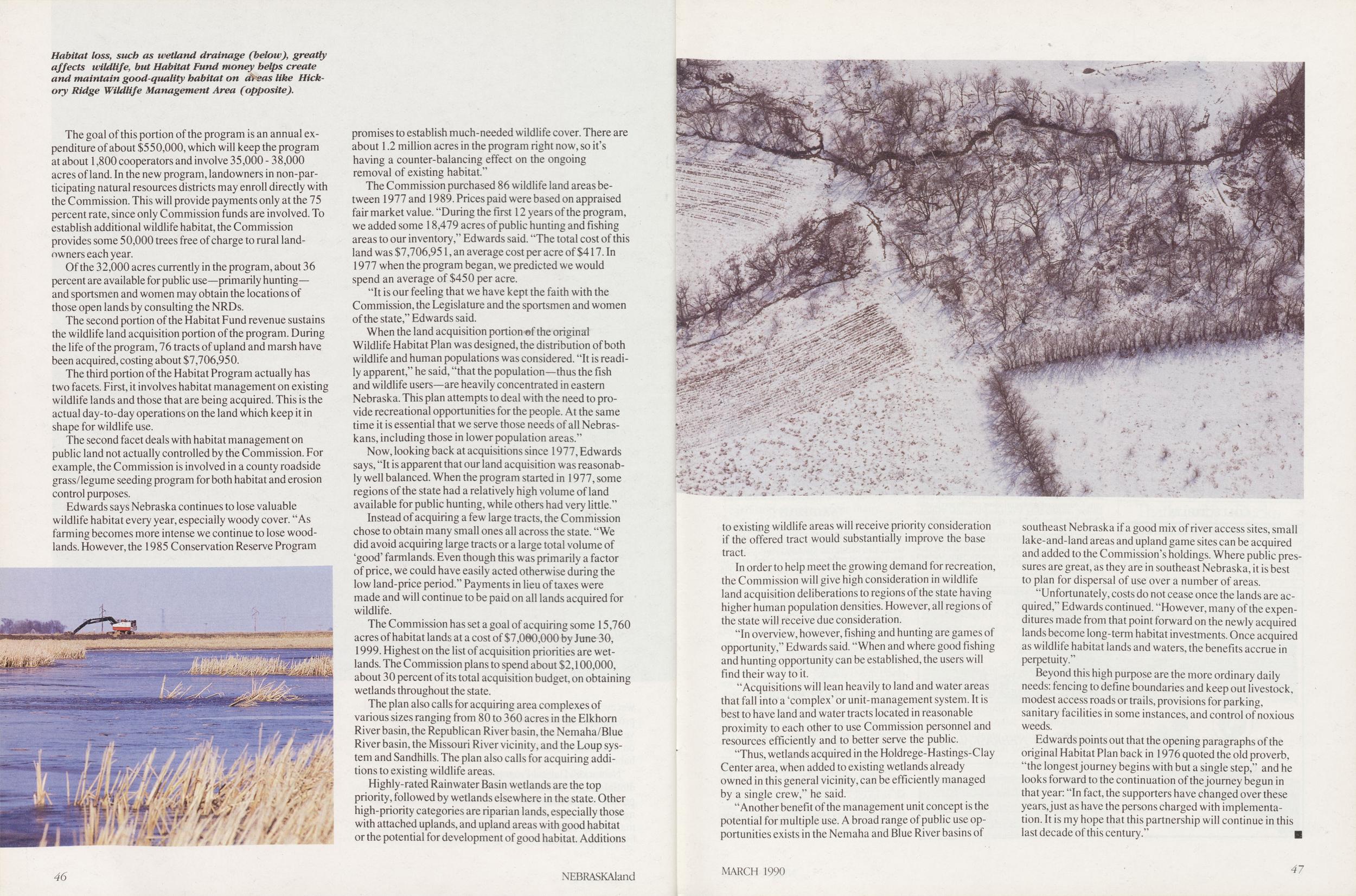
The goal of this portion of the program is an annual expenditure of about $550,000, which will keep the program at about 1,800 cooperators and involve 35,000 - 38,000 acres of land. In the new program, landowners in non-participating natural resources districts may enroll directly with the Commission. This will provide payments only at the 75 percent rate, since only Commission funds are involved. To establish additional wildlife habitat, the Commission provides some 50,000 trees free of charge to rural landowners each year.
Of the 32,000 acres currently in the program, about 36 percent are available for public use—primarily hunting— and sportsmen and women may obtain the locations of those open lands by consulting the NRDs.
The second portion of the Habitat Fund revenue sustains the wildlife land acquisition portion of the program. During the life of the program, 76 tracts of upland and marsh have been acquired, costing about $7,706,950.
The third portion of the Habitat Program actually has two facets. First, it involves habitat management on existing wildlife lands and those that are being acquired. This is the actual day-to-day operations on the land which keep it in shape for wildlife use.
The second facet deals with habitat management on public land not actually controlled by the Commission. For example, the Commission is involved in a county roadside grass/legume seeding program for both habitat and erosion control purposes.
Edwards says Nebraska continues to lose valuable wildlife habitat every year, especially woody cover." As farming becomes more intense we continue to lose woodlands. However, the 1985 Conservation Reserve Program promises to establish much-needed wildlife cover. There are about 1.2 million acres in the program right now, so it's having a counter-balancing effect on the ongoing removal of existing habitat."
The Commission purchased 86 wildlife land areas between 1977 and 1989. Prices paid were based on appraised fair market value. "During the first 12 years of the program, we added some 18,479 acres of public hunting and fishing areas to our inventory," Edwards said. "The total cost of this land was $7,706,951, an average cost per acre of $417. In 1977 when the program began, we predicted we would spend an average of $450 per acre.
"It is our feeling that we have kept the faith with the Commission, the Legislature and the sportsmen and women of the state," Edwards said.
When the land acquisition portion ©f the original Wildlife Habitat Plan was designed, the distribution of both wildlife and human populations was considered. "It is readily apparent," he said, "that the population—thus the fish and wildlife users—are heavily concentrated in eastern Nebraska. This plan attempts to deal with the need to provide recreational opportunities for the people. At the same time it is essential that we serve those needs of all Nebraskans, including those in lower population areas."
Now, looking back at acquisitions since 1977, Edwards says, "It is apparent that our land acquisition was reasonably well balanced. When the program started in 1977, some regions of the state had a relatively high volume of land available for public hunting, while others had very little."
Instead of acquiring a few large tracts, the Commission chose to obtain many small ones all across the state. "We did avoid acquiring large tracts or a large total volume of 'good' farmlands. Even though this was primarily a factor of price, we could have easily acted otherwise during the low land-price period." Payments in lieu of taxes were made and will continue to be paid on all lands acquired for wildlife.
The Commission has set a goal of acquiring some 15,760 acres of habitat lands at a cost of $7,060,000 by June 30, 1999. Highest on the list of acquisition priorities are wetlands. The Commission plans to spend about $2,100,000, about 30 percent of its total acquisition budget, on obtaining wetlands throughout the state.
The plan also calls for acquiring area complexes of various sizes ranging from 80 to 360 acres in the Elkhorn River basin, the Republican River basin, the Nemaha/Blue River basin, the Missouri River vicinity, and the Loup system and Sandhills. The plan also calls for acquiring additions to existing wildlife areas.
Highly-rated Rainwater Basin wetlands are the top priority, followed by wetlands elsewhere in the state. Other high-priority categories are riparian lands, especially those with attached uplands, and upland areas with good habitat or the potential for development of good habitat. Additions 46 NEBRASKAland
In order to help meet the growing demand for recreation, the Commission will give high consideration in wildlife land acquisition deliberations to regions of the state having higher human population densities. However, all regions of the state will receive due consideration.
"In overview, however, fishing and hunting are games of opportunity," Edwards said. "When and where good fishing and hunting opportunity can be established, the users will find their way to it.
"Acquisitions will lean heavily to land and water areas that fall into a 'complex' or unit-management system. It is best to have land and water tracts located in reasonable proximity to each other to use Commission personnel and resources efficiently and to better serve the public.
"Thus, wetlands acquired in the Holdrege-Hastings-Clay Center area, when added to existing wetlands already owned in this general vicinity, can be efficiently managed by a single crew," he said.
"Another benefit of the management unit concept is the potential for multiple use. A broad range of public use opportunities exists in the Nemaha and Blue River basins of southeast Nebraska if a good mix of river access sites, small lake-and-land areas and upland game sites can be acquired and added to the Commission's holdings. Where public pressures are great, as they are in southeast Nebraska, it is best to plan for dispersal of use over a number of areas.
"Unfortunately, costs do not cease once the lands are acquired," Edwards continued. "However, many of the expenditures made from that point forward on the newly acquired lands become long-term habitat investments. Once acquired as wildlife habitat lands and waters, the benefits accrue in perpetuity."
Beyond this high purpose are the more ordinary daily needs: fencing to define boundaries and keep out livestock, modest access roads or trails, provisions for parking, sanitary facilities in some instances, and control of noxious weeds.
Edwards points out that the opening paragraphs of the original Habitat Plan back in 1976 quoted the old proverb, "the longest journey begins with but a single step," and he looks forward to the continuation of the journey begun in that year: "In fact, the supporters have changed over these years, just as have the persons charged with implementation. It is my hope that this partnership will continue in this last decade of this century."
MARCH 1990 47
Classified
ARTS & CRAFTS Bev Doolittle, Terrry Redlin, Jerry Raedke, Ed Wards, Robert Bateman, Frank McCarthy and Neal Anderson are available at the 2nd Street Gallery, 537 W. 2nd, Hastings, NE 68901. Phone (402) 463-6677. BIRDS MANDARIN DUCKS $35 pair, Woodducks $25 pair. Nice full-wing birds. Mrs. R. W. Hansen, 3315 Avenue L, Kearney, NE 68847. Phone (308) 237-3781. GAMEBIRDS: Pheasants, partridges, wild turkeys, eggs, chicks, adults. National Poultry Improvement Plan participants—guaranteed top quality for propagation, hunting, eating and taxidermy. Call now to place 1990 chick orders. Bargain prices on hen chicks. Toubl Game Bird Farms, Beloit, WI (608) 365-1789. BOOKS/PRINTING TROLLING MOTOR REPAIR. Factory authorized Minn Kota and Motor Guide, parts and service. Wolfs Repair and Tackle Supply, 1529 David Drive, Lincoln, NE 68504. Phone (402) 464-4265. FREE! Booklets on northeastern Nevada; fishing, rockhounding maps, Carl Hayden, Box 528, Jackpot, Nevada 89825. HISTORY will cherish this 20-year (1960-80) chronicle of the conquered challenge of a seven-member American family whose father is native Nebraskan. "ONE OF THEM" by Norene Pavlik. 263 pages. ISBN 0-87973-240-5. $ 10.95 postpaid: Verdigre Eagle, Box 309, Verdigre,NE 68783. FREE BOOK CATALOG. Novels, westerns, romances, children's; old out of print, found barns, attic. Authors: Grey, Bower, Connor, Fox, Curwood, Raine, Wright, Aldrige, Pollyanna, Freckles, many others. Postage appreciated. Pierce, 4400 N. Pine Cluster, Oroville, C A 95965. COLLECTIBLES BUYING: American Indian artifacts such as beadwork, weavings, baskets, etc.; also cowboy memorabilia such as chaps, spurs, photographs, etc. Best price first letter; photographs promptly returned. Jack Ringwalt, 1550 California St., Suite 6, #211, San Francisco, C A 94109, (415)759-6343. COLLECTION OF NEBRASKAland magazines from 1956-1989. Best offer. Bill Earnest, Box 100, Riverdale, NE 68870. DOGS YELLOW-BLACK Lab pups. FC-AFC sired. AKC. Hips OFA ceritified. Dew claws removed. Excellent hunting potential. Contact Bob Bendler, Lexington, NE (308) 324-4247. TRAINING ALL BREEDS Hunting Dogs — Vizslas for sale. Rozanek Kennels, Rt. 2, Schuyler, NE 68661. Phone(402)352-8769. ENGLISH SETTERS: "Bred for the hunter"; select puppies and started dogs available from outstanding bloodlines. Stud service available by proven hunters. High Plains Kennels, 1411 Emerson, Alliance, NE 69301, Phone(308)762-6709. GERMAN SHORTHAIRS and Brittany Spaniel pups. Started and occasionally a meat dog. Pups are guaranteed. Also I will be training hunting dogs. Wayne Clark, Percival, IA. Phone (712) 529-4238 or (402) 263-3155 at Union, NE PINKERTON bird dogs—English setter, brittany puppies. Started dogs available this fall. Our dogs are bred for nose and style. Give us a call at (402) 673-4540. GERMAN SHORTHAIR and springer spaniel puppies—also started dogs. Outstanding bloodlines. Bird dog training. Cactus Kennels, Dave Wickham, Kimball, NE 69145. (308) 235-3237. ENGLISH SETTER puppies. Out of great hunting lines. Dave Wickham, HC 50, Box 14, Kimball, NE 69145, phone (308) 235-3237. FISH FISH FOR SALE. Catfish, perch, coho salmon, rainbow trout, crappie, bluegill, walleye, minnows, goldfish, bullhead, largemouth bass, smallmouth bass, triploid grass carp. Commercial grower prices on catfish, perch, coho salmon, rainbow trout. Consulting available. Pleasant Valley Fish Farm, Rt 1 Box 147, McCook, NE 69001. Phone (308) 345-6599. FISH FOR POND STOCKING. Bass, bluegill, crappie, perch, channel catfish, Triploid grass carp, rainbow trout and walleye. Available April-October. Write Orchard Fish Hatchery, Rt 2, Box 117, Orchard, NE 68764 or phone (402) 893-252L YES! I WOULD LIKE TO SUBSCRLBE TO NEBRASKAland Name 1-Year $12 Address D 2 Years $23 Citr— State Zip Mail check or money order to NEBRASKAland, Box 30370, Lincoln, NE 68503 FOOD WINE AND BEER: Make your own. Send for free recipes and instructions. Omaha Supply, 1324 2nd Avenue, Nebraska City, NE 68410. BUFFALO JERKEY, 16 1-oz. pkgs. for $23 including shipping. Sample $1.75. G. E. Hill Distributing, 5220 Aylesworth, Lincoln, NE 68504. Phone (402) 464-6781. GUIDES/OUTFITTERS MAD RIVER CANOES offers the finest quality and performance. For the finest canoes and accessories look to Great Plains Canoe Co., 205 Main, Springfield, NE. Phone(402)253-2001. EXPERIENCE NEBRASKA with an affordable canoe trip by Dryland Aquatics. One and two-day trips canoe rental or fully catered. Niobrara Dismal Platte Elkhorn We do it your way! For free brochure: Dryland Aquatics, Dept. N, 1837 E. Cuming, Fremont, NE 68025 or phone (402) 721 -4177. OUTDOOR EQUIPMENT AIR GUNS repaired — Benjamin, Crosman, Daisy, other American made. Restoration; old guns wanted, Jack's Air Guns, 1225 No. 46th. Lincoln, NE 68503. Phone (402) 466-9223. GUNS — Browning, Winchester. Remington, others, Hi-powers, shotguns, new, used, antiques. Want Pre1964 Winchesters. Buy-Sell-Trade. Ph. (402) 729-6112. Bedlan's Sporting Goods, Fairbury, NE 68352. AIR GUNS repaired—Benjamin, Crosman, Daisy, other American made. Restoration; old guns wanted. Jack's Air Guns, 1225 No. 46th, Lincoln, NE 68503. Phone (402)466-9223. TAXIDERMY ALLISON'S TAXIDERMY STUDIO. Wally and Betty Allison Licensed Taxidermist. We've mounted 28 Nebraska State Record fish. Specializing in fish and birds, small game and rattlesnakes. We use freeze-dry 2310 West Leota, North Platte, Nebr. 69101. Phone (308) 534-2324. — Quality a must — Fast service. Fish birds, rugs, tanning, full mounts and game heads, 2111 N. Christy St., Fremont, NE 727-5463. NABITY'S TAXIDERMY. 31 years experience. Specializing in natural grass backgrounds for mammals, birds and fish. 13901 "O" St., Lincoln, NE 68504 - 4 miles east of 84th and "O". (402) 489-6351. PEISTER TAXIDERMY - Professional work at prices most sportsman can afford. 1020 Central Avenue, Box 3201, Kearney, NE 68847. Phone (308) 236-9700 or (308) 237-7575 evenings. VACATION/RESORTS BERGMAN'S JOHNSON LAKE RESORT. Lakefront cabins, full RV hookups, groceries, beer, bait, tackle, restaurant, lounge, boat rentals, boat ramp Fish, swim, ski. Free brochure: Rt 2, Elwood, NE 68937 or phone (308) 785-2298. CABIN FOR RENT. Modern three-bedroom, fullyequipped cabin overlooking secluded, scenic 3-acre pond. Call or write Orchard Fish Hatchery, Rt. 2, Box 117, Orchard, NE 68764 or phone (402) 893-2521. NE NEBRASKA trout fishing. 3 modern cottages, 1 available year round. 5 spring fed lakes with open water all year. Trout up to 7 pounds. Other varieties fish also. Diamond E. Trout Resort, Orchard, NE 69764. Phone (402) 893-4745. 48 NEBRASKAlandPage Forty-nine
"WHAT are you doing to my magazine?" Ok, that's a fair question. Those of us who put NEBRASKAland together 10 times a year know it is your magazine; we live or die as a magazine largely because of your willingness to continue reading the words we write, and looking at the photographs we take.
We tried not to forget that as we made the changes you see in this issue; we ruminated and cogitated and argued about every tittle and jot. For that matter, we rethought, rejected and revised our options—ranging from no change at all to complete restructuring—for more than a year before springing this new look on you. Through it all we tried not to be deceived by a misplaced, proprietary arrogance, and blithely make changes in your magazine just to please ourselves. Besides, none of these changes are necessarily, absolutely, positively permanent—we may well have to tinker some more.
Many readers will remember some earlier changes in the magazine's appearance and content, and in its 64-year history there have been many. Beginning as "Outdoor Nebraska" in 1926, it was a 16-page, all black-and-white quarterly, almost entirely the work of its one-man staff, Frank B. O'Connell, Chief of the Bureau of Game and Fish for the State Department of Agriculture.
In 1942, the magazine adopted a 6-by-9-inch format. In the early 1950s it grew to 8.5-by-11. Color came to the magazine pages in 195 8, the same year it began monthly publication. In March of 1964, the name changed to "Outdoor NEBRASKAland"; the "Outdoor" disappeared in 1967.
Through the years, type face and type size have changed many times. Advertising came, and ad space increased and decreased periodically. Even the "flag"—the magazine's title on the cover—has changed several times.
So, back to the initial question: What are we doing to your magazine, and why are we doing it? First, the changes you will scarcely notice: color is now available throughout the entire magazine. Heretofore we have been committed to 16 pages of black-and-white nearly every month. We don't intend to stop using black and white stories, but now, with color an option on every page, we are no longer tied to a fairly limited set of magazine design options. Second, all our stories are now self-contained; the old "continued on page" line has become a thing of the past.
You may have noticed the absence of paid display advertising. In recent years it has not been a significant source of revenue, and we hope the reader-service aspects of advertising can be assumed by an expanded classified section. We will continue to use some "house" ads and public-service announcements, but by reducing display advertising and making stories self-contained, we gain an additional 36 pages of editorial copy each year, which means more NEBRASKAland in each issue, including two new departments: "Notes From the Field," on pages 6-7, and "Page Forty-nine"—this column, a monthly essay, personal and opinionated, by a variety of magazine staff members.
Finally, we have made a few changes in the magazine's general appearance. Color "thumbnail" photos on the contents page, graphic headers on front and back of the book sections, and an increased use of "ragged right" rather than justified columns are the most obvious.
We don't consider being absolutely up-to-date to be among our most important imperatives, but we had begun to feel just a bit stodgy, and we think these changes make us more contemporary. We hope you like (or at least can tolerate) what we've done.
—Don Cunningham, Editor NEBRASKAland Magazine Toll Free Orders 1-800-742-0056 73CFCUR WILDEUUKS AREBCRN INAPCRE04 COUNTRY Most of this continent's wild ducks are born in the wetlands of Canada, which are under threat of extinction. That's why Ducks Unlimited is working to preserve Canadian wetlands. Send your tax-free contribution. Because if ducks have no home, America will have no ducks. DUCKS UNLIMTTED INC P.O. BOX 66300, CHICAGO, ILLINOIS 60666 MARCH 1990 49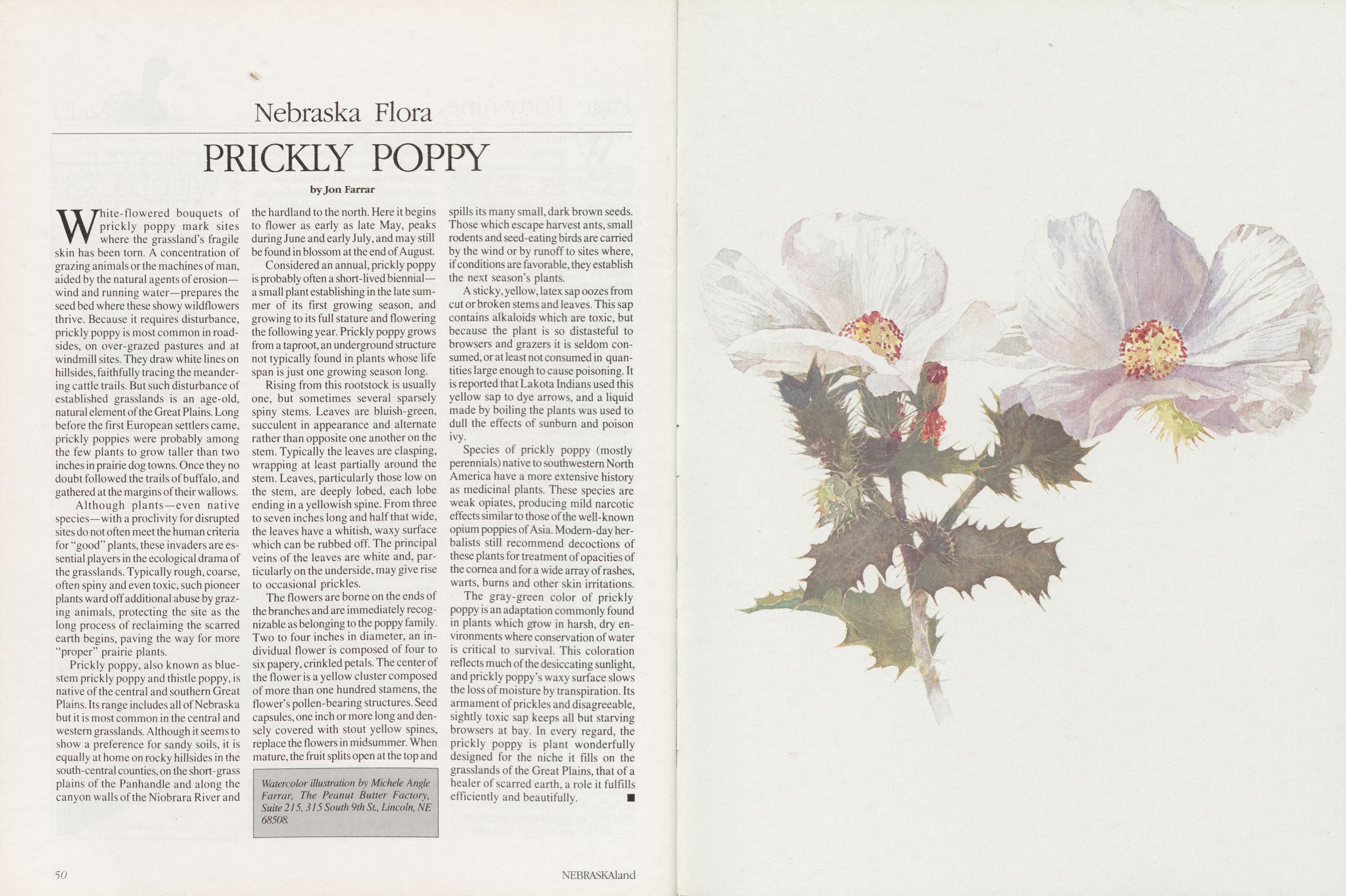
Nebraska Flora PRICKLY POPPY
by Jon FarrarWhite-flowered bouquets of prickly poppy mark sites where the grassland's fragile skin has been torn. A concentration of grazing animals or the machines of man, aided by the natural agents of erosion-wind and running water—prepares the seed bed where these showy wildflowers thrive. Because it requires disturbance, prickly poppy is most common in roadsides, on over-grazed pastures and at windmill sites. They draw white lines on hillsides, faithfully tracing the meandering cattle trails. But such disturbance of established grasslands is an age-old, natural element of the Great Plains. Long before the first European settlers came, prickly poppies were probably among the few plants to grow taller than two inches in prairie dog towns. Once they no doubt followed the trails of buffalo, and gathered at the margins of their wallows.
Although plants—even native species—with a proclivity for disrupted sites do not often meet the human criteria for "good" plants, these invaders are essential players in the ecological drama of the grasslands. Typically rough, coarse, often spiny and even toxic, such pioneer plants ward off additional abuse by grazing animals, protecting the site as the long process of reclaiming the scarred earth begins, paving the way for more "proper" prairie plants.
Prickly poppy, also known as bluestem prickly poppy and thistle poppy, is native of the central and southern Great Plains. Its range includes all of Nebraska but it is most common in the central and western grasslands. Although it seems to show a preference for sandy soils, it is equally at home on rocky hillsides in the south-central counties, on the short-grass plains of the Panhandle and along the canyon walls of the Niobrara River and the hardland to the north. Here it begins to flower as early as late May, peaks during June and early July, and may still be found in blossom at the end of August.
Considered an annual, prickly poppy is probably often a short-lived biennial— a small plant establishing in the late summer of its first growing season, and growing to its full stature and flowering the following year. Prickly poppy grows from a taproot, an underground structure not typically found in plants whose life span is just one growing season long.
Rising from this rootstock is usually one, but sometimes several sparsely spiny stems. Leaves are bluish-green, succulent in appearance and alternate rather than opposite one another on the stem. Typically the leaves are clasping, wrapping at least partially around the stem. Leaves, particularly those low on the stem, are deeply lobed, each lobe ending in a yellowish spine. From three to seven inches long and half that wide, the leaves have a whitish, waxy surface which can be rubbed off. The principal veins of the leaves are white and, particularly on the underside, may give rise to occasional prickles.
The flowers are borne on the ends of the branches and are immediately recognizable as belonging to the poppy family. Two to four inches in diameter, an individual flower is composed of four to six papery, crinkled petals. The center of the flower is a yellow cluster composed of more than one hundred stamens, the flower's pollen-bearing structures. Seed capsules, one inch or more long and densely covered with stout yellow spines, replace the flowers in midsummer. When mature, the fruit splits open at the top and spills its many small, dark brown seeds. Those which escape harvest ants, small rodents and seed-eating birds are carried by the wind or by runoff to sites where, if conditions are favorable, they establish the next season's plants.
Watercolor illustration by Michele Angle Farrar, The Peanut Butter Factory, Suite 215, 315 South 9th St, Lincoln, NE 68508.A sticky, yellow, latex sap oozes from cut or broken stems and leaves. This sap contains alkaloids which are toxic, but because the plant is so distasteful to browsers and grazers it is seldom consumed, or at least not consumed in quantities large enough to cause poisoning. It is reported that Lakota Indians used this yellow sap to dye arrows, and a liquid made by boiling the plants was used to dull the effects of sunburn and poison ivy.
Species of prickly poppy (mostly perennials) native to southwestern North America have a more extensive history as medicinal plants. These species are weak opiates, producing mild narcotic effects similar to those of the well-known opium poppies of Asia. Modern-day herbalists still recommend decoctions of these plants for treatment of opacities of the cornea and for a wide array of rashes, warts, burns and other skin irritations.
The gray-green color of prickly poppy is an adaptation commonly found in plants which grow in harsh, dry environments where conservation of water is critical to survival. This coloration reflects much of the desiccating sunlight, and prickly poppy's waxy surface slows the loss of moisture by transpiration. Its armament of prickles and disagreeable, sightly toxic sap keeps all but starving browsers at bay. In every regard, the prickly poppy is plant wonderfully designed for the niche it fills on the grasslands of the Great Plains, that of a healer of scarred earth, a role it fulfills efficiently and beautifully.
50 NEBRASKAland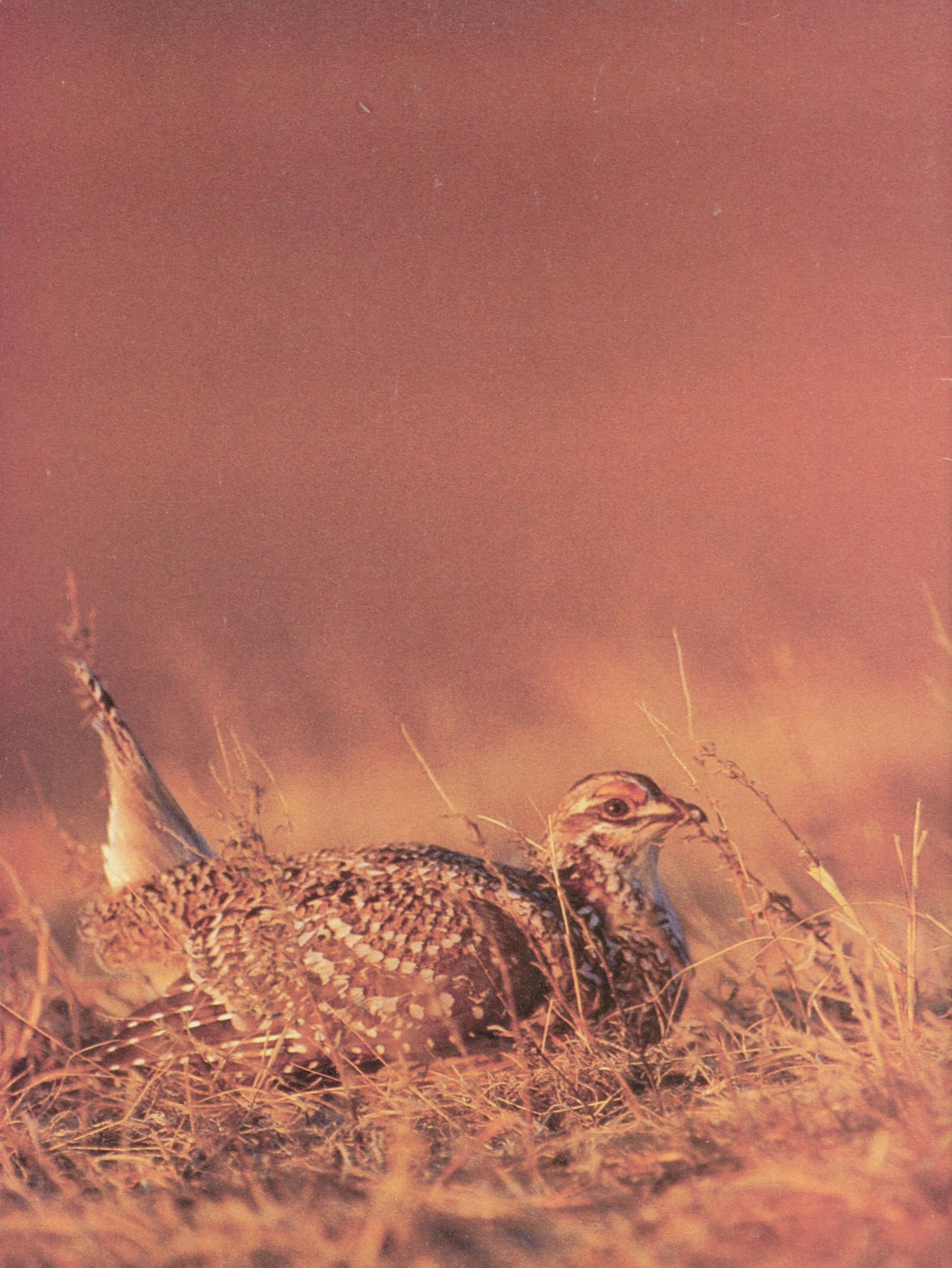
Position: 126 (47 views)