Volume 68, Issue 1, 1990
NEBRASKAland Magazine A Wildflower Year
NEBRASKAland Magazine A Wildflower Year
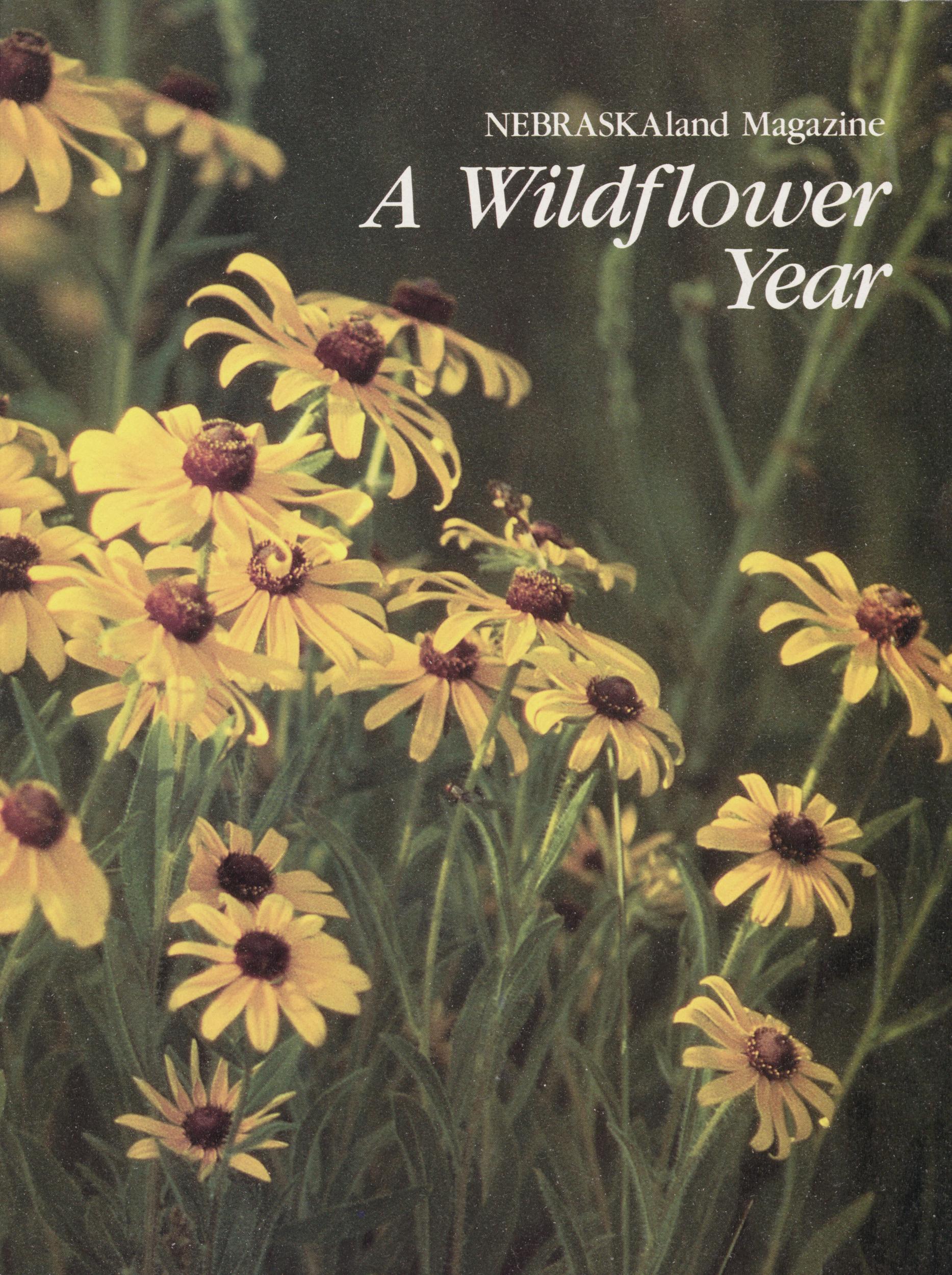
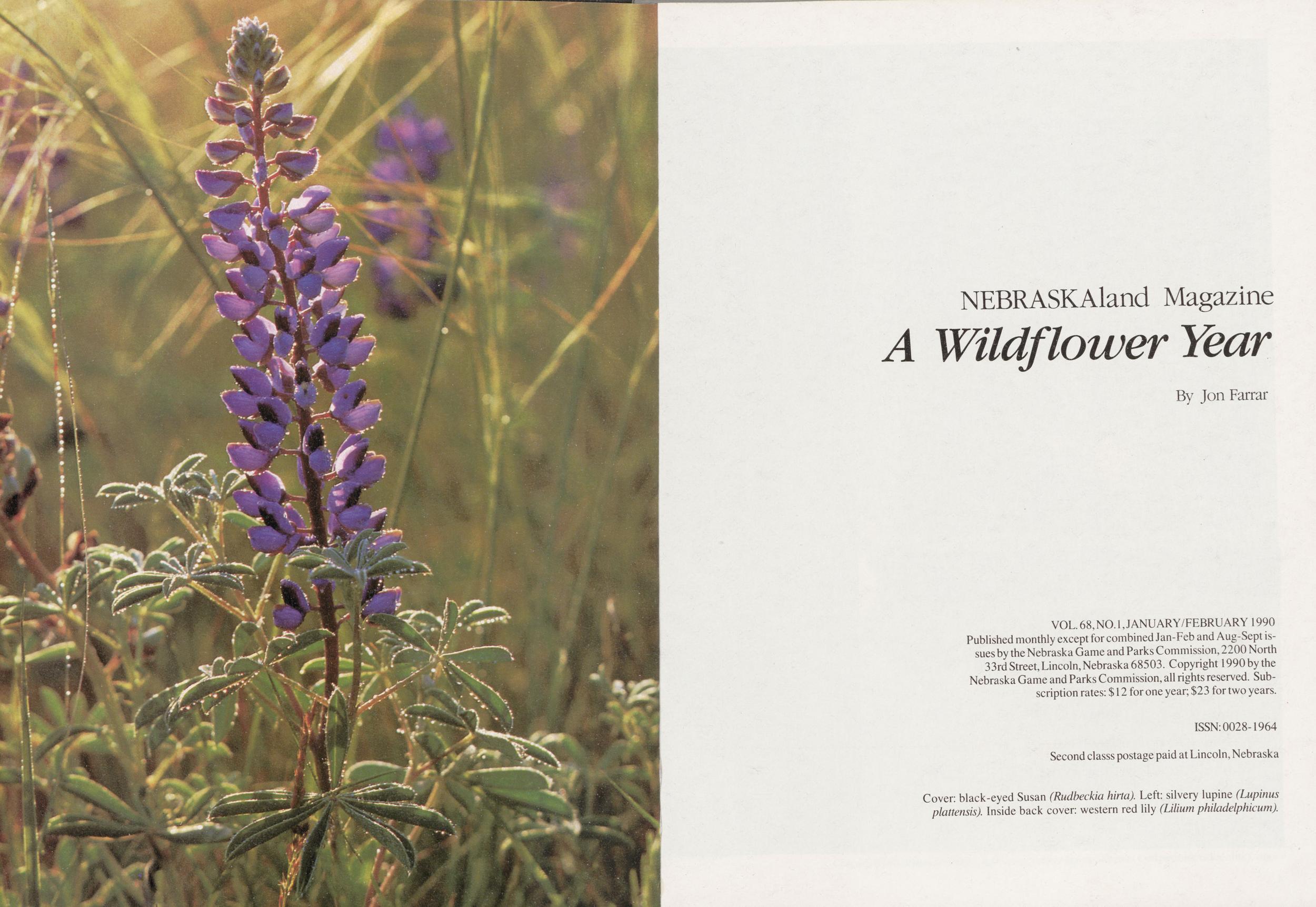
By Jon Farrar VOL. 68, NO. 1, JANUARY/FEBRUARY 1990 Published monthly except for combined Jan-Feb and Aug-Sept issues by the Nebraska Game and Parks Commission, 2200 North 33rd Street, Lincoln, Nebraska 68503. Copyright 1990 by the Nebraska Game and Parks Commission, all rights reserved. Subscription rates: $ 12 for one year; $23 for two years. ISSN: 0028-1964 Second classs postage paid at Lincoln, Nebraska Cover: black-eyed Susan (Rudbeckia hirta). Left: silvery lupine (Lupinus plattensis). Inside back cover: western red lily (Lilium philadelphicum).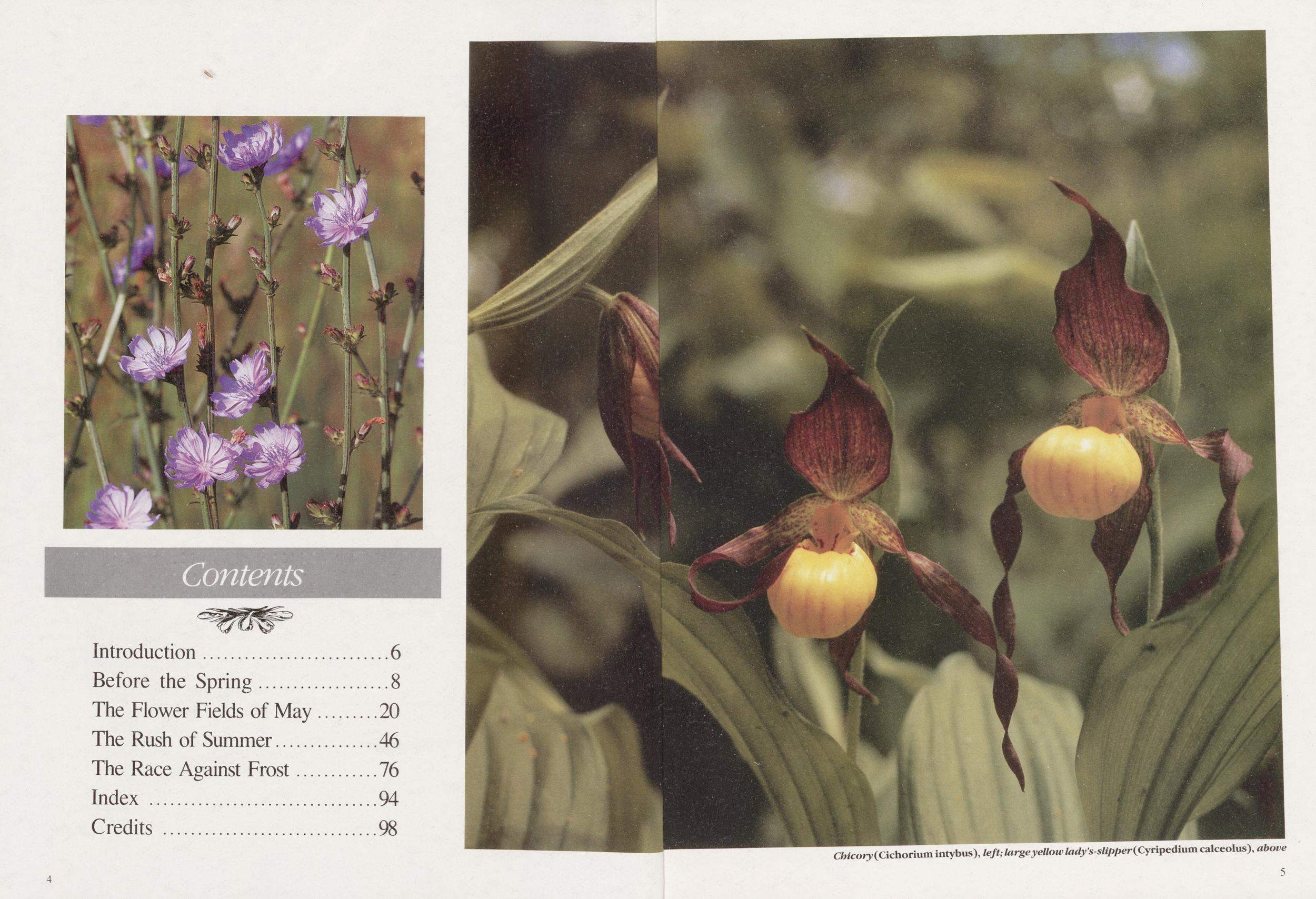 Contents
Introduction 6
Before the Spring 8
The Flower Fields of May 20
The Rush of Summer 46
The Race Against Frost 76
Index 94
Credits 98
4
Contents
Introduction 6
Before the Spring 8
The Flower Fields of May 20
The Rush of Summer 46
The Race Against Frost 76
Index 94
Credits 98
4
NEBRASKA is a large, deceptively diverse state. Because of its location and because so much land lies within its borders, it is a mixing ground where midcontinental plant communities merge. Not only does Nebraska have wildflowers common all across the plains states, but along its borders are found a sampling of wildflowers more typical of other regions, for plants do not honor arbitrary map boundries. For the botanist or Sunday-morning-drive wildflower hunter, Nebraska offers much variety.
Although Nebraska lays claim to the country's largest man-planted forest, to J. Sterling Morton's Arbor Day and to the Tree-Planter nickname, it is a grassland state. But even the untrained eye quickly recognizes that grasslands are not homogeneous environments. There are tallgrass prairies in the east, shortgrass plains in the west, and mixedgrass prairies joining the two. A sliver of Kansas prairie crosses into Nebraska's southern counties and Dakotatype prairie is found in the far northwest. Sandhills prairie, a plant community essentially unique to Nebraska, covers some 19,000 square miles. In southwest Nebraska, there are still remnants of sandsage prairie which have escaped conversion to cropland or alteration by overgrazing and herbicide applications. What woodlands we do have, covering about 3 percent of the state, are equally varied—from northwestern ponderosa pine forests to southeastern oak-hickory forests to floodplain forests which now span the state.
Just as grasslands are divided into recognizable types (such as tallgrass prairie or short-grass plains), defined by their dominant plant and animal members, so too is each type further subdivided into communities—each a restricted gathering of plants which thrive on sites with precise environmental conditions. Within an apparently homogeneous natural community, each plant species has evolved through time, by trial and death, to grow in the precise site where it is best adapted and most likely to fare well in competition with other plants.
Nature is remarkably resourceful and efficient, sustaining as much life as possible with finite resources. Plants sort themselves not just by where they grow but also by when they grow. Some initiate growth early in the spring, complete their life cycles quickly and die back or simply subsist in the shadow of other plants until frost. Throughout the growing season there is a succession of plants, each climbing higher and flowering later than the last. So each plant not only has its place, but also its time in the sun.
Although plants are closely attuned to the seasons, they pay scant attention to our calendar months. J.E. Weaver, this nation's premier prairie botanist, whose career at the University of Nebraska spanned the first half of this century, believed that the "prairie presents four distinct seasonal aspects, besides the more somber one of winter."
The "prevernai aspect" begins as soon as the soil warms enough to stir dormant roots and buried seeds to life, from late in March to about the last week of April. Weaver's second season, the "vernal aspect" continues through May, a time of early flowers of short stature, both on the prairies and in the woodlands. June and much of July fall into the "estival aspect," a time when warm-season grasses push skyward. From late July until frost is the "autumnal aspect," a period when tall, rugged plants dominate the grasslands.
We can do no better than to follow Weaver's lead through the constantly changing colors of Nebraska's wild garden. So pull on a pair of comfortable old walking shoes and stroll Nebraska's four seasons: through the brown grass Before the Spring, into the Flower Fields of May, on to The Rush of Summer and The Race Against Frost A Wildflower Year.
7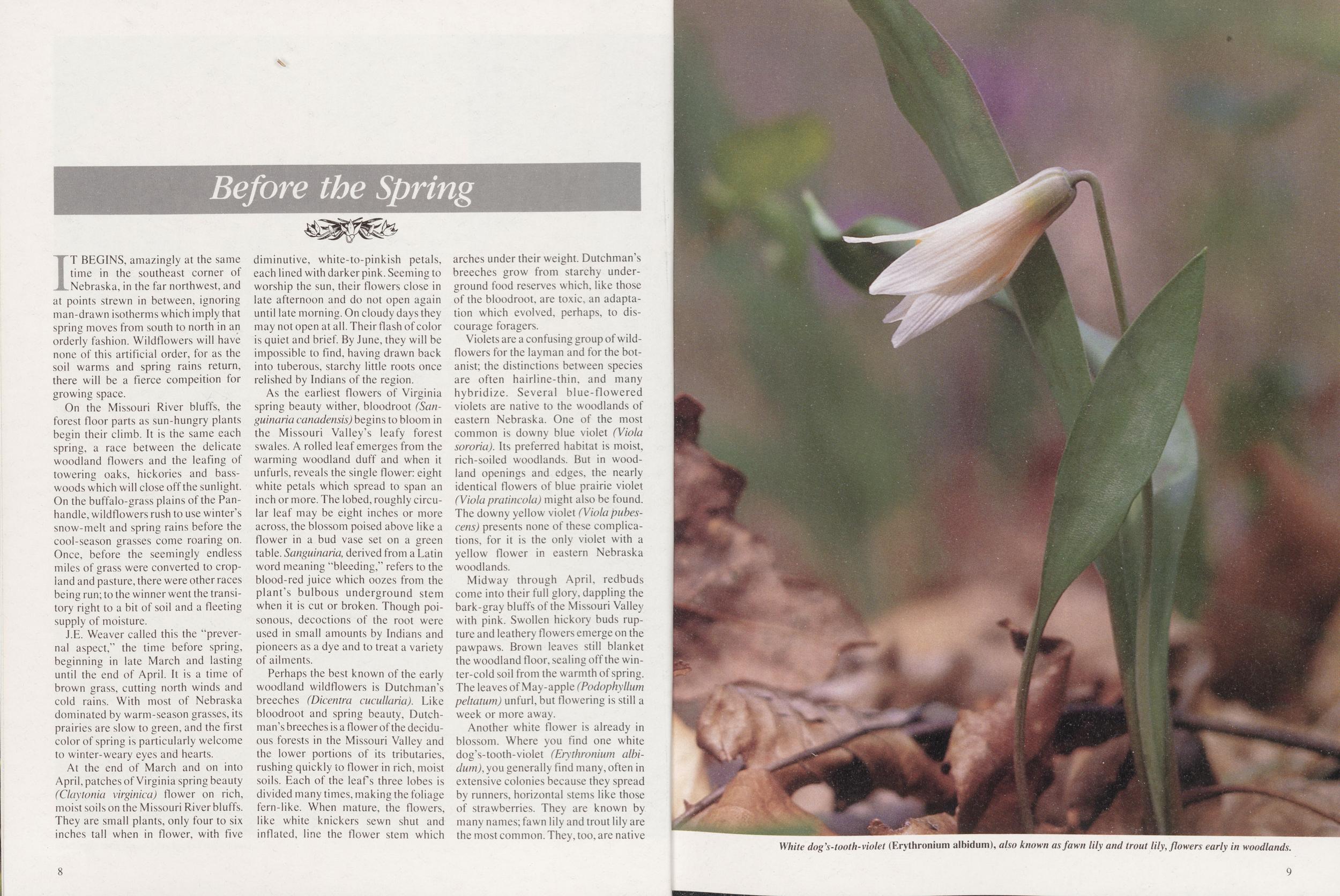
Before the Spring
IT BEGINS, amazingly at the same time in the southeast corner of Nebraska, in the far northwest, and at points strewn in between, ignoring man-drawn isotherms which imply that spring moves from south to north in an orderly fashion. Wildflowers will have none of this artificial order, for as the soil warms and spring rains return, there will be a fierce compeition for growing space.
On the Missouri River bluffs, the forest floor parts as sun-hungry plants begin their climb. It is the same each spring, a race between the delicate woodland flowers and the leafing of towering oaks, hickories and basswoods which will close off the sunlight. On the buffalo-grass plains of the Panhandle, wildflowers rush to use winter's snow-melt and spring rains before the cool-season grasses come roaring on. Once, before the seemingly endless miles of grass were converted to cropland and pasture, there were other races being run; to the winner went the transitory right to a bit of soil and a fleeting supply of moisture.
J.E. Weaver called this the "prevernal aspect," the time before spring, beginning in late March and lasting until the end of April. It is a time of brown grass, cutting north winds and cold rains. With most of Nebraska dominated by warm-season grasses, its prairies are slow to green, and the first color of spring is particularly welcome to winter-weary eyes and hearts.
At the end of March and on into April, patches of Virginia spring beauty (Claytonia virginica) flower on rich, moist soils on the Missouri River bluffs. They are small plants, only four to six inches tall when in flower, with five diminutive, white-to-pinkish petals, each lined with darker pink. Seeming to worship the sun, their flowers close in late afternoon and do not open again until late morning. On cloudy days they may not open at all. Their flash of color is quiet and brief. By June, they will be impossible to find, having drawn back into tuberous, starchy little roots once relished by Indians of the region.
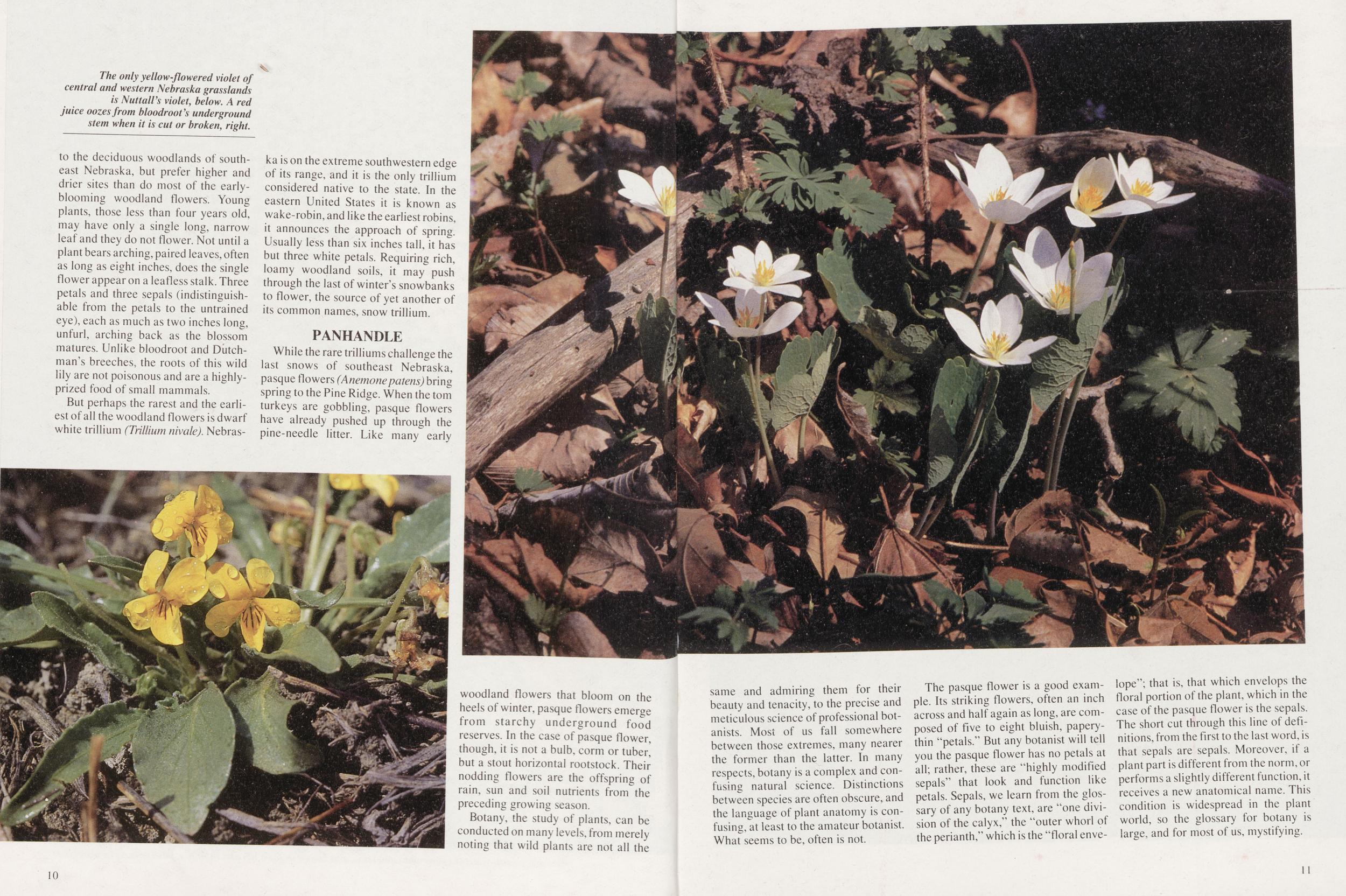
As the earliest flowers of Virginia spring beauty wither, bloodroot (Sanguinaria canadensis) begins to bloom in the Missouri Valley's leafy forest swales. A rolled leaf emerges from the warming woodland duff and when it unfurls, reveals the single flower: eight white petals which spread to span an inch or more. The lobed, roughly circular leaf may be eight inches or more across, the blossom poised above like a flower in a bud vase set on a green table. Sanguinaria, derived from a Latin word meaning "bleeding," refers to the blood-red juice which oozes from the plant's bulbous underground stem when it is cut or broken. Though poisonous, decoctions of the root were used in small amounts by Indians and pioneers as a dye and to treat a variety of ailments.
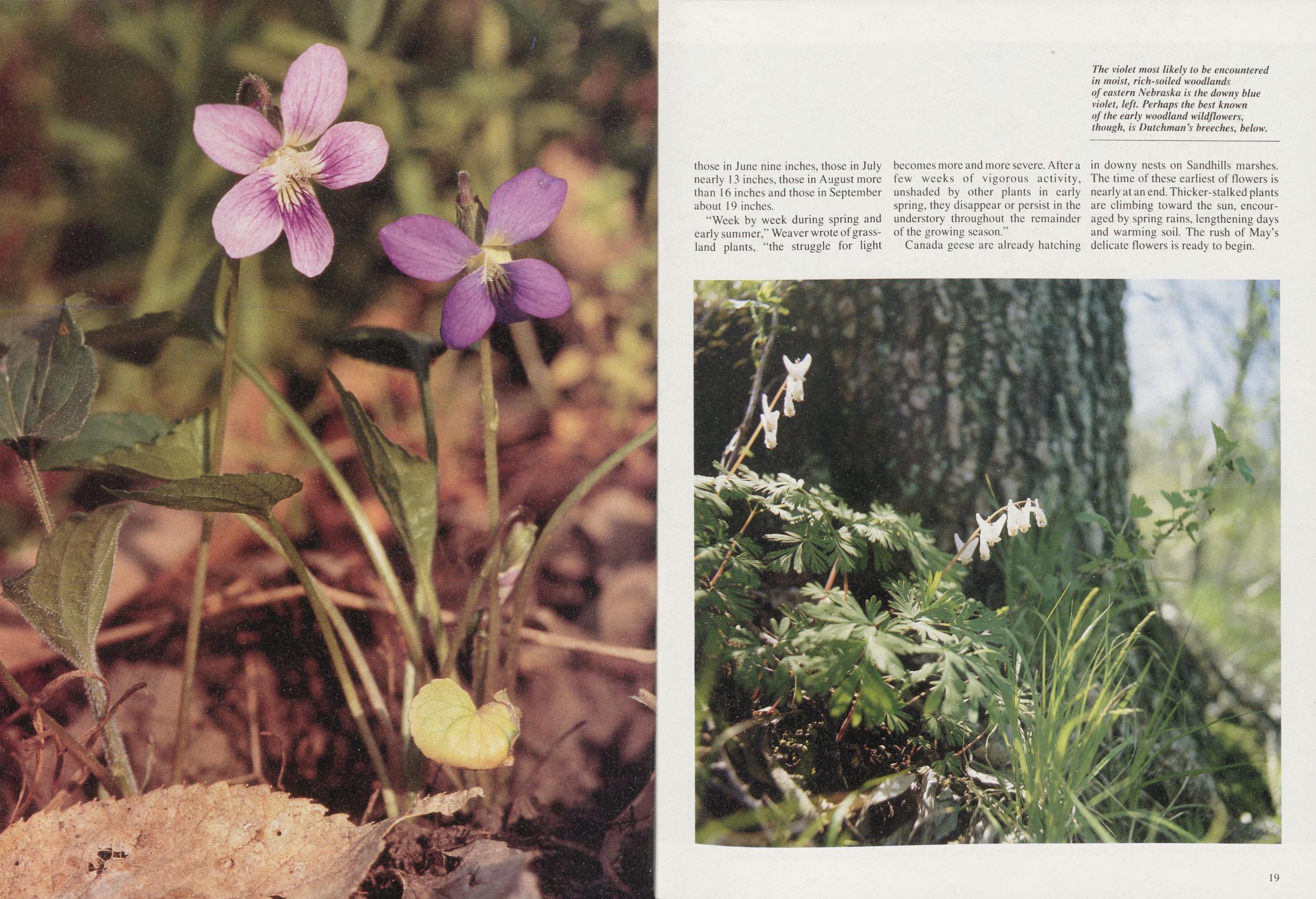
Perhaps the best known of the early woodland wildflowers is Dutchman's breeches (Dicentra cucullaria). Like bloodroot and spring beauty, Dutchman's breeches is a flower of the deciduous forests in the Missouri Valley and the lower portions of its tributaries, rushing quickly to flower in rich, moist soils. Each of the leafs three lobes is divided many times, making the foliage fern-like. When mature, the flowers, like white knickers sewn shut and inflated, line the tlower stem which arches under their weight. Dutchman's breeches grow from starchy underground food reserves which, like those of the bloodroot, are toxic, an adaptation which evolved, perhaps, to discourage foragers.
Violets are a confusing group of wildflowers for the layman and for the botanist; the distinctions between species are often hairline-thin, and many hybridize. Several blue-flowered violets are native to the woodlands of eastern Nebraska. One of the most common is downy blue violet (Viola sororia). Its preferred habitat is moist, rich-soiled woodlands. But in woodland openings and edges, the nearly identical flowers of blue prairie violet (Viola pratincola) might also be found. The downy yellow violet (Viola pubescens) presents none of these complications, for it is the only violet with a yellow flower in eastern Nebraska woodlands.
Midway through April, redbuds come into their full glory, dappling the bark-gray bluffs of the Missouri Valley with pink. Swollen hickory buds rupture and leathery flowers emerge on the pawpaws. Brown leaves still blanket the woodland floor, sealing off the winter-cold soil from the warmth of spring. The leaves of May-apple (Podophyllum peltatum) unfurl, but flowering is still a week or more away.
Another white flower is already in blossom. Where you find one white dog's-tooth-violet (Erythwnium albidum), you generally find many, often in extensive colonies because they spread by runners, horizontal stems like those of strawberries. They are known by many names; fawn lily and trout lily are the most common. They, too, are native 8
But perhaps the rarest and the earliest of all the woodland flowers is dwarf white trillium (Trillium nivale). Nebraska is on the extreme southwestern edge of its range, and it is the only trillium considered native to the state. In the eastern United States it is known as wake-robin, and like the earliest robins, it announces the approach of spring. Usually less than six inches tall, it has but three white petals. Requiring rich, loamy woodland soils, it may push through the last of winter's snowbanks to flower, the source of yet another of its common names, snow trillium.
While the rare trilliums challenge the last snows of southeast Nebraska, pasque flowers (Anemonepatens) bring spring to the Pine Ridge. When the torn turkeys are gobbling, pasque flowers have already pushed up through the pine-needle litter. Like many early woodland flowers that bloom on the heels of winter, pasque flowers emerge from starchy underground food reserves. In the case of pasque flower, though, it is not a bulb, corm or tuber' but a stout horizontal rootstock. Their nodding flowers are the offspring of rain, sun and soil nutrients from the preceding growing season.
Botany, the study of plants, can be conducted on many levels, from merely noting that wild plants are not all the 10 same and admiring them for their beauty and tenacity, to the precise and meticulous science of professional botanists. Most of us fall somewhere between those extremes, many nearer the former than the latter. In many respects, botany is a complex and confusing natural science. Distinctions between species are often obscure, and the language of plant anatomy is confusing, at least to the amateur botanist. What seems to be, often is not.
The pasque flower is a good example. Its striking flowers, often an inch across and half again as long, are composed of five to eight bluish, papery-thin "petals." But any botanist will tell you the pasque flower has no petals at all; rather, these are "highly modified sepals" that look and function like petals. Sepals, we learn from the glossary of any botany text, are "one division of the calyx," the "outer whorl of the perianth," which is the "floral envelope"; that is, that which envelops the floral portion of the plant, which in the case of the pasque flower is the sepals. The short cut through this line of definitions, from the first to the last word, is that sepals are sepals. Moreover, if a plant part is different from the norm, or performs a slightly different function, it receives a new anatomical name. This condition is widespread in the plant world, so the glossary for botany is large, and for most of us, mystifying.
11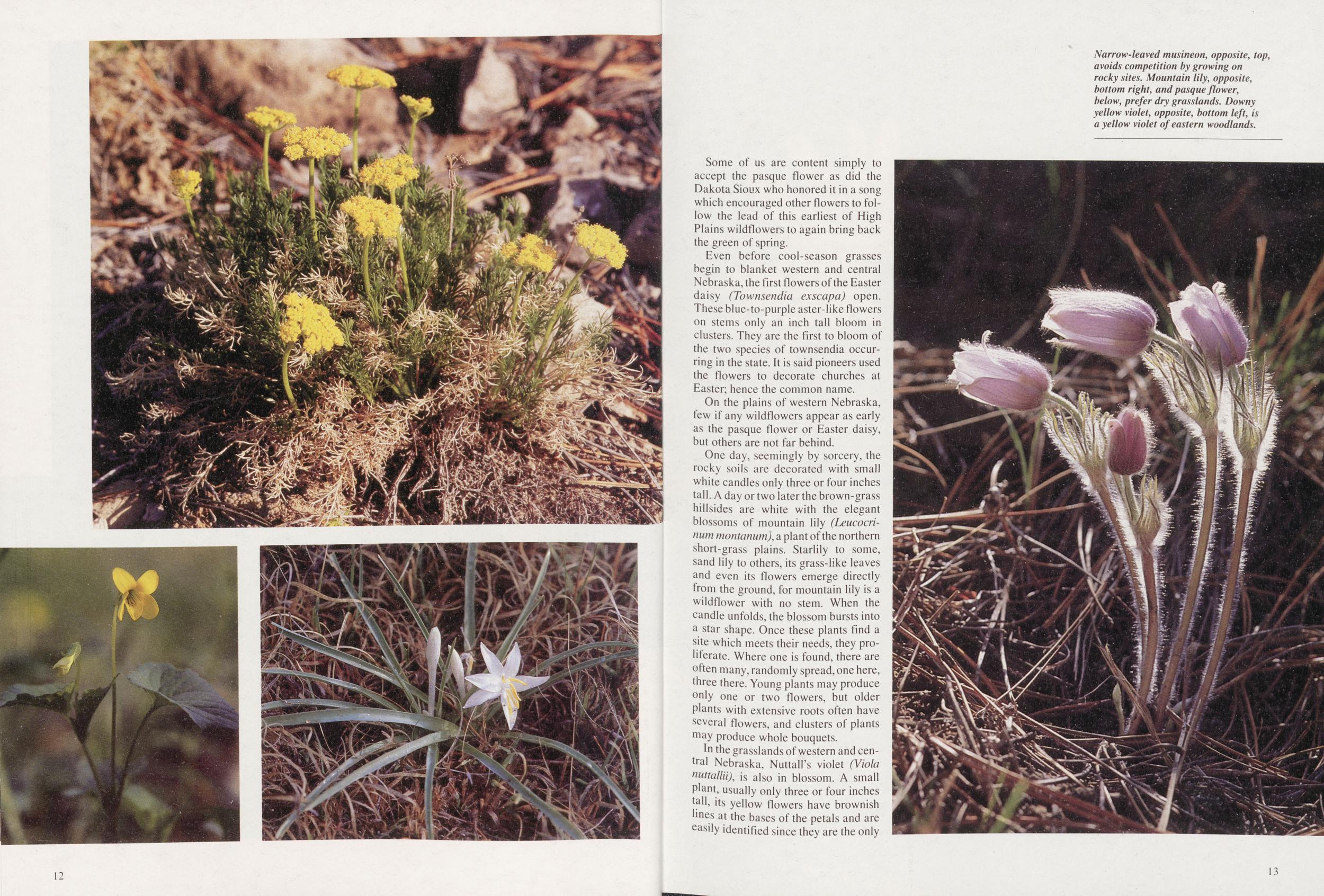
Some of us are content simply to accept the pasque flower as did the Dakota Sioux who honored it in a song which encouraged other flowers to follow the lead of this earliest of High Plains wildflowers to again bring back the green of spring.
Even before cool-season grasses begin to blanket western and central Nebraska, the first flowers of the Easter daisy (Townsendia exscapa) open. These blue-to-purple aster-like flowers on stems only an inch tall bloom in clusters. They are the first to bloom of the two species of townsendia occurring in the state. It is said pioneers used the flowers to decorate churches at Easter; hence the common name.
On the plains of western Nebraska, few if any wildflowers appear as early as the pasque flower or Easter daisy, but others are not far behind.
One day, seemingly by sorcery, the rocky soils are decorated with small white candles only three or four inches tall. A day or two later the brown-grass hillsides are white with the elegant blossoms of mountain lily (Leucocrinum montanum), a plant of the northern short-grass plains. Starlily to some, sand lily to others, its grass-like leaves and even its flowers emerge directly from the ground, for mountain lily is a wildflower with no stem. When the candle unfolds, the blossom bursts into a star shape. Once these plants find a site which meets their needs, they proliferate. Where one is found, there are often many, randomly spread, one here, three there. Young plants may produce only one or two flowers, but older plants with extensive roots often have several flowers, and clusters of plants may produce whole bouquets.
In the grasslands of western and central Nebraska, Nuttall's violet (Viola
nuttallii), is also in blossom. A small
Plant, usually only three or four inches
tall, its yellow flowers have brownish
hnes at the bases of the petals and are
easily identified since they are the only
13
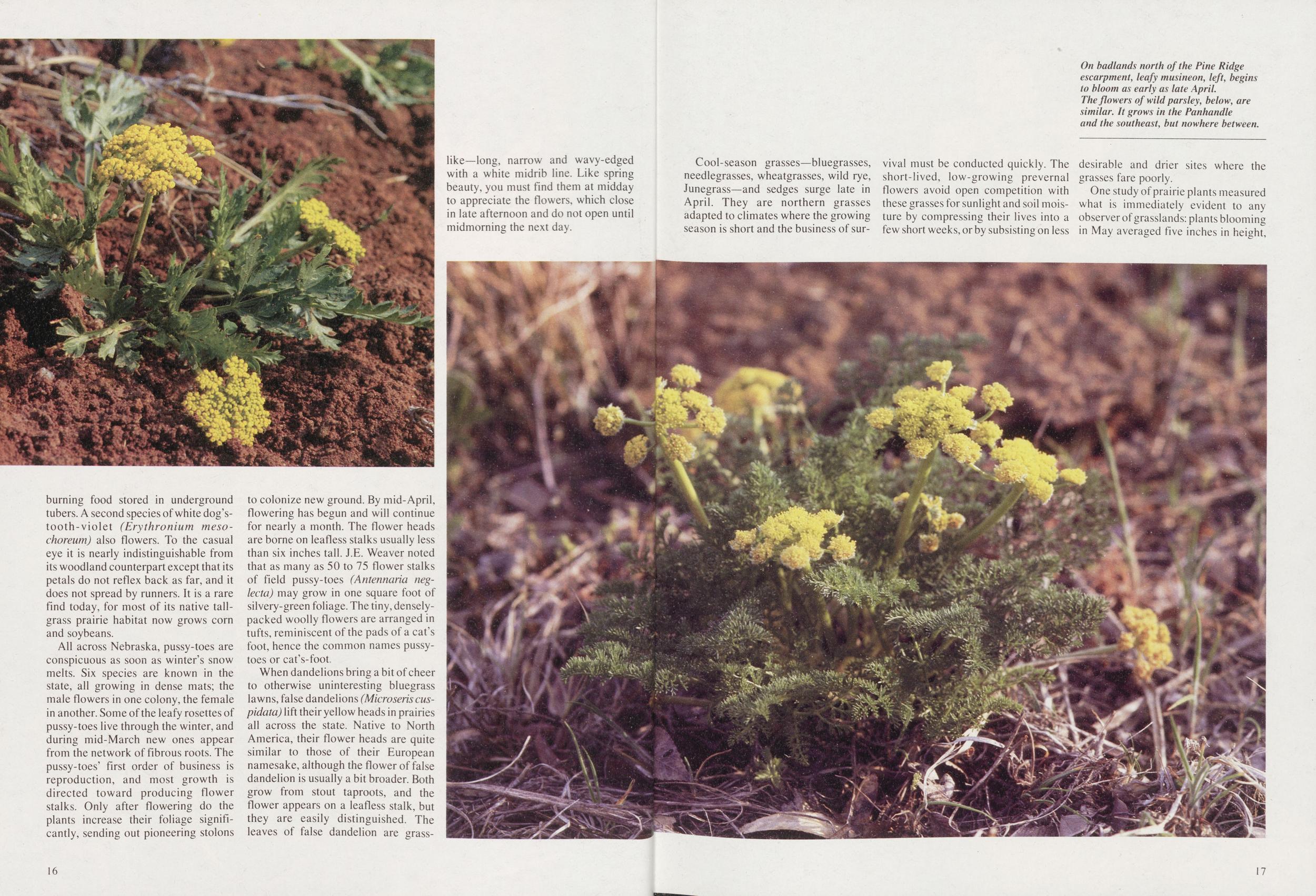
At the end of April, the rush to flower intensifies. On grasslands north of the Pine Ridge escarpment, leafy musineon (Musineon divaricatum) begins to bloom. Earlier, its dark green, deeply divided parsley-like leaves had spread to cover a bit of gumbo clay. Now its tiny flowers open, gathered into yellow umbrellas no more than a few inches above the ground. In cracks in the rocky buttes of the Pine Ridge and
Wild parsley (Lomatium foeniculaceum), similar in appearance to narrow-leaved musineon, is also in flower at the end of April. Oddly, it occurs in both the northern Panhandle and the eastern third of Nebraska but nowhere between. Known by a variety of names—whiskbroom parsley, biscuitroot, Indian biscuit and carrot-leaf lomatium—it favors rocky outcrops in grassland, thriving on dry soils in the Panhandle or on Dakota sandstone outcrops in the far southeast. Its large roots are storehouses of starch, ensuring the plant's survival through rainless summers and fueling a quick start in the spring. The roots of closely-related biscuitroots were a staple in the diet of Plains Indians, and a regular item of trade with early European travelers on the Great Plains. Lewis and Clark wrote in their journals of trading beads, buttons and trinkets for baked cakes made from the flour of native biscuitroots.
TALLGRASS PRAIRIEOn choice prairie sites in eastern Nebraska, yet another of the early wildflowers, Carolina anemone (Anemone caroliniana), rushes quickly to bloom, 14
 burning food stored in underground
tubers. A second species of white dog'stooth-violet (Erythronium mesochoreum) also
flowers. To the casual
eye it is nearly indistinguishable from
its woodland counterpart except that its
petals do not reflex back as far, and it
does not spread by runners. It is a rare
find today, for most of its native tallgrass prairie habitat now grows corn
and soybeans.
burning food stored in underground
tubers. A second species of white dog'stooth-violet (Erythronium mesochoreum) also
flowers. To the casual
eye it is nearly indistinguishable from
its woodland counterpart except that its
petals do not reflex back as far, and it
does not spread by runners. It is a rare
find today, for most of its native tallgrass prairie habitat now grows corn
and soybeans.
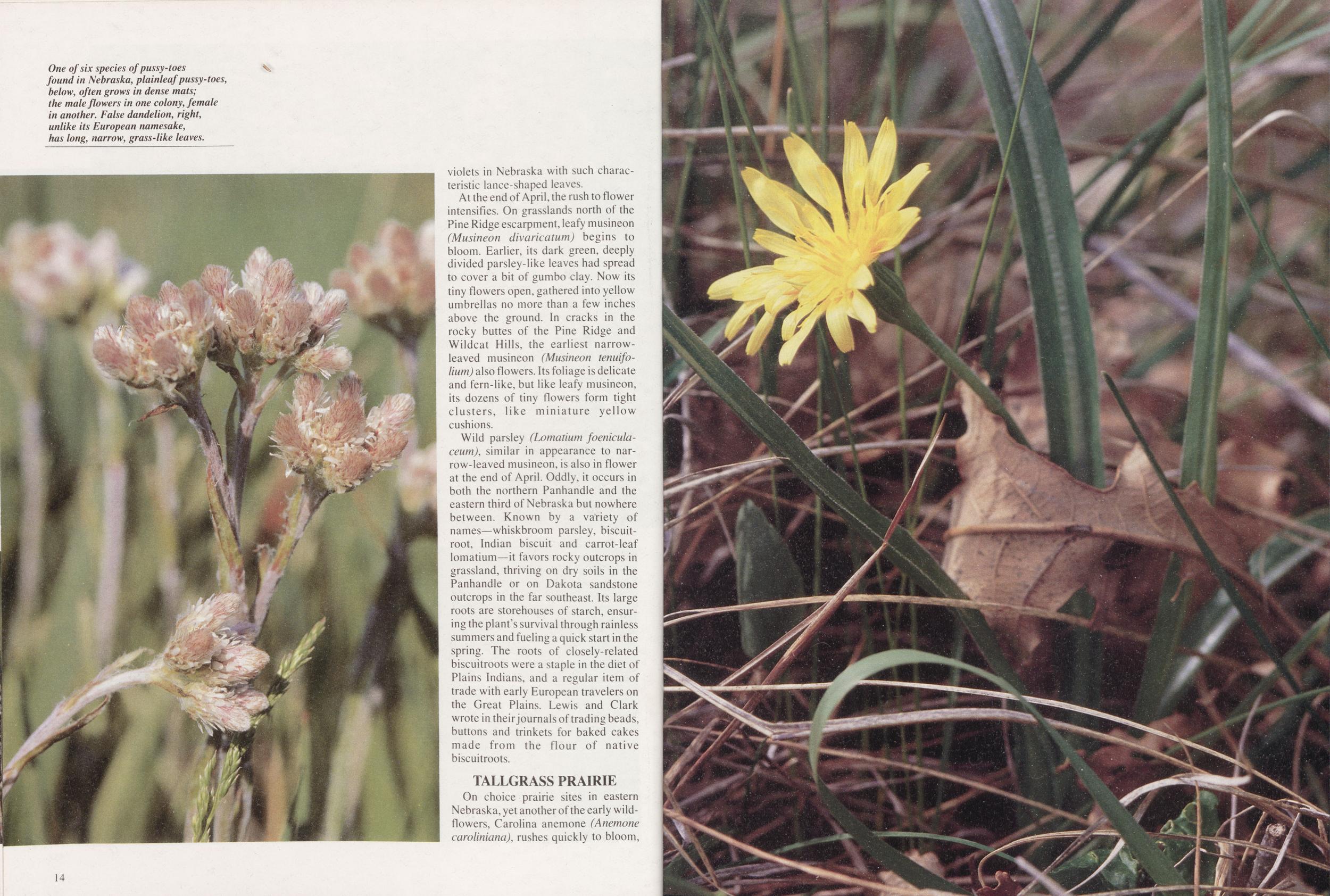
All across Nebraska, pussy-toes are conspicuous as soon as winter's snow melts. Six species are known in the state, all growing in dense mats; the male flowers in one colony, the female in another. Some of the leafy rosettes of pussy-toes live through the winter, and during mid-March new ones appear from the network of fibrous roots. The pussy-toes' first order of business is reproduction, and most growth is directed toward producing flower stalks. Only after flowering do the plants increase their foliage significantly, sending out pioneering stolons to colonize new ground. By mid-April, flowering has begun and will continue for nearly a month. The flower heads are borne on leafless stalks usually less than six inches tall. J.E. Weaver noted that as many as 50 to 75 flower stalks of field pussy-toes (Antennaria neglecta) may grow in one square foot of silvery-green foliage. The tiny, denselypacked woolly flowers are arranged in tufts, reminiscent of the pads of a cat's foot, hence the common names pussytoes or cat's-foot
When dandelions bring a bit of cheer to otherwise uninteresting bluegrass lawns, false dandelions (Microseris cuspidata) lift their yellow heads in prairies all across the state. Native to North America, their flower heads are quite similar to those of their European namesake, although the flower of false dandelion is usually a bit broader. Both grow from stout taproots, and the flower appears on a leafless stalk, but they are easily distinguished. The leaves of false dandelion are grass like—long, narrow and wavy-edged with a white midrib line. Like spring beauty, you must find them at midday to appreciate the flowers, which close in late afternoon and do not open until midmorning the next day.
16Cool-season grasses—bluegrasses, needlegrasses, wheatgrasses, wild rye, Junegrass—and sedges surge late in April. They are northern grasses adapted to climates where the growing season is short and the business of survival must be conducted quickly. The short-lived, low-growing prevernal flowers avoid open competition with these grasses for sunlight and soil moisture by compressing their lives into a few short weeks, or by subsisting on less desirable and drier sites where the grasses fare poorly.
One study of prairie plants measured
what is immediately evident to any
observer of grasslands: plants blooming
in May averaged five inches in height,
17
"Week by week during spring and early summer," Weaver wrote of grassland plants, "the struggle for light becomes more and more severe. After a few weeks of vigorous activity, unshaded by other plants in early spring, they disappear or persist in the understory throughout the remainder of the growing season."
Canada geese are already hatching in downy nests on Sandhills marshes. The time of these earliest of flowers is nearly at an end. Thicker-stalked plants are climbing toward the sun, encour- aged by spring rains, lengthening days and warming soil. The rush of May's delicate flowers is ready to begin.
The Flower Fields of May
AVOCETS are back on the beaches of alkaline potholes in the western Sandhills. Bullsnakes are on the move, looking for mates and for their first meals of wild mice after a winter of abstinence. Sandcherry and chokecherry are in flower, but most of the wild plum in eastern Nebraska has bloomed off. April must be giving way to May.
May, the month the grasslands finally green. The bleached brown of April was no more than a calendar's promise of spring. Finally the soil is warm and, in most years, moist. Root threads stretch, twisting around particles of soil, drawing in water and nutrients, piping them upward with blind trust to greenery above, where the business of manufacturing plant food from the raw ingredients of earth and sky proceeds at a feverish pace. There are flowers to be made and seeds to be spread.
This is urgent business in the deep woodlands. A leafy canopy is quickly closing above the forest floor along.the Missouri and the lower reaches of the Elkhorn, Platte and Nemaha rivers. The days of sunlight are numbered. Once the tent is drawn, only forbs at the woodland edge will be about the business of flowering.
Where better to take up the trail of May wildflowers than with the month's namesake, May-apple (Podophyllum peltatwn). It is a plant of moist deciduous woodlands, and eastern Nebraska lies at the western edge of its range. May-apple is known by many names, some descriptive, such as yellow berry and umbrella plant; some, such as devil's apple, hog apple and Indian apple, are references to the edibility of its fruit; others are more whimsical, like Puck's foot, an allusion to its broad leaf.
May-apple spreads by creeping underground stems, so it often grows in extensive colonies, filling woodland hollows with a false floor of leaves. Young plants bear but a single leaf and do not flower. A single flower—an inch or two in diameter, with white, waxy petals—is borne on a short stalk emerging from the crotch of a forked leafstem on mature plants.
The ripe, yellow-green fruit of the May-apple is large—up to two inches long—and edible. Other parts of the plant are considered mildly toxic, a characteristic which seemed to heighten the interest of early-day Indian medicine men and white herbalists. It was used to treat diarrhea, snakebite, dropsy, warts and, of course, syphilis, as in the desperate search for a cure for this dreaded venereal disease introduced by Europeans, nearly every plant decoction was considered.
Blue phlox (Phlox divaricata) began to flower in late April, but now, given adequate snowmelt or early spring rains, it is at the peak of flowering, adding splashes of blue to the patches of large-leaved May-apple.
Rocky outcrops or steep, north-facing slopes, particularly at the edges of
woodlands, are favored sites for wild
columbine (Aquilegia canadensis).
Even better is the edge of a seep, where
water oozes from the bluffs. Here
columbines may grow in lush drifts.
21
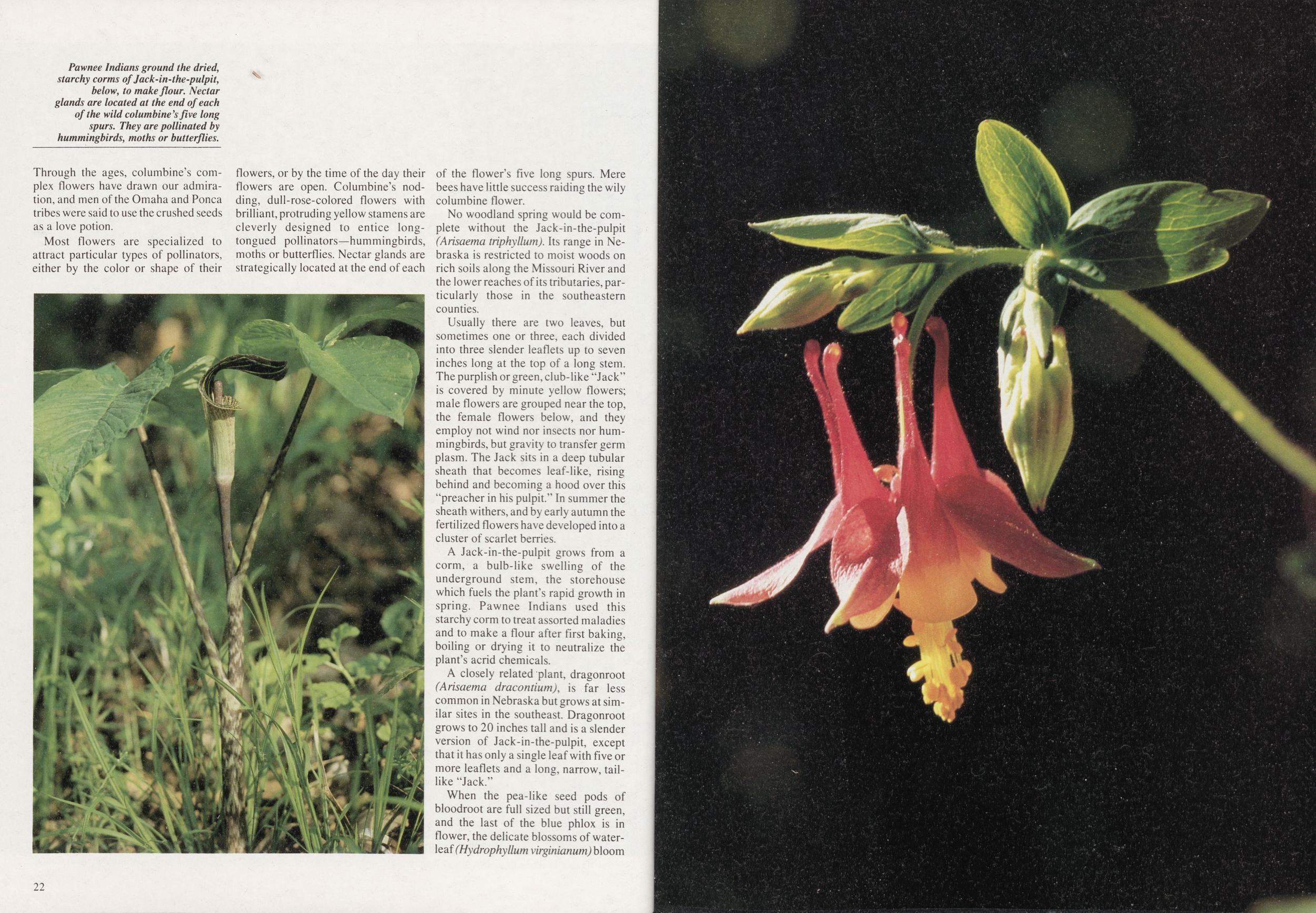
Most flowers are specialized to attract particular types of pollinators, either by the color or shape of their flowers, or by the time of the day their flowers are open. Columbine's nodding, dull-rose-colored flowers with brilliant, protruding yellow stamens are cleverly designed to entice longtongued pollinators—hummingbirds, moths or butterflies. Nectar glands are strategically located at the end of each of the flower's five long spurs. Mere bees have little success raiding the wily columbine flower.
No woodland spring would be complete without the Jack-in-the-pulpit (Arisaema triphyllum). Its range in Nebraska is restricted to moist woods on rich soils along the Missouri River and the lower reaches of its tributaries, particularly those in the southeastern counties.
Usually there are two leaves, but sometimes one or three, each divided into three slender leaflets up to seven inches long at the top of a long stem. The purplish or green, club-like "Jack" is covered by minute yellow flowers; male flowers are grouped near the top, the female flowers below, and they employ not wind nor insects nor hummingbirds, but gravity to transfer germ plasm. The Jack sits in a deep tubular sheath that becomes leaf-like, rising behind and becoming a hood over this "preacher in his pulpit." In summer the sheath withers, and by early autumn the fertilized flowers have developed into a cluster of scarlet berries.
A Jack-in-the-pulpit grows from a corm, a bulb-like swelling of the underground stem, the storehouse which fuels the plant's rapid growth in spring. Pawnee Indians used this starchy corm to treat assorted maladies and to make a flour after first baking, boiling or drying it to neutralize the plant's acrid chemicals.
A closely related plant, dragonroot (Arisaema dracontium), is far less common in Nebraska but grows at similar sites in the southeast. Dragonroot grows to 20 inches tall and is a slender version of Jack-in-the-pulpit, except that it has only a single leaf with five or more leaflets and a long, narrow, taillike "Jack."
When the pea-like seed pods of bloodroot are full sized but still green, and the last of the blue phlox is in flower, the delicate blossoms of waterleaf (Hydrophyllum virginianum) bloom 22
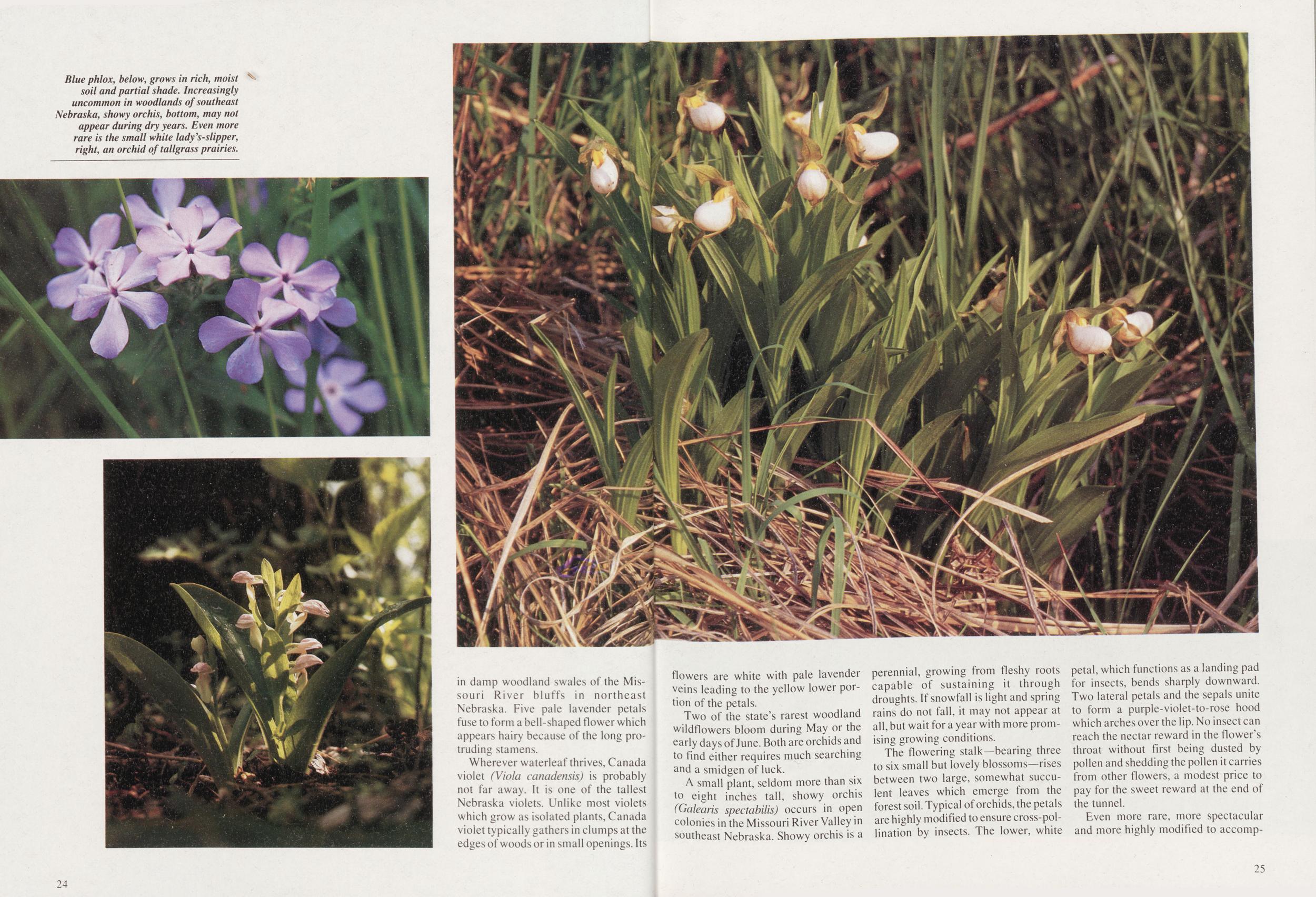
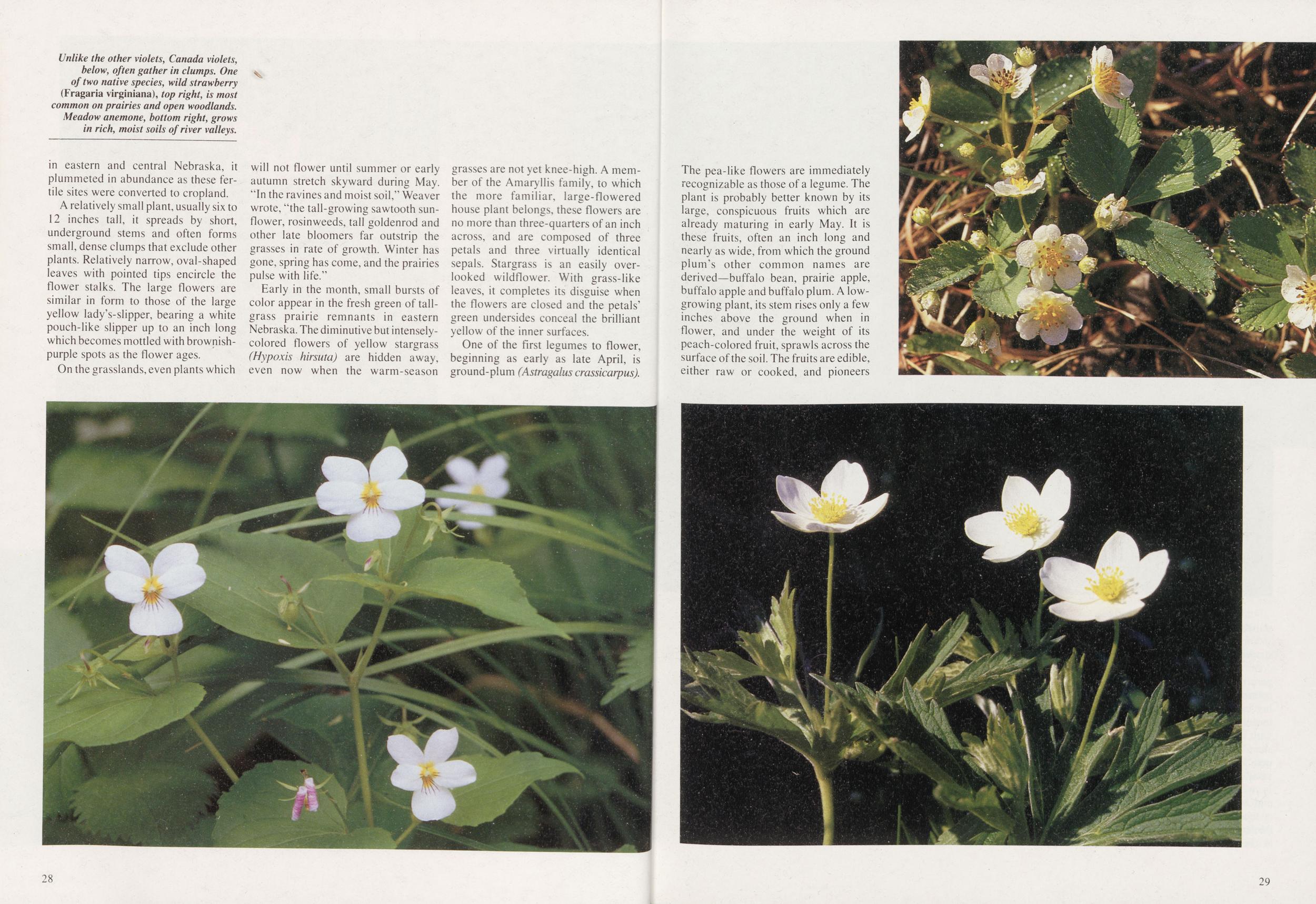
Wherever waterleaf thrives, Canada violet (Viola canadensis) is probably not far away. It is one of the tallest Nebraska violets. Unlike most violets which grow as isolated plants, Canada violet typically gathers in clumps at the edges of woods or in small openings. Its 24 flowers are white with pale lavender veins leading to the yellow lower portion of the petals.
Two of the state's rarest woodland wildflowers bloom during May or the early days of June. Both are orchids and to find either requires much searching and a smidgen of luck.
A small plant, seldom more than six to eight inches tall, showy orchis (Galearis spectabilis) occurs in open colonies in the Missouri River Valley in southeast Nebraska. Showy orchis is a perennial, growing from fleshy roots capable of sustaining it through droughts. If snowfall is light and spring rains do not fall, it may not appear at all, but wait for a year with more promising growing conditions.
The flowering stalk—bearing three to six small but lovely blossoms—rises between two large, somewhat succulent leaves which emerge from the forest soil. Typical of orchids, the petals are highly modified to ensure cross-pollination by insects. The lower, white petal, which functions as a landing pad for insects, bends sharply downward. Two lateral petals and the sepals unite to form a purple-violet-to-rose hood which arches over the lip. No insect can reach the nectar reward in the flower's throat without first being dusted by pollen and shedding the pollen it carries from other flowers, a modest price to pay for the sweet reward at the end of the tunnel.
Even more rare, more spectacular
and more highly modified to accomplish
25
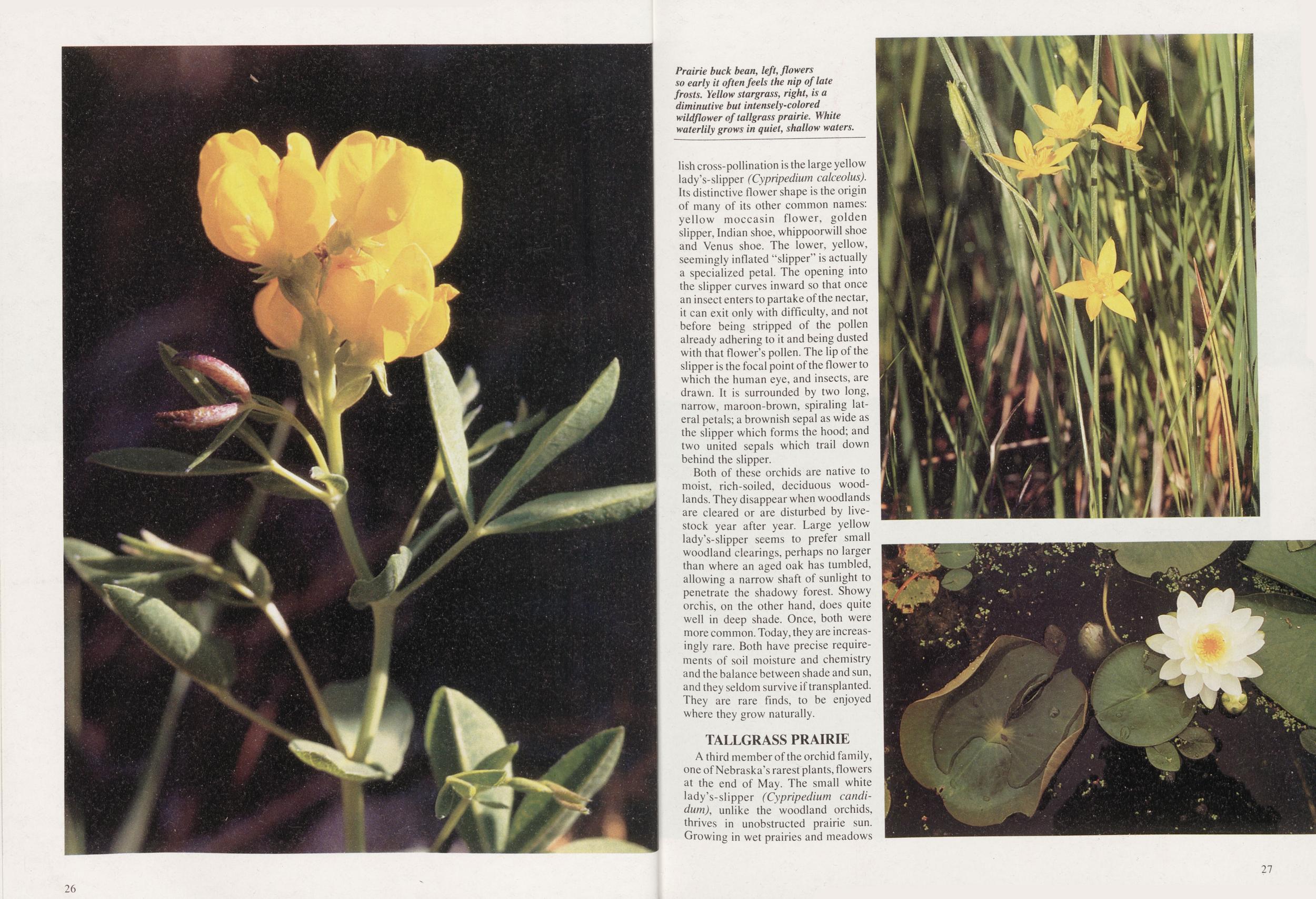
Both of these orchids are native to moist, rich-soiled, deciduous woodlands. They disappear when woodlands are cleared or are disturbed by livestock year after year. Large yellow lady's-slipper seems to prefer small woodland clearings, perhaps no larger than where an aged oak has tumbled, allowing a narrow shaft of sunlight to penetrate the shadowy forest. Showy orchis, on the other hand, does quite well in deep shade. Once, both were more common. Today, they are increasingly rare. Both have precise requirements of soil moisture and chemistry and the balance between shade and sun, and they seldom survive if transplanted. They are rare finds, to be enjoyed where they grow naturally.
A third member of the orchid family,
one of Nebraska's rarest plants, flowers
at the end of May. The small white
lady's-slipper (Cypripedium candidum), unlike the woodland orchids,
thrives in unobstructed prairie sun.
Growing in wet prairies and meadows
27
A relatively small plant, usually six to 12 inches tall, it spreads by short, underground stems and often forms small, dense clumps that exclude other plants. Relatively narrow, oval-shaped leaves with pointed tips encircle the flower stalks. The large flowers are similar in form to those of the large yellow lady's-slipper, bearing a white pouch-like slipper up to an inch long which becomes mottled with brownish-purple spots as the flower ages.
On the grasslands, even plants which will not flower until summer or early autumn stretch skyward during May. "In the ravines and moist soil," Weaver wrote, "the tall-growing sawtooth sunflower, rosinweeds, tall goldenrod and other late bloomers far outstrip the grasses in rate of growth. Winter has gone, spring has come, and the prairies pulse with life."
Early in the month, small bursts of color appear in the fresh green of tallgrass prairie remnants in eastern Nebraska. The diminutive but intensely-colored flowers of yellow stargrass (Hypoxis hirsuta) are hidden away, even now when the warm-season grasses are not yet knee-high. A member of the Amaryllis family, to which the more familiar, large-flowered house plant belongs, these flowers are no more than three-quarters of an inch across, and are composed of three petals and three virtually identical sepals. Stargrass is an easily overlooked wildflower. With grass-like leaves, it completes its disguise when the flowers are closed and the petals' green undersides conceal the brilliant yellow of the inner surfaces.
One of the first legumes to flower, beginning as early as late April, is ground-plum (Astragalus crassicarpus). 28 The pea-like flowers are immediately recognizable as those of a legume. The plant is probably better known by its large, conspicuous fruits which are already maturing in early May. It is these fruits, often an inch long and nearly as wide, from which the ground plum's other common names are derived—buffalo bean, prairie apple, buffalo apple and buffalo plum. A lowgrowing plant, its stem rises only a few inches above the ground when in flower, and under the weight of its peach-colored fruit, sprawls across the surface of the soil. The fruits are edible, either raw or cooked, and pioneers
There are two species of native strawberry in Nebraska but the most common is the wild strawberry (Fragaria virginiana), a plant of prairies, open woodlands and roadsides. Spreading by runners, it grows in colonies, loosely spaced, sharing the soil surface with other plants. Similar to domestic strawberries, it bears small, white, fivepetaled flowers. Although the fruit is smaller than that of a domestic plant, it is sweet and intensely flavored. In the mid-19th century, they were so common on the grasslands that travelers reported the feet of their horses were stained red at the end of the day from walking through patches of wild strawberries.
As it is in the woodlands, May is also the month of violets on the grasslands. In the tallgrass prairies of eastern Nebraska, two blue-flowered violets are most frequently encountered, and because of their distinctive leaf shapes can usually be readily distinguished.
The leaves of the prairie violet (Viola pedatifida) are divided into lobes which are further divided and deeply cut until the smallest lobes are nearly linear; hence another common name, crowfoot violet. These perennial plants are generally less than six inches tall, and the flowers are typical of most North American violets. They have five petals: an upper pair, two lateral petals, and a lower petal that is often larger than the others, and as in the showy orchis, serves as a landing pad for insects. The lower petal is often lined with darker pigments, directing insects to the nectary. The lower three petals of the prairie violet are whitish near the base, and have hairs or beards on their inner surfaces. Typically, the flowers rise above the leaves.
Blue prairie violet (Viola pratincola) is superficially similar to the prairie violet in most respects except that its leaves are heart-shaped, more typical of the violets. These two species are known to cross with each other and 30 with other closely related species, producing hybrids that may be intermediate, and leaving positive identification in the realm of the professional botanist.
At least six species of native onions occur in Nebraska. Of these, the most frequently encountered in the prairies of eastern Nebraska is the wild onion (Allium canadense), frequently known as meadow garlic or wild garlic. It is a bonafide member of the tallgrass prairie community. On low sites with rich soils and adequate moisture, its flowering stalks, topped with a hemispherical cluster of white-to-pink flowers, may be two feet or more tall, but 12 to 15 inches is more typical. The leaves, two or more, are long and slender. The bulb is seldom much more than an inch in diameter, and is covered by a brown fibrous husk. In spite of their small size, though, they were used by Indians and pioneers for food and for a variety of medicinal applications. This species shows much variation and has long been the subject of debate among botanists about whether the varieties are distinct enough to be called species or are merely races.
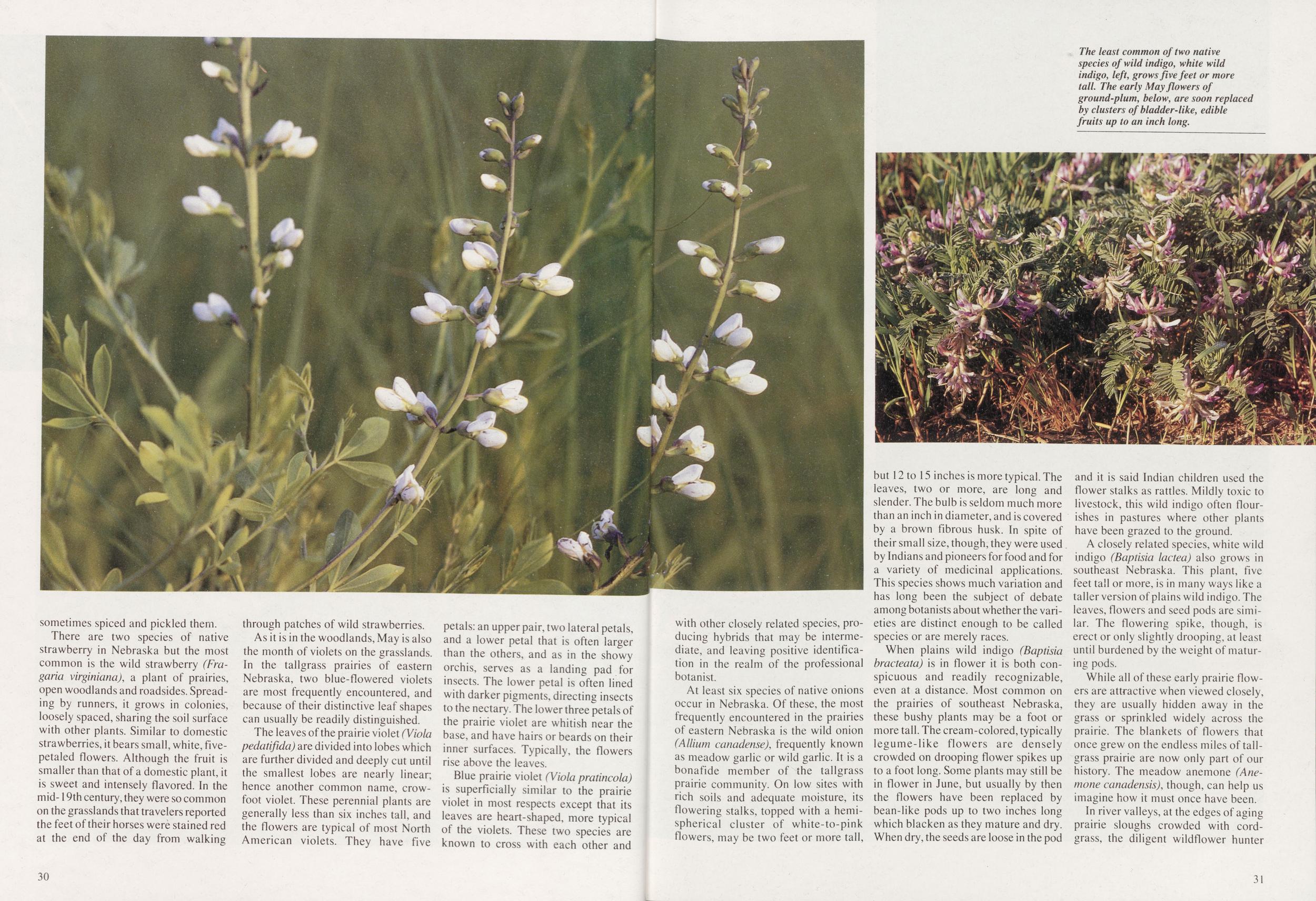
When plains wild indigo (Baptisia bracteata) is in flower it is both conspicuous and readily recognizable, even at a distance. Most common on the prairies of southeast Nebraska, these bushy plants may be a foot or more tall. The cream-colored, typically legume-like flowers are densely crowded on drooping flower spikes up to a foot long. Some plants may still be in flower in June, but usually by then the flowers have been replaced by bean-like pods up to two inches long which blacken as they mature and dry. When dry, the seeds are loose in the pod and it is said Indian children used the flower stalks as rattles. Mildly toxic to livestock, this wild indigo often flourishes in pastures where other plants have been grazed to the ground.
A closely related species, white wild indigo (Baptisia lactea) also grows in southeast Nebraska. This plant, five feet tall or more, is in many ways like a taller version of plains wild indigo. The leaves, flowers and seed pods are similar. The flowering spike, though, is erect or only slightly drooping, at least until burdened by the weight of maturing pods.
While all of these early prairie flowers are attractive when viewed closely, they are usually hidden away in the grass or sprinkled widely across the prairie. The blankets of flowers that once grew on the endless miles of tailgrass prairie are now only part of our history. The meadow anemone (Anemone canadensis), though, can help us imagine how it must once have been.
In river valleys, at the edges of aging prairie sloughs crowded with cordgrass, the diligent wildflower hunter
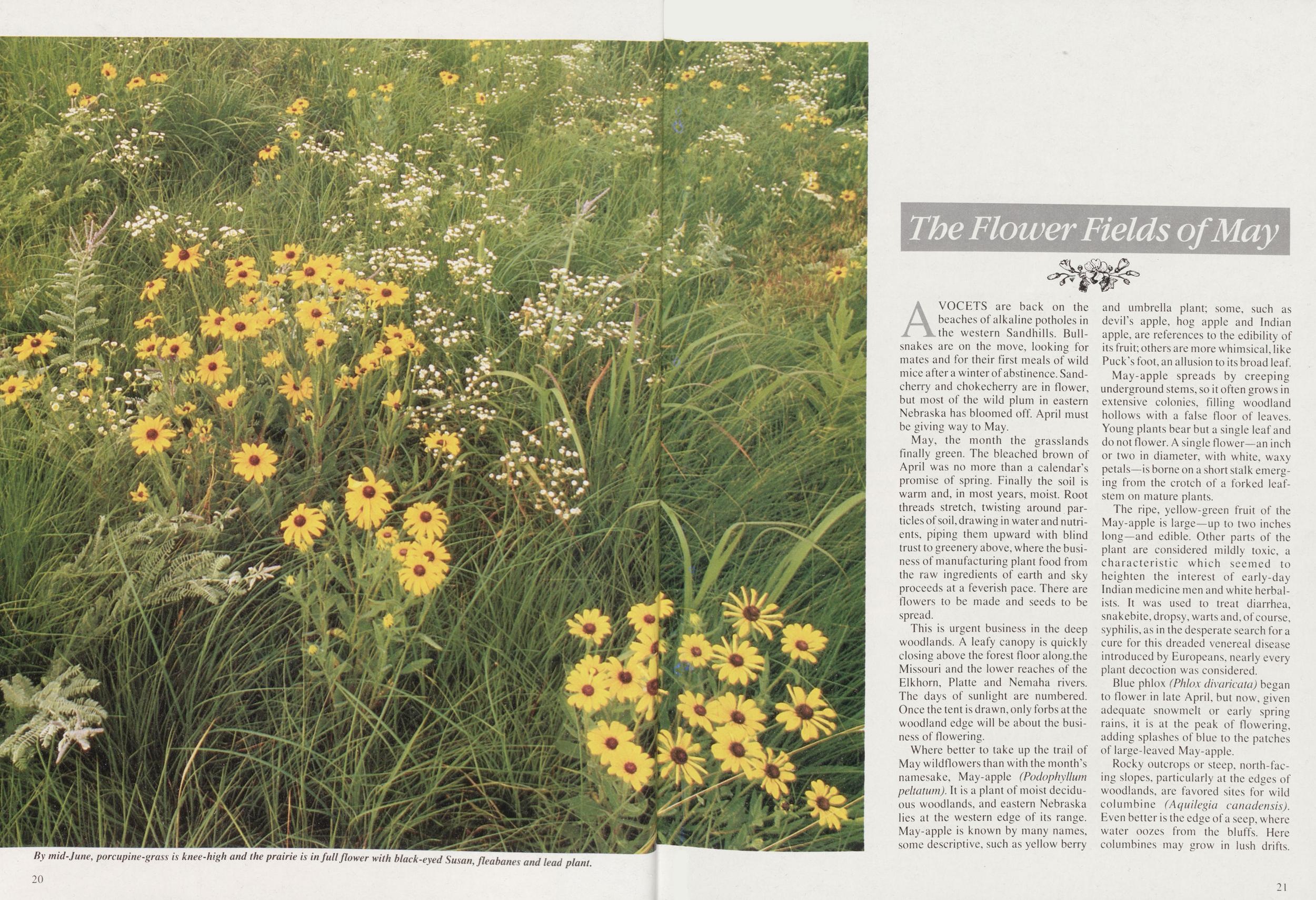
By mid June, black-eyed Susans (Rudbeckia hirta) are beginning to flower. Their large, bright-yellow blossoms will continue into September. Even though they are only biennials or short-lived perennials, they can flower in their first year and are so successful at perpetuating their kind that they, too, may form extensive colonies. Blackeyed Susans thrive with a bit of disturbance, invading tallgrass prairies at sites abused by machines or livestock.
Many other wildflowers are in blossom on the prairies of eastern Nebraska during the vernal aspect: New Jersey tea, bastard toad-flax, Carolina cranesbill, tufted loosestrife, violet and yellow wood sorrel, white beard-tongue, marsh vetchling, narrow-leaf puccoon, the ground cherries, self-heal, horse-gentian and golden Alexander. Spiderworts, prairie phlox and the blueeyed grasses begin to flower during the last two weeks of May on the tallgrass prairie, but they will be in greater profusion during June.
PANHANDLEMay is a superb time to hunt wildflowers in western Nebraska. The dry, rocky, shallow soil of the High Plains is a stark contrast to the deep, rich, wellwatered soils of the tallgrass prairie to the east. These short-grass plains are a demanding environment for plants. Rainfall is scant, averaging less than 20 inches per year. Temperatures can be searing even before summer sets in, humidity is typically low, and desiccating winds are ever-present—conditions capable of turning green plant tissue to dust.
But plants of the short-grass plains have evolved to endure such vicissitudes. Those which have survived through the centuries have taken forms which minimize the loss of precious moisture, or they quickly flower and then retreat back into the soil until another spring. With the arrival of rains in May and early June, there is a colorful stampede of wildflowers rushing to finish their work before the blistering days of summer. They run a life-and-death race, not against leafing trees or tall grasses, but against weather and climate. When rains are abundant, the floral display can be breathtaking, but even during dry years there are hardy and showy wildflowers to be found.
Prairie buck bean (Thermopsis rhombifolia), like most of the common wildflowers, is known by many names: goldenpea, prairie bean and false lupine are some of the more common. It is a plant that succeeds by avoiding competition; it flowers early, often when pasque flowers are still in blossom, and occasionally feels the nip of late snows and frosts. It grows on the poor soils of eroded buttes or in dense patches on badlands washes. Like most legume flowers, prairie buckbean has
Across western and central Nebraska, one of the early grassland flowers is western wallflower (Erysimum asperum). A biennial of dry or sandy prairies, the bright lemon-yellow flowers are often among the first spots of color on an otherwise brown landscape. Perhaps the most novel features of the wallflower are its slender pods, up to four inches long, which arch upward from the main stem. These sticky-appearing, seed-filled appendages are often evident on the lower portions of the plant while flowers still cap the upper parts.
An equally common yellow wildflower blooming statewide during May, but more conspicuous on the brown grazed pastures of central and western Nebraska, is prairie ragwort (Senecio plattensis). One to two feet tall, its yellow flowers, as many as 10, are borne in clusters at the upper end of the sparselyleafed stem. Despite the plant's mild toxicity, preparations from ragwort were used by American Indian women as a general tonic, hence another common name, squaw-weed. The species was first described by Thomas Nuttall, a noted botanical explorer of the western plains during the early decades of the 19th century. The species name, plattensis refers to the Platte River region.
An elegant flower with a far more restricted range in Nebraska begins to bloom at the end of May. Sego lily (Calochortus gunnisonii) is perhaps the most abundant of two superficially identical species native to northwest Nebraska. It is a seemingly delicate flower to make its home on dry prairies or in grassy openings at the edges of ponderosa pine woodlands. Although they seldom grow close to one another, where you find one you usually find more. Wherever they grow, they seem misplaced, the grass-like leaves hardly evident and the large, delicate flowers, usually one per stem, standing alone on
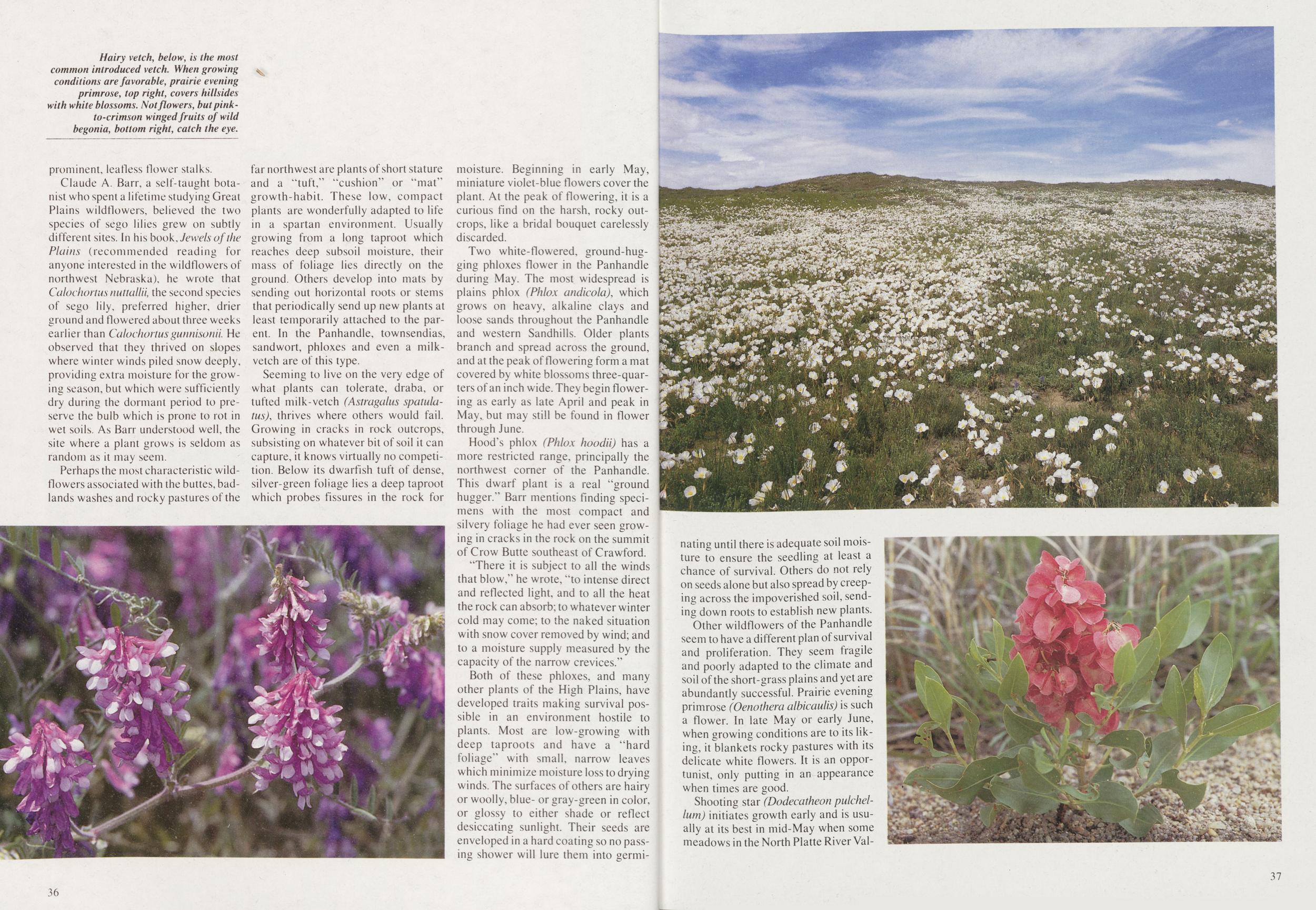
Claude A. Barr, a self-taught botanist who spent a lifetime studying Great Plains wildflowers, believed the two species of sego lilies grew on subtly different sites. In his book. Jewels of the Plains (recommended reading for anyone interested in the wildflowers of northwest Nebraska), he wrote that Calochortus nuttallii, the second species of sego lily, preferred higher, drier ground and flowered about three weeks earlier than Calochortus gunnisonii He observed that they thrived on slopes where winter winds piled snow deeply, providing extra moisture for the growing season, but which were sufficiently dry during the dormant period to preserve the bulb which is prone to rot in wet soils. As Barr understood well, the site where a plant grows is seldom as random as it may seem.
Perhaps the most characteristic wildflowers associated with the buttes, badlands washes and rocky pastures of the far northwest are plants of short stature and a "tuft," "cushion" or "mat" growth-habit. These low, compact plants are wonderfully adapted to life in a spartan environment. Usually growing from a long taproot which reaches deep subsoil moisture, their mass of foliage lies directly on the ground. Others develop into mats by sending out horizontal roots or stems that periodically send up new plants at least temporarily attached to the parent. In the Panhandle, townsendias, sandwort, phloxes and even a milkvetch are of this type.
Seeming to live on the very edge of what plants can tolerate, draba, or tufted milk-vetch (Astragalus spatulatus). thrives where others would fail. Growing in cracks in rock outcrops, subsisting on whatever bit of soil it can capture, it knows virtually no competition. Below its dwarfish tuft of dense, silver-green foliage lies a deep taproot which probes fissures in the rock for moisture. Beginning in early May, miniature violet-blue flowers cover the plant. At the peak of flowering, it is a curious find on the harsh, rocky outcrops, like a bridal bouquet carelessly discarded.
Two white-flowered, ground-hugging phloxes flower in the Panhandle during May. The most widespread is plains phlox (Phlox andicola), which grows on heavy, alkaline clays and loose sands throughout the Panhandle and western Sandhills. Older plants branch and spread across the ground, and at the peak of flowering form a mat covered by white blossoms three-quarters of an inch wide. They begin flowering as early as late April and peak in May, but may still be found in flower through June.
Hood's phlox (Phlox hoodii) has a more restricted range, principally the northwest corner of the Panhandle. This dwarf plant is a real "ground hugger." Barr mentions finding specimens with the most compact and silvery foliage he had ever seen growing in cracks in the rock on the summit of Crow Butte southeast of Crawford.
"There it is subject to all the winds that blow," he wrote, "to intense direct and reflected light, and to all the heat the rock can absorb; to whatever winter cold may come; to the naked situation with snow cover removed by wind; and to a moisture supply measured by the capacity of the narrow crevices."
Both of these phloxes, and many other plants of the High Plains, have developed traits making survival possible in an environment hostile to plants. Most are low-growing with deep taproots and have a "hard foliage" with small, narrow leaves which minimize moisture loss to drying winds. The surfaces of others are hairy or woolly, blue- or gray-green in color, or glossy to either shade or reflect desiccating sunlight. Their seeds are enveloped in a hard coating so no passing shower will lure them into germinating 36 until there is adequate soil moisture to ensure the seedling at least a chance of survival. Others do not rely on seeds alone but also spread by creeping across the impoverished soil, sending down roots to establish new plants.
Other wildflowers of the Panhandle seem to have a different plan of survival and proliferation. They seem fragile and poorly adapted to the climate and soil of the short-grass plains and yet are abundantly successful. Prairie evening primrose (Oenothera albicaulis) is such a flower. In late May or early June, when growing conditions are to its liking, it blankets rocky pastures with its delicate white flowers. It is an opportunist, only putting in an appearance when times are good.
Shooting star (Dodeeatheon pulchellum) initiates growth early and is usually at its
best in mid-May when some
meadows in the North Platte River Valley
37
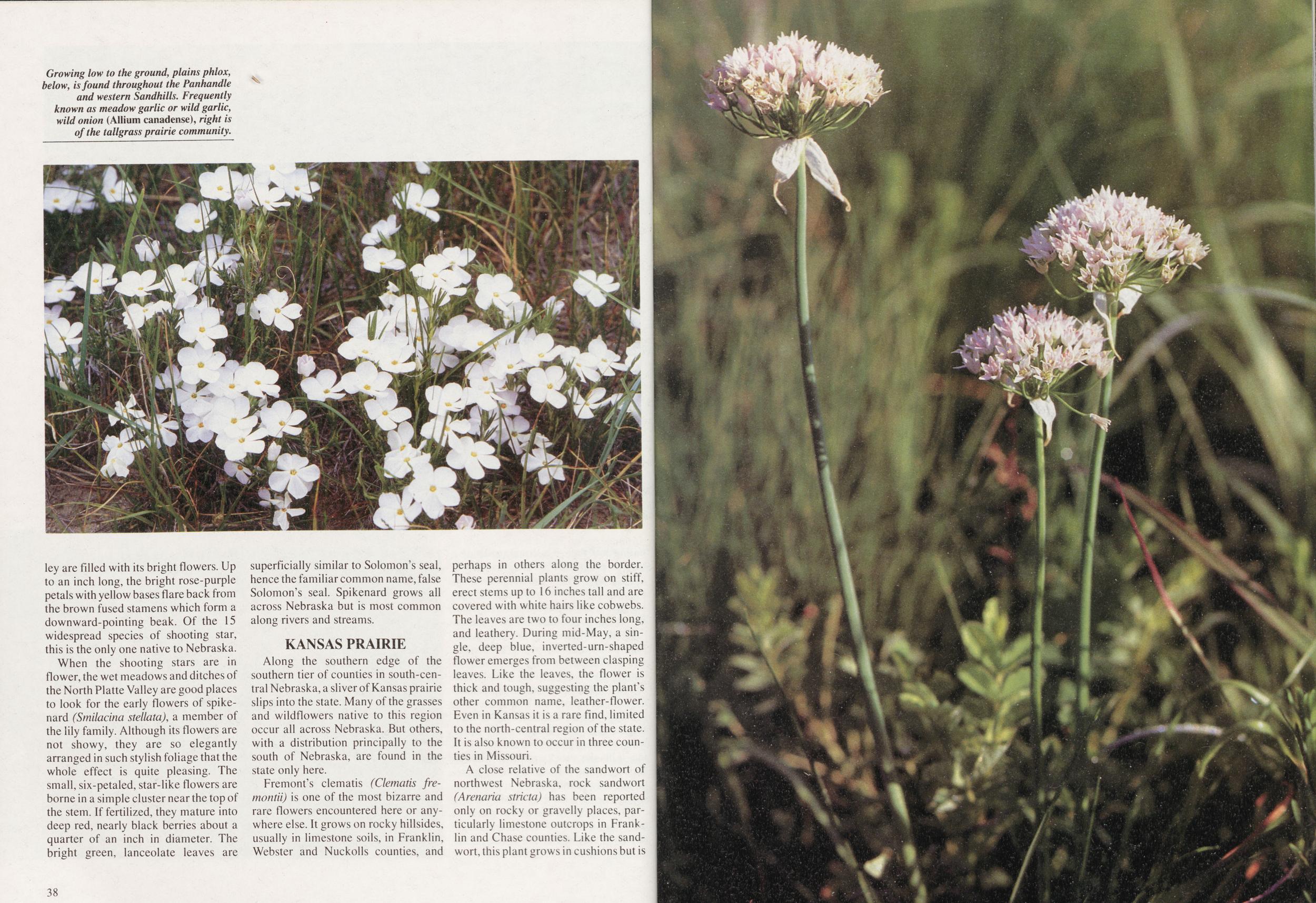
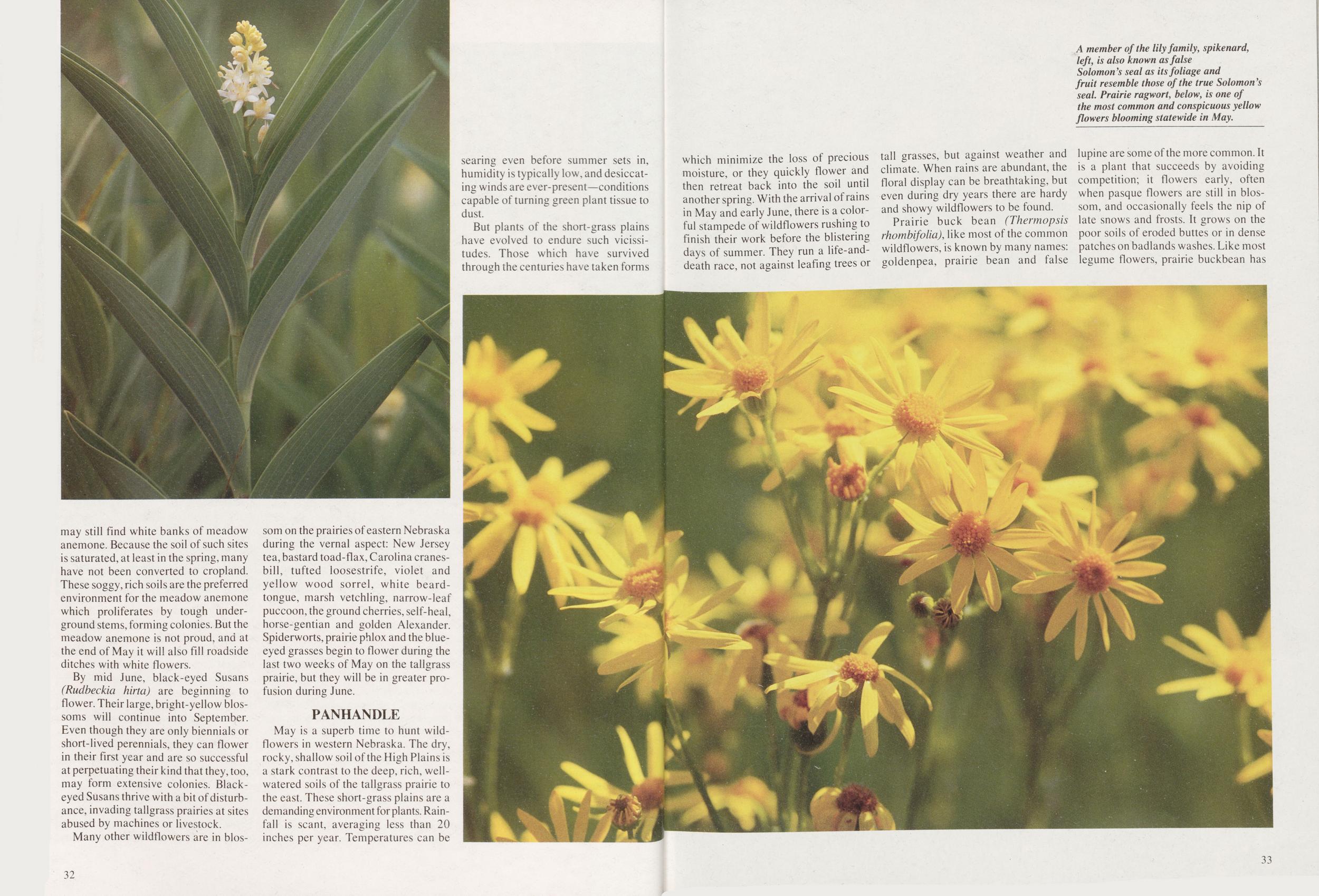
When the shooting stars are in flower, the wet meadows and ditches of the North Platte Valley are good places to look for the early flowers of spikenard (Smilacina stellata), a member of the lily family. Although its flowers are not showy, they are so elegantly arranged in such stylish foliage that the whole effect is quite pleasing. The small, six-petaled, star-like flowers are borne in a simple cluster near the top of the stem. If fertilized, they mature into deep red, nearly black berries about a quarter of an inch in diameter. The bright green, lanceolate leaves are superficially similar to Solomon's seal, hence the familiar common name, false Solomon's seal. Spikenard grows all across Nebraska but is most common along rivers and streams.
KANSAS PRAIRIEAlong the southern edge of the southern tier of counties in south-central Nebraska, a sliver of Kansas prairie slips into the state. Many of the grasses and wildflowers native to this region occur all across Nebraska. But others, with a distribution principally to the south of Nebraska, are found in the state only here.
Fremont's clematis (Clematis fremontii) is one of the most bizarre and rare flowers encountered here or anywhere else. It grows on rocky hillsides, usually in limestone soils, in Franklin, Webster and Nuckolls counties, and perhaps in others along the border. These perennial plants grow on stiff, erect stems up to 16 inches tall and are covered with white hairs like cobwebs. The leaves are two to four inches long, and leathery. During mid-May, a single, deep blue, inverted-urn-shaped flower emerges from between clasping leaves. Like the leaves, the flower is thick and tough, suggesting the plant's other common name, leather-flower. Even in Kansas it is a rare find, limited to the north-central region of the state. It is also known to occur in three counties in Missouri.
A close relative of the sandwort of northwest Nebraska, rock sandwort (Arenaria striata) has been reported only on rocky or gravelly places, particularly limestone outcrops in Franklin and Chase counties. Like the sandwort, this plant grows in cushions but is 38
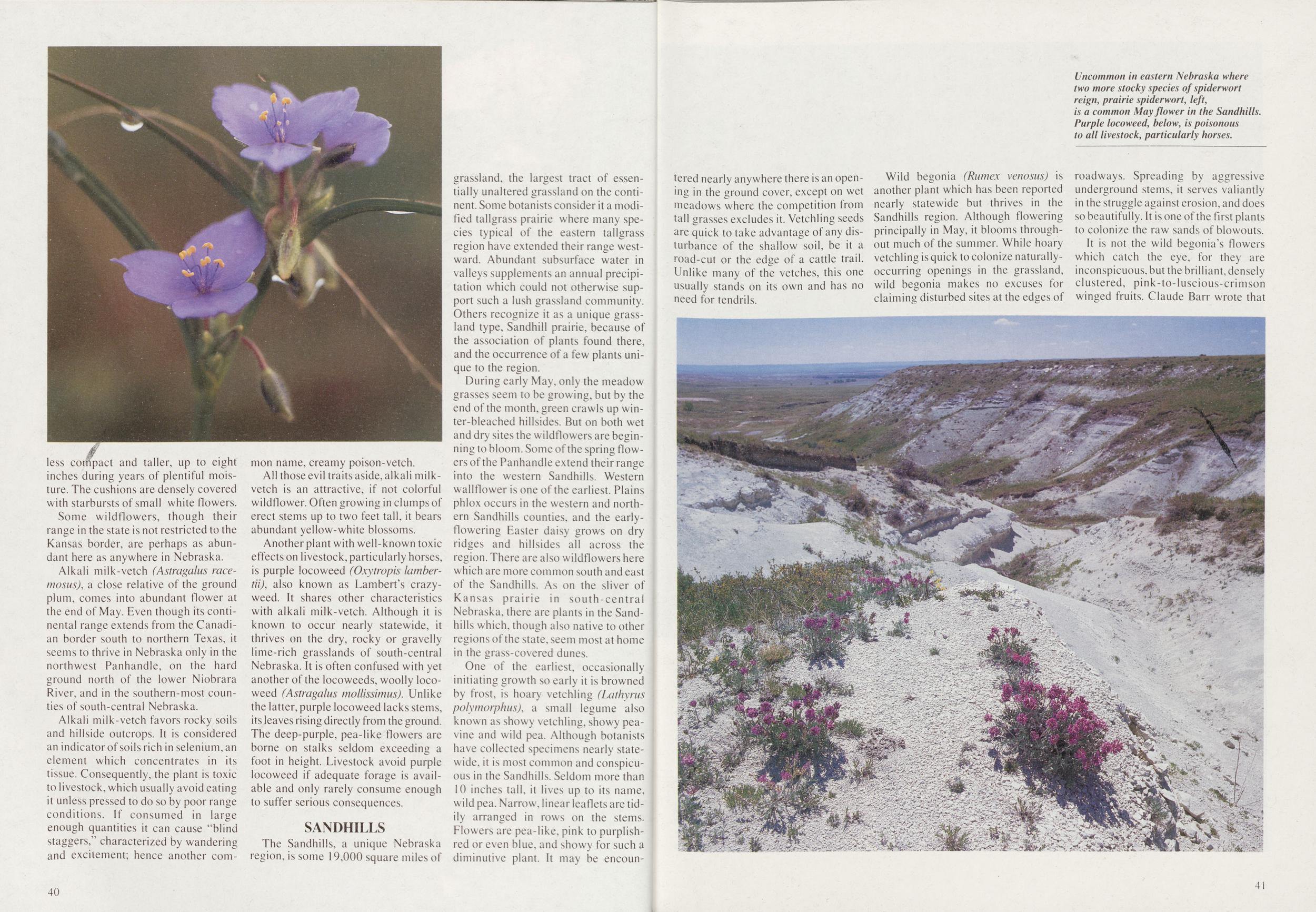
Some wildflowers, though their range in the state is not restricted to the Kansas border, are perhaps as abundant here as anywhere in Nebraska.
Alkali milk-vetch (Astragalus racemosus), a close relative of the ground plum, comes into abundant flower at the end of May. Even though its continental range extends from the Canadian border south to northern Texas, it seems to thrive in Nebraska only in the northwest Panhandle, on the hard ground north of the lower Niobrara River, and in the southern-most counties of south-central Nebraska.
Alkali milk-vetch favors rocky soils and hillside outcrops. It is considered an indicator of soils rich in selenium, an element which concentrates in its tissue. Consequently, the plant is toxic to livestock, which usually avoid eating it unless pressed to do so by poor range conditions. If consumed in large enough quantities it can cause "blind staggers," characterized by wandering and excitement; hence another common name, creamy poison-vetch.
All those evil traits aside, alkali milkvetch is an attractive, if not colorful wildflower. Often growing in clumps of erect stems up to two feet tall, it bears abundant yellow-white blossoms.
Another plant with well-known toxic effects on livestock, particularly horses, is purple locoweed (Oxytropis lambertii), also known as Lambert's crazyweed. It shares other characteristics with alkali milk-vetch. Although it is known to occur nearly statewide, it thrives on the dry, rocky or gravelly lime-rich grasslands of south-central Nebraska. It is often confused with yet another of the locoweeds, woolly locoweed (Astragalus mollissimus). Unlike the latter, purple locoweed lacks stems, its leaves rising directly from the ground. The deep-purple, pea-like flowers are borne on stalks seldom exceeding a foot in height. Livestock avoid purple locoweed if adequate forage is available and only rarely consume enough to suffer serious consequences.
SANDHILLSThe Sandhills, a unique Nebraska region, is some 19,000 square miles of grassland, the largest tract of essentially unaltered grassland on the continent. Some botanists consider it a modified tallgrass prairie where many species typical of the eastern tallgrass region have extended their range westward. Abundant subsurface water in valleys supplements an annual precipitation which could not otherwise support such a lush grassland community. Others recognize it as a unique grassland type, Sandhill prairie, because of the association of plants found there, and the occurrence of a few plants unique to the region.
During early May, only the meadow grasses seem to be growing, but by the end of the month, green crawls up winter-bleached hillsides. But on both wet and dry sites the wildflowers are beginning to bloom. Some of the spring flowers of the Panhandle extend their range into the western Sandhills, Western wallflower is one of the earliest. Plains phlox occurs in the western and northern Sandhills counties, and the earlyflowering Easter daisy grows on dry ridges and hillsides all across the region. There are also wildflowers here which are more common south and east of the Sandhills. As on the sliver of Kansas prairie in south-central Nebraska, there are plants in the Sandhills which, though also native to other regions of the state, seem most at home in the grass-covered dunes.
One of the earliest, occasionally initiating growth so early it is browned by frost, is hoary vetchling (Lathyrus polymorphic), a small legume also known as showy vetchling, showy peavine and wild pea. Although botanists have collected specimens nearly statewide, it is most common and conspicuous in the Sandhills. Seldom more than 10 inches tall, it lives up to its name, wild pea. Narrow, linear leaflets are tidily arranged in rows on the stems. Flowers are pea-like, pink to purplishred or even blue, and showy for such a diminutive plant. It may be encountered 40 nearly anywhere there is an opening in the ground cover, except on wet meadows where the competition from tall grasses excludes it. Vetchling seeds are quick to take advantage of any disturbance of the shallow soil, be it a road-cut or the edge of a cattle trail. Unlike many of the vetches, this one usually stands on its own and has no need for tendrils.
Wild begonia (Rumex venosus) is another plant which has been reported nearly statewide but thrives in the Sandhills region. Although flowering principally in May, it blooms throughout much of the summer. While hoary vetchling is quick to colonize naturally-occurring openings in the grassland, wild begonia makes no excuses for claiming disturbed sites at the edges of roadways. Spreading by aggressive underground stems, it serves valiantly in the struggle against erosion, and does so beautifully. It is one of the first plants to colonize the raw sands of blowouts.
It is not the wild begonia's flowers which catch the eye, for they are inconspicuous, but the brilliant, densely clustered, pink-to-luscious-crimson winged fruits. Claude Barr wrote that
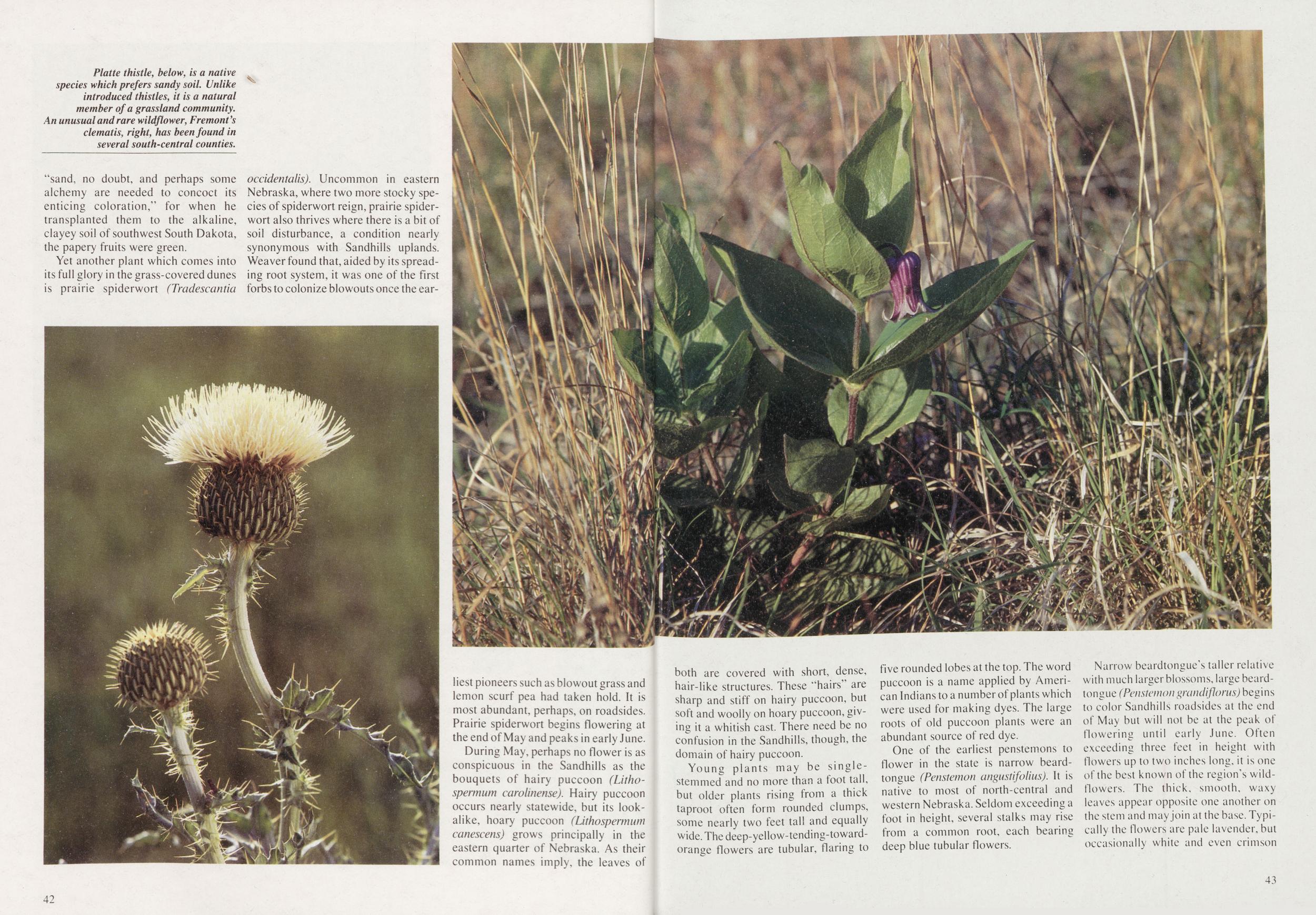
Yet another plant which comes into its full glory in the grass-covered dunes is prairie spiderwort (Tradescantia occidentalis). Uncommon in eastern Nebraska, where two more stocky species of spiderwort reign, prairie spiderwort also thrives where there is a bit of soil disturbance, a condition nearly synonymous with Sandhills uplands. Weaver found that, aided by its spreading root system, it was one of the first forbs to colonize blowouts once the earliest pioneers such as blowout grass and lemon scurf pea had taken hold. It is most abundant, perhaps, on roadsides. Prairie spiderwort begins flowering at the end of May and peaks in early June.
During May, perhaps no flower is as conspicuous in the Sandhills as the bouquets of hairy puccoon (Lithospermum carolinense). Hairy puccoon occurs nearly statewide, but its lookalike, hoary puccoon (Lithospermum canescens) grows principally in the eastern quarter of Nebraska. As their common names imply, the leaves of 42 both are covered with short, dense, hair-like structures. These "hairs" are sharp and stiff on hairy puccoon, but soft and woolly on hoary puccoon, giving it a whitish cast. There need be no confusion in the Sandhills, though, the domain of hairy puccoon.
Young plants may be single-stemmed and no more than a foot tall, but older plants rising from a thick taproot often form rounded clumps, some nearly two feet tall and equally wide. The deep-yellow-tending-toward-orange flowers are tubular, flaring to five rounded lobes at the top. The word puccoon is a name applied by American Indians to a number of plants which were used for making dyes. The large roots of old puccoon plants were an abundant source of red dye.
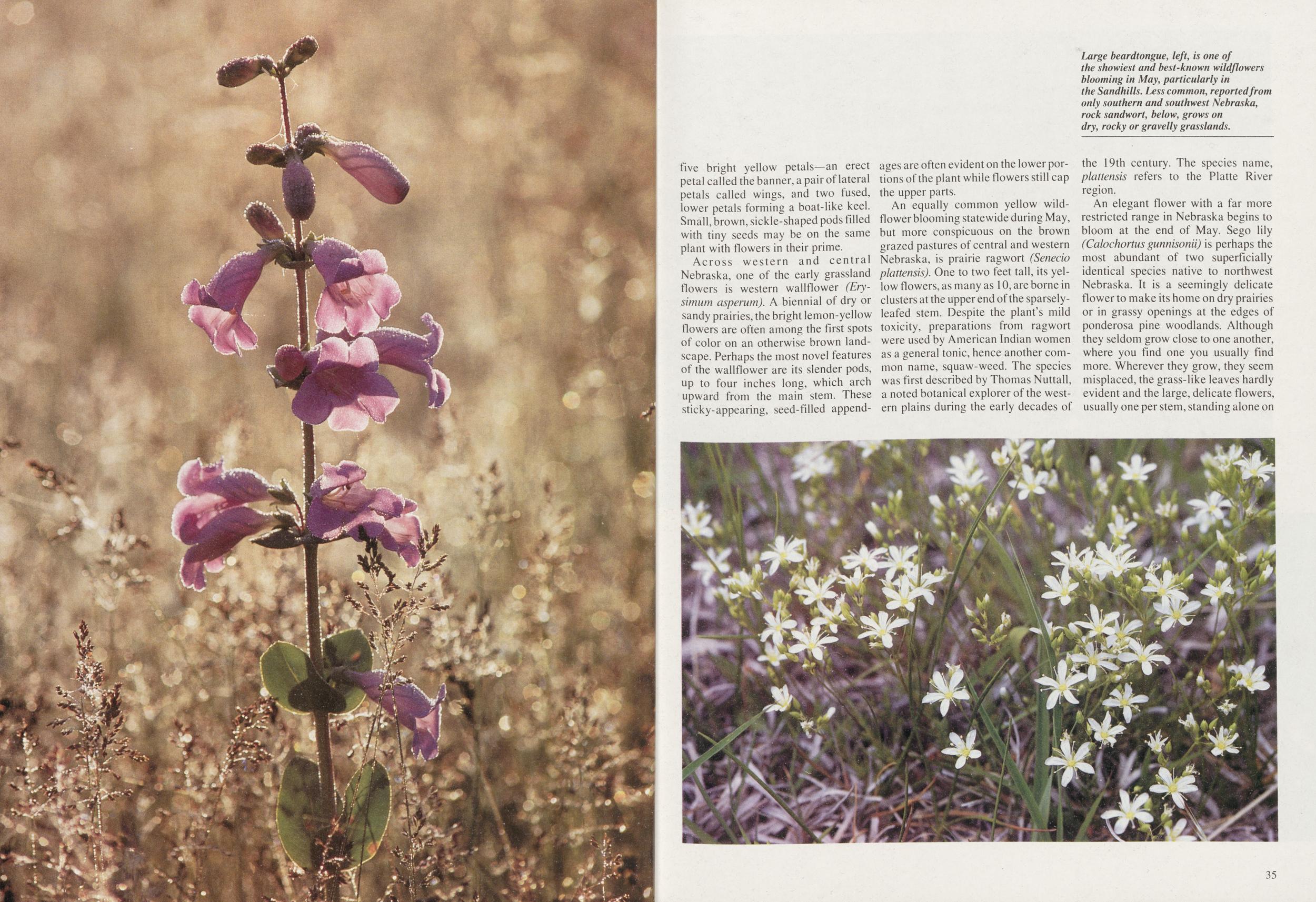
One of the earliest penstemons to flower in the state is narrow beardtongue (Penstemon angustijalius). It is native to most of north-central and western Nebraska. Seldom exceeding a foot in height, several stalks may rise from a common root, each bearing deep blue tubular flowers.
Narrow beardton^ue's taller relative
with much larger blossoms, large beardtongue (Penstemon grandiflarus) begins
to color Sandhills roadsides at the end
of May but will not be at the peak of
flowering until early June. Often
exceeding three feet in height with
flowers up to two inches long, it is one
of the best known of the region's wildflowers. The thick, smooth, waxy
leaves appear opposite one another on
the stem and may join at the base. Typically the flowers are pale lavender, but
occasionally white and even crimson
43
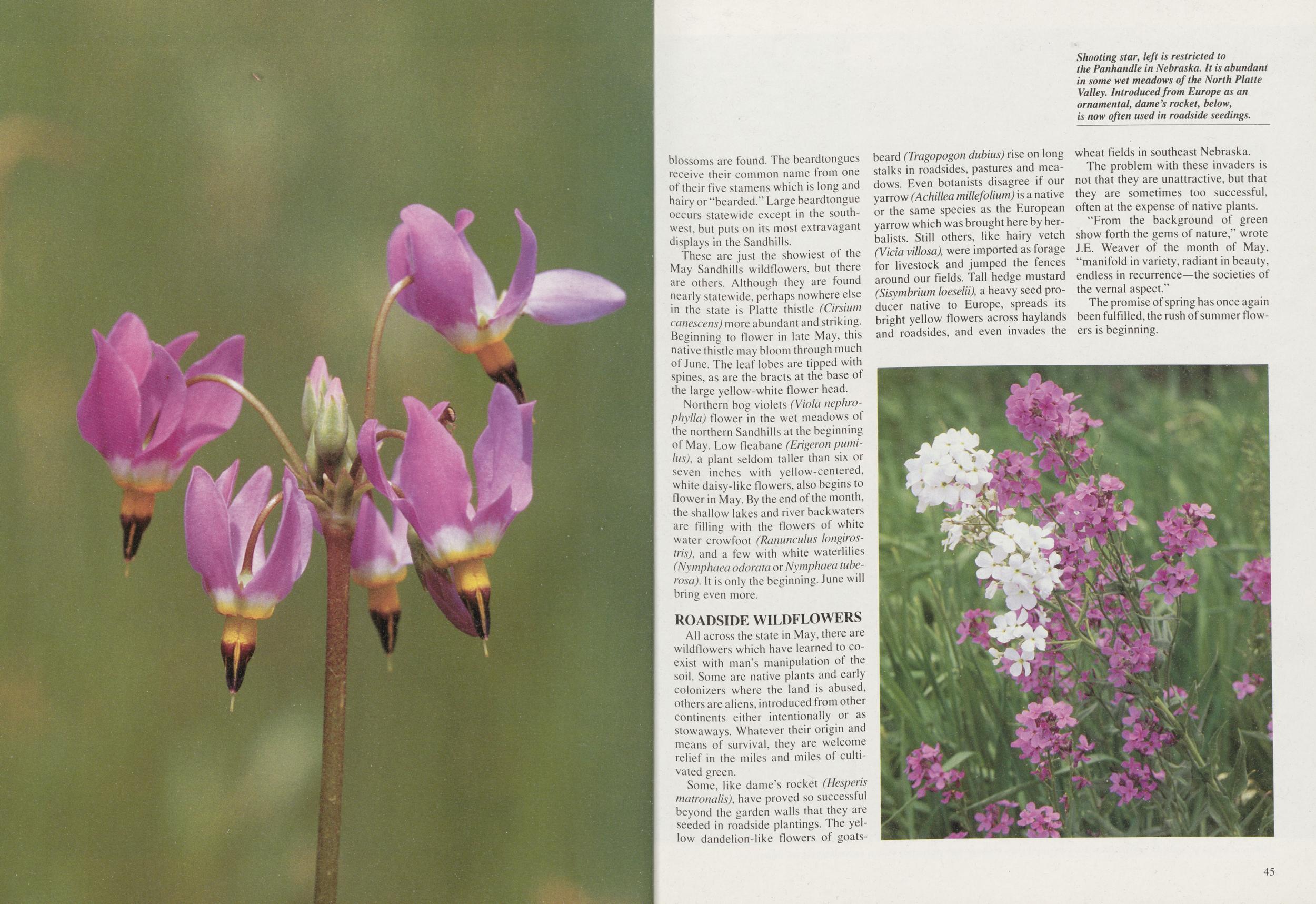
These are just the showiest of the May Sandhills wildflowers, but there are others. Although they are found nearly statewide, perhaps nowhere else in the state is Platte thistle (Cirsium ccmescens) more abundant and striking. Beginning to flower in late May, this native thistle may bloom through much of June. The leaf lobes are tipped with spines, as are the bracts at the base of the large yellow-white flower head.
Northern bog violets (Viola nephrophylla) flower in the wet meadows of the northern Sandhills at the beginning of May. Low fleabane (Erigeron pumilus), a plant seldom taller than six or seven inches with yellow-centered, white daisy-like flowers, also begins to flower in May. By the end of the month, the shallow lakes and river backwaters are filling with the flowers of white water crowfoot (Ranunculus longirostris), and a few with white waterlilies (Nymphaea odorata or Nymphaea tuberosa). It is only the beginning. June will bring even more.
ROADSIDE WILDFLOWERSAll across the state in May, there are wildflowers which have learned to coexist with man's manipulation of the soil. Some are native plants and early colonizers where the land is abused, others are aliens, introduced from other continents either intentionally or as stowaways. Whatever their origin and means of survival, they are welcome relief in the miles and miles of cultivated green.
Some, like dame's rocket (Hesperis matronalis), have proved so successful beyond the garden walls that they are seeded in roadside plantings. The yellow dandelion-like flowers of goatsbeard (Tragopogon dubius) rise on long stalks in roadsides, pastures and meadows. Even botanists disagree if our yarrow (Achillea millefolium) is a native or the same species as the European yarrow which was brought here by herbalists. Still others, like hairy vetch (Vicia villosa), were imported as forage for livestock and jumped the fences around our fields. Tall hedge mustard (Sisymbrium loeselii), a heavy seed producer native to Europe, spreads its bright yellow flowers across haylands and roadsides, and even invades the wheat fields in southeast Nebraska.
The problem with these invaders is not that they are unattractive, but that they are sometimes too successful, often at the expense of native plants.
"From the background of green show forth the gems of nature," wrote J.E. Weaver of the month of May, "manifold in variety, radiant in beauty, endless in recurrence—the societies of the vernal aspect."
The promise of spring has once again been fulfilled, the rush of summer flowers is beginning.
45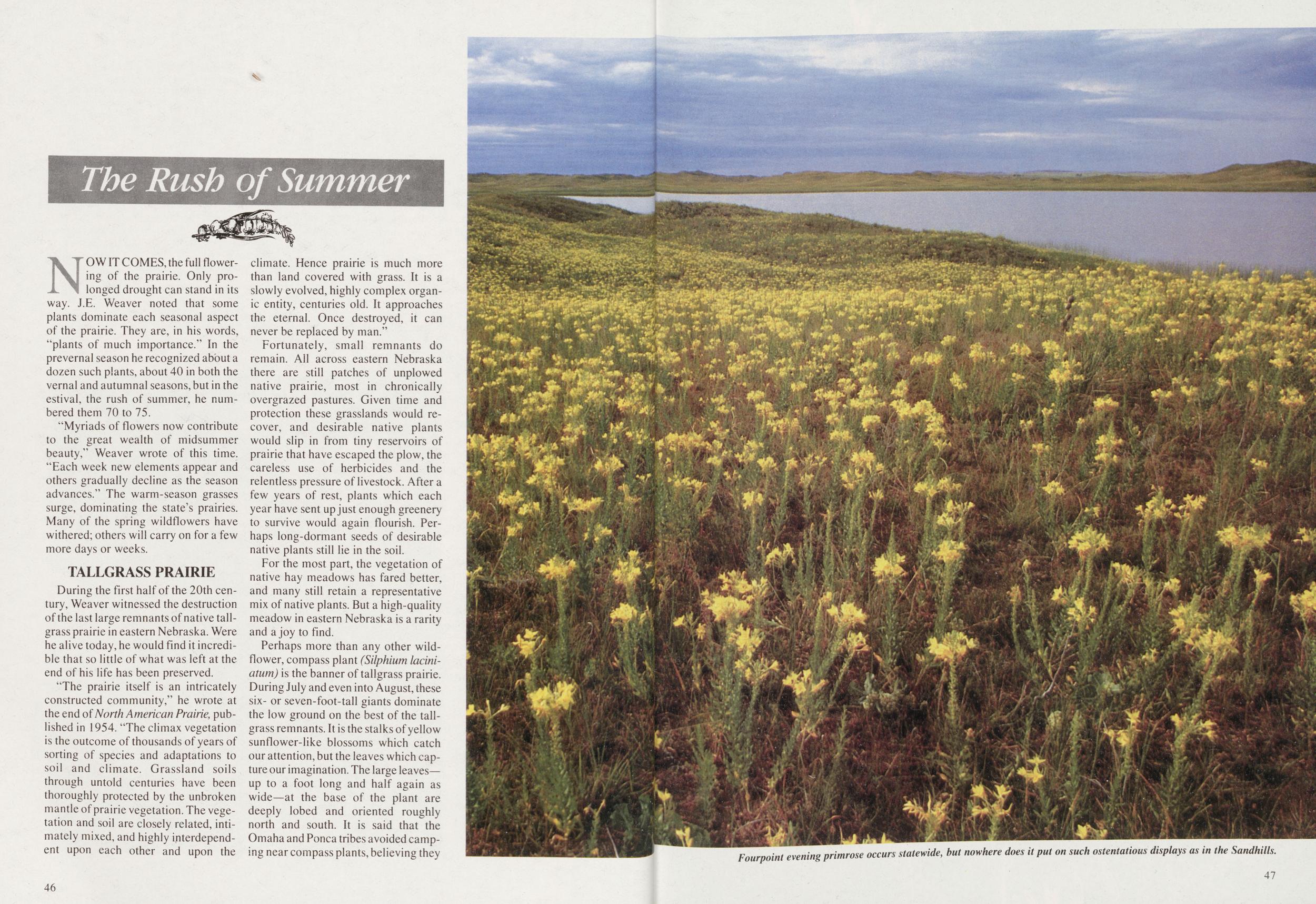
The Rush of Summer
NOW IT COMES, the full flowering of the prairie. Only prolonged drought can stand in its way. J.E. Weaver noted that some plants dominate each seasonal aspect of the prairie. They are, in his words, "plants of much importance." In the prevernal season he recognized about a dozen such plants, about 40 in both the vernal and autumnal seasons, but in the estival, the rush of summer, he numbered them 70 to 75.
"Myriads of flowers now contribute to the great wealth of midsummer beauty," Weaver wrote of this time. "Each week new elements appear and others gradually decline as the season advances." The warm-season grasses surge, dominating the state's prairies. Many of the spring wildflowers have withered; others will carry on for a few more days or weeks.
TALLGRASS PRAIRIEDuring the first half of the 20th century, Weaver witnessed the destruction of the last large remnants of native tallgrass prairie in eastern Nebraska. Were he alive today, he would find it incredible that so little of what was left at the end of his life has been preserved.
"The prairie itself is an intricately constructed community," he wrote at the end of North American Prairie, published in 1954. "The climax vegetation is the outcome of thousands of years of sorting of species and adaptations to soil and climate. Grassland soils through untold centuries have been thoroughly protected by the unbroken mantle of prairie vegetation. The vegetation and soil are closely related, intimately mixed, and highly interdependent upon each other and upon the climate. Hence prairie is much more than land covered with grass. It is a slowly evolved, highly complex organic entity, centuries old. It approaches the eternal. Once destroyed, it can never be replaced by man."
Fortunately, small remnants do remain. All across eastern Nebraska there are still patches of unplowed native prairie, most in chronically overgrazed pastures. Given time and protection these grasslands would recover, and desirable native plants would slip in from tiny reservoirs of prairie that have escaped the plow, the careless use of herbicides and the relentless pressure of livestock. After a few years of rest, plants which each year have sent up just enough greenery to survive would again flourish. Perhaps long-dormant seeds of desirable native plants still lie in the soil.
For the most part, the vegetation of native hay meadows has fared better, and many still retain a representative mix of native plants. But a high-quality meadow in eastern Nebraska is a rarity and a joy to find.
Perhaps more than any other wildflower, compass plant (Silphium laciniatum) is the banner of tallgrass prairie. During July and even into August, these six- or seven-foot-tall giants dominate the low ground on the best of the tallgrass remnants. It is the stalks of yellow sunflower-like blossoms which catch our attention, but the leaves which capture our imagination. The large leaves— up to a foot long and half again as wide—at the base of the plant are deeply lobed and oriented roughly north and south. It is said that the Omaha and Ponca tribes avoided camping near compass plants, believing they 46
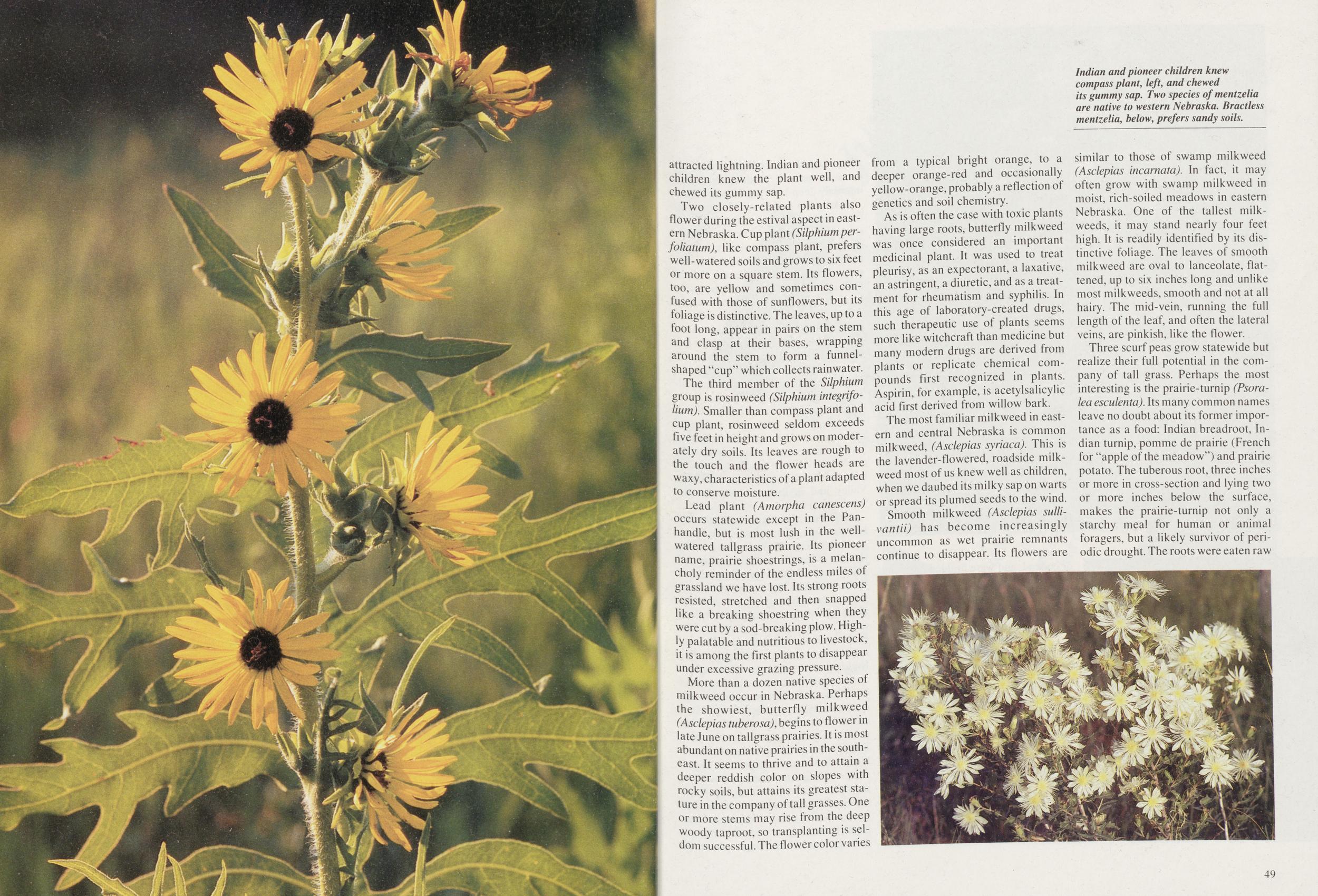
Two closely-related plants also flower during the estival aspect in eastern Nebraska. Cup plant (Silphium perfoliatum), like compass plant, prefers well-watered soils and grows to six feet or more on a square stem. Its flowers, too, are yellow and sometimes confused with those of sunflowers, but its foliage is distinctive. The leaves, up to a foot long, appear in pairs on the stem and clasp at their bases, wrapping around the stem to form a funnelshaped "cup" which collects rainwater.
The third member of the Silphium group is rosinweed (Silphium integrifolium). Smaller than compass plant and cup plant, rosinweed seldom exceeds five feet in height and grows on moderately dry soils. Its leaves are rough to the touch and the flower heads are waxy, characteristics of a plant adapted to conserve moisture.
Lead plant (Amorpha canescens) occurs statewide except in the Panhandle, but is most lush in the wellwatered tallgrass prairie. Its pioneer name, prairie shoestrings, is a melancholy reminder of the endless miles of grassland we have lost. Its strong roots resisted, stretched and then snapped like a breaking shoestring when they were cut by a sod-breaking plow. Highly palatable and nutritious to livestock, it is among the first plants to disappear under excessive grazing pressure.
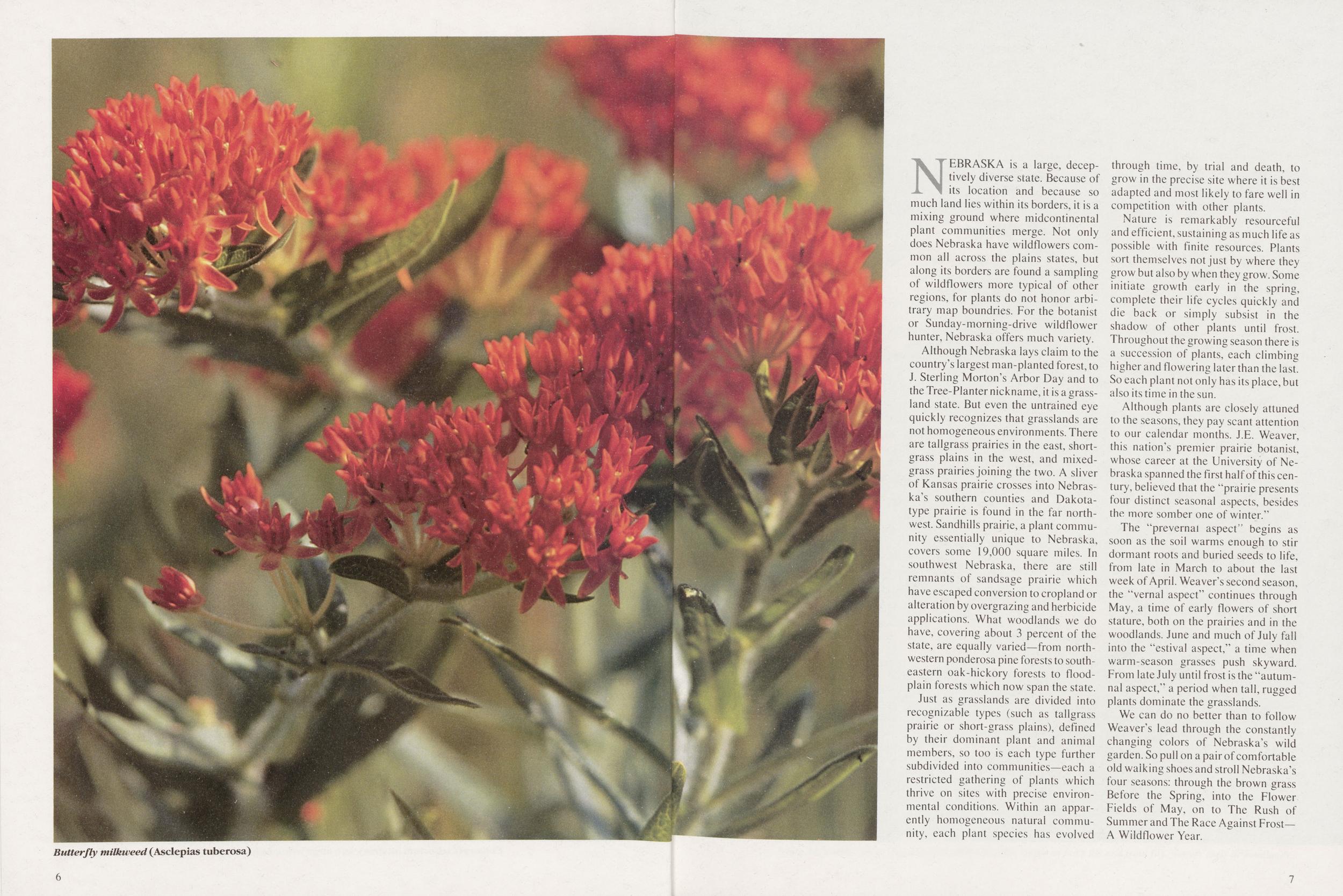
More than a dozen native species of milkweed occur in Nebraska. Perhaps the showiest, butterfly milkweed (Asclepias tuberosa), begins to flower in late June on tallgrass prairies. It is most abundant on native prairies in the southeast. It seems to thrive and to attain a deeper reddish color on slopes with rocky soils, but attains its greatest stature in the company of tall grasses. One or more stems may rise from the deep woody taproot, so transplanting is seldom successful. The flower color varies from a typical bright orange, to a deeper orange-red and occasionally yellow-orange, probably a reflection of genetics and soil chemistry.
As is often the case with toxic plants having large roots, butterfly milkweed was once considered an important medicinal plant. It was used to treat pleurisy, as an expectorant, a laxative, an astringent, a diuretic, and as a treatment for rheumatism and syphilis. In this age of laboratory-created drugs, such therapeutic use of plants seems more like witchcraft than medicine but many modern drugs are derived from plants or replicate chemical compounds first recognized in plants. Aspirin, for example, is acetylsalicylic acid first derived from willow bark.
The most familiar milkweed in eastern and central Nebraska is common milkweed, (Asclepias syriaca). This is the lavender-flowered, roadside milkweed most of us knew well as children, when we daubed its milky sap on warts or spread its plumed seeds to the wind.
Smooth milkweed (Asclepias sullivantii) has become increasingly uncommon as wet prairie remnants continue to disappear. Its flowers are similar to those of swamp milkweed (Asclepias incarnata). In fact, it may often grow with swamp milkweed in moist, rich-soiled meadows in eastern Nebraska. One of the tallest milkweeds, it may stand nearly four feet high. It is readily identified by its distinctive foliage. The leaves of smooth milkweed are oval to lanceolate, flattened, up to six inches long and unlike most milkweeds, smooth and not at all hairy. The mid-vein, running the full length of the leaf, and often the lateral veins, are pinkish, like the flower.
Three scurf peas grow statewide but realize their full potential in the company of tall grass. Perhaps the most interesting is the prairie-turnip (Psoralea esculenta). Its many common names leave no doubt about its former importance as a food: Indian breadroot, Indian turnip, pomme de prairie (French for "apple of the meadow") and prairie potato. The tuberous root, three inches or more in cross-section and lying two or more inches below the surface, makes the prairie-turnip not only a starchy meal for human or animal foragers, but a likely survivor of periodic drought. The roots were eaten raw
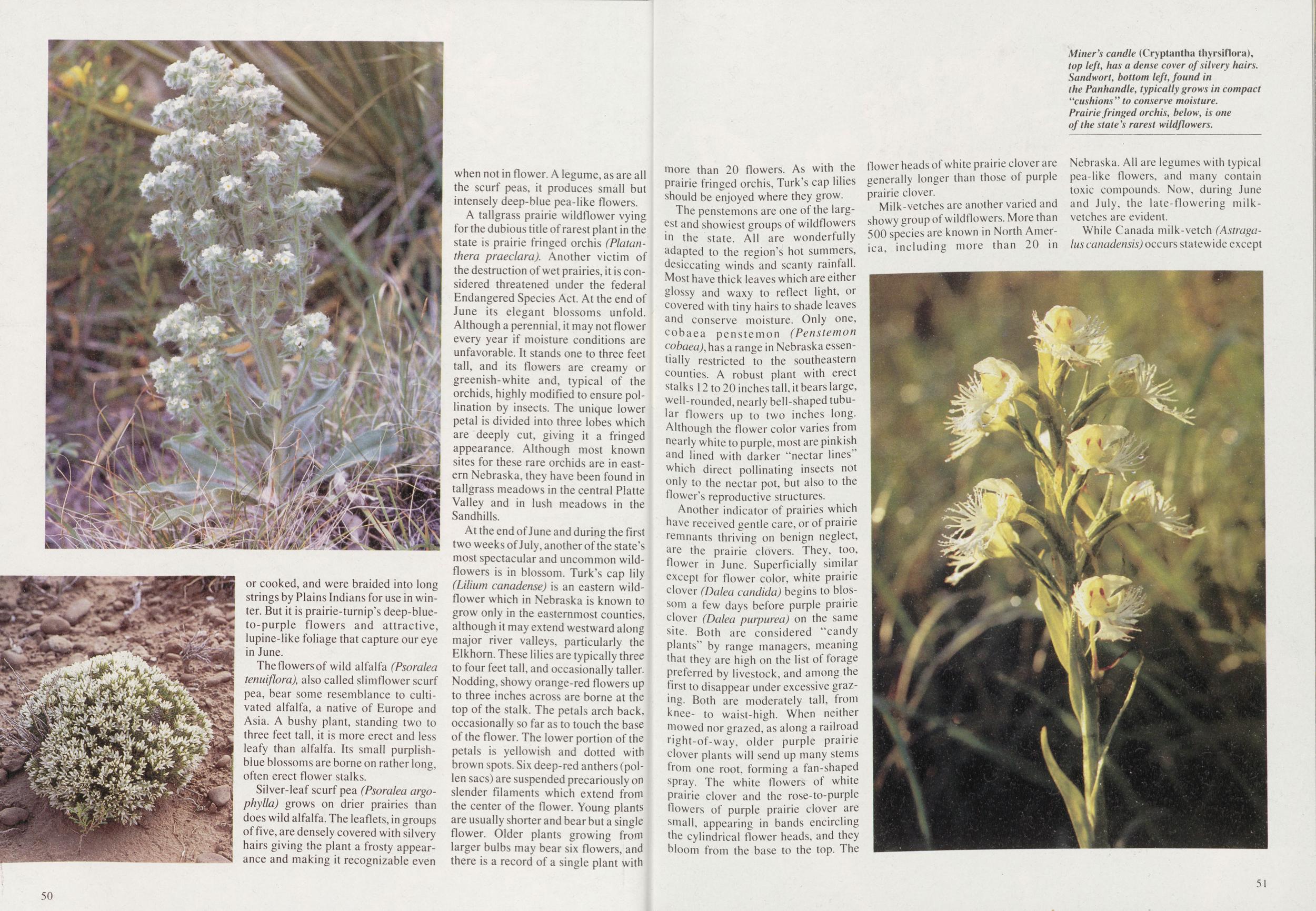 or cooked, and were braided into long
strings by Plains Indians for use in winter. But it is prairie-turnip's deep-blue-to-purple
flowers and attractive,
lupine-like foliage that capture our eye
in June.
or cooked, and were braided into long
strings by Plains Indians for use in winter. But it is prairie-turnip's deep-blue-to-purple
flowers and attractive,
lupine-like foliage that capture our eye
in June.
The flowers of wild alfalfa (Psoralea tenuiflora), also called slimflower scurf pea, bear some resemblance to cultivated alfalfa, a native of Europe and Asia. A bushy plant, standing two to three feet tall, it is more erect and less leafy than alfalfa. Its small purplishblue blossoms are borne on rather long, often erect flower stalks.
of five, are densely covered with silvery hairs giving the plant a frosty appearance and making it recognizable even when not in flower. A legume, as are all the scurf peas, it produces small but intensely deep-blue pea-like flowers.
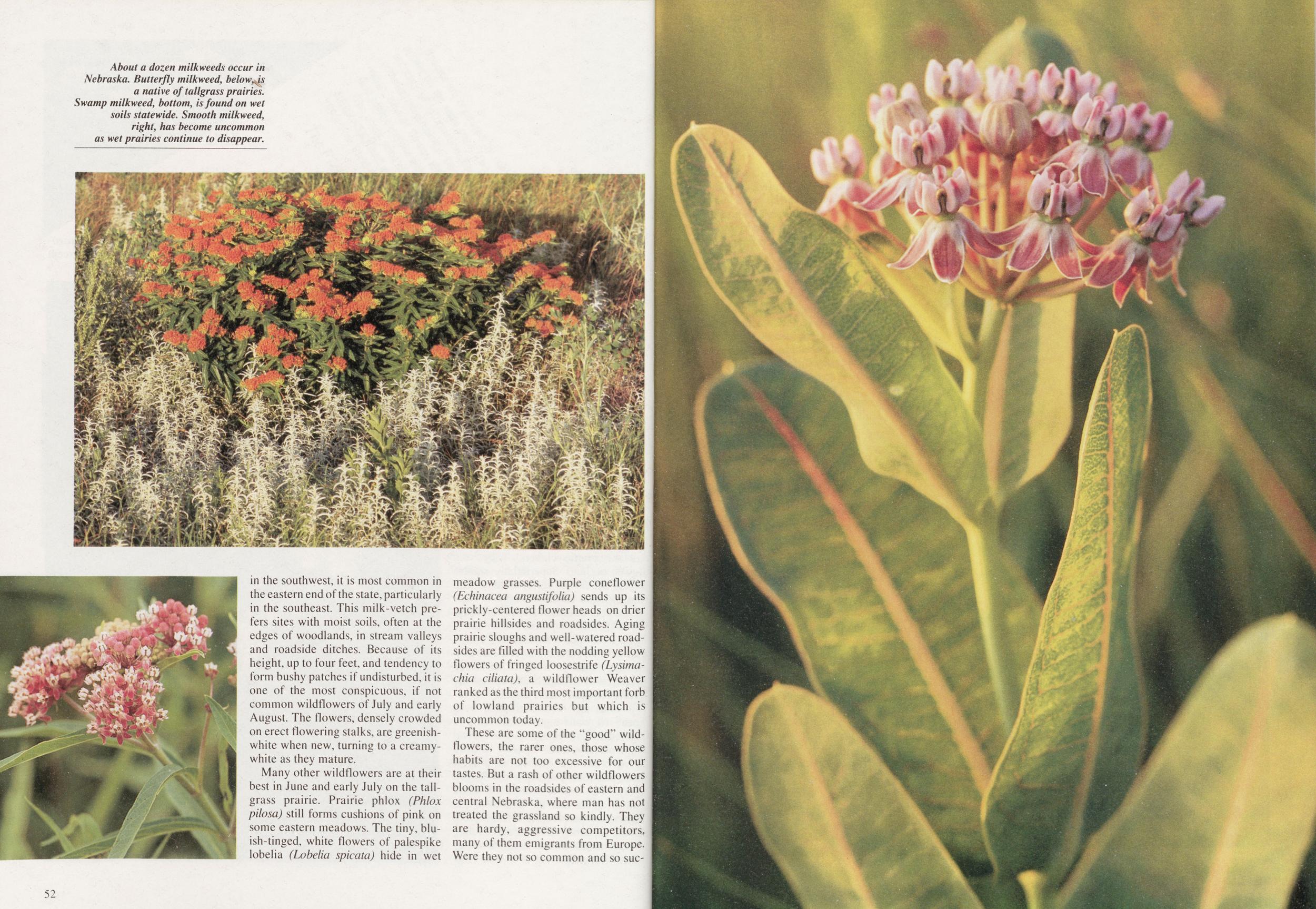
A tallgrass prairie wildflower vying for the dubious title of rarest plant in the state is prairie fringed orchis (Platanthera praeclara). Another victim of the destruction of wet prairies, it is considered threatened under the federal Endangered Species Act. At the end of June its elegant blossoms unfold. Although a perennial, it may not flower every year if moisture conditions are unfavorable. It stands one to three feet tall, and its flowers are creamy or greenish-white and, typical of the orchids, highly modified to ensure pollination by insects. The unique lower petal is divided into three lobes which are deeply cut, giving it a fringed appearance. Although most known sites for these rare orchids are in eastern Nebraska, they have been found in tallgrass meadows in the central Platte Valley and in lush meadows in the Sandhills.
At the end of June and during the first two weeks of July, another of the state's most spectacular and uncommon wildflowers is in blossom. Turk's cap lily (Lilium canadense) is an eastern wildflower which in Nebraska is known to grow only in the easternmost counties, although it may extend westward along major river valleys, particularly the Elkhorn. These lilies are typically three to four feet tall, and occasionally taller. Nodding, showy orange-red flowers up to three inches across are borne at the top of the stalk. The petals arch back, occasionally so far as to touch the base of the flower. The lower portion of the petals is yellowish and dotted with brown spots. Six deep-red anthers (pollen sacs) are suspended precariously on slender filaments which extend from the center of the flower. Young plants are usually shorter and bear but a single flower. Older plants growing from larger bulbs may bear six flowers, and there is a record of a single plant with 50 more than 20 flowers. As with the prairie fringed orchis, Turk's cap lilies should be enjoyed where they grow.
The penstemons are one of the largest and showiest groups of wildflowers in the state. All are wonderfully adapted to the region's hot summers, desiccating winds and scanty rainfall. Most have thick leaves which are either glossy and waxy to reflect light, or covered with tiny hairs to shade leaves and conserve moisture. Only one, cobaea penstemon (Penstemon cobaea), has a range in Nebraska essentially restricted to the southeastern counties. A robust plant with erect stalks 12 to 20 inches tall, it bears large, well-rounded, nearly bell-shaped tubular flowers up to two inches long. Although the flower color varies from nearly white to purple, most are pinkish and lined with darker "nectar lines" which direct pollinating insects not only to the nectar pot, but also to the flower's reproductive structures.
Another indicator of prairies which have received gentle care, or of prairie remnants thriving on benign neglect, are the prairie clovers. They, too, flower in June. Superficially similar except for flower color, white prairie clover (Dalea Candida) begins to blossom a few days before purple prairie clover (Dalea purpurea) on the same site. Both are considered "candy plants" by range managers, meaning that they are high on the list of forage preferred by livestock, and among the first to disappear under excessive grazing. Both are moderately tall, from knee- to waist-high. When neither mowed nor grazed, as along a railroad right-of-way, older purple prairie clover plants will send up many stems from one root, forming a fan-shaped spray. The white flowers of white prairie clover and the rose-to-purple flowers of purple prairie clover are small, appearing in bands encircling the cylindrical flower heads, and they bloom from the base to the top. The flower heads ofwhite prairie clover are generally longer than those of purple prairie clover.
Milk-vetches are another varied and showy group of wildflowers. More than 500 species are known in North America, including more than 20 in Nebraska. All are legumes with typical pea-like flowers, and many contain toxic compounds. Now, during June and July, the late-flowering milkvetches are evident.
While Canada milk-vetch (Astragalus canadensis) occurs statewide except
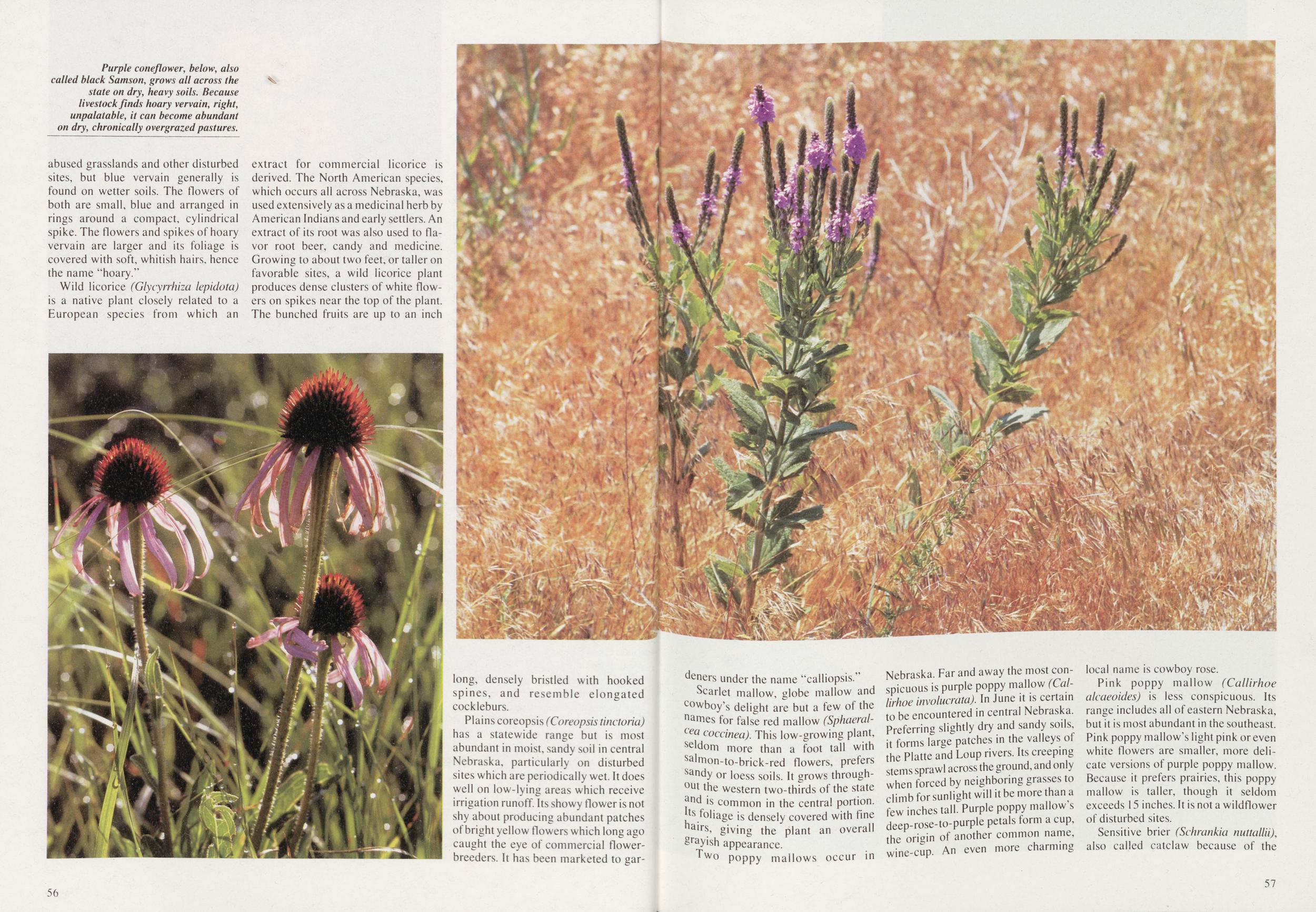
Many other wildflowers are at their best in June and early July on the tallgrass prairie. Prairie phlox (Phlox pilosa) still forms cushions of pink on some eastern meadows. The tiny, bluish-tinged, white flowers of palespike lobelia (Lobelia spicata) hide in wet meadow grasses. Purple coneflower (Echinacea angustifolia) sends up its prickly-centered flower heads on drier prairie hillsides and roadsides. Aging prairie sloughs and well-watered roadsides are filled with the nodding yellow flowers of fringed loosestrife (Lysimachia ciliata), a wildflower Weaver ranked as the third most important forb of lowland prairies but which is uncommon today.
These are some of the "good" wildflowers, the rarer ones, those whose habits are not too excessive for our tastes. But a rash of other wildflowers blooms in the roadsides of eastern and central Nebraska, where man has not treated the grassland so kindly. They are hardy, aggressive competitors, many of them emigrants from Europe. Were they not so common and so successful, 52
The lovely, cream-colored flowers of sulphur cinquefoil (Potentilla recta) and the coarser flowers of tall cinquefoil (Potentilla arguta), even though native, are often too abundant and not palatable enough for domestic animals.
Chicory (Cichorium intybus), a plant imported from Europe because its dried, ground roots were popular as a coffee substitute or additive, begins to color roadsides with blue blossoms in June. Undefeated by mowing, it will continue to flower throughout the summer on short, mutilated stems.
During the estival aspect, roadsides in eastern Nebraska fill with the yellow pea-like flowers of bird's-foot trefoil (Lotus corniculatus), a legume introduced from Europe as a forage crop which found North America much to its liking. Common St. John's-wort (Hypericum perforatum) begins to flower in June. Its profusion of bright yellow flowers continues until September. Another native of Europe, it was considered one of the most potent of all herbs, capable of warding off sickness and sinister spirits. Venus' looking glass (Triodanisperfoliata), spreads its lovely blue bells in the rank growth of "goback" crop land.
Probably more than any other region ofthe state, the southeast is the home of plants which have run away from our flower gardens to take root in the roadsides. Ox-eye daisy (Chrysanthemum leucanthemum), brought from Europe, colonizes patches of dry soil in pastures and ditches; Deptford pink (Dianthus armeria), another escapee from flower gardens, has small but lovely pink flowers, and hides in brome-grass roadsides; daylily (Hemerocallisfulva) gathers 54 in ditches, perhaps marking where a mailbox once stood; domestic iris, planted by a farm wife with a craving for the color of flowers in a land of endless fields of corn and soybeans, still brings a bit of cheer to passersby.
LOESS HILLSIn varying degrees, all the regions of the state have plants which are less desirable than others. Certainly the alien plants which have invaded North America are an unnatural element in the environment, but native plants which thrive on disturbed ground are essential to the ecology of every place on earth. They are nature's way of healing wounds inflicted on the land. Disturbance, in varying degrees for different species, is essential if most of our wildflowers are to exist. Without it, the Missouri River Valley would eventually be filled with nothing but towering hardwoods and the grasslands would be mostly grasses.
It seems unfair to single out a region, but south-central Nebraska and the central part of the state lying between the Sandhills and the tallgrass region of eastern Nebraska is the stronghold of alien wildflowers and native species which thrive on soil disturbance. This is a region characterized by hilly or rolling terrain and fine, silty loess soils. Many of these wildflowers can be found elsewhere as well, but not in such great abundance.
Prior to settlement, this region was covered with mixed-grass prairie; it was a transition between the rich soils formed by tallgrass prairies to the east and the less fertile and drier soils ofthe short-grass plains to the west. So, by its very geographic location it was a mixing ground of plant types.
During this century, especially since the advent of center-pivot irrigation, the region has been farmed as if it were the rich-soiled, well-watered, relatively low-relief tallgrass prairie of eastern Nebraska; in effect, it has been used to extend the corn belt westward. Chronic overgrazing, erosion and soil depletion have created a favorable environment for the invasion of alien species and the overabundance of native species which thrive on disturbance. By abusing the land, we sowed the seeds for the "weeds" we now grow. If viewed with an open mind, however, some are as attractive as many of our more highly-prized wildflowers.
Curly-top gum weed (Grindelia squarrosa) has a statewide distribution and seems to thrive on disturbed sites in central Nebraska. Often encountered along county roads, it is quick to move into pastures which have been overgrazed year after year. It begins flowering in late June and will continue to bloom throughout the summer. Seldom more than two feet tall, it forms a clumpy little bush and produces yellow flower heads about an inch across. The distinctive toothed leaves and the lower portion of the flower head are coated with a sticky, gummy sap from which its common name is derived.
A frequent companion of gumweed in disturbed pastures is the seemingly ubiquitous buffalo bur (Solanum rostraturn). Both plants are like bright yellow road signs pointing to abused, poorly managed land.
Called sandbur in some regions of Nebraska, puncture vine (Tribulus terrestris) sprawls across the ground on disturbed sites statewide but is most abundant on sandy soils. Its hard, sharp-spined fruits (with two or more prominent spines) have long been the bane of barefoot boys and their bicycle tires. In flower as early as June, it continues to produce small yellow blossoms until frost. The true sandbur (Cenchrus longispinus) is a grass, typically 10 to 20 inches tall, and bears clusters of fruits with many small spines near the top of the plant. It also grows on disturbed ground statewide.
Both blue vervain (Verbena hastata)
and hoary vervain (Verbena striata)
occur all across Nebraska. Both invade
55
Wild licorice (Glycyrrhiza lepidota) is a native plant closely related to a European species from which an extract for commercial licorice is derived. The North American species, which occurs all across Nebraska, was used extensively as a medicinal herb by American Indians and early settlers. An extract of its root was also used to flavor root beer, candy and medicine. Growing to about two feet, or taller on favorable sites, a wild licorice plant produces dense clusters of white flowers on spikes near the top of the plant. The bunched fruits are up to an inch long, densely bristled with hooked spines, and resemble elongated cockleburs.
Plains coreopsis (Coreopsis tinctoria) has a statewide range but is most abundant in moist, sandy soil in central Nebraska, particularly on disturbed sites which are periodically wet. It does well on low-lying areas which receive irrigation runoff. Its showy flower is not shy about producing abundant patches of bright yellow flowers which long ago caught the eye of commercial flowerbreeders. It has been marketed to gardeners under the name "calliopsis."
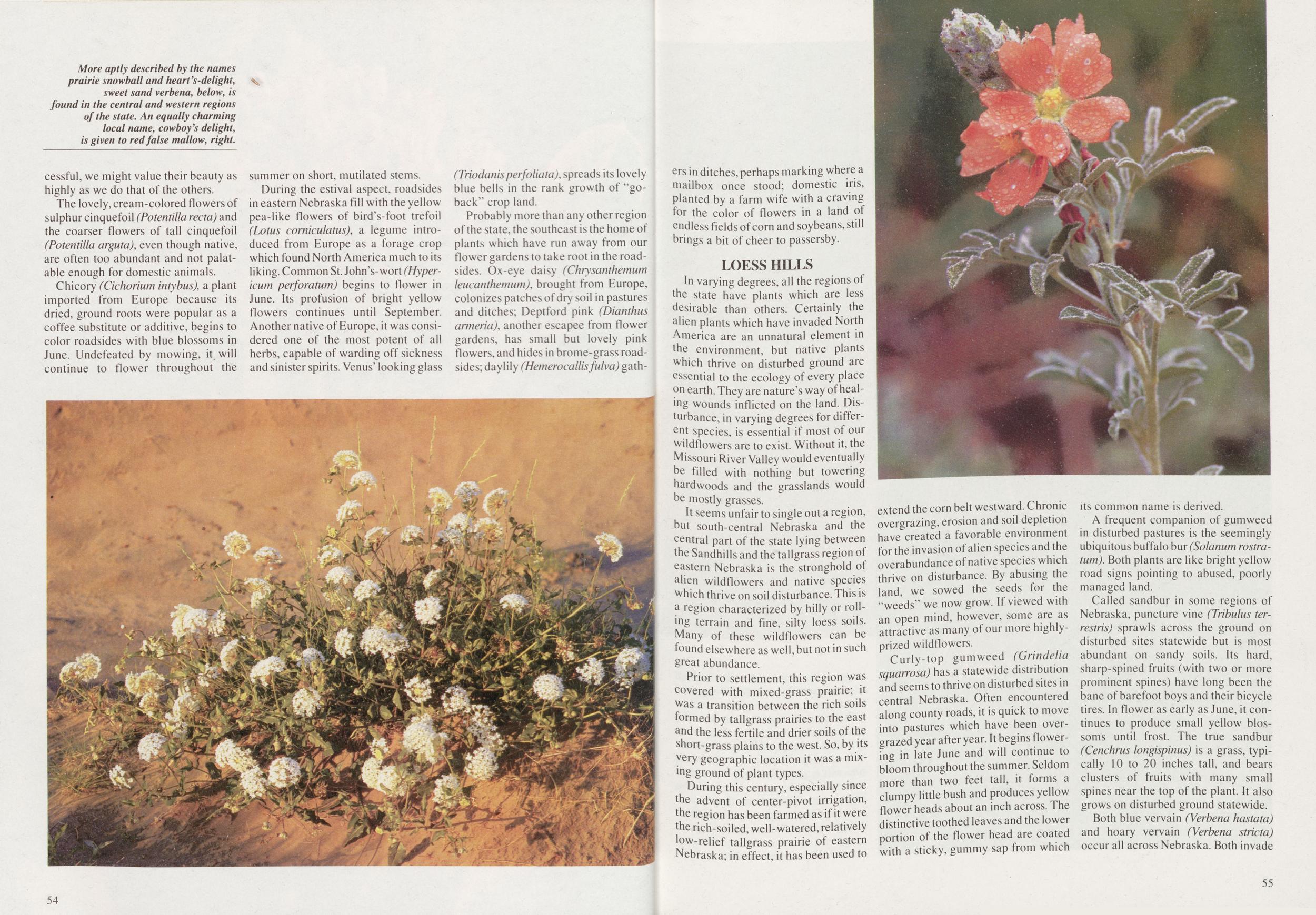
Scarlet mallow, globe mallow and cowboy's delight are but a few of the names for false red mallow (Sphaeral-Cea coccinea). This low-growing plant, Seldom more than a foot tall with salmon-to-brick-red flowers, prefers sandy or loess soils. It grows throughout the western two-thirds of the state j*nd is common in the central portion, hs foliage is densely covered with fine hairs, giving the plant an overall grayish appearance.
Two poppy mallows occur in Nebraska. Far and away the most conspicuous is purple poppy mallow (Callirhoe involucrata). In June it is certain to be encountered in central Nebraska. Preferring slightly dry and sandy soils, it forms large patches in the valleys of the Platte and Loup rivers. Its creeping stems sprawl across the ground, and only when forced by neighboring grasses to climb for sunlight will it be more than a few inches tall. Purple poppy mallow s deep-rose-to-purple petals form a cup, the origin of another common name, wine-cup. An even more charming local name is cowboy rose.
Pink poppy mallow (Callirhoe alcaeoides) is less conspicuous. Its range includes all of eastern Nebraska, but it is most abundant in the southeast. Pink poppy mallow's light pink or even white flowers are smaller, more delicate versions of purple poppy mallow. Because it prefers prairies, this poppy mallow is taller, though it seldom exceeds 15 inches. It is not a wildflower of disturbed sites.
Sensitive brier (Schrankia nuttallii),
also called catclaw because of the
57
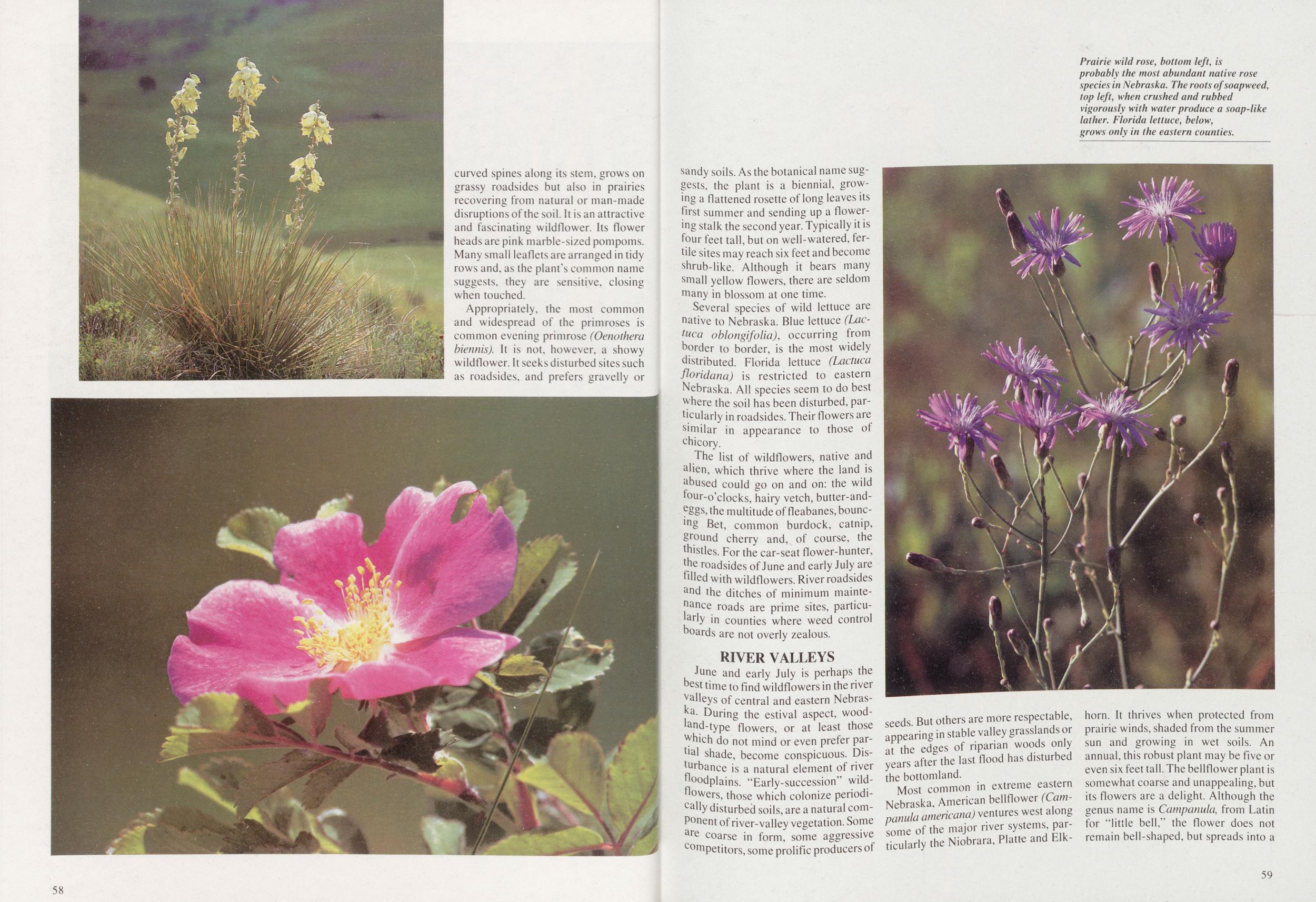
Appropriately, the most common and widespread of the primroses is common evening primrose (Oenothera biennis). It is not, however, a showy wildflower. It seeks disturbed sites such as roadsides, and prefers gravelly or
Several species of wild lettuce are native to Nebraska. Blue lettuce (Lactuca oblongifolia), occurring from border to border, is the most widely distributed. Florida lettuce (Lactuca floridana) is restricted to eastern Nebraska. All species seem to do best where the soil has been disturbed, particularly in roadsides. Their flowers are similar in appearance to those of chicory.
The list of wildflowers, native and alien, which thrive where the land is abused could go on and on: the wild four-o'clocks, hairy vetch, butter-and-eggs, the multitude of fleabanes, bouncing Bet, common burdock, catnip, ground cherry and, of course, the thistles. For the car-seat flower-hunter, the roadsides of June and early July are filled with wildflowers. River roadsides and the ditches of minimum maintenance roads are prime sites, particularly in counties where weed control boards are not overly zealous.
RIVER VALLEYSJune and early July is perhaps the best time to find wildflowers in the river valleys of central and eastern Nebraska. During the estival aspect, woodland-type flowers, or at least those which do not mind or even prefer parbal shade, become conspicuous. Disturbance is a natural element of river ^odplains. "Early-succession" wildpowers, those which colonize periodically disturbed soils, are a natural component of river-valley vegetation. Some are coarse in form, some aggressive c°mpetitors, some prolific producers of seeds But others are more respectable, appearing in stable valley grasslands or at the edges of riparian woods only years after the last flood has disturbed the bottomland.
Most common in extreme eastern
Nebraska, American beilflower (Campanula amerieana) ventures west along
some of the major river systems particularly the Niobrara, Platte and Elkhorn. It
thrives when protected from
prairie winds, shaded from the summer
sun and growing in wet soils. An
annual, this robust plant may be five or
even six feet tall. The beilflower plant is
somewhat coarse and unappealing, but
its flowers are a delight. Although the
genus name is Campanula, from Latin
for "little bell," the flower does not
remain bell-shaped, but spreads into a
59
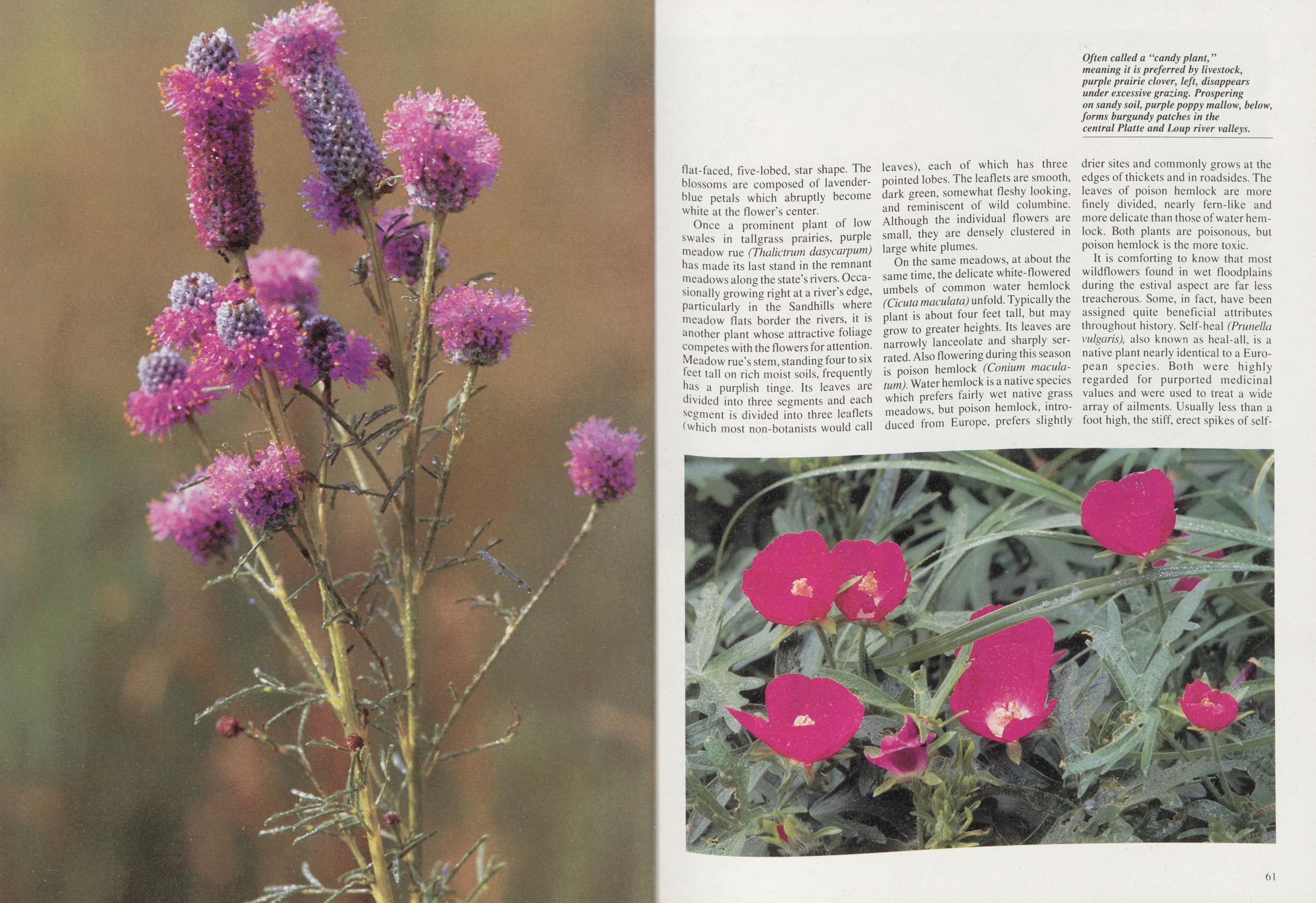
Once a prominent plant of low swales in tallgrass prairies, purple meadow rue (Thalictrum dasycarpum) has made its last stand in the remnant meadows along the state's rivers. Occasionally growing right at a river's edge, particularly in the Sandhills where meadow flats border the rivers, it is another plant whose attractive foliage competes with the flowers for attention. Meadow rue's stem, standing four to six feet tall on rich moist soils, frequently has a purplish tinge. Its leaves are divided into three segments and each segment is divided into three leaflets (which most non-botanists would call leaves), each of which has three pointed lobes. The leaflets are smooth, dark green, somewhat fleshy looking, and reminiscent of wild columbine. Although the individual flowers are small, they are densely clustered in large white plumes.
On the same meadows, at about the same time, the delicate white-flowered umbels of common water hemlock (Cicuta maculata) unfold. Typically the plant is about four feet tall, but may grow to greater heights. Its leaves are narrowly lanceolate and sharply serrated. Also flowering during this season is poison hemlock (Conium maculaturn). Water hemlock is a native species which prefers fairly wet native grass meadows, but poison hemlock, introduced from Europe, prefers slightly drier sites and commonly grows at the edges of thickets and in roadsides. The leaves of poison hemlock are more finely divided, nearly fern-like and more delicate than those of water hemlock. Both plants are poisonous, but poison hemlock is the more toxic.
It is comforting to know that most
wildflowers found in wet floodplains
during the estival aspect are far less
treacherous. Some, in fact, have been
assigned quite beneficial attributes
throughout history. Self-heal (Prunella
vulgaris), also known as heal-all, is a
native plant nearly identical to a European species. Both were highly
regarded for purported medicinal
values and were used to treat a wide
array of ailments. Usually less than a
foot high, the stiff, erect spikes of self-heal
61
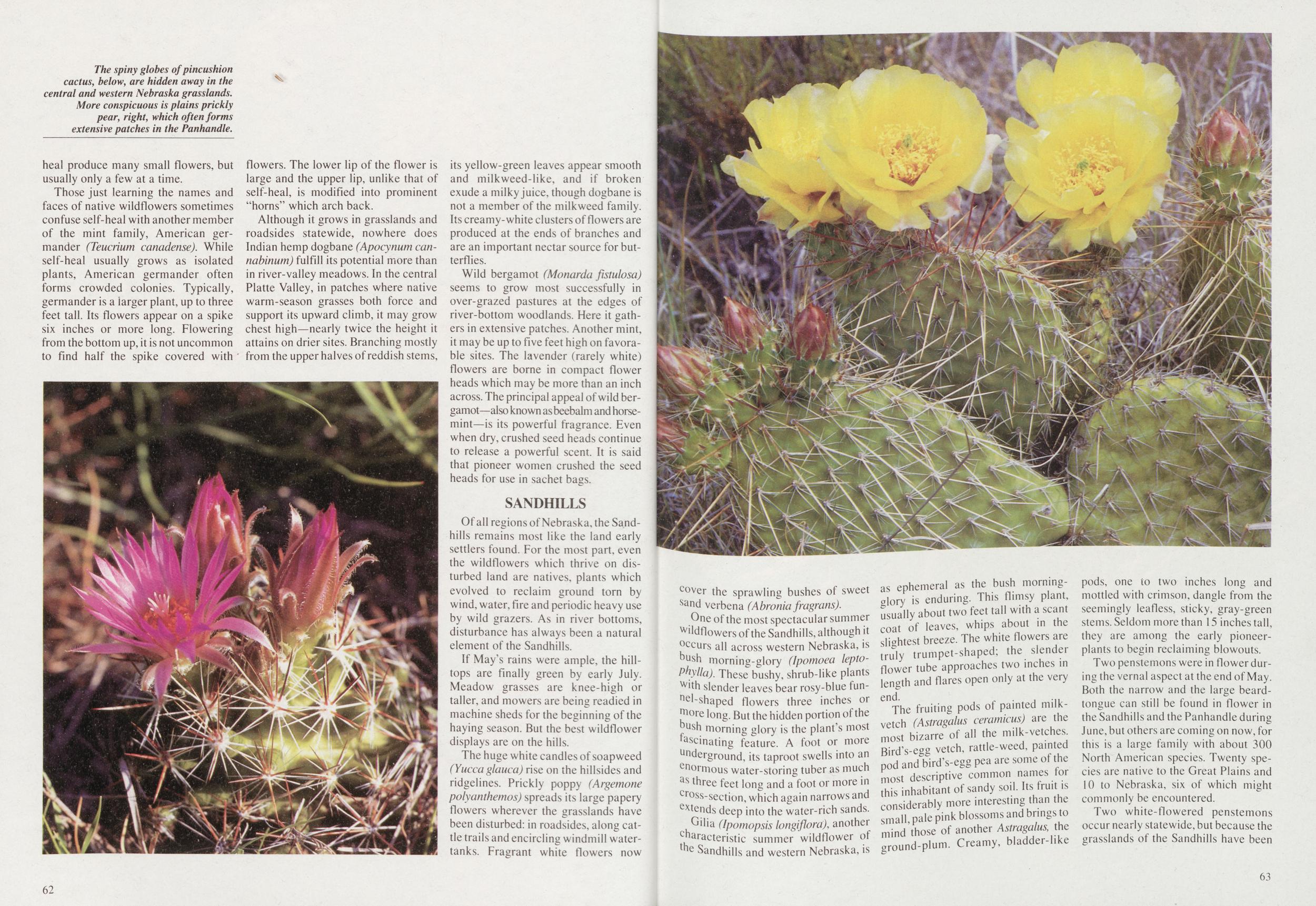
Those just learning the names and faces of native wildflowers sometimes confuse self-heal with another member of the mint family, American germander (Teucrium canadense). While self-heal usually grows as isolated plants, American germander often forms crowded colonies. Typically, germander is a larger plant, up to three feet tall. Its flowers appear on a spike six inches or more long. Flowering from the bottom up, it is not uncommon to find half the spike covered with flowers. The lower lip of the flower is large and the upper lip, unlike that of self-heal, is modified into prominent "horns" which arch back.
Although it grows in grasslands and roadsides statewide, nowhere does Indian hemp dogbane (Apocynum cannabinum) fulfill its potential more than in river-valley meadows. In the central Platte Valley, in patches where native warm-season grasses both force and support its upward climb, it may grow chest high—nearly twice the height it attains on drier sites. Branching mostly from the upper halves of reddish stems, its yellow-green leaves appear smooth and milkweed-like, and if broken exude a milky juice, though dogbane is not a member of the milkweed family. Its creamy-white clusters of flowers are produced at the ends of branches and are an important nectar source for butterflies.
Wild bergamot (Monarda fistulosa) seems to grow most successfully in over-grazed pastures at the edges of river-bottom woodlands. Here it gathers in extensive patches. Another mint, it may be up to five feet high on favorable sites. The lavender (rarely white) flowers are borne in compact flower heads which may be more than an inch across. The principal appeal of wild bergamot—also known as beebalm and horsemint—is its powerful fragrance. Even when dry, crushed seed heads continue to release a powerful scent. It is said that pioneer women crushed the seed heads for use in sachet bags.
SANDHILLSOf all regions of Nebraska, the Sandhills remains most like the land early settlers found. For the most part, even the wildflowers which thrive on disturbed land are natives, plants which evolved to reclaim ground torn by wind, water, fire and periodic heavy use by wild grazers. As in river bottoms, disturbance has always been a natural element of the Sandhills.
If May's rains were ample, the hilltops are finally green by early July. Meadow grasses are knee-high or taller, and mowers are being readied in machine sheds for the beginning of the haying season. But the best wildflower displays are on the hills.
The huge white candles of soapweed (Yucca glauca) rise on the hillsides and ridgelines. Prickly poppy (Argemone polyanthemos) spreads its large papery flowers wherever the grasslands have been disturbed: in roadsides, along cattle trails and encircling windmill watertanks. Fragrant white flowers now 62 cover the sprawling bushes of sweet sand verbena (Abronia fragrans).
One of the most spectacular summer wildflowers of the Sandhills, although it occurs all across western Nebraska, is rush morning-glory (Ipomoea leptoPhylla). These bushy, shrub-like plants with slender leaves bear rosy-blue funnel-shaped flowers three inches or more long. But the hidden portion of the bush morning glory is the plant's most fascinating feature. A foot or more underground, its taproot swells into an enormous water-storing tuber as much us three feet long and a foot or more in Cross-section, which again narrows and extends deep into the water-rich sands.
Gilia (Ipomopsis longiflora), another characteristic summer wildflower of the Sandhills and western Nebraska, is as ephemeral as the bush morningglory is enduring. This flimsy plant, usually about two feet tall with a scant coat of leaves, whips about in the slightest breeze. The white flowers are truly trumpet-shaped; the slender flower tube approaches two inches in length and flares open only at the very end.
The fruiting pods of painted milk-vetch (Astragalus ceramicus) are the most bizarre of all the milk-vetches. Bird's-egg vetch, rattle-weed, painted pod and bird's-egg pea are some of the most descriptive common names for this inhabitant of sandy soil. Its fruit is considerably more interesting than the small, pale pink blossoms and brings to mind those of another Astragalus, the ground-plum. Creamy, bladder-like pods, one to two inches long and mottled with crimson, dangle from the seemingly leafless, sticky, gray-green stems. Seldom more than 15 inches tall, they are among the early pioneerplants to begin reclaiming blowouts.
Two penstemons were in flower during the vernal aspect at the end of May. Both the narrow and the large beardtongue can still be found in flower in the Sandhills and the Panhandle during June, but others are coming on now, for this is a large family with about 300 North American species. Twenty species are native to the Great Plains and 10 to Nebraska, six of which might commonlv be encountered.
Two white-flowered penstemons
occur nearly statewide, but because the
grasslands of the Sandhills have been
63
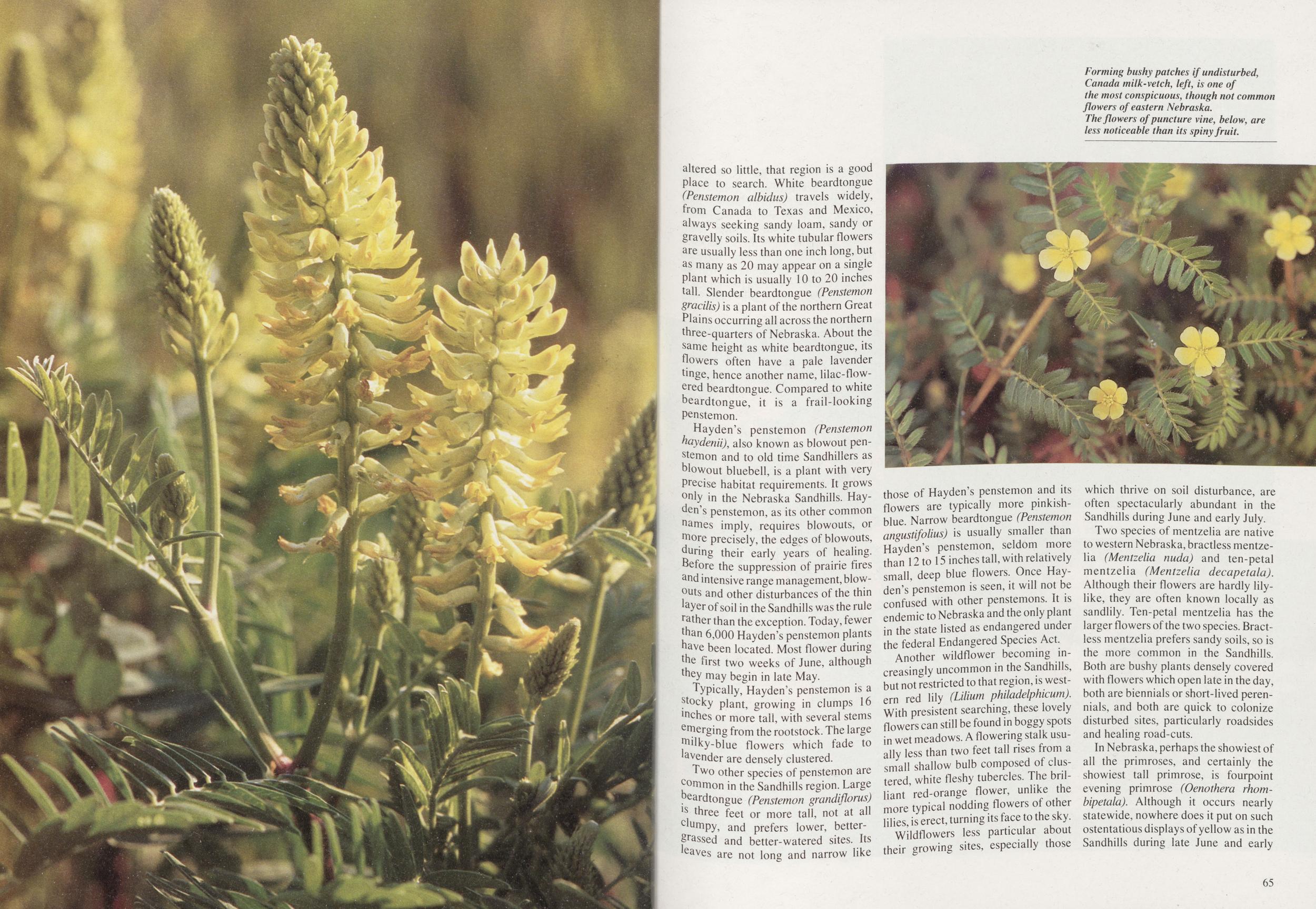
Hayden's penstemon (Penstemon haydenii), also known as blowout penstemon and to old time Sandhillers as blowout bluebell, is a plant with very Precise habitat requirements. It grows only in the Nebraska Sandhills. Hayden's penstemon, as its other common names imply, requires blowouts, or more precisely, the edges of blowouts, during their early years of healing. Before the suppression of prairie fires and intensive range management, blowouts and other disturbances of the thin aver of soil in the Sandhills was the rule rather than the exception. Today, fewer than 6,000 Hayden's penstemon plants have been located. Most flower during the first two weeks of June, although they may begin in late May.
Typically, Hayden's penstemon is a stocky plant, growing in clumps 16 mches or more tall, with several stems emerging from the rootstock. The large milky-blue flowers which fade to lavender are densely clustered.
Two other species of penstemon are common in the Sandhills region. Large beardtongue (Penstemon grandiflorus) is three feet or more tall, not at all clumpy, and prefers lower, bettermassed and better-watered sites. Its leaves are not long and narrow like those of Hayden's penstemon and its flowers are typically more pinkishblue Narrow beardtongue (Penstemon angustifolius) is usually smaller than Hayden's penstemon, seldom more than 12 to 15 inches tall, with relatively small, deep blue flowers. Once Hayden's penstemon is seen, it will not be confused with other penstemons. It is endemic to Nebraska and the only plant in the state listed as endangered under the federal Endangered Species Act.
Another wildflower becoming increasingly uncommon in the Sandhills, but not restricted to that region is western red lily (Ulium philadelphicum). With presistent searching, these lovely flowers can still be found in boggy spots in wet meadows. A flowering stalk usually less than two feet tall rises from a small shallow bulb composed of clustered, white fleshy tubercles. The brilliant red-orange flower, unlike the more typical nodding flowers of other Sies, is erect, turning its face to the sky
Wildflowers less particular about their growing sites, especially those which thrive on soil disturbance, are often spectacularly abundant in the Sandhills during June and early July.
Two species of mentzelia are native to western Nebraska, bractless mentzelia (Mentzelia nuda) and ten-petal mentzelia (Mentzelia decapetala). Although their flowers are hardly lilylike, they are often known locally as sandlily. Ten-petal mentzelia has the larger flowers of the two species. Bractless mentzelia prefers sandy soils, so is the more common in the Sandhills. Both are bushy plants densely covered with flowers which open late in the day, both are biennials or short-lived perennials, and both are quick to colonize disturbed sites, particularly roadsides and healing road-cuts.
In Nebraska, perhaps the showiest of
all the primroses, and certainly the
showiest tall primrose, is fourpoint
evening primrose (Oenothera rhombipetala). Although it occurs nearly
statewide, nowhere does it put on such
ostentatious displays of yellow as in the
Sandhills during late June and early
65
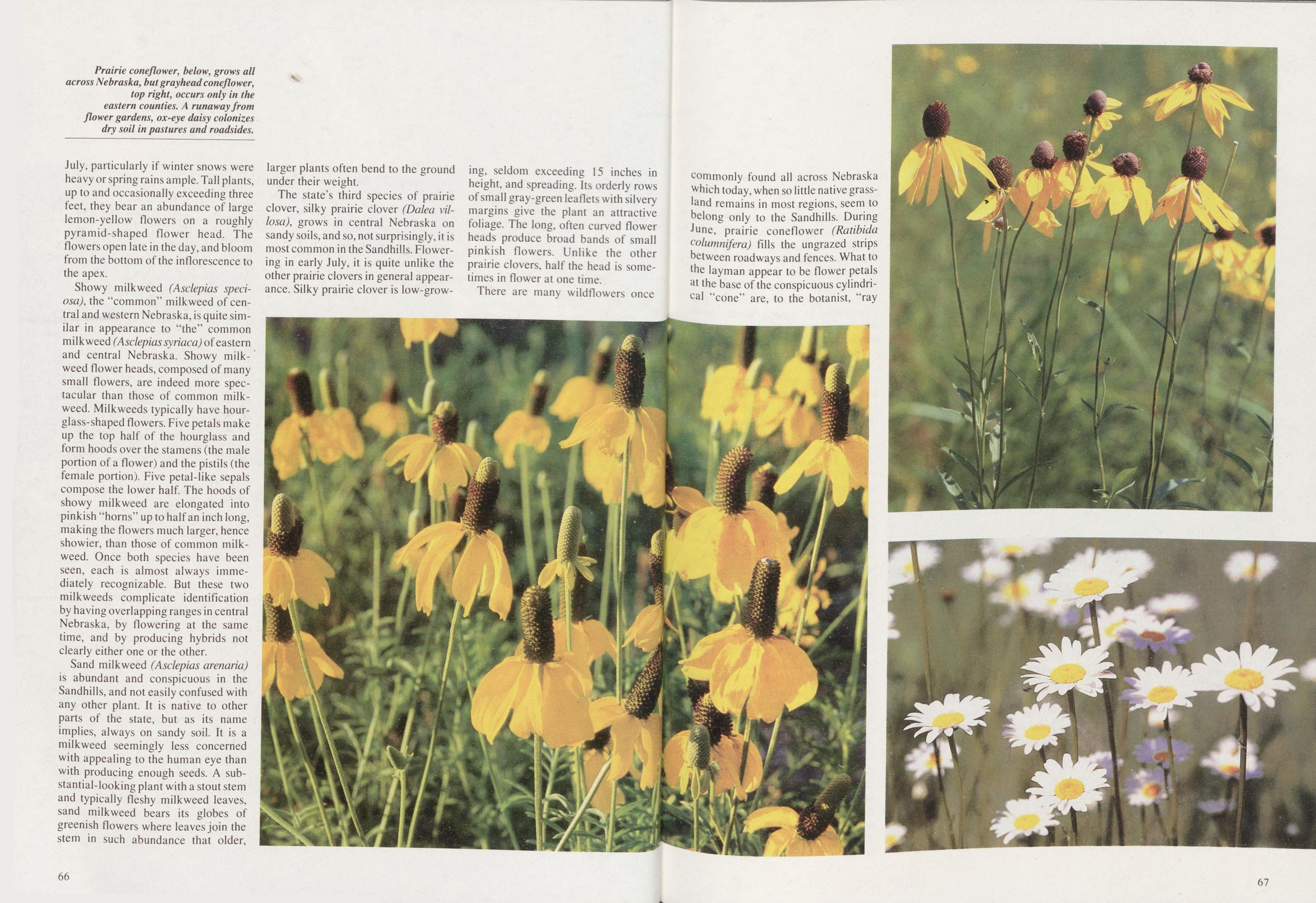
Showy milkweed (Asclepias speciosa), the "common" milkweed of central and western Nebraska, is quite similar in appearance to "the" common milkweed (Asclepias syriaca) of eastern and central Nebraska. Showy milkweed flower heads, composed of many small flowers, are indeed more spectacular than those of common milkweed. Milkweeds typically have hourglass-shaped flowers. Five petals make up the top half of the hourglass and form hoods over the stamens (the male portion of a flower) and the pistils (the female portion). Five petal-like sepals compose the lower half. The hoods of showy milkweed are elongated into pinkish "horns" up to half an inch long, making the flowers much larger, hence showier, than those of common milkweed. Once both species have been seen, each is almost always immediately recognizable. But these two milkweeds complicate identification by having overlapping ranges in central Nebraska, by flowering at the same time, and by producing hybrids not clearly either one or the other.
Sand milkweed (Asclepias arenaria) is abundant and conspicuous in the Sandhills, and not easily confused with any other plant. It is native to other parts of the state, but as its name implies, always on sandy soil. It is a milkweed seemingly less concerned with appealing to the human eye than with producing enough seeds. A substantial-looking plant with a stout stem and typically fleshy milkweed leaves, sand milkweed bears its globes of greenish flowers where leaves join the stem in such abundance that older, larger plants often bend to the ground under their weight.
The state's third species of prairie clover, silky prairie clover (Dalea villosa), grows in central Nebraska on sandy soils, and so, not surprisingly, it is most common in the Sandhills. Flowering in early July, it is quite unlike the other prairie clovers in general appearance. Silky prairie clover is low-growing, seldom exceeding 15 inches in height, and spreading. Its orderly rows of small gray-green leaflets with silvery margins give the plant an attractive foliage. The long, often curved flower heads produce broad bands of small pinkish flowers. Unlike the other prairie clovers, half the head is sometimes in flower at one time.
There are many wildflowers once commonly found all across Nebraska which today, when so little native grassland remains in most regions, seem to belong only to the Sandhills. During Jane, prairie coneflower (Ratibida columnifera) fills the ungrazed strips between roadways and fences. What to the layman appear to be flower petals at the base of the conspicuous cylindrical "cone" are, to the botanist, "ray
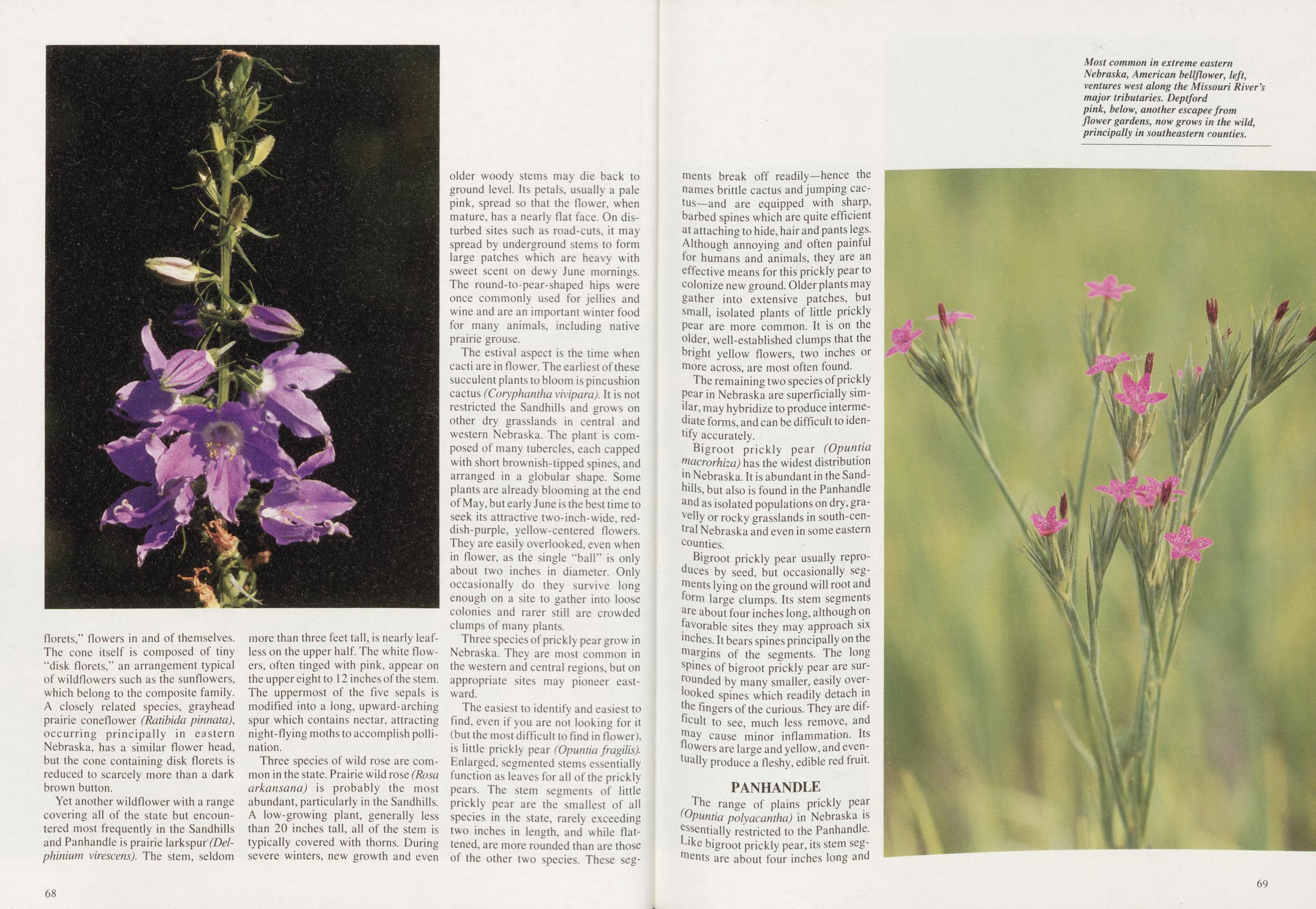
Yet another wildflower with a range covering all of the state but encountered most frequently in the Sandhills and Panhandle is prairie larkspur (Delphinium virescens). The stem, seldom more than three feet tall, is nearly leafless on the upper half. The white flowers, often tinged with pink, appear on the upper eight to 12 inches of the stem. The uppermost of the five sepals is modified into a long, upward-arching spur which contains nectar, attracting night-flying moths to accomplish pollination.
Three species of wild rose are common in the state. Prairie wild rose (Rosa arkansana) is probably the most abundant, particularly in the Sandhills. A low-growing plant, generally less than 20 inches tall, all of the stem is typically covered with thorns. During severe winters, new growth and even older woody stems may die back to ground level. Its petals, usually a pale pink, spread so that the flower, when mature, has a nearly flat face. On disturbed sites such as road-cuts, it may spread by underground stems to form large patches which are heavy with sweet scent on dewy June mornings. The round-to-pear-shaped hips were once commonly used for jellies and wine and are an important winter food for many animals, including native prairie grouse.
The estival aspect is the time when cacti are in flower. The earliest of these succulent plants to bloom is pincushion cactus (Coryphantha vivipara). It is not restricted the Sandhills and grows on other dry grasslands in central and western Nebraska. The plant is composed of many tubercles, each capped with short brownish-tipped spines, and arranged in a globular shape. Some plants are already blooming at the end of May, but early June is the best time to seek its attractive two-inch-wide, reddish-purple, yellow-centered flowers. They are easily overlooked, even when in flower, as the single "ball" is only about two inches in diameter. Only occasionally do they survive long enough on a site to gather into loose colonies and rarer still are crowded clumps of many plants.
Three species of prickly pear grow in Nebraska. They are most common in the western and central regions, but on appropriate sites may pioneer eastward.
The easiest to identify and easiest to find, even if you are not looking for it (but the most difficult to find in flower), is little prickly pear (Opuntia fragilis). Enlarged, segmented stems essentially function as leaves for all of the prickly pears. The stem segments of little prickly pear are the smallest of all species in the state, rarely exceeding two inches in length, and while flattened, are more rounded than are those of the other two species. These segments 68 break off readily—hence the names brittle cactus and jumping cactus—and are equipped with sharp, barbed spines which are quite efficient at attaching to hide, hair and pants legs. Although annoying and often painful for humans and animals, they are an effective means for this prickly pear to colonize new ground. Older plants may gather into extensive patches, but small, isolated plants of little prickly pear are more common. It is on the older, well-established clumps that the bright yellow flowers, two inches or more across, are most often found.
The remaining two species of prickly Pear in Nebraska are superficially similar, may hybridize to produce intermediate forms, and can be difficult to identify accurately.
Bigroot prickly pear (Opuntia macrorhiza) has the widest distribution in Nebraska. It is abundant in the Sandhills, but also is found in the Panhandle and as isolated populations on dry, gravelly or rocky grasslands in south-central Nebraska and even in some eastern counties.
Bigroot prickly pear usually reproduces by seed, but occasionally segments lying on the ground will root and form large clumps. Its stem segments are about four inches long, although on favorable sites they may approach six iriches. It bears spines principally on the margins of the segments. The long spines of bigroot prickly pear are surrounded by many smaller, easily overiooked spines which readily detach in the fingers of the curious. They are difficult to see, much less remove, and JT*ay cause minor inflammation. Its fiowers are large and yellow, and eventually produce a fleshy, edible red fruit.
PANHANDLEThe range of plains prickly pear (Opuntia polyacantha) in Nebraska is essentially restricted to the Panhandle. Like bigroot prickly pear, its stem segments are about four inches long and
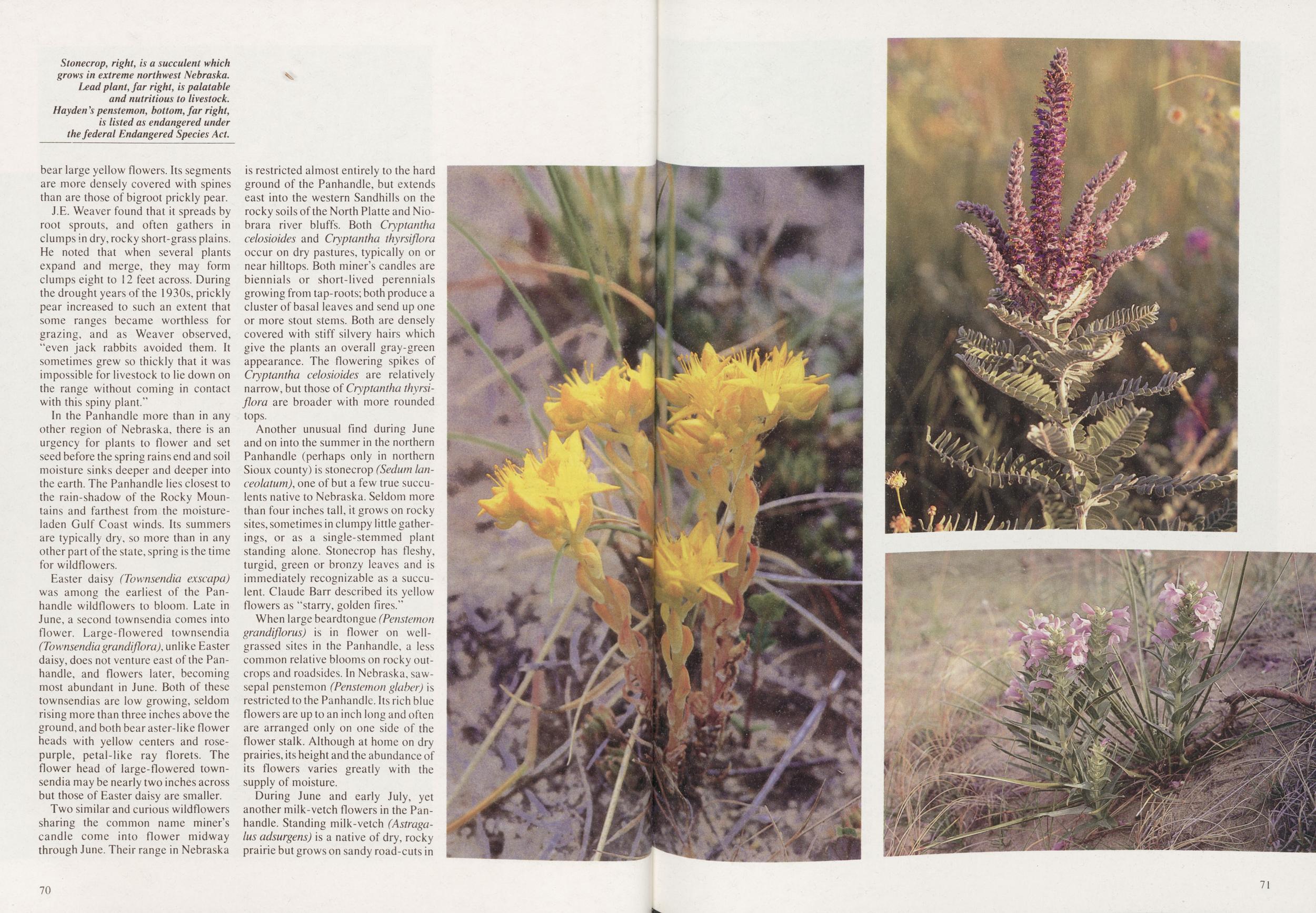
J.E. Weaver found that it spreads by root sprouts, and often gathers in clumps in dry, rocky short-grass plains. He noted that when several plants expand and merge, they may form clumps eight to 12 feet across. During the drought years of the 1930s, prickly pear increased to such an extent that some ranges became worthless for grazing, and as Weaver observed, "even jack rabbits avoided them. It sometimes grew so thickly that it was impossible for livestock to lie down on the range without coming in contact with this spiny plant."
In the Panhandle more than in any other region of Nebraska, there is an urgency for plants to flower and set seed before the spring rains end and soil moisture sinks deeper and deeper into the earth. The Panhandle lies closest to the rain-shadow of the Rocky Mountains and farthest from the moistureladen Gulf Coast winds. Its summers are typically dry, so more than in any other part of the state, spring is the time for wildflowers.
Easter daisy (Townsendia exscapa) was among the earliest of the Panhandle wildflowers to bloom. Late in June, a second townsendia comes into flower. Large-flowered townsendia (Townsendia grandiflora), unlike Easter daisy, does not venture east of the Panhandle, and flowers later, becoming most abundant in June. Both of these townsendias are low growing, seldom rising more than three inches above the ground, and both bear aster-like flower heads with yellow centers and rosepurple, petal-like ray florets. The flower head of large-flowered townsendia may be nearly two inches across but those of Easter daisy are smaller.
Two similar and curious wildflowers sharing the common name miner's candle come into flower midway through June. Their range in Nebraska is restricted almost entirely to the hard ground of the Panhandle, but extends east into the western Sandhills on the rocky soils of the North Platte and Niobrara river bluffs. Both Cryptantha celosioides and Cryptantha thyrsiflora occur on dry pastures, typically on or near hilltops. Both miner's candles are biennials or short-lived perennials growing from tap-roots; both produce a cluster of basal leaves and send up one or more stout stems. Both are densely covered with stiff silvery hairs which give the plants an overall gray-green appearance. The flowering spikes of Cryptantha celosioides are relatively narrow, but those of Cryptantha thyrsiflora are broader with more rounded tops.
Another unusual find during June and on into the summer in the northern Panhandle (perhaps only in northern Sioux county) is stonecrop (Sedum lanceolatum), one of but a few true succulents native to Nebraska. Seldom more than four inches tall, it grows on rocky sites, sometimes in clumpy little gatherings, or as a single-stemmed plant standing alone. Stonecrop has fleshy, turgid, green or bronzy leaves and is immediately recognizable as a succulent. Claude Barr described its yellow flowers as "starry, golden fires."
When large beardtongue (Penstemon grandiflorus) is in flower on wellgrassed sites in the Panhandle, a less common relative blooms on rocky outcrops and roadsides. In Nebraska, sawsepal penstemon (Penstemon glaher) is restricted to the Panhandle. Its rich blue flowers are up to an inch long and often are arranged only on one side of the flower stalk. Although at home on dry prairies, its height and the abundance of its flowers varies greatly with the supply of moisture.
During June and early July, yet another milk-vetch flowers in the Panhandle. Standing milk-vetch (Astragalus adsurgens) is a native of dry, rocky prairie but grows on sandy road-cuts in 70
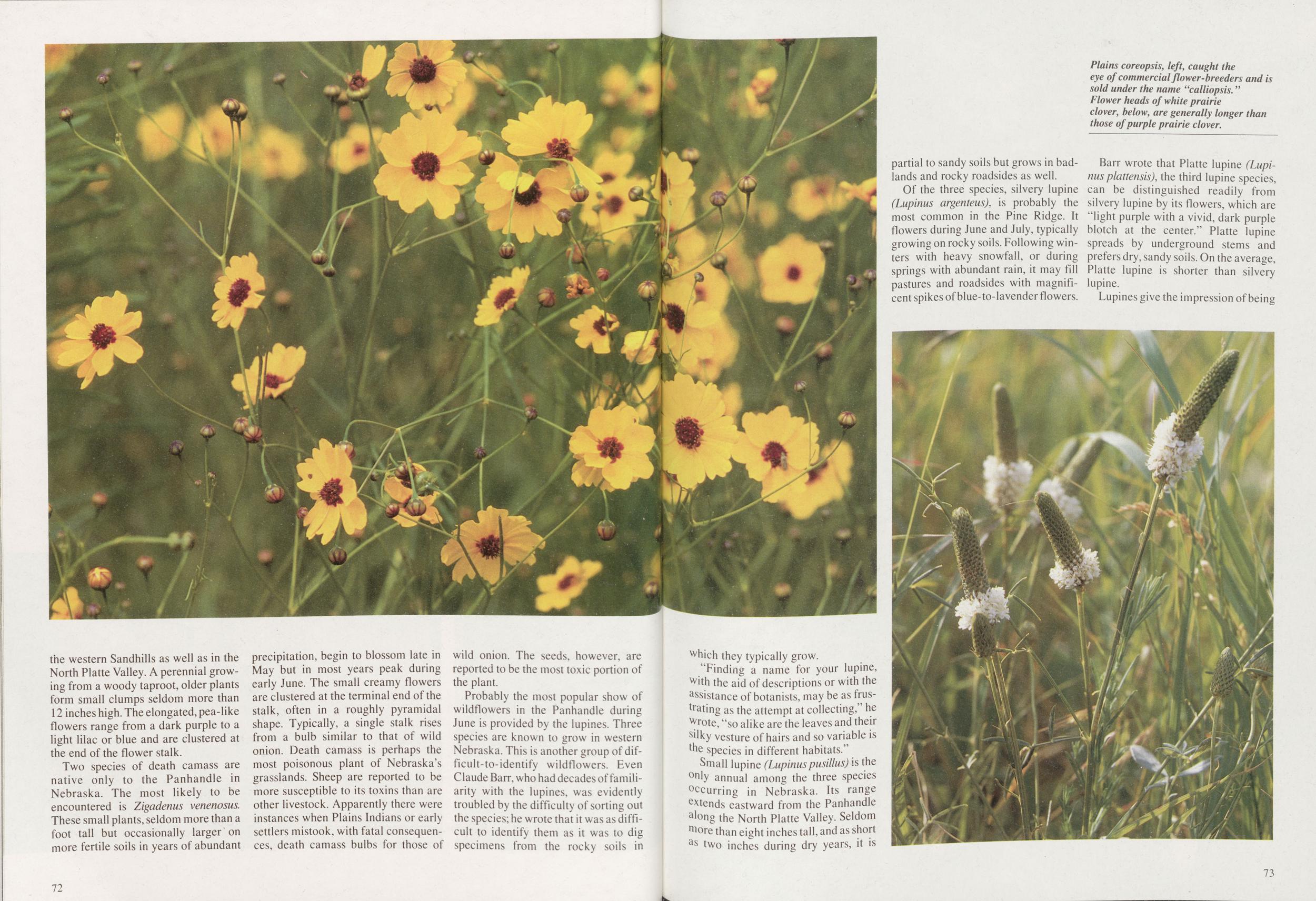 the western Sandhills as well as in the
North Platte Valley. A perennial growing from a woody taproot, older plants
form small clumps seldom more than
12 inches high. The elongated, pea-like
flowers range from a dark purple to a
light lilac or blue and are clustered at
the end of the flower stalk.
the western Sandhills as well as in the
North Platte Valley. A perennial growing from a woody taproot, older plants
form small clumps seldom more than
12 inches high. The elongated, pea-like
flowers range from a dark purple to a
light lilac or blue and are clustered at
the end of the flower stalk.
Two species of death camass are native only to the Panhandle in Nebraska. The most likely to be encountered is Zigadenus venenosus. These small plants, seldom more than a foot tall but occasionally larger on more fertile soils in years of abundant precipitation, begin to blossom late in May but in most years peak during early June. The small creamy flowers are clustered at the terminal end of the stalk, often in a roughly pyramidal shape. Typically, a single stalk rises from a bulb similar to that of wild onion. Death camass is perhaps the most poisonous plant of Nebraska's grasslands. Sheep are reported to be more susceptible to its toxins than are other livestock. Apparently there were instances when Plains Indians or early settlers mistook, with fatal consequences, death camass bulbs for those of wild onion. The seeds, however, are reported to be the most toxic portion of the plant.
Probably the most popular show of wildflowers in the Panhandle during June is provided by the lupines. Three species are known to grow in western Nebraska. This is another group of difficult-to-identify wildflowers. Even Claude Barr, who had decades of familiarity with the lupines, was evidently troubled by the difficulty of sorting out the species; he wrote that it was as difficult to identify them as it was to dig specimens from the rocky soils in 72 which they typically grow.
"Finding a name for your lupine, with the aid of descriptions or with the distance of botanists, may be as frustrating as the attempt at collecting," he Wrote, "so alike are the leaves and their silky vesture of hairs and so variable is the species in different habitats."
Small lupine (Lupinuspusillus) is the only annual among the three species occurring in Nebraska. Its range extends eastward from the Panhandle along the North Platte Valley. Seldom more than eight inches tall, and as short as two inches during dry years, it is partial to sandy soils but grows in badlands and rocky roadsides as well.
Of the three species, silvery lupine (Lupinus argenteus), is probably the most common in the Pine Ridge. It flowers during June and July, typically growing on rocky soils. Following winters with heavy snowfall, or during springs with abundant rain, it may fill pastures and roadsides with magnificent spikes of blue-to-lavender flowers.
Barr wrote that Platte lupine (Lupinus plattensis), the third lupine species, can be distinguished readily from silvery lupine by its flowers, which are "light purple with a vivid, dark purple blotch at the center." Platte lupine spreads by underground stems and prefers dry, sandy soils. On the average, Platte lupine is shorter than silvery lupine.
Lupines give the impression of being
73
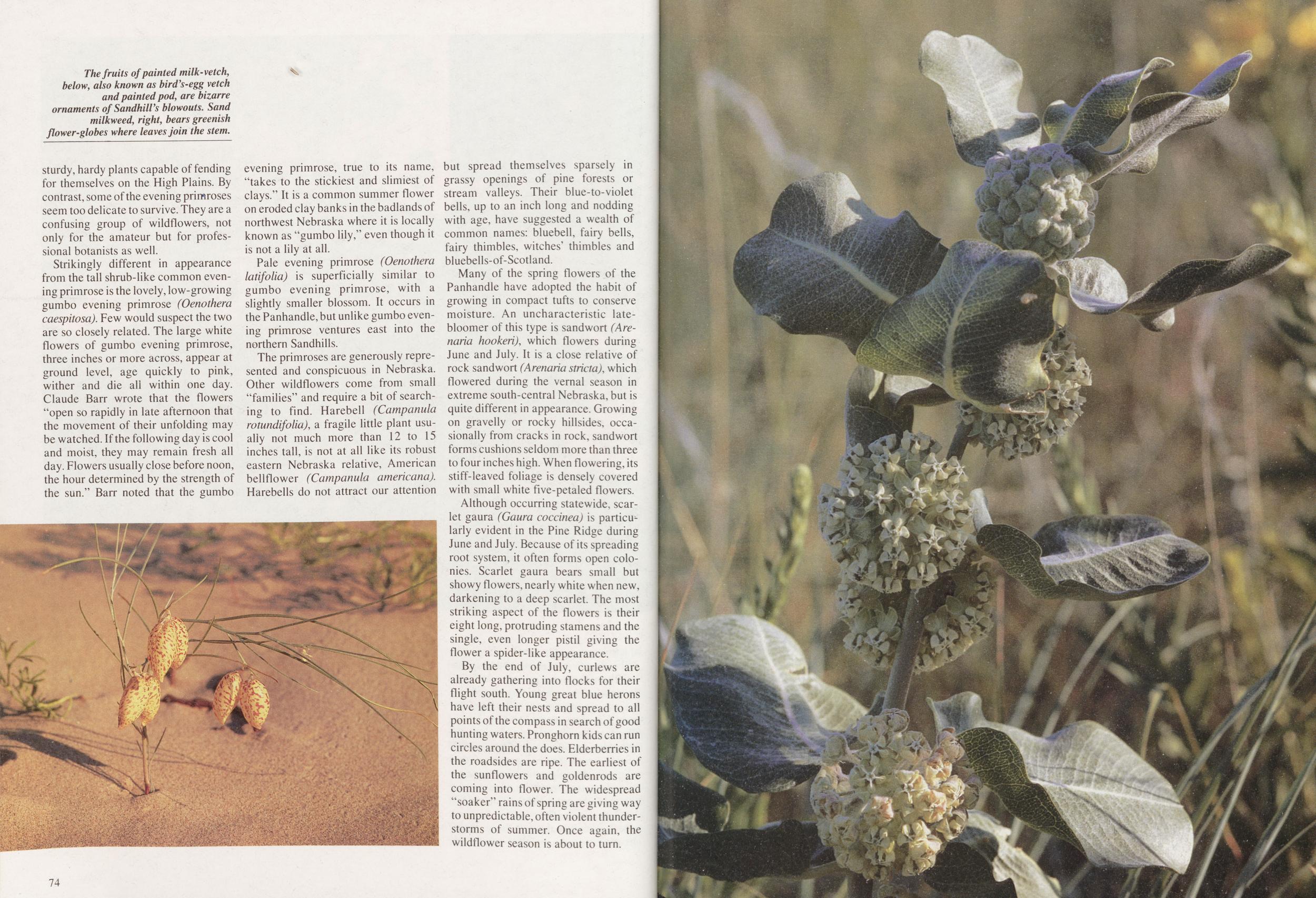
Strikingly different in appearance from the tall shrub-like common evening primrose is the lovely, low-growing gumbo evening primrose (Oenothera caespitosa). Few would suspect the two are so closely related. The large white flowers of gumbo evening primrose, three inches or more across, appear at ground level, age quickly to pink, wither and die all within one day. Claude Barr wrote that the flowers "open so rapidly in late afternoon that the movement of their unfolding may be watched. If the following day is cool and moist, they may remain fresh all day. Flowers usually close before noon, the hour determined by the strength of the sun.'1 Barr noted that the gumbo evening primrose, true to its name, "takes to the stickiest and slimiest of clays." It is a common summer flower on eroded clay banks in the badlands of northwest Nebraska where it is locally known as "gumbo lily," even though it is not a lily at all.
Pale evening primrose (Oenothera latifolia) is superficially similar to gumbo evening primrose, with a slightly smaller blossom. It occurs in the Panhandle, but unlike gumbo evening primrose ventures east into the northern Sandhills.
The primroses are generously represented and conspicuous in Nebraska. Other wildflowers come from small "families" and require a bit of searching to find. Harebell (Campanula rotundifolia), a fragile little plant usually not much more than 12 to 15 inches tall, is not at all like its robust eastern Nebraska relative, American bellflower (Campanula americana). Jarebells do not attract our attention but spread themselves sparsely in grassy openings of pine forests or stream valleys. Their blue-to-violet bells, up to an inch long and nodding with age, have suggested a wealth of common names: bluebell, fairy bells, fairy thimbles, witches' thimbles and bluebells-of-Scotland.
Many of the spring flowers of the Panhandle have adopted the habit of growing in compact tufts to conserve moisture. An uncharacteristic latebloomer of this type is sandwort (Arenaria hooked), which flowers during June and July. It is a close relative of rock sandwort (Arenaria stncta), which flowered during the vernal season in extreme south-central Nebraska, but is quite different in appearance. Growing on gravelly or rocky hillsides, occasionally from cracks in rock, sandwort forms cushions seldom more than three to four inches high. When flowering, its stiff-leaved foliage is densely covered with small white five-petaled flowers.
Although occurring statewide, scarlet gaura (Gaura coccinea) is particularly evident in the Pine Ridge during June and July. Because of its spreading root system, it often forms open colonies. Scarlet gaura bears small but showy flowers, nearly white when new, darkening to a deep scarlet. The most striking aspect of the flowers is their eight long, protruding stamens and the single, even longer pistil giving the flower a spider-like appearance.
By the end of July, curlews are already gathering into flocks for their flight south. Young great blue herons have left their nests and spread to all points of the compass in search of good hunting waters. Pronghorn kids can run circles around the does. Elderberries in the roadsides are ripe. The earliest of the sunflowers and goldenrods are coming into flower. The widespread "soaker" rains of spring are giving way to unpredictable, often violent thunderstorms of summer. Once again, the wildflower season is about to turn.
74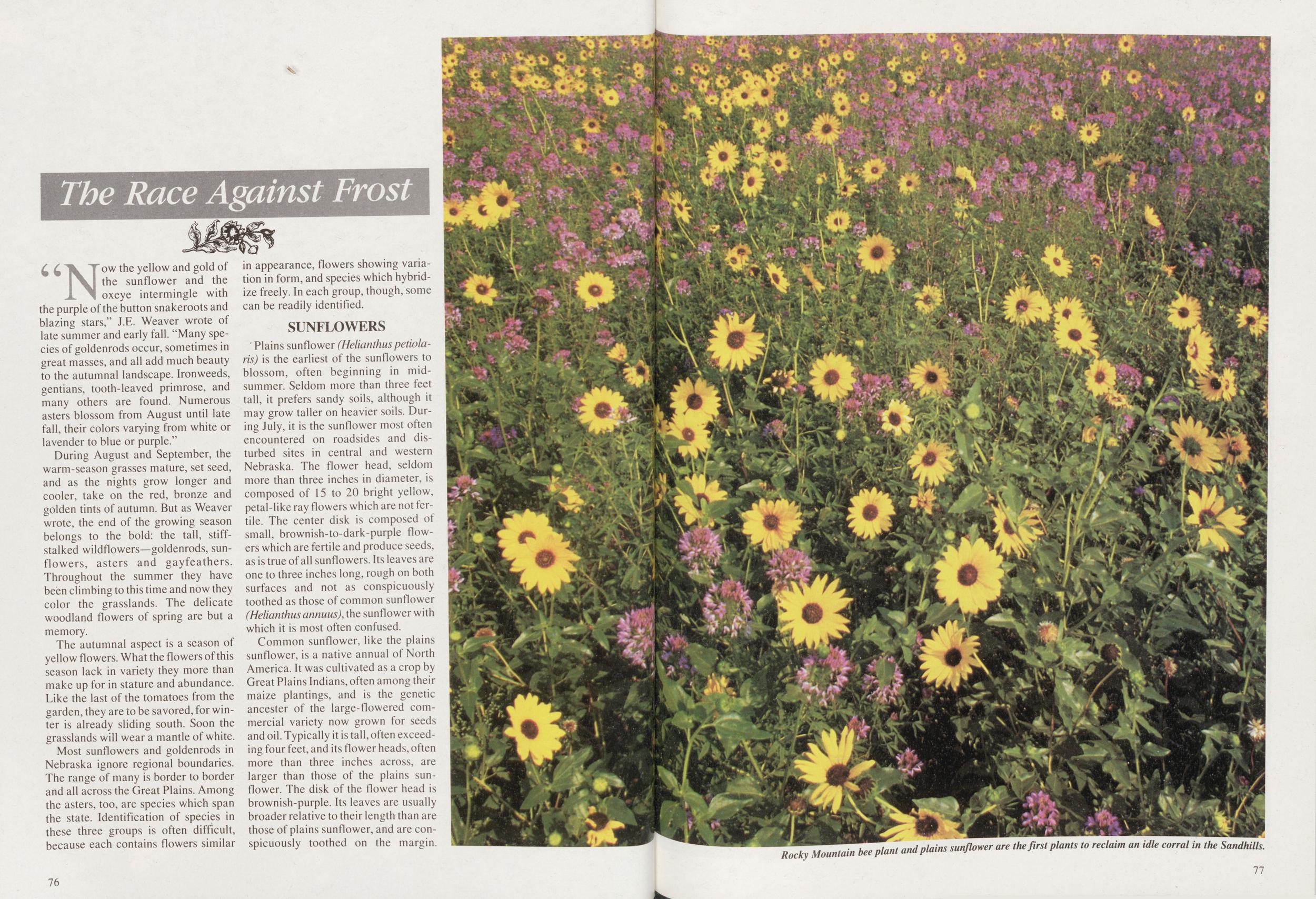
The Race Against Frost
"Now the yellow and gold of the sunflower and the oxeye intermingle with the purple of the button snakeroots and blazing stars," J.E. Weaver wrote of late summer and early fall. "Many species of goldenrods occur, sometimes in great masses, and all add much beauty to the autumnal landscape. Ironweeds, gentians, tooth-leaved primrose, and many others are found. Numerous asters blossom from August until late fall, their colors varying from white or lavender to blue or purple."
During August and September, the warm-season grasses mature, set seed, and as the nights grow longer and cooler, take on the red, bronze and golden tints of autumn. But as Weaver wrote, the end of the growing season belongs to the bold: the tall, stiffstalked wildflowers—goldenrods, sunflowers, asters and gayfeathers. Throughout the summer they have been climbing to this time and now they color the grasslands. The delicate woodland flowers of spring are but a memory.
The autumnal aspect is a season of yellow flowers. What the flowers of this season lack in variety they more than make up for in stature and abundance. Like the last of the tomatoes from the garden, they are to be savored, for winter is already sliding south. Soon the grasslands will wear a mantle of white.
Most sunflowers and goldenrods in Nebraska ignore regional boundaries. The range of many is border to border and all across the Great Plains. Among the asters, too, are species which span the state. Identification of species in these three groups is often difficult, because each contains flowers similar in appearance, flowers showing variation in form, and species which hybridize freely. In each group, though, some can be readily identified.
SUNFLOWERSPlains sunflower (Helianthuspetiolaris) is the earliest of the sunflowers to blossom, often beginning in midsummer. Seldom more than three feet tall, it prefers sandy soils, although it may grow taller on heavier soils. During July, it is the sunflower most often encountered on roadsides and disturbed sites in central and western Nebraska. The flower head, seldom more than three inches in diameter, is composed of 15 to 20 bright yellow, petal-like ray flowers which are not fertile. The center disk is composed of small, brownish-to-dark-purple flowers which are fertile and produce seeds, as is true ofall sunflowers. Its leaves are one to three inches long, rough on both surfaces and not as conspicuously toothed as those of common sunflower (Helianthus annum), the sunflower with which it is most often confused.
Common sunflower, like the plains sunflower, is a native annual of North America. It was cultivated as a crop by Great Plains Indians, often among their maize plantings, and is the genetic ancester of the large-flowered commercial variety now grown for seeds and oil. Typically it is tall, often exceeding four feet, and its flower heads, often more than three inches across, are larger than those of the plains sunflower. The disk of the flower head is brownish-purple. Its leaves are usually broader relative to their length than are those of plains sunflower, and are conspicuously toothed on the margin.
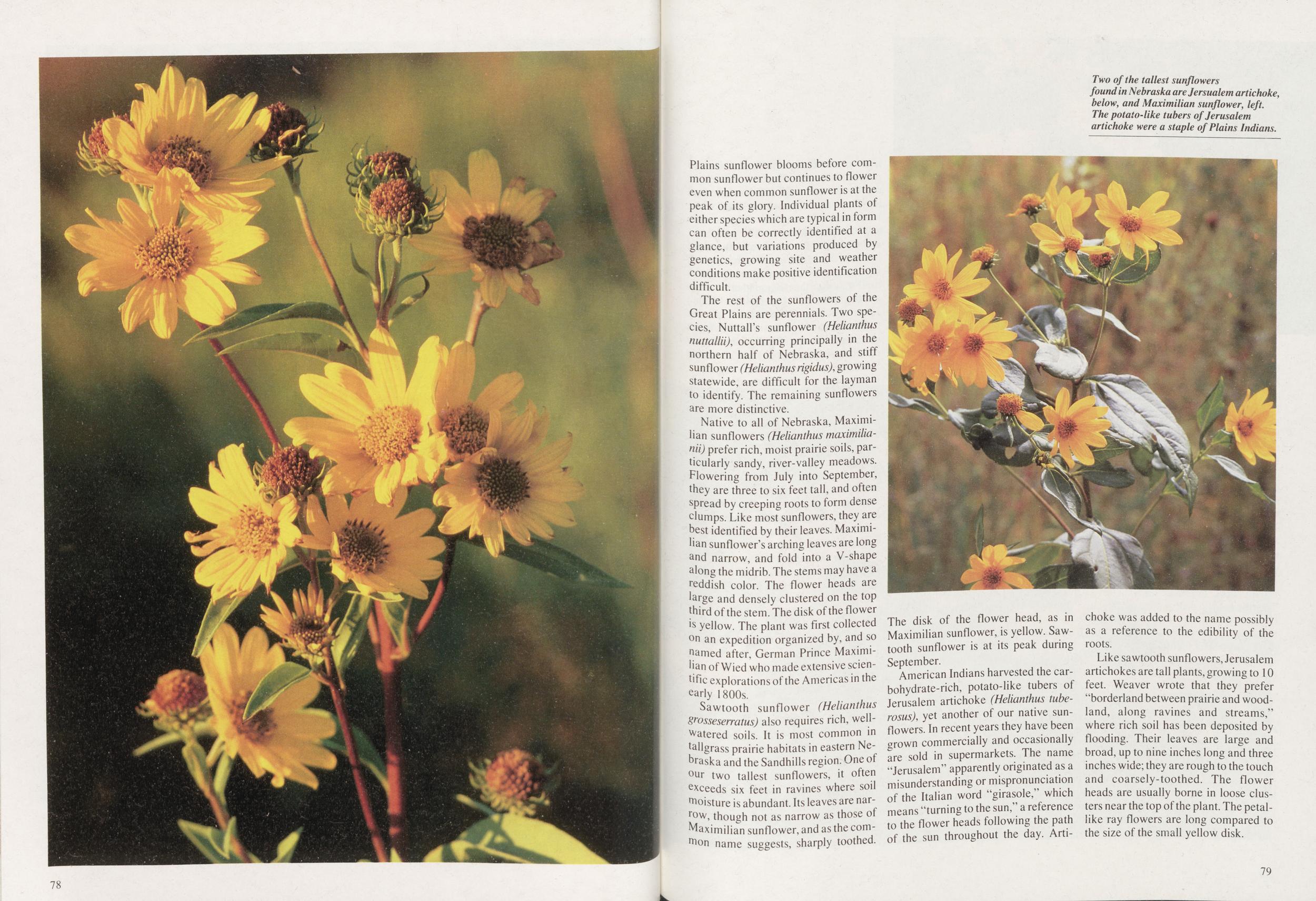
The rest of the sunflowers of the Great Plains are perennials. Two species, Nuttalfs sunflower (Helianthus nuttallii), occurring principally in the northern half of Nebraska, and stiff sunflower (Helianthus rigidus), growing statewide, are difficult for the layman to identify. The remaining sunflowers are more distinctive.
Native to all of Nebraska, Maximilian sunflowers (Helianthus maximilianii) prefer rich, moist prairie soils, particularly sandy, river-valley meadows. Flowering from July into September, they are three to six feet tall, and often spread by creeping roots to form dense clumps. Like most sunflowers, they are best identified by their leaves. Maximilian sunflower's arching leaves are long and narrow, and fold into a V-shape along the midrib. The stems may have a reddish color. The flower heads are large and densely clustered on the top third of the stem. The disk of the flower is yellow. The plant was first collected on an expedition organized by, and so named after, German Prince Maximilian of Wied who made extensive scientific explorations of the Americas in the early 1800s.
Sawtooth sunflower (Helianthus grosseserratus) also requires rich, wellwatered soils. It is most common in tallgrass prairie habitats in eastern Nebraska and the Sandhills region. One of our two tallest sunflowers, it often exceeds six feet in ravines where soil Moisture is abundant. Its leaves are narrow, though not as narrow as those of Maximilian sunflower, and as the common name suggests, sharply toothed. The disk of the flower head, as in Maximilian sunflower, is yellow. Sawtooth sunflower is at its peak during September.
American Indians harvested the carbohydrate-rich, potato-like tubers of Jerusalem artichoke (Helianthus tuberosus), yet another of our native sunflowers. In recent years they have been grown commercially and occasionally are sold in supermarkets. The name "Jerusalem" apparently originated as a misunderstanding or mispronunciation of the Italian word "girasole," which means "turning to the sun," a reference to the flower heads following the path of the sun throughout the day. Artichoke was added to the name possibly as a reference to the edibility of the roots.
Like sawtooth sunflowers, Jerusalem artichokes are tall plants, growing to 10 feet. Weaver wrote that they prefer "borderland between prairie and woodland, along ravines and streams," where rich soil has been deposited by flooding. Their leaves are large and broad, up to nine inches long and three inches wide; they are rough to the touch and coarsely-toothed. The flower heads are usually borne in loose clusters near the top of the plant. The petallike ray flowers are long compared to the size of the small yellow disk.
79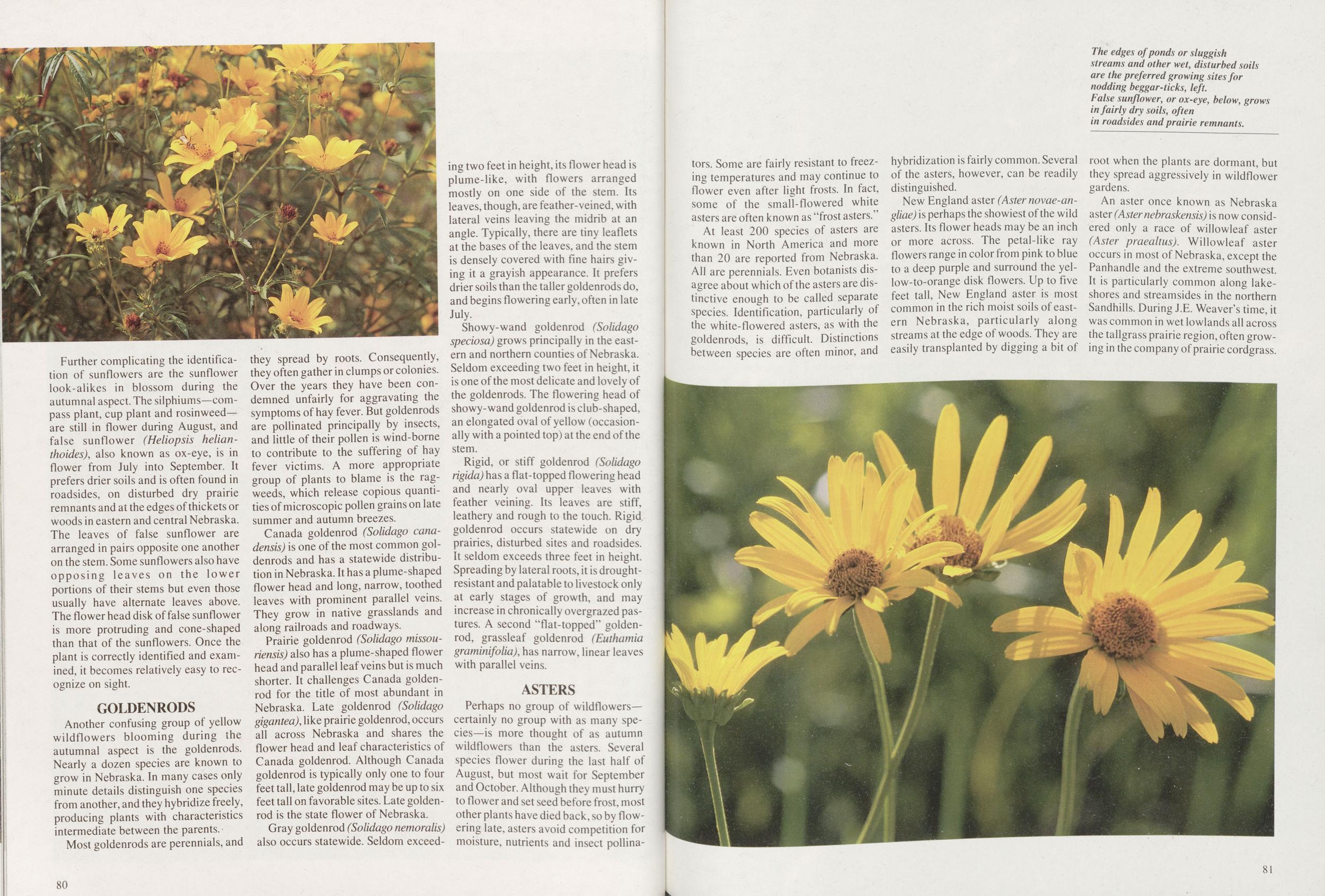
Further complicating the identification of sunflowers are the sunflower look-alikes in blossom during the autumnal aspect. The silphiums—compass plant, cup plant and rosinweed— are still in flower during August, and false sunflower (Heliopsis helianthoides), also known as ox-eye, is in flower from July into September. It prefers drier soils and is often found in roadsides, on disturbed dry prairie remnants and at the edges of thickets or woods in eastern and central Nebraska. The leaves of false sunflower are arranged in pairs opposite one another on the stem. Some sunflowers also have opposing leaves on the lower portions of their stems but even those usually have alternate leaves above. The flower head disk of false sunflower is more protruding and cone-shaped than that of the sunflowers. Once the plant is correctly identified and examined, it becomes relatively easy to recognize on sight.
GOLDENRODSAnother confusing group of yellow wildflowers blooming during the autumnal aspect is the goldenrods. Nearly a dozen species are known to grow in Nebraska. In many cases only minute details distinguish one species from another, and they hybridize freely, producing plants with characteristics intermediate between the parents.
Most goldenrods are perennials, and they spread by roots. Consequently, they often gather in clumps or colonies. Over the years they have been condemned unfairly for aggravating the symptoms of hay fever. But goldenrods are pollinated principally by insects, and little of their pollen is wind-borne to contribute to the suffering of hay fever victims. A more appropriate group of plants to blame is the ragweeds, which release copious quantities of microscopic pollen grains on late summer and autumn breezes.
Canada goldenrod (Solidago canadensis) is one of the most common goldenrods and has a statewide distribution in Nebraska. It has a plume-shaped flower head and long, narrow, toothed leaves with prominent parallel veins. They grow in native grasslands and along railroads and roadways.
Prairie goldenrod (Solidago missouriensis) also has a plume-shaped flower head and parallel leaf veins but is much shorter. It challenges Canada goldenrod for the title of most abundant in Nebraska. Late goldenrod (Solidago gigantea), like prairie goldenrod, occurs all across Nebraska and shares the flower head and leaf characteristics of Canada goldenrod. Although Canada goldenrod is typically only one to four feet tall, late goldenrod may be up to six feet tall on favorable sites. Late goldenrod is the state flower of Nebraska.
Gray goldenrod (Solidago nemoralis) also occurs statewide. Seldom exceeding two feet in height, its flower head is plume-like, with flowers arranged mostly on one side of the stem. Its leaves, though, are feather-veined, with lateral veins leaving the midrib at an angle. Typically, there are tiny leaflets at the bases of the leaves, and the stem is densely covered with fine hairs giving it a grayish appearance. It prefers drier soils than the taller goldenrods do, and begins flowering early, often in late July.
Showy-wand goldenrod (Solidago speciosa) grows principally in the eastern and northern counties of Nebraska. Seldom exceeding two feet in height, it is one of the most delicate and lovely of the goldenrods. The flowering head of showy-wand goldenrod is club-shaped, an elongated oval of yellow (occasionally with a pointed top) at the end of the stem.
Rigid, or stiff goldenrod (Solidago rigida) has a flat-topped flowering head and nearly oval upper leaves with feather veining. Its leaves are stiff, leathery and rough to the touch. Rigid goldenrod occurs statewide on dry prairies, disturbed sites and roadsides. It seldom exceeds three feet in height. Spreading by lateral roots, it is droughtresistant and palatable to livestock only at early stages of growth, and may increase in chronically overgrazed pastures. A second "flat-topped" goldenrod, grassleaf goldenrod (Euthamia graminifolia), has narrow, linear leaves with parallel veins.
ASTERSPerhaps no group of wildflowers— certainly no group with as many species—is more thought of as autumn wildflowers than the asters. Several species flower during the last half of August, but most wait for September and October. Although they must hurry to flower and set seed before frost, most other plants have died back, so by flowering late, asters avoid competition for moisture, nutrients and insect pollinators. Some are fairly resistant to freezing temperatures and may continue to flower even after light frosts. In fact, some of the small-flowered white asters are often known as "frost asters."
At least 200 species of asters are known in North America and more than 20 are reported from Nebraska. All are perennials. Even botanists disagree about which of the asters are distinctive enough to be called separate species. Identification, particularly of the white-flowered asters, as with the goldenrods, is difficult. Distinctions between species are often minor, and hybridization is fairly common. Several of the asters, however, can be readily distinguished.
New England aster (Aster novae-angliae) is perhaps the showiest of the wild asters. Its flower heads may be an inch or more across. The petal-like ray flowers range in color from pink to blue to a deep purple and surround the yellow-to-orange disk flowers. Up to five feet tall, New England aster is most common in the rich moist soils of eastern Nebraska, particularly along streams at the edge of woods. They are easily transplanted by digging a bit of root when the plants are dormant, but they spread aggressively in wildflower gardens.
An aster once known as Nebraska
aster (Aster nebraskensis) is now considered only a race of willowleaf aster
(Aster praealtus). Willowleaf aster
occurs in most of Nebraska, except the
Panhandle and the extreme southwest.
It is particularly common along lakeshores and streamsides in the northern
Sandhills. During J.E. Weaver's time, it
was common in wet lowlands all across
the tallgrass prairie region, often growing in the company of prairie cordgrass.
81
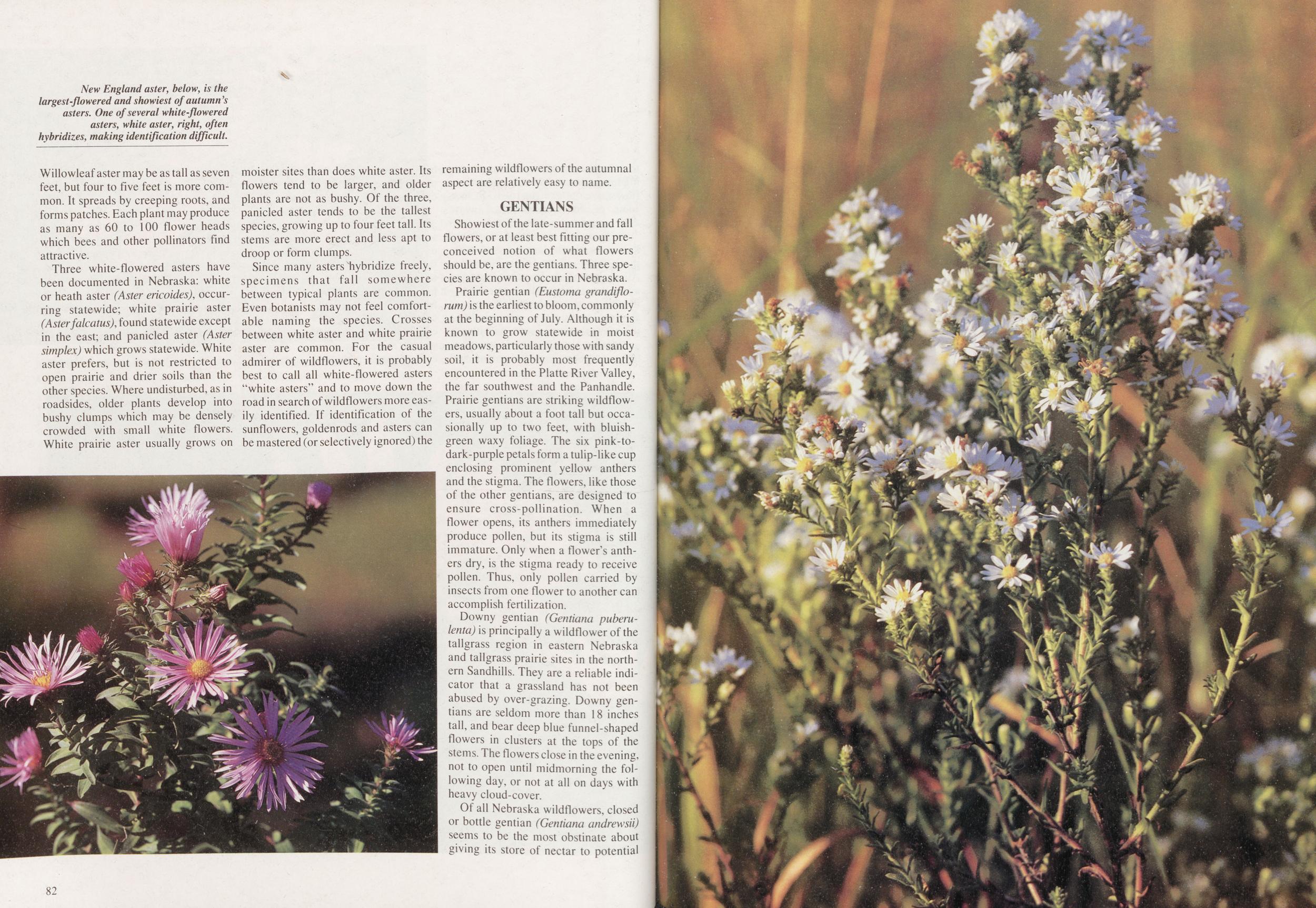
Three white-flowered asters have been documented in Nebraska: white or heath aster (Aster ericoides), occurring statewide; white prairie aster (Aster falcatus), found statewide except in the east; and panicled aster (Aster simplex) which grows statewide. White aster prefers, but is not restricted to open prairie and drier soils than the other species. Where undisturbed, as in roadsides, older plants develop into bushy clumps which may be densely crowded with small white flowers. White prairie aster usually grows on moister sites than does white aster. Its flowers tend to be larger, and older plants are not as bushy. Of the three, panicled aster tends to be the tallest species, growing up to four feet tall. Its stems are more erect and less apt to droop or form clumps.
Since many asters "hybridize freely, specimens that fall somewhere between typical plants are common. Even botanists may not feel comfortable naming the species. Crosses between white aster and white prairie aster are common. For the casual admirer of wildflowers, it is probably best to call all white-flowered asters uwhite asters" and to move down the road in search of wildflowers more easily identified. If identification of the sunflowers, goldenrods and asters can be mastered (or selectively ignored) the remaining wildflowers of the autumnal aspect are relatively easy to name.
GENTIANSShowiest of the late-summer and fall flowers, or at least best fitting our preconceived notion of what flowers should be, are the gentians. Three species are known to occur in Nebraska.
Prairie gentian (Eustoma grandiflorum) is the earliest to bloom, commonly at the beginning of July. Although it is known to grow statewide in moist meadows, particularly those with sandy soil, it is probably most frequently encountered in the Platte River Valley, the far southwest and the Panhandle. Prairie gentians are striking wildflowers, usually about a foot tall but occasionally up to two feet, with bluish-green waxy foliage. The six pink-to-dark-purple petals form a tulip-like cup enclosing prominent yellow anthers and the stigma. The flowers, like those of the other gentians, are designed to ensure cross-pollination. When a flower opens, its anthers immediately produce pollen, but its stigma is still immature. Only when a flower's anthers dry, is the stigma ready to receive pollen. Thus, only pollen carried by insects from one flower to another can accomplish fertilization.
Downy gentian (Gentiana puberulenta) is principally a wildflower of the tallgrass region in eastern Nebraska and tallgrass prairie sites in the northern Sandhills. They are a reliable indicator that a grassland has not been abused by over-grazing. Downy gentians are seldom more than 18 inches tall, and bear deep blue funnel-shaped flowers in clusters at the tops of the stems. The flowers close in the evening, not to open until midmorning the following day, or not at all on days with heavy cloud-cover.
Of all Nebraska wildflowers, closed or bottle gentian (Gentiana andrewsii) seems to be the most obstinate about giving its store of nectar to potential
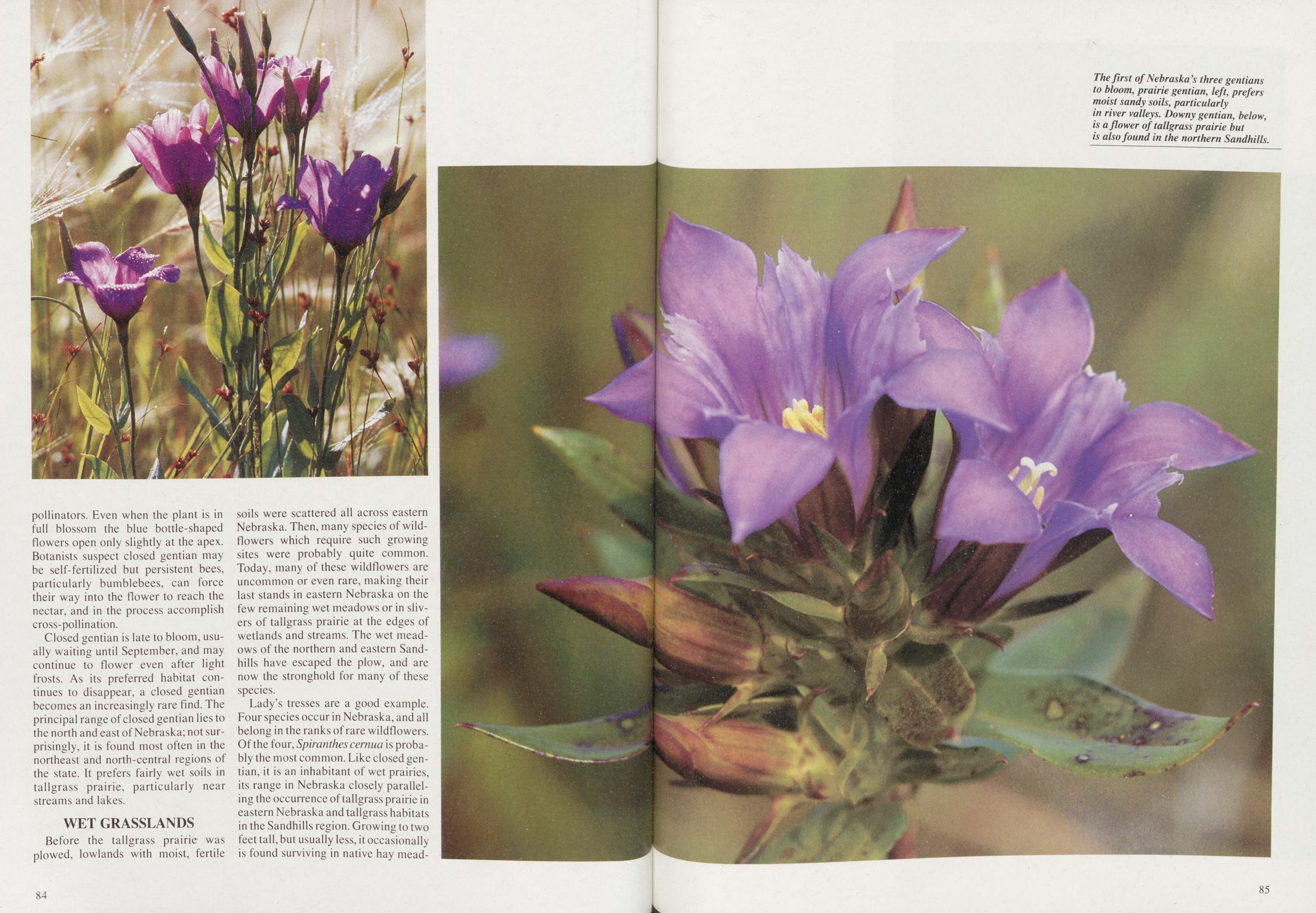 pollinators. Even when the plant is in
full blossom the blue bottle-shaped
flowers open only slightly at the apex.
Botanists suspect closed gentian may
be self-fertilized but persistent bees,
particularly bumblebees, can force
their way into the flower to reach the
nectar, and in the process accomplish
cross-pollination.
pollinators. Even when the plant is in
full blossom the blue bottle-shaped
flowers open only slightly at the apex.
Botanists suspect closed gentian may
be self-fertilized but persistent bees,
particularly bumblebees, can force
their way into the flower to reach the
nectar, and in the process accomplish
cross-pollination.
Closed gentian is late to bloom, usually waiting until September, and may continue to flower even after light frosts. As its preferred habitat continues to disappear, a closed gentian becomes an increasingly rare find. The principal range of closed gentian lies to the north and east of Nebraska; not surprisingly, it is found most often in the northeast and north-central regions of the state. It prefers fairly wet soils in tallgrass prairie, particularly near streams and lakes.
WET GRASSLANDSBefore the tallgrass prairie was plowed, lowlands with moist, fertile soils were scattered all across eastern Nebraska. Then, many species of wildflowers which require such growing sites were probably quite common. Today, many of these wildflowers are uncommon or even rare, making their last stands in eastern Nebraska on the few remaining wet meadows or in slivers of tallgrass prairie at the edges of wetlands and streams. The wet meadows of the northern and eastern Sandhills have escaped the plow, and are now the stronghold for many of these species.
Lady's tresses are a good example. Four species occur in Nebraska, and all belong in the ranks of rare wildflowers. Of the four, Spiranthes cernua is probably the most common. Like closed gentian, it is an inhabitant of wet prairies, its range in Nebraska closely paralleling the occurrence of tallgrass prairie in eastern Nebraska and tallgrass habitats in the Sandhills region. Growing to two feet tall, but usually less, it occasionally is found surviving in native hay mead 84
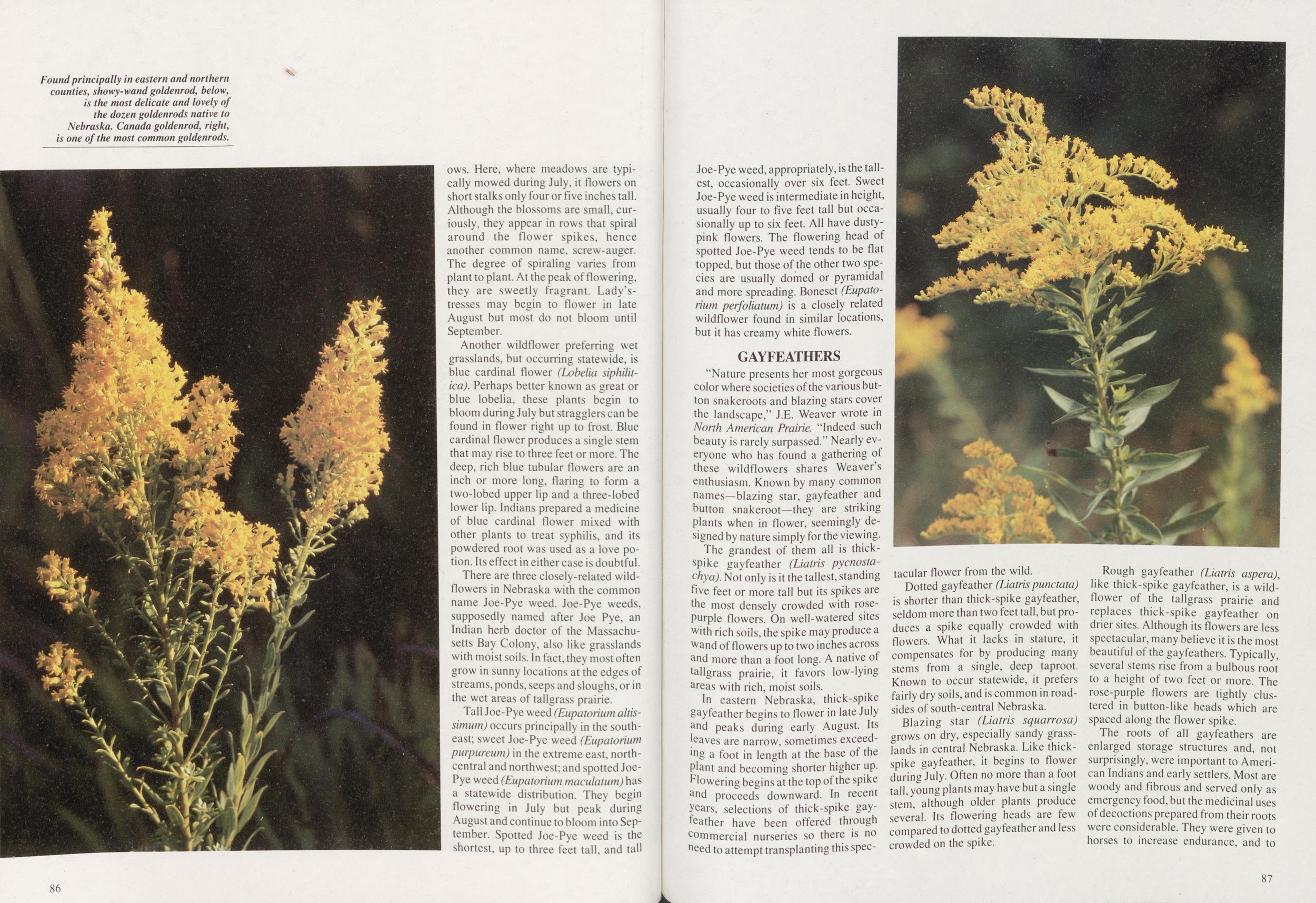
Another wildflower preferring wet grasslands, but occurring statewide, is blue cardinal flower (Lobelia siphilitica). Perhaps better known as great or blue lobelia, these plants begin to bloom during July but stragglers can be found in flower right up to frost. Blue cardinal flower produces a single stem that may rise to three feet or more. The deep, rich blue tubular flowers are an inch or more long, flaring to form a two-lobed upper lip and a three-lobed lower lip. Indians prepared a medicine of blue cardinal flower mixed with other plants to treat syphilis, and its powdered root was used as a love potion. Its effect in either case is doubtful.
There are three closely-related wildflowers in Nebraska with the common name Joe-Pye weed. Joe-Pye weeds, supposedly named after Joe Pye, an Indian herb doctor of the Massachusetts Bay Colony, also like grasslands with moist soils. In fact, they most often grow in sunny locations at the edges of streams, ponds, seeps and sloughs, or in the wet areas of tallgrass prairie.
Tall Joe-Pye weed (Eupatorium altissimum) occurs principally in the southeast; sweet Joe-Pye weed (Eupatorium purpureum) in the extreme east, northcentral and northwest; and spotted JoePye weed (Eupatorium maculatum) has a statewide distribution. They begin flowering in July but peak during August and continue to bloom into September. Spotted Joe-Pye weed is the shortest, up to three feet tall, and tall 86 Joe-Pye weed, appropriately, is the tallest, occasionally over six feet. Sweet Joe-Pye weed is intermediate in height, usually four to five feet tall but occa-sionally up to six feet. All have dustypink flowers. The flowering head of spotted Joe-Pye weed tends to be flat topped, but those of the other two species are usually domed or pyramidal and more spreading. Boneset (Eupatorium perfoliatum) is a closely related wildflower found in similar locations, but it has creamy white flowers.
GAYFEATHERS"Nature presents her most gorgeous color where societies of the various button snakeroots and blazing stars cover the landscape," J.E. Weaver wrote in North American Prairie. "Indeed such beauty is rarely surpassed." Nearly everyone who has found a gathering of these wildflowers shares Weaver's enthusiasm. Known by many common names—blazing star, gayfeather and button snakeroot—they are striking plants when in flower, seemingly designed by nature simply for the viewing.
The grandest of them all is thick-spike gayfeather (Liatris pycnostachya). Not only is it the tallest, standing five feet or more tall but its spikes are the most densely crowded with rosePurple flowers. On well-watered sites with rich soils, the spike may produce a wand of flowers up to two inches across and more than a foot long. A native of tallgrass prairie, it favors low-lying areas with rich, moist soils.
In eastern Nebraska, thick-spike gayfeather begins to flower in late July and peaks during early August. Its leaves are narrow, sometimes exceeding a foot in length at the base of the Plant and becoming shorter higher up. Flowering begins at the top of the spike and proceeds downward. In recent years, selections of thick-spike gayfeather have been offered through commercial nurseries so there is no need to attempt transplanting this spectacular flower from the wild.
Dotted gayfeather (Liatris punctata) is shorter than thick-spike gayfeather, seldom more than two feet tall, but produces a spike equally crowded with flowers. What it lacks in stature, it compensates for by producing many stems from a single, deep taproot. Known to occur statewide, it prefers fairly dry soils, and is common in roadsides of south-central Nebraska.
Blazing star (Liatris squarrosa) grows on dry, especially sandy grasslands in central Nebraska. Like thickspike gayfeather, it begins to flower during July. Often no more than a foot tall, young plants may have but a single stem, although older plants produce several. Its flowering heads are few compared to dotted gayfeather and less crowded on the spike.
Rough gayfeather (Liatris aspera), like thick-spike gayfeather, is a wildflower of the tallgrass prairie and replaces thick-spike gayfeather on drier sites. Although its flowers are less spectacular, many believe it is the most beautiful of the gayfeathers. Typically, several stems rise from a bulbous root to a height of two feet or more. The rose-purple flowers are tightly clustered in button-like heads which are spaced along the flower spike.
The roots of all gayfeathers are
enlarged storage structures and, not
surprisingly, were important to American Indians and early settlers. Most are
woody and fibrous and served only as
emergency food, but the medicinal uses
of decoctions prepared from their roots
were considerable. They were given to
horses to increase endurance, and to
87
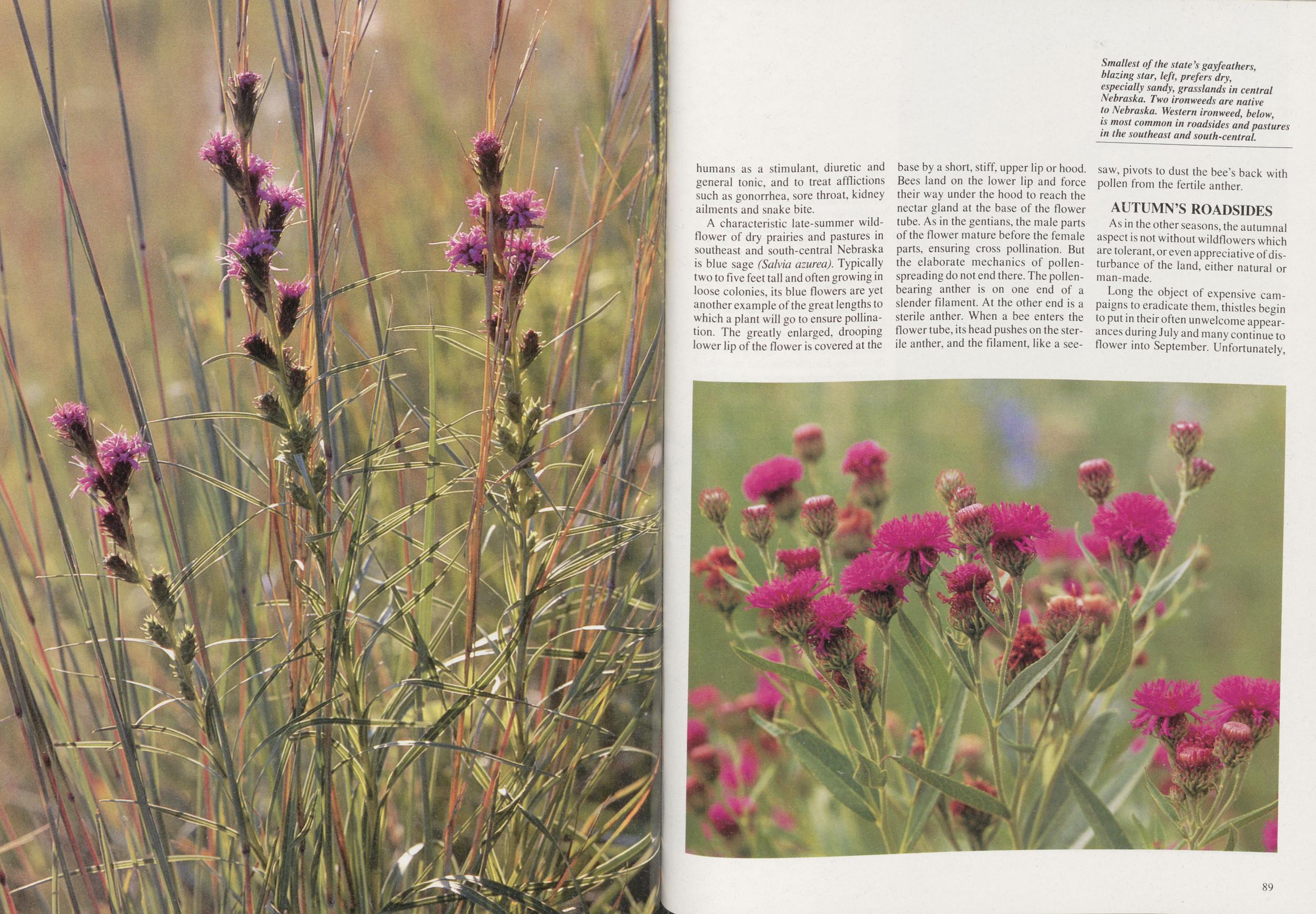
A characteristic late-summer wildflower of dry prairies and pastures in southeast and south-central Nebraska is blue sage (Salvia azurea). Typically two to five feet tall and often growing in loose colonies, its blue flowers are yet another example of the great lengths to which a plant will go to ensure pollination. The greatly enlarged, drooping lower lip of the flower is covered at the base by a short, stiff, upper lip or hood. Bees land on the lower lip and force their way under the hood to reach the nectar gland at the base of the flower tube. As in the gentians, the male parts of the flower mature before the female parts, ensuring cross pollination. But the elaborate mechanics of pollenspreading do not end there. The pollenbearing anther is on one end of a slender filament. At the other end is a sterile anther. When a bee enters the flower tube, its head pushes on the sterile anther, and the filament, like a seesaw, pivots to dust the bee's back with pollen from the fertile anther.
AUTUMN'S ROADSIDESAs in the other seasons, the autumnal aspect is not without wildflowers which are tolerant, or even appreciative of disturbance of the land, either natural or man-made.
Long the object of expensive campaigns to eradicate them, thistles begin to put in their often unwelcome appearances during July and many continue to flower into September. Unfortunately,
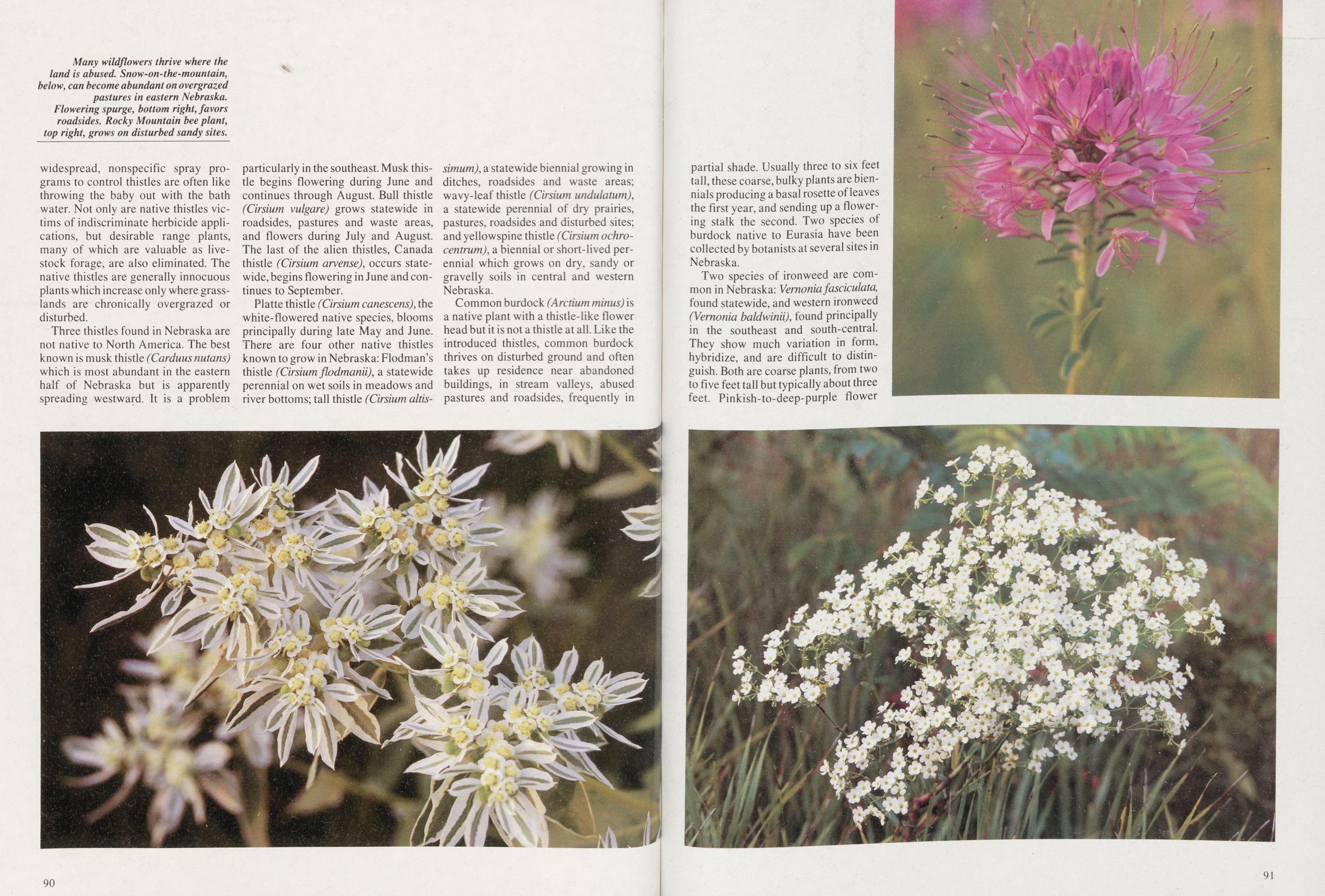
Three thistles found in Nebraska are not native to North America. The best known is musk thistle (Carduus nutans) which is most abundant in the eastern half of Nebraska but is apparently spreading westward. It is a problem particularly in the southeast. Musk thistle begins flowering during June and continues through August. Bull thistle (Cirsium vulgare) grows statewide in roadsides, pastures and waste areas, and flowers during July and August. The last of the alien thistles, Canada thistle (Cirsium arvense), occurs statewide, begins flowering in June and continues to September.
Platte thistle (Cirsium canescens), the white-flowered native species, blooms principally during late May and June. There are four other native thistles known to grow in Nebraska: Flodman's thistle (Cirsium flodmanii), a statewide perennial on wet soils in meadows and river bottoms; tall thistle (Cirsium altissimum), a statewide biennial growing in ditches, roadsides and waste areas; wavy-leaf thistle (Cirsium undulatum), a statewide perennial of dry prairies, pastures, roadsides and disturbed sites; and yellowspine thistle (Cirsium ochrocentrum), a biennial or short-lived perennial which grows on dry, sandy or gravelly soils in central and western Nebraska.
Common burdock (Arctium minus) is a native plant with a thistle-like flower head but it is not a thistle at all. Like the introduced thistles, common burdock thrives on disturbed ground and often takes up residence near abandoned buildings, in stream valleys, abused pastures and roadsides, frequently in 90 partial shade. Usually three to six feet tall, these coarse, bulky plants are biennials producing a basal rosette of leaves the first year, and sending up a flowering stalk the second. Two species of burdock native to Eurasia have been collected by botanists at several sites in Nebraska.
Two species of ironweed are common in Nebraska: Vernonia fasciculata, found statewide, and western ironweed (Vernonia baldwinii), found principally in the southeast and south-central. They show much variation in form, hybridize, and are difficult to distinguish. Both are coarse plants, from two to five feet tall but typically about three feet. Pinkish-to-deep-purple flower
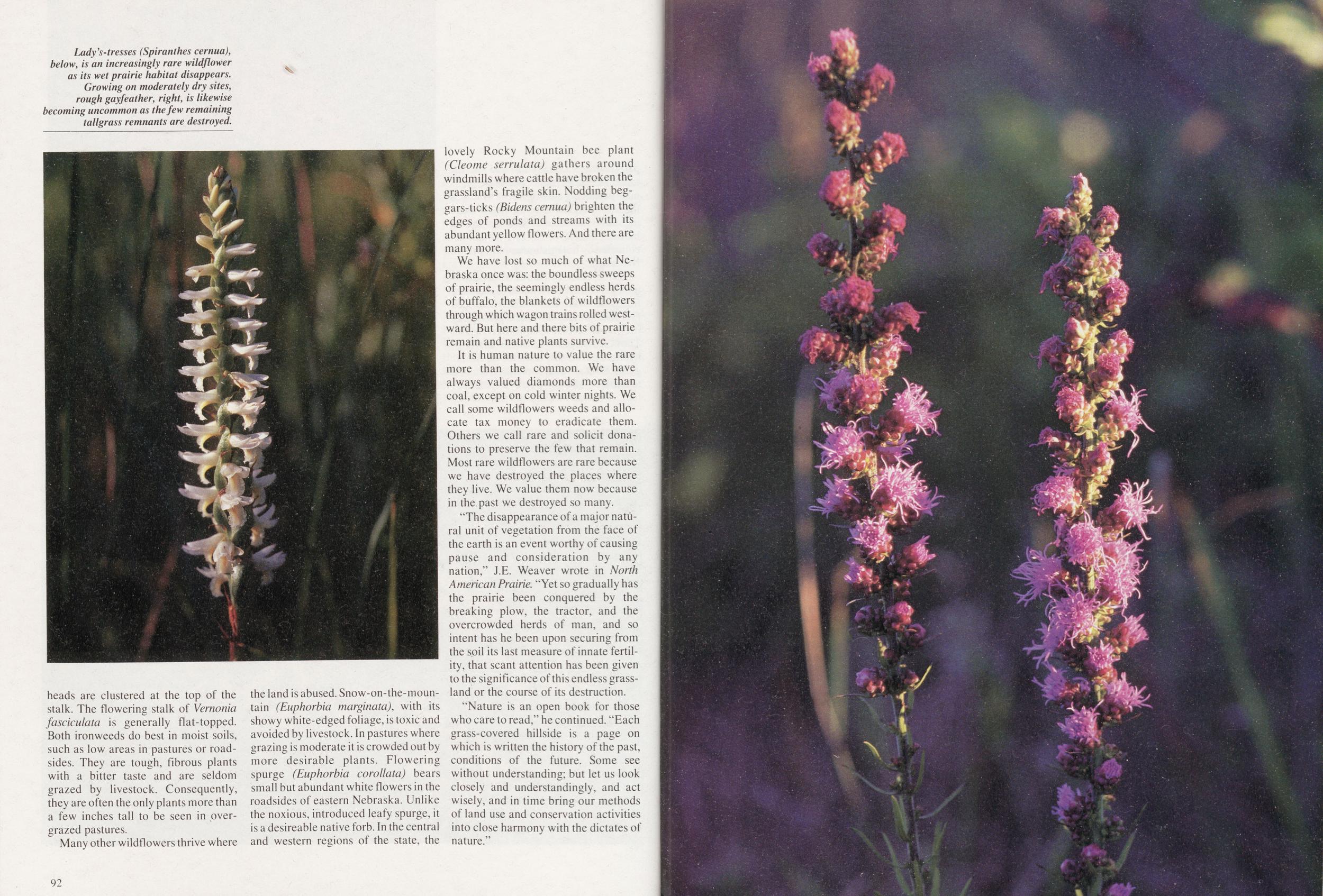
Many other wildflowers thrive where the land is abused. Snow-on-the-mountain (Euphorbia marginata), with its showy white-edged foliage, is toxic and avoided by livestock. In pastures where grazing is moderate it is crowded out by more desirable plants. Flowering spurge (Euphorbia corollata) bears small but abundant white flowers in the roadsides of eastern Nebraska. Unlike the noxious, introduced leafy spurge, it is a desireable native forb. In the central and western regions of the state, the lovely Rocky Mountain bee plant (Cleome serrulata) gathers around windmills where cattle have broken the grassland's fragile skin. Nodding beggars-ticks (Bidens cernua) brighten the edges of ponds and streams with its abundant yellow flowers. And there are many more.
We have lost so much of what Nebraska once was: the boundless sweeps of prairie, the seemingly endless herds of buffalo, the blankets of wildflowers through which wagon trains rolled westward. But here and there bits of prairie remain and native plants survive.
It is human nature to value the rare more than the common. We have always valued diamonds more than coal, except on cold winter nights. We call some wildflowers weeds and allocate tax money to eradicate them. Others we call rare and solicit donations to preserve the few that remain. Most rare wildflowers are rare because we have destroyed the places where they live. We value them now because in the past we destroyed so many.
"The disappearance of a major natural unit of vegetation from the face of the earth is an event worthy of causing pause and consideration by any nation," J.E. Weaver wrote in North American Prairie. "Yet so gradually has the prairie been conquered by the breaking plow, the tractor, and the overcrowded herds of man, and so intent has he been upon securing from the soil its last measure of innate fertility, that scant attention has been given to the significance of this endless grassland or the course of its destruction.
"Nature is an open book for those who care to read," he continued. "Each grass-covered hillside is a page on which is written the history of the past, conditions of the future. Some see without understanding; but let us look closely and understandingly, and act wisely, and in time bring our methods of land use and conservation activities into close harmony with the dictates of nature."
92
Index
Page numbers in bold type refer to photographs. Scientific names are italicized. Abronia fragrans, 54, 63 Achillea millefolium, 45 Alfalfa, wild, 50 Allium canadense, 31, 39 Amorpha canescens, 20, 49, 71 Anemone Carolina, 14 meadow, 29, 31 Anemone canadensis, 29, 31 caroliniana, 14 patens, 10, 13 Antennaria neglecta, 16 parlinii, 14 Apocynum cannabinum, 62 Aquilegia canadensis, 21, 23 Arctium minus, 59, 90 Arenaria hookeri, 36, 50, 74 stricta, 35, 38, 74 Argemone polyanthemos, 62 Arisaema dracontium, 22 triphyllum, 22, 22 Asclepias arenaria, 66, 75 incarnata, 49, 52 speciosa, 66 sullivantii, 49, 53 syriaca, 49, 66 tuberosa, 6, 49, 52 Aster, 76 aster (A. falcatus), 82 New England, 81, 82 panicled (A. simplex), 82 white (heath), 82, 83 white prairie, 82 willowleaf, 81 Aster, 76 ericoides, 82, 83 falcatus, 82 novae-angliae, 81, 82 praealtus, 81 simplex, 82 Asfraga/us adsurgens, 70 canadensis, 51, 64 ceramicus, 63, 74 crassicarpus, 28, 31, 63 mollissimus, 40 racemosus, 40 spatulatus, 36 Baptisia bracteata, 31 /actea, 30, 31 Barr, Claude, 36, 41, 70, 72, 73, 74 Bastard toad-flax, 32 Beardtongue large, 34, 43, 63, 65, 70 narrow, 43, 63, 65 94 slender, 65 white, 32, 65 (also see penstemon) Beebalm—see bergamot, wild Bee plant, Rocky Mountain, 77, 91,92 Beggars-ticks, nodding, 80, 92 Begonia, wild, 37, 41 Bellflower, American, 59, 68, 74 Bergamot, wild, 62 Bidens cernua, 80, 92 Bird's-foot trefoil, 54 Black-eyed Susan, cover, 20, 32 Blazing star, 87, 88 (also see gayfeather) Bloodroot, 8, 11, 22 Blowout penstemon—see penstemon, Hayden's Blue-eyed grass, 32 Blue sage (Pitcher), 89 Boneset, 87 Bouncing Bet, 59 Breadroot—see prairie-turnip Buck bean, prairie, 26, 33 Buffalo bean—see ground-plum Buffalo bur, 55 Burdock, common, 59, 90 Bush morning-glory, 63 Butter-and-eggs, 59 Cactus pincushion (ball), 62, 68 prickly pear—see prickly pear Callirhoe alcaeoides, 57 involucrata, 57, 61 Calochortus gunnisonii, 35, 36, 96 nuttallii, 36 Camass, death, 72 Campanula americana, 59, 68, 74 rotundifolia, 74 Cardinal flower, blue, 86 Carduus nutans, 90 Catclaw—see sensitive brier Catnip, 59 Ceanothus americanus, 32 Cenchrus longispinus, 55 Chicory, 4, 54, 59 Chrysanthemum leucanthemum, 54, 67 Cichorium intybus, 4, 54, 59 Cicuta maculata, 61 Cinquefoil sulphur, 54 tali, 54 Cirsium, 59 altissimum, 90 arvense, 90 canescens, 42, 45, 90 flodmanii, 90 ochrocentrum, 90 undulatum, 90 vulgare, 90 Claytonia virginica, 8 Clematis, Fremont's, 38, 43 Clematis fremontii, 38, 43 Cleome serrulata, 77, 91, 92 Columbine, wild, 21, 23 Com and ra umbel lata, 32 Compass plant, 46, 48, 80 Coneflower grayhead, 67, 68 prairie, 66, 67 purple, 52, 56 Conium maculatum, 61 Coreopsis, plains, 56, 72 Coreopsis tinctoria, 56, 72 Coryphantha vivipara, 62, 68 Cranesbill, Carolina, 32 Crazyweed, Lambert'see locoweed, purple Crowfoot, white water, 45 Cryptantha celosioides, 70 thyrsi flora, 50, 70 Cup plant, 49, 80 Cypripedium calceolus, 4, 27 candidum, 25, 27 Daisy Easter—see Easter daisy ox-eye, 54, 67 Dakota prairie, 7 Dalea Candida, 51, 73 purpurea, 51, 60 villosa, 66 Dame's rocket, 45, 45 Dandelion, false, 15, 16 Daylily, 54 Death camass, 72 Delphinium virescens, 68 Deptford pink, 54, 69 Dianthus armeria, 54, 69 Dicentra cucullaria, 8,19 Dock, winged—see begonia wild Dodecatheon pulchellum, 37, 44 Dogbane, Indian hemp, 62 Dog's-tooth-violet, 8, 9, 16 Dragonroot, 22 Dutchman's breeches, 8, 19 Easter daisy, 13, 36, 40, 70 Echinacea angustifolia, 52, 56 Elkhorn River, 21, 50, 59 Erigeron, 20, 59 pumilus, 45 Erysimum asperum, 35, 40 Erythronium albidum, 8, 9 mesochoreum, 16 Eupatorium 94 altissimum, 86 maculatum, 86 perfoliatum, 87 purpureum, 86 Euphorbia corollata, 91, 92 esula, 92 marginata, 90, 92 Eustoma grandiflorum, 82, 84 Euthamia graminifolia, 80 Evening primrose common, 58, 74 fourpoint, 47, 65 gumbo, 74 pale, 74 prairie, 37, 37 Fleabane, 20, 59 Fleabane, low, 45 Four-o'clock, 59 Fragaria virginiana, 29, 30 Galearis spectabilis, 24, 25, 27 Gaura scarlet, 74 Gaura coccinea, 74 Gayfeather dotted, 87 rough, 87, 93 thick-spike, 87 (also see blazing star) Gentian, 76 closed (bottle), 82 downy, 82, 85 prairie, 82, 84 Gentiana, 76 andrewsii, 82 puberulenta, 82, 85 Geranium—see cranesbill Geranium carolinianum, 32 Germander, American, 62 Gilia, 63, 95 Glycyrrhiza lepidota, 56 Globe mallow—see mallow Goatsbeard, 45 Golden Alexander, 32 Goldenpea—see buck bean Goldenrod, 76 Canada, 28, 80, 87 grassleaf, 80 gray, 80 late, 80 prairie, 80 rigid, 80 showy-wand, 80, 86 Grindelia squamosa, 55 Ground cherry, 32, 59 Ground-plum, 28, 31, 63 Gumbo lily—see evening primrose Gumweed, curly-top, 55 Habenaria leucophaea—see Platanthera praeclara Harebell, 74 Heal-all—see self-heal Heart's-delight—see verbena, sweet sand Helianthus annuus, 76 grosseserratus, 28, 79 maximilianii, 78, 79 nuttallii, 79 petiolaris, 76, 77 rigidus, 79 tuberosus, 79, 79 Heliopsis helianthoides, 80, 81 Hemerocallis fulva, 54 Hemlock common water, 61 poison, 61 Hesperis matronalis, 45, 45 High Plains, 13, 32, 36, 74 Horse-gentian, 32 Hydrophyllum virginianum, 22 Hypericum perforatum, 54 Hypoxis hirsuta, 27, 28 Indigo plains wild, 31 white wild, 30, 31 Ipomoea leptophylla, 63 Ipomopsis longiflora, 63, 95 Ironweed, 76 ironweed, 91 ironweed, western, 89, 91 Jack-in-the-pulpit, 22, 22 Jerusalem artichoke, 79, 79 Joe-Pye weed spotted Joe-Pye weed, 86 sweet Joe-Pye weed, 86 tall Joe-Pye weed, 86 Kansas Prairie, 7, 38-40 Lactuca floridana, 59, 59 oblongifolia, 59 Lady's-tresses, 84, 92 Lady's-slipper large yellow, 4, 27 small white, 25, 27 Lambert's Crazyweed—see locoweed, purple Larkspur, prairie, 68 Lathy r us palustris, 32 polymorphus, 40 Lead plant, 20, 49, 71 Lettuce blue, 59 Florida, 59, 59 Leucocrinum montanum, 12 13 Liatris, 76 aspera, 87, 93 punctata, 87 pycnostachya, 87 squamosa, 87, 88 Licorice, wild, 56 l.ilium canadense, 50 philadelphicum, 65, 99
Lily
fawn—see dog's-tooth-violet
gumbo—see evening primrose
mountain, 12, 13
sego—see sego lily
trout—see dog's-tooth-violet
Turk's cap, 50
western red, 65, 99
(also see waterlily)
Linaria vulgaris, 59
Lithospermum
canescens, 42
carolinense, 42
incisum, 32
Lobelia
great—see cardinal flower
palespike, 52
Lobelia
siphilitica, 86
spicata, 52
Locoweed
purple, 40, 41
woolly, 40
Loess Hills, 55-59
Lomatium foeniculaceum, 14, 17
Loosestrife
fringed, 52
tufted, 32
Lotus corniculatus, 54
Loup River, 57
Lupine
Platte, 73
silvery, 2, 73
small, 73
Lupinus
argenteus, 2, 73
plattensis, 73
pusillus, 73
Lysimachia
ciliata, 52
thyrsiflora, 32
Mallow
false red mallow (globe), 55, 57
May-apple, 8, 21
Meadow rue, purple, 61
Mentzelia
bractless, 49, 65
ten-petal, 65
Mentzelia
decapetala, 65
nuda, 49, 65
Microseris cuspidata, 15, 16
Milk-vetch
alkali (racemed), 40
Canada, 51, 64
draba (tufted), 36
painted, 63, 74
standing, 70
Milkweed
butterfly, 6, 49, 52
common, 49, 66
sand, 66, 75
showy, 66
smooth, 49, 53
swamp, 49, 52
Miner's candle, 50, 70
Mirabilis, 59
Missouri River, 8-10, 21-27, 55
Mixed grass prairie, 7, 55
Monarda—see bergamot
Monarda fistulosa, 62
Morning-glory, bush, 63
Musineon
leafy, 14, 16
narrow-leaved, 12, 14
Musineon
divaricatum, 14, 16
tenuifolium, 12, 14
Mustard, tall hedge, 45
Nemaha River, 21
Nepeta cataria, 59
New Jersey tea, 32
Niobrara River, 40, 59, 70
North Platte River, 37, 38, 70, 72, 73
Nymphaea
odorata, 45
tuberosa, 27, 45
Oenothera
albicaulis, 37, 37
biennis, 58, 74
caespiitosa, 74
latifolia, 74
rhombipetala, 47, 65
Onion, wild, 31, 39
Opuntia
fragilis, 68
macrorhiza, 69
polyacantha, 63, 69
Orchis (orchid)
prairie fringed, 50, 51
showy, 24, 25, 27
Oxalis
stricta, 32
violacea, 32
Ox-eye daisy, 54, 67
Ox-eye (false) sunflower, 76, 80, 81
Oxytropis lambertii, 40, 41
Panhandle, 8, 10-14. 32-38, 40,
63, 68, 69-74, 82
Parsley, wild, 14, 17
Pasque flower, 10, 13
Peavine, showy—see vetchling,
hoary
Penstemon
cobaea, 51
Hayden's (blowout), 65, 71
narrowleaf—see beardtongue,
narrow
sawsepal, 70
shell-leaf—see beardtongue,
large
white—see beardtongue, white
Penstemon
albidus, 32, 65
philadelphicum, 65, 99
Lily
fawn—see dog's-tooth-violet
gumbo—see evening primrose
mountain, 12, 13
sego—see sego lily
trout—see dog's-tooth-violet
Turk's cap, 50
western red, 65, 99
(also see waterlily)
Linaria vulgaris, 59
Lithospermum
canescens, 42
carolinense, 42
incisum, 32
Lobelia
great—see cardinal flower
palespike, 52
Lobelia
siphilitica, 86
spicata, 52
Locoweed
purple, 40, 41
woolly, 40
Loess Hills, 55-59
Lomatium foeniculaceum, 14, 17
Loosestrife
fringed, 52
tufted, 32
Lotus corniculatus, 54
Loup River, 57
Lupine
Platte, 73
silvery, 2, 73
small, 73
Lupinus
argenteus, 2, 73
plattensis, 73
pusillus, 73
Lysimachia
ciliata, 52
thyrsiflora, 32
Mallow
false red mallow (globe), 55, 57
May-apple, 8, 21
Meadow rue, purple, 61
Mentzelia
bractless, 49, 65
ten-petal, 65
Mentzelia
decapetala, 65
nuda, 49, 65
Microseris cuspidata, 15, 16
Milk-vetch
alkali (racemed), 40
Canada, 51, 64
draba (tufted), 36
painted, 63, 74
standing, 70
Milkweed
butterfly, 6, 49, 52
common, 49, 66
sand, 66, 75
showy, 66
smooth, 49, 53
swamp, 49, 52
Miner's candle, 50, 70
Mirabilis, 59
Missouri River, 8-10, 21-27, 55
Mixed grass prairie, 7, 55
Monarda—see bergamot
Monarda fistulosa, 62
Morning-glory, bush, 63
Musineon
leafy, 14, 16
narrow-leaved, 12, 14
Musineon
divaricatum, 14, 16
tenuifolium, 12, 14
Mustard, tall hedge, 45
Nemaha River, 21
Nepeta cataria, 59
New Jersey tea, 32
Niobrara River, 40, 59, 70
North Platte River, 37, 38, 70, 72, 73
Nymphaea
odorata, 45
tuberosa, 27, 45
Oenothera
albicaulis, 37, 37
biennis, 58, 74
caespiitosa, 74
latifolia, 74
rhombipetala, 47, 65
Onion, wild, 31, 39
Opuntia
fragilis, 68
macrorhiza, 69
polyacantha, 63, 69
Orchis (orchid)
prairie fringed, 50, 51
showy, 24, 25, 27
Oxalis
stricta, 32
violacea, 32
Ox-eye daisy, 54, 67
Ox-eye (false) sunflower, 76, 80, 81
Oxytropis lambertii, 40, 41
Panhandle, 8, 10-14. 32-38, 40,
63, 68, 69-74, 82
Parsley, wild, 14, 17
Pasque flower, 10, 13
Peavine, showy—see vetchling,
hoary
Penstemon
cobaea, 51
Hayden's (blowout), 65, 71
narrowleaf—see beardtongue,
narrow
sawsepal, 70
shell-leaf—see beardtongue,
large
white—see beardtongue, white
Penstemon
albidus, 32, 65
 Trillium nivale, 10
Triodanis perfoliata, 54
Triosteum perfoliatum, 32
Turnip, prairie—see
prairie-turnip
Venus' looking glass,-54
Verbena, sweet sand, 54,
63
Verbena
hastata, 55
stricta, 55, 57
Vernonia, 76
baldwinii, 89, 91
fasciculata, 91
Vervain
blue, 55
hoary, 55, 57
Vetch, hairy, 36, 45, 59
Vetchling
hoary, 40
marsh, 32
Vicia villosa, 36, 45, 59
Viola
canadensis, 24, 28
nephrophylla, 45
nuttallii, 10, 13
pedatifida, 30
pratincola, 8, 30
pubescens, 8, 12
sororia, 8, 18
Violet
Canada, 24, 28
downy blue, 8, 18
downy yellow, 8, 12
northern bog, 45
Nuttall's, 10, 13
prairie, 30
blue prairie, 8, 30
(also see dog's-tooth-
violet)
Wallflower, western, 35, 40
Waterleaf, 22
Waterlily
fragrant white, 45
white, 27, 45
Weaver, J.E., 7, 8, 16, 19,
28, 42, 45, 46, 52, 70,
76, 79, 81, 87, 92
Wildcat Hills, 14
Wood sage—see
germander
Wood sorrel
violet, 32
yellow, 32
Yarrow, 45
Yucca—see soapweed
Yucca glauca, 58, 62
Zigadenus venenosus, 72
Zizia aurea, 32
ACKNOWLEDGEMENTS
Trillium nivale, 10
Triodanis perfoliata, 54
Triosteum perfoliatum, 32
Turnip, prairie—see
prairie-turnip
Venus' looking glass,-54
Verbena, sweet sand, 54,
63
Verbena
hastata, 55
stricta, 55, 57
Vernonia, 76
baldwinii, 89, 91
fasciculata, 91
Vervain
blue, 55
hoary, 55, 57
Vetch, hairy, 36, 45, 59
Vetchling
hoary, 40
marsh, 32
Vicia villosa, 36, 45, 59
Viola
canadensis, 24, 28
nephrophylla, 45
nuttallii, 10, 13
pedatifida, 30
pratincola, 8, 30
pubescens, 8, 12
sororia, 8, 18
Violet
Canada, 24, 28
downy blue, 8, 18
downy yellow, 8, 12
northern bog, 45
Nuttall's, 10, 13
prairie, 30
blue prairie, 8, 30
(also see dog's-tooth-
violet)
Wallflower, western, 35, 40
Waterleaf, 22
Waterlily
fragrant white, 45
white, 27, 45
Weaver, J.E., 7, 8, 16, 19,
28, 42, 45, 46, 52, 70,
76, 79, 81, 87, 92
Wildcat Hills, 14
Wood sage—see
germander
Wood sorrel
violet, 32
yellow, 32
Yarrow, 45
Yucca—see soapweed
Yucca glauca, 58, 62
Zigadenus venenosus, 72
Zizia aurea, 32
ACKNOWLEDGEMENTS
A Wildflower Ye^represents the time, knowledge and cooperation of many people. First, we wish to recognize the hospitality and generosity of private landowners whose grasslands and woodlands we visited on a number of occasions: Bill Albert, George Day, Harley and Mary Batie, Ed and Sally Becker, Francis and Caryl Crowe, Vern Dent, Dean and Nancy Edelman, Lou and Geri Gilbert, Ann Kelley, Ken Urkoski, Toni Lichtenberg, Irving and Evelyn Lorenz, Ronald Milner, Randy Stutheit.
Most photographs were taken on public land. The assistance of the following representatives of public and private lands is also gratefully acknowledged: Don Bourn at Ponca State Park, Larry Cook at Indian Cave State Park, Len McDaniel at Valentine National Wildlife Refuge, Ken and Marie Strom at the National Audubon Society Rowe Sanctuary, Kay Young formerly at Fontenelle Forest.
Timely telephone calls from a number of "wildflower spotters" was especially helpful in locating many species illustrated in this publication. In particular we would like to mention Carole Closter, Mike Fritz, B.C. and John Lavelle, Gerry Steinauer and Curt Twedt.
Each wildflower was identified by one or more of the following botanists from pressed specimens or photographs: Mike Fritz, Nebraska Game and Parks Commission; Hal Nagel, Kearney State College; Curt Twedt, Nebraska Game and Parks Commission; Ronald Weedon, Chadron State College. Additional identification was provided by David Sutherland, University of Nebraska at Omaha, James Stubbendieck and Steve Rolfsmeier, University of Nebraska at Lincoln. The manuscript was reviewed by Mike Fritz, Hal Nagel, C urt Twedt and Ronald Weedon. In several cases, when no specimens were available, identification of wildflowers from photographs was speculative. Moreover, the text was subject to some revision after review, and any errors, either in species identification or in the text are solely the responsibility of NEBRASKAland Magazine. To those who helped produce this publication but through oversight have not been mentioned, we offer our apoiogy and thanks.
Finally, we would like to extend a note of gratitude to Hans Burchardt, who, as a horticulturist at the Nebraska Game and Parks Commission, kindled an interest in wildflowers and other native plants in everyone who worked with him.
Scientific names and, with few exceptions, common names are from Flora of the Great Plains, University Press of Kansas, 1986.
PHOTO CREDITS Unless otherwise noted below, photos by Jon Farrar. Don Cunningham: Cover, 19. Bob Grier: 37 top, 41,50 bottom, 57,58 top. Rocky Hoffmann: 62 CREDITS A Wildflower Year by Jon Farrar Layout and Design by Duane Westerholt Edited by Don Cunningham NEBRASKAland MAGAZINE STAFF Chief, Information & Education: Jim Mac Allister Managing Editor: Lowell Johnson Editor: Don Cunningham Senior Editors: Jon Farrar, Ken Bouc Regional Editors: Bob Grier, Rocky Hoffmann, Tom Keith Art Director: Duane Westerholt Illustration: Tim Reigert, Dan Curran Circulation: Pat Frahm NEBRASKA GAME AND PARKS COMMISSION BOARD OF COMMISSIONERS Chairman: L. Bruce Wright, Lincoln Vice Chairman: Richard L. Coyne, Omaha 2nd Vice Chairman: Elvin Adam son, Nenzel J. Alan Cramer, Wayne Marc Anthony, Scottsbluff Wayne Ziebarth, Wilcox La Vern Schneider, McCook ADMINISTRATION Director: Rex Amack Assistant Directors: William J. Bailey, Jr., Dale R. Bree 98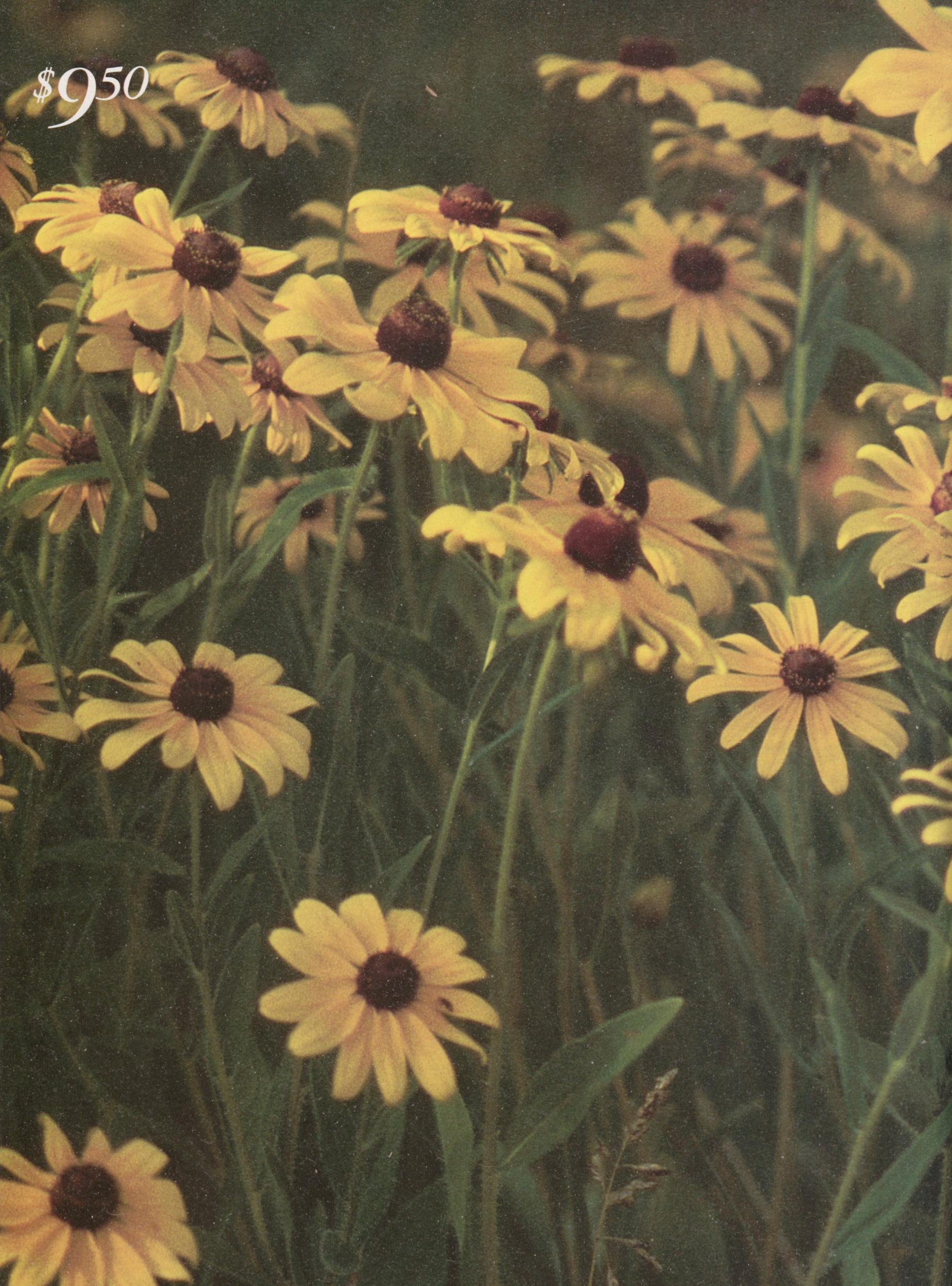
Position: 96 (61 views)