Volume 67, Issue 10, 1989
NEBRASKAland
DECEMBER 1989 $1.50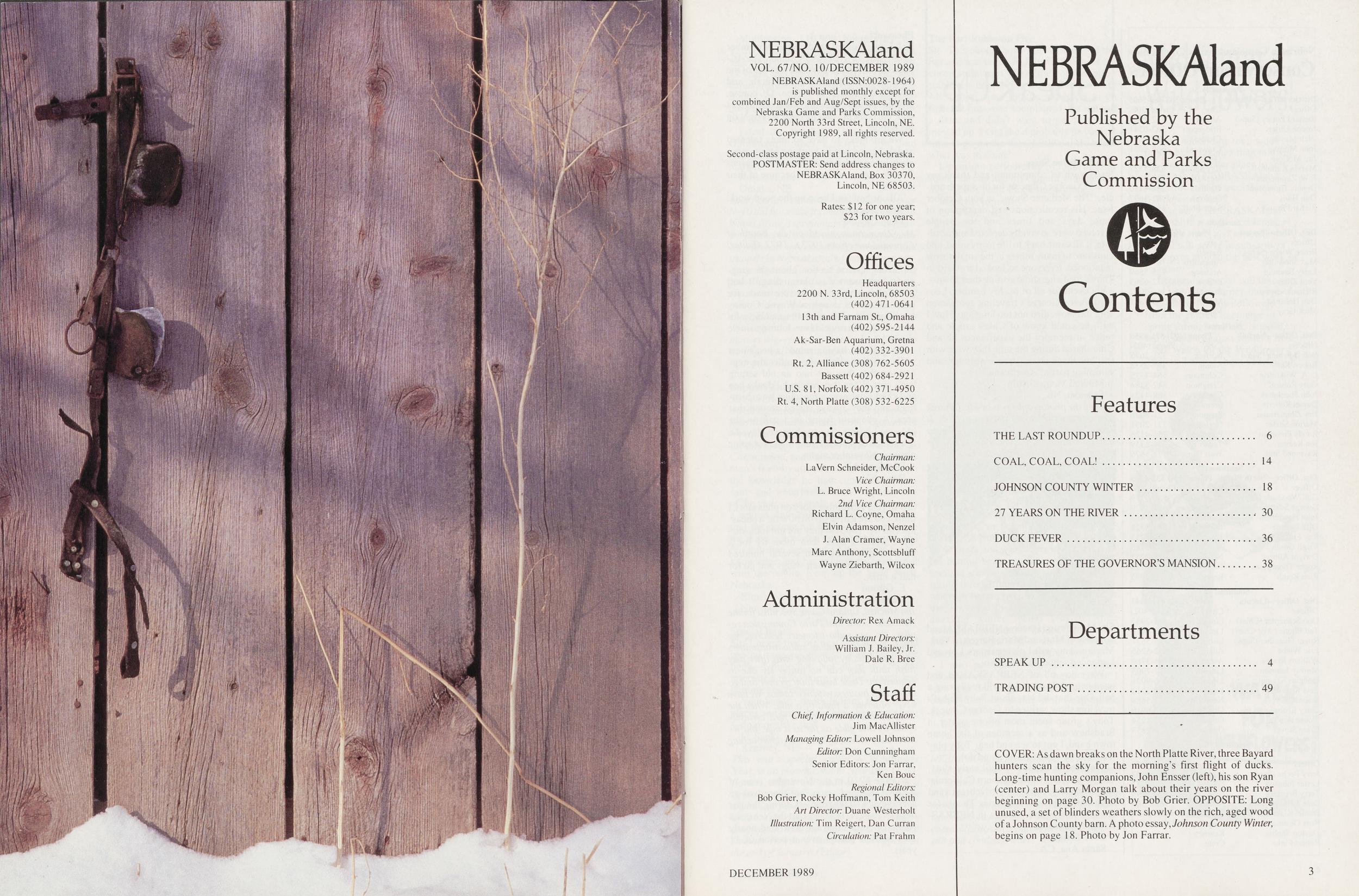
NEBRASKAland
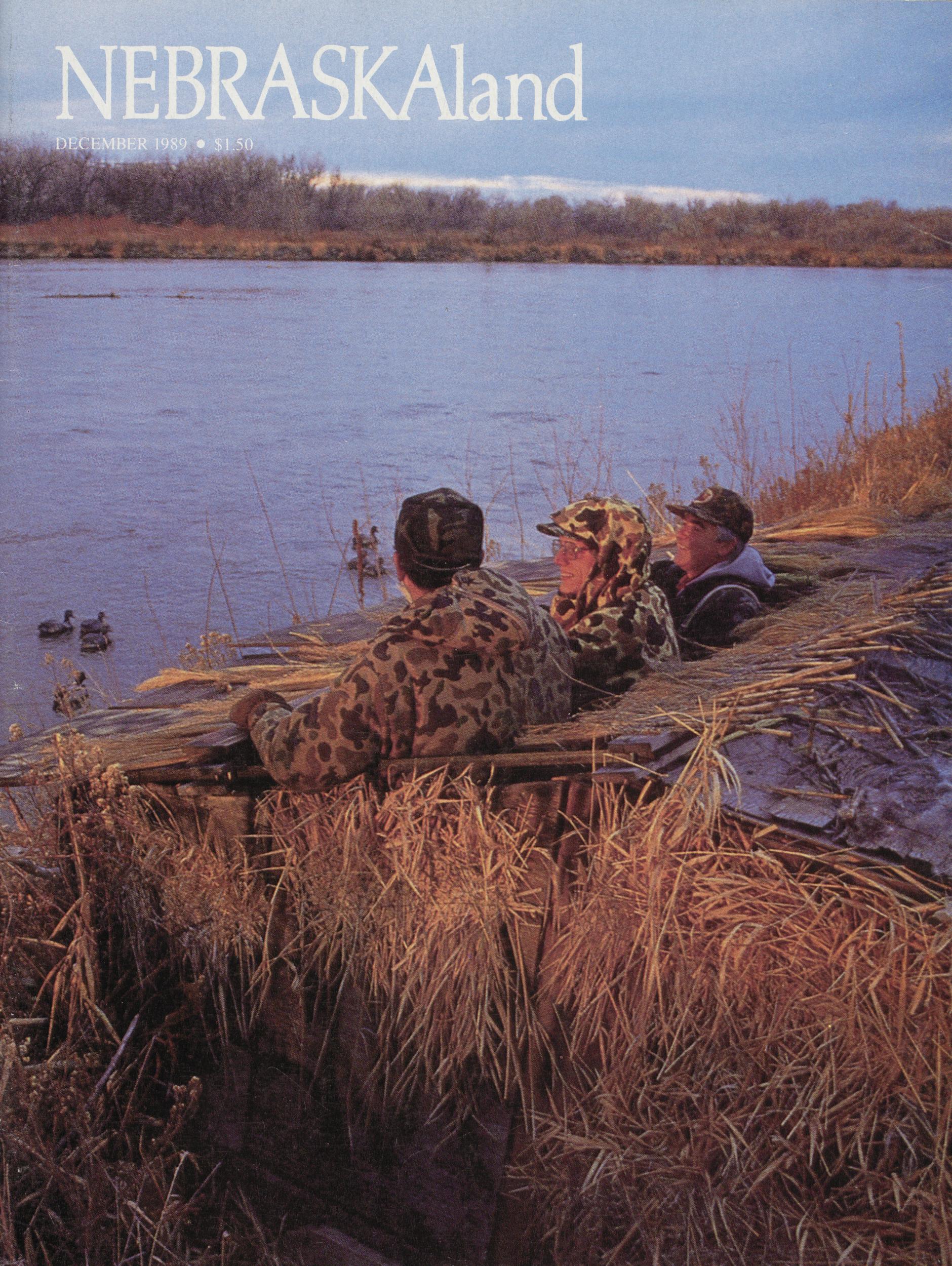
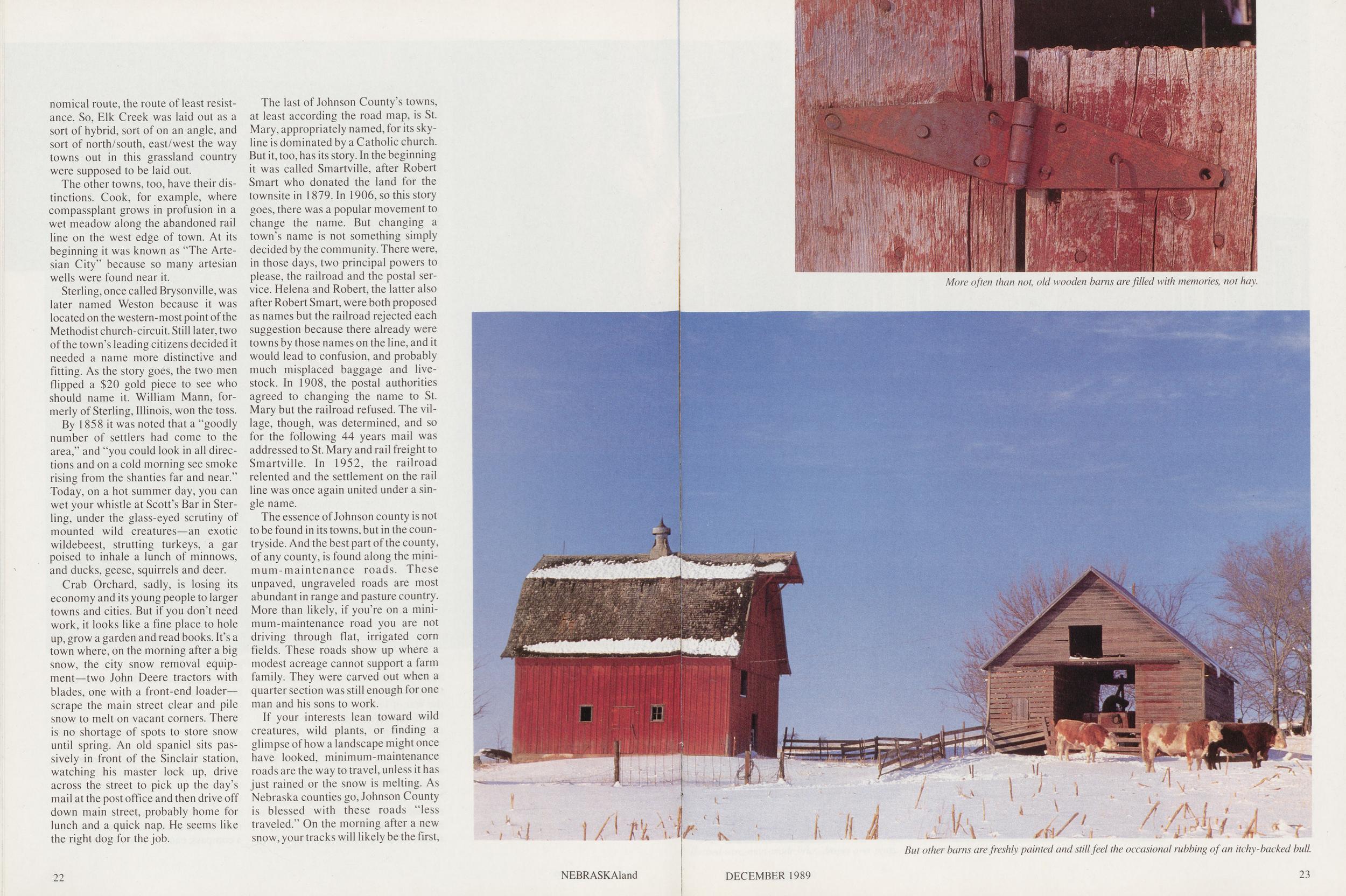
Published by the Nebraska Game and Parks Commission VOL. 67/NO. 10/DECEMBER 1989 NEBRASKAland (ISSN:0028-1964) is published monthly except for combined Jan/Feb and Aug/Sept issues, by the Nebraska Game and Parks Commission, 2200 North 33rd Street, Lincoln, NE. Copyright 1989, all rights reserved. Second-class postage paid at Lincoln, Nebraska. POSTMASTER: Send address changes to NEBRASKAland, Box 30370, Lincoln, NE 68503. Rates: $ 12 for one year; $23 for two years. Offices Headquarters 2200 N. 33rd, Lincoln, 68503 (402)471-0641 13th and Farnam St., Omaha (402)595-2144 Ak-Sar-Ben Aquarium, Gretna (402)332-3901 Rt. 2, Alliance (308) 762-5605 Bassett (402) 684-2921 U.S. 81, Norfolk (402) 371-4950 Rt. 4, North Platte (308) 532-6225 Commissioners Chairman: LaVern Schneider, McCook Vice Chairman: L. Bruce Wright, Lincoln 2nd Vice Chairman: Richard L. Coyne, Omaha Elvin Adamson, Nenzel J. Alan Cramer, Wayne Marc Anthony, Scottsbluff Wayne Ziebarth, Wilcox Administration Director: Rex Amack Assistant Directors: William J. Bailey, Jr. Dale R. Bree Staff Chief, Information & Education: Jim MacAllister Managing Editor: Lowell Johnson Editor: Don Cunningham Senior Editors: Jon Farrar, Ken Bouc Regional Editors: Bob Grier, Rocky Hoffmann, Tom Keith Art Director: Duane Westerholt Illustration: Tim Reigert, Dan Curran Circulation: Pat Frahm Contents Features THE LAST ROUNDUP 6 COAL, COAL, COAL! 14 JOHNSON COUNTY WINTER 18 27 YEARS ON THE RIVER 30 DUCK FEVER 36 TREASURES OF THE GOVERNOR'S MANSION 38 Departments SPEAK UP 4 TRADING POST 49 COVER: As dawn breaks on the North Platte River, three Bayard hunters scan the sky for the morning's first flight of ducks. Long-time hunting companions, John Ensser (left), his son Ryan (center) and Larry Morgan talk about their years on the river beginning on page 30. Photo by Bob Grier. OPPOSITE: Long unused, a set of blinders weathers slowly on the rich, aged wood of a Johnson County barn. A photo essay, Johnson County Winter, begins on page 18. Photo by Jon Farrar.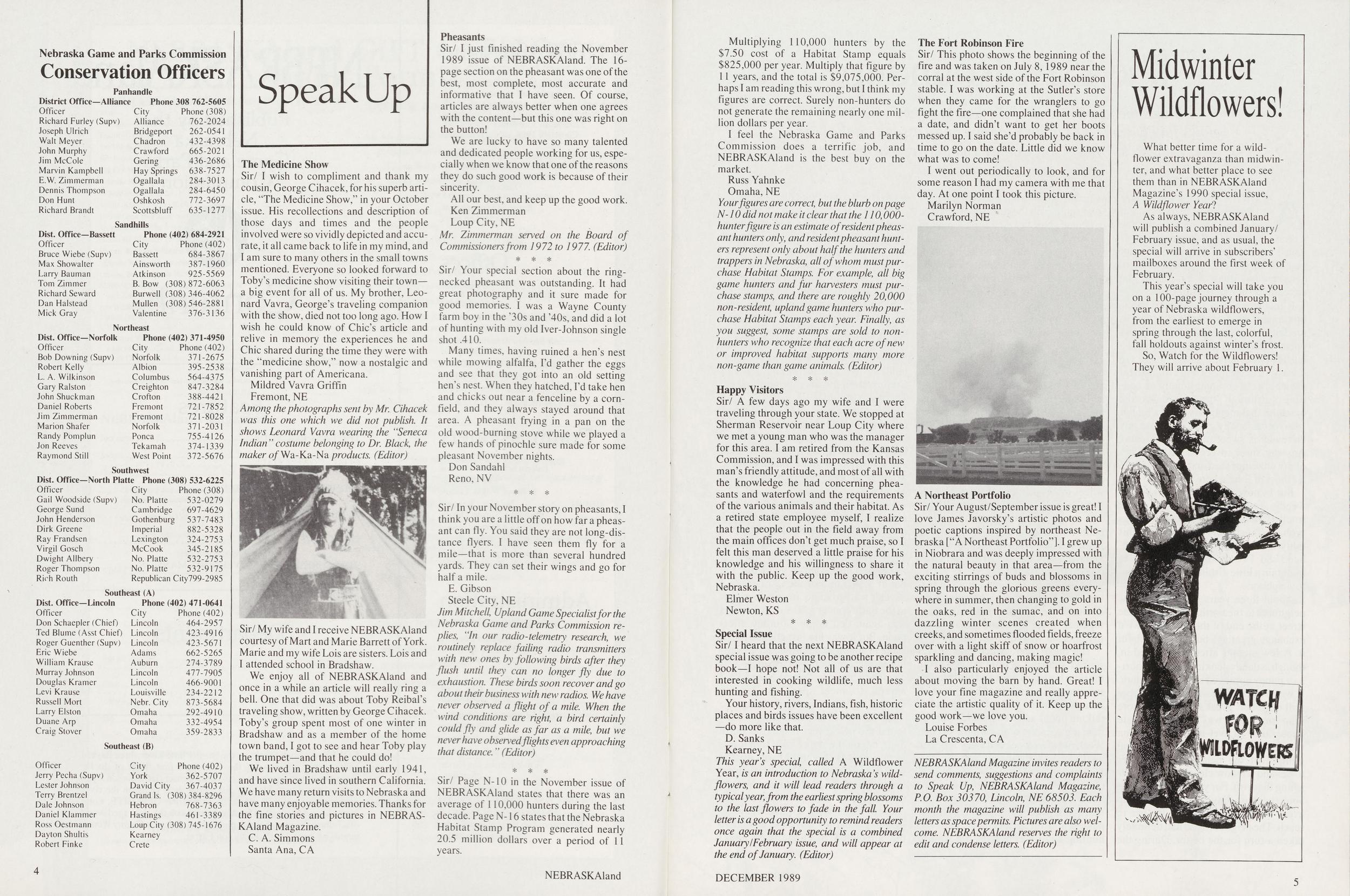
Speak Up
The Medicine ShowSir/ I wish to compliment and thank my cousin, George Cihacek, for his superb article, "The Medicine Show," in your October issue. His recollections and description of those days and times and the people involved were so vividly depicted and accurate, it all came back to life in my mind, and I am sure to many others in the small towns mentioned. Everyone so looked forward to Toby's medicine show visiting their town— a big event for all of us. My brother, Leonard Vavra, George's traveling companion with the show, died not too long ago. How I wish he could know of Chic's article and relive in memory the experiences he and Chic shared during the time they were with the "medicine show," now a nostalgic and vanishing part of Americana.
Mildred Vavra Griffin Fremont, NEAmong the photographs sent by Mr. Cihacek was this one which we did not publish. It shows Leonard Vavra wearing the "Seneca Indian" costume belonging to Dr. Black, the maker c/Wa-Ka-Na products. (Editor)
Sir My wife and I receive NEBRASKAland courtesy of Mart and Marie Barrett of York. Marie and my wife Lois are sisters. Lois and I attended school in Bradshaw.
We enjoy all of NEBRASKAland and once in a while an article will really ring a bell. One that did was about Toby Reibal's traveling show, written by George Cihacek. Toby's group spent most of one winter in Bradshaw and as a member of the home town band, I got to see and hear Toby play the trumpet—and that he could do!
We lived in Bradshaw until early 1941, and have since lived in southern California. We have many return visits to Nebraska and have many enjoyable memories. Thanks for the fine stories and pictures in NEBRASKAland Magazine.
C. A. Simmons Santa Ana, CA PheasantsSir/ I just finished reading the November 1989 issue of NEBRASKAland. The 16-page section on the pheasant was one of the best, most complete, most accurate and informative that I have seen. Of course, articles are always better when one agrees with the content—but this one was right on the button!
We are lucky to have so many talented and dedicated people working for us, especially when we know that one of the reasons they do such good work is because of their sincerity.
All our best, and keep up the good work.
Ken Zimmerman Loup City, NEMr. Zimmerman served on the Board of Commissioners from 1972 to 1977. (Editor)
Sir/ Your special section about the ring-necked pheasant was outstanding. It had great photography and it sure made for good memories. I was a Wayne County farm boy in the '30s and '40s, and did a lot of hunting with my old Iver-Johnson single shot .410.
Many times, having ruined a hen's nest while mowing alfalfa, I'd gather the eggs and see that they got into an old setting hen's nest. When they hatched, I'd take hen and chicks out near a fenceline by a corn-field, and they always stayed around that area. A pheasant frying in a pan on the old wood-burning stove while we played a few hands of pinochle sure made for some pleasant November nights.
Don Sandahl Reno, NV * * *Sir/ In your November story on pheasants, I think you are a little off on how far a pheasant can fly. You said they are not long-distance flyers. I have seen them fly for a mile—that is more than several hundred yards. They can set their wings and go for half a mile.
E. Gibson Steele City, NEJim Mitchell, Upland Game Specialist for the Nebraska Game and Parks Commission replies, "In our radio-telemetry research, we routinely replace failing radio transmitters with new ones by following birds after they flush until they can no longer fly due to exhaustion. These birds soon recover and go about their business with new radios. We have never observed a flight of a mile. When the wind conditions are right, a bird certainly could fly and glide as far as a mile, but we never have observed flights even approaching that distance." (Editor)
* * *Sir/ Page N-10 in the November issue of NEBRASKAland states that there was an average of 110,000 hunters during the last decade. Page N-16 states that the Nebraska Habitat Stamp Program generated nearly 20.5 million dollars over a period of 11 years.
4 NEBRASKAlandMultiplying 110,000 hunters by the $7.50 cost of a Habitat Stamp equals $825,000 per year. Multiply that figure by 11 years, and the total is $9,075,000. Perhaps I am reading this wrong, but I think my figures are correct. Surely non-hunters do not generate the remaining nearly one million dollars per year.
I feel the Nebraska Game and Parks Commission does a terrific job, and NEBRASKAland is the best buy on the market.
Russ Yahnke Omaha, NEYour figures are correct, but the blurb on page N-10 did not make it clear that the 110,000-hunterfigure is an estimate of resident pheasant hunters only, and resident pheasant hunters represent only about half the hunters and trappers in Nebraska, all of whom must purchase Habitat Stamps. For example, all big game hunters and fur harvesters must purchase stamps, and there are roughly 20,000 non-resident, upland game hunters who purchase Habitat Stamps each year. Finally, as you suggest, some stamps are sold to nonhunters who recognize that each acre of new or improved habitat supports many more non-game than game animals. (Editor)
* * * Happy VisitorsSir/ A few days ago my wife and I were traveling through your state. We stopped at Sherman Reservoir near Loup City where we met a young man who was the manager for this area. I am retired from the Kansas Commission, and I was impressed with this man's friendly attitude, and most of all with the knowledge he had concerning pheasants and waterfowl and the requirements of the various animals and their habitat. As a retired state employee myself, I realize that the people out in the field away from the main offices don't get much praise, so I felt this man deserved a little praise for his knowledge and his willingness to share it with the public. Keep up the good work, Nebraska.
Elmer Weston Newton, KS * * * Special IssueSir/1 heard that the next NEBRASKAland special issue was going to be another recipe book—I hope not! Not all of us are that interested in cooking wildlife, much less hunting and fishing.
Your history, rivers, Indians, fish, historic places and birds issues have been excellent—do more like that.
D. Sanks Kearney, NEThis year's special, called A Wildflower Year, is an introduction to Nebraska's wildflowers, and it will lead readers through a typical year, from the earliest spring blossoms to the last flowers to fade in the fall. Your letter is a good opportunity to remind readers once again that the special is a combined January/February issue, and will appear at the end of January. (Editor)
The Fort Robinson FireSir/ This photo shows the beginning of the fire and was taken on July 8, 1989 near the corral at the west side of the Fort Robinson stable. I was working at the Sutler's store when they came for the wranglers to go fight the fire—one complained that she had a date, and didn't want to get her boots messed up. I said she'd probably be back in time to go on the date. Little did we know what was to come!
I went out periodically to look, and for some reason I had my camera with me that day. At one point I took this picture.
Marilyn Norman Crawford, NESir/ Your August/September issue is great! I love James Javorsky's artistic photos and poetic captions inspired by northeast Nebraska f "A Northeast Portfolio"]. I grew up in Niobrara and was deeply impressed with the natural beauty in that area—from the exciting stirrings of buds and blossoms in spring through the glorious greens everywhere in summer, then changing to gold in the oaks, red in the sumac, and on into dazzling winter scenes created when creeks, and sometimes flooded fields, freeze over with a light skiff of snow or hoarfrost sparkling and dancing, making magic!
I also particularly enjoyed the article about moving the barn by hand. Great! I love your fine magazine and really appreciate the artistic quality of it. Keep up the good work—we love you.
Louise Forbes La Crescenta, CANEBRASKAland Magazine invites readers to send comments, suggestions and complaints to Speak Up, NEBRASKAland Magazine, P.O. Box 30370, Lincoln, NE 68503. Each month the magazine will publish as many letters as space permits. Pictures are also welcome. NEBRASKAland reserves the right to edit and condense letters. (Editor)
Midwinter Wildflowers!What better time for a wildflower extravaganza than midwinter, and what better place to see them than in NEBRASKAland Magazine's 1990 special issue, A Wildflower Year!
As always, NEBRASKAland will publish a combined January/February issue, and as usual, the special will arrive in subscribers' mailboxes around the first week of February.
This year's special will take you on a 100-page journey through a year of Nebraska wildflowers, from the earliest to emerge in spring through the last, colorful, fall holdouts against winter's frost.
So, Watch for the Wildflowers! They will arrive about February 1.
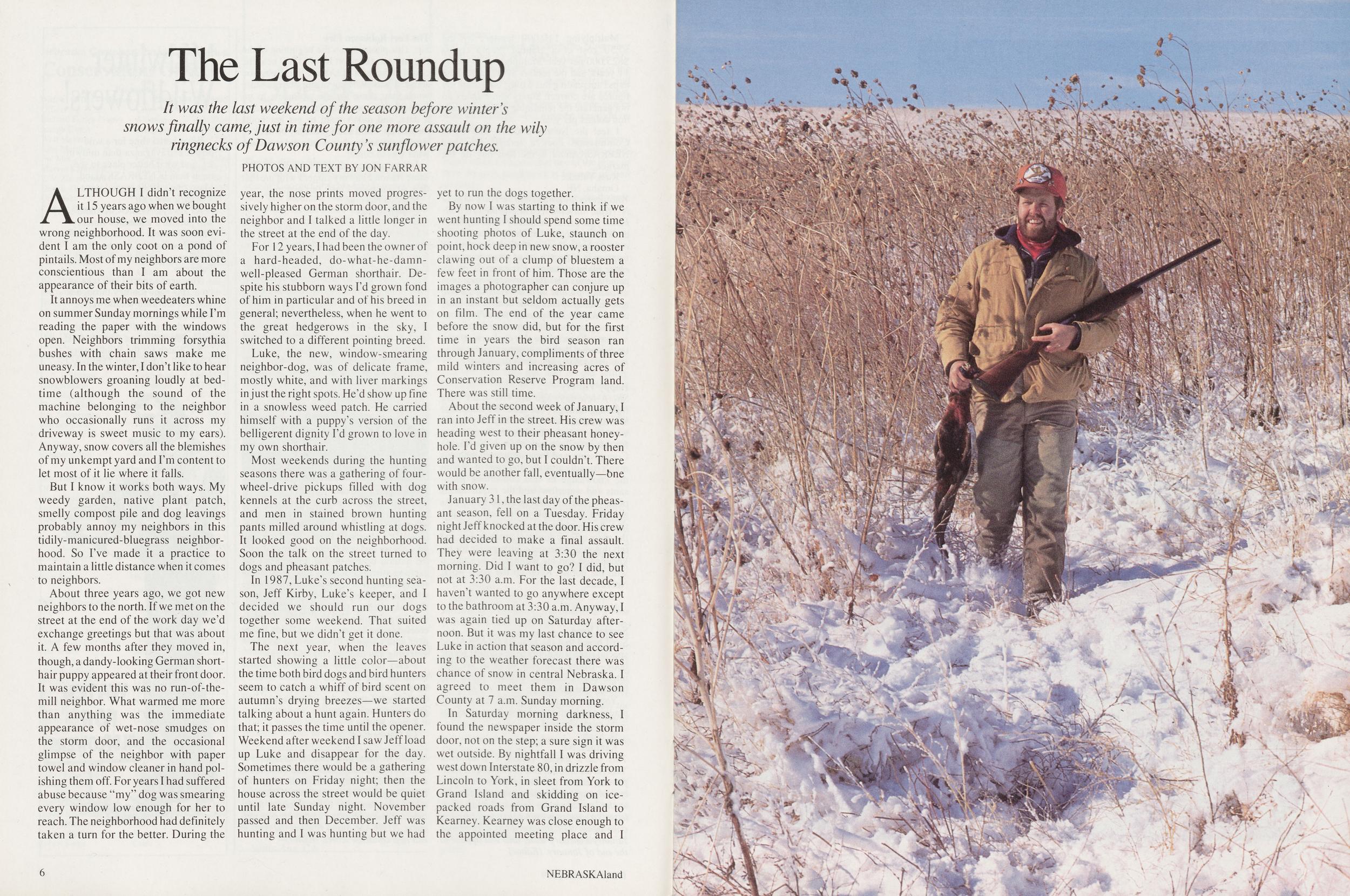
The Last Roundup
It was the last weekend of the season before winter's snows finally came, just in time for one more assault on the wily ringnecks of Dawson County 9s sunflower patches. PHOTOS AND TEXT BY JON FARRARALTHOUGH I didn't recognize it 15 years ago when we bought our house, we moved into the wrong neighborhood. It was soon evident I am the only coot on a pond of pintails. Most of my neighbors are more conscientious than I am about the appearance of their bits of earth.
It annoys me when weedeaters whine on summer Sunday mornings while I'm reading the paper with the windows open. Neighbors trimming forsythia bushes with chain saws make me uneasy. In the winter, I don't like to hear snowblowers groaning loudly at bedtime (although the sound of the machine belonging to the neighbor who occasionally runs it across my driveway is sweet music to my ears). Anyway, snow covers all the blemishes of my unkempt yard and I'm content to let most of it lie where it falls.
But I know it works both ways. My weedy garden, native plant patch, smelly compost pile and dog leavings probably annoy my neighbors in this tidily-manicured-bluegrass neighborhood. So I've made it a practice to maintain a little distance when it comes to neighbors.
About three years ago, we got new neighbors to the north. If we met on the street at the end of the work day we'd exchange greetings but that was about it. A few months after they moved in, though, a dandy-looking German short-hair puppy appeared at their front door. It was evident this was no run-of-the-mill neighbor. What warmed me more than anything was the immediate appearance of wet-nose smudges on the storm door, and the occasional glimpse of the neighbor with paper towel and window cleaner in hand polishing them off. For years I had suffered abuse because "my" dog was smearing every window low enough for her to reach. The neighborhood had definitely taken a turn for the better. During the year, the nose prints moved progressively higher on the storm door, and the neighbor and I talked a little longer in the street at the end of the day.
For 12 years, I had been the owner of a hard-headed, do-what-he-damn-well-pleased German shorthair. Despite his stubborn ways I'd grown fond of him in particular and of his breed in general; nevertheless, when he went to the great hedgerows in the sky, I switched to a different pointing breed.
Luke, the new, window-smearing neighbor-dog, was of delicate frame, mostly white, and with liver markings in just the right spots. He'd show up fine in a snowless weed patch. He carried himself with a puppy's version of the belligerent dignity I'd grown to love in my own shorthair.
Most weekends during the hunting seasons there was a gathering of four-wheel-drive pickups filled with dog kennels at the curb across the street, and men in stained brown hunting pants milled around whistling at dogs. It looked good on the neighborhood. Soon the talk on the street turned to dogs and pheasant patches.
In 1987, Luke's second hunting season, Jeff Kirby, Luke's keeper, and I decided we should run our dogs together some weekend. That suited me fine, but we didn't get it done.
The next year, when the leaves started showing a little color—about the time both bird dogs and bird hunters seem to catch a whiff of bird scent on autumn's drying breezes—we started talking about a hunt again. Hunters do that; it passes the time until the opener. Weekend after weekend I saw Jeff load up Luke and disappear for the day. Sometimes there would be a gathering of hunters on Friday night; then the house across the street would be quiet until late Sunday night. November passed and then December. Jeff was hunting and I was hunting but we had yet to run the dogs together.
By now I was starting to think if we went hunting I should spend some time shooting photos of Luke, staunch on point, hock deep in new snow, a rooster clawing out of a clump of bluestem a few feet in front of him. Those are the images a photographer can conjure up in an instant but seldom actually gets on film. The end of the year came before the snow did, but for the first time in years the bird season ran through January, compliments of three mild winters and increasing acres of Conservation Reserve Program land. There was still time.
About the second week of January, I ran into Jeff in the street. His crew was heading west to their pheasant honeyhole. I'd given up on the snow by then and wanted to go, but I couldn't. There would be another fall, eventually—one with snow.
January 31, the last day of the pheasant season, fell on a Tuesday. Friday night Jeff knocked at the door. His crew had decided to make a final assault. They were leaving at 3:30 the next morning. Did I want to go? I did, but not at 3:30 a.m. For the last decade, I haven't wanted to go anywhere except to the bathroom at 3:30 a.m. Anyway, I was again tied up on Saturday afternoon. But it was my last chance to see Luke in action that season and according to the weather forecast there was chance of snow in central Nebraska. I agreed to meet them in Dawson County at 7 a.m. Sunday morning.
In Saturday morning darkness, I found the newspaper inside the storm door, not on the step; a sure sign it was wet outside. By nightfall I was driving west down Interstate 80, in drizzle from Lincoln to York, in sleet from York to Grand Island and skidding on ice-packed roads from Grand Island to Kearney. Kearney was close enough to the appointed meeting place and I 6 NEBRASKAland
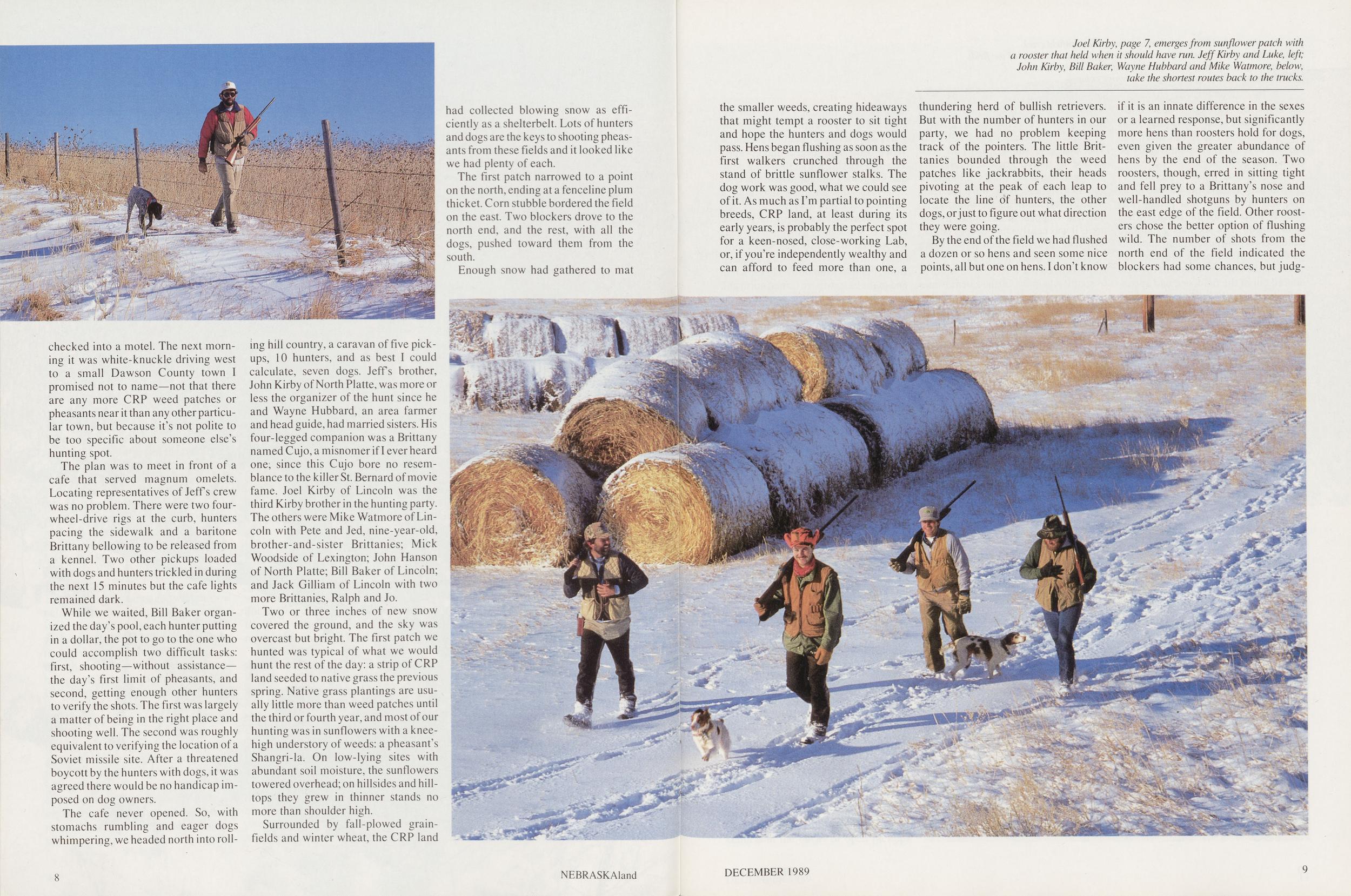
The plan was to meet in front of a cafe that served magnum omelets. Locating representatives of Jeff's crew was no problem. There were two four-wheel-drive rigs at the curb, hunters pacing the sidewalk and a baritone Brittany bellowing to be released from a kennel. Two other pickups loaded with dogs and hunters trickled in during the next 15 minutes but the cafe lights remained dark.
While we waited, Bill Baker organized the day's pool, each hunter putting in a dollar, the pot to go to the one who could accomplish two difficult tasks: first, shooting—without assistance — the day's first limit of pheasants, and second, getting enough other hunters to verify the shots. The first was largely a matter of being in the right place and shooting well. The second was roughly equivalent to verifying the location of a Soviet missile site. After a threatened boycott by the hunters with dogs, it was agreed there would be no handicap imposed on dog owners.
The cafe never opened. So, with stomachs rumbling and eager dogs whimpering, we headed north into rolling hill country, a caravan of five pickups, 10 hunters, and as best I could calculate, seven dogs. Jeffs brother, John Kirby of North Platte, was more or less the organizer of the hunt since he and Wayne Hubbard, an area farmer and head guide, had married sisters. His four-legged companion was a Brittany named Cujo, a misnomer if I ever heard one, since this Cujo bore no resemblance to the killer St. Bernard of movie fame. Joel Kirby of Lincoln was the third Kirby brother in the hunting party. The others were Mike Watmore of Lincoln with Pete and Jed, nine-year-old, brother-and-sister Brittanies; Mick Woodside of Lexington; John Hanson of North Platte; Bill Baker of Lincoln; and Jack Gilliam of Lincoln with two more Brittanies, Ralph and Jo.
Two or three inches of new snow covered the ground, and the sky was overcast but bright. The first patch we hunted was typical of what we would hunt the rest of the day: a strip of CRP land seeded to native grass the previous spring. Native grass plantings are usually little more than weed patches until the third or fourth year, and most of our hunting was in sunflowers with a kneehigh understory of weeds: a pheasant's Shangri-la. On low-lying sites with abundant soil moisture, the sunflowers towered overhead; on hillsides and hilltops they grew in thinner stands no more than shoulder high.
Surrounded by fall-plowed grainfields and winter wheat, the CRP land Joel Kirby, page 7, emerges from sunflower patch with a rooster that held when it should have run. Jeff Kirby and Luke, left; John Kirby, Bill Baker, Wayne Hubbard and Mike Watmore, below, take the shortest routes back to the trucks. had collected blowing snow as efficiently as a shelterbelt. Lots of hunters and dogs are the keys to shooting pheasants from these fields and it looked like we had plenty of each.
The first patch narrowed to a point on the north, ending at a fenceline plum thicket. Corn stubble bordered the field on the east. Two blockers drove to the north end, and the rest, with all the dogs, pushed toward them from the south.
Enough snow had gathered to mat 8 NEBRASKAland
By the end of the field we had flushed
a dozen or so hens and seen some nice
points, all but one on hens. I don't know
if it is an innate difference in the sexes
or a learned response, but significantly
more hens than roosters hold for dogs,
even given the greater abundance of
hens by the end of the season. Two
roosters, though, erred in sitting tight
and fell prey to a Brittany's nose and
well-handled shotguns by hunters on
the east edge of the field. Other roosters chose the better option of flushing
wild. The number of shots from the
north end of the field indicated the
blockers had some chances, but judging
DECEMBER 1989
9
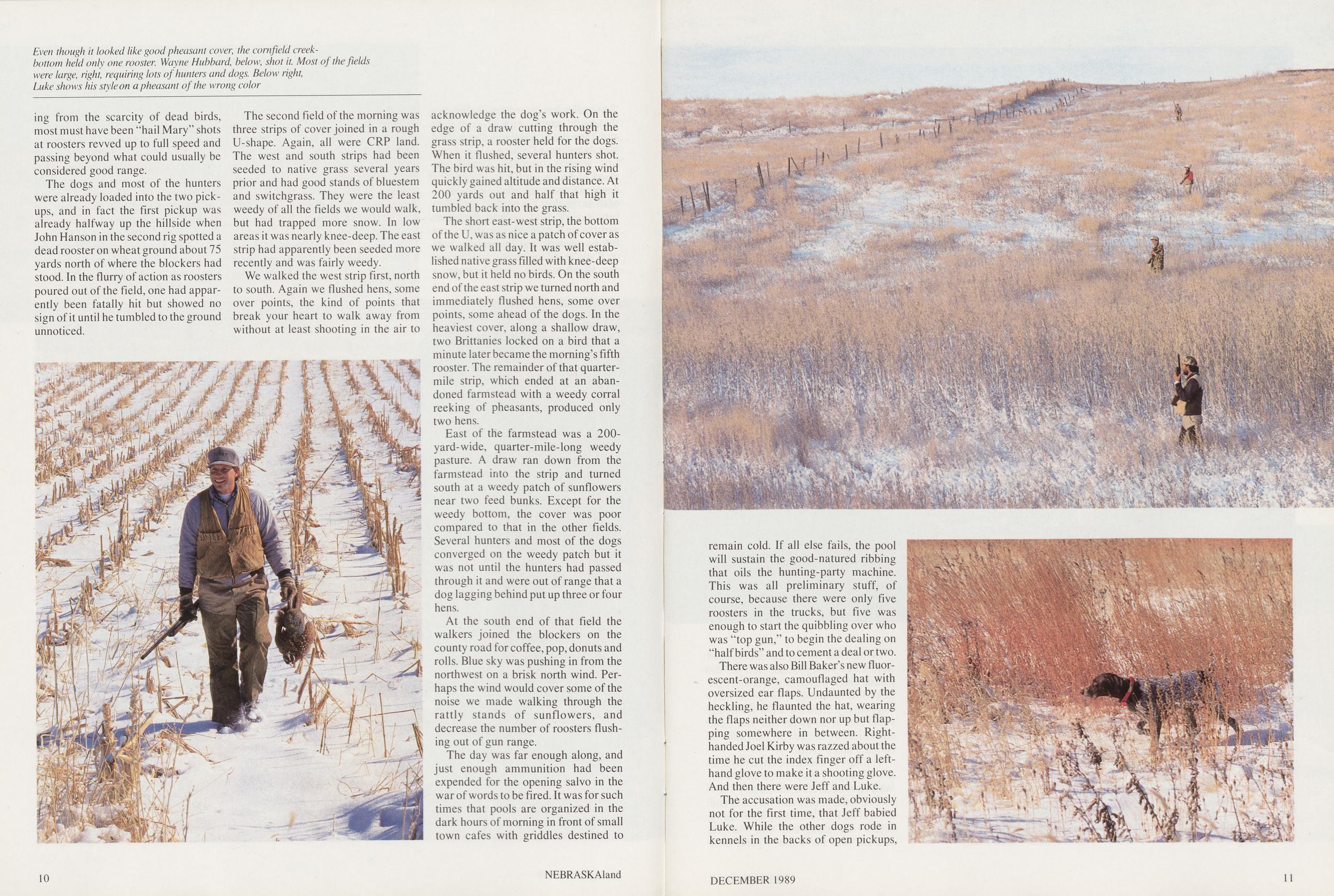
The dogs and most of the hunters were already loaded into the two pickups, and in fact the first pickup was already halfway up the hillside when John Hanson in the second rig spotted a dead rooster on wheat ground about 75 yards north of where the blockers had stood. In the flurry of action as roosters poured out of the field, one had apparently been fatally hit but showed no sign of it until he tumbled to the ground unnoticed.
The second field of the morning was three strips of cover joined in a rough U-shape. Again, all were CRP land. The west and south strips had been seeded to native grass several years prior and had good stands of bluestem and switchgrass. They were the least weedy of all the fields we would walk, but had trapped more snow. In low areas it was nearly knee-deep. The east strip had apparently been seeded more recently and was fairly weedy.
We walked the west strip first, north to south. Again we flushed hens, some over points, the kind of points that break your heart to walk away from without at least shooting in the air to acknowledge the dog's work. On the edge of a draw cutting through the grass strip, a rooster held for the dogs. When it flushed, several hunters shot. The bird was hit, but in the rising wind quickly gained altitude and distance. At 200 yards out and half that high it tumbled back into the grass.
The short east-west strip, the bottom of the U, was as nice a patch of cover as we walked all day. It was well established native grass filled with knee-deep snow, but it held no birds. On the south end of the east strip we turned north and immediately flushed hens, some over points, some ahead of the dogs. In the heaviest cover, along a shallow draw, two Brittanies locked on a bird that a minute later became the morning's fifth rooster. The remainder of that quarter-mile strip, which ended at an abandoned farmstead with a weedy corral reeking of pheasants, produced only two hens.
East of the farmstead was a 200-yard-wide, quarter-mile-long weedy pasture. A draw ran down from the farmstead into the strip and turned south at a weedy patch of sunflowers near two feed bunks. Except for the weedy bottom, the cover was poor compared to that in the other fields. Several hunters and most of the dogs converged on the weedy patch but it was not until the hunters had passed through it and were out of range that a dog lagging behind put up three or four hens.
At the south end of that field the walkers joined the blockers on the county road for coffee, pop, donuts and rolls. Blue sky was pushing in from the northwest on a brisk north wind. Perhaps the wind would cover some of the noise we made walking through the rattly stands of sunflowers, and decrease the number of roosters flushing out of gun range.
The day was far enough along, and just enough ammunition had been expended for the opening salvo in the war of words to be fired. It was for such times that pools are organized in the dark hours of morning in front of small town cafes with griddles destined to 10 NEBRASKAland
There was also Bill Baker's new fluorescent-orange, camouflaged hat with oversized ear flaps. Undaunted by the heckling, he flaunted the hat, wearing the flaps neither down nor up but flapping somewhere in between. Right-handed Joel Kirby was razzed about the time he cut the index finger off a left-hand glove to make it a shooting glove. And then there were Jeff and Luke.
The accusation was made, obviously not for the first time, that Jeff babied Luke. While the other dogs rode in kennels in the backs of open pickups,
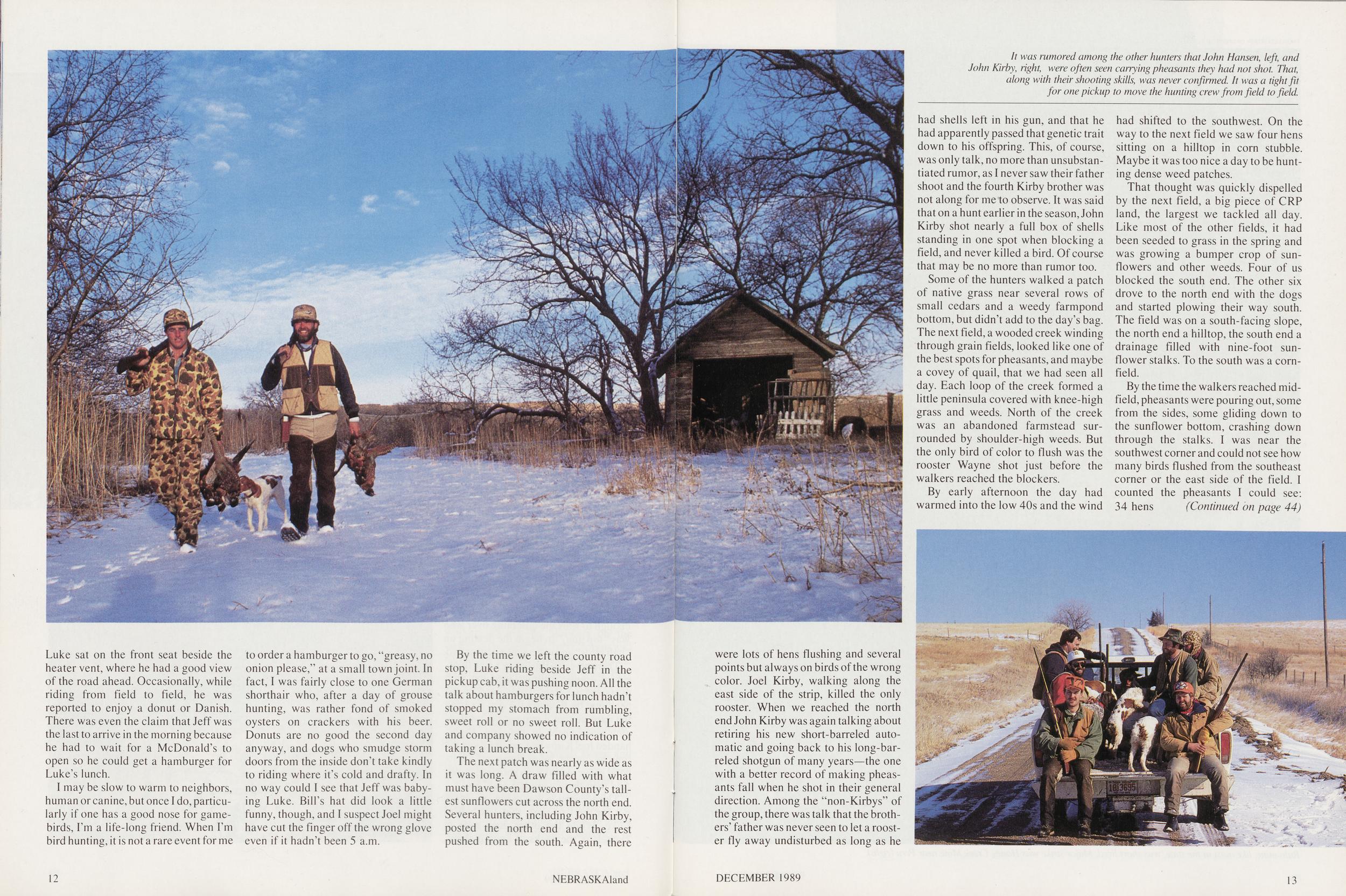
I may be slow to warm to neighbors, human or canine, but once I do, particularly if one has a good nose for game-birds, I'm a life-long friend. When I'm bird hunting, it is not a rare event for me to order a hamburger to go, "greasy, no onion please," at a small town joint. In fact, I was fairly close to one German shorthair who, after a day of grouse hunting, was rather fond of smoked oysters on crackers with his beer. Donuts are no good the second day anyway, and dogs who smudge storm doors from the inside don't take kindly to riding where it's cold and drafty. In no way could I see that Jeff was babying Luke. Bill's hat did look a little funny, though, and I suspect Joel might have cut the finger off the wrong glove even if it hadn't been 5 a.m.
By the time we left the county road stop, Luke riding beside Jeff in the pickup cab, it was pushing noon. All the talk about hamburgers for lunch hadn't stopped my stomach from rumbling, sweet roll or no sweet roll. But Luke and company showed no indication of taking a lunch break.
The next patch was nearly as wide as it was long. A draw filled with what must have been Dawson County's tallest sunflowers cut across the north end. Several hunters, including John Kirby, posted the north end and the rest pushed from the south. Again, there 12 NEBRASKAland were lots of hens flushing and several points but always on birds of the wrong color. Joel Kirby, walking along the east side of the strip, killed the only rooster. When we reached the north end John Kirby was again talking about retiring his new short-barreled automatic and going back to his long-barreled shotgun of many years—the one with a better record of making pheasants fall when he shot in their general direction. Among the "non-Kirbys" of the group, there was talk that the brothers' father was never seen to let a rooster fly away undisturbed as long as he had shells left in his gun, and that he had apparently passed that genetic trait down to his offspring. This, of course, was only talk, no more than unsubstantiated rumor, as I never saw their father shoot and the fourth Kirby brother was not along for me to observe. It was said that on a hunt earlier in the season, John Kirby shot nearly a full box of shells standing in one spot when blocking a field, and never killed a bird. Of course that may be no more than rumor too.
Some of the hunters walked a patch of native grass near several rows of small cedars and a weedy farmpond bottom, but didn't add to the day's bag. The next field, a wooded creek winding through grain fields, looked like one of the best spots for pheasants, and maybe a covey of quail, that we had seen all day. Each loop of the creek formed a little peninsula covered with knee-high grass and weeds. North of the creek was an abandoned farmstead surrounded by shoulder-high weeds. But the only bird of color to flush was the rooster Wayne shot just before the walkers reached the blockers.
By early afternoon the day had warmed into the low 40s and the wind had shifted to the southwest. On the way to the next field we saw four hens sitting on a hilltop in corn stubble. Maybe it was too nice a day to be hunting dense weed patches.
That thought was quickly dispelled by the next field, a big piece of CRP land, the largest we tackled all day. Like most of the other fields, it had been seeded to grass in the spring and was growing a bumper crop of sunflowers and other weeds. Four of us blocked the south end. The other six drove to the north end with the dogs and started plowing their way south. The field was on a south-facing slope, the north end a hilltop, the south end a drainage filled with nine-foot sunflower stalks. To the south was a cornfield.
By the time the walkers reached midfield, pheasants were pouring out, some from the sides, some gliding down to the sunflower bottom, crashing down through the stalks. I was near the southwest corner and could not see how many birds flushed from the southeast corner or the east side of the field. I counted the pheasants I could see: 34 hens (Continued on page 44)
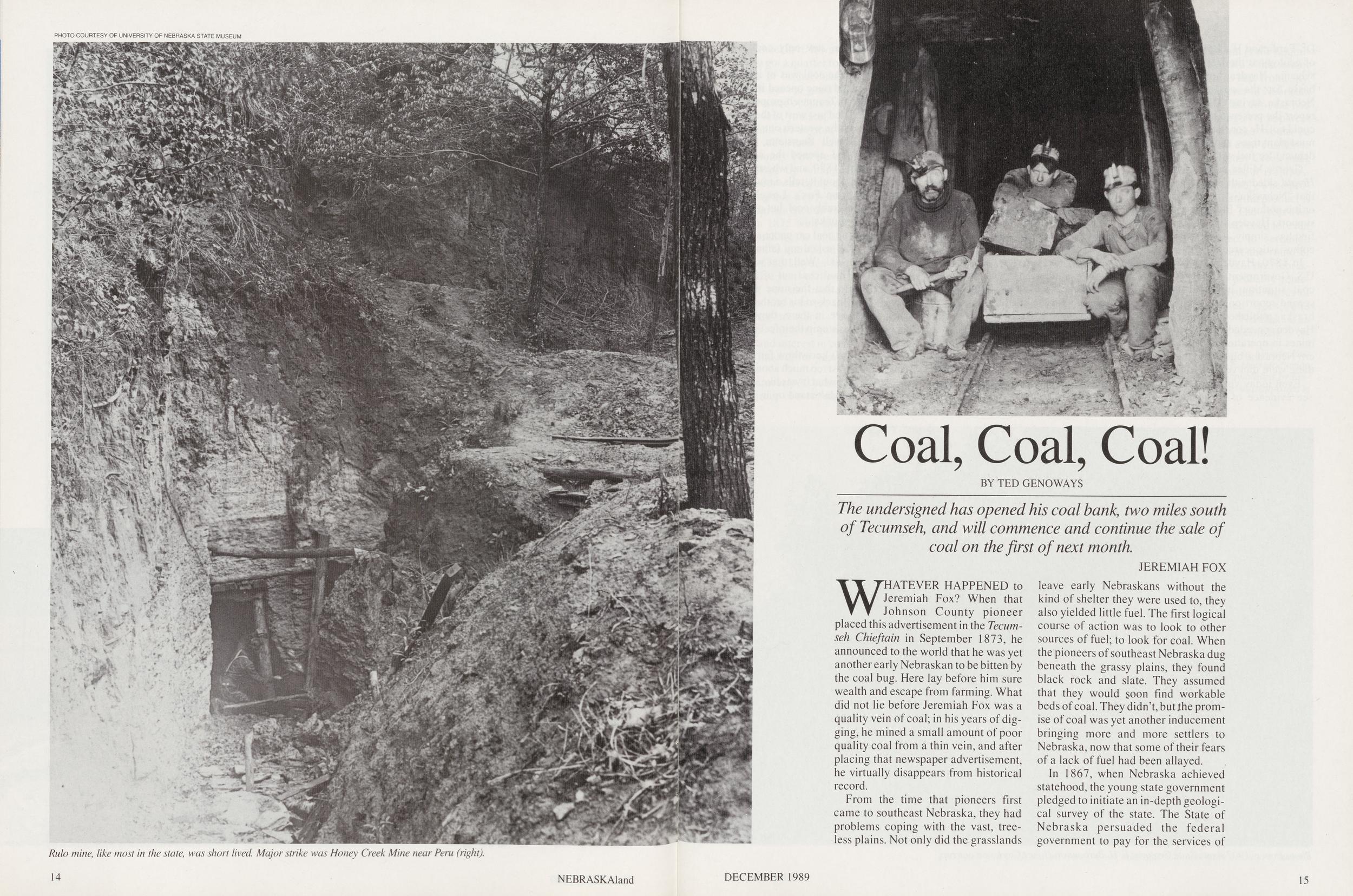
Coal, Coal, Coal!
BY TED GENOWAYS The undersigned has opened his coal bank, two miles south of Tecumseh, and will commence and continue the sale of coal on the first of next month JEREMIAH FOXWHATEVER HAPPENED to Jeremiah Fox? When that Johnson County pioneer placed this advertisement in the Tecumseh Chieftain in September 1873, he announced to the world that he was yet another early Nebraskan to be bitten by the coal bug. Here lay before him sure wealth and escape from farming. What did not lie before Jeremiah Fox was a quality vein of coal; in his years of digging, he mined a small amount of poor quality coal from a thin vein, and after placing that newspaper advertisement, he virtually disappears from historical record.
From the time that pioneers first came to southeast Nebraska, they had problems coping with the vast, treeless plains. Not only did the grasslands JEREMIAH FOX leave early Nebraskans without the kind of shelter they were used to, they also yielded little fuel. The first logical course of action was to look to other sources of fuel; to look for coal. When the pioneers of southeast Nebraska dug beneath the grassy plains, they found black rock and slate. They assumed that they would Soon find workable beds of coal. They didn't, but the promise of coal was yet another inducement bringing more and more settlers to Nebraska, now that some of their fears of a lack of fuel had been allayed.
In 1867, when Nebraska achieved
statehood, the young state government
pledged to initiate an in-depth geological survey of the state. The State of
Nebraska persuaded the federal
government to pay for the services of
DECEMBER 1989
15
 Dr. Ferdinand H. Hayden, a professor
of geology at the University of Pennsylvania. Hayden, however, found no
basis for the coal fever sweeping
Nebraska, saying that he would like to
report the presence of coal but simply
could not. He concluded, "The farmers
must plant trees, and in a few years the
demand for fuel will be supplied."
Dr. Ferdinand H. Hayden, a professor
of geology at the University of Pennsylvania. Hayden, however, found no
basis for the coal fever sweeping
Nebraska, saying that he would like to
report the presence of coal but simply
could not. He concluded, "The farmers
must plant trees, and in a few years the
demand for fuel will be supplied."
George Miller, editor of the Omaha Herald, sided with Hayden proclaiming that "Nebraska is an agricultural state, or it is nothing." But even with Miller's support, Hayden was discredited, his findings simply discounted, and the enthusiastic search for coal continued.
In 1870, Hayden was hired by the U.S. Government to reinvestigate the coal situation in Nebraska. In his second report on the geology of Nebraska published two years later, Hayden conceded that there were small mines in operation all over southeastern Nebraska, but still maintained that these were thin veins of inferior coal.
Even today visitors to the area can see evidence of failed hopes. Abandoned mines, now usually no more than depressions in the ground, are relatively common, but it is almost impossible to find any evidence of good-quality coal.
Hayden was not unsympathetic to the needs of the farmers, he said; it was simply that there was not a workable bed of coal present in Nebraska. But once again, Hayden's words had little effect on the interest in coal.
Indeed, the coal fever increased over the years. Jeremiah Fox was among those who opened mining operations even after Hayden's reports. If one were to visit the site of Jeremiah Fox's mine, he or she would find a vein about eight inches thick at its thickest. The coal there is so impure and, at least when it is near the surface, so degraded from its contact with the air that it is scarcely combustible. It is almost gray rather than black, and it crumbles out of the vein rather than breaking into chunks. Nevertheless, Fox tried to mine and sell the coal to support himself. Apparently, like many other southeast Nebraska pioneers who found obviously poor-quality coal, he saw only coal, and mined it.
But not all the coal was of inferior grade. A second mine opened in Johnson County, in Tecumseh proper. The mine was located just west of the Buerstetta farm on the western outskirts of the town. Lowell Buerstetta, whose grandfather had opened the mine in approximately 1870, and whose father had told him about it, tells a much different story from Fox's. Lowell talks not of gray, crumbly coal, but of high-grade, black chunks.
"I saw a little coal car under a building there, and I asked my father what that was. He said, 'Well, that was one they used to haul coal out of the old mine.' He said that the mine was far enough in the back so his brothers said when they were in there, they could hear the horses stomp their feet in their pasture.
"But he didn't know how far it went back, and not just too much about it... He didn't know what it was like. He just knew they couldn't stand up in it; they
Around the region, the same thing Lowell described was happening to other miners. Few were able to support themselves by mining coal, and the movement was dying quickly.
Seeing this, newly-elected Governor Silas Garber tried to revive the movement in 1875 with another geological survey, telling the legislature that there had been "a marked advance in knowledge" since Hayden had released his report five years earlier. The legislature agreed, but an infestation of grasshoppers and a severe drought drained the state treasury. The attempt to initiate another geological survey failed, and interest in coal continued to wane. Indeed, for years it was almost dead.
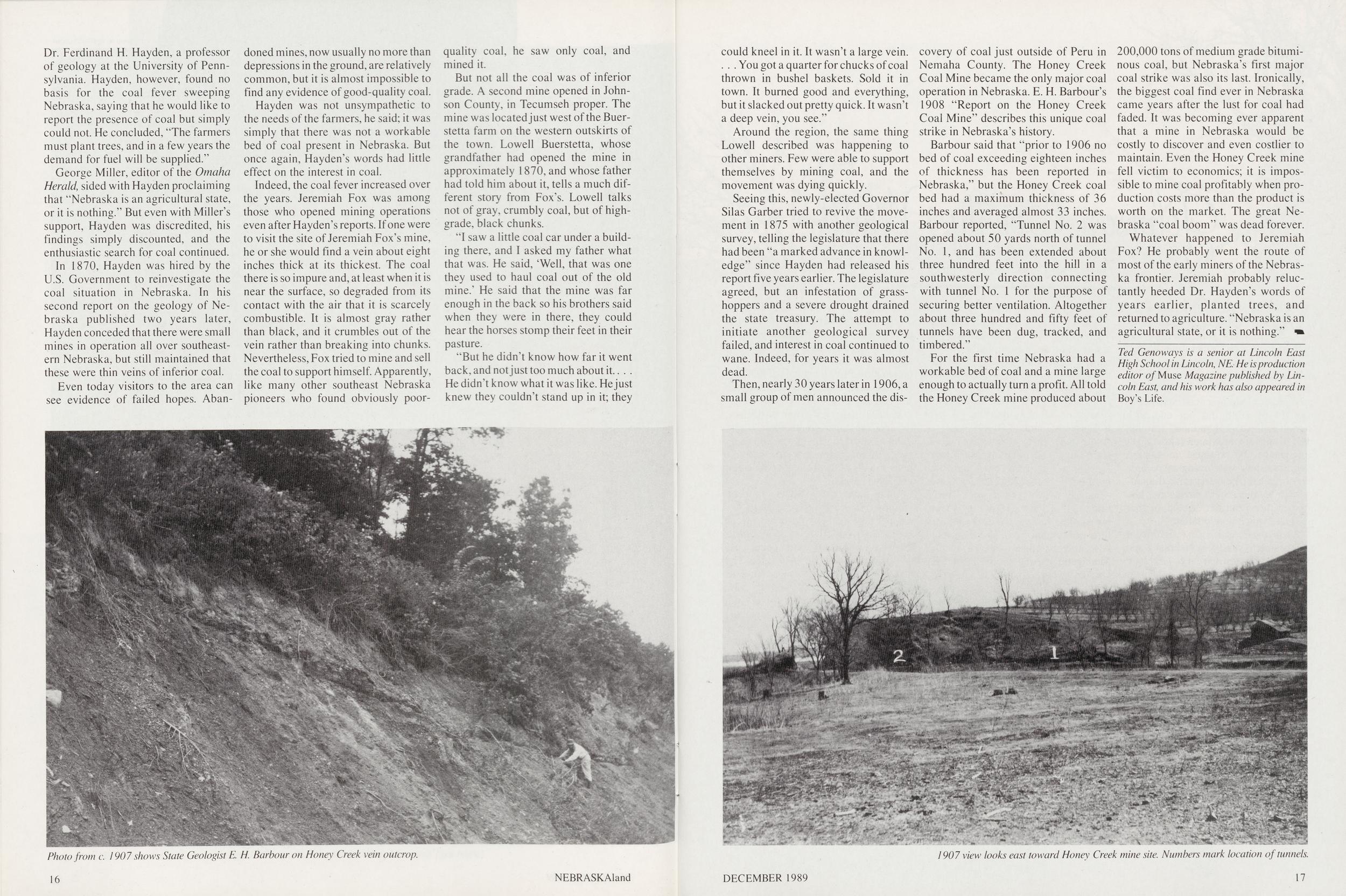
Then, nearly 30 years later in 1906, a small group of men announced the discovery of coal just outside of Peru in Nemaha County. The Honey Creek Coal Mine became the only major coal operation in Nebraska. E. H. Barbour's 1908 "Report on the Honey Creek Coal Mine" describes this unique coal strike in Nebraska's history.
Barbour said that "prior to 1906 no bed of coal exceeding eighteen inches of thickness has been reported in Nebraska," but the Honey Creek coal bed had a maximum thickness of 36 inches and averaged almost 33 inches. Barbour reported, "Tunnel No. 2 was opened about 50 yards north of tunnel No. 1, and has been extended about three hundred feet into the hill in a southwesterly direction connecting with tunnel No. 1 for the purpose of securing better ventilation. Altogether about three hundred and fifty feet of tunnels have been dug, tracked, and timbered."
For the first time Nebraska had a workable bed of coal and a mine large enough to actually turn a profit. All told the Honey Creek mine produced about 200,000 tons of medium grade bituminous coal, but Nebraska's first major coal strike was also its last. Ironically, the biggest coal find ever in Nebraska came years after the lust for coal had faded. It was becoming ever apparent that a mine in Nebraska would be costly to discover and even costlier to maintain. Even the Honey Creek mine fell victim to economics; it is impossible to mine coal profitably when production costs more than the product is worth on the market. The great Nebraska "coal boom" was dead forever.
Whatever happened to Jeremiah Fox? He probably went the route of most of the early miners of the Nebraska frontier. Jeremiah probably reluctantly heeded Dr. Hayden's words of years earlier, planted trees, and returned to agriculture. "Nebraska is an agricultural state, or it is nothing." m
Ted Genoways is a senior at Lincoln East High School in Lincoln, NE.- He is production editor of Muse Magazine published by Lincoln East, and his work has also appeared in Boy's Life.
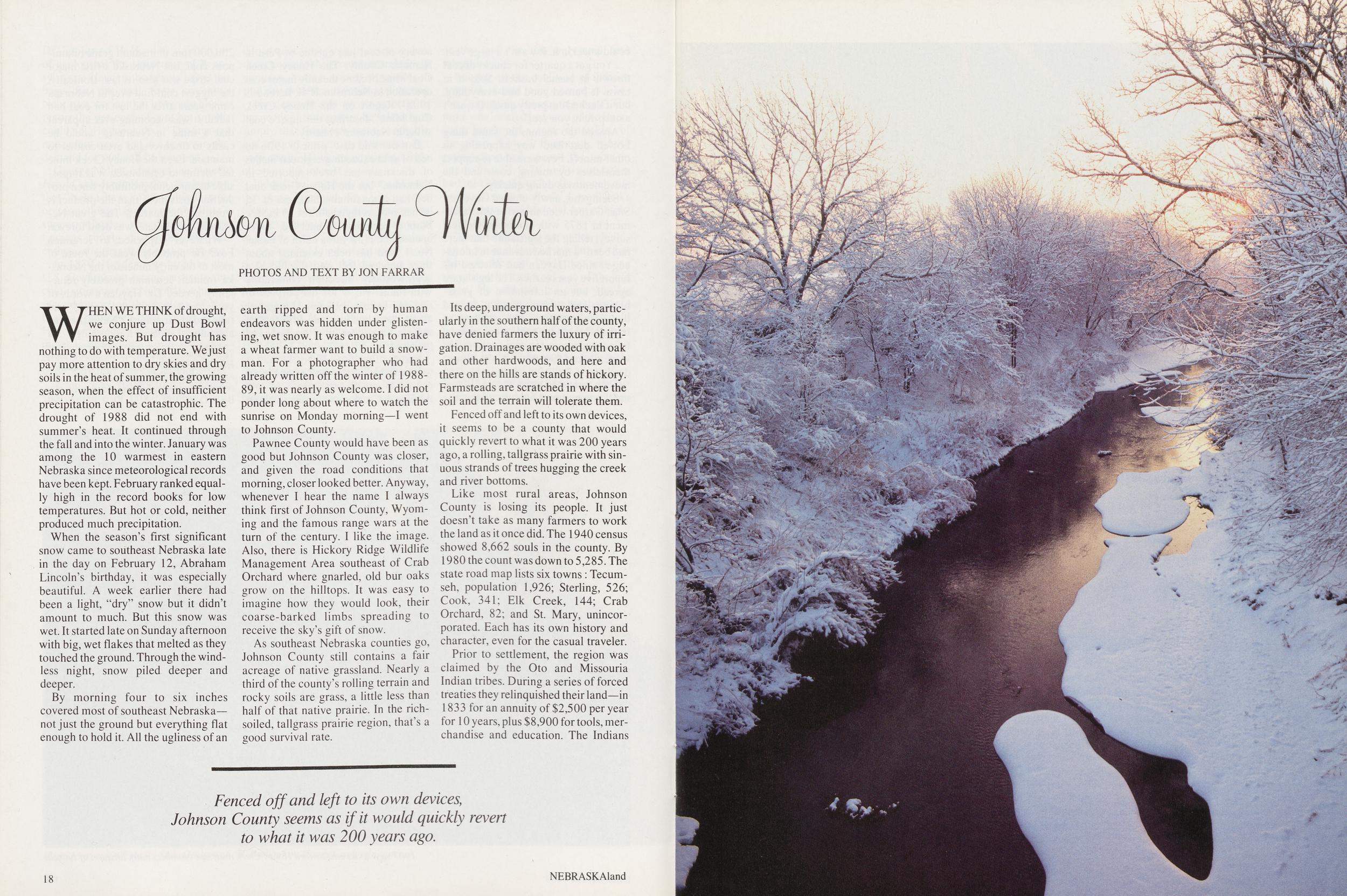
Johnson County Winter
PHOTOS AND TEXT BY JON FARRAR Fenced off and left to its own devices, Johnson County seems as if it would quickly revert to what it was 200 years ago.WHEN WE THINK of drought, we conjure up Dust Bowl images. But drought has nothing to do with temperature. We just pay more attention to dry skies and dry soils in the heat of summer, the growing season, when the effect of insufficient precipitation can be catastrophic. The drought of 1988 did not end with summer's heat. It continued through the fall and into the winter. January was among the 10 warmest in eastern Nebraska since meteorological records have been kept. February ranked equally high in the record books for low temperatures. But hot or cold, neither produced much precipitation.
When the season's first significant snow came to southeast Nebraska late in the day on February 12, Abraham Lincoln's birthday, it was especially beautiful. A week earlier there had been a light, "dry" snow but it didn't amount to much. But this snow was wet. It started late on Sunday afternoon with big, wet flakes that melted as they touched the ground. Through the windless night, snow piled deeper and deeper.
By morning four to six inches covered most of southeast Nebraska—not just the ground but everything flat enough to hold it. All the ugliness of an earth ripped and torn by human endeavors was hidden under glistening, wet snow. It was enough to make a wheat farmer want to build a snowman. For a photographer who had already written off the winter of 1988-89, it was nearly as welcome. I did not ponder long about where to watch the sunrise on Monday morning—I went to Johnson County.
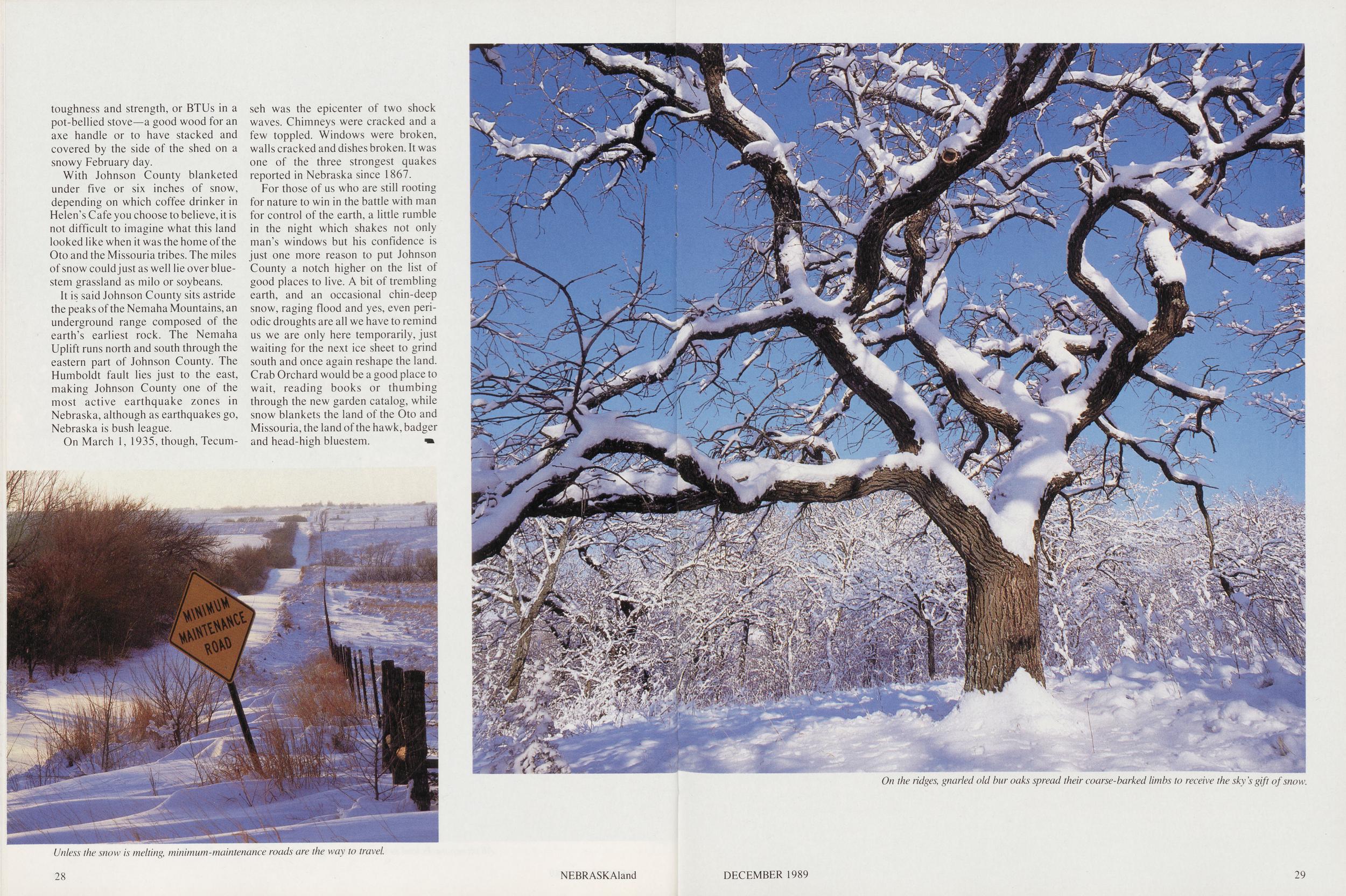
Pawnee County would have been as good but Johnson County was closer, and given the road conditions that morning, closer looked better. Anyway, whenever I hear the name I always think first of Johnson County, Wyoming and the famous range wars at the turn of the century. I like the image. Also, there is Hickory Ridge Wildlife Management Area southeast of Crab Orchard where gnarled, old bur oaks grow on the hilltops. It was easy to imagine how they would look, their coarse-barked limbs spreading to receive the sky's gift of snow.
As southeast Nebraska counties go, Johnson County still contains a fair acreage of native grassland. Nearly a third of the county's rolling terrain and rocky soils are grass, a little less than half of that native prairie. In the rich-soiled, tallgrass prairie region, that's a good survival rate.
Its deep, underground waters, particularly in the southern half of the county, have denied farmers the luxury of irrigation. Drainages are wooded with oak and other hardwoods, and here and there on the hills are stands of hickory. Farmsteads are scratched in where the soil and the terrain will tolerate them.
Fenced off and left to its own devices, it seems to be a county that would quickly revert to what it was 200 years ago, a rolling, tallgrass prairie with sinuous strands of trees hugging the creek and river bottoms.
Like most rural areas, Johnson County is losing its people. It just doesn't take as many farmers to work the land as it once did. The 1940 census showed 8,662 souls in the county. By 1980 the count was down to 5,285. The state road map lists six towns : Tecumseh, population 1,926; Sterling, 526; Cook, 341; Elk Creek, 144; Crab Orchard, 82; and St. Mary, unincorporated. Each has its own history and character, even for the casual traveler.
Prior to settlement, the region was claimed by the Oto and Missouria Indian tribes. During a series of forced treaties they relinquished their land—in 1833 for an annuity of $2,500 per year for 10 years, plus $8,900 for tools, merchandise and education. The Indians 18 NEBRASKAland
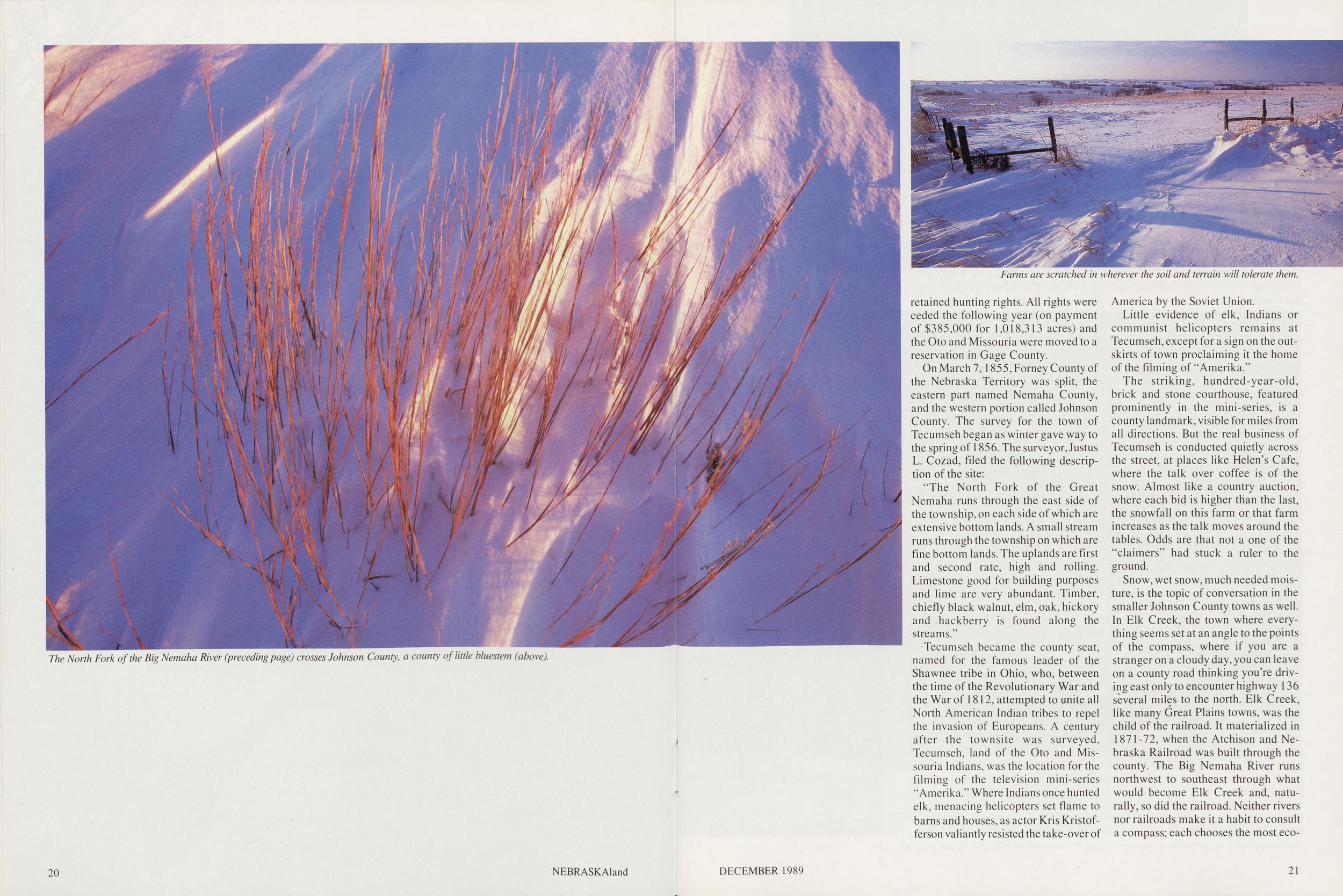
On March 7,1855, Forney County of the Nebraska Territory was split, the eastern part named Nemaha County, and the western portion called Johnson County. The survey for the town of Tecumseh began as winter gave way to the spring of 1856. The surveyor, Justus L. Cozad, filed the following description of the site:
The North Fork of the Great Nemaha runs through the east side of the township, on each side of which are extensive bottom lands. A small stream runs through the township on which are fine bottom lands. The uplands are first and second rate, high and rolling. Limestone good for building purposes and lime are very abundant. Timber, chiefly black walnut, elm, oak, hickory and hackberry is found along the streams."
Tecumseh became the county seat, named for the famous leader of the Shawnee tribe in Ohio, who, between the time of the Revolutionary War and the War of 1812, attempted to unite all North American Indian tribes to repel the invasion of Europeans. A century after the townsite was surveyed, Tecumseh, land of the Oto and Missouria Indians, was the location for the filming of the television mini-series " Amerika." Where Indians once hunted elk, menacing helicopters set flame to barns and houses, as actor Kris Kristofferson valiantly resisted the take-over of America by the Soviet Union.
Little evidence of elk, Indians or communist helicopters remains at Tecumseh, except for a sign on the outskirts of town proclaiming it the home of the filming of "Amerika."
The striking, hundred-year-old, brick and stone courthouse, featured prominently in the mini-series, is a county landmark, visible for miles from all directions. But the real business of Tecumseh is conducted quietly across the street, at places like Helen's Cafe, where the talk over coffee is of the snow. Almost like a country auction, where each bid is higher than the last, the snowfall on this farm or that farm increases as the talk moves around the tables. Odds are that not a one of the "claimers" had stuck a ruler to the ground.
Snow, wet snow, much needed moisture, is the topic of conversation in the
smaller Johnson County towns as well.
In Elk Creek, the town where everything seems set at an angle to the points
of the compass, where if you are a
stranger on a cloudy day, you can leave
on a county road thinking you're driving east only to encounter highway 136
several miles to the north. Elk Creek,
like many Great Plains towns, was the
child of the railroad. It materialized in
1871-72, when the Atchison and Nebraska Railroad was built through the
county. The Big Nemaha River runs
northwest to southeast through what
would become Elk Creek and, naturally, so did the railroad. Neither rivers
nor railroads make it a habit to consult
a compass; each chooses the most economical
DECEMBER 1989
21
 route, the route of least resistance. So, Elk Creek was laid out as a
sort of hybrid, sort of on an angle, and
sort of north/south, east/west the way
towns out in this grassland country
were supposed to be laid out.
route, the route of least resistance. So, Elk Creek was laid out as a
sort of hybrid, sort of on an angle, and
sort of north/south, east/west the way
towns out in this grassland country
were supposed to be laid out.
The other towns, too, have their distinctions. Cook, for example, where compassplant grows in profusion in a wet meadow along the abandoned rail line on the west edge of town. At its beginning it was known as "The Artesian City" because so many artesian wells were found near it.
Sterling, once called Brysonville, was later named Weston because it was located on the western-most point of the Methodist church-circuit. Still later, two of the town's leading citizens decided it needed a name more distinctive and fitting. As the story goes, the two men flipped a $20 gold piece to see who should name it. William Mann, formerly of Sterling, Illinois, won the toss.
By 1858 it was noted that a "goodly number of settlers had come to the area," and "you could look in all directions and on a cold morning see smoke rising from the shanties far and near." Today, on a hot summer day, you can wet your whistle at Scott's Bar in Sterling, under the glass-eyed scrutiny of mounted wild creatures—an exotic wildebeest, strutting turkeys, a gar poised to inhale a lunch of minnows, and ducks, geese, squirrels and deer.
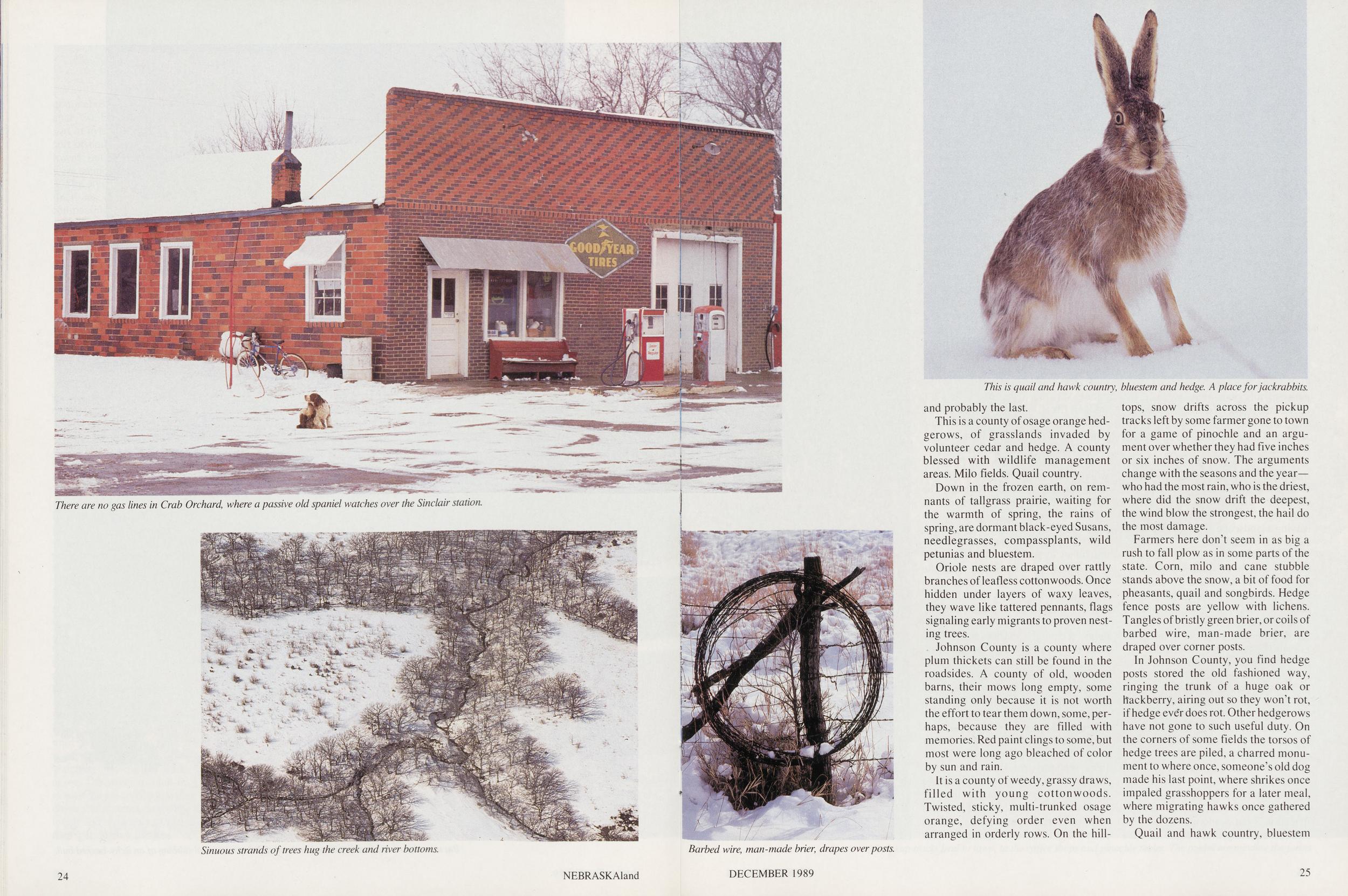
Crab Orchard, sadly, is losing its economy and its young people to larger towns and cities. But if you don't need work, it looks like a fine place to hole up, grow a garden and read books. It's a town where, on the morning after a big snow, the city snow removal equipment—two John Deere tractors with blades, one with a front-end loaderscrape the main street clear and pile snow to melt on vacant corners. There is no shortage of spots to store snow until spring. An old spaniel sits passively in front of the Sinclair station, watching his master lock up, drive across the street to pick up the day's mail at the post office and then drive off down main street, probably home for lunch and a quick nap. He seems like the right dog for the job.
The last of Johnson County's towns, at least according the road map, is St. Mary, appropriately named, for its skyline is dominated by a Catholic church. But it, too, has its story. In the beginning it was called Smartville, after Robert Smart who donated the land for the townsite in 1879. In 1906, so this story goes, there was a popular movement to change the name. But changing a town's name is not something simply decided by the community. There were, in those days, two principal powers to please, the railroad and the postal service. Helena and Robert, the latter also after Robert Smart, were both proposed as names but the railroad rejected each suggestion because there already were towns by those names on the line, and it would lead to confusion, and probably much misplaced baggage and livestock. In 1908, the postal authorities agreed to changing the name to St. Mary but the railroad refused. The village, though, was determined, and so for the following 44 years mail was addressed to St. Mary and rail freight to Smartville. In 1952, the railroad relented and the settlement on the rail line was once again united under a single name.
The essence of Johnson county is not to be found in its towns, but in the countryside. And the best part of the county, of any county, is found along the minimum-maintenance roads. These unpaved, ungraveled roads are most abundant in range and pasture country. More than likely, if you're on a minimum-maintenance road you are not driving through flat, irrigated corn fields. These roads show up where a modest acreage cannot support a farm family. They were carved out when a quarter section was still enough for one man and his sons to work.
If your interests lean toward wild creatures, wild plants, or finding a glimpse of how a landscape might once have looked, minimum-maintenance roads are the way to travel, unless it has just rained or the snow is melting. As Nebraska counties go, Johnson County is blessed with these roads "less traveled." On the morning after a new snow, your tracks will likely be the first, 22 NEBRASKAland
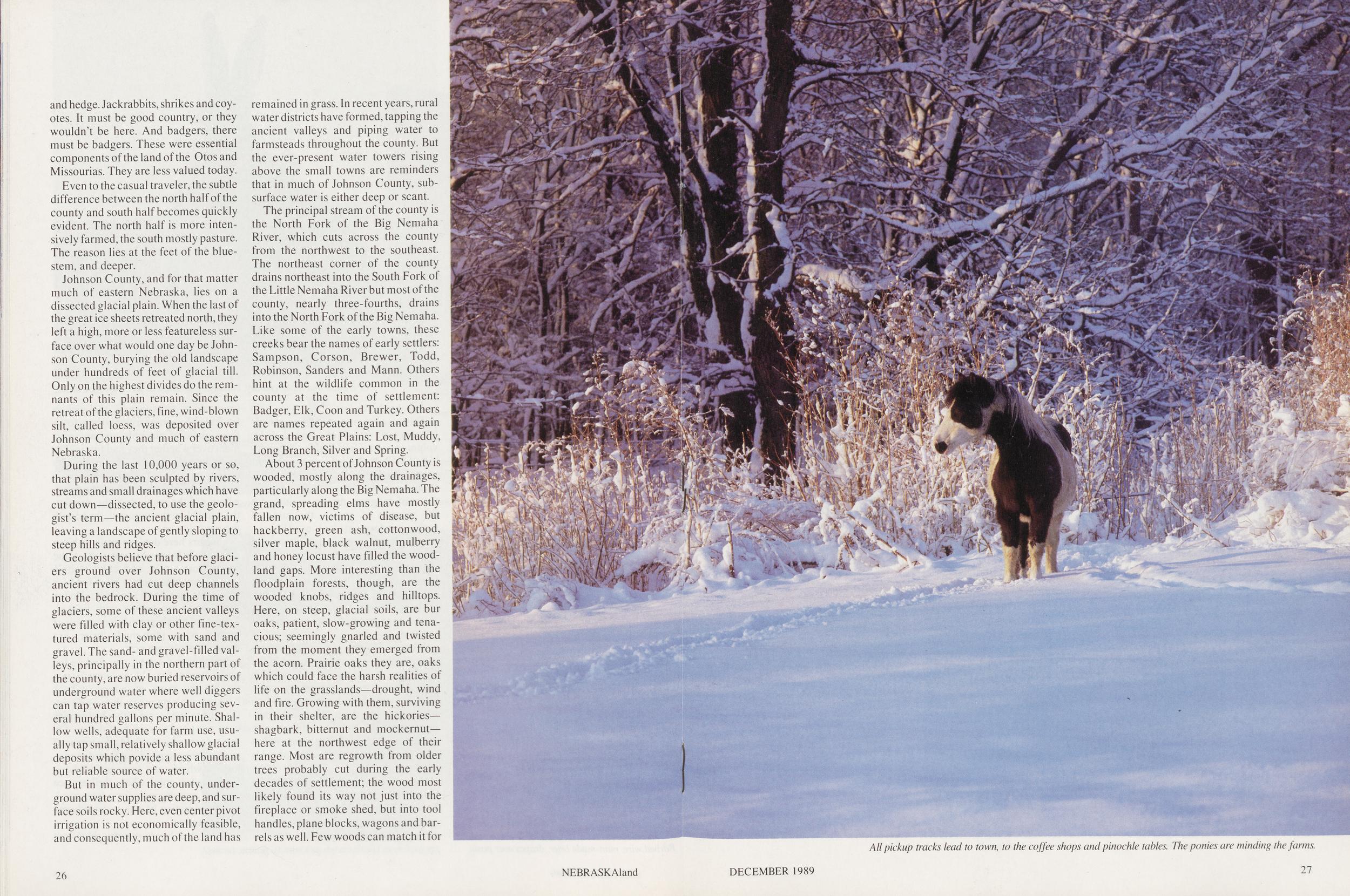 and hedge. Jackrabbits, shrikes and coyotes. It must be good country, or they
wouldn't be here. And badgers, there
must be badgers. These were essential
components of the land of the Otosand
Missourias. They are less valued today.
and hedge. Jackrabbits, shrikes and coyotes. It must be good country, or they
wouldn't be here. And badgers, there
must be badgers. These were essential
components of the land of the Otosand
Missourias. They are less valued today.
Even to the casual traveler, the subtle difference between the north half of the county and south half becomes quickly evident. The north half is more intensively farmed, the south mostly pasture. The reason lies at the feet of the bluestem, and deeper.
Johnson County, and for that matter much of eastern Nebraska, lies on a dissected glacial plain. When the last of the great ice sheets retreated north, they left a high, more or less featureless surface over what would one day be John- son County, burying the old landscape under hundreds of feet of glacial till. Only on the highest divides do the remnants of this plain remain. Since the retreat of the glaciers, fine, wind-blown silt, called loess, was deposited over Johnson County and much of eastern Nebraska.
During the last 10,000 years or so, that plain has been sculpted by rivers, streams and small drainages which have cut down—dissected, to use the geologist's term—the ancient glacial plain, leaving a landscape of gently sloping to steep hills and ridges.
Geologists believe that before glaciers ground over Johnson County, ancient rivers had cut deep channels into the bedrock. During the time of glaciers, some of these ancient valleys were filled with clay or other fine-textured materials, some with sand and gravel. The sand- and gravel-filled valleys, principally in the northern part of the county, are now buried reservoirs of underground water where well diggers can tap water reserves producing several hundred gallons per minute. Shallow wells, adequate for farm use, usually tap small, relatively shallow glacial deposits which provide a less abundant but reliable source of water.
But in much of the county, underground water supplies are deep, and surface soils rocky. Here, even center pivot irrigation is not economically feasible, and consequently, much of the land has remained in grass. In recent years, rural water districts have formed, tapping the ancient valleys and piping water to farmsteads throughout the county. But the ever-present water towers rising above the small towns are reminders that in much of Johnson County, subsurface water is either deep or scant.
The principal stream of the county is the North Fork of the Big Nemaha River, which cuts across the county from the northwest to the southeast. The northeast corner of the county drains northeast into the South Fork of the Little Nemaha River but most of the county, nearly three-fourths, drains into the North Fork of the Big Nemaha. Fike some of the early towns, these creeks bear the names of early settlers: Sampson, Corson, Brewer, Todd, Robinson, Sanders and Mann. Others hint at the wildlife common in the county at the time of settlement: Badger, Elk, Coon and Turkey. Others are names repeated again and again across the Great Plains: Fost, Muddy, Long Branch, Silver and Spring.
About 3 percent of Johnson County is wooded, mostly along the drainages, particularly along the Big Nemaha. The grand, spreading elms have mostly fallen now, victims of disease, but hackberry, green ash, cottonwood, silver maple, black walnut, mulberry and honey locust have filled the woodland gaps. More interesting than the floodplain forests, though, are the wooded knobs, ridges and hilltops. Here, on steep, glacial soils, are bur oaks, patient, slow-growing and tenacious; seemingly gnarled and twisted from the moment they emerged from the acorn. Prairie oaks they are, oaks which could face the harsh realities of life on the grasslands—drought, wind and fire. Growing with them, surviving in their shelter, are the hickories—shagbark, bitternut and mockernut—here at the northwest edge of their range. Most are regrowth from older trees probably cut during the early decades of settlement; the wood most likely found its way not just into the fireplace or smoke shed, but into tool handles, plane blocks, wagons and barrels as well. Few woods can match it for 26 NEBRASKAland
 toughness and strength, or BTUs in a
pot-bellied stove—a good wood for an
axe handle or to have stacked and
covered by the side of the shed on a
snowy February day.
toughness and strength, or BTUs in a
pot-bellied stove—a good wood for an
axe handle or to have stacked and
covered by the side of the shed on a
snowy February day.
With Johnson County blanketed under five or six inches of snow, depending on which coffee drinker in Helen's Cafe you choose to believe, it is not difficult to imagine what this land looked like when it was the home of the Oto and the Missouria tribes. The miles of snow couldjust as well lie over bluestem grassland as milo or soybeans.
It is said Johnson County sits astride the peaks of the Nemaha Mountains, an underground range composed of the earth's earliest rock. The Nemaha Uplift runs north and south through the eastern part of Johnson County. The Humboldt fault lies just to the east, making Johnson County one of the most active earthquake zones in Nebraska, although as earthquakes go, Nebraska is bush league.
On March 1, 1935, though, Tecumseh was the epicenter of two shock waves. Chimneys were cracked and a few toppled. Windows were broken, walls cracked and dishes broken. It was one of the three strongest quakes reported in Nebraska since 1867.
For those of us who are still rooting for nature to win in the battle with man for control of the earth, a little rumble in the night which shakes not only man's windows but his confidence is just one more reason to put Johnson County a notch higher on the list of good places to live. A bit of trembling earth, and an occasional chin-deep snow, raging flood and yes, even periodic droughts are all we have to remind us we are only here temporarily, just waiting for the next ice sheet to grind south and once again reshape the land. Crab Orchard would be a good place to wait, reading books or thumbing through the new garden catalog, while snow blankets the land of the Oto and Missouria, the land of the hawk, badger and head-high bluestem.
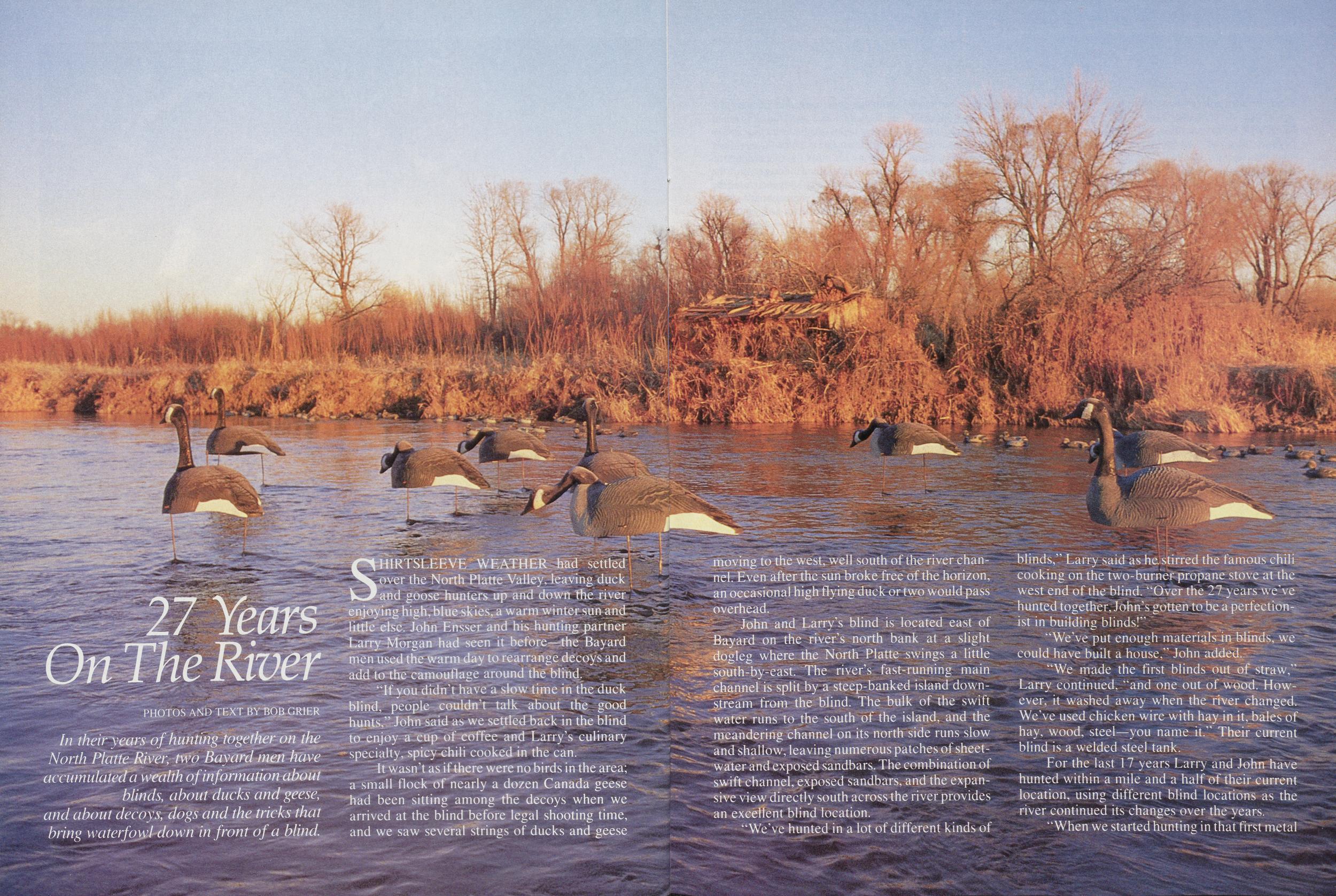
27 Years On The River
PHOTOS AND TEXT BY BOB GR1ERIn their years 0 hunting together on the North Platte River, two Bavard men have accumulated a wealth of information about blinds, about ducks and geese, and about decoys, dogs and the tricks that bring waterfowl down in front of a blind.
SHIRTSLEEVE WEATHER over the North Platte Valley, leaving duck J and goose hunters up and down the river ing high, blue skies, a warm winter sun arid; else. John Ensser and his hunting partner Larry Morgan had seen it before—the Bayard men used the warm day to rearrange decoys and add to the camouflage around the Mind
"If you didn't have a slow time in the blind, people couldn't talk about the good hunts," John said as we settled back in the blind to enjoy a cup of coffee and Larry's culinary specialty, spicy ebili cooked in the can.
It wasn't as if there were no birds in the area; a small flock df nearly a dozen Canada geese had been sitting among the decoys when we arrived at the blind before legal shooting time, and we saw several strings of ducks and geese he west, well south of the river chan-an occasional high flying duck or two would pass overhead.
John and Larry's blind is located east of Bayard on the river's north bank at a slight dogleg where the North Platte swings a little south-by-east. The river's fast-running main channel is split by a steep-banked island downstream from the blind. The bulk of the swift wafer runs to the south of the island, and the meandering channel on its north side runs slow and shallow, leaving numerous patches of sheet-water and exposed sandbars. The combination of swift channel, exposed sandbars, and the expansive view directly south across the river provides an excellent blind location.
"We've hunted in a lot of different kinds of blinds," Larry said as he stirred the famous chili cooking on the two-burner propane stove at the west end of the blind. "Over the 27 years we've hunted together, John's gotten to be a perfectionist in building blinds!"
"We've put enough materials in blinds, we could have built a house," John added.
"We made the first blinds out of straw," Larry continued, "and one out of wood. However, it washed away when the river changed. We've used chicken wire with hay in it, bales of hay, wood, steel—you name it." Their current blind is a welded steel tank.
For the last 17 years Larry and J hunted within a mile and a half of their current location, using different blind locations as the river continued its changes over the years.
'When we started hunting in that first metal
 blind, we used a decoy boat, pulling it
out to the channel every morning,"
Larry said. "Every morning we would
be down there early, way before shooting time, to put out about 150 duck
decoys and take them in every day
before we left. We finally got lazy and
started leaving them in!"
blind, we used a decoy boat, pulling it
out to the channel every morning,"
Larry said. "Every morning we would
be down there early, way before shooting time, to put out about 150 duck
decoys and take them in every day
before we left. We finally got lazy and
started leaving them in!"
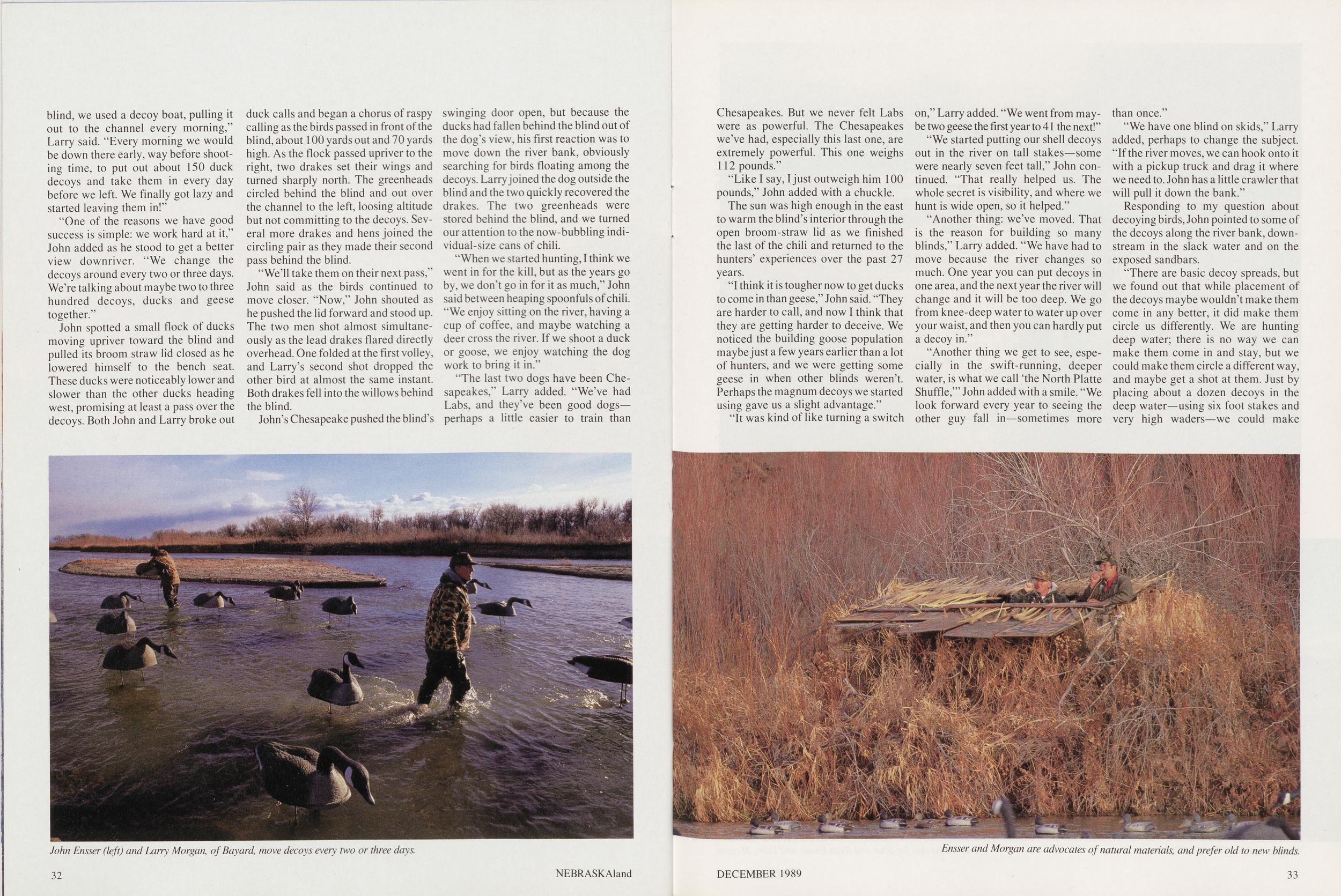
"One of the reasons we have good success is simple: we work hard at it," John added as he stood to get a better view downriver. "We change the decoys around every two or three days. We're talking about maybe two to three hundred decoys, ducks and geese together."
John spotted a small flock of ducks moving upriver toward the blind and pulled its broom straw lid closed as he lowered himself to the bench seat. These ducks were noticeably lower and slower than the other ducks heading west, promising at least a pass over the decoys. Both John and Larry broke out duck calls and began a chorus of raspy calling as the birds passed in front of the blind, about 100 yards out and 70 yards high. As the flock passed upriver to the right, two drakes set their wings and turned sharply north. The greenheads circled behind the blind and out over the channel to the left, loosing altitude but not committing to the decoys. Several more drakes and hens joined the circling pair as they made their second pass behind the blind.
"We'll take them on their next pass," John said as the birds continued to move closer. "Now," John shouted as he pushed the lid forward and stood up. The two men shot almost simultaneously as the lead drakes flared directly overhead. One folded at the first volley, and Larry's second shot dropped the other bird at almost the same instant. Both drakes fell into the willows behind the blind.
John's Chesapeake pushed the blind's swinging door open, but because the ducks had fallen behind the blind out of the dog's view, his first reaction was to move down the river bank, obviously searching for birds floating among the decoys. Larry joined the dog outside the blind and the two quickly recovered the drakes. The two greenheads were stored behind the blind, and we turned our attention to the now-bubbling individual-size cans of chili.
"When we started hunting, I think we went in for the kill, but as the years go by, we don't go in for it as much," John said between heaping spoonfuls of chili. "We enjoy sitting on the river, having a cup of coffee, and maybe watching a deer cross the river. If we shoot a duck or goose, we enjoy watching the dog work to bring it in."
"The last two dogs have been Chesapeakes," Larry added. "We've had Labs, and they've been good dogs— perhaps a little easier to train than
"Like I say, I just outweigh him 100 pounds," John added with a chuckle.
The sun was high enough in the east to warm the blind's interior through the open broom-straw lid as we finished the last of the chili and returned to the hunters' experiences over the past 27 years.
"I think it is tougher now to get ducks to come in than geese," John said. "They are harder to call, and now I think that they are getting harder to deceive. We noticed the building goose population maybe just a few years earlier than a lot of hunters, and we were getting some geese in when other blinds weren't. Perhaps the magnum decoys we started using gave us a slight advantage."
"It was kind of like turning a switch on," Larry added. "We went from maybe two geese the first year to 41 the next!"
"We started putting our shell decoys out in the river on tall stakes—some were nearly seven feet tall," John continued. "That really helped us. The whole secret is visibility, and where we hunt is wide open, so it helped."
"Another thing: we've moved. That is the reason for building so many blinds," Larry added. "We have had to move because the river changes so much. One year you can put decoys in one area, and the next year the river will change and it will be too deep. We go from knee-deep water to water up over your waist, and then you can hardly put a decoy in."
"Another thing we get to see, especially in the swift-running, deeper water, is what we call 'the North Platte Shuffle,'" John added with a smile. "We look forward every year to seeing the other guy fall in—sometimes more than once."
"We have one blind on skids," Larry added, perhaps to change the subject. "If the river moves, we can hook onto it with a pickup truck and drag it where we need to. John has a little crawler that will pull it down the bank."
Responding to my question about decoying birds, John pointed to some of the decoys along the river bank, downstream in the slack water and on the exposed sandbars.
'There are basic decoy spreads, but we found out that while placement of the decoys maybe wouldn't make them come in any better, it did make them circle us differently. We are hunting deep water; there is no way we can make them come in and stay, but we could make them circle a different way, and maybe get a shot at them. Just by placing about a dozen decoys in the deep water—using six foot stakes and very high waders—we could make
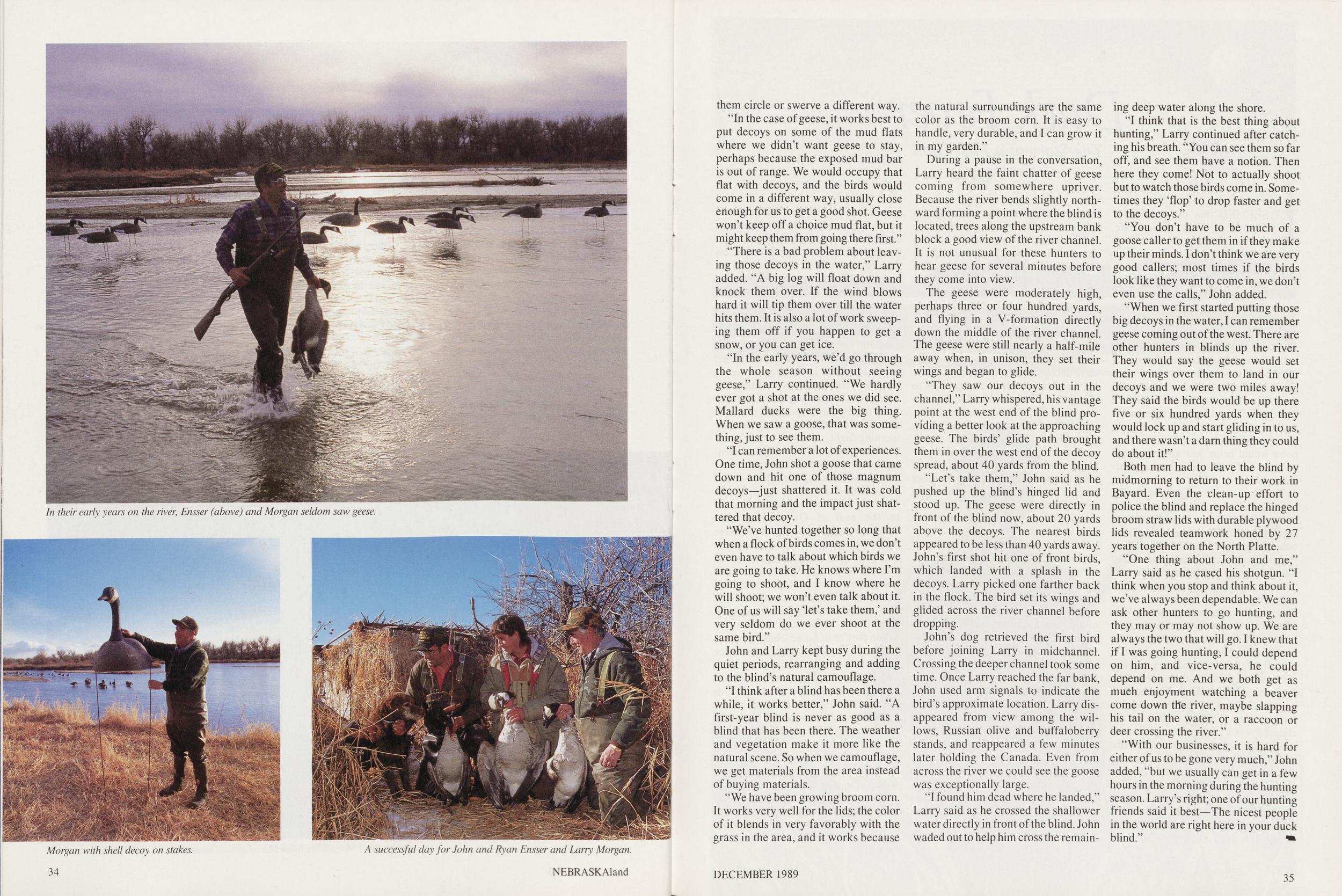
"In the case of geese, it works best to put decoys on some of the mud flats where we didn't want geese to stay, perhaps because the exposed mud bar is out of range. We would occupy that flat with decoys, and the birds would come in a different way, usually close enough for us to get a good shot. Geese won't keep off a choice mud flat, but it might keep them from going there first."
"There is a bad problem about leaving those decoys in the water," Larry added. "A big log will float down and knock them over. If the wind blows hard it will tip them over till the water hits them. It is also a lot of work sweeping them off if you happen to get a snow, or you can get ice.
"In the early years, we'd go through the whole season without seeing geese," Larry continued. "We hardly ever got a shot at the ones we did see. Mallard ducks were the big thing. When we saw a goose, that was something, just to see them.
"I can remember a lot of experiences. One time, John shot a goose that came down and hit one of those magnum decoys—just shattered it. It was cold that morning and the impact just shattered that decoy.
"We've hunted together so long that when a flock of birds comes in, we don't even have to talk about which birds we are going to take. He knows where I'm going to shoot, and I know where he will shoot; we won't even talk about it. One of us will say let's take them,' and very seldom do we ever shoot at the same bird."
John and Larry kept busy during the quiet periods, rearranging and adding to the blind's natural camouflage.
"I think after a blind has been there a while, it works better," John said. "A first-year blind is never as good as a blind that has been there. The weather and vegetation make it more like the natural scene. So when we camouflage, we get materials from the area instead of buying materials.
"We have been growing broom corn. It works very well for the lids; the color of it blends in very favorably with the grass in the area, and it works because the natural surroundings are the same color as the broom corn. It is easy to handle, very durable, and I can grow it in my garden."
During a pause in the conversation, Larry heard the faint chatter of geese coming from somewhere upriver. Because the river bends slightly northward forming a point where the blind is located, trees along the upstream bank block a good view of the river channel. It is not unusual for these hunters to hear geese for several minutes before they come into view.
The geese were moderately high, perhaps three or four hundred yards, and flying in a V-formation directly down the middle of the river channel. The geese were still nearly a half-mile away when, in unison, they set their wings and began to glide.
"They saw our decoys out in the channel," Larry whispered, his vantage point at the west end of the blind providing a better look at the approaching geese. The birds' glide path brought them in over the west end of the decoy spread, about 40 yards from the blind.
"Let's take them," John said as he pushed up the blind's hinged lid and stood up. The geese were directly in front of the blind now, about 20 yards above the decoys. The nearest birds appeared to be less than 40 yards away. John's first shot hit one of front birds, which landed with a splash in the decoys. Larry picked one farther back in the flock. The bird set its wings and glided across the river channel before dropping.
John's dog retrieved the first bird before joining Larry in midchannel. Crossing the deeper channel took some time. Once Larry reached the far bank, John used arm signals to indicate the bird's approximate location. Larry disappeared from view among the willows, Russian olive and buffalo-berry stands, and reappeared a few minutes later holding the Canada. Even from across the river we could see the goose was exceptionally large.
"I found him dead where he landed," Larry said as he crossed the shallower water directly in front ofthe blind. John waded out to help him cross the remaining deep water along the shore.
"I think that is the best thing about hunting," Larry continued after catching his breath. "You can see them so far off, and see them have a notion. Then here they come! Not to actually shoot but to watch those birds come in. Sometimes they 'flop' to drop faster and get to the decoys."
"You don't have to be much of a goose caller to get them in if they make up their minds. I don't think we are very good callers; most times if the birds look like they want to come in, we don't even use the calls," John added.
'When we first started putting those big decoys in the water, I can remember geese coming out of the west. There are other hunters in blinds up the river. They would say the geese would set their wings over them to land in our decoys and we were two miles away! They said the birds would be up there five or six hundred yards when they would lock up and start gliding in to us, and there wasn't a darn thing they could do about it!"
Both men had to leave the blind by midmorning to return to their work in Bayard. Even the clean-up effort to police the blind and replace the hinged broom straw lids with durable plywood lids revealed teamwork honed by 27 years together on the North Platte.
"One thing about John and me," Larry said as he cased his shotgun. "I think when you stop and think about it, we've always been dependable. We can ask other hunters to go hunting, and they may or may not show up. We are always the two that will go. I knew that if I was going hunting, I could depend on him, and vice-versa, he could depend on me. And we both get as much enjoyment watching a beaver come down the river, maybe slapping his tail on the water, or a raccoon or deer crossing the river."
"With our businesses, it is hard for either of us to be gone very much," John added, "but we usually can get in a few hours in the morning during the hunting season. Larry's right; one of our hunting friends said it best—The nicest people in the world are right here in your duck blind."
DECEMBER 1989 35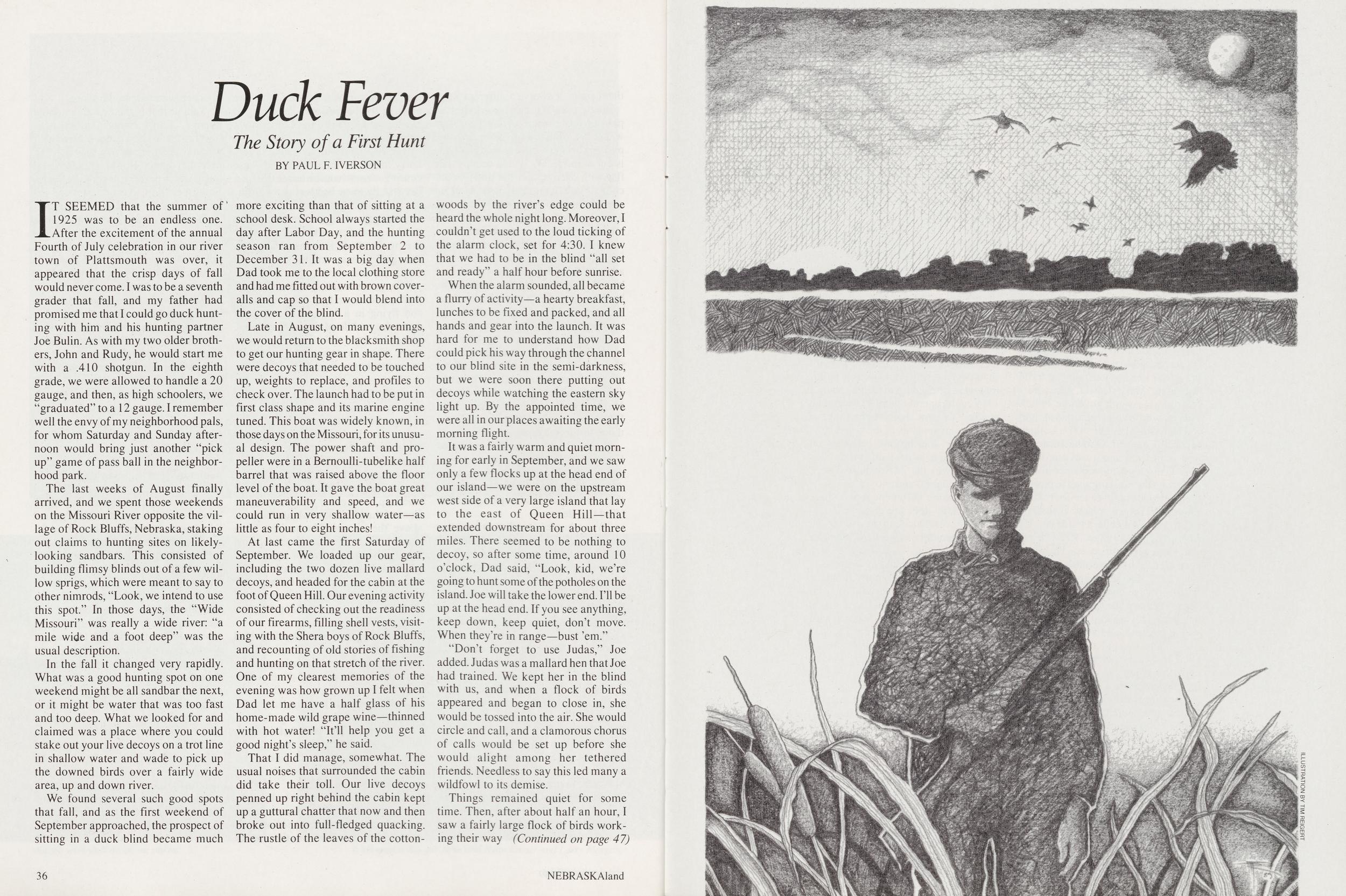
Duck Fever
The Story of a First Hunt BY PAUL F. IVERSONIT SEEMED that the summer of 1925 was to be an endless one. After the excitement of the annual Fourth of July celebration in our river town of Plattsmouth was over, it appeared that the crisp days of fall would never come. I was to be a seventh grader that fall, and my father had promised me that I could go duck hunting with him and his hunting partner Joe Bulin. As with my two older brothers, John and Rudy, he would start me with a .410 shotgun. In the eighth grade, we were allowed to handle a 20 gauge, and then, as high schoolers, we "graduated" to a 12 gauge. I remember well the envy of my neighborhood pals, for whom Saturday and Sunday afternoon would bring just another "pick up" game of pass ball in the neighborhood park.
The last weeks of August finally arrived, and we spent those weekends on the Missouri River opposite the village of Rock Bluffs, Nebraska, staking out claims to hunting sites on likely-looking sandbars. This consisted of building flimsy blinds out of a few willow sprigs, which were meant to say to other nimrods, "Look, we intend to use this spot." In those days, the "Wide Missouri" was really a wide river: "a mile wide and a foot deep" was the usual description.
In the fall it changed very rapidly. What was a good hunting spot on one weekend might be all sandbar the next, or it might be water that was too fast and too deep. What we looked for and claimed was a place where you could stake out your live decoys on a trot line in shallow water and wade to pick up the downed birds over a fairly wide area, up and down river.
We found several such good spots that fall, and as the first weekend of September approached, the prospect of sitting in a duck blind became much 36 more exciting than that of sitting at a school desk. School always started the day after Labor Day, and the hunting season ran from September 2 to December 31. It was a big day when Dad took me to the local clothing store and had me fitted out with brown coveralls and cap so that I would blend into the cover of the blind.
Late in August, on many evenings, we would return to the blacksmith shop to get our hunting gear in shape. There were decoys that needed to be touched up, weights to replace, and profiles to check over. The launch had to be put in first class shape and its marine engine tuned. This boat was widely known, in those days on the Missouri, for its unusual design. The power shaft and propeller were in a Bernoulli-tubelike half barrel that was raised above the floor level of the boat. It gave the boat great maneuverability and speed, and we could run in very shallow water—as little as four to eight inches!
At last came the first Saturday of September. We loaded up our gear, including the two dozen live mallard decoys, and headed for the cabin at the foot of Queen Hill. Our evening activity consisted of checking out the readiness of our firearms, filling shell vests, visiting with the Shera boys of Rock Bluffs, and recounting of old stories of fishing and hunting on that stretch of the river. One of my clearest memories of the evening was how grown up I felt when Dad let me have a half glass of his home-made wild grape wine—thinned with hot water! "It'll help you get a good night's sleep," he said.
That I did manage, somewhat. The usual noises that surrounded the cabin did take their toll. Our live decoys penned up right behind the cabin kept up a guttural chatter that now and then broke out into full-fledged quacking. The rustle of the leaves of the cottonwoods by the river's edge could be heard the whole night long. Moreover, I couldn't get used to the loud ticking of the alarm clock, set for 4:30. I knew that we had to be in the blind "all set and ready" a half hour before sunrise.
When the alarm sounded, all became a flurry of activity—a hearty breakfast, lunches to be fixed and packed, and all hands and gear into the launch. It was hard for me to understand how Dad could pick his way through the channel to our blind site in the semi-darkness, but we were soon there putting out decoys while watching the eastern sky light up. By the appointed time, we were all in our places awaiting the early morning flight.
It was a fairly warm and quiet morning for early in September, and we saw only a few flocks up at the head end of our island—we were on the upstream west side of a very large island that lay to the east of Queen Hill—that extended downstream for about three miles. There seemed to be nothing to decoy, so after some time, around 10 o'clock, Dad said, "Look, kid, we're going to hunt some of the potholes on the island. Joe will take the lower end. I'll be up at the head end. If you see anything, keep down, keep quiet, don't move. When they're in range—bust 'em."
"Don't forget to use Judas," Joe added. Judas was a mallard hen that Joe had trained. We kept her in the blind with us, and when a flock of birds appeared and began to close in, she would be tossed into the air. She would circle and call, and a clamorous chorus of calls would be set up before she would alight among her tethered friends. Needless to say this led many a wildfowl to its demise.
Things remained quiet for some time. Then, after about half an hour, I saw a fairly large flock of birds working their way (Continued on page 47)
36 NEBRASKAland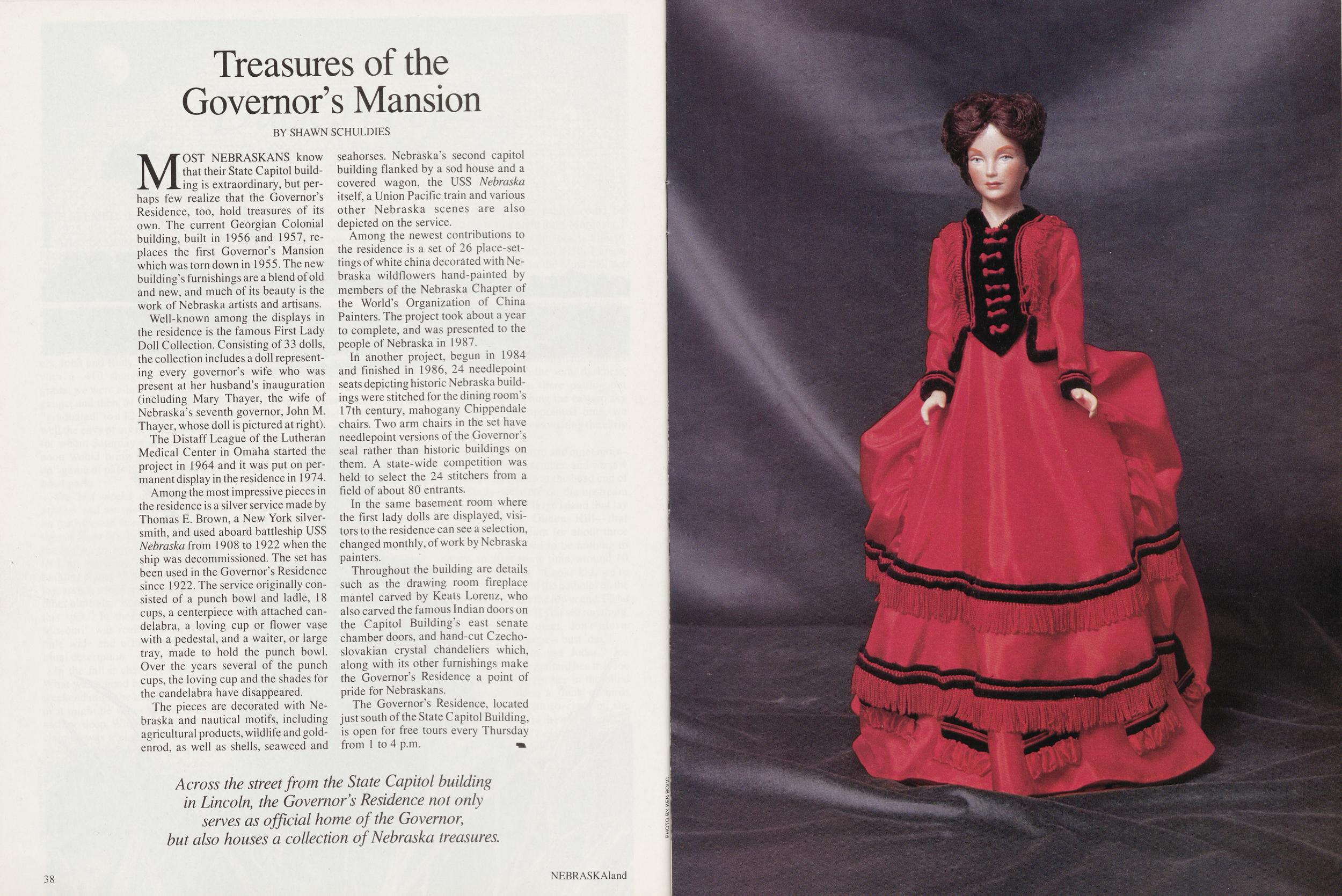
Treasures of the Governor's Mansion
BY SHAWN SCHULDIESMOST NEBRASKANS know that their State Capitol building is extraordinary, but perhaps few realize that the Governor's Residence, too, hold treasures of its own. The current Georgian Colonial building, built in 1956 and 1957, replaces the first Governor's Mansion which was torn down in 1955. The new building's furnishings are a blend of old and new, and much of its beauty is the work of Nebraska artists and artisans.
Well-known among the displays in the residence is the famous First Lady Doll Collection. Consisting of 33 dolls, the collection includes a doll representing every governor's wife who was present at her husband's inauguration (including Mary Thayer, the wife of Nebraska's seventh governor, John M. Thayer, whose doll is pictured at right).
The Distaff League of the Lutheran Medical Center in Omaha started the project in 1964 and it was put on permanent display in the residence in 1974.
Among the most impressive pieces in the residence is a silver service made by Thomas E. Brown, a New York silversmith, and used aboard battleship USS Nebraska from 1908 to 1922 when the ship was decommissioned. The set has been used in the Governor's Residence since 1922. The service originally consisted of a punch bowl and ladle, 18 cups, a centerpiece with attached candelabra, a loving cup or flower vase with a pedestal, and a waiter, or large tray, made to hold the punch bowl. Over the years several of the punch cups, the loving cup and the shades for the candelabra have disappeared.
The pieces are decorated with Nebraska and nautical motifs, including agricultural products, wildlife and goldenrod, as well as shells, seaweed and seahorses. Nebraska's second capitol building flanked by a sod house and a covered wagon, the USS Nebraska itself, a Union Pacific train and various other Nebraska scenes are also depicted on the service.
Among the newest contributions to the residence is a set of 26 place-settings of white china decorated with Nebraska wildflowers hand-painted by members of the Nebraska Chapter of the World's Organization of China Painters. The project took about a year to complete, and was presented to the people of Nebraska in 1987.
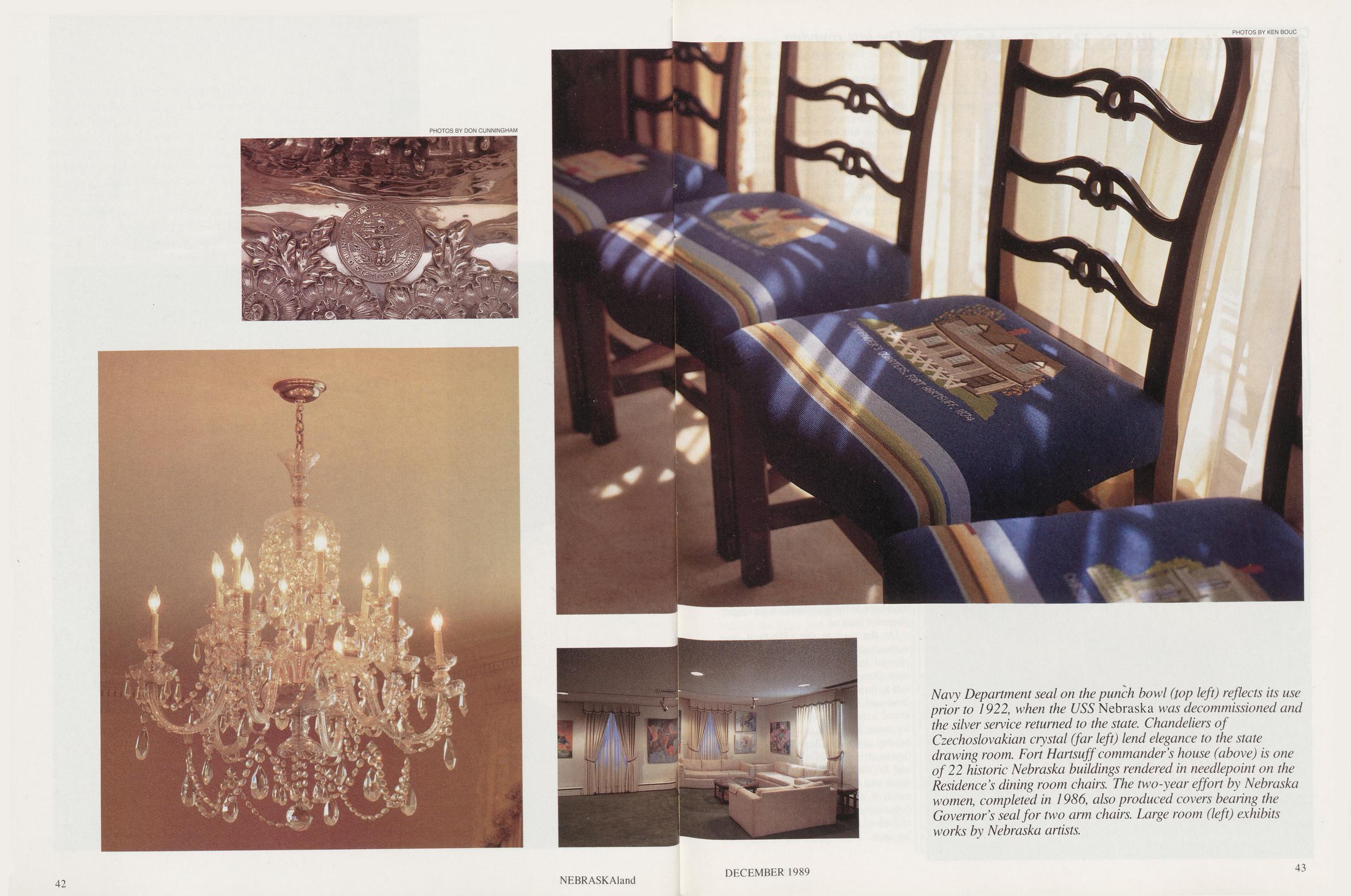
In another project, begun in 1984 and finished in 1986, 24 needlepoint seats depicting historic Nebraska buildings were stitched for the dining room's 17th century, mahogany Chippendale chairs, Two arm chairs in the set have needlepoint versions of the Governor's seal rather than historic buildings on them. A state-wide competition was held to select the 24 stitchers from a field of about 80 entrants.
In the same basement room where the first lady dolls are displayed, visitors to the residence can see a selection, changed monthly, of work by Nebraska painters.
Throughout the building are details such as the drawing room fireplace mantel carved by Keats Lorenz, who also carved the famous Indian doors on the Capitol Building's east senate chamber doors, and hand-cut Czechoslovakian crystal chandeliers which, along with its other furnishings make the Governor's Residence a point of pride for Nebraskans.
The Governor's Residence, located just south of the State Capitol Building, is open for free tours every Thursday from 1 to 4 p.m.
Across the street from the State Capitol building in Lincoln, the Governors Residence not only serves as official home of the Governor, but also houses a collection of Nebraska treasures. 38 NEBRASKAland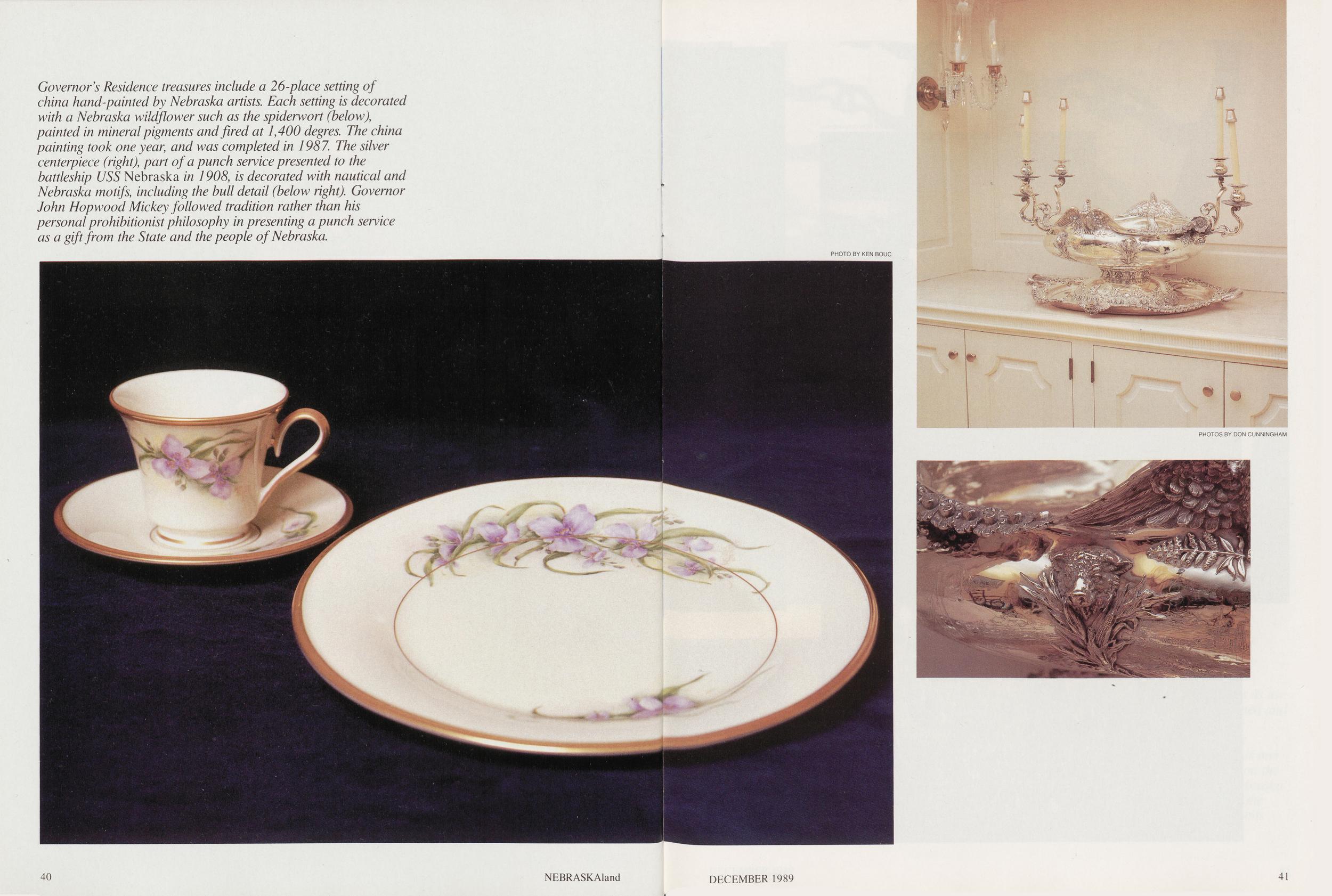
 Limited-edition Belt Buckle
The Malcolm, Nebraska Gun Club proudly presents this facsimile of the Nebraska 1990
Wildlife Habitat Stamp as a belt buckle, in cooperation with Artist Robert Klausing
and the
Nebraska Game and Parks Commission. These heavy, top-quality buckles, by the Award
Design Medals Company, are limited to 1,000 brass; 200 gold-silver plate and 100 sterling
silver. Each is registered by name and number, so purchaser has first choice at future
editions. To order, send money order or check to: Malcolm Gun Club, P.O. Box 194,
Malcolm, NE 68402. Phone (402) 796-2244. Prices are:
Brass-$19.95, Gold/silverplate-$45, Solid silver-$135 +
$1.90 for insurance (silver only)
Please include $1.80 for packing and shipping + 4% sales tax.
Allow four to six weeks for delivery.
Size Approximately 4 inches by 3 inches.
A few 1984/85/86/87/88/89 buckles available for prices listed above.
BEST OF SHOW 1989 KANSAS CITY DUCKS UNLIMITED NATIONAL WILDLIFE ART SHOW
"TERNOON
BYGENERONCKA
IMAGE 16"x20" 580 S/N $85. 35A/P$150. 100 PAINTED REMARQUES $210.
SHIPPING ADD $5. NEBRASKA RESIDENTS ADD 4% SALES TAX.
Limited-edition Belt Buckle
The Malcolm, Nebraska Gun Club proudly presents this facsimile of the Nebraska 1990
Wildlife Habitat Stamp as a belt buckle, in cooperation with Artist Robert Klausing
and the
Nebraska Game and Parks Commission. These heavy, top-quality buckles, by the Award
Design Medals Company, are limited to 1,000 brass; 200 gold-silver plate and 100 sterling
silver. Each is registered by name and number, so purchaser has first choice at future
editions. To order, send money order or check to: Malcolm Gun Club, P.O. Box 194,
Malcolm, NE 68402. Phone (402) 796-2244. Prices are:
Brass-$19.95, Gold/silverplate-$45, Solid silver-$135 +
$1.90 for insurance (silver only)
Please include $1.80 for packing and shipping + 4% sales tax.
Allow four to six weeks for delivery.
Size Approximately 4 inches by 3 inches.
A few 1984/85/86/87/88/89 buckles available for prices listed above.
BEST OF SHOW 1989 KANSAS CITY DUCKS UNLIMITED NATIONAL WILDLIFE ART SHOW
"TERNOON
BYGENERONCKA
IMAGE 16"x20" 580 S/N $85. 35A/P$150. 100 PAINTED REMARQUES $210.
SHIPPING ADD $5. NEBRASKA RESIDENTS ADD 4% SALES TAX.
The last roundup
(Continued from page 13)and 14 roosters. The action grew furious for the walkers as they approached the drainage.
There were shots missed that looked easy to a blocker who wasn't in head-high sunflowers and who hadn't been shoving his way through knee-deep snow. As the walkers pushed through the draw in the bottom, there were apparently easy shots missed by blockers who had nothing to do for the last 45 minutes but stand around and rest up for the shooting. In the end, the walkers had, and no doubt deserved, the best of the shooting. They killed four roosters. Of the blockers, only Joel, posting the southeast corner of the field, had shot a bird.
I've always subscribed to the old maxim attributed to Caesar or Patton, or some general in between the two, and a party of hunters, like an army, marches on its stomach. Like Luke, I'm used to being well fed when I hunt, and I had about had it with this outfit which seemed to need no food, drink or rest while wallowing in what had become seemingly endless snow-filled patches of sunflowers. But finally, after the five-rooster field, they relented, and produced enough sandwiches, chips, rolls and pop to have fueled Patton or Caesar's armies for at least a week.
A small, triangular patch of sunflowers south of a farm house had been billed as one of the best fields we would walk all day. On a previous hunt it was reputed to have been bumper-to-bumper roosters, but when we pushed it all the birds, including the hens, must have been in the grainfields; not a single pheasant flushed.
On the way to the next field, we walked across a few hundred yards of plowed ground with a little sliver no more than 30 yards long which was too wet to farm and was filled with shatter cane and snow. The dogs ranged out ahead across the plowed ground and we were bunched up talking as we headed down the slope. Luke was the first to arrive at the little patch of cover and he started working birdy on the south end. A bevy of Brittanies hit the patch at about the middle. When the dogs converged at the north end, a rooster flushed and after a couple of "sporting shots" to get him out a little farther 44 NEBRASKAland he crumpled. Two Brittanies grabbed opposite ends of the rooster and made a "duet retrieve" for the first 15 yards or so before one, through sheer strength or intimidation, wrested it from the other.
The field to the west must have been nearly three-quarters of a mile long. We started on the south end, and three or four hunters drove around to the north to block. What began as a weedy pasture on the lower south end rose to land where the tallest cover was an occasional clump of little bluestem. It didn't look like good pheasant cover but surprisingly we put up several hens and two roosters which flushed out of range.
We walked one more big patch of CRP land where the only shot fired by the walkers was at a rooster that flushed at marginal range. The blockers on the north end said several roosters had flushed ahead of us and glided to a weedy bottom with a few trees just over the ridge. John Kirby and some others decided to try those birds, and the rest of us went with Wayne to what would be the last walk of the day.
From a distance, Wayne's spot didn't look like much. It was two quarter-mile-long, parallel strips of native grass, each no more than 20 yards wide and about 20 yards apart on a mowed sidehill. Once we got closer, however, they looked considerably better. The strips were mostly bluestem, and were easier walking than the other CRP land. A sunflower-filled drainage cut diagonally across the strips about two-thirds of the way from the north end. As we approached that weedy intersection, a hen flushed out of range, then another, then a rooster, then more hens. Tired legs revived and we hurried behind the dogs just in time to walk behind a point and shoot a lingering rooster. Seventy or 80 yards farther, the dogs ground to a halt again and another rooster flushed, the fifteenth and last bird of the day. When we reached the south end of the strip it was exactly 4 p.m., quitting time.
Fifteen roosters for nine hunters figures out to roughly a bird-and-a-half per hunter, which beat the opening-day, statewide average of 1.29 birds per hunter. For the last weekend of a long season, during which the ratio of roosters to hens had declined considerably, we had not done badly. None of the birds had come easily. These hunters and picked a good area with good fields, and had developed good landowner relations. They hunted hard, field after field, all day long, and used good dogs, dogs with a fair amount of experience under their collars. I would not be afraid to speculate that without dogs, we'd have had only half the shots at roosters within killing range, and of those knocked down in the thick cover typical of CRP land we would have not found half.
NEAL R. ANDERSON The 1989-90 federal duck stamp, a pair of lesser scaup, was done by Lincoln, Nebraska, artist Neal Anderson. It is now available as a collector print in three editions, as detailed below. Federal stamp art is the most collectible of any limited edition. Image size is 6 !/2x9 inches, actual print size is 12x14 inches, signed and numbered. Regular edition (20,000 s/n) print—$145 Medallion edition (7,000 s/n) w/gold-plated medallion—$325 Executive edition (500 s/n) w/remarque, silver/gold medallion—$950 Mint stamp $ 12.50 Signed stamp $ 15 Fine art poster $ 16 (Plus shipping & sales tax) Write or call for details The Masterworks Gallery and Frame Shop 5601 So. 56th St., St. 5 (402) 423-3884 Lincoln, NE 68516 Calamus Country Restaurant-Lounge-Lodge-R.V. Hook-ups Residential and Commercial Lots (308) 346-4729 6 Miles northwest of Burwell, NE up the Dam Road DECEMBER 1989 45 13th ANNUAL
NEBRASKA HABITAT
STAMP ART CONTEST
Submission
Entries may be protected by a covering (no plastic foodwrap) but will not be accepted
in
frames, under glass or plastic wrap. Wrap securely and send to: Habitat Stamp Contest,
Nebraska Game and Parks Commission, 2200 N. 33rd St., P.O. Box 30370, Lincoln, NE
68503. A completed entry form and reproduction agreement or facsimile thereof must
accompany the entry. Name and address of the artist must appear only on the reverse
side of the entry. The Game and Parks Commission is not responsible for any entry
lost
or damaged in transit. ENTRIES WILL NOT BE RETURNED UNLESS SPECIFICALLY
REQUESTED AND SELF-ADDRESSED MAILER WITH PROPER POSTAGE IS
INCLUDED.
Prizes
Adult division first place winner receives $200 from the Omaha Fish and Wildlife
Club. Runners-up all receive a subscription to NEBRASKAIand Magazine.
Youth Division first place winners in each section receive $50 from the Omaha Fish
and Wildlife Club. Runners-up all receive a subscription to NEBRASKAIand Magazine.
Selected entries will be included in a traveling exhibit to be displayed at various
locations around the state.
Divisions
Adult: Amateur or professional artists. Youth: Senior Section: Grades 9-12; Junior
Section: Grades 5-8; Primary Section: Grades K-4.
Technical Requirements
Design must be 71/2 inches by 411/ie inches. It may be matted, but mat may not
exceed 10 inches by 7 inches. Any medium acceptable, but no scroll work or
lettering may appear on the design. Color is preferred. One entry per person.
Subject Matter
Any Nebraska wildlife species in an appropriate habitat setting, except sharp-tailed
grouse, sandhill crane, snow geese, mallard ducks, and pheasants which
are ineligible this year.
Entry Deadline
March 1, 1990
Contest is open to Nebraska residents only, and winning entry in the Adult
Division will appear on the 1991 Nebraska Habitat Stamp.
Entry Form
Please accept my entry in the design contest for the 1991 Nebraska Habitat Stamp.
I
hereby certify that I have complied with all of the rules governing this competition
and that
the work submitted is my own original creation. Further, the Nebraka Game and Parks
Commission is hereby authorized to reproduce the design on the 1991 Habitat Stamp
or
in any other fashion it may deem appropriate.
Division/Section
Title of Entry
Name
Grade in School
Medium.
Age if under 19.
Name of Parent or Guardian
Address
City, State, Zip
Home Phone _
School Phone.
Name of School
School Address
City, State, Zip
□ Please return my entry. I have included the appropriate postage.
Signature of Artist
13th ANNUAL
NEBRASKA HABITAT
STAMP ART CONTEST
Submission
Entries may be protected by a covering (no plastic foodwrap) but will not be accepted
in
frames, under glass or plastic wrap. Wrap securely and send to: Habitat Stamp Contest,
Nebraska Game and Parks Commission, 2200 N. 33rd St., P.O. Box 30370, Lincoln, NE
68503. A completed entry form and reproduction agreement or facsimile thereof must
accompany the entry. Name and address of the artist must appear only on the reverse
side of the entry. The Game and Parks Commission is not responsible for any entry
lost
or damaged in transit. ENTRIES WILL NOT BE RETURNED UNLESS SPECIFICALLY
REQUESTED AND SELF-ADDRESSED MAILER WITH PROPER POSTAGE IS
INCLUDED.
Prizes
Adult division first place winner receives $200 from the Omaha Fish and Wildlife
Club. Runners-up all receive a subscription to NEBRASKAIand Magazine.
Youth Division first place winners in each section receive $50 from the Omaha Fish
and Wildlife Club. Runners-up all receive a subscription to NEBRASKAIand Magazine.
Selected entries will be included in a traveling exhibit to be displayed at various
locations around the state.
Divisions
Adult: Amateur or professional artists. Youth: Senior Section: Grades 9-12; Junior
Section: Grades 5-8; Primary Section: Grades K-4.
Technical Requirements
Design must be 71/2 inches by 411/ie inches. It may be matted, but mat may not
exceed 10 inches by 7 inches. Any medium acceptable, but no scroll work or
lettering may appear on the design. Color is preferred. One entry per person.
Subject Matter
Any Nebraska wildlife species in an appropriate habitat setting, except sharp-tailed
grouse, sandhill crane, snow geese, mallard ducks, and pheasants which
are ineligible this year.
Entry Deadline
March 1, 1990
Contest is open to Nebraska residents only, and winning entry in the Adult
Division will appear on the 1991 Nebraska Habitat Stamp.
Entry Form
Please accept my entry in the design contest for the 1991 Nebraska Habitat Stamp.
I
hereby certify that I have complied with all of the rules governing this competition
and that
the work submitted is my own original creation. Further, the Nebraka Game and Parks
Commission is hereby authorized to reproduce the design on the 1991 Habitat Stamp
or
in any other fashion it may deem appropriate.
Division/Section
Title of Entry
Name
Grade in School
Medium.
Age if under 19.
Name of Parent or Guardian
Address
City, State, Zip
Home Phone _
School Phone.
Name of School
School Address
City, State, Zip
□ Please return my entry. I have included the appropriate postage.
Signature of Artist
Hunters old enough remember—probably all too well—the frustration of hunting in the Soil Bank days. There was lots of cover, ready access to fields to hunt, and there were lots of pheasants; pheasants that ran like rabbits through mazes of trails at ground level, either never flushing or flushing wild. There were also pheasants downed, too many pheasants downed, that were never found. Statistics, if they exist, may not support it, but back in the 1950s and early 1960s, hunting dogs were scarce in Nebraska.
Hunters without dogs, or those who have never hunted behind even an average bird dog, probably grow weary of hearing, and probably won't believe until they see for themselves, the number of birds they walk by or the number of downed birds a dog will find. Admittedly, during the spring and summer some bird hunters wonder why they put up with the inconvenience of a bird dog: the smudged storm doors, holes in the lawn, and gnawed chair legs. But come hunting season, such minor drawbacks are soon forgotten.
If there ever were a time for a Nebraska hunter to have a bird dog, now, when thousands of acres of CRP land are just coming on, is surely that time.
And if for some reason you can't have your own bird dog, and if you just happen to be in the market for a house, take my advice and buy in a neighborhood where lawns are weedy and front doors have a few nose prints.
NEBRASKA OPERATION GAME THIEF STOP POACHING TOLL-FREE HOTLINE (800) 742-7627 46 NEBRASKAlandDuck fever
(Continued from page 36)the main chute of the river on our side of the island. Sure enough, they were coming straight my way. When they seemed close enough, I set Judas on her way. She performed in her usual effective manner, and after one swing the flock of a dozen green-winged teal were right in the midst of our decoys.
I watched and watched, fascinated. I realized I was supposed to shoot, but just could not bring my gun up into firing position. In this period of quiet enchantment, it came to me that either Dad or Joe would be returning soon, and I had best do something. After some minutes, still some distance away, I could see my father approaching from the north. I stood up, the birds flushed, and I fired into the blue.
On his arrival, he asked, "Say, didn't I see some birds take out of here?"
"Yes, Dad, about a dozen green-wings."
"Were they in range? Did you get any down?"
"I shot, but I didn't bring anything down."
After a pause and a questioning look, he explained, "Look, kid, you've got to lead 'em. If it's fairly calm, three bird lengths for small ducks, two for middle size ones, and one for large ones. If you're missing 'em, lead them more on the next try. Got it?"
"Yes, Dad, I'll do better next time, I promise."
Eventually I did get so that I could do better, and Dad did make "real sports" out of his three sons. Nevertheless, I'll always remember that first morning in September long ago when I had "duck fever" over that lovely flock of green-wings, shining in the morning sun.
Paul Iverson, a Plattsmouth native, returned there following retirement from West Virginia University. One of the reasons, he reports, was to hunt the Missouri again: "My brothers and I always said, 'Someday we'll get back into it together,' and we did!" Another of his reminiscences, "Shootout on the Wide Missouri," appeared in NEBRASKAland in November 1987.
Conservation in all things 1 out of 2 teens in America has taken 1 out of 2 parents doesn't see it. See, the Washingtons think it's the Smith kid. The Smiths think it's the Sanchez kid. Maybe the Sanchezes think it's your kid. Maybe it is your kid. Find out. Talk to your kids. ' Tell 'em the dangers of drugs. Tell 'em how to handle peer pressure. Tell 'em you care. It's not easy. But I can help. So write me, McGruff, EO. Box 362, Washington, D.C. 20044. Don't let your kids take a powder. Or anything else. Together, we can help Take a Bite out of Crime. TAKE A BITE OUT OF The legend lives... Ultimate Luxury Comforter filled with Nebraska's own Ogallala Down * Natural Cotton Cover Lightweight Warm an intimate mixture of milkweed floss and goose down. Available in King, Full/Queen or Twin Sizes For more information CALL TOLL FREE L800'658-4370 FAX: 308-284-8405 SEND FOR OUR FREE BROCHURE W natural fibers P.O. Box 830 - Searle Field Ogallala, NE 69153 NAME ADDRESS CITY STATE ZIP DECEMBER 1989 47
Trading Post
DOGSYELLOW-BLACK Lab pups. FC-AFC sired. AKC. Hips OFA eeritified. Dew claws removed. Excellent hunting potential. Contact Bob Bendler, Lexington, NE (308) 324-4247.
TRAINING ALL BREEDS Hunting Dogs — Vizslas for sale. Rozanek Kennels, Rt. 2, Schuyler, NE 68661. Phone (402) 352-8769.
ENGLISH SETTERS: "Bred for the hunter"; select puppies and started dogs available from outstanding blood- lines. Stud service available by proven hunters. High Plains Kennels, 1411 Emerson, Alliance, NE 69301, Phone (308) 762-6709.
GERMAN SHORTHAIRS and Brittany Spaniel pups. Started and occasionally a meat dog. Pups are guaranteed. Also I will be training hunting dogs. Wayne Clark, Percival, IA. Phone (712) 529-4238 or (402) 263-3155 at Union, NE
ENGLISH POINTER pups breeding Elhew; started dogs, force retrieving; at stud Ch. Elhew Husker John. J. H. Render, Box 86, Panama, NE 68419. Phone (402) 788-2213.
YOUNG ENGLISH SETTERS for sale. Close up pat-finder breeding. Darrel Yentes, Holdrege, NE 68949. Phone (308) 995-4797.
BLACK LAB PUPS. FC-AFC sired, Shotgun Willie from the West Coast. Litter due October 24: Contact Todd TerMaat (402) 488-0095, Lincoln, NE.
PINKERTON bird dogs—English setter, brittany puppies. Started dogs available this fall. Our dogs are bred for nose and style. Give us a call at (402) 673-4540.
MISCELLANEOUSNE NEBRASKA trout fishing. 3 modern cottages, 1 available year round. 5 spring fed lakes with open water all year. Trout up to 7 pounds. Other varieties fish also. Diamond E. Trout Resort, Orchard, NE 68764. Phone (402)893-4745.
AIR GUNS repaired — Benjamin, Crosman, Daisy, other American made. Restoration; old guns wanted, Jack's Air Guns, 1225 No. 46th, Lincoln, NE 68503. Phone (402) 466-9223.
Bev Doolittle, Terrry Redlin, Jerry Raedke, Ed Wards, Robert Bateman, Frank McCarthy and Neal Anderson are available at the 2nd Street Gallery, 537 W. 2nd, Hastings, NE 68901. Phone (402) 463-6677.
TROLLING MOTOR REPAIR. Factory authorized Minn Kota and Motor Guide, parts and service. Wolfs Repair and Tackle Supply, 1529 David Drive, Lincoln, NE 68504. Phone (402) 464-4265.
WINE AND BEER: Make your own. Send for free recipes and instructions. Omaha Supply, 1324 2nd Avenue, Nebraska City, NE 68410.
GUNS — Browning, Winchester, Remington, others, Hi-powers, shotguns, new, used, antiques. Want Pre -1964 Winchesters. Buy-Sell-Trade. Ph. (402) 729-6112. Bedlan's Sporting Goods, Fairbury, NE 68352.
MAD RIVER CANOES offers the finest quality and performance. For the finest canoes and accessories look to Great Plains Canoe Co., 205 Main, Springfield, NE. Phone(402)253-2001.
FREE! Booklets on northeastern Nevada; fishing, rock-hounding maps, Carl Hayden, Box 528, Jackpot, Nevada 89825.
MANDARIN DUCKS $35 pair, Woodducks $25 pair. Nice full-wing birds. Mrs. R. W. Hansen, 3315 Avenue L, Kearney, NE 68847. Phone (308) 237-3781.
CALAMUS RIVER HIDEAWAY, 62 acres with nice 4-bedroom home and guest cabin on lake full of fish. Beautiful setting, remote but just 30 miles to big dam. 640 leased acres can also go along. Have many other Rec-Properties, Swett Realty, P.O. Box 265, Ainsworth, NE 69210. Phone (402) 387-1626 day or night.
ICE FISHING SUPPLIES. Large selection and low prices! This month's special, Jiffy 30-08 Power ice auger, the big 3 H.P. with 8" blade only $229.95. F.O.B. Lincoln. Wolfs Tackle Supply, 15 29 David Dr., Lincoln, NE 68504. Phone (402) 464-4265.
COUNTRY SETTING hunting lodge sleeps 14. Fully furnished for sale with 120 acres ground. Serious inquiries only. For info write Manager, Big Sandy Hunting Lodge, R 1 Box 78, Edgar, NE 68935.
WAX WORMS 500/$8.25;1000/$14.50. Add 4% sales tax. Postpaid first class. No C.O.D.'s. Harold Malicky, Burwell, NE 68823.
FISH FOR SALE. Catfish, perch, coho salmon, rainbow trout, crappie, bluegill, walleye, minnows, goldfish, bullhead, largemouth bass, smallmouth bass, triploid grass carp. Commercial grower prices on catfish, perch, coho salmon, rainbow trout. Consulting available. Pleasant Valley Fish Farm, Rt 1 Box 147, McCook, NE 69001. Phone (308) 345-6599.
RINGNECK PHEASANTS for sale. Full-feathered, flight conditioned and taxidermy quality birds. Swanson Hunting Acres, Inc., Rt 1 Box 18. Niobrara, NE 68760. Phone (402) 857-3794.
TAXIDERMYALLISON'S TAXIDERMY STUDIO. Wally and Betty Allison Licensed Taxidermist. We've mounted 28 Nebraska State Record fish. Specializing in fish and birds, small game and rattlesnakes. We use freeze-dry. 2310 West Leota, North Platte, Nebr. 69101. Phone (308) 534-2324.
BADE TAXIDERMY — Quality a must — Fast service. Fish, birds, rugs, tanning, full mounts and game heads, 2111 N. Christy St., Fremont, NE 727-5463.
NABITY'S TAXIDERMY. 31 years experience. Specializing in natural grass backgrounds for mammals, birds and fish. 13901 "O" St., Lincoln, NE 68504 — 4 miles east of 84th and "O". (402) 489-6351.
NATURECRAFT STUDIO - all custom services - creative work, quality, and experience since 1935. Includes freeze-dry processing. Display and sales room, visitors welcome. Hwy. 2 in Nebraska City. Phone (402) 873-5491. Joe Voges — Owner. Bow Steedly — Big Game specialist.
PEISTER TAXIDERMY — Professional work at prices most sportsman can afford. 1020 Central Avenue, Box 3201, Kearney, NE 68847. Phone (308) 236-9700 or (308) 237-7575 evenings.
NEBRASKAland Magazine Order Form Please send me a subscription to NEBRASKAland Magazine One-year $12.00 NAME Two-year $23.00 ADDRESS CITY STATE ZIP Mail to: NEBRASKAland Magazine, Box 30370, Lincoln, NE 68503 lout Of4 forest fires are started by fires. DUCKS UNLIMITED We need your help. Now. LIVE-CATCH ALL-PURPOSE TRAPS FREE CATALOG Traps without injury squirrels, chipmunks, rabbits, mink, fox, raccoons, stray animals, pests, etc Sizes for every need Also traps for snakes, sparrows, pigeons, crabs, turtles, quail, etc Save on our low factory prices Send no money Free catalog and trapping secrets MUSTANG MFG. CO., Dept. N-34. Box 920947, Houston, Tex 77292 Statement of ownership, management, and monthly circulation of NEBRASKAland Magazine OWNER AND PUBLISHER: Nebraska Game and Parks Commission EDITOR: Donald B. Cunningham MANAGING EDITOR: Lowell A. Johnson HEADQUARTERS OF PUBLISHER AND PUBLICATION: 2200 N. 33rd Street, Lincoln, NE 68503 STOCKHOLDERS, BONDHOLDERS, MORTGAGE and SECURITY HOLDERS: None Average No. of copies each issue during preceding 12 months Single issue nearest to filing date Oct. 88 A TOTAL COPIES PRINTED Sept. '89 Sept. '89 (net press run) 66,990 65,000 B. PAID CIRCULATION 1. Single-copy sales 2. Mail subscription 1,635 57,985 1,570 56,115 C. TOTAL PAID CIRCULATION 59,620 57,685 D. FREE DISTRIBUTION (incl. samples) BY MAIL, or OTHER MEANS (no news agency) 4,125 3,985 E. TOTAL DISTRIBUTION (sum of C and D) 63,745 61,670 F. OFFICE USE, LEFTOVERS, ETC. RETURNS FROM NEWSAGENTS 2,534 711 2,726 604 G. TOTAL (sum of E and F) 66,990 65,100 DECEMBER 1989 49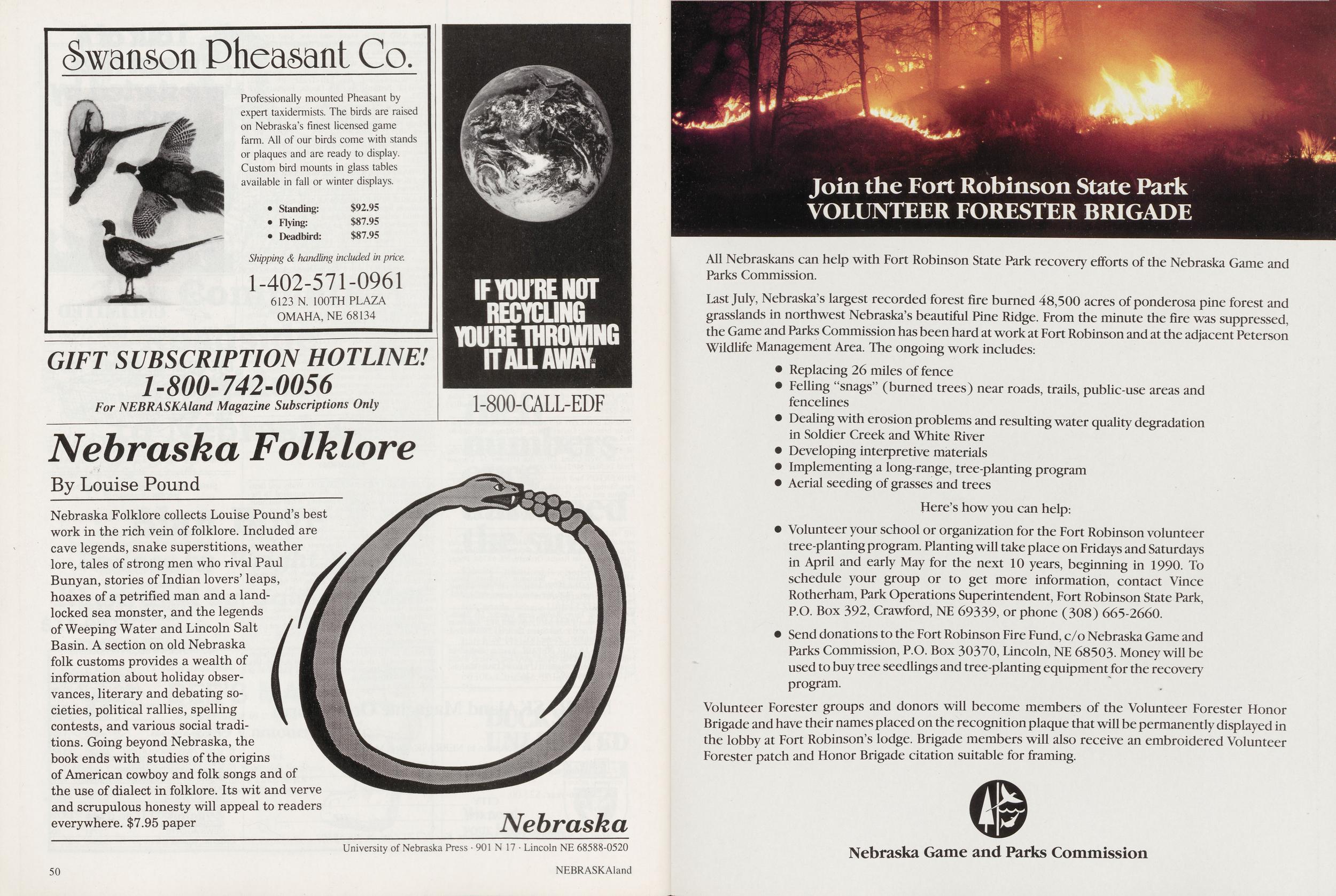 Swanson Pheasant Co.
Professionally mounted Pheasant by
expert taxidermists. The birds are raised
on Nebraska's finest licensed game
farm. All of our birds come with stands
or plaques and are ready to display.
Custom bird mounts in glass tables
available in fall or winter displays.
Standing: $92.95
Flying: $87.95
Deadbird: $87.95
Shipping & handling included in price.
1-402-571-0961
6123 N. 100TH PLAZA
OMAHA, NE 68134
GIFT SUBSCRIPTION HOTLINE!
1-800-742-0056
For NEBRASKAland Magazine Subscriptions Only
IF YOU'RE NOT
RECYCLING
YOU'RE THROWING
IT ALL AWAY
1-800-CALL-EDF
Swanson Pheasant Co.
Professionally mounted Pheasant by
expert taxidermists. The birds are raised
on Nebraska's finest licensed game
farm. All of our birds come with stands
or plaques and are ready to display.
Custom bird mounts in glass tables
available in fall or winter displays.
Standing: $92.95
Flying: $87.95
Deadbird: $87.95
Shipping & handling included in price.
1-402-571-0961
6123 N. 100TH PLAZA
OMAHA, NE 68134
GIFT SUBSCRIPTION HOTLINE!
1-800-742-0056
For NEBRASKAland Magazine Subscriptions Only
IF YOU'RE NOT
RECYCLING
YOU'RE THROWING
IT ALL AWAY
1-800-CALL-EDF
Nebraska Folklore
By Louise PoundNebraska Folklore collects Louise Pound's best work in the rich vein of folklore. Included are cave legends, snake superstitions, weather lore, tales of strong men who rival Paul Bunyan, stories of Indian lovers' leaps, hoaxes of a petrified man and a landlocked sea monster, and the legends of Weeping Water and Lincoln Salt Basin. A section on old Nebraska folk customs provides a wealth of information about holiday observances, literary and debating societies, political rallies, spelling contests, and various social traditions. Going beyond Nebraska, the book ends with studies of the origins of American cowboy and folk songs and of the use of dialect in folklore. Its wit and verve and scrupulous honesty will appeal to readers everywhere. $7.95 paper
All Nebraskans can help with Fort Robinson State Park recovery efforts of the Nebraska Game and Parks Commission.
Last July, Nebraska's largest recorded forest fire burned 48,500 acres of ponderosa pine forest and grasslands in northwest Nebraska's beautiful Pine Ridge. From the minute the fire was suppressed, the Game and Parks Commission has been hard at work at Fort Robinson and at the adjacent Peterson Wildlife Management Area. The ongoing work includes:
Replacing 26 miles of fence Felling "snags" (burned trees) near roads, trails, public-use areas and fencelines Dealing with erosion problems and resulting water quality degradation in Soldier Creek and White River Developing interpretive materials Implementing a long-range, tree-planting program Aerial seeding of grasses and treesHere's how you can help*.
Volunteer your school or organization for the Fort Robinson volunteer tree-planting program. Planting will take place on Fridays and Saturdays in April and early May for the next 10 years, beginning in 1990. To schedule your group or to get more information, contact Vince Rotherham, Park Operations Superintendent, Fort Robinson State Park, P.O. Box 392, Crawford, NE 69339, or phone (308) 665-2660. Send donations to the Fort Robinson Fire Fund, c/o Nebraska Game and Parks Commission, P.O. Box 30370, Lincoln, NE 68503. Money will be used to buy tree seedlings and tree-planting equipment for the recovery program.Volunteer Forester groups and donors will become members of the Volunteer Forester Honor Brigade and have their names placed on the recognition plaque that will be permanently displayed in the lobby at Fort Robinson's lodge. Brigade members will also receive an embroidered Volunteer Forester patch and Honor Brigade citation suitable for framing.
Nebraska Game and Parks Commission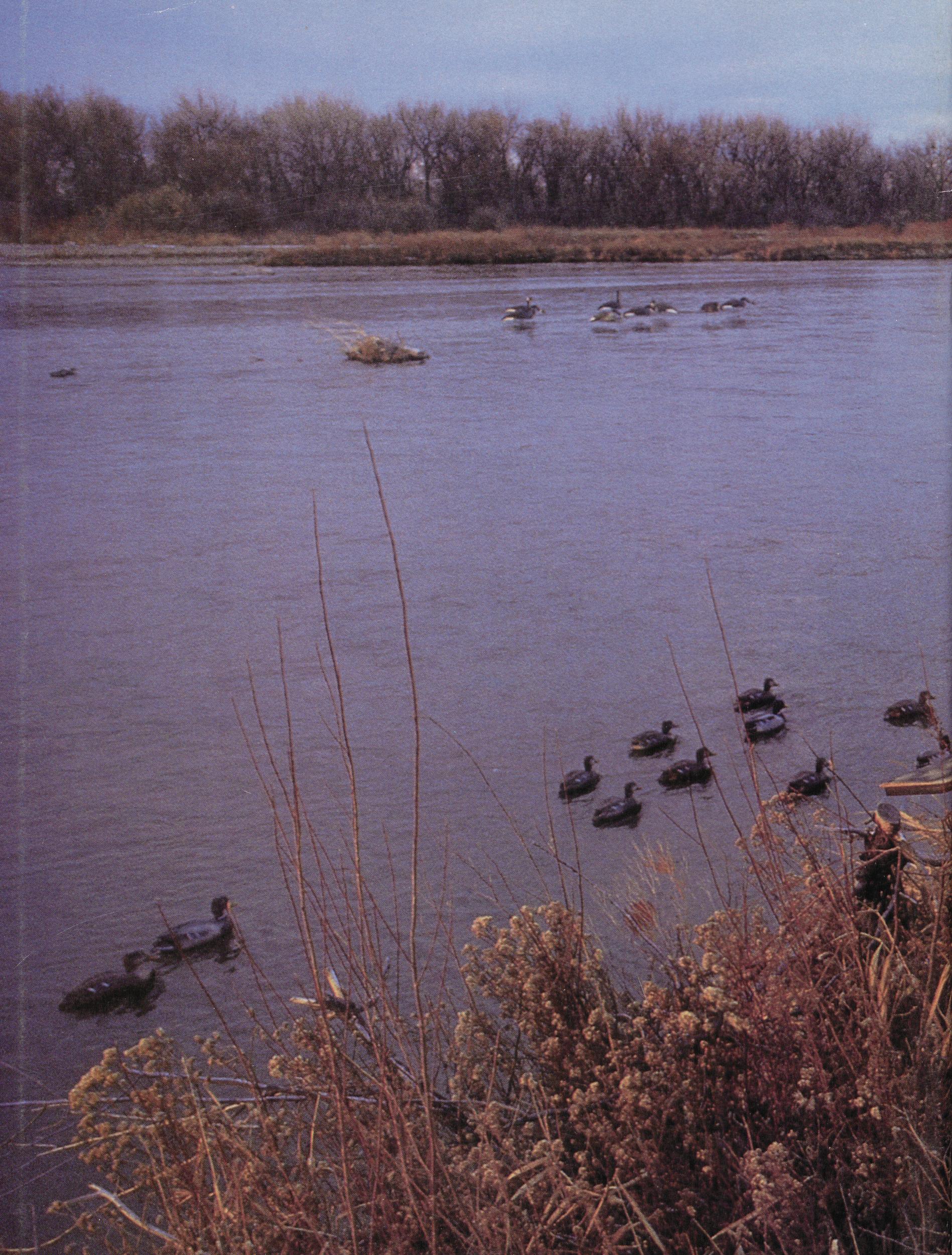
Position: 387 (25 views)