Volume 67, Issue 9, 1989
NEBRASKAland
NOVEMBER 1989 $1.50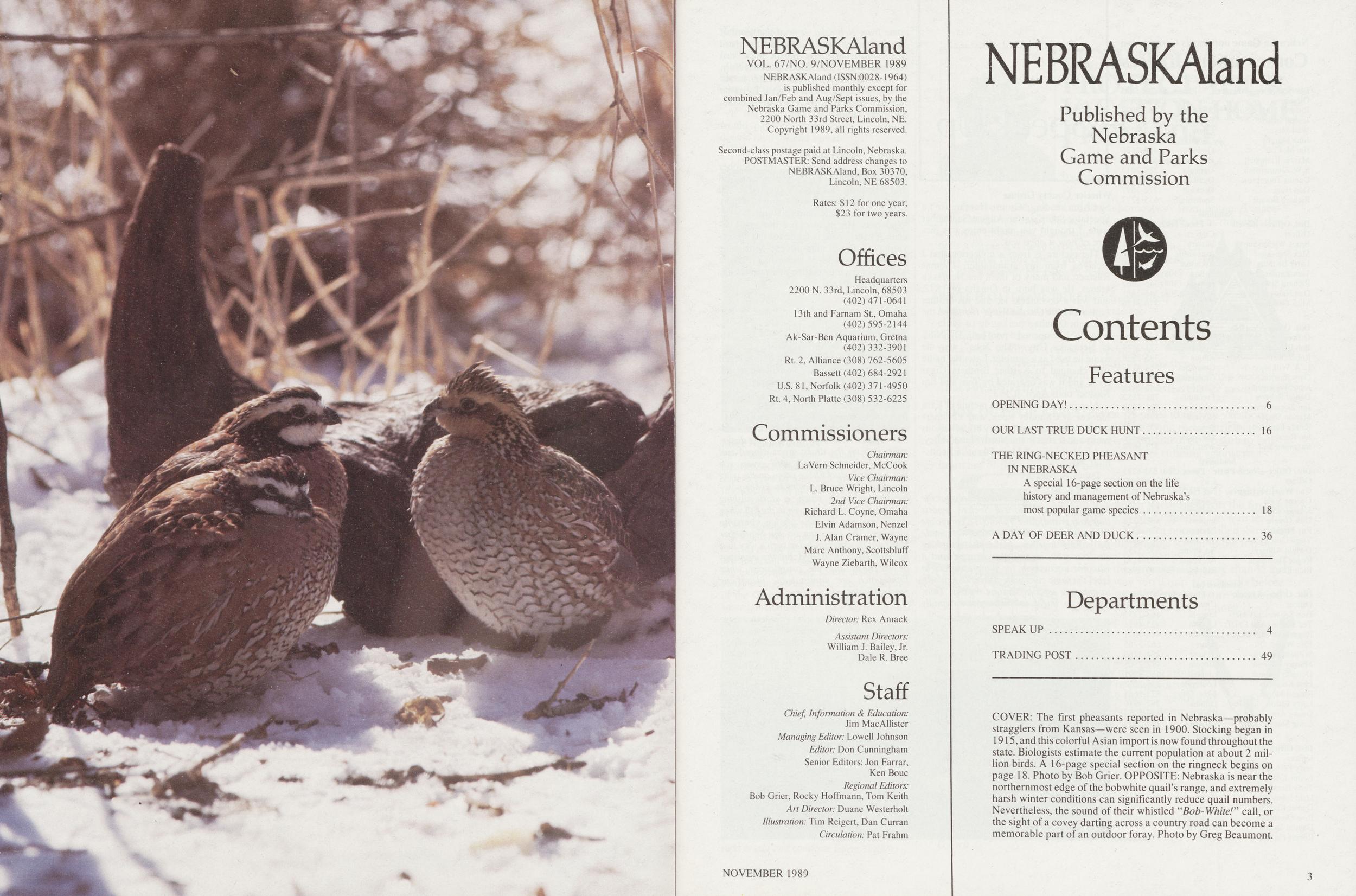
NEBRASKAland
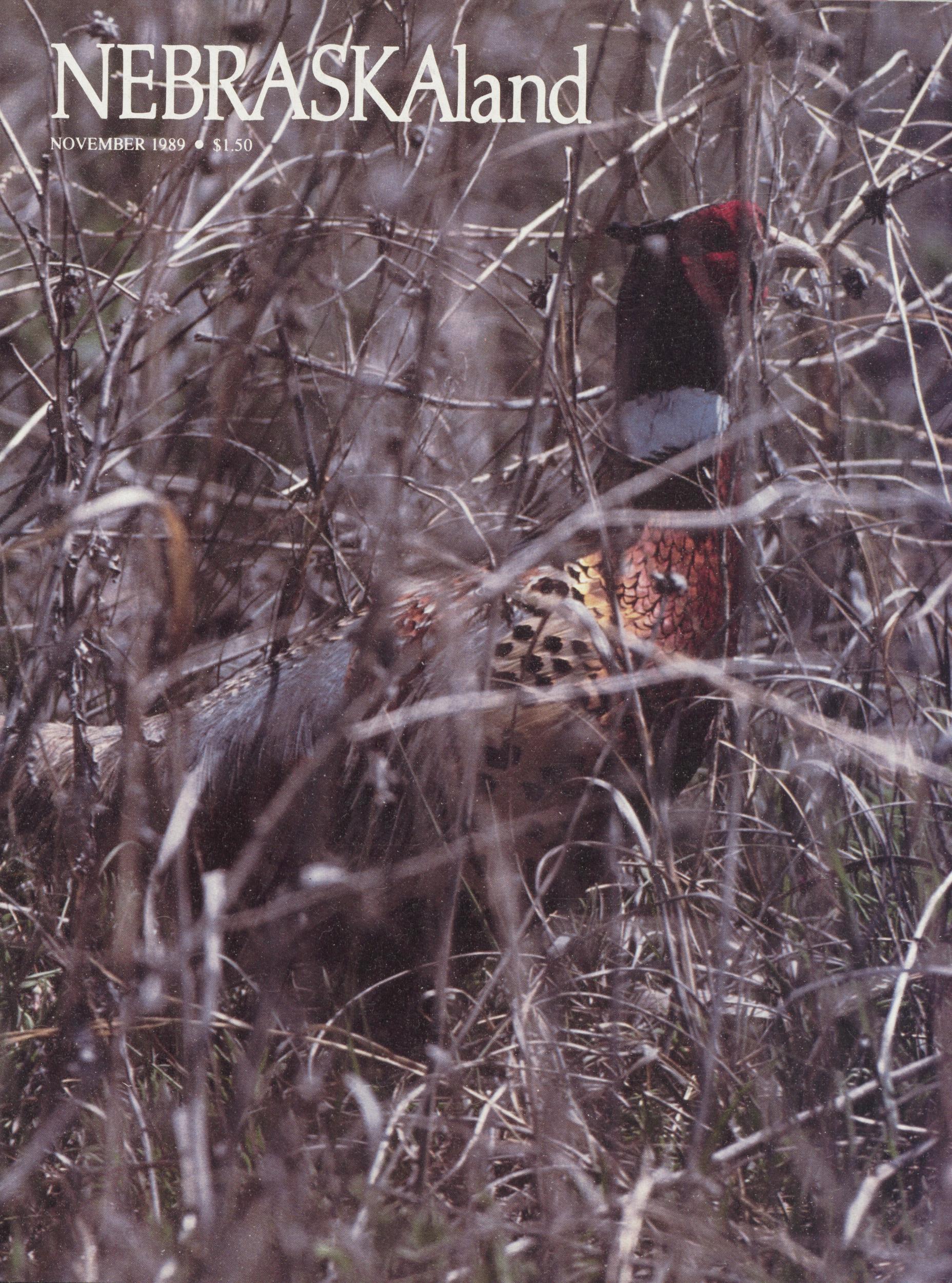
Published by the Nebraska Game and PArks Commission NEBRASKAland VOL. 67/NO. 9/NOVEMBER 1989 NEBRASKAland (ISSN:0028-1964) is published monthly except for combined Jan/Feb and Aug/Sept issues, by the Nebraska Game and Parks Commission, 2200 North 33rd Street, Lincoln, NE. Copyright 1989, all rights reserved. Second-class postage paid at Lincoln, Nebraska. POSTMASTER: Send address changes to NEBRASKAland, Box 30370, Lincoln, NE 68503. Rates: $ 12 for one year; $23 for two years. Offices Headquarters 2200 N. 33rd, Lincoln, 68503 (402)471-0641 13th and Farnam St., Omaha (402)595-2144 Ak-Sar-Ben Aquarium, Gretna (402)332-3901 Rt. 2, Alliance (308) 762-5605 Bassett (402) 684-2921 U.S. 81, Norfolk (402) 371 -4950 Rt. 4, North Platte (308) 532-6225 Commissioners Chairman: LaVern Schneider, McCook Vice Chairman: L. Bruce Wright, Lincoln 2nd Vice Chairman: Richard L. Coyne, Omaha Elvin Adamson, Nenzel J. Alan Cramer, Wayne Marc Anthony, Scottsbluff Wayne Ziebarth, Wilcox Administration Director: Rex Amack Assistant Directors: William J. Bailey, Jr. Dale R. Bree Staff Chief, Information & Education: Jim MacAllister Managing Editor: Lowell Johnson Editor: Don Cunningham Senior Editors: Jon Farrar, Ken Bouc Regional Editors: Bob Grier, Rocky Hoffmann, Tom Keith Art Director: Duane Westerholt Illustration: Tim Reigert, Dan Curran Circulation: Pat Frahm Contents Features OPENING DAY! OUR LAST TRUE DUCK HUNT THE RING-NECKED PHEASANT EM NEBRASKA A special 16-page section on the life history and management of Nebraska's most popular game species A DAY OF DEER AND DUCK 6 16 18 36 Departments SPEAK UP 4 TRADING POST 49 COVER: The first pheasants reported in Nebraska—probably stragglers from Kansas—were seen in 1900. Stocking began in 1915, and this colorful Asian import is now found throughout the state. Biologists estimate the current population at about 2 million birds. A 16-page special section on the ringneck begins on page 18. Photo by Bob Grier. OPPOSITE: Nebraska is near the northernmost edge of the bobwhite quail's range, and extremely harsh winter conditions can significantly reduce quail numbers. Nevertheless, the sound of their whistled "Bob-White!" call, or the sight of a covey darting across a country road can become a memorable part of an outdoor foray. Photo by Greg Beaumont.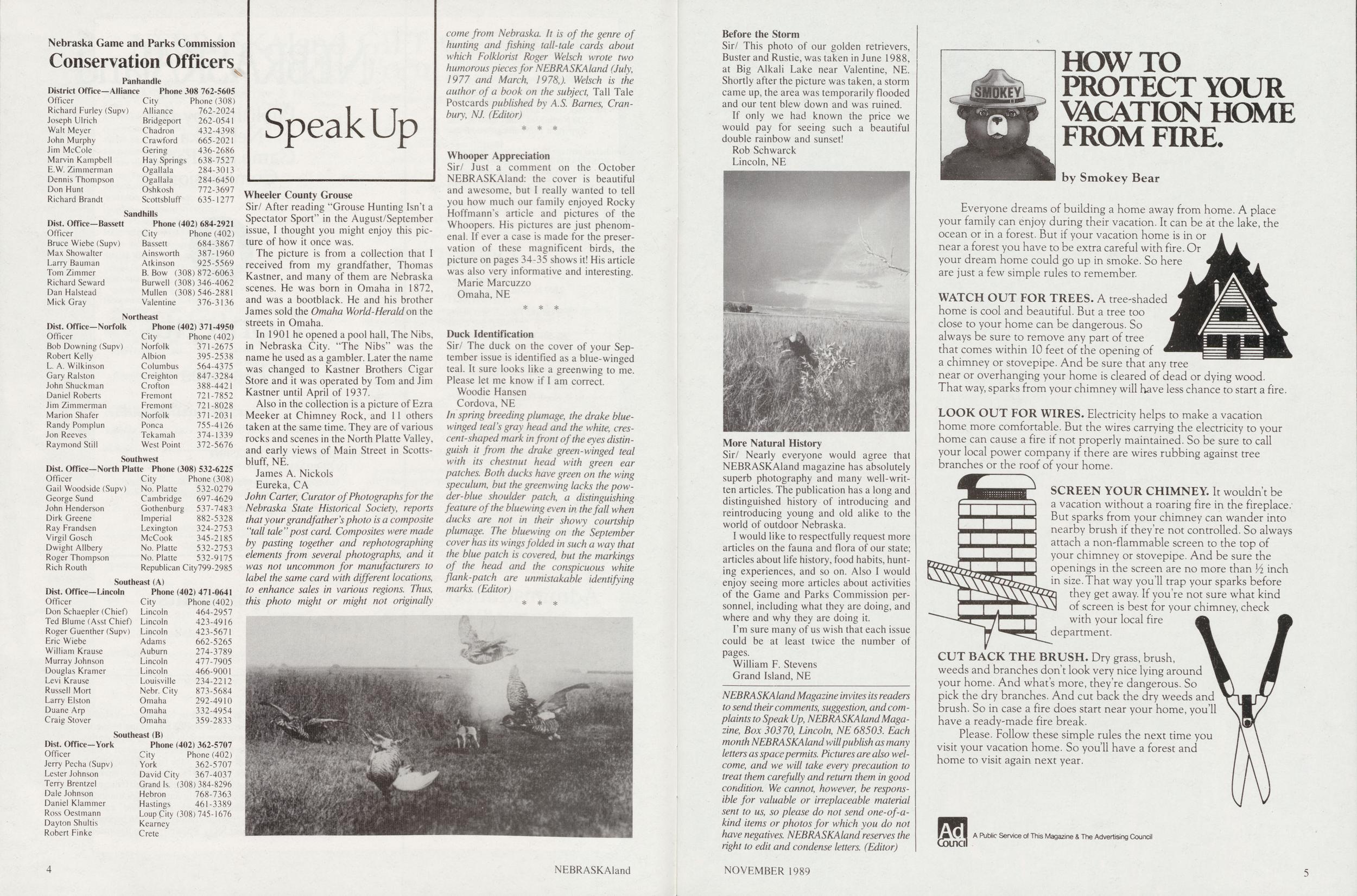
Speak Up
Wheeler County GrouseSir/ After reading "Grouse Hunting Isn't a Spectator Sport" in the August/September issue, I thought you might enjoy this picture of how it once was.
The picture is from a collection that I received from my grandfather, Thomas Kastner, and many of them are Nebraska scenes. He was born in Omaha in 1872, and was a bootblack. He and his brother James sold the Omaha World-Herald on the streets in Omaha.
In 1901 he opened a pool hall, The Nibs, in Nebraska City. "The Nibs" was the name he used as a gambler. Later the name was changed to Kastner Brothers Cigar Store and it was operated by Tom and Jim Kastner until April of 1937.
Also in the collection is a picture of Ezra Meeker at Chimney Rock, and 11 others taken at the same time. They are of various rocks and scenes in the North Platte Valley, and early views of Main Street in Scottsbluff, NE.
James A. Nickols Eureka, CAJohn Carter, Curator of Photographs for the Nebraska State Historical Society, reports that your grandfather's photo is a composite 'Jail tale"post card. Composites were made by pasting together and rephotographing elements from several photographs, and it was not uncommon for manufacturers to label the same card with different locations, to enhance sales in various regions. Thus, this photo might or might not originally come from Nebraska. It is of the genre of hunting and fishing tall-tale cards about which Folklorist Roger Welsch wrote two humorous pieces for NEBRASKAland (July, 1977 and March, 1978,). Welsch is the author of a book on the subject, Tall Tale Postcards published by A.S. Barnes, Cranbury, NJ. (Editor)
* * * Whooper AppreciationSir/ Just a comment on the October NEBRASKAland: the cover is beautiful and awesome, but I really wanted to tell you how much our family enjoyed Rocky Hoffmann's article and pictures of the Whoopers. His pictures are just phenomenal. If ever a case is made for the preservation of these magnificent birds, the picture on pages 34-35 shows it! His article was also very informative and interesting.
Marie Marcuzzo Omaha, NE * * * Duck IdentificationSir/ The duck on the cover of your September issue is identified as a blue-winged teal. It sure looks like a greenwing to me. Please let me know if I am correct.
Woodie Hansen Cordova, NEIn spring breeding plumage, the drake bluewinged teal's gray head and the white, crescent-shaped mark in front of the eyes distinguish it from the drake green-winged teal with its chestnut head with green ear patches. Both ducks have green on the vAng speculum, but the greenwing lacks the powder-blue shoulder patch, a distinguishing feature of the bluewing even in the fall when ducks are not in their showy courtship plumage. The bluewing on the September cover has its wings folded in such a way that the blue patch is covered, but the markings of the head and the conspicuous white flank-patch are unmistakable identifying marks. (Editor)
* * *Sir/ This photo of our golden retrievers, Buster and Rustie, was taken in June 1988, at Big Alkali Lake near Valentine, NE. Shortly after the picture was taken, a storm came up, the area was temporarily flooded and our tent blew down and was ruined.
If only we had known the price we would pay for seeing such a beautiful double rainbow and sunset!
Rob Schwarck Lincoln, NESir/ Nearly everyone would agree that NEBRASKAland magazine has absolutely superb photography and many well-written articles. The publication has a long and distinguished history of introducing and reintroducing young and old alike to the world of outdoor Nebraska.
I would like to respectfully request more articles on the fauna and flora of our state; articles about life history, food habits, hunting experiences, and so on. Also I would enjoy seeing more articles about activities of the Game and Parks Commission personnel, including what they are doing, and where and why they are doing it.
I'm sure many of us wish that each issue could be at least twice the number of pages.
William F. Stevens Grand Island, NENEBRASKAland Magazine invites its readers to send their comments, suggestion, and complaints to Speak Up, NEBRASKAland Magazine, Box 303 70, Lincoln, NE 68503. Each month NEBRASKAland will publish as many letters as space permits. Pictures are also welcome, and we will take every precaution to treat them carefully and return them in good condition. We cannot, however, be responsible for valuable or irreplaceable material sent to us, so please do not send one-of-a-kind items or photos for which you do not have negatives. NEBRASKAland reserves the right to edit and condense letters. (Editor)
HOW TO PROTECT YOUR CATION HOME FROM FIRE. by Smokey Bear Everyone dreams of building a home away from home. A place your family can enjoy during their vacation. It can be at the lake, the ocean or in a forest. But if your vacation home is in or near a forest you have to be extra careful with fire. Or your dream home could go up in smoke. So here are just a few simple rules to remember. WATCH OUT FOR TREES- A tree-shaded home is cool and beautiful. But a tree too close to your home can be dangerous. So always be sure to remove any part of tree that comes within 10 feet of the opening of a chimney or stovepipe. And be sure that any tree near or overhanging your home is cleared of dead or dying wood. That way, sparks from your chimney will have less chance to start a fire. LOOK OUT FOR WIRES. Electricity helps to make a vacation home more comfortable. But the wires carrying the electricity to your home can cause a fire if not properly maintained. So be sure to call your local power company if there are wires rubbing against tree branches or the roof of your home. SCREEN YOUR CHIMNEY. It wouldn't be a vacation without a roaring fire in the fireplace." But sparks from your chimney can wander into nearby brush if they're not controlled. So always attach a non-flammable screen to the top of your chimney or stovepipe. And be sure the openings in the screen are no more than Vi inch in size.That way you'll trap your sparks before they get away. If you're not sure what kind of screen is best for your chimney, check with your local fire department. CUT BACK THE BRUSH. Dry grass, brush, weeds and branches don't look very nice lying around your home. And what's more, they're dangerous. So pick the dry branches. And cut back the dry weeds and brush. So in case a fire does start near your home, you'll have a ready-made fire break. Please. Follow these simple rules the next time you visit your vacation home. So you'll have a forest and home to visit again next year. A Public Service of This Magazine & The Advertising Council NOVEMBER 1989 5
Opening Day!
TEXT BY KEN BOUC We can hunt grouse and doves in September, and geese and ducks in October, but for many Nebraskans that isn't really hunting season. It isn't hunting season when deer hunters are afield, or when the turkey hunters try to fool a big tom hunting season begins on opening day for pheasants.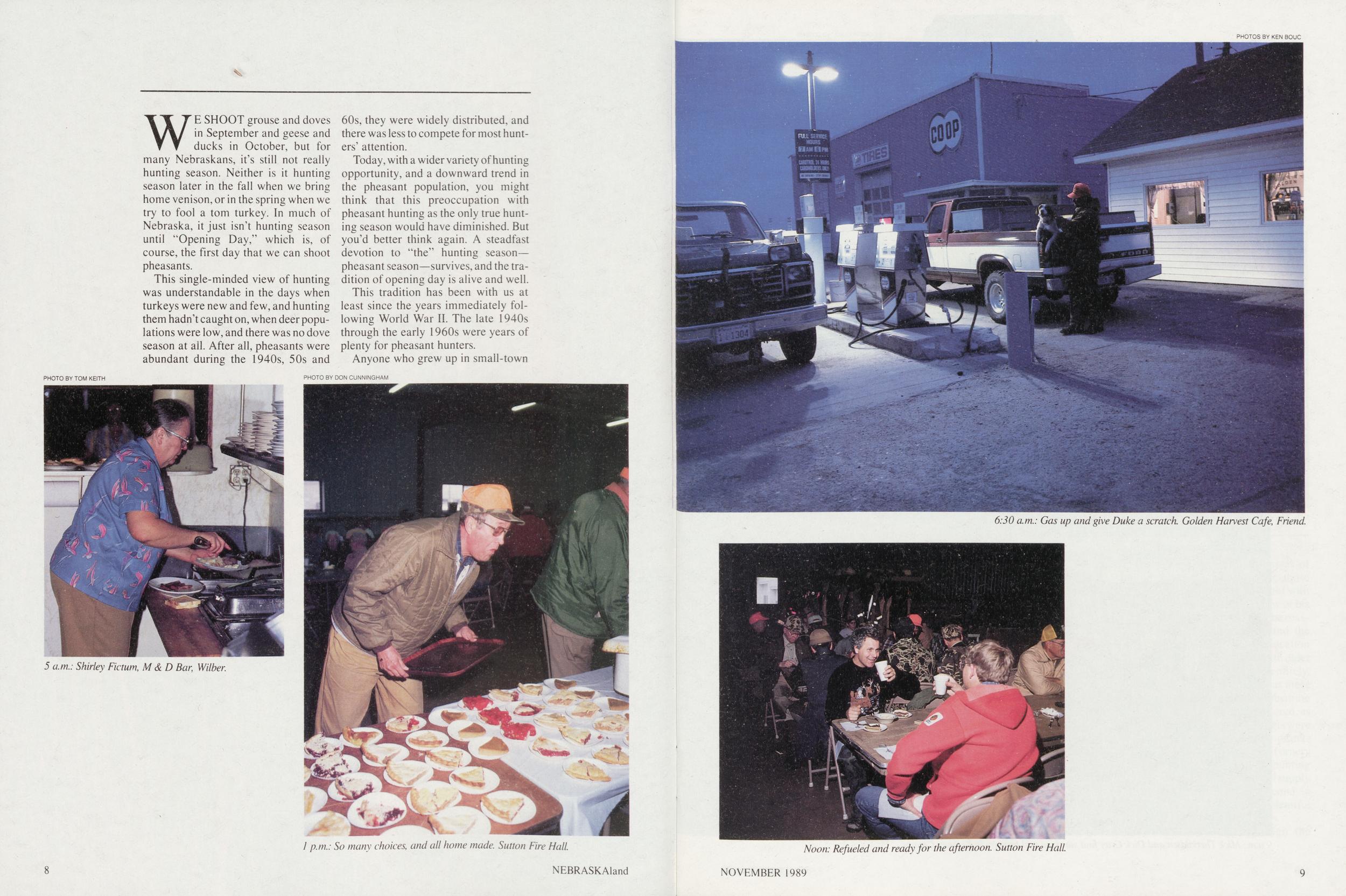
WE SHOOT grouse and doves in September and geese and ducks in October, but for many Nebraskans, it's still not really hunting season. Neither is it hunting season later in the fall when we bring home venison, or in the spring when we try to fool a torn turkey. In much of Nebraska, it just isn't hunting season until "Opening Day," which is, of course, the first day that we can shoot pheasants.
This single-minded view of hunting was understandable in the days when turkeys were new and few, and hunting them hadn't caught on, when deer populations were low, and there was no dove season at all. After all, pheasants were abundant during the 1940s, 50s and 60s, they were widely distributed, and there was less to compete for most hunters' attention.
Today, with a wider variety of hunting opportunity, and a downward trend in the pheasant population, you might think that this preoccupation with pheasant hunting as the only true hunting season would have diminished. But you'd better think again. A steadfast devotion to "the" hunting season—pheasant season—survives, and the tradition of opening day is alive and well.
This tradition has been with us at least since the years immediately following World War II. The late 1940s through the early 1960s were years of plenty for pheasant hunters.
Anyone who grew up in small-town
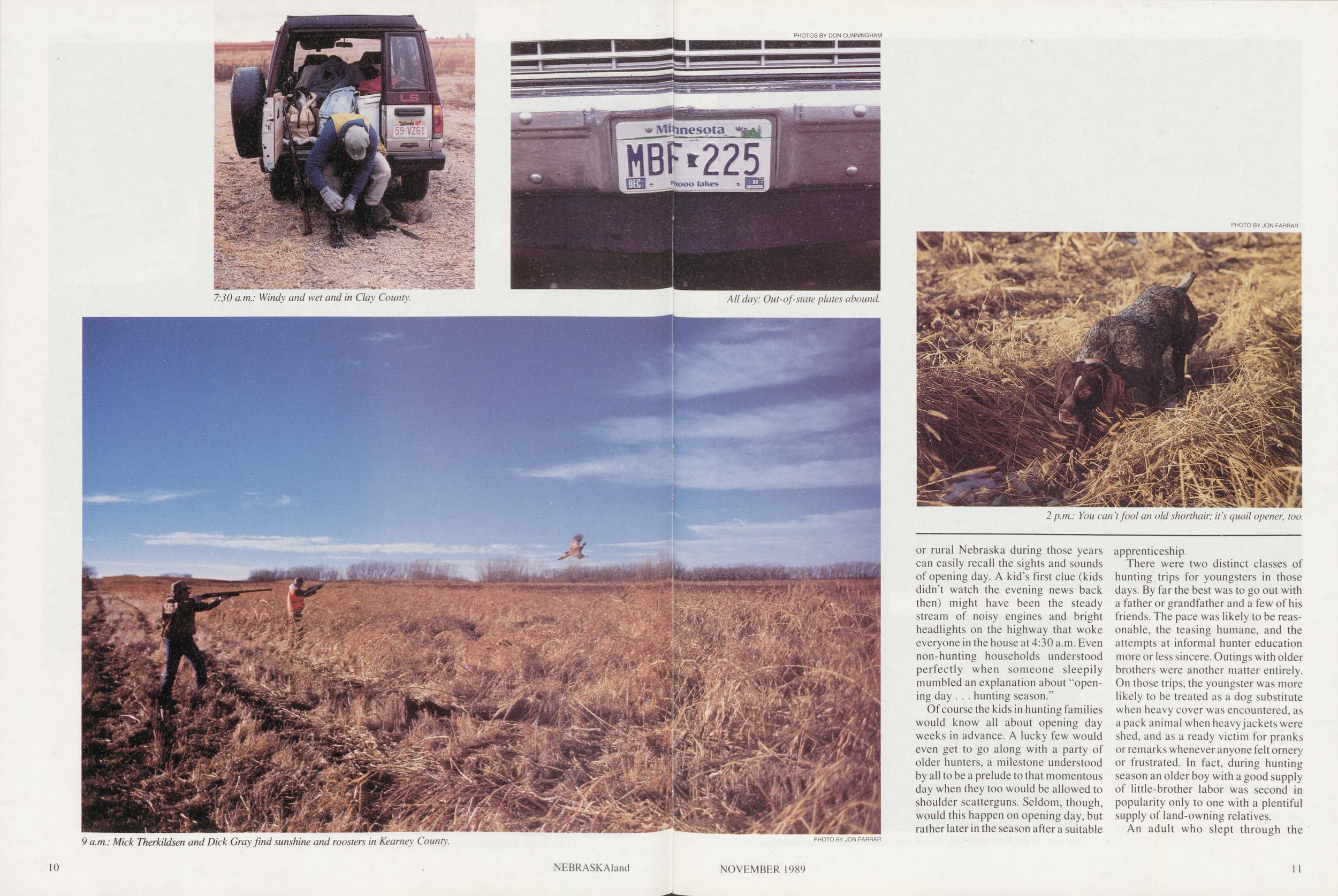
Of course the kids in hunting families would know all about opening day weeks in advance. A lucky few would even get to go along with a party of older hunters, a milestone understood by all to be a prelude to that momentous day when they too would be allowed to shoulder scatterguns. Seldom, though, would this happen on opening day, but rather later in the season after a suitable apprenticeship.
There were two distinct classes of hunting trips for youngsters in those days. By far the best was to go out with a father or grandfather and a few of his friends. The pace was likely to be reasonable, the teasing humane, and the attempts at informal hunter education more or less sincere. Outings with older brothers were another matter entirely. On those trips, the youngster was more likely to be treated as a dog substitute when heavy cover was encountered, as a pack animal when heavy jackets were shed, and as a ready victim for pranks or remarks whenever anyone felt ornery or frustrated. In fact, during hunting season an older boy with a good supply of little-brother labor was second in popularity only to one with a plentiful supply of land-owning relatives.
An adult who slept through the
NOVERMBER 1989 11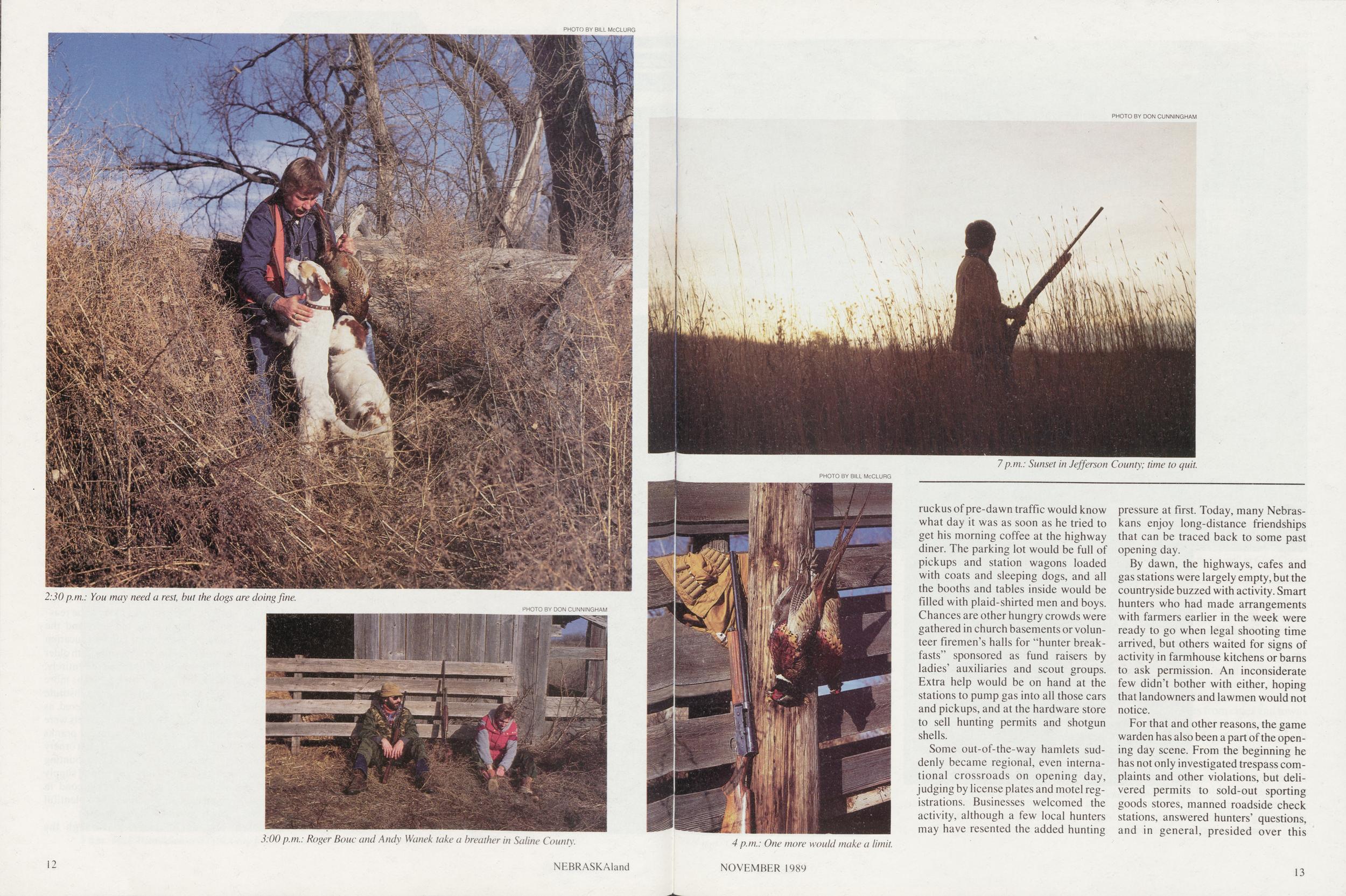
ruckus of pre-dawn traffic would know what day it was as soon as he tried to get his morning coffee at the highway diner. The parking lot would be full of pickups and station wagons loaded with coats and sleeping dogs, and all the booths and tables inside would be filled with plaid-shirted men and boys. Chances are other hungry crowds were gathered in church basements or volunteer firemen's halls for "hunter breakfasts" sponsored as fund raisers by ladies' auxiliaries and scout groups. Extra help would be on hand at the stations to pump gas into all those cars and pickups, and at the hardware store to sell hunting permits and shotgun shells.
Some out-of-the-way hamlets suddenly became regional, even international crossroads on opening day, judging by license plates and motel registrations. Businesses welcomed the activity, although a few local hunters may have resented the added hunting pressure at first. Today, many Nebraskans enjoy long-distance friendships that can be traced back to some past opening day.
By dawn, the highways, cafes and gas stations were largely empty, but the countryside buzzed with activity. Smart hunters who had made arrangements with farmers earlier in the week were ready to go when legal shooting time arrived, but others waited for signs of activity in farmhouse kitchens or barns to ask permission. An inconsiderate few didn't bother with either, hoping that landowners and lawmen would not notice.
For that and other reasons, the game
warden has also been a part of the opening day scene. From the beginning he
has not only investigated trespass complaints and other violations, but delivered
permits to sold-out sporting
goods stores, manned roadside check
stations, answered hunters' questions,
and in general, presided over this
NOVEMBER 1989
13
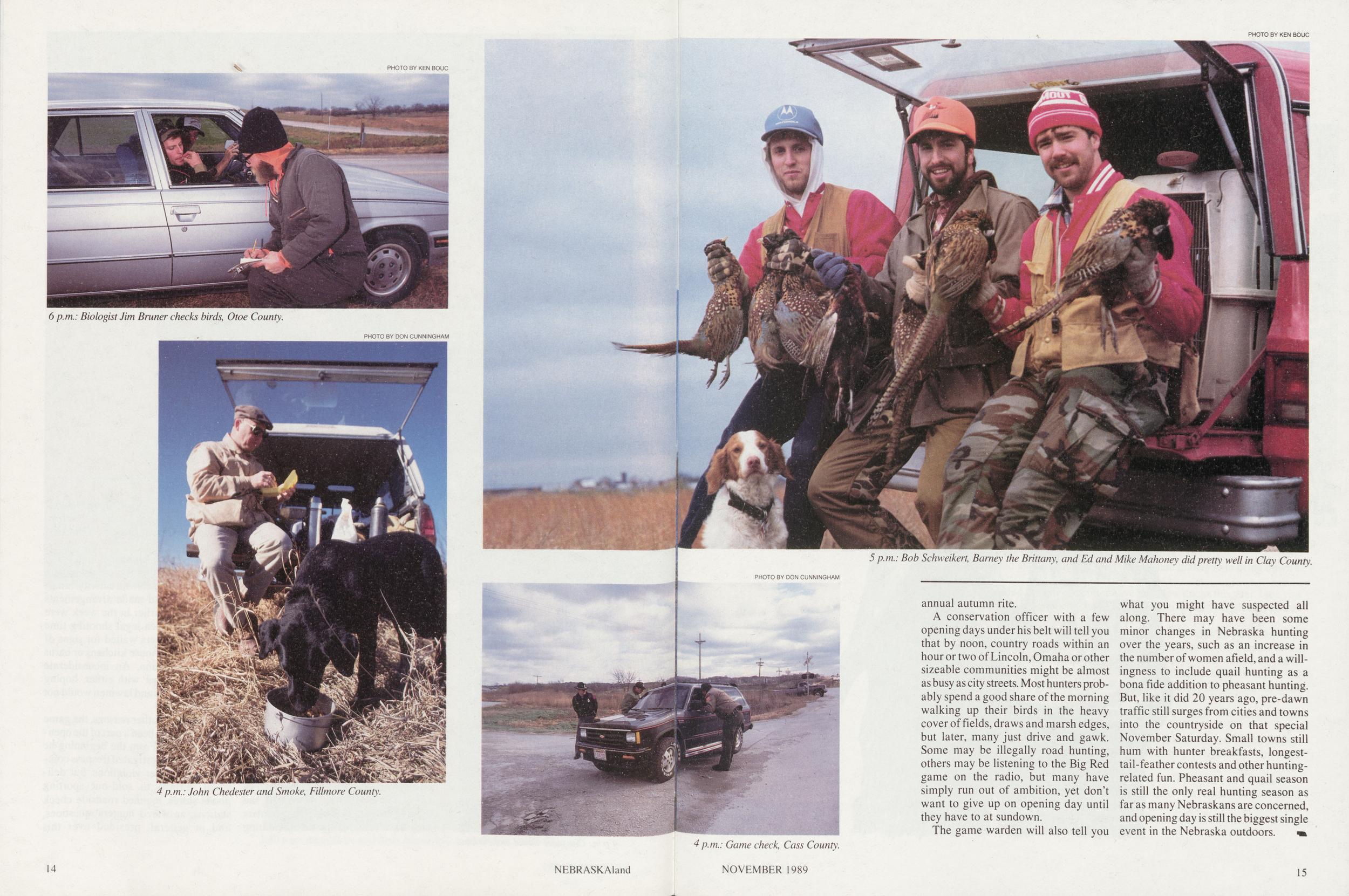
A conservation officer with a few opening days under his belt will tell you that by noon, country roads within an hour or two of Lincoln, Omaha or other sizeable communities might be almost as busy as city streets. Most hunters probably spend a good share of the morning walking up their birds in the heavy cover of fields, draws and marsh edges, but later, many just drive and gawk. Some may be illegally road hunting, others may be listening to the Big Red game on the radio, but many have simply run out of ambition, yet don't want to give up on opening day until they have to at sundown.
The game warden will also tell you what you might have suspected all along. There may have been some minor changes in Nebraska hunting over the years, such as an increase in the number of women afield, and a willingness to include quail hunting as a bona fide addition to pheasant hunting. But, like it did 20 years ago, pre-dawn traffic still surges from cities and towns into the countryside on that special November Saturday. Small towns still hum with hunter breakfasts, longest-tail-feather contests and other hunting-related fun. Pheasant and quail season is still the only real hunting season as far as many Nebraskans are concerned, and opening day is still the biggest single event in the Nebraska outdoors.
NOVEMBER 1989 15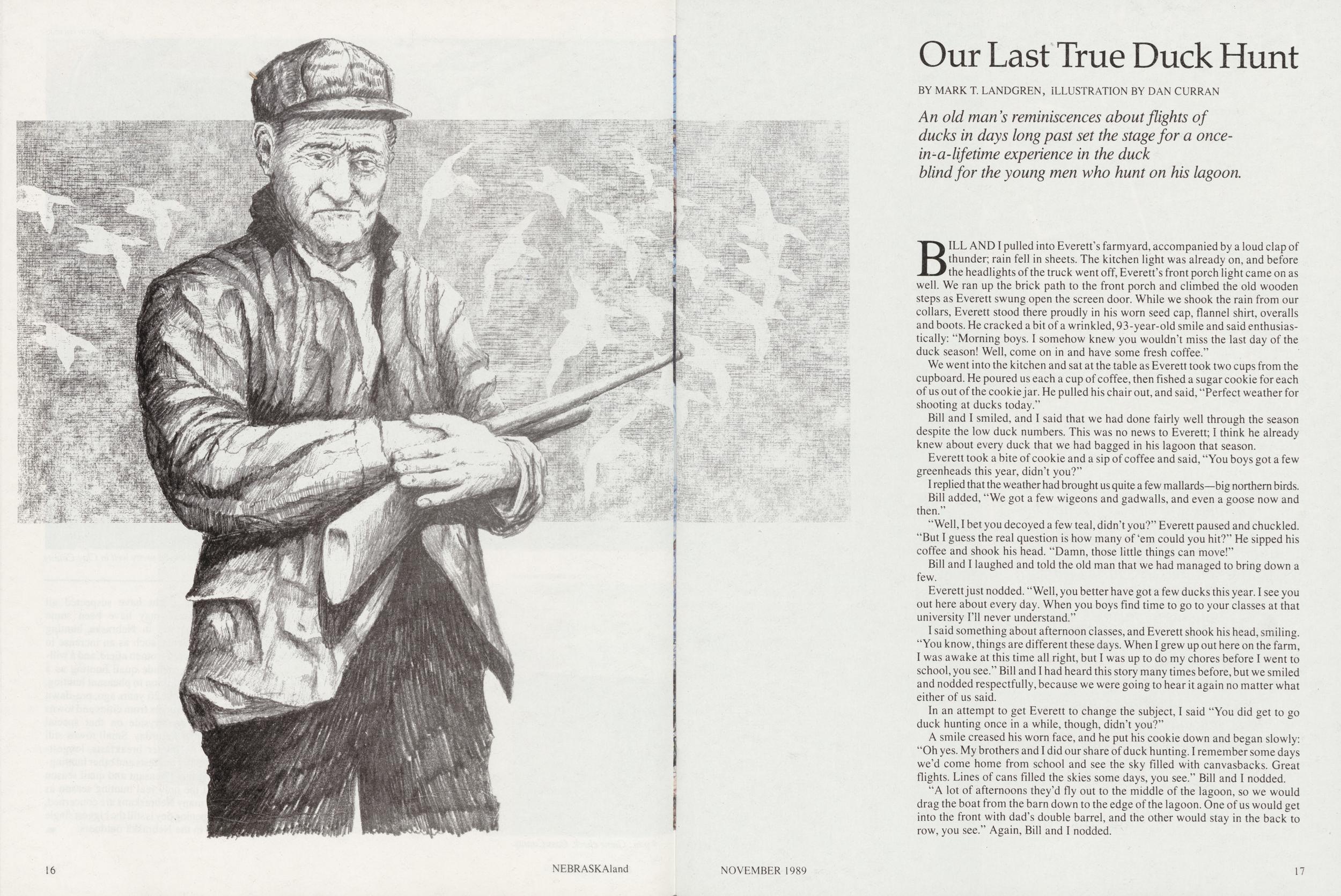
Our Last True Duck Hunt
BY MARK T. LANDGREN, ILLUSTRATION BY DAN CURRAN cAn old mans reminiscences about flights of ducks in days long past set the stage for a once-in-a-lifetime experience in the duck blind for the young men who hunt on his lagoonBILL AND I pulled into Everett's farmyard, accompanied by a loud clap of thunder; rain fell in sheets. The kitchen light was already on, and before the headlights of the truck went off, Everett's front porch light came on as well. We ran up the brick path to the front porch and climbed the old wooden steps as Everett swung open the screen door. While we shook the rain from our collars, Everett stood there proudly in his worn seed cap, flannel shirt, overalls and boots. He cracked a bit of a wrinkled, 93-year-old smile and said enthusiastically: "Morning boys. I somehow knew you wouldn't miss the last day of the duck season! Well, come on in and have some fresh coffee."
We went into the kitchen and sat at the table as Everett took two cups from the cupboard. He poured us each a cup of coffee, then fished a sugar cookie for each of us out of the cookie jar. He pulled his chair out, and said, "Perfect weather for shooting at ducks today."
Bill and I smiled, and I said that we had done fairly well through the season despite the low duck numbers. This was no news to Everett; I think he already knew about every duck that we had bagged in his lagoon that season.
Everett took a bite of cookie and a sip of coffee and said, "You boys got a few greenheads this year, didn't you?"
I replied that the weather had brought us quite a few mallards—big northern birds.
Bill added, "We got a few wigeons and gadwalls, and even a goose now and then."
"Well, I bet you decoyed a few teal, didn't you?" Everett paused and chuckled. "But I guess the real question is how many of 'em could you hit?" He sipped his coffee and shook his head. "Damn, those little things can move!"
Bill and I laughed and told the old man that we had managed to bring down a few.
Everett just nodded. "Well, you better have got a few ducks this year. I see you out here about every day. When you boys find time to go to your classes at that university I'll never understand."
I said something about afternoon classes, and Everett shook his head, smiling. "You know, things are different these days. When I grew up out here on the farm, I was awake at this time all right, but I was up to do my chores before I went to school, you see." Bill and I had heard this story many times before, but we smiled and nodded respectfully, because we were going to hear it again no matter what either of us said.
In an attempt to get Everett to change the subject, I said "You did get to go duck hunting once in a while, though, didn't you?"
A smile creased his worn face, and he put his cookie down and began slowly: "Oh yes. My brothers and I did our share of duck hunting. I remember some days we'd come home from school and see the sky filled with canvasbacks. Great flights. Lines of cans filled the skies some days, you see." Bill and I nodded.
"A lot of afternoons they'd fly out to the middle of the lagoon, so we would drag the boat from the barn down to the edge of the lagoon. One of us would get into the front with dad's double barrel, and the other would stay in the back to row, you see." Again, Bill and I nodded.
NOVEMBER 1989 17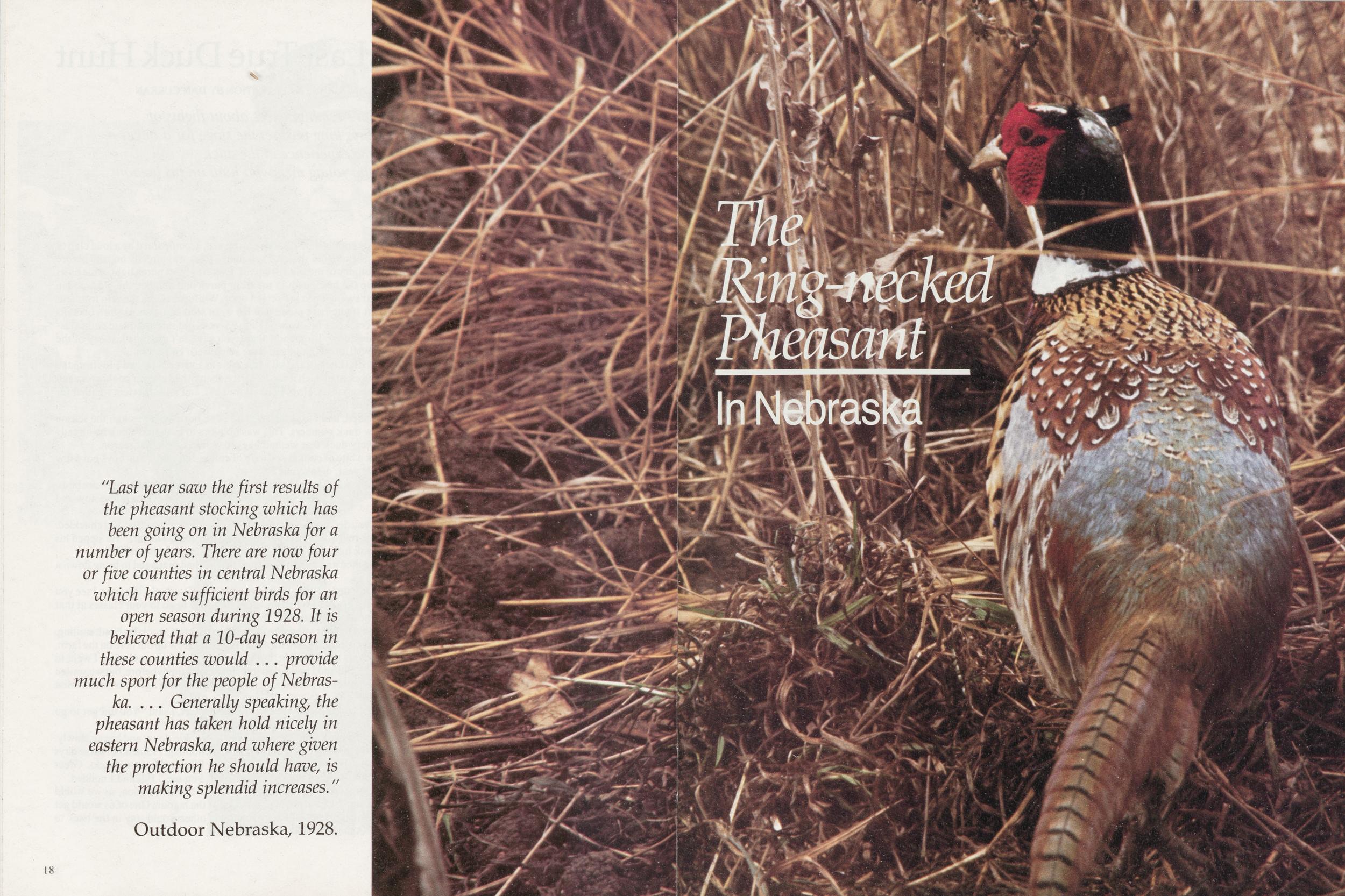
The Ring-necked Pheasant In Nebraska
"Last year saw the first results of the pheasant stocking which has been going on in Nebraska for a number of years. There are now four or five counties in central Nebraska which have sufficient birds for an open season during 1928. It is believed that a 10-day season in these counties would ... provide much sport for the people of Nebraska. ... Generally speaking, the pheasant has taken hold nicely in eastern Nebraska, and where given the protection he should have, is making splendid increases." Outdoor Nebraska, 1928 18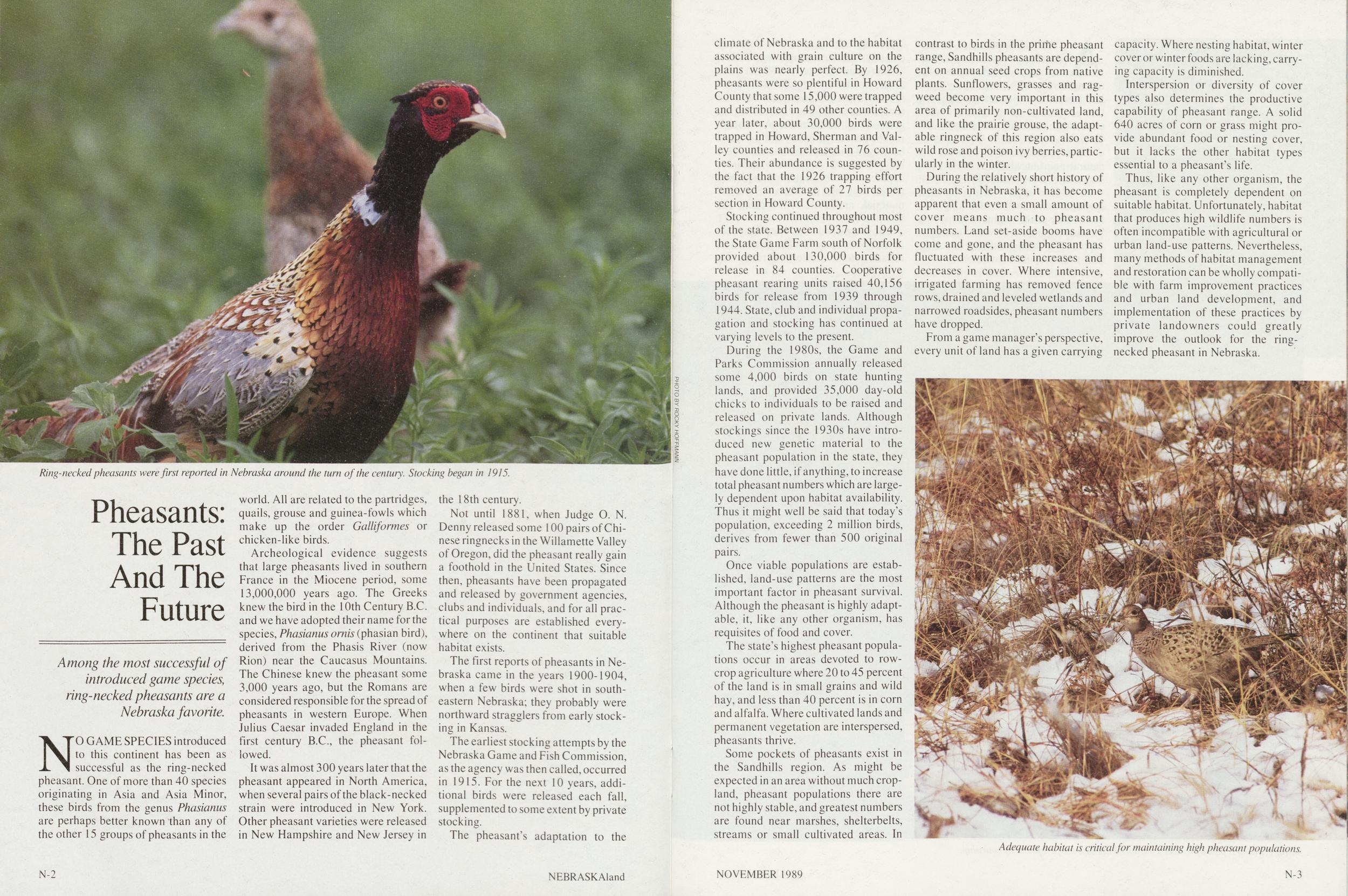
Pheasants: The Past And The Future
Among the most successful of introduced game species, ring-necked pheasants are a Nebraska favorite.NO GAME SPECIES introduced to this continent has been as successful as the ring-necked pheasant. One of more than 40 species originating in Asia and Asia Minor, these birds from the genus Phasianus are perhaps better known than any of the other 15 groups of pheasants in the world. All are related to the partridges, quails, grouse and guinea-fowls which make up the order Galliformes or chicken-like birds.
Archeological evidence suggests that large pheasants lived in southern France in the Miocene period, some 13,000,000 years ago. The Greeks knew the bird in the 10th Century B.C. and we have adopted their name for the species, Phasianus ornis (phasian bird), derived from the Phasis River (now Rion) near the Caucasus Mountains. The Chinese knew the pheasant some 3,000 years ago, but the Romans are considered responsible for the spread of pheasants in western Europe. When Julius Caesar invaded England in the first century B.C., the pheasant followed.
It was almost 300 years later that the pheasant appeared in North America, when several pairs of the black-necked strain were introduced in New York. Other pheasant varieties were released in New Hampshire and New Jersey in the 18th century.
Not until 1881, when Judge O. N. Denny released some 100 pairs of Chinese ringnecks in the Willamette Valley of Oregon, did the pheasant really gain a foothold in the United States. Since then, pheasants have been propagated and released by government agencies, clubs and individuals, and for all practical purposes are established everywhere on the continent that suitable habitat exists.
The first reports of pheasants in Nebraska came in the years 1900-1904, when a few birds were shot in south-eastern Nebraska; they probably were northward stragglers from early stocking in Kansas.
The earliest stocking attempts by the Nebraska Game and Fish Commission, as the agency was then called, occurred in 1915. For the next 10 years, additional birds were released each fall, supplemented to some extent by private stocking.
The pheasant's adaptation to the N-2 NEBRASKAland climate of Nebraska and to the habitat associated with grain culture on the plains was nearly perfect. By 1926, pheasants were so plentiful in Howard County that some 15,000 were trapped and distributed in 49 other counties. A year later, about 30,000 birds were trapped in Howard, Sherman and Valley counties and released in 76 counties. Their abundance is suggested by the fact that the 1926 trapping effort removed an average of 27 birds per section in Howard County.
Stocking continued throughout most of the state. Between 1937 and 1949, the State Game Farm south of Norfolk provided about 130,000 birds for release in 84 counties. Cooperative pheasant rearing units raised 40,156 birds for release from 1939 through 1944. State, club and individual propagation and stocking has continued at varying levels to the present.
During the 1980s, the Game and Parks Commission annually released some 4,000 birds on state hunting lands, and provided 35,000 day-old chicks to individuals to be raised and released on private lands. Although stockings since the 1930s have introduced new genetic material to the pheasant population in the state, they have done little, if anything, to increase total pheasant numbers which are largely dependent upon habitat availability. Thus it might well be said that today's population, exceeding 2 million birds, derives from fewer than 500 original pairs.
Once viable populations are established, land-use patterns are the most important factor in pheasant survival. Although the pheasant is highly adaptable, it, like any other organism, has requisites of food and cover.
The state's highest pheasant populations occur in areas devoted to row-crop agriculture where 20 to 45 percent of the land is in small grains and wild hay, and less than 40 percent is in corn and alfalfa. Where cultivated lands and permanent vegetation are interspersed, pheasants thrive.
Some pockets of pheasants exist in the Sandhills region. As might be expected in an area without much cropland, pheasant populations there are not highly stable, and greatest numbers are found near marshes, shelterbelts, streams or small cultivated areas. In contrast to birds in the prime pheasant range, Sandhills pheasants are dependent on annual seed crops from native plants. Sunflowers, grasses and ragweed become very important in this area of primarily non-cultivated land, and like the prairie grouse, the adaptable ringneck of this region also eats wild rose and poison ivy berries, particularly in the winter.
During the relatively short history of pheasants in Nebraska, it has become apparent that even a small amount of cover means much to pheasant numbers. Land set-aside booms have come and gone, and the pheasant has fluctuated with these increases and decreases in cover. Where intensive, irrigated farming has removed fence rows, drained and leveled wetlands and narrowed roadsides, pheasant numbers have dropped.
From a game manager's perspective, every unit of land has a given carrying capacity. Where nesting habitat, winter cover or winter foods are lacking, carrying capacity is diminished.
Interspersion or diversity of cover types also determines the productive capability of pheasant range. A solid 640 acres of corn or grass might provide abundant food or nesting cover, but it lacks the other habitat types essential to a pheasant's life.
Thus, like any other organism, the pheasant is completely dependent on suitable habitat. Unfortunately, habitat that produces high wildlife numbers is often incompatible with agricultural or urban land-use patterns. Nevertheless, many methods of habitat management and restoration can be wholly compatible with farm improvement practices and urban land development, and implementation of these practices by private landowners could greatly improve the outlook for the ring-necked pheasant in Nebraska.
SPRING: Courtship And Nesting
The annual turnover rate in the pheasant population is about 70 percent. Thus the nesting season, when new birds hatch, is a critical time of year for the ring-necked pheasant in Nebraska.AS SPRING approaches, distinctive changes occur in the ring-necked pheasant. In response to lengthening days, the pituitary gland in the brain becomes active, triggering the production of hormones which stimulate courtship behavior. The courtship drama marks the beginning of the reproductive cycle; Spring is a natural point at which to begin a description of the pheasant life-cycle.
In order to cope with the rigors of mating, nesting and brood rearing, hens attain their peak weights in the spring; they must gather reserves of energy to support egg-laying and to produce the heat necessary for incubation.
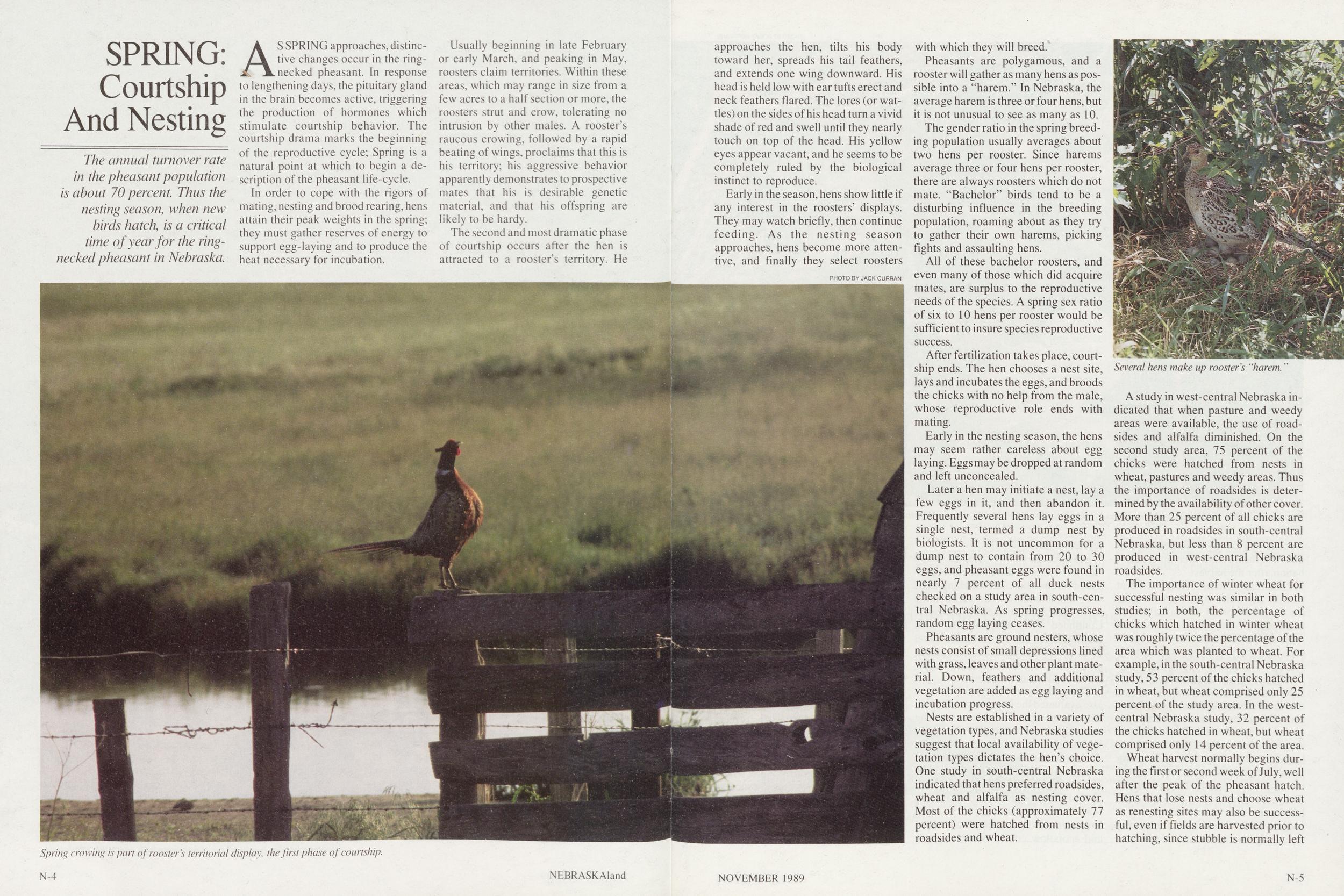
Usually beginning in late February or early March, and peaking in May, roosters claim territories. Within these areas, which may range in size from a few acres to a half section or more, the roosters strut and crow, tolerating no intrusion by other males. A rooster's raucous crowing, followed by a rapid beating of wings, proclaims that this is his territory; his aggressive behavior apparently demonstrates to prospective mates that his is desirable genetic material, and that his offspring are likely to be hardy.
The second and most dramatic phase of courtship occurs after the hen is attracted to a rooster's territory. He
Early in the season, hens show little if any interest in the roosters' displays. They may watch briefly, then continue feeding. As the nesting season approaches, hens become more attentive, and finally they select roosters with which they will breed.
Pheasants are polygamous, and a rooster will gather as many hens as possible into a "harem." In Nebraska, the average harem is three or four hens, but it is not unusual to see as many as 10.
The gender ratio in the spring breeding population usually averages about two hens per rooster. Since harems average three or four hens per rooster, there are always roosters which do not mate. "Bachelor" birds tend to be a disturbing influence in the breeding population, roaming about as they try to gather their own harems, picking fights and assaulting hens.
All of these bachelor roosters, and even many of those which did acquire mates, are surplus to the reproductive needs of the species. A spring sex ratio of six to 10 hens per rooster would be sufficient to insure species reproductive success.
After fertilization takes place, courtship ends. The hen chooses a nest site, lays and incubates the eggs, and broods the chicks with no help from the male, whose reproductive role ends with mating.
Early in the nesting season, the hens may seem rather careless about egg laying. Eggs may be dropped at random and left unconcealed.
Later a hen may initiate a nest, lay a few eggs in it, and then abandon it. Frequently several hens lay eggs in a single nest, termed a dump nest by biologists. It is not uncommon for a dump nest to contain from 20 to 30 eggs, and pheasant eggs were found in nearly 7 percent of all duck nests checked on a study area in south-central Nebraska. As spring progresses, random egg laying ceases.
Pheasants are ground nesters, whose nests consist of small depressions lined with grass, leaves and other plant material. Down, feathers and additional vegetation are added as egg laying and incubation progress.
Nests are established in a variety of vegetation types, and Nebraska studies suggest that local availability of vegetation types dictates the hen's choice. One study in south-central Nebraska indicated that hens preferred roadsides, wheat and alfalfa as nesting cover. Most of the chicks (approximately 77 percent) were hatched from nests in roadsides and wheat.
A study in west-central Nebraska indicated that when pasture and weedy areas were available, the use of roadsides and alfalfa diminished. On the second study area, 75 percent of the chicks were hatched from nests in wheat, pastures and weedy areas. Thus the importance of roadsides is determined by the availability of other cover. More than 25 percent of all chicks are produced in roadsides in south-central Nebraska, but less than 8 percent are produced in west-central Nebraska roadsides.
The importance of winter wheat for successful nesting was similar in both studies; in both, the percentage of chicks which hatched in winter wheat was roughly twice the percentage of the area which was planted to wheat. For example, in the south-central Nebraska study, 53 percent of the chicks hatched in wheat, but wheat comprised only 25 percent of the study area. In the westcentral Nebraska study, 32 percent of the chicks hatched in wheat, but wheat comprised only 14 percent of the area.
Wheat harvest normally begins during the first or second week of July, well
after the peak of the pheasant hatch.
Hens that lose nests and choose wheat
as renesting sites may also be successful, even if fields are harvested prior to
hatching, since stubble is normally left
NOVEMBER 1989
N-5
Predation of nests is lower in wheat than in any other cover type because the nests are spread over a large area and because nest predators such as the striped skunk are more likely to hunt in strip cover such as fencerows and roadsides.
Alfalfa is an attractive nesting cover type, but few chicks were produced there in either study. More than 95 percent ofthe nests in alfalfa are destroyed by mowing, which occurs just prior to the peak ofthe hatch. Often these nests become death traps for incubating hens. Even chicks that do hatch before mowing are usually too young to escape the swather and hens are often killed with their broods as they try to protect them. Thus, alfalfa generally has a negative influence on pheasant reproduction in Nebraska.
Researchers in both studies found that weedy and brushy fencerows produced no pheasant chicks. Many nests were found in this cover type, but not a single one appeared to be successful. Continued study revealed that such areas of cover served as regular travel lanes for several pheasant-nest predators, such as skunks and raccoons, which easily found the nests.
The study in west-central Nebraska also evaluated the importance of no-till (ecofallow) corn production to nesting hens. While conventionally tilled corn is planted in a residue-free seedbed, ecofallow corn is planted in standing wheat stubble. Densities of both initiated and successful nests were about 10 times higher in ecofallow corn than in conventionally-tilled corn. However, both conventionally-tilled and ecofallow corn produced significantly fewer chicks than was expected based on habitat availability. Hens tended to avoid both types of corn for nest initiation, with conventionally-tilled corn being more strongly avoided than ecofallow corn.
During normal tillage operations, farm implements destroyed 56 percent of the nests established in ecofallow corn. The low level of nest initiation and low nest success in ecofallow corn combine to prevent ecofallow corn from being an important nesting habitat regardless ofthe nesting density relative to conventionally-tilled corn.
Both ecofallow corn and conventionally-tilled dryland corn were accompanied in crop rotation by winter wheat in which nest initiation and nest success were high. Irrigated corn is not accompanied by winter wheat. To the extent that ecofallow farming substitutes for conventional dryland farming, the conversion N-6 NEBRASKAland to ecofallow farming would have minimal effect on pheasant nesting success. However, to the extent that ecofallow farming prevents the conversion of dryland farming to irrigated farming, the ecofallow tillage would be responsible for the maintenance of winter wheat and associated secure nesting cover.
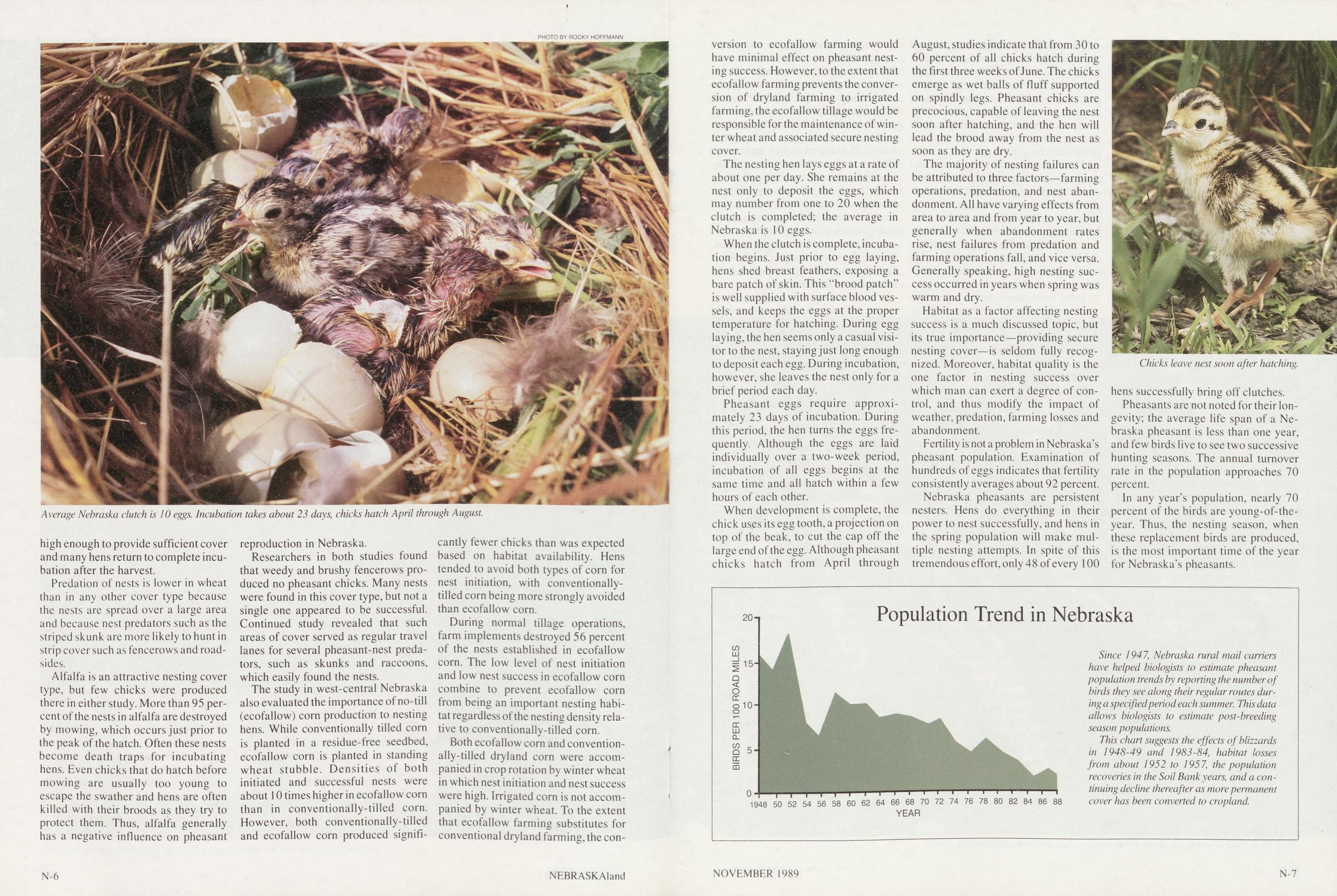
The nesting hen lays eggs at a rate of about one per day. She remains at the nest only to deposit the eggs, which may number from one to 20 when the clutch is completed; the average in Nebraska is 10 eggs.
When the clutch is complete, incubation begins. Just prior to Qgg laying, hens shed breast feathers, exposing a bare patch of skin. This "brood patch" is well supplied with surface blood vessels, and keeps the eggs at the proper temperature for hatching. During egg laying, the hen seems only a casual visitor to the nest, staying just long enough to deposit each egg. During incubation, however, she leaves the nest only for a brief period each day.
Pheasant eggs require approximately 23 days of incubation. During this period, the hen turns the eggs frequently. Although the eggs are laid individually over a two-week period, incubation of all eggs begins at the same time and all hatch within a few hours of each other.
When development is complete, the chick uses its egg tooth, a projection on top of the beak, to cut the cap off the large end of the egg. Although pheasant chicks hatch from April through August, studies indicate that from 30 to 60 percent of all chicks hatch during the first three weeks of June. The chicks emerge as wet balls of fluff supported on spindly legs. Pheasant chicks are precocious, capable of leaving the nest soon after hatching, and the hen will lead the brood away from the nest as soon as they are dry.
The majority of nesting failures can be attributed to three factors—farming operations, predation, and nest abandonment. All have varying effects from area to area and from year to year, but generally when abandonment rates rise, nest failures from predation and farming operations fall, and vice versa. Generally speaking, high nesting success occurred in years when spring was warm and dry.
Habitat as a factor affecting nesting success is a much discussed topic, but its true importance—providing secure nesting cover—is seldom fully recognized. Moreover, habitat quality is the one factor in nesting success over which man can exert a degree of control, and thus modify the impact of weather, predation, farming losses and abandonment.
Fertility is not a problem in Nebraska's pheasant population. Examination of hundreds of eggs indicates that fertility consistently averages about 92 percent.
Nebraska pheasants are persistent nesters. Hens do everything in their power to nest successfully, and hens in the spring population will make multiple nesting attempts. In spite of this tremendous effort, only 48 of every 100 hens successfully bring off clutches.
Pheasants are not noted for their longevity; the average life span of a Nebraska pheasant is less than one year, and few birds live to see two successive hunting seasons. The annual turnover rate in the population approaches 70 percent.
In any year's population, nearly 70 percent of the birds are young-of-the-year. Thus, the nesting season, when these replacement birds are produced, is the most important time of the year for Nebraska's pheasants.
SUMMER: Raising The Young
Once the chicks hatch, the hen attends them almost constantly until the brood is eight to 12 weeks old.Summer marks the brooding stage in the pheasant reproductive cycle. Once the chicks hatch, the hen attends them almost constantly; they are highly susceptible to cold, wet weather and cannot survive repeated or severe exposure. Normally the hen remains with her brood until the young are eight to 12 weeks old.
If a brood is lost, few hens will renest. If a nest is destroyed or abanadoned before the eggs hatch, a hen will renest time and time again, until she is successful or simply runs out of time, but a second brood is rare. The common misconception of a "second hatch'' arises from the hen pheasant's persistence in trying to successfully hatch one brood, and most young pheasants observed in late summer or early fall are the results of renesting, not of a second hatch.
The time required to lay a clutch of eggs, incubate them, and rear the young makes producing two broods in one summer next to impossible. It takes the aver- age hen 13 to 14 days to lay her clutch of eggs. She then spends 23 days incubating them, and another eight to 12 weeks rearing the young, a total of three to four months from start to finish. If a hen were to start a clutch in early May, it would be August before she could begin again. There is just not enough time for her to repeat the process.
However, radio-telemetry studies, in which hens were fitted with small radio transmitters and their activities closely monitored, have repeatedly shown that a few hens that have lost their chicks within a few days of hatching will adopt an existing clutch of eggs and hatch them. Even in these cases two broods are not successfully raised by one hen.
Summer is an important season for pheasant management, too. Among the most difficult studies of pheasant populations is the accurate counting of broods. The summer census provides information about the success of the nesting season and of juvenile mortality, and contributes to the setting of hunting season regulations. In Nebraska, information on pheasant broods is collected primarily by rural mail carriers.
The Rural Mail Carrier Survey is a tally of game birds observed by the carriers along their regular routes. Nebraska's mail carriers provide the Game and Parks Commission with a massive quantity of data from virtually every county in the state, a system which provides extensive information on the entire state in a short period of time.
Data from these surveys provides game managers with estimates of birds per mile, birds per hundred miles, and young-per-adult-hen ratios. These figures are used as post-breeding population indices suggesting population trends from area to area and from year to year. Regulations for the hunting season are based on these trends.
Summer brings many threats to the young pheasants, and approximately 35 percent of the chicks die in the first six to 10 weeks following hatching. The causes for this mortality are extremely difficult to document. Dr. Allen Stokes of Utah State University aptly described the scope of this problem when he wrote, "The disappearance of so many thousands of chicks in the short space of a summer almost beneath one's eyes and yet not noticed is a baffling experience and an enigma still to be solved." Predation and weather certainly play a major role; automobiles, agricultural chemicals and other hazards probably also take a toll.
Hens will adopt strays or chicks who have lost their own mothers, and a hen with young of two or more age groups is not uncommon in Nebraska. Broods accompanied by more than one hen are also commonly observed in the summer. This may represent a mixing of two or more broods, or it may be that a hen has attached herself to another hen and her brood. A study at the Sacramento Wildlife Management Area indicated that a hen pheasant will probably abandon her nest if she sees or hears other hens with chicks.
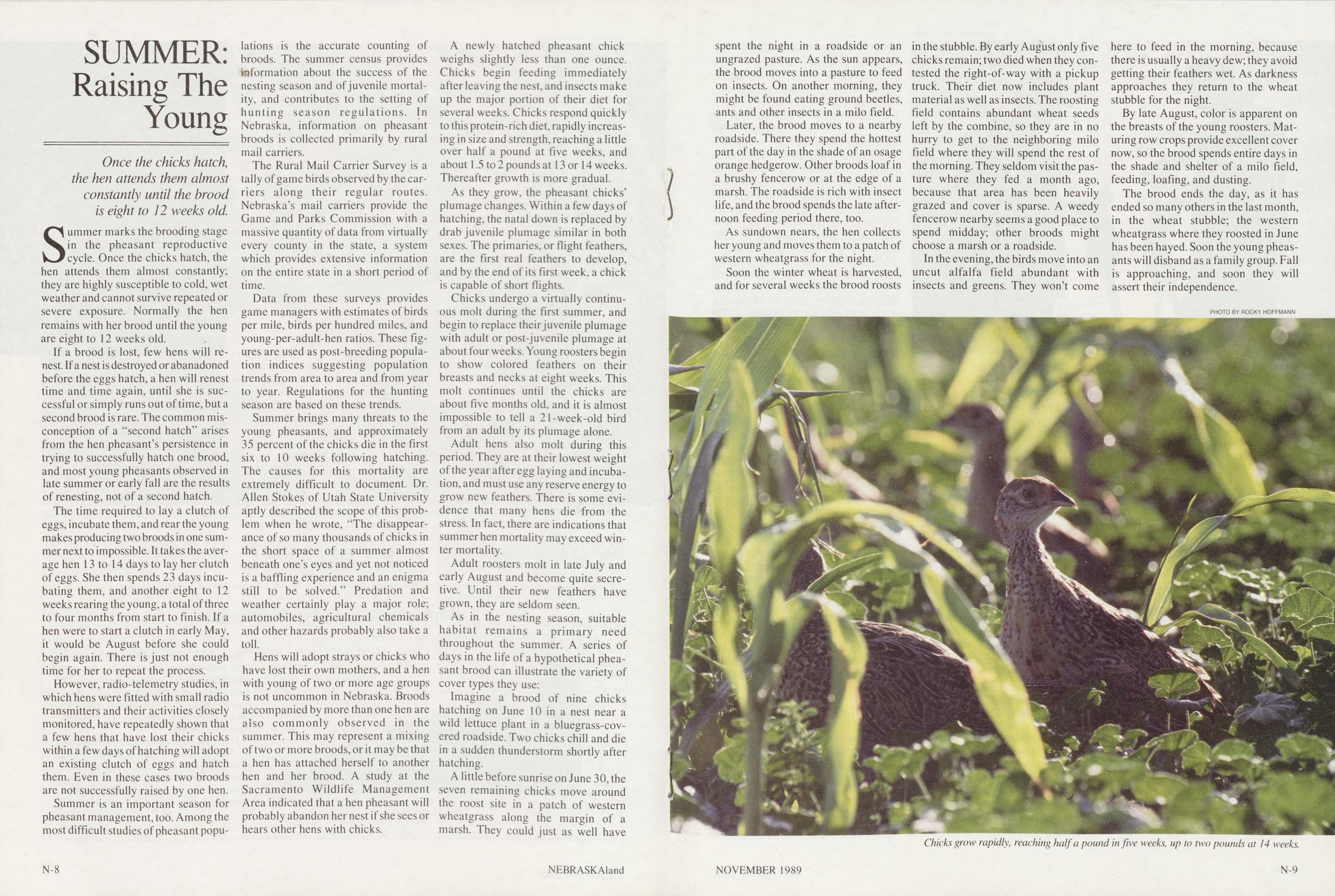
A newly hatched pheasant chick weighs slightly less than one ounce. Chicks begin feeding immediately after leaving the nest, and insects make up the major portion of their diet for several weeks. Chicks respond quickly to this protein-rich diet, rapidly increasing in size and strength, reaching a little over half a pound at five weeks, and about 1.5 to 2 pounds at 13 or 14 weeks. Thereafter growth is more gradual.
As they grow, the pheasant chicks' plumage changes. Within a few days of hatching, the natal down is replaced by drab juvenile plumage similar in both sexes. The primaries, or flight feathers, are the first real feathers to develop, and by the end of its first week, a chick is capable of short flights.
Chicks undergo a virtually continuous molt during the first summer, and begin to replace their juvenile plumage with adult or post-juvenile plumage at about four weeks. Young roosters begin to show colored feathers on their breasts and necks at eight weeks. This molt continues until the chicks are about five months old, and it is almost impossible to tell a 21-week-old bird from an adult by its plumage alone.
Adult hens also molt during this period. They are at their lowest weight of the year after egg laying and incubation, and must use any reserve energy to grow new feathers. There is some evidence that many hens die from the stress. In fact, there are indications that summer hen mortality may exceed winter mortality.
Adult roosters molt in late July and early August and become quite secretive. Until their new feathers have grown, they are seldom seen.
As in the nesting season, suitable habitat remains a primary need throughout the summer. A series of days in the life of a hypothetical pheasant brood can illustrate the variety of cover types they use:
Imagine a brood of nine chicks hatching on June 10 in a nest near a wild lettuce plant in a bluegrass-covered roadside. Two chicks chill and die in a sudden thunderstorm shortly after hatching.
A little before sunrise on June 30, the seven remaining chicks move around the roost site in a patch of western wheatgrass along the margin of a marsh. They could just as well have N-9 NEBRASKAland spent the night in a roadside or an ungrazed pasture. As the sun appears, the brood moves into a pasture to feed on insects. On another morning, they might be found eating ground beetles, ants and other insects in a milo field.
Later, the brood moves to a nearby roadside. There they spend the hottest part of the day in the shade of an osage orange hedgerow. Other broods loaf in a brushy fencerow or at the edge of a marsh. The roadside is rich with insect life, and the brood spends the late afternoon feeding period there, too.
As sundown nears, the hen collects her young and moves them to a patch of western wheatgrass for the night.
Soon the winter wheat is harvested, and for several weeks the brood roosts in the stubble. By early August only five chicks remain; two died when they contested the right-of-way with a pickup truck. Their diet now includes plant material as well as insects. The roosting field contains abundant wheat seeds left by the combine, so they are in no hurry to get to the neighboring milo field where they will spend the rest of the morning. They seldom visit the pasture where they fed a month ago, because that area has been heavily grazed and cover is sparse. A weedy fencerow nearby seems a good place to spend midday; other broods might choose a marsh or a roadside.
In the evening, the birds move into an uncut alfalfa field abundant with insects and greens. They won't come here to feed in the morning, because there is usually a heavy dew; they avoid getting their feathers wet. As darkness approaches they return to the wheat stubble for the night.
By late August, color is apparent on the breasts of the young roosters. Maturing row crops provide excellent cover now, so the brood spends entire days in the shade and shelter of a milo field, feeding, loafing, and dusting.
The brood ends the day, as it has ended so many others in the last month, in the wheat stubble; the western wheatgrass where they roosted in June has been hayed. Soon the young pheasants will disband as a family group. Fall is approaching, and soon they will assert their independence.
FALL: The Hunting Season
Fall brings the hunting season, and the wary ringneck becomes the quarry of an average 110,000 hunters each year. In the last decade, the bag has averaged 800,000 birds per year; improved habitat could increase numbers.August and its hints of fall—ripening grain, and a change in the plumage of young roosters— means the pheasant season is approaching. In mid-August, the biologists' recommendations for season regulations, based on summer brood surveys and field observations, go to the Game and Parks Commissioners, and many eyes and ears await the official announcement of the Nebraska pheasant season dates.
Season setting, however, is no simple matter. Many weeks of data gathering precede the final tabulation of data, and season recommendations are formulated to permit the hunting of surplus birds, and also to insure a sustained resource for future years. In more than 60 years of season-setting, however, one premise has been affirmed time and time again: It is virtually impossible to over-harvest rooster pheasants.
Experience in Nebraska and elsewhere demonstrates beyond argument that when pheasant numbers are reduced below a certain level, hunters will no longer pursue them. After a certain minimum densitv has been reached, their scarcity combined with the birds' wiliness make it almost impossible for hunters to shoot enough of them to adversely affect the population. Even at these low numbers, rooster populations remain high enough to breed with all the available hens, and recovery of the population depends primarily on habitat availability, not on the number of roosters.
But biological management is only one aspect of pheasant management. The sociological aspects of pheasant hunting also require consideration. From a biological point of view, the pheasant season could run from September through March if only roosters were legal. While this may be true, public tolerance of such a season length would be limited. In setting the season, consideration of all interests is important, to insure that a portion of the surplus roosters can be hunted, that recreational benefits can be enjoyed, and that private and public lands will not be subjected to undue pressure.
During all this decision-making, the young pheasants have been maturing. By hunting season, all but a few late-hatched roosters will have acquired their colorful, adult plumage and have learned the survival strategies which make them so respected a game bird. An understanding of some of these capabilities can assist any would-be pheasant hunter to be more successful and to gain a greater appreciation for his quarry,
Often overlooked is the ringneck's acute hearing. The slam of a car door or even the metallic click of a closing shotgun chamber may be enough to send most pheasants scurrying for cover. Pheasants are reported to have responded to cannon fire some 320 miles away during World War I— explosions inaudible to the human ear. Human voices also will alert birds, particularly on dry, calm days. The first maxim of successful pheasant hunting could well be "make no more noise than necessary."
The ringneck also has extremely good eyesight, and the appearance of unfamiliar objects in his accustomed territory may well make him flee. Pheasants are wary, and take to wing or legs at any intrusion, so any use the hunter can make of natural cover is an asset to successful pheasant hunting.
For a bird with a small wing area relative to body size, pheasants fly well, and make up with rapid wing beats what they lack in wing area. In full flight a pheasant may reach 35 to 45 miles per hour. They are not long distance flyers, and several hundred yards is about average. The pheasant's leg muscles are well adapted for running, and this is the bird's primary method for evading danger.
Ringnecks are hardy, and each year many instances of healed legs and wings come to biologists' attention. In addition to their tremendous capacity to heal breaks and wounds, pheasants can often survive after loosing feet, toes, or an eye. One study on the Valentine National Wildlife Refuge found 3 percent of the roosters with complete or partial loss of toes on both feet. Five roosters were blind in one eye, probably N-10 NEBRASKAland from fighting. Nevertheless, all were within normal weight ranges. In agricultural areas the rate of injury is undoubtedly higher. Thus, hunters who risk long shots which only put a pellet or two into these robust birds are unlikely to take many home.
Because the pheasant's primary defenses are hiding and running, hunters profit from working cover slowly and methodically. A zig-zag style of hunting is not only effective on birds hiding in heavy cover, but helps to interrupt the run-ahead, circle, and runback tactics used by other pheasants.
Quick, accurate marking of downed game also helps hunters find birds. Hunting partners who assume responsibility for marking each other's downed birds increase their chances of finding them by "homing in" along two lines of sight Solo hunters can mark the spot where a bird drops, then work around it in ever-increasing circles, pausing frequently; often a brief pause is enough to make a wounded bird break cover.
In row crops, a wounded pheasant may run straight down a row without the usual zig-zagging, and carefully approaching the field's end often produces the bird.
Many hunters vary their techniques as the season progresses and the weather changes. Often overlooked but highly effective is early morning hunting in wheat stubble, a favorite cover type of roosting pheasants. Early in the season especially, careful and quiet movement into this cover at first morning light can provide excellent hunting. Overcast or drizzly days are especially good; in these conditions birds remain longer in the secure, comfortable cover. Late in the season, wheat stubble can be productive on overcast evenings or just before a storm breaks. Birds seem to respond to a falling barometer and move into roosting cover early.
As the season progresses, pheasants still retain their early morning and late afternoon feeding habits, but spend more midday loafing time in heavier weedy pockets and fencerows. Fireweed, ragweed and sunflowers are among the preferred vegetation. Sunny, weedy fencerows bordering milo and corn are choice areas, particularly as the autumn days shorten.
Under blizzard or heavy snow conditions, tracking pheasants often produces game. Pheasants will burrow into cover, but especially with snow on the ground, unconcealed tail feathers can give away a rooster's hiding place.
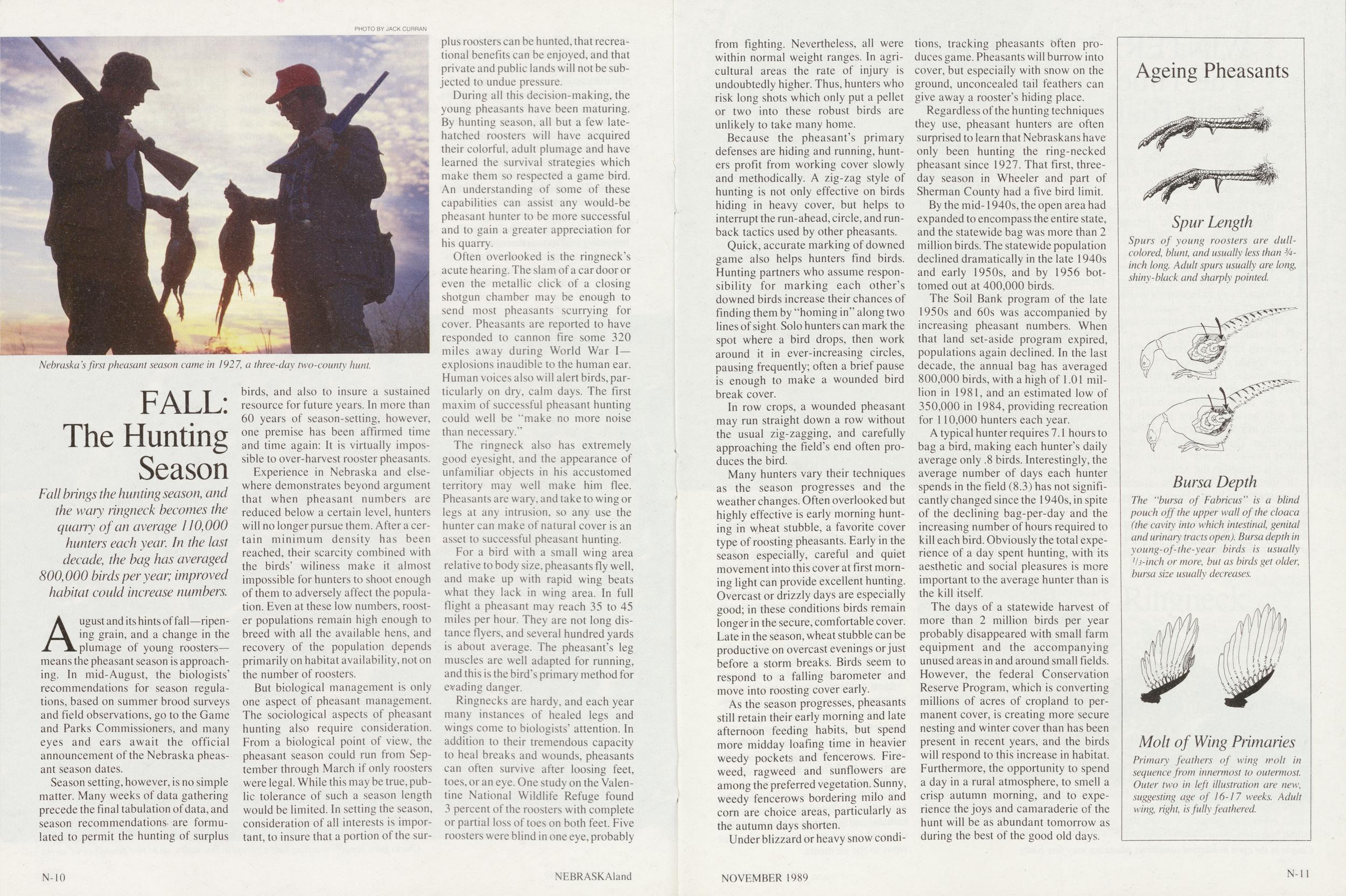
Regardless of the hunting techniques they use, pheasant hunters are often surprised to learn that Nebraskans have only been hunting the ring-necked pheasant since 1927. That first, three-day season in Wheeler and part of Sherman County had a five bird limit.
By the mid-1940s, the open area had expanded to encompass the entire state, and the statewide bag was more than 2 million birds. The statewide population declined dramatically in the late 1940s and early 1950s, and by 1956 bottomed out at 400,000 birds.
The Soil Bank program of the late 1950s and 60s was accompanied by increasing pheasant numbers. When that land set-aside program expired, populations again declined. In the last decade, the annual bag has averaged 800,000 birds, with a high of 1.01 million in 1981, and an estimated low of 350,000 in 1984, providing recreation for 110,000 hunters each year.
A typical hunter requires 7.1 hours to bag a bird, making each hunter's daily average only .8 birds. Interestingly, the average number of days each hunter spends in the field (8.3) has not significantly changed since the 1940s, in spite of the declining bag-per-day and the increasing number of hours required to kill each bird. Obviously the total experience of a day spent hunting, with its aesthetic and social pleasures is more important to the average hunter than is the kill itself.
The days of a statewide harvest of more than 2 million birds per year probably disappeared with small farm equipment and the accompanying unused areas in and around small fields. However, the federal Conservation Reserve Program, which is converting millions of acres of cropland to permanent cover, is creating more secure nesting and winter cover than has been present in recent years, and the birds will respond to this increase in habitat. Furthermore, the opportunity to spend a day in a rural atmosphere, to smell a crisp autumn morning, and to experience the joys and camaraderie of the hunt will be as abundant tomorrow as during the best of the good old days.
Ageing Pheasants Spur Length Spurs of young roosters are dull-colored, blunt, and usually less than 3A- inch long. Adult spurs usually are long, shiny-black and sharply pointed. Bursa Depth The "bursa of Fabricus" is a blind pouch off the upper wall of the cloaca (the cavity into which intestinal, genital and urinary tracts open). Bursa depth in young-of-the-year birds is usually 113-inch or more, but as birds get older, bursa size usually decreases. Molt of Wing Primaries Primary feathers of wing molt in sequence from innermost to outermost. Outer two in left illustration are new, suggesting age of 16-17 weeks. Adult wing, right, is fully feathered. NOVEMBER 1989 N-11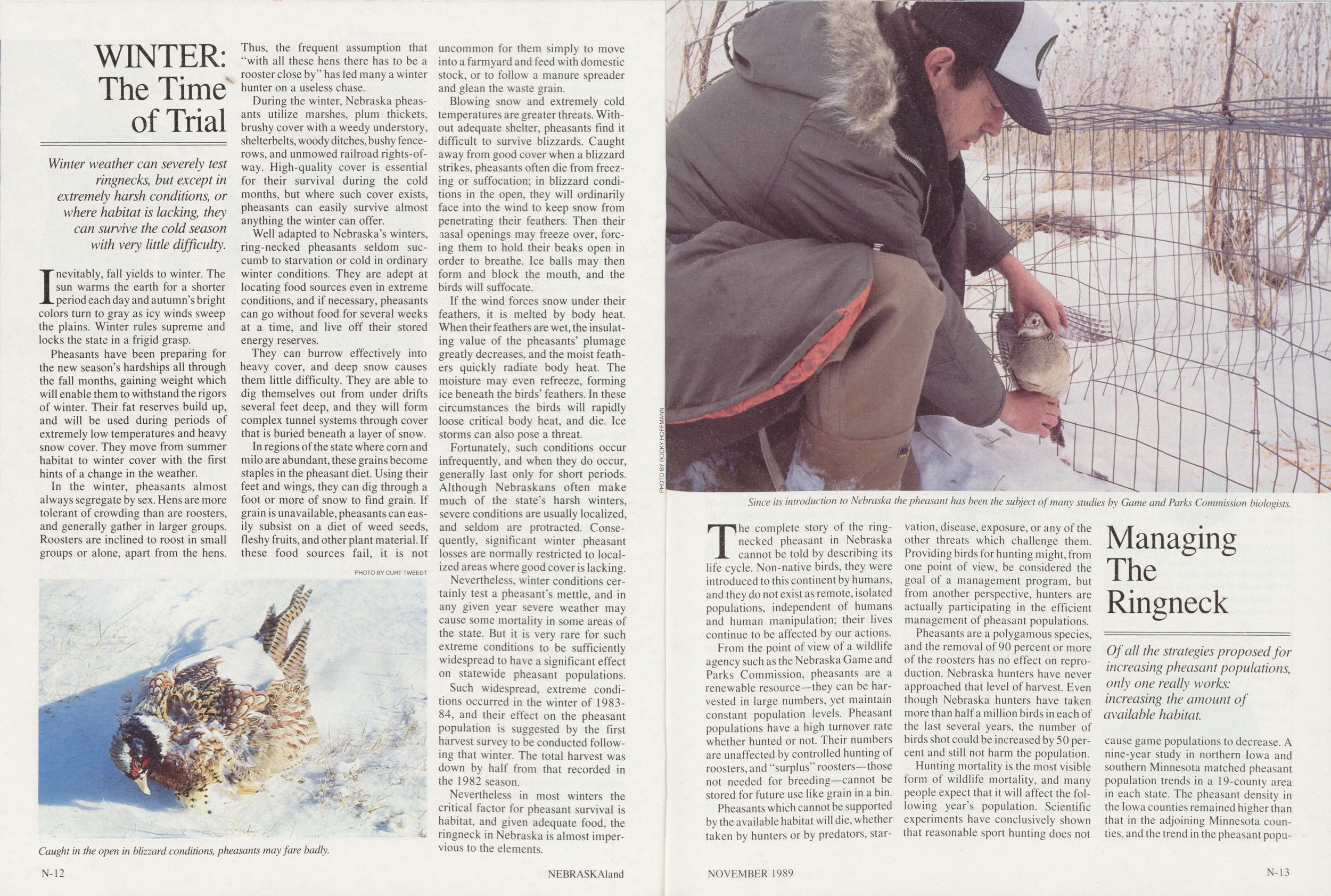
WINTER: The Time of Trial
Winter weather can severely test ringnecks, but except in extremely harsh conditionsy or where habitat is lackingy they can survive the cold season with very little difficulty.Inevitably, fall yields to winter. The sun warms the earth for a shorter period each day and autumn's bright colors turn to gray as icy winds sweep the plains. Winter rules supreme and locks the state in a frigid grasp.
Pheasants have been preparing for the new season's hardships all through the fall months, gaining weight which will enable them to withstand the rigors of winter. Their fat reserves build up, and will be used during periods of extremely low temperatures and heavy snow cover. They move from summer habitat to winter cover with the first hints of a change in the weather.
In the winter, pheasants almost always segregate by sex. Hens are more tolerant of crowding than are roosters, and generally gather in larger groups. Roosters are inclined to roost in small groups or alone, apart from the hens. Thus, the frequent assumption that "with all these hens there has to be a rooster close by" has led many a winter hunter on a useless chase.
During the winter, Nebraska pheasants utilize marshes, plum thickets, brushy cover with a weedy understory, shelterbelts, woody ditches, bushy fence-rows, and unmowed railroad rights-of-way. High-quality cover is essential for their survival during the cold months, but where such cover exists, pheasants can easily survive almost anything the winter can offer.
Well adapted to Nebraska's winters, ring-necked pheasants seldom succumb to starvation or cold in ordinary winter conditions. They are adept at locating food sources even in extreme conditions, and if necessary, pheasants can go without food for several weeks at a time, and live off their stored energy reserves.
They can burrow effectively into heavy cover, and deep snow causes them little difficulty. They are able to dig themselves out from under drifts several feet deep, and they will form complex tunnel systems through cover that is buried beneath a layer of snow.
In regions of the state where corn and milo are abundant, these grains become staples in the pheasant diet. Using their feet and wings, they can dig through a foot or more of snow to find grain. If grain is unavailable, pheasants can easily subsist on a diet of weed seeds, fleshy fruits, and other plant material. If these food sources fail, it is not uncommon for them simply to move into a farmyard and feed with domestic stock, or to follow a manure spreader and glean the waste grain.
Blowing snow and extremely cold temperatures are greater threats. Without adequate shelter, pheasants find it difficult to survive blizzards. Caught away from good cover when a blizzard strikes, pheasants often die from freezing or suffocation; in blizzard conditions in the open, they will ordinarily face into the wind to keep snow from penetrating their feathers. Then their nasal openings may freeze over, forcing them to hold their beaks open in order to breathe. Ice balls may then form and block the mouth, and the birds will suffocate.
If the wind forces snow under their feathers, it is melted by body heat. When their feathers are wet, the insulating value of the pheasants' plumage greatly decreases, and the moist feathers quickly radiate body heat. The moisture may even refreeze, forming ice beneath the birds' feathers. In these circumstances the birds will rapidly loose critical body heat, and die. Ice storms can also pose a threat.
Fortunately, such conditions occur infrequently, and when they do occur, generally last only for short periods. Although Nebraskans often make much of the state's harsh winters, severe conditions are usually localized, and seldom are protracted. Consequently, significant winter pheasant losses are normally restricted to localized areas where good cover is lacking.
Nevertheless, winter conditions certainly test a pheasant's mettle, and in any given year severe weather may cause some mortality in some areas of the state. But it is very rare for such extreme conditions to be sufficiently widespread to have a significant effect on statewide pheasant populations.
Such widespread, extreme conditions occurred in the winter of 1983-84, and their effect on the pheasant population is suggested by the first harvest survey to be conducted following that winter. The total harvest was down by half from that recorded in the 1982 season.
Nevertheless in most winters the critical factor for pheasant survival is habitat, and given adequate food, the ringneck in Nebraska is almost impervious to the elements.
N-12 NEBRASKAlandManaging The Ringneck
Of all the strategies proposed for increasing pheasant populations, only one really works: increasing the amount of available habitat.The complete story of the ringnecked pheasant in Nebraska cannot be told by describing its life cycle. Non-native birds, they were introduced to this continent by humans, and they do not exist as remote, isolated populations, independent of humans and human manipulation; their lives continue to be affected by our actions.
From the point of view of a wildlife agency such as the Nebraska Game and Parks Commission, pheasants are a renewable resource—they can be harvested in large numbers, yet maintain constant population levels. Pheasant populations have a high turnover rate whether hunted or not. Their numbers are unaffected by controlled hunting of roosters, and "surplus" roosters—those not needed for breeding—cannot be stored for future use like grain in a bin.
Pheasants which cannot be supported by the available habitat will die, whether taken by hunters or by predators, starvation, disease, exposure, or any of the other threats which challenge them. Providing birds for hunting might, from one point of view, be considered the goal of a management program, but from another perspective, hunters are actually participating in the efficient management of pheasant populations.
Pheasants are a polygamous species, and the removal of 90 percent or more of the roosters has no effect on reproduction. Nebraska hunters have never approached that level of harvest. Even though Nebraska hunters have taken more than half a million birds in each of the last several years, the number of birds shot could be increased by 50 percent and still not harm the population.
Hunting mortality is the most visible
form of wildlife mortality, and many
people expect that it will affect the following year's population. Scientific
experiments have conclusively shown
that reasonable sport hunting does not
cause game populations to decrease. A
nine-year study in northern Iowa and
southern Minnesota matched pheasant
population trends in a 19-county area
in each state. The pheasant density in
the Iowa counties remained higher than
that in the adjoining Minnesota counties, and the trend in the pheasant population
NOVEMBER 1989
N-13
 in the two states remained parallel in spite of the fact that the Iowa
pheasant seasons were twice as long as
the Minnesota seasons.
in the two states remained parallel in spite of the fact that the Iowa
pheasant seasons were twice as long as
the Minnesota seasons.
The mortality rate for pheasants is similar on both hunted and adjacent non-hunted areas. The yearly mortality rates usually exceed 70 percent, and the high rate for unhunted populations negates the effect of hunting on the following year's population.
In general the size of an animal correlates with its metabolic rate and thus with its life expectancy and reproductive rate. The smaller the animal, the higher the metabolic and reproductive rates, and the shorter the life expectancy. Conversely the larger the animal, the longer the life expectancy, the lower the reproductive rate, and the greater the effect of hunting mortality on the number alive the following reproductive season. The effect of hunting on small animals with high mortality rates is well demonstrated by songbirds. We do not hunt songbirds, yet the number does not increase yearly. To close or shorten the pheasant season would substantially reduce hunting recreation with no positive effect on subsequent bird populations.
Many hunters fear that long seasons will result in an over-harvest of roosters and too few roosters to assure egg fertility. Such fears are unfounded; Nebraska hunters take only about 60 percent of the available roosters, and egg fertility remains consistently over 90 percent.
Under certain circumstances, even the hunting of hen pheasants would not reduce populations. If the number of hens in a spring population is higher than the number required to produce the maximum number of young that can be raised in an area, the excess hens could have been removed during the preceding hunting season.
The hunting of hen pheasants is a topic guaranteed to stir up heated debate even among pheasant biologists. Some maintain that a huntable surplus exists. They also point out that in other game species, such as grouse and quail, both sexes are taken without apparent damage to the population.
Others contend that shooting hens is like killing the goose that lays the golden egg. They maintain that even though there are surplus hens, future conditions may become more favor- able for reproduction and we should have a maximum number of hens to take advantage of any increase in the carrying capacity of the land. The dissenters also doubt the possibility of regulating the season adequately to insure that only the surplus hens and no more are taken.
Nebraska has allowed a hen in the bag in past years. Because hunting surveys indicated that hunting pressure on hens was light and that the regulation was unpopular, the shooting of hens was terminated.
In many respects, pheasant hunting is self-regulating and governed by the "law" of diminishing returns. Usually, more than 70 percent of the pheasants killed each season are shot during the first nine days of the season, and most of them are taken on the opening weekend. Rooster pheasants learn fast, and the harder they are hunted the more difficult they are to find. As the population declines, more hours of effort are required to bag each bird. Soon a point is reached at which hunters simply will not expend further effort in pursuit of their quarry. Thus, lengthening the season adds few birds to the total number N-14 NEBRASKAland killed, but it does offer more recreational opportunities to hunters.
Any discussion of pheasant management inevitably includes the issues of stocking, winter feeding, and predator control. These have been described as three of the sharpest thorns in the pheasant manager's side; they consume a great deal of money and manpower but provide few tangible results.
Nevertheless these programs are often popular with hunters who do not differentiate between introductory stocking and annual maintenance stocking. The purpose of introductory stocking is to establish a new species in an area that will provide suitable habitat. Maintenance stocking is a means of trying to maintain populations at levels higher than the habitat will support by releasing game-farm birds. Maintenance stocking ignores the natural controls which govern population levels in an established population.
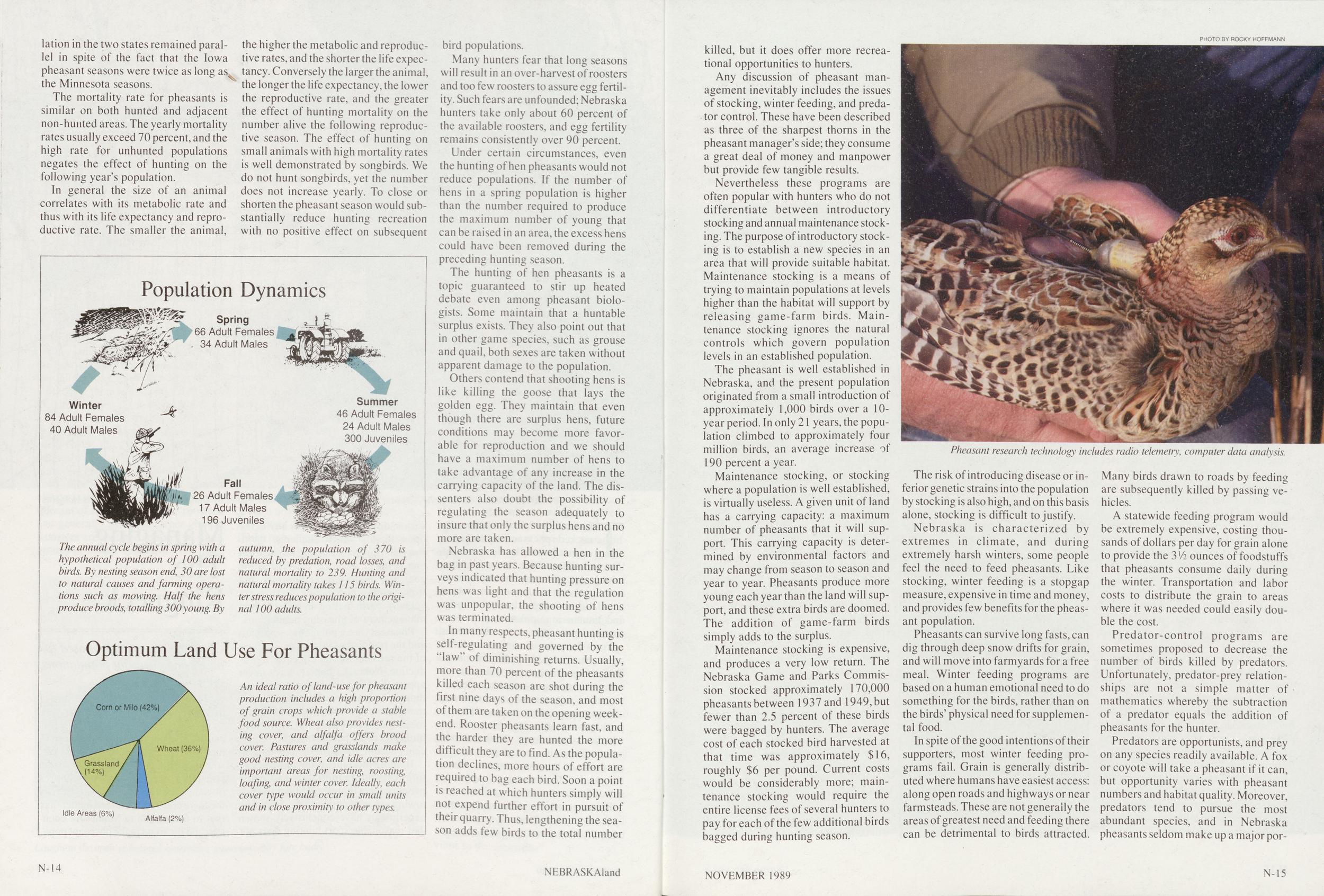
The pheasant is well established in Nebraska, and the present population originated from a small introduction of approximately 1,000 birds over a 10-year period. In only 21 years, the population climbed to approximately four million birds, an average increase of 190 percent a year.
Maintenance stocking, or stocking where a population is well established, is virtually useless. A given unit of land has a carrying capacity: a maximum number of pheasants that it will support. This carrying capacity is determined by environmental factors and may change from season to season and year to year. Pheasants produce more young each year than the land will support, and these extra birds are doomed. The addition of game-farm birds simply adds to the surplus.
Maintenance stocking is expensive, and produces a very low return. The Nebraska Game and Parks Commission stocked approximately 170,000 pheasants between 1937 and 1949, but fewer than 2.5 percent of these birds were bagged by hunters. The average cost of each stocked bird harvested at that time was approximately $16, roughly $6 per pound. Current costs would be considerably more; maintenance stocking would require the entire license fees of several hunters to pay for each of the few additional birds bagged during hunting season.
The risk of introducing disease or inferior genetic strains into the population by stocking is also high, and on this basis alone, stocking is difficult to justify.
Nebraska is characterized by extremes in climate, and during extremely harsh winters, some people feel the need to feed pheasants. Like stocking, winter feeding is a stopgap measure, expensive in time and money, and provides few benefits for the pheasant population.
Pheasants can survive long fasts, can dig through deep snow drifts for grain, and will move into farmyards for a free meal. Winter feeding programs are based on a human emotional need to do something for the birds, rather than on the birds' physical need for supplemental food.
In spite of the good intentions of their supporters, most winter feeding programs fail. Grain is generally distributed where humans have easiest access: along open roads and highways or near farmsteads. These are not generally the areas of greatest need and feeding there can be detrimental to birds attracted. Many birds drawn to roads by feeding are subsequently killed by passing vehicles.
A statewide feeding program would be extremely expensive, costing thousands of dollars per day for grain alone to provide the Vh ounces of foodstuffs that pheasants consume daily during the winter. Transportation and labor costs to distribute the grain to areas where it was needed could easily double the cost.
Predator-control programs are sometimes proposed to decrease the number of birds killed by predators. Unfortunately, predator-prey relationships are not a simple matter of mathematics whereby the subtraction of a predator equals the addition of pheasants for the hunter.
Predators are opportunists, and prey
on any species readily available. A fox
or coyote will take a pheasant if it can,
but opportunity varies with pheasant
numbers and habitat quality. Moreover,
predators tend to pursue the most
abundant species, and in Nebraska
pheasants seldom make up a major portion
 of any predator's diet. Their prmary prey includes mice, ground squirrels and rabbits,
species characterized
by reproductive rates exceeding those
of the pheasant.
of any predator's diet. Their prmary prey includes mice, ground squirrels and rabbits,
species characterized
by reproductive rates exceeding those
of the pheasant.
Diminishing returns control the actions of four-legged or flying predators much as they do those of human hunters. When prey populations decrease to the level of the carrying capacity of the land, continued efforts result in decreased returns. At that point, a prey species such as the pheasant becomes relatively safe from predation.
Researchers in southern Minnesota annually trapped and removed 15 to 20 predators from each square mile of a study area. The rate of pheasant nest destruction was reduced by at least half, and the reproductive rate doubled. Nevertheless, pheasant numbers continued to decline, and researchers concluded that predator control did not compensate for habitat losses/
In addition, the Minnesota study showed that predator control is prohibitively expensive; it cost approximately $21 per predator removed or $4.50 for each additional chick hatched. With normal survival rates of about 50 percent, the cost for each additional bird reaching maturity was about $9. Since only half of these birds could be expected to be roosters, the costs reached $ 18 for each bird that might be shot in the fall.
The only certain method of increasing pheasant populations is to improve their living conditions. To do that, the major factor limiting the population must be identified. In most parts of Nebraska, secure nesting habitat is the primary problem, and secure habitat can modify the effects of secondary limiting factors such as weather and predation.
Given these conditions, what kind of management programs will affect enough acres of land to materially increase pheasant populations?
Since some 97 percent of the land in Nebraska is privately owned, most pheasants are also produced and hunted on private land. Thus, any program to significantly increase pheasant numbers on a statewide basis depends on increasing pheasant habitat on private land. Federal farm programs offer the only economically feasible potential for attaining this goal.
The Soil Bank program of the late 1950s and early 1960s converted some 890,000 acres of cropland to year-round cover, and the pheasant population almost doubled. The early vegetative stages (weeds) characteristic of cropland retirement provide a safe haven for nesting as well as a refuge from predators and from winter weather. When the Soil Bank program ended and the land went back into crop production, pheasant numbers declined accordingly.
Habitat management is the key to abundance of pheasants, or of any wildlife species, and only through sound programs can populations thrive. The Habitat Stamp program is the Game and Parks Commission's primary response to the continuing loss of habitat, and it is a program of which hunters, biologists, administrators and the non-hunting public as well should be proud.
In its first 11 years (1977-1988) the program generated nearly 20.5 million dollars which was spent on habitat preservation, creation and enhancement. Dramatic increases in pheasant and other wildlife populations have characterized these developments.
Nevertheless, during the same period, the statewide pheasant population declined by 60 percent; funding based solely on fees charged hunters and the few others who purchase stamps could affect only some 30,000 acres of the 20 million privately-owned cropland acres in the state.
Published in November 1989 by the Nebraska Game and Parks Commission with additional funding made available by the Federal Aid in Wildlife Restoration Act, project W-15-R Additional copies are available from the Nebraska Game and Parks Commission, P.O. Box 30370, Lincoln, NE 68503. This agency receives federal funds. Under federal law, discrimination is prohibited on the basis of race, color, national origin, age, sex or handicap. If you think you have been discriminated against in any program, activity, or facility of this agency or want more information, contact Equal Opportunity Officer, Nebraska Game and Parks Commission, P.O. Box 30370, Lincoln, NE68503, or the Office of Equal Opportunity, U.S. Dept of Interior, Washington, D.C 20240.Fortunately, the future for pheasants in Nebraska is bright because of the Conservation Reserve Program created by the U.S. Department of Agriculture farm bill of 1985, which is similar to the Soil Bank program, but significantly larger. As of September 1989, Nebraska farmers had enrolled more than 1.3 million acres of cropland in 10-year permanent-cover contracts, and the goal is to convert 5.1 million acres to permanent cover.
The 1.3-million-acre figure represents about 6.5 percent of the state's cropland, and is 50 percent larger than the peak acreage enrolled in the Soil Bank program. In effect, the CRP has multiplied by approximately 45 times the acreage of the Game and Parks Commission's private land management programs funded by receipts from the sale of habitat stamps.
Based on the pheasant response to the Soil Bank program, it is realistic to expect at least a three-fold increase in the state's pheasant population during the life of the program. Even so, the overall reduction of habitat in the last 30 years will prevent the expected increase from creating a total pheasant population as large as that of the late 1950s. Continued cropping of forage from CRP land such as that authorized in response to the droughts of 1988 and 1989 would reduce the contribution of such land to the pheasant recovery.
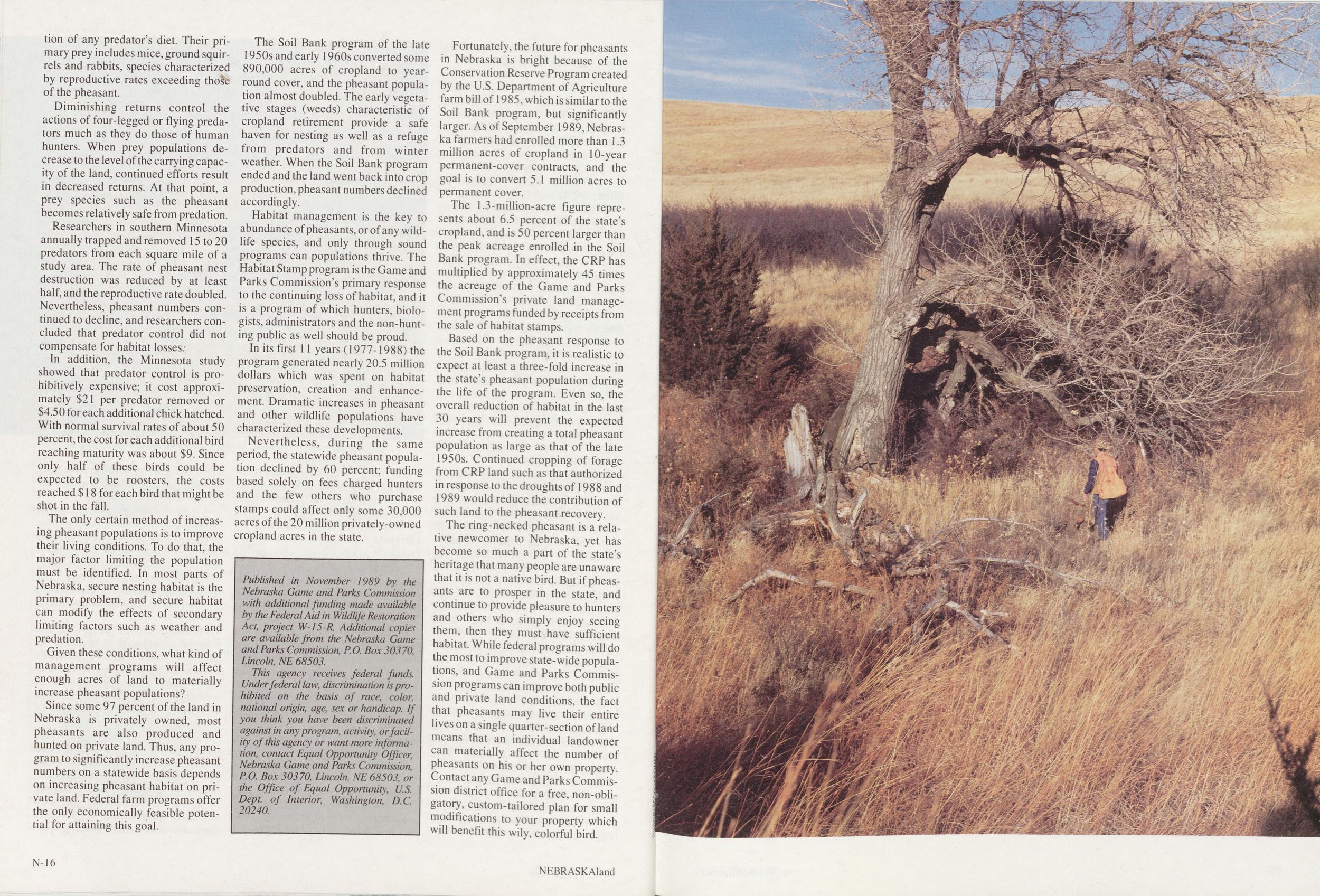
The ring-necked pheasant is a relative newcomer to Nebraska, yet has become so much a part of the state's heritage that many people are unaware that it is not a native bird. But if pheasants are to prosper in the state, and continue to provide pleasure to hunters and others who simply enjoy seeing them, then they must have sufficient habitat. While federal programs will do the most to improve state-wide populations, and Game and Parks Commission programs can improve both public and private land conditions, the fact that pheasants may live their entire lives on a single quarter-section of land means that an individual landowner can materially affect the number of pheasants on his or her own property. Contact any Game and Parks Commission district office for a free, non-obligatory, custom-tailored plan for small modifications to your property which will benefit this wily, colorful bird.
N-16 NEBRASKAland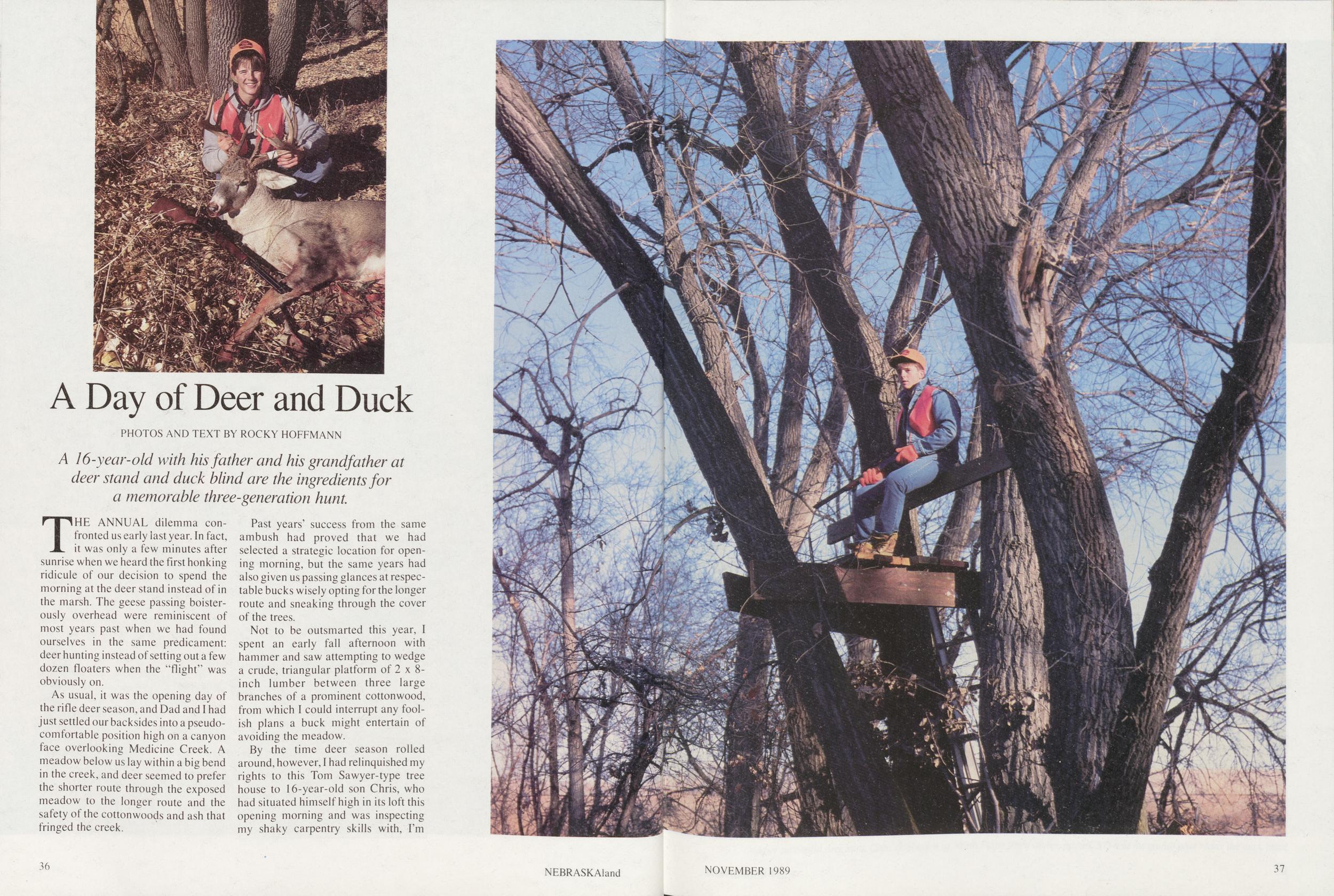
A Day of Deer and Duck
PHOTOS AND TEXT BY ROCKY HOFFMANN A 16-year-old with his father and his grandfather at deer stand and duck blind are the ingredients for a memorable three-generation huntTHE ANNUAL dilemma confronted us early last year. In fact, it was only a few minutes after sunrise when we heard the first honking ridicule of our decision to spend the morning at the deer stand instead of in the marsh. The geese passing boisterously overhead were reminiscent of most years past when we had found ourselves in the same predicament: deer hunting instead of setting out a few dozen floaters when the "flight" was obviously on.
As usual, it was the opening day of the rifle deer season, and Dad and I had just settled our backsides into a pseudo-comfortable position high on a canyon face overlooking Medicine Creek. A meadow below us lay within a big bend in the creek, and deer seemed to prefer the shorter route through the exposed meadow to the longer route and the safety of the cotton woods and ash that fringed the creek.
Past years' success from the same ambush had proved that we had selected a strategic location for opening morning, but the same years had also given us passing glances at respectable bucks wisely opting for the longer route and sneaking through the cover of the trees.
Not to be outsmarted this year, I spent an early fall afternoon with hammer and saw attempting to wedge a crude, triangular platform of 2 x 8-inch lumber between three large branches of a prominent cottonwood, from which I could interrupt any foolish plans a buck might entertain of avoiding the meadow.
By the time deer season rolled around, however, I had relinquished my rights to this Tom Sawyer-type tree house to 16-year-old son Chris, who had situated himself high in its loft this opening morning and was inspecting my shaky carpentry skills with, I'm 36 NEBRASKAland
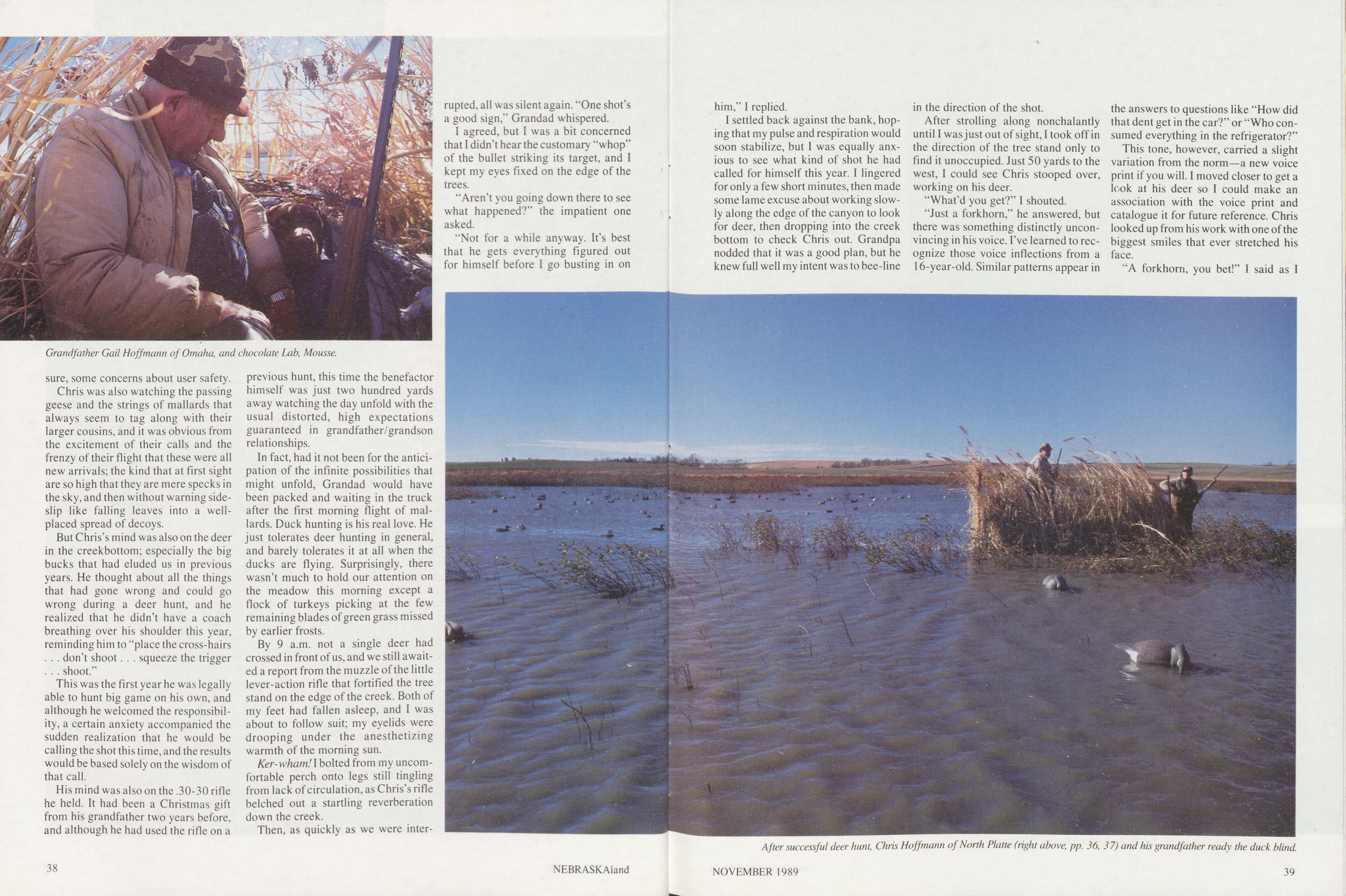
Chris was also watching the passing geese and the strings of mallards that always seem to tag along with their larger cousins, and it was obvious from the excitement of their calls and the frenzy of their flight that these were all new arrivals; the kind that at first sight are so high that they are mere specks in the sky, and then without warning sideslip like falling leaves into a well-placed spread of decoys.
But Chris's mind was also on the deer in the creekbottom; especially the big bucks that had eluded us in previous years. He thought about all the things that had gone wrong and could go wrong during a deer hunt, and he realized that he didn't have a coach breathing over his shoulder this year, reminding him to "place the cross-hairs...don't shoot...squeeze the trigger ...shoot."
This was the first year he was legally able to hunt big game on his own, and although he welcomed the responsibility, a certain anxiety accompanied the sudden realization that he would be calling the shot this time, and the results would be based solely on the wisdom of that call.
His mind was also on the .30-30 rifle he held. It had been a Christmas gift from his grandfather two years before, and although he had used the rifle on a previous hunt, this time the benefactor himself was just two hundred yards away watching the day unfold with the usual distorted, high expectations guaranteed in grandfather/grandson relationships.
In fact, had it not been for the anticipation of the infinite possibilities that might unfold, Grandad would have been packed and waiting in the truck after the first morning flight of mallards. Duck hunting is his real love. He just tolerates deer hunting in general, and barely tolerates it at all when the ducks are flying. Surprisingly, there wasn't much to hold our attention on the meadow this morning except a flock of turkeys picking at the few remaining blades of green grass missed by earlier frosts.
By 9 a.m. not a single deer had crossed in front of us, and we still awaited a report from the muzzle of the little lever-action rifle that fortified the tree stand on the edge of the creek. Both of my feet had fallen asleep, and I was about to follow suit; my eyelids were drooping under the anesthetizing warmth of the morning sun.
Ker-wham! I bolted from my uncomfortable perch onto legs still tingling from lack of circulation, as Chris's rifle belched out a startling reverberation down the creek.
Then, as quickly as we were interrupted, all was silent again. "One shot's a good sign," Grandad whispered.
I agreed, but I was a bit concerned that I didn't hear the customary "whop" of the bullet striking its target, and I kept my eyes fixed on the edge of the trees.
"Aren't you going down there to see what happened?" the impatient one asked.
"Not for a while anyway. It's best that he gets everything figured out for himself before I go busting in on 38 NEBRASKAland him," I replied.
I settled back against the bank, hoping that my pulse and respiration would soon stabilize, but I was equally anxious to see what kind of shot he had called for himself this year. I lingered for only a few short minutes, then made some lame excuse about working slowly along the edge of the canyon to look for deer, then dropping into the creek bottom to check Chris out. Grandpa nodded that it was a good plan, but he knew full well my intent was to bee-line in the direction of the shot.
After strolling along nonchalantly until I was just out of sight, I took off in the direction of the tree stand only to find it unoccupied. Just 50 yards to the west, I could see Chris stooped over, working on his deer.
"What'd you get?" I shouted.
"Just a forkhorn," he answered, but there was something distinctly unconvincing in his voice. I've learned to recognize those voice inflections from a 16-year-old. Similar patterns appear in the answers to questions like "How did that dent get in the car?" or "Who consumed everything in the refrigerator?"
This tone, however, carried a slight variation from the norm—a new voice print if you will. I moved closer to get a look at his deer so I could make an association with the voice print and catalogue it for future reference. Chris looked up from his work with one of the biggest smiles that ever stretched his face.
"A forkhorn, you bet!" I said as I
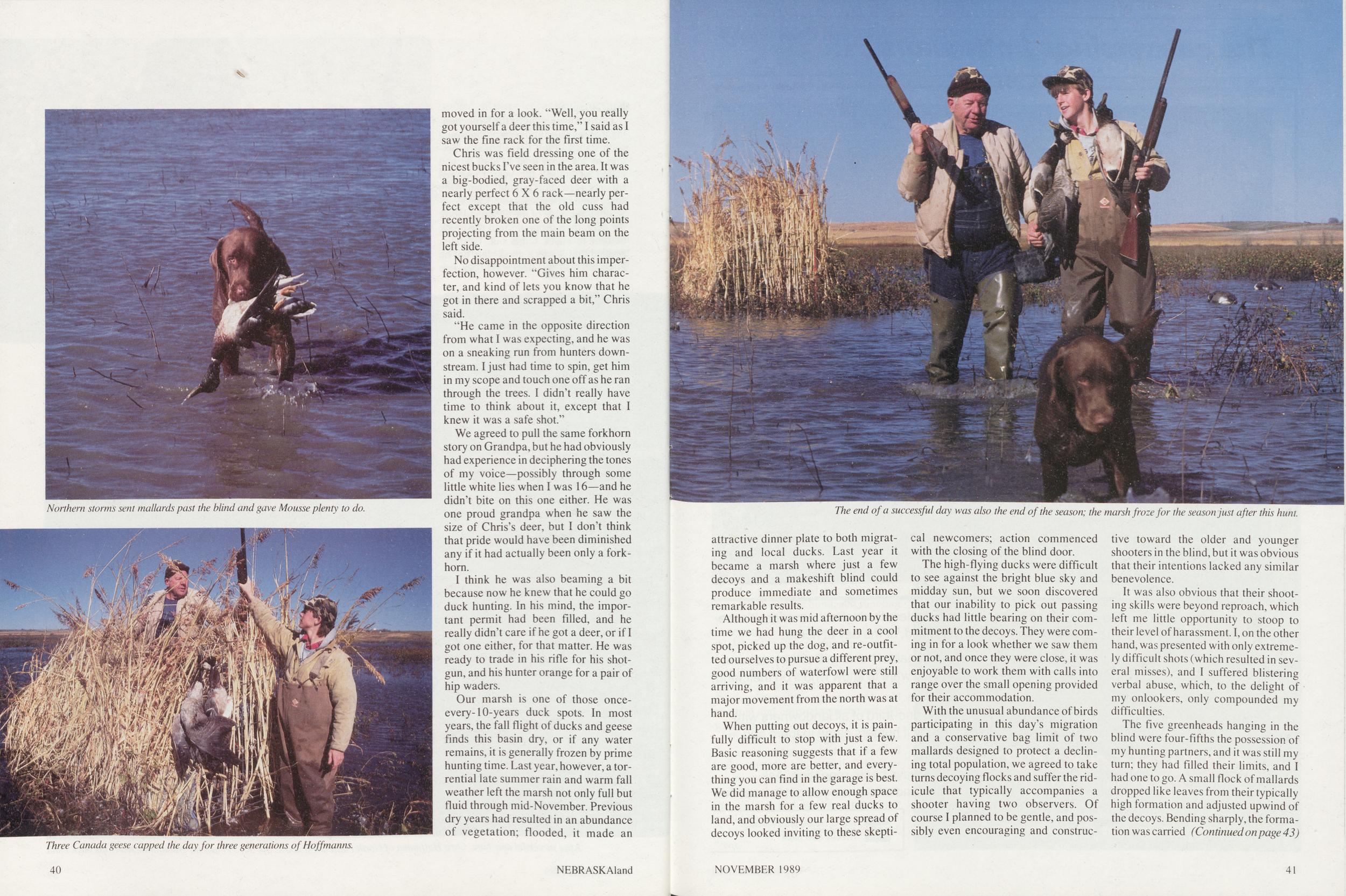
Chris was field dressing one of the nicest bucks I've seen in the area. It was a big-bodied, gray-faced deer with a nearly perfect 6X6 rack—nearly perfect except that the old cuss had recently broken one of the long points projecting from the main beam on the left side.
No disappointment about this imperfection, however. "Gives him character, and kind of lets you know that he got in there and scrapped a bit," Chris said.
"He came in the opposite direction from what I was expecting, and he was on a sneaking run from hunters downstream. I just had time to spin, get him in my scope and touch one off as he ran through the trees. I didn't really have time to think about it, except that I knew it was a safe shot."
We agreed to pull the same forkhorn story on Grandpa, but he had obviously had experience in deciphering the tones of my voice—possibly through some little white lies when I was 16—and he didn't bite on this one either. He was one proud grandpa when he saw the size of Chris's deer, but I don't think that pride would have been diminished any if it had actually been only a forkhorn.
I think he was also beaming a bit because now he knew that he could go duck hunting. In his mind, the important permit had been filled, and he really didn't care if he got a deer, or if I got one either, for that matter. He was ready to trade in his rifle for his shotgun, and his hunter orange for a pair of hip waders.
Our marsh is one of those once-every-10-years duck spots. In most years, the fall flight of ducks and geese finds this basin dry, or if any water remains, it is generally frozen by prime hunting time. Last year, however, a torrential late summer rain and warm fall weather left the marsh not only full but fluid through mid-November. Previous dry years had resulted in an abundance of vegetation; flooded, it made an 40 NEBRASKAland
Although it was mid afternoon by the time we had hung the deer in a cool spot, picked up the dog, and re-outfitted ourselves to pursue a different prey, good numbers of waterfowl were still arriving, and it was apparent that a major movement from the north was at hand.
When putting out decoys, it is painfully difficult to stop with just a few. Basic reasoning suggests that if a few are good, more are better, and everything you can find in the garage is best. We did manage to allow enough space in the marsh for a few real ducks to land, and obviously our large spread of decoys looked inviting to these skeptical newcomers; action commenced with the closing of the blind door.
The high-flying ducks were difficult to see against the bright blue sky and midday sun, but we soon discovered that our inability to pick out passing ducks had little bearing on their commitment to the decoys. They were com- ing in for a look whether we saw them or not, and once they were close, it was enjoyable to work them with calls into range over the small opening provided for their accommodation.
With the unusual abundance of birds participating in this day's migration and a conservative bag limit of two mallards designed to protect a declining total population, we agreed to take turns decoying flocks and suffer the ridicule that typically accompanies a shooter having two observers. Of course I planned to be gentle, and possibly even encouraging and constructive toward the older and younger shooters in the blind, but it was obvious that their intentions lacked any similar benevolence.
It was also obvious that their shooting skills were beyond reproach, which left me little opportunity to stoop to their level of harassment. I, on the other hand, was presented with only extremely difficult shots (which resulted in several misses), and I suffered blistering verbal abuse, which, to the delight of my onlookers, only compounded my difficulties.
The five greenheads hanging in the blind were four-fifths the possession of my hunting partners, and it was still my turn; they had filled their limits, and I had one to go. A small flock of mallards dropped like leaves from their typically high formation and adjusted upwind of the decoys. Bending sharply, the formation was carried (Continued on page 43)
NOVEMBER 1989 41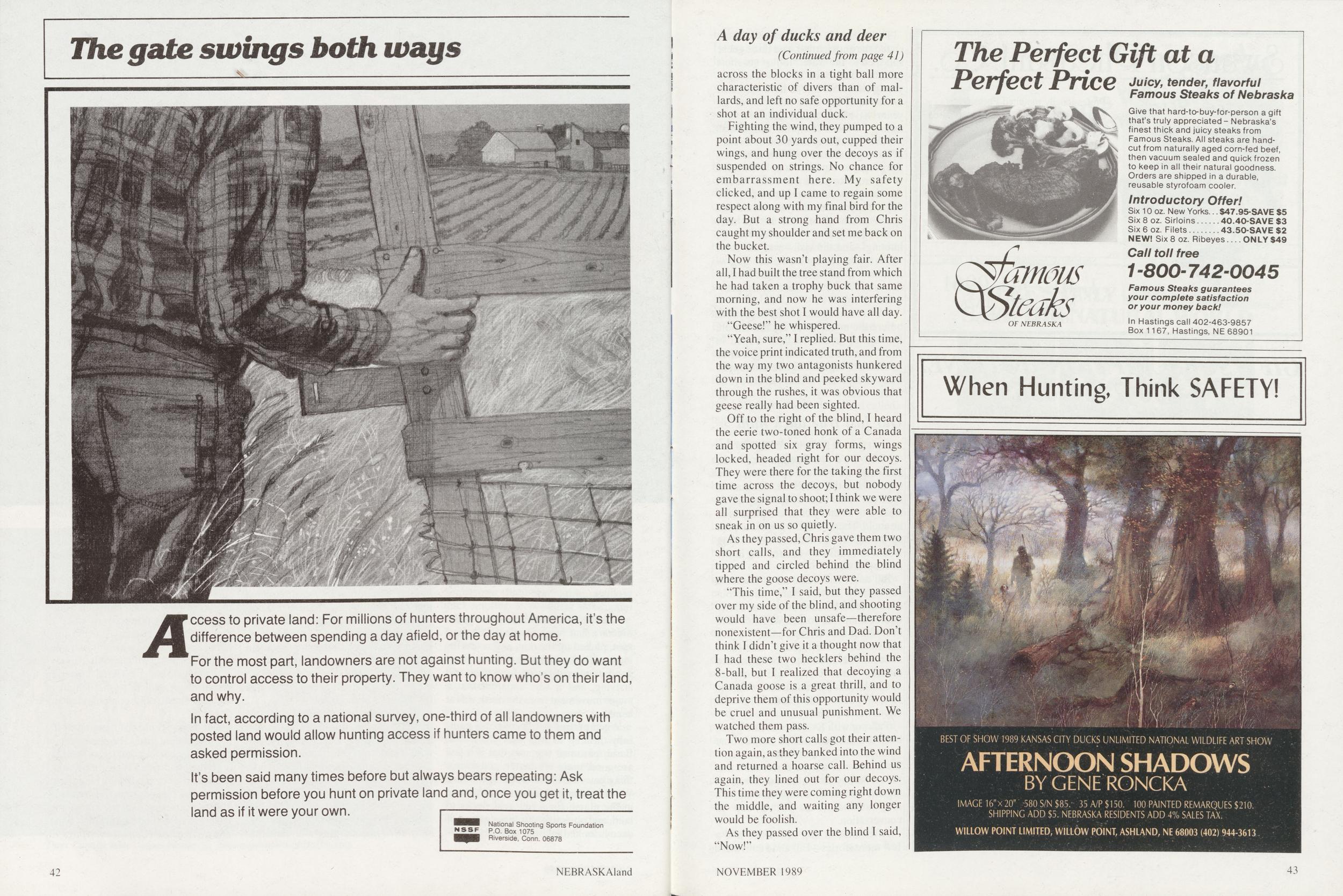
The gate swings both ways
A day of ducks and deer
(Continued from page 41)across the blocks in a tight ball more characteristic of divers than of mallards, and left no safe opportunity for a shot at an individual duck.
Fighting the wind, they pumped to a point about 30 yards out, cupped their wings, and hung over the decoys as if suspended on strings. No chance for embarrassment here. My safety clicked, and up I came to regain some respect along with my final bird for the day. But a strong hand from Chris caught my shoulder and set me back on the bucket.
Now this wasn't playing fair. After all, I had built the tree stand from which he had taken a trophy buck that same morning, and now he was interfering with the best shot I would have all day.
"Geese!" he whispered.
"Yeah, sure," I replied. But this time, the voice print indicated truth, and from the way my two antagonists hunkered down in the blind and peeked skyward through the rushes, it was obvious that geese really had been sighted.
Off to the right of the blind, I heard the eerie two-toned honk of a Canada and spotted six gray forms, wings locked, headed right for our decoys. They were there for the taking the first time across the decoys, but nobody gave the signal to shoot; I think we were all surprised that they were able to sneak in on us so quietly.
As they passed, Chris gave them two short calls, and they immediately tipped and circled behind the blind where the goose decoys were.
"This time," I said, but they passed over my side of the blind, and shooting would have been unsafe—therefore nonexistent—for Chris and Dad. Don't think I didn't give it a thought now that I had these two hecklers behind the 8-ball, but I realized that decoying a Canada goose is a great thrill, and to deprive them of this opportunity would be cruel and unusual punishment. We watched them pass.
Two more short calls got their attention again, as they banked into the wind and returned a hoarse call. Behind us again, they lined out for our decoys. This time they were coming right down the middle, and waiting any longer would be foolish.
As they passed over the blind I said, "Now!"
The Perfect Gift at a Perfect Price OF NEBRASKA Juicy, tender, flavorful Famous Steaks of Nebraska Give that hard-to-buy-for-person a gift that's truly appreciated - Nebraska's finest thick and juicy steaks from Famous Steaks. All steaks are handcut from naturally aged corn-fed beef, then vacuum sealed and quick frozen to keep in all their natural goodness. Orders are shipped in a durable, reusable styrofoam cooler. Introductory Offer! Six 10 oz. New Yorks $47.95-SAVE $5 Six 8 oz. Sirloins 40.40-SAVE $3 Six 6 oz. Filets 43.50-SAVE $2 NEW! Six 8 oz. Ribeyes ONLY $49 Call toll free 1-800-742-0045 Famous Steaks guarantees your complete satisfaction or your money back! In Hastings call 402-463-9857 Box 11 67, Hastings, NE 68901 BEST OF SHOW 1989 KANSAS CITY DUCKS UNLIMITED NATIONAL WILDLIFE ART SHOW AFTERNOON SHADOWS BYGENE'RONCKA IMAGE 16"x20" 580S/N $85/ 35 A/P$150. 100 PAINTED REMARQUES $210 SHIPPING ADD $5. NEBRASKA RESIDENTS ADD 4% SALES TAX. WILLOW POINT LIMITED, WILLOW POINT, ASHLAND, NE 613003 (402) 944-3613 NOVEMBER 1989 43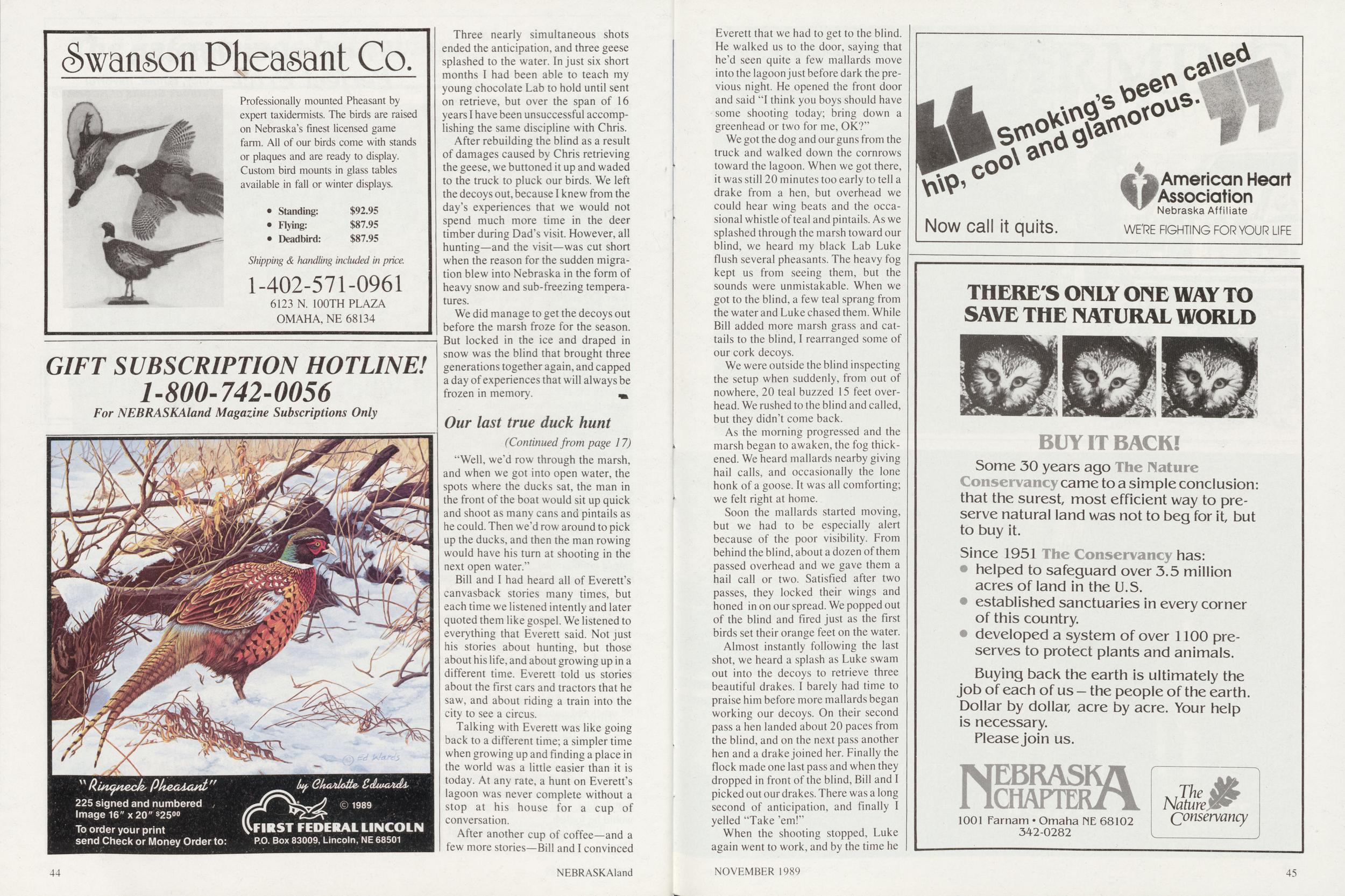 eSwanson Pheasant Co.
Professionally mounted Pheasant by
expert taxidermists. The birds are raised
on Nebraska's finest licensed game
farm. All of our birds come with stands
or plaques and are ready to display.
Custom bird mounts in glass tables
available in fall or winter displays.
Standing:
Flying:
Deadbird:
$92.95
$87.95
$87.95
Shipping & handling included in price.
1-402-571-0961
6123 N. 100TH PLAZA
OMAHA, NE 68134
GIFT SUBSCRIPTION HOTLINE!
1-800-742-0056
For NEBRASKAland Magazine Subscriptions Only
"Ringneck Pheasant"
225 signed and numbered
Image 16" x 20" $25.00
To order your print
send Check or Money Order to: FIRST FEDERAL LINCOLN
P.O. Box 83009, Lincoln, NE 68501
eSwanson Pheasant Co.
Professionally mounted Pheasant by
expert taxidermists. The birds are raised
on Nebraska's finest licensed game
farm. All of our birds come with stands
or plaques and are ready to display.
Custom bird mounts in glass tables
available in fall or winter displays.
Standing:
Flying:
Deadbird:
$92.95
$87.95
$87.95
Shipping & handling included in price.
1-402-571-0961
6123 N. 100TH PLAZA
OMAHA, NE 68134
GIFT SUBSCRIPTION HOTLINE!
1-800-742-0056
For NEBRASKAland Magazine Subscriptions Only
"Ringneck Pheasant"
225 signed and numbered
Image 16" x 20" $25.00
To order your print
send Check or Money Order to: FIRST FEDERAL LINCOLN
P.O. Box 83009, Lincoln, NE 68501
Three nearly simultaneous shots ended the anticipation, and three geese splashed to the water. In just six short months I had been able to teach my young chocolate Lab to hold until sent on retrieve, but over the span of 16 years I have been unsuccessful accomplishing the same discipline with Chris.
After rebuilding the blind as a result of damages caused by Chris retrieving the geese, we buttoned it up and waded to the truck to pluck our birds. We left the decoys out, because I knew from the day's experiences that we would not spend much more time in the deer timber during Dad's visit. However, all hunting—and the visit—was cut short when the reason for the sudden migration blew into Nebraska in the form of heavy snow and sub-freezing temperatures.
We did manage to get the decoys out before the marsh froze for the season. But locked in the ice and draped in snow was the blind that brought three generations together again, and capped a day of experiences that will always be frozen in memory.
Our last true duck hunt
(Continued from page 17)"Well, we'd row through the marsh, and when we got into open water, the spots where the ducks sat, the man in the front of the boat would sit up quick and shoot as many cans and pintails as he could. Then we'd row around to pick up the ducks, and then the man rowing would have his turn at shooting in the next open water."
Bill and I had heard all of Everett's canvasback stories many times, but each time we listened intently and later quoted them like gospel. We listened to everything that Everett said. Not just his stories about hunting, but those about his life, and about growing up in a different time. Everett told us stories about the first cars and tractors that he saw, and about riding a train into the city to see a circus.
Talking with Everett was like going back to a different time; a simpler time when growing up and finding a place in the world was a little easier than it is today. At any rate, a hunt on Everett's lagoon was never complete without a stop at his house for a cup of conversation.
After another cup of coffee—and a few more stories—Bill and I convinced 44 NEBRASKAland Everett that we had to get to the blind. He walked us to the door, saying that he'd seen quite a few mallards move into the lagoon just before dark the previous night. He opened the front door and said "I think you boys should have some shooting today; bring down a greenhead or two for me, OK?"
We got the dog and our guns from the truck and walked down the cornrows toward the lagoon. When we got there, it was still 20 minutes too early to tell a drake from a hen, but overhead we could hear wing beats and the occasional whistle of teal and pintails. As we splashed through the marsh toward our blind, we heard my black Lab Luke flush several pheasants. The heavy fog kept us from seeing them, but the sounds were unmistakable. When we got to the blind, a few teal sprang from the water and Luke chased them. While Bill added more marsh grass and cattails to the blind, I rearranged some of our cork decoys.
We were outside the blind inspecting the setup when suddenly, from out of nowhere, 20 teal buzzed 15 feet overhead. We rushed to the blind and called, but they didn't come back.
As the morning progressed and the marsh began to awaken, the fog thickened. We heard mallards nearby giving hail calls, and occasionally the lone honk of a goose. It was all comforting; we felt right at home.
Soon the mallards started moving, but we had to be especially alert because of the poor visibility. From behind the blind, about a dozen of them passed overhead and we gave them a hail call or two. Satisfied after two passes, they locked their wings and honed in on our spread. We popped out of the blind and fired just as the first birds set their orange feet on the water.
Almost instantly following the last shot, we heard a splash as Luke swam out into the decoys to retrieve three beautiful drakes. I barely had time to praise him before more mallards began working our decoys. On their second pass a hen landed about 20 paces from the blind, and on the next pass another hen and a drake joined her. Finally the flock made one last pass and when they dropped in front of the blind, Bill and I picked out our drakes. There was a long second of anticipation, and finally I yelled "Take 'em!"
When the shooting stopped, Luke again went to work, and by the time he had shaken the water off and rejoined us, there were six fat mallards lying in the bottom of the blind. They filled our of legal limit, so that part of the hunt was over. But we didn't want the last duck hunt of the season to end so early, and we decided to stay in the blind for a while to call, watch and talk.
"Smoking's been called hip, cool and glamorous." Now call it quits. American Heart Association Nebraska Affiliate WE'RE FIGHTING FOR YOUR LIFE THERE'S ONLY ONE WAY TO SAVE THE NATURAL WORLD T RACK! Some 30 years ago The Nature came to a simple conclusion: that the surest, most efficient way to preserve natural land was not to beg for it, but to buy it. Since 1951 The Conservancy has: helped to safeguard over 3^5 million acres of land in the U.S. established sanctuaries in every corner of this country. developed a system of over 1100 preserves to protect plants and animals. Buying back the earth is ultimately the job of each of us - the people of the earth. Dollar by dollar, acre by acre. Your help is necessary. Please join us. RRAC OfiTiCI $A 1001 Farnam • Omaha NE 68102 342-0282 NOVEMBER 1989 45
 CEDAR LANE
Ranch Vacations •
Guest ranch in the heart of the Sandhills of
Nebraska, Swimming, spa, horses, canoeing,
trail rides., barbeques, hunting, family reunions.
BOOKING NOW For 1990
Richard and Betty Schroeder HC 2 Box 9C
Stapieton. Nebraska 69163 Ph. 308-587-2233
Woodsy Owl says
Stash Your Trash
NEBRASKA
OPERATION GAME
THIEF
STOP
POACHING
TOLL-FREE HOTLINE
(800) 742-7627
MARSHWATCHER
DUCKS UNLIMITED-LEADER IN WETLANDS CONSERVATION - 50 YEARS
The marsh sleeps
Blanketed with snow, the marsh,
with all its essential elements, sleeps
through winter. Beneath the snow, ice
and frozen mud, the seeds, rootstocks
and dormant aquatic life await the
coming of spring. Many marshes
depend entirely on a good runoff and
later rains to maintain them through-out the summer. Ducks Unlimited has
safeguarded hundreds of marshes
against drought, ensuring that they
will maintain permanent water to
attract waterfowl and other wildlife,
while creating hayland and improved
grazing for livestock.
CEDAR LANE
Ranch Vacations •
Guest ranch in the heart of the Sandhills of
Nebraska, Swimming, spa, horses, canoeing,
trail rides., barbeques, hunting, family reunions.
BOOKING NOW For 1990
Richard and Betty Schroeder HC 2 Box 9C
Stapieton. Nebraska 69163 Ph. 308-587-2233
Woodsy Owl says
Stash Your Trash
NEBRASKA
OPERATION GAME
THIEF
STOP
POACHING
TOLL-FREE HOTLINE
(800) 742-7627
MARSHWATCHER
DUCKS UNLIMITED-LEADER IN WETLANDS CONSERVATION - 50 YEARS
The marsh sleeps
Blanketed with snow, the marsh,
with all its essential elements, sleeps
through winter. Beneath the snow, ice
and frozen mud, the seeds, rootstocks
and dormant aquatic life await the
coming of spring. Many marshes
depend entirely on a good runoff and
later rains to maintain them through-out the summer. Ducks Unlimited has
safeguarded hundreds of marshes
against drought, ensuring that they
will maintain permanent water to
attract waterfowl and other wildlife,
while creating hayland and improved
grazing for livestock.
In the next two hours we called in a dozen more flocks of mallards; for a while we had about 30 teal and almost as many mallards sitting among our cork-block replicas. It was a fitting way to end a duck season on Everett's lagoon.
Finally, it was time to leave. We had about half the decoys packed away in the blind when something happened that will stay etched in my memory until I am Everett's age, or older. Without warning, five mysterious shadows came out of the fog and passed silently — I overhead. Bill and I looked at each other; I told him I thought they were geese. I had left my goose call in the blind, so I blew a hail note on my duck call. We stood still and waited for what seemed an eternity, and finally they made another pass, lower and closer this time. Again, we could only look at each other and shrug; neither of us sure what they were.
I called again, then stood still and waited. Directly in front of us the mysterious shadows appeared again; out of the fog, wings cupped, they grew as large and colorful as a child's balloons drifting toward us in a breeze. They rocked down gracefully, their heads and red necks outstretched, dark feet down, and snowy breasts exposed. They splashed down 15 yards away, and in that moment Bill and I savored the beauty of our first canvasbacks.
I think the ducks sensed as much innocence and safety in us as we did in them. Then instinct took over and the five canvasbacks disappeared into the fog as majestically as they had descended. For a minute neither Bill nor I moved. Then we picked up the rest of the decoys and hurried to the farm house to tell Everett about the hunt.
For me, that hunt has become more than just another outdoor memory; a lot has changed since then. Although I still hunt ducks in his lagoon, Everett has moved from the farm to a nearby town. I know the lagoon and the farm have not really changed much in his absence, but somehow hunting there just does not seem the same. I miss Everett's stories about times past. My old friend had a way of taking me back in time with his stories, back to a time when there was more truth in the world. Back to an honest, simple time when our lakes and streams were unpolluted, and the flights of ducks seemed endless.
I first realized how sad it was that I could never be a part of those lost times when I saw the five canvasbacks. Then I realized how sad it must be for Everett. He saw the great flights and lived in that innocent age. But I think that my old friend had adapted well; even though Everett had hung up his 12-gauge some 20 years earlier, he was still a duck hunter. Not in the way that I am, but through his stories.
Because of his age and his failing health, Everett had to leave his farm and move to the city. I am sure that now he misses his hunts with me just as much as I miss my hunts with him. I realize that things are always changing in the world and in our lives, but I wish they could always stay as they were for Everett and me on our last true duck hunt, m
Mark Landgren, of Hastings, is a journalism student at the Unviversity of Nebraska-Lincoln. Another of his hunting stories appeared in NEBRASKAland Magazine in November, 1985.
48 NEBRASKAlandTrading Post
DOGSYELLOW-BLACK Lab pups. FC-AFC sired. AKC. Hips OFA ceritified. Dew claws removed. Excellent hunting potential. Contact Bob Bendler, Lexington, NE (308)324-4247.
TRAINING ALL BREEDS Hunting Dogs — Vizslas for sale. Rozanek Kennels, Rt. 2, Schuyler, NE 68661. Phone(402)352-8769.
ENGLISH SETTERS: 'Bred for the hunter"; select puppies and started dogs available from outstanding bloodlines. Stud service available by proven hunters. High Plains Kennels, 1411 Emerson, Alliance, NE 69301, Phone (308) 762-6709.
GERMAN SHORTHAIRS and Brittany Spaniel pups. Started and occasionally a meat dog. Pups are guaranteed. Also I will be training hunting dogs. Wayne Clark, Percival, IA. Phone (712) 529-4238 or (402) 263-3155 at Union, NE
ENGLISH POINTER pups breeding Elhew; started dogs, force retrieving; at stud Ch. Elhew Husker John. J. H. Render. Box 86, Panama, NE 68419. Phone (402) 788-2213.
YOUNG ENGLISH SETTERS for sale. Close up pat-finder breeding. Darrel Yentes, Holdrege, NE 68949. Phone (308) 995-4797.
BLACK LAB PUPS. FC-AFC sired, Shotgun Willie from the West Coast. Litter due October 24. Contact Todd TerMaat (402) 488-0095, Lincoln, NE.
PINKERTON bird dogs—English setter, brittany puppies. Started dogs available this fall. Our dogs are bred for nose and style. Give us a call at (402) 673-4540.
MISCELLANEOUSNE NEBRASKA trout fishing. 3 modern cottages, 1 available year round. 5 spring fed lakes with open water all year. Trout up to 7 pounds. Other varieties fish also. Diamond E. Trout Resort, Orchard, NE 68764. Phone (402)893-4745.
Bev Doolittle, Terrry Redlin, Jerry Raedke, Ed Wards, Robert Bateman, Frank McCarthy and Neal Anderson are available at the 2nd Street Gallery, 537 W. 2nd, Hastings, NE 68901. Phone (402) 463-6677.
TROLLING MOTOR REPAIR. Factory authorized Minn Kota and Motor Guide, parts and service. Wolfs Repair and Tackle Supply, 1529 David Drive, Lincoln, NE 68504 Phone(402)464-4265.
WINE AND BEER: Make your own. Send for free recipes and instructions. Omaha Supply, 1324 2nd Avenue, Nebraska City. NE 68410.
GUNS — Browning, Winchester, Remington, others, Hi-powers, shotguns, new, used, antiques. Want Pre-1964 Winchesters. Buy-Sell-Trade. Ph. (402) 729-6112. Bedlan's Sporting Goods, Fairbury, NE 68352.
MAD RIVER CANOES offers the finest quality and performance. For the finest canoes and accessories look to Great Plains Canoe Co., 205 Main, Springfield, NE. Phone(402)253-2001.
FREE! Booklets on northeastern Nevada; fishing, rock-hounding maps, Carl Hayden, Box 528, Jackpot, Nevada 89825.
FISH FOR SALE—adult northern pike, walleye, bass, bluegill, catfish, grass carp, coho salmon, trout and minnows. Carlson Clearwater Fish Farms, Inc., Rt. 2 Box 202, Wayne, NE 68787. Phone (402) 375-3262.
METAL DETECTOR BARGAINS. All brands available. Send for free catalog. Research Unlimited, 210 North Main St., Ames, NE 68621. Phone (402) 721 -8588.
TURKEY AND DEER HUNTERS: While hunting in Boyd County, stay at the Niobrara Valley House of Renewal Retreat Center, Lynch, Nebraska, just south of Lynch. $10 a night. (402) 569-3433.
MANDARIN DUCKS $35 pair, Woodducks $25 pair. Nice full-wing birds. Mrs. R. W. Hansen, 3315 Avenue L, Kearney, NE 68847. Phone (308) 237-3781.
CALAMUS RIVER HIDEAWAY. 62 acres with nice 4-bedroom home and guest cabin on lake full of fish. Beautiful setting, remote but just 30 miles to big dam. 640 leased acres can also go along. Have many other Rec-Properties. Swett Realty, P.O. Box 265, Ainsworth, NE 69210. Phone (402) 387-1626 day or night.
SUMMER OPPORTUNITIES for field courses in 1990 offered at biological field stations are summarized in a poster prepared by the Organization of Biological Field Stations. Most offerings are intended for undergraduate and graduate students in biology. For a copy, contact Dr. Richard W. Coles, Secretary OBFS, Washington University Tyson Research Center, P.O. Box 351, Eureka, MO 63025.
ICE FISHING SUPPLIES. Large selection and low prices! This month's special, Jiffy 30-08 Power ice auger, the big 3 H.P. with 8" blade only $229.95. F.O.B. Lincoln. Wolfs Tackle Supply, i 529 David Dr., Lincoln, NE 68504. Phone (402) 464-4265.
HUSKABEAR (commemorating Husker's 100th football season). Full color print, finished in antique country red frame. Also available the first Huskabear design in same frame. Makes a unique gift for any big red fan. There are assorted full-color notecards too. Framed design $39.95 + $3 shipping. Notecards $4 per box + $ 1 shipping. To order or request samples write Susan Bauer Reber, P.O. Box 543, Benkelman, NE 69021 or call (303)848-5213.
Ringneck pheasants for sale. Full-feathered, flight conditioned and taxidermy quality birds. Swanson Hunting Acres, Inc., Rt. 1 Box 18, Niobrara, NE 68760. Phone (402) 857-3794.
LIVE-CATCH ALL-PURPOSE TRAPS FREE CATALOG Traps without injury squirrels, chipmunks, rabbits, mink, fox, raccoons, stray animals, pests, etc. Sizes for every need Also traps for snakes, sparrows, pigeons, crabs, turtles, quail, etc Save on our low factory prices Send no money Free catalog and trapping secrets MUSTANG MFG. CO., Dept. N-34, Box 920947. Houston, Tex. 77292 NEBRASKAland Magazine Order Form Please send me a subscription to NEBRASKAland Magazine One-year $12.00 NAME ADDRESS Two-year $23.00 CITy STATE ZIP.MANDARIN DUCKS $35 pair, Woodducks $25 pair. Nice full-wing birds. Mrs. R. W. Hansen, 3315 Avenue L, Kearney, NE 68847. Phone (308) 237-3781.
FOR SALE: Hungarian, Redleg, Chukar Partridge, California Valley quail, Gamble, Mexican, Speckled, Blue Scale and Bob White quail. Emil Ripp, Cairo, NE. Phone (308) 485-4648 evenings.
TAXIDERMYALLISON'S TAXIDERMY STUDIO. Wally and Betty Allison Licensed Taxidermist. We've mounted 28 Nebraska State Record fish. Specializing in fish and birds, small game and rattlesnakes. We use freeze-dry. 2310 West Leota, North Platte, Nebr. 69101. Phone (308) 534-2324.
BADE TAXIDERMY - Quality a must — Fast service. Fish, birds, rugs, tanning, full mounts and game heads, 2111 N. Christy St., Fremont, NE 727-5463.
NABITY'S TAXIDERMY. 31 years experience. Specializing in natural grass backgrounds for mammals, birds and fish. 13901 "O" St., Lincoln, NE 68504 — 4 miles east of 84th and "O". (402) 489-6351.
PEISTER TAXIDERMY — Professional work at prices most sportsman can afford. Now in our new log cabin studio, 1020 Central Avenue, Box 3201, Kearney, NE 68847. Phone (308) 236-9700 or (308) 237-7575 evenings.
NATURECRAFT STUDIO — all custom services — creative work, quality, and experience since 1935. Includes freeze-dry processing. Display and sales room, visitors welcome. Hwy. 2 in Nebraska City. Phone (402) 873-5491. Joe Voges — Owner. Bow Steedly — Big Game specialist.
DEER PROCESSING SALAMI JERKY POLISH SAUSAGE 1 DRIED DEER DEER STICKS DICK BACON (308) 284-4626 320 W. D Street Ogallala, NE 69153 DEE'S MAPS The new name in Contour Maps 1989 CONTOURS © Merritt Reservoir © Harlan County Reservoir ® Calamus Reservoir © Glen Elder Reservoir in Kansas © Lewis & Clark © Red Willow & Swanson (one map) © Milford Lake in Kansas Water Proof — Tear Proof $495 each or $1295 for any 3 Satisfaction Guaranteed See your dealer or write: Sportsman, Box 702 Broken Bow, NE 68822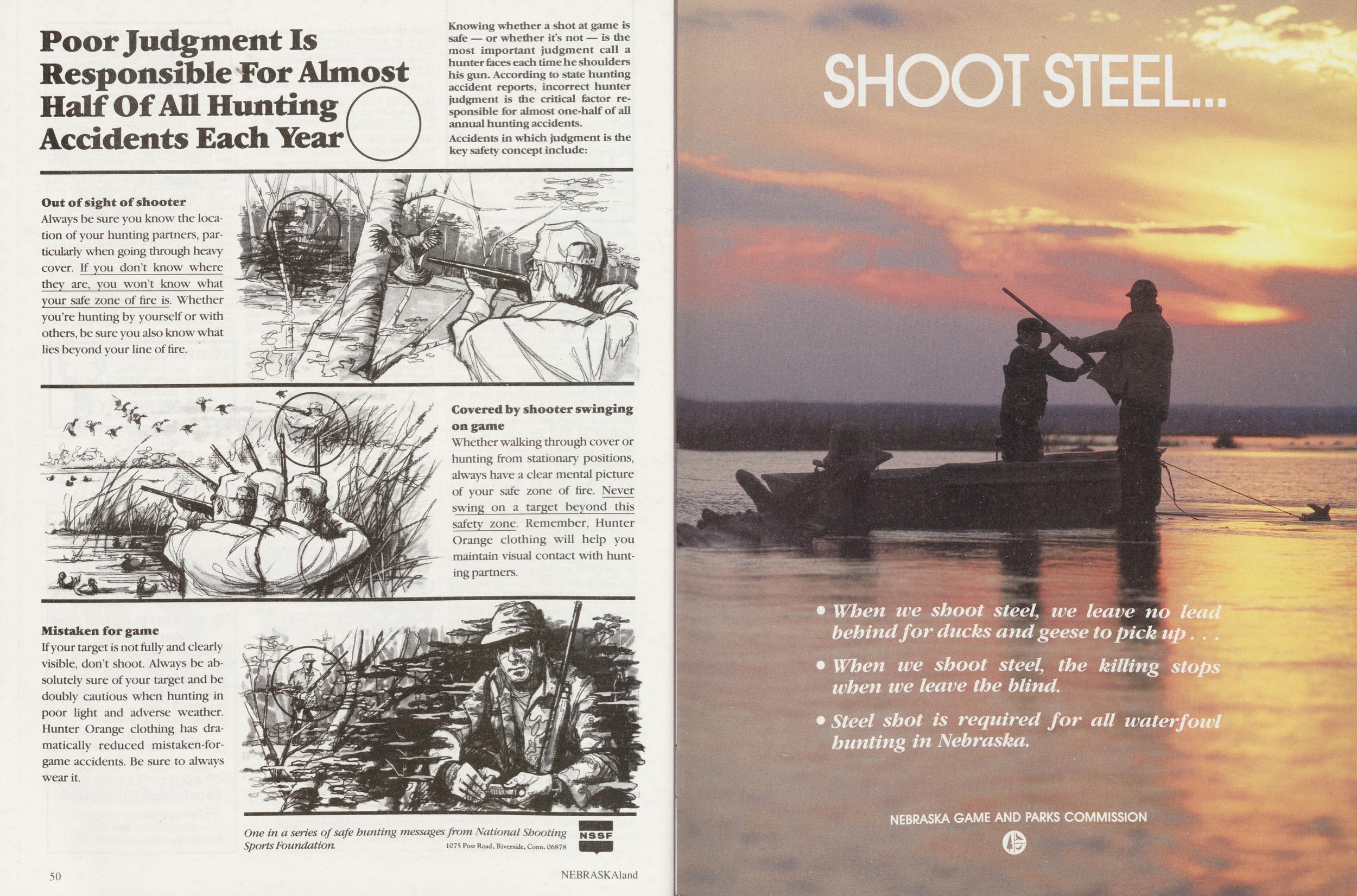
Poor Judgment Is Responsible For Almost Half Of AH Hunting Accidents Each Year
Knowing whether a shot at game is safe — or whether it's not — is the most important judgment call a hunter faces each time he shoulders his gun. According to state hunting accident reports, incorrect hunter judgment is the critical factor responsible for almost one-half of all annual hunting accidents. Accidents in which judgment is the key safety concept include:SHOOT STEEL...
When we shoot steel, we leave no lead behind for ducks and geese to pick up... When we shoot steel, the killing stops when we leave the blind. Steel shot is required for all waterfowl hunting in Nebraska. NEBRASKA GAME AND PARKS COMMISSION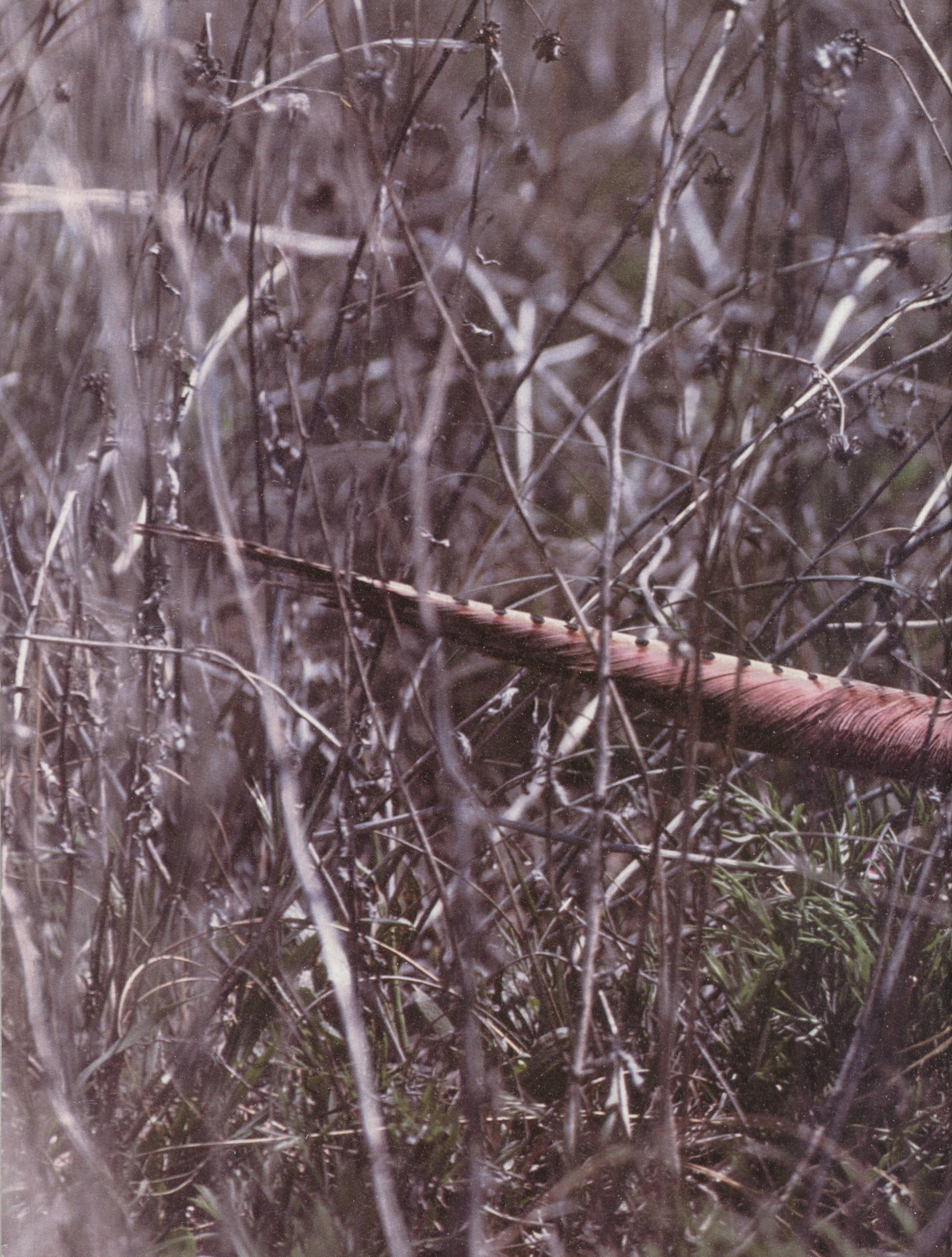
Position: 467 (22 views)