Volume 67, Issue 8, 1989
NEBRASKAland
OCTOBER 1989 $1.50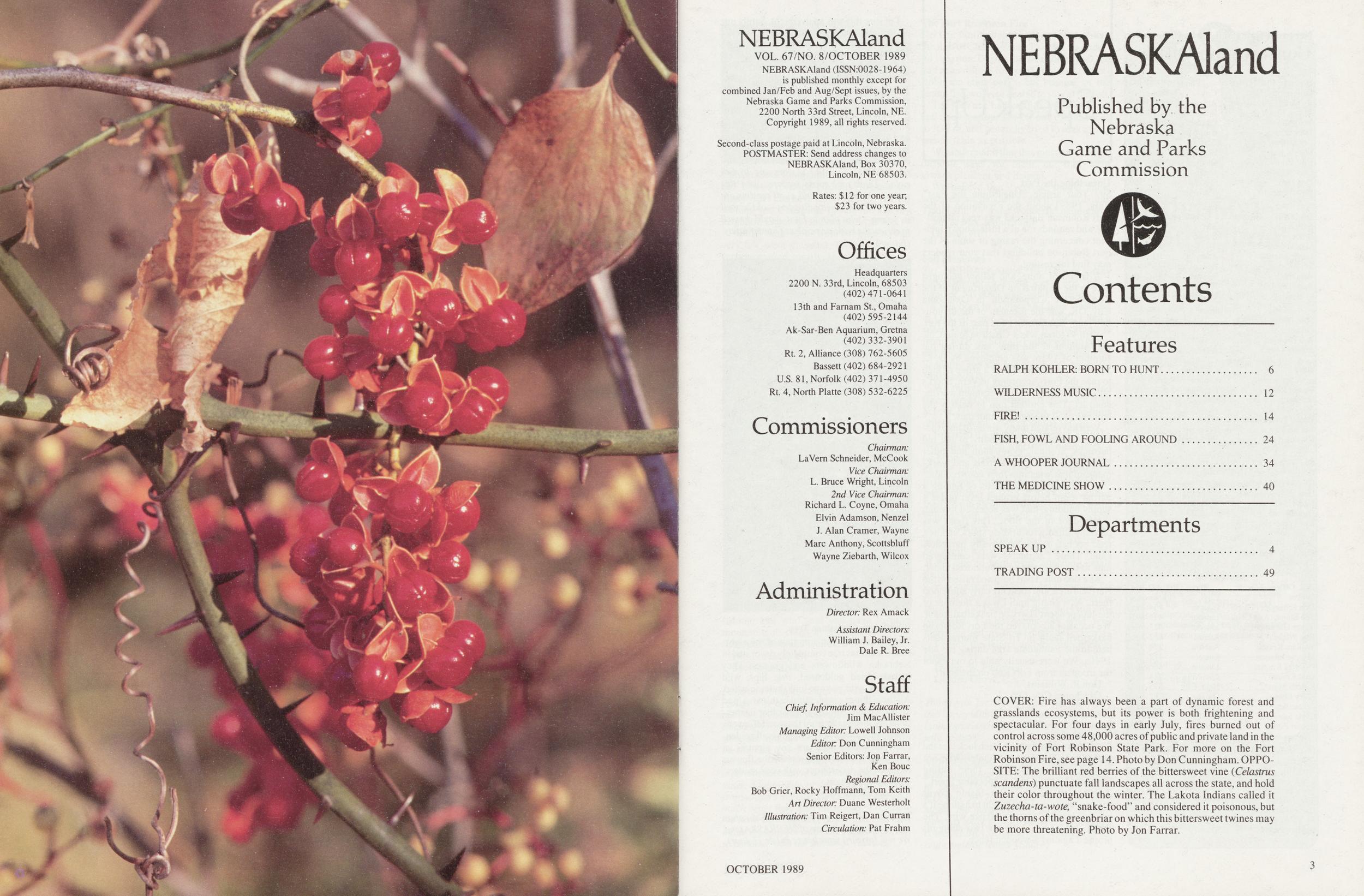
NEBRASKAland
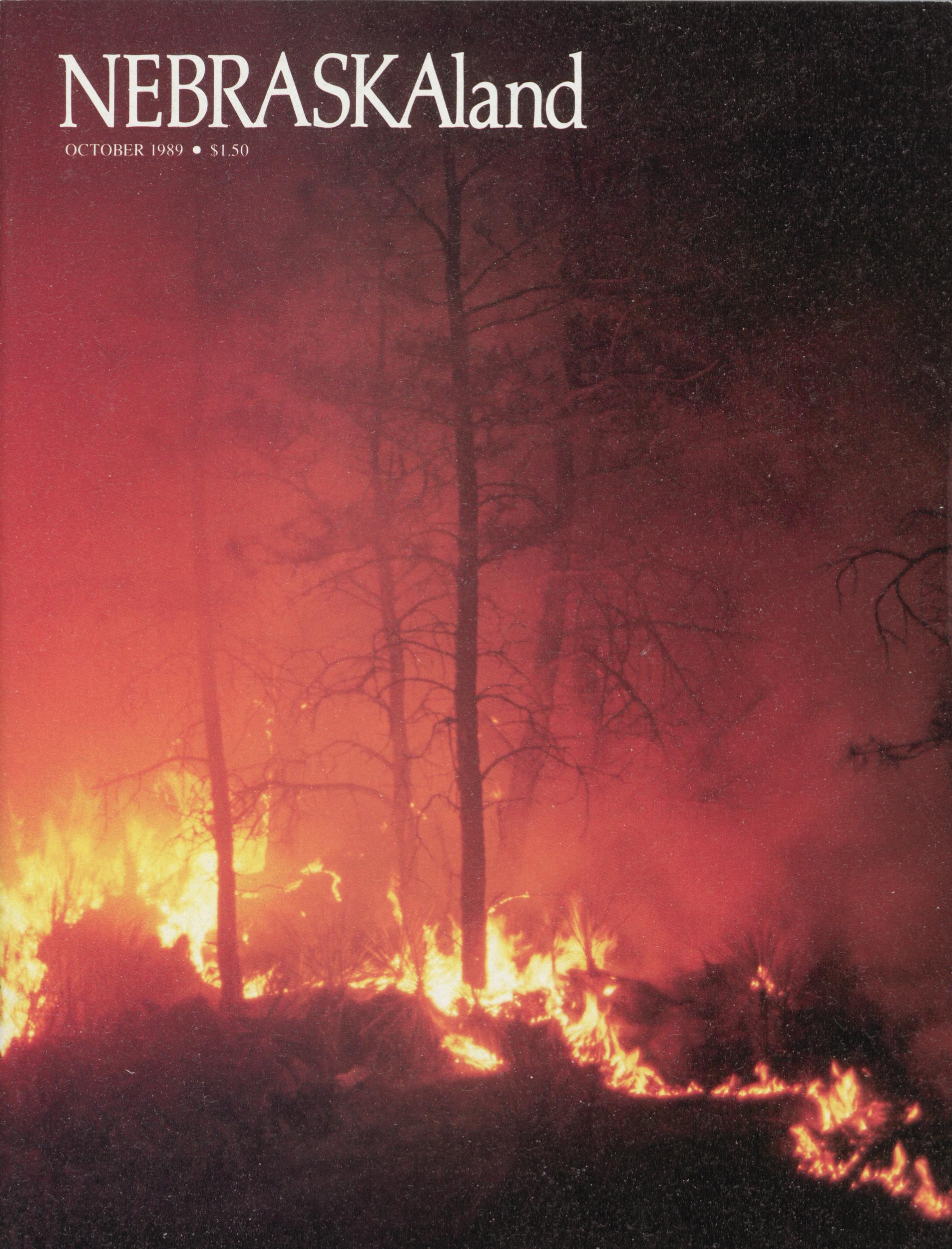
Published by the Nebraska Game and Parks Commission NEBRASKAland VOL. 67/NO. 8/OCTOBER 1989 NEBRASKAland (ISSN:0028-1964) is published monthly except for combined Jan/Feb and Aug/Sept issues, by the Nebraska Game and Parks Commission, 2200 North 33rd Street, Lincoln, NE. Copyright 1989, all rights reserved. Second-class postage paid at Lincoln, Nebraska. POSTMASTER: Send address changes to NEBRASKAland, Box 30370, Lincoln, NE 68503. Rates: $12 for one year; $23 for two years. Offices Headquarters 2200 N. 33rd, Lincoln, 68503 (402)471-0641 13th and Farnam St., Omaha (402)595-2144 Ak-Sar-Ben Aquarium, Gretna (402)332-3901 Rt. 2, Alliance (308) 762-5605 Bassett (402) 684-2921 U.S. 81, Norfolk (402) 371-4950 Rt. 4, North Platte (308) 532-6225 Commissioners Chairman: LaVern Schneider, McCook Vice Chairman: L. Bruce Wright, Lincoln 2nd Vice Chairman: Richard L. Coyne, Omaha Elvin Adamson, Nenzel J. Alan Cramer, Wayne Marc Anthony, Scottsbluff Wayne Ziebarth, Wilcox Administration Director: Rex Amack Assistant Directors: William J. Bailey, Jr. Dale R. Bree Staff Chief, Information & Education: Jim MacAllister Managing Editor: Lowell Johnson Editor: Don Cunningham Senior Editors: Jon Farrar, Ken Bouc Regional Editors: Bob Grier, Rocky Hoffmann, Tom Keith Art Director: Duane Westerholt Illustration: Tim Reigert, Dan Curran Circulation: Pat Frahm Contents Features RALPH KOHLER: BORN TO HUNT 6 WILDERNESS MUSIC 12 FIRE! 14 FISH, FOWL AND FOOLING AROUND 24 A WHOOPER JOURNAL 34 THE MEDICINE SHOW 40 Departments SPEAK UP 4 TRADING POST 49 COVER: Fire has always been a part of dynamic forest and grasslands ecosystems, but its power is both frightening and spectacular. For four days in early July, fires burned out of control across some 48,000 acres of public and private land in the vicinity of Fort Robinson State Park. For more on the Fort Robinson Fire, see page 14. Photo by Don Cunningham. OPPO- SITE: The brilliant red berries of the bittersweet vine {Celastnis scandens) punctuate fall landscapes all across the state, and hold their color throughout the winter. The Lakota Indians called it Zuzecha-ta-wote, "snake-food" and considered it poisonous, but the thorns of the greenbriar on which this bittersweet twines may be more threatening. Photo by Jon Farrar. OCTOBER 1989 3
Speak Up
Unearthing the PastSir/ Your article "Unearthing the Past" [July, 1989] about the excavation of the Fort Robinson Barracks was very interesting, and reminds me of a little-known incident concerning the razing of some of the Fort Robinson buildings that your readers may find interesting.
A friend of mine, and fellow geologist here in the Exploration Department of the Kerr-McGee Corporation in Oklahoma City, OK, was the foreman of the demolition team that razed a good part of the fort.
Vern Vigoren was a Chadron State College student at the time, and during the summer of 1956, was employed by D. C. Short, of Chadron, to direct a group of men to raze the Fort. According to Vern, Short's bid of $ 100 to the U.S. Government won the contract. This entitled him to destroy the buildings and salvage the materials.
Vern has related many stories of his experiences in tearing down many of the old barracks, hospital, gymnasium and other buildings, and of the materials and workmanship that went into their construction.
In one instance, Vern tells of finding a partial room below ground level under a supply building, that was accessed through a trap door in the floor. This room was partially filled with bridles, spurs, saddles, feed buckets and other cavalry paraphernalia. These "artifacts" were considered junk at the time, and were bulldozed under.
As a side note, I was born and raised in the Harrison area, and spent my early adulthood there. As a young man I was a member of the Independent Harrison basketball team. We occasionally played the Fort Robinson basketball team in Tri-State tournaments held in the Panhandle area during the late 1940s. We were usually able to out-shoot the troopers from Fort Rob on the court.
Don R. Williams Oklahoma City, OK * * * Hunter SafetySir/ It was probably with much luck that the author or his fellow grouse hunters were not injured or worse during their outing ["Grouse Hunting Isn't a Spectator Sport," August/September]. The inside cover shows a shotgun (I was taught to assume it's loaded) leaning against a fence wire. The picture on page 22 shows two shotguns propped against a wooden fence.
I'm sure this was an oversight. Surely our editors are on the lookout for unsafe practices being shown our young readers. Maybe these same pictures should be put on slides and used in hunter safety courses to demonstrate improper gun handling.
Doug W. Schueths LincolnMr. Schueths brings up a timely point for us and for any hunter. We should be careful that our photos always illustrate unquestionably correct hunter safety practices. Dove, squirrel, rabbit and grouse seasons are in full swing; Duck and goose seasons open this month, and pheasant and quail seasons are just a few weeks away. Readers—old as well as young—who plan to hunt, would do well to review the basic principles of hunter safety. (Editor)
Sir/ I'm sending you a picture of my eightfoot Christmas tree completely decorated in Nebraska wildflowers and grasses. They include dried goldenrod, rose hips, wild artemisia, wild yarrow, and skeleton weed. All these things are plentiful in this area, and all grow wild. Almost all my other decorations are also made from these wildflowers. The mantle roping, for example, is all goldenrod. I'm willing to share any pictures or information on how to preserve the flowers or make the decorations with your readers.
Bettie Shanahan Cedar Bluffs, NEReaders who wish to contact Bettie Shanahan may write to her in care of NEBRASKAland. We will forward your letters to her. (Editor)
4 NEBRASKAland Culvert Cold CompoundSir/ I have received NEBRASKAland for many years and have surely enjoyed it. I am sending you a snapshot of furs me and my neighbor, Leonard Hill, caught in 1938.
At that time, roads were not built up and very few were graveled. Twelve-inch culverts were used, mostly, and that was where we caught most of our game. Tiled drainage openings were good places also, because very little rain fell at that time.
This photo shows about three weeks catch. My wife rendered the fat and made soap from it. I kept about two pint jars, and let it set a while; then the oil would form on top. We and our neighbors would use it on our chests when we had colds.
Our trapping ended when someone followed us one morning, and stole all 30 of our traps. We never did find out who took them—just the tire tracks.
Ernest Carlson Hastings, NE * * * Cutthroat TroutSir/ Sure enjoy the magazine. The other day driving home from work I noticed several men from the Game and Parks Commission stocking fish from the road. I turned the car around to go watch. They were stocking cutthroat trout experimentally, in Tub Springs. I have fished that stream and some of the other North Platte River tributaries several times with consistently good success, which shows that our trout population is in good shape. Good work, you guys in fisheries. I truly enjoy the sport of trout fishing, and who said you have to have mountains to catch a "nice mess?" Trout fishing is alive and well here in Nebraska.
Jim Bornschlegl Scottsbluff, NEFisheries Production Supervisor Larry Zadina replies: "We certainly appreciate the complimentary comments you made about the trout stocking programs in Nebraska, and we're glad, too that you were interested enough in the stocking to stop and visit with the fisheries personnel The cutthroat were stocked on an experimental basis to determine angler acceptance, adaptability, and palatability. Reports from anglers indicate the cutthroat put up a much better fight than the strains of rainbow we have been stocking in the past. We have made requests for additional eggs, and plan to continue with the stockings. (Editor)
The Fort Robinson FireSir/ Our family would like to publicly thank the staff of Chadron State Park for a wonderful vacation. During the week of July 10, we had reservations for both Chadron and Fort Robinson state parks, but because of the recent fire, we were unable to stay at the fort.
The staff at Chadron did not allow this to end our vacation. They found cabins for us to stay in, and generally tried to make us as comfortable as possible.
We understand that this must have been a difficult week for them, but they were always pleasant and helpful.
We believe that everyone should know how well you handled a very trying situation. Thank you for some wonderful memories.
Mr. & Mrs. John Hrabik Omaha, NE * * * Fall MemoriesSir/ NEBRASKAland! Fall brings many happy memories: bright leaves and Indian summer. No other state can compare to it.
I was born to Gilbert and Julia Westberg in Ord, NE, on October 21, 1899. I had a sister, Winifred, one of the first to graduate from Ord High School. Father was an earlyday photographer. I had so many trips to the Sandhills and the Big Bend, fishing in the North Loup River.
We moved to North Loup where I and three sons graduated from North Loup High School. I taught several years, walking three miles to school, cold, blizzards and all.
I married Ira, and during the awful 30s; he worked on a ranch way out in the toolies—no phone, no mail. On October 31, the last day of pheasant season, I was driving a frisky team to take the boys to school. A pheasant flew in front of the team, causing them to run away and dump us. I was badly injured, with a mashed knee and a compound fracture. I lay on the frozen road for an hour before help came. I'm still crippled, but finally free of pain. I'm alert and strong at 89, due to hard work and the climate there.
Especially in the fall, I get homesick for dear old Nebraska. We had 20 good years in Portland, and I've had 27 here, but I still miss Nebraska. I miss seeing the wild fowl migrating and my, how I miss chokecherries.
I enjoy the letters and the fine photography.
Evelyn W. Patterson Garden Grove, CAThank you for sharing your fall memories, and happy 90th birthday. An anonymous philanthropist is sending you ajar of chokecherry jelly. (Editor)
NEBRASKAland Magazine invites readers to send comments, suggestions and complaints to Speak Up, NEBRASKAland Magazine; P.O. Box 30370, Lincoln, NE 68503. Each month the magazine will publish as many letters as space permits. Pictures are also welcome. NEBRASKAland reserves the right edit and condense letters. (Editor)
Attention Early Birds! A new decade is fast approaching. See it in right with the all new 1990 NEBRASKAland Calendar of Color. Don't take any chances, get your order in early to guarantee you won't miss out The 1990 NEBRASKAland Calendar is fresh from the printer and ready to send your way. The full-color, all-Nebraska calendar again features outstanding photographs of picturesque Nebraska scenery, intriguing wildlife shots and more. New this year is a full page devoted to detailed descriptions of the spectacular photos that grace each month. You'll want a calendar for yourself and several more for gifts at the low price of just $5.00 each. Please send me copies of the 1990 NEBRASKAland Calendar of Color. I have enclosed $5.00 each plus sales tax (Nebraska residents only) Name Address City State Zip Mail coupon with your check or money order to: NEBRASKAland Calendar c/o Nebraska Game and Parks Commission P.O. Box 30370 Lincoln, NE 68503-0370 OCTOBER 1989 5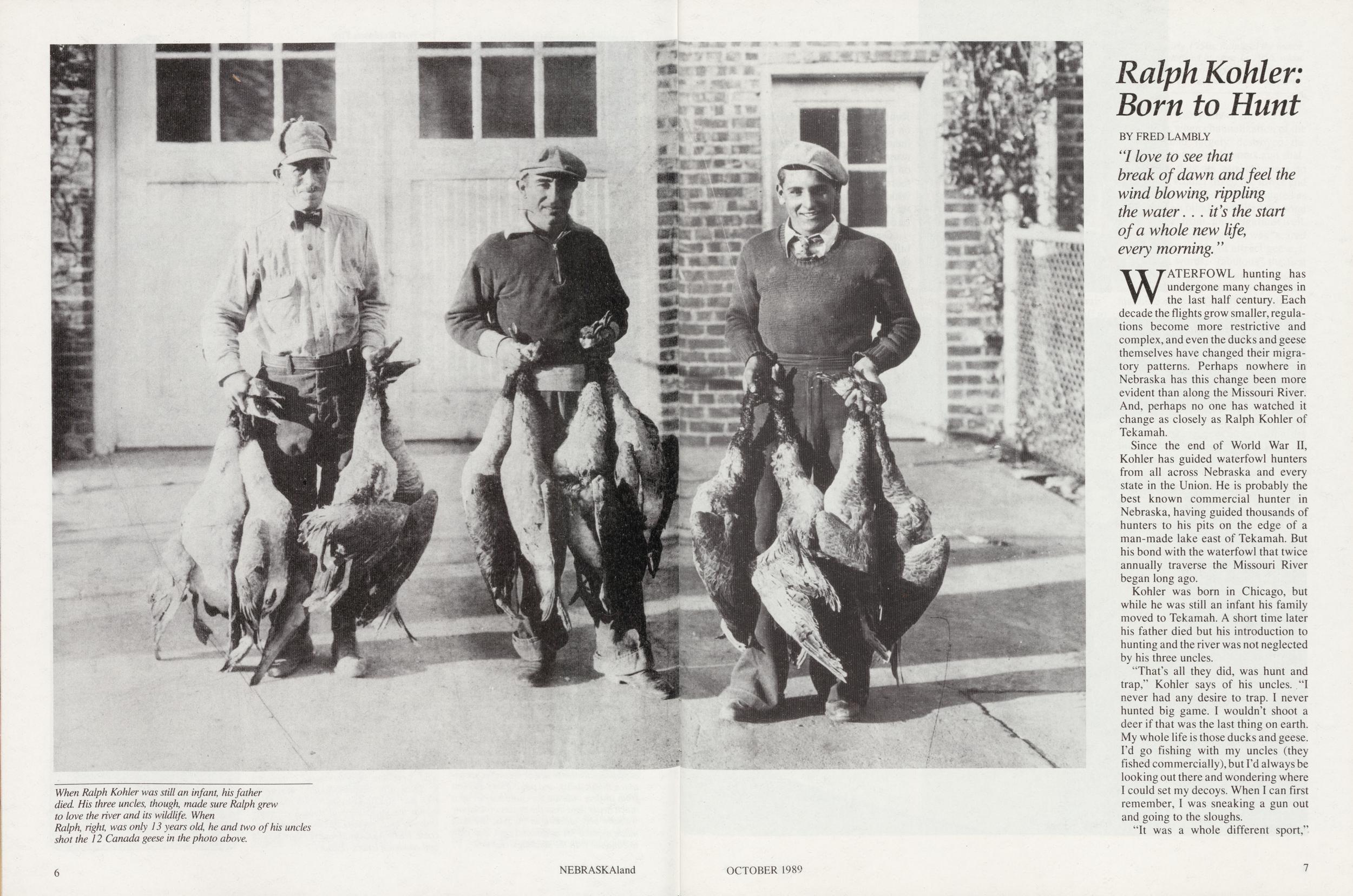
Ralph Kohler: Born to Hunt
BY FRED LAMBLY "/ love to see that break of dawn and feel the wind blowing, rippling the water. . . it's the start of a whole new life, every morning."WATERFOWL hunting has undergone many changes in the last half century. Each decade the flights grow smaller, regulations become more restrictive and complex, and even the ducks and geese themselves have changed their migratory patterns. Perhaps nowhere in Nebraska has this change been more evident than along the Missouri River. And, perhaps no one has watched it change as closely as Ralph Kohler of Tekamah.
Since the end of World War II, Kohler has guided waterfowl hunters from all across Nebraska and every state in the Union. He is probably the best known commercial hunter in Nebraska, having guided thousands of hunters to his pits on the edge of a man-made lake east of Tekamah. But his bond with the waterfowl that twice annually traverse the Missouri River began long ago.
Kohler was born in Chicago, but while he was still an infant his family moved to Tekamah. A short time later his father died but his introduction to hunting and the river was not neglected by his three uncles.
"That's all they did, was hunt and trap," Kohler says of his uncles. "I never had any desire to trap. I never hunted big game. I wouldn't shoot a deer if that was the last thing on earth. My whole life is those ducks and geese. I'd go fishing with my uncles (they fished commercially), but I'd always be looking out there and wondering where I could set my decoys. When I can first remember, I was sneaking a gun out and going to the sloughs.
"'It was a whole different sport,"
OCTOBER 1989
7
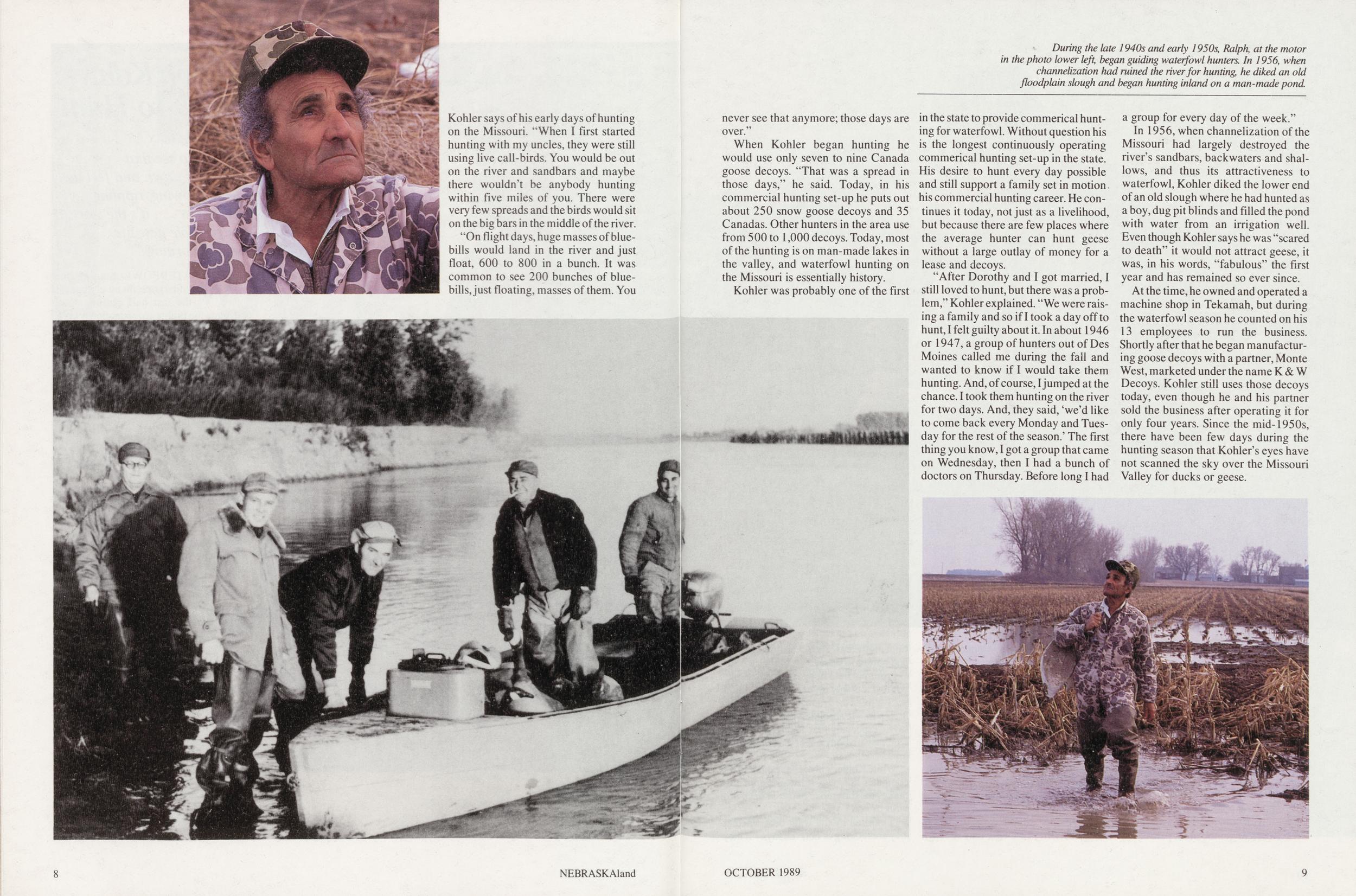
"On flight days, huge masses of blue-bills would land in the river and just float, 600 to 800 in a bunch. It was common to see 200 bunches of blue-bills, just floating, masses of them. You 8 NEBRASKAland never see that anymore; those days are over."
When Kohler began hunting he would use only seven to nine Canada goose decoys. 'That was a spread in those days," he said. Today, in his commercial hunting set-up he puts out about 250 snow goose decoys and 35 Canadas. Other hunters in the area use from 500 to 1,000 decoys. Today, most of the hunting is on man-made lakes in the valley, and waterfowl hunting on the Missouri is essentially history.
Kohler was probably one of the first in the state to provide commerical hunting for waterfowl. Without question his is the longest continuously operating commerical hunting set-up in the state. His desire to hunt every day possible and still support a family set in motion his commercial hunting career. He continues it today, not just as a livelihood, but because there are few places where the average hunter can hunt geese without a large outlay of money for a lease and decoys.
"After Dorothy and I got married, I still loved to hunt, but there was a problem," Kohler explained. "We were raising a family and so if I took a day off to hunt, I felt guilty about it. In about 1946 or 1947, a group of hunters out of Des Moines called me during the fall and wanted to know if I would take them hunting. And, of course, I jumped at the chance. I took them hunting on the river for two days. And, they said, 'we'd like to come back every Monday and Tuesday for the rest of the season.' The first thing you know, I got a group that came on Wednesday, then I had a bunch of doctors on Thursday. Before long I had a group for every day of the week."
In 1956, when channelization of the Missouri had largely destroyed the river's sandbars, backwaters and shallows, and thus its attractiveness to waterfowl, Kohler diked the lower end of an old slough where he had hunted as a boy, dug pit blinds and filled the pond with water from an irrigation well. Even though Kohler says he was "scared to death" it would not attract geese, it was, in his words, "fabulous" the first year and has remained so ever since.
At the time, he owned and operated a machine shop in Tekamah, but during the waterfowl season he counted on his 13 employees to run the business. Shortly after that he began manufacturing goose decoys with a partner, Monte West, marketed under the name K & W Decoys. Kohler still uses those decoys today, even though he and his partner sold the business after operating it for only four years. Since the mid-1950s, there have been few days during the hunting season that Kohler's eyes have not scanned the sky over the Missouri Valley for ducks or geese.
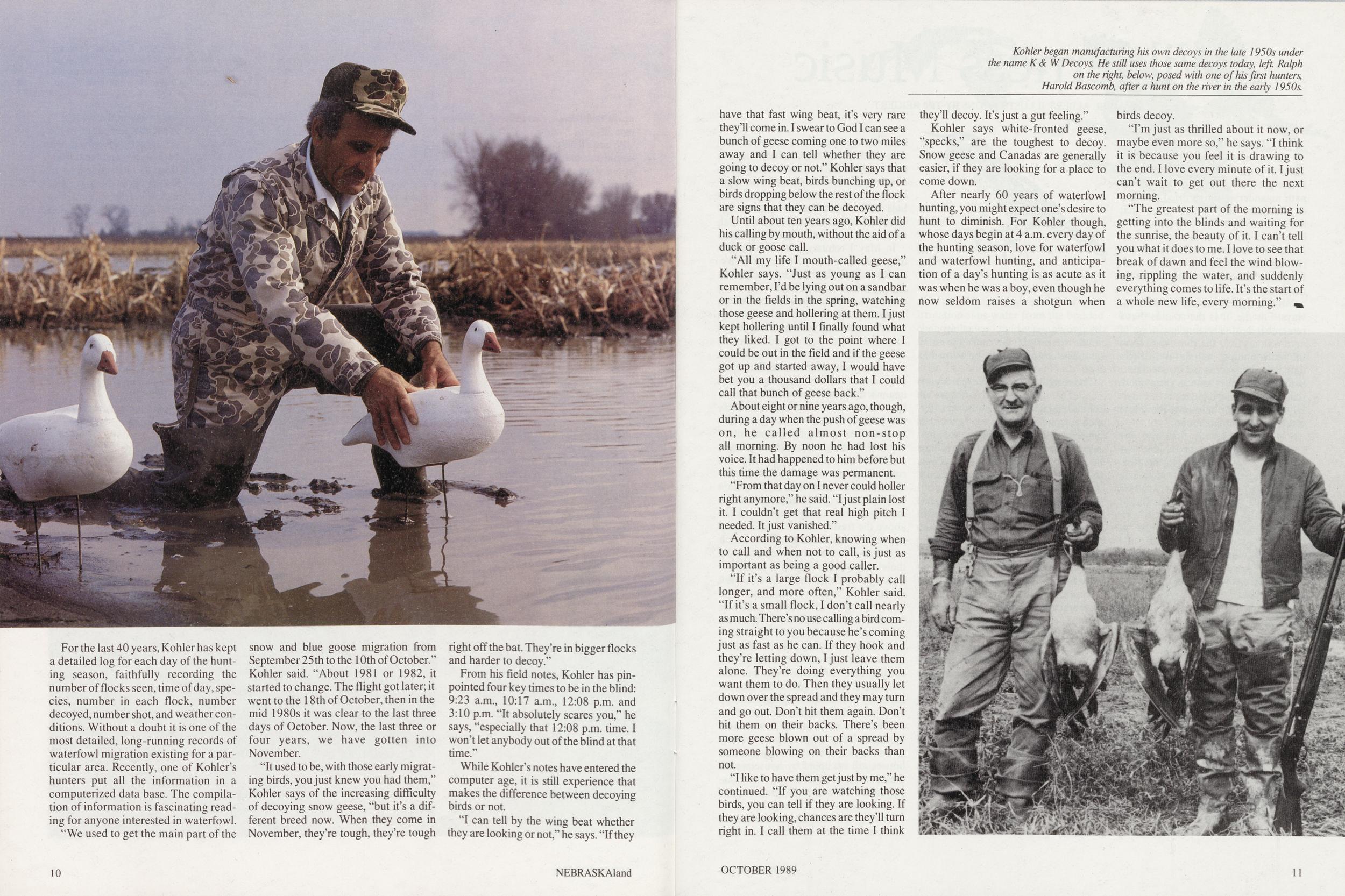
For the last 40 years, Kohler has kept a detailed log for each day of the hunting season, faithfully recording the number of flocks seen, time of day, species, number in each flock, number decoyed, number shot, and weather conditions. Without a doubt it is one of the most detailed, long-running records of waterfowl migration existing for a particular area. Recently, one of Kohler's hunters put all the information in a computerized data base. The compilation of information is fascinating reading for anyone interested in waterfowl.
"We used to get the main part of the snow and blue goose migration from September 25 the to the 10th of October." Kohler said. "About 1981 or 1982, it started to change. The flight got later; it went to the 18th of October, then in the mid 1980s it was clear to the last three days of October. Now, the last three or four years, we have gotten into November.
"It used to be, with those early migrating birds, you just knew you had them," Kohler says of the increasing difficulty of decoying snow geese, "but it's a different breed now. When they come in November, they're tough, they're tough right off the bat. They're in bigger flocks and harder to decoy."
From his field notes, Kohler has pinpointed four key times to be in the blind: 9:23 a.m., 10:17 a.m., 12:08 p.m. and 3:10 p.m. "It absolutely scares you," he says, "especially that 12:08 p.m. time. I won't let anybody out of the blind at that time."
While Kohler's notes have entered the computer age, it is still experience that makes the difference between decoying birds or not.
"I can tell by the wing beat whether they are looking or not," he says. "If they 10 NEBRASKAland have that fast wing beat, it's very rare they'll come in. I swear to God I can see a bunch of geese coming one to two miles away and I can tell whether they are going to decoy or not." Kohler says that a slow wing beat, birds bunching up, or birds dropping below the rest of the flock are signs that they can be decoyed.
Until about ten years ago, Kohler did his calling by mouth, without the aid of a duck or goose call.
"All my life I mouth-called geese," Kohler says. "Just as young as I can remember, I'd be lying out on a sandbar or in the fields in the spring, watching those geese and hollering at them. I just kept hollering until I finally found what they liked. I got to the point where I could be out in the field and if the geese got up and started away, I would have bet you a thousand dollars that I could call that bunch of geese back."
About eight or nine years ago, though, during a day when the push of geese was on, he called almost non-stop all morning. By noon he had lost his voice. It had happened to him before but this time the damage was permanent.
"From that day on I never could holler right anymore," he said. "I just plain lost it. I couldn't get that real high pitch I needed. It just vanished."
According to Kohler, knowing when to call and when not to call, is just as important as being a good caller.
"If it's a large flock I probably call longer, and more often," Kohler said. "If if s a small flock, I don't call nearly as much. There's no use calling a bird coming straight to you because he's coming just as fast as he can. If they hook and they're letting down, I just leave them alone. They're doing everything you want them to do. Then they usually let down over the spread and they may turn and go out. Don't hit them again. Don't hit them on their backs. There's been more geese blown out of a spread by someone blowing on their backs than not.
"I like to have them get just by me," he continued. "If you are watching those birds, you can tell if they are looking. If they are looking, chances are they'll turn right in. I call them at the time I think they'll decoy. It's just a gut feeling."
Kohler says white-fronted geese, "specks," are the toughest to decoy. Snow geese and Canadas are generally easier, if they are looking for a place to come down.
After nearly 60 years of waterfowl hunting, you might expect one's desire to hunt to diminish. For Kohler though, whose days begin at 4 a.m. every day of the hunting season, love for waterfowl and waterfowl hunting, and anticipation of a day's hunting is as acute as it was when he was a boy, even though he now seldom raises a shotgun when birds decoy.
"I'm just as thrilled about it now, or maybe even more so," he says. "I think it is because you feel it is drawing to the end. I love every minute of it. I just can't wait to get out there the next morning.
"The greatest part of the morning is getting into the blinds and waiting for the sunrise, the beauty of it. I can't tell you what it does to me. I love to see that break of dawn and feel the wind blowing, rippling the water, and suddenly everything comes to life. It's the start of a whole new life, every morning."
Wilderness Music
BY DANIEL ALBERS. ILLUSTRATIONS BY TIM REIGERTI STUMBLE through the morning darkness, seeking a hiding place before the sun breaks the horizon. In the pre-dawn gloom of March, the path meanders through dried pastures of bluestem and slough grass that border the Platte River. The darkness hides the flattened landscape, surrounds the barren cottonwoods, and shrouds the land from my eyes. But it is the gentle sound of the water that draws me to the river.
We experience nature in different ways. For me, it is the sounds that I remember best. The timeless noise of nature floats over the river, rises from the surrounding marsh and filters though budding trees and shrubs. These haunting, illusive sounds seem more real than the morning darkness. Floating like a distant harmony, the music creates a soft, serene mood.
A thin, red line appears on the horizon, threatening a cold day of rain or snow. But as the black curtain of night rises, the sky grows gray-blue, revealing few clouds to reflect the sun's crimson glow. The day promises to be warm and dry.
The receding shadows reveal a gray mass of sandhill cranes roosting on an isolated sandbar. The birds seek the open channel, away from the hidden dangers of the bank. Before sunrise, some of the cranes take flight, riding the air currents and calling to the flock below. Their noise engulfs me and falls like a faint mist on my shoulders.
As the last shred of night clings to the horizon, a sense of expectancy fills the air. The cries grow more urgent, sharper; piercing the crystalline air. The intensity rises till an unseen, unheard signal marks the moment. A sudden eruption sends thousands of cranes exploding into the air and the soothing lullaby becomes a symphonic crescendo. For several minutes the world is a living cyclone of birds circling higher and wider. It is one of nature's phenomena that concurrently binds us to, and alienates us from the natural world.
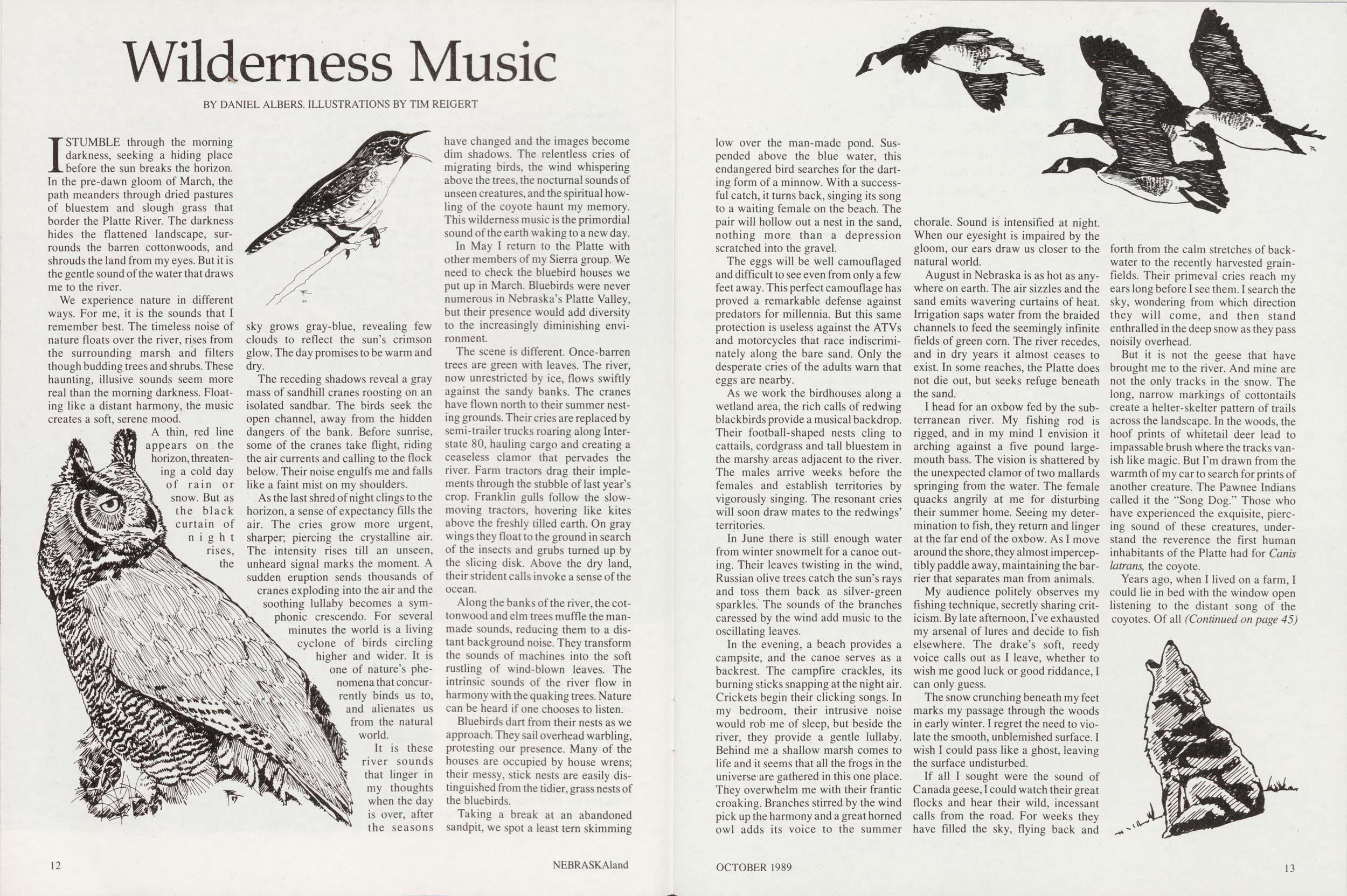
It is these river sounds that linger in my thoughts when the day is over, after the seasons have changed and the images become dim shadows. The relentless cries of migrating birds, the wind whispering above the trees, the nocturnal sounds of unseen creatures, and the spiritual howling of the coyote haunt my memory. This wilderness music is the primordial sound of the earth waking to a new day.
In May I return to the Platte with other members of my Sierra group. We need to check the bluebird houses we put up in March. Bluebirds were never numerous in Nebraska's Platte Valley, but their presence would add diversity to the increasingly diminishing environment.
The scene is different. Once-barren trees are green with leaves. The river, now unrestricted by ice, flows swiftly against the sandy banks. The cranes have flown north to their summer nesting grounds. Their cries are replaced by semi-trailer trucks roaring along Interstate 80, hauling cargo and creating a ceaseless clamor that pervades the river. Farm tractors drag their implements through the stubble of last year's crop. Franklin gulls follow the slowmoving tractors, hovering like kites above the freshly tilled earth. On gray wings they float to the ground in search of the insects and grubs turned up by the slicing disk. Above the dry land, their strident calls invoke a sense of the ocean.
Along the banks of the river, the Cottonwood and elm trees muffle the manmade sounds, reducing them to a distant background noise. They transform the sounds of machines into the soft rustling of wind-blown leaves. The intrinsic sounds of the river flow in harmony with the quaking trees. Nature can be heard if one chooses to listen.
Bluebirds dart from their nests as we approach. They sail overhead warbling, protesting our presence. Many of the houses are occupied by house wrens; their messy, stick nests are easily distinguished from the tidier, grass nests of the bluebirds.
Taking a break at an abandoned sandpit, we spot a least tern skimming 12 NEBRASKAland low over the man-made pond. Suspended above the blue water, this endangered bird searches for the darting form of a minnow. With a successful catch, it turns back, singing its song to a waiting female on the beach. The pair will hollow out a nest in the sand, nothing more than a depression scratched into the gravel.
The eggs will be well camouflaged and difficult to see even from only a few feet away. This perfect camouflage has proved a remarkable defense against predators for millennia. But this same protection is useless against the ATVs and motorcycles that race indiscriminately along the bare sand. Only the desperate cries of the adults warn that eggs are nearby.
As we work the birdhouses along a wetland area, the rich calls of redwing blackbirds provide a musical backdrop. Their football-shaped nests cling to cattails, cordgrass and tall bluestem in the marshy areas adjacent to the river. The males arrive weeks before the females and establish territories by vigorously singing. The resonant cries will soon draw mates to the redwings' territories.
In June there is still enough water from winter snowmelt for a canoe outing. Their leaves twisting in the wind, Russian olive trees catch the sun's rays and toss them back as silver-green sparkles. The sounds of the branches caressed by the wind add music to the oscillating leaves.
In the evening, a beach provides a campsite, and the canoe serves as a backrest. The campfire crackles, its burning sticks snapping at the night air. Crickets begin their clicking songs. In my bedroom, their intrusive noise would rob me of sleep, but beside the river, they provide a gentle lullaby. Behind me a shallow marsh comes to life and it seems that all the frogs in the universe are gathered in this one place. They overwhelm me with their frantic croaking. Branches stirred by the wind pick up the harmony and a great horned owl adds its voice to the summer chorale. Sound is intensified at night. When our eyesight is impaired by the gloom, our ears draw us closer to the natural world.
August in Nebraska is as hot as anywhere on earth. The air sizzles and the sand emits wavering curtains of heat. Irrigation saps water from the braided channels to feed the seemingly infinite fields of green corn. The river recedes, and in dry years it almost ceases to exist. In some reaches, the Platte does not die out, but seeks refuge beneath the sand.
I head for an oxbow fed by the subterranean river. My fishing rod is rigged, and in my mind I envision it arching against a five pound largemouth bass. The vision is shattered by the unexpected clamor of two mallards springing from the water. The female quacks angrily at me for disturbing their summer home. Seeing my determination to fish, they return and linger at the far end of the oxbow. As I move around the shore, they almost imperceptibly paddle away, maintaining the barrier that separates man from animals.
My audience politely observes my fishing technique, secretly sharing criticism. By late afternoon, I've exhausted my arsenal of lures and decide to fish elsewhere. The drake's soft, reedy voice calls out as I leave, whether to wish me good luck or good riddance, I can only guess.
The snow crunching beneath my feet marks my passage through the woods in early winter. I regret the need to violate the smooth, unblemished surface. I wish I could pass like a ghost, leaving the surface undisturbed.
If all I sought were the sound of Canada geese, I could watch their great flocks and hear their wild, incessant calls from the road. For weeks they have filled the sky, flying back and forth from the calm stretches of backwater to the recently harvested grainfields. Their primeval cries reach my ears long before I see them. I search the sky, wondering from which direction they will come, and then stand enthralled in the deep snow as they pass noisily overhead.
But it is not the geese that have brought me to the river. And mine are not the only tracks in the snow. The long, narrow markings of cottontails create a helter-skelter pattern of trails across the landscape. In the woods, the hoof prints of whitetail deer lead to impassable brush where the tracks vanish like magic. But I'm drawn from the warmth of my car to search for prints of another creature. The Pawnee Indians called it the "Song Dog." Those who have experienced the exquisite, piercing sound of these creatures, understand the reverence the first human inhabitants of the Platte had for Canis latrans, the coyote.
Years ago, when I lived on a farm, I could lie in bed with the window open listening to the distant song of the coyotes. Of all (Continued on page 45)
FIRE!
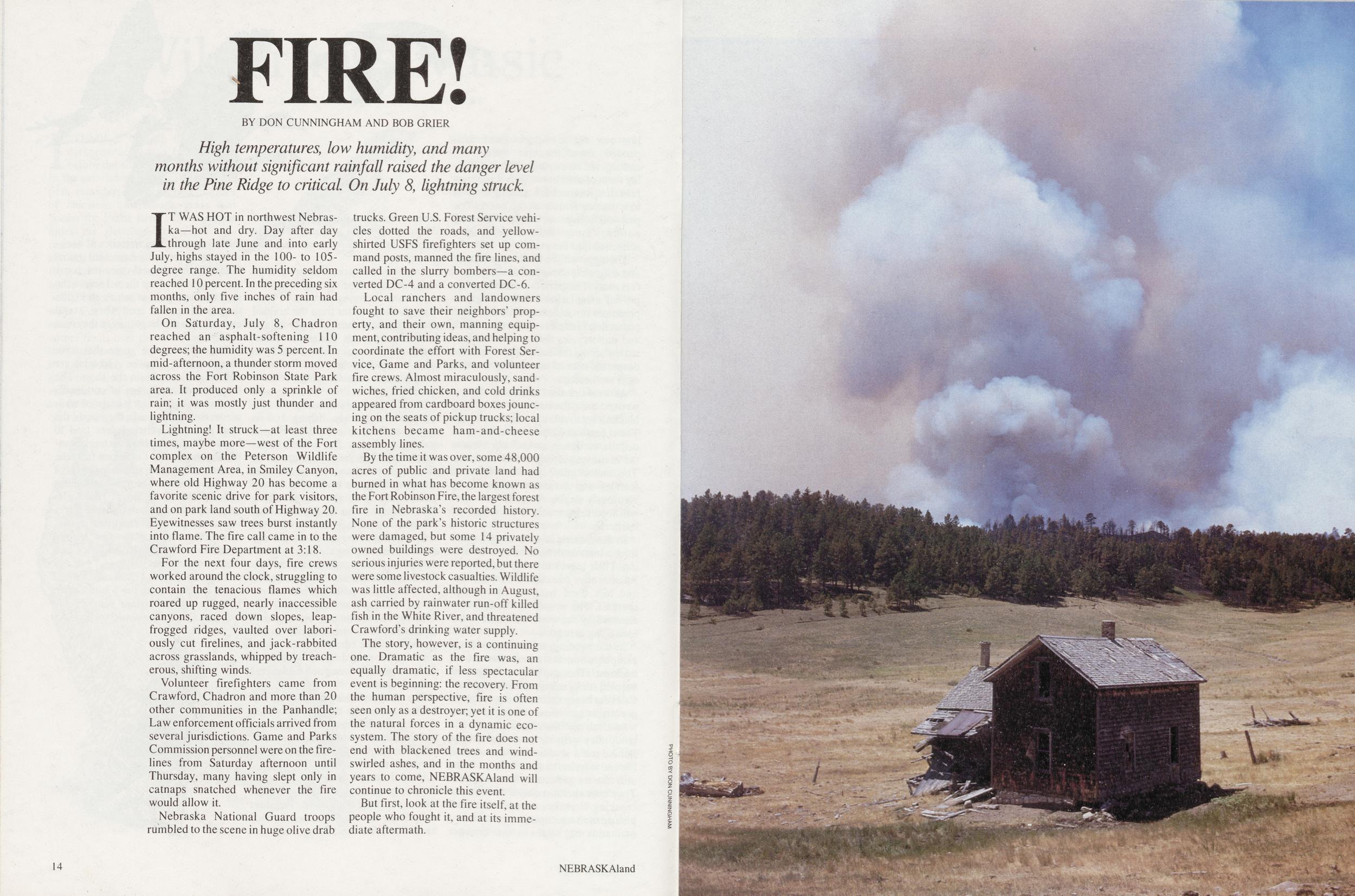
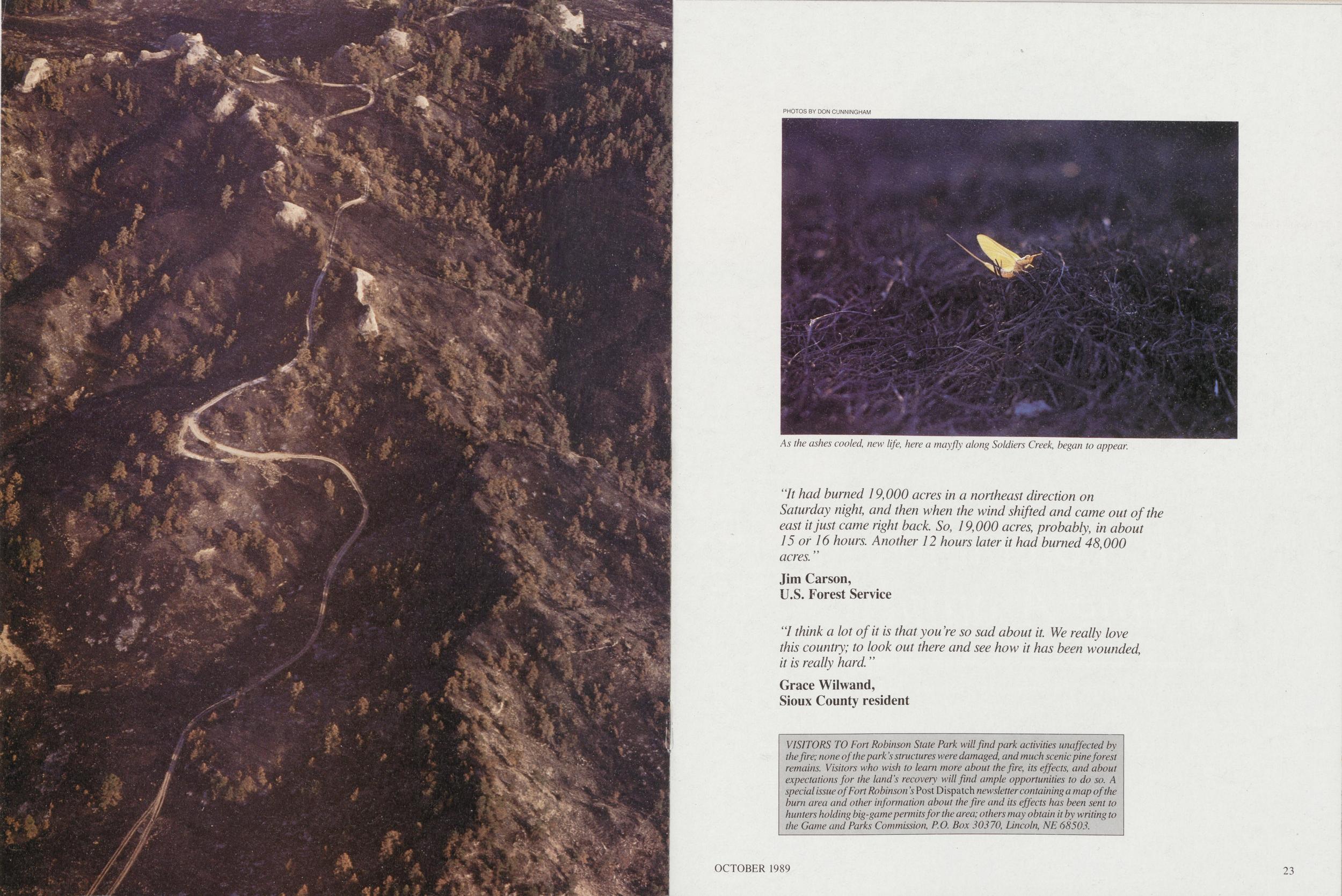
BY DON CUNNINGHAM AND BOB GRIER High temperatures, low humidity, and many months without significant rainfall raised the danger level in the Pine Ridge to critical On July 8, lightning struckIT WAS HOT in northwest Nebraska—hot and dry. Day after day through late June and into early July, highs stayed in the 100- to 105- degree range. The humidity seldom reached 10 percent. In the preceding six months, only five inches of rain had fallen in the area.
On Saturday, July 8, Chadron reached an asphalt-softening 110 degrees; the humidity was 5 percent. In mid-afternoon, a thunder storm moved across the Fort Robinson State Park area. It produced only a sprinkle of rain; it was mostly just thunder and lightning.
Lightning! It struck—at least three times, maybe more—west of the Fort complex on the Peterson Wildlife Management Area, in Smiley Canyon, where old Highway 20 has become a favorite scenic drive for park visitors, and on park land south of Highway 20. Eyewitnesses saw trees burst instantly into flame. The fire call came in to the Crawford Fire Department at 3:18.
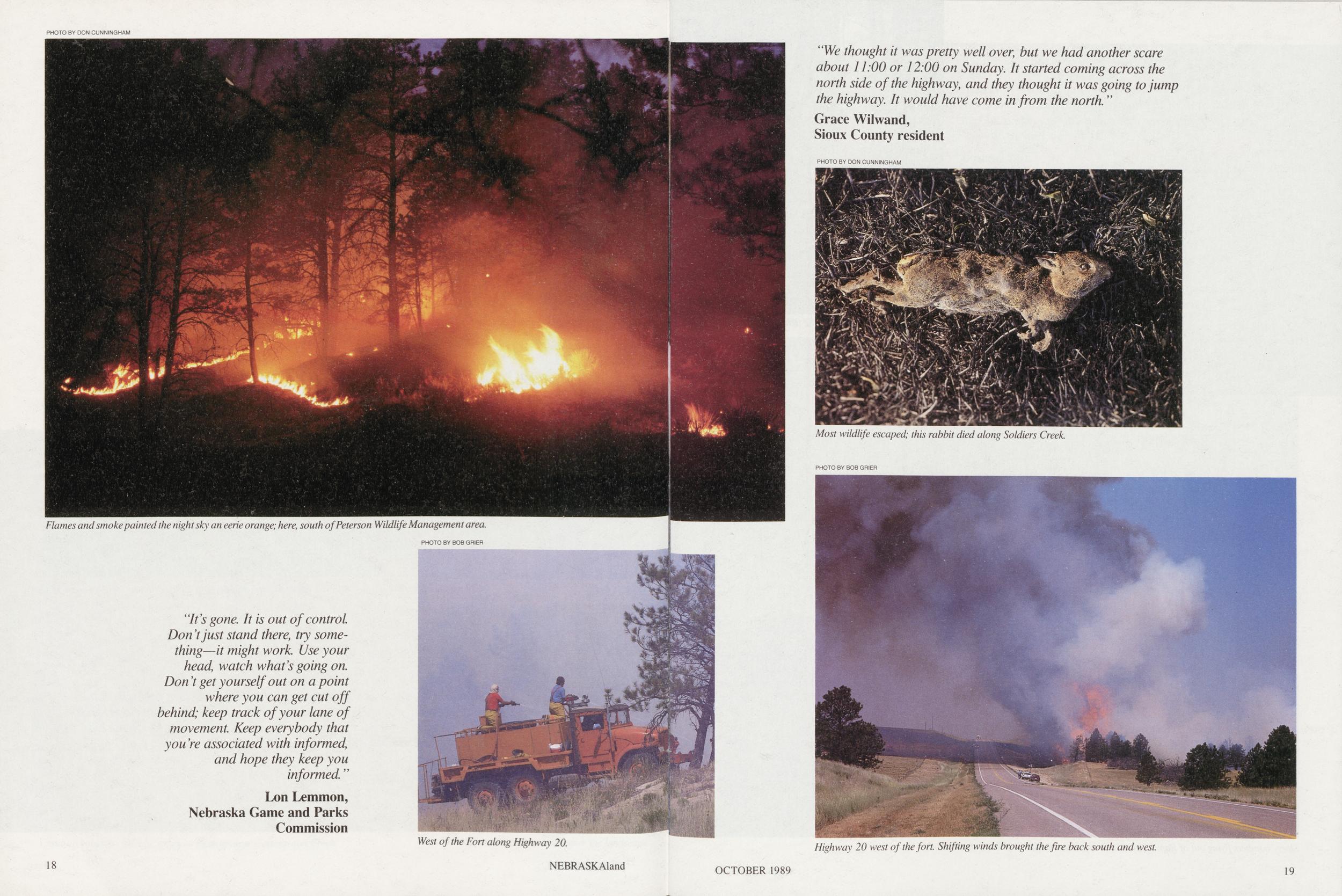
For the next four days, fire crews worked around the clock, struggling to contain the tenacious flames which roared up rugged, nearly inaccessible canyons, raced down slopes, leap-frogged ridges, vaulted over laboriously cut firelines, and jack-rabbited across grasslands, whipped by treacherous, shifting winds.
Volunteer firefighters came from Crawford, Chadron and more than 20 other communities in the Panhandle; Law enforcement officials arrived from several jurisdictions. Game and Parks Commission personnel were on the firelines from Saturday afternoon until Thursday, many having slept only in catnaps snatched whenever the fire would allow it.
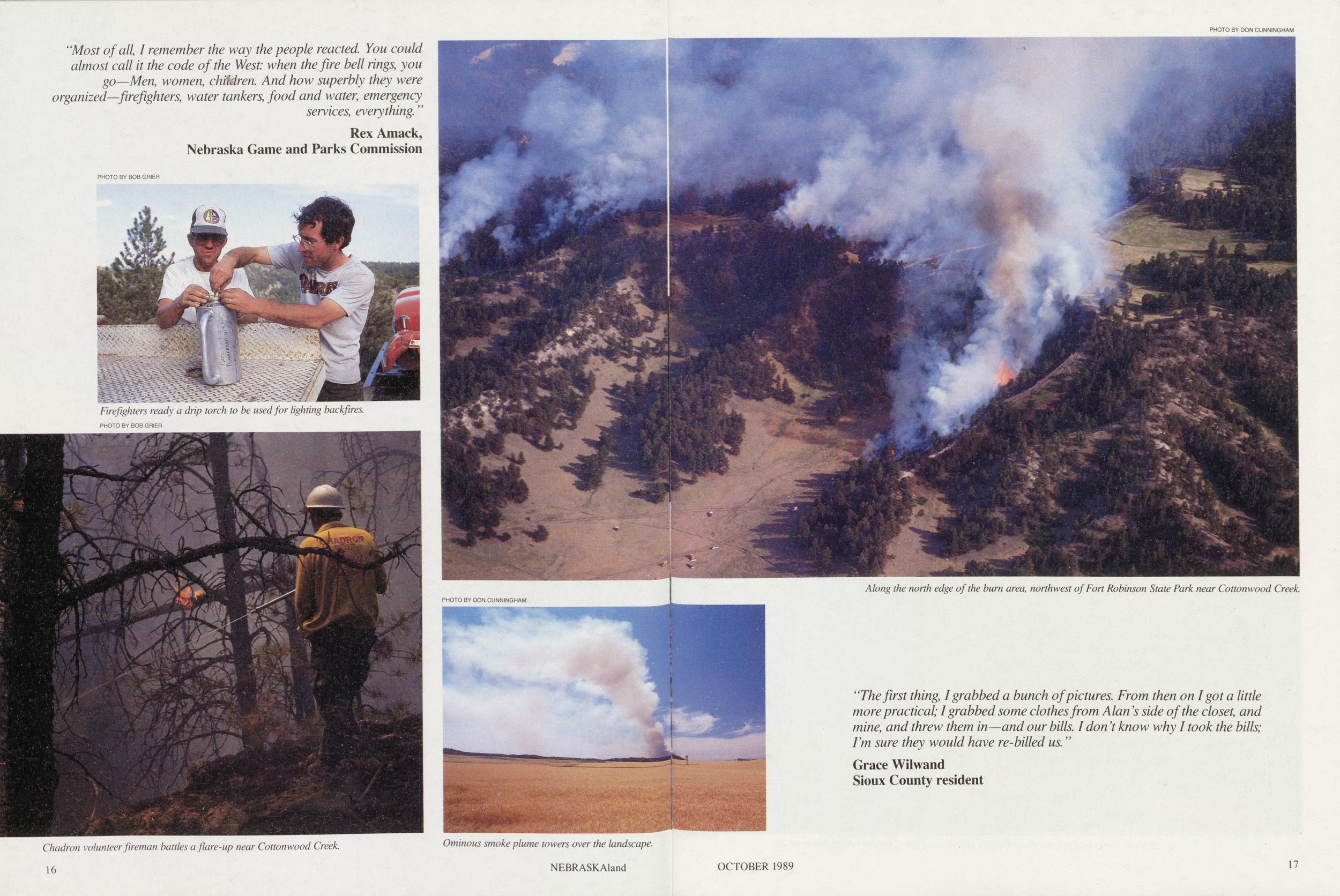
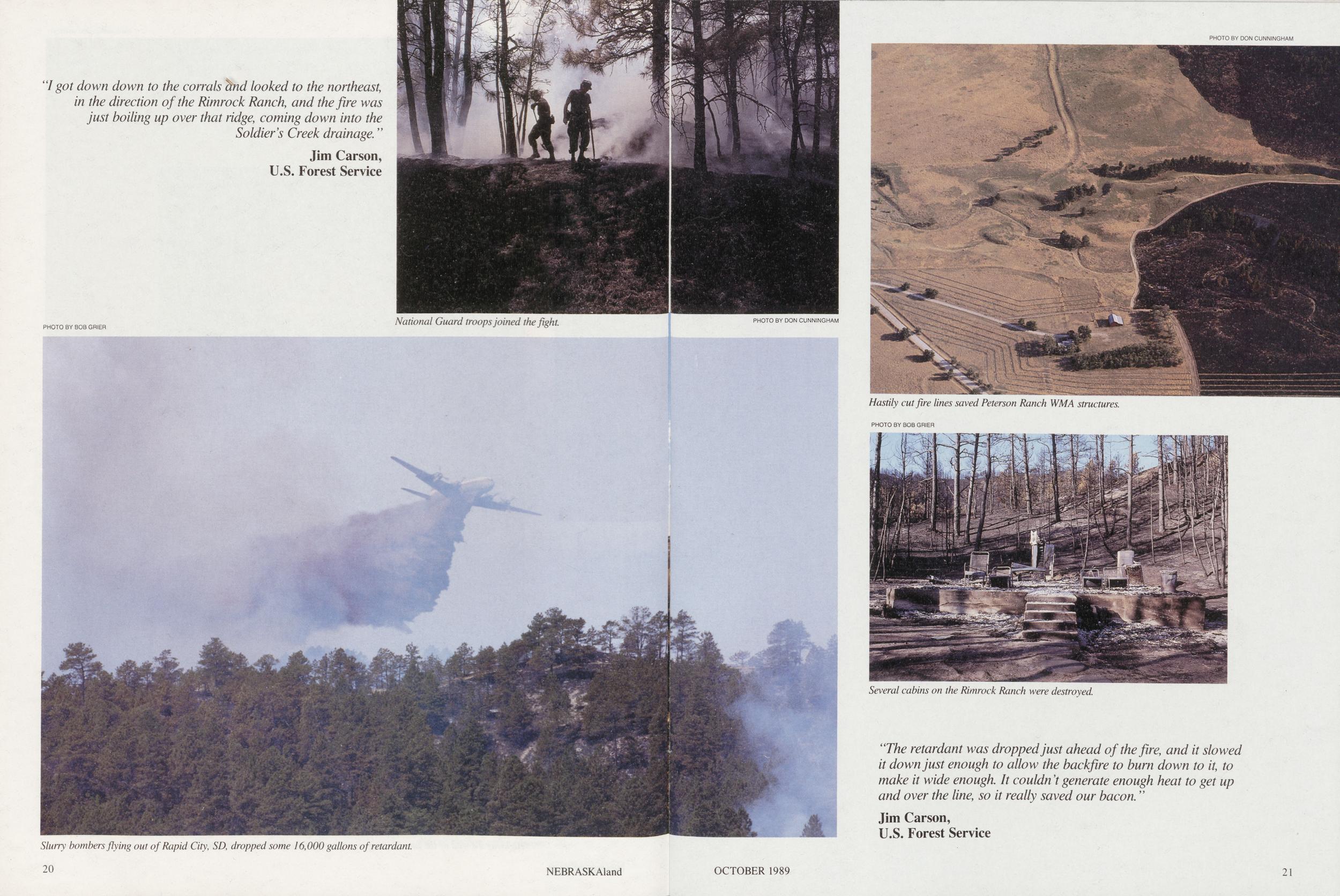
Nebraska National Guard troops rumbled to the scene in huge olive drab trucks. Green U.S. Forest Service vehicles dotted the roads, and yellow-shirted USFS firefighters set up command posts, manned the fire lines, and called in the slurry bombers—a converted DC-4 and a converted DC-6.
Local ranchers and landowners fought to save their neighbors' property, and their own, manning equipment, contributing ideas, and helping to coordinate the effort with Forest Service, Game and Parks, and volunteer fire crews. Almost miraculously, sandwiches, fried chicken, and cold drinks appeared from cardboard boxes jouncing on the seats of pickup trucks; local kitchens became ham-and-cheese assembly lines.
By the time it was over, some 48,000 acres of public and private land had burned in what has become known as the Fort Robinson Fire, the largest forest fire in Nebraska's recorded history. None of the park's historic structures were damaged, but some 14 privately owned buildings were destroyed. No serious injuries were reported, but there were some livestock casualties. Wildlife was little affected, although in August, ash carried by rainwater run-off killed fish in the White River, and threatened Crawford's drinking water supply.
The story, however, is a continuing one. Dramatic as the fire was, an equally dramatic, if less spectacular event is beginning: the recovery. From the human perspective, fire is often seen only as a destroyer; yet it is one of the natural forces in a dynamic ecosystem. The story of the fire does not end with blackened trees and wind-swirled ashes, and in the months and years to come, NEBRASKAland will continue to chronicle this event.
But first, look at the fire itself, at the people who fought it, and at its immediate aftermath. 14 NEBRASKAland
 "Most of all, I remember the way the people reacted. You could
almost call it the code of the West: when the fire bell rings, you
go—Men, women, chiMren. And how superbly they were
organized—firefighters, water tankers, food and water, emergency
services, everything."
Rex Amack,
Nebraska Game and Parks Commission
"Most of all, I remember the way the people reacted. You could
almost call it the code of the West: when the fire bell rings, you
go—Men, women, chiMren. And how superbly they were
organized—firefighters, water tankers, food and water, emergency
services, everything."
Rex Amack,
Nebraska Game and Parks Commission
 "/ got down down to the corrals cind looked to the northeast,
in the direction of the Rimrock Ranch, and the fire was
just boiling up over that ridge, coming down into the
Soldier's Creek drainage."
Jim Carson,
U.S. Forest Service
"/ got down down to the corrals cind looked to the northeast,
in the direction of the Rimrock Ranch, and the fire was
just boiling up over that ridge, coming down into the
Soldier's Creek drainage."
Jim Carson,
U.S. Forest Service
Fish, Fowl and Fooling Around
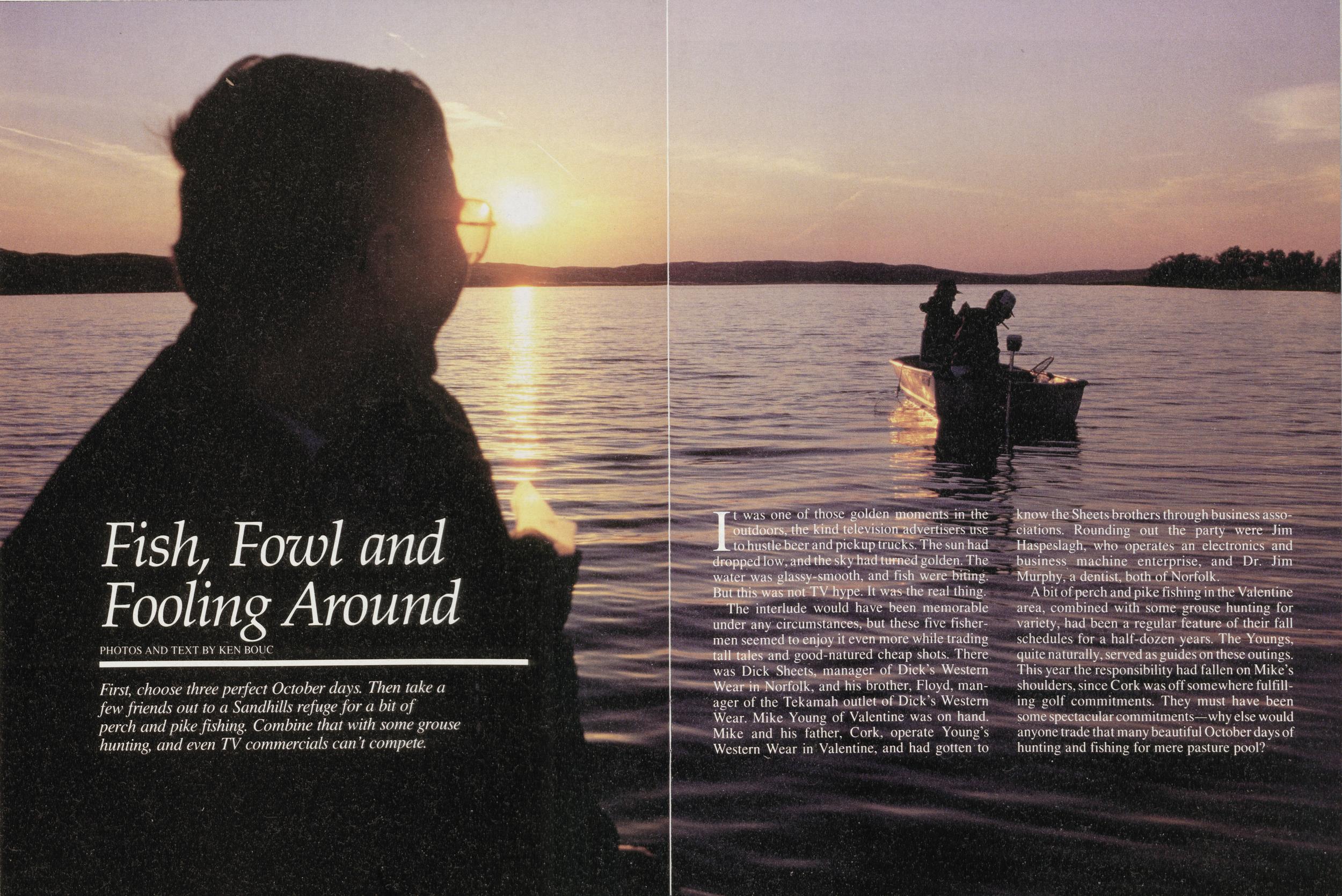
PHOTOS AND TEXT BY KEN BOUC First, choose three perfect October days. Then take a few friends out to a Sandhills refuge for a bit of perch and pike fishing. Combine that with some grouse hunting, and even TV commercials can't compete.It was one of those golden biome outdoors, the kind television advertisers use Z to. hustle beer and pickup trucks. The sun had dropped low, and the sky had turned golden. The water was glassy-smooth, and fish were biting. this was not TV hype. It was the real thing.
Tie interlude would have been memorable under any circumstances, but these five fishermen seemed to enjoy it even more while trading M tales and good-natured cheap shots. There s Dick Sheets, manager of Dick's Western Wear in Norfolk, and his brother, Floyd, manager of the Tekamah outlet of Dick's Western Wear. Mike Young of Valentine was on hand. Mike and his father, Cork, operate Young's Western Wear in Valentine, and had gotten to know the Sheets brothers through business associations. Rounding out the party were Jim Haspeslagh, who operates an electronics and business machine enterprise, and Dr. Jim Murphy, a dentist, both of Norfolk.
A bit of perch and pike fishing in the Valentine area, combined with some grouse hunting for variety, had been a regular feature of their fall schedules for a half-dozen years. The Youngs, quite naturally, served as guides on these outings. This year the responsibility had fallen on Mike's shoulders, since Cork was off somewhere fulfilling golf commitments. They must have been some spectacular commitments—why else would anyone trade that many beautiful October days of hunting and fishing for mere pasture pool?
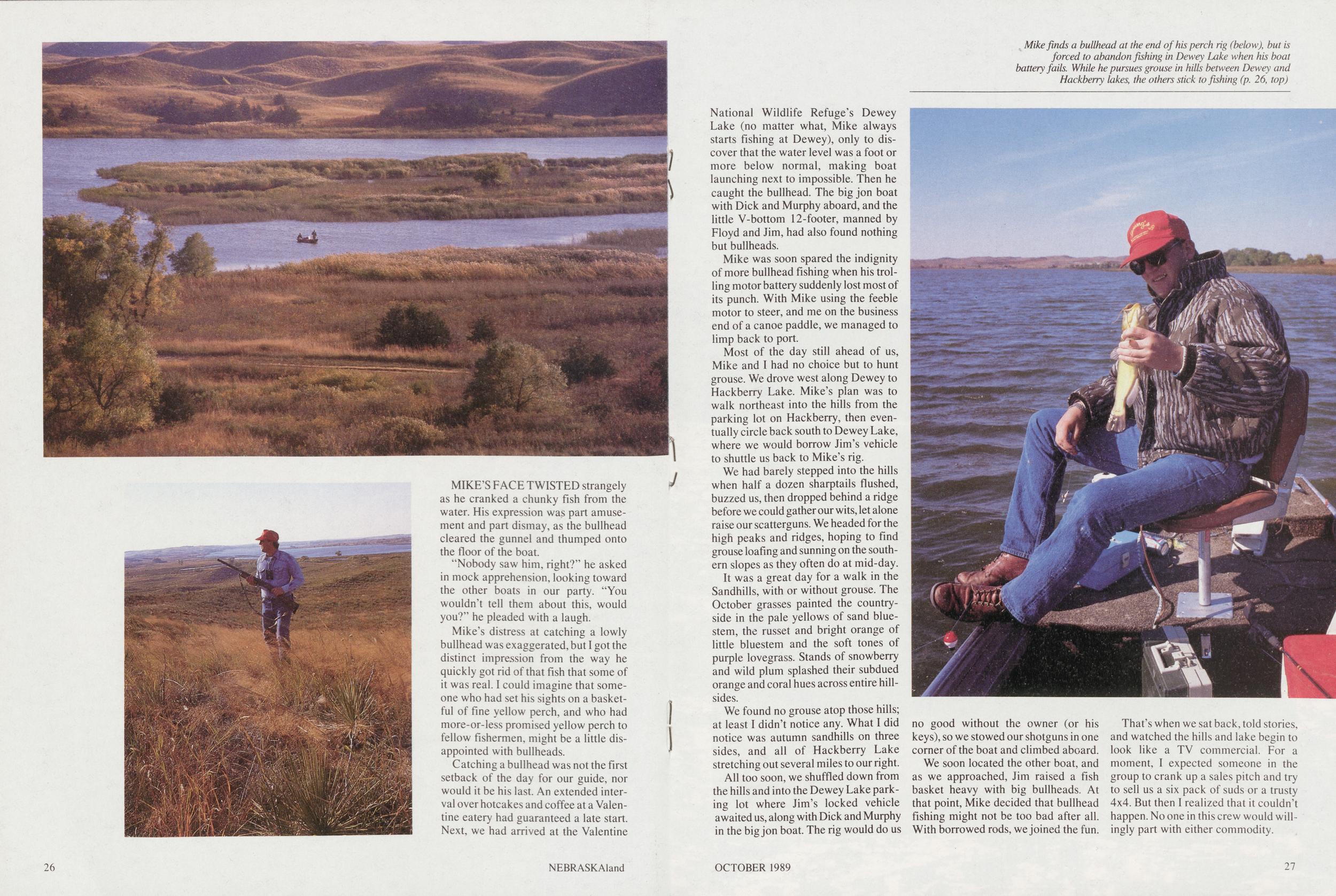
MIKE'S FACE TWISTED strangely as he cranked a chunky fish from the water. His expression was part amusement and part dismay, as the bullhead cleared the gunnel and thumped onto the floor of the boat.
"Nobody saw him, right?" he asked in mock apprehension, looking toward the other boats in our party. "You wouldn't tell them about this, would you?" he pleaded with a laugh.
Mike's distress at catching a lowly bullhead was exaggerated, but I got the distinct impression from the way he quickly got rid of that fish that some of it was real. I could imagine that someone who had set his sights on a basketful of fine yellow perch, and who had more-or-less promised yellow perch to fellow fishermen, might be a little disappointed with bullheads.
Catching a bullhead was not the first setback of the day for our guide, nor would it be his last. An extended interval over hotcakes and coffee at a Valentine eatery had guaranteed a late start. Next, we had arrived at the Valentine 26 NEBRASKAland
Mike was soon spared the indignity of more bullhead fishing when his trolling motor battery suddenly lost most of its punch. With Mike using the feeble motor to steer, and me on the business end of a canoe paddle, we managed to limp back to port.
Most of the day still ahead of us, Mike and I had no choice but to hunt grouse. We drove west along Dewey to Hackberry Lake. Mike's plan was to walk northeast into the hills from the parking lot on Hackberry, then eventually circle back south to Dewey Lake, where we would borrow Jim's vehicle to shuttle us back to Mike's rig.
We had barely stepped into the hills when half a dozen sharptails flushed, buzzed us, then dropped behind a ridge before we could gather our wits, let alone raise our scatterguns. We headed for the high peaks and ridges, hoping to find grouse loafing and sunning on the southern slopes as they often do at mid-day.
It was a great day for a walk in the Sandhills, with or without grouse. The October grasses painted the countryside in the pale yellows of sand bluestem, the russet and bright orange of little bluestem and the soft tones of purple lovegrass. Stands of snowberry and wild plum splashed their subdued orange and coral hues across entire hillsides.
We found no grouse atop those hills; at least I didn't notice any. What I did notice was autumn sandhills on three sides, and all of Hackberry Lake stretching out several miles to our right.
All too soon, we shuffled down from the hills and into the Dewey Lake parking lot where Jim's locked vehicle awaited us, along with Dick and Murphy in the big jon boat. The rig would do us no good without the owner (or his keys), so we stowed our shotguns in one corner of the boat and climbed aboard.
We soon located the other boat, and as we approached, Jim raised a fish basket heavy with big bullheads. At that point, Mike decided that bullhead fishing might not be too bad after all. With borrowed rods, we joined the fun.
That's when we sat back, told stories, and watched the hills and lake begin to look like a TV commercial. For a moment, I expected someone in the group to crank up a sales pitch and try to sell us a six pack of suds or a trusty 4x4. But then I realized that it couldn't happen. No one in this crew would willingly part with either commodity.
OCTOBER 1989 27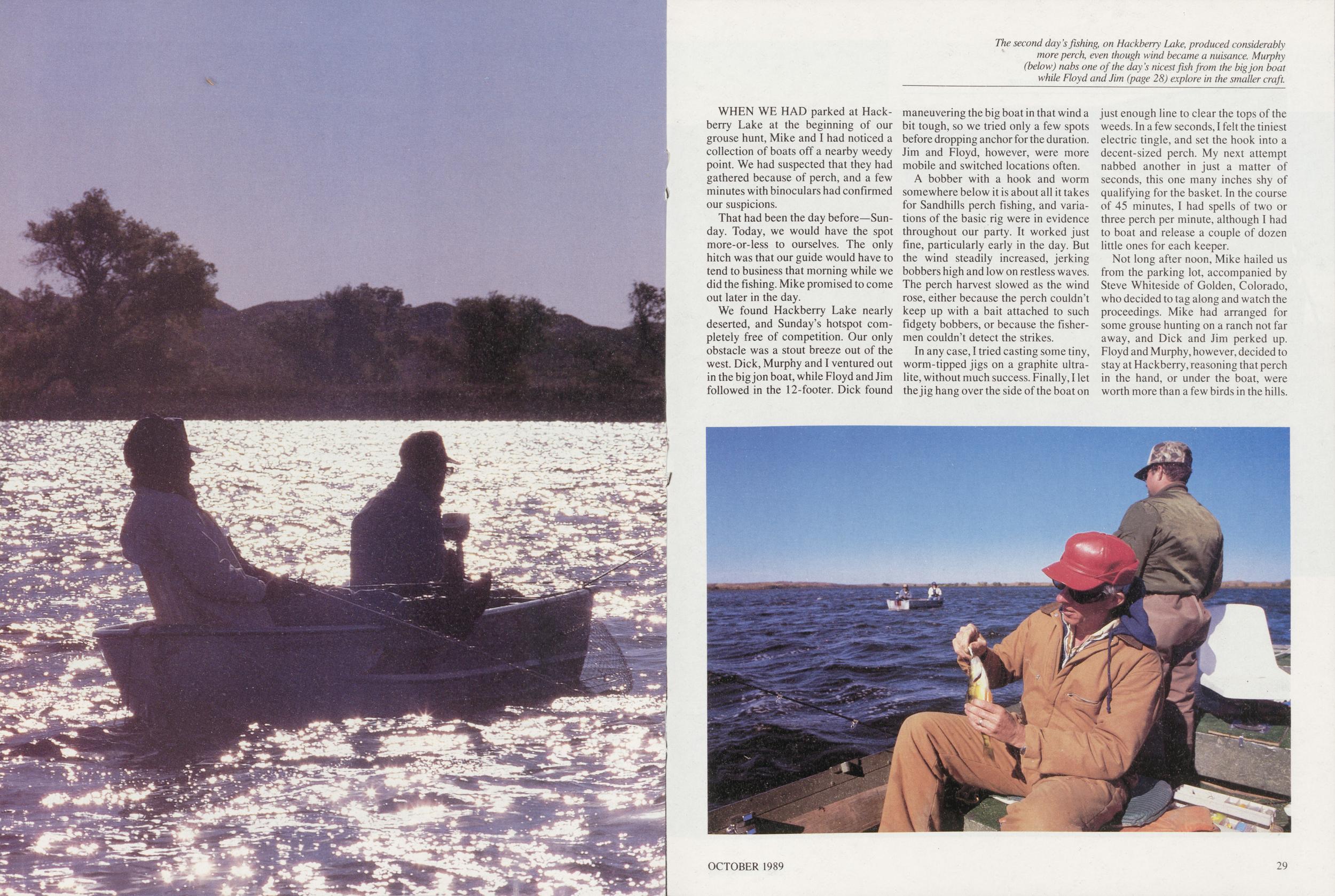
WHEN WE HAD parked at Hack- berry Lake at the beginning of our grouse hunt, Mike and I had noticed a collection of boats off a nearby weedy point. We had suspected that they had gathered because of perch, and a few minutes with binoculars had confirmed our suspicions.
That had been the day before—Sunday. Today, we would have the spot more-or-less to ourselves. The only hitch was that our guide would have to tend to business that morning while we did the fishing. Mike promised to come out later in the day.
We found Hackberry Lake nearly deserted, and Sunday's hotspot completely free of competition. Our only obstacle was a stout breeze out of the west. Dick, Murphy and I ventured out in the bigjon boat, while Floyd and Jim followed in the 12-footer. Dick found maneuvering the big boat in that wind a bit tough, so we tried only a few spots before dropping anchor for the duration. Jim and Floyd, however, were more mobile and switched locations often.
A bobber with a hook and worm somewhere below it is about all it takes for Sandhills perch fishing, and variations of the basic rig were in evidence throughout our party. It worked just fine, particularly early in the day. But the wind steadily increased, jerking bobbers high and low on restless waves. The perch harvest slowed as the wind rose, either because the perch couldn't keep up with a bait attached to such fidgety bobbers, or because the fishermen couldn't detect the strikes.
In any case, I tried casting some tiny, worm-tipped jigs on a graphite ultralite, without much success. Finally, I let the jig hang over the side of the boat on just enough line to clear the tops of the weeds. In a few seconds, I felt the tiniest electric tingle, and set the hook into a decent-sized perch. My next attempt nabbed another in just a matter of seconds, this one many inches shy of qualifying for the basket. In the course of 45 minutes, I had spells of two or three perch per minute, although I had to boat and release a couple of dozen little ones for each keeper.
Not long after noon, Mike hailed us from the parking lot, accompanied by Steve Whiteside of Golden, Colorado, who decided to tag along and watch the proceedings. Mike had arranged for some grouse hunting on a ranch not far away, and Dick and Jim perked up. Floyd and Murphy, however, decided to stay at Hackberry, reasoning that perch in the hand, or under the boat, were worth more than a few birds in the hills.
OCTOBER 1989 29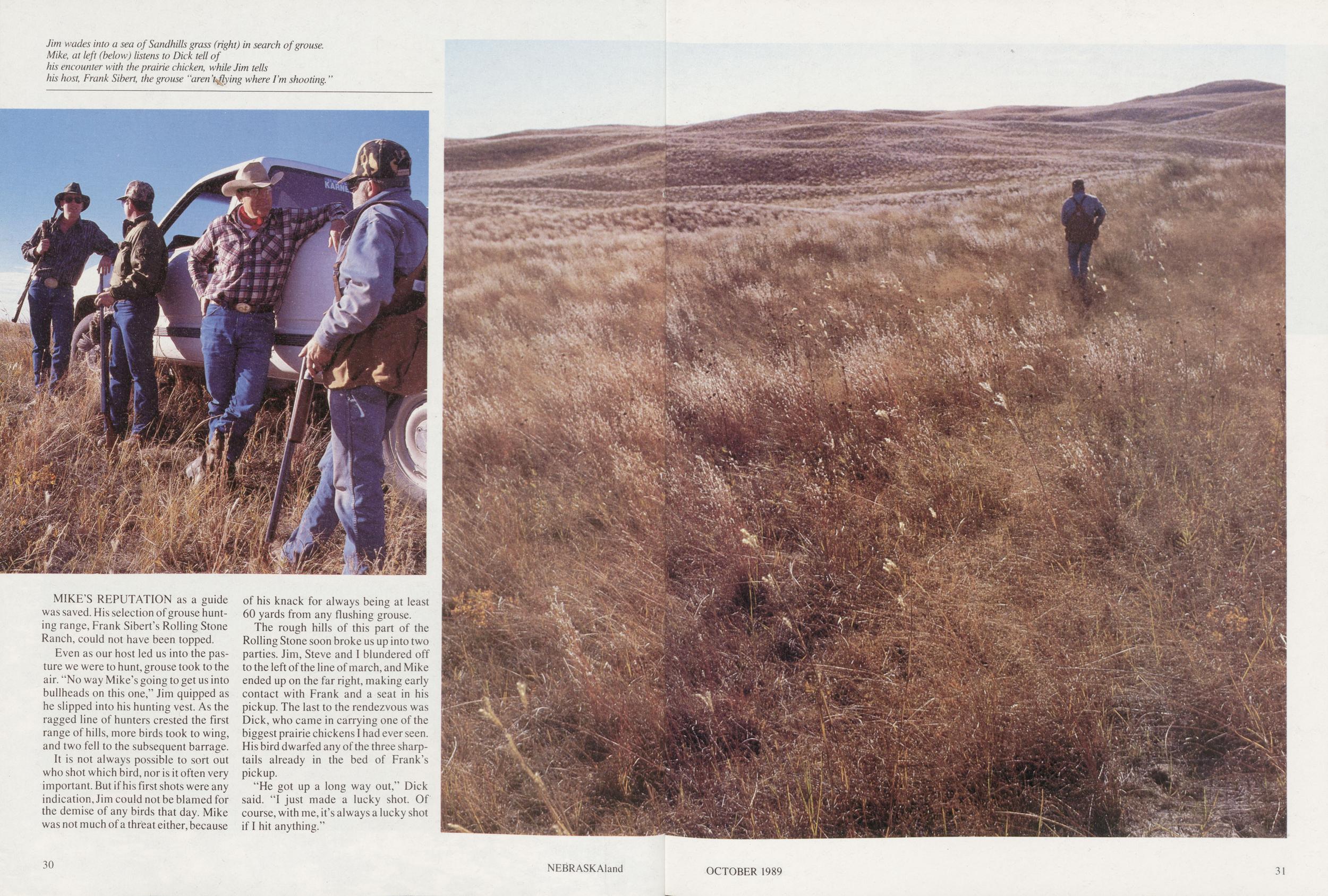
MIKE'S REPUTATION as a guide was saved. His selection of grouse hunting range, Frank Sibert's Rolling Stone Ranch, could not have been topped.
Even as our host led us into the pasture we were to hunt, grouse took to the air. "No way Mike's going to get us into bullheads on this one," Jim quipped as he slipped into his hunting vest. As the ragged line of hunters crested the first range of hills, more birds took to wing, and two fell to the subsequent barrage.
It is not always possible to sort out who shot which bird, nor is it often very important. But if his first shots were any indication, Jim could not be blamed for the demise of any birds that day. Mike was not much of a threat either, because of his knack for always being at least 60 yards from any flushing grouse.
The rough hills of this part of the Rolling Stone soon broke us up into two parties. Jim, Steve and I blundered off to the left of the line of march, and Mike ended up on the far right, making early contact with Frank and a seat in his pickup. The last to the rendezvous was Dick, who came in carrying one of the biggest prairie chickens I had ever seen. His bird dwarfed any of the three sharptails already in the bed of Frank's pickup.
"He got up a long way out," Dick said. "I just made a lucky shot. Of course, with me, it's always a lucky shot if I hit anything."
30 NEBRASKAland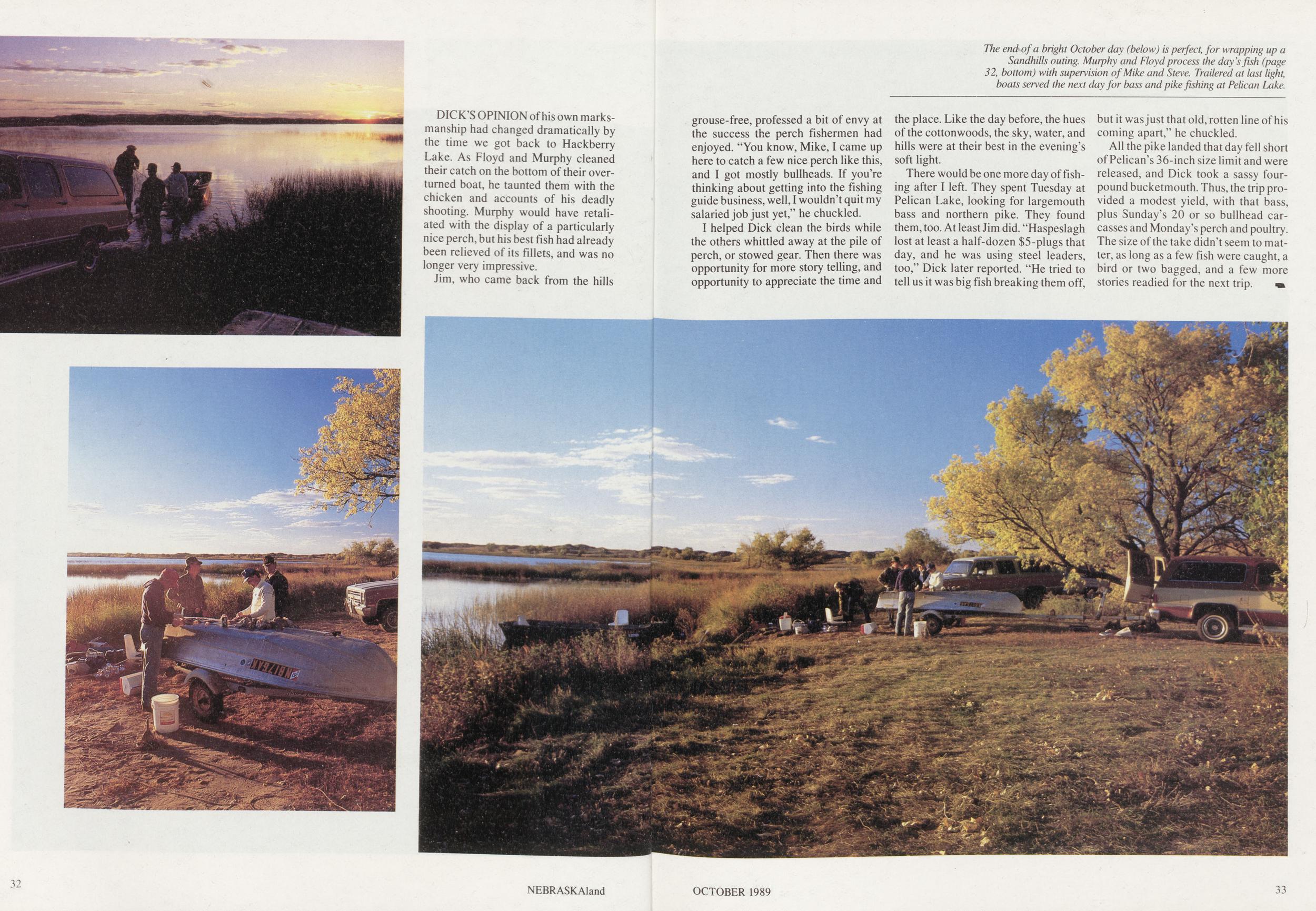
DICK'S OPINION of his own marksmanship had changed dramatically by the time we got back to Hackberry Lake. As Floyd and Murphy cleaned their catch on the bottom of their over-turned boat, he taunted them with the chicken and accounts of his deadly shooting. Murphy would have retaliated with the display of a particularly nice perch, but his best fish had already been relieved of its fillets, and was no longer very impressive.
Jim, who came back from the hills grouse-free, professed a bit of envy at the success the perch fishermen had enjoyed. "You know, Mike, I came up here to catch a few nice perch like this, and I got mostly bullheads. If you're thinking about getting into the fishing guide business, well, I wouldn't quit my salaried job just yet," he chuckled.
I helped Dick clean the birds while the others whittled away at the pile of perch, or stowed gear. Then there was opportunity for more story telling, and opportunity to appreciate the time and the place. Like the day before, the hues of the cottonwoods, the sky, water, and hills were at their best in the evening's soft light.
There would be one more day of fishing after I left. They spent Tuesday at Pelican Lake, looking for largemouth bass and northern pike. They found them, too. At least Jim did. "Haspeslagh lost at least a half-dozen $5-plugs that day, and he was using steel leaders, too," Dick later reported. "He tried to tell us it was big fish breaking them off, but it was just that old, rotten line of his coming apart," he chuckled.
All the pike landed that day fell short of Pelican's 36-inch size limit and were released, and Dick took a sassy four-pound bucketmouth. Thus, the trip provided a modest yield, with that bass, plus Sunday's 20 or so bullhead carcasses and Monday's perch and poultry. The size of the take didn't seem to matter, as long as a few fish were caught, a bird or two bagged, and a few more stories readied for the next trip. m
A Whooper Journal
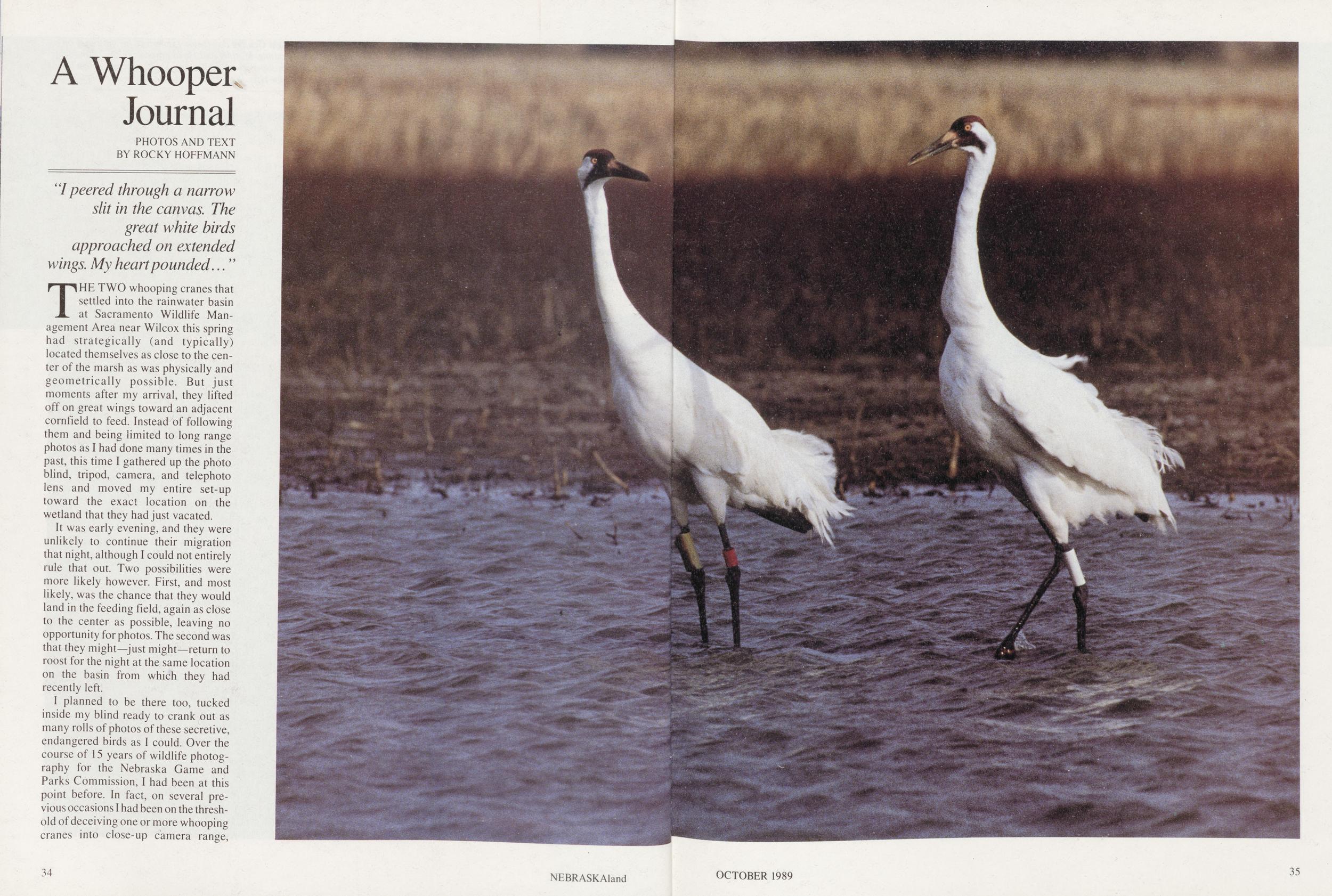
PHOTOS AND TEXT BY ROCKY HOFFMANN "I peered through a narrow slit in the canvas. The great white birds approached on extended wings. My heart pounded..."THE TWO whooping cranes that settled into the rainwater basin at Sacramento Wildlife Management Area near Wilcox this spring had strategically (and typically) located themselves as close to the center of the marsh as was physically and geometrically possible. But just moments after my arrival, they lifted off on great wings toward an adjacent cornfield to feed. Instead of following them and being limited to long range photos as I had done many times in the past, this time I gathered up the photo blind, tripod, camera, and telephoto lens and moved my entire set-up toward the exact location on the wetland that they had just vacated.
It was early evening, and they were unlikely to continue their migration that night, although I could not entirely rule that out. Two possibilities were more likely however. First, and most likely, was the chance that they would land in the feeding field, again as close to the center as possible, leaving no opportunity for photos. The second was that they might—just might—return to roost for the night at the same location on the basin from which they had recently left.
I planned to be there too, tucked inside my blind ready to crank out as many rolls of photos of these secretive, endangered birds as I could. Over the course of 15 years of wildlife photography for the Nebraska Game and Parks Commission, I had been at this point before. In fact, on several previous occasions I had been on the threshold of deceiving one or more whooping cranes into close-up camera range, 34 NEBRASKAland
After all, this was not a new tactic for me. I had attempted the same method of ambush before, but little did I realize that these were the same two whooping cranes that had spoiled my plan three years ago on the McMillan Ranch near Milburn.
There the set-up had been ideal for the scheme to succeed. The cranes had been roosting on a small marsh adjacent to a pivot-irrigated cornfield for at least three nights. During the day they would alternately spend a few hours on the roosting marsh and a few hours in the corn, until evening, when they would spend the night in the wetland.
As the birds had made one of their mid-day flights to the field, I had moved into the marsh location and set up. Within two hours, they were in the air again and flying toward the roost as I had anticipated, but as they approached, they had started to climb and circle. Directly overhead, they reached the summit of their spiralling ascent, lined out for the north and had headed for Canada's Northwest Territories.
Remembering that the same performance had been repeated by another pair of birds at Atlanta Marsh, southwest of Holdrege, I was well aware that this particular evening might not bring 36 NEBRASKAland me the photos I had been working for. Too many things could—and probably would—go wrong, and I took special precautions in the short time allowed to set up the blind to insure a good job of blending the structure into the cattail marsh, while providing for an ample photo window. Feeling confident that the blind was well concealed, I crawled inside and fastened the canvas over the door.
Then, a serious thought struck me. It was late in the afternoon. This was no doubt their last visit to the fields to feed, and when and if they did come back to land in front of me, they would most likely be there until daylight returned in the morning.
There is an ethic of wildlife photography, and that ethic is compounded when dealing with endangered species. Although getting close to whooping cranes had become something of an obsession with me, I had always taken considerable precautions not to disturb them for the purpose of photos. Therefore, I resigned myself to the commitment that if the cranes did return, I would stay in the blind until they decided to leave. I was unprepared however, on such short notice, to spend an April night in a cramped photo blind, and I recalled the discomfort of being pinned in a blind by two other cranes on the Platte River in April of the previous year, waiting until nearly midnight for the moon to drop behind a cloud bank.
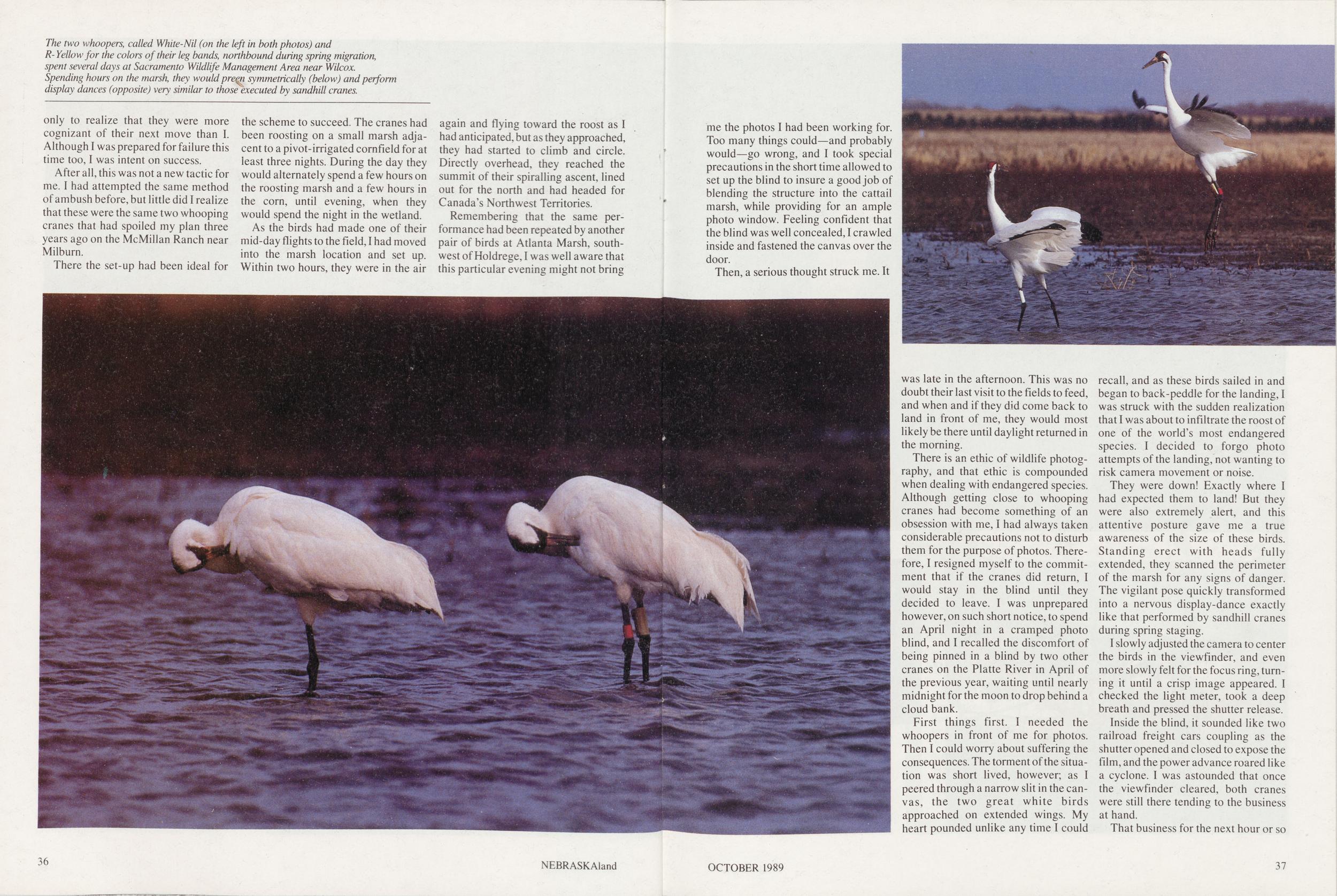
First things first. I needed the whoopers in front of me for photos. Then I could worry about suffering the consequences. The torment of the situation was short lived, however; as I peered through a narrow slit in the canvas, the two great white birds approached on extended wings. My heart pounded unlike any time I could recall, and as these birds sailed in and began to back-peddle for the landing, I was struck with the sudden realization that I v/as about to infiltrate the roost of one of the world's most endangered species. I decided to forgo photo attempts of the landing, not wanting to risk camera movement or noise.
They were down! Exactly where I had expected them to land! But they were also extremely alert, and this attentive posture gave me a true awareness of the size of these birds. Standing erect with heads fully extended, they scanned the perimeter of the marsh for any signs of danger. The vigilant pose quickly transformed into a nervous display-dance exactly like that performed by sandhill cranes during spring staging.
I slowly adjusted the camera to center the birds in the viewfinder, and even more slowly felt for the focus ring, turning it until a crisp image appeared. I checked the light meter, took a deep breath and pressed the shutter release.
Inside the blind, it sounded like two railroad freight cars coupling as the shutter opened and closed to expose the film, and the power advance roared like a cyclone. I was astounded that once the viewfinder cleared, both cranes were still there tending to the business at hand.
That business for the next hour or so
OCTOBER 1989
37
I would later discover that the birds presently in my viewfinder were the same two that I attempted to photograph at Milburn in 1986.1 learned that one was male, the other female, that one hatched in 1982 and the other in 1983, and that the two had mated in 1985, lost a chick in 1986 and returned to Aransas with a chick in 1987 but had no offspring in 1988.
The ability to glean such information is the result of the color-banding of flightless, juvenile whooping cranes carried out on the nesting grounds at Wood Buffalo National Park in Canada. Such markings allow researchers to determine the location and movements of individually marked birds, their age at first mating, sexual maturity, territory and migration habitat.
Since color banding of legs began in 1977, much has been documented about whooping cranes on the breeding grounds at Wood Buffalo National Park and on the wintering grounds at Aransas National Wildlife Refuge on the Texas coast. Some important information has also been learned about their migration habits, but here too lies the weakest link in the chain of data.
To supplement color banding information, the 7950 Whooping Crane Recovery Plan, developed by a team of biologists appointed by the United States Fish and Wildlife Service, specified the use of radio telemetry as a valuable tool for obtaining certain migration data, and as a result, the USFWS and the Canadian Wildlife Service combined on a telemetry project carried out from 1981 through 1983 to fill in the data gap.
Over the course of the three-year project, small radio transmitters, weighing less than three ounces and powered by nickel cadmium batteries or solar cells, were attached to colored leg bands and placed on 15 selected young cranes. The signals emitted would allow air and ground crews to track the families and determine their precise fall migration paths, while identifying specifics of habitat utilization and the hazards encountered during their 2,500 mile migration to the wintering grounds.
Prior to migration, radio signals were monitored daily by project biologists. When it was discovered that migration had been initiated, the families were tracked by aerial crews made up of a pilot and a biologist, who maintained contact with two biologists on the ground crew. In the remote and roadless areas of Canada, only aerial tracking was utilized.
As the birds landed along points of the migration south, the ground crews would locate them and collect precise data on habitat, characteristics of feeding, loafing, and roosting locations utilized.
The two whooping cranes that stood in shallow water just a few yards from me had obvious colored leg bands: one with a tall, white plastic band on its left leg (the right leg was not color banded), and one with a short, red plastic band on its left leg and a tall, yellow one on its right. These birds are identified as White-Nil and R-Yellow (an initial indicates a short 40-millimeter band width, but the color of the tall or 85-mm band, (Continued on page 47)
The Medicine Show
BY GEORGE "CHIC" CIHACEK Toby's Comedians, among the last of the traveling medicine shows, come to life in the photos and memories of this Schuyler resident who traveled with the troupe in 1933 and 1934A MEDICINE SHOW is coming! What excitement and anticipation an announcement like that must have caused in countless rural communities throughout midwestern America in the early days of this century. In many of these small towns which had no movie theaters or other forms of entertainment, the arrival of a troupe of entertainers must have been a welcome event.
Although by the late 1920s and early 1930s, most of the old-time medicine shows had disappeared, I was fortunate enough in 1933 and 1934, to spend two exciting summers as a member of one of the few remaining ones.
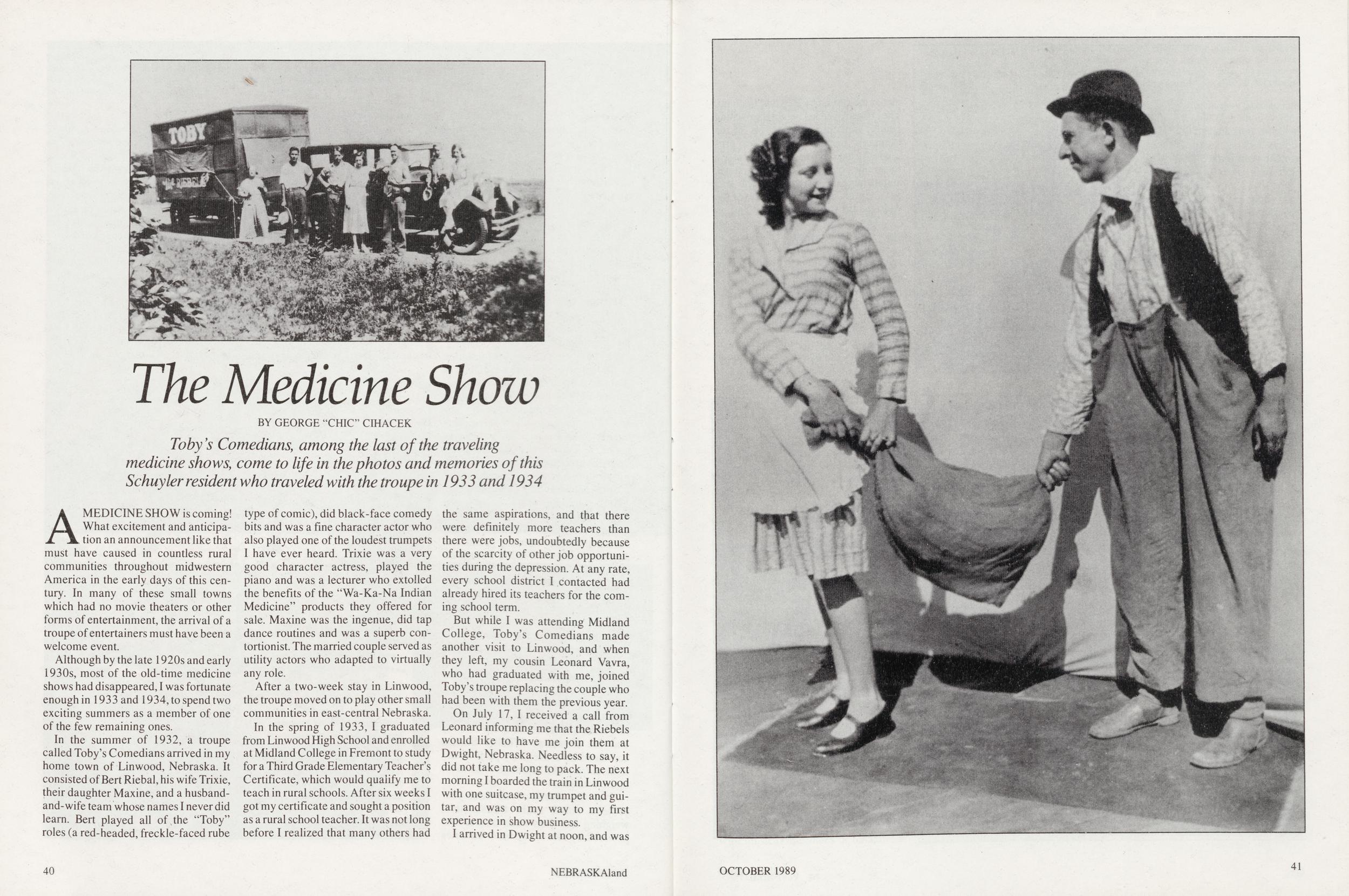
In the summer of 1932, a troupe called Toby's Comedians arrived in my home town of Linwood, Nebraska. It consisted of Bert Riebal, his wife Trixie, their daughter Maxine, and a husband-and-wife team whose names I never did learn. Bert played all of the "Toby" roles (a red-headed, freckle-faced rube type of comic), did black-face comedy bits and was a fine character actor who also played one of the loudest trumpets I have ever heard. Trixie was a very good character actress, played the piano and was a lecturer who extolled the benefits of the "Wa-Ka-Na Indian Medicine" products they offered for sale. Maxine was the ingenue, did tap dance routines and was a superb contortionist. The married couple served as utility actors who adapted to virtually any role.
After a two-week stay in Linwood, the troupe moved on to play other small communities in east-central Nebraska.
In the spring of 1933, I graduated from Linwood High School and enrolled at Midland College in Fremont to study for a Third Grade Elementary Teacher's Certificate, which would qualify me to teach in rural schools. After six weeks I got my certificate and sought a position as a rural school teacher. It was not long before I realized that many others had the same aspirations, and that there were definitely more teachers than there were jobs, undoubtedly because of the scarcity of other job opportunities during the depression. At any rate, every school district I contacted had already hired its teachers for the coming school term.
But while I was attending Midland College, Toby's Comedians made another visit to Linwood, and when they left, my cousin Leonard Vavra, who had graduated with me, joined Toby's troupe replacing the couple who had been with them the previous year.
On July 17, I received a call from Leonard informing me that the Riebels would like to have me join them at Dwight, Nebraska. Needless to say, it did not take me long to pack. The next morning I boarded the train in Linwood with one suitcase, my trumpet and guitar, and was on my way to my first experience in show business.
I arrived in Dwight at noon, and was 40 NEBRASKAland
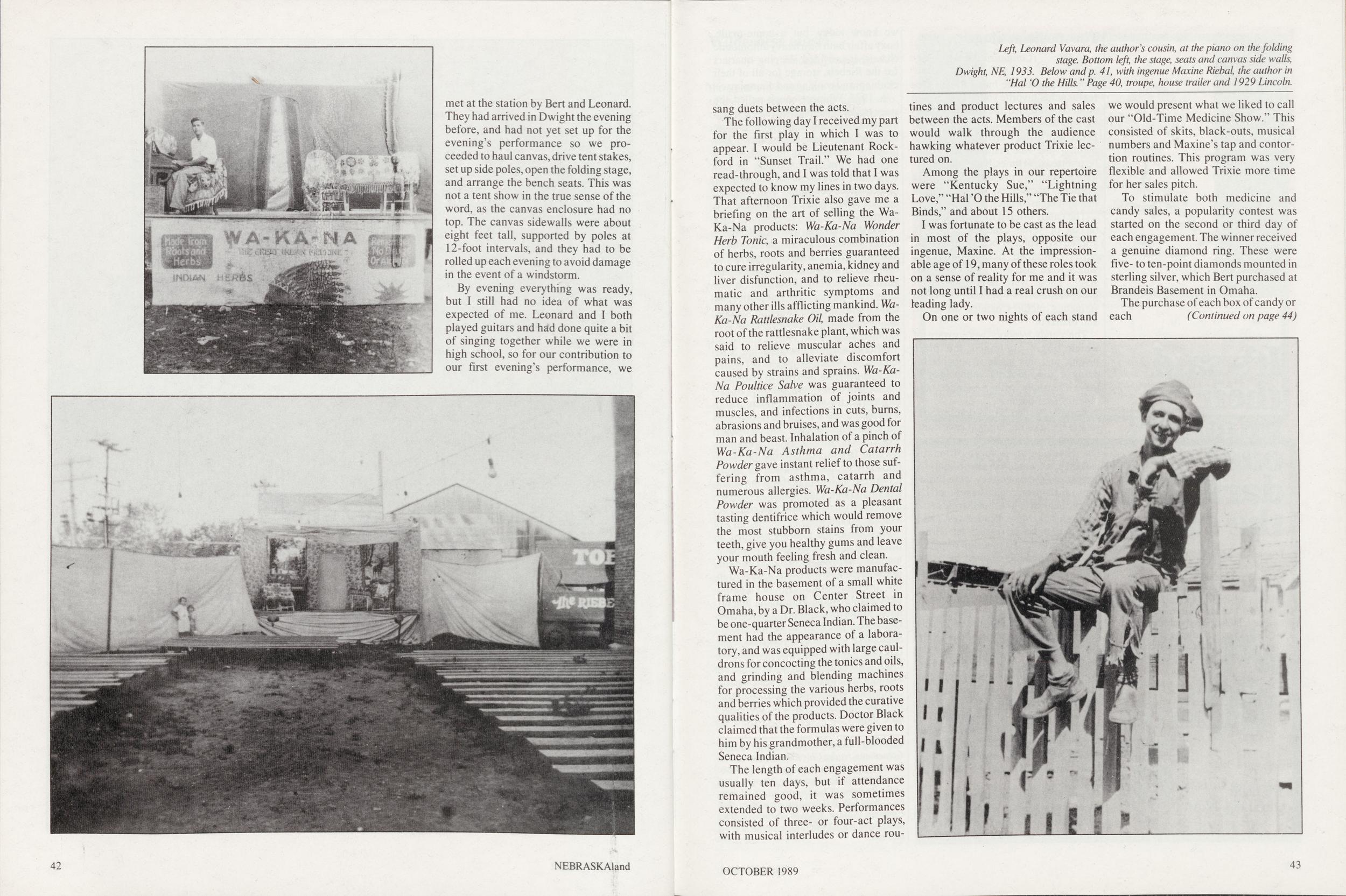
By evening everything was ready, but I still had no idea of what was expected of me. Leonard and I both played guitars and had done quite a bit of singing together while we were in high school, so for our contribution to our first evening's performance, we sang duets between the acts.
The following day I received my part for the first play in which I was to appear. I would be Lieutenant Rockford in "Sunset Trail." We had one read-through, and I was told that I was expected to know my lines in two days. That afternoon Trixie also gave me a briefing on the art of selling the Wa-Ka-Na products: Wa-Ka-Na Wonder Herb Tonic, a miraculous combination of herbs, roots and berries guaranteed to cure irregularity, anemia, kidney and liver disfunction, and to relieve rheumatic and arthritic symptoms and many other ills afflicting mankind. Wa-Ka-Na Rattlesnake Oil, made from the root of the rattlesnake plant, which was said to relieve muscular aches and pains, and to alleviate discomfort caused by strains and sprains. Wa-Ka-Na Poultice Salve was guaranteed to reduce inflammation of joints and muscles, and infections in cuts, burns, abrasions and bruises, and was good for man and beast. Inhalation of a pinch of Wa-Ka-Na Asthma and Catarrh Powder gave instant relief to those suffering from asthma, catarrh and numerous allergies. Wa-Ka-Na Dental Powder was promoted as a pleasant tasting dentifrice which would remove the most stubborn stains from your teeth, give you healthy gums and leave your mouth feeling fresh and clean.
Wa-Ka-Na products were manufactured in the basement of a small white frame house on Center Street in Omaha, by a Dr. Black, who claimed to be one-quarter Seneca Indian. The basement had the appearance of a laboratory, and was equipped with large cauldrons for concocting the tonics and oils, and grinding and blending machines for processing the various herbs, roots and berries which provided the curative qualities of the products. Doctor Black claimed that the formulas were given to him by his grandmother, a full-blooded Seneca Indian.
The length of each engagement was usually ten days, but if attendance remained good, it was sometimes extended to two weeks. Performances consisted of three- or four-act plays, with musical interludes or dance routines and product lectures and sales between the acts. Members of the cast would walk through the audience hawking whatever product Trixie lectured on.
Among the plays in our repertoire were "Kentucky Sue," "Lightning Love," "Hal 'O the Hills," "The Tie that Binds," and about 15 others.
I was fortunate to be cast as the lead in most of the plays, opposite our ingenue, Maxine. At the impressionable age of 19, many of these roles took on a sense of reality for me and it was not long until I had a real crush on our leading lady.
On one or two nights of each stand we would present what we liked to call our "Old-Time Medicine Show." This consisted of skits, black-outs, musical numbers and Maxine's tap and contortion routines. This program was very flexible and allowed Trixie more time for her sales pitch.
To stimulate both medicine and candy sales, a popularity contest was started on the second or third day of each engagement. The winner received a genuine diamond ring. These were five- to ten-point diamonds mounted in sterling silver, which Bert purchased at Brandeis Basement in Omaha.
The purchase of each box of candy or each (Continued on page 44)
 It's said
their
numbers
once
darkened
the sun.
Ducks Unlimited is a non-profit
organization that works to protect
and restore waterfowl marshlands
in Canada, where United States
Federal funds don't reach. And
where 70^ of our waterfowl are
hatched. Help keep the ducks flying. Send your tax deductible donation to: Ducks Unlimited,
P.O. Box
66300, Chicago, Illinois 60666.
Please.
DUCKS
UNLIMITED
We need
your help. Now.
It's said
their
numbers
once
darkened
the sun.
Ducks Unlimited is a non-profit
organization that works to protect
and restore waterfowl marshlands
in Canada, where United States
Federal funds don't reach. And
where 70^ of our waterfowl are
hatched. Help keep the ducks flying. Send your tax deductible donation to: Ducks Unlimited,
P.O. Box
66300, Chicago, Illinois 60666.
Please.
DUCKS
UNLIMITED
We need
your help. Now.
The medicine show
(Continued from page 43)product entitled the buyer to one vote for his or her favorite young lady. As the contest progressed, the two most popular girls were almost always a town girl and a farm girl. To arrive at this placement, a little vote manipulation had to be resorted to at times, but it was important to pit the "townies" against the farmers, because a heated contest meant increased sales.
The candy offered for sale consisted on six or seven candy kisses in an attractively colored box. Some of the boxes contained tickets for prizes which were displayed in front of the stage. These were lamps, cloths-of-gold, tapestries, plaster of Paris statuettes, pictures painted on velvet, and blankets.
The candy vendors were aware of which boxes contained the prize tickets, and this made it possible for many a good-looking young lady to leave the show with a blanket or a tapestry over her arm.
Another added attraction on our final or "blow-off night in each community was a personal appearance by Dr. Black. For a more dramatic entrance, we would kill all the lights for a few seconds; when they were turned back on, there on center stage stood Dr. Black, clad in white duck trousers, a white shirt, a white, beaded vest and a floor length eagle-feather headdress, his right arm raised in a sign of peace. When the applause stopped, he would give a brief address on the origin of Wa-Ka-Na products, followed by a sales pitch that would put most hard-sell salesmen of today to shame.
After we left Dwight, and before our season ended in late September in the old opera house in Linwood, we had fulfilled engagements in Abie, Bee, Weston and Malmo. In spite of the fact that we were in the midst of the great depression, attendance at all of the shows was good, ranging from 80 to 260 people per night. At each stand we would have one or two free admission nights; otherwise the admission was 10 cents for adults and five cents for children.
Our caravan was not very impressive, but it was adequate. It consisted of a 1929 Lincoln which pulled the Riebel's house trailer—not the streamlined type we know today, but a home-made, boxy affair built on a heavy automobile chassis. It provided sleeping quarters for the Riebels, storage for all of their clothing, and cooking and dining space.
A 1928 Whippet coupe pulled the stage trailer. The stage was also built on a car chassis, and had double folding sides which, when folded down and properly braced, transformed into a stage platform approximately 24 feet wide and 14 feet deep. This stage trailer hauled all of our trunks and luggage, props, canvas, poles, stakes, seats and bolsters.
The third vehicle was a 1926 Buick which was used to transport anything that would not fit in the two trailers. For our sleeping accommodations, Leonard and I shared a 8- by 12-foot tent. It was large enough to hold our wardrobe trunks and two army cots. When Dr. Black visited the show, we crowded in another cot for him.
After closing in Linwood in late September, we took two weeks off while the Riebels went to Iowa to visit relatives. Upon their return, we were trans- formed, for the next four months, from a medicine show to a repertory company, playing one night a week in Linwood, Bee, Morse Bluffs, Prague, Dwight, Bruno and Ulysses. Some of these towns had no theater or auditorium, so we had to perform in vacant store buildings, church halls, or whatever place was available that could be adapted for our use.
As soon as the weather warmed in the spring of 1934, we hit the road as a medicine show again, showing in some of the same towns we had appeared in the previous summer, and adding Benedict, Lushton, Marquette, Staplehurst, Loma, Bradshaw and Stockham. Our season came to an abrupt end in September when Trixie received word that her father had died in Clinton Iowa. This ended what was for me an exiting and rewarding two seasons as a participant in a fast-disappearing form of American entertainment, the medicine show.
Following his 1934 season with Toby's Comedians, reader Chic Cihacek returned to Linwood and began playing with local dance groups, eventually organizing his own band under the name ' Chic Sparo and his Orchestra. " World War II brought an end to that ensemble. Now a Schuyler, Nebraska resident, he is retired after 42 years in the oil business.
44 NEBRASKAlandWilderness music
(Continued from page 13)the sounds of nature, the nocturnal call of these creatures stirs my heart as no other. Their voices unleash my yearning to seek the intimate secrets of the wild, instill a desire to experience the wilderness and discover the elusive wisdom that can be found nowhere else. Rarely have I seen a coyote. Occasionally they appear as ghost-like shadows in my car's headlights. But no other sound speaks more eloquently or creates more vivid images of nature.
My heart stops momentarily as 1 spot clear prints of a canine. But they may be the tracks of a farm dog on its evening run through the woods. I follow the trail hoping it won't lead to the porch of a farmer's home. Instead, it follows the river, then crosses an open pasture into the woods farther on. In the trees, the track vanishes as if the animal had turned into smoke and wafted away. I crouch in the snow and let the gathering night surround me. The moon rises above the land and paints black shadows on the snow's white canvas. I freeze at the sudden, unmistakable moan of a coyote, and become another moon-drawn shadow in the trees. It begins as a whimpering cry, floating above the snow, sailing languidly over the trees and embracing the stars. Tears flood my eyes as the heart-stirring howl fills the winter landscape. That singular noise, piercing the darkness, is an ephemeral remnant of vanishing wilderness. It speaks of a world that long ago we inhabited, but from which we are now irrevocably sundered.
Time is suspended, and in the seclusion of the trees, I recall the gentle song of the sandhill cranes, the shriek of the gulls and the wistful cry of the tern. The warm summer music of the frogs and crickets, the sound of wind rustling in the cottonwoods and the voice of the mallard return to my thoughts. I hear the sounds of the river with my ears, but the music of the wilderness, I hear in my soul.
NEBRASKAland reader Daniel Albers is a former Hastings, NE resident who writes: "Having lived most of my life along the Platte River I've gained an intimate knowledge of the wildlife in the region. Because I'm partially deaf listening has been a major part of my life, and I'm keenly aware of the deep impression the sounds of nature have on our wilderness experiences.'
RESIDENTIAL LOTS FOR SALE on the Calamus Reservoir near Burwett Two separate residential communities for you to choose from. AGGIES ACRES On Site or Approved Modular Construction and MIKE'S MEADOWS Mobile Home Lots Superior locations on the southwest side of the lake adding to late afternoon and evening enjoyment for each of these communities. These broker-owned residential areas are engineered and developed by professionals, and strict sets of covenants are in place for investment protection. TCTA REAL ESTATE, INC. Ronald M. Shonka, Broker-Owner P.O. Box 509, O'Neill, NE 68763 (402) 336-3500 Weekends: (308) 346-4338 OCTOBER 1989 45 now available in paperback
Sketches of Nebraska
By Robert Hanna
Robert Hanna has spent a lifetime recording Nebraska, as it was in the past and as
it is today.
The 120 sketches in this book portray the originality and vitality and strength of
the state's carpenters, architects, builders, and engineers.
Homes, churches, courthouses, water towers, bridges, and barns -here are scenes all
Nebraskans will cherish from their
Main Streets, Front Streets, First Streets,
side streets, back alleys, and country roads.
$11.95 paper
available at bookstores or from Jr.
Nebraska
University of Nebraska Press • 901 N 17 • Lincoln 685880520
PINKY'S
DOG
Verne D. Hull
Illustrated by Bruce Whitehead
A tale of adventure set in the South Dakota of the Depression era, Pinkys Dog by Verne
D.
Hull, is the heartwarming story of a boy and the dog he finds and rescues from a local
gun-toting recluse bent on the dog's destruction. Not just any boy and his dog, however,
Star is a thoroughbred English pointer, whom Pinky, the boy, trains to be a championship
animal at hunting, pointing, and retrieving. Star becomes Pinky's faithful companion,
waxing fierce when he senses his young master is in any kind of trouble, and trouble
seems to be Pinky's middle name.
Afraid of losing his dog to its rightful owner, a well-known dog trainer, Pinky resorts
to a life of crime, consorting with criminals and even turning his back on his family
in
order to keep his beloved Star. But though engrossed in his adventures, Pinky does
a lot
of growing up at the same time, and when circumstances force him to face his responsibilities
to his family and Star's owner, he does so with courage and newfound conviction.
Pinky's Dog is more than simply a dog story, it is a slice of Americana itself. It
is also
an in-depth portrayal of the world of championship hunting dogs that anyone who has
ever hunted or who loves dogs will find fascinating. A book all ages can read and
enjoy,
Pinky's dog, Star, will join the ranks of Lassie and Rin Tin Tin as one of the world's
most
beloved pets.
Please send
copies of Pinky's Dog ($14.95 each plus $1.50 postage & handling)
Name
Address
City
State.
Cheek enclosed
Card #.
VISA
Signature.
MasterCard
A Great Holiday Gift!
i
MasterCard or Visa members call toll free
1-800-882-3273 or
ORDER WITH THIS COUPON
Mail to: VANTAGE PRESS, INC.
516 West 34th Street, N.Y., N.Y. 10001
46
NEBRASKAland
now available in paperback
Sketches of Nebraska
By Robert Hanna
Robert Hanna has spent a lifetime recording Nebraska, as it was in the past and as
it is today.
The 120 sketches in this book portray the originality and vitality and strength of
the state's carpenters, architects, builders, and engineers.
Homes, churches, courthouses, water towers, bridges, and barns -here are scenes all
Nebraskans will cherish from their
Main Streets, Front Streets, First Streets,
side streets, back alleys, and country roads.
$11.95 paper
available at bookstores or from Jr.
Nebraska
University of Nebraska Press • 901 N 17 • Lincoln 685880520
PINKY'S
DOG
Verne D. Hull
Illustrated by Bruce Whitehead
A tale of adventure set in the South Dakota of the Depression era, Pinkys Dog by Verne
D.
Hull, is the heartwarming story of a boy and the dog he finds and rescues from a local
gun-toting recluse bent on the dog's destruction. Not just any boy and his dog, however,
Star is a thoroughbred English pointer, whom Pinky, the boy, trains to be a championship
animal at hunting, pointing, and retrieving. Star becomes Pinky's faithful companion,
waxing fierce when he senses his young master is in any kind of trouble, and trouble
seems to be Pinky's middle name.
Afraid of losing his dog to its rightful owner, a well-known dog trainer, Pinky resorts
to a life of crime, consorting with criminals and even turning his back on his family
in
order to keep his beloved Star. But though engrossed in his adventures, Pinky does
a lot
of growing up at the same time, and when circumstances force him to face his responsibilities
to his family and Star's owner, he does so with courage and newfound conviction.
Pinky's Dog is more than simply a dog story, it is a slice of Americana itself. It
is also
an in-depth portrayal of the world of championship hunting dogs that anyone who has
ever hunted or who loves dogs will find fascinating. A book all ages can read and
enjoy,
Pinky's dog, Star, will join the ranks of Lassie and Rin Tin Tin as one of the world's
most
beloved pets.
Please send
copies of Pinky's Dog ($14.95 each plus $1.50 postage & handling)
Name
Address
City
State.
Cheek enclosed
Card #.
VISA
Signature.
MasterCard
A Great Holiday Gift!
i
MasterCard or Visa members call toll free
1-800-882-3273 or
ORDER WITH THIS COUPON
Mail to: VANTAGE PRESS, INC.
516 West 34th Street, N.Y., N.Y. 10001
46
NEBRASKAland
A whooper journal
(Continued from page 39)is spelled out completely). Originally, however, White-Nil had been fitted with a tall, red band on the right leg and is sometimes referred to as White-Red. Both birds also displayed U.S. Fish and Wildlife Service metal leg bands.
Another notation on the banding charts reveals that both birds were originally equipped with radio transmitters on the right leg bands. White-Nil had been banded and radioed on August 15, 1982, while R-Yellow received its colors and radio on August 1, 1983. Somewhat remarkable is the fact that these two birds, both radio equipped and hatched a year apart at different nesting locations within Wood Buffalo National Park, (only 4 of the 15 birds equipped with radios survived until November 1, 1984) eventually mated, providing a travel journal of two whoopers (see map, page 39).
The radio on White-Nil provided a tracking signal for the fall of 1982 migration, spring and fall of the 1983 migration, and spring of 1984 migration. The radio on R-Yellow plotted this bird's odyssey in the fall of 1983 and the spring of 1984.
White-Nil has found Nebraska to its liking, and has been documented at 6 separate sites in the state since 1982. The first visit was during the bird's initial southern migration, when it roosted five miles south of Ainsworth on November 1, 1982.
In 1984, White-Nil made one of the longest stopovers ever recorded during mid-migration. On April 18, while being tracked by radio signal, White-Nil and another whooping crane landed eight miles west of North Platte, and remained there for 22 days, departing on the ninth of May.
Thereafter, White-Nil has always been seen in Nebraska accompanied by R-Yellow. These visits included the three-day stay at Milburn in April of 1986, a four-day visit to the North Loup River near Almeria in 1987, the Sacramento three-day stay in April of 89, and another four-day rest at Almeria a day later, when they visited the same site as in 1987.
The only previous sighting of R- Yellow separate from White-Nil occurred in April of 1984, five miles southwest of Brownlee, Nebraska when it stayed for two days with another pair of whooping cranes enroute to Wood Buffalo National Park.
Although trivia-type facts are fun to extract from the pool of information gathered from all the birds involved in the telemetry study, facts like the three week stay near North Platte, or the long flight of 464 miles in nine hours by a family of whooping cranes from Bredette, Montana to Valentine Nebraska, or the "back-track" northwest flight of 248 miles in Saskatchewan during a southward migration, more pertinent information basic to the species survival was also logged.
Migration hazards became immediately apparent, as one of the radioed chicks struck a power line and died just a few days into migration at Glaslyn, Saskatchewan; during the same migration there were two other near misses. At least one other radioed bird died from a power line strike, and an aerial biologist observed a family group fly under high tension wires.
Two families of telemetry birds flew through a military weapons range and an artillery range prior to penetrating some high density aircraft-use space over Fort Worth, Texas in the first year of the project.
The presence of wetlands is critical too, and probably the only obvious criteria for a stopover site. Most wetlands utilized had a gradually sloping shoreline with excellent visibility and were in proximity to a preferred feeding site. The feeding site also required expanded visibility and an abundant food source.
It was interesting to note that more than 65% of feeding sites utilized by families with a juvenile bird were wetlands, while only 30% of the feeding sites utilized by adult migrators were wetlands. Experts feel that a number of interpretations are possible, including the need for a more protein-enriched diet by the young, and the use of wetland vegetation to conceal chicks from predators.
Even though an incredible amount of effort, man-power and money has been expended over the course of several decades to save the whooping crane from extinction, the population increase has been extremely slow. The remoteness of Wood Buffalo National Park and the status given Aransas National Wildlife Refuge seems to insure good breeding and wintering habitat. Habitat degradation, however, has occurred at an alarming rate along the narrow, 2,500 mile migration corridor that links the two sanctuaries.
CLIFFORD R. "TAD" McMICHAEL TRAPPER EDUCATION VIDEO LIBRARY In the late summer of 1986, Clifford R. "Tad" McMichael of North Platte passed away. Although a dedicated hunter and fisherman, Mr. McMichael's true love for the outdoors was found along his trapline. And his greatest enjoyment was sharing his knowledge of trapping with others, especially youngsters. Upon Mr. McMichael's death, his family and many friends created a memorial fund to establish a trapping and furbearer's video library in his name. The videos are a collection of educational tapes concerning furbearers, which compiled, make up the Clifford R. "Tad" McMichael memorial video library for trappers. The Nebraska Game and Parks Commission administers this library in his name and copies are available for use through Commission offices in Lincoln, Omaha, Bassett, Norfolk, Alliance and North Platte. For more information write or call Nebraska Game and Parks Commission, P.O. Box 30370, Lincoln, NE 68503, Phone (402) 471-0641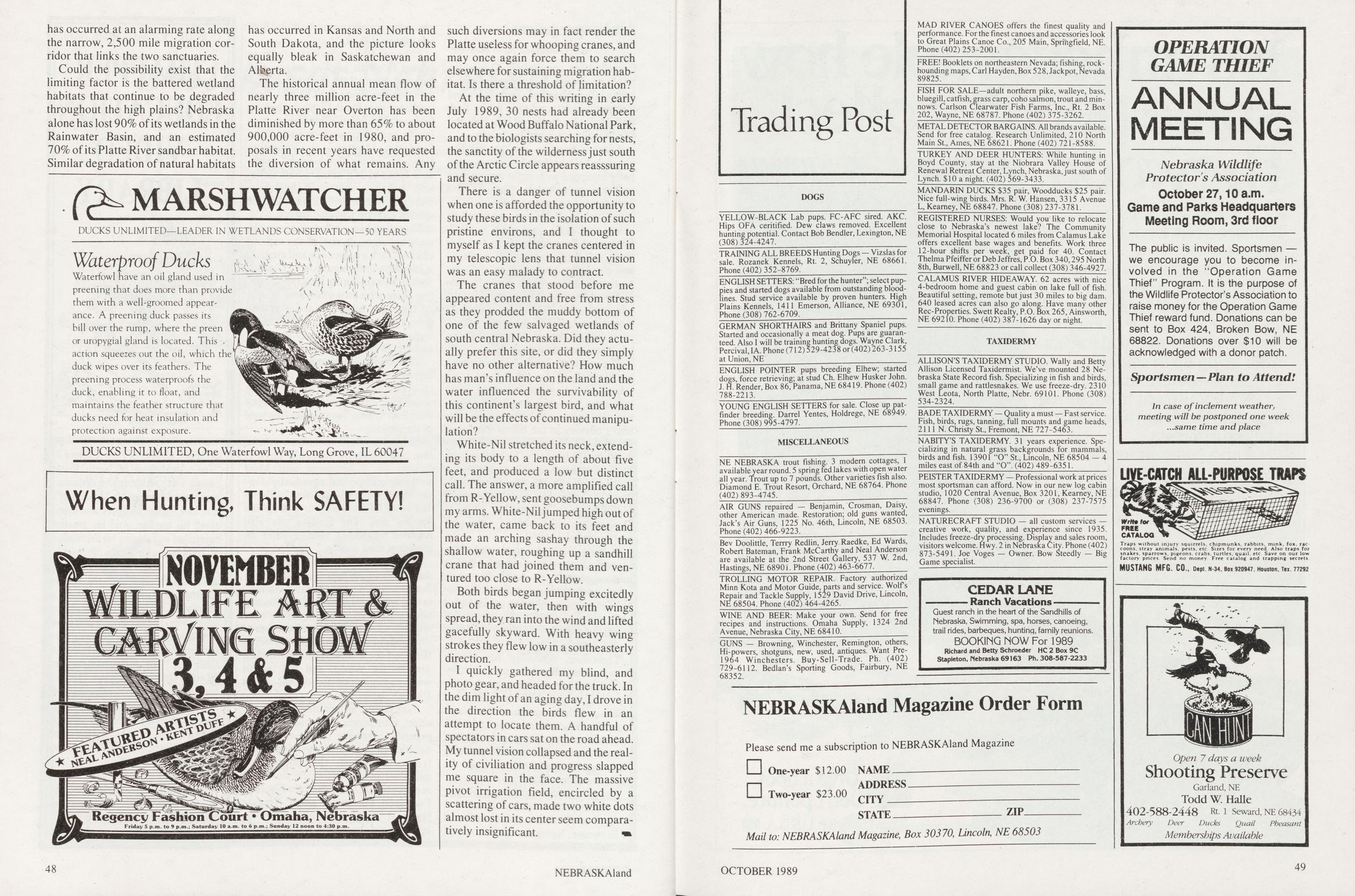
Could the possibility exist that the limiting factor is the battered wetland habitats that continue to be degraded throughout the high plains? Nebraska alone has lost 90% of its wetlands in the Rainwater Basin, and an estimated 70% of its Platte River sandbar habitat. Similar degradation of natural habitats has occurred in Kansas and North and South Dakota, and the picture looks equally bleak in Saskatchewan and Alberta.
The historical annual mean flow of nearly three million acre-feet in the Platte River near Overton has been diminished by more than 65% to about 900,000 acre-feet in 1980, and proposals in recent years have requested the diversion of what remains. Any such diversions may in fact render the Platte useless for whooping cranes, and may once again force them to search elsewhere for sustaining migration habitat. Is there a threshold of limitation?
MARSHWATCHER DUCKS UNLIMITED—LEADER IN WETLANDS CONSERVATION—50 YEARS Waterproof Ducks Waterfowl have an oil gland used in preening that does more than provide them with a well-groomed appearance. A preening duck passes its hill over the rump, where the preen or uropygial gland is located. This , action squeezes out the oil, which the duck wipes over its feathers. The preening process waterproofs the duck, enabling it to float, and maintains the feather structure that ducks need for heat insulation and protection against exposure. DUCKS UNLIMITED, One Waterfowl Way, Long Grove, IL 60047 When Hunting, Think SAFETY! NOVEMBER WILDLIFE ART & CARVING SHOW 3, 4, & 5 FEATURED ARTISTS NEAL ANDERSON RENT DUFF Regency Fashion Court Omaha, NebraskaAt the time of this writing in early July 1989, 30 nests had already been located at Wood Buffalo National Park, and to the biologists searching for nests, the sanctity of the wilderness just south of the Arctic Circle appears reassuring and secure.
There is a danger of tunnel vision when one is afforded the opportunity to study these birds in the isolation of such pristine environs, and I thought to myself as I kept the cranes centered in my telescopic lens that tunnel vision was an easy malady to contract.
The cranes that stood before me appeared content and free from stress as they prodded the muddy bottom of one of the few salvaged wetlands of south central Nebraska. Did they actually prefer this site, or did they simply have no other alternative? How much has man's influence on the land and the water influenced the survivability of this continent's largest bird, and what will be the effects of continued manipulation?
White-Nil stretched its neck, extending its body to a length of about five feet, and produced a low but distinct call. The answer, a more amplified call from R-Yellow, sent goosebumps down my arms. White-Nil jumped high out of the water, came back to its feet and made an arching sashay through the shallow water, roughing up a sandhill crane that had joined them and ventured too close to R-Yellow.
Both birds began jumping excitedly out of the water, then with wings spread, they ran into the wind and lifted gracefully skyward. With heavy wing strokes they flew low in a southeasterly direction.
I quickly gathered my blind, and photo gear, and headed for the truck. In the dim light of an aging day, I drove in the direction the birds flew in an attempt to locate them. A handful of spectators in cars sat on the road ahead. My tunnel vision collapsed and the reality of civiliation and progress slapped me square in the face. The massive pivot irrigation field, encircled by a scattering of cars, made two white dots almost lost in its center seem comparatively insignificant.
46 NEBRSAKAlandTrading Post
DOGSYELLOW-BLACK Lab pups. FC-AFC sired. AKC. Hips OFA ceritified. Dew claws removed. Excellent hunting potential. Contact Bob Bendler, Lexington, NE (308) 324-4247.
TRAINING ALL BREEDS Hunting Dogs — Vizslas for sale. Rozanek Kennels, Rt. 2, Schuyler, NE 68661. Phone (402) 352-8769.
ENGLISH SETTERS: "Bred for the hunter"; select puppies and started dogs available from outstanding bloodlines. Stud service available by proven hunters. High Plains Kennels, 1411 Emerson, Alliance, NE 69301, Phone (308) 762-6709.
GERMAN SHORTHAIRS and Brittany Spaniel pups. Started and occasionally a meat dog. Pups are guaranteed. Also I will be training hunting dogs. Wayne Clark, Percival, IA. Phone (712) 529-4238 or (402) 263-3155 at Union, NE
ENGLISH POINTER pups breeding Elhew; started dogs, force retrieving; at stud Ch. Elhew Husker John. J. H. Render, Box 86, Panama, NE 68419. Phone (402) 788-2213.
YOUNG ENGLISH SETTERS for sale. Close up pat-finder breeding. Darrel Yentes, Holdrege, NE 68949. Phone (308) 995-4797.
MISCELLANEOUSNE NEBRASKA trout fishing. 3 modern cottages, 1 available year round. 5 spring fed lakes with open water all year. Trout up to 7 pounds. Other varieties fish also. Diamond E. Trout Resort, Orchard, NE 68764. Phone (402) 893-4745.
AIR GUNS repaired — Benjamin, Crosman, Daisy, other American made. Restoration; old guns wanted, Jack's Air Guns, 1225 No. 46th, Lincoln, NE 68503. Phone (402) 466-9223.
Bev Doolittle, Terrry Redlin, Jerry Raedke, Ed Wards, Robert Bateman, Frank McCarthy and Neal Anderson are available at the 2nd Street Gallery, 537 W. 2nd, Hastings, NE 68901. Phone (402) 463-6677.
TROLLING MOTOR REPAIR. Factory authorized Minn Kota and Motor Guide, parts and service. Wolfs Repair and Tackle Supply, 1529 David Drive, Lincoln, NE 68504. Phone (402) 464-4265.
WINE AND BEER: Make your own. Send for free recipes and instructions. Omaha Supply, 1324 2nd Avenue, Nebraska City, NE 68410.
GUNS — Browning, Winchester, Remington, others, Hi-powers, shotguns, new, used, antiques. Want Pre-1964 Winchesters. Buy-Sell-Trade. Ph. (402) 729-6112. Bedlan's Sporting Goods, Fairbury, NE 68352.
MAD RIVER CANOES offers the finest quality and performance. For the finest canoes and accessories look to Great Plains Canoe Co., 205 Main, Springfield, NE. Phone(402) 253-2001.
FREE! Booklets on northeastern Nevada; fishing, rockhounding maps, Carl Hayden, Box 528, Jackpot, Nevada 89825.
FISH FOR SALE—adult northern pike, walleye, bass, bluegill, catfish, grass carp, coho salmon, trout and minnows. Carlson Clearwater Fish Farms, Inc., Rt. 2 Box 202, Wayne, NE 68787. Phone (402) 375-3262.
METAL DETECTOR BARGAINS. All brands available. Send for free catalog. Research Unlimited, 210 North Main St., Ames, NE 68621. Phone (402) 721-8588.
TURKEY AND DEER HUNTERS: While hunting in Boyd County, stay at the Niobrara Valley House of Renewal Retreat Center, Lynch, Nebraska, just south of Lynch. $10 a night. (402) 569-3433.
MANDARIN DUCKS $35 pair, Woodducks $25 pair. Nice full-wing birds. Mrs. R. W. Hansen, 3315 Avenue L, Kearney, NE 68847. Phone (308) 237-3781.
REGISTERED NURSES: Would you like to relocate close to Nebraska's newest lake? The Community Memorial Hospital located 6 miles from Calamus Lake offers excellent base wages and benefits. Work three 12-hour shifts per week, get paid for 40. Contact Thelma Pfeiffer or Deb Jeffres, P.O. Box 340,295 North 8th, Burwell, NE 68823 or call collect (308) 346-4927.
CALAMUS RIVER HIDEAWAY. 62 acres with nice 4-bedroom home and guest cabin on lake full of fish. Beautiful setting, remote but just 30 miles to big dam. 640 leased acres can also go along. Have many other Rec-Properties. Swett Realty, P.O. Box 265, Ainsworth, NE 69210. Phone (402) 387-1626 day or night.
TAXIDERMYALLISON'S TAXIDERMY STUDIO. Wally and Betty Allison Licensed Taxidermist. We've mounted 28 Nebraska State Record fish. Specializing in fish and birds, small game and rattlesnakes. We use freeze-dry. 2310 West Leota, North Platte, Nebr. 69101. Phone (308) 534-2324.
BADE TAXIDERMY — Quality a must — Fast service. Fish, birds, rugs, tanning, full mounts and game heads, 2111 N. Christy St., Fremont, NE 727-5463.
NABITY'S TAXIDERMY. 31 years experience. Specializing in natural grass backgrounds for mammals, birds and fish. 13901 "O" St., Lincoln, NE 68504 — 4 miles east of 84th and "O". (402) 489-6351.
PEISTER TAXIDERMY — Professional work at prices most sportsman can afford. Now in our new log cabin studio, 1020 Central Avenue, Box 3201, Kearney, NE 68847. Phone (308) 236-9700 or (308) 237-7575 evenings.
NATURECRAFT STUDIO — all custom services -creative work, quality, and experience since 1935. Includes freeze-dry processing. Display and sales room, visitors welcome. Hwy. 2 in Nebraska City. Phone (402) 873-5491. Joe Voges — Owner. Bow Steedly — Big Game specialist
CEDAR LANE Ranch Vacations Guest ranch in the heart of the Sandhills of Nebraska, Swimming, spa, horses, canoeing, trail rides, barbeques, hunting, family reunions. BOOKING NOW For 1989 Richard and Betty Schroeder HC 2 Box 9C Stapieton, Nebraska 69163 Ph. 308-587-2233 NEBRASKAland Magazine Order Form Please send me a subscription to NEBRASKAland Magazine LJ One-year $12.00 NAME ADDRESS Two-year $23.00 STATE ZIP. OPERATION GAME THIEF ANNUAL MEETING Nebraska Wildlife Protector's Association October 27,10 a.m. Game and Parks Headquarters Meeting Room, 3rd floor The public is invited. Sportsmen - we encourage you to become involved in the "Operation Game Thief" Program. It is the purpose of the Wildlife Protector's Association to raise money for the Operation Game Thief reward fund. Donations can be sent to Box 424, Broken Bow, NE 68822. Donations over $10 will be acknowledged with a donor patch. Sportsmen—-Plan to Attend! In case of inclement weather, meeting will be postponed one week same time and place LIVE-CATCH ALL-PURPOSE TRAPS FREE CATALOG Traps without injury squirrels, chipmunks, rabbits, mink, fox, raccoons, stray animals, pests, etc Sizes for every need. Also traps for snakes, sparrows, pigeons, crabs, turtles, quail, etc Save on our low factory prices Send no money Free catalog and trapping secrets MUSTANG MFG. CO., Dept. N-34, Box 920947, Houston, Tex. 77292 Mail to: NEBRASKAland Magazine, Box 30370, Lincoln, NE 68503 Open 7 days a week Shooting Preserve Garland, NE Todd W. Halle 402-588-2448 Rt. 1 Seward, NE 68434 Archery Deer Ducks Quail Pheasant Memberships Available OCTOBER 1989 49 It's unbelievable how
some people collect
firewood.
They saw down signs.
Hatchet trees. Even hack apart
picnic tables.
And tragically, repeated
vandalism has forced many
areas to be closed permanently.
What will it take to keep our
respect for our national forests
from going up in smoke?
Simple determination.
A commitment to ourselves
to isolate the few who come to
abuse the forests.
And a commitment to our
young people to help them
appreciate the forest for what
it really is. A priceless and
unparalleled gift.
At the Forest Service, we
believe that miracles can
take root. When people
care enough.
Give a hoot.
Don't pollute.
Forest Service, U.S.D.A.
50
NEBRASKAland
Nebraska law requires young hunters to complete a
hunter safety education course, but law or no law, safe,
ethical, respectful behavior is the obligation of all
hunters. For details, contact any Conservation Officer,
or Game and Parks Commission office.
It's unbelievable how
some people collect
firewood.
They saw down signs.
Hatchet trees. Even hack apart
picnic tables.
And tragically, repeated
vandalism has forced many
areas to be closed permanently.
What will it take to keep our
respect for our national forests
from going up in smoke?
Simple determination.
A commitment to ourselves
to isolate the few who come to
abuse the forests.
And a commitment to our
young people to help them
appreciate the forest for what
it really is. A priceless and
unparalleled gift.
At the Forest Service, we
believe that miracles can
take root. When people
care enough.
Give a hoot.
Don't pollute.
Forest Service, U.S.D.A.
50
NEBRASKAland
Nebraska law requires young hunters to complete a
hunter safety education course, but law or no law, safe,
ethical, respectful behavior is the obligation of all
hunters. For details, contact any Conservation Officer,
or Game and Parks Commission office.
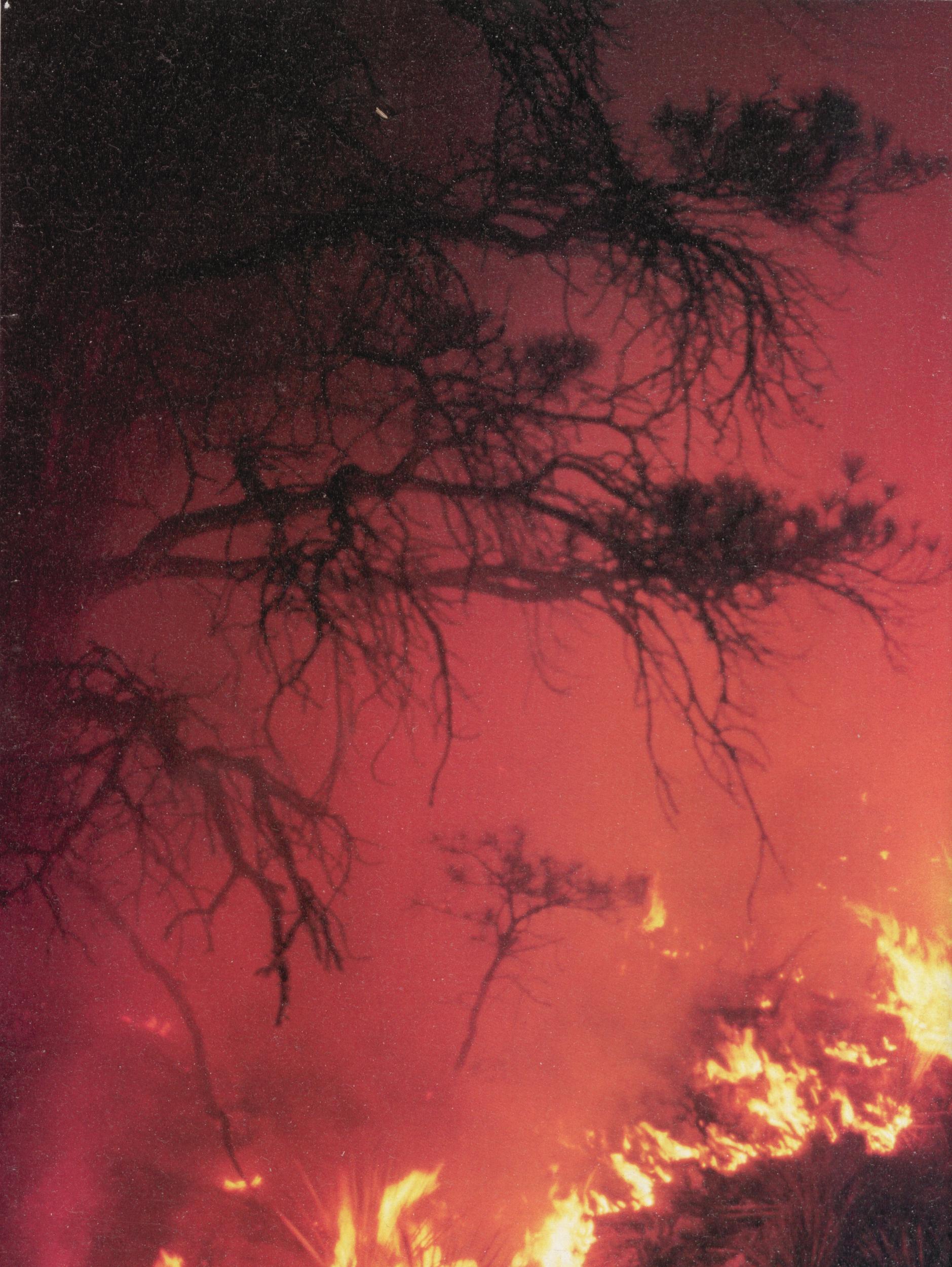
Position: 468 (22 views)