Volume 67, Issue 7, 1989
NEBRASKAland
AUGUST/SEPTEMBER 1989 $1.50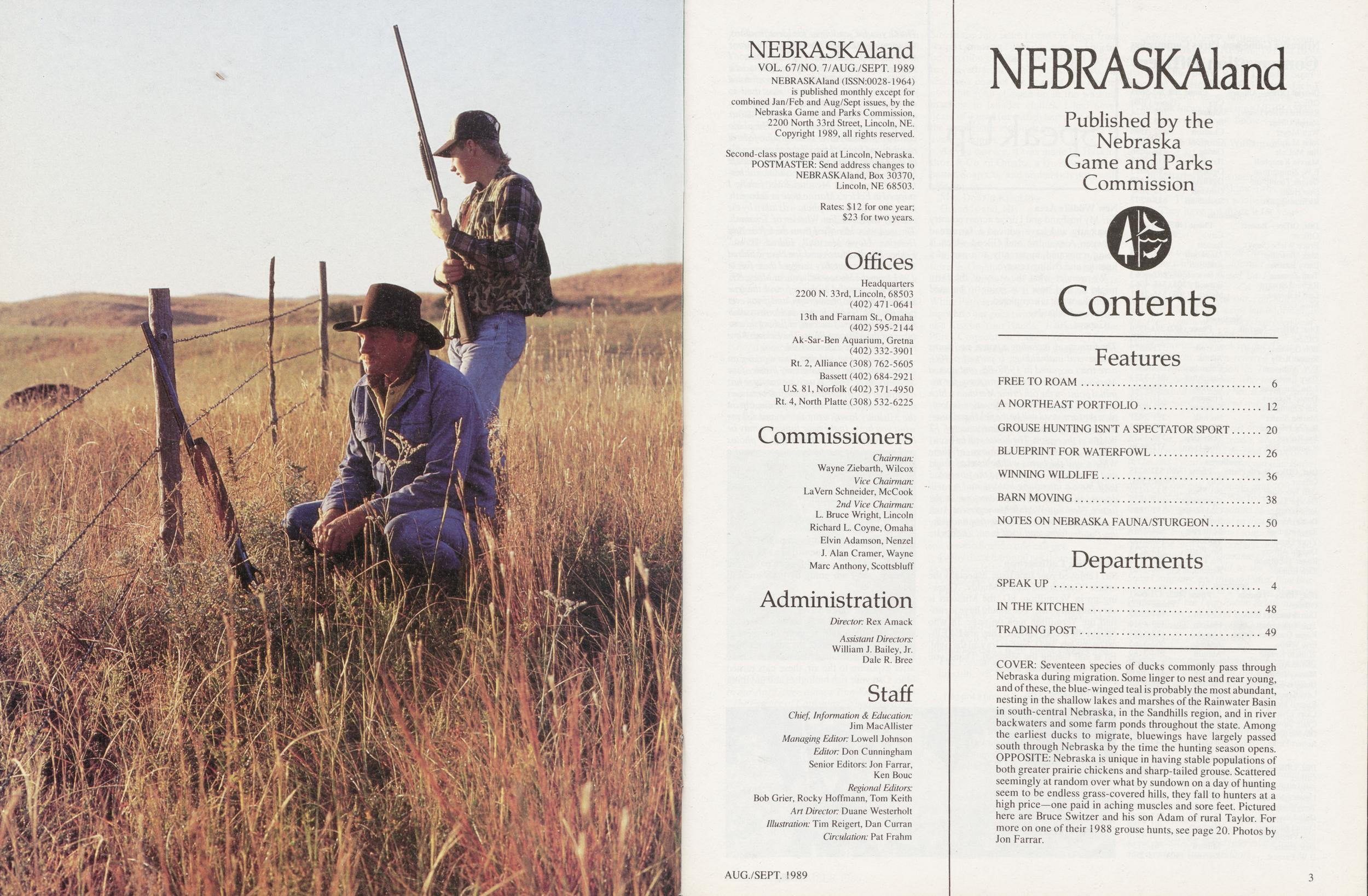
NEBRASKAland
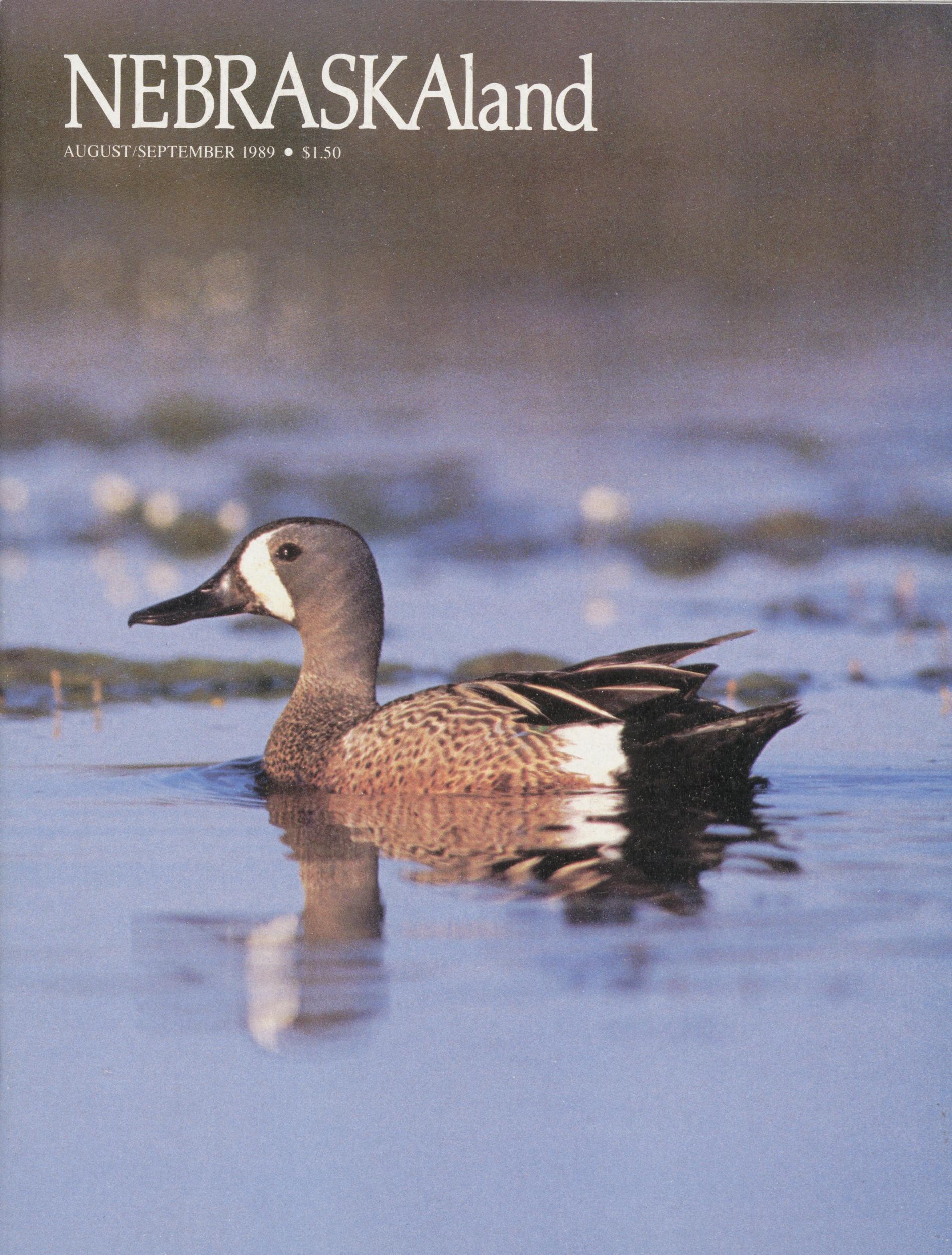
Published by the Nebraska Game and Parks Commission NEBRASKAland VOL. 67/NO. 7/AUG./SEPT. 1989 NEBRASKAland (ISSN:0028-1964) is published monthly except for combined Jan/Feb and Aug/Sept issues, by the Nebraska Game and Parks Commission, 2200 North 33rd Street, Lincoln, NE. Copyright 1989, all rights reserved. Second-class postage paid at Lincoln, Nebraska. POSTMASTER: Send address changes to NEBRASKAland, Box 30370, Lincoln, NE 68503. Rates: $ 12 for one year; $23 for two years. Offices Headquarters 2200 N. 33rd, Lincoln, 68503 (402)471-0641 13th and Farnam St., Omaha (402)595-2144 Ak-Sar-Ben Aquarium, Gretna (402)332-3901 Rt. 2, Alliance (308) 762-5605 Bassett (402) 684-2921 U.S. 81, Norfolk (402) 371-4950 Rt. 4, North Platte (308) 532-6225 Commissioners Chairman: Wayne Ziebarth, Wilcox Vice Chairman: LaVern Schneider, McCook 2nd Vice Chairman: L. Bruce Wright, Lincoln Richard L. Coyne, Omaha Elvin Adamson, Nenzel J. Alan Cramer, Wayne Marc Anthony, Scottsbluff Administration Director: Rex A mack Assistant Directors: William J. Bailey, Jr. Dale R. Bree Staff Chief, Information & Education: Jim MacAllister Managing Editor: Lowell Johnson Editor: Don Cunningham Senior Editors: Jon Farrar, Ken Bouc Regional Editors: Bob Grier, Rocky Hoffmann, Tom Keith Art Director: Duane Westerholt Illustration: Tim Reigert, Dan Curran Circulation: Pat Frahm Contents Features FREE TO ROAM. 6 A NORTHEAST PORTFOLIO 12 GROUSE HUNTING ISN'T A SPECTATOR SPORT 20 BLUEPRINT FOR WATERFOWL 26 WINNING WILDLIFE 36 BARN MOVING 38 NOTES ON NEBRASKA FAUNA/STURGEON 50 Departments SPEAK UP 4 IN THE KITCHEN 48 TRADING POST 49 COVER: Seventeen species of ducks commonly pass through Nebraska during migration. Some linger to nest and rear young, and of these, the blue-winged teal is probably the most abundant, nesting in the shallow lakes and marshes of the Rainwater Basin in south-central Nebraska, in the Sandhills region, and in river backwaters and some farm ponds throughout the state. Among the earliest ducks to migrate, blue-wings have largely passed south through Nebraska by the time the hunting season opens. OPPOSITE: Nebraska is unique in having stable populations of both greater prairie chickens and sharp-tailed grouse. Scattered seemingly at random over what by sundown on a day of hunting seem to be endless grass-covered hills, they fall to hunters at a high price—one paid in aching muscles and sore feet. Pictured here are Bruce Switzer and his son Adam of rural Taylor. For more on one of their 1988 grouse hunts, see page 20. Photos by Jon Farrar. AUG/SEPT. 1989 3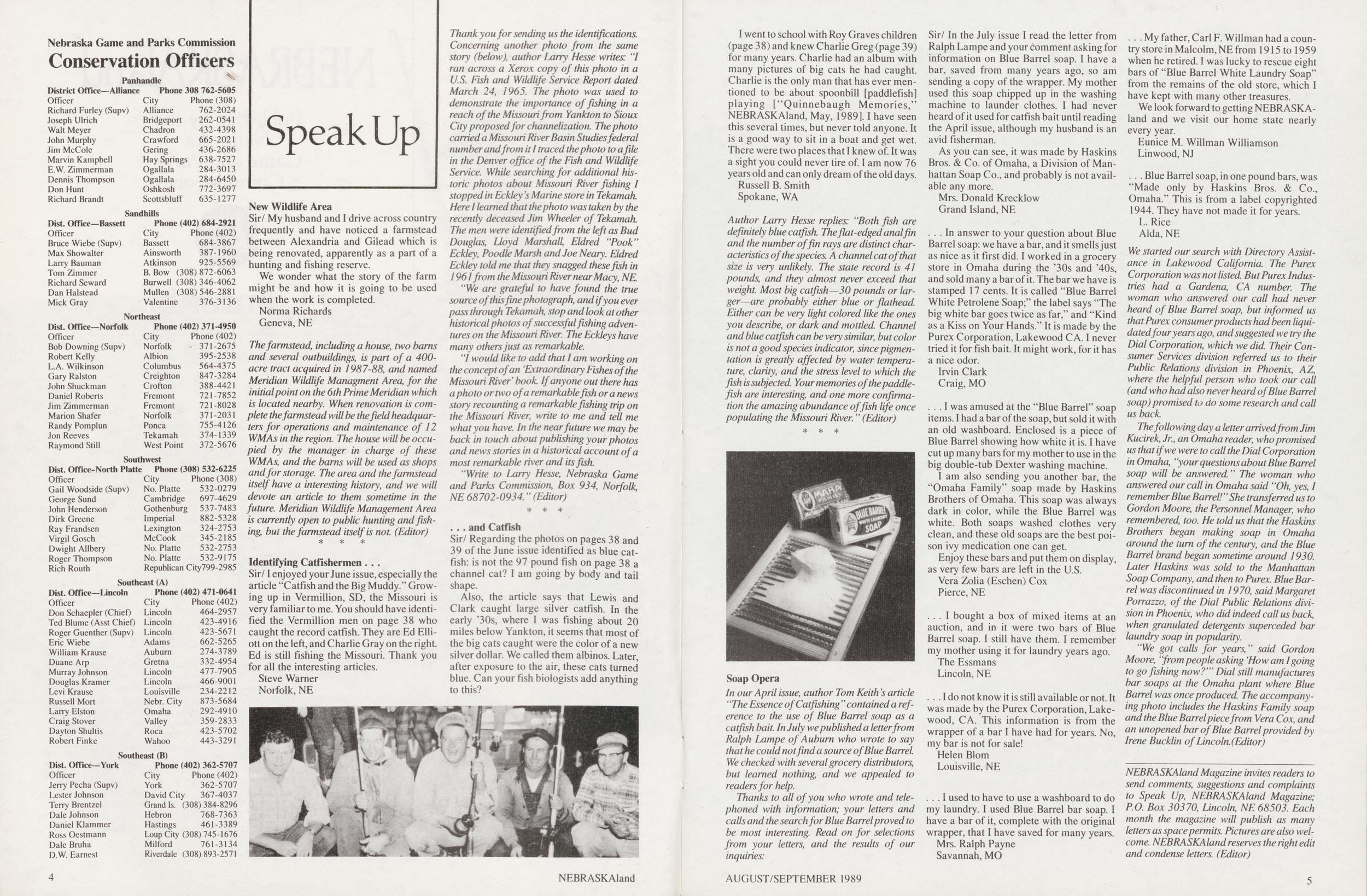
Speak Up
New Wildlife AreaSir/ My husband and I drive across country frequently and have noticed a farmstead between Alexandria and Gilead which is being renovated, apparently as a part of a hunting and fishing reserve.
We wonder what the story of the farm might be and how it is going to be used when the work is completed.
Norma Richards Geneva, NEThe farmstead, including a house, two barns and several outbuildings, is part of a 400-acre tract acquired in 1987-88, and named Meridian Wildlife Managment Area, for the initial point on the 6th Prime Meridian which is located nearby. When renovation is complete the farmstead will be the field headquarters for operations and maintenance of 12 WMAs in the region. The house will be occupied by the manager in charge of these WMAs, and the barns will be used as shops and for storage. The area and the farmstead itself have a interesting history, and we will devote an article to them sometime in the future. Meridian Wildlife Management Area is currently open to public hunting and fishing, but the farmstead itself is not. (Editor)
* * * Identifying Catfishermen...Sir/1 enjoyed your June issue, especially the article "Catfish and the Big Muddy." Growing up in Vermillion, SD, the Missouri is very familiar to me. You should have identified the Vermillion men on page 38 who caught the record catfish. They are Ed Elliott on the left, and Charlie Gray on the right. Ed is still fishing the Missouri. Thank you for all the interesting articles.
Steve Warner Norfolk, NEThank you for sending us the identifications. Concerning another photo from the same story (below), author Ixvrry Hesse writes: "I ran across a Xerox copy of this photo in a U.S. Fish and Wildlife Service Report dated March 24, 1965. The photo was used to demonstrate the importance of fishing in a reach of the Missouri from Yankton to Sioux City proposed for channelization. The photo carried a Missouri River Basin Studies federal number and from it I traced the photo to a file in the Denver office of the Fish and Wildlife Service. While searching for additional historic photos about Missouri River fishing I stopped in Eckley 's Marine store in Tekamah. Here I learned that the photo was taken by the recently deceased Jim Wheeler of Tekamah. The men were identified from the left as Bud Douglas, Lloyd Marshall, Eldred 'Took" Eckley, Poodle Marsh and Joe Neary. Eldred Eckley told me that they snagged these fish in 1961 from the Missouri River near Macy, NE.
"We are grateful to have found the true source of this fine photograph, and if you ever pass through Tekamah, stop and look at other historical photos of successful fishing adventures on the Missouri River. The Eckleys have many others just as remarkable.
"1 would like to add that I am working on the concept of an 'Extraordinary Fishes of the Missouri River book. If anyone out there has a photo or two of a remarkable fish or a news story recounting a remarkable fishing trip on the Missouri River, write to me and tell me what you have. In the near future we may be back in touch about publishing your photos and news stories in a historical account of a most remarkable river and its fish.
"1 would like to add that I am working on the concept of an 'Extraordinary Fishes of the Missouri River book. If anyone out there has a photo or two of a remarkable fish or a news story recounting a remarkable fishing trip on the Missouri River, write to me and tell me what you have. In the near future we may be back in touch about publishing your photos and news stories in a historical account of a most remarkable river and its fish.
"Write to Larry Hesse, Nebraska Game and Parks Commission, Box 934, Norfolk, NE 68702-0934." (Editor)
* * * ...and CatfishSir/ Regarding the photos on pages 38 and 39 of the June issue identified as blue catfish: is not the 97 pound fish on page 38 a channel cat? I am going by body and tail shape.
Also, the article says that Lewis and Clark caught large silver catfish. In the early '30s, where I was fishing about 20 miles below Yankton, it seems that most of the big cats caught were the color of a new silver dollar. We called them albinos. Later, after exposure to the air, these cats turned blue. Can your fish biologists add anything to this?
I went to school with Roy Graves children (page 38) and knew Charlie Greg (page 39) for many years. Charlie had an album with many pictures of big cats he had caught. Charlie is the only man that has ever mentioned to be about spoonbill [paddlefish] playing ["Quinnebaugh Memories," NEBRASKAland, May, 1989]. I have seen this several times, but never told anyone. It is a good way to sit in a boat and get wet. There were two places that I knew of. It was a sight you could never tire of. I am now 76 years old and can only dream of the old days.
Russell B. Smith Spokane, WAAuthor Larry Hesse replies: "Both fish are definitely blue catfish. The flat-edged anal fin and the number of fin rays are distinct characteristics of the species. A channel cat of that size is very unlikely. The state record is 41 pounds, and they almost never exceed that weight. Most big catfish—30 pounds or larger—are probably either blue or fathead. Either can be very light colored like the ones you describe, or dark and mottled. Channel and blue catfish can be very similar, but color is not a good species indicator, since pigmentation is greatly affected by water temperature, clarity, and the stress level to which the fish is subjected. Your memories of the paddlefish are interesting, and one more confirmation the amazing abundance offish life once populating the Missouri River." (Editor)
* * *In our April issue, author Tom Keith's article "The Essence of Cat fishing" contained a reference to the use of Blue Barrel soap as a catfish bait. In July we published a letter from Ralph Lampe of Auburn who wrote to say that he could not find a source of Blue Barrel We checked with several grocery distributors, but learned nothing, and we appealed to readers for help.
Thanks to all of you who wrote and telephoned with information; your letters and calls and the search for Blue Barrel proved to be most interesting. Read on for selections from your letters, and the results of our inquiries:
Sir In the July issue I read the letter from Ralph Lampe and your comment asking for information on Blue Barrel soap. I have a bar, saved from many years ago, so am sending a copy of the wrapper. My mother used this soap chipped up in the washing machine to launder clothes. I had never heard of it used for catfish bait until reading the April issue, although my husband is an avid fisherman.
As you can see, it was made by Haskins Bros. & Co. of Omaha, a Division of Manhattan Soap Co., and probably is not available any more.
Mrs. Donald Krecklow Grand Island, NEIn answer to your question about Blue Barrel soap: we have a bar, and it smells just as nice as it first did. I worked in a grocery store in Omaha during the '30s and '40s, and sold many a bar of it. The bar we have is stamped 17 cents. It is called "Blue Barrel White Petrolene Soap;" the label says "The big white bar goes twice as far," and "Kind as a Kiss on Your Hands." It is made by the Purex Corporation, Lakewood CA. I never tried it for fish bait. It might work, for it has a nice odor.
Irvin Clark Craig, MOI was amused at the "Blue Barrel" soap items. I had a bar of the soap, but sold it with an old washboard. Enclosed is a piece of Blue Barrel showing how white it is. I have cut up many bars for my mother to use in the big double-tub Dexter washing machine.
I am also sending you another bar, the "Omaha Family" soap made by Haskins Brothers of Omaha. This soap was always dark in color, while the Blue Barrel was white. Both soaps washed clothes very clean, and these old soaps are the best poison ivy medication one can get.
Enjoy these bars and put them on display, as very few bars are left in the U.S.
Vera Zolia (Eschen) Cox Pierce, NEI bought a box of mixed items at an auction, and in it were two bars of Blue Barrel soap. I still have them. I remember my mother using it for laundry years ago.
The Essmans Lincoln, NEI do not know it is still available or not.lt was made by the Purex Corporation, Lakewood, CA. This information is from the wrapper of a bar I have had for years. No, my bar is not for sale!
Helen Blom Louisville, NE... I used to have to use a washboard to do my laundry. I used Blue Barrel bar soap. I have a bar of it, complete with the original wrapper, that I have saved for many years.
Mrs. Ralph Payne Savannah, MOMy father, Carl F. Willman had a country store in Malcolm, NE from 1915 to 1959 when he retired. I was lucky to rescue eight bars of "Blue Barrel White Laundry Soap" from the remains of the old store, which I have kept with many other treasures.
We look forward to getting NEBRASKAland and we visit our home state nearly every year.
Eunice M. Willman Williamson Linwood, NJBlue Barrel soap, in one pound bars, was "Made only by Haskins Bros. & Co., Omaha." This is from a label copyrighted 1944. They have not made it for years.
L. Rice Alda, NEWe started our search with Directory Assistance in Lakewood California. The Purex Corporation was not listed. But Purex Industries had a Gardena, CA number. The woman who answered our call had never heard of Blue Barrel soap, but informed us that Purex consumer products had been liquidated four years ago, and suggested we try the Dial Corporation, which we did. Their Consumer Services division referred us to their Public Relations division in Phoenix, AZ, where the helpful person who took our call (and who had also never heard of Blue Barrel soap) promised to do some research and call us back.
The following day a letter arrived from Jim Kucirek, Jr., an Omaha reader, who promised us that if we were to call the Dial Corporation in Omaha, ' 'your questions about Blue Barrel soap will be answered.' The woman who answered our call in Omaha said "Oh, yes, I remember Blue Barrel!'' She transferred us to Gordon Moore, the Personnel Manager, who remembered, too. He told us that the Haskins Brothers began making soap in Omaha around the turn of the century, and the Blue Barrel brand began sometime around 1930. Later Haskins was sold to the Manhattan Soap Company, and then to Purex. Blue Barrel was discontinued in 1970, said Margaret Poirazzo, of the Dial Public Relations division in Phoenix, who did indeed call us back, when granulated detergents superceded bar laundry soap in popularity.
"We got calls for years," said Gordon Moore, "from people asking How am I going to go fishing now?'" Dial still manufactures bar soaps at the Omaha plant where Blue Barrel was once produced. The accompanying photo includes the Haskins Family soap and the Blue Barrel piece from Vera Cox, and an unopened bar of Blue Barrel provided by Irene Bucklin of Lincoln. (Editor)
NEBRASKAland Magazine invites readers to send comments, suggestions and complaints to Speak Up, NEBRASKAland Magazine; P.O. Box 30370, Lincoln, NE 68503. Each month the magazine will publish as many letters as space permits. Pictures are also welcome. NEBRA SKA land reserves the right edit and condense letters. (Editor)
AUGUST/SEPTEMBER 1989 5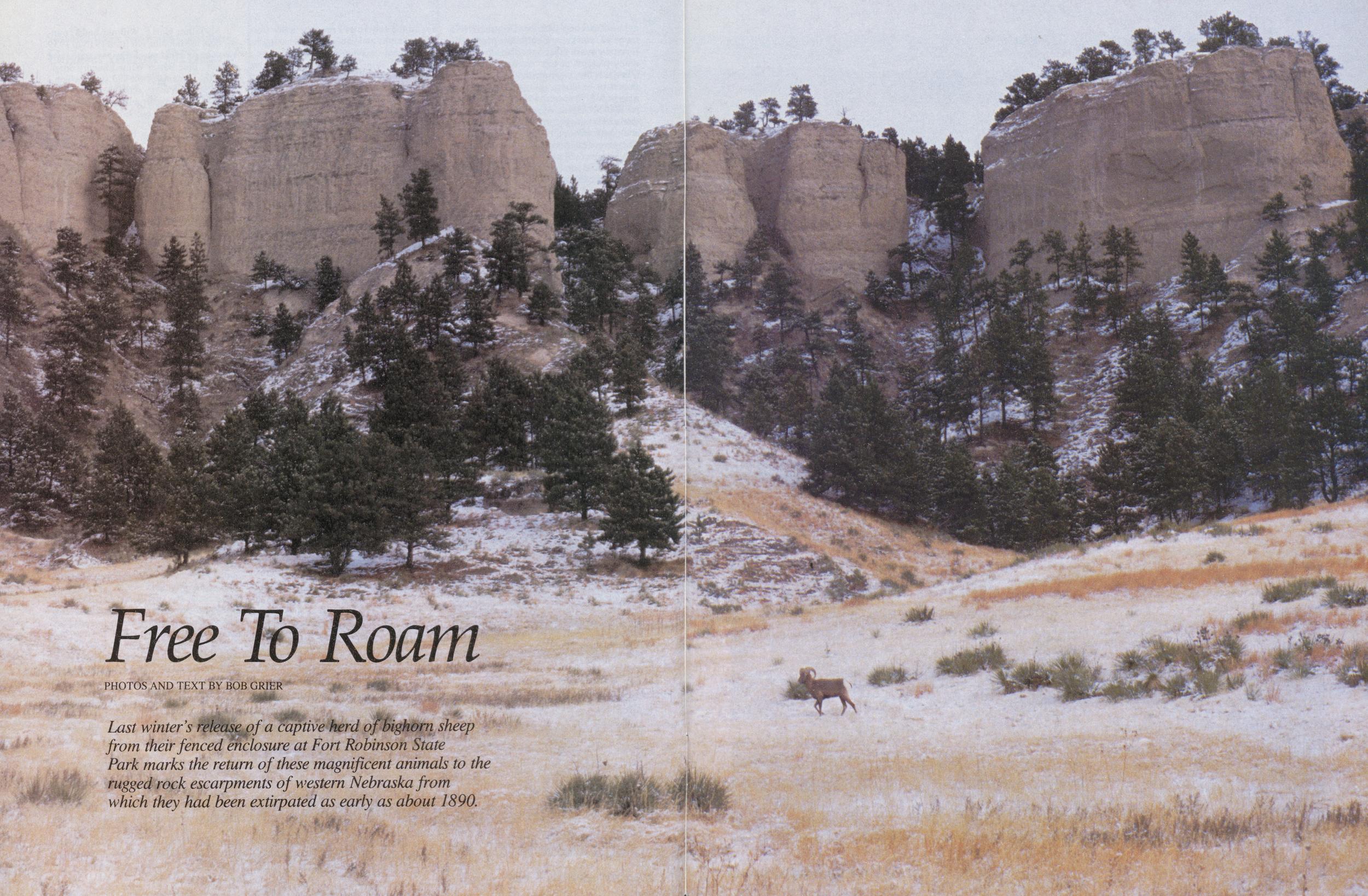
Free To Roam
PHOTOS AND TEXT BY BOB GRIER Last winter's released)fa Wpkive herd of bighorn sheep from their fenced enclosure at Fort Robinson State Park marks the return of these magnificent animals to the rugged rock escarpments of western Nebraska from which they had been extirpated as early as about 1890.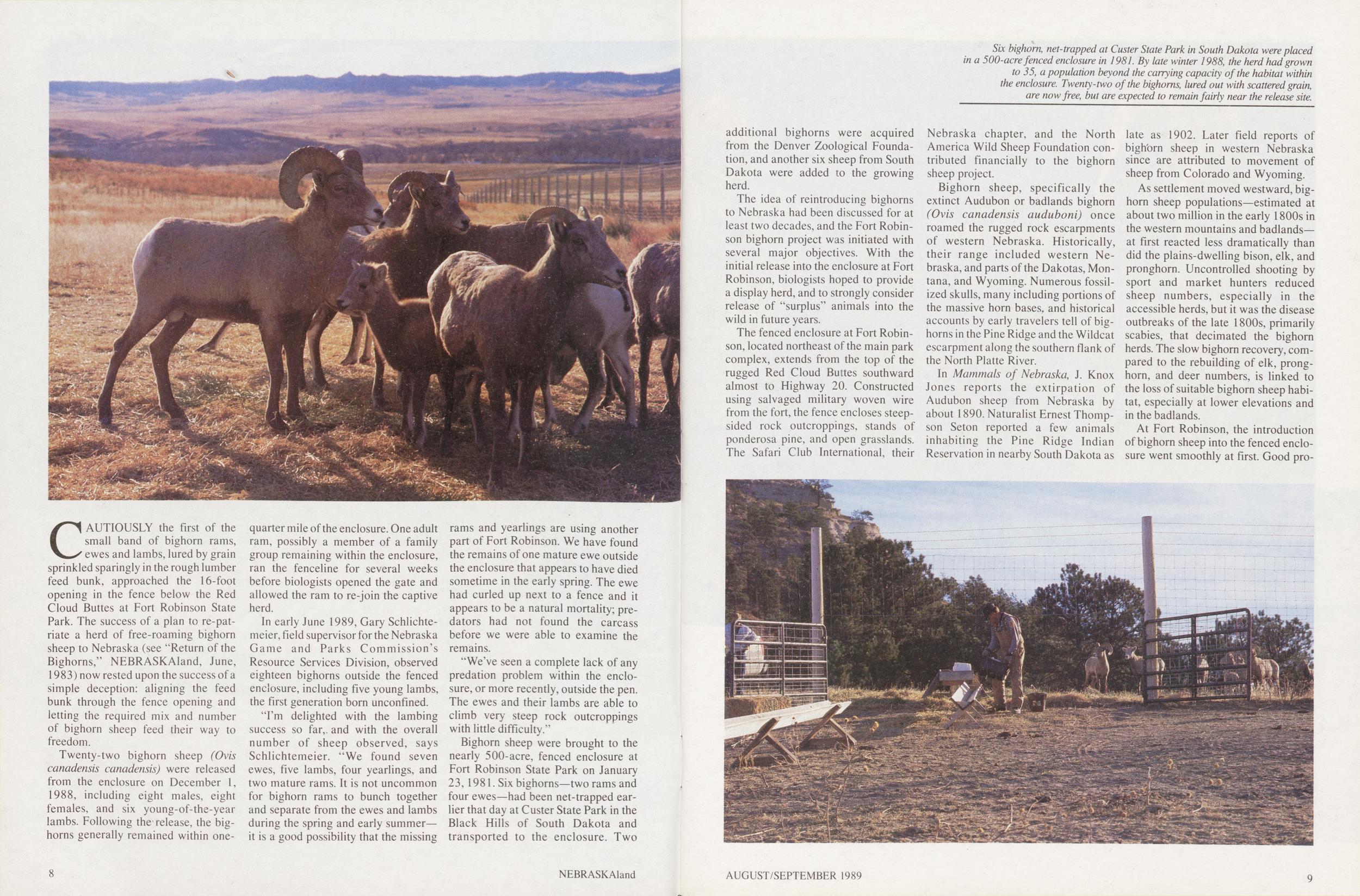
CAUTIOUSLY the first of the small band of bighorn rams, ewes and lambs, lured by grain sprinkled sparingly in the rough lumber feed bunk, approached the 16-foot opening in the fence below the Red Cloud Buttes at Fort Robinson State Park. The success of a plan to repatriate a herd of free-roaming bighorn sheep to Nebraska (see "Return of the Bighorns," NEBRASKAland, June, 1983) now rested upon the success of a simple deception: aligning the feed bunk through the fence opening and letting the required mix and number of bighorn sheep feed their way to freedom.
Twenty-two bighorn sheep (Ovis canadensis canadensis) were released from the enclosure on December 1, 1988, including eight males, eight females, and six young-of-the-year lambs. Following the release, the bighorns generally remained within onequarter mile of the enclosure. One adult ram, possibly a member of a family group remaining within the enclosure, ran the fenceline for several weeks before biologists opened the gate and allowed the ram to re-join the captive herd.
In early June 1989, Gary Schlichtemeier, field supervisor for the Nebraska Game and Parks Commission's Resource Services Division, observed eighteen bighorns outside the fenced enclosure, including five young lambs, the first generation born unconfined.
"I'm delighted with the lambing success so far,, and with the overall number of sheep observed, says Schlichtemeier. "We found seven ewes, five lambs, four yearlings, and two mature rams. It is not uncommon for bighorn rams to bunch together and separate from the ewes and lambs during the spring and early summer—it is a good possibility that the missing rams and yearlings are using another part of Fort Robinson. We have found the remains of one mature ewe outside the enclosure that appears to have died sometime in the early spring. The ewe had curled up next to a fence and it appears to be a natural mortality; predators had not found the carcass before we were able to examine the remains.
"We've seen a complete lack of any predation problem within the enclosure, or more recently, outside the pen. The ewes and their lambs are able to climb very steep rock outcroppings with little difficulty."
Bighorn sheep were brought to the nearly 500-acre, fenced enclosure at Fort Robinson State Park on January 23, 1981. Six bighorns—two rams and four ewes—had been net-trapped earlier that day at Custer State Park in the Black Hills of South Dakota and transported to the enclosure. Two 6 NEBRASKAland additional bighorns were acquired from the Denver Zoological Foundation, and another six sheep from South Dakota were added to the growing herd.
The idea of reintroducing bighorns to Nebraska had been discussed for at least two decades, and the Fort Robinson bighorn project was initiated with several major objectives. With the initial release into the enclosure at Fort Robinson, biologists hoped to provide a display herd, and to strongly consider release of "surplus" animals into the wild in future years.
The fenced enclosure at Fort Robinson, located northeast of the main park complex, extends from the top of the rugged Red Cloud Buttes southward almost to Highway 20. Constructed using salvaged military woven wire from the fort, the fence encloses steepsided rock outcroppings, stands of ponderosa pine, and open grasslands. The Safari Club International, their Nebraska chapter, and the North America Wild Sheep Foundation contributed financially to the bighorn sheep project.
Bighorn sheep, specifically the extinct Audubon or badlands bighorn (Ovis canadensis auduboni) once roamed the rugged rock escarpments of western Nebraska. Historically, their range included western Nebraska, and parts of the Dakotas, Montana, and Wyoming. Numerous fossilized skulls, many including portions of the massive horn bases, and historical accounts by early travelers tell of bighorns in the Pine Ridge and the Wildcat escarpment along the southern flank of the North Platte River.
In Mammals of Nebraska, J. Knox Jones reports the extirpation of Audubon sheep from Nebraska by about 1890. Naturalist Ernest Thompson Seton reported a few animals inhabiting the Pine Ridge Indian Reservation in nearby South Dakota as late as 1902. Later field reports of bighorn sheep in western Nebraska since are attributed to movement of sheep from Colorado and Wyoming.
As settlement moved westward, bighorn sheep populations—estimated at about two million in the early 1800s in the western mountains and badlands—at first reacted less dramatically than did the plains-dwelling bison, elk, and pronghorn. Uncontrolled shooting by sport and market hunters reduced sheep numbers, especially in the accessible herds, but it was the disease outbreaks of the late 1800s, primarily scabies, that decimated the bighorn herds. The slow bighorn recovery, compared to the rebuilding of elk, pronghorn, and deer numbers, is linked to the loss of suitable bighorn sheep habitat, especially at lower elevations and in the badlands.
At Fort Robinson, the introduction of bighorn sheep into the fenced enclosure went smoothly at first. Good production 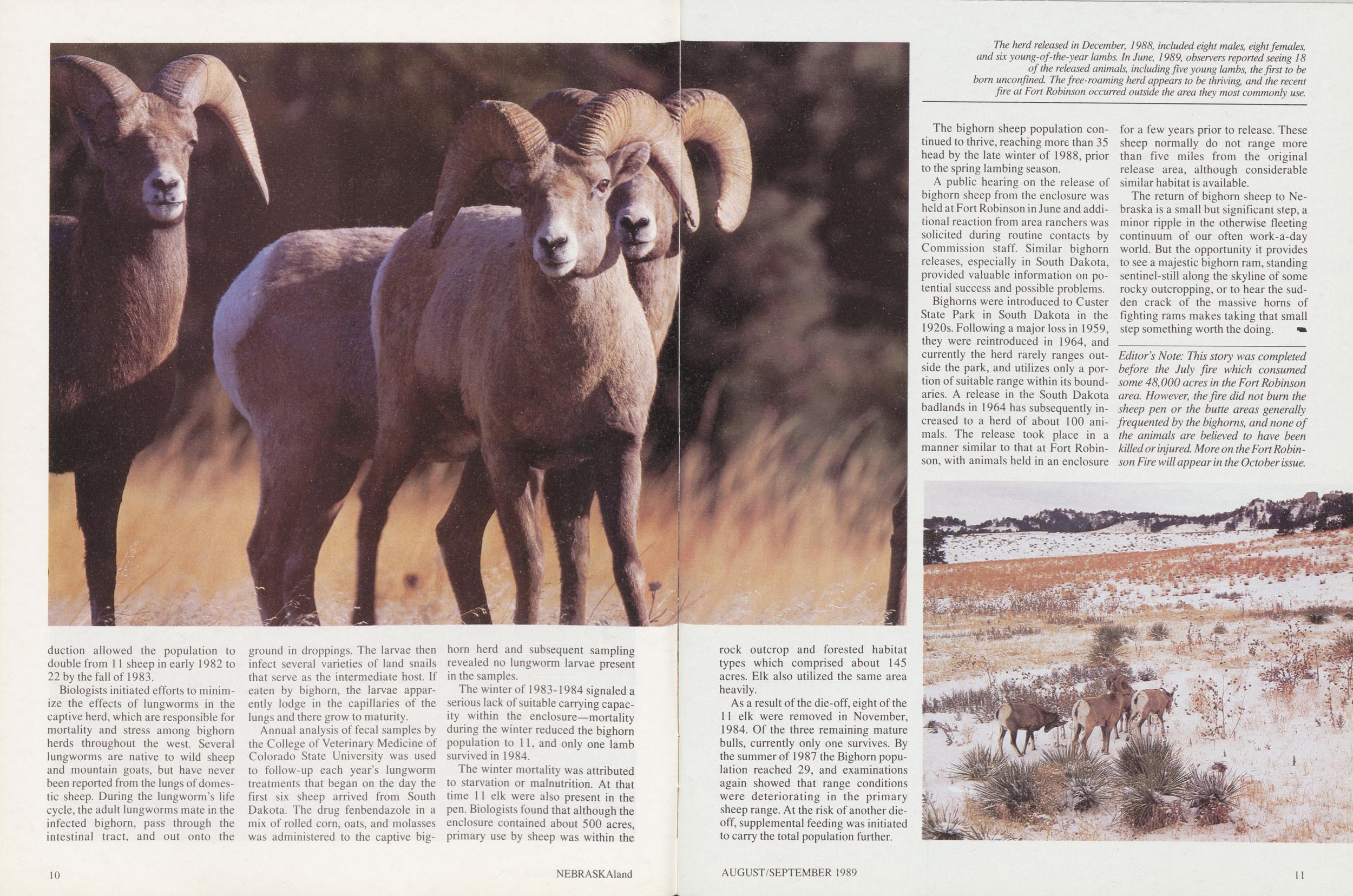
Biologists initiated efforts to minimize the effects of lungworms in the captive herd, which are responsible for mortality and stress among bighorn herds throughout the west. Several lungworms are native to wild sheep and mountain goats, but have never been reported from the lungs of domestic sheep. During the lungworm's life cycle, the adult lungworms mate in the infected bighorn, pass through the intestinal tract, and out onto the ground in droppings. The larvae then infect several varieties of land snails that serve as the intermediate host. If eaten by bighorn, the larvae apparently lodge in the capillaries of the lungs and there grow to maturity.
Annual analysis of fecal samples by the College of Veterinary Medicine of Colorado State University was used to follow-up each year's lung worm treatments that began on the day the first six sheep arrived from South Dakota. The drug fenbendazole in a mix of rolled corn, oats, and molasses was administered to the captive bighorn herd and subsequent sampling revealed no lungworm larvae present in the samples.
The winter of 19 8 3 -19 84 signaled a serious lack of suitable carrying capacity within the enclosure—mortality during the winter reduced the bighorn population to 11, and only one lamb survived in 1984.
The winter mortality was attributed too starvation or malnutrition. At that time 11 elk were also present in the pen. Biologists found that although the enclosure contained about 500 acres, primary use by sheep was within the 10 NEBRASKAland rock outcrop and forested habitat types which comprised about 145 acres. Elk also utilized the same area heavily.
As a result of the die-off, eight of the 11 elk were removed in November, 1984. Of the three remaining mature bulls, currently only one survives. By the summer of 1987 the Bighorn population reached 29, and examinations again showed that range conditions were deteriorating in the primary sheep range. At the risk of another die-off, supplemental feeding was initiated to carry the total population further.
The bighorn sheep population continued to thrive, reaching more than 35 head by the late winter of 1988, prior to the spring lambing season.
A public hearing on the release of bighorn sheep from the enclosure was held at Fort Robinson in June and additional reaction from area ranchers was solicited during routine contacts by Commission staff. Similar bighorn releases, especially in South Dakota, provided valuable information on potential success and possible problems.
Bighorns were introduced to Custer State Park in South Dakota in the 1920s. Following a major loss in 1959, they were reintroduced in 1964, and currently the herd rarely ranges outside the park, and utilizes only a portion of suitable range within its boundaries. A release in the South Dakota badlands in 1964 has subsequently increased to a herd of about 100 animals. The release took place in a manner similar to that at Fort Robinson, with animals held in an enclosure for a few years prior to release. These sheep normally do not range more than five miles from the original release area, although considerable similar habitat is available.
The return of bighorn sheep to Nebraska is a small but significant step, a minor ripple in the otherwise fleeting continuum of our often work-a-day world. But the opportunity it provides to see a majestic bighorn ram, standing sentinel-still along the skyline of some rocky outcropping, or to hear the sudden crack of the massive horns of fighting rams makes taking that small step something worth the doing.
Editor s Note: This story was completed before the July fire which consumed some 48,000 acres in the Fort Robinson area. However, the fire did not burn the sheep pen or the butte areas generally frequented by the bighorns, and none of the animals are believed to have been killed or injured. More on the Fort Robinson Fire will appear in the October issue.
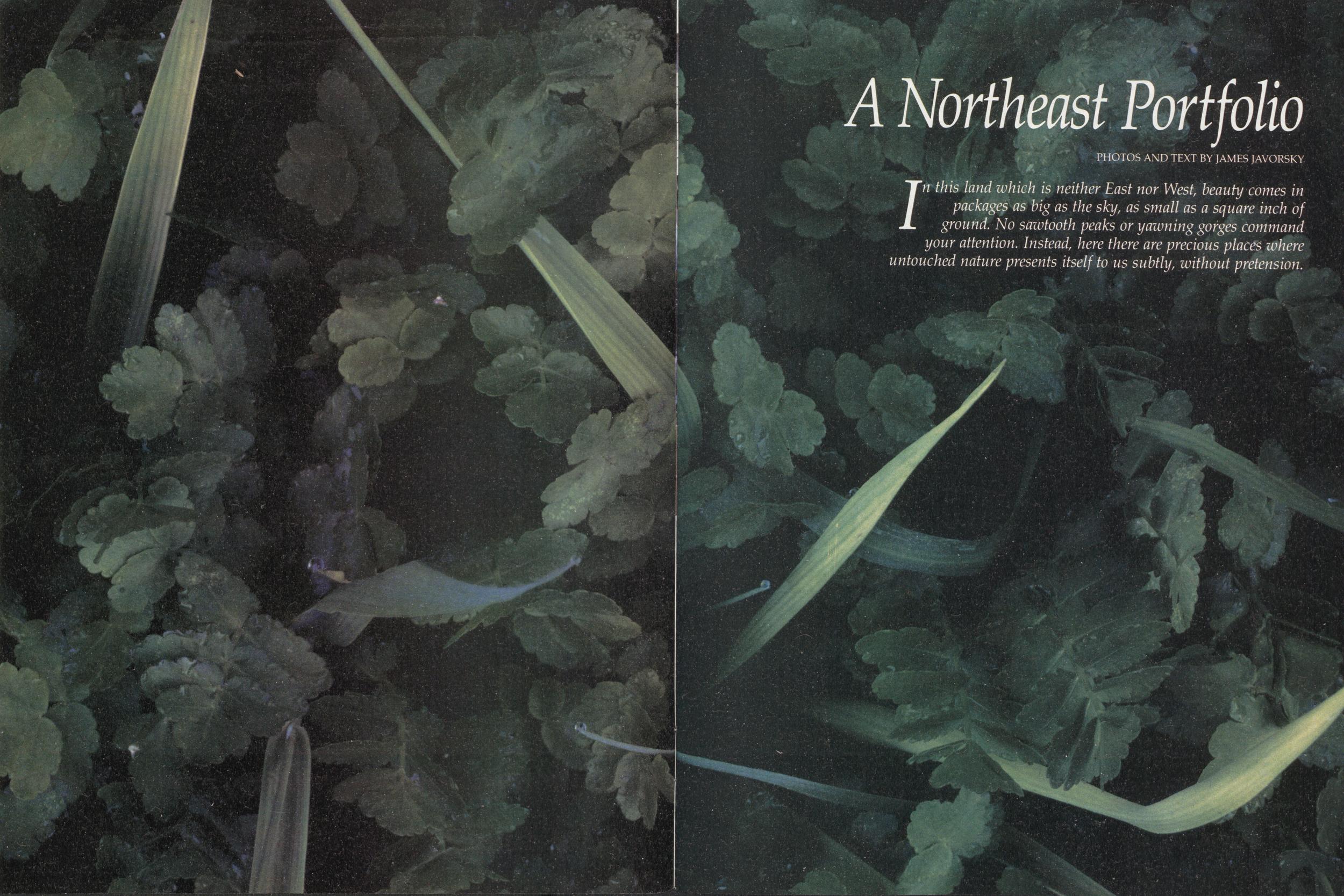
A Northeast Portfolio
PHOTOS AND TEXT BY JAMES JAVORSKY In this land which is neither East nor West, beauty comes in packages as big as the sky, as small as a square inch of ground. No sawtooth peaks or yawning gorges command your attention. Instead, here there are precious places where touched nature presents itself to us subtly, without pretension.
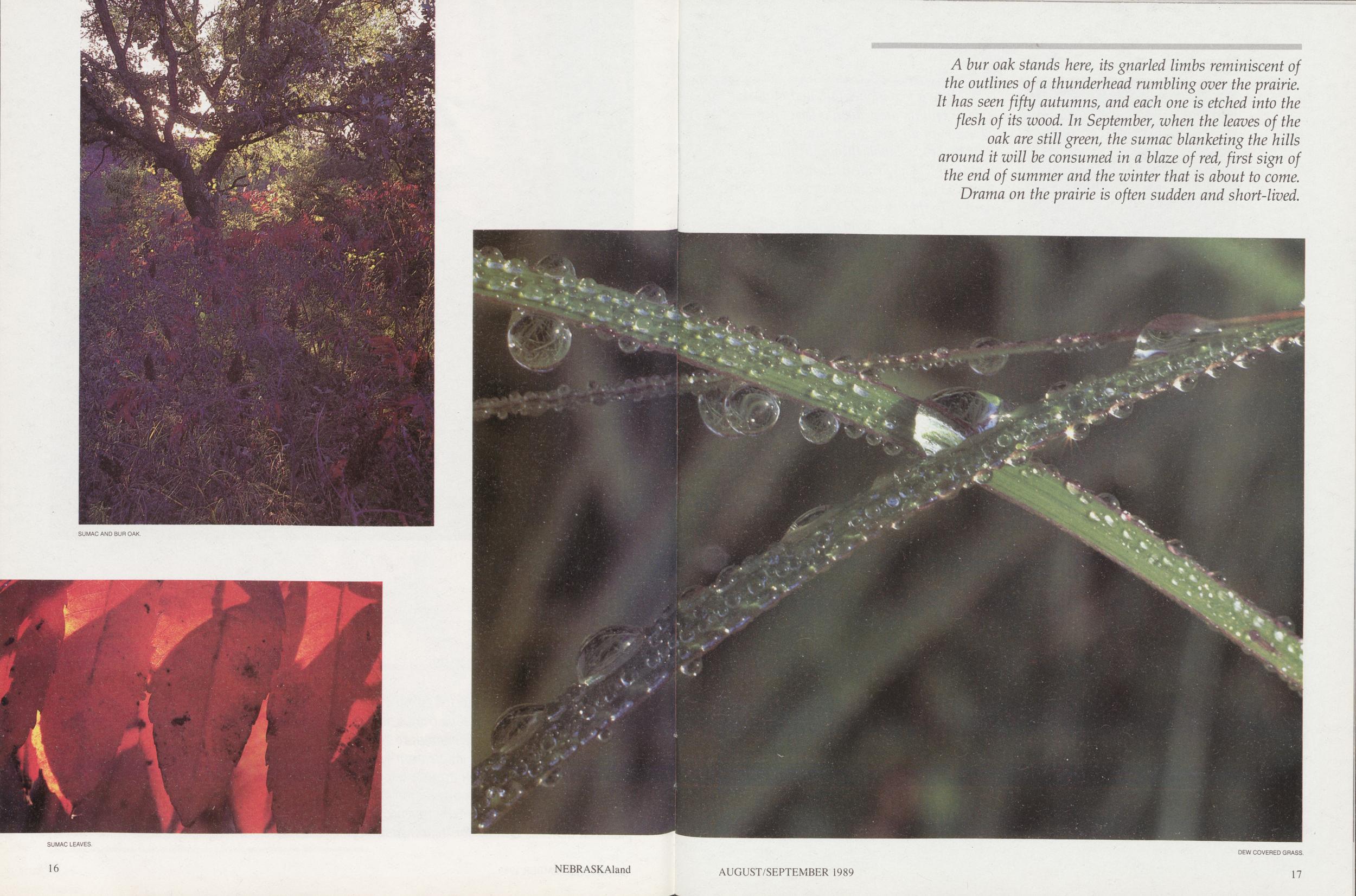
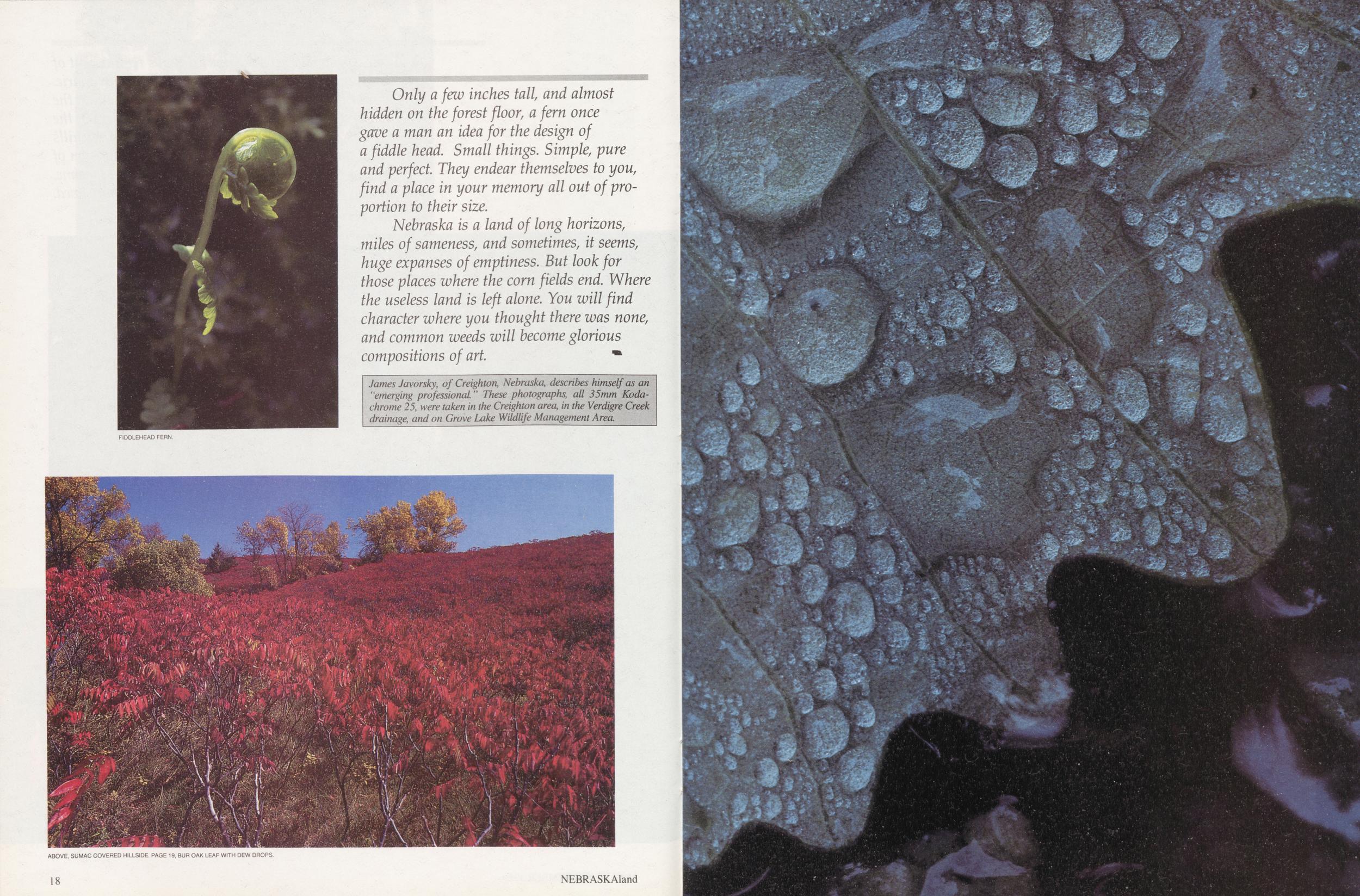
Only a few inches tall, and almost hidden on the forest floor, a fern once gave a man an idea for the design of a fiddle head. Small things. Simple, pure and perfect. They endear themselves to you, find a place in your memory all out of proportion to their size.
Nebraska is a land of long horizons, miles of sameness, and sometimes, it seems, huge expanses of emptiness. But look for those places where the corn fields end. Where the useless land is left alone. You will find character where you thought there was none, and common weeds will become glorious compositions of art.
James Javorsky, of Creighton, Nebraska, describes himself as an "emerging professional' These photographs, all 35mm Kodachrome 25, were taken in the Creighton area, in the Verdigre Creek drainage, and on Grove Lake Wildlife Management Area.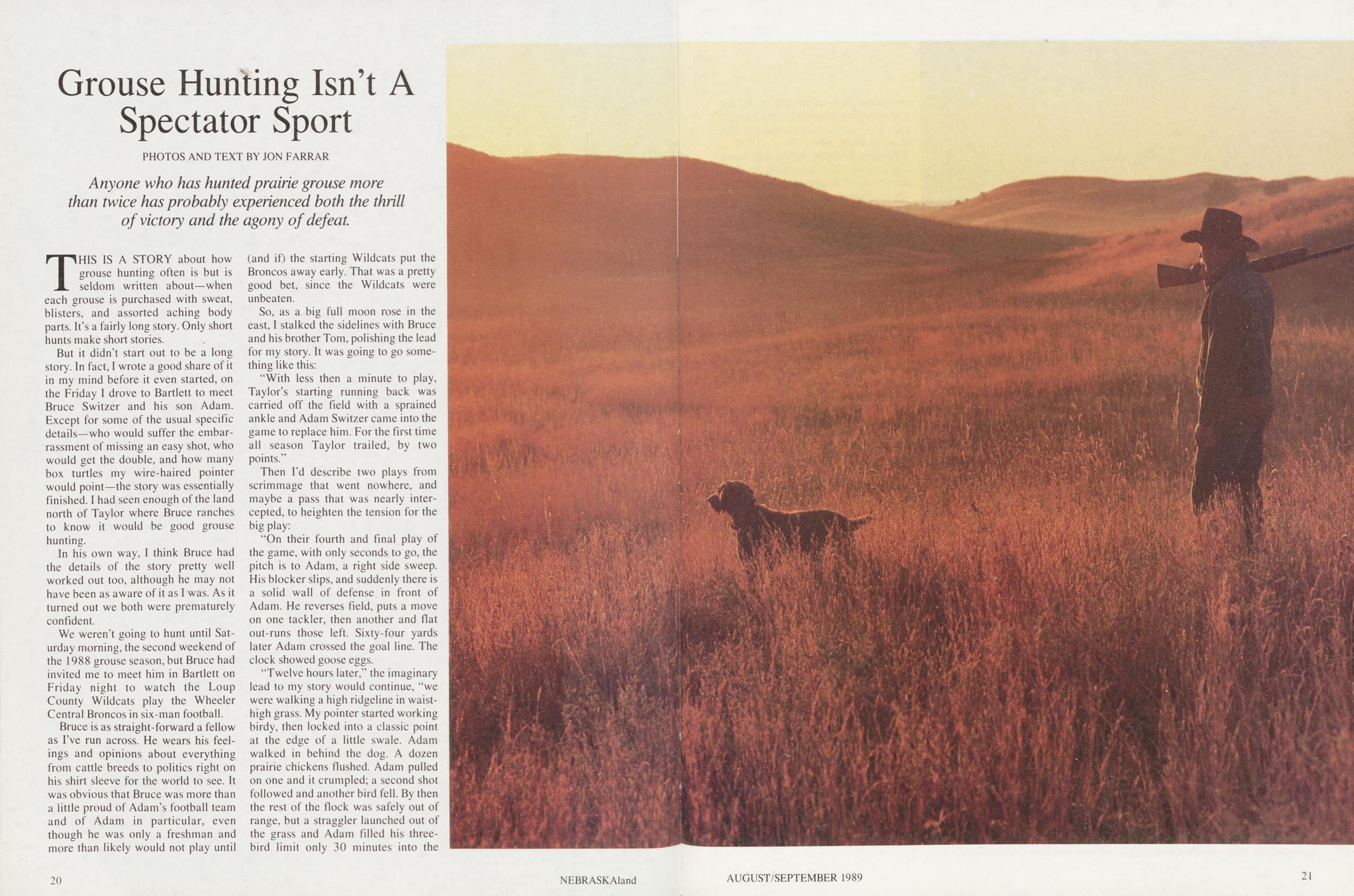
Grouse Hunting Isn't A Spectator Sport
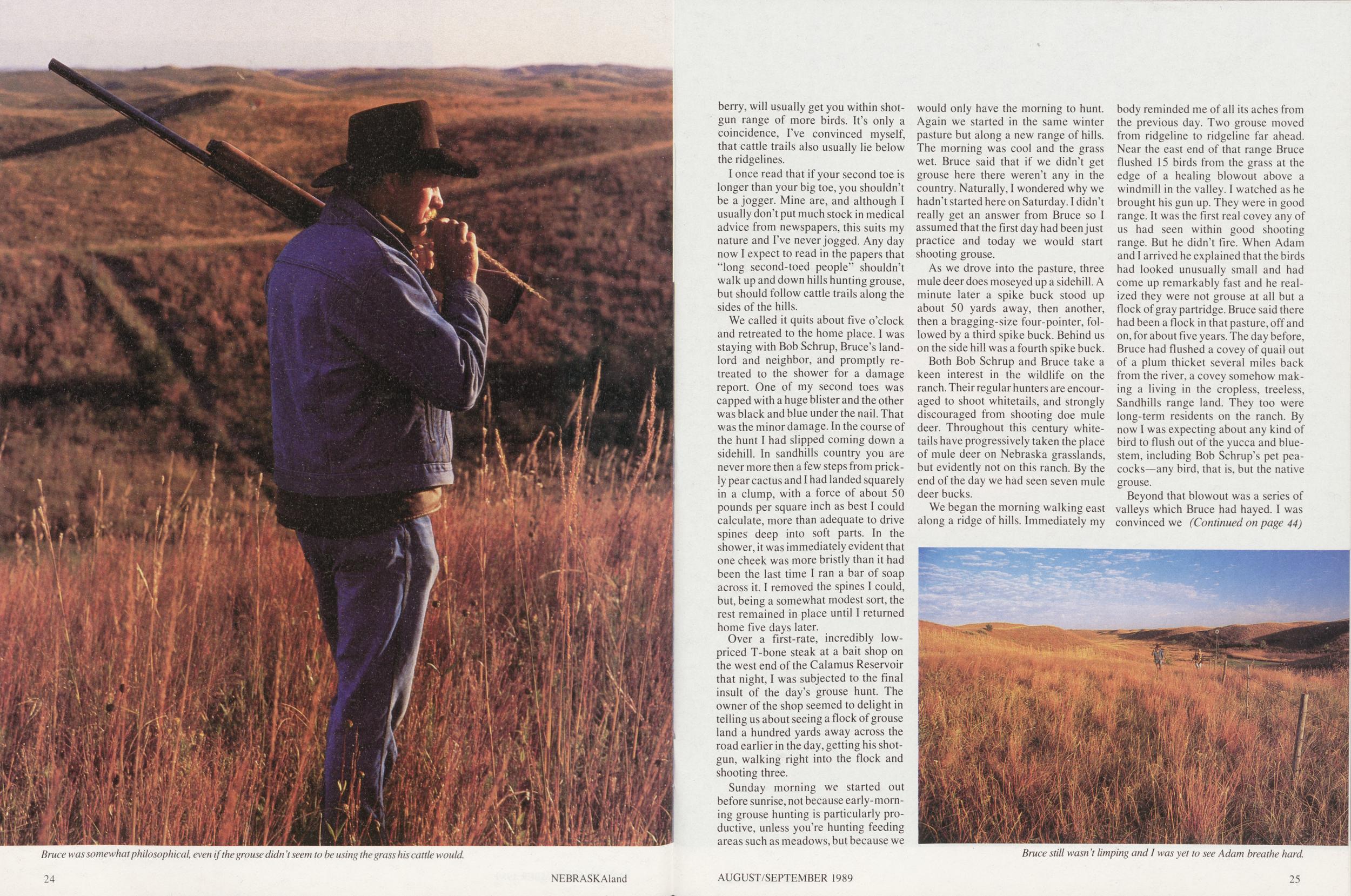
PHOTOS AND TEXT BY JON FARRAR Anyone who has hunted prairie grouse more than twice has probably experienced both the thrill of victory and the agony of defeat.THIS IS A STORY about how grouse hunting often is but is seldom written about—when each grouse is purchased with sweat, blisters, and assorted aching body parts. It's a fairly long story. Only short hunts make short stories.
But it didn't start out to be a long story. In fact, I wrote a good share of it in my mind before it even started, on the Friday I drove to Bartlett to meet Bruce Switzer and his son Adam. Except for some of the usual specific details—who would suffer the embarrassment of missing an easy shot, who would get the double, and how many box turtles my wire-haired pointer would point—the story was essentially finished. I had seen enough of the land north of Taylor where Bruce ranches to know it would be good grouse hunting.
In his own way, I think Bruce had the details of the story pretty well worked out too, although he may not have been as aware of it as I was. As it turned out we both were prematurely confident.
We weren't going to hunt until Saturday morning, the second weekend of the 1988 grouse season, but Bruce had invited me to meet him in Bartlett on Friday night to watch the Loup County Wildcats play the Wheeler Central Broncos in six-man football.
Bruce is as straight-forward a fellow as I've run across. He wears his feelings and opinions about everything from cattle breeds to politics right on his shirt sleeve for the world to see. It was obvious that Bruce was more than a little proud of Adam's football team and of Adam in particular, even though he was only a freshman and more than likely would not play until (and if) the starting Wildcats put the Broncos away early. That was a pretty good bet, since the Wildcats were unbeaten.
So, as a big full moon rose in the east, I stalked the sidelines with Bruce and his brother Tom, polishing the lead for my story. It was going to go something like this:
"With less then a minute to play, Taylor's starting running back was carried off the field with a sprained ankle and Adam Switzer came into the game to replace him. For the first time all season Taylor trailed, by two points."
Then I'd describe two plays from scrimmage that went nowhere, and maybe a pass that was nearly intercepted, to heighten the tension for the big play:
"On their fourth and final play of the game, with only seconds to go, the pitch is to Adam, a right side sweep. His blocker slips, and suddenly there is a solid wall of defense in front of Adam. He reverses field, puts a move on one tackier, then another and flat out-runs those left. Sixty-four yards later Adam crossed the goal line. The clock showed goose eggs.
Twelve hours later," the imaginary lead to my story would continue, "we were walking a high ridgeline in waisthigh grass. My pointer started working birdy, then locked into a classic point at the edge of a little swale. Adam walked in behind the dog. A dozen prairie chickens flushed. Adam pulled on one and it crumpled; a second shot followed and another bird fell. By then the rest of the Hock was safely out of range, but a straggler launched out of the grass and Adam filled his threebird limit only 30 minutes into the
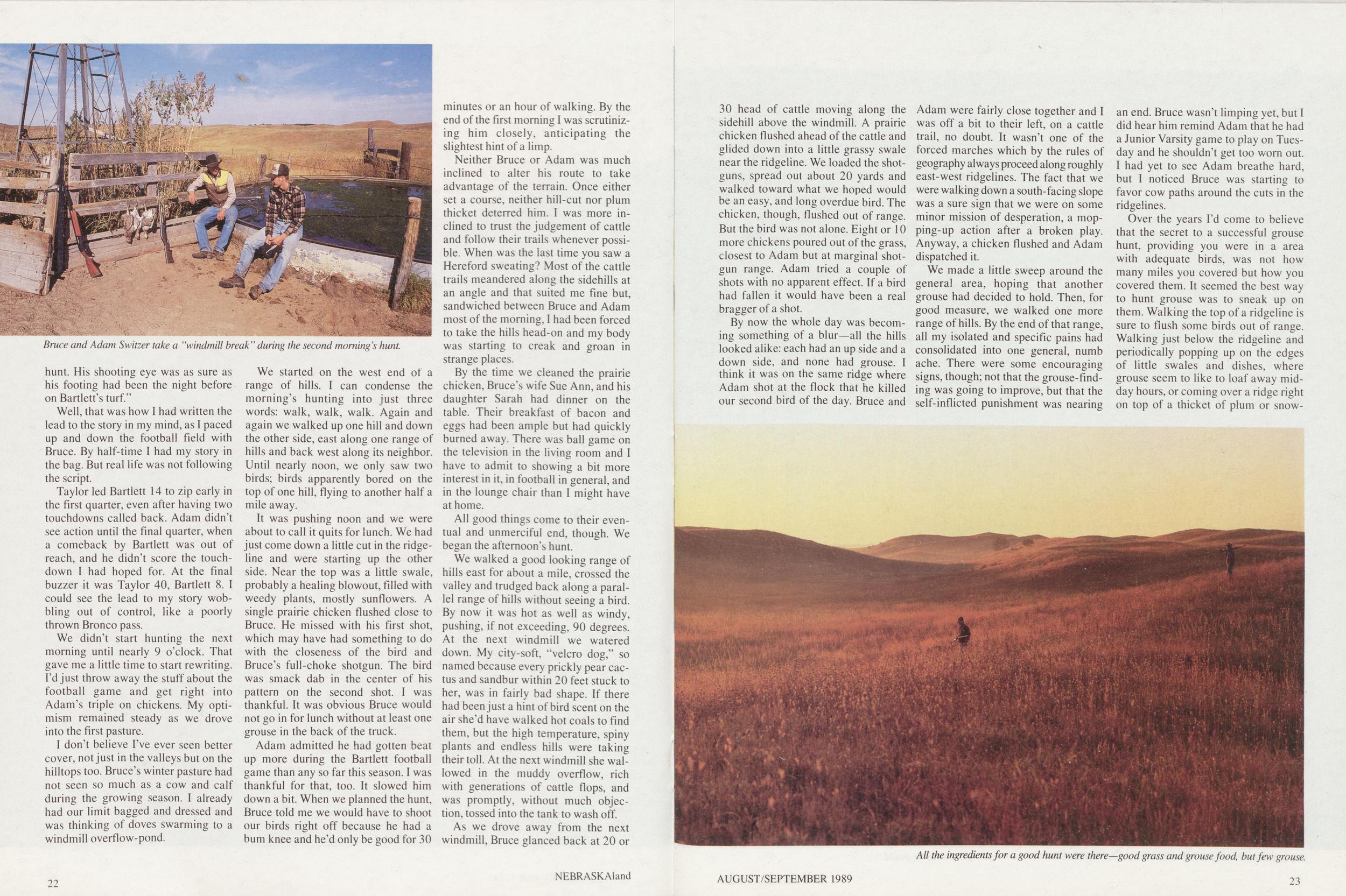
Well, that was how I had written the lead to the story in my mind, as I paced up and down the football field with Bruce. By half-time I had my story in the bag. But real life was not following the script.
Taylor led Bartlett 14 to zip early in the first quarter, even after having two touchdowns called back. Adam didn't see action until the final quarter, when a comeback by Bartlett was out of reach, and he didn't score the touchdown I had hoped for. At the final buzzer it was Taylor 40, Bartlett 8. I could see the lead to my story wobbling out of control, like a poorly thrown Bronco pass.
We didn't start hunting the next morning until nearly 9 o'clock. That gave me a little time to start rewriting. I'd just throw away the stuff about the football game and get right into Adam's triple on chickens. My optimism remained steady as we drove into the first pasture.
I don't believe I've ever seen better cover, not just in the valleys but on the hilltops too. Bruce's winter pasture had not seen so much as a cow and calf during the growing season. I already had our limit bagged and dressed and was thinking of doves swarming to a windmill overflow-pond.
We started on the west end of a range of hills. I can condense the morning's hunting into just three words: walk, walk, walk. Again and again we walked up one hill and down the other side, east along one range of hills and back west along its neighbor. Until nearly noon, we only saw two birds; birds apparently bored on the top of one hill, flying to another half a mile away.
It was pushing noon and we were about to call it quits for lunch. We had just come down a little cut in the ridgeline and were starting up the other side. Near the top was a little swale, probably a healing blowout, filled with weedy plants, mostly sunflowers. A single prairie chicken flushed close to Bruce. He missed with his first shot, which may have had something to do with the closeness of the bird and Bruce's full-choke shotgun. The bird was smack dab in the center of his pattern on the second shot. I was thankful. It was obvious Bruce would not go in for lunch without at least one grouse in the back of the truck.
Adam admitted he had gotten beat up more during the Bartlett football game than any so far this season. I was thankful for that, too. It slowed him down a bit. When we planned the hunt, Bruce told me we would have to shoot our birds right off because he had a bum knee and he'd only be good for 30 minutes or an hour of walking. By the end of the first morning I was scrutinizing him closely, anticipating the slightest hint of a limp.
Neither Bruce or Adam was much inclined to alter his route to take advantage of the terrain. Once either set a course, neither hill-cut nor plum thicket deterred him. I was more inclined to trust the judgement of cattle and follow their trails whenever possible, When was the last time you saw a Hereford sweating? Most of the cattle trails meandered along the sidehills at an angle and that suited me fine but, sandwiched between Bruce and Adam most of the morning, I had been forced to take the hills head-on and my body was starting to creak and groan in strange places.
By the time we cleaned the prairie chicken, Bruce's wife Sue Ann, and his daughter Sarah had dinner on the table. Their breakfast of bacon and eggs had been ample but had quickly burned away. There was ball game on the television in the living room and I have to admit to showing a bit more interest in it, in football in general, and in the lounge chair than I might have at home.
All good things come to their eventual and unmerciful end, though. We began the afternoon's hunt.
We walked a good looking range of hills east for about a mile, crossed the valley and trudged back along a parallel range of hills without seeing a bird. By now it was hot as well as windy, pushing, if not exceeding, 90 degrees. At the next windmill we watered down. My city-soft, "velcro dog," so named because every prickly pear cactus and sandbur within 20 feet stuck to her, was in fairly bad shape. If there had been just a hint of bird scent on the air she'd have walked hot coals to find them, but the high temperature, spiny plants and endless hills were taking their toll. At the next windmill she wallowed in the muddy overflow, rich with generations of cattle flops, and was promptly, without much objection, tossed into the tank to wash off.
As we drove away from the next windmill, Bruce glanced back at 20 or 22 NEBRASKAland 30 head of cattle moving along the sidehill above the windmill. A prairie chicken flushed ahead of the cattle and glided down into a little grassy swale near the ridgeline. We loaded the shotguns, spread out about 20 yards and walked toward what we hoped would be an easy, and long overdue bird. The chicken, though, flushed out of range. But the bird was not alone. Eight or 10 more chickens poured out of the grass, closest to Adam but at marginal shotgun range. Adam tried a couple of shots with no apparent effect. If a bird had fallen it would have been a real bragger of a shot.
By now the whole day was becoming something of a blur—all the hills looked alike: each had an up side and a down side, and none had grouse. I think it was on the same ridge where Adam shot at the flock that he killed our second bird of the day. Bruce and Adam were fairly close together and I was off a bit to their left, on a cattle trail, no doubt. It wasn't one of the forced marches which by the rules of geography always proceed along roughly east-west ridgelines. The fact that we were walking down a south-facing slope was a sure sign that we were on some minor mission of desperation, a mopping-up action after a broken play. Anyway, a chicken flushed and Adam dispatched it.
We made a little sweep around the general area, hoping that another grouse had decided to hold. Then, for good measure, we walked one more range of hills. By the end of that range, all my isolated and specific pains had consolidated into one general, numb ache. There were some encouraging signs, though; not that the grouse-finding was going to improve, but that the self-inflicted punishment was nearing an end. Bruce wasn't limping yet, but I did hear him remind Adam that he had a Junior Varsity game to play on Tuesday and he shouldn't get too worn out. I had yet to see Adam breathe hard, but I noticed Bruce was starting to favor cow paths around the cuts in the ridgelines.
Over the years I'd come to believe that the secret to a successful grouse hunt, providing you were in a area with adequate birds, was not how many miles you covered but how you covered them. It seemed the best way to hunt grouse was to sneak up on them. Walking the top of a ridgeline is sure to flush some birds out of range. Walking just below the ridgeline and periodically popping up on the edges of little swales and dishes, where grouse seem to like to loaf away midday hours, or coming over a ridge right on top of a thicket of plum or snowberry,
I once read that if your second toe is longer than your big toe, you shouldn't be a jogger. Mine are, and although I usually don't put much stock in medical advice from newspapers, this suits my nature and I've never jogged. Any day now I expect to read in the papers that "long second-toed people" shouldn't walk up and down hills hunting grouse, but should follow cattle trails along the sides of the hills.
We called it quits about five o'clock and retreated to the home place. I was staying with Bob Schrup, Bruce's landlord and neighbor, and promptly retreated to the shower for a damage report. One of my second toes was capped with a huge blister and the other was black and blue under the nail. That was the minor damage. In the course of the hunt I had slipped coming down a sidehill. In sandhills country you are never more then a few steps from prickly pear cactus and I had landed squarely in a clump, with a force of about 50 pounds per square inch as best I could calculate, more than adequate to drive spines deep into soft parts. In the shower, it was immediately evident that one cheek was more bristly than it had been the last time I ran a bar of soap across it. I removed the spines I could, but, being a somewhat modest sort, the rest remained in place until I returned home five days later.
Over a first-rate, incredibly lowpriced T-bone steak at a bait shop on the west end of the Calamus Reservoir that night, I was subjected to the final insult of the day's grouse hunt. The owner of the shop seemed to delight in telling us about seeing a flock of grouse land a hundred yards away across the road earlier in the day, getting his shotgun, walking right into the flock and shooting three.
Sunday morning we started out before sunrise, not because early-morning grouse hunting is particularly productive, unless you're hunting feeding areas such as meadows, but because we would only have the morning to hunt. Again we started in the same winter pasture but along a new range of hills. The morning was cool and the grass wet. Bruce said that if we didn't get grouse here there weren't any in the country. Naturally, I wondered why we hadn't started here on Saturday. I didn't really get an answer from Bruce so I assumed that the first day had been just practice and today we would start shooting grouse.
As we drove into the pasture, three mule deer does moseyed up a sidehill. A minute later a spike buck stood up about 50 yards away, then another, then a bragging-size four-pointer, followed by a third spike buck. Behind us on the side hill was a fourth spike buck.
Both Bob Schrup and Bruce take a keen interest in the wildlife on the ranch. Their regular hunters are encouraged to shoot whitetails, and strongly discouraged from shooting doe mule deer. Throughout this century whitetails have progressively taken the place of mule deer on Nebraska grasslands, but evidently not on this ranch. By the end of the day we had seen seven mule deer bucks.
We began the morning walking east along a ridge of hills. Immediately my body reminded me of all its aches from the previous day. Two grouse moved from ridgeline to ridgeline far ahead. Near the east end of that range Bruce flushed 15 birds from the grass at the edge of a healing blowout above a windmill in the valley. I watched as he brought his gun up. They were in good range. It was the first real covey any of us had seen within good shooting range. But he didn't fire. When Adam and I arrived he explained that the birds had looked unusually small and had come up remarkably fast and he realized they were not grouse at all but a flock of gray partridge. Bruce said there had been a flock in that pasture, off and on, for about five years. The day before, Bruce had flushed a covey of quail out of a plum thicket several miles back from the river, a covey somehow making a living in the cropless, treeless, Sandhills range land. They too were long-term residents on the ranch. By now I was expecting about any kind of bird to flush out of the yucca and bluestem, including Bob Schrup's pet peacocks—any bird, that is, but the native grouse.
Beyond that blowout was a series of valleys which Bruce had hayed. I was convinced we (Continued on page 44)
Blueprint For Waterfowl
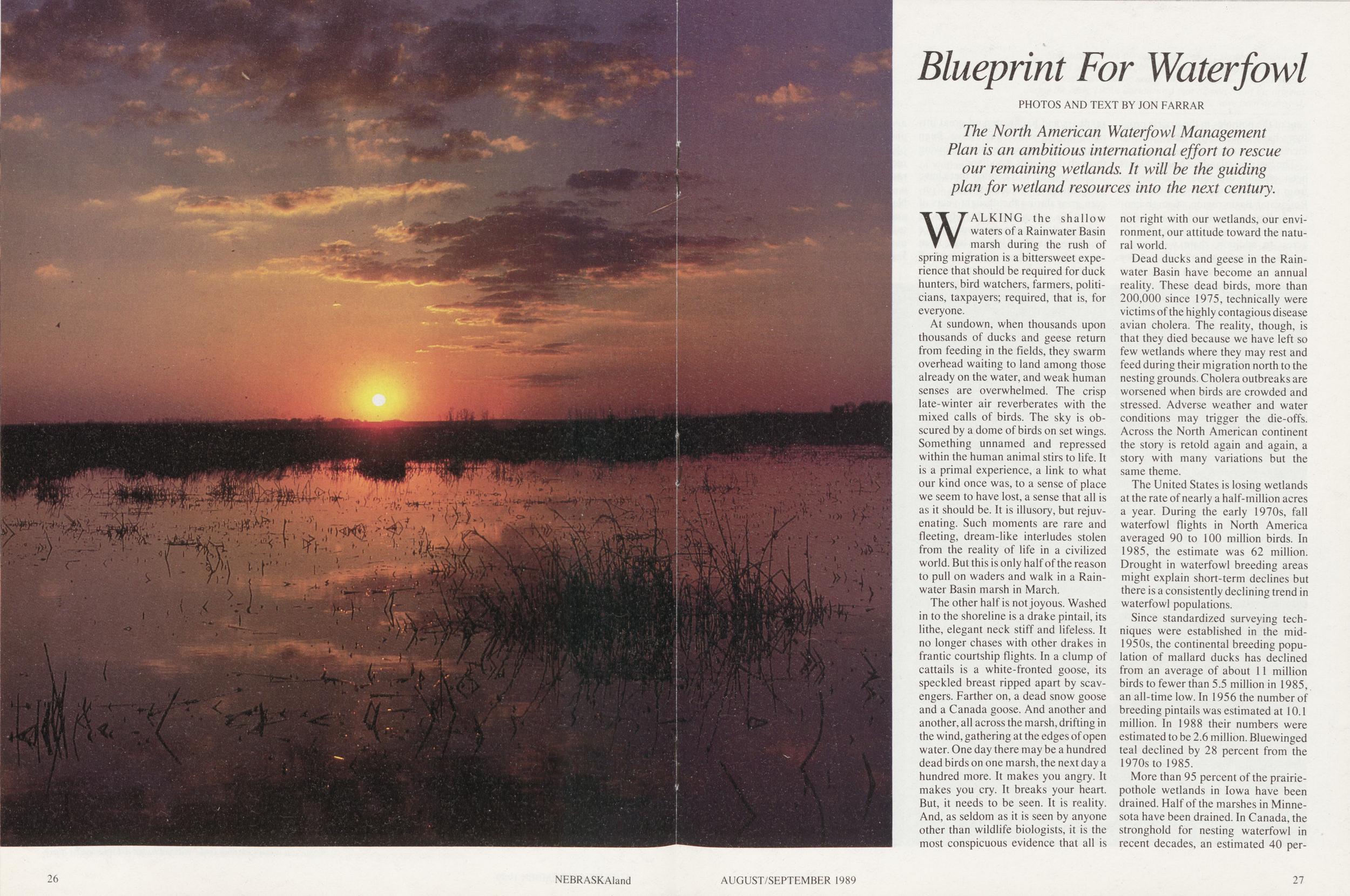
PHOTOS AND TEXT BY JON FARRAR The North American Waterfowl Management Plan is an ambitious international effort to rescue our remaining wetlands. It will be the guiding plan for wetland resources into the next century.WALKING the shallow waters of a Rainwater Basin marsh during the rush of spring migration is a bittersweet experience that should be required for duck hunters, bird watchers, farmers, politicians, taxpayers; required, that is, for everyone.
At sundown, when thousands upon thousands of ducks and geese return from feeding in the fields, they swarm overhead waiting to land among those already on the water, and weak human senses are overwhelmed. The crisp late-winter air reverberates with the mixed calls of birds. The sky is obscured by a dome of birds on set wings. Something unnamed and repressed within the human animal stirs to life. It is a primal experience, a link to what our kind once was, to a sense of place we seem to have lost, a sense that all is as it should be. It is illusory, but rejuvenating. Such moments are rare and fleeting, dream-like interludes stolen from the reality of life in a civilized world. But this is only half of the reason to pull on waders and walk in a Rainwater Basin marsh in March.
The other half is not joyous. Washed in to the shoreline is a drake pintail, its lithe, elegant neck stiff and lifeless. It no longer chases with other drakes in frantic courtship flights. In a clump of cattails is a white-fronted goose, its speckled breast ripped apart by scavengers. Farther on, a dead snow goose and a Canada goose. And another and another, all across the marsh, drifting in the wind, gathering at the edges of open water. One day there may be a hundred dead birds on one marsh, the next day a hundred more. It makes you angry. It makes you cry. It breaks your heart. But, it needs to be seen. It is reality. And, as seldom as it is seen by anyone other than wildlife biologists, it is the most conspicuous evidence that all is not right with our wetlands, our environment, our attitude toward the natural world.
Dead ducks and geese in the Rainwater Basin have become an annual reality. These dead birds, more than 200,000 since 1975, technically were victims of the highly contagious disease avian cholera. The reality, though, is that they died because we have left so few wetlands where they may rest and feed during their migration north to the nesting grounds. Cholera outbreaks are worsened when birds are crowded and stressed. Adverse weather and water conditions may trigger the die-offs. Across the North American continent the story is retold again and again, a story with many variations but the same theme.
The United States is losing wetlands at the rate of nearly a half-million acres a year. During the early 1970s, fall waterfowl flights in North America averaged 90 to 100 million birds. In 1985, the estimate was 62 million. Drought in waterfowl breeding areas might explain short-term declines but there is a consistently declining trend in waterfowl populations.
Since standardized surveying techniques were established in the mid-1950s, the continental breeding population of mallard ducks has declined from an average of about 11 million birds to fewer than 5.5 million in 1985, an all-time low. In 1956 the number of breeding pintails was estimated at 10.1 million. In 1988 their numbers were estimated to be 2.6 million. Bluewinged teal declined by 28 percent from the 1970s to 1985.
More than 95 percent of the prairie-pothole wetlands in Iowa have been drained. Half of the marshes in Minnesota have been drained. In Canada, the stronghold for nesting waterfowl in recent decades, an estimated 40 percent AUGUST/SEPTEMBER 1989 27 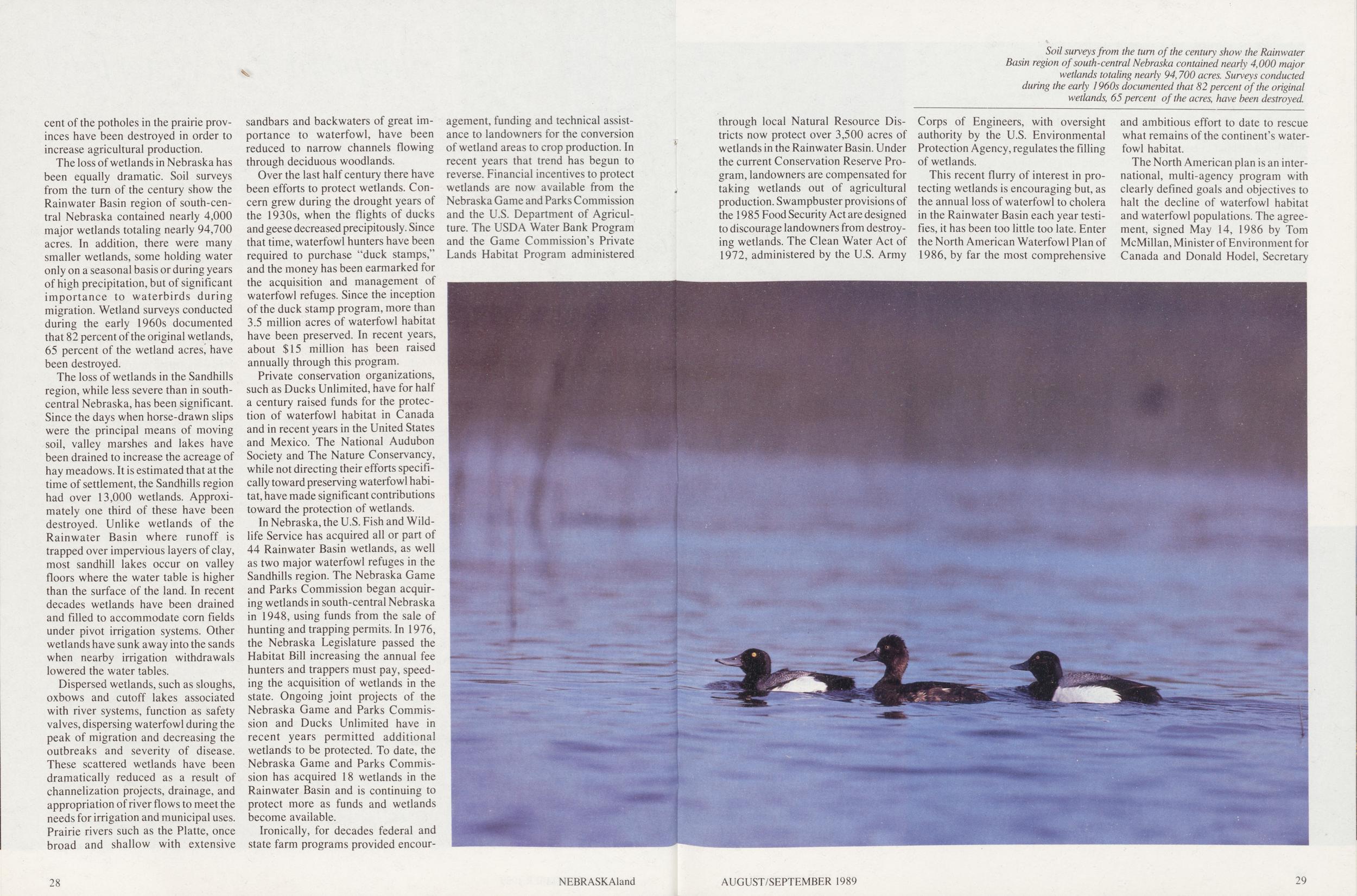 of the potholes in the prairie provinces have been destroyed in order to increase agricultural production.
The loss of wetlands in Nebraska has been equally dramatic. Soil surveys from the turn of the century show the Rainwater Basin region of south-central Nebraska contained nearly 4,000 major wetlands totaling nearly 94,700 acres. In addition, there were many smaller wetlands, some holding water only on a seasonal basis or during years of high precipitation, but of significant importance to waterbirds during migration. Wetland surveys conducted during the early 1960s documented that 82 percent of the original wetlands, 65 percent of the wetland acres, have been destroyed.
The loss of wetlands in the Sandhills region, while less severe than in southcentral Nebraska, has been significant. Since the days when horse-drawn slips were the principal means of moving soil, valley marshes and lakes have been drained to increase the acreage of hay meadows. It is estimated that at the time of settlement, the Sandhills region had over 13,000 wetlands. Approximately one third of these have been destroyed. Unlike wetlands of the Rainwater Basin where runoff is trapped over impervious layers of clay, most sandhill lakes occur on valley floors where the water table is higher than the surface of the land. In recent decades wetlands have been drained and filled to accommodate corn fields under pivot irrigation systems. Other wetlands have sunk away into the sands when nearby irrigation withdrawals lowered the water tables.
Dispersed wetlands, such as sloughs, oxbows and cutoff lakes associated with river systems, function as safety valves, dispersing waterfowl during the peak of migration and decreasing the outbreaks and severity of disease. These scattered wetlands have been dramatically reduced as a result of channelization projects, drainage, and appropriation of river flows to meet the needs for irrigation and municipal uses. Prairie rivers such as the Platte, once broad and shallow with extensive sandbars and backwaters of great importance to waterfowl, have been reduced to narrow channels flowing through deciduous woodlands.
Over the last half century there have been efforts to protect wetlands. Concern grew during the drought years of the 1930s, when the flights of ducks and geese decreased precipitously. Since that time, waterfowl hunters have been required to purchase "duck stamps," and the money has been earmarked for the acquisition and management of waterfowl refuges. Since the inception of the duck stamp program, more than 3.5 million acres of waterfowl habitat have been preserved. In recent years, about $15 million has been raised annually through this program.
Private conservation organizations, such as Ducks Unlimited, have for half a century raised funds for the protection of waterfowl habitat in Canada and in recent years in the United States and Mexico. The National Audubon Society and The Nature Conservancy, while not directing their efforts specifically toward preserving waterfowl habitat, have made significant contributions toward the protection of wetlands.
In Nebraska, the U.S. Fish and Wildlife Service has acquired all or part of 44 Rainwater Basin wetlands, as well as two major waterfowl refuges in the Sandhills region. The Nebraska Game and Parks Commission began acquiring wetlands in south-central Nebraska in 1948, using funds from the sale of hunting and trapping permits. In 1976, the Nebraska Legislature passed the Habitat Bill increasing the annual fee hunters and trappers must pay, speeding the acquisition of wetlands in the state. Ongoing joint projects of the Nebraska Game and Parks Commission and Ducks Unlimited have in recent years permitted additional wetlands to be protected. To date, the Nebraska Game and Parks Commission has acquired 18 wetlands in the Rainwater Basin and is continuing to protect more as funds and wetlands become available.
Ironically, for decades federal and state farm programs provided encouragement, funding and technical assistance to landowners for the conversion of wetland areas to crop production. In recent years that trend has begun to reverse. Financial incentives to protect wetlands are now available from the Nebraska Game and Parks Commission and the U.S. Department of Agriculture. The USDA Water Bank Program and the Game Commission's Private Lands Habitat Program administered through local Natural Resource Districts now protect over 3,500 acres of wetlands in the Rainwater Basin. Under the current Conservation Reserve Program, landowners are compensated for taking wetlands out of agricultural production. Swampbuster provisions of the 1985 Food Security Act are designed to discourage landowners from destroying wetlands. The Clean Water Act of 1972, administered by the U.S. Army Corps of Engineers, with oversight authority by the U.S. Environmental Protection Agency, regulates the filling of wetlands.
This recent flurry of interest in protecting wetlands is encouraging but, as the annual loss of waterfowl to cholera in the Rainwater Basin each year testifies, it has been too little too late. Enter the North American Waterfowl Plan of 1986, by far the most comprehensive and ambitious effort to date to rescue what remains of the continent's waterfowl habitat.
The North American plan is an international, multi-agency program with clearly defined goals and objectives to halt the decline of waterfowl habitat and waterfowl populations. The agreement, signed May 14, 1986 by Tom McMillan, Minister of Environment for Canada and Donald Hodel, Secretary
The key to the plan is the enhancement and protection of habitat in both the U.S. and Canada. Its goal is the restoration of waterfowl populations to 1970-79 levels, when the total breeding duck index was about 62 million, producing an average fall flight of about 100 million ducks. The breeding population goals are 8.7 million mallards and 6.3 million pintails. Specific goals are also established for goose, brant and swan populations. The price tag is a staggering $1.5 billion.
Under the plan, 34 habitat areas of major concern in the United States and Canada have been identified. These include nesting areas, migration stopovers and wintering grounds. Originally, the Sandhills and Rainwater Basin regions of Nebraska comprised one of the 34 habitat areas. However, because the Rainwater Basin is of such critical importance in providing migration habitat in the mid-continent, it has been singled out for a specific management plan. It has not yet been determined if the Sandhills region will also be designated as a separate management unit or included in one of the habitat areas to the north.
Many of the recommendations of the North American Plan are of a general nature. The plan recognizes that the cost cannot be borne by the federal governments of Canada and the U.S. alone, but must rely in part on funding from conservation organizations and the private sector. Financial incentives must be established to encourage private landowners to manage their land for water- fowl. However, the plan makes it clear that waterfowl habitat of "extraordinary value," such as the basins of south-central Nebraska, should be acquired in fee title to ensure their perpetual protection. All governmental agencies regulating land uses, not conservation agencies only, should be involved in preventing the destruction of waterfowl habitat. Wise conservation practices should be encouraged on private land, and all existing public land should be managed to increase its value to waterfowl. Public works projects, such as road construction, should be designed to prevent the loss or degradation of waterfowl habitat. Joint ventures among governments and private organizations to protect and improve waterfowl habitat should be encouraged.
But, the North American Plan does not stop with these general recommendations. Specific recommendations are also established. It sets as a goal improving land-use practices on 3.6 million acres in prairie regions of Canada and the protection and improvement of 1,084,000 additional acres of mallard and pintail breeding habitat in the prairie-pothole region of the north-central United States to achieve a nest hatching success of 50 percent by 1995.
Another goal is to increase by 686,000 acres the amount of mallard and pintail migration and wintering habitat in the lower Mississippi River-Gulf Coast region. The inventory and monitoring of waterfowl habitat must become more comprehensive and thorough. There must be an increase in research on the effects of land-use practices on the breeding success of waterfowl. Factors which affect the carrying capacity of migration and wintering areas, such as disease, lead poisoning and pollution, must be better understood and addressed.
The task is monumental, but for the first time, all governmental wildlife agencies, private conservation organizations and interested private individuals are cooperating under the guidance of one comprehensive plan to rescue the continent's dwindling waterfowl resources. More important, all are working toward specific population and habitat goals.
Because the Rainwater Basin wetland area has been designated as one of the most important waterfowl habitat areas in North America by the North American Plan, it will be the focus of Nebraska's initial effort.
Waterfowl concentrate more during migration than they do during the nest AUGUST/SEPTEMBER 1989 31 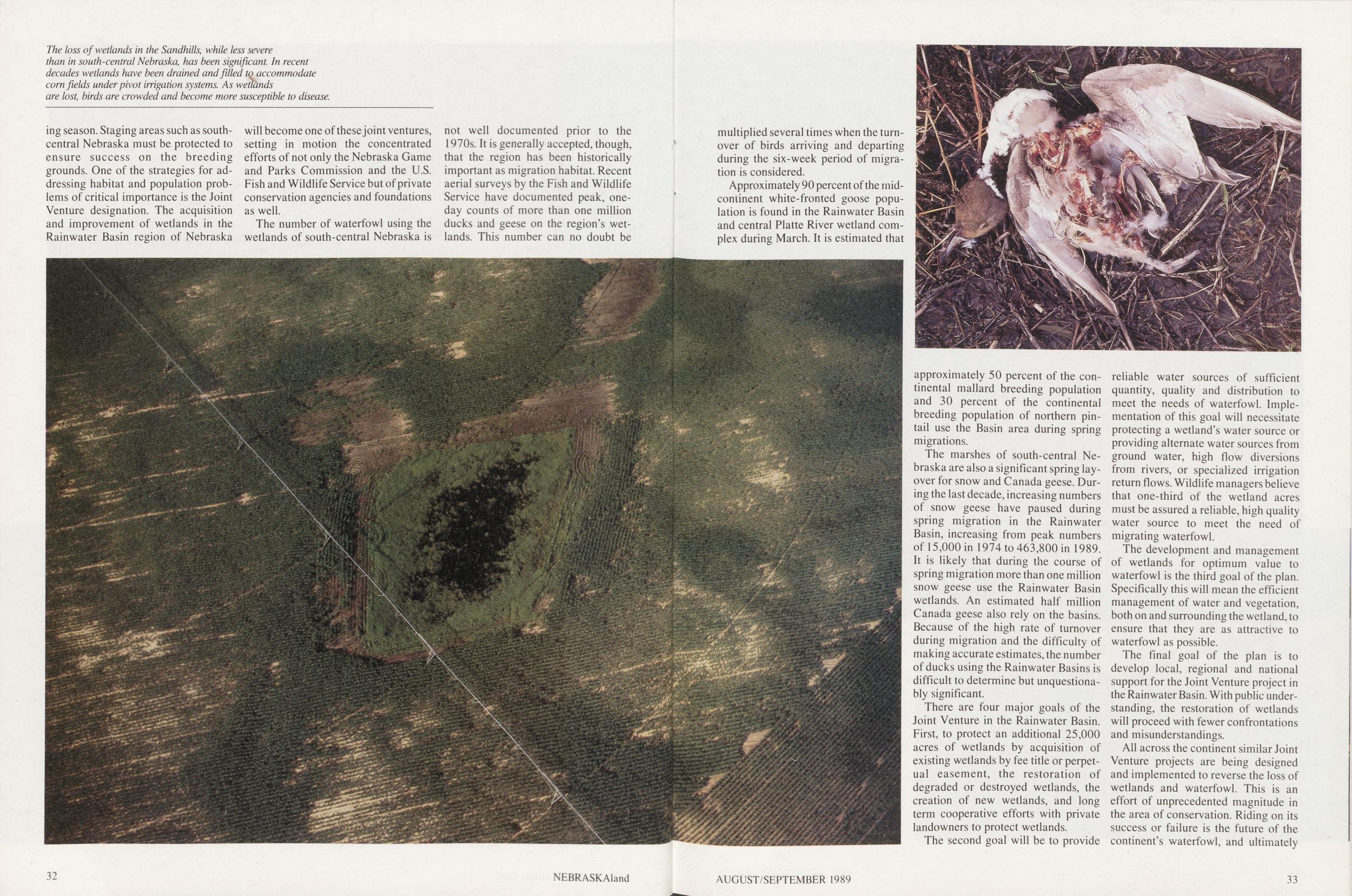
The number of waterfowl using the wetlands of south-central Nebraska is not well documented prior to the 1970s. It is generally accepted, though, that the region has been historically important as migration habitat. Recent aerial surveys by the Fish and Wildlife Service have documented peak, one-day counts of more than one million ducks and geese on the region's wetlands. This number can no doubt be 32 NEBRSAKAland multiplied several times when the turnover of birds arriving and departing during the six-week period of migration is considered.
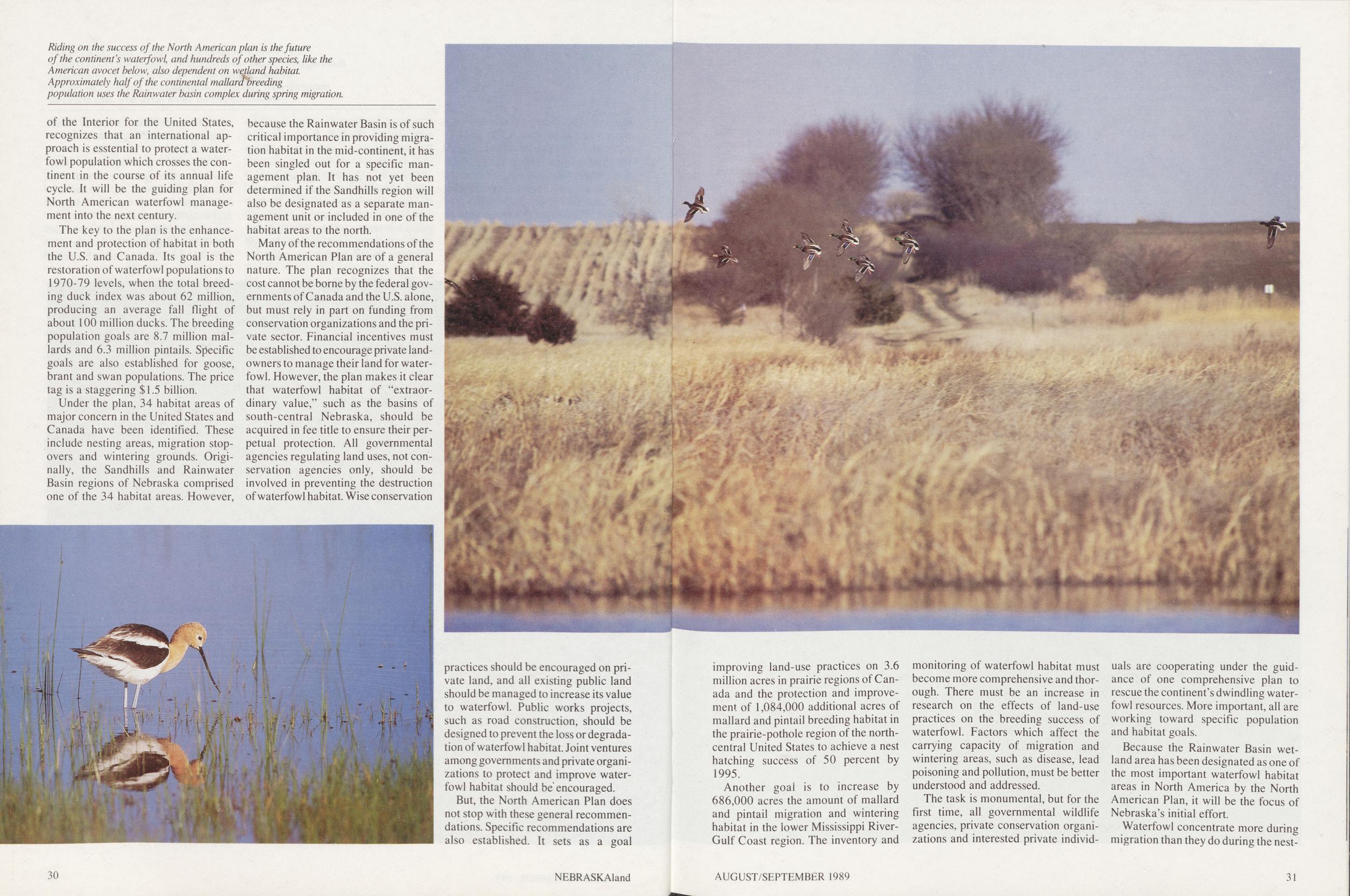
Approximately 90 percent of the midcontinent white-fronted goose population is found in the Rainwater Basin and central Platte River wetland complex during March. It is estimated that approximately 50 percent of the continental mallard breeding population and 30 percent of the continental breeding population of northern pintail use the Basin area during spring migrations.
The marshes of south-central Nebraska are also a significant spring lay- over for snow and Canada geese. During the last decade, increasing numbers of snow geese have paused during spring migration in the Rainwater Basin, increasing from peak numbers of 15,000 in 1974 to 463,800 in 1989. It is likely that during the course of spring migration more than one million snow geese use the Rainwater Basin wetlands. An estimated half million Canada geese also rely on the basins. Because of the high rate of turnover during migration and the difficulty of making accurate estimates, the number of ducks using the Rainwater Basins is difficult to determine but unquestionably significant.
There are four major goals of the Joint Venture in the Rainwater Basin. First, to protect an additional 25,000 acres of wetlands by acquisition of existing wetlands by fee title or perpetual easement, the restoration of degraded or destroyed wetlands, the creation of new wetlands, and long term cooperative efforts with private landowners to protect wetlands.
The second goal will be to provide reliable water sources of sufficient quantity, quality and distribution to meet the needs of waterfowl. Implementation of this goal will necessitate protecting a wetland's water source or providing alternate water sources from ground water, high flow diversions from rivers, or specialized irrigation return flows. Wildlife managers believe that one-third of the wetland acres must be assured a reliable, high quality water source to meet the need of migrating waterfowl.
The development and management of wetlands for optimum value to waterfowl is the third goal of the plan. Specifically this will mean the efficient management of water and vegetation, both on and surrounding the wetland, to ensure that they are as attractive to waterfowl as possible.
The final goal of the plan is to develop local, regional and national support for the Joint Venture project in the Rainwater Basin. With public understanding, the restoration of wetlands will proceed with fewer confrontations and misunderstandings.
All across the continent similar Joint Venture projects are being designed and implemented to reverse the loss of wetlands and waterfowl. This is an effort of unprecedented magnitude in the area of conservation. Riding on its success or failure is the future of the continent's waterfowl, and ultimately AUGUST/SEPTEMBER 1989 33 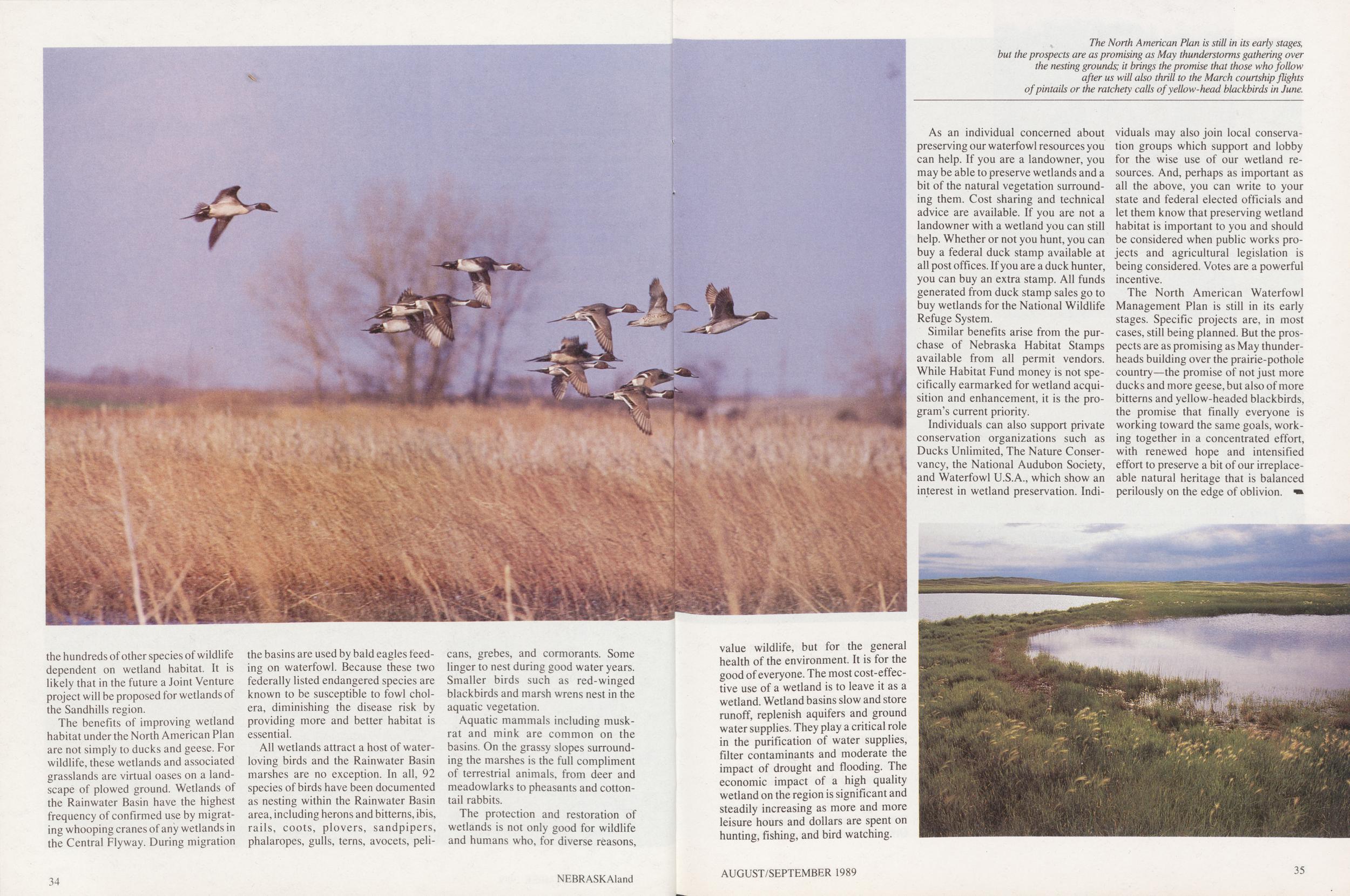
The benefits of improving wetland habitat under the North American Plan are not simply to ducks and geese. For wildlife, these wetlands and associated grasslands are virtual oases on a landscape of plowed ground. Wetlands of the Rainwater Basin have the highest frequency of confirmed use by migrating whooping cranes of any wetlands in the Central Flyway. During migration the basins are used by bald eagles feeding on waterfowl. Because these two federally listed endangered species are known to be susceptible to fowl cholera, diminishing the disease risk by providing more and better habitat is essential.
All wetlands attract a host of waterloving birds and the Rainwater Basin marshes are no exception. In all, 92 species of birds have been documented as nesting within the Rainwater Basin area, including herons and bitterns, ibis, rails, coots, plovers, sandpipers, phalaropes, gulls, terns, avocets, pelicans, grebes, and cormorants. Some linger to nest during good water years. Smaller birds such as red-winged blackbirds and marsh wrens nest in the aquatic vegetation.
Aquatic mammals including muskrat and mink are common on the basins. On the grassy slopes surrounding the marshes is the full compliment of terrestrial animals, from deer and meadowlarks to pheasants and cottontail rabbits.
The protection and restoration of wetlands is not only good for wildlife and humans who, for diverse reasons, value wildlife, but for the general health of the environment. It is for the good of everyone. The most cost-effective use of a wetland is to leave it as a wetland. Wetland basins slow and store runoff, replenish aquifers and ground water supplies. They play a critical role in the purification of water supplies, filter contaminants and moderate the impact of drought and flooding. The economic impact of a high quality wetland on the region is significant and steadily increasing as more and more leisure hours and dollars are spent on hunting, fishing, and bird watching.
As an individual concerned about preserving our waterfowl resources you can help. If you are a landowner, you may be able to preserve wetlands and a bit of the natural vegetation surrounding them. Cost sharing and technical advice are available. If you are not a landowner with a wetland you can still help. Whether or not you hunt, you can buy a federal duck stamp available at all post offices. If you are a duck hunter, you can buy an extra stamp. All funds generated from duck stamp sales go to buy wetlands for the National Wildlife Refuge System.
Similar benefits arise from the purchase of Nebraska Habitat Stamps available from all permit vendors. While Habitat Fund money is not specifically earmarked for wetland acquisition and enhancement, it is the program's current priority.
Individuals can also support private conservation organizations such as Ducks Unlimited, The Nature Conservancy, the National Audubon Society, and Waterfowl U.S.A., which show an interest in wetland preservation. Individuals may also join local conservation groups which support and lobby for the wise use of our wetland resources. And, perhaps as important as all the above, you can write to your state and federal elected officials and let them know that preserving wetland habitat is important to you and should be considered when public works projects and agricultural legislation is being considered. Votes are a powerful incentive.
The North American Waterfowl Management Plan is still in its early stages. Specific projects are, in most cases, still being planned. But the propects are as promising as May thunderheads building over the prairie-pothole country—the promise of not just more ducks and more geese, but also of more bitterns and yellow-headed blackbirds, the promise that finally everyone is working toward the same goals, working together in a concentrated effort, with renewed hope and intensified effort to preserve a bit of our irreplaceable natural heritage that is balanced perilously on the edge of oblivion.
Winning Wildlife
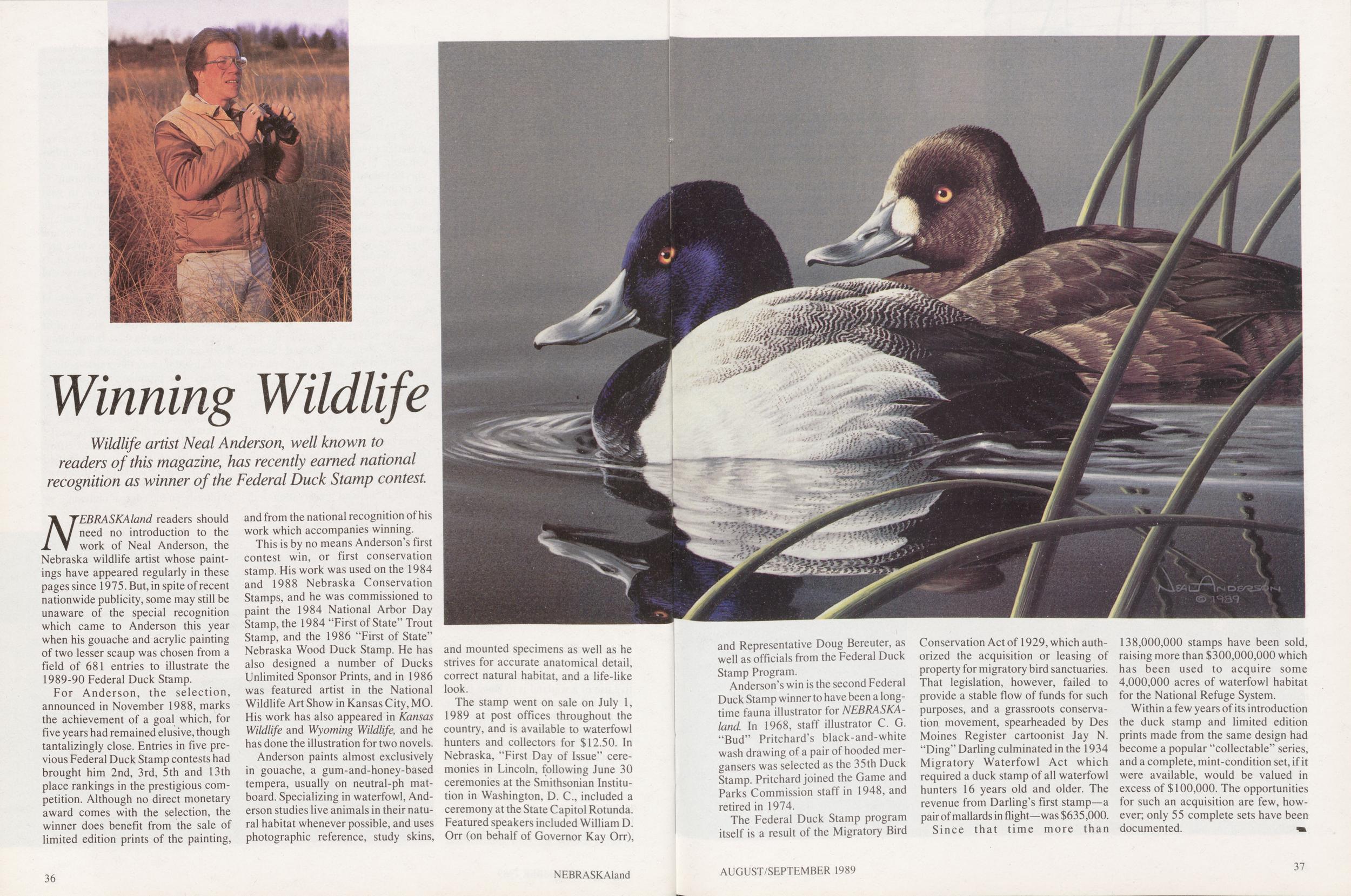
Wildlife artist Neal Anderson, well known to readers of this magazine, has recently earned national recognition as winner of the Federal Duck Stamp contest"New NEBRASKAland readers should need no introduction to the A work of Neal Anderson, the Nebraska wildlife artist whose paintings have appeared regularly in these pages since 1975. But, in spite of recent nationwide publicity, some may still be unaware of the special recognition which came to Anderson this year when his gouache and acrylic painting of two lesser scaup was chosen from a field of 681 entries to illustrate the 1989-90 Federal Duck Stamp.
For Anderson, the selection, announced in November 1988, marks the achievement of a goal which, for five years had remained elusive, though tantalizingly close. Entries in five previous Federal Duck Stamp contests had brought him 2nd, 3rd, 5th and 13th place rankings in the prestigious competition. Although no direct monetary award comes with the selection, the winner does benefit from the sale of limited edition prints of the painting, and from the national recognition of his work which accompanies winning.
This is by no means Anderson's first contest win, or first conservation stamp. His work was used on the 1984 and 1988 Nebraska Conservation Stamps, and he was commissioned to paint the 1984 National Arbor Day Stamp, the 1984 "First of State" Trout Stamp, and the 1986 "First of State" Nebraska Wood Duck Stamp. He has also designed a number of Ducks Unlimited Sponsor Prints, and in 1986 was featured artist in the National Wildlife Art Show in Kansas City, MO. His work has also appeared in Kansas Wildlife and Wyoming Wildlife, and he has done the illustration for two novels.
Anderson paints almost exclusively in gouache, a gum-and-honey-based tempera, usually on neutral-ph matboard. Specializing in waterfowl, Anderson studies live animals in their natural habitat whenever possible, and uses photographic reference, study skins, and mounted specimens as well as he strives for accurate anatomical detail, correct natural habitat, and a life-like look.
The stamp went on sale on July 1, 1989 at post offices throughout the country, and is available to waterfowl hunters and collectors for $12.50. In Nebraska, "First Day of Issue" ceremonies in Lincoln, following June 30 ceremonies at the Smithsonian Institution in Washington, D. C, included a ceremony at the State Capitol Rotunda. Featured speakers included William D. Orr (on behalf of Governor Kay Orr), 36 NEBRASKAland and Representative Doug Bereuter, as well as officials from the Federal Duck Stamp Program.
Anderson's win is the second Federal Duck Stamp winner to have been a longtime fauna illustrator for NEBRASKAland land. In 1968, staff illustrator C. G. "Bud" Pritchard's black-and-white wash drawing of a pair of hooded mergansers was selected as the 35th Duck Stamp. Pritchard joined the Game and Parks Commission staff in 1948, and retired in 1974.
The Federal Duck Stamp program itself is a result of the Migratory Bird Conservation Act of 1929, which authorized the acquisition or leasing of property for migratory bird sanctuaries. That legislation, however, failed to provide a stable flow of funds for such purposes, and a grassroots conservation movement, spearheaded by Des Moines Register cartoonist Jay N. "Ding" Darling culminated in the 1934 Migratory Waterfowl Act which required a duck stamp of all waterfowl hunters 16 years old and older. The revenue from Darling's first stamp—a pair of mallards in flight—was $635,000.
Since that time more than 138,000,000 stamps have been sold, raising more than $300,000,000 which has been used to acquire some 4,000,000 acres of waterfowl habitat for the National Refuge System.
Within a few years of its introduction the duck stamp and limited edition prints made from the same design had become a popular "collectable" series, and a complete, mint-condition set, if it were available, would be valued in excess of $100,000. The opportunities for such an acquisition are few, however; only 55 complete sets have been documented.
AUGUST/SEPTEMBER 1989 37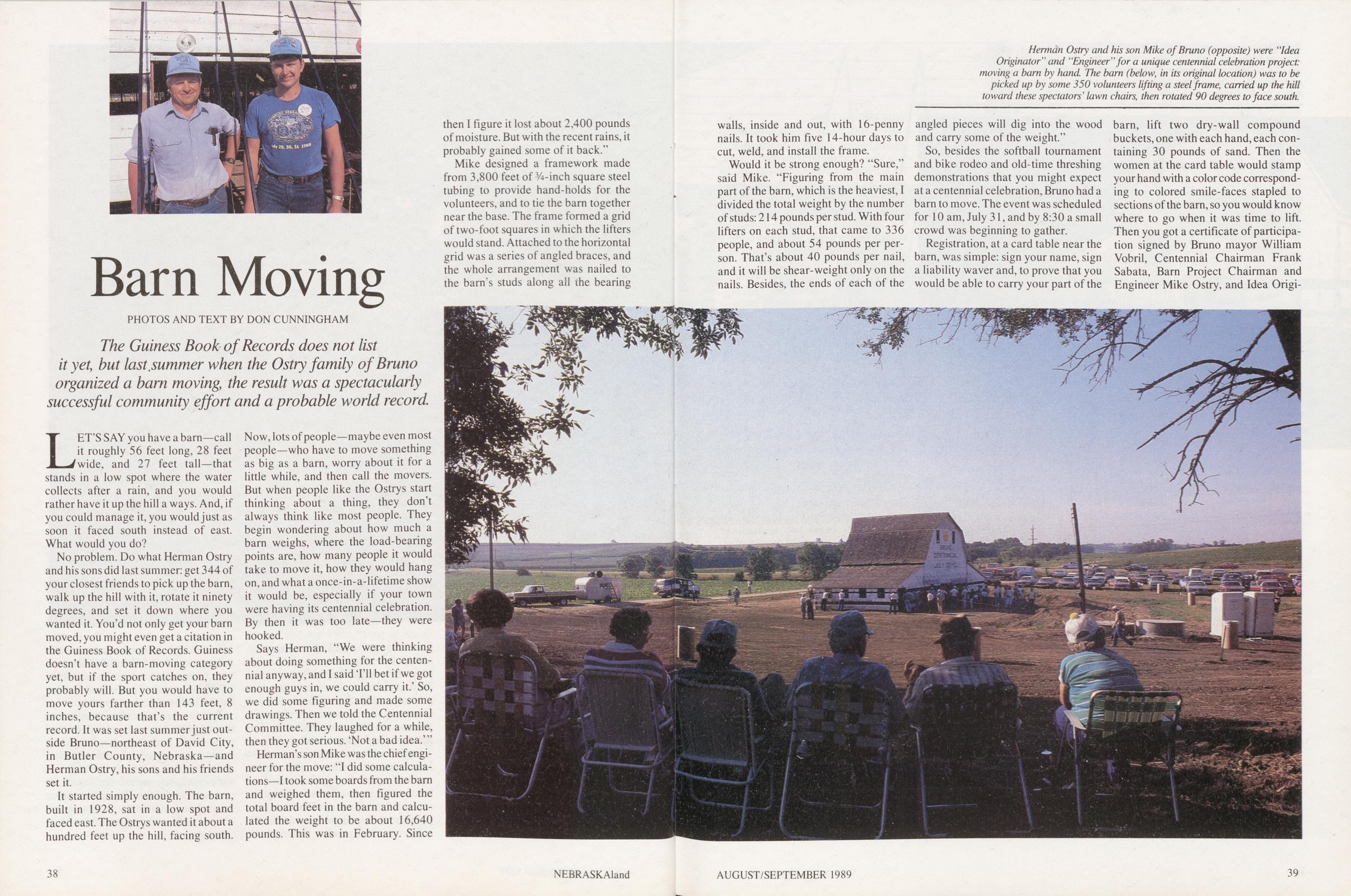
Barn Moving
PHOTOS AND TEXT BY DON CUNNINGHAM The Guinness Book of Records does not list it yet, but last.summer when the Ostry family of Bruno organized a barn moving, the result was a spectacularly successful community effort and a probable world record.LET'S SAY you have a barn—call it roughly 56 feet long, 28 feet wide, and 27 feet tall—that stands in a low spot where the water collects after a rain, and you would rather have it up the hill a ways. And, if you could manage it, you would just as soon it faced south instead of east. What would you do?
No problem. Do what Herman Ostry and his sons did last summer: get 344 of your closest friends to pick up the barn, walk up the hill with it, rotate it ninety degrees, and set it down where you wanted it. You'd not only get your barn moved, you might even get a citation in the Guinness Book of Records. Guinness doesn't have a barn-moving category yet, but if the sport catches on, they probably will. But you would have to move yours farther than 143 feet, 8 inches, because that's the current record. It was set last summer just outside Bruno—northeast of David City, in Butler County, Nebraska—and Herman Ostry, his sons and his friends set it.
It started simply enough. The barn, built in 1928, sat in a low spot and faced east. The Ostrys wanted it about a hundred feet up the hill, facing south. Now, lots of people—maybe even most people—who have to move something as big as a barn, worry about it for a little while, and then call the movers. But when people like the Ostrys start thinking about a thing, they don't always think like most people. They begin wondering about how much a barn weighs, where the load-bearing points are, how many people it would take to move it, how they would hang on, and what a once-in-a-lifetime show it would be, especially if your town were having its centennial celebration. By then it was too late—they were hooked.
Says Herman, "We were thinking about doing something for the centennial anyway, and I said Til bet if we got enough guys in, we could carry it.' So, we did some figuring and made some drawings. Then we told the Centennial Committee. They laughed for a while, then they got serious. 'Not a bad idea.'
Herman's son Mike was the chief engineer for the move: "I did some calculations—I took some boards from the barn and weighed them, then figured the total board feet in the barn and calculated the weight to be about 16,640 pounds. This was in February. Since then I figure it lost about 2,400 pounds of moisture. But with the recent rains, it probably gained some of it back."
Mike designed a framework made from 3,800 feet of 3/4-inch square steel tubing to provide hand-holds for the volunteers, and to tie the barn together near the base. The frame formed a grid of two-foot squares in which the lifters would stand. Attached to the horizontal grid was a series of angled braces, and the whole arrangement was nailed to the barn's studs along all the bearing 38 NEBRASKAland walls, inside and out, with 16-penny nails. It took him five 14-hour days to cut, weld, and install the frame.
Would it be strong enough? "Sure," said Mike. "Figuring from the main part of the barn, which is the heaviest, I divided the total weight by the number of studs: 214 pounds per stud. With four lifters on each stud, that came to 336 people, and about 54 pounds per person. That's about 40 pounds per nail, and it will be shear-weight only on the nails. Besides, the ends of each of the angled pieces will dig into the wood and carry some of the weight."
So, besides the softball tournament and bike rodeo and old-time threshing demonstrations that you might expect at a centennial celebration, Bruno had a barn to move. The event was scheduled for 10 am, July 31, and by 8:30 a small crowd was beginning to gather.
Registration, at a card table near the barn, was simple: sign your name, sign a liability waver and, to prove that you would be able to carry your part of the barn, lift two dry-wall compound buckets, one with each hand, each containing 30 pounds of sand. Then the women at the card table would stamp your hand with a color code corresponding to colored smile-faces stapled to sections of the barn, so you would know where to go when it was time to lift. Then you got a certificate of participation signed by Bruno mayor William Vobril, Centennial Chairman Frank Sabata, Barn Project Chairman and Engineer Mike Ostry, and Idea Originnator Herman Ostry.
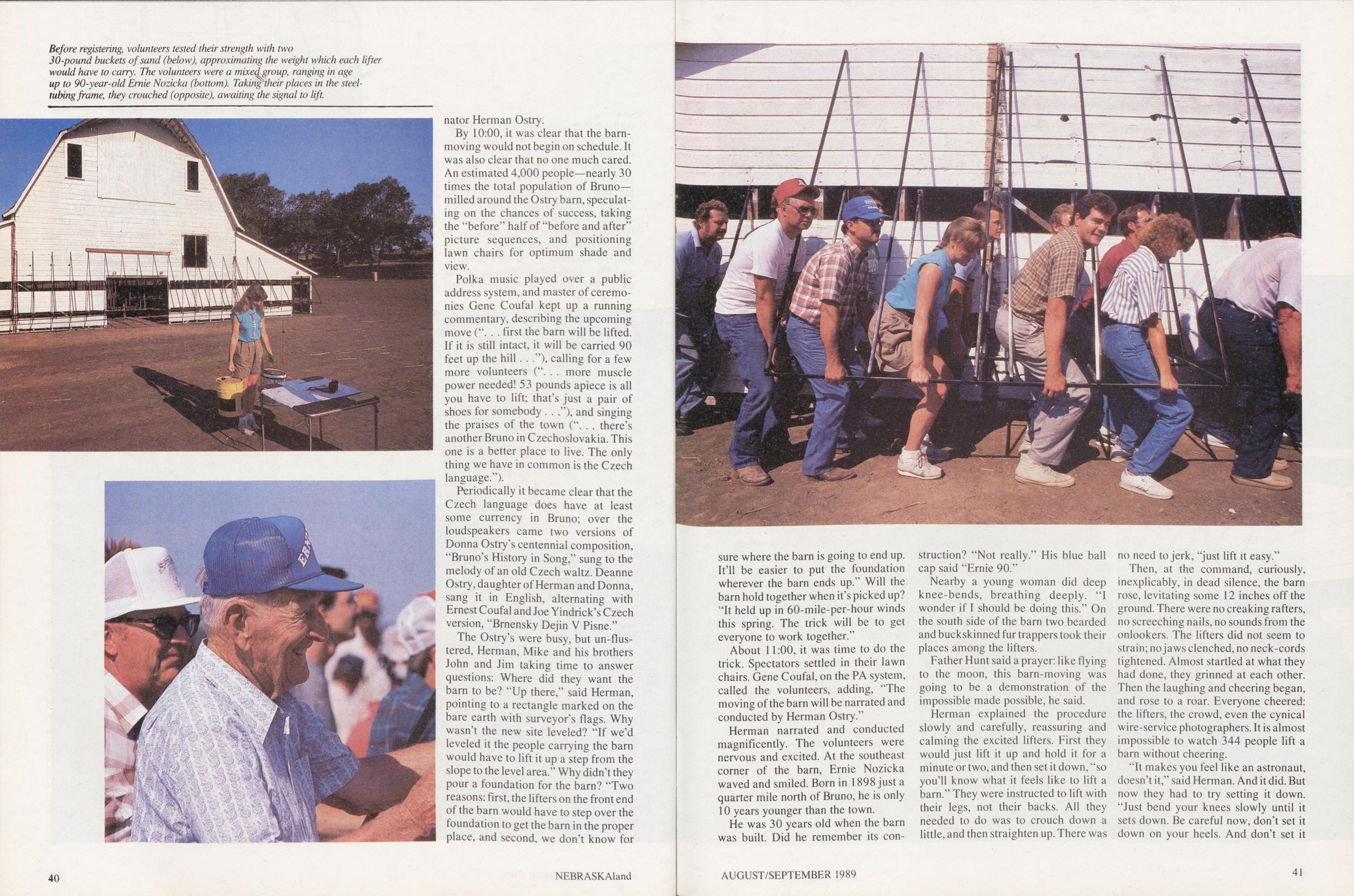
By 10:00, it was clear that the barn-moving would not begin on schedule. It was also clear that no one much cared. An estimated 4,000 people—nearly 30 times the total population of Brunomilled around the Ostry barn, speculating on the chances of success, taking the "before" half of "before and after" picture sequences, and positioning lawn chairs for optimum shade and view.
Polka music played over a public address system, and master of ceremonies Gene Coufal kept up a running commentary, describing the upcoming move (". . . first the barn will be lifted. If it is still intact, it will be carried 90 feet up the hill. . ."), calling for a few more volunteers (". . . more muscle power needed! 53 pounds apiece is all you have to lift; that's just a pair of shoes for somebody . . ."), and singing the praises of the town (". . . there's another Bruno in Czechoslovakia. This one is a better place to live. The only thing we have in common is the Czech language.").
Periodically it became clear that the Czech language does have at least some currency in Bruno; over the loudspeakers came two versions of Donna Ostry's centennial composition, "Bruno's History in Song," sung to the melody of an old Czech waltz. Deanne Ostry, daughter of Herman and Donna, sang it in English, alternating with Ernest Coufal and Joe Yindrick's Czech version, "Brnensky Dejin V Pisne."
The Ostry's were busy, but un-flustered, Herman, Mike and his brothers John and Jim taking time to answer questions: Where did they want the barn to be? "Up there," said Herman, pointing to a rectangle marked on the bare earth with surveyor's flags. Why wasn't the new site leveled? "If we'd leveled it the people carrying the barn would have to lift it up a step from the slope to the level area." Why didn't they pour a foundation for the barn? "Two reasons: first, the lifters on the front end of the barn would have to step over the foundation to get the barn in the proper place, and second, we don't know for 40 NEBRASKAland sure where the barn is going to end up. It'll be easier to put the foundation wherever the barn ends up." Will the barn hold together when it's picked up? "It held up in 60-mile-per-hour winds this spring. The trick will be to get everyone to work together."
About 11:00, it was time to do the trick. Spectators settled in their lawn chairs. Gene Coufal, on the PA system, called the volunteers, adding, "The moving of the barn will be narrated and conducted by Herman Ostry."
Herman narrated and conducted magnificently. The volunteers were nervous and excited. At the southeast corner of the barn, Ernie Nozicka waved and smiled. Born in 1898 just a quarter mile north of Bruno, he is only 10 years younger than the town.
He was 30 years old when the barn was built. Did he remember its construction? "Not really." His blue ball cap said "Ernie 90."
Nearby a young woman did deep knee-bends, breathing deeply. "I wonder if I should be doing this." On the south side of the barn two bearded and buckskinned fur trappers took their places among the lifters.
Father Hunt said a prayer: like flying to the moon, this barn-moving was going to be a demonstration of the impossible made possible, he said.
Herman explained the procedure slowly and carefully, reassuring and calming the excited lifters. First they would just lift it up and hold it for a minute or two, and then set it down, "so you'll know what it feels like to lift a barn." They were instructed to lift with their legs, not their backs. All they needed to do was to crouch down a little, and then straighten up. There was no need to jerk, "just lift it easy."
Then, at the command, curiously, inexplicably, in dead silence, the barn rose, levitating some 12 inches off the ground. There were no creaking rafters, no screeching nails, no sounds from the onlookers. The lifters did not seem to strain; no jaws clenched, no neck-cords tightened. Almost startled at what they had done, they grinned at each other. Then the laughing and cheering began, and rose to a roar. Everyone cheered: the lifters, the crowd, even the cynical wire-service photographers. It is almost impossible to watch 344 people lift a barn without cheering.
'It makes you feel like an astronaut, doesn't it," said Herman. And it did. But now they had to try setting it down. "Just bend your knees slowly until it sets down. Be careful now, don't set it down on your heels. And don't set it AUGUST/SEPTEMBER 41 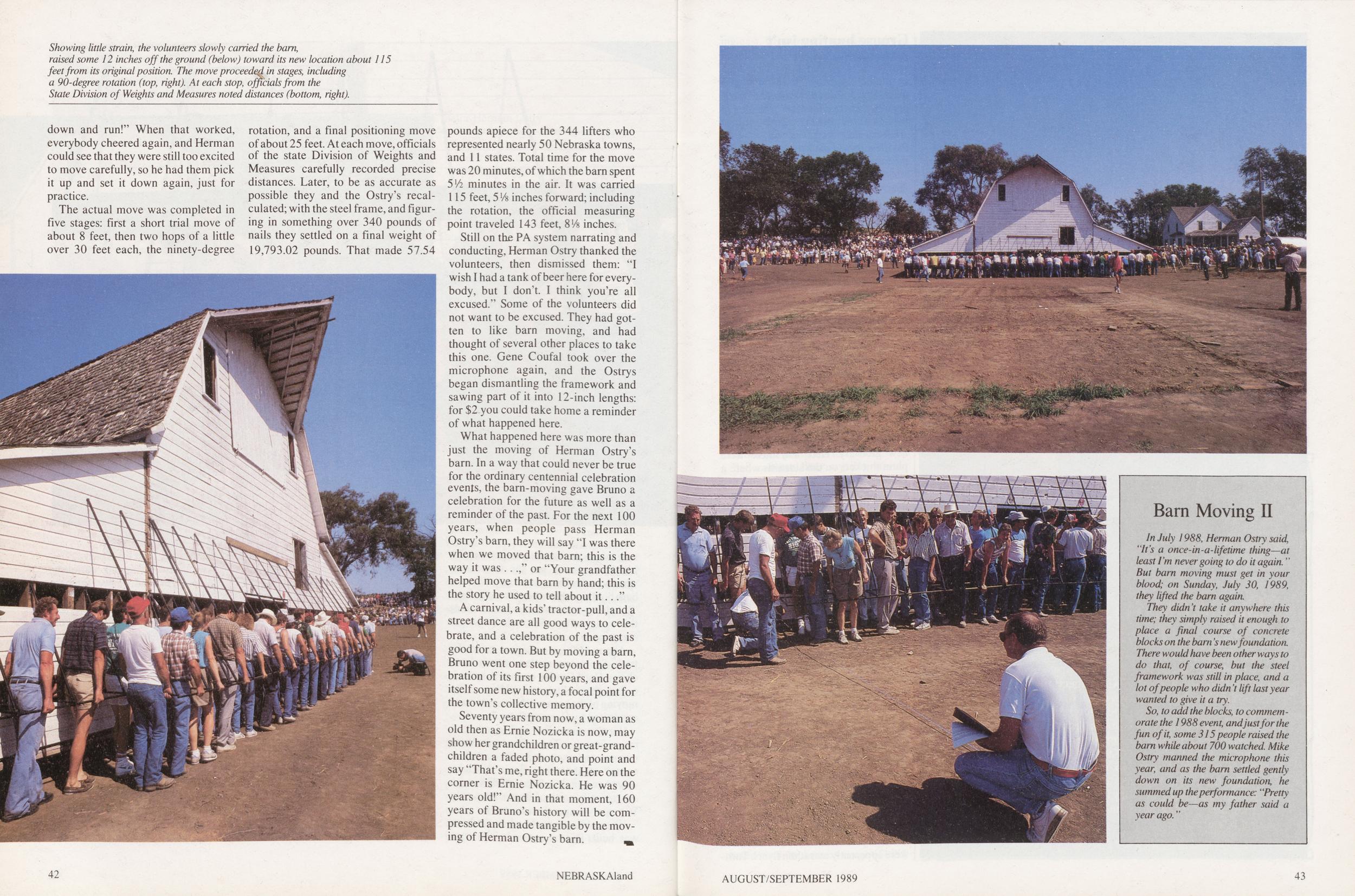
The actual move was completed in five stages: first a short trial move of about 8 feet, then two hops of a little over 30 feet each, the ninety-degree rotation, and a final positioning move of about 25 feet. At each move, officials of the state Division of Weights and Measures carefully recorded precise distances. Later, to be as accurate as possible they and the Ostry's recalculated; with the steel frame, and figuring in something over 340 pounds of nails they settled on a final weight of 19,793.02 pounds. That made 57.54 pounds apiece for the 344 lifters who represented nearly 50 Nebraska towns, and 11 states. Total time for the move was 20 minutes, of which the barn spent 5!/2 minutes in the air. It was carried 115 feet, 5 V% inches forward; including the rotation, the official measuring point traveled 143 feet, 8!/8 inches.
Still on the PA system narrating and conducting, Herman Ostry thanked the volunteers, then dismissed them: "I wish I had a tank of beer here for everybody, but I don't. I think you're all excused." Some of the volunteers did not want to be excused. They had gotten to like barn moving, and had thought of several other places to take this one. Gene Coufal took over the microphone again, and the Ostrys began dismantling the framework and sawing part of it into 12-inch lengths: for $2 you could take home a reminder of what happened here.
What happened here was more than just the moving of Herman Ostry's barn. In a way that could never be true for the ordinary centennial celebration events, the barn-moving gave Bruno a celebration for the future as well as a reminder of the past. For the next 100 years, when people pass Herman Ostry's barn, they will say "I was there when we moved that barn; this is the way it was ...," or "Your grandfather helped move that barn by hand; this is the story he used to tell about it..."
A carnival, a kids' tractor-pull, and a street dance are all good ways to celebrate, and a celebration of the past is good for a town. But by moving a barn, Bruno went one step beyond the celebration of its first 100 years, and gave itself some new history, a focal point for the town's collective memory.
Seventy years from now, a woman as old then as Ernie Nozicka is now, may show her grandchildren or great-grand-children a faded photo, and point and say "That's me, right there. Here on the corner is Ernie Nozicka. He was 90 years old!" And in that moment, 160 years of Bruno's history will be compressed and made tangible by the moving of Herman Ostry's barn.
42 NEBRASKAlandIn July 198S, Herman Ostry said, "It's a once-in-a-lifetime thing—at least Vm never going to do it again.' But barn moving must get in your blood; on Sunday, July 30, 1989, they lifted the bam again.
They didn't take it anywhere this time; they simply raised it enough to place a final course of concrete blocks on the bam s new foundation. There would have been other ways to do that, of course, but the steel framework was still in place, and a lot of people who didn ft aft last year wanted to give it a try.
So, to add the blocks, to commemorate the 1988 event, and just for the fun of it, some 315 people raised the bam while about 700 watched. Mike Ostry manned the microphone this year, and as the barn settled gently down on its new foundation, he summed up the performance: "Pretty as could be—as my father said a year ago."
AUGUST/SEPTEMBER 1989 43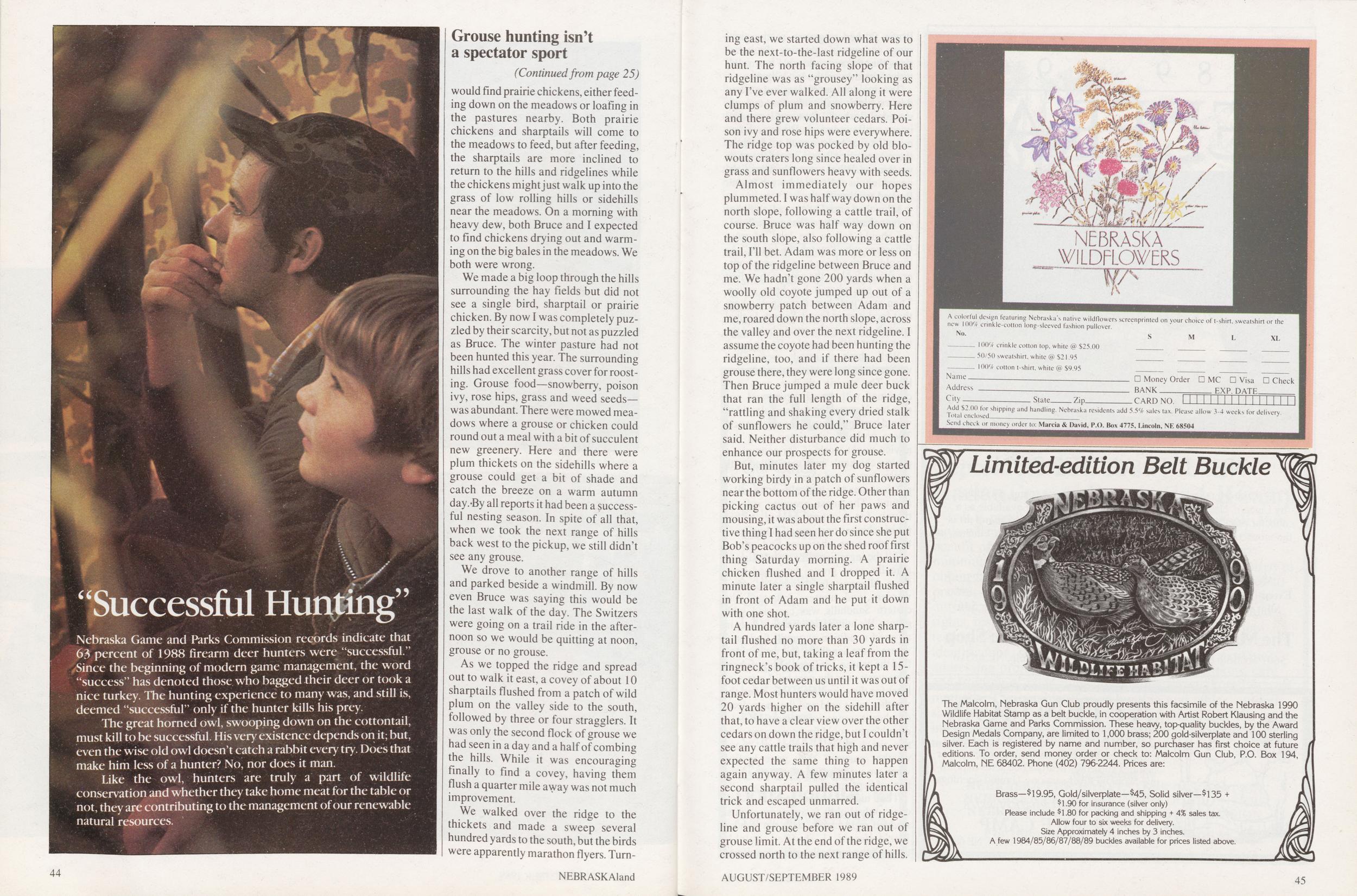
Nebraska Game and Parks Commission records indicate that 63 percent of 1988 firearm deer hunters were "successful." Since the beginning of modern game management, the word "success" has denoted those who bagged their deer or took a nice turkey. The hunting experience to many was, and still is, deemed "successful" only if the hunter kills his prey.
The great horned owl, swooping down on the cottontail, must kill to be successful. His very existence depends on it; but, even the wise old owl doesn't catch a rabbit every try. Does that make him less of a hunter? No, nor does it man.
Like the owl, hunters are truly a part of wildlife conservation and whether they take home meat for the table or not, they are contributing to the management of our renewable natural resources.
Grouse hunting isn't a spectator sport
(Continued from page 25)would find prairie chickens, either feeding down on the meadows or loafing in the pastures nearby. Both prairie chickens and sharptails will come to the meadows to feed, but after feeding, the sharptails are more inclined to return to the hills and ridgelines while the chickens might just walk up into the grass of low rolling hills or sidehills near the meadows. On a morning with heavy dew, both Bruce and I expected to find chickens drying out and warming on the big bales in the meadows. We both were wrong.
We made a big loop through the hills surrounding the hay fields but did not see a single bird, sharptail or prairie chicken. By now I was completely puzzled by their scarcity, but not as puzzled as Bruce. The winter pasture had not been hunted this year. The surrounding hills had excellent grass cover for roosting. Grouse food—snowberry, poison ivy, rose hips, grass and weed seeds-was abundant. There were mowed meadows where a grouse or chicken could round out a meal with a bit of succulent new greenery. Here and there were plum thickets on the sidehills where a grouse could get a bit of shade and catch the breeze on a warm autumn day.'By all reports it had been a successful nesting season. In spite of all that, when we took the next range of hills back west to the pickup, we still didn't see any grouse.
We drove to another range of hills and parked beside a windmill. By now even Bruce was saying this would be the last walk of the day. The Switzers were going on a trail ride in the afternoon so we would be quitting at noon, grouse or no grouse.
As we topped the ridge and spread out to walk it east, a covey of about 10 sharptails flushed from a patch of wild plum on the valley side to the south, followed by three or four stragglers. It was only the second flock of grouse we had seen in a day and a half of combing the hills. While it was encouraging finally to find a covey, having them flush a quarter mile away was not much improvement.
We walked over the ridge to the thickets and made a sweep several hundred yards to the south, but the birds were apparently marathon flyers. Turning 44 NEBRASKAland east, we started down what was to be the next-to-the-last ridgeline of our hunt. The north facing slope of that ridgeline was as "grousey" looking as any I've ever walked. All along it were clumps of plum and snowberry. Here and there grew volunteer cedars. Poison ivy and rose hips were everywhere. The ridge top was pocked by old blowouts craters long since healed over in grass and sunflowers heavy with seeds.
Almost immediately our hopes plummeted. I was halfway down on the north slope, following a cattle trail, of course. Bruce was half way down on the south slope, also following a cattle trail, I'll bet. Adam was more or less on top of the ridgeline between Bruce and me. We hadn't gone 200 yards when a woolly old coyote jumped up out of a snowberry patch between Adam and me, roared down the north slope, across the valley and over the next ridgeline. I assume the coyote had been hunting the ridgeline, too, and if there had been grouse there, they were long since gone. Then Bruce jumped a mule deer buck that ran the full length of the ridge, "rattling and shaking every dried stalk of sunflowers he could," Bruce later said. Neither disturbance did much to enhance our prospects for grouse.
But, minutes later my dog started working birdy in a patch of sunflowers near the bottom of the ridge. Other than picking cactus out of her paws and mousing, it was about the first constructive thing I had seen her do since she put Bob's peacocks up on the shed roof first thing Saturday morning. A prairie chicken flushed and I dropped it. A minute later a single sharptail flushed in front of Adam and he put it down with one shot.
A hundred yards later a lone sharptail flushed no more than 30 yards in front of me, but, taking a leaf from the ringneck's book of tricks, it kept a 15-foot cedar between us until it was out of range. Most hunters would have moved 20 yards higher on the sidehill after that, to have a clear view over the other cedars on down the ridge, but I couldn't see any cattle trails that high and never expected the same thing to happen again anyway. A few minutes later a second sharptail pulled the identical trick and escaped unmarred.
Unfortunately, we ran out of ridgeline and grouse before we ran out of grouse limit. At the end of the ridge, we crossed north to the next range of hills. Bruce flushed a grouse at marginal range and sent it a greeting of number sixes that did no noticeable harm. We turned west down the last ridgeline.
NEBRASKA WILDFLOWERS A colorful design featuring Nebraska's native wildflowers screenprinted on your choice of t-shirt, sweatshirt or the new lOOvf crinkle-cotton long-sleeved fashion pullover. No. S M L XL crinkle cotton top, white @ $25.00 50/50 sweatshirt, white @ $21.95 cotton t-shirt. white @ $9.95 Name Address City D Money Order DMC D Visa □ Check BANK EXP. DATE State. CARD NO. Add $2.00 for shipping and handling. Nebraska residents add 5.57r sales tax. Please allow 3-4 weeks for delivery Total enclosed Send check or money order to: Marcia & David, P.O. Box 4775, Lincoln, NE 68504 Limited-edition Belt Buckle The Malcolm, Nebraska Gun Club proudly presents this facsimile of the Nebraska 1990 Wildlife Habitat Stamp as a belt buckle, in cooperation with Artist Robert Klausing and the Nebraska Game and Parks Commission. These heavy, top-quality buckles, by the Award Design Medals Company, are limited to 1,000 brass; 200 gold-silverplate and 100 sterling silver. Each is registered by name and number, so purchaser has first choice at future editions. To order, send money order or check to: Malcolm Gun Club, P.O. Box 194, Malcolm, NE 68402. Phone (402) 796-2244. Prices are: Brass-$19.95, Gold/silverplate-$45, Solid silver-$135 + $1.90 for insurance (silver only) Please include $1.80 for packing and shipping + 4% sales tax. Allow four to six weeks for delivery. Size Approximately 4 inches by 3 inches. A few 1984/85/86/87/88/89 buckles available for prices listed above. AUGUST/SEPTEMBER 1989 45 1989 1990 NEAL R. ANDERSON The 1989-90 federal duck stamp, a pair of lesser scaup, was done by Lincoln, Nebraska, artist Neal Anderson. It is now available as a collector print in three editions, as detailed below. Federal stamp art is the most collectible of any limited edition. Image size is 61/2x9 inches, actual print size is 12x14 inches, signed and numbered. Regular edition (20,000 s/n) print—$145 Medallion edition (7,000 s/n) w/gold-plated medallion—$325 Executive edition (500 s/n) w/remarque, silver/gold medallion—$950 Mint stamp $ 12.50 Signed stamp $ 15 Fine art poster $ 16 (Plus $7.50 shipping & sales tax if applicable) Write or call for details. The Masterworks Gallery and Frame Shop 5601 So. 56th St., St. 5 (402) 423-3884 Lincoln, NE 68516 ATTENTION TURKEY HUNTERS Join our exclusive sportsmen's group, use our facilities and enjoy nearly 2,000 acres of primitive Niobrara River canyons. Limited openings available. FOR MORE INFORMATION WRITE 12 MILE CAMP 2225 N. Clarkson Fremont, NE 68025
Two hundred yards later, as I walked down a break in the ridgeline, a single sharptail flushed; I shot and it crashed into a sunflower patch. We later determined it was only scared to death as there were no pellets in any of the parts we skinned. When we reached the pickup at about 11 o'clock, we hadn't flushed another grouse.
More then once I have read, and once or twice have written, that grouse hunters should follow the lead of trout fishermen who "match the hatch." As the old, worn advice goes, grouse hunters should look in the crop of their first bird to see what it has been eating. Then, you "just" hunt those spots where that food item is found. Sounds logical enough, when you're sitting behind the typewriter with a cup of coffee in hand.
Well, these sharptails were filled with poison ivy berries and a few rose hips. The prairie chicken crop was crammed with grasshoppers and one rose hip. None of this forensic sleuthing would have narrowed our search much. There probably are times when this advice might work; if, for example, a prairie chicken's crop were filled with clover leaves and there was only one patch of meadow with clover for miles around. The most accurate rule of thumb for locating' grouse, either prairie chicken or sharptail, however, is that grouse are where you find 'em.
All the ingredients for the making of a really good grouse hunt had been there. All reports from biologists, game wardens and hunters indicated the eastern Sandhills was crowded with grouse. We hunted pastures that were in as good condition as you'll find anywhere in the Sandhills. But we couldn't find the grouse. I still don't know where they were; over the next hill I guess, at least for the time being. But, when the weather turns cold and the snow deep, or when it comes time to nest, I'd bet a month's pay you'd find more grouse on this ranch than in whatever "good weather pasture" they were loafing when we were looking for them in the heat of September.
That night I eased back in a soft chair, only slightly favoring my cactus-studded right cheek, with the Sunday World-Herald. I shuffled quickly through the football, bowling, golf and 46 NEBRASKAland other wimpy spectator sports, sports that don't give you blisters on your "long toes" or cactus spines in your rump, until I found Gene Hornbeck's hunting column. Now Mr. Hornbeck, like some other outdoor writers, might occasionally stretch the facts a bit to make a good story, but over the years he's paid his dues out in the field.
"In my book," he wrote in his column that Sunday, "grouse hunting is a pure form of the art. It involves a lot of hunting and very little shooting. Few grouse find their way into a game bag without a lot of effort on the part of the hunter."
Amen.
Editors Note: Adam Switzer wore a body cast for eight weeks after the football season because of a broken vertebra. The Loup County Wildcats ended the season 11-0 and were six-man state champions. The 1988 Nebraska grouse season went down in the records as one of the best in recent years.
Help. Our Cities. Our Oceans. Our Trees. Towns. Forests. Rivers. Our Our Our Our Air. Our Mountains. Our Plants. Our Fishes. Our Streams. Our Lakes. Our Tomorrows. Give a hoot. Don't pollute, m Forest Service, U.S.D.A. 1989 Nebraska Fur Harvester Camp September 2-4,1989 Harlan County Reservoir 4-H Camp It is possible to prevent problems young people often have when they attempt to trap and hunt without the benefit of education or experience. Since there is no minimum standard of knowledge or experience required to obtain fur-harvesting permits, this program is designed to prevent problems from occurring. Young people will be introduced to wildlife management principles, laws and rights, responsibilities, hunting and trapline safety, and testing. Field experiences will include furbearer sign identification, supervised trapping and hunting activities, addressing proper trap types, selective set locations, care and training of coon dogs, and proper dispatch and release methods. The combination of hunting and ethics, outdoor skills and indoor classes should make this one of the most interesting schools that students will have an opportunity to attend. Sponsored by NEBRASKA FUR HARVESTERS ASSOCIATION NEBRASKA FEDERATION OF COON HUNTERS NEBRASKA GAME AND PARKS COMMISSION For information call: (402) 471-0641 AUGUST/SEPTEMBER 1989 47
In The Kitchen
Old Fashioned Pudding 2 cups milk 6 tbl flour (or 4 tbl cornstarch) Vi tsp salt 1 cup corn syrup 2 egg yolks Va cup butterCook together over low heat, then add nuts, pineapple or bananas. Put in baking dish, beat egg whites until stiff, add 2 tablespoons sugar and 1 teaspoon vanilla. Spread over pudding and brown under broiler. Chill and serve.
Mrs. Louis Rebbe, Fremont NE Old Fashioned Pie Crust 1 Vi cups flour 1/2 tsp salt 1 cup shortening 1 egg 1 tbl vinegar Va cup milkCut until crumbly. Then add 1 beaten egg, 1 tablespoon vinegar and Va cup milk. Makes enough for a 2-crust pie and a single crust.
Deborah Arends, Broken Bow, NE Pecan Crumb Crust Vi cup pecans, chopped 1 cup graham cracker or vanilla wafer crumbs, crushed fine xh cup butter, melted Va cup sugarChop pecans very fine. Mix nuts, crumbs and sugar together. Add butter, mixing well. Pack crumbs evenly over bottom and sides of 9-inch pie plate. Heat in 350° oven for 5 minutes, then chill.
Kathy Ertzner, Omaha, NE Best Chocolate Chip Cookies 1 cup butter-flavor Crisco 1 cup brown sugar 1 cup white sugar 1 cup chocolate chips 1 cup regular oats 2 eggs 1 tsp vanilla Vi cup flour 1 tsp baking soda Vi tsp saltCombine first three ingredients. Add eggs, vanilla and cream together. Add flour, soda and salt. Mix. Add chips and oats and stir. Bake at 375° 8-10 minutes.
Doe Rames, Grandview, MO Brown Sugar Pudding 2 cups water 1 cup brown sugar 2 tbl butterBoil the above until sugar is dissolved, then combine:
1 cup flour Vi cup sugar 2 tsp baking powder Va cup raisins Vi cup waterPour the dough mixture into a glass casserole. Pour hot mixture over the dough. Bake at 350° for 20 minutes.
Shirley DeBus, Lexington, NE Popppy Seed Cupcakes 2A cup whole poppy seeds IV3 cups water 3 egg whites or whole eggs 1 tsp vanilla 1 pkg sour cream white cake mixSoak poppy seeds in water for 2 or 3 hours. Mix cake according to directions, including water and poppy seeds. Fill paper cake cups Vi to 2/3 full and bake in 350° oven 20 to 25 minues. Cook, then frost with powdered sugar frosting.
Kathryn Ingerle, Elba, NEWe apologize for an error and an omission in the July recipes. The recipe for Danish Pastry submitted by Vaunda Schwenck of Omaha ran without the oven temperature listed. It should have been 375 degrees. Also, the Rhubarb Cake recipe submitted by C. E. Staberg of Bennet, NE, listed only 1 cup of flour, and it should have been 2 cups. Please add these to the recipes if you plan to use them. Sorry for the inconvenience. (Editor)
RESIDENTIAL LOTS FOR SALE on the Calamus Reservoir near Harwell Two separate residential communities for you to choose from. AGGIES ACRES On Site or Approved Modular Construction and MIKE'S MEADOWS Mobile Home Lots WV *J ■*2&7 03*V> Superior locations on the southwest side of the lake adding to late afternoon and evening enjoyment for each of these communities. These broker-owned residential areas are engineered and developed by professionals, and strict sets of covenants are in place for investment protection. REAL ESTATE, INC. Ronald M. Shonka, Broker-Owner P.O. Box 509, O'Neill, NE 68763 (402) 336-3500 Weekends: (308) 346-4338 48 NEBRASKAlandTrading Post
DOGSYELLOW-BLACK Lab pups. FC-AFC sired. AKC. Hips OFA ceritified. Dew claws removed. Excellent hunting potential. Contact Bob Bendler, Lexington, NE (308) 324-4247.
TRAINING ALL BREEDS Hunting Dogs — Vizslas for sale. Rozanek Kennels, Rt. 2, Schuyler, NE 68661. Phone (402) 352-8769.
ENGLISH SETTERS: "Bred for the hunter"; select puppies and started dogs available from outstanding bloodlines. Stud service available by proven hunters. High Plains Kennels, 1411 Emerson, Alliance, NE 69301, Phone (308) 762-6709.
GERMAN SHORTHAIRS and Brittany Spaniel pups. Started and occasionally a meat dog. Pups are guaranteed. Also I will be training hunting dogs. Wayne Clark, Percival, IA. Phone (712) 529-4238 or (402) 263-3155 at Union, NE
ENGLISH POINTER pups breeding Elhew; started dogs, force retrieving; at stud Ch. Elhew Husker John. J. H. Render, Box 86, Panama, NE 68419. Phone (402) 788-2213.
BRITTANY STUD DOG: Dual NAT-CKC Champions and best of breed ancestry. (D.C.-CKC Charley De Brett, Nat AM-D.C. Char Lee O'Dee, Nat-DC. Ban Dee). Pups also available. Call Don (402) 571 -4156 or Dale (712) 832-3100.
MISCELLANEOUSNE NEBRASKA trout fishing. 3 modern cottages, 1 available year round. 5 spring fed lakes with open water all year. Trout up to 7 pounds. Other varieties fish also. Diamond E. Trout Resort, Orchard, NE 68764. Phone (402) 893-4745.
AIR GUNS repaired — Benjamin, Crosman, Daisy, other American made. Restoration; old guns wanted, Jack's Air Guns, 1225 No. 46th, Lincoln, NE 68503. Phone (402) 466-9223.
Bev Doolittle, Terrry Redlin, Jerry Raedke, Ed Wards, Robert Bateman, Frank McCarthy and Neal Anderson are available at the 2nd Street Gallery, 537 W. 2nd, Hastings, NE 68901. Phone (402) 463-6677.
TROLLING MOTOR REPAIR. Factory authorized Minn Kota and Motor Guide,parts and service. Wolfs Repair and Tackle Supply, 1529 David Drive, Lincoln, NE 68504. Phone (402) 464-4265.
WINE AND BEER: Make your own. Send for free recipes and instructions. Omaha Supply, 1324 2nd Avenue, Nebraska City, NE 68410.
GUNS — Browning, Winchester, Remington, others, Hi-powers, shotguns, new, used, antiques. Want Pre-1964 Winchesters. Buy-Sell-Trade. Ph. (402) 729-6112. Bedlan's Sporting Goods, Fairbury, NE 68352.
MAD RIVER CANOES offers the finest quality and performance. For the finest canoes and accessories look to Great Plains Canoe Co., 205 Main, Springfield, NE Phone (402) 253-2001.
FREE! Booklets on northeastern Nevada; fishing, rockhounding maps, Carl Hayden, Box 528, Jackpot, Nevada 89825.
BUYING: American Indian artifacts such as beadwork, weavings, baskets, etc.; also cowboy memorabilia such as chaps, spurs, photographs, etc. Best price first letter; photographs promptly returned. Jack Ringwalt, 1550 California St., Suite 6, #211, San Francisco, C A 94109 (415)759-6343.
FISH FOR SALE—adult northern pike, walleye, bass, bluegiil, catfish, grass carp, coho salmon, trout and minnows. Carlson Clearwater Fish Farms, Inc., Rt. 2 Box 202, Wayne, NE 68787. Phone (402) 375-3262.
GAVINS POINT DAM-completely furnished cabin available for weekly rental $150/week with $50 deposit. Contact Heilman's Bait & Tackle, Yankton SD. Phone (605) 665-7879.
FISH FOR SALE. Catfish, perch, coho salmon, rainbow trout, crappie, bluegiil, walleye, minnows, goldfish, bullhead, largemouth bass, smallmouth bass, triploid grass carp. Commercial grower prices on catfish, perch, coho salmon, rainbow trout. Consulting available. Pleassant Valley Fish Farm, Rt. 1 Box 147, McCook, NE 69001 Phone (308) 345-6599.
METAL DETECTOR BARGAINS. All brands available Send for free catalog. Research Unlimited, 210 North Main St., Ames, NE 68621. Phone (402) 721-8588.
LAKE McCONAUGHY commercial property. 10 acres lake front property zoned commercial adjacent to Cedar Vue (Gate 13), boat ramp and camping area. The choice commercial site on the lake, with great activity Call Bill Hines at (308) 284-6701 or (308) 355-4543.
ON HARLAN COUNTY Reservoii, for sale, four bedroom home. Some of Nebraska's best fishing, hunting, water activities, beautiful sunsets, bald eagles, other birds, wildlife, many extras. Owner transferred. Call (308) 799-3505.
TAXIDERMYALLISON'S TAXIDERMY STUDIO. Wally and Betty Allison Licensed Taxidermist. We've mounted 28 Nebraska State Record fish. Specializing in fish and birds, small game and rattlesnakes. We use freeze-dry. 2310 West Leota, North Platte, Nebr. 69101. Phone (308) 534-2324.
BADE TAXIDERMY — Quality a must — Fast service. Fish, birds, rugs, tanning, full mounts and game heads, 2111 N. Christy St., Fremont, NE 727-5463.
NABITY'S TAXIDERMY. 31 years experience. Specializing in natural grass backgrounds for mammals, birds and fish. 13901 "O" St., Lincoln, NE 68504 — 4 miles east of 84th and "O". (402) 489-6351.
PEISTER TAXIDERMY - Professional work at prices most sportsman can afford. Now in our new log cabin studio, 1020 Central Avenue, Box 3201, Kearney NE 68847. Phone (308) 236-9700 or (308) 237-7575 evenings.
NATURECRAFT STUDIO — all custom services -creative work, quality, and experience since 1935. Includes freeze-dry processing. Display and sales room, visitors welcome. Hwy. 2 in Nebraska City. Phone (402) 873-5491. Joe Voges — Owner. Bow Steedly — Big Game specialist.
NEBRASKAland Magazine Order Form Please send me a subscription to NEBRASKAland Magazine One-year $12.00 NAME Two-year $23.00 ADDRESS CITY STATE ZIP Mail to: NEBRASKAland Magazine, Box 30370, Lincoln, NE 68503 STOCK YOUR LAKE OR POND WITH Channel Cat, Bluegiil, Hybrid Bluegiil, Largemouth Bass, Crappie, Bullheads, Triploid Grass Carp, Walleye, Minnows WILLOW LAKE FISH HATCHERY Rt. 3, Box 46, Hastings, Nebr. 68901 Gaylord L Crawford Phone: (402) 463-8022 Day or Night For April to October 15 stocking LIVE-CATCH ALL-PURPOSE TRAPS FREE CATALOG Traps without injury squirrels, chipmunks, rabbits, mink fox raccoons, stray animals, pests, etc Sizes for every need Also traps for snakes, sparrows, pigeons, crabs, turtles, quail, etc Save on our low factory prices Send no money Free catalog and trapping secrets MUSTANG MFG. CO., Dept. N-34, Box 920947. Houston, Tex. 77292 KEN KO Inc. Spend a day fishing the scenic Missouri River with Fishing Guide Kenneth Cooksey. For information write or call: 2002 2nd Ave. (402) 873-6288 Nebraska City, NE mornings/evenings AUGUST/SEPTEMBER 1989 CEDAR LANE Ranch Vacations Guest ranch in the heart of the Sandhills of Nebraska, Swimming, spa, horses, canoeing, trail rides, barbecues. hunting. family reunions. BOOKING NOW For 1989 Richard and Betty Schroeder HC 2 Box 9C Stapleton, Nebraska 69163 Ph. 308-587-2233 Open 7 days a week Shooting Preserve Garland, NE Todd W. Halle 402-488-2448 Rt. 1 Seward, NE 68434 Archery Deer Ducks Quail Pheasant Memberships Available AUGUST/SEPTEMBER 1989 49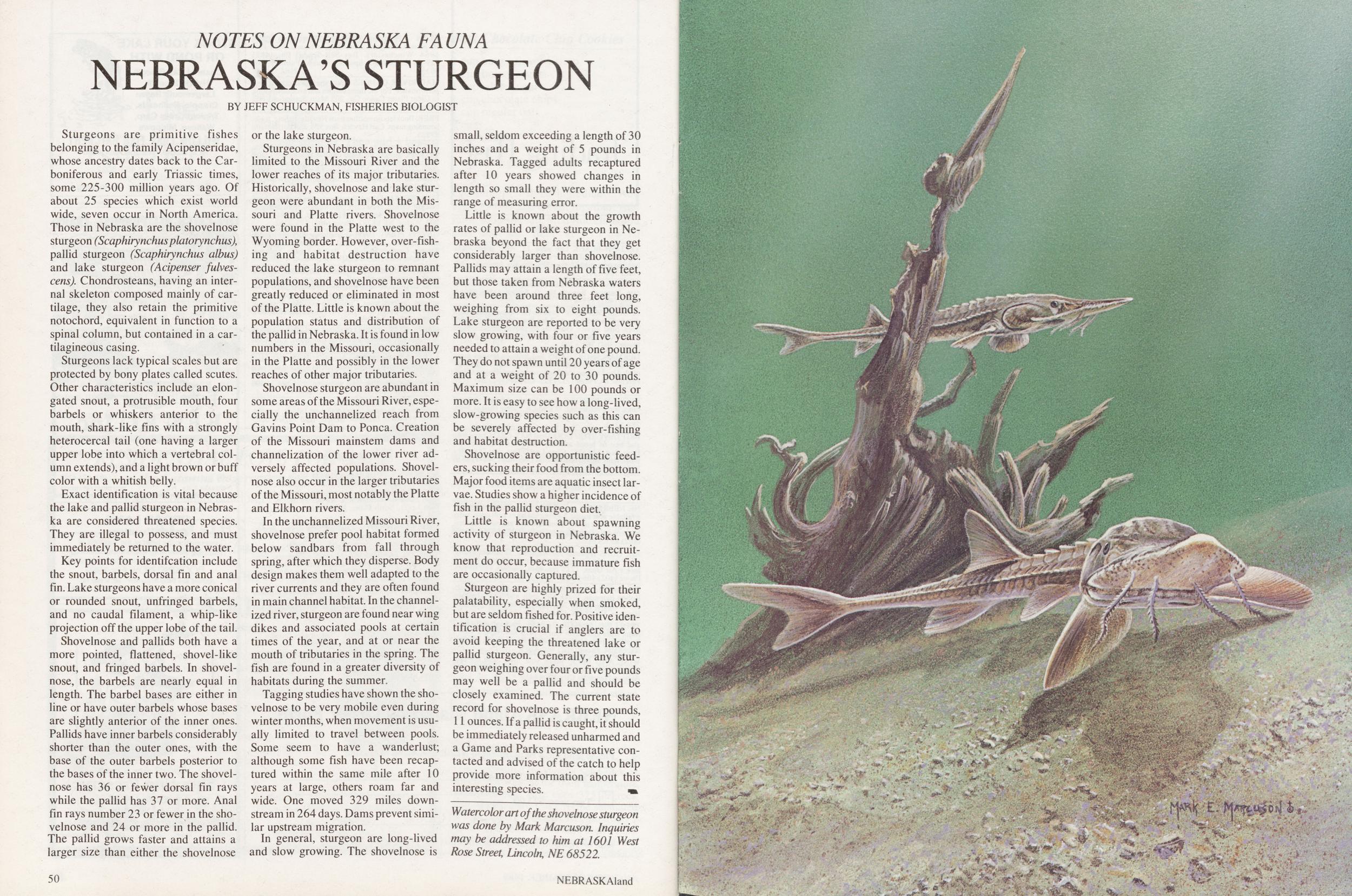
NOTES ON NEBRASKA FAUNA NEBRASKA'S STURGEON
BY JEFF SCHUCKMAN, FISHERIES BIOLOGISTSturgeons are primitive fishes belonging to the family Acipenseridae, whose ancestry dates back to the Carboniferous and early Triassic times, some 225-300 million years ago. Of about 25 species which exist world wide, seven occur in North America. Those in Nebraska are the shovelnose sturgeon (Scaphirynchus platorynchus), pallid sturgeon (Scaphirynchus albus) and lake sturgeon (Acipenser fulvescens). Chondrosteans, having an internal skeleton composed mainly of cartilage, they also retain the primitive notochord, equivalent in function to a spinal column, but contained in a cartilagineous casing.
Sturgeons lack typical scales but are protected by bony plates called scutes. Other characteristics include an elongated snout, a protrusible mouth, four barbels or whiskers anterior to the mouth, shark-like fins with a strongly heterocercal tail (one having a larger upper lobe into which a vertebral column extends), and a light brown or buff color with a whitish belly.
Exact identification is vital because the lake and pallid sturgeon in Nebraska are considered threatened species. They are illegal to possess, and must immediately be returned to the water.
Key points for identifcation include the snout, barbels, dorsal fin and anal fin. Lake sturgeons have a more conical or rounded snout, unfringed barbels, and no caudal filament, a whip-like projection off the upper lobe of the tail.
Shovelnose and pallids both have a more pointed, flattened, shovel-like snout, and fringed barbels. In shovelnose, the barbels are nearly equal in length. The barbel bases are either in line or have outer barbels whose bases are slightly anterior of the inner ones. Pallids have inner barbels considerably shorter than the outer ones, with the base of the outer barbels posterior to the bases of the inner two. The shovelnose has 36 or fewer dorsal fin rays while the pallid has 37 or more. Anal fin rays number 23 or fewer in the shovelnose and 24 or more in the pallid. The pallid grows faster and attains a larger size than either the shovelnose or the lake sturgeon.
Sturgeons in Nebraska are basically limited to the Missouri River and the lower reaches of its major tributaries. Historically, shovelnose and lake sturgeon were abundant in both the Mis- souri and Platte rivers. Shovelnose were found in the Platte west to the Wyoming border. However, over-fishing and habitat destruction have reduced the lake sturgeon to remnant populations, and shovelnose have been greatly reduced or eliminated in most of the Platte. Little is known about the population status and distribution of the pallid in Nebraska. It is found in low numbers in the Missouri, occasionally in the Platte and possibly in the lower reaches of other major tributaries.
Shovelnose sturgeon are abundant in some areas of the Missouri River, especially the unchannelized reach from Gavins Point Dam to Ponca. Creation of the Missouri mainstem dams and channelization of the lower river adversely affected populations. Shovelnose also occur in the larger tributaries of the Missouri, most notably the Platte and Elkhorn rivers.
In the unchannelized Missouri River, shovelnose prefer pool habitat formed below sandbars from fall through spring, after which they disperse. Body design makes them well adapted to the river currents and they are often found in main channel habitat. In the channelized river, sturgeon are found near wing dikes and associated pools at certain times of the year, and at or near the mouth of tributaries in the spring. The fish are found in a greater diversity of habitats during the summer.
Tagging studies have shown the shovelnose to be very mobile even during winter months, when movement is usually limited to travel between pools. Some seem to have a wanderlust; although some fish have been recaptured within the same mile after 10 years at large, others roam far and wide. One moved 329 miles downstream in 264 days. Dams prevent similar upstream migration.
In general, sturgeon are long-lived and slow growing. The shovelnose is small, seldom exceeding a length of 30 inches and a weight of 5 pounds in Nebraska. Tagged adults recaptured after 10 years showed changes in length so small they were within the range of measuring error.
Little is known about the growth rates of pallid or lake sturgeon in Nebraska beyond the fact that they get considerably larger than shovelnose. Pallids may attain a length of five feet, but those taken from Nebraska waters have been around three feet long, weighing from six to eight pounds. Lake sturgeon are reported to be very slow growing, with four or five years needed to attain a weight of one pound. They do not spawn until 20 years of age and at a weight of 20 to 30 pounds. Maximum size can be 100 pounds or more. It is easy to see how a long-lived, slow-growing species such as this can be severely affected by over-fishing and habitat destruction.
Shovelnose are opportunistic feeders, sucking their food from the bottom. Major food items are aquatic insect larvae. Studies show a higher incidence of fish in the pallid sturgeon diet.
Little is known about spawning activity of sturgeon in Nebraska. We know that reproduction and recruitment do occur, because immature fish are occasionally captured.
Sturgeon are highly prized for their palatability, especially when smoked, but are seldom fished for. Positive identification is crucial if anglers are to avoid keeping the threatened lake or pallid sturgeon. Generally, any sturgeon weighing over four or five pounds may well be a pallid and should be closely examined. The current state record for shovelnose is three pounds, 11 ounces. If a pallid is caught, it should be immediately released unharmed and a Game and Parks representative contacted and advised of the catch to help provide more information about this interesting species.
Watercolor art of the shovelnose sturgeon was done by Mark Marcuson. Inquiries may be addressed to him at 1601 West Rose Street, Lincoln, NE 68522.
50 NEBRASKAland
Position: 511 (21 views)