Volume 67, Issue 5, 1989
NEBRASKAland
JUNE 1989 $1.50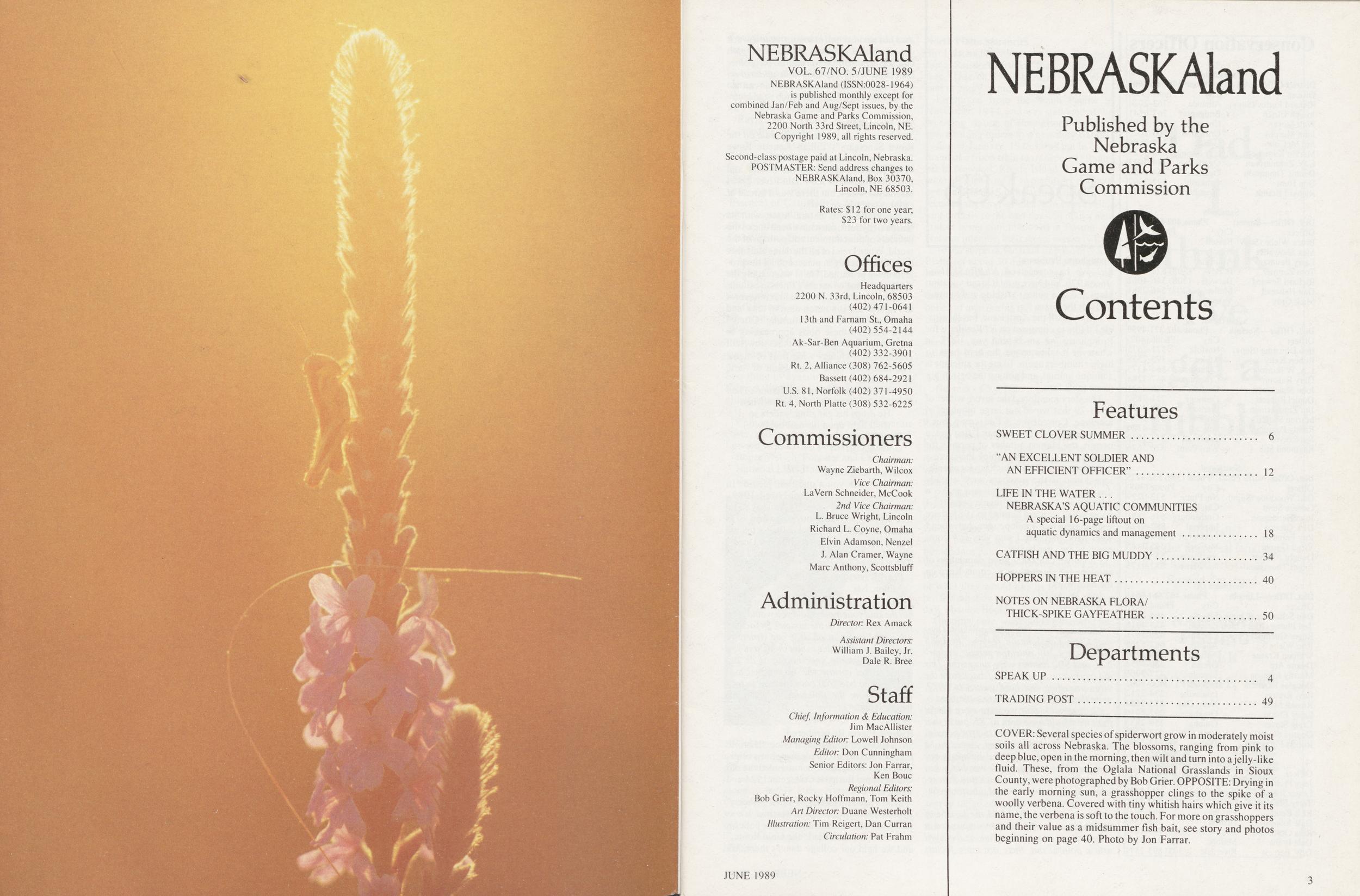
NEBRASKAland
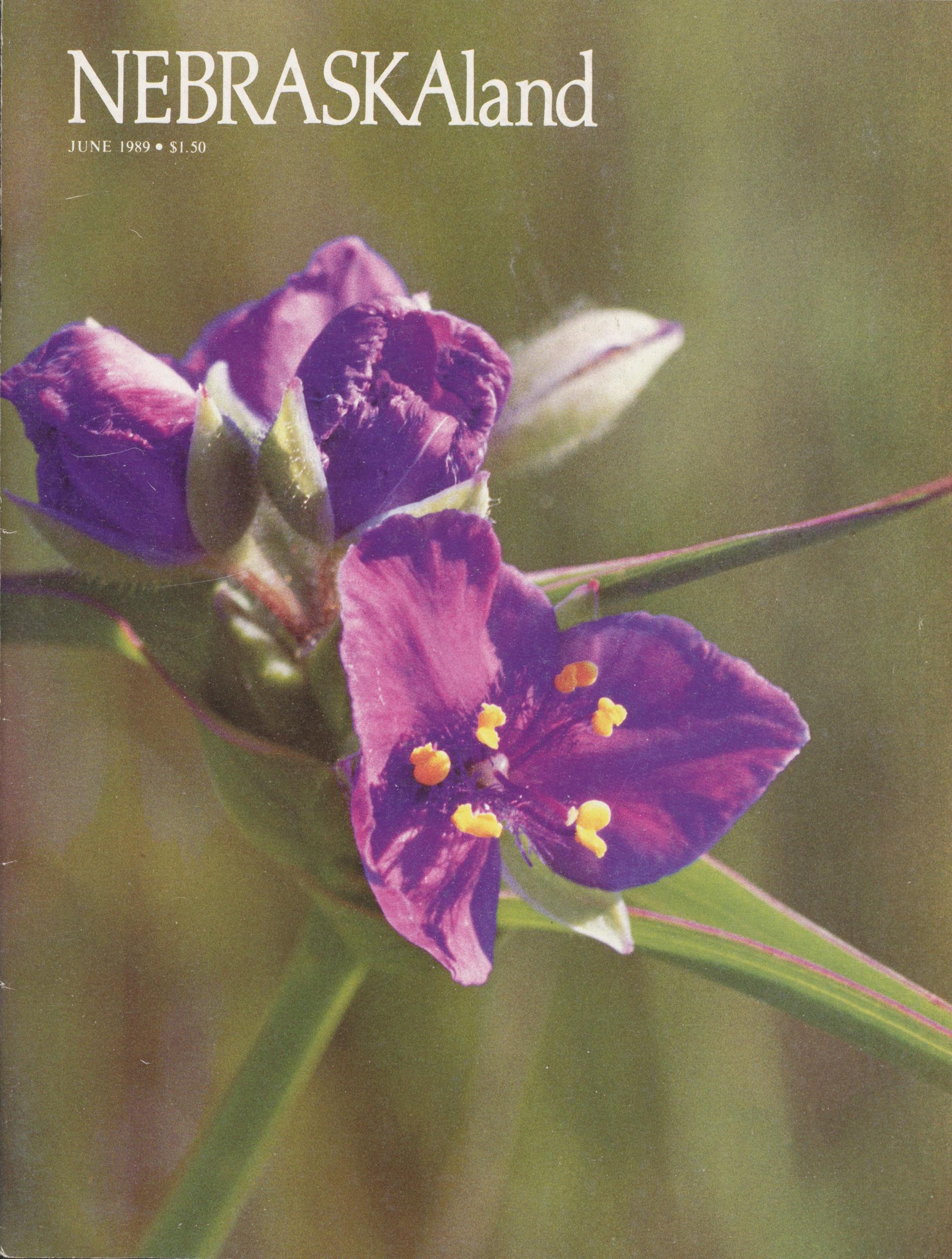
Published by the Nebraska Game and Parks Commission NEBRASKAland VOL. 67/NO. 5/JUNE 1989 NEBRASKAland (ISSN:0028-1964) is published monthly except for combined Jan/Feb and Aug/Sept issues, by the Nebraska Game and Parks Commission, 2200 North 33rd Street, Lincoln, NE. Copyright 1989, all rights reserved. Second-class postage paid at Lincoln, Nebraska. POSTMASTER: Send address changes to NEBRASKAland, Box 30370, Lincoln, NE 68503. Rates: $ 12 for one year; $23 for two years. Offices Headquarters 2200 N. 33rd, Lincoln, 68503 (402)471-0641 13th and Farnam St., Omaha (402)554-2144 Ak-Sar-Ben Aquarium, Gretna (402)332-3901 Rt. 2, Alliance (308) 762-5605 Bassett (402) 684-2921 U.S. 81, Norfolk (402) 371 -4950 Rt. 4, North Platte (308) 532-6225 Commissioners Chairman: Wayne Ziebarth, Wilcox Vice Chairman: LaVern Schneider, McCook 2nd Vice Chairman: L. Bruce Wright, Lincoln Richard L. Coyne, Omaha Elvin Adamson, Nenzel J. Alan Cramer, Wayne Marc Anthony, Scottsbluff Administration Director: Rex A mack Assistant Directors: William J. Bailey, Jr. Dale R. Bree Staff Chief, Information & Education: Jim MacAllister Managing Editor: Lowell Johnson Editor: Don Cunningham Senior Editors: Jon Farrar, Ken Bouc Regional Editors: Bob Grier, Rocky Hoffmann, Tom Keith Art Director: Duane Westerholt Illustration: Tim Reigert, Dan Curran Circulation: Pat Frahm Contents Features SWEET CLOVER SUMMER 6 "AN EXCELLENT SOLDIER AND AN EFFICIENT OFFICER" 12 LIFE IN THE WATER NEBRASKA'S AQUATIC COMMUNITIES A special 16-page liftout on aquatic dynamics and management 18 CATFISH AND THE BIG MUDDY 34 HOPPERS IN THE HEAT 40 NOTES ON NEBRASKA FLORA THICK-SPIKE GAYFEATHER 50 Departments SPEAK UP 4 TRADING POST 49 COVER: Several species of spiderwort grow in moderately moist soils all across Nebraska. The blossoms, ranging from pink to deep blue, open in the morning, then wilt and turn into a jelly-like fluid. These, from the Oglala National Grasslands in Sioux County, were photographed by Bob Grier. OPPOSITE: Drying in the early morning sun, a grasshopper clings to the spike of a woolly verbena. Covered with tiny whitish hairs which give it its name, the verbena is soft to the touch. For more on grasshoppers and their value as a midsummer fish bait, see story and photos beginning on page 40. Photo by Jon Farrar. JUNE 1989 3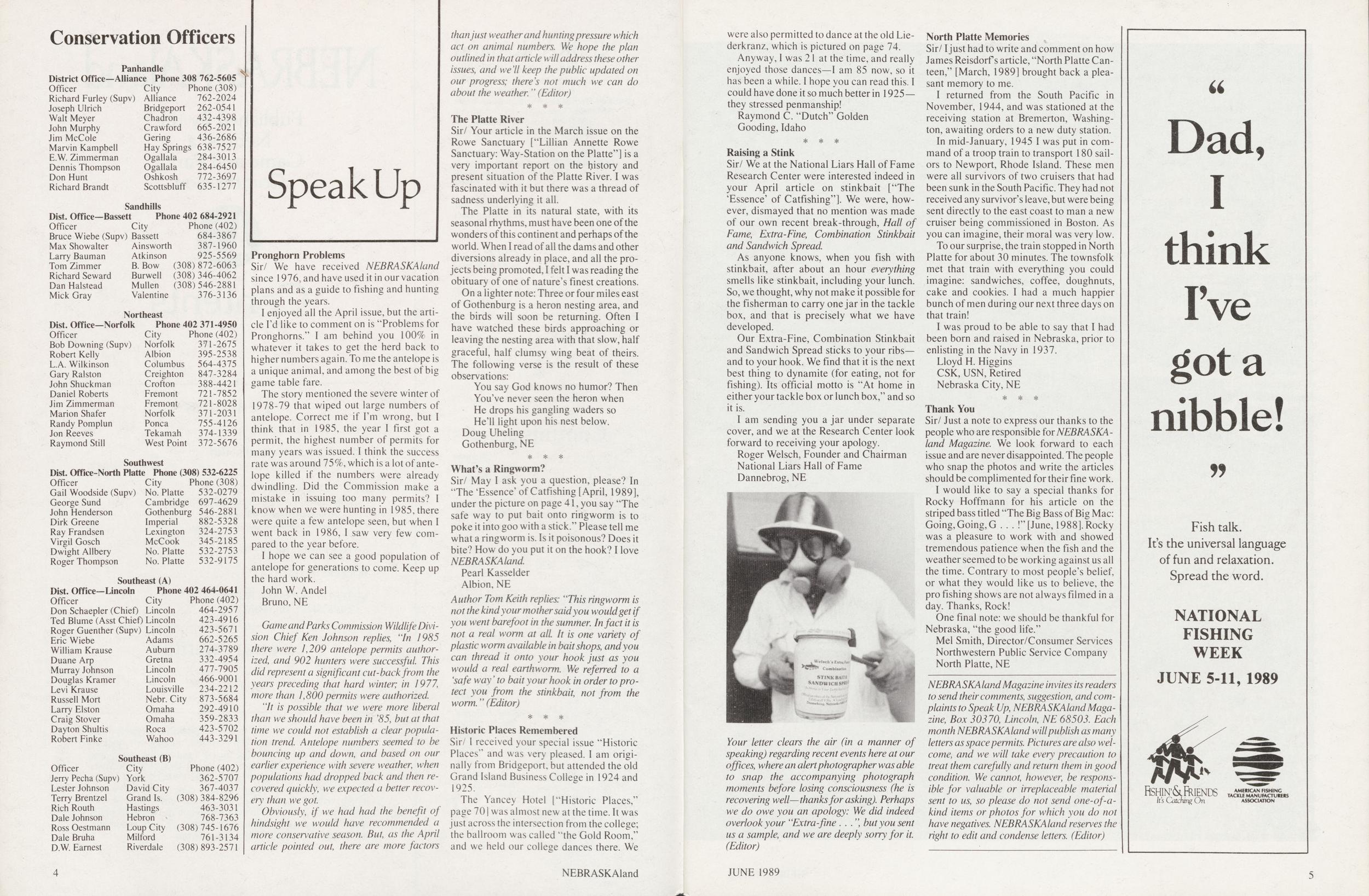
Speak Up
Pronghorn ProblemsSir/ We have received NEBRASKAland since 1976, and have used it in our vacation plans and as a guide to fishing and hunting through the years.
I enjoyed all the April issue, but the article Fd like to comment on is "Problems for Pronghorns." I am behind you 100% in whatever it takes to get the herd back to higher numbers again. To me the antelope is a unique animal, and among the best of big game table fare.
The story mentioned the severe winter of 1978-79 that wiped out large numbers of antelope. Correct me if I'm wrong, but I think that in 1985, the year I first got a permit, the highest number of permits for many years was issued. I think the success rate was around 75%, which is a lot of antelope killed if the numbers were already dwindling. Did the Commission make a mistake in issuing too many permits? I know when we were hunting in 1985, there were quite a few antelope seen, but when I went back in 1986, I saw very few compared to the year before.
I hope we can see a good population of antelope for generations to come. Keep up the hard work.
John W. Andel Bruno, NEGame and Parks Commission Wildlife Division Chief Ken Johnson replies, "In J 985 there were 1,209 antelope permits authorized, and 902 hunters were successful. This did represent a significant cut-back from the years preceding that hard winter; in 1977, more than 1,800 permits were authorized.
"It is possible that we were more liberal than we should have been in '85, but at that time we could not establish a clear population trend. Antelope numbers seemed to be bouncing up and down, and based on our earlier experience with severe weather, when populations had dropped back and then recovered quickly, we expected a better recovery than we got.
Obviously, if we had had the benefit of hindsight we would have recommended a more conservative season. But, as the April article pointed out, there are more factors than just weather and hunting pressure which act on animal numbers. We hope the plan outlined in that article will address these other issues, and we 7/ keep the public updated on our progress; there's not much we can do about the weather. " (Editor)
* * * The Platte RiverSir/ Your article in the March issue on the Rowe Sanctuary ["Lillian Annette Rowe Sanctuary: Way-Station on the Platte"] is a very important report on the history and present situation of the Platte River. I was fascinated with it but there was a thread of sadness underlying it all.
The Platte in its natural state, with its seasonal rhythms, must have been one of the wonders of this continent and perhaps of the world. When I read of all the dams and other diversions already in place, and all the projects being promoted, I felt I was reading the obituary of one of nature's finest creations.
On a lighter note: Three or four miles east of Gothenburg is a heron nesting area, and the birds will soon be returning. Often I have watched these birds approaching or leaving the nesting area with that slow, half graceful, half clumsy wing beat of theirs. The following verse is the result of these observations:
You say God knows no humor? Then You've never seen the heron when He drops his gangling waders so He'll light upon his nest below. Doug Uheling Gothenburg, NE * * * What's a Ringworm?Sir/ May I ask you a question, please? In "The 'Essence' of Catfishing [April, 1989], under the picture on page 41, you say "The safe way to put bait onto ringworm is to poke it into goo with a stick." Please tell me what a ringworm is. Is it poisonous? Does it bite? How do you put it on the hook? I love NEBRASKAland.
Pearl Kasselder Albion, NEAuthor Tom Keith replies: "This ringworm is not the kind your mother said you would get if you went barefoot in the summer. In fact it is not a real worm at all It is one variety of plastic worm available in bait shops, and you can thread it onto your hook just as you would a real earthworm. We referred to a 'safe way' to bait your hook in order to protect you from the stinkbait, not from the worm." (Editor)
* * * Historic Places RememberedSir/ I received your special issue "Historic Places" and was very pleased. I am originally from Bridgeport, but attended the old Grand Island Business College in 1924 and 1925.
The Yancey Hotel ["Historic Places," page 70 ] was almost new at the time. It was just across the intersection from the college; the ballroom was called "the Gold Room," and we held our college dances there. We 4 NEBRASKAland were also permitted to dance at the old Liederkranz, which is pictured on page 74.
Anyway, I was 21 at the time, and really enjoyed those dances—I am 85 now, so it has been a while. I hope you can read this. I could have done it so much better in 1925— they stressed penmanship!
Raymond C. "Dutch" Golden Gooding, Idaho * * * Raising a StinkSir/ We at the National Liars Hall of Fame Research Center were interested indeed in your April article on stinkbait ["The 'Essence' of Catfishing"]. We were, however, dismayed that no mention was made of our own recent break-through, Hall of Fame, Extra-Fine, Combination Stinkbait and Sandwich Spread.
As anyone knows, when you fish with stinkbait, after about an hour everything smells like stinkbait, including your lunch. So, we thought, why not make it possible for the fisherman to carry one jar in the tackle box, and that is precisely what we have developed.
Our Extra-Fine, Combination Stinkbait and Sandwich Spread sticks to your ribs—and to your hook. We find that it is the next best thing to dynamite (for eating, not for fishing). Its official motto is "At home in either your tackle box or lunch box," and so it is.
I am sending you a jar under separate cover, and we at the Research Center look forward to receiving your apology.
Roger Welsch, Founder and Chairman National Liars Hall of Fame Dannebrog, NEYour letter clears the air (in a manner of speaking) regarding recent events here at our offices, where an alert photographer was able to snap the accompanying photograph moments before losing consciousness (he is recovering well—thanks for asking). Perhaps we do owe you an apology: We did indeed overlook your "Extra-fine . . .", but you sent us a sample, and we are deeply sorry for it. (Editor)
North Platte MemoriesSir/1 just had to write and comment on how James Reisdorfs article, "North Platte Canteen," [March, 1989] brought back a pleasant memory to me.
I returned from the South Pacific in November, 1944, and was stationed at the receiving station at Bremerton, Washington, awaiting orders to a new duty station.
In mid-January, 1945 I was put in command of a troop train to transport 180 sailors to Newport, Rhode Island. These men were all survivors of two cruisers that had been sunk in the South Pacific. They had not received any survivor's leave, but were being sent directly to the east coast to man a new cruiser being commissioned in Boston. As you can imagine, their moral was very low.
To our surprise, the train stopped in North Platte for about 30 minutes. The townsfolk met that train with everything you could imagine: sandwiches, coffee, doughnuts, cake and cookies. I had a much happier bunch of men during our next three days on that train!
I was proud to be able to say that I had been born and raised in Nebraska, prior to enlisting in the Navy in 1937.
Lloyd H. Higgins CSK, USN, Retired Nebraska City, NE * * * Thank YouSir/ Just a note to express our thanks to the people who are responsible for NEBRASKAland Magazine. We look forward to each issue and are never disappointed. The people who snap the photos and write the articles should be complimented for their fine work.
I would like to say a special thanks for Rocky Hoffmann for his article on the striped bass titled "The Big Bass of Big Mac: Going, Going, G . . . !"[June, 1988]. Rocky was a pleasure to work with and showed tremendous patience when the fish and the weather seemed to be working against us all the time. Contrary to most people's belief, or what they would like us to believe, the pro fishing shows are not always filmed in a day. Thanks, Rock!
One final note: we should be thankful for Nebraska, "the good life."
Mel Smith, Director/Consumer Services Northwestern Public Service Company North Platte, NENEBRA SKA land Magazine invites its readers to send their comments, suggestion, and complaints to Speak Up, NEBRASKAland Magazine, Box 30370, Lincoln, NE 68503. Each month NEBRASKAland will publish as many letters as space permits. Pictures are also welcome, and we will take every precaution to treat them carefully and return them in good condition. We cannot, however, be responsible for valuable or irreplaceable material sent to us, so please do not send one-of-a-kind items or photos for which you do not have negatives. NEBRASKAland reserves the right to edit and condense letters. (Editor)
a Dad, think IVe got a nibble! 99 Fish talk. It's the universal language of fun and relaxation. Spread the word. NATIONAL FISHING WEEK JUNE 5-11, 1989 Fishin'& Friends It's Catching On AMERICAN FISHING TACKLE MANUFACTURERS ASSOCIATION JUNE 1989 5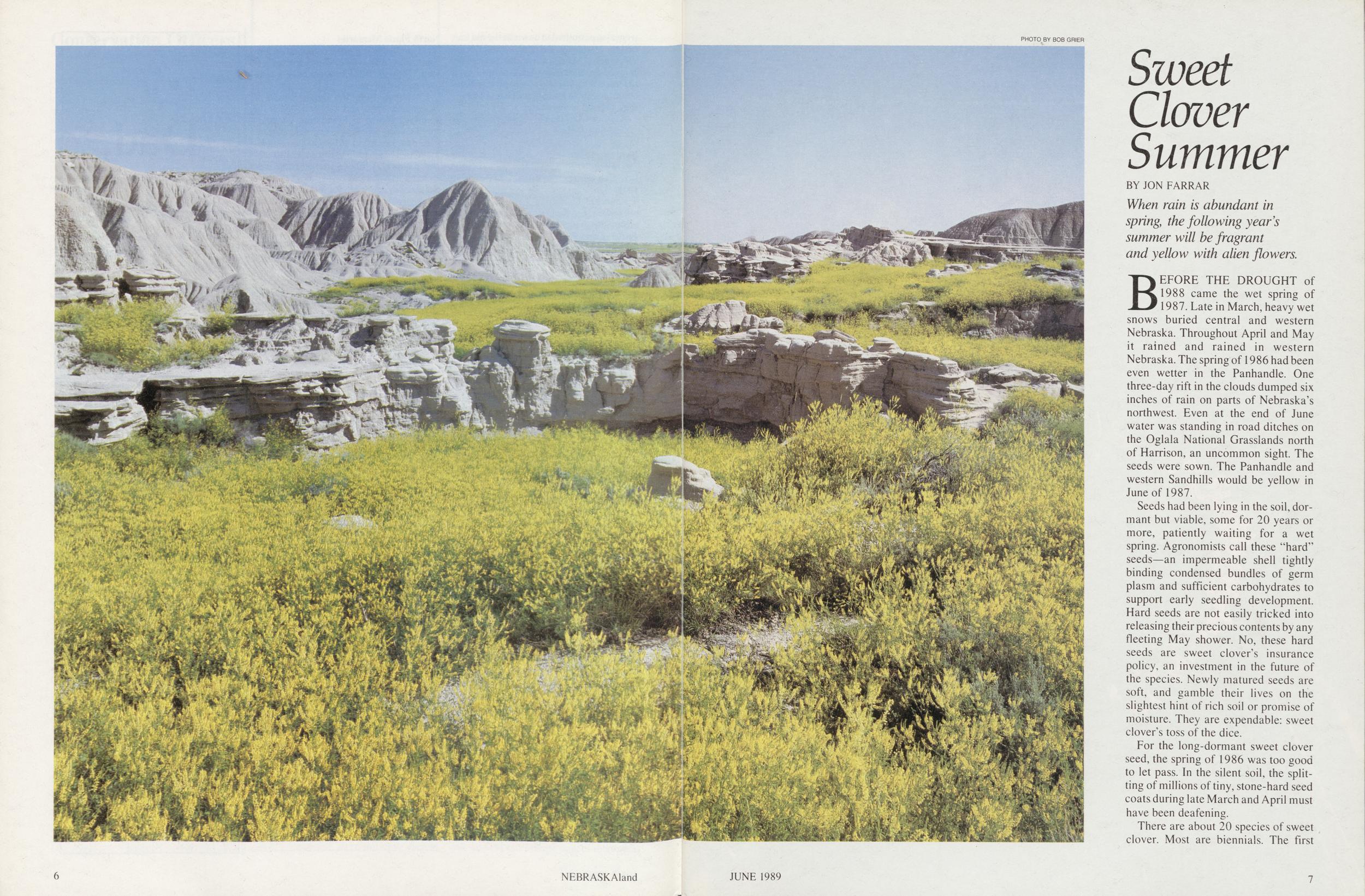
Sweet Clover Summer
BY JON FARRAR When rain is abundant in spring, the following year's summer will be fragrant and yellow with alien flowers.BEFORE THE DROUGHT of 1988 came the wet spring of 1987. Late in March, heavy wet snows buried central and western Nebraska. Throughout April and May it rained and rained in western Nebraska. The spring of 1986 had been even wetter in the Panhandle. One three-day rift in the clouds dumped six inches of rain on parts of Nebraska's northwest. Even at the end of June water was standing in road ditches on the Oglala National Grasslands north of Harrison, an uncommon sight. The seeds were sown. The Panhandle and western Sandhills would be yellow in June of 1987.
Seeds had been lying in the soil, dormant but viable, some for 20 years or more, patiently waiting for a wet spring. Agronomists call these "hard" seeds—an impermeable shell tightly binding condensed bundles of germ plasm and sufficient carbohydrates to support early seedling development. Hard seeds are not easily tricked into releasing their precious contents by any fleeting May shower. No, these hard seeds are sweet clover's insurance policy, an investment in the future of the species. Newly matured seeds are soft, and gamble their lives on the slightest hint of rich soil or promise of moisture. They are expendable: sweet clover's toss of the dice.
For the long-dormant sweet clover seed, the spring of 1986 was too good to let pass. In the silent soil, the splitting of millions of tiny, stone-hard seed coats during late March and April must have been deafening.
There are about 20 species of sweet
clover. Most are biennials. The first
JUNE 1989
7
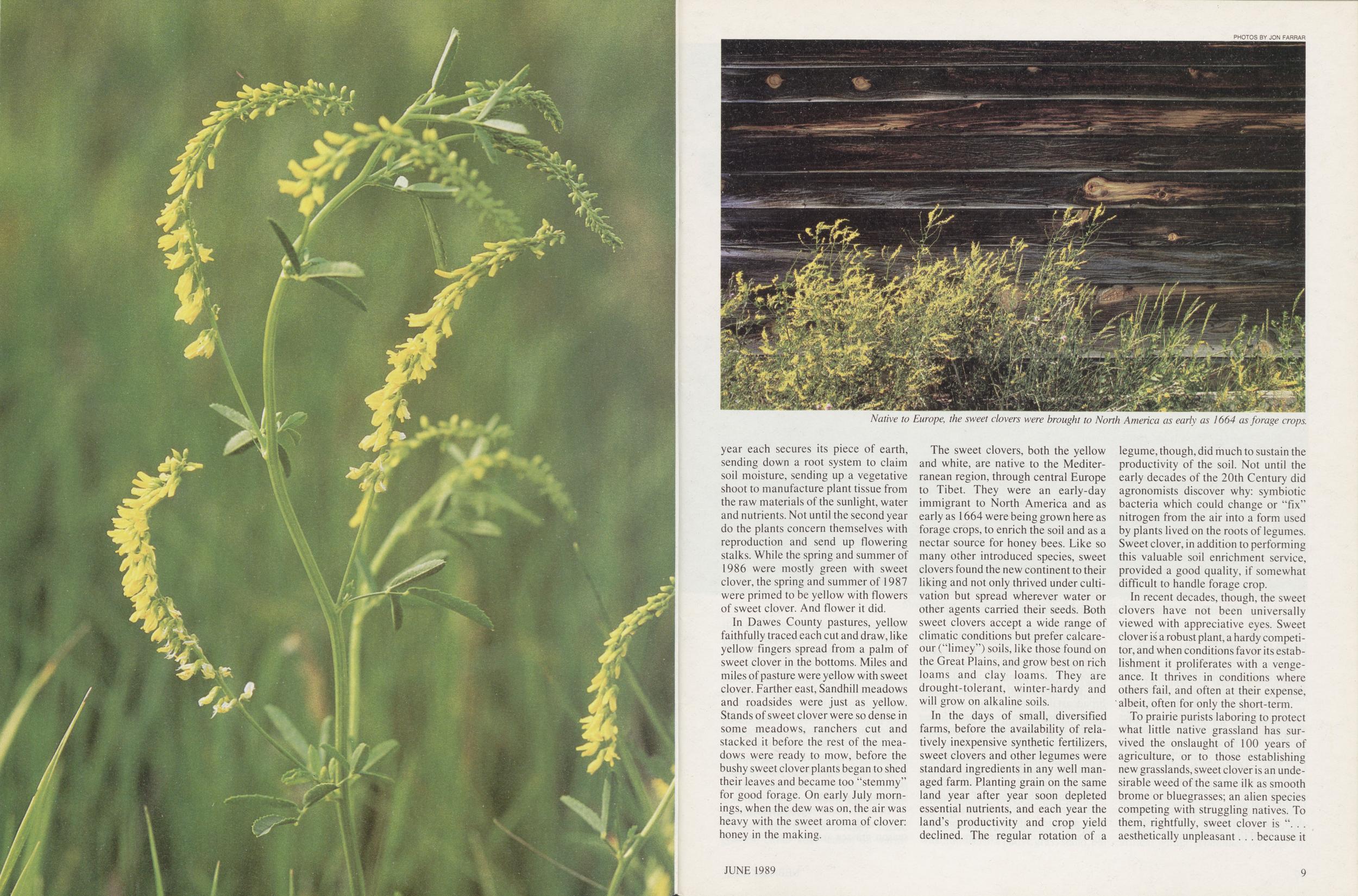
In Dawes County pastures, yellow faithfully traced each cut and draw, like yellow fingers spread from a palm of sweet clover in the bottoms. Miles and miles of pasture were yellow with sweet clover. Farther east, Sandhill meadows and roadsides were just as yellow. Stands of sweet clover were so dense in some meadows, ranchers cut and stacked it before the rest of the meadows were ready to mow, before the bushy sweet clover plants began to shed their leaves and became too "stemmy" for good forage. On early July mornings, when the dew was on, the air was heavy with the sweet aroma of clover: honey in the making.
The sweet clovers, both the yellow and white, are native to the Mediterranean region, through central Europe to Tibet. They were an early-day immigrant to North America and as early as 1664 were being grown here as forage crops, to enrich the soil and as a nectar source for honey bees. Like so many other introduced species, sweet clovers found the new continent to their liking and not only thrived under cultivation but spread wherever water or other agents carried their seeds. Both sweet clovers accept a wide range of climatic conditions but prefer calcareour ("limey") soils, like those found on the Great Plains, and grow best on rich loams and clay loams. They are drought-tolerant, winter-hardy and will grow on alkaline soils.
In the days of small, diversified farms, before the availability of relatively inexpensive synthetic fertilizers, sweet clovers and other legumes were standard ingredients in any well managed farm. Planting grain on the same land year after year soon depleted essential nutrients, and each year the land's productivity and crop yield declined. The regular rotation of a legume, though, did much to sustain the productivity of the soil. Not until the early decades of the 20th Century did agronomists discover why: symbiotic bacteria which could change or "fix" nitrogen from the air into a form used by plants lived on the roots of legumes. Sweet clover, in addition to performing this valuable soil enrichment service, provided a good quality, if somewhat difficult to handle forage crop.
In recent decades, though, the sweet clovers have not been universally viewed with appreciative eyes. Sweet clover is a robust plant, a hardy competitor, and when conditions favor its establishment it proliferates with a vengeance. It thrives in conditions where others fail, and often at their expense, albeit, often for only the short-term.
To prairie purists laboring to protect
what little native grassland has survived the onslaught of 100 years of
agriculture, or to those establishing
new grasslands, sweet clover is an undesirable weed of the same ilk as smooth
brome or bluegrasses; an alien species
competing with struggling natives. To
them, rightfully, sweet clover is ". . .
aesthetically unpleasant. . . because it
JUNE 1989
9
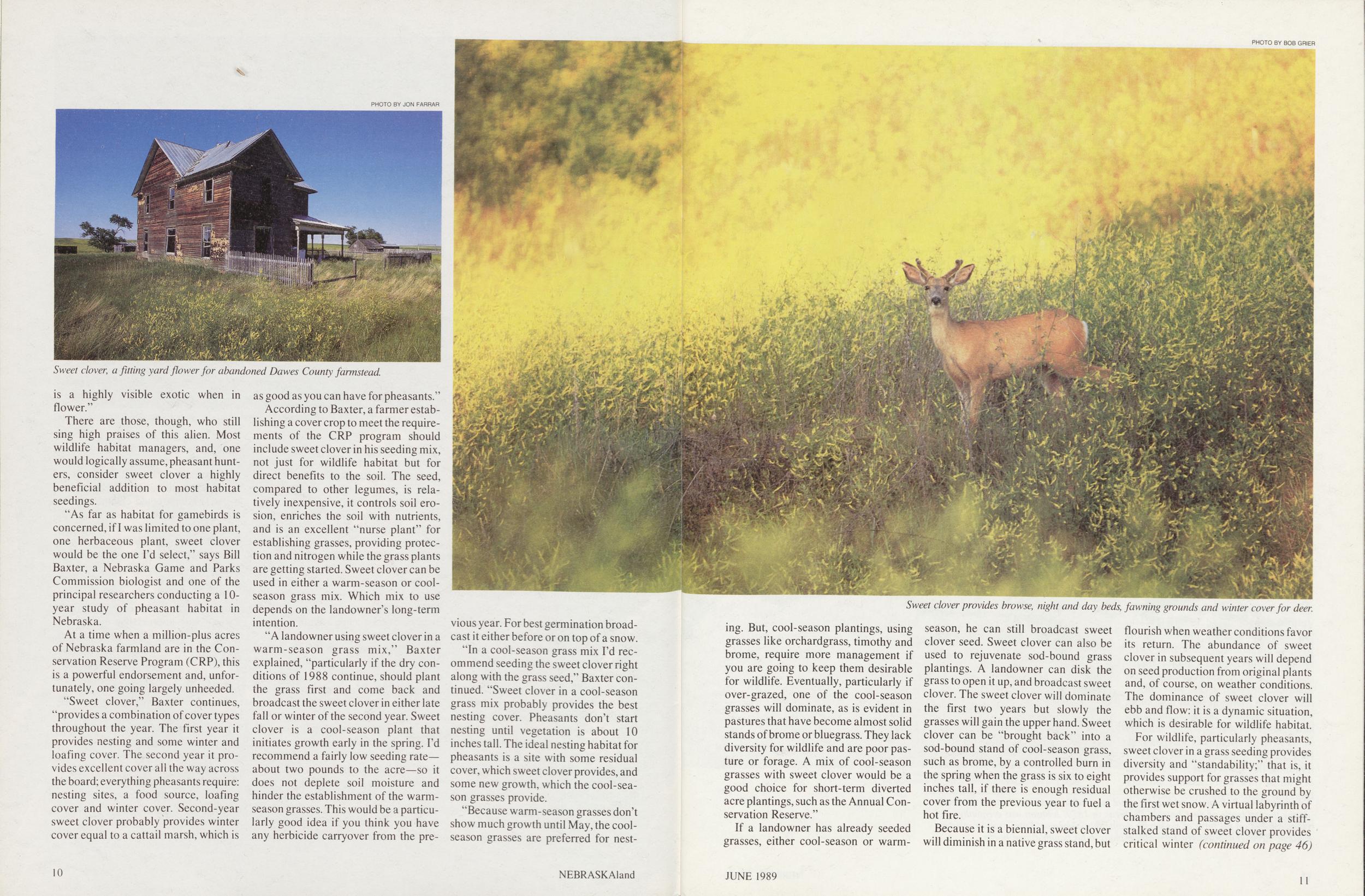
There are those, though, who still sing high praises of this alien. Most wildlife habitat managers, and, one would logically assume, pheasant hunters, consider sweet clover a highly beneficial addition to most habitat seedings.
"As far as habitat for gamebirds is concerned, if I was limited to one plant, one herbaceous plant, sweet clover would be the one I'd select," says Bill Baxter, a Nebraska Game and Parks Commission biologist and one of the principal researchers conducting a 10-year study of pheasant habitat in Nebraska.
At a time when a million-plus acres of Nebraska farmland are in the Conservation Reserve Program (CRP), this is a powerful endorsement and, unfortunately, one going largely unheeded.
"Sweet clover," Baxter continues, "provides a combination of cover types throughout the year. The first year it provides nesting and some winter and loafing cover. The second year it provides excellent cover all the way across the board; everything pheasants require: nesting sites, a food source, loafing cover and winter cover. Second-year sweet clover probably provides winter cover equal to a cattail marsh, which is as good as you can have for pheasants."
According to Baxter, a farmer establishing a cover crop to meet the requirements of the CRP program should include sweet clover in his seeding mix, not just for wildlife habitat but for direct benefits to the soil. The seed, compared to other legumes, is relatively inexpensive, it controls soil erosion, enriches the soil with nutrients, and is an excellent "nurse plant" for establishing grasses, providing protection and nitrogen while the grass plants are getting started. Sweet clover can be used in either a warm-season or cool-season grass mix. Which mix to use depends on the landowner's long-term intention.
"A landowner using sweet clover in a warm-season grass mix,' Baxter explained, "particularly if the dry conditions of 1988 continue, should plant the grass first and come back and broadcast the sweet clover in either late fall or winter of the second year. Sweet clover is a cool-season plant that initiates growth early in the spring. I'd recommend a fairly low seeding rate—about two pounds to the acre—so it does not deplete soil moisture and hinder the establishment of the warmseason grasses. This would be a particularly good idea if you think you have any herbicide carryover from the previous year. For best germination broadcast it either before or on top of a snow.
"In a cool-season grass mix I'd recommend seeding the sweet clover right along with the grass seed," Baxter continued. "Sweet clover in a cool-season grass mix probably provides the best nesting cover. Pheasants don't start nesting until vegetation is about 10 inches tall. The ideal nesting habitat for pheasants is a site with some residual cover, which sweet clover provides, and some new growth, which the cool-season grasses provide.
"Because warm-season grasses don't show much growth until May, the cool-season grasses are preferred for nesting.
If a landowner has already seeded grasses, either cool-season or warm-season, he can still broadcast sweet clover seed. Sweet clover can also be used to rejuvenate sod-bound grass plantings. A landowner can disk the grass to open it up, and broadcast sweet clover. The sweet clover will dominate the first two years but slowly the grasses will gain the upper hand. Sweet clover can be "brought back" into a sod-bound stand of cool-season grass, such as brome, by a controlled burn in the spring when the grass is six to eight inches tall, if there is enough residual cover from the previous year to fuel a hot fire.
Because it is a biennial, sweet clover will diminish in a native grass stand, but flourish when weather conditions favor its return. The abundance of sweet clover in subsequent years will depend on seed production from original plants and, of course, on weather conditions. The dominance of sweet clover will ebb and flow: it is a dynamic situation, which is desirable for wildlife habitat.
For wildlife, particularly pheasants, sweet clover in a grass seeding provides diversity and "standability;" that is, it provides support for grasses that might otherwise be crushed to the ground by the first wet snow. A virtual labyrinth of chambers and passages under a stiff-stalked stand of sweet clover provides critical winter (continued on page 46)
JUNE 1989 11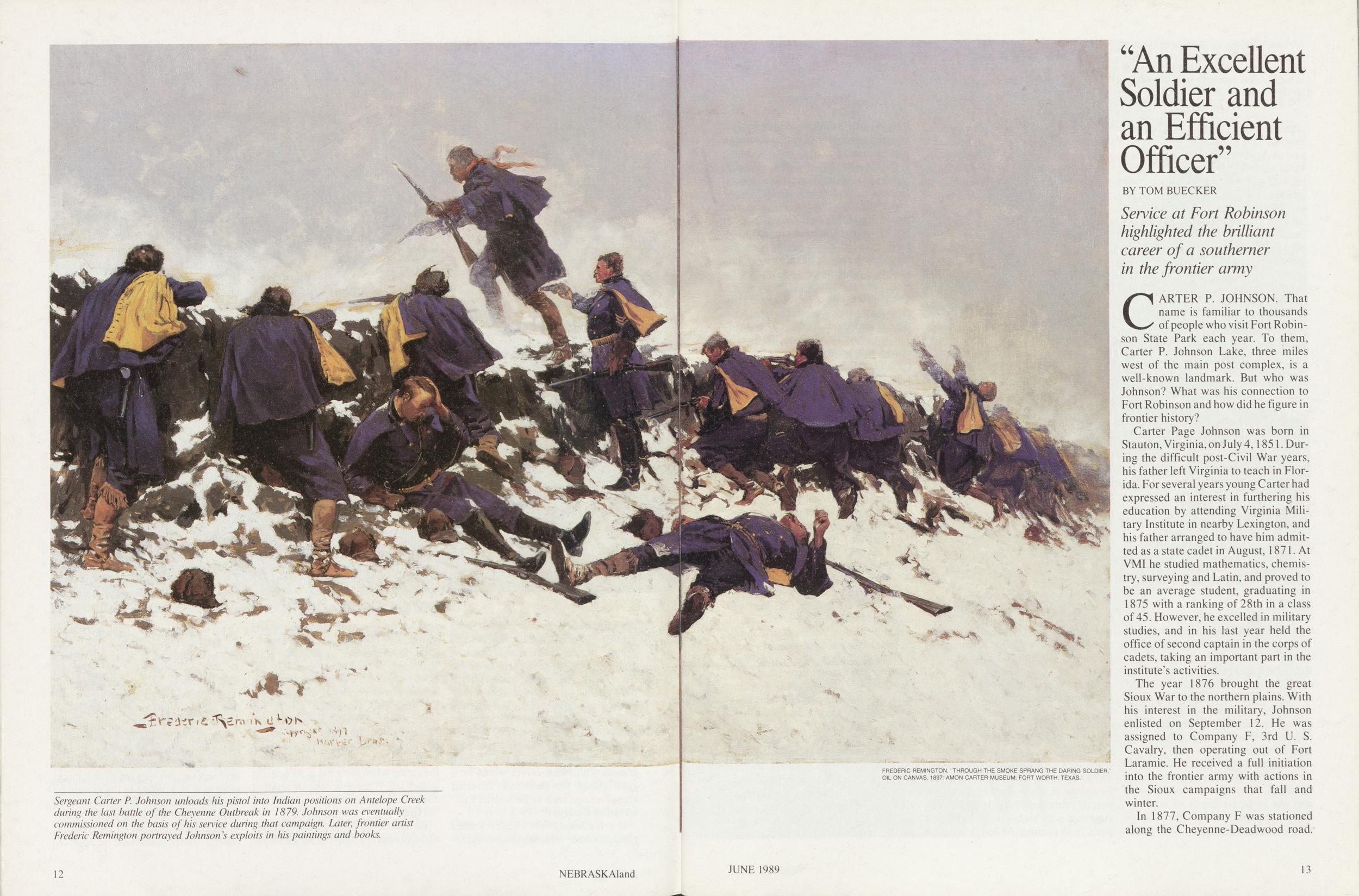
"An Excellent Soldier and an Efficient Officer"
BY TOM BUECKER Service at Fort Robinson highlighted the brilliant career of a southerner in the frontier armyCARTER P. JOHNSON. That name is familiar to thousands of people who visit Fort Robinson State Park each year. To them, Carter P. Johnson Lake, three miles west of the main post complex, is a well-known landmark. But who was Johnson? What was his connection to Fort Robinson and how did he figure in frontier history?
Carter Page Johnson was born in Stauton, Virginia, on July 4,1851. During the difficult post-Civil War years, his father left Virginia to teach in Florida. For several years young Carter had expressed an interest in furthering his education by attending Virginia Military Institute in nearby Lexington, and his father arranged to have him admitted as a state cadet in August, 1871. At VMI he studied mathematics, chemistry, surveying and Latin, and proved to be an average student, graduating in 1875 with a ranking of 28th in a class of 45. However, he excelled in military studies, and in his last year held the office of second captain in the corps of cadets, taking an important part in the institute's activities.
The year 1876 brought the great Sioux War to the northern plains. With his interest in the military, Johnson enlisted on September 12. He was assigned to Company F, 3rd U. S. Cavalry, then operating out of Fort Laramie. He received a full initiation into the frontier army with actions in the Sioux campaigns that fall and winter.
In 1877, Company F was stationed
along the Cheyenne-Deadwood road.
JUNE 1989
13
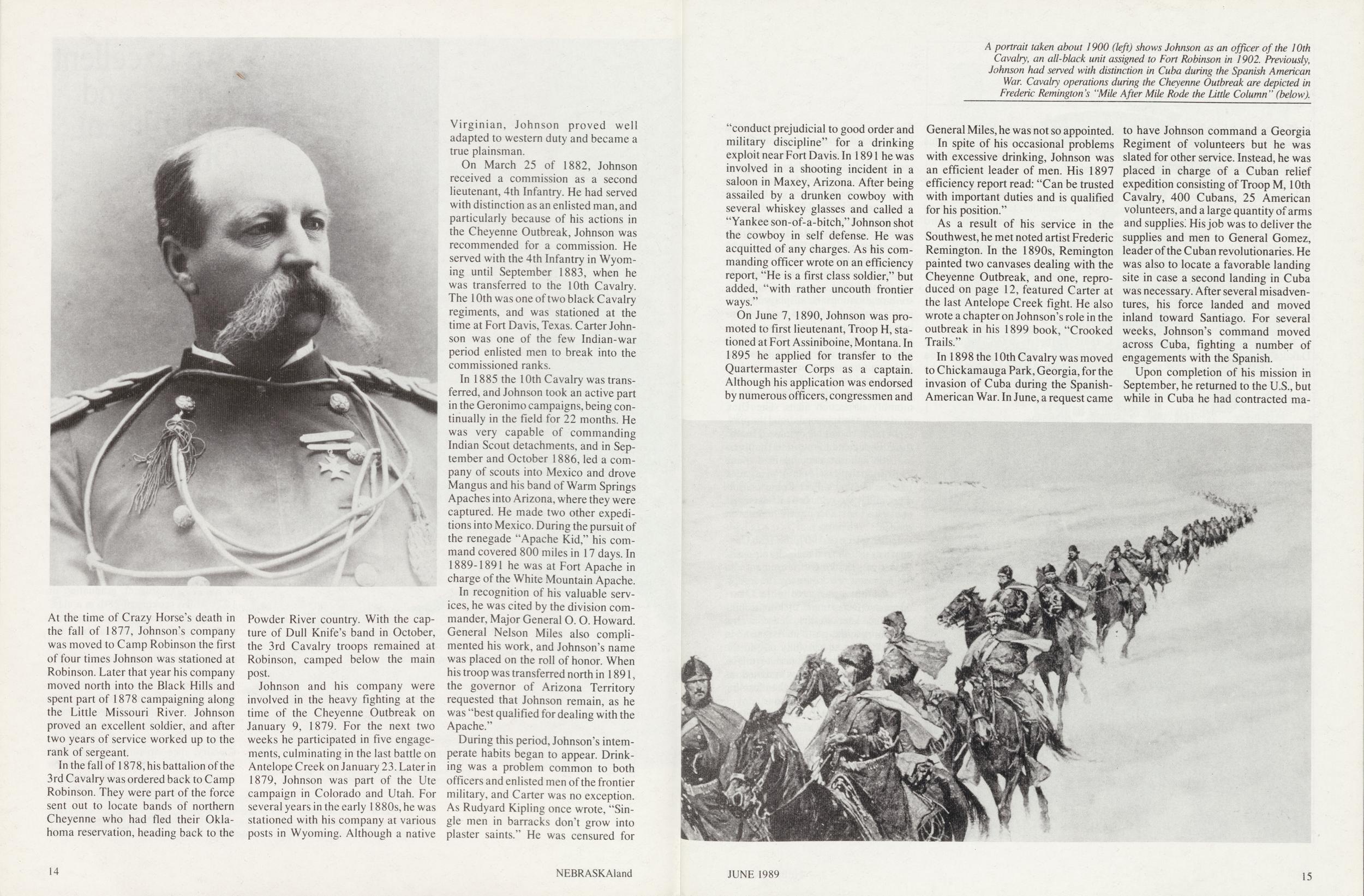
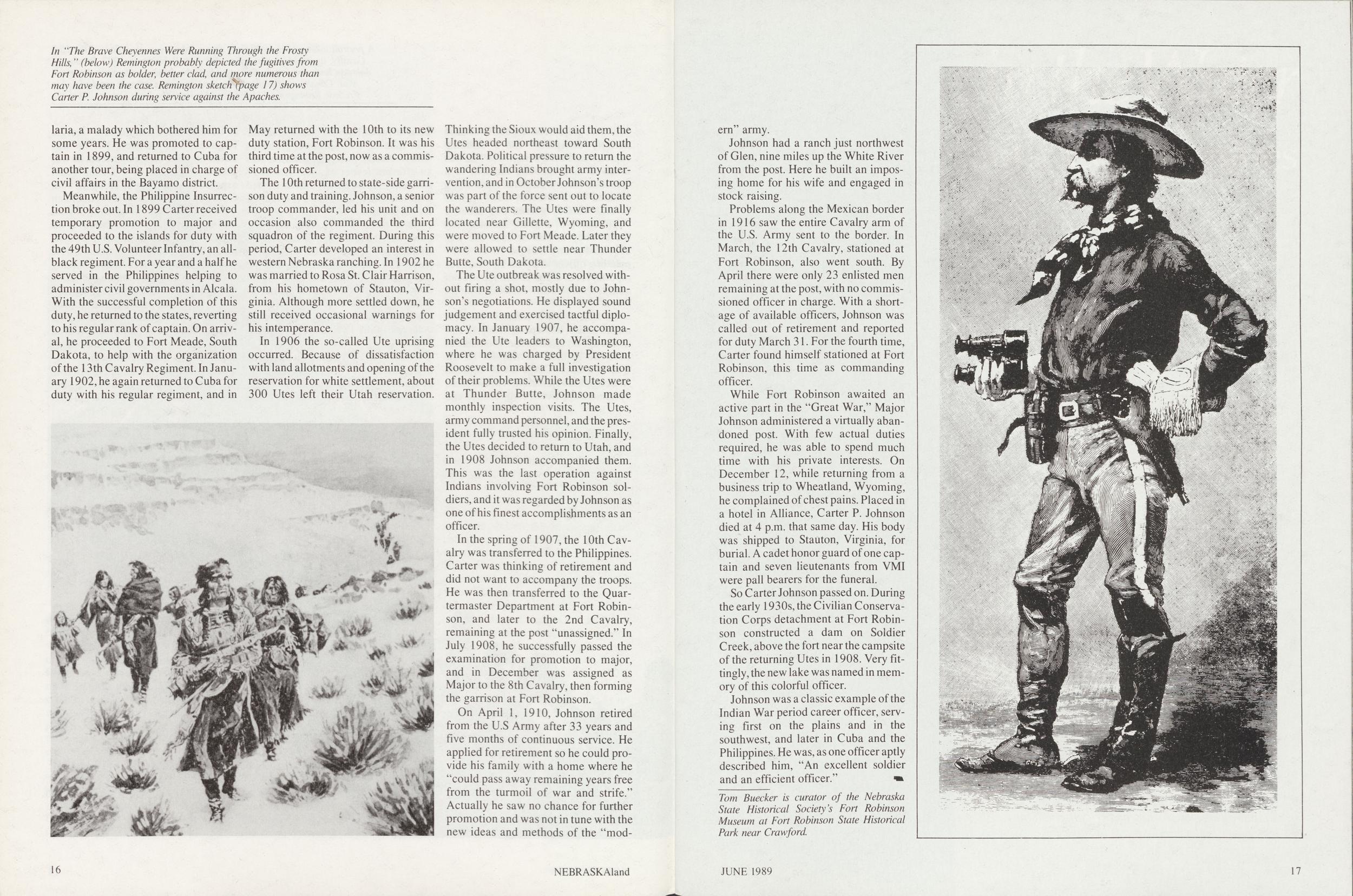
In the fall of 1878, his battalion of the 3rd Cavalry was ordered back to Camp Robinson. They were part of the force sent out to locate bands of northern Cheyenne who had fled their Oklahoma reservation, heading back to the Powder River country. With the capture of Dull Knife's band in October, the 3rd Cavalry troops remained at Robinson, camped below the main post.
Johnson and his company were involved in the heavy fighting at the time of the Cheyenne Outbreak on January 9, 1879. For the next two weeks he participated in five engagements, culminating in the last battle on Antelope Creek on January 23. Later in 1879, Johnson was part of the Ute campaign in Colorado and Utah. For several years in the early 1880s, he was stationed with his company at various posts in Wyoming. Although a native Virginian, Johnson proved well adapted to western duty and became a true plainsman.
On March 25 of 1882, Johnson received a commission as a second lieutenant, 4th Infantry. He had served with distinction as an enlisted man, and particularly because of his actions in the Cheyenne Outbreak, Johnson was recommended for a commission. He served with the 4th Infantry in Wyoming until September 1883, when he was transferred to the 10th Cavalry. The 10th was one of two black Cavalry regiments, and was stationed at the time at Fort Davis, Texas. Carter Johnson was one of the few Indian-war period enlisted men to break into the commissioned ranks.
In 1885 the 10th Cavalry was transferred, and Johnson took an active part in the Geronimo campaigns, being continually in the field for 22 months. He was very capable of commanding Indian Scout detachments, and in September and October 1886, led a company of scouts into Mexico and drove Mangus and his band of Warm Springs Apaches into Arizona, where they were captured. He made two other expeditions into Mexico. During the pursuit of the renegade "Apache Kid," his command covered 800 miles in 17 days. In 1889-1891 he was at Fort Apache in charge of the White Mountain Apache.
In recognition of his valuable services, he was cited by the division commander, Major General O. O. Howard. General Nelson Miles also complimented his work, and Johnson's name was placed on the roll of honor. When his troop was transferred north in 1891, the governor of Arizona Territory requested that Johnson remain, as he was "best qualified for dealing with the Apache."
During this period, Johnson's intemperate habits began to appear. Drinking was a problem common to both officers and enlisted men of the frontier military, and Carter was no exception. As Rudyard Kipling once wrote, "Single men in barracks don't grow into plaster saints." He was censured for "conduct prejudicial to good order and military discipline" for a drinking exploit near Fort Davis. In 1891 he was involved in a shooting incident in a saloon in Maxey, Arizona. After being assailed by a drunken cowboy with several whiskey glasses and called a "Yankee son-of-a-bitch," Johnson shot the cowboy in self defense. He was acquitted of any charges. As his commanding officer wrote on an efficiency report, "He is a first class soldier," but added, "with rather uncouth frontier ways."
On June 7, 1890, Johnson was promoted to first lieutenant, Troop H, stationed at Fort Assiniboine, Montana. In 1895 he applied for transfer to the Quartermaster Corps as a captain. Although his application was endorsed by numerous officers, congressmen and General Miles, he was not so appointed.
In spite of his occasional problems with excessive drinking, Johnson was an efficient leader of men. His 1897 efficiency report read: "Can be trusted with important duties and is qualified for his position."
As a result of his service in the Southwest, he met noted artist Frederic Remington. In the 1890s, Remington painted two canvases dealing with the Cheyenne Outbreak, and one, reproduced on page 12, featured Carter at the last Antelope Creek fight. He also wrote a chapter on Johnson's role in the outbreak in his 1899 book, "Crooked Trails."
In 1898 the 10th Cavalry was moved to Chickamauga Park, Georgia, for the invasion of Cuba during the Spanish-American War. In June, a request came to have Johnson command a Georgia Regiment of volunteers but he was slated for other service. Instead, he was placed in charge of a Cuban relief expedition consisting of Troop M, 10th Cavalry, 400 Cubans, 25 American volunteers, and a large quantity of arms and supplies! His job was to deliver the supplies and men to General Gomez, leader of the Cuban revolutionaries. He was also to locate a favorable landing site in case a second landing in Cuba was necessary. After several misadventures, his force landed and moved inland toward Santiago. For several weeks, Johnson's command moved across Cuba, fighting a number of engagements with the Spanish.
Upon completion of his mission in
September, he returned to the U.S., but
while in Cuba he had contracted malaria,
JUNE 1989
15
 a malady which bothered him for
some years. He was promoted to captain in 1899, and returned to Cuba for
another tour, being placed in charge of
civil affairs in the Bayamo district.
a malady which bothered him for
some years. He was promoted to captain in 1899, and returned to Cuba for
another tour, being placed in charge of
civil affairs in the Bayamo district.
Meanwhile, the Philippine Insurrection broke out. In 1899 Carter received temporary promotion to major and proceeded to the islands for duty with the 49th U.S. Volunteer Infantry, an all-black regiment. For a year and a half he served in the Philippines helping to administer civil governments in Alcala. With the successful completion of this duty, he returned to the states, reverting to his regular rank of captain. On arrival, he proceeded to Fort Meade, South Dakota, to help with the organization of the 13th Cavalry Regiment. In January 1902, he again returned to Cuba for duty with his regular regiment, and in May returned with the 10th to its new duty station, Fort Robinson. It was his third time at the post, now as a commissioned officer.
The 10th returned to state-side garrison duty and training. Johnson, a senior troop commander, led his unit and on occasion also commanded the third squadron of the regiment. During this period, Carter developed an interest in western Nebraska ranching. In 1902 he was married to Rosa St. Clair Harrison, from his hometown of Stauton, Virginia. Although more settled down, he still received occasional warnings for his intemperance.
In 1906 the so-called Ute uprising occurred. Because of dissatisfaction with land allotments and opening of the reservation for white settlement, about 300 Utes left their Utah reservation. Thinking the Sioux would aid them, the Utes headed northeast toward South Dakota. Political pressure to return the wandering Indians brought army intervention, and in October Johnson's troop was part of the force sent out to locate the wanderers. The Utes were finally located near Gillette, Wyoming, and were moved to Fort Meade. Later they were allowed to settle near Thunder Butte, South Dakota.
The Ute outbreak was resolved without firing a shot, mostly due to John- son's negotiations. He displayed sound judgement and exercised tactful diplomacy. In January 1907, he accompanied the Ute leaders to Washington, where he was charged by President Roosevelt to make a full investigation of their problems. While the Utes were at Thunder Butte, Johnson made monthly inspection visits. The Utes, army command personnel, and the president fully trusted his opinion. Finally, the Utes decided to return to Utah, and in 1908 Johnson accompanied them. This was the last operation against Indians involving Fort Robinson soldiers, and it was regarded by Johnson as one of his finest accomplishments as an officer.
In the spring of 1907, the 10th Cavalry was transferred to the Philippines. Carter was thinking of retirement and did not want to accompany the troops. He was then transferred to the Quartermaster Department at Fort Robinson, and later to the 2nd Cavalry, remaining at the post "unassigned." In July 1908, he successfully passed the examination for promotion to major, and in December was assigned as Major to the 8th Cavalry, then forming the garrison at Fort Robinson.
On April 1, 1910, Johnson retired from the U.S Army after 33 years and five months of continuous service. He applied for retirement so he could provide his family with a home where he "could pass away remaining years free from the turmoil of war and strife." Actually he saw no chance for further promotion and was not in tune with the new ideas and methods of the "modern 16 NEBRASKAland army.
Johnson had a ranch just northwest of Glen, nine miles up the White River from the post. Here he built an imposing home for his wife and engaged in stock raising.
Problems along the Mexican border in 1916 saw the entire Cavalry arm of the U.S. Army sent to the border. In March, the 12th Cavalry, stationed at Fort Robinson, also went south. By April there were only 23 enlisted men remaining at the post, with no commissioned officer in charge. With a shortage of available officers, Johnson was called out of retirement and reported for duty March 31. For the fourth time, Carter found himself stationed at Fort Robinson, this time as commanding officer.
While Fort Robinson awaited an active part in the "Great War," Major Johnson administered a virtually abandoned post. With few actual duties required, he was able to spend much time with his private interests. On December 12, while returning from a business trip to Wheatland, Wyoming, he complained of chest pains. Placed in a hotel in Alliance, Carter P. Johnson died at 4 p.m. that same day. His body was shipped to Stauton, Virginia, for burial. A cadet honor guard of one captain and seven lieutenants from VMI were pall bearers for the funeral.
So Carter Johnson passed on. During the early 1930s, the Civilian Conservation Corps detachment at Fort Robinson constructed a dam on Soldier Creek, above the fort near the campsite of the returning Utes in 1908. Very fittingly, the new lake was named in memory of this colorful officer.
Johnson was a classic example of the Indian War period career officer, serving first on the plains and in the southwest, and later in Cuba and the Philippines. He was, as one officer aptly described him, "An excellent soldier and an efficient officer."
Tom Buecker is curator of the Nebraska State Historical Society's Fort Robinson Museum at Fort Robinson State Historical Park near Crawford.
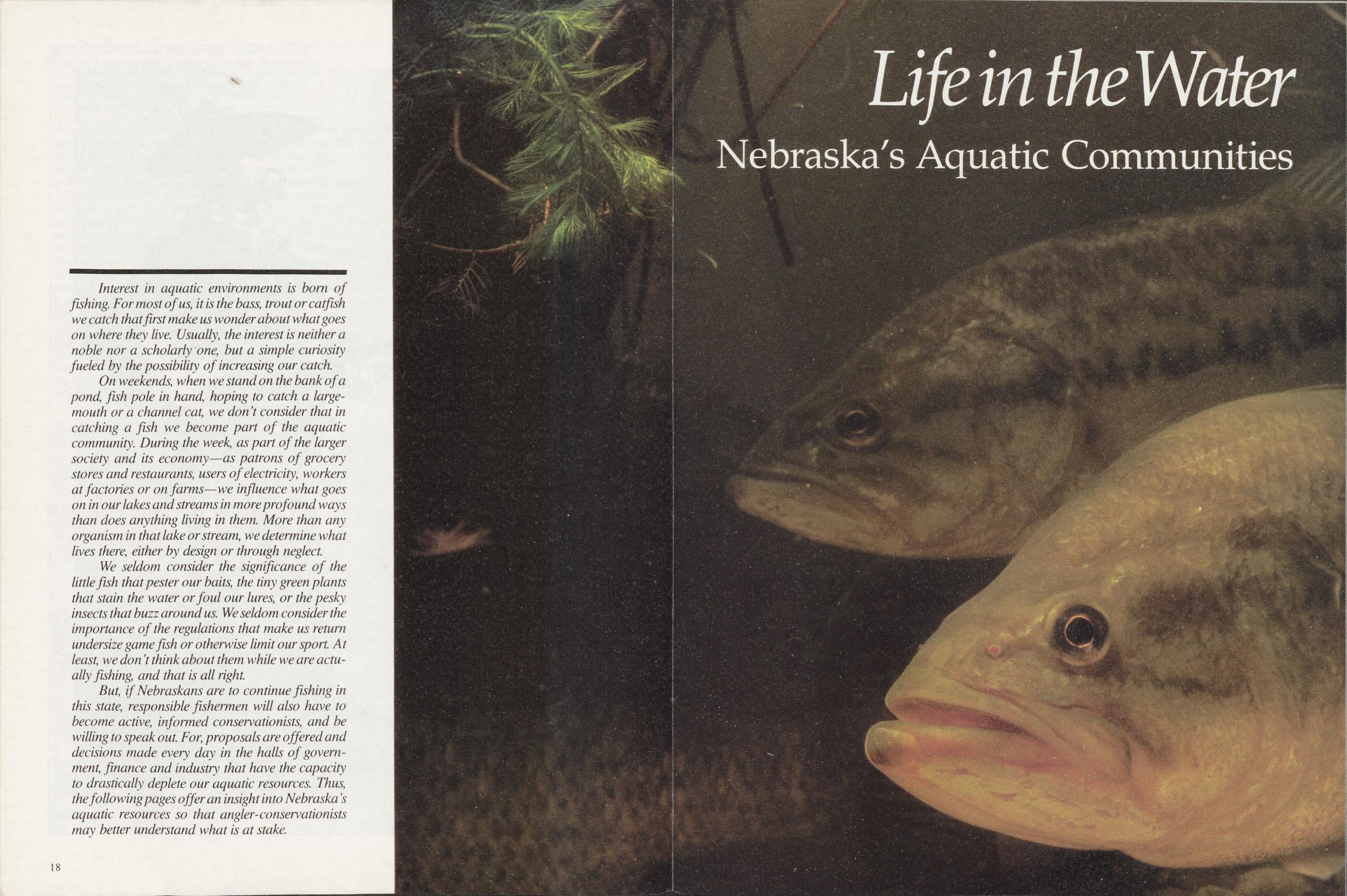
Life in the Water Nebraska's Aquatic Communities
Interest in aquatic environments is born of fishing. For most of us, it is the bass, trout or catfish we catch that first make us wonder about what goes on where they live. Usually, the interest is neither a noble nor a scholarly one, but a simple curiosity fueled by the possibility of increasing our catch.
On weekends, when we stand on the bank of a pond, fish pole in hand, hoping to catch a largemouth or a channel cat, we don't consider that in catching a fish we become part of the aquatic community. During the week, as part of the larger society and its economy—as patrons of grocery stores and restaurants, users of electricity, workers at factories or on farms—we influence what goes on in our lakes and streams in more profound ways than does anything living in them. More than any organism in that lake or stream, we determine what lives there, either by design or through neglect.
We seldom consider the significance of the little fish that pester our baits, the tiny green plants that stain the water or foul our lures, or the pesky insects that buzz around us. We seldom consider the importance of the regulations that make us return undersize game fish or otherwise limit our sport. At least, we don't think about them while we are actually fishing, and that is all right.
But, if Nebraskans are to continue fishing in this state, responsible fishermen will also have to become active, informed conservationists, and be willing to speak out. For, proposals are offered and decisions made every day in the halls of government, finance and industry that have the capacity to drastically deplete our aquatic resources. Thus, the following pages offer an insight into Nebraska's aquatic resources so that angler-conservationists may better understand what is at stake.
18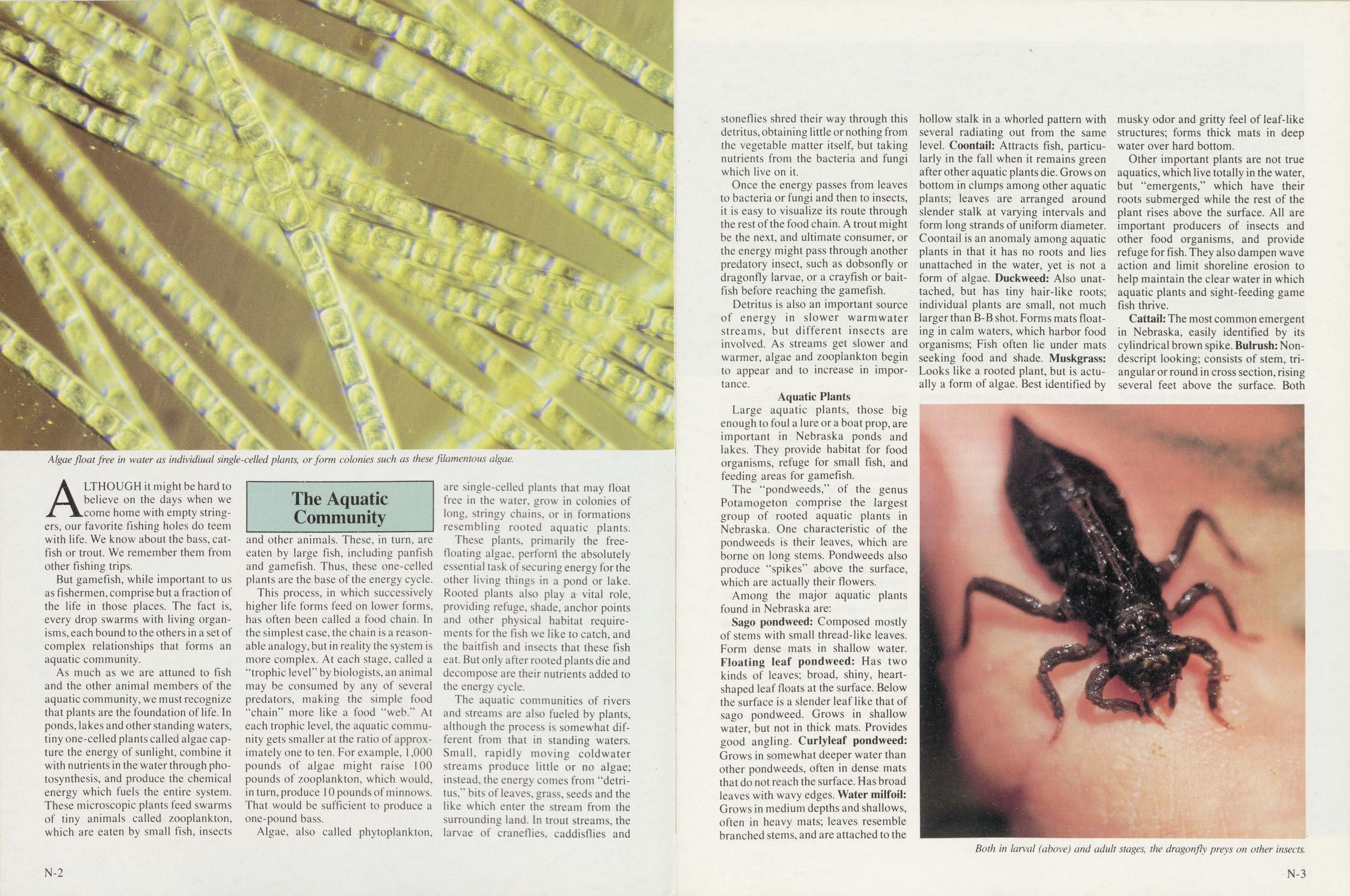
ALTHOUGH it might be hard to believe on the days when we come home with empty stringers, our favorite fishing holes do teem with life. We know about the bass, catfish or trout. We remember them from other fishing trips.
But gamefish, while important to us as fishermen, comprise but a fraction of the life in those places. The fact is, every drop swarms with living organisms, each bound to the others in a set of complex relationships that forms an aquatic community.
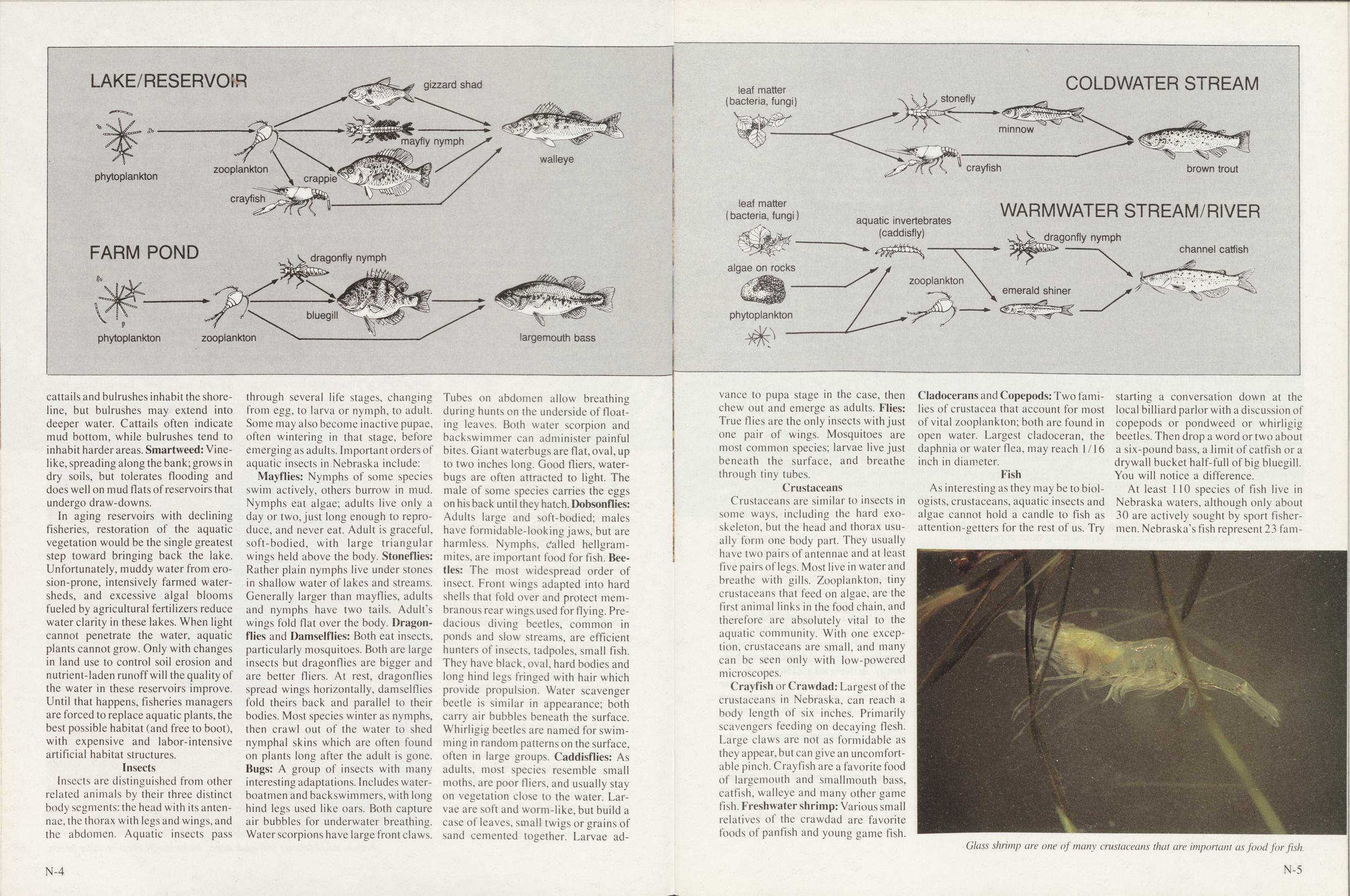
As much as we are attuned to fish and the other animal members of the aquatic community, we must recognize that plants are the foundation of life. In ponds, lakes and other standing waters, tiny one-celled plants called algae capture the energy of sunlight, combine it with nutrients in the water through photosynthesis, and produce the chemical energy which fuels the entire system. These microscopic plants feed swarms of tiny animals called zooplankton, which are eaten by small fish, insects and other animals. These, in turn, are eaten by large fish, including panfish and gamefish. Thus, these one-celled plants are the base of the energy cycle.
The Aquatic CommunityThis process, in which successively higher life forms feed on lower forms, has often been called a food chain. In the simplest case, the chain is a reasonable analogy, but in reality the system is more complex. At each stage, called a "trophic level" by biologists, an animal may be consumed by any of several predators, making the simple food "chain" more like a food "web." At each trophic level, the aquatic community gets smaller at the ratio of approximately one to ten. For example, 1,000 pounds of algae might raise 100 pounds of zooplankton, which would, in turn, produce 10 pounds of minnows. That would be sufficient to produce a one-pound bass.
Algae, also called phytoplankton, are single-celled plants that may float free in the water, grow in colonies of long, stringy chains, or in formations resembling rooted aquatic plants.
These plants, primarily the free-floating algae, perform the absolutely essential task of securing energy for the other living things in a pond or lake. Rooted plants also play a vital role, providing refuge, shade, anchor points and other physical habitat requirements for the fish we like to catch, and the baitfish and insects that these fish eat. But only after rooted plants die and decompose are their nutrients added to the energy cycle.
The aquatic communities of rivers and streams are also fueled by plants, although the process is somewhat different from that in standing waters. Small, rapidly moving coldwater streams produce little or no algae; instead, the energy comes from "detritus," bits of leaves, grass, seeds and the like which enter the stream from the surrounding land. In trout streams, the larvae of craneflies, caddisflies and stoneflies shred their way through this detritus, obtaining little or nothing from the vegetable matter itself, but taking nutrients from the bacteria and fungi which live on it.
Once the energy passes from leaves to bacteria or fungi and then to insects, it is easy to visualize its route through the rest of the food chain. A trout might be the next, and ultimate consumer, or the energy might pass through another predatory insect, such as dobsonfly or dragonfly larvae, or a crayfish or baitfish before reaching the gamefish.
Detritus is also an important source of energy in slower warm-water streams, but different insects are involved. As streams get slower and warmer, algae and zooplankton begin to appear and to increase in importance.
Aquatic PlantsLarge aquatic plants, those big enough to foul a lure or a boat prop, are important in Nebraska ponds and lakes. They provide habitat for food organisms, refuge for small fish, and feeding areas for gamefish.
The "pondweeds," of the genus Potamogeton comprise the largest group of rooted aquatic plants in Nebraska. One characteristic of the pondweeds is their leaves, which are borne on long stems. Pondweeds also produce "spikes" above the surface, which are actually their flowers.
Among the major aquatic plants found in Nebraska are:
Sago pondweed: Composed mostly of stems with small thread-like leaves. Form dense mats in shallow water. Floating leaf pondweed: Has two kinds of leaves; broad, shiny, heart-shaped leaf floats at the surface. Below the surface is a slender leaf like that of sago pondweed. Grows in shallow water, but not in thick mats. Provides good angling. Curlyleaf pondweed: Grows in somewhat deeper water than other pondweeds, often in dense mats that do not reach the surface. Has broad leaves with wavy edges. Water milfoil: Grows in medium depths and shallows, often in heavy mats; leaves resemble branched stems, and are attached to the hollow stalk in a whorled pattern with several radiating out from the same level. Coontail: Attracts fish, particularly in the fall when it remains green after other aquatic plants die. Grows on bottom in clumps among other aquatic plants; leaves are arranged around slender stalk at varying intervals and form long strands of uniform diameter. Coontail is an anomaly among aquatic plants in that it has no roots and lies unattached in the water, yet is not a form of algae. Duckweed: Also unattached, but has tiny hair-like roots; individual plants are small, not much larger than B-B shot. Forms mats floating in calm waters, which harbor food organisms; Fish often lie under mats seeking food and shade. Muskgrass: Looks like a rooted plant, but is actually a form of algae. Best identified by musky odor and gritty feel of leaf-like structures; forms thick mats in deep water over hard bottom.
Other important plants are not true aquatics, which live totally in the water, but "emergents," which have their roots submerged while the rest of the plant rises above the surface. All are important producers of insects and other food organisms, and provide refuge for fish. They also dampen wave action and limit shoreline erosion to help maintain the clear water in which aquatic plants and sight-feeding game fish thrive.
Cattail: The most common emergent
in Nebraska, easily identified by its
cylindrical brown spike. Bulrush: Nondescript looking; consists of stem, triangular
or round in cross section, rising
several feet above the surface. Both
N-3
In aging reservoirs with declining fisheries, restoration of the aquatic vegetation would be the single greatest step toward bringing back the lake. Unfortunately, muddy water from erosion-prone, intensively farmed watersheds, and excessive algal blooms fueled by agricultural fertilizers reduce water clarity in these lakes. When light cannot penetrate the water, aquatic plants cannot grow. Only with changes in land use to control soil erosion and nutrient-laden runoff will the quality of the water in these reservoirs improve. Until that happens, fisheries managers are forced to replace aquatic plants, the best possible habitat (and free to boot), with expensive and labor-intensive artificial habitat structures.
InsectsInsects are distinguished from other related animals by their three distinct body segments: the head with its antennae, the thorax with legs and wings, and the abdomen. Aquatic insects pass through several life stages, changing from egg, to larva or nymph, to adult. Some may also become inactive pupae, often wintering in that stage, before emerging as adults. Important orders of aquatic insects in Nebraska include:
Mayflies: Nymphs of some species swim actively, others burrow in mud. Nymphs eat algae; adults live only a day or two, just long enough to reproduce, and never eat. Adult is graceful, soft-bodied, with large triangular wings held above the body. Stoneflies: Rather plain nymphs live under stones in shallow water of lakes and streams. Generally larger than mayflies, adults and nymphs have two tails. Adult's wings fold flat over the body. Dragonflies and Damselflies: Both eat insects, particularly mosquitoes. Both are large insects but dragonflies are bigger and are better fliers. At rest, dragonflies spread wings horizontally, damselflies fold theirs back and parallel to their bodies. Most species winter as nymphs, then crawl out of the water to shed nymphal skins which are often found on plants long after the adult is gone. Bugs: A group of insects with many interesting adaptations. Includes water-boatmen and backswimmers, with long hind legs used like oars. Both capture air bubbles for underwater breathing. Water scorpions have large front claws. Tubes on abdomen allow breathing during hunts on the underside of floating leaves. Both water scorpion and backswimmer can administer painful bites. Giant waterbugs are flat, oval, up to two inches long. Good fliers, waterbugs are often attracted to light. The male of some species carries the eggs on his back until they hatch. Dobsonflies: Adults large and soft-bodied; males have formidable-looking jaws, but are harmless. Nymphs, Called hellgrammites, are important food for fish. Beetles: The most widespread order of insect. Front wings adapted into hard shells that fold over and protect membranous rear wings.used for flying. Pre- dacious diving beetles, common in ponds and slow streams, are efficient hunters of insects, tadpoles, small fish. They have black, oval, hard bodies and long hind legs fringed with hair which provide propulsion. Water scavenger beetle is similar in appearance; both carry air bubbles beneath the surface. Whirligig beetles are named for swimming in random patterns on the surface, often in large groups. Caddisflies: As adults, most species resemble small moths, are poor fliers, and usually stay on vegetation close to the water. Larvae are soft and worm-like, but build a case of leaves, small twigs or grains of sand cemented together. Larvae advance N-4
Crustaceans are similar to insects in some ways, including the hard exoskeleton, but the head and thorax usually form one body part. They usually have two pairs of antennae and at least five pairs of legs. Most live in water and breathe with gills. Zooplankton, tiny crustaceans that feed on algae, are the first animal links in the food chain, and therefore are absolutely vital to the aquatic community. With one exception, crustaceans are small, and many can be seen only with low-powered microscopes.
Crayfish or Crawdad: Largest of the crustaceans in Nebraska, can reach a body length of six inches. Primarily scavengers feeding on decaying flesh. Large claws are not as formidable as they appear, but can give an uncomfortable pinch. Crayfish are a favorite food of largemouth and smallmouth bass, catfish, walleye and many other game fish. Freshwater shrimp: Various small relatives of the crawdad are favorite foods of panfish and young game fish. Cladocerans and Copepods: Two families of erustacea that account for most of vital zooplankton; both are found in open water. Largest cladoceran, the daphnia or water flea, may reach 1/16 inch in diameter.
FishAs interesting as they may be to biologists, crustaceans, aquatic insects and algae cannot hold a candle to fish as attention-getters for the rest of us. Try starting a conversation down at the local billiard parlor with a discussion of copepods or pondweed or whirligig beetles. Then drop a word or two about a six-pound bass, a limit of catfish or a dry wall bucket half-full of big bluegill. You will notice a difference.
At least 110 species of fish live in Nebraska waters, although only about 30 are actively sought by sport fishermen. Nebraska's fish represent 23 families
 ilies, ranging from very ancient forms
to those biologist consider '"modern."
The oldest, the lampreys, sturgeons and
paddlefish, have skeletons of cartilage.
Other ancient fish, including bowfin
and gar, have bony skeletons and hard,
plate-like scales. More-or-less inter-
mediate in age are the fish with bony
skeletons, more delicate round scales
and soft-rayed fins, such as the pike and
trout families. Among the modern fish
are the perch, sunfish and sea bass families, which are characterized by bony
skeletons, rough-edged scales and
spiny-rayed fins.
ilies, ranging from very ancient forms
to those biologist consider '"modern."
The oldest, the lampreys, sturgeons and
paddlefish, have skeletons of cartilage.
Other ancient fish, including bowfin
and gar, have bony skeletons and hard,
plate-like scales. More-or-less inter-
mediate in age are the fish with bony
skeletons, more delicate round scales
and soft-rayed fins, such as the pike and
trout families. Among the modern fish
are the perch, sunfish and sea bass families, which are characterized by bony
skeletons, rough-edged scales and
spiny-rayed fins.
Catfish were widely distributed in Nebraska warm-water streams at the time of settlement, and their pursuit very early became Nebraska's'favorite kind of fishing. The family includes the channel catfish, the state's all-round favorite according to fishing surveys, blue and flathead catfish, black and yellow bullhead, stonecat, and tadpole madtom. Catfish have a smooth, scaleless skin, a wide, flat head, and eight barbels around the mouth. Fin rays are soft, but the leading edge of the dorsal and pectoral fins contain strong, sharp spikes that can inflict a painful wound. Catfish are scavengers, eating dead fish and other animals, which they locate on the bottom by the sense of smell located in their barbels or "whiskers." The one exception is the flathead catfish, a predator which eats only live prey.
The sunfish family may rival the catfish in popularity. Included in this group are largemouth and smallmouth bass, bluegill, black and white crappie, rock bass, and redear sunfish, all popular with anglers, and the green sunfish, pumpkinseed, and orangespotted sunfish. The sunfish are deep-bodied fish with a spiny-rayed dorsal fin in front of one that is soft-rayed. During spawning, the male builds a nest on the bottom, and tends it until the young begin to feed on their own.
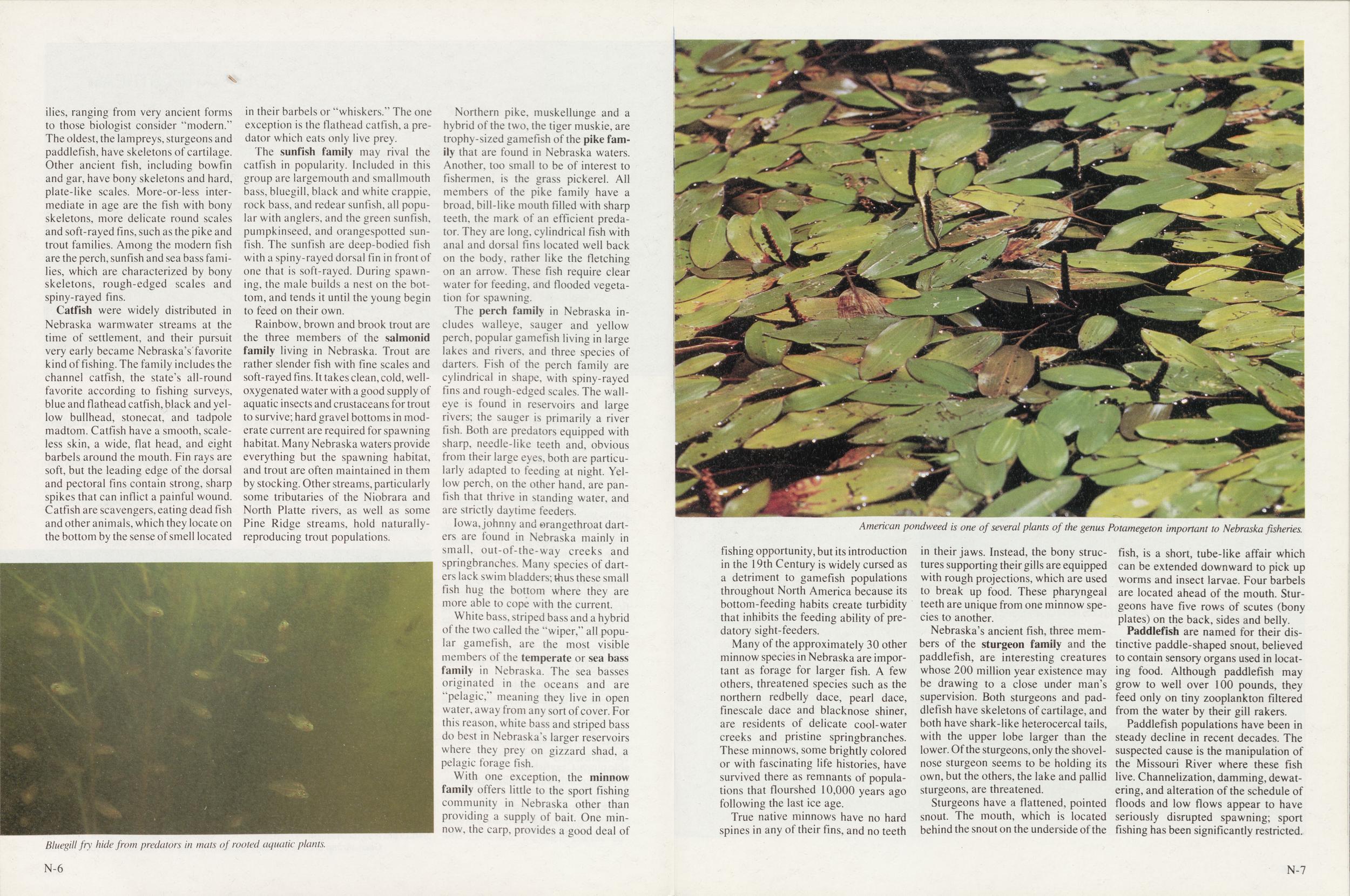
Rainbow, brown and brook trout are the three members of the salmonid family living in Nebraska. Trout are rather slender fish with fine scales and soft-rayed fins. It takes clean, cold, well-oxygenated water with a good supply of aquatic insects and crustaceans for trout to survive; hard gravel bottoms in moderate current are required for spawning habitat. Many Nebraska waters provide everything but the spawning habitat, and trout are often maintained in them by stocking. Other streams, particularly some tributaries of the Niobrara and North Platte rivers, as well as some Pine Ridge streams, hold naturally-reproducing trout populations.
Northern pike, muskellunge and a hybrid of the two, the tiger muskie, are trophy-sized gamefish of the pike family that are found in Nebraska waters. Another, too small to be of interest to fishermen, is the grass pickerel. All members of the pike family have a broad, bill-like mouth filled with sharp teeth, the mark of an efficient predator. They are long, cylindrical fish with anal and dorsal fins located well back on the body, rather like the fletching on an arrow. These fish require clear water for feeding, and flooded vegetation for spawning.
The perch family in Nebraska includes walleye, sauger and yellow perch, popular gamefish living in large lakes and rivers, and three species of darters. Fish of the perch family are cylindrical in shape, with spiny-rayed fins and rough-edged scales. The walleye is found in reservoirs and large rivers; the sauger is primarily a river fish. Both are predators equipped with sharp, needle-like teeth and, obvious from their large eyes, both are particularly adapted to feeding at night. Yellow perch, on the other hand, are panfish that thrive in standing water, and are strictly daytime feeders.
Iowa, johnny and orangethroat darters are found in Nebraska mainly in small, out-of-the-way creeks and spring branches. Many species of darters lack swim bladders; thus these small fish hug the bottom where they are more able to cope with the current. White bass, striped bass and a hybrid of the two called the "wiper," all popular gamefish, are the most visible members of the temperate or sea bass family in Nebraska. The sea basses originated in the oceans and are "pelagic," meaning they live in open water, away from any sort of cover. For this reason, white bass and striped bass do best in Nebraska's larger reservoirs where they prey on gizzard shad, a pelagic forage fish.
With one exception, the minnow family offers little to the sport fishing community in Nebraska other than providing a supply of bait. One minnow, the carp, provides a good deal of N-6
Many of the approximately 30 other minnow species in Nebraska are important as forage for larger fish. A few others, threatened species such as the northern redbelly dace, pearl dace, finescale dace and blacknose shiner, are residents of delicate cool-water creeks and pristine springbranches. These minnows, some brightly colored or with fascinating life histories, have survived there as remnants of populations that flourshed 10,000 years ago following the last ice age.
True native minnows have no hard spines in any of their fins, and no teeth in their jaws. Instead, the bony structures supporting their gills are equipped with rough projections, which are used to break up food. These pharyngeal teeth are unique from one minnow species to another.
Nebraska's ancient fish, three members of the sturgeon family and the paddlefish, are interesting creatures whose 200 million year existence may be drawing to a close under man's supervision. Both sturgeons and paddlefish have skeletons of cartilage, and both have shark-like heterocercal tails, with the upper lobe larger than the lower. Of the sturgeons, only the shovelnose sturgeon seems to be holding its own, but the others, the lake and pallid sturgeons, are threatened.
Sturgeons have a flattened, pointed snout. The mouth, which is located behind the snout on the underside of the fish, is a short, tube-like affair which can be extended downward to pick up worms and insect larvae. Four barbels are located ahead of the mouth. Sturgeons have five rows of scutes (bony plates) on the back, sides and belly.
Paddlefish are named for their distinctive paddle-shaped snout, believed to contain sensory organs used in locating food. Although paddlefish may grow to well over 100 pounds, they feed only on tiny zooplankton filtered from the water by their gill rakers.
Paddlefish populations have been in steady decline in recent decades. The suspected cause is the manipulation of the Missouri River where these fish live. Channelization, damming, dewatering, and alteration of the schedule of floods and low flows appear to have seriously disrupted spawning; sport fishing has been significantly restricted.
N-7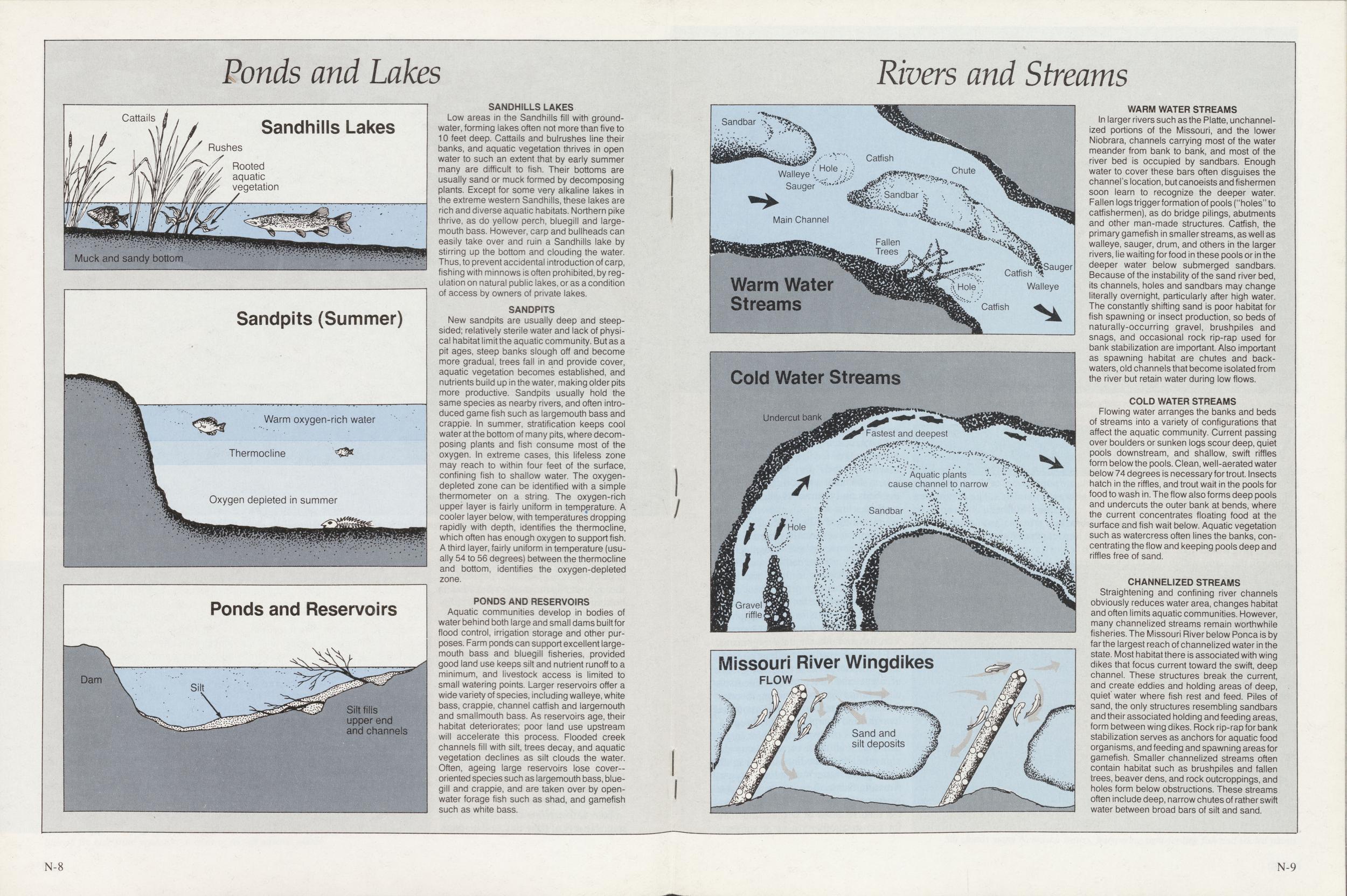 Ponds and Lakes
Low areas in the Sandhills fill with groundwater, forming lakes often not more than five to 10 feet deep. Cattails and bulrushes line their banks, and aquatic vegetation thrives in open water to such an extent that by early summer many are difficult to fish. Their bottoms are usually sand or muck formed by decomposing plants. Except for some very alkaline lakes in the extreme western Sandhills, these lakes are rich and diverse aquatic habitats. Northern pike thrive, as do yellow perch, bluegill and largemouth bass. However, carp and bullheads can easily take over and ruin a Sandhills lake by stirring up the bottom and clouding the water. Thus, to prevent accidental introduction of carp, fishing with minnows is often prohibited, by regulation on natural public lakes, or as a condition of access by owners of private lakes.
SANDPITSNew sandpits are usually deep and steep- sided; relatively sterile water and lack of physical habitat limit the aquatic community. But as a pit ages, steep banks slough off and become more gradual, trees fall in and provide cover, aquatic vegetation becomes established, and nutrients build up in the water, making older pits more productive. Sandpits usually hold the same species as nearby rivers, and often introduced game fish such as largemouth bass and crappie. In summer, stratification keeps cool water at the bottom of many pits, where decomposing plants and fish consume most of the oxygen. In extreme cases, this lifeless zone may reach to within four feet of the surface, confining fish too shallow water. The oxygen-depleted zone can be identified with a simple thermometer on a string. The oxygen-rich upper layer is fairly uniform in temperature. A cooler layer below, with temperatures dropping rapidly with depth, identifies the thermocline, which often has enough oxygen to support fish. A third layer, fairly uniform in temperature (usually 54 to 56 degrees) between the thermocline and bottom, identifies the oxygen-depleted zone.
PONDS AND RESERVOIRSAquatic communities develop in bodies of water behind both large and small dams built for flood control, irrigation storage and other purposes. Farm ponds can support excellent largemouth bass and bluegill fisheries, provided good land use keeps silt and nutrient runoff to a minimum, and livestock access is limited to small watering points. Larger reservoirs offer a wide variety of species, including walleye, white bass, crappie, channel catfish and largemouth and smallmouth bass. As reservoirs age, their habitat deteriorates; poor land use upstream will accelerate this process. Flooded creek channels fill with silt, trees decay, and aquatic vegetation declines as silt clouds the water. Often, aging large reservoirs lose cover-oriented species such as largemouth bass, bluegill and crappie, and are taken over by openwater forage fish such as shad, and gamefish such as white bass.
N-8In larger rivers such as the Platte, unchannelized portions of the Missouri, and the lower Niobrara, channels carrying most of the water meander from bank to bank, and most of the river bed is occupied by sandbars. Enough water to cover these bars often disguises the channel's location, but canoeists and fishermen soon learn to recognize the deeper water. Fallen logs trigger formation of pools ("holes" to catfishermen), as do bridge pilings, abutments and other man-made structures. Catfish, the primary gamefish in smaller streams, as well as walleye, sauger, drum, and others in the larger rivers, lie waiting for food in these pools or in the deeper water below submerged sandbars. Because of the instability of the sand river bed, its channels, holes and sandbars may change literally overnight, particularly after high water. The constantly shifting sand is poor habitat for fish spawning or insect production, so beds of naturally-occurring gravel, brushpiles and snags, and occasional rock rip-rap used for bank stabilization are important. Also important as spawning habitat are chutes and backwaters, old channels that become isolated from the river but retain water during low flows.
COLD WATER STREAMSFlowing water arranges the banks and beds of streams into a variety of configurations that affect the aquatic community. Current passing over boulders or sunken logs scour deep, quiet pools downstream, and shallow, swift riffles form below the pools. Clean, well-aerated water below 74 degrees is necessary for trout. Insects hatch in the riffles, and trout wait in the pools for food to wash in. The flow also forms deep pools and undercuts the outer bank at bends, where the current concentrates floating food at the surface and fish wait below. Aquatic vegetation such as watercress often lines the banks, concentrating the flow and keeping pools deep and riffles free of sand.
CHANNELIZED STREAMSStraightening and confining river channels obviously reduces water area, changes habitat and often limits aquatic communities. However, many channelized streams remain worthwhile fisheries. The Missouri River below Ponca is by far the largest reach of channelized water in the state. Most habitat there is associated with wing dikes that focus current toward the swift, deep channel. These structures break the current, and create eddies and holding areas of deep, quiet" water where fish rest and feed. Piles of sand, the only structures resembling sandbars and their associated holding and feeding areas, form between wing dikes. Rock rip-rap for bank stabilization serves as anchors for aquatic food organisms, and feeding and spawning areas for gamefish. Smaller channelized streams often contain habitat such as brushpiles and fallen trees, beaver dens, and rock outcroppings, and holes form below obstructions. These streams often include deep, narrow chutes of rather swift water between broad bars of silt and sand.
N-9
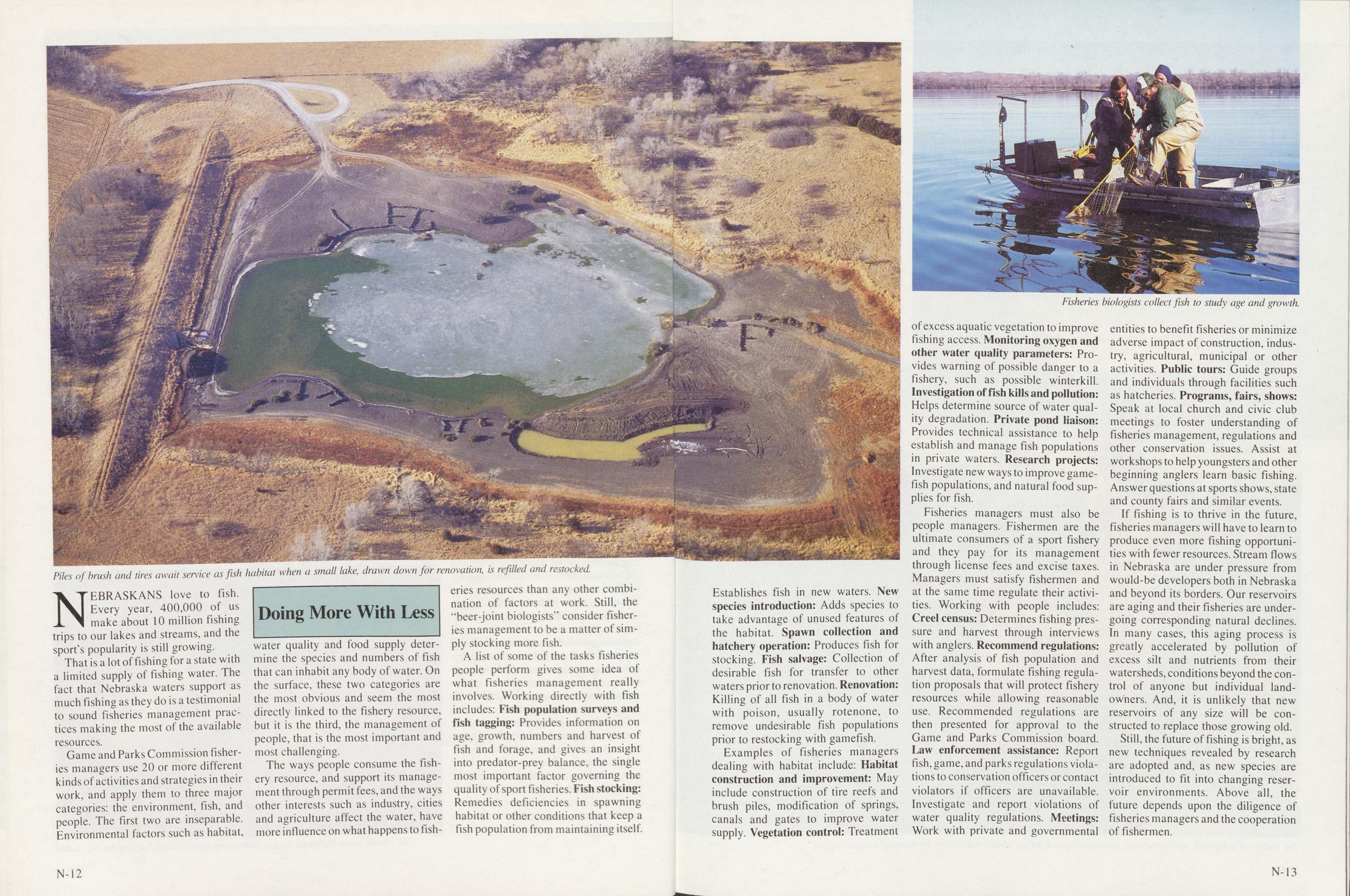
NEBRASKANS love to fish. Every year, 400,000 of us make about 10 million fishing trips to our lakes and streams, and the sport's popularity is still growing.
That is a lot of fishing for a state with a limited supply of fishing water. The fact that Nebraska waters support as much fishing as they do is a testimonial to sound fisheries management practices making the most of the available resources.
Doing More With LessDoing More With LessGame and Parks Commission fisheries managers use 20 or more different kinds of activities and strategies in their work, and apply them to three major categories: the environment, fish, and people. The first two are inseparable. Environmental factors such as habitat, water quality and food supply determine the species and numbers of fish that can inhabit any body of water. On the surface, these two categories are the most obvious and seem the most directly linked to the fishery resource, but it is the third, the management of people, that is the most important and most challenging.
The ways people consume the fishery resource, and support its management through permit fees, and the ways other interests such as industry, cities and agriculture affect the water, have more influence on what happens to fisheries resources than any other combination of factors at work. Still, the "beer-joint biologists" consider fisheries management to be a matter of simply stocking more fish.
A list of some of the tasks fisheries people perform gives some idea of what fisheries management really involves. Working directly with fish includes: Fish population surveys and fish tagging: Provides information on age, growth, numbers and harvest of fish and forage, and gives an insight into predator-prey balance, the single most important factor governing the quality of sport fisheries. Fish stocking: Remedies deficiencies in spawning habitat or other conditions that keep a fish population from maintaining itself. N-12 Establishes fish in new waters. New species introduction: Adds species to take advantage of unused features of the habitat. Spawn collection and hatchery operation: Produces fish for stocking. Fish salvage: Collection of desirable fish for transfer to other waters prior to renovation. Renovation: Killing of all fish in a body of water with poison, usually rotenone, to remove undesirable fish populations prior to restocking with gamefish.
Examples of fisheries managers dealing with habitat include: Habitat construction and improvement: May include construction of tire reefs and brush piles, modification of springs, canals and gates to improve water supply. Vegetation control: Treatment Fisheries biologists collect fish to study age and growth. of excess aquatic vegetation to improve fishing access. Monitoring oxygen and other water quality parameters: Provides warning of possible danger to a fishery, such as possible winterkill. Investigation offish kills and pollution: Helps determine source of water quality degradation. Private pond liaison: Provides technical assistance to help establish and manage fish populations in private waters. Research projects: Investigate new ways to improve game-fish populations, and natural food supplies for fish.
Fisheries managers must also be people managers. Fishermen are the ultimate consumers of a sport fishery and they pay for its management through license fees and excise taxes. Managers must satisfy fishermen and at the same time regulate their activities. Working with people includes: Creel census: Determines fishing pressure and harvest through interviews with anglers. Recommend regulations: After analysis of fish population and harvest data, formulate fishing regulation proposals that will protect fishery resources while allowing reasonable use. Recommended regulations are then presented for approval to the Game and Parks Commission board. Law enforcement assistance: Report fish, game, and parks regulations violations to conservation officers or contact violators if officers are unavailable. Investigate and report violations of water quality regulations. Meetings: Work with private and governmental entities to benefit fisheries or minimize adverse impact of construction, industry, agricultural, municipal or other activities. Public tours: Guide groups and individuals through facilities such as hatcheries. Programs, fairs, shows: Speak at local church and civic club meetings to foster understanding of fisheries management, regulations and other conservation issues. Assist at workshops to help youngsters and other beginning anglers learn basic fishing. Answer questions at sports shows, state and county fairs and similar events.
If fishing is to thrive in the future, fisheries managers will have to learn to produce even more fishing opportunities with fewer resources. Stream flows in Nebraska are under pressure from would-be developers both in Nebraska and beyond its borders. Our reservoirs are aging and their fisheries are undergoing corresponding natural declines. In many cases, this aging process is greatly accelerated by pollution of excess silt and nutrients from their watersheds, conditions beyond the control of anyone but individual land- owners. And, it is unlikely that new reservoirs of any size will be constructed to replace those growing old. Still, the future of fishing is bright, as new techniques revealed by research are adopted and, as new species are introduced to fit into changing reservoir environments. Above all, the future depends upon the diligence of fisheries managers and the cooperation of fishermen.
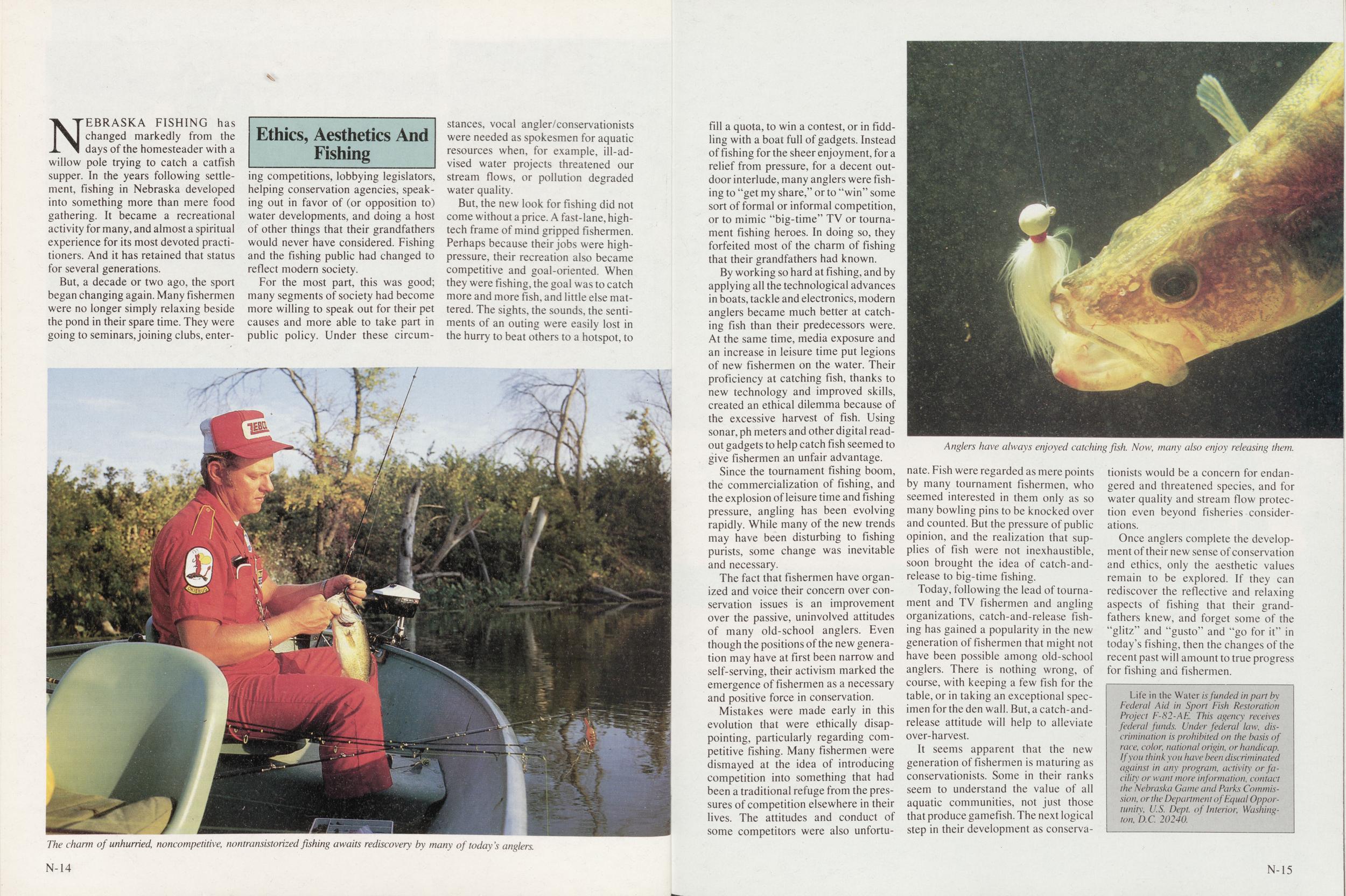
Catfish and the Big Muddy
BY LARRY W. HESSE AND GERALD E. MESTL. FISHERIES BIOLOGISTS This is not a fishing story, but it is about fish, and about the changing face of a great river. In one sense aientific article, in another sense reminiscence, it describes the end of one era and the beginning of another.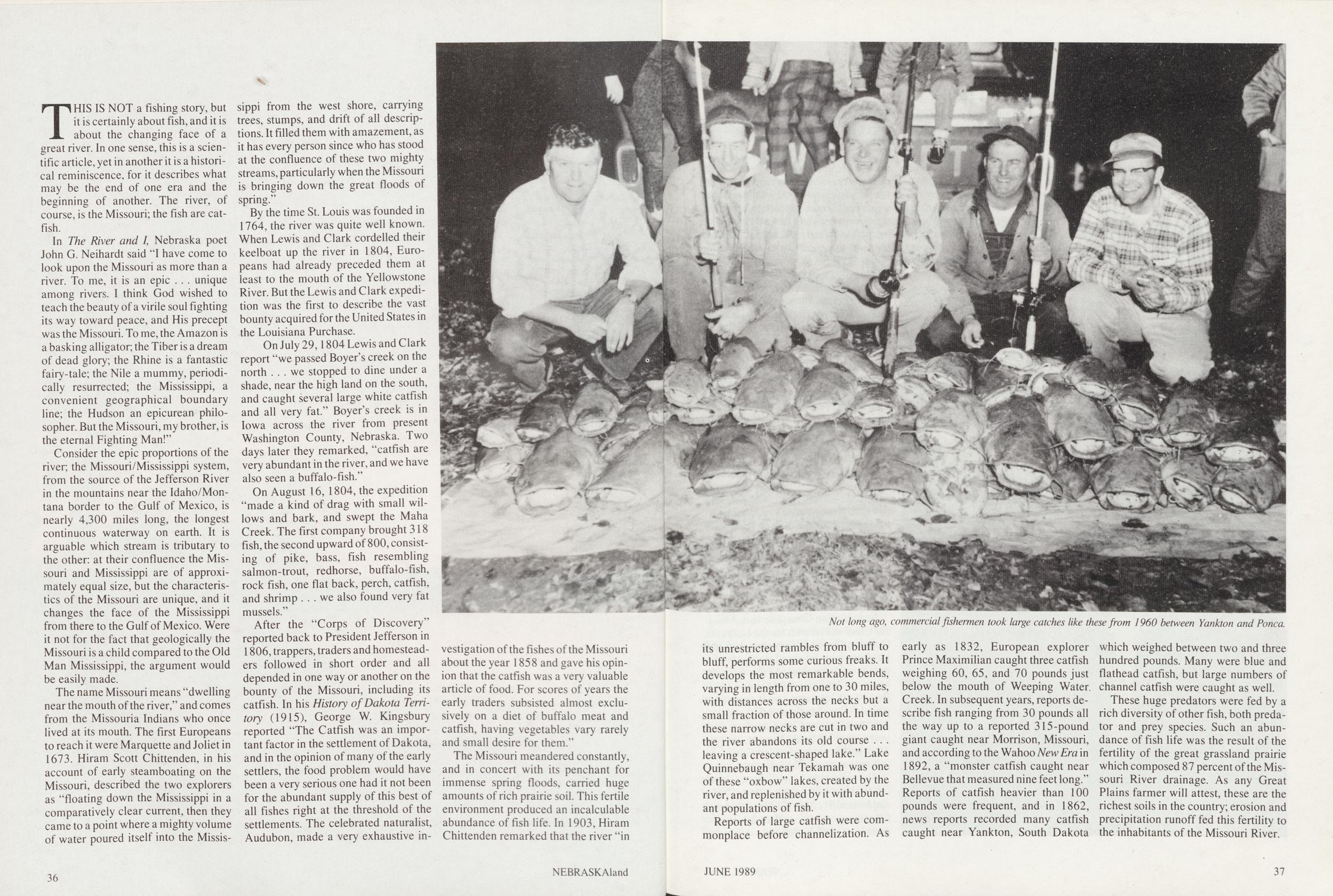
THIS IS NOT a fishing story, but it is certainly about fish, and it is about the changing face of a great river. In one sense, this is a scientific article, yet in another it is a historical reminiscence, for it describes what may be the end of one era and the beginning of another. The river, of course, is the Missouri; the fish are catfish.
In The River and I, Nebraska poet John G. Neihardt said "I have come to look upon the Missouri as more than a river. To me, it is an epic . . . unique among rivers. I think God wished to teach the beauty of a virile soul fighting its way toward peace, and His precept was the Missouri. To me, the Amazon is a basking alligator; the Tiber is a dream of dead glory; the Rhine is a fantastic fairy-tale; the Nile a mummy, periodically resurrected; the Mississippi, a convenient geographical boundary line; the Hudson an epicurean philosopher. But the Missouri, my brother, is the eternal Fighting Man!"
Consider the epic proportions of the river; the Missouri/Mississippi system, from the source of the Jefferson River in the mountains near the Idaho/Montana border to the Gulf of Mexico, is nearly 4,300 miles long, the longest continuous waterway on earth. It is arguable which stream is tributary to the other: at their confluence the Missouri and Mississippi are of approximately equal size, but the characteristics of the Missouri are unique, and it changes the face of the Mississippi from there to the Gulf of Mexico. Were it not for the fact that geologically the Missouri is a child compared to the Old Man Mississippi, the argument would be easily made.
The name Missouri means "dwelling near the mouth of the river," and comes from the Missouria Indians who once lived at its mouth. The first Europeans to reach it were Marquette and Joliet in 1673. Hiram Scott Chittenden, in his account of early steamboating on the Missouri, described the two explorers as "floating down the Mississippi in a comparatively clear current, then they came to a point where a mighty volume of water poured itself into the Mississippi from the west shore, carrying trees, stumps, and drift of all descriptions. It filled them with amazement, as it has every person since who has stood at the confluence of these two mighty streams, particularly when the Missouri is bringing down the great floods of spring."
By the time St. Louis was founded in 1764, the river was quite well known. When Lewis and Clark cordelled their keelboat up the river in 1804, Europeans had already preceded them at least to the mouth of the Yellowstone River. But the Lewis and Clark expedition was the first to describe the vast bounty acquired for the United States in the Louisiana Purchase.
On July 29,1804 Lewis and Clark report "we passed Boyer's creek on the north ... we stopped to dine under a shade, near the high land on the south, and caught several large white catfish and all very fat." Boyer's creek is in Iowa across the river from present Washington County, Nebraska. Two days later they remarked, "catfish are very abundant in the river, and we have also seen a buffalo-fish."
On August 16, 1804, the expedition "made a kind of drag with small willows and bark, and swept the Maha Creek. The first company brought 318 fish, the second upward of 800, consisting of pike, bass, fish resembling salmon-trout, redhorse, buffalo-fish, rock fish, one flat back, perch, catfish, and shrimp ... we also found very fat mussels."
After the "Corps of Discovery" reported back to President Jefferson in 1806, trappers, traders and homesteaders followed in short order and all depended in one way or another on the bounty of the Missouri, including its catfish. In his History of Dakota Territory (1915), George W. Kingsbury reported "The Catfish was an important factor in the settlement of Dakota, and in the opinion of many of the early settlers, the food problem would have been a very serious one had it not been for the abundant supply of this best of all fishes right at the threshold of the settlements. The celebrated naturalist, Audubon, made a very exhaustive investigation of the fishes of the Missouri about the year 1858 and gave his opinion that the catfish was a very valuable article of food. For scores of years the early traders subsisted almost exclusively on a diet of buffalo meat and catfish, having vegetables vary rarely and small desire for them." Not long ago, commercial fishermen took large catches like these from 1960 between Yankton and Ponca.
The Missouri meandered constantly, and in concert with its penchant for immense spring floods, carried huge amounts of rich prairie soil. This fertile environment produced an incalculable abundance offish life. In 1903, Hiram Chittenden remarked that the river "in 36 NEBRASKAland its unrestricted rambles from bluff to bluff, performs some curious freaks. It develops the most remarkable bends, varying in length from one to 30 miles, with distances across the necks but a small fraction of those around. In time these narrow necks are cut in two and the river abandons its old course . . . leaving a crescent-shaped lake." Lake Quinnebaugh near Tekamah was one of these "oxbow" lakes, created by the river, and replenished by it with abundant populations of fish.
Reports of large catfish were commonplace before channelization. As early as 1832, European explorer Prince Maximilian caught three catfish weighing 60, 65, and 70 pounds just below the mouth of Weeping Water. Creek. In subsequent years, reports describe fish ranging from 30 pounds all the way up to a reported 315-pound giant caught near Morrison, Missouri, and according to the Wahoo New Era in 1892, a "monster catfish caught near Bellevue that measured nine feet long." Reports of catfish heavier than 100 pounds were frequent, and in 1862, news reports recorded many catfish caught near Yankton, South Dakota which weighed between two and three hundred pounds. Many were blue and flathead catfish, but large numbers of channel catfish were caught as well.
These huge predators were fed by a rich diversity of other fish, both predator and prey species. Such an abundance of fish life was the result of the fertility of the great grassland prairie which composed 87 percent of the Missouri River drainage. As any Great Plains farmer will attest, these are the richest soils in the country; erosion and precipitation runoff fed this fertility to the inhabitants of the Missouri River.
JUNE 1989 37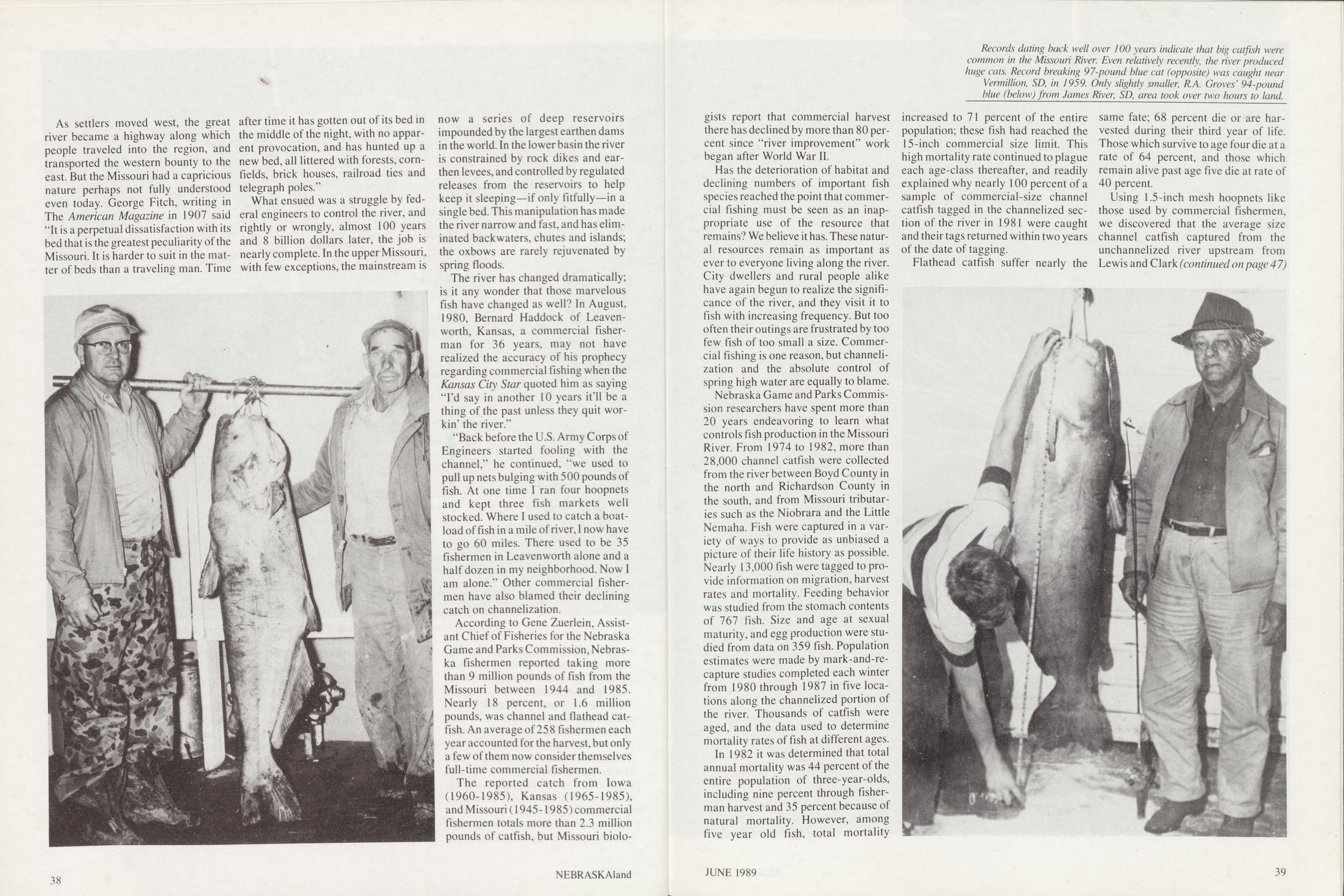
Hoppers in the Heat
PHOTOS AND TEXT BY TOM KEITH Why spend your summer lounging in front of the fan watching TV when you could be fishing? Some folks think fish quit biting when ifs hot, but that's not true—just offer them a grasshopper.YOUR BROW is wet, drops of sweat trickle down your back, and patches of skin tender from too much exposure to the sun all tell you: it's summertime in Nebraska and it's hot!
High temperatures and equally high humidity readings slow the pace of living to a crawl and your every movement is in slow motion, as if heavy weights were bound to your wrists and ankles.
Like everything else, fishing activity withers under the scorching heat of July and August, but not even the most oppressive conditions can drive every fisherman away from the water. Seemingly immune to the extremes, some anglers remain—even during the hottest parts of the hottest days—relentless in their efforts to hook a crappie, bass or catfish.
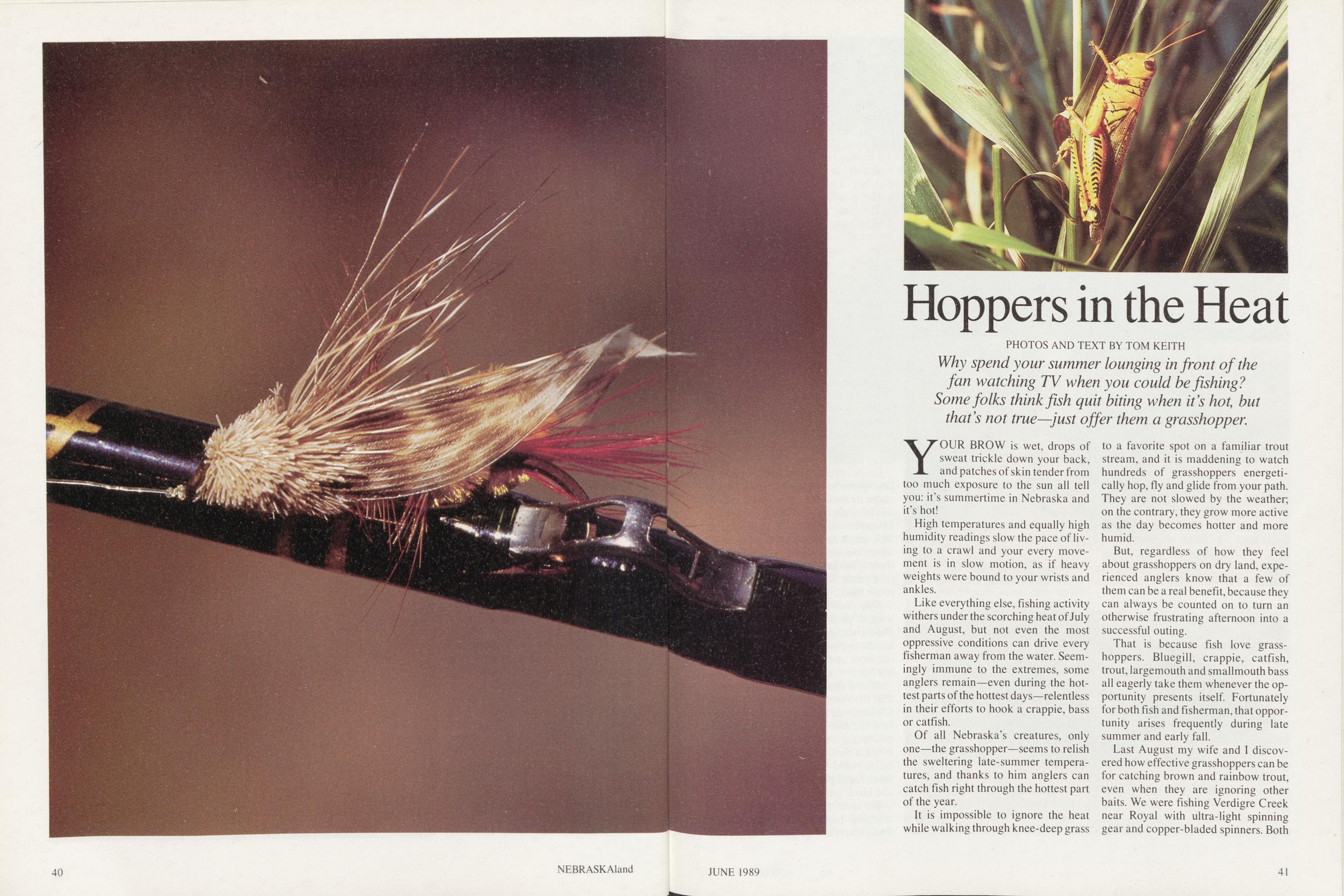
Of all Nebraska's creatures, only one—the grasshopper—seems to relish the sweltering late-summer temperatures, and thanks to him anglers can catch fish right through the hottest part of the year.
It is impossible to ignore the heat while walking through knee-deep grass to a favorite spot on a familiar trout stream, and it is maddening to watch hundreds of grasshoppers energetically hop, fly and glide from your path. They are not slowed by the weather; on the contrary, they grow more active as the day becomes hotter and more humid.
But, regardless of how they feel about grasshoppers on dry land, experienced anglers know that a few of them can be a real benefit, because they can always be counted on to turn an otherwise frustrating afternoon into a successful outing.
That is because fish love grasshoppers. Bluegill, crappie, catfish, trout, largemouth and smallmouth bass all eagerly take them whenever the opportunity presents itself. Fortunately for both fish and fisherman, that opportunity arises frequently during late summer and early fall.
Last August my wife and I discovered how effective grasshoppers can be
for catching brown and rainbow trout,
even when they are ignoring other
baits. We were fishing Verdigre Creek
near Royal with ultra-light spinning
gear and copper-bladed spinners. Both
JUNE 1989
41
 the humidity level and the temperature
reading hovered above 90, and fishing
was pretty slow, but a quick check in
the freezer had proven it was time to
replenish our supply of trout, and Linda
had her mouth set for a supper of
golden pan-fried rainbows.
the humidity level and the temperature
reading hovered above 90, and fishing
was pretty slow, but a quick check in
the freezer had proven it was time to
replenish our supply of trout, and Linda
had her mouth set for a supper of
golden pan-fried rainbows.
The grass was alive with swarms of small grasshoppers as we walked along the creek bank. I watched one jump, veer off course, sail out over the creek, and belly-flop onto the water a few feet away from the bank. It floated there with its head and shoulders above the surface, the rest of its body hanging underwater, and its legs partially extended like a frog's. The hopper began trying to kick its way back to shore, but before it moved more than an inch, a trout darted from beneath the undercut bank and engulfed it.
Seeing the trout latch on to that hopper was enough for Linda. She quickly turned her attention to catching hoppers while I snipped the spinners from our lines and replaced them with small snelled hooks.
Linda captured a medium-sized lime-green hopper and ran a #10 hook under its shell. She pulled a few feet of line from her reel and swung the hopper like a pendulum out over the creek and let it splash into the water ten feet from where we were standing. She let it sit there a minute or two with no results, then gently lifted it and swung it closer to the bank.
This time the hopper hit the water with a "plop," thrashing and kicking. Before she had time to turn the reel handle to close the bail, a trout flashed out from under the bank and grabbed her bait.
After a short fight Linda slid a beautiful foot-long rainbow onto the bank. She removed the hook from its lip, and held the fish in her hand admiring its coloration. A typical Verdigre rainbow, it had a dark back and creamy-white belly; water glistened on its silvery sides, highlighting the pale pink stripe and black spots.
We spent the rest of the afternoon catching hoppers and fishing with them, and when we loaded our gear for 42 NEBRASKAland the trip home we had nine rainbows on ice in our cooler.
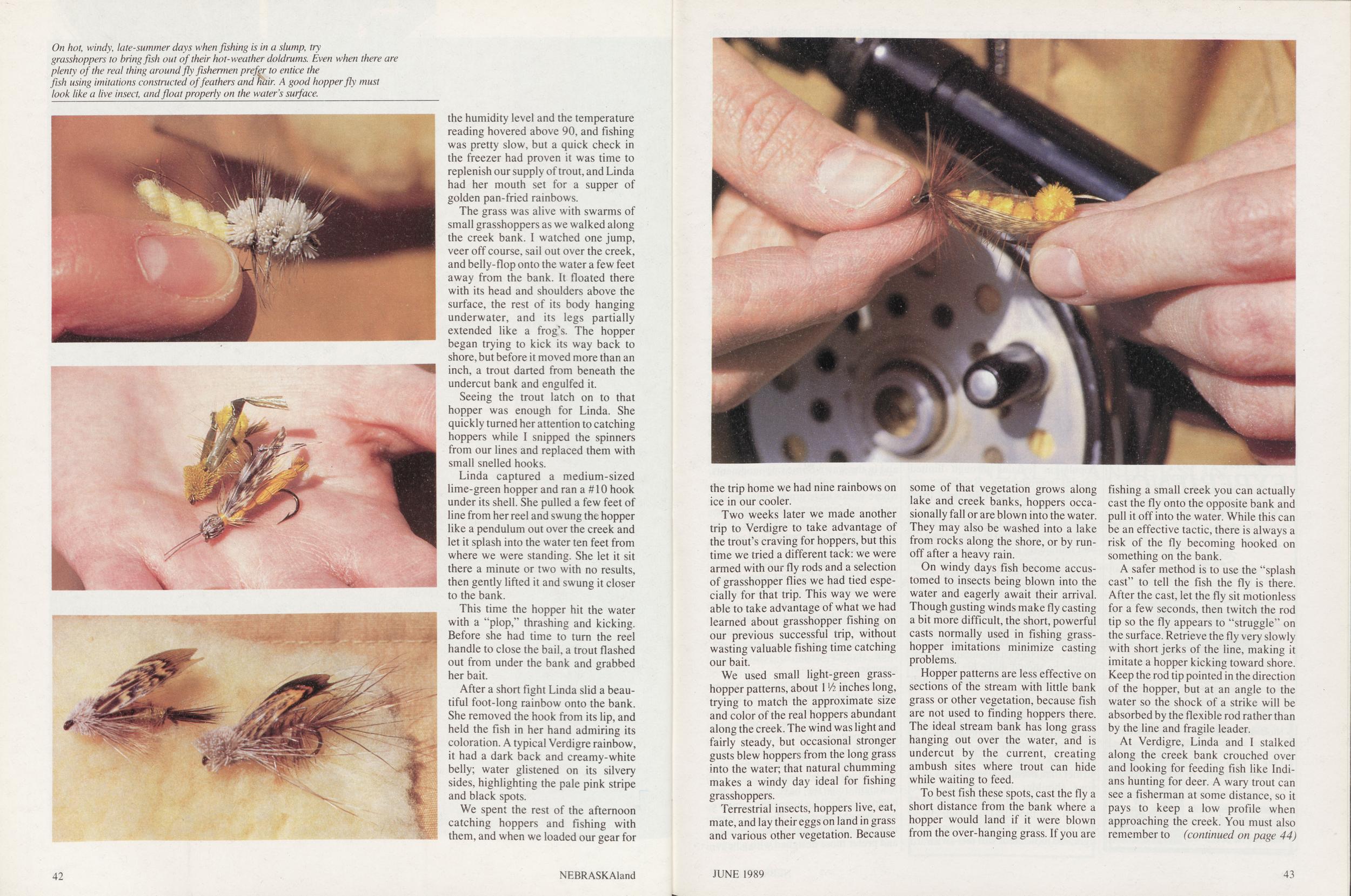
Two weeks later we made another trip to Verdigre to take advantage of the trout's craving for hoppers, but this time we tried a different tack: we were armed with our fly rods and a selection of grasshopper flies we had tied especially for that trip. This way we were able to take advantage of what we had learned about grasshopper fishing on our previous successful trip, without wasting valuable fishing time catching our bait.
We used small light-green grasshopper patterns, about 1 Vi inches long, trying to match the approximate size and color of the real hoppers abundant along the creek. The wind was light and fairly steady, but occasional stronger gusts blew hoppers from the long grass into the water; that natural chumming makes a windy day ideal for fishing grasshoppers.
Terrestrial insects, hoppers live, eat, mate, and lay their eggs on land in grass and various other vegetation. Because some of that vegetation grows along lake and creek banks, hoppers occasionally fall or are blown into the water. They may also be washed into a lake from rocks along the shore, or by runoff after a heavy rain.
On windy days fish become accustomed to insects being blown into the water and eagerly await their arrival. Though gusting winds make fly casting a bit more difficult, the short, powerful casts normally used in fishing grasshopper imitations minimize casting problems.
Hopper patterns are less effective on sections of the stream with little bank grass or other vegetation, because fish are not used to finding hoppers there. The ideal stream bank has long grass hanging out over the water, and is undercut by the current, creating ambush sites where trout can hide while waiting to feed.
To best fish these spots, cast the fly a short distance from the bank where a hopper would land if it were blown from the over-hanging grass. If you are fishing a small creek you can actually cast the fly onto the opposite bank and pull it off into the water. While this can be an effective tactic, there is always a risk of the fly becoming hooked on something on the bank.
A safer method is to use the "splash cast" to tell the fish the fly is there. After the cast, let the fly sit motionless for a few seconds, then twitch the rod tip so the fly appears to "struggle" on the surface. Retrieve the fly very slowly with short jerks of the line, making it imitate a hopper kicking toward shore. Keep the rod tip pointed in the direction of the hopper, but at an angle to the water so the shock of a strike will be absorbed by the flexible rod rather than by the line and fragile leader.
At Verdigre, Linda and I stalked along the creek bank crouched over and looking for feeding fish like Indians hunting for deer. A wary trout can see a fisherman at some distance, so it pays to keep a low profile when approaching the creek. You must also remember to (continued on page 44)
JUNE 1989 47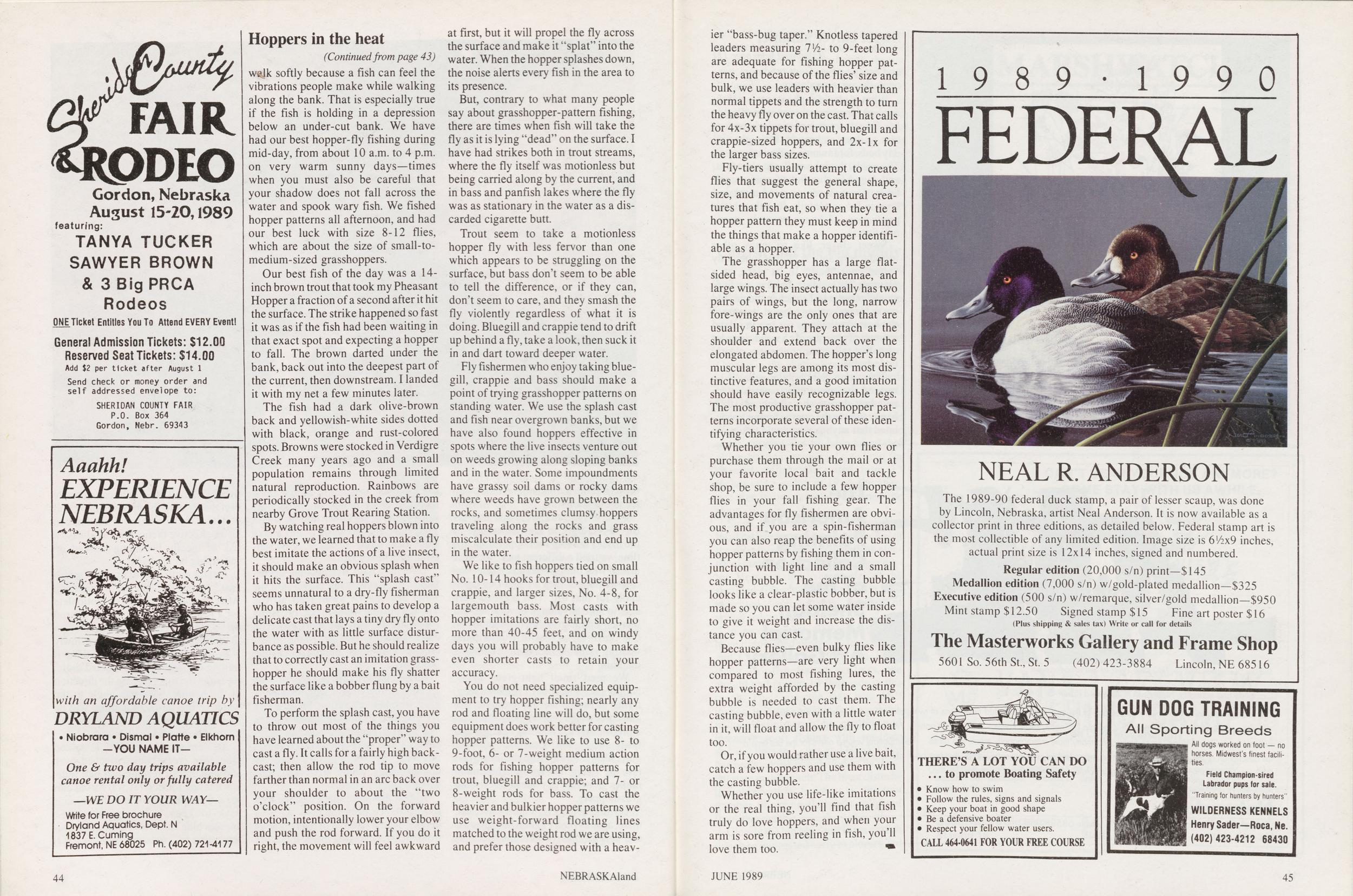 FAIR.
PDEO
Gordon, Nebraska
August 15-20,1989
featuring:
TANYA TUCKER
SAWYER BROWN
& 3BigPRCA
Rodeos
ONE Ticket Entitles You To Attend EVERY Event!
General Admission Tickets: $12.00
Reserved Seat Tickets: $14.00
Add $2 per ticket after August 1
Send check or money order and
self addressed envelope to:
SHERIDAN COUNTY FAIR
P.O. Box 364
Gordon, Nebr. 69343
Aaahh!
EXPERIENCE
NEBRASKA...
with an affordable canoe trip by
DRYLAND AQUATICS
• Niobrara • Dismal • Platte • Elkhorn
-YOU NAME IT-
One & two day trips available
canoe rental only or fully catered
—WE DO IT YOUR WAY—
Write for Free brochure
Dryland Aquatics, Dept. N
1837 E.Cuming
Fremont, NE 68025 Ph. (402) 721 -4177
FAIR.
PDEO
Gordon, Nebraska
August 15-20,1989
featuring:
TANYA TUCKER
SAWYER BROWN
& 3BigPRCA
Rodeos
ONE Ticket Entitles You To Attend EVERY Event!
General Admission Tickets: $12.00
Reserved Seat Tickets: $14.00
Add $2 per ticket after August 1
Send check or money order and
self addressed envelope to:
SHERIDAN COUNTY FAIR
P.O. Box 364
Gordon, Nebr. 69343
Aaahh!
EXPERIENCE
NEBRASKA...
with an affordable canoe trip by
DRYLAND AQUATICS
• Niobrara • Dismal • Platte • Elkhorn
-YOU NAME IT-
One & two day trips available
canoe rental only or fully catered
—WE DO IT YOUR WAY—
Write for Free brochure
Dryland Aquatics, Dept. N
1837 E.Cuming
Fremont, NE 68025 Ph. (402) 721 -4177
Hoppers in the heat
(Continued from page 43)walk softly because a fish can feel the vibrations people make while walking along the bank. That is especially true if the fish is holding in a depression below an under-cut bank. We have had our best hopper-fly fishing during mid-day, from about 10 a.m. to 4 p.m. on very warm sunny days—times when you must also be careful that your shadow does not fall across the water and spook wary fish. We fished hopper patterns all afternoon, and had our best luck with size 8-12 flies, which are about the size of small-to-medium-sized grasshoppers.
Our best fish of the day was a 14-inch brown trout that took my Pheasant Hopper a fraction of a second after it hit the surface. The strike happened so fast it was as if the fish had been waiting in that exact spot and expecting a hopper to fall. The brown darted under the bank, back out into the deepest part of the current, then downstream. I landed it with my net a few minutes later.
The fish had a dark olive-brown back and yellowish-white sides dotted with black, orange and rust-colored spots. Browns were stocked in Verdigre Creek many years ago and a small population remains through limited natural reproduction. Rainbows are periodically stocked in the creek from nearby Grove Trout Rearing Station.
By watching real hoppers blown into the water, we learned that to make a fly best imitate the actions of a live insect, it should make an obvious splash when it hits the surface. This "splash cast" seems unnatural to a dry-fly fisherman who has taken great pains to develop a delicate cast that lays a tiny dry fly onto the water with as little surface disturbance as possible. But he should realize that to correctly cast an imitation grasshopper he should make his fly shatter the surface like a bobber flung by a bait fisherman.
To perform the splash cast, you have to throw out most of the things you have learned about the "proper" way to cast a fly. It calls for a fairly high backcast; then allow the rod tip to move farther than normal in an arc back over your shoulder to about the "two o'clock" position. On the forward motion, intentionally lower your elbow and push the rod forward. If you do it right, the movement will feel awkward at first, but it will propel the fly across the surface and make it "splat" into the water. When the hopper splashes down, the noise alerts every fish in the area to its presence.
But, contrary to what many people say about grasshopper-pattern fishing, there are times when fish will take the fly as it is lying "dead" on the surface. I have had strikes both in trout streams, where the fly itself was motionless but being carried along by the current, and in bass and panfish lakes where the fly was as stationary in the water as a discarded cigarette butt.
Trout seem to take a motionless hopper fly with less fervor than one which appears to be struggling on the surface, but bass don't seem to be able to tell the difference, or if they can, don't seem to care, and they smash the fly violently regardless of what it is doing. Bluegill and crappie tend to drift up behind a fly, take a look, then suck it in and dart toward deeper water.
Fly fishermen who enjoy taking bluegill, crappie and bass should make a point of trying grasshopper patterns on standing water. We use the splash cast and fish near overgrown banks, but we have also found hoppers effective in spots where the live insects venture out on weeds growing along sloping banks and in the water. Some impoundments have grassy soil dams or rocky dams where weeds have grown between the rocks, and sometimes clumsy hoppers traveling along the rocks and grass miscalculate their position and end up in the water.
We like to fish hoppers tied on small No. 10-14 hooks for trout, bluegill and crappie, and larger sizes, No. 4-8, for largemouth bass. Most casts with hopper imitations are fairly short, no more than 40-45 feet, and on windy days you will probably have to make even shorter casts to retain your accuracy.
You do not need specialized equipment to try hopper fishing; nearly any rod and floating line will do, but some equipment does work better for casting hopper patterns. We like to use 8- to 9-foot, 6- or 7-weight medium action rods for fishing hopper patterns for trout, bluegill and crappie; and 7- or 8-weight rods for bass. To cast the heavier and bulkier hopper patterns we use weight-forward floating lines matched to the weight rod we are using, and prefer those designed with a heavier 44 NEBRASKAland "bass-bug taper." Knotless tapered leaders measuring IVi- to 9-feet long are adequate for fishing hopper patterns, and because of the flies' size and bulk, we use leaders with heavier than normal tippets and the strength to turn the heavy fly over on the cast. That calls for 4x-3x tippets for trout, bluegill and crappie-sized hoppers, and 2x-lx for the larger bass sizes.
Fly-tiers usually attempt to create flies that suggest the general shape, size, and movements of natural creatures that fish eat, so when they tie a hopper pattern they must keep in mind the things that make a hopper identifiable as a hopper.
The grasshopper has a large flatsided head, big eyes, antennae, and large wings. The insect actually has two pairs of wings, but the long, narrow fore-wings are the only ones that are usually apparent. They attach at the shoulder and extend back over the elongated abdomen. The hopper's long muscular legs are among its most distinctive features, and a good imitation should have easily recognizable legs. The most productive grasshopper patterns incorporate several of these identifying characteristics.
Whether you tie your own flies or purchase them through the mail or at your favorite local bait and tackle shop, be sure to include a few hopper flies in your fall fishing gear. The advantages for fly fishermen are obvious, and if you are a spin-fisherman you can also reap the benefits of using hopper patterns by fishing them in conjunction with light line and a small casting bubble. The casting bubble looks like a clear-plastic bobber, but is made so you can let some water inside to give it weight and increase the distance you can cast.
Because flies—even bulky flies like hopper patterns—are very light when compared to most fishing lures, the extra weight afforded by the casting bubble is needed to cast them. The casting bubble, even with a little water in it, will float and allow the fly to float too.
Or, if you would rather use a live bait, catch a few hoppers and use them with the casting bubble.
Whether you use life-like imitations or the real thing, you'll find that fish truly do love hoppers, and when your arm is sore from reeling in fish, you'll love them too.
19 8 9 19 9 0 NEAL R. ANDERSON The 1989-90 federal duck stamp, a pair of lesser scaup, was done by Lincoln, Nebraska, artist Neal Anderson. It is now available as a collector print in three editions, as detailed below. Federal stamp art is the most collectible of any limited edition. Image size is 6!/2x9 inches, actual print size is 12x14 inches, signed and numbered. Regular edition (20,000 s/n) print—$145 Medallion edition (7,000 s/n) w/gold-plated medallion—$325 Executive edition (500 s/n) w/remarque, silver/gold medallion—$950 Mint stamp $ 12.50 Signed stamp $ 15 Fine art poster $ 16 (Plus shipping & sales tax) Write or call for details The Masterworks Gallery and Frame Shop 5601 So. 56th St., St. 5 (402) 423-3884 Lincoln, NE 68516 THERE'S A LOT YOU CAN DO ... to promote Boating Safety Know how to swim Follow the rules, signs and signals Keep your boat in good shape Be a defensive boater Respect your fellow water users. CALL 464-0641 FOR YOUR FREE COURSE GUN DOG TRAINING All Sporting Breeds Ail dogs worked on foot — no horses. Midwest's finest facilities. Field Champion-sired Labrador pups for sale. "Training for hunters by hunters" WILDERNESS KENNELS Henry Sader—Roca, Ne. (402)423-4212 68430 JUNE 1989 45 NEBRASKA
WILDFLOWERS
•*£SC3=r
A colorful design featuring Nebraska's native wildflowers screenprinted on your choice
of t-shirt. sweatshirt or the
new lOOvf crinkle-cotton long-sleeved fashion pullover.
No.
S M L XL
100% crinkle cotton top, white @ $25.00
50/50 sweatshirt, white @ $21.95
100% cotton t-shirt, white @ $9.95
Name
Address
City
Money Order DMC D Visa □ Check
BANK EXP. DATE
State.
Zip.
CARD NO.
Add $2.00 for shipping and handling. Nebraska residents add 5.5% sales tax. Please
allow 3-4 weeks for delivery.
Total enclosed
Send check or money order to: Marcia & David, P.O. Box 4775, Lincoln, NE 68504
Study for 'Shenandoah Wall," by Franz Kline, 1960, ink and collage on paper
The
American
Painting
Collection
of the
Sheldon
Memorial
Art Gallery
Compiled and edited by Norman A. Geske and Karen O. Janovy
The Sheldon Memorial Art Gallery houses one of the most highly regarded collections
of twentieth-century American art anywhere,
including paintings by Edward Hopper, Georgia O'Keefe, Mark Rothko, Willem de Kooning,
Marsden Hartley, Robert Motherwell,
Robert Henri, Grant Wood, Frank Stella, and many more internationally renowned artists.
This important volume offers for the first time a
full description of the collection, now numbering more than one thousand works, that
has been nearly a century in the making.
378 pages, preface, introduction, 101 color plates, 1,047 b&w photographs. $40.00
available at bookstores or from
Nebraska
University of Nebraska Press • 901 N 17 • Lincoln 68588-0520
NEBRASKA
WILDFLOWERS
•*£SC3=r
A colorful design featuring Nebraska's native wildflowers screenprinted on your choice
of t-shirt. sweatshirt or the
new lOOvf crinkle-cotton long-sleeved fashion pullover.
No.
S M L XL
100% crinkle cotton top, white @ $25.00
50/50 sweatshirt, white @ $21.95
100% cotton t-shirt, white @ $9.95
Name
Address
City
Money Order DMC D Visa □ Check
BANK EXP. DATE
State.
Zip.
CARD NO.
Add $2.00 for shipping and handling. Nebraska residents add 5.5% sales tax. Please
allow 3-4 weeks for delivery.
Total enclosed
Send check or money order to: Marcia & David, P.O. Box 4775, Lincoln, NE 68504
Study for 'Shenandoah Wall," by Franz Kline, 1960, ink and collage on paper
The
American
Painting
Collection
of the
Sheldon
Memorial
Art Gallery
Compiled and edited by Norman A. Geske and Karen O. Janovy
The Sheldon Memorial Art Gallery houses one of the most highly regarded collections
of twentieth-century American art anywhere,
including paintings by Edward Hopper, Georgia O'Keefe, Mark Rothko, Willem de Kooning,
Marsden Hartley, Robert Motherwell,
Robert Henri, Grant Wood, Frank Stella, and many more internationally renowned artists.
This important volume offers for the first time a
full description of the collection, now numbering more than one thousand works, that
has been nearly a century in the making.
378 pages, preface, introduction, 101 color plates, 1,047 b&w photographs. $40.00
available at bookstores or from
Nebraska
University of Nebraska Press • 901 N 17 • Lincoln 68588-0520
Sweet clover summer
(Continued from page 11)and escape cover from predators, particularly avian predators.
What is ideal for pheasants is nearly as good for many other species of wildlife. Sweet clover is particularly important to deer, as browse, for night and day beds, for fawning and winter cover. The seeds, though small, are abundant, and found in the diet of many small birds. Sweet clover is a good cover and browse for cottontails. Its value in the production of honey scarcely needs mention.
Sweet clover, like so many other introduced plants, is neither inherently "good" nor "bad." In its place, as a planting for wildlife habitat, as live- stock forage, a soil enricher and ground cover for preventing erosion, it is one of the best, particularly for use in a land retirement program. As a weedy invader of native tall-grass prairie it is clearly undesirable.
The same Sandhills rancher who mowed the sweet clover patch in his meadow during the spring of 1987, happy to have the crop as forage, speculated that anyone who could figure out 46 NEBRASKAland how to make perfume out of the sweet clover blossoms could retire a millionaire. "Nothing smells better than a summer field of sweet clover," he said. "Women would go crazy buying it."
He was probably right, but it wouldn't be women buying it; it would be cattlemen, soil conservationists, bee keepers and pheasant hunters, who appreciate this fragrant alien for other reasons, who would buy it for their wives or sweethearts. Beauty, the old adage says, is in the eye of the beholder.
Catfish and the big muddy
(Continued from page 39)Lake was 18 inches in 1982, but only 13.3 inches by 1987. Similar declines in average length were found downstream from Gavins Point Dam in the unchannelized reach in Cedar and Dixon counties, and upstream from Omaha in the channelized reach.
We also collected fish in 1 -inch mesh nets, allowing us to catch more small fish. If more fish were surviving from year to year, these larger fish would raise the average length in successive years' surveys. But we have found that although the commercial size limit for channel catfish was raised from 13 inches to 15 inches in 1984, the average size in our samples remained the same.
Since 1971 we have captured flathead catfish from the several reaches of the river by stunning them with an electrical current from a telephone generator. Here too, the average size of the sampled fish changed very little, and indicated disproportional numbers of young fish in the river.
In recent years, flathead numbers have diminished upstream from Lewis and Clark Lake. In 1981 and 1982, using live-fish baited set-lines, we caught and tagged 13 flatheads in this reach. Their average size was 18.9 inches. It is conceivable that a combination of commercial hoop netting and intensive sport fishing with set-lines and jug lines in Lewis and Clark Lake has reduced the population to its present state in this reach. The most disturbing observation, however, is the low number of young flatheads collected from this reach.
Clearly the big Missouri River catfish which so impressed early explorers, fed settlers, and made good copy for turn-of-the-century newspaper writers are now seldom seen. If they are to return to the river, steps must be taken to provide habitat and protection for sufficient numbers of small fish long enough for them to live well beyond their third and fourth years. By reducing the annual commercial harvest of catfish by 37,000 pounds, (a very conservative estimate of actual harvest) more catfish will once again grow to a larger size. The direct beneficiaries of such management would be sport fishermen. We hope that commercial fishermen count themselves among this group.
(T MARSHWATCHER DUCKS UNLIMITED, Inc. A. CATTAIL (Typhasp.) B. ARROWHEAD (Saggittaria sp.) Edible marsh plants Many of the plants eaten by marsh animals can also be used as emergency foods by humans, says Ducks Unlimited. For instance, the cattails thick, starchy roots can be tasty and nourishing when boiled, roasted or dried, and ground into flour. The green flower heads and pollen are also edible. Another marsh food, the arrowhead, has small tubers or "duck potatoes" at the ends of its roots in the late fall. These can be boiled like potatoes or roasted in a fire. CAN'T BEAR YOUR JOB ANYMORE? COME STAY WITH US AWHILE. on Lake McConaughey Air-conditioned units, cooking facilities. Up to four adults. Campground on the beach—50 hookups, showers, playground, shade. MARINA CAMPGROUND GUIDE SERVICE LAUNCHING STORE Groceries, Beer, Pop, Tackle, Live Bait BOAT & PONTOON RENTALS South Shore Big Mac at Gate 18 R.FL #1 Box L-9 Brule, NE 69127 Ogallala, NE (308) 284-4965 JUNE 1989 47 402-376-3708
divert
ONE & TWO DAY RENTALS
CAR SHUTTLE-SERVICE
FULL-SERVICE TRIPS
WE DO THE WORK
YOU HAVE THE FUN
For Reservations and Information Contact
Doug and Twyla Graham
HC 13 BOX 16
V VALENTINE, NEBRASKA 69201
Excellent Hunting-Fishing
For Sale—106 acres on the
North Platte River (1) mile east
of Broadwater, NE.
Lee Chapin (402) 423-5727
5817 Berkeley Dr.
Lincoln, NE 68512
BERGMANS RESORT
On Beautiful Johnson Lake
Lakefront Cabins* RV Hookups*
Groceries Beer Bait Tackle
Restaurant Lounge
Boat Rentals
Guide Service.
Fish Swim Golf
Elmer and Janet Bergman
RR 2, Elwood, NE 68937
(308) 785-2298
LIVE-CATCH ALL-PURPOSE TRAPS
MUSTANG MFG. CO., Dept. N-34, Box 920947, Houston, Tex. 77292
STOCK YOUR LAKE
OR POND WITH
Channel Cat, Bluegill,
Hybrid Bluegill,
Largemouth Bass,
Crappie, Bullheads,
Triploid Grass Carp,
Walleye, Minnows
WILLOW LAKE FISH HATCHERY
Rt. 3, Box 46, Hastings, Nebr. 68901
Gaylord L Crawford
Phone: (402) 463-8022
Day or Night
For April to October 15 stocking
BLACK HILLS NATURAL HISTORY
FIELD CAMPS
Presented by the University of Nebraska
Trailside Museum at Fort Robinson State Park
located near Crawford, NE.
1989 SCHEDULE (2 day trips)
JUNE: 16 & 17; 30 & July 1
JULY: June 30 & 1; 14 & 15; 28 & 29
AUGUST: 18 & 19
RATES: $49 Children, $95 Adults. Rates include equipment (except clothing and sleeping
bags), tents, foam pads and miscellaneous camp gear, meals (4) admissions, transportation
(400 miles), presentation, and cap & T-shirt.
DAY 1'. Depart 8:00 am. Combines trips to
Agate Springs, and the Hot Springs
Mammoth Site. Camp is at forested site at
Custer, SD.
DAY 2: Traverse a dome mountain range.
Visit a gold "ghost town", Bear Butte, Jewel
Cave, School of Mines Museum and more.
Return ETA sunset (7:00 pm)
FOR MORE INFORMATION CONTACT:
David A. Nixon, Superintendent, P.O. Box 462, Crawford NE
Telephone (308) 665-2730 after May 16,1989 toadstool park also available
402-376-3708
divert
ONE & TWO DAY RENTALS
CAR SHUTTLE-SERVICE
FULL-SERVICE TRIPS
WE DO THE WORK
YOU HAVE THE FUN
For Reservations and Information Contact
Doug and Twyla Graham
HC 13 BOX 16
V VALENTINE, NEBRASKA 69201
Excellent Hunting-Fishing
For Sale—106 acres on the
North Platte River (1) mile east
of Broadwater, NE.
Lee Chapin (402) 423-5727
5817 Berkeley Dr.
Lincoln, NE 68512
BERGMANS RESORT
On Beautiful Johnson Lake
Lakefront Cabins* RV Hookups*
Groceries Beer Bait Tackle
Restaurant Lounge
Boat Rentals
Guide Service.
Fish Swim Golf
Elmer and Janet Bergman
RR 2, Elwood, NE 68937
(308) 785-2298
LIVE-CATCH ALL-PURPOSE TRAPS
MUSTANG MFG. CO., Dept. N-34, Box 920947, Houston, Tex. 77292
STOCK YOUR LAKE
OR POND WITH
Channel Cat, Bluegill,
Hybrid Bluegill,
Largemouth Bass,
Crappie, Bullheads,
Triploid Grass Carp,
Walleye, Minnows
WILLOW LAKE FISH HATCHERY
Rt. 3, Box 46, Hastings, Nebr. 68901
Gaylord L Crawford
Phone: (402) 463-8022
Day or Night
For April to October 15 stocking
BLACK HILLS NATURAL HISTORY
FIELD CAMPS
Presented by the University of Nebraska
Trailside Museum at Fort Robinson State Park
located near Crawford, NE.
1989 SCHEDULE (2 day trips)
JUNE: 16 & 17; 30 & July 1
JULY: June 30 & 1; 14 & 15; 28 & 29
AUGUST: 18 & 19
RATES: $49 Children, $95 Adults. Rates include equipment (except clothing and sleeping
bags), tents, foam pads and miscellaneous camp gear, meals (4) admissions, transportation
(400 miles), presentation, and cap & T-shirt.
DAY 1'. Depart 8:00 am. Combines trips to
Agate Springs, and the Hot Springs
Mammoth Site. Camp is at forested site at
Custer, SD.
DAY 2: Traverse a dome mountain range.
Visit a gold "ghost town", Bear Butte, Jewel
Cave, School of Mines Museum and more.
Return ETA sunset (7:00 pm)
FOR MORE INFORMATION CONTACT:
David A. Nixon, Superintendent, P.O. Box 462, Crawford NE
Telephone (308) 665-2730 after May 16,1989 toadstool park also available
In addition, mathematical models of the channel and flathead catfish populations in the Missouri River predict that in concert with reduced commercial harvest, a sport fishing size limit of 15 inches (or better yet 18 inches) will help achieve the goal of enhanced fish size. It remains to be learned, however, what actual impact man's tinkering with the river (channelization and impoundment) has had, since commercial fishing has masked the effects.
We hope that our studies will continue to shed light on the problem, and we intend to work harder than ever to repair damage done to essential habitat. We in Nebraska are working with our neighbor states who share this resource to effectively manage both habitat and harvest. Optimistically, we recall another line from The River and I: "In the spring the river had roared; now it only purred. But all the while I felt in it a dreadful economy of force, just as I have since felt it in the presence of a great lean jungle-cat at the zoo. Here was a thing that crouched and purred, a moving but terrific thing. Give it an obstacle to overcome, fling it something to devour; and lo! The crushing impact of its leap!"
CALL 800-742-SNAP STOP POACHING NEBRASKA OPERATION GAME THIEF 48 NEBRSAKAlandTrading Post
DOGSYELLOW-BLACK Lab pups. FC-AFC sired. AKC. Hips OFA ceritified. Dew claws removed. Excellent hunting potential. Contact Bob Bendler, Lexington, NE (308) 324-4247.
TRAINING ALL BREEDS Hunting Dogs - Vizslas for sale. Rozanek Kennels, Rt. 2, Schuyler, NE 68661. Phone(402)352-8769.
ENGLISH SETTERS: "Bred for the hunter"; select puppies and started dogs available from outstanding bloodlines. Stud service available by proven hunters. High Plains Kennels, 1411 Emerson, Alliance, NE 69301, Phone (308) 762-6709.
GERMAN SHORTHAIRS and Brittany Spaniel pups. Started and occasionally a meat dog. Pups are guaranteed. Also I will be training hunting dogs. Wayne Clark, Percival, IA. Phone (712) 529-4238 or (402) 263-3155 at Union, NE
ENGLISH POINTER pups breeding Elhew; started dogs, force retrieving; at stud Ch. Elhew Husker John. J H. Render, Box 86, Panama, NE 68419. Phone (402) 788-2213.
AKC Chocolate Lab pups. Sire Master Hunter. OFA hips certified. Stud service available. Gene Meier, Plattsmouth, NE (402) 296-4190.
MISCELLANEOUSNE NEBRASKA trout fishing. 3 modern cottages, 1 available year round. 5 spring fed lakes with open water all year. Trout up to 7 pounds. Other varieties fish also. Diamond E. Trout Resort, Orchard, NE 68764. Phone (402) 893-4745.
GUNS — Browning, Winchester, Remington, others, Hi-powers, shotguns, new, used, antiques. Want Pre-1964 Winchesters. Buy-Sell-Trade. (402) 729-6112. 68352. Bedlan's Sporting Goods, Fairbury, NE
MAD RIVER CANOES offers the finest quality and performance. For the finest canoes and accessories look to Great Plains Canoe Co., 205 Main, Springfield, NE. Phone (402) 253-2001.
AIR GUNS repaired — Benjamin, Crosman, Daisy, other American made. Restoration; old guns wanted, Jack's Air Guns, 1225 No. 46th, Lincoln, NE 68503. Phone_f402) 466-9223.
Bev Doolittle, Terrry Redlin, Jerry Raedke, Ed Wards, Robert Bateman, Frank McCarthy and Neal Anderson are available at the 2nd Street Gallery 537 W. 2nd, Hastings, NE 68901. Phone (402) 463-6677.
TROLLING MOTOR REPAIR. Factory authorized Minn Kota and Motor Guide, parts and service Wolfs Repair and Tackle Supply, 1529 David Drive, Lincoln, NE 68504. Phone (402) 464-4265.
WINE AND BEER: Make your own. Send for free recipes and instructions. Omaha Supply, 1324 2nd Avenue, Nebraska City, NE 68410.
FISH FOR SALE. Catfish,perch, coho salmon, rainbow trout, crappie, bluegill, walleye, minnows, goldfish, bullhead, largemouth bass, smallmouth bass, triploid grass carp. Commercial grower prices on catfish, perch, coho salmon, rainbow trout. Consulting available. Pleasant Valley Fish Farm, Rt. 1 Box 147, McCook, NE 69001. Phone (308) 345-6599.
FREE BOOK CATALOG. Novels, westerns, romances, children's; old out of print, found barns, attic. Authors: Grey, Bower, Connor, Fox, Curwood, Raine, Wright, Aldrige, Pollyanna, Freckles, many others. Postage appreciated. Pierce, 4400 N. Pine Cluster, Oroville, CA 95965.
FREE! Booklets on northeastern Nevada; fishing, rockhounding maps, Carl Hayden, Box 528, Jackpot, Nevada 89825.
BUY, SELL, TRADE expired hunting, fishing, trapping permits. Singles/Collections. 15400 N. 56th St., Lincoln, NE 68514. phone (402) 785-7500.
BUYING: American Indian artifacts such as beadwork, weavings, baskets, etc.; also cowboy memorabilia such as chaps, spurs, photographs, etc. Best price first letter; photographs promptly returned. Jack Ringwalt, 1550 California St., Suite 6, #211, San Francisco, CA 94109, (415)759-6343.
TAKING ORDERS for pheasant chicks, Chukkar partridge, wild turkeys, also other types of poultry. Wahoo Feed and Farm Supply, 745 N. Chestnut, (402) 443-5086.
CALAMUS RIVER HIDEAWAY. 62 acres with nice 4-bedroom home and guest cabin on lake full of fish. Beautiful setting, remote but just 30 miles to big dam. 640 leased acres can also go along. Have many other Rec-Properties. Swett Realty, P.O. Box 265, Ainsworth, NE 69210. Phone (402) 387-1626 day or night.
FISHING TEAM looking for tournaments this summer. Send info to P. Gosnell, Box 124, Dix, NE 69133.
FISH FOR SALE—adult northern pike, walleye, bass, bluegili, catfish, grass carp, coho salmon, trout and minnows. Carlson Clearwater Fish Farms, Inc., Rt. 2 Box 202, Wayne, NE 68787. Phone (402) 375-3262.
FISH FOR SALE—large bullheads for stocking or fishing derbies. Carlson Clearwater Farms Inc., Rt. 2 Box 202, Wayne, NE 68787. Phone (402) 375-3262.
TAXIDERMYALLISON'S TAXIDERMY STUDIO. Wally and Betty Allison Licensed Taxidermist. We've mounted 28 Nebraska State Record fish. Specializing in fish and birds, small game and rattlesnakes. We use freeze-dry. 2310 West Leota, North Platte, Nebr. 69101. Phone (308) 534-2324.
BADE TAXIDERMY - Quality a must - Fast service. Fish, birds, rugs, tanning, full mounts and game heads, 2111 N. Christy St., Fremont, NE 727-5463.
NABITY'S TAXIDERMY. 31 years experience. Specializing in natural grass backgrounds for mammals, birds and fish. 13901 "O" St., Lincoln, NE 68504 - 4 miles east of 84th and "O". (402) 489-6351.
PEISTER TAXIDERMY - Professional work at prices most sportsman can afford. Now in our new log cabin studio, 1020 Central Avenue, Box 3201, Kearney, NE 68847. Phone (308) 236-9700 or (308) 237-7575 evenings.
NATURECRAFT STUDIO — all custom services — creative work, quality, and experience since 1935. Includes freeze-dry processing. Display and sales room, visitors welcome. Hwy. 2 in Nebraska City. Phone (402) 873-5491. Joe Voges — Owner. Bow Steedly — Big Game specialist.
NEBRASKAland Magazine Order Form Please send me a subscription to NEBRASKAland Magazine □ One-year $12.00 NAME ADDRESS Two-year $23.00 STATE ZIP Mail to: NEBRASKAland Magazine, Box 30370, Lincoln, NE 68503 DEE'S MAPS The new name in Contour Maps 1989 CONTOURS © Merritt Reservoir © Harlan County Reservoir ® Calamus Reservoir © Glen Elder Reservoir in Kansas © Lewis & Clark © Red Willow & Swanson (one map) © Milford Lake in Kansas Water Proof — Tear Proof $495 each or $1295 for any 3 Satisfaction Guaranteed See your dealer or write: Sportsman, Box 702 Broken Bow, NE 68822 KEN KO Inc. Spend a day floating from Plattsmouth to Nebraska City on the scenic Missouri River with Fishing Guide Kenneth Cooksey. 2002 2nd Ave. (402) 873-6288 Nebraska City, NE mornings/evenings BUFFALO NEBRASKA MADE JERKY Hickory smoked, 100% pure buffalo product with almost no preservatives. Vacuum packed so no refrigeration is needed. Send $23.00 for 16 1 -oz. packages or $ 1.75 for sample package (prices include postage and handling) to: G.E. Hill Distributing 5220 Aylesworth, Lincoln, NE 68504 (402) 464-6781 For credit card orders, please include number and expiration date. Moi'erCO'd JUNE 1989 49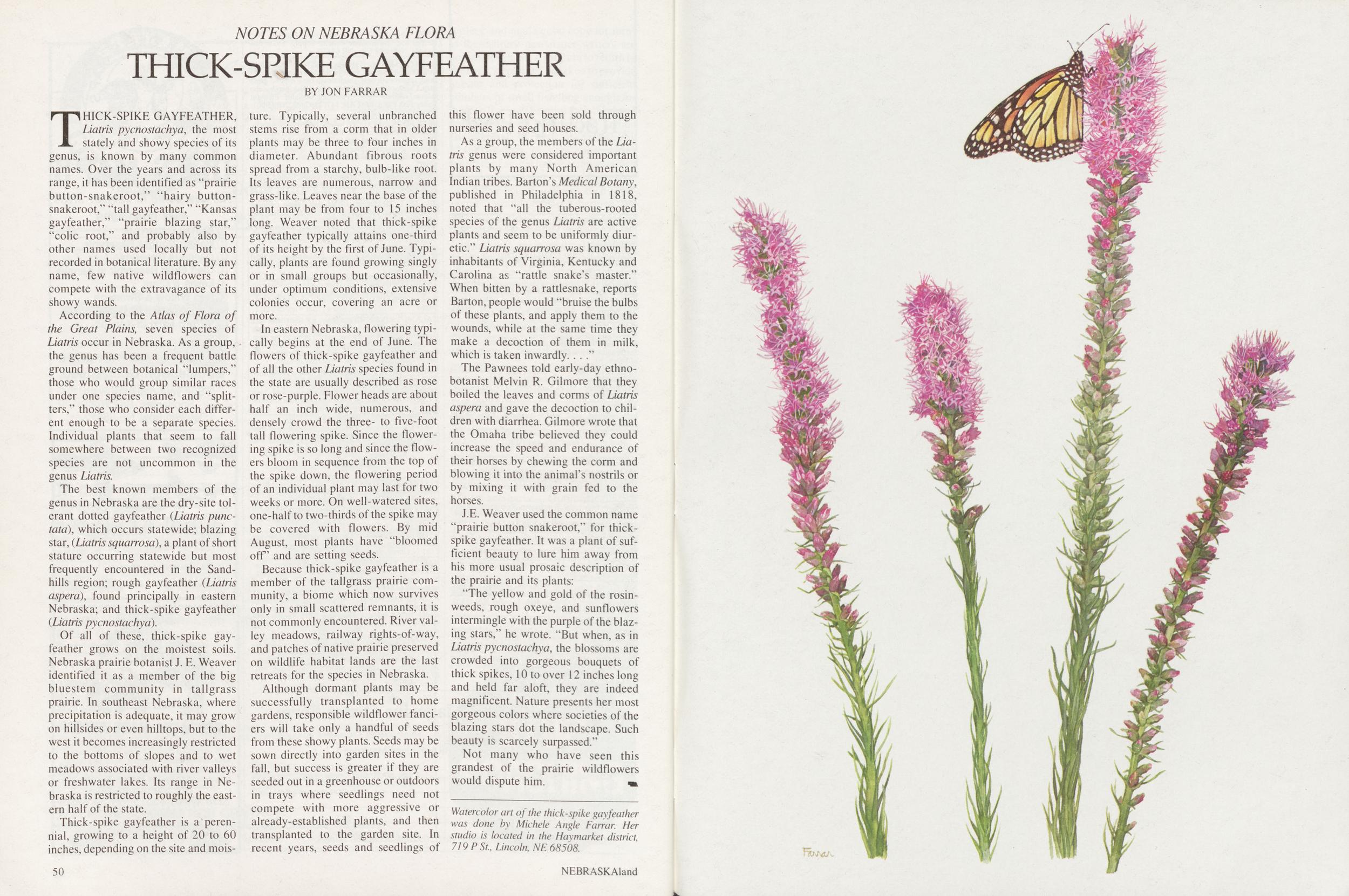
NOTES ON NEBRASKA FLORA THICK-SRIKE GAYFEATHER
BY JON FARRARTHICK-SPIKE GAYFEATHER, Liatris pycnostachya, the most stately and showy species of its genus, is known by many common names. Over the years and across its range, it has been identified as "prairie button-snakeroot," "hairy button-snakeroot," "tall gayfeather," "Kansas gayfeather," "prairie blazing star," "colic root," and probably also by other names used locally but not recorded in botanical literature. By any name, few native wildflowers can compete with the extravagance of its showy wands.
According to the Atlas of Flora of the Great Plains, seven species of Liatris occur in Nebraska. As a group, the genus has been a frequent battle ground between botanical "lumpers," those who would group similar races under one species name, and "splitters," those who consider each different enough to be a separate species. Individual plants that seem to fall somewhere between two recognized species are not uncommon in the genus Liatris.
The best known members of the genus in Nebraska are the dry-site tolerant dotted gayfeather {Liatris punctata), which occurs statewide; blazing star, {Liatris squarrosa), a plant of short stature occurring statewide but most frequently encountered in the Sand- hills region; rough gayfeather {Liatris aspera), found principally in eastern Nebraska; and thick-spike gayfeather {Liatris pycnostachya).
Of all of these, thick-spike gay- feather grows on the moistest soils. Nebraska prairie botanist J. E. Weaver identified it as a member of the big bluestem community in tallgrass prairie. In southeast Nebraska, where precipitation is adequate, it may grow on hillsides or even hilltops, but to the west it becomes increasingly restricted to the bottoms of slopes and to wet meadows associated with river valleys or freshwater lakes. Its range in Nebraska is restricted to roughly the eastern half of the state.
Thick-spike gayfeather is a perennial, growing to a height of 20 to 60 inches, depending on the site and moisture. Typically, several unbranched stems rise from a corm that in older plants may be three to four inches in diameter. Abundant fibrous roots spread from a starchy, bulb-like root. Its leaves are numerous, narrow and grass-like. Leaves near the base of the plant may be from four to 15 inches long. Weaver noted that thick-spike gayfeather typically attains one-third of its height by the first of June. Typically, plants are found growing singly or in small groups but occasionally, under optimum conditions, extensive colonies occur, covering an acre or more.
In eastern Nebraska, flowering typically begins at the end of June. The flowers of thick-spike gayfeather and of all the other Liatris species found in the state are usually described as rose or rose-purple. Flower heads are about half an inch wide, numerous, and densely crowd the three- to five-foot tall flowering spike. Since the flowering spike is so long and since the flowers bloom in sequence from the top of the spike down, the flowering period of an individual plant may last for two weeks or more. On well-watered sites, one-half to two-thirds of the spike may be covered with flowers. By mid August, most plants have "bloomed off and are setting seeds.
Because thick-spike gayfeather is a member of the tallgrass prairie community, a biome which now survives only in small scattered remnants, it is not commonly encountered. River valley meadows, railway rights-of-way, and patches of native prairie preserved on wildlife habitat lands are the last retreats for the species in Nebraska.
Although dormant plants may be successfully transplanted to home gardens, responsible wildflower fanciers will take only a handful of seeds from these showy plants. Seeds may be sown directly into garden sites in the fall, but success is greater if they are seeded out in a greenhouse or outdoors in trays where seedlings need not compete with more aggressive or already-established plants, and then transplanted to the garden site. In recent years, seeds and seedlings of this flower have been sold through nurseries and seed houses.
As a group, the members of the Liatris genus were considered important plants by many North American Indian tribes. Barton's Medical Botany, published in Philadelphia in 1818, noted that "all the tuberous-rooted species of the genus Liatris are active plants and seem to be uniformly diuretic." Liatris squarrosa was known by inhabitants of Virginia, Kentucky and Carolina as "rattle snake's master." When bitten by a rattlesnake, reports Barton, people would "bruise the bulbs of these plants, and apply them to the wounds, while at the same time they make a decoction of them in milk, which is taken inwardly. . . ."
The Pawnees told early-day ethnobotanist Melvin R. Gilmore that they boiled the leaves and corms of Liatris aspera and gave the decoction to children with diarrhea. Gilmore wrote that the Omaha tribe believed they could increase the speed and endurance of their horses by chewing the corm and blowing it into the animal's nostrils or by mixing it with grain fed to the horses.
J.E. Weaver used the common name "prairie button snakeroot," for thickspike gayfeather. It was a plant of sufficient beauty to lure him away from his more usual prosaic description of the prairie and its plants:
"The yellow and gold of the rosinweeds, rough oxeye, and sunflowers intermingle with the purple of the blazing stars," he wrote. "But when, as in Liatris pycnostachya, the blossoms are crowded into gorgeous bouquets of thick spikes, 10 to over 12 inches long and held far aloft, they are indeed magnificent. Nature presents her most gorgeous colors where societies of the blazing stars dot the landscape. Such beauty is scarcely surpassed."
Not many who have seen this grandest of the prairie wildflowers would dispute him.
Watercolor art of the thick-spike gayfeather was done by Michele Angle Farrar. Her studio is located in the Haymarket district, 719 P St., Lincoln, NE 68508.
50 NEBRASKAland
Position: 123 (49 views)