Volume 67, Issue 4, 1989
NEBRASKAland
MAY 1989 $1.50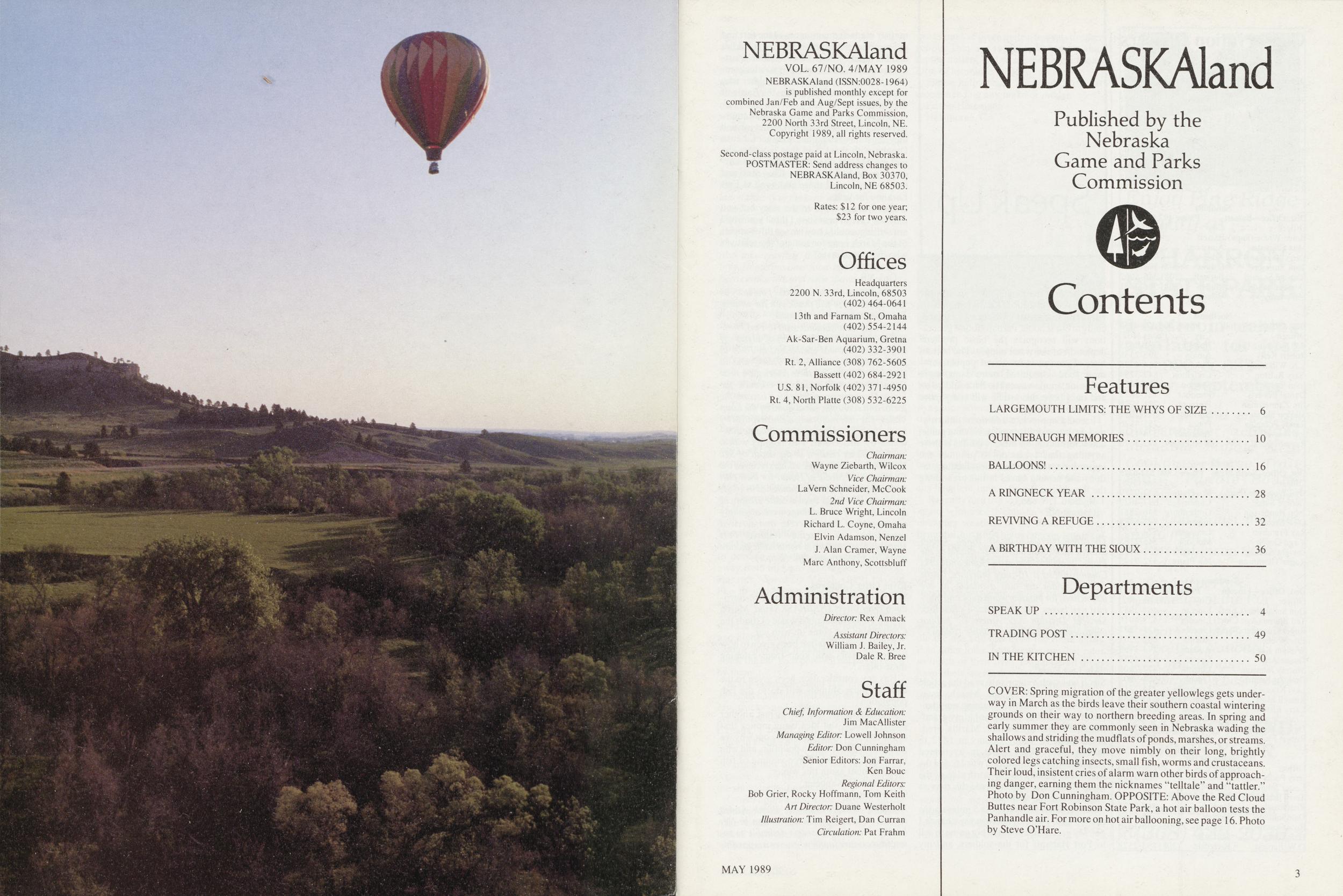
NEBRASKAland
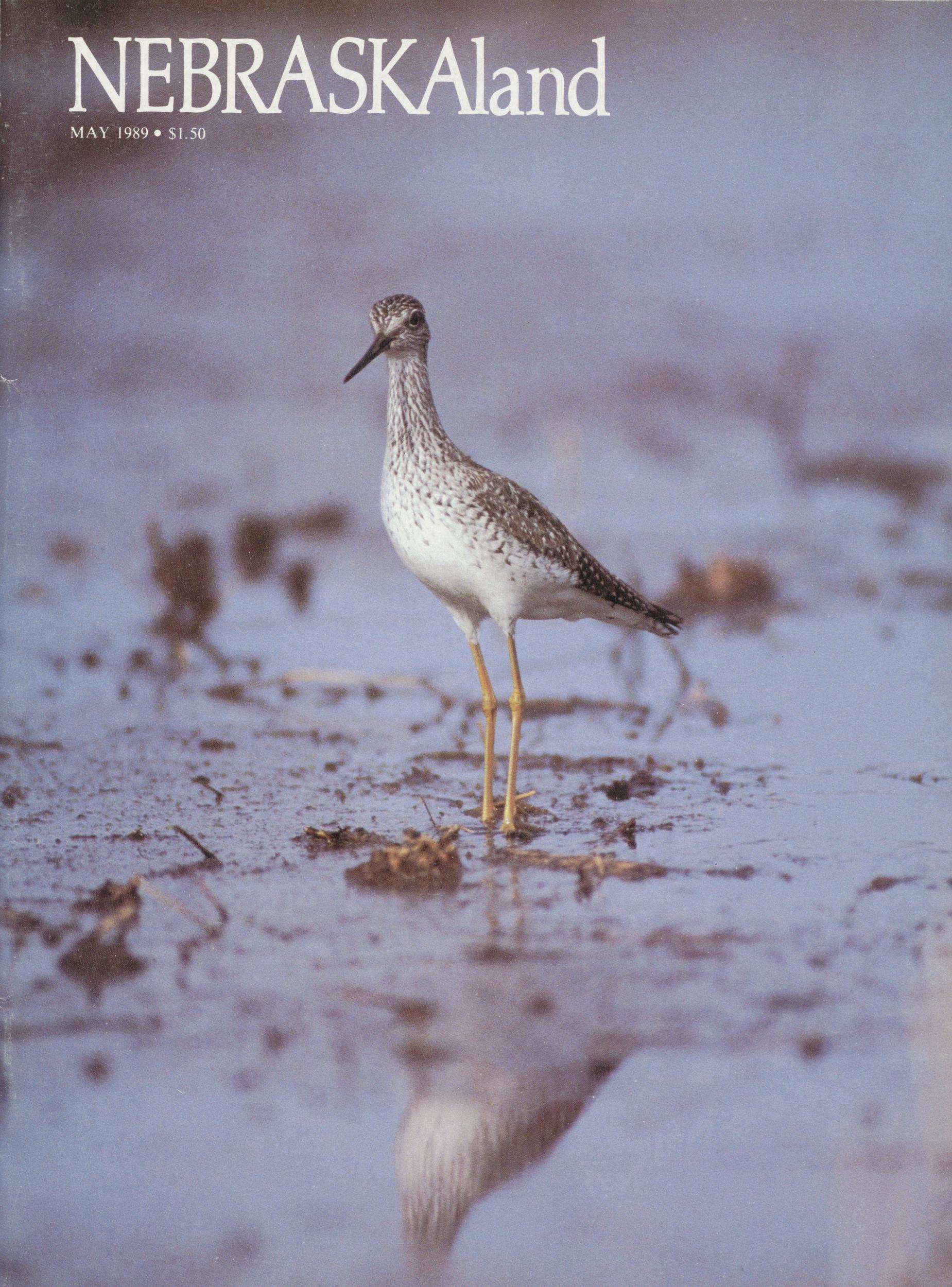
Published by the Nebraska Game and Parks Commission NEBRASKAland VOL. 67/NO. 4/MAY 1989 NEBRASKAland (ISSN:0028-1964) is published monthly except for combined Jan/Feb and Aug/Sept issues, by the Nebraska Game and Parks Commission, 2200 North 33rd Street, Lincoln, NE. Copyright 1989, all rights reserved. Second-class postage paid at Lincoln, Nebraska. POSTMASTER: Send address changes to NEBRASKAland, Box 30370, Lincoln, NE 68503. Rates: $ 12 for one year; $23 for two years. Offices Headquarters 2200 N. 33rd, Lincoln, 68503 (402)464-0641 13th and Farnam St., Omaha (402)554-2144 Ak-Sar-Ben Aquarium, Gretna (402)332-3901 Rt. 2, Alliance (308) 762-5605 Bassett (402) 684-2921 U.S. 81, Norfolk (402) 371-4950 Rt. 4, North Platte (308) 532-6225 Commissioners Chairman: Wayne Ziebarth, Wilcox Vice Chairman: LaVern Schneider, McCook 2nd Vice Chairman: L. Bruce Wright, Lincoln Richard L. Coyne, Omaha Elvin Adamson, Nenzel J. Alan Cramer, Wayne Marc Anthony, Scottsbluff Administration Director: Rex Amack Assistant Directors: William J. Bailey, Jr. Dale R. Bree Staff Chief, Information & Education: Jim MacAllister Managing Editor: Lowell Johnson Editor: Don Cunningham Senior Editors: Jon Farrar, Ken Bouc Regional Editors: Bob Grier, Rocky Hoffmann, Tom Keith Art Director: Duane Westerholt Illustration: Tim Reigert, Dan Curran Circulation: Pat Frahm Contents Features LARGEMOUTH LIMITS: THE WHYS OF SIZE 6 QUINNEBAUGH MEMORIES 10 BALLOONS 16 A RTNGNECK YEAR 28 REVIVING A REFUGE 32 A BIRTHDAY WITH THE SIOUX 36 Departments SPEAK UP 4 TRADING POST 49 IN THE KITCHEN 50 COVER: Spring migration of the greater yellowlegs gets underway in March as the birds leave their southern coastal wintering grounds on their way to northern breeding areas. In spring and early summer they are commonly seen in Nebraska wading the shallows and striding the mudflats of ponds, marshes, or streams. Alert and graceful, they move nimbly on their long, brightly colored legs catching insects, small fish, worms and crustaceans. Their loud, insistent cries of alarm warn other birds of approaching danger, earning them the nicknames "telltale" and "tattler." Photo by Don Cunningham. OPPOSITE: Above the Red Cloud Buttes near Fort Robinson State Park, a hot air balloon tests the Panhandle air. For more on hot air ballooning, see page 16. Photo by Steve O'Hare. MAY 1989 3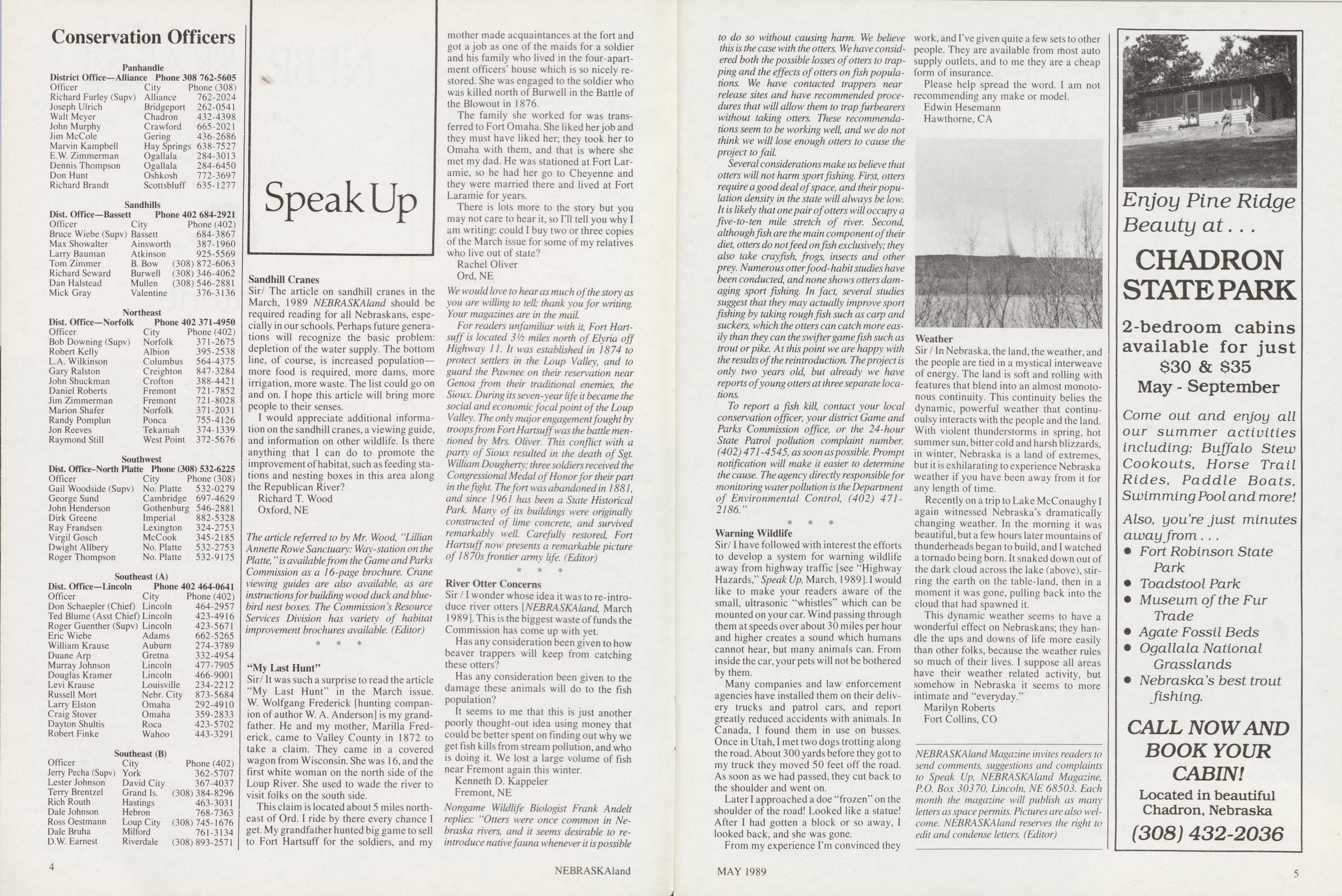
Speak Up
Sandhill CranesSir/ The article on sandhill cranes in the March, 1989 NEBRASKAland should be required reading for all Nebraskans, especially in our schools. Perhaps future generations will recognize the basic problem: depletion of the water supply. The bottom line, of course, is increased population-more food is required, more dams, more irrigation, more waste. The list could go on and on. I hope this article will bring more people to their senses.
I would appreciate additional information on the sandhill cranes, a viewing guide, and information on other wildlife. Is there anything that I can do to promote the improvement of habitat, such as feeding stations and nesting boxes in this area along the Republican River?
Richard T. Wood Oxford, NEThe article referred to by Mr. Wood, "Lillian Annette Rowe Sanctuary: Way-station on the Platte, "is available from the Game and Parks Commission as a J 6-page brochure. Crane viewing guides are also available, as are instructions for building wood duck and bluebird nest boxes. The Commission's Resource Services Division has variety of habitat improvement brochures available. (Editor)
* * * "My Last Hunt"Sir/ It was such a surprise to read the article "My Last Hunt" in the March issue. W. Wolfgang Frederick [hunting companion of author W. A. Anderson] is my grand- father. He and my mother, Manilla Frederick, came to Valley County in 1872 to take a claim. They came in a covered wagon from Wisconsin. She was 16, and the first white woman on the north side of the Loup River. She used to wade the river to visit folks on the south side.
This claim is located about 5 miles northeast of Ord. I ride by there every chance I get. My grandfather hunted big game to sell to Fort Hartsuff for the soldiers, and my mother made acquaintances at the fort and got a job as one of the maids for a soldier and his family who lived in the four-apartment officers' house which is so nicely restored. She was engaged to the soldier who was killed north of Burwell in the Battle of the Blowout in 1876.
The family she worked for was transferred to Fort Omaha. She liked her job and they must have liked her; they took her to Omaha with them, and that is where she met my dad. He was stationed at Fort Laramie, so he had her go to Cheyenne and they were married there and lived at Fort Laramie for years.
There is lots more to the story but you may not care to hear it, so I'll tell you why I am writing: could I buy two or three copies of the March issue for some of my relatives who live out of state?
Rachel Oliver Ord, NEWe would love to hear as much of the story as you are willing to tell; thank you for writing. Your magazines are in the mail
For readers unfamiliar with it, Fort Hartsuff is located 31h miles north of Elyria off Highway 11. It was established in 1874 to protect settlers in the Loup Valley, and to guard the Pawnee on their reservation near Genoa from their traditional enemies, the Sioux. During its seven-year life it became the social and economic focal point of the Loup Valley. The only major engagement fought by troops from Fort Hartsuff was the battle mentioned by Mrs. Oliver. This conflict with a party of Sioux resulted in the death of Sgt. William Dougherty; three soldiers received the Congressional Medal of Honor for their part in the fight. The fort was abandoned in 1881, and since 1961 has been a State Historical Park. Many of its buildings were originally constructed of lime concrete, and survived remarkably well. Carefully restored, Fort Hartsuff now presents a remarkable picture of 1870s frontier army life. (Editor)
* * * River Otter ConcernsSir /1 wonder whose idea it was to re-introduce river otters [NEBRASKAland, March 1989]. This is the biggest waste of funds the Commission has come up with yet.
Has any consideration been given to how beaver trappers will keep from catching these otters?
Has any consideration been given to the damage these animals will do to the fish population?
It seems to me that this is just another poorly thought-out idea using money that could be better spent on finding out why we get fish kills from stream pollution, and who is doing it. We lost a large volume of fish near Fremont again this winter.
Kenneth D. Kappeler Fremont, NENongame Wildlife Biologist Frank Andelt replies: "Otters were once common in Nebraska rivers, and it seems desirable to re-introduce native fauna whenever it is possible 4 NEBRASKAland to do so without causing harm. We believe this is the case with the otters. We have considered both the possible losses of otters to trapping and the effects of otters on fish populations. We have contacted trappers near release sites and have recommended procedures that will allow them to trap furbearers without taking otters. These recommendations seem to be working well and we do not think we will lose enough otters to cause the project to fail.
Several considerations make us believe that otters will not harm sport fishing. First, otters require a good deal of space, and their population density in the state will always be low. It is likely that one pair of otters will occupy a five-to-ten mile stretch of river. Second, although fish are the main component of their diet, otters do not feed on fish exclusively; they also take crayfish, frogs, insects and other prey. Numerous otter food-habit studies have been conducted, and none shows otters dam- aging sport fishing. In fact, several studies suggest that they may actually improve sport fishing by taking rough fish such as carp and suckers, which the otters can catch more easily than they can the swifter game fish such as trout or pike. At this point we are happy with the results of the reintroduction. The project is only two years old, but already we have reports of young otters at three separate locations.
To report a fish kill, contact your local conservation officer, your district Game and Parks Commission office, or the 24-hour State Patrol pollution complaint number, (402)471-4545, as soon as possible. Prompt notification will make it easier to determine the cause. The agency directly responsible for monitoring water pollution is the Department of Environmental Control, (402) 471-2186."
* * * Warning WildlifeSir/1 have followed with interest the efforts to develop a system for warning wildlife away from highway traffic [see "Highway Hazards," Speak Up, March, 1989]. I would like to make your readers aware of the small, ultrasonic "whistles" which can be mounted on your car. Wind passing through them at speeds over about 30 miles per hour and higher creates a sound which humans cannot hear, but many animals can. From inside the car, your pets will not be bothered by them.
Many companies and law enforcement agencies have installed them on their delivery trucks and patrol cars, and report greatly reduced accidents with animals. In Canada, I found them in use on busses. Once in Utah, I met two dogs trotting along the road. About 300 yards before they got to my truck they moved 50 feet off the road. As soon as we had passed, they cut back to the shoulder and went on.
Later I approached a doe "frozen" on the shoulder of the road! Looked like a statue! After I had gotten a block or so away, I looked back, and she was gone.
From my experience I'm convinced they work, and I've given quite a few sets to other people. They are available from most auto supply outlets, and to me they are a cheap form of insurance.
Please help spread the word. I am not recommending any make or model.
Edwin Hesemann Hawthorne, CASir / In Nebraska, the land, the weather, and the people are tied in a mystical interweave of energy. The land is soft and rolling with features that blend into an almost monotonous continuity. This continuity belies the dynamic, powerful weather that continuoulsy interacts with the people and the land. With violent thunderstorms in spring, hot summer sun, bitter cold and harsh blizzards, in winter, Nebraska is a land of extremes, but it is exhilarating to experience Nebraska weather if you have been away from it for any length of time.
Recently on a trip to Lake McConaughy I again witnessed Nebraska's dramatically changing weather. In the morning it was beautiful, but a few hours later mountains of thunderheads began to build, and I watched a tornado being born. It snaked down out of the dark cloud across the lake (above), stirring the earth on the table-land, then in a moment it was gone, pulling back into the cloud that had spawned it.
This dynamic weather seems to have a wonderful effect on Nebraskans; they handle the ups and downs of life more easily than other folks, because the weather rules so much of their lives. I suppose all areas have their weather related activity, but somehow in Nebraska it seems to more intimate and "everyday."
Marilyn Roberts Fort Collins, CONEBRASKAland Magazine invites readers to send comments, suggestions and complaints to Speak Up, NEBRASKAland Magazine, P.O. Box 30370, Lincoln, NE 68503. Each month the magazine will publish as many letters as space permits. Pictures are also welcome. NEBRASKAland reserves the right to edit and condense letters. (Editor)
Enjoy Pine Ridge Beauty at CHADRON STATE PARK 2-bedroom cabins available for just $30 & $35 May - September Come out and enjoy all our summer activities including: Buffalo Stew Cookouts, Horse Trail Rides, Paddle Boats, Swimming Pool and more! Also, you're just minutes away from Fort Robinson State Park Toadstool Park Museum ojthe Fur Trade Agate Fossil Beds Ogallala National Grasslands Nebraska's best trout fishing. CALL NOW AND BOOK YOUR CABIN! Located in beautiful Chadron, Nebraska (308) 432-2036 MAY 1989 5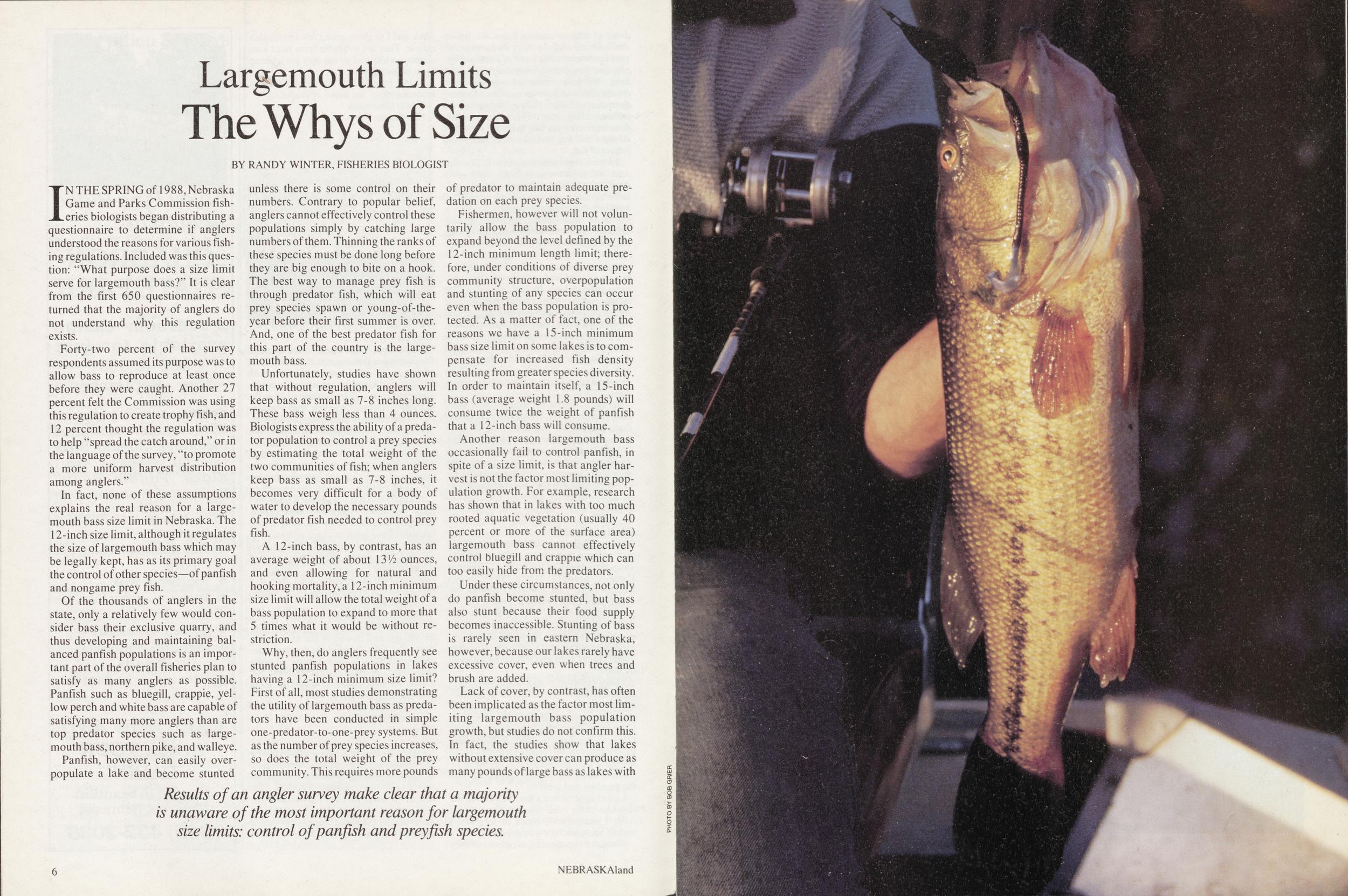
Largemouth Limits The Whys of Size
BY RANDY WINTER, FISHERIES BIOLOGIST Results of an angler survey make clear that a majority is unaware of the most important reason for largemouth size limits: control of panfish and prey fish species.IN THE SPRING of 1988, Nebraska Game and Parks Commission fisheries biologists began distributing a questionnaire to determine if anglers understood the reasons for various fishing regulations. Included was this question: "What purpose does a size limit serve for largemouth bass?" It is clear from the first 650 questionnaires returned that the majority of anglers do not understand why this regulation exists.
Forty-two percent of the survey respondents assumed its purpose was to allow bass to reproduce at least once before they were caught. Another 27 percent felt the Commission was using this regulation to create trophy fish, and 12 percent thought the regulation was to help "spread the catch around," or in the language of the survey, "to promote a more uniform harvest distribution among anglers."
In fact, none of these assumptions explains the real reason for a largemouth bass size limit in Nebraska. The 12-inch size limit, although it regulates the size of largemouth bass which may be legally kept, has as its primary goal the control of other species—of panfish and nongame prey fish.
Of the thousands of anglers in the state, only a relatively few would consider bass their exclusive quarry, and thus developing and maintaining balanced panfish populations is an important part of the overall fisheries plan to satisfy as many anglers as possible. Panfish such as bluegill, crappie, yellow perch and white bass are capable of satisfying many more anglers than are top predator species such as largemouth bass, northern pike, and walleye.
Panfish, however, can easily overpopulate a lake and become stunted unless there is some control on their numbers. Contrary to popular belief, anglers cannot effectively control these populations simply by catching large numbers of them. Thinning the ranks of these species must be done long before they are big enough to bite on a hook. The best way to manage prey fish is through predator fish, which will eat prey species spawn or young-of-the-year before their first summer is over. And, one of the best predator fish for this part of the country is the largemouth bass.
Unfortunately, studies have shown that without regulation, anglers will keep bass as small as 7-8 inches long. These bass weigh less than 4 ounces. Biologists express the ability of a predator population to control a prey species by estimating the total weight of the two communities offish; when anglers keep bass as small as 7-8 inches, it becomes very difficult for a body of water to develop the necessary pounds of predator fish needed to control prey fish.
A 12-inch bass, by contrast, has an average weight of about 13 Vi ounces, and even allowing for natural and hooking mortality, a 12-inch minimum size limit will allow the total weight of a bass population to expand to more that 5 times what it would be without restriction.
Why, then, do anglers frequently see stunted panfish populations in lakes having a 12-inch minimum size limit? First of all, most studies demonstrating the utility of largemouth bass as predators have been conducted in simple one-predator-to-one-prey systems. But as the number of prey species increases, so does the total weight of the prey community. This requires more pounds of predator to maintain adequate predation on each prey species.
Fishermen, however will not voluntarily allow the bass population to expand beyond the level defined by the 12-inch minimum length limit; therefore, under conditions of diverse prey community structure, overpopulation and stunting of any species can occur even when the bass population is protected. As a matter of fact, one of the reasons we have a 15-inch minimum bass size limit on some lakes is to compensate for increased fish density resulting from greater species diversity. In order to maintain itself, a 15-inch bass (average weight 1.8 pounds) will consume twice the weight of panfish that a 12-inch bass will consume.
Another reason largemouth bass occasionally fail to control panfish, in spite of a size limit, is that angler harvest is not the factor most limiting population growth. For example, research has shown that in lakes with too much rooted aquatic vegetation (usually 40 percent or more of the surface area) largemouth bass cannot effectively control bluegill and crappie which can too easily hide from the predators.
Under these circumstances, not only do panfish become stunted, but bass also stunt because their food supply becomes inaccessible. Stunting of bass is rarely seen in eastern Nebraska, however, because our lakes rarely have excessive cover, even when trees and brush are added.
Lack of cover, by contrast, has often been implicated as the factor most limiting largemouth bass population growth, but studies do not confirm this. In fact, the studies show that lakes without extensive cover can produce as many pounds of large bass as lakes with 6 NEBRASKAland
 varying amounts of cover, so long as
fishing does not unbalance the fish
community.
varying amounts of cover, so long as
fishing does not unbalance the fish
community.
But lakes with extensive cover often do contain more pounds of bass than lakes void of cover, when fish community balance is not considered. The logical conclusion from these findings is that cover protects bass from angler over-harvest rather than providing a key ingredient to increased production.
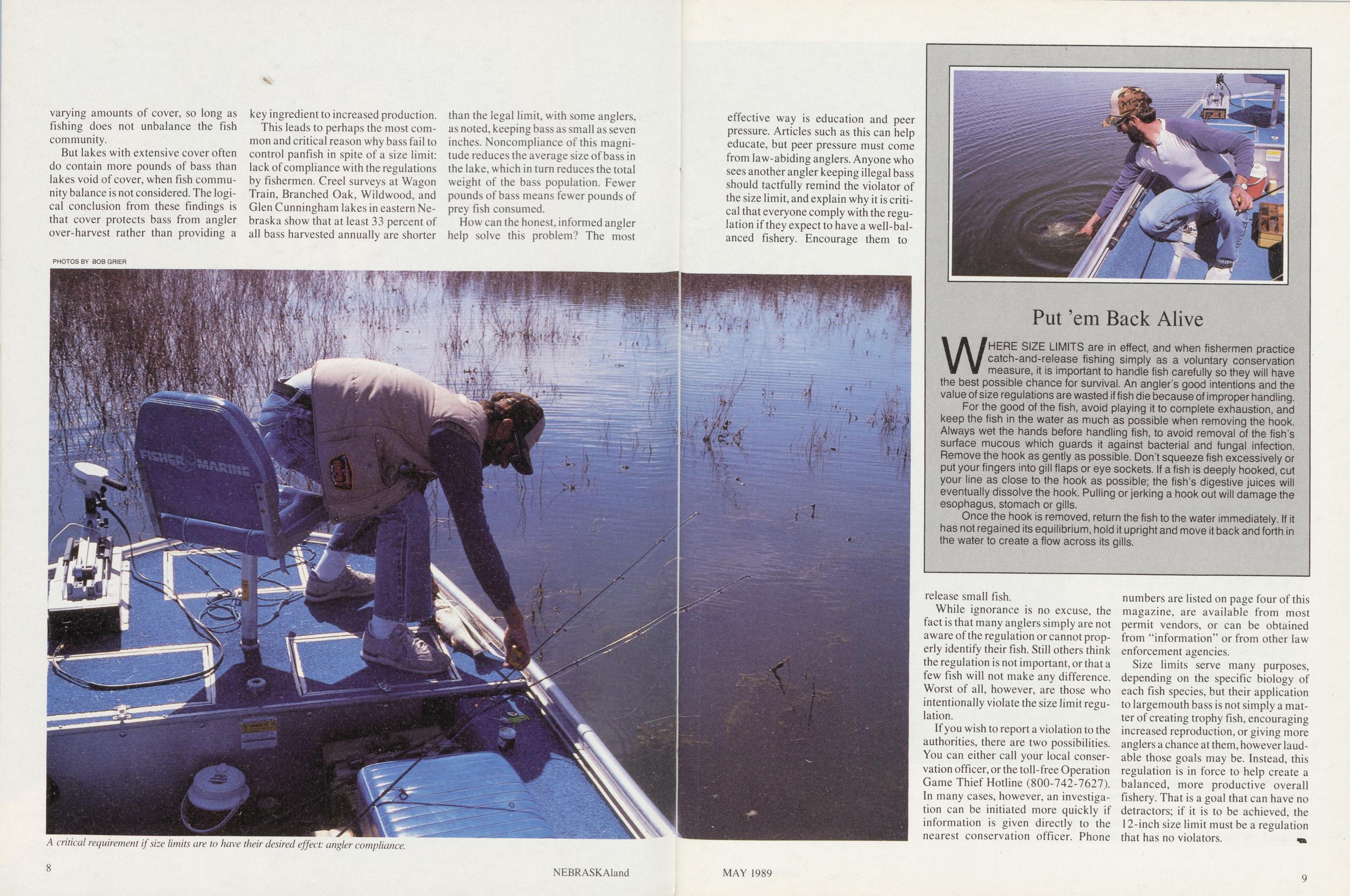
This leads to perhaps the most common and critical reason why bass fail to control panfish in spite of a size limit: lack of compliance with the regulations by fishermen. Creel surveys at Wagon Train, Branched Oak, Wildwood, and Glen Cunningham lakes in eastern Nebraska show that at least 33 percent of all bass harvested annually are shorter than the legal limit, with some anglers, as noted, keeping bass as small as seven inches. Noncompliance of this magnitude reduces the average size of bass in the lake, which in turn reduces the total weight of the bass population. Fewer pounds of bass means fewer pounds of prey fish consumed.
How can the honest, informed angler help solve this problem? The most 8 NEBRASKAland effective way is education and peer pressure. Articles such as this can help educate, but peer pressure must come from law-abiding anglers. Anyone who sees another angler keeping illegal bass should tactfully remind the violator of the size limit, and explain why it is critical that everyone comply with the regulation if they expect to have a well-balanced fishery. Encourage them to release small fish.
WHERE SIZE LIMITS are in effect, and when fishermen practice catch-and-release fishing simply as a voluntary conservation measure, it is important to handle fish carefully so they will have the best possible chance for survival. An angler's good intentions and the value of size regulations are wasted if fish die because of improper handling.
For the good of the fish, avoid playing it to complete exhaustion, and keep the fish in the water as much as possible when removing the hook. Always wet the hands before handling fish, to avoid removal of the fish's surface mucous which guards it against bacterial and fungal infection. Remove the hook as gently as possible. Don't squeeze fish excessively or put your fingers into gill flaps or eye sockets. If a fish is deeply hooked, cut your line as close to the hook as possible; the fish's digestive juices will eventually dissolve the hook. Pulling or jerking a hook out will damage the esophagus, stomach or gills.
Once the hook is removed, return the fish to the water immediately. If it has not regained its equilibrium, hold it upright and move it back and forth in the water to create a flow across its gills.
While ignorance is no excuse, the fact is that many anglers simply are not aware of the regulation or cannot properly identify their fish. Still others think the regulation is not important, or that a few fish will not make any difference. Worst of all, however, are those who intentionally violate the size limit regulation.
If you wish to report a violation to the authorities, there are two possibilities. You can either call your local conservation officer, or the toll-free Operation Game Thief Hotline (800-742-7627). In many cases, however, an investigation can be initiated more quickly if information is given directly to the nearest conservation officer. Phone numbers are listed on page four of this magazine, are available from most permit vendors, or can be obtained from "information" or from other law enforcement agencies.
Size limits serve many purposes, depending on the specific biology of each fish species, but their application to largemouth bass is not simply a matter of creating trophy fish, encouraging increased reproduction, or giving more anglers a chance at them, however laudable those goals may be. Instead, this regulation is in force to help create a balanced, more productive overall fishery. That is a goal that can have no detractors; if it is to be achieved, the 12-inch size limit must be a regulation that has no violators.
MAY 1989 9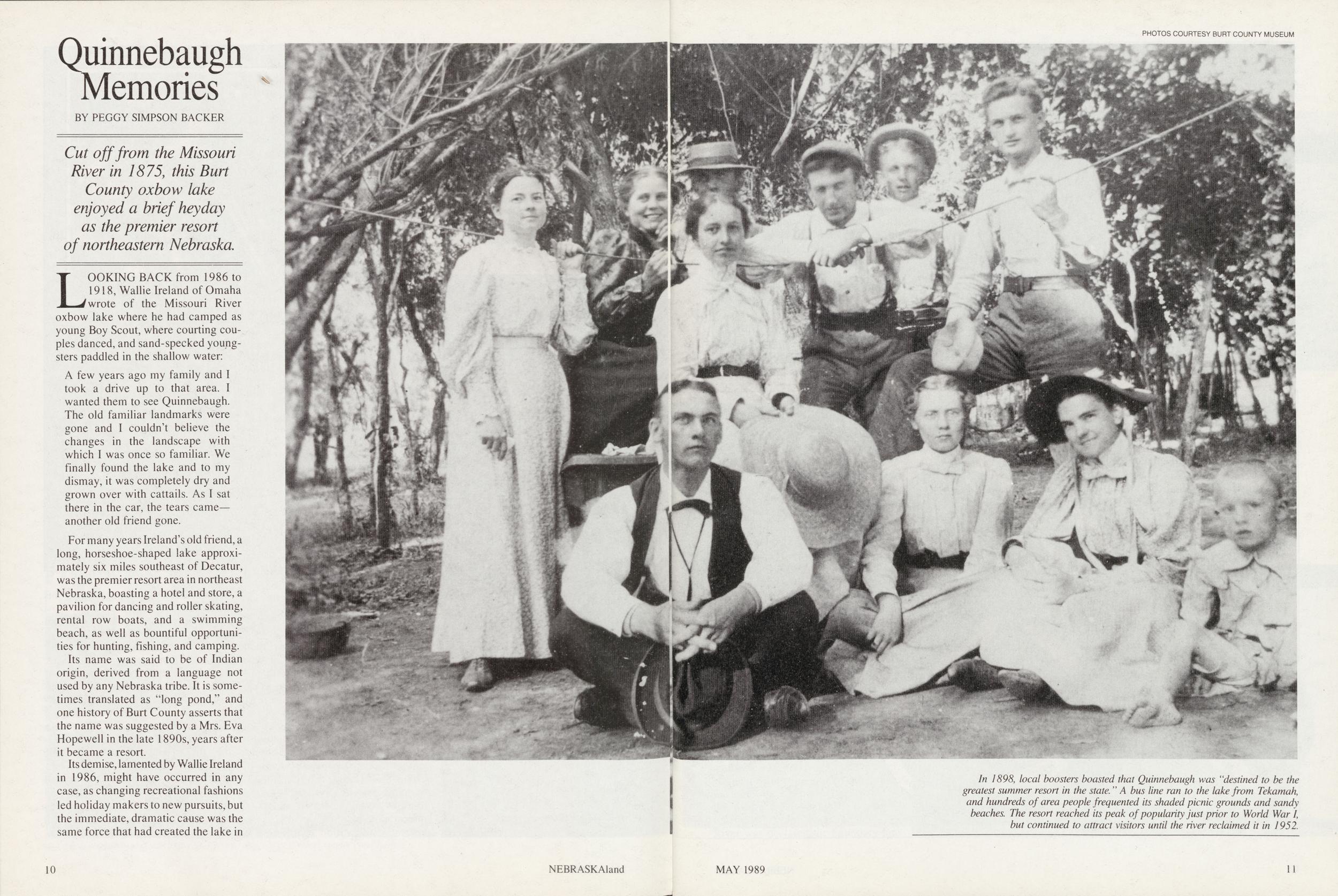
Quinnebaugh Memories
BY PEGGY SIMPSON BACKER Cut off from the Missouri River in 18 75, this Burt County oxbow lake enjoyed a brief heyday as the premier resort of northeastern Nebraska,LOOKING BACK from 1986 to 1918, Wallie Ireland of Omaha wrote of the Missouri River oxbow lake where he had camped as young Boy Scout, where courting couples danced, and sand-specked youngsters paddled in the shallow water:
A few years ago my family and I took a drive up to that area. I wanted them to see Quinnebaugh. The old familiar landmarks were gone and I couldn't believe the changes in the landscape with which I was once so familiar. We finally found the lake and to my dismay, it was completely dry and grown over with cattails. As I sat there in the car, the tears came another old friend gone.
For many years Ireland's old friend, a long, horseshoe-shaped lake approximately six miles southeast of Decatur, was the premier resort area in northeast Nebraska, boasting a hotel and store, a pavilion for dancing and roller skating, rental row boats, and a swimming beach, as well as bountiful opportunities for hunting, fishing, and camping.
Its name was said to be of Indian origin, derived from a language not used by any Nebraska tribe. It is sometimes translated as "long pond," and one history of Burt County asserts that the name was suggested by a Mrs. Eva Hopewell in the late 1890s, years after it became a resort.
Its demise, lamented by Wallie Ireland in 1986, might have occurred in any case, as changing recreational fashions led holiday makers to new pursuits, but the immediate, dramatic cause was the same force that had created the lake in the 1870s: the unpredictable, untamed Missouri River which, in a 1952 rampage, rang the death knell for a lake already partially dewatered and filling with silt.
10 NEBRASKAland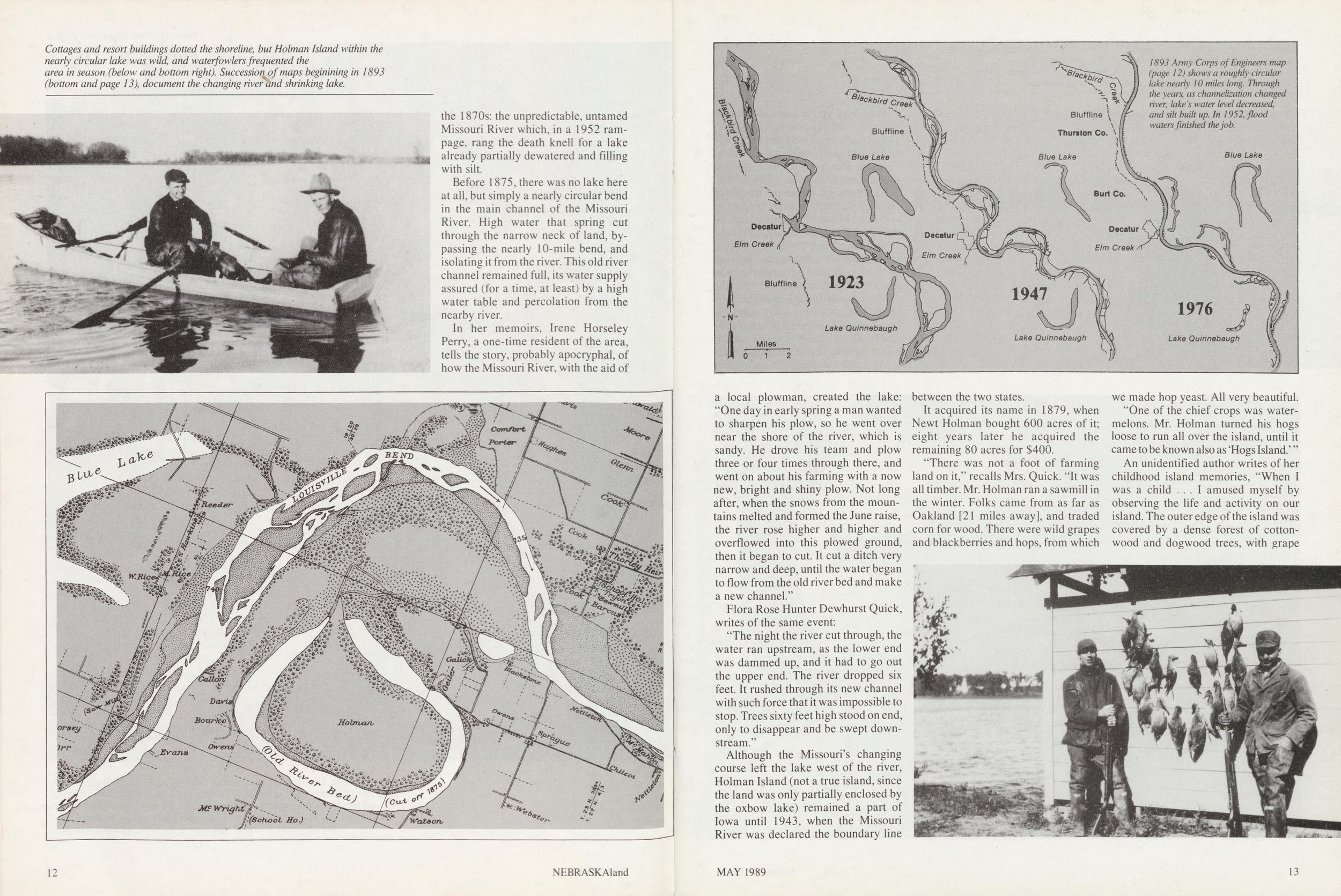
Before 1875, there was no lake here at all, but simply a nearly circular bend in the main channel of the Missouri River. High water that spring cut through the narrow neck of land, bypassing the nearly 10-mile bend, and isolating it from the river. This old river channel remained full, its water supply assured (for a time, at least) by a high water table and percolation from the nearby river.
In her memoirs, Irene Horseley Perry, a one-time resident of the area, tells the story, probably apocryphal, of how the Missouri River, with the aid of a local plowman, created the lake: "One day in early spring a man wanted to sharpen his plow, so he went over near the shore of the river, which is sandy. He drove his team and plow three or four times through there, and went on about his farming with a now new, bright and shiny plow. Not long after, when the snows from the mountains melted and formed the June raise, the river rose higher and higher and overflowed into this plowed ground, then it began to cut. It cut a ditch very narrow and deep, until the water began to flow from the old river bed and make a new channel."
Flora Rose Hunter Dewhurst Quick, writes of the same event:
"The night the river cut through, the water ran upstream, as the lower end was dammed up, and it had to go out the upper end. The river dropped six feet. It rushed through its new channel with such force that it was impossible to stop. Trees sixty feet high stood on end, only to disappear and be swept downstream."
Although the Missouri's changing course left the lake west of the river, Holman Island (not a true island, since the land was only partially enclosed by the oxbow lake) remained a part of Iowa until 1943, when the Missouri River was declared the boundary line between the two states.
It acquired its name in 1879, when Newt Holman bought 600 acres of it; eight years later he acquired the remaining 80 acres for $400.
"There was not a foot of farming land on it," recalls Mrs. Quick. "It was all timber. Mr. Holman ran a sawmill in the winter. Folks came from as far as Oakland [21 miles away], and traded corn for wood. There were wild grapes and blackberries and hops, from which we made hop yeast. All very beautiful.
"One of the chief crops was watermelons. Mr. Holman turned his hogs loose to run all over the island, until it came to be known also as 'Hogs Island.'"
An unidentified author writes of her childhood island memories, "When I was a child ... I amused myself by observing the life and activity on our island. The outer edge of the island was covered by a dense forest of cottonwood and dogwood trees, with grape
and ivy vines, kinnikinnick and sumac. Squirrels, skunks, rabbits, 'possum, gophers and civet cats inhabited the area. Muskrats lived along the shore. The bird life consisted of songbirds, geese, crows and ducks.
"On summer mornings, flocks of crows, by the thousands, would fly across the valley, skyline to skyline. In the evening, they would fly back, skyline to skyline."
Although not a true island, access to the land was difficult, especially at periods of high water. In 1919, the Omaha World-Herald described the island's isolation, saying "only a causeway of bundles of willows connects it with the Nebraska land. At high water, the islanders have to use boats across Lake Quinnebaugh and cannot reach Iowa except by going across bridges at Missouri Valley or Sioux City, forty miles to the south or north."
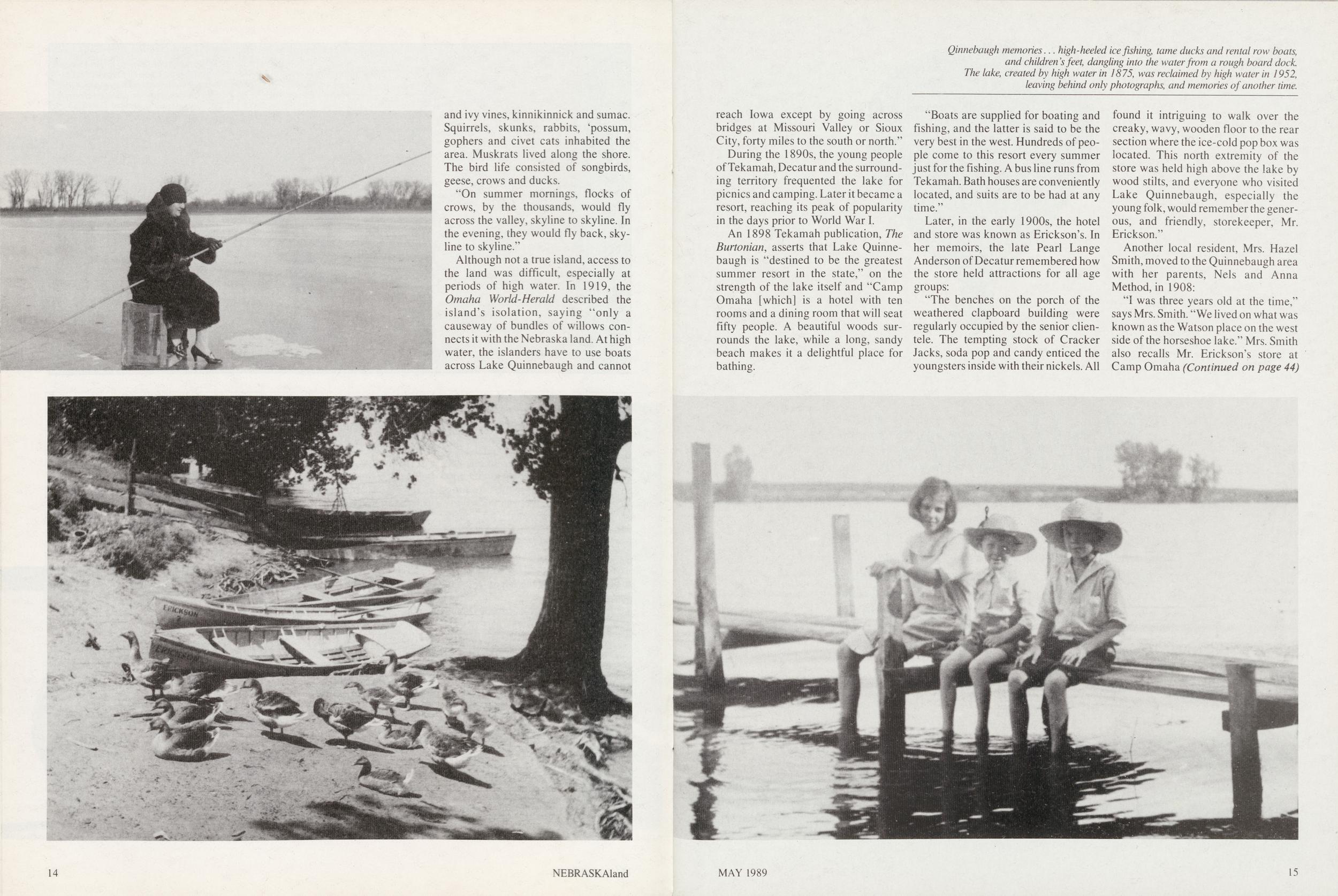
Qinnebaugh memories high-heeled ice fishing, tame ducks and rental row boats, and children s feet, dangling into the water from a rough board dock. The lake, created by high water in J875, was reclaimed by high water in 1952, leaving behind only photographs, and memories of another time.During the 1890s, the young people of Tekamah, Decatur and the surrounding territory frequented the lake for picnics and camping. Later it became a resort, reaching its peak of popularity in the days prior to World War I.
An 1898 Tekamah publication, The Burtonian, asserts that Lake Quinnebaugh is "destined to be the greatest summer resort in the state," on the strength of the lake itself and "Camp Omaha [which] is a hotel with ten rooms and a dining room that will seat fifty people. A beautiful woods surrounds the lake, while a long, sandy beach makes it a delightful place for bathing.
"Boats are supplied for boating and fishing, and the latter is said to be the very best in the west. Hundreds of people come to this resort every summer just for the fishing. A bus line runs from Tekamah. Bath houses are conveniently located, and suits are to be had at any time."
Later, in the early 1900s, the hotel and store was known as Erickson's. In her memoirs, the late Pearl Lange Anderson of Decatur remembered how the store held attractions for all age groups:
"The benches on the porch of the weathered clapboard building were regularly occupied by the senior clientele. The tempting stock of Cracker Jacks, soda pop and candy enticed the youngsters inside with their nickels. All found it intriguing to walk over the creaky, wavy, wooden floor to the rear section where the ice-cold pop box was located. This north extremity of the store was held high above the lake by wood stilts, and everyone who visited Lake Quinnebaugh, especially the young folk, would remember the generous, and friendly, storekeeper, Mr. Erickson."
Another local resident, Mrs. Hazel Smith, moved to the Quinnebaugh area with her parents, Nels and Anna Method, in 1908:
"I was three years old at the time," says Mrs. Smith. "We lived on what was known as the Watson place on the west side of the horseshoe lake." Mrs. Smith also recalls Mr. Erickson's store at Camp Omaha (Continued on page 44)
Balloons!
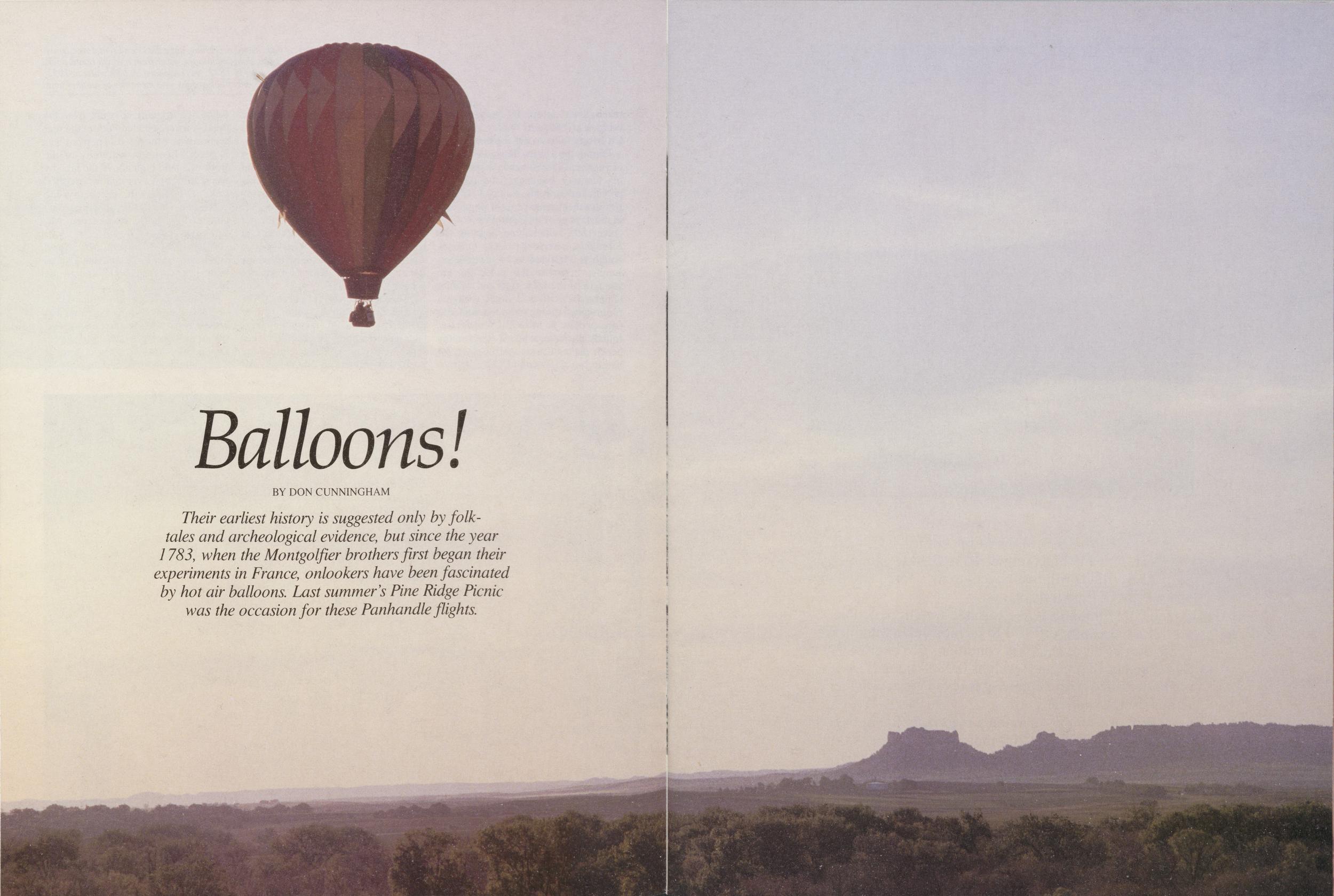
BY DON CUNNINGHAM Their earliest history is suggested only by folktales and archeological evidence, but since the year 1783, when the Montgolfier brothers first began their experiments in France, onlookers have been fascinated by hot air balloons. Last summer's Pine Ridge Picnic was the occasion for these Panhandle flights.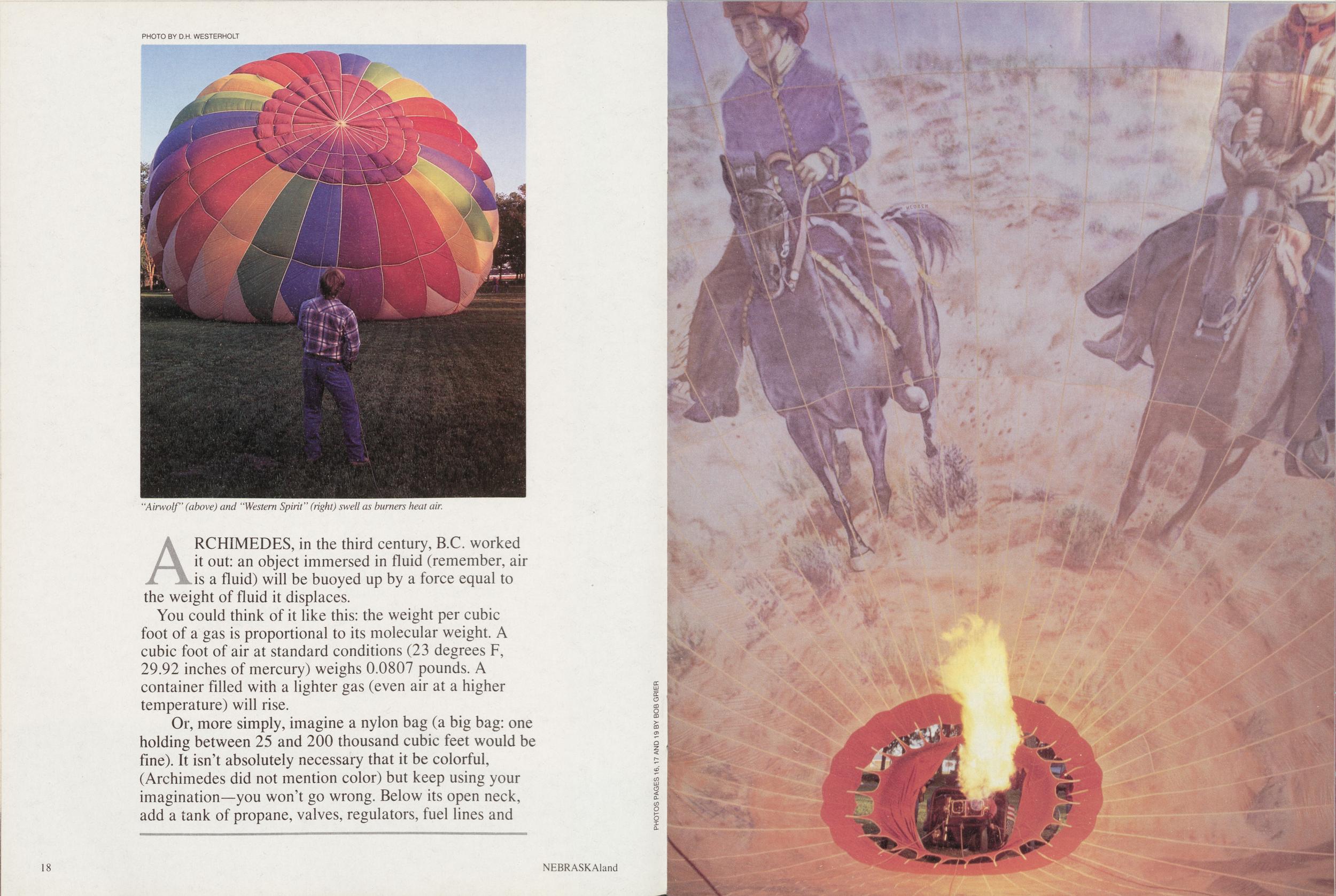
ARCHIMEDES, in the third century, B.C. worked it out: an object immersed in fluid (remember, air is a fluid) will be buoyed up by a force equal to the weight of fluid it displaces.
You could think of it like this: the weight per cubic foot of a gas is proportional to its molecular weight. A cubic foot of air at standard conditions (23 degrees F, 29.92 inches of mercury) weighs 0.0807 pounds. A container filled with a lighter gas (even air at a higher temperature) will rise.
Or, more simply, imagine a nylon bag (a big bag: one holding between 25 and 200 thousand cubic feet would be fine). It isn't absolutely necessary that it be colorful, (Archimedes did not mention color) but keep using your imagination—you won't go wrong. Below its open neck, add a tank of propane, valves, regulators, fuel lines and burners, and attach a basket (wicker, fiberglass, or aluminum).
19 NEBRASKAland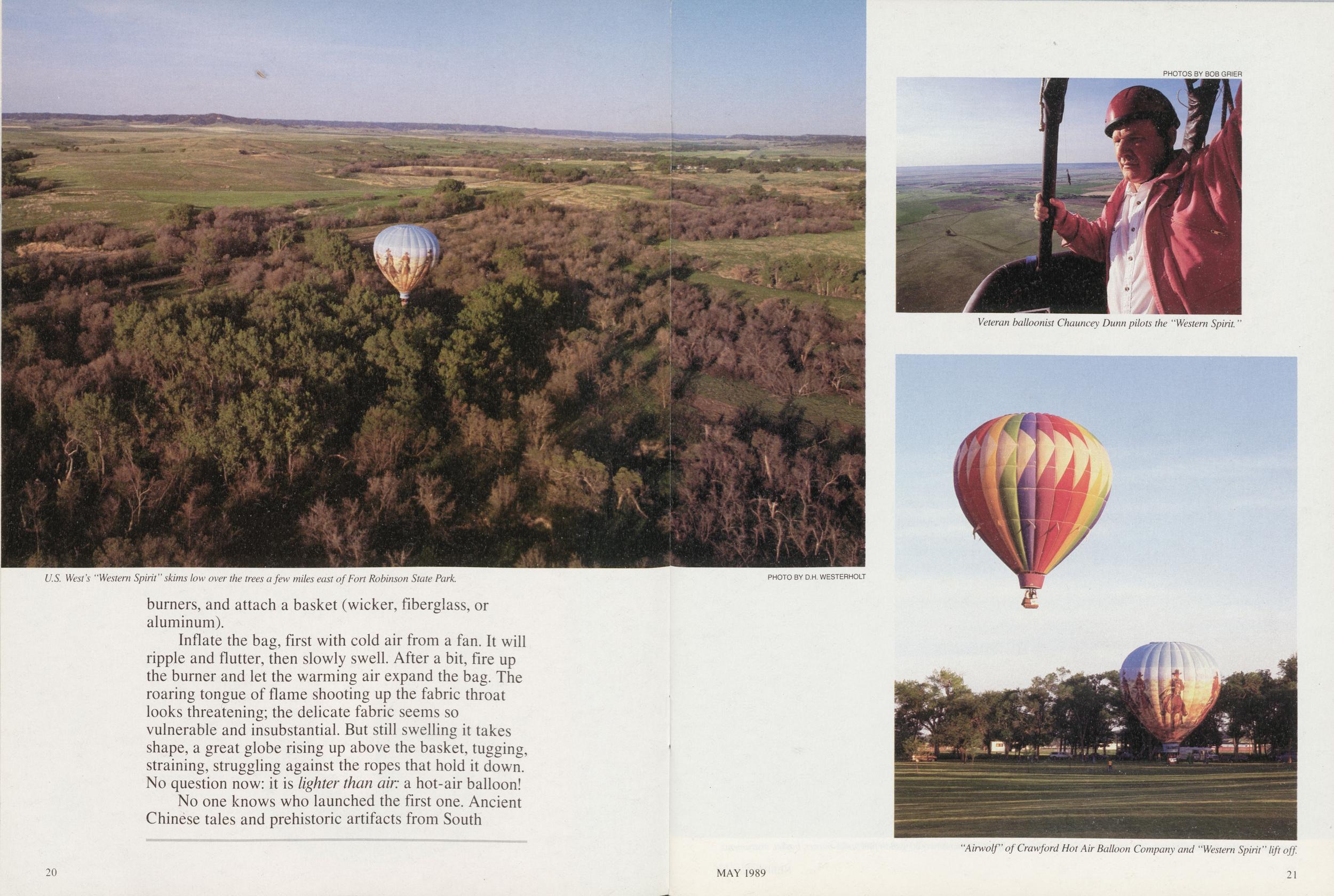
Inflate the bag, first with cold air from a fan. It will ripple and flutter, then slowly swell. After a bit, fire up the burner and let the warming air expand the bag. The roaring tongue of flame shooting up the fabric throat looks threatening; the delicate fabric seems so vulnerable and insubstantial. But still swelling it takes shape, a great globe rising up above the basket, tugging, straining, struggling against the ropes that hold it down. No question now: it is lighter than air: a hot-air balloon!
No one knows who launched the first one. Ancient Chinese tales and prehistoric artifacts from South America suggest a long fascination with balloons. Their recent history begins in France about 2,000 years after Archimedes wrote "On Floating Bodies," when the Montgolfier brothers, Joseph Michel and Jacques Etienne, devised a way to trap hot air in a cloth-and-paper bag. One legend says the idea came from seeing paper scraps fly up the chimney; another says it was inspired by Joseph's wife, whose chemise fluttered up when hung before the fire.
20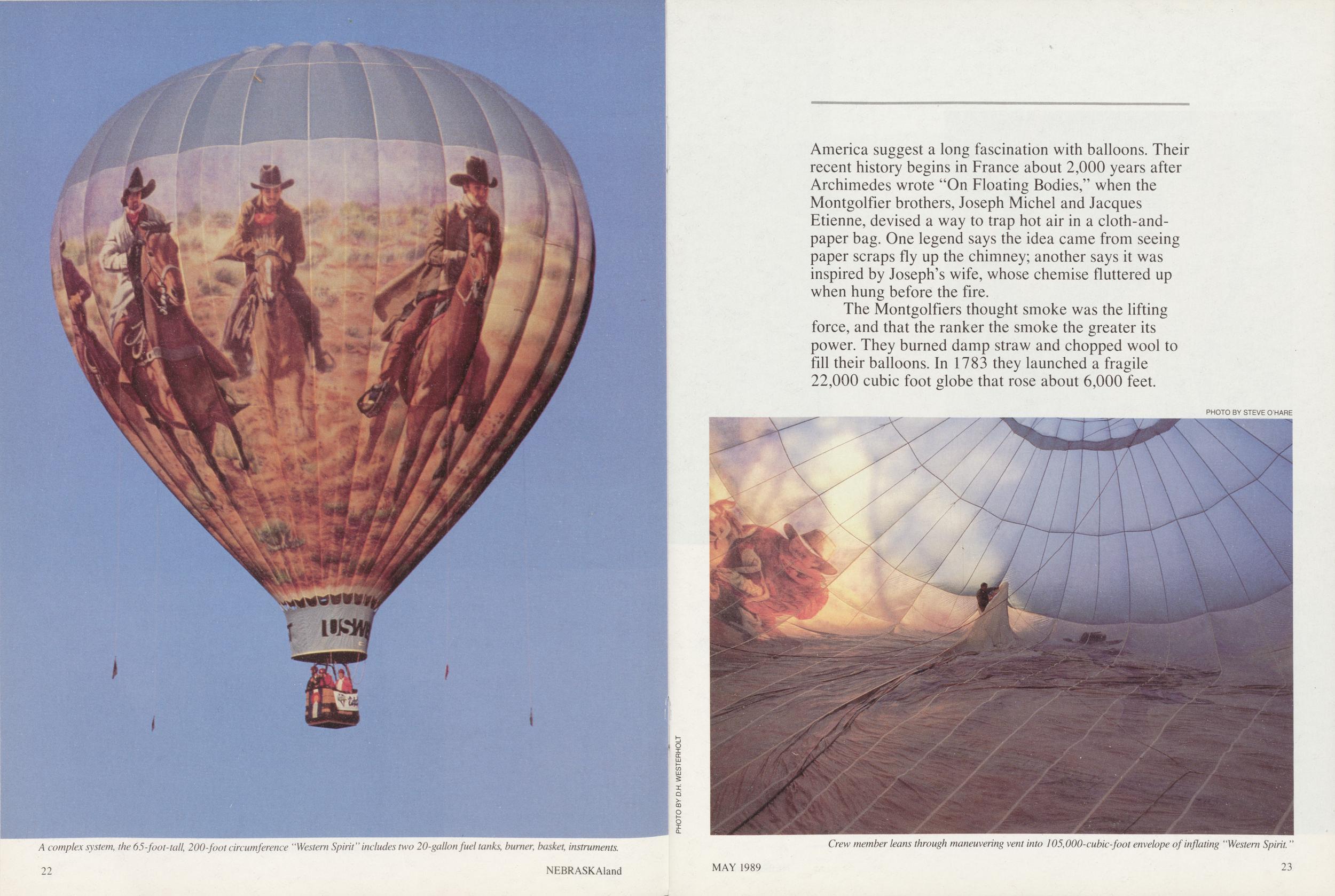
The Montgolfiers thought smoke was the lifting force, and that the ranker the smoke the greater its power. They burned damp straw and chopped wool to fill their balloons. In 1783 they launched a fragile 22,000 cubic foot globe that rose about 6,000 feet.
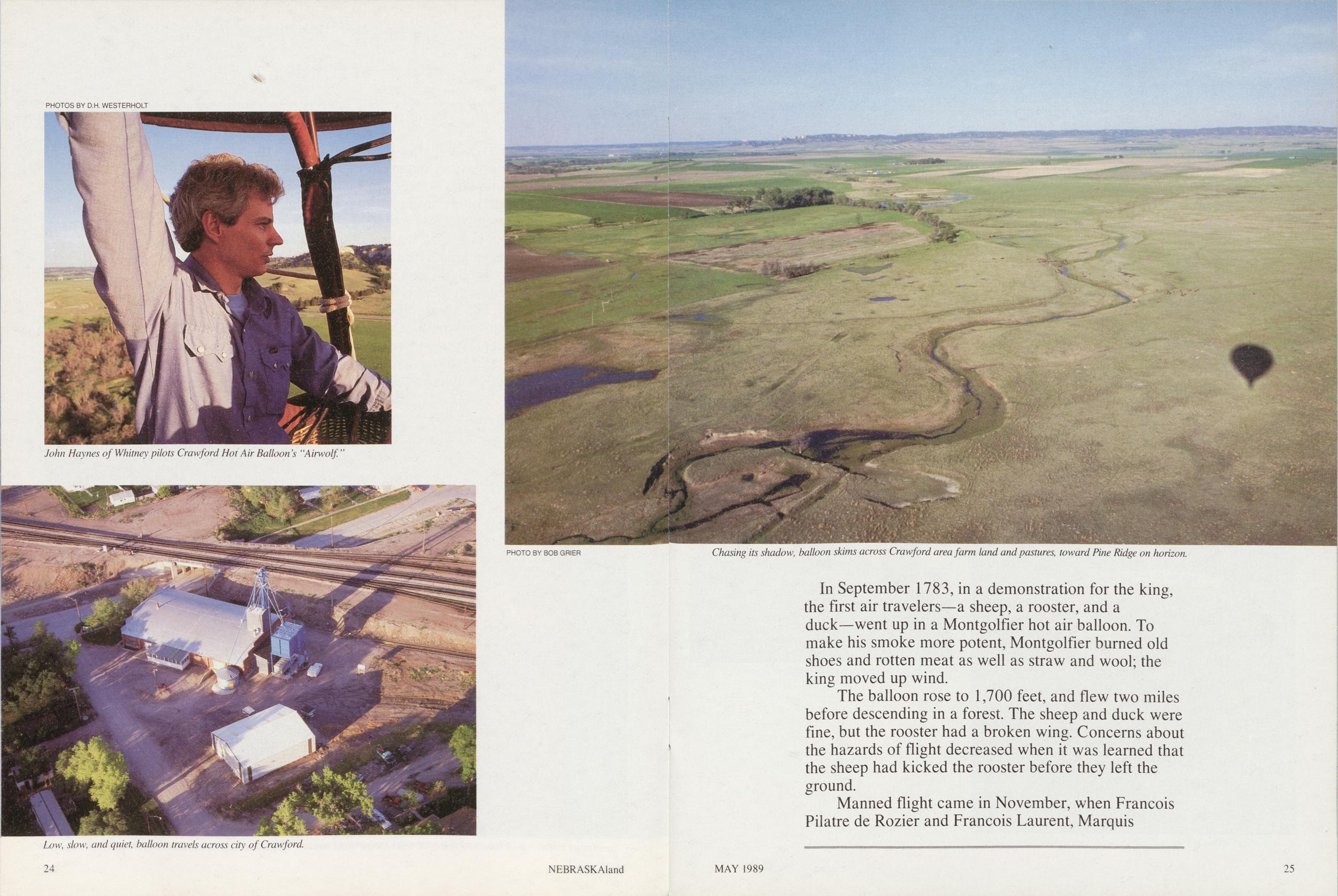
In September 1783, in a demonstration for the king, the first air travelers—a sheep, a rooster, and a duck—went up in a Montgolfier hot air balloon. To make his smoke more potent, Montgolfier burned old shoes and rotten meat as well as straw and wool; the king moved up wind.
The balloon rose to 1,700 feet, and flew two miles before descending in a forest. The sheep and duck were fine, but the rooster had a broken wing. Concerns about the hazards of flight decreased when it was learned that the sheep had kicked the rooster before they left the ground.
Manned flight came in November, when Francois
Pilatre de Rozier and Francois Laurent, Marquis
MAY 1989
25
 d'Arlandes, rose to about 3,000 feet and flew some five
miles across Paris in a balloon equipped with a hanging
fire basket and a supply of straw for fuel.
d'Arlandes, rose to about 3,000 feet and flew some five
miles across Paris in a balloon equipped with a hanging
fire basket and a supply of straw for fuel.
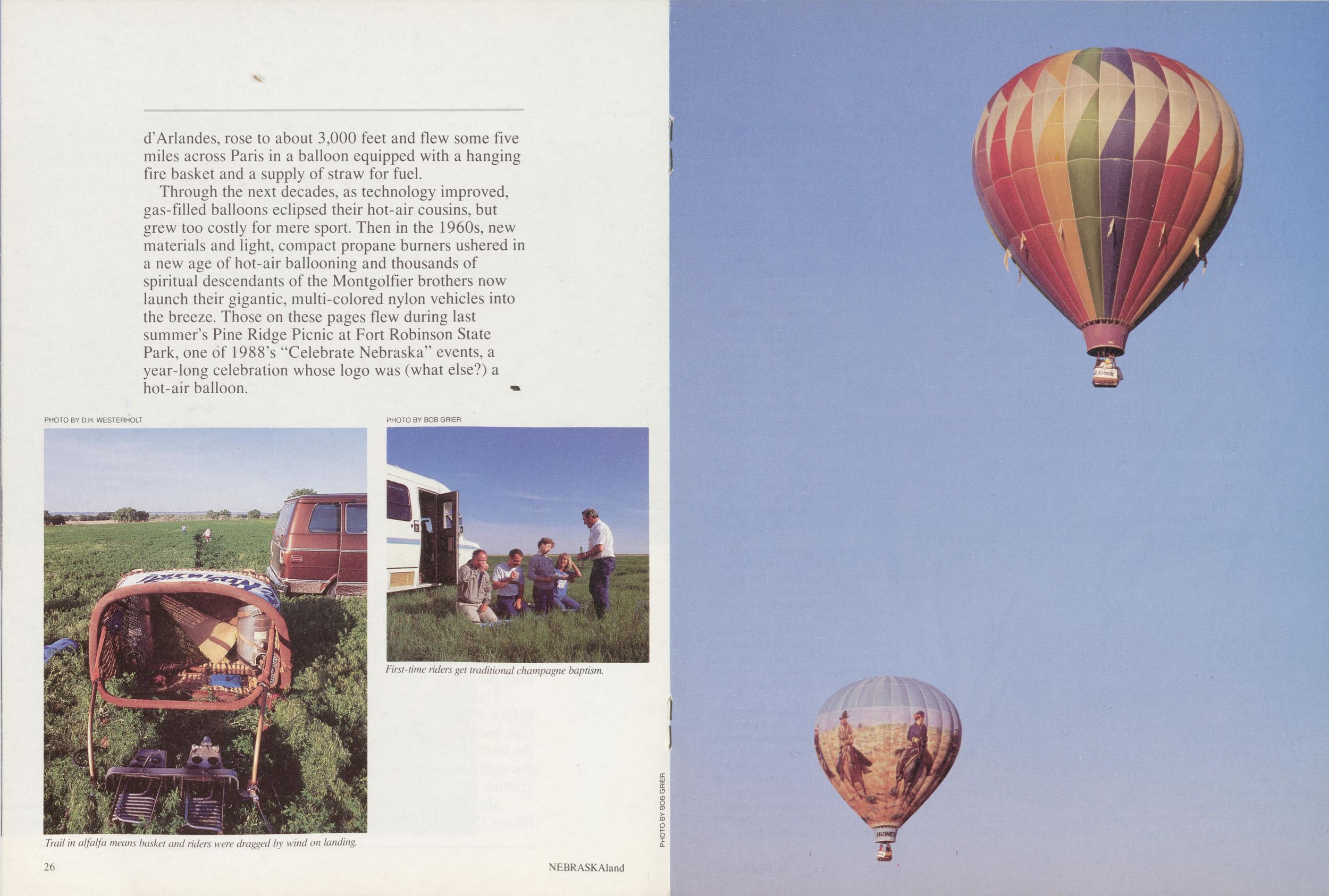
Through the next decades, as technology improved, gas-filled balloons eclipsed their hot-air cousins, but grew too costly for mere sport. Then in the 1960s, new materials and light, compact propane burners ushered in a new age of hot-air ballooning and thousands of spiritual descendants of the Montgolfier brothers now launch their gigantic, multi-colored nylon vehicles into the breeze. Those on these pages flew during last summer's Pine Ridge Picnic at Fort Robinson State Park, one of 1988's "Celebrate Nebraska" events, a year-long celebration whose logo was (what else?) a hot-air balloon.
A Ringneck Year
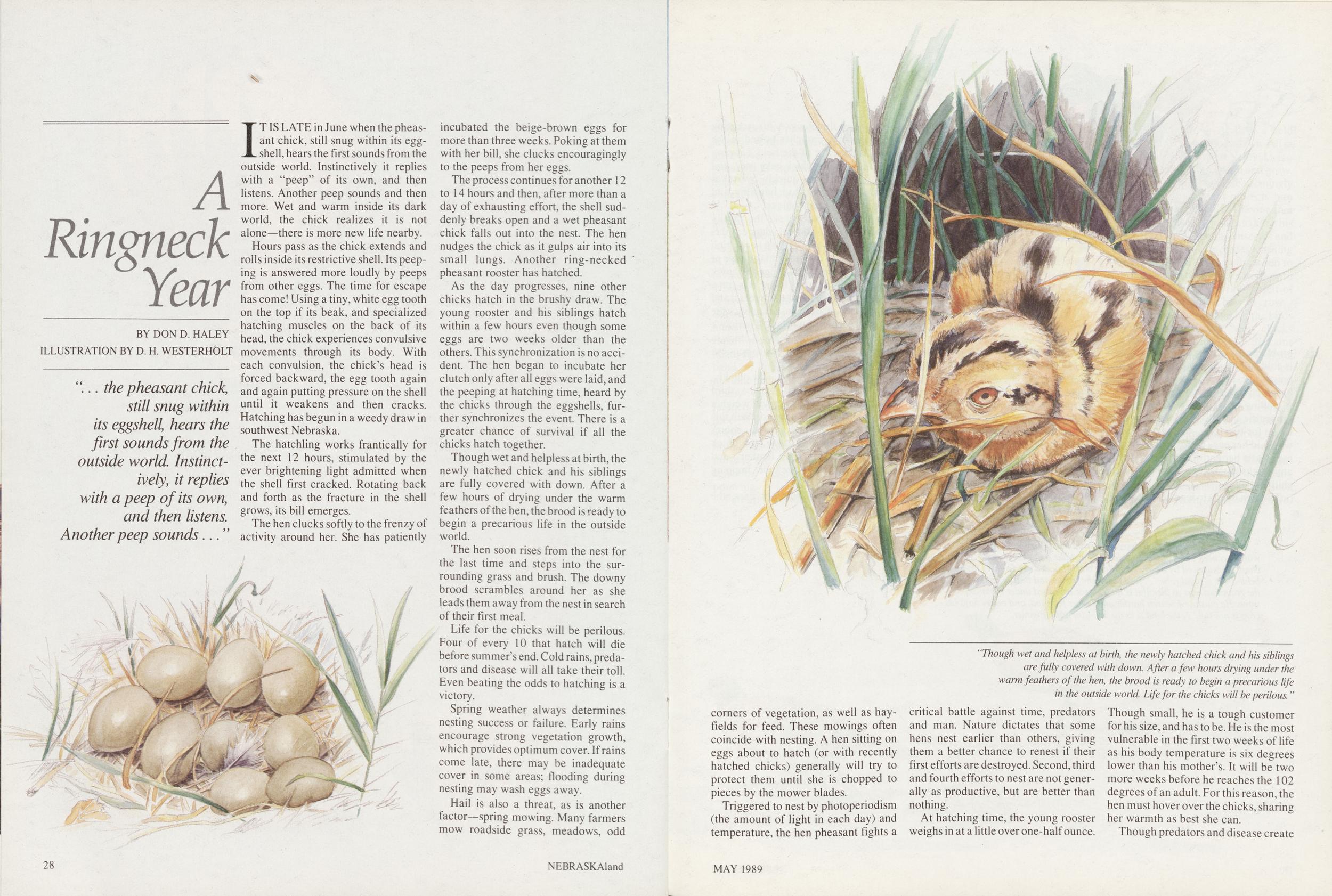
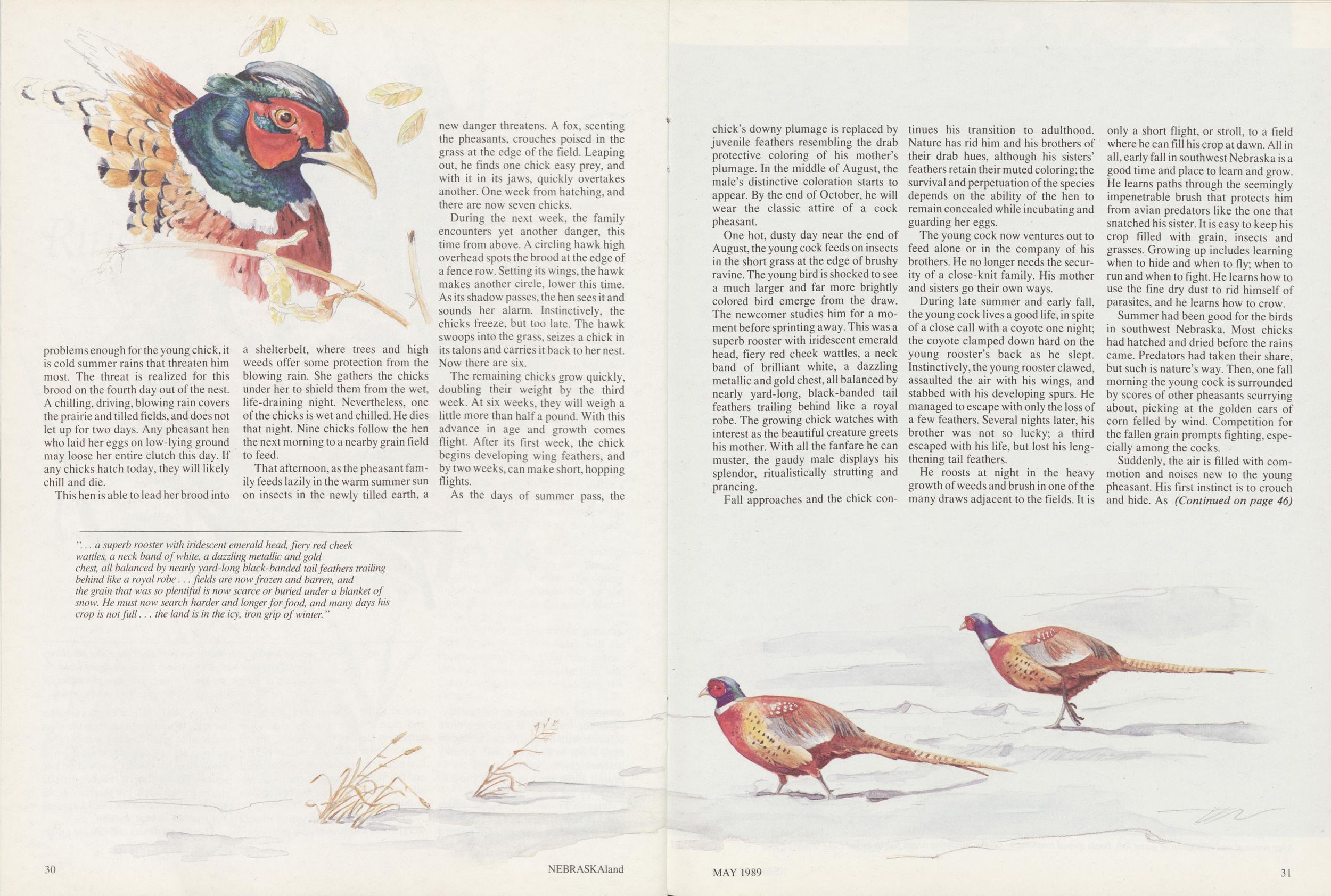
BY DON D. HALEY ILLUSTRATION BY D. H. WESTERHOLT " .. the pheasant chick, still snug within its eggshell, hears the first sounds from the outside world. Instinctively, it replies with a peep of its own, and then listens. Another peep sounds... "IT IS LATE in June when the pheasant chick, still snug within its eggshell, hears the first sounds from the outside world. Instinctively it replies with a "peep" of its own, and then listens. Another peep sounds and then more. Wet and warm inside its dark world, the chick realizes it is not alone—there is more new life nearby.
Hours pass as the chick extends and rolls inside its restrictive shell. Its peeping is answered more loudly by peeps from other eggs. The time for escape has come! Using a tiny, white egg tooth on the top if its beak, and specialized hatching muscles on the back of its head, the chick experiences convulsive movements through its body. With each convulsion, the chick's head is forced backward, the egg tooth again and again putting pressure on the shell until it weakens and then cracks. Hatching has begun in a weedy draw in southwest Nebraska.
The hatchling works frantically for the next 12 hours, stimulated by the ever brightening light admitted when the shell first cracked. Rotating back and forth as the fracture in the shell grows, its bill emerges.
The hen clucks softly to the frenzy of activity around her. She has patiently incubated the beige-brown eggs for more than three weeks. Poking at them with her bill, she clucks encouragingly to the peeps from her eggs.
The process continues for another 12 to 14 hours and then, after more than a day of exhausting effort, the shell suddenly breaks open and a wet pheasant chick falls out into the nest. The hen nudges the chick as it gulps air into its small lungs. Another ring-necked pheasant rooster has hatched.
As the day progresses, nine other chicks hatch in the brushy draw. The young rooster and his siblings hatch within a few hours even though some eggs are two weeks older than the others. This synchronization is no accident. The hen began to incubate her clutch only after all eggs were laid, and the peeping at hatching time, heard by the chicks through the eggshells, further synchronizes the event. There is a greater chance of survival if all the chicks hatch together.
Though wet and helpless at birth, the newly hatched chick and his siblings are fully covered with down. After a few hours of drying under the warm feathers of the hen, the brood is ready to begin a precarious life in the outside world.
The hen soon rises from the nest for the last time and steps into the surrounding grass and brush. The downy brood scrambles around her as she leads them away from the nest in search of their first meal.
Life for the chicks will be perilous. Four of every 10 that hatch will die before summer's end. Cold rains, predators and disease will all take their toll. Even beating the odds to hatching is a victory.
Spring weather always determines nesting success or failure. Early rains encourage strong vegetation growth, which provides optimum cover. If rains come late, there may be inadequate cover in some areas; flooding during nesting may wash eggs away.
Hail is also a threat, as is another factor—spring mowing. Many farmers mow roadside grass, meadows, odd 28 NEBRASKAland corners of vegetation, as well as hayfields for feed. These mowings often coincide with nesting. A hen sitting on eggs about to hatch (or with recently hatched chicks) generally will try to protect them until she is chopped to pieces by the mower blades.
Triggered to nest by photoperiodism (the amount of light in each day) and temperature, the hen pheasant fights a critical battle against time, predators and man. Nature dictates that some hens nest earlier than others, giving them a better chance to renest if their first efforts are destroyed. Second, third and fourth efforts to nest are not generally as productive, but are better than nothing.
At hatching time, the young rooster weighs in at a little over one-half ounce. Though small, he is a tough customer for his size, and has to be. He is the most vulnerable in the first two weeks of life as his body temperature is six degrees lower than his mother's. It will be two more weeks before he reaches the 102 degrees of an adult. For this reason, the hen must hover over the chicks, sharing her warmth as best she can.
Though predators and disease create
MAY 1989
This hen is able to lead her brood into a shelterbelt, where trees and high weeds offer some protection from the blowing rain. She gathers the chicks under her to shield them from the wet, life-draining night. Nevertheless, one of the chicks is wet and chilled. He dies that night. Nine chicks follow the hen the next morning to a nearby grain field to feed.
That afternoon, as the pheasant family feeds lazily in the warm summer sun on insects in the newly tilled earth, a new danger threatens. A fox, scenting the pheasants, crouches poised in the grass at the edge of the field. Leaping out, he finds one chick easy prey, and with it in its jaws, quickly overtakes another. One week from hatching, and there are now seven chicks.
During the next week, the family encounters yet another danger, this time from above. A circling hawk high overhead spots the brood at the edge of a fence row. Setting its wings, the hawk makes another circle, lower this time. As its shadow passes, the hen sees it and sounds her alarm. Instinctively, the chicks freeze, but too late. The hawk swoops into the grass, seizes a chick in its talons and carries it back to her nest. Now there are six.
The remaining chicks grow quickly, doubling their weight by the third week. At six weeks, they will weigh a little more than half a pound. With this advance in age and growth comes flight. After its first week, the chick begins developing wing feathers, and by two weeks, can make short, hopping flights.
As the days of summer pass, the 30 NEBRASKAland chick's downy plumage is replaced by juvenile feathers resembling the drab protective coloring of his mother's plumage. In the middle of August, the male's distinctive coloration starts to appear. By the end of October, he will wear the classic attire of a cock pheasant.
One hot, dusty day near the end of August, the young cock feeds on insects in the short grass at the edge of brushy ravine. The young bird is shocked to see a much larger and far more brightly colored bird emerge from the draw. The newcomer studies him for a moment before sprinting away. This was a superb rooster with iridescent emerald head, fiery red cheek wattles, a neck band of brilliant white, a dazzling metallic and gold chest, all balanced by nearly yard-long, black-banded tail feathers trailing behind like a royal robe. The growing chick watches with interest as the beautiful creature greets his mother. With all the fanfare he can muster, the gaudy male displays his splendor, ritualistically strutting and prancing.
Fall approaches and the chick continues his transition to adulthood. Nature has rid him and his brothers of their drab hues, although his sisters' feathers retain their muted coloring; the survival and perpetuation of the species depends on the ability of the hen to remain concealed while incubating and guarding her eggs.
The young cock now ventures out to feed alone or in the company of his brothers. He no longer needs the security of a close-knit family. His mother and sisters go their own ways.
During late summer and early fall, the young cock lives a good life, in spite of a close call with a coyote one night; the coyote clamped down hard on the young rooster's back as he slept. Instinctively, the young rooster clawed, assaulted the air with his wings, and stabbed with his developing spurs. He managed to escape with only the loss of a few feathers. Several nights later, his brother was not so lucky; a third escaped with his life, but lost his lengthening tail feathers.
He roosts at night in the heavy growth of weeds and brush in one of the many draws adjacent to the fields. It is only a short flight, or stroll, to a field where he can fill his crop at dawn. All in all, early fall in southwest Nebraska is a good time and place to learn and grow. He learns paths through the seemingly impenetrable brush that protects him from avian predators like the one that snatched his sister. It is easy to keep his crop filled with grain, insects and grasses. Growing up includes learning when to hide and when to fly; when to run and when to fight. He learns how to use the fine dry dust to rid himself of parasites, and he learns how to crow.
Summer had been good for the birds in southwest Nebraska. Most chicks had hatched and dried before the rains came. Predators had taken their share, but such is nature's way. Then, one fall morning the young cock is surrounded by scores of other pheasants scurrying about, picking at the golden ears of corn felled by wind. Competition for the fallen grain prompts fighting, especially among the cocks.
Suddenly, the air is filled with commotion and noises new to the young pheasant. His first instinct is to crouch and hide. As (Continued on page 46)
Reviving A Refuge
PHOTOS AND TEXT BY BOB GRIER Cooperation among three agencies restored a turbid, little-used refuge lake to a condition once again attractive—both to waterfowl and to anglers.LOCATED NORTHEAST of Scottsbluff in the central Panhandle, Winters Creek Lake is undergoing a change that fisheries biologists and anglers alike hope will help the 235-acre lake blossom into a high quality fishery.
Fisheries sampling conducted in 1985 on the irrigation storage reservoir revealed a large population of undesirable fish species. Using nets and electro-fishing equipment, district fisheries supervisor Jack Peterson and biologist Al Hanson found river carpsucker and carp totaled nearly 75 percent of the lake's composition. Black crappie, walleye, northern pike, yellow perch, white sucker, gizzard shad, and black bullhead were also found. Three game fish species—crappie, walleye, and northern pike—comprised slightly less than 25 percent of the total population.
Earlier attempts to manage Winters Creek Lake included large-scale seining to remove carp and carpsuckers. In 1969 seining crews removed 46,583 carp and 4,575 carpsuckers. Approximately 18,000 additional rough fish were removed the following year. Then biologists stocked northern pike and walleye in an attempt to establish a strong predator population.
After seining of rough fish was halted in 1970, carp and carpsucker again quickly became the lake's dominant species, although the early stockings of walleye and northern survived to establish small populations. With the heavy rough fish population the shallow lake became very turbid. Most of the fishing during this period occurred in late winter, when ice cover and water temperatures reduced turbidity. The lake attracted relatively few anglers, accounting for fewer than 500 fishermen-days annually.
Winters Creek Lake is part of the North Platte National Wildlife Refuge system that includes nearby Lake Minatare, and several smaller lakes. The refuge system is managed primarily for waterfowl, and is closed to the public from October 1st to January 15th. But the lake's rough fish population not only affected fishermen; its high turbidity also reduced waterfowl use to almost insignificant levels.
The obvious solution was renovation, complete removal of the lake's
fish population and restocking with
MAY 1989
33
 desirable species. But this option presented several unique problems, and required
a cooperative agreement among
the Pathfinder Irrigation District, U. S.
Fish and Wildlife Service refuge managers, and the Nebraska Game and
Parks Commission. Peterson credits
then state senator Bill Nichols of
Scottsbluff with bringing the diverse
parties to an agreement, and cites
excellent cooperation from the Pathfinder Irrigation District and their
board of directors that made the renovation process possible.
desirable species. But this option presented several unique problems, and required
a cooperative agreement among
the Pathfinder Irrigation District, U. S.
Fish and Wildlife Service refuge managers, and the Nebraska Game and
Parks Commission. Peterson credits
then state senator Bill Nichols of
Scottsbluff with bringing the diverse
parties to an agreement, and cites
excellent cooperation from the Pathfinder Irrigation District and their
board of directors that made the renovation process possible.
Even with an agreement in place, the Winters Creek Lake renovation posed problems. The lake is filled from the Reservoir Supply Canal each spring, and receives a considerable amount of percolation, or underground water movement during the period when the nearby canal is full—from April 15th through October. The underground water movement could make a successful kill difficult, even impossible. The percolation and the necessity to renovate prior to the April filling of Winters Creek Lake imposed a very limited period during which biologists could successfully renovate the lake. Spring ice-out, water temperature, and the schedule for filling of the canal and subsequent opening of the gate to fill the Lake were critical to the timing of the planned renovation.
Funding for the renovation would come from the Dingell-Johnson Act, legislation levying a federal excise tax on fishing rods, reels, creels, and artificial lures and flies and the more recent Wallop-Breaux amendment that taxes fishing line, hooks, and tackle boxes and diverts taxes on boat fuel to fisheries projects. The federal funding assistance program reimburses state wildlife agencies for 75 percent of project costs, with the state agency contributing the remaining 25 percent.
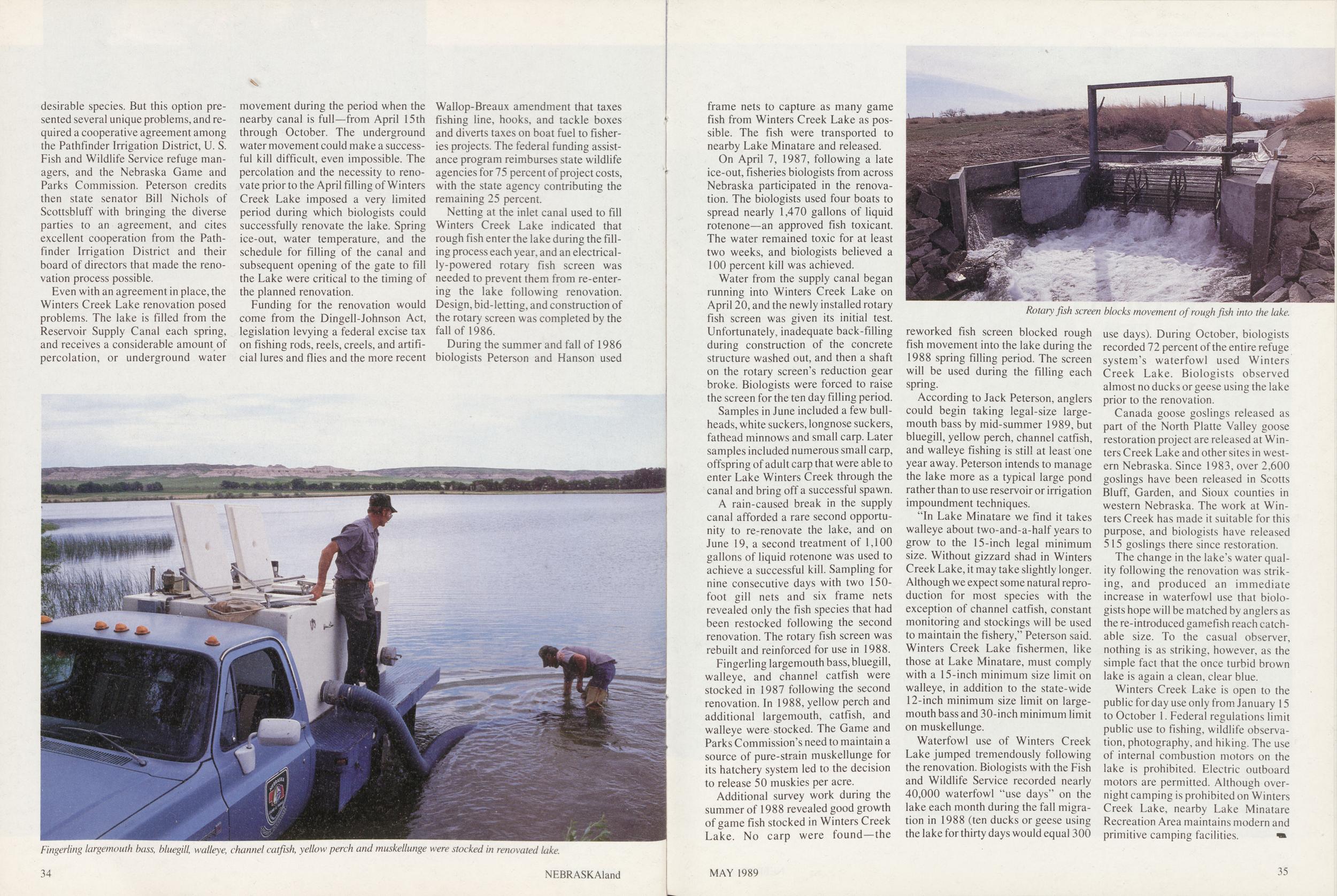
Netting at the inlet canal used to fill Winters Creek Lake indicated that rough fish enter the lake during the filling process each year, and an electrically-powered rotary fish screen was needed to prevent them from re-entering the lake following renovation. Design, bid-letting, and construction of the rotary screen was completed by the fall of 1986.
Netting at the inlet canal used to fill Winters Creek Lake indicated that rough fish enter the lake during the filling process each year, and an electrically-powered rotary fish screen was needed to prevent them from re-entering the lake following renovation. Design, bid-letting, and construction of the rotary screen was completed by the fall of 1986.
During the summer and fall of 1986 biologists Peterson and Hanson used 34 NEBRASKAland frame nets to capture as many game fish from Winters Creek Lake as possible. The fish were transported to nearby Lake Minatare and released.
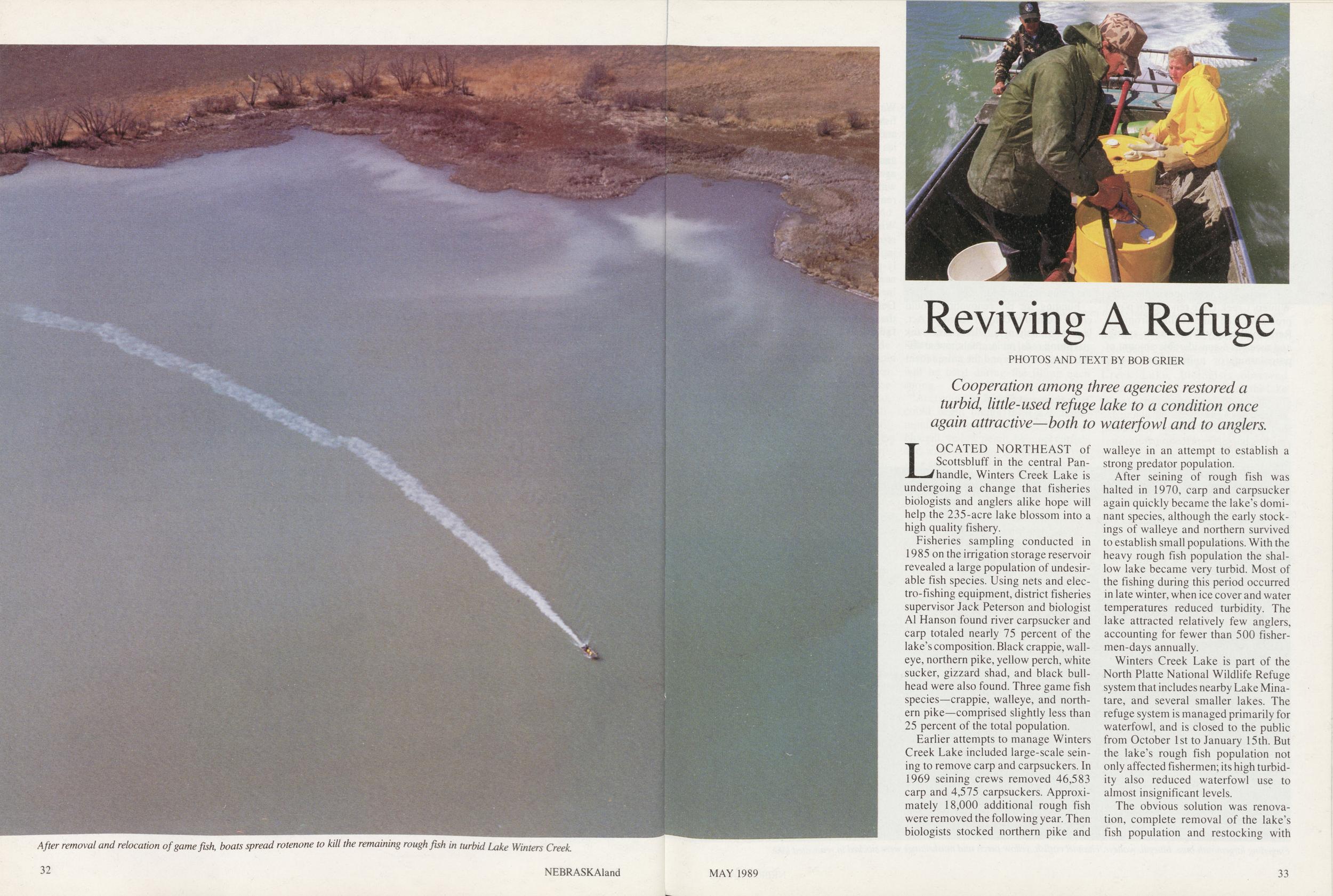
On April 7, 1987, following a late ice-out, fisheries biologists from across Nebraska participated in the renovation. The biologists used four boats to spread nearly 1,470 gallons of liquid rotenone—an approved fish toxicant. The water remained toxic for at least two weeks, and biologists believed a 100 percent kill was achieved.
Water from the supply canal began running into Winters Creek Lake on April 20, and the newly installed rotary fish screen was given its initial test. Unfortunately, inadequate back-filling during construction of the concrete structure washed out, and then a shaft on the rotary screen's reduction gear broke. Biologists were forced to raise the screen for the ten day filling period.
Samples in June included a few bullheads, white suckers, longnose suckers, fathead minnows and small carp. Later samples included numerous small carp, offspring of adult carp that were able to enter Lake Winters Creek through the canal and bring off a successful spawn.
A rain-caused break in the supply canal afforded a rare second opportunity to re-renovate the lake, and on June 19, a second treatment of 1,100 gallons of liquid rotenone was used to achieve a successful kill. Sampling for nine consecutive days with two 150-foot gill nets and six frame nets revealed only the fish species that had been restocked following the second renovation. The rotary fish screen was rebuilt and reinforced for use in 1988.
Fingerling largemouth bass, bluegill, walleye, and channel catfish were stocked in 1987 following the second renovation. In 1988, yellow perch and additional largemouth, catfish, and walleye were stocked. The Game and Parks Commission's need to maintain a source of pure-strain muskellunge for its hatchery system led to the decision to release 50 muskies per acre.
Additional survey work during the summer of 1988 revealed good growth of game fish stocked in Winters Creek Lake. No carp were found—the reworked fish screen blocked rough fish movement into the lake during the 1988 spring filling period. The screen will be used during the filling each spring.
According to Jack Peterson, anglers could begin taking legal-size largemouth bass by mid-summer 1989, but bluegill, yellow perch, channel catfish, and walleye fishing is still at least one year away. Peterson intends to manage the lake more as a typical large pond rather than to use reservoir or irrigation impoundment techniques.
"In Lake Minatare we find it takes walleye about two-and-a-half years to grow to the 15-inch legal minimum size. Without gizzard shad in Winters Creek Lake, it may take slightly longer. Although we expect some natural reproduction for most species with the exception of channel catfish, constant monitoring and stockings will be used to maintain the fishery," Peterson said. Winters Creek Lake fishermen, like those at Lake Minatare, must comply with a 15-inch minimum size limit on walleye, in addition to the state-wide 12-inch minimum size limit on largemouth bass and 30-inch minimum limit on muskellunge.
Waterfowl use of Winters Creek Lake jumped tremendously following the renovation. Biologists with the Fish and Wildlife Service recorded nearly 40,000 waterfowl "use days" on the lake each month during the fall migration in 1988 (ten ducks or geese using the lake for thirty days would equal 300 use days). During October, biologists recorded 72 percent of the entire refuge system's waterfowl used Winters Creek Lake. Biologists observed almost no ducks or geese using the lake prior to the renovation.
Canada goose goslings released as part of the North Platte Valley goose restoration project are released at Winters Creek Lake and other sites in western Nebraska. Since 1983, over 2,600 goslings have been released in Scotts Bluff, Garden, and Sioux counties in western Nebraska. The work at Winters Creek has made it suitable for this purpose, and biologists have released 515 goslings there since restoration.
The change in the lake's water quality following the renovation was striking, and produced an immediate increase in waterfowl use that biologists hope will be matched by anglers as the re-introduced gamefish reach catchable size. To the casual observer, nothing is as striking, however, as the simple fact that the once turbid brown lake is again a clean, clear blue.
Winters Creek Lake is open to the public for day use only from January 15 to October 1. Federal regulations limit public use to fishing, wildlife observation, photography, and hiking. The use of internal combustion motors on the lake is prohibited. Electric outboard motors are permitted. Although overnight camping is prohibited on Winters Creek Lake, nearby Lake Minatare Recreation Area maintains modern and primitive camping facilities.
MAY 1989 35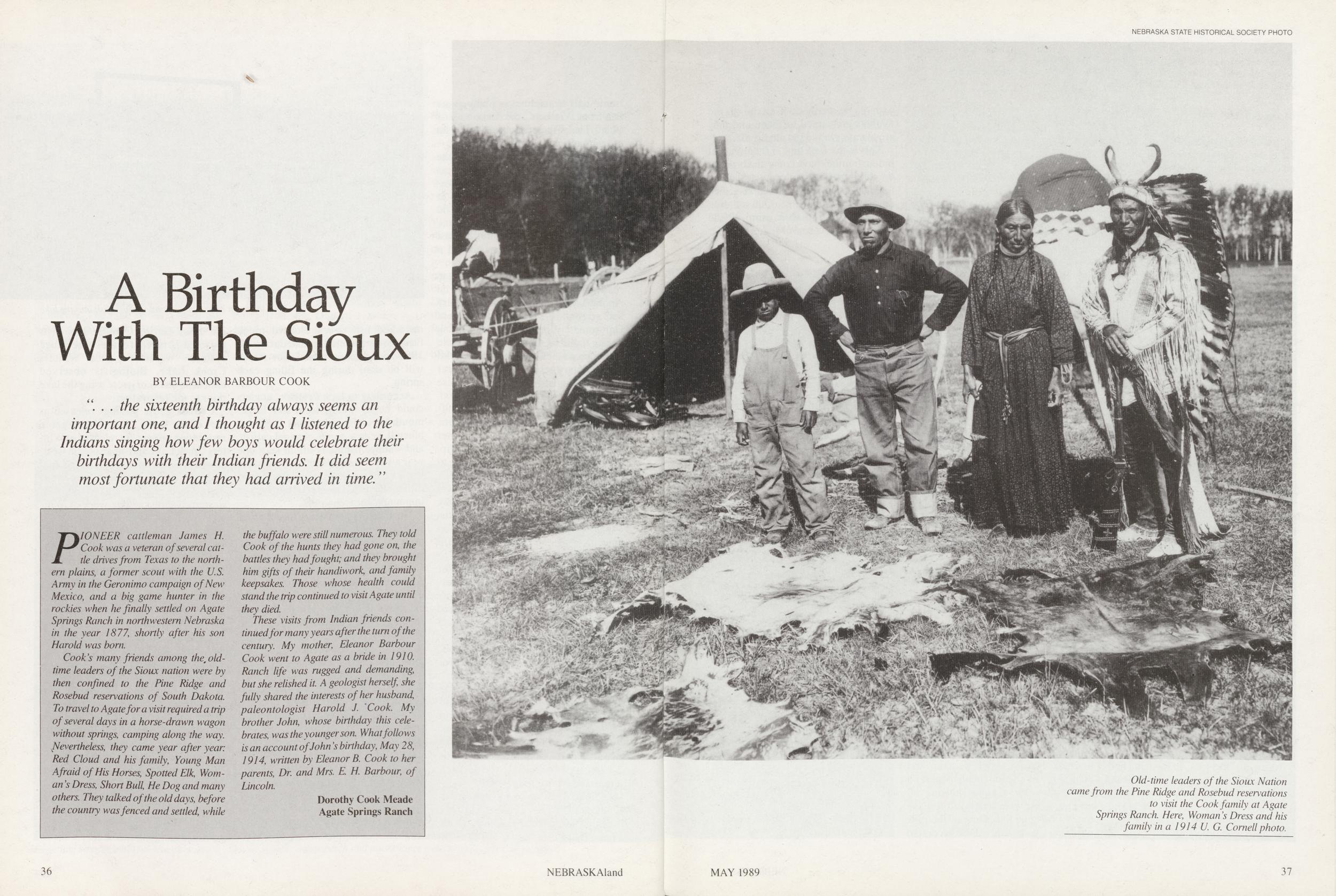
A Birthday With The Sioux
BY ELEANOR BARBOUR COOK " . . the sixteenth birthday always seems an important one, and I thought as I listened to the Indians singing how few boys would celebrate their birthdays with their Indian friends. It did seem most fortunate that they had arrived in time."PIONEER cattleman James H. Cook was a veteran of several cattle drives from Texas to the northern plains, a former scout with the U.S. Army in the Geronimo campaign of New Mexico, and a big game hunter in the rockies when he finally settled on Agate Springs Ranch in northwestern Nebraska in the year 1877, shortly after his son Harold was born.
Cook's many friends among the, old-time leaders of the Sioux nation were by then confined to the Pine Ridge and Rosebud reservations of South Dakota. To travel to Agate for a visit required a trip of several days in a horse-drawn wagon without springs, camping along the way. ^Nevertheless, they came year after year: Red Cloud and his family, Young Man Afraid of His Horses, Spotted Elk, Woman s Dress, Short Bull, He Dog and many others. They talked of the old days, before the country was fenced and settled, while the buffalo were still numerous. They told Cook of the hunts they had gone on, the battles they had fought; and they brought him gifts of their handiwork, and family keepsakes. Those whose health could stand the trip continued to visit Agate until they died
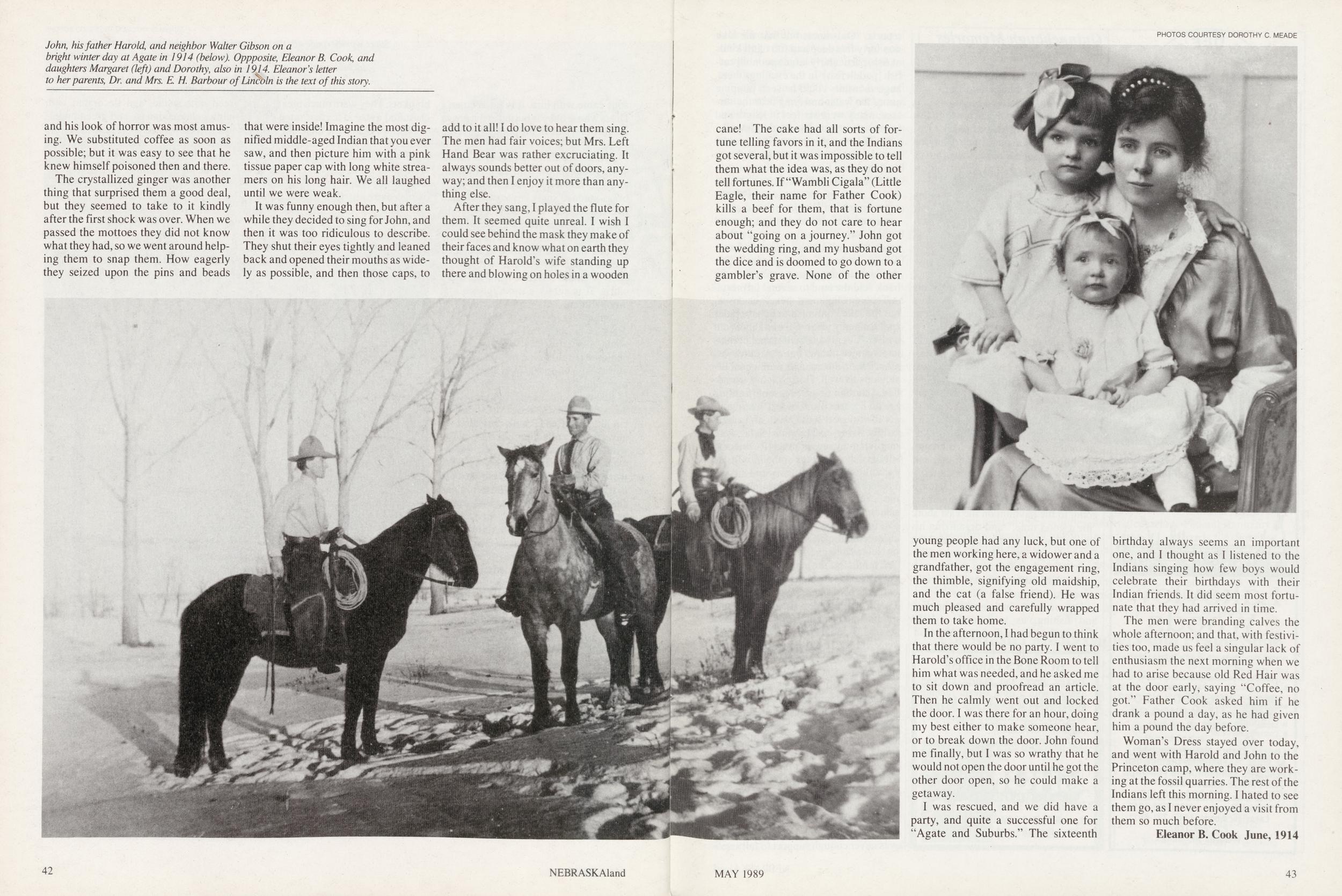
These visits from Indian friends continued for many years after the turn of the century. My mother, Eleanor Barbour Cook went to Agate as a bride in 1910. Ranch life was rugged and demanding, but she relished it. A geologist herself, she fully shared the interests of her husband, paleontologist Harold J. 'Cook. My brother John, whose birthday this celebrates, was the younger son. What follows is an account of John *s birthday, May 28, 1914, written by Eleanor B. Cook to her parents, Dr. and Mrs. E. H. Barbour, of Lincoln.
Dorothy Cook Meade Agate Springs Ranch 36 NEBRASKAland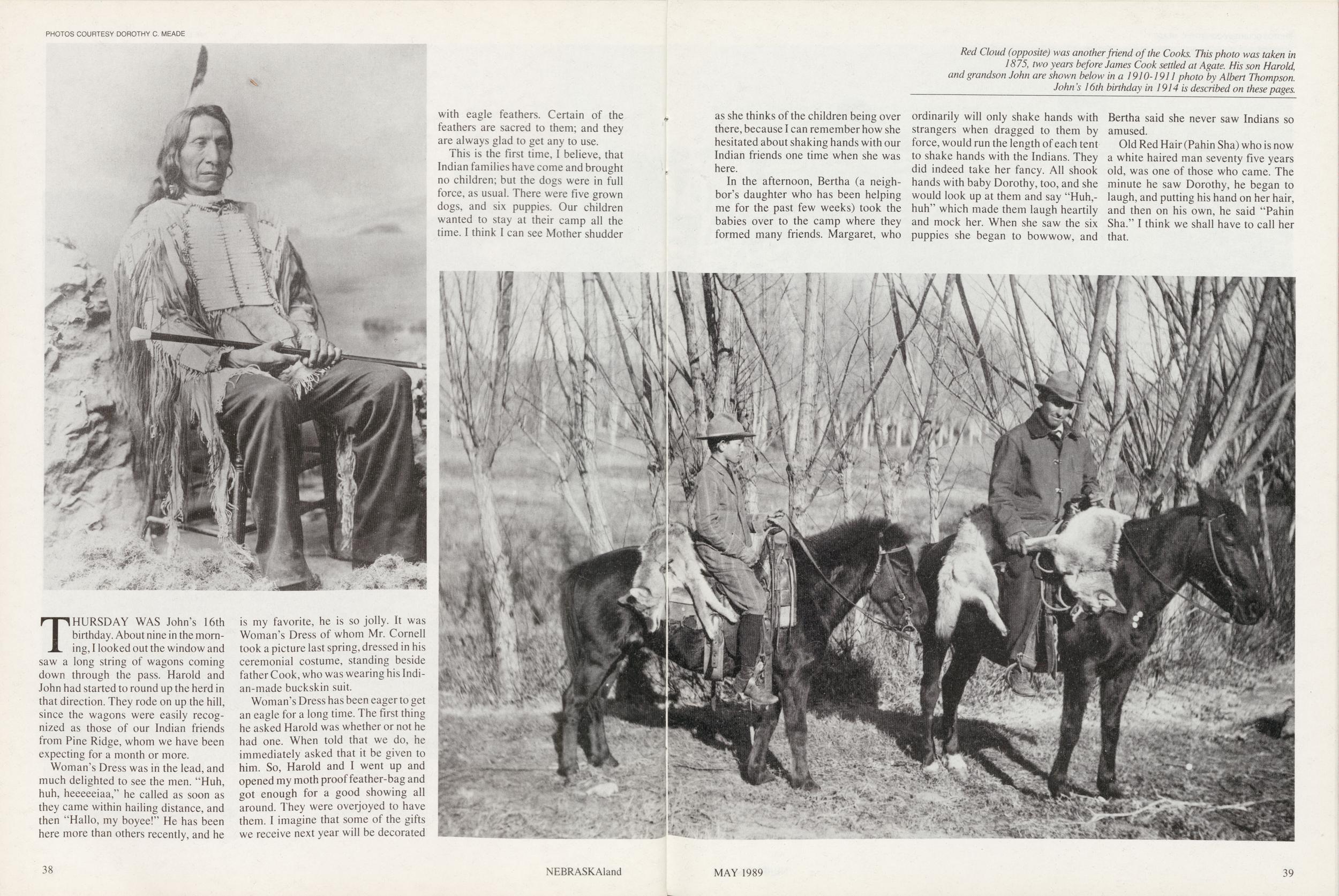
THURSDAY WAS John's 16th birthday. About nine in the morning, I looked out the window and saw a long string of wagons coming down through the pass. Harold and John had started to round up the herd in that direction. They rode on up the hill, since the wagons were easily recognized as those of our Indian friends from Pine Ridge, whom we have been expecting for a month or more.
Woman's Dress was in the lead, and much delighted to see the men. "Huh, huh, heeeeeiaa," he called as soon as they came within hailing distance, and then "Hallo, my boyee!" He has been here more than others recently, and he is my favorite, he is so jolly. It was Woman's Dress of whom Mr. Cornell took a picture last spring, dressed in his ceremonial costume, standing beside father Cook, who was wearing his Indian-made buckskin suit.
Woman's Dress has been eager to get an eagle for a long time. The first thing he asked Harold was whether or not he had one. When told that we do, he immediately asked that it be given to him. So, Harold and I went up and opened my moth proof feather-bag and got enough for a good showing all around. They were overjoyed to have them. I imagine that some of the gifts we receive next year will be decorated with eagle feathers. Certain of the feathers are sacred to them; and they are always glad to get any to use.
This is the first time, I believe, that Indian families have come and brought no children; but the dogs were in full force, as usual. There were five grown dogs, and six puppies. Our children wanted to stay at their camp all the time. I think I can see Mother shudder 38 NEBRASKAland as she thinks of the children being over there, because I can remember how she hesitated about shaking hands with our Indian friends one time when she was here.
In the afternoon, Bertha (a neighbor's daughter who has been helping me for the past few weeks) took the babies over to the camp where they formed many friends. Margaret, who ordinarily will only shake hands with strangers when dragged to them by force, would run the length of each tent to shake hands with the Indians. They did indeed take her fancy. All shook hands with baby Dorothy, too, and she would look up at them and say "Huh,-huh" which made them laugh heartily and mock her. When she saw the six puppies she began to bowwow, and Bertha said she never saw Indians so amused.
Old Red Hair (Pahin Sha) who is now a white haired man seventy five years old, was one of those who came. The minute he saw Dorothy, he began to laugh, and putting his hand on her hair, and then on his own, he said "Pahin Sha." I think we shall have to call her that.
MAY 1989 39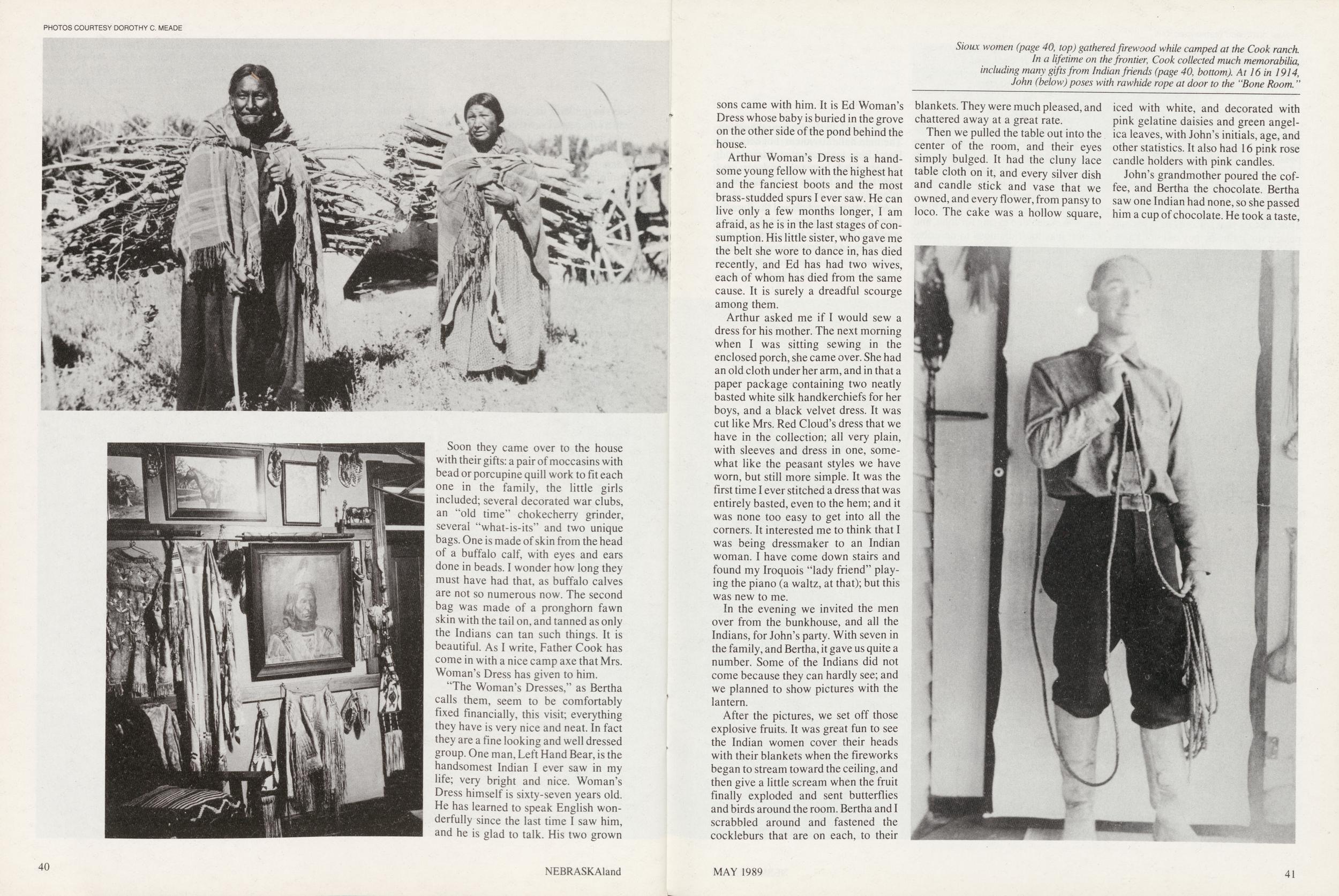
Soon they came over to the house with their gifts: a pair of moccasins with bead or porcupine quill work to fit each one in the family, the little girls included; several decorated war clubs, an "old time" chokecherry grinder, several "what-is-its" and two unique bags. One is made of skin from the head of a buffalo calf, with eyes and ears done in beads. I wonder how long they must have had that, as buffalo calves are not so numerous now. The second bag was made of a pronghorn fawn skin with the tail on, and tanned as only the Indians can tan such things. It is beautiful. As I write, Father Cook has come in with a nice camp axe that Mrs. Woman's Dress has given to him.
'The Woman's Dresses," as Bertha calls them, seem to be comfortably fixed financially, this visit; everything they have is very nice and neat. In fact they are a fine looking and well dressed group. One man, Left Hand Bear, is the handsomest Indian I ever saw in my life; very bright and nice. Woman's Dress himself is sixty-seven years old. He has learned to speak English wonderfully since the last time I saw him, and he is glad to talk. His two grown sons came with him. It is Ed Woman's Dress whose baby is buried in the grove on the other side of the pond behind the house.
Arthur Woman's Dress is a handsome young fellow with the highest hat and the fanciest boots and the most brass-studded spurs I ever saw. He can live only a few months longer, I am afraid, as he is in the last stages of consumption. His little sister, who gave me the belt she wore to dance in, has died recently, and Ed has had two wives, each of whom has died from the same cause. It is surely a dreadful scourge among them.
Arthur asked me if I would sew a dress for his mother. The next morning when I was sitting sewing in the enclosed porch, she came over. She had an old cloth under her arm, and in that a paper package containing two neatly basted white silk handkerchiefs for her boys, and a black velvet dress. It was cut like Mrs. Red Cloud's dress that we have in the collection; all very plain, with sleeves and dress in one, somewhat like the peasant styles we have worn, but still more simple. It was the first time I ever stitched a dress that was entirely basted, even to the hem; and it was none too easy to get into all the corners. It interested me to think that I was being dressmaker to an Indian woman. I have come down stairs and found my Iroquois "lady friend" playing the piano (a waltz, at that); but this was new to me.
In the evening we invited the men over from the bunkhouse, and all the Indians, for John's party. With seven in the family, and Bertha, it gave us quite a number. Some of the Indians did not come because they can hardly see; and we planned to show pictures with the lantern.
After the pictures, we set off those explosive fruits. It was great fun to see the Indian women cover their heads with their blankets when the fireworks began to stream toward the ceiling, and then give a little scream when the fruit finally exploded and sent butterflies and birds around the room. Bertha and I scrabbled around and fastened the cockleburs that are on each, to their blankets. They were much pleased, and chattered away at a great rate.
Then we pulled the table out into the center of the room, and their eyes simply bulged. It had the cluny lace table cloth on it, and every silver dish and candle stick and vase that we owned, and every flower, from pansy to loco. The cake was a hollow square, iced with white, and decorated with pink gelatine daisies and green angelica leaves, with John's initials, age, and other statistics. It also had 16 pink rose candle holders with pink candles.
John's grandmother poured the coffee, and Bertha the chocolate. Bertha
saw one Indian had none, so she passed
him a cup of chocolate. He took a taste,
MAY 1989
41
 and his look of horror was most amusing. We substituted coffee as soon as
possible; but it was easy to see that he
knew himself poisoned then and there.
and his look of horror was most amusing. We substituted coffee as soon as
possible; but it was easy to see that he
knew himself poisoned then and there.
The crystallized ginger was another thing that surprised them a good deal, but they seemed to take to it kindly after the first shock was over. When we passed the mottoes they did not know what they had, so we went around helping them to snap them. How eagerly they seized upon the pins and beads that were inside! Imagine the most dignified middle-aged Indian that you ever saw, and then picture him with a pink tissue paper cap with long white streamers on his long hair. We all laughed until we were weak.
It was funny enough then, but after a while they decided to sing for John, and then it was too ridiculous to describe. They shut their eyes tightly and leaned back and opened their mouths as widely as possible, and then those caps, to add to it all! I do love to hear them sing. The men had fair voices; but Mrs. Left Hand Bear was rather excruciating. It always sounds better out of doors, anyway; and then I enjoy it more than anything else.
After they sang, I played the flute for them. It seemed quite unreal. I wish I could see behind the mask they make of their faces and know what on earth they thought of Harold's wife standing up there and blowing on holes in a wooden 42 NEBRASKAland cane! The cake had all sorts of fortune telling favors in it, and the Indians got several, but it was impossible to tell them what the idea was, as they do not tell fortunes. If "Wambli Cigala" (Little Eagle, their name for Father Cook) kills a beef for them, that is fortune enough; and they do not care to hear about "going on a journey." John got the wedding ring, and my husband got the dice and is doomed to go down to a gambler's grave. None of the other young people had any luck, but one of the men working here, a widower and a grandfather, got the engagement ring, the thimble, signifying old maidship, and the cat (a false friend). He was much pleased and carefully wrapped them to take home.
In the afternoon, I had begun to think that there would be no party. I went to Harold's office in the Bone Room to tell him what was needed, and he asked me to sit down and proofread an article. Then he calmly went out and locked the door. I was there for an hour, doing my best either to make someone hear, or to break down the door. John found me finally, but I was so wrathy that he would not open the door until he got the other door open, so he could make a getaway.
I was rescued, and we did have a party, and quite a successful one for "Agate and Suburbs." The sixteenth birthday always seems an important one, and I thought as I listened to the Indians singing how few boys would celebrate their birthdays with their Indian friends. It did seem most fortunate that they had arrived in time.
The men were branding calves the whole afternoon; and that, with festivities too, made us feel a singular lack of enthusiasm the next morning when we had to arise because old Red Hair was at the door early, saying "Coffee, no got." Father Cook asked him if he drank a pound a day, as he had given him a pound the day before.
Woman's Dress stayed over today, and went with Harold and John to the Princeton camp, where they are working at the fossil quarries. The rest of the Indians left this morning. I hated to see them go, as I never enjoyed a visit from them so much before.
Eleanor B. Cook June, 1914 MAY 1989 43 DEE'S MAPS
The new name in Contour Maps
1989 CONTOURS
® Merritt Reservoir
© Harlan County Reservoir
© Calamus Reservoir
© Glen Elder Reservoir in Kansas
© Lewis & Clark
© Red Willow & Swanson
(one map)
© Milford Lake in Kansas
Water Proof — Tear Proof
$495 each or $1195 for any 3
Satisfaction Guaranteed
See your dealer or write:
Sportsman, Box 702
Broken Bow, NE 68822
ATTENTION: FISHERMEN, OUTDOOR
ENTHUSIASTS AND CAMPERS
Lakeview
Woods
Join our new private preserve near Fremont... only 35
minutes from Omaha and 50 minutes from Lincoln!
Enjoy year-round recreation:
• 110 acres of unspoiled wilderness & winding lakes
• Fresh-water fish including crappie, bass, walleye,
northern pike, bullhead & catfish
• Continual restocking of fish
• Amenities to make fishing and camping easy & fun
Separate swimming lake with sand beach
Concrete pads for RV's
LIMITED YEARLY MEMBERSHIPS WILL
BE SOLD . . . ENSURING UNCROWDED,
PEACEFUL SURROUNDINGS FOR YOUR
OWN PRIVATE WILDERNESS!
For a free brochure call or write:
Patrick Murphy (402) 721-1310
Lakeview Woods (402)721-8611
P.O. Box 1407
Fremont, NE 68025
DEE'S MAPS
The new name in Contour Maps
1989 CONTOURS
® Merritt Reservoir
© Harlan County Reservoir
© Calamus Reservoir
© Glen Elder Reservoir in Kansas
© Lewis & Clark
© Red Willow & Swanson
(one map)
© Milford Lake in Kansas
Water Proof — Tear Proof
$495 each or $1195 for any 3
Satisfaction Guaranteed
See your dealer or write:
Sportsman, Box 702
Broken Bow, NE 68822
ATTENTION: FISHERMEN, OUTDOOR
ENTHUSIASTS AND CAMPERS
Lakeview
Woods
Join our new private preserve near Fremont... only 35
minutes from Omaha and 50 minutes from Lincoln!
Enjoy year-round recreation:
• 110 acres of unspoiled wilderness & winding lakes
• Fresh-water fish including crappie, bass, walleye,
northern pike, bullhead & catfish
• Continual restocking of fish
• Amenities to make fishing and camping easy & fun
Separate swimming lake with sand beach
Concrete pads for RV's
LIMITED YEARLY MEMBERSHIPS WILL
BE SOLD . . . ENSURING UNCROWDED,
PEACEFUL SURROUNDINGS FOR YOUR
OWN PRIVATE WILDERNESS!
For a free brochure call or write:
Patrick Murphy (402) 721-1310
Lakeview Woods (402)721-8611
P.O. Box 1407
Fremont, NE 68025
Quinnebaugh Memories
(Continued from page 15)where they could buy many family needs—food, clothing, confections, and kerosene for lamps.
"In the winter, many cut ice from the lake. They used bob-sleds to take ice, about the size of a square bale of hay, to the different homes where it was put in ice houses, then covered with sawdust. It kept most of the summer."
Wallie Ireland remembers that around 1918 and 1919, there were no summer cottages or cabins on the lake. "It wasn't long, however, before cottages began appearing.
"Fred Erickson, Burt County treasurer, was among the first to erect one, and he was kind enough to permit his son, Emerald, (Swede) and two or three others of us to spend a weekend there occasionally.
"Of course, the store on the south shore of the lake operated by the Erickson family was a landmark for years. They would open up any time someone stopped by wishing to make a purchase."
The complex expanded when a man named White erected a pavilion building on the east shore, selling ice-cream, soft drinks, popcorn and the like, and featuring dancing and roller skating.
Mr. H.C. Larson, 94-year-old, longtime Decatur resident, remembers going to the pavilion on the east shore "for a good time," and organizing his own ball team of farm boys to play the Quinnebaugh team, the "Gumbo Sliders" in Sunday afternoon games on a pasture ball diamond east of the Erickson store.
The area was much used for hunting and fishing, as well, and a 1954 Tekamah centennial publication, reports: "Old-timers tell that the lake was forty feet deep and full of all kinds offish, particularly large spoonbill catfish [paddlefish]. In the evenings there, huge monsters could be seen jumping out of the water and lying near the surface; many were six feet in length and [were] often netted and fed to hogs."
HUNTER'S PARADISE Turkey, deer, and prairie chicken hunting with a trout stream running through 940 acres for sale. Joining over 20,000 acre nature conservancy ranch in Nebraska. For more information, please contact P O. Box 509, O'Neill, NE PHONE: 402-336-3500Catfish weighing from 80 to 110 pounds were also reported caught on the lake.
Mr. Larson, of Decatur, remembers that a man by the name of Palmer, representing an Omaha bank, made a survey of the north shore, and planned to sell lots. "He had a map showing where the golf course and club house were to be built," recalls Larson, "but this idea did not go as expected, so the bank sold the land to several farmers."
That development never occurred, but the lake continued to be a popular spot for many years. Omaha Boy Scout and YMC A groups maintained permanent camps there, but the lake was associated with some less innocent diversions as well. Horse racing, wrestling, gambling and even dog fighting are all reported, and in 1919 in a gory act of violence, 5 members of a single family living on Holman Island were murdered by an apparently rejected suitor of the daughter of the family. He committed suicide at the scene.
Omaha World-Herald stories about the event also mention a "famous saloon ferry," which would move back and forth across the lake to evade law enforcement officers from either Iowa or Nebraska.
Eventually, the natural consequences of ageing began to affect Quinnebaugh. The drought years of the early 1930s compounded the problem, and many streams, ponds, wells, and lakes such as Quinnebaugh struggled to survive. In 1930, the Nebraska Game, Forestation and Parks Commission (as the Game and Parks Commission was known at the time) spent some $4,000 pumping Missouri River water into the lake, and succeeded in raising its level by 23 inches. But an action by Iowa farmers who feared damage to their property led to a court injunction halting the pumping.
Area residents formed the "Lake Quinnebaugh Improvement Club" to promote the reclamation of the lake; dredging, the sinking of wells, and diking were all contemplated, but there was never enough support to fully revitalize 44 NEBRASKAland the lake. Shrunken, and victim of changing recreational habits, Quinnebaugh struggled on through the next two decades.
Finally, in 1952, the Missouri reclaimed the oxbow lake. That spring, unusually heavy snow melted unseasonably fast, pouring enormous amounts of runoff into the Missouri basin. Residents in Burt County braced for the worst, and on Thursday, April 10, undertook the largest evacuation in the county's history.
By Sunday, April 13, the evacuation was completed. In all, 250 families—850 people—and an estimated 4,070 head of cattle, 8,121 hogs, 816 sheep, 250,000 bushels of corn, 28,000 bushels of oats, tons of baled alfalfa, and thousands of pieces of farm machinery and household goods had been moved.
When it was over, the river had risen to 30.2 feet, flooded two million acres of farm land, and caused an estimated $179 million in damage in its entire basin.
Burt County escaped with no loss of life, and relatively little loss of livestock and grain. But Quinnebaugh, as it was remembered by older people in the area, was gone forever, almost completely filled by the tons of silt carried by the last great Missouri River flood.
Writing in 1964, PeralLange Anderson remembered the lake:
Much in contrast to the turmoil on the lakes of today, with the swarming of sleek, speeding noisy motor boats, Quinnebaugh was very serene and quiet. In the calm of evening, one could hear the steady, rhythmic splash of oars moving flat-bottomed, home-made boats leisurely over the water. One might also see a boat's crew, oars at their sides, holding willow fish poles, sitting motionless in anticipation of the catch. Near the shore one could have watched young people, wading, diving and swimming without the least concern about the season's latest style bathing suits—an old dress or a pair of overhauls sufficed.
But, she continued, the Missouri had always been "self-willed," and "in a siege of restlessness meandered through Quinnebaugh," leaving behind only the cattail-filled marsh mourned over by Wallie Ireland in 1986, as a departed old friend.
NEAL R. ANDERSON The 1989-90 federal duck stamp, a pair of lesser scaup, was done by Lincoln, Nebraska, artist Neal Anderson. It is now available as a collector print in three editions, as detailed below. Federal stamp art is the most collectible of any limited edition. Image size is 6,/2x9 inches, actual print size is 12x14 inches, signed and numbered. Regular edition (20,000 s/n) print—$145 Medallion edition (7,000 s/n) w/gold-plated medallion—$325 Executive edition (500 s/n) w/Remarque, silver/gold medallion—$950 Mint stamp $12.50 Signed stamp $15 Fine art poster $16 The Masterworks Gallery and Frame Shop 5601 So. 56th St., St. 5 (402) 423-3884 Lincoln, NE 68516 GUN DOG TRAINING All Sporting Breeds All dogs worked on foot — no horses. Midwest's finest facilities. Field Champion-sired Labrador pups for sale. "Training for hunters by hunters" WILDERNESS KENNELS Henry Sader—Roca Ne. (402)423-4212 68430 STOCK YOUR LAKE OR POND WITH Channel Cat, Bluegill, Hybrid Bluegill, Largemouth Bass, Crappie, Bullheads, Triploid Grass Carp, Walleye, Minnows WILLOW LAKE FISH HATCHERY Rt. 3, Box 46, Hastings, Nebr. 68901 Gaylord L Crawford Phone: (402) 463-8022 Day or Night For April to October 15 stocking MAY 1989 45 Aaahh!
EXPERIENCE
NEBRASKA...
w/1/2 an affordable canoe trip by
DRYLAND AQUATICS
• Niobrara • Dismal • Platte • Elkhorn
YOU NAME IT
One & two day trips available
canoe rental only or fully catered
WE DO IT YOUR WAY
Write for Free brochure
Dryland Aquatics, Dept. N
1837 E.Cuming
Fremont, NE 68025 Ph. (402) 721-4177
CEDAR LANE
Ranch Vacations
Guest ranch in the heart of the Sandhills of
Nebraska, Swimming, spa, horses, canoeing,
trail rides, barbecues. hunting, family reunions.
BOOKING NOW For 1989
Richard and Betty Schroeder HC 2 Box 9C
Stapleton, Nebraska 69163 Ph. 308-587-2233
YOU'RE INVITED TO
THE SECOND ANNUAL
OPEN HOUSE
AT
CRESCENT LAKE
National Wildlife Refuge
Saturday, May 6, 1989
8:00 a.m. to 3:00 p.m.
WILDLIFE FILMS AND EXHIBITS
SELF-GUIDED AUTO TOUR
AND NATURE TRAIL
Bring the family and friends
Also, warm clothing, cameras
and binoculars
Mark you calendar
Come tour this unique Sandhills refuge
Located 28 miles north of Oshkosh
Aaahh!
EXPERIENCE
NEBRASKA...
w/1/2 an affordable canoe trip by
DRYLAND AQUATICS
• Niobrara • Dismal • Platte • Elkhorn
YOU NAME IT
One & two day trips available
canoe rental only or fully catered
WE DO IT YOUR WAY
Write for Free brochure
Dryland Aquatics, Dept. N
1837 E.Cuming
Fremont, NE 68025 Ph. (402) 721-4177
CEDAR LANE
Ranch Vacations
Guest ranch in the heart of the Sandhills of
Nebraska, Swimming, spa, horses, canoeing,
trail rides, barbecues. hunting, family reunions.
BOOKING NOW For 1989
Richard and Betty Schroeder HC 2 Box 9C
Stapleton, Nebraska 69163 Ph. 308-587-2233
YOU'RE INVITED TO
THE SECOND ANNUAL
OPEN HOUSE
AT
CRESCENT LAKE
National Wildlife Refuge
Saturday, May 6, 1989
8:00 a.m. to 3:00 p.m.
WILDLIFE FILMS AND EXHIBITS
SELF-GUIDED AUTO TOUR
AND NATURE TRAIL
Bring the family and friends
Also, warm clothing, cameras
and binoculars
Mark you calendar
Come tour this unique Sandhills refuge
Located 28 miles north of Oshkosh
Ringneck Year
(Continued from page 31)the noises get closer and louder, several of his companions spring into the air and there are louder noises. Others run ahead to escape the pandemonium, and the young cock runs with them. But wait, there is danger ahead as well. Sensing this, most birds squat and hide. The young rooster, however, cuts diagonally across the high corn toward the security of the thickly weeded draw. His strong legs carry him quickly, unseen beneath the canopy of cornstalks. He runs straight away from the noise now, and finally explodes into the crisp fall air, cackling raucously. The hunters he has managed to elude turn and watch respectfully as he sets his wings and sails away.
The rooster glides nearly half a mile before landing in a weedy draw surrounded by a cornfield. Still wary, he searches for a place to hide. He runs up one of the brushy fingers choked with cocklebur and tumbleweed, where he remains for the rest of the day and all night. At dawn, his crop empty, he creeps out of his hiding place to the edge of the big cornfield. He quickly eats and returns to the deep tangle.
Several times he hears the noises again in the field above him, and once in the main draw close below, but the noise did not come through the snarled brush to his hiding place.
Do something to help America prepare for the future Support Arnerica's colleges. Because college is more than a place where young people are preparing for their future. It's where America is preparing for its future. Give to the college of your choice.He stays hidden longer on the days when he hears the noises, sometimes not leaving at all. Weeks pass and the noises lessen, and finally do not come again.
The young pheasant spends more time in the grain field now, but always seeks the security of the thick weeds at night as the nights and even the days become colder.
One morning the young rooster finds a strange white covering over his world. The fields are now frozen and barren, and the grain that was so plentiful is now scarce or buried under a blanket of snow. He now must search harder and longer for food, and many days his crop is not full. Gone are the lazy days of summer and fall. Days seem long, windy, bleak and cold. The whiteness and the wind do not go away, covering the land with ice and snow. Starvation threatens; the land is in the icy, iron grip of winter.
But the rooster is not alone in his plight. He joins other males that drift together to the heavy weeds to escape the killing winds. One day the group is 12. Several days later, it is eight. Nature is playing her game and she deals the cards. The strong survive to mate in the spring with the hardier hens, assuring genetic strength in the population. It is nature's plan, successful for millions of years and still at work. Staying mostly in the windrows and deep draws where weeds and brush give some protection from the bitter wind, the cock somehow manages to survive the worst of winter.
As frigid as the plains are, the days eventually lengthen with the promise of spring. Days grow longer and warmer, and the young cock feels a change come over himself. His disposition, while communal in the past, becomes aggressive. Like the big, gaudy rooster that had captured the interest of his mother the previous summer, the young cock's feathers develop a brilliant mixture of copper, bronze, black and gold, powder gray and blue. Using his long tail for balance, he extends his neck and crows, staking out the territory he will defend from other cocks.
It is a morning is early April. As the sun warms the bright sky, genetic molecules trigger a biological response and the cock lifts his head and crows a rowdy "kork-kork-kor" followed by a frenzied flapping of his wings. Repeating his performance several times, he notices several hens approaching through the grass. They note him with casual interest before drifting off to feed. The cock continues his mating display until suddenly he is knocked off his feet by a larger and older cock. Though caught off guard, the young cock reacts quickly. He boldly engages the attacking rooster, raking savagely with his sharp spurs and flapping his wings ferociously. The two males fight a fierce but brief battle until it becomes clear to the youngster that he is the weaker on this day. Forced to give more and more ground, he finally concedes his new-found territory to the stronger bird.
46 NEBRASKAland
Limping away from his first combat, the young rooster returns to his hiding place in the brushy draw. He spends several days there, leaving only for food and water.
On another such spring morning, his strength restored, the young rooster defiantly struts to the short grasses at the edge of the grain field and fearlessly claims this turn-row as his own. Spotting another cock pheasant within his chosen territory, he attacks without hesitation. This time his adversary is a yearling who lacks battle experience. The rooster is now king of this little portion of Nebraska farmland, ruling over his domain and the dozen or so hens within it.
And so life goes on in the cultivated fields north of McCook. As a rooster before him had fought and survived to pass on his genes, the now-mature cock, once a wet, helpless hatchling, sires many dozens of ring-necked pheasant chicks in the bountiful and beautiful cycle of life. He will remain lord of his turn-row and master of his domain until he is dethroned by a shotgun, a predator, disease, winter, or least likely of all, old age. The probabilities of nature say he could see two more springs. A few will see more, other less.
But no matter. For the young rooster surviving his first spring, any more time is a bonus. He has survived long enough to reproduce and assure that his offspring will again warm under the protective breast of a hen, waiting for the time when they, too, will seek to survive and reproduce in the prairie and corn fields of a Nebraska summer.
48 NEBRASKAlandTrading Post
DOGSYELLOW-BLACK Lab pups. FC-AFC sired. AKC. Hips OFA ceritified. Dew claws removed. Excellent hunting potential. Contact Bob Bendler, Lexington, NE (308) 324-4247
TRAINING ALL BREEDS Hunting Dogs — Vizslas for sale. Rozanek Kennels, Rt. 2, Schuyler, NE 68661. Phone (402) 352-8769
ENGLISH SETTERS: "Bred for the hunter"; select pup-pies and started dogs available from outstanding blood- lines. Stud service available by proven hunters. High Plains Kennels, 1411 Emerson, Alliance, NE 69301, Phone (308) 762-6709
GERMAN SHORTHAIRS and Brittany Spaniel pups. Started and occasionally a meat dog. Pups are guaranteed. Also I will be training hunting dogs. Wayne Clark, Percival, IA. Phone (712) 529-4238 or(402) 263-3155 at Union, NE
ENGLISH POINTER pups breeding Elhew; started dogs, force retrieving; at stud Ch. Elhew Husker John. J. H. Render, Box 86, Panama, NE 68419. Phone (402) 788-2213
MISCELLANEOUSNE NEBRASKA trout fishing. 3 modern cottages, 1 available year round. 5 spring fed lakes with open water ail year. Trout up to 7 pounds. Other varieties fish also. Diamond E. Trout Resort, Orchard, NE 68764. Phone (402)893-4745.
GUNS — Browning, Winchester, Remington, others, Hi-powers, shotguns, new, used, antiques. Want Pre-1964 Winchesters. Buy-Sell-Trade. Ph. (402) 729-6112. Bedlan's Sporting Goods, Fairbury, NE 68352
MAD RIVER CANOES offers the finest quality and performance. For the finest canoes and accessories look to Great Plains Canoe Co., 205 Main, Springfield, NE. Phone (402) 253-2001
AIR GUNS repaired — Benjamin, Crosman, Daisy, other American made. Restoration; old guns wanted, Jack's Air Guns, 1225 No. 46th, Lincoln, NE 68503. Phone (402) 466-9223
Bev Doolittle, Terrry Redlin, Jerry Raedke, Ed Wards, Robert Bateman, Frank McCarthy and Neal Anderson are available at the 2nd Street Gallery, 537 W. 2nd, Hastings, NE 68901. Phone (402) 463-6677
TROLLING MOTOR REPAIR. Factory authorized Minn Kota and Motor Guide, parts and service. Wolfs Repair and Tackle Supply, 1529 David Drive, Lincoln, NE 68504. Phone (402) 464-4265
WINE AND BEER: Make your own. Send for free recipes and instructions. Omaha Supply, 1324 2nd Avenue, Nebraska City, NE 68410.
FISH FOR SALE. Catfish, perch, coho salmon, rainbow trout, crappie, bluegill, walleye, minnows, goldfish, bullhead, largemouth bass, smallmouth bass, triploid grass carp. Commercial grower prices on catfish, perch, coho salmon, rainbow trout. Consulting available. Pleasant Valley Fish Farm, Rt. 1 Box 147, McCook, NE 69001. Phone (308) 345-6599
FREE BOOK CATALOG. Novels, westerns, romances, children's; old out of print, found barns, attic. Authors: Grey, Bower, Connor, Fox, Curwood, Raine, Wright, Aldrige, Pollyanna, Freckles, many others. Postage appreciated. Pierce, 4400 N. Pine Cluster, Oroville, C A 95965
FREE! Booklets on northeastern Nevada; fishing, rockhounding maps, Carl Hayden, Box 528. Jackpot, Nevada 89825
BUY, SELL, TRADE expired hunting, fishing, trapping permits. Singles/Collections. 15400 N. 56th St., Lincoln, NE 68514. phone (402) 785-7500
BUYING: American Indian artifacts such as beadwork, weavings, baskets, etc.; also cowboy memorabilia such as chaps, spurs, photographs, etc. Best price first letter; photographs promptly returned. Jack Ringwalt, 1550 California St., Suite 6, #211, San Francisco, C A 94109, (415)759-6343
TAKING ORDERS for pheasant chicks, Chukkar partridge, wild turkeys, also other types of poultry. Wahoo Feed and Farm Supply, 745 N. Chestnut, (402) 443- 5086
GUEST ROOMS available; scenic, Nebraska farm. Rooms located in trailer home separate from farm house for more privacy. Ideal for overnight stays, vacations, or hunters. Contact Dave Chesley, Rt. 1 Box 76, Callaway, NE 68825. Phone (308) 836-2658.
TAXIDERMYALLISON'S TAXIDERMY STUDIO. Wally and Betty Allison Licensed Taxidermist. We've mounted 28 Nebraska State Record fish. Specializing in fish and birds, small game and rattlesnakes. We use freeze-dry. 2310 West Leota, North Platte, Nebr. 69101. Phone (308) 534-2324
BADE TAXIDERMY — Quality a must — Fast service. Fish, birds, rugs, tanning, full mounts and game heads, 2111 N. Christy St., Fremont, NE 727-5463
NABITY'S TAXIDERMY. 31 years experience. Specializing in natural grass backgrounds for mammals, birds and fish. 13901 "O" St., Lincoln, NE 68504 — 4 miles east of 84th and "O". (402) 489-6351
PEISTER TAXIDERMY — Professional work at prices most sportsman can afford. Now in our new log cabin studio, 1020 Central Avenue, Box 3201, Kearney, NE 68847. Phone (308) 236-9700 or (308) 237-7575 evenings.
NATURECRAFT STUDIO — all custom services — creative work, quality, and experience since 1935. Includes freeze-dry processing. Display and sales room, visitors welcome. Hwy. 2 in Nebraska City. Phone (402) 873-5491. Joe Voges — Owner. Bow Steedly — Big Game specialist.
LIVE-CATCH ALL-PURPOSE TRAPS FREE CATALOG Traps without injury squirrels, chipmunks, rabbits, mink, fox, raccoons, stray animals, pests, etc. Sizes for every need. Also traps for snakes, sparrows, pigeons, crabs, turtles, quail, etc Save on our low factory prices Send no money. Free catalog and trapping secrets MUSTANG MFG. CO., Dept. N-34, Box 920947, Houston, Tex. 77292 NEBRASKAland Magazine Order Form Please send me a subscription to NEBRASKAland Magazine One-year $12.00 NAME ADDRESS Two-year $23.00 aTY STATE ZIP Mail to: NEBRASKAland Magazine, Box 30370, Lincoln, NE 68503 BUFFALO NEBRASKA MADE JERKY Hickory smoked, 100% pure buffalo product with almost no preservatives. Vacuum packed so no refrigeration is needed. Send $23.00 for 16 1 -oz. packages or $ 1.75 for sample package (prices include postage and handling) to: G.E. Hill Distributing 5220 Aylesworth, Lincoln, NE 68504 (402) 464-6781 For credit card orders, please include number and expiration date. Hatching Eggs Mature Flyers Day-Old Chix Oven Ready Started Birds Hickory Smoked OUb I Game Bird Farms 8716 W. St. Lawrence Rd., Beloit, Wl 53511 PHEASANTS - WILD TURKEYS CHUKAR & HUNGARIAN PARTRIDGES BERGMANS RESORT On Beautiful Johnson Lake Lakefront Cabins* RV Hookups* Groceries* Beer* Bait* Tackle* Restaurant* Lounge* Boat Rentals* Guide Service. Fish* Swim* Golf Elmer and Janet Bergman RR 2, Elwood, NE 68937 (308) 785-2298 Plant Trees To Fight the Greenhouse Effect Yes, I want to help fight the Greenhouse Effect. Send my free Conservation Trees booklet. Name Address City State Zip Mail to: Conservation Trees, National Arbor Day Foundation, Nebraska City, NE 68410 MAY 1989 49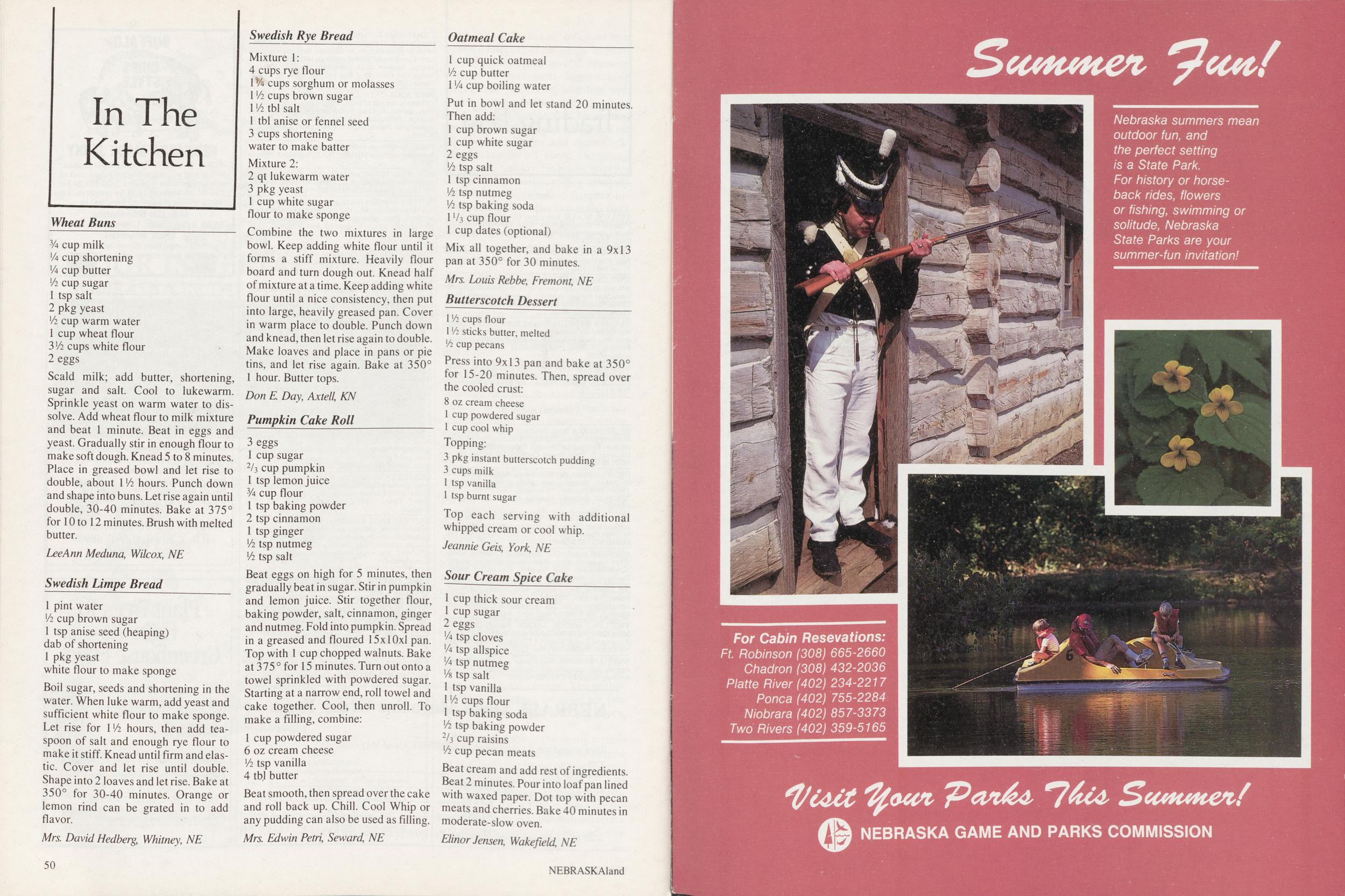
In The Kitchen
Wheat Buns 3/4 cup milk Va cup shortening Va cup butter Vi cup sugar 1 tsp salt 2 pkg yeast Vi cup warm water 1 cup wheat flour 3 Vi cups white flour 2 eggsScald milk; add butter, shortening, sugar and salt. Cool to lukewarm. Sprinkle yeast on warm water to dissolve. Add wheat flour to milk mixture and beat 1 minute. Beat in eggs and yeast. Gradually stir in enough flour to make soft dough. Knead 5 to 8 minutes. Place in greased bowl and let rise to double, about 1 Vi hours. Punch down and shape into buns. Let rise again until double, 30-40 minutes. Bake at 375° for 10 to 12 minutes. Brush with melted butter.
Lee Ann Meduna, Wilcox, NE Swedish Limpe Bread 1 pint water Vi cup brown sugar 1 tsp anise seed (heaping) dab of shortening 1 pkg yeast white flour to make spongeBoil sugar, seeds and shortening in the water. When lukewarm, add yeast and sufficient white flour to make sponge. Let rise for 1 Vi hours, then add teaspoon of salt and enough rye flour to make it stiff. Knead until firm and elastic. Cover and let rise until double. Shape into 2 loaves and let rise. Bake at 350° for 30-40 minutes. Orange or lemon rind can be grated in to add flavor.
Mrs. David Hedberg, Whitney, NE Swedish Rye Bread Mixture 1: 4 cups rye flour 1% cups sorghum or molasses 1 Vi cups brown sugar 1 Vi tbl salt 1 tbl anise or fennel seed 3 cups shortening water to make batter Mixture 2: 2 qt lukewarm water 3 pkg yeast 1 cup white sugar flour to make spongeCombine the two mixtures in large bowl. Keep adding white flour until it forms a stiff mixture. Heavily flour board and turn dough out. Knead half of mixture at a time. Keep adding white flour until a nice consistency, then put into large, heavily greased pan. Cover in warm place to double. Punch down and knead, then let rise again to double. Make loaves and place in pans or pie tins, and let rise again. Bake at 350° 1 hour. Butter tops.
Don £ Day, Axtell, KN Pumpkin Cake Roll 3 eggs 1 cup sugar 2/3 cup pumpkin 1 tsp lemon juice 3/4 cup flour 1 tsp baking powder 2 tsp cinnamon 1 tsp ginger Vi tsp nutmeg Vi tsp saltBeat eggs on high for 5 minutes, then gradually beat in sugar. Stir in pumpkin and lemon juice. Stir together flour, baking powder, salt, cinnamon, ginger and nutmeg. Fold into pumpkin. Spread in a greased and floured 15x10x1 pan. Top with 1 cup chopped walnuts. Bake at 375° for 15 minutes. Turn out onto a towel sprinkled with powdered sugar. Starting at a narrow end, roll towel and cake together. Cool, then unroll. To make a filling, combine:
1 cup powdered sugar 6 oz cream cheese Vi tsp vanilla 4 tbl butterBeat smooth, then spread over the cake and roll back up. Chill. Cool Whip or any pudding can also be used as filling.
Mrs. Edwin Petri, Seward, NE Oatmeal Cake 1 cup quick oatmeal Vi cup butter 1 Va cup boiling waterPut in bowl and let stand 20 minutes. Then add:
1 cup brown sugar 1 cup white sugar 2 eggs Vi tsp salt 1 tsp cinnamon Vi tsp nutmeg Vi tsp baking soda 1V3 cup flour 1 cup dates (optional)Mix all together, and bake in a 9x13 pan at 350° for 30 minutes.
Mrs. Louis Rebbe, Fremont, NE Butterscotch Dessert 1 Vi cups flour 1 Vi sticks butter, melted Vi cup pecansPress into 9x13 pan and bake at 350° for 15-20 minutes. Then, spread over the cooled crust:
8 oz cream cheese 1 cup powdered sugar 1 cup cool whip Topping: 3 pkg instant butterscotch pudding 3 cups milk 1 tsp vanilla 1 tsp burnt sugarTop each serving with additional whipped cream or cool whip.
Jeannie Geis, York, NE Sour Cream Spice Cake 1 cup thick sour cream 1 cup sugar 2 eggs Va tsp cloves Va tsp allspice Va tsp nutmeg V* tsp salt 1 tsp vanilla 1 Vi cups flour 1 tsp baking soda Vi tsp baking powder 2h cup raisins Vi cup pecan meatsBeat cream and add rest of ingredients. Beat 2 minutes. Pour into loaf pan lined with waxed paper. Dot top with pecan meats and cherries. Bake 40 minutes in moderate-slow oven.
Elinor Jensen, Wakefield, NE 50 NEBRASKAlandSummer Fun!
Nebraska summers mean outdoor fun, and the perfect setting is a State Park. For history or horseback rides, flowers or fishing, swimming or solitude, Nebraska State Parks are your summer-fun invitation!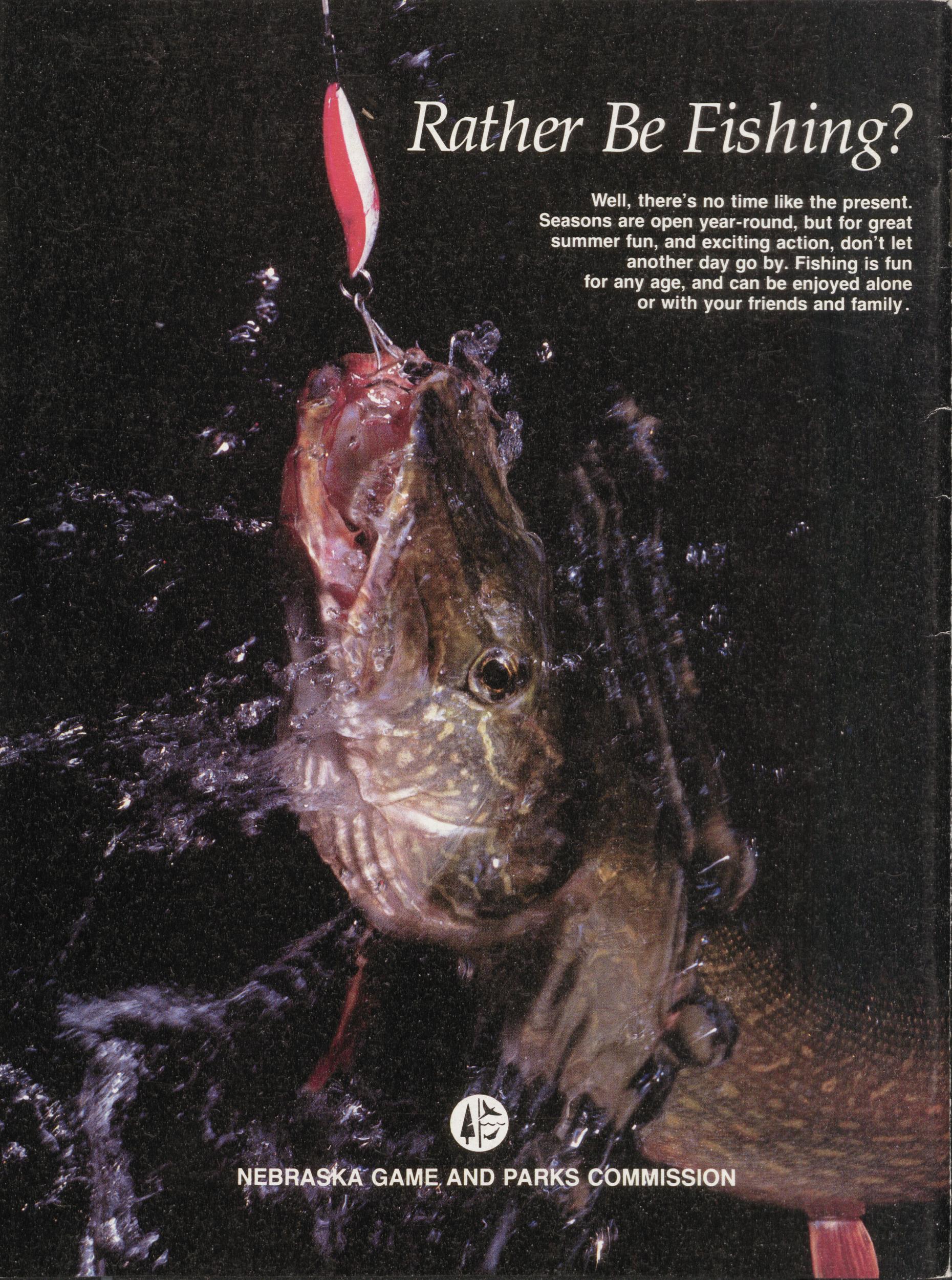
Rather Be Fishing?
Well, there's no time like the present. Seasons are open year-round, but for great summer fun, and exciting action, don't let another day go by. Fishing is fun for any age, and can be enjoyed alone or with your friends and family. NEBRASKA GAME AND PAKS COMMISSIONPosition: 584 (19 views)