Volume 67, Issue 3, 1989
NEBRASKAland
APRIL 1989 $1.50
NEBRSAKAland
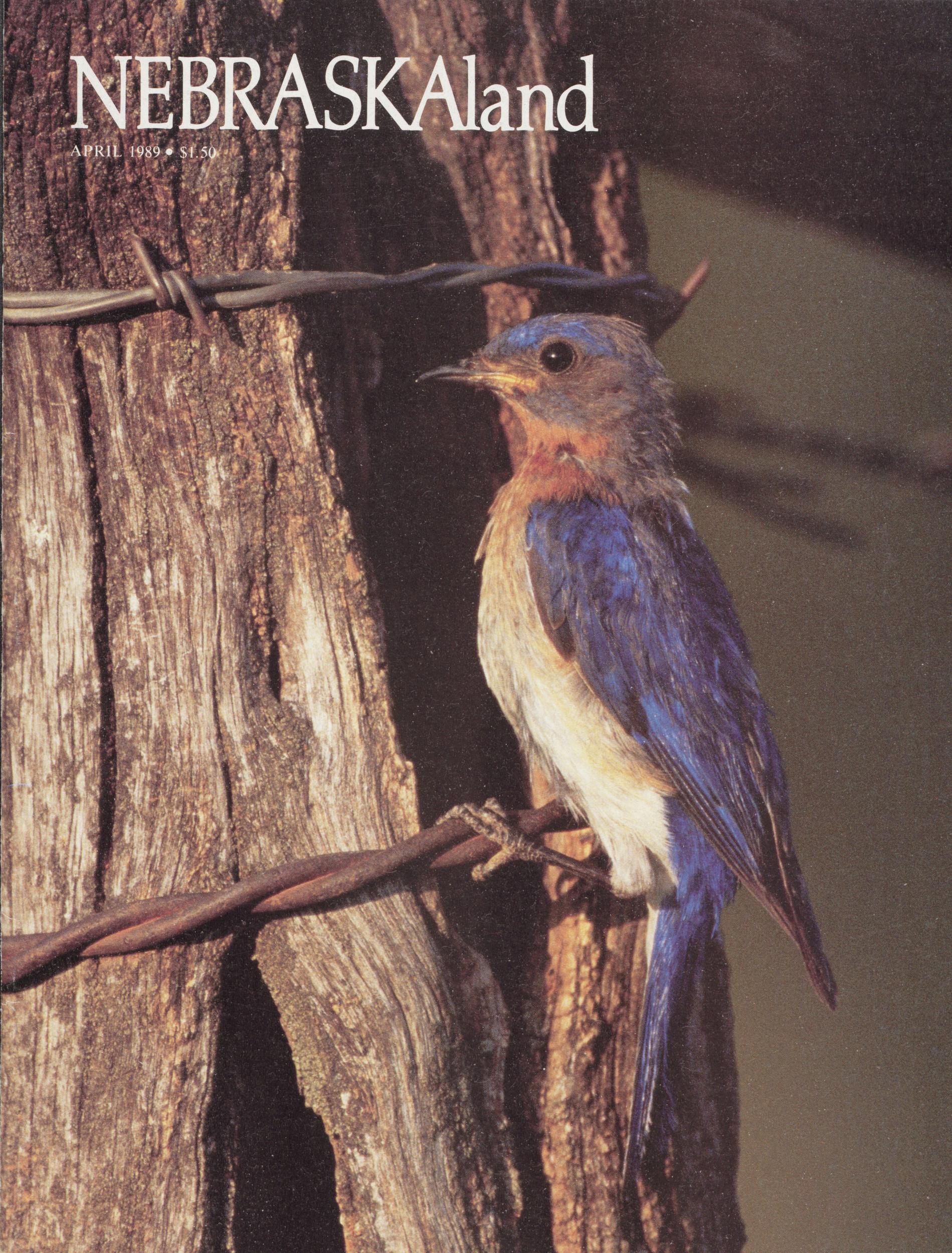
Published by the Nebraska Game and Parks Commission NEBRASKAland VOL. 67/NO. 3/APRIL 1989 NEBRASKAland (ISSN:0028-1964) is published monthly except for combined Jan/Feb and Aug/Sept issues, by the Nebraska Game and Parks Commission, 2200 North 33rd Street, Lincoln, NE. Copyright 1989, all rights reserved. Second-class postage paid at Lincoln, Nebraska. POSTMASTER: Send address changes to NEBRASKAland, Box 30370, Lincoln, NE 68503. Rates: $ 12 for one year; $23 for two years. Offices Headquarters 2200 N. 33rd, Lincoln, 68503 (402)464-0641 13th and Farnam St., Omaha (402)554-2144 Ak-Sar-Ben Aquarium, Gretna (402)332-3901 Rt. 2, Alliance (308) 762-5605 Bassett (402) 684-2921 U.S. 81, Norfolk (402) 371-4950 Rt. 4, North Platte (308) 532-6225 Commissioners Chairman: Wayne Ziebarth, Wilcox Vice Chairman: LaVern Schneider, McCook 2nd Vice Chairman: L. Bruce Wright, Lincoln Richard L. Coyne, Omaha Elvin Adamson, Nenzel J. Alan Cramer, Wayne Stan Juelfs, Kimball Administration Director: Rex Amack Assistant Directors: William J. Bailey, Jr. Dale R. Bree Staff Chief, Information & Education: Jim MacAllister Managing Editor: Lowell Johnson Editor: Don Cunningham Senior Editors: Jon Farrar, Ken Bouc Regional Editors: Bob Grier, Rocky Hoffmann, Tom Keith Art Director: Duane Westerholt Illustration: Tim Reigert, Dan Curran Circulation: Pat Frahm Contents Features HOW MANY SWALLOWS MAKE A SUMMER? 6 PROBLEMS FOR PRONGHORNS 14 BLINDS, BOWS AND DECOYS 18 BRINGING BACK THE BLUEBIRDS 24 PRAIRIE WALLS 32 DUCKS ON THE LODGEPOLE 36 THE "ESSENCE" OF CATFISH1NG 38 FROZEN ASSETS 42 Departments SPEAK UP 4 TRADING POST 49 IN THE KITCHEN 50 COVER: Haggard from the rigors of raising two broods, a male eastern bluebird pauses at the entrance to his nesting cavity in an old Johnson County fencepost. In this century, with the advent of steel fenceposts and the cutting of dead trees for firewood, blue-bird numbers have decreased. Recently, bird lovers have begun erecting nesting boxes, and populations are recovering, but finding nests in natural cavities is rare. For more on bluebirds see story and photos beginning on page 24. Photo by Ken Bouc. OPPOSITE: Silhouetted by a hazy sunrise, a Panhandle bowhunter carries a tom turkey along the North Platte River. For the secrets of his success see story and photos beginning on page 18. Photo by Tom Downey. APRIL 1989 3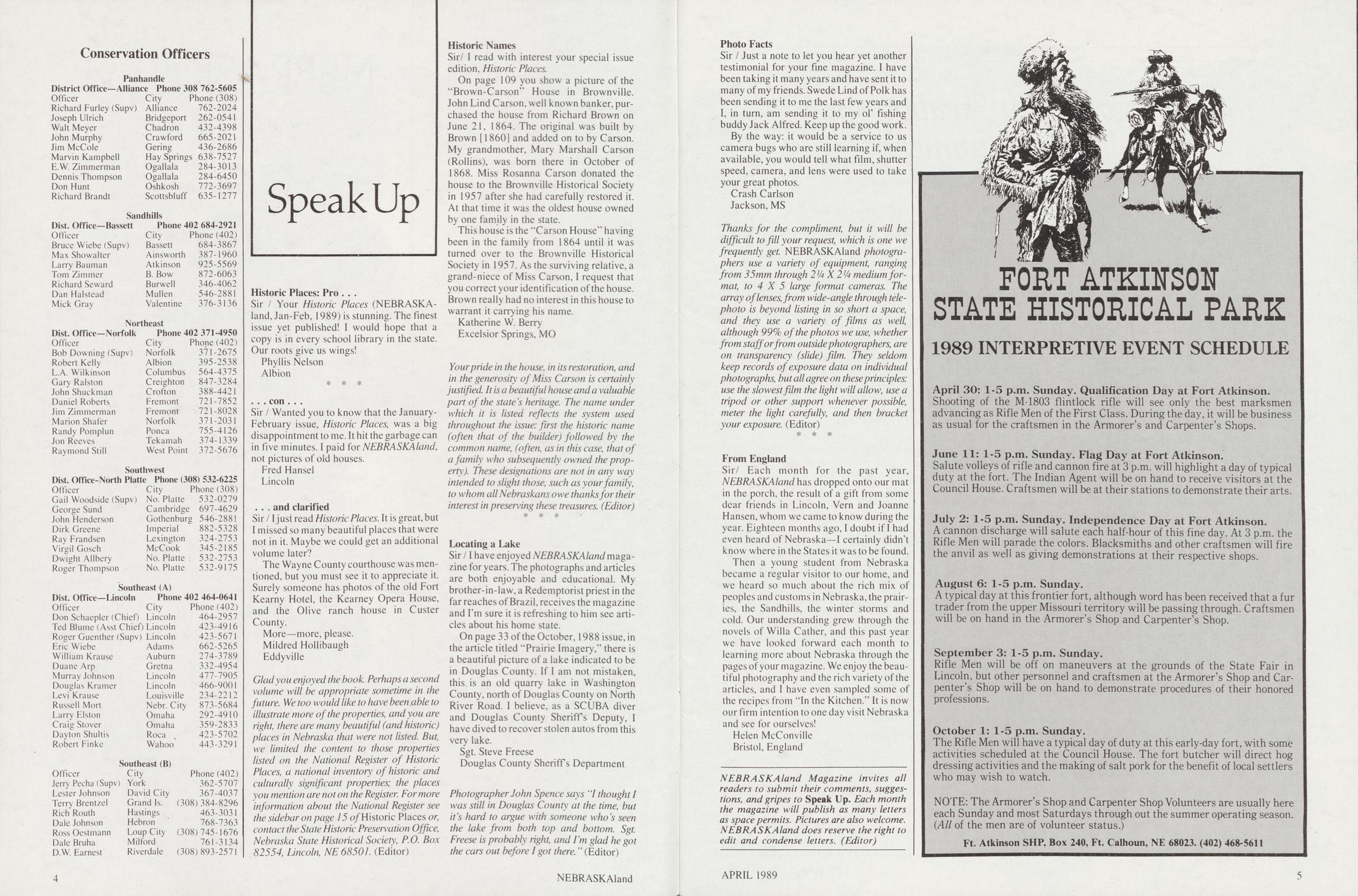
Speak Up
Historic Places: Pro...Sir / Your Historic Places (NEBRASKAland, Jan-Feb, 1989) is stunning. The finest issue yet published! I would hope that a copy is in every school library in the state. Our roots give us wings!
Phyllis Nelson Albion * * * ... con...Sir / Wanted you to know that the January-February issue, Historic Places, was a big disappointment to me. It hit the garbage can in five minutes. I paid for NEBRASKAland, not pictures of old houses.
Fred Hansel Lincoln ... and clarifiedSir/ just read Historic Places. It is great, but I missed so many beautiful places that were not in it. Maybe we could get an additional volume later?
The Wayne County courthouse was mentioned, but you must see it to appreciate it. Surely someone has photos of the old Fort Kearny Hotel, the Kearney Opera House, and the Olive ranch house in Custer County.
More—more, please. Mildred Hollibaugh EddyvilleGlad you enjoyed the book. Perhaps a second volume will be appropriate sometime in the future. We too would like to have been.able to illustrate more of the properties, and you are right, there are many beautiful (and historic) places in Nebraska that were not listed. But, we limited the content to those properties listed on the National Register of Historic Places, a national inventory of historic and culturally significant properties; the places you mention are not on the Register. For more information about the National Register see the sidebar on page 15 o/Historic Places or, contact the State Historic Preservation Office, Nebraska State Historical Society, P.O. Box 82554, Lincoln, NE 68501. (Editor)
Historic NamesSir I read with interest your special issue edition, Historic Places.
On page 109 you show a picture of the "Brown-Carson" House in Brownville. John Lind Carson, well known banker, purchased the house from Richard Brown on June 21, 1864. The original was built by Brown [ 1860] and added on to by Carson. My grandmother, Mary Marshall Carson (Rollins), was born there in October of 1868. Miss Rosanna Carson donated the house to the Brownville Historical Societv in 1957 after she had carefully restored it. At that time it was the oldest house owned by one family in the state.
This house is the "Carson House" having been in the family from 1864 until it was turned over to the Brownville Historical Society in 1957. As the surviving relative, a grand-niece of Miss Carson, I request that you correct your identification of the house. Brown really had no interest in this house to warrant it carrying his name.
Katherine W. Berry Excelsior Springs, MOYour pride in the house, in its restoration, and in the generosity of Miss Carson is certainly justified. It is a beautiful house and a valuable part of the states heritage. The name under which it is listed reflects the system used throughout the issue: first the historic name (often that of the builder) followed by the common name, (often, as in this case, that of a family who subsequently owned the property). These designations are not in any way intended to slight those, such as your family, to whom all Nebraskans owe thanks for their interest in preserving these treasures. (Editor)
* * * Locating a LakeSir have enjoyed NEBRASKAland magazine for years. The photographs and articles are both enjoyable and educational. My brother-in-law, a Redemptorist priest in the far reaches of Brazil, receives the magazine and Em sure it is refreshing to him see articles about his home state.
On page 33 of the October, 1988 issue, in the article titled "Prairie Imagery," there is a beautiful picture of a lake indicated to be in Douglas County. If I am not mistaken, this, is an old quarry lake in Washington County, north of Douglas County on North River Road. I believe, as a SCUBA diver and Douglas County Sheriffs Deputy, I have dived to recover stolen autos from this very lake.
Sgt. Steve Freese Douglas County Sheriffs DepartmentPhotographer John Spence says "7 thought I was still in Douglas County at the time, but it's hard to argue with someone who's seen the lake from both top and bottom. Sgt. Freese is probably right, and I'm glad he got the cars out before I got there. " (Editor)
4 NEBRASKAland Photo FactsSir Just a note to let you hear yet another testimonial for your fine magazine. I have been taking it many years and have sent it to many of my friends. Swede Lind of Polk has been sending it to me the last few years and I, in turn, am sending it to my of fishing buddy Jack Alfred. Keep up the good work.
By the way: it would be a service to us camera bugs who are still learning if, when available, you would tell what film, shutter speed, camera, and lens were used to take your great photos.
Crash Carlson Jackson, MSThanks for the compliment, but it will be difficult to fill your request, which is one we frequently get. NEBRASKAland photographers use a variety of equipment, ranging from 35 mm through 2]M X 2}A medium format, to 4 X 5 large format cameras. The array of lenses, from wide-angle through telephoto is beyond listing in so short a space, and they use a variety of films as well, although 99% of the photos we use, whether from staff or from outside photographers, are on transparency (slide) film. They seldom keep records of exposure data on individual photographs, but all agree on these principles: use the slowest film the light will allow, use a tripod or other support whenever possible, meter the light carefully, and then bracket your exposure. (Editor)
* * * From EnglandSir/ Each month for the past year, NEBRASKAland has dropped onto our mat in the porch, the result of a gift from some dear friends in Lincoln, Vern and Joanne Hansen, whom we came to know during the year. Eighteen months ago, I doubt if I had even heard of Nebraska—I certainly didn't know where in the States it was to be found.
Then a young student from Nebraska became a regular visitor to our home, and we heard so much about the rich mix of peoples and customs in Nebraska, the prairies, the Sandhills, the winter storms and cold. Our understanding grew through the novels of Willa Cather, and this past year we have looked forward each month to learning more about Nebraska through the pages of your magazine. We enjoy the beautiful photography and the rich variety of the articles, and I have even sampled some of the recipes from "In the Kitchen." It is now our firm intention to one dav visit Nebraska and see for ourselves!
Helen McConville Bristol, EnglandNEBRASKAland Magazine invites all readers to submit their comments, suggestions, and gripes to Speak Up. Each month the magazine will publish as many letters as space permits. Pictures are also welcome. NEBRASKAland does reserve the right to edit and condense letters. (Editor)
FORT ATKINSON STATE HISTORICAL PARK
1989 INTERPRETIVE EVENT SCHEDULE April 30: 1-5 p.m. Sunday. Qualification Day at Fort Atkinson. Shooting of the M-1803 flintlock rifle will see only the best marksmen advancing as Rifle Men of the First Class. During the day, it will be business as usual for the craftsmen in the Armorer's and Carpenter's Shops. June 11: 1-5 p.m. Sunday. Flag Day at Fort Atkinson. Salute volleys of rifle and cannon fire at 3 p.m. will highlight a day of typical duty at the fort. The Indian Agent will be on hand to receive visitors at the Council House. Craftsmen will be at their stations to demonstrate their arts. July 2: 1-5 p.m. Sunday. Independence Day at Fort Atkinson. A cannon discharge will salute each half-hour of this fine day. At 3 p.m. the Rifle Men will parade the colors. Blacksmiths and other craftsmen will fire the anvil as well as giving demonstrations at their respective shops. August 6: 1-5 p.m. Sunday. A typical day at this frontier fort, although word has been received that a fur trader from the upper Missouri territory will be passing through. Craftsmen will be on hand in the Armorer's Shop and Carpenter's Shop. September 3: 1-5 p.m. Sunday. Rifle Men will be off on maneuvers at the grounds of the State Fair in Lincoln, but other personnel and craftsmen at the Armorer's Shop and Carpenter's Shop will be on hand to demonstrate procedures of their honored professions. October 1: 1-5 p.m. Sunday. The Rifle Men will have a typical day of duty at this early-day fort, with some activities scheduled at the Council House. The fort butcher will direct hog dressing activities and the making of salt pork for the benefit of local settlers who may wish to watch. NOTE: The Armorer's Shop and Carpenter Shop Volunteers are usually here each Sunday and most Saturdays through out the summer operating season. (All of the men are of volunteer status.) Ft. Atkinson SHP, Box 240, Ft. Calhoun, NE 68023. (402) 468-5611 APRIL 1989 5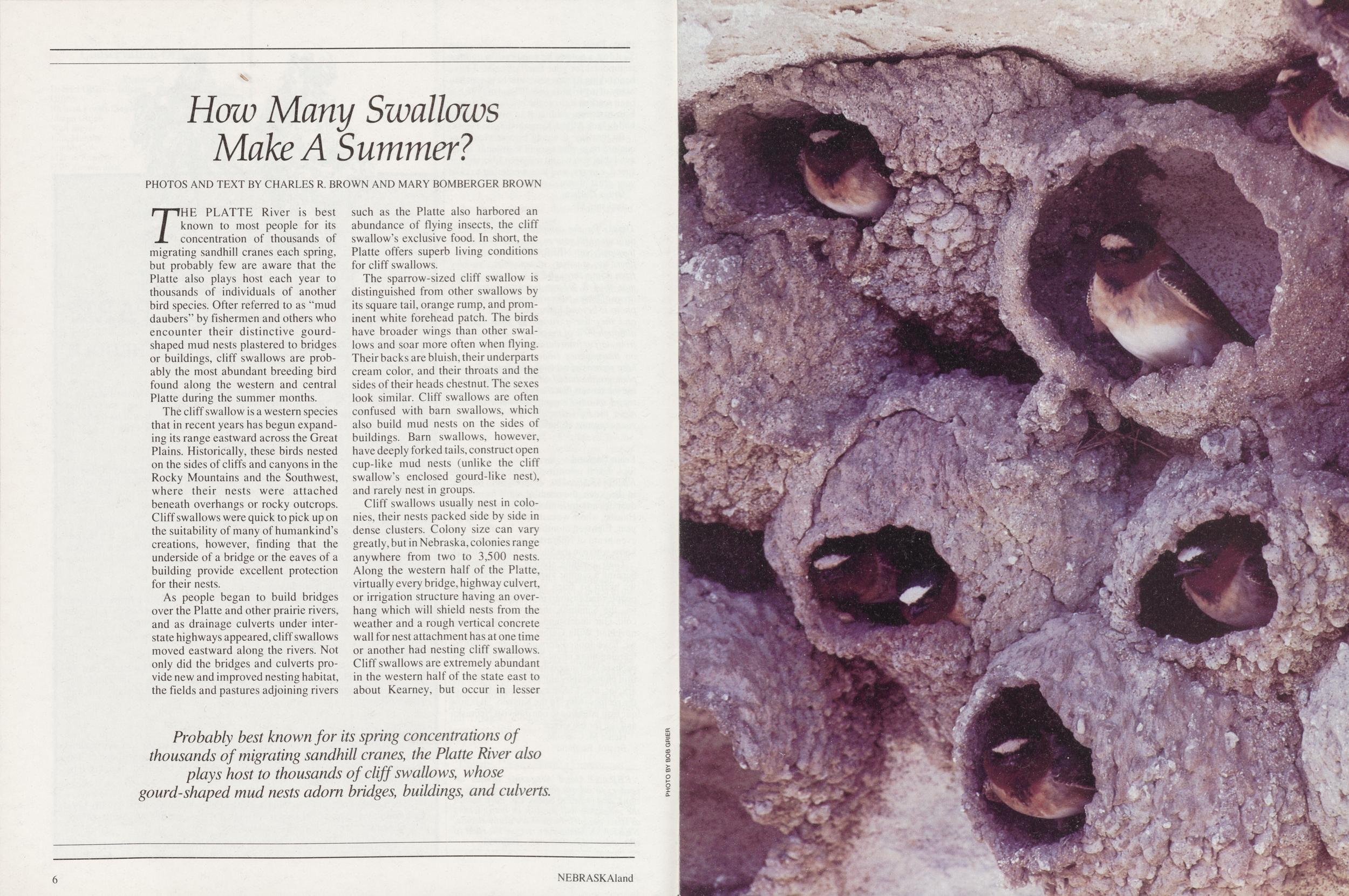
How Many Swallows Make A Summer?
PHOTOS AND TEXT BY CHARLES R. BROWN AND MARY BOMBERGER BROWNTHE PLATTE River is best known to most people for its concentration of thousands of migrating sandhill cranes each spring, but probably few are aware that the Platte also plays host each year to thousands of individuals of another bird species. Ofter referred to as "mud daubers" by fishermen and others who encounter their distinctive gourd-shaped mud nests plastered to bridges or buildings, cliff swallows are probably the most abundant breeding bird found along the western and central Platte during the summer months.
The cliff swallow is a western species that in recent years has begun expanding its range eastward across the Great Plains. Historically, these birds nested on the sides of cliffs and canyons in the Rocky Mountains and the Southwest, where their nests were attached beneath overhangs or rocky outcrops. Cliff swallows were quick to pick up on the suitability of many of humankind's creations, however, finding that the underside of a bridge or the eaves of a building provide excellent protection for their nests.
As people began to build bridges over the Platte and other prairie rivers, and as drainage culverts under interstate highways appeared, cliff swallows moved eastward along the rivers. Not only did the bridges and culverts provide new and improved nesting habitat, the fields and pastures adjoining rivers such as the Platte also harbored an abundance of flying insects, the cliff swallow's exclusive food. In short, the Platte offers superb living conditions for cliff swallows.
The sparrow-sized cliff swallow is distinguished from other swallows by its square tail, orange rump, and prominent white forehead patch. The birds have broader wings than other swallows and soar more often when flying. Their backs are bluish, their underparts cream color, and their throats and the sides of their heads chestnut. The sexes look similar. Cliff swallows are often confused with barn swallows, which also build mud nests on the sides of buildings. Barn swallows, however, have deeply forked tails, construct open cup-like mud nests (unlike the cliff swallow's enclosed gourd-like nest), and rarely nest in groups.
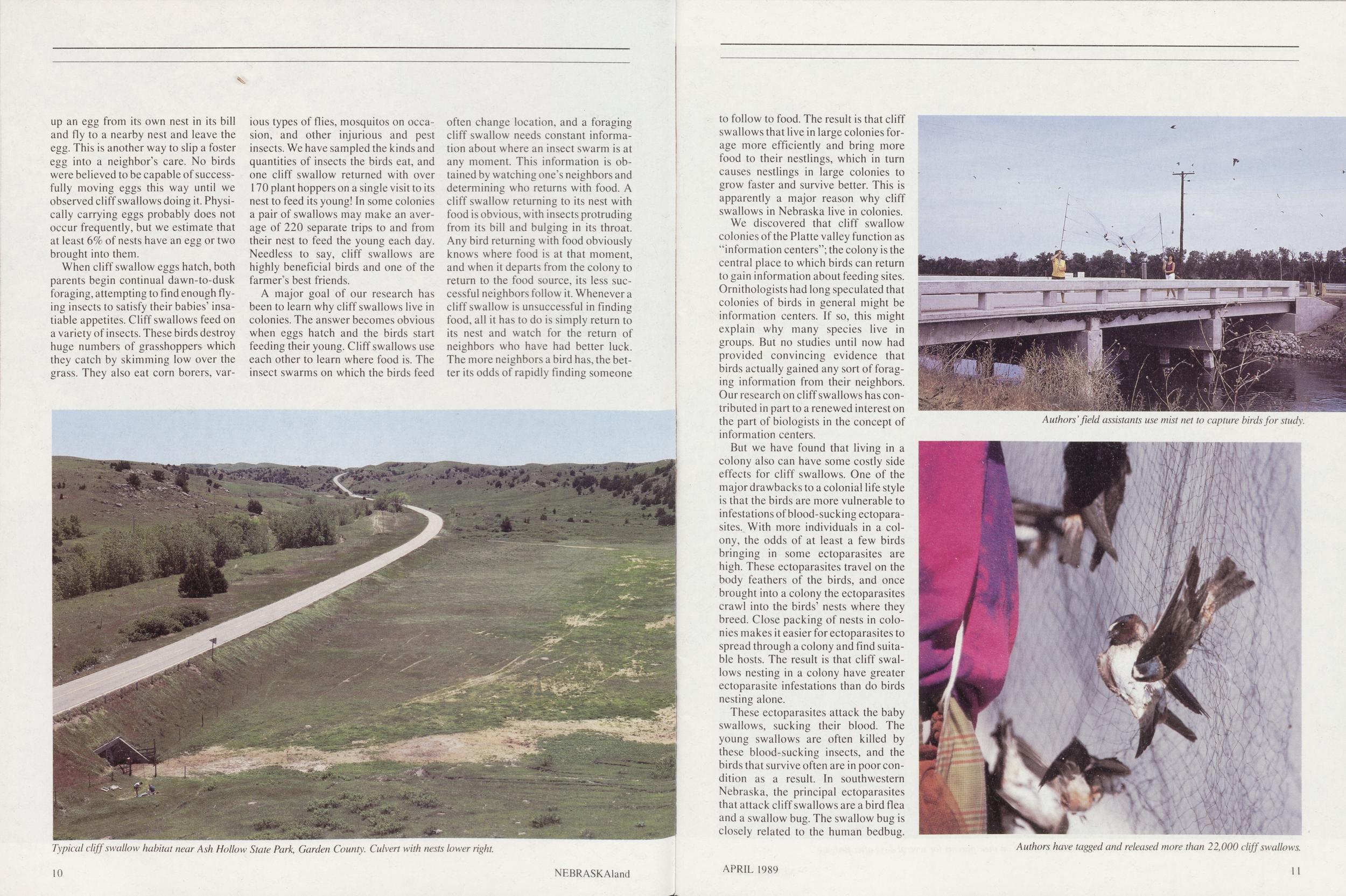
Cliff swallows usually nest in colonies, their nests packed side by side in dense clusters. Colony size can vary greatly, but in Nebraska, colonies range anywhere from two to 3,500 nests. Along the western half of the Platte, virtually every bridge, highway culvert, or irrigation structure having an overhang which will shield nests from the weather and a rough vertical concrete wall for nest attachment has at one time or another had nesting cliff swallows. Cliff swallows are extremely abundant in the western half of the state east to about Kearney, but occur in lesser numbers throughout Nebraska.
Probably best known for its spring concentrations of thousands of migrating sandhill cranes, the Platte River also plays host to thousands of cliff swallows, whose gourd-shaped mud nests adorn bridges, buildings, and culverts. 6 NEBRASKAland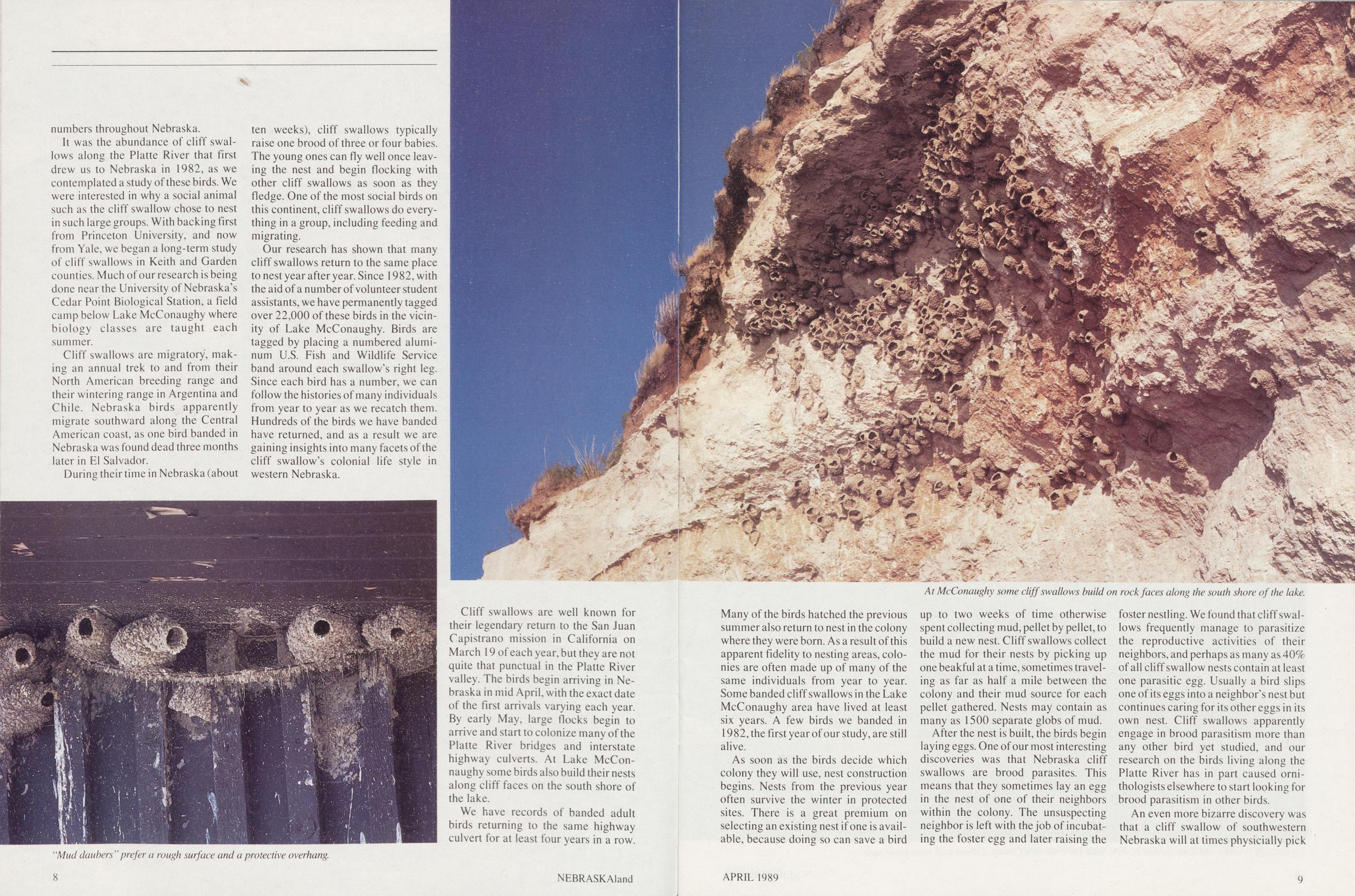
It was the abundance of cliff swallows along the Platte River that first drew us to Nebraska in 1982, as we contemplated a study of these birds. We were interested in why a social animal such as the cliff swallow chose to nest in such large groups. With backing first from Princeton University, and now from Yale, we began a long-term study of cliff swallows in Keith and Garden counties. Much of our research is being done near the University of Nebraska's Cedar Point Biological Station, a field camp below Lake McConaughy where biology classes are taught each summer.
Cliff swallows are migratory, making an annual trek to and from their North American breeding range and their wintering range in Argentina and Chile. Nebraska birds apparently migrate southward along the Central American coast, as one bird banded in Nebraska was found dead three months later in El Salvador.
During their time in Nebraska (about ten weeks), cliff swallows typically raise one brood of three or four babies. The young ones can fly well once leaving the nest and begin flocking with other cliff swallows as soon as they fledge. One of the most social birds on this continent, cliff swallows do everything in a group, including feeding and migrating.
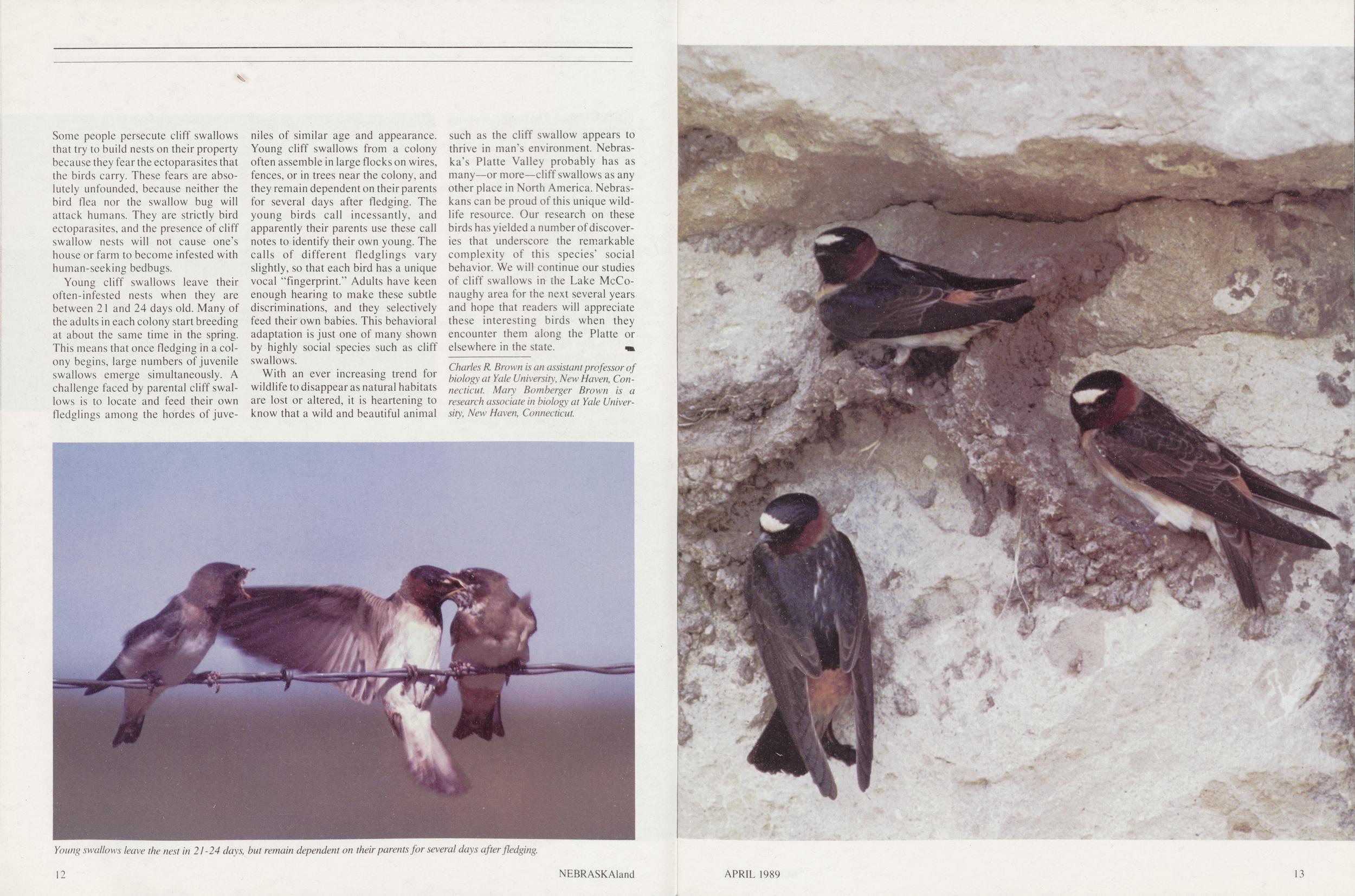
Our research has shown that many cliff swallows return to the same place to nest year after year. Since 1982, with the aid of a number of volunteer student assistants, we have permanently tagged over 22,000 of these birds in the vicinity of Lake McConaughy. Birds are tagged by placing a numbered aluminum U.S. Fish and Wildlife Service band around each swallow's right leg. Since each bird has a number, we can follow the histories of many individuals from year to year as we recatch them. Hundreds of the birds we have banded have returned, and as a result we are gaining insights into many facets of the cliff swallow's colonial life style in western Nebraska.
Cliff swallows are well known for their legendary return to the San Juan Capistrano mission in California on March 19 of each year, but they are not quite that punctual in the Platte River valley. The birds begin arriving in Nebraska in mid April, with the exact date of the first arrivals varying each year. By early May, large flocks begin to arrive and start to colonize many of the Platte River bridges and interstate highway culverts. At Lake McConnaughy some birds also build their nests along cliff faces on the south shore of the lake.
We have records of banded adult birds returning to the same highway culvert for at least four years in a row. 8 NEBRASKAland Many of the birds hatched the previous summer also return to nest in the colony where they were born. As a result of this apparent fidelity to nesting areas, colonies are often made up of many of the same individuals from year to year. Some banded cliff swallows in the Lake McConaughy area have lived at least six years. A few birds we banded in 1982, the first year of our study, are still alive.
As soon as the birds decide which colony they will use, nest construction begins. Nests from the previous year often survive the winter in protected sites. There is a great premium on selecting an existing nest ifone is available, because doing so can save a bird up to two weeks of time otherwise spent collecting mud, pellet by pellet, to build a new nest. Cliff swallows collect the mud for their nests by picking up one beakful at a time, sometimes traveling as far as half a mile between the colony and their mud source for each pellet gathered. Nests may contain as many as 1500 separate globs of mud.
After the nest is built, the birds begin laying eggs. One of our most interesting discoveries was that Nebraska cliff swallows are brood parasites. This means that they sometimes lay an egg in the nest of one of their neighbors within the colony. The unsuspecting neighbor is left with the job of incubating the foster egg and later raising the foster nestling. We found that cliff swallows frequently manage to parasitize the reproductive activities of their neighbors, and perhaps as many as 40% of all cliff swallow nests contain at least one parasitic egg. Usually a bird slips one of its eggs into a neighbor's nest but continues caring for its other eggs in its own nest. Cliff swallows apparently engage in brood parasitism more than any other bird yet studied, and our research on the birds living along the Platte River has in part caused ornithologists elsewhere to start looking for brood parasitism in other birds.
An even more bizarre discovery was
that a cliff swallow of southwestern
Nebraska will at times physicially pick
APRIL 1989
9
 up an egg from its own nest in its bill
and fly to a nearby nest and leave the
egg. This is another way to slip a foster
egg into a neighbor's care. No birds
were believed to be capable of successfully moving eggs this way until we
observed cliff swallows doing it. Physically carrying eggs probably does not
occur frequently, but we estimate that
at least 6% of nests have an egg or two
brought into them.
up an egg from its own nest in its bill
and fly to a nearby nest and leave the
egg. This is another way to slip a foster
egg into a neighbor's care. No birds
were believed to be capable of successfully moving eggs this way until we
observed cliff swallows doing it. Physically carrying eggs probably does not
occur frequently, but we estimate that
at least 6% of nests have an egg or two
brought into them.
When cliff swallow eggs hatch, both parents begin continual dawn-to-dusk foraging, attempting to find enough flying insects to satisfy their babies' insatiable appetites. Cliff swallows feed on a variety of insects. These birds destroy huge numbers of grasshoppers which they catch by skimming low over the grass. They also eat corn borers, various types of flies, mosquitos on occasion, and other injurious and pest insects. We have sampled the kinds and quantities of insects the birds eat, and one cliff swallow returned with over 170 plant hoppers on a single visit to its nest to feed its young! In some colonies a pair of swallows may make an average of 220 separate trips to and from their nest to feed the young each day. Needless to say, cliff swallows are highly beneficial birds and one of the farmer's best friends.
A major goal of our research has been to learn why cliff swallows live in colonies. The answer becomes obvious when eggs hatch and the birds start feeding their young. Cliff swallows use each other to learn where food is. The insect swarms on which the birds feed often change location, and a foraging cliff swallow needs constant information about where an insect swarm is at any moment. This information is obtained by watching one's neighbors and determining who returns with food. A cliff swallow returning to its nest with food is obvious, with insects protruding from its bill and bulging in its throat. Any bird returning with food obviously knows where food is at that moment, and when it departs from the colony to return to the food source, its less successful neighbors follow it. Whenever a cliff swallow is unsuccessful in finding food, all it has to do is simply return to its nest and watch for the return of neighbors who have had better luck. The more neighbors a bird has, the better its odds of rapidly finding someone
We discovered that cliff swallow colonies of the Platte valley function as 'information centers"; the colony is the central place to which birds can return to gain information about feeding sites. Ornithologists had long speculated that colonies of birds in general might be information centers. If so, this might explain why many species live in groups. But no studies until now had provided convincing evidence that birds actually gained any sort of foraging information from their neighbors. Our research on cliff swallows has contributed in part to a renewed interest on the part of biologists in the concept of information centers.
But we have found that living in a colony also can have some costly side effects for cliff swallows. One of the major drawbacks to a colonial life style is that the birds are more vulnerable to infestations of blood-sucking ectoparasites. With more individuals in a colony, the odds of at least a few birds bringing in some ectoparasites are high. These ectoparasites travel on the body feathers of the birds, and once brought into a colony the ectoparasites crawl into the birds' nests where they breed. Close packing of nests in colonies makes it easier for ectoparasites to spread through a colony and find suitable hosts. The result is that cliff swallows nesting in a colony have greater ectoparasite infestations than do birds nesting alone.
These ectoparasites attack the baby swallows, sucking their blood. The young swallows are often killed by these blood-sucking insects, and the birds that survive often are in poor condition as a result. In southwestern Nebraska, the principal ectoparasites that attack cliff swallows are a bird flea and a swallow bug. The swallow bug is closely related to the human bedbug.
 Some people persecute cliff swallows
that try to build nests on their property
because they fear the ectoparasites that
the birds carry. These fears are absolutely unfounded, because neither the
bird flea nor the swallow bug will
attack humans. They are strictly bird
ectoparasites, and the presence of cliff
swallow nests will not cause one's
house or farm to become infested with
human-seeking bedbugs.
Some people persecute cliff swallows
that try to build nests on their property
because they fear the ectoparasites that
the birds carry. These fears are absolutely unfounded, because neither the
bird flea nor the swallow bug will
attack humans. They are strictly bird
ectoparasites, and the presence of cliff
swallow nests will not cause one's
house or farm to become infested with
human-seeking bedbugs.
Young cliff swallows leave their often-infested nests when they are between 21 and 24 days old. Many of the adults in each colony start breeding at about the same time in the spring. This means that once fledging in a col- ony begins, large numbers of juvenile swallows emerge simultaneously. A challenge faced by parental cliff swallows is to locate and feed their own fledglings among the hordes of juveniles of similar age and appearance. Young cliff swallows from a colony often assemble in large flocks on wires, fences, or in trees near the colony, and they remain dependent on their parents for several days after fledging. The young birds call incessantly, and apparently their parents use these call notes to identify their own young. The calls of different fledglings vary slightly, so that each bird has a unique vocal 'fingerprint." Adults have keen enough hearing to make these subtle discriminations, and they selectively feed their own babies. This behavioral adaptation is just one of many shown by highly social species such as cliff swallows.
With an ever increasing trend for wildlife to disappear as natural habitats are lost or altered, it is heartening to know that a wild and beautiful animal such as the cliff swallow appears to thrive in man's environment. Nebraska's Platte Valley probably has as many—or more—cliff swallows as any other place in North America. Nebraskans can be proud of this unique wild- life resource. Our research on these birds has yielded a number of discoveries that underscore the remarkable complexity of this species' social behavior. We will continue our studies of cliff swallows in the Lake McConaughy area for the next several years and hope that readers will appreciate these interesting birds when they encounter them along the Platte or elsewhere in the state.
Charles R. Brown is an assistant professor of biology at Yale University, New Haven, Connecticut. Maty Bomberger Brown is a research associate in biology at Yale University, New Haven, Connecticut.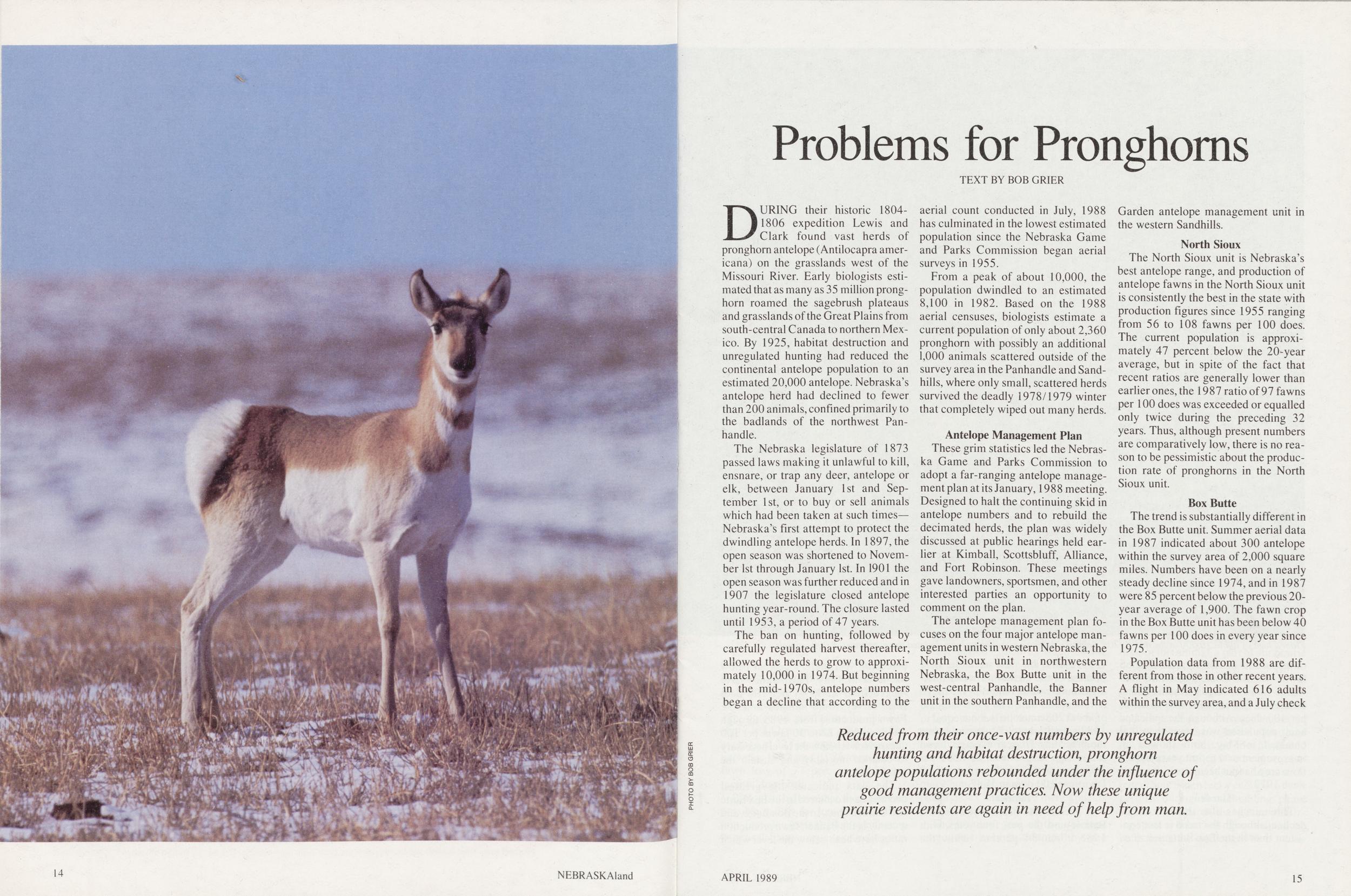
Problems for Pronghoms
TEXT BY BOB GRIERDURING their historic 1804-1806 expedition Lewis and Clark found vast herds of pronghorn antelope (Antilocapra americana) on the grasslands west of the Missouri River. Early biologists estimated that as many as 35 million prong- horn roamed the sagebrush plateaus and grasslands of the Great Plains from south-central Canada to northern Mexico. By 1925, habitat destruction and unregulated hunting had reduced the continental antelope population to an estimated 20,000 antelope. Nebraska's antelope herd had declined to fewer than 200 animals, confined primarily to the badlands of the northwest Panhandle.
The Nebraska legislature of 1873 passed laws making it unlawful to kill, ensnare, or trap any deer, antelope or elk, between January 1st and September 1st, or to buy or sell animals which had been taken at such times- Nebraska's first attempt to protect the dwindling antelope herds. In 1897, the open season was shortened to November 1st through January 1st. In 1901 the open season was further reduced and in 1907 the legislature closed antelope hunting year-round. The closure lasted until 1953, a period of 47 years.
The ban on hunting, followed by carefully regulated harvest thereafter, allowed the herds to grow to approximately 10,000 in 1974. But beginning in the mid-1970s, antelope numbers began a decline that according to the aerial count conducted in July, 1988 has culminated in the lowest estimated population since the Nebraska Game and Parks Commission began aerial surveys in 1955.
From a peak of about 10,000, the population dwindled to an estimated 8,100 in 1982. Based on the 1988 aerial censuses, biologists estimate a current population of only about 2,360 pronghorn with possibly an additional 1,000 animals scattered outside of the survey area in the Panhandle and Sand- hills, where only small, scattered herds survived the deadly 1978/1979 winter that completely wiped out many herds.
Antelope Management PlanThese grim statistics led the Nebraska Game and Parks Commission to adopt a far-ranging antelope management plan at its January, 1988 meeting. Designed to halt the continuing skid in antelope numbers and to rebuild the decimated herds, the plan was widely discussed at public hearings held earlier at Kimball, Scottsbluff, Alliance, and Fort Robinson. These meetings gave landowners, sportsmen, and other interested parties an opportunity to comment on the plan.
The antelope management plan focuses on the four major antelope management units in western Nebraska, the North Sioux unit in northwestern Nebraska, the Box Butte unit in the west-central Panhandle, the Banner unit in the southern Panhandle, and the Garden antelope management unit in the western Sandhills.
North SiouxThe North Sioux unit is Nebraska's best antelope range, and production of antelope fawns in the North Sioux unit is consistently the best in the state with production figures since 1955 ranging from 56 to 108 fawns per 100 does. The current population is approximately 47 percent below the 20-year average, but in spite of the fact that recent ratios are generally lower than earlier ones, the 1987 ratio of 97 fawns per 100 does was exceeded or equalled only twice during the preceding 32 years. Thus, although present numbers are comparatively low, there is no reason to be pessimistic about the production rate of pronghorns in the North Sioux unit.
Box ButteThe trend is substantially different in the Box Butte unit. Summer aerial data in 1987 indicated about 300 antelope within the survey area of 2,000 square miles. Numbers have been on a nearly steady decline since 1974, and in 1987 were 85 percent below the previous 20- year average of 1,900. The fawn crop in the Box Butte unit has been below 40 fawns per 100 does in every year since 1975.
Population data from 1988 are different from those in other recent years. A flight in May indicated 616 adults within the survey area, and a July check on a portion of the area showed 65 fawns per 100 does. The entire area was re-flown in August, resulting in an estimate of 520 antelope with 66 fawns per 100 does. Although the indicated adult population was lower than that obtained in May, both showed an improvement over recent years and the fawn crop has not been nearly this good since 1972.
reduced from their once-vast numbers by unregulated hunting and habitat destruction, pronghorn antelope populations rebounded under the influence of good management practices. Now these unique prairie residents are again in need of help from man. APRIL 1989 15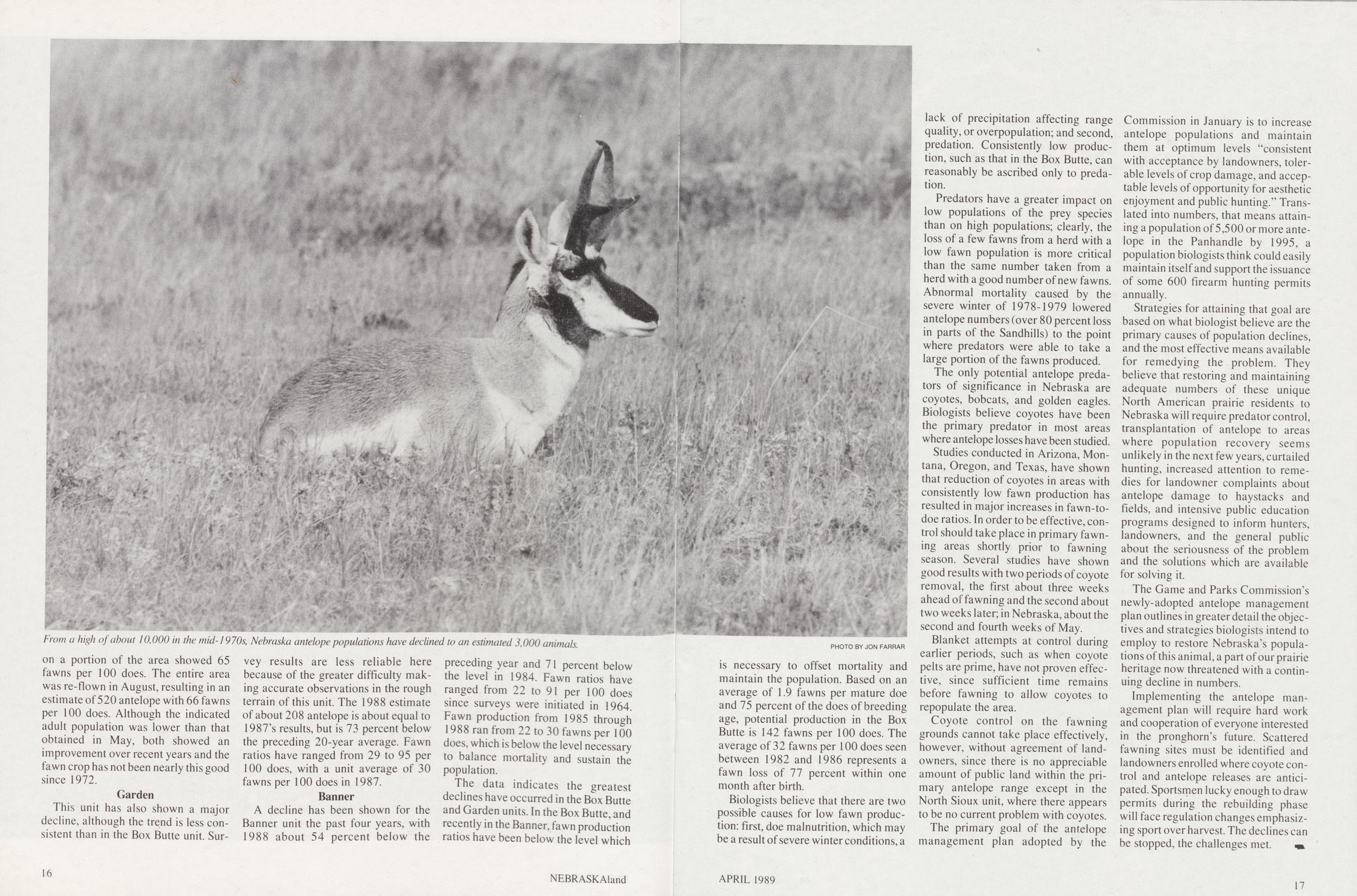
This unit has also shown a major decline, although the trend is less consistent than in the Box Butte unit. Survey results are less reliable here because of the greater difficulty making accurate observations in the rough terrain of this unit. The 1988 estimate of about 208 antelope is about equal to 1987's results, but is 73 percent below the preceding 20-year average. Fawn ratios have ranged from 29 to 95 per 100 does, with a unit average of 30 fawns per 100 does in 1987.
BannerA decline has been shown for the Banner unit the past four years, with 1988 about 54 percent below the preceding year and 71 percent below the level in 1984. Fawn ratios have ranged from 22 to 91 per 100 does since surveys were initiated in 1964. Fawn production from 1985 through 1988 ran from 22 to 30 fawns per 100 does, which is below the level necessary to balance mortality and sustain the population.
The data indicates the greatest declines have occurred in the Box Butte and Garden units. In the Box Butte, and recently in the Banner, fawn production ratios have been below the level which 16 NEBRASKAland is necessary to offset mortality and maintain the population. Based on an average of 1.9 fawns per mature doe and 75 percent of the does of breeding age, potential production in the Box Butte is 142 fawns per 100 does. The average of 32 fawns per 100 does seen between 1982 and 1986 represents a fawn loss of 77 percent within one month after birth.
Biologists believe that there are two possible causes for low fawn production: first, doe malnutrition, which may be a result of severe winter conditions, a lack of precipitation affecting range quality, or overpopulation; and second, predation. Consistently low production, such as that in the Box Butte, can reasonably be ascribed only to predation.
Predators have a greater impact on low populations of the prey species than on high populations; clearly, the loss of a few fawns from a herd with a low fawn population is more critical than the same number taken from a herd with a good number of new fawns. Abnormal mortality caused by the severe winter of 1978-1979 lowered antelope numbers (over 80 percent loss in parts of the Sandhills) to the point where predators were able to take a large portion of the fawns produced.
The only potential antelope predators of significance in Nebraska are coyotes, bobcats, and golden eagles. Biologists believe coyotes have been the primary predator in most areas where antelope losses have been studied.
Studies conducted in Arizona, Montana, Oregon, and Texas, have shown that reduction of coyotes in areas with consistently low fawn production has resulted in major increases in fawn-to-doe ratios. In order to be effective, control should take place in primary fawn- ing areas shortly prior to fawning season. Several studies have shown good results with two periods of coyote removal, the first about three weeks ahead of fawning and the second about two weeks later; in Nebraska, about the second and fourth weeks of May.
Blanket attempts at control during earlier periods, such as when coyote pelts are prime, have not proven effective, since sufficient time remains before fawning to allow coyotes to repopulate the area.
Coyote control on the fawning grounds cannot take place effectively, however, without agreement of landowners, since there is no appreciable amount of public land within the primary antelope range except in the North Sioux unit, where there appears to be no current problem with coyotes.
The primary goal of the antelope management plan adopted by the Commission in January is to increase antelope populations and maintain them at optimum levels "consistent with acceptance by landowners, tolerable levels of crop damage, and acceptable levels of opportunity for aesthetic enjoyment and public hunting." Translated into numbers, that means attaining a population of 5,500 or more ante- lope in the Panhandle by 1995, a population biologists think could easily maintain itself and support the issuance of some 600 firearm hunting permits annually.
Strategies for attaining that goal are based on what biologist believe are the primary causes of population declines, and the most effective means available for remedying the problem. They believe that restoring and maintaining adequate numbers of these unique North American prairie residents to Nebraska will require predator control, transplantation of antelope to areas where population recovery seems unlikely in the next few years, curtailed hunting, increased attention to remedies for landowner complaints about antelope damage to haystacks and fields, and intensive public education programs designed to inform hunters, landowners, and the general public about the seriousness of the problem and the solutions which are available for solving it.
The Game and Parks Commission's newly-adopted antelope management plan outlines in greater detail the objectives and strategies biologists intend to employ to restore Nebraska's populations of this animal, a part of our prairie heritage now threatened with a continuing decline in numbers.
Implementing the antelope management plan will require hard work and cooperation of everyone interested in the pronghorn's future. Scattered fawning sites must be identified and landowners enrolled where coyote control and antelope releases are anticipated. Sportsmen lucky enough to draw permits during the rebuilding phase will face regulation changes emphasizing sport over harvest. The declines can be stopped, the challenges met. «*
APRIL 1989 17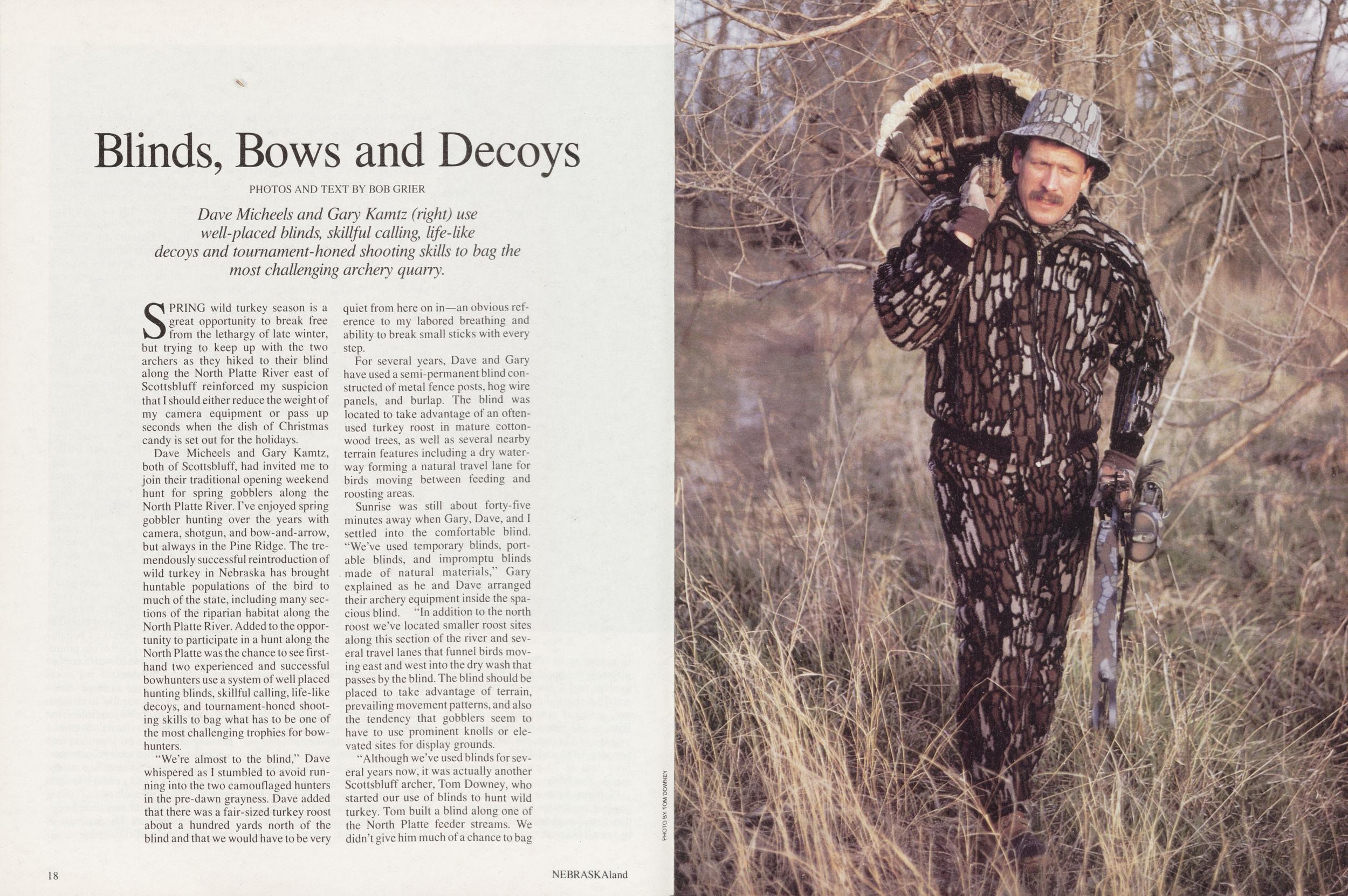
Blinds, Bows and Decoys
PHOTOS AND TEXT BY BOB GRIER Dave Micheels and Gary Kamtz (right) use well-placed blinds, skillful calling, life-like decoys and tournament-honed shooting skills to bag the most challenging archery quarry.SPRING wild turkey season is a great opportunity to break free from the lethargy of late winter, but trying to keep up with the two archers as they hiked to their blind along the North Platte River east of Scottsbluff reinforced my suspicion that I should either reduce the weight of my camera equipment or pass up seconds when the dish of Christmas candy is set out for the holidays.
Dave Micheels and Gary Kamtz, both of Scottsbluff, had invited me to join their traditional opening weekend hunt for spring gobblers along the North Platte River. I've enjoyed spring gobbler hunting over the years with camera, shotgun, and bow-and-arrow, but always in the Pine Ridge. The tremendously successful reintroduction of wild turkey in Nebraska has brought huntable populations of the bird to much of the state, including many sections of the riparian habitat along the North Platte River. Added to the opportunity to participate in a hunt along the North Platte was the chance to see firsthand two experienced and successful bowhunters use a system of well placed hunting blinds, skillful calling, life-like decoys, and tournament-honed shooting skills to bag what has to be one of the most challenging trophies for bowhunters.
"We're almost to the blind," Dave whispered as I stumbled to avoid running into the two camouflaged hunters in the pre-dawn grayness. Dave added that there was a fair-sized turkey roost about a hundred yards north of the blind and that we would have to be very quiet from here on in—an obvious reference to my labored breathing and ability to break small sticks with every step.
For several years, Dave and Gary have used a semi-permanent blind constructed of metal fence posts, hog wire panels, and burlap. The blind was located to take advantage of an often- used turkey roost in mature cottonwood trees, as well as several nearby terrain features including a dry waterway forming a natural travel lane for birds moving between feeding and roosting areas.
Sunrise was still about forty-five minutes away when Gary, Dave, and I settled into the comfortable biind. "We've used temporary blinds, portable blinds, and impromptu blinds made of natural materials," Gary explained as he and Dave arranged their archery equipment inside the spacious blind. "In addition to the north roost we've located smaller roost sites along this section of the river and several travel lanes that funnel birds moving east and west into the dry wash that passes by the blind. The blind should be placed to take advantage of terrain, prevailing movement patterns, and also the tendency that gobblers seem to have to use prominent knolls or elevated sites for display grounds.
"Although we've used blinds for several years now, it was actually another Scottsbluff archer, Tom Downey, who started our use of blinds to hunt wild turkey. Tom built a blind along one of the North Platte feeder streams. We didn't give him much of a chance to bag a turkey out of that blind, but he quickly proved how wrong we were!
18 NEBRASKAland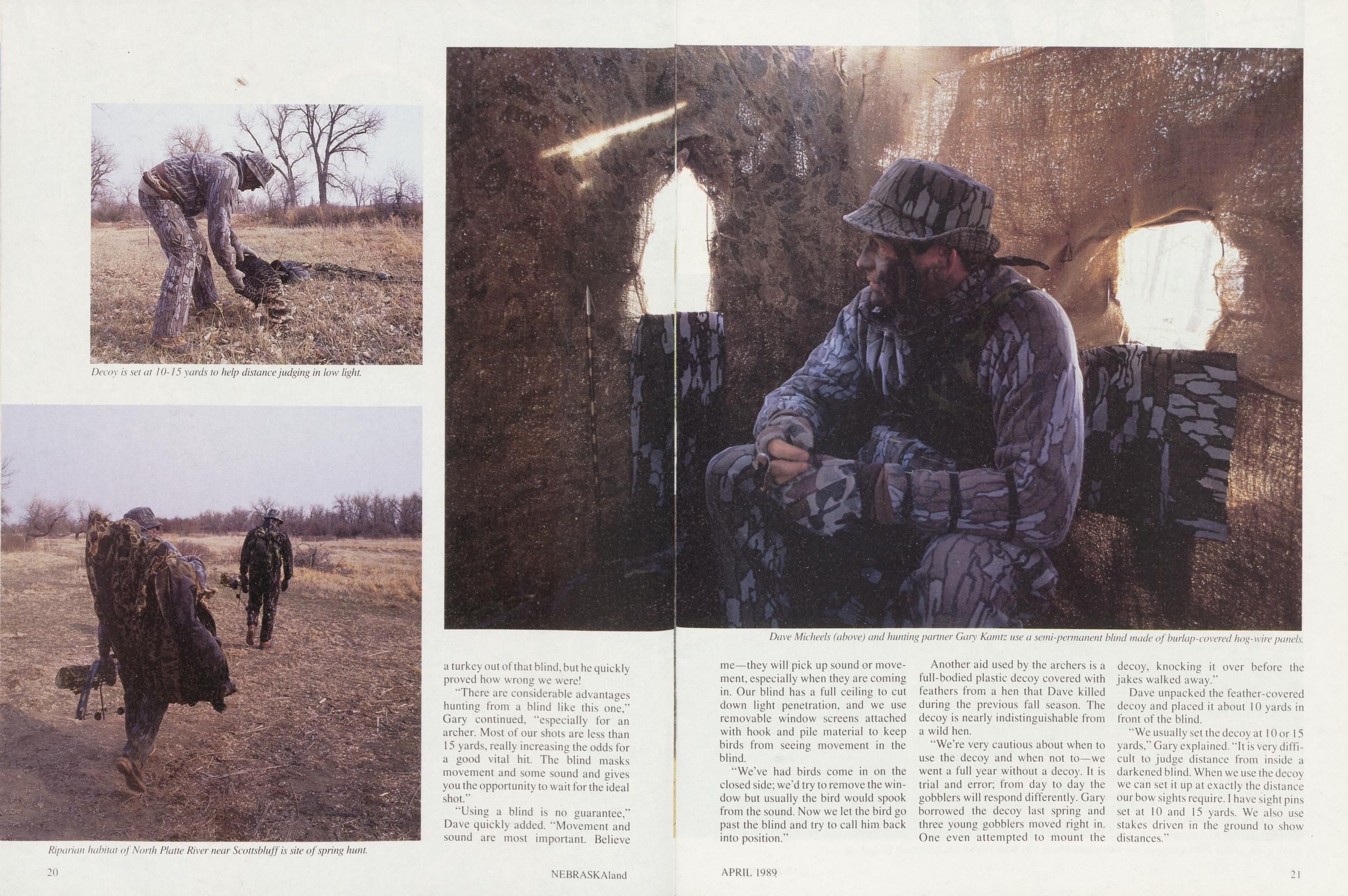
"There are considerable advantages hunting from a blind like this one," Gary continued, "especially for an archer. Most of our shots are less than 15 yards, really increasing the odds for a good vital hit. The blind masks movement and some sound and gives you the opportunity to wait for the ideal shot."
"Using a blind is no guarantee," Dave quickly added. "Movement and sound are most important. Believe 20 NEBRASKAland
"We've had birds come in on the closed side; we'd try to remove the window but usually the bird would spook from the sound. Now we let the bird go past the blind and try to call him back into position."
Another aid used by the archers is a full-bodied plastic decoy covered with feathers from a hen that Dave killed during the previous fall season. The decoy is nearly indistinguishable from a wild hen.
'We're very cautious about when to use the decoy and when not to—we went a full year without a decoy. It is trial and error; from day to day the gobblers will respond differently. Gary borrowed the decoy last spring and three young gobblers moved right in. One even attempted to mount the decoy, knocking it over before the jakes walked away."
Dave unpacked the feather-covered decoy and placed it about 10 yards in front of the blind.
"We usually set the decoy at 10 or 15 yards," Gary explained. "It is very difficult to judge distance from inside a darkened blind. When we use the decoy we can set it up at exactly the distance our bow sights require. I have sight pins set at 10 and 15 yards. We also use stakes driven in the ground to show distances."
APRIL 1989 21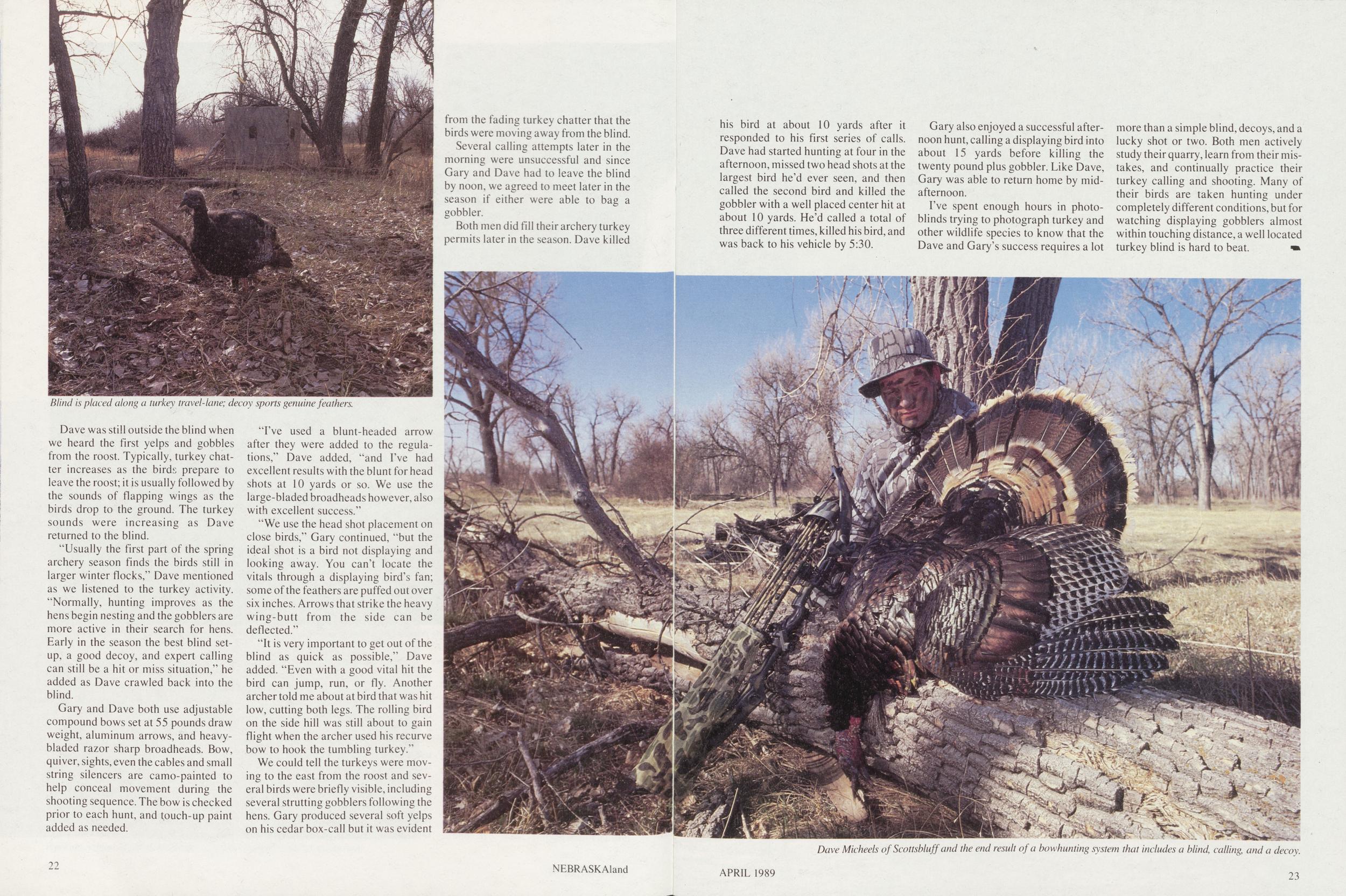
Dave was still outside the blind when we heard the first yelps and gobbles from the roost. Typically, turkey chatter increases as the birds prepare to leave the roost; it is usually followed by the sounds of flapping wings as the birds drop to the ground. The turkey sounds were increasing as Dave returned to the blind.
'Usually the first part of the spring archery season finds the birds still in larger winter flocks," Dave mentioned as we listened to the turkey activity. "Normally, hunting improves as the hens begin nesting and the gobblers are more active in their search for hens. Early in the season the best blind setup, a good decoy, and expert calling can still be a hit or miss situation," he added as Dave crawled back into the blind.
Gary and Dave both use adjustable compound bows set at 55 pounds draw weight, aluminum arrows, and heavy-bladed razor sharp broadheads. Bow, quiver, sights, even the cables and small string silencers are camo-painted to help conceal movement during the shooting sequence. The bow is checked prior to each hunt, and touch-up paint added as needed.
I've used a blunt-headed arrow after they were added to the regulations," Dave added, "and I've had excellent results with the blunt for head shots at 10 yards or so. We use the large-bladed broadheads however, also with excellent success."
'We use the head shot placement on close birds," Gary continued, "but the ideal shot is a bird not displaying and looking away. You can't locate the vitals through a displaying bird's fan; some of the feathers are puffed out over six inches. Arrows that strike the heavy wing-butt from the side can be deflected."
"It is very important to get out of the blind as quick as possible," Dave added. "Even with a good vital hit the bird can jump, run, or fly. Another archer told me about at bird that was hit low, cutting both legs. The rolling bird on the side hill was still about to gain flight when the archer used his recurve bow to hook the tumbling turkey."
We could tell the turkeys were moving to the east from the roost and several birds were briefly visible, including several strutting gobblers following the hens. Gary produced several soft yelps on his cedar box-call but it was evident from the fading turkey chatter that the birds were moving away from the blind.
Several calling attempts later in the morning were unsuccessful and since Gary and Dave had to leave the blind by noon, we agreed to meet later in the season if either were able to bag a gobbler.
Both men did fill their archery turkey permits later in the season. Dave killed 22 NEBRASKAland his bird at about 10 yards after it responded to his first series of calls. Dave had started hunting at four in the afternoon, missed two head shots at the largest bird he'd ever seen, and then called the second bird and killed the gobbler with a well placed center hit at about 10 yards. He'd called a total of three different times, killed his bird, and was back to his vehicle by 5:30.
Gary also enjoyed a successful afternoon hunt, calling a displaying bird into about 15 yards before killing the twenty pound plus gobbler. Like Dave, Gary was able to return home by mid-afternoon.
I've spent enough hours in photoblinds trying to photograph turkey and other wildlife species to know that the Dave and Gary's success requires a lot more than a simple blind, decoys, and a lucky shot or two. Both men actively study their quarry, learn from their mistakes, and continually practice their turkey calling and shooting. Many of their birds are taken hunting under completely different conditions, but for watching displaying gobblers almost within touching distance, a well located turkey blind is hard to beat.
Bringing Back The Bluebirds
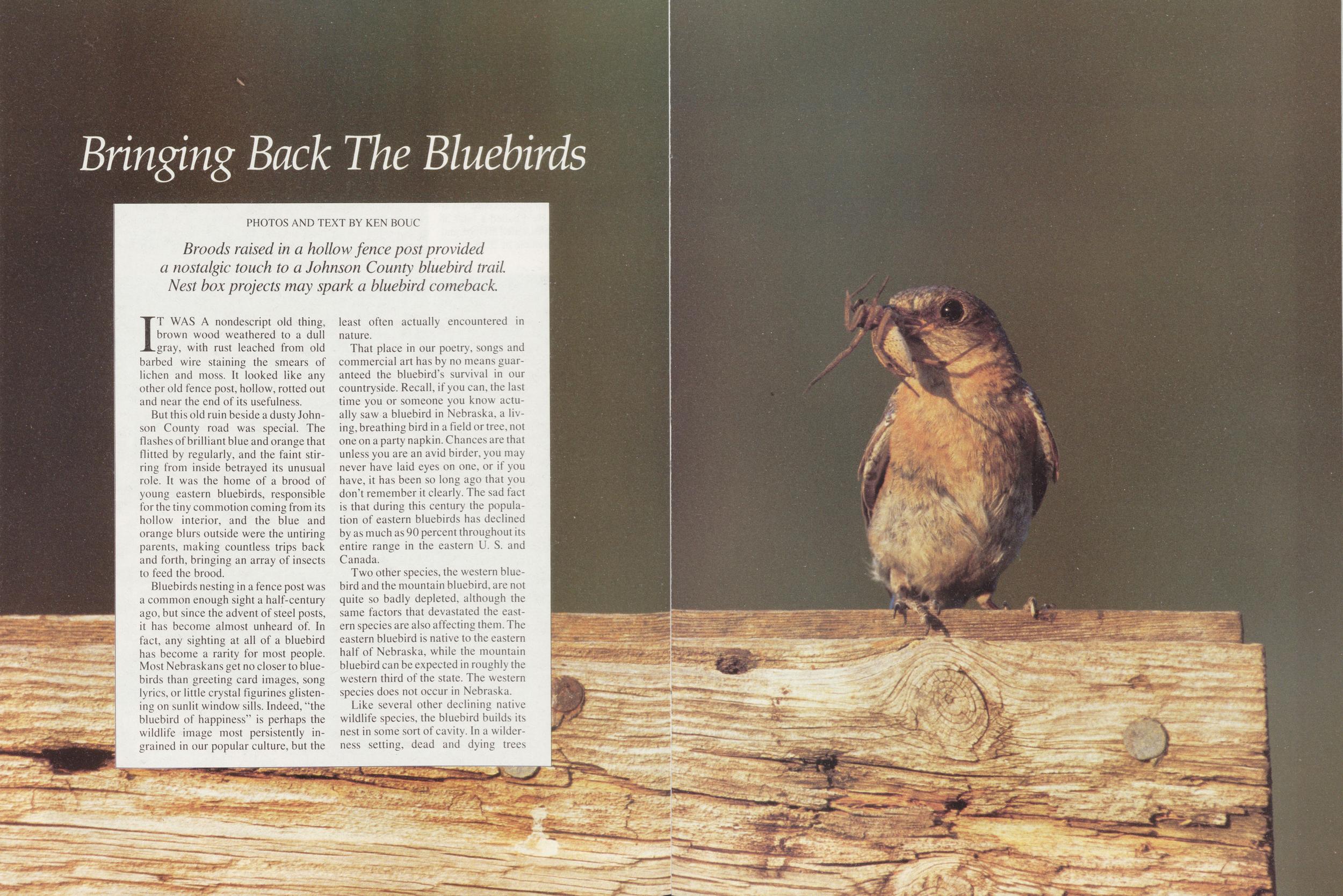
PHOTOS AND TEXT BY KEN BOUC Broods raised in a hollow fence post provided a nostalgic touch to a Johnson County bluebird trail Nest box projects may spark a bluebird comebackIT WAS A nondescript old thing, brown wood weathered to a dull gray, with rust leached from old barbed wire staining the smears of lichen and moss. It looked like any other old fence post, hollow, rotted out and near the end of its usefulness.
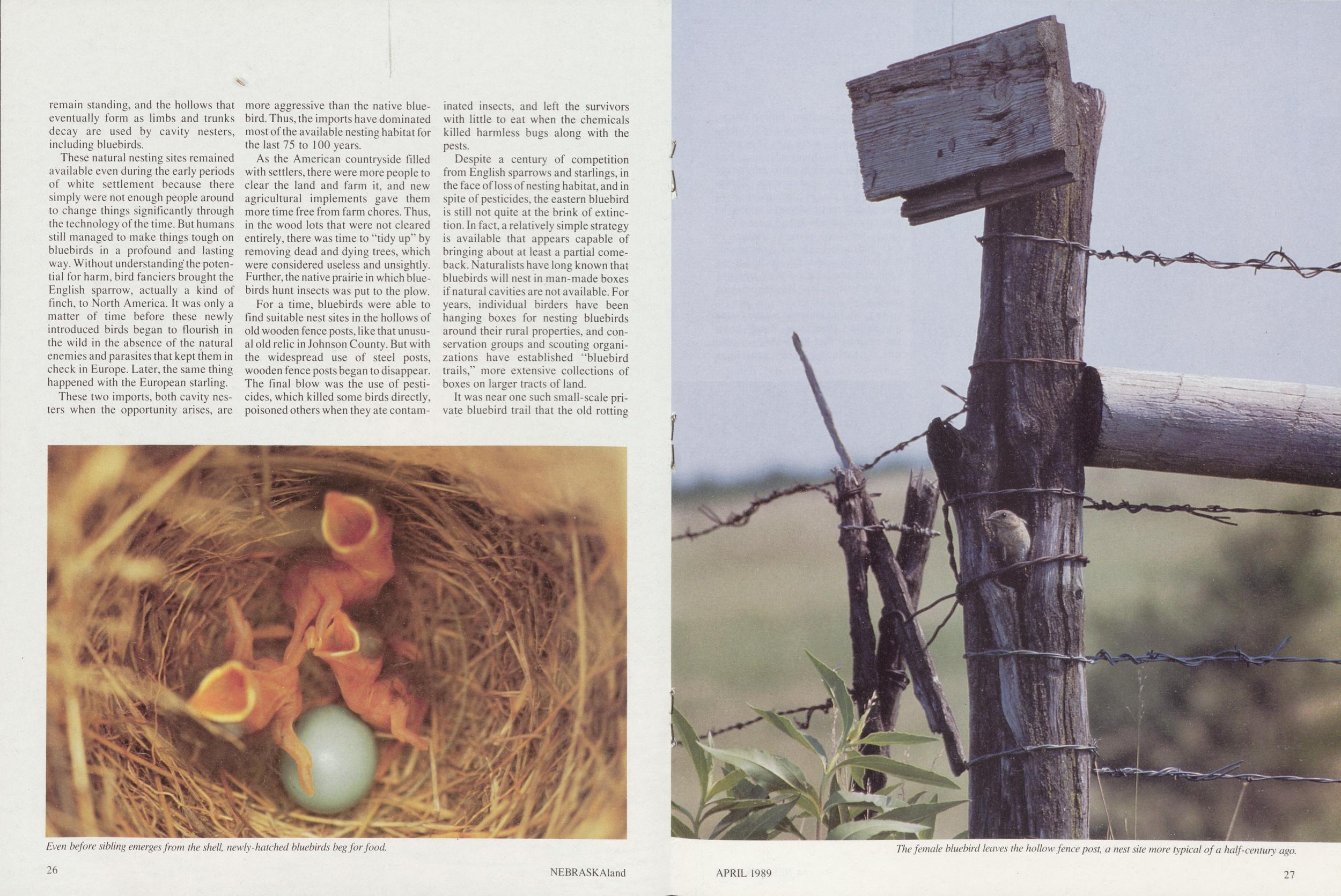
But this old ruin beside a dusty Johnson County road was special. The flashes of brilliant blue and orange that flitted by regularly, and the faint stirring from inside betrayed its unusual role. It was the home of a brood of young eastern bluebirds, responsible for the tiny commotion coming from its hollow interior, and the blue and orange blurs outside were the untiring parents, making countless trips back and forth, bringing an array of insects to feed the brood.
Bluebirds nesting in a fence post was a common enough sight a half-century ago, but since the advent of steel posts, it has become almost unheard of. In fact, any sighting at all of a bluebird has become a rarity for most people. Most Nebraskans get no closer to bluebirds than greeting card images, song lyrics, or little crystal figurines glistening on sunlit window sills. Indeed, "the bluebird of happiness" is perhaps the wildlife image most persistently ingrained in our popular culture, but the least often actually encountered in nature.
That place in our poetry, songs and commercial art has by no means guaranteed the bluebird's survival in our countryside. Recall, if you can, the last time you or someone you know actually saw a bluebird in Nebraska, a living, breathing bird in a field or tree, not one on a party napkin. Chances are that unless you are an avid birder, you may never have laid eyes on one, or if you have, it has been so long ago that you don't remember it clearly. The sad fact is that during this century the population of eastern bluebirds has declined by as much as 90 percent throughout its entire range in the eastern U. S. and Canada.
Two other species, the western bluebird and the mountain bluebird, are not quite so badly depleted, although the same factors that devastated the eastern species are also affecting them. The eastern bluebird is native to the eastern half of Nebraska, while the mountain bluebird can be expected in roughly the western third of the state. The western species does not occur in Nebraska.
Like several other declining native wildlife species, the bluebird builds its nest in some sort of cavity. In a wilderness setting, dead and dying trees
 remain standing, and the hollows that
eventually form as limbs and trunks
decay are used by cavity nesters,
including bluebirds.
remain standing, and the hollows that
eventually form as limbs and trunks
decay are used by cavity nesters,
including bluebirds.
These natural nesting sites remained available even during the early periods of white settlement because there simply were not enough people around to change things significantly through the technology of the time. But humans still managed to make things tough on bluebirds in a profound and lasting way. Without understanding the potential for harm, bird fanciers brought the English sparrow, actually a kind of finch, to North America. It was only a matter of time before these newly introduced birds began to flourish in the wild in the absence of the natural enemies and parasites that kept them in check in Europe. Later, the same thing happened with the European starling.
These two imports, both cavity nesters when the opportunity arises, are more aggressive than the native bluebird. Thus, the imports have dominated most of the available nesting habitat for the last 75 to 100 years.
As the American countryside filled with settlers, there were more people to clear the land and farm it, and new agricultural implements gave them more time free from farm chores. Thus, in the wood lots that were not cleared entirely, there was time to "tidy up" by removing dead and dying trees, which were considered useless and unsightly. Further, the native prairie in which bluebirds hunt insects was put to the plow.
For a time, bluebirds were able to find suitable nest sites in the hollows of old wooden fence posts, like that unusual old relic in Johnson County. But with the widespread use of steel posts, wooden fence posts began to disappear. The final blow was the use of pesticides, which killed some birds directly, poisoned others when they ate contaminated insects, and left the survivors with little to eat when the chemicals killed harmless bugs along with the pests.
Despite a century of competition from English sparrows and starlings, in the face of loss of nesting habitat, and in spite of pesticides, the eastern bluebird is still not quite at the brink of extinction. In fact, a relatively simple strategy is available that appears capable of bringing about at least a partial comeback. Naturalists have long known that bluebirds will nest in man-made boxes if natural cavities are not available. For years, individual birders have been hanging boxes for nesting bluebirds around their rural properties, and conservation groups and scouting organizations have established 'bluebird trails," more extensive collections of boxes on larger tracts of land.
It was near one such small-scale private bluebird trail that the old rotting
As a wildlife biologist for the Game and Parks Commission, Randy knew the potential that his property would offer if it had nesting boxes, and if there
Randy followed procedures which birders have learned will best attract bluebirds and help them raise broods. He used several designs in building his boxes, but in all of them was careful to keep the entrance hole exactly 1 Vi inches in diameter. At that size, starlings can't quite get in. And to make entrance tougher for sparrows, he did not place a perch at the hole.
Building bluebird boxes is a winter project, and they should be hung at least by mid-March. Nesting can begin before the end of March, perhaps sooner in an early spring. (See box on page 31 for details on bluebird box plans and activities.)
Randy placed the boxes on fence posts and tree trunks, and at least 100 yards apart to keep territorial males from clashing. Whenever possible, he faced the entrance hole toward a small tree or shrub within some 20 yards, in order to give a young bird a handy perch at the end of its first wobbly flight. Otherwise, a fledgling is likely to end up on the ground in the path of a cat or raccoon. He checked the boxes often and evicted any sparrows he found. Occasionally there were other desirable birds such as wrens, chickadees and swallows using the boxes, and these nests he left intact.
After each brood left the boxes, Randy cleaned them immediately. Until mid-summer, there is always a chance of attracting a bluebird pair attempting to raise a second brood or to replace one lost to predators or weather.
He put out his first boxes in 1983, raising one brood that year and each of the next two. There were two broods in 1986, four in 1987, including the two in the fence post, and three broods, all in boxes, last year.
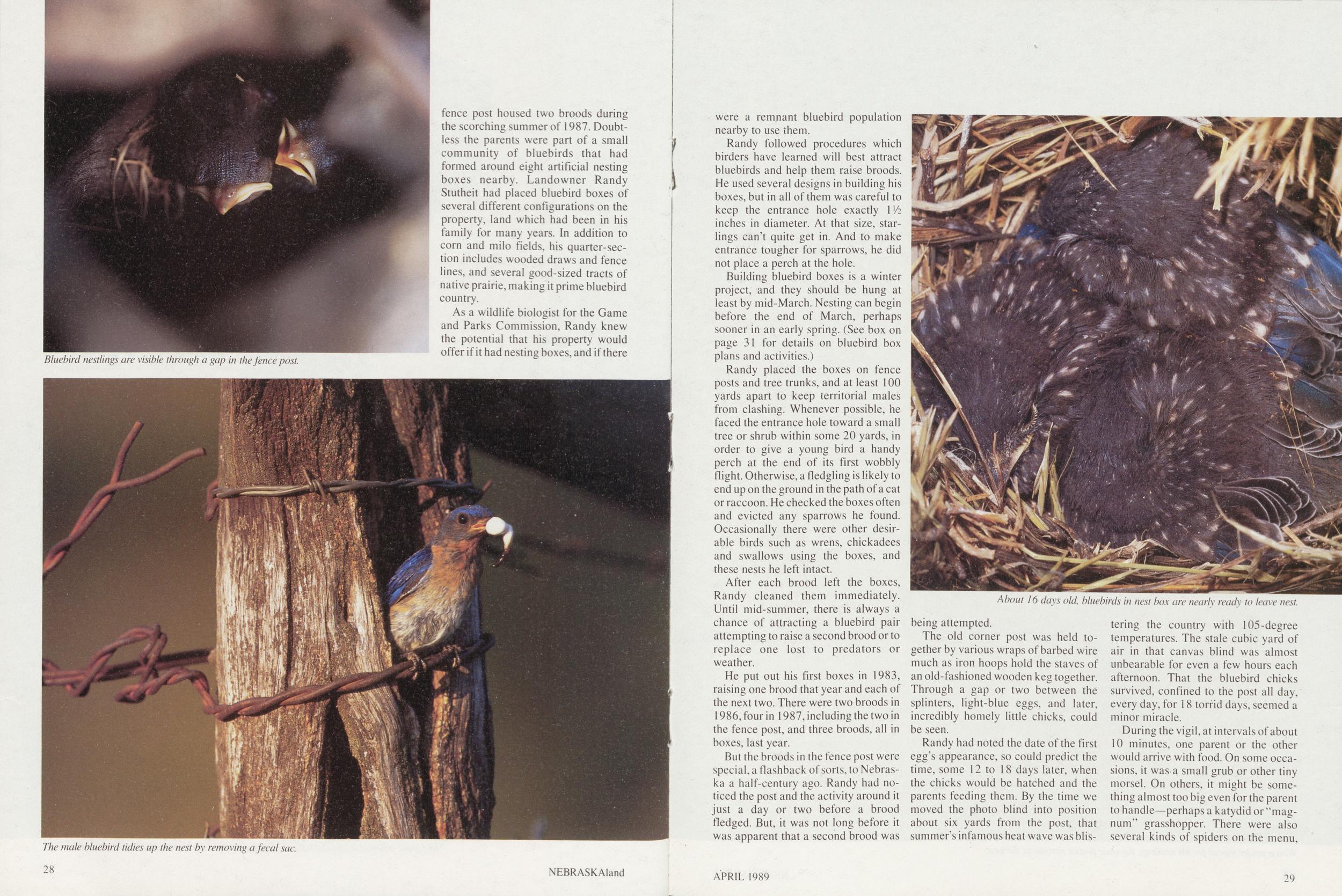
But the broods in the fence post were special, a flashback of sorts, to Nebraska a half-century ago. Randy had noticed the post and the activity around it just a day or two before a brood fledged. But, it was not long before it was apparent that a second brood was being attempted.
The old corner post was held together by various wraps of barbed wire much as iron hoops hold the staves of an old-fashioned wooden keg together. Through a gap or two between the splinters, light-blue eggs, and later, incredibly homely little chicks, could be seen.
Randy had noted the date of the first egg's appearance, so could predict the time, some 12 to 18 days later, when the chicks would be hatched and the parents feeding them. By the time we moved the photo blind into position about six yards from the post, that summer's infamous heat wave was blistering the country with 105-degree temperatures. The stale cubic yard of air in that canvas blind was almost unbearable for even a few hours each afternoon. That the bluebird chicks survived, confined to the post all day, every day, for 18 torrid days, seemed a minor miracle.
During the vigil, at intervals of about
10 minutes, one parent or the other
would arrive with food. On some occasions, it was a small grub or other tiny
morsel. On others, it might be something almost too big even for the parent
to handle—perhaps a katydid or "magnum" grasshopper. There were also
several kinds of spiders on the menu,
APRIL 1989
29
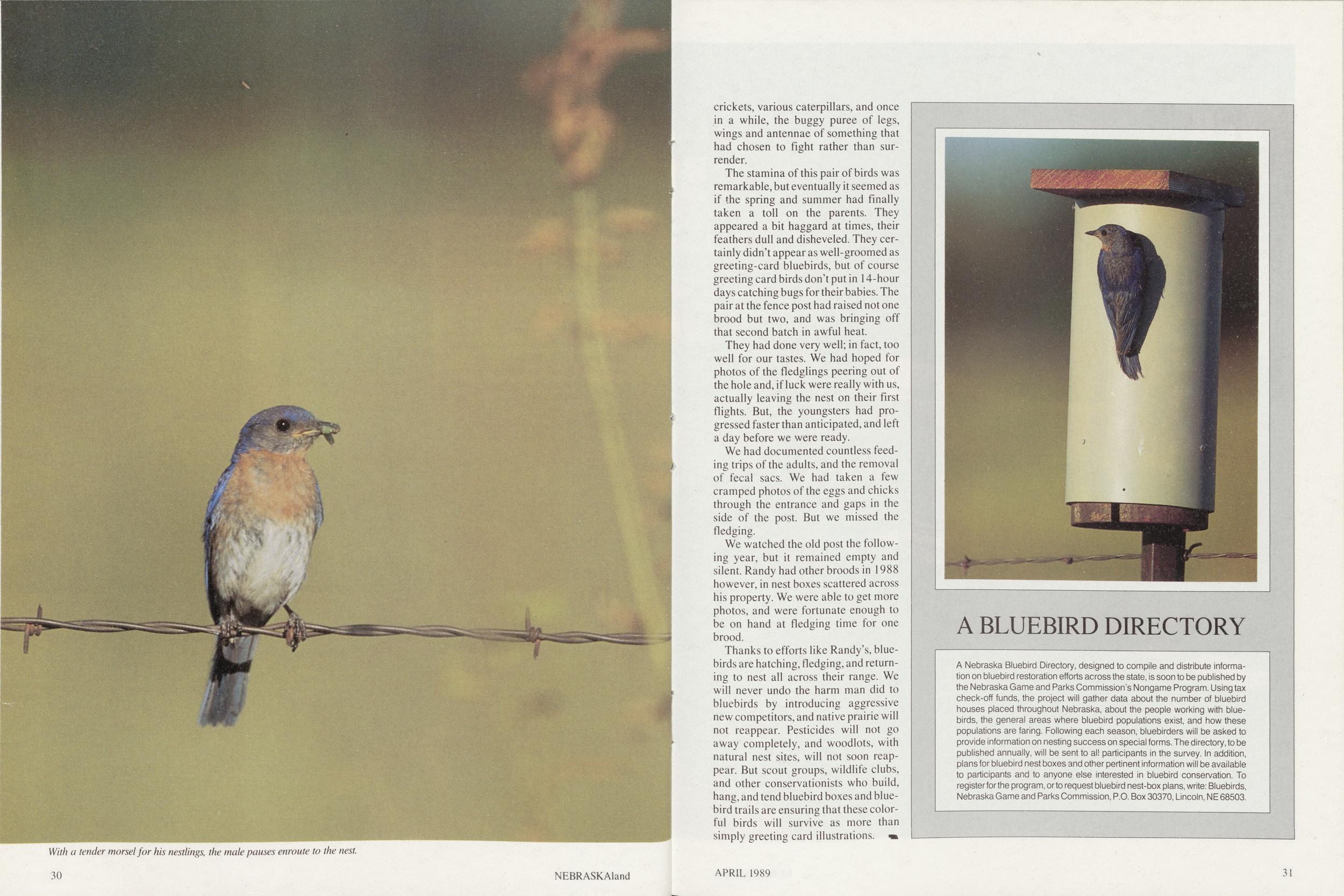
The stamina of this pair of birds was remarkable, but eventually it seemed as if the spring and summer had finally taken a toll on the parents. They appeared a bit haggard at times, their feathers dull and disheveled. They certainly didn't appear as well-groomed as greeting-card bluebirds, but of course greeting card birds don't put in 14-hour days catching bugs for their babies. The pair at the fence post had raised not one brood but two, and was bringing off that second batch in awful heat.
They had done very well; in fact, too well for our tastes. We had hoped for photos of the fledglings peering out of the hole and, if luck were really with us, actually leaving the nest on their first flights. But, the youngsters had progressed faster than anticipated, and left a day before we were ready.
We had documented countless feeding trips of the adults, and the removal of fecal sacs. We had taken a few cramped photos of the eggs and chicks through the entrance and gaps in the side of the post. But we missed the fledging.
We watched the old post the following year, but it remained empty and silent. Randy had other broods in 1988 however, in nest boxes scattered across his property. We were able to get more photos, and were fortunate enough to be on hand at fledging time for one brood.
Thanks to efforts like Randy's, bluebirds are hatching, fledging, and returning to nest all across their range. We will never undo the harm man did to bluebirds by introducing aggressive new competitors, and native prairie will not reappear. Pesticides will not go away completely, and woodlots, with natural nest sites, will not soon reappear. But scout groups, wildlife clubs, and other conservationists who build, hang, and tend bluebird boxes and bluebird trails are ensuring that these colorful birds will survive as more than simply greeting card illustrations,
A BLUEBIRD DIRECTORY A Nebraska Bluebird Directory, designed to compile and distribute information on bluebird restoration efforts across the state, is soon to be published by the Nebraska Game and Parks Commission's Nongame Program. Using tax check-off funds, the project will gather data about the number of bluebird houses placed throughout Nebraska, about the people working with bluebirds, the general areas where bluebird populations exist, and how these populations are faring. Following each season, bluebirders will be asked to provide information on nesting success on special forms. The directory, to be published annually, will be sent to al! participants in the survey. In addition, plans for bluebird nest boxes and other pertinent information will be available to participants and to anyone else interested in bluebird conservation. To register for the program, or to request bluebird nest-box plans, write: Bluebirds, Nebraska Game and Parks Commission, P.O. Box 30370, Lincoln, NE 68503. APRIL 1989 31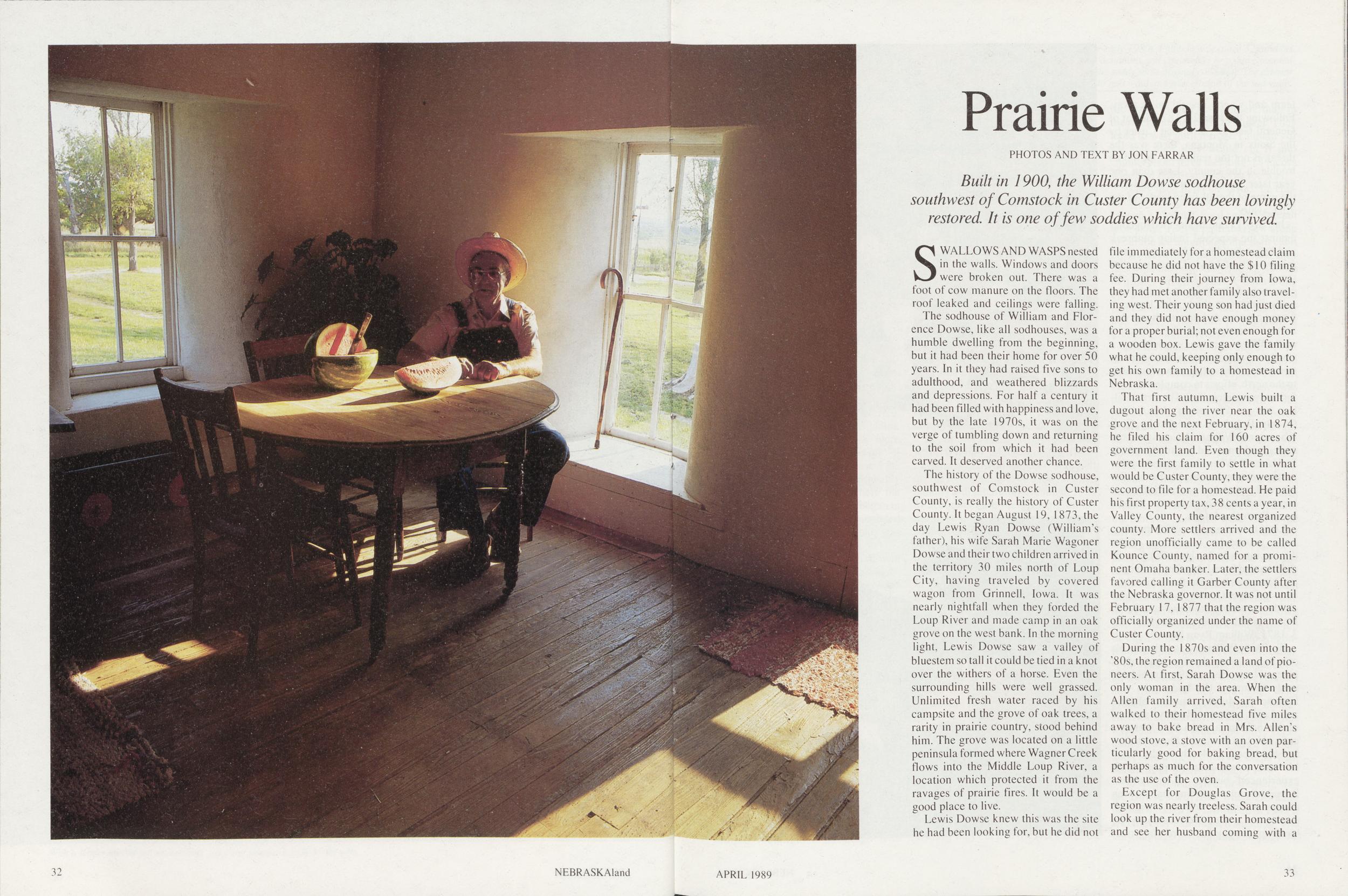
Prairie Walls
PHOTOS AND TEXT BY JON FARRAR Built in 1900, the William Dowse sodhouse southwest of Comstock in Custer County has been lovingly restored. It is one of few soddies which have survived.SWALLOWS AND WASPS nested in the walls. Windows and doors were broken out. There was a foot of cow manure on the floors. The roof leaked and ceilings were falling.
The sodhouse of William and Florence Dowse, like all sodhouses, was a humble dwelling from the beginning, but it had been their home for over 50 years. In it they had raised five sons to adulthood, and weathered blizzards and depressions. For half a century it had been filled with happiness and love, but by the late 1970s, it was on the verge of tumbling down and returning to the soil from which it had been carved. It deserved another chance.
The history of the Dowse sodhouse, southwest of Comstock in Custer County, is really the history of Custer County. It began August 19, 1873, the day Lewis Ryan Dowse (William's father), his wife Sarah Marie Wagoner Dowse and their two children arrived in the territory 30 miles north of Loup City, having traveled by covered wagon from Grinnell, Iowa. It was nearly nightfall when they forded the Loup River and made camp in an oak grove on the west bank. In the morning light, Lewis Dowse saw a valley of bluestem so tall it could be tied in a knot over the withers of a horse. Even the surrounding hills were well grassed. Unlimited fresh water raced by his campsite and the grove of oak trees, a rarity in prairie country, stood behind him. The grove was located on a little peninsula formed where Wagner Creek flows into the Middle Loup River, a location which protected it from the ravages of prairie fires. It would be a good place to live.
Lewis Dowse knew this was the site he had been looking for, but he did not file immediately for a homestead claim because he did not have the $10 filing fee. During their journey from Iowa, they had met another family also traveling west. Their young son had just died and they did not have enough money for a proper burial; not even enough for a wooden box. Lewis gave the family what he could, keeping only enough to get his own family to a homestead in Nebraska.
That first autumn, Lewis built a dugout along the river near the oak grove and the next February, in 1874, he filed his claim for 160 acres of government land. Even though they were the first family to settle in what would be Custer County, they were the second to file for a homestead. He paid his first property tax, 38 cents a year, in Valley County, the nearest organized county. More settlers arrived and the region unofficially came to be called Kounce County, named for a prominent Omaha banker. Later, the settlers favored calling it Garber County after the Nebraska governor. It was not until February 17, 1877 that the region was officially organized under the name of Custer County.
During the 1870s and even into the '80s, the region remained a land of pioneers. At first, Sarah Dowse was the only woman in the area. When the Allen family arrived, Sarah often walked to their homestead five miles away to bake bread in Mrs. Allen's wood stove, a stove with an oven particularly good for baking bread, but perhaps as much for the conversation as the use of the oven.
Except for Douglas Grove, the
region was nearly treeless. Sarah could
look up the river from their homestead
and see her husband coming with a
APRIL 1989
33
 team and wagon several miles away.
Following the June 24, 1876 defeat of
General George Armstrong Custer by
the Sioux in Montana, there was the
threat, if not the realization, of Indian
trouble in the county. Less than one
year later, the new county would bear
the name of that ill-fated leader of the
7th Cavalry.
team and wagon several miles away.
Following the June 24, 1876 defeat of
General George Armstrong Custer by
the Sioux in Montana, there was the
threat, if not the realization, of Indian
trouble in the county. Less than one
year later, the new county would bear
the name of that ill-fated leader of the
7th Cavalry.
In 1876,12 families banded together against the expected Indian outbreak and began building a fortress just two miles north of Lewis Dowse's homestead. Called Fort Garber, after the governor of the state, it boasted sod walls three feet thick with log-reinforced corners. A deep trench was dug around it and a well dug within its walls. When word was received that a small party of Sioux had raided the homesteads of several settlers only a few miles to the north, efforts to complete the sod fortress were intensified. The fort's civilian troops, known as the Garber County Regulars, were led by Civil War veteran William H. Comstock and armed with guns and ammunition from Ft. Hartsuff. When the anticipated war parties never materialized, the families returned to their homes and the fortress began to dissolve back into the Middle Loup River floodplain.
Little more than a year after arriving, Lewis moved his family out of the dugout into a house he built of wood slabs hauled from Loup City. A daughter, Alice, was born, the first white child born in Custer County. In all, six more children were born to Lewis and Sarah Dowse in Nebraska, including, on April 3, 1871, William Ryan Dowse.
By 1900, William was living in his own dugout along the river south of his parents' farm. He was 29 years old and ready to marry. His bride-to-be was Florence E. Murphy, daughter of John and Leah Louessa Murphy, another settler in the area, and a Civil War veteran who had been with Sherman during his bloody "March to the Sea." More important, John Murphy was an experienced builder of sodhouses. Reportedly an easy-going man, he was always willing to help any neighbor putting up a soddy. Occasionally he hired out for pay but more often than
Wanting a better tract of land, William moved about a mile northwest of his father's homestead. In the spring of 1900, William, with the help of John Murphy, neighbors and friends, began building the couple's soddy about a mile west and three miles south of Comstock, just south of the little community of Wescott.
Native grass sod, "Nebraska marble," as settlers jokingly called it, was the most plentiful and inexpensive building material available. Both trees and stone were scarce on prairie land and few homesteaders could afford to ship in lumber.
After the grass was mowed close to the ground, sod was turned with a cutting plow in strips about 15 to 18 inches wide and three to four inches thick. Thick stands of grass, particularly big bluestem or cordgrass, were preferred. Farther west, in the short-grass plains, dense mats of buffalograss were favored. There was no shortage of bluestem along the Loup River and the sod for Dowse's house was probably cut within a few yards of where the house was built. Construction began in April and was more or less completed by October when the couple was married.
Once the strips were plowed, men with sharp spades cut them into lengths about 30 inches long, the intended thickness of the soddy walls. The pieces of sod where hauled to the house site and laid grass-side down in much the same manner as bricks, offset so seams were covered by both the layer above and below. After each layer was in place, it was "trued up" with a sharp spade. Surplus soil was brushed into cracks or between the layers of sod. Once all the walls were up, windows and doors were carved out with a sharp spade. Vertical rods were driven into the tops of the walls and attached by horizontal pins to a plate or plank used to secure the roof.
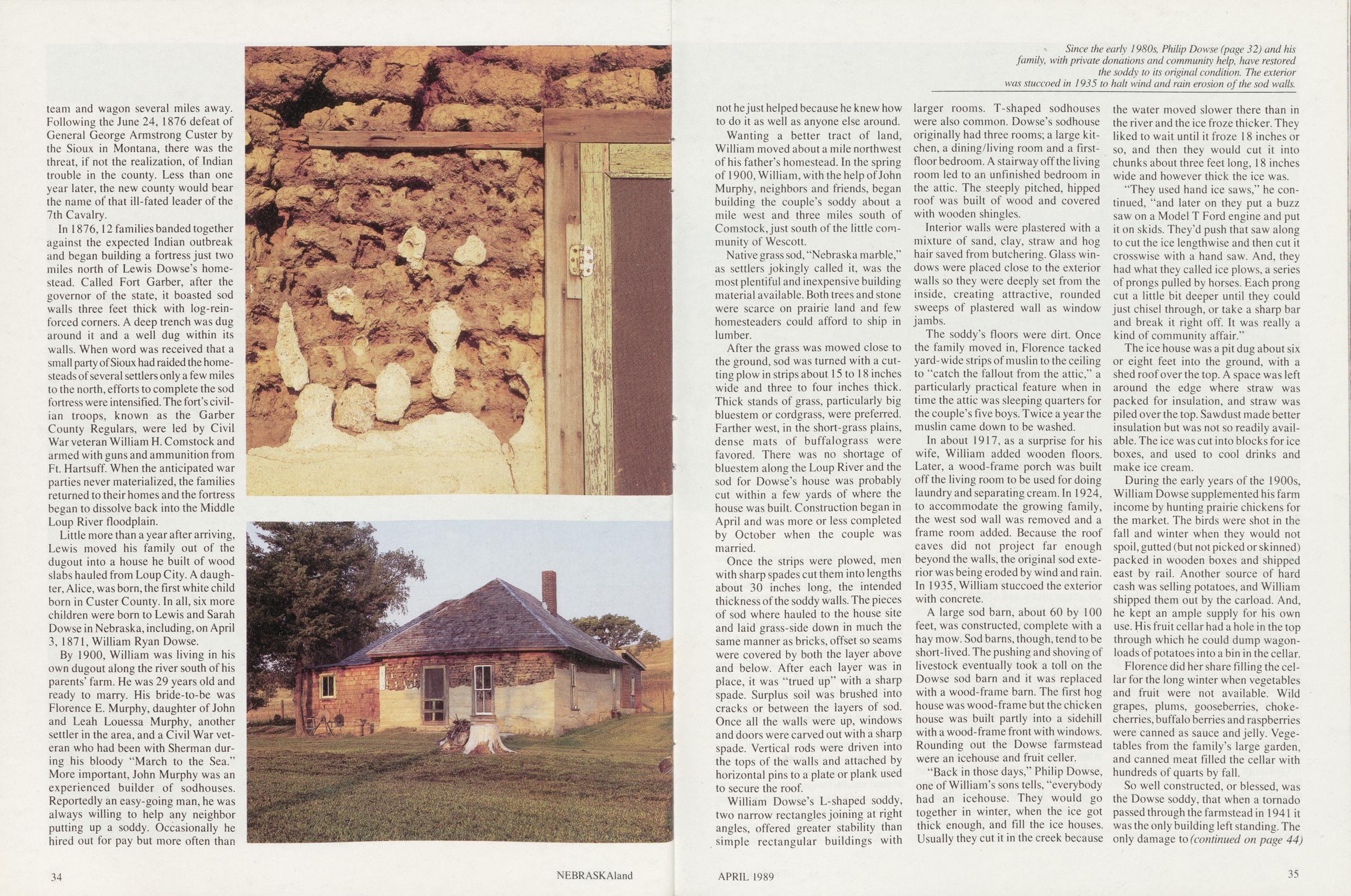
William Dowse's L-shaped soddy, two narrow rectangles joining at right angles, offered greater stability than simple rectangular buildings with larger rooms. T-shaped sodhouses were also common. Dowse's sodhouse originally had three rooms; a large kitchen, a dining/living room and a first-floor bedroom. A stairway off the living room led to an unfinished bedroom in the attic. The steeply pitched, hipped roof was built of wood and covered with wooden shingles.
Interior walls were plastered with a mixture of sand, clay, straw and hog hair saved from butchering. Glass windows were placed close to the exterior walls so they were deeply set from the inside, creating attractive, rounded sweeps of plastered wall as window jambs.
The soddy's floors were dirt. Once the family moved in, Florence tacked yard-wide strips of muslin to the ceiling to "catch the fallout from the attic," a particularly practical feature when in time the attic was sleeping quarters for the couple's five boys. Twice a year the muslin came down to be washed.
In about 1917, as a surprise for his wife, William added wooden floors. Later, a wood-frame porch was built off the living room to be used for doing laundry and separating cream. In 1924, to accommodate the growing family, the west sod wall was removed and a frame room added. Because the roof eaves did not project far enough beyond the walls, the original sod exterior was being eroded by wind and rain. In 1935, William stuccoed the exterior with concrete.
A large sod barn, about 60 by 100 feet, was constructed, complete with a hay mow. Sod barns, though, tend to be short-lived. The pushing and shoving of livestock eventually took a toll on the Dowse sod barn and it was replaced with a wood-frame barn. The first hog house was wood-frame but the chicken house was built partly into a sidehill with a wood-frame front with windows. Rounding out the Dowse farmstead were an icehouse and fruit celler.
"Back in those days," Philip Dowse, one of William's sons tells, "everybody had an icehouse. They would go together in winter, when the ice got thick enough, and fill the ice houses. Usually they cut it in the creek because the water moved slower there than in the river and the ice froze thicker. They liked to wait until it froze 18 inches or so, and then they would cut it into chunks about three feet long, 18 inches wide and however thick the ice was.
'They used hand ice saws," he continued, "and later on they put a buzz saw on a Model T Ford engine and put it on skids. They'd push that saw along to cut the ice lengthwise and then cut it crosswise with a hand saw. And, they had what they called ice plows, a series of prongs pulled by horses. Each prong cut a little bit deeper until they could just chisel through, or take a sharp bar and break it right off. It was really a kind of community affair."
The ice house was a pit dug about six or eight feet into the ground, with a shed roof over the top. A space was left around the edge where straw was packed for insulation, and straw was piled over the top. Sawdust made better insulation but was not so readily available. The ice was cut into blocks for ice boxes, and used to cool drinks and make ice cream.
During the early years of the 1900s, William Dowse supplemented his farm income by hunting prairie chickens for the market. The birds were shot in the fall and winter when they would not spoil, gutted (but not picked or skinned) packed in wooden boxes and shipped east by rail. Another source of hard cash was selling potatoes, and William shipped them out by the carload. And, he kept an ample supply for his own use. His fruit cellar had a hole in the top through which he could dump wagonloads of potatoes into a bin in the cellar.
Florence did her share filling the cellar for the long winter when vegetables and fruit were not available. Wild grapes, plums, gooseberries, chokecherries, buffalo berries and raspberries were canned as sauce and jelly. Vegetables from the family's large garden, and canned meat filled the cellar with hundreds of quarts by fall.
So well constructed, or blessed, was the Dowse soddy, that when a tornado passed through the farmstead in 1941 it was the only building left standing. The only damage to (continued on page 44)
APRIL 1989 35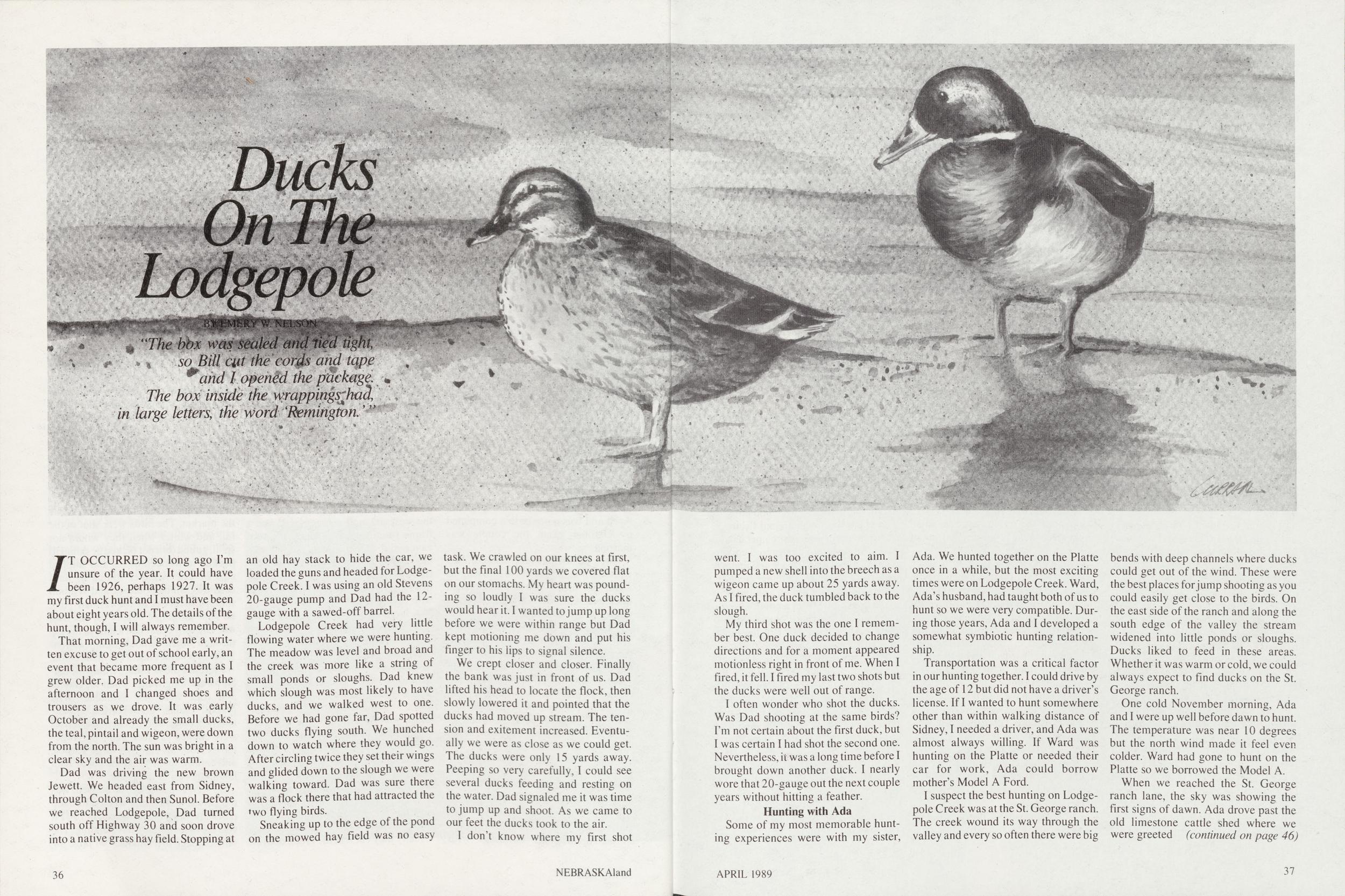
Ducks On The Lodgepole
"The box was sealed and lied tight, so Bill cut the tape The box inside the large letters, the word 'Remington.'"IT OCCURRED so long ago I'm unsure of the year. It could have been 1926, perhaps 1927. It was my first duck hunt and I must have been about eight years old. The details of the hunt, though, I will always remember.
That morning, Dad gave me a written excuse to get out of school early, an event that became more frequent as I grew older. Dad picked me up in the afternoon and I changed shoes and trousers as we drove. It was early October and already the small ducks, the teal, pintail and wigeon, were down from the north. The sun was bright in a clear sky and the air was warm.
Dad was driving the new brown Jewett. We headed east from Sidney, through Colton and then Sunol. Before we reached Lodgepole, Dad turned south off Highway 30 and soon drove into a native grass hay field. Stopping at an old hay stack to hide the car, we loaded the guns and headed for Lodgepole Creek. I was using an old Stevens 20-gauge pump and Dad had the 12-gauge with a sawed-off barrel.
Lodgepole Creek had very little flowing water where we were hunting. The meadow was level and broad and the creek was more like a string of small ponds or sloughs. Dad knew which slough was most likely to have ducks, and we walked west to one. Before we had gone far, Dad spotted two ducks flying south. We hunched down to watch where they would go. After circling twice they set their wings and glided down to the slough we were walking toward. Dad was sure there was a flock there that had attracted the two flying birds.
Sneaking up to the edge of the pond on the mowed hay field was no easy task. We crawled on our knees at first, but the final 100 yards we covered flat on our stomachs. My heart was pounding so loudly I was sure the ducks would hear it. I wanted to jump up long before we were within range but Dad kept motioning me down and put his finger to his lips to signal silence.
We crept closer and closer. Finally the bank was just in front of us. Dad lifted his head to locate the flock, then slowly lowered it and pointed that the ducks had moved up stream. The tension and excitement increased. Eventually we were as close as we could get. The ducks were only 15 yards away. Peeping so very carefully, I could see several ducks feeding and resting on the water. Dad signaled me it was time to jump up and shoot. As we came to our feet the ducks took to the air.
I don't know where my first shot 36 NEBRASKAland went. I was too excited to aim. I pumped a new shell into the breech as a wigeon came up about 25 yards away. As I fired, the duck tumbled back to the slough.
My third shot was the one I remember best. One duck decided to change directions and for a moment appeared motionless right in front of me. When I fired, it fell. I fired my last two shots but the ducks were well out of range.
I often wonder who shot the ducks. Was Dad shooting at the same birds? I'm not certain about the first duck, but I was certain I had shot the second one. Nevertheless, it was a long time before I brought down another duck. I nearly wore that 20-gauge out the next couple years without hitting a feather.
Hunting with AdaSome of my most memorable hunting experiences were with my sister, Ada. We hunted together on the Platte once in a while, but the most exciting times were on Lodgepole Creek. Ward, Ada's husband, had taught both of us to hunt so we were very compatible. During those years, Ada and I developed a somewhat symbiotic hunting relationship.
Transportation was a critical factor in our hunting together. I could drive by the age of 12 but did not have a driver's license. If I wanted to hunt somewhere other than within walking distance of Sidney, I needed a driver, and Ada was almost always willing. If Ward was hunting on the Platte or needed their car for work, Ada could borrow mother's Model A Ford.
I suspect the best hunting on Lodgepole Creek was at the St. George ranch. The creek wound its way through the valley and every so often there were big bends with deep channels where ducks could get out of the wind. These were the best places for jump shooting as you could easily get close to the birds. On the east side of the ranch and along the south edge of the valley the stream widened into little ponds or sloughs. Ducks liked to feed in these areas. Whether it was warm or cold, we could always expect to find ducks on the St. George ranch.
One cold November morning, Ada and I were up well before dawn to hunt. The temperature was near 10 degrees but the north wind made it feel even colder. Ward had gone to hunt on the Platte so we borrowed the Model A.
When we reached the St. George ranch lane, the sky was showing the first signs of dawn. Ada drove past the old limestone cattle shed where we were greeted (continued on page 46)
APRIL 1989 37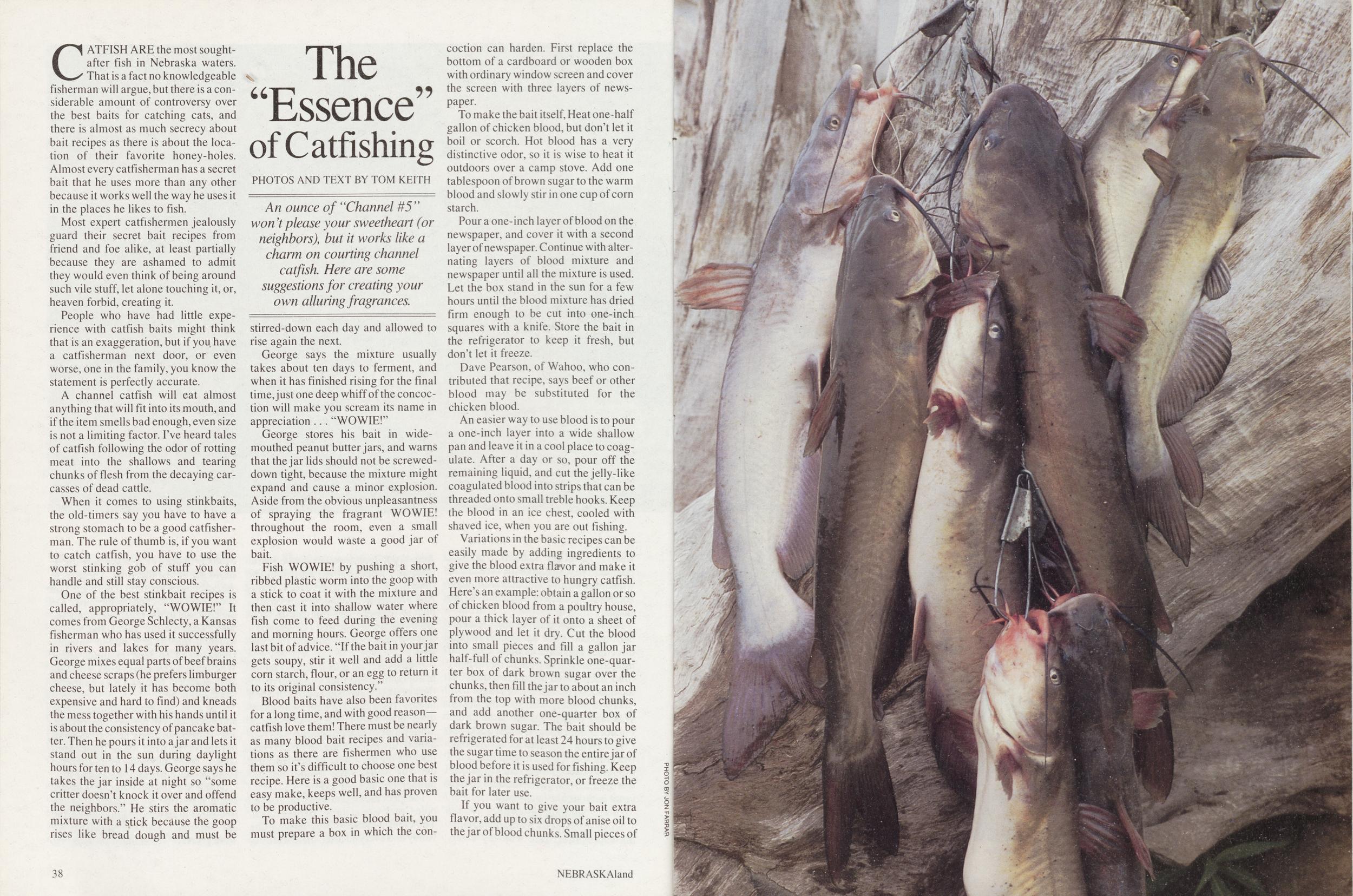
The "Essence" of Catfishing
PHOTOS AND TEXT BY TOM KEITH An ounce of "Channel #5" won't please your sweetheart (or neighbors), but it works like a charm on courting channel catfish. Here are some suggestions for creating your own alluring fragrances.CATFISH ARE the most sought-after fish in Nebraska waters. That is a fact no knowledgeable fisherman will argue, but there is a considerable amount of controversy over the best baits for catching cats, and there is almost as much secrecy about bait recipes as there is about the location of their favorite honey-holes. Almost every catfisherman has a secret bait that he uses more than any other because it works well the way he uses it in the places he likes to fish.
Most expert catfishermen jealously guard their secret bait recipes from friend and foe alike, at least partially because they are ashamed to admit they would even think of being around such vile stuff, let alone touching it, or, heaven forbid, creating it.
People who have had little experience with catfish baits might think that is an exaggeration, but if you have a catfisherman next door, or even worse, one in the family, you know the statement is perfectly accurate.
A channel catfish will eat almost anything that will fit into its mouth, and if the item smells bad enough, even size is not a limiting factor. I've heard tales of catfish following the odor of rotting meat into the shallows and tearing chunks of flesh from the decaying carcasses of dead cattle.
When it comes to using stinkbaits, the old-timers say you have to have a strong stomach to be a good catfisherman. The rule of thumb is, if you want to catch catfish, you have to use the worst stinking gob of stuff you can handle and still stay conscious.
One of the best stinkbait recipes is called, appropriately, "WOWIE!" It comes from George Schlecty, a Kansas fisherman who has used it successfully in rivers and lakes for many years. George mixes equal parts of beef brains and cheese scraps (he prefers limburger cheese, but lately it has become both expensive and hard to find) and kneads the mess together with his hands until it is about the consistency of pancake batter. Then he pours it into ajar and lets it stand out in the sun during daylight hours for ten to 14 days. George says he takes the jar inside at night so "some critter doesn't knock it over and offend the neighbors." He stirs the aromatic mixture with a stick because the goop rises like bread dough and must be stirred-down each day and allowed to rise again the next.
George says the mixture usually takes about ten days to ferment, and when it has finished rising for the final time, just one deep whiff of the concoction will make you scream its name in appreciation ... "WOWIE!"
George stores his bait in widemouthed peanut butter jars, and warns that the jar lids should not be screwed-down tight, because the mixture might expand and cause a minor explosion. Aside from the obvious unpleasantness of spraying the fragrant WOWIE! throughout the room, even a small explosion would waste a good jar of bait.
Fish WOWIE! by pushing a short, ribbed plastic worm into the goop with a stick to coat it with the mixture and then cast it into shallow water where fish come to feed during the evening and morning hours. George offers one last bit of advice. "If the bait in your jar gets soupy, stir it well and add a little corn starch, flour, or an Qgg to return it to its original consistency."
Blood baits have also been favorites for a long time, and with good reason-catfish love them! There must be nearly as many blood bait recipes and variations as there are fishermen who use them so it's difficult to choose one best recipe. Here is a good basic one that is easy make, keeps well, and has proven to be productive.
To make this basic blood bait, you must prepare a box in which the concoction can harden. First replace the bottom of a cardboard or wooden box with ordinary window screen and cover the screen with three layers of newspaper.
To make the bait itself, Heat one-half gallon of chicken blood, but don't let it boil or scorch. Hot blood has a very distinctive odor, so it is wise to heat it outdoors over a camp stove. Add one tablespoon of brown sugar to the warm blood and slowly stir in one cup of corn starch.
Pour a one-inch layer of blood on the newspaper, and cover it with a second layer of newspaper. Continue with alternating layers of blood mixture and newspaper until all the mixture is used. Let the box stand in the sun for a few hours until the blood mixture has dried firm enough to be cut into one-inch squares with a knife. Store the bait in the refrigerator to keep it fresh, but don't let it freeze.
Dave Pearson, of Wahoo, who contributed that recipe, says beef or other blood may be substituted for the chicken blood.
An easier way to use blood is to pour a one-inch layer into a wide shallow pan and leave it in a cool place to coagulate. After a day or so, pour off the remaining liquid, and cut the jelly-like coagulated blood into strips that can be threaded onto small treble hooks. Keep the blood in an ice chest, cooled with shaved ice, when you are out fishing.
Variations in the basic recipes can be easily made by adding ingredients to give the blood extra flavor and make it even more attractive to hungry catfish. Here's an example: obtain a gallon or so of chicken blood from a poultry house, pour a thick layer of it onto a sheet of plywood and let it dry. Cut the blood into small pieces and fill a gallon jar half-full of chunks. Sprinkle one-quarter box of dark brown sugar over the chunks, then fill the jar to about an inch from the top with more blood chunks, and add another one-quarter box of dark brown sugar. The bait should be refrigerated for at least 24 hours to give the sugar time to season the entire jar of blood before it is used for fishing. Keep the jar in the refrigerator, or freeze the bait for later use.
If you want to give your bait extra flavor, add up to six drops of anise oil to the jar of blood chunks. Small pieces of 38 NEBRASKAland
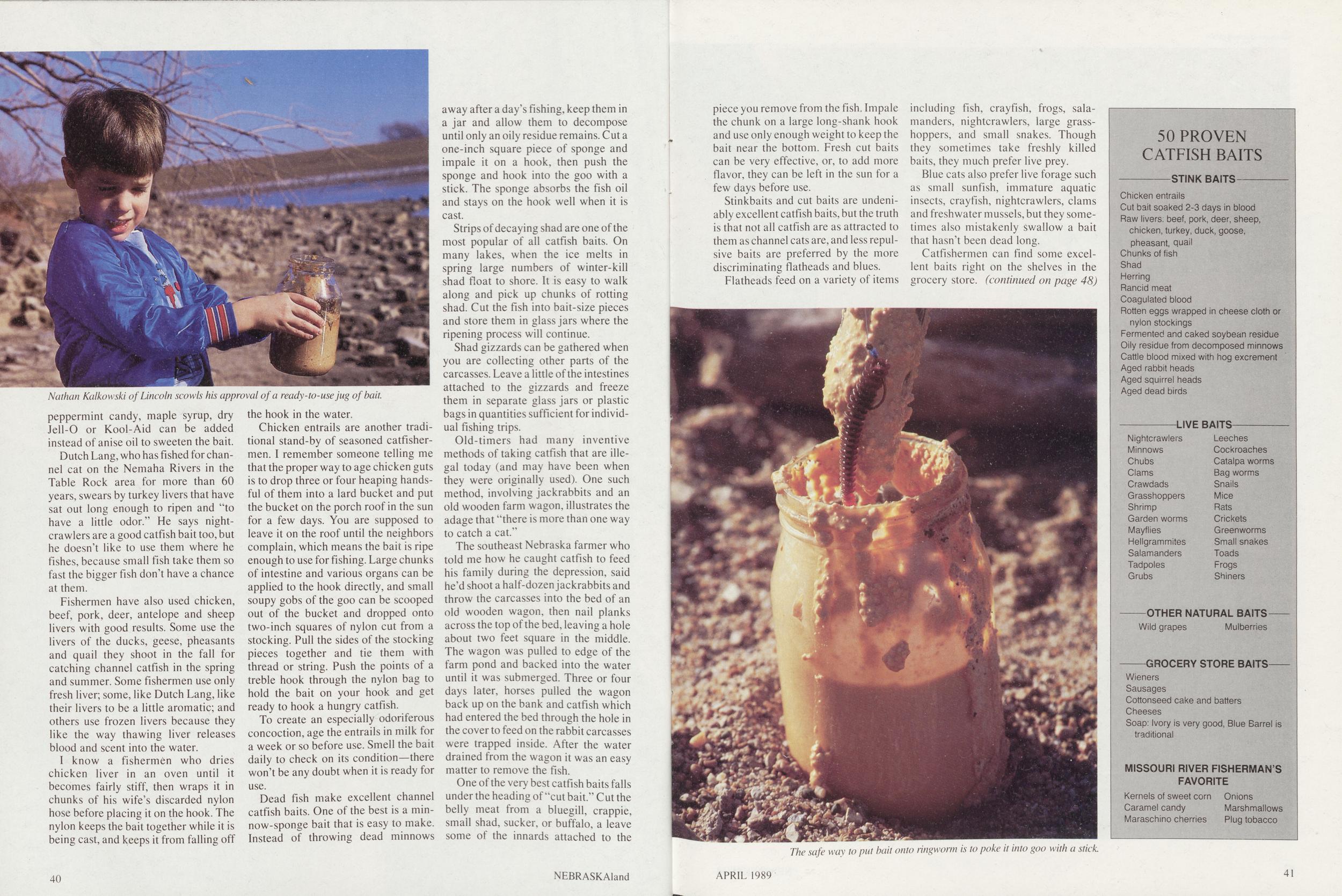
Dutch Lang, who has fished for channel cat on the Nemaha Rivers in the Table Rock area for more than 60 years, swears by turkey livers that have sat out long enough to ripen and "to have a little odor." He says nightcrawlers are a good catfish bait too, but he doesn't like to use them where he fishes, because small fish take them so fast the bigger fish don't have a chance at them.
Fishermen have also used chicken, beef, pork, deer, antelope and sheep livers with good results. Some use the livers of the ducks, geese, pheasants and quail they shoot in the fall for catching channel catfish in the spring and summer. Some fishermen use only fresh liver; some, like Dutch Lang, like their livers to be a little aromatic; and others use frozen livers because they like the way thawing liver releases blood and scent into the water.
I know a fishermen who dries chicken liver in an oven until it becomes fairly stiff, then wraps it in chunks of his wife's discarded nylon hose before placing it on the hook. The nylon keeps the bait together while it is being cast, and keeps it from falling off the hook in the water.
Chicken entrails are another traditional stand-by of seasoned catfishermen. I remember someone telling me that the proper way to age chicken guts is to drop three or four heaping handsful of them into a lard bucket and put the bucket on the porch roof in the sun for a few days. You are supposed to leave it on the roof until the neighbors complain, which means the bait is ripe enough to use for fishing. Large chunks of intestine and various organs can be applied to the hook directly, and small soupy gobs of the goo can be scooped out of the bucket and dropped onto two-inch squares of nylon cut from a stocking. Pull the sides of the stocking pieces together and tie them with thread or string. Push the points of a treble hook through the nylon bag to hold the bait on your hook and get ready to hook a hungry catfish.
To create an especially odoriferous concoction, age the entrails in milk for a week or so before use. Smell the bait daily to check on its condition—there won't be any doubt when it is ready for use.
Dead fish make excellent channel catfish baits. One of the best is a minnow-sponge bait that is easy to make. Instead of throwing dead minnows away after a day's fishing, keep them in a jar and allow them to decompose until only an oily residue remains. Cut a one-inch square piece of sponge and impale it on a hook, then push the sponge and hook into the goo with a stick. The sponge absorbs the fish oil and stays on the hook well when it is cast.
Strips of decaying shad are one of the most popular of all catfish baits. On many lakes, when the ice melts in spring large numbers of winter-kill shad float to shore. It is easy to walk along and pick up chunks of rotting shad. Cut the fish into bait-size pieces and store them in glass jars where the ripening process will continue.
Shad gizzards can be gathered when you are collecting other parts of the carcasses. Leave a little of the intestines attached to the gizzards and freeze them in separate glass jars or plastic bags in quantities sufficient for individual fishing trips.
Old-timers had many inventive methods of taking catfish that are illegal today (and may have been when they were originally used). One such method, involving jackrabbits and an old wooden farm wagon, illustrates the adage that "there is more than one way to catch a cat."
The southeast Nebraska farmer who told me how he caught catfish to feed his family during the depression, said he'd shoot a half-dozen jackrabbits and throw the carcasses into the bed of an old wooden wagon, then nail planks across the top of the bed, leaving a hole about two feet square in the middle. The wagon was pulled to edge of the farm pond and backed into the water until it was submerged. Three or four days later, horses pulled the wagon back up on the bank and catfish which had entered the bed through the hole in the cover to feed on the rabbit carcasses were trapped inside. After the water drained from the wagon it was an easy matter to remove the fish.
One of the very best catfish baits falls under the heading of "cut bait." Cut the belly meat from a bluegill, crappie, small shad, sucker, or buffalo, a leave some of the innards attached to the 40 NEBRASKAland piece you remove from the fish. Impale the chunk on a large long-shank hook and use only enough weight to keep the bait near the bottom. Fresh cut baits can be very effective, or, to add more flavor, they can be left in the sun for a few days before use.
Stinkbaits and cut baits are undeniably excellent catfish baits, but the truth is that not all catfish are as attracted to them as channel cats are, and less repulsive baits are preferred by the more discriminating flatheads and blues.
Flatheads feed on a variety of items including fish, crayfish, frogs, salamanders, nightcrawlers, large grasshoppers, and small snakes. Though they sometimes take freshly killed baits, they much prefer live prey.
Blue cats also prefer live forage such as small sunfish, immature aquatic insects, crayfish, nightcrawlers, clams and freshwater mussels, but they sometimes also mistakenly swallow a bait that hasn't been dead long.
Catfishermen can find some excellent baits right on the shelves in the grocery store, (continued on page 48)
50 PROVEN CATFISH BAITS STINK BAITS Chicken entrails Cut bait soaked 2-3 days in blood Raw livers, beef, pork, deer, sheep, chicken, turkey, duck, goose, pheasant, quail Chunks of fish Shad Herring Rancid meat Coagulated blood Rotten eggs wrapped in cheese cloth or nylon stockings Fermented and caked soybean residue Oily residue from decomposed minnows Cattle blood mixed with hog excrement Aged rabbit heads Aged squirrel heads Aged dead birds LIVE BAITS Nightcrawlers DM! 1 O Leeches Minnows Cockroaches Chubs Catalpa worms Clams Bag worms Crawdads Snails Grasshoppers Mice Shrimp Rats Garden worms Crickets Mayflies Greenworms HeHgrammites Small snakes Salamanders Toads Tadpoles Frogs Grubs Shiners OTHER NATURAL BAITS Wild grapes Mulberries GROCERY STORE BAITS Wieners Sausages Cottonseed cake and batters Cheeses Soap: Ivory is very good, Blue Barrel is traditional MISSOURI RIVER FISHERMAN'S FAVORITE Kernels of sweet corn Onions Caramel candy Marshmallows Maraschino cherries Plug tobacco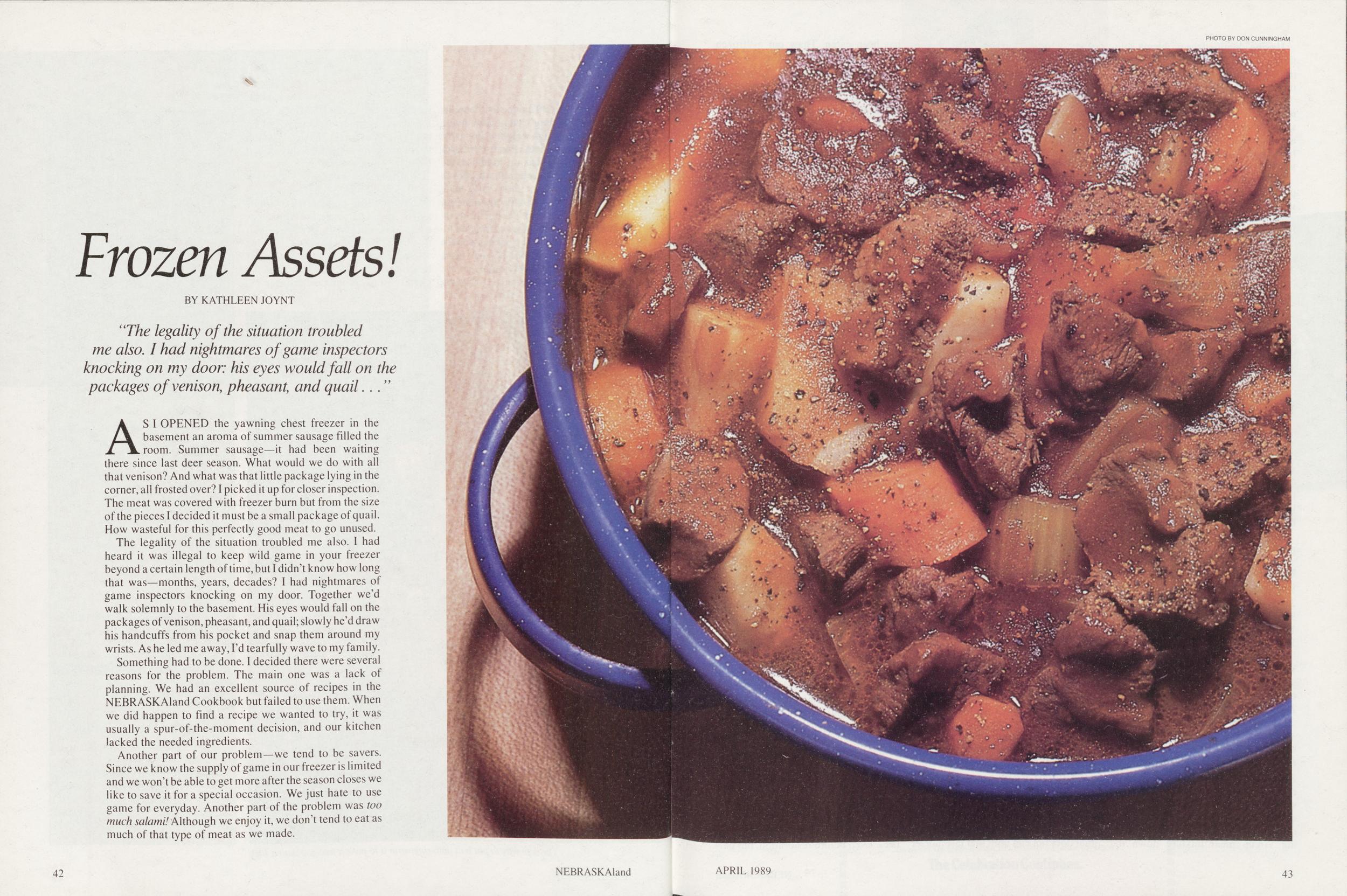
Frozen Assets!
BY KATHLEEN JOYNT 'The legality of the situation troubled me also. I had nightmares of game inspectors knocking on my door: his eyes would fall on the packages of venison, pheasant, and quail...AS I OPENED the yawning chest freezer in the basement an aroma of summer sausage filled the room. Summer sausage—it had been waiting there since last deer season. What would we do with all that venison? And what was that little package lying in the corner, all frosted over? I picked it up for closer inspection. The meat was covered with freezer burn but from the size of the pieces I decided it must be a small package of quail. How wasteful for this perfectly good meat to go unused.
The legality of the situation troubled me also. I had heard it was illegal to keep wild game in your freezer beyond a certain length of time, but I didn't know how long that was—months, years, decades? I had nightmares of game inspectors knocking on my door. Together we'd walk solemnly to the basement. His eyes would fall on the packages of venison, pheasant, and quail; slowly he'd draw his handcuffs from his pocket and snap them around my wrists. As he led me away, I'd tearfully wave to my family.
Something had to be done. I decided there were several reasons for the problem. The main one was a lack of planning. We had an excellent source of recipes in the NEBRASKAland Cookbook but failed to use them. When we did happen to find a recipe we wanted to try, it was usually a spur-of-the-moment decision, and our kitchen lacked the needed ingredients.
Another part of our problem—we tend to be savers. Since we know the supply of game in our freezer is limited and we won't be able to get more after the season closes we like to save it for a special occasion. We just hate to use game for everyday. Another part of the problem was too much salami! Although we enjoy it, we don't tend to eat as much of that type of meat as we made.
42 NEBRASKAland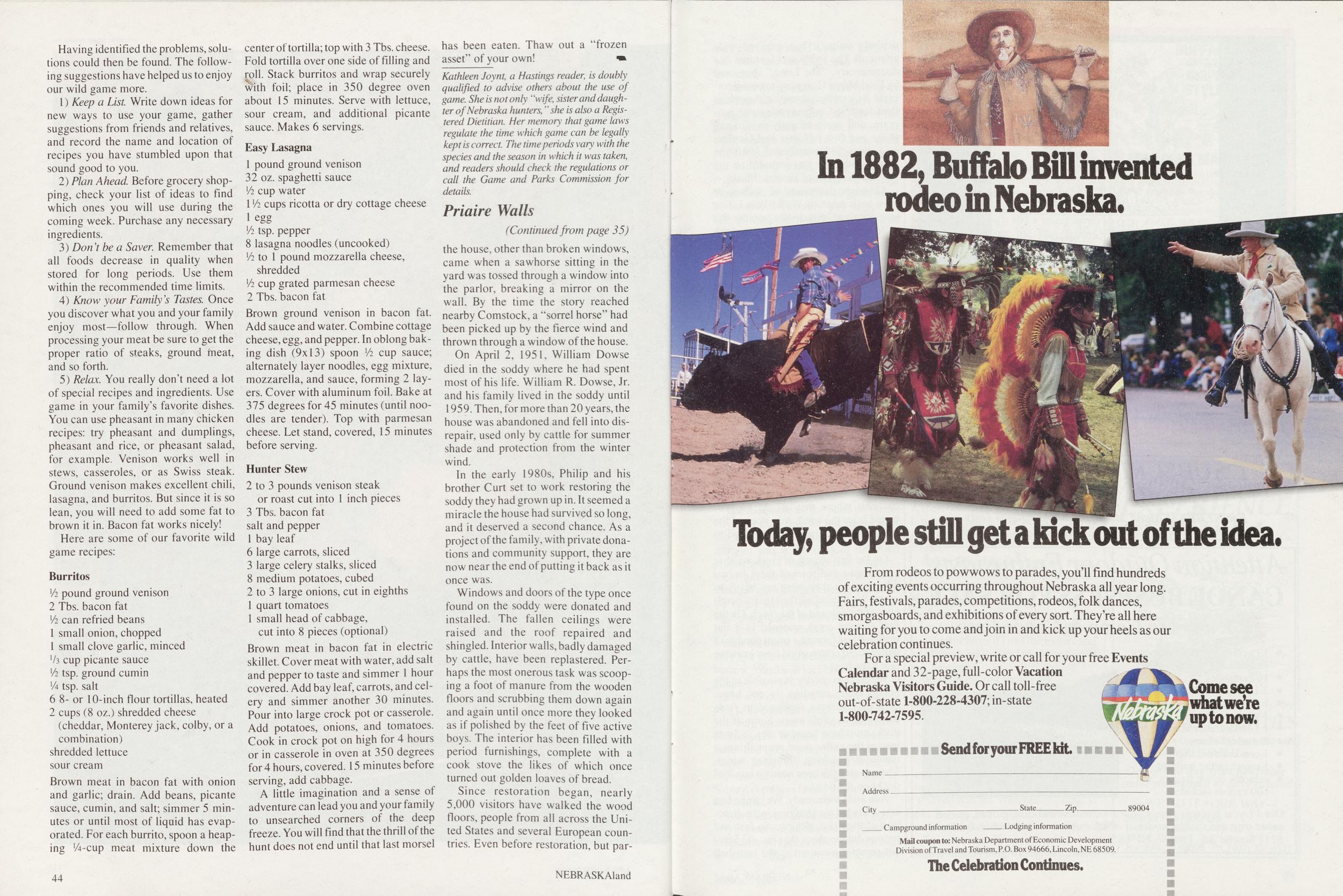
Having identified the problems, solutions could then be found. The following suggestions have helped us to enjoy our wild game more.
1) Keep a List Write down ideas for new ways to use your game, gather suggestions from friends and relatives, and record the name and location of recipes you have stumbled upon that sound good to you.
2) Plan Ahead. Before grocery shopping, check your list of ideas to find which ones you will use during the coming week. Purchase any necessary ingredients.
3) Don't be a Saver. Remember that all foods decrease in quality when stored for long periods. Use them within the recommended time limits.
4) Know your Family's Tastes. Once you discover what you and your family enjoy most—follow through. When processing your meat be sure to get the proper ratio of steaks, ground meat, and so forth.
5) Relax. You really don't need a lot of special recipes and ingredients. Use game in your family's favorite dishes. You can use pheasant in many chicken recipes: try pheasant and dumplings, pheasant and rice, or pheasant salad, for example. Venison works well in stews, casseroles, or as Swiss steak. Ground venison makes excellent chili, lasagna, and burritos. But since it is so lean, you will need to add some fat to brown it in. Bacon fat works nicely!
Here are some of our favorite wild game recipes:
Burritos Vi pound ground venison 2 Tbs. bacon fat Vi can refried beans 1 small onion, chopped 1 small clove garlic, minced V3 cup picante sauce Vi tsp. ground cumin Va tsp. salt 6 8- or 10-inch flour tortillas, heated 2 cups (8 oz.) shredded cheese (cheddar, Monterey jack, colby, or a combination) shredded lettuce sour creamBrown meat in bacon fat with onion and garlic; drain. Add beans, picante sauce, cumin, and salt; simmer 5 minutes or until most of liquid has evaporated. For each burrito, spoon a heaping '/V-cup meat mixture down the 44 center of tortilla; top with 3 Tbs. cheese. Fold tortilla over one side of filling and roll. Stack burritos and wrap securely with foil; place in 350 degree oven about 15 minutes. Serve with lettuce, sour cream, and additional picante sauce. Makes 6 servings.
Easy Lasagna 1 pound ground venison 32 oz. spaghetti sauce 72 cup water 1 Vi cups ricotta or dry cottage cheese 1 egg Vi tsp. pepper 8 lasagna noodles (uncooked) 72 to 1 pound mozzarella cheese, shredded Vi cup grated parmesan cheese 2 Tbs. bacon fatBrown ground venison in bacon fat. Add sauce and water. Combine cottage cheese, egg, and pepper. In oblong baking dish (9x13) spoon Vi cup sauce; alternately layer noodles, egg mixture, mozzarella, and sauce, forming 2 layers. Cover with aluminum foil. Bake at 375 degrees for 45 minutes (until noodles are tender). Top with parmesan cheese. Let stand, covered, 15 minutes before serving.
Hunter Stew 2 to 3 pounds venison steak or roast cut into 1 inch pieces 3 Tbs. bacon fat salt and pepper 1 bay leaf 6 large carrots, sliced 3 large celery stalks, sliced 8 medium potatoes, cubed 2 to 3 large onions, cut in eighths 1 quart tomatoes 1 small head of cabbage, cut into 8 pieces (optional)Brown meat in bacon fat in electric skillet. Cover meat with water, add salt and pepper to taste and simmer 1 hour covered. Add bay leaf, carrots, and celery and simmer another 30 minutes. Pour into large crock pot or casserole. Add potatoes, onions, and tomatoes. Cook in crock pot on high for 4 hours or in casserole in oven at 350 degrees for 4 hours, covered. 15 minutes before serving, add cabbage.
A little imagination and a sense of adventure can lead you and your family to unsearched corners of the deep freeze. You will find that the thrill of the hunt does not end until that last morsel has been eaten. Thaw out a "frozen asset" of your own!
Kathleen Joynt, a Hastings reader, is doubly qualified to advise others about the use of game. She is not only 'wife, sister and daughter of Nebraska hunters, "she is also a Registered Dietitian. Her memory that game laws regulate the time which game can be legally kept is correct. The time periods vary with the species and the season in which it was taken, and readers should check the regulations or call the Game and Parks Commission for details.Priaire Walls
(Continued from page 35)the house, other than broken windows, came when a sawhorse sitting in the yard was tossed through a window into the parlor, breaking a mirror on the wail. By the time the story reached nearby Comstock, a "sorrel horse" had been picked up by the fierce wind and thrown through a window of the house.
On April 2, 1951, William Dowse died in the soddy where he had spent most of his life. William R. Dowse, Jr. and his family lived in the soddy until 1959. Then, for more than 20 years, the house was abandoned and fell into disrepair, used only by cattle for summer shade and protection from the winter wind.
In the early 1980s, Philip and his brother Curt set to work restoring the soddy they had grown up in. It seemed a miracle the house had survived so long, and it deserved a second chance. As a project of the family, with private donations and community support, they are now near the end of putting it back as it once was.
Windows and doors of the type once found on the soddy were donated and installed. The fallen ceilings were raised and the roof repaired and shingled. Interior walls, badly damaged by cattle, have been replastered. Perhaps the most onerous task was scooping a foot of manure from the wooden floors and scrubbing them down again and again until once more they looked as if polished by the feet of five active boys. The interior has been filled with period furnishings, complete with a cook stove the likes of which once turned out golden loaves of bread.
Since restoration began, nearly 5,000 visitors have walked the wood floors, people from all across the United States and several European countries. Even before restoration, but particularly since, it has received wide attention. The soddy was featured in a documentary, The Land," sponsored by Ford Motor Company to commemorate its centennial, on an American Broadcasting Company television program, and more recently in Country Home and Better Homes and Gardens magazines. In December of 1986, the Dowse sodhouse was included on the National Register of Historic Places.
44 NEBRASKAlandFrom rodeos to powwows to parades, you'll find hundreds of exciting events occurring throughout Nebraska all year long. Fairs, festivals, parades, competitions, rodeos, folk dances, smorgasboards, and exhibitions of every sort. They're all here waiting for you to come and join in and kick up your heels as our celebration continues.
For a special preview, write or call for your free Events Calendar and 32-page, full-color Vacation Nebraska Visitors Guide. Or call toll-free out-of-state 1-800-228-4307; in-state 1-800-742-7595.
i Come see up to now. Send for your FREE Name Address City State. Zip 89004 Campground information Lodging information Mail coupon to: Nebraska Department of Economic Development Division of Travel and Tourism, P.O. Box 94666, Lincoln, NE 68509. The Celebration Continues. NEBRASKA
WILDFLOV/ERS
A colorful design featuring Nebraska's native wildflowers screenprinted on your choice
of t-shirt, sweatshirt or the
new 100% crinkle-cotton long-sleeved fashion pullover.
No.
S M L XL
100% crinkle cotton top, white @ $25.00
50/50 sweatshirt, white @ $21.95
100% cotton t-shirt, white @ $9.95
Name
Address
City
□ Money Order □ MC D Visa G Cheek
BANK EXP. DATE
State.
Zip.
CARD NO.
Add $2.00 for shipping and handling. Nebraska residents add 5.5% sales tax. Please
allow 3-4 weeks for delivery.
Total enclosed
Send check or money order to: Marcia & David, P.O. Box 4775, Lincoln, NE 68504
GIFT SUBSCRIPTION HOTLINE!
1-800-742-0056
For NEBRASKAland Magazine Subscriptions Only
Attention Outdoor Enthusiasts!
CANOE BUSINESS FOR SALE
Rocky Ford Camp & Canoe Base
19 acres river front property
on beautiful Niobrara River
16 campsites
3 12-bed bunkhouses
1 family cabin
3 water wells
1 14x65'trailer home
2 steel buildings
1 concession trailer
1 merchandise building
vehicles, canoe trailers, and
100 canoes included
Our 17-year business consists of canoe rentals and campground, guided
canoe trips and shuttle service. For information write: Wilson Outfitters,
6211 Sunrise Rd., Lincoln, NE 68510
NEBRASKA
WILDFLOV/ERS
A colorful design featuring Nebraska's native wildflowers screenprinted on your choice
of t-shirt, sweatshirt or the
new 100% crinkle-cotton long-sleeved fashion pullover.
No.
S M L XL
100% crinkle cotton top, white @ $25.00
50/50 sweatshirt, white @ $21.95
100% cotton t-shirt, white @ $9.95
Name
Address
City
□ Money Order □ MC D Visa G Cheek
BANK EXP. DATE
State.
Zip.
CARD NO.
Add $2.00 for shipping and handling. Nebraska residents add 5.5% sales tax. Please
allow 3-4 weeks for delivery.
Total enclosed
Send check or money order to: Marcia & David, P.O. Box 4775, Lincoln, NE 68504
GIFT SUBSCRIPTION HOTLINE!
1-800-742-0056
For NEBRASKAland Magazine Subscriptions Only
Attention Outdoor Enthusiasts!
CANOE BUSINESS FOR SALE
Rocky Ford Camp & Canoe Base
19 acres river front property
on beautiful Niobrara River
16 campsites
3 12-bed bunkhouses
1 family cabin
3 water wells
1 14x65'trailer home
2 steel buildings
1 concession trailer
1 merchandise building
vehicles, canoe trailers, and
100 canoes included
Our 17-year business consists of canoe rentals and campground, guided
canoe trips and shuttle service. For information write: Wilson Outfitters,
6211 Sunrise Rd., Lincoln, NE 68510
Although thousands of sodhouses were built prior to World War I, few have survived, principally because the building material does not endure the ravages of the elements without continual maintenance. The Dowse sodhouse is a survivor, like the stubbornest of the thousands of homesteaders who flooded to central Nebraska in the 1870s; a bit of our not-so-distant history lovingly preserved.
Ducks on the Lodgepole
(Continued from page 37)by a noisy flock of geese. Some of the flock were tame birds and some semi-wild, the offspring of matings between tame ranch birds and Ward's call birds, which could no longer be legally used as decoys.
The cold had surely brought the big mallards down from the north. We expected to find ducks in the deeply-cut channels where they would be protected from the wind. Ada stopped the car in the meadow and we walked to the creek.
On the first stretch of creek we shot eight ducks and stacked them in two piles because they were too heavy to carry. We hunted all the creek's bends toward the east end of the ranch. On the east end the creek widened in a flat meadow and formed a small pond with willows and cottonwood trees growing along the banks.
We crept as quietly as possible to the pond's edge, crawling on our knees until only willows separated us from the water 10 yards away. Some of the ducks must have heard or seen us. In an instant the entire pond erupted into a melee of quacking, thrashing wings. There must have been nearly a hundred ducks on the pond.
Ada and I were ready. We jumped up and unloaded our shotguns in the direction of the mass of birds. So fast and furious did we shoot that my old Stevens pump came apart as the last shell 46 NEBRASKAland was ejected. I stood with the barrel in one hand and the stock and breech in the other.
Out on the pond there were five or six mallards not moving, and others were winged and swimming off. Part of the pond was frozen over but it was not thick enough to hold me. As the dead birds drifted to shore we "fished" them out with long sticks. There were still crippled birds swimming and diving. Ward had taught us that all game must be retrieved. The only way to get the last of the birds was to wade in and fetch them, which I did.
The eight ducks we picked up were more than we could carry. By now my wet trousers and shoes had turned to ice and I was cold so we decided I should go back and get the car. The frozen corduroy pants swished noisily together with each stride as I ran to the car. Ada said she could follow my progress for a mile by the noise of my icy pant legs.
I reached the Model A in good time, picked up the two stacks of ducks we had shot earlier and drove to get Ada. That night, Ward and his hunting partners returned almost empty- handed from hunting on the Platte. The river was iced over and the hunting poor. Naturally, Ada and I did a bit of bragging about our 16 big mallards.
A New GunThe massacre on the pond on the St. George ranch was the last time I used the old Stevens pump. Not having a shotgun was a dilemma of no small proportions. I had sporadic employment but earned just enough to buy shells. Ward's brother Glen let me shoot his single barrel 12-gauge, but it was light-weight and its stock too long for my arm. After shooting it, my arm would be black and blue so I used it only as a last resort. Sometimes I could borrow Ward's Winchester pump 20-gauge.
I'm still convinced I was eventually able to acquire that much-needed shotgun only because I had five attractive, older sisters. Without them I wouldn't have had jobs where I could earn enough to buy my shotgun. During the depression, jobs were hard to find. In Sidney, there was hardly any work for a boy of 16.
Ward was the manager of the Piggly-Wiggly store in Sidney and he hired me to take the wrappers off oranges, which in those days were individually wrapped in paper and shipped in wooden boxes. Later, Safeway bought the Piggly Wiggly chain but Ward continued to be the manager and I continued to work for him. I was given a more regular job, at least in part because another of my sisters, Elma, was being courted by Roy Greenlee. Roy was part owner of Greenlee's Department Store and he hired me as an assistant sales person, a possible reason the store failed several years later.
When I was 15 and a senior in high school, I unwittingly did a smart thing that eventually got me that much-needed shotgun.
One evening I stopped in the Ladegard Drug Store to visit a friend who worked as a clerk. Mr. Ladegard, the owner, was filling prescriptions in the back and so I felt obligated to make a purchase since I was taking up his clerk's time. I ordered a nickel ice cream cone and sat at the marble soda fountain talking. I was almost home before I remembered I had not paid for the ice cream. I ran all the way back to the store. Mr. Ladegard was just closing. I told him I had forgotten to pay and gave him the nickel I owed. He looked surprised but thanked me, and I ran home.
A few days later Mr. Ladegard told the story at the Service Club meeting and I was commended for my honesty. A short time later, because of that story, I was offered a job in the County Agent's office as soon as I finished high school.
Before long I had money for a gun; not much, but enough to inquire about prices at Bill Winder's Hardware store. Bill had always kept a box of 20-gauge shells on the counter just for me. They were four cents each and I could buy one shell or more if I had the money and he often let me do yard work for him to pay for shells.
Winders did not have a 20-gauge in stock so he went to the office in the back and brought out the wholesale catalogs. They had a picture of a Remington automatic with the Browning patent, a Winchester Model 12 pump, and cheaper guns. The Remington cost over $40.1 really wanted it but the best I could afford with the money I'd saved was the Winchester pump. It sold for just over $28. Bill wrote the order and I gave him $5 down.
The gun finally came after two extraordinarily long weeks. Bill called me and I dropped everything and ran to the store. He hadn't opened the box, but placed it on the glass display case near the door.
BUFFALO NEBRASKA MADE JERKY Hickory smoked, 100% pure buffalo product with almost no preservatives. Vacuum packed so no refrigeration is needed. Send $23.00 for 16 1 -oz. packages or $ 1.75 for sample package (prices include postage and handling) to: G.E. Hill Distributing 5220 Aylesworth, Lincoln, NE 68504 (402) 464-6781 For credit card orders, please include number and expiration date. MoiierCord BERGMANS RESORT On Beautiful Johnson Lake Lakefront Cabins* RV Hookups Groceries Beer Bait Tackle Restaurant Lounge Boat Rentals Guide Service. Fish Swim Golf Elmer and Janet Bergman RR 2, Elwood, NE 68937 (308) 785-2298 Aaahh! EXPERIENCE NEBRASKA with an affordable canoe trip by DRYLAND AQUATICS • Niobrara • Dismal • Platte • Elkhorn YOU NAME IT- One & two day trips available canoe rental only or fully catered WE DO IT YOUR WAY Write for Free brochure Dryland Aquatics, Dept. N 1837 E.Cuming Fremont, NE 68025 Ph. (402) 721-4177 APRIL 1989 47 NEBRASKA
ADMIRALS
The SOCIETY OF NEBRASKA ADMIRALS
is calling you to active duty!
If you're a Nebraska Admiral, and will
speak only of the "Good Life" of Nebraska,
and will proudly promote the assets of
Nebraska, then ....
WE WANT YOU
(all others may "walk the plank")
Society of Nebraska Admirals
521 S. 14th St. tt202
Lincoln, Ne 68508 (402) 474-5843
Plant Trees To
Fight the
Greenhouse Effect
Yes, I want to help fight the
Greenhouse Effect. Send
my free Conservation
Trees booklet.
Name
Address
City
State
Zip
Mail to: Conservation Trees, National Arbor Day
Foundation, Nebraska City, NE 68410
YOU'RE INVITED TO
THE SECOND ANNUAL
OPEN HOUSE
AT
CRESCENT LAKE
National Wildlife Refuge
Saturday, May 6, 1989
8:00 a.m. to 3:00 p.m.
WILDLIFE FILMS AND EXHIBITS
SELF-GUIDED AUTO TOUR
AND NATURE TRAIL
Bring the family and friends
Also, warm clothing, cameras
and binoculars
Mark you calendar
Come tour this unique Sandhills refuge
Located 28 miles north of Oshkosh
FOR SALE
Lake McConaughy Ranchette
138 Acres of moderately rolling hills and
cedar-lined canyons with Venule of
frontage to lake area. Beautiful cabin and
home site/s. Excellent hunting and fishing.
A Rare Opportunity. $420 per acre as unit.
Licensee owner. Contact CBS Real Estate
of North Platte, P.O. Box 364, North Platte,
NE 69103, (308) 532-5770
NEBRASKA
ADMIRALS
The SOCIETY OF NEBRASKA ADMIRALS
is calling you to active duty!
If you're a Nebraska Admiral, and will
speak only of the "Good Life" of Nebraska,
and will proudly promote the assets of
Nebraska, then ....
WE WANT YOU
(all others may "walk the plank")
Society of Nebraska Admirals
521 S. 14th St. tt202
Lincoln, Ne 68508 (402) 474-5843
Plant Trees To
Fight the
Greenhouse Effect
Yes, I want to help fight the
Greenhouse Effect. Send
my free Conservation
Trees booklet.
Name
Address
City
State
Zip
Mail to: Conservation Trees, National Arbor Day
Foundation, Nebraska City, NE 68410
YOU'RE INVITED TO
THE SECOND ANNUAL
OPEN HOUSE
AT
CRESCENT LAKE
National Wildlife Refuge
Saturday, May 6, 1989
8:00 a.m. to 3:00 p.m.
WILDLIFE FILMS AND EXHIBITS
SELF-GUIDED AUTO TOUR
AND NATURE TRAIL
Bring the family and friends
Also, warm clothing, cameras
and binoculars
Mark you calendar
Come tour this unique Sandhills refuge
Located 28 miles north of Oshkosh
FOR SALE
Lake McConaughy Ranchette
138 Acres of moderately rolling hills and
cedar-lined canyons with Venule of
frontage to lake area. Beautiful cabin and
home site/s. Excellent hunting and fishing.
A Rare Opportunity. $420 per acre as unit.
Licensee owner. Contact CBS Real Estate
of North Platte, P.O. Box 364, North Platte,
NE 69103, (308) 532-5770
"There she is," Bill motioned. "Open it up!"
The box was sealed and tied tight so Bill cut the cords and tape and I opened the package. The box inside the wrappings had, in large letters, the word "Remington."
"Gosh," Bill said, "They sent the wrong gun."
The wrong gun; what a disappointment! I opened the box and there was the Remington automatic I had wanted so much but couldn't afford. The stock was a dark walnut, completely covered with burls and just the right length. The problem, though, was I only had $30.
I noticed Bill had a funny smile on his face but it was years before I understood why.
"I guess it's my mistake, so I'll have to let you have it for the price I quoted on the Winchester."
I took the best care of that gun. I made a case to protect it, cleaned it every time it was used and kept it dry. My last semester in college I was completely out of money and not able to pay my school tuition. Reluctantly, I sold the Remington. I never saw the gun again but there are many times I think about "my" shotgun and wonder where it might be now.
The "Essence" of Catfishing
(Continued from page 41)For instance, chunks of sausages and wieners are excellent baits because the spices and flavorings used to make them are very attractive to the fish. Some of the best are strong Italian sausages, heavily seasoned with garlic and oregano, or wieners that contain pepper, garlic, cheese and smoke flavoring. Even plain store-bought beef and pork hot dog wieners are effective.
To use wieners or sausages for bait, split them in half lengthwise, then cut each half into five or six pieces. Poke a long-shanked hook through a chunk of wiener, then turn the shank and push the point of the hook through the meat again to avoid problems with the bait coming off of the hook.
Many fishermen just can't make themselves believe that a hunk of uncooked wiener will catch fish, so they soak the chunks in jars containing a thick paste of garlic salt and water, or in a concoction of mashed limburger cheese and soured milk.
Plain chunks of limburger and other cheeses can be used alone on a hook, or can be mixed with flour, corn meal, oat meal or cereal grains to achieve a workable texture and rolled into balls for fishing.
Many fishermen prefer live baits over all other types and they use a variety of them to catch big cats. Through the years probably more catfish have been caught on garden worms and nightcrawlers than any other single bait. The trick to using nightcrawlers when you are after big cats is to use a large hook and several nightcrawlers at once, to keep small fish from picking your hook clean before a large fish has a chance at it. Completely cover the hook with crawlers and leave both ends of each worm free to move and entice the fish.
Large minnows and chubs, are also very effective, and those measuring between four and six inches long are the most appropriate size.
In some parts of the country, crawdads are considered the most dependable of all catfish baits. The proper way to rig a crawdad is to hook it through the tail, or run the hook up under its back-plate. Remember to remove or place rubber bands over the pincers to keep the crawdad from crawling up your line.
Leeches can be an effective bait, but they are among the most expensive to purchase at the bait shop.
Frogs and toads rank high on the catfish's favorite foods list and they can easily be captured by a fisherman (or his kids). Hook them lightly through the meaty part of a hind leg to keep them active and attractive to the fish. Some fishermen prefer to smash small frogs, toads and minnows before hooking them so scent from the innards permeates the water around the bait.
48 NEBRASKAlandTrading Post
DOGSYELLOW-BLACK Lab pups. FC-AFC sired. AKC. OFA hips ceritified. Dew claws removed. Excellent potential. Contact Bob Bendler, Lexington, NE (308) 324-4247.
TRAINING ALL BREEDS Hunting Dogs — Vizslas for sale. Rozanek Kennels, Rt. 2, Schuyler, NE 68661. Phone(402)352-8769.
ENGLISH SETTERS: "Bred for the hunter; select puppies and started dogs available from outstanding blood lines. Stud service available by proven hunters. High Plains Kennels, 1411 Emerson, Alliance, NE 69301, Phone(308)762-6709.
GERMAN SHORTHAIRS and Brittany Spaniel pups. Started and occasionally a meat dog. Pups are guaranteed. Also I will be training hunting dogs. Wayne Clark, Percival, IA. Phone (712) 529-4238 or(402) 263-3155 at Union, NE
GERMAN SHORTHAIR and springer spaniel puppies —also started dogs. Outstanding bloodlines. Bird dog training. Cactus Kennels, Dave Wickham, Kimball, NE 69145. (308) 235-3237.
ENGLISH POINTER pups breeding Elhew; started dogs, force retrieving; at stud Ch. Elhew Husker John. J. H. Render, Box 86, Panama, NE 68419. Phone (402) 788-2213.
MISCELLANEOUSNE NEBRASKA trout fishing. 3 modern cottages, 1 available vear round. 5 spring ted lakes with open water all vear. Trout up to 7 pounds. Other varieties fish also. Diamond E. Trout Resort, Orchard, NE 68764. Phone (402)893-4745.
GUNS — Browning, Winchester, Remington, others, Hi-powers, shotguns, new, used, antiques. Want Pre-1964 Winchesters. Buy-Sell-Trade. Ph. (402) 729-6112. Bedlan's Sporting Goods, Fairbury, NE 68352.
MAD RIVER CANOES offers the finest quality and performance. For the finest canoes and accessories look to Great Plains Canoe Co., 205 Main, Springfield, NE. Phone(402)253-2001.
AIR GUNS repaired — Benjamin, Crosman, Daisy, other American made. Restoration; old guns wanted, Jack's Air Guns, 1225 No. 46th, Lincoln, NE 68503. Phone (402) 466-9223.Bev Doolittle, Terrry Redlin, Jerry Raedke, Ed Wards, Robert Bateman, Frank McCarthy and Neal Anderson are available at the 2nd Street Gallery, 537 W. 2nd, Hastings, NE 68901. Phone (402) 463-6677.
TROLLING MOTOR REPAIR. Factory authorized Minn Kota and Motor Guide, parts and service. Wolfs Repair and Tackle Supply, 1529 David Drive, Lincoln, NE 68504. Phone (402) 464-4265.
WINE AND BEER: Make your own. Send for free recipes and instructions. Omaha Supply, 1324 2nd Avenue, Nebraska City, NE 68410.
FISH FOR SALE. Catfish, perch, coho salmon, rainbow trout, crappie, bluegill, walleye, minnows, goldfish, bullhead, largemouth bass, smallmouth bass, triploid grass carp. Commercial grower prices on catfish, perch, coho salmon, rainbow trout. Consulting available. Pleasant Valley Fish Farm, Rt. 1 Box 147, McCook, NE 69001. Phone (308) 345-6599.
FREE BOOK CATALOG. Novels, westerns, romances, children's; old out of print, found barns, attic. Authors: Grey, Bower, Connor, Fox, Curwood, Raine, Wright, Aldrige, Pollyanna, Freckles, many others. Postage appreciated. Pierce, 4400 N. Pine Cluster, Oroville, C A 95965.
FREE! Booklets on northeastern Nevada; fishing, rockhounding maps, Carl Hayden, Box 528, Jackpot, Nevada 89825.
BUY, SELL, TRADE expired hunting, fishing, trapping permits. Singles/Collections. 15400 N. 56th St., Lincoln, NE 68514. phone (402) 785-7500.
HOUSES FOR YOUR bluebird trail. Made out of cedar wood, front opening, deep entry and mounting bracket. Guaranteed. $8.00 postage paid. Complete kits $6.00. Write John Holm, 2014 Avenue G, Gothenburg, NE 69138 or phone (308) 537-2323.
BUYING: American Indian artifacts such as beadwork, weavings, baskets, etc.; also cowboy memorabilia such as chaps, spurs, photographs, etc. Best price first letter; photographs promptly returned. Jack Ringwalt, 1550 California St., Suite 6, #211, San Francisco, C A 94109, (415)759-6343.
VACATIONING OR HUNTING in western Nebraska? Rooms—very reasonable; meals available. 3 miles south of Chadron, 5 miles to Chadron State Park, 100 miles to Rapid City or Scottsbluff, 27 miles to Fort Robinson and Toadstool park. Fishing lakes near. Country living. Free TV, VCR, Telephone and a card or game room. Washer and dryer. Call (308) 432-4418.
FOR SALE by owners—nice three-bedroom house, attached garage, fuel-efficient fireplace and major appliances. This property located on Hwy. 91 east edge of Erickson, NE just 30 minutes from Calamus Reservoir with 8 lots. Plenty of room for boat and camper parking. Reasonable price. Call (402) 629-4483.
SANDHILLS PRAIRIE CHICKEN SAFARI. Come enjoy a truly unique Sandhills experience. Witness the spectacular mating dance of Prairie Chicken on their traditional booming grounds. Excellent opportunities for viewing and photography with guidance from an award-winning professional photographer. Viewing dates: April 1-31, 1989. Information and reservations: Richards Photography, Rt. 1, Box 158, Stuart, NE 68780. (402) 924-3180.
TAKING ORDERS for pheasant chicks, Chukkar partridge, wild turkeys, also other types of poultry. Wahoo Feed and Farm Supply, 745 N. Chestnut, (402) 443-5086.
GUEST ROOMS available; scenic, Nebraska farm. Rooms located in trailer home separate from farm house for more privacy. Ideal for overnight stays, vacations, or hunters. Contact Dave Chesley, Rt. 1 Box 76, Callaway, NE 68825. Phone (308) 836-2658.
NEBRASKAland Magazine Order Form Please send me a subscription to NEBRASKAland Magazine ADDRESS One-year $12.00 NAME Two-year $23.00 STATE ZIP Mail to: NEBRASKAland Magazine, Box 30370, Lincoln, NE 68503 TAXIDERMYALLISON'S TAXIDERMY STUDIO. Wally and Betty Allison Licensed Taxidermist. We've mounted 28 Nebraska State Record fish. Specializing in fish and birds, small game and rattlesnakes. We use freeze-dry. 2310 West Leota, North Platte, Nebr. 69101. Phone (308) 534-2324.
BADE TAXIDERMY — Quality a must — East service. Fish, birds, rugs, tanning, full mounts and game heads, 2111 N. Christy St., Fremont, NE 727-5463.
NABITY'S TAXIDERMY. 31 years experience. Specializing in natural grass backgrounds for mammals, birds and fish. 13901 "O" St., Lincoln, NE 68504 - 4 miles east of 84th and "O". (402) 489-6351.
PE1STER TAXIDERMY — Professional work at prices most sportsman can afford. Now in our new log cabin studio, 1020 Central Avenue, Box 3201, Kearney, NE 68847. Phone (308) 236-9700 or (308) 237-7575 evenings.
NATURECRAFT STUDIO — all custom services — creative work, quality, and experience since 1935. Includes freeze-dry processing. Display and sales room, visitors welcome. Hwy. 2 in Nebraska City. Phone (402) 873-5491. Joe Voges — Owner. Bow Steedly — Big Game specialist.
STOCK YOUR LAKE OR POND WITH Channel Cat, Bluegill, Hybrid Bluegill, Largemouth Bass, Crappie, Bullheads, Triploid Grass Carp, Walleye, Minnows WILLOW LAKE FISH HATCHERY Rt. 3, Box 46, Hastings, Nebr. 68901 Gaylord L Crawford Phone: (402) 463-8022 Day or Night For April to October 15 stocking Hatching Eggs Mature Flyers Day-Old Chix Oven Ready Started Birds Hickory Smoked OUbl Came Bird Farms 8716 VV. St. Lawrence Rd., Beloit, Wl 53511 PHEASANTS - WILD TURKEYS CHUKAR & HUNGARIAN PARTRIDGES CATCH ALL-PURPOSE TRAPS FREE CATALOG Traps without injury squirrels, chipmunks, rabbits, mink, fox, raccoons, stray animals, pests, etc. Sizes for every need. Also traps for snakes, sparrows, pigeons, crabs, turtles, quail, etc Save on our low factory prices Send no money Free catalog and trapping secrets MUSTANG MFG. CO., Dept. N-34, Box 920947. Houston, Tex. 77292 Mail to: NEBRASKAland Magazine, Box 30370, Lincoln, NE 68503 GUN DOG TRAINING All Sporting Breeds All dogs worked on foot — no horses. Midwest's finest facilities. Field Champion-sired Labrador pups for sale. "Training for hunters by hunters" WILDERNESS KENNELS Henry Sader—Roca, Ne. (402)423-4212 68430 APRIL 1989 49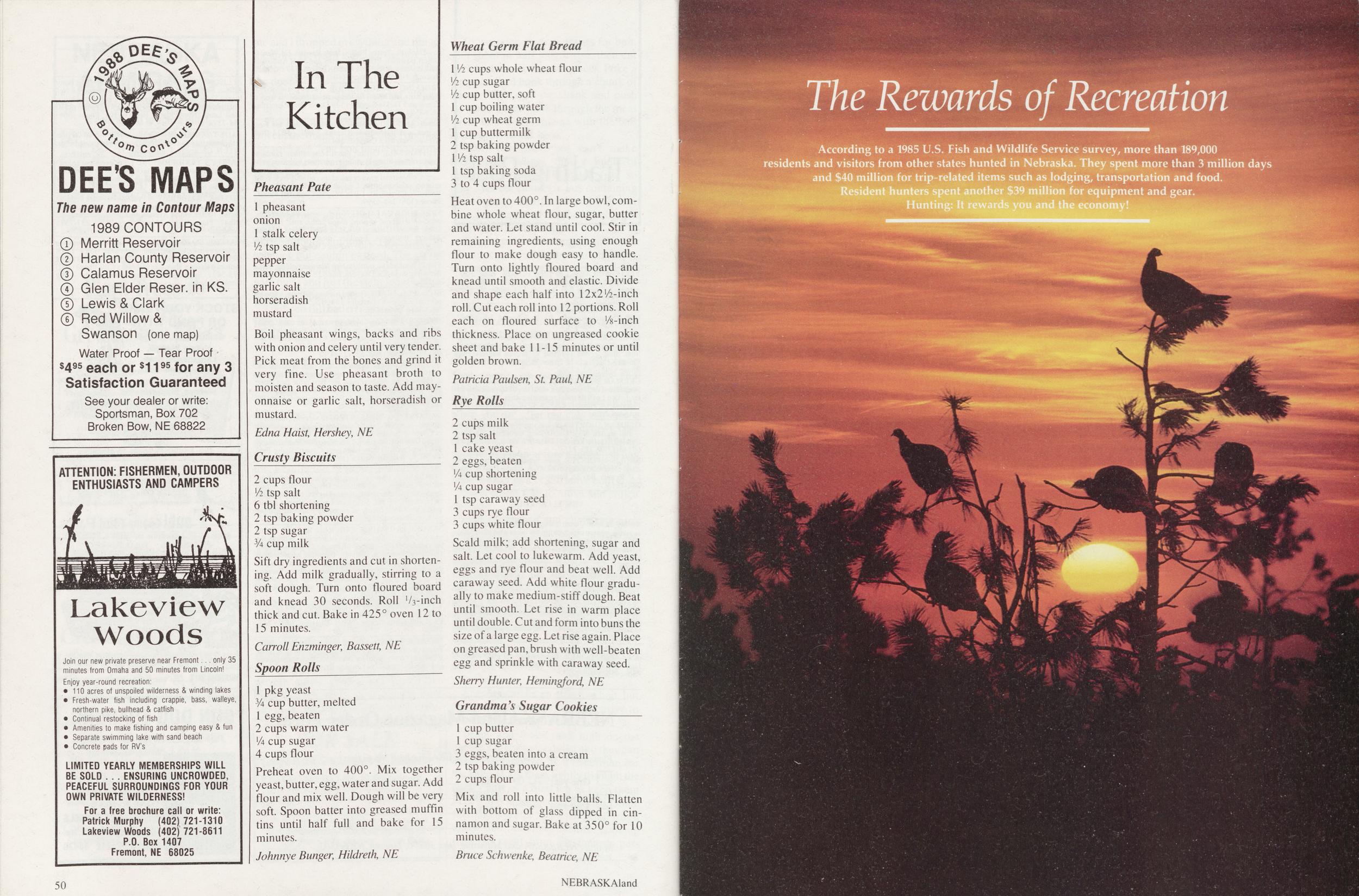 DEE'S MAPS
The new name in Contour Maps
1989 CONTOURS
© Merritt Reservoir
© Harlan County Reservoir
® Calamus Reservoir
© Glen Elder Reser. in KS.
© Lewis & Clark
© Red Willow &
Swanson (one map)
Water Proof Tear Proof
$495 each or $1195 for any 3
Satisfaction Guaranteed
See your dealer or write:
Sportsman, Box 702
Broken Bow, NE 68822
ATTENTION: FISHERMEN, OUTDOOR
ENTHUSIASTS AND CAMPERS
Lakeview
Woods
Join our new private preserve near Fremont... only 35
minutes from Omaha and 50 minutes from Lincoln!
Enjoy year-round recreation:
• 110 acres of unspoiled wilderness & winding lakes
• Fresh-water fish including crappie, bass, walleye,
northern pike, bullhead & catfish
• Continual restocking of fish
• Amenities to make fishing and camping easy & fun
• Separate swimming lake with sand beach
• Concrete pads for RV's
LIMITED YEARLY MEMBERSHIPS WILL
BE SOLD . . . ENSURING UNCROWDED,
PEACEFUL SURROUNDINGS FOR YOUR
OWN PRIVATE WILDERNESS!
For a free brochure call or write:
Patrick Murphy (402) 721-1310
Lakeview Woods (402) 721-8611
P.O. Box 1407
Fremont, NE 68025
DEE'S MAPS
The new name in Contour Maps
1989 CONTOURS
© Merritt Reservoir
© Harlan County Reservoir
® Calamus Reservoir
© Glen Elder Reser. in KS.
© Lewis & Clark
© Red Willow &
Swanson (one map)
Water Proof Tear Proof
$495 each or $1195 for any 3
Satisfaction Guaranteed
See your dealer or write:
Sportsman, Box 702
Broken Bow, NE 68822
ATTENTION: FISHERMEN, OUTDOOR
ENTHUSIASTS AND CAMPERS
Lakeview
Woods
Join our new private preserve near Fremont... only 35
minutes from Omaha and 50 minutes from Lincoln!
Enjoy year-round recreation:
• 110 acres of unspoiled wilderness & winding lakes
• Fresh-water fish including crappie, bass, walleye,
northern pike, bullhead & catfish
• Continual restocking of fish
• Amenities to make fishing and camping easy & fun
• Separate swimming lake with sand beach
• Concrete pads for RV's
LIMITED YEARLY MEMBERSHIPS WILL
BE SOLD . . . ENSURING UNCROWDED,
PEACEFUL SURROUNDINGS FOR YOUR
OWN PRIVATE WILDERNESS!
For a free brochure call or write:
Patrick Murphy (402) 721-1310
Lakeview Woods (402) 721-8611
P.O. Box 1407
Fremont, NE 68025
In The Kitchen
Pheasant Pate 1 pheasant onion 1 stalk celery Vi tsp salt pepper mayonnaise garlic salt horseradish mustardBoil pheasant wings, backs and ribs with onion and celery until very tender. Pick meat from the bones and grind it very fine. Use pheasant broth to moisten and season to taste. Add mayonnaise or garlic salt, horseradish or Rye Rolls mustard.
Edna Haist, Hershey, NE Crusty Biscuits 2 cups flour Vi tsp salt 6 tbl shortening 2 tsp baking powder 2 tsp sugar 3A cup milkSift dry ingredients and cut in shortening. Add milk gradually, stirring to a soft dough. Turn onto floured board and knead 30 seconds. Roll 'A-inch thick and cut. Bake in 425° oven 12 to 15 minutes.
Carroll Enzminger, Bassett, NE Spoon Rolls 1 pkg yeast 3/4 cup butter, melted 1 egg, beaten 2 cups warm water Va cup sugar 4 cups flourPreheat oven to 400°. Mix together yeast, butter, egg, water and sugar. Add flour and mix well. Dough will be very soft. Spoon batter into greased muffin tins until half full and bake for 15 minutes.
Johnnye Bunger, Hildreth, NE Wheat Germ Flat Bread 11/2 cups whole wheat flour 1/2 cup sugar 72 cup butter, soft 1 cup boiling water Vi cup wheat germ 1 cup buttermilk 2 tsp baking powder 1 Vi tsp salt 1 tsp baking soda 3 to 4 cups flourHeat oven to 400°. In large bowl, combine whole wheat flour, sugar, butter and water. Let stand until cool. Stir in remaining ingredients, using enough flour to make dough easy to handle. Turn onto lightly floured board and knead until smooth and elastic. Divide and shape each half into 12x2 1/2-inch roll. Cut each roll into 12 portions. Roll each on floured surface to 1/8-inch thickness. Place on ungreased cookie sheet and bake 11-15 minutes or until golden brown.
Patricia Paulsen, St. Paul, NE Rye Rolls 2 cups milk 2 tsp salt 1 cake yeast 2 eggs, beaten Va cup shortening Va cup sugar 1 tsp caraway seed 3 cups rye flour 3 cups white flourScald milk; add shortening, sugar and salt. Let cool to lukewarm. Add yeast, eggs and rye flour and beat well. Add caraway seed. Add white flour gradually to make medium-stiff dough. Beat until smooth. Let rise in warm place until double. Cut and form into buns the size of a large egg. Let rise again. Place on greased pan, brush with well-beaten egg and sprinkle with caraway seed.
Sherry Hunter, Hemingford, NE Grandma's Sugar Cookies 1 cup butter 1 cup sugar 3 eggs, beaten into a cream 2 tsp baking powder 2 cups flourMix and roll into little balls. Flatten with bottom of glass dipped in cinnamon and sugar. Bake at 350° for 10 minutes.
Bruce Schwenke, Beatrice, NE 50 NEBRASKAlandThe Rewards of Recreation
According to a 1985 U.S. Fish and Wildlife Service survey, more than 189,000 residents and visitors from other states hunted in Nebraska. They spent more than 3 million days and $40 million for trip-related items such as lodging, transportation and food. Resident hunters spent another $39 million for equipment and gear. Hunting: It rewards you and the economy!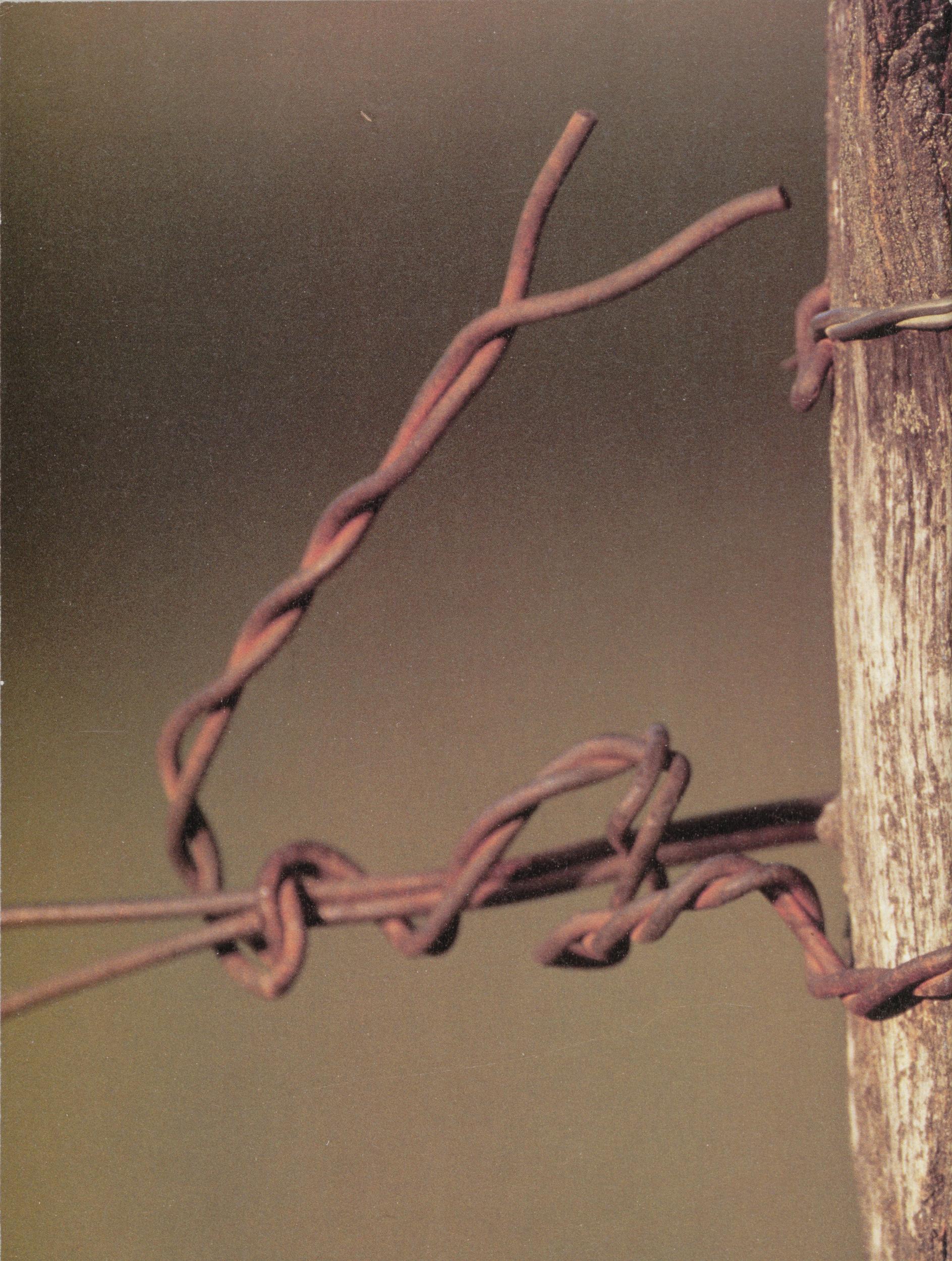
Position: 769 (14 views)