Volume 67, Issue 2, 1989
NEBRASKAland
MARCH 1989 $1.50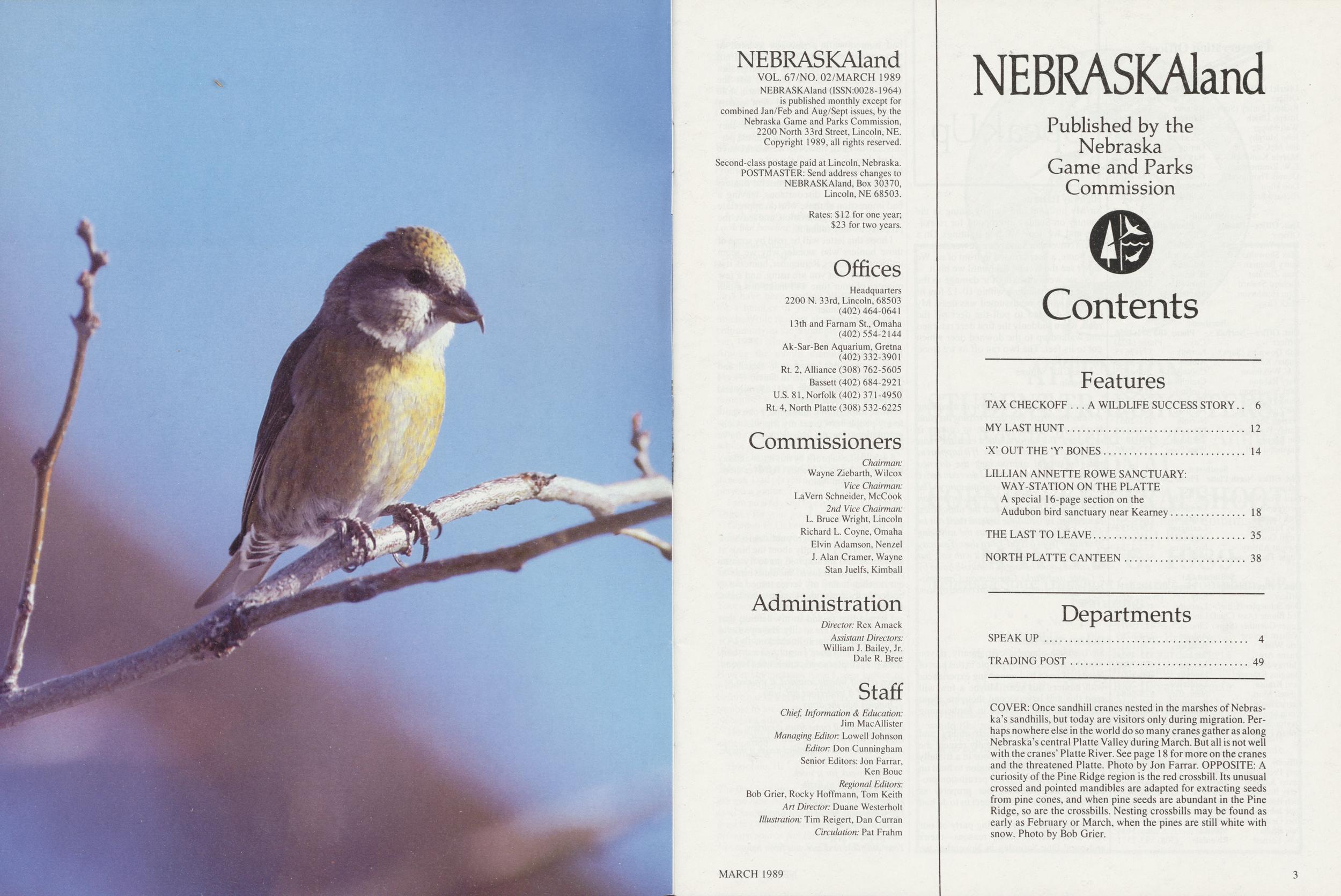
NEBRASKAland
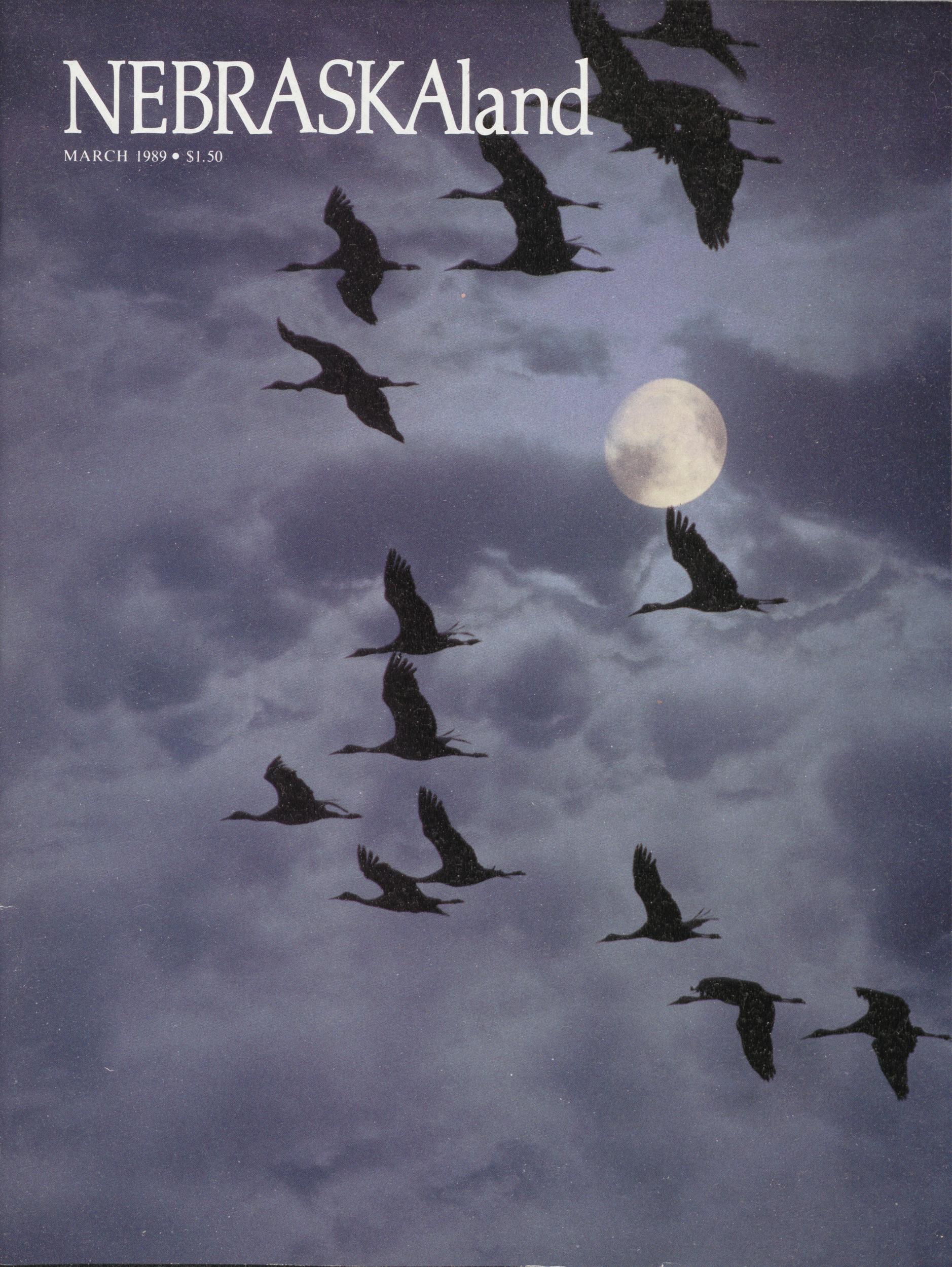
Published by the Nebraska Game and Parks Commission NEBRASKAland VOL. 67/NO. 02/MARCH 1989 NEBRASKAland (ISSN:0028-1964) is published monthly except for combined Jan/Feb and Aug/Sept issues, by the Nebraska Game and Parks Commission, 2200 North 33rd Street, Lincoln, NE. Copyright 1989, all rights reserved. Second-class postage paid at Lincoln, Nebraska. POSTMASTER: Send address changes to NEBRASKAland, Box 30370, Lincoln, NE 68503. Rates: $ 12 for one year; $23 for two years. Offices Headquarters 2200 N. 33rd, Lincoln, 68503 (402)464-0641 13th and Farnam St., Omaha (402)554-2144 Ak-Sar-Ben Aquarium, Gretna (402)332-3901 Rt. 2, Alliance (308) 762-5605 Bassett (402) 684-2921 U.S. 81, Norfolk (402) 371-4950 Rt. 4, North Platte (308) 532-6225 Commissioners Chairman: Wayne Ziebarth, Wilcox Vice Chairman: LaVern Schneider, McCook 2nd Vice Chairman: L. Bruce Wright, Lincoln Richard L. Coyne, Omaha Elvin Adamson, Nenzel J. Alan Cramer, Wayne Stan Juelfs, Kimball Administration Director: Rex Amack Assistant Directors: William J. Bailey, Jr. Dale R. Bree Staff Chief, Information & Education: Jim Macailister Managing Editor: Lowell Johnson Editor: Don Cunningham Senior Editors: Jon Farrar, Ken Bouc Regional Editors: Bob Grier, Rocky Hoffmann, Tom Keith Art Director: Duane Westerholt Illustration: Tim Reigert, Dan Curran Circulation: Pat Frahm Contents Features TAX CHECKOFF A WILDLIFE SUCCESS STORY 6 MY LAST HUNT 12 'X' OUT THE 'Y' BONES 14 LILLIAN ANNETTE ROWE SANCTUARY: WAY-STATION ON THE PLATTE A special 16-page section on the Audubon bird sanctuary near Kearney. THE LAST TO LEAVE NORTH PLATTE CANTEEN 18 35 38 Departments SPEAK UP 4 TRADING POST 49 COVER: Once sandhill cranes nested in the marshes of Nebraska's sandhills, but today are visitors only during migration. Perhaps nowhere else in the world do so many cranes gather as along Nebraska's central Platte Valley during March. But all is not well with the cranes' Platte River. See page 18 for more on the cranes and the threatened Platte. Photo by Jon Farrar. OPPOSITE: A curiosity of the Pine Ridge region is the red crossbill. Its unusual crossed and pointed mandibles are adapted for extracting seeds from pine cones, and when pine seeds are abundant in the Pine Ridge, so are the crossbills. Nesting crossbills may be found as early as February or March, when the pines are still white with snow. Photo by Bob Grier. MARCH 1989 3 Conservation Officers
Panhandle
District Office, Alliance, Phone 308 762-5605
Officer, City, Phone (308)
Richard Furley (Supv) Alliance, 762-2024
Joseph Ulrich, Bridgeport, 262-0541
Walt Meyer, Chadron, 432-4398
John Murphy, Crawford, 665-2021
Jim McCole, Gering, 436-2686
Marvin Kampbell, Hay Springs, 638-7527
E.W. Zimmerman, Ogallala, 284-3013
Dennis Thompson, Ogallala, 284-6450
Don Hunt, Oshkosh, 772-3697
Richard Brandt, Scottsbluff, 635-1277
Sandhills
Dist. Office—Bassett
Officer
Bruce Wiebe (Supv)
Max Showalter
Larry Bauman
Tom Zimmer
Richard Seward
John Henderson
Mick Gray
Phone 402 684-3511
City
Bassett
Ainsworth
Atkinson
B. Bow
Burwell
Stapleton
Valentine
Phone(402)
684-3867
387-1960
925-5569
872-6063
346-4062
636-2430
376-3136
Northeast
Dist. Office—Norfolk
Officer
Bob Downing (Supv)
Robert Kelly
L.A. Wilkinson
Gary Ralston
John Shuckman
Daniel Roberts
Jim Zimmerman
Marion Shafer
Randy Pomplun
Jon Reeves
Raymond Still
Phone 402 371
City
Norfolk
Albion
Columbus
Creighton
Crofton
Fremont
Fremont
Norfolk
Ponca
Tekamah
West Point
Phone
371
395
564
847
388
721
721
371
755
374
372
-4950
(402)
2675
2538
4375
3284
4421
7852
8028
2031
4126
1339
5676
Southwest
Dist. Office-North Platte, Phone (308) 532-6225
Officer, City, Phone (308)
Gail Woodside (Supv) No. Platte, 532-0279
George Sund, Cambridge, 697-4629
Dirk Greene, Imperial, 882-5328
Ray Frandsen, Lexington, 324-2753
Virgil Gosch, McCook, 345-2185
Dwight Allbery, No. Platte, 532-2753
Roger Thompson, No. Platte, 532-9175
Southeast (A)
Dist. Office—Lincoln, Phone 402 464-0641
Officer, City, Phone (402)
Don Schaepler (Chief) Lincoln, 464-2957
Ted Blume (Asst Chief) Lincoln, 423-4916
Roger Guenther (Supv) Lincoln, 423-5671
William Krause, Auburn, 274-3789
Eric Wiebe, Beatrice, 228-1652
Duane Arp, Gretna, 332-4954
Murray Johnson, Lincoln, 477-7905
Douglas Kramer, Lincoln, 466-9001
Levi Krause, Louisville, 234-2212
Russell Mort, Nebr. City, 873-5684
Larry Elston, Omaha, 292-4910
Craig Stover, Omaha, 359-2833
Dayton Shultis, Roca, 423-5702
Robert Finke, Wahoo, 443-3291
Officer
Jerry Pecha (Supv)
Lester Johnson
Terry Brentzel
Rich Routh
Dale Johnson
Ross Oestmann
Dale Bruha
D.W. Earnest
Southeast (B)
City
York
David City
Grand Is.
Hastings
Hebron
Loup City
Milford
Riverdale
Phone(402)
362-5707
367-4037
(308)384-8296
463-3031
768-7363
(308)745-1676
761-3134
(308)893-2571
Conservation Officers
Panhandle
District Office, Alliance, Phone 308 762-5605
Officer, City, Phone (308)
Richard Furley (Supv) Alliance, 762-2024
Joseph Ulrich, Bridgeport, 262-0541
Walt Meyer, Chadron, 432-4398
John Murphy, Crawford, 665-2021
Jim McCole, Gering, 436-2686
Marvin Kampbell, Hay Springs, 638-7527
E.W. Zimmerman, Ogallala, 284-3013
Dennis Thompson, Ogallala, 284-6450
Don Hunt, Oshkosh, 772-3697
Richard Brandt, Scottsbluff, 635-1277
Sandhills
Dist. Office—Bassett
Officer
Bruce Wiebe (Supv)
Max Showalter
Larry Bauman
Tom Zimmer
Richard Seward
John Henderson
Mick Gray
Phone 402 684-3511
City
Bassett
Ainsworth
Atkinson
B. Bow
Burwell
Stapleton
Valentine
Phone(402)
684-3867
387-1960
925-5569
872-6063
346-4062
636-2430
376-3136
Northeast
Dist. Office—Norfolk
Officer
Bob Downing (Supv)
Robert Kelly
L.A. Wilkinson
Gary Ralston
John Shuckman
Daniel Roberts
Jim Zimmerman
Marion Shafer
Randy Pomplun
Jon Reeves
Raymond Still
Phone 402 371
City
Norfolk
Albion
Columbus
Creighton
Crofton
Fremont
Fremont
Norfolk
Ponca
Tekamah
West Point
Phone
371
395
564
847
388
721
721
371
755
374
372
-4950
(402)
2675
2538
4375
3284
4421
7852
8028
2031
4126
1339
5676
Southwest
Dist. Office-North Platte, Phone (308) 532-6225
Officer, City, Phone (308)
Gail Woodside (Supv) No. Platte, 532-0279
George Sund, Cambridge, 697-4629
Dirk Greene, Imperial, 882-5328
Ray Frandsen, Lexington, 324-2753
Virgil Gosch, McCook, 345-2185
Dwight Allbery, No. Platte, 532-2753
Roger Thompson, No. Platte, 532-9175
Southeast (A)
Dist. Office—Lincoln, Phone 402 464-0641
Officer, City, Phone (402)
Don Schaepler (Chief) Lincoln, 464-2957
Ted Blume (Asst Chief) Lincoln, 423-4916
Roger Guenther (Supv) Lincoln, 423-5671
William Krause, Auburn, 274-3789
Eric Wiebe, Beatrice, 228-1652
Duane Arp, Gretna, 332-4954
Murray Johnson, Lincoln, 477-7905
Douglas Kramer, Lincoln, 466-9001
Levi Krause, Louisville, 234-2212
Russell Mort, Nebr. City, 873-5684
Larry Elston, Omaha, 292-4910
Craig Stover, Omaha, 359-2833
Dayton Shultis, Roca, 423-5702
Robert Finke, Wahoo, 443-3291
Officer
Jerry Pecha (Supv)
Lester Johnson
Terry Brentzel
Rich Routh
Dale Johnson
Ross Oestmann
Dale Bruha
D.W. Earnest
Southeast (B)
City
York
David City
Grand Is.
Hastings
Hebron
Loup City
Milford
Riverdale
Phone(402)
362-5707
367-4037
(308)384-8296
463-3031
768-7363
(308)745-1676
761-3134
(308)893-2571
Speak Up
Highway HazardsSir/My husband and I enjoy riding in the country on Sunday afternoons, for relaxation and, we hope, wildlife sightings. On a recent November Sunday, as we were returning home, a deer crossed in front of us. We didn't see the second deer until we hit it.
As we were checking the damage to the car, we were standing within 10-12 feet of the deer which we assumed was dead. My husband decided to pull the deer off the road, when suddenly the first deer returned and walked up to the downed deer which got to its feet. The two ran off as we stood speechless!
Mrs. Cliff Squires LincolnA happy ending which can serve as a warning to other motorists. One deer crossing the road is often followed by another, so caution is necessary. But unfortunately even the most cautious driver can hit a deer. If it happens to you, be careful approaching the downed animal. An injured or stunned deer can revive unexpectedly, and cause serious injury. The law does not permit a motorist to dispatch an injured animal; instead, call the authorities. Remember, too, that the animal need not be wasted. Nebraska law permits the salvaging of venison from a road-killed deer. You may dress out the animal and take it with you, but the carcass must be tagged within 48 hours by a Game and Parks Commission Conservation Officer or other law enforcement officer. (Editor)
* * * Hunters, Take NoteSir/I would appreciate it greatly if you would print this. Many people in this part of Nebraska have had unnerving experiences with hunters this year. Maybe a few will read this and have second thoughts about our side of the situation in forthcoming hunting seasons.
I appreciate hunters, their ability, and their love for hunting. I totally respect the hunter who comes to our door in a friendly manner and asks for permission to hunt on our property, then if given permission proceeds to hunt, treating our property as respectfully as he would expect us to do had we asked the favor of him.
We allow only one hunting party on our land at a time, for safety reasons—theirs and ours! One Saturday in November we had hunters with permission granted in advance on our land. Others who did not have permission entered our property, shot their deer, dressed the carcass, left the remains beside a road in the pasture, stole the "No Hunting" signs, and went merrily on their way.
Had they stopped at the house they undoubtedly would have been granted permission to hunt, however we would have asked them to wait until the other party of hunters moved on.
It is sad when a few ungrateful hunters continue to be so discourteous, leaving a bad impression of those who do appreciate the privilege, ask permission, and leave the property as they found it.
I hope this letter will be read by some of those hunters who wonder why we seem unfriendly at times. Remember, hunters, it is our property that you are using, and a few minutes of your time will make it a much more gratifying experience.
Arlene Thelander Garden County * * * From BrazilSir/I am a college student in Brazil and spent about four months in David City. I had a great time with the Fricke family and learned a lot about farming.
Now, through this magazine, I can show to my people how great my trip was. Congratulations for the excellent job you've been doing.
I would like to profit by this letter and say hello to all the good friends I left over there.
Epitaci Belem Neto Recife, Brazil * * * For the birdsSir/My cousin in Verdigre published a book of serious poetry recently about the birds at her feeder, and she inspired me to try some poems about our beloved Sandhills birds on our ranch, but alas! my verses turned out to be decidedly irreverent. They are limericks, and you know what they are!
I would like to add in my defense that some of our birds are so silly. Have you ever really watched a prairie chicken fly? Or seen a mourning dove's nest? Anyway, here are some samples so you know what I mean.
When a wolf whistle sounded, it whirled to The ears of a tenderfoot girl, who Jumped into the arms Of a cowboy with charms, But alas! the call came from a curlew. Oh bird, with your shrill wolf whizzle, And your nest on the ground neath a thizzle, That freak of a beak Could tweak for a week Before it started to fizzle. Kildeer is a bird insincere, For when near her nest you appear, She '11 deign to feign A peign, to geign Your attention and lure you from here. 4 NEBRASKAland The nestling, all feathers, no fear, With a tiny high voice shrill and clear, Its legs make us pause: Toothpicks with claws, We're glad that its parent stays near. In the woods by the creek near our house On a day such as autumn endows, Underfoot, an eruption Of feathered construction, We stepped on a land mine of grouse. Prairie chickens are real ding-a-lings, Like schmoos, they are droopy-drawered things, These birds, when they fly In short spurts through the sky, Look like bowling pins fitted with wings. Theona Andersen Johnstown, NE * * * Black HomesteadersSir/I have been reading NEBRASKAland for a number of years and enjoy it very much. While reading about the early black community in the Sandhills (June-November, 1988) some of the names rang a bell. Among the names mentioned were the Rileys, Roy Brown, and the Hayes family. My two sisters and I went to school in Valentine with the Riley children, and I remember some of them quite well. I was in 4th grade with young Teddy Hayes. He was well liked and it was very sad when he ran into a tree on his sled one spring day on a school outing, and was killed.
Roy Brown and my dad (Wilbert C. "Mose" Oaks) used to play for many area dances. Dad played a violin and I think Roy played a guitar. They were good friends.
I am now 61, and live in Stayton, Oregon. Thanks for your good articles and photos.
Gordon F. Oakes Stayton, OregonSir/As former Nebraskan (Minden High School '35, UN-L '40) I must tell you how much I appreciated the first of your promised five stories on black homesteaders. Your series gives promise of doing a needed service to Nebraska history as well as American history.
As a descendant of white homesteaders (Kearney County), I found the pictures of the black families to be especially poignant. How many pictures have I seen before of white homesteading families, but never before one of a black family! I even took the trouble to locate the settlements in my old Nebraska atlas.
I look forward to the other four parts with anticipation.
Vernon W. Newbold Honolulu, HIThe five-part series, titled Black Homesteaders ran June-November, 1988. NEBRASKA -land has received word that Ava Day, who lived in DeWitty in her childhood, and was a primary source for the series, died early in November, 1988, in St. Paul, MN (Editor)
ATTENTION STUDENT TRAPSH00TERS!! Plan Now to Attend the 20th Annual NATIONAL CORNHUSKER TRAPSHOOT Sponsored by Nebraska Game and Parks Commission Non-Registered — ATA Rules MAY 5 & 6, 1989 Nebraska State Trapshoot Grounds, Doniphan, NE Featuring: New Low Entry Fee Trophies — Pins — Door Prizes High School — May 5—100, 16 yard Targets May 6—100, Handicap Targets Junior High—May 5—100, 16 yard Targets Now is the time to start planning for the Nebraska Game and Parks National Cornhusker Trapshoot. If you are a Jr. High or High School student and would like to participate in the 20th Annual Cornhusker Trapshoot — contact the Nebraska Game and Parks Commission in North Platte for details. You do not have to be an experienced trapshooter at this time to participate. Nebraska Game and Parks Commission Cornhusker Trapshoot Route 4, Box 36 North Platte, NE 69101 Hosted by Nebraska State Sportsmen's Association MARCH 1989 5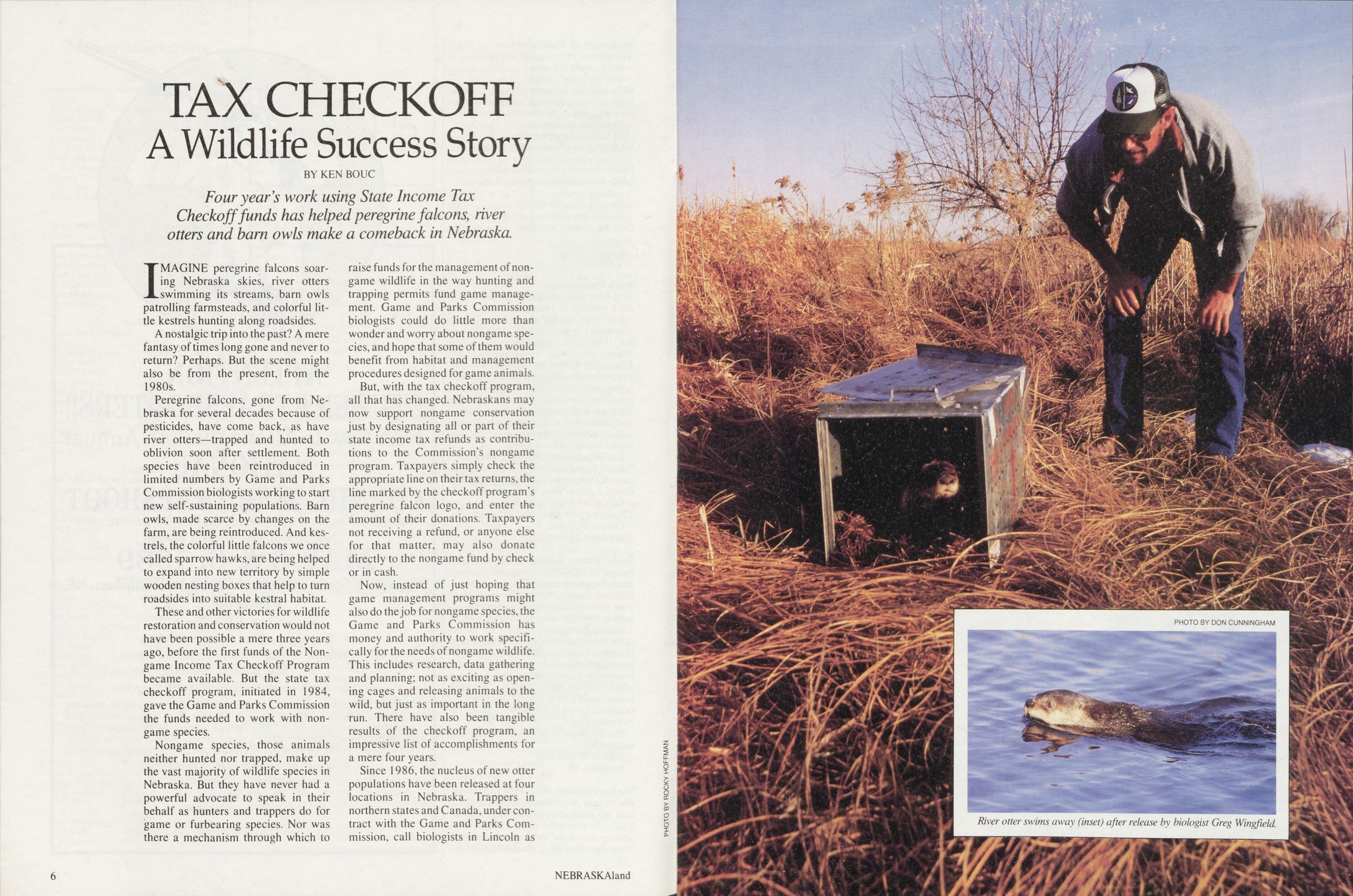
TAX CHECKOFF A Wildlife Success Story
BY KEN BOUC Four year's work using State Income Tax Checkoff funds has helped peregrine falcons, river otters and barn owls make a comeback in Nebraska.IMAGINE peregrine falcons soaring Nebraska skies, river otters swimming its streams, barn owls patrolling farmsteads, and colorful little kestrels hunting along roadsides.
A nostalgic trip into the past? A mere fantasy of times long gone and never to return? Perhaps. But the scene might also be from the present, from the 1980s.
Peregrine falcons, gone from Nebraska for several decades because of pesticides, have come back, as have river otters—trapped and hunted to oblivion soon after settlement. Both species have been reintroduced in limited numbers by Game and Parks Commission biologists working to start new self-sustaining populations. Barn owls, made scarce by changes on the farm, are being reintroduced. And kestrels, the colorful little falcons we once called sparrow hawks, are being helped to expand into new territory by simple wooden nesting boxes that help to turn roadsides into suitable kestral habitat.
These and other victories for wildlife restoration and conservation would not have been possible a mere three years ago, before the first funds of the Nongame Income Tax Checkoff Program became available. But the state tax checkoff program, initiated in 1984, gave the Game and Parks Commission the funds needed to work with nongame species.
Nongame species, those animals neither hunted nor trapped, make up the vast majority of wildlife species in Nebraska. But they have never had a powerful advocate to speak in their behalf as hunters and trappers do for game or furbearing species. Nor was there a mechanism through which to raise funds for the management of nongame wildlife in the way hunting and trapping permits fund game management. Game and Parks Commission biologists could do little more than wonder and worry about nongame species, and hope that some of them would benefit from habitat and management procedures designed for game animals.
But, with the tax checkoff program, all that has changed. Nebraskans may now support nongame conservation just by designating all or part of their state income tax refunds as contributions to the Commission's nongame program. Taxpayers simply check the appropriate line on their tax returns, the line marked by the checkoff program's peregrine falcon logo, and enter the amount of their donations. Taxpayers not receiving a refund, or anyone else for that matter, may also donate directly to the nongame fund by check or in cash.
Now, instead of just hoping that game management programs might also do the job for nongame species, the Game and Parks Commission has money and authority to work specifically for the needs of nongame wildlife. This includes research, data gathering and planning; not as exciting as opening cages and releasing animals to the wild, but just as important in the long run. There have also been tangible results of the checkoff program, an impressive list of accomplishments for a mere four years.
Since 1986, the nucleus of new otter populations have been released at four locations in Nebraska. Trappers in northern states and Canada, under contract with the Game and Parks Commission, call biologists in Lincoln as soon as they catch an animal, then ship it by air in a special cage provided by the Commission.
6 NEBRASKAland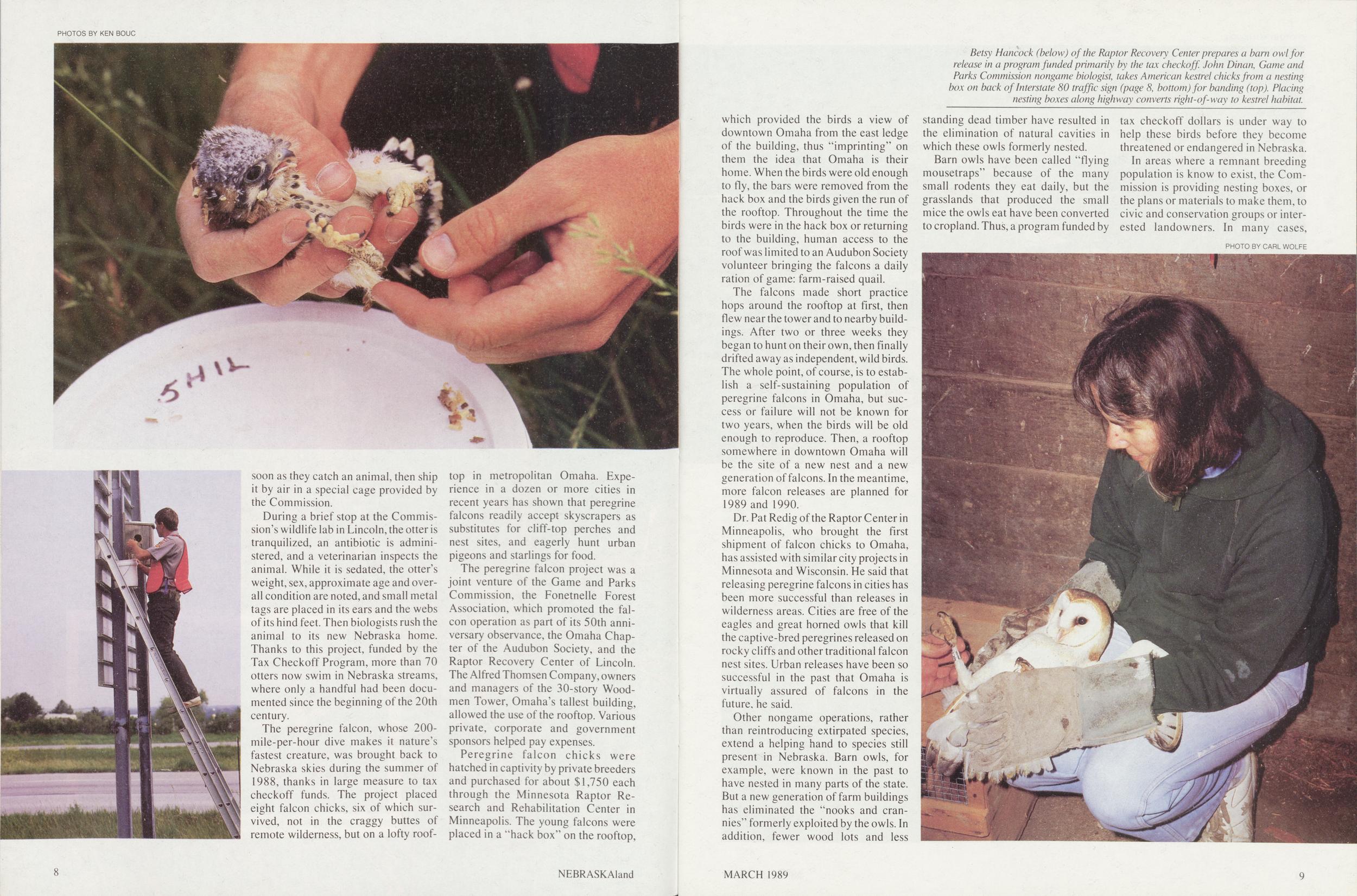
During a brief stop at the Commission's wildlife lab in Lincoln, the otter is tranquilized, an antibiotic is administered, and a veterinarian inspects the animal. While it is sedated, the otter's weight, sex, approximate age and overall condition are noted, and small metal tags are placed in its ears and the webs of its hind feet. Then biologists rush the animal to its new Nebraska home. Thanks to this project, funded by the Tax Checkoff Program, more than 70 otters now swim in Nebraska streams, where only a handful had been documented since the beginning of the 20th century.
The peregrine falcon, whose 200-mile-per-hour dive makes it nature's fastest creature, was brought back to Nebraska skies during the summer of 1988, thanks in large measure to tax checkoff funds. The project placed eight falcon chicks, six of which survived, not in the craggy buttes of remote wilderness, but on a lofty rooftop in metropolitan Omaha. Experience in a dozen or more cities in recent years has shown that peregrine falcons readily accept skyscrapers as substitutes for cliff-top perches and nest sites, and eagerly hunt urban pigeons and starlings for food.
The peregrine falcon project was a joint venture of the Game and Parks Commission, the Fontanelle Forest Association, which promoted the falcon operation as part of its 50th anniversary observance, the Omaha Chapter of the Audubon Society, and the Raptor Recovery Center of Lincoln. The Alfred Thomsen Company, owners and managers of the 30-story Woodmen Tower, Omaha's tallest building, allowed the use of the rooftop. Various private, corporate and government sponsors helped pay expenses.
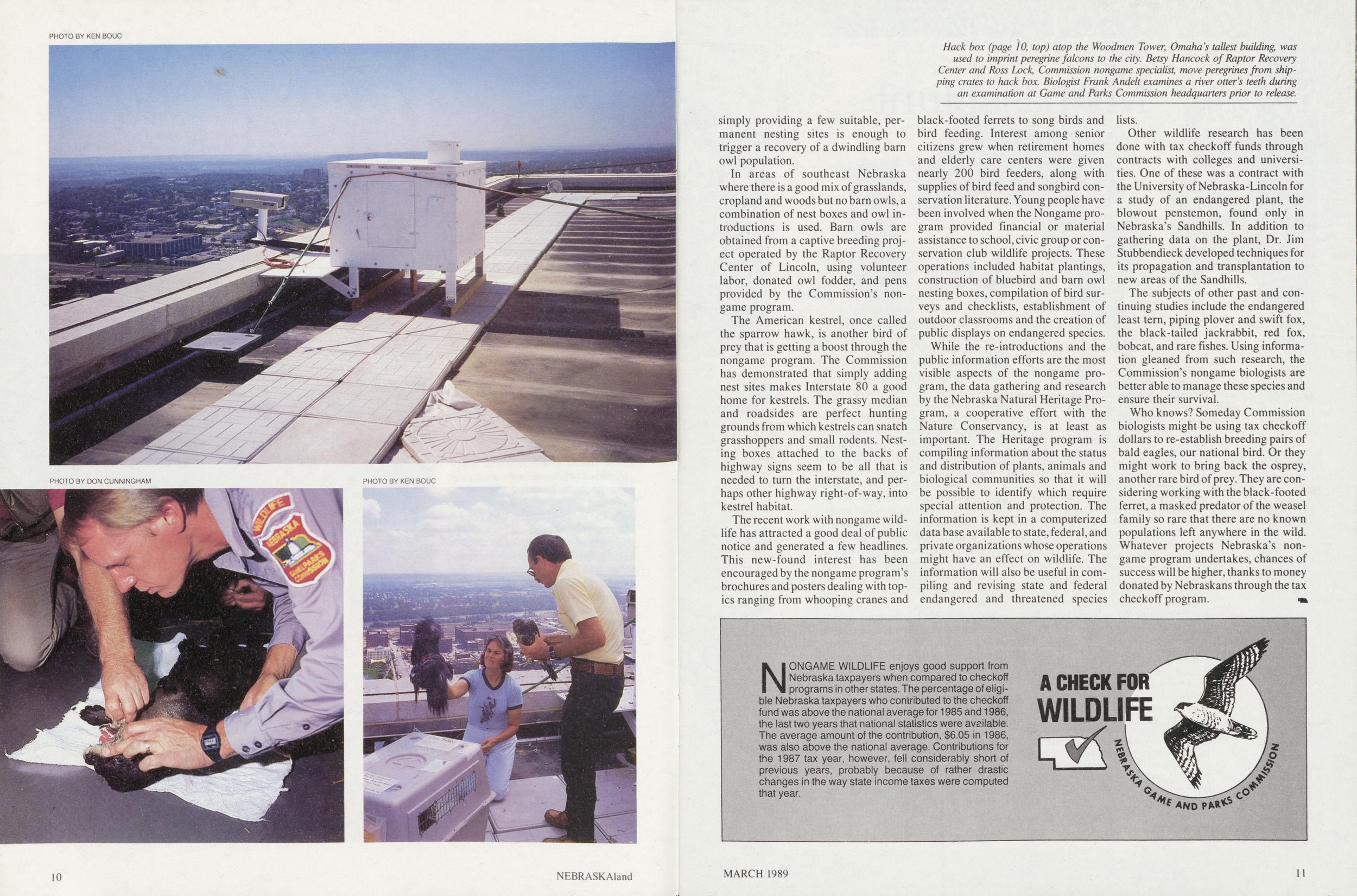
Peregrine falcon chicks were hatched in captivity by private breeders and purchased for about $1,750 each through the Minnesota Raptor Research and Rehabilitation Center in Minneapolis. The young falcons were placed in a "hack box" on the rooftop, 8 NEBRASKAland which provided the birds a view of downtown Omaha from the east ledge of the building, thus "imprinting" on them the idea that Omaha is their home. When the birds were old enough to fly, the bars were removed from the hack box and the birds given the run of the rooftop. Throughout the time the birds were in the hack box or returning to the building, human access to the roof was limited to an Audubon Society volunteer bringing the falcons a daily ration of game: farm-raised quail.
The falcons made short practice hops around the rooftop at first, then flew near the tower and to nearby buildings. After two or three weeks they began to hunt on their own, then finally drifted away as independent, wild birds. The whole point, of course, is to establish a self-sustaining population of peregrine falcons in Omaha, but success or failure will not be known for two years, when the birds will be old enough to reproduce. Then, a rooftop somewhere in downtown Omaha will be the site of a new nest and a new generation of falcons. In the meantime, more falcon releases are planned for 1989 and 1990.
Dr. Pat Redig of the Raptor Center in Minneapolis, who brought the first shipment of falcon chicks to Omaha, has assisted with similar city projects in Minnesota and Wisconsin. He said that releasing peregrine falcons in cities has been more successful than releases in wilderness areas. Cities are free of the eagles and great horned owls that kill the captive-bred peregrines released on rocky cliffs and other traditional falcon nest sites. Urban releases have been so successful in the past that Omaha is virtually assured of falcons in the future, he said.
Other nongame operations, rather than reintroducing extirpated species, extend a helping hand to species still present in Nebraska. Barn owls, for example, were known in the past to have nested in many parts of the state. But a new generation of farm buildings has eliminated the "nooks and crannies" formerly exploited by the owls. In addition, fewer wood lots and less standing dead timber have resulted in the elimination of natural cavities in which these owls formerly nested.
Barn owls have been called "flying mousetraps" because of the many small rodents they eat daily, but the grasslands that produced the small mice the owls eat have been converted to cropland. Thus, a program funded by tax checkoff dollars is under way to help these birds before they become threatened or endangered in Nebraska.
In areas where a remnant breeding population is know to exist, the Commission is providing nesting boxes, or the plans or materials to make them, to civic and conservation groups or interested landowners. In many cases, simply providing a few suitable, permanent nesting sites is enough to trigger a recovery of a dwindling barn owl population.
In areas of southeast Nebraska where there is a good mix of grasslands, cropland and woods but no barn owls, a combination of nest boxes and owl introductions is used. Barn owls are obtained from a captive breeding project operated by the Raptor Recovery Center of Lincoln, using volunteer labor, donated owl fodder, and pens provided by the Commission's nongame program.
The American kestrel, once called the sparrow hawk, is another bird of prey that is getting a boost through the nongame program. The Commission has demonstrated that simply adding nest sites makes Interstate 80 a good home for kestrels. The grassy median and roadsides are perfect hunting grounds from which kestrels can snatch grasshoppers and small rodents. Nesting boxes attached to the backs of highway signs seem to be all that is needed to turn the interstate, and perhaps other highway right-of-way, into kestrel habitat.
The recent work with nongame wildlife has attracted a good deal of public notice and generated a few headlines. This new-found interest has been encouraged by the nongame program's brochures and posters dealing with topics ranging from whooping cranes and black-footed ferrets to song birds and bird feeding. Interest among senior citizens grew when retirement homes and elderly care centers were given nearly 200 bird feeders, along with supplies of bird feed and songbird conservation literature. Young people have been involved when the Nongame program provided financial or material assistance to school, civic group or conservation club wildlife projects. These operations included habitat plantings, construction of bluebird and barn owl nesting boxes, compilation of bird surveys and checklists, establishment of outdoor classrooms and the creation of public displays on endangered species.
Hack box (page 10, top) atop the Woodmen Tower, Omaha's tallest building, was used to imprint peregrine falcons to the city. Betsy Hancock of Raptor Recovery Center and Ross Lock, Commission nongame specialist, move peregrines from shipping crates to hack box. Biologist Frank Andelt examines a river otter's teeth during an examination at Game and Parks Commission headquarters prior to release.While the re-introductions and the public information efforts are the most visible aspects of the nongame program, the data gathering and research by the Nebraska Natural Heritage Program, a cooperative effort with the Nature Conservancy, is at least as important. The Heritage program is compiling information about the status and distribution of plants, animals and biological communities so that it will be possible to identify which require special attention and protection. The information is kept in a computerized data base available to state, federal, and private organizations whose operations might have an effect on wildlife. The information will also be useful in compiling and revising state and federal endangered and threatened species lists.
Other wildlife research has been done with tax checkoff funds through contracts with colleges and universities. One of these was a contract with the University of Nebraska-Lincoln for a study of an endangered plant, the blowout penstemon, found only in Nebraska's Sandhills. In addition to gathering data on the plant, Dr. Jim Stubbendieck developed techniques for its propagation and transplantation to new areas of the Sandhills.
The subjects of other past and continuing studies include the endangered least tern, piping plover and swift fox, the black-tailed jackrabbit, red fox, bobcat, and rare fishes. Using information gleaned from such research, the Commission's nongame biologists are better able to manage these species and ensure their survival.
Who knows? Someday Commission biologists might be using tax checkoff dollars to re-establish breeding pairs of bald eagles, our national bird. Or they might work to bring back the osprey, another rare bird of prey. They are considering working with the black-footed ferret, a masked predator of the weasel family so rare that there are no known populations left anywhere in the wild. Whatever projects Nebraska's nongame program undertakes, chances of success will be higher, thanks to money donated by Nebraskans through the tax checkoff program.
NONGAME WILDLIFE enjoys good support from Nebraska taxpayers when compared to checkoff programs in other states. The percentage of eligible Nebraska taxpayers who contributed to the checkoff fund was above the national average for 1985 and 1986, the last two years that national statistics were available. The average amount of the contribution, $6.05 in 1986, was also above the national average. Contributions for the 1987 tax year, however, fell considerably short of previous years, probably because of rather drastic changes in the way state income taxes were computed that year. A CHECK FOR WILDLIFE MARCH 1989 11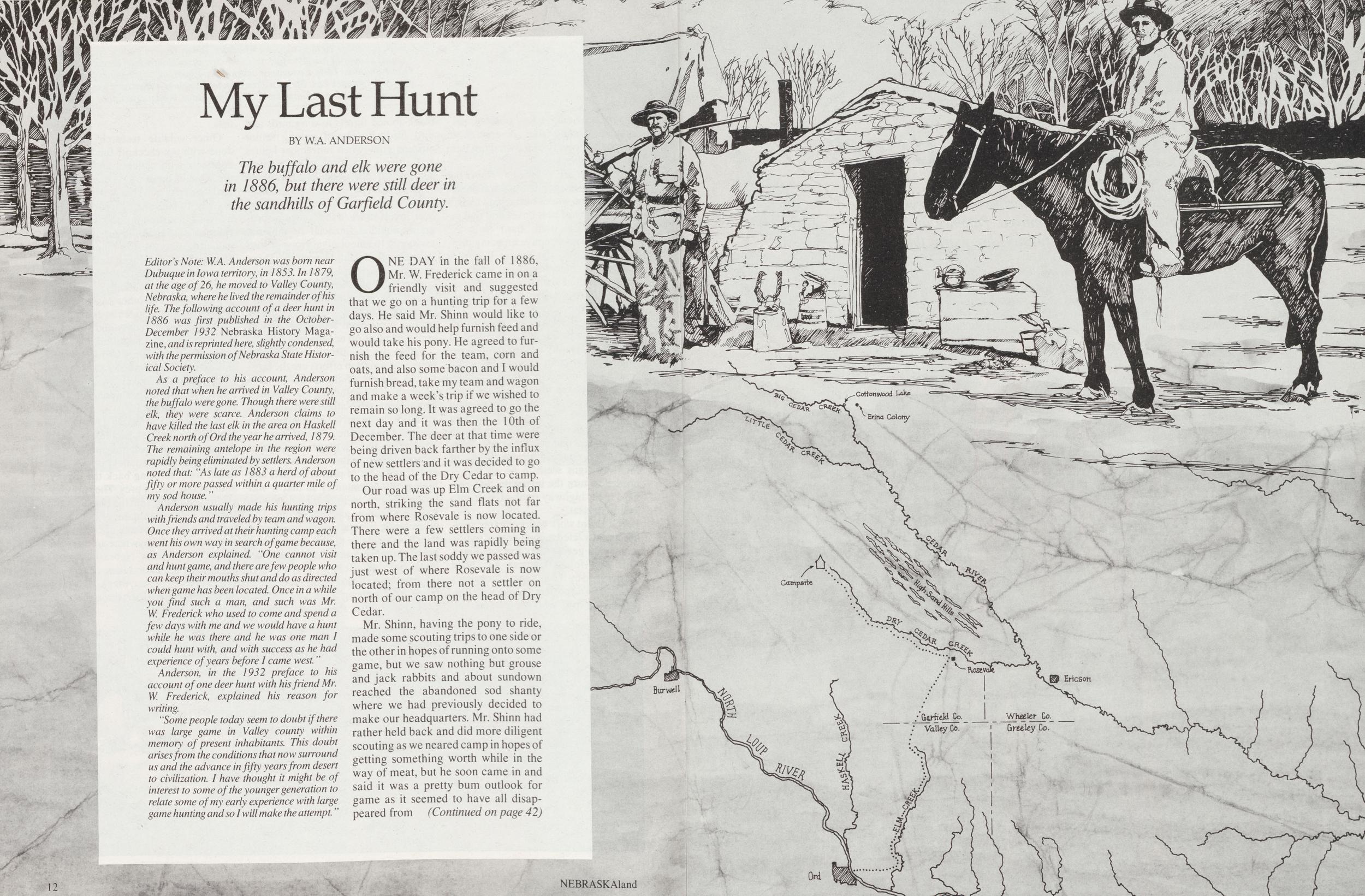
My Last Hunt
BY W.A. ANDERSON 77ie buffalo and elk were gone in 1886, but there were still deer in the sandhills of Garfield County.Editor's Note: W.A. Anderson was born near Dubuque in Iowa territory, in 1853. In 1879, at the age of 26, he moved to Valley County, Nebraska, where he lived the remainder of his life. The following account of a deer hunt in 1886 was first published in the October-December 1932 Nebraska History Magazine, and is reprinted here, slightly condensed, with the permission of Nebraska State Historical Society.
As a preface to his account, Anderson noted that when he arrived in Valley County, the buffalo were gone. Though there were still elk, they were scarce. Anderson claims to have killed the last elk in the area on Haskell Creek north of Ord the year he arrived, 1879. The remaining antelope in the region were rapidly being eliminated by settlers. Anderson noted that: "As late as 1883 a herd of about fifty or more passed within a quarter mile of my sod house."
Anderson usually made his hunting trips with friends and traveled by team and wagon. Once they arrived at their hunting camp each went his own way in search of game because, as Anderson explained. "One cannot visit and hunt game, and there are few people who can keep their mouths shut and do as directed when game has been located. Once in a while you find such a man, and such was Mr. W. Frederick who used to come and spend a few days with me and we would have a hunt while he was there and he was one man I could hunt with, and with success as he had experience of years before I came west.'
Anderson, in the 1932 preface to his account of one deer hunt with his friend Mr. W. Frederick, explained his reason for writing.
"Some people today seem to doubt if there was large game in Valley county within memory of present inhabitants. This doubt arises from the conditions that now surround us and the advance in fifty years from desert to civilization. I have thought it might be of interest to some of the younger generation to relate some of my early experience with large game hunting and so I will make the attempt.'
ONE DAY in the fall of 1886, Mr. W. Frederick came in on a friendly visit and suggested that we go on a hunting trip for a few days. He said Mr. Shinn would like to go also and would help furnish feed and would take his pony. He agreed to furnish the feed for the team, corn and oats, and also some bacon and I would furnish bread, take my team and wagon and make a week's trip if we wished to remain so long. It was agreed to go the next day and it was then the 10th of December. The deer at that time were being driven back farther by the influx of new settlers and it was decided to go to the head of the Dry Cedar to camp.
Our road was up Elm Creek and on north, striking the sand flats not far from where Rosevale is now located. There were a few settlers coming in there and the land was rapidly being taken up. The last soddy we passed was just west of where Rosevale is now located; from there not a settler on north of our camp on the head of Dry Cedar.
Mr. Shinn, having the pony to ride, made some scouting trips to one side or the other in hopes of running onto some game, but we saw nothing but grouse and jack rabbits and about sundown reached the abandoned sod shanty where we had previously decided to make our headquarters. Mr. Shinn had rather held back and did more diligent scouting as we neared camp in hopes of getting something worth while in the way of meat, but he soon came in and said it was a pretty bum outlook for game as it seemed to have all disappeared from (Continued on page 42)
12 NEBRASKAland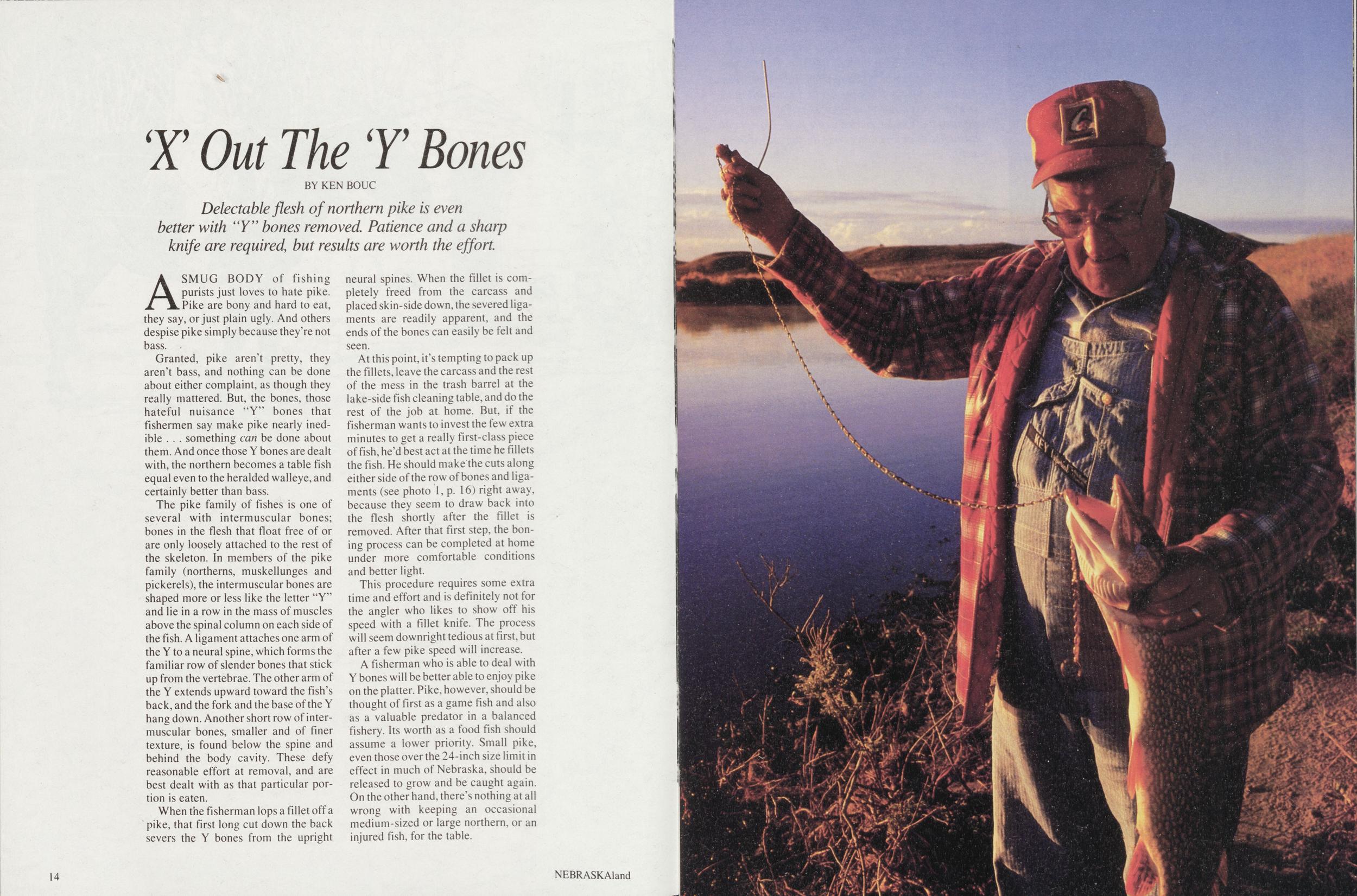
X Out The T Bones
BY KEN BOUC Delectable flesh of northern pike is even better with "Y" bones removed. Patience and a sharp knife are required, but results are worth the effort.A SMUG BODY of fishing purists just loves to hate pike. Pike are bony and hard to eat, they say, or just plain ugly. And others despise pike simply because they're not bass.
Granted, pike aren't pretty, they aren't bass, and nothing can be done about either complaint, as though they really mattered. But, the bones, those hateful nuisance "Y' bones that fishermen say make pike nearly inedible something can be done about them. And once those Y bones are dealt with, the northern becomes a table fish equal even to the heralded walleye, and certainly better than bass.
The pike family of fishes is one of several with intermuscular bones; bones in the flesh that float free of or are only loosely attached to the rest of the skeleton. In members of the pike family (northerns, muskellunges and pickerels), the intermuscular bones are shaped more or less like the letter "Y" and lie in a row in the mass of muscles above the spinal column on each side of the fish. A ligament attaches one arm of the Y to a neural spine, which forms the familiar row of slender bones that stick up from the vertebrae. The other arm of the Y extends upward toward the fish's back, and the fork and the base of the Y hang down. Another short row of intermuscular bones, smaller and of finer texture, is found below the spine and behind the body cavity. These defy reasonable effort at removal, and are best dealt with as that particular portion is eaten.
When the fisherman lops a fillet off a pike, that first long cut down the back severs the Y bones from the upright neural spines. When the fillet is completely freed from the carcass and placed skin-side down, the severed ligaments are readily apparent, and the ends of the bones can easily be felt and seen.
At this point, it's tempting to pack up the fillets, leave the carcass and the rest of the mess in the trash barrel at the lake-side fish cleaning table, and do the rest of the job at home. But, if the fisherman wants to invest the few extra minutes to get a really first-class piece offish, he'd best act at the time he fillets the fish. He should make the cuts along either side of the row of bones and ligaments (see photo 1, p. 16) right away, because they seem to draw back into the flesh shortly after the fillet is removed. After that first step, the boning process can be completed at home under more comfortable conditions and better light.
This procedure requires some extra time and effort and is definitely not for the angler who likes to show off his speed with a fillet knife. The process will seem downright tedious at first, but after a few pike speed will increase.
A fisherman who is able to deal with Y bones will be better able to enjoy pike on the platter. Pike, however, should be thought of first as a game fish and also as a valuable predator in a balanced fishery. Its worth as a food fish should assume a lower priority. Small pike, even those over the 24-inch size limit in effect in much of Nebraska, should be released to grow and be caught again. On the other hand, there's nothing at all wrong with keeping an occasional medium-sized or large northern, or an injured fish, for the table.
14 NEBRASKAland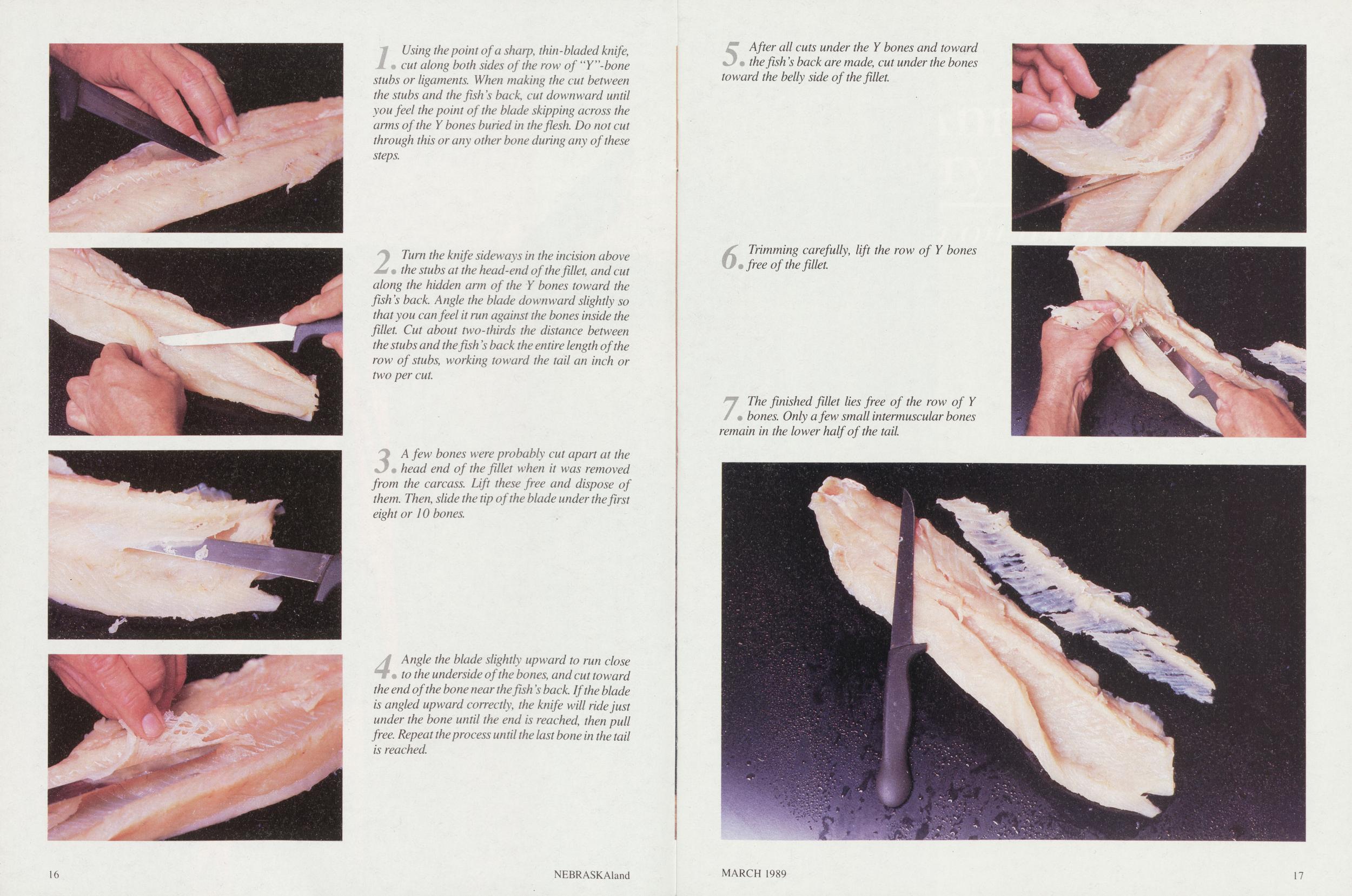
Lillian Annette Rowe Sanctuary Way-Station on the Platte
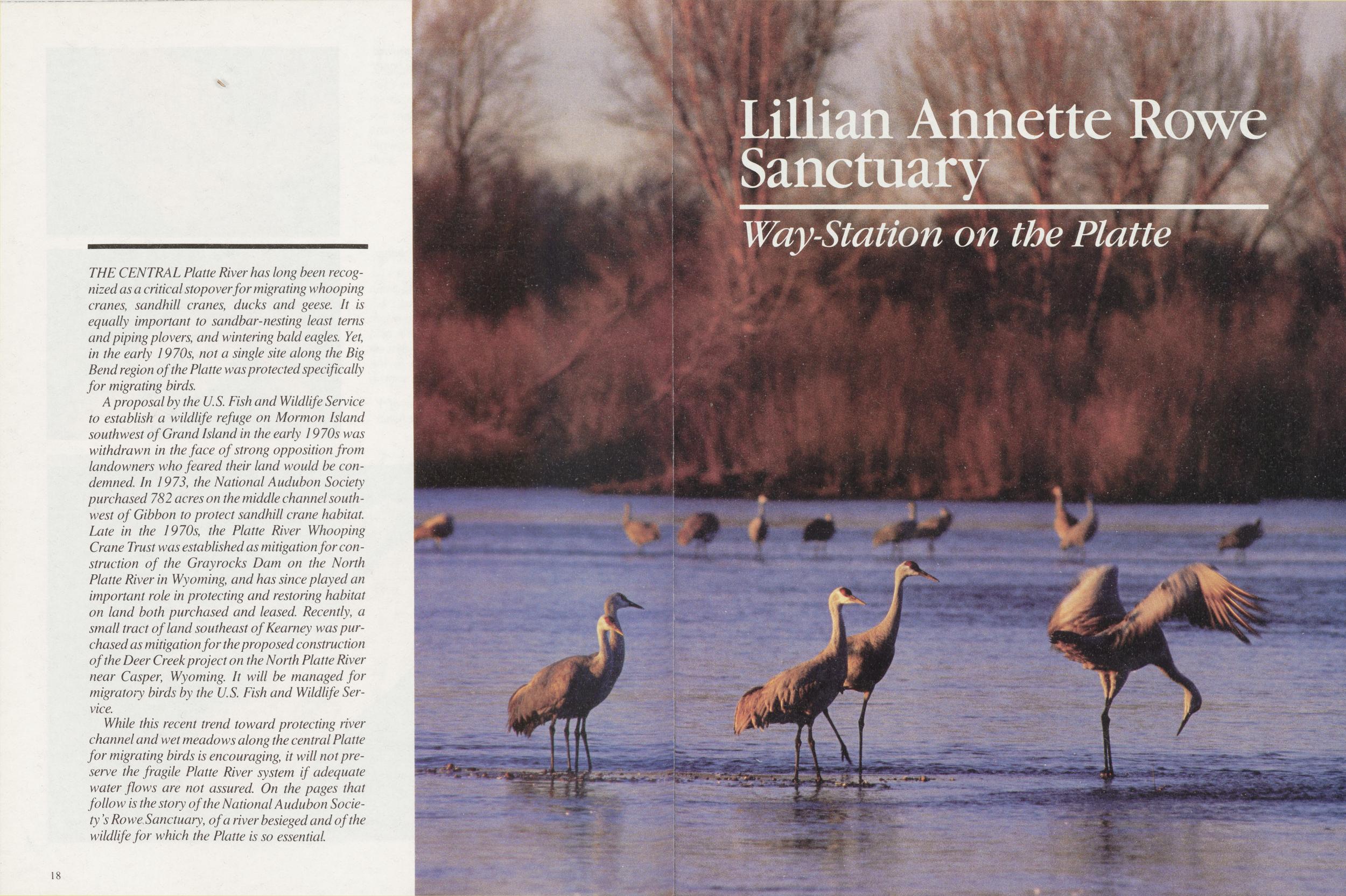
THE CENTRAL Platte River has long been recognized as a critical stopover for migrating whooping cranes, sandhill cranes, ducks and geese. It is equally important to sandbar-nesting least terns and piping plovers, and wintering bald eagles. Yet, in the early 1970s, not a single site along the Big Bend region of the Platte was protected specifically for migrating birds.
A proposal by the U.S. Fish and Wildlife Service to establish a wildlife refuge on Mormon Island southwest of Grand Island in the early 1970s was withdrawn in the face of strong opposition from landowners who feared their land would be condemned. In 1973, the National Audubon Society purchased 782 acres on the middle channel southwest of Gibbon to protect sandhill crane habitat. Late in the 1970s, the Platte River Whooping Crane Trust was established as mitigation for construction of the Grayrocks Dam on the North Platte River in Wyoming, and has since played an important role in protecting and restoring habitat on land both purchased and leased. Recently, a small tract of land southeast of Kearney was purchased as mitigation for the proposed construction of the Deer Creek project on the North Platte River near Casper, Wyoming. It will be managed for migratory birds by the U.S. Fish and Wildlife Service.
While this recent trend toward protecting river channel and wet meadows along the central Platte for migrating birds is encouraging, it will not preserve the fragile Platte River system if adequate water flows are not assured. On the pages that follow is the story of the National Audubon Society 's Rowe Sanctuary, of a river besieged and of the wildlife for which the Platte is so essential.
18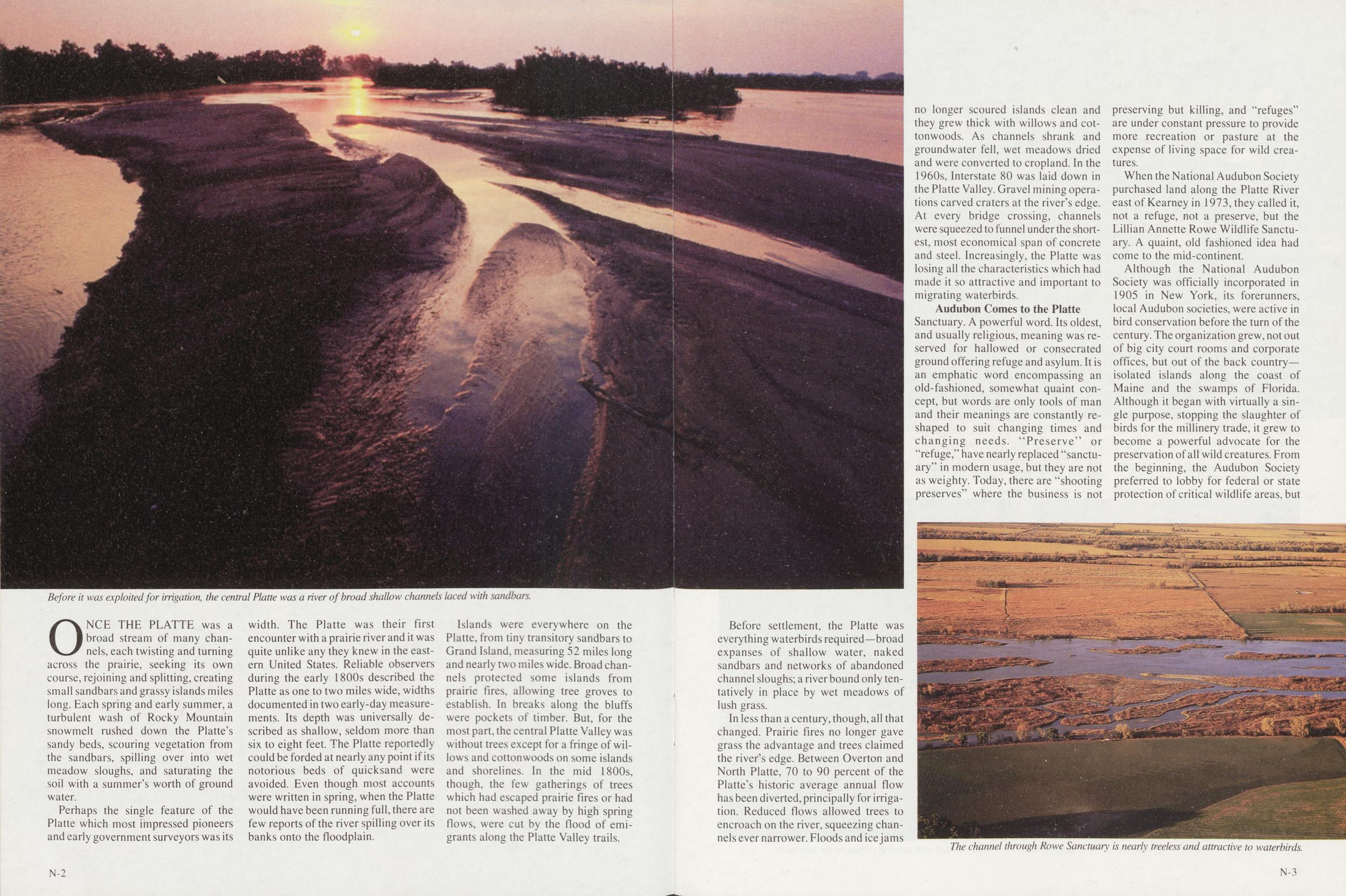
ONCE THE PLATTE was a broad stream of many channels, each twisting and turning across the prairie, seeking its own course, rejoining and splitting, creating small sandbars and grassy islands miles long. Each spring and early summer, a turbulent wash of Rocky Mountain snowmelt rushed down the Platte's sandy beds, scouring vegetation from the sandbars, spilling over into wet meadow sloughs, and saturating the soil with a summer's worth of ground water.
Perhaps the single feature of the Platte which most impressed pioneers and early government surveyors was its width. The Platte was their first encounter with a prairie river and it was quite unlike any they knew in the eastern United States. Reliable observers during the early 1800s described the Platte as one to two miles wide, widths documented in two early-day measurements. Its depth was universally de- scribed as shallow, seldom more than six to eight feet. The Platte reportedly could be forded at nearly any point if its notorious beds of quicksand were avoided. Even though most accounts were written in spring, when the Platte would have been running full, there are few reports of the river spilling over its banks onto the floodplain.
Islands were everywhere on the Platte, from tiny transitory sandbars to Grand Island, measuring 52 miles long and nearly two miles wide. Broad channels protected some islands from prairie fires, allowing tree groves to establish. In breaks along the bluffs were pockets of timber. But, for the most part, the central Platte Valley was without trees except for a fringe of willows and cottonwoods on some islands and shorelines. In the mid 1800s, though, the few gatherings of trees which had escaped prairie fires or had not been washed away by high spring flows, were cut by the flood of emigrants along the Platte Valley trails.
N-2Before settlement, the Platte was everything waterbirds required—broad expanses of shallow water, naked sandbars and networks of abandoned channel sloughs; a river bound only tentatively in place by wet meadows of lush grass.
In less than a century, though, all that changed. Prairie fires no longer gave grass the advantage and trees claimed the river's edge. Between Overton and North Platte, 70 to 90 percent of the Platte's historic average annual flow has been diverted, principally for irrigation. Reduced flows allowed trees to encroach on the river, squeezing channels ever narrower. Floods and ice jams no longer scoured islands clean and they grew thick with willows and cottonwoods. As channels shrank and groundwater fell, wet meadows dried and were converted to cropland. In the 1960s, Interstate 80 was laid down in the Platte Valley. Gravel mining operations carved craters at the river's edge. At every bridge crossing, channels were squeezed to funnel under the shortest, most economical span of concrete and steel. Increasingly, the Platte was losing all the characteristics which had made it so attractive and important to migrating waterbirds.
Audubon Comes to the PlatteSanctuary. A powerful word. Its oldest, and usually religious, meaning was reserved for hallowed or consecrated ground offering refuge and asylum. It is an emphatic word encompassing an old-fashioned, somewhat quaint concept, but words are only tools of man and their meanings are constantly reshaped to suit changing times and changing needs. 'Preserve' or "refuge," have nearly replaced "sanctuary" in modern usage, but they are not as weighty. Today, there are "shooting preserves" where the business is not preserving but killing, and "refuges" are under constant pressure to provide more recreation or pasture at the expense of living space for wild creatures.
When the National Audubon Society purchased land along the Platte River east of Kearney in 1973, they called it, not a refuge, not a preserve, but the Lillian Annette Rowe Wildlife Sanctuary. A quaint, old fashioned idea had come to the mid-continent.
Although the National Audubon Society was officially incorporated in 1905 in New York, its forerunners, local Audubon societies, were active in bird conservation before the turn of the century. The organization grew, not out of big city court rooms and corporate offices, but out of the back country—isolated islands along the coast of Maine and the swamps of Florida. Although it began with virtually a single purpose, stopping the slaughter of birds for the millinery trade, it grew to become a powerful advocate for the preservation of all wild creatures. From the beginning, the Audubon Society preferred to lobby for federal or state protection of critical wildlife areas, but when government could not acquire and protect these sites, Audubon began assembling its own system of sanctuaries.
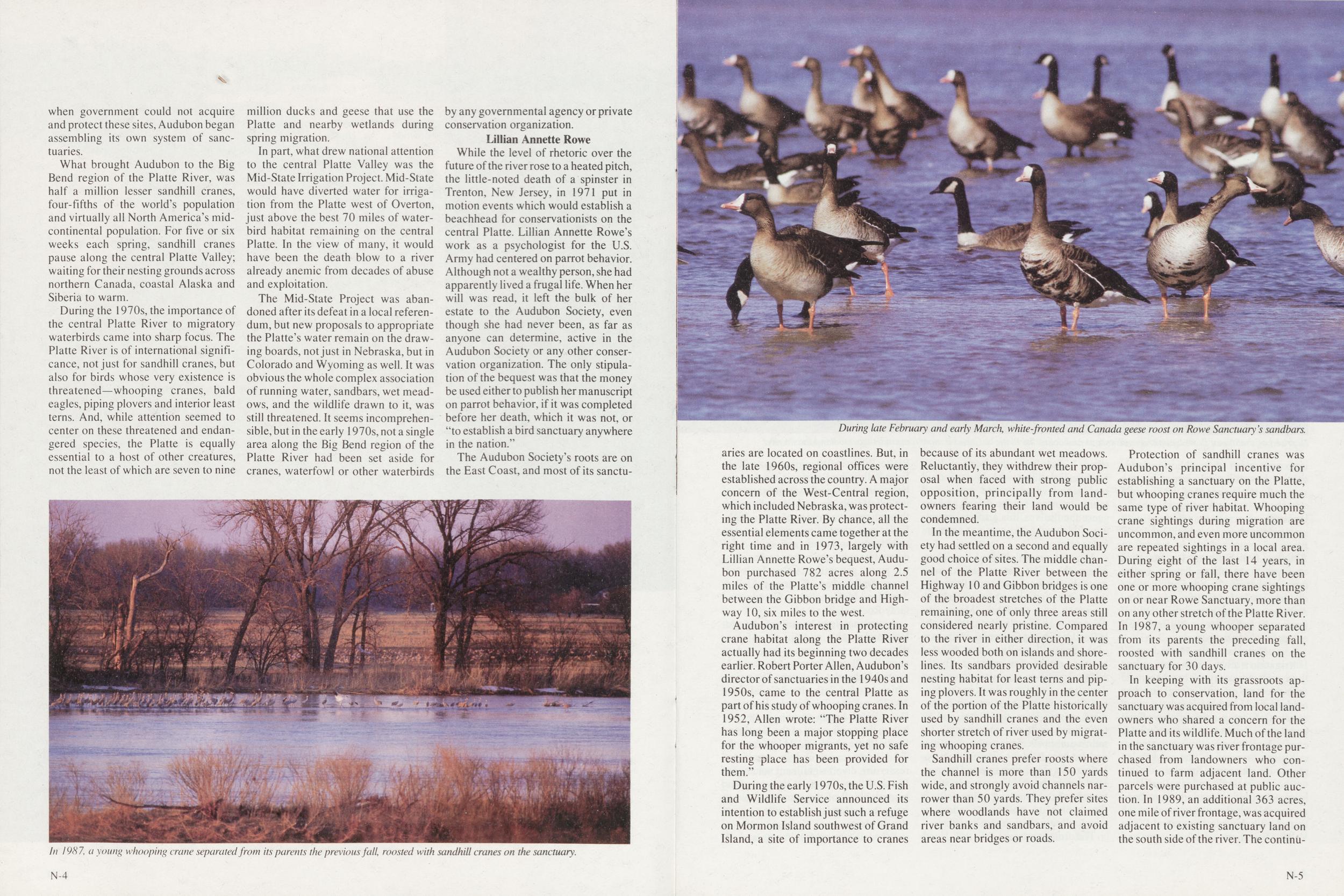
What brought Audubon to the Big Bend region of the Platte River, was half a million lesser sandhill cranes, four-fifths of the world's population and virtually all North America's mid-continental population. For five or six weeks each spring, sandhill cranes pause along the central Platte Valley; waiting for their nesting grounds across northern Canada, coastal Alaska and Siberia to warm.
During the 1970s, the importance of the central Platte River to migratory waterbirds came into sharp focus. The Platte River is of international significance, not just for sandhill cranes, but also for birds whose very existence is threatened—whooping cranes, bald eagles, piping plovers and interior least terns. And, while attention seemed to center on these threatened and endangered species, the Platte is equally essential to a host of other creatures, not the least of which are seven to nine million ducks and geese that use the Platte and nearby wetlands during spring migration.
In part, what drew national attention to the central Platte Valley was the Mid-State Irrigation Project. Mid-State would have diverted water for irrigation from the Platte west of Overton, just above the best 70 miles of waterbird habitat remaining on the central Platte. In the view of many, it would have been the death blow to a river already anemic from decades of abuse and exploitation.
The Mid-State Project was abandoned after its defeat in a local referendum, but new proposals to appropriate the Platte's water remain on the drawing boards, not just in Nebraska, but in Colorado and Wyoming as well. It was obvious the whole complex association of running water, sandbars, wet meadows, and the wildlife drawn to it, was still threatened. It seems incomprehensible, but in the early 1970s, not a single area along the Big Bend region of the Platte River had been set aside for cranes, waterfowl or other waterbirds by any governmental agency or private conservation organization.
Lillian Annette RoweWhile the level of rhetoric over the future of the river rose to a heated pitch, the little-noted death of a spinster in Trenton, New Jersey, in 1971 put in motion events which would establish a beachhead for conservationists on the central Platte. Lillian Annette Rowe's work as a psychologist for the U.S. Army had centered on parrot behavior. Although not a wealthy person, she had apparently lived a frugal life. When her will was read, it left the bulk of her estate to the Audubon Society, even though she had never been, as far as anyone can determine, active in the Audubon Society or any other conservation organization. The only stipulation of the bequest was that the money be used either to publish her manuscript on parrot behavior, if it was completed before her death, which it was not, or "to establish a bird sanctuary anywhere in the nation."
The Audubon Society's roots are on the East Coast, and most of its sanctuaries N-4 are located on coastlines. But, in the late 1960s, regional offices were established across the country. A major concern of the West-Central region, which included Nebraska, was protecting the Platte River. By chance, all the essential elements came together at the right time and in 1973, largely with Lillian Annette Rowe's bequest, Audubon purchased 782 acres along 2.5 miles of the Platte's middle channel between the Gibbon bridge and Highway 10, six miles to the west.
Audubon's interest in protecting crane habitat along the Platte River actually had its beginning two decades earlier. Robert Porter Allen, Audubon's director of sanctuaries in the 1940s and 1950s, came to the central Platte as part of his study of whooping cranes. In 1952, Allen wrote: "The Platte River has long been a major stopping place for the whooper migrants, yet no safe resting place has been provided for them."
During the early 1970s, the U.S. Fish and Wildlife Service announced its intention to establish just such a refuge on Mormon Island southwest of Grand Island, a site of importance to cranes because of its abundant wet meadows. Reluctantly, they withdrew their proposal when faced with strong public opposition, principally from landowners fearing their land would be condemned.
In the meantime, the Audubon Society had settled on a second and equally good choice of sites. The middle channel of the Platte River between the Highway 10 and Gibbon bridges is one of the broadest stretches of the Platte remaining, one of only three areas still considered nearly pristine. Compared to the river in either direction, it was less wooded both on islands and shorelines. Its sandbars provided desirable nesting habitat for least terns and piping plovers. It was roughly in the center of the portion of the Platte historically used by sandhill cranes and the even shorter stretch of river used by migrating whooping cranes.
Sandhill cranes prefer roosts where the channel is more than 150 yards wide, and strongly avoid channels narrower than 50 yards. They prefer sites where woodlands have not claimed river banks and sandbars, and avoid areas near bridges or roads.
Protection of sandhill cranes was Audubon's principal incentive for establishing a sanctuary on the Platte, but whooping cranes require much the same type of river habitat. Whooping crane sightings during migration are uncommon, and even more uncommon are repeated sightings in a local area. During eight of the last 14 years, in either spring or fall, there have been one or more whooping crane sightings on or near Rowe Sanctuary, more than on any other stretch of the Platte River. In 1987, a young whooper separated from its parents the preceding fall, roosted with sandhill cranes on the sanctuary for 30 days.
In keeping with its grassroots approach to conservation, land for the sanctuary was acquired from local landowners who shared a concern for the Platte and its wildlife. Much of the land in the sanctuary was river frontage purchased from landowners who continued to farm adjacent land. Other parcels were purchased at public auction. In 1989, an additional 363 acres, one mile of river frontage, was acquired adjacent to existing sanctuary land on the south side of the river. The continuing cooperation of neighboring landowners has effectively expanded the size and attractiveness of the six-mile stretch of river to migrating waterbirds. Under a cooperative agreement with several neighbors, an additional 1,200 acres of private land is leased to Audubon from February 1 to May 1 of each year for a token payment. Under this agreement, landowners prevent disturbance of wildlife and allow Audubon staff to patrol their land if necessary, but it does not affect their normal farming activities.
N-5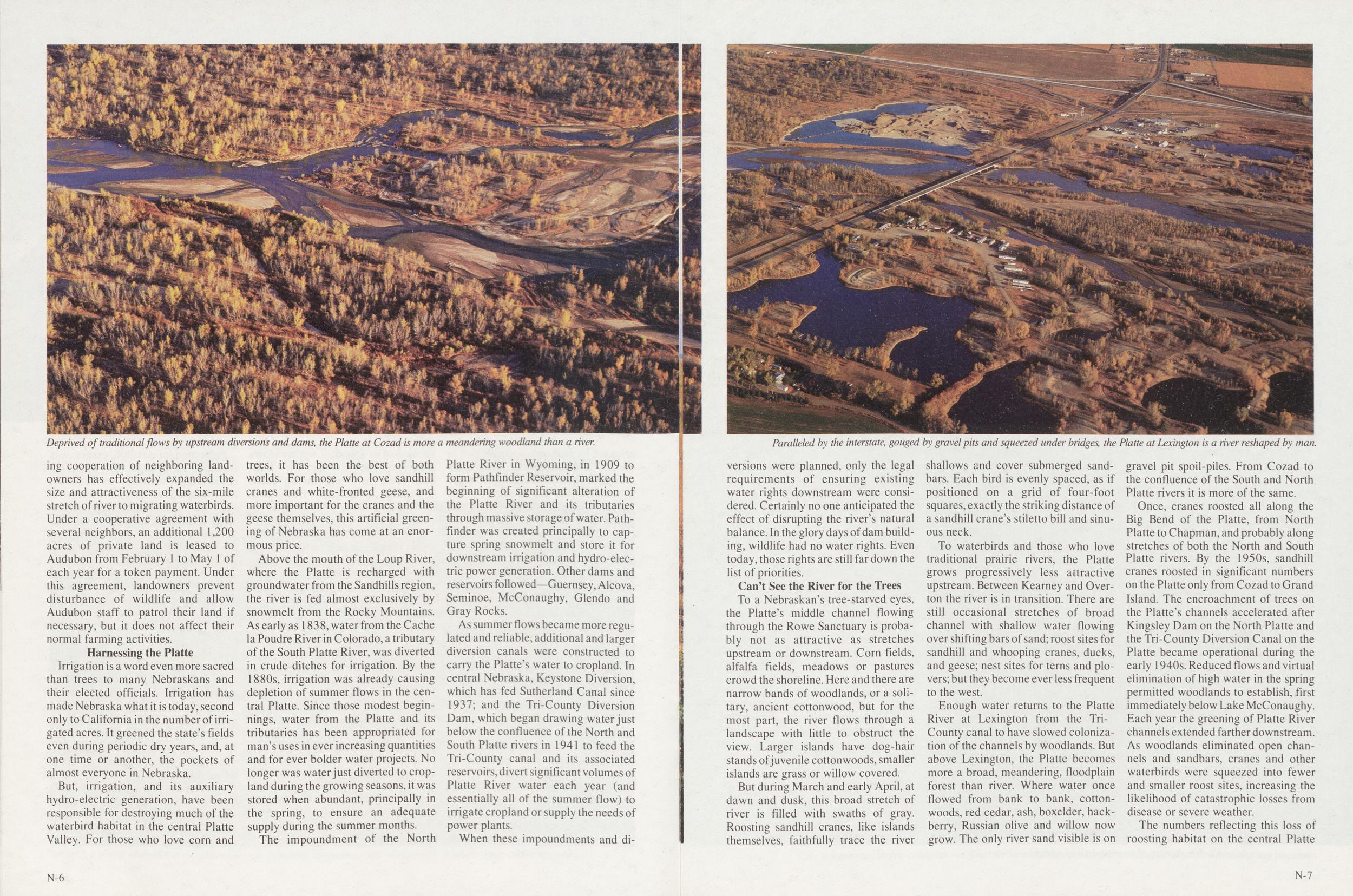
Irrigation is a word even more sacred than trees to many Nebraskans and their elected officials. Irrigation has made Nebraska what it is today, second only to California in the number of irrigated acres. It greened the state's fields even during periodic dry years, and, at one time or another, the pockets of almost everyone in Nebraska.
But, irrigation, and its auxiliary hydro-electric generation, have been responsible for destroying much of the waterbird habitat in the central Platte Valley. For those who love corn and trees, it has been the best of both worlds. For those who love sandhill cranes and white-fronted geese, and more important for the cranes and the geese themselves, this artificial greening of Nebraska has come at an enormous price.
Above the mouth of the Loup River, where the Platte is recharged with groundwater from the Sandhills region, the river is fed almost exclusively by snowmelt from the Rocky Mountains. As early as 18 3 8, water from the C ache la Poudre River in Colorado, a tributary of the South Platte River, was diverted in crude ditches for irrigation. By the 1880s, irrigation was already causing depletion of summer flows in the central Platte. Since those modest beginnings, water from the Platte and its tributaries has been appropriated for man's uses in ever increasing quantities and for ever bolder water projects. No longer was water just diverted to cropland during the growing seasons, it was stored when abundant, principally in the spring, to ensure an adequate supply during the summer months.
The impoundment of the North Platte River in Wyoming, in 1909 to form Pathfinder Reservoir, marked the beginning of significant alteration of the Platte River and its tributaries through massive storage of water. Pathfinder was created principally to capture spring snowmelt and store it for downstream irrigation and hydro-electric power generation. Other dams and reservoirs followed—Guernsey, Alcova, Seminoe, McConaughy, Glendo and Gray Rocks.
As summer flows became more regulated and reliable, additional and larger diversion canals were constructed to carry the Platte's water to cropland. In central Nebraska, Keystone Diversion, which has fed Sutherland Canal since 1937; and the Tri-County Diversion Dam, which began drawing water just below the confluence of the North and South Platte rivers in 1941 to feed the Tri-County canal and its associated reservoirs, divert significant volumes of Platte River water each year (and essentially all of the summer flow) to irrigate cropland or supply the needs of power plants.
When these impoundments and di N-6
To a Nebraskan's tree-starved eyes, the Platte's middle channel flowing through the Rowe Sanctuary is probably not as attractive as stretches upstream or downstream. Corn fields, alfalfa fields, meadows or pastures crowd the shoreline. Here and there are narrow bands of woodlands, or a solitary, ancient cottonwood, but for the most part, the river flows through a landscape with little to obstruct the view. Larger islands have dog-hair stands of juvenile cottonwoods, smaller islands are grass or willow covered.
But during March and early April, at dawn and dusk, this broad stretch of river is filled with swaths of gray. Roosting sandhill cranes, like islands themselves, faithfully trace the river shallows and cover submerged sandbars. Each bird is evenly spaced, as if positioned on a grid of four-foot squares, exactly the striking distance of a sandhill crane's stiletto bill and sinuous neck.
To waterbirds and those who love traditional prairie rivers, the Platte grows progressively less attractive upstream. Between Kearney and Overton the river is in transition. There are still occasional stretches of broad channel with shallow water flowing over shifting bars of sand; roost sites for sandhill and whooping cranes, ducks, and geese; nest sites for terns and plovers; but they become ever less frequent to the west.
Enough water returns to the Platte River at Lexington from the Tri-County canal to have slowed colonization of the channels by woodlands. But above Lexington, the Platte becomes more a broad, meandering, floodplain forest than river. Where water once flowed from bank to bank, cottonwoods, red cedar, ash, boxelder, hackberry, Russian olive and willow now grow. The only river sand visible is on gravel pit spoil-piles. From Cozad to the confluence of the South and North Platte rivers it is more of the same.
Once, cranes roosted all along the Big Bend of the Platte, from North Platte to Chapman, and probably along stretches of both the North and South Platte rivers. By the 1950s, sandhill cranes roosted in significant numbers on the Platte only from Cozad to Grand Island. The encroachment of trees on the Platte's channels accelerated after Kingsley Dam on the North Platte and the Tri-County Diversion Canal on the Platte became operational during the early 1940s. Reduced flows and virtual elimination of high water in the spring permitted woodlands to establish, first immediately below Lake McConaughy. Each year the greening of Platte River channels extended farther downstream. As woodlands eliminated open channels and sandbars, cranes and other waterbirds were squeezed into fewer and smaller roost sites, increasing the likelihood of catastrophic losses from disease or severe weather.
The numbers reflecting this loss of
roosting habitat on the central Platte
N-7
 are startling. Above the Platte's confluence with the Loup River, 70 to 90
percent of the Platte's annual flows
have been diverted for various consumptive uses. Channel width in many
areas has been reduced to 10 or 20
percent of its former size. Two-thirds of
the original roosting areas between
Kingsley Dam and Grand Island have
been lost. Only about 80 miles of river
now provide suitable crane habitat.
Today, sandhill crane roosts are found
only at four general staging areas—Grand Island to Kearney, Elm Creek to
Overton, North Platte to Sutherland
and a small area at Lewellen.
are startling. Above the Platte's confluence with the Loup River, 70 to 90
percent of the Platte's annual flows
have been diverted for various consumptive uses. Channel width in many
areas has been reduced to 10 or 20
percent of its former size. Two-thirds of
the original roosting areas between
Kingsley Dam and Grand Island have
been lost. Only about 80 miles of river
now provide suitable crane habitat.
Today, sandhill crane roosts are found
only at four general staging areas—Grand Island to Kearney, Elm Creek to
Overton, North Platte to Sutherland
and a small area at Lewellen.
Alteration of the Platte's historical flow regime, the timing ofhigh and low flows, has had a significant influence on the degradation of waterbird habitat.Blue-eyed grass flowers before the rush of prairie robs it of sunlight. Impounding traditional late-spring high flows behind dams for release during the summer irrigation season, en- courages the establishment of woody vegetation. This is the time cottonwoods and willows release their seeds. Survival of seeds and establishment of seedlings were poor when high spring flows either submerged or scoured sandbars. Today, the blizzard of Cottonwood and willow seeds falls on sites conducive to germination.
Alteration of the Platte's flow regime also has direct, adverse effects on birds nesting on bare or nearly bare sandbars. In pre-impoundment times, least terns and piping plovers typically initiated nesting after high spring flows began to ebb, exposing new sandbars surrounded by water. Since the heavy use of the Platte for irrigation, water flows have become erratic, and unnatural discharges during the tern and plover nesting season more common. Unusually late high flows wash away nests and eggs, and unusually low flows allow terrestrial predators access to sandbars.
Vanishing GrasslandsAs surely as time can be measured by the movement of stars, the growing season can be clocked by the comings and goings of wild creatures and the flowering of prairie.
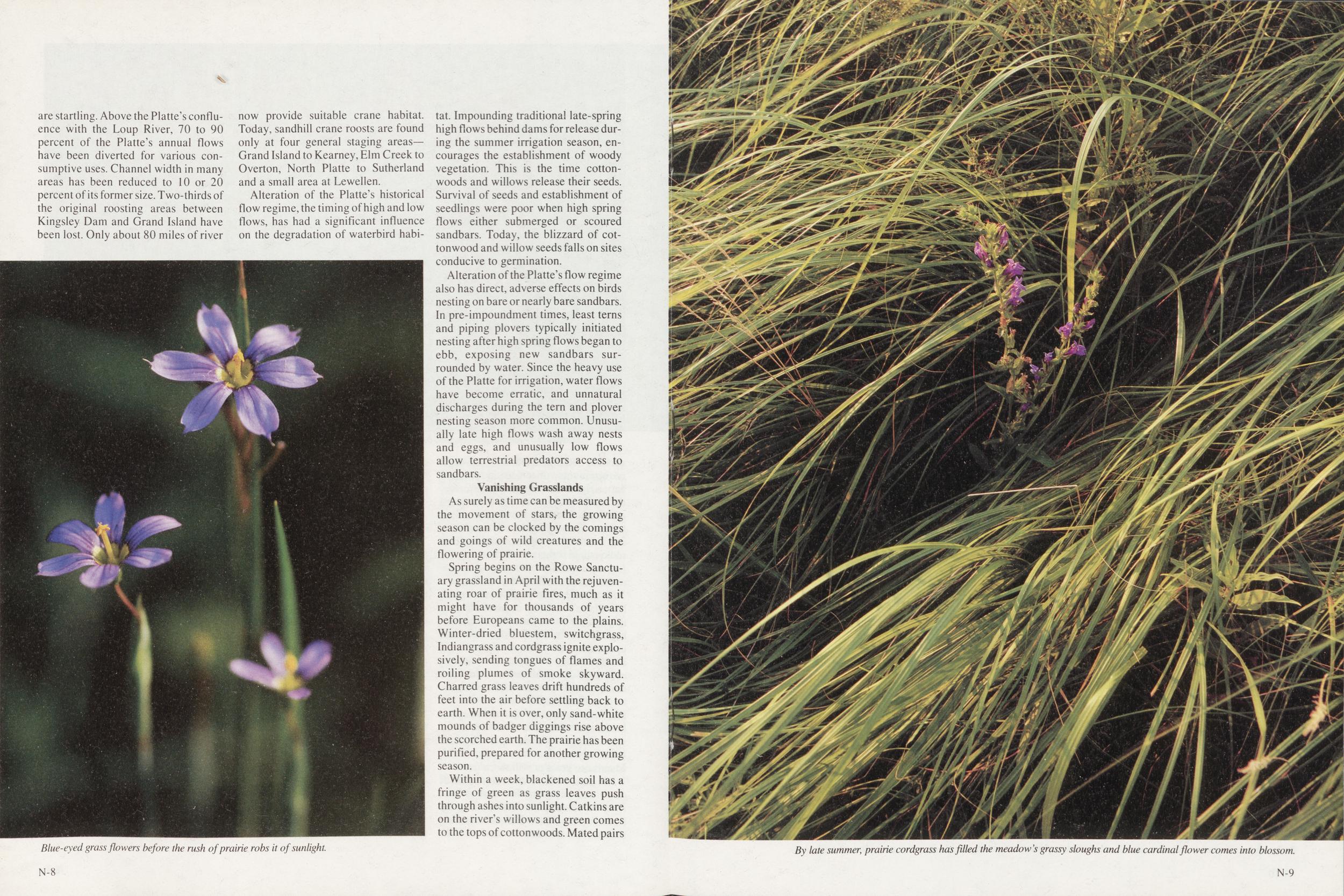
Spring begins on the Rowe Sanctuary grassland in April with the rejuvenating roar of prairie fires, much as it might have for thousands of years before Europeans came to the plains. Winter-dried bluestem, switchgrass, Indiangrass and cordgrass ignite explosively, sending tongues of flames and roiling plumes of smoke skyward. Charred grass leaves drift hundreds of feet into the air before settling back to earth. When it is over, only sand-white mounds of badger diggings rise above the scorched earth. The prairie has been purified, prepared for another growing season.
Within a week, blackened soil has a fringe of green as grass leaves push through ashes into sunlight. Catkins are on the river's willows and green comes to the tops of cotton woods. Mated pairs N-8
 of Canada geese and mallards are
already building nests on river islands.
Plum flowers wither and fall, blanketing the ground in grassless thickets.
Early wildflowers bloom, the lavender
of spiderwort, pinks and whites of wild
onion, and the deep blue of blue-eyed
grass. Hidden at the feet of switchgrass
and Indiangrass are white cups of meadow anemone.
of Canada geese and mallards are
already building nests on river islands.
Plum flowers wither and fall, blanketing the ground in grassless thickets.
Early wildflowers bloom, the lavender
of spiderwort, pinks and whites of wild
onion, and the deep blue of blue-eyed
grass. Hidden at the feet of switchgrass
and Indiangrass are white cups of meadow anemone.
By June the meadow is awash with color—swamp milkweed marks the wet soils of old prairie sloughs; common and showy milkweed grow side by side, eastern meeting western; poppymallow on vine-like stems crawl to sunlight in dense stands of grass; Illinois bundleflower, daisy fleabane, prairie clovers, coneflowers, wild rose, skullcaps, black-eyed Susan, prairie dogbane, native loosestrifes and more and more and more.
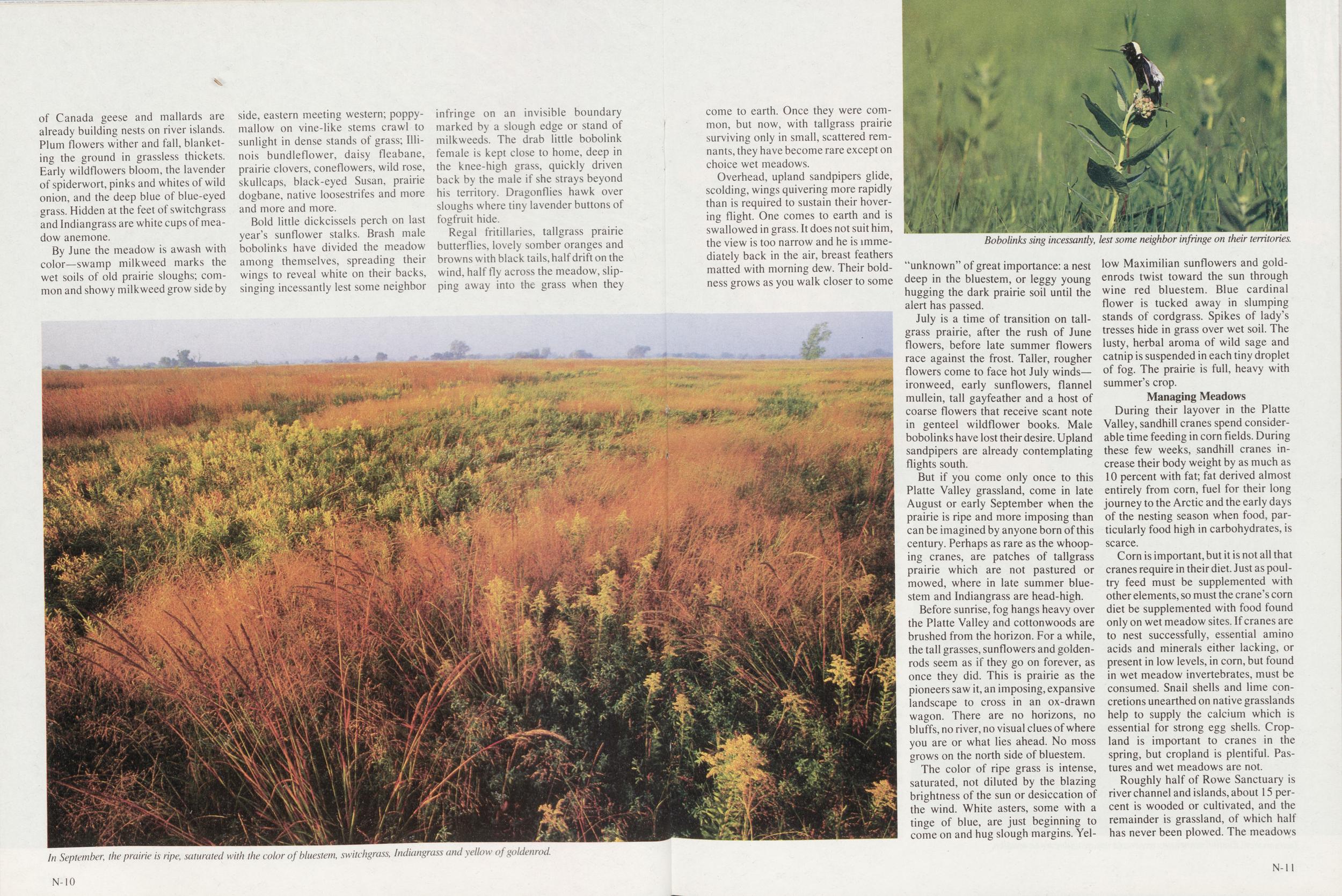
Bold little dickcissels perch on last year's sunflower stalks. Brash male bobolinks have divided the meadow among themselves, spreading their wings to reveal white on their backs, singing incessantly lest some neighbor infringe on an invisible boundary marked by a slough edge or stand of milkweeds. The drab little bobolink female is kept close to home, deep in the knee-high grass, quickly driven back by the male if she strays beyond his territory. Dragonflies hawk over sloughs where tiny lavender buttons of fogfruit hide.
Regal fritillaries, tallgrass prairie butterflies, lovely somber oranges and browns with black tails, half drift on the wind, half fly across the meadow, slipping away into the grass when they
Overhead, upland sandpipers glide, scolding, wings quivering more rapidly than is required to sustain their hovering flight. One comes to earth and is swallowed in grass. It does not suit him, the view is too narrow and he is immediately back in the air, breast feathers matted with morning dew. Their boldness grows as you walk closer to some "unknown" of great importance: a nest deep in the bluestem, or leggy young hugging the dark prairie soil until the alert has passed.
July is a time of transition on tailgrass prairie, after the rush of June flowers, before late summer flowers race against the frost. Taller, rougher flowers come to face hot July winds ironweed, early sunflowers, flannel mullein, tall gayfeather and a host of coarse flowers that receive scant note in genteel wildflower books. Male bobolinks have lost their desire. Upland sandpipers are already contemplating flights south.
But if you come only once to this Platte Valley grassland, come in late August or early September when the prairie is ripe and more imposing than can be imagined by anyone born of this century. Perhaps as rare as the whooping cranes, are patches of tallgrass prairie which are not pastured or mowed, where in late summer bluestem and Indiangrass are head-high.
Before sunrise, fog hangs heavy over the Platte Valley and cottonwoods are brushed from the horizon. For a while, the tall grasses, sunflowers and goldenrods seem as if they go on forever, as once they did. This is prairie as the pioneers saw it, an imposing, expansive landscape to cross in an ox-drawn wagon. There are no horizons, no bluffs, no river, no visual clues of where you are or what lies ahead. No moss grows on the north side of bluestem.
The color of ripe grass is intense, saturated, not diluted by the blazing brightness of the sun or desiccation of the wind. White asters, some with a tinge of blue, are just beginning to come on and hug slough margins. Yellow Maximilian sunflowers and goldenrods twist toward the sun through wine red bluestem. Blue cardinal flower is tucked away in slumping stands of cordgrass. Spikes of lady's tresses hide in grass over wet soil. The lusty, herbal aroma of wild sage and catnip is suspended in each tiny droplet of fog. The prairie is full, heavy with summer's crop.
Managing MeadowsDuring their layover in the Platte Valley, sandhill cranes spend considerable time feeding in corn fields. During these few weeks, sandhill cranes increase their body weight by as much as 10 percent with fat; fat derived almost entirely from corn, fuel for their long journey to the Arctic and the early days of the nesting season when food, particularly food high in carbohydrates, is scarce.
Corn is important, but it is not all that cranes require in their diet. Just as poultry feed must be supplemented with other elements, so must the crane's corn diet be supplemented with food found only on wet meadow sites. If cranes are to nest successfully, essential amino acids and minerals either lacking, or present in low levels, in corn, but found in wet meadow invertebrates, must be consumed. Snail shells and lime concretions unearthed on native grasslands help to supply the calcium which is essential for strong egg shells. Cropland is important to cranes in the spring, but cropland is plentiful. Pastures and wet meadows are not.
Roughly half of Rowe Sanctuary is
river channel and islands, about 15 percent is wooded or cultivated, and the
remainder is grassland, of which half
has never been plowed. The meadows
N-11
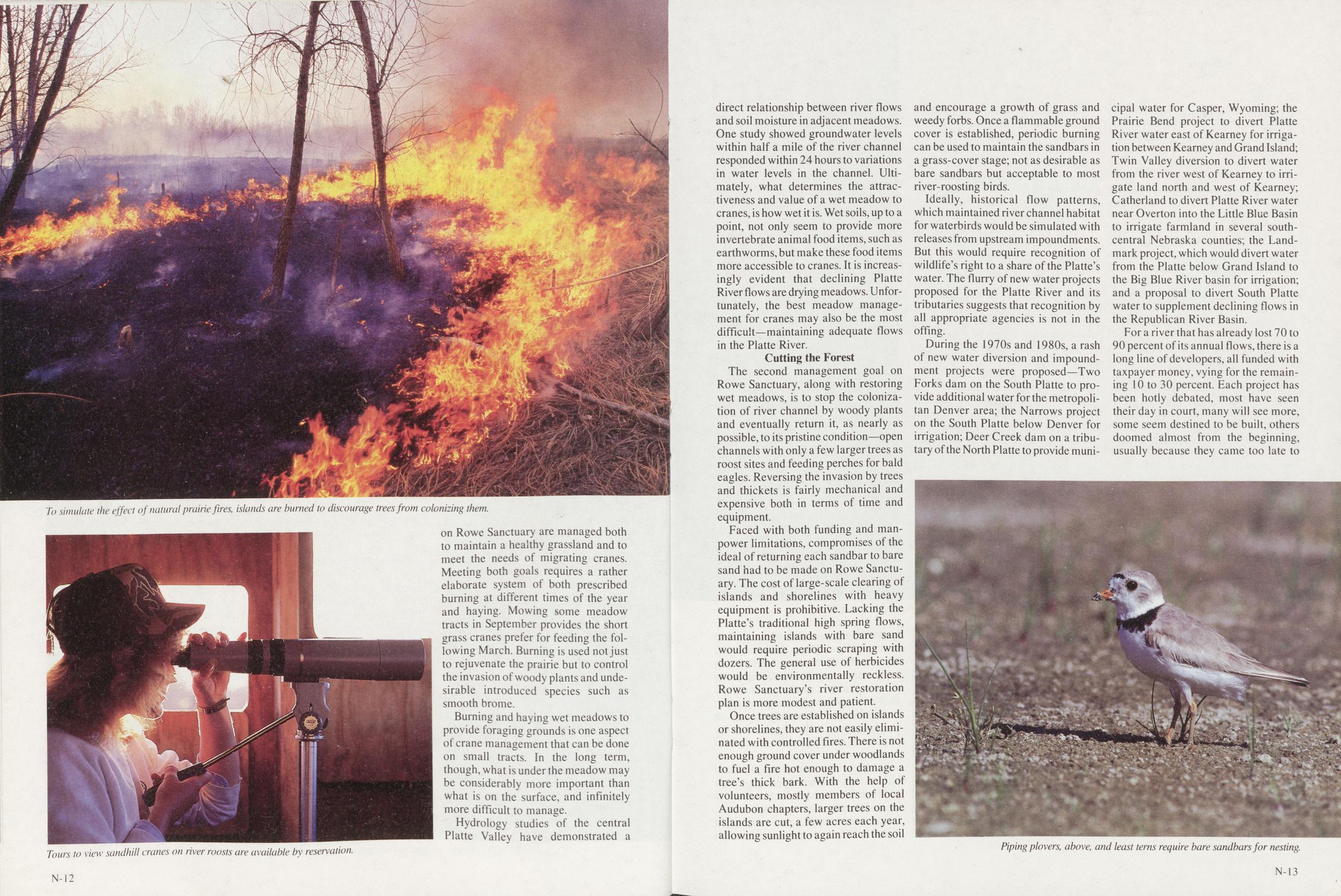
Burning and haying wet meadows to provide foraging grounds is one aspect of crane management that can be done on small tracts. In the long term, though, what is under the meadow may be considerably more important than what is on the surface, and infinitely more difficult to manage.
Hydrology studies of the central Platte Valley have demonstrated a N-12 direct relationship between river flows and soil moisture in adjacent meadows. One study showed groundwater levels within half a mile of the river channel responded within 24 hours to variations in water levels in the channel. Ultimately, what determines the attractiveness and value of a wet meadow to cranes, is how wet it is. Wet soils, up to a point, not only seem to provide more invertebrate animal food items, such as earthworms, but make these food items more accessible to cranes. It is increasingly evident that declining Platte River flows are drying meadows. Unfortunately, the best meadow management for cranes may also be the most difficult—maintaining adequate flows in the Platte River.
Cutting the ForestThe second management goal on Rowe Sanctuary, along with restoring wet meadows, is to stop the colonization of river channel by woody plants and eventually return it, as nearly as possible, to its pristine condition—open channels with only a few larger trees as roost sites and feeding perches for bald eagles. Reversing the invasion by trees and thickets is fairly mechanical and expensive both in terms of time and equipment.
Faced with both funding and manpower limitations, compromises of the ideal of returning each sandbar to bare sand had to be made on Rowe Sanctuary. The cost of large-scale clearing of islands and shorelines with heavy equipment is prohibitive. Lacking the Platte's traditional high spring flows, maintaining islands with bare sand would require periodic scraping with dozers. The general use of herbicides would be environmentally reckless. Rowe Sanctuary's river restoration plan is more modest and patient.
Once trees are established on islands or shorelines, they are not easily eliminated with controlled fires. There is not enough ground cover under woodlands to fuel a fire hot enough to damage a tree's thick bark. With the help of volunteers, mostly members of local Audubon chapters, larger trees on the islands are cut, a few acres each year, allowing sunlight to again reach the soil and encourage a growth of grass and weedy forbs. Once a flammable ground cover is established, periodic burning can be used to maintain the sandbars in a grass-cover stage; not as desirable as bare sandbars but acceptable to most river-roosting birds.
Ideally, historical flow patterns, which maintained river channel habitat for waterbirds would be simulated with releases from upstream impoundments. But this would require recognition of wildlife's right to a share of the Platte's water. The flurry of new water projects proposed for the Platte River and its tributaries suggests that recognition by all appropriate agencies is not in the offing.
During the 1970s and 1980s, a rash of new water diversion and impoundment projects were proposed—Two Forks dam on the South Platte to provide additional water for the metropolitan Denver area; the Narrows project on the South Platte below Denver for irrigation; Deer Creek dam on a tributary of the North Platte to provide municipal water for Casper, Wyoming; the Prairie Bend project to divert Platte River water east of Kearney for irrigation between Kearney and Grand Island; Twin Valley diversion to divert water from the river west of Kearney to irrigate land north and west of Kearney; Catherland to divert Platte River water near Overton into the Little Blue Basin to irrigate farmland in several southcentral Nebraska counties; the Land- mark project, which would divert water from the Platte below Grand Island to the Big Blue River basin for irrigation; and a proposal to divert South Platte water to supplement declining flows in the Republican River Basin.
For a river that has already lost 70 to 90 percent of its annual flows, there is a long line of developers, all funded with taxpayer money, vying for the remaining 10 to 30 percent. Each project has been hotly debated, most have seen their day in court, many will see more, some seem destined to be built, others doomed almost from the beginning, usually because they came too late to
 get in the competition. Regardless of
the outcome of any individual project,
others are sure to follow until either the
Platte is no more than a ditch carrying
water released from reservoirs for
downstream irrigators, or until there
are comprehensive, guaranteed instream
flows at appropriate times of the year to
benefit wildlife which, in the minds of
many, hold the original water rights on
the Platte River and its tributaries. Hard
decisions must be made. Additional
withdrawals from the Platte will make
the choices increasingly simple—will
we use the river's water for more bluegrass lawns, cranes at Gibbon, municipal drinking
water, or to grow ever
more corn.
A River for People and Cranes
get in the competition. Regardless of
the outcome of any individual project,
others are sure to follow until either the
Platte is no more than a ditch carrying
water released from reservoirs for
downstream irrigators, or until there
are comprehensive, guaranteed instream
flows at appropriate times of the year to
benefit wildlife which, in the minds of
many, hold the original water rights on
the Platte River and its tributaries. Hard
decisions must be made. Additional
withdrawals from the Platte will make
the choices increasingly simple—will
we use the river's water for more bluegrass lawns, cranes at Gibbon, municipal drinking
water, or to grow ever
more corn.
A River for People and Cranes
The National Audubon Society built on a foundation of local chapters, local people. That tradition continues in Nebraska. During its early years, Rowe Sanctuary had no full-time manager. Neighbors kept an eye on the sanctuary and even patrolled it to prevent disturbance of the wildlife. Basic research and management recommendations were done by the Kearney State College Biology Department. Prescribed burns on the meadows and cutting of woody plants to slow their invasion of the river was, and is, done mostly with volunteer help from Nebraska Audubon chapters. From the beginning, Rowe Sanctuary has been an example of local people working to preserve a resource they treasure.
The guiding principle of all Audubon sanctuaries is that wildlife comes first. Sanctuaries were established first and foremost for the protection of wild creatures. Except by special permission, the entire sanctuary is closed to public access. But Audubon recognizes that to protect what remains of the Platte River environment, there must be public support, appreciation, and an awareness of what is threatened. Because of that understanding, public access to view the Platte's wildlife is made available on Rowe Sanctuary when it does not disturb the wildlife or damage the environment.
The Mark Bolin Nature Trail, commemorating the efforts of a local landowner who led farmers in the fight to defeat the Mid-State Project and who was active in prairie preservation, meanders through 200 acres of wet meadow grassland. It is open to the public on an experimental basis throughout the summer months.
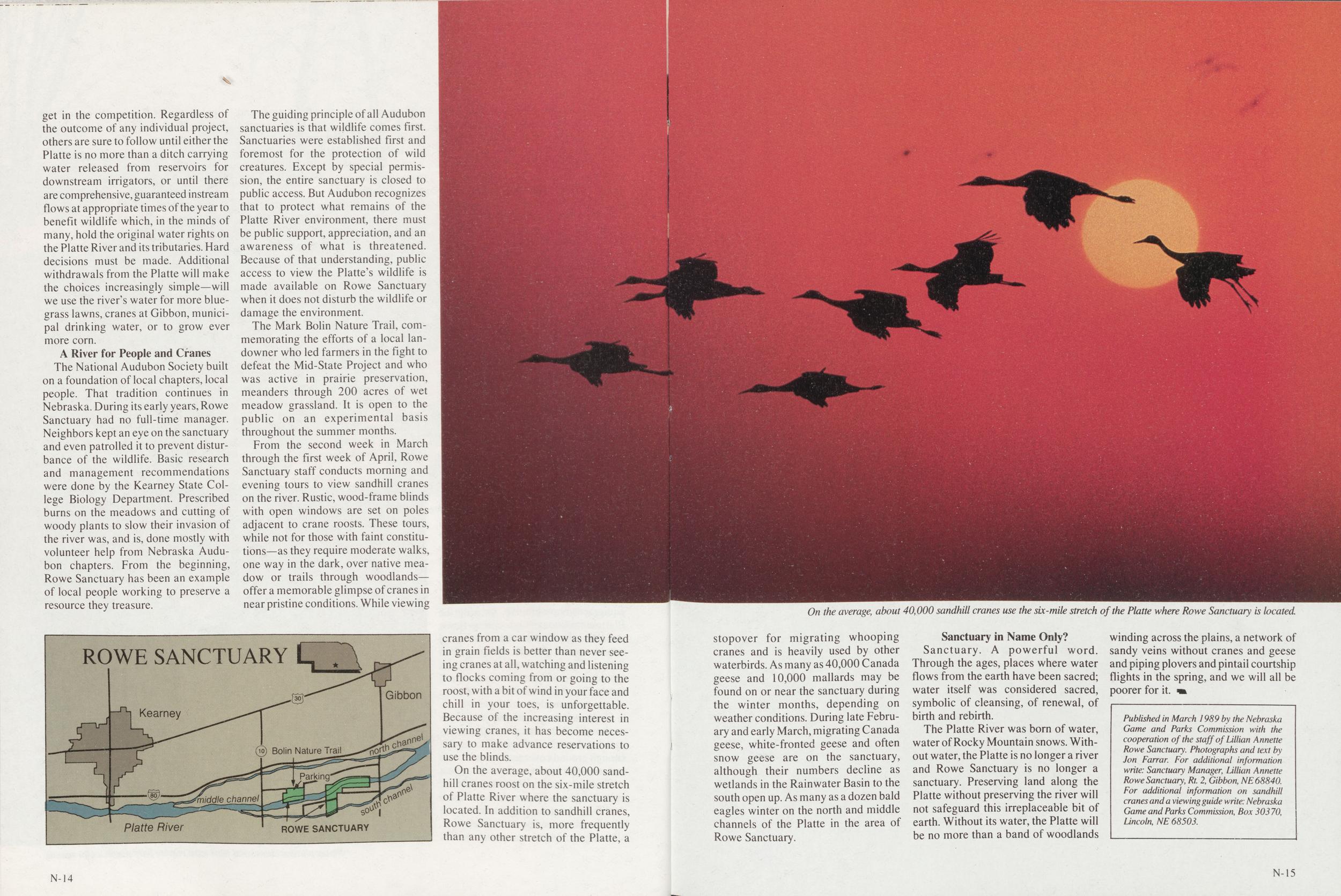
From the second week in March through the first week of April, Rowe Sanctuary staff conducts morning and evening tours to view sandhill cranes on the river. Rustic, wood-frame blinds with open windows are set on poles adjacent to crane roosts. These tours, while not for those with faint constitutions—as they require moderate walks, one way in the dark, over native meadow or trails through woodlands— offer a memorable glimpse of cranes in near pristine conditions. While viewing cranes from a car window as they feed in grain fields is better than never seeing cranes at all, watching and listening to flocks coming from or going to the roost, with a bit of wind in your face and chill in your toes, is unforgettable. Because of the increasing interest in viewing cranes, it has become necessary to make advance reservations to use the blinds.
On the average, about 40,000 sandhill cranes roost on the six-mile stretch of Platte River where the sanctuary is located. In addition to sandhill cranes, Rowe Sanctuary is, more frequently than any other stretch of the Platte, a N-14
Sanctuary. A powerful word. Through the ages, places where water flows from the earth have been sacred; water itself was considered sacred, symbolic of cleansing, of renewal, of birth and rebirth.
The Platte River was born of water, water of Rocky Mountain snows. Without water, the Platte is no longer a river and Rowe Sanctuary is no longer a sanctuary. Preserving land along the Platte without preserving the river will not safeguard this irreplaceable bit of earth. Without its water, the Platte will be no more than a band of woodlands winding across the plains, a network of sandy veins without cranes and geese and piping plovers and pintail courtship flights in the spring, and we will all be poorer for it. m
Published in March 1989 by the Nebraska Game and Parks Commission with the cooperation of the staff of Lillian Annette Rowe Sanctuary. Photographs and text by Jon Farrar. For additional information write: Sanctuary Manager, Lillian Annette Rowe Sanctuary, Rt. 2, Gibbon, NE 68840. For additional information on sandhill cranes and a viewing guide write: Nebraska Game and Parks Commission, Box 303 70, Lincoln, NE 68503. N-15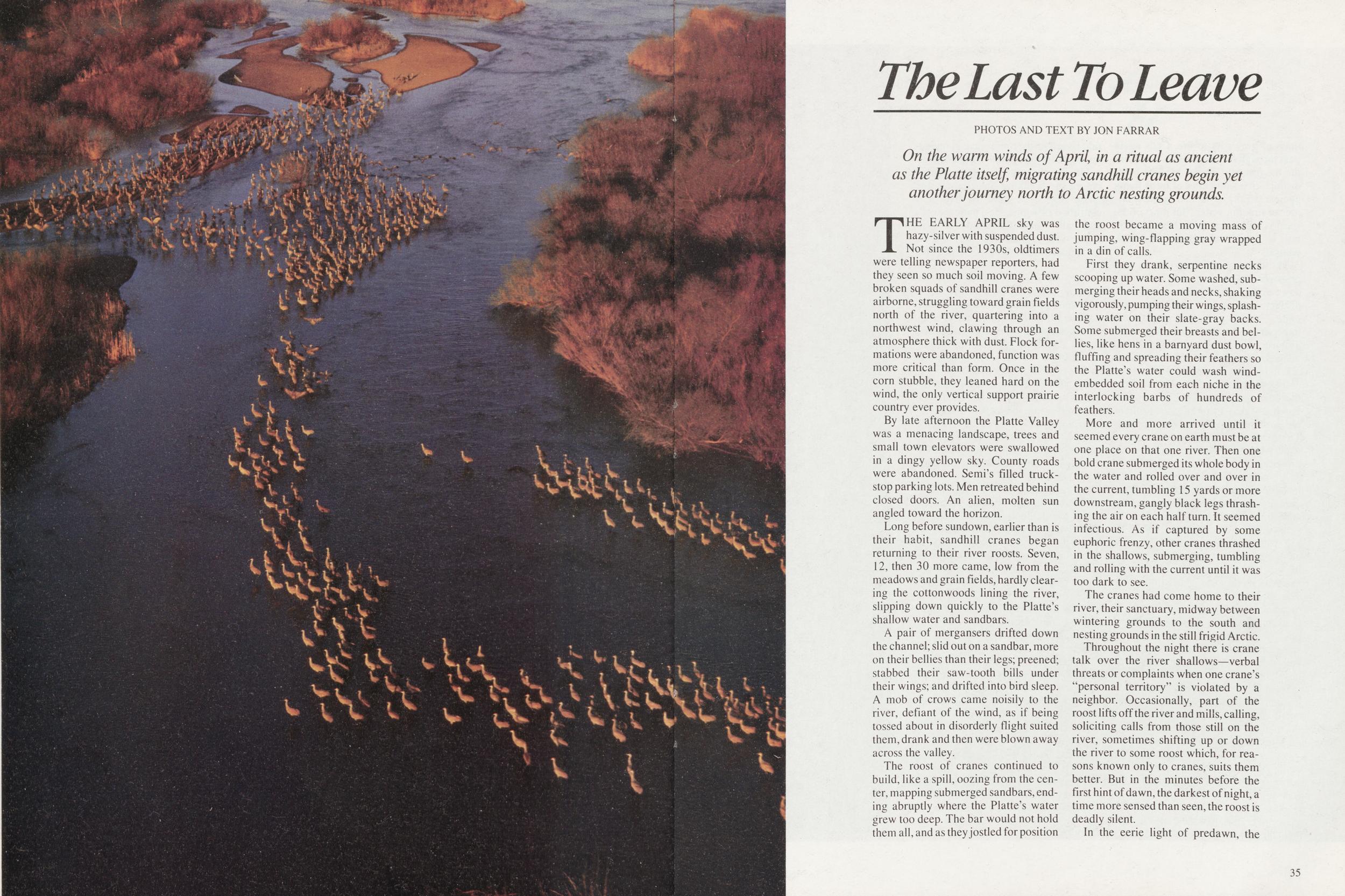
The Last To Leave
PHOTOS AND TEXT BY JON FARRAR On the warm winds of April, in a ritual as ancient as the Platte itself migrating sandhill cranes begin yet another journey north to Arctic nesting grounds.THE EARLY APRIL sky was hazy-silver with suspended dust. Not since the 1930s, oldtimers were telling newspaper reporters, had they seen so much soil moving. A few broken squads of sandhill cranes were airborne, struggling toward grain fields north of the river, quartering into a northwest wind, clawing through an atmosphere thick with dust. Flock formations were abandoned, function was more critical than form. Once in the corn stubble, they leaned hard on the wind, the only vertical support prairie country ever provides.
By late afternoon the Platte Valley was a menacing landscape, trees and small town elevators were swallowed in a dingy yellow sky. County roads were abandoned. Semi's filled truckstop parking lots. Men retreated behind closed doors. An alien, molten sun angled toward the horizon.
Long before sundown, earlier than is their habit, sandhill cranes began returning to their river roosts. Seven, 12, then 30 more came, low from the meadows and grain fields, hardly clearing the cottonwoods lining the river, slipping down quickly to the Platte's shallow water and sandbars.
A pair of mergansers drifted down the channel; slid out on a sandbar, more on their bellies than their legs; preened; stabbed their saw-tooth bills under their wings; and drifted into bird sleep. A mob of crows came noisily to the river, defiant of the wind, as if being tossed about in disorderly flight suited them, drank and then were blown away across the valley.
The roost of cranes continued to build, like a spill, oozing from the center, mapping submerged sandbars, end- ing abruptly where the Platte's water grew too deep. The bar would not hold them all, and as they jostled for position the roost became a moving mass of jumping, wing-flapping gray wrapped in a din of calls.
First they drank, serpentine necks scooping up water. Some washed, submerging their heads and necks, shaking vigorously, pumping their wings, splashing water on their slate-gray backs. Some submerged their breasts and bellies, like hens in a barnyard dust bowl, fluffing and spreading their feathers so the Platte's water could wash wind-embedded soil from each niche in the interlocking barbs of hundreds of feathers.
More and more arrived until it seemed every crane on earth must be at one place on that one river. Then one bold crane submerged its whole body in the water and rolled over and over in the current, tumbling 15 yards or more downstream, gangly black legs thrashing the air on each half turn. It seemed infectious. As if captured by some euphoric frenzy, other cranes thrashed in the shallows, submerging, tumbling and rolling with the current until it was too dark to see.
The cranes had come home to their river, their sanctuary, midway between wintering grounds to the south and nesting grounds in the still frigid Arctic.
Throughout the night there is crane talk over the river shallows—verbal threats or complaints when one crane's "personal territory" is violated by a neighbor. Occasionally, part of the roost lifts off the river and mills, calling, soliciting calls from those still on the river, sometimes shifting up or down the river to some roost which, for reasons known only to cranes, suits them better. But in the minutes before the first hint of dawn, the darkest of night, a time more sensed than seen, the roost is deadly silent.
In the eerie light of predawn, the
35
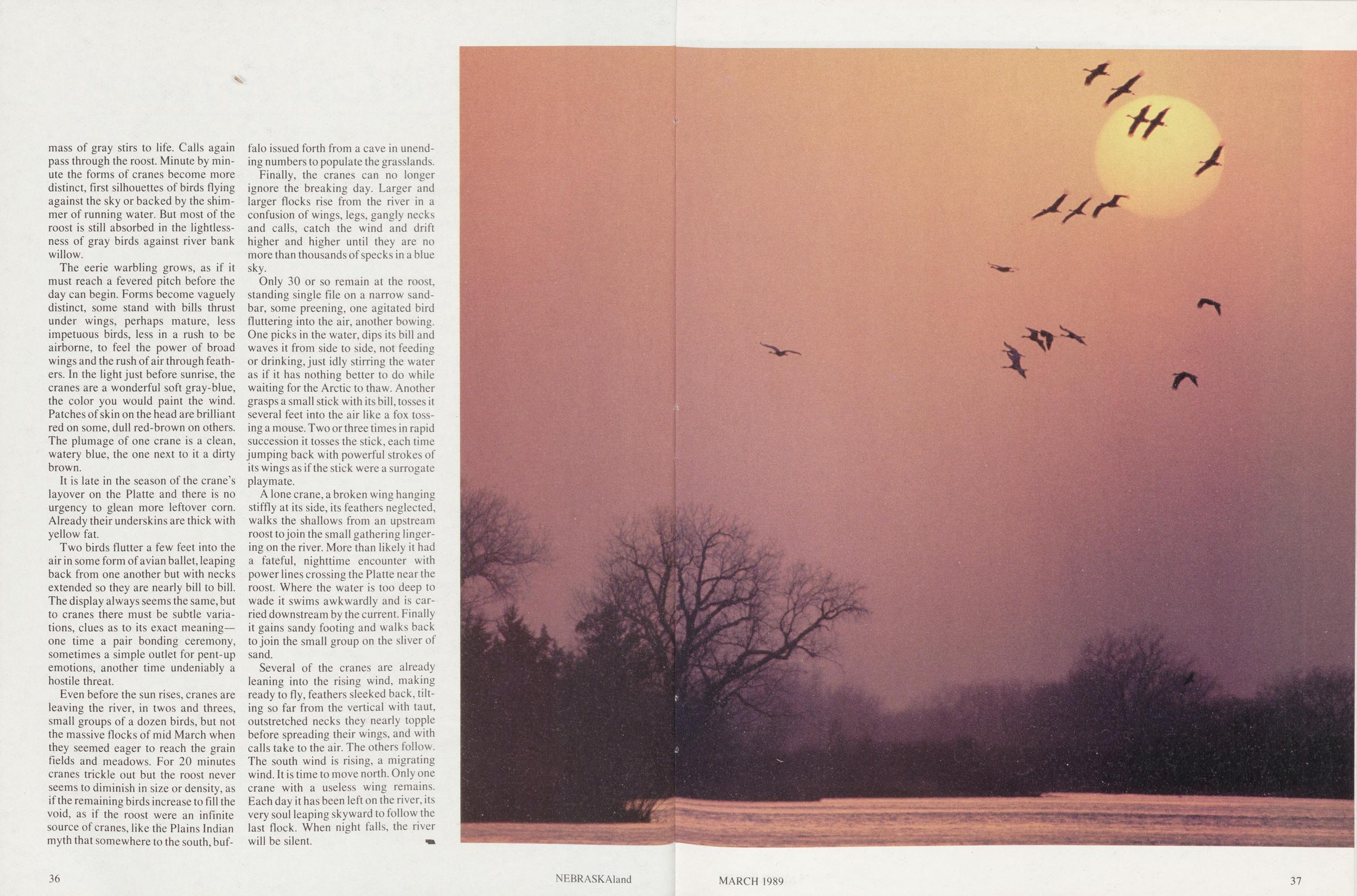 mass of gray stirs to life. Calls again
pass through the roost. Minute by minute the forms of cranes become more
distinct, first silhouettes of birds flying
against the sky or backed by the shimmer of running water. But most of the
roost is still absorbed in the lightlessness of gray birds against river bank
willow.
mass of gray stirs to life. Calls again
pass through the roost. Minute by minute the forms of cranes become more
distinct, first silhouettes of birds flying
against the sky or backed by the shimmer of running water. But most of the
roost is still absorbed in the lightlessness of gray birds against river bank
willow.
The eerie warbling grows, as if it must reach a fevered pitch before the day can begin. Forms become vaguely distinct, some stand with bills thrust under wings, perhaps mature, less impetuous birds, less in a rush to be airborne, to feel the power of broad wings and the rush of air through feathers. In the light just before sunrise, the cranes are a wonderful soft gray-blue, the color you would paint the wind. Patches of skin on the head are brilliant red on some, dull red-brown on others. The plumage of one crane is a clean, watery blue, the one next to it a dirty brown.
It is late in the season of the crane's layover on the Platte and there is no urgency to glean more leftover corn. Already their underskins are thick with yellow fat.
Two birds flutter a few feet into the air in some form of avian ballet, leaping back from one another but with necks extended so they are nearly bill to bill. The display always seems the same, but to cranes there must be subtle variations, clues as to its exact meaning— one time a pair bonding ceremony, sometimes a simple outlet for pent-up emotions, another time undeniably a hostile threat.
Even before the sun rises, cranes are leaving the river, in twos and threes, small groups of a dozen birds, but not the massive flocks of mid March when they seemed eager to reach the grain fields and meadows. For 20 minutes cranes trickle out but the roost never seems to diminish in size or density, as if the remaining birds increase to fill the void, as if the roost were an infinite source of cranes, like the Plains Indian myth that somewhere to the south, buffalo issued forth from a cave in unending numbers to populate the grasslands.
Finally, the cranes can no longer ignore the breaking day. Larger and larger flocks rise from the river in a confusion of wings, legs, gangly necks and calls, catch the wind and drift higher and higher until they are no more than thousands of specks in a blue sky.
Only 30 or so remain at the roost, standing single file on a narrow sandbar, some preening, one agitated bird fluttering into the air, another bowing. One picks in the water, dips its bill and waves it from side to side, not feeding or drinking, just idly stirring the water as if it has nothing better to do while waiting for the Arctic to thaw. Another grasps a small stick with its bill, tosses it several feet into the air like a fox tossing a mouse. Two or three times in rapid succession it tosses the stick, each time jumping back with powerful strokes of its wings as if the stick were a surrogate playmate.
A lone crane, a broken wing hanging stiffly at its side, its feathers neglected, walks the shallows from an upstream roost to join the small gathering lingering on the river. More than likely it had a fateful, nighttime encounter with power lines crossing the Platte near the roost. Where the water is too deep to wade it swims awkwardly and is carried downstream by the current. Finally it gains sandy footing and walks back to join the small group on the sliver of sand.
Several of the cranes are already leaning into the rising wind, making ready to fly, feathers sleeked back, tilting so far from the vertical with taut, outstretched necks they nearly topple before spreading their wings, and with calls take to the air. The others follow. The south wind is rising, a migrating wind. It is time to move north. Only one crane with a useless wing remains. Each day it has been left on the river, its very soul leaping skyward to follow the last flock. When night falls, the river will be silent.
36 NEBRASKAland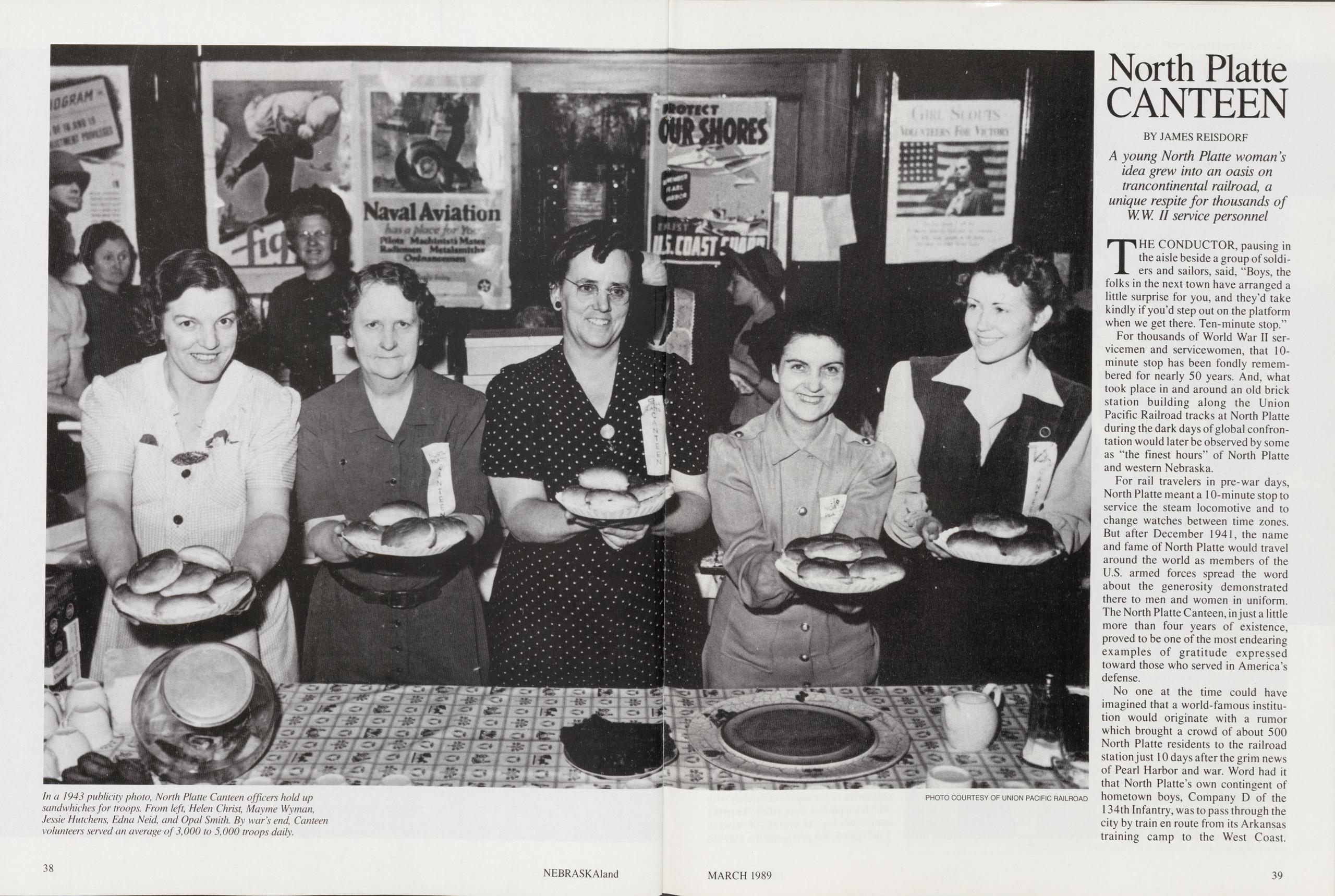
In a 1943 publicity photo, North Platte Canteen officers hold up sandwhiches for troops. From left, Helen Christ, Mayme Wyman, Jessie Hutchens, Edna Neid, and Opal Smith. By war's end, Canteen volunteers served an average of 3,000 to 5,000 troops daily.
PHOTO COURTESY OF UNION PACIFIC RAILROADNorth Platte CANTEEN
A young North Platte woman’s idea grew into an oasis on trancontinental railroad, a unique respite for thousands of W.W. II service personnelTHE CONDUCTOR, pausing in the aisle beside a group of soldiers and sailors, said, “Boys, the folks in the next town have arranged a little surprise for you, and they’d take kindly if you’d step out on the platform when we get there. Ten-minute stop.”
For thousands of World War II servicemen and servicewomen, that 10-minute stop has been fondly remembered for nearly 50 years. And, what took place in and around an old brick station building along the Union Pacific Railroad tracks at North Platte during the dark days of global confrontation would later be observed by some as “the finest hours” of North Platte and western Nebraska.
For rail travelers in pre-war days, North Platte meant a 10-minute stop to service the steam locomotive and to change watches between time zones. But after December 1941, the name and fame of North Platte would travel around the world as members of the U.S. armed forces spread the word about the generosity demonstrated there to men and women in uniform. The North Platte Canteen, in just a little more than four years of existence, proved to be one of the most endearing examples of gratitude expressed toward those who served in America’s defense.
No one at the time could have imagined that a world-famous institution would originate with a rumor which brought a crowd of about 500 North Platte residents to the railroad station just 10 days after the grim news of Pearl Harbor and war. Word had it that North Platte’s own contingent of hometown boys, Company D of the 134th Infantry, was to pass through the city by train en route from its Arkansas training camp to the West Coast.
38 NEBRASKAland MARCH 1989 39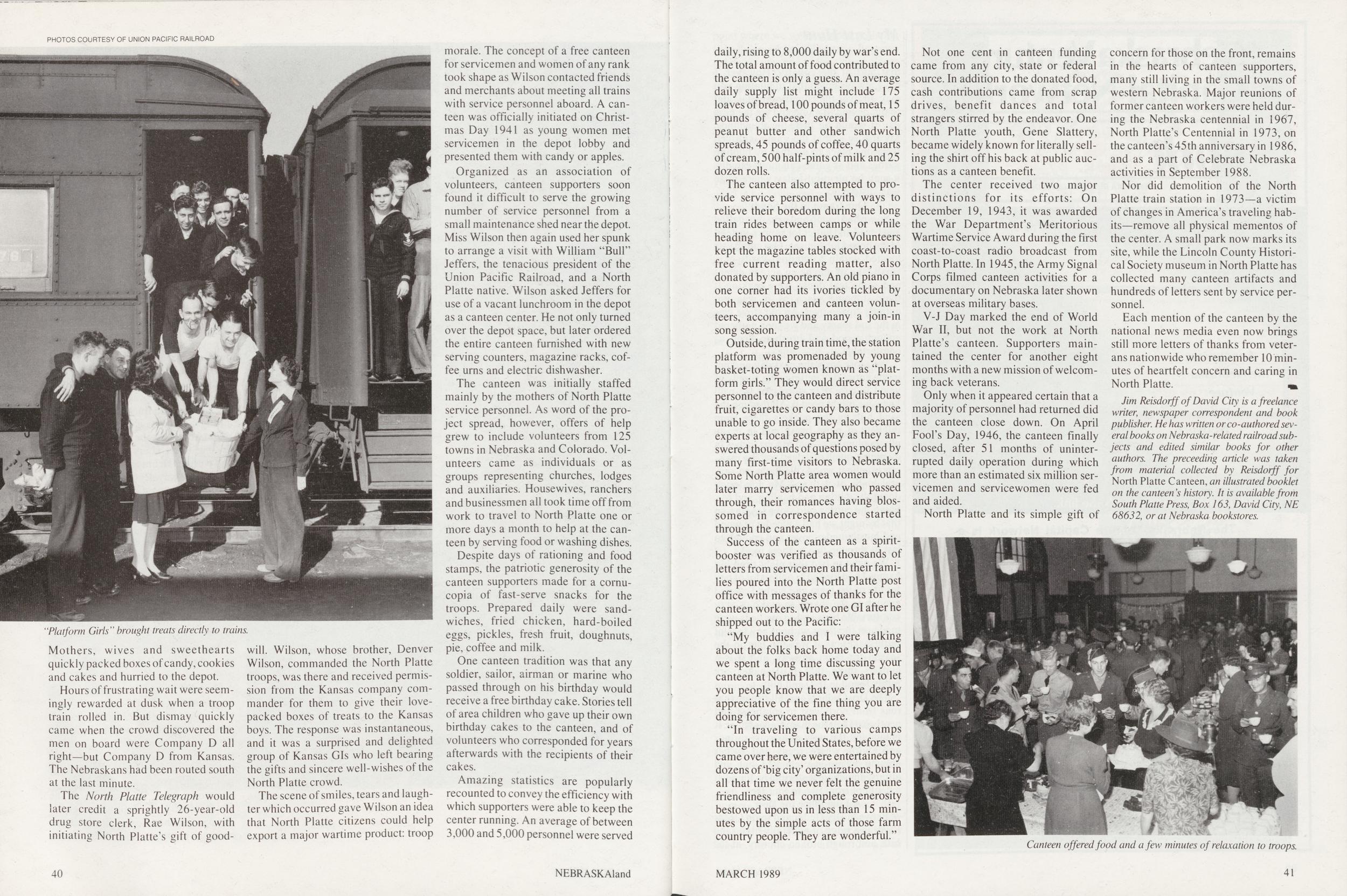
“Platform Girls ” brought treats directly to trains.
Mothers, wives and sweethearts quickly packed boxes of candy, cookies and cakes and hurried to the depot. Hours of frustrating wait were seem- ingly rewarded at dusk when a troop train rolled in. But dismay quickly came when the crowd discovered the men on board were Company D all right—but Company D from Kansas. The Nebraskans had been routed south at the last minute.
The North Platte Telegraph would later credit a sprightly 26-year-old drug store clerk, Rae Wilson, with initiating North Platte’s gift of good-will. Wilson, whose brother, Denver Wilson, commanded the North Platte troops, was there and received permission from the Kansas company commander for them to give their love-packed boxes of treats to the Kansas boys. The response was instantaneous, and it was a surprised and delighted group of Kansas GIs who left bearing the gifts and sincere well-wishes of the North Platte crowd.
The scene of smiles, tears and laughter which occurred gave Wilson an idea that North Platte citizens could help export a major wartime product: troop morale. The concept of a free canteen for servicemen and women of any rank took shape as Wilson contacted friends and merchants about meeting all trains with service personnel aboard. A canteen was officially initiated on Christmas Day 1941 as young women met servicemen in the depot lobby and presented them with candy or apples.
Organized as an association of volunteers, canteen supporters soon found it difficult to serve the growing number of service personnel from a small maintenance shed near the depot. Miss Wilson then again used her spunk to arrange a visit with William "Bull” Jeffers, the tenacious president of the Union Pacific Railroad, and a North Platte native. Wilson asked Jeffers for use of a vacant lunchroom in the depot as a canteen center. He not only turned over the depot space, but later ordered the entire canteen furnished with new serving counters, magazine racks, coffee urns and electric dishwasher.
The canteen was initially staffed mainly by the mothers of North Platte service personnel. As word of the project spread, however, offers of help grew to include volunteers from 125 towns in Nebraska and Colorado. Volunteers came as individuals or as groups representing churches, lodges and auxiliaries. Housewives, ranchers and businessmen all took time off from work to travel to North Platte one or more days a month to help at the canteen by serving food or washing dishes. Despite days of rationing and food stamps, the patriotic generosity of the canteen supporters made for a cornucopia of fast-serve snacks for the troops. Prepared daily were sandwiches, fried chicken, hard-boiled eggs, pickles, fresh fruit, doughnuts, pie, coffee and milk.
One canteen tradition was that any soldier, sailor, airman or marine who passed through on his birthday would receive a free birthday cake. Stories tell of area children who gave up their own birthday cakes to the canteen, and of volunteers who corresponded for years afterwards with the recipients of their cakes.
Amazing statistics are popularly recounted to convey the efficiency with which supporters were able to keep the center running. An average of between 3,000 and 5,000 personnel were served daily, rising to 8,000 daily by war’s end. The total amount of food contributed to the canteen is only a guess. An average daily supply list might include 175 loaves of bread, 100 pounds of meat, 15 pounds of cheese, several quarts of peanut butter and other sandwich spreads, 45 pounds of coffee, 40 quarts of cream, 500 half-pints of milk and 25 dozen rolls.
The canteen also attempted to provide service personnel with ways to relieve their boredom during the long train rides between camps or while heading home on leave. Volunteers kept the magazine tables stocked with free current reading matter, also donated by supporters. An old piano in one corner had its ivories tickled by both servicemen and canteen volun- teers, accompanying many a join-in song session.
Outside, during train time, the station platform was promenaded by young basket-toting women known as "platform girls.” They would direct service personnel to the canteen and distribute fruit, cigarettes or candy bars to those unable to go inside. They also became experts at local geography as they answered thousands of questions posed by many first-time visitors to Nebraska. Some North Platte area women would later marry servicemen who passed through, their romances having blossomed in correspondence started through the canteen.
Success of the canteen as a spirit-booster was verified as thousands of letters from servicemen and their families poured into the North Platte post office with messages of thanks for the canteen workers. Wrote one GI after he shipped out to the Pacific:
"My buddies and I were talking about the folks back home today and we spent a long time discussing your canteen at North Platte. We want to let you people know that we are deeply appreciative of the fine thing you are doing for servicemen there.
"In traveling to various camps throughout the United States, before we came over here, we were entertained by dozens of‘big city’ organizations, but in all that time we never felt the genuine friendliness and complete generosity bestowed upon us in less than 15 minutes by the simple acts of those farm country people. They are wonderful.”
Not one cent in canteen funding came from any city, state or federal source. In addition to the donated food, cash contributions came from scrap drives, benefit dances and total strangers stirred by the endeavor. One North Platte youth, Gene Slattery, became widely known for literally selling the shirt off his back at public auctions as a canteen benefit.
The center received two major distinctions for its efforts: On December 19, 1943, it was awarded the War Department’s Meritorious Wartime Service Award during the first coast-to-coast radio broadcast from North Platte. In 1945, the Army Signal Corps filmed canteen activities for a documentary on Nebraska later shown at overseas military bases.
V-J Day marked the end of World War II, but not the work at North Platte’s canteen. Supporters maintained the center for another eight months with a new mission of welcoming back veterans.
Only when it appeared certain that a majority of personnel had returned did the canteen close down. On April Fool’s Day, 1946, the canteen finally closed, after 51 months of uninterrupted daily operation during which more than an estimated six million servicemen and servicewomen were fed and aided.
Canteen offered food and a few minutes of relaxation to troops.
Nor did demolition of the North Platte train station in 1973—a victim of changes in America’s traveling habits—remove all physical mementos of the center. A small park now marks its site, while the Lincoln County Historical Society museum in North Platte has collected many canteen artifacts and hundreds of letters sent by service personnel.
Each mention of the canteen by the national news media even now brings still more letters of thanks from veterans nationwide who remember 10 minutes of heartfelt concern and caring in North Platte.
My Last Hunt
(Continued from page 13)that part of the country. However, I have always noted that in hunting you may go over the country one day and find it devoid of game and yet the next day it would be there in abundance. My theory is that the game is driven from one place to another by hunting parties and as game can move rapidly, it may be plentiful today where none was yesterday.
Our Camp in the SoddySo we had bacon and eggs, hot coffee and bread and butter for supper, instead of the hoped for venison. Our camp was located within a hundred yards of a small lake of maybe an acre in extent and some teal ducks were making it their stopping place as it was not entirely frozen over. An old stove was in the sod shanty and we soon gathered enough wood and brush to keep us comfortable.
We arose early the next day and put in the entire day getting up a supply of wood in case of a storm, for we well knew we might need it. All through the sand hills in the pockets there were thickets of plum brush and in many places plum trees two to four inches in diameter, much of it dead and dry making excellent wood. We gathered several loads of it, I and Mr. Frederick doing the cutting and hauling, and Mr.Shinn the cutting into stove lengths, so that by night we had a nice lot of wood and mostly under cover and enough to last us through two or three weeks.
We went to bed that night tired but happy. I had loaded in quite a lot of hay for use of the team and we had carried enough in the shanty to make us very comfortable beds and so our beds were made on the floor without any fear of rattlesnakes, as it was too late in the season for them anyway, and it is a curious thing that rattlesnakes are rarely found in the sand hills.
The Dry Cedar is a small stream that runs from northwest to southeast and nearly parallels the main Cedar River. It is low and flat with numerous springs and swirls where reeds and rushes abound where we camped out and almost anywhere water can be found at a depth of from two to four feet.
A Fine Place for DeerBetween Dry Cedar and main Cedar River is a ridge of generally high sand hills and rough broken country, at the 42 NEBRASKAland point where we were camped probably four miles across. That strip between the rivers was one of the choice places for deer as there was high grass in the low spots between the hills and also an abundance of plum thickets scattered through the pockets in the hills which were an ideal hiding place for white-tailed deer. It was also an ideal place for the hunter as by climbing up on the high points he could get a good view of the valleys that lay between and with the wind in his favor and a good field glass he could locate any game that might be in sight or locate any plum thickets that might be the hiding place of game and also allow him to study the best method of getting in gun shot.
That was one of the finest winter mornings I ever saw that next morning at our camp. Clear and frosty with a tang in the air that only winter and an absolutely pure atmosphere can give! In memory it comes back to me and I can see those hills with the frost on the grass and the glorious sun rising over them yet, almost as though it were but yesterday. The smoke from our camp went straight up toward heaven and there did not appear to be a breath of wind. At breakfast we discussed the day's hunt and what our intentions were. Mr. Frederick said he would go westward if agreeable to us and Mr. Shinn said he would take a trip to the east among the big hills, which direction I would have preferred, but I said nothing and so I said I would go north, toward Cottonwood Lake. Mr. Frederick would go on foot while I had my hunting mare to use and Mr. Shinn had his pony. The sun was only just up when we started. It was agreed that if any of us had success we were to return to the camp and cook dinner at noon for the others in case they came in. Each took a bite of lunch in his pocket in case he should be gone all day and each was to hunt independently of the others unless by chance in following game they came in contact with each other, as is sometimes the case.
Blowouts in the Sand HillsCottonwood Lake is a small lake in the sand hills nearly west of the Erina Colony and so-called from a few scrub cottonwoods that grew near by in an early day and provided a landmark for hunters and also a place where deer might find water. There are a few places I have found in the sand hills where the blowouts are so deep that water is frequently found at the bottom and generally these were the haunt of deer. These blowouts are formed by the wind scooping out the sand from the northwest side of a big sand hill and drifting it over to the southeast side until it forms a vast hollow in the hill sometimes as much as fifteen or twenty feet deep. Sometimes these hills are of great height and almost like a mountain peak among smaller peaks.
There are several large ones near the corners of Valley, Greeley, Garfield and Wheeler counties. In my hunting trips I used these high peaks as observation posts when looking for game, as it gives me a good view over quite a wide territory and from there I have often located and laid plans for approaching antelope or deer. In a bad storm these deep places in the blowout afford a fine protection from the wind and are, if partly filled with water, an excellent place to camp, as one is entirely protected from wind. Nearly always one can find plenty of red root and sand cherry roots for fuel.
Following DeerOn leaving camp that morning I rode my mare over a high sand ridge and struck a quite wide smooth valley between the range of hills and trending almost due north. I followed this valley a half a mile or more and then dropped over into another, leading still in a northerly direction. After riding near a half mile I noticed something on a high ridge about a mile ahead of me. At first owing to the distance I could not decide if it was deer or wolf, but I stopped my mare and gave close attention to its movements and finally made out by the movement of its head that it was a deer. It soon disappeared from view, going over the other side of the hill. With everything in my favor I felt sure of getting a shot and so I hurried my mare to the foot of the ridge at the point where it had apparently been only a short time before. I hobbled my mare hurriedly as she had a trick of leaving me at times and I had no desire for her to leave me and start for Ord now, without me going along also.
Climbing the hill cautiously and looking over I located a bunch of four deer at play in a blowout and basin, but about two or three hundred yards away—too far for a sure shot. I searched the landscape for some way of getting nearer, but could see no way only by crawling about fifty yards to the north where a ridge would conceal me from view and I could get then within fifty yards of them and make a sure shot, but in making the crawl, there would be a distance of some five feet when I would be in sight of the game. That was one of the many times I made a foolish move and decided to try it rather than to wait for the game to make a move as they were at play somewhat after the manner of sheep. There was an old buck with the biggest head of horns it seemed to me I ever saw. I lay on the ridge with just the top of my head up so I could see them and watched and finally took the chance of their not seeing me in the short time I would be in sight as they seemed so busy at play. Have you ever tried to be so small as to be invisible? Well that was my desire in making that crawl of about a hundred feet or so. I flattened myself out as thin as possible and started dragging my gun after me and only moving a few inches at a time.
The Old BuckAll the same, just as I thought I was going to get by without being observed, the old buck looked and saw me and in an instant they were out of that blowout and away running east. I ran down the hill to my horse and as soon as possible started after them. After going a quarter of a mile they took up a valley about a half mile long, and beside was a parallel valley with quite a high ridge between. The deer took the right hand valley and I took the left and as they seemed to end nearly at the same distance I decided when they came to the end they would go either north or south. If they went north and I could get to the end of the valley I was in first I might get in a position to intercept them as they crossed in front of me. When I had last seen them they stopped running and were only walking slowly and were apparently not much alarmed at what they had seen when I was doing the crawling act. This was fortunate for me as with all speed I hurried to the end of the valley. I quickly fastened my horse and ran up the hill at the end, and just ahead, in the very place I wanted, was a sand knoll about three or four feet high. I got behind that knoll with all speed and waited, not knowing which way they might go, north or south. I was completely hidden from view, I had the wind in my favor and if those deer would only make the right move! Pretty soon a head showed up over the hill and
 NEBRASKA
ADMIRALS
The SOCIETY OF NEBRASKA ADMIRALS
is calling you to active duty!
If you're a Nebraska Admiral, and will
speak only of the "Good Life" of Nebraska,
and will proudly promote the assets of
Nebraska, then
WE WANT YOU
(all others may "walk the plank")
Society of Nebraska Admirals
521 S. 14th St. 8202
Lincoln, Ne 68508, (402) 474-5843
now is the time to plan
your 1989 Nebraska
State Park vacation!
Cabins reservations accepted
beginning Jan. 3. Lodging dates are
listed for each park area.
Nebraska State Park Lodging
Two Rivers SRA's Niobrara
U.P. Caboose Park Niobrara, NE 68760
Rt 1, Box 203 402-857-3373
Waterloo, NE 68069 Apr. 28-mid-Nov.
402-359-5165 platte river
Apr. 28-Oct. 30, Rt x Box 161A
Chadron Louisville, NE 68037
Chadron, NE 69337 402-234-2217
308-432-2036 Year-round
May 26-Sept. 5 Ponca
Fort Robinson, Box 487
Box 392 Ponca, NE 68770
Crawford, NE 69339, 402-775-2284
308-665-2660 May 26-Sept 5
May 26-Sept. 5
Nebraska Game and Parks Commission
DUCKS
UNLIMITED
We need
your help.
Now.
fleville Log Homos
Montana's Finest
Before you build. . .talk to the
Pioneer in the Log Home Industry.
Experience • Precision • Quality •Affordable
Fre-cut with optional hand-hewn finish
Interim financing available
Video presentation available
For catalog & plans send $5.
Local Dealer/Builder
Custom Log Contracting
P.O. Box 2851
Lincoln, NE 68502
l*#r»
Call or write for information
Kevilte Log Homes
2080 Hwy. 93 • Victor, MT 59875, (406) 642-3091
NEBRASKA
ADMIRALS
The SOCIETY OF NEBRASKA ADMIRALS
is calling you to active duty!
If you're a Nebraska Admiral, and will
speak only of the "Good Life" of Nebraska,
and will proudly promote the assets of
Nebraska, then
WE WANT YOU
(all others may "walk the plank")
Society of Nebraska Admirals
521 S. 14th St. 8202
Lincoln, Ne 68508, (402) 474-5843
now is the time to plan
your 1989 Nebraska
State Park vacation!
Cabins reservations accepted
beginning Jan. 3. Lodging dates are
listed for each park area.
Nebraska State Park Lodging
Two Rivers SRA's Niobrara
U.P. Caboose Park Niobrara, NE 68760
Rt 1, Box 203 402-857-3373
Waterloo, NE 68069 Apr. 28-mid-Nov.
402-359-5165 platte river
Apr. 28-Oct. 30, Rt x Box 161A
Chadron Louisville, NE 68037
Chadron, NE 69337 402-234-2217
308-432-2036 Year-round
May 26-Sept. 5 Ponca
Fort Robinson, Box 487
Box 392 Ponca, NE 68770
Crawford, NE 69339, 402-775-2284
308-665-2660 May 26-Sept 5
May 26-Sept. 5
Nebraska Game and Parks Commission
DUCKS
UNLIMITED
We need
your help.
Now.
fleville Log Homos
Montana's Finest
Before you build. . .talk to the
Pioneer in the Log Home Industry.
Experience • Precision • Quality •Affordable
Fre-cut with optional hand-hewn finish
Interim financing available
Video presentation available
For catalog & plans send $5.
Local Dealer/Builder
Custom Log Contracting
P.O. Box 2851
Lincoln, NE 68502
l*#r»
Call or write for information
Kevilte Log Homes
2080 Hwy. 93 • Victor, MT 59875, (406) 642-3091
I knew they were coming my way and moving very slowly. My chance had at last come and I was ready to fire as soon as they got in the position I wanted, as they would pass within sixty yards of where I was concealed, if they did not change their course. As they walked out in front of me I had a perfect view of them. There was a doe and two fawns and the old buck. I wanted that buck with that magnificent head of horns, but he kept on the farther side of the bunch and I had to take one of the others for the first shot. Never a man had a finer opportunity and I fired, taking the doe first and she fell in her tracks. As the buck was still on the other side, I took one of the fawns in the next shot and it also fell in its tracks.
Roar of Needle GunThe roar of the needle gun that morning, so cold and clear, was like a cannon and I fired rapidly and Mr. Frederick told me that he heard the sound and that it was like a whole battalion had been firing. My being out with the noise of the firing confused the deer and they did not know which way to run for escape. I now turned my attention to the old buck I wanted so badly because of that head of horns. I fired, but it was a quartering shot as he and the other fawn were nearly over the ridge and the next instant were out of sight. I ran to where they were in sight again and gave him another shot and still he did not come down. I then gave my attention to the two. I already had bled them and got my horse and after the old buck, as I found he was bleeding badly and I felt sure I would find him not far away. However I took the trail and followed him and the fawn for a mile or two expecting every time I came over a hill to find him lying dead but I finally gave up, deciding that he was [not] so badly hurt as I had supposed and turned back to where I had left those I had killed. Usually I had when getting deer, thrown it on behind the saddle and as I always had twenty-five feet of rope along would fasten it with rope, get in the saddle and ride home. But here were two and so I had to arrange to carry both on my horse. This I did by putting one in the saddle and one tied behind, both being securely fastened with my picket rope. So I led my horse and started for camp not more than three miles away, arriving there not much later than 10 o'clock. I dressed the deer, looked after my horse, got some water from the lake and cut a generous lot of steak from one of the deer and decided we would have fried venison and baked potatoes for dinner. I cooked dinner and was all ready for the other two hunters of whom I heard nothing, to come. The afternoon passed and about 4 o'clock Mr. Frederick came in reporting that he had seen no game of any kind, not even a jackrabbit, and was rather disappointed with his day, but as he looked at what I had brought in I felt sure he was thinking of tomorrow and that he would have better luck. At dusk Mr. Shinn came in but with no game. Said he had seen a fine black tail buck but thought he was out of his range and when he shot at him he only ran faster. All in a life time, he said, and I will find some tomorrow. We had supper and though I don't claim to be a cook, venison and potatoes didn't go begging that day.
The Snow StormsThat night was cold, but we kept comfortable in our sod shanty, and when we got up next morning it was another beautiful winter day. After breakfast we made our plans. I would go home with my team, taking my game, only a quarter being left with them for temporary needs. Also I would bring another load of wood before I left to be certain they had an abundance and I was to return in a week for them and whatever game they might be able to get. From the success I had had they felt sure there must be quite a few deer left in that vicinity. I also put Mr. Shinn on to the place where I had left the trail of the big buck in hopes he might follow up his trail and find him dead or so badly wounded he could easily get him. I left the camp for Ord and about three o'clock I was near where Rosevale now is and the sky was overcast and it began to look like snow and, in fact within an hour it was snowing very fast, and when I got down to the valley a regular snow storm was on in full force and the wind rising.
46 NEBRASKAland Each spring, thousands flock to Grand Island. Each spring, Grand Island, Nebraska, hosts thousands of visitors who come to witness the northern migration of nearly 500,000sandhill cranes and water flows along the nation's Central Flyway. On March 17, 18, and 19,1989, we'll celebrate this remarkable event We've planned an entire weekend of activities, including guided tours to the Platte River, a competitive art showing plus an exhibition by nationally known wildlife photographer Tom Mangelson, educational and informative workshops on bird and habitat preservation, a commemorative banquet Saturday evening, and much more. This spring join the migration to Grand Island. For a complete schedule of activities, contact: Tina Heinz, Wings Over The Platte, P.O. Box 1486, Grand lsland, Nebraska 68802. Or call toll-free: l-800-247-6167, ext625. "Wings Over The TCatte THE SCIENCE OF WILDLIFE MANAGEMENT: Our Wildlife Depends on Research The precarious future that many species of North American wildlife faced around the turn of the century provided the impetus for the establishment of our first wildlife parks and refuges. Though initially effective, these early efforts aimed at helping wildlife soon developed serious shortcomings. The concept of providing complete protection, including the elimination of natural predators, to certain species was successful in building up threatened herds of animals, including elk and deer; however, as early as the 1920s, populations in many areas were outstripping their available food supplies. Such problems helped spur the rapid growth of the modern science of wildlife management. Early wildlife management professionals were the first to recognize the vital importance of vegetation and other aspects of the natural environment that supported wild animal populations. This new understanding of the relationship between wildlife and habitat helped lead to the practical steps necessary to ensure the longterm abundance and health of certain kinds of wildlife. Extensive biological research is the foundation on which all management programs are built. Studies on animal numbers, their distribution, food preferences and the like provide a detailed picture of a species' needs and habits. Bird banding projects, such as these, help determine a species' seasonal and local movements and can provide information on age, longevity and other vital characteristics important in developing successful conservation programs. Over the years, it has been the American hunter who, through license fees and excise taxes, has provided the lion's share of the funds necessary for these conservation programs. National Shooting Sports Foundation N88F 1075 Post Road Riverside, Conn. 06878 MARCH 1989 47
Well, I got home safely but the storm kept up and the snow was deep and at the end of a week when due at our camp I made preparations to attempt to reach their camp anyway, and was all prepared to start next morning on the trip when who should knock at our door but Mr. Frederick. I certainly was very much surprised and more than pleased. Then he told me his story of what took place after I left. That day they went out again. Mr. Shinn failed to find the wounded buck, but got into some flat country where he could not approach some white-tailed deer he located and so lost them without firing a shot. Mr. Frederick killed one deer before the storm came on and got back to camp with it.
They remained in the soddy, waiting for the storm to abate for nearly a week and as provisions were getting low, they started for the forks of the Cedar, near where Ericson now is located. They had packed bedding and everything else on the pony and walked. They found a party about to go to Ord, with whom they arranged a ride for Mr. Frederick and Mr. Shinn rode the pony. It was very fortunate for me that Mr. Frederick let me know at once as I was going to start next day, but I might not have got through with a team, as the drifts were so deep that going with a team was difficult.
That was my last hunt; though we planned to go to the Black Hills or into the Bear Paw Mountains the next fall and be away about two months, but we never made the trip. Often the longing has come over me to go west and do a little pioneering again as it has perhaps to other early settlers, but I know that it will never be and, unless the dream of the Indians comes true and there is a "happy hunting ground" in the hereafter, I have made my last hunt, m
FORT ATKINSON STATE HISTORICAL PARK
1989 INTERPRETIVE EVENT SCHEDULE March 18-19: 1 to 5 p.m. Spring Muster at Fort Atkinson. Rifle Men will be brushing up on basic martial skills including School of the Soldier and Manual Exercise of Arms, There will be drill on the parade grounds at 2 p.m. and 4 p.m. Armorer's Shop and Carpenter's Shop will be demonstrating crafts of former days. Period weapons, coopering and woodworking. April 30: 1-5 p.m. Sunday. Qualification Day at Fort Atkinson, Snooting of the M4803 flintlock rifle will see only the best marksmen advancing as Rifle Men of the First Class. During the day, it will be business as usual for the craftsmen in the Armorer's and Carpenter's Shops. June 11: 1-5 p.m. Sunday. Flag Day at Fort Atkinson. Salute volleys of rifle and cannon fire at 3 p.m. will highlight a day of typical duty at the fort. The Indian Agent will be on hand to receive visitors at the Council House. Craftsmen will be at their stations to demonstrate their arts. July 2: 1-5 p.m. Sunday. Independence Day at Fort Atkinson. A cannon discharge will salute each half-hour of this fine day. At 3 p.m. the Rifle Men will parade the colors. Blacksmiths and other craftsmen will fire the anvil as well as giving demonstrations at their respective shops. August 6: 1-5 p.m. Sunday. A typical day at this frontier fort, although word has been received that a fur trader from the upper Missouri territory will be passing through. Craftsmen will be on hand in the Armorer's Shop and Carpenter's Shop. September 3: 1-5 p.m. Sunday. Rifle Men will be off on maneuvers at the grounds of the State Fair in Lincoln, but other personnel and craftsmen at the Armorer's Shop and Carpenter's Shop will be on hand to demonstrate procedures of their honored professions. October 1: 1-5 p.m. Sunday. The Rifle Men will have a typical day of duty at this early-day fort, with some activities scheduled at the Council House. The fort butcher will direct hog dressing activities and the making of salt pork for the benefit of local settlers who may wish to watch. NOTE: The Armorer's Shop and Carpenter Shop Volunteers are usually here each Sunday and most Saturdays through out the summer operating season. {All of the men are of volunteer status.) Ft. Atkinson SHP, Box 240, Ft. Calhoun, NE 68023. (402) 468-5611 48 NEBRASKAlandTrading Post
DOGSTRAINING ALL BREEDS Hunting Dogs — Vizslas for sale. Rozanek Kennels, Rt. 2, Schuyler, NE 68661. Phone (402) 352-8769.
ENGLISH SETTERS: "Bred for the hunter"; select puppies and started dogs available from outstanding bloodlines. Stud service available by proven hunters. High Plains Kennels, 1411 Emerson, Alliance, NE 69301, Phone (308) 762-6709.
GERMAN SHORTHAIRS and Brittany Spaniel pups. Started and occasionally a meat dog. Pups are guaranteed. Also I will be training hunting dogs. Wayne Clark, Percival, I A. Phone (712) 529-4238 or (402) 263-3155 at Union, NE
MISCELLANEOUSNE NEBRASKA trout fishing. 3 modern cottages, 1 available year round. 5 spring fed lakes with open water all year. Trout up to 7 pounds. Other varieties fish also. Diamond E. Trout Resort, Orchard, NE 68764. Phone (402)893-4745.
GUNS — Browning, Winchester, Remington, others, Hi-powers, shotguns, new, used, antiques. Want Pre-1964 Winchesters. Buy-Sell-Trade. Ph. (402) 729-6112. Bedlan's Sporting Goods, Fairbury, NE 68352.
MAD RIVER CANOES offers the finest quality and performance. For the finest canoes and accessories look to Great Plains Canoe Co., 205 Main, Springfield, NE. Phone(402) 253-2001.
AIR GUNS repaired Benjamin, Crosman, Daisy, other American made. Restoration; old guns wanted, Jack's Air Guns, 1225 No. 46th, Lincoln, NE 68503. Phone (402) 466-9223.
Bev Doolittle, Terry Redlin, Jerry Raedke, Ed Wards, Robert Bateman, Frank McCarthy and Neal Anderson are available at the 2nd Street Gallery, 537 W. 2nd, Hastings, NE 68901. Phone (402) 463-6677.
TROLLING MOTOR REPAIR. Factory authorized Minn Kota and Motor Guide, parts and service. Wolfs Repair and Tackle Supply. 1529 David Drive, Lincoln, NE 68504. Phone (402) 464-4265.
WINE AND BEER: Make your own. Send for free recipes and instructions. Omaha Supply, 1324 2nd Avenue, Nebraska City, NE 68410.
FISH FOR SALE. Catfish, perch, coho salmon, rainbow trout, crappie, bluegill, walleye, minnows, goldfish, bullhead, largemouth bass, smallmouth bass, triploid grass carp. Commercial grower prices on catfish, perch, coho salmon, rainbow trout. Consulting available. Pleasant Valley Fish Farm, Rt. 1 Box 147, McCook, NE 69001. Phone (308) 345-6599.
FREE BOOK CATALOG. Novels, westerns, romances, children's; old out of print, found barns, attic. Authors: Grey, Bower, Connor, Fox, Curwood, Raine, Wright, Aldrige, Pollyanna, Freckles, many others. Postage appreciated. Pierce, 4400 N. Pine Cluster, Oroville, CA 95965.
FREE! Booklets on northeastern Nevada; fishing, rockhounding maps, Carl Hayden, Box 528, Jackpot, Nevada 89825.
BUY, SELL, TRADE expired hunting, fishing, trapping permits. Singles/Collections. 15400 N. 56th St., Lincoln, NE 68514. phone (402) 785-7500.
HOUSES FOR YOUR bluebird trail. Made out of cedar wood, front opening, deep entry and mounting bracket. Guaranteed. $8.00 postage paid. Complete kits $6.00. Write John Holm, 2014 Avenue G, Gothenburg, NE 69138 or phone (308) 537-2323.
BUYING: American Indian artifacts such as beadwork, weavings, baskets, etc.; also cowboy memorabilia such as chaps, spurs, photographs, etc. Best price first letter; photographs promptly returned. Jack Ringwalt, 1550 California St., Suite 6, #211, San Francisco, C A 94109, (415)759-6343.
TAXIDERMYALLISON'S TAXIDERMY STUDIO. Wally and Betty Allison Licensed Taxidermist. We've mounted 28 Nebraska State Record fish. Specializing in fish and birds, small game and rattlesnakes. We use freeze-dry. 2310 West Leota, North Platte, Nebr. 69101. Phone (308) 534-2324.
BADE TAXIDERMY — Quality a must — Fast service. Fish, birds, rugs, tanning, full mounts and game heads, 2111 N. Christy St., Fremont, NE 727-5463.
NABITY'S TAXIDERMY. 31 years experience. Specializing in natural grass backgrounds for mammals, birds and fish. 13901 "O" St., Lincoln, NE 68504 — 4 miles east of 84th and "O". (402) 489-6351.
PEISTER TAXIDERMY - Professional work at prices most sportsman can afford. Now in our new log cabin studio, 1020 Central Avenue, Box 3201, Kearney, NE 68847. Phone (308) 236-9700 or (308) 237-7575 evenings.
NATURECRAFT STUDIO - all custom services - creative work, quality, and experience since 1935. Includes freeze-dry processing. Display and sales room, visitors welcome. Hwy. 2 in Nebraska City. Phone (402) 873-5491. Joe Voges — Owner. Bow Steedly — Big Game specialist.
YEAR ROUND DOG TRAINING Hunting, Field Trials, Obedience HILLTOP SHOOTING PRESERVE Season Sept. 1 to April 1 Pheasant, Quail, Chukar, Turkey John Honore Manager and Trainer Grand Island, NE Call 308-384-1517 NEBRASKAland Magazine Order Form Please send me a subscription to NEBRASKAland Magazine One-year $12 00 NAME ADDRESS Two-year $23.00 STATE ZIP Mail to: NEBRASKAland Magazine, Box 30370, Lincoln, NE 68503 BERGMANS RESORT On Beautiful Johnson Lake Lakefront Cabins RV Hookups Groceries Beer Bait Tackle Restaurant* Lounge* Boat Rentals Guide Service. Fish Swim Golf Elmer and Janet Bergman RR 2, Elwood, NE 68937 (308) 785-2298 DUCKS UNLIMITED We need your help. Now. CEDAR LANE Ranch Vacations Guest ranch in the heart of the Sandhills of Nebraska, Swimming, spa, horses, canoeing, trail rides, barbecues. hunting, family reunions. BOOKING NOW For 1989 Richard and Betty Schroeder HC 2 Box 9C Stapleton, Nebraska 69163 Ph. 308-587-2233 LIVE-CATCH ALL-PURPOSE TRAPS FREE CATALOG Traps without injury squirrels, chipmunks, rabbits, mink, fox, raccoons, stray animals, pests, etc. Sizes for every need. Also traps for snakes, sparrows, pigeons, crabs, turtles, quail, etc Save on our low factory prices Send no money Free catalog and trapping secrets MUSTANG MFG. CO., Dept. N-34, Box 920947, Houston, Tex. 77292 STOCK YOUR LAKE OR POND WITH Channel Cat, Bluegill, Hybrid Bluegill, Largemouth Bass, Crappie, Bullheads, Triploid Grass Carp, Walleye, Minnows WILLOW LAKE FISH HATCHERY Rt. 3, Box 46, Hastings, Nebr. 68901 Gaylord L Crawford Phone: (402) 463-8022 Day or Night For April to October 15 stocking GUN DOG TRAINING All Sporting Breeds All dogs worked on foot — no horses. Midwest's finest facilities. Field Champion-sired Labrador pups for sale. "Training for hunters by hunters" WILDERNESS KENNELS Henry Sader—Roca, Ne. (402)423-4212 68430 MARCH 1989 49
In The Kitchen
Easy Brown Stew 2 lbs beef or venison cubed (or half and half) 3 stalks celery cubed 6 carrots cubed 4 med potatoes, quartered 2 med onions, quartered I can tomatoes (or 1 pint) 1 can green beans, drained (reserve liquid) Vi cup water 1 cup quick tapioca 1 tbl salt Vfc tsp pepper 1 tbl sugar(Can use crockpot and make night before or conventional oven). Spread meat in bottom of roaster or large pan. Sprinkle tapioca over meat. Add celery, carrots, onions, potatoes and tomatoes. Combine liquid drained from beans, water and seasoning. Pour over vegetables and meat. Cover tightly and bake at 300° for 4 to 4 Vi hours or at 275 ° for 6 hours. Refrigerate drained beans and stir into stew when stew is done. For a thicker stew use Vi cup tapioca.
Mrs. Loren Jackson, Paxton, NE Venison Black Bean Stew 2 lbs venison (tender cut) 5 cups water Vi cup red wine vinegar 4 med carrots, thick sliced 2 cups onion, chunked 1 cup celery, diced 2 cans black beans (or dried beans boiled) 1/2 tsp basil Va tsp salt 1 bay leafIn a 5-quart pot bring meat, onion and water to a boil, then simmer covered 1 hour. Add remaining ingredients and cook one hour longer until meat is tender. Discard bay leaf. Good served with brown bread and tossed salad.
Mrs. Joleen Meyenburg, Wahoo, NE Cream of Broccoli Soup 1 lb broccoli 4 tbl butter Vi cup flour 1 qt milk Vi cup chopped onionsChop broccoli in food processor, place in large pot with Vi cup water. Cover-steam until tender, about 10 minutes. Melt butter in dry pan, saute onions (do not brown). Slowly add flour to make a roux. Add milk slowly, stirring constantly until smooth and thick. Add salt and pepper to taste. When thick, add to broccoli (do not drain). Bring to simmer and serve. Good warmed up. Also freezes well.
Marge Bessette, Omaha, NE Goulash Soup Vi lb pork Vi lb beef 1 onion, chopped Vi tsp pepper 2 tsp salt Vi tsp mixed spices in cloth bag 2 carrots, sliced water 8 to 10 ginger snaps Vi cup catsupCut beef and pork into cubes, place in a kettle. Add 1 cup water and simmer until meat is slightly brown. Add spices, onion and carrots and about 3 quarts of water. Boil until meat is tender. Add catsup, soak ginger snaps in about 1 cup warm water until dissolved, add to mixture and cook a few minutes. Serve with crackers.
Elsie A. Heitman, Omaha, NE Popped Wheat Snack 1 Vi cups whole kernel wheat water oil onion salt garlic salt bacon bits sunflower seedsSoak wheat in quart jars filled with water, for 3 days. Each day strain and replace water. On third day, rinse, put wheat on paper towels. Heat oil in electric frypan to 400°. Spread wheat evenly on bottom until wheat pops and heavy sizzle subsides. Make sure wheat is crunchy before removing. Place on paper towels and sprinkle on salts, seeds and bacon bits.
Nancy Armstrong, Ponca, NE Kolaches 1 pkg yeast Va cup warm water Vi cup sugar 1 cup butter 3 eggs 5 cups flour 1 can evaporated milkDissolve yeast in water and let stand until bubbly. Cream the butter until light and fluffy, then add the sugar and mix well. Add the eggs one at a time, beating thoroughly after each. Blend in the 5 cups of flour, alternating with large can of evaporated milk. Add the yeast mixture, using mixer until batter is thick. Pour into large bowl. Beat in enough flour until dough is soft and leaves side of bowl. Let rise until double. Form into small mounds, the size of walnuts. Put on greased jelly roll pan with sides. Brush with butter, and let rise 10 to 15 minutes. Make an indentation in each, and put in 1 teaspoon of filling. I use Solo fillings—prune, poppy seed, apricot, etc.— mixed well together with a cube of butter, Vi cup flour and 3 tablespoons of sugar. Bake in 400° oven for 20-25 minutes.
Stanley Kurmel, Omaha, NE Oatmeal Cake 1 cup quick oatmeal Vi cup butter 1 Va cup boiling water Put in bowl and let stand 20 minutes. Then add: 1 cup brown sugar 1 cup white sugar 2 eggs Vi tsp salt 1 tsp cinnamon Vi tsp nutmeg Vi tsp baking soda 1 '/3cup flour 1 cup dates (optional)Mix all together, and bake in a 9x13 pan at 350° for 30 minutes.
Mrs. Louis Rebbe, Fremont, NE Chocolate Frosting 8 oz. cream cheese 1 tsp vanilla 5 cups powdered sugar Vi cup cocoa 2 tbl milkMix cream cheese, powdered sugar and cocoa, then add milk and vanilla.
Janice Allgazer, Avoca, NE 50 NEBRASKAlandWhen Lewis and Clark first explored the wilds of Nebraska, they found a land of wonderful contrast. Today, you'll find there's even more to discover. Take advantage of the boating, fishing, camping and hiking Nebraska offers. You'll discover dozens of excellent public lakes, more than 100,000 acres of state and national parkland, and plenty of wide-open spaces. It's part of what makes Nebraska special. And it's part of hundreds of ways you can get away from the crowds this year and make a little vacation history of your own.
For a special preview, write for your free Campground Directory, Special Events Calendar and 32-page, full-color Vacation Nebraska Visitors Guide, or call toll-free out-of-state 1-800-228-4307; in-state 1-800-742-7595.
Come see what we're up to now. Name Address City State. Zip. 89003 Campground information Lodging information Mail coupon to: Nebraska Department of Economic Development Division of Travel and Tourism, P.O. Box 94666, Lincoln, NE 68509. The Celebration Continues.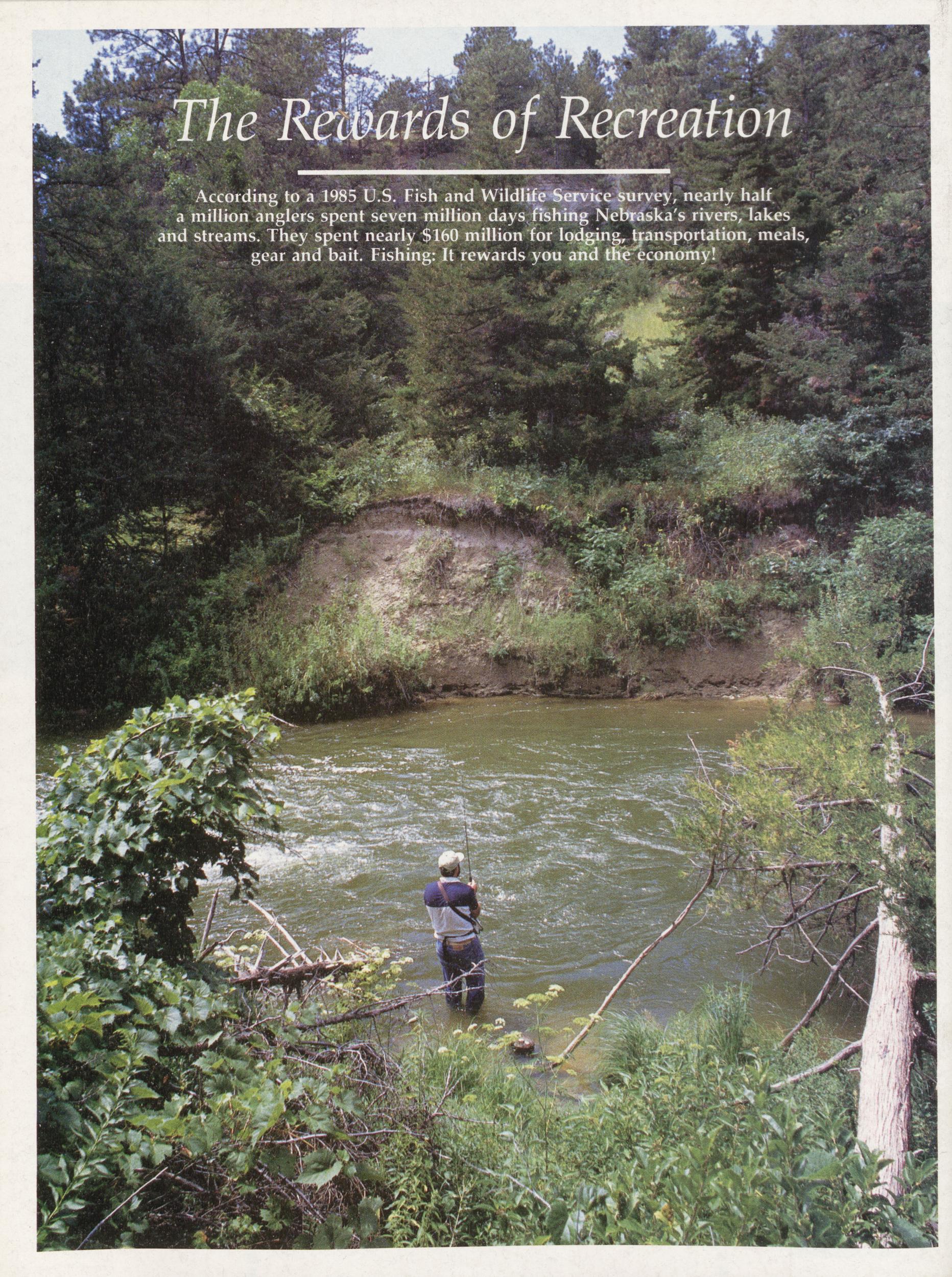
Position: 341 (27 views)