Volume 66, Issue 10, 1988
NEBRASKAland
DECEMBER 1988 • $1.50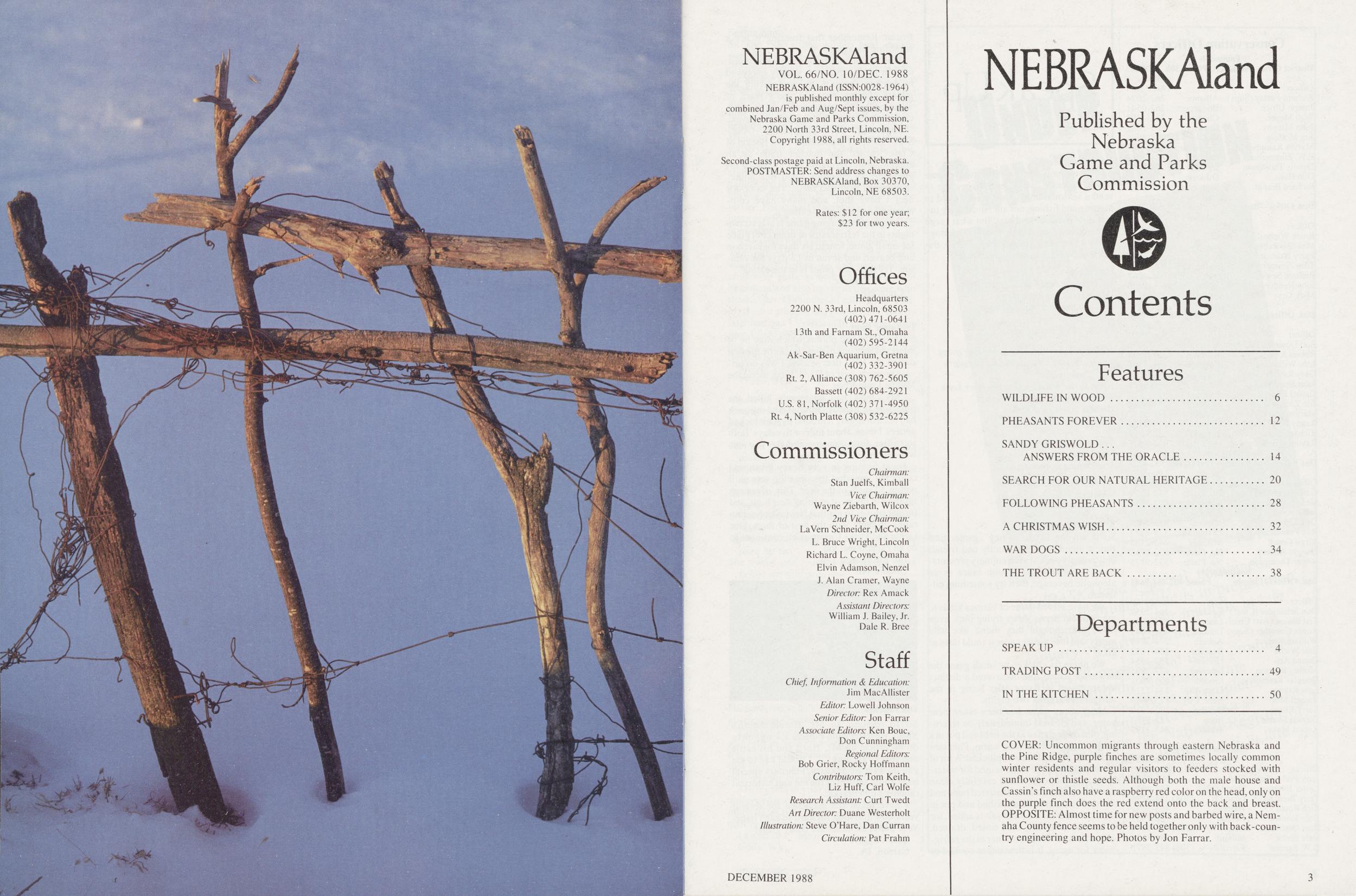
NEBRASKAland
Published by the Nebraska Game and Parks Commission NEBRASKAland VOL. 66/NO. 10/DEC. 1988 NEBRASKAland (1SSN:0028-1964) is published monthly except for combined Jan/Feb and Aug/Sept issues, by the Nebraska Game and Parks Commission, 2200 North 33rd Street, Lincoln, NE. Copyright 1988, all rights reserved. Second-class postage paid at Lincoln, Nebraska. POSTMASTER: Send address changes to NEBRASKAland, Box 30370, Lincoln, NE 68503.Rates: $12 for one year; $23 for two years.
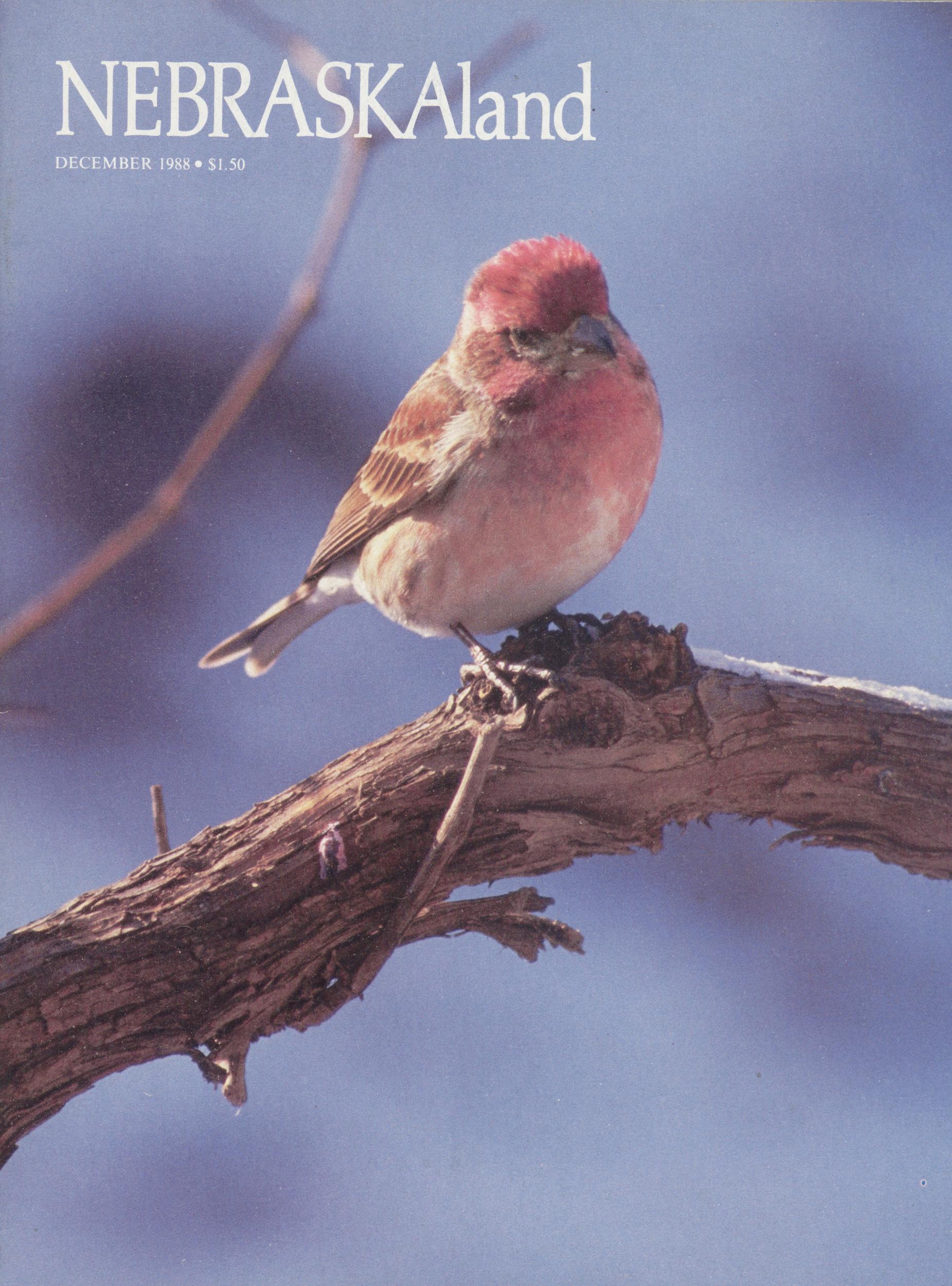
Offices Headquarters 2200 N. 33rd, Lincoln, 68503 (402)471-0641 13th and Farnam St., Omaha (402)595-2144 Ak-Sar-Ben Aquarium, Gretna (402)332-3901 Rt. 2, Alliance (308) 762-5605 Bassett (402) 684-2921 U.S. 81, Norfolk (402) 371 -4950 Rt. 4, North Platte (308) 532-6225 Commissioners Chairman: Stan Juelfs, Kimball Vice Chairman: Wayne Ziebarth, Wilcox 2nd Vice Chairman: LaVern Schneider, McCook L. Bruce Wright, Lincoln Richard L. Coyne, Omaha Elvin Adamson, Nenzel J. Alan Cramer, Wayne Director: Rex Amack Assistant Directors: William J. Bailey, Jr. Dale R. Bree Staff Chief, Information & Education: Jim MacAllister Editor: Lowell Johnson Senior Editor: Jon Farrar Associate Editors: Ken Bouc, Don Cunningham Regional Editors: Bob Grier, Rocky Hoffmann Contributors: Tom Keith, Liz Huff, Carl Wolfe Research Assistant: Curt Twedt Art Director: Duane Westerholt Illustration: Steve O'Hare, Dan Curran Circulation: Pat Frahm Contents Features WILDLIFE IN WOOD.............................. 6 PHEASANTS FOREVER............................ 12 SANDY GRISWOLD . .. ANSWERS FROM THE ORACLE...... SEARCH FOR OUR NATURAL HERITAGE . 14 20 FOLLOWING PHEASANTS.........................28 A CHRISTMAS WISH...............................32 WAR DOGS.......................................34 THE TROUT ARE BACK 38 Departments SPEAK UP........................................ 4 TRADING POST...................................49 IN THE KITCHEN .................................50 COVER: Uncommon migrants through eastern Nebraska and the Pine Ridge, purple finches are sometimes locally common winter residents and regular visitors to feeders stocked with sunflower or thistle seeds. Although both the male house and Cassin's finch also have a raspberry red color on the head, only on the purple finch does the red extend onto the back and breast. OPPOSITE: Almost time for new posts and barbed wire, a Nemaha County fence seems to be held together only with back-country engineering and hope. Photos by Jon Farrar. DECEMBER 1988 3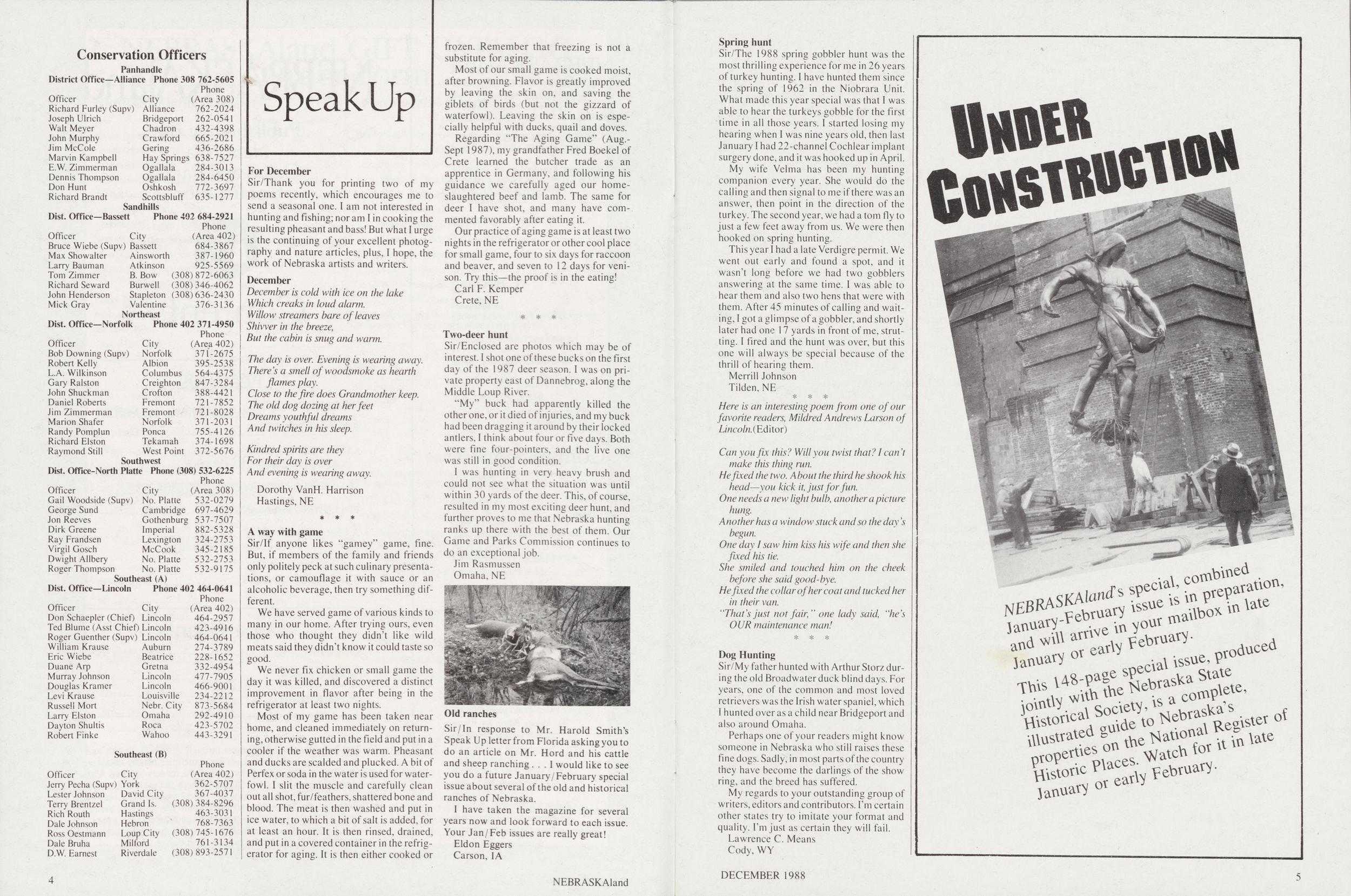
Speak Up
For DecemberSir/Thank you for printing two of my poems recently, which encourages me to send a seasonal one. I am not interested in hunting and fishing; nor am I in cooking the resulting pheasant and bass! But what I urge is the continuing of your excellent photography and nature articles, plus, I hope, the work of Nebraska artists and writers.
December December is cold with ice on the lake Which creaks in loud alarm. Willow streamers bare of leaves Shivver in the breeze, But the cabin is snug and warm. The day is over. Evening is wearing away. There's a smell of woodsmoke as hearth flames play. Close to the fire does Grandmother keep. The old dog dozing at her feet Dreams youthful dreams And twitches in his sleep. Kindred spirits are they For their day is over And evening is wearing away. Dorothy VanH. Harrison Hastings, NE * * * A way with gameSir/If anyone likes "gamey" game, fine. But, if members of the family and friends only politely peck at such culinary presentations, or camouflage it with sauce or an alcoholic beverage, then try something different.
We have served game of various kinds to many in our home. After trying ours, even those who thought they didn't like wild meats said they didn't know it could taste so good.
We never fix chicken or small game the day it was killed, and discovered a distinct improvement in flavor after being in the refrigerator at least two nights.
Most of my game has been taken near home, and cleaned immediately on returning, otherwise gutted in the field and put in a cooler if the weather was warm. Pheasant and ducks are scalded and plucked. A bit of Perfex or soda in the water is used for waterfowl. I slit the muscle and carefully clean out all shot, fur/feathers, shattered bone and blood. The meat is then washed and put in ice water, to which a bit of salt is added, for at least an hour. It is then rinsed, drained, and put in a covered container in the refrigerator for aging. It is then either cooked or frozen. Remember that freezing is not a substitute for aging.
Most of our small game is cooked moist, after browning. Flavor is greatly improved by leaving the skin on, and saving the giblets of birds (but not the gizzard of waterfowl). Leaving the skin on is especially helpful with ducks, quail and doves.
Regarding "The Aging Game" (Aug.-Sept 1987), my grandfather Fred Boekel of Crete learned the butcher trade as an apprentice in Germany, and following his guidance we carefully aged our home-slaughtered beef and lamb. The same for deer I have shot, and many have commented favorably after eating it.
Our practice of aging game is at least two nights in the refrigerator or other cool place for small game, four to six days for raccoon and beaver, and seven to 12 days for venison. Try this—the proof is in the eating!
Carl F. Kemper Crete, NE * * * Two-deer huntSir/Enclosed are photos which may be of interest. I shot one of these bucks on the first day of the 1987 deer season. I was on private property east of Dannebrog, along the Middle Loup River.
"My" buck had apparently killed the other one, or it died of injuries, and my buck had been dragging it around by their locked antlers, I think about four or five days. Both were fine four-pointers, and the live one was still in good condition.
I was hunting in very heavy brush and could not see what the situation was until within 30 yards of the deer. This, of course, resulted in my most exciting deer hunt, and further proves to me that Nebraska hunting ranks up there with the best of them. Our Game and Parks Commission continues to do an exceptional job.
Jim Rasmussen Omaha, NE Old ranchesSir/In response to Mr. Harold Smith's Speak Up letter from Florida asking you to do an article on Mr. Hord and his cattle and sheep ranching ... I would like to see you do a future January/February special issue about several of the old and historical ranches of Nebraska.
I have taken the magazine for several years now and look forward to each issue. Your Jan/Feb issues are really great!
Eldon Eggers Carson, IA 4 NEBRASKAland Spring huntSir/The 1988 spring gobbler hunt was the most thrilling experience for me in 26 years of turkey hunting. I have hunted them since the spring of 1962 in the Niobrara Unit. What made this year special was that I was able to hear the turkeys gobble for the first time in all those years. I started losing my hearing when I was nine years old, then last January I had 22-channel Cochlear implant surgery done, and it was hooked up in April.
My wife Velma has been my hunting companion every year. She would do the calling and then signal to me if there was an answer, then point in the direction of the turkey. The second year, we had a torn fly to just a few feet away from us. We were then hooked on spring hunting.
This year I had a late Verdigre permit. We went out early and found a spot, and it wasn't long before we had two gobblers answering at the same time. I was able to hear them and also two hens that were with them. After 45 minutes of calling and waiting, I got a glimpse of a gobbler, and shortly later had one 17 yards in front of me, strutting. I fired and the hunt was over, but this one will always be special because of the thrill of hearing them.
Merrill Johnson Tilden, NE * * * Here is an interesting poem from one of our favorite readers, Mildred Andrews Larson of Lincoln.(Ed'iiov) Can you fix this? Will you twist that? I can't make this thing run. He fixed the two. A bout the third he shook his head—you kick it, just for fun. One needs a new light bulb, another a picture hung. A not her has a window stuck and so the day's begun. One day I saw him kiss his wife and then she fixed his tie. She smiled and touched him on the cheek before she said good-bye. He fixed the collar of her coat and tucked her in their van. "That's just not fair, " one lady said, "he's OUR maintenance man! * * * Dog HuntingSir/My father hunted with Arthur Storz during the old Broadwater duck blind days. For years, one of the common and most loved retrievers was the Irish water spaniel, which I hunted over as a child near Bridgeport and also around Omaha.
Perhaps one of your readers might know someone in Nebraska who still raises these fine dogs. Sadly, in most parts of the country they have become the darlings of the show ring, and the breed has suffered.
My regards to your outstanding group of writers, editors and contributors. I'm certain other states try to imitate your format and quality. I'm just as certain they will fail.
Lawrence C. Means Cody, WY Under Construction NEBRASKALand's special, combined January-February issue is in preparation, and will arrive in your mailbox in late January or early February This 148-page special issue, produced jointly with the Nebraska State Historical Society, is a complete illustrated guidee to Nebrsaka's properties on the National Register of Historic Places. Watch for it in late January or early February DECEMBER 1988 5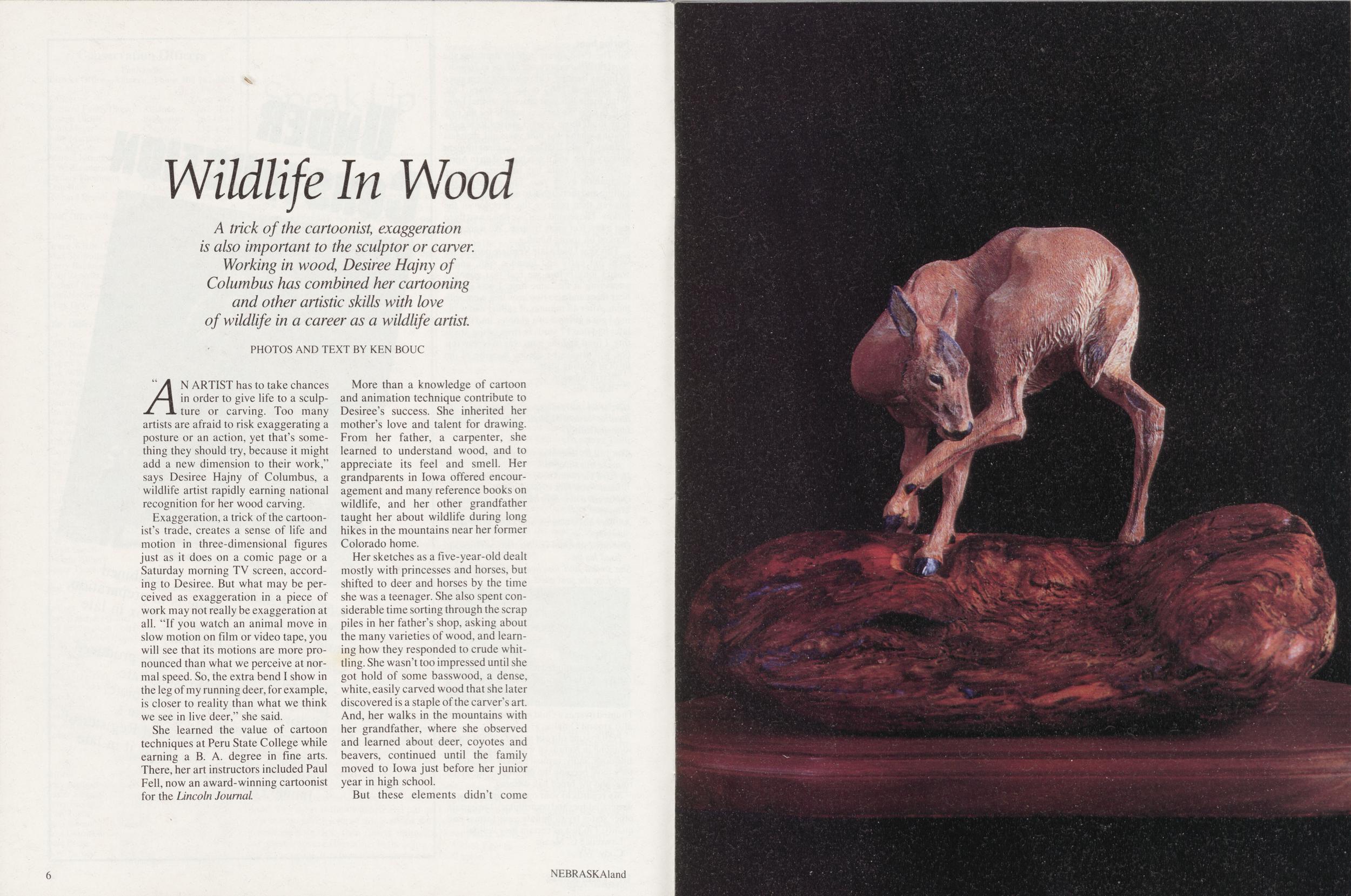
Wildlife In Wood
A trick of the cartoonist, exaggeration is also important to the sculptor or carver. Working in wood, Desiree Hajny of Columbus has combined her cartooning and other artistic skills with love of wildlife in a career as a wildlife artist. PHOTOS AND TEXT BY KEN BOUC"AN ARTIST has to take chances in order to give life to a sculpture or carving. Too many artists are afraid to risk exaggerating a posture or an action, yet that's something they should try, because it might add a new dimension to their work," says Desiree Hajny of Columbus, a wildlife artist rapidly earning national recognition for her wood carving.
Exaggeration, a trick of the cartoonist's trade, creates a sense of life and motion in three-dimensional figures just as it does on a comic page or a Saturday morning TV screen, according to Desiree. But what may be perceived as exaggeration in a piece of work may not really be exaggeration at all. "If you watch an animal move in slow motion on film or video tape, you will see that its motions are more pronounced than what we perceive at normal speed. So, the extra bend I show in the leg of my running deer, for example, is closer to reality than what we think we see in live deer," she said.
She learned the value of cartoon techniques at Peru State College while earning a B. A. degree in fine arts. There, her art instructors included Paul Fell, now an award-winning cartoonist for the Lincoln Journal
More than a knowledge of cartoon and animation technique contribute to Desiree's success. She inherited her mother's love and talent for drawing. From her father, a carpenter, she learned to understand wood, and to appreciate its feel and smell. Her grandparents in Iowa offered encouragement and many reference books on wildlife, and her other grandfather taught her about wildlife during long hikes in the mountains near her former Colorado home.
Her sketches as a five-year-old dealt mostly with princesses and horses, but shifted to deer and horses by the time she was a teenager. She also spent considerable time sorting through the scrap piles in her father's shop, asking about the many varieties of wood, and learning how they responded to crude whittling. She wasn't too impressed until she got hold of some basswood, a dense, white, easily carved wood that she later discovered is a staple of the carver's art. And, her walks in the mountains with her grandfather, where she observed and learned about deer, coyotes and beavers, continued until the family moved to Iowa just before her junior year in high school.
But these elements didn't come together to make Desiree a wood carver until she was teaching art at Rock County High School in Bassett. "I faced a real problem in attracting ranch kids into an art class. Art is not considered a practical skill for a rancher, and it also seems kind of sissified. Then, I thought of carving. Wood carving is not far removed from whittling, and that's kind of a traditional and masculine activity.
6 NBRASKAland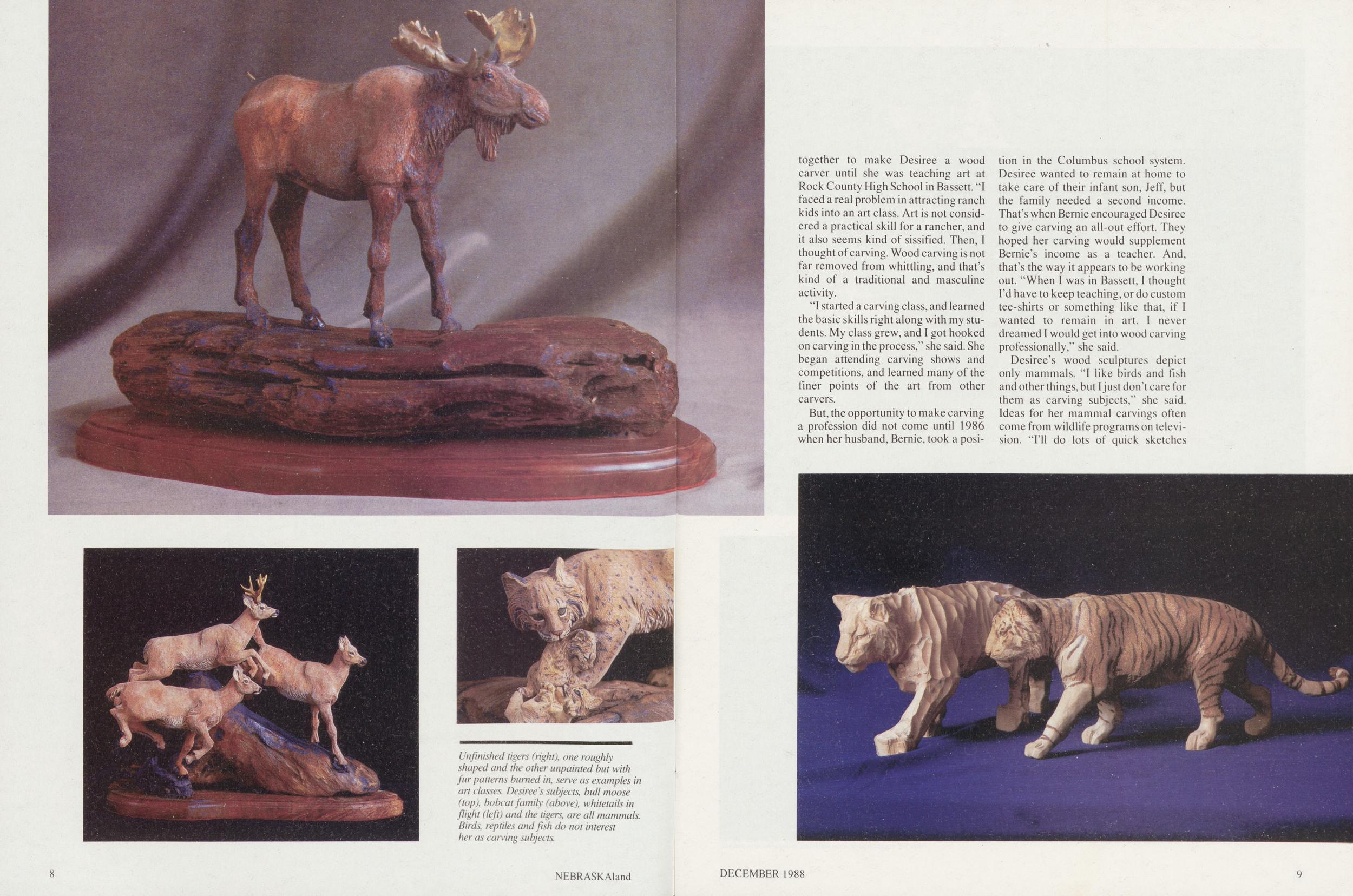
"I started a carving class, and learned the basic skills right along with my students. My class grew, and I got hooked on carving in the process," she said. She began attending carving shows and competitions, and learned many of the finer points of the art from other carvers.
But, the opportunity to make carving a profession did not come until 1986 when her husband, Bernie, took a position in the Columbus school system. Desiree wanted to remain at home to take care of their infant son, Jeff, but the family needed a second income. That's when Bernie encouraged Desiree to give carving an all-out effort. They hoped her carving would supplement Bernie's income as a teacher. And, that's the way it appears to be working out. "When I was in Bassett, I thought I'd have to keep teaching, or do custom tee-shirts or something like that, if 1 wanted to remain in art. 1 never dreamed I would get into wood carving professionally," she said.
Desiree's wood sculptures depict only mammals. T like birds and fish and other things, but I just don't care for them as carving subjects," she said. Ideas for her mammal carvings often come from wildlife programs on television. 'Til do lots of quick sketches
 while watching the program, then put
them aside for a while, and work on
them later. I now have tons of old
sketch books, and I'm continually
sifting through them for ideas and
postures. Then, I'll check old wildlife
magazines, zoo photos or museum sketches,
looking for colors and tones, head
positions and the way the hair flows. Next to
the animation that slightly exaggerated
features provide, the lay of an animal's
fur is most important to realism," she
said.
while watching the program, then put
them aside for a while, and work on
them later. I now have tons of old
sketch books, and I'm continually
sifting through them for ideas and
postures. Then, I'll check old wildlife
magazines, zoo photos or museum sketches,
looking for colors and tones, head
positions and the way the hair flows. Next to
the animation that slightly exaggerated
features provide, the lay of an animal's
fur is most important to realism," she
said.
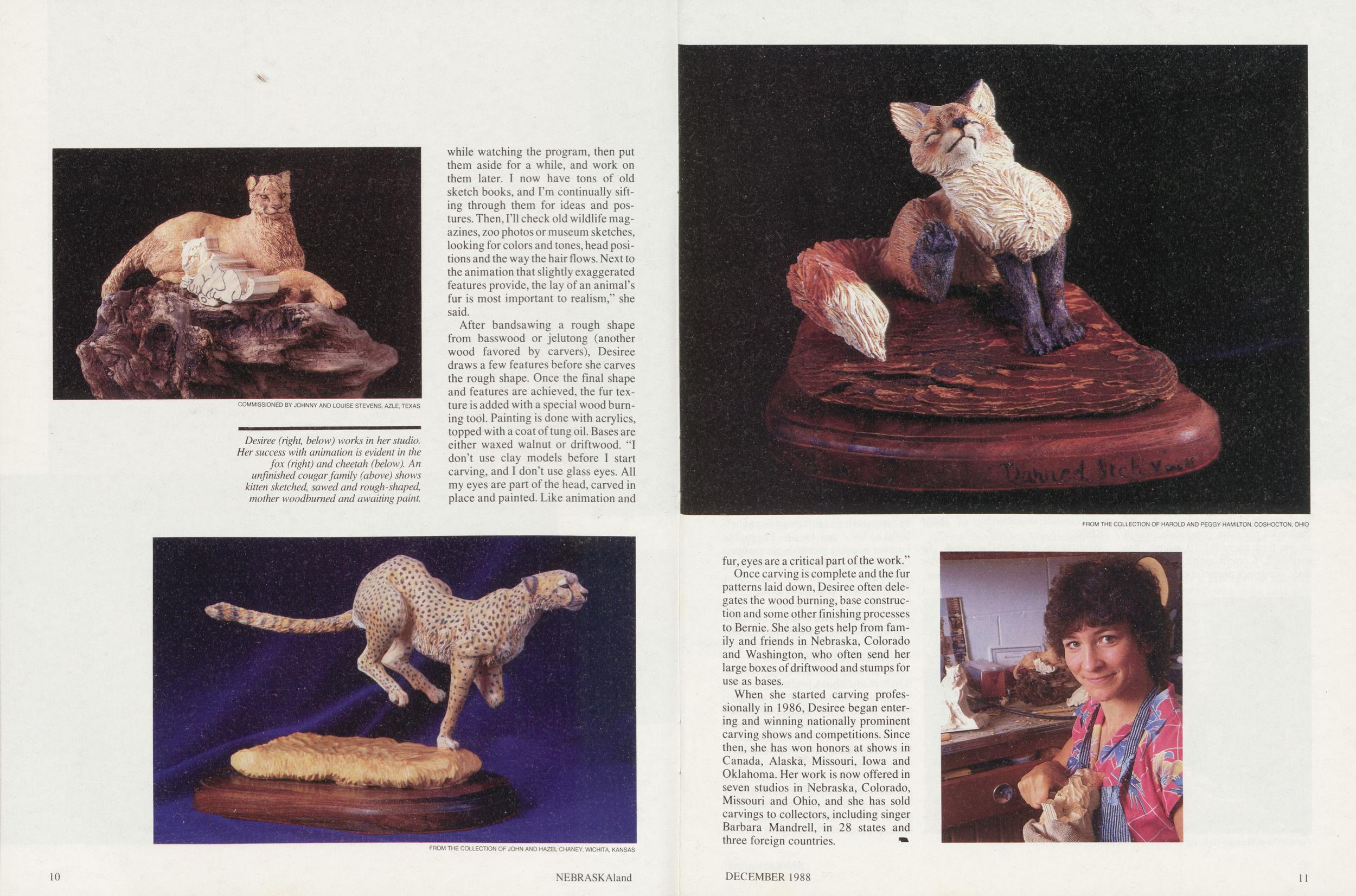
After band sawing a rough shape from basswood or jelutong (another wood favored by carvers), Desiree draws a few features before she carves the rough shape. Once the final shape and features are achieved, the fur texture is added with a special wood burning tool. Painting is done with acrylics, topped with a coat of tung oil. Bases are either waxed walnut or driftwood. "I don't use clay models before I start carving, and I don't use glass eyes. All my eyes are part of the head, carved in place and painted. Like animation and 10 NEBRASKAland fur, eyes are a critical part of the work."
Once carving is complete and the fur patterns laid down, Desiree often delegates the wood burning, base construction and some other finishing processes to Bernie. She also gets help from family and friends in Nebraska, Colorado and Washington, who often send her large boxes of driftwood and stumps for use as bases.
When she started carving professionally in 1986, Desiree began entering and winning nationally prominent carving shows and competitions. Since then, she has won honors at shows in Canada, Alaska, Missouri, Iowa and Oklahoma. Her work is now offered in seven studios in Nebraska, Colorado, Missouri and Ohio, and she has sold carvings to collectors, including singer Barbara Mandrell, in 28 states and three foreign countries.
PHEASANTS forever
BY J. A. MEYER A new organization is striving to improve the lot of the ringneck a noble bird who has suffered much from a lack of the necessities of life—primarily habitat.BEING RAISED in a rural community in northeast Nebraska, 1 guess I never gave much thought to the pheasant or its history in the state. I always took it for granted that these regal game birds would be spotted during the weekly country drives my parents enjoined myself and my siblings to partake of. We could rest assured the journey would be enlivened by the spying of a half-running, half-flying pheasant along the grassy roadsides we traveled
As an adult, I find it sad to think the children riding in the back seat today do not anticipate such a sighting. The stark reality of the situation is that the Nebraska pheasant population, which at one time exceeded 10 million, has dwindled. Current estimates put the state's ringneck pheasant population at a mere 1.5 million, due in large part to the decline in habitat.
It is encouraging, then, to learn of a grass-roots organization called Pheasants Forever, which is working to rebuild pheasant populations to levels reminiscent of the past.
The first state chapter, Elkhorn Valley Pheasants Forever in Norfolk, was formed in 1986. Since then, a dozen more chapters have been established from border to border.
The organization's roots and national headquarters are in Minneapolis, and it boasts 230 chapters in 21 states. Nebraska's 2,000 members join a nationwide membership of about 38,000.
Similar to Ducks Unlimited, an international group dedicated to the preservation and propagation of waterfowl, Pheasants Forever raises money by sponsoring an annual banquet. Unlike DU, nearly all Pheasants Forever banquet proceeds are pumped into projects in a chapter's local area.
Since its inception, more than $140,000 has been generated by Nebraska PF chapters. The money mostly has gone toward the purchase of some 150,000 pounds o( wheat, corn, milo, and clover seed for plantings which now cover nearly 4,300 acres.
The primary goal of the organization is to beef up habitat, preferably on private lands. Habitat is the natural elements that provide life support for all birds, animals and insects. Pheasants Forever members take pride in the fact that the work they are doing benefits a wide variety of wildlife species in addition to enhancing conditions for the pheasant, since food plots, cover plantings and shelter belts laid in by the group are utilized by various other birds and animals.
The primary goal of the organization is to beef up habitat, preferably on private lands. Habitat is the natural elements that provide life support for all birds, animals and insects. Pheasants Forever members take pride in the fact that the work they are doing benefits a wide variety of wildlife species in addition to enhancing conditions for the pheasant, since food plots, cover plantings and shelter belts laid in by the group are utilized by various other birds and animals.
Some Nebraska chapters have land acquisition goals, thus enabling land to be kept permanently available for habitat enrichment. Those chapters hope to soon enter into purchase agreements in cooperation with the Game and Parks Commission's Wildlife Habitat Program.
Pheasants Forever field director Jim Wooley of Chariton, Iowa, said guidelines for group projects are set by the national headquarters. Individual chapters are given the discretion to tailor national goals to fit local needs. Most chapters, including Nebraska's, spend money for habitat development, cooperative land acquisitions and conservation education.
Pheasants Forever projects dovetail nicely with state and federal programs of conservation and improvement of wildlife habitat. Chapter leaders anticipate that enrollment of farmland in the still expanding federal Conservation Reserve Program will bring significant enhancement of habitat to private lands.
"We create an idea. We create a feeling that will last for a lifetime," by encouraging private landowners to restore some of the natural vegetation to lands that have been cleared to make way for large field crops, Pat Stinson, president of the Elkhorn Valley Chapter said.
Members of the organization donate their time and labor for planting projects they undertake. Farmers, ranchers and other landowners need only honor contracts with the group by setting land aside specifically for habitat and give chapters the go-ahead to plant.
Contracts with landowners do not carry mandatory hunting access to the land, and Chapter officials are quick to stress that point.
"We just want the habitat there," said Dan Bowlin, president of the Maple Creek Chapter in Clarkson. ". . . if enough birds are out there, there will be enough to go around."
Wooley said mandating that chapter members be allowed to hunt on contracted lands would prove counterproductive to the organization's goals. It is the landowner's prerogative whether hunting will be allowed on the land, and Pheasants Forever chapters have no intention of usurping that authority.
The excitement of Pheasants Forever is spreading. Through word of mouth and by one-on-one meetings between landowners and members, the credibility of the organization is gaining. As Crossroads Pheasants Forever chapter president Dr. Jim Nelson explains, members of the organization are working to demonstrate their respect for natural resources, which happen to produce pheasants. "It is time for pheasant hunters to realize that cooperation between the conservationist, landowner and hunter can be established. You can't take forever without putting something back," he said. «
DECEMBER 1988 13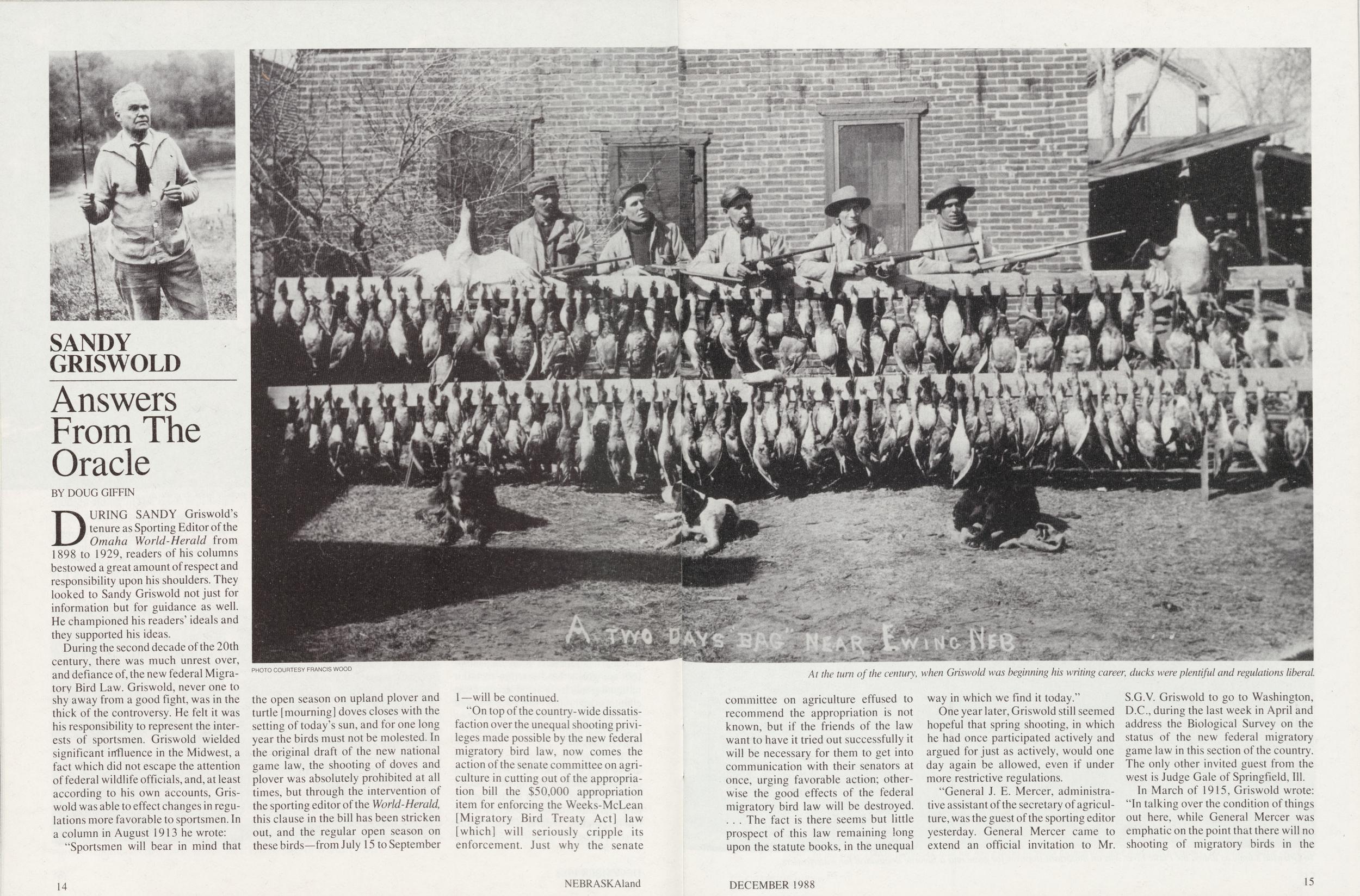
SANDY GRISWOLD Answers From The Oracle
BY DOUG GIFFINDURING SANDY Griswold's tenure as Sporting Editor of the Omaha World-Herald from 1898 to 1929, readers of his columns bestowed a great amount of respect and responsibility upon his shoulders. They looked to Sandy Griswold not just for information but for guidance as well. He championed his readers' ideals and they supported his ideas.
During the second decade of the 20th century, there was much unrest over, and defiance of, the new federal Migratory Bird Law. Griswold, never one to shy away from a good fight, was in the thick of the controversy. He felt it was his responsibility to represent the interests of sportsmen. Griswold wielded significant influence in the Midwest, a fact which did not escape the attention of federal wildlife officials, and, at least according to his own accounts, Griswold was able to effect changes in regulations more favorable to sportsmen. In a column in August 1913 he wrote:
"Sportsmen will bear in mind that the open season on upland plover and turtle [mourning] doves closes with the setting of today's sun, and for one long year the birds must not be molested. In the original draft of the new national game law, the shooting of doves and plover was absolutely prohibited at all times, but through the intervention of the sporting editor of the World-Herald, this clause in the bill has been stricken out, and the regular open season on these birds—from July 15 to September 1—will be continued.
"On top of the country-wide dissatisfaction over the unequal shooting privileges made possible by the new federal migratory bird law, now comes the action of the senate committee on agriculture in cutting out of the appropriation bill the $50,000 appropriation item for enforcing the Weeks-McLean [Migratory Bird Treaty Act] law [which] will seriously cripple its enforcement. Just why the senate 14 NEBRASKAland committee on agriculture effused to recommend the appropriation is not known, but if the friends of the law want to have it tried out successfully it will be necessary for them to get into communication with their senators at once, urging favorable action; otherwise the good effects of the federal migratory bird law will be destroyed. . . . The fact is there seems but little prospect of this law remaining long upon the statute books, in the unequal way in which we find it today."
One year later, Griswold still seemed hopeful that spring shooting, in which he had once participated actively and argued for just as actively, would one day again be allowed, even if under more restrictive regulations.
"General J. E. Mercer, administrative assistant of the secretary of agriculture, was the guest of the sporting editor yesterday. General Mercer came to extend an official invitation to Mr. S.G.V. Griswold to go to Washington, D.C., during the last week in April and address the Biological Survey on the status of the new federal migratory game law in this section of the country. The only other invited guest from the west is Judge Gale of Springfield, 111.
In March of 1915, Griswold wrote:
"In talking over the condition of things
out here, while General Mercer was
emphatic on the point that there will no
shooting of migratory birds in the
DECEMBER 1988
15
 United States this spring except on peril
of prosecution under the federal act, he
foresees a change for another year,
when the sportsmen in this section of
the land will be granted at least a brief
open season in the spring, presumably
from March 1 to 31.
United States this spring except on peril
of prosecution under the federal act, he
foresees a change for another year,
when the sportsmen in this section of
the land will be granted at least a brief
open season in the spring, presumably
from March 1 to 31.
"With this prospect in promise, all sportsmen should certainly be content to obey the law for the present to the very letter as, in fact, all true sportsmen would and will do under any circumstances or conditions. Those who will persist and fracture the act as it is laid down, while they are in no danger of immediate arrest, will surely be prosecuted for conspiracy to violate a federal statute."
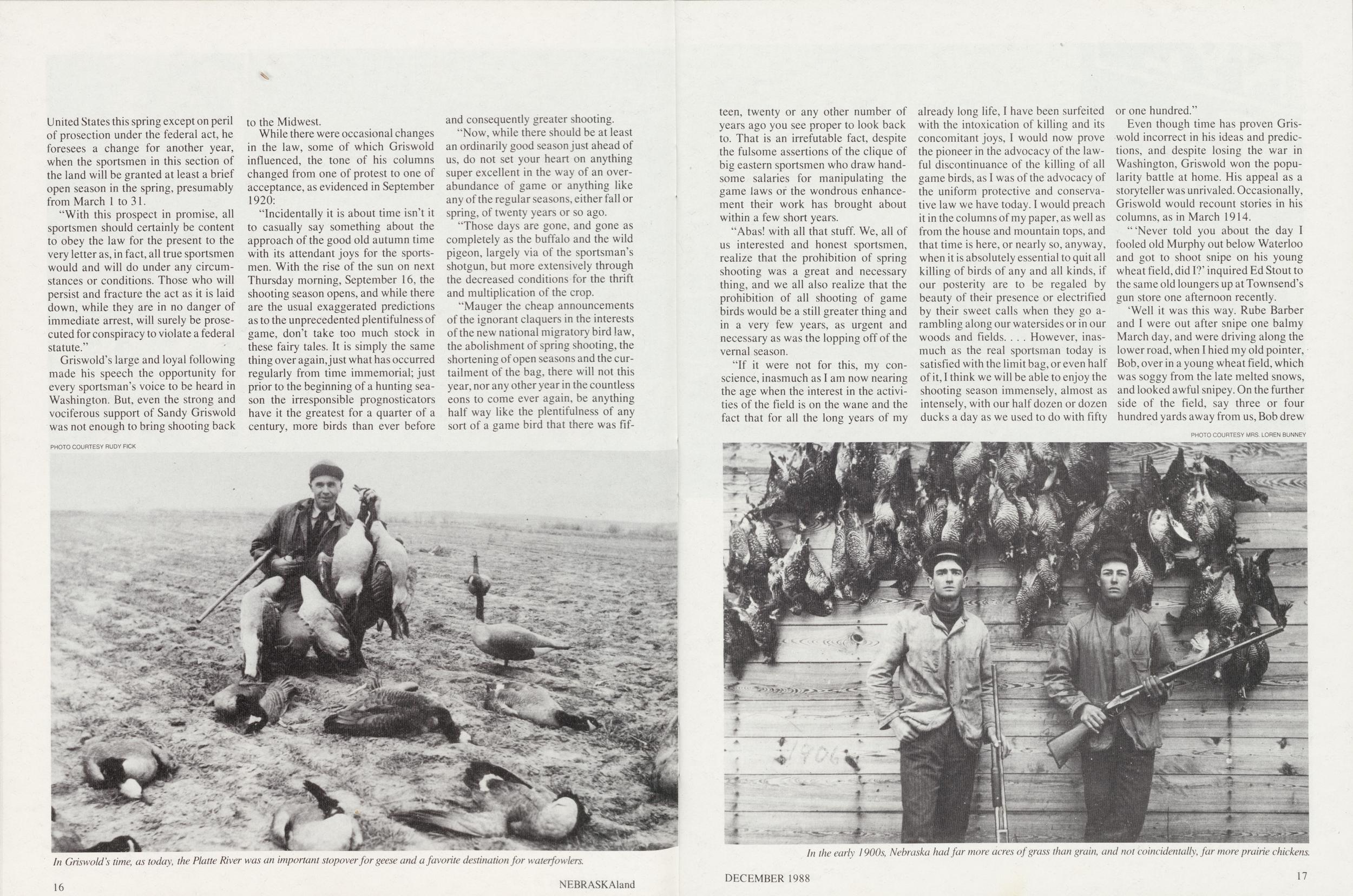
Griswold's large and loyal following made his speech the opportunity for every sportsman's voice to be heard in Washington. But, even the strong and vociferous support of Sandy Griswold was not enough to bring shooting back to the Midwest.
While there were occasional changes in the law, some of which Griswold influenced, the tone of his columns changed from one of protest to one of acceptance, as evidenced in September 1920:
"Incidentally it is about time isn't it to casually say something about the approach of the good old autumn time with its attendant joys for the sportsmen. With the rise of the sun on next Thursday morning, September 16, the shooting season opens, and while there are the usual exaggerated predictions as to the unprecedented plentifulness of game, don't take too much stock in these fairy tales. It is simply the same thing over again, just what has occurred regularly from time immemorial; just prior to the beginning of a hunting season the irresponsible prognosticators have it the greatest for a quarter of a century, more birds than ever before and consequently greater shooting.
"Now, while there should be at least an ordinarily good season just ahead of us, do not set your heart on anything super excellent in the way of an over-abundance of game or anything like any of the regular seasons, either fall or spring, of twenty years or so ago.
"Those days are gone, and gone as completely as the buffalo and the wild pigeon, largely via of the sportsman's shotgun, but more extensively through the decreased conditions for the thrift and multiplication of the crop.
"Mauger the cheap announcements of the ignorant claquers in the interests of the new national migratory bird law, the abolishment of spring shooting, the shortening of open seasons and the curtailment of the bag, there will not this year, nor any other year in the countless eons to come ever again, be anything half way like the plentifulness of any sort of a game bird that there was fifteen, twenty or any other number of years ago you see proper to look back to. That is an irrefutable fact, despite the fulsome assertions of the clique of big eastern sportsmen who draw handsome salaries for manipulating the game laws or the wondrous enhancement their work has brought about within a few short years.
"Abas! with all that stuff. We, all of us interested and honest sportsmen, realize that the prohibition of spring shooting was a great and necessary thing, and we all also realize that the prohibition of all shooting of game birds would be a still greater thing and in a very few years, as urgent and necessary as was the lopping off of the vernal season.
"If it were not for this, my conscience, inasmuch as I am now nearing the age when the interest in the activities of the field is on the wane and the fact that for all the long years of my already long life, I have been surfeited with the intoxication of killing and its concomitant joys, I would now prove the pioneer in the advocacy of the lawful discontinuance of the killing of all game birds, as I was of the advocacy of the uniform protective and conservative law we have today. I would preach it in the columns of my paper, as well as from the house and mountain tops, and that time is here, or nearly so, anyway, when it is absolutely essential to quit all killing of birds of any and all kinds, if our posterity are to be regaled by beauty of their presence or electrified by their sweet calls when they go a rambling along our watersides or in our woods and fields. . . . However, in as much as the real sportsman today is satisfied with the limit bag, or even half of it, I think we will be able to enjoy the shooting season immensely, almost as intensely, with our half dozen or dozen ducks a day as we used to do with fifty or one hundred."
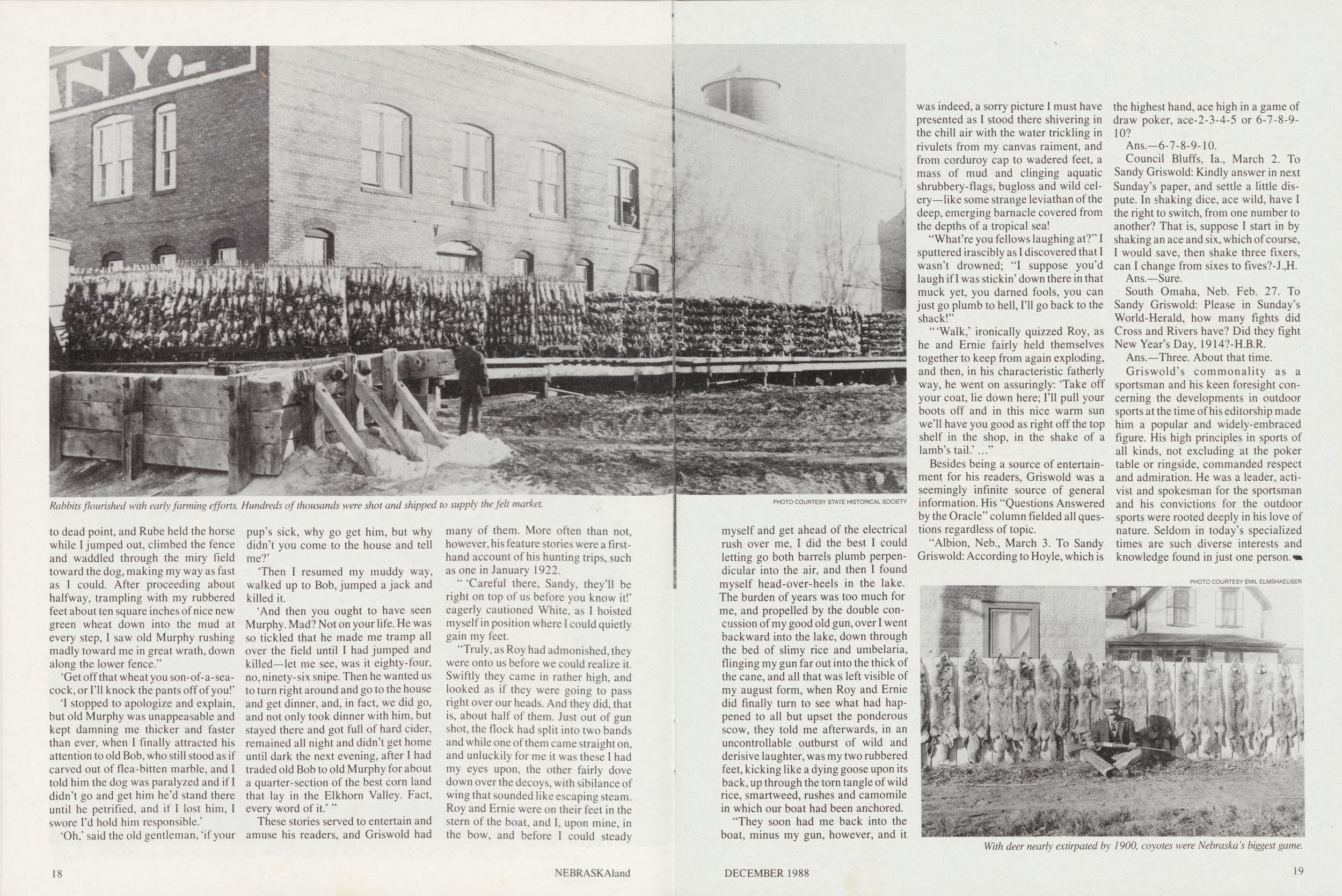
Even though time has proven Gris-wold incorrect in his ideas and predictions, and despite losing the war in Washington, Griswold won the popularity battle at home. His appeal as a storyteller was unrivaled. Occasionally, Griswold would recount stories in his columns, as in March 1914.
'Never told you about the day I fooled old Murphy out below Waterloo and got to shoot snipe on his young wheat field, did I?' inquired Ed Stout to the same old loungers up at Townsend's gun store one afternoon recently.
'Well it was this way. Rube Barber and I were out after snipe one balmy March day, and were driving along the lower road, when I hied my old pointer, Bob, over in a young wheat field, which was soggy from the late melted snows, and looked awful snipey. On the further side of the field, say three or four hundred yards away from us, Bob drew to dead point, and Rube held the horse while I jumped out, climbed the fence and waddled through the miry field toward the dog, making my way as fast as I could. After proceeding about halfway, trampling with my rubbered feet about ten square inches of nice new green wheat down into the mud at every step, I saw old Murphy rushing madly toward me in great wrath, down along the lower fence."
'Get off that wheat you son-of-a-sea-cock, or I'll knock the pants off of you!'
'I stopped to apologize and explain, but old Murphy was unappeasable and kept damning me thicker and faster than ever, when I finally attracted his attention to old Bob, who still stood as if carved out of flea-bitten marble, and I told him the dog was paralyzed and if I didn't go and get him he'd stand there until he petrified, and if I lost him, I swore I'd hold him responsible.'
'Oh,' said the old gentleman, 'if your pup's sick, why go get him, but why didn't you come to the house and tell me?'
'Then I resumed my muddy way, walked up to Bob, jumped a jack and killed it.
'And then you ought to have seen Murphy. Mad? Not on your life. He was so tickled that he made me tramp all over the field until I had jumped and killed—let me see, was it eighty-four, no, ninety-six snipe. Then he wanted us to turn right around and go to the house and get dinner, and, in fact, we did go, and not only took dinner with him, but stayed there and got full of hard cider, remained all night and didn't get home until dark the next evening, after I had traded old Bob to old Murphy for about a quarter-section of the best corn land that lay in the Elkhorn Valley. Fact, every word of it.' "
These stories served to entertain and amuse his readers, and Griswold had many of them. More often than not, however, his feature stories were a first hand account of his hunting trips, such as one in January 1922.
" 'Careful there, Sandy, they'll be right on top of us before you know it!' eagerly cautioned White, as I hoisted myself in position where I could quietly gain my feet.
"Truly, as Roy had admonished, they were onto us before we could realize it. Swiftly they came in rather high, and looked as if they were going to pass right over our heads. And they did, that is, about half of them. Just out of gun shot, the flock had split into two bands and while one of them came straight on, and unluckily for me it was these I had my eyes upon, the other fairly dove down over the decoys, with sibilance of wing that sounded like escaping steam. Roy and Ernie were on their feet in the stern of the boat, and I, upon mine, in the bow, and before I could steady 18 NEBRSKAland myself and get ahead of the electrical rush over me, I did the best I could letting go both barrels plumb perpendicular into the air, and then I found myself head-over-heels in the lake. The burden of years was too much for me, and propelled by the double concussion of my good old gun, over I went backward into the lake, down through the bed of slimy rice and umbelaria, flinging my gun far out into the thick of the cane, and all that was left visible of my august form, when Roy and Ernie did finally turn to see what had happened to all but upset the ponderous scow, they told me afterwards, in an uncontrollable outburst of wild and derisive laughter, was my two rubbered feet, kicking like a dying goose upon its back, up through the torn tangle of wild rice, smartweed, rushes and camomile in which our boat had been anchored.
"They soon had me back into the boat, minus my gun, however, and it was indeed, a sorry picture I must have presented as I stood there shivering in the chill air with the water trickling in rivulets from my canvas raiment, and from corduroy cap to wadered feet, a mass of mud and clinging aquatic shrubbery-flags, bugloss and wild celery—like some strange leviathan of the deep, emerging barnacle covered from the depths of a tropical sea!
"What're you fellows laughing at?" I sputtered irascibly as I discovered that I wasn't drowned; "I suppose you'd laugh if I was stickin' down there in that muck yet, you darned fools, you can just go plumb to hell, I'll go back to the shack!"
"'Walk,' ironically quizzed Roy, as he and Ernie fairly held themselves together to keep from again exploding, and then, in his characteristic fatherly way, he went on assuringly: 'Take off your coat, lie down here; I'll pull your boots off and in this nice warm sun we'll have you good as right off the top shelf in the shop, in the shake of a lamb's tail.' ..."
Besides being a source of entertainment for his readers, Griswold was a seemingly infinite source of general information. His "Questions Answered by the Oracle" column fielded all questions regardless of topic.
"Albion, Neb., March 3. To Sandy Griswold: According to Hoyle, which is the highest hand, ace high in a game of draw poker, ace-2-3-4-5 or 6-7-8-9- 10?
Ans.—6-7-8-9-10.
Council Bluffs, la., March 2. To Sandy Griswold: Kindly answer in next Sunday's paper, and settle a little dispute. In shaking dice, ace wild, have I the right to switch, from one number to another? That is, suppose I start in by shaking an ace and six, which of course, I would save, then shake three fixers, can I change from sixes to fives?-J.,H.
Ans.—Sure.
South Omaha, Neb. Feb. 27. To Sandy Griswold: Please in Sunday's World-Herald, how many fights did Cross and Rivers have? Did they fight New Year's Day, 1914?-H.B.R.
Ans.—Three. About that time.
Griswold's commonality as a sportsman and his keen foresight concerning the developments in outdoor sports at the time of his editorship made him a popular and widely-embraced figure. His high principles in sports of all kinds, not excluding at the poker table or ringside, commanded respect and admiration. He was a leader, activist and spokesman for the sportsman and his convictions for the outdoor sports were rooted deeply in his love of nature. Seldom in today's specialized times are such diverse interests and knowledge found in just one person, m
Search For Our Natural Heritage
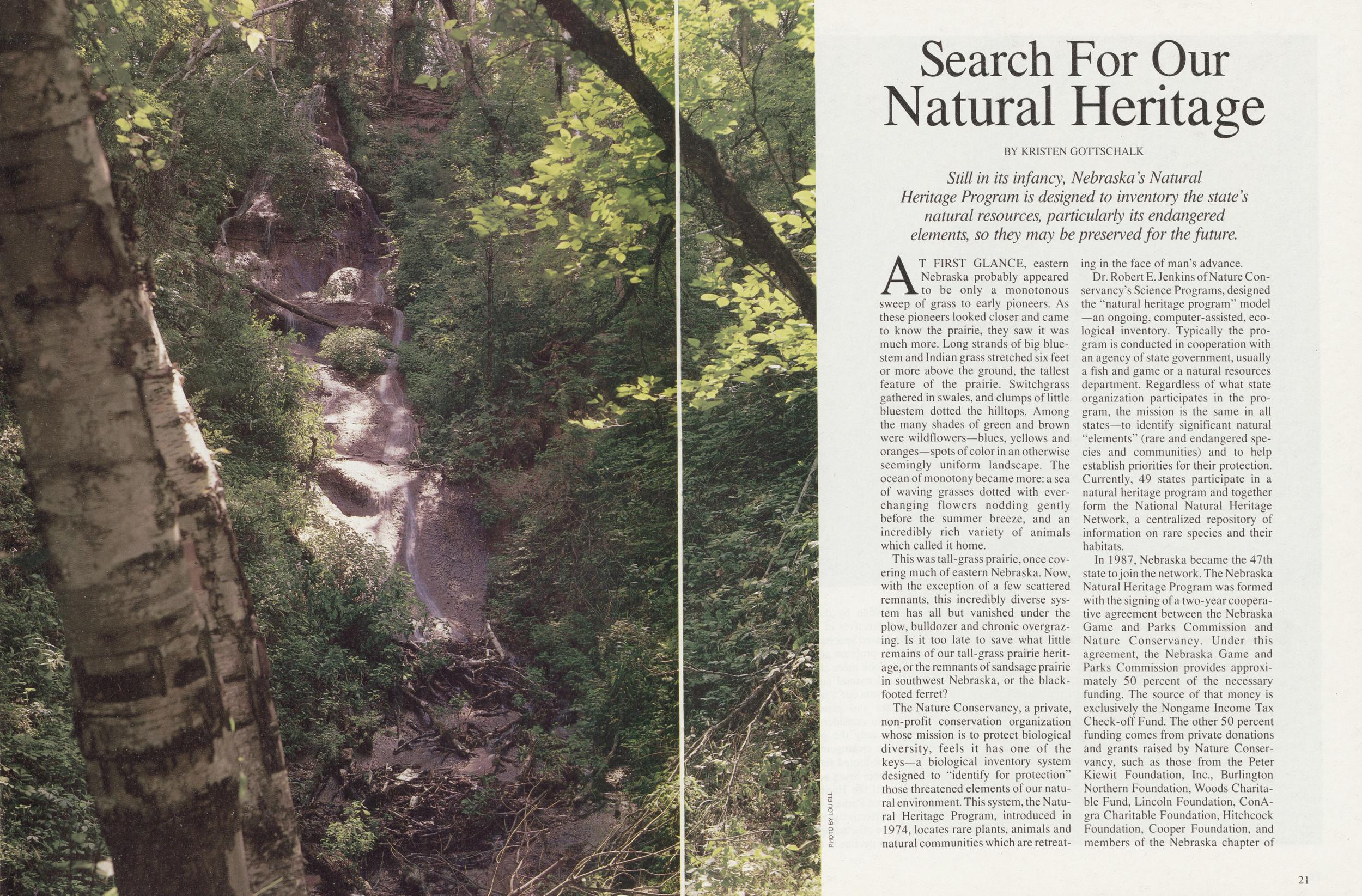
BY KRISTEN GOTTSCHALK Still in its infancy, Nebraska of Natural Heritage Program is designed to inventory the state's natural resources, particularly its endangered elements, so they may be preserved for the future.AT FIRST GLANCE, eastern Nebraska probably appeared to be only a monotonous sweep of grass to early pioneers. As these pioneers looked closer and came to know the prairie, they saw it was much more. Long strands of big bluestem and Indian grass stretched six feet or more above the ground, the tallest feature of the prairie. Switchgrass gathered in swales, and clumps of little bluestem dotted the hilltops. Among the many shades of green and brown were wildflowers—blues, yellows and oranges—spots of color in an otherwise seemingly uniform landscape. The ocean of monotony became more: a sea of waving grasses dotted with everchanging flowers nodding gently before the summer breeze, and an incredibly rich variety of animals which called it home.
This was tall-grass prairie, once covering much of eastern Nebraska. Now, with the exception of a few scattered remnants, this incredibly diverse system has all but vanished under the plow, bulldozer and chronic overgrazing. Is it too late to save what little remains of our tall-grass prairie heritage, or the remnants of sand sage prairie in southwest Nebraska, or the blackfooted ferret?
The Nature Conservancy, a private, non-profit conservation organization whose mission is to protect biological diversity, feels it has one of the keys—a biological inventory system designed to "identify for protection" those threatened elements of our natural environment. This system, the Natural Heritage Program, introduced in 1974, locates rare plants, animals and natural communities which are retreating in the face of man's advance.
Dr. Robert E. Jenkins of Nature Conservancy's Science Programs, designed the "natural heritage program" model —an ongoing, computer-assisted, ecological inventory. Typically the program is conducted in cooperation with an agency of state government, usually a fish and game or a natural resources department. Regardless of what state organization participates in the program, the mission is the same in all states—to identify significant natural "elements" (rare and endangered species and communities) and to help establish priorities for their protection. Currently, 49 states participate in a natural heritage program and together form the National Natural Heritage Network, a centralized repository of information on rare species and their habitats.
In 1987, Nebraska became the 47th state to join the network. The Nebraska Natural Heritage Program was formed with the signing of a two-year cooperative agreement between the Nebraska Game and Parks Commission and Nature Conservancy. Under this agreement, the Nebraska Game and Parks Commission provides approximately 50 percent of the necessary funding. The source of that money is exclusively the Nongame Income Tax Check-off Fund. The other 50 percent funding comes from private donations and grants raised by Nature Conservancy, such as those from the Peter Kiewit Foundation, Inc., Burlington Northern Foundation, Woods Charitable Fund, Lincoln Foundation, Conagra Charitable Foundation, Hitchcock Foundation, Cooper Foundation, and members of the Nebraska chapter of Nature Conservancy.
21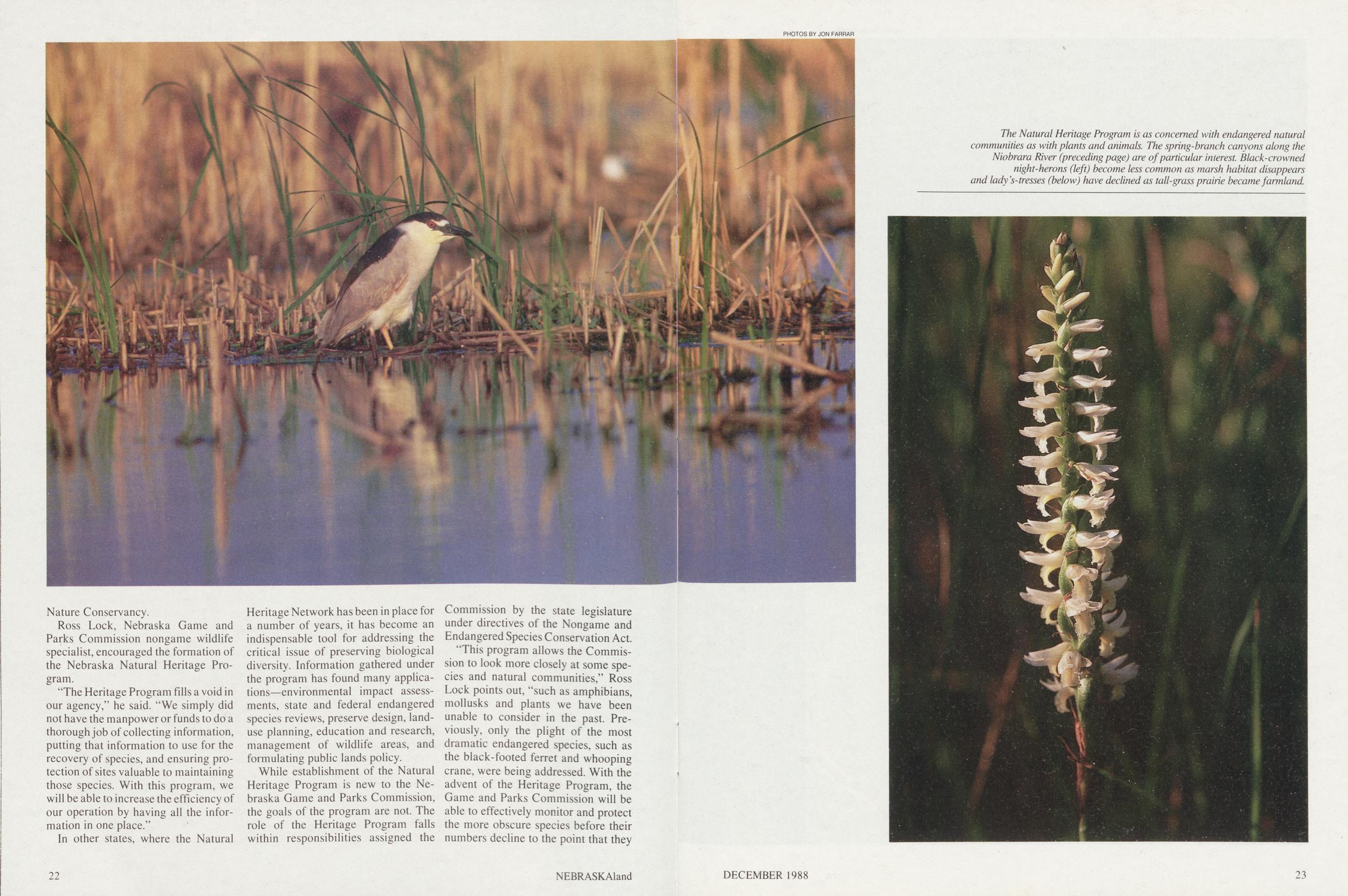
Ross Lock, Nebraska Game and Parks Commission nongame wildlife specialist, encouraged the formation of the Nebraska Natural Heritage Program.
The Heritage Program fills a void in our agency," he said. "We simply did not have the manpower or funds to do a thorough job of collecting information, putting that information to use for the recovery of species, and ensuring protection of sites valuable to maintaining those species. With this program, we will be able to increase the efficiency of our operation by having all the information in one place."
In other states, where the Natural The Natural Heritage Program is as concerned with endangered natural communities as with plants and animals. The spring-branch canyons along the Niobrara River (preceding page) are of particular interest. Black-crowned night-herons (left) become less common as marsh habitat disappears and lady's-tresses (below) have declined as tall-grass prairie became farmland. Heritage Network has been in place for a number of years, it has become an indispensable tool for addressing the critical issue of preserving biological diversity. Information gathered under the program has found many applications—environmental impact assessments, state and federal endangered species reviews, preserve design, land use planning, education and research, management of wildlife areas, and formulating public lands policy.
While establishment of the Natural Heritage Program is new to the Nebraska Game and Parks Commission, the goals of the program are not. The role of the Heritage Program falls within responsibilities assigned the Commission by the state legislature under directives of the Nongame and Endangered Species Conservation Act.
"This program allows the Commission to look more closely at some species and natural communities," Ross Lock points out, "such as amphibians, mollusks and plants we have been unable to consider in the past. Previously, only the plight of the most dramatic endangered species, such as the black-footed ferret and whooping crane, were being addressed. With the advent of the Heritage Program, the Game and Parks Commission will be able to effectively monitor and protect the more obscure species before their numbers decline to the point that they also are endangered or threatened.
22 NEBRASKAland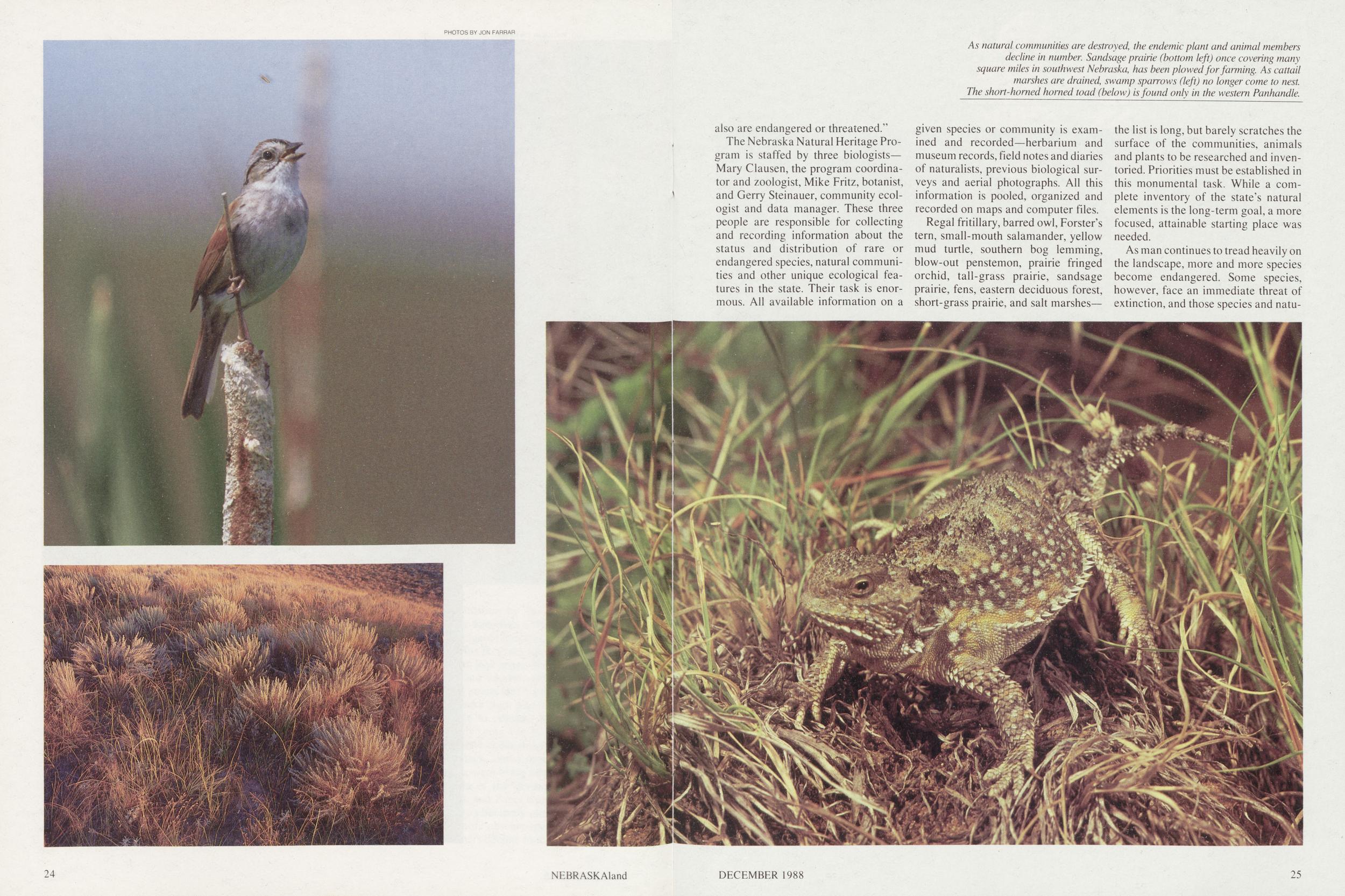
The Nebraska Natural Heritage Program is staffed by three biologists Mary Clausen, the program coordinator and zoologist, Mike Fritz, botanist, and Gerry Steinauer, community e cologist and data manager. These three people are responsible for collecting and recording information about the status and distribution of rare or endangered species, natural communities and other unique ecological features in the state. Their task is enormous. All available information on a given species or community is examined and recorded—herbarium and museum records, field notes and diaries of naturalists, previous biological surveys and aerial photographs. All this information is pooled, organized and recorded on maps and computer files.
Regal fritillary, barred owl, Forster's tern, small-mouth salamander, yellow mud turtle, southern bog lemming, blow-out penstemon, prairie fringed orchid, tall-grass prairie, sand sage prairie, fens, eastern deciduous forest, short-grass prairie, and salt marshes— the list is long, but barely scratches the surface of the communities, animals and plants to be researched and inventoried. Priorities must be established in this monumental task. While a complete inventory of the state's natural elements is the long-term goal, a more focused, attainable starting place was needed.
As man continues to tread heavily on the landscape, more and more species become endangered. Some species, however, face an immediate threat of extinction, and those species and natural communities must be helped first. The initial goal of the Natural Heritage Program is to identify and establish priorities for the protection of "the last of the least" and "the best of the rest."
DECEMBER 1988 25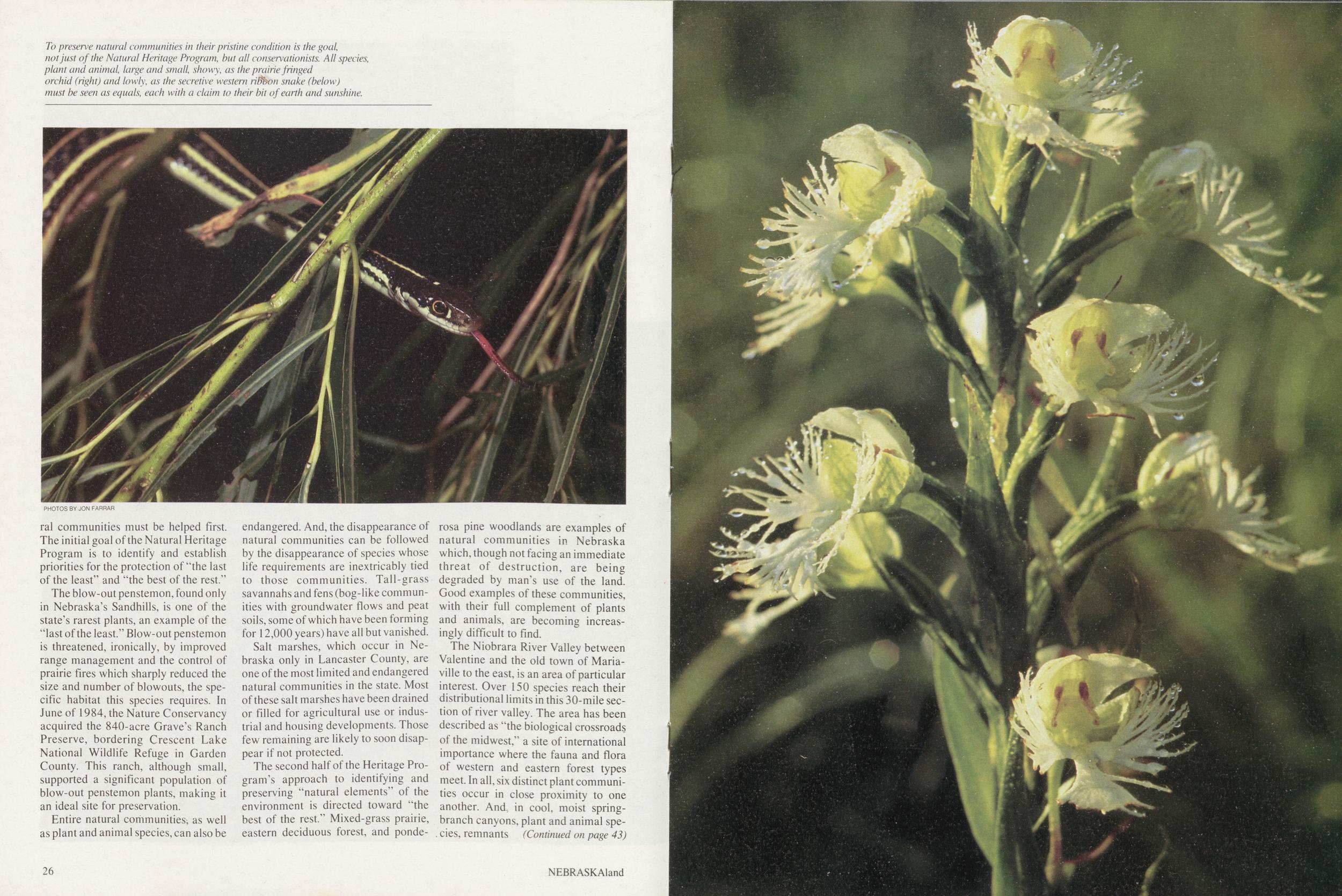
The blow-out penstemon, found only in Nebraska's Sandhills, is one of the state's rarest plants, an example of the "last of the least." Blow-out penstemon is threatened, ironically, by improved range management and the control of prairie fires which sharply reduced the size and number of blowouts, the specific habitat this species requires. In June of 1984, the Nature Conservancy acquired the 840-acre Grave's Ranch Preserve, bordering Crescent Lake National Wildlife Refuge in Garden County. This ranch, although small, supported a significant population of blow-out penstemon plants, making it an ideal site for preservation.
Entire natural communities, as well as plant and animal species, can also be endangered. And, the disappearance of natural communities can be followed by the disappearance of species whose life requirements are inextricably tied to those communities. Tall-grass savannahs and fens (bog-like communities with groundwater flows and peat soils, some of which have been forming for 12,000 years) have all but vanished.
Salt marshes, which occur in Nebraska only in Lancaster County, are one of the most limited and endangered natural communities in the state. Most of these salt marshes have been drained or filled for agricultural use or industrial and housing developments. Those few remaining are likely to soon disappear if not protected.
The second half of the Heritage Program's approach to identifying and preserving "natural elements" of the environment is directed toward "the best of the rest." Mixed-grass prairie, eastern deciduous forest, and ponderosa pine woodlands are examples of natural communities in Nebraska which, though not facing an immediate threat of destruction, are being degraded by man's use of the land. Good examples of these communities, with their full complement of plants and animals, are becoming increasingly difficult to find.
The Niobrara River Valley between Valentine and the old town of Mariaville to the east, is an area of particular interest. Over 150 species reach their distributional limits in this 30-mile section of river valley. The area has been described as "the biological crossroads of the midwest," a site of international importance where the fauna and flora of western and eastern forest types meet. In all, six distinct plant communities occur in close proximity to one another. And, in cool, moist springbranch canyons, plant and animal species, remnants (Continued on page 43)
26 NEBRASKAland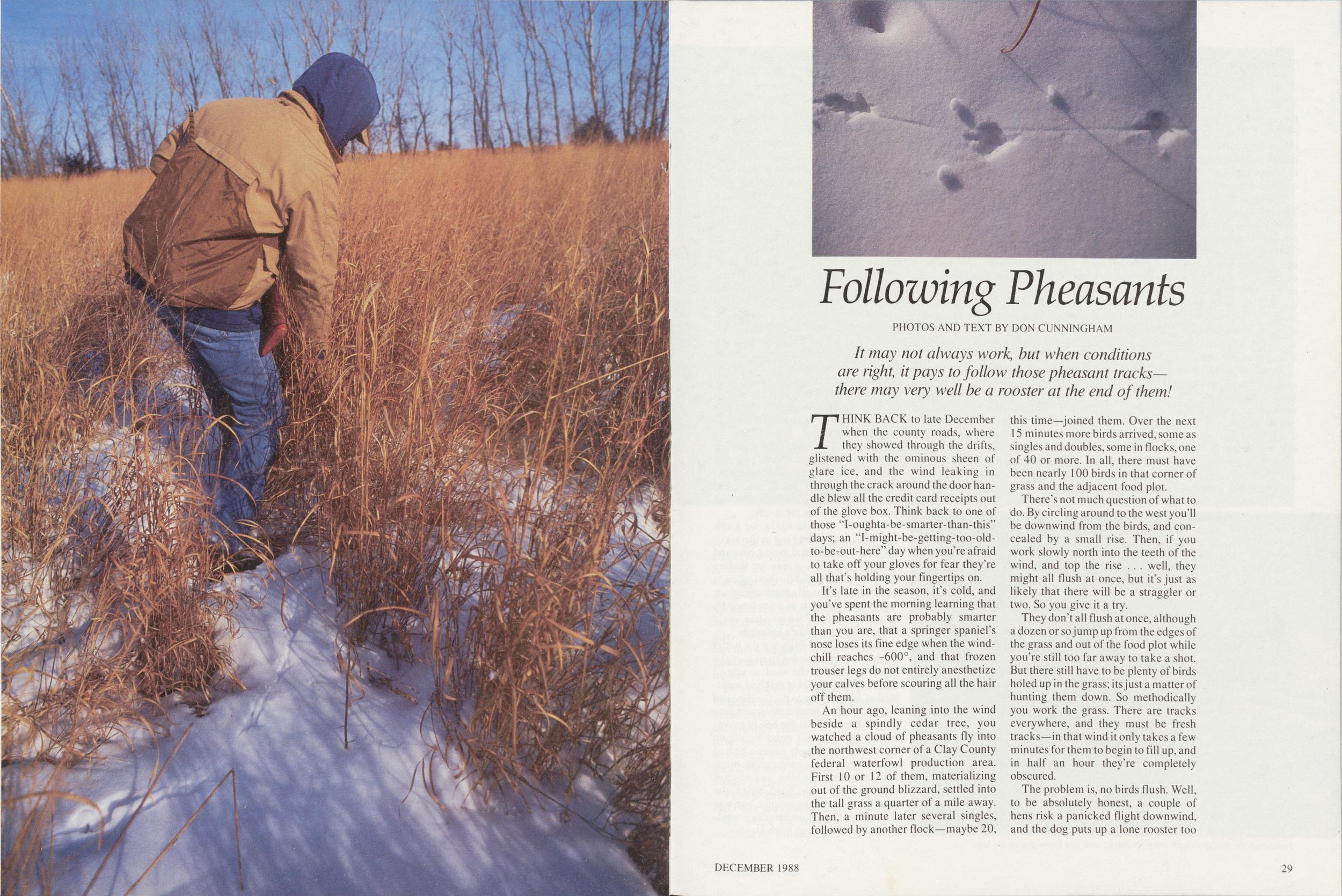
Following Pheasants
PHOTOS AND TEXT BY DON CUNNINGHAM It may not always work, but when conditions are right, it pays to follow those pheasant tracks there may very well be a rooster at the end of them!THINK BACK to late December when the county roads, where they showed through the drifts, glistened with the ominous sheen of glare ice, and the wind leaking in through the crack around the door handle blew all the credit card receipts out of the glove box. Think back to one of those 'T-oughta-be-smarter-than-this" days; an "I-might-be-getting-too-old-to-be-out-here" day when you're afraid to take off your gloves for fear they're all that's holding your fingertips on.
It's late in the season, it's cold, and you've spent the morning learning that the pheasants are probably smarter than you are, that a springer spaniel's nose loses its fine edge when the wind- chill reaches -600°, and that frozen trouser legs do not entirely anesthetize your calves before scouring all the hair off them.
An hour ago, leaning into the wind beside a spindly cedar tree, you watched a cloud of pheasants fly into the northwest corner of a Clay County federal waterfowl production area. First 10 or 12 of them, materializing out of the ground blizzard, settled into the tall grass a quarter of a mile away. Then, a minute later several singles, followed by another flock—maybe 20, this time—joined them. Over the next 15 minutes more birds arrived, some as singles and doubles, some in flocks, one of 40 or more. In all, there must have been nearly 100 birds in that corner of grass and the adjacent food plot.
There's not much question of what to do. By circling around to the west you'll be downwind from the birds, and concealed by a small rise. Then, if you work slowly north into the teeth of the wind, and top the rise . . . well, they might all flush at once, but it's just as likely that there will be a straggler or two. So you give it a try.
They don't all flush at once, although a dozen or so jump up from the edges of the grass and out of the food plot while you're still too far away to take a shot. But there still have to be plenty of birds holed up in the grass; its just a matter of hunting them down. So methodically you work the grass. There are tracks everywhere, and they must be fresh tracks—in that wind it only takes a few minutes for them to begin to fill up, and in half an hour they're completely obscured.
The problem is, no birds flush. Well,
to be absolutely honest, a couple of
hens risk a panicked flight downwind,
and the dog puts up a lone rooster too
DECEMBER 1988
29
 far out to shoot, but where are the rest
of them? Were those dozens of birds
imaginary, mere desperate, cold
induced self-delusions, the maddened,
delirious figments of a super-cooled,
caffeine-deprived brain?
far out to shoot, but where are the rest
of them? Were those dozens of birds
imaginary, mere desperate, cold
induced self-delusions, the maddened,
delirious figments of a super-cooled,
caffeine-deprived brain?
That's possible, but not really likely. The real question is, what do you do now? First, do the sensible thing. There are small-town cafes all around you. There is no location in all of south-central Nebraska more than 18 minutes from a bowl of chili, and you will think more clearly sitting securely in a cracked red vinyl booth, both hands around a coffee mug, than you will standing in a frozen marsh listening to the wind whistle "Colonel Bogey" across your double barrel.
Then, get your vacuum bottle filled, and go hunting again; you'll like it better this time, especially if you keep three principles in mind:
1) If real birds fly into real grass, and if they don't fly, walk, or hitchhike back out, they're still there.
2) The fact that you can't see them, and the dog can't smell them in a subzero hurricane doesn't mean that they absolutely cannot be found.
3) If you find fresh tracks and follow them, there will be either wing marks or scaly feet at the end of the trail.
Ok, now we can drop the "you" pretense. You have probably known all this for years. But somehow, over the years, I had forgotten about principle number three. As a matter of fact I learned last December that I may never have really understood its full implications. Oh, yes, I've always looked for tracks— they tell you whether birds have been using a food plot, for example, what cover they favor on a given area, and, especially soon after a rain or a snow, when all the tracks are more-or-less fresh, they suggest something about the number of birds around.
I've even followed tracks in the past—especially those I thought were particularly fresh—but I don't remember ever before systematically and deliberately trailing a bird to its hiding place; isn't that what the dog is supposed to do? But I learned something last December that I'll try to confirm again this year, and it might be useful for you, too. Here's how it worked.
Freshly chilled and re-coffeed after our Clay County failure, my hunting partner and I drove to another water fowl production area, this one flanked by a wide cedar windbreak to the north, and separated from the cattails and smartweed of the marsh itself by a hundred yards of tall native grass. "Our luck's about to change," Dave said, plunging into the trees.
Not more than 30 yards in, his prediction was fulfilled. Birds began to flush, rattling through the icy cedar branches, catching the wind, rocketing out into the full gale, and south into the grass. On the first rise, hunting on the downwind edge of the windbreak I had three clear shots and two of them counted. After two retrieves, the dog looked as much revived as I felt. Dave, trapped in the cramped quarters of the windbreak, could only stand helplessly as the birds flushed, always keeping a substantial cedar between themselves and his shotgun.
After the first rise, the remaining birds came up as singles, none giving us another shot. But regularly, along the entire half-mile of windbreak, birds continued to flush out of the trees and into the tall grass to the south.
So, there we were again: we knew that birds were hiding out in the grass, but in the strong wind, biting cold and heavy cover, the dog was not finding many. When they did flush, as often as not they rose virtually from underfoot, and frequently took us completely by surprise, flushing only after we'd stopped for a moment's breather.
Then Dave's curiosity got the better of him. We were too far apart to make ourselves heard in the wind, so when I rounded a plum thicket that had separated us for a minute or two, and looked over to see him, head down, meandering south, away from our line of movement, there was no point in asking questions. I could only assume he had succumbed to some exotic arctic madness, abandoned the tiller, and was just willy-nilly riding the wind. Strike, the springer, was tending to some business of his own, but I momentarily considered telling him to go fetch Dave.
30 NEBRASKAlandAs I watched, Dave continued his erratic course, looping back and forth among the clumps of grass, intently scanning the snow at his feet. After about 40 yards he stopped, backtracked a few feet, returned to his original stopping place, and looked side to side. Then, leaning tentatively over a hummock of grass, he barely avoided felonious assault by a suddenly flushing rooster.
I may not be an innovator, but with sufficient incentive I am still trainable. In the next hour we tracked 12 pheasants to their hiding places in the grass. Nine were hens, and three were roosters, two of which we shot. Only one of the 12, the third rooster, flushed beyond shooting range.
Time after time birds held so tightly that Dave and I followed the trail to the point where the tracks disappeared, searched for a minute or two, and then took evasive action to avoid a bird flushing right at our feet.
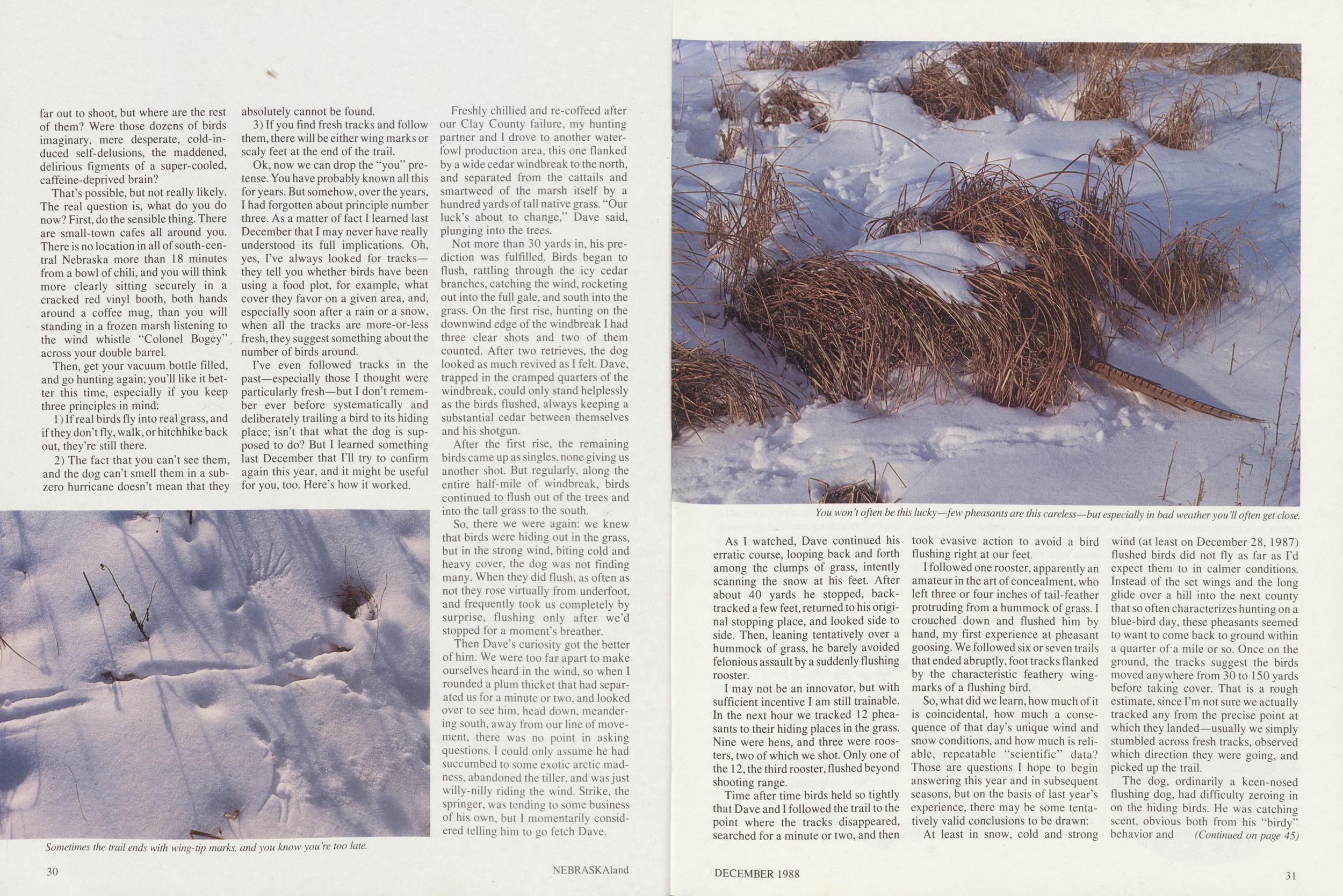
I followed one rooster, apparently an amateur in the art of concealment, who left three or four inches of tail-feather protruding from a hummock of grass. I crouched down and flushed him by hand, my first experience at pheasant goosing. We followed six or seven trails that ended abruptly, foot tracks flanked by the characteristic feathery wing marks of a flushing bird.
So, what did we learn, how much of it is coincidental, how much a consequence of that day's unique wind and snow conditions, and how much is reliable, repeatable "scientific" data? Those are questions I hope to begin answering this year and in subsequent seasons, but on the basis of last year's experience, there may be some tentatively valid conclusions to be drawn:
At least in snow, cold and strong wind (at least on December 28, 1987) flushed birds did not fly as far as I'd expect them to in calmer conditions. Instead of the set wings and the long glide over a hill into the next county that so often characterizes hunting on a blue-bird day, these pheasants seemed to want to come back to ground within a quarter of a mile or so. Once on the ground, the tracks suggest the birds moved anywhere from 30 to 150 yards before taking cover. That is a rough estimate, since I'm not sure we actually tracked any from the precise point at which they landed—usually we simply stumbled across fresh tracks, observed which direction they were going, and picked up the trail.
The dog, ordinarily a keen-nosed flushing dog, had difficulty zeroing in on the hiding birds. He was catching scent, obvious both from his "birdy" behavior and (Continued on page 45)
DECEMBER 1988 31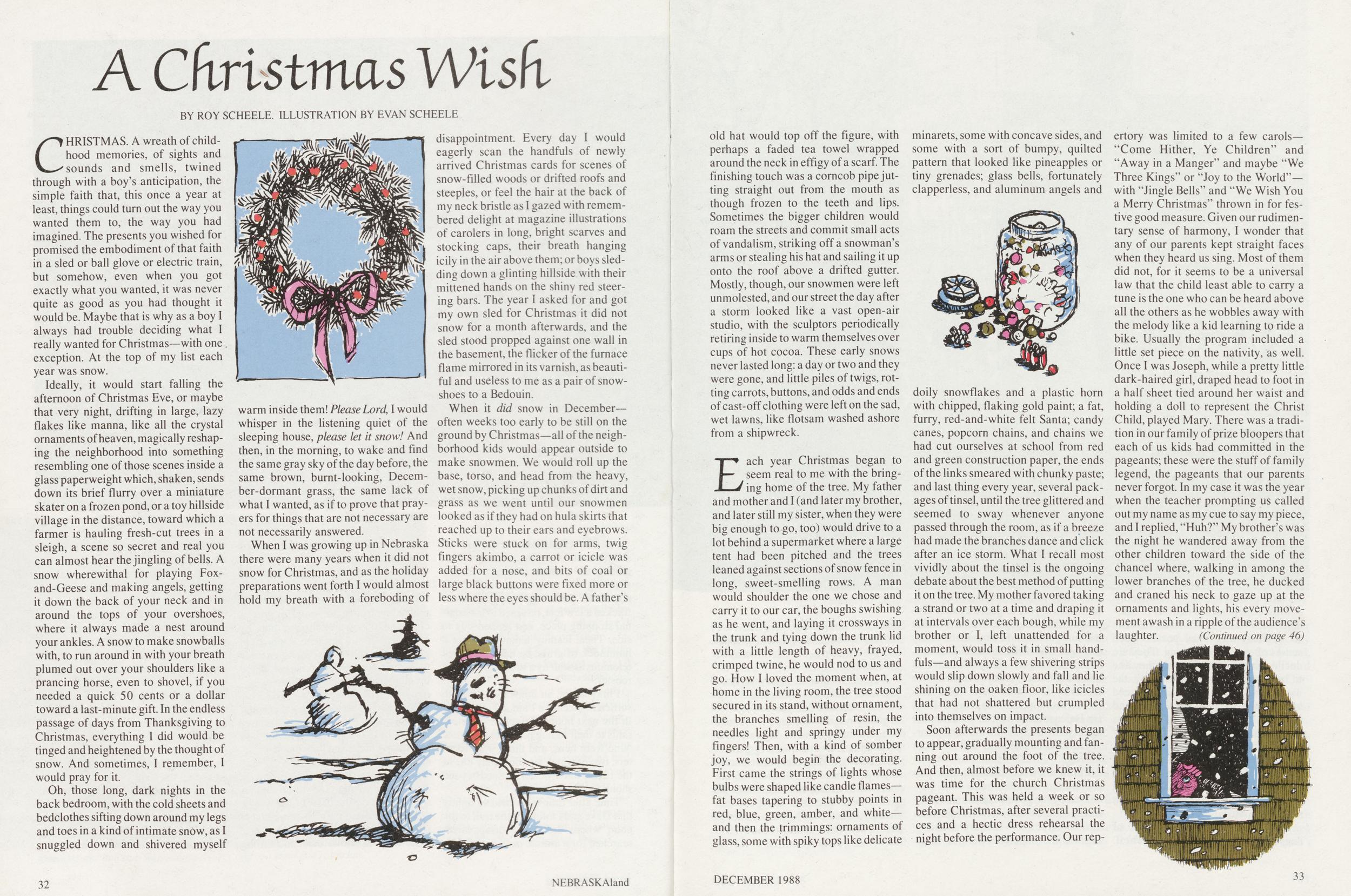
A Christmas Wish
BY ROY SCHEELE. ILLUSTRATION BY EVAN SCHEELECHRISTMAS. A wreath of childhood memories, of sights and sounds and smells, twined through with a boy's anticipation, the simple faith that, this once a year at least, things could turn out the way you wanted them to, the way you had imagined. The presents you wished for promised the embodiment of that faith in a sled or ball glove or electric train, but somehow, even when you got exactly what you wanted, it was never quite as good as you had thought it would be. Maybe that is why as a boy I always had trouble deciding what I really wanted for Christmas—with one. exception. At the top of my list each year was snow.
Ideally, it would start falling the afternoon of Christmas Eve, or maybe that very night, drifting in large, lazy flakes like manna, like all the crystal ornaments of heaven, magically reshaping the neighborhood into something resembling one of those scenes inside a glass paperweight which, shaken, sends down its brief flurry over a miniature skater on a frozen pond, or a toy hillside village in the distance, toward which a farmer is hauling fresh-cut trees in a sleigh, a scene so secret and real you can almost hear the jingling of bells. A snow wherewithal for playing Fox-and-Geese and making angels, getting it down the back of your neck and in around the tops of your overshoes, where it always made a nest around your ankles. A snow to make snowballs with, to run around in with your breath plumed out over your shoulders like a prancing horse, even to shovel, if you needed a quick 50 cents or a dollar toward a last-minute gift. In the endless passage of days from Thanksgiving to Christmas, everything I did would be tinged and heightened by the thought of snow. And sometimes, I remember, I would pray for it.
Oh, those long, dark nights in the back bedroom, with the cold sheets and bedclothes sifting down around my legs and toes in a kind of intimate snow, as I snuggled down and shivered myself warm inside them! Please Lord, I would whisper in the listening quiet of the sleeping house, please let it snow! And then, in the morning, to wake and find the same gray sky of the day before, the same brown, burnt-looking, December-dormant grass, the same lack of what I wanted, as if to prove that prayers for things that are not necessary are not necessarily answered.
When I was growing up in Nebraska there were many years when it did not snow for Christmas, and as the holiday preparations went forth I would almost hold my breath with a foreboding of disappointment. Every day I would eagerly scan the handfuls of newly arrived Christmas cards for scenes of snow-filled woods or drifted roofs and steeples, or feel the hair at the back of my neck bristle as I gazed with remembered delight at magazine illustrations of carolers in long, bright scarves and stocking caps, their breath hanging icily in the air above them; or boys sledding down a glinting hillside with their mittened hands on the shiny red steering bars. The year I asked for and got my own sled for Christmas it did not snow for a month afterwards, and the sled stood propped against one wall in the basement, the flicker of the furnace flame mirrored in its varnish, as beautiful and useless to me as a pair of snowshoes to a Bedouin.
When it did snow in December— often weeks too early to be still on the ground by Christmas—all of the neighborhood kids would appear outside to make snowmen. We would roll up the base, torso, and head from the heavy, wet snow, picking up chunks of dirt and grass as we went until our snowmen looked as if they had on hula skirts that reached up to their ears and eyebrows. Sticks were stuck on for arms, twig fingers akimbo, a carrot or icicle was added for a nose, and bits of coal or large black buttons were fixed more or less where the eyes should be. A father's 32 NEBRASKAland old hat would top off the figure, with perhaps a faded tea towel wrapped around the neck in effigy of a scarf. The finishing touch was a corncob pipe jutting straight out from the mouth as though frozen to the teeth and lips. Sometimes the bigger children would roam the streets and commit small acts of vandalism, striking off a snowman's arms or stealing his hat and sailing it up onto the roof above a drifted gutter. Mostly, though, our snowmen were left unmolested, and our street the day after a storm looked like a vast open-air studio, with the sculptors periodically retiring inside to warm themselves over cups of hot cocoa. These early snows never lasted long: a day or two and they were gone, and little piles of twigs, rotting carrots, buttons, and odds and ends of cast-off clothing were left on the sad, wet lawns, like flotsam washed ashore from a shipwreck.
Each year Christmas began to seem real to me with the bringing home of the tree. My father and mother and I (and later my brother, and later still my sister, when they were big enough to go, too) would drive to a lot behind a supermarket where a large tent had been pitched and the trees leaned against sections of snow fence in long, sweet-smelling rows. A man would shoulder the one we chose and carry it to our car, the boughs swishing as he went, and laying it crossways in the trunk and tying down the trunk lid with a little length of heavy, frayed, crimped twine, he would nod to us and go. How I loved the moment when, at home in the living room, the tree stood secured in its stand, without ornament, the branches smelling of resin, the needles light and springy under my fingers! Then, with a kind of somber joy, we would begin the decorating. First came the strings of lights whose bulbs were shaped like candle flames- fat bases tapering to stubby points in red, blue, green, amber, and white— and then the trimmings: ornaments of glass, some with spiky tops like delicate minarets, some with concave sides, and some with a sort of bumpy, quilted pattern that looked like pineapples or tiny grenades; glass bells, fortunately clapperless, and aluminum angels and doily snowflakes and a plastic horn with chipped, flaking gold paint; a fat, furry, red-and-white felt Santa; candy canes, popcorn chains, and chains we had cut ourselves at school from red and green construction paper, the ends of the links smeared with chunky paste; and last thing every year, several packages of tinsel, until the tree glittered and seemed to sway whenever anyone passed through the room, as if a breeze had made the branches dance and click after an ice storm. What I recall most vividly about the tinsel is the ongoing debate about the best method of putting it on the tree. My mother favored taking a strand or two at a time and draping it at intervals over each bough, while my brother or I, left unattended for a moment, would toss it in small handfuls—and always a few shivering strips would slip down slowly and fall and lie shining on the oaken floor, like icicles that had not shattered but crumpled into themselves on impact.
Soon afterwards the presents began to appear, gradually mounting and fanning out around the foot of the tree. And then, almost before we knew it, it was time for the church Christmas pageant. This was held a week or so before Christmas, after several practices and a hectic dress rehearsal the night before the performance. Our repertory was limited to a few carols— "Come Hither, Ye Children" and "Away in a Manger" and maybe "We Three Kings" or "Joy to the World"— with "Jingle Bells" and "We Wish You a Merry Christmas" thrown in for festive good measure. Given our rudimentary sense of harmony, I wonder that any of our parents kept straight faces when they heard us sing. Most of them did not, for it seems to be a universal law that the child least able to carry a tune is the one who can be heard above all the others as he wobbles away with the melody like a kid learning to ride a bike. Usually the program included a little set piece on the nativity, as well. Once I was Joseph, while a pretty little dark-haired girl, draped head to foot in a half sheet tied around her waist and holding a doll to represent the Christ Child, played Mary. There was a tradition in our family of prize bloopers that each of us kids had committed in the pageants; these were the stuff of family legend, the pageants that our parents never forgot. In my case it was the year when the teacher prompting us called out my name as my cue to say my piece, and I replied, "Huh?" My brother's was the night he wandered away from the other children toward the side of the chancel where, walking in among the lower branches of the tree, he ducked and craned his neck to gaze up at the ornaments and lights, his every movement awash in a ripple of the audience's laughter. (Continued on page 46)
War Dogs
BY TOM BUECKER, CURATOR ________STATE HISTORICAL SOCIETY MUSEUM, FORT ROBINSON________ In 1942, Fort Robinson opened a new phase as dogs replaced horses as members of Army's fighting team.WHEN CONSIDERING Fort Robinson's colorful past, its long tradition as a U.S. Cavalry post usually is foremost. Yet, during World War II, the Army carried on an entirely unrelated function there. Fort Robinson became the country's leading K-9 reception and training center, where thousands of dogs, not Cavalrymen, were trained for war duty.Most dogs possess a number of characteristics which make them valuable for military use. They possess keen senses of smell and hearing. They are docile, watchful and fast, and they like to be around people. Historically, the use of dogs in warfare can be traced back to the time of the Greeks and Romans. In the Seven Years' War, dogs were used as messengers by the army of the Prussian king Frederick the Great. During World War I the Germans employed some 30,000 dogs; French canine casualties exceeded 3,500 killed and 1,500 missing. British and Russian troops also used dogs extensively.
U.S. interest in the military use of dogs evolved just prior to World War II. Germany had been training thousands of dogs during its 1930s military buildup. What spurred American interest was the discovery that another potential foe, Japan, was obtaining large numbers of trained dogs from Germany.
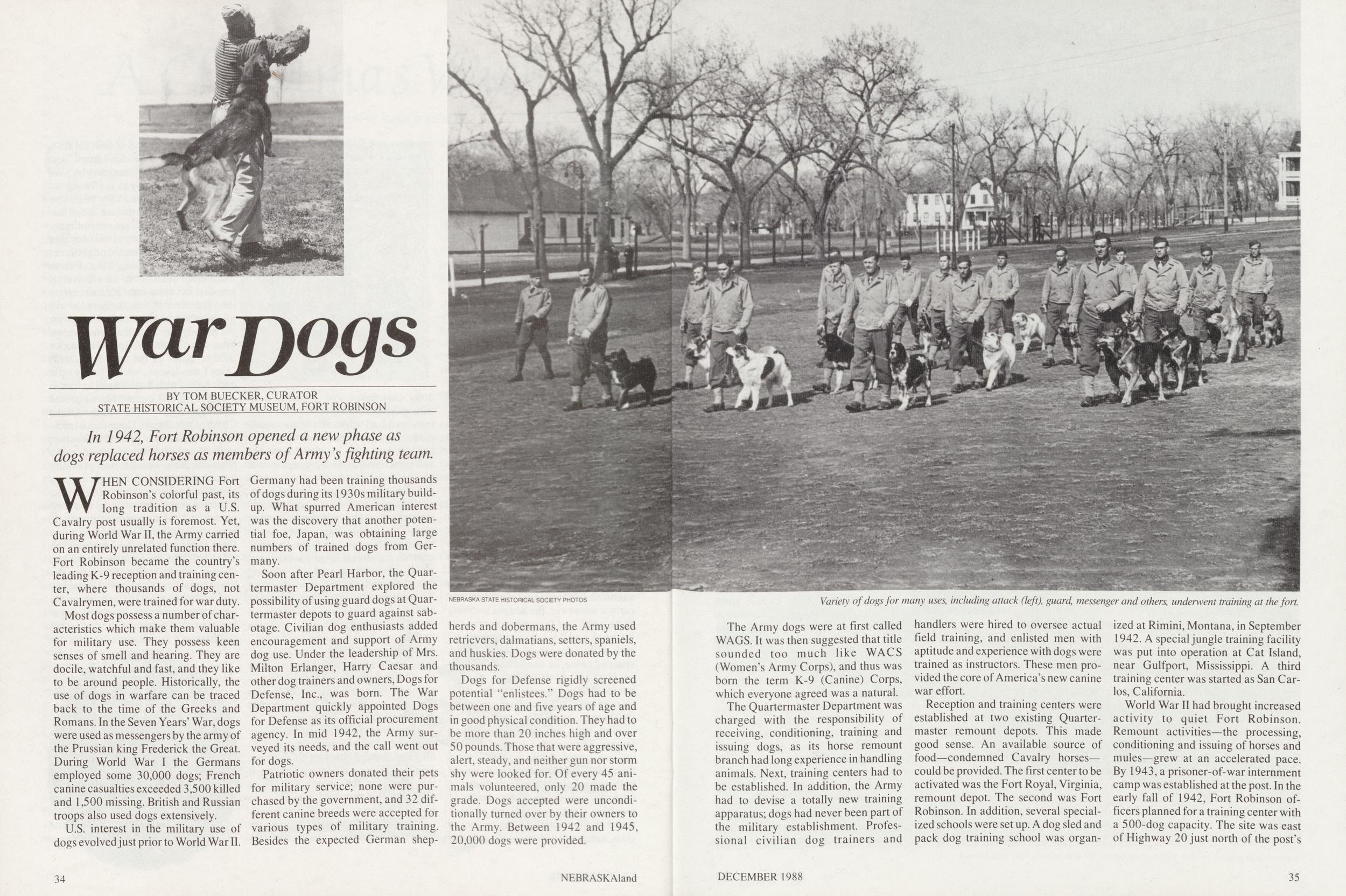
Soon after Pearl Harbor, the Quartermaster Department explored the possibility of using guard dogs at Quartermaster depots to guard against sabotage. Civilian dog enthusiasts added encouragement and support of Army dog use. Under the leadership of Mrs. Milton Erlanger, Harry Caesar and other dog trainers and owners, Dogs for Defense, Inc., was born. The War Department quickly appointed Dogs for Defense as its official procurement agency. In mid 1942, the Army surveyed its needs, and the call went out for dogs.Patriotic owners donated their pets for military service; none were purchased by the government, and 32 different canine breeds were accepted for various types of military training. Besides the expected German sheapherds and dobermans, the Army used retrievers, Dalmatians, setters, spaniels, and huskies. Dogs were donated by the thousands.
Dogs for Defense rigidly screened potential "enlistees." Dogs had to be between one and five years of age and in good physical condition. They had to be more than 20 inches high and over 50 pounds. Those that were aggressive, alert, steady, and neither gun nor storm shy were looked for. Of every 45 animals volunteered, only 20 made the grade. Dogs accepted were unconditionally turned over by their owners to the Army. Between 1942 and 1945, 20,000 dogs were provided.
34 NEBRASKAlandThe Army dogs were at first called WAGS. It was then suggested that title sounded too much like WACS (Women's Army Corps), and thus was born the term K-9 (Canine) Corps, which everyone agreed was a natural.
The Quartermaster Department was charged with the responsibility of receiving, conditioning, training and issuing dogs, as its horse remount branch had long experience in handling animals. Next, training centers had to be established. In addition, the Army had to devise a totally new training apparatus; dogs had never been part of the military establishment. Professional civilian dog trainers and handlers were hired to oversee actual field training, and enlisted men with aptitude and experience with dogs were trained as instructors. These men provided the core of America's new canine war effort.
Reception and training centers were established at two existing Quartermaster remount depots. This made good sense. An available source of food—condemned Cavalry horses- could be provided. The first center to be activated was the Fort Royal, Virginia, remount depot. The second was Fort Robinson. In addition, several specialized schools were set up. A dog sled and pack dog training school was organized at Rimini, Montana, in September 1942. A special jungle training facility was put into operation at Cat Island, near Gulfport, Mississippi. A third training center was started as San Carlos, California.
World War II had brought increased activity to quiet Fort Robinson. Remount activities—the processing, conditioning and issuing of horses and mules—grew at an accelerated pace. By 1943, a prisoner-of-war internment camp was established at the post. In the early fall of 1942, Fort Robinson officers planned for a training center with a 500-dog capacity. The site was east of Highway 20 just north of the post's warehouse area. The new training area consisted of some 50 acres on a slight rise. For a number of years this part of the old post contained a variety of Quartermaster buildings, stables, quarters, and other structures. Nearly all of those buildings had been razed during the 1920s and 1930s, leaving the hillside clear for the new facility.
DECEMBER 1988 35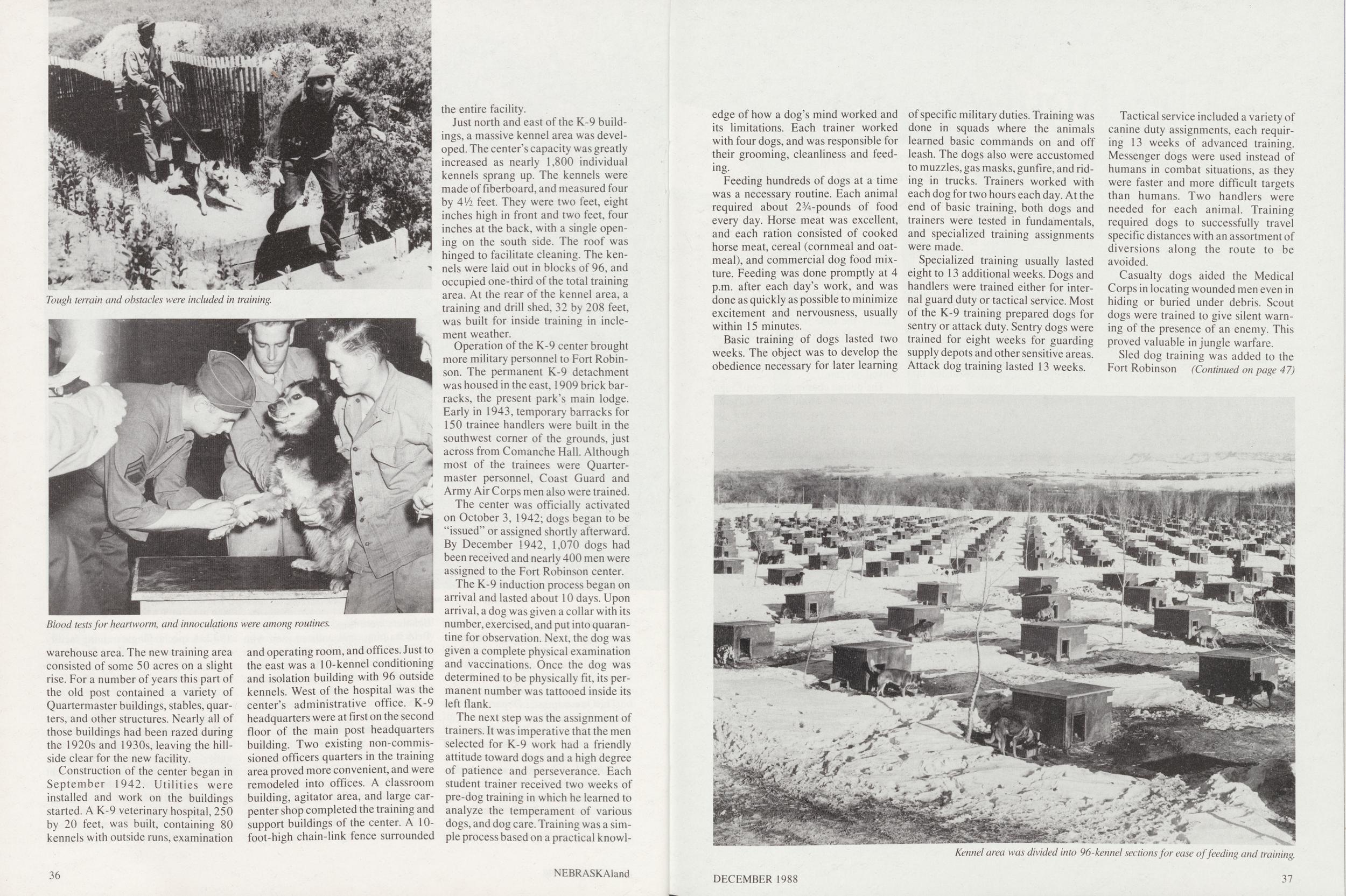
Construction of the center began in September 1942. Utilities were installed and work on the buildings started. A K-9 veterinary hospital, 250 by 20 feet, was built, containing 80 kennels with outside runs, examination and operating room, and offices. Just to the east was a 10-kennel conditioning and isolation building with 96 outside kennels. West of the hospital was the center's administrative office. K-9 headquarters were at first on the second floor of the main post headquarters building. Two existing non-commissioned officers quarters in the training area proved more convenient, and were remodeled into offices. A classroom building, agitator area, and large carpenter shop completed the training and support buildings of the center. A 10-foot-high chain-link fence surrounded the entire facility.
Just north and east of the K-9 buildings, a massive kennel area was developed. The center's capacity was greatly increased as nearly 1,800 individual kennels sprang up. The kennels were made of fiberboard, and measured four by 4V2 feet. They were two feet, eight inches high in front and two feet, four inches at the back, with a single opening on the south side. The roof was hinged to facilitate cleaning. The kennels were laid out in blocks of 96, and occupied one-third of the total training area. At the rear of the kennel area, a training and drill shed, 32 by 208 feet, was built for inside training in inclement weather.
Operation of the K-9 center brought more military personnel to Fort Robinson. The permanent K-9 detachment was housed in the east, 1909 brick barracks, the present park's main lodge. Early in 1943, temporary barracks for 150 trainee handlers were built in the southwest corner of the grounds, just across from Comanche Hall. Although most of the trainees were Quartermaster personnel, Coast Guard and Army Air Corps men also were trained.
The center was officially activated on October 3, 1942; dogs began to be "issued" or assigned shortly afterward. By December 1942, 1,070 dogs had been received and nearly 400 men were assigned to the Fort Robinson center.
The K-9 induction process began on arrival and lasted about 10 days. Upon arrival, a dog was given a collar with its number, exercised, and put into quarantine for observation. Next, the dog was given a complete physical examination and vaccinations. Once the dog was determined to be physically fit, its permanent number was tattooed inside its left flank.
The next step was the assignment of trainers. It was imperative that the men selected for K-9 work had a friendly attitude toward dogs and a high degree of patience and perseverance. Each student trainer received two weeks of pre-dog training in which he learned to analyze the temperament of various dogs, and dog care. Training was a simple process based on a practical knowledge 36 NEBRASKAland of how a dog's mind worked and its limitations. Each trainer worked with four dogs, and was responsible for their grooming, cleanliness and feeding.
Feeding hundreds of dogs at a time was a necessary routine. Each animal required about 23/4-pounds of food every day. Horse meat was excellent, and each ration consisted of cooked horse meat, cereal (cornmeal and oatmeal), and commercial dog food mixture. Feeding was done promptly at 4 p.m. after each day's work, and was done as quickly as possible to minimize excitement and nervousness, usually within 15 minutes.
Basic training of dogs lasted two weeks. The object was to develop the obedience necessary for later learning of specific military duties. Training was done in squads where the animals learned basic commands on and off leash. The dogs also were accustomed to muzzles, gas masks, gunfire, and riding in trucks. Trainers worked with each dog for two hours each day. At the end of basic training, both dogs and trainers were tested in fundamentals, and specialized training assignments were made.
Specialized training usually lasted eight to 13 additional weeks. Dogs and handlers were trained either for internal guard duty or tactical service. Most of the K-9 training prepared dogs for sentry or attack duty. Sentry dogs were trained for eight weeks for guarding supply depots and other sensitive areas. Attack dog training lasted 13 weeks.
Tactical service included a variety of canine duty assignments, each requiring 13 weeks of advanced training. Messenger dogs were used instead of humans in combat situations, as they were faster and more difficult targets than humans. Two handlers were needed for each animal. Training required dogs to successfully travel specific distances with an assortment of diversions along the route to be avoided.
Casualty dogs aided the Medical Corps in locating wounded men even in hiding or buried under debris. Scout dogs were trained to give silent warning of the presence of an enemy. This proved valuable in jungle warfare.
Sled dog training was added to the Fort Robinson (Continued on page 47)
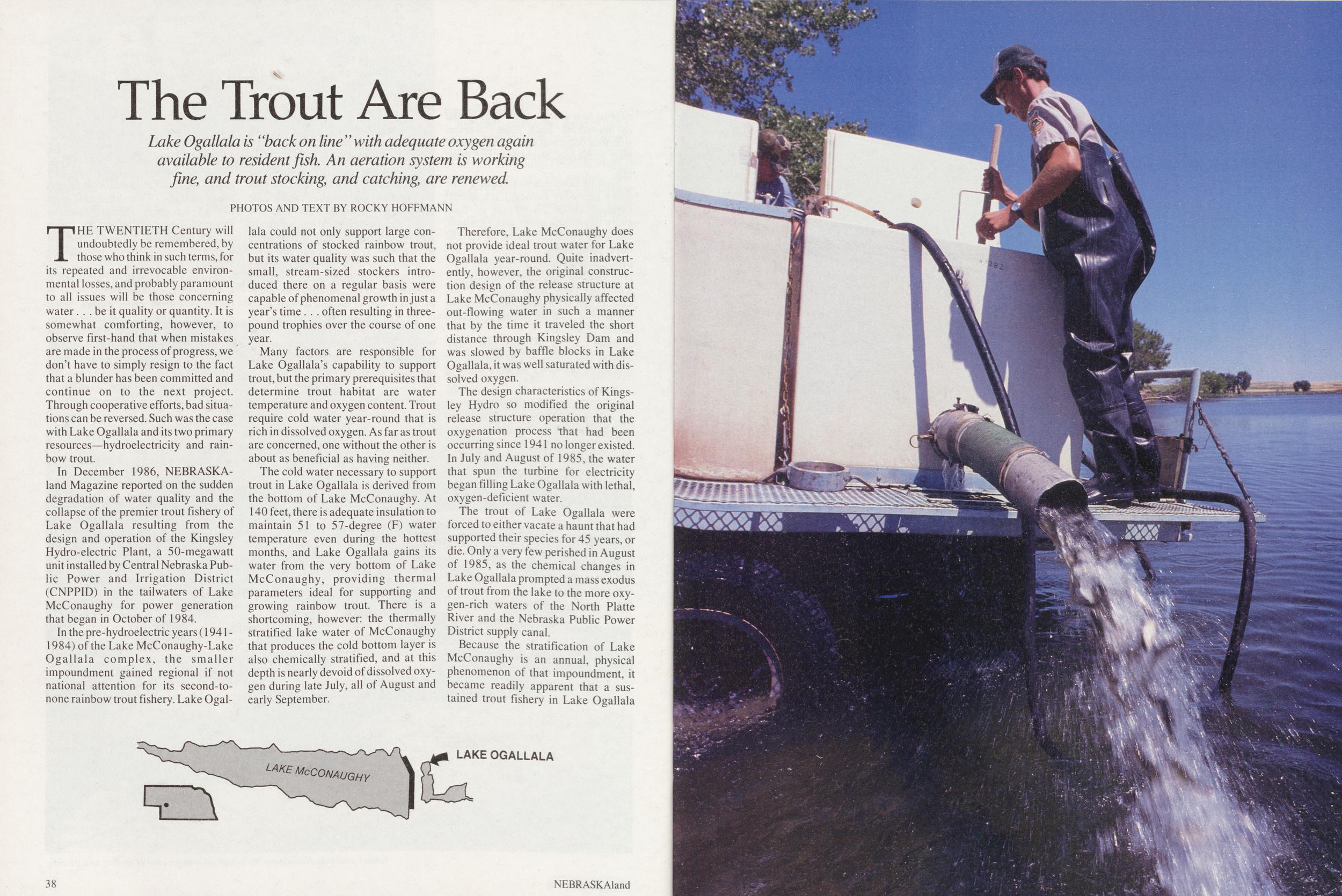
The Trout Are Back
Lake Ogallala is "back on line" with adequate oxygen again available to resident fish An aeration system is working fine, and trout stocking, and catching, are renewed. PHOTOS AND TEXT BY ROCKY HOFFMANNTHE TWENTIETH Century will undoubtedly be remembered, by those who think in such terms, for its repeated and irrevocable environmental losses, and probably paramount to all issues will be those concerning water ... be it quality or quantity. It is somewhat comforting, however, to observe first-hand that when mistakes are made in the process of progress, we don't have to simply resign to the fact that a blunder has been committed and continue on to the next project. Through cooperative efforts, bad situations can be reversed. Such was the case with Lake Ogallala and its two primary resources—hydroelectricity and rainbow trout.
In December 1986, NEBRASKAland Magazine reported on the sudden degradation of water quality and the collapse of the premier trout fishery of Lake Ogallala resulting from the design and operation of the Kingsiey Hydro-electric Plant, a 50-megawatt unit installed by Central Nebraska Public Power and Irrigation District (CNPPID) in the tail waters of Lake McConaughy for power generation that began in October of 1984.
In the pre-hydroelectric years (1941-1984) of the Lake McConaughy-Lake Ogallala complex, the smaller impoundment gained regional if not national attention for its second-to-none rainbow trout fishery. Lake Ogallala could not only support large concentrations of stocked rainbow trout, but its water quality was such that the small, stream-sized stockers introduced there on a regular basis were capable of phenomenal growth in just a year's time . . . often resulting in three-pound trophies over the course of one year.
Many factors are responsible for Lake Ogallala's capability to support trout, but the primary prerequisites that determine trout habitat are water temperature and oxygen content. Trout require cold water year-round that is rich in dissolved oxygen. As far as trout are concerned, one without the other is about as beneficial as having neither.
The cold water necessary to support trout in Lake Ogallala is derived from the bottom of Lake McConaughy. At 140 feet, there is adequate insulation to maintain 51 to 57-degree (F) water temperature even during the hottest months, and Lake Ogallala gains its water from the very bottom of Lake McConaughy, providing thermal parameters ideal for supporting and growing rainbow trout. There is a shortcoming, however: the thermally stratified lake water of McConaughy that produces the cold bottom layer is also chemically stratified, and at this depth is nearly devoid of dissolved oxygen during late July, all of August and early September.
Therefore, Lake McConaughy does not provide ideal trout water for Lake Ogallala year-round. Quite inadvertently, however, the original construction design of the release structure at Lake McConaughy physically affected out-flowing water in such a manner that by the time it traveled the short distance through Kingsiey Dam and was slowed by baffle blocks in Lake Ogallala, it was well saturated with dissolved oxygen.
The design characteristics of Kingsley Hydro so modified the original release structure operation that the oxygenation process that had been occurring since 1941 no longer existed. In July and August of 1985, the water that spun the turbine for electricity began filling Lake Ogallala with lethal, oxygen-deficient water.
The trout of Lake Ogallala were forced to either vacate a haunt that had supported their species for 45 years, or die. Only a very few perished in August of 1985, as the chemical changes in Lake Ogallala prompted a mass exodus of trout from the lake to the more oxygen-rich waters of the North Platte River and the Nebraska Public Power District supply canal.
Because the stratification of Lake McConaughy is an annual, physical phenomenon of that impoundment, it became readily apparent that a sustained trout fishery in Lake Ogallala was no longer possible under the operating mode of Kingsley Hydro. Immediate action was imperative to resolve the situation, and action by the Nebraska Department of Environmental Control (NDEC) paved the road to solution.
38 NEBRASKAland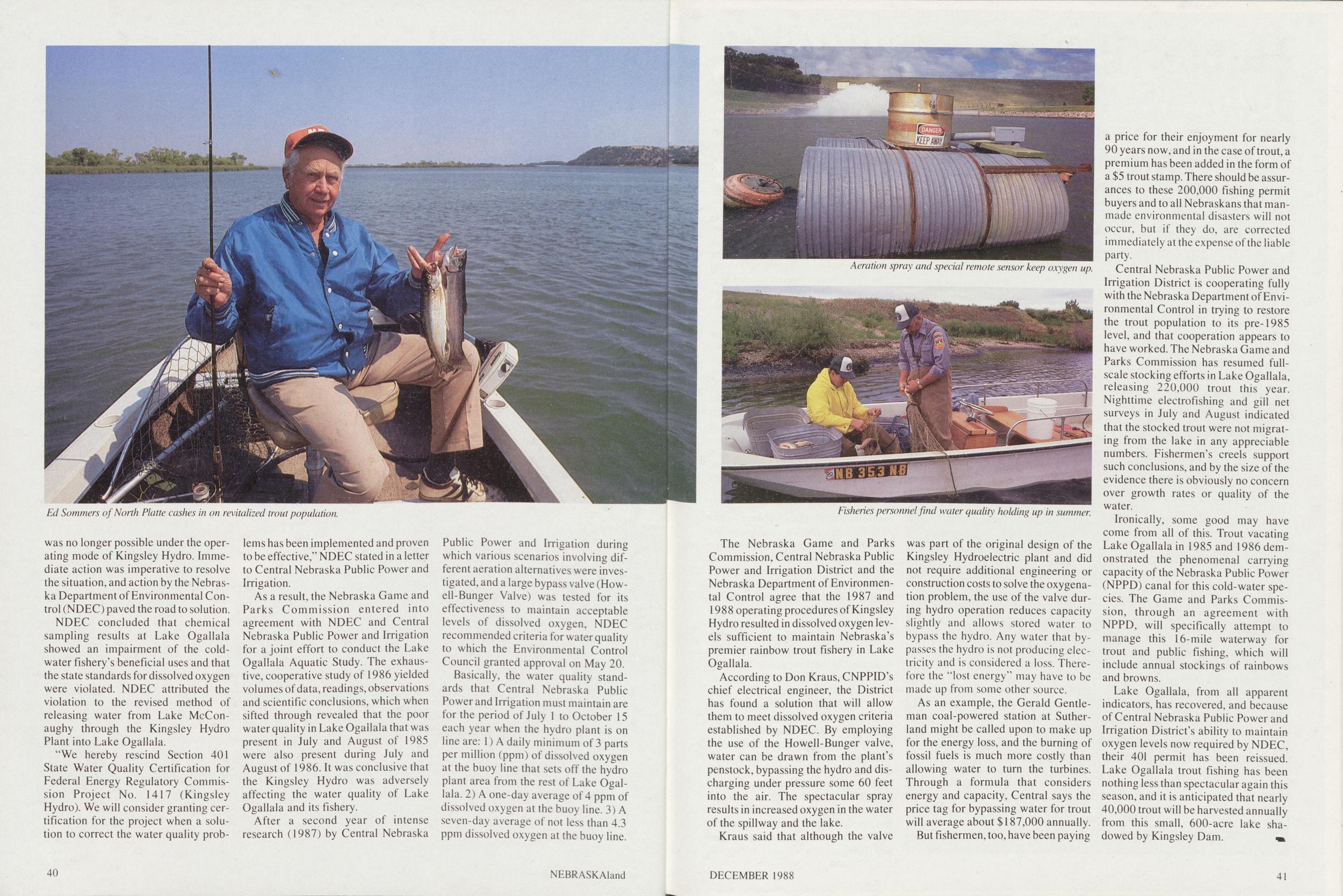
NDEC concluded that chemical sampling results at Lake Ogallala showed an impairment of the cold water fishery's beneficial uses and that the state standards for dissolved oxygen were violated. NDEC attributed the violation to the revised method of releasing water from Lake McConaughy through the Kingsley Hydro Plant into Lake Ogallala.
''We hereby rescind Section 401 State Water Quality Certification for Federal Energy Regulatory Commission Project No. 1417 (Kingsley Hydro). We will consider granting certification for the project when a solution to correct the water quality problems has been implemented and proven to be effective," NDEC stated in a letter to Central Nebraska Public Power and Irrigation.
As a result, the Nebraska Game and Parks Commission entered into agreement with NDEC and Central Nebraska Public Power and Irrigation for a joint effort to conduct the Lake Ogallala Aquatic Study. The exhaustive, cooperative study of 1986 yielded volumes of data, readings, observations and scientific conclusions, which when sifted through revealed that the poor water quality in Lake Ogallala that was present in July and August of 1985 were also present during July and August of 1986. It was conclusive that the Kingsley Hydro was adversely affecting the water quality of Lake Ogallala and its fishery.
After a second year of intense research (1987) by Central Nebraska Public Power and Irrigation during which various scenarios involving different aeration alternatives were investigated, and a large bypass valve (Howell-Bunger Valve) was tested for its effectiveness to maintain acceptable levels of dissolved oxygen, NDEC recommended criteria for water quality to which the Environmental Control Council granted approval on May 20.
Basically, the water quality standards that Central Nebraska Public Power and Irrigation must maintain are for the period of July 1 to October 15 each year when the hydro plant is on line are: 1) A daily minimum of 3 parts per million (ppm) of dissolved oxygen at the buoy line that sets off the hydro plant area from the rest of Lake Ogallala. 2) A one-day average of 4 ppm of dissolved oxygen at the buoy line. 3) A seven-day average of not less than 4.3 ppm dissolved oxygen at the buoy line.
40 NEBRASKAlandThe Nebraska Game and Parks Commission, Central Nebraska Public Power and Irrigation District and the Nebraska Department of Environmental Control agree that the 1987 and 1988 operating procedures of Kingsley Hydro resulted in dissolved oxygen levels sufficient to maintain Nebraska's premier rainbow trout fishery in Lake Ogallala.
According to Don Kraus, CNPPID's chief electrical engineer, the District has found a solution that will allow them to meet dissolved oxygen criteria established by NDEC. By employing the use of the Howell-Bunger valve, water can be drawn from the plant's penstock, bypassing the hydro and discharging under pressure some 60 feet into the air. The spectacular spray results in increased oxygen in the water of the spillway and the lake.
Kraus said that although the valve was part of the original design of the Kingsley Hydroelectric plant and did not require additional engineering or construction costs to solve the oxygenation problem, the use of the valve during hydro operation reduces capacity slightly and allows stored water to bypass the hydro. Any water that bypasses the hydro is not producing electricity and is considered a loss. Therefore the "lost energy" may have to be made up from some other source.
As an example, the Gerald Gentleman coal-powered station at Sutherland might be called upon to make up for the energy loss, and the burning of fossil fuels is much more costly than allowing water to turn the turbines. Through a formula that considers energy and capacity, Central says the price tag for bypassing water for trout will average about $187,000 annually.
But fishermen, too, have been paying a price for their enjoyment for nearly 90 years now, and in the case of trout, a premium has been added in the form of a $5 trout stamp. There should be assurances to these 200,000 fishing permit buyers and to all Nebraskans that manmade environmental disasters will not occur, but if they do, are corrected immediately at the expense of the liable party.
Central Nebraska Public Power and Irrigation District is cooperating fully with the Nebraska Department of Environmental Control in trying to restore the trout population to its pre-1985 level, and that cooperation appears to have worked. The Nebraska Game and Parks Commission has resumed fullscale stocking efforts in Lake Ogallala, releasing 220,000 trout this year. Nighttime electrofishing and gill net surveys in July and August indicated that the stocked trout were not migrating from the lake in any appreciable numbers. Fishermen's creels support such conclusions, and by the size of the evidence there is obviously no concern over growth rates or quality of the water.
Ironically, some good may have come from all of this. Trout vacating Lake Ogallala in 1985 and 1986 demonstrated the phenomenal carrying capacity of the Nebraska Public Power (NPPD) canal for this cold-water species. The Game and Parks Commission, through an agreement with NPPD, will specifically attempt to manage this 16-mile waterway for trout and public fishing, which will include annual stockings of rainbows and browns.
Lake Ogallala, from all apparent indicators, has recovered, and because of Central Nebraska Public Power and Irrigation District's ability to maintain oxygen levels now required by NDEC, their 401 permit has been reissued. Lake Ogallala trout fishing has been nothing less than spectacular again this season, and it is anticipated that nearly 40,000 trout will be harvested annually from this small, 600-acre lake shadowed by Kingsley Dam.
DECEMBER 1988 41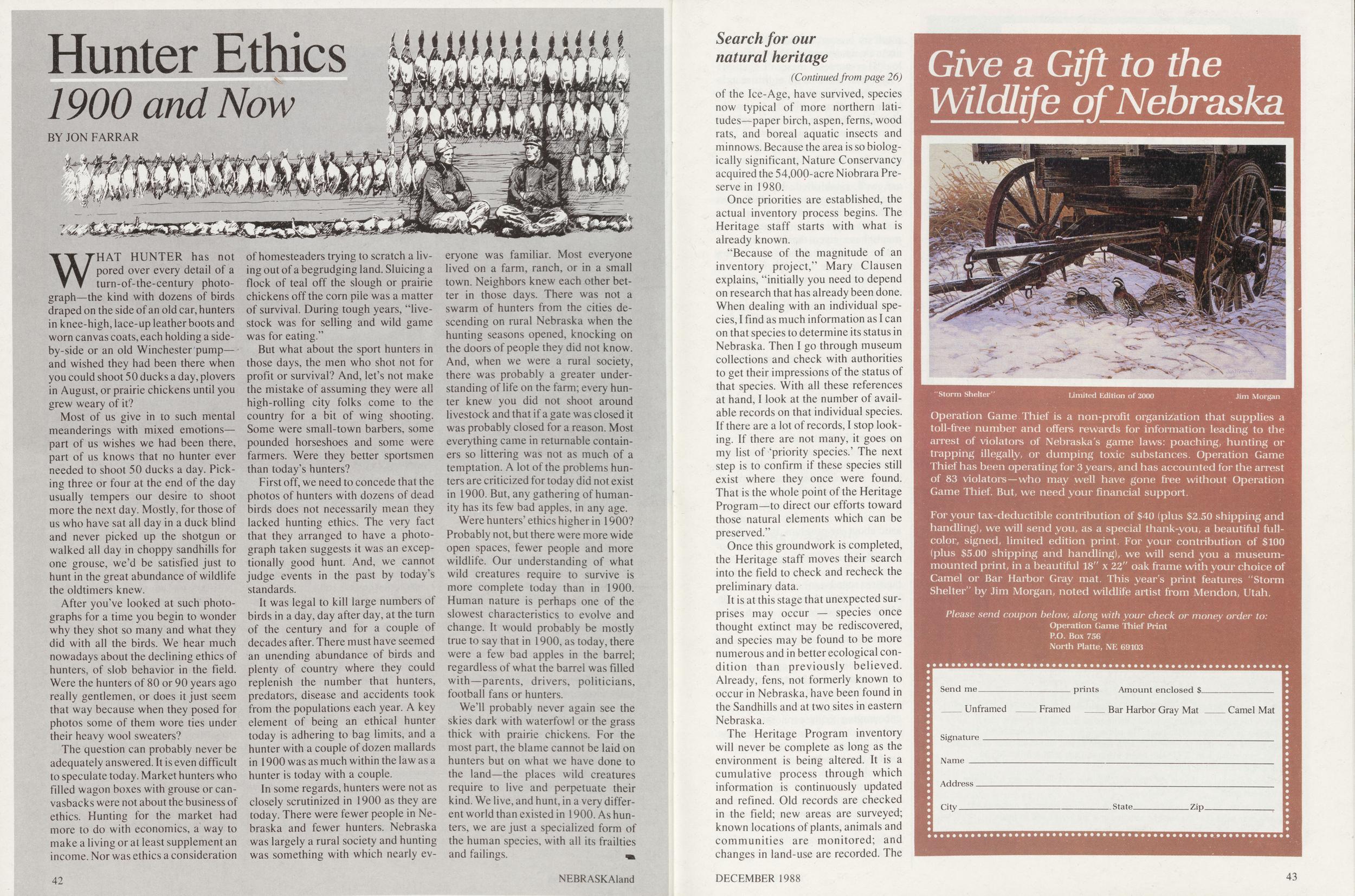
Hunter Ethics 1900 and Now
BY JON FARRARWHAT HUNTER has not pored over every detail of a turn-of-the-century photograph—the kind with dozens of birds draped on the side of an old car, hunters in knee-high, lace-up leather boots and worn canvas coats, each holding a side-by-side or an old Winchester' pump and wished they had been there when you could shoot 50 ducks a day, plovers in August, or prairie chickens until you grew weary of it?
Most of us give in to such mental meanderings with mixed emotions part of us wishes we had been there, part of us knows that no hunter ever needed to shoot 50 ducks a day. Picking three or four at the end of the day usually tempers our desire to shoot more the next day. Mostly, for those of us who have sat all day in a duck blind and never picked up the shotgun or walked all day in choppy sandhills for one grouse, we'd be satisfied just to hunt in the great abundance of wildlife the old timers knew.
After you've looked at such photographs for a time you begin to wonder why they shot so many and what they did with all the birds. We hear much nowadays about the declining ethics of hunters, of slob behavior in the field. Were the hunters of 80 or 90 years ago really gentlemen, or does it just seem that way because when they posed for photos some of them wore ties under their heavy wool sweaters?
The question can probably never be adequately answered. It is even difficult to speculate today. Market hunters who filled wagon boxes with grouse or canvasbacks were not about the business of ethics. Hunting for the market had more to do with economics, a way to make a living or at least supplement an income. Nor was ethics a consideration of homesteaders trying to scratch a living out of a begrudging land. Sluicing a flock of teal off the slough or prairie chickens off the corn pile was a matter of survival. During tough years, 'livestock was for selling and wild game was for eating."
But what about the sport hunters in those days, the men who shot not for profit or survival? And, let's not make the mistake of assuming they were all high-rolling city folks come to the country for a bit of wing shooting. Some were small-town barbers, some pounded horseshoes and some were farmers. Were they better sportsmen than today's hunters?
First off, we need to concede that the photos of hunters with dozens of dead birds does not necessarily mean they lacked hunting ethics. The very fact that they arranged to have a photograph taken suggests it was an exceptionally good hunt And, we cannot judge events in the past by today's standards.
It was legal to kill large numbers of birds in a day, day after day, at the turn of the century and for a couple of decades after. There must have seemed an unending abundance of birds and plenty of country where they could replenish the number that hunters, predators, disease and accidents took from the populations each year. A key element of being an ethical hunter today is adhering to bag limits, and a hunter with a couple of dozen mallards in 1900 was as much within the law as a hunter is today with a couple.
In some regards, hunters were not as closely scrutinized in 1900 as they are today. There were fewer people in Nebraska and fewer hunters. Nebraska was largely a rural society and hunting was something with which nearly everyone was familiar. Most everyone lived on a farm, ranch, or in a small town. Neighbors knew each other better in those days. There was not a swarm of hunters from the cities descending on rural Nebraska when the hunting seasons opened, knocking on the doors of people they did not know. And, when we were a rural society, there was probably a greater understanding of life on the farm; every hunter knew you did not shoot around livestock and that if a gate was closed it was probably closed for a reason. Most everything came in returnable containers so littering was not as much of a temptation. A lot of the problems hunters are criticized for today did not exist in 1900. But, any gathering of humanity has its few bad apples, in any age.
Were hunters' ethics higher in 1900? Probably not, but there were more wide open spaces, fewer people and more wildlife. Our understanding of what wild creatures require to survive is more complete today than in 1900. Human nature is perhaps one of the slowest characteristics to evolve and change. It would probably be mostly true to say that in 1900, as today, there were a few bad apples in the barrel; regardless of what the barrel was filled with—parents, drivers, politicians, football fans or hunters.
We'll probably never again see the skies dark with waterfowl or the grass thick with prairie chickens. For the most part, the blame cannot be laid on hunters but on what we have done to the land—the places wild creatures require to live and perpetuate their kind. We live, and hunt, in a very different world than existed in 1900. As hunters, we are just a specialized form of the human species, with all its frailties and failings.
42 NEBRASKAlandSearch for our natural heritage
(Continued from page 26)of the Ice-Age, have survived, species now typical of more northern latitudes—paper birch, aspen, ferns, wood rats, and boreal aquatic insects and minnows. Because the area is so biologically significant, Nature Conservancy acquired the 54,000-acre Niobrara Preserve in 1980.
Once priorities are established, the actual inventory process begins. The Heritage staff starts with what is already known.
"Because of the magnitude of an inventory project," Mary Clausen explains, "initially you need to depend on research that has already been done. When dealing with an individual species, I find as much information as I can on that species to determine its status in Nebraska. Then I go through museum collections and check with authorities to get their impressions of the status of that species. With all these references at hand, I look at the number of available records on that individual species. If there are a lot of records, I stop looking. If there are not many, it goes on my list of 'priority species.' The next step is to confirm if these species still exist where they once were found. That is the whole point of the Heritage Program—to direct our efforts toward those natural elements which can be preserved."
Once this groundwork is completed, the Heritage staff moves their search into the field to check and recheck the preliminary data.
It is at this stage that unexpected surprises may occur — species once thought extinct may be rediscovered, and species may be found to be more numerous and in better ecological condition than previously believed. Already, fens, not formerly known to occur in Nebraska, have been found in the Sandhills and at two sites in eastern Nebraska.
The Heritage Program inventory will never be complete as long as the environment is being altered. It is a cumulative process through which information is continuously updated and refined. Old records are checked in the field; new areas are surveyed; known locations of plants, animals and communities are monitored; and changes in land-use are recorded. The result is a current and increasingly accurate assessment of the state's ecological resources.
Just how useful is all of this searching, cataloging and mapping? Is all the time and effort justified? Or, is the Heritage Program just an academic exercise in natural history?
In states with similar programs in place for several years, the practical applications of information gathered are well established. In Tennessee, where the program is mature, over 1,200 environmental reviews are conducted each year. Several state governments have given their heritage programs "rare plant authority" to review candidates for official listing as endangered or threatened. The National Park Service, the U.S. Forest Service, and the Bureau of Land Management have all contracted with heritage programs for inventory and planning help.
Even though the Nebraska Natural Heritage Program is in its infancy, environmental reviews and major data requests are already coming in. When the Heritage Program in Nebraska reaches maturity, its applications and impact will be dramatic.
In other states, natural heritage information has been used to stop poorly planned development projects. With that sort of influence you would expect some business and development industries to be less than enthusiastic about the program. But, knowing that projects will not be delayed or cancelled is a key to conducting a successful business. Every year in the U.S., business spends tens of millions of dollars on project delays and litigation. Many of these conflicts result from their need to comply with federal environmental protection laws and regulations, specifically, threats to rare species or natural communities. Information from heritage programs provided during the planning process facilitates informed decision making, encouraging both economic growth and protection of our natural heritage. For development interests, regulations are far easier to live with when potential and costly delays or obstacles are known prior to large investments of capital and planning.
But, to protect vanishing elements of our natural environment and to be a useful information bank, the work of the Nebraska Natural Heritage Program 44 NEBRASKAland must continue beyond the initial two-year contract period. Users of the Heritage Program Network need current information to make wise decisions affecting our always changing environment. With less than a year left in the contract period, the Heritage staff has much yet to accomplish.
In July of 1989, when the two-year contract with the Game and Parks Commission comes to an end, the Nebraska Natural Heritage Program must find a new source for funding. It is hoped that at the end of the contract period, the Game and Parks Commission will continue to sponsor the program. Funding of the Heritage Program is subject to approval by the Nebraska Legislature. Nongame check-off dollars alone would not be enough to support even the staff positions.
In most states, Natural Heritage programs have become part of the sponsoring agency. Every state which has initiated a Heritage Program has maintained it in some form. It is hoped Nebraska will also nurture its program to maturity. Support of the program would be an all-important step ensuring that generations following have the opportunity to marvel at the beauty of the Niobrara River Valley or walk through head-high tall-grass prairie and enjoy a bit of Nebraska's rich natural heritage.
Following pheasants
(Continued from page 31)by the number of times his tracks paralleled those of a bird we followed. But in 20 yards or so, the bird's tracks would veer sharply, and the dog's would continue—apparently in those conditions he was having trouble staying with the trail.
If our reading of the trail was accurate, most of the birds looked at several different possible hiding places before choosing one. Most trails consisted of widely spaced tracks, often blurred by what appeared to be the marks of dragged toes, and bounded by occasional streaks which we guessed were made by wingtips touching the snow. We concluded that those signs indicated a running bird. Then the trails usually looped around a hummock of grass or a small cedar tree, and the tracks would become closer together and more distinct—an indication, we guessed, that the bird was now walking, and lifting its feet higher. It appeared to us (recognizing that we might be anthropomorphizing) that the bird was examining a possible hiding place, then moving on.
We found quite a few more hens than roosters, but I don't know whether that suggests behavior differences or the late-season population make-up.
I don't even know if the technique will work again, but I do know I will try it again. Even if I never make it work so well again—for that matter, even if I never use it again—I have learned a thing or two, and reinforced a thing or two that I already knew.
First, I learned that I've gotten lazy I've hunted with dogs so much, and learned to so respect their uncanny skills that I'd begun to rely on them loo much. I wouldn't assert that hunters ought to quit paying attention to their dogs, only that they ought also to pay attention to conditions and realize that in high wind, in extremely cold, or extremely hot, or dusty conditions, the dog can't work as well as in moderate temperatures, higher humidity, and calmer winds.
Second, the dog processes information unavailable to me—pheasant scent—but he doesn't rely on sight in the same way I do, and I need to be sure that I don't ignore the value of my own observation.
I think I've learned something about the birds' behavior, too. Once flushed (in these conditions, anyway) they move around for a while before settling in again. It seems reasonable to speculate that if you plunge into the cover immediately after the birds have gone to ground, they are more likely to keep on moving. So, pheasant hunters might well take a leaf from the quail hunters' book—after the first flush, give the birds a little time to find a satisfactory hiding place.
I've also had reinforced, the principle that I first learned as a kid, and have had to relearn every pheasant season since: especially in heavy cover, especially in foul weather, hunt slowly. If you're even pretty sure the birds are there, spend enough time hunting an area to make them nervous. Zig-zag, pause, hunt back through an already hunted field. And finally, keep an eye on your hunting partner, keep an eye on the dog, and if conditions warrant, keep an eye on the ground, too.
A Christmas wish
(Continued from page 33)The^pageant over, nothing was left but the long, final days of waiting. Yet even this period had its compensations, for now from my mother's kitchen and those of neighbors and friends poured the season's traditional goodies: fruitcake and candied fruit; Russian tea cakes, crunchy and powdery as tiny snowballs, and cookies stamped out in the shapes of reindeer, spruce trees, bells, candles, and Santas, all covered with green, red, or pink frosting and glitter made of colored sugar; various confections made with nuts and, perhaps best of all, great heaping bowls of the nuts themselves—plump russet hazelnuts, and dark brown Brazils, their shells tough as coconuts, and yellowy-white perforated almonds, and the chambered meat of the black-streaked pecans, and the walnuts with shells wrinkled like elephants' trunks. Glass topped candy jars would also appear, filled to the brim with gumdrops and several kinds of hard candy, some curled and bent back like bows or ends of ribbon, some clear and round and solid-colored, with swirls and tiny pocks inside them like the "dearies" we shot for when playing marbles. My sweet tooth was especially keen in those days, but sometimes, in the midst of all this sugary plenty, I would feel that such treats were a delaying tactic, set out to occupy and distract us kids while the days of waiting dragged on and on.
YET SOMEHOW the days did go by, and suddenly my impatience would change to panic as I realized that the moment was nearly at hand. I would think of the gifts I might have gotten my parents and brother instead of the gifts I had actually bought, wrapped, and placed under the tree, and I would become anxious about receiving whatever I most wanted myself that year, and always, like a small bright cloud at the back of my mind, there was the wish for snow. School usually let out for the holidays at about this time, and I would spend the better part of each day roaming the neighborhood or restlessly passing the time at a friend's house, returning in the late afternoon to see the lights of our tree in the side window reflecting the warmth and welcome inside.
Over the years, memory has blurred one Christmas into another in a flurry of images, like pages drifting from a calendar. But I recall approaching the house in the dusk of one Christmas Eve when there was a damp edge in the air that put an edge to my excitement. I went inside, washed up at the kitchen sink, and lingered at the stove a while to watch the supper dumplings bobbing in simmering water in the dented, deep sided kettle. Then I went to my room and dressed for church: slacks, a white shirt, and a clip-on bow tie. When I came out I sat on the sofa listening to carols on the radio while I examined the molded plaster figures of the Adoration on the end table, with their streakily painted robes and features—Joseph, Mary, and the minuscule babe in his tiny wooden manger, the Wise Men clutch- ing their gold and fragrant jars, angels and shepherds with crooks and a flock of three sheep, and a cow and donkey to represent the other animals that tradition crowds around the stable—all wonderfully suggestive to a child's imagination, a realization of the story in Luke that I knew by heart and had been asked, on several occasions, to repeat to gatherings of women's clubs my mother belonged to. Soon we were called to the table, and as we sat down I had a sudden physical impression of hurry, of the time slipping by as rapidly as my racing pulse, and I was almost too nervous and excited to eat. But somehow I did, and with supper over and the dishes cleared away, it was time for church.
Seated in the back of the car hearing the heater pour over my mother and father in front, his eyes straight ahead as he drove, her head a little to one side as she looked out, I could feel my anxiety lifting, the long wait nearly over at last. Here I was with my family on the way to church through the cold and dark, to hearken again, with those shepherds of old, to the thrilling, joyous down reach of heavenly song, the incredible tidings they had been too childlike, too unsophisticated, not to believe. We were on our way to worship a miracle, to take part in the chief imaginative event in our lives.
Yet I could not help thinking ahead, beyond the service, to what for me was the best part of the evening—returning to the house, unlocking the door, and in the warm, resin-scented darkness inside, feeling for the plug and lighting the tree; then, while my mother poured 46 NEBRASKAland egg nog into clear glass cups, hunting out, by their holly- and mistletoe-bordered tags, the presents that I handed around as solemnly as if I were sharing out swag among a band of pirates. The service itself, however satisfying, was but a prelude to that moment, but it sanctified the pagan worship of evergreen and wrapping paper and the mute, innermost desires of a child's heart.
Now, once again, I was delivered dreamily into the midst of that sanctification. Sitting in the pew listening to the liturgy and carols and the interminable sermon, my mind on the large, squarish package in bright blue paper with silver ribbon and my name on it under the tree at home, I watched the candles at the front of the chancel bob and rise breathlessly, their thin shadows on the wall behind them kneeling and coming to their feet again like the Magi in a flourish of robes. (Even the candles' hissing sounded, at still moments like the slightest rustling of silk). At the end of the service we sang "Silent Night," young and old alike joined in a perfect momentary community of reverence and joy, our voices rising into the rafters of the tall, drafty nave. Then the smaller children were called forward to receive their bags of candy, and the service was over.
Putting our coats on in the entry hall, we could feel the sharp cold through the opening and closing of the door. We went outside and stood for a moment on the front steps exchanging season's greetings with the minister, and suddenly, in the beam from the floodlight on the lawn, I noticed an eddy of hesitant flakes drifting down onto the glass of the lamp and making it steam. Snow! It was snowing for Christmas! My brother and I ran ahead to the car, the wet sting of flakes on our upturned faces, and on the way home I kept watching it come, falling heavily enough now to dust the streets and show the tracks of our tires behind us, and spinning like a maelstrom in the headlights. I have long since forgotten whatever it was that awaited me in the bright blue package in the darkness under the tree that night. I only remember going to my room, turning out the light, cracking the windowshade and watching the snow come wavering down outside, knowing it would be deep and unbroken when I awoke in the morning, and that this time my best present had come, like an act of grace, from the sky.
Lincoln poet Roy Scheele's work has appeared in a number of major magazines and has been increasingly anthologized in recent years. His 1985 collection Pointing Out the Sky (Sandhills Press) was nominated for the William Carlos Williams Award. He teaches at Doane College in Crete.War dogs
(Continued from page 3 7)center in 1944. That summer, the Rimini school closed, and training resumed at the former Civilian Conservation Corps camp located west of Ft. Rob on the Wood Reserve. Here, dog sled teams were prepared for use in arctic regions to aid in downed aircraft rescues.
During the course of training, many dogs were found unsuitable for military use and were returned to their owners. As the center reached full operation, attrition was high. In the first six months of 1943, 3,503 dogs were received at Fort Robinson. Of that total, 1,728 were successfully trained and assigned; 520 were returned to their owners. In the same period, 661 died or were destroyed for various causes 261 from distemper or its complications.
Like the dogs, the personnel assigned to serve and train at Fort Robinson came from every part of the country. A typical soldier was Richard Zika, who arrived from Fort Custer, Michigan, in April 1943. Zika spent six months at the K-9 center serving as temporary cadre and then trained for overseas duty. In October he shipped out as part of a 100-man detachment sent into the China-Burma-India theater.
Like the dogs, the personnel assigned to serve and train at Fort Robinson came from every part of the country. A typical soldier was Richard Zika, who arrived from Fort Custer, Michigan, in April 1943. Zika spent six months at the K-9 center serving as temporary cadre and then trained for overseas duty. In October he shipped out as part of a 100-man detachment sent into the China-Burma-India theater.
Off-duty diversions for the K-9 training detachment included horse riding in the buttes, U.S.O. entertainment, dances, and occasional fishing forays.
Former owners were concerned about their pets, and many inquiries and letters were received. A boy of 11 wrote: "I would like to know if I can put a star on my window because I gave you my dog. When does he get a rating?
After Metropolitan Opera basso Ezio Pinza donated his two Dalmatians, he sent operatic recordings to Fort Robinson. He explained that the dogs were accustomed to his singing around the house, and wrote, "If they get lonesome, play one of these records for them." The Army assured all owners that their dogs were doing their part to win the war.
Qander Canada Goose Hunting in Western Nebraska Adjacent to Garden County Refuge Holiday Hunting, Jnc. Controlled Shooting Area September - March Pheasant - Quail - Partridge CSvuv Ogallala. Nebraska 308/284-3623 The Caxton Printers, Ltd. proudly announces: ILD OF NebrasKa Our Hit) photos bv Wayne C, Lee Paper $14.95 ISBN 0-87004-325-0 Write for a free brochure or send orders to: The Caxton Printers, Ltd. 312 Main Street Caldwell, Idaho 83605 WILD TOWNS OF NEBRASKA by Wayne C. Lee Don't miss this outstanding new book detailing some of the most interesting and exciting chapters in Nebraska's history. The tales of ten pioneer towns are told with Nebraska native Wayne Lee's unique style. Lee doesn't tell about the quilting bees and church suppers. He tells of the lawmen, desperadoes, vigilantes and killers. He tells of the tough, stubborn men and women who lived with conflict and violence all around them. With over 100 photos and numerous factual accounts, this one is not to be missed! 8V2 x 11,121 photos, bib., index. DECEMBER 1988 47
The most frequent and unavoidable hazard of working with dogs was bites. In one case, two enlisted men were severely bitten while working with the same German shepherd in February 1943. Another soldier received severe injuries while putting on an agitator demonstration during a Signal Corps filming session. A different problem was of escaping dogs. In February 1943, a collie named Taffy went A.W.O.L. One week later, another collie named Tylo went over the hill. "Wanted" bulletins often appeared in the Crawford paper.
Civilian interest in the novel military training was always high. As a result, the public was given ample opportunity to view the K-9 Corps. The highlight of training was graduation day, when dogs and handlers paraded before dignitaries and onlookers. In a 1945 graduation, the center was honored by a visit from Mrs. Erlanger, then a special canine consultant for the Quartermaster Corps. Public demonstrations were also put on for special celebrations. Marching dog platoons were often a part of local parades in Crawford and Chadron. One Christmas, a team of huskies brought in Santa Claus and his sled.
The pinnacle of Fort Robinson dog training came in 1944-45. Average canine strength for the last half of 1944 was 1,400 dogs. In the latter half of that year, all Army K-9 training was consolidated at Fort Robinson. By then, emphasis had shifted from guard dog preparation to tactical uses, primarily scout dogs. An all-time high of 1,831 dogs was reached in mid 1945.
With the war in Europe over, the supply of dogs caught up with demand. More dogs were returned to their owners; fewer were issued. By the end of World War II, a total of 10,425 war dogs had been trained by the Quartermaster Corps. Nearly half came from Fort Robinson.
A significant change in the program came in the last months of the war. Infantry troops arrived to train with scout dogs, resulting in the activation of Infantry Scout Dog Platoons. This was a departure from handlers being Quartermaster personnel attached to combat units.
The fall of 1945 saw a dramatic reduction in the number of dogs. The K-9 program was put into reverse. Non-vicious war dogs were returned to their original owners or found other homes. Dogs were "detrained" in order to readjust them to civilian life. They were carefully observed, evaluated, and gradually given more freedom. Next, they were taken into town to re-expose them to normal sights and sounds. Former owners were contacted to retrieve dogs, handlers or civilians purchased some, but many had to be destroyed.
By December 1945, dog numbers dropped to about 600, the fewest at the center since it was established. With a like reduction in men, temporary barracks were not needed and were removed. Scout and sled dog training continued on a limited basis into 1946, and in June of that year the center was deactivated, and the last 17 sled dogs were sold. The last remaining structures of the center were demolished in the 1950s.
In the course of its service, the center received 14,860 dogs of which 4,892 were trained and assigned. Over 5,000 dogs were returned to their owners after being determined unsuitable for further training.
Over the years, a number of former K-9 personnel have returned to Fort Robinson to visit, and several still live in the vicinity. But for the most part, this important aspect of the fort's past is overshadowed by the more exciting Cavalry period. Now Nebraska's largest and best-known state park, Fort Robinson is much different and seems far removed from its past, but those chapters are interesting to look back upon.
DON'T FORGET! Your next issue of NEBRASKAland Magazine will be a book-length special issue featuring Nebraska 's properties on The National Register of Historic Places. Watch for it at the end of January. NEBRASKA NOT GROWERS ASSOCIATION The Nebraska Nut Growers Association is offering a Nut Tree Seed Packet which will be available in the Spring of 1989. The following list of tree species is offered for $10 a packet ($20 outside the USA) and will contain approximately 5 seeds of at least eight of the species, for a total of 40 seeds. Seed Source Turkish Tree Filbert Hazelnut (Winkler) Shagbark Hickory Pecan, Northern Native American Chestnut Paw Paw (Native) Black Walnut (Named varieties) Chinese Chestnut Persimmon Oregon Iowa Nebraska Missouri Nebraska Nebraska Iowa Nebraska Nebraska Send checks or obtain order forms by writing to the non-profit organization of the Nebraska Nut Growers Association, P.O. Box 4644, Lincoln, NE 68504. The seeds will be shipped in the Spring of 1989. 48 NEBRASKAlandTrading Post
DOGSTRAINING ALL BREEDS Hunting Dogs — Vizslas for sale. Rozanek Kennels, Rt. 2, Schuyler, NE 68661. Phone(402)352-8769.__________________________
ENGLISH SETTERS: 'Bred for the hunter; select pupies and started dogs available from outstanding bloodines. Stud service available by proven hunters. High Plains Kennels, 141 1 Emerson, Alliance, NE 69301, Phone (308) 762-6709.___________________________
GERMAN SHORTHAIRS and Brittany Spaniel pups. Started and occasionally a meat dog. Pups are guaranteed. Also I will be training hunting dogs. Wayne Clark, Percival, I A. Phone (712) 529-4238 or~(402) 263-3155 at Union, NE.___________________________________
YELLOW-BLACK Lab pups. FC-AFC sired. AKC. Hips OFA certified. Dew claws removed. Excellent hunting potential. Contact Bob Bendler, Lexington, NE, (308)324-4247.________________________________
POINTER PUPS breeding Elhew started dogs, force retrieving at stud C. H. Elhew Husker John. J. H. Render, Box 86, Panama, NE 68419. Phone (402) 788-2213.
GERMAN POINTERS. Irish Setters. Springer Spaniels. Pups, started and trained. Very close working. Excellent companions. Plum Thicket Kennels. Elm Creek, NE 68836 Phone (308) 856-4616 or (308) 987-2294.
AKC LABRADOR RETRIEVER pups! Whelped November 16. Excellent field trial bloodlines—both sire and dam proven hunters. Health and hips guaranteed. Call now for reservations. Wind Fall Retrievers, (402) 475-5315._______
DOG WANTED. Looking for a HOVAWART. Rare breed of German origin, used to guard sheep and cattle. If you have information, please write Box 9491 1, Lincoln, NE 68509.________
MISCELLANEOUSNE NEBRASKA trout fishing. 3 modern cottages, 1 available year round. 5 spring fed lakes with open water all year. Trout up to 7 pounds. Other varieties fish also. Diamond E. Trout Resort, Orchard, NE 68764. Phone (402)893-4745.________________________________
GUNS — Browning, Winchester, Remington, others, Hi-powers, shotguns, new, used, antiques. Want Pre-1964 Winchesters. Buy-Sell-Trade. Ph. (402) 729-6112. Bedlan's Sporting Goods, Fairbury, NE 68352.____________________________________
MAD RIVER CANOES offers the finest quality and performance. For the finest canoes and accessories look to Great Plains Canoe Co., 205 Main, Springfield, NE. Phone(402)253-2001.
Bev Doolittle, Terry Redlin, Jerry Raedke, Ed Wards, Robert Bateman, Frank McCarthy and Neal Anderson are available at the 2nd Street Gallery, 537 W. 2nd, Hastings, NE 68901. Phone (402) 463-6677.
TROLLING MOTOR REPAIR. Factory authorized Minn Kota and Motor Guide, parts and service. Wolfs Repair and Installation, 1529 David Drive, Lincoln, NE 68504. Phone (402) 464-4265.____________________
WINE AND BEER: Make your own. Send for free recipes and instructions. Omaha Supply, 1324 2nd Avenue, Nebraska City, NE 68410.
FISH FOR SALE. Catfish, perch, coho salmon, rainbow trout, crappie, bluegill, walleye, minnows, goldfish, bullhead, largemouth bass, smallmouth bass, triploid grass carp. Commercial grower prices on catfish, perch, coho salmon, rainbow trout. Consulting available. Pleasant Valley Fish Farm, Rt. 1 Box 147, McCook, NE 69001. Phone (308) 345-6599.___________________________
FREE BOOK CATALOG. Novels, westerns, romances, children's; old out of print, found barns, attic. Authors: Grey, Bower, Connor, Fox, Curwood, Raine, Wright, Aldrige, Pollyanna, Freckles, many others. Postage appreciated. Pierce, 4400 N. Pine Cluster, Oroville, C A 95965._________________________________________
FREE! Booklets on northeastern Nevada; fishing, rock-hounding maps, Carl Hayden, Box 528, Jackpot, Nevada 89825._________________________________________
FEATHERS WANTED: Duck, goose, misc. feathers, bird skins, squirrel skins and tails. Top prices. Free tags. Will pick up large quantities of duck and goose feathers, wet or dry. Hobbs Feather Co., P.O. Box 187, West Liberty, IA 52776. Phone (319) 627-4258.
BUY, SELL, TRADE expired hunting, fishing, trapping permits. Singles/Collections. 15400 N. 56th St., Lincoln, NE 685 14. Phone (402) 785-7500._____________
WAX WORMS: 500/$8 25; 1,000/$ 14.50. Add 4% sales tax. Postpaid first class. No C.O.D. Harold Malicky, Burwell, NE 68823.______________________
HOUSES FOR YOUR bluebird trail. Made out of cedar wood, front opening, deep entry and mouting bracket. Guaranteed. $8.00 postage paid. Complete kits $6.00. Write John Holm, 2014 Avenue G, Gothenburg, NE 69138 or phone (308) 537-2323._____________"
THE PERFECT CHRISTMAS gift for the fisherman in your life! Order now! This 3 16-page book tells how to fish Nebraska waters- all year. "Learn to Live" was written by a Nebraska fishing guide. Send $12.95 to: Fattig Products. Archer, NE 68816.
SUPPORT NEBRASKA'S OPERATION GAME THIEF TOLL-FREE HOTUNE... 800-742-7627 LIVE-CATCH ALL-PURPOSE TRAPS Writ* tor FREE CATALOG Traps without injury squirrels, chipmunks, rabbits, mink, fox, raccoons, stray animals, pests, etc. Sizes for every need. Also traps for snakes, sparrows, pigeons, crabs, turtles, quail, etc. Save on our low factory prices. Send no money. Free catalog and trapping secrets MUSTANG MFG. CO., Dept. N-34, Box 920947. Houston, Tex. 77292 NEBRASKAland Magazine Order Form Please send me a subscription to NEBRASKAland Magazine □ □ One-year $12.00 NAME ADDRESS Two-year $23.00 STATE ZIP Mail to: NEBRASKAland Magazine, Box 30370, Lincoln, NE 68503 TAXIDERMYALLISON'S TAXIDERMY STUDIO. Wally and Betty Allison, Licensed Taxidermist. We've mounted 28 Nebraska State Record fish. Specializing in fish and birds, small game and rattlesnakes. We use freeze-dry. 2709 Birchwood Rd., North Platte, Nebr. 69101. Phone (308) 534-2324._____________________________________
BADE TAXIDERMY — Quality a must — Fast service." Fish, birds, rugs, tanning, full mounts and game heads, 21 1 1 N. Christy St., Fremont, NE 727-5463._________
NABITY'S TAXIDERMY. 31 years experience. Specializing in natural grass backgrounds for mammals, birds and fish. 13901 "O" St., Lincoln, NE 68504 — 4 miles east of 84th and "O". (402) 489-635 1.________
PEISTER TAXIDERMY - Professional work at prices most sportsman can afford. Now in our new log cabin studio, 1020 Central Avenue, Box 3201, Kearney, NE 68847. Phone (308) 236-9700 or (308) 237-7575 evenings.
NATURECRAFT STUDIO — all custom services — creative work, quality, and experience since 1935. Includes freeze-dry processing. Display and sales room, visitors welcome. Hwy. 2 in Nebraska City. Phone (402) 873-5491. Joe Voges — Owner. Bow Steedly — Big Game specialist.
BILL'S TAXIDERMY. Professional big game mounting. Award-winning mounts. First place mule deer, second place antelope in state competition. Reasonable prices. Phone (308) 452-3559 or 3674.
CAMPING FISHING, HIKING IV2 MILES RIVER FRONT ON PLATTE RIVER SEASONAL TRAILER PARKING AND CABIN FOR RENT BOB AND RUTH JOHNSON RR #2 Box 95 NORTH BEND, NE 68649 (402) 652-3769 Statement of ownership, management, and monthly circulation of NEBRASKAland Magazine OWNER AND PUBLISHER: Nebraska Game and Parks Commission EDITOR AND MANAGING EDITOR: Lowell A. Johnson HEADQUARTERS OF PUBLISHER AND PUBLICATION: 2200 N. 33rd Street, Lincoln, NE 68503 STOCKHOLDERS; BONDHOLDERS; MORTGAGE and SECURITY HOLDERS: None Average No. of copies each issue during preceding 12 months .Single issue nearest to filing dale A. TOTAL COPIES PRINTED (net press run)__________ Oct. 87 Sept. '88 68,500 Sept. '88 66,000 B. PAID CIRCULATION 1. Single-copy sales 2. Mail subscription 1,427 58,965 1,253 56,508 C. TOTAL PAID CIRCULATION 60,392 57,761 D. FREE DISTRIBUTION (incl. samples) BY MAIL, or OTHER MEANS (no news agency) 4,475 4,164 E. TOTAL DISTRIBUTION (sum of C and D)______ 64,487 61,925 OFFICE USE, LEFTOVERS, ETC. RETURNS FROM NEWS AGENTS 2,925 708 3,500 575 G. TOTAL (sum of E and F) 68,500 66,000 DECEMBER 1988 49
In The Kitchen
Green Chili Stew Va cup flour 1 tsp salt Vi tsp pepper 1 tsp cumin Vi tsp oregano Va tsp basil 2 lbs venison, cubed Va cup fat 2 beef bouillon cubes 2 cans diced green chilies Vi tsp MSGCombine flour, salt, pepper, and herbs. Coat meat with seasoned flour; brown well in hot fat. Add any remaining seasoned flour; cook for 1 minute. Stir in 3 cups water, bouillon cubes, and 1 can chilies until mixture thickens. Simmer for 1 hour, adding water as needed. Add remaining chilies and MSG. Cook for 20 minutes longer. Serve with corn chips or fried tortillas.
Mary I Coy, Torrington, WY Rye Bread 1 Vi pkg yeast Vi cup warm water 1 qt buttermilk 1 Vi cups water 4 tsp salt 4 tbl bacon grease 3 tbl brown sugar white flour rye graham flourDissolve yeast in warm water. Heat buttermilk and VA cups water, salt, bacon grease and brown sugar until lukewarm. Add white flour to make thick batter. Add yeast and let sit for 1 Vi hours. Add and mix rye flour until stiff but still sticky. Let sit overnight or about 12 hours. Cut into 6 equal pieces and form into round loaves. Puncture tops and place in greased pans. Bake at 425° for 30 minutes, then at 375° for 1 hour. Brush tops with butter. This is a very hard-crusted bread with lots of texture.
Patricia Lockhorn, Cozad, NE A Hearty Winter Soup 2 qts water 1 tbl salt 2 lbs beef chuck 1 med onion, sliced 1 tbl parsley, chopped 2 cups cabbage, shredded 1 can tomatoes, crushed Va tsp oregano Va cup parmesan cheese, grated 1 lg onion, quartered Va tsp pepper 3 tbl oil 1 clove garlic, crushed 2 stalks celery, sliced 2 cups carrots, sliced 1 can kidney beans, drained Vi cup small macaroniPut water, meat, onion, salt and pepper in deep soup kettle. Bring to boil. Simmer 2 hours. Remove meat, measure liquid. Add water to make 2 Vi cups. Put oil in skillet with onion, celery, garlic and parsley. Saute gently. Put beef back in broth. Add contents of skillet. Add cabbage, carrots and tomatoes. Cook VA hours. Add drained beans, oregano and macaroni. Cook 15 minutes more. Stir in cheese, stirring to mix well. Serve with garlic bread.
Mrs. Helen McKay, Pinellas Park, FL Elegant Pumpkin Dessert 24 graham crackers, crushed !/3 cup sugar Vi cup butter, melted Blend and press into 9x13 pan. 2 eggs Vi cup sugar 8 oz. cream cheese, softenedBeat eggs, add sugar and cream cheese. Pour over crust and bake 20 minutes at 350°.
2 cups pumpkin Vi cup sugar Vi tsp salt 3 egg yolks Vi cup half and half 1 tsp vanilla Vi tsp burnt sugar flavoringCook until thickened, 10 or 15 minutes. Cool, then stir in 1 envelope plain geletin that has been dissolved in Va cup cold water. Beat the whites of the 3 eggs and add Va cup sugar. Fold into pumpkin mixture and pour over the baked crust. Top with whipped cream or whipped topping.
Dorothy Klanecky, Hastings, NE Venison and Wine Stew 3 lb venison 3 tbl shortening Vi tsp thyme 3 carrots, chunked 4 med potatoes, chunked 2 med onions, chopped Va tsp pepper Vi tsp marjoram 1 glove garlic, crushed 1 tsp salt 1 cup red wineCut meat into cubes and dust with flour and brown in shortening in heavy pan. Add wine, herbs, garlic, onion and seasonings. Bring to boil, cover and simmer for 2 hours until meat is done. Add potatoes and carrots and simmer until done. Add water if necessary,
Maxine Brewer, Litchfield, NE Wild Grape Dumplings 2 cups flour 4 tsp baking powder Vi tsp salt Va cup plus 1 tbl sugar V3 cup butter Ya cup milk 4 cups grape juice 4 cups wild, seeded grapesSift flour, baking powder, salt and 1 tablespoon sugar. With pastry blender, blend in butter. Stir in milk to make a dough. Roll out on floured board and cut into 2-inch squares. Heat the grape juice, grapes and remaining sugar in heavy kettle until boiling. Drop in the dumplings. Cover closely and steam 15 to 20 minutes. Do not remove cover during cooking. Serve hot.
Lillian Crandall, Circle Pines, MN Oatmeal Pie 3 eggs, beaten 2/3 cup sugar 1 cup brown sugar 2 tbl butter 2/3 cup quick oatmeal 2/3 cup coconut 1 tsp vanilla Va cup water Vi tsp saltBlend all ingredients and pour into unbaked pie shell. Bake at 450° for 10 minutes, then reduce to 350° and bake an additional 20-25 minutes.
Lillian Crandall, Circle Pines, MN 50 NEBRASKAland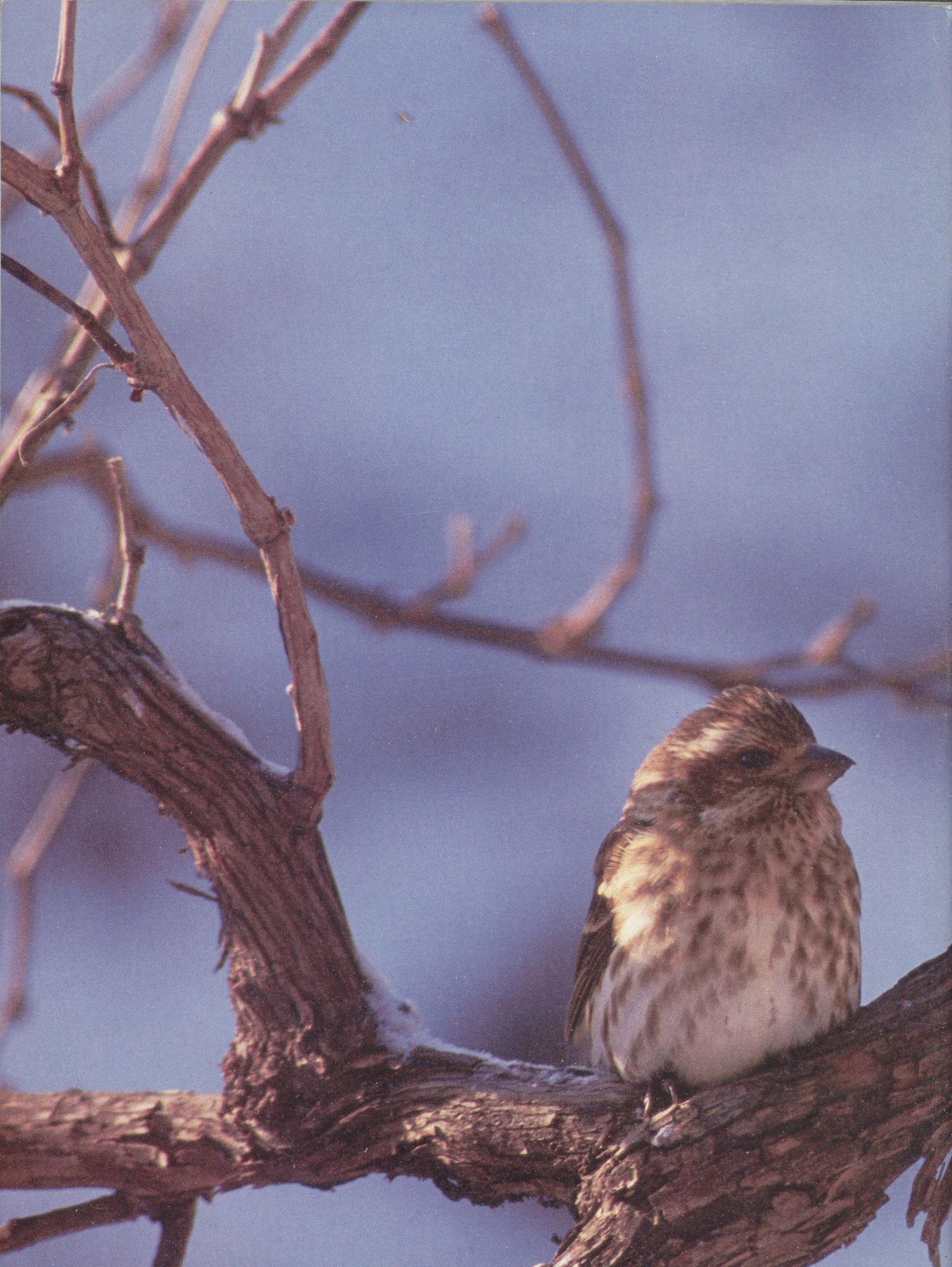
Position: 341 (27 views)