Volume 66, Issue 9, 1988
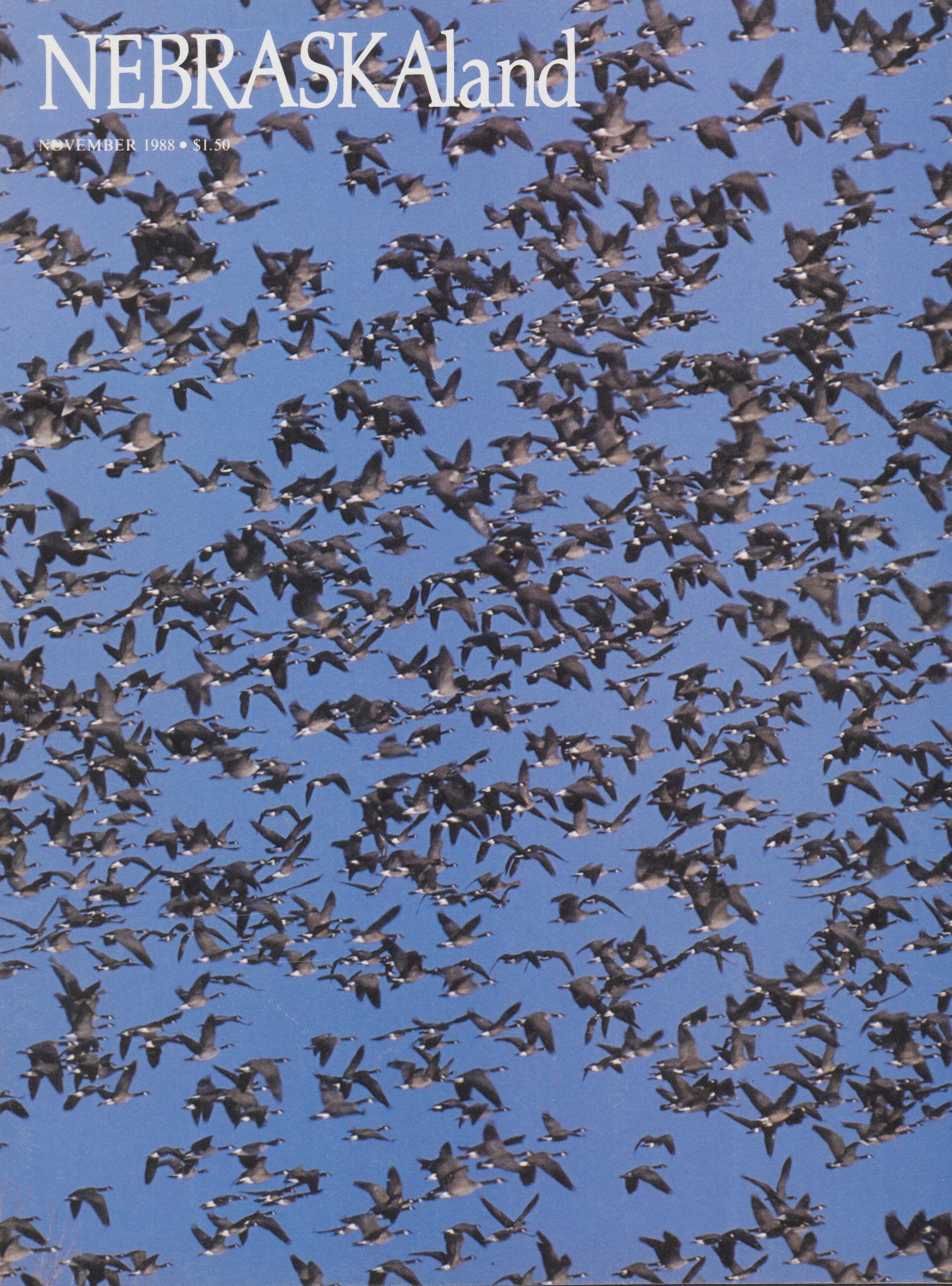
NEBRASKAland
NOVEMBER 1988 $1.50
Speak Up
Great machinesSir/The fine story by Don Cunningham on Nebraska’s home-made windmills evokes memories of the box-like go-devils tum- bling over and over on remote, sandy slopes.
Along with the soft rustle of cottonwood leaves, there is no more pleasant sound than the quivering twang and snapping of a gal- vanized iron windmill spinning briskly in the cool of the evening.
At one time there was a very large wooden bladed windmill at Hordville which pumped water for the water tanks by the railroad tracks. It was the largest wheel I ever saw on a windmill, and my mind’s eye would guess its diameter in the range of 16 to 20 feet. I wonder if it was ever photo- graphed. It was a magnificent mechanism. Oh, the windmill may have retreated before the advance of the power line, but it will never disappear and it will always be a vivid part of Nebraska history.
John Kirkpatrick Louisville, KY “Fantastic!”Sir/I wanted to let you know your magazine to a true Nebraskan is nothing short of fan- tastic. I’ve read it off and on all my life and have only one regret. How can I get all those past issues?
Enclosed is an article about my grand- father and great-grandfather Hosea. My mother’s family homesteaded in Washing- ton County northwest of Blair at the head- waters of the now Papio Creek. The family still has the land grant signed by President Ulysses S. Grant. My mother still talks of good populations of grouse, prairie chicken and jack rabbits, as a girl along the Papio, which she hunted with my granddad. Keep up the good work.
Frank W. Wilkins Blair, NEThe clipping talks about the shooting of a large coyote in about 1923 of which was said: “The coyote resembled closely a Police dog but was much larger. ” An attempt had been made to capture the animal alive, but after several miles' chase, a horse slipped on the frozen ground and threw the rider, Hosea Wilson, who then shot the coyote to avoid its escape. The coyote was blamed for killing every thing from chickens to hogs, calves, and even a mule. (Editor)
Feisty grouseSir/On April 7 my brother, Norman Mapes of Fullerton, and I were fishing at Calamus Reservoir near three small islands. We heard a strange noise and noticed a large bird sitting on the smallest island. We then realized it was a grouse doing his courtship display. We were both raised in the Sand- hills and hunted grouse many times, but this was the first time either of us had witnessed the pre-mating ritual.
The fish were not hitting in that area so we went elsewhere. About 7:30 p.m. we returned to the area where we had seen the bird. We circled the island, staying about 25 feet away. The bird did not fly away, but stayed on the edge of the island closest to the boat. The motor hung up in some grass about 30 feet from the island. There were several male birds on the biggest island which seemed to be booming and challeng- ing back and forth.
We cast lures, trying to catch pike. I was trying to determine if our bird was a prairie chicken or sharptail. Suddenly Norm yelled, “Here he comes!” I looked up just in time to see the bird heading straight for me. I put my arm over my face and stumbled over my tackle box, and fell flat on my back in the bottom of the boat. The bird came within three feet of my head and landed on the motor. Every time I would move to get up, the bird would fly at me. Finally I grabbed an oar, not to hurt the bird, but to get it off the boat. Each time I would push it off, it would fly back and walk around the back of the boat. Norm was in the front laughing his head off. As long as I didn’t move, the bird would sit still, but if I moved, he would walk or fly toward me. Eventually he walked along the side of the boat. Norm moved his hand toward it, and it pecked his boot. Norm held out his arm and the bird flew up and landed on it. The bird then pecked his arm and flew back to the motor. Shortly thereafter, it flew back to the island. As it was getting dark, we went back to the camp- ground.
The next morning when we went fishing, Norm remembered he had a throw-away camera along, so we took it in case the bird was still there. When we approached the islands, other prairie chickens flew off, but our bird flew out to greet us. We took sev- eral pictures of it on the island, the boat, and on Norm’s arm. I had it on my arm pecking my hand, but Norm was so excited he couldn’t find the button in time to take the picture.
Darold Mapes Norfolk, NE 4 NEBRASKAland Lots of deerSir/Did you ever see a deer convention? They hold it miles northwest of here in cold weather, in early February. Where it will be next year is anybody’s guess. I and others estimate over 300 in this field. My question is, where were they when people were hunt- ing them? These would come in from the sandy—and some clay—hills for no telling how far. Nobody has been able to say why they congregated for a time and then dispersed. Thought you might be interested in seeing these pictures and that we do still have plenty of deer. They were strung out over a quarter-mile in this field.
Walter Bumgarner Arcadia, NE More nostalgiaSir/The letter and photo of the Mariaville school caught my attention. I am glad to report that the school, though not used for many years, still presides over the village corner. Its bell is being preserved by a member of the Peacock family. My brother, Kenneth, and I saw the school in late June while attending our 50th high school reun- ion in Ainsworth. We drove around Maria- ville to reminisce and see family property.
The Anderson family has long been asso- ciated with the Mariaville school. In the 1880s my grandfather, George M. Ander- son, migrated from Ohio to homestead in South Dakota in a covered wagon. When his land was absorbed for the Indian reser- vation, he moved across the river in Rock County. Being a former teacher, he helped establish the school and granted a lease for the school on the northwest corner of his property. He also served as treasurer and all eight of his sons attended the school.
In January 1913, my mother, Maude Glendenning, went to Mariaville to fill a mid-term vacancy after completing Mid- land Normal School in Fremont. She arrived via horse and buggy from Newport with the mail man, who was delivering to the post office in the Wilsey-Hicks general store, which appears in the photo. Among mother’s 43 students in the eight grades were the two youngest Anderson boys, Chester and Marcus. In October of 1913, my mother married an older Anderson son, Roscoe. Later, my two brothers and numer- ous cousins attended the school.
Enclosed is a copy of the souvenir book- let from the 1913 class showing the names of the officers and pupils. A few Anderson cousins and descendants of other families still reside in the area.
E. Vernice Anderson Alexandria, VA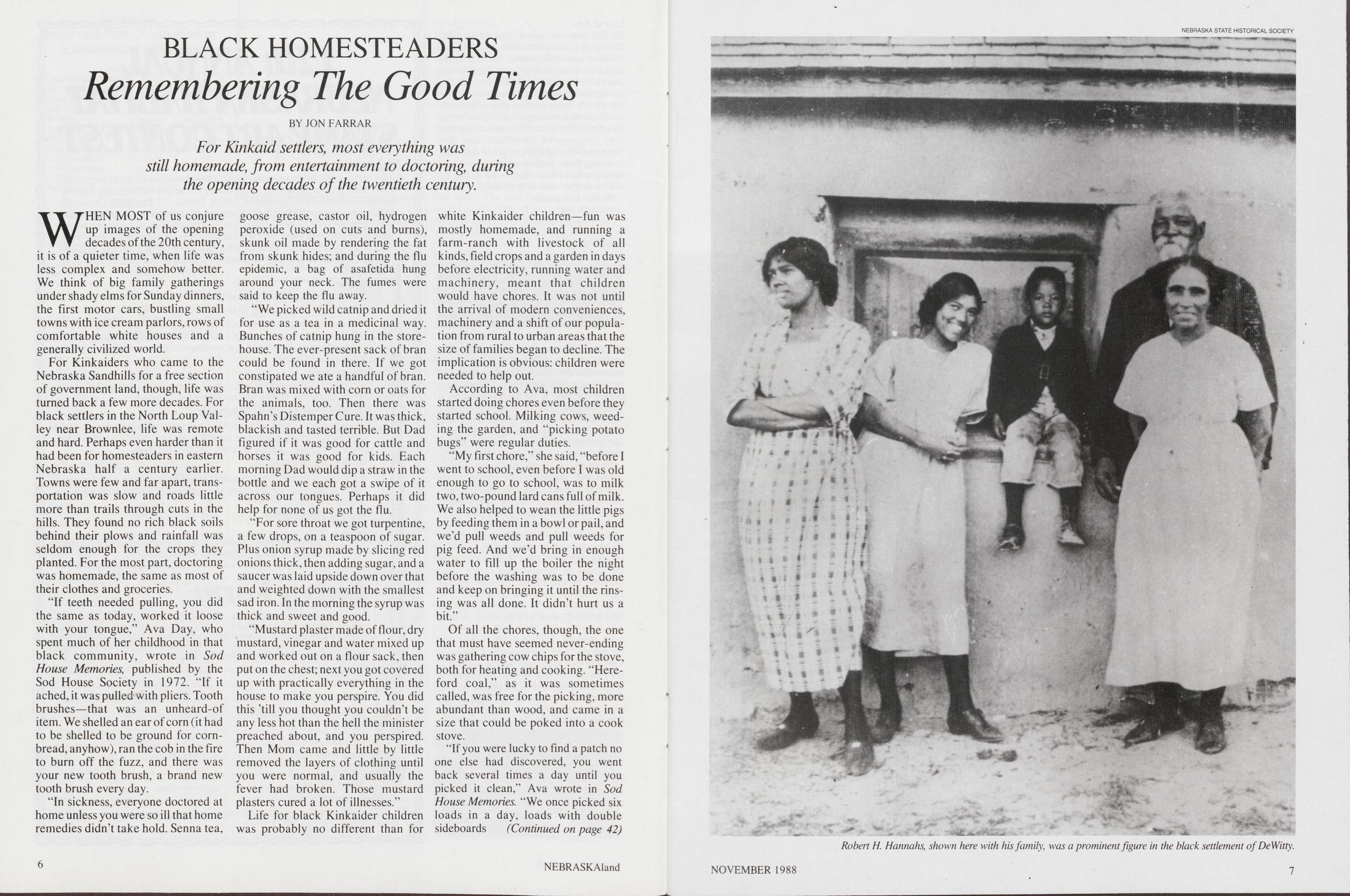
BLACK HOMESTEADERS
Remembering The Good Times
For Kinkaid settlers, most everything was still homemade, from entertainment to doctoring, during the opening decades of the twentieth century.
WHEN MOST of us conjure up images of the opening decades of the 20th century, it is of a quieter time, when life was less complex and somehow better. We think of big family gatherings under shady elms for Sunday dinners, the first motor cars, bustling small towns with ice cream parlors, rows of comfortable white houses and a generally civilized world.
For Kinkaiders who came to the Nebraska Sandhills for a free section of government land, though, life was turned back a few more decades. For black settlers in the North Loup Val- ley near Brownlee, life was remote and hard. Perhaps even harder than it had been for homesteaders in eastern Nebraska half a century earlier. Towns were few and far apart, trans- portation was slow and roads little more than trails through cuts in the hills. They found no rich black soils behind their plows and rainfall was seldom enough for the crops they planted. For the most part, doctoring was homemade, the same as most of their clothes and groceries.
“If teeth needed pulling, you did the same as today, worked it loose with your tongue,” Ava Day, who spent much of her childhood in that black community, wrote in Sod House Memories, published by the Sod House Society in 1972. “If it ached, it was pulled with pliers. Tooth brushes—that was an unheard-of item. We shelled an ear of corn (it had to be shelled to be ground for corn- bread, anyhow), ran the cob in the fire to burn off the fuzz, and there was your new tooth brush, a brand new tooth brush every day.
“In sickness, everyone doctored at home unless you were so ill that home remedies didn’t take hold. Senna tea, goose grease, castor oil, hydrogen peroxide (used on cuts and burns), skunk oil made by rendering the fat from skunk hides; and during the flu epidemic, a bag of asafetida hung around your neck. The fumes were said to keep the flu away.
“We picked wild catnip and dried it for use as a tea in a medicinal way. Bunches of catnip hung in the store- house. The ever-present sack of bran could be found in there. If we got constipated we ate a handful of bran. Bran was mixed with corn or oats for the animals, too. Then there was Spahn’s Distemper Cure. It was thick, blackish and tasted terrible. But Dad figured if it was good for cattle and horses it was good for kids. Each morning Dad would dip a straw in the bottle and we each got a swipe of it across our tongues. Perhaps it did help for none of us got the flu.
“For sore throat we got turpentine, a few drops, on a teaspoon of sugar. Plus onion syrup made by slicing red onions thick, then adding sugar, and a saucer was laid upside down over that and weighted down with the smallest sad iron. In the morning the syrup was thick and sweet and good.
“Mustard plaster made of flour, dry mustard, vinegar and water mixed up and worked out on a flour sack, then put on the chest; next you got covered up with practically everything in the house to make you perspire. You did this ’till you thought you couldn’t be any less hot than the hell the minister preached about, and you perspired. Then Mom came and little by little removed the layers of clothing until you were normal, and usually the fever had broken. Those mustard plasters cured a lot of illnesses.”
Life for black Kinkaider children was probably no different than for white Kinkaider children—fun was mostly homemade, and running a farm-ranch with livestock of all kinds, field crops and a garden in days before electricity, running water and machinery, meant that children would have chores. It was not until the arrival of modern conveniences, machinery and a shift of our popula- tion from rural to urban areas that the size of families began to decline. The implication is obvious: children were needed to help out.
According to Ava, most children started doing chores even before they started school. Milking cows, weed- ing the garden, and “picking potato bugs” were regular duties.
“My first chore,” she said, “before I went to school, even before I was old enough to go to school, was to milk two, two-pound lard cans full of milk. We also helped to wean the little pigs by feeding them in a bowl or pail, and we’d pull weeds and pull weeds for pig feed. And we’d bring in enough water to fill up the boiler the night before the washing was to be done and keep on bringing it until the rins- ing was all done. It didn’t hurt us a bit.”
Of all the chores, though, the one that must have seemed never-ending was gathering cow chips for the stove, both for heating and cooking. “Here- ford coal,” as it was sometimes called, was free for the picking, more abundant than wood, and came in a size that could be poked into a cook stove.
“If you were lucky to find a patch no one else had discovered, you went back several times a day until you picked it clean,” Ava wrote in Sod House Memories. “We once picked six loads in a day, loads with double sideboards (Continued on page 42)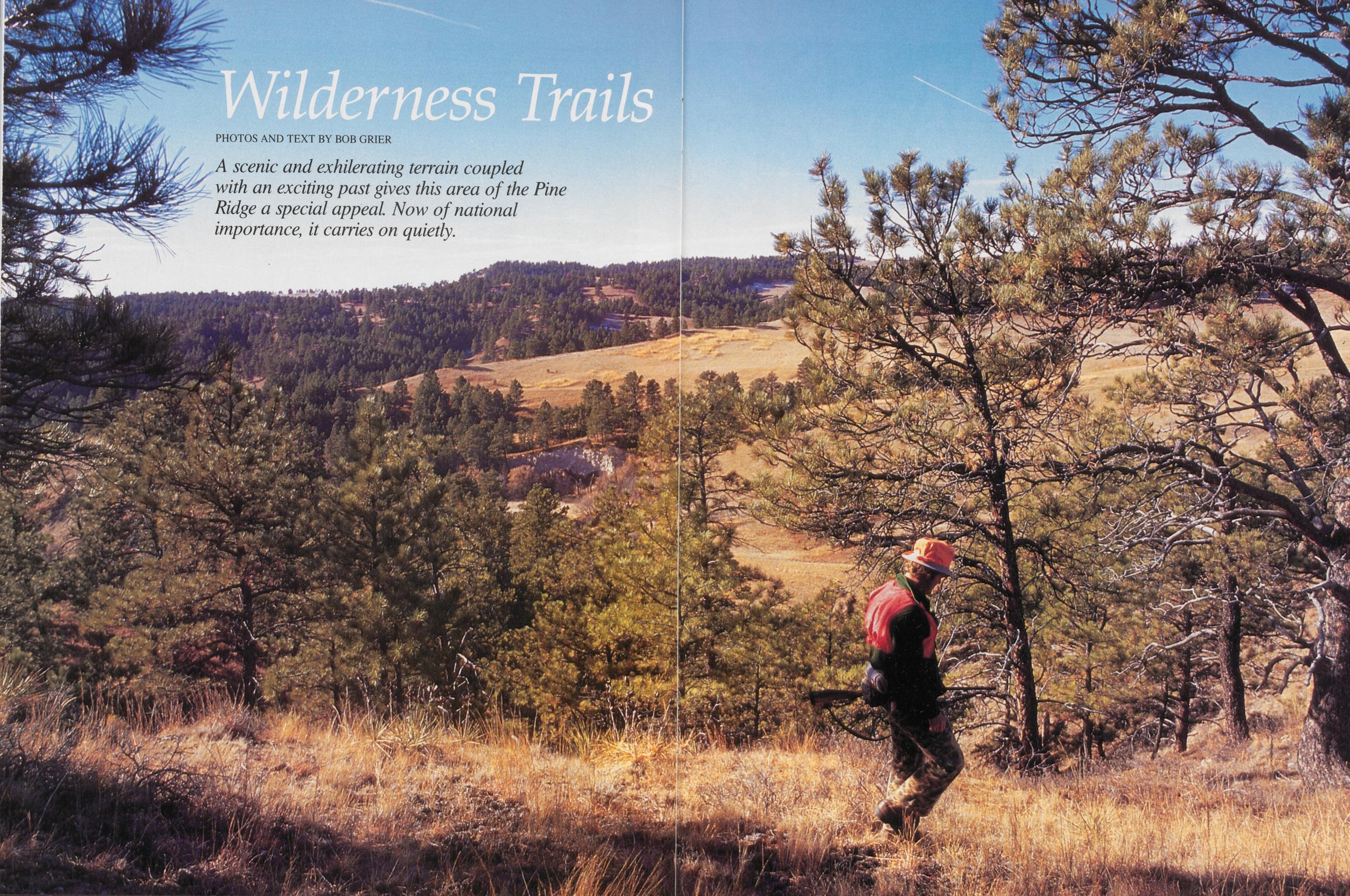
Wilderness Trails
Ascenic and exhilerating terrain coupled with an exciting past gives this area of the Pine Ridge a special appeal. Now of national importance, it carries on quietly.
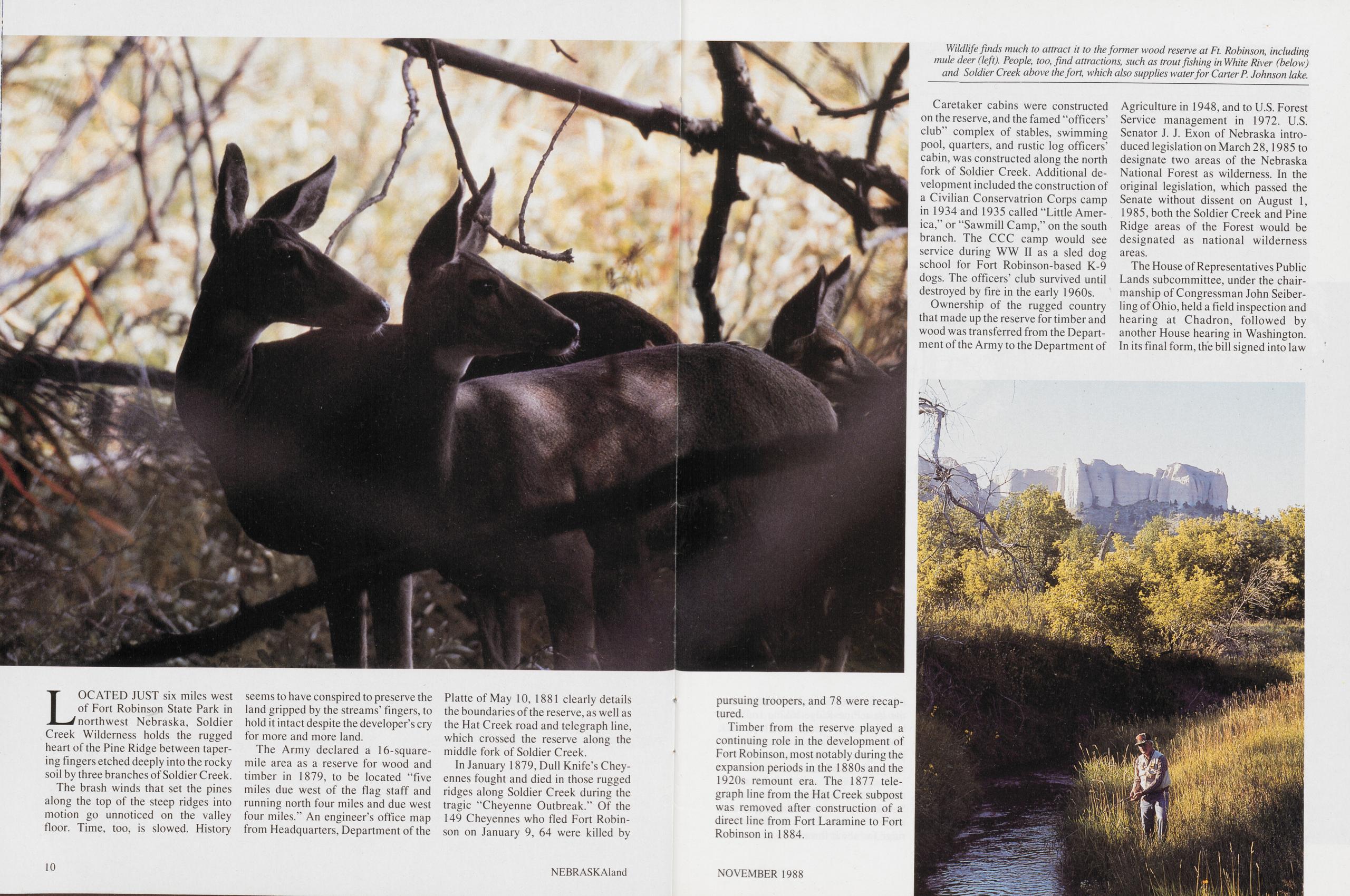
LOCATED JUST six miles west of Fort Robinson State Park in northwest Nebraska, Soldier Creek Wilderness holds the rugged heart of the Pine Ridge between taper- ing fingers etched deeply into the rocky soil by three branches of Soldier Creek.
The brash winds that set the pines along the top of the steep ridges into motion go unnoticed on the valley floor. Time, too, is slowed. History seems to have conspired to preserve the land gripped by the streams’ fingers, to hold it intact despite the developer’s cry for more and more land.
The Army declared a 16-square- mile area as a reserve for wood and timber in 1879, to be located "five miles due west of the flag staff and running north four miles and due west four miles.” An engineer’s office map from Headquarters, Department of the Platte of May 10, 1881 clearly details the boundaries of the reserve, as well as the Hat Creek road and telegraph line, which crossed the reserve along the middle fork of Soldier Creek.
In January 1879, Dull Knife’s Chey- ennes fought and died in those rugged ridges along Soldier Creek during the tragic "Cheyenne Outbreak.” Of the 149 Cheyennes who fled Fort Robin- son on January 9, 64 were killed by pursuing troopers, and 78 were recap- tured.
Timber from the reserve played a continuing role in the development of Fort Robinson, most notably during the expansion periods in the 1880s and the 1920s remount era. The 1877 tele- graph line from the Hat Creek subpost was removed after construction of a direct line from Fort Laramine to Fort Robinson in 1884.
Caretaker cabins were constructed on the reserve, and the famed “officers’ club” complex of stables, swimming pool, quarters, and rustic log officers’ cabin, was constructed along the north fork of Soldier Creek. Additional de- velopment included the construction of a Civilian Conservation Corps camp in 1934 and 1935 called "Little Amer- ica,” or "Sawmill Camp,” on the south branch. The CCC camp would see service during WW II as a sled dog school for Fort Robinson-based K-9 dogs. The officers’ club survived until destroyed by fire in the early 1960s.
Ownership of the rugged country that made up the reserve for timber and wood was transferred from the Depart- ment of the Army to the Department of Agriculture in 1948, and to U.S. Forest Service management in 1972. U.S. Senator J. J. Exon of Nebraska intro- duced legislation on March 28,1985 to designate two areas of the Nebraska National Forest as wilderness. In the original legislation, which passed the Senate without dissent on August 1, 1985, both the Soldier Creek and Pine Ridge areas of the Forest would be designated as national wilderness areas.
The House of Representatives Public
Lands subcommittee, under the chair-
manship of Congressman John Seiber-
ling of Ohio, held a field inspection and
hearing at Chadron, followed by
another House hearing in Washington.
In its final form, the bill signed into law
10
NEBRASKAland
NOVEMBER 1988
Senator Exon in his testimony on compromise legislation, told the Senate that “The Nebraska Wilderness Act is an effort to be responsible and true to both our heritage and those who follow us on this Earth. To set aside this small part of Nebraska for our children, grandchildren and generations who fol- low, to enjoy in solitude away from the rigors and commotion of everyday life, reflects well on all Nebraskans.”
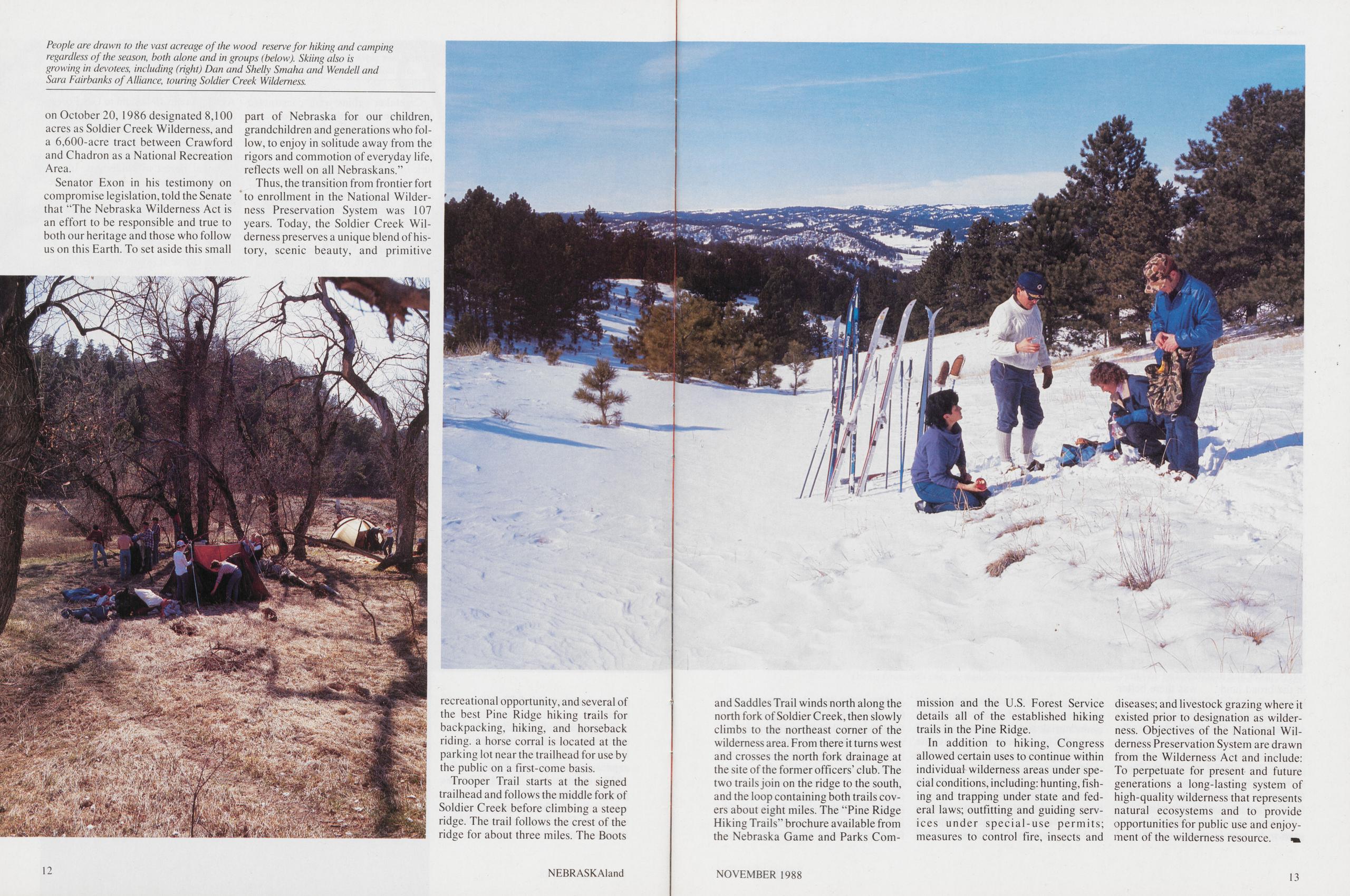
Thus, the transition from frontier fort to enrollment in the National Wilder- ness Preservation System was 107 years. Today, the Soldier Creek Wil- derness preserves a unique blend of his- tory, scenic beauty, and primitive recreational opportunity, and several of the best Pine Ridge hiking trails for backpacking, hiking, and horseback riding, a horse corral is located at the parking lot near the trailhead for use by the public on a first-come basis.
Trooper Trail starts at the signed trailhead and follows the middle fork of Soldier Creek before climbing a steep ridge. The trail follows the crest of the ridge for about three miles. The Boots and Saddles Trail winds north along the north fork of Soldier Creek, then slowly climbs to the northeast corner of the wilderness area. From there it turns west and crosses the north fork drainage at the site of the former officers’ club. The two trails join on the ridge to the south, and the loop containing both trails cov- ers about eight miles. The “Pine Ridge Hiking Trails” brochure available from the Nebraska Game and Parks Com- mission and the U.S. Forest Service details all of the established hiking trails in the Pine Ridge.
In addition to hiking, Congress allowed certain uses to continue within individual wilderness areas under spe- cial conditions, including: hunting, fish- ing and trapping under state and fed- eral laws; outfitting and guiding serv- ices under special-use permits; measures to control fire, insects and diseases; and livestock grazing where it existed prior to designation as wilder- ness. Objectives of the National Wil- derness Preservation System are drawn from the Wilderness Act and include: To perpetuate for present and future generations a long-lasting system of high-quality wilderness that represents natural ecosystems and to provide opportunities for public use and enjoy- ment of the wilderness resource.
12 NEBRASKAland NOVEMBER 1988 13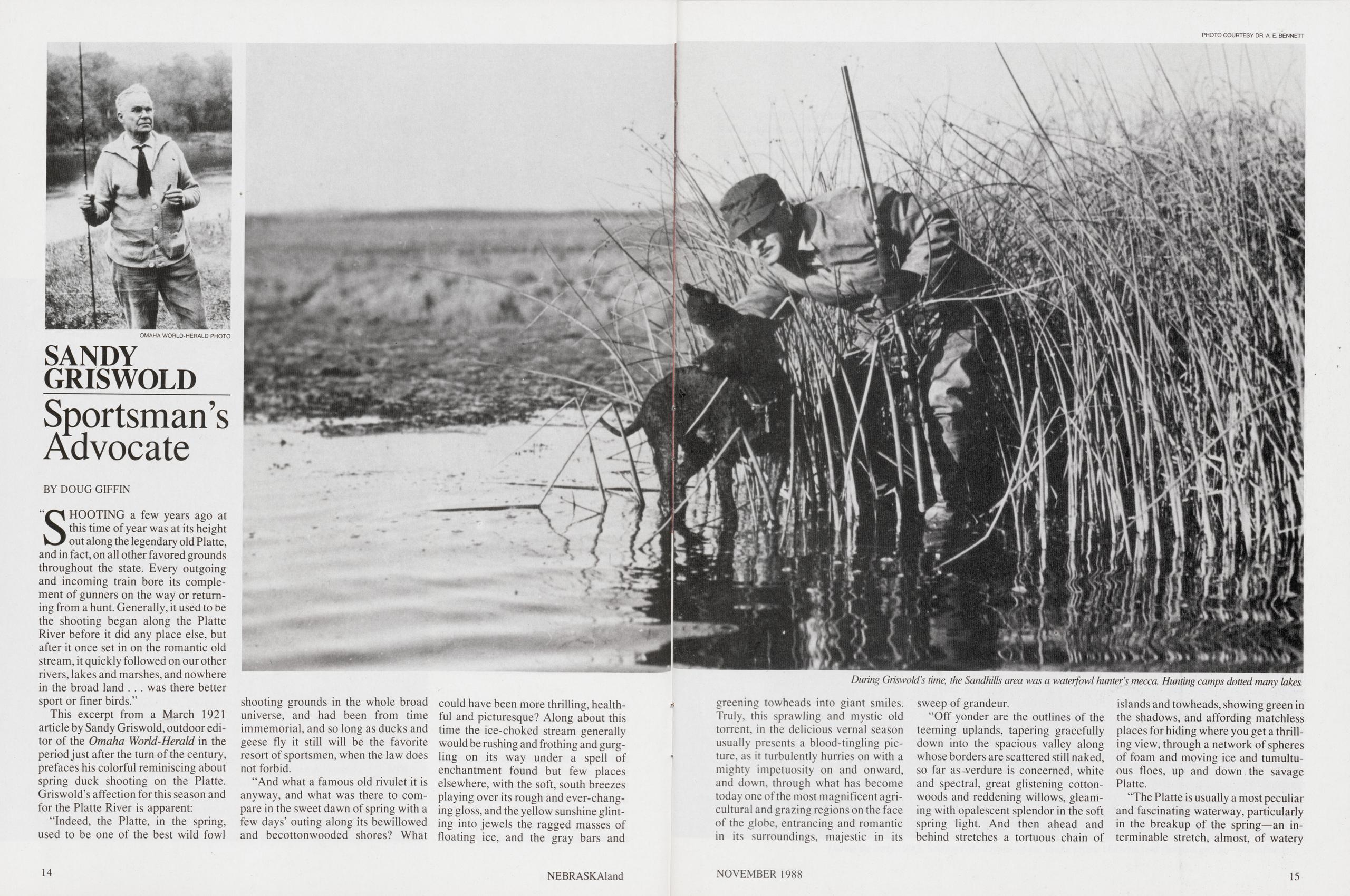
SANDY GRISWOLD Sportsman’s Advocate
SHOOTING a few years ago at this time of year was at its height K-J out along the legendary old Platte, and in fact, on all other favored grounds throughout the state. Every outgoing and incoming train bore its comple- ment of gunners on the way or return- ing from a hunt. Generally, it used to be the shooting began along the Platte River before it did any place else, but after it once set in on the romantic old stream, it quickly followed on our other rivers, lakes and marshes, and nowhere in the broad land . . . was there better sport or finer birds.”
This excerpt from a March 1921 article by Sandy Griswold, outdoor edi- tor of the Omaha World-Herald in the period just after the turn of the century, prefaces his colorful reminiscing about spring duck shooting on the Platte. Griswold’s affection for this season and for the Platte River is apparent:
“Indeed, the Platte, in the spring, used to be one of the best wild fowl
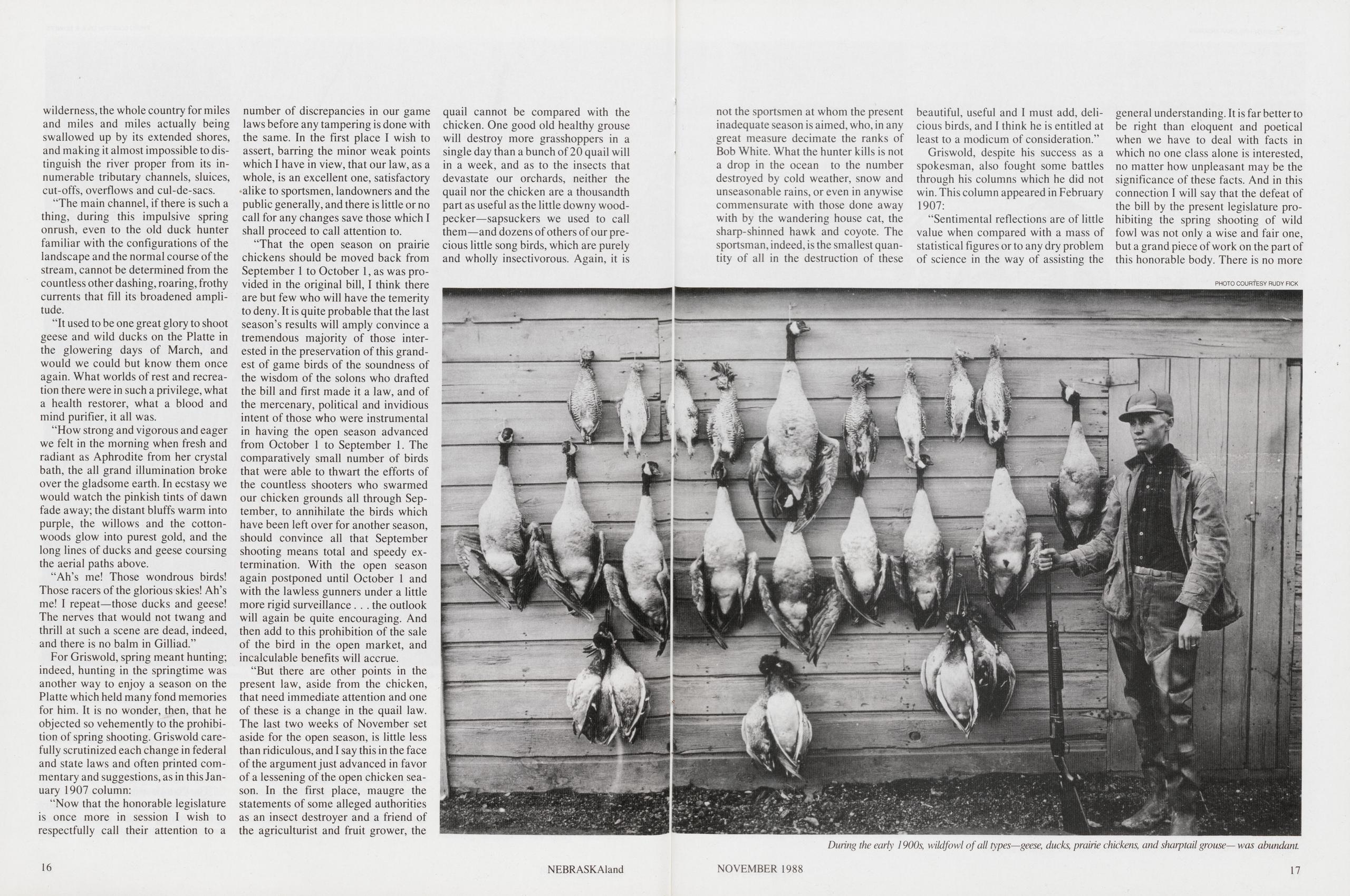
“And what a famous old rivulet it is anyway, and what was there to com- pare in the sweet dawn of spring with a few days’ outing along its bewillowed and becottonwooded shores? What could have been more thrilling, health- ful and picturesque? Along about this time the ice-choked stream generally would be rushing and frothing and gurg- ling on its way under a spell of enchantment found but few places elsewhere, with the soft, south breezes playing over its rough and ever-chang- ing gloss, and the yellow sunshine glint- ing into jewels the ragged masses of floating ice, and the gray bars and greening towheads into giant smiles. Truly, this sprawling and mystic old torrent, in the delicious vernal season usually presents a blood-tingling pic- ture, as it turbulently hurries on with a mighty impetuosity on and onward, and down, through what has become today one of the most magnificent agri- cultural and grazing regions on the face of the globe, entrancing and romantic in its surroundings, majestic in its sweep of grandeur.
“Off yonder are the outlines of the teeming uplands, tapering gracefully down into the spacious valley along whose borders are scattered still naked, so far as-verdure is concerned, white and spectral, great glistening cotton- woods and reddening willows, gleam- ing with opalescent splendor in the soft spring light. And then ahead and behind stretches a tortuous chain of islands and towheads, showing green in the shadows, and affording matchless places for hiding where you get a thrill- ing view, through a network of spheres of foam and moving ice and tumultu- ous floes, up and down the savage Platte.
“The Platte is usually a most peculiar
and fascinating waterway, particularly
in the breakup of the spring—an in-
terminable stretch, almost, of watery
14
NEBRASKAland
NOVEMBER 1988
15
 wilderness, the whole country for miles
and miles and miles actually being
swallowed up by its extended shores,
and making it almost impossible to dis-
tinguish the river proper from its in-
numerable tributary channels, sluices,
cut-offs, overflows and cul-de-sacs.
wilderness, the whole country for miles
and miles and miles actually being
swallowed up by its extended shores,
and making it almost impossible to dis-
tinguish the river proper from its in-
numerable tributary channels, sluices,
cut-offs, overflows and cul-de-sacs.
“The main channel, if there is such a thing, during this impulsive spring onrush, even to the old duck hunter familiar with the configurations of the landscape and the normal course of the stream, cannot be determined from the countless other dashing, roaring, frothy currents that fill its broadened ampli- tude.
"It used to be one great glory to shoot geese and wild ducks on the Platte in the glowering days of March, and would we could but know them once again. What worlds of rest and recrea- tion there were in such a privilege, what a health restorer, what a blood and mind purifier, it all was.
"How strong and vigorous and eager we felt in the morning when fresh and radiant as Aphrodite from her crystal bath, the all grand illumination broke over the gladsome earth. In ecstasy we would watch the pinkish tints of dawn fade away; the distant bluffs warm into purple, the willows and the cotton- woods glow into purest gold, and the long lines of ducks and geese coursing the aerial paths above.
"Ah’s me! Those wondrous birds! Those racers of the glorious skies! Ah’s me! I repeat—those ducks and geese! The nerves that would not twang and thrill at such a scene are dead, indeed, and there is no balm in Gilliad.”
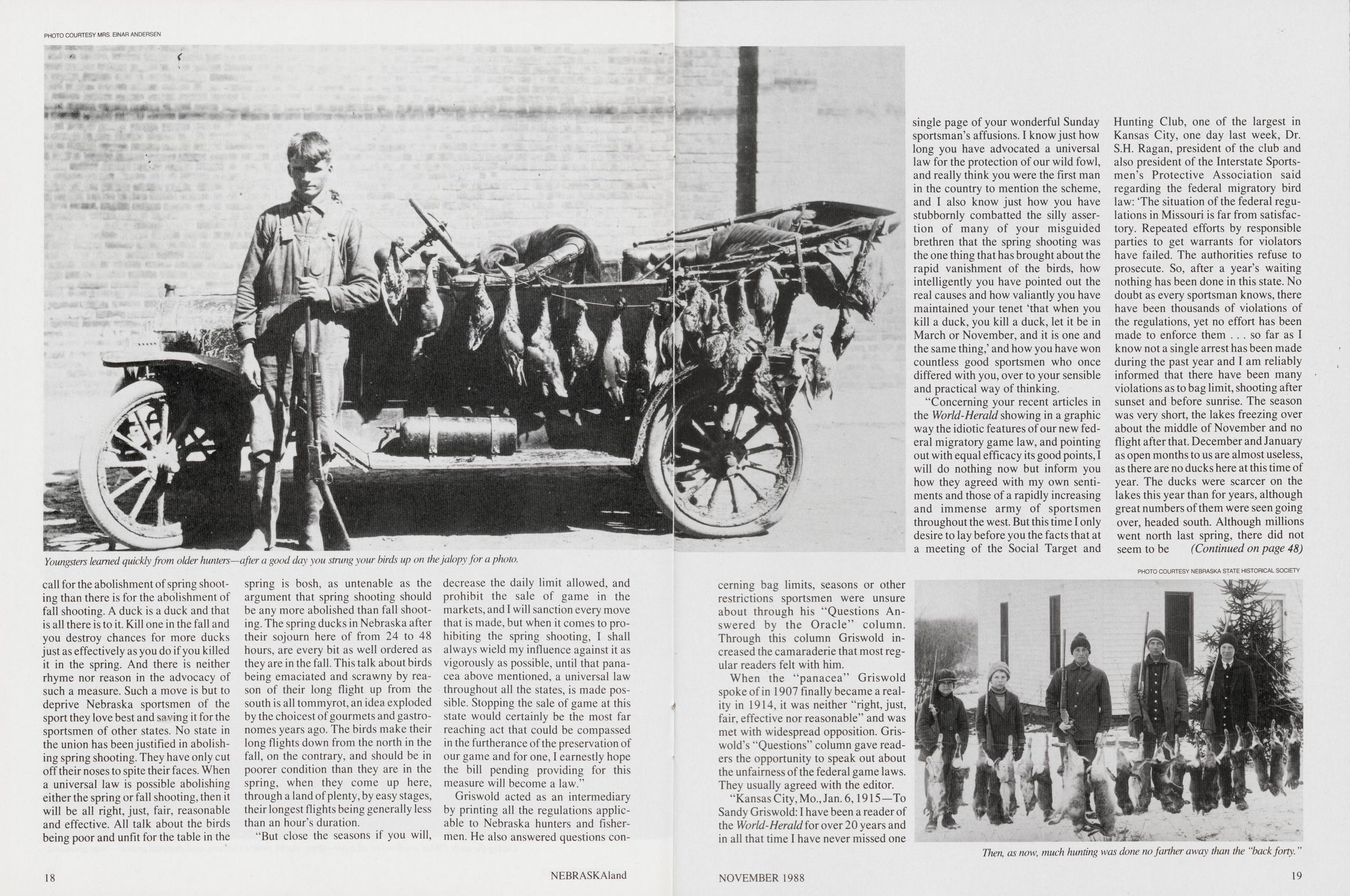
For Griswold, spring meant hunting; indeed, hunting in the springtime was another way to enjoy a season on the Platte which held many fond memories for him. It is no wonder, then, that he objected so vehemently to the prohibi- tion of spring shooting. Griswold care- fully scrutinized each change in federal and state laws and often printed com- mentary and suggestions, as in this Jan- uary 1907 column:
"Now that the honorable legislature is once more in session I wish to respectfully call their attention to a number of discrepancies in our game laws before any tampering is done with the same. In the first place I wish to assert, barring the minor weak points which I have in view, that our law, as a whole, is an excellent one, satisfactory alike to sportsmen, landowners and the public generally, and there is little or no call for any changes save those which I shall proceed to call attention to.
"That the open season on prairie chickens should be moved back from September 1 to October 1, as was pro- vided in the original bill, I think there are but few who will have the temerity to deny. It is quite probable that the last season’s results will amply convince a tremendous majority of those inter- ested in the preservation of this grand- est of game birds of the soundness of the wisdom of the solons who drafted the bill and first made it a law, and of the mercenary, political and invidious intent of those who were instrumental in having the open season advanced from October 1 to September 1. The comparatively small number of birds that were able to thwart the efforts of the countless shooters who swarmed our chicken grounds all through Sep- tember, to annihilate the birds which have been left over for another season, should convince all that September shooting means total and speedy ex- termination. With the open season again postponed until October 1 and with the lawless gunners under a little more rigid surveillance ... the outlook will again be quite encouraging. And then add to this prohibition of the sale of the bird in the open market, and incalculable benefits will accrue.
"But there are other points in the present law, aside from the chicken, that need immediate attention and one of these is a change in the quail law. The last two weeks of November set aside for the open season, is little less than ridiculous, and I say this in the face of the argument just advanced in favor of a lessening of the open chicken sea- son. In the first place, maugre the statements of some alleged authorities as an insect destroyer and a friend of the agriculturist and fruit grower, the quail cannot be compared with the chicken. One good old healthy grouse will destroy more grasshoppers in a single day than a bunch of 20 quail will in a week, and as to the insects that devastate our orchards, neither the quail nor the chicken are a thousandth part as useful as the little downy wood- pecker—sapsuckers we used to call them—and dozens of others of our pre- cious little song birds, which are purely and wholly insectivorous. Again, it is
Griswold, despite his success as a spokesman, also fought some battles through his columns which he did not win. This column appeared in February 1907:
"Sentimental reflections are of little
value when compared with a mass of
statistical figures or to any dry problem
of science in the way of assisting the
general understanding. It is far better to
be right than eloquent and poetical
when we have to deal with facts in
which no one class alone is interested,
no matter how unpleasant may be the
significance of these facts. And in this
connection I will say that the defeat of
the bill by the present legislature pro-
hibiting the spring shooting of wild
fowl was not only a wise and fair one,
but a grand piece of work on the part of
this honorable body. There is no more
16
NEBRASKAland
NOVEMBER 1988
17
“But close the seasons if you will, decrease the daily limit allowed, and prohibit the sale of game in the markets, and I will sanction every move that is made, but when it comes to pro- hibiting the spring shooting, I shall always wield my influence against it as vigorously as possible, until that pana- cea above mentioned, a universal law throughout all the states, is made pos- sible. Stopping the sale of game at this state would certainly be the most far reaching act that could be compassed in the furtherance of the preservation of our game and for one, I earnestly hope the bill pending providing for this measure will become a law.”
Griswold acted as an intermediary by printing all the regulations applic- able to Nebraska hunters and fisher- men. He also answered questions concerning bag limits, seasons or other restrictions sportsmen were unsure about through his “Questions An- swered by the Oracle” column. Through this column Griswold in- creased the camaraderie that most reg- ular readers felt with him.
When the “panacea” Griswold spoke of in 1907 finally became a real- ity in 1914, it was neither “right, just, fair, effective nor reasonable” and was met with widespread opposition. Gris- wold’s “Questions” column gave read- ers the opportunity to speak out about the unfairness of the federal game laws. They usually agreed with the editor.
“Kansas City, Mo., Jan.6,1915 —To Sandy Griswold: I have been a reader of the World-Herald for over 20 years and in all that time I have never missed one single page of your wonderful Sunday sportsman’s affusions. I know just how long you have advocated a universal law for the protection of our wild fowl, and really think you were the first man in the country to mention the scheme, and I also know just how you have stubbornly combatted the silly asser- tion of many of your misguided brethren that the spring shooting was the one thing that has brought about the rapid vanishment of the birds, how intelligently you have pointed out the real causes and how valiantly you have maintained your tenet That when you kill a duck, you kill a duck, let it be in March or November, and it is one and the same thing,’ and how you have won countless good sportsmen who once differed with you, over to your sensible and practical way of thinking.
“Concerning your recent articles in the World-Herald showing in a graphic way the idiotic features of our new fed- eral migratory game law, and pointing out with equal efficacy its good points, I will do nothing now but inform you how they agreed with my own senti- ments and those of a rapidly increasing and immense army of sportsmen throughout the west. But this time I only desire to lay before you the facts that at a meeting of the Social Target and
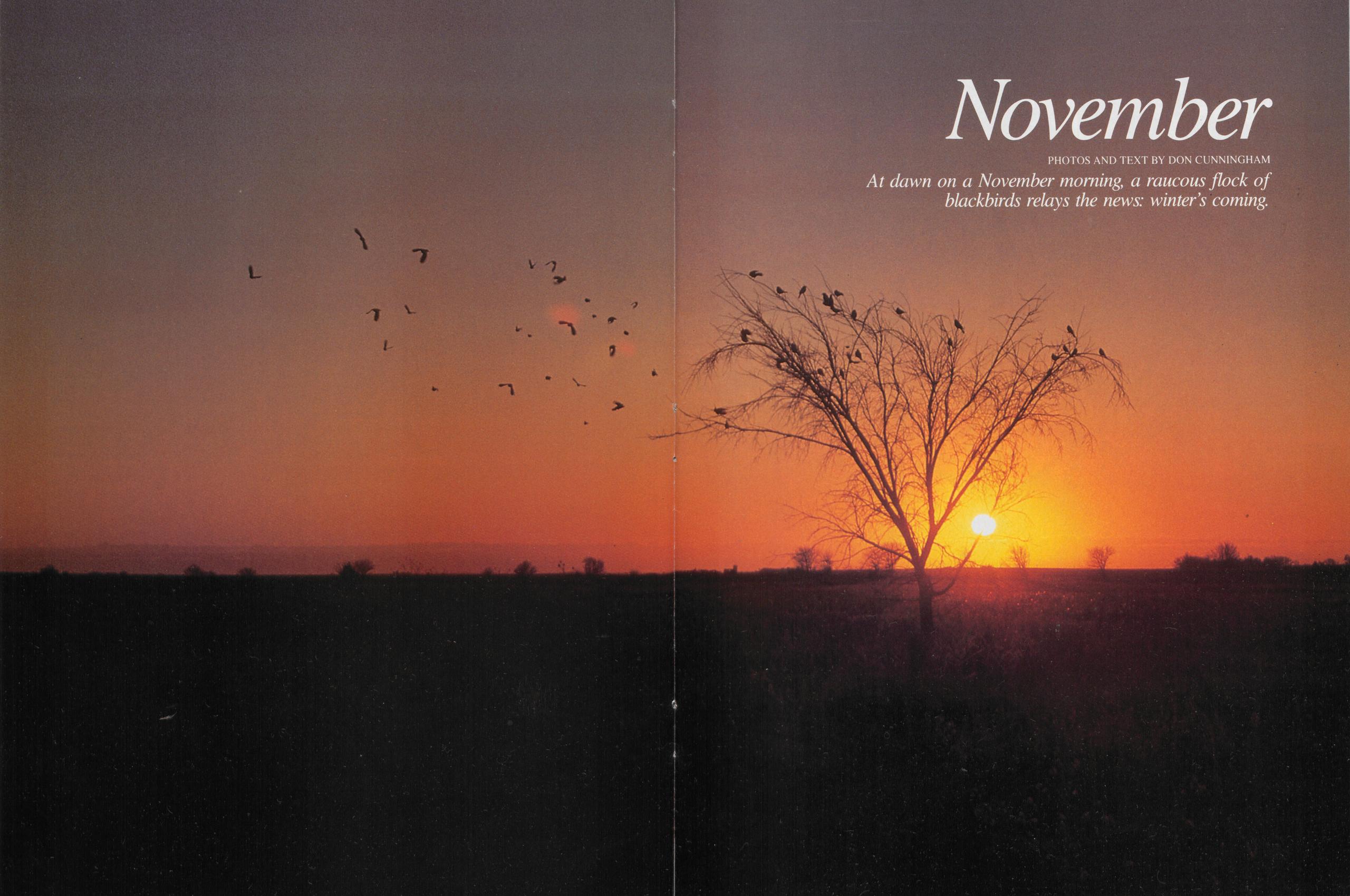
November
At dawn on a November morning, a raucous flock of blackbirds relays the news: winters coming.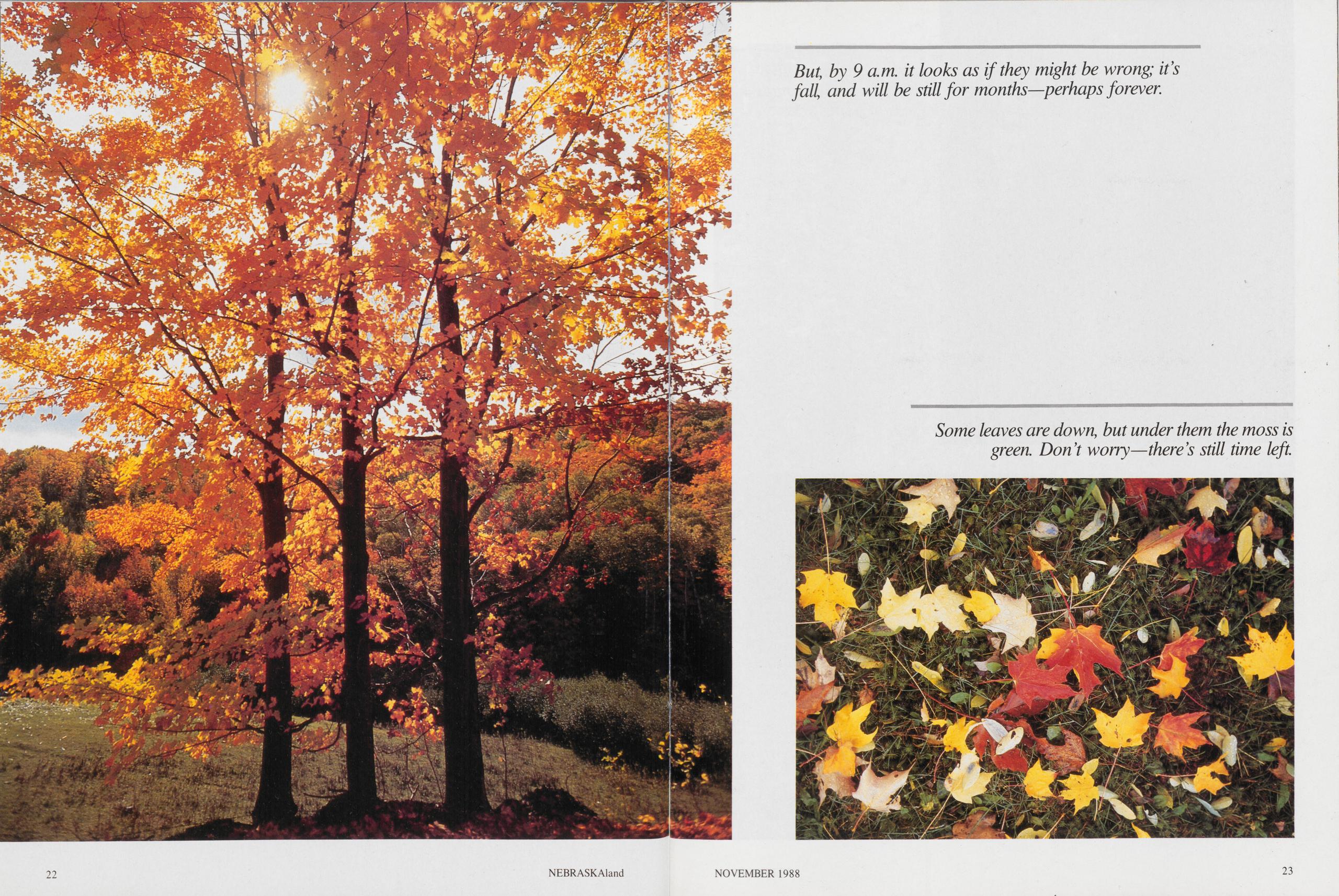
But, by 9 a.m. it looks as if they might be wrong; it’s fall, and will be still for months—perhaps forever. Some leaves are down, but under them the moss is green. Don’t worry—there’s still time left.
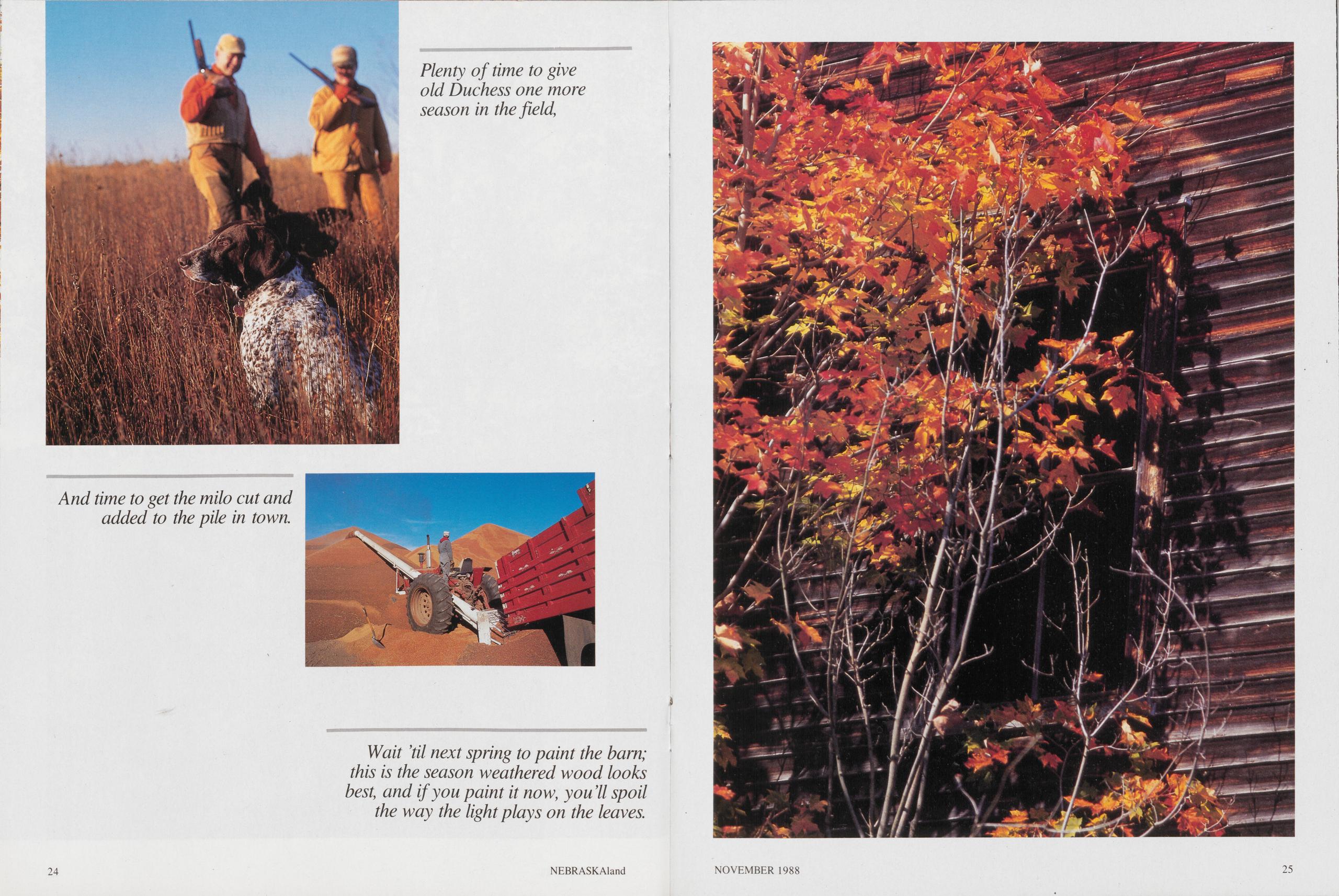
Plenty of time to give old Duchess one more season in the field, And time to get the milo cut and added to the pile in town. Wait ’til next spring to paint the barn; this is the season weathered wood looks best, and if you paint it now, you ’ll spoil the way the light plays on the leaves.
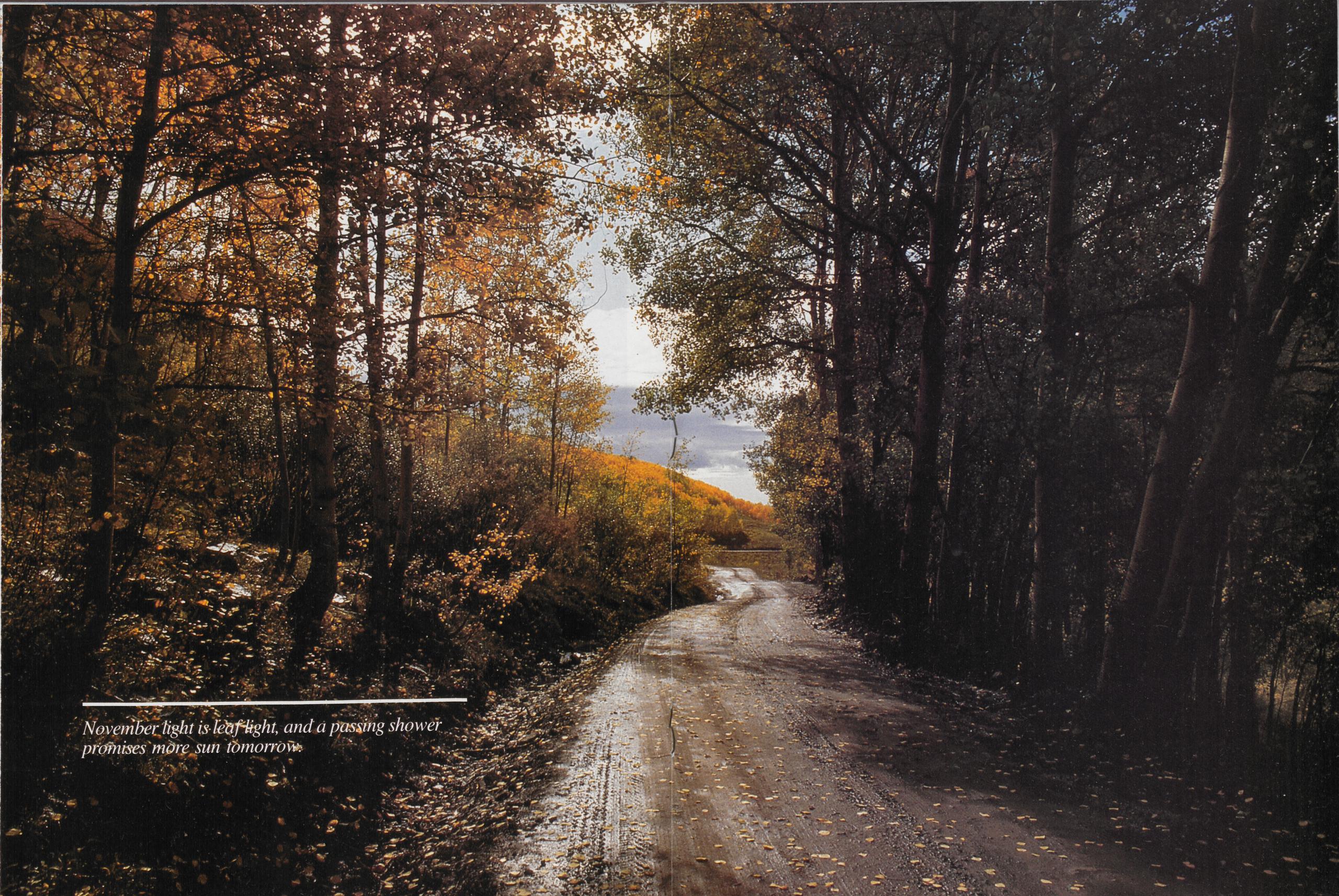
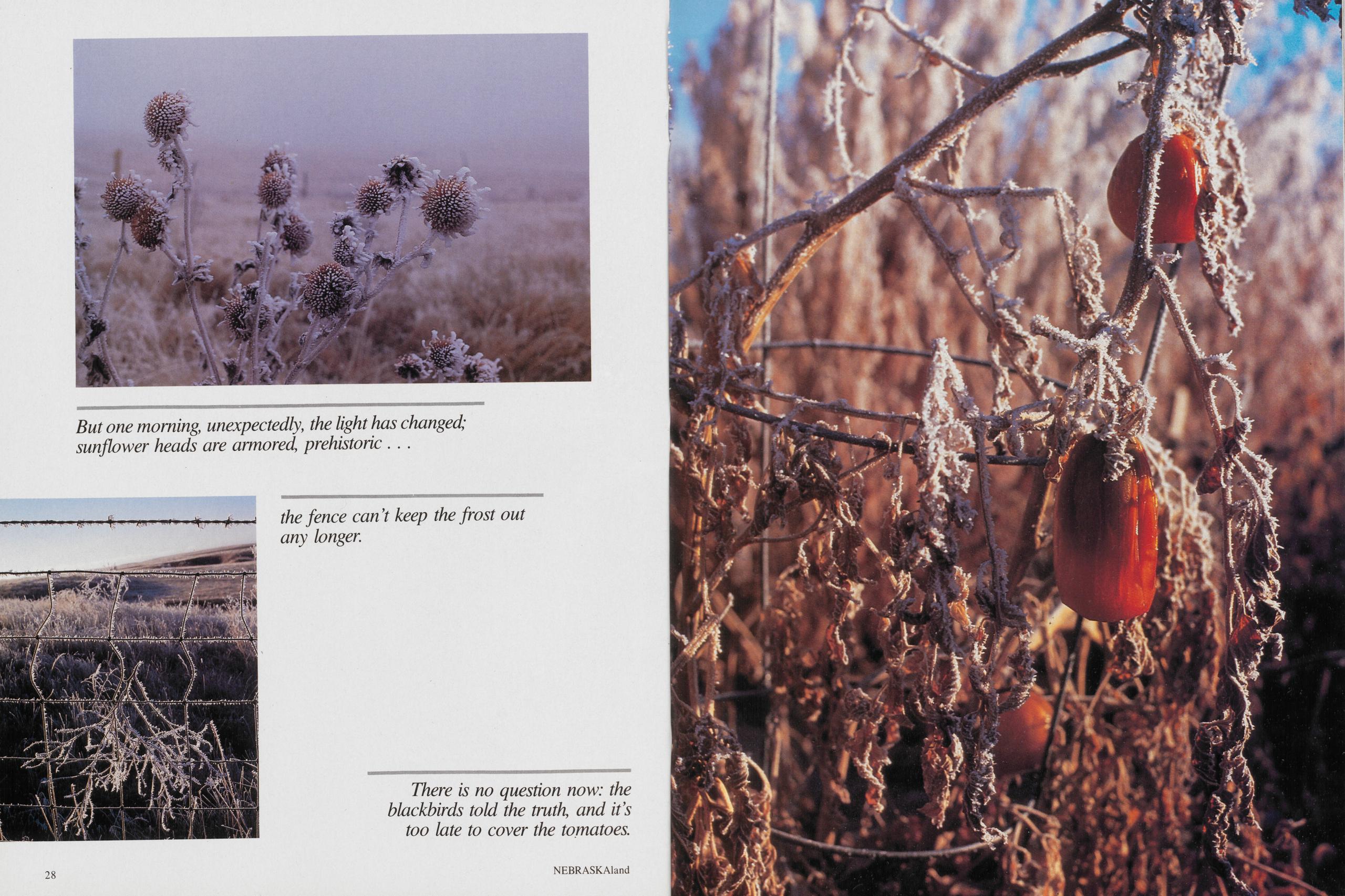
But one morning, unexpectedly, the light has changed; sunflower heads are armored, prehistoric . . .
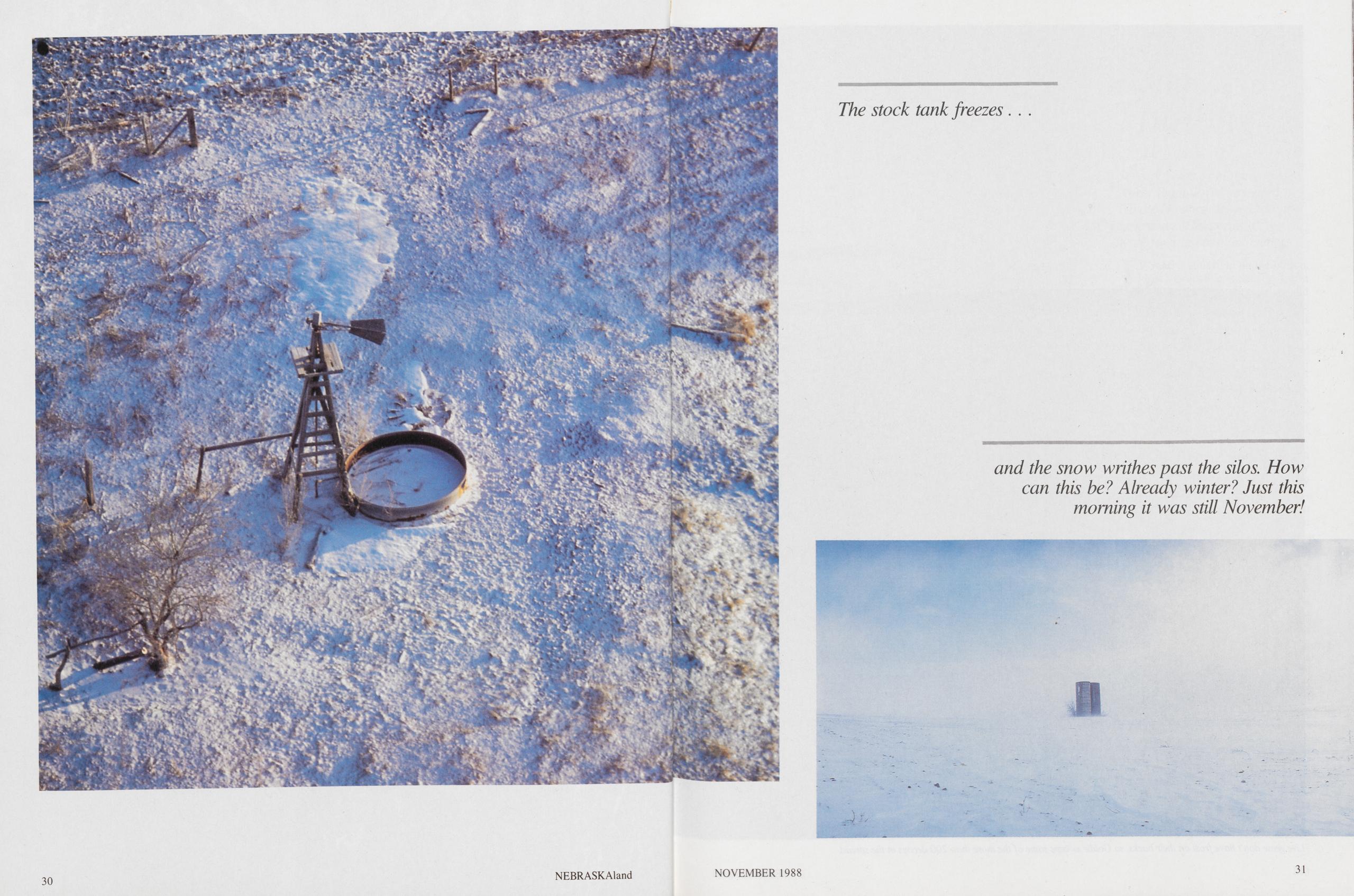
The stock tank freezes . . . and the snow writhes past the silos. How can this be? Already winter? Just this morning it was still November!
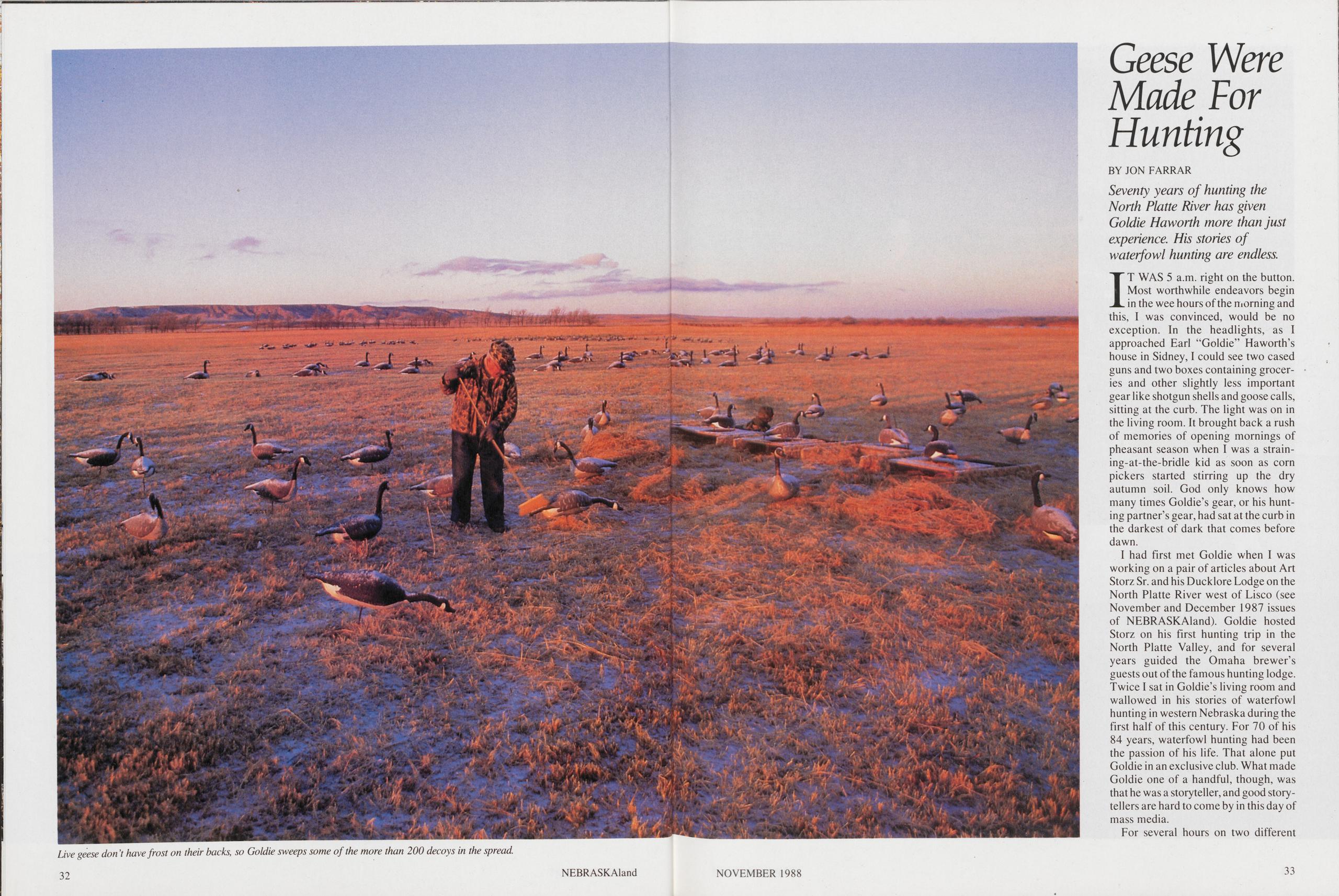
Geese Were Made For Hunting
Seventy years of hunting the North Platte River has given Goldie Haworth more than just experience. His stories of waterfowl hunting are endless.
IT WAS 5 a.m. right on the button. Most worthwhile endeavors begin in the wee hours of the morning and this, I was convinced, would be no exception. In the headlights, as I approached Earl “Goldie” Haworth’s house in Sidney, I could see two cased guns and two boxes containing grocer- ies and other slightly less important gear like shotgun shells and goose calls, sitting at the curb. The light was on in the living room. It brought back a rush of memories of opening mornings of pheasant season when I was a strain- ing-at-the-bridle kid as soon as corn pickers started stirring up the dry autumn soil. God only knows how many times Goldie’s gear, or his hunt- ing partner’s gear, had sat at the curb in the darkest of dark that comes before dawn.
I had first met Goldie when I was working on a pair of articles about Art Storz Sr. and his Ducklore Lodge on the North Platte River west of Lisco (see November and December 1987 issues of NEBRASKAland). Goldie hosted Storz on his first hunting trip in the North Platte Valley, and for several years guided the Omaha brewer’s guests out of the famous hunting lodge. Twice I sat in Goldie’s living room and wallowed in his stories of waterfowl hunting in western Nebraska during the first half of this century. For 70 of his 84 years, waterfowl hunting had been the passion of his life. That alone put Goldie in an exclusive club. What made Goldie one of a handful, though, was that he was a storyteller, and good story- tellers are hard to come by in this day of mass media.
For several hours on two different
32
NEBRASKAland
NOVEMBER 1988
33
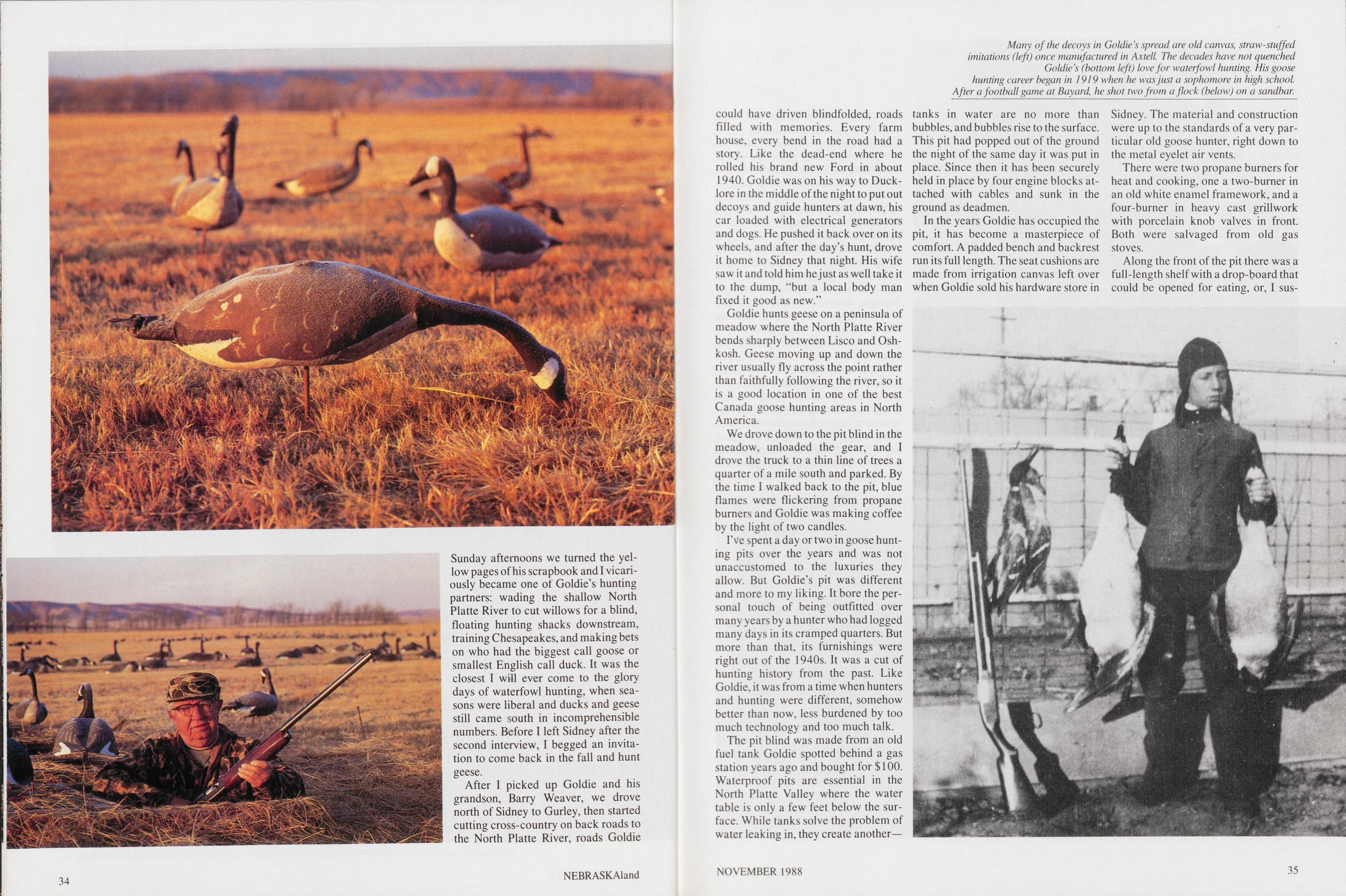
After I picked up Goldie and his grandson, Barry Weaver, we drove north of Sidney to Gurley, then started cutting cross-country on back roads to the North Platte River, roads Goldie could have driven blindfolded, roads filled with memories. Every farm house, every bend in the road had a story. Like the dead-end where he rolled his brand new Ford in about 1940. Goldie was on his way to Duck- lore in the middle of the night to put out decoys and guide hunters at dawn, his car loaded with electrical generators and dogs. He pushed it back over on its wheels, and after the day’s hunt, drove it home to Sidney that night. His wife saw it and told him he just as well take it to the dump, "but a local body man fixed it good as new.”
Goldie hunts geese on a peninsula of meadow where the North Platte River bends sharply between Lisco and Osh- kosh. Geese moving up and down the river usually fly across the point rather than faithfully following the river, so it is a good location in one of the best Canada goose hunting areas in North America.
We drove down to the pit blind in the meadow, unloaded the gear, and I drove the truck to a thin line of trees a quarter of a mile south and parked. By the time I walked back to the pit, blue flames were flickering from propane burners and Goldie was making coffee by the light of two candles.
I’ve spent a day or two in goose hunt- ing pits over the years and was not unaccustomed to the luxuries they allow. But Goldie’s pit was different and more to my liking. It bore the per- sonal touch of being outfitted over many years by a hunter who had logged many days in its cramped quarters. But more than that, its furnishings were right out of the 1940s. It was a cut of hunting history from the past. Like Goldie, it was from a time when hunters and hunting were different, somehow better than now, less burdened by too much technology and too much talk.
The pit blind was made from an old fuel tank Goldie spotted behind a gas station years ago and bought for $100. Waterproof pits are essential in the North Platte Valley where the water table is only a few feet below the sur- face. While tanks solve the problem of water leaking in, they create another— tanks in water are no more than bubbles, and bubbles rise to the surface. This pit had popped out of the ground the night of the same day it was put in place. Since then it has been securely held in place by four engine blocks at- tached with cables and sunk in the ground as deadmen.
In the years Goldie has occupied the pit, it has become a masterpiece of comfort. A padded bench and backrest run its full length. The seat cushions are made from irrigation canvas left over when Goldie sold his hardware store in Sidney. The material and construction were up to the standards of a very par- ticular old goose hunter, right down to the metal eyelet air vents.
There were two propane burners for heat and cooking, one a two-burner in an old white enamel framework, and a four-burner in heavy cast grillwork with porcelain knob valves in front. Both were salvaged from old gas stoves.
Along the front of the pit there was a
full-length shelf with a drop-board that
could be opened for eating, or, I sus-
NEBRASKAland
NOVEMBER 1988
35
34
Every little bracket and shelf was just as it should be, and substantial, made to last a lifetime of hunting, though at the same time it was obviously homemade. It had a nice feel to it and yet I could not exactly put my finger on why it ap- pealed to me so much. In part it was because homemade was better than store-bought. This was not a goose pit that could be had with money. It looked like it had grown with plates from here and tea kettles from there, many from hunters who had been in the pit and saw the need for some item. Mostly, though, I liked it because it had Goldie Haworth written all over it, and although I hardly knew Goldie, if you measure such things only by the time we had spent together, I had immediately taken a strong liking to the man.
Even if I’d been first into the blind I would have known right off the north end was where Goldie sat and the south end was to be avoided, because that is where the little hand water pump and dish washing equipment were located. The cooking gear was on Goldie’s end of the blind and it was obvious Goldie was the pit cook. On his end of the pit was also a calendar. Every day since the opening of the goose season had an entry—who hunted in this pit and its sister pit about 100 yards southwest, and how many geese had been shot. When we crawled into the pit on the morning of December 18, 1987, the total stood at 61 birds. It had been a slow year, according to Goldie.
Even before we could see geese we heard them moving up and down the river. Barry gave a steady accounting of the approach of legal shooting time but Goldie showed little interest, consulted neither sunrise-sunset tables nor his watch. I’m not implying he wasn’t con- cerned about abiding by the law, but after seven decades of waterfowl hunt- ing he knew what legal shooting time looked like in clear, heavy overcast and any weather condition in between. Anyway, there were more important affairs than goose shooting to attend to, like breakfast.
The menu included eggs, fried as ordered, thick slabs of ham, toast, and fried potatoes, each slice crispy and brown but not a one burnt. Goldie was a meticulous cook and followed a routine I suspect has changed with only minor variations to suit the menu over years. The potatoes and ham were fried first and kept warm along with the plates under the burners while the eggs were fried in a matched set of small tin fry pans with white enamel lids. Barry was in charge of the toast, and of course every well-appointed goose pit offers a choice of juice—tomato or orange— and ample quantities of boiled coffee.
Once breakfast was under way, nothing short of a goose falling into the egg pan was going to delay its comple- tion. After all, there was a whole day of goose hunting ahead but breakfast was served only at dawn. In between Barry’s minute-by-minute account of geese moving up and down the river, Goldie began to do what he does even better than hunt waterfowl and fry potatoes: tell stories.
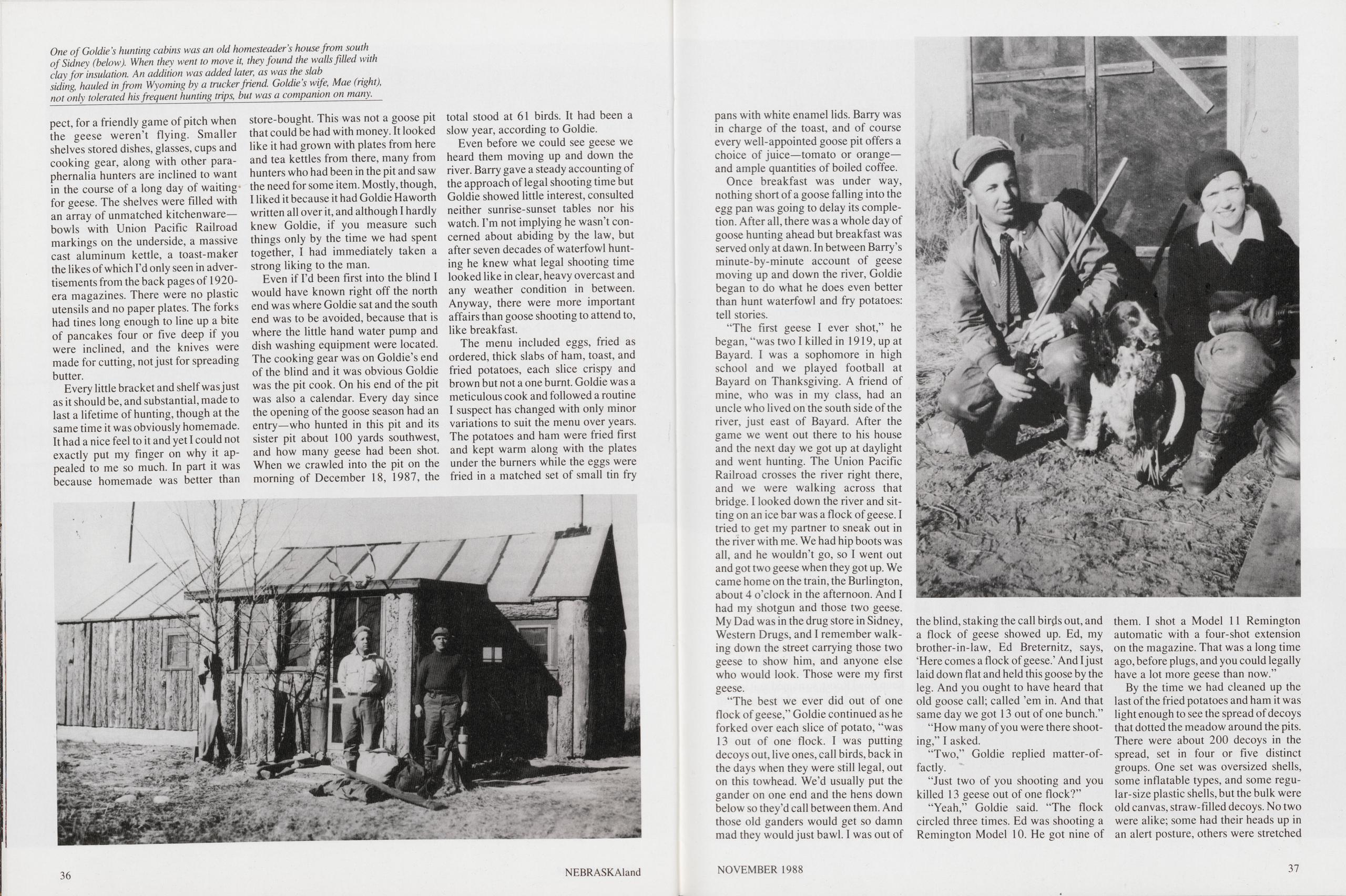
“The first geese I ever shot,” he began, “was two I killed in 1919, up at Bayard. I was a sophomore in high school and we played football at Bayard on Thanksgiving. A friend of mine, who was in my class, had an uncle who lived on the south side of the river, just east of Bayard. After the game we went out there to his house and the next day we got up at daylight and went hunting. The Union Pacific Railroad crosses the river right there, and we were walking across that bridge. I looked down the river and sit- ting on an ice bar was a flock of geese. I tried to get my partner to sneak out in the river with me. We had hip boots was all, and he wouldn’t go, so I went out and got two geese when they got up. We came home on the train, the Burlington, about 4 o’clock in the afternoon. And I had my shotgun and those two geese. My Dad was in the drug store in Sidney, Western Drugs, and I remember walk- ing down the street carrying those two geese to show him, and anyone else who would look. Those were my first geese.
“The best we ever did out of one flock of geese,” Goldie continued as he forked over each slice of potato, “was 13 out of one flock. I was putting decoys out, live ones, call birds, back in the days when they were still legal, out on this towhead. We’d usually put the gander on one end and the hens down below so they’d call between them. And those old ganders would get so damn mad they would just bawl. 1 was out of the blind, staking the call birfls out, and a flock of geese showed up. Ed, my brother-in-law, Ed Breternitz, says, 'Here comes a flock of geese.’ And I just laid down flat and held this goose by the leg. And you ought to have heard that old goose call; called ’em in. And that same day we got 13 out of one bunch.”
“How many of you were there shoot- ing,” I asked.
“Two,” Goldie replied matter-of- factly.
“Just two of you shooting and you killed 13 geese out of one flock?”
“Yeah,” Goldie said. “The flock circled three times. Ed was shooting a Remington Model 10. He got nine of them. I shot a Model 11 Remington automatic with a four-shot extension on the magazine. That was a long time ago, before plugs, and you could legally have a lot more geese than now.”
By the time we had cleaned up the last of the fried potatoes and ham it was light enough to see the spread of decoys that dotted the meadow around the pits. There were about 200 decoys in the spread, set in four or five distinct groups. One set was oversized shells, some inflatable types, and some regu- lar-size plastic shells, but the bulk were old canvas, straw-filled decoys. No two were alike; some had their heads up in an alert posture, others were stretched 36 NEBRASKAland NOVEMBER 1988 37
“They’re the longest-lived decoys that were ever on the market,” Goldie said of the canvas decoys, “if you take care of them. A fellow by the name of J.A. Lundgren at Axtell used to make and sell them. He used to have a hunt- ing lease next to me. When he left he gave me a dozen of those decoys, and when I got in the hardware store I retailed a lot of them. He was an old harness maker from Sweden and had patterns and everything. They were ‘steam-stuffed.’ He could steam that rice straw and stuff ’em and make ‘em solid. They sold for about $60 a dozen in the 1940s.”
Hunting with a photographer has its drawbacks. We had been joking about the “7:05 flight,” and sure enough, I was out of the pit at 7:05 shooting pho- tos of the old canvas decoys when a pair of Canada geese came gliding down the meadow as if they intended to drop into Goldie’s spread. Humped-up pho- tographers don’t look all that natural in a spread of decoys, or hardly anywhere else for that matter, and the birds flared off at the last minute.
A bit later, while we were sitting down in the pit and Goldie was spin- ning a yarn or two about rattlesnakes, rigging call geese and pass shooting in the Sandhills north of Lisco, a lone goose slipped into the decoys about 50 yards in front of the pit. Barry slipped out of the pit and stalked the bird as best a hunter can on a pool-table-flat mea- dow, but returned minutes later three shotgun shells lighter and without the goose.
After only an hour into legal shoot- ing time, Goldie was already pronounc- ing that it was a terrible day, that there were no geese moving. His definition of “no geese moving” is very precise, though. Swarms of geese rising up from the river roosts do not count. Small groups trading up and down the river do not count. What counts are geese moving away from the river and over the meadows, or big movements of geese going out to the grainfields to feed.
After a few hours of talking with Goldie and listening in on assorted conversations between him and other hunters in Sidney, it was evident that goose watching is something of a local art form in the North Platte Valley. “Were the geese moving today?” is the opening of most conversations. Seeing lots of geese in the air will bring a rush of adrenalin to the veins of most hun- ters, but not to experienced North Platte River hunters.
Goldie explained that in the area we were hunting there are three roosts on the river that have been used by the geese for years and years: Crane’s Grove Roost about three miles to the west, where Rush Creek comes to the North Platte River; Parrel’s Roost about a mile and a half northeast; and Soup Bowl Roost, so named as it is near a particularly low meadow, about two and a half miles to the southeast. All morning long we saw large flocks of geese rise up from these roosts, mill around and then settle back down. There was some goose traffic on the river, usually small groups or just a pair of birds, but they followed the river closely and never came over the mea- dows. Several times during the morning a single goose flew low along the river calling. “A leather-skinned old son-of- a-gun” Goldie would say, “just taunt- ing us.”
According to Goldie, the geese do not go out every day to feed. Some days they feed on natural vegetation on the river, which is a “legislative waterfowl refuge” in Garden County, one defined by statutes but on privately-owned land. By way of the local grapevine, hunters keep up on the movements of geese, and if after a couple of days the geese have not left the river in signifi- cant numbers, the anticipation of a good day grows.
Last year at this time, hunters in Gol- die’s pit and the one next to it had shot 20 or 30 more geese than this year. But last year at this time, Oahe Reservoir in South Dakota, a major Canada goose gathering place during fall migration, held only (Continued on page 44)
38 NEBRASKAland NOVEMBER 1988 39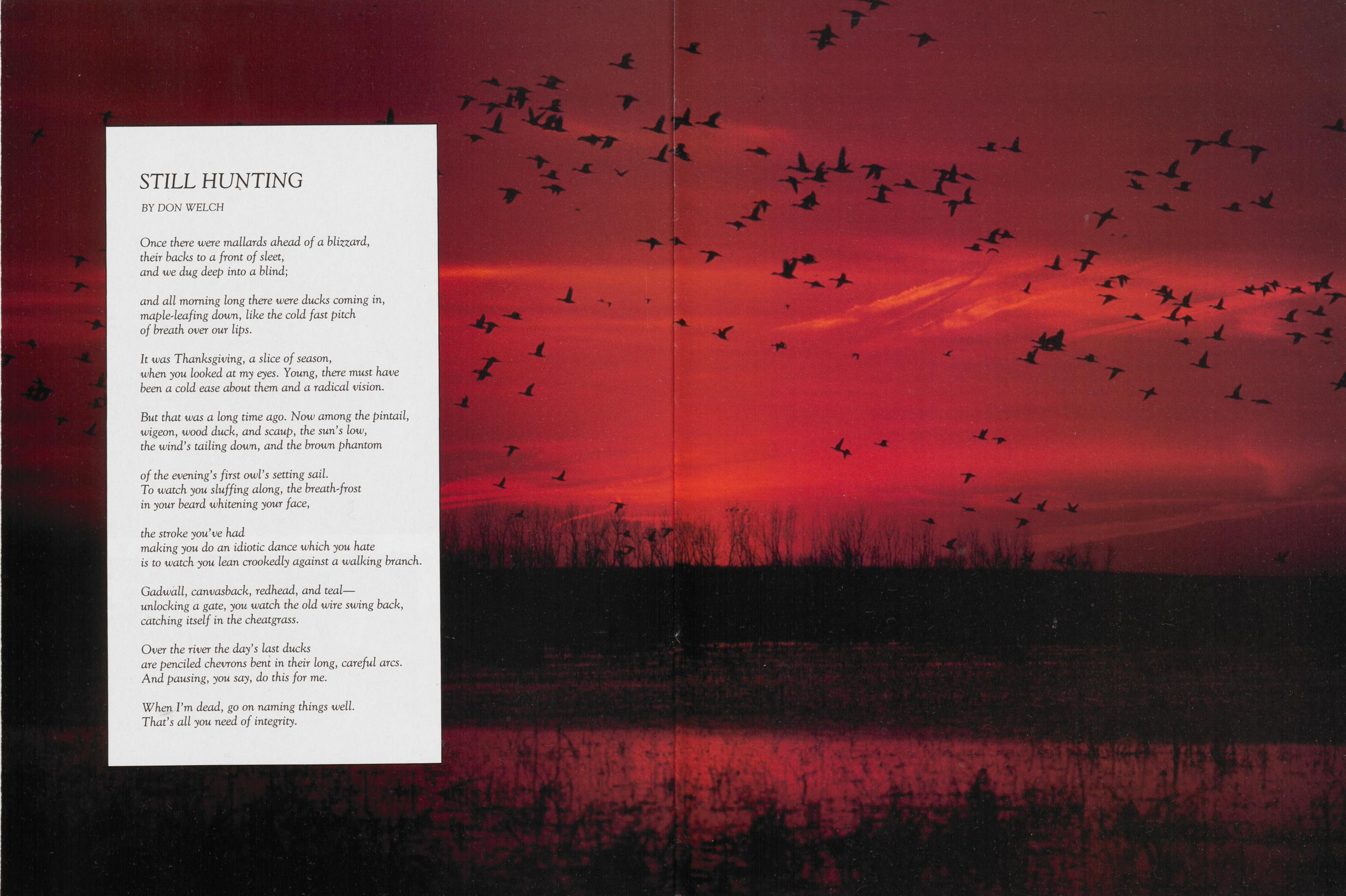
STILL HUNTING
Once there were mallards ahead of a blizzard, their backs to a front of sleet, and we dug deep into a blind;
and all morning long there were ducks coming in, maple-leafing down, like the cold fast pitch of breath over our lips.
It was Thanksgiving, a slice of season, when you looked at my eyes. Young, there must have been a cold ease about them and a radical vision.
But that was a long time ago. Now among the pintail, wigeon, wood duck, and scaup, the sun’s low, the wind’s tailing down, and the brown phantom of the evening’s first owl’s setting sail. To watch you sluffing along, the breath-frost in your beard whitening your face,
the stroke you’ve had making you do an idiotic dance which you hate is to watch you lean crookedly against a walking branch.
Gadwall, canvasback, redhead, and teal— unlocking a gate, you watch the old wire swing back, catching itself in the cheatgrass.
Over the river the day’s last ducks are penciled chevrons bent in their long, careful arcs. And pausing, you say, do this for me. When I’m dead, go on naming things well. That’s all you need of integrity.
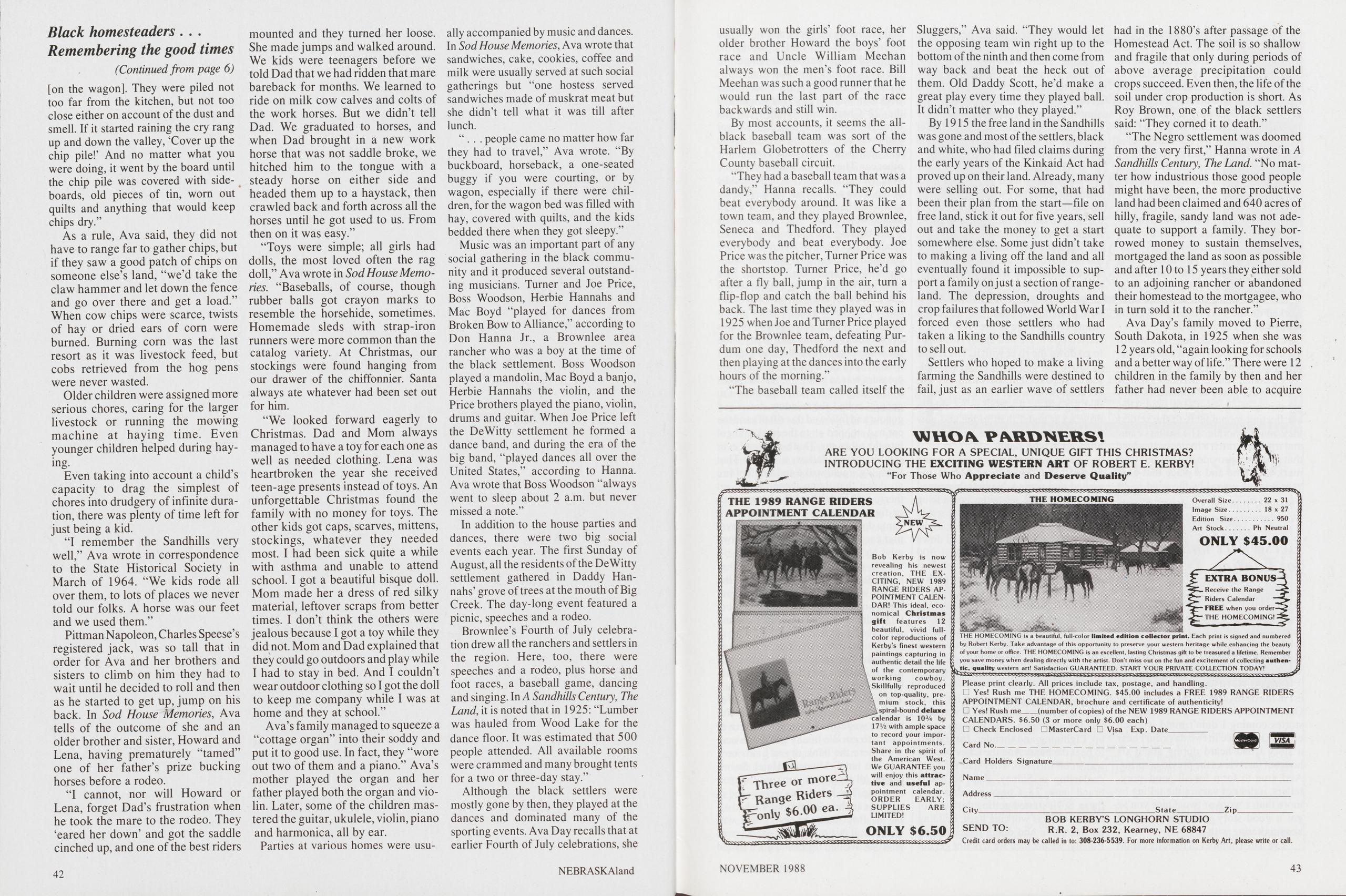
(Continued from page 6) [on the wagon]. They were piled not too far from the kitchen, but not too close either on account of the dust and smell. If it started raining the cry rang up and down the valley, ‘Cover up the chip pile!’ And no matter what you were doing, it went by the board until the chip pile was covered with side- boards, old pieces of tin, worn out quilts and anything that would keep chips dry.”
As a rule, Ava said, they did not have to range far to gather chips, but if they saw a good patch of chips on someone else’s land, "we’d take the claw hammer and let down the fence and go over there and get a load.” When cow chips were scarce, twists of hay or dried ears of corn were burned. Burning corn was the last resort as it was livestock feed, but cobs retrieved from the hog pens were never wasted.
Older children were assigned more serious chores, caring for the larger livestock or running the mowing machine at haying time. Even younger children helped during hay- ing.
Even taking into account a child’s capacity to drag the simplest of chores into drudgery of infinite dura- tion, there was plenty of time left for just being a kid.
"I remember the Sandhills very well,” Ava wrote in correspondence to the State Historical Society in March of 1964. "We kids rode all over them, to lots of places we never told our folks. A horse was our feet and we used them.”
Pittman Napoleon, Charles Speese’s registered jack, was so tall that in order for Ava and her brothers and sisters to climb on him they had to wait until he decided to roll and then as he started to get up, jump on his back. In Sod House Memories, Ava tells of the outcome of she and an older brother and sister, Howard and Lena, having prematurely "tamed” one of her father’s prize bucking horses before a rodeo.
"I cannot, nor will Howard or Lena, forget Dad’s frustration when he took the mare to the rodeo. They ‘eared her down’ and got the saddle cinched up, and one of the best riders mounted and they turned her loose. She made jumps and walked around. We kids were teenagers before we told Dad that we had ridden that mare bareback for months. We learned to ride on milk cow calves and colts of the work horses. But we didn’t tell Dad. We graduated to horses, and when Dad brought in a new work horse that was not saddle broke, we hitched him to the tongue with a steady horse on either side and headed them up to a haystack, then crawled back and forth across all the horses until he got used to us. From then on it was easy.”
"Toys were simple; all girls had dolls, the most loved often the rag doll,” Ava wrote in Sod House Memo- ries. "Baseballs, of course, though rubber balls got crayon marks to resemble the horsehide, sometimes. Homemade sleds with strap-iron runners were more common than the catalog variety. At Christmas, our stockings were found hanging from our drawer of the chiffonnier. Santa always ate whatever had been set out for him.
"We looked forward eagerly to Christmas. Dad and Mom always managed to have a toy for each one as well as needed clothing. Lena was heartbroken the year she received teen-age presents instead of toys. An unforgettable Christmas found the family with no money for toys. The other kids got caps, scarves, mittens, stockings, whatever they needed most. I had been sick quite a while with asthma and unable to attend school. I got a beautiful bisque doll. Mom made her a dress of red silky material, leftover scraps from better times. I don’t think the others were jealous because I got a toy while they did not. Mom and Dad explained that they could go outdoors and play while I had to stay in bed. And I couldn’t wear outdoor clothing so I got the doll to keep me company while I was at home and they at school.”
Ava’s family managed to squeeze a "cottage organ” into their soddy and put it to good use. In fact, they "wore out two of them and a piano.” Ava’s mother played the organ and her father played both the organ and vio- lin. Later, some of the children mas- tered the guitar, ukulele, violin, piano and harmonica, all by ear.
Parties at various homes were usu- ally accompanied by music and dances. In Sod House Memories, Ava wrote that sandwiches, cake, cookies, coffee and milk were usually served at such social gatherings but "one hostess served sandwiches made of muskrat meat but she didn’t tell what it was till after lunch.
“ . . . people came no matter how far they had to travel,” Ava wrote. “By buckboard, horseback, a one-seated buggy if you were courting, or by wagon, especially if there were chil- dren, for the wagon bed was filled with hay, covered with quilts, and the kids bedded there when they got sleepy.”
Music was an important part of any social gathering in the black community and it produced several outstanding musicians. Turner and Joe Price, Boss Woodson, Herbie Hannahs and Mac Boyd “played for dances from Broken Bow to Alliance,” according to Don Hanna Jr., a Brownlee area rancher who was a boy at the time of the black settlement. Boss Woodson played a mandolin, Mac Boyd a banjo, Herbie Hannahs the violin, and the Price brothers played the piano, violin, drums and guitar. When Joe Price left the DeWitty settlement he formed a dance band, and during the era of the big band, “played dances all over the United States,” according to Hanna. Ava wrote that Boss Woodson “always went to sleep about 2 a.m. but never missed a note.”
In addition to the house parties and dances, there were two big social events each year. The first Sunday of August, all the residents of the DeWitty settlement gathered in Daddy Han- nahs’ grove of trees at the mouth of Big Creek. The day-long event featured a picnic, speeches and a rodeo.
Brownlee’s Fourth of July celebra- tion drew all the ranchers and settlers in the region. Here, too, there were speeches and a rodeo, plus horse and foot races, a baseball game, dancing and singing. In A Sandhills Century, The Land, it is noted that in 1925: “Lumber was hauled from Wood Lake for the dance floor. It was estimated that 500 people attended. All available rooms were crammed and many brought tents for a two or three-day stay.”
Although the black settlers were mostly gone by then, they played at the dances and dominated many of the sporting events. Ava Day recalls that at earlier Fourth of July celebrations, she usually won the girls’ foot race, her older brother Howard the boys’ foot race and Uncle William Meehan always won the men’s foot race. Bill Meehan was such a good runner that he would run the last part of the race backwards and still win.
By most accounts, it seems the all- black baseball team was sort of the Harlem Globetrotters of the Cherry County baseball circuit.
“They had a baseball team that was a dandy,” Hanna recalls. “They could beat everybody around. It was like a town team, and they played Brownlee, Seneca and Thedford. They played everybody and beat everybody. Joe Price was the pitcher, Turner Price was the shortstop. Turner Price, he’d go after a fly ball, jump in the air, turn a flip-flop and catch the ball behind his back. The last time they played was in 1925 when Joe and Turner Price played for the Brownlee team, defeating Pur- dum one day, Thedford the next and then playing at the dances into the early hours of the morning.”
“The baseball team called itself the
By 1915 the free land in the Sandhills was gone and most of the settlers, black and white, who had filed claims during the early years of the Kinkaid Act had proved up on their land. Already, many were selling out. For some, that had been their plan from the start—file on free land, stick it out for five years, sell out and take the money to get a start somewhere else. Some just didn’t take to making a living off the land and all eventually found it impossible to sup- port a family on just a section of range- land. The depression, droughts and crop failures that followed World War I forced even those settlers who had taken a liking to the Sandhills country to sell out.
Settlers who hoped to make a living farming the Sandhills were destined to fail, just as an earlier wave of settlers
“The Negro settlement was doomed from the very first,” Hanna wrote in A Sandhills Century, The Land. “No mat- ter how industrious those good people might have been, the more productive land had been claimed and 640 acres of hilly, fragile, sandy land was not ade- quate to support a family. They bor- rowed money to sustain themselves, mortgaged the land as soon as possible and after 10 to 15 years they either sold to an adjoining rancher or abandoned their homestead to the mortgagee, who in turn sold it to the rancher.”
Ava Day’s family moved to Pierre,
South Dakota, in 1925 when she was
12 years old, “again looking for schools
and a better way of life.” There were 12
children in the family by then and her
father had never been able to acquire
42
NEBRASKAland
NOVEMBER 1988
43
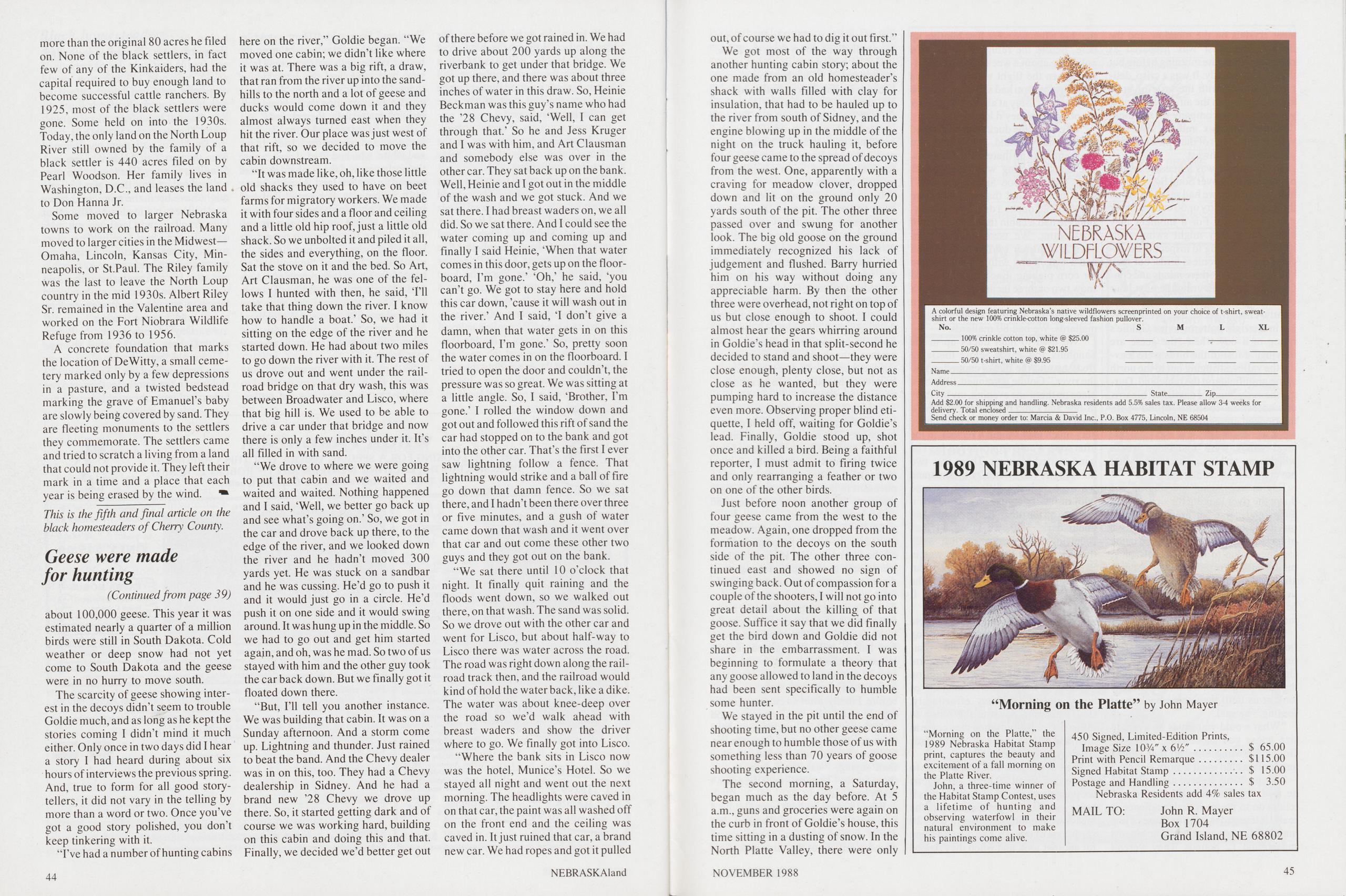 more than the original 80 acres he filed
on. None of the black settlers, in fact
few of any of the Kinkaiders, had the
capital required to buy enough land to
become successful cattle ranchers. By
1925, most of the black settlers were
gone. Some held on into the 1930s.
Today, the only land on the North Loup
River still owned by the family of a
black settler is 440 acres filed on by
Pearl Woodson. Her family lives in
Washington, D.C., and leases the land .
to Don Hanna Jr.
more than the original 80 acres he filed
on. None of the black settlers, in fact
few of any of the Kinkaiders, had the
capital required to buy enough land to
become successful cattle ranchers. By
1925, most of the black settlers were
gone. Some held on into the 1930s.
Today, the only land on the North Loup
River still owned by the family of a
black settler is 440 acres filed on by
Pearl Woodson. Her family lives in
Washington, D.C., and leases the land .
to Don Hanna Jr.
Some moved to larger Nebraska towns to work on the railroad. Many moved to larger cities in the Midwest- Omaha, Lincoln, Kansas City, Min- neapolis, or St.Paul. The Riley family was the last to leave the North Loup country in the mid 1930s. Albert Riley Sr. remained in the Valentine area and worked on the Fort Niobrara Wildlife Refuge from 1936 to 1956.
A concrete foundation that marks the location of DeWitty, a small ceme- tery marked only by a few depressions in a pasture, and a twisted bedstead marking the grave of Emanuel’s baby are slowly being covered by sand. They are fleeting monuments to the settlers they commemorate. The settlers came and tried to scratch a living from a land that could not provide it. They left their mark in a time and a place that each year is being erased by the wind.
This is the fifth and final article on the black homesteaders of Cherry County. Geese were made for hunting(Continued from page 39) about 100,000 geese. This year it was estimated nearly a quarter of a million birds were still in South Dakota. Cold weather or deep snow had not yet come to South Dakota and the geese were in no hurry to move south.
The scarcity of geese showing inter- est in the decoys didn’t seem to trouble Goldie much, and as long as he kept the stories coming I didn’t mind it much either. Only once in two days did I hear a story I had heard during about six hours of interviews the previous spring. And, true to form for all good story- tellers, it did not vary in the telling by more than a word or two. Once you’ve got a good story polished, you don’t keep tinkering with it.
“I’ve had a number of hunting cabins here on the river,” Goldie began. “We moved one cabin; we didn’t like where it was at. There was a big rift, a draw, that ran from the river up into the sand- hills to the north and a lot of geese and ducks would come down it and they almost always turned east when they hit the river. Our place was just west of that rift, so we decided to move the cabin downstream.
“It was made like, oh, like those little old shacks they used to have on beet farms for migratory workers. We made it with four sides and a floor and ceiling and a little old hip roof, just a little old shack. So we unbolted it and piled it all, the sides and everything, on the floor. Sat the stove on it and the bed. So Art, Art Clansman, he was one of the fel- lows I hunted with then, he said, Til take that thing down the river. I know how to handle a boat.’ So, we had it sitting on the edge of the river and he started down. He had about two miles to go down the river with it. The rest of us drove out and went under the rail- road bridge on that dry wash, this was between Broadwater and Lisco, where that big hill is. We used to be able to drive a car under that bridge and now there is only a few inches under it. It’s all filled in with sand.
“We drove to where we were going to put that cabin and we waited and waited and waited. Nothing happened and I said, ‘Well, we better go back up and see what’s going on.’ So, we got in the car and drove back up there, to the edge of the river, and we looked down the river and he hadn’t moved 300 yards yet. He was stuck on a sandbar and he was cussing. He’d go to push it and it would just go in a circle. He’d push it on one side and it would swing around. It was hung up in the middle. So we had to go out and get him started agajn, and oh, was he mad. So two of us stayed with him and the other guy took the car back down. But we finally got it floated down there.
“But, I’ll tell you another instance. We was building that cabin. It was on a Sunday afternoon. And a storm come up. Lightning and thunder. Just rained to beat the band. And the Chevy dealer was in on this, too. They had a Chevy dealership in Sidney. And he had a brand new ’28 Chevy we drove up there. So, it started getting dark and of course we was working hard, building on this cabin and doing this and that. Finally, we decided we’d better get out of there before we got rained in. We had to drive about 200 yards up along the riverbank to get under that bridge. We got up there, and there was about three inches of water in this draw. So, Heinie Beckman was this guy’s name who had the ’28 Chevy, said, ‘Well, I can get through that.’ So he and Jess Kruger and I was with him, and Art Clausman and somebody else was over in the other car. They sat back up on the bank. Well, Heinie and I got out in the middle of the wash and we got stuck. And we sat there. I had breast waders on, we all did. So we sat there. And I could see the water coming up and coming up and finally I said Heinie, ‘When that water comes in this door, gets up on the floor- board, I’m gone.’ ‘Oh,’ he said, ‘you can’t go. We got to stay here and hold this car down, ’cause it will wash out in the river.’ And I said, I don’t give a damn, when that water gets in on this floorboard, I’m gone.’ So, pretty soon the water comes in on the floorboard. I tried to open the door and couldn’t, the pressure was so great. We was sitting at a little angle. So, I said, ‘Brother, I’m gone.’ I rolled the window down and got out and followed this rift of sand the car had stopped on to the bank and got into the other car. That’s the first I ever saw lightning follow a fence. That lightning would strike and a ball of fire go down that damn fence. So we sat there, and I hadn’t been there over three or five minutes, and a gush of water came down that wash and it went over that car and out come these other two guys and they got out on the bank.
“We sat there until 10 o’clock that night. It finally quit raining and the floods went down, so we walked out there, on that wash. The sand was solid. So we drove out with the other car and went for Lisco, but about half-way to Lisco there was water across the road. The road was right down along the rail- road track then, and the railroad would kind of hold the water back, like a dike. The water was about knee-deep over the road so we’d walk ahead with breast waders and show the driver where to go. We finally got into Lisco. “Where the bank sits in Lisco now was the hotel, Munice’s Hotel. So we stayed all night and went out the next morning. The headlights were caved in on that car, the paint was all washed off on the front end and the ceiling was caved in. It just ruined that car, a brand new car. We had ropes and got it pulled out, of course we had to dig it out first.”
We got most of the way through another hunting cabin story; about the one made from an old homesteader’s shack with walls filled with clay for insulation, that had to be hauled up to the river from south of Sidney, and the engine blowing up in the middle of the night on the truck hauling it, before four geese came to the spread of decoys from the west. One, apparently with a craving for meadow clover, dropped down and lit on the ground only 20 yards south of the pit. The other three passed over and swung for another look. The big old goose on the ground immediately recognized his lack of judgement and flushed. Barry hurried him on his way without doing any appreciable harm. By then the other three were overhead, not right on top of us but close enough to shoot. I could almost hear the gears whirring around in Goldie’s head in that split-second he decided to stand and shoot—they were close enough, plenty close, but not as close as he wanted, but they were pumping hard to increase the distance even more. Observing proper blind eti- quette, I held off, waiting for Goldie’s lead. Finally, Goldie stood up, shot once and killed a bird. Being a faithful reporter, I must admit to firing twice and only rearranging a feather or two on one of the other birds.
Just before noon another group of four geese came from the west to the meadow. Again, one dropped from the formation to the decoys on the south side of the pit. The other three con- tinued east and showed no sign of swinging back. Out of compassion for a couple of the shooters, I will not go into great detail about the killing of that goose. Suffice it say that we did finally get the bird down and Goldie did not share in the embarrassment. I was beginning to formulate a theory that any goose allowed to land in the decoys had been sent specifically to humble some hunter.
We stayed in the pit until the end of shooting time, but no other geese came near enough to humble those of us with something less than 70 years of goose shooting experience.
The second morning, a Saturday, began much as the day before. At 5 a.m., guns and groceries were again on the curb in front of Goldie’s house, this time sitting in a dusting of snow. In the North Platte Valley, there were only
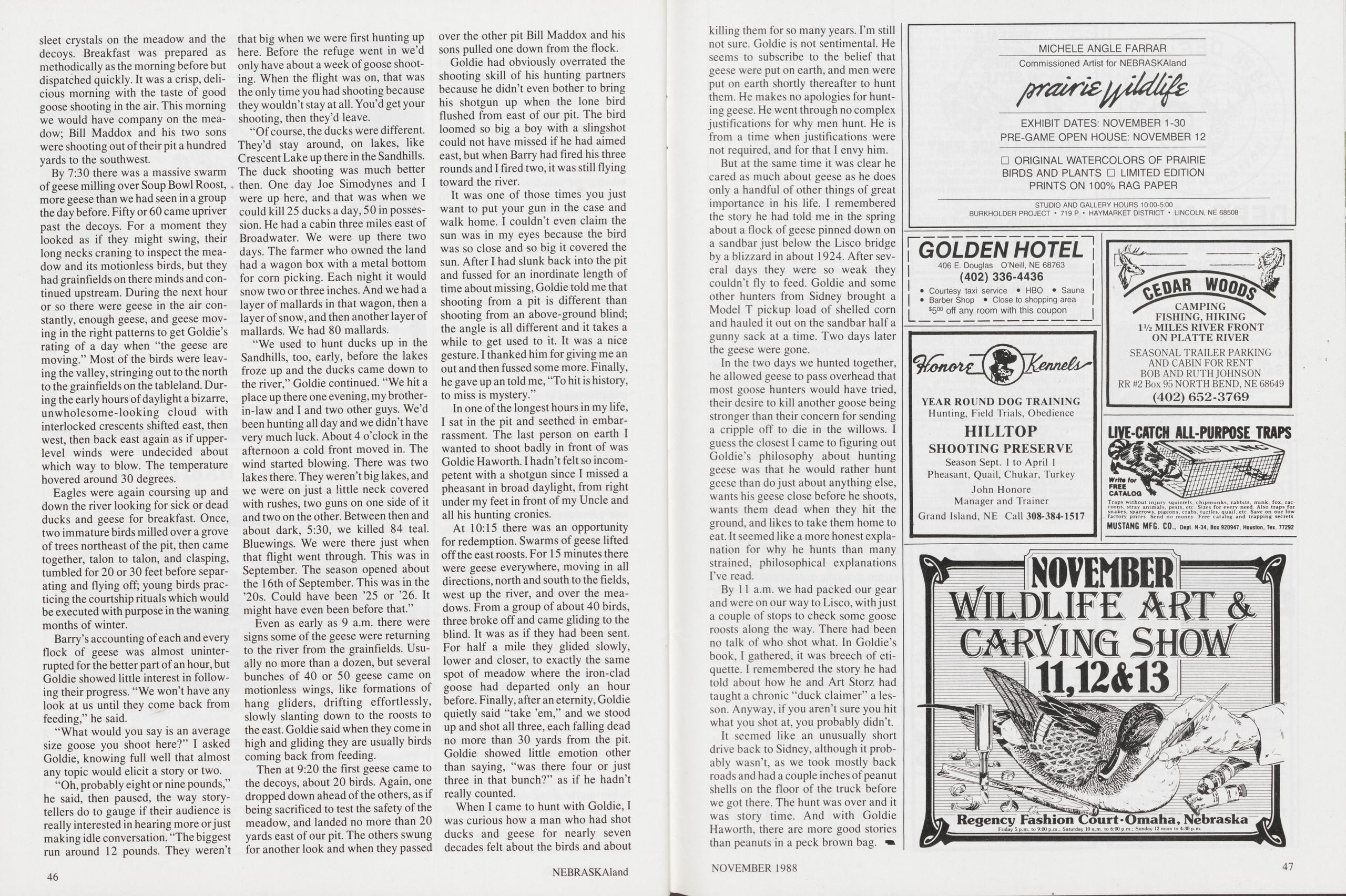 sleet crystals on the meadow and the
decoys. Breakfast was prepared as
methodically as the morning before but
dispatched quickly. It was a crisp, deli-
cious morning with the taste of good
goose shooting in the air. This morning
we would have company on the mea-
dow; Bill Maddox and his two sons
were shooting out of their pit a hundred
yards to the southwest.
sleet crystals on the meadow and the
decoys. Breakfast was prepared as
methodically as the morning before but
dispatched quickly. It was a crisp, deli-
cious morning with the taste of good
goose shooting in the air. This morning
we would have company on the mea-
dow; Bill Maddox and his two sons
were shooting out of their pit a hundred
yards to the southwest.
By 7:30 there was a massive swarm of geese milling over Soup Bowl Roost, more geese than we had seen in a group the day before. Fifty or 60 came upriver past the decoys. For a moment they looked as if they might swing, their long necks craning to inspect the mea- dow and its motionless birds, but they had grainfields on there minds and con- tinued upstream. During the next hour or so there were geese in the air con- stantly, enough geese, and geese mov- ing in the right patterns to get Goldie’s rating of a day when “the geese are moving.” Most of the birds were leav- ing the valley, stringing out to the north to the grainfields on the tableland. Dur- ing the early hours of daylight a bizarre, unwholesome-looking cloud with interlocked crescents shifted east, then west, then back east again as if upper- level winds were undecided about which way to blow. The temperature hovered around 30 degrees.
Eagles were again coursing up and down the river looking for sick or dead ducks and geese for breakfast. Once, two immature birds milled over a grove of trees northeast of the pit, then came together, talon to talon, and clasping, tumbled for 20 or 30 feet before separ- ating and flying off; young birds prac- ticing the courtship rituals which would be executed with purpose in the waning months of winter.
Barry’s accounting of each and every flock of geese was almost uninter- rupted for the better part of an hour, but Goldie showed little interest in follow- ing their progress. “We won’t have any look at us until they come back from feeding,” he said.
“What would you say is an average size goose you shoot here?” I asked Goldie, knowing full well that almost any topic would elicit a story or two.
“Oh, probably eight or nine pounds,” he said, then paused, the way story- tellers do to gauge if their audience is really interested in hearing more or just making idle conversation. “The biggest run around 12 pounds. They weren’t that big when we were first hunting up here. Before the refuge went in we’d only have about a week of goose shoot- ing. When the flight was on, that was the only time you had shooting because they wouldn’t stay at all. You’d get your shooting, then they’d leave.
“Of course, the ducks were different. They’d stay around, on lakes, like Crescent Lake up there in the Sandhills. The duck shooting was much better then. One day Joe Simodynes and I were up here, and that was when we could kill 25 ducks a day, 50 in posses- sion. He had a cabin three miles east of Broadwater. We were up there two days. The farmer who owned the land had a wagon box with a metal bottom for corn picking. Each night it would snow two or three inches. And we had a layer of mallards in that wagon, then a layer of snow, and then another layer of mallards. We had 80 mallards.
“We used to hunt ducks up in the Sandhills, too, early, before the lakes froze up and the ducks came down to the river,” Goldie continued. “We hit a place up there one evening, my brother- in-law and I and two other guys. We’d been hunting all day and we didn’t have very much luck. About 4 o’clock in the afternoon a cold front moved in. The wind started blowing. There was two lakes there. They weren’t big lakes, and we were on just a little neck covered with rushes, two guns on one side of it and two on the other. Between then and about dark, 5:30, we killed 84 teal. Bluewings. We were there just when that flight went through. This was in September. The season opened about the 16th of September. This was in the ’20s. Could have been ’25 or ’26. It might have even been before that.”
Even as early as 9 a.m. there were signs some of the geese were returning to the river from the grainfields. Usu- ally no more than a dozen, but several bunches of 40 or 50 geese came on motionless wings, like formations of hang gliders, drifting effortlessly, slowly slanting down to the roosts to the east. Goldie said when they come in high and gliding they are usually birds coming back from feeding.
Then at 9:20 the first geese came to the decoys, about 20 birds. Again, one dropped down ahead of the others, as if being sacrificed to test the safety of the meadow, and landed no more than 20 yards east of our pit. The others swung for another look and when they passed over the other pit Bill Maddox and his sons pulled one down from the flock.
Goldie had obviously overrated the shooting skill of his hunting partners because he didn’t even bother to bring his shotgun up when the lone bird flushed from east of our pit. The bird loomed so big a boy with a slingshot could not have missed if he had aimed east, but when Barry had fired his three rounds and I fired two, it was still flying toward the river.
It was one of those times you just want to put your gun in the case and walk home. I couldn’t even claim the sun was in my eyes because the bird was so close and so big it covered the sun. After I had slunk back into the pit and fussed for an inordinate length of time about missing, Goldie told me that shooting from a pit is different than shooting from an above-ground blind; the angle is all different and it takes a while to get used to it. It was a nice gesture. I thanked him for giving me an out and then fussed some more. Finally, he gave up an told me, “To hit is history, to miss is mystery.”
In one of the longest hours in my life, I sat in the pit and seethed in embar- rassment. The last person on earth I wanted to shoot badly in front of was Goldie Haworth. I hadn’t felt so incom- petent with a shotgun since I missed a pheasant in broad daylight, from right under my feet in front of my Uncle and all his hunting cronies.
At 10:15 there was an opportunity for redemption. Swarms of geese lifted off the east roosts. For 15 minutes there were geese everywhere, moving in all directions, north and south to the fields, west up the river, and over the mea- dows. From a group of about 40 birds, three broke off and came gliding to the blind. It was as if they had been sent. For half a mile they glided slowly, lower and closer, to exactly the same spot of meadow where the iron-clad goose had departed only an hour before. Finally, after an eternity, Goldie quietly said “take ’em,” and we stood up and shot all three, each falling dead no more than 30 yards from the pit. Goldie showed little emotion other than saying, “was there four or just three in that bunch?” as if he hadn’t really counted.
When I came to hunt with Goldie, I was curious how a man who had shot ducks and geese for nearly seven decades felt about the birds and about killing them for so many years. I’m still not sure. Goldie is not sentimental. He seems to subscribe to the belief that geese were put on earth, and men were put on earth shortly thereafter to hunt them. He makes no apologies for hunt- ing geese. He went through no complex justifications for why men hunt. He is from a time when justifications were not required, and for that I envy him.
But at the same time it was clear he cared as much about geese as he does only a handful of other things of great importance in his life. I remembered the story he had told me in the spring about a flock of geese pinned down on a sandbar just below the Lisco bridge by a blizzard in about 1924. After sev- eral days they were so weak they couldn’t fly to feed. Goldie and some other hunters from Sidney brought a Model T pickup load of shelled corn and hauled it out on the sandbar half a gunny sack at a time. Two days later the geese were gone.
In the two days we hunted together, he allowed geese to pass overhead that most goose hunters would have tried, their desire to kill another goose being stronger than their concern for sending a cripple off to die in the willows. I guess the closest I came to figuring out Goldie’s philosophy about hunting geese was that he would rather hunt geese than do just about anything else, wants his geese close before he shoots, wants them dead when they hit the ground, and likes to take them home to eat. It seemed like a more honest expla- nation for why he hunts than many strained, philosophical explanations I’ve read.
By 11 a.m. we had packed our gear and were on our way to Lisco, with just a couple of stops to check some goose roosts along the way. There had been no talk of who shot what. In Goldie’s book, I gathered, it was breech of eti- quette. I remembered the story he had told about how he and Art Storz had taught a chronic “duck claimer” a les- son. Anyway, if you aren’t sure you hit what you shot at, you probably didn’t.
It seemed like an unusually short drive back to Sidney, although it prob- ably wasn’t, as we took mostly back roads and had a couple inches of peanut shells on the floor of the truck before we got there. The hunt was over and it was story time. And with Goldie Haworth, there are more good stories than peanuts in a peck brown bag.
 DEE'S MAPS
The new name in Contour Maps
1988 CONTOURS
© Merritt Reservoir
© Harlan County Reservoir
© Calamus Reservoir
© Glen Elder Reserv. in KS.
Water Proof — Tear Proof
M95 each or $1195 for any 3
Satisfaction Guaranteed
See your dealer or write:
Sportsman, Box 702
Broken Bow, NE 68822
1989
$6.00
1989
RAILROAD CALENDAR
Enjoy the originality and detail in
each scene as you recapture the classic
era of railroading. Each month offers
a unique duotone reproduction of an
original painting by artist Michael
Bristol. Suitable for framing.
Also available, 1988 pen and ink
calendar, Railroads of Nebraska, $2.00.
Please print
1989 Calendars @ $6.00-----
1988 Calendars @ $2.00-----
Add $1 per calendar shipping
Neb. residents add 4% sales tax
Send with name and address to:
Turn of the Century Paintings
340 Hector Street, Cordova, NE 68330
Phone 402-576-3016
BUFFALO
* STYLE
NEBRASKA MADE JERKY
Hickory smoked, 100% pure buffalo product
with almost no preservatives. Vacuum packed
so no refrigeration is needed. Send $20.00 for
16 1 -oz. packages or $ 1.75 for sample package
(prices include postage and handling) to:
G.E. Hill Distributing
5220 Aylesworth, Lincoln, NE 68504
(402) 464-6781
For credit card orders, please include number
sssss and expiration date.
FOR SALE
3,080-acre river ranch. Located on
the Niobrara River, with 3Vi miles
of river frontage. Outstanding
hunting. Asking $292,000/$95 per
acre. Serious inquiries only. Must
sell as a unit. Craig Lambley—
Broker Shonka Real Estate, Inc.—
Box 509—O’Neill, NE 68763
(402)336-3500
CEDAR LANE
Ranch Vacations
Guest ranch in the heart of the Sandhills of
Nebraska, Swimming, spa, horses, canoeing,
trail rides, barbeques, hunting, family reunions.
BOOKING NOW For 1988
Richard and Betty Schroeder HC 2 Box 9C
Stapleton, Nebraska 69163 Ph. 308-587-2233
HUNT
Pheasants Quail Ducks
SPORTSMANS
RETREAT
Call (402) 825-6701
Write: P.O. Box 158
Brownville, NE 68321
DEE'S MAPS
The new name in Contour Maps
1988 CONTOURS
© Merritt Reservoir
© Harlan County Reservoir
© Calamus Reservoir
© Glen Elder Reserv. in KS.
Water Proof — Tear Proof
M95 each or $1195 for any 3
Satisfaction Guaranteed
See your dealer or write:
Sportsman, Box 702
Broken Bow, NE 68822
1989
$6.00
1989
RAILROAD CALENDAR
Enjoy the originality and detail in
each scene as you recapture the classic
era of railroading. Each month offers
a unique duotone reproduction of an
original painting by artist Michael
Bristol. Suitable for framing.
Also available, 1988 pen and ink
calendar, Railroads of Nebraska, $2.00.
Please print
1989 Calendars @ $6.00-----
1988 Calendars @ $2.00-----
Add $1 per calendar shipping
Neb. residents add 4% sales tax
Send with name and address to:
Turn of the Century Paintings
340 Hector Street, Cordova, NE 68330
Phone 402-576-3016
BUFFALO
* STYLE
NEBRASKA MADE JERKY
Hickory smoked, 100% pure buffalo product
with almost no preservatives. Vacuum packed
so no refrigeration is needed. Send $20.00 for
16 1 -oz. packages or $ 1.75 for sample package
(prices include postage and handling) to:
G.E. Hill Distributing
5220 Aylesworth, Lincoln, NE 68504
(402) 464-6781
For credit card orders, please include number
sssss and expiration date.
FOR SALE
3,080-acre river ranch. Located on
the Niobrara River, with 3Vi miles
of river frontage. Outstanding
hunting. Asking $292,000/$95 per
acre. Serious inquiries only. Must
sell as a unit. Craig Lambley—
Broker Shonka Real Estate, Inc.—
Box 509—O’Neill, NE 68763
(402)336-3500
CEDAR LANE
Ranch Vacations
Guest ranch in the heart of the Sandhills of
Nebraska, Swimming, spa, horses, canoeing,
trail rides, barbeques, hunting, family reunions.
BOOKING NOW For 1988
Richard and Betty Schroeder HC 2 Box 9C
Stapleton, Nebraska 69163 Ph. 308-587-2233
HUNT
Pheasants Quail Ducks
SPORTSMANS
RETREAT
Call (402) 825-6701
Write: P.O. Box 158
Brownville, NE 68321
(Continued from page 19) any increase in the size of the flight.... The fact that we had poor shooting after no shooting last spring and a heavy flight through here, demon- strates clearly what the members of the Interstate Sportsmen’s Protective Asso- ciation have contended all the time, viz: that the middle-west gets little or no fall duck shooting and must have February and March added to its open season if the sportsmen are to get their fair share of the shooting.
If some move is not made to enforce the federal regulations and make a test case ... I am sure that thousands of sportsmen who waited and obeyed the law last spring will not do so again, but will join the majority and shoot accord- ing to their state laws’—W.L. Moore, Secy. I.S.P.A.”
Griswold had support at home, also: “Rushville, Neb., Jan. 4, 1915—To Sandy Griswold: Seeing in the columns of the Sunday paper where so many of the hunters complain about the new bird law which stops spring shooting, that the birds are so scarce in the fall, I wish to say that it is the same in Sheri- dan County. In the spring there is water everywhere and lots of feed on account of stock running in the fields and being fed grain, corn fodder, etc. Then any farmer can walk out to some pond on his own place and get a mess of ducks, neither does the farmer mind having others hunt on his place at this time of the year. . . . But in the fall it is alto- gether different—not a bird can be seen except along the streams and lakes and here you find signs, ‘No hunting allowed.’ So what is a man to do who has not got a ‘stand in?’ You will also find that the fellows who howl, ‘Stop the spring slaughter,’ are those who get the cream of the shooting in the fall when the young birds come down from the north and are not wild.”
Sandy Griswold, as an outspoken sports- man, found himself in the middle of the con- troversy surrounding the Migratory Bird Law. The impact he had and the vision he possessed will be upcoming in the December issue of NEBRASKAland.Trading Post
DOGS TRAINING ALL BREEDS Hunting Dogs — Vizslas for sale. Rozanek Kennels, Rt. 2, Schuyler, NE 68661. Phone(402) 352-8769. ENGLISH SETTERS: “Bred for the hunter”; select pup- pies and started dogs available from outstanding blood- lines. Stud service available by proven hunters. High Plains Kennels, 1411 Emerson, Alliance, NE 69301, Phone (308) 762-6709. GERMAN SHORTHAIRS and Brittany Spaniel pups. Started and occasionally a meat dog. Pups are guaran- teed. Also I will be training hunting dogs. Wayne Clark, Percival, IA. Phone (712) 529-4238 or (402) 263-3155 at Union, NE. YELLOW-BLACK Lab pups. FC-AFC sired. AKC. OFA Hips certified. Dew claws removed. Excellent hunting potential. Contact Bob Bendler, Lexington, NE (308), 324-4247. POINTER PUPS breeding Elhew started dogs, force retrieving at stud C. H. Elhew Husker John. J. H. Render, Box 86, Panama. NE 68419. Phone (402) 788-2213. GERMAN POINTERS. Irish Setters. Springer Spaniels. Pups, started and trained. Very close working. Excellent companions. Plum Thicket Kennels. Elm Creek, NE 68836. Phone (308) 856-4616 or (308) 987-2294. MISCELLANEOUS NE NEBRASKA trout fishing. 3 modern cottages, 1 available year round. 5 spring fed lakes with open water all year. Trout up to 7 pounds. Other varieties fish also. Diamond E. Trout Resort, Orchard, NE 68764. Phone (402) 893-4745. GUNS — Browning, Winchester, Remington, others, Hi-powers, shotguns, new, used, antiques. Want Pre- 1964 Winchesters. Buy-Sell-Trade. Ph. (402) 729-6112. Bedlan’s Sporting Goods, Fairbury, NE 68352. MAD RIVER CANOES offers the finest quality and performance. For the finest canoes and accessories look to Great Plains Canoe Co., 205 Main, Springfield, NE. Phone(402)253-2001, AIR GUNS repaired — Benjamin, Crosman, Daisy, other American made. Restoration; old guns wanted, Jack's Air Guns, 1225 No. 46th, Lincoln, NE 68503. Phone (402) 466-9223. Bev Doolittle, Terry Redlin, Jerry Raedke, Ed Wards, Robert Bateman, Frank McCarthy and Neal Anderson are available at the 2nd Street Gallery, 537 W. 2nd, Hastings, NE 68901. Phone (402) 463-6677. TROLLING MOTOR REPAIR. Factory authorized Minn Kota and Motor Guide, parts and service. Wolfs Repair and Installation, 1529 David Drive, Lincoln, NE 68504. Phone (402) 464-4265. WINE AND BEER: Make your own. Send for free recipes and instructions. Omaha Supply, 1324 2nd Avenue, Nebraska City, NE 68410. FISH FOR SALE. Catfish, perch, coho salmon, rainbow trout, crappie, bluegill, walleye, minnows, goldfish, bull- head, largemouth bass, smallmouth bass, triploid grass carp. Commercial grower prices on catfish, perch, coho salmon, rainbow trout. Consulting available. Pleasant Valley Fish Farm, Rt. 1 Box 147, McCook, NE 69001. Phone (308) 345-6599. FREE BOOK CATALOG. Novels, westerns, romances, children’s; old out of print, found barns, attic. Authors: Grey, Bower, Connor, Fox, Curwood, Raine, Wright, Aldrige, Pollyanna, Freckles, many others. Postage appreciated. Pierce, 4400 N. Pine Cluster, Oroville, CA 95965. FREE! Booklets on northeastern Nevada; fishing, rock- hounding maps, Carl Hayden, Box 528, Jackpot, Nevada 89825. MANDARIN DUCKS: nice full-wing birds. $35 pair 1988 hatch, 1987 hatch $40 pair. Mrs. R. W. Hansen, 3315 Avenue L, Kearney, NE 68847. Phone (308) 237- 3781. AT LAST!!! Proven fishing tips for catching largemouth bass and crappie. Free details. Send SASE to Pilgrim Press, Box 206, Plymouth, NE 68424. WILD TOWNS OF NEBRASKA. Author Lee re- searched hundreds of sources for the accounts in this book that covers ranch towns, river towns, and R.R. towns. Over 100 photos. $ 14.95, plus $2 postage. Treas- ure Archives, Box 1, Ames, NE 68621. Phone (402) 721-8588. FEATHERS WANTED: Duck, goose, misc. feathers, bird skins, squirrel skins and tails. Top prices. Free tags. Will pick up large quantities of duck and goose feathers, wet or dry. Hobbs Feather Co., P.O. Box 187, West Liberty, IA 52776. Phone (319) 627-4258. CALAMUS RIVER HIDEAWAY. 62 acres with nice 4-bedroom home and guest cabin on lake full of fish. Beautiful setting, remote but just 30 miles to big dam. 640 leased acres can also go along. Have many other Rec-Properties. Swett Realty, P.O. Box 265, Ainsworth, NE 69210. Phone (402) 387-1626 day or night. UNLIMITED FREE KODAK film, plus free 35mm camera, with warranty. Call toll free 1-800-433-6312 (24 Hours). BUY, SELL, TRADE expired hunting, fishing, trapping permits. Singles/Collections. Free appraisals. 15400 N. 56th St., Lincoln, NE 68514, Phone (402) 785-7500. TURKEY AND DEER HUNTERS: While hunting in Boyd County, stay at the Niobrara Valley House of Renewal Retreat Center, Lynch, Nebraska, just south of Lynch. $10 a night. (402) 569-3433. PINECONE FIREPLACE starters—make your own. No kindling needed. FREE easy instructions. Great Hol- iday gift in a basket. Send SASE and $2 handling. “Kin- dling Kones,” 7405 S. 147th, Omaha, NE 68138.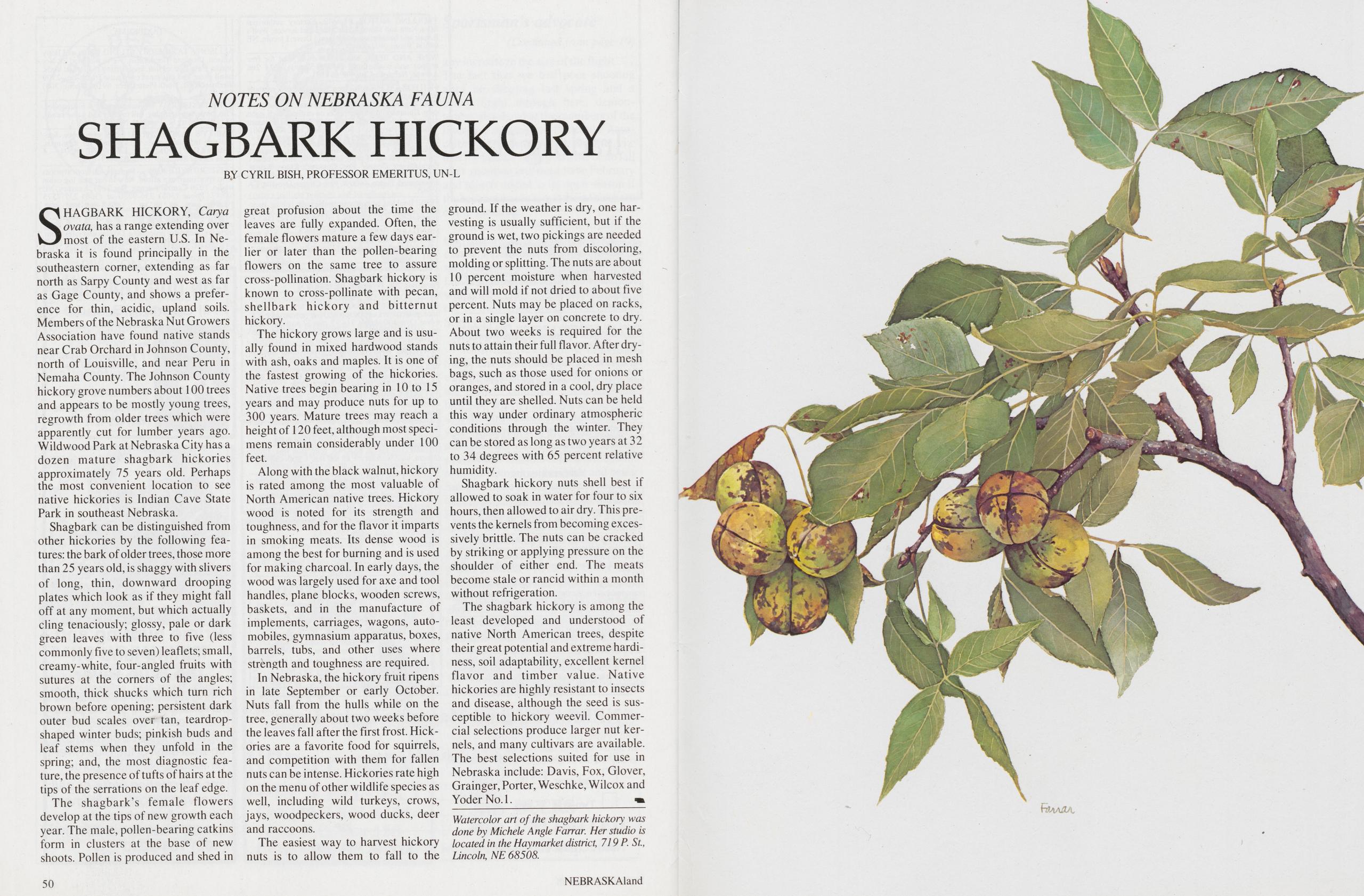
NOTES ON NEBRASKA FAUNA SHAGBARK HICKORY
SHAGBARK HICKORY, Carya ovata, has a range extending over most of the eastern U.S. In Ne- braska it is found principally in the southeastern corner, extending as far north as Sarpy County and west as far as Gage County, and shows a prefer- ence for thin, acidic, upland soils. Members of the Nebraska Nut Growers Association have found native stands near Crab Orchard in Johnson County, north of Louisville, and near Peru in Nemaha County. The Johnson County hickory grove numbers about 100 trees and appears to be mostly young trees, regrowth from older trees which were apparently cut for lumber years ago. Wildwood Park at Nebraska City has a dozen mature shagbark hickories approximately 75 years old. Perhaps the most convenient location to see native hickories is Indian Cave State Park in southeast Nebraska.
Shagbark can be distinguished from other hickories by the following fea- tures: the bark of older trees, those more than 25 years old, is shaggy with slivers of long, thin, downward drooping plates which look as if they might fall off at any moment, but which actually cling tenaciously; glossy, pale or dark green leaves with three to five (less commonly five to seven) leaflets; small, creamy-white, four-angled fruits with sutures at the corners of the angles; smooth, thick shucks which turn rich brown before opening; persistent dark outer bud scales over tan, teardrop- shaped winter buds; pinkish buds and leaf stems when they unfold in the spring; and, the most diagnostic fea- ture, the presence of tufts of hairs at the tips of the serrations on the leaf edge.
The shagbark’s female flowers develop at the tips of new growth each year. The male, pollen-bearing catkins form in clusters at the base of new shoots. Pollen is produced and shed in great profusion about the time the leaves are fully expanded. Often, the female flowers mature a few days ear- lier or later than the pollen-bearing flowers on the same tree to assure cross-pollination. Shagbark hickory is known to cross-pollinate with pecan, shellbark hickory and bitternut hickory.
The hickory grows large and is usu- ally found in mixed hardwood stands with ash, oaks and maples. It is one of the fastest growing of the hickories. Native trees begin bearing in 10 to 15 years and may produce nuts for up to 300 years. Mature trees may reach a height of 120 feet, although most speci- mens remain considerably under 100 feet.
Along with the black walnut, hickory is rated among the most valuable of North American native trees. Hickory wood is noted for its strength and toughness, and for the flavor it imparts in smoking meats. Its dense wood is among the best for burning and is used for making charcoal. In early days, the wood was largely used for axe and tool handles, plane blocks, wooden screws, baskets, and in the manufacture of implements, carriages, wagons, auto- mobiles, gymnasium apparatus, boxes, barrels, tubs, and other uses where strength and toughness are required.
In Nebraska, the hickory fruit ripens in late September or early October. Nuts fall from the hulls while on the tree, generally about two weeks before the leaves fall after the first frost. Hick- ories are a favorite food for squirrels, and competition with them for fallen nuts can be intense. Hickories rate high on the menu of other wildlife species as well, including wild turkeys, crows, jays, woodpeckers, wood ducks, deer and raccoons.
The easiest way to harvest hickory nuts is to allow them to fall to the ground. If the weather is dry, one har- vesting is usually sufficient, but if the ground is wet, two pickings are needed to prevent the nuts from discoloring, molding or splitting. The nuts are about 10 percent moisture when harvested and will mold if not dried to about five percent. Nuts may be placed on racks, or in a single layer on concrete to dry. About two weeks is required for the nuts to attain their full flavor. After dry- ing, the nuts should be placed in mesh bags, such as those used for onions or oranges, and stored in a cool, dry place until they are shelled. Nuts can be held this way under ordinary atmospheric conditions through the winter. They can be stored as long as two years at 32 to 34 degrees with 65 percent relative humidity.
Shagbark hickory nuts shell best if allowed to soak in water for four to six hours, then allowed to air dry. This pre- vents the kernels from becoming exces- sively brittle. The nuts can be cracked by striking or applying pressure on the shoulder of either end. The meats become stale or rancid within a month without refrigeration.
The shagbark hickory is among the least developed and understood of native North American trees, despite their great potential and extreme hardi- ness, soil adaptability, excellent kernel flavor and timber value. Native hickories are highly resistant to insects and disease, although the seed is sus- ceptible to hickory weevil. Commer- cial selections produce larger nut ker- nels, and many cultivars are available. The best selections suited for use in Nebraska include: Davis, Fox, Glover, Grainger, Porter, Weschke, Wilcox and Yoder No. 1.
Watercolor art of the shagbark hickory was done by Michele Angle Farrar. Her studio is located in the Haymarket district, 719 P. St., Lincoln, HE 68508.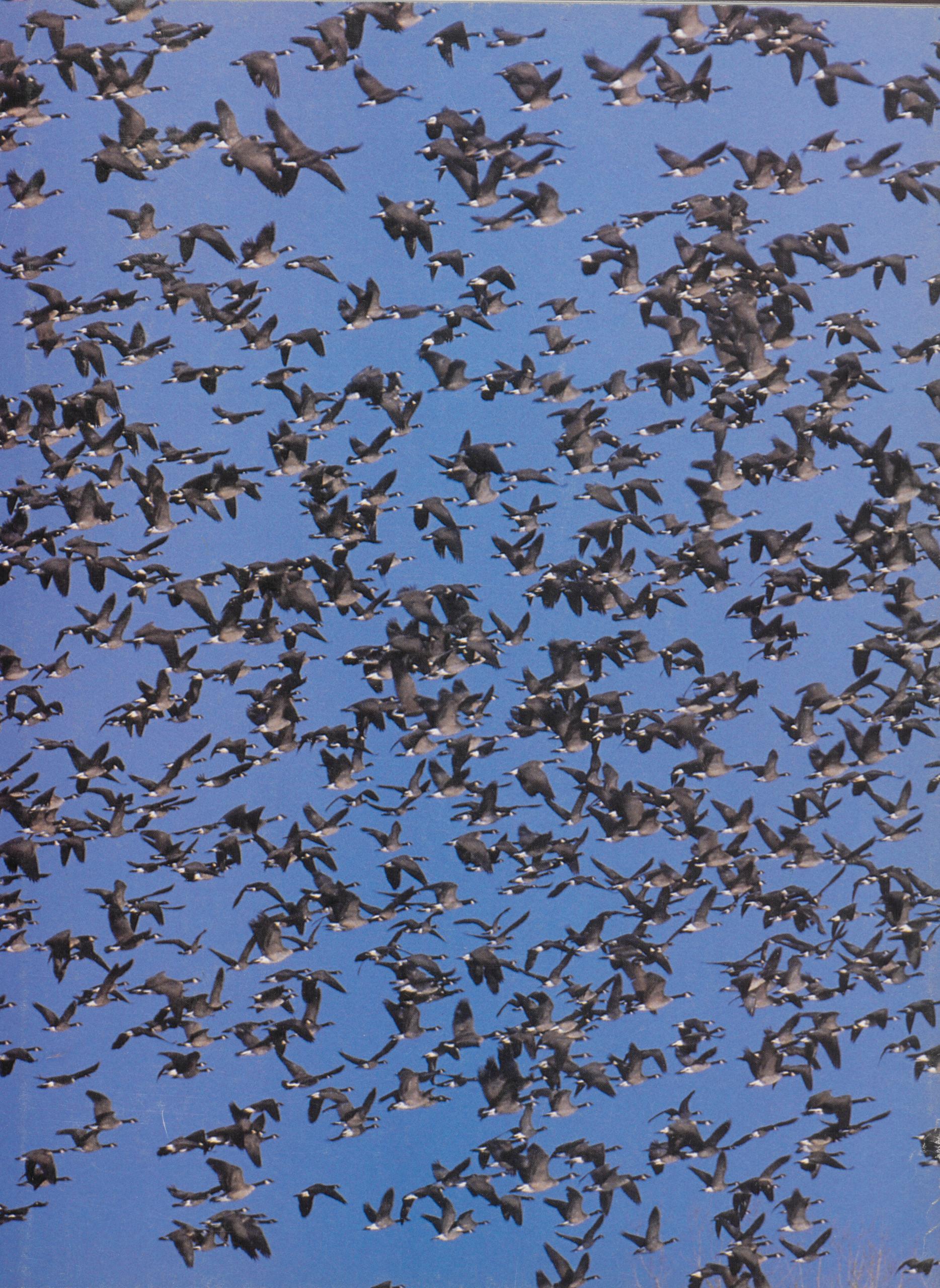
Position: 373 (26 views)