Volume 66, Issue 7, 1988
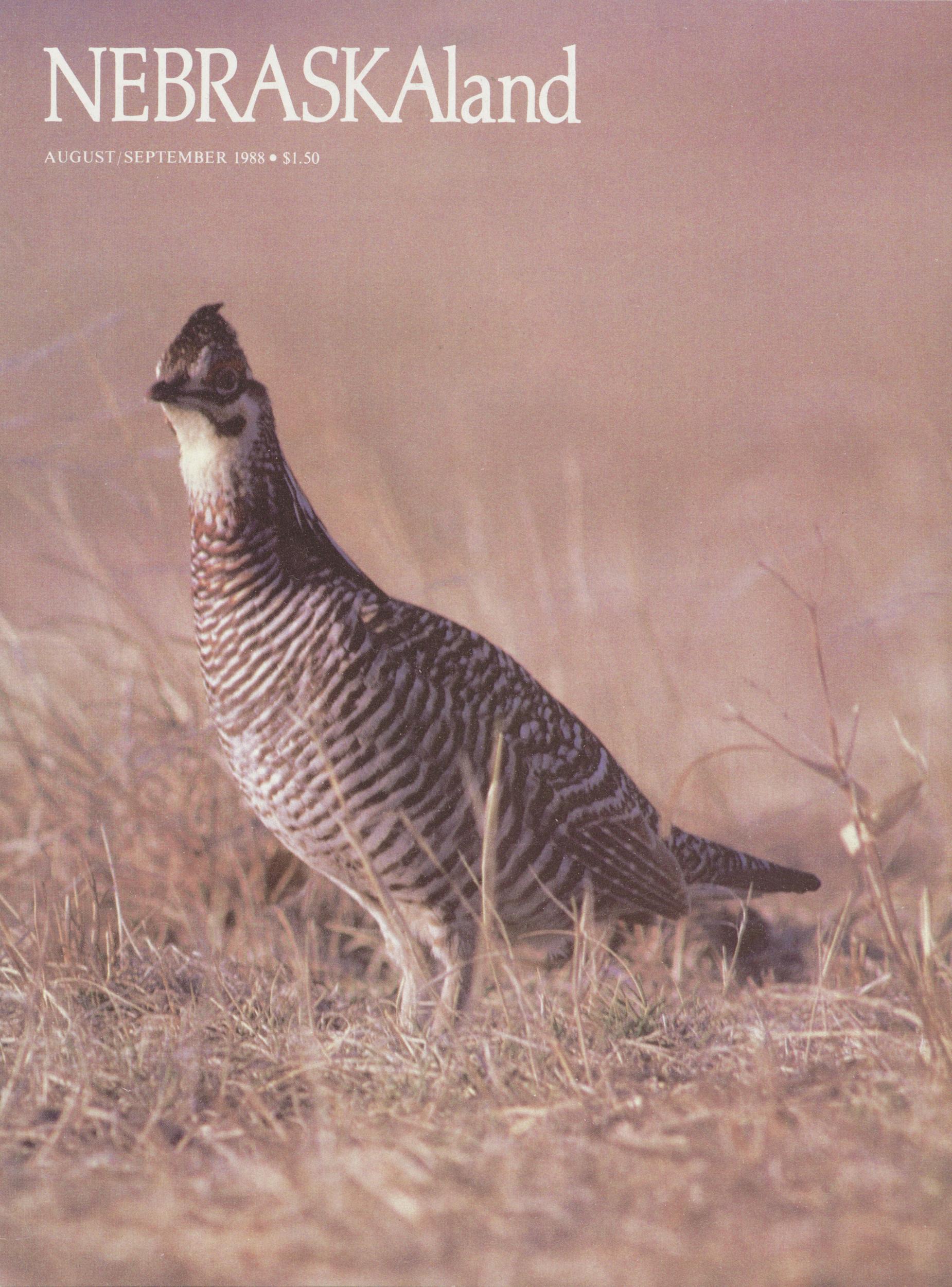
NEBRASKAland
AUGUST/SEPTEMBER 1988 $1.50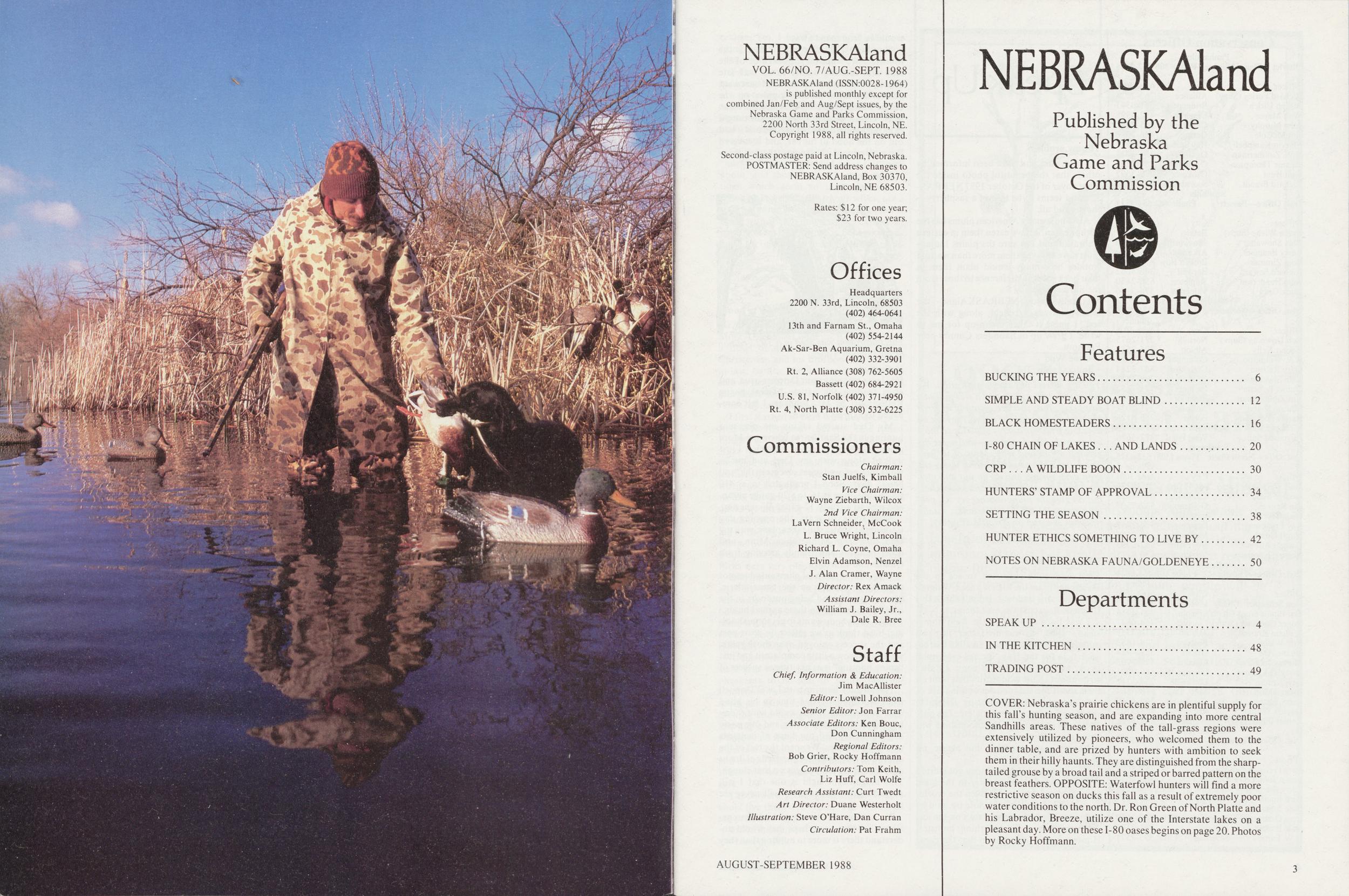
NEBRSAKAland
Published by the Nebraska Game and Parks Commission NEBRASKAland VOL. 66/NO. 7/AUG.-SEPT. 1988 NEBRASKAland (ISSN:0028-1964) is published monthly except for combined Jan/Feb and Aug/Sept issues, by the Nebraska Game and Parks Commission, 2200 North 33rd Street, Lincoln, NE. Copyright 1988, all rights reserved. Second-class postage paid at Lincoln, Nebraska. POSTMASTER: Send address changes to NEBRASKAland, Box 30370, Lincoln, NE 68503. Rates: $ 12 for one year; $23 for two years. Offices Headquarters 2200 N. 33rd, Lincoln, 68503 (402) 464-0641 13th and Farnam St., Omaha (402) 554-2144 Ak-Sar-Ben Aquarium, Gretna (402) 332-3901 Rt. 2, Alliance (308) 762-5605 Bassett (402) 684-2921 U.S. 81, Norfolk (402) 371-4950 Rt. 4, North Platte (308) 532-6225 Commissioners Chairman: Stan Juelfs, Kimball Vice Chairman: Wayne Ziebarth, Wilcox 2nd Vice Chairman: LaVern Schneider, McCook L. Bruce Wright, Lincoln Richard L. Coyne, Omaha Elvin Adamson, Nenzel J. Alan Cramer, Wayne Director: Rex Amack Assistant Directors: William J. Bailey, Jr., Dale R. Bree Staff Chief, Information & Education: Jim MacAllister Editor: Lowell Johnson Senior Editor: Jon Farrar Associate Editors: Ken Bouc, Don Cunningham Regional Editors: Bob Grier, Rocky Hoffmann Contributors: Tom Keith, Liz Huff, Carl Wolfe Research Assistant: Curt Twedt Art Director: Duane Westerholt Illustration: Steve O'Hare, Dan Curran Circulation: Pat Frahm Contents Features BUCKING THE YEARS............................. 6 SIMPLE AND STEADY BOAT BLIND................ 12 BLACK HOMESTEADERS.......................... 16 1-80 CHAIN OF LAKES . . . AND LANDS.............20 CRP ... A WILDLIFE BOON......... HUNTERS' STAMP OF APPROVAL 30 .......34 SETTING THE SEASON............................38 HUNTER ETHICS SOMETHING TO LIVE BY.........42 NOTES ON NEBRASKA FAUNA/GOLDENEYE.......50 Departments SPEAK UP............. „._.__ . .. „,_............... 4 IN THE KITCHEN .................................48 TRADING POST...................................49 COVER: Nebraska's prairie chickens are in plentiful supply for this fall's hunting season, and are expanding into more central Sandhills areas. These natives of the tall-grass regions were extensively utilized by pioneers, who welcomed them to the dinner table, and are prized by hunters with ambition to seek them in their hilly haunts. They are distinguished from the sharp- tailed grouse by a broad tail and a striped or barred pattern on the breast feathers. OPPOSITE: Waterfowl hunters will find a more restrictive season on ducks this fall as a result of extremely poor water conditions to the north. Dr. Ron Green of North Platte and his Labrador, Breeze, utilize one of the Interstate lakes on a pleasant day. More on these 1-80 oases begins on page 20. Photos by Rocky Hoffmann. AUGUST/SEPTEMBER 1988 3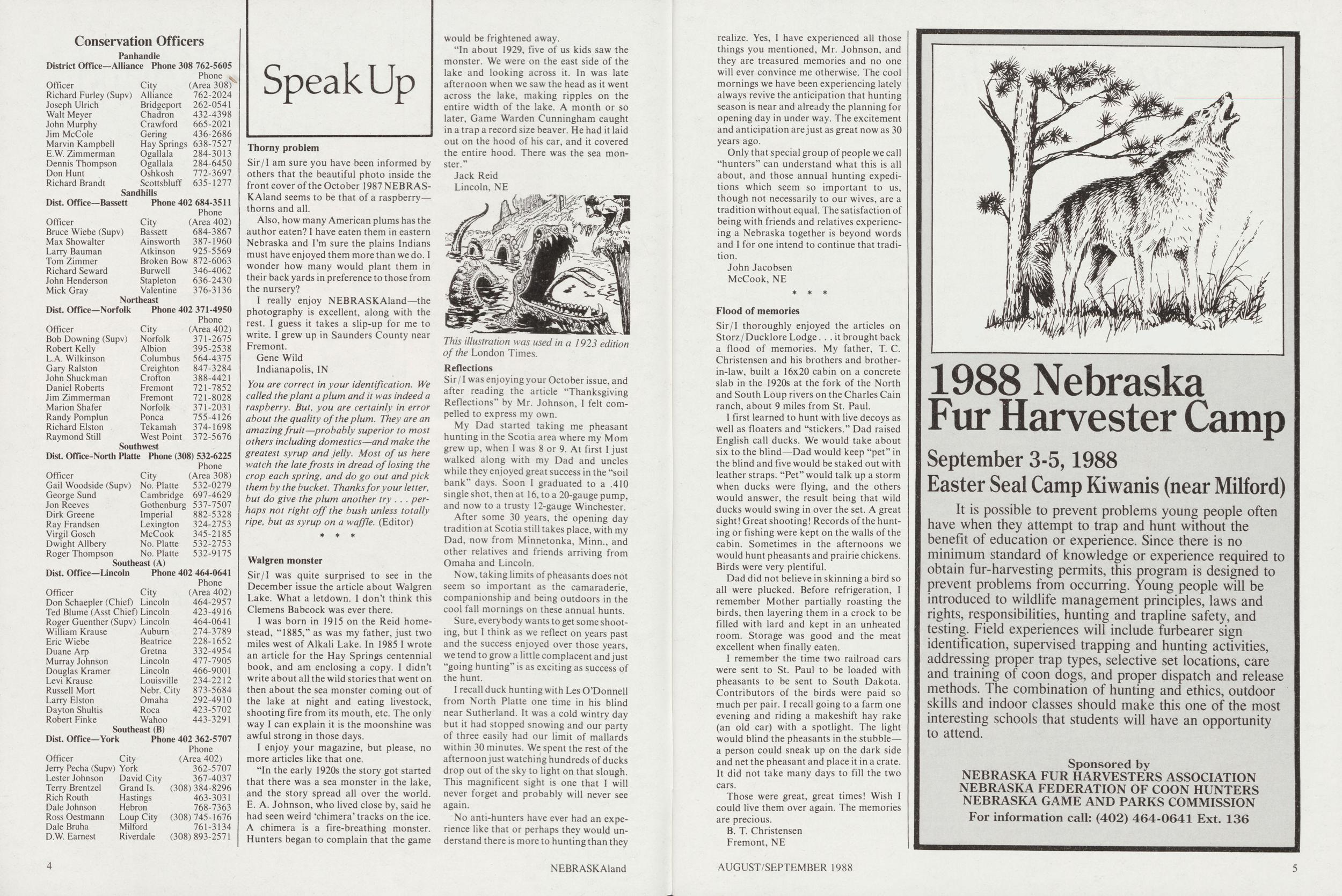
Speak Up
Thorny problemSir/I am sure you have been informed by others that the beautiful photo inside the front cover of the October 1987 NEBRASKAland seems to be that of a raspberrythorns and all.
Also, how many American plums has the author eaten? I have eaten them in eastern Nebraska and I'm sure the plains Indians must have enjoyed them more than we do. I wonder how many would plant them in their back yards in preference to those from the nursery?
I really enjoy NEBRASKAland—the photography is excellent, along with the rest. I guess it takes a slip-up for me to write. I grew up in Saunders County near Fremont.
Gene Wild Indianapolis, INYou are correct in your identification. We called the plant a plum and it was indeed a raspberry. But, you are certainly in error about the quality of the plum. They are an amazing fruit—probably superior to most others including domestics—and make the greatest syrup and jelly. Most of us here watch the late frosts in dread of losing the crop each spring, and do go out and pick them by the bucket. Thanks for your letter, but do give the plum another try . . . perhaps not right off the bush unless totally ripe, but as syrup on a waffle. (Editor)
* * * Walgren monsterSir/T was quite surprised to see in the December issue the article about Walgren Lake. What a letdown. I don't think this Clemens Babcock was ever there.
I was born in 1915 on the Reid home- stead, "1885," as was my father, just two miles west of Alkali Lake. In 1985 I wrote an article for the Hay Springs centennial book, and am enclosing a copy. I didn't write about all the wild stories that went on then about the sea monster coming out of the lake at night and eating livestock, shooting fire from its mouth, etc. The only way I can explain it is the moonshine was awful strong in those days.
I enjoy your magazine, but please, no more articles like that one.
"In the early 1920s the story got started that there was a sea monster in the lake, and the story spread all over the world. E. A. Johnson, who lived close by, said he had seen weird 'chimera' tracks on the ice. A chimera is a fire-breathing monster. Hunters began to complain that the game would be frightened away.
"In about 1929, five of us kids saw the monster. We were on the east side of the lake and looking across it. In was late afternoon when we saw the head as it went across the lake, making ripples on the entire width of the lake. A month or so later, Game Warden Cunningham caught in a trap a record size beaver. He had it laid out on the hood of his car, and it covered the entire hood. There was the sea monster."
Jack Reid Lincoln, NESir/1 was enjoying your October issue, and after reading the article "Thanksgiving Reflections" by Mr. Johnson, I felt compelled to express my own.
My Dad started taking me pheasant hunting in the Scotia area where my Mom grew up, when I was 8 or 9. At first I just walked along with my Dad and uncles while they enjoyed great success in the "soil bank" days. Soon I graduated to a .410 single shot, then at 16, to a 20-gauge pump, and now to a trusty 12-gauge Winchester.
After some 30 years, the opening day tradition at Scotia still takes place, with my Dad, now from Minnetonka, Minn., and other relatives and friends arriving from Omaha and Lincoln.
Now, taking limits of pheasants does not seem so important as the camaraderie, companionship and being outdoors in the cool fall mornings on these annual hunts.
Sure, everybody wants to get some shooting, but I think as we reflect on years past and the success enjoyed over those years, we tend to grow a little complacent and just "going hunting" is as exciting as success of the hunt.
I recall duck hunting with Les O'Donnell from North Platte one time in his blind near Sutherland. It was a cold wintry day but it had stopped snowing and our party of three easily had our limit of mallards within 30 minutes. We spent the rest of the afternoon just watching hundreds of ducks drop out of the sky to light on that slough. This magnificent sight is one that I will never forget and probably will never see again.
No anti-hunters have ever had an experience like that or perhaps they would understand there is more to hunting than they 4 NEBRASKAland realize. Yes, I have experienced all those things you mentioned, Mr. Johnson, and they are treasured memories and no one will ever convince me otherwise. The cool mornings we have been experiencing lately always revive the anticipation that hunting season is near and already the planning for opening day in under way. The excitement and anticipation are just as great now as 30 years ago.
Only that special group of people we call "hunters" can understand what this is all about, and those annual hunting expeditions which seem so important to us, though not necessarily to our wives, are a tradition without equal. The satisfaction of being with friends and relatives experiencing a Nebraska together is beyond words and I for one intend to continue that tradition.
John Jacobsen McCook, NE * * * Flood of memoriesSir/1 thoroughly enjoyed the articles on Storz/Ducklore Lodge. . . it brought back a flood of memories. My father, T. C. Christensen and his brothers and brother-in-law, built a 16x20 cabin on a concrete slab in the 1920s at the fork of the North and South Loup rivers on the Charles Cain ranch, about 9 miles from St. Paul.
1 first learned to hunt with live decoys as well as floaters and "stickers." Dad raised English call ducks. We would take about six to the blind—Dad would keep "pet" in the blind and five would be staked out with leather straps. "Pet" would talk up a storm when ducks were flying, and the others would answer, the result being that wild ducks would swing in over the set. A great sight! Great shooting! Records of the hunting or fishing were kept on the walls of the cabin. Sometimes in the afternoons we would hunt pheasants and prairie chickens. Birds were very plentiful.
Dad did not believe in skinning a bird so all were plucked. Before refrigeration, I remember Mother partially roasting the birds, then layering them in a crock to be filled with lard and kept in an unheated room. Storage was good and the meat excellent when finally eaten.
I remember the time two railroad cars were sent to St. Paul to be loaded with pheasants to be sent to South Dakota. Contributors of the birds were paid so much per pair. I recall going to a farm one evening and riding a makeshift hay rake (an old car) with a spotlight. The light would blind the pheasants in the stubble a person could sneak up on the dark side and net the pheasant and place it in a crate. It did not take many days to fill the two cars.
Those were great, great times! Wish I could live them over again. The memories are precious.
B. T. Christensen Fremont, NE1988 Nebraska Fur Harvester Camp
September 3-5,1988 Easter Seal Camp Kiwanis (near Milford)It is possible to prevent problems young people often have when they attempt to trap and hunt without the benefit of education or experience. Since there is no minimum standard of knowledge or experience required to obtain fur-harvesting permits, this program is designed to prevent problems from occurring. Young people will be introduced to wildlife management principles, laws and rights, responsibilities, hunting and trapline safety, and testing. Field experiences will include furbearer sign identification, supervised trapping and hunting activities, addressing proper trap types, selective set locations, care and training of coon dogs, and proper dispatch and release methods. The combination of hunting and ethics, outdoor skills and indoor classes should make this one of the most interesting schools that students will have an opportunity to attend.
Sponsored by NEBRASKA FUR HARVESTERS ASSOCIATION NEBRASKA FEDERATION OF COON HUNTERS NEBRASKA GAME AND PARKS COMMISSION For information call: (402) 464-0641 Ext. 136 AUGUST/SEPTEMBER 1988 5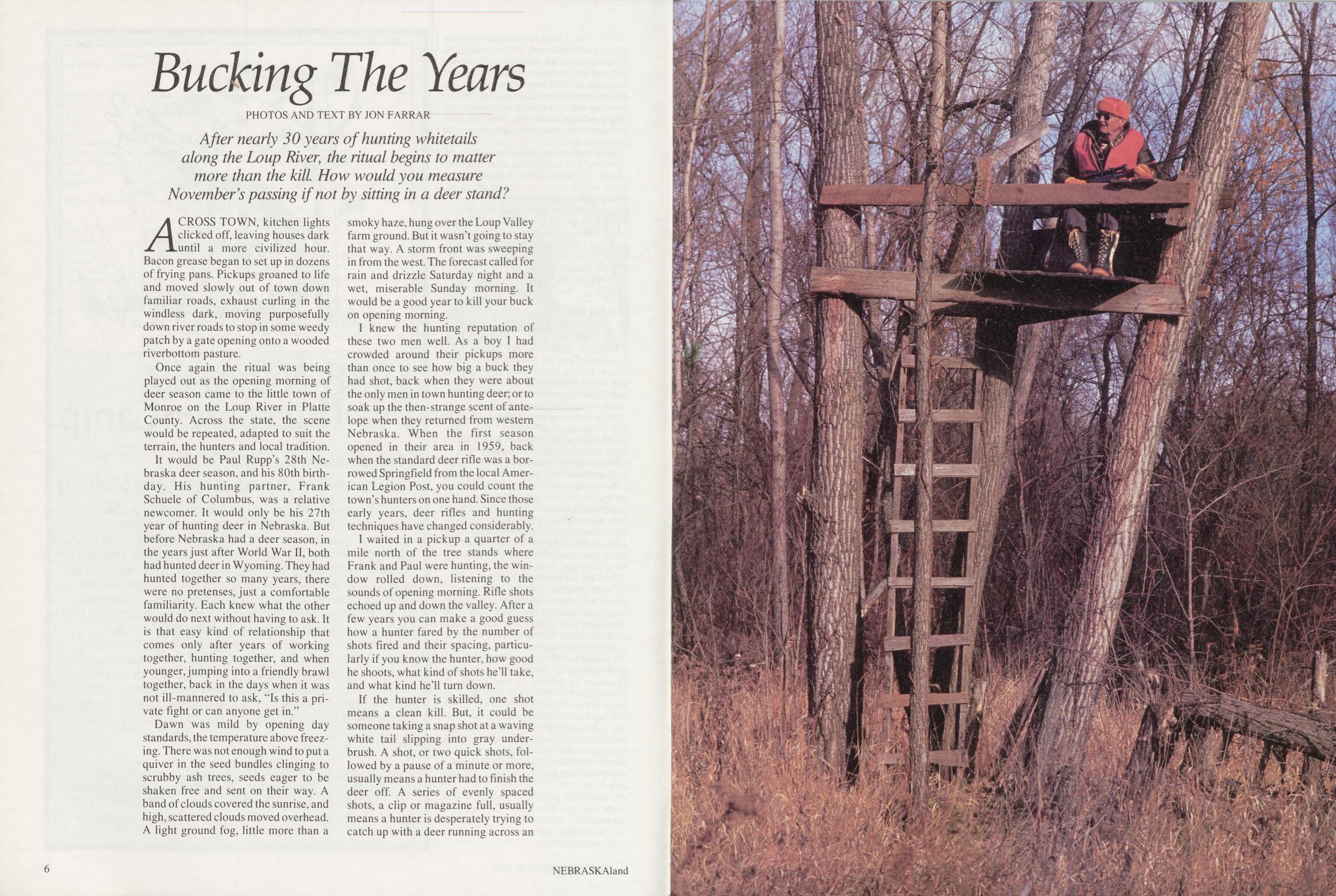
Bucking The Years
PHOTOS AND TEXT BY JON FARRAR After nearly 30 years of hunting whitetails along the Loup River, the ritual begins to matter more than the kill How would you measure Novembers passing if not by sitting in a deer stand?ACROSS TOWN, kitchen lights clicked off, leaving houses dark until a more civilized hour. Bacon grease began to set up in dozens of frying pans. Pickups groaned to life and moved slowly out of town down familiar roads, exhaust curling in the windless dark, moving purposefully down river roads to stop in some weedy patch by a gate opening onto a wooded river bottom pasture.
Once again the ritual was being played out as the opening morning of deer season came to the little town of Monroe on the Loup River in Platte County. Across the state, the scene would be repeated, adapted to suit the terrain, the hunters and local tradition.
It would be Paul Rupp's 28th Nebraska deer season, and his 80th birthday. His hunting partner, Frank Schuele of Columbus, was a relative newcomer. It would only be his 27th year of hunting deer in Nebraska. But before Nebraska had a deer season, in the years just after World War II, both had hunted deer in Wyoming. They had hunted together so many years, there were no pretenses, just a comfortable familiarity. Each knew what the other would do next without having to ask. It is that easy kind of relationship that comes only after years of working together, hunting together, and when younger, jumping into a friendly brawl together, back in the days when it was not ill-mannered to ask, "Is this a private fight or can anyone get in."
Dawn was mild by opening day standards, the temperature above freezing. There was not enough wind to put a quiver in the seed bundles clinging to scrubby ash trees, seeds eager to be shaken free and sent on their way. A band of clouds covered the sunrise, and high, scattered clouds moved overhead. A light ground fog, little more than a smoky haze, hung over the Loup Valley farm ground. But it wasn't going to stay that way. A storm front was sweeping in from the west. The forecast called for rain and drizzle Saturday night and a wet, miserable Sunday morning. It would be a good year to kill your buck on opening morning.
I knew the hunting reputation of these two men well. As a boy I had crowded around their pickups more than once to see how big a buck they had shot, back when they were about the only men in town hunting deer; or to soak up the then-strange scent of antelope when they returned from western Nebraska. When the first season opened in their area in 1959, back when the standard deer rifle was a borrowed Springfield from the local American Legion Post, you could count the town's hunters on one hand. Since those early years, deer rifles and hunting techniques have changed considerably.
I waited in a pickup a quarter of a mile north of the tree stands where Frank and Paul were hunting, the window rolled down, listening to the sounds of opening morning. Rifle shots echoed up and down the valley. After a few years you can make a good guess how a hunter fared by the number of shots fired and their spacing, particularly if you know the hunter, how good he shoots, what kind of shots he'll take, and what kind he'll turn down.
If the hunter is skilled, one shot means a clean kill. But, it could be someone taking a snap shot at a waving white tail slipping into gray underbrush. A shot, or two quick shots, followed by a pause of a minute or more, usually means a hunter had to finish the deer off. A series of evenly spaced shots, a clip or magazine full, usually means a hunter is desperately trying to catch up with a deer running across an 6 NEBRASKAland
 opening. As a rule, the more shots you
hear the less likely the hunter filled his
permit, because in the heavy timber of a^
river bottom, a deer is seldom more than
a bound away from escape.
opening. As a rule, the more shots you
hear the less likely the hunter filled his
permit, because in the heavy timber of a^
river bottom, a deer is seldom more than
a bound away from escape.
By nine o'clock I had heard plenty of shooting up and down the river but none close enough to have been Frank or Paul. I knew it was that time of the morning when a deer hunter starts playing games in his mind. It comes earlier when it's cold or wet or windy or it's your fifth or sixth day in the stand. "I'll stay in the tree 10 more minutes," you tell yourself; "one more cup of coffee, until the sunlight falls on the willow patch." Then, just when you're ready to go, a twig snaps in the brush. "Maybe a buck is creeping back into heavier cover." Or, the hunters on the other side of the river are talking, leaving their stands. "Maybe they'll spook something out." Finally, though, numb feet and legs and fingers refuse to go along with the mind's game and move on their own. Crawling down out of a deer stand is a mix of pleasure and disappointment—the pleasure of stretching a cramped leg, clearing a throat, blowing a runny nose; the disappointment of returning home with no blood on your hands.
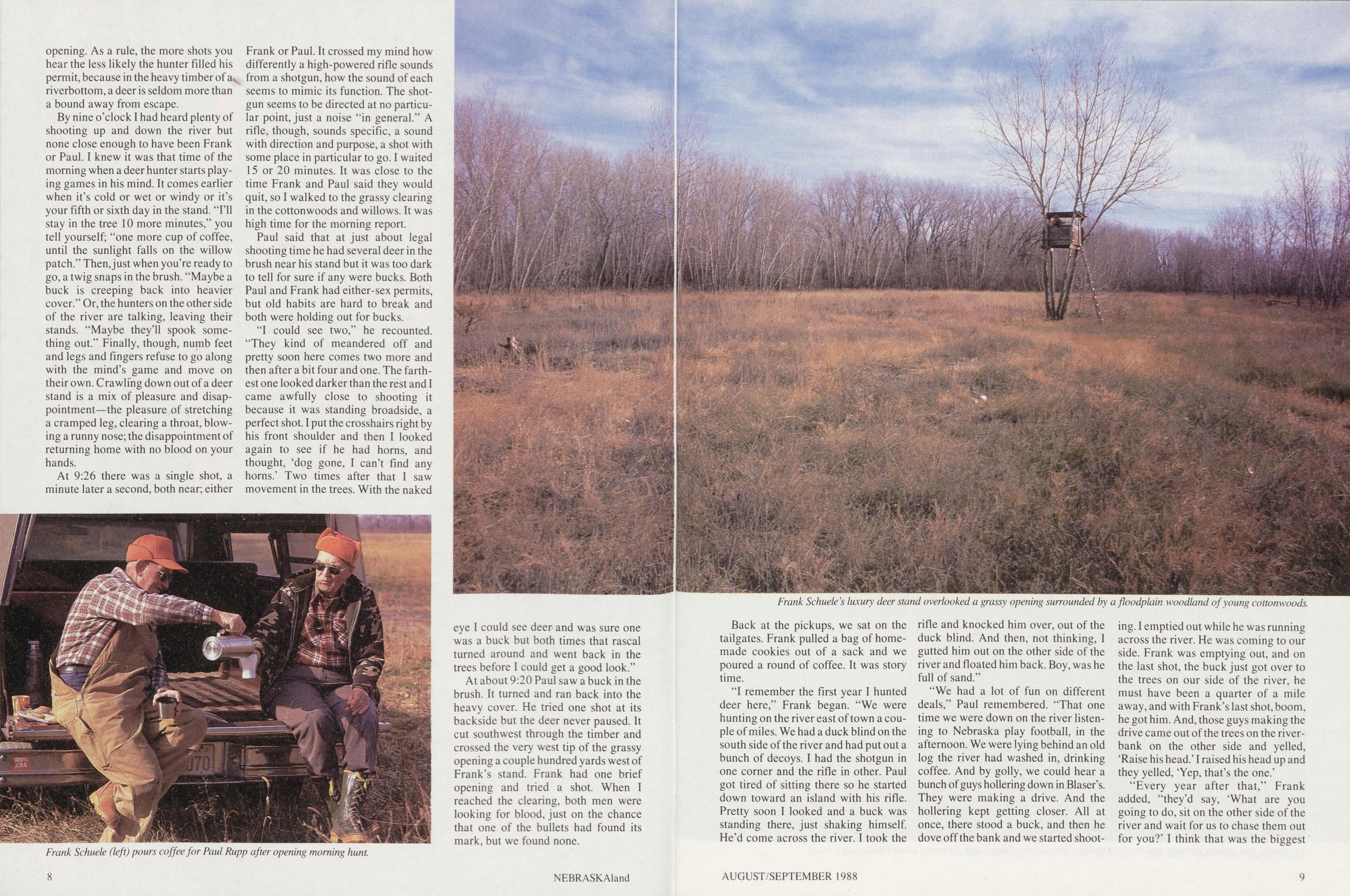
At 9:26 there was a single shot, a minute later a second, both near; either Frank or Paul. It crossed my mind how differently a high-powered rifle sounds from a shotgun, how the sound of each seems to mimic its function. The shotgun seems to be directed at no particular point, just a noise "in general." A rifle, though, sounds specific, a sound with direction and purpose, a shot with some place in particular to go. I waited 15 or 20 minutes. It was close to the time Frank and Paul said they would quit, so I walked to the grassy clearing in the cottonwoods and willows. It was high time for the morning report.
Paul said that at just about legal shooting time he had several deer in the brush near his stand but it was too dark to tell for sure if any were bucks. Both Paul and Frank had either-sex permits, but old habits are hard to break and both were holding out for bucks.
"I could see two," he recounted. "They kind of meandered off and pretty soon here comes two more and then after a bit four and one. The farthest one looked darker than the rest and I came awfully close to shooting it because it was standing broadside, a perfect shot. I put the crosshairs right by his front shoulder and then I looked again to see if he had horns, and thought, 'dog gone, I can't find any horns.' Two times after that I saw movement in the trees. With the naked eye I could see deer and was sure one was a buck but both times that rascal turned around and went back in the trees before I could get a good look."
At about 9:20 Paul saw a buck in the brush. It turned and ran back into the heavy cover. He tried one shot at its backside but the deer never paused. It cut southwest through the timber and crossed the very west tip of the grassy opening a couple hundred yards west of Frank's stand. Frank had one brief opening and tried a shot. When I reached the clearing, both men were looking for blood, just on the chance that one of the bullets had found its mark, but we found none.
8 NEBRASKAlandBack at the pickups, we sat on the tailgates. Frank pulled a bag of homemade cookies out of a sack and we poured a round of coffee. It was story time.
"I remember the first year I hunted deer here," Frank began. "We were hunting on the river east of town a couple of miles. We had a duck blind on the south side of the river and had put out a bunch of decoys. I had the shotgun in one corner and the rifle in other. Paul got tired of sitting there so he started down toward an island with his rifle. Pretty soon I looked and a buck was standing there, just shaking himself. He'd come across the river. I took the rifle and knocked him over, out of the duck blind. And then, not thinking, I gutted him out on the other side of the river and floated him back. Boy, was he full of sand."
"We had a lot of fun on different deals," Paul remembered. "That one time we were down on the river listening to Nebraska play football, in the afternoon. We were lying behind an old log the river had washed in, drinking coffee. And by golly, we could hear a bunch of guys hollering down in Blaser's. They were making a drive. And the hollering kept getting closer. All at once, there stood a buck, and then he dove off the bank and we started shooting. I emptied out while he was running across the river. He was coming to our side. Frank was emptying out, and on the last shot, the buck just got over to the trees on our side of the river, he must have been a quarter of a mile away, and with Frank's last shot, boom, he got him. And, those guys making the drive came out of the trees on the riverbank on the other side and yelled, 'Raise his head.' I raised his head up and they yelled, 'Yep, that's the one.'
"Every year after that," Frank
added, "they'd say, 'What are you
going to do, sit on the other side of the
river and wait for us to chase them out
for you?' I think that was the biggest
AUGUST/SEPTEMBER 1988
9
 rack I ever got. Right off, when we first
started hunting deer, there were more
big deer, but not now. Now, if anything
with any kind of a rack comes along^
you'd better take him. You may not get
another chance.
rack I ever got. Right off, when we first
started hunting deer, there were more
big deer, but not now. Now, if anything
with any kind of a rack comes along^
you'd better take him. You may not get
another chance.
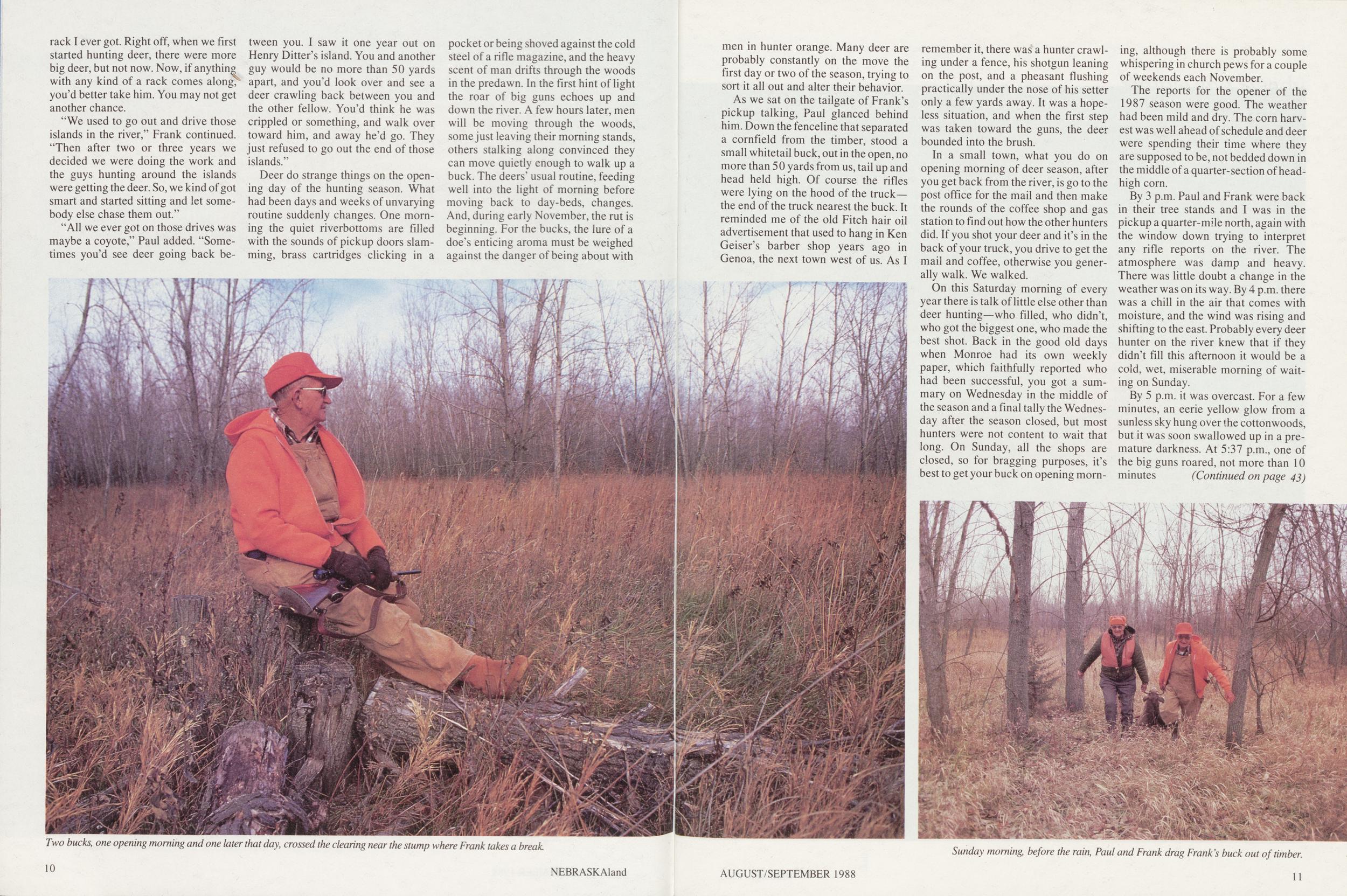
"We used to go out and drive those islands in the river," Frank continued. "Then after two or three years we decided we were doing the work and the guys hunting around the islands were getting the deer. So, we kind of got smart and started sitting and let somebody else chase them out."
"All we ever got on those drives was maybe a coyote," Paul added. "Sometimes you'd see deer going back between you. I saw it one year out on Henry Ditter's island. You and another guy would be no more than 50 yards apart, and you'd look over and see a deer crawling back between you and the other fellow. You'd think he was crippled or something, and walk over toward him, and away he'd go. They just refused to go out the end of those islands."
Deer do strange things on the opening day of the hunting season. What had been days and weeks of unvarying routine suddenly changes. One morning the quiet river bottoms are filled with the sounds of pickup doors slamming, brass cartridges clicking in a pocket or being shoved against the cold steel of a rifle magazine, and the heavy scent of man drifts through the woods in the predawn. In the first hint of light the roar of big guns echoes up and down the river, A few hours later, men will be moving through the woods, some just leaving their morning stands, others stalking along convinced they can move quietly enough to walk up a buck. The deers' usual routine, feeding well into the light of morning before moving back to day-beds, changes. And, during early November, the rut is beginning. For the bucks, the lure of a doe's enticing aroma must be weighed against the danger of being about with 10 NEBRASKAland men in hunter orange. Many deer are probably constantly on the move the first day or two of the season, trying to sort it all out and alter their behavior.
As we sat on the tailgate of Frank's pickup talking, Paul glanced behind him. Down the fence line that separated a cornfield from the timber, stood a small whitetail buck, out in the open, no more than 50 yards from us, tail up and head held high. Of course the rifles were lying on the hood of the truck— the end of the truck nearest the buck. It reminded me of the old Fitch hair oil advertisement that used to hang in Ken Geiser's barber shop years ago in Genoa, the next town west of us. As I remember it, there was a hunter crawling under a fence, his shotgun leaning on the post, and a pheasant flushing practically under the nose of his setter only a few yards away. It was a hopeless situation, and when the first step was taken toward the guns, the deer bounded into the brush.
In a small town, what you do on opening morning of deer season, after you get back from the river, is go to the post office for the mail and then make the rounds of the coffee shop and gas station to find out how the other hunters did. If you shot your deer and it's in the back of your truck, you drive to get the mail and coffee, otherwise you generally walk. We walked.
On this Saturday morning of every year there is talk of little else other than deer hunting—who filled, who didn't, who got the biggest one, who made the best shot. Back in the good old days when Monroe had its own weekly paper, which faithfully reported who had been successful, you got a summary on Wednesday in the middle of the season and a final tally the Wednesday after the season closed, but most hunters were not content to wait that long. On Sunday, all the shops are closed, so for bragging purposes, it's best to get your buck on opening morning, although there is probably some whispering in church pews for a couple of weekends each November.
The reports for the opener of the 1987 season were good. The weather had been mild and dry. The corn harvest was well ahead of schedule and deer were spending their time where they are supposed to be, not bedded down in the middle of a quarter-section of head-high corn.
By 3 p.m. Paul and Frank were back in their tree stands and I was in the pickup a quarter-mile north, again with the window down trying to interpret any rifle reports on the river. The atmosphere was damp and heavy. There was little doubt a change in the weather was on its way. By 4 p.m. there was a chill in the air that comes with moisture, and the wind was rising and shifting to the east. Probably every deer hunter on the river knew that if they didn't fill this afternoon it would be a cold, wet, miserable morning of waiting on Sunday.
By 5 p.m. it was overcast. For a few minutes, an eerie yellow glow from a sunless sky hung over the cottonwoods, but it was soon swallowed up in a premature darkness. At 5:37 p.m., one of the big guns roared, not more than 10 minutes (Continued on page 43)
Simple and Steady BOAT BLIND
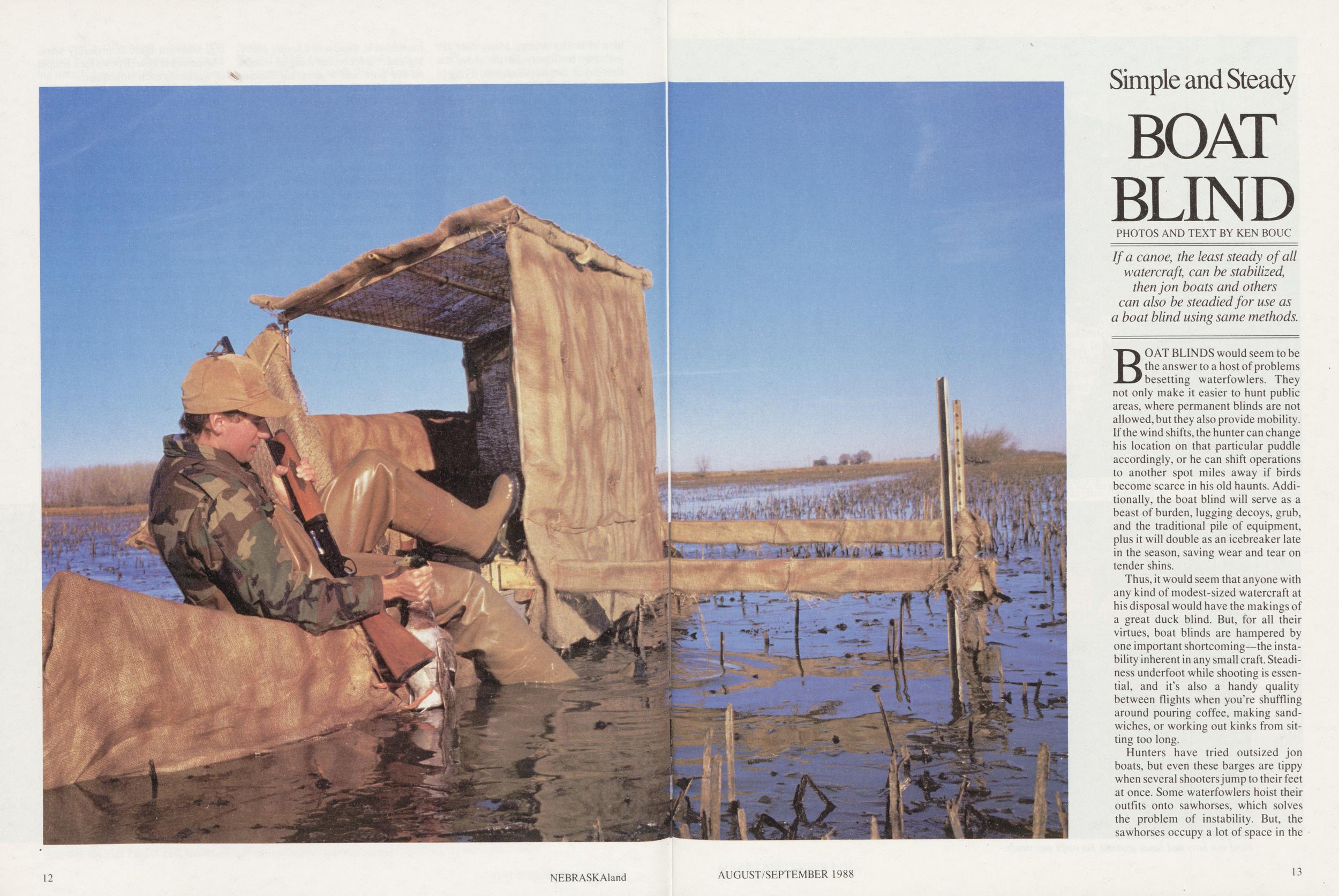
PHOTOS AND TEXT BY KEN BOUC If a canoe, the least steady of all watercraft, can be stabilized, the boats and others can also be steadied for use as a boat blind using same methods.BOAT BLINDS would seem to be the answer to a host of problems besetting water fowlers. They not only make it easier to hunt public areas, where permanent blinds are not allowed, but they also provide mobility. If the wind shifts, the hunter can change his location on that particular puddle accordingly, or he can shift operations to another spot miles away if birds become scarce in his old haunts. Additionally, the boat blind will serve as a beast of burden, lugging decoys, grub, and the traditional pile of equipment, plus it will double as an icebreaker late in the season, saving wear and tear on tender shins.
Thus, it would seem that anyone with any kind of modest-sized watercraft at his disposal would have the makings of a great duck blind. But, for all their virtues, boat blinds are hampered by one important shortcoming—the instability inherent in any small craft. Steadiness underfoot while shooting is essential, and it's also a handy quality between flights when you're shuffling around pouring coffee, making sandwiches, or working out kinks from sitting too long.
Hunters have tried outsized jon boats, but even these barges are tippy when several shooters jump to their feet at once. Some water fowlers hoist their outfits onto sawhorses, which solves the problem of instability. But, the sawhorses occupy a lot of space in the boat that could be used to haul decoys, and lifting the whole thing onto the sawhorses is nothing but hard work. And, the water has to be exactly the right depth.
AUGUST/SEPTEMBER 1988 13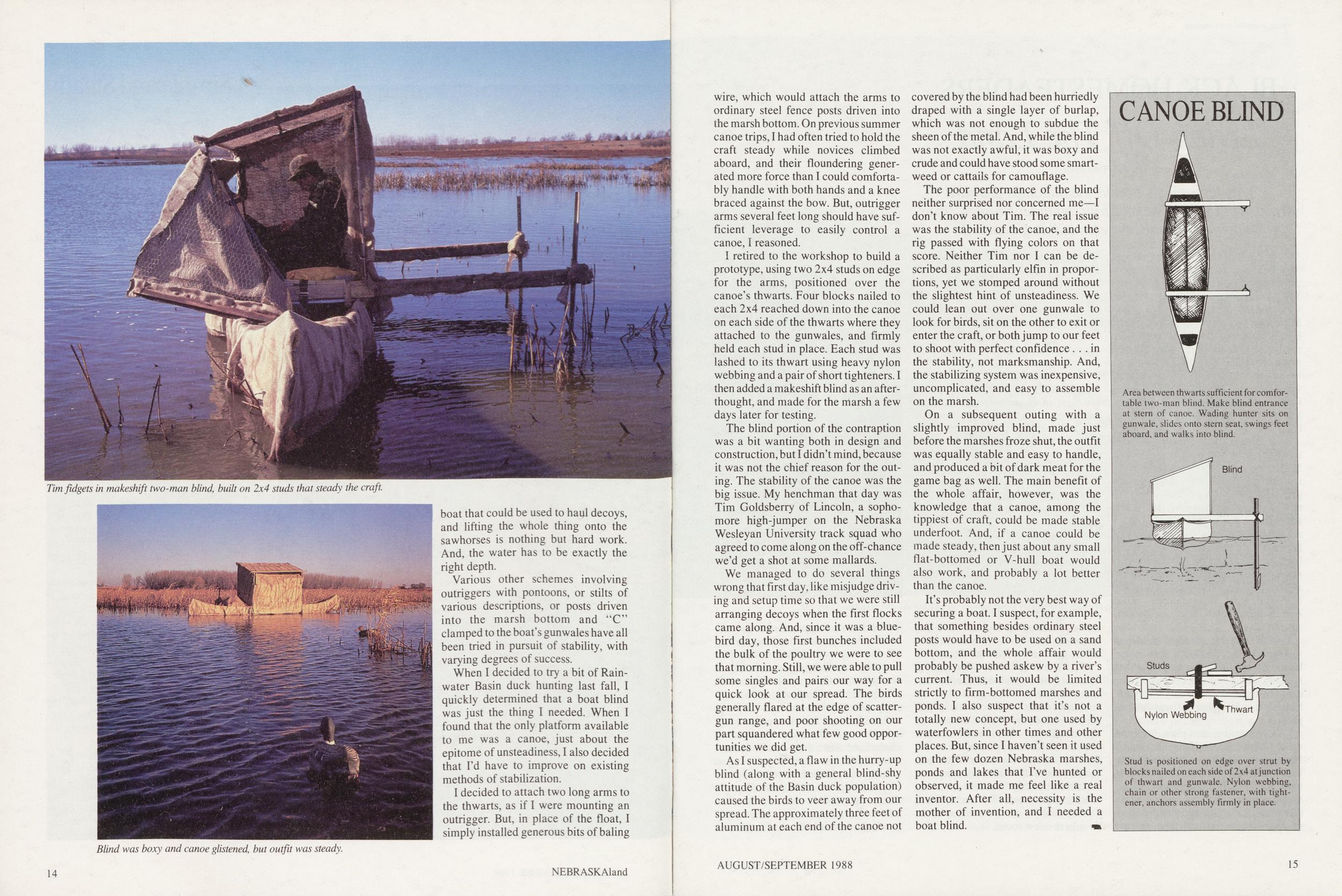
Various other schemes involving outriggers with pontoons, or stilts of various descriptions, or posts driven into the marsh bottom and "C" clamped to the boat's gunwales have all been tried in pursuit of stability, with varying degrees of success.
When I decided to try a bit of Rain water Basin duck hunting last fall, I quickly determined that a boat blind was just the thing I needed. When I found that the only platform available to me was a canoe, just about the epitome of unsteadiness, I also decided that I'd have to improve on existing methods of stabilization.
I decided to attach two long arms to the thwarts, as if I were mounting an outrigger. But, in place of the float, I simply installed generous bits of baling 14 NEBRASKAland wire, which would attach the arms to ordinary steel fence posts driven into the marsh bottom. On previous summer canoe trips, I had often tried to hold the craft steady while novices climbed aboard, and their floundering generated more force than I could comfortably handle with both hands and a knee braced against the bow. But, outrigger arms several feet long should have sufficient leverage to easily control a canoe, I reasoned.
I retired to the workshop to build a prototype, using two 2x4 studs on edge for the arms, positioned over the canoe's thwarts. Four blocks nailed to each 2x4 reached down into the canoe on each side of the thwarts where they attached to the gunwales, and firmly held each stud in place. Each stud was lashed to its thwart using heavy nylon webbing and a pair of short tighteners. I then added a makeshift blind as an after thought, and made for the marsh a few days later for testing.
The blind portion of the contraption was a bit wanting both in design and construction, but I didn't mind, because it was not the chief reason for the outing. The stability of the canoe was the big issue. My henchman that day was Tim Goldsberry of Lincoln, a sophomore high-jumper on the Nebraska Wesleyan University track squad who agreed to come along on the off-chance we'd get a shot at some mallards.
We managed to do several things wrong that first day, like misjudge driving and setup time so that we were still arranging decoys when the first flocks came along. And, since it was a bluebird day, those first bunches included the bulk of the poultry we were to see that morning. Still, we were able to pull some singles and pairs our way for a quick look at our spread. The birds generally flared at the edge of scattergun range, and poor shooting on our part squandered what few good opportunities we did get.
As I suspected, a flaw in the hurry-up blind (along with a general blind-shy attitude of the Basin duck population) caused the birds to veer away from our spread. The approximately three feet of aluminum at each end of the canoe not covered by the blind had been hurriedly draped with a single layer of burlap, which was not enough to subdue the sheen of the metal. And, while the blind was not exactly awful, it was boxy and crude and could have stood some smart-weed or cattails for camouflage.
The poor performance of the blind neither surprised nor concerned me—I don't know about Tim. The real issue was the stability of the canoe, and the rig passed with flying colors on that score. Neither Tim nor I can be described as particularly elfin in proportions, yet we stomped around without the slightest hint of unsteadiness. We could lean out over one gunwale to look for birds, sit on the other to exit or enter the craft, or both jump to our feet to shoot with perfect confidence ... in the stability, not marksmanship. And, the stabilizing system was inexpensive, uncomplicated, and easy to assemble on the marsh.
On a subsequent outing with a slightly improved blind, made just before the marshes froze shut, the outfit was equally stable and easy to handle, and produced a bit of dark meat for the game bag as well. The main benefit of the whole affair, however, was the knowledge that a canoe, among the tippiest of craft, could be made stable underfoot. And, if a canoe could be made steady, then just about any small flat-bottomed or V-hull boat would also work, and probably a lot better than the canoe.
It's probably not the very best way of securing a boat. I suspect, for example, that something besides ordinary steel posts would have to be used on a sand bottom, and the whole affair would probably be pushed askew by a river's current. Thus, it would be limited strictly to firm-bottomed marshes and ponds. I also suspect that it's not a totally new concept, but one used by water fowlers in other times and other places. But, since I haven't seen it used on the few dozen Nebraska marshes, ponds and lakes that I've hunted or observed, it made me feel like a real inventor. After all, necessity is the mother of invention, and I needed a boat blind.
CANOE BLIND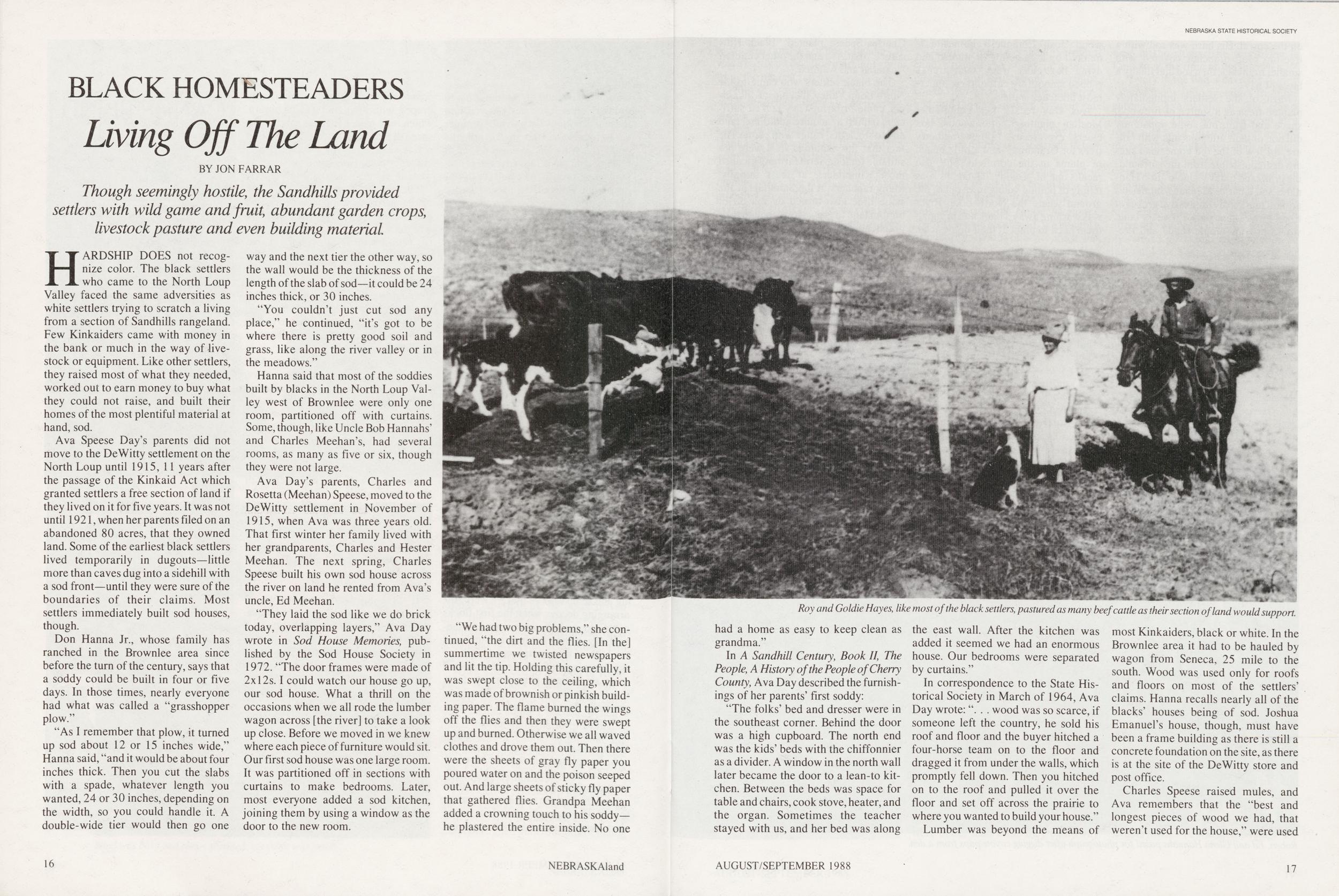
BLACK HOMESTEADERS Living Off The Land
BY JON FARRAR Though seemingly hostile, the Sandhills provided settlers with wild game and fruit, abundant garden crops, livestock pasture and even building materialHARDSHIP DOES not recognize color. The black settlers who came to the North Loup Valley faced the same adversities as white settlers trying to scratch a living from a section of Sandhills rangeland. Few Kinkaiders came with money in the bank or much in the way of livestock or equipment. Like other settlers, they raised most of what they needed, worked out to earn money to buy what they could not raise, and built their homes of the most plentiful material at hand, sod.
Ava Speese Day's parents did not move to the DeWitty settlement on the North Loup until 1915, 11 years after the passage of the Kinkaid Act which granted settlers a free section of land if they lived on it for five years. It was not until 1921, when her parents filed on an abandoned 80 acres, that they owned land. Some of the earliest black settlers lived temporarily in dugouts—little more than caves dug into a sidehill with a sod front—until they were sure of the boundaries of their claims. Most settlers immediately built sod houses, though.
Don Hanna Jr., whose family has ranched in the Brownlee area since before the turn of the century, says that a soddy could be built in four or five days. In those times, nearly everyone had what was called a "grasshopper plow."
"As I remember that plow, it turned up sod about 12 or 15 inches wide," Hanna said, "and it would be about four inches thick. Then you cut the slabs with a spade, whatever length you wanted, 24 or 30 inches, depending on the width, so you could handle it. A double-wide tier would then go one way and the next tier the other way, so the wall would be the thickness of the length of the slab of sod—it could be 24 inches thick, or 30 inches.
"You couldn't just cut sod any place," he continued, "it's got to be where there is pretty good soil and grass, like along the river valley or in the meadows."
Hanna said that most of the soddies built by blacks in the North Loup Valley west of Brownlee were only one room, partitioned off with curtains. Some, though, like Uncle Bob Hannahs' and Charles Meehan's, had several rooms, as many as five or six, though they were not large.
Ava Day's parents, Charles and Rosetta (Meehan) Speese, moved to the DeWitty settlement in November of 1915, when Ava was three years old. That first winter her family lived with her grandparents, Charles and Hester Meehan. The next spring, Charles Speese built his own sod house across the river on land he rented from Ava's uncle, Ed Meehan.
"They laid the sod like we do brick today, overlapping layers," Ava Day wrote in Sod House Memories, published by the Sod House Society in 1972. "The door frames were made of 2x12s. I could watch our house go up, our sod house. What a thrill on the occasions when we all rode the lumber wagon across [the river] to take a look up close. Before we moved in we knew where each piece of furniture would sit. Our first sod house was one large room. It was partitioned off in sections with curtains to make bedrooms. Later, most everyone added a sod kitchen, joining them by using a window as the door to the new room.
"We had two big problems," she continued, "the dirt and the flies. [In the] summertime we twisted newspapers and lit the tip. Holding this carefully, it was swept close to the ceiling, which was made of brownish or pinkish building paper. The flame burned the wings off the flies and then they were swept up and burned. Otherwise we all waved clothes and drove them out. Then there were the sheets of gray fly paper you poured water on and the poison seeped out. And large sheets of sticky fly paper that gathered flies. Grandpa Meehan added a crowning touch to his soddy— he plastered the entire inside. No one 16 NEBRSAKAland had a home as easy to keep clean as grandma."
In A Sandhill Century, Book II, The People, A History of the People of Cherry County, Ava Day described the furnishings of her parents' first soddy:
"The folks' bed and dresser were in the southeast corner. Behind the door was a high cupboard. The north end was the kids' beds with the chiffonnier as a divider. A window in the north wall later became the door to a lean-to kitchen. Between the beds was space for table and chairs, cook stove, heater, and the organ. Sometimes the teacher stayed with us, and her bed was along the east wall. After the kitchen was added it seemed we had an enormous house. Our bedrooms were separated by curtains."
In correspondence to the State Historical Society in March of 1964, Ava Day wrote: ". . . wood was so scarce, if someone left the country, he sold his roof and floor and the buyer hitched a four-horse team on to the floor and dragged it from under the walls, which promptly fell down. Then you hitched on to the roof and pulled it over the floor and set off across the prairie to where you wanted to build your house."
Lumber was beyond the means of most Kinkaiders, black or white. In the Brownlee area it had to be hauled by wagon from Seneca, 25 mile to the south. Wood was used only for roofs and floors on most of the settlers' claims. Hanna recalls nearly all of the blacks' houses being of sod. Joshua Emanuel's house, though, must have been a frame building as there is still a concrete foundation on the site, as there is at the site of the DeWitty store and post office.
Charles Speese raised mules, and
Ava remembers that the "best and
longest pieces of wood we had, that
weren't used for the house," were used
AUGUST/SEPTEMBER 1988
17
 on the corral. His barn was sod with a
tree-top roof; branches covered with
smaller branches, then sod and finally a
layer of hay.
on the corral. His barn was sod with a
tree-top roof; branches covered with
smaller branches, then sod and finally a
layer of hay.
Most of the settlers immediately planted trees as a source of firewood, shade and fruit, but some apparently did not, or their attempts met with failure, for few of the old homestead sites are distinguishable from the surrounding grassland today. "Uncle" Bob Hannah's and Charles Meehan's homesites are still marked by impressive groves of trees, groves that now, 70 years later, would provide ample shade and fire wood. Josh Emanuel's homesite is marked by a gathering of stunted and dying box elder trees, their trunks subbed smooth by cattle, their uppermost branches leafless.
Ava Day recalls her grandfather Meehan planting cottonwoods, box elders, evergreens, "a few mulberry trees for Grandma," and a little bunch of plums in the cornfield. She also recalls one of "Daddy" Hannah's sons telling of pulling young trees out of the ground where the North Loup River was washing away a bank and bringing them back to plant at their homestead. Charles Speese planted "Black Hills spruce" that Ava and the other children "watered and watered."
The black settlers who came to the North Loup Valley, like most Kinkaiders, came to farm. They lacked sufficient capital to acquire additional land and to stock that range with cattle. The fact that the Sandhills soils were not suitable for long-term farming escaped most Kinkaiders, at least initially. Manv ranchers in the Sandhills at the same time also turned over a bit of bottom land to grow crops, though their grandchildren may vehemently deny it 18 NEBRASKAland today. For ranchers or homesteaders, it was a costly proposition to freight grain from the nearest rail town.
Plots of cropland were necessarily small, scratched in here and there as the terrain would tolerate, usually in little valleys or on flats near the river. Don Hanna Jr., who recalls the black settlers from his childhood days and knows the land well today, as it is on Hanna family ranches, says the average field was probably about 20 acres, rarely if ever as large as 40 acres. Corn was the principal crop and was used both for livestock and the table.
Dennis Meehan raised sorghum cane, crushed the stalks in a horse powered mill to extract the juice, cooked it down in a "big iron cauldron" and sold the dark, golden syrup in gallon pails for 40 cents.
Cornbread was a staple, available even when money was too tight to buy wheat flour.
"Mom baked some of the bread in round pans so all of us could have the good crusty heel with cool milk," Ava Day wrote in Sod House Memories. "Mostly we ate cornbread. We bought a grinder from Wards or Sears and it was clamped to the handmade bench. One of us kids sat on the bench while another ground the kernels, first coarse, then fine. The meal was mixed with a little flour, seasonings, eggs, milk and usually cracklings for shortening, then baked.
"They should have left it cow country," Ava said in a 1987 interview, during one of her visits to Nebraska from her home in St. Paul, Minnesota, "as it is now. You can see the land is too tender. The ground should never have been worked up like that. They don't realize the potential they have there for raising vegetables. The best sweet potatoes I ever had came up with Sandhills water. I always take Sandhills water back with me when I visit, even if I've got to stop out in the middle of somebody's ranch and go to the windmill to get it-
Other garden crops grown by the black settlers, according to Ava Day, included "flint and 'Squaw' corn, beans, black-eyed peas, mealy potatoes, and melons, the sugary kind. We could raise good beans, Navy beans. And we raised black-eyed-peas. And, all the kinds of vegetables that we could. Our greens were mostly Swiss chard. And we raised cabbage."
Mrs. Corinna Williams, daughter of William Walker, one of the first blacks to settle in the Brownlee area, is quoted in an interview on file at the State Historical Society as saying:
"They raised many potatoes and beans, turnips, musk-melons. One lady grew a 50-pound pumpkin. Potatoes averaged 500 or 600 bushels to the acre. One potato might weigh a pound. One hill would feed 10 people. They threw away and wasted vegetables that were better than those they could buy here in the stores [she was living in Lincoln at the time of the interview]."
"Every home had a cave for storing canned foods and vegetables from the garden," Ava wrote in Sod House Memories. They were dug deep as a room and most often built up around the top, then roofed over and dirt piled on top. Like a sod house, the caves were warm in winter and cool in summer. Squash, carrots, pumpkins, jams and jellies, dozens and dozens of jars, Ball and Mason quart jars, of home-grown vegetables, for each family had to grow and store enough to last until the next crop was ready for harvest; all these were stored in caves.
"We used to go over to the Wamaduze Valley and get fruit chokecherries, plums and grapes," Ava Day said. "And every fall the men would go up north, up on the Snake River and pick plums and grapes. One year the women went; Mom, Aunt Grudy, Aunt Ida and Grandma Meehan and a couple of other women. They'd go and stay three or four days. Closer to home we would pick chokecherries and ground cherries [probably sand cherries], but they weren't so plentiful as on the Snake River."
Most of the black homesteaders raised a mix of small livestock, principally chickens, but a few raised turkeys, ducks or geese. Evidently Charles Speese raised more than just a few chickens as his daughter, Ava, recounts a night, while her father was on a freighting trip, when two men on horseback put 67 of their "beautiful big Buff Orpingtons, just fryer size," in sacks and rode off with them.
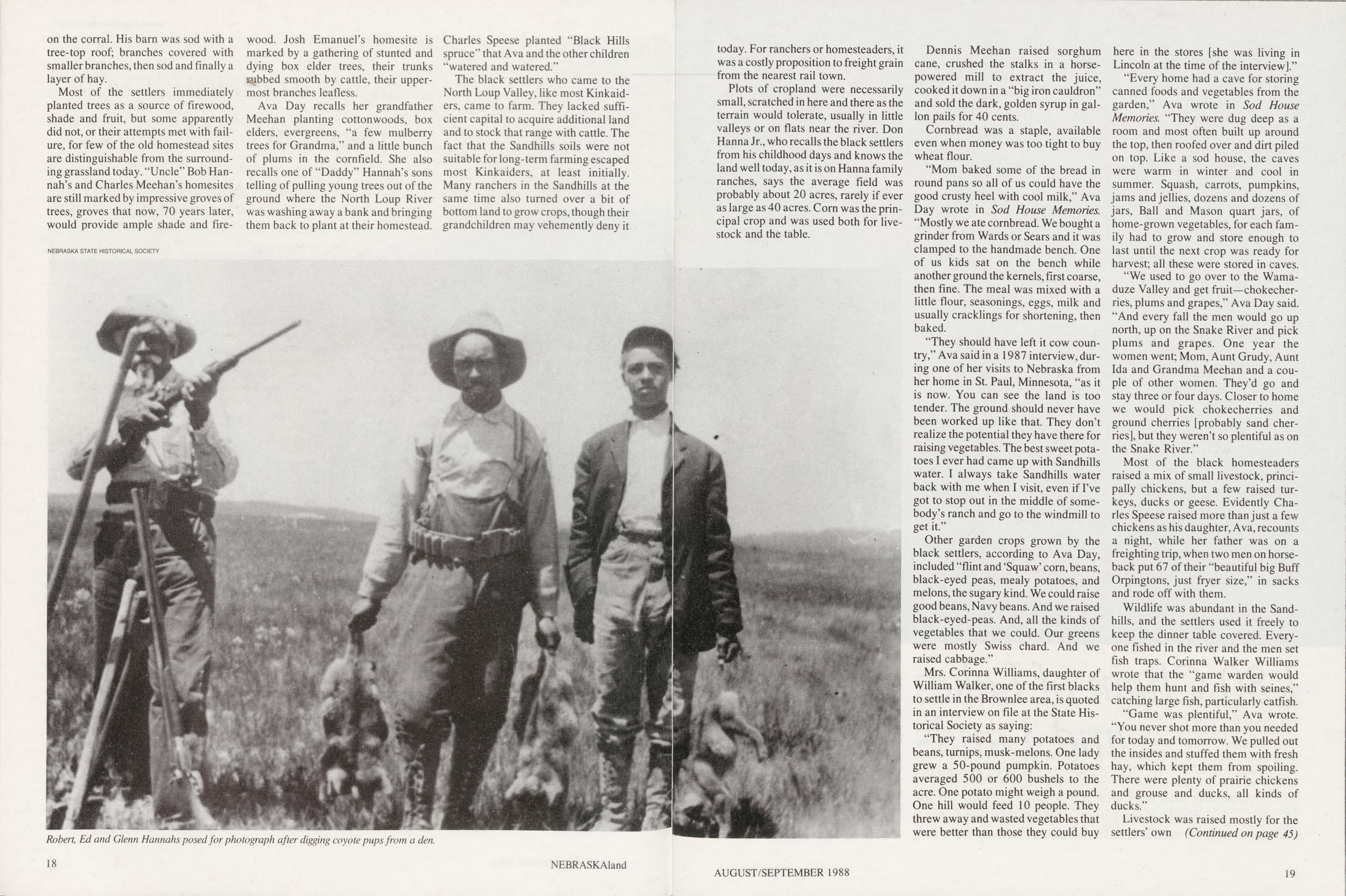
Wildlife was abundant in the Sandhills, and the settlers used it freely to keep the dinner table covered. Everyone fished in the river and the men set fish traps. Corinna Walker Williams wrote that the "game warden would help them hunt and fish with seines," catching large fish, particularly catfish.
"Game was plentiful," Ava wrote. 'You never shot more than you needed for today and tomorrow. We pulled out the insides and stuffed them with fresh hay, which kept them from spoiling. There were plenty of prairie chickens and grouse and ducks, all kinds of ducks."
Livestock was raised mostly for the settlers' own (Continued on page 45)
AUGUST/SEPTEMBER 1988 19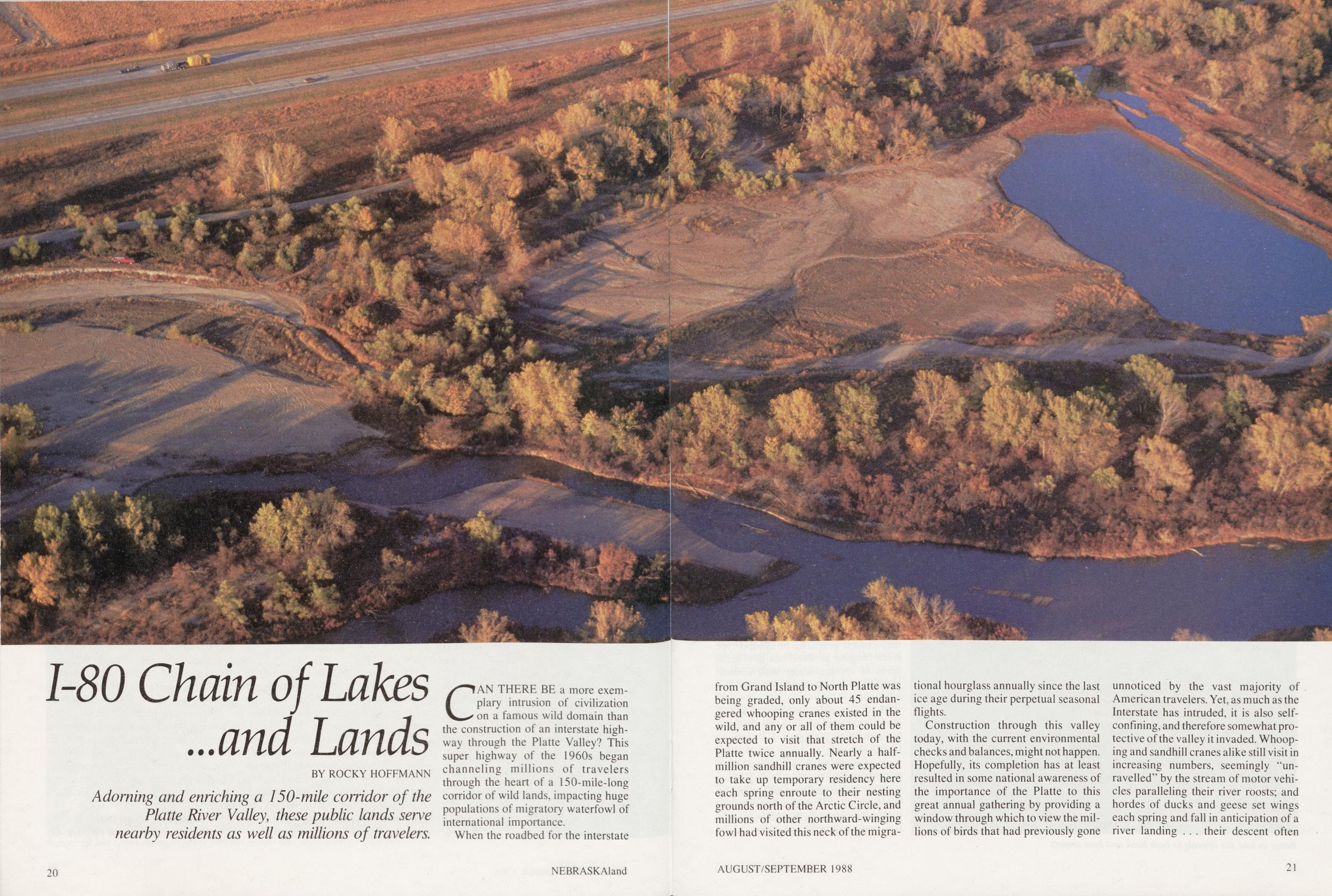
I-80 Chain of Lakes ...and Lands
BY ROCKY HOFFMANN Adorning and enriching a 150-mile corridor of the Platte River Valley, these public lands serve nearby residents as well as millions of travelers.CAN THERE BE a more exemplary intrusion of civilization on a famous wild domain than the construction of an interstate highway through the Platte Valley? This super highway of the 1960s began channeling millions of travelers through the heart of a 150-mile-long corridor of wild lands, impacting huge populations of migratory waterfowl of international importance.
When the roadbed for the interstate 20 NEBRASKAland from Grand Island to North Platte was being graded, only about 45 endangered whooping cranes existed in the wild, and any or all of them could be expected to visit that stretch of the Platte twice annually. Nearly a half-million sandhill cranes were expected to take up temporary residency here each spring enroute to their nesting grounds north of the Arctic Circle, and millions of other northward-winging fowl had visited this neck of the migrational hourglass annually since the last ice age during their perpetual seasonal flights.
Construction through this valley
today, with the current environmental
checks and balances, might not happen.
Hopefully, its completion has at least
resulted in some national awareness of
the importance of the Platte to this
great annual gathering by providing a
window through which to view the
millions of birds that had previously gone
unnoticed by the vast majority of
American travelers. Yet, as much as the
Interstate has intruded, it is also
self-confining, and therefore somewhat
protective of the valley it invaded.
Whooping and sandhill cranes alike still visit in
increasing numbers, seemingly
"unravelled" by the stream of motor
vehicles paralleling their river roosts; and
hordes of ducks and geese set wings
each spring and fall in anticipation of a
river landing . . . their descent often
AUGUST/SEPTEMBER 1988
21
 cross-patterning four lanes of traffic.
The basic nature of interstate highway construction has virtually cordoned off long stretches of the Platte, bisecting land once farmed to the river's bank, and interrupting many county roads that provided regular access. From the north, access is now gained only by a scattering of overpasses and even fewer interchanges.
It is where most of these roads lead that reveals perhaps the most significant by-product of Interstate 80 construction. Almost any exit taken can result in arrival at an assemblage of lakes and associated wild lands that were developed with the public, and fish and wildlife, in mind.
When fill dirt to build the roadbed was borrowed from lands bordering the new right-of-way, spontaneous lakes formed in the vacated craters through groundwater seepage. Strategically located for planned future recreational use, more than 50 lakes now form what is commonly referred to as the 1-80 Chain of Lakes.
Other large tracts and odd areas, purchased for highway right-of-way, were also turned over to the Game and Parks Commission for wildlife management, and later, habitat stamp revenue purchases of large private tracts added to the Platte River package of wildlife lands. Not all of these areas contain lakes, while some boast two or more. Bassway Strip, at the Minden Interchange, for example, has eight lakes with more than 90 acres of water. Comparatively, the North River Area at Hershey accounts for 700 riparian acres, only a small backwater lake, and two miles of river frontage.
Westbound 1-80 Wildlife LandsThere are 19 public areas lying north of and adjacent to 1-80 that are highly visible to west-bound travelers. The highway separates these relatively small areas from the Platte River, and they consist primarily of sandpit-type lakes ranging in size from five to 30 acres of surface water with accompanying perimeter lands of even less acreage.
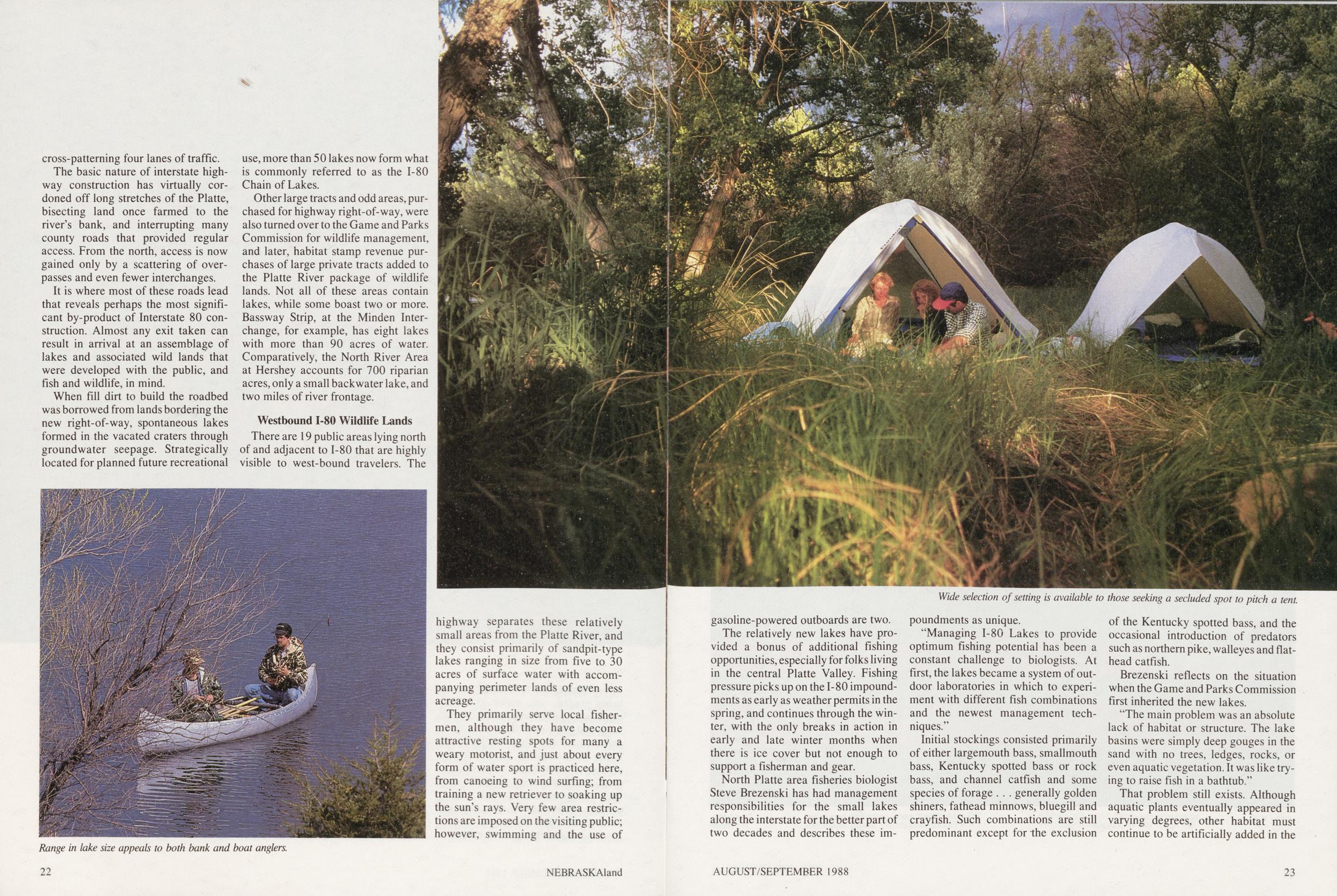
They primarily serve local fishermen, although they have become attractive resting spots for many a weary motorist, and just about every form of water sport is practiced here, from canoeing to wind surfing; from training a new retriever to soaking up the sun's rays. Very few area restrictions are imposed on the visiting public; however, swimming and the use of 22 NEBRASKAland gasoline-powered outboards are two.
The relatively new lakes have provided a bonus of additional fishing opportunities, especially for folks living in the central Platte Valley. Fishing pressure picks up on the 1-80 impoundments as early as weather permits in the spring, and continues through the winter, with the only breaks in action in early and late winter months when there is ice cover but not enough to support a fisherman and gear.
North Platte area fisheries biologist Steve Brezenski has had management responsibilities for the small lakes along the interstate for the better part of two decades and describes these impoundments as unique.
"Managing 1-80 Lakes to provide optimum fishing potential has been a constant challenge to biologists. At first, the lakes became a system of outdoor laboratories in which to experiment with different fish combinations and the newest management techniques."
Initial stockings consisted primarily of either largemouth bass, smallmouth bass, Kentucky spotted bass or rock bass, and channel catfish and some species of forage . . . generally golden shiners, fathead minnows, bluegill and crayfish. Such combinations are still predominant except for the exclusion of the Kentucky spotted bass, and the occasional introduction of predators such as northern pike, walleyes and flathead catfish.
Brezenski reflects on the situation when the Game and Parks Commission first inherited the new lakes.
"The main problem was an absolute lack of habitat or structure. The lake basins were simply deep gouges in the sand with no trees, ledges, rocks, or even aquatic vegetation. It was like trying to raise fish in a bathtub."
That problem still exists. Although aquatic plants eventually appeared in varying degrees, other habitat must continue to be artificially added in the form of trees, stumps, brush piles, tire reefs and most recently, concrete rubble from the reconstruction of the interstate, which was originally responsible for the creation of the lakes.
AUGUST/SEPTEMBER 1988 23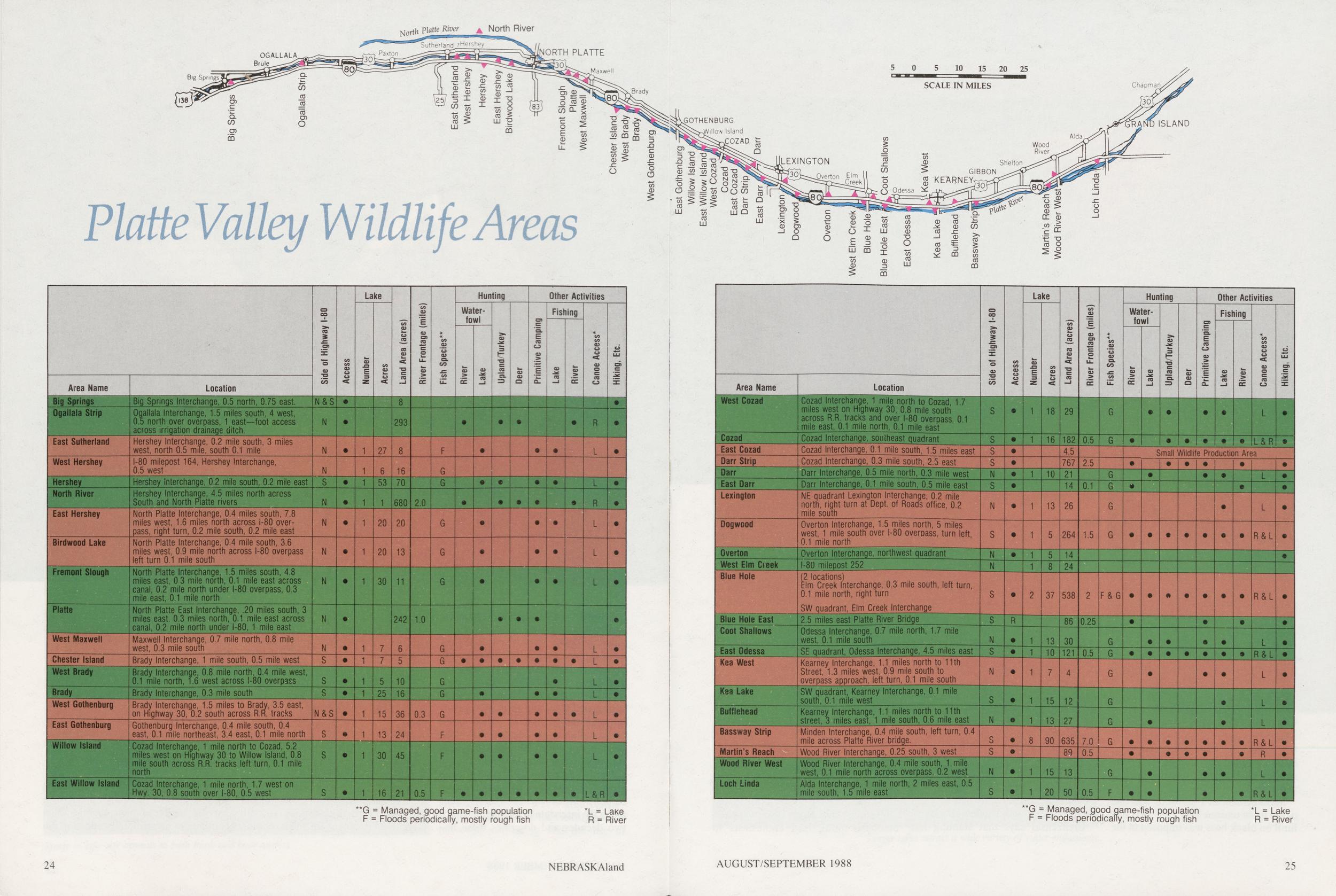
Brezenski says that compounding the lack of habitat was the poor nutrient base that accompanies any newly constructed sandpit. He likens the situation to agriculture. "A poor pasture produces fewer cows, and a lake not very rich in basic nutrients makes it very difficult to yield a large number of big fish. . .if not impossible.
"Ideal management objectives would produce balanced populations where there are enough big fish to control small fish. When too many of the large species are caught out, the smaller ones are left to overpopulate and stunt."
Management of 1-80 lakes was one of the basic reasons why a 12-inch size limit on black bass was imposed in the middle 70s. Regardless of this protective measure, however, the larger bass are quickly over harvested in such small impoundments and the predator effect is lost. When fishermen begin to find only small fish, they shift their attention to another lake, and eventually the balance shifts, fishing improves, and the cycle renews.
Because these lakes spring from the floor of the Platte Valley, occasional flooding has yielded negative results on species composition. The natural introduction of river species such as shad, carp, sunfish and carp suckers have taken up valuable niches originally occupied by gamefish species. Illegal introductions have compounded the situation, as fishermen continue to introduce their "favorite species," like perch and crappie. Generally these species spawn so prolifically that they can overrun a lake with stunted offspring.
Brenzenski says that stunting has been effectively offset in some of the lakes by introductions of large predator species and by chemical renovations. Following total lake renovations and restockings, fishing is extremely good until the cycle begins to repeat.
"Netting surveys show that nearly every lake which has not been renovated in recent years supports a few lunker catfish over 15 pounds, and some very large bass. Master Angler records indicate that a fisherman always has a chance of catching a trophy fish in most of our 1-80 impoundments."
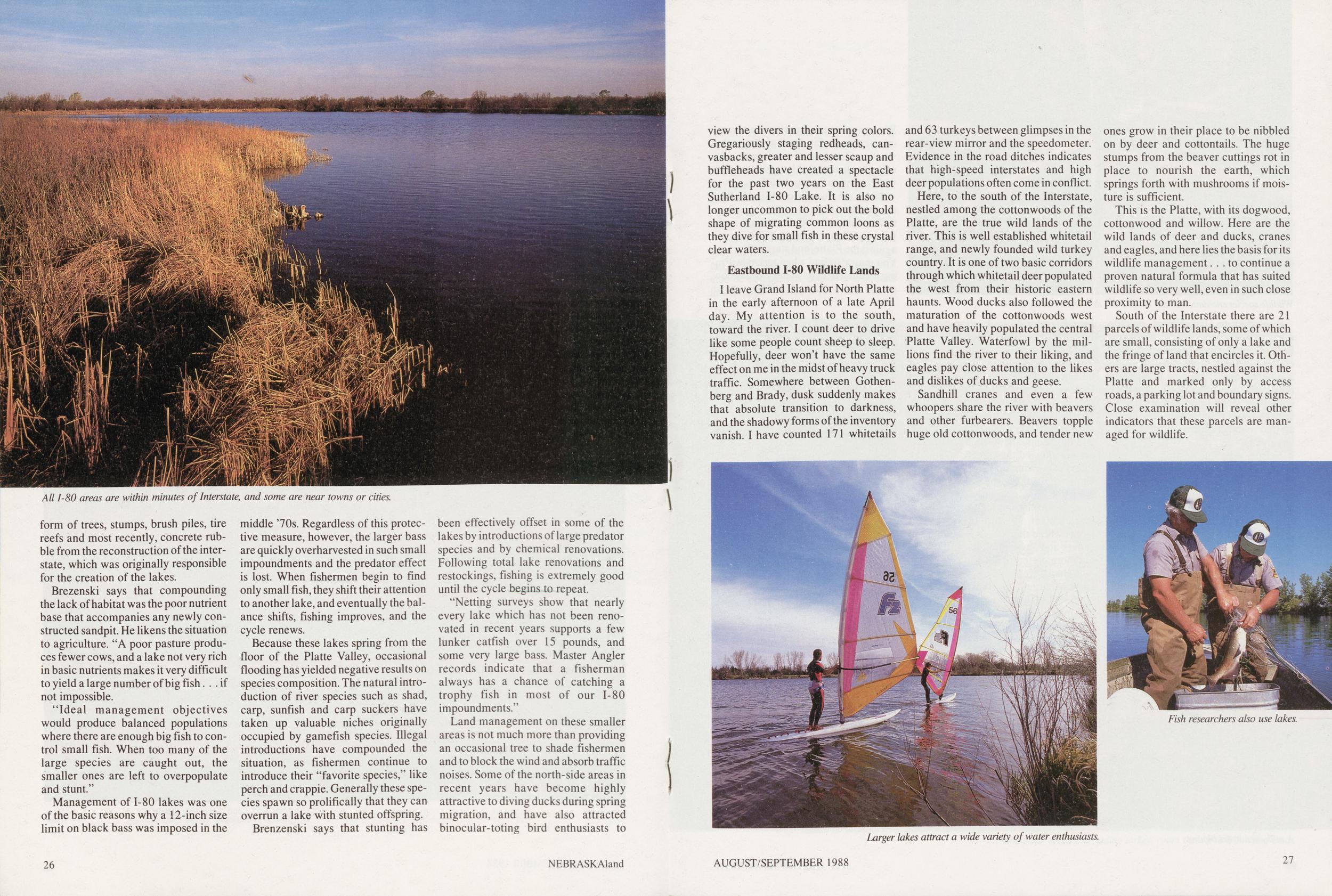
Land management on these smaller areas is not much more than providing an occasional tree to shade fishermen and to block the wind and absorb traffic noises. Some of the north-side areas in recent years have become highly attractive to diving ducks during spring migration, and have also attracted binocular-toting bird enthusiasts to 26 NEBRASKAland view the divers in their spring colors. Gregariously staging redheads, canvasbacks, greater and lesser scaup and buffleheads have created a spectacle for the past two years on the East Sutherland 1-80 Lake. It is also no longer uncommon to pick out the bold shape of migrating common loons as they dive for small fish in these crystal clear waters.
Eastbound 1-80 Wildlife LandsI leave Grand Island for North Platte in the early afternoon of a late April day. My attention is to the south, toward the river. I count deer to drive like some people count sheep to sleep. Hopefully, deer won't have the same effect on me in the midst of heavy truck traffic. Somewhere between Gothenberg and Brady, dusk suddenly makes that absolute transition to darkness, and the shadowy forms of the inventory vanish. I have counted 171 whitetails and 63 turkeys between glimpses in the rear-view mirror and the speedometer. Evidence in the road ditches indicates that high-speed interstates and high deer populations often come in conflict.
Here, to the south of the Interstate, nestled among the cottonwoods of the Platte, are the true wild lands of the river. This is well established whitetail range, and newly founded wild turkey country. It is one of two basic corridors through which whitetail deer populated the west from their historic eastern haunts. Wood ducks also followed the maturation of the cottonwoods west and have heavily populated the central Platte Valley. Waterfowl by the millions find the river to their liking, and eagles pay close attention to the likes and dislikes of ducks and geese.
Sandhill cranes and even a few whoopers share the river with beavers and other fur bearers. Beavers topple huge old cottonwoods, and tender new ones grow in their place to be nibbled on by deer and cottontails. The huge stumps from the beaver cuttings rot in place to nourish the earth, which springs forth with mushrooms if moisture is sufficient.
This is the Platte, with its dogwood, cottonwood and willow. Here are the wild lands of deer and ducks, cranes and eagles, and here lies the basis for its wildlife management... to continue a proven natural formula that has suited wildlife so very well, even in such close proximity to man.
South of the Interstate there are 21 parcels of wildlife lands, some of which are small, consisting of only a lake and the fringe of land that encircles it. Others are large tracts, nestled against the Platte and marked only by access roads, a parking lot and boundary signs. Close examination will reveal other indicators that these parcels are managed for wildlife.
According to Dick Nelson, wildlife management supervisor for southwest Nebraska and responsible for the western half of Platte River Wildlife Management Areas, "You won't find grazing in these areas, as you won't find tree cutting or large tracts of farming. In fact, you won't find much evidence at all that man is influencing these wildlife areas."
Nelson says that visitors will find warm-season native grasses re-established in areas where corn or other crops used to grow, and possibly some food plots of millet, milo and sunflowers to bolster the pantry of those species of wildlife that inhabit the Platte Valley.
There won't even be any massive tree and shrub plantings that are sometimes typical of our other managed areas. Nature has done that for us, and the only plantings we have undertaken have been for diversification or possibly some experimentation with hardwoods and nut-bearing species."
When grass fires used to roar unchecked out of the Sandhills, only the Platte could stop them, and in the process, large tree stands were prevented. Nutrients from the fire itself triggered the germination of lush undergrowth, and life began anew. Today, wild fires are not allowed their freedom, and the Platte is growing up ... in some cases being choked. Nelson said that land managers are currently considering some controlled-burning programs on Platte River Wildlife Management Areas where there is concern that red cedars and Russian olives are forcing out more preferred cover types.
Richard Knox, who manages the eastern Platte Valley complex for the Game and Parks Commission, agrees that management here is really as little management as possible.
"Our philosophy on Platte River lands is to protect the natural integrity of the areas as much as possible. The only annual programs currently carried out are the planting of food plots on those areas we feel will be benefitted.
"When a management philosophy on public land is to protect what has occurred naturally, then one of the greatest challenges becomes people management. These aren't parklands, and the public shouldn't expect to find the improvements here that they do on designated park and recreation areas.
We do not require a park permit or any other entrance fee, for that matter, but we do offer a true experience with nature in an area that has gained world wide attention for its wildlife.
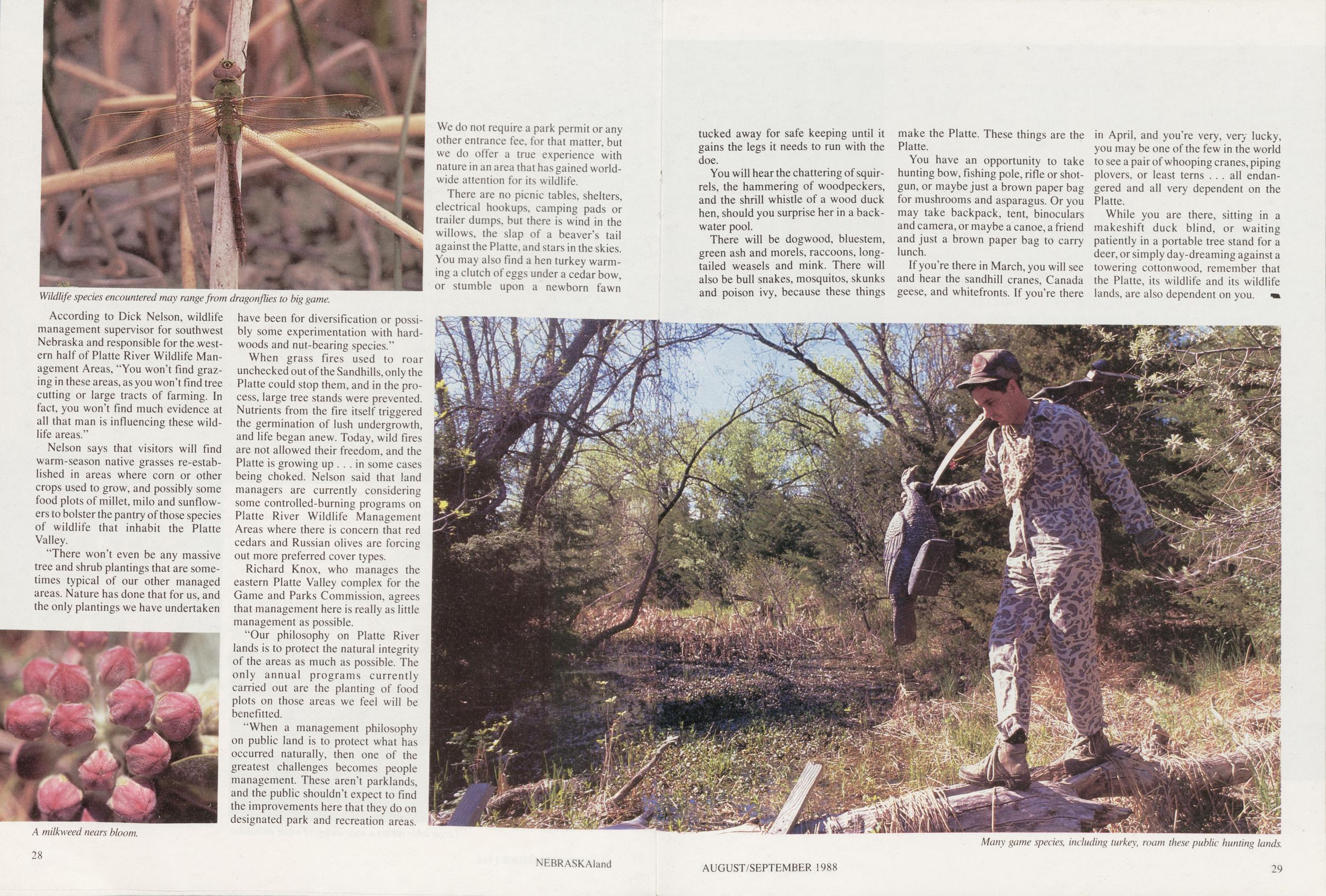
There are no picnic tables, shelters, electrical hookups, camping pads or trailer dumps, but there is wind in the willows, the slap of a beaver's tail against the Platte, and stars in the skies. You may also find a hen turkey warming a clutch of eggs under a cedar bow, or stumble upon a newborn fawn 28 NEBRASKAland tucked away for safe keeping until it gains the legs it needs to run with the doe.
You will hear the chattering of squirrels, the hammering of woodpeckers, and the shrill whistle of a wood duck hen, should you surprise her in a backwater pool.
There will be dogwood, bluestem, green ash and morels, raccoons, longtailed weasels and mink. There will also be bull snakes, mosquitos, skunks and poison ivy, because these things make the Platte. These things are the Platte.
You have an opportunity to take hunting bow, fishing pole, rifle or shotgun, or maybe just a brown paper bag for mushrooms and asparagus. Or you may take backpack, tent, binoculars and camera, or maybe a canoe, a friend and just a brown paper bag to carry lunch.
If you're there in March, you will see and hear the sandhill cranes, Canada geese, and whitefronts. If you're there in April, and you're very, very lucky, you may be one of the few in the world to see a pair of whooping cranes, piping plovers, or least terns ... all endangered and all very dependent on the Platte.
While you are there, sitting in a makeshift duck blind, or waiting patiently in a portable tree stand for a deer, or simply day-dreaming against a towering cottonwood, remember that the Platte, its wildlife and its wildlife lands, are also dependent on you.
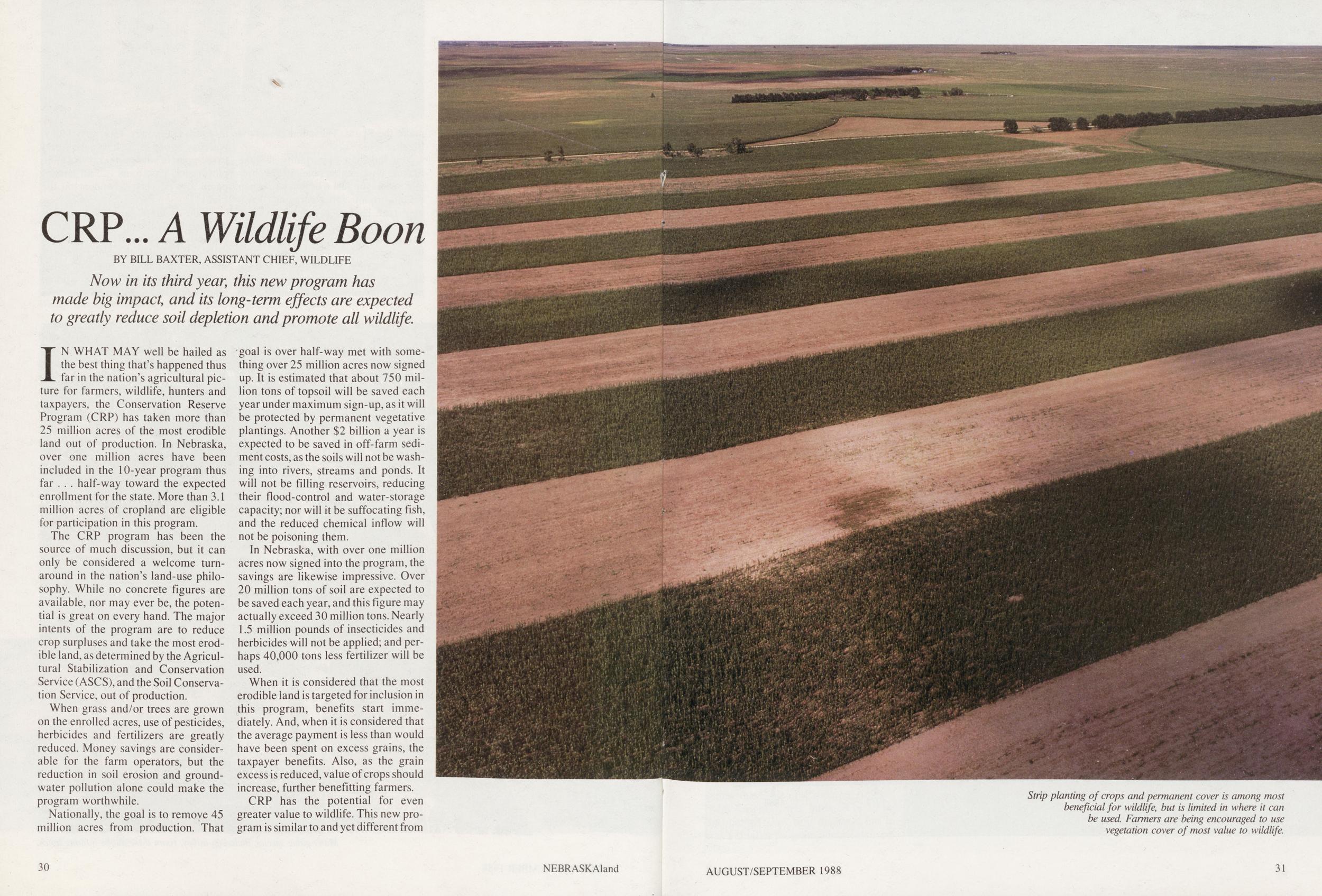
CRP... A Wildlife Boon
BY BILL BAXTER, ASSISTANT CHIEF, WILDLIFE Now in its third year, this new program has made big impact, and its long-term effects are expected to greatly reduce soil depletion and promote all wildlife.IN WHAT MAY well be hailed as the best thing that's happened thus far in the nation's agricultural picture for farmers, wildlife, hunters and taxpayers, the Conservation Reserve Program (CRP) has taken more than 25 million acres of the most erodible land out of production. In Nebraska, over one million acres have been included in the 10-year program thus far . . . half-way toward the expected enrollment for the state. More than 3.1 million acres of cropland are eligible for participation in this program.
The CRP program has been the source of much discussion, but it can onlv be considered a welcome turn around in the nation's land-use philosophy. While no concrete figures are available, nor may ever be, the potential is great on every hand. The major intents of the program are to reduce crop surpluses and take the most erodible land, as determined by the Agricultural Stabilization and Conservation Service (ASCS), and the Soil Conservation Service, out of production.
When grass and/or trees are grown on the enrolled acres, use of pesticides, herbicides and fertilizers are greatly reduced. Money savings are consider- able for the farm operators, but the reduction in soil erosion and groundwater pollution alone could make the program worthwhile.
Nationally, the goal is to remove 45 million acres from production. That goal is over half-way met with something over 25 million acres now signed up. It is estimated that about 750 million tons of topsoil will be saved each year under maximum sign-up, as it will be protected by permanent vegetative plantings. Another $2 billion a year is expected to be saved in off-farm sediment costs, as the soils will not be washing into rivers, streams and ponds. It will not be filling reservoirs, reducing their flood-control and water-storage capacity; nor will it be suffocating fish, and the reduced chemical inflow will not be poisoning them.
In Nebraska, with over one million acres now signed into the program, the savings are likewise impressive. Over 20 million tons of soil are expected to be saved each year, and this figure may actually exceed 30 million tons. Nearly 1.5 million pounds of insecticides and herbicides will not be applied; and perhaps 40,000 tons less fertilizer will be used.
When it is considered that the most erodible land is targeted for inclusion in this program, benefits start immediately. And, when it is considered that the average payment is less than would have been spent on excess grains, the taxpayer benefits. Also, as the grain excess is reduced, value of crops should increase, further benefitting farmers.
CRP has the potential for even greater value to wildlife. This new program is similar to and yet different from the "Soil Bank" program of the 1950s, which brought such a resurgence in pheasants and other wildlife.
30 NEBRASKAland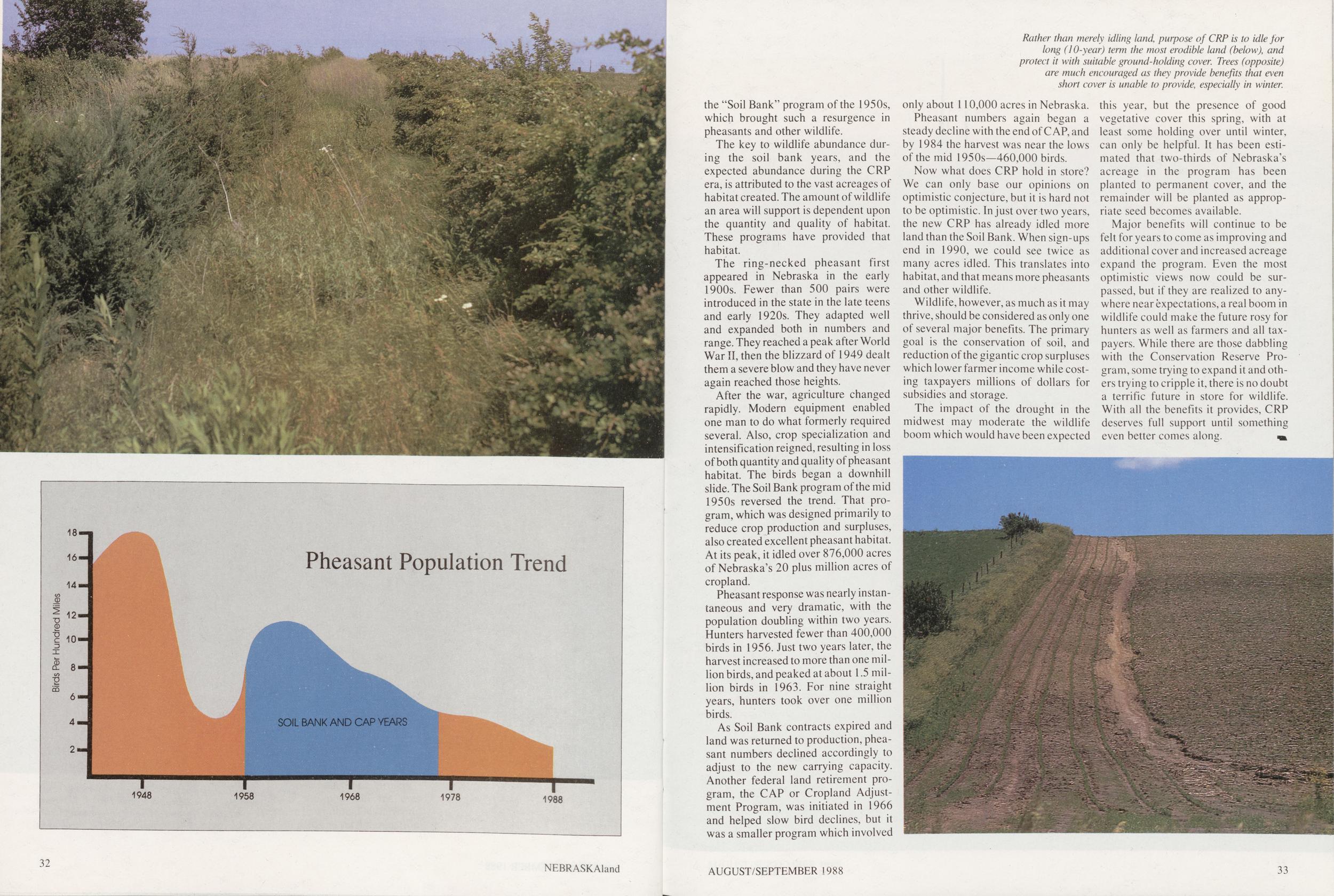
The key to wildlife abundance during the soil bank years, and the expected abundance during the CRP era, is attributed to the vast acreages of habitat created. The amount of wildlife an area will support is dependent upon the quantity and quality of habitat. These programs have provided that habitat.
The ring-necked pheasant first appeared in Nebraska in the early 1900s. Fewer than 500 pairs were introduced in the state in the late teens and early 1920s. They adapted well and expanded both in numbers and range. They reached a peak after World War II, then the blizzard of 1949 dealt them a severe blow and they have never again reached those heights.
After the war, agriculture changed rapidly. Modern equipment enabled one man to do what formerly required several. Also, crop specialization and intensification reigned, resulting in loss of both quantity and quality of pheasant habitat. The birds began a downhill slide. The Soil Bank program of the mid 1950s reversed the trend. That program, which was designed primarily to reduce crop production and surpluses, also created excellent pheasant habitat. At its peak, it idled over 876,000 acres of Nebraska's 20 plus million acres of cropland.
Pheasant response was nearly instantaneous and very dramatic, with the population doubling within two years. Hunters harvested fewer than 400,000 birds in 1956. Just two years later, the harvest increased to more than one million birds, and peaked at about 1.5 million birds in 1963. For nine straight years, hunters took over one million birds.
As Soil Bank contracts expired and land was returned to production, pheasant numbers declined accordingly to adjust to the new carrying capacity. Another federal land retirement program, the CAP or Cropland Adjustment Program, was initiated in 1966 and helped slow bird declines, but it was a smaller program which involved only about 110,000 acres in Nebraska.
Pheasant numbers again began a steady decline with the end of CAP, and by 1984 the harvest was near the lows of the mid 1950s—460,000 birds.
Now what does CRP hold in store? We can only base our opinions on optimistic conjecture, but it is hard not to be optimistic. In just over two years, the new CRP has already idled more land than the Soil Bank. When sign-ups end in 1990, we could see twice as many acres idled. This translates into habitat, and that means more pheasants and other wildlife.
Wildlife, however, as much as it may thrive, should be considered as only one of several major benefits. The primary goal is the conservation of soil, and reduction of the gigantic crop surpluses which lower farmer income while costing taxpayers millions of dollars for subsidies and storage.
The impact of the drought in the midwest may moderate the wildlife boom which would have been expected this year, but the presence of good vegetative cover this spring, with at least some holding over until winter, can only be helpful. It has been estimated that two-thirds of Nebraska's acreage in the program has been planted to permanent cover, and the remainder will be planted as appropriate seed becomes available.
Major benefits will continue to be felt for years to come as improving and additional cover and increased acreage expand the program. Even the most optimistic views now could be surpassed, but if they are realized to anywhere near expectations, a real boom in wildlife could make the future rosy for hunters as well as farmers and all taxpayers. While there are those dabbling with the Conservation Reserve Program, some trying to expand it and others trying to cripple it, there is no doubt a terrific future in store for wildlife. With all the benefits it provides, CRP deserves full support until something even better comes along.
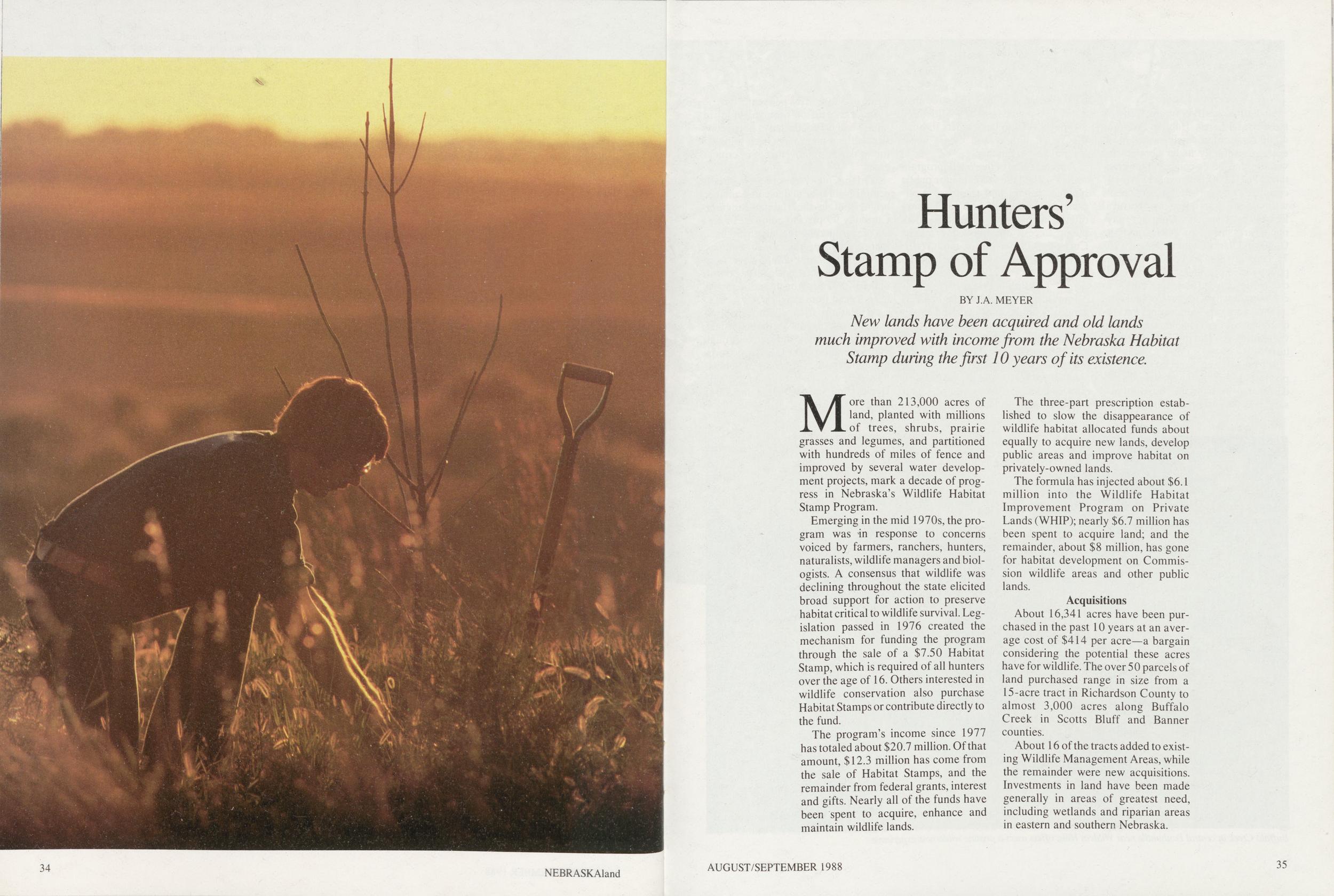
Hunters' Stamp of Approval
BY J.A. MEYER New lands have been acquired and old lands much improved with income from the Nebraska Habitat Stamp during the first 10 years of its existence.More than 213,000 acres of land, planted with millions of trees, shrubs, prairie grasses and legumes, and partitioned with hundreds of miles of fence and improved by several water development projects, mark a decade of progress in Nebraska's Wildlife Habitat Stamp Program.
Emerging in the mid 1970s, the program was in response to concerns voiced by farmers, ranchers, hunters, naturalists, wildlife managers and biologists. A consensus that wildlife was declining throughout the state elicited broad support for action to preserve habitat critical to wildlife survival. Legislation passed in 1976 created the mechanism for funding the program through the sale of a $7.50 Habitat Stamp, which is required of all hunters over the age of 16. Others interested in wildlife conservation also purchase Habitat Stamps or contribute directly to the fund.
The program's income since 1977 has totaled about $20.7 million. Of that amount, $12.3 million has come from the sale of Habitat Stamps, and the remainder from federal grants, interest and gifts. Nearly all of the funds have been spent to acquire, enhance and maintain wildlife lands.
The three-part prescription established to slow the disappearance of wildlife habitat allocated funds about equally to acquire new lands, develop public areas and improve habitat on privately-owned lands.
The formula has injected about $6.1 million into the Wildlife Habitat Improvement Program on Private Lands (WHIP); nearly $6.7 million has been spent to acquire land; and the remainder, about $8 million, has gone for habitat development on Commission wildlife areas and other public lands.
AcquisitionsAbout 16,341 acres have been purchased in the past 10 years at an average cost of $414 per acre—a bargain considering the potential these acres have for wildlife. The over 50 parcels of land purchased range in size from a 15-acre tract in Richardson County to almost 3,000 acres along Buffalo Creek in Scotts Bluff and Banner counties.
About 16 of the tracts added to existing Wildlife Management Areas, while the remainder were new acquisitions. Investments in land have been made generally in areas of greatest need, including wetlands and riparian areas in eastern and southern Nebraska.
AUGUST/SEPTEMBER 1988 35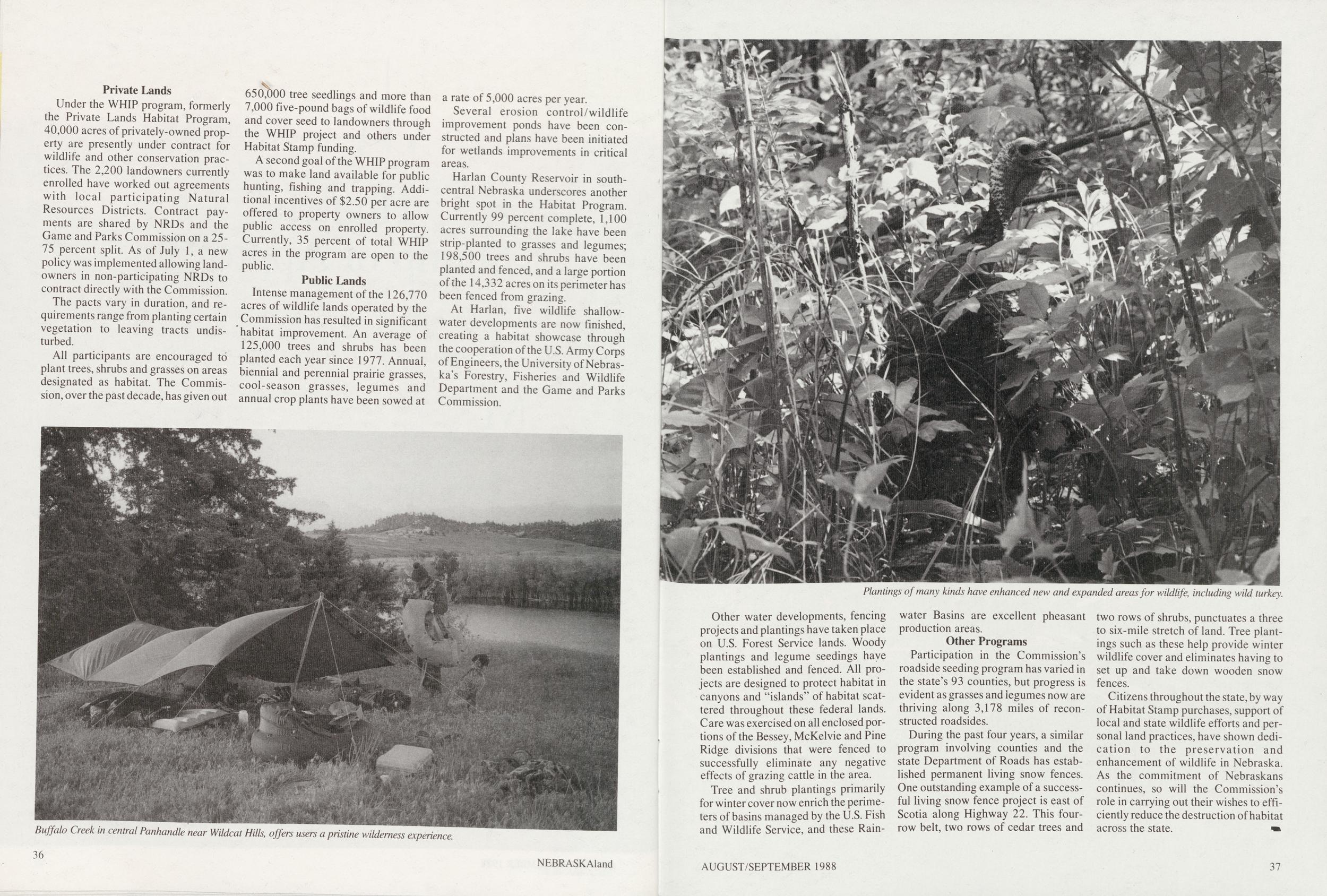 Private Lands
Under the WHIP program, formerly the Private Lands Habitat Program, 40,000 acres of privately-owned property are presently under contract for wildlife and other conservation practices. The 2,200 landowners currently enrolled have worked out agreements with local participating Natural Resources Districts. Contract payments are shared by NRDs and the Game and Parks Commission on a 25-75 percent split. As of July 1, a new policy was implemented allowing landowners in non-participating NRDs to contract directly with the Commission.
The pacts vary in duration, and requirements range from planting certain vegetation to leaving tracts undisturbed.
All participants are encouraged to plant trees, shrubs and grasses on areas designated as habitat. The Commission, over the past decade, has given out 650,000 tree seedlings and more than 7,000 five-pound bags of wildlife food and cover seed to landowners through the WHIP project and others under Habitat Stamp funding.
A second goal of the WHIP program was to make land available for public hunting, fishing and trapping. Additional incentives of $2.50 per acre are offered to property owners to allow public access on enrolled property. Currently, 35 percent of total WHIP acres in the program are open to the public.
Public LandsIntense management of the 126,770 acres of wildlife lands operated by the Commission has resulted in significant habitat improvement. An average of 125,000 trees and shrubs has been planted each year since 1977. Annual, biennial and perennial prairie grasses, cool-season grasses, legumes and annual crop plants have been sowed at a rate of 5,000 acres per year.
Several erosion control/wildlife improvement ponds have been constructed and plans have been initiated for wetlands improvements in critical areas.
Harlan County Reservoir in south- central Nebraska underscores another bright spot in the Habitat Program. Currently 99 percent complete, 1,100 acres surrounding the lake have been strip-planted to grasses and legumes; 198,500 trees and shrubs have been planted and fenced, and a large portion of the 14,3 3 2 acres on its perimeter has been fenced from grazing.
At Harlan, five wildlife shallow- water developments are now finished, creating a habitat showcase through the cooperation of the U.S. Army Corps of Engineers, the University of Nebraska's Forestry, Fisheries and Wildlife Department and the Game and Parks Commission.
Other water developments, fencing projects and plantings have taken place on U.S. Forest Service lands. Woody plantings and legume seedings have been established and fenced. All projects are designed to protect habitat in canyons and "islands" of habitat scattered throughout these federal lands. Care was exercised on all enclosed portions of the Bessey, McKelvie and Pine Ridge divisions that were fenced to successfully eliminate any negative effects of grazing cattle in the area.
Tree and shrub plantings primarily for winter cover now enrich the perimeters of basins managed by the U.S. Fish and Wildlife Service, and these Rainwater Basins are excellent pheasant production areas.
Other ProgramsParticipation in the Commission's roadside seeding program has varied in the state's 93 counties, but progress is evident as grasses and legumes now are thriving along 3,178 miles of reconstructed roadsides.
During the past four years, a similar program involving counties and the state Department of Roads has established permanent living snow fences. One outstanding example of a successful living snow fence project is east of Scotia along Highway 22. This fourrow belt, two rows of cedar trees and two rows of shrubs, punctuates a three to six-mile stretch of land. Tree plantings such as these help provide winter wildlife cover and eliminates having to set up and take down wooden snow fences.
Citizens throughout the state, by way of Habitat Stamp purchases, support of local and state wildlife efforts and personal land practices, have shown dedication to the preservation and enhancement of wildlife in Nebraska. As the commitment of Nebraskans continues, so will the Commission's role in carrying out their wishes to efficiently reduce the destruction of habitat across the state. ^
AUGUST/SEPTEMBER 1988 37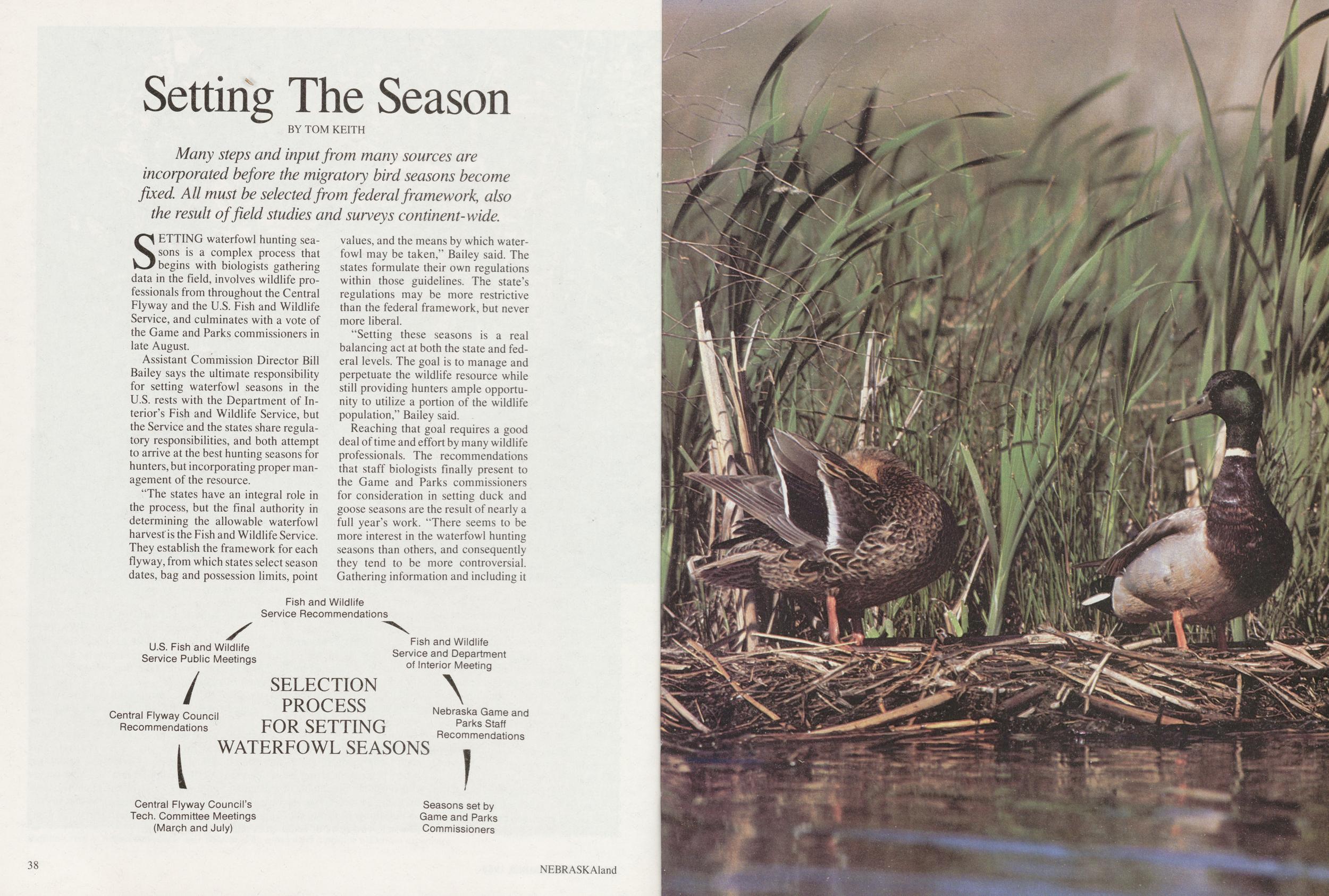
Setting The Season
BY TOM KEITH Many steps and input from many sources are incorporated before the migratory bird seasons become fixed. All must be selected from federal framework, also the result of field studies and surveys continent-wide.SETTING waterfowl hunting seasons is a complex process that begins with biologists gathering data in the field, involves wildlife professionals from throughout the Central Flyway and the U.S. Fish and Wildlife Service, and culminates with a vote of the Game and Parks commissioners in late August.
Assistant Commission Director Bill Bailey says the ultimate responsibility for setting waterfowl seasons in the U.S. rests with the Department of Interior's Fish and Wildlife Service, but the Service and the states share regulatory responsibilities, and both attempt to arrive at the best hunting seasons for hunters, but incorporating proper management of the resource.
"The states have an integral role in the process, but the final authority in determining the allowable waterfowl harvest is the Fish and Wildlife Service. They establish the framework for each flyway, from which states select season dates, bag and possession limits, point values, and the means by which waterfowl may be taken," Bailey said. The states formulate their own regulations within those guidelines. The state's regulations may be more restrictive than the federal framework, but never more liberal.
Fish and Wildlife Service Recommendations U.S. Fish and Wildlife Service Public Meetings Fish and Wildlife Service and Department of Interior Meeting Central Flyway Council Recommendations SELECTION PROCESS FOR SETTING WATERFOWL SEASONS Nebraska Game and Parks Staff Recommendations Central Flyway Council's Tech. Committee Meetings (March and July) Seasons set by Game and Parks Commissioners"Setting these seasons is a real balancing act at both the state and federal levels. The goal is to manage and perpetuate the wildlife resource while still providing hunters ample opportunity to utilize a portion of the wildlife population," Bailey said.
Reaching that goal requires a good deal of time and effort by many wildlife professionals. The recommendations that staff biologists finally present to the Game and Parks commissioners for consideration in setting duck and goose seasons are the result of nearly a full year's work. "There seems to be more interest in the waterfowl hunting seasons than others, and consequently they tend to be more controversial. Gathering information and including it 38 NEBRASKAland
 in season-setting is therefor important,
and is an almost continual process."
in season-setting is therefor important,
and is an almost continual process."
And, it isn't easy. One thing that makes setting regulations difficult is that when biologists are working with waterfowl they are trying to manage a shared resource—shared by different areas of the state, between different states, and even between nations. "It is a cooperative effort, and has to be, because what happens in one area affects all the others," Bailey said.
Commission Waterfowl Specialist Joe Gabig says the staff recommendations made to the commissioners are anything but arbitrary. "After all our internal studies, surveys and data compilations, we arrive at our recommendations. Then, before these are presented to the commissioners, they are distilled by a lengthy process consisting of a series of working meetings between state and federal biologists and wildlife administrators."
Here's a glimpse at the process: The Central Flyway is made up of Montana, Wyoming, North and South Dakota, Nebraska, Kansas, Colorado, Oklahoma, Texas and New Mexico; and two Canadian provinces, Saskatchewan and Alberta. Representatives from each state and province form the Central Flyway Council's Technical Committee, which meets each March and July.
At the March meeting, members present and discuss information pertaining to doves, sandhill cranes and other migratory species. They also begin the process of planning that year's waterfowl hunting seasons and to identify and discuss expected changes.
Then, in July, after much more information including waterfowl fall flight population forecasts and the availability and quality of wetland nesting areas has been collected, they meet again to develop regulation recommendations for the upcoming season. "The goal is to construct biologically sound recommendations for the hunting seasons," Gabig said.
After the March and July meetings the Technical Committee presents its findings and recommendations to the Central Flyway Council, a group of administrators from each of the flyway states and provinces. The Council acts upon recommendations of the Technical Committee and then presents the recommendations of the council to the Fish and Wildlife Service. The Council has functioned to develop flyway management for certain species of waterfowl; revised and made recommendations in the North American Waterfowl Management Plan; developed recommendations for various information and education programs; developed waterfowl banding programs and other related duties. In addition, the Council discusses every issue currently affecting migratory birds including swans, geese, ducks, cranes, doves and other species.
Representatives from each flyway take the flyway council's recommendations to the Fish and Wildlife Service's Regulations Committee. That committee then holds a hearing for public input, and finally makes its own recommendations on waterfowl season frameworks based on all the information at hand, and presents them to the director of the Fish and Wildlife Service for final approval by the A ssistant Secretary of the Department of Interior.
The Game and Parks Commission's wildlife biologists then formulate recommendations within this framework that they determine are best for managing and perpetuating wildlife in Nebraska while providing maximum sport hunting opportunity. Those recommendations are presented to the commissioners for action at their August meeting at Commission Headquarters in Lincoln. The season-setting portion of that August meeting is held in the evening so that interested persons may attend and voice their opinions at a public hearing prior to the commissioners making their final decisions.
40 NEBRASKAland
Hunter Ethics Something To Live By
BY DICK TURPIN, HUNTER SAFETY COORDINATORETHICS are a much desired standard of conduct in any field of endeavor, but good moral judgment is often clouded by a plethora of temptations or weaknesses. How are we to know what is ethical, and who sets the standards?
The truth is, ethics are as different and as varied as the factions of society who prescribe them and subscribe to them. Confusing as ethics may be, they exist in everything we do, both at work and play.
It seems our nation is obsessed with competition. On any given weekend, athletic fields are busy with young players of all types of sports, plus the parents, cheering on son or daughter. Lessons learned here are important to the future of these youngsters, for here, in theory, is where respect, humility and sportsmanship are learned.
Well, times change, and our values do also. One group in our society affected by some of these changes is that of the hunter. There are similarities in athletics and hunting in that competitiveness seems to thrive in both. In theory, the challenges in hunting should exist between man and the wilderness, but today, the challenge seems to be between hunters. You beat other hunt- ers by taking more pheasants or killing a bigger buck. This kind of competitive attitude tends to encourage undesirable hunter behavior.
There are those hunters who are quick to tell you they had their limit by 9:30 a.m., but may be somewhat reluctant to tell you how they did it. The competitive spirit has led to behavioral problems in hunting just as it has in athletics.
Ever wonder what a professional game would be like with no fans and no umpires? Fans and officials are what keep the game in check. Now ask yourself where are the umpires and fans in hunting? The maintenance of ethical behavior has to come from the hunter himself.
The importance of ethics in hunting is probably underestimated simply because most of the time, violations of ethics or laws are not witnessed. The hunter may justify any wrongdoing in his own mind, and all too often, when he relates his story to friends, his peers will condone what he has done. This philosophy of carelessness is deteriorating our ethical standards. Does it matter?
Remember that ethics are conforming to the standards of conduct of society as a whole, not of a few acquaintances whose behavior may not be up to par. Those peers may accept our behavior, but we must look at behavior from a better perspective.
Hunters in this nation make up about 10 percent of the population, which leaves roughly 200 million people who may or may not hold the same opinions. A hunter is one in 10—a definite minority. It doesn't take much figuring to conclude that if hunting is to continue in our society, the hunter must improve his image. For as private as hunting may be, there are always bad examples in front of the non-hunting public. The deer hunter who legally and ethically kills a nice buck can be proud of his hunting activity. When he ties that buck to his car to return home, other hunters are not offended, but what of the other 200 million people? They, most likely, won't be thinking about the challenges and quality of the hunt. They would, however, probably be "turned off by the sight of a dead animal, perhaps with blood dripping from it, prominently displayed on the vehicle. Transporting game animals on top of vehicles is legal, but if there is even a slight chance of offending another segment of society, why do it?
Field dressing game birds is a necessity to maintain their quality, and many hunters do this. It is truly an ethical thing to do, but why would a hunter dress birds alongside the road for all passersby to see?
How we are perceived as hunters depends totally on us, the hunters, and so does the future of hunting. Are we to be seen as Rambos with automatic weapons and belts of ammunition, or as dedicated, responsible outdoorsmen who care for the resource and subscribe to the highest ethical standards. Hunting in this country is a privilege, not a right. Our defense is not in a constitutional challenge, for hunting is not mentioned in the BUI of Rights. Our defense is that regulated hunting is biologically sound and is done by responsible people. Do all you can to ensure that your neighbors and friends see you as a good hunter .. . one never needs to be ashamed for having ethics.
Bucking the Years
(Continued from page 11)before the end of shooting time.
"It was just after sundown, or when sundown should have been," Frank said when we reached him in the clearing. "Deer started showing up all over. I'd look at this one in the scope and it would move over and stand behind a tree with just the end of its nose sticking out. Seemed like they intentionally hid where the horns should be so you couldn't tell. I'd look and look and finally it would move, and nope, it was another doe. I'd take the rifle down and look, and there would be another one over there and I'd scope it out. It was a doe. Then pretty soon there would be another one over in the trees, and it was a doe.
It kept getting a little later and little later and they kept coming out closer, and pretty soon this buck came out around the trees. When he got out in the open I could see horns. He was at the end of the clearing, right where the buck was this morning, about 200 yards. After the first shot he didn't go clear down, so I threw another one at him to stop him before he got to the trees, but I don't think that one hit him. Through the scope I saw him lie down, so I gathered up my stuff and started down out of the tree. He went down just beyond a tree stump, but when I got there I couldn't find him."
We looked for the deer or blood until it was too dark to see and then returned to the truck for a flashlight. Even though we curry-combed the woods and thickets, we could find no sign. No hunter likes to lose a deer for a whole bunch of reasons. And for Frank, who has no small reputation as a crack rifle shot, notwithstanding his 70-plus years, the nagging thought that his shooting eye wasn't what it used to be, was probably not too far down the list.
A light rain had fallen overnight. Highway 22 was tar black in the headlights on Sunday morning and no dust churned behind the pickup on the trail along the cornfield to the timber. Colorado was being battered by the season's first snow storm, and before sundown Stapleton airport in Denver would be closed. By the end of the day, 12 inches of snow would be piled in Mullen and rain was moving east ahead of it. The front was moving a little slower than expected, though, and had not settled in over the eastern third of the state, yet.
WORLD'S FOREMOST OUTFITTER HUNTING, FISHING, OUTDOOR GEAR 1988 FALL WORLD'S OUTFITTER KUNTiNG,AND OUTDOOR GEAR Clothing . . . Footwear . . . Optics . . . Knives Gun Cases ... Bows . . . Arrows . . . Decoys ^ Gifts . . Reloading . . . Thousands of items! FREE CATALOGS WILL ARRIVE THROUGHOUT THE YEAR! 100% SATISFACTION GUARANTEEI Send a free subscription to your friend. 0 Yes, Please Send My Free Subscription. NAME NAME ADDRESS CITY ADDRESS CITY STATE ZIP MAIL TODAY TO RESERVE YOUR STATE ZIP &&>&+ 863-808 h Sidney v FALL ISSUE! %, eYCTCCIffO Nebraska 69160/ Limited-edition Belt Buckle Malcolm Gun Club would like to congratulate Robert Mayer on his painting of mallards to be featured on the 1989 Nebraska Wildlife Habitat Stamp. The AAalcolm Gun Club will again present a facsimile of the Nebraska 1989 Wildlife Habitat Stamp as a belt buckle in cooperation with Artist Robert Mayer and the Nebraska Game and Parks Commission. These heavy, top-quality buckles, by the Award Design Medals Company, are limited to 1,000 brass; 200 gold/silver plate and 100 solid sterling silver. Each is registered by name and number, so purchaser has first choice at future editions. To order, send money order or check to: Malcolm Gun Club, P.O. Box 194, Malcolm, NE 68402. Phone (402) 796-2173 or 796-2244. Prices are: Brass-$19.95, Gold/silverplate-$45, Solid SHver-$135 Please include $1.80 for packing and shipping + 4% sales tax. Allow four to six weeks for delivery. Size approximately 4 inches by 3 inches. A few 1984/85/86/87/88 buckles are a available at prices listed above. AUGUST/SEPTEMBER 1988 43 Give a Gift to the Wildlife of Nebraska
"Storm Shelter'
Limited Edition of 2000
Jim Morgan
Operation Game Thief is a non-profit organization that supplies a
toll-free number and offers rewards for information leading to the
arrest of violators of Nebraska's game laws: poaching, hunting or
trapping illegally, or dumping toxic substances. Operation Game
Thief has been operating for 3 years, and has accounted for the arrest
of 83 violators—who may well
Game Thief. But, we need your financial support.
For your tax-deductible contribution of $40 (plus $2.50 shipping and
handling), we will send you, as a special thank-you, a beautiful full
color, signed, limited edition print. For your contribution of $100
(plus $5.00 shipping and handling), we will send you a museum-
mounted print, in a beautiful 18" x 22" oak frame with your choice of
Camel or Bar Harbor Gray mat. This year's print features "Storm
Shelter" by Jim Morgan, noted wildlife artist from Mendon, Utah.
Please send coupon below, along with your check or money order to:
Operation Game Thief Print
P.O. Box 756
Platte, NE 69103
Send me
prints Amount enclosed $_________________
_ Unframed ____Framed_____Bar Harbor Gray Mat Camel Mat
Signature
Name ___
Address
Give a Gift to the Wildlife of Nebraska
"Storm Shelter'
Limited Edition of 2000
Jim Morgan
Operation Game Thief is a non-profit organization that supplies a
toll-free number and offers rewards for information leading to the
arrest of violators of Nebraska's game laws: poaching, hunting or
trapping illegally, or dumping toxic substances. Operation Game
Thief has been operating for 3 years, and has accounted for the arrest
of 83 violators—who may well
Game Thief. But, we need your financial support.
For your tax-deductible contribution of $40 (plus $2.50 shipping and
handling), we will send you, as a special thank-you, a beautiful full
color, signed, limited edition print. For your contribution of $100
(plus $5.00 shipping and handling), we will send you a museum-
mounted print, in a beautiful 18" x 22" oak frame with your choice of
Camel or Bar Harbor Gray mat. This year's print features "Storm
Shelter" by Jim Morgan, noted wildlife artist from Mendon, Utah.
Please send coupon below, along with your check or money order to:
Operation Game Thief Print
P.O. Box 756
Platte, NE 69103
Send me
prints Amount enclosed $_________________
_ Unframed ____Framed_____Bar Harbor Gray Mat Camel Mat
Signature
Name ___
Address
The morning dawned gray. Squirrels and chickadees were frantically feeding as if they knew what was coming. By 8:30 a.m. the sun was trying to burn through the overcast sky. Frank and Paul had decided to quit at 9 a.m., so I walked in to the timber to see how they had done.
There had been no shots. The deer were not moving. Since it was still early, we decided to look again for the buck Frank was sure he had hit the night before, this time with enough light to see. There had been no wind overnight so a blood trail on the leaf litter would still be visible if the light rain had not washed it away.
Less than a 50 yards west of where Frank had marked the deer down, he found the first pool of dried blood. Fifty yards farther at the end of an unbroken blood trail, we found the buck. It had one shot through the chest and was still in good condition. Frank may admit his legs aren't what they used to be, but it would be hard to convince him his eyes aren't as good as ever. We gutted the young buck out and loaded it on the truck.
By mid afternoon on Sunday, it started to rain. Paul stuck it out in the tree stand but the deer weren't moving. It rained through the night and by Monday morning the half-mile dirt trail along the cornfield to the river was axle-deep mud. When the deer season closed a week later, Paul had passed up dozens of does waiting for the buck that never came into the open. It was the first year in many that his permit was not cancelled.
When Paul and Frank were young, wood ducks didn't nest on the sluggish little creek that comes to the Loup River where they hunt, and deer were nearly as scarce across Nebraska. Paul swore he'd never see the day he could hunt wild turkey in his home county, but in the spring of 1988 he shot a big torn within sight of his deer stand. Between the two of them, Paul and Frank have hauled home a lot of game over the years, and seen some major changes in wildlife abundance. Admittedly, some game animals are less abundant than they were during the early years of the century, but many more have increased their range and numbers.
Next November, I bet I know of a couple of veteran hunters who will be 44 NEBRASKAland back in the cottonwoods when the first light comes to the Loup River bottom; and when the cookies come out of the sack and a round of coffee is poured, I'd wager a modest amount that they have their rifles on the tailgate of the pickup.
It's better to get your buck than not, but for Paul and Frank there had been many seasons, many deer. It almost seemed like the ritual mattered more now—the predawn breakfast; the drive down quiet roads; the heft in your hand of an "ought-six" with the bluing worn off the scope and the checkering on the stock smoothed by gloved hands; the walk along a familiar deer trail through middle-age cottonwoods to a stand where you once killed a four-pointer; being there when the gray melts away to yellow on the eastern horizon. How would you measure November's passing if not by sitting in a deer stand?
Living Off the Land
(Continued from page 19)surplus to sell, although there were exceptions. Hanna remembers Jim Hatter having a couple of hundred pigs that "roamed up and down the river; ran wild."
Ava said that everybody had some hogs. Her father always had Poland Chinas, but he tried both Hampshire and Durocks. "He had those Hampshires two seasons and then took them to market. He couldn't keep them in. They'd break down everything you'd put 'em into. They'd jump over the top."
Butchering was done only during cool seasons, when meat could be kept without spoiling. On occasion pork would be salted down or treated with "liquid smoke," but too often the meat would spoil. Canned meat often suffered the same fate. Sausage was the most reliable way to preserve the pork, stored in a crock with a layer of the fat that had been rendered out, poured over the top to seal it.
In Sod House Memories, Ava describes a butchering day:
"I was jumping up and down on the bed to put Clifford to sleep. This was before I started school. Dad, Uncle Howard and Uncle Bill were herding the hog near the storehouse where the barrel of scalding water was set in a hole in the ground. The top was covered with gunny sacks to keep the heat in. The water had started heating the night before in the boiler on the cook stove. Said boiler was also used for beating clothes after scrubbing them on the washboard, or for water used in any way where you needed more than normal.
NEBRASKA WILDFLOWERS i\ A colorful design featuring Nebraska's native wildflowers screen printed on your choice of t-shirt, sweat-shirt or the new 100% crinkle-cotton long-sleeved fashion pullover. No. S M L XL _______100% crinkle cotton top, white @ $25.00 _______ _______ _______ _____ _______50/50 sweatshirt, white @ $21.95 Name _ 50/50 t-shirt, white @ $9.95 Address. City___ State- Zip. Add $2.00 for shipping and handling. Nebraska residents add 5.5% sales tax. Please allow 3-4 weeks for delivery. Total enclosed_________________ Send check or money order to: Marcia & David Inc., P.O. Box 4775, Lincoln, NE 68504 ///A CAN'T BEAR YOUR JOB ANYMORE? COME STAY WITH US AWHILE. on Lake McConaughy Air-conditioned units, cooking facilities. Up to four adults. Campground on the beach—50 hookups, showers, playground, shade. • MARINA • CAMPGROUND •GUIDE SERVICE • LAUNCHING STORE Groceries, Beer, Pop, Tackle, Live Bait • BOAT & PONTOON RENTALS South Shore Big Mac at Gate 18 R.R. #1 Box L-9 Brule, NE 69127 Ogallala, NE (308) 284-4965 AUGUST/SEPTEMBER 1988 45 Pheasants Quail Ducks
Spd
RTSMfl
Call (402) 825-6701
Write: P.O. Box 158
Brownville, NE 68321
Excellent Hunting-Fishing
For Sale—160 acres on the
North Platte River (1) mile east
of Broadwater, NE.
Lee Chapin (402) 423-5727
5817 Berkely Dr.
Lincoln, NE 68512
NEBRASKA
OPERATION GAME
THIEF
STOP
POACHING
TOLL-FREE HOTLINE
(800) 742-7627
MARSHWATCHER
DUCKS UNLIMITED, Inc.
Free-fall ducks
Young wood ducks jump from their tree
trunk nest at mother's urging, dropping
sometimes 20 feet or more, according
to Ducks Unlimited. Bouncing like
rubber balls and usually none the worse
for this incredible fall, they soon follow
mother on their first outing.
Pheasants Quail Ducks
Spd
RTSMfl
Call (402) 825-6701
Write: P.O. Box 158
Brownville, NE 68321
Excellent Hunting-Fishing
For Sale—160 acres on the
North Platte River (1) mile east
of Broadwater, NE.
Lee Chapin (402) 423-5727
5817 Berkely Dr.
Lincoln, NE 68512
NEBRASKA
OPERATION GAME
THIEF
STOP
POACHING
TOLL-FREE HOTLINE
(800) 742-7627
MARSHWATCHER
DUCKS UNLIMITED, Inc.
Free-fall ducks
Young wood ducks jump from their tree
trunk nest at mother's urging, dropping
sometimes 20 feet or more, according
to Ducks Unlimited. Bouncing like
rubber balls and usually none the worse
for this incredible fall, they soon follow
mother on their first outing.
"I had my fingers in my ears so I wouldn't hear the squealing. Dad stuck the hog, carefully cutting a slit across the throat, then one long stroke to the heart. The knife had been carefully honed the night before on the whetstone so it was very sharp.
"Through all this I had my fingers in my ears and I didn't take them out until dad came to the house for the pan of ashes from the cook stove. These he put in the barrel to make the water even hotter. It also helped get the hair off easier. I was torn between wanting to know what went on and not wanting to know. I watched. Into the barrel went the hog, up and down, back and forth, until the hair could easily be plucked. Then out of the barrel and all three of them set to with knives, scraping till the skin shone cleanly. Then the hog was strung up with a pulley attached to a singletree hung over the door of the storehouse.
"And for dinner, fresh liver, 'put some more pepper on that liver so you won't get sick'; potatoes in their jackets 'to get the nutrients we need'; milk gravy and corn bread. Come Sunday there was roast backbone, peeled potatoes around it, perhaps baked squash, hot biscuits, and topped off with potato pie."
Some black homesteaders had milk cows, others milked beef cattle. Some even produced enough milk and cream to sell. In Sod House Memories, Ava wrote that cream was hauled to town in five or 10-gallon cans wrapped in several layers of gunny sacks. Water was poured over the sacks and the load topped with hay. Whenever the freighter stopped to water the horses, he splashed water on the load to keep the milk cool. Mail wagons often carried the surplus milk and cream the 25 miles to Seneca.
According to Ava, almost all of the black settlers raised beef cattle, as many as their land could support. Her family raised mostly white-faced catle but some were Durhams, some shorthorns. Because most of the riverbottom land was already taken, some settlers had to buy easements to get their stock to water. Charles Speese 46 NEBRASKAland wintered some of his cattle near Wood Lake and some several miles south of his homestead. He shipped cattle to market out of Seneca. Black settlers who could afford it rented additional pasture to increase the number of cows they could raise. Because few of the black settlers were able to file on land with meadows, they were forced to either buy hay for winter feeding or winter their cattle where it was available.
The principal livestock Charles Speese raised, though, was mules, and in those days that was a good business. He had from 60 to 70 head of brood mares, a black stallion named Rex and a registered jack named Pittman Napoleon. He broke the mules to the wagon and sold them locally or shipped to Omaha. Ava said she remembered her father telling her that "an even-tempered mule was a thing of god. They don't all come that way." Ranchers also brought their own mares to Speese's place to be bred. With a section or less of rangeland, it took such enterprises, and enterprising young settlers such as Charles Speese, to eke a living from the land.
Next month, in the fourth article on DeWitty, more on how black settlers scraped a living from a land that gave up little without a struggle; the schools, and the town.Hunter Safety Saves Lives
Since 1958, the Nebraska Game and Parks Commission has compiled records on firearms-related hunting accidents. The Hunter Education Program was introduced in 1972 and became mandatory in 1976 for youngsters between the ages of 12 and 16. In the past, Nebraska had as high as eight fatalities a year, and as few as two. More recently, in the past 10 years, fatalities have never risen above two and in one of those years, 1985, no fatalities relating to firearms were reported.
This reduction in hunting accidents can surely be attributed to the efforts of Nebraska's corps of volunteer hunter education instructors, who have given of themselves to ensure a safer outdoor experience for Nebraska's youth.
Hats off to this dedicated group of volunteers.
BUFFALO NEBRASKA MADE JERKY Hickory smoked, 100% pure buffalo product with almost no preservatives. Vacuum packed so no refrigeration is needed. Send $20.00 for 16 1 -oz. packages or $ 1.75 for sample package (prices include postage and handling) to: G.E. Hill Distributing 5220 Aylesworth, Lincoln, NE 68504 (402) 464-6781 For credit card orders, please include number and expiration date. MasterCard NEBRASKA BIRDS Breeding Status and Distribution by James E. Ducey S|g95 The breeding history of Nebraska birds also tells the tale of the change of this land from a vast wilderness to todays modern setting. More than 203 species are recorded. Maps illustrating nesting habits cover three periods: Pre 1920, 1921-1960 and post 1960. Illustrations are by Paul A. Johnsgard Send your check, VISA or Master card orders to: Simmons-Boardman Books, Inc 1809 Capitol Avenue Omaha, Nebraska 68102 Available in bookstores early 1988 —Dealer inquiries invited. Please allow 6 weeks for delivery On credit card orders please include credit card number, expiration date and daytime telephone numbers • FOR SALE • Prime hunting and fishing land on the Blue River 200 Acres of land with beautiful remote cabin, 1,200 square feet, modern amenities, hunting & fishing paradise. Located on west bank of the Blue River on Kansas-Nebraska border. For information write or call: Don Vander took, salesman Farmers & Merchants Agency Box 68, Panama, NE 68419 (402) 788-2210 STOCK YOUR LAKE OR POND WITH Channel Cat, Bluegill, Hybrid Bluegill, Largemouth Bass, Crappie, Bullheads, Triploid Grass Carp, Walleye, Minnows WILLOW LAKE FISH HATCHERY Rt. 3, Box 46, Hastings, Nebr. 68901 Gaylord L Crawford Phone: (402) 463-8022 Day or Night For April to October 15 stocking Catch the Good Life At Merritt Reservoir 26 miles south of Valentine, NE Offering a full year-around Guide Service Home of the state record • Musky Fishing • Smallmouth Bass • Channel Catfish • Perch • Walleye • Crappie • Largemouth Bass • Bluegill Hunting The Picturesque Sandhills • Duck • Geese • Sharptail Grouse • Mule & Whitetail Deer • Turkey We Have All The Facilities To Accommodate Your Business or Corporate Group Experience a Sandhills Vacation at Merritt Trading Post Merritt Dam Trading Post Valentine, NE 69201 Your Hosts Jon and Marian Davenport Ph. 402-376-3437 AUGUST/SEPTEMBER 1988 47
Mourning Dove Stew
A recipe we used in the June 1988 issue for Pork and Bean Bread, submitted by Becky Patterson, whose address is Oshkosh, drew considerable attention—and response— from readers. It was pointed out by several that the amount of sugar, mentioned in the directions, was omitted from the ingredients list. This was an oversight, and for those who wanted to use the recipe, or who may want to, Squirrel Soup the sugar is lM cup packed brown sugar. Sorry for the inconvenience. (Editor)
Zucchini Muffins 3 eggs 2 cups sugar 1 cup oil 1 tbl vanilla 1 Vi cups grated zucchini Vi cup carrots, grated Vi cup coconut 3 cups flour 1 tsp baking powder 1 tsp baking soda Vi tsp salt VA tsp cinnamonMix first four ingredients well. Then add zucchini, carrots and coconut. Then add the dry ingredients. Put into muffin tins and sprinkle with sugar, cinnamon and nuts if desired. Bake at 325° for 25-30 minutes.
Jeannie Geis, York, NE Corncob Jelly 12 bright corncobs 3 pints water 1 pkg sure-jel 3 cups sugarWash cobs, break into small pieces and put in large kettle. Add 3 pints of water and boil for 30 minutes. Drain off and strain juice. It should make about 3 cups. Measure 3 cups into a kettle, add the sure-jel and bring to a boil. Add the sugar and boil until done, a minute or two. Place in suitable jars and seal.
Mrs. Wayne Miller, Herman, NE Mourning Dove Stew 20 dove breasts, sliced or cubed 2 lg onions, sliced 5 stalky celery, chunked 5 lg carrots, sliced thick 4 med potatoes, cubed 2 cans tomatoes (1 pint) 1 cup instant tapioca 3 tsp salt 1 tsp pepperPut all ingredients (using liquid first) in slow cooker, putting cooker on high and stirring several times while cooking to mix ingredients. Cook on high until vegetables are done. If more time is needed, finish on low.
Ada Stoughton, Lincoln, NE Squirrel Soup 3 to 4 squirrels salt vegetablesWash and quarter squirrels; put them in a pot with a tablespoon of salt and a gallon of water. Cover the pot and simmer gently. Add vegetables (potatoes, tomatoes and lima beans, etc.). Strain the soup through a coarse colander when the meat has cooked to shreds, to get rid of little bones. Then return to pot, cook a little longer, thicken with a piece of butter rubbed in flour. Celery and parsley leaves chopped up are also suggested. Toast two slices of bread, cut them into 14-inch squares, fry them in butter and put into the bottom of your tureen, then pour the soup over them.
Mrs. Alfred Erey, Dubois, NE Sweet Potato Balls 30 oz can sweet potatoes 3 tbl butter 4 tbl brown sugar Vi tsp cinnamon Va tsp nutmeg 2 tbl orange juice concentrate corn flakes 8 pineapple slices tiny marshmallowsDrain sweet potatoes and mash. Add butter, spices, sugar and juice. Mix well. Form into eight balls and roll in flakes. Place each on a pineapple slice and put a few marshmallows on top. Bake at 350° 30 minutes or until slightly browned.
Karen Ragsdale, Westminster, CO Chokecherry Syrup 4 cups chokecherry juice 4 cups sugar 2 cups light syrupPlace all ingredients in a kettle and bring to boiling over high heat, stirring to dissolve sugar. When boiling, turn heat down to a gentle boil for 10 to 15 minutes, or until foam start to climb the sides of kettle. Watch closely. Remove from heat and pour into sterilized jars or bottles. Keeps indefinitely. It is excellent spooned over ice cream, pancakes or waffles. Any type of juice may be used, such as strawberries, elderberries, plums, etc. The chokecherry juice stains, so be careful.
Barbara Fix, Harvey, ND Chocolate Pie 2Vi cups milk IVi cups sugar 3 tbl (rounded) flour 1 tbl (rounded) cornstarch 5 tbl cocoa 2 tgg yolks pinch salt 1 tbl butterMix dry ingredients, then add milk, egg yolks and butter. Cook over low heat until thick. Pour into baked pie shell. Beat egg whites until stiff and add 3 tablespoons of sugar and 1 teaspoon vanilla. Spread over pie and brown.
Mrs. Louis Rebbe, Fremont, NE Lemon Ice Cream 2 eggs Vi cup sugar Vi cup corn syrup 1 Vi cups milk Vi cup heavy cream Va cup lemon juice 1 tsp grated lemon rindBeat eggs until very light. Add sugar, gradually beating until thick. Combine with corn syrup, milk, cream and lemon juice and rind. Pour into freezing tray of refrigerator, and when frozen, remove to chilled bowl and whip until light and creamy. Replace in freezing tray and refreeze until firm. Will keep indefinitely.
Mrs. Loren Jackson, Paxton, NE 48 NEBRASKAlandTrading Post
DOGSTRAINING ALL BREEDS Hunting Dogs - Vizslas for sale. Rozanek Kennels, Rt. 2, Schuyler, NE 68661. Phone(402)352-8769.___________
ENGLISH SETTERS: "Bred for the hunter"; select puppies and started dogs available from outstanding bloodlines. Stud service available by proven hunters. High Plains Kennels, 1411 Emerson, Alliance, NE 69301, Phone (308) 762-6709._________________________
GERMAN SHORTHAIRS and Brittany Spaniel pups. Started and occasionally a meat dog. Pups are guaranteed. Also I will be training hunting dogs. Wayne Clark, Percival, IA. Phone (712) 529-4238 or(402) 263-3155 at Union, NE.
AKC LAB PUPS: Black, hunting stock. Real people pleasers. Health and hips guaranteed. Dews removed. Shots and wormed. WD Kennels, Phone (402) 439-5073 or write Rt 1, Box 116, Stanton, NE 68779.
GERMAN SHORTHAIRED pointer pups, Field Champion pedigree out of excellent hunting stock. Pups whelped March 30, 1988. White with liver markings, $400 each, includes dog trainer membership at Hunt Nebraska game farm. Call Richard Dawson, Hunt Nebraska, Inc., Arapahoe, NE. (308) 962-8469.
YELLOW-BLACK Lab pups. FC-AFC sired. AKC. OFA Hips certified. Dew claws removed. Excellent hunting potential. Contact Bob Bendler, Lexington, NE (308), 324-4247.______________________________
AKC COCKER SPANIEL puppies. Red, buff, black, chocolate, always available. Breeding stock occasionally. Championship bloodlines. Shots, wormed, vet checked, delivery available. Uphoff, 308-324-4723.
FOR SALE: AKC registered labrador retriever pups. Ready September 1. Call (308) 785-2157._________
MISCELLANEOUSNE NEBRASKA trout fishing. 3 modern cottages, 1 available year round. 5 spring ted lakes with open water all year. Trout up to 7 pounds. Other varieties fish also. Diamond E. Trout Resort, Orchard, NE 68764. Phone (402)893-4745.______________________________
GUNS — Browning, Winchester, Remington, others, Hi-powers, shotguns, new, used, antiques. Want P re-1964 Winchesters. Buy-Sell-Trade. Ph. (402) 729-6112. Bedlan's Sporting Goods, Fairbury, NE 68352._______________________________________
MAD RIVER CANOES offers the finest quality and performance. For the finest canoes and accessories look to Great Plains Canoe Co.. 205 Main, Springfield, NE. Phone(402)253-2001.________________________
AIR GUNS repaired — Benjamin, Crosman, Daisy, other American made. Restoration; old guns wanted, Jack's Air Guns, 1225 No. 46th, Lincoln, NE 68503. Phone (402) 466-9223.
TROLLING MOTOR REPAIR. Factory authorized Minn Kota and Motor Guide, parts and service. Wolfs Repair and Installation, 1529 David Drive, Lincoln, NE 68504. Phone (402) 464-4265.___________________
WINE AND BEER: Make your own. Send for free recipes and instructions. Omaha Supply, 1324 2nd Avenue, Nebraska City, NE 68410._______________
FISH FOR SALE. Catfish, perch, coho salmon, rainbow trout, crappie, bluegill, walleye, minnows, goldfish, bullhead, largemouth bass, smallmouth bass, triploid grass carp. Commercial grower prices on catfish, perch, coho salmon, rainbow trout. Consulting available. Pleasant Valley Fish Farm, Rt. 1 Box 147, McCook, NE 69001. Phone (308) 345-6599._________________________
FREE BOOK CATALOG. Novels, westerns, romances, children's; old out of print, found barns, attic. Authors: Grey, Bower, Connor, Fox, Curwood, Raine, Wright, Aldrige, Pollyanna, Freckles, many others. Postage appreciated. Pierce, 4400 N. Pine Cluster, Oroville, CA 95965.______________________________________
R&M ARCHERY, 404 No. Wheeler, Grand Island, NE 68801. Ben Pearson Dealer. For all your archery needs. Call (308) 382-1792.___________________________
Bev Doolittle, Terry Redlin, Jerry Raedke, Ed Wards, Robert Tateman, Frank McCarthy and Neal Anderson are available at the 2nd Street Gallery, 537 W. 2nd, Hastings, NE 68901. Phone (402) 463-6677.________
FAIRFIELD CAMPGROUNDS along the Niobrara River "in the heart of a unique blend or habitats." Hiking, natural scenery, bird watching, canoe rental, car shuttle, experienced outfitters. Lifetime river knowledge. Beryl Kuhre, Johnstown, NE 69124. Phone (402) 722-4494.___________________________________
FREE! Booklets on northeastern Nevada; fishing, rock hounding maps, Carl Hayden, Box 528, Jackpot, Nevada 89825.
BOOK STORE, largest inventory of American history and western titles in the U.S. Open every day except Sunday. Catalog free. Research Unlimited, 211 N. Main St., Ames, NE 68621. Phone (402) 721-8588._______
MANDARIN DUCKS: nice full-wing birds. $35 pair 1988 hatch, 1987 hatch $40 pair. Mrs. R. W. Hansen, 3315 Avenue L, Kearney, NE 68847. Phone (308) 237- 3781._______________________________________
AT LAST!!! Proven fishing tips for catching largemouth bass and crappie. Free details. Send SASE to Pilgrim Press, Box 206, Plymouth, NE 68424.______________
BEAUTIFUL A-FRAME home for sale and choice building lots at Ogallala's Great Lake McConaughy. Write Lakeview Development, Box 52, Brule, NE 69127.
ELIMINATE THE NITRATE contamination in your water with a forever flow water filtering system from Doniphan Distributing, P.O. Box 732, Wellington, CO 80549 or call 1-303-568-9153.__________________
DUCK, GROUSE, rabbit, quail and pheasant hunting. Modern lodge room and board. Lodge sleeps 14. Home cooked meals. For more information write Big Sandy Hunting Lodge, R 1 Box 78, Edgar, NE 68935 or phone (402) 224-4121 for Ervin Wenske.________________
CEDAR CREEK hunting. Pheasant, quail, deer. Guide, and dogs. Phone (402) 439-5073.
CEDAR LANE - Ranch Vacations • Guest ranch in the heart of the Sandhills of Nebraska, Swimming, spa, horses, canoeing, trail rides, barbeques, hunting, family reunions. BOOKING NOW For 1988 Richard and Betty Schroeder HC 2 Box 9C Stapleton, Nebraska 69163 Ph. 308-587-2233 NEBRASKAland Magazine Order Form Please send me a subscription to NEBRASKAland Magazine □ □ One-year $12.00 NAME ADDRESS Two-year $23.00 CITY STATE ZIP. Mail to: NEBRASKAland Magazine, Box 30370, Lincoln, NE 68503 TAXIDERMYALLISON'S TAXIDERMY STUDIO. Wally and Betty Allison, Licensed Taxidermist. We've mounted 28 Nebraska State Record fish. Specializing in fish and birds, small game and rattlesnakes. We use freeze-dry. 2709 Birchwood Rd., North Platte, Nebr. 69101. Phone (308) 534-2324.___________________________________
BADE TAXIDERMY — Quality a must — Fast service. Fish, birds, rugs, tanning, full mounts and game heads, 2111 N. Christy St., Fremont, NE 727-5463.________
NABITY'S TAXIDERMY. 31 years experience. Specializing in natural grass backgrounds for mammals, birds and fish. 13901 "O" St., Lincoln, NE 68504 — 4 miles east of 84th and "O". (402) 489-6351.________
BIG BEAR TAXIDERMY, Rt. 2, Mitchell, Nebraska 69357. We specialize in all big game from Alaska to Nebraska, also birds and fish. Hair on and hair off tanning. Four miles west of Scottsbluff on Highway 26. Dale Hubel, phone (308) 635-3013._______________
PEISTER TAXIDERMY — Professional work at prices most sportsman can afford. Now in our new log cabin studio, 1020 Central Avenue, Box 3201, Kearney, NE 68847. Phone (308) 236-9700 or (308) 237-7575 evenings.
NATURECRAFT STUDIO — all custom services — creative work, quality, and experience since 1935. Includes freeze-dry processing. Display and sales room, visitors welcome. Hwy. 2 in Nebraska City. Phone (402) 873-5491. Joe Voges — Owner. Bow Steedly - Big Game specialist.
YEAR ROUND DOG TRAINING Hunting, Field Trials, Obedience HILLTOP SHOOTING PRESERVE Season Sept. 1 to April 1 Pheasant, Quail, Chukar, Turkey John Honore Manager and Trainer Grand Island, NE Call 308-384-1517 LIVE-CATCH ALL-PURPOSE TRAPS Wrtf FREE CATALOG Traps without injury squirrels, chipmunks, rabbits, mink, fox, raccoons, stray animals, pests, etc. Sizes for every need. Also traps for snakes, sparrows, pigeons, crabs, turtles, quail, etc Save on our low factory prices Send no money Free catalog and trapping secrets MUSTANG MFG. CO., Dept N 34. Box 920947, Houston, Tex. 7729? GUN DOG TRAINING All Sporting Breeds All dogs worked on foot — no horses. Midwest's finest facilities. Field Champion-sired Labrador pups for sale. "Training for hunters by hunters" WILDERNESS KENNELS Henry Sader—Roca.Ne. (402)423-4212 68430 AUGUST/SEPTEMBER 1988 49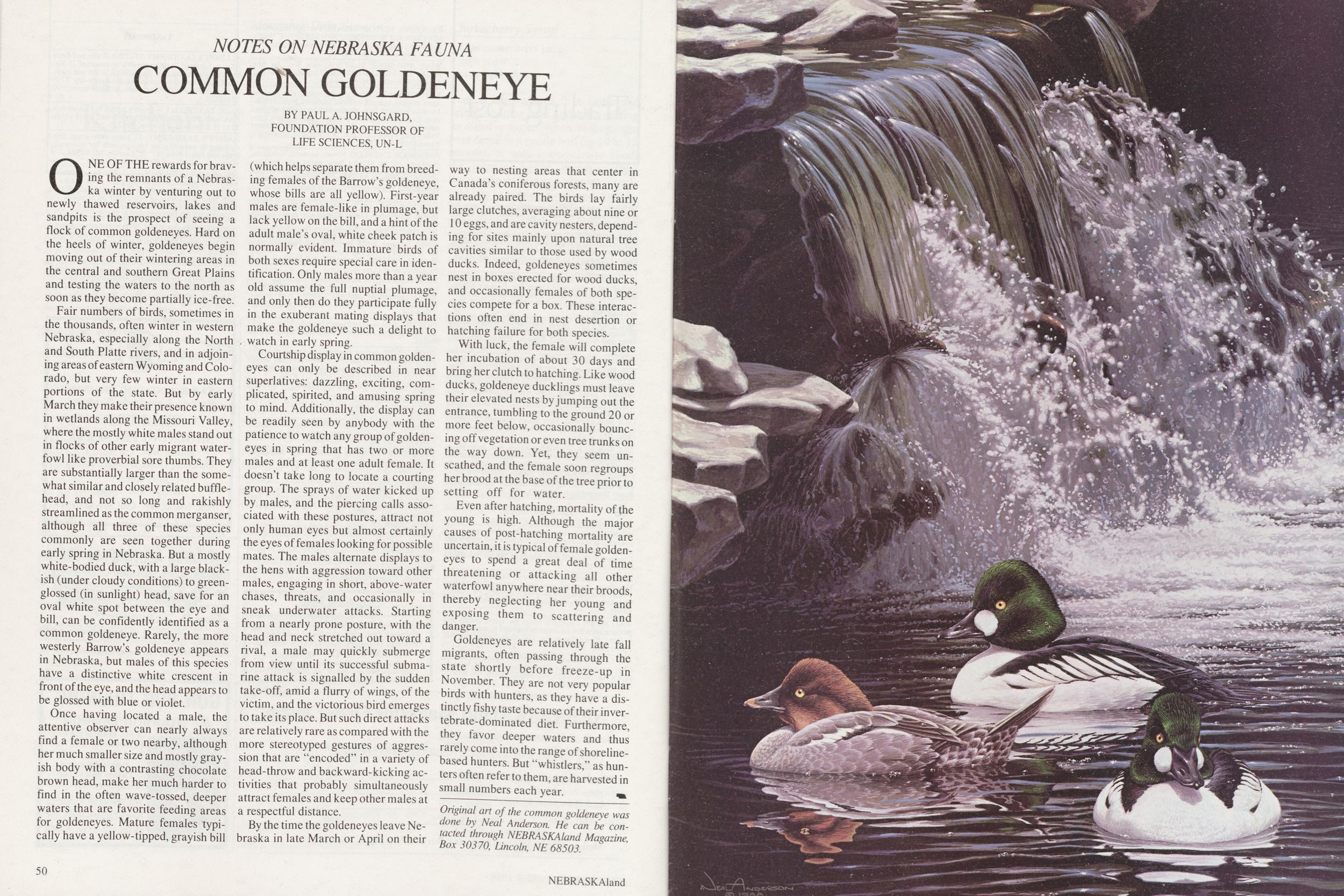
NOTES ON NEBRASKA FAUNA COMMON GOLDENEYE
BY PAUL A. JOHNSGARD FOUNDATION PROFESSOR OF LIFE SCIENCES, UN-LONE OF THE rewards for braving the remnants of a Nebraska winter by venturing out to newly thawed reservoirs, lakes and sandpits is the prospect of seeing a flock of common goldeneyes. Hard on the heels of winter, goldeneyes begin moving out of their wintering areas in the central and southern Great Plains and testing the waters to the north as soon as they become partially ice-free.
Fair numbers of birds, sometimes in the thousands, often winter in western Nebraska, especially along the North and South Platte rivers, and in adjoining areas of eastern Wyoming and Colorado, but very few winter in eastern portions of the state. But by early March they make their presence known in wetlands along the Missouri Valley, where the mostly white males stand out in flocks of other early migrant waterfowl like proverbial sore thumbs. They are substantially larger than the somewhat similar and closely related bufflehead, and not so long and rakishly streamlined as the common merganser, although all three of these species commonly are seen together during early spring in Nebraska. But a mostly white-bodied duck, with a large blackish (under cloudy conditions) to green-glossed (in sunlight) head, save for an oval white spot between the eye and bill, can be confidently identified as a common goldeneye. Rarely, the more westerly Barrow's goldeneye appears in Nebraska, but males of this species have a distinctive white crescent in front of the eye, and the head appears to be glossed with blue or violet.
Once having located a male, the attentive observer can nearly always find a female or two nearby, although her much smaller size and mostly grayish body with a contrasting chocolate brown head, make her much harder to find in the often wave-tossed, deeper waters that are favorite feeding areas for goldeneyes. Mature females typically have a yellow-tipped, grayish bill (which helps separate them from breeding females of the Barrow's goldeneye, whose bills are all yellow). First-year males are female-like in plumage, but lack yellow on the bill, and a hint of the adult male's oval, white cheek patch is normally evident. Immature birds of both sexes require special care in identification. Only males more than a year old assume the full nuptial plumage, and only then do they participate fully in the exuberant mating displays that make the goldeneye such a delight to , watch in early spring.
Courtship display in common golden eyes can only be described in near superlatives: dazzling, exciting, complicated, spirited, and amusing spring to mind. Additionally, the display can be readily seen by anybody with the patience to watch any group of golden eyes in spring that has two or more males and at least one adult female. It doesn't take long to locate a courting group. The sprays of water kicked up by males, and the piercing calls associated with these postures, attract not only human eyes but almost certainly the eyes of females looking for possible mates. The males alternate displays to the hens with aggression toward other males, engaging in short, above-water chases, threats, and occasionally in sneak underwater attacks. Starting from a nearly prone posture, with the head and neck stretched out toward a rival, a male may quickly submerge from view until its successful submarine attack is signaled by the sudden take-off, amid a flurry of wings, of the victim, and the victorious bird emerges to take its place. But such direct attacks are relatively rare as compared with the more stereotyped gestures of aggression that are "encoded" in a variety of head-throw and backward-kicking activities that probably simultaneously attract females and keep other males at a respectful distance.
By the time the goldeneyes leave Nebraska in late March or April on their way to nesting areas that center in Canada's coniferous forests, many are already paired. The birds lay fairly large clutches, averaging about nine or 10 eggs, and are cavity nesters, depending for sites mainly upon natural tree cavities similar to those used by wood ducks. Indeed, goldeneyes sometimes nest in boxes erected for wood ducks, and occasionally females of both species compete for a box. These interactions often end in nest desertion or hatching failure for both species.
With luck, the female will complete her incubation of about 30 days and bring her clutch to hatching. Like wood ducks, goldeneye ducklings must leave their elevated nests by jumping out the entrance, tumbling to the ground 20 or more feet below, occasionally bouncing off vegetation or even tree trunks on the way down. Yet, they seem un- scathed, and the female soon regroups her brood at the base of the tree prior to setting off for water.
Even after hatching, mortality of the young is high. Although the major causes of post-hatching mortality are uncertain, it is typical of female golden eyes to spend a great deal of time threatening or attacking all other waterfowl anywhere near their broods, thereby neglecting her young and exposing them to scattering and danger.
Goldeneyes are relatively late fall migrants, often passing through the state shortly before freeze-up in November. They are not very popular birds with hunters, as they have a distinctly fishy taste because of their invertebrate-dominated diet. Furthermore, they favor deeper waters and thus rarely come into the range of shoreline based hunters. But "whistlers," as hunters often refer to them, are harvested in small numbers each year.
Original art of the common goldeneye was done by Neal Anderson. He can be contacted through NEBRASKAland Magazine, Box 30370, Lincoln, NE 68503. 50 NEBRASKAland
Position: 197 (36 views)