Volume 66, Issue 6, 1988
NEBRASKAland
JULY 1988 $1.50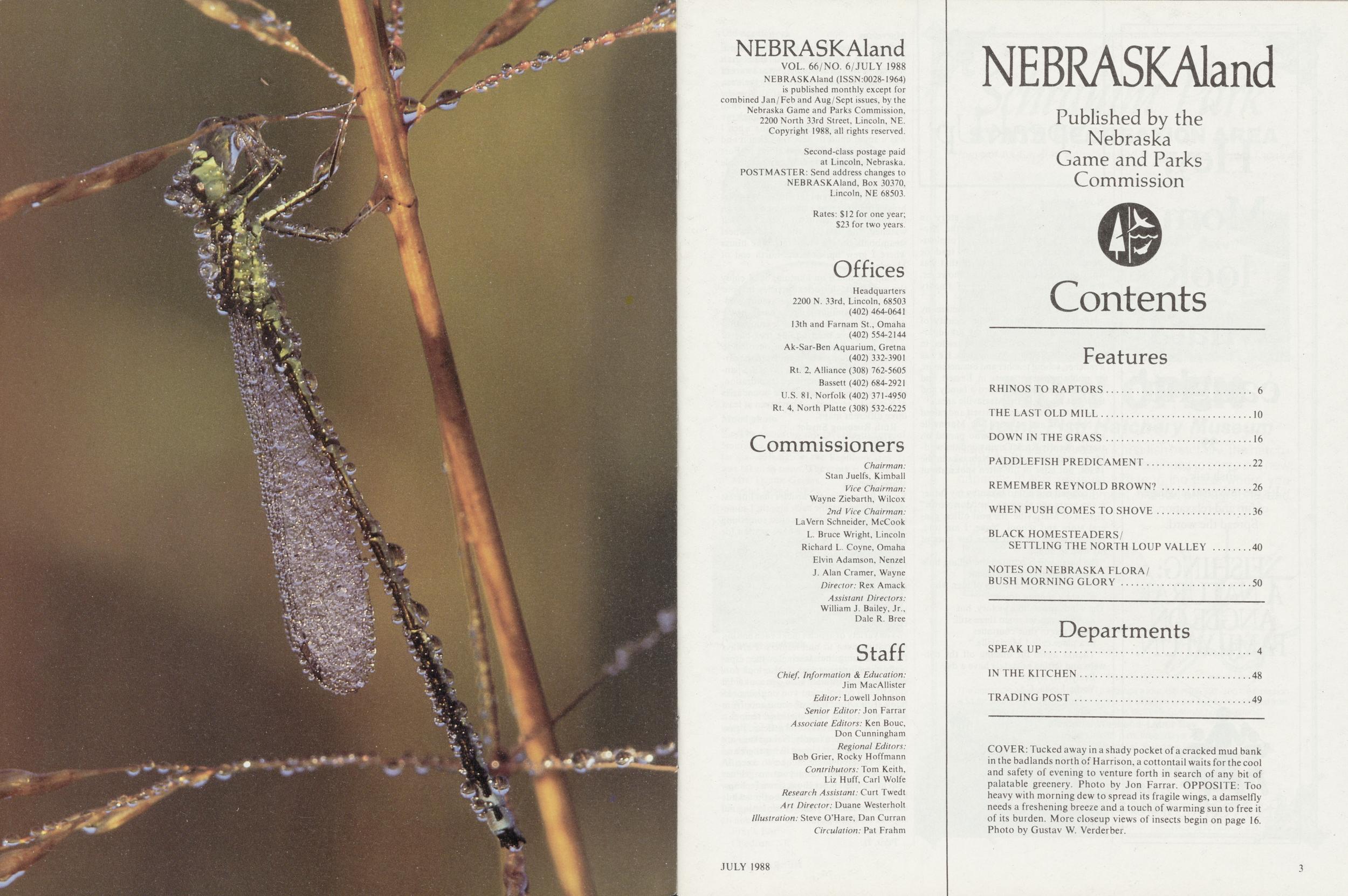
NEBRASKAland
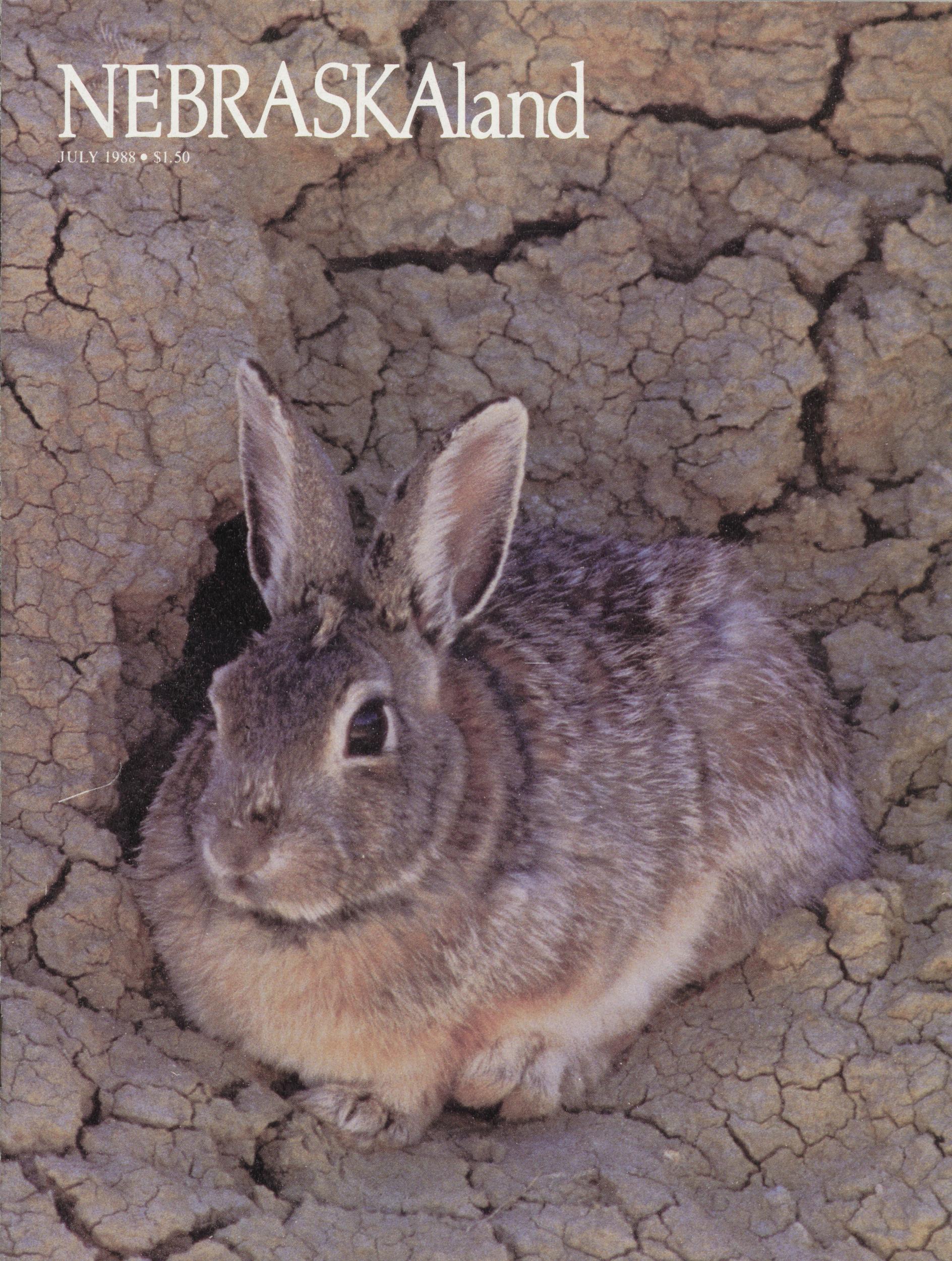
Published by the Nebraska Game and Parks Commission VOL. 63/NO. 6/JULY 1985 NEBRASKAland (ISSN:0028-1964) is published monthly except for a combined January/ February issue, by the Nebraska Game and Parks Commission. 2200 North 33rd Street, Lincoln, NE. Copyright 1985, all rights reserved. Second-class postage paid at Lincoln, Nebraska and at additional mailing offices. POSTMASTER: Send address changes to NEBRASKAland, Box 30370, Lincoln, NE 68503. NEBRASKAland VOL. 66/NO. 6/JULY 1988 NEBRASKAland (ISSN:0028-1964) is published monthly except for combined Jan/Feb and Aug/Sept issues, by the Nebraska Game and Parks Commission. 2200 North 33rd Street, Lincoln, NE. Copyright 1988, all rights reserved. Second-class postage paid at Lincoln, Nebraska. POSTMASTER: Send address changes to NEBRASKAland, Box 30370. Lincoln, NE 68503. Rates: $12 for one year; $23 for two years. Offices Headquarters 2200 N. 33rd, Lincoln, 68503 (402) 464-0641 13th and Farnam St., Omaha (402)554-2144 Ak-Sar-Ben Aquarium, Gretna (402) 332-3901 Rt. 2. Alliance (308) 762-5605 Bassett (402)684-2921 U.S. 81, Norfolk (402) 371-4950 Rt. 4, North Platte (308) 532-6225 Commissioners Chairman: Stan Juelfs, Kimball Vice Chairman: Wayne Ziebarth, Wilcox 2nd Vice Chairman: LaVern Schneider, McCook L. Bruce Wright, Lincoln Richard L. Coyne, Omaha Elvin Adamson, Nenzel J. Alan Cramer, Wayne Director: Rex Amack Assistant Directors: William J. Bailey, Jr., Dale R. Bree Chief, Information & Education: Jim MacAUister Editor: Lowell Johnson Senior Editor: Jon Farrar Associate Editors: Ken Bouc, Don Cunningham Regional Editors: Bob Grier. Rocky Hoffmann Contributors: Tom Keith, Liz Huff, Carl Wolfe Research Assistant: Curt Twedt Art Director: Duane Westerholt Illustration: Steve O'Hare, Dan Curran Circulation: Pat Frahm Contents Features RHINOS TO RAPTORS............................. 6 THE LAST OLD MILL..............................10 DOWN IN THE GRASS.............................16 PADDLEFISH PREDICAMENT.....................22 REMEMBER REYNOLD BROWN? ..................26 WHEN PUSH COMES TO SHOVE.................. .36 BLACK HOMESTEADERS/ SETTLING THE NORTH LOUP VALLEY ........40 NOTES ON NEBRASKA FLORA/ BUSH MORNING GLORY..........................50 Departments SPEAK UP......................................... 4 IN THE KITCHEN..................................48 TRADING POST...................................49 COVER: Tucked away in a shady pocket of a cracked mud bank in the badlands north of Harrison, a cottontail waits for the cool and safety of evening to venture forth in search of any bit of palatable greenery. Photo by Jon Farrar. OPPOSITE: Too heavy with morning dew to spread its fragile wings, a damselfly needs a freshening breeze and a touch of warming sun to free it of its burden. More closeup views of insects begin on page 16. Photo bv Gustav W. Verderber. JULY 1988 3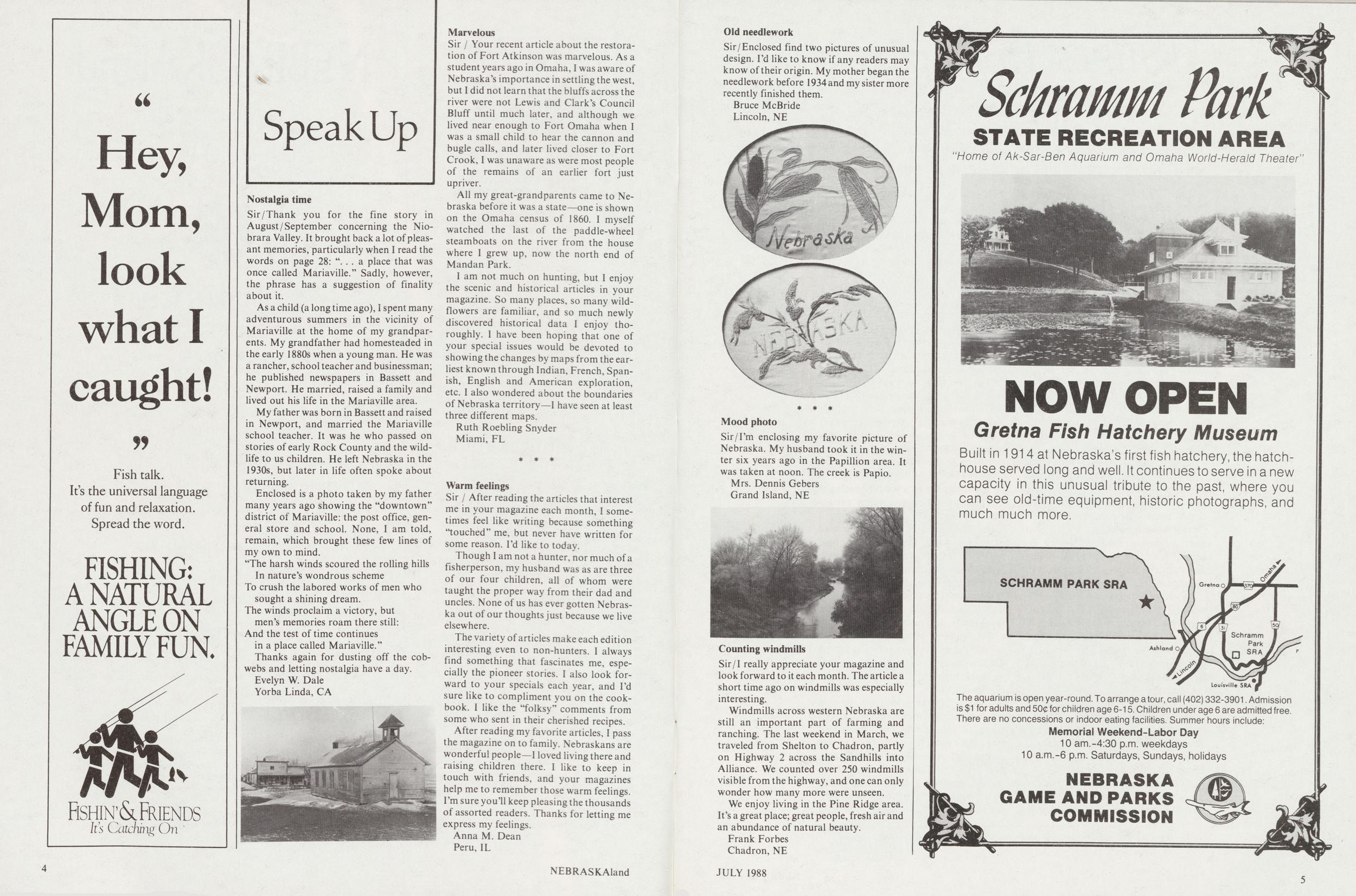
Speak Up
Nostalgia timeSir/Thank you for the fine story in August/September concerning the Niobrara Valley. It brought back a lot of pleasant memories, particularly when I read the words on page 28: "... a place that was once called Maryaville." Sadly, however, the phrase has a suggestion of finality about it.
As a child (a long time ago), I spent many adventurous summers in the vicinity of Mariaville at the home of my grandparents. My grandfather had homesteaded in the early 1880s when a young man. He was a rancher, school teacher and businessman; he published newspapers in Bassett and Newport. He married, raised a family and lived out his life in the Mariaville area.
My father was born in Bassett and raised in Newport, and married the Maraiville school teacher. It was he who passed on stories of early Rock County and the wildlife to us children. He left Nebraska in the 1930s, but later in life often spoke about returning.
Enclosed is a photo taken by my father many years ago showing the "downtown" district of Mariaville: the post office, general store and school. None, I am told, remain, which brought these few lines of my own to mind.
"The harsh winds scoured the rolling hills In nature's wondrous schemeTo crush the labored works of men who sought a shining dream.
The winds proclaim a victory, but men's memories roam there still:
And the test of time continues in a place called Mariaville."
Thanks again for dusting off the cobwebs and letting nostalgia have a day.
Evelyn W. Dale Yorba Linda, CA MarvelousSir / Your recent article about the restoration of Fort Atkinson was marvelous. As a student years ago in Omaha, I was aware of Nebraska's importance in settling the west, but I did not learn that the bluffs across the river were not Lewis and Clark's Council Bluff until much later, and although we lived near enough to Fort Omaha when I was a small child to hear the cannon and bugle calls, and later lived closer to Fort Crook, I was unaware as were most people of the remains of an earlier fort just upriver.
All my great-grandparents came to Nebraska before it was a state—one is shown on the Omaha census of 1860. I myself watched the last of the paddle-wheel steamboats on the river from the house where I grew up, now the north end of Mandan Park.
I am not much on hunting, but I enjoy the scenic and historical articles in your magazine. So many places, so many wildflowers are familiar, and so much newly discovered historical data I enjoy thoroughly. I have been hoping that one of your special issues would be devoted to showing the changes by maps from the earliest known through Indian, French, Spanish, English and American exploration, etc. I also wondered about the boundaries of Nebraska territory—I have seen at least three different maps.
Ruth Roebling Snyder Miami, FL * * * Warm feelingsSir / After reading the articles that interest me in your magazine each month, I sometimes feel like writing because something "touched" me, but never have written for some reason. I'd like to todav.
Though I am not a hunter, nor much of a fisher person, my husband was as are three of our four children, all of whom were taught the proper way from their dad and uncles. None of us has ever gotten Nebraska out of our thoughts just because we live elsewhere.
The variety of articles make each edition interesting even to non-hunters. I always find something that fascinates me, especially the pioneer stories. I also look forward to your specials each year, and I'd sure like to compliment you on the cookbook. I like the "folksy" comments from some who sent in their cherished recipes.
After reading my favorite articles, I pass the magazine on to family. Nebraskans are wonderful people—I loved living there and raising children there. I like to keep in touch with friends, and your magazines help me to remember those warm feelings. I'm sure you'll keep pleasing the thousands of assorted readers. Thanks for letting me express my feelings.
Anna M. Dean Peru, IL 4 NEBRASKAland Old needleworkSir/Enclosed find two pictures of unusual design. I'd like to know if any readers may know of their origin. My mother began the needlework before 1934 and my sister more recently finished them.
Bruce McBride Lincoln, NESir/I'm enclosing my favorite picture of Nebraska. My husband took it in the winter six years ago in the Papillion area. It was taken at noon. The creek is Papio.
Mrs. Dennis Gebers Grand Island, NESir/1 really appreciate your magazine and look forward to it each month. The article a short time ago on windmills was especially interesting.
Windmills across western Nebraska are still an important part of farming and ranching. The last weekend in March, we traveled from Shelton to Chadron, partly on Highway 2 across the Sandhills into Alliance. We counted over 250 windmills visible from the highway, and one can only wonder how many more were unseen.
We enjoy living in the Pine Ridge area. It's a great place; great people, fresh air and an abundance of natural beauty.
Frank Forbes Chadron, NE Schramm Park STATE RECREATION AREA "Home of Ak-Sar-Ben Aquarium and Omaha World-Herald Theater" NOW OPEN Gretna Fish Hatchery Museum Built in 1914 at Nebraska's first fish hatchery, the hatchhouse served long and well. It continues to serve in a new capacity in this unusual tribute to the past, where you can see old-time equipment, historic photographs, and much much more. SCHRAMM PARK SRA The aquarium is open year-round. To arrange a tour, call (402) 332-3901. Admission is $1 for adults and 50c for children age 6-15. Children under age 6 are admitted free. There are no concessions or indoor eating facilities. Summer hours include: Memorial Weekend-Labor Day 10 am.-4:30 p.m. weekdays 10 a.m.-6 p.m. Saturdays, Sundays, holidays NEBRASKA GAME AND PARKS COMMISSION JULY 1988 5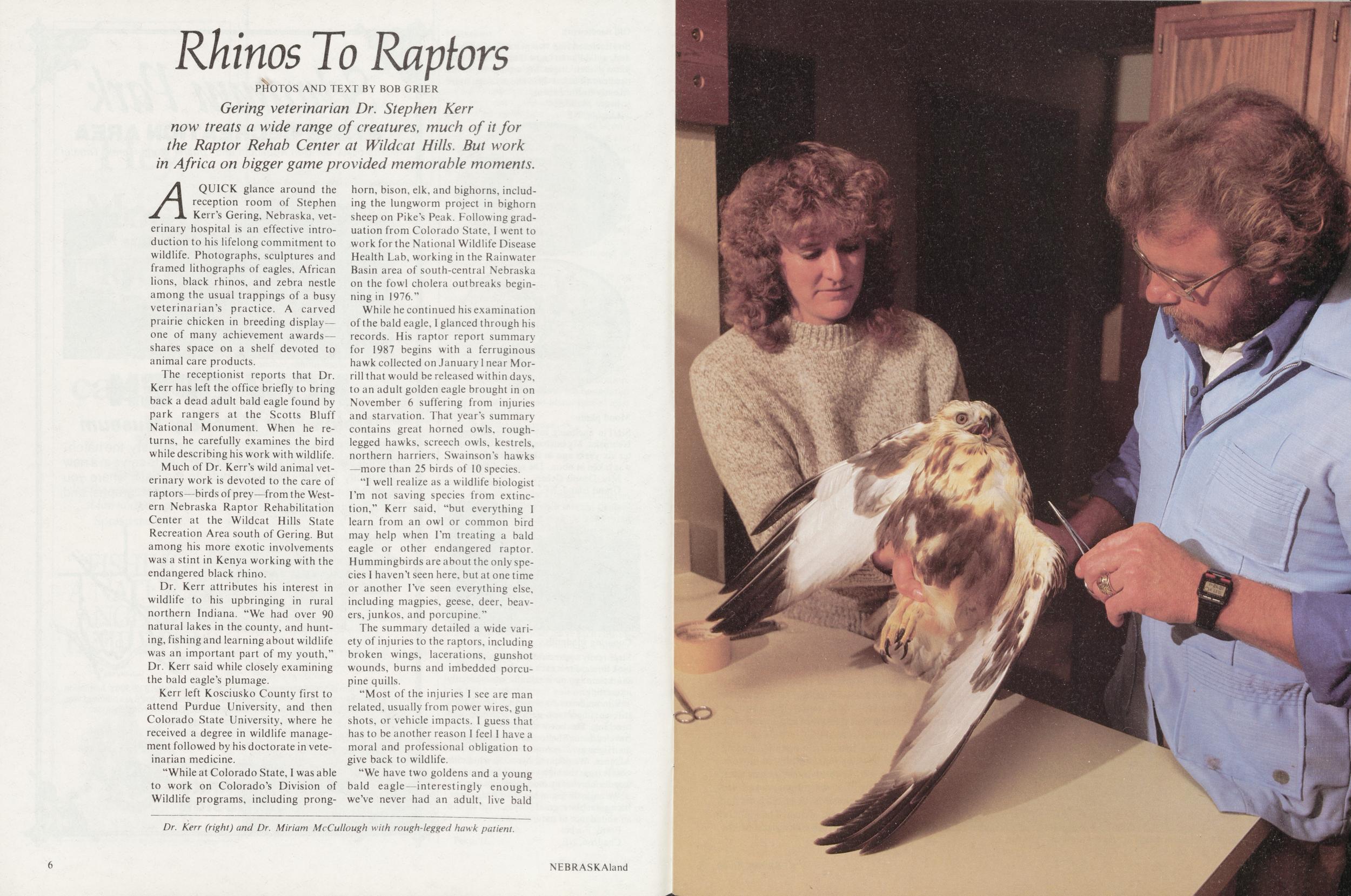
Rhinos To Raptors
PHOTOS AND TEXT BY BOB GRIER Gering veterinarian Dr. Stephen Kerr now treats a wide range of creatures, much of it for the Raptor Rehab Center at Wildcat Hills. But work in Africa on bigger game provided memorable moments.QUICK glance around the reception room of Stephen Kerr's Gering, Nebraska, veterinary hospital is an effective introduction to his lifelong commitment to wildlife. Photographs, sculptures and framed lithographs of eagles. African lions, black rhinos, and zebra nestle among the usual trappings of a busy veterinarian's practice. A carved prairie chicken in breeding display one of many achievement awards shares space on a shelf devoted to animal care products.
The receptionist reports that Dr. Kerr has left the office briefly to bring back a dead adult bald eagle found by park rangers at the Scotts Bluff National Monument. When he returns, he carefully examines the bird while describing his work with wildlife.
Much of Dr. Kerr's wild animal veterinary work is devoted to the care of raptors—birds of prey—from the Western Nebraska Raptor Rehabilitation Center at the Wildcat Hills State Recreation Area south of Gering. But among his more exotic involvements was a stint in Kenya working with the endangered black rhino.
Dr. Kerr attributes his interest in wildlife to his upbringing in rural northern Indiana. "We had over 90 natural lakes in the county, and hunting, fishing and learning about wildlife was an important part of my youth," Dr. Kerr said while closely examining the bald eagle's plumage.
Kerr left Kosciusko County first to attend Purdue University, and then Colorado State University, where he received a degree in wildlife management followed by his doctorate in veteinarian medicine.
"While at Colorado State, I was able to work on Colorado's Division of Wildlife programs, including pronghorn, bison, elk, and bighorns, including the lungworm project in bighorn sheep on Pike's Peak. Following graduation from Colorado State, 1 went to work for the National Wildlife Disease Health Lab, working in the Rainwater Basin area of south-central Nebraska on the fowl cholera outbreaks beginning in 1976."
While he continued his examination of the bald eagle, I glanced through his records. His raptor report summary for 1987 begins with a ferruginous hawk collected on January 1 near Morrill that would be released within davs, to an adult golden eagle brought in on November 6 suffering from injuries and starvation. That year's summary contains great horned owls, rough legged hawks, screech owls, kestrels, northern harriers, Swainson's hawks —more than 25 birds of 10 species.
"I well realize as a wildlife biologist I'm not saving species from extinction," Kerr said, "but everything I learn from an owl or common bird may help when I'm treating a bald eagle or other endangered raptor. Hummingbirds are about the only species I haven't seen here, but at one time or another I've seen everything else, including magpies, geese, deer, beavers, junkos, and porcupine."
The summary detailed a wide variety of injuries to the raptors, including broken wings, lacerations, gunshot wounds, burns and imbedded porcupine quills.
"Most of the injuries I see are man related, usually from power wires, gun shots, or vehicle impacts. I guess that has to be another reason I feel I have a moral and professional obligation to give back to wildlife.
"We have two goldens and a young bald eagle—interestingly enough, we've never had an adult, live bald eagle, injured or sick; we see the immature and inexperienced!"
6 NEBRSAKAland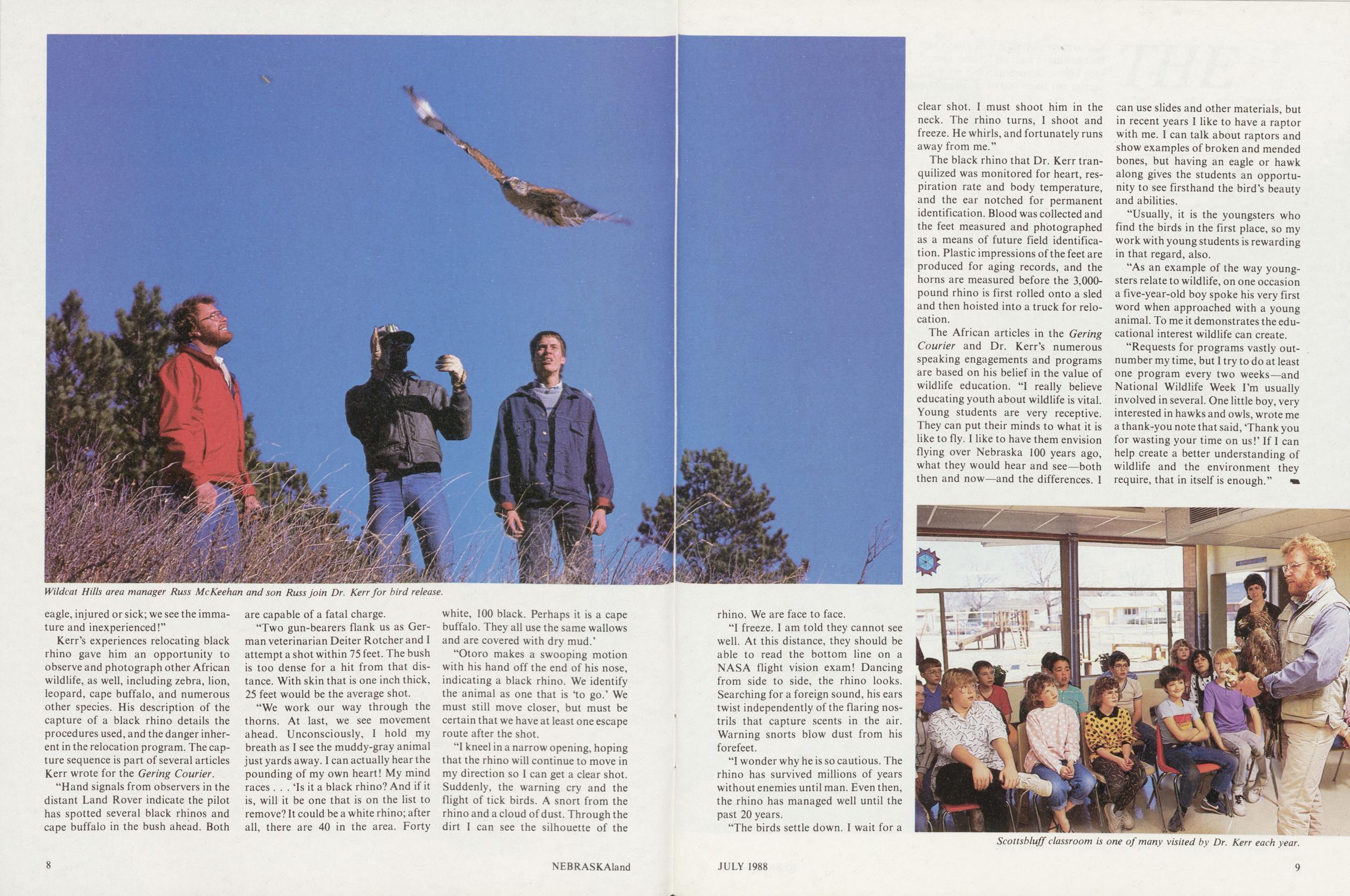
Kerr's experiences relocating black rhino gave him an opportunity to observe and photograph other African wildlife, as well, including zebra, lion, leopard, cape buffalo, and numerous other species. His description of the capture of a black rhino details the procedures used, and the danger inherent in the relocation program. The capture sequence is part of several articles Kerr wrote for the Gering Courier.
"Hand signals from observers in the distant Land Rover indicate the pilot has spotted several black rhinos and cape buffalo in the bush ahead. Both are capable of a fatal charge.
"Two gun-bearers flank us as German veterinarian Deiter Rotcher and I attempt a shot within 75 feet. The bush is too dense for a hit from that distance. With skin that is one inch thick, 25 feet would be the average shot.
"We work our way through the thorns. At last, we see movement ahead. Unconsciously, I hold my breath as I see the muddy-gray animal just yards away. I can actually hear the pounding of my own heart! My mind races ... Ts it a black rhino? And if it is, will it be one that is on the list to remove? It could be a white rhino; after all, there are 40 in the area. Forty white, 100 black. Perhaps it is a cape buffalo. They all use the same wallows and are covered with dry mud.'
"Otoro makes a swooping motion with his hand off the end of his nose, indicating a black rhino. We identify the animal as one that is go.' We must still move closer, but must be certain that we have at least one escape route after the shot.
"I kneel in a narrow opening, hoping that the rhino will continue to move in my direction so I can get a clear shot. Suddenly, the warning cry and the flight of tick birds. A snort from the rhino and a cloud of dust. Through the dirt I can see the silhouette of the 8 NEBRASKAland rhino. We are face to face.
"I freeze. I am told they cannot see well. At this distance, they should be able to read the bottom line on a NASA flight vision exam! Dancing from side to side, the rhino looks. Searching for a foreign sound, his ears twist independently of the flaring nostrils that capture scents in the air. Warning snorts blow dust from his forefeet.
"I wonder why he is so cautious. The rhino has survived millions of years without enemies until man. Even then, the rhino has managed well until the past 20 years.
"The birds settle down. I wait for a clear shot. I must shoot him in the neck. The rhino turns, I shoot and freeze. He whirls, and fortunately runs away from me."
The black rhino that Dr. Kerr tranquilized was monitored for heart, respiration rate and body temperature, and the ear notched for permanent identification. Blood was collected and the feet measured and photographed as a means of future field identification. Plastic impressions of the feet are produced for aging records, and the horns are measured before the 3,000-pound rhino is first rolled onto a sled and then hoisted into a truck for relocation.
The African articles in the Gering Courier and Dr. Kerr's numerous speaking engagements and programs are based on his belief in the value of wildlife education. "I really believe educating youth about wildlife is vital. Young students are very receptive. They can put their minds to what it is like to fly. I like to have them envision flying over Nebraska 100 years ago, what they would hear and see—both then and now—and the differences. can use slides and other materials, but in recent years I like to have a raptor with me. I can talk about raptors and show examples of broken and mended bones, but having an eagle or hawk along gives the students an opportunity to see firsthand the bird's beauty and abilities.
"Usually, it is the youngsters who find the birds in the first place, so my work with young students is rewarding in that regard, also.
"As an example of the way youngsters relate to wildlife, on one occasion a five-year-old boy spoke his very first word when approached with a young animal. To me it demonstrates the educational interest wildlife can create.
"Requests for programs vastly out-number my time, but I try to do at least one program every two weeks—and National Wildlife Week I'm usually involved in several. One little boy, very interested in hawks and owls, wrote me a thank-you note that said, Thank you for wasting your time on us!' If I can help create a better understanding of wildlife and the environment they require, that in itself is enough."
THE LAST OLD MILL
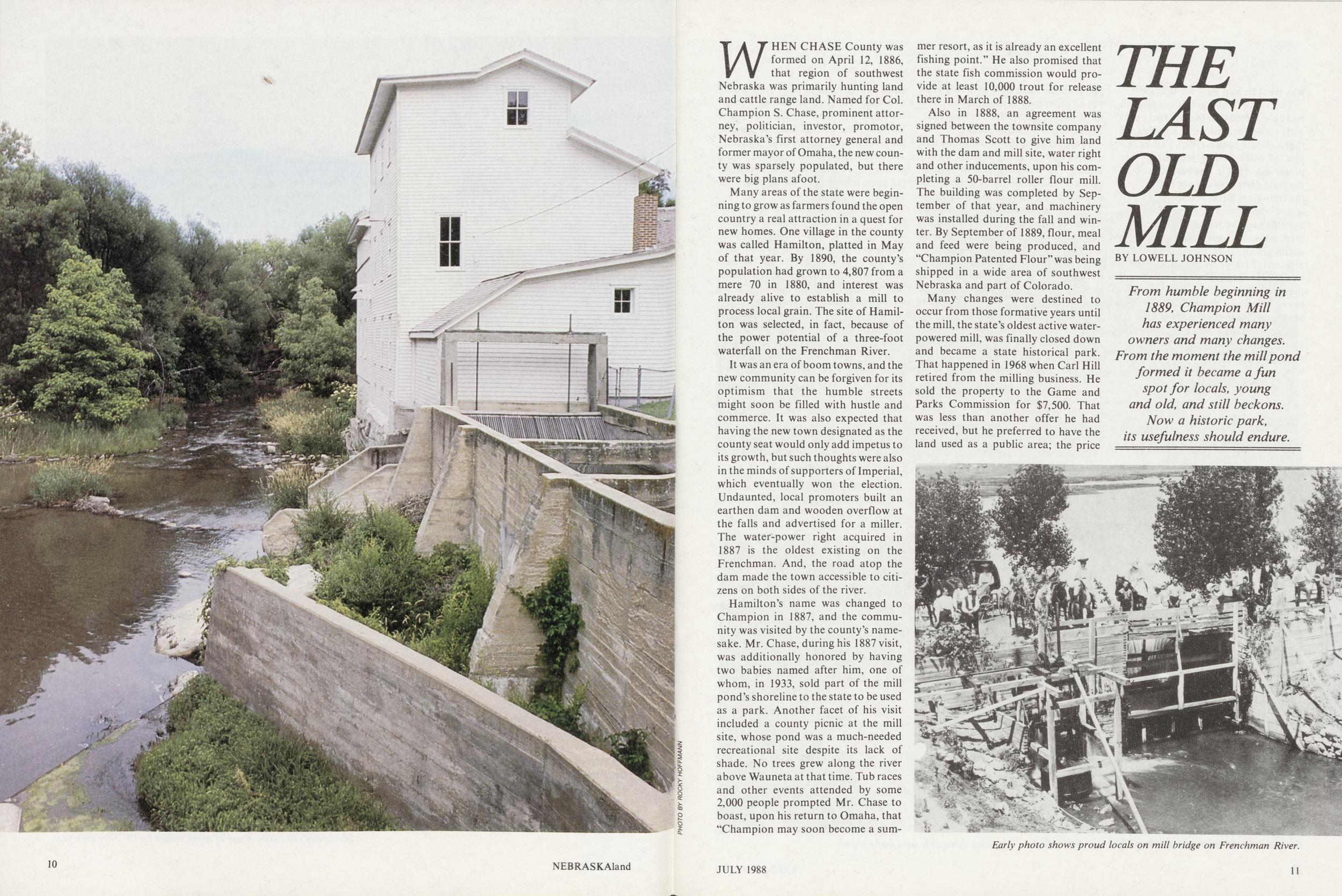
BY LOWELL JOHNSON From humble beginning in 1889, Champion Mill has experienced many owners and many changes. From the moment the mill pond formed it became a fun spot for locals, young and old, and still beckons. Now a historic park, its usefulness should endure.WHEN CHASE County was formed on April 12, 1886, that region of southwest Nebraska was primarily hunting land and cattle range land. Named for Col. Champion S. Chase, prominent attorney, politician, investor, promotor, Nebraska's first attorney general and former mayor of Omaha, the new county was sparsely populated, but there were big plans afoot.
Many areas of the state were beginning to grow as farmers found the open country a real attraction in a quest for new homes. One village in the county was called Hamilton, platted in May of that year. By 1890, the county's population had grown to 4,807 from a mere 70 in 1880, and interest was already alive to establish a mill to process local grain. The site of Hamilton was selected, in fact, because of the power potential of a three-foot waterfall on the Frenchman River.
It was an era of boom towns, and the new community can be forgiven for its optimism that the humble streets might soon be filled with hustle and commerce. It was also expected that having the new town designated as the county seat would only add impetus to its growth, but such thoughts were also in the minds of supporters of Imperial, which eventually won the election. Undaunted, local promoters built an earthen dam and wooden overflow at the falls and advertised for a miller. The water-power right acquired in 1887 is the oldest existing on the Frenchman. And, the road atop the dam made the town accessible to citizens on both sides of the river.
Hamilton's name was changed to Champion in 1887, and the community was visited by the county's name sake. Mr. Chase, during his 1887 visit, was additionally honored by having two babies named after him, one of whom, in 1933, sold part of the mill pond's shoreline to the state to be used as a park. Another facet of his visit included a county picnic at the mill site, whose pond was a much-needed recreational site despite its lack of shade. No trees grew along the river above Wauneta at that time. Tub races and other events attended by some 2,000 people prompted Mr. Chase to boast, upon his return to Omaha, that "Champion may soon become a summer resort, as it is already an excellent fishing point." He also promised that the state fish commission would provide at least 10,000 trout for release there in March of 1888.
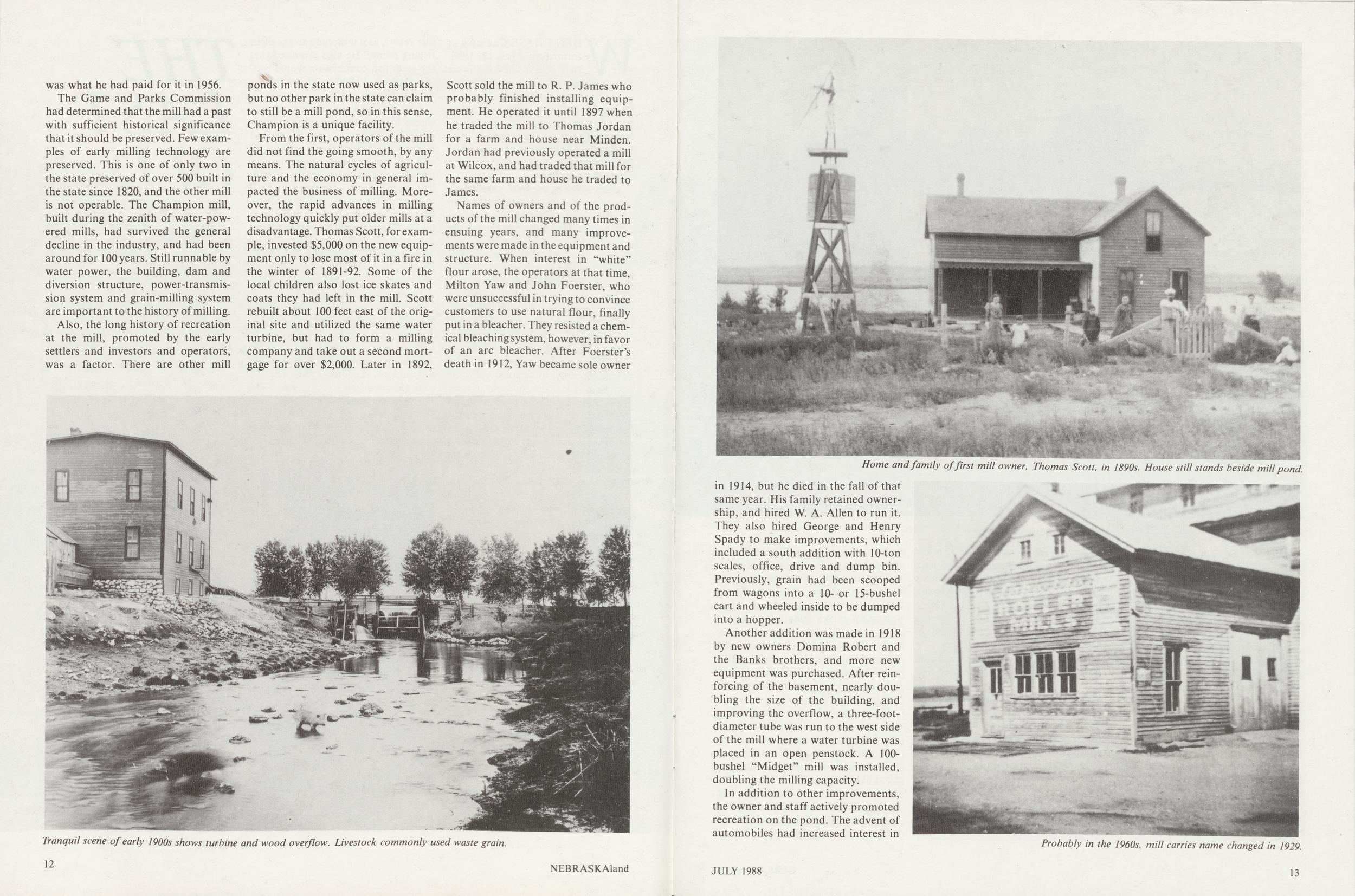
Also in 1888, an agreement was signed between the townsite company and Thomas Scott to give him land with the dam and mill site, water right and other inducements, upon his completing a 50-barrel roller flour mill. The building was completed by September of that year, and machinery was installed during the fall and winter. By September of 1889, flour, meal and feed were being produced, and "Champion Patented Flour" was being shipped in a wide area of southwest Nebraska and part of Colorado.
Many changes were destined to occur from those formative years until the mill, the state's oldest active water-powered mill, was finally closed down and became a state historical park. That happened in 1968 when Carl Hill retired from the milling business. He sold the property to the Game and Parks Commission for $7,500. That was less than another offer he had received, but he preferred to have the land used as a public area; the price was what he had paid for it in 1956.
The Game and Parks Commission had determined that the mill had a past with sufficient historical significance that it should be preserved. Few examples of early milling technology are preserved. This is one of only two in the state preserved of over 500 built in the state since 1820, and the other mill is not operable. The Champion mill, built during the zenith of water-powered mills, had survived the general decline in the industry, and had been around for 100 years. Still runnable by water power, the building, dam and diversion structure, power-transmission system and grain-milling system are important to the history of milling.
Also, the long history of recreation at the mill, promoted by the early settlers and investors and operators, was a factor. There are other mill ponds in the state now used as parks, but no other park in the state can claim to still be a mill pond, so in this sense, Champion is a unique facility.
From the first, operators of the mill did not find the going smooth, by any means. The natural cycles of agriculture and the economy in general impacted the business of milling. Moreover, the rapid advances in milling technology quickly put older mills at a disadvantage. Thomas Scott, for example, invested $5,000 on the new equipment only to lose most of it in a fire in the winter of 1891-92. Some of the local children also lost ice skates and coats they had left in the mill. Scott rebuilt about 100 feet east of the original site and utilized the same water turbine, but had to form a milling company and take out a second mortgage for over $2,000. Later in 1892, Scott sold the mill to R. P. James who probably finished installing equipment. He operated it until 1897 when he traded the mill to Thomas Jordan for a farm and house near Minden. Jordan had previously operated a mill at Wilcox, and had traded that mill for the same farm and house he traded to James.
Names of owners and of the products of the mill changed many times in ensuing years, and many improvements were made in the equipment and structure. When interest in "white" flour arose, the operators at that time, Milton Yaw and John Foerster, who were unsuccessful in trying to convince customers to use natural flour, finally put in a bleacher. They resisted a chemical bleaching system, however, in favor of an arc bleacher. After Foerster's death in 1912, Yaw became sole owner 12 NEBRASKAland in 1914, but he died in the fall of that same year. His family retained owner- ship, and hired W. A. Allen to run it. They also hired George and Henry Spady to make improvements, which included a south addition with 10-ton scales, office, drive and dump bin. Previously, grain had been scooped from wagons into a 10- or 15-bushel cart and wheeled inside to be dumped into a hopper.
Another addition was made in 1918 by new owners Domina Robert and the Banks brothers, and more new equipment was purchased. After reinforcing of the basement, nearly doubling the size of the building, and improving the overflow, a three-foot diameter tube was run to the west side of the mill where a water turbine was placed in an open penstock. A 100-bushel "Midget" mill was installed, doubling the milling capacity.
In addition to other improvements, the owner and staff actively promoted recreation on the pond. The advent of automobiles had increased interest in recreation because more people were able to use the area. At Champion, there was swimming, boating, fishing, picnicking, camping and in season, ice skating. A bath house/concession stand was built where 125 black wool bathing suits were rented (for 10 cents each), as were canoes and rowboats. A diving board, diving tower, and picnic tables at the lake, which now included trees for shade, all were heavily used.
JULY 1988 13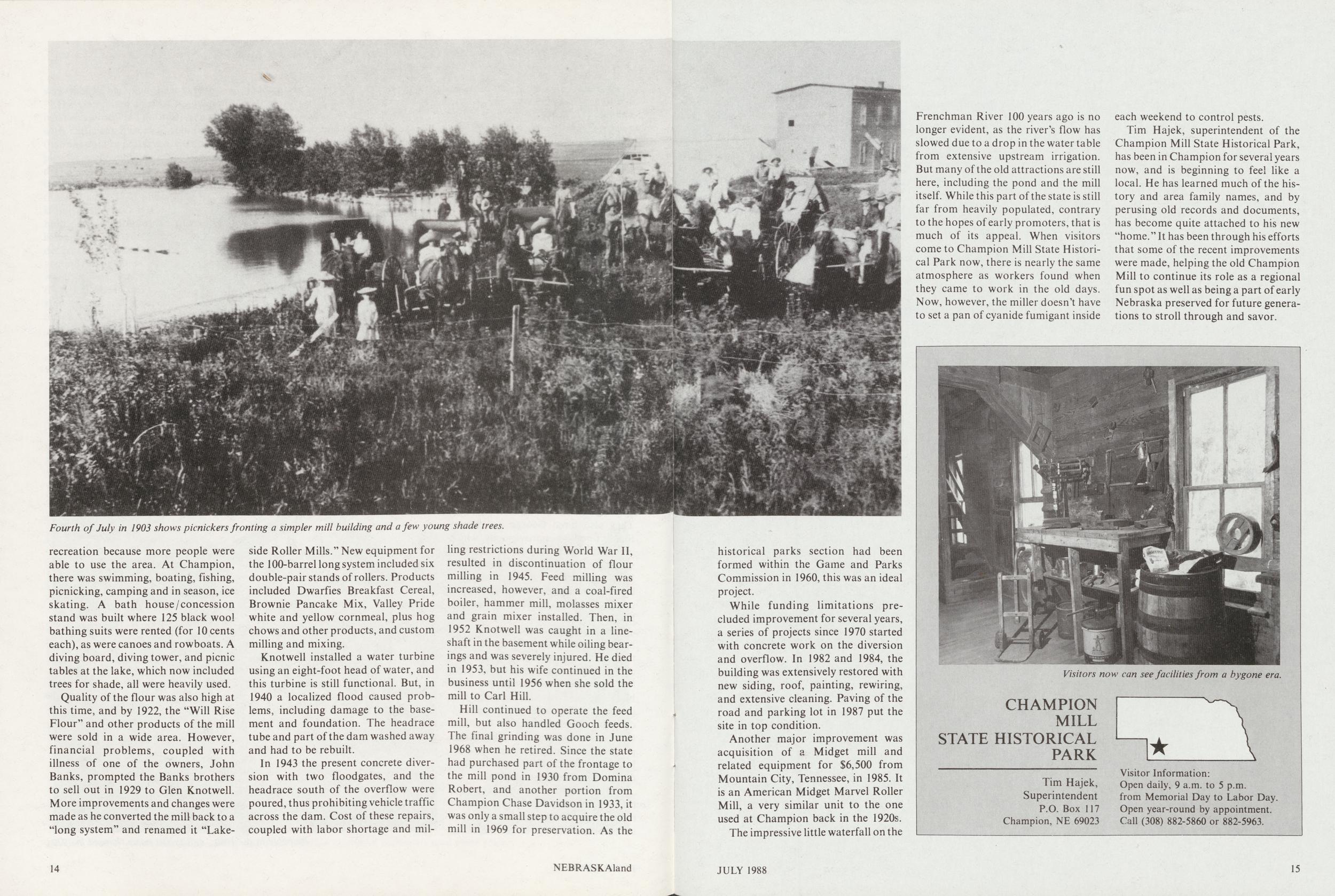
Quality of the flour was also high at this time, and by 1922, the "Will Rise Flour" and other products of the mill were sold in a wide area. However, financial problems, coupled with illness of one of the owners, John Banks, prompted the Banks brothers to sell out in 1929 to Glen Knotwell. More improvements and changes were made as he converted the mill back to a "long system" and renamed it "Lake side Roller Mills." New equipment for the 100-barrel long system included six double-pair stands of rollers. Products included Dwarfies Breakfast Cereal, Brownie Pancake Mix, Valley Pride white and yellow cornmeal, plus hog chows and other products, and custom milling and mixing.
Knotwell installed a water turbine using an eight-foot head of water, and this turbine is still functional. But, in 1940 a localized flood caused problems, including damage to the basement and foundation. The head race tube and part of the dam washed away and had to be rebuilt.
In 1943 the present concrete diver- sion with two floodgates, and the headrace south of the overflow were poured, thus prohibiting vehicle traffic across the dam. Cost of these repairs, coupled with labor shortage and milling restrictions during World War II, resulted in discontinuation of flour milling in 1945. Feed milling was increased, however, and a coal-fired boiler, hammer mill, molasses mixer and grain mixer installed. Then, in 1952 Knotwell was caught in a line shaft in the basement while oiling bearings and was severely injured. He died in 1953, but his wife continued in the business until 1956 when she sold the mill to Carl Hill.
Hill continued to operate the feed mill, but also handled Gooch feeds. The final grinding was done in June 1968 when he retired. Since the state had purchased part of the frontage to the mill pond in 1930 from Domina Robert, and another portion from Champion Chase Davidson in 1933, it was only a small step to acquire the old mill in 1969 for preservation. As the 14 NEBRASKAland historical parks section had been formed within the Game and Parks Commission in 1960, this was an ideal project.
While funding limitations precluded improvement for several years, a series of projects since 1970 started with concrete work on the diversion and overflow. In 1982 and 1984, the building was extensively restored with new siding, roof, painting, rewiring, and extensive cleaning. Paving of the road and parking lot in 1987 put the site in top condition.
Another major improvement was acquisition of a Midget mill and related equipment for $6,500 from Mountain City, Tennessee, in 1985. It is an American Midget Marvel Roller Mill, a very similar unit to the one used at Champion back in the 1920s.
The impressive little waterfall on the Frenchman River 100 years ago is no longer evident, as the river's flow has slowed due to a drop in the water table from extensive upstream irrigation. But many of the old attractions are still here, including the pond and the mill itself. While this part of the state is still far from heavily populated, contrary to the hopes of early promoters, that is much of its appeal. When visitors come to Champion Mill State Historical Park now, there is nearly the same atmosphere as workers found when they came to work in the old days. Now, however, the miller doesn't have to set a pan of cyanide fumigant inside each weekend to control pests.
Tim Hajek, superintendent of the Champion Mill State Historical Park, has been in Champion for several years now, and is beginning to feel like a local. He has learned much of the history and area family names, and by perusing old records and documents, has become quite attached to his new "home." It has been through his efforts that some of the recent improvements were made, helping the old Champion Mill to continue its role as a regional fun spot as well as being a part of early Nebraska preserved for future generations to stroll through and savor.
Down In The Grass
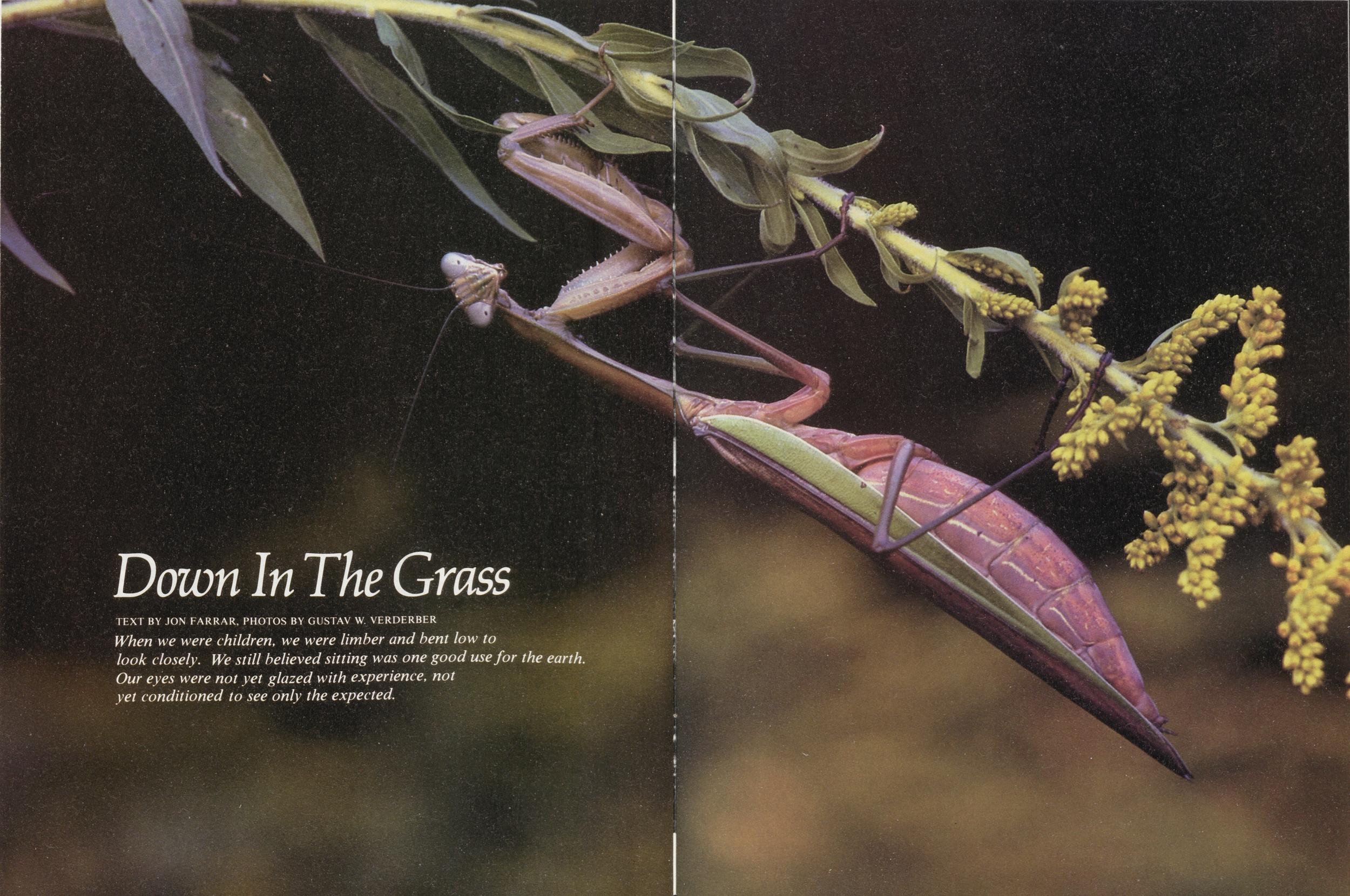
TEXT BY JON FARRAR, PHOTOS BY GUSTAV W. VERDERBER When we were children, we were limber and bent low to look closely. We still believed sitting was one good use for the earth. Our eyes were not yet glazed with experience, not yet conditioned to see only the expected.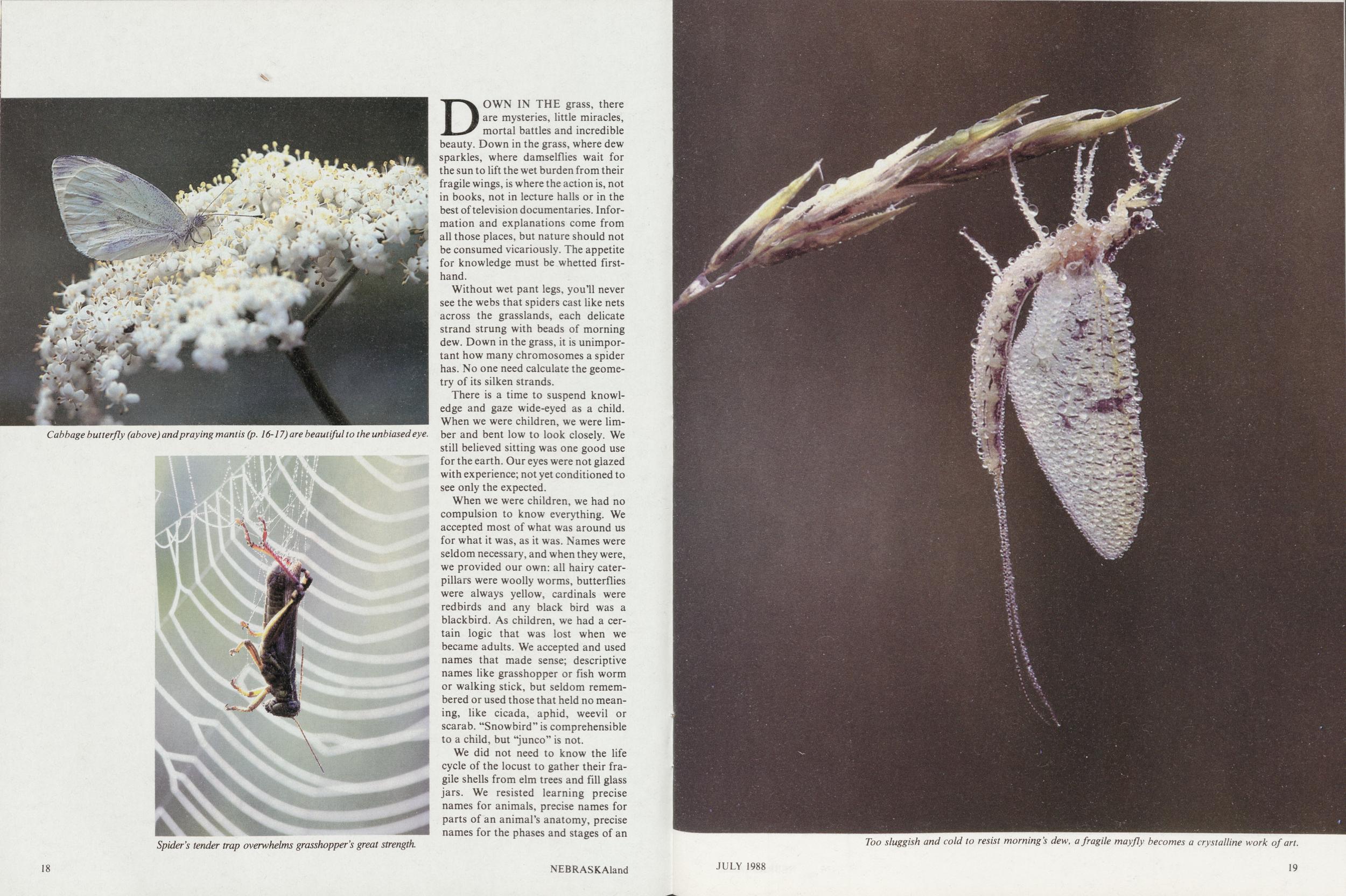
DOWN IN THE grass, there are mysteries, little miracles, mortal battles and incredible beauty. Down in the grass, where dew sparkles, where damselflies wait for the sun to lift the wet burden from their fragile wings, is where the action is, not in books, not in lecture halls or in the best of television documentaries. Information and explanations come from all those places, but nature should not be consumed vicariously. The appetite for knowledge must be whetted first hand.
Without wet pant legs, you'll never see the webs that spiders cast like nets across the grasslands, each delicate strand strung with beads of morning dew. Down in the grass, it is unimportant how many chromosomes a spider has. No one need calculate the geometry of its silken strands.
There is a time to suspend knowledge and gaze wide-eyed as a child. When we were children, we were limber and bent low to look closely. We still believed sitting was one good use for the earth. Our eyes were not glazed with experience; not yet conditioned to see only the expected.
When we were children, we had no compulsion to know everything. We accepted most of what was around us for what it was, as it was. Names were seldom necessary, and when they were, we provided our own: all hairy caterpillars were woolly worms, butterflies were always yellow, cardinals were redbirds and any black bird was a blackbird. As children, we had a certain logic that was lost when we became adults. We accepted and used names that made sense; descriptive names like grasshopper or fish worm or walking stick, but seldom remembered or used those that held no meaning, like cicada, aphid, weevil or scarab. "Snowbird" is comprehensible to a child, but "junco" is not.
We did not need to know the life cycle of the locust to gather their fragile shells from elm trees and fill glass jars. We resisted learning precise names for animals, precise names for parts of an animal's anatomy, precise names for the phases and stages of an animal's life; the sterile stuff of science. All this naming has its place, of course; later, when we are finally ready to know more; but at the time of discovery it would only have been clutter obscuring our view.
18 NEBRSAKAland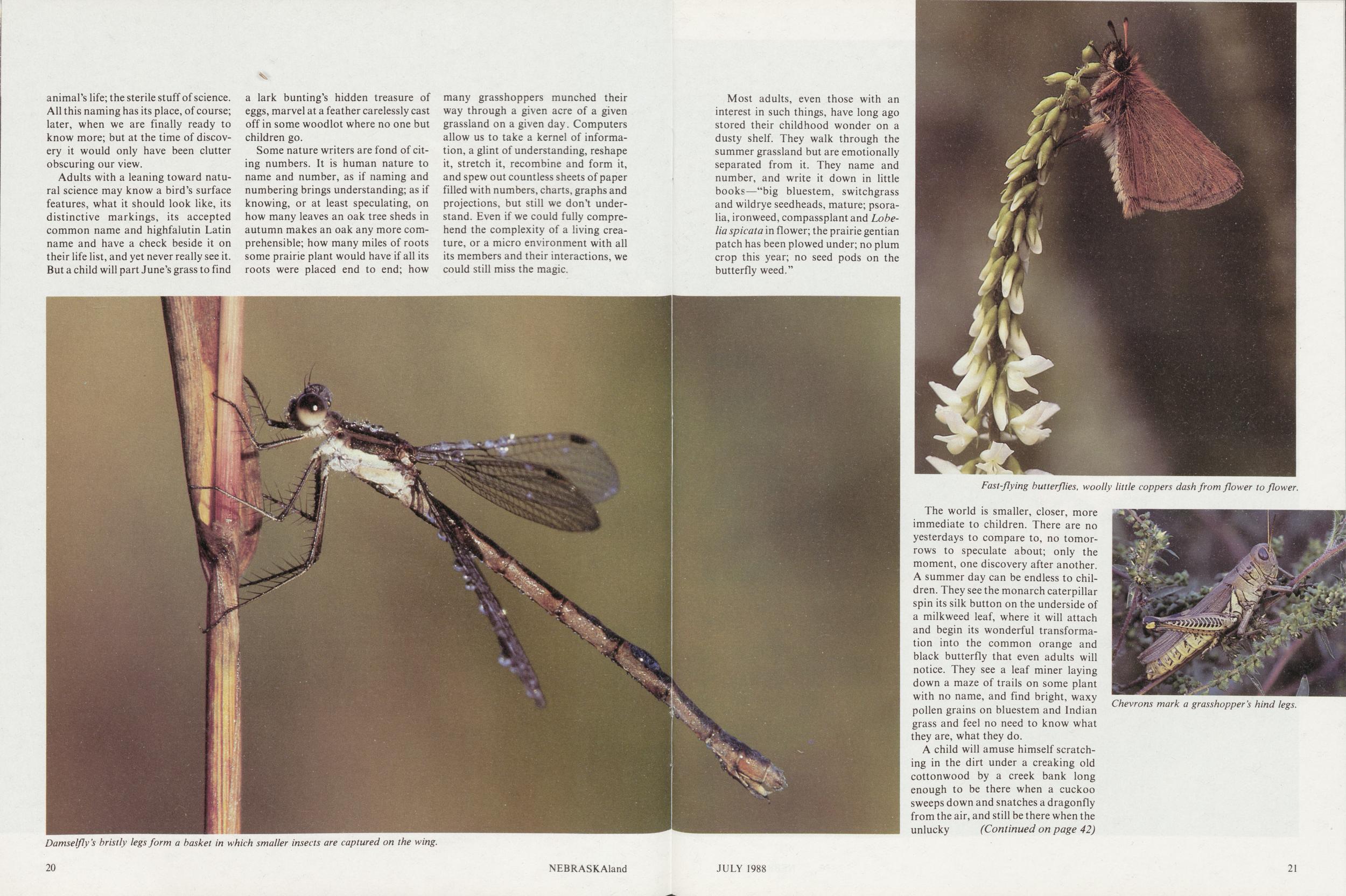
Adults with a leaning toward natural science may know a bird's surface features, what it should look like, its distinctive markings, its accepted common name and highfalutin Latin name and have a check beside it on their life list, and yet never really see it. But a child will part June's grass to find a lark bunting's hidden treasure of eggs, marvel at a feather carelessly cast off in some woodlot where no one but children go.
Some nature writers are fond of citing numbers. It is human nature to name and number, as if naming and numbering brings understanding; as if knowing, or at least speculating, on how many leaves an oak tree sheds in autumn makes an oak any more comprehensible; how many miles of roots some prairie plant would have if all its roots were placed end to end; how many grasshoppers munched their way through a given acre of a given grassland on a given day. Computers allow us to take a kernel of information, a glint of understanding, reshape it, stretch it, recombine and form it, and spew out countless sheets of paper filled with numbers, charts, graphs and projections, but still we don't understand. Even if we could fully comprehend the complexity of a living creature, or a micro environment with all its members and their interactions, we could still miss the magic.
Most adults, even those with an interest in such things, have long ago stored their childhood wonder on a dusty shelf. They walk through the summer grassland but are emotionally separated from it. They name and number, and write it down in little books—"big bluestem, switchgrass and wildrye seed heads, mature; psoralia, ironweed, compassplant and Lobelia spicata in flower; the prairie gentian patch has been plowed under; no plum crop this year; no seed pods on the butterfly weed."
The world is smaller, closer, more immediate to children. There are no yesterdays to compare to, no tomorrows to speculate about; only the moment, one discovery after another. A summer day can be endless to children. They see the monarch caterpillar spin its silk button on the underside of a milkweed leaf, where it will attach and begin its wonderful transformation into the common orange and black butterfly that even adults will notice. They see a leaf miner laying down a maze of trails on some plant with no name, and find bright, waxy pollen grains on bluestem and Indian grass and feel no need to know what they are, what they do.
A child will amuse himself scratching in the dirt under a creaking old cottonwood by a creek bank long enough to be there when a cuckoo sweeps down and snatches a dragonfly from the air, and still be there when the unlucky (Continued on page 42)
Paddlefish Predicament
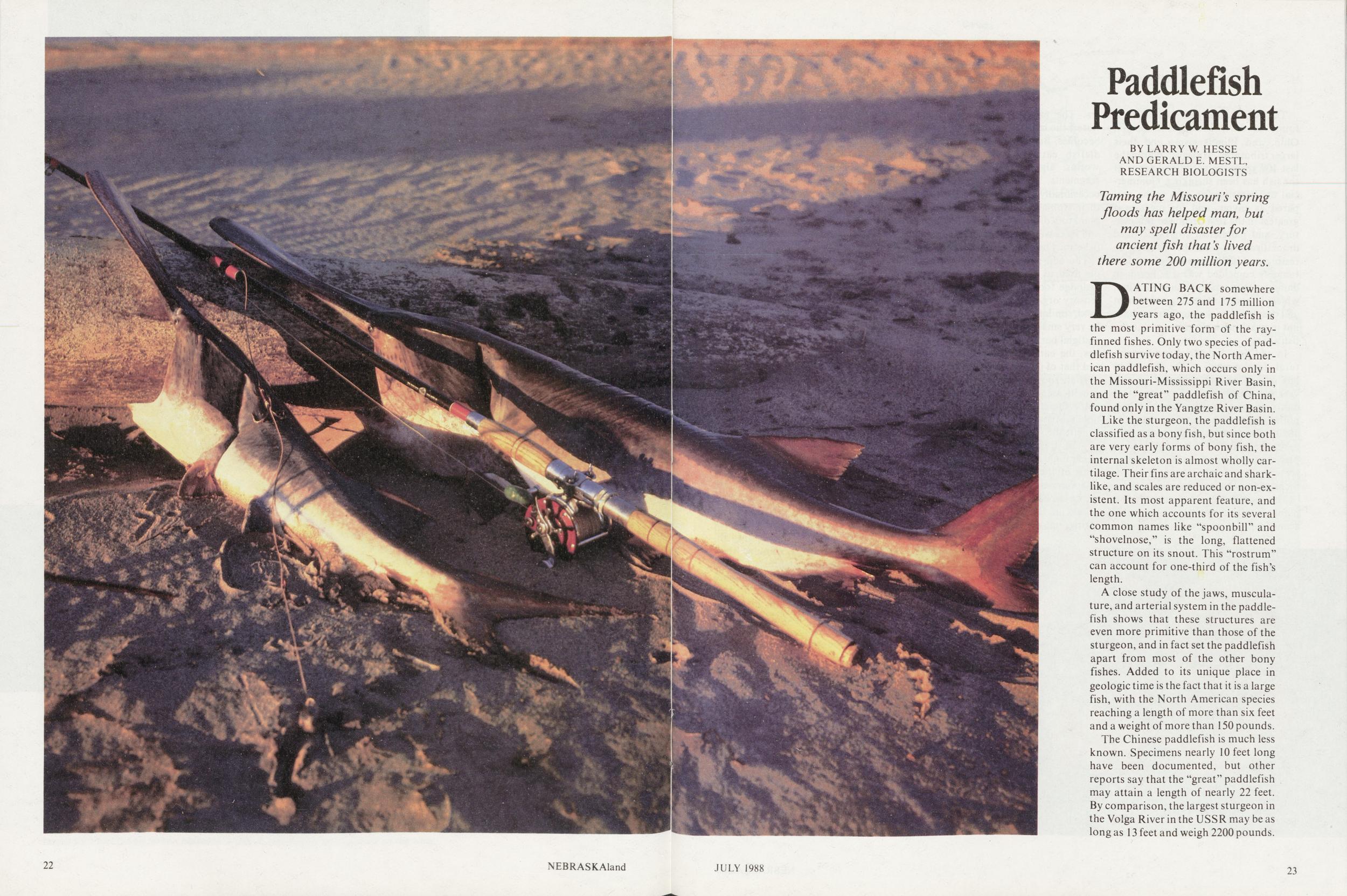
BY LARRY W. HESSE AND GERALD E. MESTL, RESEARCH BIOLOGISTS Taming the Missouri's spring floods has helped man, but may spell disaster for ancient fish that's lived there some 200 million years.DATING BACK somewhere between 275 and 175 million years ago, the paddlefish is the most primitive of the ray finned fishes. Only two species of paddlefish survive today, the North American paddlefish, which occurs only in the Missouri-Mississippi River Basin, and the "great" paddlefish of China, found only in the Yangtze River Basin.
Like the sturgeon, the paddlefish is classified as a bony fish, but since both are very early forms of bony fish, the internal skeleton is almost wholly cartilage. Their fins are archaic and shark-like, and scales are reduced or non-existent. Its most apparent feature, and the one which accounts for its several common names like "spoonbill" and "shovel nose," is the long, flattened structure on its snout. This "rostrum can account for one-third of the fish's length.
A close study of the jaws, musculature, and arterial system in the paddle-fish shows that these structures are even more primitive than those of the sturgeon, and in fact set the paddlefish apart from most of the other bony fishes. Added to its unique place in geologic time is the fact that it is a large fish, with the North American species reaching a length of more than six feet and a weight of more than 150 pounds.
The Chinese paddlefish is much less known. Specimens nearly 10 feet long have been documented, but other reports say that the "great" paddlefish may attain a length of nearly 22 feet. By comparison, the largest sturgeon in the Volga River in the USSR may be as long as 13 feet and weigh 2200 pounds.
JULY 1988 23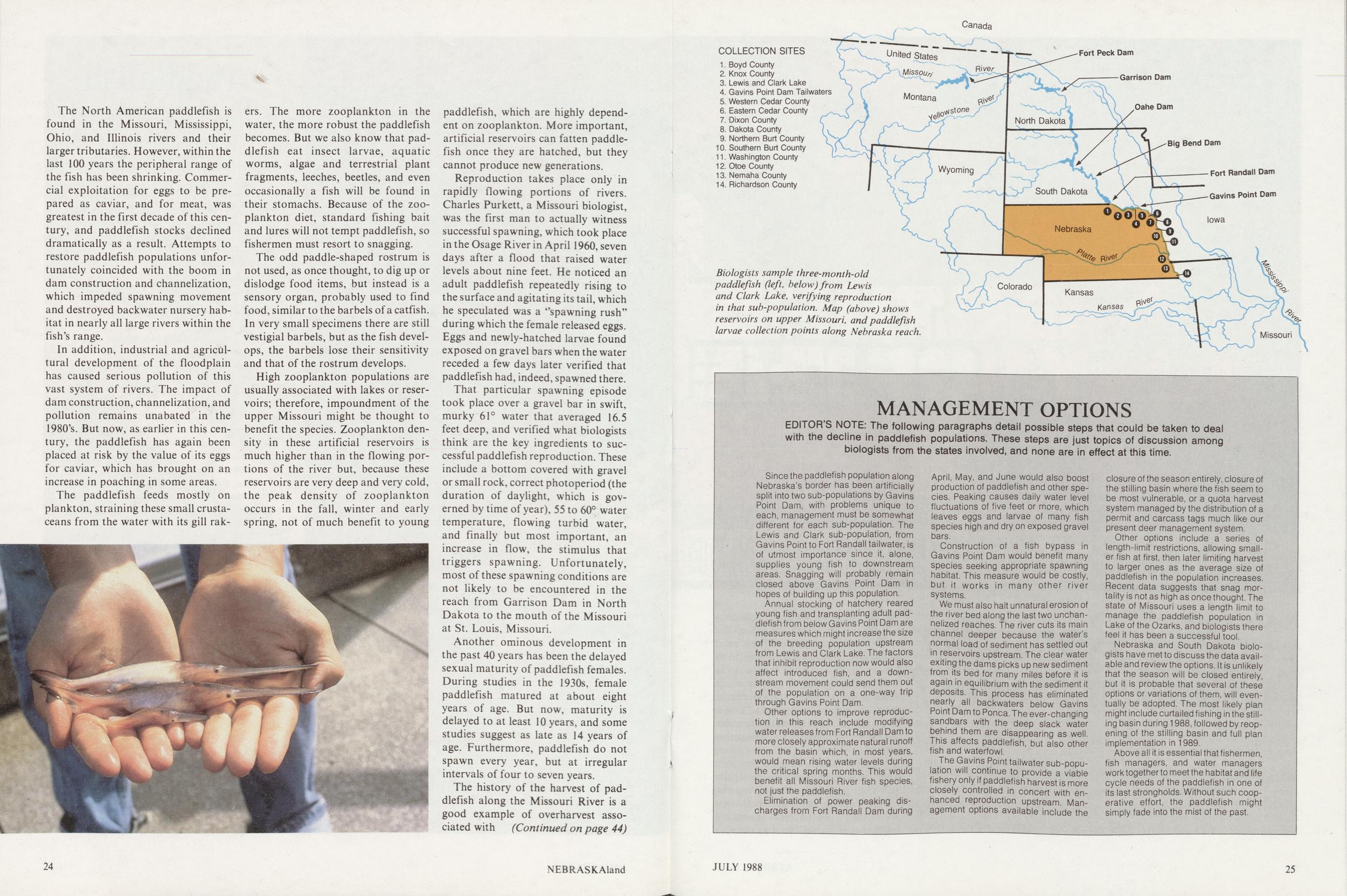
The North American paddlefish is found in the Missouri, Mississippi, Ohio, and Illinois rivers and their larger tributaries. However, within the last 100 years the peripheral range of the fish has been shrinking. Commercial exploitation for eggs to be prepared as caviar, and for meat, was greatest in the first decade of this century, and paddlefish stocks declined dramatically as a result. Attempts to restore paddlefish populations unfortunately coincided with the boom in dam construction and channelization, which impeded spawning movement and destroyed backwater nursery habitat in nearly all large rivers within the fish's range.
In addition, industrial and agricultural development of the floodplain has caused serious pollution of this vast system of rivers. The impact of dam construction, channelization, and pollution remains unabated in the 1980's. But now, as earlier in this century, the paddlefish has again been placed at risk by the value of its eggs for caviar, which has brought on an increase in poaching in some areas.
The paddlefish feeds mostly on plankton, straining these small crustaceans from the water with its gill rakers. The more zooplankton in the water, the more robust the paddlefish becomes. But we also know that paddlefish eat insect larvae, aquatic worms, algae and terrestrial plant fragments, leeches, beetles, and even occasionally a fish will be found in their stomachs. Because of the zoo-plankton diet, standard fishing bait and lures will not tempt paddlefish, so fishermen must resort to snagging.
The odd paddle-shaped rostrum is not used, as once thought, to dig up or dislodge food items, but instead is a sensory organ, probably used to find food, similar to the barbels of a catfish. In very small specimens there are still vestigial barbels, but as the fish develops, the barbels lose their sensitivity and that of the rostrum develops.
High zooplankton populations are usually associated with lakes or reservoirs; therefore, impoundment of the upper Missouri might be thought to benefit the species. Zooplankton density in these artificial reservoirs is much higher than in the flowing portions of the river but, because these reservoirs are very deep and very cold, the peak density of zooplankton occurs in the fall, winter and early spring, not of much benefit to young paddlefish, which are highly dependent on zooplankton. More important, artificial reservoirs can fatten paddlefish once they are hatched, but they cannot produce new generations.
Reproduction takes place only in rapidly flowing portions of rivers. Charles Purkett, a Missouri biologist, was the first man to actually witness successful spawning, which took place in the Osage River in April 1960, seven days after a flood that raised water levels about nine feet. He noticed an adult paddlefish repeatedly rising to the surface and agitating its tail, which he speculated was a "spawning rush" during which the female released eggs. Eggs and newly-hatched larvae found exposed on gravel bars when the water receded a few days later verified that paddlefish had, indeed, spawned there.
That particular spawning episode took place over a gravel bar in swift, murky 61° water that averaged 16.5 feet deep, and verified what biologists think are the key ingredients to successful paddlefish reproduction. These include a bottom covered with gravel or small rock, correct photoperiod (the duration of daylight, which is governed by time of year), 55 to 60° water temperature, flowing turbid water, and finally but most important, an increase in flow, the stimulus that triggers spawning. Unfortunately, most of these spawning conditions are not likely to be encountered in the reach from Garrison Dam in North Dakota to the mouth of the Missouri at St. Louis, Missouri.
Another ominous development in the past 40 years has been the delayed sexual maturity of paddlefish females. During studies in the 1930s, female paddlefish matured at about eight years of age. But now, maturity is delayed to at least 10 years, and some studies suggest as late as 14 years of age. Furthermore, paddlefish do not spawn every year, but at irregular intervals of four to seven years.
The history of the harvest of paddlefish along the Missouri River is a good example of over harvest associated with (Continued on page 44)
24 NEBRASKAlandSince the paddlefish population along Nebraska's border has been artificially split into two sub-populations by Gavins Point Dam, with problems unique to each, management must be somewhat different for each sub-population. The Lewis and Clark sub-population, from Gavins Point to Fort Randall tailwater, is of utmost importance since it, alone, supplies young fish to downstream areas. Snagging will probably remain closed above Gavins Point Dam in hopes of building up this population.
Annual stocking of hatchery reared young fish and transplanting adult paddlefish from below Gavins Point Dam are measures which might increase the size of the breeding population upstream from Lewis and Clark Lake. The factors that inhibit reproduction now would also affect introduced fish, and a downstream movement could send them out of the population on a one-way trip through Gavins Point Dam.
Other options to improve reproduction in this reach include modifying water releases from Fort Randall Dam to more closely approximate natural runoff from the basin which, in most years, would mean rising water levels during the critical spring months. This would benefit all Missouri River fish species, not just the paddlefish.
Elimination of power peaking discharges from Fort Randall Dam during April, May, and dune would also boost production of paddlefish and other species. Peaking causes daily water level fluctuations of five feet or more, which leaves eggs and larvae of many fish species high and dry on exposed gravel bars.
Construction of a fish bypass in Gavins Point Dam would benefit many species seeking appropriate spawning habitat. This measure would be costly, but it works in many other river systems.
We must also halt unnatural erosion of the river bed along the last two unchannelized reaches. The river cuts its main channel deeper because the water's normal load of sediment has settled out in reservoirs upstream. The clear water exiting the dams picks up new sediment from its bed for many miles before it is again in equilibrium with the sediment it deposits. This process has eliminated nearly all backwaters below Gavins Point Dam to Ponca. The ever-changing sandbars with the deep slack water behind them are disappearing as well. This affects paddlefish, but also other fish and waterfowl.
The Gavins Point tailwater sub-population will continue to provide a viable fishery only if paddlefish harvest is more closely controlled in concert with enhanced reproduction upstream. Management options available include the closure of the season entirely, closure of the stilling basin where the fish seem to be most vulnerable, or a quota harvest system managed by the distribution of a permit and carcass tags much like our present deer management system.
Other options include a series of length-limit restrictions, allowing smaller fish at first, then later limiting harvest to larger ones as the average size of paddlefish in the population increases. Recent data suggests that snag mortality is not as high as once thought. The state of Missouri uses a length limit to manage the paddlefish population in Lake of the Ozarks, and biologists there feel it has been a successful tool.
Nebraska and South Dakota biologists have met to discuss the data available and review the options, it is unlikely that the season will be closed entirely, but it is probable that several of these options or variations of them, will eventually be adopted. The most likely plan might include curtailed fishing in the stilling basin during 1988, followed by reopening of the stilling basin and full plan implementation in 1989.
Above all it is essential that fishermen, fish managers, and water managers work together to meet the habitat and life cycle needs of the paddlefish in one of its last strongholds. Without such cooperative effort, the paddlefish might simply fade into the mist of the past.
JULY 1988 25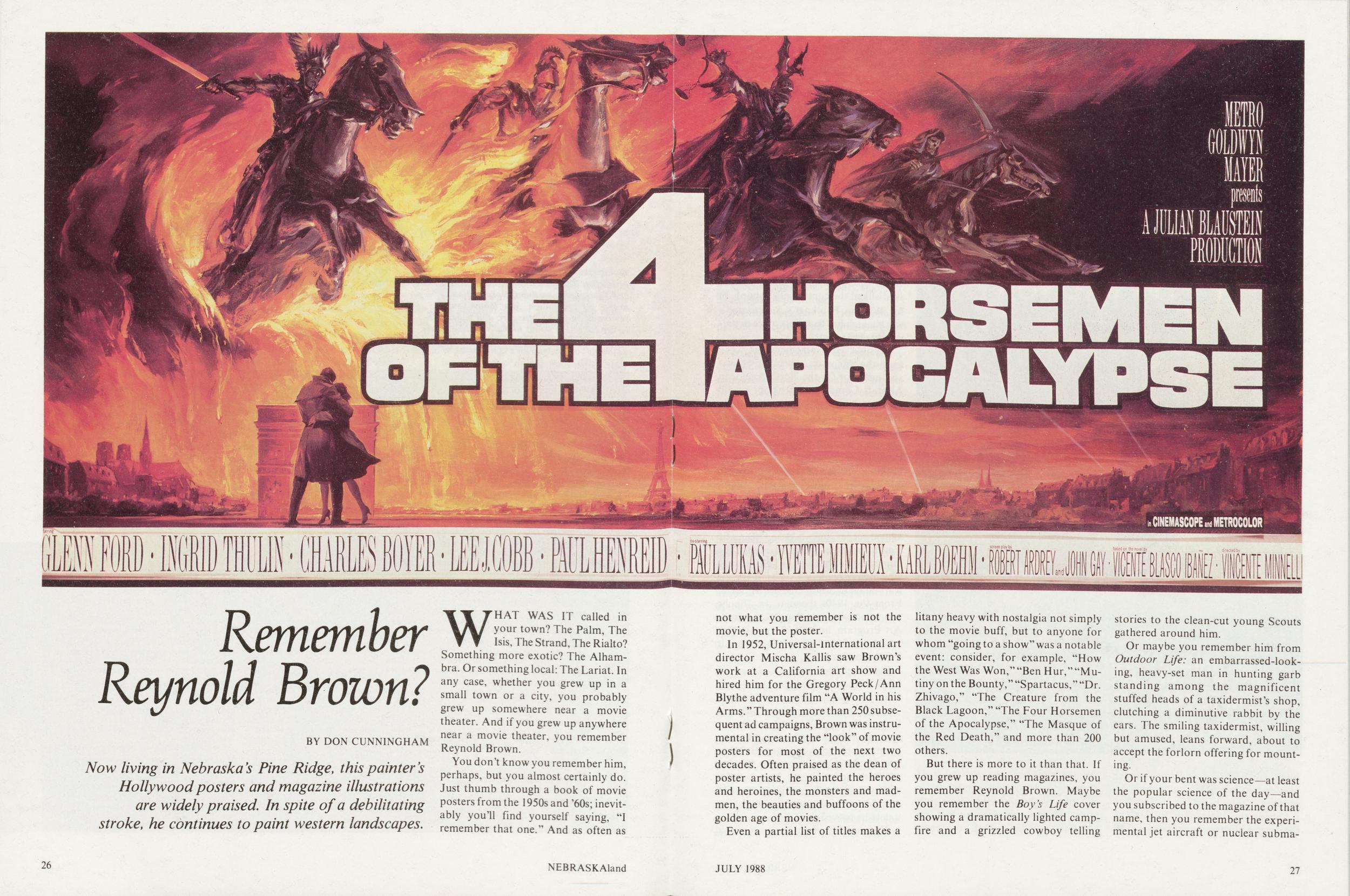
Remember Reynold Brown?
BY DON CUNNINGHAM Now living in Nebraska's Pine Ridge, this painter's Hollywood posters and magazine illustrations are widely praised. In spite of a debilitating stroke, he continues to paint western landscapes.WHAT WAS IT called in your town? The Palm, The Isis, The Strand, The Rialto? Something more exotic? The Alhambra. Or something local: The Lariat. In any case, whether you grew up in a small town or a city, you probably grew up somewhere near a movie theater. And if you grew up anywhere near a movie theater, you remember Reynold Brown.
You don't know you remember him, perhaps, but you almost certainly do. Just thumb through a book of movie posters from the 1950s and '60s; inevitably you'll find yourself saying, "I remember that one." And as often as 26 NEBRASKAland not what you remember is not the movie, but the poster.
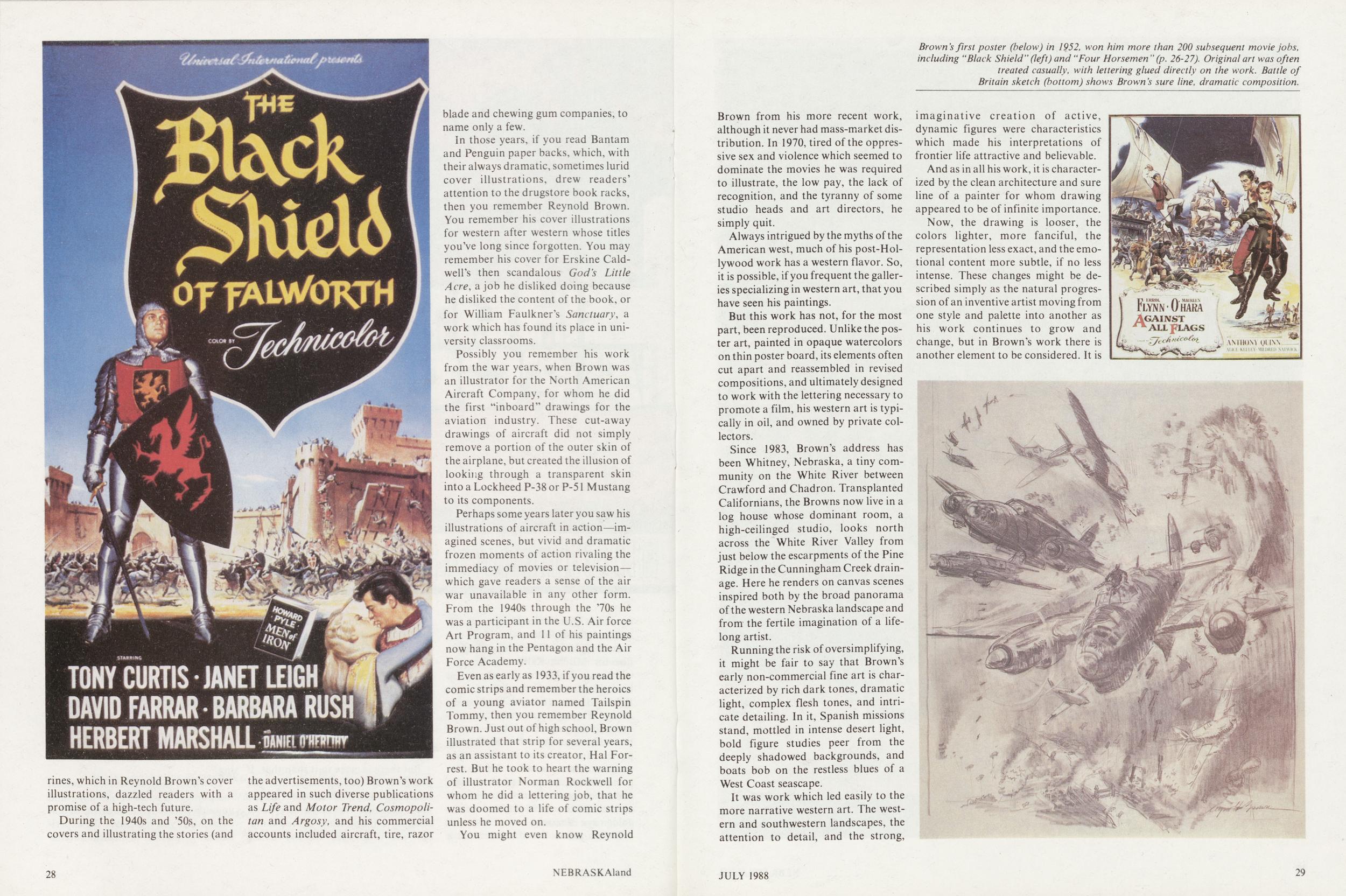
In 1952, Universal-international art director Mischa Kallis saw Brown's work at a California art show and hired him for the Gregory Peck/Ann Blythe adventure film "A World in his Arms."Through more than 250 subsequent ad campaigns, Brown was instrumental in creating the "look" of movie posters for most of the next two decades. Often praised as the dean of poster artists, he painted the heroes and heroines, the monsters and madmen, the beauties and buffoons of the golden age of movies.
Even a partial list of titles makes a litany heavy with nostalgia not simply to the movie buff, but to anyone for whom "going to a show" was a notable event: consider, for example, "How the West Was Won,""Ben Hur," "Mutiny on the Bounty," "Spartacus," "Dr. Zhivago," "The Creature from the Black Lagoon," "The Four Horsemen of the Apocalypse," "The Masque of the Red Death," and more than 200 others.
But there is more to it than that. If you grew up reading magazines, you remember Reynold Brown. Maybe you remember the Boy's Life cover showing a dramatically lighted campfire and a grizzled cowboy telling stories to the clean-cut young Scouts gathered around him.
Or maybe you remember him from Outdoor Life: an embarrassed looking, heavy-set man in hunting garb standing among the magnificent stuffed heads of a taxidermist's shop, clutching a diminutive rabbit by the ears. The smiling taxidermist, willing but amused, leans forward, about to accept the forlorn offering for mounting.
Or if your bent was science—at least
the popular science of the day—and
you subscribed to the magazine of that
name, then you remember the
experimental jet aircraft or nuclear submarines
JULY 1988
27
 rines, which in Reynold Brown's cover
illustrations, dazzled readers with a
promise of a high-tech future.
rines, which in Reynold Brown's cover
illustrations, dazzled readers with a
promise of a high-tech future.
During the 1940s and '50s, on the covers and illustrating the stories (and the advertisements, too) Brown's work appeared in such diverse publications as Life and Motor Trend, Cosmopolitan and Argosy, and his commercial accounts included aircraft, tire, razor blade and chewing gum companies, to name only a few.
In those years, if you read Bantam and Penguin paper backs, which, with their always dramatic, sometimes lurid cover illustrations, drew readers' attention to the drugstore book racks, then you remember Reynold Brown. You remember his cover illustrations for western after western whose titles you've long since forgotten. You may remember his cover for Erskine Caldwell's then scandalous God's Little Acre, a job he disliked doing because he disliked the content of the book, or for William Faulkner's Sanctuary, a work which has found its place in university classrooms.
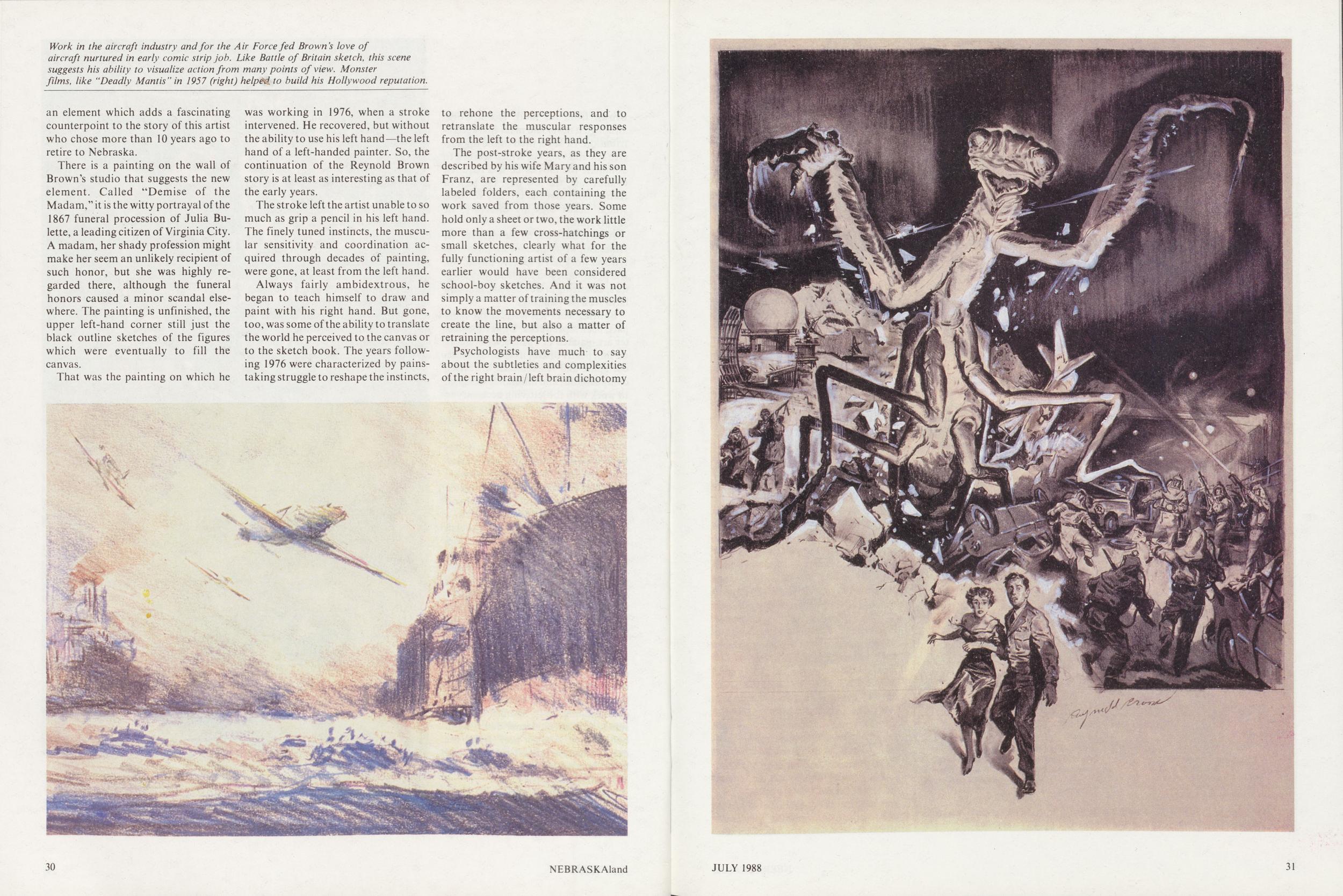
Possibly you remember his work from the war years, when Brown was an illustrator for the North American Aircraft Company, for whom he did the first "inboard'1 drawings for the aviation industry. These cut-away drawings of aircraft did not simply remove a portion of the outer skin of the airplane, but created the illusion of looking through a transparent skin into a Lockheed P-38 or P-51 Mustang to its components.
Perhaps some years later you saw his illustrations of aircraft in action imagined scenes, but vivid and dramatic frozen moments of action rivaling the immediacy of movies or television— which gave readers a sense of the air war unavailable in any other form. From the 1940s through the '70s he was a participant in the U.S. Air force Art Program, and 11 of his paintings now hang in the Pentagon and the Air Force Academy.
Even as early as 1933, if you read the comic strips and remember the heroics of a young aviator named Tailspin Tommy, then you remember Reynold Brown. Just out of high school, Brown illustrated that strip for several years, as an assistant to its creator, Hal Forrest. But he took to heart the warning of illustrator Norman Rockwell for whom he did a lettering job, that he was doomed to a life of comic strips unless he moved on.
You might even know Reynold 28 NEBRASKAland Brown from his more recent work, although it never had mass-market distribution. In 1970, tired of the oppressive sex and violence which seemed to dominate the movies he was required to illustrate, the low pay, the lack of recognition, and the tyranny of some studio heads and art directors, he simply quit.
Always intrigued by the myths of the American west, much of his post-Hollywood work has a western flavor. So, it is possible, if you frequent the galleries specializing in western art, that you have seen his paintings.
But this work has not, for the most part, been reproduced. Unlike the poster art, painted in opaque watercolors on thin poster board, its elements often cut apart and reassembled in revised compositions, and ultimately designed to work with the lettering necessary to promote a film, his western art is typically in oil, and owned by private collectors.
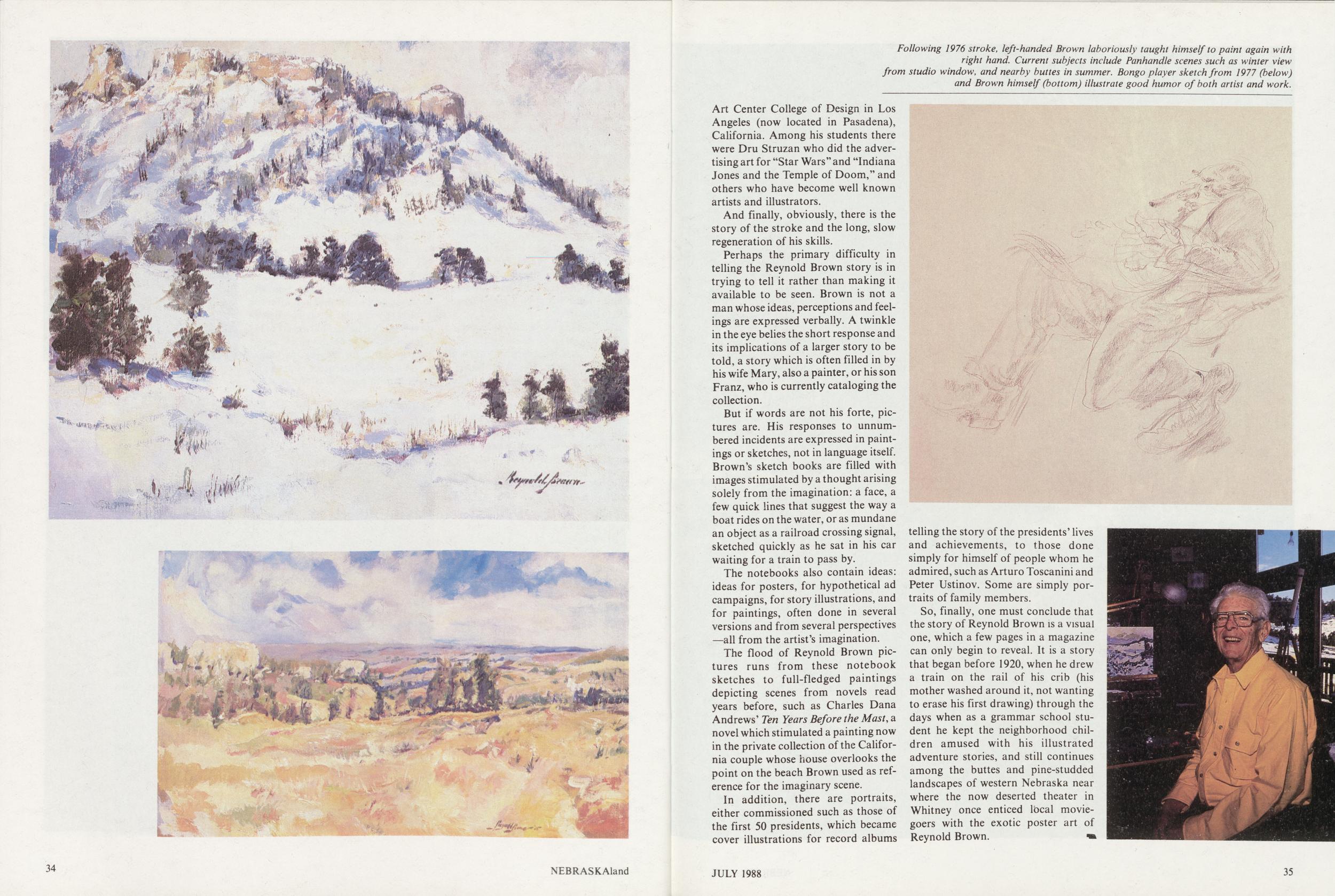
Since 1983, Brown's address has been Whitney, Nebraska, a tiny community on the White River between Crawford and Chadron. Transplanted Californians, the Browns now live in a log house whose dominant room, a high-ceilinged studio, looks north across the White River Valley from just below the escarpments of the Pine Ridge in the Cunningham Creek drainage. Here he renders on canvas scenes inspired both by the broad panorama of the western Nebraska landscape and from the fertile imagination of a life long artist.
Running the risk of oversimplifying, it might be fair to say that Brown's early non-commercial fine art is characterized by rich dark tones, dramatic light, complex flesh tones, and intricate detailing. In it, Spanish missions stand, mottled in intense desert light, bold figure studies peer from the deeply shadowed backgrounds, and boats bob on the restless blues of a West Coast seascape.
It was work which led easily to the more narrative western art. The western and southwestern landscapes, the attention to detail, and the strong, imaginative creation of active, dynamic figures were characteristics which made his interpretations of frontier life attractive and believable.
And as in all his work, it is characterized by the clean architecture and sure line of a painter for whom drawing appeared to be of infinite importance.
Now, the drawing is looser, the colors lighter, more fanciful, the representation less exact, and the emotional content more subtle, if no less intense. These changes might be described simply as the natural progression of an inventive artist moving from one style and palette into another as his work continues to grow and change, but in Brown's work there is another element to be considered. It is an element which adds a fascinating counterpoint to the story of this artist who chose more than 10 years ago to retire to Nebraska.
There is a painting on the wall of Brown's studio that suggests the new element. Called "Demise of the Madam," it is the witty portrayal of the 1867 funeral procession of Julia Bulette, a leading citizen of Virginia City. A madam, her shady profession might make her seem an unlikely recipient of such honor, but she was highly regarded there, although the funeral honors caused a minor scandal elsewhere. The painting is unfinished, the upper left-hand corner still just the black outline sketches of the figures which were eventually to fill the canvas.
That was the painting on which he was working in 1976, when a stroke intervened. He recovered, but without the ability to use his left hand—the left hand of a left-handed painter. So, the continuation of the Reynold Brown story is at least as interesting as that of the early years.
The stroke left the artist unable to so much as grip a pencil in his left hand. The finely tuned instincts, the muscular sensitivity and coordination acquired through decades of painting, were gone, at least from the left hand.
Always fairly ambidextrous, he began to teach himself to draw and paint with his right hand. But gone, too, was some of the ability to translate the world he perceived to the canvas or to the sketch book. The years following 1976 were characterized by painstaking struggle to reshape the instincts, to rehone the perceptions, and to retranslate the muscular responses from the left to the right hand.
The post-stroke years, as they are described by his wife Mary and his son Franz, are represented by carefully labeled folders, each containing the work saved from those years. Some hold only a sheet or two, the work little more than a few cross-hatchings or small sketches, clearly what for the fully functioning artist of a few years earlier would have been considered school-boy sketches. And it was not simply a matter of training the muscles to know the movements necessary to create the line, but also a matter of retraining the perceptions.
Psychologists have much to say about the subtleties and complexities of the right brain/left brain dichotomy and its separate control of the logical/rational functions and the artistic/perceptive functions. For them, Brown is a case study; for the rest of us he continues to be an artist, and to characterize the work of that period as being that of an artist who was not fully functioning would be to characterize it by very limited physical criteria.
30 NEBRSAKAland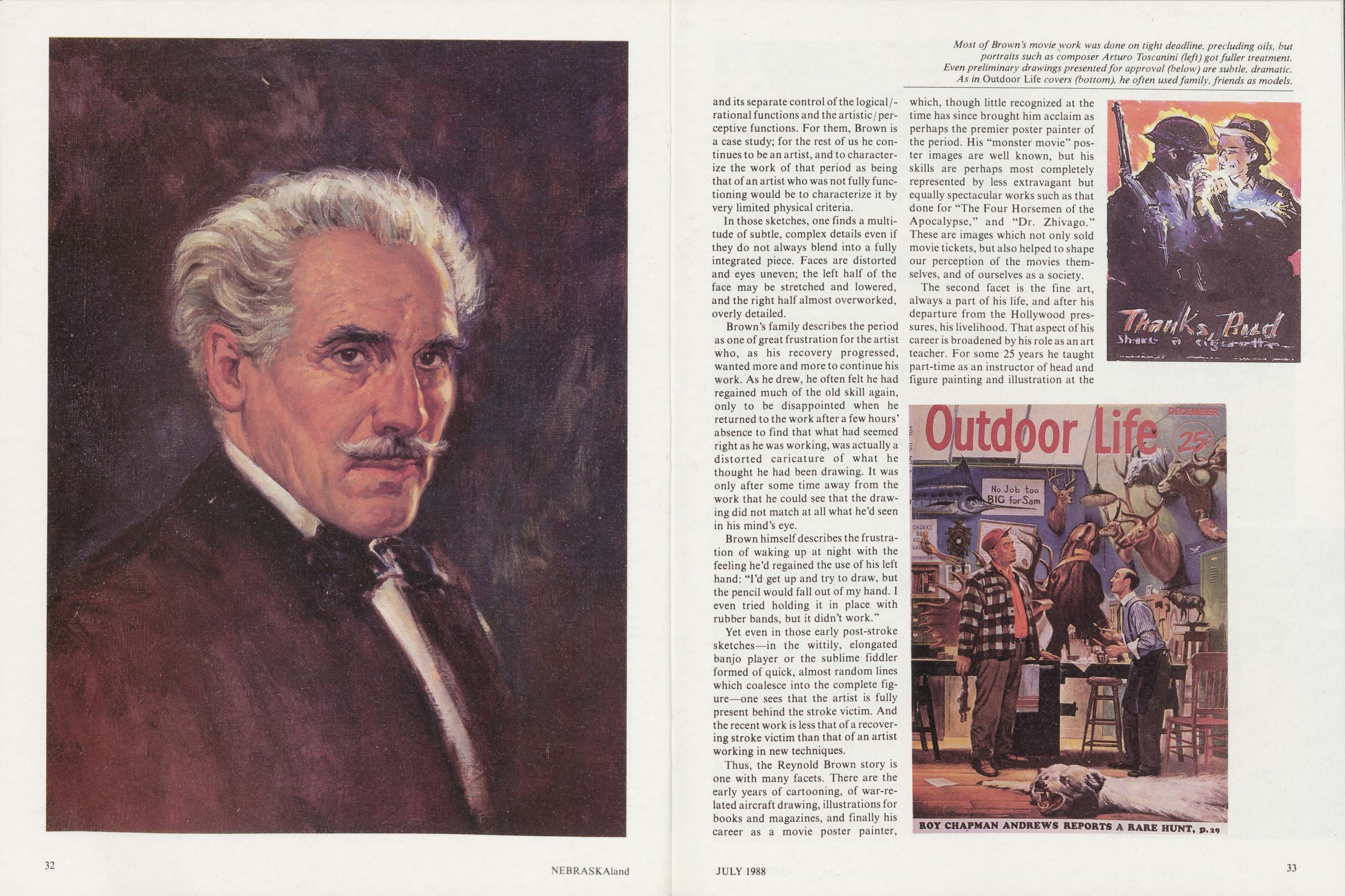
In those sketches, one finds a multitude of subtle, complex details even if they do not always blend into a fully integrated piece. Faces are distorted and eyes uneven; the left half of the face may be stretched and lowered, and the right half almost overworked, overly detailed.
Brown's family describes the period as one of great frustration for the artist who, as his recovery progressed, wanted more and more to continue his work. As he drew, he often felt he had regained much of the old skill again, only to be disappointed when he returned to the work after a few hours' absence to find that what had seemed right as he was working, was actually a distorted caricature of what he thought he had been drawing. It was only after some time away from the work that he could see that the drawing did not match at all what he'd seen in his mind's eye.
Brown himself describes the frustration of waking up at night with the feeling he'd regained the use of his left hand: "I'd get up and try to draw, but the pencil would fall out of my hand. I even tried holding it in place with rubber bands, but it didn't work."
Yet even in those early post-stroke sketches—in the wittily, elongated banjo player or the sublime fiddler formed of quick, almost random lines which coalesce into the complete figure—one sees that the artist is fully present behind the stroke victim. And the recent work is less that of a recovering stroke victim than that of an artist working in new techniques.
Thus, the Reynold Brown story is one with many facets. There are the early years of cartooning, of war-related aircraft drawing, illustrations for books and magazines, and finally his career as a movie poster painter, which, though little recognized at the time has since brought him acclaim as perhaps the premier poster painter of the period. His "monster movie" poster images are well known, but his skills are perhaps most completely represented by less extravagant but equally spectacular works such as that done for "The Four Horsemen of the Apocalypse," and "Dr. Zhivago." These are images which not only sold movie tickets, but also helped to shape our perception of the movies themselves, and of ourselves as a society.
The second facet is the fine art, always a part of his life, and after his departure from the Hollywood pressures, his livelihood. That aspect of his career is broadened by his role as an art teacher. For some 25 years he taught part-time as an instructor of head and figure painting and illustration at the Art Center College of Design in Los Angeles (now located in Pasadena), California. Among his students there were Dru Struzan who did the advertising art for "Star Wars" and "Indiana Jones and the Temple of Doom," and others who have become well known artists and illustrators.
And finally, obviously, there is the story of the stroke and the long, slow regeneration of his skills.
Perhaps the primary difficulty in telling the Reynold Brown story is in trying to tell it rather than making it available to be seen. Brown is not a man whose ideas, perceptions and feelings are expressed verbally. A twinkle in the eye belies the short response and its implications of a larger story to be told, a story which is often filled in by his wife Mary, also a painter, or his son Franz, who is currently cataloging the collection.
But if words are not his forte, pictures are. His responses to unnumbered incidents are expressed in paintings or sketches, not in language itself. Brown's sketch books are filled with images stimulated by a thought arising solely from the imagination: a face, a few quick lines that suggest the way a boat rides on the water, or as mundane an object as a railroad crossing signal, sketched quickly as he sat in his car waiting for a train to pass by.
The notebooks also contain ideas: ideas for posters, for hypothetical ad campaigns, for story illustrations, and for paintings, often done in several versions and from several perspectives —all from the artist's imagination.
The flood of Reynold Brown pictures runs from these notebook sketches to full-fledged paintings depicting scenes from novels read years before, such as Charles Dana Andrews' Ten Years Before the Mast, a novel which stimulated a painting now in the private collection of the California couple whose house overlooks the point on the beach Brown used as reference for the imaginary scene.
In addition, there are portraits, either commissioned such as those of the first 50 presidents, which became cover illustrations for record albums telling the story of the presidents' lives and achievements, to those done simply for himself of people whom he admired, such as Arturo Toscanini and Peter Ustinov. Some are simply portraits of family members.
So, finally, one must conclude that the story of Reynold Brown is a visual one, which a few pages in a magazine can only begin to reveal. It is a story that began before 1920, when he drew a train on the rail of his crib (his mother washed around it, not wanting to erase his first drawing) through the days when as a grammar school student he kept the neighborhood children amused with his illustrated adventure stories, and still continues among the buttes and pine-studded landscapes of western Nebraska near where the now deserted theater in Whitney once enticed local movie-goers with the exotic poster art of Reynold Brown.
When Push Comes To Shove
PHOTOS, TEXT BY JULIA McCORD When male rattlesnakes meet, they sometimes battle for dominance or for territory by entwining—wrestling and testing by brute force as to which is the stronger.THE TIME AND place are indelibly etched in my memory: Thursday, July 16, 1987, 6:20 p.m. at Dunn's farm, three miles east of Lisco in Garden County.
My cousin, Mary Curtis, and I were driving across a sand draw. We had just put the sows and their babies to bed in the farrowing house, and were going to set irrigation water on the east corn field before quitting for the day.
We wanted to get the irrigating done before dark, because the east field hadn't been farmed for nearly nine years and we had killed several rattlesnakes there. Neither of us wanted to risk walking around in the dark, leaning over to adjust the gates in the pipes, without being able to see any creatures that might be around.
As we started across the draw, I noticed motion in the track ahead. I stopped the pickup and we got out to see what was going on. When we got close enough to see, we witnessed a strange sight.
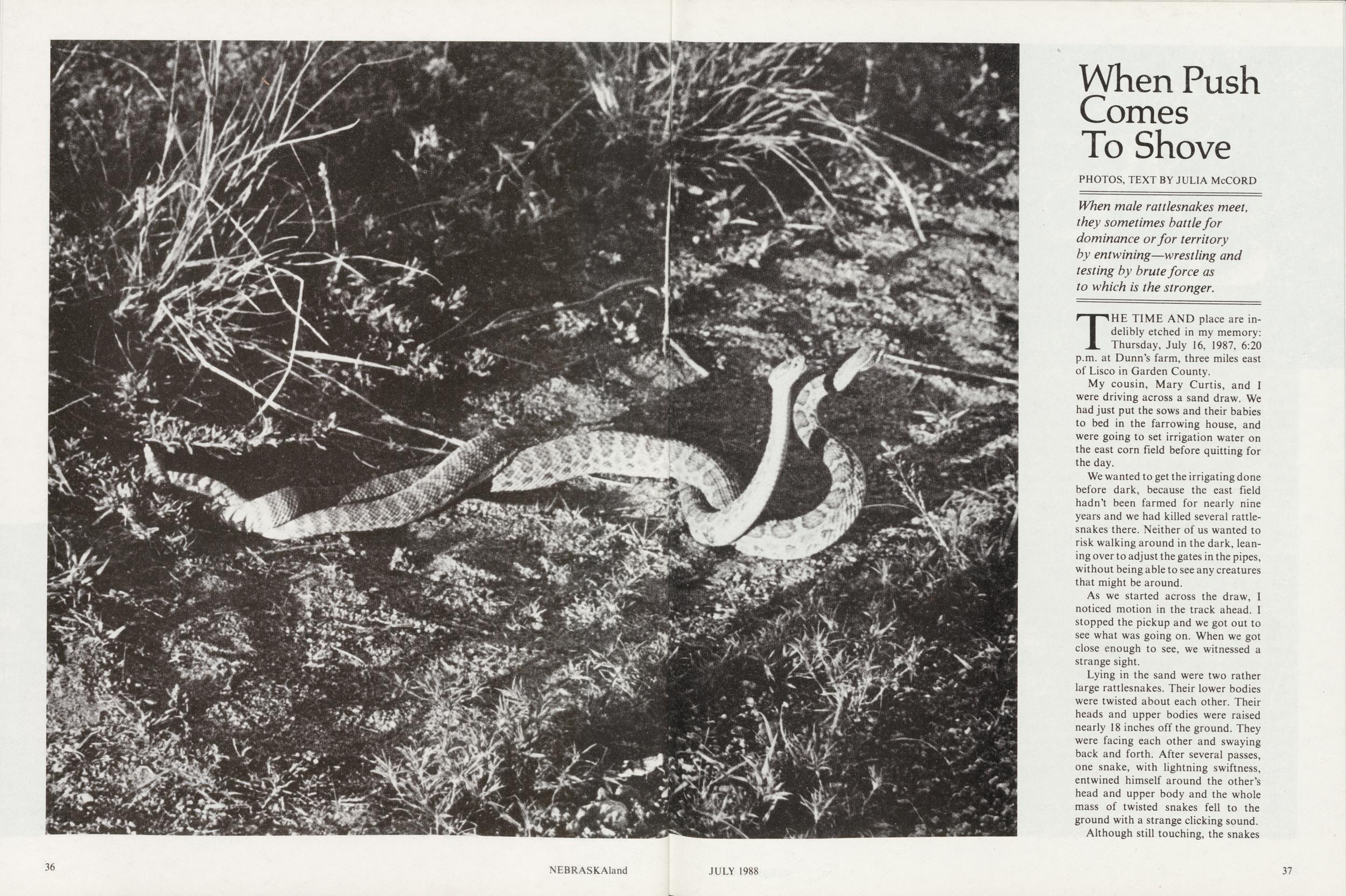
Lying in the sand were two rather large rattlesnakes. Their lower bodies were twisted about each other. Their heads and upper bodies were raised nearly 18 inches off the ground. They were facing each other and swaying back and forth. After several passes, one snake, with lightning swiftness, entwined himself around the other's head and upper body and the whole mass of twisted snakes fell to the ground with a strange clicking sound.
Although still touching, the snakes
JULY 1988
37
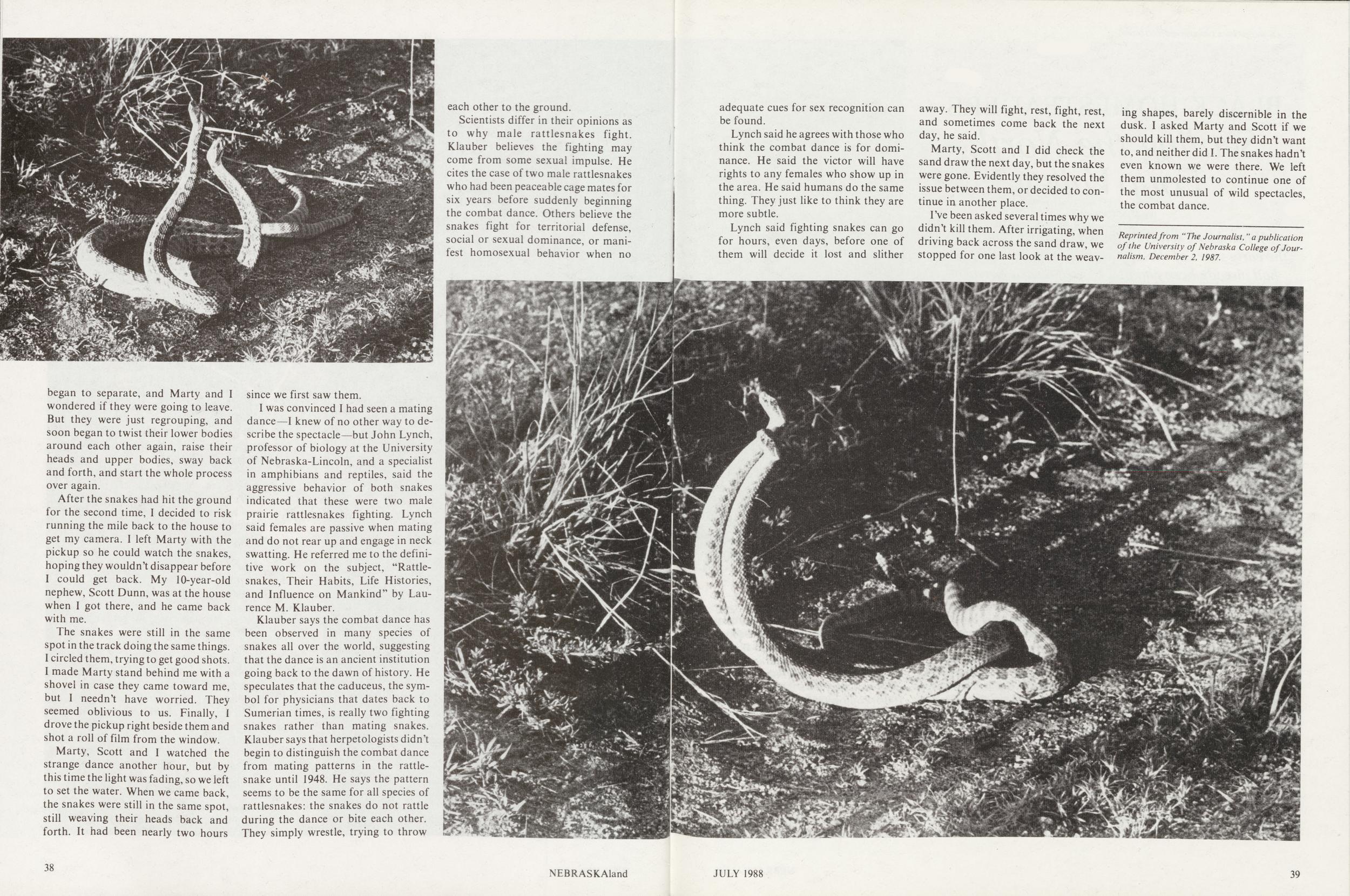 began to separate, and Marty and I
wondered if they were going to leave.
But they were just regrouping, and
soon began to twist their lower bodies
around each other again, raise their
heads and upper bodies, sway back
and forth, and start the whole process
over again.
began to separate, and Marty and I
wondered if they were going to leave.
But they were just regrouping, and
soon began to twist their lower bodies
around each other again, raise their
heads and upper bodies, sway back
and forth, and start the whole process
over again.
After the snakes had hit the ground for the second time, I decided to risk running the mile back to the house to get my camera. I left Marty with the pickup so he could watch the snakes, hoping they wouldn't disappear before I could get back. My 10-year-old nephew, Scott Dunn, was at the house when I got there, and he came back with me.
The snakes were still in the same spot in the track doing the same things. 1 circled them, trying to get good shots. I made Marty stand behind me with a shovel in case they came toward me, but I needn't have worried. They seemed oblivious to us. Finally, I drove the pickup right beside them and shot a roll of film from the window.
Marty, Scott and I watched the strange dance another hour, but by this time the light was fading, so we left to set the water. When we came back, the snakes were still in the same spot, still weaving their heads back and forth. It had been nearly two hours since we first saw them.
I was convinced I had seen a mating dance—I knew of no other way to describe the spectacle—but John Lynch, professor of biology at the University of Nebraska-Lincoln, and a specialist in amphibians and reptiles, said the aggressive behavior of both snakes indicated that these were two male prairie rattlesnakes fighting. Lynch said females are passive when mating and do not rear up and engage in neck swatting. He referred me to the definitive work on the subject, "Rattlesnakes, Their Habits, Life Histories, and Influence on Mankind" by Laurence M. Klauber.
Klauber says the combat dance has been observed in many species of snakes all over the world, suggesting that the dance is an ancient institution going back to the dawn of history. He speculates that the caduceus, the symbol for physicians that dates back to Sumerian times, is really two fighting snakes rather than mating snakes. Klauber says that herpetologists didn't begin to distinguish the combat dance from mating patterns in the rattlesnake until 1948. He says the pattern seems to be the same for all species of rattlesnakes: the snakes do not rattle during the dance or bite each other. They simply wrestle, trying to throw each other to the ground.
Scientists differ in their opinions as to why male rattlesnakes fight. Klauber believes the fighting may come from some sexual impulse. He cites the case of two male rattlesnakes who had been peaceable cage mates for six years before suddenly beginning the combat dance. Others believe the snakes fight for territorial defense, social or sexual dominance, or manifest homosexual behavior when no 38 NEBRASKAland adequate cues for sex recognition can be found.
Lynch said he agrees with those who think the combat dance is for dominance. He said the victor will have rights to any females who show up in the area. He said humans do the same thing. They just like to think they are more subtle.
Lynch said fighting snakes can go for hours, even days, before one of them will decide it lost and slither away. They will fight, rest, fight, rest, and sometimes come back the next day, he said.
Marty, Scott and I did check the sand draw the next day, but the snakes were gone. Evidently they resolved the issue between them, or decided to continue in another place.
I've been asked several times why we didn't kill them. After irrigating, when driving back across the sand draw, we stopped for one last look at the weaving shapes, barely discernible in the dusk. I asked Marty and Scott if we should kill them, but they didn't want to, and neither did I. The snakes hadn't even known we were there. We left them unmolested to continue one of the most unusual of wild spectacles, the combat dance.
BLACK HOMESTEADERS Settling the North Loup Valley
BY JON FARRAR When black settlers came to Cherry County in the early years of the 1900s, they found the best land had already been claimed by established ranchers.A WKWARD, stuffy words like "incongruous" and "implausible" race through your mind. You strain your imagination, stretch it to the limit trying to conjure up the image, but it won't come.
From a ridge line over the North Loup River, deep within the Hanna family ranches west of Brownlee in southeast Cherry County, Don Hanna Jr. points southeast to a large grove of trees on the north side of the river, Charles Meehan's homestead. Farther downstream, on the south side of the shallow North Loup, is a smaller grove of trees, "Uncle" Bob Hannahs' claim. They are the only trees visible for dozens of miles in any direction. Three weathered wood pilings stick up in the river where a bridge once spanned it. The North Loup snakes through choppy dunes of sand temporarily held in place by grass. June's lush green has already spread through the meadows and is creeping up the valley walls. There are no fences, no power lines, no houses, no roads; just grass-covered dunes, the meandering river, two gatherings of trees and three old bridge pilings. This is plausible and congruous. This is what Sandhills country looks like.
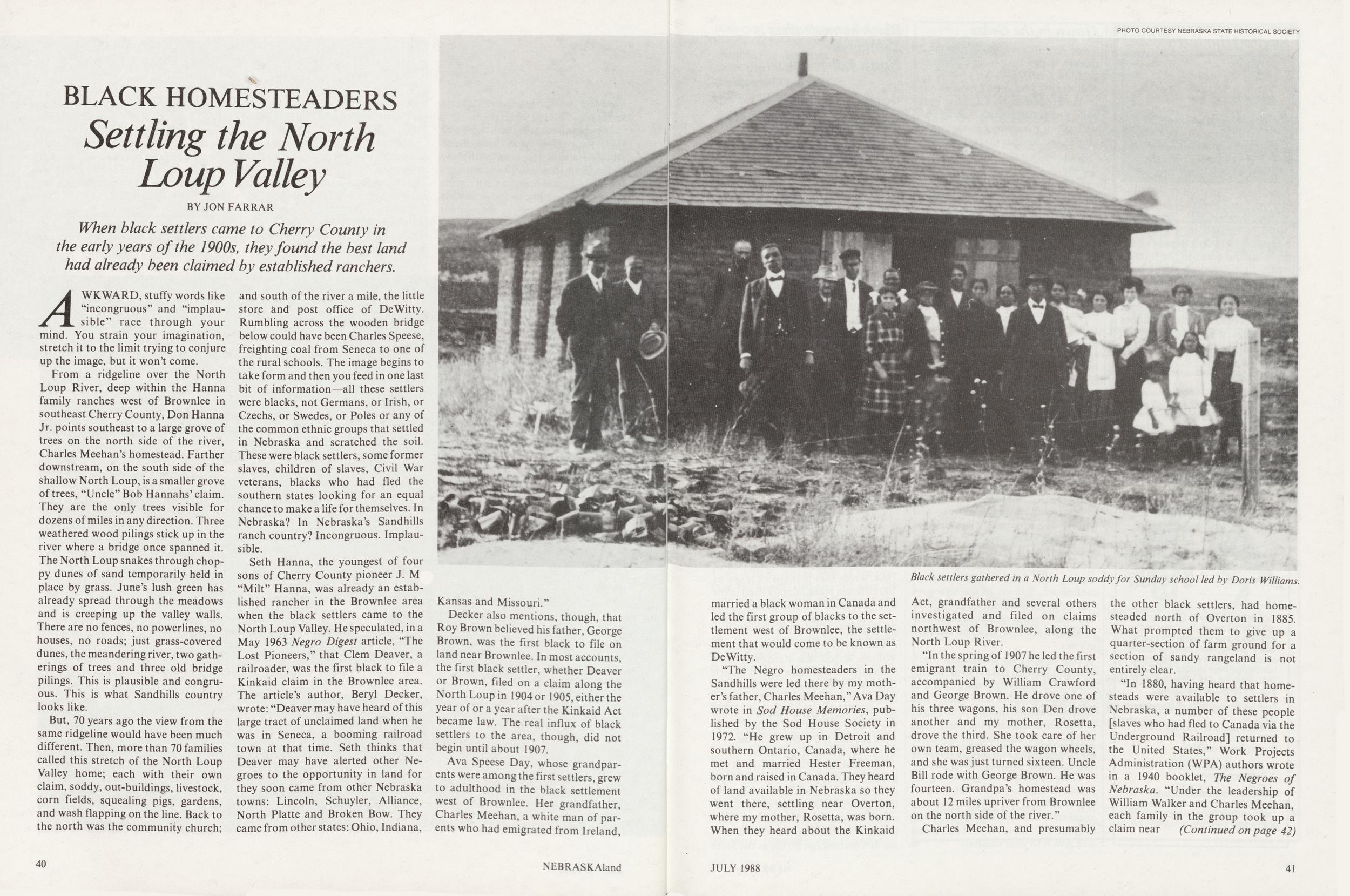
But, 70 years ago the view from the same ridge line would have been much different. Then, more than 70 families called this stretch of the North Loup Valley home; each with their own claim, soddy, out-buildings, livestock, corn fields, squealing pigs, gardens, and wash flapping on the line. Back to the north was the community church; and south of the river a mile, the little store and post office of DeWitty. Rumbling across the wooden bridge below could have been Charles Speese, freighting coal from Seneca to one of the rural schools. The image begins to take form and then you feed in one last bit of information—all these settlers were blacks, not Germans, or Irish, or Czechs, or Swedes, or Poles or any of the common ethnic groups that settled in Nebraska and scratched the soil. These were black settlers, some former slaves, children of slaves, Civil War veterans, blacks who had fled the southern states looking for an equal chance to make a life for themselves. In Nebraska? In Nebraska's Sandhills ranch country? Incongruous. Implausible.
Seth Hanna, the youngest of four sons of Cherry County pioneer J. M "Milt" Hanna, was already an established rancher in the Brownlee area when the black settlers came to the North Loup Valley. He speculated, in a May 1963 Negro Digest article, "The Lost Pioneers," that Clem Deaver, a railroader, was the first black to file a Kinkaid claim in the Brownlee area. The article's author, Beryl Decker, wrote: "Deaver may have heard of this large tract of unclaimed land when he was in Seneca, a booming railroad town at that time. Seth thinks that Deaver may have alerted other Negroes to the opportunity in land for they soon came from other Nebraska towns: Lincoln, Schuyler, Alliance, North Platte and Broken Bow. They came from other states: Ohio, Indiana, Black settlers gathered in a North Loup soddy for Sunday school led by Doris Williams. Kansas and Missouri."
Decker also mentions, though, that Roy Brown believed his father, George Brown, was the first black to file on land near Brownlee. In most accounts, the first black settler, whether Deaver or Brown, filed on a claim along the North Loup in 1904 or 1905, either the year of or a year after the Kinkaid Act became law. The real influx of black settlers to the area, though, did not begin until about 1907.
Ava Speese Day, whose grandparents were among the first settlers, grew to adulthood in the black settlement west of Brownlee. Her grandfather, Charles Meehan, a white man of parents who had emigrated from Ireland, 40 NEBRASKAland married a black woman in Canada and led the first group of blacks to the settlement west of Brownlee, the settlement that would come to be known as DeWitty.
"The Negro homesteaders in the Sandhills were led there by my mother's father, Charles Meehan," Ava Day wrote in Sod House Memories, published by the Sod House Society in 1972. "He grew up in Detroit and southern Ontario, Canada, where he met and married Hester Freeman, born and raised in Canada. They heard of land available in Nebraska so they went there, settling near Overton, where my mother, Rosetta, was born. When they heard about the Kinkaid Act, grandfather and several others investigated and filed on claims northwest of Brownlee, along the North Loup River.
"In the spring of 1907 he led the first emigrant train to Cherry County, accompanied by William Crawford and George Brown. He drove one of his three wagons, his son Den drove another and my mother, Rosetta, drove the third. She took care of her own team, greased the wagon wheels, and she was just turned sixteen. Uncle Bill rode with George Brown. He was fourteen. Grandpa's homestead was about 12 miles upriver from Brownlee on the north side of the river."
Charles Meehan, and presumably the other black settlers, had homesteaded north of Overton in 1885. What prompted them to give up a quarter-section of farm ground for a section of sandy rangeland is not entirely clear.
"In 1880, having heard that homesteads were available to settlers in Nebraska, a number of these people [slaves who had fled to Canada via the Underground Railroad] returned to the United States," Work Projects Administration (WPA) authors wrote in a 1940 booklet, The Negroes of Nebraska. "Under the leadership of William Walker and Charles Meehan, each family in the group took up a claim near (Continued on page 42)
Down in the Grass
(Continued from page 21)insect's wings are plucked and twirl down to earth.
How many adults are close enough to the ground to find a dung beetle rolling its manure treasure along a cattle trail, or pause long enough to see two of the somber black bugs battle over the ball while a third quietly steals it away.
Who, since leaving childhood, has looked closely at the yellow grasshoppers of August to notice chevrons on the powerful hind legs. Adults know what pesticide will eradicate the plant eaters, but pesticide instructions make no distinction between grasshoppers with long horns and those with short horns, lubbers or "regular" hoppers. Children do.
Seeing need not be forever lost to adults. It can be regained if we narrow our view to see more. Go to the prairie in late July or August, when the dew is heavy and the grass teems with insects. Sit in the grass and wait for the sun. Take a camera with a lens that will allow you to focus close. Film is not required.
Or, peer through a cardboard tube. Force your eye to see the little things, the prairie and its creatures in detail. Through your spyglass, follow a big bluestem stalk from the ground up, to where the first leaf forks and tiny hairs gather dew in crystalline globes—natural viewing screens; a fisheye lens that takes in the whole prairie and turns it upside down.
Fill your view with a spider web, sagging with moisture distilled from cooling air. Strands of the web gave way under the weight in the night, leaving windows through which some flimsy-winged insect will escape the spider's net
The insects are sluggish in early morning, their metabolism having fallen with the temperature. Look at the thistle heads for crab spiders that have assumed the flower's color and lie in wait for breakfast. Find dusty white moths on the underside of leaves, or jaunty skippers dashing from flower to flower.
Creep through the grass on your hands and knees. See what children see. And take your children. Get your sneakers wet. Smear dandelion flowers on your face. Dust off your childhood and give it to your children.
Black homesteaders... Settling the North Loup Valley
(Continued from page 41)Overton, in Dawson County, Nebraska, They proved up on their claims and lived on them for the next quarter-century.
During the drought years of 1905-07, the colonists began to consider the possibilities of a better living to made elsewhere. They learned that free land was open to homesteaders in Cherry County. Accordingly, in 1909 [Ava Day and others give the year as 1907], most of the Dawson County group, still under the leadership of William Walker and Charles Meehan, settled at Brownlee in Cherry County."
"They were up and down the North Loup River for about 10 or 12 miles," Don Hanna Jr. remembers, "from about eight miles west of Brownlee upstream, and back an either side for about four or five miles. There were not many white homesteaders in this general area. A few black settlers were south of the river, but not far, and one or two northwest of Mullen. But, this was the main settlement."
Charles S. Reece, in A History of Cherry County, Nebraska, wrote: "By 1912 there were more than 79 claims taken by these people." If each filed on a full section, and some apparently did not, black settlers in the Brownlee area would have occupied nearly 50,000 acres
Ava Day, in correspondence to the State Historical Society in March of 1964, wrote that perhaps as many as 100 different black families lived in the Brownlee area, "but I very much doubt that 100 [families] were there at the same time
Corinna Williams, the daughter of William Walker, one of the early black settlers in the Brownlee area, is quoted in an interview filed at the State His torical Society, as saying: . . . there were enough negroes there to fill a township . . . with few whites. There were around 175-180 negroes there. It was a very peaceful settlement.
My having been interested in the general welfare of my race, and especially from a religious standpoint, I felt it my duty to make a visit to the settlement," Rev. O. J. Burckhardt, a black pastor from Lincoln, is quoted as saying in a manuscript on file at the State 42 NEBRASKAland Historical society, "which I did in the summer of 1910 and found at that time about five or seven families, but I also discovered there was a splendid opportunity for a Negro settlement made up of the proper class of people . . . ."
Rev. Burckhardt traveled and lectured among his people telling them of the advantages of the Cherry County colony. Others worked earnestly with him and they eventually succeeded in "landing more than 150 souls" in the new colony. But, as settlers of all colors and nationalities were to discover, a free section of land in the Sandhills was not an unqualified blessing.
Ranchers who established in the Sandhills prior to the passage of the Kinkaid Act had chosen their land well. By filing on quarter-sections under the Pre-emption, Timber Culture and Homestead acts, or buying out those who had, ranchers had assumed ownership of the choice bottom land. Large families were able to piece together their claims and control contiguous parcels of meadow and river bottom land.
Pushed out by dry years of the early 1890s, the first wave of Homesteaders in the Sandhills had left a void that large ranchers moved to fill. The North Loup Valley near Brownlee had been the center of one of the Great Plains' most famous ranch outfits. The Standard Cattle Company, the famous 101 Ranch, an English-owned corporation, moved to the Sandhills from eastern Wyoming and claimed a range 60 miles long by 40 wide centered in the North Loup Valley. At the turn of the century, the Spade, UBI and 101 were the only big outfits still operating in the Sandhills.
Theodore Roosevelt's prosecution of a few ranchers who illegally fenced and ran cattle on public land or used false filings to acquire deeded land, broke the backs of the region's largest ranchers. Ranch corporations, like the Standard, found it impossible to operate once settlers had filed on formerly free public rangeland, But, smaller ranchers survived and expanded. The Standard sold its best ranch to Milt Hanna and Harve Andrews in 1909.
By the time the Kinkaid Act was passed to facilitate the transfer of the remaining public land to private ownership and settle the western country, little remained except sections with dry hills with limited or no access to water. Unclaimed sections with hay meadows were scarce as hen's teeth. These were the circumstances black settlers faced when they came to the North Loup River country to file claims in the opening years of the 20th century.
Catch the Good Life At Merritt Reservoir 26 miles south of Valentine, NE Offering a full year-around Guide Service Home of the state record • Musky Fishing • Smallmouth Bass • Channel Catfish • Perch • Walleye • Crappie • Largemouth Bass • Bluegill Hunting The Picturesque Sandhills • Duck • Geese • Sharptail Grouse • Mule & Whitetail Deer • Turkey We Have All The Facilities To Accommodate Your Business or Corporate Group Experience a Sandhills Vacation at Merritt Trading Post Merritt Dam Trading Post Valentine, NE 69201 Your Hosts Ph. 402-376-3437 Jon and Marian Davenport GIFT SUBSCRIPTION HOTLINE! 1-800-742-0056 For NEBRASKAland Magazine Subscriptions Only NEBRASKA OPERATION GAME THIEF STOP POACHING TOLL-FREE HOTLINE (800) 742-7627 BUSINESS FOR SALE THE SEVENTY SEVEN Hotel — Apartments — Bar Totally refurbished, 2 bars, finished kitchen, apartments and rooms, central air, new roof. Ideal location—close to Chadron State Park, Fort Robinson and Black Hills of South Dakota. 10 room, two bath living quarters included. (308) 432-3380 115 Main________________Chadron, NE 69337 CAN'T BEAR YOUR JOB ANYMORE? COME STAY WITH US AWHILE. on Lake McConaughy Air-conditioned units, cooking facilities. Up to four adults. Campground on the beach—50 hookups, showers, playground, shade. • MARINA • CAMPGROUND • GUIDE SERVICE • LAUNCHING STORE Groceries, Beer, Pop, Tackle, Live Bait • BOAT & PONTOON RENTALS South Shore Big Mac at Gate 18 R.R. #1 Box L-9 Brule, NE 69127 Ogallala, NE (308) 284-4965 Aaahh!
EXPERIENCE
NEBRASKA
with an affordable canoe trip by J
DRYLAND AQUATICS
• Niobrara • Dismal • Platte • Elkhorn
YOU NAME IT
One & two day trips available
canoe rental only or fully catered
w
WE DO IT YOUR WAY
Write for Free brochure
Dry land Aquatics, Dept. N
1837 E.Cuming
Fremont, NE 68025 Ph. (402) 721-4177
CEDAR LANE
• Ranch Vacations •
Guest ranch in the heart of the Sandhills of
Nebraska, Swimming, spa, horses, canoeing,
trail rides, barbeques, hunting, family reunions.
BOOKING NOW For 1988
Richard and Betty Schroeder HC 2 Box 9C
Stapleton. Nebraska 69163 Ph. 308-587-2233
Time to go shopping...
then time to go fishing!
• Live Bait • Ice • Tackle
• Permits • Pop • Beer
• Bowfishing Equipment
LARGEST SELECTION OF
FISHING EQUIPMENT IN THE AREA!
GENO'S MINNO-MART *
1773 33rd Avenue Columbus, NE
Honore Kennels
I
YEAR ROUND DOG TRAINING
Hunting, Field Trials, Obedience
HILLTOP
SHOOTING PRESERVE
Season Sept. 1 to April 1
Pheasant, Quail, Chukar, Turkey
John Honore
Manager and Trainer
Grand Island, NE Call 308-384-1517
Aaahh!
EXPERIENCE
NEBRASKA
with an affordable canoe trip by J
DRYLAND AQUATICS
• Niobrara • Dismal • Platte • Elkhorn
YOU NAME IT
One & two day trips available
canoe rental only or fully catered
w
WE DO IT YOUR WAY
Write for Free brochure
Dry land Aquatics, Dept. N
1837 E.Cuming
Fremont, NE 68025 Ph. (402) 721-4177
CEDAR LANE
• Ranch Vacations •
Guest ranch in the heart of the Sandhills of
Nebraska, Swimming, spa, horses, canoeing,
trail rides, barbeques, hunting, family reunions.
BOOKING NOW For 1988
Richard and Betty Schroeder HC 2 Box 9C
Stapleton. Nebraska 69163 Ph. 308-587-2233
Time to go shopping...
then time to go fishing!
• Live Bait • Ice • Tackle
• Permits • Pop • Beer
• Bowfishing Equipment
LARGEST SELECTION OF
FISHING EQUIPMENT IN THE AREA!
GENO'S MINNO-MART *
1773 33rd Avenue Columbus, NE
Honore Kennels
I
YEAR ROUND DOG TRAINING
Hunting, Field Trials, Obedience
HILLTOP
SHOOTING PRESERVE
Season Sept. 1 to April 1
Pheasant, Quail, Chukar, Turkey
John Honore
Manager and Trainer
Grand Island, NE Call 308-384-1517
Superimposing a plat map with Kinkaid claims over a topographic map graphically illustrates the point. As a rule, sections 16 and 36 of each township's 36 sections were designated school sections. In addition, there was land assigned to the state of Nebraska by the federal government to compensate for land granted to railroads that fell on sections 16 and 36. The revenue from the sale or lease of this land was to be used for the support of public schools.
By chance, many of these sections fell on some of the region's best meadows and river bottom. Land owned by the state of Nebraska occupied several miles of prime river bottom land, on both sides of the river in the heart of the black settlement. Such public land was leased, typically, to established white ranchers. Nearly all of the remaining river bottom and meadow country was owned by established white ranchers.
In over 12 miles of North Loup Valley running through the center of the black settlement, about six black settlers had river frontage, although the land of others extended onto the river bottom. Combined, they controlled less than one mile of river. Few of the black settlers' claims contained meadows; meadows that provided a hay crop essential for cattle ranching. The good land was gone before the black settlers arrived.
The first black settlers, Charles Meehan, Joshua Emanuel, George Brown, William Crawford, and Robert "Daddy" Hannahs, filed on the best of the land remaining, land with at least some river access, and land with moderately low relief. They were among the most successful of Cherry County's black settlers, but in the end they, too, would have to acknowledge that one section of Sandhills rangeland could not support a family.
Next month, in the third article in the story of De Witty, black settlers build their soddies, plant trees, and turn the fragile Sandhills soil for farming.Paddlefish predicament
(Continued from page 24)diminished recruitment. Recruitment is a measure of the number of just hatched fish that survive the first year of life.
Paddlefish snag fisheries developed in the tail waters of each of the seven large dams built on the Missouri, and in a relatively short time, isolated populations were dramatically reduced. In the Big Bend Dam tail waters, for example, an estimated 2,831 paddlefish were taken in 1971, but by 1978 the harvest had declined to just 125 fish. The fish taken by snaggers were big, averaging 62 pounds, according to a 1973 survey. But that's because they were all old fish. Nearly 88 percent were between 14 and 20 years of age, and the youngest was 11 years old. There was no evidence of natural paddlefish reproduction after Big Bend Dam was closed in 1964.
Approximately 8,400 paddlefish were harvested from the tail waters of Oahe Dam during the period of 1960 through 1963, but that fishery has been defunct since 1963.
At the upper end of the Missouri, however, paddlefish populations have prospered. Phil Stewart, a biologist with the Montana Department of Fish and Game, says paddlefish in Garrison and Fort Peck reservoirs have access to "extensive, intact spawning areas" in upper reaches of the free-flowing Missouri River and tributaries such as the Yellowstone River. Stewart also reports that the age structure of the Garrison population indicates a mature, healthy population; 7 percent are younger than 10 years and 42 percent are age 20 or older.
In the tail waters of Fort Randall Dam, snag fishermen harvested 16,000 paddlefish during the fishing seasons in 1958, 1959, and 1960. The harvest declined abruptly in 1961 and only a very few paddlefish were harvested between 1973 and 1987 when a moratorium on paddle fishing was established jointly by Nebraska and South Dakota for the reach between Fort Randall Dam and Gavins Point Dam. The only areas of the lower Missouri River above the state of Missouri remaining open to fishing paddlefish lies along a 77-mile portion of remnant unchannelized river from the tail waters of Gavins Point Dam to the Big Sioux 44 NEBRASKAland River near Sioux City.
The paddlefish in the Missouri River in Nebraska are actually two separate sub-populations. The only documented reproduction in recent times has come from the group isolated upstream from Gavins Point Dam. Called the Lewis and Clark subpopulation, these are the fish that provided the Fort Randall Dam tail waters fishery until it was over-harvested, then protected it by the 1987 moratorium. The fish downstream from Gavins Point Dam, the Gavins Point tail waters sub-population, are subject to intensive harvest pressure and diminished habitat quality while totally dependent on reproduction from the Lewis and Clark sub-population upstream.
Our research, along with help from South Dakota biologists, allowed us to filter 106 million gallons of Missouri River water since 1975, but only 51 paddlefish larvae were collected. All of these larvae came from the reach of river between Fort Randall Dam and Lewis and Clark Lake. The number of paddlefish larvae is extremely low when compared with the number of larvae of other fish species which were collected during these same studies.
When we compare larval paddlefish data from collections in the upstream sub-population, with the harvest by snaggers in the stretch of river below Gavins Point Dam, we see a strong relationship between production in the upstream stretch for a given year, and that year's contribution to the fisherman's bag a few years later.
Even though we believe this small reproducing population is all that keeps the rest of the Missouri River downstream supplied with new stocks of paddlefish, the Lewis and Clark sub-population is endangered by poor spawning conditions.The spring floods so vital to paddlefish reproduction seldom occur anymore. In spring, when female paddlefish are heavy with eggs and find the passage blocked by Fort Randall Dam, they undoubtedly return several miles downriver to an exposed layer of rock rubble along the Nebraska shoreline to await a timely rise in water level, which was typical of spring floods. But spring high flow rarely comes anymore because this water is held in reservoir storage upstream to minimize lowland overflow hundreds of miles downstream. Severe dewatering is more common now than high water in this critical reach below Fort Randall. Based on the capture dates for paddlefish larvae, critical spawning time is from May 15 through the end of June.
NeBRASKA WILDFLOWERS THE OFFICIAL EVENTS CATALOG For a complete listing of official Celebrate Nebraska '88 events scheduled this summer, write for a free catalog available from the Division of Travel and Tourism, Department of Economic Development, Box 94666, Lincoln, NE 68509, or call: In state (800) 742-7595 National (800) 228-4307 JULY 1988 45 With Conservation Trees, shelter belts
tame the wind.
Conservation Trees
Make The Difference
Imagine a world without trees. A
world where growing gullies
ravage valuable farmland and
destroy the-vita! crops we need to
feed our planet. And where giant
dust storms roll across the
countryside, blowing away precious
topsoil.
The National Arbor Day
Foundation asks you to imagine a world
with trees. Conservation Trees.
Where shelter belts slow the wind,
saving crops and fields. And where
forested hillsides protect the land
from erosion and help conserve
moisture.
A world without trees is no world
for me... or for you! Conservation
Trees make the difference.
Write for your Free
Conservation Trees Brochure
Find out how you can make a
difference with Conservation
Trees. Write for your free
Conservation Trees brochure. Colorful
photos and illustrations, and
easy-to-understand descriptions will
show you...
• How to manage a woodlot or tree
plantation
• How to save topsoil and help farm
profits with shelter belts
• The right way to plant trees
• The right way to prune trees
For your free brochure, send
your name and address to:
Conservation Trees, The
National Arbor Day
Foundation, Nebraska City, NE 68410.
The
National
Arbor Day
Foundation
Nebraska City. Nebraska 68410
With Conservation Trees, shelter belts
tame the wind.
Conservation Trees
Make The Difference
Imagine a world without trees. A
world where growing gullies
ravage valuable farmland and
destroy the-vita! crops we need to
feed our planet. And where giant
dust storms roll across the
countryside, blowing away precious
topsoil.
The National Arbor Day
Foundation asks you to imagine a world
with trees. Conservation Trees.
Where shelter belts slow the wind,
saving crops and fields. And where
forested hillsides protect the land
from erosion and help conserve
moisture.
A world without trees is no world
for me... or for you! Conservation
Trees make the difference.
Write for your Free
Conservation Trees Brochure
Find out how you can make a
difference with Conservation
Trees. Write for your free
Conservation Trees brochure. Colorful
photos and illustrations, and
easy-to-understand descriptions will
show you...
• How to manage a woodlot or tree
plantation
• How to save topsoil and help farm
profits with shelter belts
• The right way to plant trees
• The right way to prune trees
For your free brochure, send
your name and address to:
Conservation Trees, The
National Arbor Day
Foundation, Nebraska City, NE 68410.
The
National
Arbor Day
Foundation
Nebraska City. Nebraska 68410
In addition, hydroelectric generation to satisfy daily peak demand produces fluctuations of five feet or more, leaving high and dry many of the eggs and larvae of paddlefish and other species. The comparison of paddlefish larva collections with water release records clearly shows that, in years when water levels fluctuate a lot, paddlefish reproduction is unsuccessful.
In 1984, for example, there were no paddlefish larvae collected, which is not particularly unusual. Total average discharge for 1984 was 12,300 cubic feet per second, less than half the water released in a more normal year. Runoff was not in short supply, though, in 1984. The low discharges resulted from flood control storage in the reservoirs, and brought on lengthy dewaterings downstream from Fort Randall Dam.
The age-distribution of the Gavins Point tail waters subpopulation dating back to 1972 shows that limited recruitment has taken place. But the distribution also suggests over harvest of older fish. Only four percent of this population is over 10 years of age. Since most female paddlefish do not reach sexual maturity until 10 years or older, the low number offish over age 10 in the Gavins Point tail waters subpopulation could be part of the explanation for unsuccessful reproduction in this reach. Data also shows that fish spawned in 1972, 1975 and 1976 did well, and a good percentage made it to 10 years or older. From 1978 to 1985 young fish were present, but did not survive as well. Furthermore, an excessive harvest in 1986 eliminated many older fish which had accumulated.
Opening Dates for 1988 Hunting Seasons Squirrel...................Aug. 1 Antelope (Archery) ........Aug. 20 Cottontail, Jack Rabbit......Sept. 1 Deer (Archery)............Sept. 15 Grouse...................Sept. 17 Antelope (Firearm) ........Sept. 24 Turkey (Archery)...........Oct. 1 Turkey (Shotgun)......Oct. 22 & 29 Pheasant, Quail, Hungarian Partridge......Nov. 5 Deer (Firearm)............Nov. 12Total mortality was found to be very high: 60 percent between ages six and seven, 63 percent between ages seven and eight. There are so few fish beyond eight years of age left in the river that the catch by fishermen is not indicative of their true numbers.
A 1987 survey of snaggers and their catches revealed that 2,410 paddlefish were harvested, down 56 percent from 1986 harvest, but about the same as reported in previous years. More important, the catch rate, the number of hours spent snagging to catch one paddlefish, remained poor. The catch rate has declined by more than 63 percent since the 1972 season, when it required only an average of 2.5 hours of snagging to catch one paddlefish. In 1987, fishermen averaged 6.7 hours of snagging per paddlefish. Since catch rate is a good indicator of relative paddlefish density, the population has declined at least 63 percent from the 1972 level. The paddlefish population downstream from Gavins Point Dam, estimated at about 70,000 fish in 1972, may number only about 25,000 today.
Since 1978 the snag catch rate has changed more slowly, which suggests that recruitment is keeping up with total mortality, but this situation is very tenuous, since reproduction is dependent upon the well-being of the Lewis and Clark sub-population. This sub-population was reduced so much that fishing for them became unsuccessful, and now few fish are ever observed in this reach.
Reproduction and survival of paddlefish in the critical stretch above Lewis and Clark lake is complicated by the way water is released from Fort Randall Dam. And, Gavins Point Dam is a complete barrier to paddlefish downstream that would otherwise migrate upstream to favorable spawning areas above Lewis and Clark Lake.
The stretches of river between Fort Randall Dam and Lewis and Clark Lake, and from Gavins Point Dam to Ponca State Park, remain unchannelized, unimpounded, and outwardly, look very much like the Missouri River of old. But, they lack one important element—their natural flows. If this is not changed soon, they may lack another—their paddlefish.
46 NEBRASKAland HUSKER HOT PAK & MORE It's time! Time for you to sign up for the biggest and best football mail order package around. Like any good football game, this year's program is available with options. PACKAGE A Package A begins August 15, 1988 with daily Skywriter's reports — a preseason school-by-school Big 8 Round-Up and continues with the Kick-Off Classic, the first game of the year. Your action packed football package will also include our Annual Football Section on August 21, Extra Point — the latest pre-game reports, and Sunday Journal-Star post-game coverage. We'll wrap up the season with a full week of football news at bowl time At last year's price of $15.95! PACKAGE B When you order Package B you will receive everything in Package A plus coverage surrounding the Letter of Intent Day, Spring Practice, and the Red & White Game. All the seasons of football for the unbelievable price of only $17.95. Both packages will feature analysis, commentary, action photos, the continuing run- down of prep and pro sports, as well as all the capital, regional, and Nebraska news. BONUS When you order the football package for a friend or relative, we'll send them our 1988 commerative IT'S TIME poster/scorecard. Because you're so thoughtful we'd like to also send a poster to you. Our way of saying thanks. Or order a package for yourself. We'll still send you the IT'S TIME! poster/scorecard. Covers mailing costs anywhere in the USA and/ or APO numbers. Complete order form by checking appropriate package and mail check or money order to: HUSKER HOT NEWS PAK & MORE JSPCO., Circulation Dept, Box 81609, Lincoln, NE 68501. Please send D Package A at $15.95, D Package B at $17.95, gift subscription and card to those listed below. I have enclosed $__________________________"WT SEND TO: Name____________________________________ Address. City._____.___________________ Gift Card should be signed from: Your Name.__________________ Your Address.________________ City_________________________ .State. -Zip. _ Phone. .State. .Zip. How To Double The Number of Young People In Your Town Who ...Approve of Hunting If you were to ask 100 young people in your town what they think of hunting, roughly 7 out of 10 would say they didn't like hunting—or hunters. But, if you were to show these youngsters the highly acclaimed "UNENDANGERED SPECIES" filmstrip and then ask the same question, the number of youngsters who approved of hunting would double. This impressive change of attitude was measured in testing of 500 students by American Education Services, Inc., and it's a major reason many sportsmen have paid to place copies of "UNENDANGERED SPECIES" in their local school system. Another reason is that teachers like the program. According to one teacher, "... this is one of the most important breakthroughs in conservation education that I have seen in the past 20 years." In addition to "UN-ENDANGERED SPECIES," the non-profit National Shooting Sports Foundation has recently completed an equally effective program entitled "WHAT THEY SAY ABOUT HUNTING." This program is narrated by wellknown sportscaster PAT SUMMERALL and testing has also proven it to be very effective in educating youngsters to the role of hunting in conservation. The effectiveness of these programs is great news for sportsmen but, the cost is even better news—only $7.95 each, plus $1.50 postage and handling. For less than $10.00, you can double the number of young people in your town who approve of regulated hunting. Please order one or both of these programs for your local schools today. You'll be helping to improve the image of hunting and hunters—in your own community. To National Shooting Sports Foundation P.O. Box 1075, Riverside, CT06878 Please send the school kits indicated below: __.copies of "UN-ENDANGERED SPECIES—the success of wildlife management in North America" @ $7.95 $ copies of "WHAT THEY SAY ABOUT HUNTING — an in- depth look at the hunting controversy" @ $7.95 $ $1.50 postage/handling per kit $ Send kit to: TOTAL $ NAME CLUB ADDRESS: CITY. STATE ZIP JULY 1988 47
In The Kitchen
Barbecued Quail 8 quail Va cup onion, chopped Va cup water Vi tsp dry mustard salt pepper hot buttered rice Va cup butter Va cup green pepper, chopped Va cup catsup Va cup dry red wine soft butter parsley sprigsSplit quail in two with poultry shears. To make barbecue sauce, fry onion and green pepper in butter over medium heat about 5 minutes. Add the rest of the ingredients, except rice, butter and parsley, and simmer 10 minutes. Butter a large shallow baking dish and arrange quail breast and wing side up, in the pan. Brush some butter on birds and spread a dollop of barbecue sauce over each. Bake for 25 at 450°, basting once with sauce while birds are cooking. Serve quail on heated platter surrounding a bed of hot rice. Ladle pan juices over rice and garnish with parsley.
Mrs. Elsie Luthy, Humboldt, NE Crusty Biscuits__________________ 2 cups flour Vi tsp salt 6 tbl shortening 2 tsp baking powder 2 tsp sugar Va cut milkSift dry ingredients and cut in shortening. Add milk gradually, stirring to a soft dough. Turn onto floured board and knead 30 seconds. Roll l/3 inch thick and cut. Bake in 425° oven 12 to 15 minutes.
Carroll Enzminger, Bassett, NE Fish Soup 1 lb fish fillets cut in 1-inch squares 2 tbl butter 20 oz chicken broth 3 cups milk 1 cup processed cheese 73 cup onion, chopped 73 cup celery, chopped 1 carrot, chopped Va cup flour paprika saltPut butter, onion, carrot and celery in sauce pan and cook until onion is transparent. Blend in flour, salt and paprika. Remove from heat and add milk and chicken broth. Cook over low heat until thick, add fish and heat for 5 minutes. Add cheese, melt and serve.
Mrs. Doloris Geiken, Grand Island, NE Corn Pudding V/a cups milk 4 eggs 6 tbl butter 1 tsp salt 1 tbl flour 2 cans cornBlend butter, sugar and salt. Add eggs and beat well. Stir in corn and milk. Pour all into buttered casserole and bake at 325° for 45 minutes. Stir only once during baking, just when it starts to bubble and just before it sets. This will be golden brown and be like custard.
Marion Kathleen Walson, Long Beach, CA Zucchini Patties______________ 4 cups zucchini, grated 1 med onion, grated 1 clove garlic, minced 1 tsp salt Va tsp pepper 1 tgg, beaten 1 cup flour dash of thyme cheddar cheeseMix all together and form into patties. Brown in a well oiled skillet and sprinkle with grated cheddar cheese. Cover pan until cheese melts and serve immediately.
Mrs. Loren Jackson, Paxton, NE Chokecherry Juice 1 cup ripe chokecherries 1 cup sugarPut into a quart jar and fill with boiling water. Stir until sugar is dissolved. Seal and place in hot water for half and hour. Do not let water come to a boil. Leave in canner until cool. Makes a good breakfast drink, or a good punch when 7-Up and ice cubes are added.
Barbara Fix, Harvey, ND Chokecherry Jelly ___________ 3 lbs chokecherries Vi cup waterSimmer, covered, 10 minutes. Place in jelly bag and squeeze out juice. Then, place in saucepan 3Vi cups juice and 1 box sure-jel. Bring to a hard boil, then at once add 41/2 cups of sugar. Bring back to a full rolling boil for 1 minute, stirring constantly. Remove from heat, skim off foam and pour into glasses or jars and seal.
Janet Hermes, Arapahoe, NE New Way Rice 1 cup uncooked rice 1 sm onion, chopped 3 slices bacon 8 oz can tomato sauce Vi tsp saltCut up bacon in Vz-inch pieces and fry. Brown chopped-up onion with bacon. Add 1 cup rice and tomato sauce. Heat thoroughly. Add 2 cups boiling water and salt, cover. Cook for 20-30 minutes and serve.
Mrs. Daniel Hedberg, Whitney, NE Lemon Pie 1 cup sugar 1 Vi cups water 73 cup cornstarch 73 cup lemon juice 3 Qgg yolks 1 tbl butterCombine all ingredients and cook over low heat until thick. Pour into baked pie shell. Beat 3 egg whites until stiff, add 3 tablespoons sugar and 1 tea-spoon vanilla. Spread over pie and brown under broiler.
Mrs. Louis Rebbe, Fremont, NE 48 NEBRASKAlandTrading Post
DOGSTRAINING ALL BREEDS Hunting Dogs — Vizslas for sale. Rozanek Kennels, Rt. 2, Schuyler, NE 68661. Phone (402) 352-8769.___________________________
ENGLISH SETTERS: "Bred for the hunter"; select puppies and started dogs available from outstanding bloodlines. Stud service available by proven hunters. High Plains Kennels, 1411 Emerson, Alliance, NE 69301, Phone (308) 762-6709._____________________
GERMAN SHORTHAIRS and Brittany Spaniel pups. Started and occasionally a meat dog. Pups are guaranteed. Also I will be training hunting dogs. Wayne Clark, Percival, I A. Phone (712) 529-4238 or (402) 263-3155 at Union, NE._____________________
AKC LAB PUPS: Black and yellow, hunting stock. Real people pleasers. Health and hips guaranteed. Dews removed. Shots and wormed. WD Kennels, Phone (402) 439-5073 or write Rt. 1, Box 116, Stanton, NE 68779.________________________________
MISCELLANEOUSNE NEBRASKA trout fishing. 3 modern cottages, 1 available year round. 5 spring fed lakes with open water all year. Trout up to 7 pounds. Other varieties fish also. Diamond E. Trout Resort, Orchard, NE 68764. Phone (402) 893-4745._________________________________
GUNS - - Browning, Winchester, Remington, others, Hi-powers, shotguns, new, used, antiques. Want Pre-1964 Winchesters. Buy-Sell-Trade. Ph. (402) 729-6112. Bedlan's Sporting Goods, Fairbury, NE 68352.______
MAD RIVER CANOES offers the finest quality and performance. For the finest canoes and accessories look to Great Plains Canoe Co., 205 Main, Springfield, NE. Phone (402) 253-2001._______________________
AIR GUNS repaired - Benjamin, Crosman, Daisy, other American made. Restoration; old guns wanted, Jack's Air Guns, 1225 No. 46th, Lincoln, NE 68503. Phone (402) 466-9223._______________
TROLLING MOTOR REPAIR. Factory authorized Minn Kota and Motor Guide, parts and service. Wolfs Repair and Installation, 1529 David Drive, Lincoln, NE 68504. Phone (402) 464-4265.__________________
WINE AND BEER: Make your own. Send for free recipes and instructions. Omaha Supply, 1324 2nd Avenue, Nebraska City, NE 68410.
FISH FOR SALE. Catfish, perch, coho salmon, rainbow trout, crappie, bluegill, walleye, minnows, goldfish, bullhead, largemouth bass, smallmouth bass, triploid grass carp. Commercial grower prices on catfish, perch, coho salmon, rainbow trout. Consulting available. Pleasant Valley Fish Farm, Rt. 1 Box 147, McCook, NE 69001. Phone (308) 345-6599.
FREE BOOK CATALOG. Novels, westerns, romances, children's; old out of print, found barns, attic. Authors: Grey, Bower, Connor, Fox, Curwood, Raine, Wright, Aldrige, Pollyanna, Freckles, many others. Postage appreciated. Pierce, 4400 N. Pine Cluster, Oroville, CA 95965._____________________________
R&M ARCHERY, 404 No. Wheeler, Grand Island, NE 68801. Ben Pearson Dealer. For all your archery needs. Call (308) 382-1792._______________________
CALAMUS RIVER HIDEAWAY. 62 acres with nice 4-bedroom home and guest cabin on lake full of fish. Beautiful setting, remote but just 30 miles to big dam. 640 leased acres can also go along. Swett Realty, P.O. Box 265, Ainsworth, NE 69210. Phone (402) 387-1626 day or night.
Bev Doolittle, Terry Redlin, Jerry Raedke, Ed Wards, Robert Bateman, Frank McCarthy and Neal Anderson are available at the 2nd Street Gallery, 537 W. 2nd, Hastings, NE 68901. Phone (402) 463-6677._________
WANT TO BUY old wooden fishing lures. Leon Walker, 7th and Kansas, Peru, NE 68421. Phone (402) 872-7565.
FAIRFIELD CAMPGROUNDS along the Niobrara River "in the heart of a unique blend of habitats." Hiking, natural scenery, bird watching, canoe rental, car shuttle, experienced outfitters. Lifetime river knowledge. Beryl Kuhre, Johnstown, NE 69214. Phone (402) 722-4494.___________________________
HELP WANTED: Part-time pheasant/quail guides needed for November-December. Own gundogs and vehicles preferred. Contact Johnny Hemelstrand, HUNT NEBRASKA, INC., P.O. Box 317, Arapahoe, NE 68922. Phone (308) 962-8469.__________________
FOR SALE: Best buy of the year. Beautiful 3-bedroom A-frame. Choice lots at Lake McConaughy, Ogallala. Lakeview Development, Box 52, Brule, NE 69127.
FREE! Booklets on northeastern Nevada; fishing, rockhounding maps. Carl Hayden, Box 528, Jackpot, Nevada 89825.
UNLIMITED FREE Kodak film, plus free 35mm camera with warranty. Toll free 1-800-433-6312 (24 hours).
TAXIDERMYALLISON'S TAXIDERMY STUDIO. Wally and Betty Allison, Licensed Taxidermist. We've mounted 21 Nebraska State Record fish. Specializing in fish and birds, small game and rattlesnakes. We use freeze-dry. 2310 West Leota, North Platte, Nebr. 69101. Phone (308) 534-2324._________________________________
BADE TAXIDERMY - - Quality a must — Fast service. Fish, birds, rugs, tanning, full mounts and game heads, 2111 N. Christy St., Fremont, NE 727-5463.
NABITY'S TAXIDERMY. 31 years experience. Specializing in natural grass backgrounds for mammals, birds and fish. 13901 "O" St., Lincoln, NE 68504 — 4 miles east of 84th and "O". (402) 489-6351._________
BIG BEAR TAXIDERMY, Rt. 2, Mitchell, Nebraska 69357. We specialize in all big game from Alaska to Nebraska, also birds and fish. Hair on and hair off tanning. Four miles west of Scottsbluff on Highway 26. Dale Hubel, phone (308) 635-3013.________________
PEISTER TAXIDERMY Professional work at prices most sportsman can afford. Now in our new log cabin studio, 1020 Central Avenue, Box 3201, Kearney, NE 68847. Phone (308) 236-9700 or (308) 237-7575 evenings.______________________________________
NATURECRAFT STUDIO --all custom services - creative work, quality, and experience since 1935. Includes freeze-dry processing. Display and sales room, visitors welcome. Hwy. 2 in Nebraska City. Phone (402) 873-5491. Joe Voges — Owner. Bow Steedly — Big Game specialist.
NEBRASKAland Magazine Order Form Please send me a subscription to NEBRASKAland Magazine □ □ One-year $12.00 NAME Two-year $23.00 ADDRESS CITY____ BERGMANS RESORT On Beautiful Johnson Lake Lakefront Cabins* RV Hookups* Groceries* Beer *'Bait* Tackle* Restaurant* Lounge* Boat Rentals* Guide Service. Fish*Swim*Golf Elmer and Janet Bergman RR 2, Elwood, NE 68937 (308) 785-2298 STOCK YOUR LAKE OR POND WITH Channel Cat, Bluegill, Hybrid Bluegill, Largemouth Bass, Crappie, Bullheads, Triploid Grass Carp, Walleye, Minnows WILLOW LAKE FISH HATCHERY Rt. 3, Box 46, Hastings, Nebr. 68901 Gaylord L Crawford Phone: (402) 463-8022 Day or Night For April to October 15 stocking STATE ZIP. Mail to: NEBRASKAland Magazine, Box 30370, Lincoln, NE 68503 KEN KO Inc. Spend a day fishing the scenic Missouri River with Fishing Guide Kenneth Cooksey. For information write or call: 2002 2nd Ave. (402) 873-6288 Nebraska City, NE mornings/evenings E-CATCH ALL-PURPOSE TRAPS Wriffor FREE CATALOG Traps without injury squirrels, chipmunks, rabbits, mink, fox, raccoons, stray animals, pests, etc. Sizes for every need. Also traps for snakes, sparrows, pigeons, crabs, turtles, quail, etc. Save on our low factory prices Send no money Free catalog and trapping secrets MUSTANG MFG. CO., Dept. N-34, Box 920947, Houston, Tex. 77292 GUN DOG TRAINING All Sporting Breeds All dogs worked on foot — no horses. Midwest's finest facili- ties. Field Champion-sired Labrador pups for sale. "Training for hunters by hunters" WILDERNESS KENNELS Henry Sader—Roca, Ne. (402)423-4212 68430 JULY 1988 49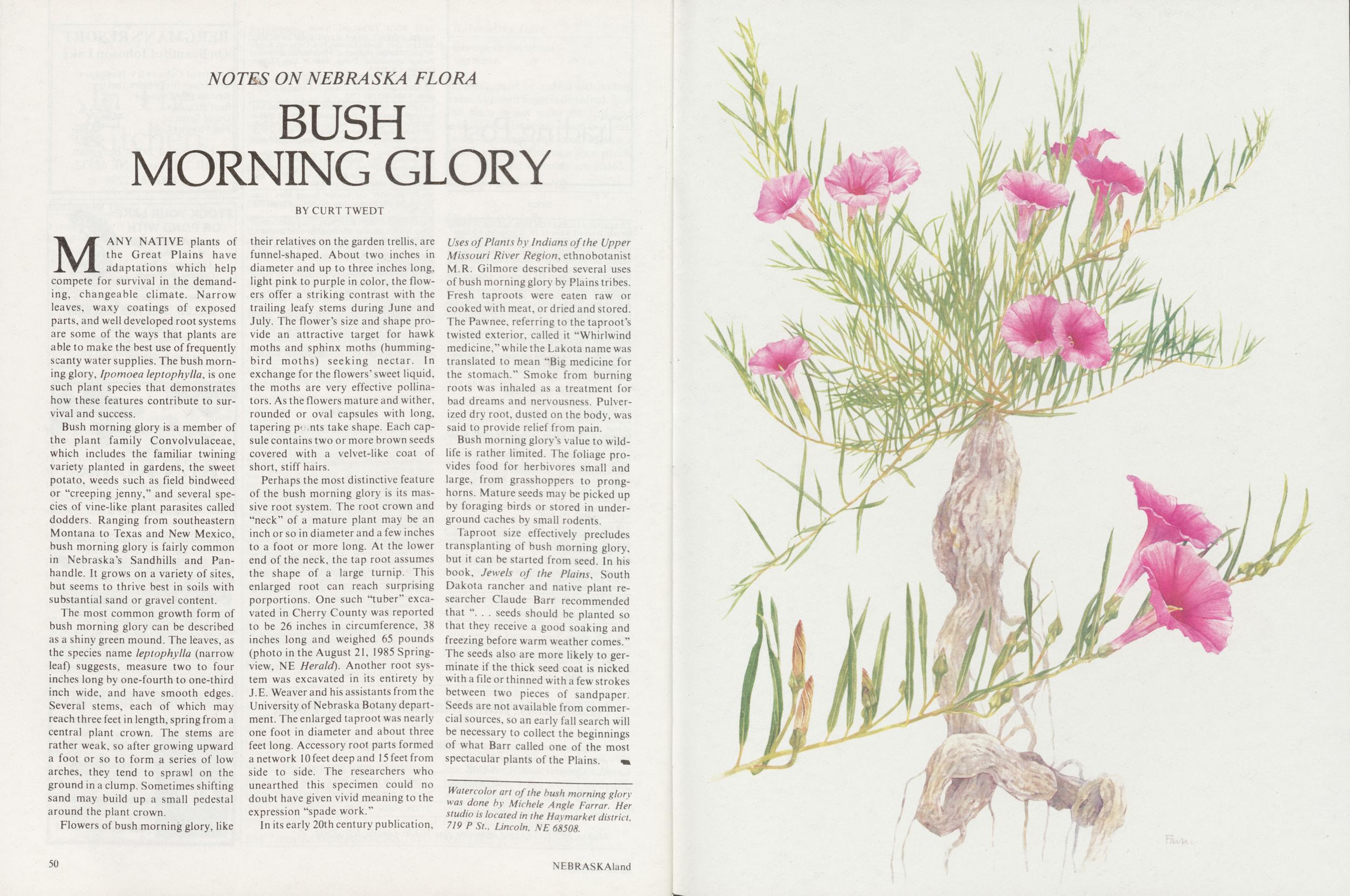
NOTES ON NEBRASKA FLORA BUSH MORNING GLORY
BY CURT TWEDTMANY NATIVE plants of the Great Plains have adaptations which help compete for survival in the demanding, changeable climate. Narrow leaves, waxy coatings of exposed parts, and well developed root systems are some of the ways that plants are able to make the best use of frequently scanty water supplies. The bush morning glory, Ipomoea leptophylla, is one such plant species that demonstrates how these features contribute to survival and success.
Bush morning glory is a member of the plant family Convolvulaceae, which includes the familiar twining variety planted in gardens, the sweet potato, weeds such as field bindweed or "creeping jenny," and several species of vine-like plant parasites called dodders. Ranging from southeastern Montana to Texas and New Mexico, bush morning glory is fairly common in Nebraska's Sandhills and Panhandle. It grows on a variety of sites, but seems to thrive best in soils with substantial sand or gravel content.
The most common growth form of bush morning glory can be described as a shiny green mound. The leaves, as the species name leptophylla (narrow7 leaf) suggests, measure two to four inches long by one-fourth to one-third inch wide, and have smooth edges. Several stems, each of which may reach three feet in length, spring from a central plant crown. The stems are rather weak, so after growing upward a foot or so to form a series of low arches, they tend to sprawl on the ground in a clump. Sometimes shifting sand may build up a small pedestal around the plant crown.
Flowers of bush morning glory, like their relatives on the garden trellis, are funnel-shaped. About two inches in diameter and up to three inches long, light pink to purple in color, the flowers offer a striking contrast with the trailing leafy stems during June and July. The flower's size and shape provide an attractive target for hawk moths and sphinx moths (hummingbird moths) seeking nectar. In exchange for the flowers' sweet liquid, the moths are very effective pollinators. As the flowers mature and wither, rounded or oval capsules with long, tapering points take shape. Each capsule contains two or more brown seeds covered with a velvet-like coat of short, stiff hairs.
Perhaps the most distinctive feature of the bush morning glory is its massive root system. The root crown and "neck" of a mature plant may be an inch or so in diameter and a few inches to a foot or more long. At the lower end of the neck, the tap root assumes the shape of a large turnip. This enlarged root can reach surprising proportions. One such "tuber" excavated in Cherry County was reported to be 26 inches in circumference, 38 inches long and weighed 65 pounds (photo in the August 21, 1985 Spring view, NE Herald). Another root system was excavated in its entirety by J.E. Weaver and his assistants from the University of Nebraska Botany department. The enlarged taproot was nearly one foot in diameter and about three feet long. Accessory root parts formed a network 10 feet deep and 15 feet from side to side. The researchers who unearthed this specimen could no doubt have given vivid meaning to the expression "spade work."
In its early 20th century publication, Uses of Plants by Indians of the Upper Missouri River Region, ethnobotanist M.R. Gilmore described several uses of bush morning glory by Plains tribes. Fresh taproots were eaten raw or cooked with meat, or dried and stored. The Pawnee, referring to the taproot's twisted exterior, called it "Whirlwind medicine,"while the Lakota name was translated to mean "Big medicine for the stomach." Smoke from burning roots was inhaled as a treatment for bad dreams and nervousness. Pulverized dry root, dusted on the body, was said to provide relief from pain.
Bush morning glory's value to wildlife is rather limited. The foliage provides food for herbivores small and large, from grasshoppers to pronghorns. Mature seeds may be picked up by foraging birds or stored in underground caches by small rodents.
Taproot size effectively precludes transplanting of bush morning glory, but it can be started from seed. In his book, Jewels of the Plains, South Dakota rancher and native plant researcher Claude Barr recommended that ". . . seeds should be planted so that they receive a good soaking and freezing before warm weather comes." The seeds also are more likely to germinate if the thick seed coat is nicked with a file or thinned with a few strokes between two pieces of sandpaper. Seeds are not available from commercial sources, so an early fall search will be necessary to collect the beginnings of what Barr called one of the most spectacular plants of the Plains.
Water color art of the bush morning glory was done by Michele Angle Farrar. Her studio is located in the Ha \ market district. 719 P St.. Lincoln. NE 68508. 50 NEBRASKAland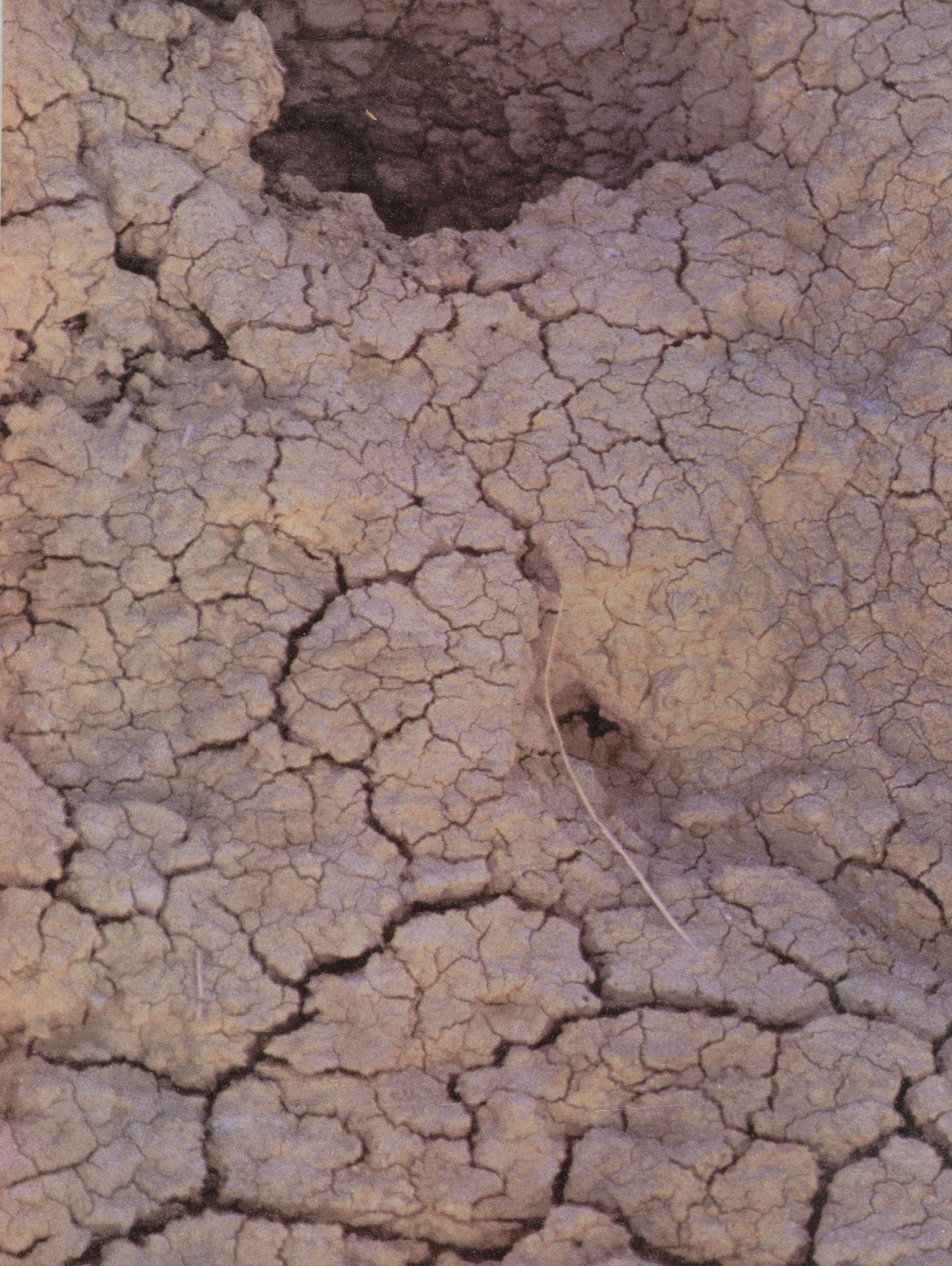
Position: 412 (24 views)