Volume 66, Issue 5, 1988
NEBRASKAland
JUNE 1988 $1.50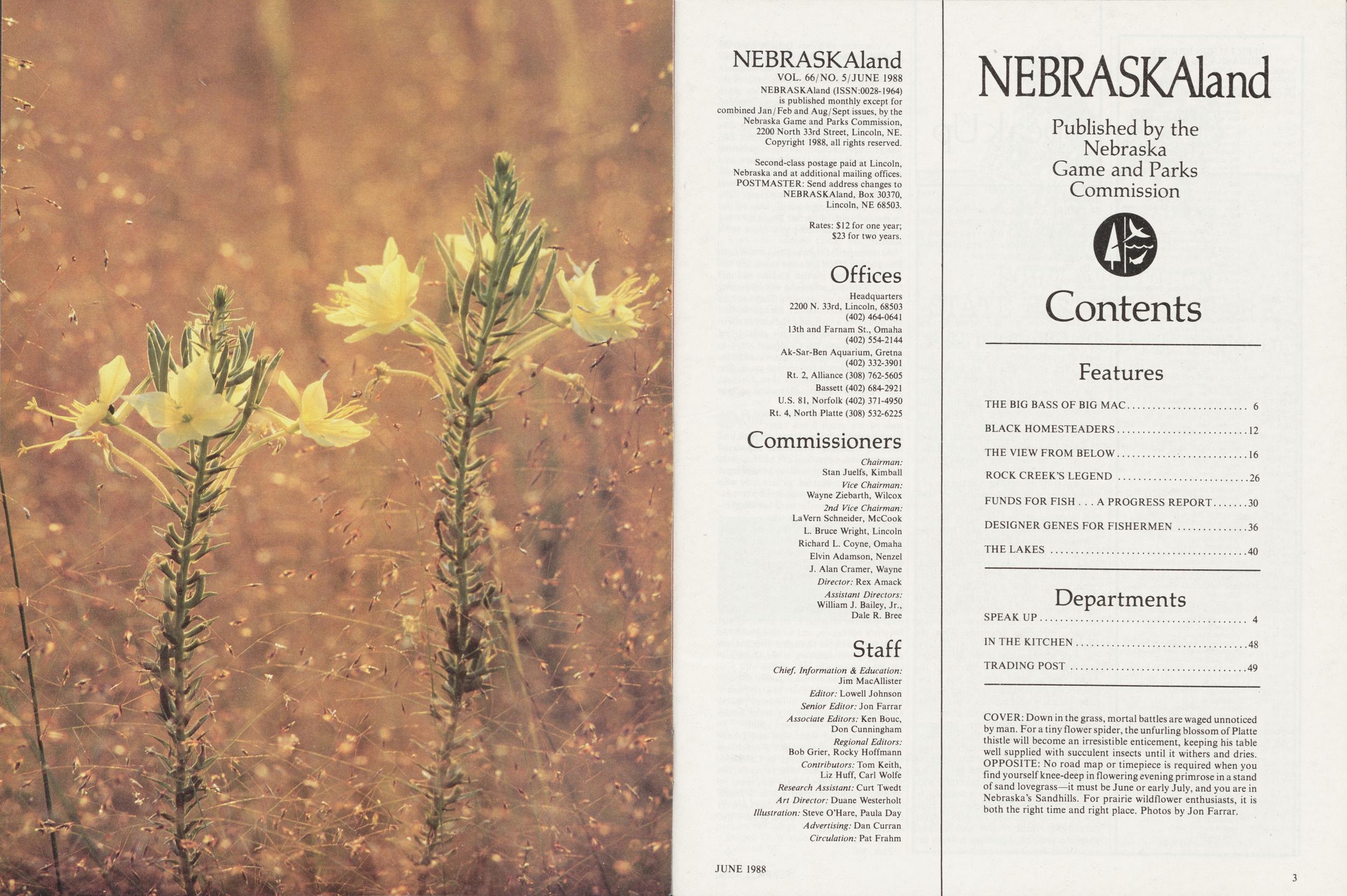
NEBRASKAland
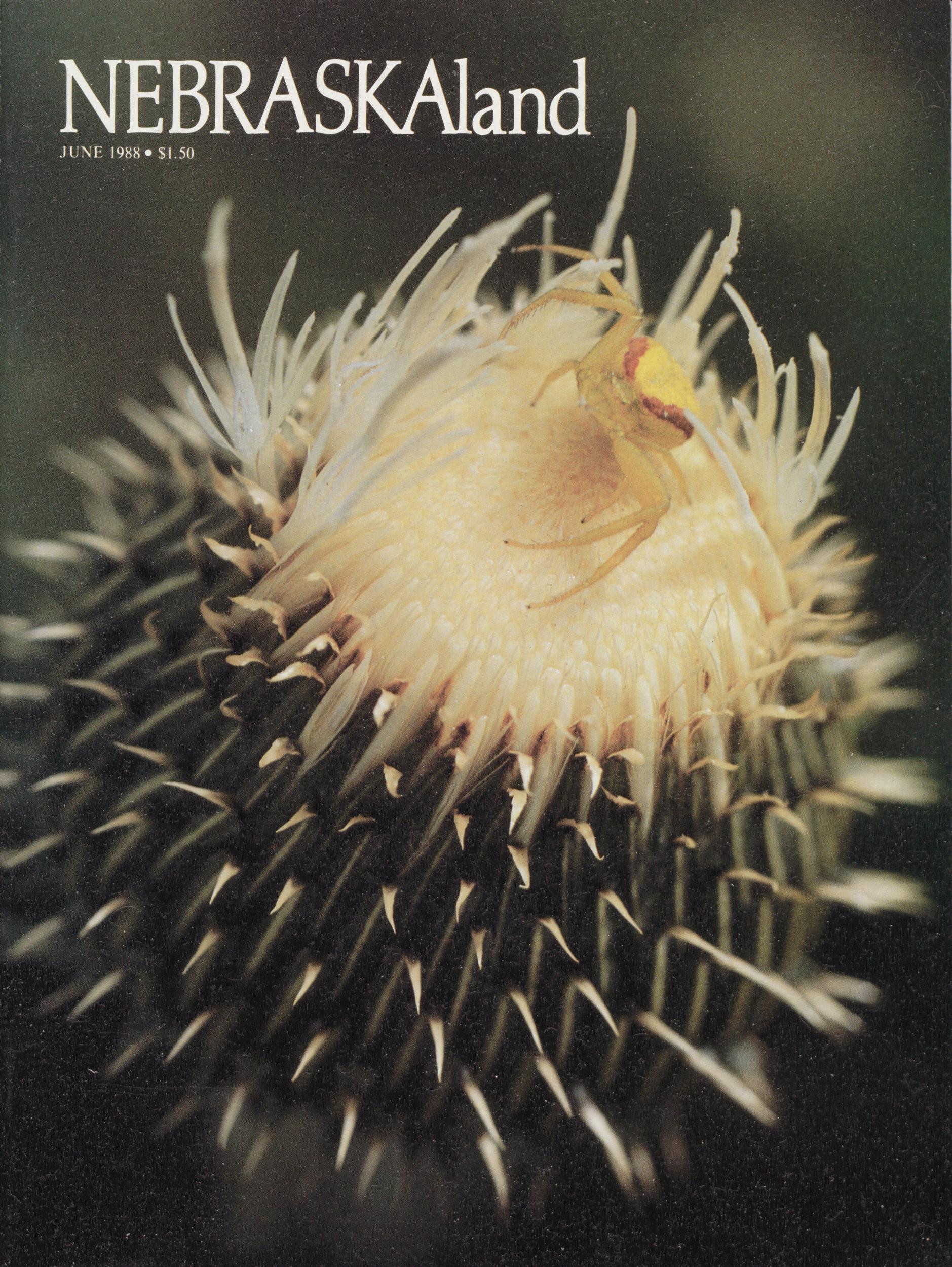
Published by the Nebraska Game and Parks Commission NEBRASKAland VOL. 66/NO. 5/JUNE 1988 NEBRASKAland (ISSN:0028-1964) is published monthly except for combined Jan/Feb and Aug/Sept issues, by the Nebraska Game and Parks Commission, 2200 North 33rd Street, Lincoln, NE. Copyright 1988, all rights reserved. Second-class postage paid at Lincoln, Nebraska and at additional mailing offices. POSTMASTER: Send address changes to NEBRASKAland, Box 30370, Lincoln, NE 68503. Rates: $12 for one year; $23 for two years. Offices Headquarters 2200 N. 33rd, Lincoln, 68503 (402) 464-0641 13th and Farnam St., Omaha (402) 554-2144 Ak-Sar-Ben Aquarium, Gretna (402) 332-3901 Rt. 2, Alliance (308) 762-5605 Bassett (402) 684-2921 U.S. 81, Norfolk (402) 371-4950 Rt. 4, North Platte (308) 532-6225 Commissioners Chairman: Stan Juelfs, Kimball Vice Chairman: Wayne Ziebarth, Wilcox 2nd Vice Chairman: LaVern Schneider, McCook L. Bruce Wright, Lincoln Richard L. Coyne, Omaha Elvin Adamson, Nenzel J. Alan Cramer, Wayne Director: Rex Amack Assistant Directors: William J. Bailey, Jr., Dale R. Bree Staff Chief, Information & Education: Jim MacAllister Editor: Lowell Johnson Senior Editor: Jon Farrar Associate Editors: Ken Bouc, Don Cunningham Regional Editors: Bob Grier, Rocky Hoffmann Contributors: Tom Keith, Liz Huff, Carl Wolfe Research Assistant: Curt Twedt Art Director: Duane Westerholt Illustration: Steve O'Hare, Paula Day Advertising: Dan Curran Circulation: Pat Frahm Contents Features THE BIG BASS OF BIG MAC........................ 6 BLACK HOMESTEADERS..........................12 THE VIEW FROM BELOW..........................16 ROCK CREEK'S LEGEND ..........................26 FUNDS FOR FISH ... A PROGRESS REPORT.......30 DESIGNER GENES FOR FISHERMEN..............36 THE LAKES 40 Departments SPEAK UP......................................... 4 IN THE KITCHEN..................................48 TRADING POST...................................49 COVER: Down in the grass, mortal battles are waged unnoticed by man. For a tiny flower spider, the unfurling blossom of Platte thistle will become an irresistible enticement, keeping his table well supplied with succulent insects until it withers and dries. OPPOSITE: No road map or timepiece is required when you find yourself knee-deep in flowering evening primrose in a stand of sand love grass—it must be June or early July, and you are in Nebraska's Sandhills. For prairie wildflower enthusiasts, it is both the right time and right place. Photos by Jon Farrar. JUNE 1988 3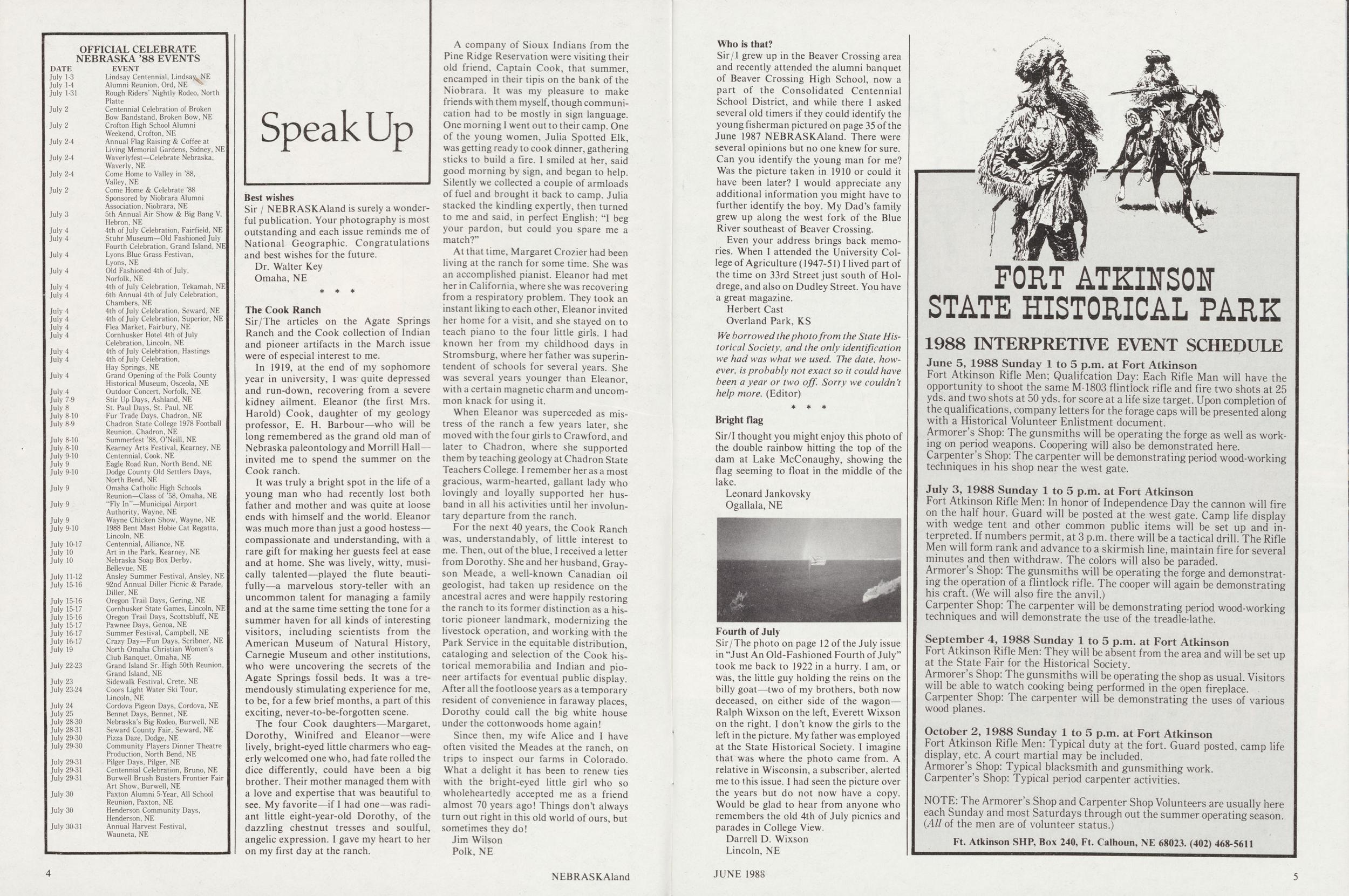
Speak Up
Best wishesSir / NEBRASKAland is surely a wonderful publication. Your photography is most outstanding and each issue reminds me of National Geographic. Congratulations and best wishes for the future.
Dr. Walter Key Omaha, NE * * * The Cook RanchSir/The articles on the Agate Springs Ranch and the Cook collection of Indian and pioneer artifacts in the March issue were of especial interest to me.
In 1919, at the end of my sophomore year in university, I was quite depressed and run-down, recovering from a severe kidney ailment. Eleanor (the first Mrs. Harold) Cook, daughter of my geology professor, E. H. Barbour—who will be long remembered as the grand old man of Nebraska paleontology and Morrill Hall invited me to spend the summer on the Cook ranch.
It was truly a bright spot in the life of a young man who had recently lost both father and mother and was quite at loose ends with himself and the world. Eleanor was much more than just a good hostess compassionate and understanding, with a rare gift for making her guests feel at ease and at home. She was lively, witty, musically talented—played the flute beautifully—a marvelous story-teller with an uncommon talent for managing a family and at the same time setting the tone for a summer haven for all kinds of interesting visitors, including scientists from the American Museum of Natural History, Carnegie Museum and other institutions, who were uncovering the secrets of the Agate Springs fossil beds. It was a tremendously stimulating experience for me, to be, for a few brief months, a part of this exciting, never-to-be-forgotten scene.
The four Cook daughters—Margaret, Dorothy, Winifred and Eleanor—were lively, bright-eyed little charmers who eagerly welcomed one who, had fate rolled the dice differently, could have been a big brother. Their mother managed them with a love and expertise that was beautiful to see. My favorite—if I had one—was radiant little eight-year-old Dorothy, of the dazzling chestnut tresses and soulful, angelic expression. I gave my heart to her on my first day at the ranch.
A company of Sioux Indians from the Pine Ridge Reservation were visiting their old friend, Captain Cook, that summer, encamped in their tipis on the bank of the Niobrara. It was my pleasure to make friends with them myself, though communication had to be mostly in sign language. One morning I went out to their camp. One of the young women, Julia Spotted Elk, was getting ready to cook dinner, gathering sticks to build a fire. I smiled at her, said good morning by sign, and began to help. Silently we collected a couple of armloads of fuel and brought it back to camp. Julia stacked the kindling expertly, then turned to me and said, in perfect English: "1 beg your pardon, but could you spare me a match?"
At that time, Margaret Crozier had been living at the ranch for some time. She was an accomplished pianist. Eleanor had met her in California, where she was recovering from a respiratory problem. They took an instant liking to each other, Eleanor invited her home for a visit, and she stayed on to teach piano to the four little girls. 1 had known her from my childhood days in Stromsburg, where her father was superintendent of schools for several years. She was several years younger than Eleanor, with a certain magnetic charm and uncommon knack for using it.
When Eleanor was superceded as mistress of the ranch a few years later, she moved with the four girls to Crawford, and later to Chadron, where she supported them by teaching geology at Chadron State Teachers College. I remember her as a most gracious, warm-hearted, gallant lady who lovingly and loyally supported her husband in all his activities until her involuntary departure from the ranch.
For the next 40 years, the Cook Ranch was, understandably, of little interest to me. Then, out of the blue, I received a letter from Dorothy. She and her husband, Grayson Meade, a well-known Canadian oil geologist, had taken up residence on the ancestral acres and were happily restoring the ranch to its former distinction as a historic pioneer landmark, modernizing the livestock operation, and working with the Park Service in the equitable distribution, cataloging and selection of the Cook historical memorabilia and Indian and pioneer artifacts for eventual public display. After all the footloose years as a temporary resident of convenience in faraway places, Dorothy could call the big white house under the cottonwoods home again!
Since then, my wife Alice and I have often visited the Meades at the ranch, on trips to inspect our farms in Colorado. What a delight it has been to renew ties with the bright-eyed little girl who so wholeheartedly accepted me as a friend almost 70 years ago! Things don't always turn out right in this old world of ours, but sometimes they do!
Jim Wilson Polk, NE 4 NEBRASKAland Who is that?Sir /I grew up in the Beaver Crossing area and recently attended the alumni banquet of Beaver Crossing High School, now a part of the Consolidated Centennial School District, and while there I asked several old timers if they could identify the young fisherman pictured on page 35 of the June 1987 NEBRASKAland. There were several opinions but no one knew for sure. Can you identify the young man for me? Was the picture taken in 1910 or could it have been later? I would appreciate any additional information you might have to further identify the boy. My Dad's family grew up along the west fork of the Blue River southeast of Beaver Crossing.
Even your address brings back memories. When I attended the University College of Agriculture (1947-51) I lived part of the time on 33rd Street just south of Holdrege, and also on Dudley Street. You have a great magazine.
Herbert Cast Overland Park, KSWe borrowed the photo from the State Historical Society, and the only identification we had was what we used. The date, however, is probably not exact so it could have been a year or two off. Sorry we couldn't help more. (Editor)
* * * Bright flagSir/I thought you might enjoy this photo of the double rainbow hitting the top of the dam at Lake McConaughy, showing the flag seeming to float in the middle of the lake.
Leonard Jankovsky Ogallala, NESir/The photo on page 12 of the July issue in "Just An Old-Fashioned Fourth of July" took me back to 1922 in a hurry. I am, or was, the little guy holding the reins on the billy goat—two of my brothers, both now deceased, on either side of the wagon Ralph Wixson on the left, Everett Wixson on the right. I don't know the girls to the left in the picture. My father was employed at the State Historical Society. I imagine that was where the photo came from. A relative in Wisconsin, a subscriber, alerted me to this issue. I had seen the picture over the years but do not now have a copy. Would be glad to hear from anyone who remembers the old 4th of July picnics and parades in College View.
Darrell D. Wixson Lincoln, NE FORT ATKINSON STATE HISTORICAL PARK 1988 INTERPRETIVE EVENT SCHEDULEJune 5, 1988 Sunday 1 to 5 p.m. at Fort Atkinson Fort Atkinson Rifle Men; Qualification Day: Each Rifle Man will have the opportunity to shoot the same M-1803 flintlock rifle and fire two shots at 25 yds. and two shots at 50 yds. for score at a life size target. Upon completion of the qualifications, company letters for the forage caps will be presented along with a Historical Volunteer Enlistment document. Armorer's Shop: The gunsmiths will be operating the forge as well as working on period weapons. Coopering will also be demonstrated here. Carpenter's Shop: The carpenter will be demonstrating period wood-working techniques in his shop near the west gate.
July 3, 1988 Sunday 1 to 5 p.m. at Fort Atkinson Fort Atkinson Rifle Men: In honor of Independence Day the cannon will fire on the half hour. Guard will be posted at the west gate. Camp life display with wedge tent and other common public items will be set up and interpreted. If numbers permit, at 3 p.m. there will be a tactical drill. The Rifle Men will form rank and advance to a skirmish line, maintain fire for several minutes and then withdraw. The colors will also be paraded. Armorer's Shop: The gunsmiths will be operating the forge and demonstrating the operation of a flintlock rifle. The cooper will again be demonstrating his craft. (We will also fire the anvil.) Carpenter Shop: The carpenter will be demonstrating period wood-working techniques and will demonstrate the use of the treadle-lathe.
September 4, 1988 Sunday 1 to 5 p.m. at Fort Atkinson Fort Atkinson Rifle Men: They will be absent from the area and will be set up at the State Fair for the Historical Society. Armorer's Shop: The gunsmiths will be operating the shop as usual. Visitors will be able to watch cooking being performed in the open fireplace. Carpenter Shop: The carpenter will be demonstrating the uses of various wood planes.
October 2, 1988 Sunday 1 to 5 p.m. at Fort Atkinson Fort Atkinson Rifle Men: Typical duty at the fort. Guard posted, camp life display, etc. A court martial may be included. Armorer's Shop: Typical blacksmith and gunsmithing work. Carpenter's Shop: Typical period carpenter activities.
NOTE: The Armorer's Shop and Carpenter Shop Volunteers are usually here each Sunday and most Saturdays through out the summer operating season. (All of the men are of volunteer status.)
Ft. Atkinson SHP, Box 240, Ft. Calhoun, NE 68023. (402) 468-5611 JUNE 1988 5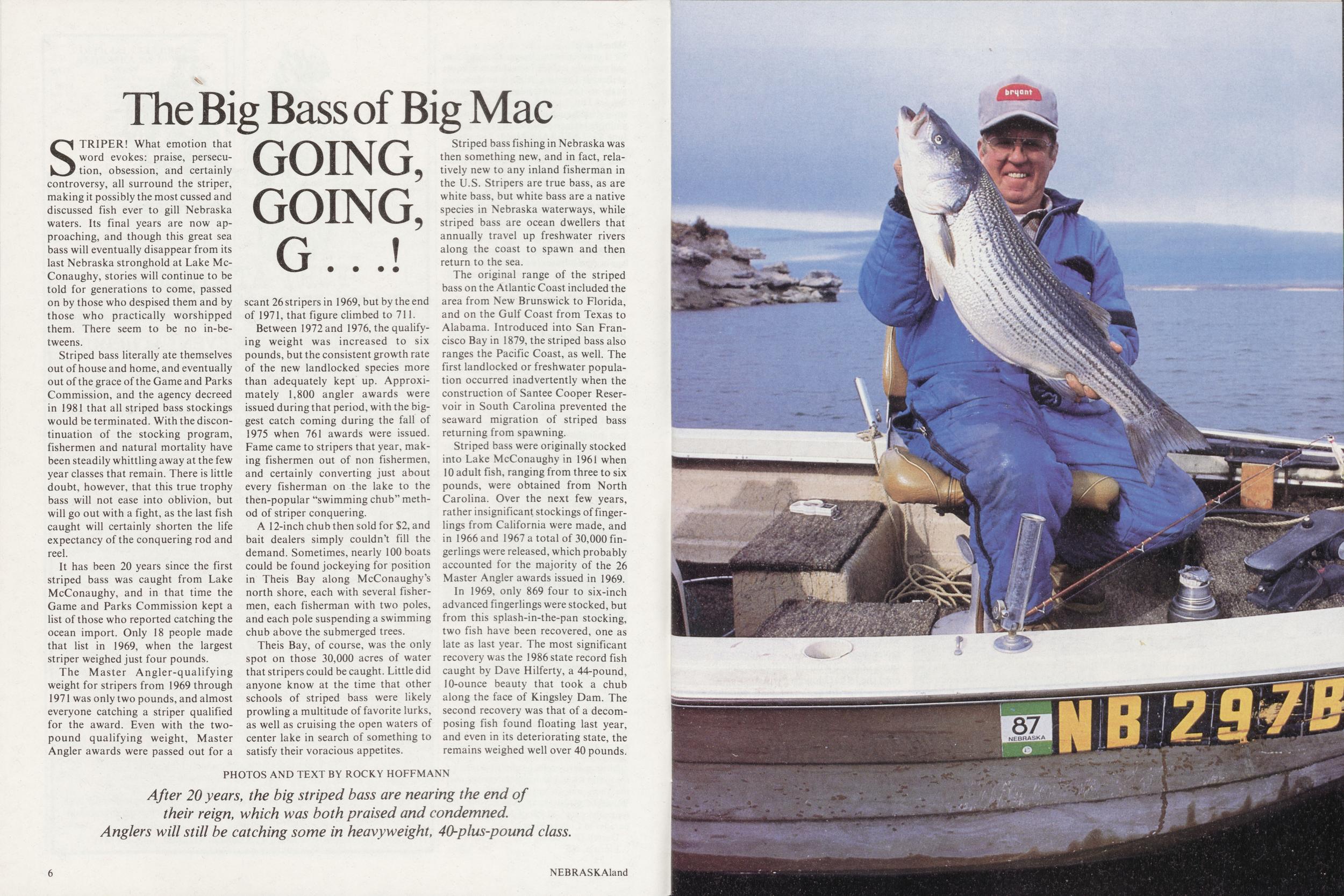
The Big Bass of Big Mac GOING, GOING, G...!
STRIPER! What emotion that word evokes: praise, persecution, obsession, and certainly controversy, all surround the striper, making it possibly the most cussed and discussed fish ever to gill Nebraska waters. Its final years are now approaching, and though this great sea bass will eventually disappear from its last Nebraska stronghold at Lake McConaughy, stories will continue to be told for generations to come, passed on by those who despised them and by those who practically worshipped them. There seem to be no in-betweens.
Striped bass literally ate themselves out of house and home, and eventually out of the grace of the Game and Parks Commission, and the agency decreed in 1981 that all striped bass stockings would be terminated. With the discontinuation of the stocking program, fishermen and natural mortality have been steadily whittling away at the few year classes that remain. There is little doubt, however, that this true trophy bass will not ease into oblivion, but will go out with a fight, as the last fish caught will certainly shorten the life expectancy of the conquering rod and reel.
It has been 20 years since the first striped bass was caught from Lake McConaughy, and in that time the Game and Parks Commission kept a list of those who reported catching the ocean import. Only 18 people made that list in 1969, when the largest striper weighed just four pounds.
The Master Angler-qualifying weight for stripers from 1969 through 1971 was only two pounds, and almost everyone catching a striper qualified for the award. Even with the two-pound qualifying weight, Master Angler awards were passed out for a scant 26 stripers in 1969, but by the end of 1971, that figure climbed to 711.
Between 1972 and 1976, the qualifying weight was increased to six pounds, but the consistent growth rate of the new landlocked species more than adequately kept up. Approximately 1,800 angler awards were issued during that period, with the biggest catch coming during the fall of 1975 when 761 awards were issued. Fame came to stripers that year, making fishermen out of non fishermen, and certainly converting just about every fisherman on the lake to the then-popular "swimming chub" method of striper conquering.
A 12-inch chub then sold for $2, and bait dealers simply couldn't fill the demand. Sometimes, nearly 100 boats could be found jockeying for position in Theis Bay along McConaughy's north shore, each with several fishermen, each fisherman with two poles, and each pole suspending a swimming chub above the submerged trees.
Theis Bay, of course, was the only spot on those 30,000 acres of water that stripers could be caught. Little did anyone know at the time that other schools of striped bass were likely prowling a multitude of favorite lurks, as well as cruising the open waters of center lake in search of something to satisfy their voracious appetites.
PHOTOS AND TEXT BY ROCKY HOFFMANN After 20 years, the big striped bass are nearing the end of their reign, which was both praised and condemned. Anglers will still be catching some in heavyweight, 40-plus-pound class.Striped bass fishing in Nebraska was then something new, and in fact, relatively new to any inland fisherman in the U.S. Stripers are true bass, as are white bass, but white bass are a native species in Nebraska waterways, while striped bass are ocean dwellers that annually travel up freshwater rivers along the coast to spawn and then return to the sea.
The original range of the striped bass on the Atlantic Coast included the area from New Brunswick to Florida, and on the Gulf Coast from Texas to Alabama. Introduced into San Francisco Bay in 1879, the striped bass also ranges the Pacific Coast, as well. The first landlocked or freshwater population occurred inadvertently when the construction of Santee Cooper Reservoir in South Carolina prevented the seaward migration of striped bass returning from spawning.
Striped bass were originally stocked into Lake McConaughy in 1961 when 10 adult fish, ranging from three to six pounds, were obtained from North Carolina. Over the next few years, rather insignificant stockings of fingerlings from California were made, and in 1966 and 1967 a total of 30,000 fingerlings were released, which probably accounted for the majority of the 26 Master Angler awards issued in 1969.
In 1969, only 869 four to six-inch advanced fingerlings were stocked, but from this splash-in-the-pan stocking, two fish have been recovered, one as late as last year. The most significant recovery was the 1986 state record fish caught by Dave Hilferty, a 44-pound, 10-ounce beauty that took a chub along the face of Kingsley Dam. The second recovery was that of a decomposing fish found floating last year, and even in its deteriorating state, the remains weighed well over 40 pounds. Although this fish could have signified the last hurrah for the 1969 year class, biologists feel that the possibility exists that some of the 18-year-old fish may still remain.
6 NEBRASKAland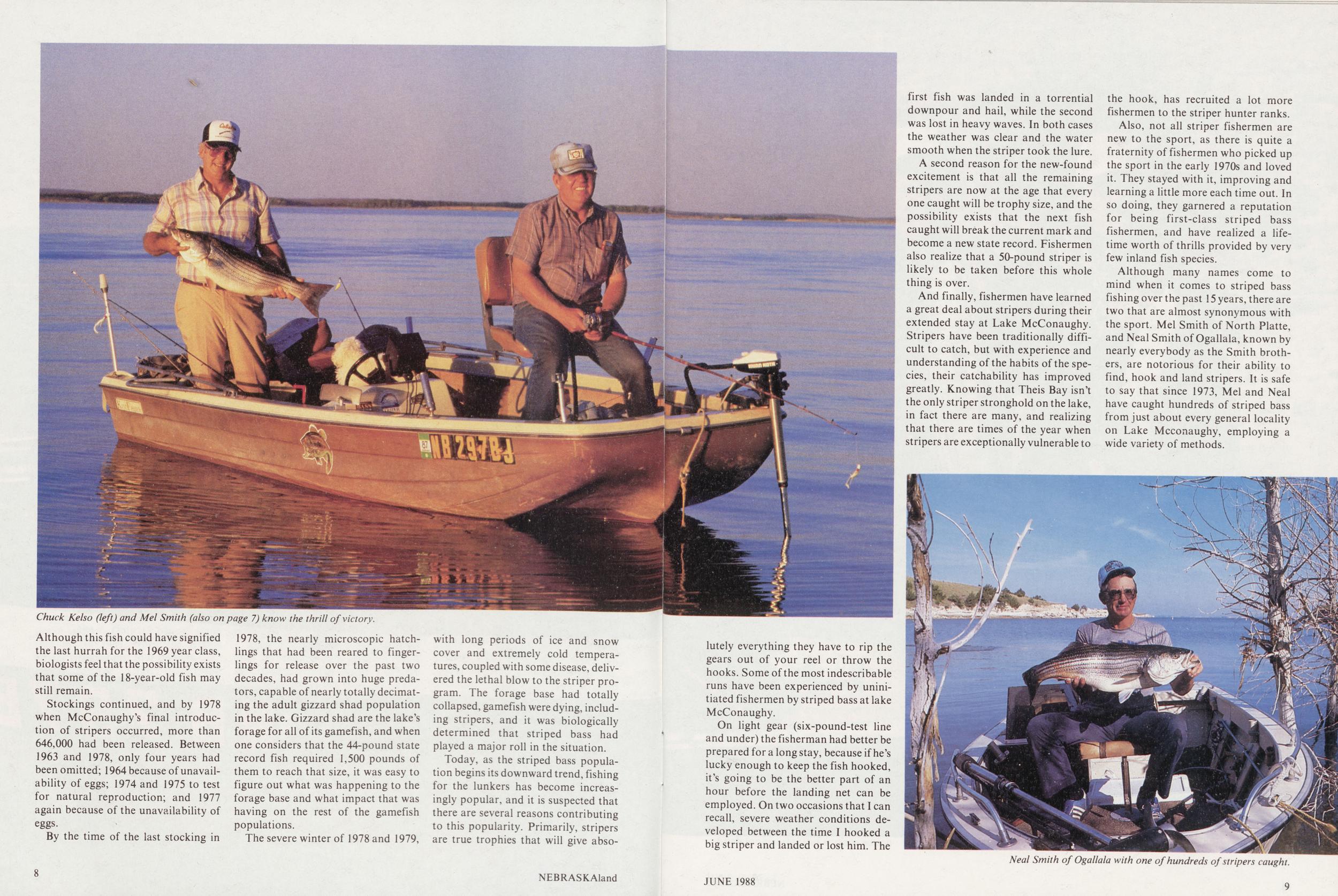
Stockings continued, and by 1978 when McConaughy's final introduction of stripers occurred, more than 646,000 had been released. Between 1963 and 1978, only four years had been omitted; 1964 because of unavailability of eggs; 1974 and 1975 to test for natural reproduction; and 1977 again because of the unavailability of eggs.
By the time of the last stocking in 1978, the nearly microscopic hatchlings that had been reared to fingerlings for release over the past two decades, had grown into huge predators, capable of nearly totally decimating the adult gizzard shad population in the lake. Gizzard shad are the lake's forage for all of its gamefish, and when one considers that the 44-pound state record fish required 1,500 pounds of them to reach that size, it was easy to figure out what was happening to the forage base and what impact that was having on the rest of the gamefish populations.
The severe winter of 1978 and 1979, with long periods of ice and snow cover and extremely cold temperatures, coupled with some disease, delivered the lethal blow to the striper program. The forage base had totally collapsed, gamefish were dying, including stripers, and it was biologically determined that striped bass had played a major roll in the situation.
Today, as the striped bass population begins its downward trend, fishing for the lunkers has become increasingly popular, and it is suspected that there are several reasons contributing to this popularity. Primarily, stripers are true trophies that will give absolutely 8 NEBRASKAland everything they have to rip the gears out of your reel or throw the hooks. Some of the most indescribable runs have been experienced by uninitiated fishermen by striped bass at lake McConaughy.
On light gear (six-pound-test line and under) the fisherman had better be prepared for a long stay, because if he's lucky enough to keep the fish hooked, it's going to be the better part of an hour before the landing net can be employed. On two occasions that I can recall, severe weather conditions developed between the time I hooked a big striper and landed or lost him. The first fish was landed in a torrential downpour and hail, while the second was lost in heavy waves. In both cases the weather was clear and the water smooth when the striper took the lure.
A second reason for the new-found excitement is that all the remaining stripers are now at the age that every one caught will be trophy size, and the possibility exists that the next fish caught will break the current mark and become a new state record. Fishermen also realize that a 50-pound striper is likely to be taken before this whole thing is over.
And finally, fishermen have learned a great deal about stripers during their extended stay at Lake McConaughy. Stripers have been traditionally difficult to catch, but with experience and understanding of the habits of the species, their catch ability has improved greatly. Knowing that Theis Bay isn't the only striper stronghold on the lake, in fact there are many, and realizing that there are times of the year when stripers are exceptionally vulnerable to the hook, has recruited a lot more fishermen to the striper hunter ranks.
Also, not all striper fishermen are new to the sport, as there is quite a fraternity of fishermen who picked up the sport in the early 1970s and loved it. They stayed with it, improving and learning a little more each time out. In so doing, they garnered a reputation for being first-class striped bass fishermen, and have realized a lifetime worth of thrills provided by very few inland fish species.
Although many names come to mind when it comes to striped bass fishing over the past 15 years, there are two that are almost synonymous with the sport. Mel Smith of North Platte, and Neal Smith of Ogallala, known by nearly everybody as the Smith brothers, are notorious for their ability to find, hook and land stripers. It is safe to say that since 1973, Mel and Neal have caught hundreds of striped bass from just about every general locality on Lake Mcconaughy, employing a wide variety of methods.
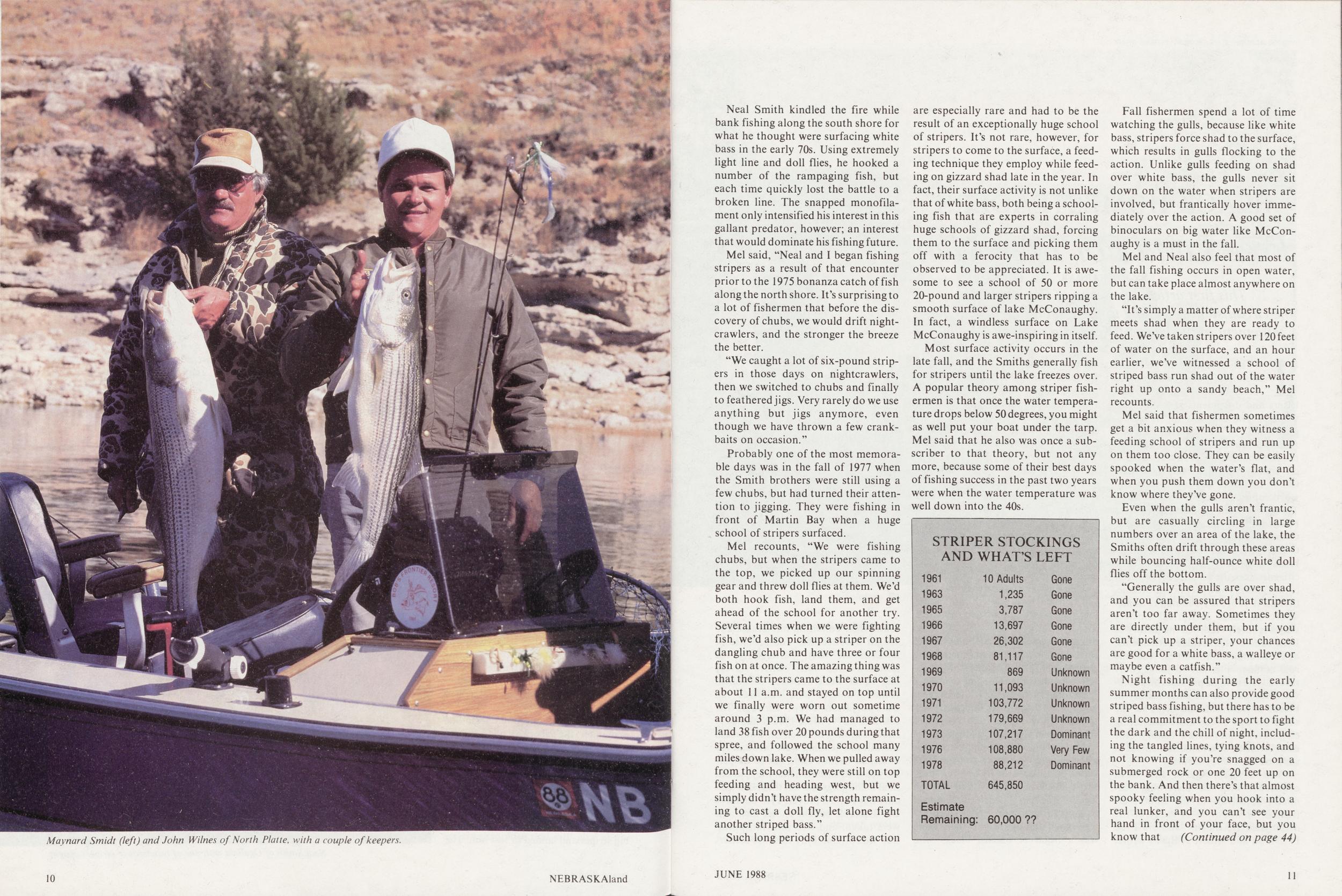
Neal Smith kindled the fire while bank fishing along the south shore for what he thought were surfacing white bass in the early 70s. Using extremely light line and doll flies, he hooked a number of the rampaging fish, but each time quickly lost the battle to a broken line. The snapped monofilament only intensified his interest in this gallant predator, however; an interest that would dominate his fishing future.
Mel said, "Neal and I began fishing stripers as a result of that encounter prior to the 1975 bonanza catch offish along the north shore. It's surprising to a lot of fishermen that before the discovery of chubs, we would drift nightcrawlers, and the stronger the breeze the better.
"We caught a lot of six-pound stripers in those days on nightcrawlers, then we switched to chubs and finally to feathered jigs. Very rarely do we use anything but jigs anymore, even though we have thrown a few crankbaits on occasion."
Probably one of the most memorable days was in the fall of 1977 when the Smith brothers were still using a few chubs, but had turned their attention to jigging. They were fishing in front of Martin Bay when a huge school of stripers surfaced.
Mel recounts, "We were fishing chubs, but when the stripers came to the top, we picked up our spinning gear and threw doll flies at them. We'd both hook fish, land them, and get ahead of the school for another try. Several times when we were fighting fish, we'd also pick up a striper on the dangling chub and have three or four fish on at once. The amazing thing was that the stripers came to the surface at about 11 a.m. and stayed on top until we finally were worn out sometime around 3 p.m. We had managed to land 38 fish over 20 pounds during that spree, and followed the school many miles down lake. When we pulled away from the school, they were still on top feeding and heading west, but we simply didn't have the strength remaining to cast a doll fly, let alone fight another striped bass."
Such long periods of surface action are especially rare and had to be the result of an exceptionally huge school of stripers. It's not rare, however, for stripers to come to the surface, a feeding technique they employ while feeding on gizzard shad late in the year. In fact, their surface activity is not unlike that of white bass, both being a schooling fish that are experts in corraling huge schools of gizzard shad, forcing them to the surface and picking them off with a ferocity that has to be observed to be appreciated. It is awesome to see a school of 50 or more 20-pound and larger stripers ripping a smooth surface of lake McConaughy. In fact, a windless surface on Lake McConaughy is awe-inspiring in itself.
Most surface activity occurs in the late fall, and the Smiths generally fish for stripers until the lake freezes over. A popular theory among striper fishermen is that once the water temperature drops below 50 degrees, you might as well put your boat under the tarp. Mel said that he also was once a subscriber to that theory, but not any more, because some of their best days of fishing success in the past two years were when the water temperature was well down into the 40s.
STRIPER STOCKINGS AND WHAT'S LEFT 1961 10 Adults Gone 1963 1,235 Gone 1965 3,787 Gone 1966 13,697 Gone 1967 26,302 Gone 1968 81,117 Gone 1969 869 Unknown 1970 11,093 Unknown 1971 103,772 Unknown 1972 179,669 Unknown 1973 107,217 Dominant 1976 108,880 Very Few Estimate Remaining: 60,000??Fall fishermen spend a lot of time watching the gulls, because like white bass, stripers force shad to the surface, which results in gulls flocking to the action. Unlike gulls feeding on shad over white bass, the gulls never sit down on the water when stripers are involved, but frantically hover immediately over the action. A good set of binoculars on big water like McConaughy is a must in the fall.
Mel and Neal also feel that most of the fall fishing occurs in open water, but can take place almost anywhere on the lake.
"It's simply a matter of where striper meets shad when they are ready to feed. We've taken stripers over 120 feet of water on the surface, and an hour earlier, we've witnessed a school of striped bass run shad out of the water right up onto a sandy beach," Mel recounts.
Mel said that fishermen sometimes get a bit anxious when they witness a feeding school of stripers and run up on them too close. They can be easily spooked when the water's flat, and when you push them down you don't know where they've gone.
Even when the gulls aren't frantic, but are casually circling in large numbers over an area of the lake, the Smiths often drift through these areas while bouncing half-ounce white doll flies off the bottom.
"Generally the gulls are over shad, and you can be assured that stripers aren't too far away. Sometimes they are directly under them, but if you can't pick up a striper, your chances are good for a white bass, a walleye or maybe even a catfish."
Night fishing during the early summer months can also provide good striped bass fishing, but there has to be a real commitment to the sport to fight the dark and the chill of night, including the tangled lines, tying knots, and not knowing if you're snagged on a submerged rock or one 20 feet up on the bank. And then there's that almost spooky feeling when you hook into a real lunker, and you can't see your hand in front of your face, but you know that (Continued on page 44)
JUNE 1988 11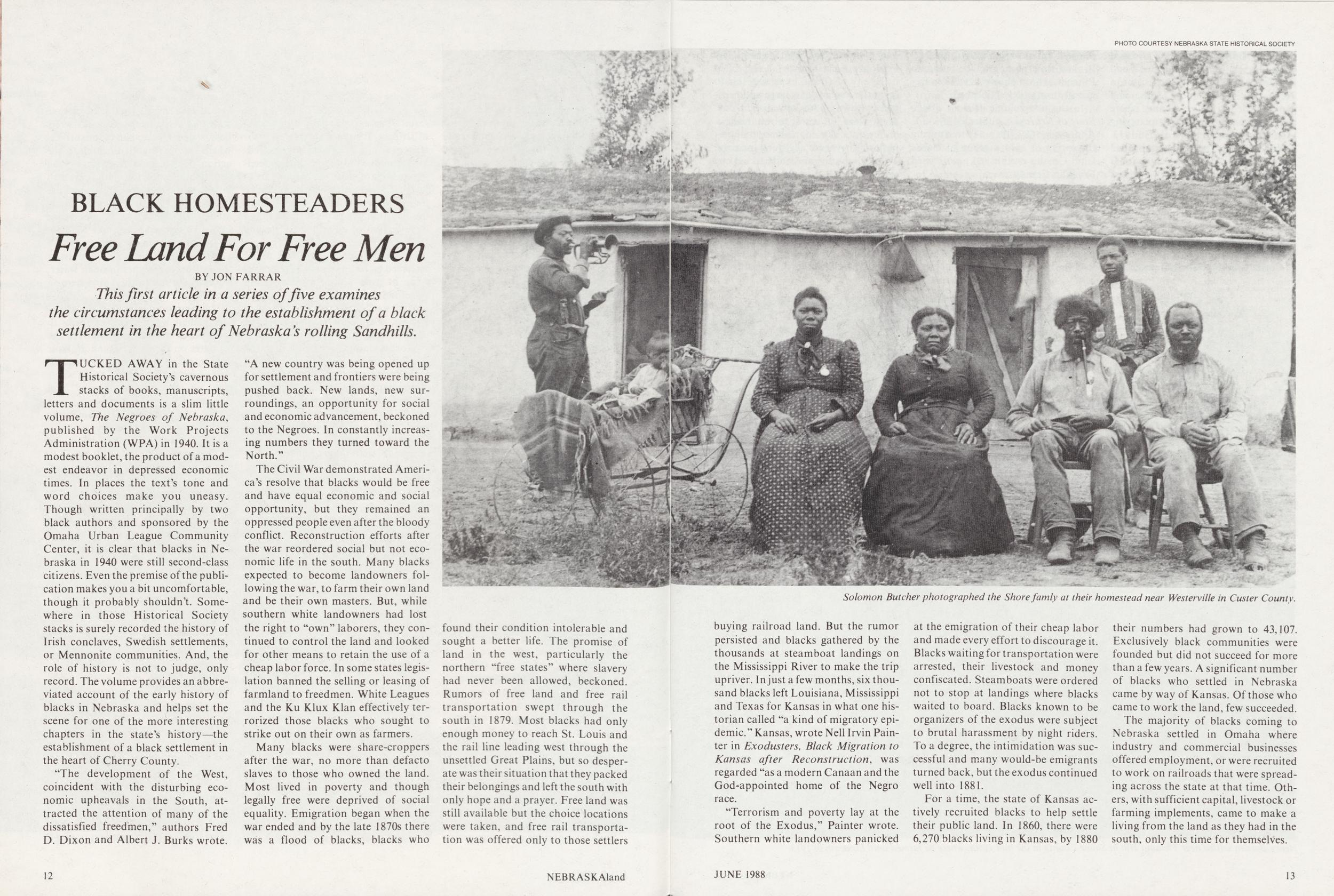
BLACK HOMESTEADERS Free Land For Free Men
BY JON FARRAR This first article in a series of five examines the circumstances leading to the establishment of a black settlement in the heart of Nebraska's rolling Sandhills.TUCKED AWAY in the State Historical Society's cavernous stacks of books, manuscripts, letters and documents is a slim little volume, The Negroes of Nebraska, published by the Work Projects Administration (WPA) in 1940. It is a modest booklet, the product of a modest endeavor in depressed economic times. In places the text's tone and word choices make you uneasy. Though written principally by two black authors and sponsored by the Omaha Urban League Community Center, it is clear that blacks in Nebraska in 1940 were still second-class citizens. Even the premise of the publication makes you a bit uncomfortable, though it probably shouldn't. Somewhere in those Historical Society stacks is surely recorded the history of Irish conclaves, Swedish settlements, or Mennonite communities. And, the role of history is not to judge, only record. The volume provides an abbreviated account of the early history of blacks in Nebraska and helps set the scene for one of the more interesting chapters in the state's history—the establishment of a black settlement in the heart of Cherry County.
"The development of the West, coincident with the disturbing economic upheavals in the South, attracted the attention of many of the dissatisfied freedmen," authors Fred D. Dixon and Albert J. Burks wrote. "A new country was being opened up for settlement and frontiers were being pushed back. New lands, new surroundings, an opportunity for social and economic advancement, beckoned to the Negroes. In constantly increasing numbers they turned toward the North."
The Civil War demonstrated America's resolve that blacks would be free and have equal economic and social opportunity, but they remained an oppressed people even after the bloody conflict. Reconstruction efforts after the war reordered social but not economic life in the south. Many blacks expected to become landowners following the war, to farm their own land and be their own masters. But, while southern white landowners had lost the right to "own" laborers, they continued to control the land and looked for other means to retain the use of a cheap labor force. In some states legislation banned the selling or leasing of farmland to freedmen. White Leagues and the Ku Klux Klan effectively terrorized those blacks who sought to strike out on their own as farmers.
Many blacks were share-croppers after the war, no more than defacto slaves to those who owned the land. Most lived in poverty and though legally free were deprived of social equality. Emigration began when the war ended and by the late 1870s there was a flood of blacks, blacks who Solomon Butcher photographed the Shore family at their homestead near Westerville in Custer County. found their condition intolerable and sought a better life. The promise of land in the west, particularly the northern "free states" where slavery had never been allowed, beckoned. Rumors of free land and free rail transportation swept through the south in 1879. Most blacks had only enough money to reach St. Louis and the rail line leading west through the unsettled Great Plains, but so desperate was their situation that they packed their belongings and left the south with only hope and a prayer. Free land was still available but the choice locations were taken, and free rail transportation was offered only to those settlers 12 NEBRASKAland buying railroad land. But the rumor persisted and blacks gathered by the thousands at steamboat landings on the Mississippi River to make the trip upriver. In just a few months, six thousand blacks left Louisiana, Mississippi and Texas for Kansas in what one historian called "a kind of migratory epidemic." Kansas, wrote Nell Irvin Painter in Exodusters, Black Migration to Kansas after Reconstruction, was regarded "as a modern Canaan and the God-appointed home of the Negro race.
"Terrorism and poverty lay at the root of the Exodus," Painter wrote. Southern white landowners panicked at the emigration of their cheap labor and made every effort to discourage it. Blacks waiting for transportation were arrested, their livestock and money confiscated. Steamboats were ordered not to stop at landings where blacks waited to board. Blacks known to be organizers of the exodus were subject to brutal harassment by night riders. To a degree, the intimidation was successful and many would-be emigrants turned back, but the exodus continued well into 1881.
For a time, the state of Kansas actively recruited blacks to help settle their public land. In 1860, there were 6,270 blacks living in Kansas, by 1880 their numbers had grown to 43,107. Exclusively black communities were founded but did not succeed for more than a few years. A significant number of blacks who settled in Nebraska came by way of Kansas. Of those who came to work the land, few succeeded.
The majority of blacks coming to Nebraska settled in Omaha where industry and commercial businesses offered employment, or were recruited to work on railroads that were spreading across the state at that time. Others, with sufficient capital, livestock or farming implements, came to make a living from the land as they had in the south, only this time for themselves.
JUNE 1988 13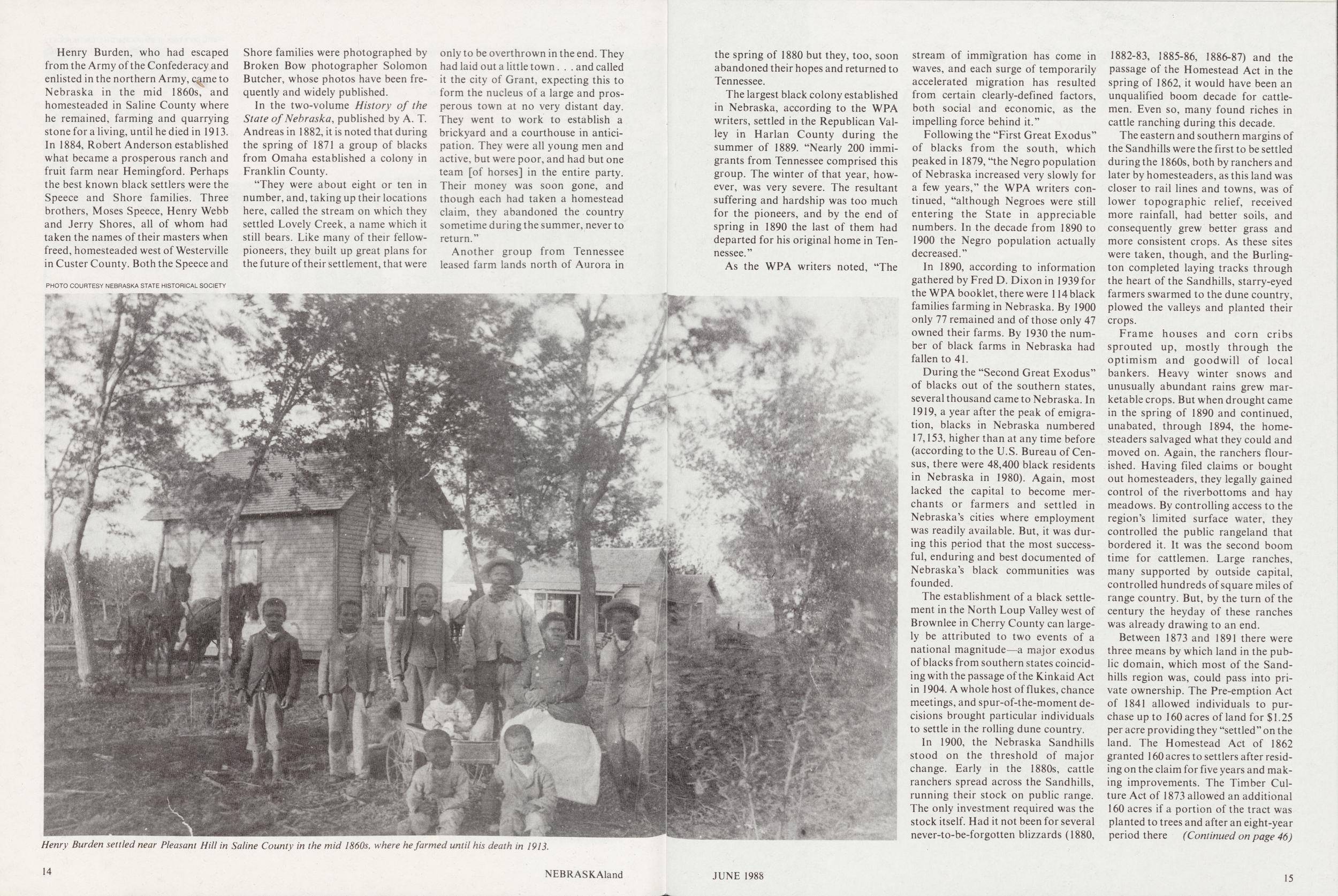
Henry Burden, who had escaped from the Army of the Confederacy and enlisted in the northern Army, came to Nebraska in the mid 1860s, and homesteaded in Saline County where he remained, farming and quarrying stone for a living, until he died in 1913. In 1884, Robert Anderson established what became a prosperous ranch and fruit farm near Hemingford. Perhaps the best known black settlers were the Speece and Shore families. Three brothers, Moses Speece, Henry Webb and Jerry Shores, all of whom had taken the names of their masters when freed, homesteaded west of Westerville in Custer County. Both the Speece and Shore families were photographed by Broken Bow photographer Solomon Butcher, whose photos have been frequently and widely published.
In the two-volume History of the State of Nebraska, published by A. T. Andreas in 1882, it is noted that during the spring of 1871 a group of blacks from Omaha established a colony in Franklin County.
"They were about eight or ten in number, and, taking up their locations here, called the stream on which they settled Lovely Creek, a name which it still bears. Like many of their fellow- pioneers, they built up great plans for the future of their settlement, that were only to be overthrown in the end. They had laid out a little town. . .and called it the city of Grant, expecting this to form the nucleus of a large and prosperous town at no very distant day. They went to work to establish a brickyard and a courthouse in anticipation. They were all young men and active, but were poor, and had but one team [of horses] in the entire party. Their money was soon gone, and though each had taken a homestead claim, they abandoned the country sometime during the summer, never to return."
Another group from Tennessee leased farm lands north of Aurora in 14 NEBRASKAland the spring of 1880 but they, too, soon abandoned their hopes and returned to Tennessee.
The largest black colony established in Nebraska, according to the WPA writers, settled in the Republican Valley in Harlan County during the summer of 1889. "Nearly 200 immigrants from Tennessee comprised this group. The winter of that year, however, was very severe. The resultant suffering and hardship was too much for the pioneers, and by the end of spring in 1890 the last of them had departed for his original home in Tennessee."
As the WPA writers noted, "The stream of immigration has come in waves, and each surge of temporarily accelerated migration has resulted from certain clearly-defined factors, both social and economic, as the impelling force behind it."
Following the "First Great Exodus" of blacks from the south, which peaked in 1879, "the Negro population of Nebraska increased very slowly for a few years," the WPA writers continued, "although Negroes were still entering the State in appreciable numbers. In the decade from 1890 to 1900 the Negro population actually decreased."
In 1890, according to information gathered by Fred D. Dixon in 1939 for the WPA booklet, there were 114 black families farming in Nebraska. By 1900 only 77 remained and of those only 47 owned their farms. By 1930 the number of black farms in Nebraska had fallen to 41.
During the "Second Great Exodus" of blacks out of the southern states, several thousand came to Nebraska. In 1919, a year after the peak of emigration, blacks in Nebraska numbered 17,153, higher than at any time before (according to the U.S. Bureau of Census, there were 48,400 black residents in Nebraska in 1980). Again, most lacked the capital to become merchants or farmers and settled in Nebraska's cities where employment was readily available. But, it was during this period that the most successful, enduring and best documented of Nebraska's black communities was founded.
The establishment of a black settlement in the North Loup Valley west of Brownlee in Cherry County can largely be attributed to two events of a national magnitude—a major exodus of blacks from southern states coinciding with the passage of the Kinkaid Act in 1904. A whole host of flukes, chance meetings, and spur-of-the-moment decisions brought particular individuals to settle in the rolling dune country.
In 1900, the Nebraska Sandhills stood on the threshold of major change. Early in the 1880s, cattle ranchers spread across the Sandhills, running their stock on public range. The only investment required was the stock itself. Had it not been for several never-to-be-forgotten blizzards (1880, 1882-83, 1885-86, 1886-87) and the passage of the Homestead Act in the spring of 1862, it would have been an unqualified boom decade for cattlemen. Even so, many found riches in cattle ranching during this decade.
The eastern and southern margins of the Sandhills were the first to be settled during the 1860s, both by ranchers and later by homesteaders, as this land was closer to rail lines and towns, was of lower topographic relief, received more rainfall, had better soils, and consequently grew better grass and more consistent crops. As these sites were taken, though, and the Burlington completed laying tracks through the heart of the Sandhills, starry-eyed farmers swarmed to the dune country, plowed the valleys and planted their crops.
Frame houses and corn cribs sprouted up, mostly through the optimism and goodwill of local bankers. Heavy winter snows and unusually abundant rains grew marketable crops. But when drought came in the spring of 1890 and continued, unabated, through 1894, the homesteaders salvaged what they could and moved on. Again, the ranchers flourished. Having filed claims or bought out homesteaders, they legally gained control of the river bottoms and hay meadows. By controlling access to the region's limited surface water, they controlled the public rangeland that bordered it. It was the second boom time for cattlemen. Large ranches, many supported by outside capital, controlled hundreds of square miles of range country. But, by the turn of the century the heyday of these ranches was already drawing to an end.
Between 1873 and 1891 there were three means by which land in the public domain, which most of the Sandhills region was, could pass into private ownership. The Pre-emption Act of 1841 allowed individuals to purchase up to 160 acres of land for $ 1.25 per acre providing they "settled" on the land. The Homestead Act of 1862 granted 160 acres to settlers after residing on the claim for five years and making improvements. The Timber Culture Act of 1873 allowed an additional 160 acres if a portion of the tract was planted to trees and after an eight-year period there (Continued on page 46)
JUNE 1988 15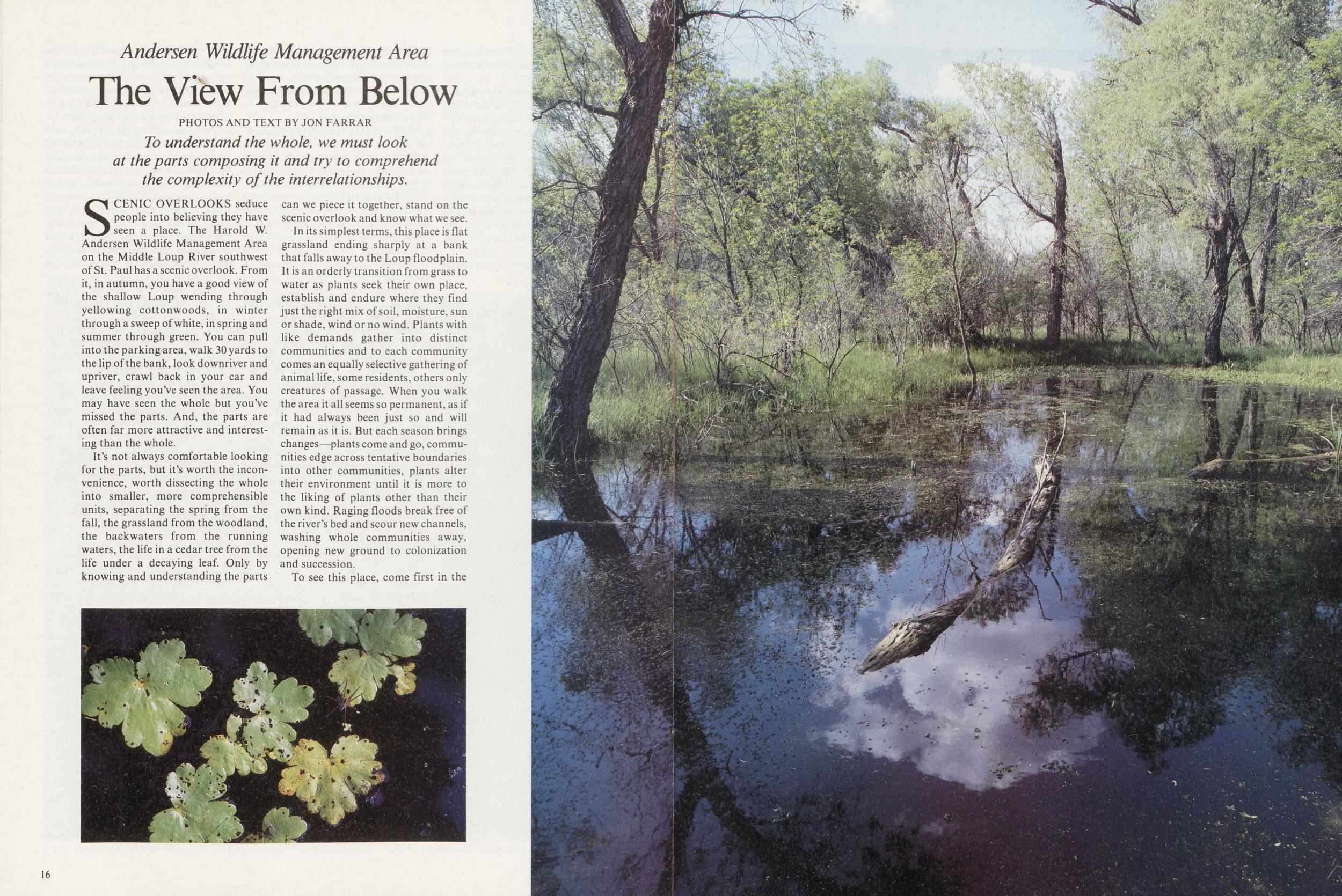
Andersen Wildlife Management Area The View From Below
PHOTOS AND TEXT BY JON FARRAR To understand the whole, we must look at the parts composing it and try to comprehend the complexity of the interrelationships.SCENIC OVERLOOKS seduce people into believing they have seen a place. The Harold W. Andersen Wildlife Management Area on the Middle Loup River southwest of St. Paul has a scenic overlook. From it, in autumn, you have a good view of the shallow Loup wending through yellowing cottonwoods, in winter through a sweep of white, in spring and summer through green. You can pull into the parking area, walk 30 yards to the lip of the bank, look downriver and upriver, crawl back in your car and leave feeling you've seen the area. You may have seen the whole but you've missed the parts. And, the parts are often far more attractive and interesting than the whole.
It's not always comfortable looking for the parts, but it's worth the inconvenience, worth dissecting the whole into smaller, more comprehensible units, separating the spring from the fall, the grassland from the woodland, the backwaters from the running waters, the life in a cedar tree from the life under a decaying leaf. Only by knowing and understanding the parts can we piece it together, stand on the scenic overlook and know what we see.
In its simplest terms, this place is flat grassland ending sharply at a bank that falls away to the Loup floodplain. It is an orderly transition from grass to water as plants seek their own place, establish and endure where they find just the right mix of soil, moisture, sun or shade, wind or no wind. Plants with like demands gather into distinct communities and to each community comes an equally selective gathering of animal life, some residents, others only creatures of passage. When you walk the area it all seems so permanent, as if it had always been just so and will remain as it is. But each season brings changes—plants come and go, communities edge across tentative boundaries into other communities, plants alter their environment until it is more to the liking of plants other than their own kind. Raging floods break free of the river's bed and scour new channels, washing whole communities away, opening new ground to colonization and succession.
To see this place, come first in the spring, in early May when the green is new and unfurling, when cottonwood leaves are tender and waxy and dancing like aspen. Ignore the grassland, it is only beginning to rouse from winter sleep; save it for summer, when a breeze is welcome, when the woodlands are humid and swarming with insects.
16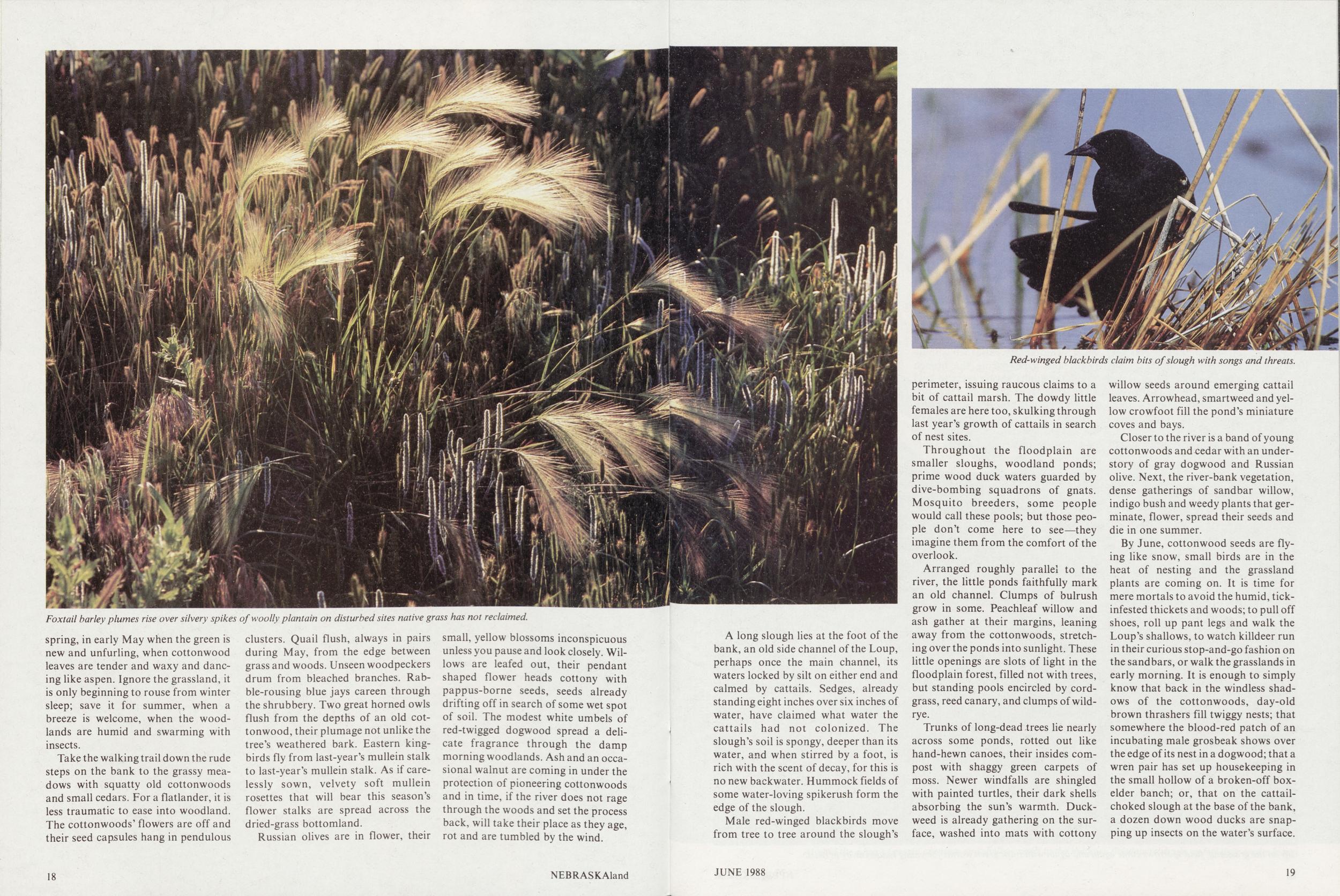
Take the walking trail down the rude steps on the bank to the grassy meadows with squatty old cottonwoods and small cedars. For a flatlander, it is less traumatic to ease into woodland. The cottonwoods' flowers are off and their seed capsules hang in pendulous clusters. Quail flush, always in pairs during May, from the edge between grass and woods. Unseen woodpeckers drum from bleached branches. Rabble-rousing blue jays careen through the shrubbery. Two great horned owls flush from the depths of an old cottonwood, their plumage not unlike the tree's weathered bark. Eastern kingbirds fly from last-year's mullein stalk to last-year's mullein stalk. As if carelessly sown, velvety soft mullein rosettes that will bear this season's flower stalks are spread across the dried-grass bottomland.
Russian olives are in flower, their small, yellow blossoms inconspicuous unless you pause and look closely. Willows are leafed out, their pendant shaped flower heads cottony with pappus-borne seeds, seeds already drifting off in search of some wet spot of soil. The modest white umbels of red-twigged dogwood spread a delicate fragrance through the dam morning woodlands. Ash and an occasional walnut are coming in under the protection of pioneering cottonwoods and in time, if the river does not rage through the woods and set the process back, will take their place as they age, rot and are tumbled by the wind.
16 NEBRSAKAlandA long slough lies at the foot of the bank, an old side channel of the Loup, perhaps once the main channel, its waters locked by silt on either end and calmed by cattails. Sedges, already standing eight inches over six inches of water, have claimed what water the cattails had not colonized. The slough's soil is spongy, deeper than its water, and when stirred by a foot, is rich with the scent of decay, for this is no new backwater. Hummock fields of some water-loving spike rush form the edge of the slough.
Male red-winged blackbirds move from tree to tree around the slough's perimeter, issuing raucous claims to a bit of cattail marsh. The dowdy little females are here too, skulking through last year's growth of cattails in search of nest sites.
Throughout the floodplain are smaller sloughs, woodland ponds; prime wood duck waters guarded by dive-bombing squadrons of gnats. Mosquito breeders, some people would call these pools; but those people don't come here to see—they imagine them from the comfort of the overlook.
Arranged roughly parallel to the river, the little ponds faithfully mark an old channel. Clumps of bulrush grow in some. Peach leaf willow and ash gather at their margins, leaning away from the cottonwoods, stretch- ing over the ponds into sunlight. These little openings are slots of light in the floodplain forest, filled not with trees, but standing pools encircled by cordgrass, reed canary, and clumps of wildrye.
Trunks of long-dead trees lie nearly across some ponds, rotted out like hand-hewn canoes, their insides compost with shaggy green carpets of moss. Newer windfalls are shingled with painted turtles, their dark shells absorbing the sun's warmth. Duck- weed is already gathering on the surface, washed into mats with cottony willow seeds around emerging cattail leaves. Arrowhead, smartweed and yellow crowfoot fill the pond's miniature coves and bays.
Closer to the river is a band of young cottonwoods and cedar with an understory of gray dogwood and Russian olive. Next, the river-bank vegetation, dense gatherings of sandbar willow, indigo bush and weedy plants that germinate, flower, spread their seeds and die in one summer.
By June, cottonwood seeds are flying like snow, small birds are in the heat of nesting and the grassland plants are coming on. It is time for mere mortals to avoid the humid, tick infested thickets and woods; to pull off shoes, roll up pant legs and walk the Loup's shallows, to watch killdeer run in their curious stop-and-go fashion on the sandbars, or walk the grasslands in early morning. It is enough to simply know that back in the windless shadows of the cottonwoods, day-old brown thrashers fill twiggy nests; that somewhere the blood-red patch of an incubating male grosbeak shows over the edge of its nest in a dogwood; that a wren pair has set up housekeeping in the small hollow of a broken-off box elder banch; or, that on the cattail choked slough at the base of the bank, a dozen down wood ducks are snapping up insects on the water's surface.
JUNE 1988 19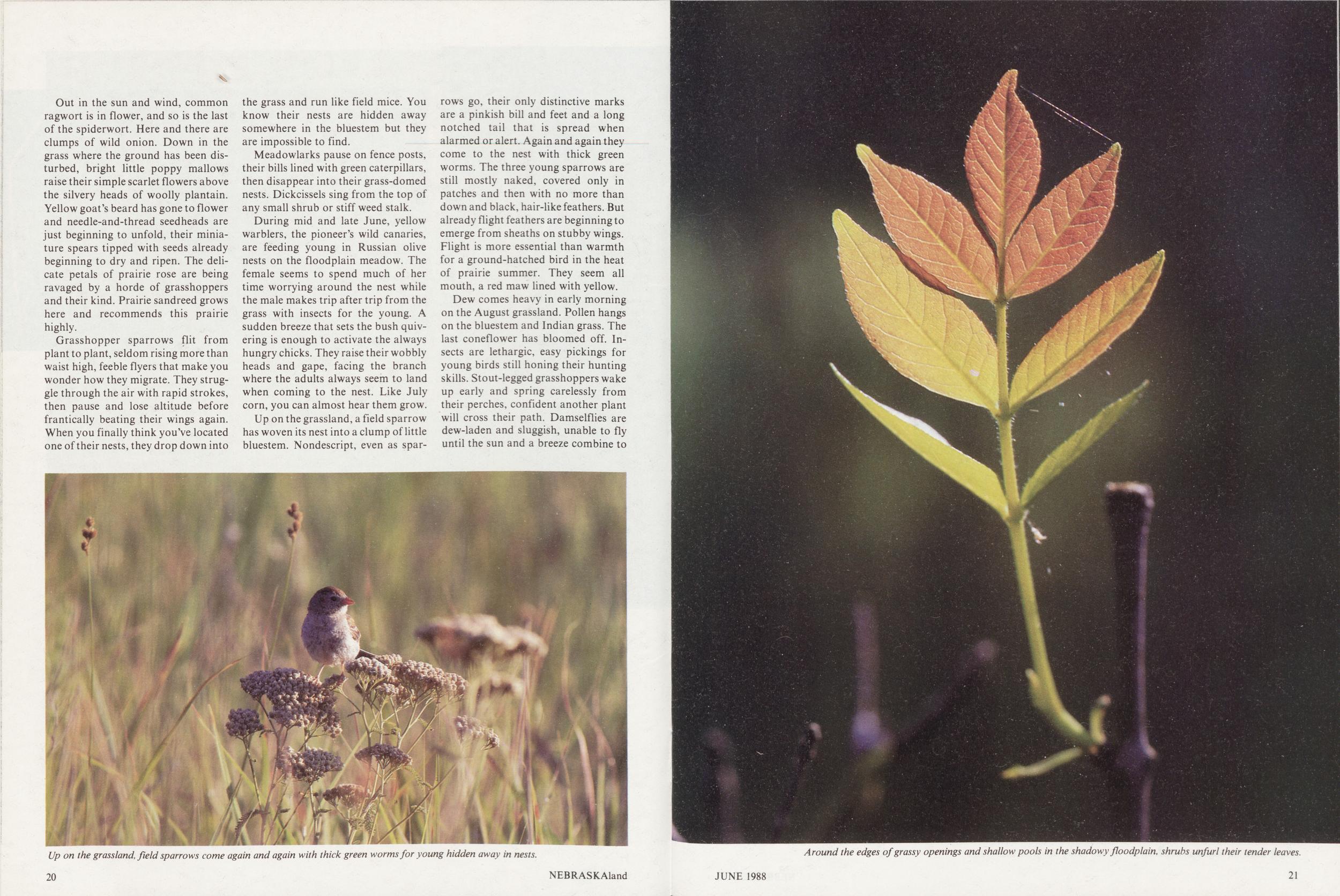
Out in the sun and wind, common ragwort is in flower, and so is the last of the spiderwort. Here and there are clumps of wild onion. Down in the grass where the ground has been disturbed, bright little poppy mallows raise their simple scarlet flowers above the silvery heads of woolly plantain. Yellow goat's beard has gone to flower and needle-and-thread seed heads are just beginning to unfold, their miniature spears tipped with seeds already beginning to dry and ripen. The delicate petals of prairie rose are being ravaged by a horde of grasshoppers and their kind. Prairie sandreed grows here and recommends this prairie highly.
Grasshopper sparrows flit from plant to plant, seldom rising more than waist high, feeble flyers that make you wonder how they migrate. They struggle through the air with rapid strokes, then pause and lose altitude before frantically beating their wings again. When you finally think you've located one of their nests, they drop down into the grass and run like field mice. You know their nests are hidden away somewhere in the bluestem but they are impossible to find.
Meadowlarks pause on fence posts, their bills lined with green caterpillars, then disappear into their grass-domed nests. Dickcissels sing from the top of any small shrub or stiff weed stalk.
During mid and late June, yellow warblers, the pioneer's wild canaries, are feeding young in Russian olive nests on the floodplain meadow. The female seems to spend much of her time worrying around the nest while the male makes trip after trip from the grass with insects for the young. A sudden breeze that sets the bush quivering is enough to activate the always hungry chicks. They raise their wobbly heads and gape, facing the branch where the adults always seem to land when coming to the nest. Like July corn, you can almost hear them grow.
Up on the grassland, a field sparrow has woven its nest into a clump of little bluestem. Nondescript, even as sparrows go, their only distinctive marks are a pinkish bill and feet and a long notched tail that is spread when come to the nest with thick green worms. The three young sparrows are still mostly naked, covered only in patches and then with no more than down and black, hair-like feathers. But already flight feathers are beginning to emerge from sheaths on stubby wings. Flight is more essential than warmth for a ground-hatched bird in the heat of prairie summer. They seem all mouth, a red maw lined with yellow.
Dew comes heavy in early morning on the August grassland. Pollen hangs on the bluestem and Indian grass. The last coneflower has bloomed off. Insects are lethargic, easy pickings for young birds still honing their hunting skills. Stout-legged grasshoppers wake up early and spring carelessly from their perches, confident another plant will cross their path. Damselflies are dew-laden and sluggish, unable to fly until the sun and a breeze combine to dry their fragile wings.
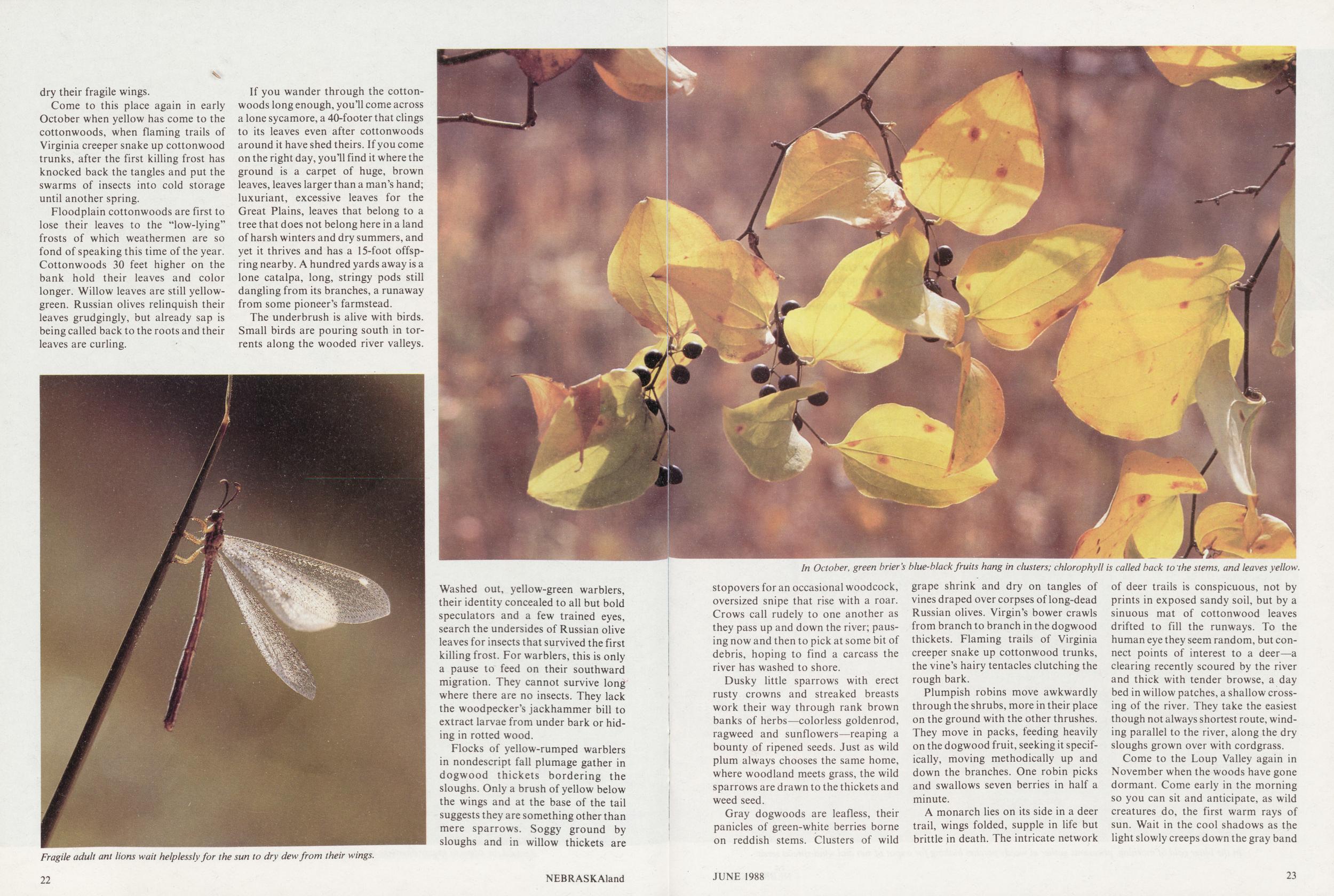
Come to this place again in early October when yellow has come to the cottonwoods, when flaming trails of Virginia creeper snake up cottonwood trunks, after the first killing frost has knocked back the tangles and put the swarms of insects into cold storage until another spring.
Floodplain cottonwoods are first to lose their leaves to the "low-lying" frosts of which weathermen are so fond of speaking this time of the year. Cottonwoods 30 feet higher on the bank hold their leaves and color longer. Willow leaves are still yellow green. Russian olives relinquish their leaves grudgingly, but already sap is being called back to the roots and their leaves are curling.
If you wander through the cotton- woods long enough, you'll come across a lone sycamore, a 40-footer that clings to its leaves even after cottonwoods around it have shed theirs. If you come on the right day, you'll find it where the ground is a carpet of huge, brown leaves, leaves larger than a man's hand; luxuriant, excessive leaves for the Great Plains, leaves that belong to a tree that does not belong here in a land of harsh winters and dry summers, and yet it thrives and has a 15-foot offspring nearby. A hundred yards away is a lone catalpa, long, stringy pods still dangling from its branches, a runaway from some pioneer's farmstead.
The underbrush is alive with birds. Small birds are pouring south in torrents along the wooded river valleys. Washed out, yellow-green warblers, their identity concealed to all but bold speculators and a few trained eyes, search the undersides of Russian olive leaves for insects that survived the first killing frost. For warblers, this is only a pause to feed on their southward migration. They cannot survive long where there are no insects. They lack the woodpecker's jackhammer bill to extract larvae from under bark or hiding in rotted wood.
Flocks of yellow-rumped warblers in nondescript fall plumage gather in dogwood thickets bordering the sloughs. Only a brush of yellow below the wings and at the base of the tail suggests they are something other than mere sparrows. Soggy ground by sloughs and in willow thickets are 22 NEBRASKAland stopovers for an occasional woodcock, oversized snipe that rise with a roar. Crows call rudely to one another as they pass up and down the river; pausing now and then to pick at some bit of debris, hoping to find a carcass the river has washed to shore.
Dusky little sparrows with erect rusty crowns and streaked breasts work their way through rank brown banks of herbs—colorless goldenrod, ragweed and sunflowers—reaping a bounty of ripened seeds. Just as wild plum always chooses the same home, where woodland meets grass, the wild sparrows are drawn to the thickets and weed seed.
Gray dogwoods are leafless, their panicles of green-white berries borne on reddish stems. Clusters of wild grape shrink and dry on tangles of vines draped over corpses of long-dead Russian olives. Virgin's bower crawls from branch to branch in the dogwood thickets. Flaming trails of Virginia creeper snake up cottonwood trunks, the vine's hairy tentacles clutching the rough bark.
Plumpish robins move awkwardly through the shrubs, more in their place on the ground with the other thrushes. They move in packs, feeding heavily on the dogwood fruit, seeking it specifically, moving methodically up and down the branches. One robin picks and swallows seven berries in half a minute.
A monarch lies on its side in a deer trail, wings folded, supple in life but brittle in death. The intricate network of deer trails is conspicuous, not by prints in exposed sandy soil, but by a sinuous mat of cottonwood leaves drifted to fill the runways. To the human eye they seem random, but connect points of interest to a deer—a clearing recently scoured by the river and thick with tender browse, a day bed in willow patches, a shallow crossing of the river. They take the easiest though not always shortest route, winding parallel to the river, along the dry sloughs grown over with cordgrass.
Come to the Loup Valley again in
November when the woods have gone
dormant. Come early in the morning
so you can sit and anticipate, as wild
creatures do, the first warm rays of
sun. Wait in the cool shadows as the
light slowly creeps down the gray band
JUNE 1988
23
 of leafless cottonwoods. Watch it paint
a clump of dull tan canary grass a rich
yellow-brown.
of leafless cottonwoods. Watch it paint
a clump of dull tan canary grass a rich
yellow-brown.
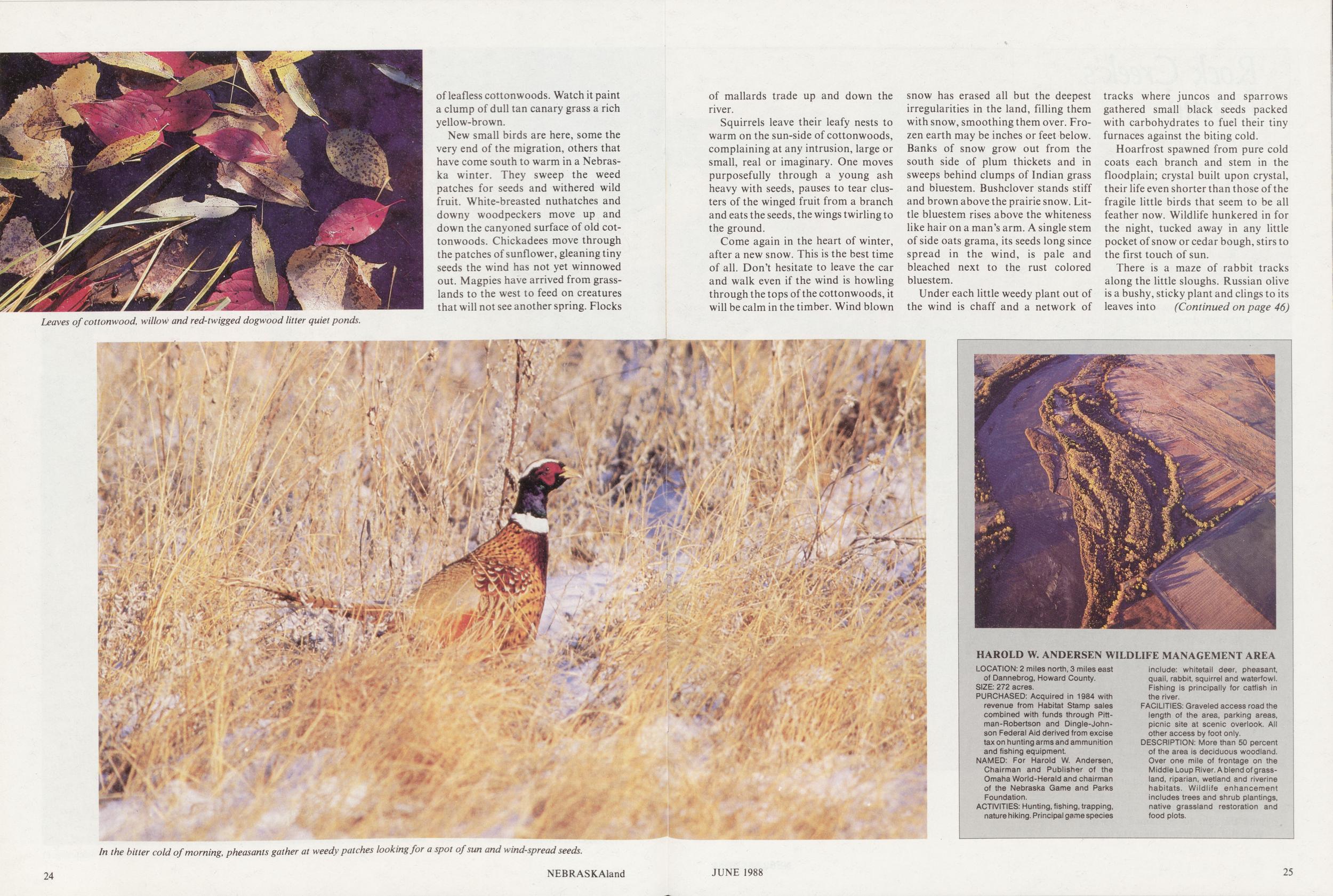
New small birds are here, some the very end of the migration, others that have come south to warm in a Nebraska winter. They sweep the weed patches for seeds and withered wild fruit. White-breasted nuthatches and downy woodpeckers move up and down the canyoned surface of old cottonwoods. Chickadees move through the patches of sunflower, gleaning tiny seeds the wind has not yet winnowed out. Magpies have arrived from grasslands to the west to feed on creatures that will not see another spring. Flocks 24 NEBRASKAland of mallards trade up and down the river.
Squirrels leave their leafy nests to warm on the sun-side of cottonwoods, complaining at any intrusion, large or small, real or imaginary. One moves purposefully through a young ash heavy with seeds, pauses to tear clusters of the winged fruit from a branch and eats the seeds, the wings twirling to the ground.
Come again in the heart of winter, after a new snow. This is the best time of all. Don't hesitate to leave the car and walk even if the wind is howling through the tops of the cottonwoods, it will be calm in the timber. Wind blown snow has erased all but the deepest irregularities in the land, filling them with snow, smoothing them over. Frozen earth may be inches or feet below. Banks of snow grow out from the south side of plum thickets and in sweeps behind clumps of Indian grass and bluestem. Bush clover stands stiff and brown above the prairie snow. Little bluestem rises above the whiteness like hair on a man's arm. A single stem of side oats grama, its seeds long since spread in the wind, is pale and bleached next to the rust colored bluestem.
Under each little weedy plant out of the wind is chaff and a network of tracks where juncos and sparrows gathered small black seeds packed with carbohydrates to fuel their tiny furnaces against the biting cold.
Hoarfrost spawned from pure cold coats each branch and stem in the floodplain; crystal built upon crystal, their life even shorter than those of the fragile little birds that seem to be all feather now. Wildlife hunkered in for the night, tucked away in any little pocket of snow or cedar bough, stirs to the first touch of sun.
There is a maze of rabbit tracks along the little sloughs. Russian olive is a bushy, sticky plant and clings to its leaves into (Continued on page 46)
Rock Creek's Legend
BY LOWELL JOHNSON A stage station shooting began Wild Bills reputation as a frontier gunslinger.NEBRASKA'S PLAINS have changed considerably since one eventful day in July of 1861 when a "shootout" at Rock Creek Station ended the life of David McCanles and started James Butler "Wild Bill" Hickok on a new path in his life.
Although details of that shootout, which ended with three men dead, will never be fully known, it was the foundation on which Hickok's legend was built. He was later involved in many exciting and dangerous situations, and could hardly make a move without the press and the dime novelists paying heed and often exaggerating his deeds.
Conditions on the western frontier were of an untamed nature, and it is unfair to now judge people's activities during a period we cannot appreciate. Hickok was a legend in his own time, and generally was described as quiet, even retiring. His bravery was questioned only by a few detractors with motives of their own. Many of those who knew him and witnessed him under stress claimed he was the bravest man they had ever known.
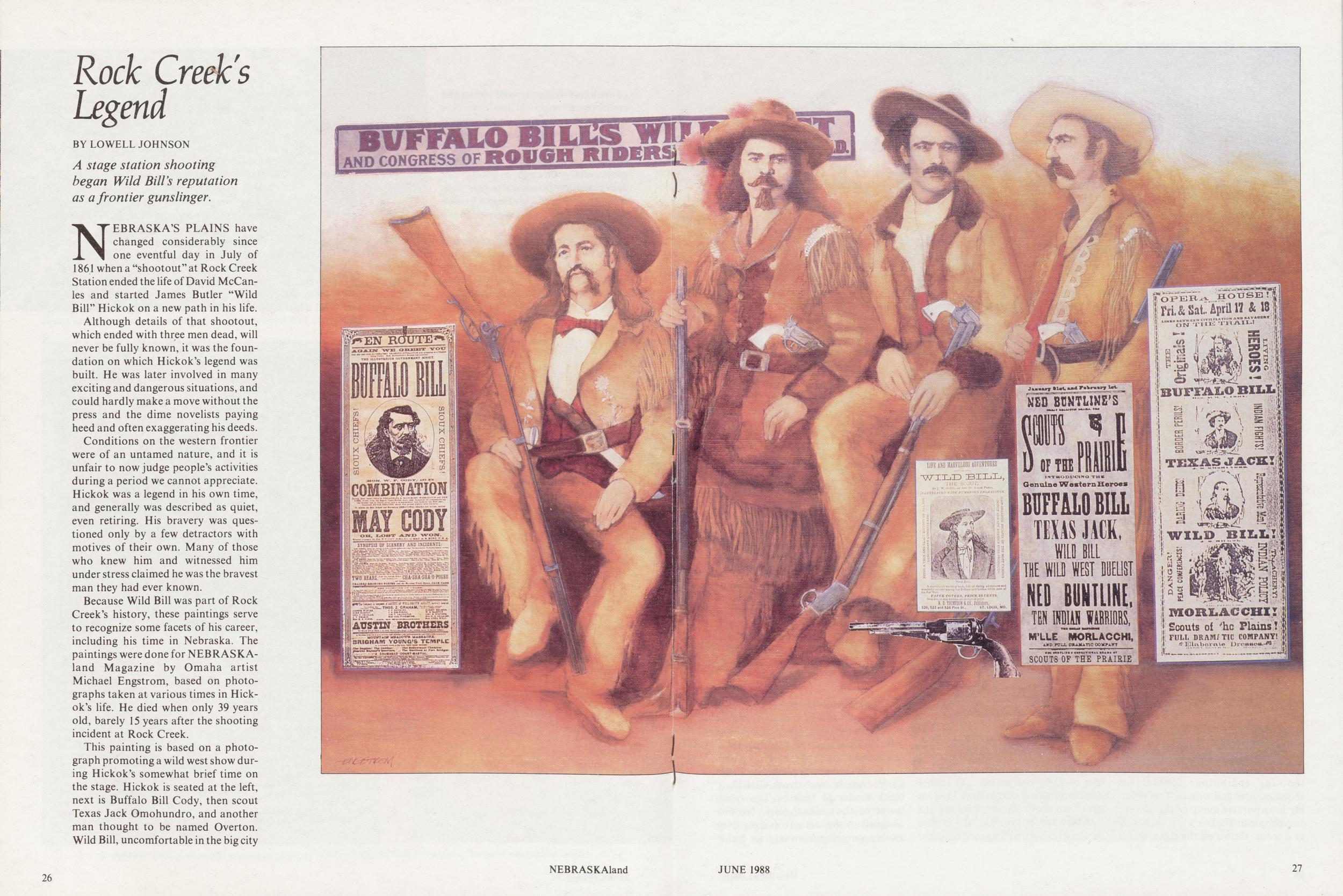
Because Wild Bill was part of Rock Creek's history, these paintings serve to recognize some facets of his career, including his time in Nebraska, The paintings were done for NEBRASKAland Magazine by Omaha artist Michael Engstrom, based on photographs taken at various times in Hickok's life. He died when only 39 years old, barely 15 years after the shooting incident at Rock Creek.
This painting is based on a photograph promoting a wild west show during Hickok's somewhat brief time on the stage. Hickok is seated at the left, next is Buffalo Bill Cody, then scout Texas Jack Omohundro, and another man thought to be named Overton. Wild Bill, uncomfortable in the big city and unhappy with show business in general, returned west after being arrested for assaulting a person hired to impersonate him. He did get considerable exposure in the press during his time in the east, however, and put on shooting exhibitions for various acquaintances and writers. This painting incorporates many of the periods and people in Hickok's life, including as a scout, shown on the right, where he has a large knife in his belt, based on an 1867 photograph. At the left, from a photo plate from 1868, he is in perhaps his best-known attire, the long frock coat and cape. Even when not wearing his pearl handled revolvers, he was certain to carry one or two .41 caliber derringers. He is said to have kept his hands on them when patrolling the streets when a lawman. He is also shown when he first became a scout for the military; the cards are the "dead man's hand" of aces and eights he was holding when shot from behind and killed in Deadwood on August 2, 1876.
26 NEBRASKAland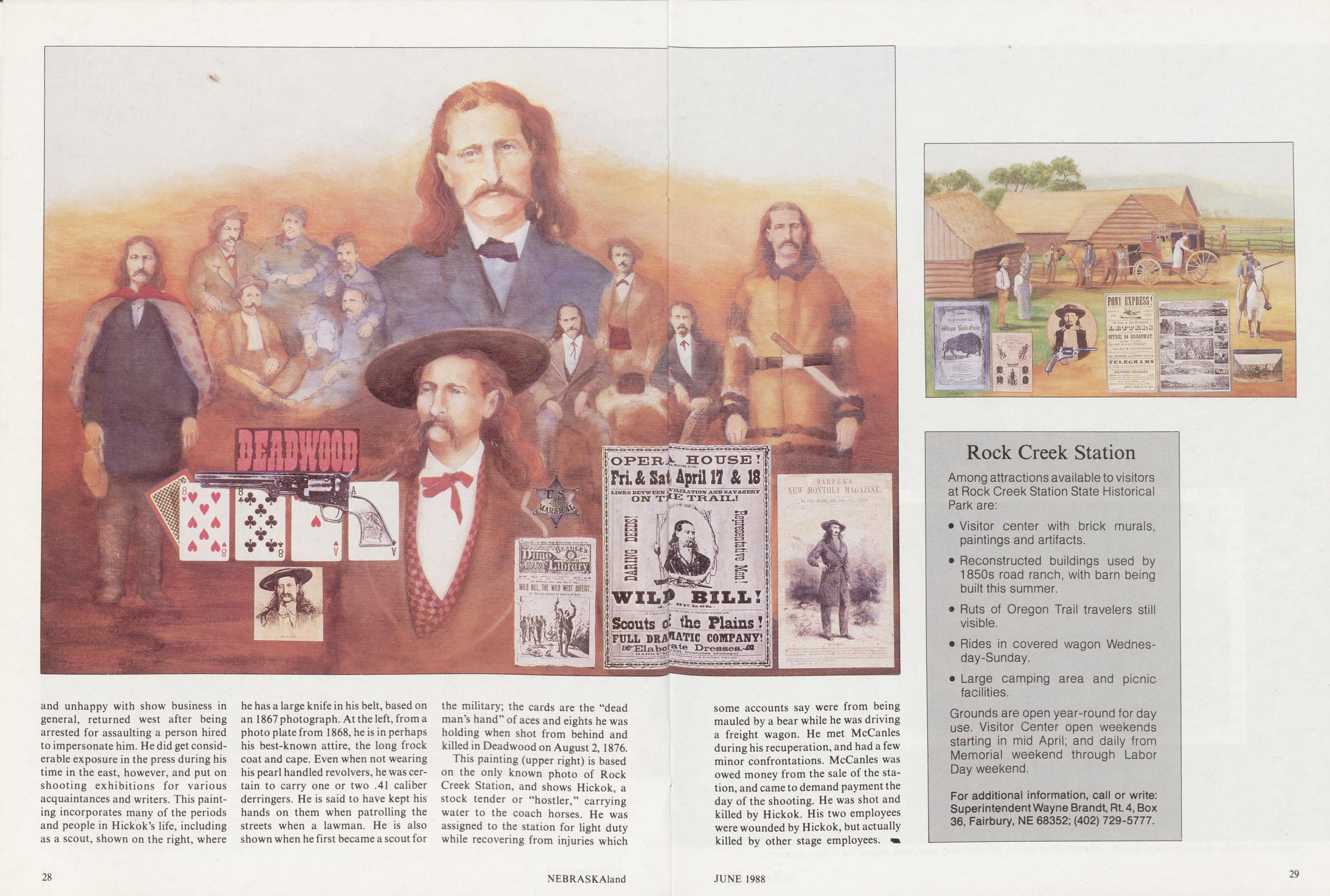
This painting (upper right) is based on the only known photo of Rock Creek Station, and shows Hickok, a stock tender or "hostler," carrying water to the coach horses. He was assigned to the station for light duty while recovering from injuries which 28 NEBRASKAland some accounts say were from being mauled by a bear while he was driving a freight wagon. He met McCanles during his recuperation, and had a few minor confrontations. McCanles was owed money from the sale of the station, and came to demand payment the day of the shooting. He was shot and killed by Hickok. His two employees were wounded by Hickok, but actually killed by other stage employees.
Funds for Fish A Progress Report
BY KEN BOUC First two years of Wallop-Breaux helped the Commission provide better facilities, more access for Nebraska anglers. Future projects also show promise.LET'S OPEN UP some new fishing waters, maybe just a handful of lakes with a few hundred acres, or maybe a dozen or two and a couple thousand acres."
"Let's buy plots of land and build boat ramps on the Missouri River so people can get to all that water. . . and build boat ramps and fish-cleaning stations on our busiest lakes . . . and teach our kids about fish and the aquatic environment so they can take better care of them than we did . . .and study problems at our hatcheries so they can produce more fish."
These all sound like good ideas, but they're more than mere ideas. Most of these and several other schemes are actual Game and Parks Commission projects that are already under way. Only the "new fishing waters" program, which involves the purchase or lease of natural Sandhills lakes, has yet to bear fruit, and that's because it is just now getting started.
All of this new fisheries activity has taken place in just the past two years, with the implementation of a new federal program of funding assistance to state fisheries programs. Called the "Wallop-Breaux" program, it is actually an amendment that expanded the old Federal Aid in Sport Fish Restoration (Dingell-Johnson) Act of the 1950s.
The original Dingell-Johnson Act levied federal excise taxes on rods, reels, creels, and artificial lures and flies, with the revenue distributed back to state fisheries programs. Since the 1950s, however, many more people have taken up sport fishing, and these new anglers are much better at catch- ing fish than their counterparts of 25 years ago.
The needs of fishermen have simply outpaced the capacities of state fisheries agencies and the old Dingell-Johnson program. Thus the Wallop-Breaux amendment was passed to add new taxes on items—fishing line, hooks, and tackle boxes—and to divert existing excise taxes such as the levy on motor boat fuel from the general treasury to fisheries.
The major new fisheries projects launched in Nebraska since Wallop-Breaux went into effect include:
Sandhills Lake ProjectThe purchase of Sandhills lakes, or leasing of their fishing rights, will be negotiated with landowners in the Sandhills region, where there are thousands of natural lakes. Most of them are too small or too shallow or too alkaline to support fish populations, or too remote to be of much use to fishermen. But, there are hundreds that could support fish and fishermen, with landowner cooperation.
First priority of the program will be the outright purchase of suitable lakes from private owners, which offers advantages to both the Game and Parks Commission and the rancher. Outright ownership by the Commission makes substantial investments such as a good access road much more feasible, while at the same time freeing the landowner of taxable but economically unproductive acres.
Landowners who decide they want to retain ownership of a good lake but are willing to allow public fishing, may decide on a 10-year lease agreement, instead. The rancher would leave the lake open to public fishing from boats or bank, but would control vehicle traffic across his pasture. Regulations would prohibit high-speed boating, open fires and camping, and the lakes would be closed from sunset to sunrise. Other regulations would be open to negotiation with the landowner.
JUNE 1988 31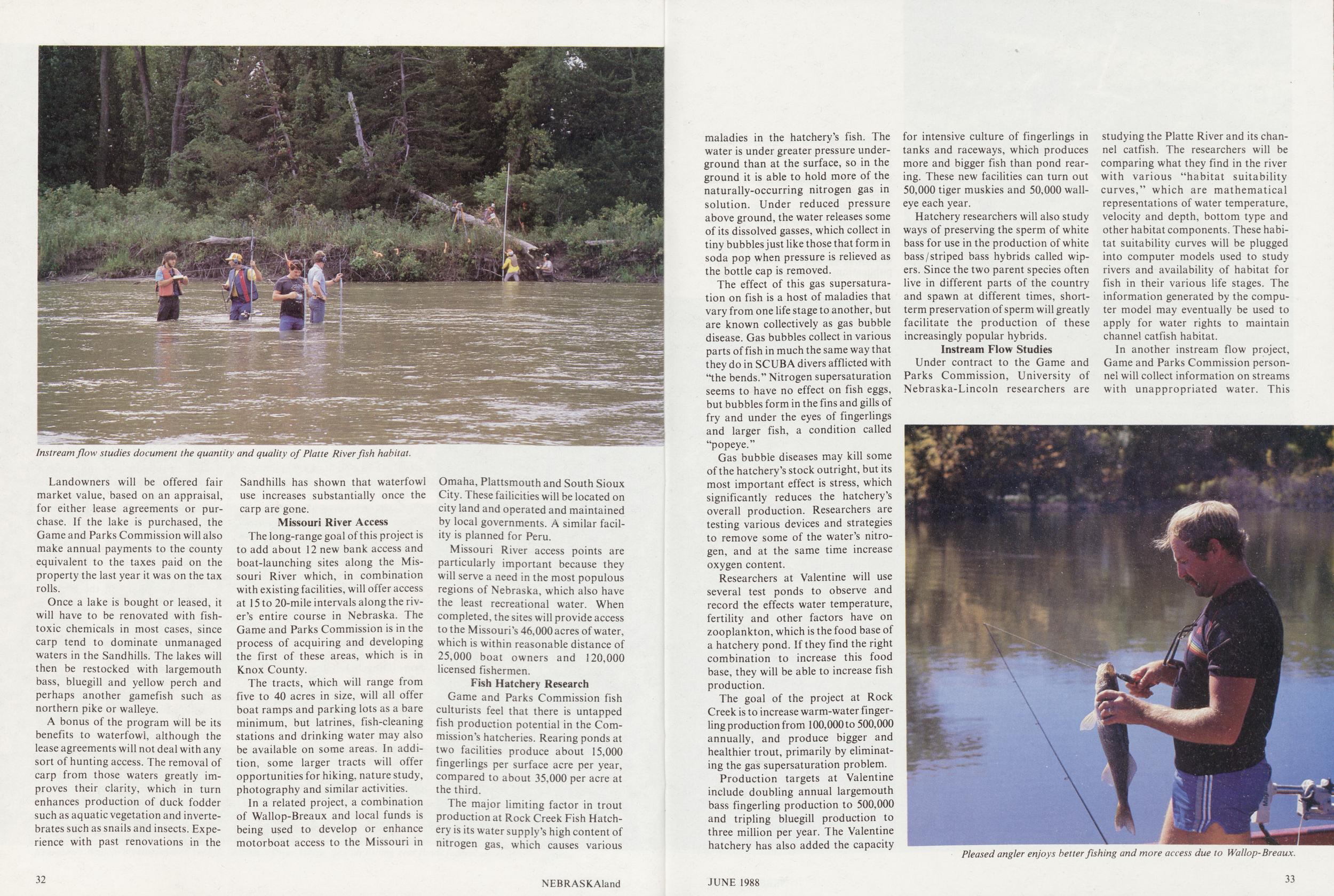
Landowners will be offered fair market value, based on an appraisal, for either lease agreements or purchase. If the lake is purchased, the Game and Parks Commission will also make annual payments to the county equivalent to the taxes paid on the property the last year it was on the tax rolls.
Once a lake is bought or leased, it will have to be renovated with fish toxic chemicals in most cases, since carp tend to dominate unmanaged waters in the Sandhills. The lakes will then be restocked with largemouth bass, bluegill and yellow perch and perhaps another gamefish such as northern pike or walleye.
A bonus of the program will be its benefits to waterfowl, although the lease agreements will not deal with any sort of hunting access. The removal of carp from those waters greatly improves their clarity, which in turn enhances production of duck fodder such as aquatic vegetation and invertebrates such as snails and insects. Experience with past renovations in the Sandhills has shown that waterfowl use increases substantially once the carp are gone.
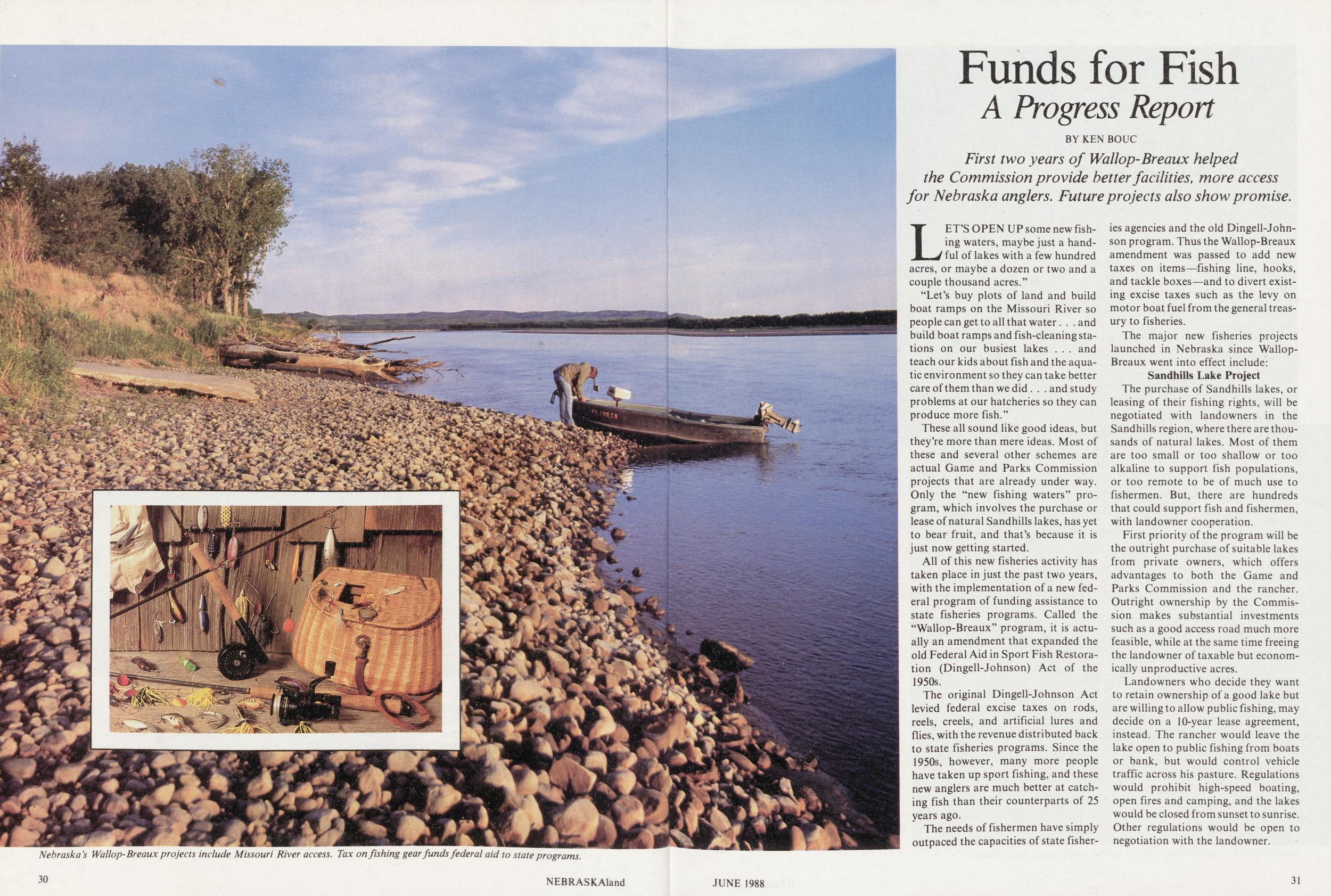
Missouri River AccessThe long-range goal of this project is to add about 12 new bank access and boat-launching sites along the Missouri River which, in combination with existing facilities, will offer access at 15 to 20-mile intervals along the river's entire course in Nebraska. The Game and Parks Commission is in the process of acquiring and developing the first of these areas, which is in Knox County.
The tracts, which will range from five to 40 acres in size, will all offer boat ramps and parking lots as a bare minimum, but latrines, fish-cleaning stations and drinking water may also be available on some areas. In addition, some larger tracts will offer opportunities for hiking, nature study, photography and similar activities.
In a related project, a combination of Wallop-Breaux and local funds is being used to develop or enhance motorboat access to the Missouri in Omaha, Plattsmouth and South Sioux City. These facilities will be located on city land and operated and maintained by local governments. A similar facility is planned for Peru.
Missouri River access points are particularly important because they will serve a need in the most populous regions of Nebraska, which also have the least recreational water. When completed, the sites will provide access to the Missouri's 46,000 acres of water, which is within reasonable distance of 25,000 boat owners and 120,000 licensed fishermen.
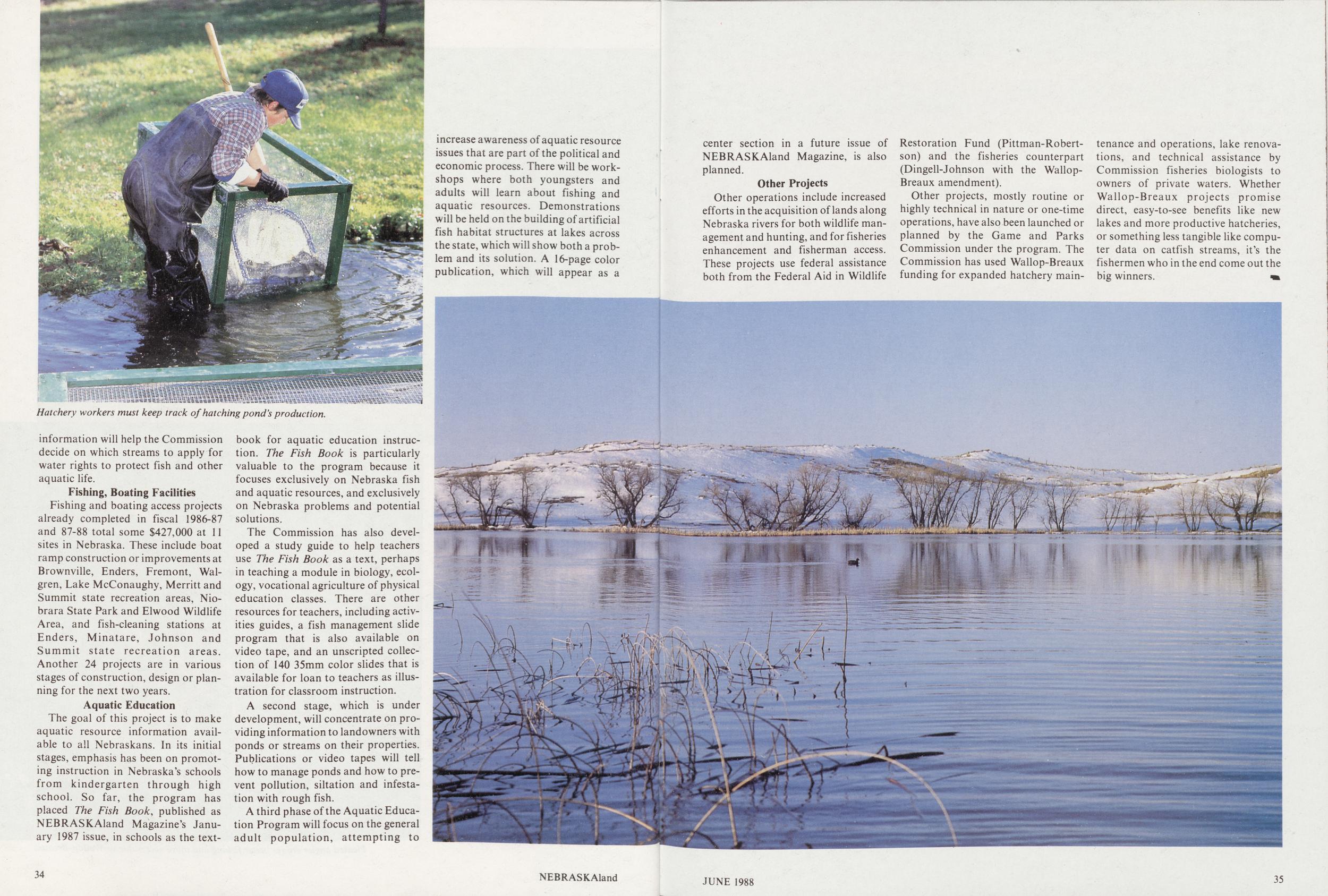
Fish Hatchery ResearchGame and Parks Commission fish culturists feel that there is untapped fish production potential in the Commission's hatcheries. Rearing ponds at two facilities produce about 15,000 fingerlings per surface acre per year, compared to about 35,000 per acre at the third.
The major limiting factor in trout production at Rock Creek Fish Hatchery is its water supply's high content of nitrogen gas, which causes various 32 NEBRASKAland maladies in the hatchery's fish. The water is under greater pressure underground than at the surface, so in the ground it is able to hold more of the naturally-occurring nitrogen gas in solution. Under reduced pressure above ground, the water releases some of its dissolved gasses, which collect in tiny bubbles just like those that form in soda pop when pressure is relieved as the bottle cap is removed.
The effect of this gas supersaturation on fish is a host of maladies that vary from one life stage to another, but are known collectively as gas bubble disease. Gas bubbles collect in various parts offish in much the same way that they do in SCUBA divers afflicted with 'the bends." Nitrogen supersaturation seems to have no effect on fish eggs, but bubbles form in the fins and gills of fry and under the eyes of fingerlings and larger fish, a condition called "popeye."
Gas bubble diseases may kill some of the hatchery's stock outright, but its most important effect is stress, which significantly reduces the hatchery's overall production. Researchers are testing various devices and strategies to remove some of the water's nitrogen, and at the same time increase oxygen content.
Researchers at Valentine will use several test ponds to observe and record the effects water temperature, fertility and other factors have on zooplankton, which is the food base of a hatchery pond. If they find the right combination to increase this food base, they will be able to increase fish production.
The goal of the project at Rock Creek is to increase warm-water fingerling production from 100,000 to 500,000 annually, and produce bigger and healthier trout, primarily by eliminating the gas supersaturation problem.
Production targets at Valentine include doubling annual largemouth bass fingerling production to 500,000 and tripling bluegill production to three million per year. The Valentine hatchery has also added the capacity for intensive culture of fingerlings in tanks and raceways, which produces more and bigger fish than pond rearing. These new facilities can turn out 50,000 tiger muskies and 50,000 walleye each year.
Hatchery researchers will also study ways of preserving the sperm of white bass for use in the production of white bass/striped bass hybrids called wipers. Since the two parent species often live in different parts of the country and spawn at different times, shortterm preservation of sperm will greatly facilitate the production of these increasingly popular hybrids.
Instream Flow StudiesUnder contract to the Game and Parks Commission, University of Nebraska-Lincoln researchers are studying the Platte River and its channel catfish. The researchers will be comparing what they find in the river with various "habitat suitability curves," which are mathematical representations of water temperature, velocity and depth, bottom type and other habitat components. These habitat suitability curves will be plugged into computer models used to study rivers and availability of habitat for fish in their various life stages. The information generated by the computer model may eventually be used to apply for water rights to maintain channel catfish habitat.
In another instream flow project, Game and Parks Commission personnel will collect information on streams with unappropriated water. This information will help the Commission decide on which streams to apply for water rights to protect fish and other aquatic life.
Fishing and boating access projects already completed in fiscal 1986-87 and 87-88 total some $427,000 at 11 sites in Nebraska. These include boat ramp construction or improvements at Brownville, Enders, Fremont, Walgren, Lake McConaughy, Merritt and Summit state recreation areas, Niobrara State Park and Elwood Wildlife Area, and fish-cleaning stations at Enders, Minatare, Johnson and Summit state recreation areas. Another 24 projects are in various stages of construction, design or planning for the next two years.
Aquatic EducationThe goal of this project is to make aquatic resource information available to all Nebraskans. In its initial stages, emphasis has been on promoting instruction in Nebraska's schools from kindergarten through high school. So far, the program has placed The Fish Book, published as NEBRASKAland Magazine's January 1987 issue, in schools as the textbook for aquatic education instruction. The Fish Book is particularly valuable to the program because it focuses exclusively on Nebraska fish and aquatic resources, and exclusively on Nebraska problems and potential solutions.
The Commission has also developed a study guide to help teachers use The Fish Book as a text, perhaps in teaching a module in biology, ecology, vocational agriculture of physical education classes. There are other resources for teachers, including activities guides, a fish management slide program that is also available on video tape, and an unscripted collection of 140 35mm color slides that is available for loan to teachers as illustration for classroom instruction.
A second stage, which is under development, will concentrate on providing information to landowners with ponds or streams on their properties. Publications or video tapes will tell how to manage ponds and how to prevent pollution, siltation and infestation with rough fish.
A third phase of the Aquatic Education Program will focus on the general adult population, attempting to increase awareness of aquatic resource issues that are part of the political and economic process. There will be workshops where both youngsters and adults will learn about fishing and aquatic resources. Demonstrations will be held on the building of artificial fish habitat structures at lakes across the state, which will show both a problem and its solution. A 16-page color publication, which will appear as a 34 NEBRASKAland center section in a future issue of NEBRASKAland Magazine, is also planned.
Other ProjectsOther operations include increased efforts in the acquisition of lands along Nebraska rivers for both wildlife management and hunting, and for fisheries enhancement and fisherman access. These projects use federal assistance both from the Federal Aid in Wildlife Restoration Fund (Pittman-Robertson) and the fisheries counterpart (Dingell-Johnson with the Wallop- Breaux amendment).
Other projects, mostly routine or highly technical in nature or one-time operations, have also been launched or planned by the Game and Parks Commission under the program. The Commission has used Wallop-Breaux funding for expanded hatchery maintenance and operations, lake renovations, and technical assistance by Commission fisheries biologists to owners of private waters. Whether Wallop-Breaux projects promise direct, easy-to-see benefits like new lakes and more productive hatcheries, or something less tangible like computer data on catfish streams, it's the fishermen who in the end come out the big winners.
Designer Genes For Fishermen
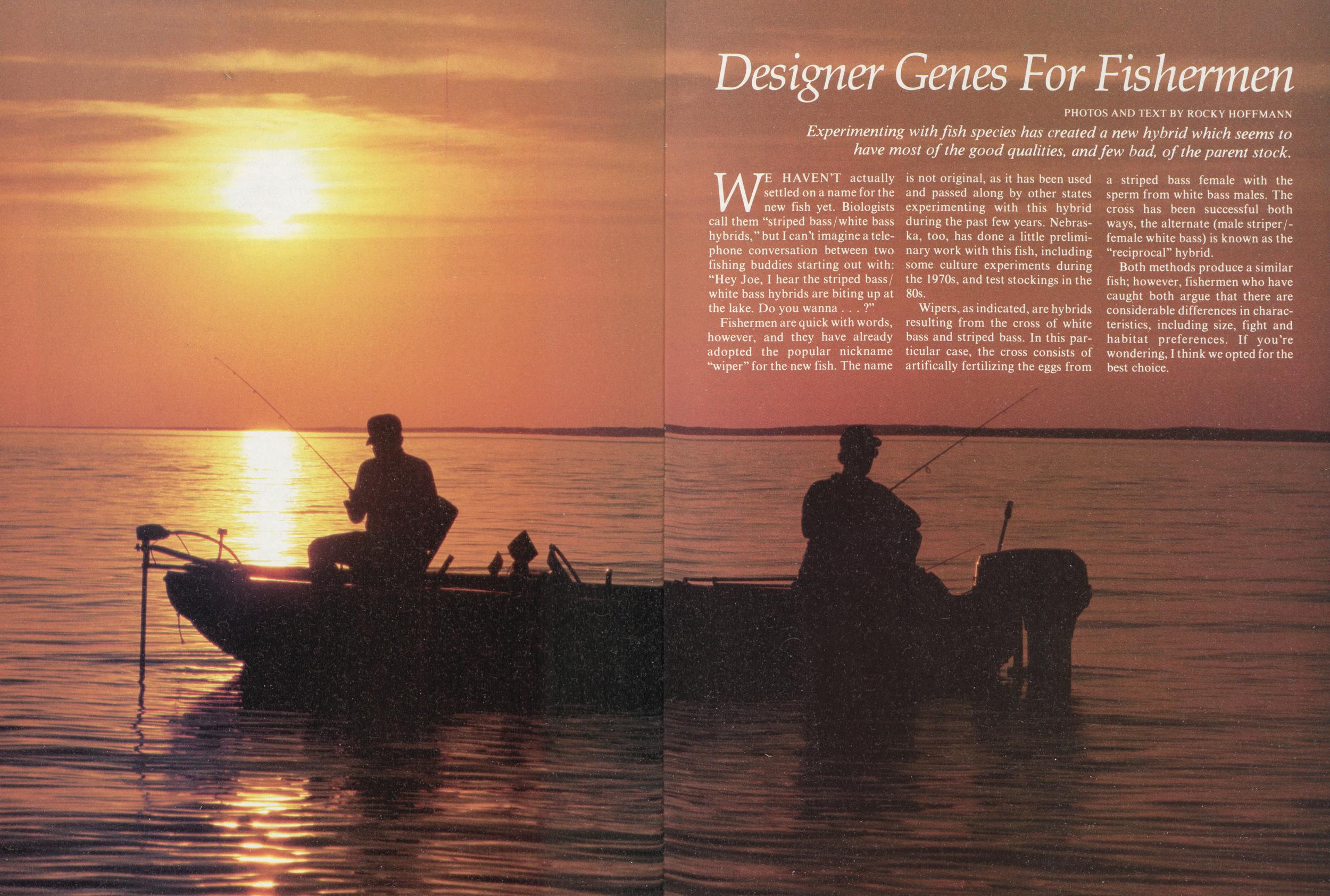
PHOTOS AND TEXT BY ROCKY HOFFMANN Experimenting with fish species has created a new hybrid which seems to have most of the good qualities, and few bad, of the parent stock.WE HAVEN'T actually settled on a name for the new fish yet. Biologists call them "striped bass/white bass hybrids," but I can't imagine a telephone conversation between two fishing buddies starting out with: "Hey Joe, I hear the striped bass/ white bass hybrids are biting up at the lake. Do you wanna . . . ?"
Fishermen are quick with words, however, and they have already adopted the popular nickname "wiper" for the new fish. The name is not original, as it has been used and passed along by other states experimenting with this hybrid during the past few years. Nebraska, too, has done a little preliminary work with this fish, including some culture experiments during the 1970s, and test stockings in the 80s.
Wipers, as indicated, are hybrids resulting from the cross of white bass and striped bass. In this particular case, the cross consists of aartificially fertilizing the eggs from a striped bass female with the sperm from white bass males. The cross has been successful both ways, the alternate (male striper/female white bass) is known as the "reciprocal" hybrid.
Both methods produce a similar fish; however, fishermen who have caught both argue that there are considerable differences in characteristics, including size, fight and habitat preferences. If you're wondering, I think we opted for the best choice.
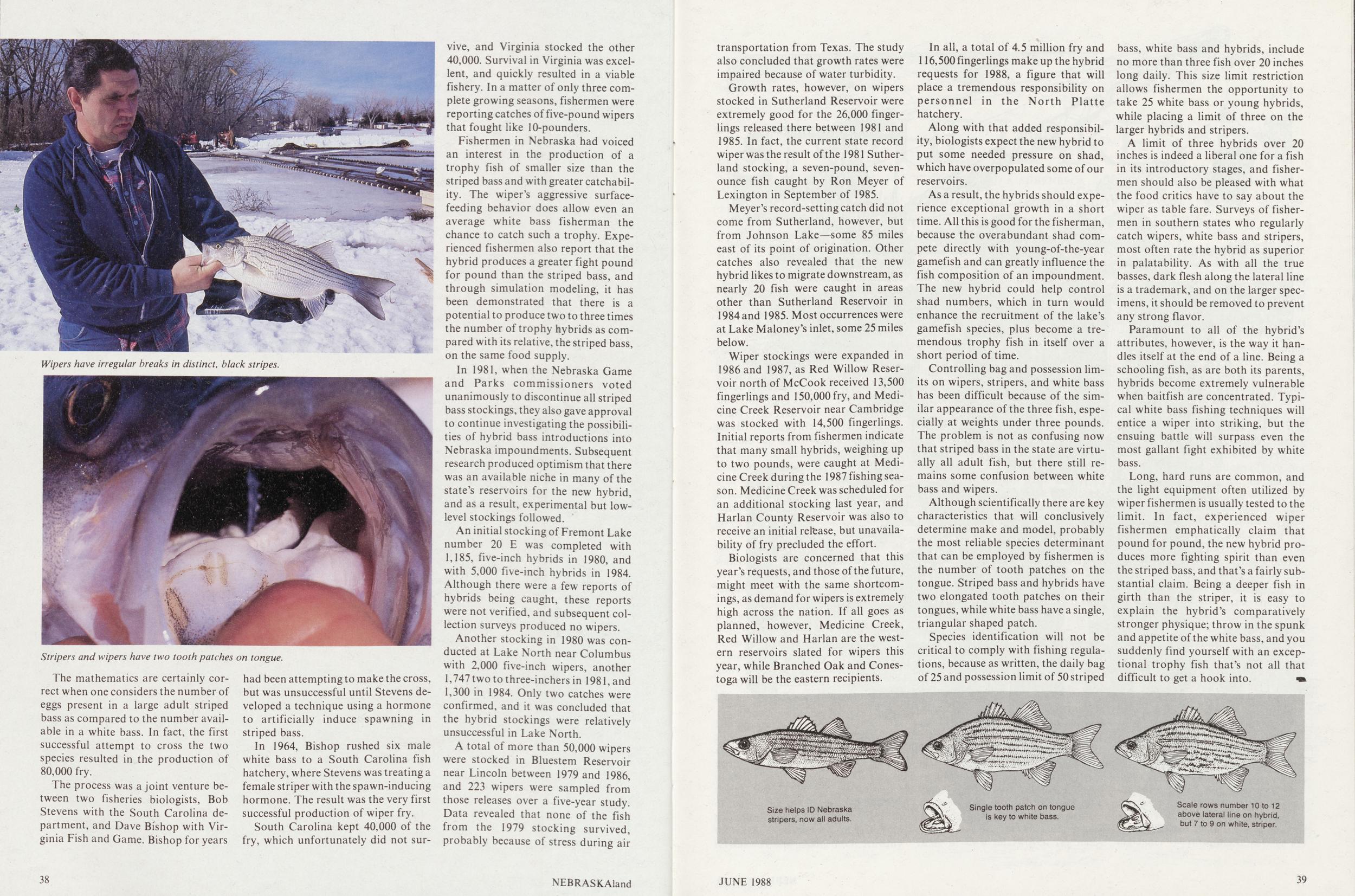
The mathematics are certainly correct when one considers the number of eggs present in a large adult striped bass as compared to the number available in a white bass. In fact, the first successful attempt to cross the two species resulted in the production of 80,000 fry.
The process was a joint venture between two fisheries biologists, Bob Stevens with the South Carolina department, and Dave Bishop with Virginia Fish and Game. Bishop for years had been attempting to make the cross, but was unsuccessful until Stevens developed a technique using a hormone to artificially induce spawning in striped bass.
In 1964, Bishop rushed six male white bass to a South Carolina fish hatchery, where Stevens was treating a female striper with the spawn-inducing hormone. The result was the very first successful production of wiper fry.
South Carolina kept 40,000 of the fry, which unfortunately did not survive, and Virginia stocked the other 40,000. Survival in Virginia was excellent, and quickly resulted in a viable fishery. In a matter of only three complete growing seasons, fishermen were reporting catches of five-pound wipers that fought like 10-pounders.
Fishermen in Nebraska had voiced an interest in the production of a trophy fish of smaller size than the striped bass and with greater catch ability. The wiper's aggressive surface feeding behavior does allow even an average white bass fisherman the chance to catch such a trophy. Experienced fishermen also report that the hybrid produces a greater fight pound for pound than the striped bass, and through simulation modeling, it has been demonstrated that there is a potential to produce two to three times the number of trophy hybrids as compared with its relative, the striped bass, on the same food supply.
In 1981, when the Nebraska Game and Parks commissioners voted unanimously to discontinue all striped bass stockings, they also gave approval to continue investigating the possibilities of hybrid bass introductions into Nebraska impoundments. Subsequent research produced optimism that there was an available niche in many of the state's reservoirs for the new hybrid, and as a result, experimental but low-level stockings followed.
An initial stocking of Fremont Lake number 20 E was completed with 1,185, five-inch hybrids in 1980, and with 5,000 five-inch hybrids in 1984. Although there were a few reports of hybrids being caught, these reports were not verified, and subsequent collection surveys produced no wipers.
Another stocking in 1980 was conducted at Lake North near Columbus with 2,000 five-inch wipers, another 1,747 two to three-inchers in 1981, and 1,300 in 1984. Only two catches were confirmed, and it was concluded that the hybrid stockings were relatively unsuccessful in Lake North.
A total of more than 50,000 wipers were stocked in Bluestem Reservoir near Lincoln between 1979 and 1986, and 223 wipers were sampled from those releases over a five-year study. Data revealed that none of the fish from the 1979 stocking survived, probably because of stress during air 38 NEBRASKAland transportation from Texas. The study also concluded that growth rates were impaired because of water turbidity.
Growth rates, however, on wipers stocked in Sutherland Reservoir were extremely good for the 26,000 fingerlings released there between 1981 and 1985. In fact, the current state record wiper was the result of the 1981 Sutherland stocking, a seven-pound, seven-ounce fish caught by Ron Meyer of Lexington in September of 1985.
Meyer's record-setting catch did not come from Sutherland, however, but from Johnson Lake—some 85 miles east of its point of origination. Other catches also revealed that the new hybrid likes to migrate downstream, as nearly 20 fish were caught in areas other than Sutherland Reservoir in 1984 and 1985. Most occurrences were at Lake Maloney's inlet, some 25 miles below.
Wiper stockings were expanded in 1986 and 1987, as Red Willow Reservoir north of McCook received 13,500 fingerlings and 150,000 fry, and Medicine Creek Reservoir near Cambridge was stocked with 14,500 fingerlings. Initial reports from fishermen indicate that many small hybrids, weighing up to two pounds, were caught at Medicine Creek during the 1987 fishing season. Medicine Creek was scheduled for an additional stocking last year, and Harlan County Reservoir was also to receive an initial release, but unavailability of fry precluded the effort.
Biologists are concerned that this year's requests, and those of the future, might meet with the same shortcomings, as demand for wipers is extremely high across the nation. If all goes as planned, however, Medicine Creek, Red Willow and Harlan are the western reservoirs slated for wipers this year, while Branched Oak and Conestoga will be the eastern recipients.
In all, a total of 4.5 million fry and 116,500 fingerlings make up the hybrid requests for 1988, a figure that will place a tremendous responsibility on personnel in the North Platte hatchery.
Along with that added responsibility, biologists expect the new hybrid to put some needed pressure on shad, which have overpopulated some of our reservoirs.
As a result, the hybrids should experience exceptional growth in a short time. All this is good for the fisherman, because the overabundant shad compete directly with young-of-the-year gamefish and can greatly influence the fish composition of an impoundment. The new hybrid could help control shad numbers, which in turn would enhance the recruitment of the lake's gamefish species, plus become a tremendous trophy fish in itself over a short period of time.
Controlling bag and possession limits on wipers, stripers, and white bass has been difficult because of the similar appearance of the three fish, especially at weights under three pounds. The problem is not as confusing now that striped bass in the state are virtually all adult fish, but there still remains some confusion between white bass and wipers.
Although scientifically there are key characteristics that will conclusively determine make and model, probably the most reliable species determinant that can be employed by fishermen is the number of tooth patches on the tongue. Striped bass and hybrids have two elongated tooth patches on their tongues, while white bass have a single, triangular shaped patch.
Species identification will not be critical to comply with fishing regulations, because as written, the daily bag of 25 and possession limit of 50 striped bass, white bass and hybrids, include no more than three fish over 20 inches long daily. This size limit restriction allows fishermen the opportunity to take 25 white bass or young hybrids, while placing a limit of three on the larger hybrids and stripers.
A limit of three hybrids over 20 inches is indeed a liberal one for a fish in its introductory stages, and fishermen should also be pleased with what the food critics have to say about the wiper as table fare. Surveys of fishermen in southern states who regularly catch wipers, white bass and stripers, most often rate the hybrid as superior in palatability. As with all the true basses, dark flesh along the lateral line is a trademark, and on the larger specimens, it should be removed to prevent any strong flavor.
Paramount to all of the hybrid's attributes, however, is the way it handles itself at the end of a line. Being a schooling fish, as are both its parents, hybrids become extremely vulnerable when baitfish are concentrated. Typical white bass fishing techniques will entice a wiper into striking, but the ensuing battle will surpass even the most gallant fight exhibited by white bass.
Long, hard runs are common, and the light equipment often utilized by wiper fishermen is usually tested to the limit. In fact, experienced wiper fishermen emphatically claim that pound for pound, the new hybrid produces more fighting spirit than even the striped bass, and that's a fairly substantial claim. Being a deeper fish in girth than the striper, it is easy to explain the hybrid's comparatively stronger physique; throw in the spunk and appetite of the white bass, and you suddenly find yourself with an exceptional trophy fish that's not all that difficult to get a hook into.
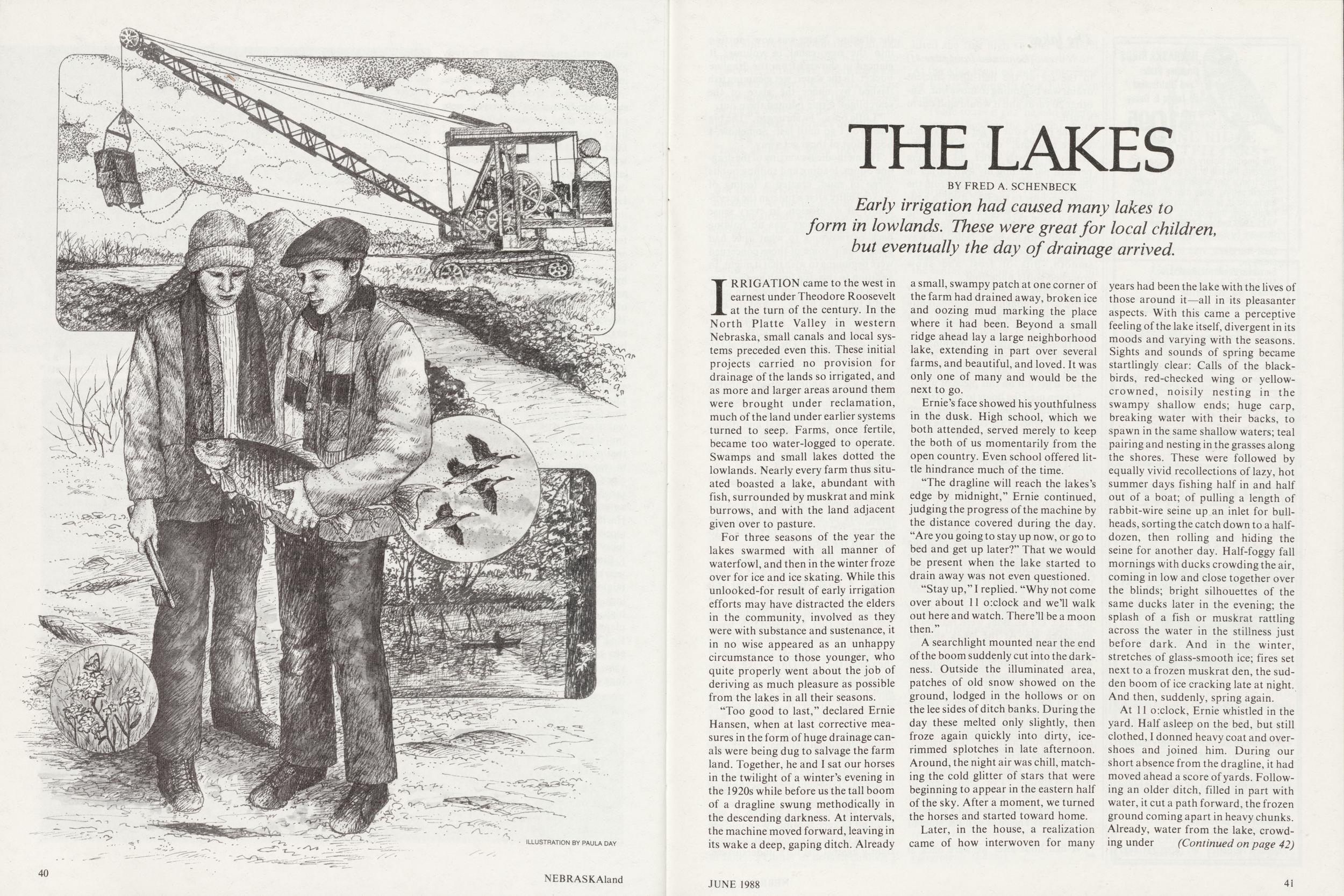
THE LAKES
BY FRED A. SCHENBECK Early irrigation had caused many lakes to form in lowlands. These were great for local children, but eventually the day of drainage arrived.IRRIGATION came to the west in earnest under Theodore Roosevelt at the turn of the century. In the North Platte Valley in western Nebraska, small canals and local systems preceded even this. These initial projects carried no provision for drainage of the lands so irrigated, and as more and larger areas around them were brought under reclamation, much of the land under earlier systems turned to seep. Farms, once fertile, became too water-logged to operate. Swamps and small lakes dotted the lowlands. Nearly every farm thus situated boasted a lake, abundant with fish, surrounded by muskrat and mink burrows, and with the land adjacent given over to pasture.
For three seasons of the year the lakes swarmed with all manner of waterfowl, and then in the winter froze over for ice and ice skating. While this unlooked-for result of early irrigation efforts may have distracted the elders in the community, involved as they were with substance and sustenance, it in no wise appeared as an unhappy circumstance to those younger, who quite properly went about the job of deriving as much pleasure as possible from the lakes in all their seasons.
"Too good to last," declared Ernie Hansen, when at last corrective measures in the form of huge drainage canals were being dug to salvage the farm land. Together, he and I sat our horses in the twilight of a winter's evening in the 1920s while before us the tall boom of a dragline swung methodically in the descending darkness. At intervals, the machine moved forward, leaving in its wake a deep, gaping ditch. Already a small, swampy patch at one corner of the farm had drained away, broken ice and oozing mud marking the place where it had been. Beyond a small ridge ahead lay a large neighborhood lake, extending in part over several farms, and beautiful, and loved. It was only one of many and would be the next to go.
Ernie's face showed his youthfulness in the dusk. High school, which we both attended, served merely to keep the both of us momentarily from the open country. Even school offered little hindrance much of the time.
"The dragline will reach the lakes's edge by midnight," Ernie continued, judging the progress of the machine by the distance covered during the day. "Are you going to stay up now, or go to bed and get up later?" That we would be present when the lake started to drain away was not even questioned.
"Stay up," I replied. "Why not come over about 11 o:clock and we'll walk out here and watch. There'll be a moon then."
A searchlight mounted near the end of the boom suddenly cut into the darkness. Outside the illuminated area, patches of old snow showed on the ground, lodged in the hollows or on the lee sides of ditch banks. During the day these melted only slightly, then froze again quickly into dirty, ice rimmed splotches in late afternoon. Around, the night air was chill, match- ing the cold glitter of stars that were beginning to appear in the eastern half of the sky. After a moment, we turned the horses and started toward home.
Later, in the house, a realization came of how interwoven for many years had been the lake with the lives of those around it—all in its pleasanter aspects. With this came a perceptive feeling of the lake itself, divergent in its moods and varying with the seasons. Sights and sounds of spring became startlingly clear: Calls of the black birds, red-checked wing or yellow crowned, noisily nesting in the swampy shallow ends; huge carp, breaking water with their backs, to spawn in the same shallow waters; teal pairing and nesting in the grasses along the shores. These were followed by equally vivid recollections of lazy, hot summer days fishing half in and half out of a boat; of pulling a length of rabbit-wire seine up an inlet for bullheads, sorting the catch down to a half-dozen, then rolling and hiding the seine for another day. Half-foggy fall mornings with ducks crowding the air, coming in low and close together over the blinds; bright silhouettes of the same ducks later in the evening; the splash of a fish or muskrat rattling across the water in the stillness just before dark. And in the winter, stretches of glass-smooth ice; fires set next to a frozen muskrat den, the sudden boom of ice cracking late at night. And then, suddenly, spring again.
At 11 o'clock, Ernie whistled in the yard. Half asleep on the bed, but still clothed, I donned heavy coat and over shoes and joined him. During our short absence from the dragline, it had moved ahead a score of yards. Following an older ditch, filled in part with water, it cut a path forward, the frozen ground coming apart in heavy chunks. Already, water from the lake, crowding under (Continued on page 42)
JUNE 1988 41 NEBRASKA BIRDS
Breeding Status
and Distribution
by James E. Ducey
$]Q95
The breeding history of Nebraska birds
also tells the tale of the change of this
land from a vast wilderness to todays
modern setting. More than 203 species
are recorded. Maps illustrating nesting
habits cover three periods: Pre 1920,
1921-1960 and post 1960.
Illustrations are by Paul A. Johnsgard
Send your check, VISA or Master card
orders to:
Simmons-Boardman Books, Inc
1809 Capitol Avenue
Omaha, Nebraska 68102
Available in bookstores early 1988
—Dealer inquiries invited.
Please allow 6 weeks for delivery
On credit card orders please include
credit card number, expiration date
and daytime telephone numbers
Give a hoot
Don't pollute.
Aaahh!
EXPERIENCE
NEBRASKA...
with an affordable canoe trip by
DRYLAND AQUATICS
• Niobrara • Dismal • Platte • Elkhorn
-YOU NAME IT-
One & two day trips available
canoe rental only or fully catered
—WE DO IT YOUR WAY—
Write for Free brochure .
Dry land Aquatics, Dept. N
1837 E.Cuming
Fremont, NE 68025 Ph. (402) 721-4177
NEBRASKA BIRDS
Breeding Status
and Distribution
by James E. Ducey
$]Q95
The breeding history of Nebraska birds
also tells the tale of the change of this
land from a vast wilderness to todays
modern setting. More than 203 species
are recorded. Maps illustrating nesting
habits cover three periods: Pre 1920,
1921-1960 and post 1960.
Illustrations are by Paul A. Johnsgard
Send your check, VISA or Master card
orders to:
Simmons-Boardman Books, Inc
1809 Capitol Avenue
Omaha, Nebraska 68102
Available in bookstores early 1988
—Dealer inquiries invited.
Please allow 6 weeks for delivery
On credit card orders please include
credit card number, expiration date
and daytime telephone numbers
Give a hoot
Don't pollute.
Aaahh!
EXPERIENCE
NEBRASKA...
with an affordable canoe trip by
DRYLAND AQUATICS
• Niobrara • Dismal • Platte • Elkhorn
-YOU NAME IT-
One & two day trips available
canoe rental only or fully catered
—WE DO IT YOUR WAY—
Write for Free brochure .
Dry land Aquatics, Dept. N
1837 E.Cuming
Fremont, NE 68025 Ph. (402) 721-4177
The lakes
(Continued from page 41)in the ice of the half-filled ancient drain, was beginning to move out. Another 20 yards and it would spill out in a rush.
"The river's due to get a slug offish before morning," observed Ernie, his demeanor mostly quiet, his thinking perhaps paralleling my own earlier in the evening. He looked away from the busy machine to the lake itself, a half-mile of snow-powdered ice glistening in the moonlight. Motioning in its direction with his head, he led the way to and out upon the ice, so hard and smooth. Bits of frost and snow crunched softly underfoot.
"The rafts came before the boats," Ernie said suddenly and apparently irrelevantly. "Any kid can make a raft if he can find enough logs to tie together. But boats are something else again. The boats came later... a half-dozen of them. All with the idea in mind to get out on this piece of water.
"I even used the boats to hunt from," he continued. "Hid out in some patch of cattails where they couldn't be seen. The first one I made out of three boards . . . the sides I mean ... all about the same length. It was shaped like a triangle; I never had to turn it. When I wanted to go in another direction, I turned myself inside it and started paddling. It floated, though."
"So did the first one I made," I responded. "It was made out of a big sheet of tin bent into a trough with the ends hammered over and tight. I had to put outriggers on it to make it stay right side up, but it floated, too."
Walking brought us to the center of the lake. On all sides were reaches of unbroken ice. At the lake's shallow end, muskrat dens showed black against the moonlight. Clumps of dried rushes and cattails glowed silver in the selfsame light. Ernie looked around for a time in silence before motioning to start back.
"You'll see some big ones come out of here before morning," I remarked, my thoughts on the countless numbers of fish under the ice upon which we were walking. "I've seen them at spawning time... carp two feet long or longer. Pike, too, although I've never caught one. The river will get most of them."
A half-hour later we were back at the dragline. Water was now spurting into the new canal in volume. It glanced in showers from the dragline bucket. In the water, wet gleaming fish flashed by under the glare of the searchlight. Ernie pointed them out.
"Little ones," he shrugged. "The big ones won't go until last. Somehow, I hope most of them get away."
The methodical swinging of the drag line boom, loading and spilling out its cargo of mud, created a feeling of inexorability after a time; in the inevitability of its mission. In every sense this was true; there was no holding back or returning to what once had been, even if some of those concerned were beginning to wish that it might. In addition to this, the finish was not too far in the future ... an hour, an hour and a half, two hours ... and the new ditch would reach the lakeshore.
At the end of that time the flood came pouring out. The engines of the dragline slowed to idling speed. A small motor on the electrical generator continued to labor while searchlights hovered over the scene, heightening the fascination of watching water pour into the rough new canal and disappear with it into the distance and darkness. After a time, Ernie looked at his watch.
"We can still get a few hours of sleep before daylight," he announced, suddenly decisive. "Let's grab it and get back here as soon as we can in the morning. It'll take most of the night to drain off the water."
At sunup, the pale glow of the search light, still burning, greeted us on our return. A small stream of water still trickled into the new ditch, but it was nothing compared to the Niagara of a few hours earlier. Scattered fish, wriggling half submerged, made their way into the deeper water of the drain and then on to the river. On the lake, slanting at an unnatural angle, was its 10-inch coating of ice, the water all but gone from under it. Giant cracks marked its surface where the ice had pulled apart in settling. Ernie glanced at the occasional fish that laboriously worked into the drain.
"I wonder where the big ones are?" he asked. "I thought they'd be showing up by now."
Hurrying out onto the ice, it was difficult to keep footing. We could see the mud of the lake's bottom, pressing tightly against the ice's undersurface. 42 NEBRASKAland Here and there were bubbles of air and small pockets of shallow water. Near the center of the lake, where the water had been deeper, the pockets became more numerous, and in them, trapped by the ice above and the mud beneath, lay the answer to Ernie's question.
"The big ones," he exclaimed. "Look at them. I knew they were in here!"
The fish were lying on their sides, still alive, the ice pressing tightly down on them. At the far side of the lake someone already was busy with an axe, chopping at the ice to get at a trapped fish. Across the fields, cars were approaching from several directions. Word of mouth had spread the news over the valley. Quickly, Ernie turned and started toward shore.
"I want just one," he declared. "One of the big ones ... maybe just for the idea. Let's get some axes, too."
We hurried to the house. In the short time it took to go and return, people had arrived from all sides, by the dozens and the score. Reaching the middle of the lake again, I selected a large fish showing dimly through the ice and began chopping around him. A dozen feet away, Ernie marked out a similar section of ice and began work. Over all the lake, people were busy at the same task. Beside them were tubs and wash boilers to hold the catch.
In a few minutes the three-foot chunk of ice upon which I was working broke loose. Pushing the axe under one end, I toppled it out onto the ice. Underneath was a 30-inch carp, alive and icy cold. Stooping, I lifted it out almost at the same moment that Ernie brought out a counterpart. These were the big ones ... the ones that had hugged the bottom and refused to leave.
People arriving had reached a throng. Almost before the cars stopped moving, the occupants were out and rushing onto the ice. Ernie looked up at the crowd and their frenzied actions.
"This place will be a madhouse in a little while. Did you ever see so many fish? Or so many people?"
From every side came the din of axes biting into the ice. Voices, shouts, the rattle of tinware on the frozen surface, added to the clamor. So quickly as to be almost unbelievable, the ice over the lake was becoming a shambles, a maze of holes, a clutter of broken chunks. I lifted the fish high so that it would clear the ice and turned toward shore. At the edge I waited until Ernie came up before turning to look back with him at the crowd of busy people.
"I hate to see it go," he said quietly, his eyes following the familiar shores of the lake. "This one and the others. They'll all be gone before spring. What'll we do next summer?"
The piled-up confusion of ice and swarming people were rapidly obliterating all signs of what had once been a lovely lake. Other lakes nearby would soon disappear in similar fashion. I followed Ernie's gaze around the lake's edges and then looked at the people in the center struggling frantically to fill their tubs with fish; at the ragged heaps of broken ice; the slanting, cracked surface; the muddy tracks increasing in every direction; the ragged look of it all. Suddenly I was filled with nausea.
"Let's get out of here," I said, turning quickly. "I've seen enough . . . too much. And it'll only get worse through the day."
The dissolution of one lake was sufficient; there was no call to be present at the finish of the others. Before spring came again, what had once been a half-dozen pleasant aquatic breaks in the landscape, springing unexpectedly into view when ridges and high grounds were topped, were all reduced to wet, barren flats. In a short time the land so exposed would be plowed, cultivated and put back into production. In place of intervals of tranquil blue water, there would presently show row on row of tended crops. Instead of lazy cattail-filled lakeshores and the multitude of accordant life therein, there would be uninterrupted fields and pastures. Unexpected watery vistas, the changing moods surrounding them, the pleasure induced by their sight; all would be gone.
It was supposed to be for the best... all in the name of progress and so forth, but at times there is wonder. Food we have in an abundance and over. The other things, lakes and such, need to be searched out and traveled to. Maybe in the long view, one is as important as the other. Who is to say which is the most necessary?
The late Fred Schenbech of Gehrig wrote and submitted this story many years ago, recalling the trauma of watching the draining of the lakes which were his boyhood playgrounds. (Editor)
PINE RIDGE OUTFITTERS Guided hunts in the Pine Ridge for Elk, Deer, Antelope, Turkey, Ducks and Geese on the North Platte River. Quality hunts for your needs. Archery or Rifle. Call or write Allan Mintken. (308) 432-5923 HC74 Box 49 Chadron, NE 69337 | Calamus Guide & Recreation Service • Professional hunting and fishing guide • • Reasonable Rates • Boyd Larsen — Owner (308) 346-4644 or call Scott Krause, Calamus Country (308) 346-4729 Time to go shopping... then time to go fishing! • Live Bait • Ice • Tackle • Permits • Pop • Beer • Bow fishing Equipment LARGEST SELECTION OF FISHING EQUIPMENT IN THE AREA! GENO'S MINNO-MART^ir^ 1773 33rd Avenue Columbus, NE Excellent Hunting-Fishing For Sale— 160 acres on the North Platte River (1) mile east of Broadwater, NE. The main cabin is located in a grove of huge cottonwood trees with glass sliding doors in the family room that overlook the river and sandhills beyond. The cabin has two bedrooms, electric heat, fireplace, bath with tile shower, T.V., and phone services. The country road is paved to the entry gate and the airport is 33 miles away. Land contract available Lee Chapin (402) 423-5727 6230 Andrew Ct. Lincoln, NE 68512 JUNE 1988 43 Catch the Good Life
At Merritt Reservoir
26 miles southern Valentine, NE
Offering a full year-around Guide Service
Fishing
• Walleye
• Crappie
• Largemouth Bass
• Bluegill
Home of the state record
• Musky
• Smallmouth Bass
• Channel Catfish
• Perch
Hunting
The Picturesque Sandhills
• Duck
• Geese
• Sharptail Grouse
• Mule & Whitetail Deer
• Turkey
L
We Have All The Facilities To Accommodate
Your Business or Corporate Group
Experience a Sandhills Vacation at Merritt Trading Post
Merritt Dam Trading Post
Valentine, NE 69201
Your Hosts
Ph. 402-376-3437
Jon and Marian Davenport
LEWON'S TAXIDERMY
Winner of fish mounting in
Nebraska 3 years in a row.
Winner of high point award 2
years in a row.
NTA certified Masters
Certification with IGT
Come see our show room.
Call or write for free brochure.
402-337-0077
510 S. Main Randolph, NE
McCOOK NEBRASKA
FISHING DERBY . . . June 4
CASTING CONTEST. . . June 5
Hugh Butler Lake
For more information contact:
McCook Chamber of Commerce
P.O. Box 337 McCook, NE 69001
Calamus Country
Restaurant-Lounge-Lodge-R.V. Hook-ups
Residential and Commercial Lots
(308) 346-4729
6 Miles northwest of Burwell, NE
up the Dam Road
United Nebraska
Muzzleioaders Ass'n
With over
thirty clubs
throughout
the state.
Sponsoring
the annual
Nebraska
Muzzle loaders
Championship
Matches
SHOOTING MATCHES EVERY WEEKEND!
From April to October — Come Join Us!
FOR FURTHER INFORMATION CONTACT:
David Filbert
1948 Euclid Ave.
Lincoln, NE 68502
Catch the Good Life
At Merritt Reservoir
26 miles southern Valentine, NE
Offering a full year-around Guide Service
Fishing
• Walleye
• Crappie
• Largemouth Bass
• Bluegill
Home of the state record
• Musky
• Smallmouth Bass
• Channel Catfish
• Perch
Hunting
The Picturesque Sandhills
• Duck
• Geese
• Sharptail Grouse
• Mule & Whitetail Deer
• Turkey
L
We Have All The Facilities To Accommodate
Your Business or Corporate Group
Experience a Sandhills Vacation at Merritt Trading Post
Merritt Dam Trading Post
Valentine, NE 69201
Your Hosts
Ph. 402-376-3437
Jon and Marian Davenport
LEWON'S TAXIDERMY
Winner of fish mounting in
Nebraska 3 years in a row.
Winner of high point award 2
years in a row.
NTA certified Masters
Certification with IGT
Come see our show room.
Call or write for free brochure.
402-337-0077
510 S. Main Randolph, NE
McCOOK NEBRASKA
FISHING DERBY . . . June 4
CASTING CONTEST. . . June 5
Hugh Butler Lake
For more information contact:
McCook Chamber of Commerce
P.O. Box 337 McCook, NE 69001
Calamus Country
Restaurant-Lounge-Lodge-R.V. Hook-ups
Residential and Commercial Lots
(308) 346-4729
6 Miles northwest of Burwell, NE
up the Dam Road
United Nebraska
Muzzleioaders Ass'n
With over
thirty clubs
throughout
the state.
Sponsoring
the annual
Nebraska
Muzzle loaders
Championship
Matches
SHOOTING MATCHES EVERY WEEKEND!
From April to October — Come Join Us!
FOR FURTHER INFORMATION CONTACT:
David Filbert
1948 Euclid Ave.
Lincoln, NE 68502
The big bass of Big Mac
(Continued from page 11)sooner or later you're going to pull that fish of unknown proportions to the surface of the black water.
Mel feels that stripers like to run up into the shallows to feed after sunset. On cloudy or rough-water days, it may even be earlier, but there is no guarantee when it's going to happen. It might be just before sunset or it might be 2 a.m. In either case, there are hot spots, and it seems because of certain structure, be it rocks or trees or whatever else they like, they will return to the same spot time after time. If you have the staying power, you will get into them sooner or later in those hot spots.
Black doll flies appear to work best at night, and it is incredible how gently such a powerful fish might pick up the bait. They usually strike on the drop when the bait is being pumped back toward the boat. Sometimes the strike is hardly detectable, but more often it feels like a white bass.
Don't spare the set. Stripers have hard mouths and it takes a lot of force to drive the barbs deep. Then hang on, because you are more than likely going to encounter a run like you've never experienced from another fish, and hopefully you will have readjusted your drag in preparation.
Sometimes it is necessary to try to stop him if you are a bit low on line, and often it is wise to follow the fish with your boat. The tell-tail sign that it is a striper is the bull-dogging action as he tries to throw the hook, and then after a couple of reel-screaming runs, he will go to the bottom and stay. More runs will follow, and be assured that a striped bass is not going to give up without putting forth his all. Often the end result is a bellied-up fish.
Crank baits also work extremely well for night fishing, but a striper won't pick up a crankbait as gently as he does a doll fly. Instead, he'll bust it on the run and nearly tear the reel out of your hands. Surface lures have had some success, and I imagine they would be quite effective if used by more fishermen. Those who have taken stripers on surface lures say that very rarely will the predator take the lure on the first strike, but instead will try to knock it end over end with its head. And finally, after he thinks it's injured, he'll take it.
44 NEBRASKAland Nebraska
Recreation &
Park
Association
If you are interested in park resources,
wildlife management, forestry, weed
control, grounds maintenance, outdoor
education, park planning, park development,
or similar topics, Nebraska Recreation
and Park Association's Society of Park
Resources is for you.
The society provides:
• Up-to-date Educational
Information
• Current information on
Part eequipment
• Workshops and Conference
• State-wide Contacts
• A coalition of park resource
practitioners
The Society of Park Resources is
affiliated with the Nebraska Recreation and
Park Association which was established in
1961. The Association works toward
increasing interest in Nebraska's
recreation and park opportunities. Members of
the Association may choose to belong to
one of three special interest sections: The
Society of Park Resources, Therapeutic
Recreation Society, or Student Section.
For individuals preferring not to select a
specific section, a category of general
member is available. The N.R.P.A. State
conference will be held this year at Platte
River State Park on September 13, 14
and 15.
To obtain additional information and a
free brochure explaining how to join the
Nebraska Recreation and Park
Association and the Society of Park Resources,
call or write to:
Ms. Anne Sampson
Lincoln Parks &
Recreation Department
2740 "A" Street
Lincoln, NE 68502
(402) 471-7847
Nebraska
Recreation &
Park
Association
If you are interested in park resources,
wildlife management, forestry, weed
control, grounds maintenance, outdoor
education, park planning, park development,
or similar topics, Nebraska Recreation
and Park Association's Society of Park
Resources is for you.
The society provides:
• Up-to-date Educational
Information
• Current information on
Part eequipment
• Workshops and Conference
• State-wide Contacts
• A coalition of park resource
practitioners
The Society of Park Resources is
affiliated with the Nebraska Recreation and
Park Association which was established in
1961. The Association works toward
increasing interest in Nebraska's
recreation and park opportunities. Members of
the Association may choose to belong to
one of three special interest sections: The
Society of Park Resources, Therapeutic
Recreation Society, or Student Section.
For individuals preferring not to select a
specific section, a category of general
member is available. The N.R.P.A. State
conference will be held this year at Platte
River State Park on September 13, 14
and 15.
To obtain additional information and a
free brochure explaining how to join the
Nebraska Recreation and Park
Association and the Society of Park Resources,
call or write to:
Ms. Anne Sampson
Lincoln Parks &
Recreation Department
2740 "A" Street
Lincoln, NE 68502
(402) 471-7847
There are two good bets that really haven't been well explored. The first is trying to catch stripers in the spring as they migrate up the North Platte River to spawn. Spawning urges are highest when water temperatures are nearing 60 degrees.
The second good possibility is in late winter or early spring. It is known that stripers congregate in the flowing waters of streams entering the lake, primarily at Otter Creek and Lonegran Creek on the north shore of Lake McConaughy. Only a few fishermen have attempted either the spawning or winter fishery at Lake McConaughy, but biologists have collected stripers with electro-fishing gear with some consistency both in the river during spring spawning runs and at Otter Creek before ice-out.
In fact, there are a number of new approaches that need to be explored, and no doubt somebody will. But this is no time for procrastination. Each year there will be fewer subjects with which to experiment, and by the mid 1990s, most of the stripers will have passed from the picture in Nebraska. The big fish of Big Mac will be gone, but their passing certainly won't be uneventful, and for many, like the Smith brothers, striped bass fishing has been an event of a lifetime.
The view from below
(Continued from page 25)winter. Its branches gather snow and droop under the burden, forming little cathedrals, rabbit cathedrals. But for all the rabbit sign, you see no rabbits. They are hidden away.
The snow beneath a willow slowly rotting in place on the edge of a slough is littered with wood chips. Near a broken snag is the opening to an abandoned flicker nest, the bark around it ripped away where some woodpecker probed for beetle larvae.
Deer trails made during the night connect the band of oldest cottonwoods with the brushy, willowy flood plain. One after another the trails cross the frozen sloughs, each going to the sandbar willow patches, as if the deer had marched in a line to their day beds. Deer trails are laced across the snow in the tangle of Russian olive and dogwood where they moved to browse, clinging still to the heaviest cover, out of sight of man and sheltered from the frigid north wind. Occasionally there is a deer bed, no more than an oval pressed, not melted, into the snow. Body heat is too critical a commodity to waste melting snow.
Half a dozen hen pheasants flush from vaulted rooms under cattails in the big slough at the base of the bank; then two more, then four, and finally the rooster. Only the cattails' stiff stalks have resisted the crush of snow, and stand above it. Here and there a cattail leaf whips in the wind, etching arcs in the snow. On the flat above the slough is a milo food plot. The pheasants need not go far to satisfy their life demands.
Tree sparrows rise out of the food plots, tiny blurs of wings that join to form something greater, a black wave that sweeps off into the timber in erratic flight.
A male cardinal moves through the thickets at the base of the bluff, a brilliant spot of red against a wall of white. It can't be seen from the overlook.
Black homesteaders
(Continued from page 15)was evidence of "successful timber culture." By using all three, a would-be settler could eventually own a total of 480 acres. While 480 acres was more "farm land" than an individual could work in the days before mechanized equipment, it was not enough to support a ranching operation, and, as settlers eventually learned, the Sandhills had neither the terrain nor the soils that consistent crop production requires.
In 1891, both the Pre-emption Act and the Timber Culture Act were repealed because of widespread fraudulent filings.
So, at the turn of the century, the only means by which public land in the Sandhills could pass into private ownership was under the Homestead Act, a mere 160 acres.
Nearly everyone recognized that a quarter-section was not adequate for ranching and that the remaining public land was not suitable for farming, and yet the government clung to its policy of settling the land by establishing small family farms. Influential ranchers worked with sympathetic congressmen in attempts to establish a means by which public rangeland in the Sandhills could be purchased outright 46 NEBRASKAland or leased for grazing. As early as 1878 there was a proposal within the federal government to allow settlement of public land in tracts appropriate for their use, that rangeland be alloted in four-section tracts, large enough to support a cattle raising operation. All these proposals were rejected.
Most cattlemen in the Sandhills saw no alternative but to continue to gain control of meadow land and access to water along rivers or lakes by filing homesteads; having family, friends, and ranch hands file claims; and to run their stock on bordering government dry land. Quarter-section claims were cleverly laid out in 40-acre configurations paralleling rivers or surrounding lakes.
When President William McKinley died in office September 14, 1901, the abuse of the various homesteading acts and the prevalence of fencing and running stock of public land drew the attention of his successor, Theodore Roosevelt. Making an example of the Spade ranch in the western Sandhills, and its owners William Comstock and Bartlett Richards, Roosevelt brought down the fences on public land, and brought down most of the large ranches. At least officially, a large portion of the Sandhills and other Great Plains rangeland laid unclaimed and unused.
Pressure mounted to settle the nation's remaining rangeland. On April 27, 1904, the Kinkaid Act was approved, opening 10 million acres of public land in the Sandhills to settlement. Under this act, settlers were allowed to file claims on full sections of land, and after living on them for five years and making improvements, assume ownership. It was the last great land give-away Nebraska would see. For would-be settlers from the eastern part of the state, or the eastern part of the country, a section of "free land" must have seemed too good to be true, and it was. A full section of land still could not support a ranch family. But to those impoverished, it must have seemed a last chance to make a life. Settlers lined up at the filing offices of western Nebraska towns, among them black Kinkaiders who would found the Sandhills settlement of DeWitty.
Next month, black settlers come to the North Loup Valley to make their homes. WILLA GATHER ON WRITING Critical Studies on Writing as an Art Foreword by Stephen Tennant "Cather says the most interesting, most profound things about the art of writing, and the life of art, that have been said in our time certainly, and she does it with immense grace and dignity."— Katherine Anne Porter, The New York Times. "Like her novels, her criticism has an impeccable distinction of style—it is a criticism demeuble, uncluttered by jargon or pedantry."—The Nation. xxvi, 126 pages, foreword. $6.95 paper Available at bookstores or from BISON BOOKS University of Nebraska Press 901 N 17th • Lincoln 685880520 GIFT SUBSCRIPTION HOTLINE! 1-800-742-0056 For NEBRASKAland Magazine Subscriptions Only CAN'T BEAR YOUR JOB ANYMORE? COME STAY WITH US AWHILE. on Lake McConaughy Air-conditioned units, cooking facilities. Up to four adults. Campground on the beach—50 hookups, showers, playground, shade. • MARINA • CAMPGROUND •GUIDE SERVICE • LAUNCHING STORE Groceries, Beer, Pop, Tackle, Live Bait • BOAT & PONTOON RENTALS South Shore Big Mac at Gate 18 R.R. #1 Box L-9 Brule, NE 69127 Ogallala, NE (308) 284-4965 JUNE 1988 47
In The Kitchen
Rhubarb Crunch 1 cup flour 3/4 cup oatmeal 1 cup brown sugar V2 cup shortening, meltedMix until crumbly, then press half of crumbs into greased baking dish. Cover with 4 cups diced rhubarb. Then, combine:
1 cup sugar 1 cup water 2 tbl cornstarch 1 tsp vanillaCook until thick and clear. Pour over rhubarb. Top with remainder of crumbs. Bake 1 hour.
Janet Hermes, Arapahoe, NE Rhubarb Pie 3 cups rhubarb, diced 1 Vi cups sugar 2 tbl cornstarch 1 egg, beaten 1 tbl butter unbaked pie crustLine 9-inch pie with pastry and fill with diced rhubarb. Combine sugar and cornstarch, stir in egg and pour over rhubarb. Dot with butter. Cover with lattice crust or crumbly top (see below) and bake at 450° for 10 minutes. Reduce temperature to 350° and bake 25-30 minutes.
Crumbly topping Vi cup brown sugar lA cup butter 73 cup flour lA tsp cinnamonBlend ingredients until it resembles crumbs and put on top of filling. Bake as above.
Maxine Brewer, Litchfield, NE Thin White Sauce 1 tbl butter 1 tbl flour 1 cup milk Vi tsp salt Vs tsp pepperMelt butter, blend in flour, gradually add milk. Simmer, stirring until mix- ture boils and thickens, then cook about 3 minutes more. Add salt and pepper to taste.
Geraldine Rettig, Lexington, NE Lean Spring Bean Soup 1 lg. onion, chopped 3/4 lb new potatoes 2 tbl butter 12 cups dandelion greens V2 head lettuce 1 tbl flour 3 cups sorrel leaves 2 cups spinach 1 tbl lemon juice 1 clove garlic, halved 1 tsp salt 5 cups water 1 tsp sugar (optional) Vi cup heavy cream 4 scallions coarse saltPeel potatoes, halve lengthwise and slice thin. Melt butter in large pot over medium-low heat. Add onions and potatoes, cover and cook, stirring occasionally about 15 minutes or until they start to turn gold. Do not brown. Shred greens and lettuce including the thick stems and heart. When onions and potatoes are soft, sprinkle on flour and stir well. Stir in batches of all the greens, adding more as rapidly as there is room in the pan. After all greens are added, stir in garlic, salt and lemon juice (if using spinach) and add water. Cover and cook over low heat 45 to 60 minutes until vegetables are very tender. Strain the soup, saving both the solids and liquid. Wipe, but do not wash the pot. Puree the solids and return them to the pot and slowly stir in liquid. Reheat. The soup should have a slightly bitter edge (if bitter, add sugar). Whip cream to stiff peaks. Then slice the scallions using an inch of the green part. Sprinkle each serving with a portion of scallion and dollop of whipped cream. Top with a sprinkle of coarse salt.
Lora K Dean, Omaha, NE Camper's Delight Vegetable Soup_______ Meat cut in small chunks 1 can tomatoes 4 potatoes, chopped 1 green pepper, chopped 1 sm onion, chopped 1 sm head cabbage, chopped 1 can mixed vegetables pinch salt pinch pepper pinch garlic salt pinch celery saltCook the meat in water until done. Add the above ingredients. Cook slowly for one hour.
Mrs. Bill Williams, Culbertson, NE Breakfast Burritos 6 flour tortillas 1 cup ham or chicken, cubed !/2 cup milk Vi cup mushrooms, chopped shredded cheese 6 eggs 2 tbl butter V2 cut green peppers, chopped salt pepperBeat eggs and mix in meat, mushrooms and peppers. Microwave on high 4-6 minutes until mixture firms. Place tortilla on paper towel and spoon 2 tablespoons of mixture on each. Sprinkle with cheese. Roll up and wrap in paper towels. Microwave on high for 30-45 seconds. Serve with hot sauce.
Bruce Schwenke, Beatrice, NE Baked Omelet 1 stick butter 8 slices bread, cubed 5 eggs, beaten 2 cups milk dash of pepper 1V2 cups ham, diced bacon 1 can mushrooms 1 can cheese soupFry bacon and drain. Melt butter in 9x13 pan. Sprinkle bread cubes into butter. Mix beaten eggs and milk, pepper, ham and bacon together and pour over the bread cubes. Mix soup with milk and pour over all, and bake at 350°, uncovered, 1 hour.
Mrs. Chester Kawecki Sr, Omaha, NE 46 NEBRASKAlandTrading Post
DOGSTRAINING ALL BREEDS Hunting Dogs — Vizslas for sale. Rozanek Kennels, Rt. 2, Schuyler, NE 68661. Phone (402) 352 8769. ________________________
ENGLISH SETTERS: "Bred for the hunter"; select puppies and started dogs available from outstanding bloodlines. Stud service available by proven hunters. High Plains Kennels, 1411 Emerson, Alliance, NE 69301, Phone (308) 762-6709._____________________
GERMAN SHORTHAIRS and Brittany Spaniel pups. Started and occasionally a meat dog. Pups are guaranteed. Also I will be training hunting dogs. Wayne Clark, Percival, I A. Phone (712) 529-4238 or (402) 263-3155 at Union, NE._____________________
YELLOW-BLACK Lab pups. FC-AFC sired. AKC. OFA hips certified. Dew claws removed. Excellent hunting potential. Contact Bob Bendler, Lexington, NE (308) 324-4247.________________________
AKC LAB PUPS: Black and yellow, hunting stock. Real people pleasers. Health and hips guaranteed. Dews removed. Shots and wormed. WD Kennels, Phone (402) 439-5073 or write Rt. 1, Box 116, Stanton, NE 68779._____________________________________
MISCELLANEOUSNE NEBRASKA trout fishing. 3 modern cottages, 1 available year round. 5 spring fed lakes with open water all year. Trout up to 7 pounds. Other varieties fish also. Diamond E. Trout Resort, Orchard, NE 68764. Phone (402) 893-4745._________________________________
GUNS — Browning, Winchester, Remington, others, Hi-powers, shotguns, new, used, ^nU^ue^^f\V 1964 Winchesters. Buy-Sell-Trade. Ph. (402) 729-6112. Bedlams Sporting Goods, Fairbury, NE 68352.
MAD RIVER CANOES offers the finest quality and performance. For the finest canoes and accessories look to Great Plains Canoe Co., 205 Main, Springfield, NE. Phone (402) 253-2001. _______
TROLLING MOTOR REPAIR. Factory authorized Minn Kota and Motor Guide, parts and service. Woll s Repair and Installation, 1529 David Drive, Lincoln, NE 68504. Phone (402) 464-4265.__________________
WINE AND BEER: Make your own. Send for free recipes and instructions. Omaha Supply, 1324 2nd Avenue, Nebraska City, NE 68410.________________
FREE BOOK CATALOG. Novels, westerns, romances, children's; old out of print, found barns attic. Authors: Grey, Bower, Connor, Fox, Curwood, Raine, Wright, Aldrige, Pollyanna, Freckles, many others. Postage appreciated. Pierce, 4400 N. Pine Cluster, Oroville, CA 95965.
FISH FOR SALE. Catfish, perch, coho salmon, rainbow trout, crappie, bluegill, walleye, minnows, goldfish, bullhead, largemouth bass, smallmouth bass, triploid grass carp. Commercial grower prices on catfish, perch, coho salmon, rainbow trout. Consulting available. Pleasant Valley Fish Farm, Rt. 1 Box 147, McCook, NE 69001. Phone (308) 345-6599.
R&M ARCHERY, 404 No. Wheeler, Grand Island, NE 68801. Ben Pearson Dealer. For all your archery needs. Call (308) 382-1792. _____________________
FOR SALE: Jeffrey Lake's largest lot with year-round travel trailer (optional). New improvements. Perfect building site or use as is. Box 1949, North Platte, NE 69103._________________________________________
HOUSES FOR YOUR bluebird trail. Made of cedar wood, front opening, deep entry and mounting bracket. Guaranteed. $7.50 postage paid. Complete kits $5.50. Write John Holm, 2014 Avenue G, Gothenburg, NE 69138 or phone (308) 537-2323.___________
CALAMUS RIVER HIDEAWAY. 62 acres with nice 4-bedroom home and guest cabin on lake full of fish. Beautiful setting, remote but just 30 miles to big dam. 640 leased acres can also go along. Swett Realty, P.O. Box 265, Ainsworth, NE 69210. Phone (402) 387-1626 day or night.
Bev Doolittle, Terry Redlin, Jerry Raedke, Ed Wards, Robert Bateman, Frank McCarthy and Neal Anderson are available at the 2nd Street Gallery, 537 W. 2nd, Hastings, NE 68901. Phone (402) 463-6677._________
WANT TO BUY old wooden fishing lures. Leon Walker, 7th and Kansas, Peru, NE 68421. Phone (402) 872-7565.______________________________________
FAIRFIELD CAMPGROUNDS along the Niobrara River "in the heart of a unique blend of habitats." Hiking, natural scenery, bird watching, canoe rental, car shuttle, experienced outfitters. Lifetime river knowledge. Beryl Kuhre, Johnstown, NE 69214. Phone (402) 722-4494.___________________________
FOR SALE: 2 bedroom home at Long Pine, city water and sewer. Year around retreat within walking distance of Nebraska's Pine Creek trout canyon. Hunting, skiing and snowmobiling. Dr. D. E. Halligan, 1707 Hillsdale Road, Eau Claire, WI 54703. Phone (715) 832- 6391.__________________________________________
FISH FOR POND STOCKING. Adult northern pike, catfish, bluegill, triploid grass carp, walleye, trout, and more. Carlson Clearwater Fish Farms, Inc., Rt. 2, Box 202, Wayne, NE 68787. Phone (402) 375-3262.
LIVE-CATCH ALL-PURPOSE TRAPS Write for FREE CATALOG Traps without injury squirrels, chipmunks, rabbits, mink, fox, raccoons, stray animals, pests, etc. Sizes for every need. Also traps for snakes, sparrows, pigeons, crabs, turtles, quail, etc. Save on our low factory prices. Send no money. Free catalog and trapping secrets. MUSTANG MFG. CO., Dept. N-34, Box 920947, Houston, Tex. 77292 CEDAR LANE - Ranch Vacations • Guest ranch in the heart of the Sandhills of Nebraska, Swimming, spa, horses, canoeing, trail rides, barbeques, hunting, family reunions. BOOKING NOW For 1988 Richard and Betty Schroeder HC 2 Box 9C Staple ton, Nebraska 69163 Ph. 308-587-2233 NEBRASKAland Magazine Order Form Please send me a subscription to NEBRASKAland Magazine □ □ One-year $12.00 NAME ADDRESS Two-year $23.00 r|TY STATE ZIP TAXIDERMYALLISON'S TAXIDERMY STUDIO. Wally and Betty Allison, Licensed Taxidermist. We've mounted 21 Nebraska State Record fish. Specializing in fish and birds, small game and rattlesnakes. We use freeze-dry. 2310 West Leota, North Platte, Nebr. 69101. Phone (308) 534-2324._________________________________
BADE TAXIDERMY - - Quality a must - - Fast service. Fish, birds, rugs, tanning, full mounts and game heads, 2i 11 N. Christy St., Fremont, NE 727-5463.
NABITY'S TAXIDERMY. 31 years experience. Specializing in natural grass backgrounds for mammals, birds and fish. 13901 "O" St.. Lincoln, NE 68504 — 4 miles east of 84th and "O". (402) 489-6351._________
BIG BEAR TAXIDERMY, Rt. 2, Mitchell, Nebraska 69357. We specialize in all big game from Alaska to Nebraska, also birds and fish. Hair on and hair off tanning. Four miles west of Scottsbluff on Highway 26. Dale Hubel, phone (308) 635-3013.________________
PEISTER TAXIDERMY Professional work at prices most sportsman can afford. Now in our new log cabin studio, 1020 Central Avenue, Box 3201, Kearney, NE 68847. Phone (308) 236-9700 or (308) 237-7575 evenings.
NATURECRAFT STUDIO — all custom services - creative work, quality, and experience since 1935. Includes freeze-dry processing. Display and sales room, visitors welcome. Hwy. 2 in Nebraska City. Phone (402) 873-5491. Joe Voges — Owner. Bow Steedly — Big Game specialist.
BERGMANS RESORT On Beautiful Johnson Lake Lakefront Cabins* RV Hookups* Groceries • Beer *'Bait • Tackle • Restaurant* Lounge* Boat Rentals* Guide Service. Fish* Swim* Golf Elmer and Janet Bergman RR 2, Elwood, NE 68937 (308) 785-2298 Mail to: NEBRASKAland Magazine, Box 30370, Lincoln, NE 68503 GUN DOG TRAINING All Sporting Breeds All dogs worked on foot — no horses. Midwest's finest facilities. Field Champion-sired Labrador pups lor sale. "Training for hunters by hunters" WILDERNESS KENNELS Henry Sader—Roca, Ne. (402)423-4212 68430 STOCK YOUR LAKE OR POND WITH Channel Cat, Bluegill, Hybrid Bluegill, Largemouth Bass, Crappie, Bullheads, Triploid Grass Carp, Walleye, Minnows WILLOW LAKE FISH HATCHERY Rt. 3, Box 46, Hastings, Nebr. 68901 Gaylord L. Crawford Phone: (402) 463-8022 Day or Night For April to October 15 stocking JUNE 1988 49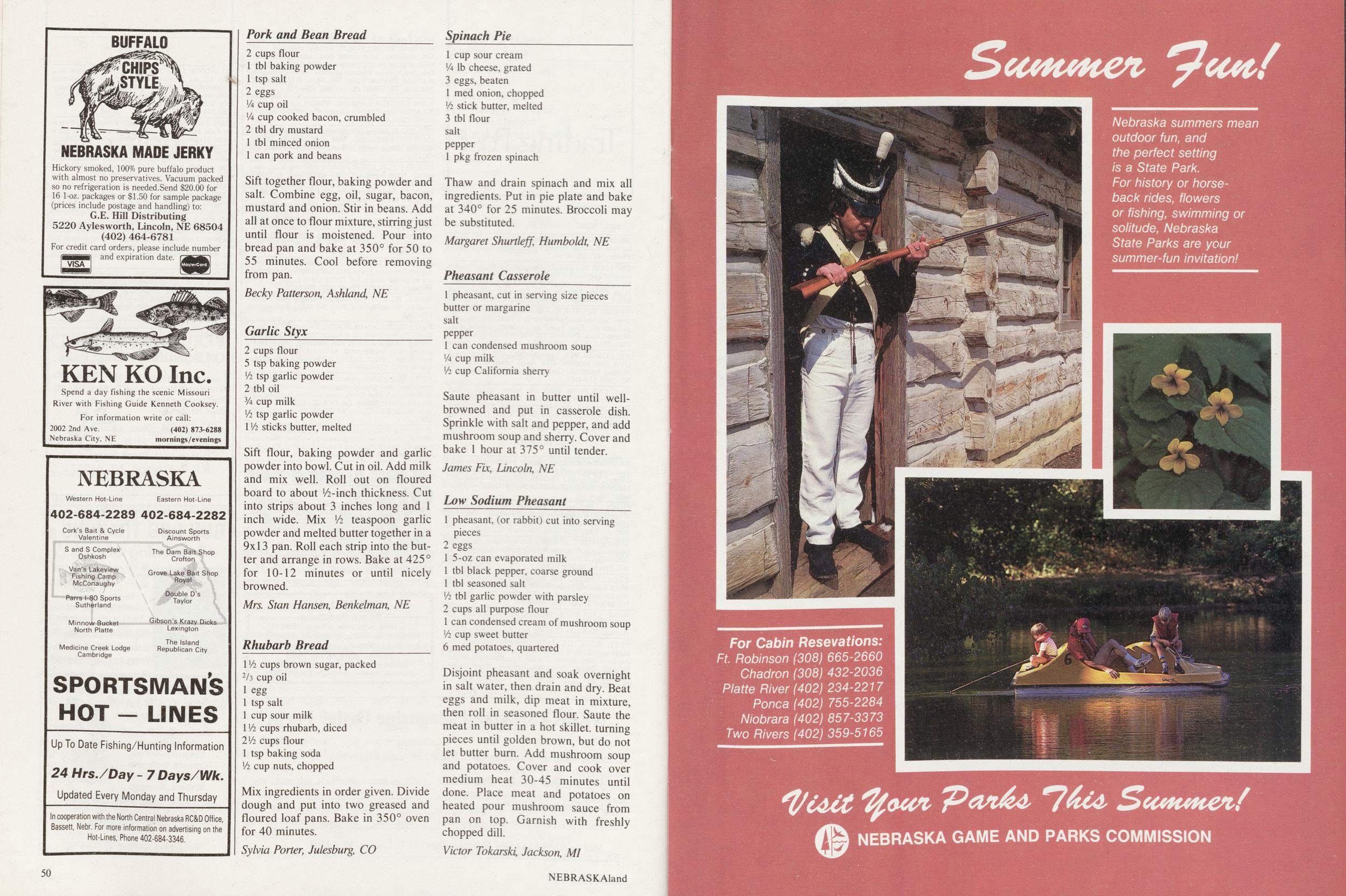 BUFFALO
NEBRASKA MADE JERKY
Hickory smoked, 100% pure buffalo product
with almost no preservatives. Vacuum packed
so no refrigeration is needed.Send $20.00 for
16 1-oz. packages or $1.50 for sample package
(prices include postage and handling) to:
G.E. Hill Distributing
5220 Aylesworth, Lincoln, NE 68504
(402) 464-6781
For credit card orders, please include number
and expiration date.
MasterCard j
Pork and Bean Bread
KEN KO Inc.
Spend a day fishing the scenic Missouri
River with Fishing Guide Kenneth Cooksey.
For information write or call:
2002 2nd Ave. (402) 873-6288
Nebraska City, NE mornings/evenings
NEBRASKA
Western Hot-Line
402-684-2289
Cork's Bait & Cycle
Valentine
S and S Complex
Oshkosh
Van's Lakeview
Fishing Camp
McCoriaughy
Parrs 1-80 Sports
Sutherland
Minnow Bucket
North Platte
Medicine Creek Lodge
Cambridge
Eastern Hot-Line
402-684-2282
Discount Sports
Ainsworth
The Dam Bait Shop
Crofton
Grove Lake Bait Shop
Royal
Double D's
Taylor
Jibson's Krazy Dicks
Lexington
The Island
Republican City
SPORTSMANS
HOT - LINES
Up To Date Fishing/Hunting Information
24 Hrs./Day - 7 Days/Wk.
Updated Every Monday and Thursday
In cooperation with the North Central Nebraska RC&D Office,
Bassett, Nebr. For more information on advertising on the
Hot-Lines, Phone 402-684-3346.
Pork and Bean Bread
2 cups flour
1 tbl baking powder
1 tsp salt
2 eggs
!/4 cup oil
174 cup cooked bacon, crumbled
2 tbl dry mustard
1 tbl minced onion
1 can pork and beans
BUFFALO
NEBRASKA MADE JERKY
Hickory smoked, 100% pure buffalo product
with almost no preservatives. Vacuum packed
so no refrigeration is needed.Send $20.00 for
16 1-oz. packages or $1.50 for sample package
(prices include postage and handling) to:
G.E. Hill Distributing
5220 Aylesworth, Lincoln, NE 68504
(402) 464-6781
For credit card orders, please include number
and expiration date.
MasterCard j
Pork and Bean Bread
KEN KO Inc.
Spend a day fishing the scenic Missouri
River with Fishing Guide Kenneth Cooksey.
For information write or call:
2002 2nd Ave. (402) 873-6288
Nebraska City, NE mornings/evenings
NEBRASKA
Western Hot-Line
402-684-2289
Cork's Bait & Cycle
Valentine
S and S Complex
Oshkosh
Van's Lakeview
Fishing Camp
McCoriaughy
Parrs 1-80 Sports
Sutherland
Minnow Bucket
North Platte
Medicine Creek Lodge
Cambridge
Eastern Hot-Line
402-684-2282
Discount Sports
Ainsworth
The Dam Bait Shop
Crofton
Grove Lake Bait Shop
Royal
Double D's
Taylor
Jibson's Krazy Dicks
Lexington
The Island
Republican City
SPORTSMANS
HOT - LINES
Up To Date Fishing/Hunting Information
24 Hrs./Day - 7 Days/Wk.
Updated Every Monday and Thursday
In cooperation with the North Central Nebraska RC&D Office,
Bassett, Nebr. For more information on advertising on the
Hot-Lines, Phone 402-684-3346.
Pork and Bean Bread
2 cups flour
1 tbl baking powder
1 tsp salt
2 eggs
!/4 cup oil
174 cup cooked bacon, crumbled
2 tbl dry mustard
1 tbl minced onion
1 can pork and beans
Sift together flour, baking powder and salt. Combine egg, oil, sugar, bacon, mustard and onion. Stir in beans. Add all at once to flour mixture, stirring just until flour is moistened. Pour into bread pan and bake at 350° for 50 to 55 minutes. Cool before removing from pan.
Becky Patterson, Ashland, NE Garlic Styx 2 cups flour 5 tsp baking powder Vi tsp garlic powder 2 tbl oil 3/4 cup milk Vi tsp garlic powder 1 Vi sticks butter, meltedSift flour, baking powder and garlic powder into bowl. Cut in oil. Add milk and mix well. Roll out on floured board to about l^-inch thickness. Cut into strips about 3 inches long and 1 inch wide. Mix Vi teaspoon garlic powder and melted butter together in a 9x13 pan. Roll each strip into the butter and arrange in rows. Bake at 425c for 10-12 minutes or until nicely browned.
Mrs. Stan Hansen, Benkelman, NE Rhubarb Bread__________________ 1 !/2 cups brown sugar, packed 2/3 cup oil 1 egg 1 tsp salt 1 cup sour milk 1 Vi cups rhubarb, diced 2!/2 cups flour 1 tsp baking soda Vi cup nuts, choppedMix ingredients in order given. Divide dough and put into two greased and floured loaf pans. Bake in 350° oven for 40 minutes.
Sylvia Porter, Julesburg, CO Spinach Pie 1 cup sour cream lA lb cheese, grated 3 eggs, beaten 1 med onion, chopped Vi stick butter, melted 3 tbl flour salt pepper 1 pkg frozen spinachThaw and drain spinach and mix all ingredients. Put in pie plate and bake at 340° for 25 minutes. Broccoli may be substituted.
Margaret Shurtleff, Humboldt, NE Pheasant Casserole 1 pheasant, cut in serving size pieces butter or margarine salt pepper 1 can condensed mushroom soup Va cup milk Vi cup California sherrySaute pheasant in butter until well-browned and put in casserole dish. Sprinkle with salt and pepper, and add mushroom soup and sherry. Cover and bake 1 hour at 375° until tender.
James Fix, Lincoln, NE Low Sodium Pheasant 1 pheasant, (or rabbit) cut into serving pieces 2 eggs 1 5-oz can evaporated milk 1 tbl black pepper, coarse ground 1 tbl seasoned salt Vi tbl garlic powder with parsley 2 cups all purpose flour 1 can condensed cream of mushroom soup Vi cup sweet butter 6 med potatoes, quarteredDisjoint pheasant and soak overnight in salt water, then drain and dry. Beat eggs and milk, dip meat in mixture, then roll in seasoned flour. Saute the meat in butter in a hot skillet, turning pieces until golden brown, but do not let butter burn. Add mushroom soup and potatoes. Cover and cook over medium heat 30-45 minutes until done. Place meat and potatoes on heated pour mushroom sauce from pan on top. Garnish with freshly chopped dill.
Victor Tokarski, Jackson, MI 50 NEBRASKAlandSummer Fun!
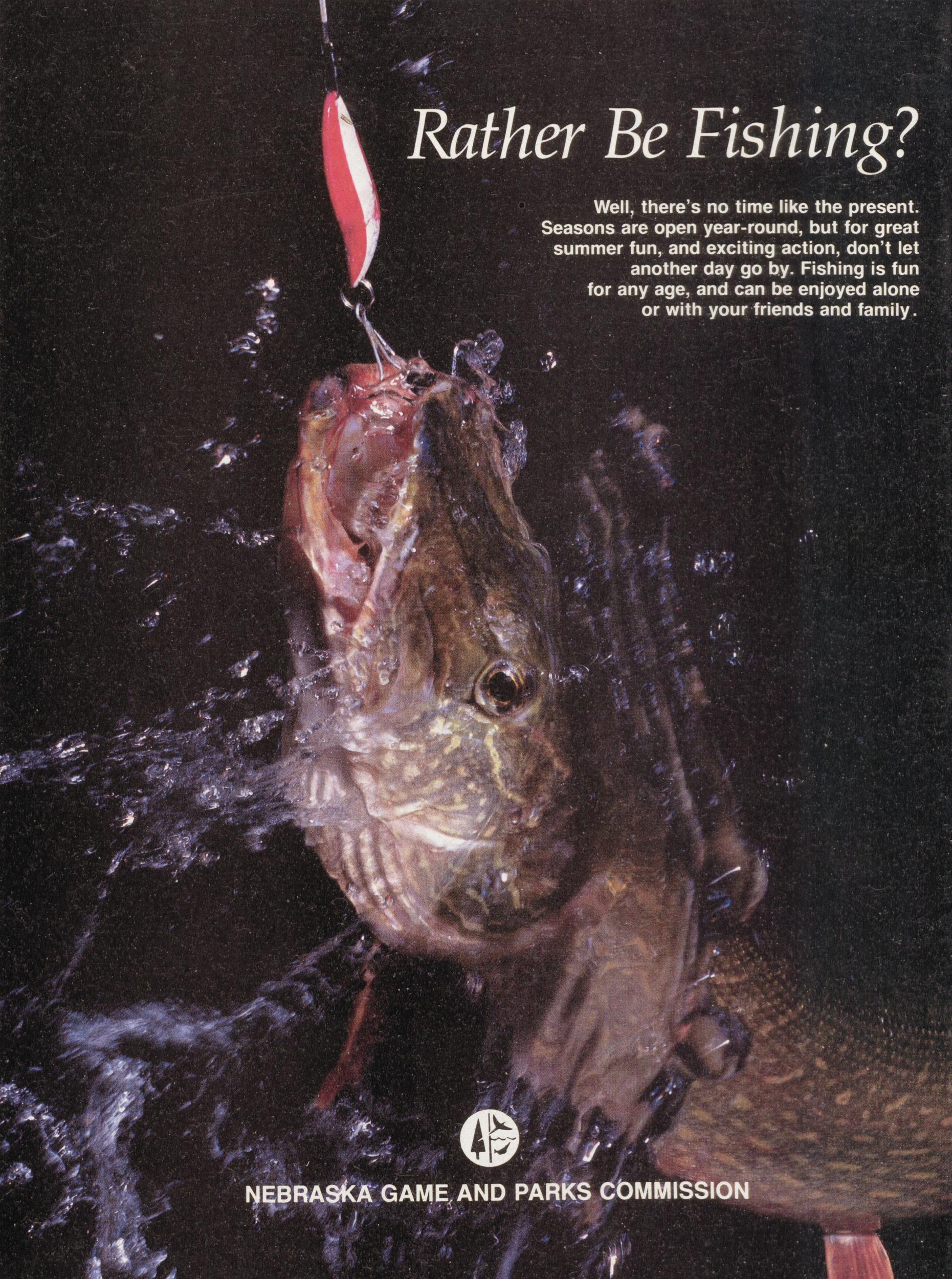
Rather Be Fishing?
Well, there's no time like the present. Seasons are open year-round, but for great summer fun, and exciting action, don't let another day go by. Fishing is fun for any age, and can be enjoyed alone or with your friends and family. NEBRASKA GAME AND PARKS COMMISSIONPosition: 57 (145 views)