Volume 66, Issue 4, 1988
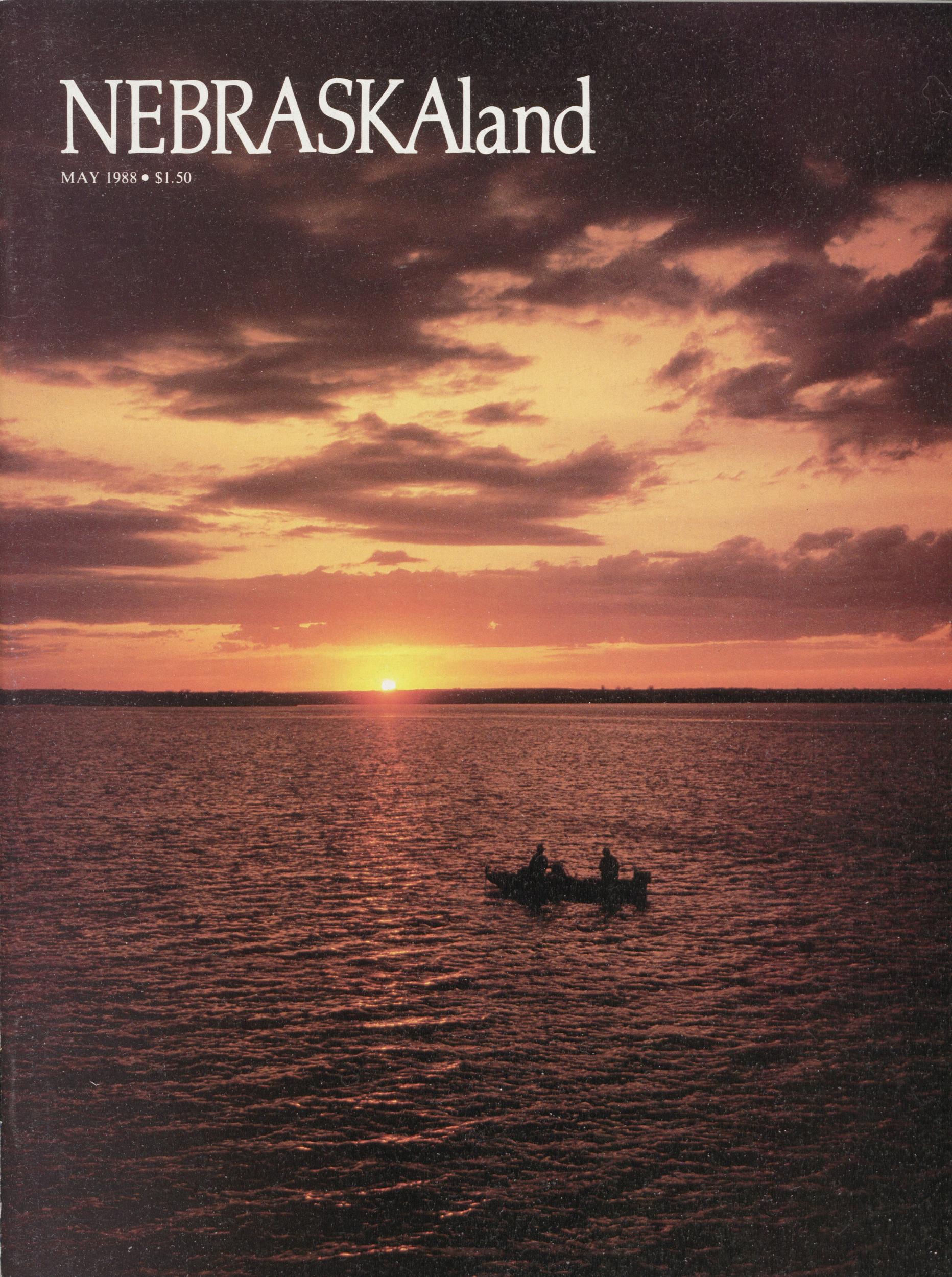
NEBRASKAland
MAY 1988 $1.50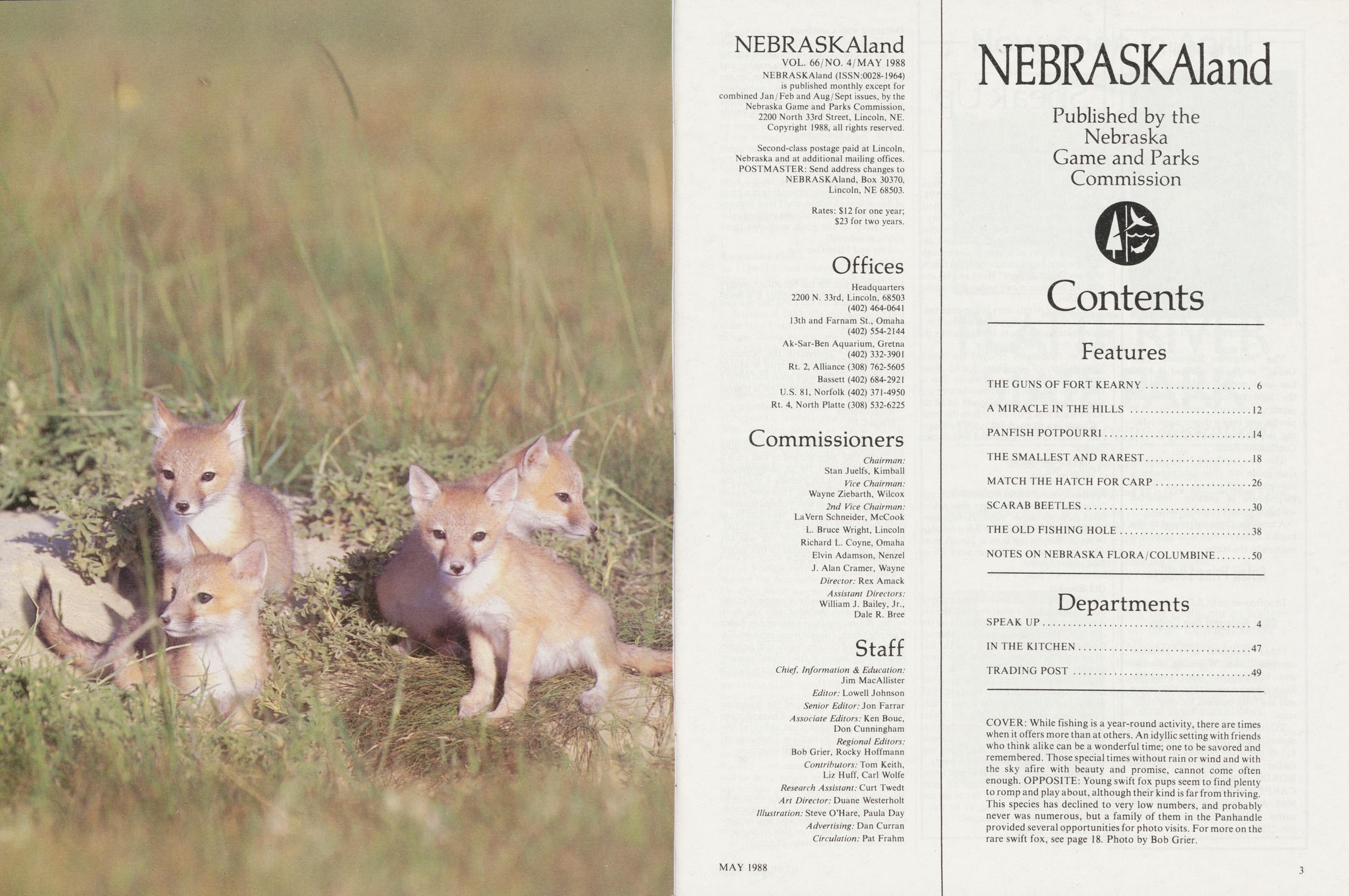
NEBRASKAland
Published by the Nebraska Game and Parks Commission NEBRASKAland VOL. 66/NO. 4/MAY 1988 NEBRASKAland (ISSN:0028-1964) is published monthly except for combined Jan/Feb and Aug/Sept issues, by the Nebraska Game and Parks Commission, 2200 North 33rd Street, Lincoln, NE. Copyright 1988, all rights reserved. Second-class postage paid at Lincoln, Nebraska and at additional mailing offices. POSTMASTER: Send address changes to NEBRASKAland, Box 30370, Lincoln, NE 68503. Rates: $12 for one year; $23 for two years. Offices Headquarters 2200 N. 33rd, Lincoln, 68503 (402) 464-0641 13th and Farnam St., Omaha (402) 554-2144 Ak-Sar-Ben Aquarium, Gretna (402) 332-3901 Rt. 2, Alliance (308) 762-5605 Bassett (402) 684-2921 U.S. 81, Norfolk (402) 371-4950 Rt. 4, North Platte (308) 532-6225 Commissioners Chairman: Stan Juelfs, Kimball Vice Chairman: Wayne Ziebarth, Wilcox 2nd Vice Chairman: LaVern Schneider, McCook L. Bruce Wright, Lincoln Richard L. Coyne, Omaha Elvin Adamson, Nenzel J. Alan Cramer, Wayne Director: Rex Amack Assistant Directors: William J. Bailey, Jr., Dale R. Bree Staff Chief, Information & Education: Jim MacAllister Editor: Lowell Johnson Senior Editor: Jon Farrar Associate Editors: Ken Bouc, Don Cunningham Regional Editors: Bob Grier, Rocky Hoffmann Contributors: Tom Keith, Liz Huff, Carl Wolfe Research Assistant: Curt Twedt Art Director: Duane Westerholt Illustration: Steve O'Hare, Paula Day Advertising: Dan Curran Circulation: Pat Frahm Contents Features THE GUNS OF FORT KEARNY..................... 6 A MIRACLE IN THE HILLS ........................12 PANFISH POTPOURRI.............................14 THE SMALLEST AND RAREST.....................18 MATCH THE HATCH FOR CARP...................26 SCARAB BEETLES THE OLD FISHING HOLE 30 38 NOTES ON NEBRASKA FLORA/COLUMBINE.......50 Departments SPEAK UP......................................... 4 IN THE KITCHEN......................................47 TRADING POST.........................................49 COVER: While fishing is a year-round activity, there are times when it offers more than at others. An idyllic setting with friends who think alike can be a wonderful time; one to be savored and remembered. Those special times without rain or wind and with the sky afire with beauty and promise, cannot come often enough. OPPOSITE: Young swift fox pups seem to find plenty to romp and play about, although their kind is far from thriving. This species has declined to very low numbers, and probably never was numerous, but a family of them in the Panhandle provided several opportunities for photo visits. For more on the rare swift fox, see page 18. Photo by Bob Grier. MAY 1988 3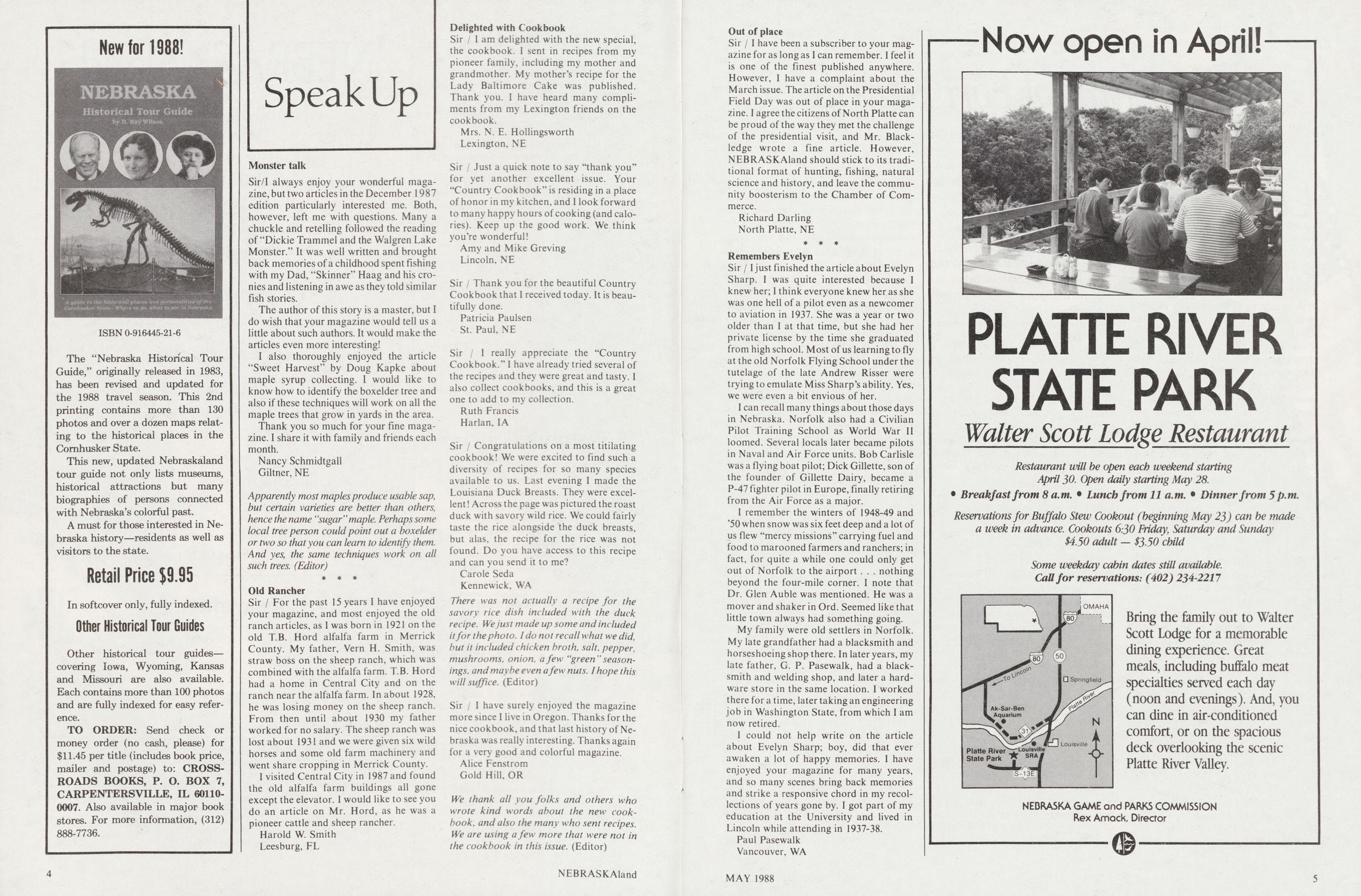
Speak Up
Monster talkSir/I always enjoy your wonderful magazine, but two articles in the December 1987 edition particularly interested me. Both, however, left me with questions. Many a chuckle and retelling followed the reading of "Dickie Trammel and the Walgren Lake Monster." It was well written and brought back memories of a childhood spent fishing with my Dad, "Skinner" Haag and his cronies and listening in awe as they told similar fish stories.
The author of this story is a master, but I do wish that your magazine would tell us a little about such authors. It would make the articles even more interesting!
I also thoroughly enjoyed the article "Sweet Harvest" by Doug Kapke about maple syrup collecting. I would like to know how to identify the boxelder tree and also if these techniques will work on all the maple trees that grow in yards in the area.
Thank you so much for your fine magazine. I share it with family and friends each month.
Nancy Schmidtgall Giltner, NEApparently most maples produce usable sap, but certain varieties are better than others, hence the name "sugar"maple. Perhaps some local tree person could point out a boxelder or two so that you can learn to identify them. And yes, the same techniques work on all such trees. (Editor)
* * * Old RancherSir / For the past 15 years I have enjoyed your magazine, and most enjoyed the old ranch articles, as I was born in 1921 on the old T.B. Hord alfalfa farm in Merrick County. My father, Vern H. Smith, was straw boss on the sheep ranch, which was combined with the alfalfa farm. T.B. Hord had a home in Central City and on the ranch near the alfalfa farm. In about 1928, he was losing money on the sheep ranch. From then until about 1930 my father worked for no salary. The sheep ranch was lost about 1931 and we were given six wild horses and some old farm machinery and went share cropping in Merrick County.
I visited Central City in 1987 and found the old alfalfa farm buildings all gone except the elevator. I would like to see you do an article on Mr. Hord, as he was a pioneer cattle and sheep rancher.
Harold W. Smith Leesburg, FL Delighted with CookbookSir / I am delighted with the new special, the cookbook. I sent in recipes from my pioneer family, including my mother and grandmother. My mother's recipe for the Lady Baltimore Cake was published. Thank you. I have heard many compliments from my Lexington friends on the cookbook.
Mrs. N. E. Hollingsworth Lexington, NESir / Just a quick note to say "thank you" for yet another excellent issue. Your "Country Cookbook" is residing in a place of honor in my kitchen, and I look forward to many happy hours of cooking (and calories). Keep up the good work. We think you're wonderful!
Amy and Mike Greving Lincoln, NESir / Thank you for the beautiful Country Cookbook that I received today. It is beautifully done.
Patricia Paulsen St. Paul, NESir / I really appreciate the "Country Cookbook." I have already tried several of the recipes and they were great and tasty. I also collect cookbooks, and this is a great one to add to my collection.
Ruth Francis Harlan, IASir / Congratulations on a most titilating cookbook! We were excited to find such a diversity of recipes for so many species available to us. Last evening I made the Louisiana Duck Breasts. They were excellent! Across the page was pictured the roast duck with savory wild rice. We could fairly taste the rice alongside the duck breasts, but alas, the recipe for the rice was not found. Do you have access to this recipe and can you send it to me?
Carole Seda Kennewick, WAThere was not actually a recipe for the savory rice dish included with the duck recipe. We just made up some and included it for the photo. I do not recall what we did, but it included chicken broth, salt, pepper, mushrooms, onion, a few "green" seasonings, and maybe even a few nuts. I hope this will suffice. (Editor)
Sir / I have surely enjoyed the magazine more since I live in Oregon. Thanks for the nice cookbook, and that last history of Nebraska was really interesting. Thanks again for a very good and colorful magazine.
Alice Fenstrom Gold Hill, ORWe thank all you folks and others who wrote kind words about the new cookbook, and also the many who sent recipes. We are using a few more that were not in the cookbook in this issue. (Editor)
4 NEBRASKAland Out of placeSir / I have been a subscriber to your magazine for as long as I can remember. I feel it is one of the finest published anywhere. However, I have a complaint about the March issue. The article on the Presidential Field Day was out of place in your magazine. I agree the citizens of North Platte can be proud of the way they met the challenge of the presidential visit, and Mr. Blackledge wrote a fine article. However, NEBRASKAland should stick to its traditional format of hunting, fishing, natural science and history, and leave the community boosterism to the Chamber of Commerce.
Richard Darling North Platte, NE * * * Remembers EvelynSir /1 just finished the article about Evelyn Sharp. I was quite interested because I knew her; I think everyone knew her as she was one hell of a pilot even as a newcomer to aviation in 1937. She was a year or two older than I at that time, but she had her private license by the time she graduated from high school. Most of us learning to fly at the old Norfolk Flying School under the tutelage of the late Andrew Risser were trying to emulate Miss Sharp's ability. Yes, we were even a bit envious of her.
I can recall many things about those days in Nebraska. Norfolk also had a Civilian Pilot Training School as World War II loomed. Several locals later became pilots in Naval and Air Force units. Bob Carlisle was a flying boat pilot; Dick Gillette, son of the founder of Gillette Dairy, became a P-47 fighter pilot in Europe, finally retiring from the Air Force as a major.
I remember the winters of 1948-49 and '50 when snow was six feet deep and a lot of us flew "mercy missions" carrying fuel and food to marooned farmers and ranchers; in fact, for quite a while one could only get out of Norfolk to the airport . . . nothing beyond the four-mile corner. I note that Dr. Glen Auble was mentioned. He was a mover and shaker in Ord. Seemed like that little town always had something going.
My family were old settlers in Norfolk. My late grandfather had a blacksmith and horseshoeing shop there. In later years, my late father, G. P. Pasewalk, had a blacksmith and welding shop, and later a hardware store in the same location. I worked there for a time, later taking an engineering job in Washington State, from which I am now retired.
I could not help write on the article about Evelyn Sharp; boy, did that ever awaken a lot of happy memories. I have enjoyed your magazine for many years, and so many scenes bring back memories and strike a responsive chord in my recollections of years gone by. I got part of my education at the University and lived in Lincoln while attending in 1937-38.
Paul Pasewalk Vancouver, WA Now open in April! PLATTE RIVER STATE PARK Walter Scott Lodge Restaurant Restaurant mill be open each weekend starting April 30. Open daily starting May 28. • Breakfast from 8 a.m. • Lunch from 11 a.m. • Dinner from 5 p.m. Reservations for Buffalo Stew Cookout (beginning May 23) can be made a week in advance. Cookouts 6.30 Friday Saturday and Sunday $4.50 adult - $3.50 child Some weekday cabin dates still available. Call for reservations: (402) 234-2217 OMAHA Platte Riverr Louisville State Park Bring the family out to Walter Scott Lodge for a memorable dining experience. Great meals, including buffalo meat specialties served each day (noon and evenings). And, you can dine in air-conditioned comfort, or on the spacious deck overlooking the scenic Platte River Valley. NEBRASKA GAME and PARKS COMMISSION Rex Amack, Director MAY 1988 5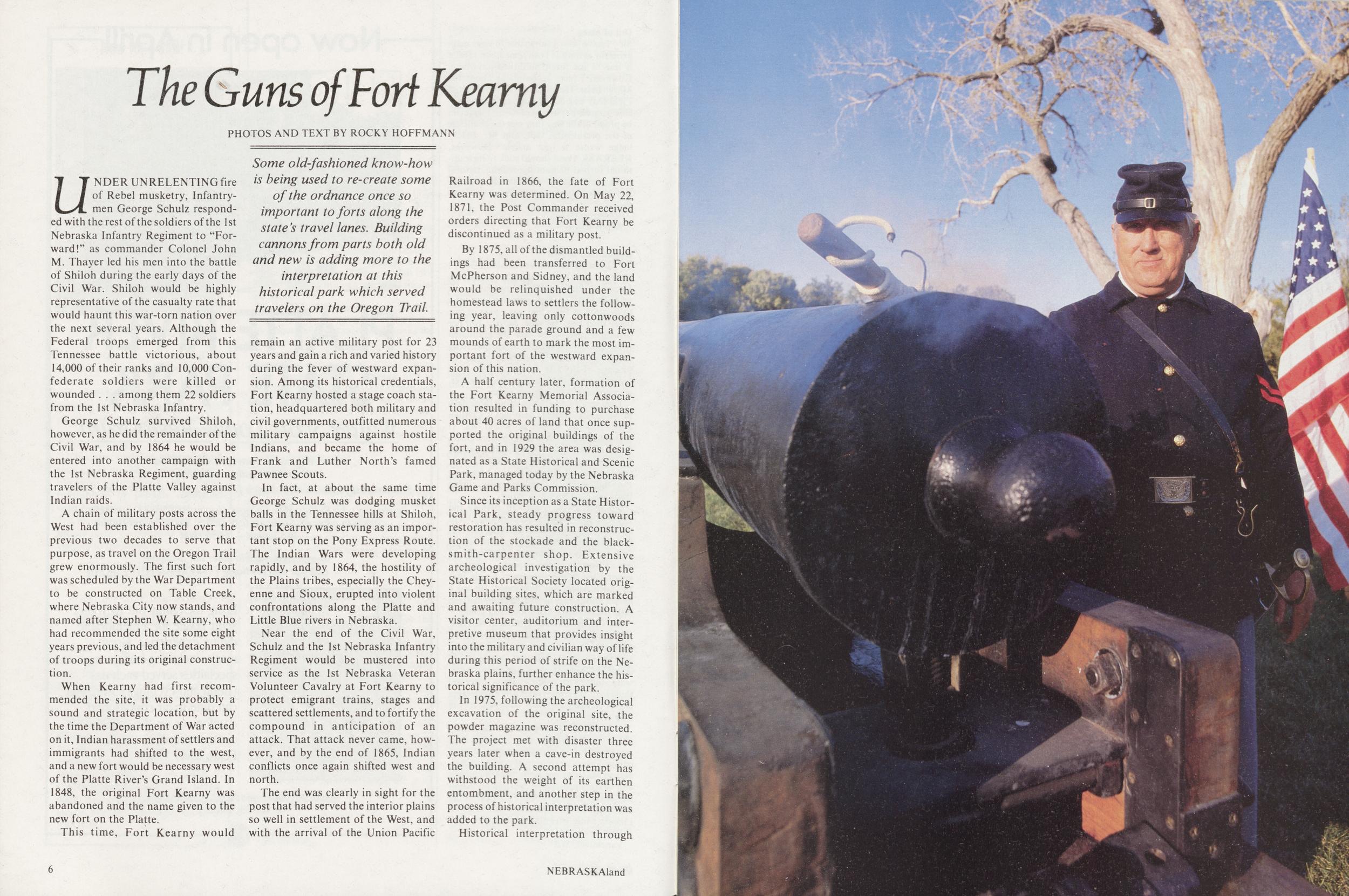
The Guns of Fort Kearny
PHOTOS AND TEXT BY ROCKY HOFFMANN Some old-fashioned know-how is being used to re-create some of the ordnance once so important to forts along the state s travel lanes. Building cannons from parts both old and new is adding more to the interpretation at this historical park which served travelers on the Oregon Trail.UNDER UNRELENTING fire of Rebel musketry, Infantrymen George Schulz responded with the rest of the soldiers of the 1st Nebraska Infantry Regiment to "Forward!" as commander Colonel John M. Thayer led his men into the battle of Shiloh during the early days of the Civil War. Shiloh would be highly representative of the casualty rate that would haunt this war-torn nation over the next several years. Although the Federal troops emerged from this Tennessee battle victorious, about 14,000 of their ranks and 10,000 Confederate soldiers were killed or wounded . . . among them 22 soldiers from the 1st Nebraska Infantry.
George Schulz survived Shiloh, however, as he did the remainder of the Civil War, and by 1864 he would be entered into another campaign with the 1st Nebraska Regiment, guarding travelers of the Platte Valley against Indian raids.
A chain of military posts across the West had been established over the previous two decades to serve that purpose, as travel on the Oregon Trail grew enormously. The first such fort was scheduled by the War Department to be constructed on Table Creek, where Nebraska City now stands, and named after Stephen W. Kearny, who had recommended the site some eight years previous, and led the detachment of troops during its original construction.
When Kearny had first recommended the site, it was probably a sound and strategic location, but by the time the Department of War acted on it, Indian harassment of settlers and immigrants had shifted to the west, and a new fort would be necessary west of the Platte River's Grand Island. In 1848, the original Fort Kearny was abandoned and the name given to the new fort on the Platte.
This time, Fort Kearny would remain an active military post for 23 years and gain a rich and varied history during the fever of westward expansion. Among its historical credentials, Fort Kearny hosted a stage coach station, headquartered both military and civil governments, outfitted numerous military campaigns against hostile Indians, and became the home of Frank and Luther North's famed Pawnee Scouts.
In fact, at about the same time George Schulz was dodging musket balls in the Tennessee hills at Shiloh, Fort Kearny was serving as an important stop on the Pony Express Route. The Indian Wars were developing rapidly, and by 1864, the hostility of the Plains tribes, especially the Cheyenne and Sioux, erupted into violent confrontations along the Platte and Little Blue rivers in Nebraska.
Near the end of the Civil War, Schulz and the 1st Nebraska Infantry Regiment would be mustered into service as the 1st Nebraska Veteran Volunteer Cavalry at Fort Kearny to protect emigrant trains, stages and scattered settlements, and to fortify the compound in anticipation of an attack. That attack never came, however, and by the end of 1865, Indian conflicts once again shifted west and north.
The end was clearly in sight for the post that had served the interior plains so well in settlement of the West, and with the arrival of the Union Pacific Railroad in 1866, the fate of Fort Kearny was determined. On May 22, 1871, the Post Commander received orders directing that Fort Kearny be discontinued as a military post.
By 1875, all of the dismantled buildings had been transferred to Fort McPherson and Sidney, and the land would be relinquished under the homestead laws to settlers the following year, leaving only cottonwoods around the parade ground and a few mounds of earth to mark the most important fort of the westward expansion of this nation.
A half century later, formation of the Fort Kearny Memorial Association resulted in funding to purchase about 40 acres of land that once supported the original buildings of the fort, and in 1929 the area was designated as a State Historical and Scenic Park, managed today by the Nebraska Game and Parks Commission.
Since its inception as a State Historical Park, steady progress toward restoration has resulted in reconstruction of the stockade and the blacksmith-carpenter shop. Extensive archeological investigation by the State Historical Society located original building sites, which are marked and awaiting future construction. A visitor center, auditorium and interpretive museum that provides insight into the military and civilian way of life during this period of strife on the Nebraska plains, further enhance the historical significance of the park.
In 1975, following the archeological excavation of the original site, the powder magazine was reconstructed. The project met with disaster three years later when a cave-in destroyed the building. A second attempt has withstood the weight of its earthen entombment, and another step in the process of historical interpretation was added to the park.
Historical interpretation through displays and analysis of period memorabilia, coupled with living-history dramatizations, is the crux of Game and Parks responsibility to the visiting public at State Historical Parks. Fort Kearny Superintendent Gene Hunt feels this responsibility can be realized if people with extensive knowledge, background, and talent can be recruited to put it all together.
6 NEBRASKAland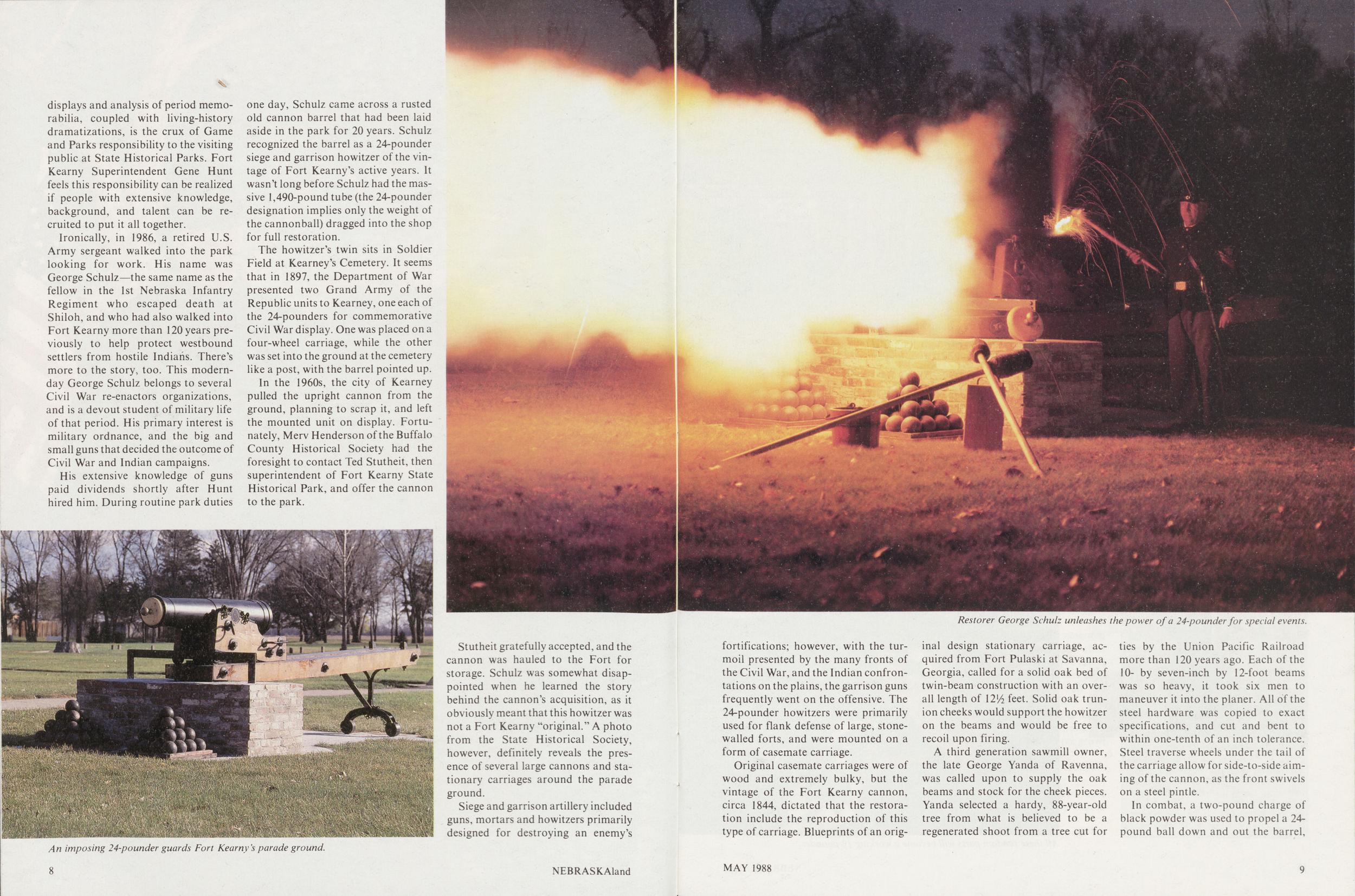
Ironically, in 1986, a retired U.S. Army sergeant walked into the park looking for work. His name was George Schulz—the same name as the fellow in the 1st Nebraska Infantry Regiment who escaped death at Shiloh, and who had also walked into Fort Kearny more than 120 years previously to help protect westbound settlers from hostile Indians. There's more to the story, too. This modern day George Schulz belongs to several Civil War re-enactors organizations, and is a devout student of military life of that period. His primary interest is military ordnance, and the big and small guns that decided the outcome of Civil War and Indian campaigns.
His extensive knowledge of guns paid dividends shortly after Hunt hired him. During routine park duties one day, Schulz came across a rusted old cannon barrel that had been laid aside in the park for 20 years. Schulz recognized the barrel as a 24-pounder siege and garrison howitzer of the vintage of Fort Kearny's active years. It wasn't long before Schulz had the massive 1,490-pound tube (the 24-pounder designation implies only the weight of the cannonball) dragged into the shop for full restoration.
The howitzer's twin sits in Soldier Field at Kearney's Cemetery. It seems that in 1897, the Department of War presented two Grand Army of the Republic units to Kearney, one each of the 24-pounders for commemorative Civil War display. One was placed on a four-wheel carriage, while the other was set into the ground at the cemetery like a post, with the barrel pointed up.
In the 1960s, the city of Kearney pulled the upright cannon from the ground, planning to scrap it, and left the mounted unit on display. Fortunately, Merv Henderson of the Buffalo County Historical Society had the foresight to contact Ted Stutheit, then superintendent of Fort Kearny State Historical Park, and offer the cannon to the park.
Stutheit gratefully accepted, and the cannon was hauled to the Fort for storage. Schulz was somewhat disappointed when he learned the story behind the cannon's acquisition, as it obviously meant that this howitzer was not a Fort Kearny "original." A photo from the State Historical Society, however, definitely reveals the presence of several large cannons and stationary carriages around the parade ground.
Siege and garrison artillery included guns, mortars and howitzers primarily designed for destroying an enemy's 6 NEBRASKAland fortifications; however, with the turmoil presented by the many fronts of the Civil War, and the Indian confrontations on the plains, the garrison guns frequently went on the offensive. The 24-pounder howitzers were primarily used for flank defense of large, stone walled forts, and were mounted on a form of casemate carriage.
Original casemate carriages were of wood and extremely bulky, but the vintage of the Fort Kearny cannon, circa 1844, dictated that the restoration include the reproduction of this type of carriage. Blueprints of an original design stationary carriage, acquired from Fort Pulaski at Savanna, Georgia, called for a solid oak bed of twin-beam construction with an over all length of 12/2 feet. Solid oak trunion cheeks would support the howitzer on the beams and would be free to recoil upon firing.
A third generation sawmill owner, the late George Yanda of Ravenna, was called upon to supply the oak beams and stock for the cheek pieces. Yanda selected a hardy, 88-year-old tree from what is believed to be a regenerated shoot from a tree cut for ties by the Union Pacific Railroad more than 120 years ago. Each of the 10- by seven-inch by 12-foot beams was so heavy, it took six men to maneuver it into the planer. All of the steel hardware was copied to exact specifications, and cut and bent to within one-tenth of an inch tolerance. Steel traverse wheels under the tail of the carriage allow for side-to-side aiming of the cannon, as the front swivels on a steel pintle.
In combat, a two-pound charge of black powder was used to propel a 24-pound ball down and out the barrel, creating considerable recoil. Recoil control was maintained by heavy ropes anchoring the cannon to the fortress, and the howitzer would also travel up a slight incline, with the cheek pieces creating friction against the oak beams.
MAY 1988 9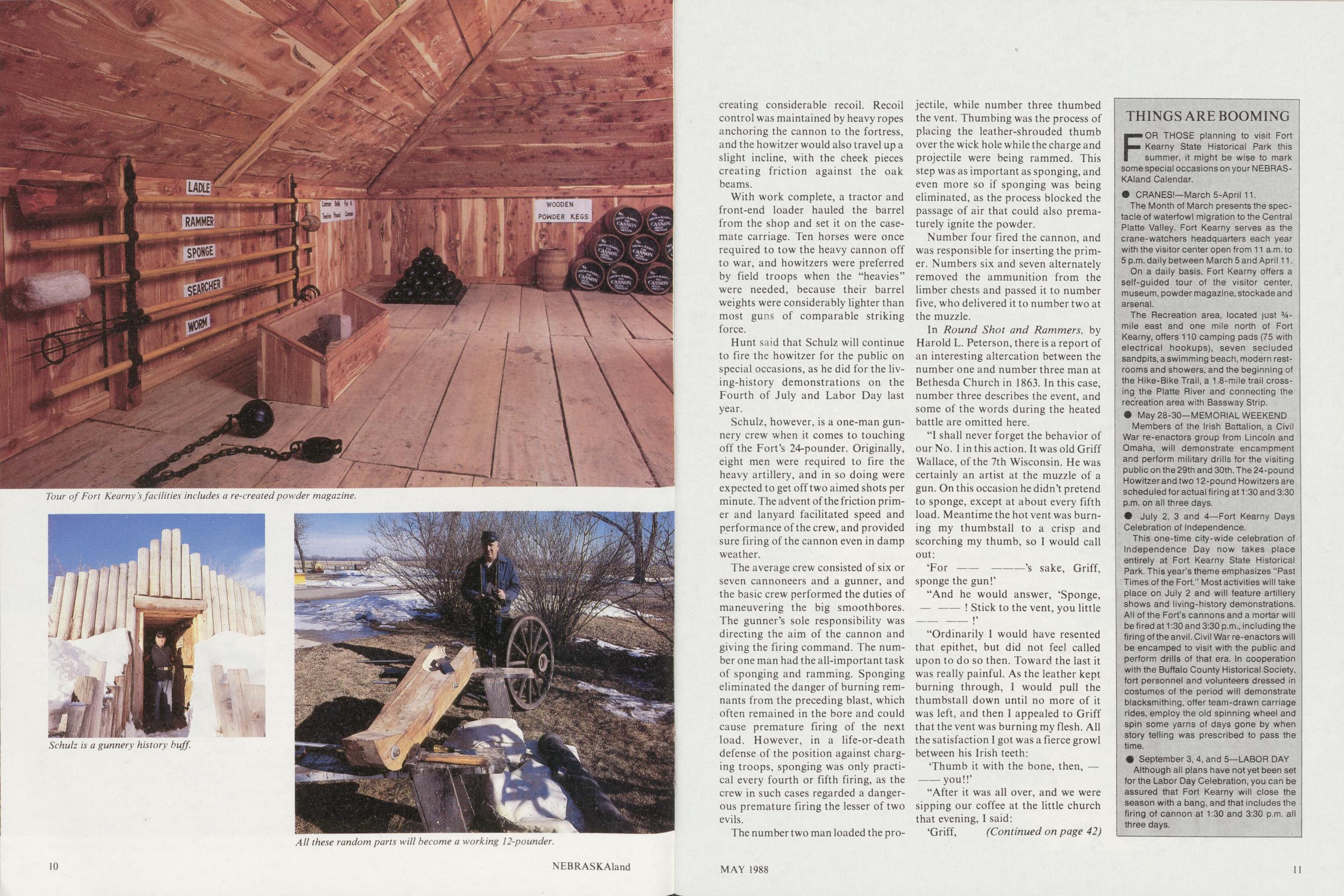
With work complete, a tractor and front-end loader hauled the barrel from the shop and set it on the casemate carriage. Ten horses were once required to tow the heavy cannon off to war, and howitzers were preferred by field troops when the "heavies" were needed, because their barrel weights were considerably lighter than most guns of comparable striking force.
Hunt said that Schulz will continue to fire the howitzer for the public on special occasions, as he did for the living-history demonstrations on the Fourth of July and Labor Day last year.
Schulz, however, is a one-man gunnery crew when it comes to touching off the Fort's 24-pounder. Originally, eight men were required to fire the heavy artillery, and in so doing were expected to get off two aimed shots per minute. The advent of the friction primer and lanyard facilitated speed and performance of the crew, and provided sure firing of the cannon even in damp weather.
The average crew consisted of six or seven cannoneers and a gunner, and the basic crew performed the duties of maneuvering the big smoothbores. The gunner's sole responsibility was directing the aim of the cannon and giving the firing command. The number one man had the all-important task of sponging and ramming. Sponging eliminated the danger of burning remnants from the preceding blast, which often remained in the bore and could cause premature firing of the next load. However, in a life-or-death defense of the position against charging troops, sponging was only practical every fourth or fifth firing, as the crew in such cases regarded a dangerous premature firing the lesser of two evils.
The number two man loaded the projectile, while number three thumbed the vent. Thumbing was the process of placing the leather-shrouded thumb over the wick hole while the charge and projectile were being rammed. This step was as important as sponging, and even more so if sponging was being eliminated, as the process blocked the passage of air that could also prematurely ignite the powder.
Number four fired the cannon, and was responsible for inserting the primer. Numbers six and seven alternately removed the ammunition from the limber chests and passed it to number five, who delivered it to number two at the muzzle.
In Round Shot and Rammers, by Harold L. Peterson, there is a report of an interesting altercation between the number one and number three man at Bethesda Church in 1863. In this case, number three describes the event, and some of the words during the heated battle are omitted here.
"I shall never forget the behavior of our No. 1 in this action. It was old Griff Wallace, of the 7th Wisconsin. He was certainly an artist at the muzzle of a gun. On this occasion he didn't pretend to sponge, except at about every fifth load. Meantime the hot vent was burning my thumb stall to a crisp and scorching my thumb, so I would call out:
'For------------------'s sake, Griff, sponge the gun!'
"And he would answer, 'Sponge, —------! Stick to the vent, you little _______r
"Ordinarily I would have resented that epithet, but did not feel called upon to do so then. Toward the last it was really painful. As the leather kept burning through, I would pull the thumb stall down until no more of it was left, and then I appealed to Griff that the vent was burning my flesh. All the satisfaction I got was a fierce growl between his Irish teeth:
'Thumb it with the bone, then, ------you!!'
"After it was all over, and we were sipping our coffee at the little church that evening, I said:
'Griff, (Continued on page 42)
THINGS ARE BOOMINGFOR THOSE planning to visit Fort Kearny State Historical Park this summer, it might be wise to mark some special occasions on your NEBRASKAland Calendar.
• CRANES!—March 5-April 11. The Month of March presents the spectacle of waterfowl migration to the Central Platte Valley. Fort Kearny serves as the crane-watchers headquarters each year with the visitor center open from 11 a.m. to 5 p.m. daily between March 5 and April 11.
On a daily basis, Fort Kearny offers a self-guided tour of the visitor center, museum, powder magazine, stockade and arsenal.
The Recreation area, located just 34- mile east and one mile north of Fort Kearny, offers 110 camping pads (75 with electrical hookups), seven secluded sandpits, a swimming beach, modern restrooms and showers, and the beginning of the Hike-Bike Trail, a 1.8-mile trail crossing the Platte River and connecting the recreation area with Bassway Strip.
# May 28-30—MEMORIAL WEEKEND
Members of the Irish Battalion, a Civil War re-enactors group from Lincoln and Omaha, will demonstrate encampment and perform military drills for the visiting public on the 29th and 30th. The 24-pound Howitzer and two 12-pound Howitzers are scheduled for actual firing at 1:30 and 3:30 p.m. on all three days.
# July 2, 3 and 4—Fort Kearny Days Celebration of Independence.
This one-time city-wide celebration of Independence Day now takes place entirely at Fort Kearny State Historical Park. This year's theme emphasizes "Past Times of the Fort." Most activities will take place on July 2 and will feature artillery shows and living-history demonstrations. All of the Fort's cannons and a mortar will be fired at 1:30 and 3:30 p.m., including the firing of the anvil. Civil War re-enactors will be encamped to visit with the public and perform drills of that era. In cooperation with the Buffalo County Historical Society, fort personnel and volunteers dressed in costumes of the period will demonstrate blacksmithing, offer team-drawn carriage rides, employ the old spinning wheel and spin some yarns of days gone by when story telling was prescribed to pass the time.
# September 3, 4, and 5—LABOR DAY
Although all plans have not yet been set for the Labor Day Celebration, you can be assured that Fort Kearny will close the season with a bang, and that includes the firing of cannon at 1:30 and 3:30 p.m. all three days.
MAY 1988 11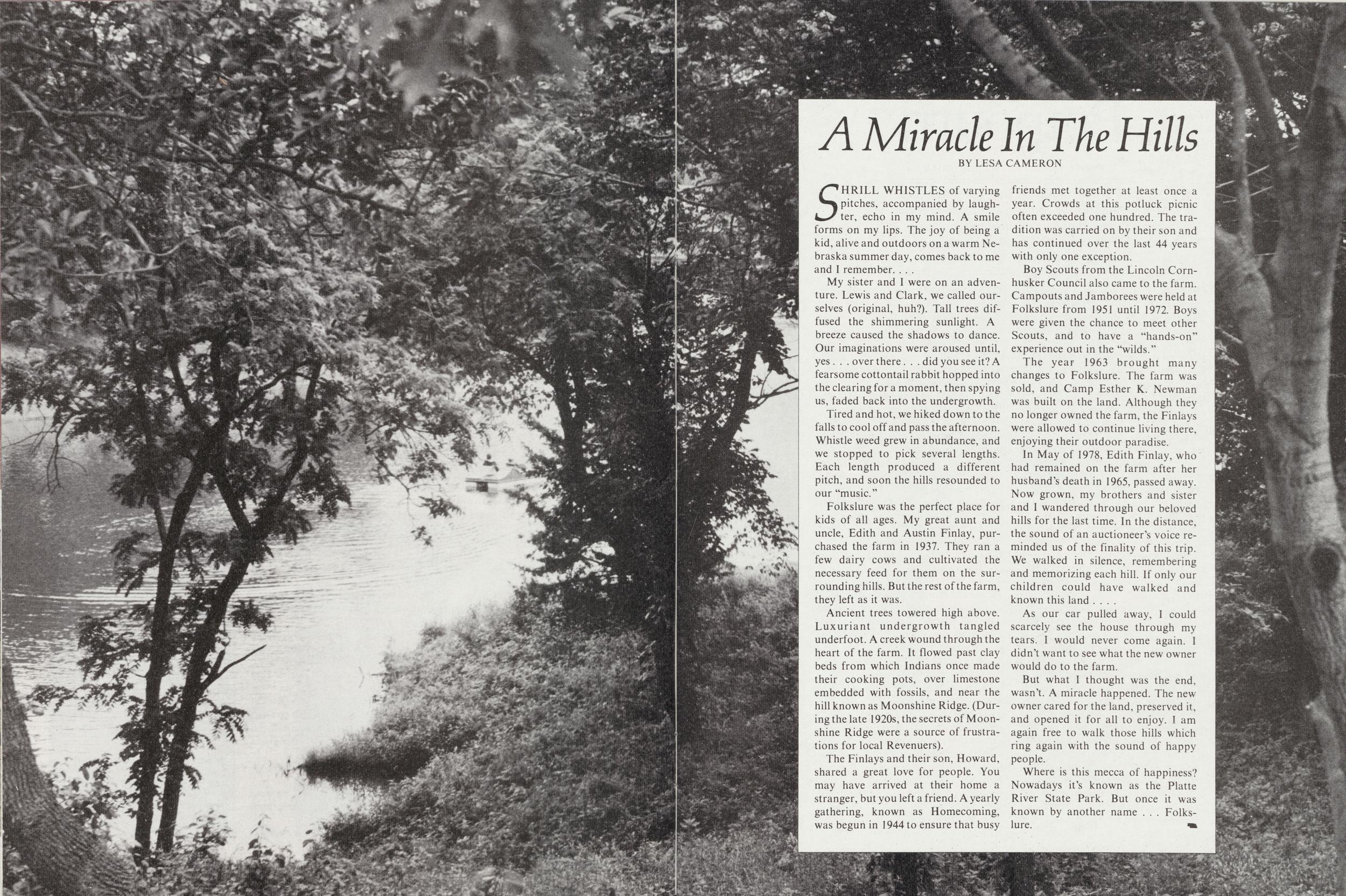
A Miracle In The Hills
BY LESA CAMERONSHRILL WHISTLES of varying pitches, accompanied by laughter, echo in my mind. A smile forms on my lips. The joy of being a kid, alive and outdoors on a warm Nebraska summer day, comes back to me and I remember. .
My sister and I were on an adventure. Lewis and Clark, we called ourselves (original, huh?). Tall trees diffused the shimmering sunlight. A breeze caused the shadows to dance. Our imaginations were aroused until, yes. . .over there. . . did you see it? A fearsome cottontail rabbit hopped into the clearing for a moment, then spying us, faded back into the undergrowth.
Tired and hot, we hiked down to the falls to cool off and pass the afternoon. Whistle weed grew in abundance, and we stopped to pick several lengths. Each length produced a different pitch, and soon the hills resounded to our "music."
Folkslure was the perfect place for kids of all ages. My great aunt and uncle, Edith and Austin Finlay, purchased the farm in 1937. They ran a few dairy cows and cultivated the necessary feed for them on the surrounding hills. But the rest of the farm, they left as it was.
Ancient trees towered high above. Luxuriant undergrowth tangled underfoot. A creek wound through the heart of the farm. It flowed past clay beds from which Indians once made their cooking pots, over limestone embedded with fossils, and near the hill known as Moonshine Ridge. (During the late 1920s, the secrets of Moonshine Ridge were a source of frustrations for local Revenuers).
The Finlays and their son, Howard, shared a great love for people. You may have arrived at their home a stranger, but you left a friend. A yearly gathering, known as Homecoming, was begun in 1944 to ensure that busy friends met together at least once a year. Crowds at this potluck picnic often exceeded one hundred. The tradition was carried on by their son and has continued over the last 44 years with only one exception.
Boy Scouts from the Lincoln Cornhusker Council also came to the farm. Campouts and Jamborees were held at Folkslure from 1951 until 1972. Boys were given the chance to meet other Scouts, and to have a "hands-on" experience out in the "wilds."
The year 1963 brought many changes to Folkslure. The farm was sold, and Camp Esther K. Newman was built on the land. Although they no longer owned the farm, the Finlays were allowed to continue living there, enjoying their outdoor paradise.
In May of 1978, Edith Finlay, who had remained on the farm after her husband's death in 1965, passed away. Now grown, my brothers and sister and I wandered through our beloved hills for the last time. In the distance, the sound of an auctioneer's voice reminded us of the finality of this trip. We walked in silence, remembering and memorizing each hill. If only our children could have walked and known this land ....
As our car pulled away, I could scarcely see the house through my tears. I would never come again. I didn't want to see what the new owner would do to the farm.
But what I thought was the end, wasn't. A miracle happened. The new owner cared for the land, preserved it, and opened it for all to enjoy. I am again free to walk those hills which ring again with the sound of happy people.
Where is this mecca of happiness? Nowadays it's known as the Platte River State Park. But once it was known by another name . . . Folkslure.
Panfish Potpourri
PHOTOS AND TEXT BY BOB GRIER When after smaller fish, using light gear balances the challenge and enhances the fun. Members of the panfish clan are everywhere, so travel is minimal and everyone can participate in the sport.BOBBING gently up and down in the wave troughs, I had been too busy catching crappie to notice the change in the lake's surface. The water's color had become a vibrant green mixed with gold where the late afternoon sunlight penetrated. Moderate size crappie, a few approaching one-half pound, were aggressively hitting at each cast—a feeding frenzy that would last almost until sundown.
One of the real pleasures of fishing from a doughnut-shaped float boat (see April 1987 NEBRASKAland) besides fly fishing without worrying about a snagged backcast, is the rewarding match-up between simple equipment and panfish populations near my home in western Nebraska. Panfishing can be an exciting and productive sport for boaters, wading anglers, and shore fishermen of any age or gender.
Annual fishing trips to Lake Minatare, Lake McConaughy, or Box Butte Reservoir are important, but fishing for crappie, yellow perch, and bluegill with ultralight spinning equipment provides substantially more hours of memorable fishing action and numerous meals of tasty fillets.
The crappie feeding frenzy at Walgren Lake near Hay Springs was one of those memorable moments. I'd been catching an occasional crappie and yellow perch as I paddled parallel with the south shoreline, but the fishing was slow until the right combination of wind and water conditions, and a possible plankton bloom, put added voltage in the fishing activity. I've been on the same lake under nearly the same conditions several times since, but never with the same fantastic fishing action!
Panfishing, to me, usually means crappie, yellow perch, and bluegill, although rock bass, redear sunfish, bullhead and even white bass are normally considered in the same category.
While any type of fishing pole, reel, and related equipment may suffice, choosing properly balanced ultralight or light weight equipment adds to the excitement when landing fish that normally weigh less than one pound. A light, sensitive five- or 5!/2-foot spinning rod equipped with an ultralight open-face spinning reel is about perfect for most situations. A good brand of four-pound-test monofilament line is usually best, although under most conditions six-pound line will work. There is a substantial difference between economy and premium brands of line—respooling a reel more often with less expensive line can prove to be a false savings, especially when added to the aggravation of snarls and tangles just as the fish start hitting!
Fly fishing, especially for bluegill, is another exciting possibility. A properly matched, medium-weight rod with a weight-forward floating line and several spools of light weight leader material—or several commercial tapered leaders ending with a section of one or two-pound-test material—will work well for bluegill and will also cast smaller floating poppers and deer-hair lures for largemouth bass. I normally let tapered leaders wear back to a heavier section or tie in a length of slightly heavier line when largemouth bass fishing.
14 NEBRASKAland
Small, 1/32, 1/16 and >/8-ounce jig heads dressed with small plastic grub bodies are very effective for the three species of panfish I usually pursue, especially during the spring and early summer. The tiny Beetle-Spin type lure can be just as effective, as are the deer-hair and feather-dressed jigs. I normally try to use artificial bait whenever possible, although natural bait, including minnows, worms, and grasshoppers, will usually out fish the artificials. One of the best rules is to let the fish tell you what they will hit, and be prepared to experiment until the right combination of bait and presentation is found.
Understanding each species' food requirements and seasonal activities, and applying that information when fishing, will greatly improve a panfish angler's success. The Fish Book from NEBRASKAland Magazine is one of the best sources about Nebraska's many fish species.
Crappie, for example, feed on minnows, probably the crappie angler's most productive bait year-round. Small artificials—jigs, flies and lures that imitate the minnow's color and size—will prove nearly as effective, especially when fish are aggressively hitting. Neutral or moderately active fish, and crappie hanging tight to underwater cover, require a slower presentation, where natural bait can really produce.
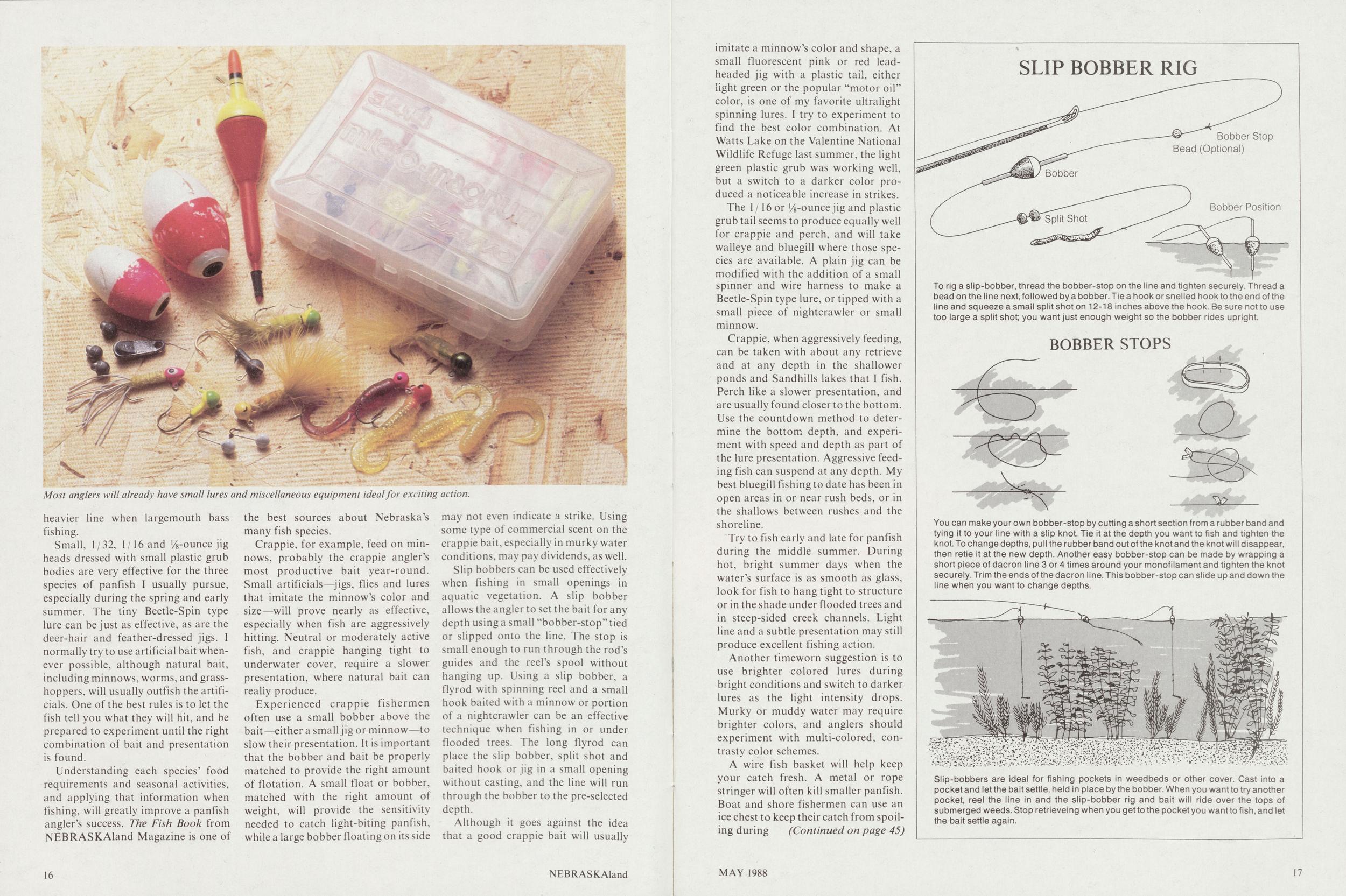
Experienced crappie fishermen often use a small bobber above the bait—either a small jig or minnow—to slow their presentation. It is important that the bobber and bait be properly matched to provide the right amount of flotation. A small float or bobber, matched with the right amount of weight, will provide the sensitivity needed to catch light-biting panfish, while a large bobber floating on its side may not even indicate a strike. Using some type of commercial scent on the crappie bait, especially in murky water conditions, may pay dividends, as well.
Slip bobbers can be used effectively when fishing in small openings in aquatic vegetation. A slip bobber allows the angler to set the bait for any depth using a small "bobber-stop" tied or slipped onto the line. The stop is small enough to run through the rod's guides and the reel's spool without hanging up. Using a slip bobber, a flyrod with spinning reel and a small hook baited with a minnow or portion of a nightcrawler can be an effective technique when fishing in or under flooded trees. The long flyrod can place the slip bobber, split shot and baited hook or jig in a small opening without casting, and the line will run through the bobber to the pre-selected depth.
Although it goes against the idea that a good crappie bait will usually 16 NEBRASKAland imitate a minnow's color and shape, a small fluorescent pink or red lead headed jig with a plastic tail, either light green or the popular "motor oil" color, is one of my favorite ultralight spinning lures. I try to experiment to find the best color combination. At Watts Lake on the Valentine National Wildlife Refuge last summer, the light green plastic grub was working well, but a switch to a darker color produced a noticeable increase in strikes.
The 1/16 or Us-ounce jig and plastic grub tail seems to produce equally well for crappie and perch, and will take walleye and bluegill where those species are available. A plain jig can be modified with the addition of a small spinner and wire harness to make a Beetle-Spin type lure, or tipped with a small piece of nightcrawler or small minnow.
Crappie, when aggressively feeding, can be taken with about any retrieve and at any depth in the shallower ponds and Sandhills lakes that I fish. Perch like a slower presentation, and are usually found closer to the bottom. Use the countdown method to determine the bottom depth, and experiment with speed and depth as part of the lure presentation. Aggressive feeding fish can suspend at any depth. My best bluegill fishing to date has been in open areas in or near rush beds, or in the shallows between rushes and the shoreline.
Try to fish early and late for panfish during the middle summer. During hot, bright summer days when the water's surface is as smooth as glass, look for fish to hang tight to structure or in the shade under flooded trees and in steep-sided creek channels. Light line and a subtle presentation may still produce excellent fishing action.
Another timeworn suggestion is to use brighter colored lures during bright conditions and switch to darker lures as the light intensity drops. Murky or muddy water may require brighter colors, and anglers should experiment with multi-colored, contrasty color schemes.
A wire fish basket will help keep your catch fresh. A metal or rope stringer will often kill smaller panfish. Boat and shore fishermen can use an ice chest to keep their catch from spoiling during (Continued on page 45)
The Smallest and Rarest
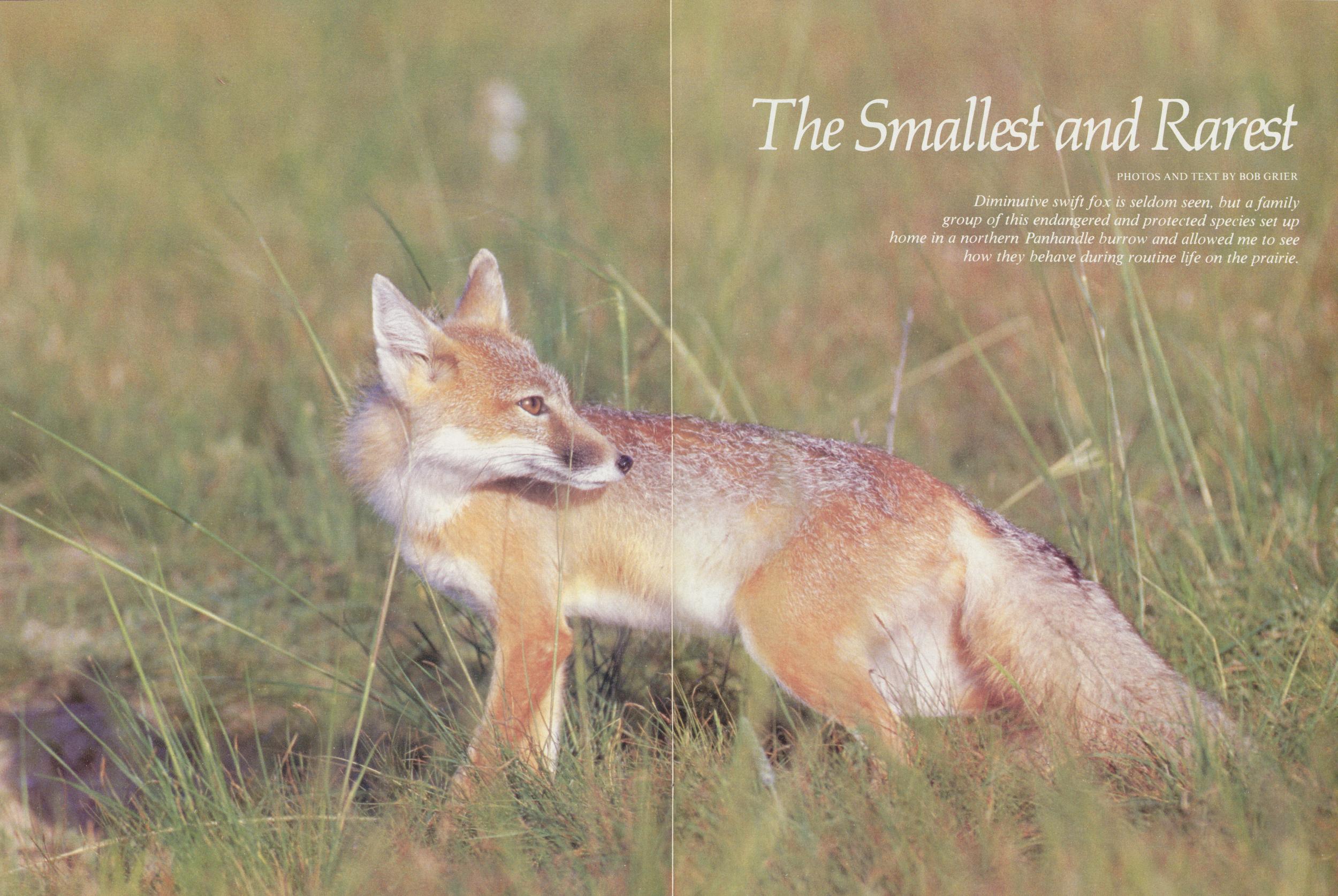
PHOTOS AND TEXT BY BOB GRIER Diminutive swift fox is seldom seem but a family group of this endangered and protected species set up home in a northern Panhandle burrow and allowed me to see how they behave during routine life on the prairie.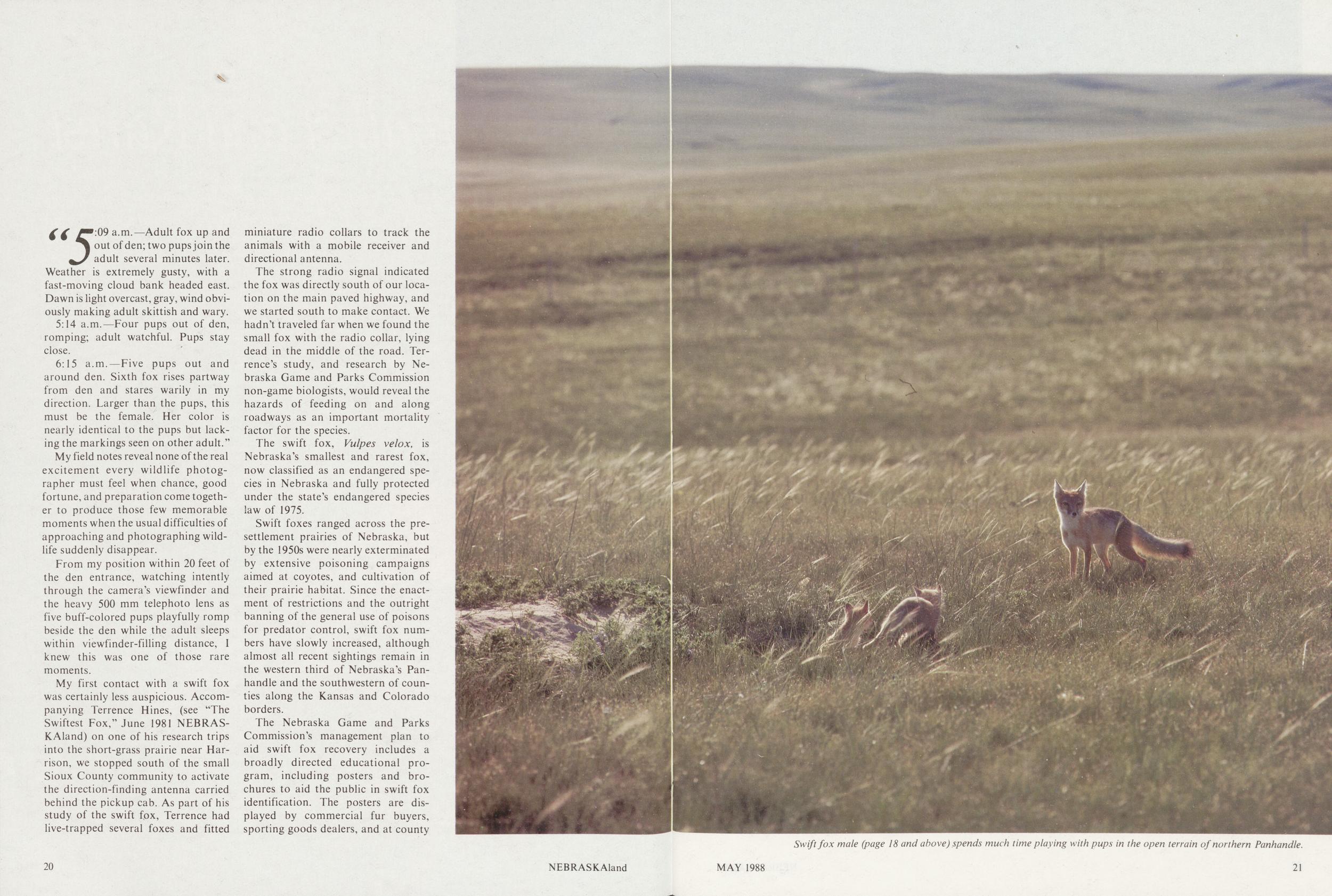
"5:09 a.m.—Adult fox up and out of den; two pups join the ^y adult several minutes later. Weather is extremely gusty, with a fast-moving cloud bank headed east. Dawn is light overcast, gray, wind obviously making adult skittish and wary.
5:14 a.m.—Four pups out of den, romping; adult watchful. Pups stay close.
6:15 a.m.—Five pups out and around den. Sixth fox rises partway from den and stares warily in my direction. Larger than the pups, this must be the female. Her color is nearly identical to the pups but lacking the markings seen on other adult."
My field notes reveal none of the real excitement every wildlife photographer must feel when chance, good fortune, and preparation come together to produce those few memorable moments when the usual difficulties of approaching and photographing wildlife suddenly disappear.
From my position within 20 feet of the den entrance, watching intently through the camera's viewfinder and the heavy 500 mm telephoto lens as five buff-colored pups playfully romp beside the den while the adult sleeps within viewfinder-filling distance, 1 knew this was one of those rare moments.
My first contact with a swift fox was certainly less auspicious. Accompanying Terrence Hines, (see "The Swiftest Fox," June 1981 NEBRASKAland) on one of his research trips into the short-grass prairie near Harrison, we stopped south of the small Sioux County community to activate the direction-finding antenna carried behind the pickup cab. As part of his study of the swift fox, Terrence had live-trapped several foxes and fitted miniature radio collars to track the animals with a mobile receiver and directional antenna.
The strong radio signal indicated the fox was directly south of our location on the main paved highway, and we started south to make contact. We hadn't traveled far when we found the small fox with the radio collar, lying dead in the middle of the road. Terrence's study, and research by Nebraska Game and Parks Commission non-game biologists, would reveal the hazards of feeding on and along roadways as an important mortality factor for the species.
The swift fox, Vulpes velox, is Nebraska's smallest and rarest fox, now classified as an endangered species in Nebraska and fully protected under the state's endangered species law of 1975.
Swift foxes ranged across the presettlement prairies of Nebraska, but by the 1950s were nearly exterminated by extensive poisoning campaigns aimed at coyotes, and cultivation of their prairie habitat. Since the enactment of restrictions and the outright banning of the general use of poisons for predator control, swift fox numbers have slowly increased, although almost all recent sightings remain in the western third of Nebraska's Panhandle and the southwestern of counties along the Kansas and Colorado borders.
The Nebraska Game and Parks Commission's management plan to aid swift fox recovery includes a broadly directed educational program, including posters and brochures to aid the public in swift fox identification. The posters are displayed by commercial fur buyers, sporting goods dealers, and at county extension offices and schools.
20 NEBRASKAland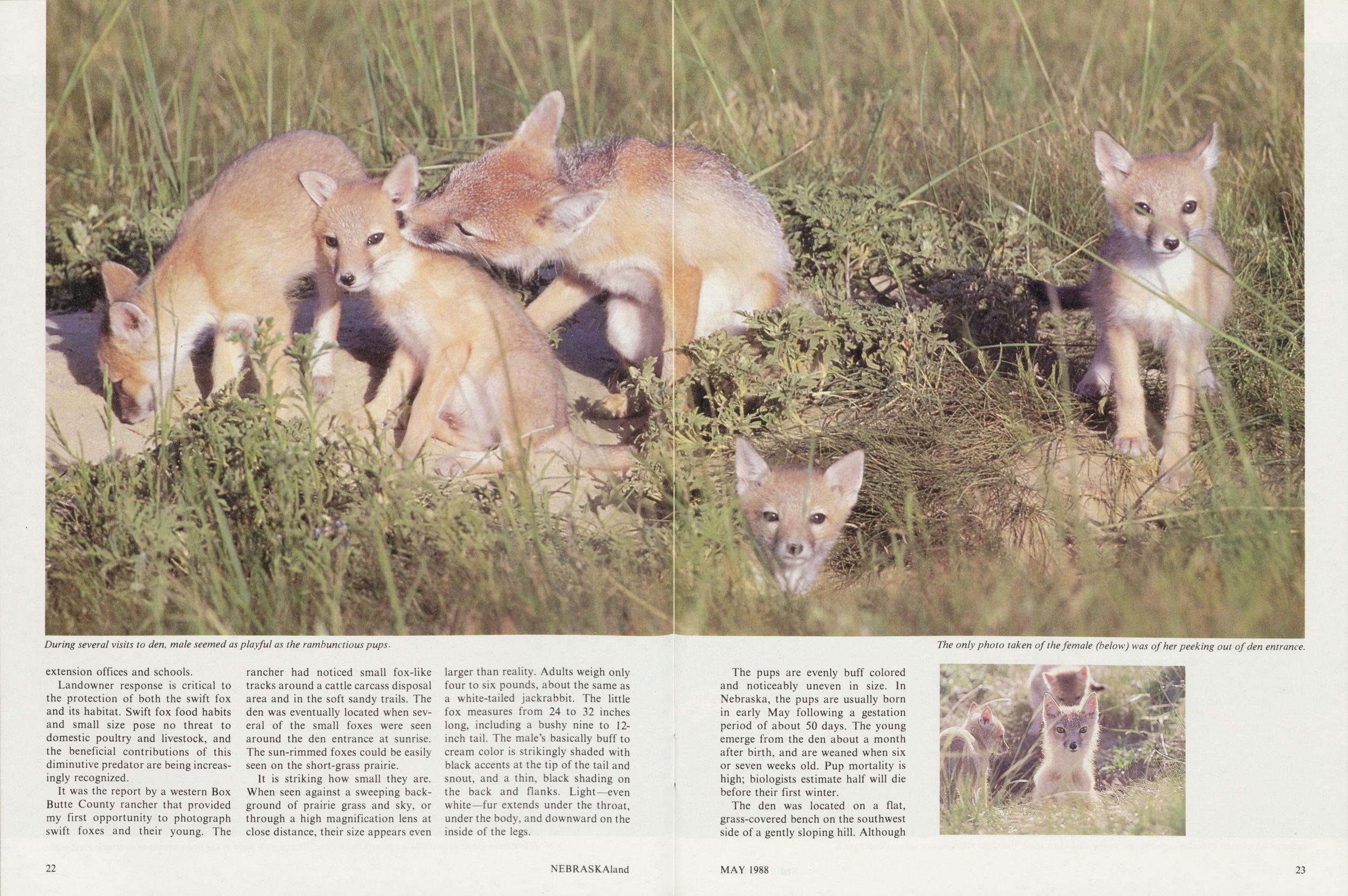
Landowner response is critical to the protection of both the swift fox and its habitat. Swift fox food habits and small size pose no threat to domestic poultry and livestock, and the beneficial contributions of this diminutive predator are being increasingly recognized.
It was the report by a western Box Butte County rancher that provided my first opportunity to photograph swift foxes and their young. The rancher had noticed small fox-like tracks around a cattle carcass disposal area and in the soft sandy trails. The den was eventually located when several of the small foxes were seen around the den entrance at sunrise. The sun-rimmed foxes could be easily seen on the short-grass prairie.
It is striking how small they are. When seen against a sweeping background of prairie grass and sky, or through a high magnification lens at close distance, their size appears even larger than reality. Adults weigh only four to six pounds, about the same as a white-tailed jackrabbit. The little fox measures from 24 to 32 inches long, including a bushy nine to 12-inch tail. The male's basically buff to cream color is strikingly shaded with black accents at the tip of the tail and snout, and a thin, black shading on the back and flanks. Light—even white—fur extends under the throat, under the body, and downward on the inside of the legs.
22 NEBRASKAlandThe pups are evenly buff colored and noticeably uneven in size. In Nebraska, the pups are usually born in early May following a gestation period of about 50 days. The young emerge from the den about a month after birth, and are weaned when six or seven weeks old. Pup mortality is high; biologists estimate half will die before their first winter.
The den was located on a flat, grass-covered bench on the southwest side of a gently sloping hill. Although no mound of dirt or debris extended above the ground surface, the den had a small, bare spot along the south rim, more visible through a high magnification lens or the resulting photographs. The den entrance was well hidden and difficult to find until closely approached.
MAY 1988 23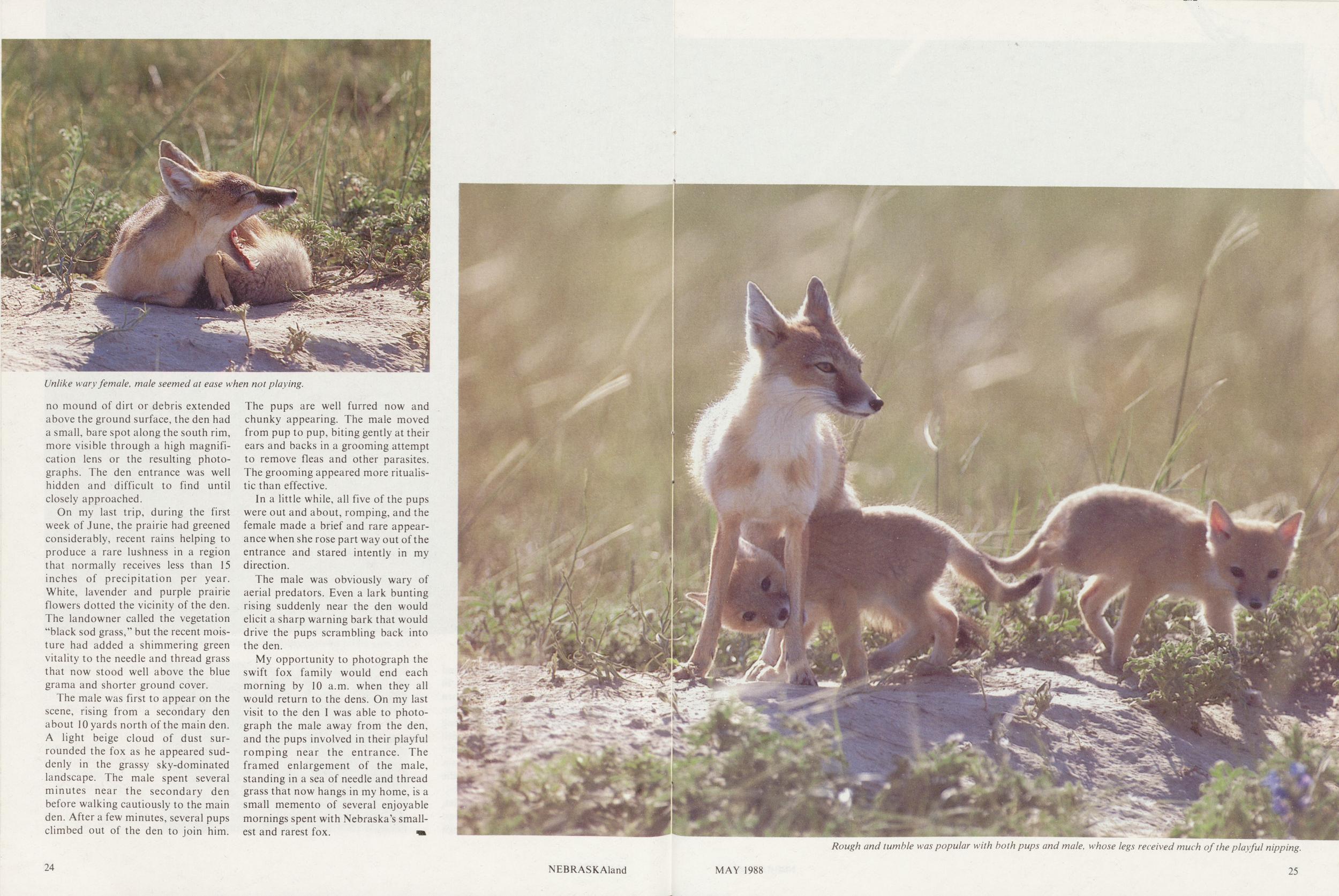
On my last trip, during the first week of June, the prairie had greened considerably, recent rains helping to produce a rare lushness in a region that normally receives less than 15 inches of precipitation per year. White, lavender and purple prairie flowers dotted the vicinity of the den. The landowner called the vegetation "black sod grass," but the recent moisture had added a shimmering green vitality to the needle and thread grass that now stood well above the blue grama and shorter ground cover.
The male was first to appear on the scene, rising from a secondary den about 10 yards north of the main den. A light beige cloud of dust surrounded the fox as he appeared suddenly in the grassy sky-dominated landscape. The male spent several minutes near the secondary den before walking cautiously to the main den. After a few minutes, several pups climbed out of the den to join him. The pups are well furred now and chunky appearing. The male moved from pup to pup, biting gently at their ears and backs in a grooming attempt to remove fleas and other parasites. The grooming appeared more ritualistic than effective.
In a little while, all five of the pups were out and about, romping, and the female made a brief and rare appearance when she rose part way out of the entrance and stared intently in my direction.
The male was obviously wary of aerial predators. Even a lark bunting rising suddenly near the den would elicit a sharp warning bark that would drive the pups scrambling back into the den.
My opportunity to photograph the swift fox family would end each morning by 10 a.m. when they all would return to the dens. On my last visit to the den I was able to photograph the male away from the den, and the pups involved in their playful romping near the entrance. The framed enlargement of the male, standing in a sea of needle and thread grass that now hangs in my home, is a small memento of several enjoyable mornings spent with Nebraska's smallest and rarest fox.
24 NEBRASKAland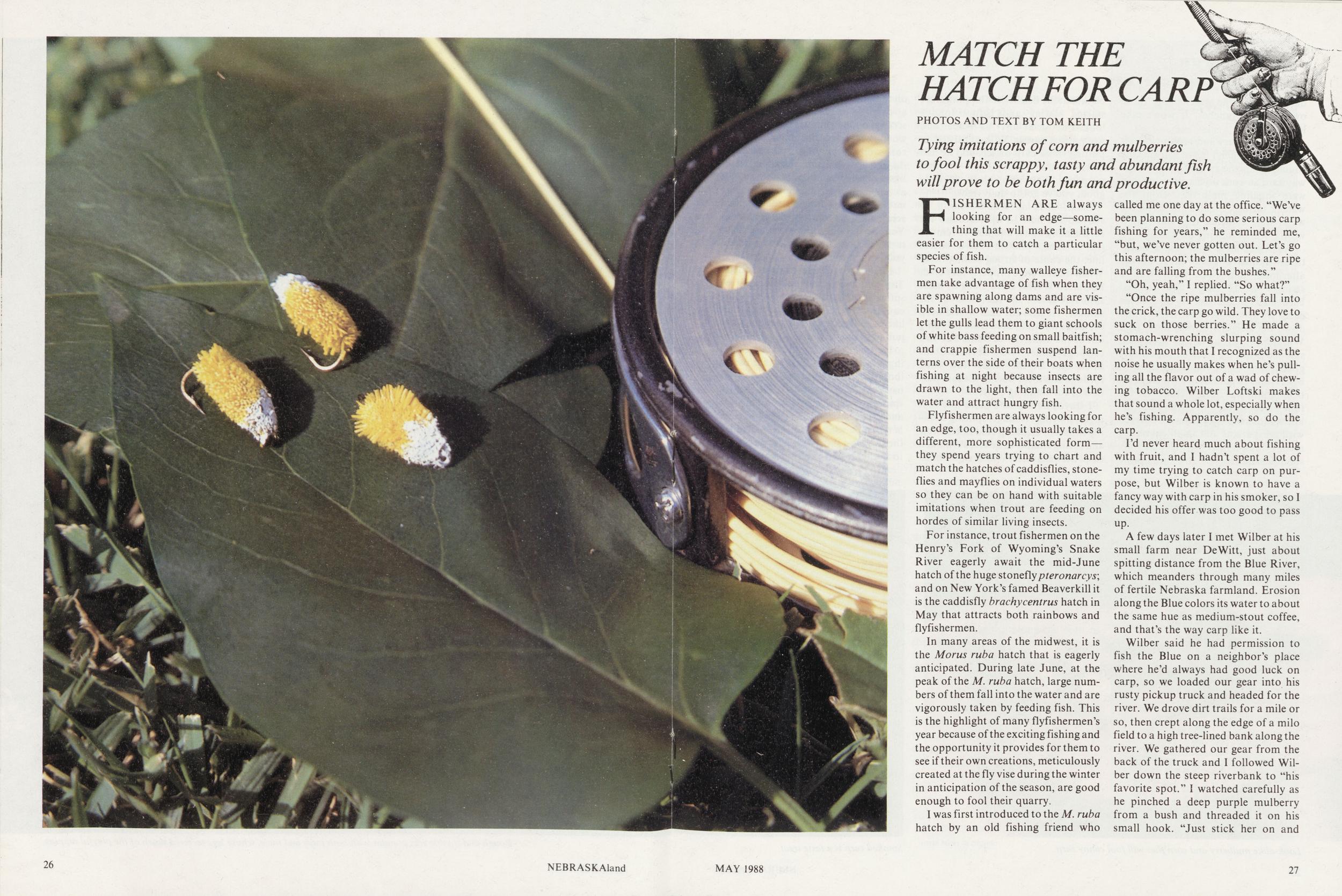
MATCH THE HATCH FOR CARP
PHOTOS AND TEXT BY TOM KEITH Tying imitations of corn and mulberries to fool this scrappy, tasty and abundant fish will prove to be both fun and productive.FISHERMEN ARE always looking for an edge—something that will make it a little easier for them to catch a particular species of fish.
For instance, many walleye fishermen take advantage of fish when they are spawning along dams and are visible in shallow water; some fishermen let the gulls lead them to giant schools of white bass feeding on small baitfish; and crappie fishermen suspend lanterns over the side of their boats when fishing at night because insects are drawn to the light, then fall into the water and attract hungry fish.
Fly fishermen are always looking for an edge, too, though it usually takes a different, more sophisticated form they spend years trying to chart and match the hatches of caddisflies, stoneflies and mayflies on individual waters so they can be on hand with suitable imitations when trout are feeding on hordes of similar living insects.
For instance, trout fishermen on the Henry's Fork of Wyoming's Snake River eagerly await the mid-June hatch of the huge stonefly pteronarcys; and on New York's famed Beaverkill it is the caddisfly brachycentrus hatch in May that attracts both rainbows and fly fishermen.
In many areas of the midwest, it is the Morus ruba hatch that is eagerly anticipated. During late June, at the peak of the M. ruba hatch, large numbers of them fall into the water and are vigorously taken by feeding fish. This is the highlight of many fly fishermen's year because of the exciting fishing and the opportunity it provides for them to see if their own creations, meticulously created at the fly vise during the winter in anticipation of the season, are good enough to fool their quarry.
I was first introduced to the M. ruba hatch by an old fishing friend who called me one day at the office. "We've been planning to do some serious carp fishing for years," he reminded me, "but, we've never gotten out. Let's go this afternoon; the mulberries are ripe and are falling from the bushes."
Oh, yeah," I replied. "So what?"
Once the ripe mulberries fall into the crick, the carp go wild. They love to suck on those berries." He made a stomach-wrenching slurping sound with his mouth that I recognized as the noise he usually makes when he's pulling all the flavor out of a wad of chewing tobacco. Wilber Loftski makes that sound a whole lot, especially when he's fishing. Apparently, so do the carp.
I'd never heard much about fishing with fruit, and I hadn't spent a lot of my time trying to catch carp on purpose, but Wilber is known to have a fancy way with carp in his smoker, so I decided his offer was too good to pass up.
A few days later I met Wilber at his small farm near DeWitt, just about spitting distance from the Blue River, which meanders through many miles of fertile Nebraska farmland. Erosion along the Blue colors its water to about the same hue as medium-stout coffee, and that's the way carp like it.
Wilber said he had permission to
fish the Blue on a neighbor's place
where he'd always had good luck on
carp, so we loaded our gear into his
rusty pickup truck and headed for the
river. We drove dirt trails for a mile or
so, then crept along the edge of a milo
field to a high tree-lined bank along the
river. We gathered our gear from the
back of the truck and I followed
Wilber down the steep riverbank to "his
favorite spot." I watched carefully as
he pinched a deep purple mulberry
from a bush and threaded it on his
small hook. "Just stick her on and
MAY 1988
27
 drop her into the water under those
over hangin' branches. It won't take
long."
drop her into the water under those
over hangin' branches. It won't take
long."
I picked a berry and was impaling it on my hook when I heard soft sucking sounds from the river. Either Wilber was hard at work on his chaw, or carp were inhaling mulberries from the water's surface. Small bubbles on the water were evidence that this time it wasn't Wilber making the sound.
We fished that spot—right under those mulberry trees—most of the afternoon, and came away with a stringer of 16 carp that weighed between two and about AVi pounds each. We had to make two trips up and down the steep bank with those fish. Wilber, in his advanced age, had skipped down the steep bank in pretty good shape, but going back up with better than 20 pounds of carp dragging behind him was quite a chore. By the time he got to the top of the slope the knees of his bib overalls were covered with grass stains and small chunks of mud. I threw a heavy stringer over my shoulder and started strutting up the bank, but the fish began flopping and I started sliding and before long I looked about as dirty as Wilber and was puffing harder. Wilbur insisted on putting those carp on ice, and he had several coolers in the truck for that purpose. "You want them to taste good, you've got to do it right."
Later, back at Wilber's farm, he showed me how to fillet around the carp's many bones and how to remove the ominous pinkish-brown lateral line, the cause of strong-tasting flesh. When the fish were properly prepared, he placed several thick slabs of meat skin-side down on the racks of his smoker. He said the skin would keep the fish's natural juices from dripping out of the meat. Three hours and two cribbage games later, he turned the fillets and let the juices flow back through the meat during the last portion of the smoking process.
I stayed at Wilber's place late that night, playing cribbage, spitting chewing tobacco, drinking cold home brew and eating chunks of delicious smoked carp. Between bites, Wilber expounded on the carp's fighting abilities. He said a carp is "an ornery, two-fisted scrapper that gets a mite belligerent when the hook stings him. He won't roll over and play dead like walleyes do, and he won't jump out of the water like a rainbow or bass. When you fight a carp, it's like getting right down there in the mud with him and clawing and scratching to see who's the best man. You better know how to use your tackle or you'll reel in a broken line if you hook into a big one."
I had to agree with his assessment. The carp we'd hooked that day on spinning gear had been tough, and I could only imagine what it would be like to hook a roughneck three or four pounder on a flyrod.
I spent the next several days thinking about how to tie a fly that would look like a mulberry, which was one bait I knew would catch fish. I tried spinning purple deer hair on a hook and trimming it to shape, but I remembered that while mulberries float on the surface a short distance, they begin to sink as the current moves them along. Deer hair flies float forever and probably appear unnatural to the fish if they don't start to sink, so I ruled out deer hair as a suitable material. I experimented with a variety of other materials and found that floss winds too flat, dubbing just doesn't look right, and mohlon is too fibrous. I finally decided chenille is perfect for construction of a mulberry fly.
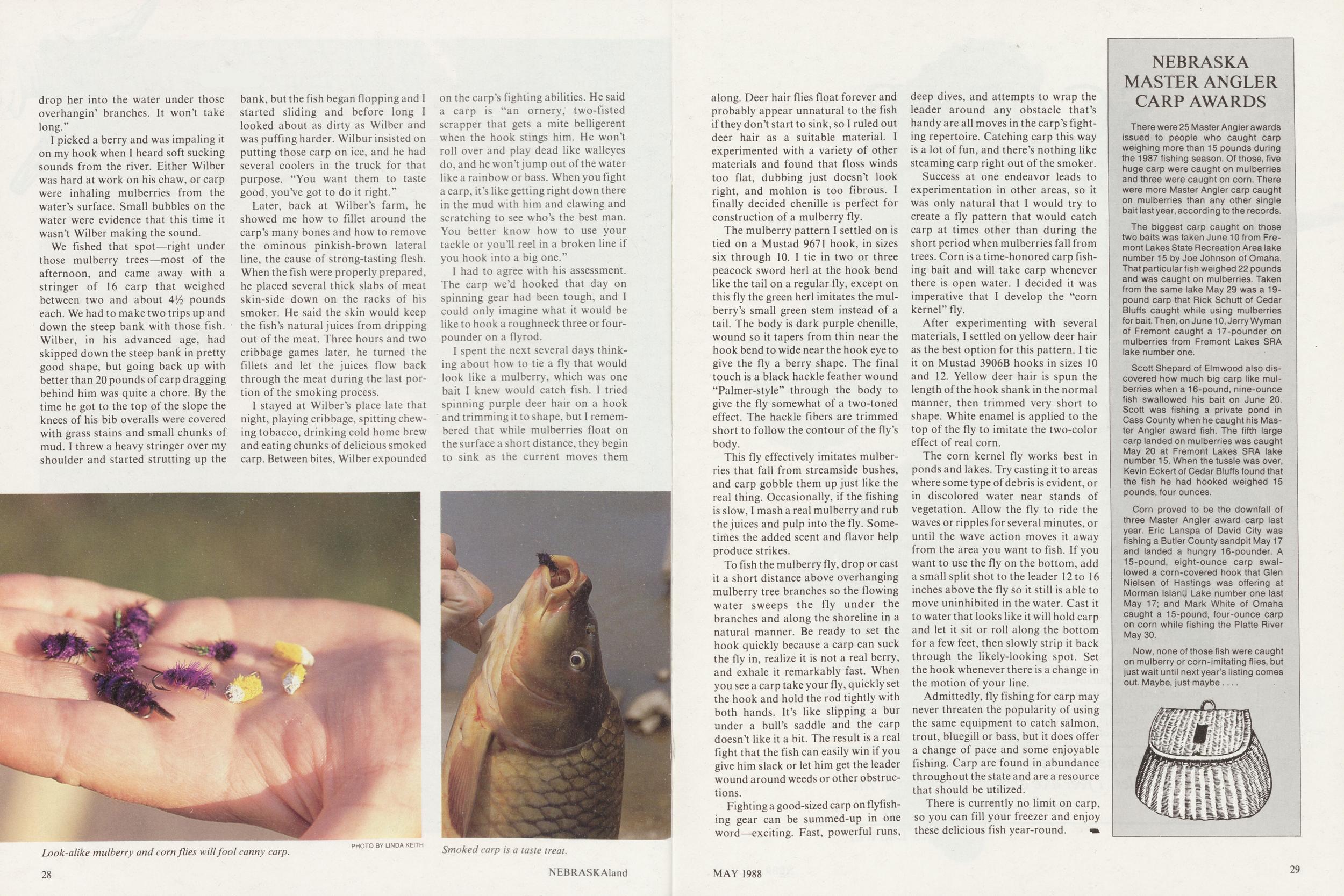
The mulberry pattern I settled on is tied on a Mustad 9671 hook, in sizes six through 10. I tie in two or three peacock sword herl at the hook bend like the tail on a regular fly, except on this fly the green herl imitates the mulberry's small green stem instead of a tail. The body is dark purple chenille, wound so it tapers from thin near the hook bend to wide near the hook eye to give the fly a berry shape. The final touch is a black hackle feather wound "Palmer-style" through the body to give the fly somewhat of a two-toned effect. The hackle fibers are trimmed short to follow the contour of the fly's body.
This fly effectively imitates mulberries that fall from stream side bushes, and carp gobble them up just like the real thing. Occasionally, if the fishing is slow, I mash a real mulberry and rub the juices and pulp into the fly. Sometimes the added scent and flavor help produce strikes.
To fish the mulberry fly, drop or cast it a short distance above overhanging mulberry tree branches so the flowing water sweeps the fly under the branches and along the shoreline in a natural manner. Be ready to set the hook quickly because a carp can suck the fly in, realize it is not a real berry, and exhale it remarkably fast. When you see a carp take your fly, quickly set the hook and hold the rod tightly with both hands. It's like slipping a bur under a bull's saddle and the carp doesn't like it a bit. The result is a real fight that the fish can easily win if you give him slack or let him get the leader wound around weeds or other obstructions.
Fighting a good-sized carp on fly fishing gear can be summed-up in one word—exciting. Fast, powerful runs, deep dives, and attempts to wrap the leader around any obstacle that's handy are all moves in the carp's fighting repertoire. Catching carp this way is a lot of fun, and there's nothing like steaming carp right out of the smoker.
Success at one endeavor leads to experimentation in other areas, so it was only natural that I would try to create a fly pattern that would catch carp at times other than during the short period when mulberries fall from trees. Corn is a time-honored carp fishing bait and will take carp whenever there is open water. I decided it was imperative that I develop the "corn kernel" fly.
After experimenting with several materials, I settled on yellow deer hair as the best option for this pattern. I tie it on Mustad 3906B hooks in sizes 10 and 12. Yellow deer hair is spun the length of the hook shank in the normal manner, then trimmed very short to shape. White enamel is applied to the top of the fly to imitate the two-color effect of real corn.
The corn kernel fly works best in ponds and lakes. Try casting it to areas where some type of debris is evident, or in discolored water near stands of vegetation. Allow the fly to ride the waves or ripples for several minutes, or until the wave action moves it away from the area you want to fish. If you want to use the fly on the bottom, add a small split shot to the leader 12 to 16 inches above the fly so it still is able to move uninhibited in the water. Cast it to water that looks like it will hold carp and let it sit or roll along the bottom for a few feet, then slowly strip it back through the likely-looking spot. Set the hook whenever there is a change in the motion of your line.
Admittedly, fly fishing for carp may never threaten the popularity of using the same equipment to catch salmon, trout, bluegill or bass, but it does offer a change of pace and some enjoyable fishing. Carp are found in abundance throughout the state and are a resource that should be utilized.
There is currently no limit on carp, so you can fill your freezer and enjoy these delicious fish year-round.
NEBRASKA MASTER ANGLER CARP AWARDSThere were 25 Master Angler awards issued to people who caught carp weighing more than 15 pounds during the 1987 fishing season. Of those, five huge carp were caught on mulberries and three were caught on corn. There were more Master Angler carp caught on mulberries than any other single bait last year, according to the records.
The biggest carp caught on those two baits was taken June 10 from Fremont Lakes State Recreation Area lake number 15 by Joe Johnson of Omaha. That particular fish weighed 22 pounds and was caught on mulberries. Taken from the same lake May 29 was a 19-pound carp that Rick Schutt of Cedar Bluffs caught while using mulberries for bait. Then, on June 10, Jerry Wyman of Fremont caught a 17-pounder on mulberries from Fremont Lakes SRA lake number one.
Scott Shepard of Elmwood also discovered how much big carp like mulberries when a 16-pound, nine-ounce fish swallowed his bait on June 20. Scott was fishing a private pond in Cass County when he caught his Master Angler award fish. The fifth large carp landed on mulberries was caught May 20 at Fremont Lakes SRA lake number 15. When the tussle was over, Kevin Eckert of Cedar Bluffs found that the fish he had hooked weighed 15 pounds, four ounces.
Corn proved to be the downfall of three Master Angler award carp last year. Eric Lanspa of David City was fishing a Butler County sandpit May 17 and landed a hungry 16-pounder. A 15-pound, eight-ounce carp swallowed a corn-covered hook that Glen Nielsen of Hastings was offering at Morman Island Lake number one last May 17; and Mark White of Omaha caught a 15-pound, four-ounce carp on corn while fishing the Platte River May 30.
Now, none of those fish were caught on mulberry or corn-imitating flies, but just wait until next year's listing comes out. Maybe, just maybe-----
SCARAB BEETLES
Jewelled Pollinators, Dung Feeders, and Horned Giants BY BRETT C RATCLIFFE, CURATOR OF INSECTS, UN-L STATE MUSEUM ILLUSTRATIONS BY MARK E. MARCUSON, MUSEUM ARTIST "Whenever I hear of the capture of rare beetles, I feel like an old war horse at the sound of a trumpet." Charles DarwinRED SKY MELTING to pewter. Shimmering August heat, sticky humidity, cicadas humming to one another as dusk overtakes the country near Salem, Nebraska. By ones, twos, and then squadrons, a white ash tree beckons Nebraska's largest beetles, unicorns of the family Scarabaeidae, down from their pre- nuptial flight through dark skies. Though numerous to the point of exasperation to local farmers, this, the largest beetle in the state, was entirely unknown to Nebraska entomologists until 1979. A mass emergence of these insects so late in the year came as a great surprise and probably contributed to their being overlooked for so long. After all, most adult insects in Nebraska are preparing for winter or nearing the end of their lives rather than just emerging into the world. With their bodies turning the tree trunk literally black as the night wears on, the unicorn beetles descend to the ground and burrow under the surface preparatory to mating and laying eggs. Why they choose this same tree to fly to year after year is a total mystery.
One out of very four living things on planet Earth is a beetle! Of the approximately 350,000 known species of beetles, or Coleoptera, about 30,000 are scarabs. Some of the most beautiful insects in the world belong to the family Scarabaeidae, one of over 150 different families of beetles. The common June beetles, familiar insects to everyone, are also scarabs. Of all the beetles, scarabs are among the best known because of their beauty, fascinating life histories, and economic importance. There are about 1,500 species of Scarabaeidae in North America, and Nebraska has nearly 200 species.
You may easily distinguish scarabs from other families of beetles by the presence of segmented antennae terminating with a lamellate (plate-like), oval club of three to seven leaves that can be expanded fanwise or folded compactly together. Scarabs sense odors with their antennae, and the large "club" increases the surface area of the sensory receptors. These beetles are generally of robust body form as adults, and range from the size of a pinhead to eight inches in length. The immature stages, or larvae, are the C-shaped white grubs familiar to gardeners.
Most scarabs have a similar life cycle although the life span may vary considerably. They usually lay a small number of eggs, and adults of some show manifestations of parental care. The eggs are deposited in the soil, in rotting vegetation or logs, or in other organic material. After hatching, the larvae feed and grow, molting several times in the process. A short period of pupation follows during which the larva transforms (by a process not yet fully understood) to the adult insect. Emergence from the pupa occurs after a specified time or in reaction to environmental cues such as rainfall or temperature.
30 NEBRASKAland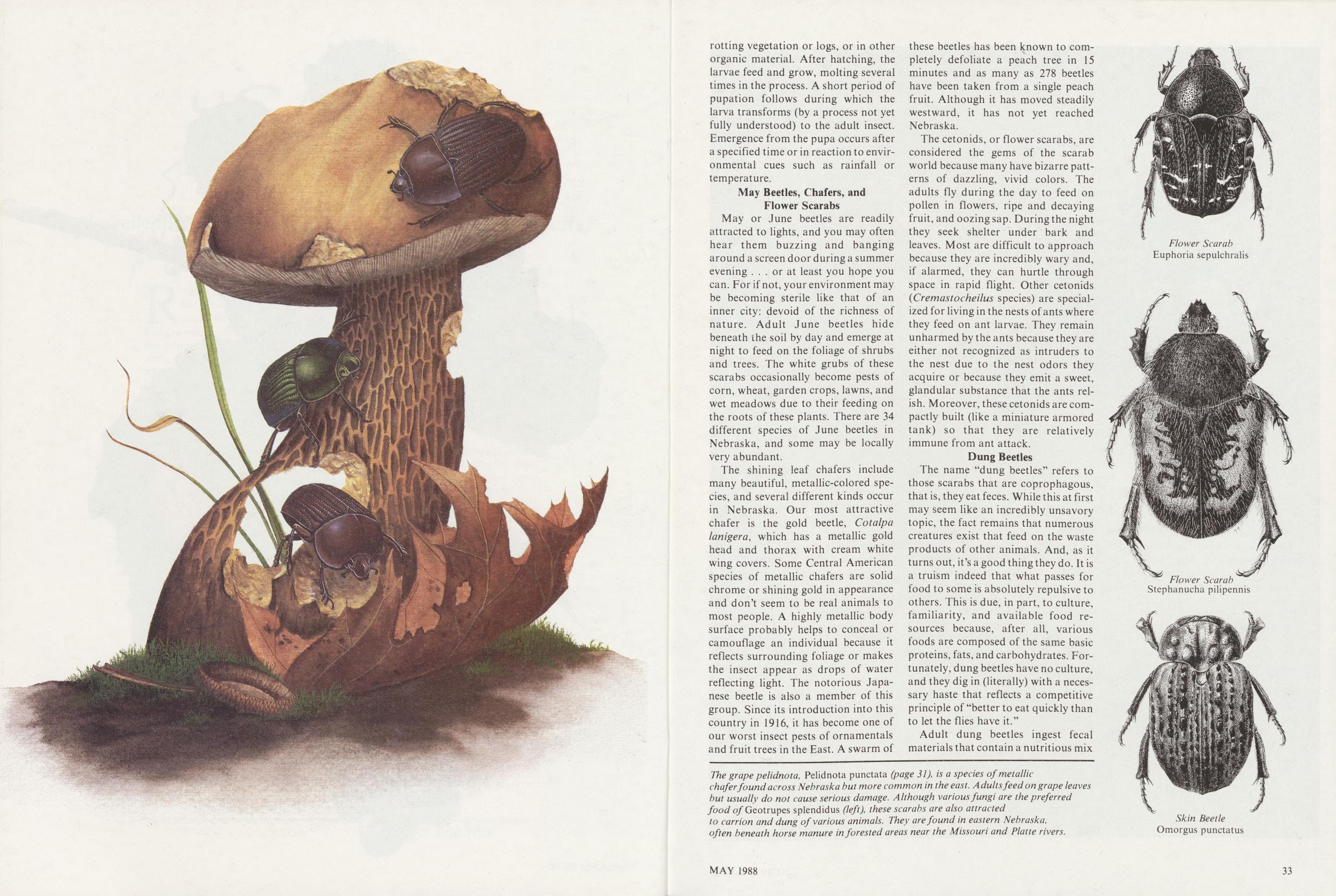
May or June beetles are readily attracted to lights, and you may often hear them buzzing and banging around a screen door during a summer evening ... or at least you hope you can. For if not, your environment may be becoming sterile like that of an inner city: devoid of the richness of nature. Adult June beetles hide beneath the soil by day and emerge at night to feed on the foliage of shrubs and trees. The white grubs of these scarabs occasionally become pests of corn, wheat, garden crops, lawns, and wet meadows due to their feeding on the roots of these plants. There are 34 different species of June beetles in Nebraska, and some may be locally very abundant.
The shining leaf chafers include many beautiful, metallic-colored species, and several different kinds occur in Nebraska. Our most attractive chafer is the gold beetle, Cotalplanigera, which has a metallic gold head and thorax with cream white wing covers. Some Central American species of metallic chafers are solid chrome or shining gold in appearance and don't seem to be real animals to most people. A highly metallic body surface probably helps to conceal or camouflage an individual because it reflects surrounding foliage or makes the insect appear as drops of water reflecting light. The notorious Japanese beetle is also a member of this group. Since its introduction into this country in 1916, it has become one of our worst insect pests of ornamentals and fruit trees in the East. A swarm of these beetles has been known to completely defoliate a peach tree in 15 minutes and as many as 278 beetles have been taken from a single peach fruit. Although it has moved steadily westward, it has not yet reached Nebraska.
The cetonids, or flower scarabs, are considered the gems of the scarab world because many have bizarre patterns of dazzling, vivid colors. The adults fly during the day to feed on pollen in flowers, ripe and decaying fruit, and oozing sap. During the night they seek shelter under bark and leaves. Most are difficult to approach because they are incredibly wary and, if alarmed, they can hurtle through space in rapid flight. Other cetonids (Cremastocheilus species) are specialized for living in the nests of ants where they feed on ant larvae. They remain unharmed by the ants because they are either not recognized as intruders to the nest due to the nest odors they acquire or because they emit a sweet, glandular substance that the ants relish. Moreover, these cetonids are compactly built (like a miniature armored tank) so that they are relatively immune from ant attack.
The name "dung beetles" refers to those scarabs that are coprophagous, that is, they eat feces. While this at first may seem like an incredibly unsavory topic, the fact remains that numerous creatures exist that feed on the waste products of other animals. And, as it turns out, it's a good thing they do. It is a truism indeed that what passes for food to some is absolutely repulsive to others. This is due, in part, to culture, familiarity, and available food resources because, after all, various foods are composed of the same basic proteins, fats, and carbohydrates. Fortunately, dung beetles have no culture, and they dig in (literally) with a necessary haste that reflects a competitive principle of "better to eat quickly than to let the flies have it."
Adult dung beetles ingest fecal materials that contain a nutritious mix (for beetles anyway) of undigested food remnants, products of secretion and excretion, bacteria, yeasts, and molds. These beetles possess modifications in body structure for coprophagy ranging from elongated and bowed legs for handling spherical dung masses to serrations on the legs and head that are used for cutting and moving dung masses and burrowing into the ground.
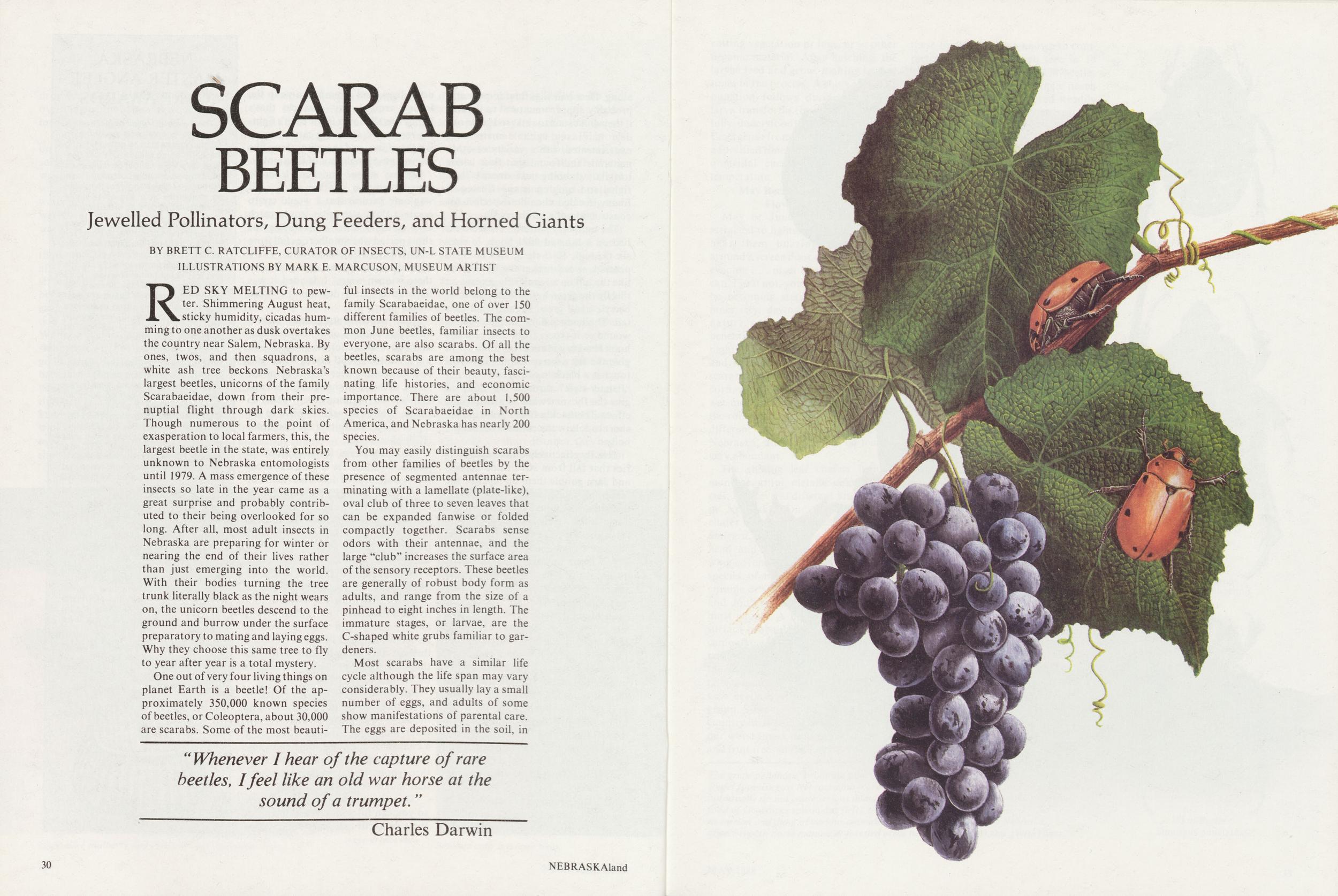
The grape pelidnota, Pelidnota punctata (page 31), is a species of metallic chafer found across Nebraska but more common in the east. Adults feed on grape leaves but usually do not cause serious damage. Although various fungi are the preferred food of Geotrupes splendidus (left), these scarabs are also attracted to carrion and dung of various animals. They are found in eastern Nebraska, often beneath horse manure in forces ted areas near the Missouri and Platte rivers. MAY 1988 33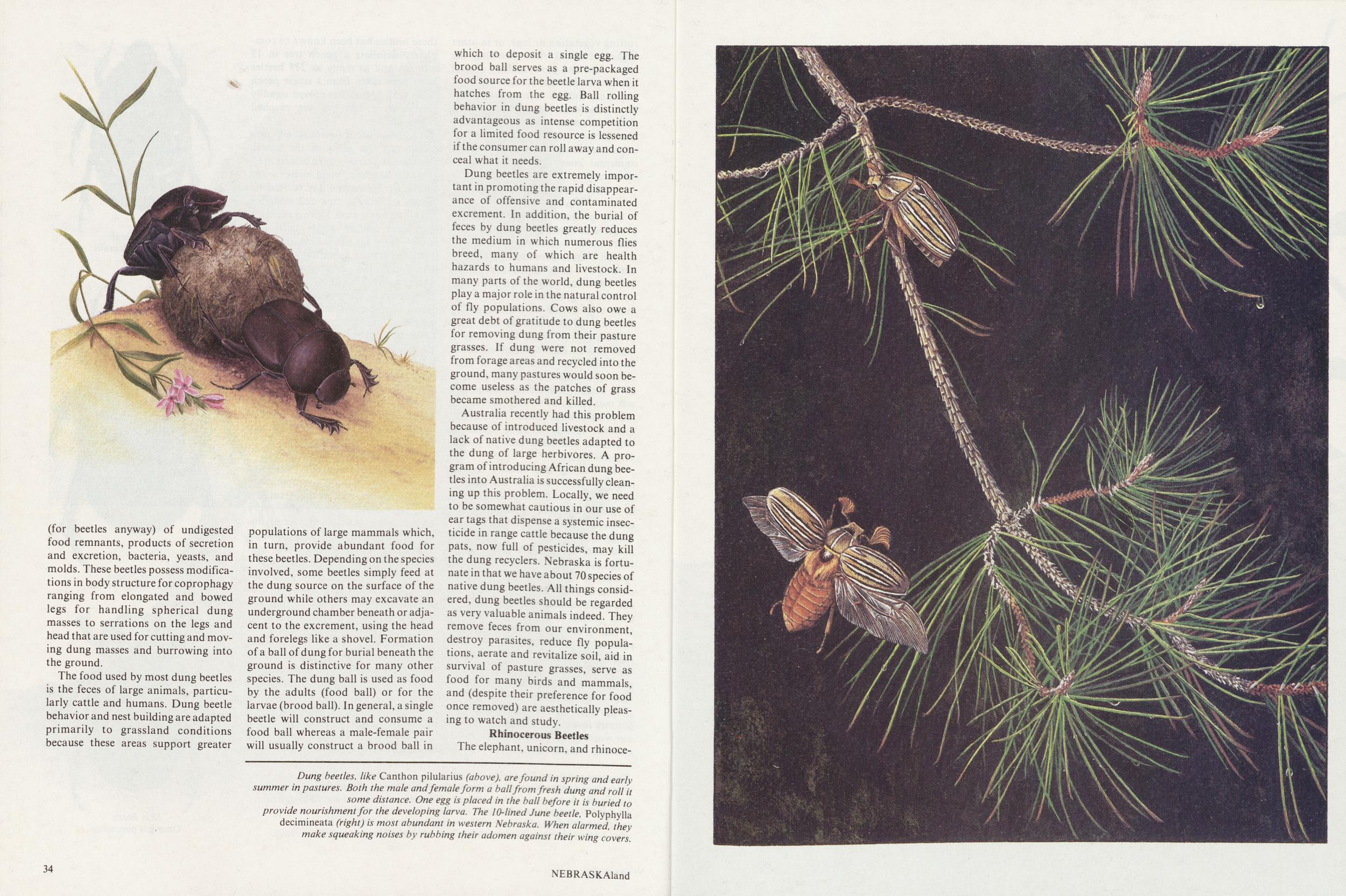
The food used by most dung beetles is the feces of large animals, particularly cattle and humans. Dung beetle behavior and nest building are adapted primarily to grassland conditions because these areas support greater populations of large mammals which, in turn, provide abundant food for these beetles. Depending on the species involved, some beetles simply feed at the dung source on the surface of the ground while others may excavate an underground chamber beneath or adjacent to the excrement, using the head and forelegs like a shovel. Formation of a ball of dung for burial beneath the ground is distinctive for many other species. The dung ball is used as food by the adults (food ball) or for the larvae (brood ball). In general, a single beetle will construct and consume a food ball whereas a male-female pair will usually construct a brood ball in which to deposit a single egg. The brood ball serves as a pre-packaged food source for the beetle larva when it hatches from the egg. Ball rolling behavior in dung beetles is distinctly advantageous as intense competition for a limited food resource is lessened if the consumer can roll away and conceal what it needs.
Dung beetles are extremely important in promoting the rapid disappearance of offensive and contaminated excrement. In addition, the burial of feces by dung beetles greatly reduces the medium in which numerous flies breed, many of which are health hazards to humans and livestock. In many parts of the world, dung beetles play a major role in the natural control of fly populations. Cows also owe a great debt of gratitude to dung beetles for removing dung from their pasture grasses. If dung were not removed from forage areas and recycled into the ground, many pastures would soon become useless as the patches of grass became smothered and killed.
Australia recently had this problem because of introduced livestock and a lack of native dung beetles adapted to the dung of large herbivores. A program of introducing African dung beetles into Australia is successfully cleaning up this problem. Locally, we need to be somewhat cautious in our use of ear tags that dispense a systemic insecticide in range cattle because the dung pats, now full of pesticides, may kill the dung recyclers. Nebraska is fortunate in that we have about 70 species of native dung beetles. All things considered, dung beetles should be regarded as very valuable animals indeed. They remove feces from our environment, destroy parasites, reduce fly populations, aerate and revitalize soil, aid in survival of pasture grasses, serve as food for many birds and mammals, and (despite their preference for food once removed) are aesthetically pleasing to watch and study.
Dung beetles, like Canthon pilularius (above), are found in spring and early summer in pastures. Both the male and female form a ball from fresh dung and roll it some distance. One egg is placed in the ball before it is buried to provide nourishment for the developing larva. The 10- lined June beetle, Polyphylla decimineata (right) is most abundant in western Nebraska. When alarmed, they make squeaking noises by rubbing their adomen against their wing covers. Rhinoceros BeetlesThe elephant, unicorn, and ros beetles are names given to those scarabs that possess horns. These beetles are the largest and possibly the most spectacular insects in the world. Sexual dimorphism is well developed in most species, meaning the males are larger or often possess huge, curving horns whereas the females do not. The largest of these beetles are found in the tropics where the conditions of relatively constant temperature and high humidity favor their development. Nebraska's relatively small unicorn beetle, Xyloryctes jamaicensis, has a simple, upright horn in the male; this species was not known to exist in Nebraska until 1979. Horns in many scarabs take on a bewildering array of shapes, forms and sizes. Amazingly, we still do not fully understand their function in most species if, indeed, they have a function. We do know that the males of some scarabs will battle one another over a suitable feeding site that also attracts females. In this case, horns are used in combat to pry a rival male from his perch.
34 NEBRASKAland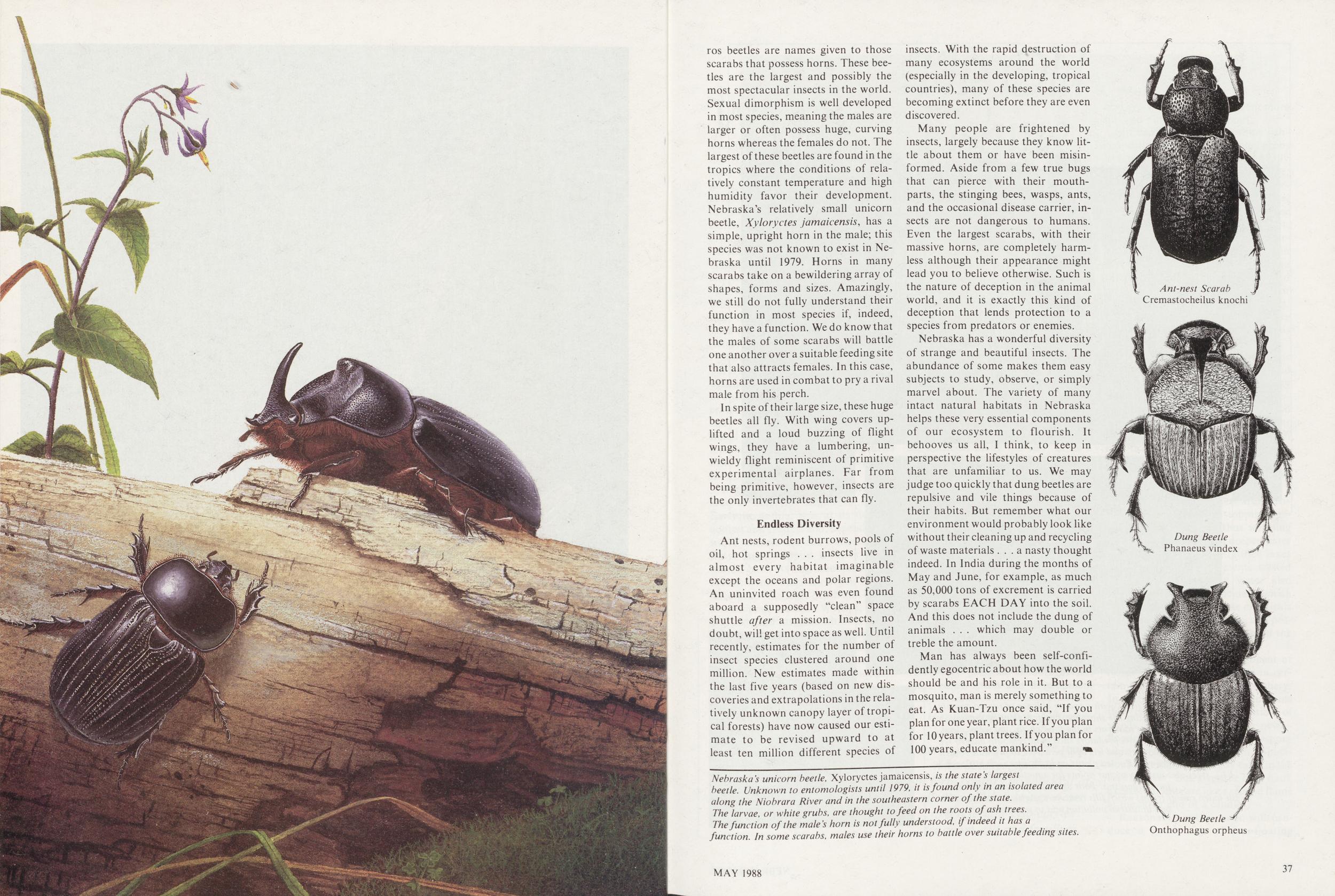
In spite of their large size, these huge beetles all fly. With wing covers uplifted and a loud buzzing of flight wings, they have a lumbering, unwieldy flight reminiscent of primitive experimental airplanes. Far from being primitive, however, insects are the only invertebrates that can fly.
Endless DiversityAnt nests, rodent burrows, pools of oil, hot springs . . . insects live in almost every habitat imaginable except the oceans and polar regions. An uninvited roach was even found aboard a supposedly "clean" space shuttle after a mission. Insects, no doubt, will get into space as well. Until recently, estimates for the number of insect species clustered around one million. New estimates made within the last five years (based on new discoveries and extrapolations in the relatively unknown canopy layer of tropical forests) have now caused our estimate to be revised upward to at least ten million different species of insects. With the rapid destruction of many ecosystems around the world (especially in the developing, tropical countries), many of these species are becoming extinct before they are even discovered.
Many people are frightened by insects, largely because they know little about them or have been misinformed. Aside from a few true bugs that can pierce with their mouth parts, the stinging bees, wasps, ants, and the occasional disease carrier, insects are not dangerous to humans. Even the largest scarabs, with their massive horns, are completely harmless although their appearance might lead you to believe otherwise. Such is the nature of deception in the animal world, and it is exactly this kind of deception that lends protection to a species from predators or enemies.
Nebraska has a wonderful diversity of strange and beautiful insects. The abundance of some makes them easy subjects to study, observe, or simply marvel about. The variety of many intact natural habitats in Nebraska helps these very essential components of our ecosystem to flourish. It behooves us all, I think, to keep in perspective the lifestyles of creatures that are unfamiliar to us. We may judge too quickly that dung beetles are repulsive and vile things because of their habits. But remember what our environment would probably look like without their cleaning up and recycling of waste materials ... a nasty thought indeed. In India during the months of May and June, for example, as much as 50,000 tons of excrement is carried by scarabs EACH DAY into the soil. And this does not include the dung of animals . . . which may double or treble the amount.
Man has always been self-confidently egocentric about how the world should be and his role in it. But to a mosquito, man is merely something to eat. As Kuan-Tzu once said, "If you plan for one year, plant rice. If you plan for 10 years, plant trees. If you plan for 100 years, educate mankind."
The Old Fishing Hole
BY RANDY WINTER FISHERIES BIOLOGISTWHEN FISHERMEN lament about "The good old days" of a favorite reservoir, they are usually recalling the first highly productive seasons of a young lake. A fisheries biologist might explain the subsequent decline in terms of lost habitat, reduced productivity or invasion of new species. He might say, instead, that the young lake has simply grown older, a completely natural pronatural process.
Like all other living things, lakes and reservoirs inevitably feel the ravages of age. Whether in eastern Nebraska or halfway around the world, these waters age by the same basic processes—the buildup of sediment and excess nutrients.
While the aging process of a lake is natural and inevitable, the rapid decline currently taking place in some of our reservoirs is not. But, this accelerated aging can be slowed dramatically if fishermen and other recreational users of our reservoirs join landowners and government agencies in addressing the problems and paying the costs of solving them.
Beginning on the day it is formed, a lake or reservoir begins to evolve. Early in its life, it is at its deepest, coolest and clearest and, depending on water temperature and watershed fertility, might support trout or smallmouth bass. As the accumulation of sediment and nutrients begins to take effect, the lake loses depth and clarity and becomes warmer. Walleye, northern pike and largemouth bass might predominate. Still later, the lake might tend toward carp and bullheads. Finally, in its old age, the lake will have turned to a marsh or bog, and not support any permanent fish populations at all.
How long this process takes varies in the extreme. In natural pristine northern lakes with undeveloped watersheds of low fertility, lifespans are measured in thousands of years. Plains reservoirs with fertile, heavily developed and farmed watersheds have lifespans measured in decades.
The aging that sediment and excess nutrients cause are, as much as any other single factor, responsible for the kind of fishing that our lakes and reservoirs offer. Sediment is made up of solid particles, mostly soil, while nutrients are chemical elements such as phosphorus, nitrogen and carbon, the essential building blocks of all life. Since these chemicals promote plant growth, they are often lumped together under the term "fertilizer."
Whenever rain falls or snow melts, the water that does not soak into the ground flows across the land and into drainages, picking up soil and chemical nutrients along the way. Since a reservoir traps silt in its basin more easily than nutrients, filling with waterborne soils is the dominant aging factor for most Nebraska reservoirs. Reservoirs are subject to siltation because their watersheds are usually much larger than those of natural lakes, which accumulate sediment slowly, over hundreds, even thousands of years.
In fact, many Nebraska reservoirs are built expressly for the purpose of catching and controlling excess runoff, something landowners are unwilling or unable to do in the fields where it originates. And once built, a reservoir's very presence encourages still more construction and development nearby, which promotes even more silt- and nutrient-laden runoff.
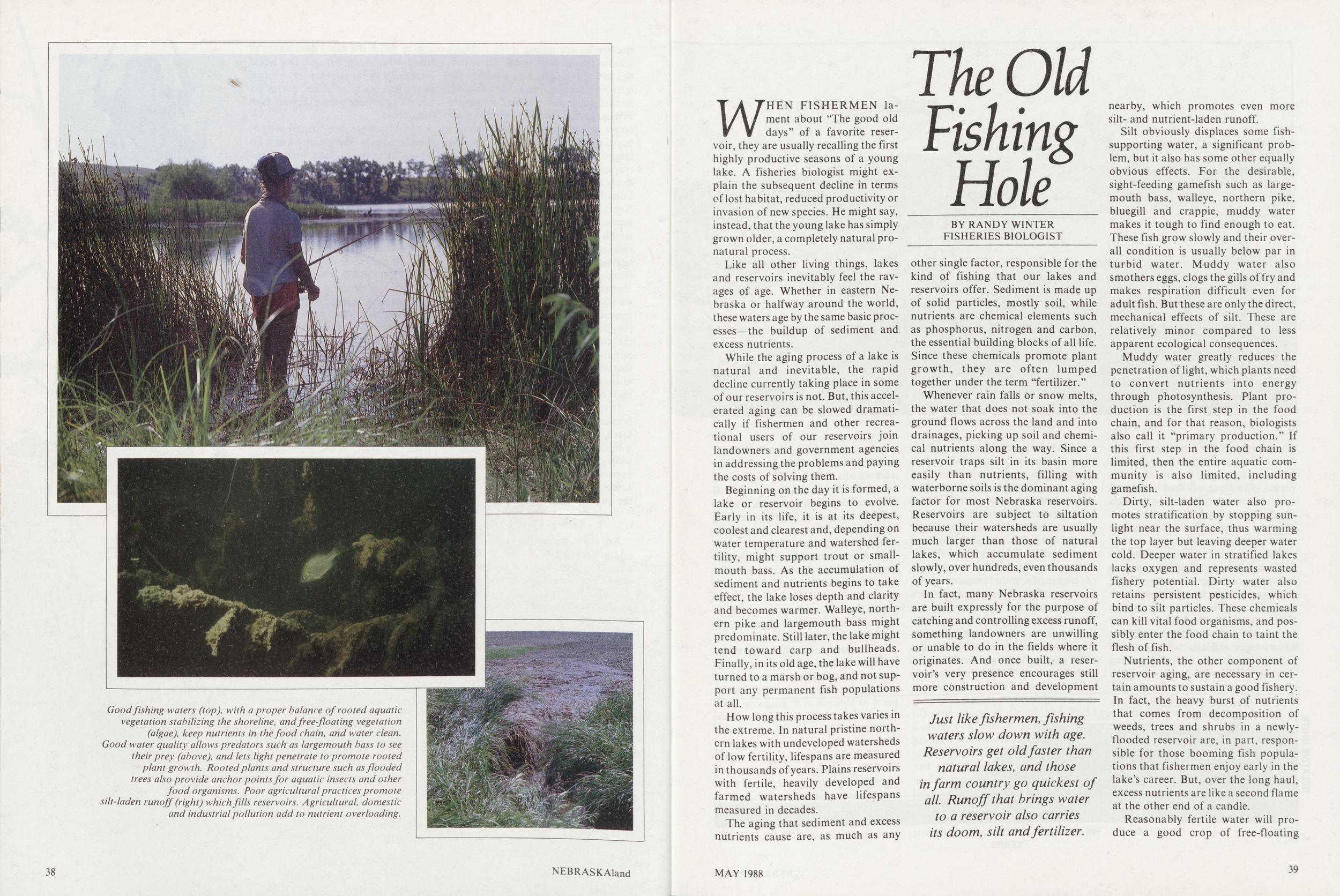
Just like fishermen, fishing waters slow down with age. Reservoirs get old faster than natural lakes, and those in farm country go quickest of all. Runoff that brings water to a reservoir also carries its doom, silt and fertilizer.Silt obviously displaces some fish-supporting water, a significant problem, but it also has some other equally obvious effects. For the desirable, sight-feeding gamefish such as large mouth bass, walleye, northern pike, bluegill and crappie, muddy water makes it tough to find enough to eat. These fish grow slowly and their overall condition is usually below par in turbid water. Muddy water also smothers eggs, clogs the gills of fry and makes respiration difficult even for adult fish. But these are only the direct, mechanical effects of silt. These are relatively minor compared to less apparent ecological consequences.
Muddy water greatly reduces the penetration of light, which plants need to convert nutrients into energy through photosynthesis. Plant production is the first step in the food chain, and for that reason, biologists also call it "primary production." If this first step in the food chain is limited, then the entire aquatic community is also limited, including gamefish.
Dirty, silt-laden water also promotes stratification by stopping sunlight near the surface, thus warming the top layer but leaving deeper water cold. Deeper water in stratified lakes lacks oxygen and represents wasted fishery potential. Dirty water also retains persistent pesticides, which bind to silt particles. These chemicals can kill vital food organisms, and possibly enter the food chain to taint the flesh of fish.
Nutrients, the other component of reservoir aging, are necessary in certain amounts to sustain a good fishery. In fact, the heavy burst of nutrients that comes from decomposition of weeds, trees and shrubs in a newly flooded reservoir are, in part, responsible for those booming fish populations that fishermen enjoy early in the lake's career. But, over the long haul, excess nutrients are like a second flame at the other end of a candle.
Reasonably fertile water will produce a good crop of free-floating microscopic plants (algae) and, if the water is not dirtied by silt or clouded by too much algae, a crop of rooted plants. The algae will feed zooplankton, the nearly microscopic animals that feed every other crustacean, aquatic insect or fish in the lake at one time or another during its life.
MAY 1988 39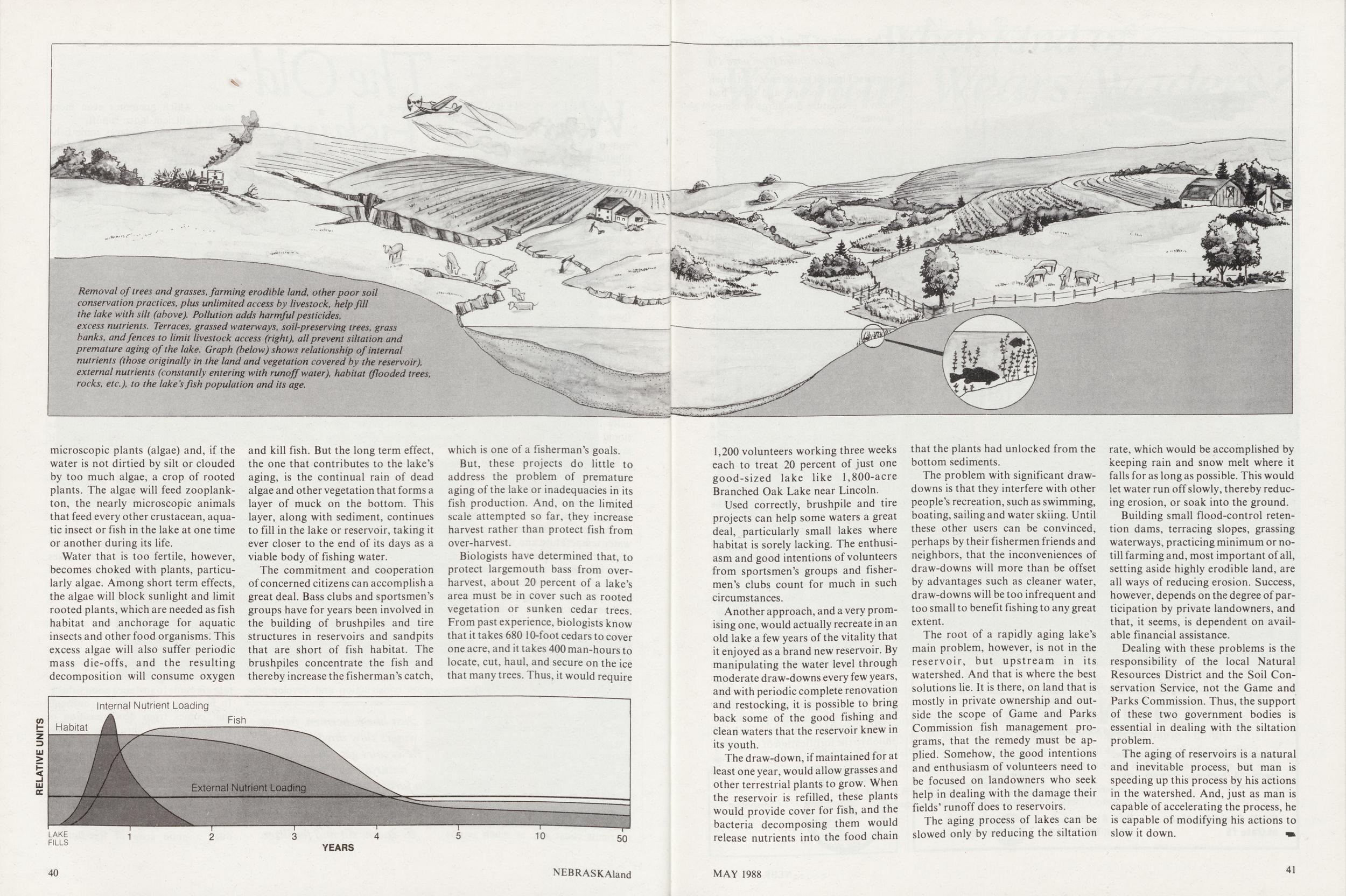
Water that is too fertile, however, becomes choked with plants, particularly algae. Among short term effects, the algae will block sunlight and limit rooted plants, which are needed as fish habitat and anchorage for aquatic insects and other food organisms. This excess algae will also suffer periodic mass die-offs, and the resulting decomposition will consume oxygen and kill fish. But the long term effect, the one that contributes to the lake's aging, is the continual rain of dead algae and other vegetation that forms a layer of muck on the bottom. This layer, along with sediment, continues to fill in the lake or reservoir, taking it ever closer to the end of its days as a viable body of fishing water.
The commitment and cooperation of concerned citizens can accomplish a great deal. Bass clubs and sportsmen's groups have for years been involved in the building of brushpiles and tire structures in reservoirs and sandpits that are short of fish habitat. The brushpiles concentrate the fish and thereby increase the fisherman's catch, which is one of a fisherman's goals.
But, these projects do little to address the problem of premature aging of the lake or inadequacies in its fish production. And, on the limited scale attempted so far, they increase harvest rather than protect fish from over-harvest.
Biologists have determined that, to protect largemouth bass from over harvest, about 20 percent of a lake's area must be in cover such as rooted vegetation or sunken cedar trees. From past experience, biologists know that it takes 680 10-foot cedars to cover one acre, and it takes 400 man-hours to locate, cut, haul, and secure on the ice that many trees. Thus, it would require 40 NEBRASKAland 1,200 volunteers working three weeks each to treat 20 percent of just one good-sized lake like 1,800-acre Branched Oak Lake near Lincoln.
Used correctly, brush pile and tire projects can help some waters a great deal, particularly small lakes where habitat is sorely lacking. The enthusiasm and good intentions of volunteers from sportsmen's groups and fishermen's clubs count for much in such circumstances.
Another approach, and a very promising one, would actually recreate in an old lake a few years of the vitality that it enjoyed as a brand new reservoir. By manipulating the water level through moderate draw-downs every few years, and with periodic complete renovation and restocking, it is possible to bring back some of the good fishing and clean waters that the reservoir knew in its youth.
The draw-down, if maintained for at least one year, would allow grasses and other terrestrial plants to grow. When the reservoir is refilled, these plants would provide cover for fish, and the bacteria decomposing them would release nutrients into the food chain that the plants had unlocked from the bottom sediments.
The problem with significant drawdowns is that they interfere with other people's recreation, such as swimming, boating, sailing and water skiing. Until these other users can be convinced, perhaps by their fishermen friends and neighbors, that the inconveniences of draw-downs will more than be offset by advantages such as cleaner water, draw-downs will be too infrequent and too small to benefit fishing to any great extent.
The root of a rapidly aging lake's main problem, however, is not in the reservoir, but upstream in its watershed. And that is where the best solutions lie. It is there, on land that is mostly in private ownership and outside the scope of Game and Parks Commission fish management programs, that the remedy must be applied. Somehow, the good intentions and enthusiasm of volunteers need to be focused on landowners who seek help in dealing with the damage their fields' runoff does to reservoirs.
The aging process of lakes can be slowed only by reducing the siltation rate, which would be accomplished by keeping rain and snow melt where it falls for as long as possible. This would let water run off slowly, thereby reducing erosion, or soak into the ground.
Building small flood-control retention dams, terracing slopes, grassing waterways, practicing minimum or notill farming and, most important of all, setting aside highly erodible land, are all ways of reducing erosion. Success, however, depends on the degree of participation by private landowners, and that, it seems, is dependent on available financial assistance.
Dealing with these problems is the responsibility of the local Natural Resources District and the Soil Conservation Service, not the Game and Parks Commission. Thus, the support of these two government bodies is essential in dealing with the siltation problem.
The aging of reservoirs is a natural and inevitable process, but man is speeding up this process by his actions in the watershed. And, just as man is capable of accelerating the process, he is capable of modifying his actions to slow it down.
MAY 1988 41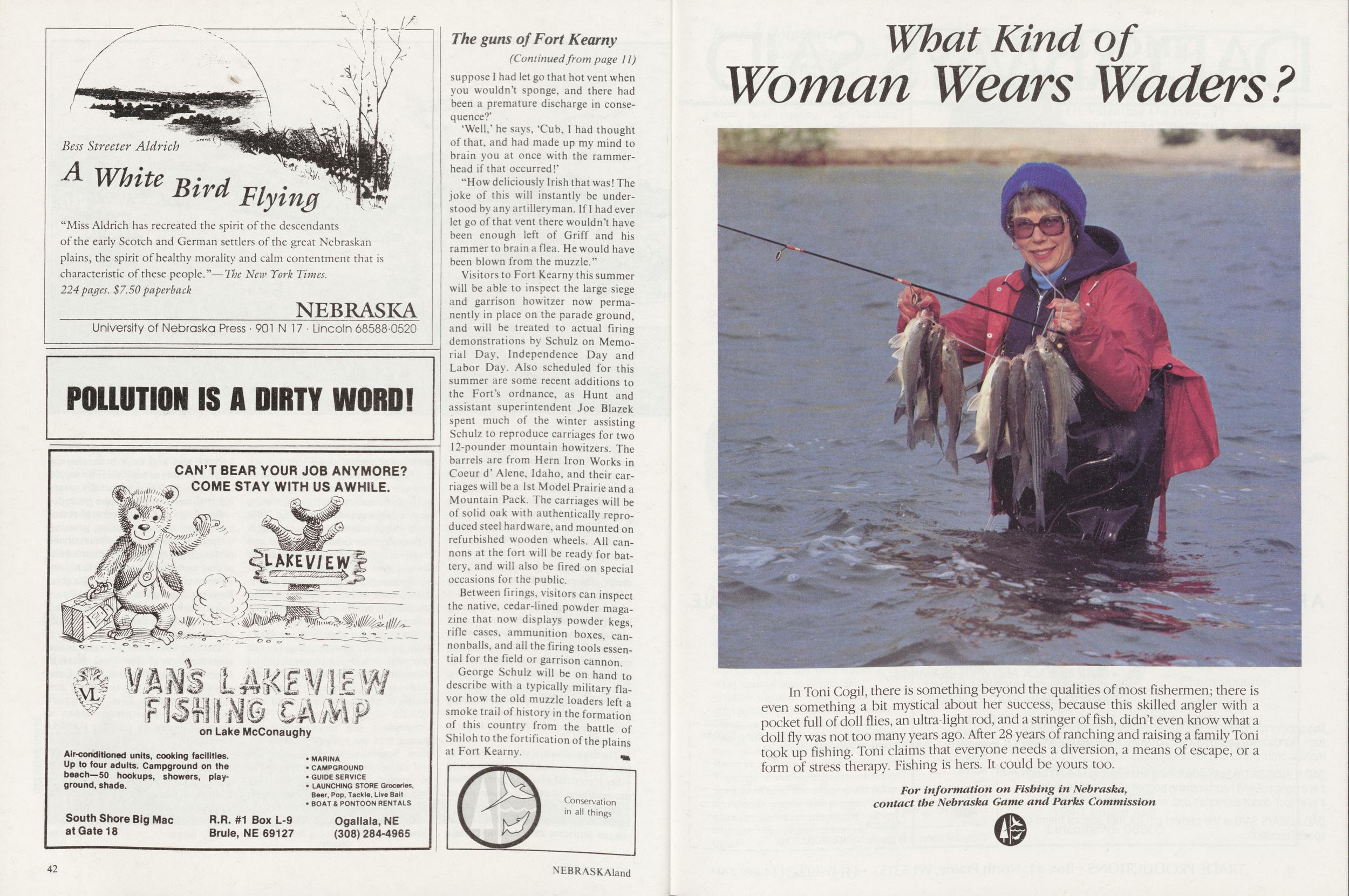 Bess Streeter Aldrich
A white Bird
Flying
"Miss Aldrich has recreated the spirit of the descendants
of the early Scotch and German settlers of the great Nebraskan
plains, the spirit of healthy morality and calm contentment that is
characteristic of these people."—The New York Times.
224pages. $7.50 paperback
_____________________NEBRASKA
University of Nebraska Press • 901 N 17 • Lincoln 685880520
POLLUTION IS A DIRTY WORD!
CAN'T BEAR YOUR JOB ANYMORE?
COME STAY WITH US AWHILE.
43
on Lake McConaughy
Air-conditioned units, cooking facilities.
Up to four adults. Campground on the
beach—50 hookups, showers,
playground, shade.
• MARINA
• CAMPGROUND
•GUIDE SERVICE
• LAUNCHING STORE Groceries,
Beer, Pop, Tackle, Live Bait
• BOAT & PONTOON RENTALS
South Shore Big Mac
at Gate 18
R.R. #1 Box L-9
Brule, NE 69127
Ogallala, NE
(308) 284-4965
Bess Streeter Aldrich
A white Bird
Flying
"Miss Aldrich has recreated the spirit of the descendants
of the early Scotch and German settlers of the great Nebraskan
plains, the spirit of healthy morality and calm contentment that is
characteristic of these people."—The New York Times.
224pages. $7.50 paperback
_____________________NEBRASKA
University of Nebraska Press • 901 N 17 • Lincoln 685880520
POLLUTION IS A DIRTY WORD!
CAN'T BEAR YOUR JOB ANYMORE?
COME STAY WITH US AWHILE.
43
on Lake McConaughy
Air-conditioned units, cooking facilities.
Up to four adults. Campground on the
beach—50 hookups, showers,
playground, shade.
• MARINA
• CAMPGROUND
•GUIDE SERVICE
• LAUNCHING STORE Groceries,
Beer, Pop, Tackle, Live Bait
• BOAT & PONTOON RENTALS
South Shore Big Mac
at Gate 18
R.R. #1 Box L-9
Brule, NE 69127
Ogallala, NE
(308) 284-4965
The guns of Fort Kearny
(Continued from page 11)suppose I had let go that hot vent when you wouldn't sponge, and there had been a premature discharge in consequence?'
'Well,' he says, 'Cub, I had thought of that, and had made up my mind to brain you at once with the rammerhead if that occurred!'
"How deliciously Irish that was! The joke of this will instantly be understood by any artilleryman. If I had ever let go of that vent there wouldn't have been enough left of Griff and his rammer to brain a flea. He would have been blown from the muzzle."
Visitors to Fort Kearny this summer will be able to inspect the large siege and garrison howitzer now permanently in place on the parade ground, and will be treated to actual firing demonstrations by Schulz on Memorial Day, Independence Day and Labor Day. Also scheduled for this summer are some recent additions to the Fort's ordnance, as Hunt and assistant superintendent Joe Blazek spent much of the winter assisting Schulz to reproduce carriages for two 12-pounder mountain howitzers. The barrels are from Hern Iron Works in Coeur d' Alene, Idaho, and their carriages will be a 1st Model Prairie and a Mountain Pack. The carriages will be of solid oak with authentically reproduced steel hardware, and mounted on refurbished wooden wheels. All cannons at the fort will be ready for battery, and will also be fired on special occasions for the public.
Between firings, visitors can inspect the native, cedar-lined powder magazine that now displays powder kegs, rifle cases, ammunition boxes, cannonballs, and all the firing tools essential for the field or garrison cannon.
George Schulz will be on hand to describe with a typically military flavor how the old muzzle loaders left a smoke trail of history in the formation of this country from the battle of Shiloh to the fortification of the plains at Fort Kearny.
Conservation in all things 42 NEBRASKAland What Kind of Woman Wears Waders?In Toni Cogil, there is something beyond the qualities of most fishermen; there is even something a bit mystical about her success, because this skilled angler with a pocket full of doll flies, an ultra-light rod, and a stringer offish, didn't even know what a doll fly was not too many years ago. After 28 years of ranching and raising a family Toni took up fishing. Toni claims that everyone needs a diversion, a means of escape, or a form of stress therapy. Fishing is hers. It could be yours too.
Eor information on Fishing in Nebraska, contact the Nebraska Game and Parks Commission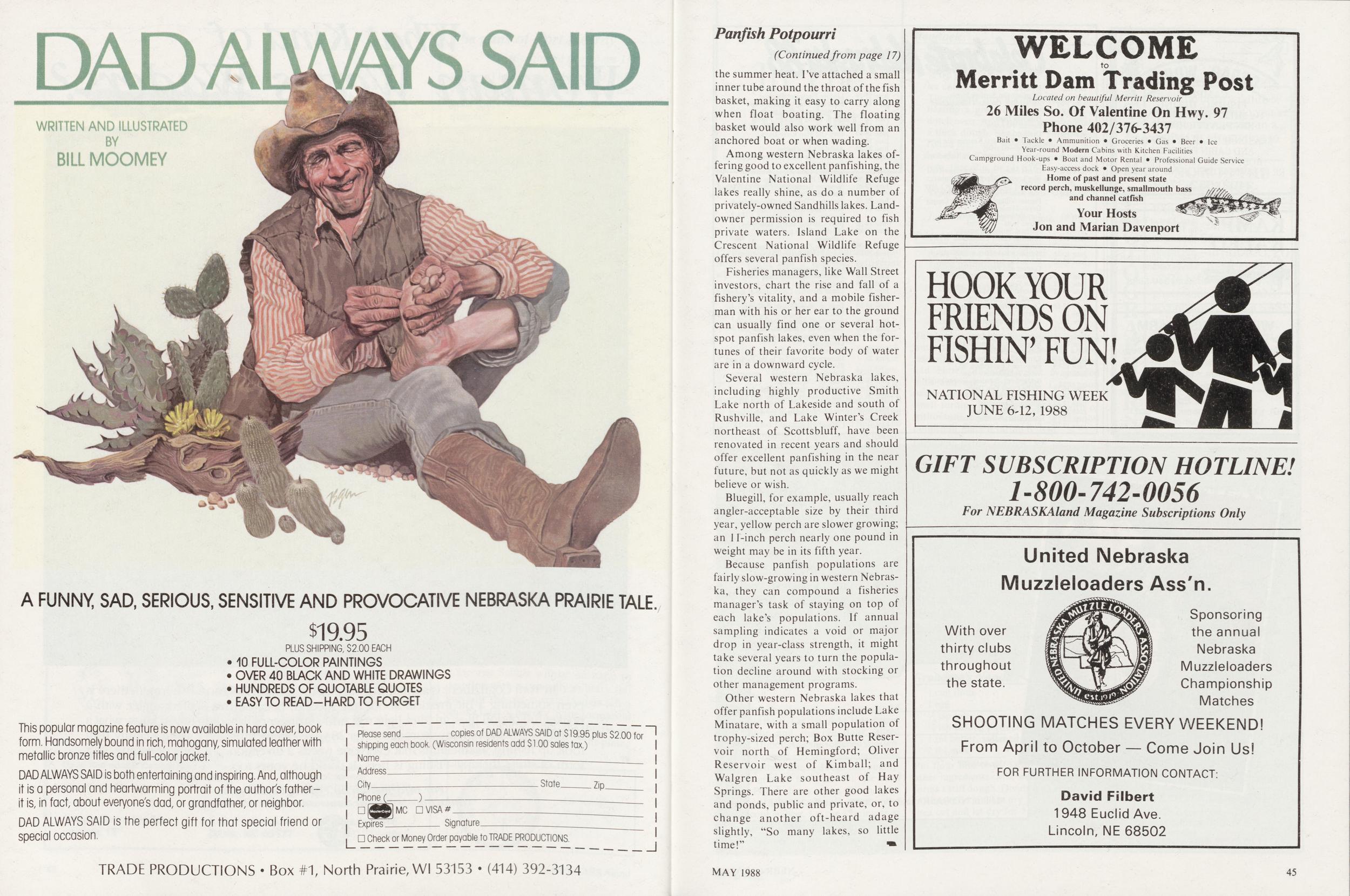 DAD AlWAYS SAID
WRITTEN AND ILLUSTRATED
BY
BILL MOOMEY
A FUNNY SAD, SERIOUS, SENSITIVE AND PROVOCATIVE NEBRASKA PRAIRIE TALE.
$19.95
PLUS SHIPPING, $2.00 EACH
• 10 FULL-COLOR PAINTINGS
• OVER 40 BLACK AND WHITE DRAWINGS
• HUNDREDS OF QUOTABLE QUOTES
• EASY TO READ-HARD TO FORGET
This popular magazine feature is now available in hard cover, book
form. Handsomely bound in rich, mahogany, simulated leather with
metallic bronze titles and full-color jacket.
DAD ALWAYS SAID is both entertaining and inspiring. And, although
it is a personal and heartwarming portrait of the author's father
it is, in fact, about everyone's dad, or grandfather, or neighbor.
DAD ALWAYS SAID is the perfect gift for that special friend or
special occasion.
copies of DAD ALWAYS SAID at $19.95 plus $2.00 for
Please send________
shipping each book. (Wisconsin residents add $1.00 sales tax.)
Name_____________
Address___________
City_______________
State.
Zip-
Phone (.
VISA #
Expires
Signature.
Check or Money Order payable to TRADE PRODUCTIONS.
TRADE PRODUCTIONS • Box #1, North Prairie, Wl 53153 • (414) 392-3134
DAD AlWAYS SAID
WRITTEN AND ILLUSTRATED
BY
BILL MOOMEY
A FUNNY SAD, SERIOUS, SENSITIVE AND PROVOCATIVE NEBRASKA PRAIRIE TALE.
$19.95
PLUS SHIPPING, $2.00 EACH
• 10 FULL-COLOR PAINTINGS
• OVER 40 BLACK AND WHITE DRAWINGS
• HUNDREDS OF QUOTABLE QUOTES
• EASY TO READ-HARD TO FORGET
This popular magazine feature is now available in hard cover, book
form. Handsomely bound in rich, mahogany, simulated leather with
metallic bronze titles and full-color jacket.
DAD ALWAYS SAID is both entertaining and inspiring. And, although
it is a personal and heartwarming portrait of the author's father
it is, in fact, about everyone's dad, or grandfather, or neighbor.
DAD ALWAYS SAID is the perfect gift for that special friend or
special occasion.
copies of DAD ALWAYS SAID at $19.95 plus $2.00 for
Please send________
shipping each book. (Wisconsin residents add $1.00 sales tax.)
Name_____________
Address___________
City_______________
State.
Zip-
Phone (.
VISA #
Expires
Signature.
Check or Money Order payable to TRADE PRODUCTIONS.
TRADE PRODUCTIONS • Box #1, North Prairie, Wl 53153 • (414) 392-3134
Panfish Potpourri
(Continued from page 17)the summer heat. I've attached a small inner tube around the throat of the fish basket, making it easy to carry along when float boating. The floating basket would also work well from an anchored boat or when wading.
Among western Nebraska lakes offering good to excellent panfishing, the Valentine National Wildlife Refuge lakes really shine, as do a number of privately-owned Sandhills lakes. Landowner permission is required to fish private waters. Island Lake on the Crescent National Wildlife Refuge offers several panfish species.
Fisheries managers, like Wall Street investors, chart the rise and fall of a fishery's vitality, and a mobile fisherman with his or her ear to the ground can usually find one or several hotspot panfish lakes, even when the fortunes of their favorite body of water are in a downward cycle.
Several western Nebraska lakes, including highly productive Smith Lake north of Lakeside and south of Rushville, and Lake Winter's Creek northeast of Scottsbluff, have been renovated in recent years and should offer excellent panfishing in the near future, but not as quickly as we might believe or wish.
Bluegill, for example, usually reach angler-acceptable size by their third year, yellow perch are slower growing; an 11-inch perch nearly one pound in weight may be in its fifth year.
Because panfish populations are fairly slow-growing in western Nebraska, they can compound a fisheries manager's task of staying on top of each lake's populations. If annual sampling indicates a void or major drop in year-class strength, it might take several years to turn the population decline around with stocking or other management programs.
Other western Nebraska lakes that offer panfish populations include Lake Miniature, with a small population of trophy-sized perch; Box Butte Reservoir north of Hemingford; Oliver Reservoir west of Kimball; and Walgren Lake southeast of Hay Springs. There are other good lakes and ponds, public and private, or, to change another oft-heard adage slightly, "So many lakes, so little time!"
WELCOME to Merritt Dam Trading Post Located on beautiful Merritt Reservoir 26 Miles So. Of Valentine On Hwy. 97 Phone 402/376-3437 Bait • Tackle • Ammunition • Groceries • Gas • Beer • Ice Year-round Modern Cabins with Kitchen Facilities Campground Hook-ups • Boat and Motor Rental • Professional Guide Service Easy-access dock • Open year around Home of past and present state record perch, muskellunge, smallmouth bass and channel catfish Your Hosts Jon and Marian Davenport HOOK YOUR FRIENDS ON FISHIN' FUN! NATIONAL FISHING WEEK JUNE 6T2, 1988 GIFT SUBSCRIPTION HOTLINE! 1-800-742-0056 For NEBRASKAland Magazine Subscriptions Only United Nebraska Muzzleloaders Ass'n With over thirty clubs throughout the state. Sponsoring the annual Nebraska Muzzleloaders Championship Matches SHOOTING MATCHES EVERY WEEKEND! From April to October — Come Join Us! FOR FURTHER INFORMATION CONTACT: David Filbert 1948 Euclid Ave. Lincoln, NE 68502 MAY 1988 45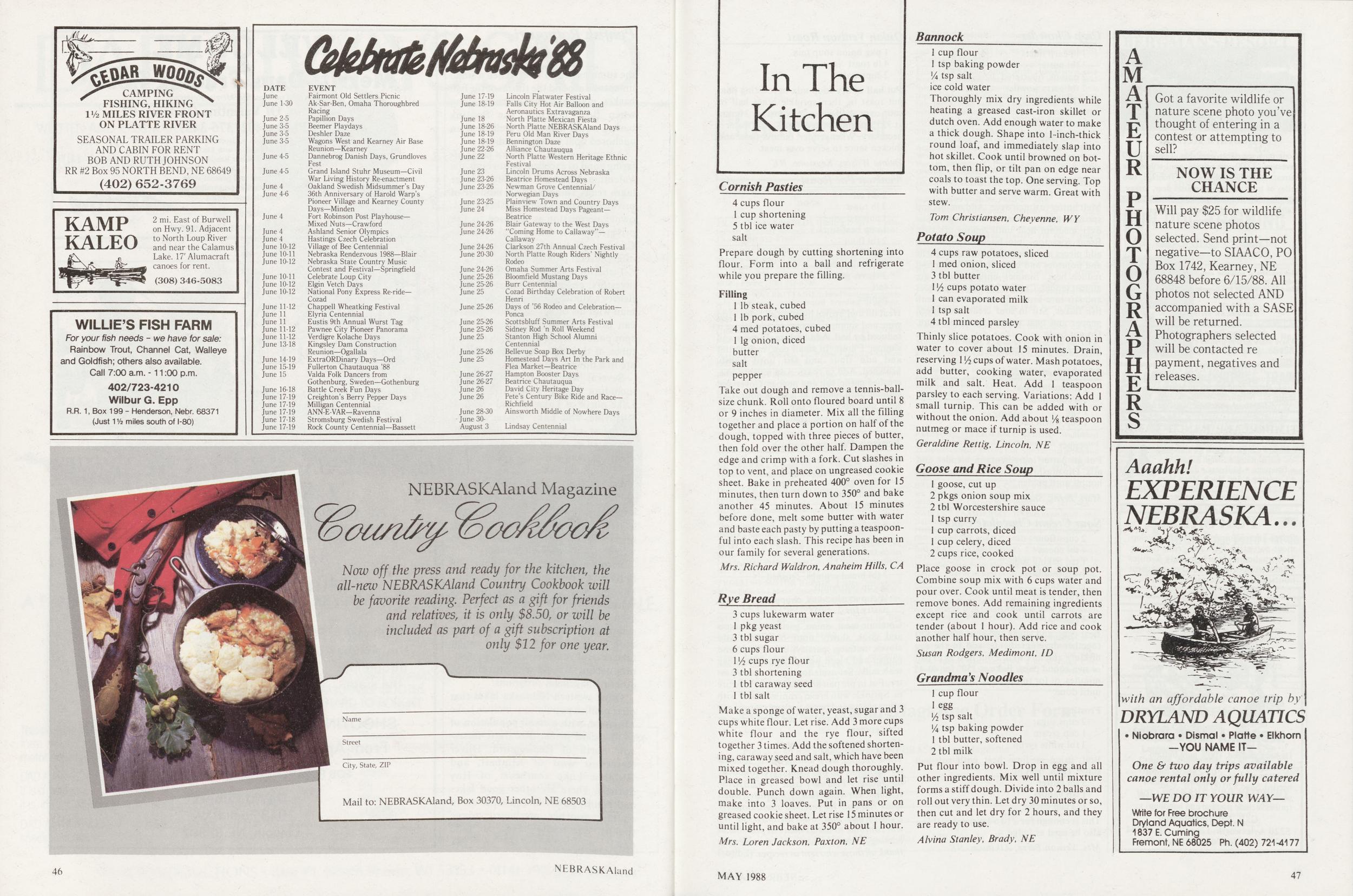 CEDAR WOODS
CAMPING
FISHING, HIKING
IV2 MILES RIVER FRONT
ON PLATTE RIVER
SEASONAL TRAILER PARKING
AND CABIN FOR RENT
BOB AND RUTH JOHNSON
RR #2 Box 95 NORTH BEND, NE 68649
(402) 652-3769
KAMP
KALEO
2 mi. East of Burwell
on Hwy. 91. Adjacent
to North Loup River
and near the Calamus
Lake. 17' Alumacraft
canoes for rent.
(308) 346-5083
WILLIE'S FISH FARM
For your fish needs - we have for sale:
Rainbow Trout, Channel Cat, Walleye
and Goldfish; others also available.
Call 7:00 a.m. -11:00 p.m.
402/723-4210
Wilbur G. Epp
R.R. 1, Box 199 - Henderson, Nebr. 68371
(Just 1 % miles south of I-80)
CELEBRATE NEBRASKA '88
DATE EVENT
June Fairmont Old Settlers Picnic
June 1-30 Ak-Sar-Ben, Omaha Thoroughbred
Racing
June 2-5 Papillion Days
June 3-5 Beemer Playdays
June 3-5 Deshler Daze
June 3-5 Wagons West and Kearney Air Base
Reunion—Kearney
June 4-5 Dannebrog Danish Days, Grundloves
Fest
June 4-5 Grand Island Stuhr Museum—Civil
War Living History Re-enactment
June 4 Oakland Swedish Midsummer's Day
June 4-6 36th Anniversary of Harold Warp's
Pioneer Village and Kearney County
Days—Minden
June 4 Fort Robinson Post Playhouse—
Mixed Nuts—Crawford
June 4 Ashland Senior Olympics
June 4 Hastings Czech Celebration
June 10-12 Village of Bee Centennial
June 10-11 Nebraska Rendezvous 1988—Blair
June 10-12 Nebraska State Country Music
Contest and Festival—Springfield
June 10-11 Celebrate Loup City
June 10-12 Elgin Vetch Days
June 10-12 National Pony Express Re-ride—
Cozad
June 11-12 Chappell Wheatking Festival
June 11 Elyria Centennial
June 11 Eustis 9th Annual Wurst Tag
June 11-12 Pawnee City Pioneer Panorama
June 11-12 Verdigre Kolache Days
June 13-18 Kingsley Dam Construction
Reunion—Ogallala
June 14-19 ExtraORDinary Days—Ord
June 15-19 Fullerton Chautauqua '88
June 15 Valda Folk Dancers from
Gothenburg, Sweden—Gothenburg
June 16-18 Battle Creek Fun Days
June 17-19 Creighton's Berry Pepper Days
June 17-19 Milligan Centennial
June 17-19 ANN-E-VAR—Ravenna
June 17-18 Stromsburg Swedish Festival
June 17-19 Rock County Centennial—Bassett
June 17-19 Lincoln Flatwater Festival
June 18-19 Falls City Hot Air Balloon and
Aeronautics Extravaganza
June 18 North Platte Mexican Fiesta
June 18-26 North Platte NEBRASKAland Days
June 18-19 Peru Old Man River Days
June 18-19 Bennington Daze
June 22-26 Alliance Chautauqua
June 22 North Platte Western Heritage Ethnic
Festival
June 23 Lincoln Drums Across Nebraska
June 23-26 Beatrice Homestead Days
June 23-26 Newman Grove Centennial/
Norwegian Days
June 23-25 Plainview Town and Country Days
June 24 Miss Homestead Days Pageant-
Beatrice
June 24-26 Blair Gateway to the West Days
June 24-26 "Coming Home to Callaway"—
Callaway
June 24-26 Clarkson 27th Annual Czech Festival
June 20-30 North Platte Rough Riders' Nightly
Rodeo
June 24-26 Omaha Summer Arts Festival
June 25-26 Bloomfield Mustang Days
June 25-26 Burr Centennial
June 25 Cozad Birthday Celebration of Robert
Henri
June 25-26 Days of '56 Rodeo and Celebration—
Ponca
June 25-26 Scottsbluff Summer Arts Festival
June 25-26 Sidney Rod 'n Roll Weekend
June 25 Stanton High School Alumni
Centennial
June 25-26 Bellevue Soap Box Derby
June 25 Homestead Days Art In the Park and
Flea Market—Beatrice
June 26-27 Hampton Booster Days
June 26-27 Beatrice Chautauqua
June 26 David City Heritage Day
June 26 Pete's Century Bike Ride and Race—
Richfield
June 28-30 Ainsworth Middle of Nowhere Days
June 30-
August 3 Lindsay Centennial
NEBRASKAland Magazine
Now off the press and ready for the kitchen, the
all-new NEBRASKAland Country Cookbook will
be favorite reading. Perfect as a gift for friends
and relatives, it is only $8.50, or will be
included as part of a gift subscription at
only $12 for one year.
Name
Street
City, State, ZIP
Mail to: NEBRASKAland, Box 30370, Lincoln, NE 68503
46
NEBRASKAland
CEDAR WOODS
CAMPING
FISHING, HIKING
IV2 MILES RIVER FRONT
ON PLATTE RIVER
SEASONAL TRAILER PARKING
AND CABIN FOR RENT
BOB AND RUTH JOHNSON
RR #2 Box 95 NORTH BEND, NE 68649
(402) 652-3769
KAMP
KALEO
2 mi. East of Burwell
on Hwy. 91. Adjacent
to North Loup River
and near the Calamus
Lake. 17' Alumacraft
canoes for rent.
(308) 346-5083
WILLIE'S FISH FARM
For your fish needs - we have for sale:
Rainbow Trout, Channel Cat, Walleye
and Goldfish; others also available.
Call 7:00 a.m. -11:00 p.m.
402/723-4210
Wilbur G. Epp
R.R. 1, Box 199 - Henderson, Nebr. 68371
(Just 1 % miles south of I-80)
CELEBRATE NEBRASKA '88
DATE EVENT
June Fairmont Old Settlers Picnic
June 1-30 Ak-Sar-Ben, Omaha Thoroughbred
Racing
June 2-5 Papillion Days
June 3-5 Beemer Playdays
June 3-5 Deshler Daze
June 3-5 Wagons West and Kearney Air Base
Reunion—Kearney
June 4-5 Dannebrog Danish Days, Grundloves
Fest
June 4-5 Grand Island Stuhr Museum—Civil
War Living History Re-enactment
June 4 Oakland Swedish Midsummer's Day
June 4-6 36th Anniversary of Harold Warp's
Pioneer Village and Kearney County
Days—Minden
June 4 Fort Robinson Post Playhouse—
Mixed Nuts—Crawford
June 4 Ashland Senior Olympics
June 4 Hastings Czech Celebration
June 10-12 Village of Bee Centennial
June 10-11 Nebraska Rendezvous 1988—Blair
June 10-12 Nebraska State Country Music
Contest and Festival—Springfield
June 10-11 Celebrate Loup City
June 10-12 Elgin Vetch Days
June 10-12 National Pony Express Re-ride—
Cozad
June 11-12 Chappell Wheatking Festival
June 11 Elyria Centennial
June 11 Eustis 9th Annual Wurst Tag
June 11-12 Pawnee City Pioneer Panorama
June 11-12 Verdigre Kolache Days
June 13-18 Kingsley Dam Construction
Reunion—Ogallala
June 14-19 ExtraORDinary Days—Ord
June 15-19 Fullerton Chautauqua '88
June 15 Valda Folk Dancers from
Gothenburg, Sweden—Gothenburg
June 16-18 Battle Creek Fun Days
June 17-19 Creighton's Berry Pepper Days
June 17-19 Milligan Centennial
June 17-19 ANN-E-VAR—Ravenna
June 17-18 Stromsburg Swedish Festival
June 17-19 Rock County Centennial—Bassett
June 17-19 Lincoln Flatwater Festival
June 18-19 Falls City Hot Air Balloon and
Aeronautics Extravaganza
June 18 North Platte Mexican Fiesta
June 18-26 North Platte NEBRASKAland Days
June 18-19 Peru Old Man River Days
June 18-19 Bennington Daze
June 22-26 Alliance Chautauqua
June 22 North Platte Western Heritage Ethnic
Festival
June 23 Lincoln Drums Across Nebraska
June 23-26 Beatrice Homestead Days
June 23-26 Newman Grove Centennial/
Norwegian Days
June 23-25 Plainview Town and Country Days
June 24 Miss Homestead Days Pageant-
Beatrice
June 24-26 Blair Gateway to the West Days
June 24-26 "Coming Home to Callaway"—
Callaway
June 24-26 Clarkson 27th Annual Czech Festival
June 20-30 North Platte Rough Riders' Nightly
Rodeo
June 24-26 Omaha Summer Arts Festival
June 25-26 Bloomfield Mustang Days
June 25-26 Burr Centennial
June 25 Cozad Birthday Celebration of Robert
Henri
June 25-26 Days of '56 Rodeo and Celebration—
Ponca
June 25-26 Scottsbluff Summer Arts Festival
June 25-26 Sidney Rod 'n Roll Weekend
June 25 Stanton High School Alumni
Centennial
June 25-26 Bellevue Soap Box Derby
June 25 Homestead Days Art In the Park and
Flea Market—Beatrice
June 26-27 Hampton Booster Days
June 26-27 Beatrice Chautauqua
June 26 David City Heritage Day
June 26 Pete's Century Bike Ride and Race—
Richfield
June 28-30 Ainsworth Middle of Nowhere Days
June 30-
August 3 Lindsay Centennial
NEBRASKAland Magazine
Now off the press and ready for the kitchen, the
all-new NEBRASKAland Country Cookbook will
be favorite reading. Perfect as a gift for friends
and relatives, it is only $8.50, or will be
included as part of a gift subscription at
only $12 for one year.
Name
Street
City, State, ZIP
Mail to: NEBRASKAland, Box 30370, Lincoln, NE 68503
46
NEBRASKAland
In The Kitchen
Cornish Pasties 4 cups flour 1 cup shortening 5 tbl ice water saltPrepare dough by cutting shortening into flour. Form into a ball and refrigerate while you prepare the filling.
Filling 1 lb steak, cubed 1 lb pork, cubed 4 med potatoes, cubed 1 lg onion, diced butter salt pepperTake out dough and remove a tennis-ball-size chunk. Roll onto floured board until 8 or 9 inches in diameter. Mix all the filling together and place a portion on half of the dough, topped with three pieces of butter, then fold over the other half. Dampen the edge and crimp with a fork. Cut slashes in top to vent, and place on ungreased cookie sheet. Bake in preheated 400° oven for 15 minutes, then turn down to 350° and bake another 45 minutes. About 15 minutes before done, melt some butter with water and baste each pasty by putting a teaspoonful into each slash. This recipe has been in our family for several generations. Mrs. Richard Waldron, Anaheim Hills, CA
Rye Bread 3 cups lukewarm water 1 pkg yeast 3 tblsugar 6 cups flour 172 cups rye flour 3 tbl shortening 1 tbl caraway seed 1 tbl saltMake a sponge of water, yeast, sugar and 3 cups white flour. Let rise. Add 3 more cups white flour and the rye flour, sifted together 3 times. Add the softened shortening, caraway seed and salt, which have been mixed together. Knead dough thoroughly. Place in greased bowl and let rise until double. Punch down again. When light, make into 3 loaves. Put in pans or on greased cookie sheet. Let rise 15 minutes or until light, and bake at 350° about 1 hour.
Mrs. Loren Jackson, Paxton, NE Bannock 1 cup flour 1 tsp baking powder 74 tsp salt ice cold waterThoroughly mix dry ingredients while heating a greased cast-iron skillet or dutch oven. Add enough water to make a thick dough. Shape into 1 -inch-thick round loaf, and immediately slap into hot skillet. Cook until browned on bottom, then flip, or tilt pan on edge near coals to toast the top. One serving. Top with butter and serve warm. Great with stew.
Tom Christiansen, Cheyenne, WY Potato Soup ____________ 4 cups raw potatoes, sliced 1 med onion, sliced 3 tbl butter 1 !/2 cups potato water 1 can evaporated milk 1 tsp salt 4 tbl minced parsleyThinly slice potatoes. Cook with onion in water to cover about 15 minutes. Drain, reserving 1!/2 cups of water. Mash potatoes, add butter, cooking water, evaporated milk and salt. Heat. Add 1 teaspoon parsley to each serving. Variations: Add 1 small turnip. This can be added with or without the onion. Add about V% teaspoon nutmeg or mace if turnip is used.
Geraldine Rettig. Lincoln, NE Goose and Rice Soup___________ 1 goose, cut up 2 pkgs onion soup mix 2 tbl Worcestershire sauce 1 tsp curry 1 cup carrots, diced 1 cup celery, diced 2 cups rice, cookedPlace goose in crock pot or soup pot. Combine soup mix with 6 cups water and pour over. Cook until meat is tender, then remove bones. Add remaining ingredients except rice and cook until carrots are tender (about 1 hour). Add rice and cook another half hour, then serve.
Susan Rodgers, Medimont, ID Grandma's Noodles_____________ 1 cup flour 1 egg 1_ tsp salt 74 tsp baking powder 1 tbl butter, softened 2 tbl milkPut flour into bowl. Drop in egg and all other ingredients. Mix well until mixture forms a stiff dough. Divide into 2 balls and roll out very thin. Let dry 30 minutes or so, then cut and let dry for 2 hours, and they are ready to use.
Alvina Stanley, Brady, NE A M A T E U R P H O T O G R A P H E R S Got a favorite wildlife or nature scene photo you've thought of entering in a contest or attempting to sell? NOW IS THE CHANCE Will pay $25 for wildlife nature scene photos selected. Send print—not negative—to SIAACO, PO Box 1742, Kearney, NE 68848 before 6/15/88. All photos not selected AND accompanied with a SASE will be returned. Photographers selected will be contacted re payment, negatives and releases. Aaahh! EXPERIENCE NEBRASKA... with an affordable canoe trip by DRYLAND AQUATICS • Niobrara • Dismal • Platte • Elkhorn -YOU NAME IT- One & two day trips available canoe rental only or fully catered —WE DO IT YOUR WAY— Write for Free brochure Dry land Aquatics, Dept. N 1837 E.Cuming Fremont, NE 68025 Ph. (402) 721-4177 MAY 1988 47 Niobrara Retreat
Long -term use rights available. Limited to 10
investors. 1,000-acre private, semi-wilderness
retreat. One mile Niobrara River frontage, two
miles of trout stream. Fantastic deer, turkey,
duck hunting. Canoeing, hiking, fishing. Near
Valentine, game and waterfowl refuges.
Rights Available:
10 years
Lifetime.
Perpetual
$2,500.
5,000.
10,000.
Also available at additional cost: use rights to 1,400 acres
including rental units and best duck marsh along the Niobrara.
Financing Available. For Complete Information, Contact:
Grant Sims
P.O. Box 175 Phone:
Fairbanks, AK 99775 (907) 457-3432
Attention Bass Fishermen.
Where other how-to articles stop this pro's
Outline starts PURE on the water experience in
writing.
A VIDEO TAPE ON PAPER!
Also an unbelievable LURE PRICE list and
Guide Rates. Send $3.95 to: MR. BASS, 112
E. 4th St., Neligh, NE 68754.
Advertised and Sold Nationwide!
TIMBERLAKE RANCH CAMP
• Youth Camps • Retreats • Family
Camps • Canoe Trips • RV Camping
• Hay Rides • Sleigh Rides
• Banquets • Sailboats • Paddle BoaU
• Canoeing • And Much, Much More'
Rt. 1 Box 86 Marquette, NE 68804
(308)946-2148
FOR SALE
Prime recreational land with
development potential. Pine and cedar timber.
Modern home. Approximately 2 miles
river frontage. Located in center of great
hunting, fishing and canoeing area.
_______Call (402) 376-3259
BUFFALO
NEBRASKA MADE JERKY
Hickory smoked, 100% pure buffalo
product with almost no preservatives.
Vacuum packed so no refrigeration is
needed. Send $20.00 for 16 1-oz.
packages or $1.50 for sample package
(prices include postage and handling) to:
G. E. Hill Distributing
5220 Aylesworth, Lincoln, NE 68504
(402) 464-6781
Carp Chowder
1 lb carp fillets
3 tbl butter
2 onions, quartered
2 tbl curry powder
'/2 tsp cinnamon
l/g tsp cayenne
pinch salt
1 tsp sugar
9 oz can tomatoes
2 cloves garlic, crushed
3 med potatoes, cubed
72 cup sour cream
1 green pepper, julienne
Niobrara Retreat
Long -term use rights available. Limited to 10
investors. 1,000-acre private, semi-wilderness
retreat. One mile Niobrara River frontage, two
miles of trout stream. Fantastic deer, turkey,
duck hunting. Canoeing, hiking, fishing. Near
Valentine, game and waterfowl refuges.
Rights Available:
10 years
Lifetime.
Perpetual
$2,500.
5,000.
10,000.
Also available at additional cost: use rights to 1,400 acres
including rental units and best duck marsh along the Niobrara.
Financing Available. For Complete Information, Contact:
Grant Sims
P.O. Box 175 Phone:
Fairbanks, AK 99775 (907) 457-3432
Attention Bass Fishermen.
Where other how-to articles stop this pro's
Outline starts PURE on the water experience in
writing.
A VIDEO TAPE ON PAPER!
Also an unbelievable LURE PRICE list and
Guide Rates. Send $3.95 to: MR. BASS, 112
E. 4th St., Neligh, NE 68754.
Advertised and Sold Nationwide!
TIMBERLAKE RANCH CAMP
• Youth Camps • Retreats • Family
Camps • Canoe Trips • RV Camping
• Hay Rides • Sleigh Rides
• Banquets • Sailboats • Paddle BoaU
• Canoeing • And Much, Much More'
Rt. 1 Box 86 Marquette, NE 68804
(308)946-2148
FOR SALE
Prime recreational land with
development potential. Pine and cedar timber.
Modern home. Approximately 2 miles
river frontage. Located in center of great
hunting, fishing and canoeing area.
_______Call (402) 376-3259
BUFFALO
NEBRASKA MADE JERKY
Hickory smoked, 100% pure buffalo
product with almost no preservatives.
Vacuum packed so no refrigeration is
needed. Send $20.00 for 16 1-oz.
packages or $1.50 for sample package
(prices include postage and handling) to:
G. E. Hill Distributing
5220 Aylesworth, Lincoln, NE 68504
(402) 464-6781
Carp Chowder
1 lb carp fillets
3 tbl butter
2 onions, quartered
2 tbl curry powder
'/2 tsp cinnamon
l/g tsp cayenne
pinch salt
1 tsp sugar
9 oz can tomatoes
2 cloves garlic, crushed
3 med potatoes, cubed
72 cup sour cream
1 green pepper, julienne
Melt butter in dutch oven. Add onions and sprinkle with seasonings and sugar. Stir over medium heat until onions are soft. Break tomatoes into bite-size pieces and add pieces and juice to onions. Add garlic and potatoes and bring to boil, cover and reduce heat. Simmer until potatoes are almost tender. Cut fish into bite-size pieces and stir into broth. Cover and cook until fish flakes. Stir in sour cream and green pepper and heat to serving temperature. Do not boil.
Susan Landon, Ottumwa, I A Mushrooms in Batter 1 lb mushrooms 174 cups flour 1 egg 1 cup warm beer salt pepperPut all batter ingredients in blender and mix. Dip mushrooms into batter and fry in hot oil until golden.
Mark Bernt, Shelby, NE Sour Cream Chocolate Cake 2 cups flour 4 tblcocoa 1 tsp baking soda 1 tsp vanilla 72 tsp salt 2 cups sugar 2 cups sour cream 4 eggsBeat eggs, add sugar and sour cream. Sift together dry ingredients, add to the egg mixture and mix well. Pour into 9x 13 pan or two round pans. Bake at 350° for 40-45 minutes, or for round pans, 30 minutes, or until done.
Frosting 2 cups sugar 1 cup cream 3 tbl white syrupBoil, using medium heat until soft-ball stage. Then, beat in:
3 tbl butter 1 tsp vanilla 1/3 cup cocoaThis is enough for a two-layer cake. It can also be used as fudge.
Mrs. Vernon Berry, Atkinson, NE Onion Venison Roast 1 pkg onion soup mix 4 lb roast 2 cups waterPut half of dry soup mix in roasting pan, put roast in, then sprinkle other half of soup over. Add water and roast for 3 hours at 325°, turning several times. Add water if necessary. When tender, remove roast and thicken sauce to serve over meat.
Delma Wilson, Keystone, NE Venison Pot Roast______________ 2 tbl oil 3 lb roast 1 cup red wine 1 cup beef stock 2 tbl flour 2 tbl butter 72 lb mushrooms 3 cloves garlic salt pepperHeat oil and brown meat on all sides. Add wine and simmer, uncovered, until wine is reduced by half. Add beef stock, cover and simmer 1 hour. In small pan, melt butter and add flour and stir until lightly browned. Add to roast. Add mushrooms, crushed garlic, salt and pepper. Cover and simmer until tender, at least !/2 hour. Can serve over noodles or rice.
Martha Fend, Schuyler, NE Venison Pie 172 lb ground venison 1 cup onions, chopped 1 clove garlic 2 whole cloves 74 tsp nutmeg 2 tbl parsley 2 tbl celery leaves 1 tsp salt 74 tsp pepper 1 egg 3 tbl bread crumbs, crushed 72 cup buttermilk •/J cup mushrooms, chopped pastry for 2 crustsCombine meat, onion, garlic, mushrooms and cook slowly until browned. Add cloves, nutmeg, parsley, celery, salt and pepper and blend well. Stir in beaten egg with milk. Set aside to cool. Prepare pastry. Put in pie pan and place meat mixture in. Sprinkle with bread crumbs. Cover with other pastry and brush with mixture of egg and milk Bake at 375° for 45 minutes or until golden.
Kenneth Dixon, Lyons, NEThese recipes were among those selected for inclusion in the Country Cookbook, the January-February issue of NEBRAS- KA land, but which had to be omitted when space ran out. We received approximately 1,200 recipes, and could use only 350. We will continue to use as many as possible in coming months, and wish to sincerely thank all those who sent us recipes. (Editor)
48 NEBRASKAlandTrading Post
DOGSTRAINING ALL BREEDS Hunting Dogs - - Vizslas for sale. Rozanek Kennels, Rt. 2, Schuyler, NE 68661. Phone (402) 352-8769.___________________________
ENGLISH SETTERS: "Bred for the hunter"; select puppies and started dogs available from outstanding bloodlines. Stud service available by proven hunters. High Plains Kennels, 1411 Emerson, Alliance, NE 69301, Phone (308) 762-6709._____________________
GROUSEWAYBR1TTANIES: Ideal hunting companions—dedicated, goal-oriented breeding programs. FREE brochure, Grouseway Gundogs, Louisville, NE 68037. (402) 397-6157. Training available.___________
GERMAN SHORTHAIRS and Brittany Spaniel pups. Started and occasionally a meat dog. Pups are guaranteed. Also I will be training hunting dogs. Wayne Clark, Percival, I A. Phone (712) 529-4238 or (402) 263-3155 at Union, NE. ___________________
ENGLISH SETTERS: Young dogs available from two well-bred litters. Born early 1987. Darrell Yentes. Phone (308) 995-8570 or (308) 995-4797 after 5 p.m.
YELLOW-BLACK Lab pups. FC-AFC sired. AKC. OFA hips certified. Dew claws removed. Excellent hunting potential. Contact Bob Bendler, Lexington, NE (308) 324-4247.______________________________
MISCELLANEOUSNE NEBRASKA trout fishing. 3 modern cottages, 1 available year round. 5 spring fed lakes with open water all year. Trout up to 7 pounds. Other varieties fish also. Diamond E. Trout Resort, Orchard, NE 68764. Phone (402) 893-4745._________________________________
GUNS — Browning, Winchester, Remington, others. Hi-powers, shotguns, new, used, antiques. Want Pre- 1964 Winchesters. Buy-Sell-Trade. Ph. (402) 729-6112. Bedlan's Sporting Goods, Fairbury, NE 68352.______
MAD RIVER CANOES offers the finest quality and performance. For the finest canoes and accessories look to Great Plains Canoe Co., 205 Main, Springfield, NE. Phone (402) 253-2001.__________________
TROLLING MOTOR REPAIR. Factory authorized Minn Kota and Motor Guide, parts and service. Wolfs Repair and Installation, 1529 David Drive, Lincoln, NE 68504. Phone (402) 464-4265.__________________
WINE AND BEER: Make your own. Send for free recipes and instructions. Omaha Supply, 1324 2nd Avenue, Nebraska City, NE 68410.________________
HOUSES FOR YOUR bluebird trail. Made of cedar wood, front opening, deep entry and mounting bracket. Guaranteed. $7.50 postage paid. Complete kits $5.50. Write John Holm. 2014 Avenue G, Gothenburg, NE 69138 or phone (308) 537-2323.
AIR GUNS repaired — Benjamin, Crosman, Daisy, other American made. Restoration; old guns wanted, Jack's Air Guns, 1225 No. 46th, Lincoln, NE 68503. Phone (402) 466-9223.
FISH FOR SALE. Catfish, perch, coho salmon, rainbow trout, crappie, bluegill, walleye, minnows, goldfish, bullhead, largemouth bass, smallmouth bass, triploid grass carp. Commercial grower prices on catfish, perch, coho salmon, rainbow trout. Consulting available. Pleasant Valley Fish Farm, Rt. 1 Box 147, McCook, NE 69001. Phone (308) 345-6599._________
FREE BOOK CATALOG. Novels, westerns, romances, children's; old out of print, found barns, attic. Authors: Grey, Bower, Connor, Fox, Curwood, Raine, Wright. Aldrige, Pollyanna, Freckles, many others. Postage appreciated. Pierce, 4400 N. Pine Cluster, Provide, CA 95965._____________________________
ONE-ON-ONE Guide Service—Specializing in eastern Nebraska lakes and the Missouri River—full day and half-day rates available. (402) 457-6806.____________
WANTED: Two-headed (stuffed) calf that once belonged to Ray and Esther Hunter of Guide Rock. Like to buy it from whoever now owns this beast I once rode. Please write Lew Hunter, 918 No. Frederic Street, Burbank, CA 91505 or call collect (818) 848-0616 if you know its whereabouts.
R&M ARCHERY, 404 No. Wheeler, Grand Island, NE 68801. Ben Pearson Dealer. For all your archery needs. Call (308) 382-1792._______________________
FOR SALE: Jeffrey Lake's largest lot with year-round travel trailer (optional). New improvements. Perfect building site or use as is. Box 1949, North Platte, NE 69103._____________________________
WAR ON THE PLAINS. Fort Mitchell on the Oregon-California Trail. Author John Warning. Rt. 1, Mitchell, NE 69357. $5 plus $1 postage and handling.
FAIRFIELD CAMPGROUNDS along the Niobrara River "in the heart of a unique blend of habitats." Hiking, natural scenery, bird watching, canoe rental, car shuttle, experienced outfitters. Lifetime river knowledge. Beryl Kuhre, Johnstown, NE 69124. Phone (402) 722-4494.
TAXIDERMYALLISON'S TAXIDERMY STUDIO. Wally and Betty Allison, Licensed Taxidermist. We've mounted 21 Nebraska State Record fish. Specializing in fish and birds, small game and rattlesnakes. We use freeze-dry. 2310 West Leota, North Platte, Nebr. 69101. Phone (308) 534-2324. _______________________
BADE TAXIDERMY — Quality a must — Fast service. Fish, birds, rugs, tanning, full mounts and game heads, 2111 N. Christy St., Fremont, NE 727-5463.
NABITY'S TAXIDERMY. 31 years experience. Specializing in natural grass backgrounds for mammals, birds and fish. 13901 "O" St., Lincoln, NE 68504 — 4 miles east of 84th and "O". (402) 489-6351.
BIG BEAR TAXIDERMY, Rt. 2, Mitchell, Nebraska 69357. We specialize in all big game from Alaska to Nebraska, also birds and fish. Hair on and hair off tanning. Four miles west of Scottsbluff on Highway 26 Dale Hubel, phone (308) 635-3013.______________
PEISTER TAXIDERMY Professional work at prices most sportsman can afford. Now in our new log cabin studio, 1020 Central Avenue, Box 3201, Kearney, NE 68847. Phone (308) 236-9700 or (308) 237-7575 evenings.
NATURECRAFT STUDIO — all custom services — creative work, quality, and experience since 1935. Includes freeze-dry processing. Display and sales room, visitors welcome. Hwy. 2 in Nebraska City. Phone (402) 873-5491. Joe Voges — Owner. Bow Steedly — Big Game specialist.
NEBRASKAland Magazine Order Form Please send me a subscription to NEBRASKAland Magazine □ □ One-year $12.00 NAME ADDRESS Two-year $23.00 cityy STATE ZIP. Mail to: NEBRASKAland Magazine, Box 30370, Lincoln, NE 68503 BERGMANS RESORT On Beautiful Johnson Lake Lakefront Cabins* RV Hookups* Groceries* Beer •Bait* Tackle* Restaurant* Lounge* Boat Rentals* Guide Service. Fish* Swim* Golf Elmer and Janet Bergman RR 2, Elwood, NE 68937 (308) 785-2298 GUN DOG TRAINING All Sporting Breeds All dogs worked on foot — no horses. Midwest's finest facilities. Field Champion-sired Labrador pups for sale. "Training for hunters by hunters" WILDERNESS KENNELS Henry Sader—Roca, Ne. (402)423-4212 68430 iJYE-CATCH ALL-PURPOSE TRAPS Writ* tor FREE CATALOG Traps without injury squirrels, chipmunks, rabbits, mink, fox, raccoons, stray animals, pests, etc Sizes for every need. Also traps for snakes, sparrows, pigeons, crabs, turtles, quail, etc. Save on our low factory prices Send no money Free catalog and trapping secrets MUSTANG MFG. CO., Dept N-34, Box 920947, Houston, Tex. 77292 Hatching Eggs Mature Flyers Day-Old Chix Oven Ready Started Birds Hickory Smoked T OUb I Game Bird Farms R. 2, Box 358, Beloit, Wl 53511 PHEASANTS - WILD TURKEYS CHUKAR & HUNGARIAN PARTRIDGES CEDAR LANE • Ranch Vacations • Guest ranch in the heart of the Sandhills of Nebraska, Swimming, spa, horses, canoeing, trail rides, barbeques, hunting, family reunions. BOOKING NOW For 1988 Richard and Betty Schroeder HC 2 Box 9C Stapieton. Nebraska 69163 Ph. 308-587-2233 STOCK YOUR LAKE OR POND WITH Channel Cat, Bluegill, Hybrid Bluegill, Largemouth Bass, Crappie, Bullheads, Triploid Grass Carp, Walleye, Minnows WILLOW LAKE FISH HATCHERY Rt. 3, Box 46, Hastings, Nebr. 68901 Gaylord L. Crawford Phone: (402) 463-8022 Day or Night For April to October 15 stocking MAY 1988 49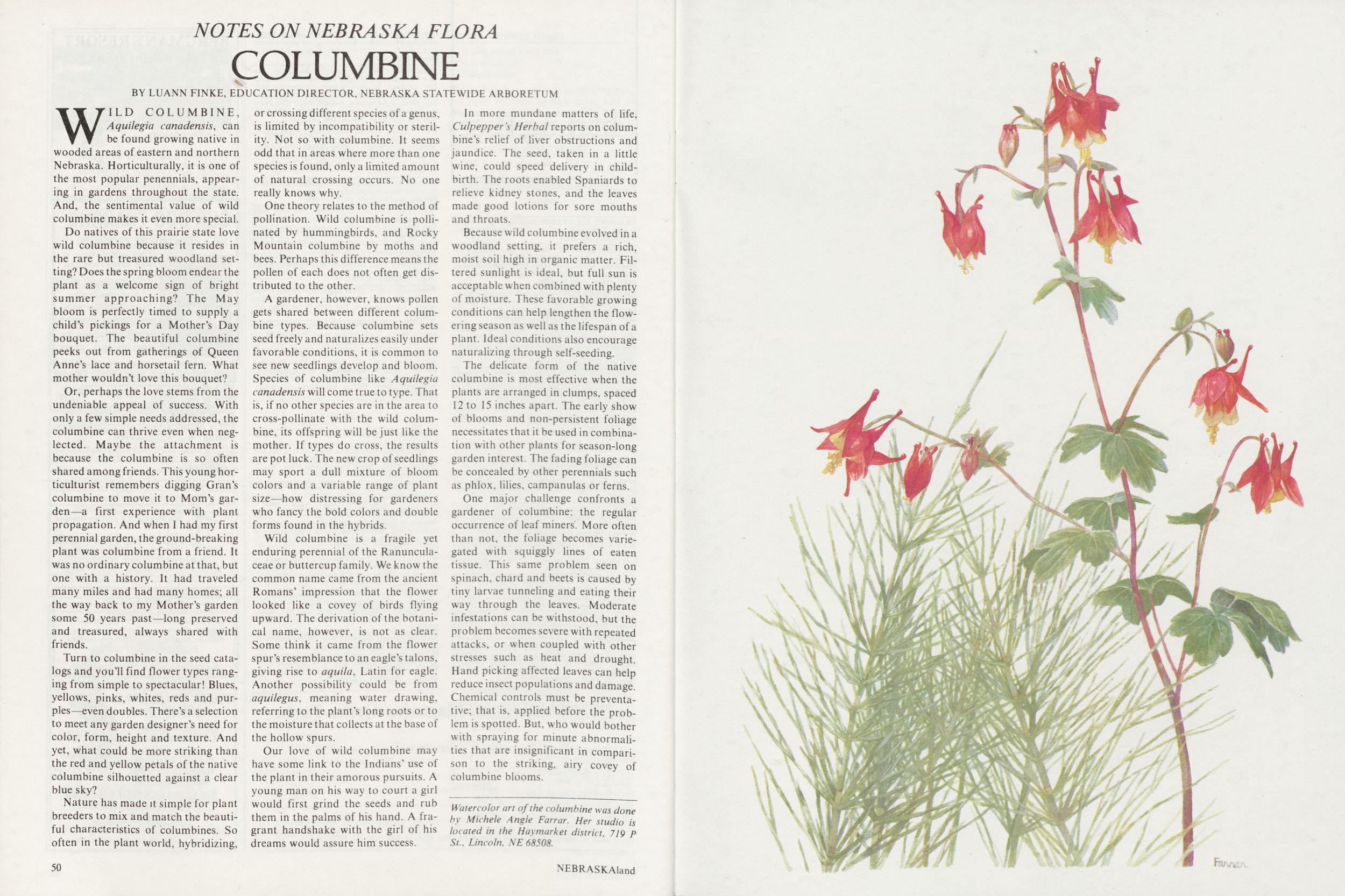
NOTES ON NEBRASKA FLORA COLUMBINE
BY LUANN FINKE, EDUCATION DIRECTOR, NEBRASKA STATEWIDE ARBORETUMWILD COLUMBINE, Aquilegia canadensis, can be found growing native in wooded areas of eastern and northern Nebraska. Horticulturally, it is one of the most popular penennials, appearing in gardens throughout the state. And, the sentimental value of wild columbine makes it even more special.
Do natives of this prairie state love wild columbine because it resides in the rare but treasured woodland setting? Does the spring bloom endear the plant as a welcome sign of bright summer approaching? The May bloom is perfectly timed to supply a child's pickings for a Mother's Day bouquet. The beautiful columbine peeks out from gatherings of Queen Anne's lace and horsetail fern. What mother wouldn't love this bouquet?
Or, perhaps the love stems from the undeniable appeal of success. With only a few simple needs addressed, the columbine can thrive even when neglected. Maybe the attachment is because the columbine is so often shared among friends. This young horticulturist remembers digging Gran's columbine to move it to Mom's garden—a first experience with plant propagation. And when I had my first perennial garden, the ground-breaking plant was columbine from a friend. It was no ordinary columbine at that, but one with a history. It had traveled many miles and had many homes; all the way back to my Mother's garden some 50 years past—long preserved and treasured, always shared with friends.
Turn to columbine in the seed catalogs and you'll find flower types ranging from simple to spectacular! Blues, yellows, pinks, whites, reds and purples—even doubles. There's a selection to meet any garden designer's need for color, form, height and texture. And yet, what could be more striking than the red and yellow petals of the native columbine silhouetted against a clear blue sky?
Nature has made it simple for plant breeders to mix and match the beautiful characteristics of columbines. So often in the plant world, hybridizing, or crossing different species of a genus, is limited by incompatibility or sterility. Not so with columbine. It seems odd that in areas where more than one species is found, only a limited amount of natural crossing occurs. No one really knows why.
One theory relates to the method of pollination. Wild columbine is pollinated by hummingbirds, and Rocky Mountain columbine by moths and bees. Perhaps this difference means the pollen of each does not often get distributed to the other.
A gardener, however, knows pollen gets shared between different columbine types. Because columbine sets seed freely and naturalizes easily under favorable conditions, it is common to see new seedlings develop and bloom. Species of columbine like Aquilegia canadensis will come true to type. That is, if no other species are in the area to cross-pollinate with the wild columbine, its offspring will be just like the mother. If types do cross, the results are pot luck. The new crop of seedlings may sport a dull mixture of bloom colors and a variable range of plant size—how distressing for gardeners who fancy the bold colors and double forms found in the hybrids.
Wild columbine is a fragile yet enduring perennial of the Ranunculaceae or buttercup family. We know the common name came from the ancient Romans' impression that the flower looked like a covey of birds flying upward. The derivation of the botanical name, however, is not as clear. Some think it came from the flower spur's resemblance to an eagle's talons, giving rise to aquila, Latin for eagle. Another possibility could be from aquilegus, meaning water drawing, referring to the plant's long roots or to the moisture that collects at the base of the hollow spurs.
Our love of wild columbine may have some link to the Indians' use of the plant in their amorous pursuits. A young man on his way to court a girl would first grind the seeds and rub them in the palms of his hand. A fragrant handshake with the girl of his dreams would assure him success.
In more mundane matters of life, Culpepper's Herbal reports on columbine's relief of liver obstructions and jaundice. The seed, taken in a little wine, could speed delivery in child birth. The roots enabled Spaniards to relieve kidney stones, and the leaves made good lotions for sore mouths and throats.
Because wild columbine evolved in a woodland setting, it prefers a rich, moist soil high in organic matter. Filtered sunlight is ideal, but full sun is acceptable when combined with plenty of moisture. These favorable growing conditions can help lengthen the flowering season as well as the lifespan of a plant. Ideal conditions also encourage naturalizing through self-seeding.
The delicate form of the native columbine is most effective when the plants are arranged in clumps, spaced 12 to 15 inches apart. The early show of blooms and non-persistent foliage necessitates that it be used in combination with other plants for season-long garden interest. The fading foliage can be concealed by other perennials such as phlox, lilies, campanulas or ferns.
One major challenge confronts a gardener of columbine: the regular occurrence of leaf miners. More often than not, the foliage becomes variegated with squiggly lines of eaten tissue. This same problem seen on spinach, chard and beets is caused by tiny larvae tunneling and eating their way through the leaves. Moderate infestations can be withstood, but the problem becomes severe with repeated attacks, or when coupled with other stresses such as heat and drought. Hand picking affected leaves can help reduce insect populations and damage. Chemical controls must be preventative; that is, applied before the problem is spotted. But, who would bother with spraying for minute abnormalities that are insignificant in comparison to the striking, airy covey of columbine blooms.
Watercolor art of the columbine was done by Michele Angle Farrar. Her studio is located in the Haymarket district, 719 p St., Lincoln, NE 68508.
50 NEBRASKAland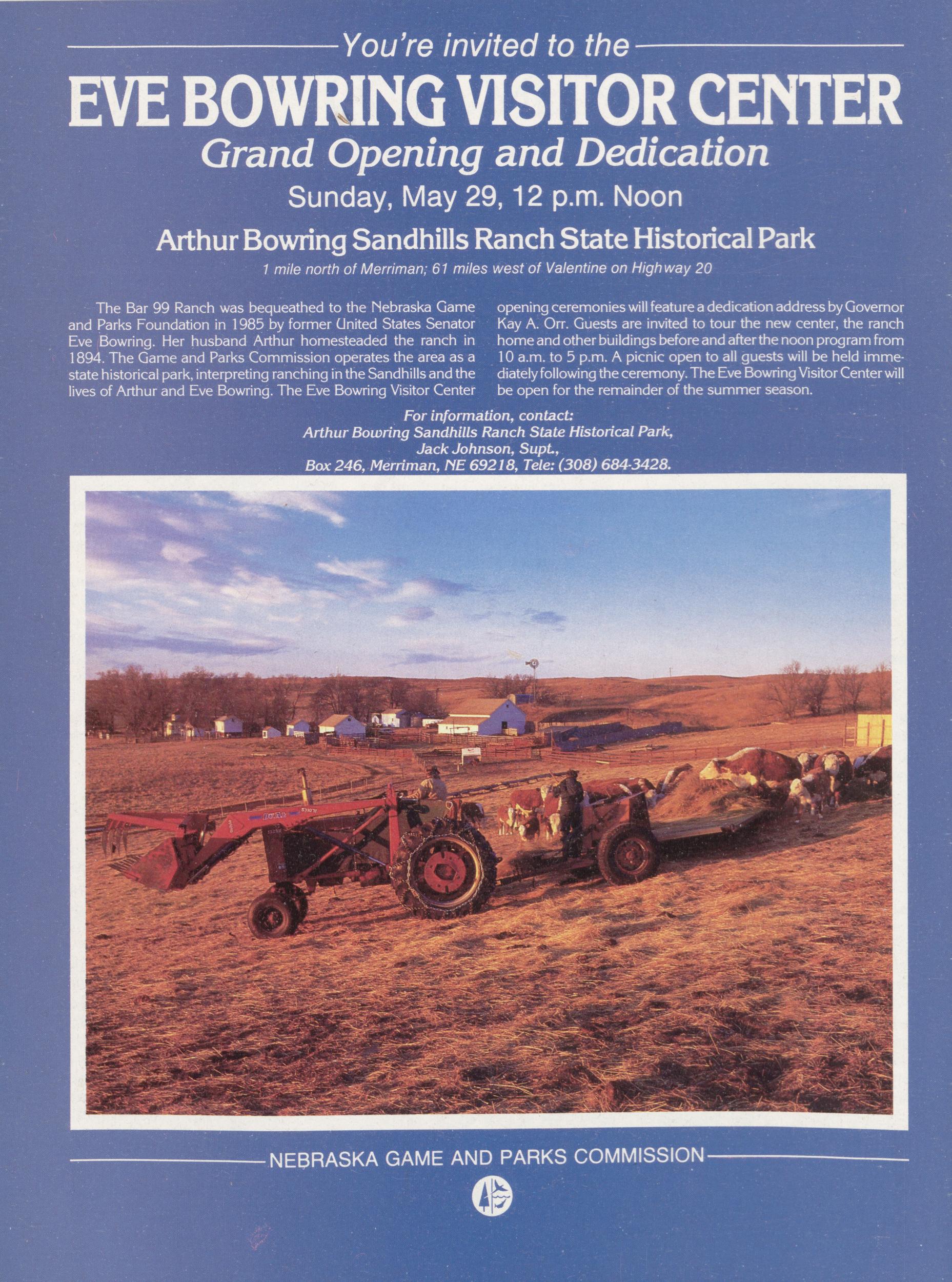
You're invited to the Grand Opening and Dedication
Sunday, May 29,12 p.m. Noon Arthur Bowring Sandhills Ranch State Historical Park 1 mile north of Merriman; 61 miles west of Valentine on Highway 20The Bar 99 Ranch was bequeathed to the Nebraska Game and Parks Foundation in 1985 by former United States Senator Eve Bowring. Her husband Arthur homesteaded the ranch in 1894. The Game and Parks Commission operates the area as a state historical park, interpreting ranching in the Sandhills and the lives of Arthur and Eve Bowring. The Eve Bowring Visitor Center opening ceremonies will feature a dedication address by Governor Kay A. Orr. Guests are invited to tour the new center, the ranch home and other buildings before and after the noon program from 10 a.m. to 5 p.m. A picnic open to all guests will be held immediately following the ceremony. The Eve Bowring Visitor Center will be open for the remainder of the summer season.
For information, contact: Arthur Bowring Sandhills Ranch State Historical Park, Jack Johnson, Supt, Box 246, Merriman, HE 69218, Tele: (308) 684-3428.Position: 30 (270 views)