Volume 66, Issue 3, 1988
NEBRASKAland
APRIL 1988 $1.50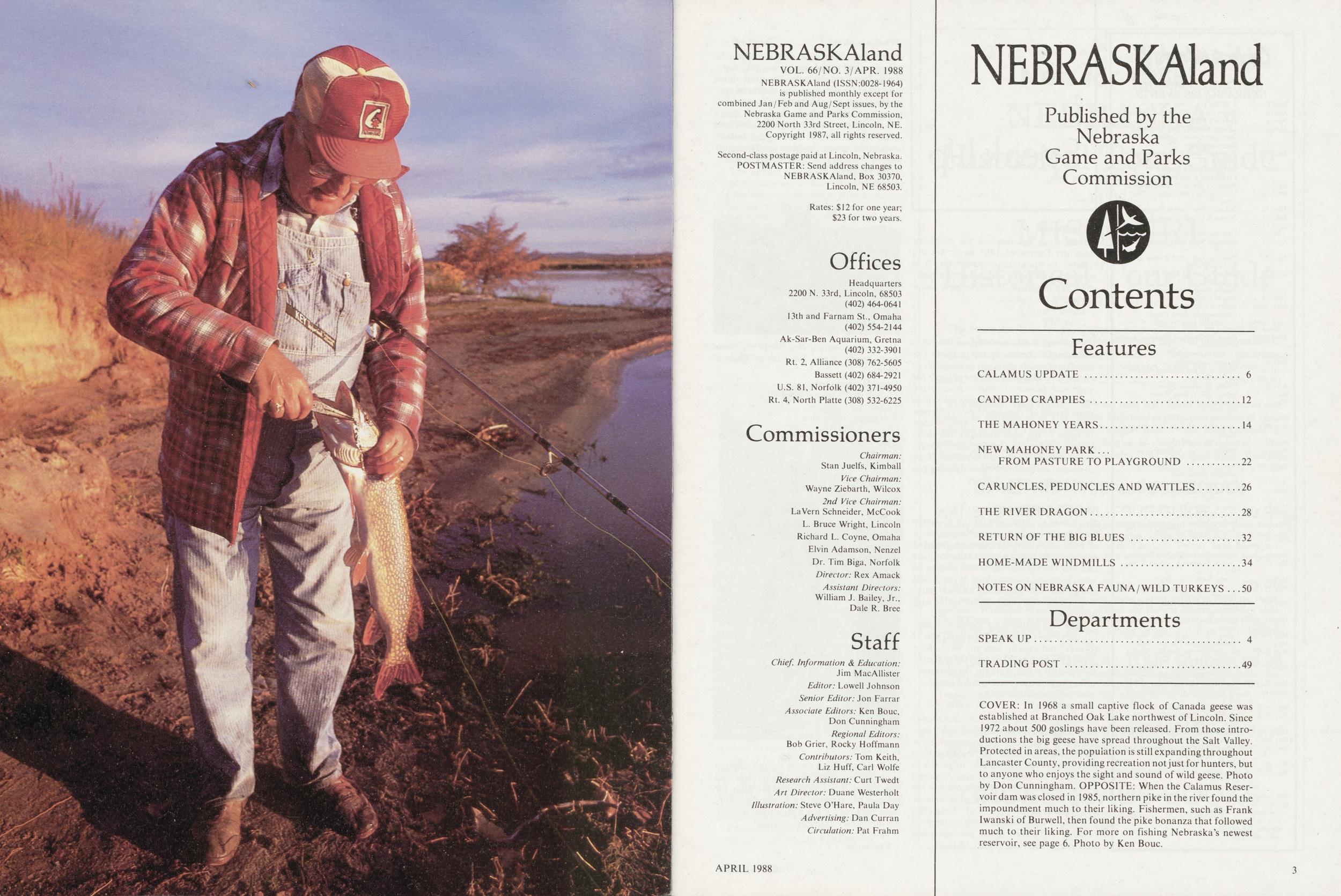
NEBRASKAland
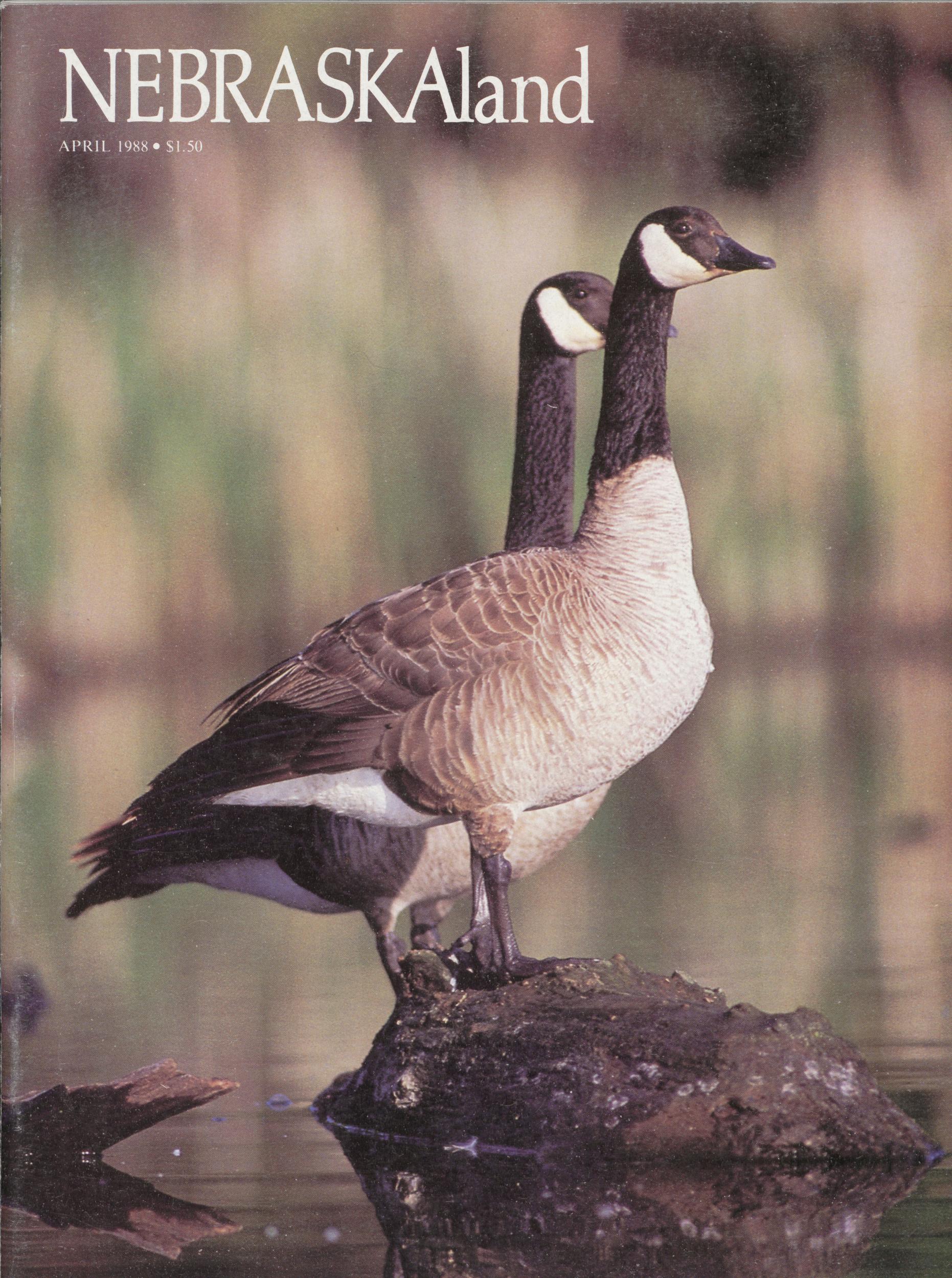
Published by the Nebraska Game and Parks Commission NEBRASKAland VOL. 66/NO. 3/APR. 1988 NEBRASKAland (ISSN:0028-1964) is published monthly except for combined Jan/Feb and Aug/Sept issues, by the Nebraska Game and Parks Commission, 2200 North 33rd Street, Lincoln, NE. Copyright 1987, all rights reserved. Second-class postage paid at Lincoln, Nebraska. POSTMASTER: Send address changes to NEBRASKAland, Box 30370, Lincoln, NE 68503. Rates: $12 for one year; $23 for two years. Offices Headquarters 2200 N. 33rd, Lincoln, 68503 (402) 464-0641 13th and Farnam St., Omaha (402) 554-2144 Ak-Sar-Ben Aquarium, Gretna (402) 332-3901 Rt. 2, Alliance (308) 762-5605 Bassett (402) 684-2921 U.S. 81, Norfolk (402) 371-4950 Rt. 4, North Platte (308) 532-6225 Commissioners Chairman: Stan Juelfs, Kimball Vice Chairman: Wayne Ziebarth, Wilcox 2nd Vice Chairman: LaVern Schneider, McCook L. Bruce Wright, Lincoln Richard L. Coyne, Omaha Elvin Adamson, Nenzel Dr. Tim Biga, Norfolk Director: Rex Amack Assistant Directors: William J. Bailey, Jr., Dale R. Bree Staff Chief, Information & Education: Jim MacAllister Editor: Lowell Johnson Senior Editor: Jon Farrar Associate Editors: Ken Bouc, Don Cunningham Regional Editors: Bob Grier, Rocky Hoffmann Contributors: Tom Keith, Liz Huff, Carl Wolfe Research Assistant: Curt Twedt Art Director: Duane Westerholt Illustration: Steve O'Hare, Paula Day Advertising: Dan Curran Circulation: Pat Frahm Contents Features CALAMUS UPDATE ............................... 6 CANDIED CRAPPIES..............................12 THE MAHONEY YEARS............................14 NEW MAHONEY PARK ... FROM PASTURE TO PLAYGROUND ..22 CARUNCLES, PEDUNCLES AND WATTLES.........26 THE RIVER DRAGON..............................28 RETURN OF THE BIG BLUES ......................32 HOME-MADE WINDMILLS........................34 NOTES ON NEBRASKA FAUNA/WILD TURKEYS .. .50 Departments SPEAK UP......................................... 4 TRADING POST...................................49 COVER: In 1968 a small captive flock of Canada geese was established at Branched Oak Lake northwest of Lincoln. Since 1972 about 500 goslings have been released. From those introductions the big geese have spread throughout the Salt Valley. Protected in areas, the population is still expanding throughout Lancaster County, providing recreation not just for hunters, but to anyone who enjoys the sight and sound of wild geese. Photo by Don Cunningham. OPPOSITE: When the Calamus Reservoir dam was closed in 1985, northern pike in the river found the impoundment much to their liking. Fishermen, such as Frank Iwanski of Burwell, then found the pike bonanza that followed much to their liking. For more on fishing Nebraska's newest reservoir, see page 6. Photo by Ken Bouc. APRIL 1988 3
Speak Up
No magazine!Sir /We have not received the magazine since the December 1987 issue. We did receive the cookbook—thank you. It is very nice and looks wonderful. We really enjoy the magazine and have been disappointed in the mix-up.
Karen Plantz Lolo, MTWe have received several letters like this, and thought it best to answer in Speak Up. The Cookbook is the latest in the series of annual special issues which are actually the combined January-February issue. And, the March issue will be along any day now. Some people get concerned, especially new subscribers, but we do try to make it clear on page 3. We also announce the delay ahead of time, but people don't always notice the ads we put in December. Hope all readers are not thinking we left a big gap in their subscription. (Editor)
* * * Thanks for cookbookSir/A note to thank you for the "Country Cookbook." I was so excited when it arrived, I sat and looked through the issue page by page, and marveled at the exquisite pictures. But the highlight came on page 84 when 1 saw the picture of the desserts, and recognized the chocolate mound balls. Then on the next page was the recipe with my name.
Sometime in the future, could you identify the recipes on page 87 (desserts) and 77 (breads) and explain how you went about getting the pictures? Did the staff make the recipes then group them for the pictures? Anyway, it is a very beautiful book.
Mrs. Louis Rebbe Fremont, NEGlad you liked the cookbook, and thanks to you (and to the hundreds of other contributors); you are really responsible for the success of the book. Yes, the desserts on page 84 were all "homemade " by people in our office. Volunteers took dessert recipes home to prepare, then brought them to the studio to be photographed. The breads, too, are the result of a staff "bake-off ' (except for a few loaves from commercial bakers). All other foods photographed were prepared in our studio. (Editor)
Whooo took this?Sir/1 have always been very impressed by the excellent photography in your magazine. There are so many beautiful sights and scenes in our state, and thanks to you, more people are able to enjoy them.
I am an amateur photographer, and I have a picture which I would like to share with your readers. It is of a great horned owl, taken along the Missouri River just east of Niobrara.
Dan Brandt Omaha, NEHere, to accompany that photo is a poem from reader Anne Knowles of Omaha. (Editor)
Great Horned Owl I watch down from a pitch pine. I know my territory, Red maple and a pine. Hunger moves me. I turn my head to see A soft moving in the leaves. Wings quiet as a rising star I go for a garter snake. I kill because I have to.And here is another owl photo sent in by reader Larry Voecks of Fremont. (Editor)
Sir/It pleases me to renew my subscription to your lovely magazine. As a transplanted Nebraskan, it is a wonderful interlude for pleasant reverie when it arrives each month. Needless to say, it has a prominent place in the little lobby of my Texan Hotel.
Betty Rhynehart Panhandle, TX 4 NEBRASKAland In the fieldSir/This is a photo of my dad, which I took during our seven-day hunt in your great state. He is 70 years old and has been with us several years on our annual pheasant trip. This was my 14th trip, beginning in 1972. This photo was taken in Clay County on Nov. 11, 1987.
I was very impressed with the public hunting areas this year. There was plenty of food and cover for the birds.
The annual trip is the highlight of our year. Some years we have as many as 10 or 12 hunters, and we always have good success, but we work hard and walk many miles. We have also always been impressed with the landowners. We make a practice of obtaining permission, and we have only been turned down a few times.
I want to congratulate your Commission for an excellent job of management. It appears to me that the cover on public land will be sufficient even with a bad winter. Keep up the good work, as we hope to continue our annual trips for many more years.
Gary Bridges Killen, AL * * *Sir/I am an English teacher in France, and I was very fortunate to visit Nebraska once, on a fine April 1987 day, while teaching at St. Mary's Academy in Kansas. I then traveled through many parts of America.
I had a wonderful time in your beautiful, fascinating and friendly state. While visiting the outstanding Lincoln State Capitol, I bought the March 1987 issue of NEBRASKAland Magazine at the visitor's shop. After seeing that issue, who could resist NEBRASKAland?
I want your staff to know how much I enjoy your magazine. Every facet is super, swell and interesting. Therefore I've decided to subscribe.
Thanks for helping recall the very happy time I spent in Lincoln and Omaha. Now I'm back home in France and sure miss Nebraska. It still feels like "home" to a certain extent. Keep up the good work! And have a very happy new year in 1988.
Pascal-Charles Ferroni Montreal-de-1'Aude, France New for 1988! NEBRASKA Historical Tour Guide (2nd Printing—Revised) —PLUS— MISSOURI Historical Tour Guide By D. Ray Wilson The Nebraska Tour Guide, originally released in 1983, has been revised and updated for the 1988 season. Contains more than 100 photos and maps. Highlights places of historical significance in Nebraskaland, including many of the sites along the Oregon and Mormon Trails. Soft cover only. Indexed. (ISBN 0-916445-21-6)...............................................................Only $9.95 The Missouri Tour Guide, with more than 100 photos, lists museums and historical attractions in the "Show Me" State. Brief biographies of such notables as Harry Truman, Joseph Pulitzer, Mark Twain, John J. Pershing, Omar Bradley, and many others. Stories of the infamous as well—The James Gang, the Youngers, and Calamity Jane. Soft cover only. Indexed (ISBN 0-916445-18-6)...........................................................................Only $9.95 OTHER HISTORICAL TOUR GUIDES KANSAS HISTORICAL TOUR GUIDE......$9.95 The Jayhawk State has many historical attractions wrapped in the Old West. Home state of the late President Dwight D. Eisenhower. Stories of legendary characters Wyatt Earp, Bat Masterson, Wild Bill Hickok and the Dalton Gang. Many out- standing museums and historical attractions await the visitor to Kansas. Soft cover only. Indexed. (ISBN 0-916445-16-X) IOWA HISTORICAL TOUR GUIDE............$9.95 The complete guide book to the historical places and attractions in Iowa, the Hawkeye State. Birthplace of such notables as President Herbert Hoover, Composer Meredith Willson, Author James Norman Hall, Artist Grant Wood, Evangelist Billy Sunday, Actor John Wayne and TV host Johnny Carson. Soft cover only. Indexed. (ISBN 0-916445-13-5) WYOMING HISTORICAL TOUR GUIDE.. $9.95 The Equality State has a colorful history of cowboys and cattle rustlers, Indian battles, forts and many colorful characters—Butch Cassidy and the Sundance Kid, J. C. Penney, Buffalo Bill Cody, Tom Horn and others. Soft cover only. Indexed. (ISBN 0-916445-08-9) To order, send check or Money Order: Include $9.95 per book plus $1.50 per book for mailer and postage. CROSSROADS BOOKS P.O. Box 7 • Carpentersville, IL 60110-0007 APRIL 1988 5
Calamus Update
PHOTOS AND TEXT BY KEN BOUC Persistent anglers unlock secrets of Calamus Reservoir, Nebraska's newest fishing hole. Calamus regulars share what they have learned fishing there for northern pike, bluegill, largemouth bass and walleye.WATCHING someone catch a good-sized fish is almost as much fun as catching one yourself. Seeing the same fisherman catch two in one spot is stimulating, too, except for the slightly uncomfortable bit of envy that it arouses. But, watching that guy catch a third pike right there under your nose is downright maddening, particularly if you'd left that spot without catching a thing less than a half-hour before.
Well, that's exactly what Frank Iwanski did. I had abandoned that particular point earlier, and was now sitting on the opposite bank of a small bay watching him catch fish.
Of course, that sort of thing was to be expected of Frank, a retired Burwell resident who has fished for northerns all but about the first 10 of his 71 years. He'd fished for pike in sandpits and bayous along the Calamus and Loup rivers many of those years, at Sandhills lakes, as well as in Canada and other distant points. No doubt he'd learned a thing or two about pike fishing along the way.
And lately, he'd spent just about every spring, summer and fall morning of 1987 at Calamus Reservoir. Now, Frank and several others who fished Calamus regularly last year offer what they learned about the reservoir in its first season. Among them are Frank's pike fishing sidekick, Spud Kaputska of Elyria, a pair of bluegill fishermen from Taylor, Duane Dunbar and John Shunneson, plus bass and walleye fishermen in Bo Conner of Burwell and his son-in-law, Ron Bailey of Broken Bow. Since these fishermen have obviously learned how to make Calamus Reservoir pay off, their observations should be of interest to fishermen planning an outing to Calamus this year.
NORTHERN PIKEThe northern pike is not a hard fish to find, particularly in the spring, according to Frank Iwanski and Spud Kaputska. "Early in the spring, I look for pike in shallow areas of flooded weeds and grass," said Frank. The vegetation is critical habitat for pike spawning, which happens soon after ice-out, and the shallows are also warmer than the depths.
Frank fished from the bank all spring, but began using a boat as summer approached. "They were a bit deeper in the summer, but still seldom over six feet down," he said. The fish were distributed across the lake by this time, and Frank and Spud caught them at the dam just about as often as in the bays or in the heavy cover at the other end of the lake.
Throughout the spring, summer and early fall, artificial lures were the best bait. Pike were taken on spoons, spinnerbaits, Rapala-like plugs, and large, straight spinners such as No. 4 or 5 Mepps. Most of the time, a steady retrieve worked just fine, but in the cold water of early spring and late fall, a fluttering start-stop retrieve works well. Still-fishing with bait, usually frozen smelt, outproduced artificials only in late fall.
Day in and day out, silver or copper-backed spoons painted either red/white or black/white were most effective. "It seemed to me that many times the silver or copper color had more to do with triggering strikes than the color of the paint job. But, in late summer, the black and white spoon was definitely best, and I repainted some 'cheapies' with white spots on black background that worked best of all," Frank said. He reported that the Rapala-style of plug also worked, but the balsa wood and plastic bodies didn't stand up to pike teeth very well.
Spud generally echoed Frank's findings about pike fishing at Calamus, but balked at the intention to fish from a boat more in 1988. "Boats work fine, but I prefer bank fishing. There's no hassle with boat, trailer, ramp or wind. If a pike is feeding, he'll be shallow anyway, and I'll be able to reach him," Spud said.
Spud fished late into the year, and was soaking smelt under bobbers around his decoys until duck season closed at the end of November. Fishing was good right up until the end ... "a lot better than the duck hunting," Spud said.
Spud recommends heavy tackle and line, and long wire leaders for 1988. "I started in '87 with eight-pound-test line, and the pike were breaking line twice as strong by the end of the year," Spud said. "The pike will be a lot bigger, stronger and harder to handle next year."
BLUEGILLA small, almost imperceptible tug at the bait flowed up the line like electricity, triggering a reflexive yank of the rod to set the hook. The hard part was finished. We'd finally found the bluegill, and the fun was about to start.
For Duane Dunbar, proprietor of Double D's Sport and Convenience Shop in Taylor, the search had started more than a week before. Just as we hit the water on that first outing, a phalanx of clouds, followed by light rain and cold wind, rolled in and turned off the fishing. When we resumed the next week, it took the better part of two hours at several fish less spots to find a school of those nice, hand-sized 'gills. But it was all worthwhile.
Duane, and his sidekick John Shunneson, also of Taylor, spent a good deal of 1987 learning about Calamus Reservoir Bluegills. Both agree that water temperature plays a big role in where the bluegill will be in the spring. 'They'll be in the upper end where the water is warmer, hanging around in the trees," Duane said. John was a bit more specific, saying that the fish don't get very active until water temperatures top 56 degrees.
6 NEBRASKAland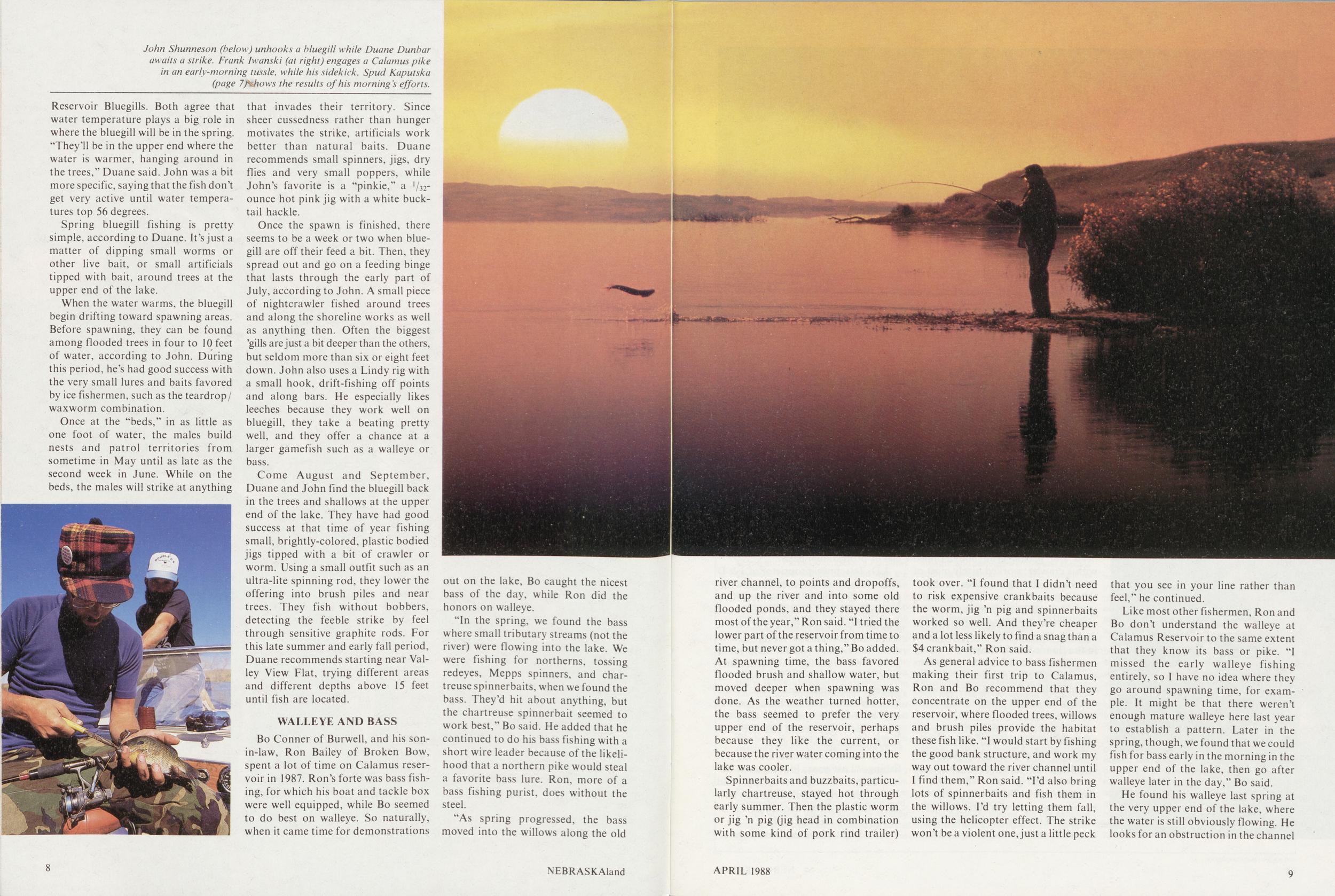 John Shunneson (below) unhooks a bluegill while Duane Dunbar
awaits a strike. Frank Iwanski (at right) engages a Calamus pike
in an early-morning tussle, while his sidekick, Spud Kaputska
(page 7)%hows the results of his morning's efforts.
John Shunneson (below) unhooks a bluegill while Duane Dunbar
awaits a strike. Frank Iwanski (at right) engages a Calamus pike
in an early-morning tussle, while his sidekick, Spud Kaputska
(page 7)%hows the results of his morning's efforts.
Spring bluegill fishing is pretty simple, according to Duane. It's just a matter of dipping small worms or other live bait, or small artificials tipped with bait, around trees at the upper end of the lake.
When the water warms, the bluegill begin drifting toward spawning areas. Before spawning, they can be found among flooded trees in four to 10 feet of water, according to John. During this period, he's had good success with the very small lures and baits favored by ice fishermen, such as the teardrop/waxworm combination.
Once at the "beds," in as little as one foot of water, the males build nests and patrol territories from sometime in May until as late as the second week in June. While on the beds, the males will strike at anything that invades their territory. Since sheer cussedness rather than hunger motivates the strike, artificials work better than natural baits. Duane recommends small spinners, jigs, dry flies and very small poppers, while John's favorite is a "pinkie," a V32-ounce hot pink jig with a white bucktail hackle.
Once the spawn is finished, there seems to be a week or two when bluegill are off their feed a bit. Then, they spread out and go on a feeding binge that lasts through the early part of July, according to John. A small piece of nightcrawler fished around trees and along the shoreline works as well as anything then. Often the biggest 'gills are just a bit deeper than the others, but seldom more than six or eight feet down. John also uses a Lindy rig with a small hook, drift-fishing off points and along bars. He especially likes leeches because they work well on bluegill, they take a beating pretty well, and they offer a chance at a larger gamefish such as a walleye or bass.
Come August and September, Duane and John find the bluegill back in the trees and shallows at the upper end of the lake. They have had good success at that time of year fishing small, brightly-colored, plastic bodied jigs tipped with a bit of crawler or worm. Using a small outfit such as an ultra-lite spinning rod, they lower the offering into brush piles and near trees. They fish without bobbers, detecting the feeble strike by feel through sensitive graphite rods. For this late summer and early fall period, Duane recommends starting near Valley View Flat, trying different areas and different depths above 15 feet until fish are located.
Bo Conner of Burwell, and his son-in-law, Ron Bailey of Broken Bow, spent a lot of time on Calamus reservoir in 1987. Ron's forte was bass fishing, for which his boat and tackle box were well equipped, while Bo seemed to do best on walleye. So naturally, when it came time for demonstrations out on the lake, Bo caught the nicest bass of the day, while Ron did the honors on walleye.
"In the spring, we found the bass where small tributary streams (not the river) were flowing into the lake. We were fishing for northerns, tossing redeyes, Mepps spinners, and chartreuse spinnerbaits, when we found the bass. They'd hit about anything, but the chartreuse spinnerbait seemed to work best," Bo said. He added that he continued to do his bass fishing with a short wire leader because of the likelihood that a northern pike would steal a favorite bass lure. Ron, more of a bass fishing purist, does without the steel.
"As spring progressed, the bass moved into the willows along the old 8 NEBRASKAland river channel, to points and drop offs, and up the river and into some old flooded ponds, and they stayed there most of the year," Ron said. "I tried the lower part of the reservoir from time to time, but never got a thing," Bo added. At spawning time, the bass favored flooded brush and shallow water, but moved deeper when spawning was done. As the weather turned hotter, the bass seemed to prefer the very upper end of the reservoir, perhaps because they like the current, or because the river water coming into the lake was cooler.
Spinnerbaits and buzz baits, particularly chartreuse, stayed hot through early summer. Then the plastic worm or jig 'n pig (jig head in combination with some kind of pork rind trailer) took over. "I found that I didn't need to risk expensive crank baits because the worm, jig 'n pig and spinnerbaits worked so well. And they're cheaper and a lot less likely to find a snag than a $4 crankbait," Ron said.
As general advice to bass fishermen making their first trip to Calamus, Ron and Bo recommend that they concentrate on the upper end of the reservoir, where flooded trees, willows and brush piles provide the habitat these fish like. "I would start by fishing the good bank structure, and work my way out toward the river channel until I find them," Ron said. "I'd also bring lots of spinnerbaits and fish them in the willows. I'd try letting them fall, using the helicopter effect. The strike won't be a violent one, just a little peck that you see in your line rather than feel," he continued.
Like most other fishermen, Ron and Bo don't understand the walleye at Calamus Reservoir to the same extent that they know its bass or pike. "I missed the early walleye fishing entirely, so I have no idea where they go around spawning time, for example. It might be that there weren't enough mature walleye here last year to establish a pattern. Later in the spring, though, we found that we could fish for bass early in the morning in the upper end of the lake, then go after walleye later in the day," Bo said.
He found his walleye last spring at the very upper end of the lake, where the water is still obviously flowing. He looks for an obstruction in the channel with a hole downstream. Beaching or anchoring above the hole, he casts across the current and lets it carry his rig to walleye waiting in the hole downstream. Last year, a black jig head and plastic grub body, tipped with a crawler, worked nicely most of the time, and a jig/minnow combination also worked occasionally, as did spinner and crawler combinations.
APRIL 1988 9
Ron tried for walleye off points in the main lake, and later jigged for them in the flooded river channel, but only caught a few small fish there. "It seems that walleye are attracted by flowing water, either the river, or tributary creeks, or maybe even springs,'1 he said.
As a rule, the walleye fishing has been at the upper end of the lake, although there have been reports of a few stringers taken farther down in the reservoir. "In general," Bo said, "I think the best walleye fishing so far has been at the upper end of the lake. The bass are in the cover from the flooded riverbank to the water's edge, and the walleye are in the old river bed."
BRIGHT FUTUREThe future of Calamus Reservoir looks good, according to several men connected with the lake on a commercial or professional basis.
J.D. Tetschner, proprietor of J & D Sport Shop in Burwell, has kept a finger on the pulse of the reservoir through the stories of his customers and what they buy in the way of tackle, as well as through his own experiences as a fisherman. "I think 1988 looks good for everything, but particularly pike, bass and walleye. Last year, the walleye were small and most of the bass were under the size limit, but that will be different this year. And the pike, which were decent size last year, will be bigger, too," he said.
J.D. wondered aloud about the catfishing. "Last year, lots of small 12-inch cats were caught at the upper end of the lake early in the spring. Just how much they've grown in one year will be interesting to see," he said.
He noted (Continued on page 47)
10 NEBRASKAlandThe Calamus Fish Hatchery
BY KEN BOUCTHE NEW hatchery planned for Calamus Reservoir could be under construction as early as March of next year, could be finished and raising a few fish in 1990, and might be nearing full operation by 1991.
According to Wes Sheets, chief of the Game and Parks Commission's Fisheries Division, 1988 will be occupied with the design process, for which a contract will be awarded yet this spring. Bidding on the construction contract for the estimated $6 million facility, and the awarding of the contract, will likely take place in the winter.
As part of the Bureau of Reclamation's project at Calamus Reservoir, the hatchery is eligible for federal matching funds at the rate of three federal for every Nebraska dollar, with the value of fish stocked by the Commission counted toward the state's $1.5 million share. Since the Game and Parks Commission will have introduced fish worth about $500,000 by the time stocking is completed, it will get the hatchery for a cash outlay of about $1 million.
According to Sheets, the new hatchery would have access to as much water from Calamus Reservoir as is used in all of the Commission's other hatcheries combined. In fish culture, water volume is directly proportional to production capacity, so the new facility could conceivably double the Commission's fish-production capability.
The Calamus Hatchery's greatest potential would be in the propagation of cool water fish such as northern pike, muskellunge, tiger muskies and walleye. It will also be able to raise cold-water fish (trout) with water from wells during hot summer months, and perhaps warm-water species such as largemouth bass and bluegill. Its water would likely be too cold to raise catfish, although the increased pike and walleye production at Calamus would free space for catfish culture at the Commission's North Platte hatchery.
More than 50 rearing ponds will be the heart of the operation, but raceways and tanks would also be important, especially in raising trout. When completed, the facility will be capable of raising about 53 million fish. This would include 300,000 10-inch trout in raceways, 50 million walleye fry in the hatch house, 100,000 eight-inch tiger muskie (northern pike/muskellunge hybrids) and 700,000 five-inch walleye in tanks, 750,000 wipers (white bass/ striped bass hybrids) in both tanks and ponds, plus 250,000 bluegill fingerlings, 100,000 largemouth bass fingerlings, and one million 11/2-inch walleye fingerlings, all in the outdoor ponds.
The hatchery figures into the fisheries picture all across the state, but it is particularly important to Calamus Reservoir. Walleye will not be able to reproduce in the impoundment because its dam was built with a soil-cement face rather than the rock riprap used on most other dams. Without rock on the dam, walleye will have no place to spawn in the reservoir. Thus, regular stocking of walleye will be needed to maintain the species in that lake. This will be particularly important a few years into the lake's existence when northern pike and bass fade from the picture as conditions evolve to favor the walleye as the lake's dominant large predator species and gamefish.
Fish produced by the new hatchery will be important to fishery enhancement statewide, as well, assuring fisheries biologists ample stock to repopulate renovated waters, establish populations in new waters, or introduce new species or occasionally conduct supplemental stockings in existing fisheries.
The Calamus hatchery represents a great opportunity for Nebraska fisheries, perhaps the last such opportunity that Nebraska will see. Calamus Reservoir will probably mark the end of large reservoir construction in the state, and the last such source of water for a fish hatchery. If no more major impoundments are built, the hatchery will play a major role in making the most of Nebraska's existing, aging reservoirs.
APRIL 1988 11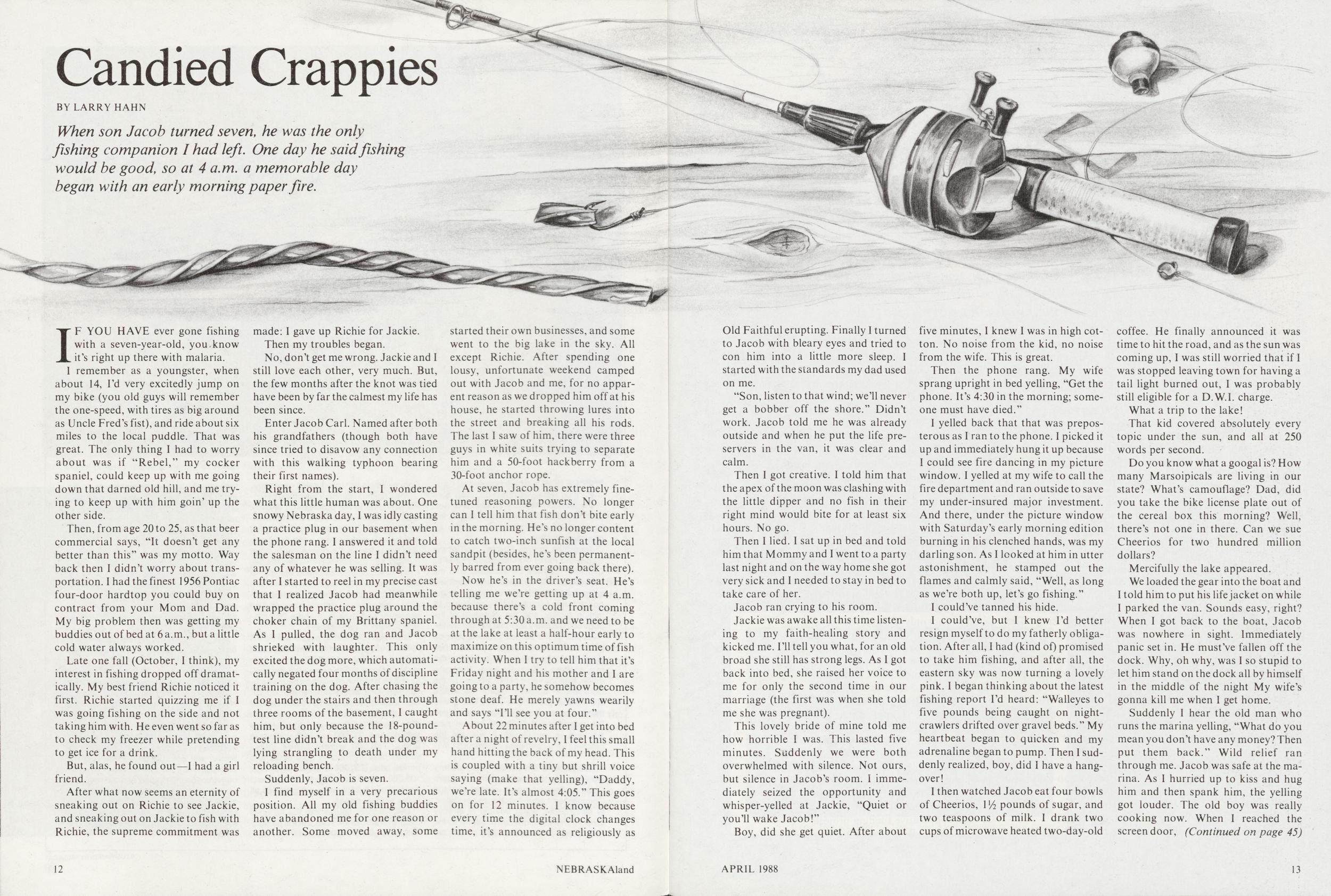
Candied Crappies
BY LARRY HAHN When son Jacob turned seven, he was the only fishing companion I had left. One day he said fishing would be good, so at 4 a.m. a memorable day began with an early morning paper fire.IF YOU HAVE ever gone fishing with a seven-year-old, you.know it's right up there with malaria. I remember as a youngster, when about 14, I'd very excitedly jump on my bike (you old guys will remember the one-speed, with tires as big around as Uncle Fred's fist), and ride about six miles to the local puddle. That was great. The only thing I had to worry about was if "Rebel," my cocker spaniel, could keep up with me going down that darned old hill, and me trying to keep up with him goin' up the other side.
Then, from age 20 to 25, as that beer commercial says, "It doesn't get any better than this" was my motto. Way back then I didn't worry about transportation. I had the finest 1956 Pontiac four-door hardtop you could buy on contract from your Mom and Dad. My big problem then was getting my buddies out of bed at 6 a.m., but a little cold water always worked.
Late one fall (October, I think), my interest in fishing dropped off dramatically. My best friend Richie noticed it first. Richie started quizzing me if I was going fishing on the side and not taking him with. He even went so far as to check my freezer while pretending to get ice for a drink.
But, alas, he found out—I had a girl friend.
After what now seems an eternity of sneaking out on Richie to see Jackie, and sneaking out on Jackie to fish with Richie, the supreme commitment was made: I gave up Richie for Jackie.
Then my troubles began.
No, don't get me wrong. Jackie and I still love each other, very much. But, the few months after the knot was tied have been by far the calmest my life has been since.
Enter Jacob Carl. Named after both his grandfathers (though both have since tried to disavow any connection with this walking typhoon bearing their first names).
Right from the start, I wondered what this little human was about. One snowy Nebraska day, I was idly casting a practice plug in our basement when the phone rang. I answered it and told the salesman on the line I didn't need any of whatever he was selling. It was after I started to reel in my precise cast that I realized Jacob had meanwhile wrapped the practice plug around the choker chain of my Brittany spaniel. As I pulled, the dog ran and Jacob shrieked with laughter. This only excited the dog more, which automatically negated four months of discipline training on the dog. After chasing the dog under the stairs and then through three rooms of the basement, I caught him, but only because the 18-pound test line didn't break and the dog was lying strangling to death under my reloading bench.
Suddenly, Jacob is seven.
I find myself in a very precarious position. All my old fishing buddies have abandoned me for one reason or another. Some moved away, some started their own businesses, and some went to the big lake in the sky. All except Richie. After spending one lousy, unfortunate weekend camped out with Jacob and me, for no apparent reason as we dropped him off at his house, he started throwing lures into the street and breaking all his rods. The last I saw of him, there were three guys in white suits trying to separate him and a 50-foot hackberry from a 30-foot anchor rope.
At seven, Jacob has extremely fine tuned reasoning powers. No longer can I tell him that fish don't bite early in the morning. He's no longer content to catch two-inch sunfish at the local sandpit (besides, he's been permanently barred from ever going back there).
Now he's in the driver's seat. He's telling me we're getting up at 4 a.m. because there's a cold front coming through at 5:30 a.m. and we need to be at the lake at least a half-hour early to maximize on this optimum time offish activity. When I try to tell him that it's Friday night and his mother and I are going to a party, he somehow becomes stone deaf. He merely yawns wearily and says "I'll see you at four."
About 22 minutes after I get into bed after a night of revelry, I feel this small hand hitting the back of my head. This is coupled with a tiny but shrill voice saying (make that yelling), "Daddy, we're late. It's almost 4:05." This goes on for 12 minutes. I know because every time the digital clock changes time, it's announced as religiously as 12 NEBRASKAland Old Faithful erupting. Finally I turned to Jacob with bleary eyes and tried to con him into a little more sleep. I started with the standards my dad used on me.
"Son, listen to that wind; we'll never get a bobber off the shore." Didn't work. Jacob told me he was already outside and when he put the life preservers in the van, it was clear and calm.
Then I got creative. I told him that the apex of the moon was clashing with the little dipper and no fish in their right mind would bite for at least six hours. No go.
Then I lied. I sat up in bed and told him that Mommy and I went to a party last night and on the way home she got very sick and I needed to stay in bed to take care of her.
Jacob ran crying to his room.
Jackie was awake all this time listening to my faith-healing story and kicked me. I'll tell you what, for an old broad she still has strong legs. As I got back into bed, she raised her voice to me for only the second time in our marriage (the first was when she told me she was pregnant).
This lovely bride of mine told me how horrible I was. This lasted five minutes. Suddenly we were both overwhelmed with silence. Not ours, but silence in Jacob's room. I immediately seized the opportunity and whisper-yelled at Jackie, "Quiet or you'll wake Jacob!"
Boy, did she get quiet. After about five minutes, I knew I was in high cotton. No noise from the kid, no noise from the wife. This is great.
Then the phone rang. My wife sprang upright in bed yelling, "Get the phone. It's 4:30 in the morning; someone must have died."
I yelled back that that was preposterous as I ran to the phone. I picked it up and immediately hung it up because I could see fire dancing in my picture window. I yelled at my wife to call the fire department and ran outside to save my under-insured major investment. And there, under the picture window with Saturday's early morning edition burning in his clenched hands, was my darling son. As I looked at him in utter astonishment, he stamped out the flames and calmly said, "Well, as long as we're both up, let's go fishing."
I could've tanned his hide.
I could've, but I knew I'd better resign myself to do my fatherly obligation. After all, I had (kind of) promised to take him fishing, and after all, the eastern sky was now turning a lovely pink. I began thinking about the latest fishing report I'd heard: "Walleyes to five pounds being caught on nightcrawlers drifted over gravel beds." My heartbeat began to quicken and my adrenaline began to pump. Then I suddenly realized, boy, did I have a hangover!
I then watched Jacob eat four bowls of Cheerios, V/i pounds of sugar, and two teaspoons of milk. I drank two cups of microwave heated two-day-old coffee. He finally announced it was time to hit the road, and as the sun was coming up, I was still worried that if I was stopped leaving town for having a tail light burned out, I was probably still eligible for a D.W.I, charge.
What a trip to the lake!
That kid covered absolutely every topic under the sun, and all at 250 words per second.
Do you know what a googal is? How many Marsoipicals are living in our state? What's camouflage? Dad, did you take the bike license plate out of the cereal box this morning? Well, there's not one in there. Can we sue Cheerios for two hundred million dollars?
Mercifully the lake appeared.
We loaded the gear into the boat and I told him to put his life jacket on while I parked the van. Sounds easy, right? When I got back to the boat, Jacob was nowhere in sight. Immediately panic set in. He must've fallen off the dock. Why, oh why, was I so stupid to let him stand on the dock all by himself in the middle of the night My wife's gonna kill me when I get home.
Suddenly I hear the old man who runs the marina yelling, "What do you mean you don't have any money? Then put them back." Wild relief ran through me. Jacob was safe at the marina. As I hurried up to kiss and hug him and then spank him, the yelling got louder. The old boy was really cooking now. When I reached the screen door, (Continued on page 45)
APRIL 1988 13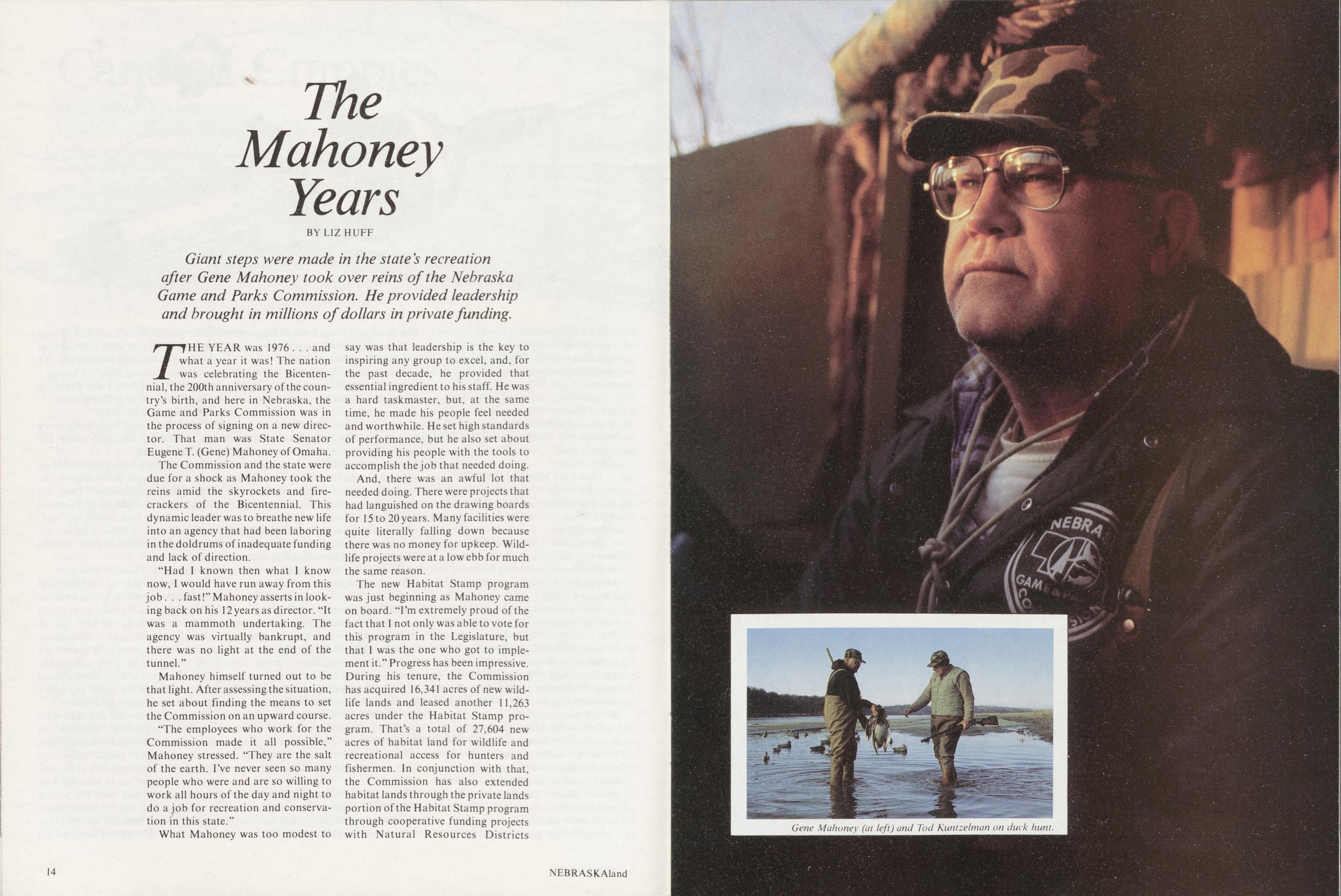
The Mahoney Years
BY LIZ HUFF Giant steps were made in the state's recreation after Gene Mahoney took over reins of the Nebraska Game and Parks Commission. He provided leadership and brought in millions of dollars in private funding.T7HE YEAR was 1976 ... and what a year it was! The nation was celebrating the Bicentennial, the 200th anniversary of the country's birth, and here in Nebraska, the Game and Parks Commission was in the process of signing on a new director. That man was State Senator Eugene T. (Gene) Mahoney of Omaha.
The Commission and the state were due for a shock as Mahoney took the reins amid the skyrockets and fire crackers of the Bicentennial. This dynamic leader was to breathe new life into an agency that had been laboring in the doldrums of inadequate funding and lack of direction.
"Had I known then what I know now, I would have run away from this job. . . fast!" Mahoney asserts in looking back on his 12 years as director. "It was a mammoth undertaking. The agency was virtually bankrupt, and there was no light at the end of the tunnel."
Mahoney himself turned out to be that light. After assessing the situation, he set about finding the means to set the Commission on an upward course.
"The employees who work for the Commission made it all possible," Mahoney stressed. "They are the salt of the earth. I've never seen so many people who were and are so willing to work all hours of the day and night to do a job for recreation and conservation in this state."
What Mahoney was too modest to say was that leadership is the key to inspiring any group to excel, and, for the past decade, he provided that essential ingredient to his staff. He was a hard taskmaster, but, at the same time, he made his people feel needed and worthwhile. He set high standards of performance, but he also set about providing his people with the tools to accomplish the job that needed doing.
And, there was an awful lot that needed doing. There were projects that had languished on the drawing boards for 15 to 20 years. Many facilities were quite literally falling down because there was no money for upkeep. Wildlife projects were at a low ebb for much the same reason.
The new Habitat Stamp program was just beginning as Mahoney came on board. "I'm extremely proud of the fact that I not only was able to vote for this program in the Legislature, but that I was the one who got to implement it." Progress has been impressive. During his tenure, the Commission has acquired 16,341 acres of new wildlife lands and leased another 11,263 acres under the Habitat Stamp pro- gram. That's a total of 27,604 new acres of habitat land for wildlife and recreational access for hunters and fishermen. In conjunction with that, the Commission has also extended habitat lands through the private lands portion of the Habitat Stamp program through cooperative funding projects with Natural Resources Districts across the state, resulting in another 38,064 acres under contract for habitat enhancement.
14 NEBRASKAland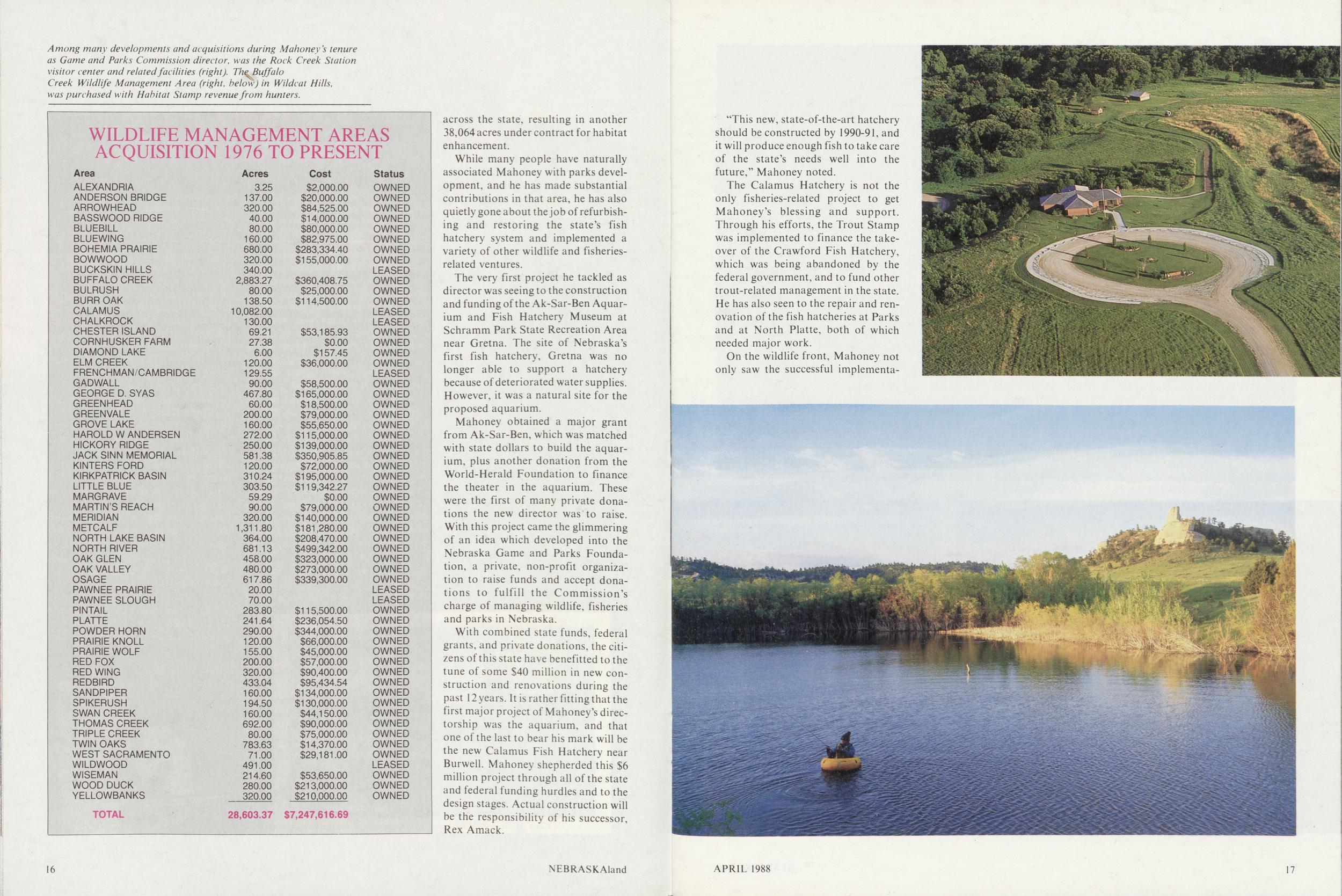 Among many developments and acquisitions during Mahoney's tenure
as Game and Parks Commission director, was the Rock Creek Station
visitor center and related facilities (right). The Buffalo
Creek Wildlife Management Area (right, below) in Wildcat Hills,
was purchased with Habitat Stamp revenue from hunters.
WILDLIFE MANAGEMENT AREAS
ACQUISITION 1976 TO PRESENT
Area
ALEXANDRIA
ANDERSON BRIDGE
ARROWHEAD
BASSWOOD RIDGE
BLUEBILL
BLUEWING
BOHEMIA PRAIRIE
BOWWOOD
BUCKSKIN HILLS
BUFFALO CREEK
BULRUSH
BURR OAK
CALAMUS
CHALKROCK
CHESTER ISLAND
CORNHUSKER FARM
DIAMOND LAKE
ELM CREEK
FRENCHMAN/CAMBRIDGE
GADWALL
GEORGE D. SYAS
GREENHEAD
GREENVALE
GROVE LAKE
HAROLDWANDERSEN
HICKORY RIDGE
JACK SINN MEMORIAL
KINTERS FORD
KIRKPATRICK BASIN
LITTLE BLUE
MARGRAVE
MARTIN'S REACH
MERIDIAN
METCALF
NORTH LAKE BASIN
NORTH RIVER
OAK GLEN
OAK VALLEY
OSAGE
PAWNEE PRAIRIE
PAWNEE SLOUGH
PINTAIL
PLATTE
POWDER HORN
PRAIRIE KNOLL
PRAIRIE WOLF
RED FOX
RED WING
REDBIRD
SANDPIPER
SPIKERUSH
SWAN CREEK
THOMAS CREEK
TRIPLE CREEK
TWIN OAKS
WEST SACRAMENTO
WILDWOOD
WISEMAN
WOOD DUCK
YELLOWBANKS
TOTAL
Acres
3.25
137.00
320.00
40.00
80.00
160.00
680.00
320.00
340.00
2,883.27
80.00
138.50
10,082.00
130.00
69.21
27.38
6.00
120.00
129.55
90.00
467.80
60.00
200.00
160.00
272.00
250.00
581.38
120.00
310.24
303.50
59.29
90.00
320.00
1,311.80
364.00
681.13
458.00
480.00
617.86
20.00
70.00
283.80
241.64
290.00
120.00
155.00
200.00
320.00
433.04
160.00
194.50
160.00
692.00
80.00
783.63
71.00
491.00
214.60
280.00
320.00
Cost
$2,000.00
$20,000.00
$84,525.00
$14,000.00
$80,000.00
$82,975.00
$283,334.40
$155,000.00
$360,408.75
$25,000.00
$114,500.00
$53,185.93
$0.00
$157.45
$36,000.00
$58,500.00
$165,000.00
$18,500.00
$79,000.00
$55,650.00
$115,000.00
$139,000.00
$350,905.85
$72,000.00
$195,000.00
$119,342.27
$0.00
$79,000.00
$140,000.00
$181,280.00
$208,470.00
$499,342.00
$323,000.00
$273,000.00
$339,300.00
$115,500.00
$236,054.50
$344,000.00
$66,000.00
$45,000.00
$57,000.00
$90,400.00
$95,434.54
$134,000.00
$130,000.00
$44,150.00
$90,000.00
$75,000.00
$14,370.00
$29,181.00
$53,650.00
$213,000.00
$210,000.00
Status
OWNED
OWNED
OWNED
OWNED
OWNED
OWNED
OWNED
OWNED
LEASED
OWNED
OWNED
OWNED
LEASED
LEASED
OWNED
OWNED
OWNED
OWNED
LEASED
OWNED
OWNED
OWNED
OWNED
OWNED
OWNED
OWNED
OWNED
OWNED
OWNED
OWNED
OWNED
OWNED
OWNED
OWNED
OWNED
OWNED
OWNED
OWNED
OWNED
LEASED
LEASED
OWNED
OWNED
OWNED
OWNED
OWNED
OWNED
OWNED
OWNED
OWNED
OWNED
OWNED
OWNED
OWNED
OWNED
OWNED
LEASED
OWNED
OWNED
OWNED
28,603.37 $7,247,616.69
Among many developments and acquisitions during Mahoney's tenure
as Game and Parks Commission director, was the Rock Creek Station
visitor center and related facilities (right). The Buffalo
Creek Wildlife Management Area (right, below) in Wildcat Hills,
was purchased with Habitat Stamp revenue from hunters.
WILDLIFE MANAGEMENT AREAS
ACQUISITION 1976 TO PRESENT
Area
ALEXANDRIA
ANDERSON BRIDGE
ARROWHEAD
BASSWOOD RIDGE
BLUEBILL
BLUEWING
BOHEMIA PRAIRIE
BOWWOOD
BUCKSKIN HILLS
BUFFALO CREEK
BULRUSH
BURR OAK
CALAMUS
CHALKROCK
CHESTER ISLAND
CORNHUSKER FARM
DIAMOND LAKE
ELM CREEK
FRENCHMAN/CAMBRIDGE
GADWALL
GEORGE D. SYAS
GREENHEAD
GREENVALE
GROVE LAKE
HAROLDWANDERSEN
HICKORY RIDGE
JACK SINN MEMORIAL
KINTERS FORD
KIRKPATRICK BASIN
LITTLE BLUE
MARGRAVE
MARTIN'S REACH
MERIDIAN
METCALF
NORTH LAKE BASIN
NORTH RIVER
OAK GLEN
OAK VALLEY
OSAGE
PAWNEE PRAIRIE
PAWNEE SLOUGH
PINTAIL
PLATTE
POWDER HORN
PRAIRIE KNOLL
PRAIRIE WOLF
RED FOX
RED WING
REDBIRD
SANDPIPER
SPIKERUSH
SWAN CREEK
THOMAS CREEK
TRIPLE CREEK
TWIN OAKS
WEST SACRAMENTO
WILDWOOD
WISEMAN
WOOD DUCK
YELLOWBANKS
TOTAL
Acres
3.25
137.00
320.00
40.00
80.00
160.00
680.00
320.00
340.00
2,883.27
80.00
138.50
10,082.00
130.00
69.21
27.38
6.00
120.00
129.55
90.00
467.80
60.00
200.00
160.00
272.00
250.00
581.38
120.00
310.24
303.50
59.29
90.00
320.00
1,311.80
364.00
681.13
458.00
480.00
617.86
20.00
70.00
283.80
241.64
290.00
120.00
155.00
200.00
320.00
433.04
160.00
194.50
160.00
692.00
80.00
783.63
71.00
491.00
214.60
280.00
320.00
Cost
$2,000.00
$20,000.00
$84,525.00
$14,000.00
$80,000.00
$82,975.00
$283,334.40
$155,000.00
$360,408.75
$25,000.00
$114,500.00
$53,185.93
$0.00
$157.45
$36,000.00
$58,500.00
$165,000.00
$18,500.00
$79,000.00
$55,650.00
$115,000.00
$139,000.00
$350,905.85
$72,000.00
$195,000.00
$119,342.27
$0.00
$79,000.00
$140,000.00
$181,280.00
$208,470.00
$499,342.00
$323,000.00
$273,000.00
$339,300.00
$115,500.00
$236,054.50
$344,000.00
$66,000.00
$45,000.00
$57,000.00
$90,400.00
$95,434.54
$134,000.00
$130,000.00
$44,150.00
$90,000.00
$75,000.00
$14,370.00
$29,181.00
$53,650.00
$213,000.00
$210,000.00
Status
OWNED
OWNED
OWNED
OWNED
OWNED
OWNED
OWNED
OWNED
LEASED
OWNED
OWNED
OWNED
LEASED
LEASED
OWNED
OWNED
OWNED
OWNED
LEASED
OWNED
OWNED
OWNED
OWNED
OWNED
OWNED
OWNED
OWNED
OWNED
OWNED
OWNED
OWNED
OWNED
OWNED
OWNED
OWNED
OWNED
OWNED
OWNED
OWNED
LEASED
LEASED
OWNED
OWNED
OWNED
OWNED
OWNED
OWNED
OWNED
OWNED
OWNED
OWNED
OWNED
OWNED
OWNED
OWNED
OWNED
LEASED
OWNED
OWNED
OWNED
28,603.37 $7,247,616.69
While many people have naturally associated Mahoney with parks development, and he has made substantial contributions in that area, he has also quietly gone about the job of refurbishing and restoring the state's fish hatchery system and implemented a variety of other wildlife and fisheries related ventures.
The very first project he tackled as director was seeing to the construction and funding of the Ak-Sar-Ben Aquarium and Fish Hatchery Museum at Schramm Park State Recreation Area near Gretna. The site of Nebraska's first fish hatchery, Gretna was no longer able to support a hatchery because of deteriorated water supplies. However, it was a natural site for the proposed aquarium.
Mahoney obtained a major grant from Ak-Sar-Ben, which was matched with state dollars to build the aquarium, plus another donation from the World-Herald Foundation to finance the theater in the aquarium. These were the first of many private donations the new director was to raise. With this project came the glimmering of an idea which developed into the Nebraska Game and Parks Foundation, a private, non-profit organization to raise funds and accept donations to fulfill the Commission's charge of managing wildlife, fisheries and parks in Nebraska.
With combined state funds, federal grants, and private donations, the citizens of this state have benefitted to the tune of some $40 million in new construction and renovations during the past 12 years. It is rather fitting that the first major project of Mahoney's directorship was the aquarium, and that one of the last to bear his mark will be the new Calamus Fish Hatchery near Burwell. Mahoney shepherded this $6 million project through all of the state and federal funding hurdles and to the design stages. Actual construction will be the responsibility of his successor, Rex Amack.
16 NEBRASKAland"This new, state-of-the-art hatchery should be constructed by 1990-91, and it will produce enough fish to take care of the state's needs well into the future," Mahoney noted.
The Calamus Hatchery is not the only fisheries-related project to get Mahoney's blessing and support. Through his efforts, the Trout Stamp was implemented to finance the take over of the Crawford Fish Hatchery, which was being abandoned by the federal government, and to fund other trout-related management in the state. He has also seen to the repair and renovation of the fish hatcheries at Parks and at North Platte, both of which needed major work.
On the wildlife front, Mahoney not only saw the successful implementation tion of the Habitat Stamp program, he fostered a variety of projects, from the restoration of the Sacramento Game Farm with its pheasant-rearing program, to the introduction of root plows to help save hedgerows on private lands. He encouraged innovation and experimentation with new ideas like the cooperative wild rice project on marsh lands at Harlan County Reservoir with the Corps of Engineers. He encouraged the giant Canada goose restoration project in the Sandhills and the opening of hunting of these majestic birds that sportsmen might not have otherwise enjoyed.
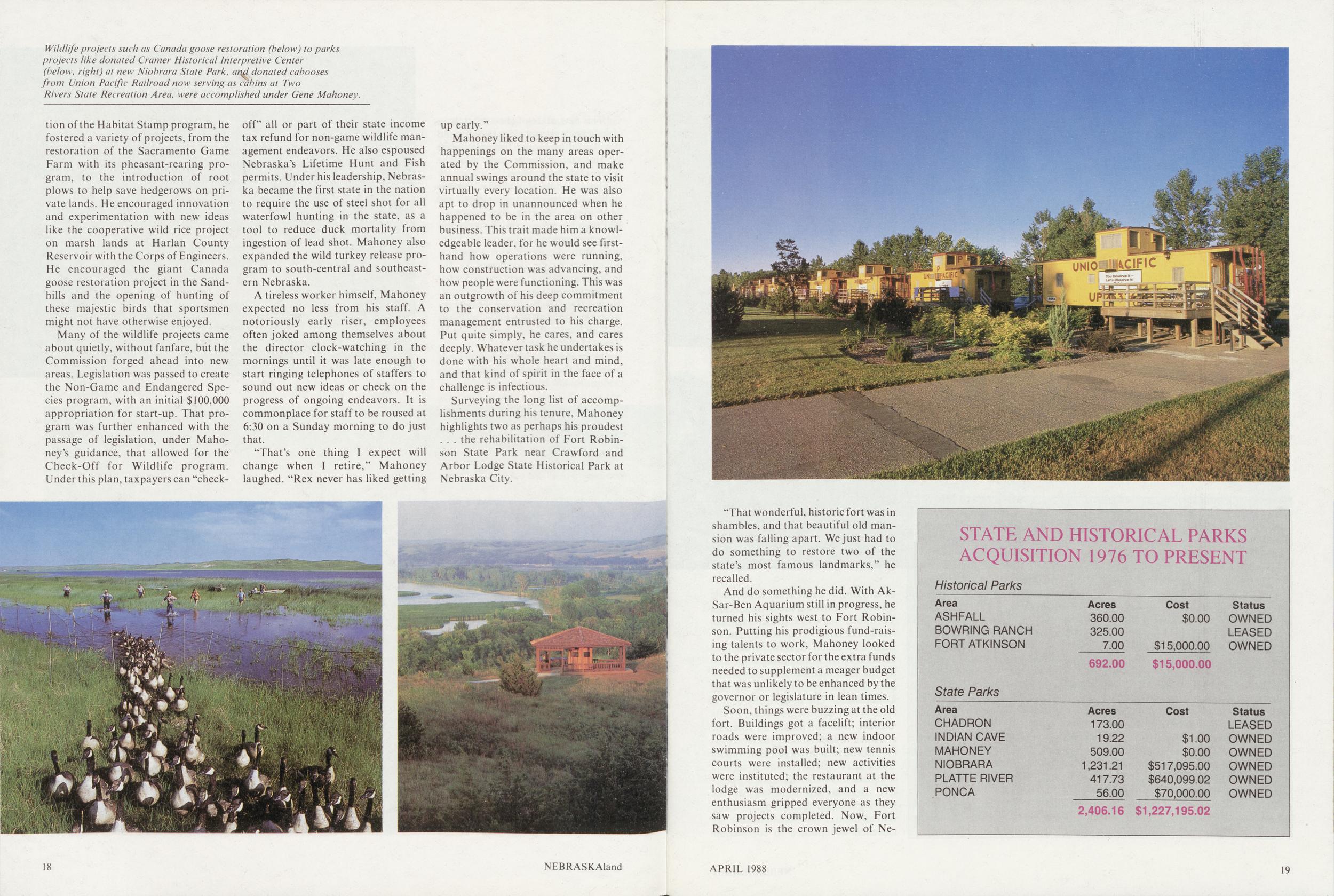
Many of the wildlife projects came about quietly, without fanfare, but the Commission forged ahead into new areas. Legislation was passed to create the Non-Game and Endangered Species program, with an initial $100,000 appropriation for start-up. That program was further enhanced with the passage of legislation, under Mahoney's guidance, that allowed for the Check-Off for Wildlife program. Under this plan, taxpayers can "check-off" all or part of their state income tax refund for non-game wildlife management endeavors. He also espoused Nebraska's Lifetime Hunt and Fish permits. Under his leadership, Nebraska became the first state in the nation to require the use of steel shot for all waterfowl hunting in the state, as a tool to reduce duck mortality from ingestion of lead shot. Mahoney also expanded the wild turkey release program to south-central and southeastern Nebraska.
A tireless worker himself, Mahoney expected no less from his staff. A notoriously early riser, employees often joked among themselves about the director clock-watching in the mornings until it was late enough to start ringing telephones of staffers to sound out new ideas or check on the progress of ongoing endeavors. It is commonplace for staff to be roused at 6:30 on a Sunday morning to do just that.
"That's one thing I expect will change when I retire," Mahoney laughed. "Rex never has liked getting up early."
Mahoney liked to keep in touch with happenings on the many areas operated by the Commission, and make annual swings around the state to visit virtually every location. He was also apt to drop in unannounced when he happened to be in the area on other business. This trait made him a knowledgeable leader, for he would see first hand how operations were running, how construction was advancing, and how people were functioning. This was an outgrowth of his deep commitment to the conservation and recreation management entrusted to his charge. Put quite simply, he cares, and cares deeply. Whatever task he undertakes is done with his whole heart and mind, and that kind of spirit in the face of a challenge is infectious.
Surveying the long list of accomplishments during his tenure, Mahoney highlights two as perhaps his proudest . . . the rehabilitation of Fort Robinson State Park near Crawford and Arbor Lodge State Historical Park at Nebraska City.
18 NEBRSKAland"That wonderful, historic fort was in shambles, and that beautiful old mansion was falling apart. We just had to do something to restore two of the state's most famous landmarks," he recalled.
And do something he did. With AkSar-Ben Aquarium still in progress, he turned his sights west to Fort Robinson. Putting his prodigious fundraising talents to work, Mahoney looked to the private sector for the extra funds needed to supplement a meager budget that was unlikely to be enhanced by the governor or legislature in lean times.
Soon, things were buzzing at the old fort. Buildings got a facelift; interior roads were improved; a new indoor swimming pool was built; new tennis courts were installed; new activities were instituted; the restaurant at the lodge was modernized, and a new enthusiasm gripped everyone as they saw projects completed. Now, Fort Robinson is the crown jewel of Nebraska's renovated state park system.
STATE AND HISTORICAL PARKS ACQUISITION 1976 TO PRESENT Historical Parks Area ASHFALL BOWRING RANCH FORT ATKINSON State Parks Area CHADRON INDIAN CAVE MAHONEY NIOBRARA PLATTE RIVER PONCA Acres Cost Status 360.00 $0.00 OWNED 325.00 LEASED 7.00 $15,000.00 OWNED t ii Acres Cost Status 173.00 LEASED 19.22 $1.00 OWNED 509.00 $0.00 OWNED 1,231.21 $517,095.00 OWNED 417.73 $640,099.02 OWNED 56.00 $70,000.00 OWNED 2,406.16 $1,227,195.02 APRIL 1988 19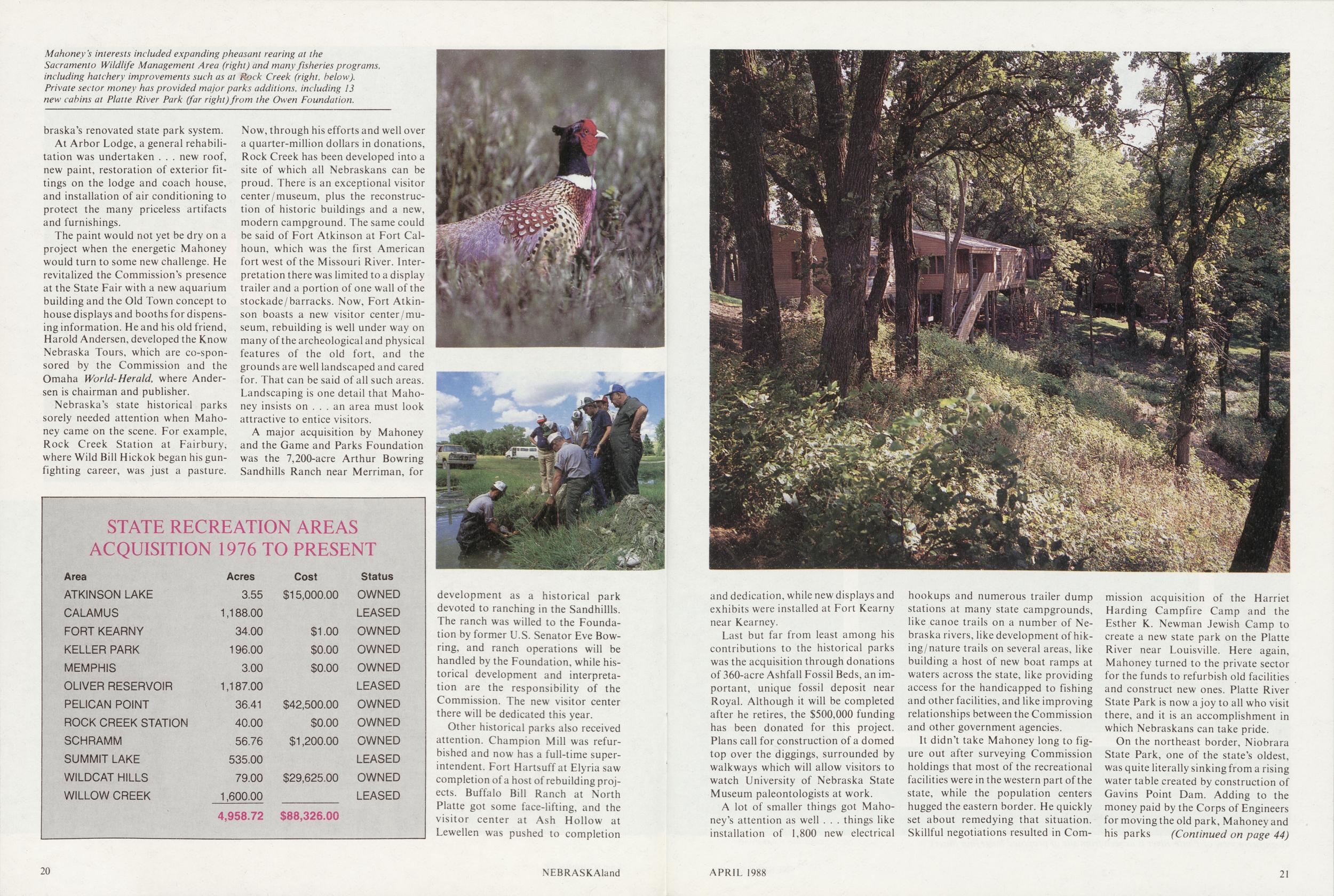
At Arbor Lodge, a general rehabilitation was undertaken . . . new roof, new paint, restoration of exterior fittings on the lodge and coach house, and installation of air conditioning to protect the many priceless artifacts and furnishings.
The paint would not yet be dry on a project when the energetic Mahoney would turn to some new challenge. He revitalized the Commission's presence at the State Fair with a new aquarium building and the Old Town concept to house displays and booths for dispensing information. He and his old friend, Harold Andersen, developed the Know Nebraska Tours, which are co-sponsored by the Commission and the Omaha World-Herald, where Andersen is chairman and publisher.
Nebraska's state historical parks sorely needed attention when Mahoney came on the scene. For example, Rock Creek Station at Fairbury, where Wild Bill Hickok began his gunfighting career, was just a pasture. Now, through his efforts and well over a quarter-million dollars in donations, Rock Creek has been developed into a site of which all Nebraskans can be proud. There is an exceptional visitor center/museum, plus the reconstruction of historic buildings and a new, modern campground. The same could be said of Fort Atkinson at Fort Calhoun, which was the first American fort west of the Missouri River. Interpretation there was limited to a display trailer and a portion of one wall of the stockade/barracks. Now, Fort Atkinson boasts a new visitor center/museum, rebuilding is well under way on many of the archeological and physical features of the old fort, and the grounds are well landscaped and cared for. That can be said of all such areas. Landscaping is one detail that Mahoney insists on ... an area must look attractive to entice visitors.
A major acquisition by Mahoney and the Game and Parks Foundation was the 7,200-acre Arthur Bowring Sandhills Ranch near Merriman, for development as a historical park devoted to ranching in the Sandhillls. The ranch was willed to the Foundation by former U.S. Senator Eve Bow- ring, and ranch operations will be handled by the Foundation, while historical development and interpretation are the responsibility of the Commission. The new visitor center there will be dedicated this year.
STATE RECREATION AREAS ACQUISITION 1976 TO PRESENT Area Acres Cost Status ATKINSON LAKE 3.55 $15,000.00 OWNED CALAMUS 1,188.00 LEASED FORT KEARNY 34.00 $1.00 OWNED KELLER PARK 196.00 $0.00 OWNED MEMPHIS 3.00 $0.00 OWNED OLIVER RESERVOIR 1,187.00 LEASED PELICAN POINT 36.41 $42,500.00 OWNED ROCK CREEK STATION 40.00 $0.00 OWNED SCHRAMM 56.76 $1,200.00 OWNED SUMMIT LAKE 535.00 LEASED WILDCAT HILLS 79.00 $29,625.00 OWNED WILLOW CREEK 1,600.00 4,958.72 LEASED $88,326.00Other historical parks also received attention. Champion Mill was refurbished and now has a full-time superintendent. Fort Hartsuff at Elyria saw completion of a host of rebuilding projects. Buffalo Bill Ranch at North Platte got some face-lifting, and the visitor center at Ash Hollow at Lewellen was pushed to completion 20 NEBRASKAland and dedication, while new displays and exhibits were installed at Fort Kearny near Kearney.
Last but far from least among his contributions to the historical parks was the acquisition through donations of 360-acre Ashfall Fossil Beds, an important, unique fossil deposit near Royal. Although it will be completed after he retires, the $500,000 funding has been donated for this project. Plans call for construction of a domed top over the diggings, surrounded by walkways which will allow visitors to watch University of Nebraska State Museum paleontologists at work.
A lot of smaller things got Mahoney's attention as well . . . things like installation of 1,800 new electrical hookups and numerous trailer dump stations at many state campgrounds, like canoe trails on a number of Nebraska rivers, like development of hiking/nature trails on several areas, like building a host of new boat ramps at waters across the state, like providing access for the handicapped to fishing and other facilities, and like improving relationships between the Commission and other government agencies.
It didn't take Mahoney long to figure out after surveying Commission holdings that most of the recreational facilities were in the western part of the state, while the population centers hugged the eastern border. He quickly set about remedying that situation. Skillful negotiations resulted in Commission acquisition of the Harriet Harding Campfire Camp and the Esther K. Newman Jewish Camp to create a new state park on the Platte River near Louisville. Here again, Mahoney turned to the private sector for the funds to refurbish old facilities and construct new ones. Platte River State Park is now a joy to all who visit there, and it is an accomplishment in which Nebraskans can take pride.
On the northeast border, Niobrara State Park, one of the state's oldest, was quite literally sinking from a rising water table created by construction of Gavins Point Dam. Adding to the money paid by the Corps of Engineers for moving the old park, Mahoney and his parks (Continued on page 44)
APRIL 1988 21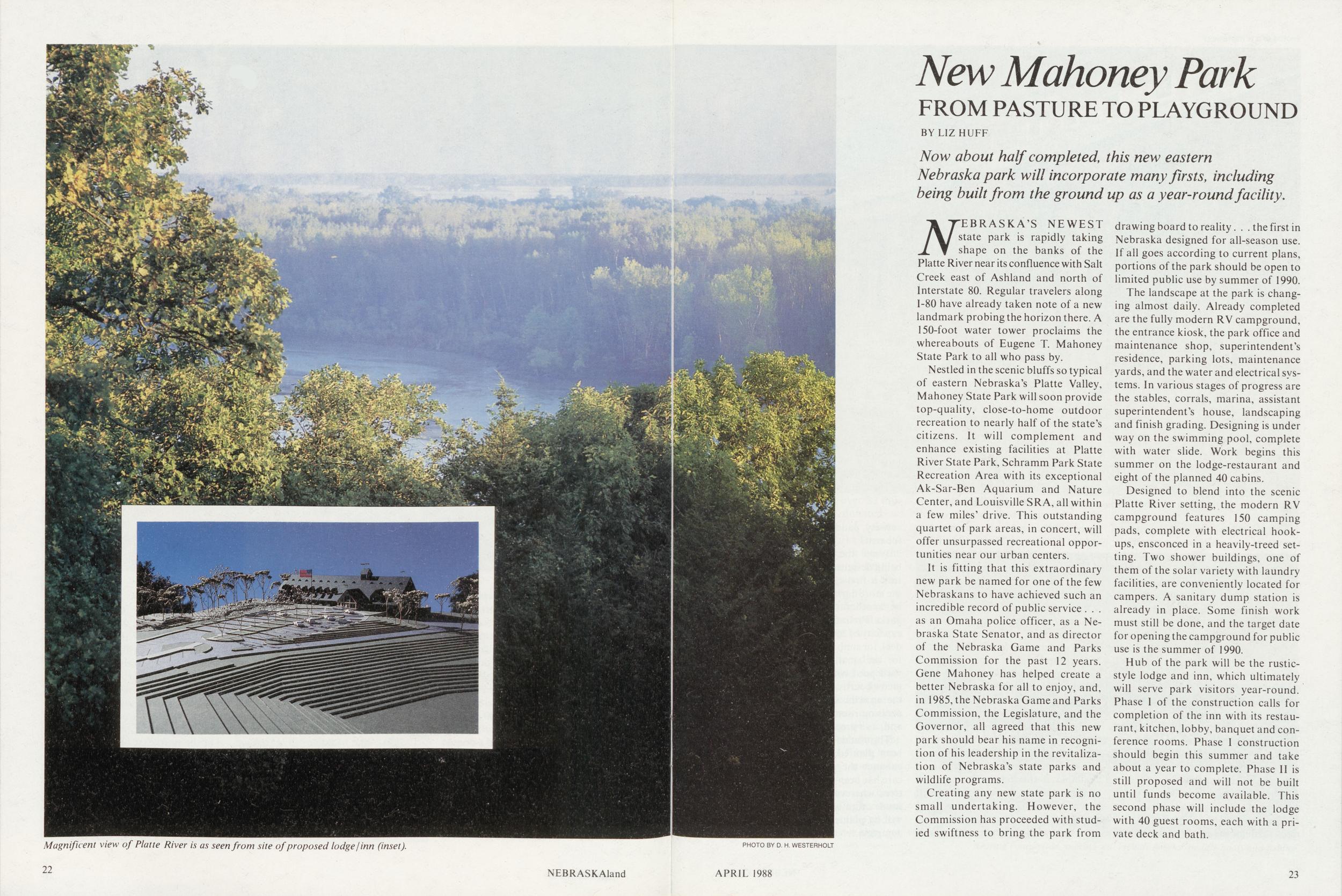
New Mahoney Park FROM PASTURE TO PLAYGROUND
BY LIZ HUFF Now about half completed, this new eastern Nebraska park will incorporate many firsts, including being built from the ground up as a year-round facility.Jk TEBRASKA'S NEWEST 7 state park is rapidly taking 1 of shape on the banks of the Platte River near its confluence with Salt Creek east of Ashland and north of Interstate 80. Regular travelers along 1-80 have already taken note of a new landmark probing the horizon there. A 150-foot water tower proclaims the whereabouts of Eugene T. Mahoney State Park to all who pass by.
Nestled in the scenic bluffs so typical of eastern Nebraska's Platte Valley, Mahoney State Park will soon provide top-quality, close-to-home outdoor recreation to nearly half of the state's citizens. It will complement and enhance existing facilities at Platte River State Park, Schramm Park State Recreation Area with its exceptional Ak-Sar-Ben Aquarium and Nature Center, and Louisville SRA, all within a few miles' drive. This outstanding quartet of park areas, in concert, will offer unsurpassed recreational opportunities near our urban centers.
It is fitting that this extraordinary new park be named for one of the few Nebraskans to have achieved such an incredible record of public service . . . as an Omaha police officer, as a Nebraska State Senator, and as director of the Nebraska Game and Parks Commission for the past 12 years. Gene Mahoney has helped create a better Nebraska for all to enjoy, and, in 1985, the Nebraska Game and Parks Commission, the Legislature, and the Governor, all agreed that this new park should bear his name in recognition of his leadership in the revitalization of Nebraska's state parks and wildlife programs.
Creating any new state park is no small undertaking. However, the Commission has proceeded with studied swiftness to bring the park from drawing board to reality. . .the first in Nebraska designed for all-season use. If all goes according to current plans, portions of the park should be open to limited public use by summer of 1990.
The landscape at the park is changing almost daily. Already completed are the fully modern RV campground, the entrance kiosk, the park office and maintenance shop, superintendent's residence, parking lots, maintenance yards, and the water and electrical systems. In various stages of progress are the stables, corrals, marina, assistant superintendent's house, landscaping and finish grading. Designing is under way on the swimming pool, complete with water slide. Work begins this summer on the lodge-restaurant and eight of the planned 40 cabins.
Designed to blend into the scenic Platte River setting, the modern RV campground features 150 camping pads, complete with electrical hookups, ensconced in a heavily-treed setting. Two shower buildings, one of them of the solar variety with laundry facilities, are conveniently located for campers. A sanitary dump station is already in place. Some finish work must still be done, and the target date for opening the campground for public use is the summer of 1990.
Hub of the park will be the rustic style lodge and inn, which ultimately will serve park visitors year-round. Phase I of the construction calls for completion of the inn with its restaurant, kitchen, lobby, banquet and conference rooms. Phase I construction should begin this summer and take about a year to complete. Phase II is still proposed and will not be built until funds become available. This second phase will include the lodge with 40 guest rooms, each with a private deck and bath.
APRIL 1988 23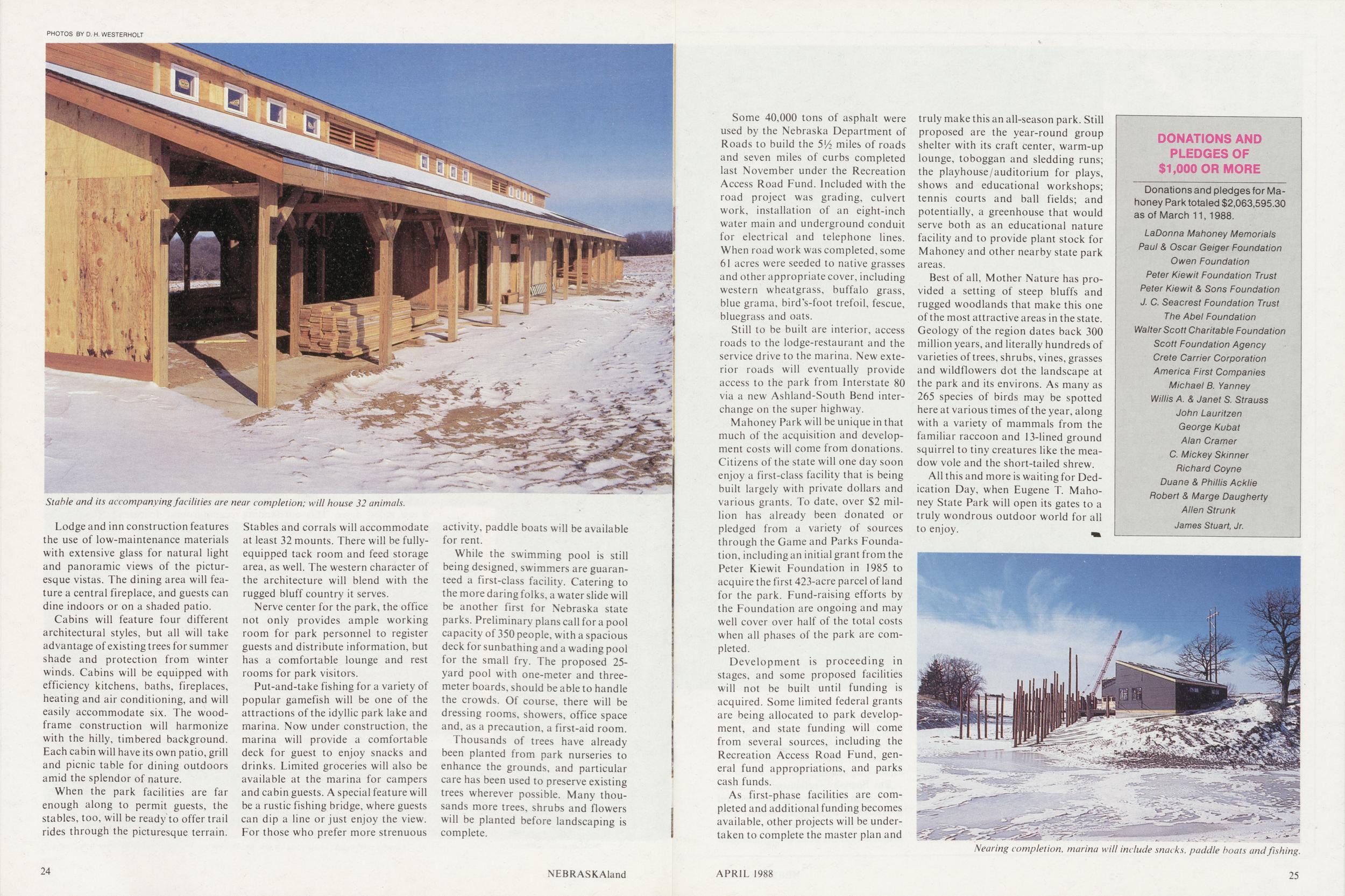
Lodge and inn construction features the use of low-maintenance materials with extensive glass for natural light and panoramic views of the picturesque vistas. The dining area will feature a central fireplace, and guests can dine indoors or on a shaded patio.
Cabins will feature four different architectural styles, but all will take advantage of existing trees for summer shade and protection from winter winds. Cabins will be equipped with efficiency kitchens, baths, fireplaces, heating and air conditioning, and will easily accommodate six. The wood frame construction will harmonize with the hilly, timbered background. Each cabin will have its own patio, grill and picnic table for dining outdoors amid the splendor of nature.
When the park facilities are far enough along to permit guests, the stables, too, will be ready to offer trail rides through the picturesque terrain. Stables and corrals will accommodate at least 32 mounts. There will be fully equipped tack room and feed storage area, as well. The western character of the architecture will blend with the rugged bluff country it serves.
Nerve center for the park, the office not only provides ample working room for park personnel to register guests and distribute information, but has a comfortable lounge and rest rooms for park visitors.
Put-and-take fishing for a variety of popular gamefish will be one of the attractions of the idyllic park lake and marina. Now under construction, the marina will provide a comfortable deck for guest to enjoy snacks and drinks. Limited groceries will also be available at the marina for campers and cabin guests. A special feature will be a rustic fishing bridge, where guests can dip a line or just enjoy the view. For those who prefer more strenuous activity, paddle boats will be available for rent.
While the swimming pool is still being designed, swimmers are guaranteed a first-class facility. Catering to the more daring folks, a water slide will be another first for Nebraska state parks. Preliminary plans call for a pool capacity of 350 people, with a spacious deck for sunbathing and a wading pool for the small fry. The proposed 25-yard pool with one-meter and three-meter boards, should be able to handle the crowds. Of course, there will be dressing rooms, showers, office space and, as a precaution, a first-aid room.
Thousands of trees have already been planted from park nurseries to enhance the grounds, and particular care has been used to preserve existing trees wherever possible. Many thousands more trees, shrubs and flowers will be planted before landscaping is complete.
24 NEBRASKAlandSome 40,000 tons of asphalt were used by the Nebraska Department of Roads to build the 5!/2 miles of roads and seven miles of curbs completed last November under the Recreation Access Road Fund. Included with the road project was grading, culvert work, installation of an eight-inch water main and underground conduit for electrical and telephone lines. When road work was completed, some 61 acres were seeded to native grasses and other appropriate cover, including western wheatgrass, buffalo grass, blue grama, bird's-foot trefoil, fescue, bluegrass and oats.
Still to be built are interior, access roads to the lodge-restaurant and the service drive to the marina. New exterior roads will eventually provide access to the park from Interstate 80 via a new Ashland-South Bend interchange on the super highway.
Mahoney Park will be unique in that much of the acquisition and development costs will come from donations. Citizens of the state will one day soon enjoy a first-class facility that is being built largely with private dollars and various grants. To date, over $2 million has already been donated or pledged from a variety of sources through the Game and Parks Foundation, including an initial grant from the Peter Kiewit Foundation in 1985 to acquire the first 423-acre parcel of land for the park. Fund-raising efforts by the Foundation are ongoing and may well cover over half of the total costs when all phases of the park are completed.
Development is proceeding in stages, and some proposed facilities will not be built until funding is acquired. Some limited federal grants are being allocated to park development, and state funding will come from several sources, including the Recreation Access Road Fund, general fund appropriations, and parks cash funds.
As first-phase facilities are completed and additional funding becomes available, other projects will be undertaken to complete the master plan and truly make this an all-season park. Still proposed are the year-round group shelter with its craft center, warm-up lounge, toboggan and sledding runs; the playhouse/auditorium for plays, shows and educational workshops; tennis courts and ball fields; and potentially, a greenhouse that would serve both as an educational nature facility and to provide plant stock for Mahoney and other nearby state park areas.
Best of all, Mother Nature has provided a setting of steep bluffs and rugged woodlands that make this one of the most attractive areas in the state. Geology of the region dates back 300 million years, and literally hundreds of varieties of trees, shrubs, vines, grasses and wildflowers dot the landscape at the park and its environs. As many as 265 species of birds may be spotted here at various times of the year, along with a variety of mammals from the familiar raccoon and 13-lined ground squirrel to tiny creatures like the meadow vole and the short-tailed shrew.
All this and more is waiting for Dedication Day, when Eugene T. Mahoney State Park will open its gates to a truly wondrous outdoor world for all to enjoy.
DONATIONS AND PLEDGES OF $1,000 OR MORE Donations and pledges for Mahoney Park totaled $2,063,595.30 as of March 11,1988. LaDonna Mahoney Memorials Paul & Oscar Geiger Foundation Owen Foundation Peter Kiewit Foundation Trust Peter Kiewit & Sons Foundation J. C. Seacrest Foundation Trust The Abel Foundation Walter Scott Charitable Foundation Scott Foundation Agency Crete Carrier Corporation America First Companies Michael B. Yanney Willis A. & Janet S. Strauss John Lauritzen George Kubat Alan Cramer C. Mickey Skinner Richard Coyne Duane & Phillis Acklie Robert & Marge Daugherty Allen Strunk James Stuart, Jr.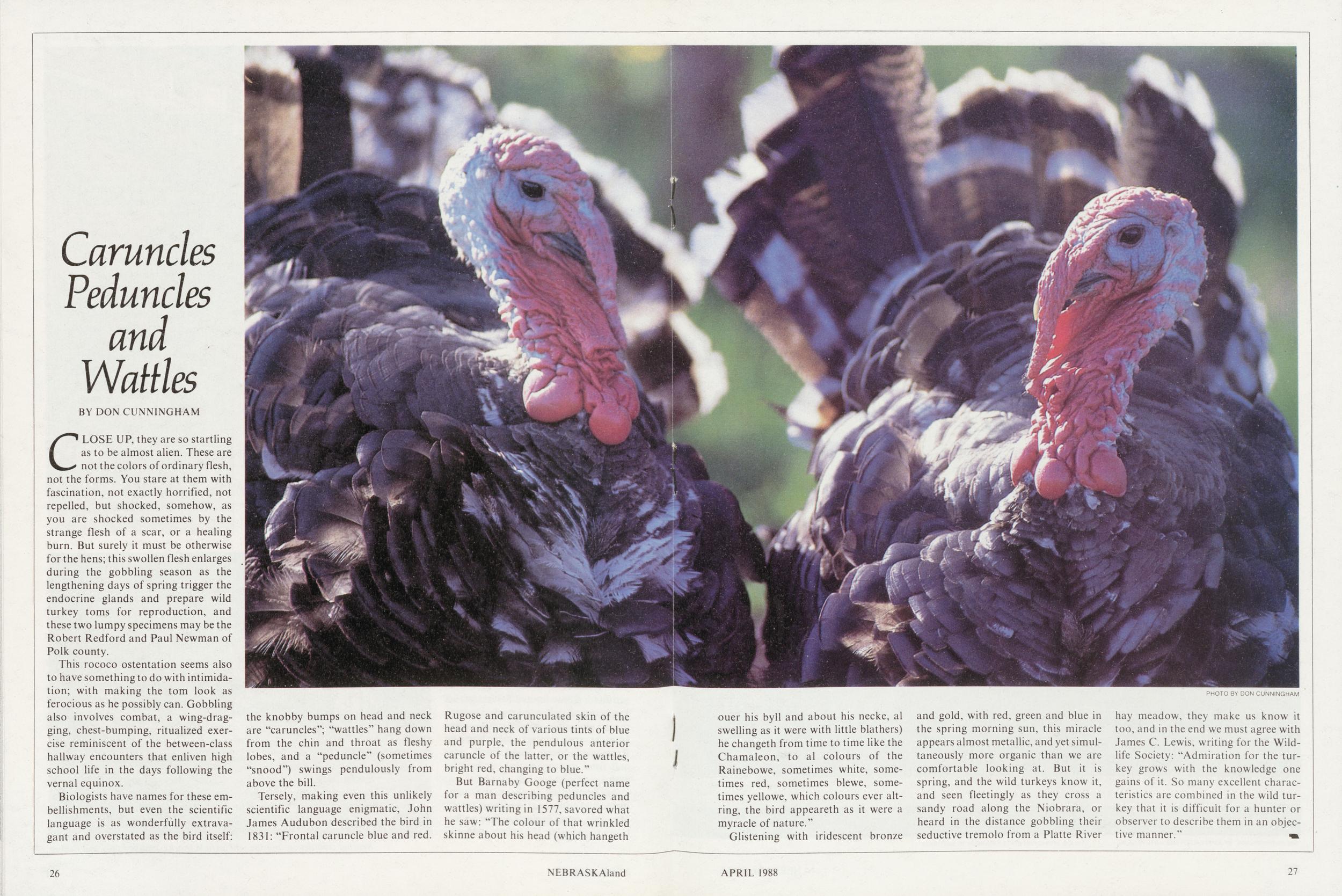
Caruncles Peduncles and Wattles
BY DON CUNNINGHAMCLOSE UP, they are so startling as to be almost alien. These are not the colors of ordinary flesh, not the forms. You stare at them with fascination, not exactly horrified, not repelled, but shocked, somehow, as you are shocked sometimes by the strange flesh of a scar, or a healing burn. But surely it must be otherwise for the hens; this swollen flesh enlarges during the gobbling season as the lengthening days of spring trigger the endocrine glands and prepare wild turkey toms for reproduction, and these two lumpy specimens may be the Robert Redford and Paul Newman of Polk county.
This rococo ostentation seems also to have something to do with intimidation; with making the torn look as ferocious as he possibly can. Gobbling also involves combat, a wing-dragging, chest-bumping, ritualized exercise reminiscent of the between-class hallway encounters that enliven high school life in the days following the vernal equinox.
Biologists have names for these embellishments, but even the scientific language is as wonderfully extravagant and overstated as the bird itself: the knobby bumps on head and neck are "caruncles"; "wattles" hang down from the chin and throat as fleshy lobes, and a "peduncle" (sometimes "snood") swings pendulously from above the bill.
Tersely, making even this unlikely scientific language enigmatic, John James Audubon described the bird in 1831: "Frontal caruncle blue and red. Rugose and carunculated skin of the head and neck of various tints of blue and purple, the pendulous anterior caruncle of the latter, or the wattles, bright red, changing to blue."
But Barnaby Googe (perfect name for a man describing peduncles and wattles) writing in 1577, savored what he saw: "The colour of that wrinkled skinne about his head (which hangeth 26 NEBRASKAland ouer his boll and about his necke, al swelling as it were with little blathers) he changeth from time to time like the Chamaleon, to al colours of the Rainebow, sometimes white, s ometimes red, sometimes blew, sometimes yellow, which colours ever altring, the bird appeareth as it were a miracle of nature."
Glistening with iridescent bronze and gold, with red, green and blue in the spring morning sun, this miracle appears almost metallic, and yet simultaneously more organic than we are comfortable looking at. But it is spring, and the wild turkeys know it, and seen fleetingly as they cross a sandy road along the Niobrara, or heard in the distance gobbling their seductive tremolo from a Platte River PHOTO BY DON CUNNINGHAM hay meadow, they make us know it too, and in the end we must agree with James C. Lewis, writing for the Wild- life Society: "Admiration for the turkey grows with the knowledge one gains of it. So many excellent characteristics are combined in the wild turkey that it is difficult for a hunter or observer to describe them in an objective manner."
APRIL 1988 27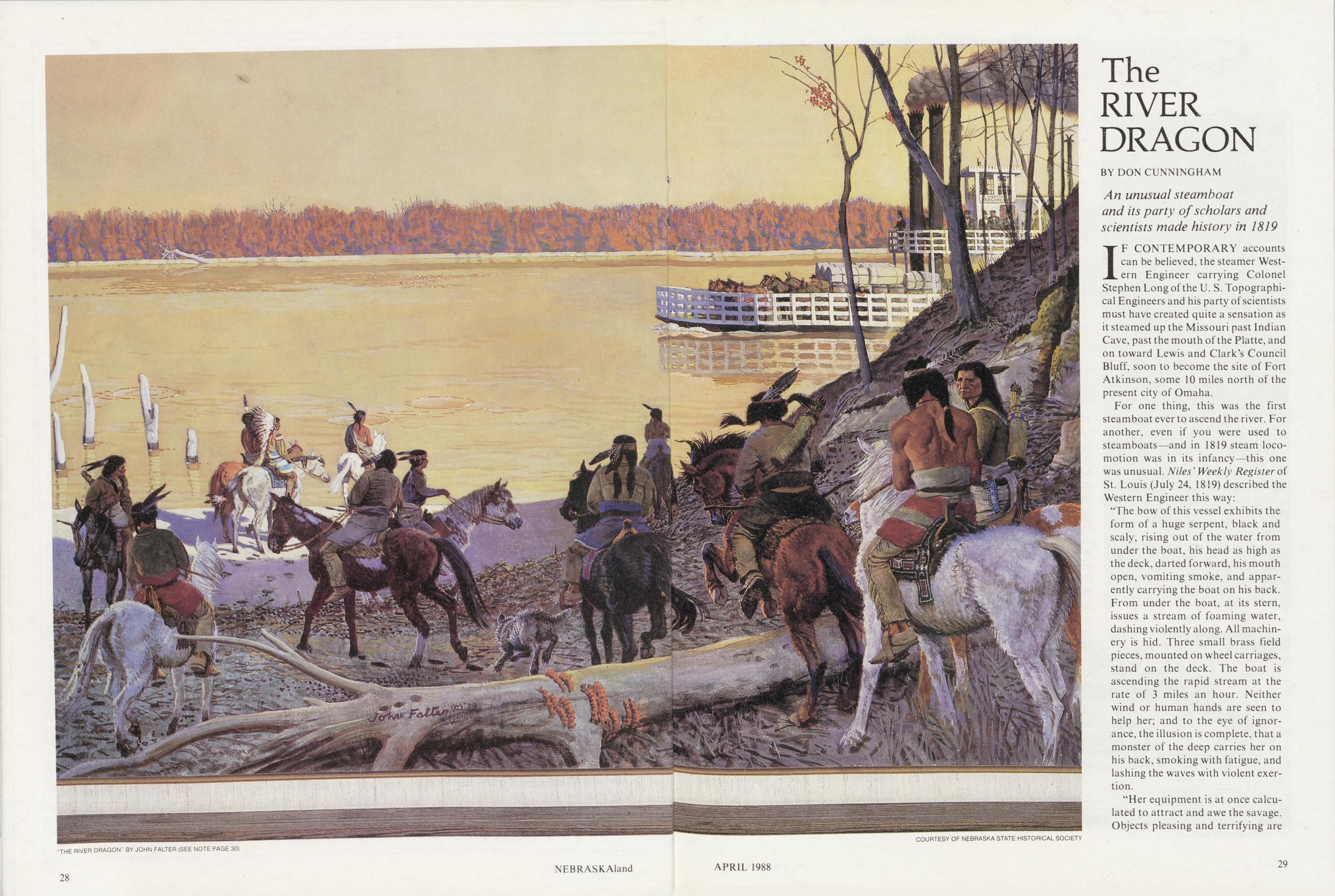
The RIVER DRAGON
BY DON CUNNINGHAM An unusual steamboat and its party of scholars and scientists made history in 1819IF CONTEMPORARY accounts can be believed, the steamer Western Engineer carrying Colonel Stephen Long of the U. S. Topographical Engineers and his party of scientists must have created quite a sensation as it steamed up the Missouri past Indian Cave, past the mouth of the Platte, and on toward Lewis and Clark's Council Bluff, soon to become the site of Fort Atkinson, some 10 miles north of the present city of Omaha.
For one thing, this was the first steamboat ever to ascend the river. For another, even if you were used to steamboats—and in 1819 steam loco- motion was in its infancy—this one was unusual. Niles' Weekly Register of St. Louis (July 24, 1819) described the Western Engineer this way:
"The bow of this vessel exhibits the form of a huge serpent, black and scaly, rising out of the water from under the boat, his head as high as the deck, darted forward, his mouth open, vomiting smoke, and apparently carrying the boat on his back. From under the boat, at its stern, issues a stream of foaming water, dashing violently along. All machinery is hid. Three small brass field pieces, mounted on wheel carriages, stand on the deck. The boat is ascending the rapid stream at the rate of 3 miles an hour. Neither wind or human hands are seen to help her; and to the eye of ignorance, the illusion is complete, that a monster of the deep carries her on his back, smoking with fatigue, and lashing the waves with violent exertion.
"Her equipment is at once calculated to attract and awe the savage. Objects pleasing and terrifying are at once before him:—artillery; the flag of the republic; portraits of a white man and an Indian shaking hands; the calumet of peace; a sword; then the apparent monster with a painted vessel on his back, the sides gaping with portholes, and bristling with guns. Taken altogether, and without intelligence of her composition and design, it would require a daring savage to approach and accost her with Hamlet's speech:
APRIL 1988 29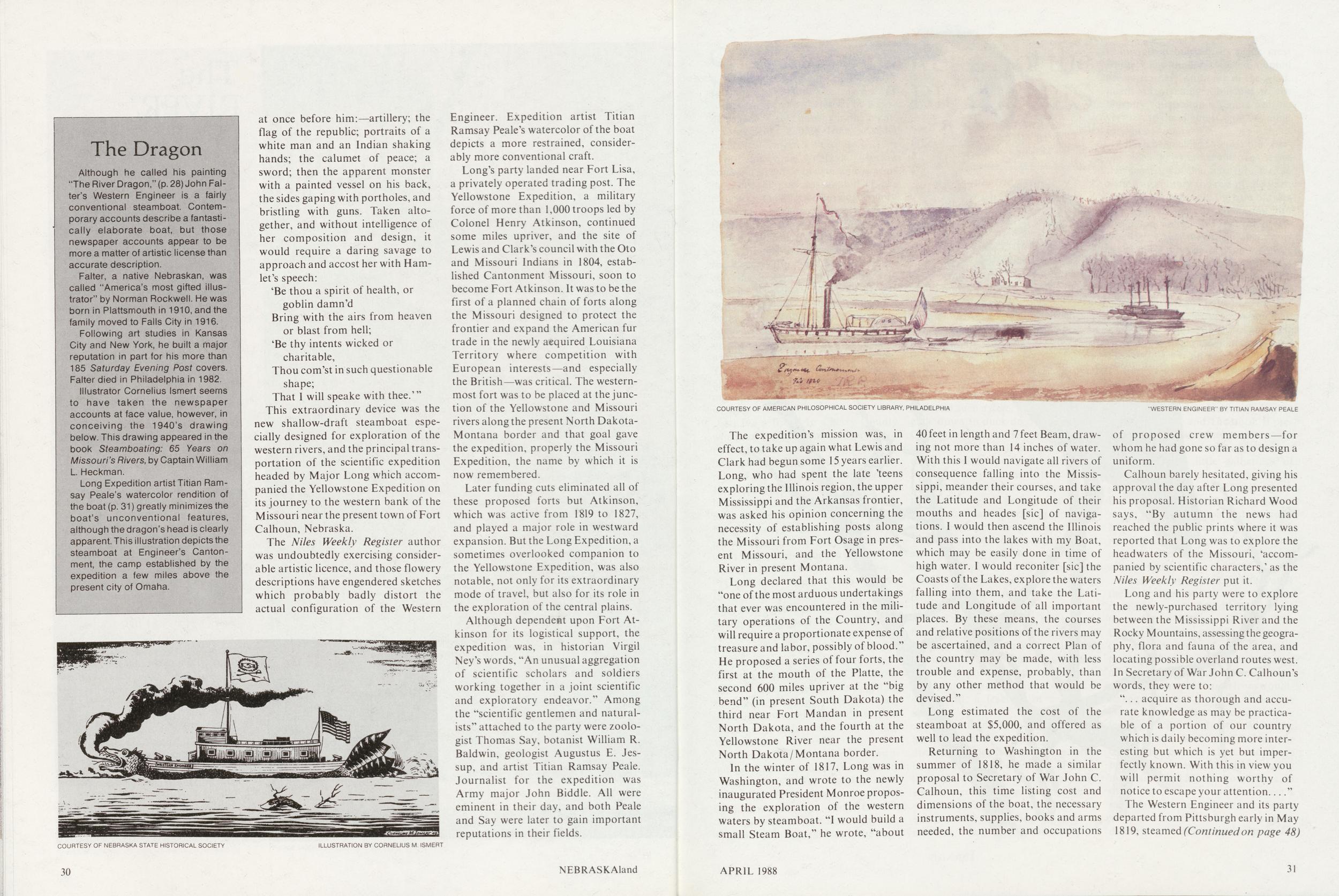 The Dragon
Although he called his painting "The River Dragon," (p. 28} John Falter's Western Engineer is a fairly conventional steamboat Contemporary accounts describe a fantastically elaborate boat, but those newspaper accounts appear to be more a matter of artistic license than accurate description.
Falter, a native Nebraskan, was called "America's most gifted illustrator" by Norman Rockwell. He was born in Plattsmouth in 1910, and the family moved to Falls City in 1916.
Following art studies in Kansas City and New York, he built a major reputation in part for his more than 185 Saturday Evening Post covers. Falter died in Philadelphia in 1982,
illustrator Cornelius Ismert seems to have taken the newspaper accounts at face value, however, in conceiving the 1940's drawing below. This drawing appeared in the book Steam boating: 65 Years on Missouri's Rivers, by Captain William L Heckman.
Long Expedition artist Titian Ramsay Peale's watercolor rendition of the boat (p. 31) greatly minimizes the boat's unconventional features, although the dragon's head is clearly apparent. This illustration depicts the steamboat at Engineer's Cantonment, the camp established by the expedition a few miles above the present city of Omaha.
'Be thou a spirit of health, or goblin damn'd
Bring with the airs from heaven or blast from hell;
'Be thy intents wicked or charitable,
Thou comst in such questionable shape;
That I will speak with thee.'"
This extraordinary device was the new shallow-draft steamboat especially designed for exploration of the western rivers, and the principal transportation of the scientific expedition headed by Major Long which accompanied the Yellowstone Expedition on its journey to the western bank of the Missouri near the present town of Fort Calhoun, Nebraska.
The Niles Weekly Register author was undoubtedly exercising considerable artistic license, and those flowery descriptions have engendered sketches which probably badly distort the actual configuration of the Western Engineer. Expedition artist Titian Ramsay Peale's watercolor of the boat depicts a more restrained, considerably more conventional craft.
Long's party landed near Fort Lisa, a privately operated trading post. The Yellowstone Expedition, a military force of more than 1,000 troops led by Colonel Henry Atkinson, continued some miles upriver, and the site of Lewis and Clark's council with the Oto and Missouri Indians in 1804, established Cantonment Missouri, soon to become Fort Atkinson. It was to be the first of a planned chain of forts along the Missouri designed to protect the frontier and expand the American fur trade in the newly acquired Louisiana Territory where competition with European interests—and especially the British—was critical. The westernmost fort was to be placed at the junction of the Yellowstone and Missouri rivers along the present North Dakota- Montana border and that goal gave the expedition, properly the Missouri Expedition, the name by which it is now remembered.
Later funding cuts eliminated all of these proposed forts but Atkinson, which was active from 1819 to 1827, and played a major role in westward expansion. But the Long Expedition, a sometimes overlooked companion to the Yellowstone Expedition, was also notable, not only for its extraordinary mode of travel, but also for its role in the exploration of the central plains.
Although dependent upon Fort Atkinson for its logistical support, the expedition was, in historian Virgil Ney's words, "An unusual aggregation of scientific scholars and soldiers working together in a joint scientific and exploratory endeavor.'" Among the "scientific gentlemen and naturalists" attached to the party were zoologist Thomas Say, botanist William R. Baldwin, geologist Augustus E. Jessup, and artist Titian Ramsay Peale. Journalist for the expedition was Army major John Biddle. All were eminent in their day, and both Peale and Say were later to gain important reputations in their fields.
The expedition's mission was, in effect, to take up again what Lewis and Clark had begun some 15 years earlier. Long, who had spent the late 'teens exploring the Illinois region, the upper Mississippi and the Arkansas frontier, was asked his opinion concerning the necessity of establishing posts along the Missouri from Fort Osage in present Missouri, and the Yellowstone River in present Montana.
Long declared that this would be "one of the most arduous undertakings that ever was encountered in the military operations of the Country, and will require a proportionate expense of treasure and labor, possibly of blood." He proposed a series of four forts, the first at the mouth of the Platte, the second 600 miles upriver at the "big bend" (in present South Dakota) the third near Fort Mandan in present North Dakota, and the fourth at the Yellowstone River near the present North Dakota/Montana border.
In the winter of 1817, Long was in Washington, and wrote to the newly inaugurated President Monroe proposing the exploration of the western waters by steamboat. "I would build a small Steam Boat," he wrote, "about 40 feet in length and 7 feet Beam, drawing not more than 14 inches of water. With this I would navigate all rivers of consequence falling into the Mississippi, meander their courses, and take the Latitude and Longitude of their mouths and heads [sic] of navigations. I would then ascend the Illinois and pass into the lakes with my Boat, which may be easily done in time of high water. I would reconiter [sic] the Coasts of the Lakes, explore the waters falling into them, and take the Latitude and Longitude of all important places. By these means, the courses and relative positions of the rivers may be ascertained, and a correct Plan of the country may be made, with less trouble and expense, probably, than by any other method that would be devised."
Long estimated the cost of the steamboat at $5,000, and offered as well to lead the expedition.
Returning to Washington in the summer of 1818, he made a similar proposal to Secretary of War John C. Calhoun, this time listing cost and dimensions of the boat, the necessary instruments, supplies, books and arms needed, the number and occupations "WESTERN ENGINEER" BY TITIAN RAMSAY PEALE of proposed crew members—for whom he had gone so far as to design a uniform.
Calhoun barely hesitated, giving his approval the day after Long presented his proposal. Historian Richard Wood says, "By autumn the news had reached the public prints where it was reported that Long was to explore the headwaters of the Missouri, 'accompanied by scientific characters,' as the Niles Weekly Register put it.
Long and his party were to explore the newly-purchased territory lying between the Mississippi River and the Rocky Mountains, assessing the geography, flora and fauna of the area, and locating possible overland routes west. In Secretary of War John C. Calhoun's words, they were to:
"... acquire as thorough and accurate knowledge as may be practicable of a portion of our country which is daily becoming more interesting but which is yet but imperfectly known. With this in view you will permit nothing worthy of notice to escape your attention___"
The Western Engineer and its party departed from Pittsburgh early in May 1819, steamed (Continuedon page 48)
APIRL 1988 31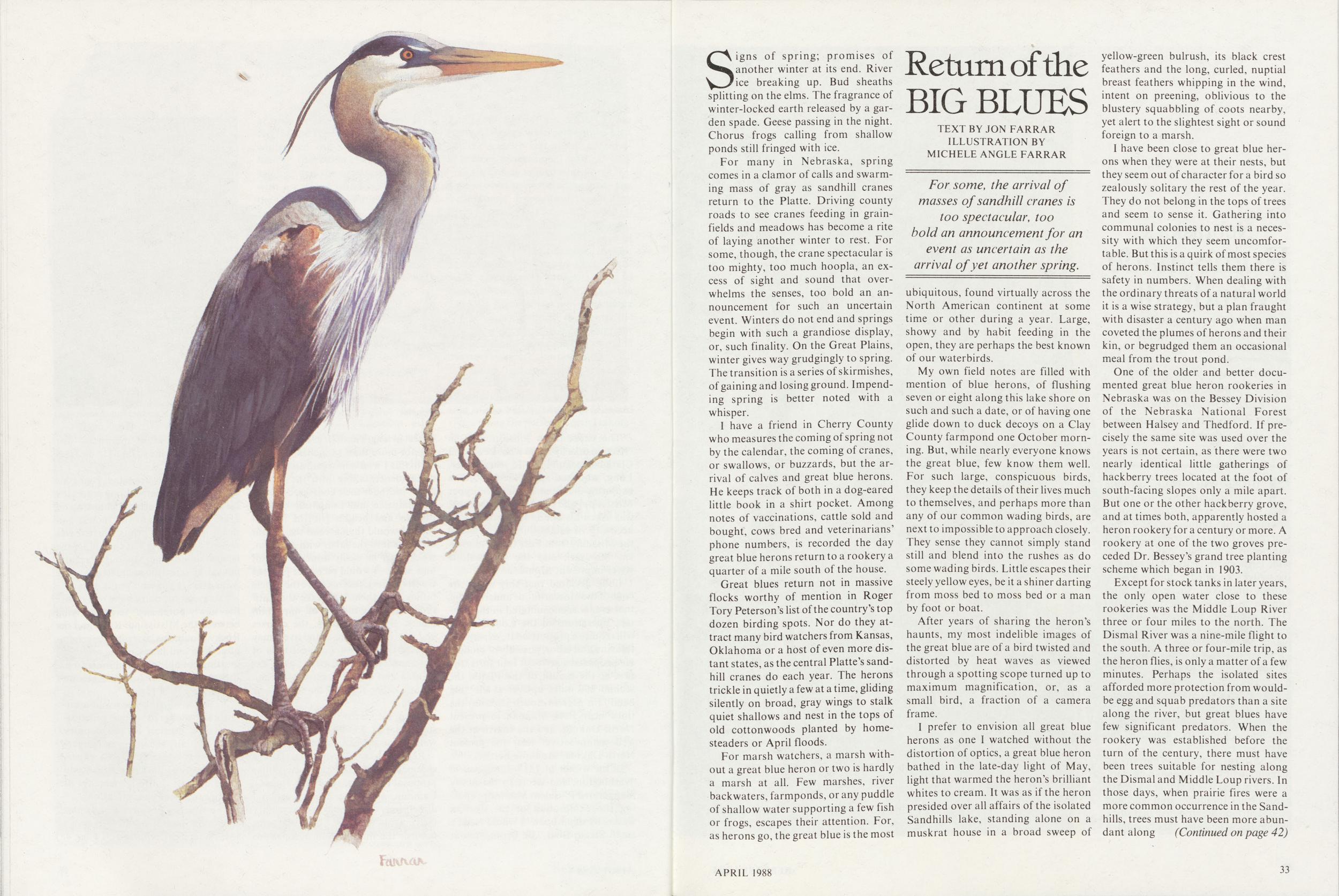
Return of the BIG BLUES
TEXT BY JON FARRAR ILLUSTRATION BY MICHELE ANGLE FARRAR For some, the arrival of masses of sandhill cranes is too spectacular, too bold an announcement for an event as uncertain as the arrival of yet another spring.Signs of spring; promises of another winter at its end. River ice breaking up. Bud sheaths splitting on the elms. The fragrance of winter-locked earth released by a garden spade. Geese passing in the night. Chorus frogs calling from shallow ponds still fringed with ice.
For many in Nebraska, spring comes in a clamor of calls and swarming mass of gray as sandhill cranes return to the Platte. Driving county roads to see cranes feeding in grainfields and meadows has become a rite of laying another winter to rest. For some, though, the crane spectacular is too mighty, too much hoopla, an excess of sight and sound that overwhelms the senses, too bold an announcement for such an uncertain event. Winters do not end and springs begin with such a grandiose display, or, such finality. On the Great Plains, winter gives way grudgingly to spring. The transition is a series of skirmishes, of gaining and losing ground. Impending spring is better noted with a whisper.
I have a friend in Cherry County who measures the coming of spring not by the calendar, the coming of cranes, or swallows, or buzzards, but the arrival of calves and great blue herons. He keeps track of both in a dog-eared little book in a shirt pocket. Among notes of vaccinations, cattle sold and bought, cows bred and veterinarians' phone numbers, is recorded the day great blue herons return to a rookery a quarter of a mile south of the house.
Great blues return not in massive flocks worthy of mention in Roger Tory Peterson's list of the country's top dozen birding spots. Nor do they attract many bird watchers from Kansas, Oklahoma or a host of even more distant states, as the central Platte's sandhill cranes do each year. The herons trickle in quietly a few at a time, gliding silently on broad, gray wings to stalk quiet shallows and nest in the tops of old cottonwoods planted by homesteaders or April floods.
For marsh watchers, a marsh without a great blue heron or two is hardly a marsh at all. Few marshes, river backwaters, farm ponds, or any puddle of shallow water supporting a few fish or frogs, escapes their attention. For, as herons go, the great blue is the most ubiquitous, found virtually across the North American continent at some time or other during a year. Large, showy and by habit feeding in the open, they are perhaps the best known of our waterbirds.
My own field notes are filled with mention of blue herons, of flushing seven or eight along this lake shore on such and such a date, or of having one glide down to duck decoys on a Clay County farm pond one October morning. But, while nearly everyone knows the great blue, few know them well. For such large, conspicuous birds, they keep the details of their lives much to themselves, and perhaps more than any of our common wading birds, are next to impossible to approach closely. They sense they cannot simply stand still and blend into the rushes as do some wading birds. Little escapes their steely yellow eyes, be it a shiner darting from moss bed to moss bed or a man by foot or boat.
After years of sharing the heron's haunts, my most indelible images of the great blue are of a bird twisted and distorted by heat waves as viewed through a spotting scope turned up to maximum magnification, or, as a small bird, a fraction of a camera frame.
I prefer to envision all great blue herons as one I watched without the distortion of optics, a great blue heron bathed in the late-day light of May, light that warmed the heron's brilliant whites to cream. It was as if the heron presided over all affairs of the isolated Sandhills lake, standing alone on a muskrat house in a broad sweep of yellow-green bulrush, its black crest feathers and the long, curled, nuptial breast feathers whipping in the wind, intent on preening, oblivious to the blustery squabbling of coots nearby, yet alert to the slightest sight or sound foreign to a marsh.
I have been close to great blue herons when they were at their nests, but they seem out of character for a bird so zealously solitary the rest of the year. They do not belong in the tops of trees and seem to sense it. Gathering into communal colonies to nest is a necessity with which they seem uncomfortable. But this is a quirk of most species of herons. Instinct tells them there is safety in numbers. When dealing with the ordinary threats of a natural world it is a wise strategy, but a plan fraught with disaster a century ago when man coveted the plumes of herons and their kin, or begrudged them an occasional meal from the trout pond.
One of the older and better documented great blue heron rookeries in Nebraska was on the Bessey Division of the Nebraska National Forest between Halsey and Thedford. If precisely the same site was used over the years is not certain, as there were two nearly identical little gatherings of hackberry trees located at the foot of south-facing slopes only a mile apart. But one or the other hackberry grove, and at times both, apparently hosted a heron rookery for a century or more. A rookery at one of the two groves preceded Dr. Bessey's grand tree planting scheme which began in 1903.
Except for stock tanks in later years, the only open water close to these rookeries was the Middle Loup River three or four miles to the north. The Dismal River was a nine-mile flight to the south. A three or four-mile trip, as the heron flies, is only a matter of a few minutes. Perhaps the isolated sites afforded more protection from would-be egg and squab predators than a site along the river, but great blues have few significant predators. When the rookery was established before the turn of the century, there must have been trees suitable for nesting along the Dismal and Middle Loup rivers. In those days, when prairie fires were a more common occurrence in the Sandhills, trees must have been more abundant along (Continued on page 42)
APRIL 1988 33
Nebraska's Home-made Windmills
BY DON CUNNINGHAM PHOTOS BY NEBRASKA STATE HISTORICAL SOCIETY At the turn of the century, State Geologist E. H. Barbour traveled across Nebraska photographing these sometimes crude but effective wind-catchersTHOSE WHO HAVE had little chance to observe for them- selves," wrote state geologist Erwin Hinckley Barbour in 1899, "can scarcely be brought to realize the great number of homemade mills, and the wide territory which they cover. But to the writer's knowledge, they extend in almost unbroken succession from Omaha to Denver, and from South Dakota through Nebraska, Kansas, and Oklahoma; our own State being plainly the center of the movement.
"In the judgement of the writer," he declared, "whose seven years of residence has enabled him to visit nearly every corner of the State, this is an important agricultural movement, and is worthy of much fuller treatment than is possible within the scope of this paper.
"The importance of this movement, inaugurated by our inventive farmers, is made manifest in that many acres of garden truck [produce], fruit land, and even farm land are irrigated; that stock is supplied with water, that ranchmen and sheep herders are benefitted; that dairy products are increased and improved; and that the comfort of the village and the rural home is often enhanced."
34 NEBRASKAland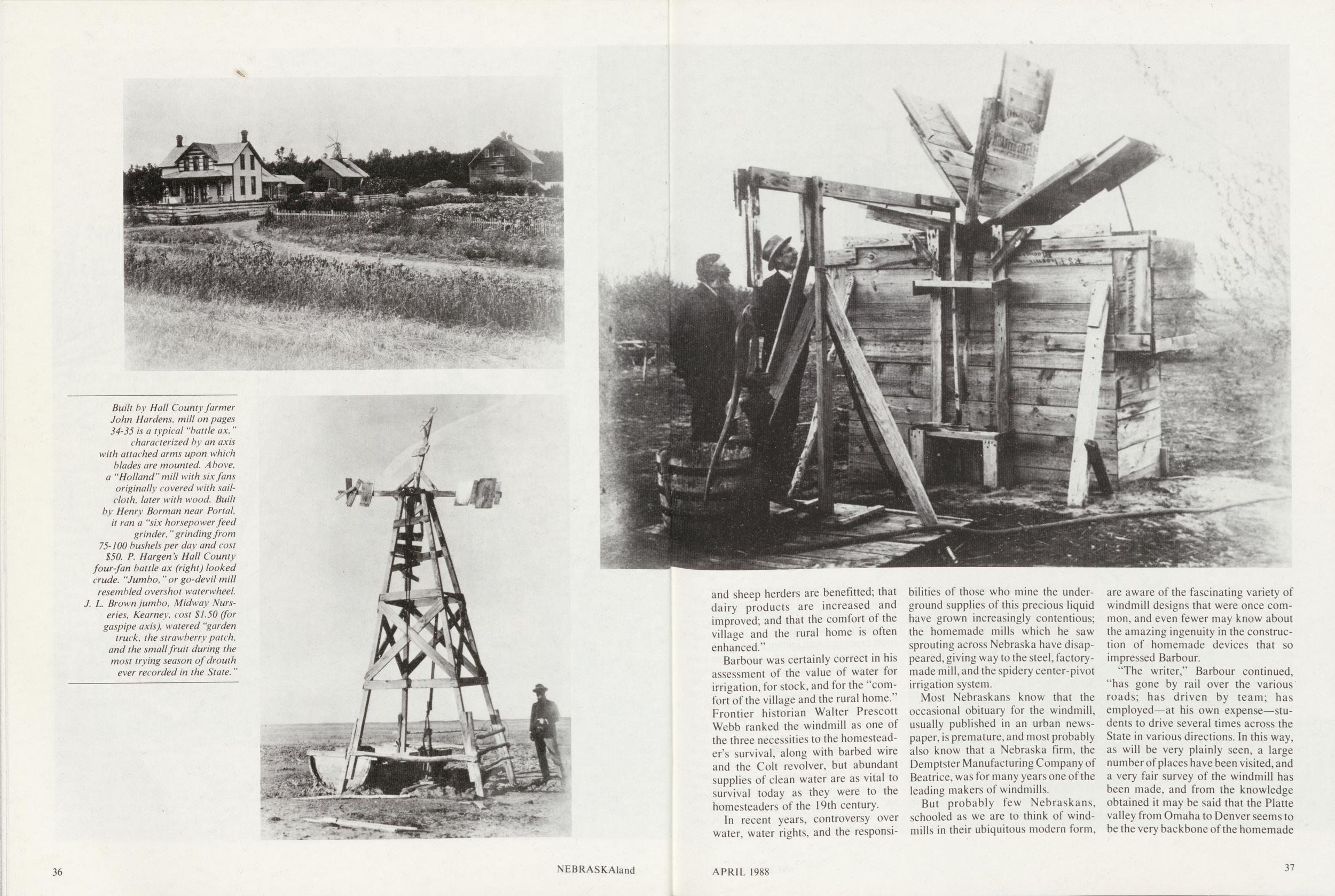
Barbour was certainly correct in his assessment of the value of water for irrigation, for stock, and for the "comfort of the village and the rural home." Frontier historian Walter Prescott Webb ranked the windmill as one of the three necessities to the homesteader's survival, along with barbed wire and the Colt revolver, but abundant supplies of clean water are as vital to survival today as they were to the homesteaders of the 19th century.
In recent years, controversy over water, water rights, and the responsibilities of those who mine the underground supplies of this precious liquid have grown increasingly contentious; the homemade mills which he saw sprouting across Nebraska have disappeared, giving way to the steel, factory made mill, and the spidery center-pivot irrigation system.
Most Nebraskans know that the occasional obituary for the windmill, usually published in an urban newspaper, is premature, and most probably also know that a Nebraska firm, the Demptster Manufacturing Company of Beatrice, was for many years one of the leading makers of windmills.
But probably few Nebraskans, schooled as we are to think of windmills in their ubiquitous modern form, are aware of the fascinating variety of windmill designs that were once common, and even fewer may know about the amazing ingenuity in the construction of homemade devices that so impressed Barbour.
"The writer," Barbour continued,
"has gone by rail over the various
roads; has driven by team; has
employed—at his own expense,
students to drive several times across the
State in various directions. In this way,
as will be very plainly seen, a large
number of places have been visited, and
a very fair survey of the windmill has
been made, and from the knowledge
obtained it may be said that the Platte
valley from Omaha to Denver seems to
be the very backbone of the homemade
APRIL 1988
37
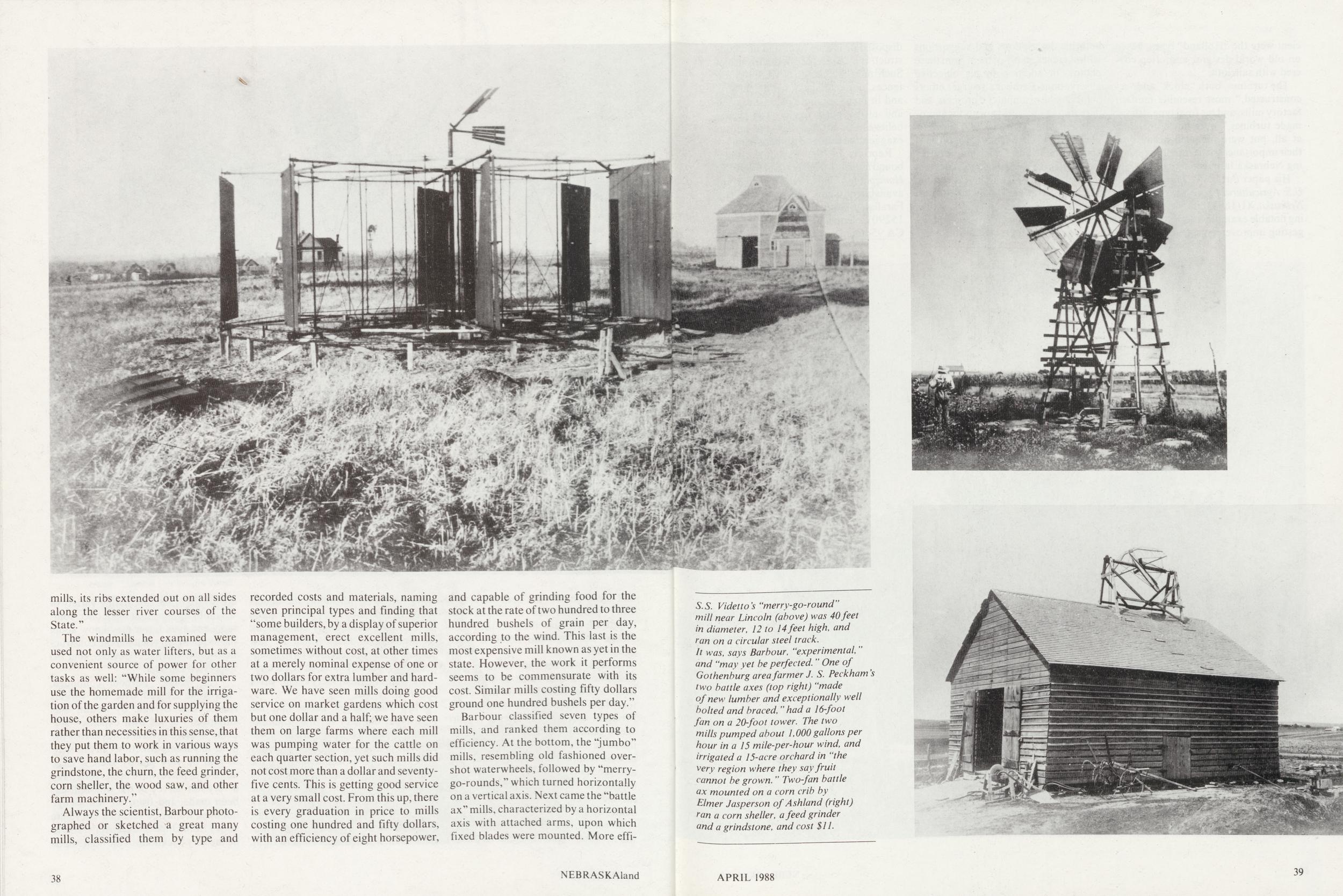 mills, its ribs extended out on all sides
along the lesser river courses of the
State."
mills, its ribs extended out on all sides
along the lesser river courses of the
State."
The windmills he examined were used not only as water lifters, but as a convenient source of power for other tasks as well: "While some beginners use the homemade mill for the irrigation of the garden and for supplying the house, others make luxuries of them rather than necessities in this sense, that they put them to work in various ways to save hand labor, such as running the grindstone, the churn, the feed grinder, corn sheller, the wood saw, and other farm machinery."
Always the scientist, Barbour photographed or sketched a great many mills, classified them by type and recorded costs and materials, naming seven principal types and finding that "some builders, by a display of superior management, erect excellent mills, sometimes without cost, at other times at a merely nominal expense of one or two dollars for extra lumber and hardware. We have seen mills doing good service on market gardens which cost but one dollar and a half; we have seen them on large farms where each mill was pumping water for the cattle on each quarter section, yet such mills did not cost more than a dollar and seventy five cents. This is getting good service at a very small cost. From this up, there is every graduation in price to mills costing one hundred and fifty dollars, with an efficiency of eight horsepower, and capable of grinding food for the stock at the rate of two hundred to three hundred bushels of grain per day, according to the wind. This last is the most expensive mill known as yet in the state. However, the work it performs seems to be commensurate with its cost. Similar mills costing fifty dollars ground one hundred bushels per day."
Barbour classified seven types of mills, and ranked them according to efficiency. At the bottom, the "jumbo" mills, resembling old fashioned overshot waterwheels, followed by " merry-go-rounds," which turned horizontally on a vertical axis. Next came the "battle ax" mills, characterized by a horizontal axis with attached arms, upon which fixed blades were mounted. More effiicient were the "Holland" types, based on old world designs, and often covered with sailcloth.
38 NEBRASKAland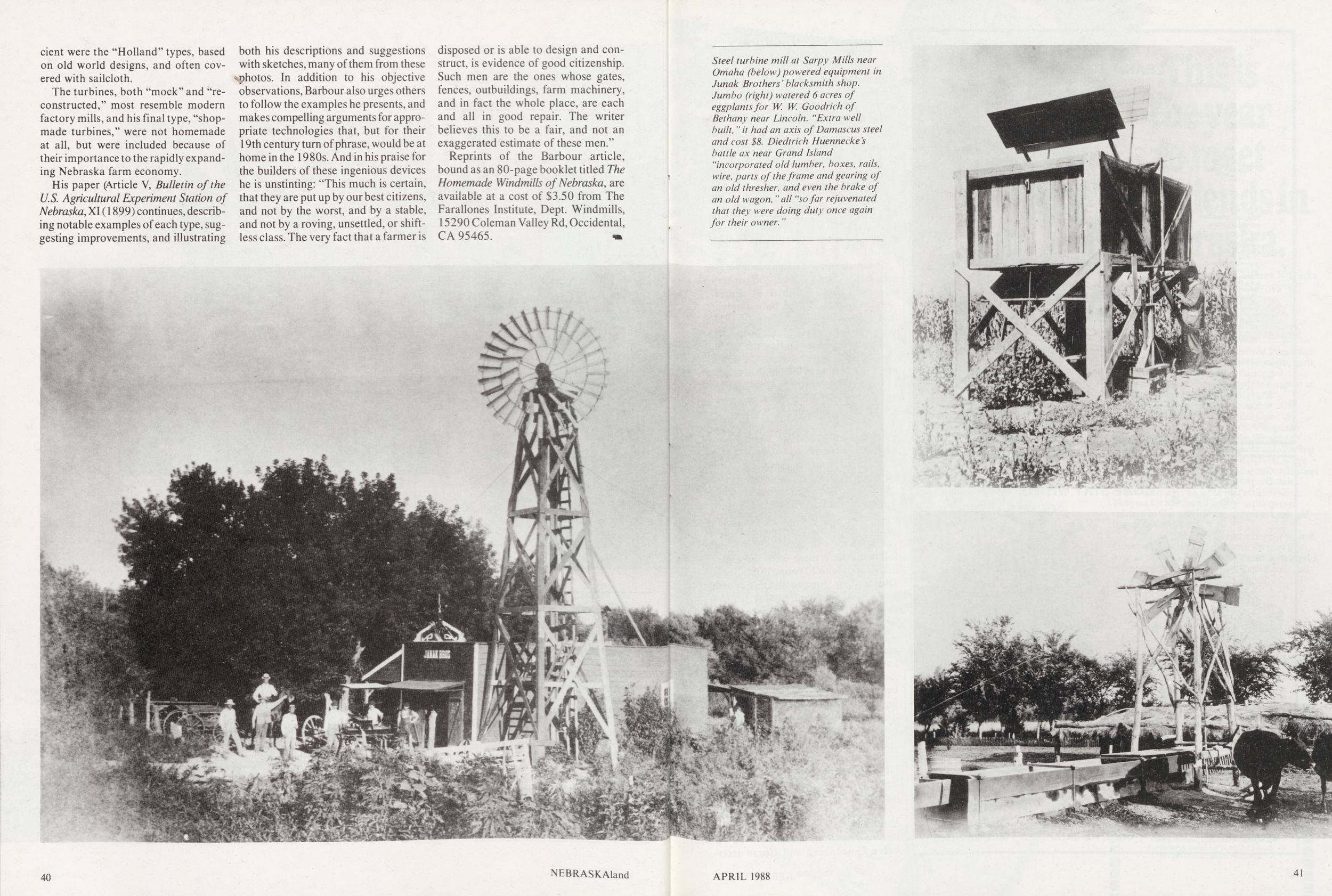
The turbines, both "mock" and "reconstructed," most resemble modern factory mills, and his final type, "shopmade turbines," were not homemade at all, but were included because of their importance to the rapidly expanding Nebraska farm economy.
His paper (Article V, Bulletin of the U.S. Agricultural Experiment Station of Nebraska, XI (1899) continues, describing notable examples of each type, suggesting improvements, and illustrating both his descriptions and suggestions with sketches, many of them from these ^photos. In addition to his objective observations, Barbour also urges others to follow the examples he presents, and makes compelling arguments for appropriate technologies that, but for their 19th century turn of phrase, would be at home in the 1980s. And in his praise for the builders of these ingenious devices he is unstinting: "This much is certain, that they are put up by our best citizens, and not by the worst, and by a stable, and not by a roving, unsettled, or shiftless class. The very fact that a farmer is disposed or is able to design and construct, is evidence of good citizenship. Such men are the ones whose gates, fences, outbuildings, farm machinery, and in fact the whole place, are each and all in good repair. The writer believes this to be a fair, and not an exaggerated estimate of these men."
Reprints of the Barbour article, bound as an 80-page booklet titled The Homemade Windmills of Nebraska, are available at a cost of $3.50 from The Farallones Institute, Dept. Windmills, 15290 Coleman Valley Rd, Occidental, CA 95465.
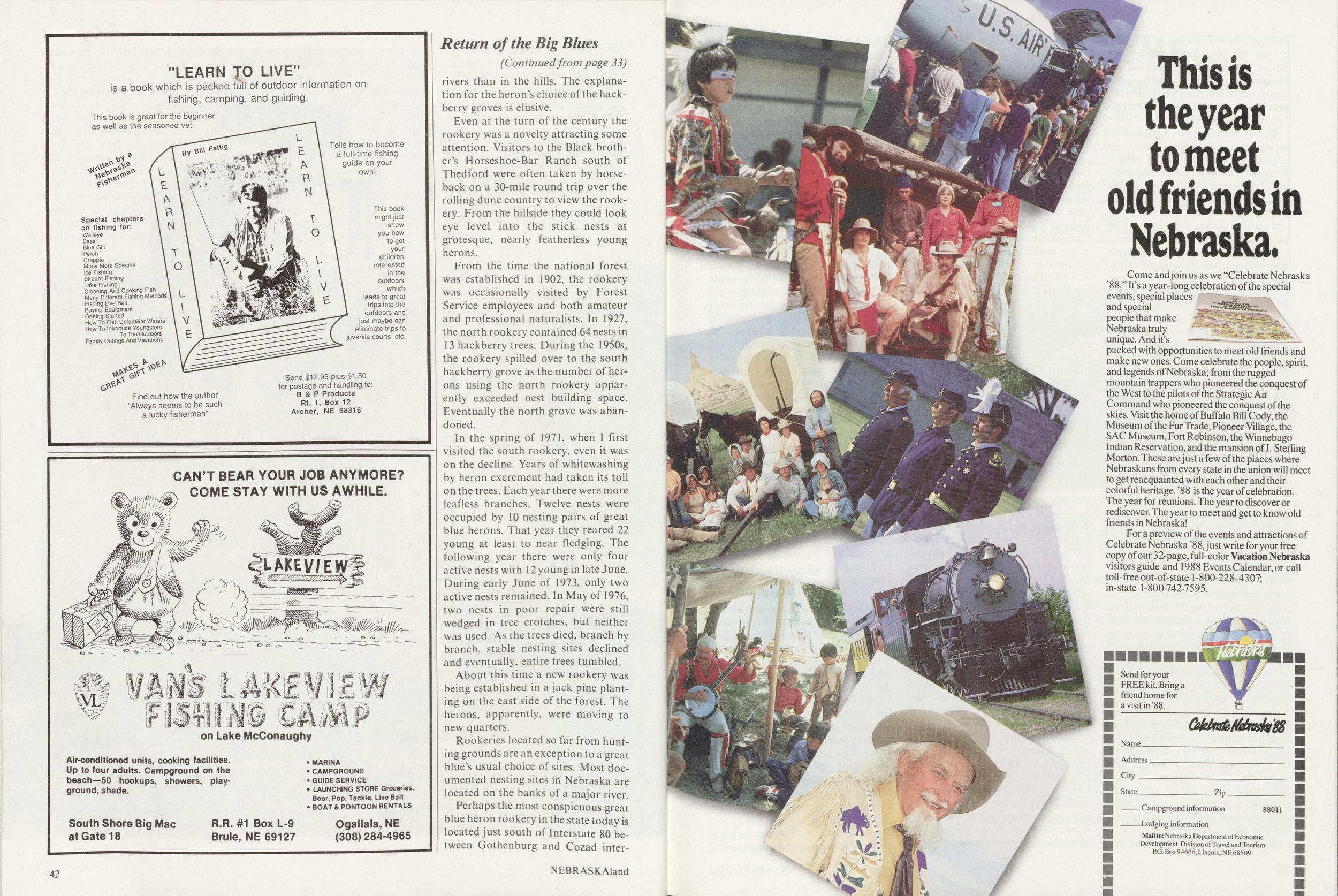
Return of the Big Blues
(Continued from page 33)rivers than in the hills. The explanation for the heron's choice of the hackberry groves is elusive.
Even at the turn of the century the rookery was a novelty attracting some attention. Visitors to the Black brother's Horseshoe-Bar Ranch south of Thedford were often taken by horse back on a 30-mile round trip over the rolling dune country to view the rookery. From the hillside they could look eye level into the stick nests at grotesque, nearly featherless young herons.
From the time the national forest was established in 1902, the rookery was occasionally visited by Forest Service employees and both amateur and professional naturalists. In 1927, the north rookery contained 64 nests in 13 hackberry trees. During the 1950s, the rookery spilled over to the south hackberry grove as the number of herons using the north rookery apparently exceeded nest building space. Eventually the north grove was abandoned.
In the spring of 1971, when I first visited the south rookery, even it was on the decline. Years of whitewashing by heron excrement had taken its toll on the trees. Each year there were more leafless branches. Twelve nests were occupied by 10 nesting pairs of great blue herons. That year they reared 22 young at least to near fledging. The following year there were only four active nests with 12 young in late June. During early June of 1973, only two active nests remained. In May of 1976, two nests in poor repair were still wedged in tree crotches, but neither was used. As the trees died, branch by branch, stable nesting sites declined and eventually, entire trees tumbled.
About this time a new rookery was being established in a jack pine planting on the east side of the forest. The herons, apparently, were moving to new quarters.
Rookeries located so far from hunting grounds are an exception to a great blue's usual choice of sites. Most documented nesting sites in Nebraska are located on the hanks of a major river.
Perhaps the most conspicuous great blue heron rookery in the state today is located just south of Interstate 80 between Gothenburg and Cozad interchanges where a channel of the Platte crosses the twin bands of concrete. Before the cottonwoods leaf out and obscure the nests, it is within sight of" thousands of motorists a day. In recent years, from 100 to 200 active nests have been documented here.
42 NEBRASKAland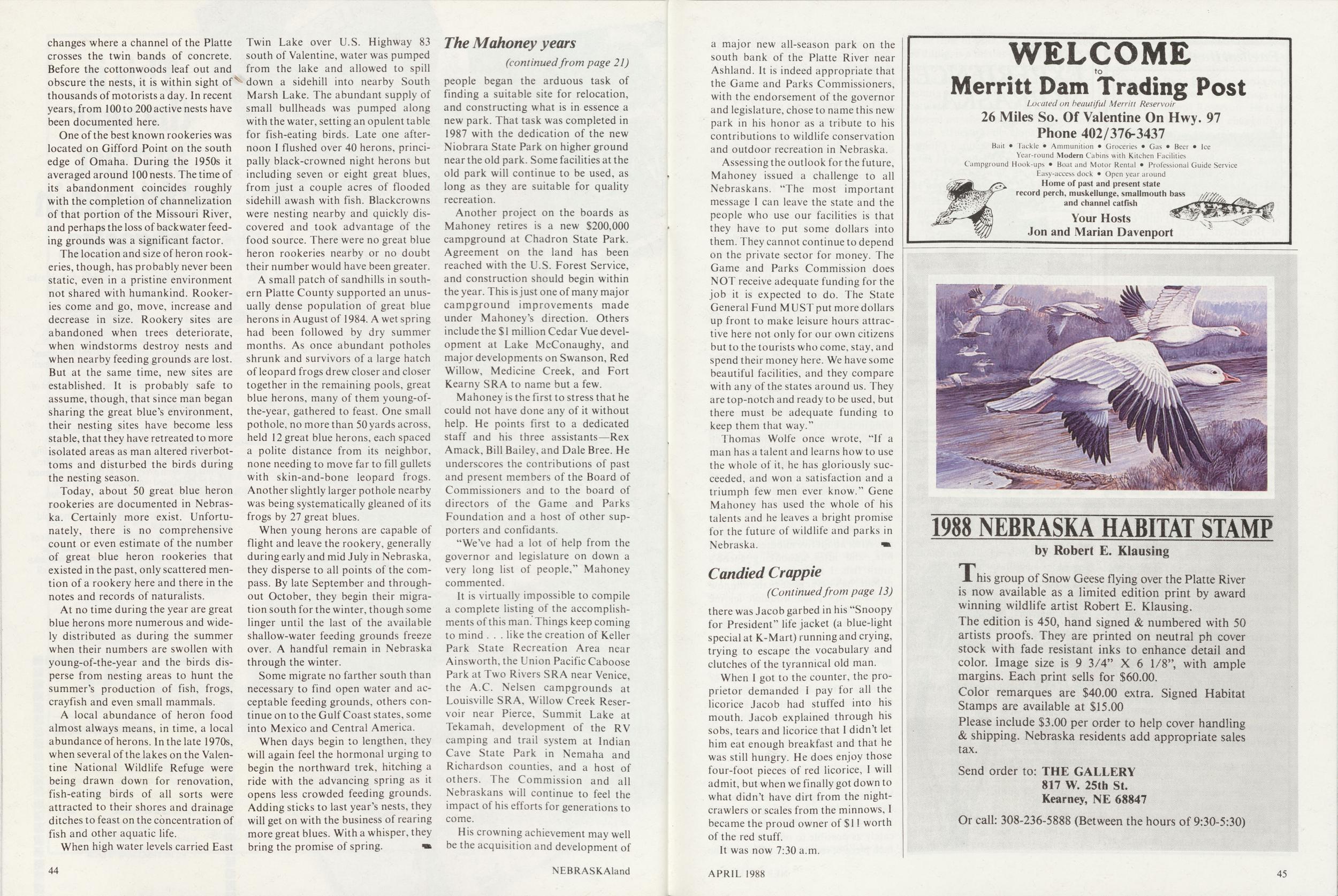
One of the best known rookeries was located on Gifford Point on the south edge of Omaha. During the 1950s it averaged around 100 nests. The time of its abandonment coincides roughly with the completion of channelization of that portion of the Missouri River, and perhaps the loss of backwater feeding grounds was a significant factor.
The location and size of heron rookeries, though, has probably never been static, even in a pristine environment not shared with humankind. Rookeries come and go, move, increase and decrease in size. Rookery sites are abandoned when trees deteriorate, when windstorms destroy nests and when nearby feeding grounds are lost. But at the same time, new sites are established. It is probably safe to assume, though, that since man began sharing the great blue's environment, their nesting sites have become less stable, that they have retreated to more isolated areas as man altered riverbottoms and disturbed the birds during the nesting season.
Today, about 50 great blue heron rookeries are documented in Nebraska. Certainly more exist. Unfortunately, there is no comprehensive count or even estimate of the number of great blue heron rookeries that existed in the past, only scattered mention of a rookery here and there in the notes and records of naturalists.
At no time during the year are great blue herons more numerous and widely distributed as during the summer when their numbers are swollen with young-of-the-year and the birds disperse from nesting areas to hunt the summer's production of fish, frogs, crayfish and even small mammals.
A local abundance of heron food almost always means, in time, a local abundance of herons. In the late 1970s, when several of the lakes on the Valentine National Wildlife Refuge were being drawn down for renovation, fish-eating birds of all sorts were attracted to their shores and drainage ditches to feast on the concentration of fish and other aquatic life.
When high water levels carried East Twin Lake over U.S. Highway 83 south of Valentine, water was pumped from the lake and allowed to spill down a sidehill into nearby South Marsh Lake. The abundant supply of small bullheads was pumped along with the water, setting an opulent table for fish-eating birds. Late one afternoon I flushed over 40 herons, principally black-crowned night herons but including seven or eight great blues, from just a couple acres of flooded sidehill awash with fish. Black crowns were nesting nearby and quickly discovered and took advantage of the food source. There were no great blue heron rookeries nearby or no doubt their number would have been greater.
A small patch of sandhills in southern Platte County supported an unusually dense population of great blue herons in August of 1984. A wet spring had been followed by dry summer months. As once abundant potholes shrunk and survivors of a large hatch of leopard frogs drew closer and closer together in the remaining pools, great blue herons, many of them young-of-the-year, gathered to feast. One small pothole, no more than 50 yards across, held 12 great blue herons, each spaced a polite distance from its neighbor, none needing to move far to fill gullets with skin-and-bone leopard frogs. Another slightly larger pothole nearby was being systematically gleaned of its frogs by 27 great blues.
When young herons are capable of flight and leave the rookery, generally during early and mid July in Nebraska, they disperse to all points of the compass. By late September and throughout October, they begin their migration south for the winter, though some linger until the last of the available shallow-water feeding grounds freeze over. A handful remain in Nebraska through the winter.
Some migrate no farther south than necessary to find open water and acceptable feeding grounds, others continue on to the Gulf Coast states, some into Mexico and Central America.
When days begin to lengthen, they will again feel the hormonal urging to begin the northward trek, hitching a ride with the advancing spring as it opens less crowded feeding grounds. Adding sticks to last year's nests, they will get on with the business of rearing more great blues. With a whisper, they bring the promise of spring.
The Mahoney years
(continued from page 21)people began the arduous task of finding a suitable site for relocation, and constructing what is in essence a new park. That task was completed in 1987 with the dedication of the new Niobrara State Park on higher ground near the old park. Some facilities at the old park will continue to be used, as long as they are suitable for quality recreation.
Another project on the boards as Mahoney retires is a new $200,000 campground at Chadron State Park. Agreement on the land has been reached with the U.S. Forest Service, and construction should begin within the year. This is just one of many major campground improvements made under Mahoney's direction. Others include the $ 1 million Cedar Vue development at Lake McConaughy, and major developments on Swanson, Red Willow, Medicine Creek, and Fort Kearny SRA to name but a few.
Mahoney is the first to stress that he could not have done any of it without help. He points first to a dedicated staff and his three assistants—Rex Amack, Bill Bailey, and Dale Bree. He underscores the contributions of past and present members of the Board of Commissioners and to the board of directors of the Game and Parks Foundation and a host of other supporters and confidants.
"We've had a lot of help from the governor and legislature on down a very long list of people," Mahoney commented.
It is virtually impossible to compile a complete listing of the accomplishments of this man. Things keep coming to mind . . . like the creation of Keller Park State Recreation Area near Ainsworth, the Union Pacific Caboose Park at Two Rivers SRA near Venice, the A.C. Nelsen campgrounds at Louisville SRA, Willow Creek Reservoir near Pierce, Summit Lake at Tekamah, development of the RV camping and trail system at Indian Cave State Park in Nemaha and Richardson counties, and a host of others. The Commission and all Nebraskans will continue to feel the impact of his efforts for generations to come.
His crowning achievement may well be the acquisition and development of 44 NEBRSAKAland a major new all-season park on the south bank of the Platte River near Ashland. It is indeed appropriate that the Game and Parks Commissioners, with the endorsement of the governor and legislature, chose to name this new park in his honor as a tribute to his contributions to wildlife conservation and outdoor recreation in Nebraska.
Assessing the outlook for the future, Mahoney issued a challenge to all Nebraskans. "The most important message I can leave the state and the people who use our facilities is that they have to put some dollars into them. They cannot continue to depend on the private sector for money. The Game and Parks Commission does NOT receive adequate funding for the job it is expected to do. The State General Fund M U ST put more dollars up front to make leisure hours attractive here not only for our own citizens but to the tourists who come, stay, and spend their money here. We have some beautiful facilities, and they compare with any of the states around us. They are top-notch and ready to be used, but there must be adequate funding to keep them that way."
Thomas Wolfe once wrote, "If a man has a talent and learns how to use the whole of it, he has gloriously succeeded, and won a satisfaction and a triumph few men ever know." Gene Mahoney has used the whole of his talents and he leaves a bright promise for the future of wildlife and parks in Nebraska.
Candied Crappie
(Continued from page 13)there was Jacob garbed in his "Snoopy for President" life jacket (a blue-light special at K-Mart) running and crying, trying to escape the vocabulary and clutches of the tyrannical old man.
When 1 got to the counter, the proprietor demanded i pay for all the licorice Jacob had stuffed into his mouth. Jacob explained through his sobs, tears and licorice that I didn't let him eat enough breakfast and that he was still hungry. He does enjoy those four-foot pieces of red licorice, I will admit, but when we finally got down to what didn't have dirt from the night crawlers or scales from the minnows, I became the proud owner of $11 worth of the red stuff.
It was now 7:30 a.m.
WELCOME to Merritt Dam Trading Post Located on beautiful Merritt Reservoir 26 Miles So. Of Valentine On Hwy. 97 Phone 402/376-3437 Bait • Tackle • Ammunition • Groceries • Gas • Beer • Ice Year-round Modern Cabins with Kitchen Facilities Campground Hook-ups • Boat and Motor Rental • Professional Guide Service Easy-access dock • Open year around Home of past and present state record perch, muskellunge, smallmouth bass and channel catfish Your Hosts Jon and Marian Davenport 1988 NEBRASKA HABITAT by Robert E. Klausing T his group of Snow Geese flying over the Platte River is now available as a limited edition print by award winning wildlife artist Robert E. Klausing. The edition is 450, hand signed & numbered with 50 artists proofs. They are printed on neutral ph cover stock with fade resistant inks to enhance detail and color. Image size is 9 3/4" X 6 1/8" with ample margins. Each print sells for $60.00. Color remarques are $40.00 extra. Signed Habitat Stamps are available at $15.00 Please include $3.00 per order to help cover handling & shipping. Nebraska residents add appropriate sales tax. Send order to: THE GALLERY 817 W. 25th St. Kearney, NE 68847 Or call: 308-236-5888 (Between the hours of 9:30-5:30) APRIL 1988 45 Excellent Hunting-Fishing
For Sale—290 acres on the
North Platte River (1) mile east
of Broadwater, NE. The main
cabin is located in a grove of
huge cottonwood trees with
glass sliding doors in the family
room that overlook the river
and sandhills beyond. The
cabin has two bedrooms,
electric heat, fireplace, bath with
tile shower, T.V., and phone
services. The country road is
paved to the entry gate and the
airport is 33 miles away.
Land contract available
Lee Chapin (402) 423-5727
6230 Andrew Ct. Lincoln, NE 68512
Aaahh!
EXPERIENCE
NEBRASKA...
with an affordable canoe trip by
DRYLAND AQUATICS
• Niobrara • Dismal • Platte • Elkhorn
-YOU NAME IT-
One & two day trips available
canoe rental only or fully catered
—WE DO IT YOUR WAY—
Write for Free brochure
Dry land Aquatics, Dept. N
1837 E.Cuming
Fremont, NE 68025 Ph. (402) 721-4177
Spring
Affair
"TAMING THE WED"
Saturday, April 30
9 a.m. - 5 p.m.
Nebraska State Fair Park
17th Street Entrance
stop by anytime — free admission
Learn about wildflowers in the tame landscape.
Purchase your favorites at our exclusive plant sale
— also including grasses, herbs and perennials.
Visit Nebraska's only daffodil display garden.
See the latest in horticulture and herbs,
commercial exhibits and crafts.
Enjoy an Italian luncheon of herbal delights.
Participate in one-of-a-kind celebration of plants.
Contact the Nebraska Statewide Arboretum
to make a luncheon reservation
and get details
on a special Friday Preview Party.
112 FSL/University of Nebraska
Lincoln, NE 68583-0823 (402) 472-2971
Excellent Hunting-Fishing
For Sale—290 acres on the
North Platte River (1) mile east
of Broadwater, NE. The main
cabin is located in a grove of
huge cottonwood trees with
glass sliding doors in the family
room that overlook the river
and sandhills beyond. The
cabin has two bedrooms,
electric heat, fireplace, bath with
tile shower, T.V., and phone
services. The country road is
paved to the entry gate and the
airport is 33 miles away.
Land contract available
Lee Chapin (402) 423-5727
6230 Andrew Ct. Lincoln, NE 68512
Aaahh!
EXPERIENCE
NEBRASKA...
with an affordable canoe trip by
DRYLAND AQUATICS
• Niobrara • Dismal • Platte • Elkhorn
-YOU NAME IT-
One & two day trips available
canoe rental only or fully catered
—WE DO IT YOUR WAY—
Write for Free brochure
Dry land Aquatics, Dept. N
1837 E.Cuming
Fremont, NE 68025 Ph. (402) 721-4177
Spring
Affair
"TAMING THE WED"
Saturday, April 30
9 a.m. - 5 p.m.
Nebraska State Fair Park
17th Street Entrance
stop by anytime — free admission
Learn about wildflowers in the tame landscape.
Purchase your favorites at our exclusive plant sale
— also including grasses, herbs and perennials.
Visit Nebraska's only daffodil display garden.
See the latest in horticulture and herbs,
commercial exhibits and crafts.
Enjoy an Italian luncheon of herbal delights.
Participate in one-of-a-kind celebration of plants.
Contact the Nebraska Statewide Arboretum
to make a luncheon reservation
and get details
on a special Friday Preview Party.
112 FSL/University of Nebraska
Lincoln, NE 68583-0823 (402) 472-2971
The motor started right up and away we went. Jacob is a little mischievous (takes after his mother's side of the family), but he's just like Dad when it comes to fishing. At seven, he can readily remember at what spot in the lake who caught what and on what.
My now-clearing (finally) brain decided to let him pick a spot where the big ones were.
I should've known better. He saw a little cover that had no ripples at all. That's where the big ones were, he decided. When I explained that it was good for crappie but not for walleyes, he started sobbing. As I sped by, the wails got louder and louder. Finally I just made a big 360 turn and went into the bay. I'll use this as a good exercise to teach him that it would only yield a few palm-sized crappies. Besides, I would tie up to one of the submerged bushes and catch a little shut-eye.
On his second cast, Jacob caught a one-pound crappie. I excitedly took it off the hook for him and got out the panfish holder from under the seat. As I was screwing the clamp to the side of the boat, in comes the twin to the one lying in the bottom of the boat. "Go get 'em, kid" I said as I scrambled to catch the first one, still flopping around in the boat. A third one followed.
Now, I thought, the master would show the student how it was done. A No. 10 hook, one split shot, pencil bobber, and a lively minnow.
Jacob just brought in his sixth crappie. After about five minutes without a bite, and after unhooking Jacob's ninth fish, I thought, "Hey, wait a minute, he's never gone to the minnow bucket." My pride wouldn't let me admit I had chosen the wrong bait, so 1 nonchalantly reeled in and took that ugly, bruised minnow off my hook. As 1 reached for a nightcrawler, number 10 hit me in the neck. I deftly freed the fish from Jacob's hook and reached for a worm. After 14 or 15 were safely in the net, I asked Jacob if he was having fun. Yes he was, he said. "By the way, Dad, how many have you caught?"
When 1 explained 1 was having a lot of fun just unhooking his fish, he seemed satisfied.
When number 16 flopped into the boat, it had really swallowed the hook. Out came the pliers to extract the hook. As I twisted and turned as delicately as possible to remove it, a one-inch piece of red licorice fell out of the 46 NEBNRASKAland fish's mouth! The little sneak!
For the first time, I watched Jacob. He measured the licorice on his thumbnail, then bit off just the right amount and quickly put it on the hook and cast out. I told him we ought to quit for a while and go into the marina for a bite to eat. "I'm not hungry," was his reply. When I explained that all I had for breakfast was coffee, he ruefully surrendered one four-foot piece of the most peculiar fish bait I'd ever seen.
To make a long story short, we sat in that "unproductive" bay the rest of the day and caught over 100 crappies. Jacob says he caught the most, but what the heck, I gave him a head start.
On the way home, Jacob said he wanted to close his eyes for a while. That was the best news I'd had all day. The sun was gone as I carried him up to his room. A bath was out of the question now.
As I started to clean the fish, I reflected on the events of the day. It was a very long day, and one that tried my patience many times, but it was a day I wouldn't have missed for anything. Jacob will grow up so fast and soon he'll find other fishing partners, like I did as a youngster. I know now that the first time my child says he can't go fishing in the morning with me because he and Billy already have plans, is going to devastate me.
My self pity was suddenly disturbed as my wife walked over to the fish table. "Honey, did you remember I had a doctor's appointment this morning?" No. "Well, it's great news. I'm pregnant."
I almost filleted myself before I could stop.
Calamus update
(Continued from page 10)that the upper end of the reservoir will be the key to all early spring fishing, as fish move into those waters to shake off the winter chill. "Last spring, water at the west end of the lake was 15 degrees warmer than at the face of the dam," he observed. The pike will be the first to disperse, heading for shallow weed beds very early in the spring to spawn, then dispersing throughout the lake. Bass and bluegill will also disperse somewhat, although they will not arrive at spawning beds in shallows until late spring.
Just where the walleye will be at a given time of year, and what they will be doing, is a matter of conjecture. "A walleye fishing pattern was not apparent in this lake in 1987, and walleye fishing won't be much until there is a pattern," J.D said. "The pattern will depend on where weed beds grow and other structure develops, and that couldn't happen because the lake had never been full, and will not fill for the first time until June," he said. In fact, the patterns observed last year for all species might change once the lake is topped off, he observed.
The new reservoir is of special interest to fish and wildlife professionals. The most closely associated with Calamus are Lynn Schlueter of Bassett, the Game and Parks Commission biologist in charge of fisheries management for north-central Nebraska, and Conservation Officer Rick Seward of Burwell.
Seward predicts that fishing in Calamus Reservoir will continue to improve for several more years "because the habitat's there." Because of that habitat, and the fact that it's a new reservoir, Calamus should have excellent bass fishing beginning this year, he said. In addition, Seward saw quite a few one-pound bluegill last year, and predicts he will lay eyes on considerably more in '88.
He's also looking forward to even better pike fishing. There didn't seem to be any shortage of pike last year, even though people were bringing home lots of northerns all spring, summer and fall. The difference will be that the northerns will be a lot bigger this year.
Seward sees the pike as a nice bonus for Calamus Reservoir and its fishermen. "The lake seemed to fill with lots of eight to 12-inch carp that came in from the river. But the pike, which also came in through the river, have really been cleaning up on them."
Seward suggests that fishermen use a boat at Calamus if at all possible, because it would provide access to many of the downed trees and flooded brush piles that are out of reach of bank fishermen, and because of added mobility. But, if a boat is not in the cards, Calamus offers a better opportunity for bank fishing than a lot of other waters.
He points out that much of the upper end of the lake is designated a five-mile-per-hour zone for safety reasons. He also reminds fishermen that Park Entry permits are required to use developed access points on the lake.
Biologist Lynn Schlueter looks well beyond 1988 when he discusses the future of Calamus Reservoir. He talks about the lake's gradual change from its current status as a pike fishery to several years down the road when it will be a largemouth bass lake, and to its eventual change into a walleye lake.
This maturing process may take as few as 10 years or as many as 20, and it will probably be so gradual that most fishermen will not notice.
Calamus still favors the northern, since the reservoir is still flooding new vegetation as it fills, and flooded vegetation is prime pike spawning habitat. But, the lake is filling up with big, hungry fish—bass, pike and walleye— that would be only too happy to gobble up any baby northerns they find. That will be a big limiting factor, something the first influx of pike didn't have to deal with. That accounts for the initial years of hot pike fishing, followed by a drop in northern populations in new reservoirs like Calamus, according to Schlueter.
Along with the growth of the bass fishery in the next few years will come expanding populations of bluegill and yellow perch, he predicted. Catfish and walleye fishing will be kept going over the years with maintenance stockings. Thus, in the case of the walleye, the new fish hatchery below the Calamus Dam will be particularly important.
Whether these next few years should also include the introduction of other species, specifically white bass or crappie, is something that Schlueter is now considering. The key to the question is the lake's ability to produce zooplankton, the microscopic, free floating animals that form the base of any lake's food production system.
If white bass are introduced, it will be necessary to also introduce a new baitfish to feed them, either gizzard shad or alewife. Both of these baitfish feed exclusively on zooplankton their first year, and they are so prolific that they can soon take over a lake. The problem with crappie is that they, too, eat zooplankton all their lives and they, too, are quite prolific.
The question Schlueter is
researching is whether the lake produces
enough zooplankton to supply the
incredible numbers of new forage fish
APRIL 1988
47
 and crappie as well as meet existing
needs of young gamefish and fish food
organisms. If studies determine that
the zooplankton food base would be.
adequate for all concerned, crappie or
white bass could be introduced as early
as 1990, he said.
and crappie as well as meet existing
needs of young gamefish and fish food
organisms. If studies determine that
the zooplankton food base would be.
adequate for all concerned, crappie or
white bass could be introduced as early
as 1990, he said.
Schlueter is enthusiastic about the future of Calamus Reservoir primarily because of the habitat provided there during its construction. Thanks to cooperation between the Bureau of Reclamation, the U.S. Fish and Wildlife Service, and the Game and Parks Commission, the trees and brush in the upper part of the lake were left in place. And, those that had to be knocked down in the lower part of the reservoir were stacked in piles that were anchored or cabled in place. "That's an excellent example of the impressive things that agencies cooperating can do together," Schlueter said. "They looked to the future, and the result is a reservoir that will provide good fishing for its entire life span."
The river dragon
(Continued from page 31)down the Ohio River to the Mississippi, and then up that river to Belle fontaine, near St. Louis, where the Yellowstone Expedition was assembling.
At that point the scientific party began its explorations. As the steamer struggled up the turgid, snag-infested and sandbar-filled Missouri, scientists and illustrators would go ashore to examine flora and fauna and to meet with local Indians, making arrangements to meet the boat upstream. Finally, on September 17, 1819, they reached Fort Lisa, a Missouri Fur Company trading post about 5lA miles below the Council Bluff.
Long's party made the entire journey under steam, (although not without several stops for repairs). They were accompanied by a party of soldiers who followed the Western Engineer in a keelboat. Their success was apparently due largely to the design of the boat; the five ships of the Yellowstone Expedition all failed, defeated by the snags, sandbars and turbid water of the Missouri.
Seventy-five feet long and 30 feet wide, the Western Engineer's sternwheel configuration permitted it to avoid the river's threatening snags more effectively than the side-wheel boats used by the Yellowstone Expedition. Moreover, the Western Engineer drew only about three feet of water (rather more than Long's optimistically proposed 14 inches) allowing it to travel more-or-less on, rather than in, the river, a decided advantage in the shallow, treacherous Missouri.
Its dragon motif was, as the Niles' Weekly Register writer suggested, intended to impress the Indians with whom the expedition came in contact. It also boasted an armored deck-house for the steersman, and in addition to its own name, it carried near the wheel the names James Monroe and J. C. Calhoun, respectively the president and the secretary of war, "they being" in Peale's words, "the two propelling powers of the expedition."
Near Fort Lisa (just north of present Omaha) the party established "Engineer Cantonment" as its headquarters. Long returned to Washington for the winter to confer with Calhoun.
The Yellowstone Expedition, too, had intended to ascend the river under steam power, but their craft proved insufficient for the effort; two of the five did not even enter the river, and one after another the remaining three failed and had to be abandoned. The Yellowstone Expedition then had to resort to their keelboats, rowed, poled and hauled upriver by ropes. The expedition arrived at the Council Bluff site on September 29, barely ahead of approaching winter, exhausted.
At Cantonment Missouri, the temporary post first established by the troops of the Yellowstone Expedition about a mile north of Long's encampment, winter took a horrible toll. Their quarters were cold, damp and droughty, food was in short supply, and sickness epidemic. At least 157 of the 1,100 troops died from malnutrition and disease.
The scientific party at Engineer Cantonment seems to have suffered less. Isolated from the concentration of troops which contributed to unsanitary conditions and the spread of illness, and better supplied with food, the scientists came through the winter well. In his journal of February 19, 1820, Thomas Say noted that, "We have been hitherto very well supplied with fresh meat, from game killed principally by Mr. Peale, who, on one occasion, killed two deer at a single shot and with one ball, but we are now reduced to salt pork___The party, with the exception of myself, continue to enjoy good health."
With spring came unexpected financial restrictions from Washington. Congress, skeptical of the project from the start, was unwilling to appropriate the funds necessary to complete the project. Fort Atkinson, successor to the ill-fated Cantonment Missouri, became the sole survivor of the planned series of Missouri River posts, and the wings of the Long expedition were also somewhat clipped, although the expedition continued.
In June, Long led a force of 20 men westward across the Elkhorn River and along the north bank of the Platte to the confluence of the North and South Platte rivers in present Lincoln County, Nebraska. They turned south into present Colorado, where the name "Long's Peak" memorializes the party's leader, then continued south to the Arkansas River, and returned to the Missouri via Fort Smith, Arkansas, in September.
Although sometimes remembered most for its leader's poor opinion of the region between the Missouri and the Rocky Mountains—the so-called "Great American Desert"—the Long expedition's achievements were notable.
In addition to proving that the Missouri River was navigable by steam, the expedition produced maps and accounts of the regions through which it traveled that are often regarded as the best record of exploration on the plains produced before the publication of Captain John C. Fremont's 1842 "Report of the Exploring Expeditions to the Rocky Mountains."
Although trappers and adventurers had penetrated the region much earlier, their knowledge of it was pragmatic and non scientific. The Lewis and Clark expedition had explored the waterways along which they traveled, but had penetrated very little distance from the rivers. Thus the detailed descriptions of topography, flora and fauna, geology, and inhabitants made by the Long expedition was a gold mine of information about the territory.
The legacy of the long expedition, its unusual vessel and its solidly pragmatic scientific purpose was the stream of pioneers and settlers which later moved westward depending in part on its exploration and map making.
48 NEBRASKAlandTrading Post
DOGSTRAINING ALL BREEDS Hunting Dogs — Vizslas for sale. Rozanek Kennels, Rt. 2, Schuyler, NE 68661. Phone (402) 352-8769.___________________________
ENGLISH SETTERS: "Bred for the hunter"; select puppies and started dogs available from outstanding bloodlines. Stud service available by proven hunters. High Plains Kennels, 1411 Emerson, Alliance, NE 69301, Phone (308) 762-6709.
GROUSEWAY BRITTANIES: Ideal hunting companions—dedicated, goal-oriented breeding programs. FREE brochure, Grouseway Gundogs, Louisville, NE 68037. (402) 397-6157. Training available.___________
GERMAN SHORTHAIRS and Brittany Spaniel pups. Started and occasionally a meat dog. Pups are guaranteed. Also I will be training hunting dogs. Wayne Clark, Percival, I A. Phone (712) 529-4238 or (402) 263-3155 at Union, NE._____________________
ENGLISH SETTERS: Young dogs available from two well-bred litters. Born early 1987. Darrell Yentes. Phone (308) 995-8570 or (308) 995-4797 after 5 p.m.
YELLOW-BLACK Lab pups. FC-AFC sired. AKC. Hips certified. Dew claws removed. Excellent hunting potential. Contact Bob Bendler (308) 324-4247.
AKC GOLDEN retriever pups, 7 weeks old. Excellent bloodlines. Great hunters or family dogs. 5521 Dove Circle, Lincoln, NE 68516 (402) 423-0577.__________
AKC CHOCOLATE Lab pups, field champion blood lines; hunting stock, hips OFA. Gene Meier, Plattsmouth, NE 68048 (402) 296-4190._____________
MISCELLANEOUSNE NEBRASKA trout fishing. 3 modern cottages, 1 available year round. 5 spring fed lakes with open water all year. Trout up to 7 pounds. Other varieties fish also. Diamond E. Trout Resort, Orchard, NE 68764. Phone (402) 893-4745._________________________________
GUNS Browning, Winchester, Remington, others, Hi-nowers, shotguns, new, used, antiques. Want Pre-1964 Winchesters. Buy-Sell-Trade. Ph. (402) 729-6112. Bedlan's Sporting Goods, Fairbury, NE 68352.
MAD RIVER CANOES offers the finest quality and performance For the finest canoes and accessories look to Great Plains Canoe Co., 205 Main, Springfield, NE. Phone (402) 253-2001._______________________
AIR GUNS repaired Benjamin, Crosman, Daisy, other American made. Restoration; old guns wanted, Jack's Air Guns, 1225 No. 46th, Lincoln, NE 68503. Phone (402) 466-9223.___________________________
TROLLING MOTOR REPAIR. Factory authorized Minn Kota and Motor Guide, parts and service. Wolt s Repair and Installation, 1529 David Drive, Lincoln, NE 68504. Phone (402) 464-4265.__________________
WINE AND BEER: Make your own. Send for free recipes and instructions. Omaha Supply, 1324 2nd Avenue, Nebraska City, NE 68410.________________
WILLIE'S FISH FARM For your fish needs - we have for sale: Rainbow Trout, Channel Cat, Walleye and Goldfish; others also available. Call 7:00 am. -11:00 p.m. 402/723-4210 Wilbur G. Epp R.R. 1, Box 199 - Henderson, Nebr. 68371 (Just 1% miles south of I-80)GARDEN SEEDS: Complete line of bulk vegetable seeds from y4 oz. up. Save with our catalog. Vap's Seed and Hardware, Box 448, McCook, NE 69001._______
COTTONWOOD PRESS for all your printing needs. We can do family histories, newsletters, pamphlets, booklets, and even cookbooks. Write to Cottonwood Press and tell us what your printing needs are. 404 N. Wheeler, Grand Island, NE 68801 or call (308) 384-0409 anytime.
FISH FOR SALE. Catfish, perch, coho salmon, rainbow trout, crappie, bluegill, walleye, minnows, goldfish, bullhead, largemouth bass, smallmouth bass, triploid grass carp. Commercial grower prices on cat- fish, perch, coho salmon, rainbow trout. Consulting available. Pleasant Valley Fish Farm, Rt. I Box 147, McCook, NE 69001. Phone (308) 345-6599._________
ADJOINING KELLER STATE PARK, 600 acres with A-frame cabin like new, Bone Creek running through, 20 A alfalfa, balance native grass, 100 A with Pine and hardwood tree cover. Deer and wild turkey. Swett Realty, P.O. Box 265, Ainsworth, NE 69210. Phone (402) 387-1626 day or night.________________
HUNTERS WITH BUDDIES—own your own hunting paradise with Niobrara River frontage. 3080 acres, with spring creeks and abundant timber and wildlife. Swett Realty, P.O. Box 265, Ainsworth, NE 69210. Phone (402) 387-1626 day or night.________________
FREE BOOK CATALOG. Novels, westerns, romances, children's; old out of print, found barns, attic. Authors: Grey, Bower, Connor, Fox, Curwood, Raine, Wright, Aldrige, Pollyanna, Freckles, many others. Postage appreciated. Pierce, 4400 N. Pine Cluster, Provide, CA 95965._____________________________
MAKE FRESH ice cream in 5 minutes; includes recipes, $10. Ronnenkamp's, 513 East C, North Platte, NE 69101.____________________________________
ONE-ON-ONE Guide Service—Specializing in eastern Nebraska lakes and the Missouri River—full day and half-day rates available. (402) 457-6806.
TAXIDERMYALLISON'S TAXIDERMY STUDIO. Wally and Betty Allison, Licensed Taxidermist. We've mounted 21 Nebraska State Record fish. Specializing in fish and birds, small game and rattlesnakes. We use freeze-dry. 2310 West Leota, North Platte, Nebr. 69101. Phone (308) 534-2324._________________________________
BADE TAXIDERMY - - Quality a must — Fast service. Fish, birds, rugs, tanning, full mounts and game heads, 2111 N. Christy St., Fremont, NE 727-5463.
NABITY'S TAXIDERMY. 31 years experience. Specializing in natural grass backgrounds for mammals, birds and fish. 13901 "O" St., Lincoln, NE 68504 — 4 miles east of 84th and "O". (402) 489-6351.
BIG BEAR TAXIDERMY, Rt. 2, Mitchell, Nebraska 69357. We specialize in all big game from Alaska to Nebraska, also birds and fish. Hair on and hair off tanning. Four miles west of Scottsbluff on Highway 26 Dale Hubel, phone (308) 635-3013.
PEISTER TAXIDERMY — Professional work at prices most sportsman can afford. Now in our new log cabin studio, 1020 Central Avenue, Box 3201, Kearney, NE 68847. Phone (308) 236-9700 or (308) 237-7575 evenings.
NATURECRAFT STUDIO — all custom services — creative work, quality, and experience since 1935. Includes freeze-dry processing. Display and sales room, visitors welcome. Hwy. 2 in Nebraska City. Phone (402) 873-5491. Joe Voges — Owner. Bow Steedly — Big Game specialist.
CEDAR LANE - Ranch Vacations Guest ranch in the heart of the Sandhills of Nebraska, Swimming, spa, horses, canoeing, trail rides, barbeques, hunting, family reunions. BOOKING NOW For 1988 Richard and Betty Schroeder HC 2 Box 9C Stapleton, Nebraska 69163 Ph. 308-587-2233 Time to go shopping... then time to go fishing! • Live Bait • Ice • Tackle • Permits • Pop • Beer • Bowfishing Equipment LARGEST SELECTION OF FISHING EQUIPMENT IN THE AREA! GENO'S MINNO-MART^^^ 177.3 33rd Avenue Columbus, NE -7- STOCK YOUR LAKE OR POND WITH Channel Cat, Bluegill, Hybrid Bluegill, Largemouth Bass, Crappie, Bullheads, Triploid Grass Carp, Walleye, Minnows WILLOW LAKE FISH HATCHERY Rt. 3, Box 46, Hastings, Nebr. 68901 Gaylord L. Crawford Phone: (402) 463-8022 Day or Night For April to October 15 stocking Hatching Eggs Mature Flyers Day-Old Chix Oven Ready Started Birds Hickory Smoked OUb I Game Bird Farms R. 2, Box 358, Beloit, Wl 53511 PHEASANTS - WILD TURKEYS CHUKAR & HUNGARIAN PARTRIDGES GUN DOG TRAINING All Sporting Breeds All dogs worked on foot —. no horses. Midwest's finest facilities. Field Champion-sired Labrador pups for sale. "Training for hunters by hunters" WILDERNESS KENNELS Henry Sader—Roca, Ne. (402)423-4212 68430 Nebraska Sportsman's Hotlines Up to Date Fishing & Hunting Information Eastern Nebraska-402-684-2282 Western Nebraska-402 -684-2289 24 Hours A Day — 7 Days a Week Updated Every Monday & Thursday LIVE-CATCH ALL-PURPOSE TRAPS WrH+tor FREE CATALOG Traps without injury squirrels, chipmunks, rabbits, mink, fox, raccoons, stray animals, pests, etc Sizes for every need Also traps for snakes, sparrows, pigeons, crabs, turtles, quail, etc Save on our low factory prices Send no money Free catalog and trapping secrets MUSTANG MFG. CO., Dept. N-34, Box 920947, Houston. Tex. 77292 BERGMANS RESORT On Beautiful Johnson Lake Lakefront Cabins* RV Hookups* Groceries* Beer*'Bait* Tackle* Restaurant* Lounge* Boat Rentals* Guide Service. Fish* Swim* Golf Elmer and Janet Bergman RR 2, Elwood, NE 68937 (308) 785-2298 APRIL 1988 49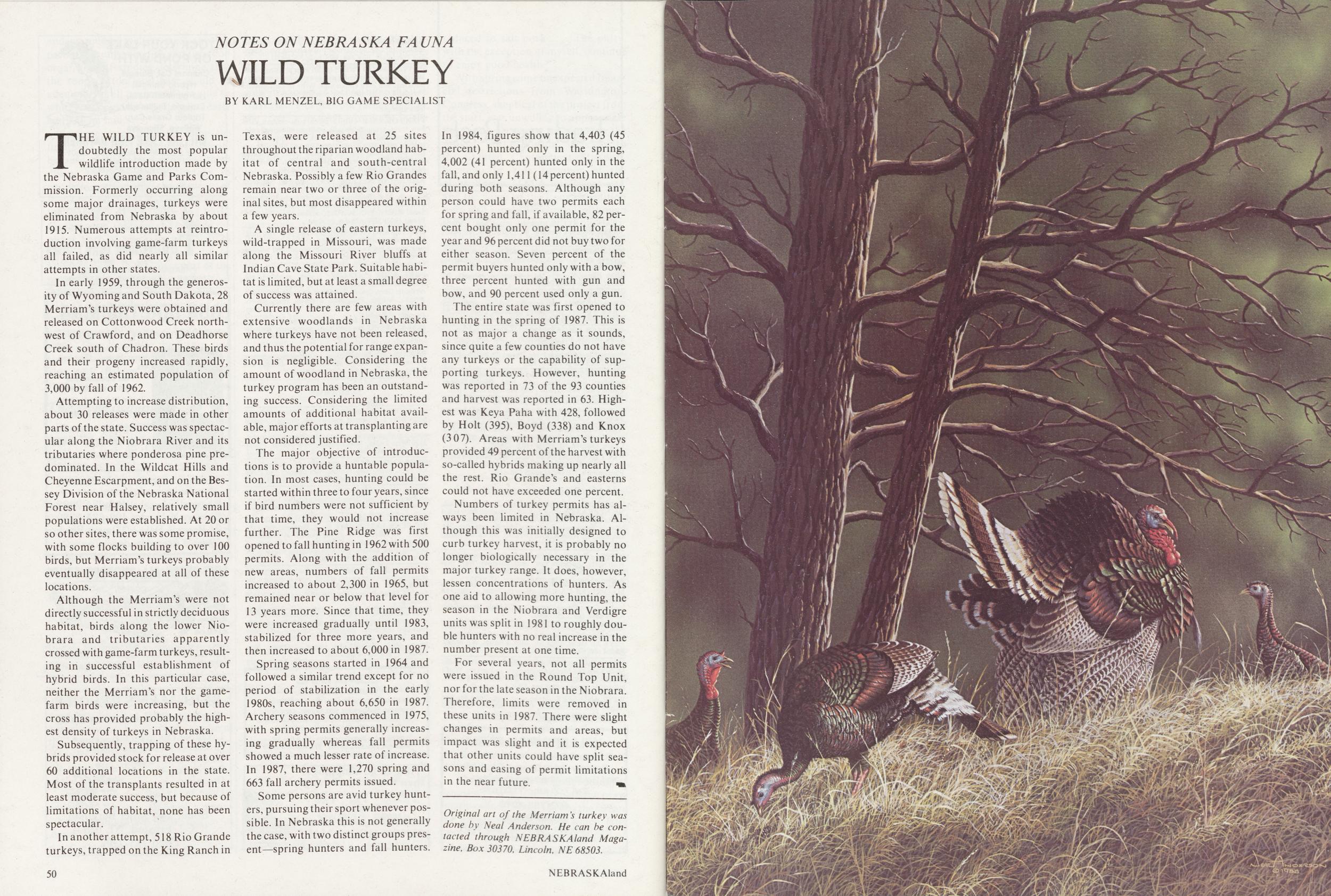
NOTES ON NEBRASKA FA UNA WILD TURKEY
BY KARL MENZEL, BIG GAME SPECIALISTTHE WILD TURKEY is undoubtedly the most popular wildlife introduction made by the Nebraska Game and Parks Commission. Formerly occurring along some major drainages, turkeys were eliminated from Nebraska by about 1915. Numerous attempts at reintroduction involving game-farm turkeys all failed, as did nearly all similar attempts in other states.
In early 1959, through the generosity of Wyoming and South Dakota, 28 Merriants turkeys were obtained and released on Cottonwood Creek northwest of Crawford, and on Dead horse Creek south of Chadron. These birds and their progeny increased rapidly, reaching an estimated population of 3,000 by fall of 1962.
Attempting to increase distribution, about 30 releases were made in other parts of the state. Success was spectacular along the Niobrara River and its tributaries where ponderosa pine predominated. In the Wildcat Hills and Cheyenne Escarpment, and on the Bessey Division of the Nebraska National Forest near Halsey, relatively small populations were established. At 20 or so other sites, there was some promise, with some flocks building to over 100 birds, but Merriants turkeys probably eventually disappeared at all of these locations.
Although the Merriants were not directly successful in strictly deciduous habitat, birds along the lower Niobrara and tributaries apparently crossed with game-farm turkeys, resulting in successful establishment of hybrid birds. In this particular case, neither the Merriants nor the game farm birds were increasing, but the cross has provided probably the highest density of turkeys in Nebraska.
Subsequently, trapping of these hybrids provided stock for release at over 60 additional locations in the state. Most of the transplants resulted in at least moderate success, but because of limitations of habitat, none has been spectacular.
In another attempt, 518 Rio Grande turkeys, trapped on the King Ranch in Texas, were released at 25 sites throughout the riparian woodland habitat of central and south-central Nebraska. Possibly a few Rio Grandes remain near two or three of the original sites, but most disappeared within a few years.
A single release of eastern turkeys, wild-trapped in Missouri, was made along the Missouri River bluffs at Indian Cave State Park. Suitable habitat is limited, but at least a small degree of success was attained.
Currently there are few areas with extensive woodlands in Nebraska where turkeys have not been released, and thus the potential for range expansion is negligible. Considering the amount of woodland in Nebraska, the turkey program has been an outstanding success. Considering the limited amounts of additional habitat available, major efforts at transplanting are not considered justified.
The major objective of introductions is to provide a huntable population. In most cases, hunting could be started within three to four years, since if bird numbers were not sufficient by that time, they would not increase further. The Pine Ridge was first opened to fall hunting in 1962 with 500 permits. Along with the addition of new areas, numbers of fall permits increased to about 2,300 in 1965, but remained near or below that level for 13 years more. Since that time, they were increased gradually until 1983, stabilized for three more years, and then increased to about 6,000 in 1987.
Spring seasons started in 1964 and followed a similar trend except for no period of stabilization in the early 1980s, reaching about 6,650 in 1987. Archery seasons commenced in 1975, with spring permits generally increasing gradually whereas fall permits showed a much lesser rate of increase. In 1987, there were 1,270 spring and 663 fall archery permits issued.
Some persons are avid turkey hunters, pursuing their sport whenever possible. In Nebraska this is not generally the case, with two distinct groups present--spring hunters and fall hunters. In 1984, figures show that 4,403 (45 percent) hunted only in the spring, 4,002 (41 percent) hunted only in the fall, and only 1,411 (14 percent) hunted during both seasons. Although any person could have two permits each for spring and fall, if available, 82 percent bought only one permit for the year and 96 percent did not buy two for either season. Seven percent of the permit buyers hunted only with a bow, three percent hunted with gun and bow, and 90 percent used only a gun.
The entire state was first opened to hunting in the spring of 1987. This is not as major a change as it sounds, since quite a few counties do not have any turkeys or the capability of supporting turkeys. However, hunting was reported in 73 of the 93 counties and harvest was reported in 63. Highest was Keya Paha with 428, followed by Holt (395), Boyd (338) and Knox (3 07). Areas with Merriants turkeys provided 49 percent of the harvest with so-called hybrids making up nearly all the rest. Rio Grande's and eastern could not have exceeded one percent.
Numbers of turkey permits has always been limited in Nebraska. Although this was initially designed to curb turkey harvest, it is probably no longer biologically necessary in the major turkey range. It does, however, lessen concentrations of hunters. As one aid to allowing more hunting, the season in the Niobrara and Verdigre units was split in 1981 to roughly double hunters with no real increase in the number present at one time.
For several years, not all permits were issued in the Round Top Unit, nor for the late season in the Niobrara. Therefore, limits were removed in these units in 1987. There were slight changes in permits and areas, but impact was slight and it is expected that other units could have split seasons and easing of permit limitations in the near future.
Original art of the Merriam 's turkey was done by Meal Anderson. He can be contacted through NEBRASKAland Magazine, Box 30370, Lincoln, ME 68503. 50 NEBRASKAland
CARRY THE STATE'S BEST-LOOKING VISA - AND PAY THE STATE'S LOWEST RATE!
A GORGEOUS PLATTE RIVER SUNSET AND A 14.9% APR* THAT WILL CUT YOUR INTEREST PAYMENTS. A Division of First National Bank of Omaha Member FD1CThere never was a better-looking credit card than this! Yet this special Nebraska Edition5*1 Visa is a serious financial tool that can cost you less to use. And, the Nebraska Edition5*1 Visa comes with an excellent package of cardmember extras, including:
• An interest-free grace period on purchases so you can avoid finance charges.
• Up to a quarter of a million dollars in travel accidental death and dismemberment coverage from Mutual of Omaha — yours at no extra cost to you every time you charge your "common carrier" travel tickets on your Nebraska Edition5*1 Visa.
• No-questions-asked guarantee: If you ever decide the Nebraska Edition5*1 Visa isn't for you, cut your card in half and return it to us for a full refund of your annual fee.
Carry your Nebraska Edition5*1 Visa with pride — and stop paying sky-nigh interest rates on your credit cards. Send for an application right now!
For faster service, call us toll-free during business hours at 800-642-8369. In Omaha, call 341-7447. Outside Nebraska, call 800-228-7070. *Based on information available to us as of January 27,1988, no statewide Nebraska financial institution offered a Visa or MasterCard with an Annual Percentage Rate lower than 14.9% APR to the general public on an unsecured basis. Does not reflect any changes in rates since that date, or limiter programs and special promotions that may be offered. After September 30,1988. the rate will be variable and subject to change. That variable rate as of February 29,1988, was 14.9%. The annual fee is $20. I YES I want to pay a lower rate on my credit card purchases. Rush me an application for your beautiful Nebraska EditionSM Visa! name (please print) address state zip city Mail "to: ~~ First Bankcard Center. P.O. Box 3331, Omaha, Nebraska 68103-0331Position: 322 (28 views)