Volume 66, Issue 2, 1988
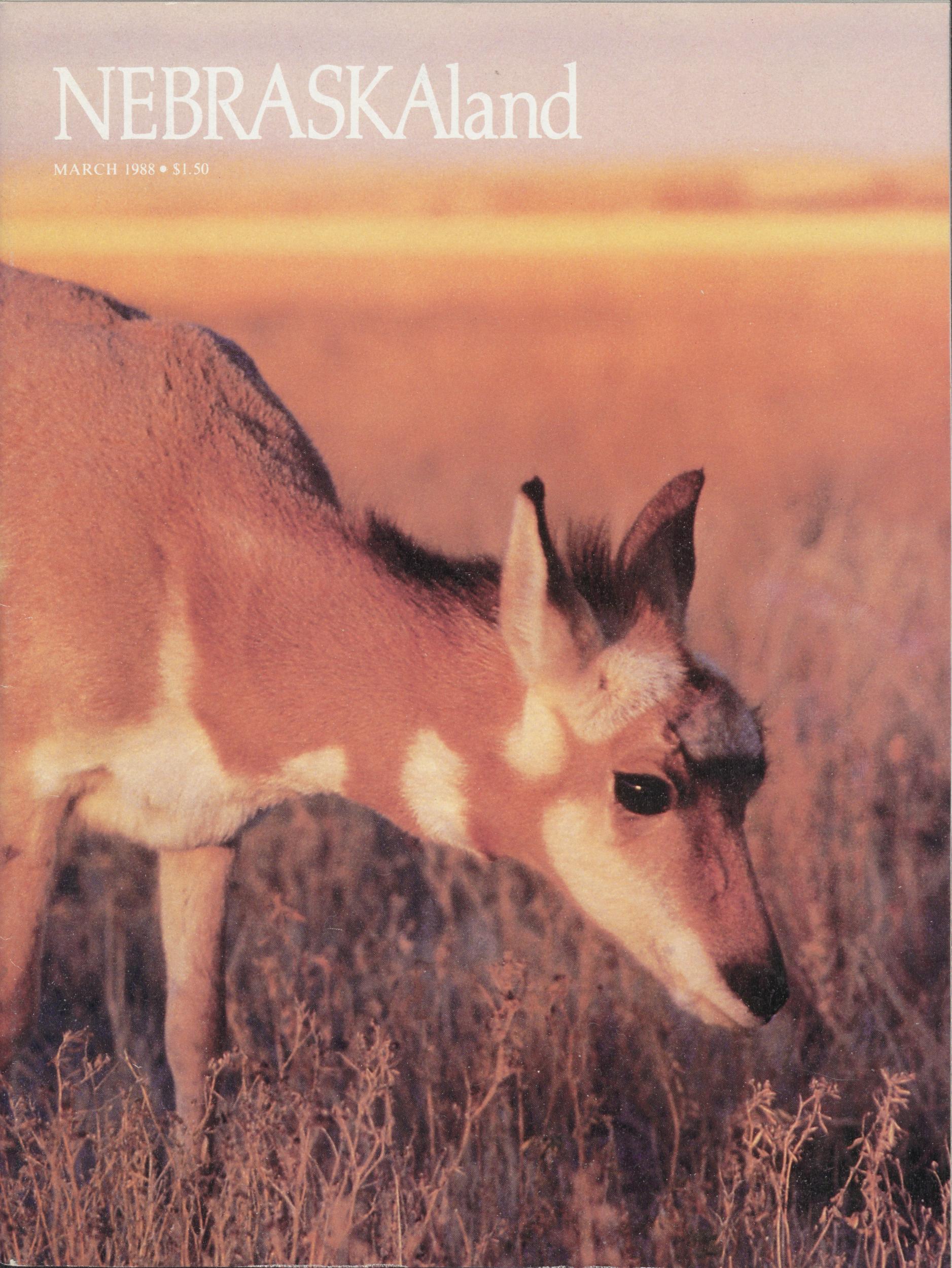
NEBRASKAland
MARCH 1988 $1.50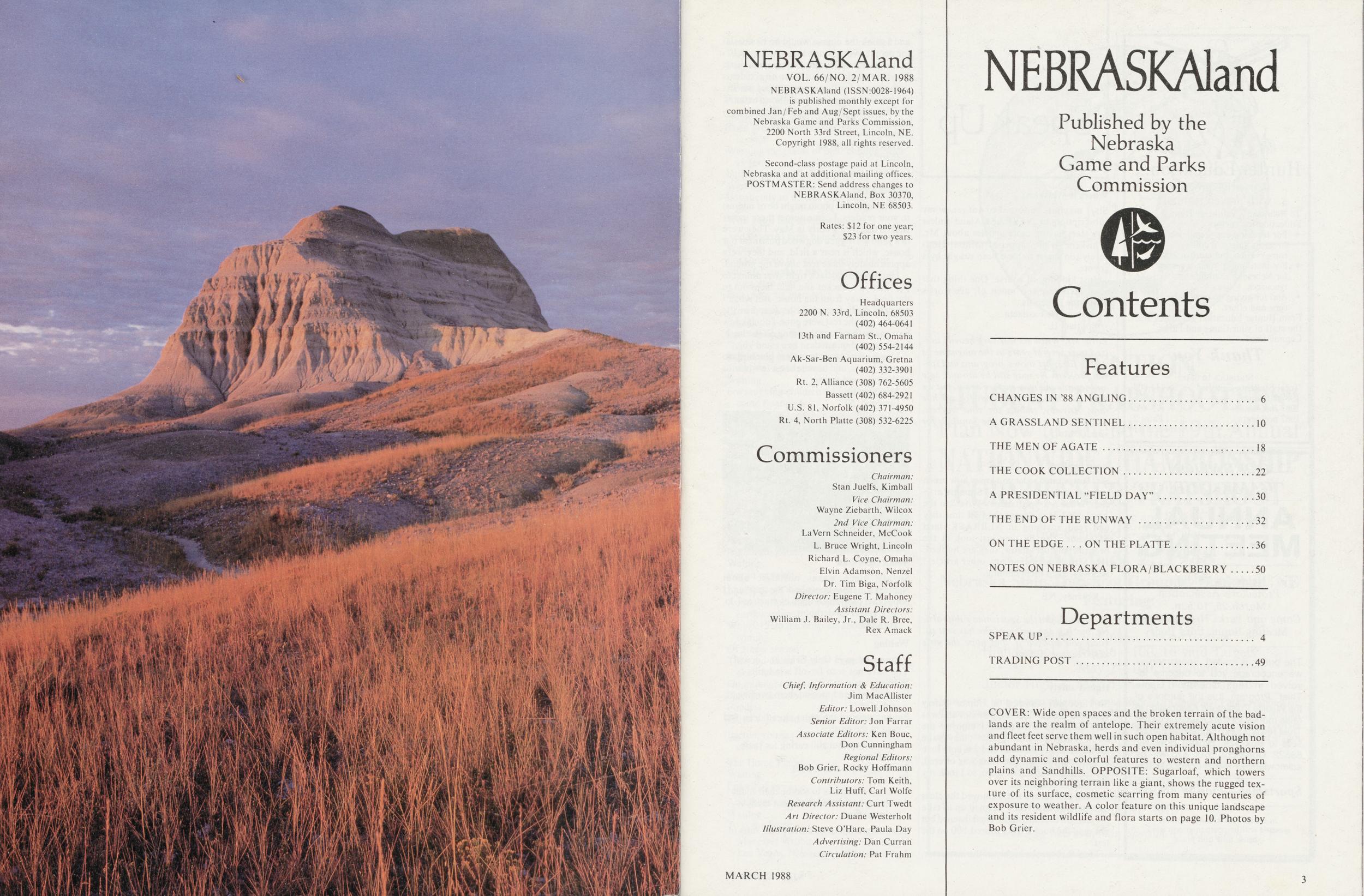
NEBRASKAland
Published by the Nebraska Game and Parks Commission NEBRASKAland VOL. 66/NO. 2/MAR. 1988 NEBRASKAland (1SSN.0028-1964) is published monthly except for combined Jan/Feb and Aug/Sept issues, by the Nebraska Game and Parks Commission, 2200 North 33rd Street, Lincoln, NE. Copyright 1988, all rights reserved. Second-class postage paid at Lincoln, Nebraska and at additional mailing offices. POSTMASTER: Send address changes to NEBRASKAland, Box 30370, Lincoln, NE 68503. Rates: $12 for one year; $23 for two years. Offices Headquarters 2200 N. 33rd, Lincoln, 68503 (402)464-0641 13th and Farnam St., Omaha (402)554-2144 Ak-Sar-Ben Aquarium, Gretna (402)332-3901 Rt. 2, Alliance (308) 762-5605 Bassett (402) 684-2921 U.S. 81, Norfolk (402) 371-4950 Rt. 4, North Platte (308) 532-6225 Commissioners Chairman: Stan Juelfs, Kimball Vice Chairman: Wayne Ziebarth, Wilcox 2nd Vice Chairman: LaVern Schneider, McCook L. Bruce Wright, Lincoln Richard L. Coyne, Omaha Elvin Adamson, Nenzel Dr. Tim Biga, Norfolk Director: Eugene T. Mahoney Assistant Directors: William J. Bailey, Jr., Dale R. Bree, Rex Amack Chief, Information & Education: Jim MacAllister Editor: Lowell Johnson Senior Editor: Jon Farrar Associate Editors: Ken Bouc, Don Cunningham Regional Editors: Bob Grier, Rocky Hoffmann Contributors: Tom Keith, Liz Huff, Carl Wolfe Research Assistant: Curt Twedt Art Director: Duane Westerholt Illustration: Steve O'Hare, Paula Day Advertising: Dan Curran Circulation: Pat Frahm Contents Features CHANGES IN '88 ANGLING......................... 6 A GRASSLAND SENTINEL 10 THE MEN OF AGATE.......................,......18 THE COOK COLLECTION..........................22 A PRESIDENTIAL "FIELD DAY' 30 THE END OF THE RUNWAY .......................32 ON THE EDGE ON THE PLATTE................36 NOTES ON NEBRASKA FLORA/BLACKBERRY.....50 Departments SPEAK UP......................................... 4 TRADING POST...................................49 COVER: Wide open spaces and the broken terrain of the badlands are the realm of antelope. Their extremely acute vision and fleet feet serve them well in such open habitat. Although not abundant in Nebraska, herds and even individual pronghorns add dynamic and colorful features to western and northern plains and Sandhills. OPPOSITE: Sugarloaf, which towers over its neighboring terrain like a giant, shows the rugged texture of its surface, cosmetic scarring from many centuries of exposure to weather. A color feature on this unique landscape and its resident wildlife and flora starts on page 10. Photos by Bob Grier. MARCH 1988 3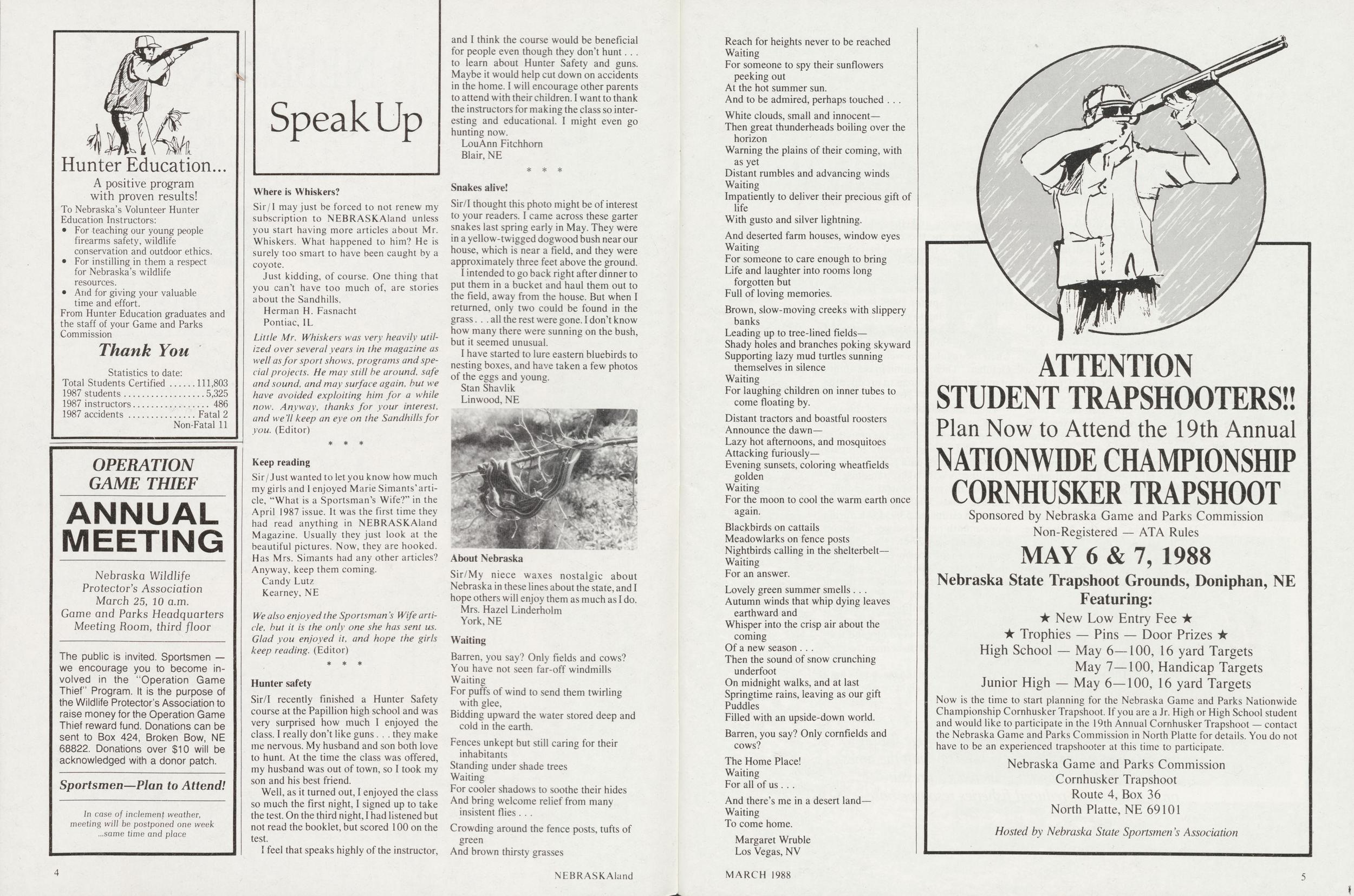
Speak Up
Where is Whiskers?Sir/1 may just be forced to not renew my subscription to NEBRASKAland unless you start having more articles about Mr. Whiskers. What happened to him? He is surely too smart to have been caught by a coyote.
Just kidding, of course. One thing that you can't have too much of, are stories about the Sandhills.
Herman H. Fasnacht Pontiac, ILLittle Mr. Whiskers was very heavily utilized over several years in the magazine as well as for sport shows, programs and special projects. He may still he around, safe and sound, and may surface again, hut we have avoided exploiting him for a while now. Anyway, thanks for your interest, and we'll keep an eye on the Sandhills for you. (Editor)
* * * Keep readingSir/Just wanted to let you know how much my girls and I enjoyed Marie Simants' article, "What is a Sportsman's Wife?" in the April 1987 issue. It was the first time they had read anything in NEBRASKAland Magazine. Usually they just look at the beautiful pictures. Now, they are hooked. Has Mrs. Simants had any other articles? Anyway, keep them coming.
Candy LutzWe also enjoyed the Sportsman's Wife article, hut it is the only one she has sent us. Glad you enjoyed it, and hope the girls keep reading. (Editor)
* * * Hunter safetySir/I recently finished a Hunter Safety course at the Papillion high school and was very surprised how much I enjoyed the class. I really don't like guns . . . they make me nervous. My husband and son both love to hunt. At the time the class was offered, my husband was out of town, so I took my son and his best friend.
Well, as it turned out, I enjoyed the class so much the first night, I signed up to take the test. On the third night, I had listened but not read the booklet, but scored 100 on the test.
I feel that speaks highly of the instructor, and I think the course would be beneficial for people even though they don't hunt. . . to learn about Hunter Safety and guns. Maybe it would help cut down on accidents in the home. I will encourage other parents to attend with their children. I want to thank the instructors for making the class so interesting and educational. I might even go hunting now.
LouAnn Fitchhorn Blair, NE * * * Snakes alive!Sir/I thought this photo might be of interest to your readers. I came across these garter snakes last spring early in May. They were in a yellow-twigged dogwood bush near our house, which is near a field, and they were approximately three feet above the ground.
I intended to go back right after dinner to put them in a bucket and haul them out to the field, away from the house. But when I returned, only two could be found in the grass. . . all the rest were gone. I don't know how many there were sunning on the bush, but it seemed unusual.
I have started to lure eastern bluebirds to nesting boxes, and have taken a few photos of the eggs and young.
Stan Shavlik Linwood, NESir/My niece waxes nostalgic about Nebraska in these lines about the state, and I hope others will enjoy them as much as I do.
Mrs. Hazel Linderholm York, NE Waiting Barren, you say? Only fields and cows? You have not seen far-off windmills Waiting For puffs of wind to send them twirling with glee, Bidding upward the water stored deep and cold in the earth. Fences unkept but still caring for their inhabitants Standing under shade trees Waiting For cooler shadows to soothe their hides And bring welcome relief from many insistent flies . . . Crowding around the fence posts, tufts of green And brown thirsty grasses 4 NEBRASKAland Reach for heights never to be reached Waiting For someone to spy their sunflowers peeking out At the hot summer sun. And to be admired, perhaps touched . . . White clouds, small and innocent— Then great thunderheads boiling over the horizon Warning the plains of their coming, with as yet Distant rumbles and advancing winds Waiting Impatiently to deliver their precious gift of life With gusto and silver lightning. And deserted farm houses, window eyes Waiting For someone to care enough to bring Life and laughter into rooms long forgotten but Full of loving memories. Brown, slow-moving creeks with slippery banks Leading up to tree-lined fields— Shady holes and branches poking skyward Supporting lazy mud turtles sunning themselves in silence Waiting For laughing children on inner tubes to come floating by. Distant tractors and boastful roosters Announce the dawn— Lazy hot afternoons, and mosquitoes Attacking furiously- Evening sunsets, coloring wheat fields golden Waiting For the moon to cool the warm earth once again. Blackbirds on cattails Meadowlarks on fence posts Nightbirds calling in the shelter belt Waiting For an answer. Lovely green summer smells . . . Autumn winds that whip dying leaves earthward and Whisper into the crisp air about the coming Of a new season . . . Then the sound of snow crunching underfoot On midnight walks, and at last Springtime rains, leaving as our gift Puddles Filled with an upside-down world. Barren, you say? Only cornfields and cows? The Home Place! Waiting For all of us . . . And there's me in a desert land- Waiting To come home. Margaret Wruble Los Vegas, NV ATTENTION STUDENT TRAPSHOOTERS!! Plan Now to Attend the 19th Annual NATIONWIDE CHAMPIONSHIP CORNHUSKER TRAPSHOOT Sponsored by Nebraska Game and Parks Commission Non-Registered — ATA Rules MAY 6 & 7, 1988 Nebraska State Trap shoot Grounds, Doniphan, NE Featuring: * New Low Entry Fee * * Trophies — Pins — Door Prizes * High School — May 6—100, 16 yard Targets May 7—100, Handicap Targets Junior High — May 6—100, 16 yard Targets Now is the time to start planning for the Nebraska Game and Parks Nationwide Championship Cornhusker Trap shoot. If you are a Jr. High or High School student and would like to participate in the 19th Annual Cornhusker Trap shoot — contact the Nebraska Game and Parks Commission in North Platte for details. You do not have to be an experienced trapshooter at this time to participate. Nebraska Game and Parks Commission Cornhusker Trap shoot Route 4, Box 36 North Platte, NE 69101 Hosted by Nebraska State Sportsmen's Association MARCH 1988 5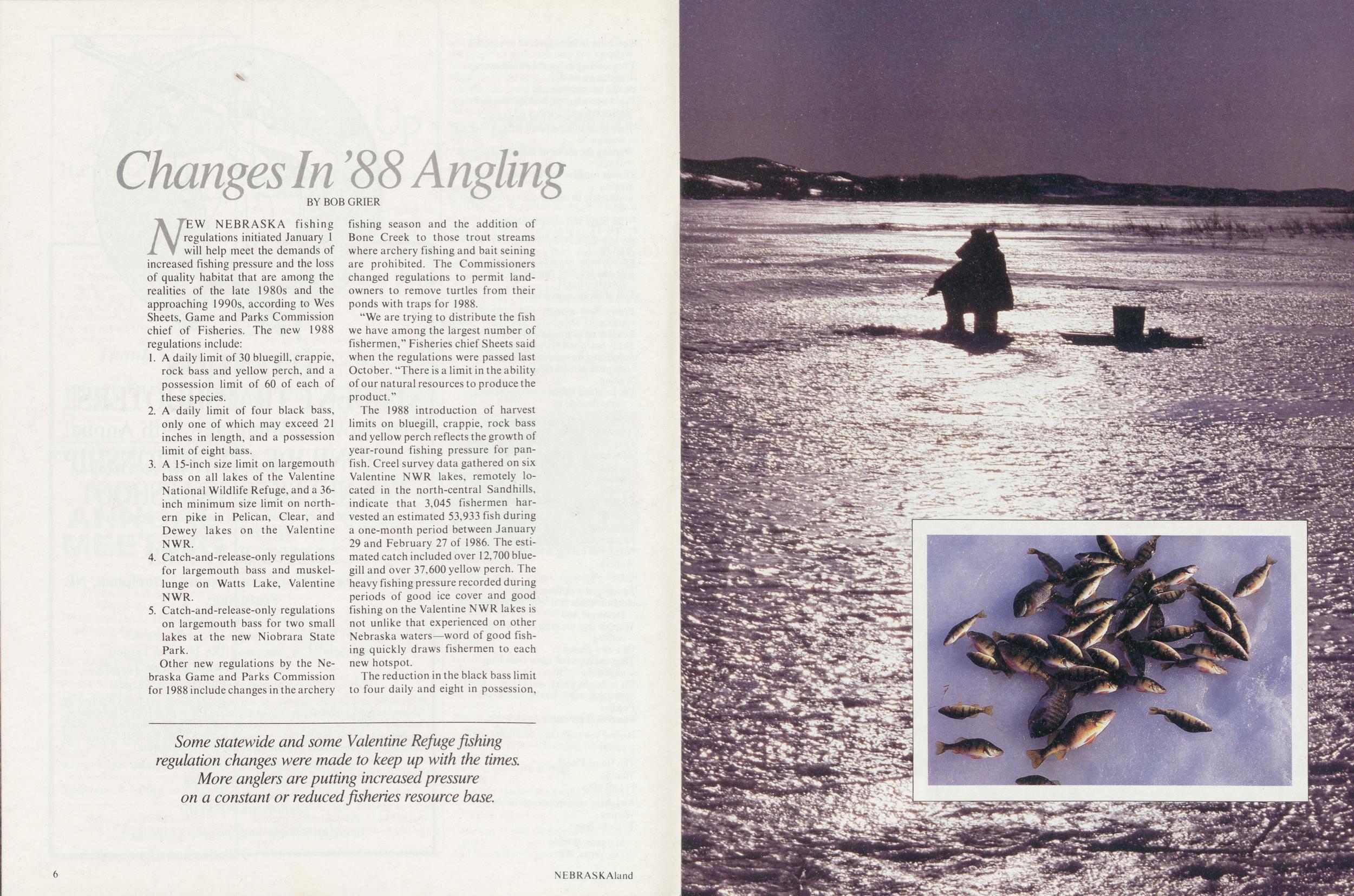
Changes In '88 Angling
BY BOB GRIER Some statewide and some Valentine Refuge fishing regulation changes were made to keep up with the times. More anglers are putting increased pressure on a constant or reduced fisheries resource base.TEW NEBRASKA fishing regulations initiated January 1 will help meet the demands of increased fishing pressure and the loss of quality habitat that are among the realities of the late 1980s and the approaching 1990s, according to Wes Sheets, Game and Parks Commission chief of Fisheries. The new 1988 regulations include:
1. A daily limit of 30 bluegill, crappie, rock bass and yellow perch, and a possession limit of 60 of each of these species.
2. A daily limit of four black bass, only one of which may exceed 21 inches in length, and a possession limit of eight bass.
3. A 15-inch size limit on largemouth bass on all lakes of the Valentine National Wildlife Refuge, and a 36-inch minimum size limit on northern pike in Pelican, Clear, and Dewey lakes on the Valentine NWR.
4. Catch-and-release-only regulations for largemouth bass and muskel lunge on Watts Lake, Valentine NWR.
5. Catch-and-release-only regulations on largemouth bass for two small lakes at the new Niobrara State Park.
Other new regulations by the Nebraska Game and Parks Commission for 1988 include changes in the archery fishing season and the addition of Bone Creek to those trout streams where archery fishing and bait seining are prohibited. The Commissioners changed regulations to permit landowners to remove turtles from their ponds with traps for 1988.
"We are trying to distribute the fish we have among the largest number of fishermen," Fisheries chief Sheets said when the regulations were passed last October. "There is a limit in the ability of our natural resources to produce the product."
The 1988 introduction of harvest limits on bluegill, crappie, rock bass and yellow perch reflects the growth of year-round fishing pressure for pan fish. Creel survey data gathered on six Valentine NWR lakes, remotely located in the north-central Sandhills, indicate that 3,045 fishermen harvested an estimated 53,933 fish during a one-month period between January 29 and February 27 of 1986. The estimated catch included over 12,700 bluegill and over 37,600 yellow perch. The heavy fishing pressure recorded during periods of good ice cover and good fishing on the Valentine NWR lakes is not unlike that experienced on other Nebraska waters—word of good fishing quickly draws fishermen to each new hotspot.
The reduction in the black bass limit to four daily and eight in possession, and the restriction that only one of the daily bag can be longer than 21 inches in length, is also an attempt to distribute the harvest of a shrinking resource base. The popularity of largemouth fishing in Nebraska and across the country, and the attendant growth of major industries based on the distribution of bass fishing techniques and technology, places a heavy strain on suitable bass-producing fisheries. Growing almost as quickly is the realization among bass fishermen that quality fish belong in the water.
6 NEBRASKAland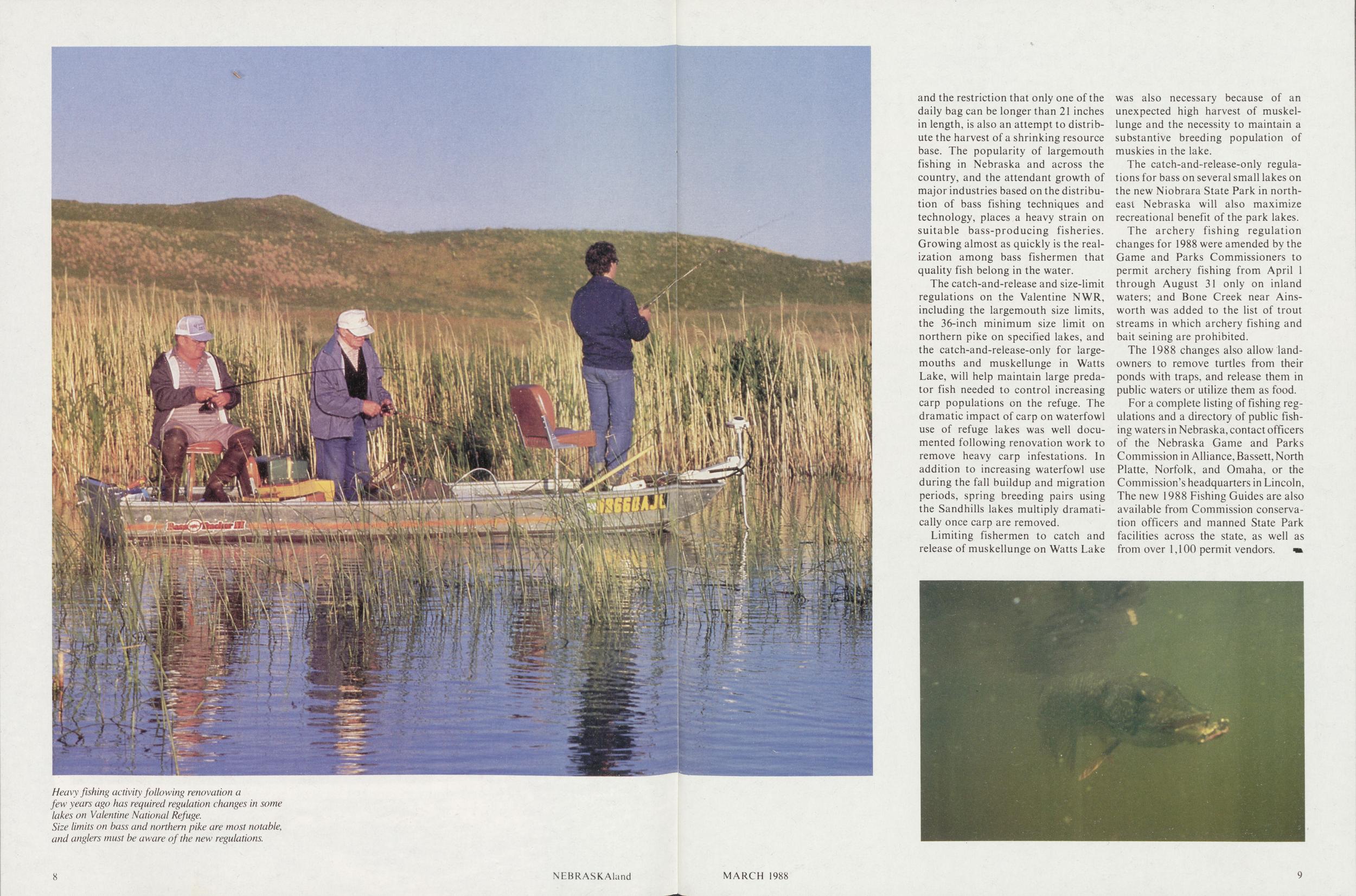
The catch-and-release and size-limit regulations on the Valentine NWR, including the largemouth size limits, the 36-inch minimum size limit on northern pike on specified lakes, and the catch-and-release-only for large mouths and muskellunge in Watts Lake, will help maintain large predator fish needed to control increasing carp populations on the refuge. The dramatic impact of carp on waterfowl use of refuge lakes was well documented following renovation work to remove heavy carp infestations. In addition to increasing waterfowl use during the fall buildup and migration periods, spring breeding pairs using the Sandhills lakes multiply dramatically once carp are removed.
Limiting fishermen to catch and release of muskellunge on Watts Lake was also necessary because of an unexpected high harvest of muskellunge and the necessity to maintain a substantive breeding population of muskies in the lake.
The catch-and-release-only regulations for bass on several small lakes on the new Niobrara State Park in northeast Nebraska will also maximize recreational benefit of the park lakes.
The archery fishing regulation changes for 1988 were amended by the Game and Parks Commissioners to permit archery fishing from April 1 through August 31 only on inland waters; and Bone Creek near Ainsworth was added to the list of trout streams in which archery fishing and bait seining are prohibited.
The 1988 changes also allow landowners to remove turtles from their ponds with traps, and release them in public waters or utilize them as food.
For a complete listing of fishing regulations and a directory of public fishing waters in Nebraska, contact officers of the Nebraska Game and Parks Commission in Alliance, Bassett, North Platte, Norfolk, and Omaha, or the Commission's headquarters in Lincoln, The new 1988 Fishing Guides are also available from Commission conservation officers and manned State Park facilities across the state, as well as from over 1,100 permit vendors.
A Grassland Sentinel
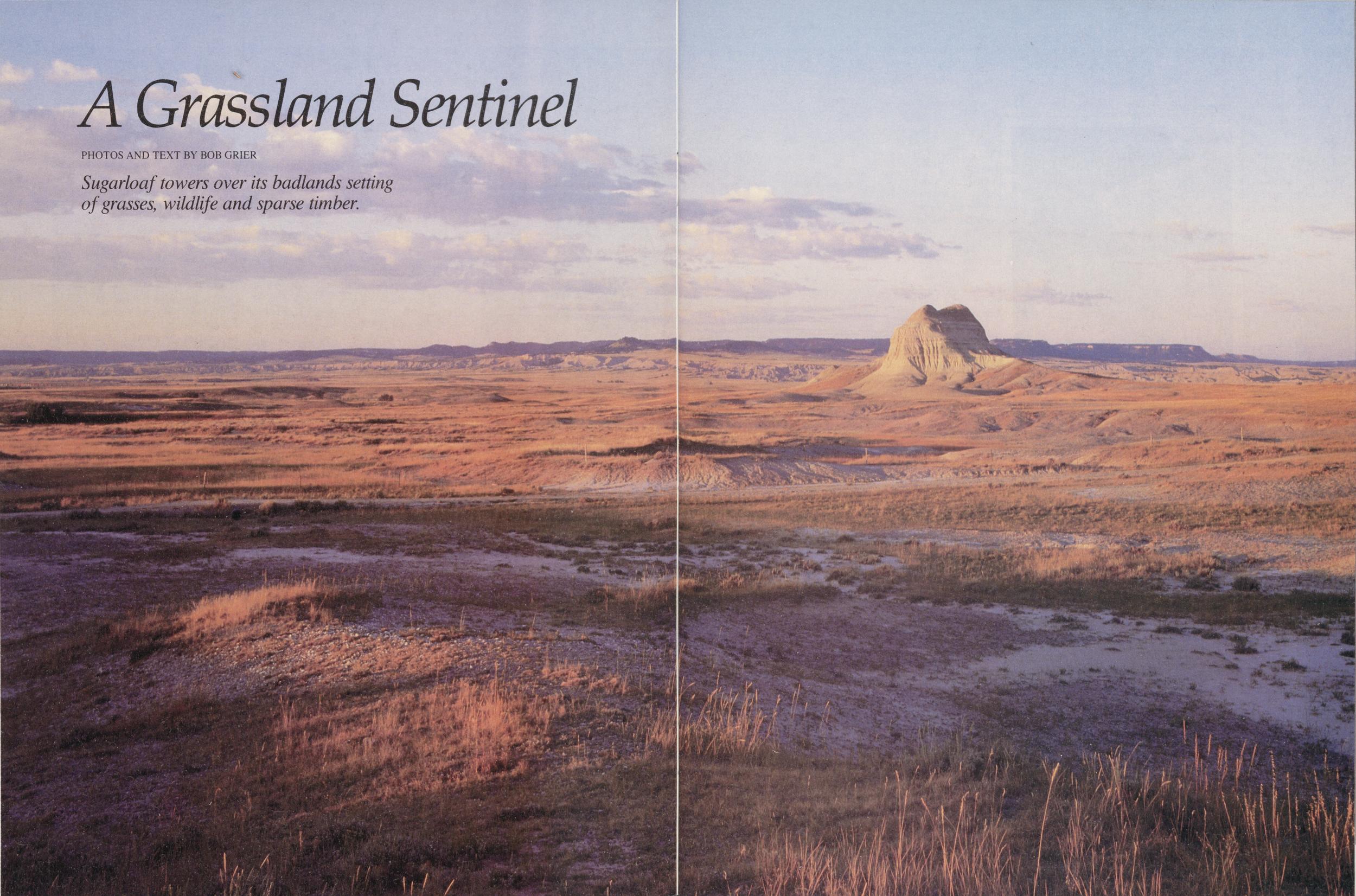
PHOTOS AND TEXT BY BOB GRIER Sugarloaf towers over its badlands setting of grasses, wildlife and sparse timber.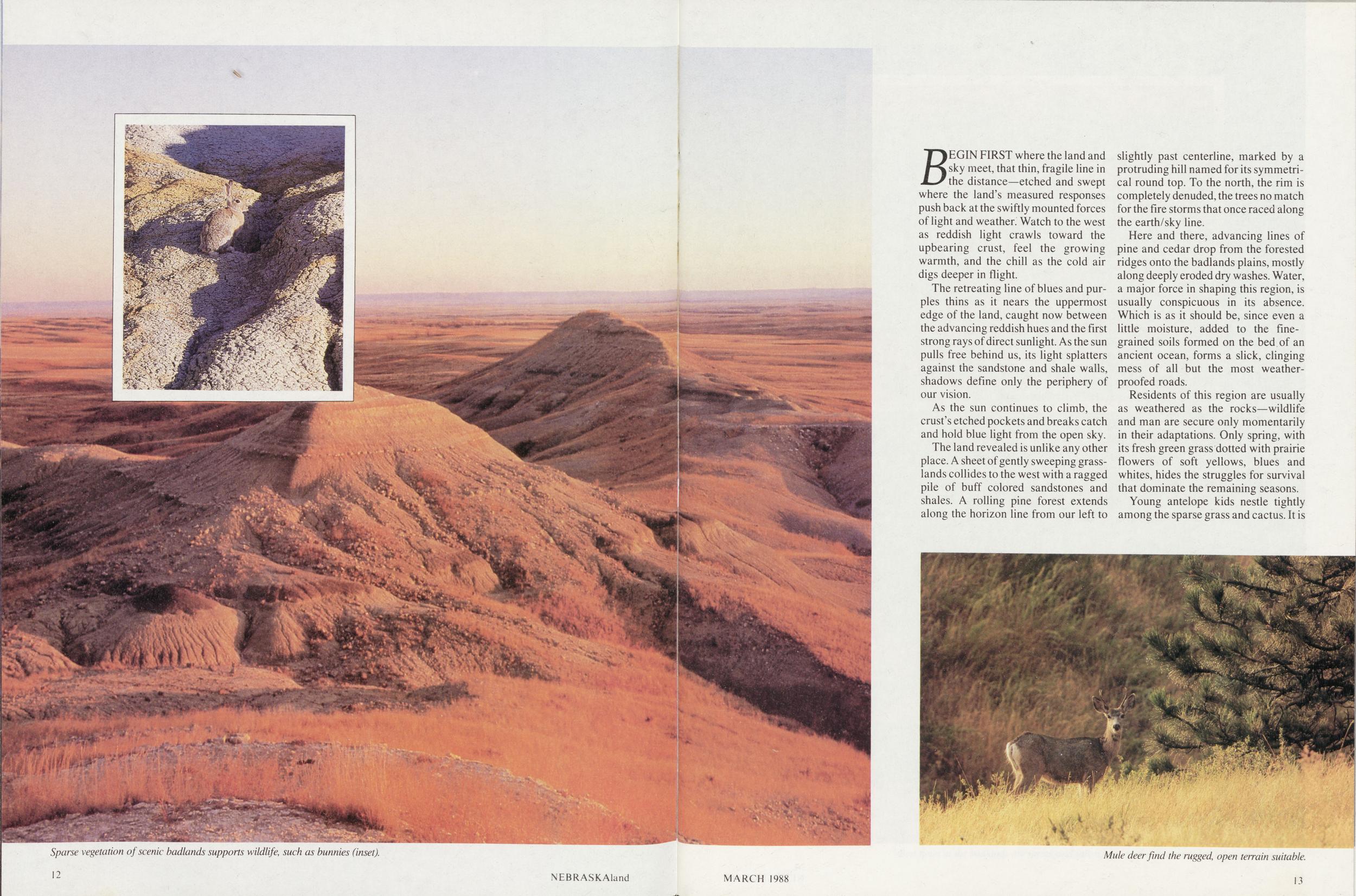
BEGIN FIRST where the land and sky meet, that thin, fragile line in the distance—etched and swept where the land's measured responses push back at the swiftly mounted forces of light and weather. Watch to the west as reddish light crawls toward the upbearing crust, feel the growing warmth, and the chill as the cold air digs deeper in flight.
The retreating line of blues and purples thins as it nears the uppermost edge of the land, caught now between the advancing reddish hues and the first strong rays of direct sunlight. As the sun pulls free behind us, its light splatters against the sandstone and shale walls, shadows define only the periphery of our vision.
As the sun continues to climb, the crust's etched pockets and breaks catch and hold blue light from the open sky.
The land revealed is unlike any other place. A sheet of gently sweeping grasslands collides to the west with a ragged pile of buff colored sandstones and shales. A rolling pine forest extends along the horizon line from our left to slightly past centerline, marked by a protruding hill named for its symmetrical round top. To the north, the rim is completely denuded, the trees no match for the fire storms that once raced along the earth/sky line.
Here and there, advancing lines of pine and cedar drop from the forested ridges onto the badlands plains, mostly along deeply eroded dry washes. Water, a major force in shaping this region, is usually conspicuous in its absence. Which is as it should be, since even a little moisture, added to the fine grained soils formed on the bed of an ancient ocean, forms a slick, clinging mess of all but the most weather proofed roads.
Residents of this region are usually as weathered as the rocks—wildlife and man are secure only momentarily in their adaptations. Only spring, with its fresh green grass dotted with prairie flowers of soft yellows, blues and whites, hides the struggles for survival that dominate the remaining seasons.
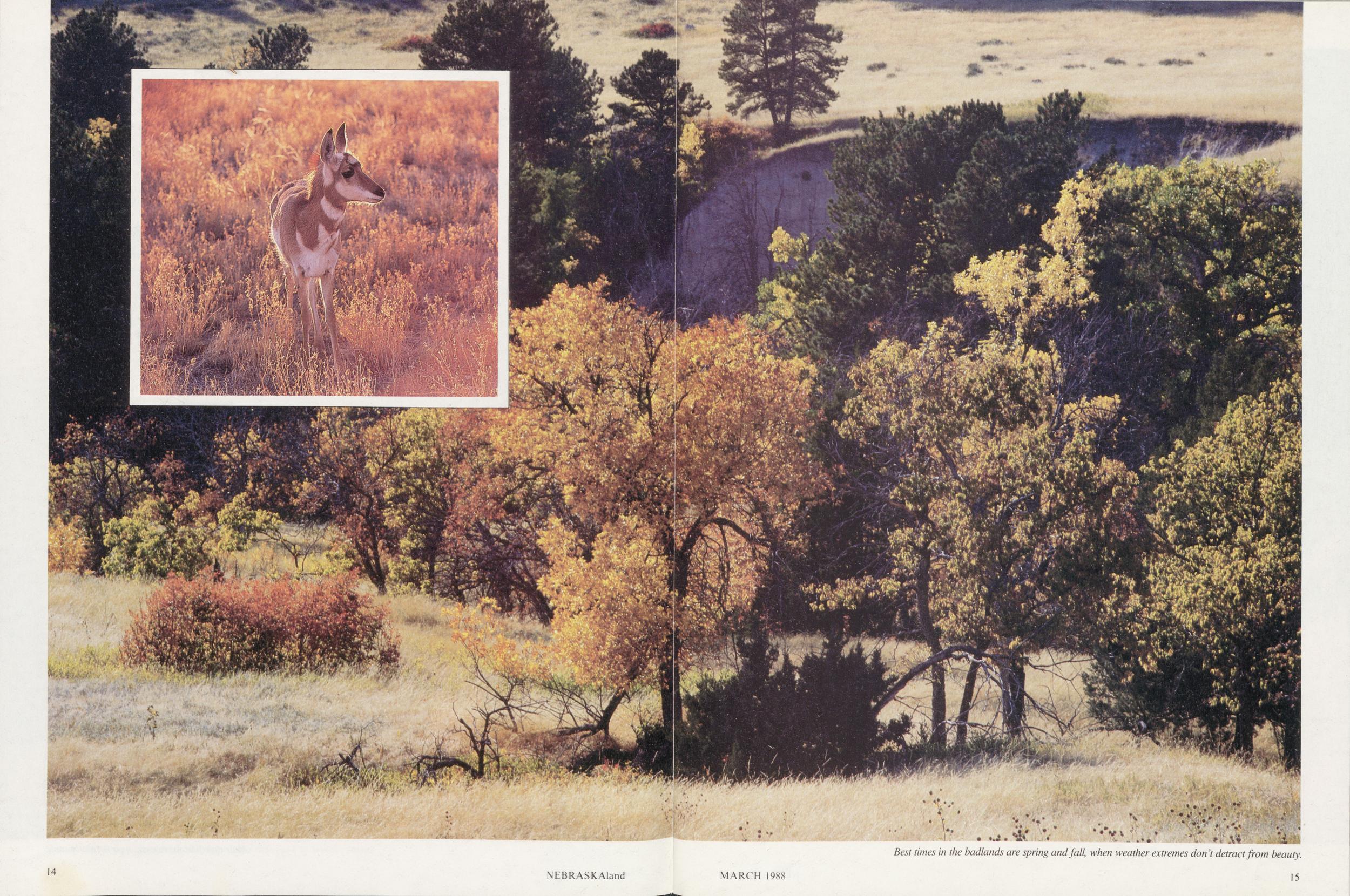
Young antelope kids nestle tightly among the sparse grass and cactus. It is possible, by watching the solitary does, to find the young pronghorns. Occasionally a youngster will run a short distance behind its mother before dropping to the ground. Spindly legs pulled tightly against its body and neck stretched flat against the ground, the newborn relies on its ability to hide for survival. Nearby, a badger that also saw our approach throws dirt as it quickly digs into the ground. The badger is soon underground, and dirt pushed behind closes the hole. We nearly stumble across three other antelope young within sight of the badger's fresh mound of dirt.
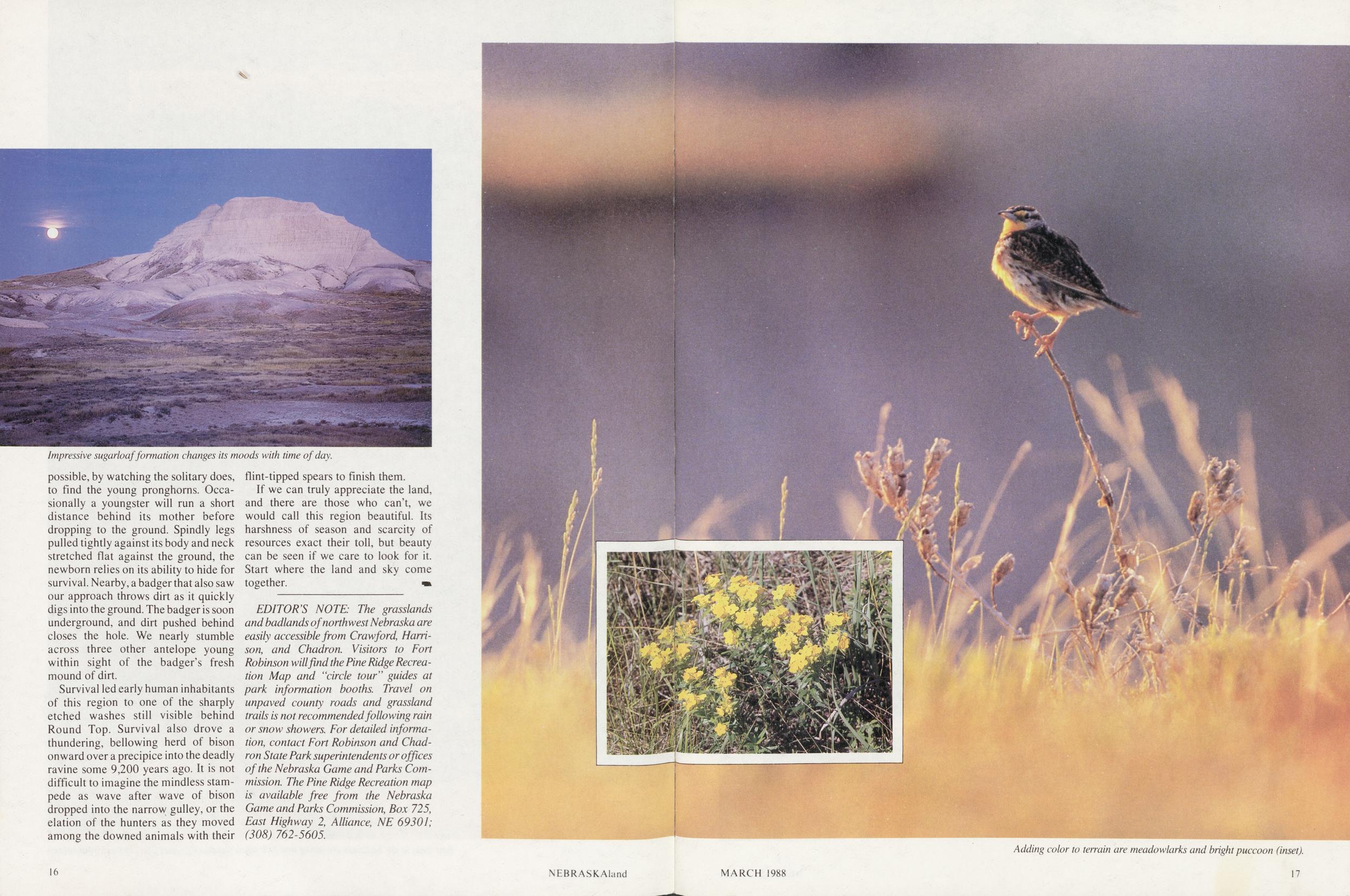
Survival led early human inhabitants of this region to one of the sharply etched washes still visible behind Round Top. Survival also drove a thundering, bellowing herd of bison onward over a precipice into the deadly ravine some 9,200 years ago. It is not difficult to imagine the mindless stampede as wave after wave of bison dropped into the narrow gulley, or the elation of the hunters as they moved among the downed animals with their flint-tipped spears to finish them.
If we can truly appreciate the land, and there are those who can't, we would call this region beautiful. Its harshness of season and scarcity of resources exact their toll, but beauty can be seen if we care to look for it. Start where the land and sky come together.
EDITOR'S NOTE: The grasslands and badlands of northwest Nebraska are easily accessible from Crawford, Harrison, and Chadron. Visitors to Fort Robinson will find the Pine Ridge Recreation Map and "circle tour" guides at park information booths. Travel on unpaved county roads and grassland trails is not recommended following rain or snow showers. For detailed information, contact Fort Robinson and Chadron State Park superintendents or offices of the Nebraska Game and Parks Commission. The Pine Ridge Recreation map is available free from the Nebraska Game and Parks Commission, Box 725, East Highway 2, Alliance, NE 69301; (308) 762-5605.
16 NEBRASKAland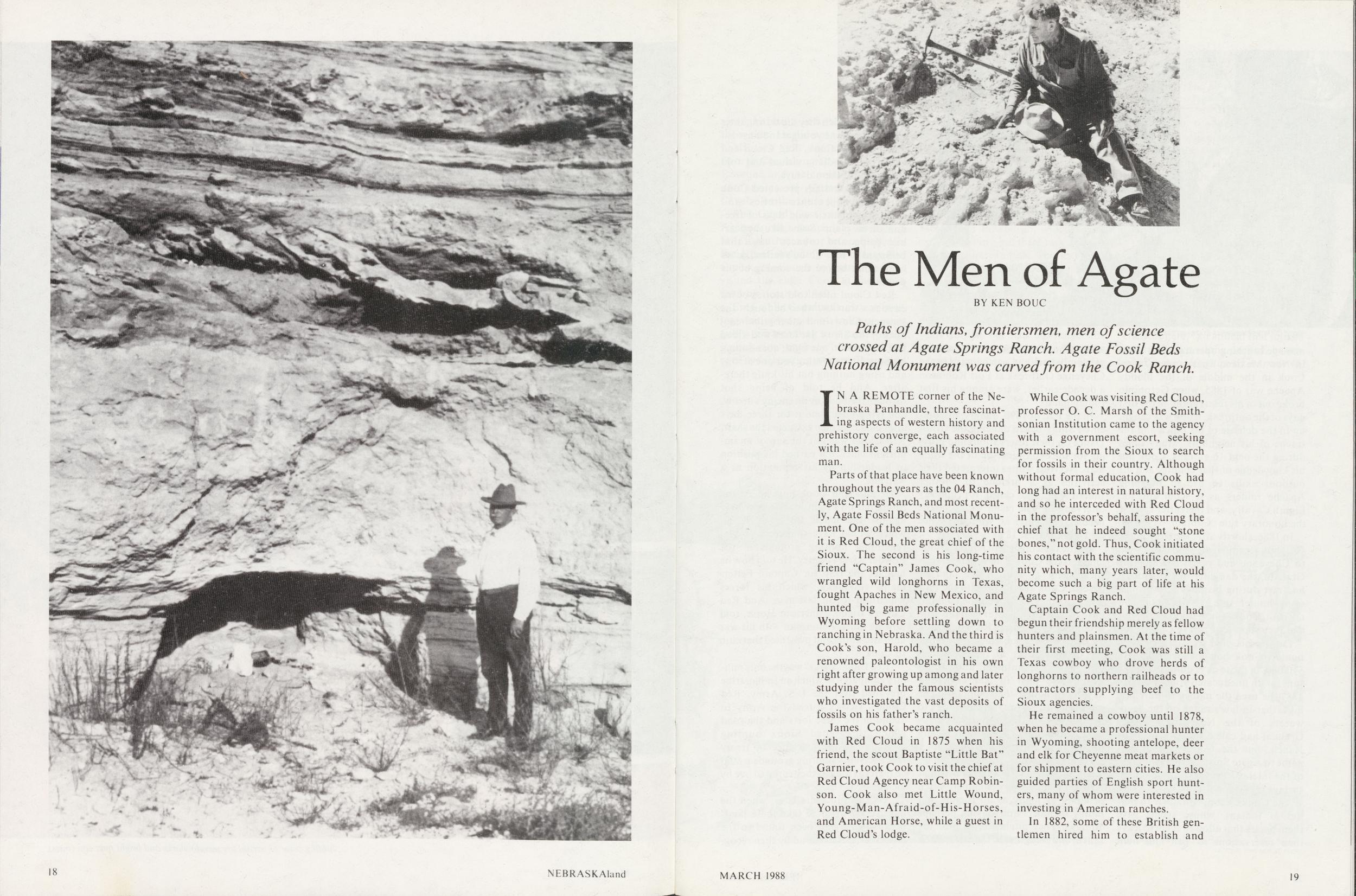
The Men of Agate
BY KEN BOUC Paths of Indians, frontiersmen, men of science crossed at Agate Springs Ranch. Agate Fossil Beds National Monument was carved from the Cook Ranch.IN A REMOTE corner of the Nebraska Panhandle, three fascinating aspects of western history and prehistory converge, each associated with the life of an equally fascinating man.
Parts of that place have been known throughout the years as the 04 Ranch, Agate Springs Ranch, and most recently, Agate Fossil Beds National Monument. One of the men associated with it is Red Cloud, the great chief of the Sioux. The second is his long-time friend "Captain'1 James Cook, who wrangled wild longhorns in Texas, fought Apaches in New Mexico, and hunted big game professionally in Wyoming before settling down to ranching in Nebraska. And the third is Cook's son, Harold, who became a renowned paleontologist in his own right after growing up among and later studying under the famous scientists who investigated the vast deposits of fossils on his father's ranch.
James Cook became acquainted with Red Cloud in 1875 when his friend, the scout Baptiste "Little Bat" Gamier, took Cook to visit the chief at Red Cloud Agency near Camp Robinson. Cook also met Little Wound, Young-Man-Afraid-of-H is-Horses, and American Horse, while a guest in Red Cloud's lodge.
While Cook was visiting Red Cloud, professor O. C. Marsh of the Smithsonian Institution came to the agency with a government escort, seeking permission from the Sioux to search for fossils in their country. Although without formal education, Cook had long had an interest in natural history, and so he interceded with Red Cloud in the professor's behalf, assuring the chief that he indeed sought "stone bones," not gold. Thus, Cook initiated his contact with the scientific community which, many years later, would become such a big part of life at his Agate Springs Ranch.
Captain Cook and Red Cloud had begun their friendship merely as fellow hunters and plainsmen. At the time of their first meeting, Cook was still a Texas cowboy who drove herds of longhorns to northern railheads or to contractors supplying beef to the Sioux agencies.
He remained a cowboy until 1878, when he became a professional hunter in Wyoming, shooting antelope, deer and elk for Cheyenne meat markets or for shipment to eastern cities. He also guided parties of English sport hunters, many of whom were interested in investing in American ranches.
In 1882, some of these British gentlemen hired him to establish and manage ranching operations for them in New Mexico. That landed James Cook in the middle of the bloody Apache war of 1885, when Geronimo broke out of his reservation. In the first days of the outbreak, Cook was caught up in the defense of his ranch and the rescue of his neighbors. Many times during the next 16 months, Cook put his knowledge of that country and his outdoor skills to use in pursuing Apache raiders as a scout for the Eighth Cavalry, and thereafter carried the honorary title "Captain."
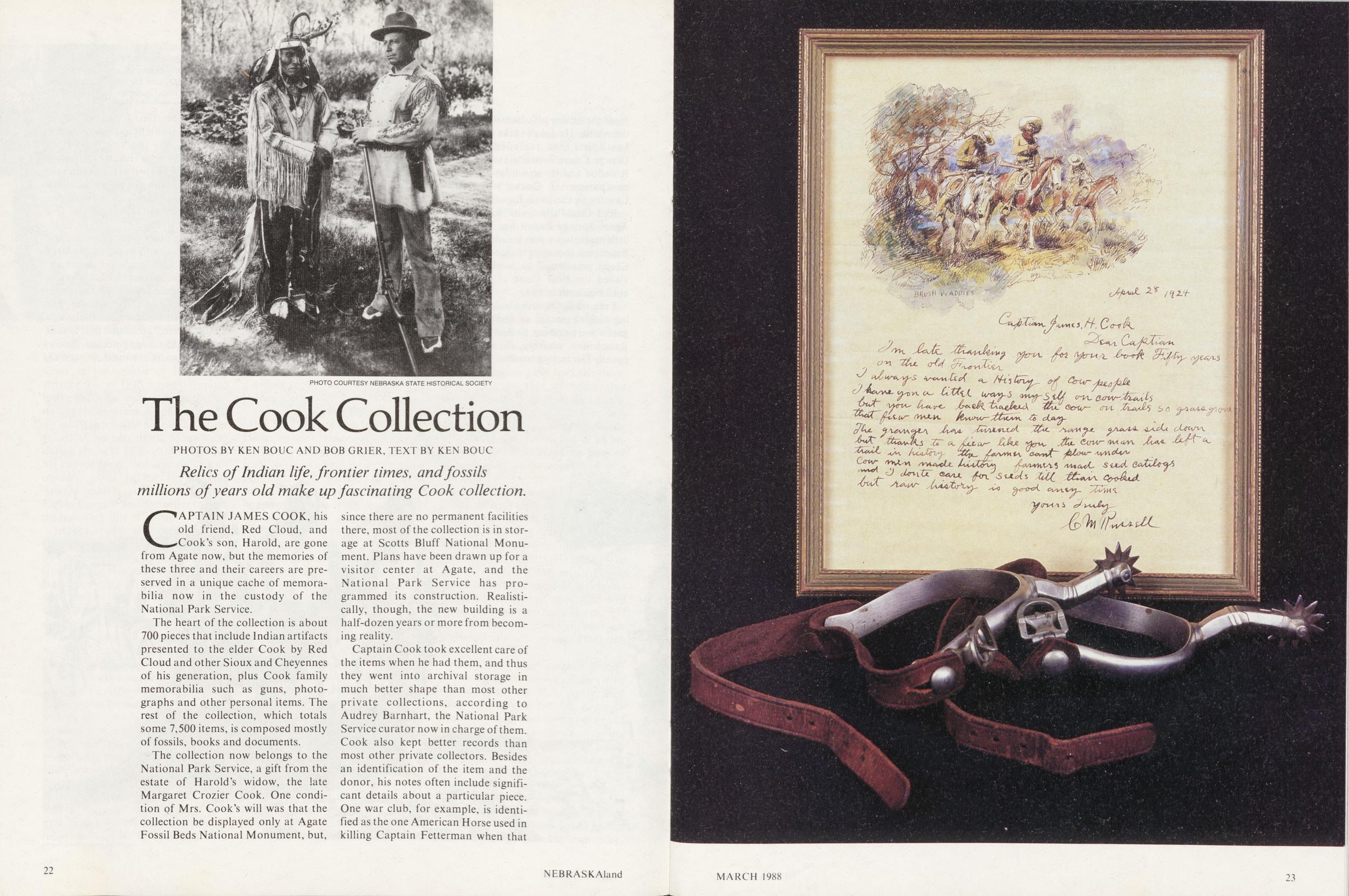
MARCH 1988 19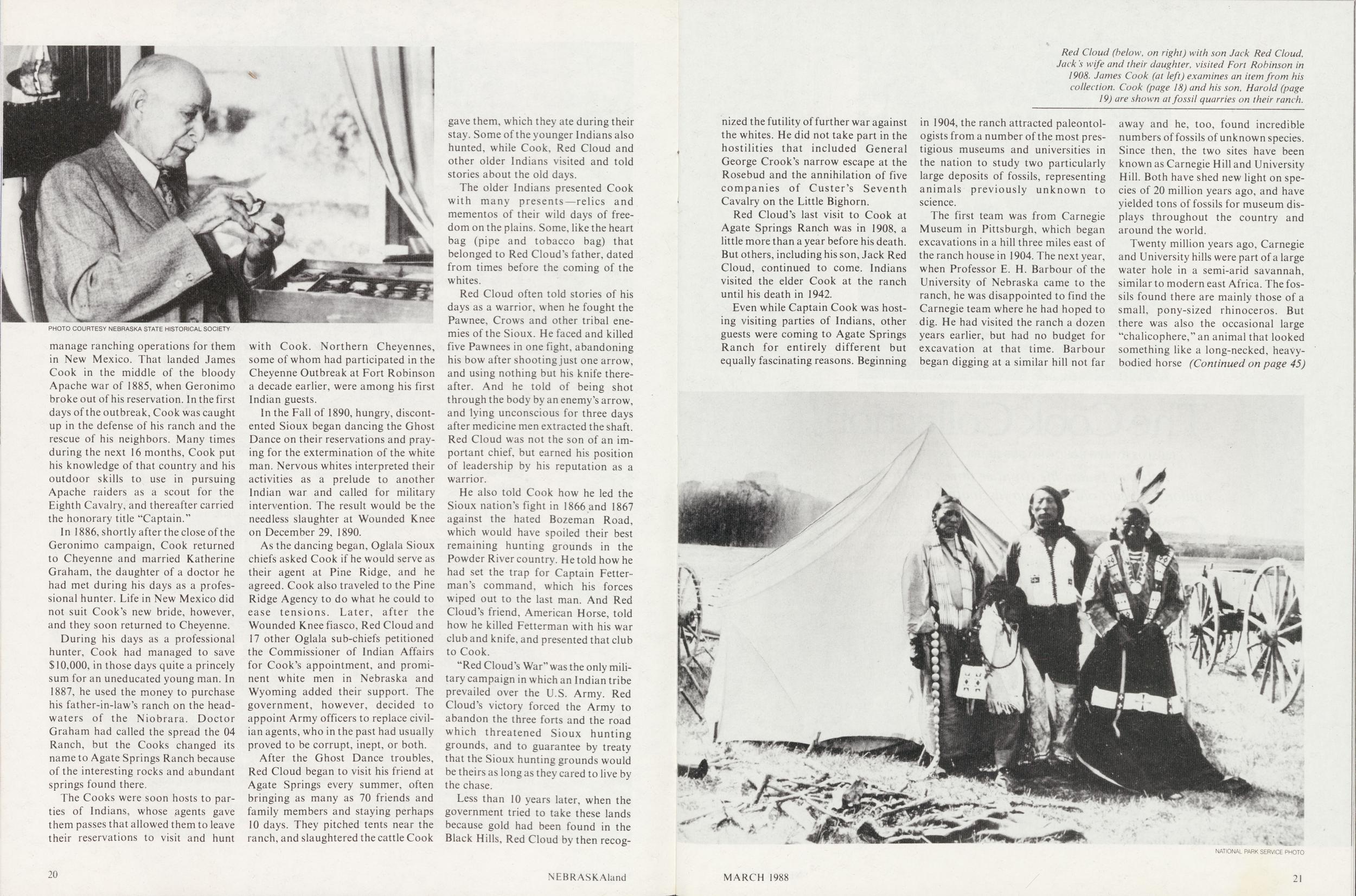 Red Cloud (below, on right) with son Jack Red Cloud,
Jack's wife and their daughter, visited Fort Robinson in
1908. James Cook (at left) examines an item from his
collection. Cook (page 18) and his son, Harold (page
19) are shown at fossil quarries on their ranch.
Red Cloud (below, on right) with son Jack Red Cloud,
Jack's wife and their daughter, visited Fort Robinson in
1908. James Cook (at left) examines an item from his
collection. Cook (page 18) and his son, Harold (page
19) are shown at fossil quarries on their ranch.
In 1886, shortly after the close of the Geronimo campaign, Cook returned to Cheyenne and married Katherine Graham, the daughter of a doctor he had met during his days as a professional hunter. Life in New Mexico did not suit Cook's new bride, however, and they soon returned to Cheyenne.
During his days as a professional hunter, Cook had managed to save $10,000, in those days quite a princely sum for an uneducated young man. In 1887, he used the money to purchase his father-in-law's ranch on the head waters of the Niobrara. Doctor Graham had called the spread the 04 Ranch, but the Cooks changed its name to Agate Springs Ranch because of the interesting rocks and abundant springs found there.
The Cooks were soon hosts to parties of Indians, whose agents gave them passes that allowed them to leave their reservations to visit and hunt with Cook. Northern Cheyennes, some of whom had participated in the Cheyenne Outbreak at Fort Robinson a decade earlier, were among his first Indian guests.
In the Fall of 1890, hungry, discontented Sioux began dancing the Ghost Dance on their reservations and praying for the extermination of the white man. Nervous whites interpreted their activities as a prelude to another Indian war and called for military intervention. The result would be the needless slaughter at Wounded Knee on December 29, 1890.
As the dancing began, Oglala Sioux chiefs asked Cook if he would serve as their agent at Pine Ridge, and he agreed. Cook also traveled to the Pine Ridge Agency to do what he could to ease tensions. Later, after the Wounded Knee fiasco, Red Cloud and 17 other Oglala sub-chiefs petitioned the Commissioner of Indian Affairs for Cook's appointment, and prominent white men in Nebraska and Wyoming added their support. The government, however, decided to appoint Army officers to replace civilian agents, who in the past had usually proved to be corrupt, inept, or both.
After the Ghost Dance troubles, Red Cloud began to visit his friend at Agate Springs every summer, often bringing as many as 70 friends and family members and staying perhaps 10 days. They pitched tents near the ranch, and slaughtered the cattle Cook gave them, which they ate during their stay. Some of the younger Indians also hunted, while Cook, Red Cloud and other older Indians visited and told stories about the old days.
The older Indians presented Cook with many presents—relics and mementos of their wild days of freedom on the plains. Some, like the heart bag (pipe and tobacco bag) that belonged to Red Cloud's father, dated from times before the coming of the whites.
Red Cloud often told stories of his days as a warrior, when he fought the Pawnee, Crows and other tribal enemies of the Sioux. He faced and killed five Pawnees in one fight, abandoning his bow after shooting just one arrow, and using nothing but his knife thereafter. And he told of being shot through the body by an enemy's arrow, and lying unconscious for three days after medicine men extracted the shaft. Red Cloud was not the son of an important chief, but earned his position of leadership by his reputation as a warrior.
He also told Cook how he led the Sioux nation's fight in 1866 and 1867 against the hated Bozeman Road, which would have spoiled their best remaining hunting grounds in the Powder River country. He told how he had set the trap for Captain Fetterman's command, which his forces wiped out to the last man. And Red Cloud's friend, American Horse, told how he killed Fetterman with his war club and knife, and presented that club to Cook.
"Red Cloud's War" was the only military campaign in which an Indian tribe prevailed over the U.S. Army. Red Cloud's victory forced the Army to abandon the three forts and the road which threatened Sioux hunting grounds, and to guarantee by treaty that the Sioux hunting grounds would be theirs as long as they cared to live by the chase.
Less than 10 years later, when the government tried to take these lands because gold had been found in the Black Hills, Red Cloud by then recognized 20 NEBRASKAland the futility of further war against the whites. He did not take part in the hostilities that included General George Crook's narrow escape at the Rosebud and the annihilation of five companies of Custer's Seventh Cavalry on the Little Bighorn.
Red Cloud's last visit to Cook at Agate Springs Ranch was in 1908, a little more than a year before his death. But others, including his son, Jack Red Cloud, continued to come. Indians visited the elder Cook at the ranch until his death in 1942.
Even while Captain Cook was hosting visiting parties of Indians, other guests were coming to Agate Springs Ranch for entirely different but equally fascinating reasons. Beginning in 1904, the ranch attracted paleontologists from a number of the most prestigious museums and universities in the nation to study two particularly large deposits of fossils, representing animals previously unknown to science.
The first team was from Carnegie Museum in Pittsburgh, which began excavations in a hill three miles east of the ranch house in 1904. The next year, when Professor E. H. Barbour of the University of Nebraska came to the ranch, he was disappointed to find the Carnegie team where he had hoped to dig. He had visited the ranch a dozen years earlier, but had no budget for excavation at that time. Barbour began digging at a similar hill not far away and he, too, found incredible numbers of fossils of unknown species. Since then, the two sites have been known as Carnegie Hill and University Hill. Both have shed new light on species of 20 million years ago, and have yielded tons of fossils for museum displays throughout the country and around the world.
Twenty million years ago, Carnegie and University hills were part of a large water hole in a semi-arid savannah, similar to modern east Africa. The fossils found there are mainly those of a small, pony-sized rhinoceros. But there was also the occasional large "chalicophere," an animal that looked something like a long-necked, heavy bodied horse (Continued on page 45)
The Cook Collection
PHOTOS BY KEN BOUC AND BOB GRIER, TEXT BY KEN BOUC Relics of Indian life, frontier times, and fossils millions of years old make up fascinating Cook collection.CAPTAIN JAMES COOK, his old friend, Red Cloud, and Cook's son, Harold, are gone from Agate now, but the memories of these three and their careers are preserved in a unique cache of memorabilia now in the custody of the National Park Service.
The heart of the collection is about 700 pieces that include Indian artifacts presented to the elder Cook by Red Cloud and other Sioux and Cheyennes of his generation, plus Cook family memorabilia such as guns, photographs and other personal items. The rest of the collection, which totals some 7,500 items, is composed mostly of fossils, books and documents.
The collection now belongs to the National Park Service, a gift from the estate of Harold's widow, the late Margaret Crozier Cook. One condition of Mrs. Cook's will was that the collection be displayed only at Agate Fossil Beds National Monument, but, since there are no permanent facilities there, most of the collection is in storage at Scotts Bluff National Monument. Plans have been drawn up for a visitor center at Agate, and the National Park Service has programmed its construction. Realistically, though, the new building is a half-dozen years or more from becoming reality.
Captain Cook took excellent care of the items when he had them, and thus they went into archival storage in much better shape than most other private collections, according to Audrey Barnhart, the National Park Service curator now in charge of them. Cook also kept better records than most other private collectors. Besides an identification of the item and the donor, his notes often include significant details about a particular piece. One war club, for example, is identified as the one American Horse used in killing Captain Fetterman when that 22 NEBRASKAland
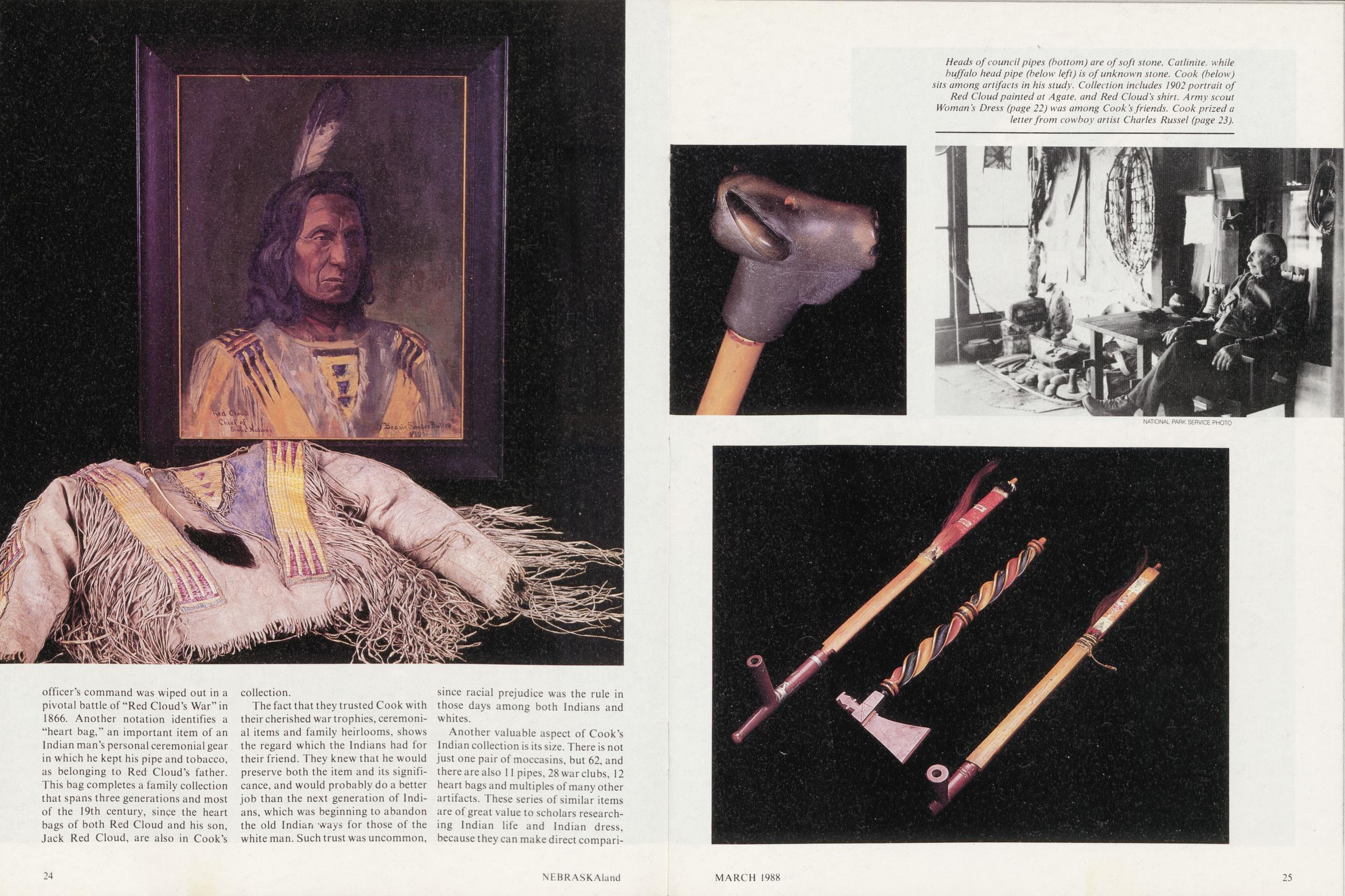
The fact that they trusted Cook with their cherished war trophies, ceremonial items and family heirlooms, shows the regard which the Indians had for their friend. They knew that he would preserve both the item and its significance, and would probably do a better job than the next generation of Indians, which was beginning to abandon the old Indian ways for those of the white man. Such trust was uncommon, since racial prejudice was the rule in those days among both Indians and whites.
Another valuable aspect of Cook's Indian collection is its size. There is not just one pair of moccasins, but 62, and there are also 11 pipes, 28 war clubs, 12 heart bags and multiples of many other artifacts. These series of similar items are of great value to scholars researching Indian life and Indian dress, because they can make direct comparisons son of several artifacts of the same type. The collection also includes household tools and utensils, things that were often ignored by other collectors.
24 NEBRASKAland Heads of council pipes (bottom) are of soft stone, Cat Unite, while buffalo head pipe (below left) is of unknown stone. Cook (below) sits among artifacts in his study. Collection includes 1902 portrait of Red Cloud painted at Agate, and Red Cloud's shirt. Army scout Woman's Dress (page 22) was among Cook's friends. Cook prized a letter from cowboy artist Charles Russel (page 23).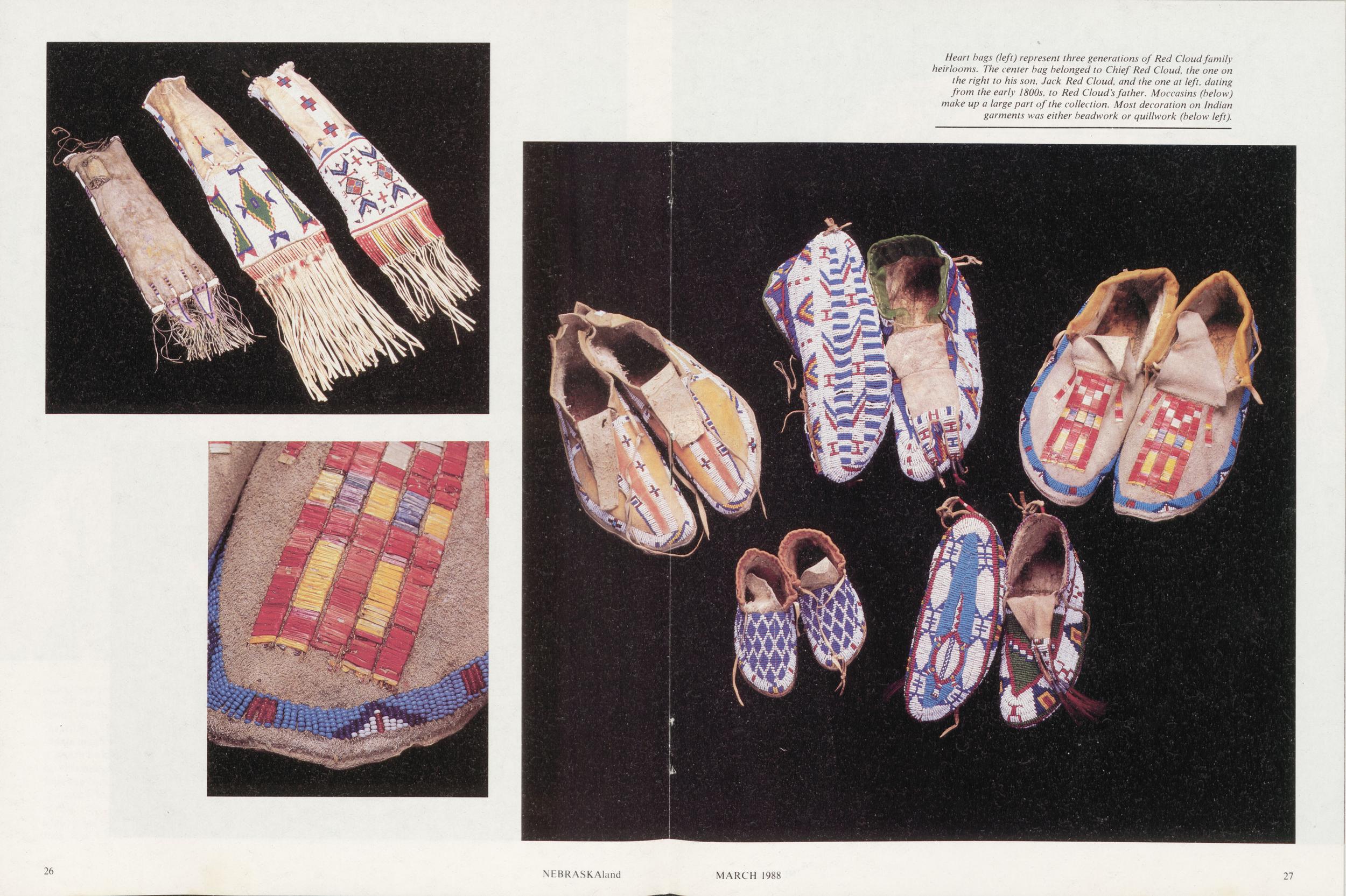
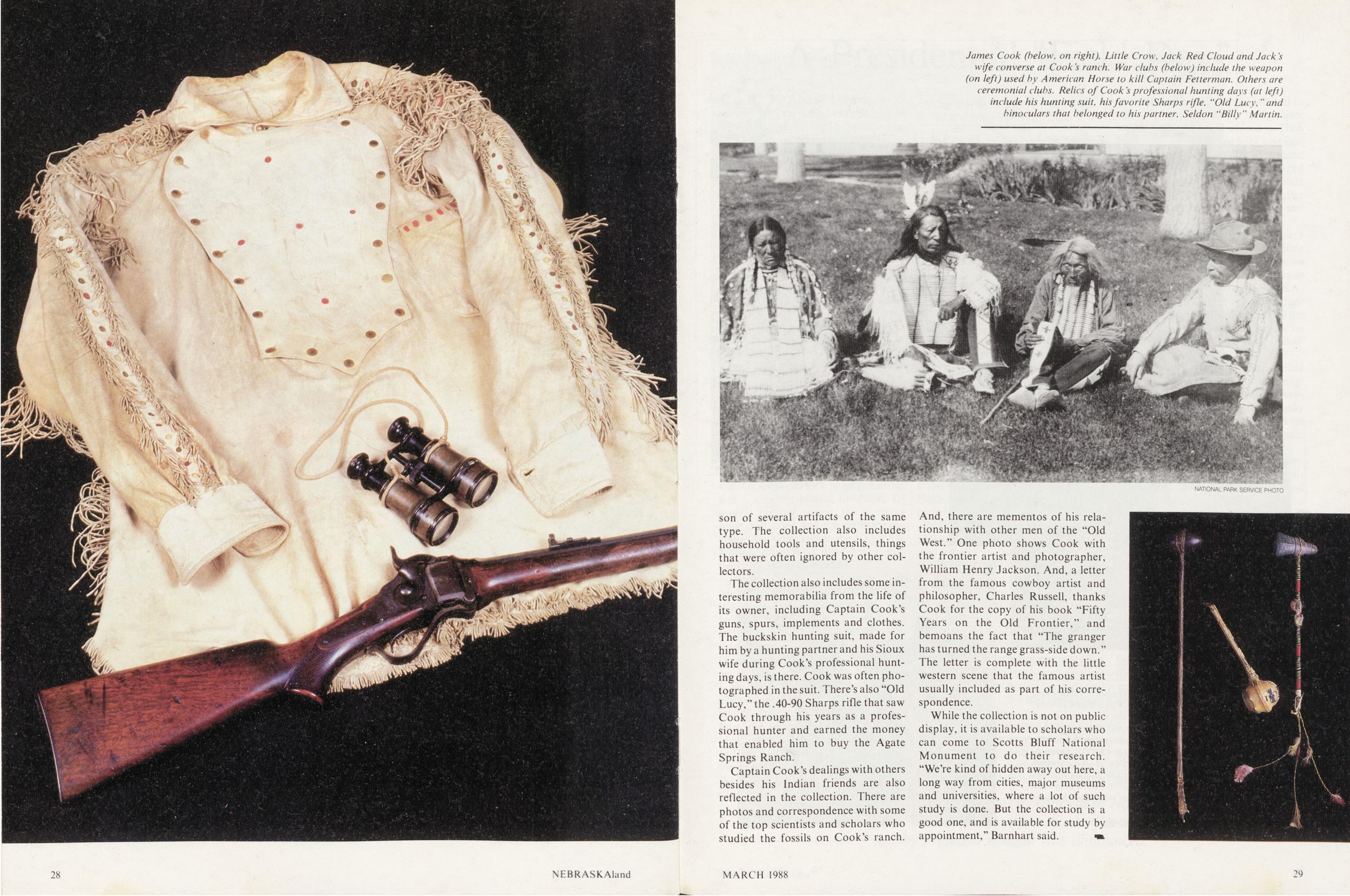
The collection also includes some interesting memorabilia from the life of its owner, including Captain Cook's guns, spurs, implements and clothes. The buckskin hunting suit, made for him by a hunting partner and his Sioux wife during Cook's professional hunting days, is there. Cook was often photographed in the suit. There's also "Old Lucy," the .40-90 Sharps rifle that saw Cook through his years as a professional hunter and earned the money that enabled him to buy the Agate Springs Ranch.
Captain Cook's dealings with others besides his Indian friends are also reflected in the collection. There are photos and correspondence with some of the top scientists and scholars who studied the fossils on Cook's ranch. And, there are mementos of his relationship with other men of the "Old West." One photo shows Cook with the frontier artist and photographer, William Henry Jackson. And, a letter from the famous cowboy artist and philosopher, Charles Russell, thanks Cook for the copy of his book "Fifty Years on the Old Frontier," and bemoans the fact that "The granger has turned the range grass-side down.'" The letter is complete with the little western scene that the famous artist usually included as part of his correspondence.
While the collection is not on public display, it is available to scholars who can come to Scotts Bluff National Monument to do their research. "We're kind of hidden away out here, a long way from cities, major museums and universities, where a lot of such study is done. But the collection is a good one, and is available for study by appointment," Barnhart said.
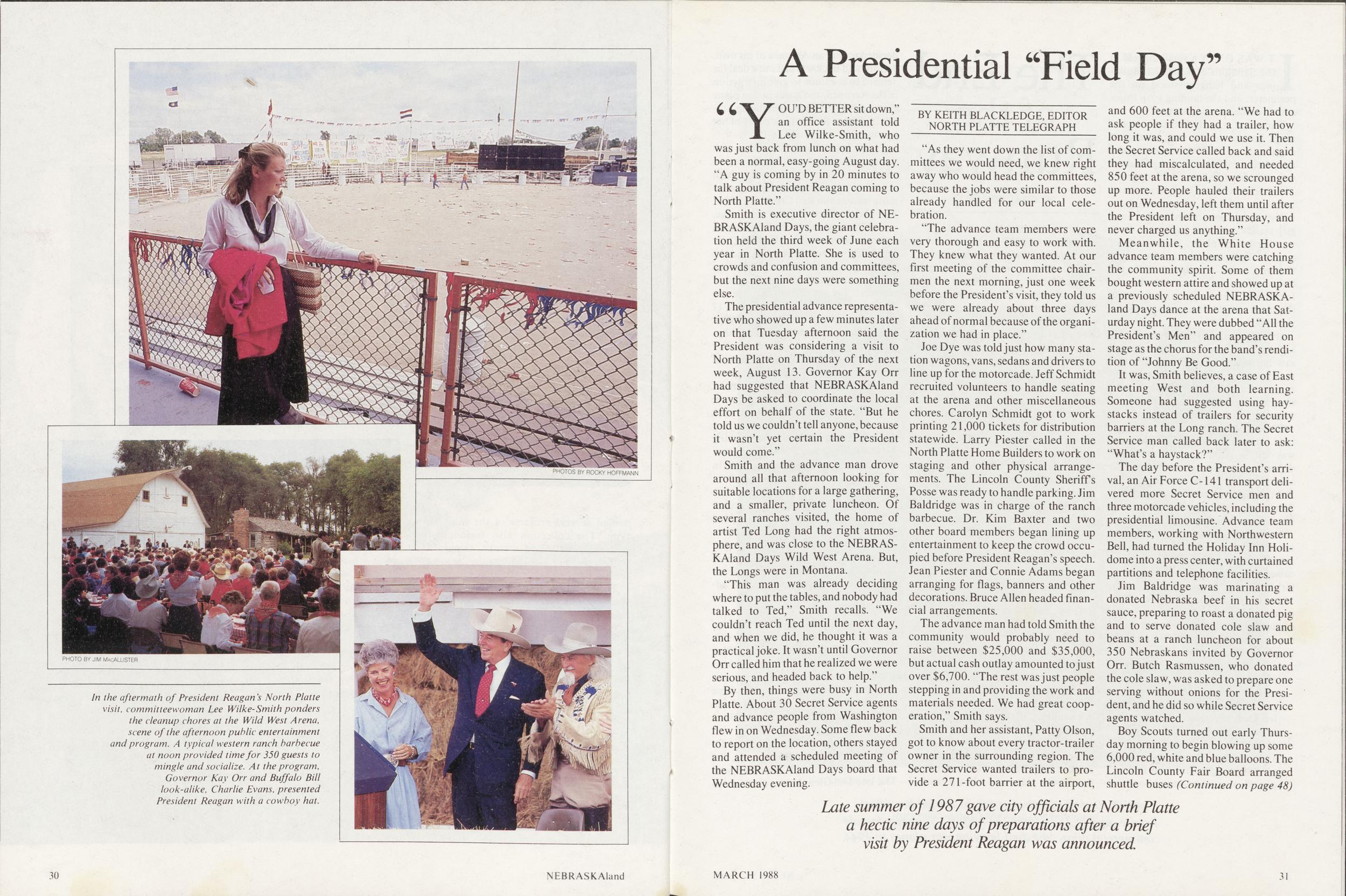
A Presidential "Field Day
BY KEITH BLACKLEDGE EDITOR NORTH PLATTE TELEGRAPH Late summer of 1987 gave city officials at North Platte a hectic nine days of preparations after a brief visit by President Reagan was announced.OU'D BETTER sit down," an office assistant told Lee Wilke-Smith, who was just back from lunch on what had been a normal, easy-going August day. "A guy is coming by in 20 minutes to talk about President Reagan coming to North Platte."
Smith is executive director of NEBRASKAland Days, the giant celebration held the third week of June each year in North Platte. She is used to crowds and confusion and committees, but the next nine days were something else.
The presidential advance representative who showed up a few minutes later on that Tuesday afternoon said the President was considering a visit to North Platte on Thursday of the next week, August 13. Governor Kay Orr had suggested that NEBRASKAland Days be asked to coordinate the local effort on behalf of the state. "But he told us we couldn't tell anyone, because it wasn't yet certain the President would come."
Smith and the advance man drove around all that afternoon looking for suitable locations for a large gathering, and a smaller, private luncheon. Of several ranches visited, the home of artist Ted Long had the right atmosphere, and was close to the NEBRASKAland Days Wild West Arena. But, the Longs were in Montana.
"This man was already deciding where to put the tables, and nobody had talked to Ted," Smith recalls. "We couldn't reach Ted until the next day, and when we did, he thought it was a practical joke. It wasn't until Governor Orr called him that he realized we were serious, and headed back to help."
By then, things were busy in North Platte. About 30 Secret Service agents and advance people from Washington flew in on Wednesday. Some flew back to report on the location, others stayed and attended a scheduled meeting of the NEBRASKAland Days board that Wednesday evening.
"As they went down the list of committees we would need, we knew right away who would head the committees, because the jobs were similar to those already handled for our local celebration.
"The advance team members were very thorough and easy to work with. They knew what they wanted. At our first meeting of the committee chairmen the next morning, just one week before the President's visit, they told us we were already about three days ahead of normal because of the organization we had in place."
Joe Dye was told just how many station wagons, vans, sedans and drivers to line up for the motorcade. Jeff Schmidt recruited volunteers to handle seating at the arena and other miscellaneous chores. Carolyn Schmidt got to work printing 21,000 tickets for distribution statewide. Larry Piester called in the North Platte Home Builders to work on staging and other physical arrangements. The Lincoln County Sheriffs Posse was ready to handle parking. Jim Baldridge was in charge of the ranch barbecue. Dr. Kim Baxter and two other board members began lining up entertainment to keep the crowd occupied before President Reagan's speech. Jean Piester and Connie Adams began arranging for flags, banners and other decorations. Bruce Allen headed financial arrangements.
The advance man had told Smith the community would probably need to raise between $25,000 and $35,000, but actual cash outlay amounted to just over $6,700. "The rest was just people stepping in and providing the work and materials needed. We had great cooperation," Smith says.
Smith and her assistant, Patty Olson, got to know about every tractor-trailer owner in the surrounding region. The Secret Service wanted trailers to provide a 271-foot barrier at the airport, and 600 feet at the arena. "We had to ask people if they had a trailer, how long it was, and could we use it. Then the Secret Service called back and said they had miscalculated, and needed 850 feet at the arena, so we scrounged up more. People hauled their trailers out on Wednesday, left them until after the President left on Thursday, and never charged us anything."
Meanwhile, the White House advance team members were catching the community spirit. Some of them bought western attire and showed up at a previously scheduled NEBRASKA- land Days dance at the arena that Saturday night. They were dubbed "All the President's Men" and appeared on stage as the chorus for the band's rendition of "Johnny Be Good."
It was, Smith believes, a case of East meeting West and both learning. Someone had suggested using haystacks instead of trailers for security barriers at the Long ranch. The Secret Service man called back later to ask: "What's a haystack?"
The day before the President's arrival, an Air Force C-141 transport delivered more Secret Service men and three motorcade vehicles, including the presidential limousine. Advance team members, working with Northwestern Bell, had turned the Holiday Inn Holidome into a press center, with curtained partitions and telephone facilities.
Jim Baldridge was marinating a donated Nebraska beef in his secret sauce, preparing to roast a donated pig and to serve donated cole slaw and beans at a ranch luncheon for about 350 Nebraskans invited by Governor Orr. Butch Rasmussen, who donated the cole slaw, was asked to prepare one serving without onions for the President, and he did so while Secret Service agents watched.
Boy Scouts turned out early Thursday morning to begin blowing up some 6,000 red, white and blue balloons. The Lincoln County Fair Board arranged shuttle buses (Continued on page 48)
MARCH 1988 31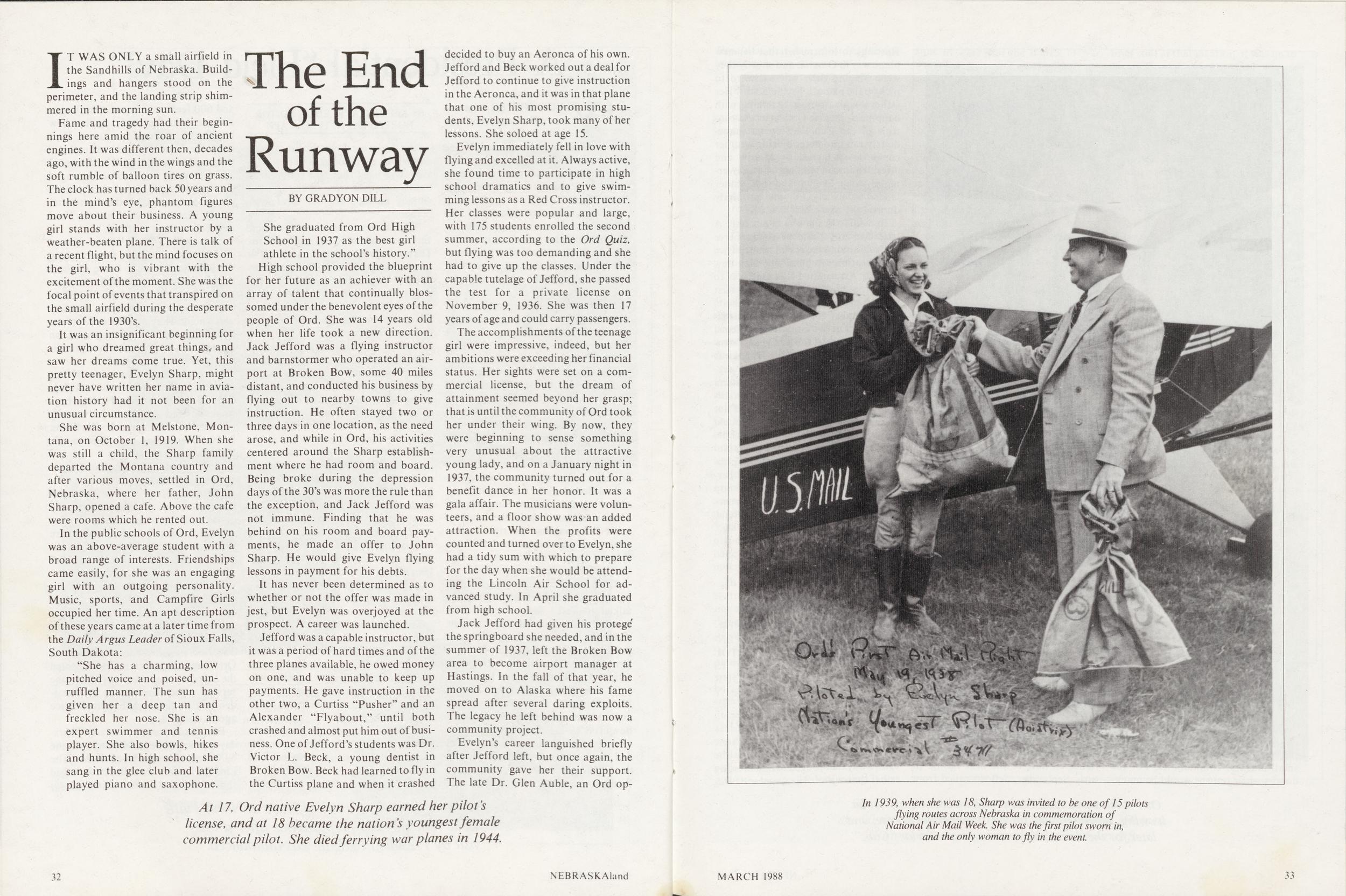
The End of the Runway
BY GRADYON DILL At 17, Ord native Evelyn Sharp earned her pilots license, and at 18 became the nations youngest female commercial pilot. She died ferrying war planes in 1944.IT WAS ONLY a small airfield in the Sandhills of Nebraska. Buildings and hangers stood on the perimeter, and the landing strip shimmered in the morning sun.
Fame and tragedy had their beginnings here amid the roar of ancient engines. It was different then, decades ago, with the wind in the wings and the soft rumble of balloon tires on grass. The clock has turned back 50 years and in the mind's eye, phantom figures move about their business. A young girl stands with her instructor by a weather-beaten plane. There is talk of a recent flight, but the mind focuses on the girl, who is vibrant with the excitement of the moment. She was the focal point of events that transpired on the small airfield during the desperate years of the 1930's.
It was an insignificant beginning for a girl who dreamed great things, and saw her dreams come true. Yet, this pretty teenager, Evelyn Sharp, might never have written her name in aviation history had it not been for an unusual circumstance.
She was born at Melstone, Montana, on October 1, 1919. When she was still a child, the Sharp family departed the Montana country and after various moves, settled in Ord, Nebraska, where her father, John Sharp, opened a cafe. Above the cafe were rooms which he rented out.
In the public schools of Ord, Evelyn was an above-average student with a broad range of interests. Friendships came easily, for she was an engaging girl with an outgoing personality. Music, sports, and Campfire Girls occupied her time. An apt description of these years came at a later time from the Daily Argus Leader of Sioux Falls, South Dakota:
"She has a charming, low pitched voice and poised, unruffled manner. The sun has given her a deep tan and freckled her nose. She is an expert swimmer and tennis player. She also bowls, hikes and hunts. In high school, she sang in the glee club and later played piano and saxophone. She graduated from Ord High School in 1937 as the best girl athlete in the school's history."
High school provided the blueprint for her future as an achiever with an array of talent that continually blossomed under the benevolent eyes of the people of Ord. She was 14 years old when her life took a new direction. Jack Jefford was a flying instructor and barnstormer who operated an airport at Broken Bow, some 40 miles distant, and conducted his business by flying out to nearby towns to give instruction. He often stayed two or three days in one location, as the need arose, and while in Ord, his activities centered around the Sharp establishment where he had room and board. Being broke during the depression days of the 30's was more the rule than the exception, and Jack Jefford was not immune. Finding that he was behind on his room and board payments, he made an offer to John Sharp. He would give Evelyn flying lessons in payment for his debts.
It has never been determined as to whether or not the offer was made in jest, but Evelyn was overjoyed at the prospect. A career was launched.
Jefford was a capable instructor, but it was a period of hard times and of the three planes available, he owed money on one, and was unable to keep up payments. He gave instruction in the other two, a Curtiss "Pusher" and an Alexander "Flyabout," until both crashed and almost put him out of business. One of Jefford's students was Dr. Victor L. Beck, a young dentist in Broken Bow. Beck had learned to fly in the Curtiss plane and when it crashed decided to buy an Aeronca of his own. Jefford and Beck worked out a deal for Jefford to continue to give instruction in the Aeronca, and it was in that plane that one of his most promising students, Evelyn Sharp, took many of her lessons. She soloed at age 15.
Evelyn immediately fell in love with flying and excelled at it. Always active, she found time to participate in high school dramatics and to give swimming lessons as a Red Cross instructor. Her classes were popular and large, with 175 students enrolled the second summer, according to the Ord Quiz, but flying was too demanding and she had to give up the classes. Under the capable tutelage of Jefford, she passed the test for a private license on November 9, 1936. She was then 17 years of age and could carry passengers.
The accomplishments of the teenage girl were impressive, indeed, but her ambitions were exceeding her financial status. Her sights were set on a commercial license, but the dream of attainment seemed beyond her grasp; that is until the community of Ord took her under their wing. By now, they were beginning to sense something very unusual about the attractive young lady, and on a January night in 1937, the community turned out for a benefit dance in her honor. It was a gala affair. The musicians were volunteers, and a floor show was an added attraction. When the profits were counted and turned over to Evelyn, she had a tidy sum with which to prepare for the day when she would be attending the Lincoln Air School for advanced study. In April she graduated from high school.
Jack Jefford had given his protege the springboard she needed, and in the summer of 1937, left the Broken Bow area to become airport manager at Hastings. In the fall of that year, he moved on to Alaska where his fame spread after several daring exploits. The legacy he left behind was now a community project.
Evelyn's career languished briefly after Jefford left, but once again, the community gave her their support. The late Dr. Glen Auble, an Ord optometrist, and his brother, Jay, a jeweler, were instrumental in "passing the hat" among Ord businessmen. For Dr. Auble, it was not only a kindness to his daughter's friend, it was a symbol of the warmth and cohesiveness found in small midwest communities. For the donors, their returns would be many fold during the coming years.
32 NEBRASKAland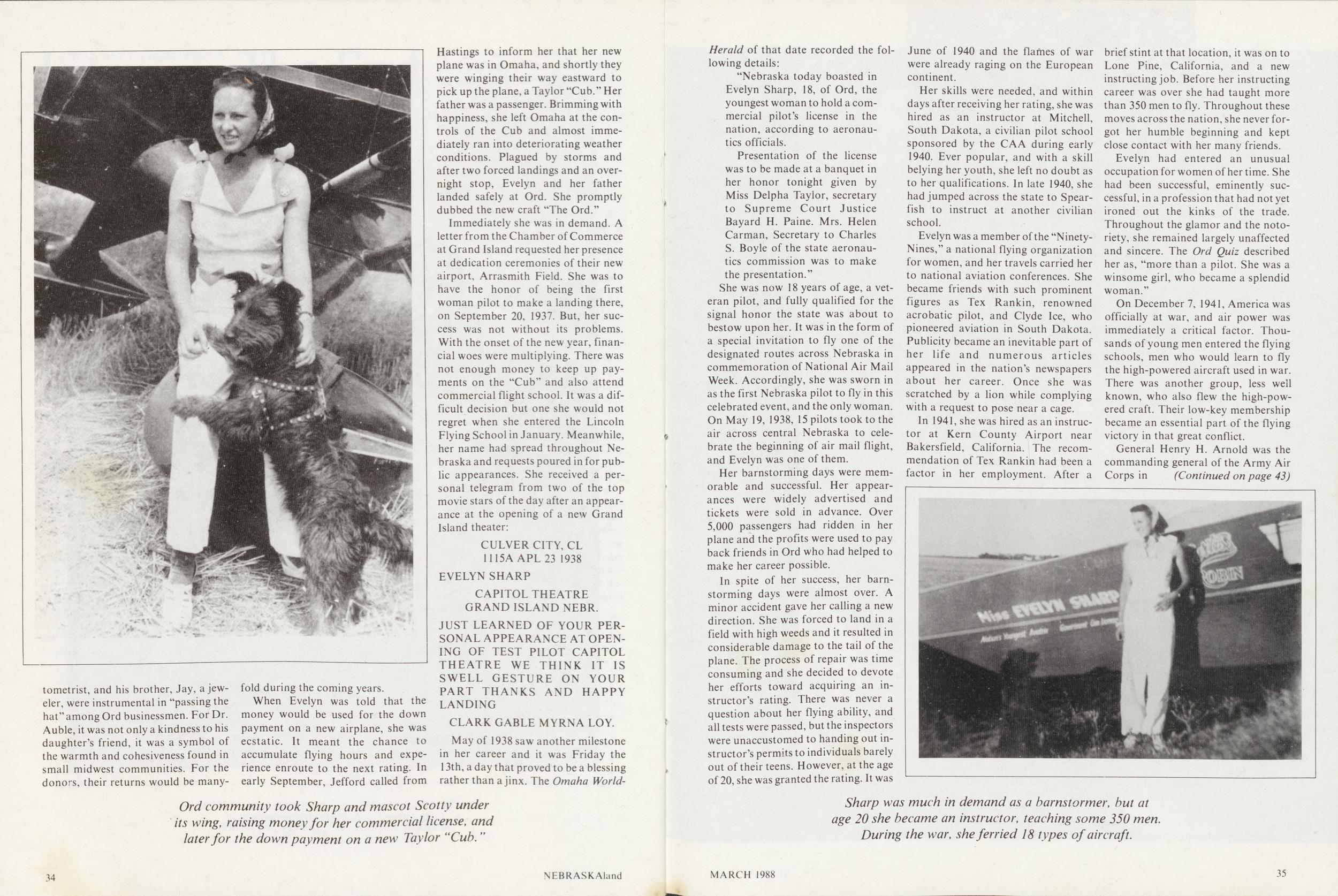
When Evelyn was told that the money would be used for the down payment on a new airplane, she was ecstatic. It meant the chance to accumulate flying hours and experience enroute to the next rating. In early September, Jefford called from Hastings to inform her that her new plane was in Omaha, and shortly they were winging their way eastward to pick up the plane, a Taylor "Cub." Her father was a passenger. Brimming with happiness, she left Omaha at the controls of the Cub and almost immediately ran into deteriorating weather conditions. Plagued by storms and after two forced landings and an overnight stop, Evelyn and her father landed safely at Ord. She promptly dubbed the new craft "The Ord."
Immediately she was in demand. A letter from the Chamber of Commerce at Grand Island requested her presence at dedication ceremonies of their new airport, Arrasmith Field. She was to have the honor of being the first woman pilot to make a landing there, on September 20, 1937. But, her success was not without its problems. With the onset of the new year, financial woes were multiplying. There was not enough money to keep up payments on the "Cub" and also attend commercial flight school. It was a difficult decision but one she would not regret when she entered the Lincoln Flying School in January. Meanwhile, her name had spread throughout Nebraska and requests poured in for public appearances. She received a personal telegram from two of the top movie stars of the day after an appearance at the opening of a new Grand Island theater:
CULVER CITY, CL 1115A APL23 1938 EVELYN SHARP CAPITOL THEATRE GRAND ISLAND NEBR. JUST LEARNED OF YOUR PERSONAL APPEARANCE AT OPENING OF TEST PILOT CAPITOL THEATRE WE THINK IT IS SWELL GESTURE ON YOUR PART THANKS AND HAPPY LANDING CLARK GABLE MYRNA LOY.May of 1938 saw another milestone in her career and it was Friday the 13th, a day that proved to be a blessing rather than a jinx. The Omaha World-Herald 34 NEBRASKALand of that date recorded the following details:
"Nebraska today boasted in Evelyn Sharp, 18, of Ord, the youngest woman to hold a commercial pilot's license in the nation, according to aeronautics officials.
Presentation of the license was to be made at a banquet in her honor tonight given by Miss Delpha Taylor, secretary to Supreme Court Justice Bayard H. Paine. Mrs. Helen Carman, Secretary to Charles S. Boyle of the state aeronautics commission was to make the presentation."
She was now 18 years of age, a veteran pilot, and fully qualified for the signal honor the state was about to bestow upon her. It was in the form of a special invitation to fly one of the designated routes across Nebraska in commemoration of National Air Mail Week. Accordingly, she was sworn in as the first Nebraska pilot to fly in this celebrated event, and the only woman. On May 19, 1938, 15 pilots took to the air across central Nebraska to celebrate the beginning of air mail flight, and Evelyn was one of them.
Her barnstorming days were memorable and successful. Her appearances were widely advertised and tickets were sold in advance. Over 5,000 passengers had ridden in her plane and the profits were used to pay back friends in Ord who had helped to make her career possible.
In spite of her success, her barnstorming days were almost over. A minor accident gave her calling a new direction. She was forced to land in a field with high weeds and it resulted in considerable damage to the tail of the plane. The process of repair was time consuming and she decided to devote her efforts toward acquiring an instructor's rating. There was never a question about her flying ability, and all tests were passed, but the inspectors were unaccustomed to handing out instructor's permits to individuals barely out of their teens. However, at the age of 20, she was granted the rating. It was June of 1940 and the flames of war were already raging on the European continent.
Her skills were needed, and within days after receiving her rating, she was hired as an instructor at Mitchell, South Dakota, a civilian pilot school sponsored by the CAA during early 1940. Ever popular, and with a skill belying her youth, she left no doubt as to her qualifications. In late 1940, she had jumped across the state to Spearfish to instruct at another civilian school.
Evelyn was a member of the "Ninety Nines," a national flying organization for women, and her travels carried her to national aviation conferences. She became friends with such prominent figures as Tex Rankin, renowned acrobatic pilot, and Clyde Ice, who pioneered aviation in South Dakota. Publicity became an inevitable part of her life and numerous articles appeared in the nation's newspapers about her career. Once she was scratched by a lion while complying with a request to pose near a cage.
In 1941, she was hired as an instructor at Kern County Airport near Bakersfield, California. The recommendation of Tex Rankin had been a factor in her employment. After a brief stint at that location, it was on to Lone Pine, California, and a new instructing job. Before her instructing career was over she had taught more than 350 men to fly. Throughout these moves across the nation, she never forgot her humble beginning and kept close contact with her many friends.
Evelyn had entered an unusual occupation for women of her time. She had been successful, eminently successful, in a profession that had not yet ironed out the kinks of the trade. Throughout the glamor and the notoriety, she remained largely unaffected and sincere. The Ord Quiz described her as, "more than a pilot. She was a winsome girl, who became a splendid woman."
On December 7, 1941, America was officially at war, and air power was immediately a critical factor. Thousands of young men entered the flying schools, men who would learn to fly the high-powered aircraft used in war. There was another group, less well known, who also flew the high-powered craft. Their low-key membership became an essential part of the flying victory in that great conflict.
General Henry H. Arnold was the commanding general of the Army Air Corps in (Continued on page 43)
On the Edge... On the Platte
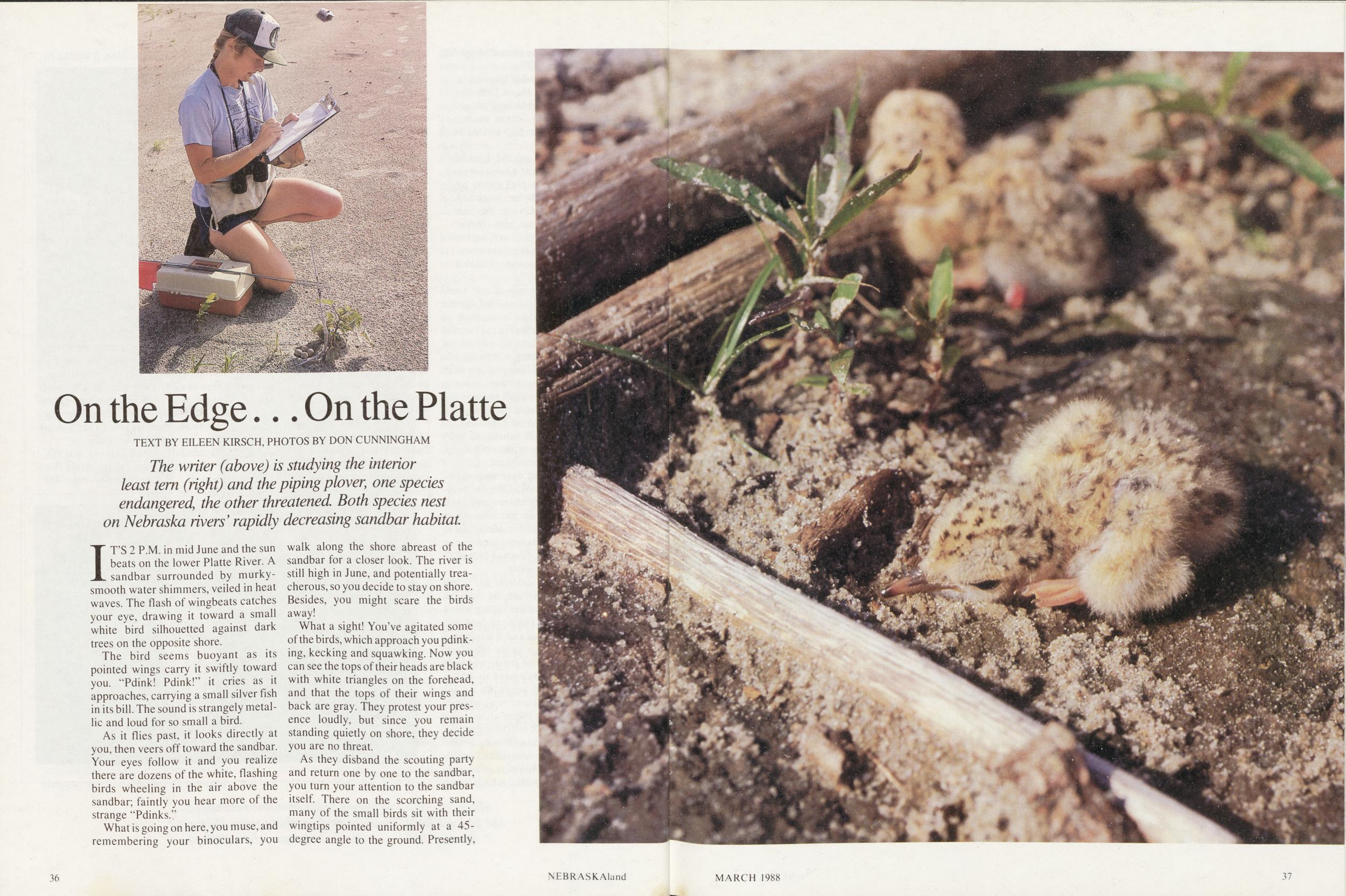
TEXT BY EILEEN KIRSCH, PHOTOS BY DON CUNNINGHAM The writer (above) is studying the interior least tern (right) and the piping plover, one species endangered, the other threatened. Both species nest on Nebraska rivers' rapidly decreasing sandbar habitat.IT'S 2 P.M. in mid June and the sun beats on the lower Platte River. A sandbar surrounded by murky- smooth water shimmers, veiled in heat waves. The flash of wingbeats catches your eye, drawing it toward a small white bird silhouetted against dark trees on the opposite shore.
The bird seems buoyant as its pointed wings carry it swiftly toward you. "Pdink! Pdink!" it cries as it approaches, carrying a small silver fish in its bill. The sound is strangely metallic and loud for so small a bird.
As it flies past, it looks directly at you, then veers off toward the sandbar. Your eyes follow it and you realize there are dozens of the white, flashing birds wheeling in the air above the sandbar; faintly you hear more of the strange "Pdinks."
What is going on here, you muse, and remembering your binoculars, you walk along the shore abreast of the sandbar for a closer look. The river is still high in June, and potentially treacherous, so you decide to stay on shore. Besides, you might scare the birds away!
What a sight! You've agitated some of the birds, which approach you pdinking, kecking and squawking. Now you can see the tops of their heads are black with white triangles on the forehead, and that the tops of their wings and back are gray. They protest your presence loudly, but since you remain standing quietly on shore, they decide you are no threat.
As they disband the scouting party and return one by one to the sandbar, you turn your attention to the sandbar itself. There on the scorching sand, many of the small birds sit with their wingtips pointed uniformly at a 45-degree angle to the ground. Presently, one with a fish in its bill lands near one of the sitters, and offers it the fish. The sitting bird snatches the proffered fish and gulps it down. Suddenly, a new shape dashes across your field of view.
36 NEBRASKAland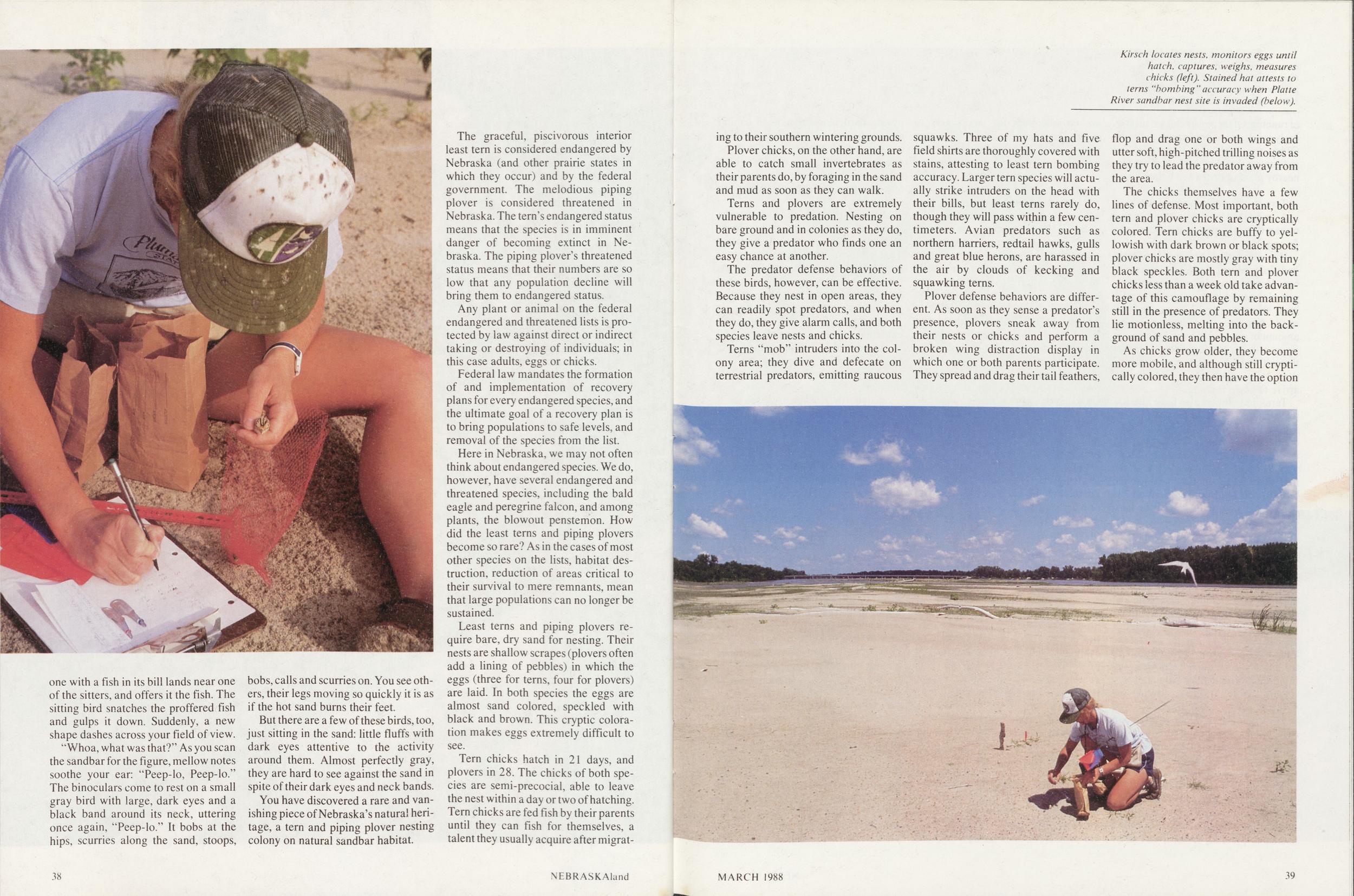
"Whoa, what was that?" As you scan the sandbar for the figure, mellow notes soothe your ear: "Peep-lo, Peep-lo." The binoculars come to rest on a small gray bird with large, dark eyes and a black band around its neck, uttering once again, "Peep-lo." It bobs at the hips, scurries along the sand, stoops, bobs, calls and scurries on. You see others, their legs moving so quickly it is as if the hot sand burns their feet.
But there are a few of these birds, too, just sitting in the sand: little fluffs with dark eyes attentive to the activity around them. Almost perfectly gray, they are hard to see against the sand in spite of their dark eyes and neck bands.
You have discovered a rare and vanishing piece of Nebraska's natural heritage, a tern and piping plover nesting colony on natural sandbar habitat.
The graceful, piscivorous interior least tern is considered endangered by Nebraska (and other prairie states in which they occur) and by the federal government. The melodious piping plover is considered threatened in Nebraska. The tern's endangered status means that the species is in imminent danger of becoming extinct in Nebraska. The piping plover's threatened status means that their numbers are so low that any population decline will bring them to endangered status.
Any plant or animal on the federal endangered and threatened lists is protected by law against direct or indirect taking or destroying of individuals; in this case adults, eggs or chicks.
Federal law mandates the formation of and implementation of recovery plans for every endangered species, and the ultimate goal of a recovery plan is to bring populations to safe levels, and removal of the species from the list.
Here in Nebraska, we may not often think about endangered species. We do, however, have several endangered and threatened species, including the bald eagle and peregrine falcon, and among plants, the blowout penstemon. How did the least terns and piping plovers become so rare? As in the cases of most other species on the lists, habitat destruction, reduction of areas critical to their survival to mere remnants, mean that large populations can no longer be sustained.
Least terns and piping plovers require bare, dry sand for nesting. Their nests are shallow scrapes (plovers often add a lining of pebbles) in which the eggs (three for terns, four for plovers) are laid. In both species the eggs are almost sand colored, speckled with black and brown. This cryptic coloration makes eggs extremely difficult to see.
Tern chicks hatch in 21 days, and plovers in 28. The chicks of both species are semi-precocial, able to leave the nest within a day or two of hatching. Tern chicks are fed fish by their parents until they can fish for themselves, a talent they usually acquire after migrating 36 NEBRASKAland to their southern wintering grounds.
Plover chicks, on the other hand, are able to catch small invertebrates as their parents do, by foraging in the sand and mud as soon as they can walk.
Terns and plovers are extremely vulnerable to predation. Nesting on bare ground and in colonies as they do, they give a predator who finds one an easy chance at another.
The predator defense behaviors of these birds, however, can be effective. Because they nest in open areas, they can readily spot predators, and when they do, they give alarm calls, and both species leave nests and chicks.
Terns "mob" intruders into the colony area; they dive and defecate on terrestrial predators, emitting raucous squawks. Three of my hats and five field shirts are thoroughly covered with stains, attesting to least tern bombing accuracy. Larger tern species will actually strike intruders on the head with their bills, but least terns rarely do, though they will pass within a few centimeters. Avian predators such as northern harriers, red tail hawks, gulls and great blue herons, are harassed in the air by clouds of kecking and squawking terns.
Plover defense behaviors are different. As soon as they sense a predator's presence, plovers sneak away from their nests or chicks and perform a broken wing distraction display in which one or both parents participate. They spread and drag their tail feathers, flop and drag one or both wings and utter soft, high-pitched trilling noises as they try to lead the predator away from the area.
The chicks themselves have a few lines of defense. Most important, both tern and plover chicks are cryptically colored. Tern chicks are buffy to yellowish with dark brown or black spots; plover chicks are mostly gray with tiny black speckles. Both tern and plover chicks less than a week old take advantage of this camouflage by remaining still in the presence of predators. They lie motionless, melting into the background of sand and pebbles.
As chicks grow older, they become more mobile, and although still cryptically colored, they then have the option of running. Older plover chicks, surprisingly quick and unpredictable, will run. Older tern chicks still tend to sit motionless, but they will often run to a nearby plant or driftwood before doing so.
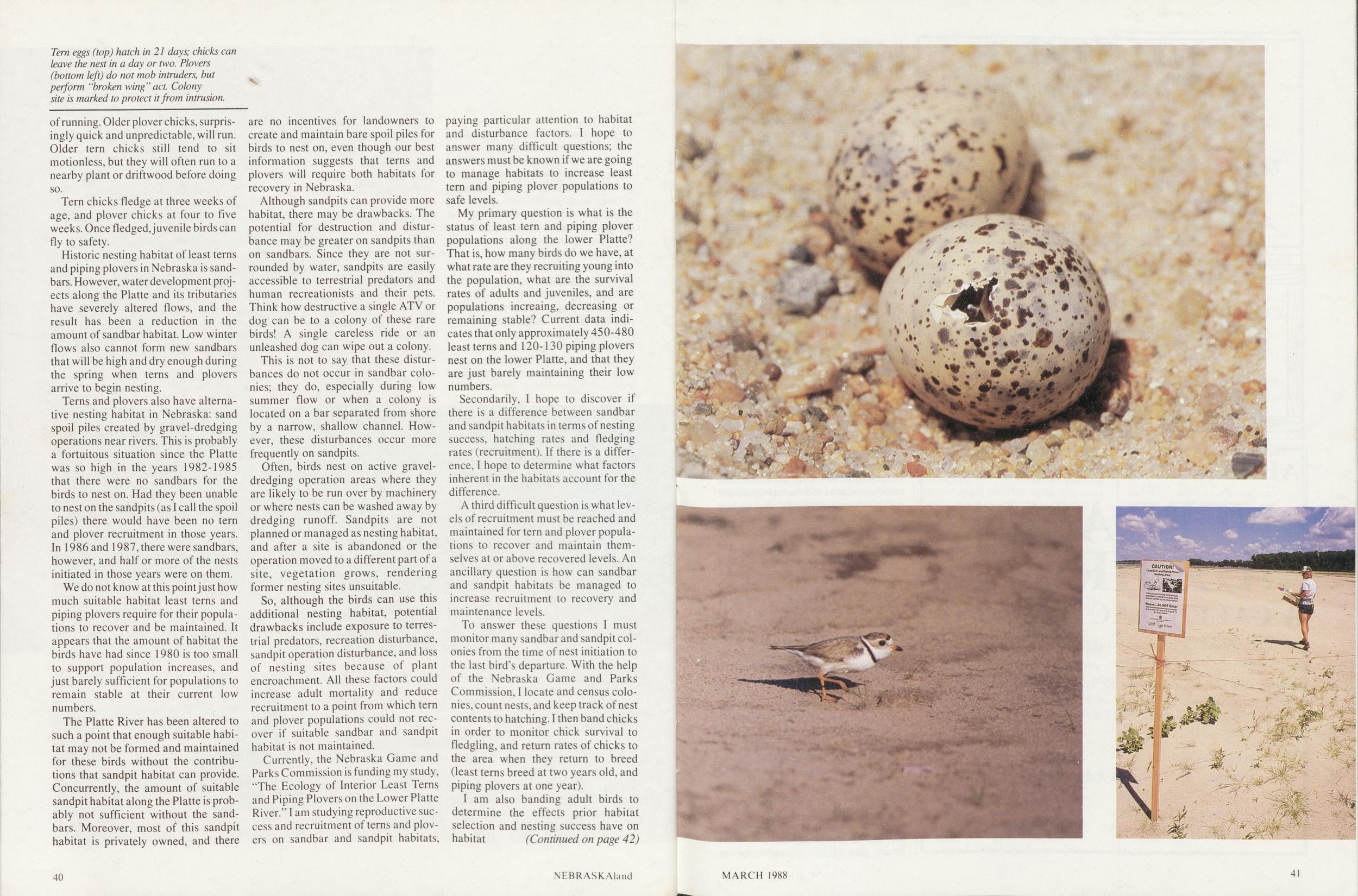 Tern eggs (top) hatch in 21 days; chicks can
leave the nest in a day or two. Plovers
(bottom left) do not mob intruders, but
perform "broken wing" act. Colony
site is marked to protect it from intrusion.
Tern eggs (top) hatch in 21 days; chicks can
leave the nest in a day or two. Plovers
(bottom left) do not mob intruders, but
perform "broken wing" act. Colony
site is marked to protect it from intrusion.
Tern chicks fledge at three weeks of age, and plover chicks at four to five weeks. Once fledged, juvenile birds can fly to safety.
Historic nesting habitat of least terns and piping plovers in Nebraska is sandbars. However, water development projects along the Platte and its tributaries have severely altered flows, and the result has been a reduction in the amount of sandbar habitat. Low winter flows also cannot form new sandbars that will be high and dry enough during the spring when terns and plovers arrive to begin nesting.
Terns and plovers also have alternative nesting habitat in Nebraska: sand spoil piles created by gravel-dredging operations near rivers. This is probably a fortuitous situation since the Platte was so high in the years 1982-1985 that there were no sandbars for the birds to nest on. Had they been unable to nest on the sandpits (as I call the spoil piles) there would have been no tern and plover recruitment in those years. In 1986 and 1987, there were sandbars, however, and half or more of the nests initiated in those years were on them.
We do not know at this point just how much suitable habitat least terns and piping plovers require for their populations to recover and be maintained. It appears that the amount of habitat the birds have had since 1980 is too small to support population increases, and just barely sufficient for populations to remain stable at their current low numbers.
The Platte River has been altered to such a point that enough suitable habitat may not be formed and maintained for these birds without the contributions that sandpit habitat can provide. Concurrently, the amount of suitable sandpit habitat along the Platte is probably not sufficient without the sandbars. Moreover, most of this sandpit habitat is privately owned, and there are no incentives for landowners to create and maintain bare spoil piles for birds to nest on, even though our best information suggests that terns and plovers will require both habitats for recovery in Nebraska.
Although sandpits can provide more habitat, there may be drawbacks. The potential for destruction and disturbance may be greater on sandpits than on sandbars. Since thev are not surrounded by water, sandpits are easily accessible to terrestrial predators and human recreationists and their pets. Think how destructive a single ATV or dog can be to a colony of these rare birds! A single careless ride or an unleashed dog can wipe out a colony.
This is not to say that these disturbances do not occur in sandbar colonies; they do, especially during low summer flow or when a colony is located on a bar separated from shore by a narrow, shallow channel. However, these disturbances occur more frequently on sandpits.
Often, birds nest on active gravel dredging operation areas where they are likely to be run over by machinery or where nests can be washed away by dredging runoff. Sandpits are not planned or managed as nesting habitat, and after a site is abandoned or the operation moved to a different part of a site, vegetation grows, rendering former nesting sites unsuitable.
So, although the birds can use this additional nesting habitat, potential drawbacks include exposure to terrestrial predators, recreation disturbance, sandpit operation disturbance, and loss of nesting sites because of plant encroachment. All these factors could increase adult mortality and reduce recruitment to a point from which tern and plover populations could not recover if suitable sandbar and sandpit habitat is not maintained.
Currently, the Nebraska Game and Parks Commission is funding my study, 'The Ecology of Interior Least Terns and Piping Plovers on the Lower Platte River." I am studying reproductive success and recruitment of terns and plovers on sandbar and sandpit habitats, paying particular attention to habitat and disturbance factors. I hope to answer many difficult questions; the answers must be known if we are going to manage habitats to increase least tern and piping plover populations to safe levels.
My primary question is what is the status of least tern and piping plover populations along the lower Platte? That is, how many birds do we have, at what rate are they recruiting young into the population, what are the survival rates of adults and juveniles, and are populations increasing, decreasing or remaining stable? Current data indicates that only approximately 450-480 least terns and 120-130 piping plovers nest on the lower Platte, and that they are just barely maintaining their low numbers.
Secondarily, I hope to discover if there is a difference between sandbar and sandpit habitats in terms of nesting success, hatching rates and fledging rates (recruitment). If there is a difference, I hope to determine what factors inherent in the habitats account for the difference.
A third difficult question is what levels of recruitment must be reached and maintained for tern and plover populations to recover and maintain themselves at or above recovered levels. An ancillary question is how can sandbar and sandpit habitats be managed to increase recruitment to recovery and maintenance levels.
To answer these questions I must monitor many sandbar and sandpit colonies from the time of nest initiation to the last bird's departure. With the help of the Nebraska Game and Parks Commission, I locate and census colonies, count nests, and keep track of nest contents to hatching. I then band chicks in order to monitor chick survival to fledgling, and return rates of chicks to the area when they return to breed (least terns breed at two years old, and piping plovers at one year).
I am also banding adult birds to determine the effects prior habitat selection and nesting success have on habitat (Continued on page 42)
40 NEBRSAKAland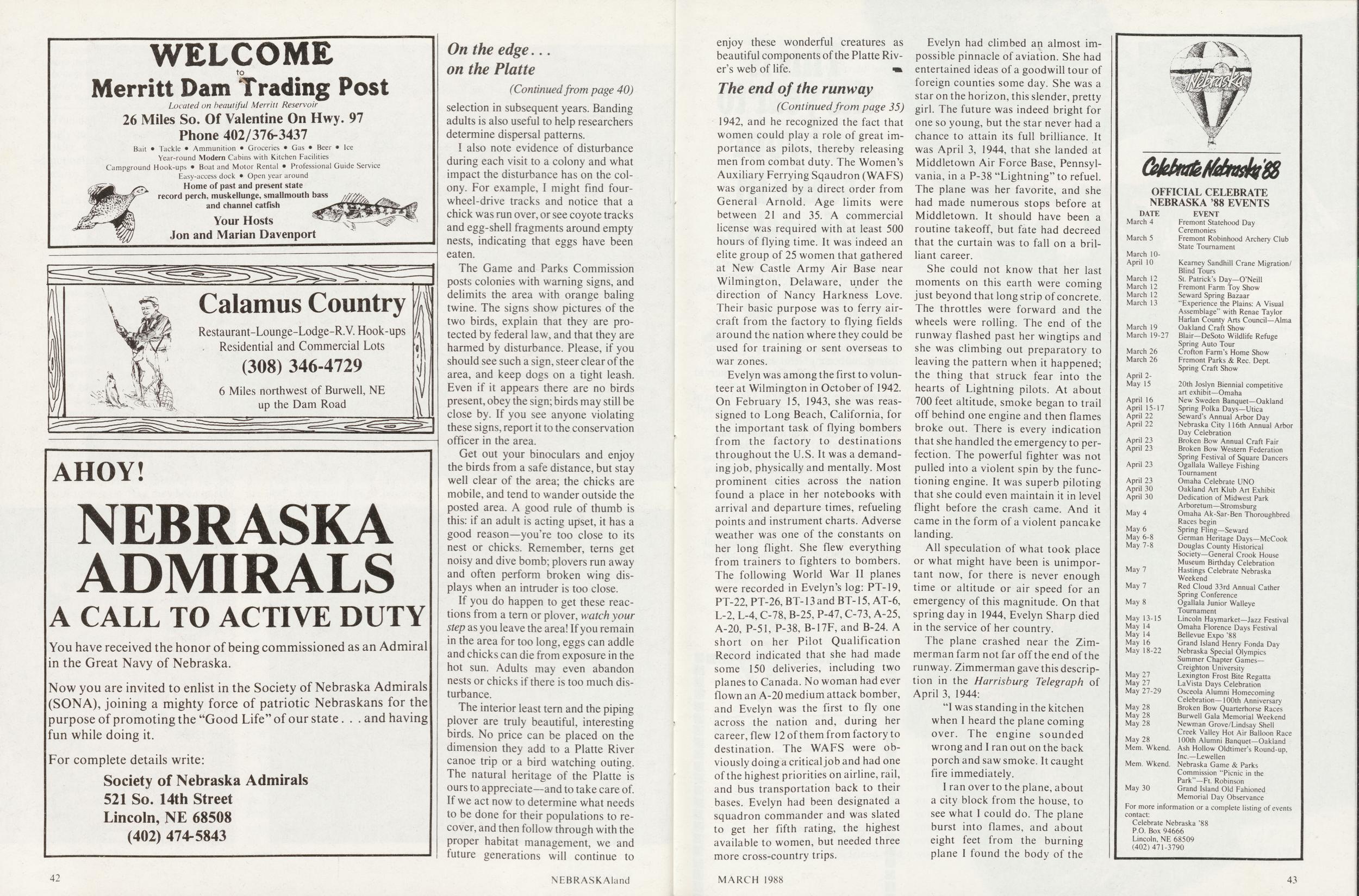
On the edge... on the Platte
(Continued from page 40)selection in subsequent years. Banding adults is also useful to help researchers determine dispersal patterns.
I also note evidence of disturbance during each visit to a colony and what impact the disturbance has on the colony. For example, I might find fourwheel-drive tracks and notice that a chick was run over, or see coyote tracks and egg-shell fragments around empty nests, indicating that eggs have been eaten.
The Game and Parks Commission posts colonies with warning signs, and delimits the area with orange baling twine. The signs show pictures of the two birds, explain that they are protected by federal law, and that they are harmed by disturbance. Please, if you should see such a sign, steer clear of the area, and keep dogs on a tight leash. Even if it appears there are no birds present, obey the sign; birds may still be close by. If you see anyone violating these signs, report it to the conservation officer in the area.
Get out your binoculars and enjoy the birds from a safe distance, but stay well clear of the area; the chicks are mobile, and tend to wander outside the posted area. A good rule of thumb is this: if an adult is acting upset, it has a good reason—you're too close to its nest or chicks. Remember, terns get noisy and dive bomb; plovers run away and often perform broken wing displays when an intruder is too close.
If you do happen to get these reactions from a tern or plover, watch your step as you leave the area! If you remain in the area for too long, eggs can addle and chicks can die from exposure in the hot sun. Adults may even abandon nests or chicks if there is too much disturbance.
The interior least tern and the piping plover are truly beautiful, interesting birds. No price can be placed on the dimension they add to a Platte River canoe trip or a bird watching outing. The natural heritage of the Platte is ours to appreciate—and to take care of. If we act now to determine what needs to be done for their populations to recover, and then follow through with the proper habitat management, we and future generations will continue to 42 NEBRASKAland enjoy these wonderful creatures as beautiful components of the Platte River's web of life.
The end of the runway
(Continued from page 35)1942, and he recognized the fact that women could play a role of great importance as pilots, thereby releasing men from combat duty. The Women's Auxiliary Ferrying Sqaudron (WAFS) was organized by a direct order from General Arnold. Age limits were between 21 and 35. A commercial license was required with at least 500 hours of flying time. It was indeed an elite group of 25 women that gathered at New Castle Army Air Base near Wilmington, Delaware, under the direction of Nancy Harkness Love. Their basic purpose was to ferry aircraft from the factory to flying fields around the nation where they could be used for training or sent overseas to war zones.
Evelyn was among the first to volunteer at Wilmington in October of 1942. On February 15, 1943, she was reassigned to Long Beach, California, for the important task of flying bombers from the factory to destinations throughout the U.S. It was a demanding job, physically and mentally. Most prominent cities across the nation found a place in her notebooks with arrival and departure times, refueling points and instrument charts. Adverse weather was one of the constants on her long flight. She flew everything from trainers to fighters to bombers. The following World War II planes were recorded in Evelyn's log: PT-19, PT-22, PT-26, BT-13 and BT-15, AT-6, L-2, L-4, C-78, B-25, P-47, C-73, A-25, A-20, P-51, P-38, B-17F, and B-24. A short on her Pilot Qualification Record indicated that she had made some 150 deliveries, including two planes to Canada. No woman had ever flown an A-20 medium attack bomber, and Evelyn was the first to fly one across the nation and, during her career, flew 12 of them from factory to destination. The WAFS were obviously doing a critical job and had one of the highest priorities on airline, rail, and bus transportation back to their bases. Evelyn had been designated a squadron commander and was slated to get her fifth rating, the highest available to women, but needed three more cross-country trips.
Evelyn had climbed an almost impossible pinnacle of aviation. She had entertained ideas of a goodwill tour of foreign counties some day. She was a star on the horizon, this slender, pretty girl. The future was indeed bright for one so young, but the star never had a chance to attain its full brilliance. It was April 3, 1944, that she landed at Middletown Air Force Base, Pennsylvania, in a P-38 "Lightning" to refuel. The plane was her favorite, and she had made numerous stops before at Middletown. It should have been a routine takeoff, but fate had decreed that the curtain was to fall on a brilliant career.
She could not know that her last moments on this earth were coming just beyond that long strip of concrete. The throttles were forward and the wheels were rolling. The end of the runway flashed past her wingtips and she was climbing out preparatory to leaving the pattern when it happened; the thing that struck fear into the hearts of Lightning pilots. At about 700 feet altitude, smoke began to trail off behind one engine and then flames broke out. There is every indication that she handled the emergency to perfection. The powerful fighter was not pulled into a violent spin by the functioning engine. It was superb piloting that she could even maintain it in level flight before the crash came. And it came in the form of a violent pancake landing.
All speculation of what took place or what might have been is unimportant now, for there is never enough time or altitude or air speed for an emergency of this magnitude. On that spring day in 1944, Evelyn Sharp died in the service of her country.
The plane crashed near the Zimmerman farm not far off the end of the runway. Zimmerman gave this description in the Harrisburg Telegraph of April 3, 1944:
"I was standing in the kitchen when I heard the plane coming over. The engine sounded wrong and I ran out on the back porch and saw smoke. It caught fire immediately.
I ran over to the plane, about a city block from the house, to see what I could do. The plane burst into flames, and about eight feet from the burning plane I found the body of the woman pilot. She had been thrown clear of the ship and I picked her up and carried her away from the wreckage because I was afraid it might explode.
OFFICIAL CELEBRATE NEBRASKA '88 EVENTS DATE EVENT March 4 Fremont Statehood Day Ceremonies March 5 Fremont Robinhood Archery Club State Tournament March 10- April 10 Kearney Sandhill Crane Migration/ Blind Tours March 12 St. Patrick's Day—O'Neill March 12 Fremont Farm Toy Show March 12 Seward Spring Bazaar March 13 "Experience the Plains: A Visual Assemblage" with Renae Taylor Harlan County Arts Council—Alma Oakland Craft Show Blair—DeSoto Wildlife Refuge Spring Auto Tour Crofton Farm's Home Show Fremont Parks & Rec. Dept. Spring Craft Show 20th Joslyn Biennial competitive art exhibit—Omaha New Sweden Banquet—Oakland Spring Polka Days—Utica Seward's Annual Arbor Day Nebraska City 116th Annual Arbor Day Celebration Broken Bow Annual Craft Fair Broken Bow Western Federation Spring Festival of Square Dancers Ogallala Walleye Fishing Tournament Omaha Celebrate UNO Oakland Art Klub Art Exhibit Dedication of Midwest Park Arboretum—Stromsburg Omaha Ak-Sar-Ben Thoroughbred Races begin Spring Fling—Seward German Heritage Days—McCook Douglas County Historical Society—General Crook House Museum Birthday Celebration Hastings Celebrate Nebraska Weekend Red Cloud 33rd Annual Cather Spring Conference Ogallala Junior Walleye Tournament Lincoln Haymarket—Jazz Festival Omaha Florence Days Festival Bellevue Expo '88 Grand Island Henry Fonda Day Nebraska Special Olympics Summer Chapter Games— Creighton University Lexington Frost Bite Regatta LaVista Days Celebration Osceola Alumni Homecoming Celebration—100th Anniversary Broken Bow Quarter horse Races Burwell Gala Memorial Weekend Newman Grove/Lindsay Shell Creek Valley Hot Air Balloon Race 100th Alumni Banquet—Oakland Ash Hollow Oldtimer's Round-up, Inc.—Lewellen Nebraska Game & Parks Commission "Picnic in the Park"—Ft. Robinson Grand Island Old Fashioned Memorial Day Observance For more information or a complete listing of events contact: Celebrate Nebraska '88 P.O. Box 94666 Lincoln, NE 68509 (402)471-3790 March 19 March 19-27 March 26 March 26 April 2- May 15 April 16 April 15-17 April 22 April 22 April 23 April 23 April 23 April 23 April 30 April 30 May 4 May 6 May 6-8 May 7-8 May 7 May 7 May 8 15 May 13 May 14 May 14 May 16 May 18-22 May 27 May 27 May 27-29 May 28 May 28 May 28 May 28 Mem. Wkend. Mem. Wkend. May 30 MARCH 1988 43
Join us as we "Celebrate Nebraska '88." It's a year-long celebration of the special events, special people and special places that make Nebraska truly unique. Pack your tent or load up your R-V and take advantage of the camping, hiking, fishing, and boating Nebraska offers; from the rolling wooded hills of the river country to the majestic sandstone monuments of the western range. Over 100 lakes, 5,000 miles of river, and 100,000 acres of state and national parkland offer an incredible variety of outdoor activities. It's all in one state. But that's what makes Nebraska special. And that's why we invite you to come join us this year. '88 is the year of celebration. The year for reunions. The year to discover or rediscover. The year to grab your outdoor gear and put your stake in Nebraska!
For a preview of the events and attractions of Celebrate Nebraska '88, just write for your free copy of our 32-page, full color Vacation Nebraska visitors guide and 1988 Events Calendar, or call toll-free out-of-state 1-800-228-4307; in-state 1-800-742-7595.
Send for your FREE kit. Bring a friend home for a visit in '88. Name__ Address City___ State___ Zip. Campground information Lodging information 88010 Mail to: Nebraska Department of Economic Development, Division of Travel and Tourism P.O. Box 94666, Lincoln, NE 68509.It looked as though she had tried to escape through the emergency door at the top of the plane but was thrown out headlong .... I thought she was dead when I picked her up, but I wasn't sure . . . ."
There was a visible display of emotion at the crash scene according to the Harris burg Telegraph.
"Tears dimmed the eyes of some of the soldiers as they saw the body of the slight woman tenderly lifted and placed in the Richardson car. A Lieutenant, whose identity was not disclosed, said, "I've seen tragedies before and it's tough to see a boy lose his life but this is the first time I have seen a woman make the supreme sacrifice."
He was visibly shaken by the ordeal because he had spoken with the pilot only a few minutes earlier."
There were heavy hearts and deep personal anguish when the body of Evelyn Sharp was returned to Ord. At a time when tragedy was common place, her death had a special sadness to it, and her funeral was testimonial to the high esteem in which she was held. The Ord Quiz of April 13, 1944, carried that testimonial.
"One of the biggest crowds attended one of the most tragic funerals Sunday afternoon ... when hundreds came in final tribute to Evelyn Sharp, slim, dark-haired Valley County girl who died in a plane crash near Middletown, Pa., Monday, Apr. 3. Always a favorite in Valley County since the school days when she learned to fly at 15 years, Evelyn's funeral was a tremendous tribute to her popularity. .. . Mounds of flowers were everywhere."
The sun has set on a "romantic era" of aviation. Jack Jefford, Evelyn's instructor, became a prominent figure in Alaskan aviation and was an FAA pilot for the state. He passed away at his home in the fall of 1979. Dr. Glen Auble, a benefactor and friend and long retired from optometry, now is also gone.
Evelyn had 4,115 flying hours at the time of her death at age 24. She left an indelible print on aviation. She is a tribute to perseverance and patriotism. And, she is a tribute to the warmth and friendship of the people in a small Sandhills town of Nebraska. There's a marker by the side of the road just north of Ord. Nearby is Evelyn Sharp Field, where a young girl learned to fly in an old airplane.
The men of Agate
(Continued from page 21)with claws. And there was also a handful of giant pigs.
Captain Cook had been interested in fossils since he met O.C. Marsh of the Smithsonian Institute at the Red Cloud Agency in 1875. Cook also had guided Marsh and other paleontologists in the southwest and Wyoming before coming to Agate Springs Ranch. From those associations, and from books, he learned much about fossils, geology and scientific terminology, and he knew there were fossils on the ranch when he bought it.
The fossils coming out of Carnegie Hill interested Captain Cook, but they positively fascinated his son, Harold, who was 17 at the time. Harold had grown up working cattle, breaking horses, putting up hay and hunting antelope, coyotes and wolves. He loved everything about ranch life. But, he soon found himself spending every spare minute at the digs, and perhaps some time that should have been spent on ranch duties, as well.
Harold learned much about paleontology from the parties digging on the ranch, and that knowledge served him well when he enrolled at the University of Nebraska to study under Professor Barbour. Even before he completed his undergraduate work at Nebraska, Dr. H.F. Osborn, professor of vertebrate paleontology at Columbia University postgraduate school, invited Harold to study under him in New York.
Harold accepted, over the objections of his father, who was afraid his son would be "weaned from the idea of carrying on here at the ranch." Professor Osborn had confidence in the younger Cook, and, to allow him to complete the course in one year, assigned him 38 hours of classroom work. In addition, Harold worked at the American Museum of Natural History, identifying and cataloging fossils, to earn money for expenses. A typical day included classes from 7 a.m. to 2 p.m., then work at the museum until midnight.
SANDHILL CRANE Sandhill Crane poster taken from a woodcut print by former Nebraskan and nationally known artist Marci McDonald. Poster size is 18x22. $28.50 plus $2.50 postage and handling. Nebraska residents add 4% sales tax. Allow 3 to 4 weeks delivery. STUDIO 13 Art Gallery P.O. Box 408 142 Elm Ave. Elm Creek, NE 68836 Aaahh! EXPERIENCE NEBRASKA... *%*'** with an affordable canoe trip by DRYLAND AQUATICS • Niobrara • Dismal • Platte • Elkhorn -YOU NAME IT- One & two day trips available canoe rental only or fully catered —WE DO IT YOUR WAY— Write for Free brochure Dryland Aquatics, Deot. N 1837 E.Cuming Fremont, NE 68025 Ph. (402) 721-4177 MARCH 1988 45 OUTFITTING YOU FOR THE GOOD OF
Nebraska's largest selection of quality
name brand sporting goods.
Count on us to provide you with the finest outdoor clothing
and equipment at special low prices. See Burden's Outdoor
Outfitters when you're in Lincoln. Get the best of the outdoors.
Camping • Hunting • Fishing • Boating • Backpacking
X-Country Skiing • Water Sports • Boots, Shoes, Waders
Mens, Women's, Children's Functional
Outdoor Clothing and Gear
1000 West "0" Street
Lincoln, NE 68528
474-4366
BURDEN'S
o.
owM
Free Parking
MasterCard
"3333
NEBRASKAland Magazine
Now off the press and ready for the kitchen, the
all-new NEBRASKAland Country Cookbook will
be favorite reading. Perfect as a gift for friends
and relatives, it is only $8.50, or will be
included as part of a gift subscription at
only $12 for one year.
Name
Street
City, State, ZIP
Mail to: NEBRASKAland, Box 30370, Lincoln, NE 68503
46
NEBRASKAland
OUTFITTING YOU FOR THE GOOD OF
Nebraska's largest selection of quality
name brand sporting goods.
Count on us to provide you with the finest outdoor clothing
and equipment at special low prices. See Burden's Outdoor
Outfitters when you're in Lincoln. Get the best of the outdoors.
Camping • Hunting • Fishing • Boating • Backpacking
X-Country Skiing • Water Sports • Boots, Shoes, Waders
Mens, Women's, Children's Functional
Outdoor Clothing and Gear
1000 West "0" Street
Lincoln, NE 68528
474-4366
BURDEN'S
o.
owM
Free Parking
MasterCard
"3333
NEBRASKAland Magazine
Now off the press and ready for the kitchen, the
all-new NEBRASKAland Country Cookbook will
be favorite reading. Perfect as a gift for friends
and relatives, it is only $8.50, or will be
included as part of a gift subscription at
only $12 for one year.
Name
Street
City, State, ZIP
Mail to: NEBRASKAland, Box 30370, Lincoln, NE 68503
46
NEBRASKAland
Harold successfully completed his work and returned home the following spring, but was not "weaned" from carrying on with the ranch work as his father had feared. Harold went back to the fencing, roping and haying that was necessary, but also spent a lot of time with the scientists and field crews working at the fossil quarries.
Although he continued to manage the ranch, Harold took part in a number of projects and held several positions involving paleontology, archaeology, and geology, although many were temporary or honorary. He was involved with the investigation of the Folsom site in New Mexico, where early-man stone points were first recorded in association with fossil bones; the Yuma sites in Colorado; and the famous Eden Valley site in Wyoming. His activities in these areas declined over the years, although he maintained membership in many scientific societies.
Beginning with the Indians soon after Captain Cook arrived at Agate Springs Ranch, then with the paleontologists and later with school groups and curious tourists, the Cook family had always welcomed visitors to the ranch. The elder Cook opened his home so that visitors could see his collection of Indian artifacts and other memorabilia, and began to call his home the "Cook Museum of Natural History." And Harold conducted tours of the fossil quarries for school groups, explaining the significance of the bones.
Captain Cook had always wanted to somehow preserve the fossil beds for the benefit of the public, and Harold, his son, dreamed of seeing them become a national monument. When Harold died in 1962, his widow, Margaret, and a number of local citizens formed an association that worked for that purpose. With support of Nebraska's congressional delegation, particularly Senator Roman Hruska, legislation was passed and on June 5, 1965, signed into law by President Lyndon Johnson.
Today, Agate Fossil Beds National Monument consists of about 3,000 acres, including Carnegie and University hills, but development of visitor facilities has been minimal. At present, there is only a temporary visitor center consisting of a few displays in a mobile home, plus trails to the fossil quarries. A new visitor center, which is awaiting funding by the National Park Service and is perhaps a half-dozen years from becoming reality, will someday continue the Cook family's tradition of welcoming visitors to Agate.
11th ANNUAL NEBRASKA HABITAT STAMP ART CONTEST Submission Entries may be protected by a covering but will not be accepted in frames, under glass or plastic wrap. Wrap securely and send to: Habitat Stamp Contest, Nebraska Game and Parks Commission, 2200 N. 33rd St., P.O. Box 30370, Lincoln, NE 68503. A completed entry form and reproduction agreement or facsimile thereof must accompany the entry. Name and address of the artist must appear only on the reverse side of the entry. The Game and Parks Commission is not responsible for any entry lost or damaged in transit. ENTRIES WILL NOT BE RETURNED UNLESS SPECIFICALLY REQUESTED AND SELF ADDRESSED MAILER WITH PROPER POSTAGE IS INCLUDED. Prizes Adult division first place winner receives $200 from the Omaha Fish and Wildlife Club. Runners-up all receive a subscription to NEBRASKAland Magazine. Youth Division first place winners in each section receive $50 from the Omaha Fish and Wildlife Club. Runners-up all receive a subscription to NEBRASKAland Magazine. Selected entries will be included in a traveling exhibit to be displayed at various locations around the state. Divisions Adult: Amateur or professional artists. Youth: Senior Section: Grades 9-12; Junior Section: Grades 5-8; Primary Section: Grades K-4. Technical Requirements Design must be 71/2 inches by 411/ie inches. It may be matted, but mat may not exceed 10 inches by 7 inches. Any medium acceptable, but no scroll work or lettering may appear on the design. Color is preferred. One entry per person. Subject Matter Any Nebraska wildlife species in an appropriate habitat setting, except wild turkey, cardinal, sharp-tailed grouse, sandhill crane and snow geese which are ineligible this year. Entry Deadline March 1, 1988 Contest is open to Nebraska residents only, and winning entry in the Adult Division will appear on the 1989 Nebraska Habitat Stamp. Entry Form Please accept my entry in the design contest for the 1989 Nebraska Habitat Stamp. I hereby certify that I have complied with all of the rules governing this competition and that the work submitted is my own original creation. Further, the Nebraska Game and Parks Commission is hereby authorized to reproduce the design on the 1989 Habitat Stamp or in any other fashion it may deem appropriate. Division/Section Name .Grade in School. .Age if under 19. Address. City, State, Zip Home Phone _ .School Phone. Name of School. School Address. City, State, Zip _ □ Please return my entry. I have included the appropriate postage. Signature of Artist__________________________________________________ MARCH 1988 47 MARSHWATCHER
DUCKS UNLIMITED- LEADER IN WETLANDS CONSERVATION- 50 YEARS
Green-winged teal
The smallest of ducks, this trim
"dabbler", or non-diving duck-, has a
breeding range that extends from the
Maritimes across Canada and from the
central U.S. to Alaska. It is an early
spring migrant, says Ducks Unlimited,
arriving soon after the first pintails
and mallards and well ahead of the
blue-winged teals.
Greenwing nests are located on
dry land, usually well concealed in
a grass clump or beneath low shrubs.
Southward migration is leisurely, with
the birds lingering as long as good
feeding marshes remain unfrozen.
WILDLIFE
How You Can Help Non-Game Wildlife
River otters swim in Nebraska waters again, after being
gone some 80 years. They've been brought back by the
Game and Parks Commission using money Nebraskans
donated from their state income tax refunds. If you want
to help river otters—or peregrine falcons or endangered
wildflowers, or other nongame wildlife, look for the falcon
symbol on your state tax form and follow the instructions,
Or simply send a check, payable to the Nongame
Conservation Fund, to the Game and Parks Commission,
Box 30370, Lincoln, NE 68503
MARSHWATCHER
DUCKS UNLIMITED- LEADER IN WETLANDS CONSERVATION- 50 YEARS
Green-winged teal
The smallest of ducks, this trim
"dabbler", or non-diving duck-, has a
breeding range that extends from the
Maritimes across Canada and from the
central U.S. to Alaska. It is an early
spring migrant, says Ducks Unlimited,
arriving soon after the first pintails
and mallards and well ahead of the
blue-winged teals.
Greenwing nests are located on
dry land, usually well concealed in
a grass clump or beneath low shrubs.
Southward migration is leisurely, with
the birds lingering as long as good
feeding marshes remain unfrozen.
WILDLIFE
How You Can Help Non-Game Wildlife
River otters swim in Nebraska waters again, after being
gone some 80 years. They've been brought back by the
Game and Parks Commission using money Nebraskans
donated from their state income tax refunds. If you want
to help river otters—or peregrine falcons or endangered
wildflowers, or other nongame wildlife, look for the falcon
symbol on your state tax form and follow the instructions,
Or simply send a check, payable to the Nongame
Conservation Fund, to the Game and Parks Commission,
Box 30370, Lincoln, NE 68503
A Presidential "field day"
(Continued from page 31)from the fairgrounds, where the 1987 county fair was in progress, to the arena and back. City officials again broke out the street flags taken down after NEBRASKAland Days festivities in June.
The President arrived on schedule amid fine weather. About 15,000 people began filing into the Wild West Arena at 11 a.m. for the scheduled 1:30 p.m. speech. They were entertained during the long wait by 10 groups, including Miss Nebraska, Mindee Zimmerman; a gospel singing group from Oklahoma that happened to be in town on a tour; Swedish folk dancers, square dancers and doggers; and two country-western bands. It was, White House advance people said, the first time in memory of "Hail to the Chief being played country-western.
Then it was all over, except for the cleanup and a post-visit barn dance at the Long ranch for volunteers. A few of the advance team stayed over. "One guy was so proud of his new western boots, he spent all evening walking up to people and saying, 'Notice anything different about me?' " Smith said.
"We'd been working on adrenalin for nine days—working hard and having a good time at it, meeting new people. We made some new friends and I think they had a good time. Then they were gone, just as suddenly as they had arrived. It almost seemed like it didn't ever happen; like a dream."
NEBRASKAland proudly presents the stories of its readers. Here is the opportunity so many have requested—a chance to tell their own outdoor tales. Hunting trips, the "big fish that got away", unforgettable characters, outdoor impressions—all have a place here. If you have a story to tell, jot it down and send it to Editor, NEBRASKAland, Box 30370, Lincoln, Nebr. 68503. Send photographs, black and white or color, too, if any are available. 48 NEBRASKAlandTrading Post
DOGSTRAINING ALL BREEDS Hunting Dogs - Vizslas for sale. Rozanek Kennels, Rt. 2, Schuyler, NE 68661. Phone (402) 352-8769. __________________________
ENGLISH SETTERS: "Bred for the hunter"; select puppies and started dogs available from outstanding bloodlines. Stud service available by proven hunters. High Plains Kennels, 1411 Emerson, Alliance, NE 69301, Phone (308) 762-6709._______________________
GROUSEWAY BRITTANIES: Ideal huntingcompanions—dedicated, goal-oriented breeding programs. brochure, Grouseway Gundogs, Louisville, NE 68037. (402) 397-6157. Training available.___________
GERMAN SHORTHA1RS and Brittany Spaniel pups. Started and occasionally a meat dog. Pups are guaranteed. Also 1 will be training hunting dogs. Wayne Clark, Percival, 1A. Phone (712) 529-4238 or (402) 263-3155 at Union, NE._______________________
AKC BLACK LAB pups. Carry chocolate gene. Field trial bloodlines. Guaranteed. 3-year-old chocolate Lab also for sale. Call (402) 331-2474____________________
ENGLISH SETTERS: Young dogs available from two well-bred litters. Born early 1987. Darrell Yentes. Phone (308) 995-8570 or (308) 995-4797 after 5 p.m.
YELLOW-BLACK Lab pups. FC-AFC sired. AKC. Hips certified. Dew claws removed. Excellent hunting potential. Contact Bob Bendler (308) 324-4247.
MISCELLANEOUSNE NEBRASKA trout fishing. 3 modern cottages, I available year round. 5 spring fed lakes with open water all year. Trout up to 7 pounds. Other varieties fish also. Diamond E. Trout Resort, Orchard, NE 68764. Phone (402) 893-4745.___________________________________
GUNS - - Browning, Winchester, Remington, others, Hi-powers, shotguns, new, used, antiques. Want Pre-1964 Winchesters. Buy-Sell-Trade. Ph. (402) 729-6112. Bedlan's Sporting Goods, Fairbury, NE 68352.
MAD RIVER CANOES offers the finest quality and performance. For the finest canoes and accessories look to Great Plains Canoe Co., 205 Main, Springfield, NE. Phone (402) 253 2001. ___________________
AIR GUNS repaired Benjamin, Crosman, Daisy, other American made. Restoration; old guns wanted. Jack's Air Guns, 1225 No. 46th, Lincoln, NE 68503. Phone (402) 466-9223.___________
TROLLING MOTOR REPAIR. Factory authorized Minn Kota and Motor Guide, parts and service. Wolf's Repair and Installation, 1529 David Drive, Lincoln, NE 68504. Phone (402) 464-4265. ________________
WINE AND BEER: Make your own. Send for free recipes and instructions. Omaha Supply, 1324 2nd Avenue, Nebraska City, NE 68410._________________
LINCOLN CHAPTER of Izaak Walton League is holding an indoor fund-raising auction at their headquarters, located outside Lincoln, '/2-mile south of 134th Street and Highway 2, on March 22. Dinner will be venison and turkey. Door prizes and entertainment will be provided. Tickets $7.50 single, $10 couple. For more information call Del Miller (402) 488-1640.
UNLIMITED FREE KODAK film, plus free 35mm camera with warranty. Toll free 1-800-433-6312 (24 hours).
GARDEN SEEDS: Complete line of bulk vegetable seeds from Va oz. up. Save with our catalog. Vap's Seed and Hardware, Box 448, McCook, NE 69001._______
HOW TO USE five top lures for bass in Midwest. Send $3 to R.D.M., Box 1603, Norfolk, NE 68701.________
COTTONWOOD PRESS for all your printing needs. We can do family histories, newsletters, pamphlets, booklets, and even cookbooks. Write to Cottonwood Press and tell us what your printing needs are. 404 N. Wheeler, Grand Island, NE 68801 or call (308) 384- 0409 anytime.
TAXIDERMYALLISON'S TAXIDERMY STUDIO. Wally and Betty Allison, Licensed Taxidermist. We've mounted 21 Nebraska State Record fish. Specializing in fish and birds, small game and rattlesnakes. We use freeze-dry. 2310 West Leota, North Platte, Nebr. 69101. Phone (308) 534-2324.____________________________________
BADE TAXIDERMY - Quality a must — Fast service. Fish, birds, rugs, tanning, full mounts and game heads, 2111 N. Christy St., Fremont, NE 727-5463.
NABITY'S TAXIDERMY. 31 years experience. Specializing in natural grass backgrounds for mammals, birds and fish. 13901 "O" St., Lincoln, NE 68504 — 4 miles east of 84th and "O". (402) 489-6351.
BIG BEAR TAXIDERMY, Rt. 2, Mitchell, Nebraska 69357. We specialize in all big game from Alaska to Nebraska, also birds and fish. Hair on and hair off tanning. Four miles west of Scottsbluff on Highway 26. Dale Hubel, phone (308) 635-3013.___________
PEISTER TAXIDERMY - Professional work at prices most sportsman can afford. Now in our new log cabin studio, 1020 Central Avenue, Box 3201, Kearney, NE 68847. Phone (308) 236-9700or (308) 237-7575 evenings.
NATURECRAFT STUDIO — all custom services — creative work, quality, and experience since 1935. Includes freeze-dry processing. Display and sales room, visitors welcome. Hwy. 2 in Nebraska City. Phone (402) 873-5491. Joe Voges — Owner. Bow Steedly — Big Game specialist.
GUN DOG TRAINING All Sporting Breeds All dogs worked on foot — no horses. Midwest's finest facilities. Field Champion-sired Labrador pups for sale. "Training for hunters by hunters" WILDERNESS KENNELS Henry Sader—Roca, Ne. (402)423-4212 68430 NEBRASKAland Magazine Order Form Please send me a subscription to NEBRASKAland Magazine EH One-year $12.00 NAME___ □ ADDRESS Two-year $23.00 CJTY____ STATE ZIP Mail to: NEBRASKAland Magazine, Box 30370, Lincoln, NE 68503 CEDAR LANE - Ranch Vacations • Guest ranch in the heart of the Sandhills of Nebraska, Swimming, spa, horses, canoeing, trail rides, barbeques, hunting, family reunions. BOOKING NOW For 1988 Richard and Betty Schroeder HC 2 Box 9C Stapleton, Nebraska 69163 Ph. 308-587-2233 PINE RIDGE OUTFITTERS Guided hunts in the Pine Ridge for Elk, Deer, Antelope, Turkey, Ducks and Geese on the North Platte River. Quality hunts for your needs. Archery or Rifle. Call or write Allan Mintken. (308) 423-5923 HC74 Box 49 Chadron, NE 69337 Woodsy Owl says Stash Your Trash LIVE-CATCH ALL-PURPOSE TRAPS Wrftmtof FREE CATALOG Traps without injury squirrels, chipmunks, rabbits, mink, fox, raccoons, stray animals, pests, etc Sizes for every need Also traps for snakes, sparrows, pigeons, crabs, turtles, quail, etc Save on our low factory prices Send no money Free catalog and trapping secrets MUSTANG MFG. CO., Dept. N-34, Box 920947, Houston Tex. 77292 STOCK YOUR LAKE OR POND WITH Channel cat, Bluegil!, Largemouth Bass, Hybrid Bluegill, Crappie, "Diploid Grass Carp, Minnows ORDER NOW WILLOW LAKE FISH HATCHERY Rt. 3, Box 46, Hastings, Nebr. 68901 Gaylord L. Crawford Phone: (402) 463-8022 Day or Night For April to October 15 stocking MARCH 1988 49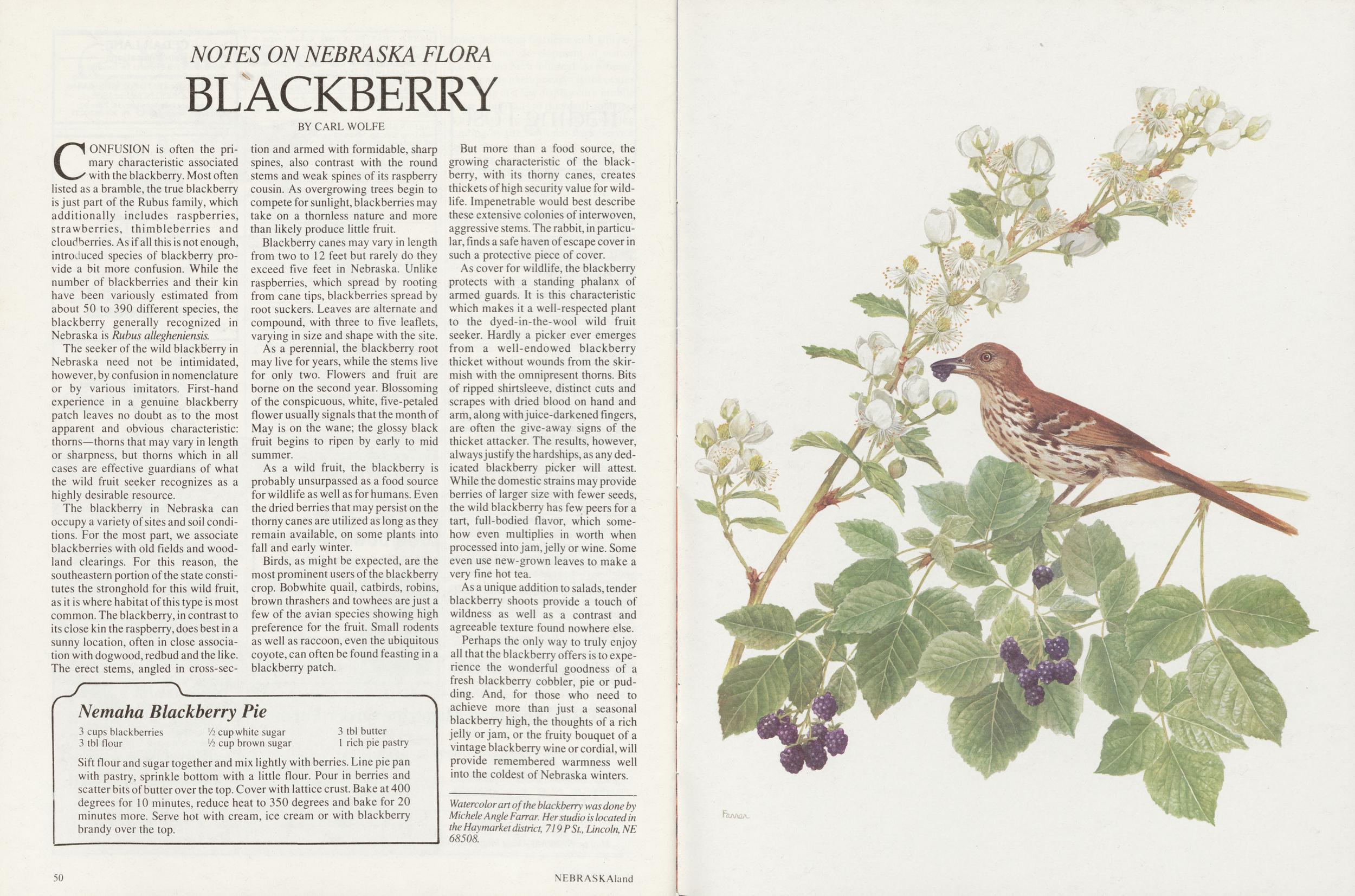
NOTES ON NEBRASKA FLORA BLACKBERRY
BY CARL WOLFECONFUSION is often the primary characteristic associated with the blackberry. Most often listed as a bramble, the true blackberry is just part of the Rubus family, which additionally includes raspberries, strawberries, thimbleberries and cloudberries. As if all this is not enough, introduced species of blackberry provide a bit more confusion. While the number of blackberries and their kin have been variously estimated from about 50 to 390 different species, the blackberry generally recognized in Nebraska is Rubus allegheniensis.
The seeker of the wild blackberry in Nebraska need not be intimidated, however, by confusion in nomenclature or by various imitators. First-hand experience in a genuine blackberry patch leaves no doubt as to the most apparent and obvious characteristic: thorns—thorns that may vary in length or sharpness, but thorns which in all cases are effective guardians of what the wild fruit seeker recognizes as a highly desirable resource.
The blackberry in Nebraska can occupy a variety of sites and soil conditions. For the most part, we associate blackberries with old fields and woodland clearings. For this reason, the southeastern portion of the state constitutes the stronghold for this wild fruit, as it is where habitat of this type is most common. The blackberry, in contrast to its close kin the raspberry, does best in a sunny location, often in close association with dogwood, redbud and the like. The erect stems, angled in cross-section and armed with formidable, sharp spines, also contrast with the round stems and weak spines of its raspberry cousin. As overgrowing trees begin to compete for sunlight, blackberries may take on a thornless nature and more than likely produce little fruit.
Blackberry canes may vary in length from two to 12 feet but rarely do they exceed five feet in Nebraska. Unlike raspberries, which spread by rooting from cane tips, blackberries spread by root suckers. Leaves are alternate and compound, with three to five leaflets, varying in size and shape with the site.
As a perennial, the blackberry root may live for years, while the stems live for only two. Flowers and fruit are borne on the second year. Blossoming of the conspicuous, white, five-petaled flower usually signals that the month of May is on the wane; the glossy black fruit begins to ripen by early to mid summer.
As a wild fruit, the blackberry is probably unsurpassed as a food source for wildlife as well as for humans. Even the dried berries that may persist on the thorny canes are utilized as long as they remain available, on some plants into fall and early winter.
Birds, as might be expected, are the most prominent users of the blackberry crop. Bobwhite quail, catbirds, robins, brown thrashers and towhees are just a few of the avian species showing high preference for the fruit. Small rodents as well as raccoon, even the ubiquitous coyote, can often be found feasting in a blackberry patch.
Nemaha Blackberry Pie 3 cups blackberries 3 tbl flour Vi cup white sugar Vi cup brown sugar 3 tbl butter 1 rich pie pastry Sift flour and sugar together and mix lightly with berries. Line pie pan with pastry, sprinkle bottom with a little flour. Pour in berries and scatter bits of butter over the top. Cover with lattice crust. Bake at 400 degrees for 10 minutes, reduce heat to 350 degrees and bake for 20 minutes more. Serve hot with cream, ice cream or with blackberry brandy over the top.But more than a food source, the growing characteristic of the blackberry, with its thorny canes, creates thickets of high security value for wildlife. Impenetrable would best describe these extensive colonies of interwoven, aggressive stems. The rabbit, in particular, finds a safe haven of escape cover in such a protective piece of cover.
As cover for wildlife, the blackberry protects with a standing phalanx of armed guards. It is this characteristic which makes it a well-respected plant to the dyed-in-the-wool wild fruit seeker. Hardly a picker ever emerges from a well-endowed blackberry thicket without wounds from the skirmish with the omnipresent thorns. Bits of ripped shirtsleeve, distinct cuts and scrapes with dried blood on hand and arm, along with juice-darkened fingers, are often the give-away signs of the thicket attacker. The results, however, always justify the hardships, as any dedicated blackberry picker will attest. While the domestic strains may provide berries of larger size with fewer seeds, the wild blackberry has few peers for a tart, full-bodied flavor, which somehow even multiplies in worth when processed into jam, jelly or wine. Some even use new-grown leaves to make a very fine hot tea.
As a unique addition to salads, tender blackberry shoots provide a touch of wildness as well as a contrast and agreeable texture found nowhere else.
Perhaps the only way to truly enjoy all that the blackberry offers is to experience the wonderful goodness of a fresh blackberry cobbler, pie or pudding. And, for those who need to achieve more than just a seasonal blackberry high, the thoughts of a rich jelly or jam, or the fruity bouquet of a vintage blackberry wine or cordial, will provide remembered warmness well into the coldest of Nebraska winters.
Watercolor art of the blackberry was done by Michele Angle Farrar Her studio is located in the Hay market district, 719 P St., Lincoln, NE 68508. 50 NEBRASKAland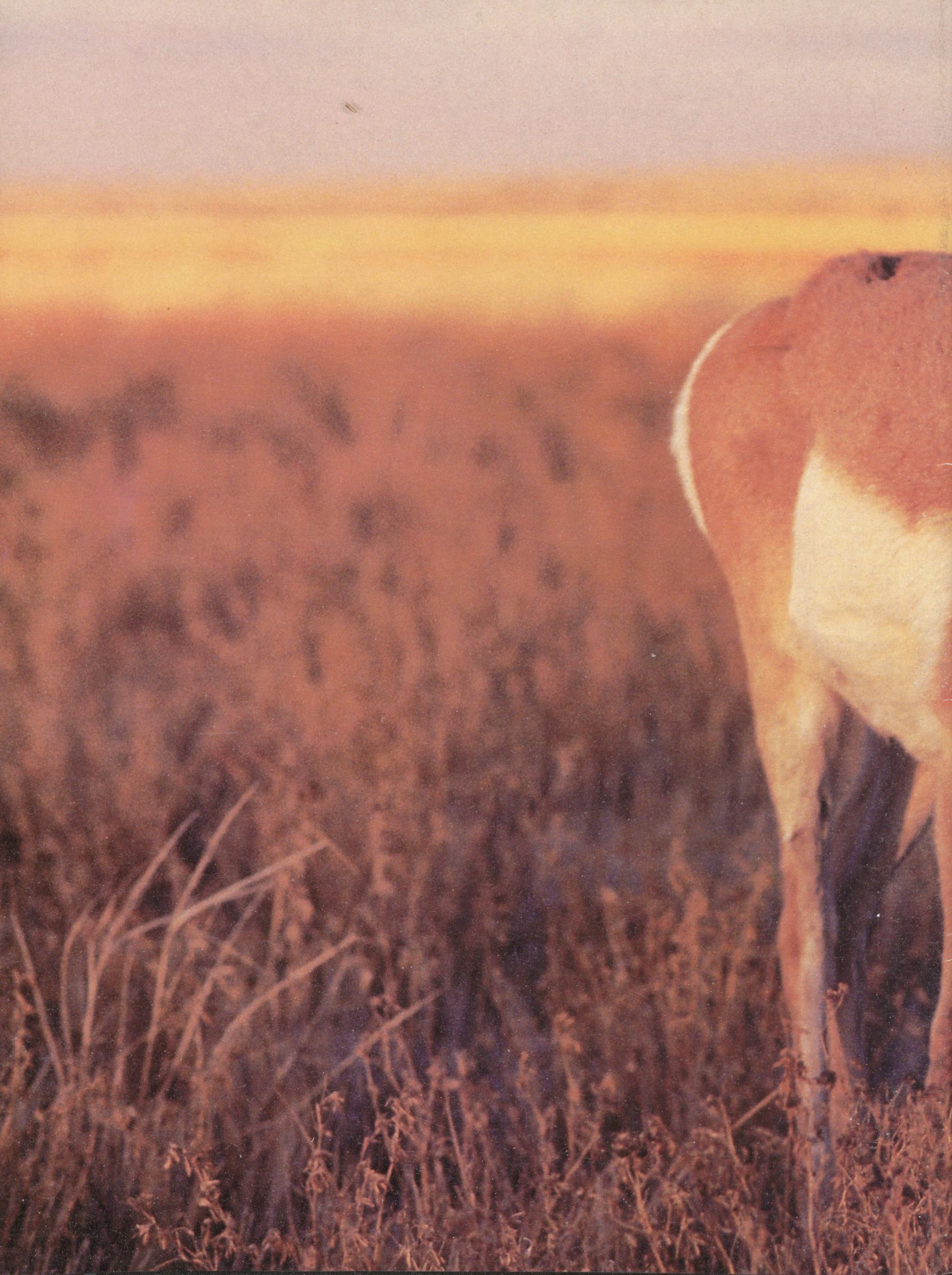
Position: 89 (66 views)