Volume 65, Issue 10, 1987
NEBRASKAland
DECEMBER 1987 $1.50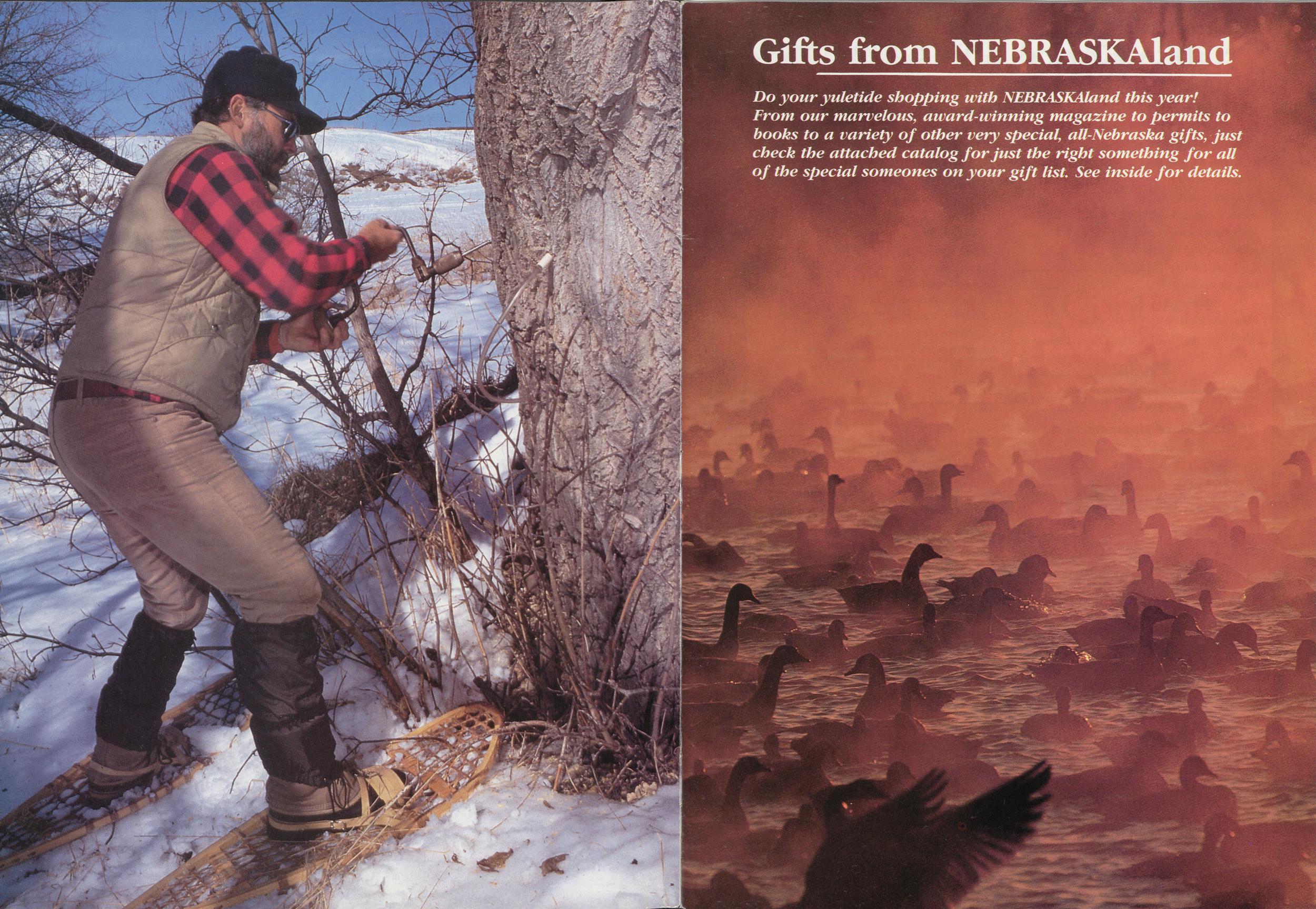
Gifts from NEBRASKAland
Do your yuletide shopping with NEBRASKAland this year! From our marvelous, award-winning magazine to permits to books to a variety of other very special, all-Nebraska gifts, just check the attached catalog for just the right something for all of the special spotneones on your gift list. See inside for details. SANDHILL
CRANE
Sandhill Crane poster taken
from a woodcut print by
former Nebraskan and
nationally known artist Marci
McDonald. Poster size is
18x22. $28.50plus $2.50
postage and handling. Nebraska
residents add 4% sales tax.
Allow 3 to 4 weeks delivery.
STUDIO 13 Art Gallery
P.O. Box 408
142 Elm Ave.
Elm Creek, NE 68836
Railroads
of Nebraska
1988 Calendar
Don't miss the 1st Annual Railroads
of Nebraska" 1988 Calendar.
This special edition features 12 pen
and ink drawings by native Nebraska
artist Michael Bristol.
Each month offers a different drawing
of trains and depots from Nebraska's
past and present.
Suitable for Framing
Open size 11 xl 7; Drawings
$6.00 Delivery!
Add $1 per calendar shipping
Nebraska residents add 4% tax
Michael Bristol
Box 143 - Hector Street
Cordova, Ne. 68330
SANDHILL
CRANE
Sandhill Crane poster taken
from a woodcut print by
former Nebraskan and
nationally known artist Marci
McDonald. Poster size is
18x22. $28.50plus $2.50
postage and handling. Nebraska
residents add 4% sales tax.
Allow 3 to 4 weeks delivery.
STUDIO 13 Art Gallery
P.O. Box 408
142 Elm Ave.
Elm Creek, NE 68836
Railroads
of Nebraska
1988 Calendar
Don't miss the 1st Annual Railroads
of Nebraska" 1988 Calendar.
This special edition features 12 pen
and ink drawings by native Nebraska
artist Michael Bristol.
Each month offers a different drawing
of trains and depots from Nebraska's
past and present.
Suitable for Framing
Open size 11 xl 7; Drawings
$6.00 Delivery!
Add $1 per calendar shipping
Nebraska residents add 4% tax
Michael Bristol
Box 143 - Hector Street
Cordova, Ne. 68330
SPeak Up
Catalog ErrorWe goofed last month! The J988 Trout Stamp is still only $5.00. The order form included with our gift catalog (also in this issue) mistakenly lists the Trout Stamp at $7.50. If you plan to order a stamp through this catalog, please remit only $5 . . . the price quoted with the photo of the stamp. Sorry about the mixup. (Editor)
* * * OverlookedThrough an oversight, Holiday Hunting Inc. was not included in the list of controlled shooting areas open to the public that appeared on page 15 of the November NEBRASKAland. Holiday Hunting offers pheasant, quail, chukar and turkey hunting. For information write: Mylan VanNew kirk, Holiday Hunting Inc., 201 Chuckwagon Rd., Ogallala, NE 69153 (308-284-3623). (Editor)
* * * MemoriesSir/What an article! "Don't Shoot Your Eye Out." Your story and pictures in the October issue have taken me back some 30 years. As a young boy in O'Neill, I, too, remember the warnings from my mother, neighbors, etc.
What a dream! My own Daisy air rifle. Seems as only yesterday. Thank you for shedding the years and relighting old memories. As usual, your pictures and stories are first class!
Jim Davidson Lincoln, NE * * * No clutterSir / Your article on the Bowring Ranch was excellent, however, I don't believe Mrs. Bowring would have approved of the clutter on the table and chair as shown on page 21.1 had the privilege of visiting her in her home many times, and it is a beautiful reflection of this gracious lady.
The Bowring Ranch is a fine addition to the state park system. It should give many people added incentive to see that part of Nebraska, and to discover what the northern part of the state has to offer. Mrs. Glenn K. Lahaye
Minden, NE Nebraskans NebraskansSir / I grew up in Nebraska, sharing the expectations of this land through the eyes of your magazine, which sat beside my father's chair for years. My young son and I moved away in 1975. He wrote the enclosed poem for his college poetry class in 1985 and I wanted to share it with you and perhaps your readers, as the warm impressions this land gave this lad. He looked at the East through rose-colored glasses for many years. I am now sure those wonderful days in Nebraska will live on within him forever.
Lauri Shafer Newtown, PA Heartland On those cold Nebraska nights sings the song, the title long forgotten And the professor's poem recalls this image, with her lover gone on that night train into the blackness enlightened Easterners are happy to know nothing of. I've walked the rows of corn standing four ears above mine; ridden in the pickup over staged sand holding loosely to rolling brown hills; sat timeless on a man-made lake with wide little boy eyes waiting for a nibble; I've seen the one-room school house generations past passed. All that is gone now. Revived annually on a westward pilgrimage, the prep schooled Pennsylvanian looking askew at the tanned, weathered cowboy boots standing atop a rich soil that spring people of the earth. The blood red memories leave my heart, but the veins have been severed—my heritage unrooted. David Charles Burn Spring 1985 * * * FeelingsSir/Here's a little piece I thought might be of interest to you. It seems we all have feelings like this at times.
You and Me Have you ever thought how nice 'twould be If the world could be like you and me? Of course that hacking cough must go, Your little "snif" as well And the way you always close your eyes When I have things to tell So many tasks I would assign to you But for the things you HAVE to do Like golf and hunt and five-card stud And making all your roses bud Oh, yes, a lovely place the world would be If every one were like you . . . and me Mildred Andrews Larson Lincoln, NE 4 NEBRASKAland Remembers blizzardSir / The December 1986 issue was most interesting and informative. I especially liked the article about "Scientific Sleuthing." Also mentioned was the blizzard of 1959. I was teaching in Hayes County at that time. Fortunately, I lived across the road from my school and missed no days, but it was six weeks or more before I was able to get to McCook to see my little girl. The pictures accompanying Jon Farrar's article on page 12 ["Money in the Bank for Grass,"] are great. I do share my magazine with two Cornhuskers—one from Wymore and one from McCook. They enjoy them as much as I do.
M. Consier Vallejo, CA * * * Best everSir/Just finished reading and looking through the Aug—Sept. issue of NEBRAS- KAland . . . simply put, that is the best ever—both pictures and articles are just great. The color picture of the pheasant hanging on the old board wall I cut out and framed. The photo feature of Ole's Big Game Bar of Paxton is a treasure. I hunted and trapped eastern Nebraska where I was born and raised. I got more pheasants with an old single-barrel .410 shotgun than any one of the Omaha hunters who would show up with thousands of dollars of equipment and dogs.
Like your good Governor Kay Orr said of the July issue, this August-September issue is tops overall—let's face it, it's a classic.
Don Sandahl Reno, NV * * * Cleared up!Sir / Having relatives in Nebraska, I am a frequent visitor to your part of the country, and have always enjoyed both the beautiful surroundings and the hospitality of your citizens. However, it shames me to admit that I did, on one occasion, repay this hospitality with a misdeed.
During the hunting season of 1983, while visiting relatives, I went pheasant hunting with a friend on his father's farm without purchasing an out-of-state license. My friend assured me the likelihood of being caught on private property in a remote area was slight, and he was correct. However, since then I have occasionally remembered the incident with a pang of guilt.
Therefore, please accept the enclosed sum of $47.50 which, I am told, was the fee for a non-resident permit and stamp in 1983. There is certainly much truth to the old French proverb: "There is no pillow so soft as a clear conscience." I feel better already!
Bill Cravens Portage, IN ATTENTION STUDENT TRAPSHOOTERS!! Plan Now to Attend the 19th Annual NATIONWIDE CHAMPIONSHIP CORNHUSKER TRAPSHOOT Sponsored by Nebraska Game and Parks Commission Non-Registered — ATA Rules MAY 6 & 7, 1988 Nebraska State Trapshoot Grounds, Doniphan, NE Featuring: * New Low Entry Fee * * Trophies — Pins — Door Prizes * High School — May 6—100, 16 yard Targets May 7—100, Handicap Targets Junior High — May 6—100, 16 yard Targets Now is the time to start planning for the Nebraska Game and Parks Nationwide Championship Cornhusker Trapshoot. If you are a Jr. High or High School student and would like to participate in the 19th Annual Cornhusker Trapshoot — contact the Nebraska Game and Parks Commission in North Platte for details. You do not have to be an experienced trapshooter at this time to participate. Nebraska Game and Parks Commission Cornhusker Trapshoot Route 4, Box 36 North Platte, NE 69101 Hosted by Nebraska State Sportsmen's Association DECEMBER 1987 5
DUCKLORE LODGE
The Memories Storz Built BY JON FARRAR The story of the final years of Nebraska's premier waterfowl hunting camp on the North Platte River continues from last month.THINK THE main attraction of hunting at Ducklore was Art Storz," recalls Bob Marcotte, a long-time friend of the Storz family and recent past president of Ducks Unlimited. "He did everything in the grand style of a proper gentleman in those days. It was really an outstanding experience, when Art was there. The trappings, the staff, the whole thing, he did up properly. And, it was an interesting environment, a curious place on earth. It was wild, and I like the British word, 'unspoilt'; the 'unspoilt' countryside, without irrigation pivots sticking up in all directions, high voltage lines. And in those days, you know, a coal train didn't pound by every hour. You were hunting in a natural environment, a prairie river."
The mainstay of hunters at Duck- lore was mallard shooting on the river. Ducks were nearly always available, more abundantly some times than others, as duck shooting during migration has always been. Goose shooting on the river or the meadows was less consistent, productive when the geese first arrived and then limited to the birds that drifted out from the Garden County Refuge downstream.
6 NEBRASKAland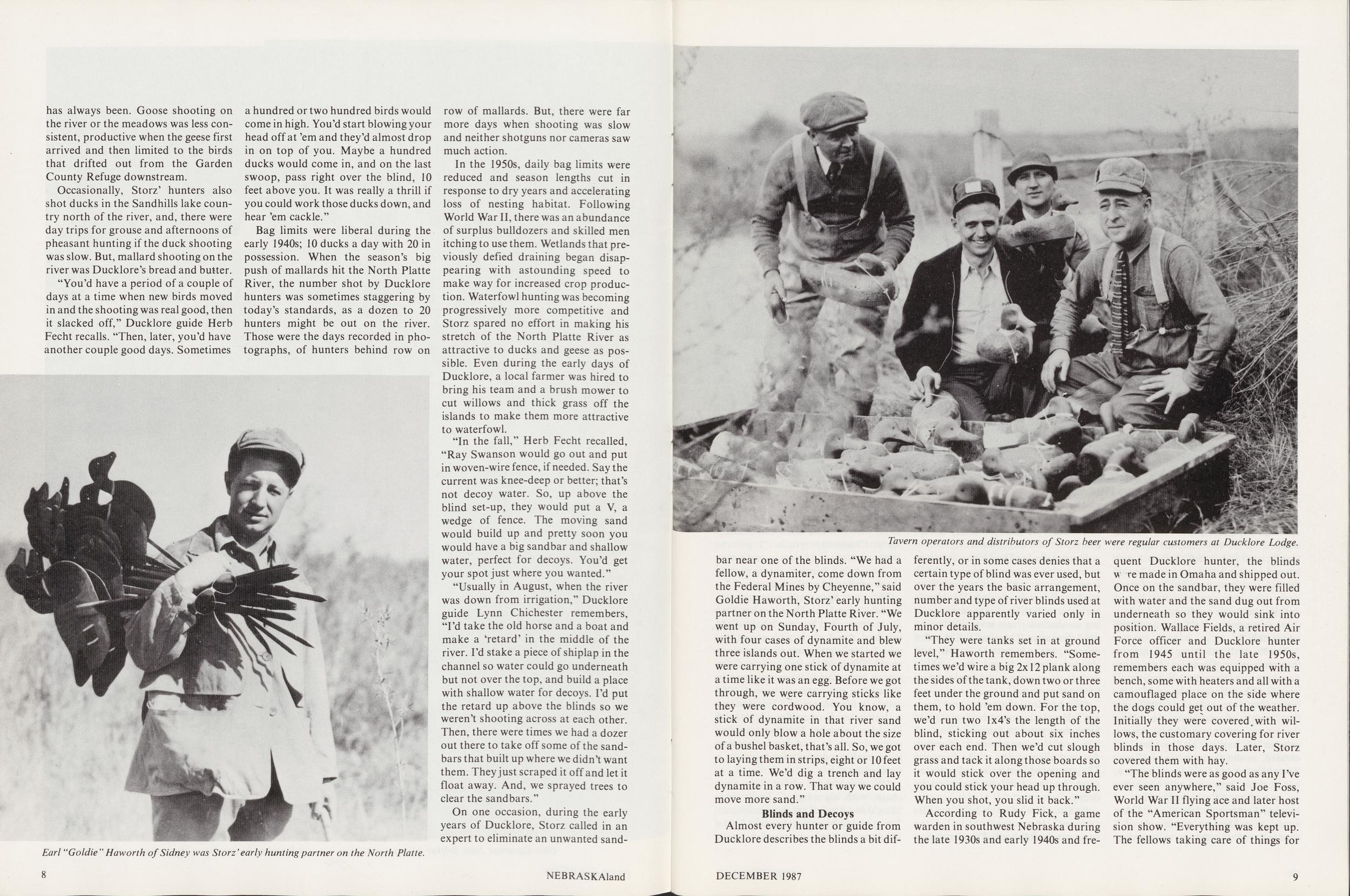
Occasionally, Storz' hunters also shot ducks in the Sandhills lake country north of the river, and, there were day trips for grouse and afternoons of pheasant hunting if the duck shooting was slow. But, mallard shooting on the river was Ducklore's bread and butter.
"You'd have a period of a couple of days at a time when new birds moved in and the shooting was real good, then it slacked off," Ducklore guide Herb Fecht recalls. "Then, later, you'd have another couple good days. Sometimes a hundred or two hundred birds would come in high. You'd start blowing your head off at 'em and they'd almost drop in on top of you. Maybe a hundred ducks would come in, and on the last swoop, pass right over the blind, 10 feet above you. It was really a thrill if you could work those ducks down, and hear 'em cackle."
Bag limits were liberal during the early 1940s; 10 ducks a day with 20 in possession. When the season's big push of mallards hit the North Platte River, the number shot by Ducklore hunters was sometimes staggering by today's standards, as a dozen to 20 hunters might be out on the river. Those were the days recorded in photographs, of hunters behind row on row of mallards. But, there were far more days when shooting was slow and neither shotguns nor cameras saw much action.
In the 1950s, daily bag limits were reduced and season lengths cut in response to dry years and accelerating loss of nesting habitat. Following World War II, there was an abundance of surplus bulldozers and skilled men itching to use them. Wetlands that previously defied draining began disappearing with astounding speed to make way for increased crop production. Waterfowl hunting was becoming progressively more competitive and Storz spared no effort in making his stretch of the North Platte River as attractive to ducks and geese as possible. Even during the early days of Ducklore, a local farmer was hired to bring his team and a brush mower to cut willows and thick grass off the islands to make them more attractive to waterfowl.
"In the fall," Herb Fecht recalled, Ray Swanson would go out and put in woven-wire fence, if needed. Say the current was knee-deep or better; that's not decoy water. So, up above the blind set-up, they would put a V, a wedge of fence. The moving sand would build up and pretty soon you would have a big sandbar and shallow water, perfect for decoys. You'd get your spot just where you wanted."
"Usually in August, when the river was down from irrigation," Ducklore guide Lynn Chichester remembers, "I'd take the old horse and a boat and make a 'retard' in the middle of the river. I'd stake a piece of shiplap in the channel so water could go underneath but not over the top, and build a place with shallow water for decoys. I'd put the retard up above the blinds so we weren't shooting across at each other. Then, there were times we had a dozer out there to take off some of the sandbars that built up where we didn't want them. They just scraped it off and let it float away. And, we sprayed trees to clear the sandbars."
On one occasion, during the early years of Ducklore, Storz called in an expert to eliminate an unwanted sandbar 8 NEBRASKAland bar near one of the blinds. "We had a fellow, a dynamiter, come down from the Federal Mines by Cheyenne," said Goldie Haworth, Storz' early hunting partner on the North Platte River. "We went up on Sunday, Fourth of July, with four cases of dynamite and blew three islands out. When we started we were carrying one stick of dynamite at a time like it was an egg. Before we got through, we were carrying sticks like they were cordwood. You know, a stick of dynamite in that river sand would only blow a hole about the size of a bushel basket, that's all. So, we got to laying them in strips, eight or 10 feet at a time. We'd dig a trench and lay dynamite in a row. That way we could move more sand."
Almost every hunter or guide from Ducklore describes the blinds a bit differently, or in some cases denies that a certain type of blind was ever used, but over the years the basic arrangement, number and type of river blinds used at Ducklore apparently varied only in minor details.
"They were tanks set in at ground level," Haworth remembers. "Sometimes we'd wire a big 2x 12 plank along the sides of the tank, down two or three feet under the ground and put sand on them, to hold 'em down. For the top, we'd run two lx4's the length of the blind, sticking out about six inches over each end. Then we'd cut slough grass and tack it along those boards so it would stick over the opening and you could stick your head up through. When you shot, you slid it back."
According to Rudy Fick, a game warden in southwest Nebraska during the late 1930s and early 1940s and frequent Ducklore hunter, the blinds w re made in Omaha and shipped out. Once on the sandbar, they were filled with water and the sand dug out from underneath so they would sink into position. Wallace Fields, a retired Air Force officer and Ducklore hunter from 1945 until the late 1950s, remembers each was equipped with a bench, some with heaters and all with a camouflaged place on the side where the dogs could get out of the weather. Initially they were covered^with willows, the customary covering for river blinds in those days. Later, Storz covered them with hay.
"The blinds were as good as any I've ever seen anywhere," said Joe Foss, World War II flying ace and later host of the "American Sportsman" television show. "Everything was kept up. The fellows taking care of things for Art kept everything in mint condition. Art was a perfectionist, and wanted things done his way and done right. He would roar like a bull if they didn't have everything done to a fine line of the way it was supposed to be. He was never very selective who he chewed out. But he'd give anything and everything to anybody. He'd give away the whole deal."
DECEMBER 1987 9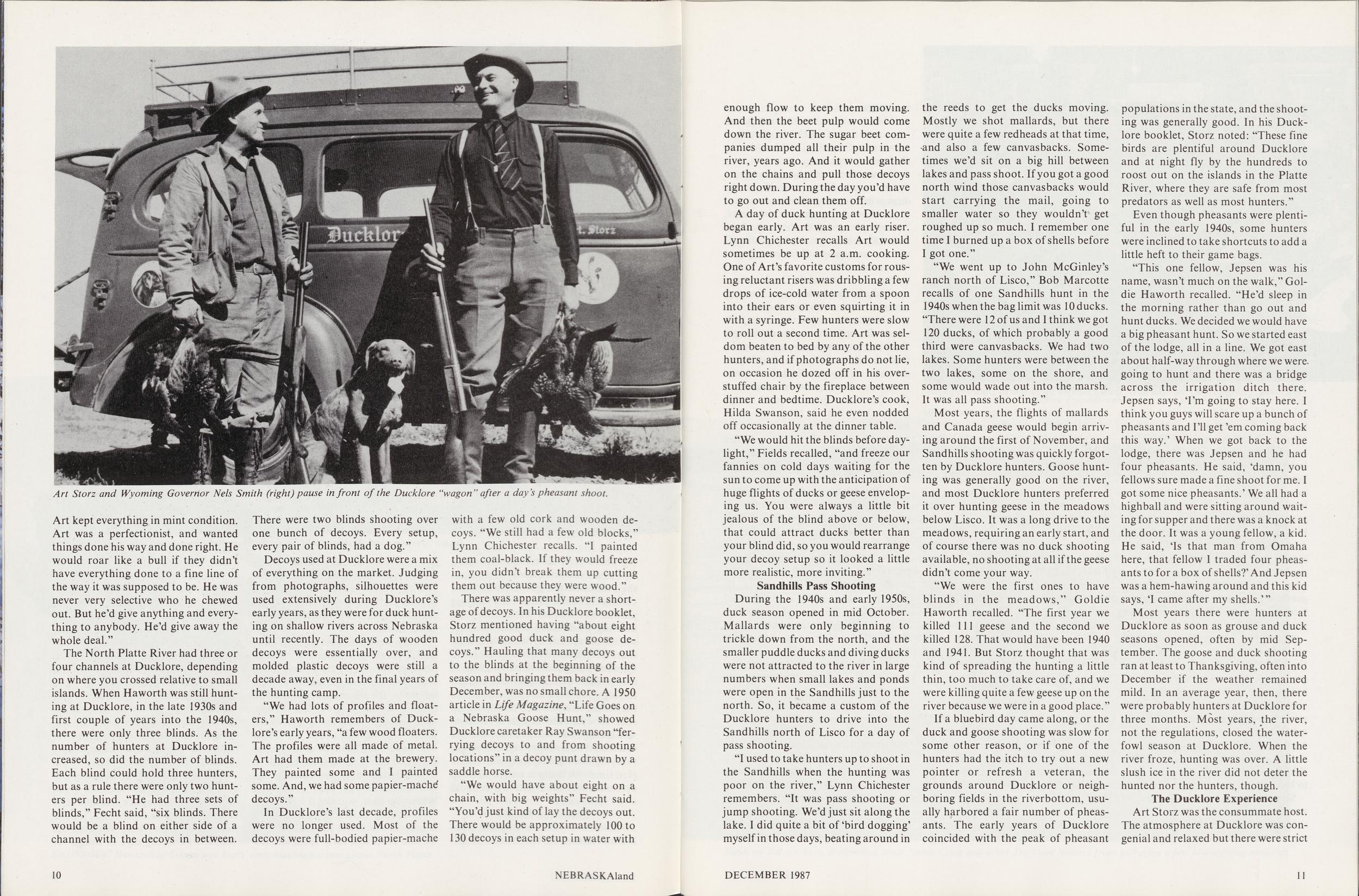
The North Platte River had three or four channels at Ducklore, depending on where you crossed relative to small islands. When Haworth was still hunting at Ducklore, in the late 1930s and first couple of years into the 1940s, there were only three blinds. As the number of hunters at Ducklore increased, so did the number of blinds. Each blind could hold three hunters, but as a rule there were only two hunters per blind. "He had three sets of blinds," Fecht said, "six blinds. There would be a blind on either side of a channel with the decoys in between. There were two blinds shooting over one bunch of decoys. Every setup, every pair of blinds, had a dog."
Decoys used at Ducklore were a mix of everything on the market. Judging from photographs, silhouettes were used extensively during Ducklore's early years, as they were for duck hunting on shallow rivers across Nebraska until recently. The days of wooden decoys were essentially over, and molded plastic decoys were still a decade away, even in the final years of the hunting camp.
"We had lots of profiles and floaters," Haworth remembers of Duck- lore's early years, "a few wood floaters. The profiles were all made of metal. Art had them made at the brewery. They painted some and I painted some. And, we had some paper-mache* decoys."
In Ducklore's last decade, profiles were no longer used. Most of the decoys were full-bodied paper-mache with a few old cork and wooden decoys. "We still had a few old blocks," Lynn Chichester recalls. "I painted them coal-black. If they would freeze in, you didn't break them up cutting them out because they were wood."
There was apparently never a shortage of decoys. In his Ducklore booklet, Storz mentioned having "about eight hundred good duck and goose decoys." Hauling that many decoys out to the blinds at the beginning of the season and bringing them back in early December, was no small chore. A 1950 article in Life Magazine, "Life Goes on a Nebraska Goose Hunt," showed Ducklore caretaker Ray Swanson "ferrying decoys to and from shooting locations" in a decoy punt drawn by a saddle horse.
"We would have about eight on a chain, with big weights" Fecht said. "You'd just kind of lay the decoys out. There would be approximately 100 to 130 decoys in each setup in water with 10 NEBRASKAland enough flow to keep them moving. And then the beet pulp would come down the river. The sugar beet companies dumped all their pulp in the river, years ago. And it would gather on the chains and pull those decoys right down. During the day you'd have to go out and clean them off.
A day of duck hunting at Ducklore began early. Art was an early riser. Lynn Chichester recalls Art would sometimes be up at 2 a.m. cooking. One of Art's favorite customs for rousing reluctant risers was dribbling a few drops of ice-cold water from a spoon into their ears or even squirting it in with a syringe. Few hunters were slow to roll out a second time. Art was seldom beaten to bed by any of the other hunters, and if photographs do not lie, on occasion he dozed off in his over-stuffed chair by the fireplace between dinner and bedtime. Ducklore's cook, Hilda Swanson, said he even nodded off occasionally at the dinner table.
"We would hit the blinds before daylight," Fields recalled, "and freeze our fannies on cold days waiting for the sun to come up with the anticipation of huge flights of ducks or geese enveloping us. You were always a little bit jealous of the blind above or below, that could attract ducks better than your blind did, so you would rearrange your decoy setup so it looked a little more realistic, more inviting."
Sandhills Pass ShootingDuring the 1940s and early 1950s, duck season opened in mid October. Mallards were only beginning to trickle down from the north, and the smaller puddle ducks and diving ducks were not attracted to the river in large numbers when small lakes and ponds were open in the Sandhills just to the north. So, it became a custom of the Ducklore hunters to drive into the Sandhills north of Lisco for a day of pass shooting.
"I used to take hunters up to shoot in the Sandhills when the hunting was poor on the river," Lynn Chichester remembers. "It was pass shooting or jump shooting. We'd just sit along the lake. I did quite a bit of 'bird dogging' myself in those days, beating around in the reeds to get the ducks moving. Mostly we shot mallards, but there were quite a few redheads at that time, and also a few canvasbacks. Sometimes we'd sit on a big hill between lakes and pass shoot. If you got a good north wind those canvasbacks would start carrying the mail, going to smaller water so they wouldn't get roughed up so much. I remember one time I burned up a box of shells before I got one."
"We went up to John McGinley's ranch north of Lisco," Bob Marcotte recalls of one Sandhills hunt in the 1940s when the bag limit was 10 ducks. "There were 12 of us and I think we got 120 ducks, of which probably a good third were canvasbacks. We had two lakes. Some hunters were between the two lakes, some on the shore, and some would wade out into the marsh. It was all pass shooting."
Most years, the flights of mallards and Canada geese would begin arriving around the first of November, and Sandhills shooting was quickly forgotten by Ducklore hunters. Goose hunting was generally good on the river, and most Ducklore hunters preferred it over hunting geese in the meadows below Lisco. It was a long drive to the meadows, requiring an early start, and of course there was no duck shooting available, no shooting at all if the geese didn't come your way.
"We were the first ones to have blinds in the meadows," Goldie Haworth recalled. "The first year we killed 111 geese and the second we killed 128. That would have been 1940 and 1941. But Storz thought that was kind of spreading the hunting a little thin, too much to take care of, and we were killing quite a few geese up on the river because we were in a good place."
If a bluebird day came along, or the duck and goose shooting was slow for some other reason, or if one of the hunters had the itch to try out a new pointer or refresh a veteran, the grounds around Ducklore or neighboring fields in the river bottom, usually harbored a fair number of pheasants. The early years of Ducklore coincided with the peak of pheasant populations in the state, and the shooting was generally good. In his Ducklore booklet, Storz noted: "These fine birds are plentiful around Ducklore and at night fly by the hundreds to roost out on the islands in the Platte River, where they are safe from most predators as well as most hunters."
Even though pheasants were plentiful in the early 1940s, some hunters were inclined to take shortcuts to add a little heft to their game bags.
"This one fellow, Jepsen was his name, wasn't much on the walk, " Goldie Haworth recalled. "He'd sleep in the morning rather than go out and hunt ducks. We decided we would have a big pheasant hunt. So we started east of the lodge, all in a line. We got east about half-way through where we were, going to hunt and there was a bridge across the irrigation ditch there. Jepsen says, 'I'm going to stay here. I think you guys will scare up a bunch of pheasants and I'll get 'em coming back this way.' When we got back to the lodge, there was Jepsen and he had four pheasants. He said, 'damn, you fellows sure made a fine shoot for me. I got some nice pheasants.' We all had a highball and were sitting around waiting for supper and there was a knock at the door. It was a young fellow, a kid. He said, 'Is that man from Omaha here, that fellow I traded four pheasants to for a box of shells?' And Jepsen was a hem-hawing around and this kid says, 'I came after my shells.'"
Most years there were hunters at Ducklore as soon as grouse and duck seasons opened, often by mid September. The goose and duck shooting ran at least to Thanksgiving, often into December if the weather remained mild. In an average year, then, there were probably hunters at Ducklore for three months. Most years, the river, not the regulations, closed the waterfowl season at Ducklore. When the river froze, hunting was over. A little slush ice in the river did not deter the hunted nor the hunters, though.
The Ducklore ExperienceArt Storz was the consummate host. The atmosphere at Ducklore was congenial and relaxed but there were strict rules, both on the river and in the lodge, that guests were expected to respect. By all accounts of Ducklore hunters, Storz was a stickler for following hunting regulations. The first item of business when arriving at Ducklore was signing in. A ledger-type guest book held not only spaces for the guest's name, address and comments, but also the guest's hunting license number and number of birds killed. If a guest had forgotten his license, one could be bought on the spot. At any given time, Storz knew how many guests were at the lodge and how many birds they could legally have in their possession.
DECEMBER 1987 11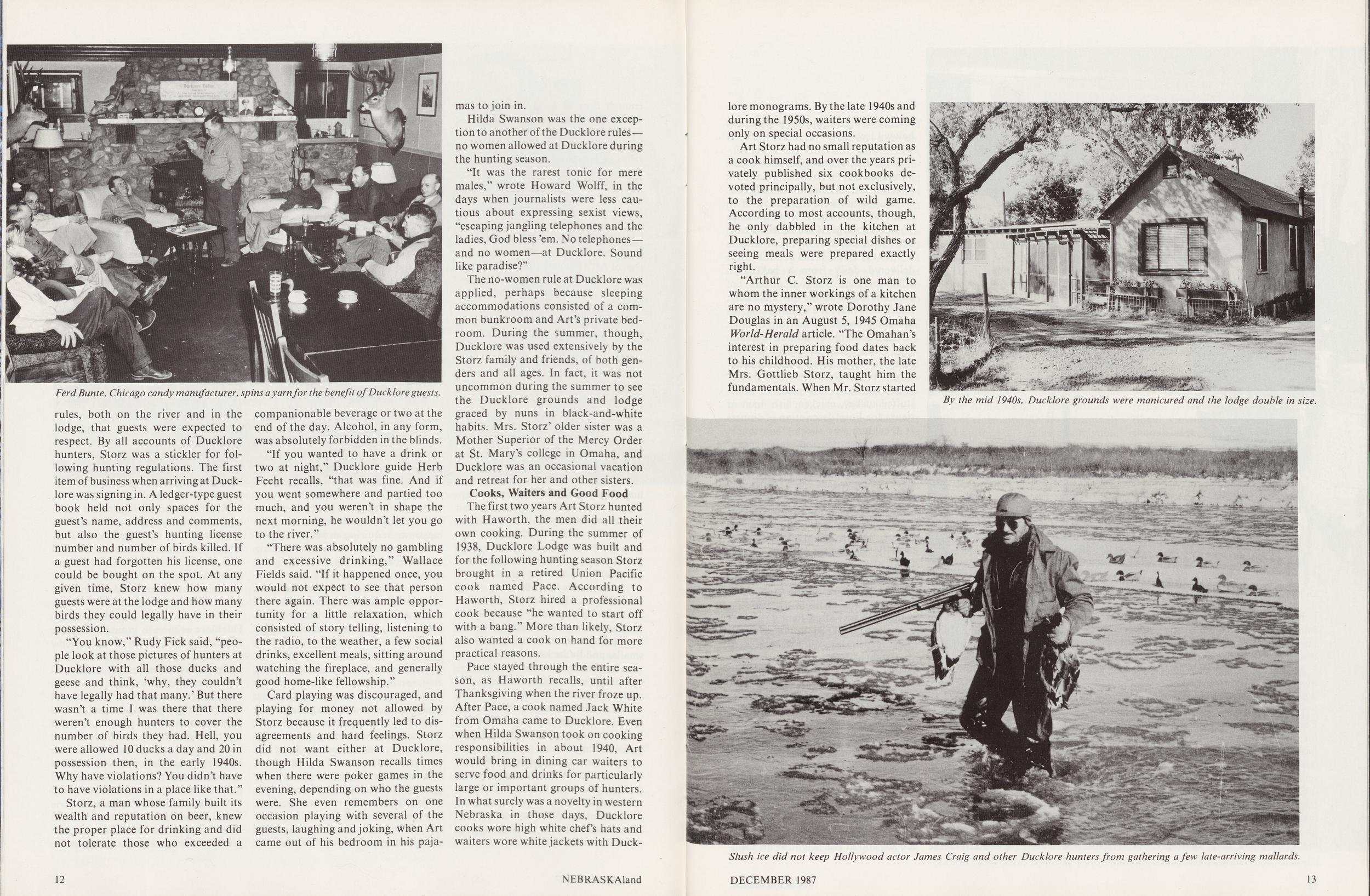 Ferd Bunte, Chicago candy manufacturer, spins a yarn for the benefit of Ducklore guests.
"You know," Rudy Fick said, "people look at those pictures of hunters at Ducklore with all those ducks and geese and think, 'why, they couldn't have legally had that many.' But there wasn't a time I was there that there weren't enough hunters to cover the number of birds they had. Hell, you were allowed 10 ducks a day and 20 in possession then, in the early 1940s. Why have violations? You didn't have to have violations in a place like that."
Storz, a man whose family built its wealth and reputation on beer, knew the proper place for drinking and did not tolerate those who exceeded a companionable beverage or two at the end of the day. Alcohol, in any form, was absolutely forbidden in the blinds.
"If you wanted to have a drink or two at night," Ducklore guide Herb Fecht recalls, "that was fine. And if you went somewhere and partied too much, and you weren't in shape the next morning, he wouldn't let you go to the river."
"There was absolutely no gambling and excessive drinking," Wallace Fields said. "If it happened once, you would not expect to see that person there again. There was ample opportunity for a little relaxation, which consisted of story telling, listening to the radio, to the weather, a few social drinks, excellent meals, sitting around watching the fireplace, and generally good home-like fellowship."
Card playing was discouraged, and playing for money not allowed by Storz because it frequently led to disagreements and hard feelings. Storz did not want either at Ducklore, though Hilda Swanson recalls times when there were poker games in the evening, depending on who the guests were. She even remembers on one occasion playing with several of the guests, laughing and joking, when Art came out of his bedroom in his pajamas to join in.
Hilda Swanson was the one exception to another of the Ducklore rulesno women allowed at Ducklore during the hunting season.
"It was the rarest tonic for mere males," wrote Howard Wolff, in the days when journalists were less cautious about expressing sexist views, "escaping jangling telephones and the ladies, God bless 'em. No telephones and no women—at Ducklore. Sound like paradise?"
The no-women rule at Ducklore was applied, perhaps because sleeping accommodations consisted of a common bunk room and Art's private bedroom. During the summer, though, Ducklore was used extensively by the Storz family and friends, of both genders and all ages. In fact, it was not uncommon during the summer to see the Ducklore grounds and lodge graced by nuns in black-and-white habits. Mrs. Storz' older sister was a Mother Superior of the Mercy Order at St. Mary's college in Omaha, and Ducklore was an occasional vacation and retreat for her and other sisters.
Cooks, Waiters and Good FoodThe first two years Art Storz hunted with Haworth, the men did all their own cooking. During the summer of 1938, Ducklore Lodge was built and for the following hunting season Storz brought in a retired Union Pacific cook named Pace. According to Haworth, Storz hired a professional cook because "he wanted to start off with a bang." More than likely, Storz also wanted a cook on hand for more practical reasons.
Pace stayed through the entire season, as Haworth recalls, until after Thanksgiving when the river froze up. After Pace, a cook named Jack White from Omaha came to Ducklore. Even when Hilda Swanson took on cooking responsibilities in about 1940, Art would bring in dining car waiters to serve food and drinks for particularly large or important groups of hunters. In what surely was a novelty in western Nebraska in those days, Ducklore cooks wore high white chef's hats and waiters wore white jackets with Ducklore 12 NEBRASKAland monograms. By the late 1940s and during the 1950s, waiters were coming only on special occasions.
Art Storz had no small reputation as a cook himself, and over the years privately published six cookbooks devoted principally, but not exclusively, to the preparation of wild game. According to most accounts, though, he only dabbled in the kitchen at Ducklore, preparing special dishes or seeing meals were prepared exactly right.
"Arthur C. Storz is one man to whom the inner workings of a kitchen are no mystery," wrote Dorothy Jane Douglas in an August 5, 1945 Omaha World-Herald article. "The Omaha's interest in preparing food dates back to his childhood. His mother, the late Mrs. Gottlieb Storz, taught him the fundamentals. When Mr. Storz started going on hunting trips, he made an important decision. He would do his part by helping with the cooking instead of washing the dishes."
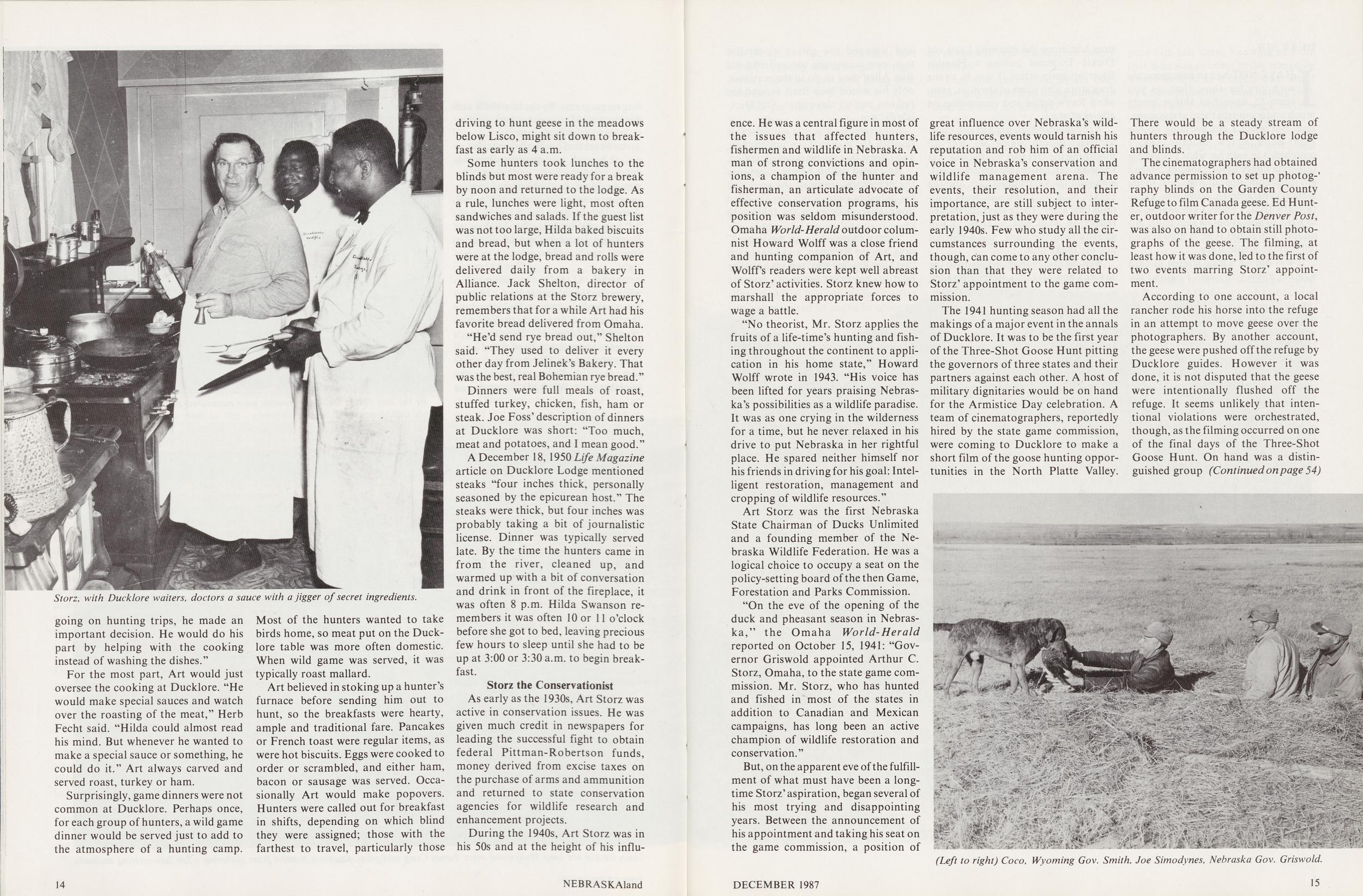
For the most part, Art would just oversee the cooking at Ducklore. "He would make special sauces and watch over the roasting of the meat," Herb Fecht said. "Hilda could almost read his mind. But whenever he wanted to make a special sauce or something, he could do it." Art always carved and served roast, turkey or ham.
Surprisingly, game dinners were not common at Ducklore. Perhaps once, for each group of hunters, a wild game dinner would be served just to add to the atmosphere of a hunting camp. Most of the hunters wanted to take birds home, so meat put on the Ducklore table was more often domestic. When wild game was served, it was typically roast mallard.
Art believed in stoking up a hunter's furnace before sending him out to hunt, so the breakfasts were hearty, ample and traditional fare. Pancakes or French toast were regular items, as were hot biscuits. Eggs were cooked to order or scrambled, and either ham, bacon or sausage was served. Occasionally Art would make popovers. Hunters were called out for breakfast in shifts, depending on which blind they were assigned; those with the farthest to travel, particularly those driving to hunt geese in the meadows below Lisco, might sit down to breakfast as early as 4 a.m.
Some hunters took lunches to the blinds but most were ready for a break by noon and returned to the lodge. As a rule, lunches were light, most often sandwiches and salads. If the guest list was not too large, Hilda baked biscuits and bread, but when a lot of hunters were at the lodge, bread and rolls were delivered daily from a bakery in Alliance. Jack Shelton, director of public relations at the Storz brewery, remembers that for a while Art had his favorite bread delivered from Omaha.
"He'd send rye bread out," Shelton said. "They used to deliver it every other day from Jelinek's Bakery. That was the best, real Bohemian rye bread."
Dinners were full meals of roast, stuffed turkey, chicken, fish, ham or steak. Joe Foss' description of dinners at Ducklore was short: "Too much, meat and potatoes, and I mean good."
A December 18, 1950 Life Magazine article on Ducklore Lodge mentioned steaks "four inches thick, personally seasoned by the epicurean host." The steaks were thick, but four inches was probably taking a bit of journalistic license. Dinner was typically served late. By the time the hunters came in from the river, cleaned up, and warmed up with a bit of conversation and drink in front of the fireplace, it was often 8 p.m. Hilda Swanson remembers it was often 10 or 11 o'clock before she got to bed, leaving precious few hours to sleep until she had to be up at 3:00 or 3:30 a.m. to begin breakfast.
Storz the ConservationistAs early as the 1930s, Art Storz was active in conservation issues. He was given much credit in newspapers for leading the successful fight to obtain federal Pittman-Robertson funds, money derived from excise taxes on the purchase of arms and ammunition and returned to state conservation agencies for wildlife research and enhancement projects.
During the 1940s, Art Storz was in his 50s and at the height of his 14 NEBRWSAKAland influence. He was a central figure in most of the issues that affected hunters, fishermen and wildlife in Nebraska. A man of strong convictions and opinions, a champion of the hunter and fisherman, an articulate advocate of effective conservation programs, his position was seldom misunderstood. Omaha World-Herald outdoor columnist Howard Wolff was a close friend and hunting companion of Art, and Wolff's readers were kept well abreast of Storz' activities. Storz knew how to marshall the appropriate forces to wage a battle.
"No theorist, Mr. Storz applies the fruits of a life-time's hunting and fishing throughout the continent to application in his home state," Howard Wolff wrote in 1943. "His voice has been lifted for years praising Nebraska's possibilities as a wildlife paradise. It was as one crying in the wilderness for a time, but he never relaxed in his drive to put Nebraska in her rightful place. He spared neither himself nor his friends in driving for his goal: Intelligent restoration, management and cropping of wildlife resources."
Art Storz was the first Nebraska State Chairman of Ducks Unlimited and a founding member of the Nebraska Wildlife Federation. He was a logical choice to occupy a seat on the policy-setting board of the then Game, Forestation and Parks Commission.
"On the eve of the opening of the duck and pheasant season in Nebraska,' the Omaha World-Herald reported on October 15, 1941: "Governor Griswold appointed Arthur C. Storz, Omaha, to the state game commission. Mr. Storz, who has hunted and fished in most of the states in addition to Canadian and Mexican campaigns, has long been an active champion of wildlife restoration and conservation."
But, on the apparent eve of the fulfillment of what must have been a longtime Storz' aspiration, began several of his most trying and disappointing years. Between the announcement of his appointment and taking his seat on the game commission, a position of great influence over Nebraska's wildlife resources, events would tarnish his reputation and rob him of an official voice in Nebraska's conservation and wildlife management arena. The events, their resolution, and their importance, are still subject to interpretation, just as they were during the early 1940s. Few who study all the circumstances surrounding the events, though, can come to any other conclusion than that they were related to Storz' appointment to the game commission.
The 1941 hunting season had all the makings of a major event in the annals of Ducklore. It was to be the first year of the Three-Shot Goose Hunt pitting the governors of three states and their partners against each other. A host of military dignitaries would be on hand for the Armistice Day celebration. A team of cinematographers, reportedly hired by the state game commission, were coming to Ducklore to make a short film of the goose hunting opportunities in the North Platte Valley. There would be a steady stream of hunters through the Ducklore lodge and blinds.
The cinematographers had obtained advance permission to set up photography blinds on the Garden County Refuge to film Canada geese. Ed Hunter, outdoor writer for the Denver Post, was also on hand to obtain still photographs of the geese. The filming, at least how it was done, led to the first of two events marring Storz' appointment.
According to one account, a local rancher rode his horse into the refuge in an attempt to move geese over the photographers. By another account, the geese were pushed off the refuge by Ducklore guides. However it was done, it is not disputed that the geese were intentionally flushed off the refuge. It seems unlikely that intentional violations were orchestrated, though, as the filming occurred on one of the final days of the Three-Shot Goose Hunt. On hand was a distinguished group (Continued on page 54)
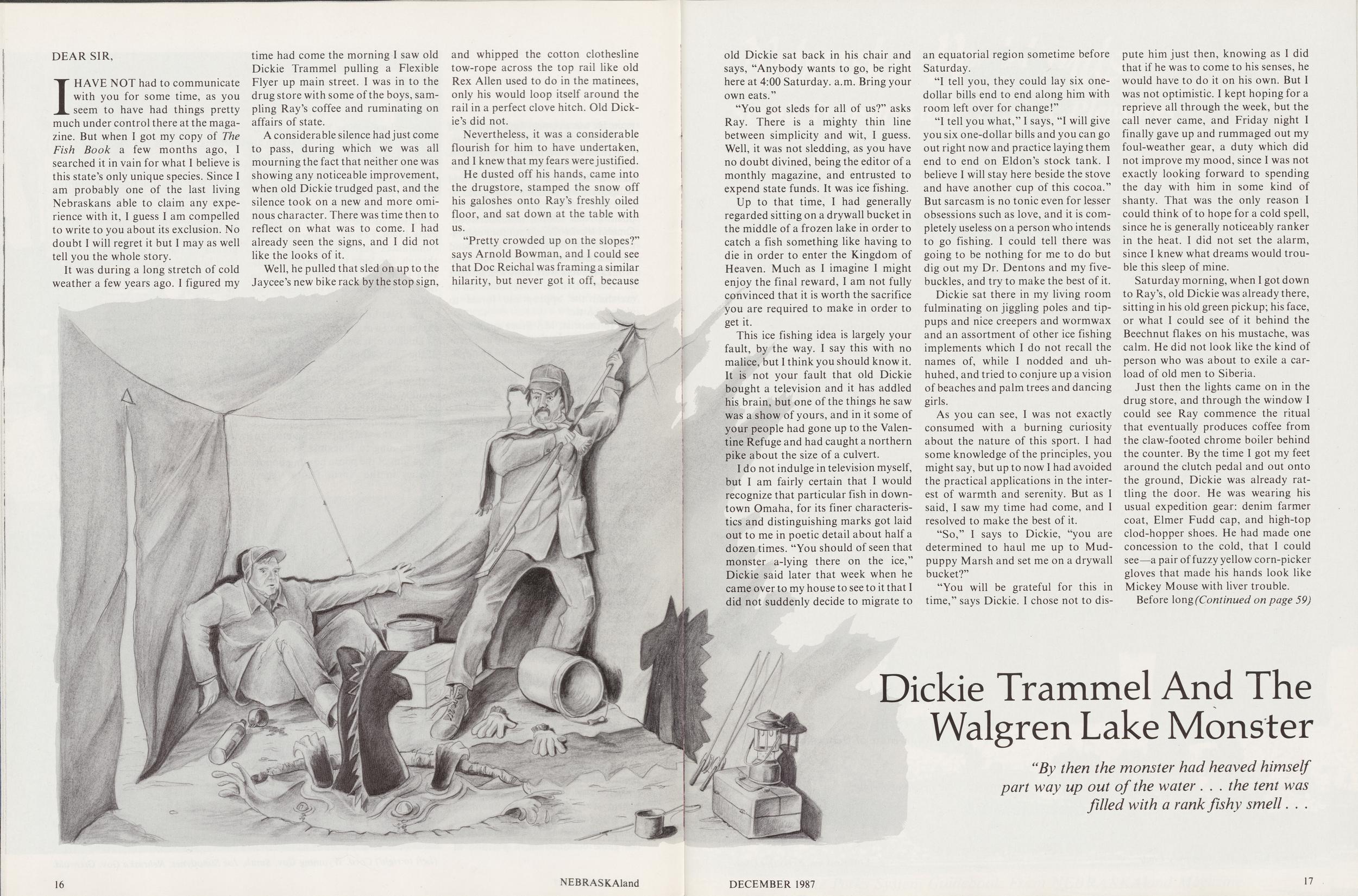
Dickie Trammel And The Walgren Lake Monster
"By then the monster had heaved himself part way up out of the water... the tent was filled with a rank fishy smell... DEAR SIR,I HAVE NOT had to communicate with you for some time, as you seem to have had things pretty much under control there at the magazine. But when I got my copy of The Fish Book a few months ago, I searched it in vain for what I believe is this state's only unique species. Since I am probably one of the last living Nebraskans able to claim any experience with it, I guess I am compelled to write to you about its exclusion. No doubt I will regret it but I may as well tell you the whole story.
It was during a long stretch of cold weather a few years ago. I figured my time had come the morning I saw old Dickie Trammel pulling a Flexible Flyer up main street. I was in to the drug store with some of the boys, sampling Ray's coffee and ruminating on affairs of state.
A considerable silence had just come to pass, during which we was all mourning the fact that neither one was showing any noticeable improvement, when old Dickie trudged past, and the silence took on a new and more ominous character. There was time then to reflect on what was to come. I had already seen the signs, and I did not like the looks of it.
Well, he pulled that sled on up to the Jaycee's new bike rack by the stop sign, and whipped the cotton clothesline tow-rope across the top rail like old Rex Allen used to do in the matinees, only his would loop itself around the rail in a perfect clove hitch. Old Dickie's did not.
Nevertheless, it was a considerable flourish for him to have undertaken, and I knew that my fears were justified.
He dusted off his hands, came into the drugstore, stamped the snow off his galoshes onto Ray's freshly oiled floor, and sat down at the table with us.
"Pretty crowded up on the slopes?" says Arnold Bowman, and I could see that Doc Reichal was framing a similar hilarity, but never got it off, because 16 NEBRASKAland old Dickie sat back in his chair and says, "Anybody wants to go, be right here at 4:00 Saturday, a.m. Bring your own eats."
"You got sleds for all of us?" asks Ray. There is a mighty thin line between simplicity and wit, I guess. Well, it was not sledding, as you have no doubt divined, being the editor of a monthly magazine, and entrusted to expend state funds. It was ice fishing.
Up to that time, I had generally regarded sitting on a drywall bucket in the middle of a frozen lake in order to catch a fish something like having to die in order to enter the Kingdom of Heaven. Much as I imagine I might enjoy the final reward, I am not fully convinced that it is worth the sacrifice you are required to make in order to get it.
This ice fishing idea is largely your fault, by the way. I say this with no malice, but I think you should know it. It is not your fault that old Dickie bought a television and it has addled his brain, but one of the things he saw was a show of yours, and in it some of your people had gone up to the Valentine Refuge and had caught a northern pike about the size of a culvert.
I do not indulge in television myself, but I am fairly certain that I would recognize that particular fish in downtown Omaha, for its finer characteristics and distinguishing marks got laid out to me in poetic detail about half a dozen times. "You should of seen that monster a-lying there on the ice," Dickie said later that week when he came over to my house to see to it that I did not suddenly decide to migrate to an equatorial region sometime before Saturday.
"I tell you, they could lay six one dollar bills end to end along him with room left over for change!"
"I tell you what," I says, "I will give you six one-dollar bills and you can go out right now and practice laying them end to end on Eldon's stock tank. I believe I will stay here beside the stove and have another cup of this cocoa." But sarcasm is no tonic even for lesser obsessions such as love, and it is completely useless on a person who intends to go fishing. I could tell there was going to be nothing for me to do but dig out my Dr. Dentons and my five-buckles, and try to make the best of it.
Dickie sat there in my living room fulminating on jiggling poles and tip pups and nice creepers and worm wax and an assortment of other ice fishing implements which I do not recall the names of, while I nodded and uhhuhed, and tried to conjure up a vision of beaches and palm trees and dancing girls.
As you can see, I was not exactly consumed with a burning curiosity about the nature of this sport. I had some knowledge of the principles, you might say, but up to now I had avoided the practical applications in the interest of warmth and serenity. But as I said, I saw my time had come, and I resolved to make the best of it.
"So," I says to Dickie, "you are determined to haul me up to Mud-puppy Marsh and set me on a drywall bucket?"
"You will be grateful for this in time," says Dickie. I chose not to dispute him just then, knowing as I did that if he was to come to his senses, he would have to do it on his own. But I was not optimistic. I kept hoping for a reprieve all through the week, but the call never came, and Friday night I finally gave up and rummaged out my foul-weather gear, a duty which did not improve my mood, since I was not exactly looking forward to spending the day with him in some kind of shanty. That was the only reason I could think of to hope for a cold spell, since he is generally noticeably ranker in the heat. I did not set the alarm, since I knew what dreams would trouble this sleep of mine.
Saturday morning, when I got down to Ray's, old Dickie was already there, sitting in his old green pickup; his face, or what I could see of it behind the Beechnut flakes on his mustache, was calm. He did not look like the kind of person who was about to exile a car load of old men to Siberia.
Just then the lights came on in the drug store, and through the window I could see Ray commence the ritual that eventually produces coffee from the claw-footed chrome boiler behind the counter. By the time I got my feet around the clutch pedal and out onto the ground, Dickie was already rattling the door. He was wearing his usual expedition gear: denim farmer coat, Elmer Fudd cap, and high-top clod-hopper shoes. He had made one concession to the cold, that I could see—a pair of fuzzy yellow corn-picker gloves that made his hands look like Mickey Mouse with liver trouble.
Before long(Continued on page 59)
DECEMBER 1987 17
Celebrate Nebraska '88
Dear Friends:As Nebraskans, we are proud of our rich heritage and our community and ethnic traditions that are woven together in this state. We are also anxious to share our pride and spirit with others.
In 1988, we are going to showcase the people, places and celebrations that make Nebraska special. Celebrate Nebraska '88 is a year-long series of events throughout the state celebrating both our heritage and our future. The activities and events are designed to show our pride in being Nebraskans and to provide an opportunity to encourage former Nebraskans and new friends to visit the state.
I would like you to join me in inviting former Nebraskans, as well as friends from other states, to our community celebrations in 1988. There are many ways you can become involved. On page 58, you'll find a listing of official Celebrate Nebraska '88 events registered with the Department of Economic Development.
We can also take special pride in our wonderful state parks system and plentiful outdoor recreation opportunities. In the following 30 pages, NEBRASKAland Magazine presents a new guidebook to Nebraska Parklands. Please use it to help make your plans to Celebrate Nebraska '88 with a Nebraska state parks family vacation.
Please help me to launch this celebration and keep it flying high in 1988 as we Celebrate Nebraska together.
Sincerely, KAY A. ORR Governor, State of Nebraska For More Information on how you can become involved, write: Governor Kay A. Orr, Honorary Chair P.O. Box 94666 Lincoln, Nebraska 68509 (402)471-3790 Lois Roskens, Executive Chair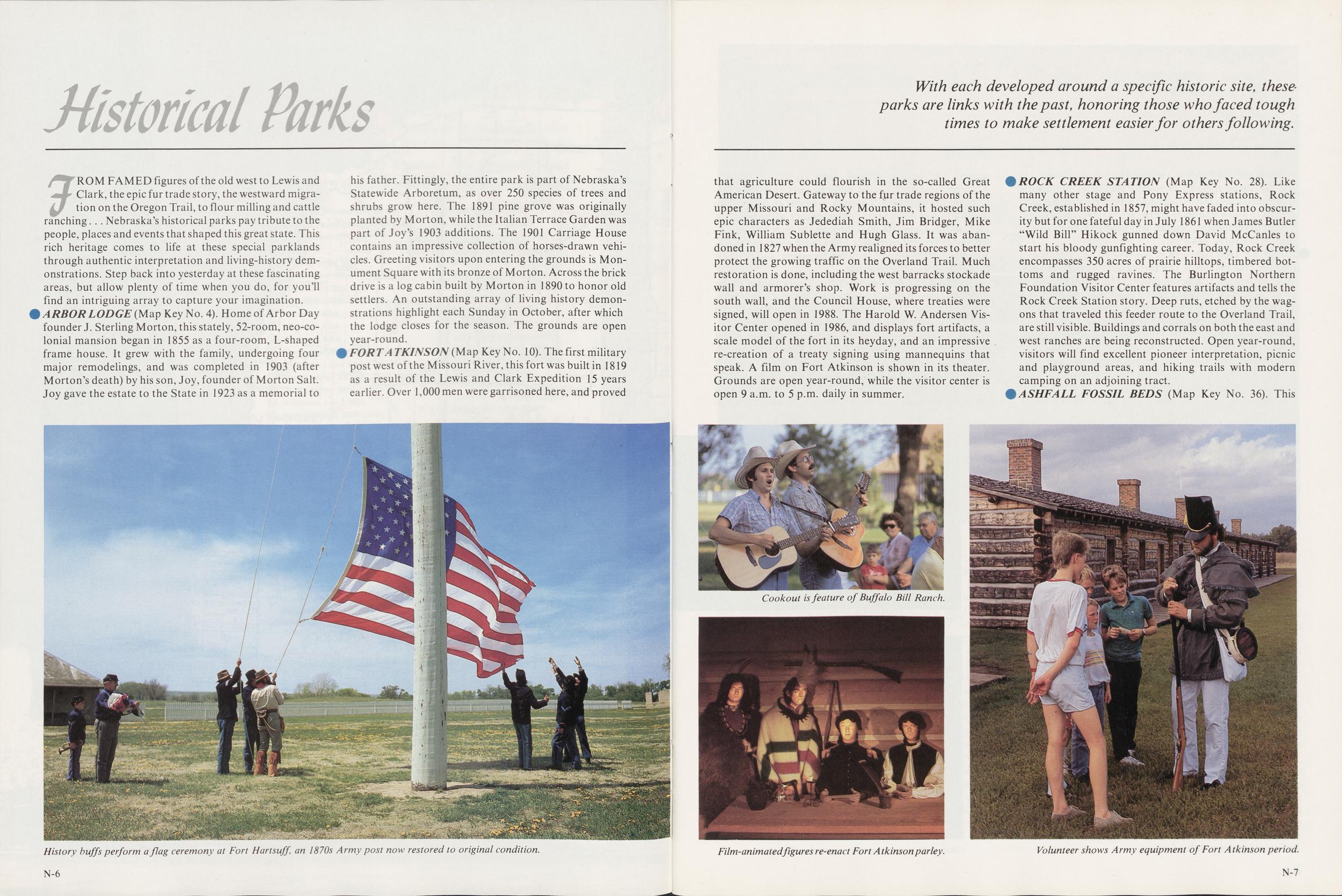
Historical Parks
ROM FAMED figures of the old west to Lewis and Clark, the epic fur trade story, the westward migration on the Oregon Trail, to flour milling and cattle ranching. . . Nebraska's historical parks pay tribute to the people, places and events that shaped this great state. This rich heritage comes to life at these special parklands through authentic interpretation and living-history demonstrations. Step back into yesterday at these fascinating areas, but allow plenty of time when you do, for you'll find an intriguing array to capture your imagination.
ARBOR LODGE (Map Key No. 4). Home of Arbor Day founder J. Sterling Morton, this stately, 52-room, neo-colonial mansion began in 1855 as a four-room, L-shaped frame house. It grew with the family, undergoing four major remodeling, and was completed in 1903 (after Morton's death) by his son, Joy, founder of Morton Salt. Joy gave the estate to the State in 1923 as a memorial to his father. Fittingly, the entire park is part of Nebraska's Statewide Arboretum, as over 250 species of trees and shrubs grow here. The 1891 pine grove was originally planted by Morton, while the Italian Terrace Garden was part of Joy's 1903 additions. The 1901 Carriage House contains an impressive collection of horses-drawn vehicles. Greeting visitors upon entering the grounds is Monument Square with its bronze of Morton. Across the brick drive is a log cabin built by Morton in 1890 to honor old settlers. An outstanding array of living history demonstrations highlight each Sunday in October, after which the lodge closes for the season. The grounds are open year-round.
FORT ATKINSON (Map Key No. 10). The first military post west of the Missouri River, this fort was built in 1819 as a result of the Lewis and Clark Expedition 15 years earlier. Over 1,000 men were garrisoned here, and proved N-6 that agriculture could flourish in the so-called Great American Desert. Gateway to the fur trade regions of the upper Missouri and Rocky Mountains, it hosted such epic characters as Jedediah Smith, Jim Bridger, Mike Fink, William Sublette and Hugh Glass. It was abandoned in 1827 when the Army realigned its forces to better protect the growing traffic on the Overland Trail. Much restoration is done, including the west barracks stockade wall and armorer's shop. Work is progressing on the south wall, and the Council House, where treaties were signed, will open in 1988. The Harold W. Andersen Visitor Center opened in 1986, and displays fort artifacts, a scale model of the fort in its heyday, and an impressive re-creation of a treaty signing using mannequins that speak. A film on Fort Atkinson is shown in its theater. Grounds are open year-round, while the visitor center is open 9 a.m. to 5 p.m. daily in summer.
With each developed around a specific historic site, these parks are links with the past, honoring those who faced tough times to make settlement easier for others following.ROCK CREEK STATION (Map Key No. 28). Like many other stage and Pony Express stations, Rock Creek, established in 1857, might have faded into obscurity but for one fateful day in July 1861 when James Butler "Wild Bill" Hikock gunned down David McCanles to start his bloody gunfighting career. Today, Rock Creek encompasses 350 acres of prairie hilltops, timbered bottoms and rugged ravines. The Burlington Northern Foundation Visitor Center features artifacts and tells the Rock Creek Station story. Deep ruts, etched by the wagons that traveled this feeder route to the Overland Trail, are still visible. Buildings and corrals on both the east and west ranches are being reconstructed. Open year-round, visitors will find excellent pioneer interpretation, picnic and playground areas, and hiking trails with modern camping on an adjoining tract.
ASH FALL FOSSIL BEDS (Map Key No. 36). This recently acquired area is a major deposit of volcanic ash and fossilized remains of several species of prehistoric mammals. Plans call for a domed interpretive shelter over the site to allow visitors to see the area as it was excavated. Under development, Ash fall will probably open to visitors in the early 1990s.
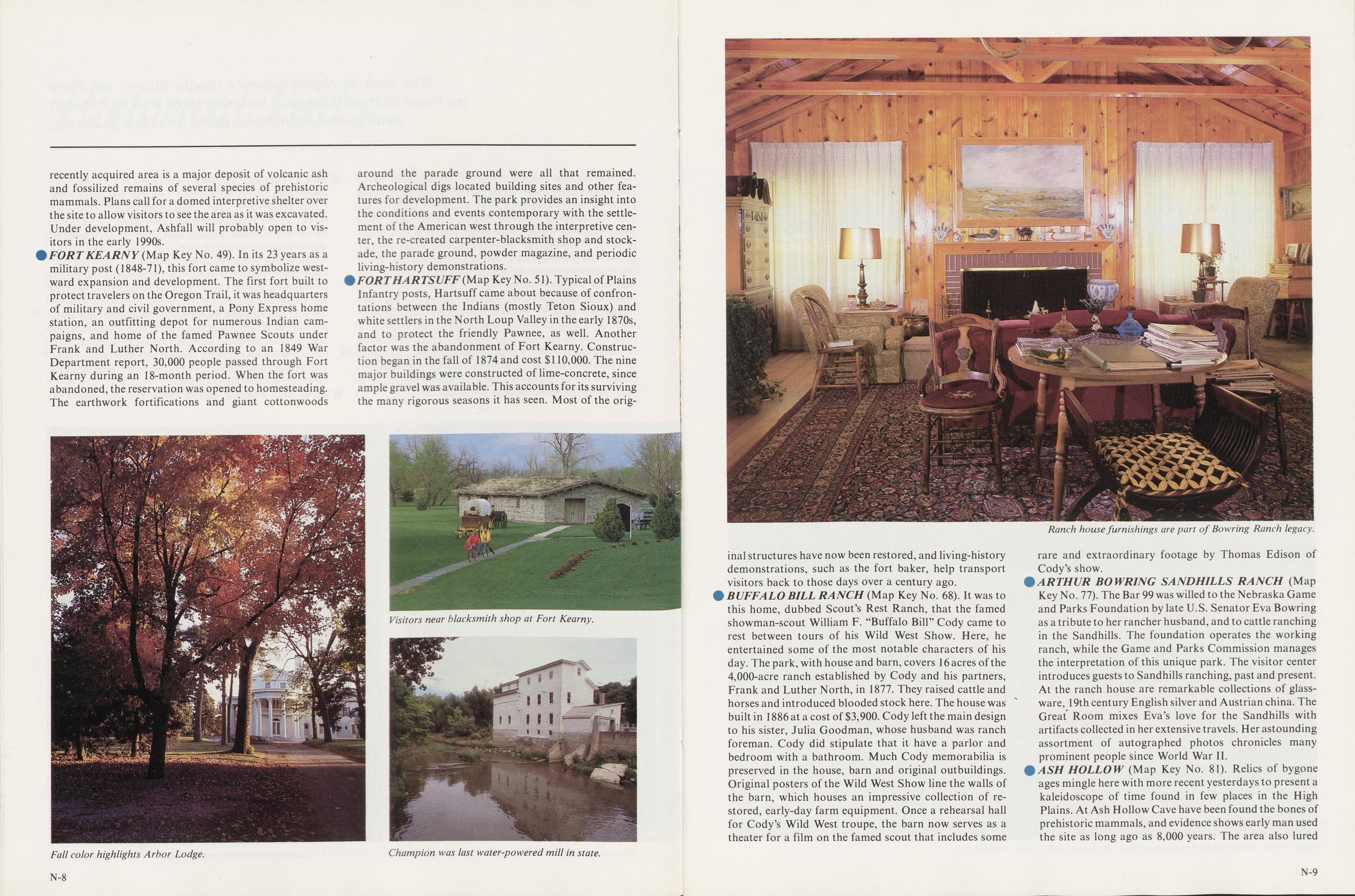
• FORT KEARNY (Map Key No. 49). In its 23 years as a military post (1848-71), this fort came to symbolize westward expansion and development. The first fort built to protect travelers on the Oregon Trail, it was headquarters of military and civil government, a Pony Express home station, an outfitting depot for numerous Indian campaigns, and home of the famed Pawnee Scouts under Frank and Luther North. According to an 1849 War Department report, 30,000 people passed through Fort Kearny during an 18-month period. When the fort was abandoned, the reservation was opened to homesteading. The earthwork fortifications and giant cottonwoods around the parade ground were all that remained. Archeological digs located building sites and other features for development. The park provides an insight into the conditions and events contemporary with the settlement of the American west through the interpretive center, the re-created carpenter-blacksmith shop and stockade, the parade ground, powder magazine, and periodic living-history demonstrations.
FORT HARTSUFF (Map Key No. 51). Typical of Plains Infantry posts, Hartsuff came about because of confrontations between the Indians (mostly Teton Sioux) and white settlers in the North Loup Valley in the early 1870s, and to protect the friendly Pawnee, as well. Another factor was the abandonment of Fort Kearny. Construction began in the fall of 1874 and cost $110,000. The nine major buildings were constructed of lime-concrete, since ample gravel was available. This accounts for its surviving the many rigorous seasons it has seen. Most of the original N-8 structures have now been restored, and living-history demonstrations, such as the fort baker, help transport visitors back to those days over a century ago.
BUFFALO BILL RANCH (Map Key No. 68). It was to this home, dubbed Scout's Rest Ranch, that the famed showman-scout William F. "Buffalo Bill" Cody came to rest between tours of his Wild West Show. Here, he entertained some of the most notable characters of his day. The park, with house and barn, covers 16 acres of the 4,000-acre ranch established by Cody and his partners, Frank and Luther North, in 1877. They raised cattle and horses and introduced blooded stock here. The house was built in 1886 at a cost of $3,900. Cody left the main design to his sister, Julia Goodman, whose husband was ranch foreman. Cody did stipulate that it have a parlor and bedroom with a bathroom. Much Cody memorabilia is preserved in the house, barn and original outbuildings. Original posters of the Wild West Show line the walls of the barn, which houses an impressive collection of restored, early-day farm equipment. Once a rehearsal hall for Cody's Wild West troupe, the barn now serves as a theater for a film on the famed scout that includes some rare and extraordinary footage by Thomas Edison of Cody's show.
ARTHUR BOWRING SANDHILLS RANCH (Map Key No. 77). The Bar 99 was willed to the Nebraska Game and Parks Foundation by late U.S. Senator Eva Bowring as a tribute to her rancher husband, and to cattle ranching in the Sandhills. The foundation operates the working ranch, while the Game and Parks Commission manages the interpretation of this unique park. The visitor center introduces guests to Sandhills ranching, past and present. At the ranch house are remarkable collections of glassware, 19th century English silver and Austrian china. The Great Room mixes Eva's love for the Sandhills with artifacts collected in her extensive travels. Her astounding assortment of autographed photos chronicles many prominent people since World War II.
9 ASH HOLLOW (Map Key No. 81). Relics of bygone ages mingle here with more recent yesterdays to present a kaleidoscope of time found in few places in the High Plains. At Ash Hollow Cave have been found the bones of prehistoric mammals, and evidence shows early man used the site as long ago as 8,000 years. The area also lured Plains Indians and west-bound pioneers. Visitors can glimpse a bit of geology, paleontology, history of early man, and the story of the great westward trek. The visitor center crowns the bluff overlooking the mouth of the canyon, and a hiking trail leads to the fresh-water spring at the canyon bottom. Camping and picnic areas are located nearby. Also a part of the park, Windlass Hill is a separate tract, 2 %-miles south. The hill gives a rare view of the deep ruts carved by thousands upon thousands of wagons that traveled the Overland Trail.
N-9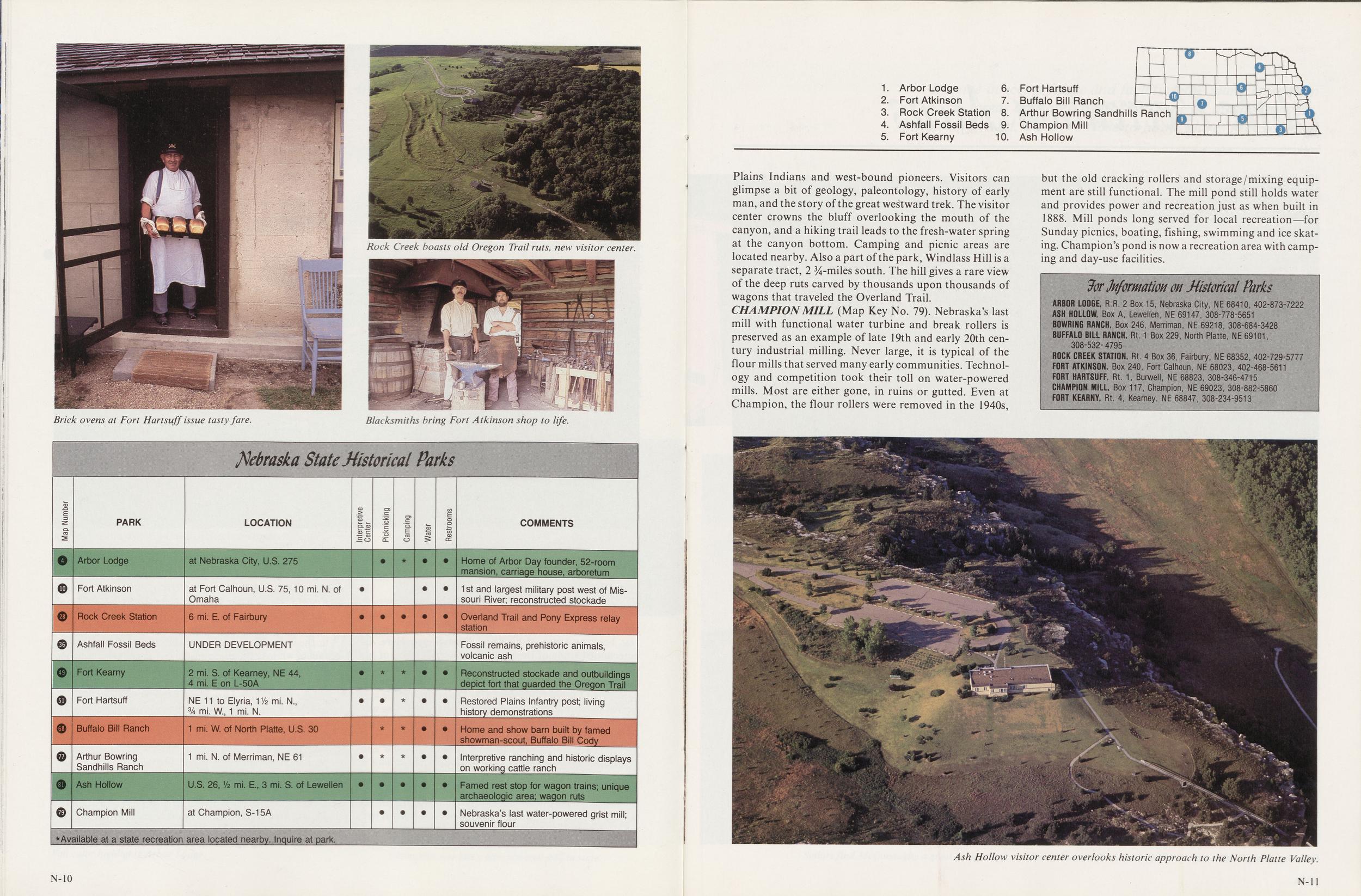
CHAMPION MILL (Map Key No. 79). Nebraska's last mill with functional water turbine and break rollers is preserved as an example of late 19th and early 20th century industrial milling. Never large, it is typical of the flour mills that served many early communities. Technology and competition took their toll on water-powered mills. Most are either gone, in ruins or gutted. Even at Champion, the flour rollers were removed in the 1940s, but the old cracking rollers and storage/mixing equipment are still functional. The mill pond still holds water and provides power and recreation just as when built in 1888. Mill ponds long served for local recreation—for Sunday picnics, boating, fishing, swimming and ice skating. Champion's pond is now a recreation area with camping and day-use facilities.
Jot Information on Historical Parks AR80R LODGE, R.R. 2 Box 15. Nebraska City. NE 68410. 402-873-7222 ASH HOLLOW, Box A. Lewellen. NE 69147, 308-778-5651 BOWRING RANCH, Box 246, Merriman, NE 69218, 308-684-3428 BUFFALO BILL RANCH. Rt. 1 Box 229, North Platte. NE 69101, 308-532- 4795 ROCK CREEK STATION, Rt. 4 Box 36. Fairbury, NE 68352. 402-729-5777 FORT ATKINSON. Box 240. Fort Calhoun. NE 68023, 402-468-5611 FORT HARTSUFF, Rt. 1. Burwell, NE 68823. 308-346-4715 CHAMPION MILL. Box 117, Champion, NE 69023, 308-882-5860 FORT KEARNY. Rt. 4, Kearney. NE 68847, 308-234-9513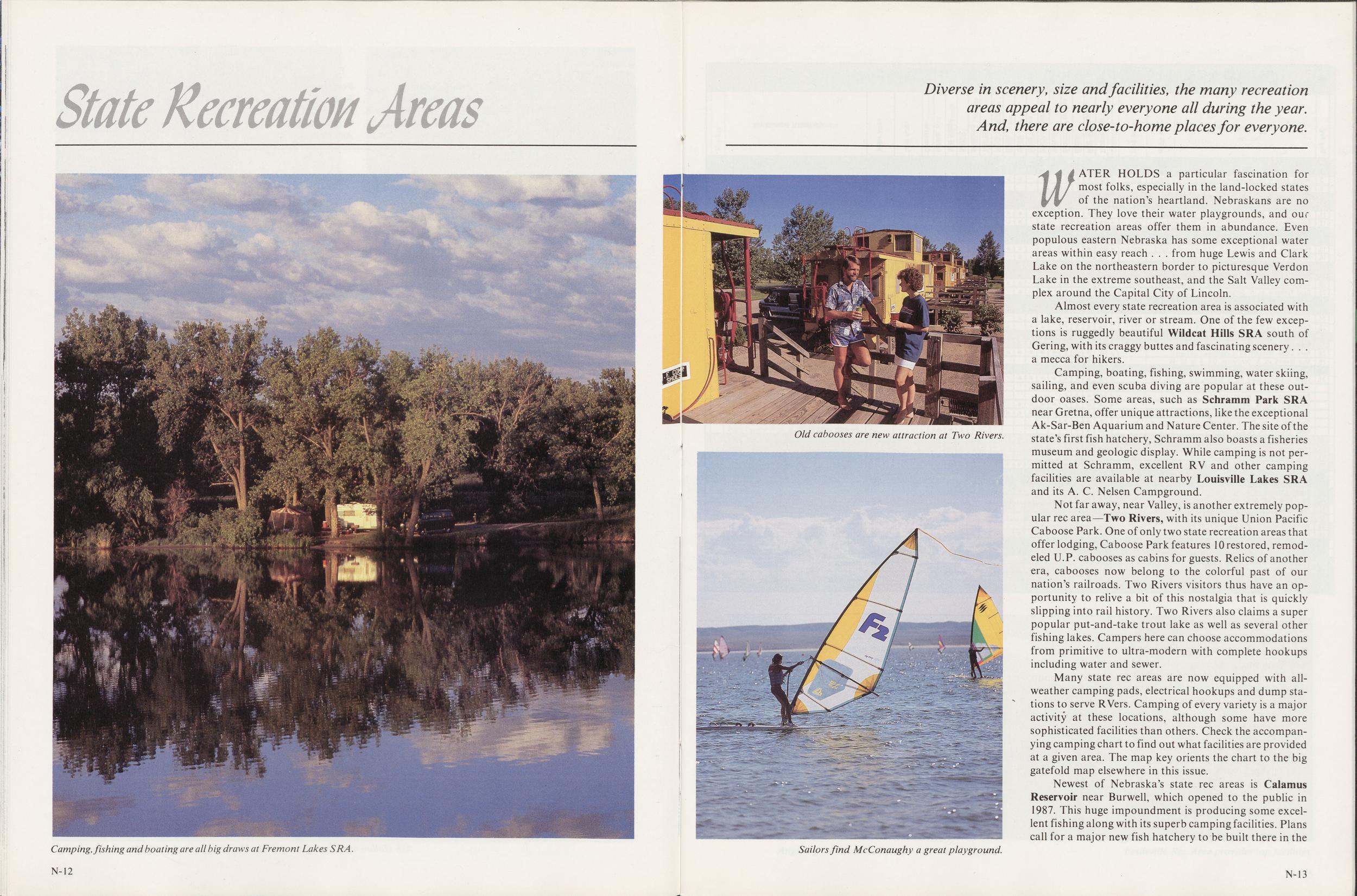
State Recreation Areas
Camping, fishing and boating are all big draws at Fremont Lakes SRA. ATER HOLDS a particular fascination for most folks, especially in the land-locked states of the nation's heartland. Nebraskans are no exception. They love their water playgrounds, and our state recreation areas offer them in abundance. Even populous eastern Nebraska has some exceptional water areas within easy reach . . . from huge Lewis and Clark Lake on the northeastern border to picturesque Verdon Lake in the extreme southeast, and the Salt Valley complex around the Capital City of Lincoln.
Almost every state recreation area is associated with a lake, reservoir, river or stream. One of the few exceptions is ruggedly beautiful Wildcat Hills SRA south of Gering, with its craggy buttes and fascinating scenery. . . a mecca for hikers.
Camping, boating, fishing, swimming, water skiing, sailing, and even scuba diving are popular at these outdoor oases. Some areas, such as Schramm Park SRA near Gretna, offer unique attractions, like the exceptional Ak-Sar-Ben Aquarium and Nature Center. The site of the state's first fish hatchery, Schramm also boasts a fisheries museum and geologic display. While camping is not permitted at Schramm, excellent RV and other camping facilities are available at nearby Louisville Lakes SRA and its A. C. Nelsen Campground.
Not far away, near Valley, is another extremely popular rec area—Two Rivers, with its unique Union Pacific Caboose Park. One of only two state recreation areas that offer lodging, Caboose Park features 10 restored, remodeled U.P. cabooses as cabins for guests. Relics of another era, cabooses now belong to the colorful past of our nation's railroads. Two Rivers visitors thus have an opportunity to relive a bit of this nostalgia that is quickly slipping into rail history. Two Rivers also claims a super popular put-and-take trout lake as well as several other fishing lakes. Campers here can choose accommodations from primitive to ultra-modern with complete hookups including water and sewer.
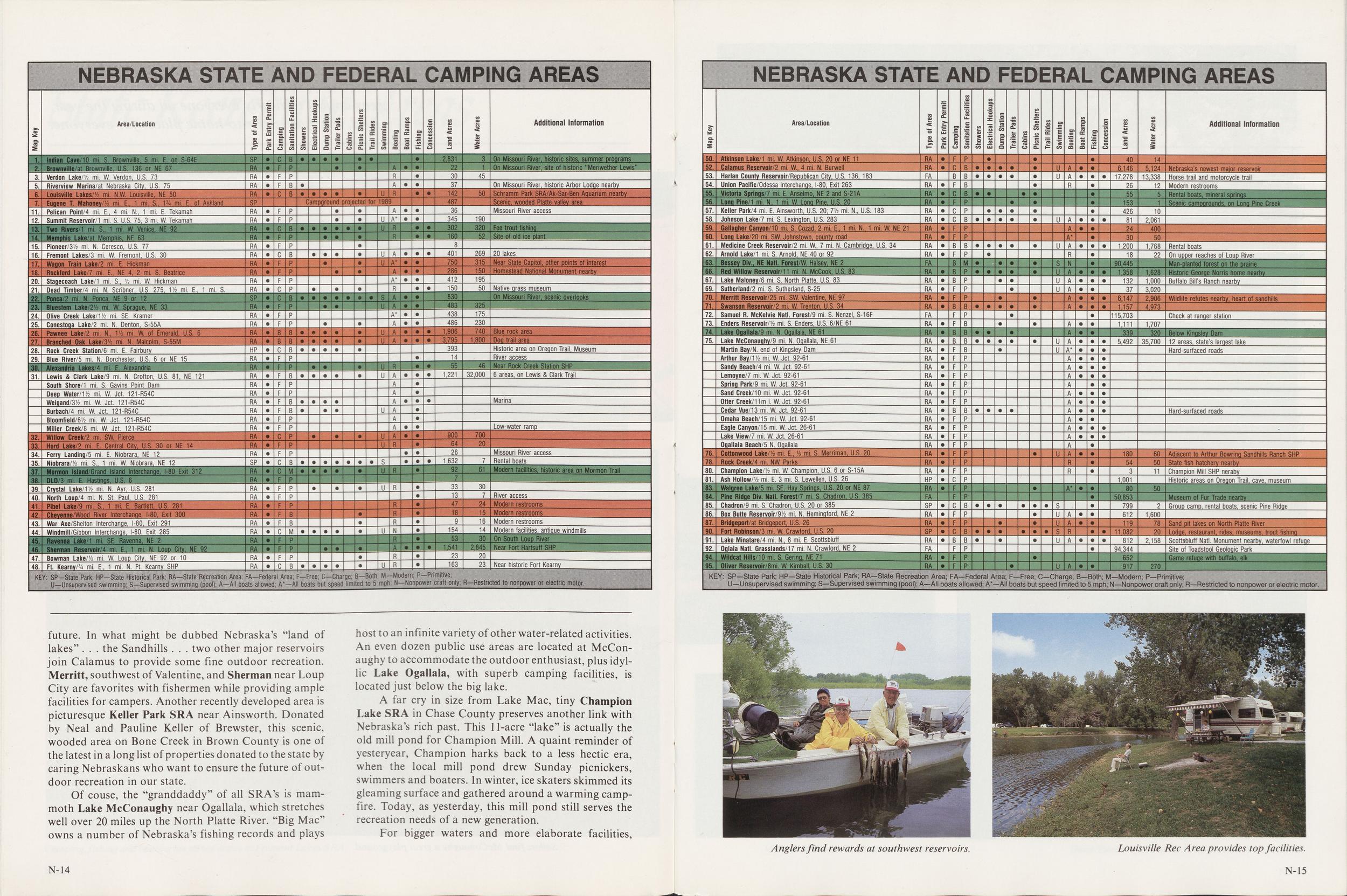
Many state rec areas are now equipped with all weather camping pads, electrical hookups and dump stations to serve Rivers. Camping of every variety is a major activity at these locations, although some have more sophisticated facilities than others. Check the accompanying camping chart to find out what facilities are provided at a given area. The map key orients the chart to the big gatefold map elsewhere in this issue.
Newest of Nebraska's state rec areas is Calamus
Reservoir near Burwell, which opened to the public in
1987. This huge impoundment is producing some
excellent fishing along with its superb camping facilities. Plans
call for a major new fish hatchery to be built there in the
N-13
 future. In what might be dubbed Nebraska's "land of
lakes" . . . the Sandhills . . . two other major reservoirs
join Calamus to provide some fine outdoor recreation.
Merritt, southwest of Valentine, and Sherman near Loup
City are favorites with fishermen while providing ample
facilities for campers. Another recently developed area is
picturesque Keller Park SRA near Ainsworth. Donated
by Neal and Pauline Keller of Brewster, this scenic,
wooded area on Bone Creek in Brown County is one of
the latest in a long list of properties donated to the state by
caring Nebraskans who want to ensure the future of
outdoor recreation in our state.
future. In what might be dubbed Nebraska's "land of
lakes" . . . the Sandhills . . . two other major reservoirs
join Calamus to provide some fine outdoor recreation.
Merritt, southwest of Valentine, and Sherman near Loup
City are favorites with fishermen while providing ample
facilities for campers. Another recently developed area is
picturesque Keller Park SRA near Ainsworth. Donated
by Neal and Pauline Keller of Brewster, this scenic,
wooded area on Bone Creek in Brown County is one of
the latest in a long list of properties donated to the state by
caring Nebraskans who want to ensure the future of
outdoor recreation in our state.
Of course, the "granddaddy" of all SRA's is mammoth Lake McConaughy near Ogallala, which stretches well over 20 miles up the North Platte River. "Big Mac" owns a number of Nebraska's fishing records and plays host to an infinite variety of other water-related activities. An even dozen public use areas are located at McConaughy to accommodate the outdoor enthusiast, plus idyllic Lake Ogallala, with superb camping facilities, is located just below the big lake.
A far cry in size from Lake Mac, tiny Champion Lake SRA in Chase County preserves another link with Nebraska's rich past. This 11-acre "lake" is actually the old mill pond for Champion Mill. A quaint reminder of yesteryear, Champion harks back to a less hectic era, when the local mill pond drew Sunday picnickers, swimmers and boaters. In winter, ice skaters skimmed its gleaming surface and gathered around a warming campfire. Today, as yesterday, this mill pond still serves the recreation needs of a new generation.
For bigger waters and more elaborate facilities, campers, boaters and anglers will find plenty to their liking at the Southwest Reservoirs. These prairie lake SRAs include Red Willow near McCook, Medicine Creek near Cambridge, Swanson at Trenton and Enders near Imperial, all part of what is known as the little TVA.
N-14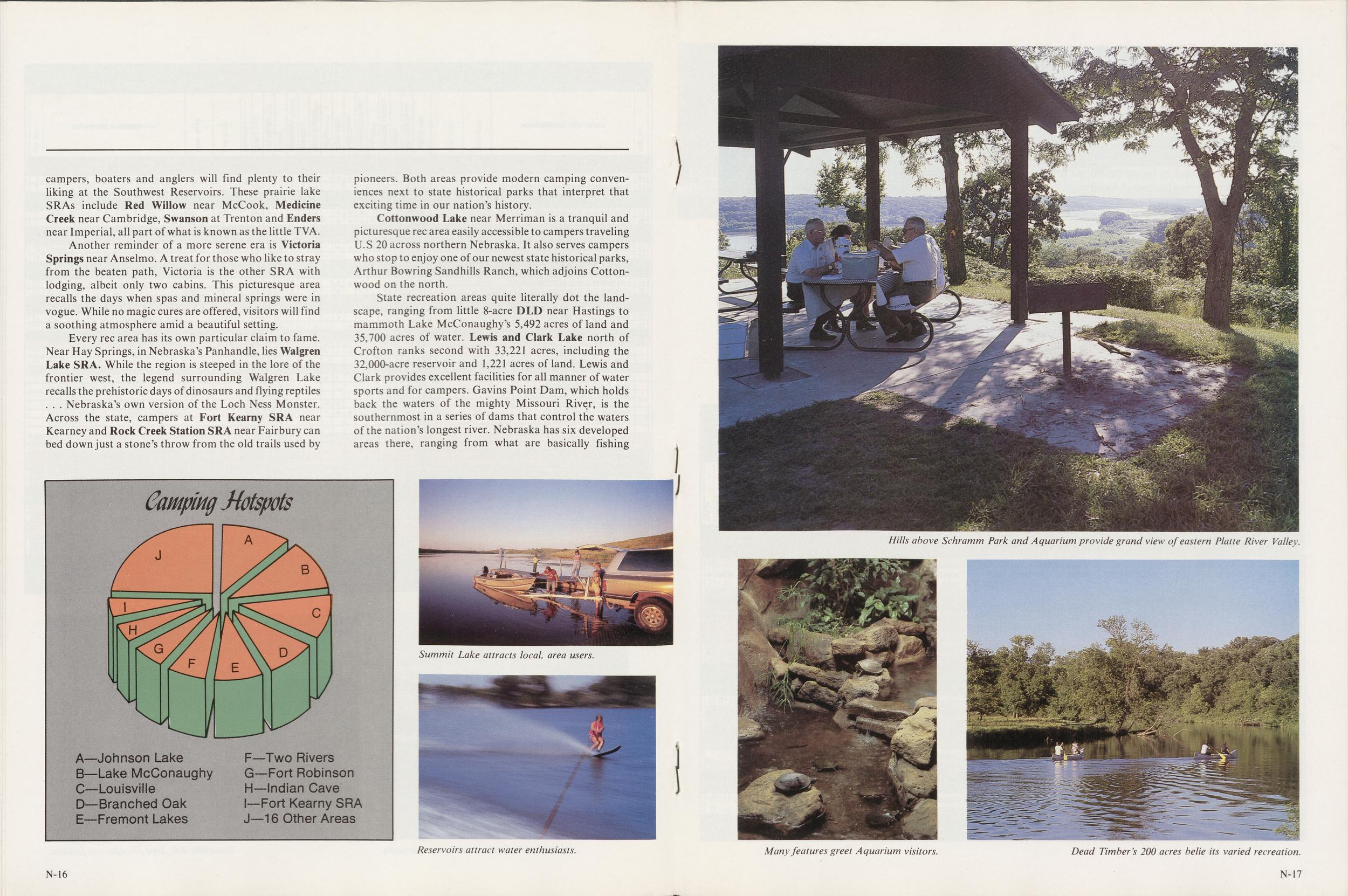
Another reminder of a more serene era is Victoria Springs near Anselmo. A treat for those who like to stray from the beaten path, Victoria is the other SRA with lodging, albeit only two cabins. This picturesque area recalls the days when spas and mineral springs were in vogue. While no magic cures are offered, visitors will find a soothing atmosphere amid a beautiful setting.
Every rec area has its own particular claim to fame. Near Hay Springs, in Nebraska's Panhandle, lies Walgren Lake SRA. While the region is steeped in the lore of the frontier west, the legend surrounding Walgren Lake recalls the prehistoric days of dinosaurs and flying reptiles . . . Nebraska's own version of the Loch Ness Monster. Across the state, campers at Fort Kearny SRA near Kearney and Rock Creek Station SRA near Fairbury can bed down just a stone's throw from the old trails used by pioneers. Both areas provide modern camping conveniences next to state historical parks that interpret that exciting time in our nation's history.
Cottonwood Lake near Merriman is a tranquil and picturesque rec area easily accessible to campers traveling U.S 20 across northern Nebraska. It also serves campers who stop to enjoy one of our newest state historical parks, Arthur Bowring Sandhills Ranch, which adjoins Cotton- wood on the north.
State recreation areas quite literally dot the land- scape, ranging from little 8-acre DLD near Hastings to mammoth Lake McConaughy's 5,492 acres of land and 35,700 acres of water. Lewis and Clark Lake north of Crofton ranks second with 33,221 acres, including the 32,000-acre reservoir and 1,221 acres of land. Lewis and Clark provides excellent facilities for all manner of water sports and for campers. Gavins Point Dam, which holds back the waters of the mighty Missouri River, is the southernmost in a series of dams that control the waters of the nation's longest river. Nebraska has six developed areas there, ranging from what are basically fishing accesses like Miller Creek to highly developed Weigand with its excellent camping and beach facilities.
N-16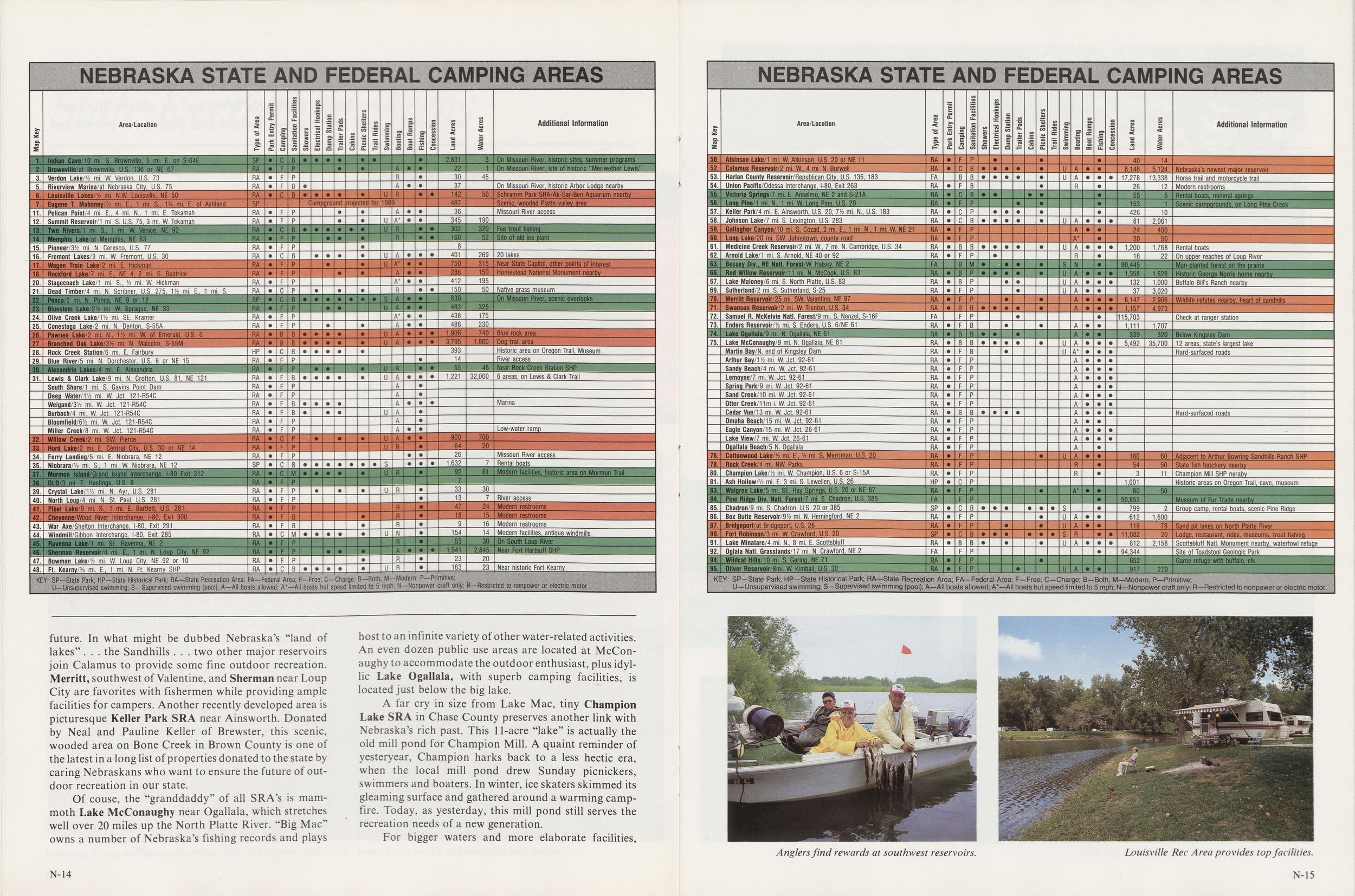
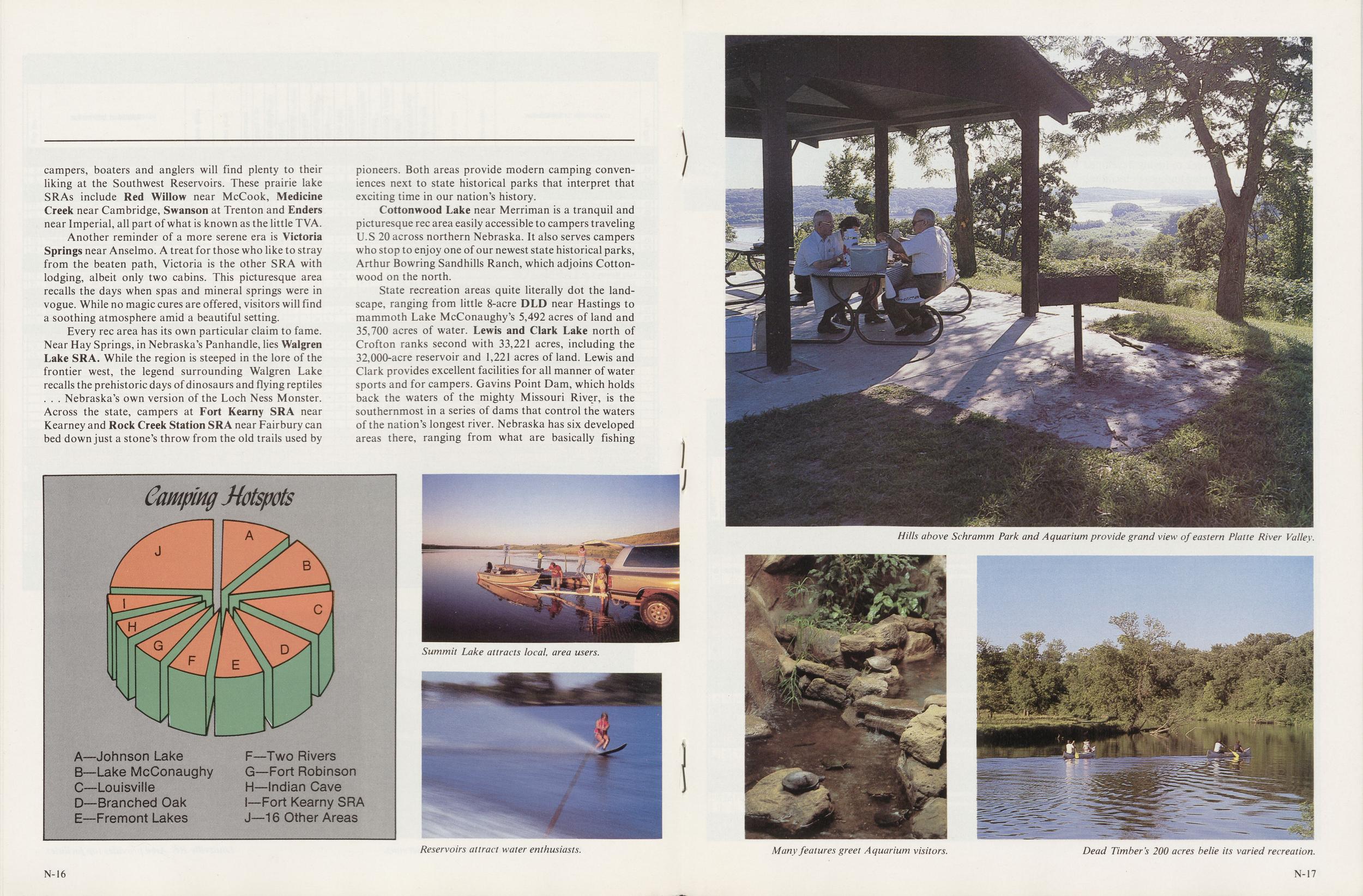
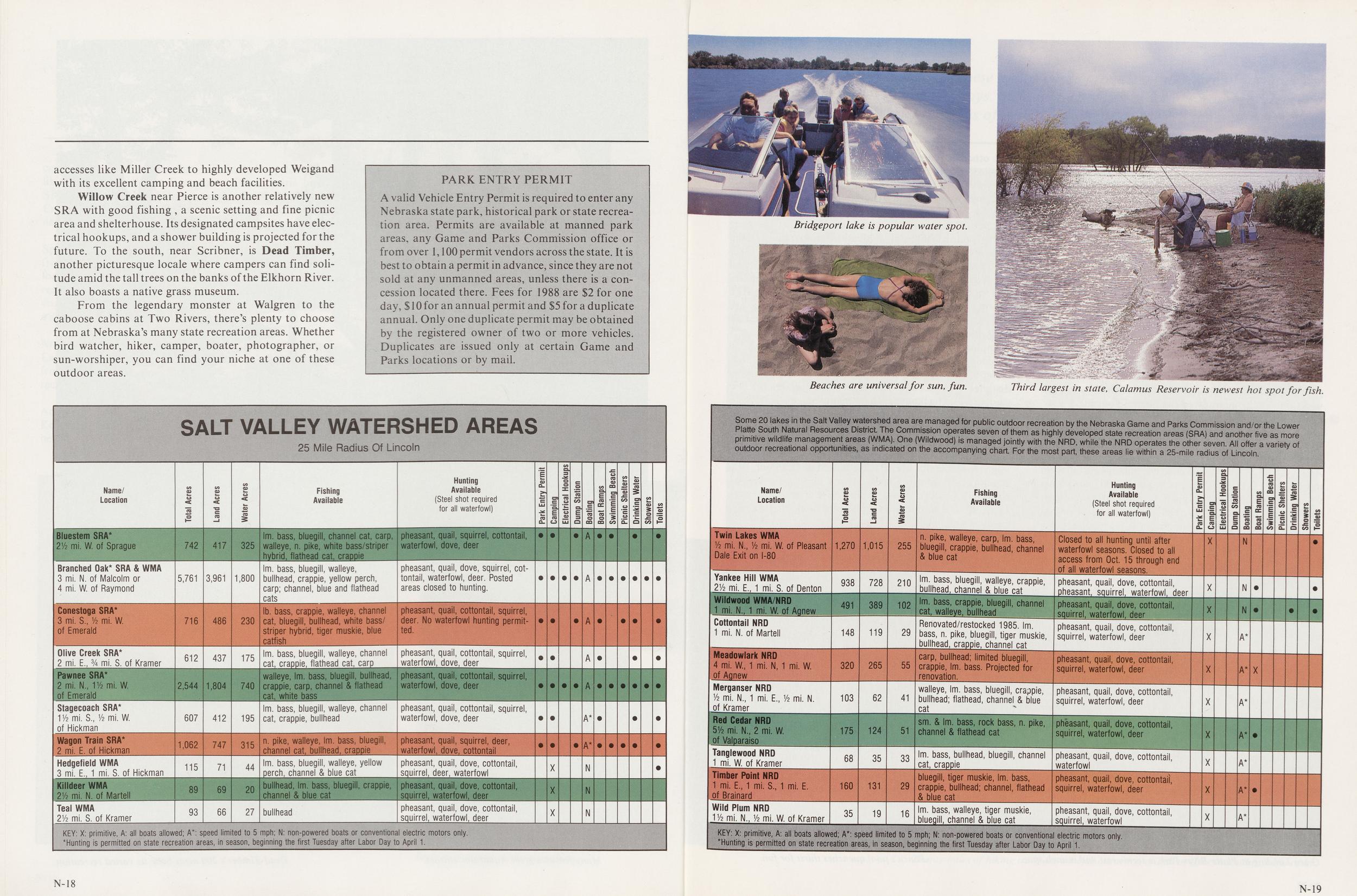
Willow Creek near Pierce is another relatively new SRA with good fishing , a scenic setting and fine picnic area and shelter house. Its designated campsites have electrical hookups, and a shower building is projected for the future. To the south, near Scribner, is Dead Timber, another picturesque locale where campers can find solitude amid the tall trees on the banks of the Elkhorn River. It also boasts a native grass museum.
From the legendary monster at Walgren to the caboose cabins at Two Rivers, there's plenty to choose from at Nebraska's many state recreation areas. Whether bird watcher, hiker, camper, boater, photographer, or sun-worshiper, you can find your niche at one of these outdoor areas.
PARK ENTRY PERMIT A valid Vehicle Entry Permit is required to enter any Nebraska state park, historical park or state recreation area. Permits are available at manned park areas, any Game and Parks Commission office or from over 1,100 permit vendors across the state. It is best to obtain a permit in advance, since they are not sold at any unmanned areas, unless there is a con- cession located there. Fees for 1988 are $2 for one day, $10 for an annual permit and $5 for a duplicate annual. Only one duplicate permit may be obtained by the registered owner of two or more vehicles. Duplicates are issued only at certain Game and Parks locations or by mail. N-18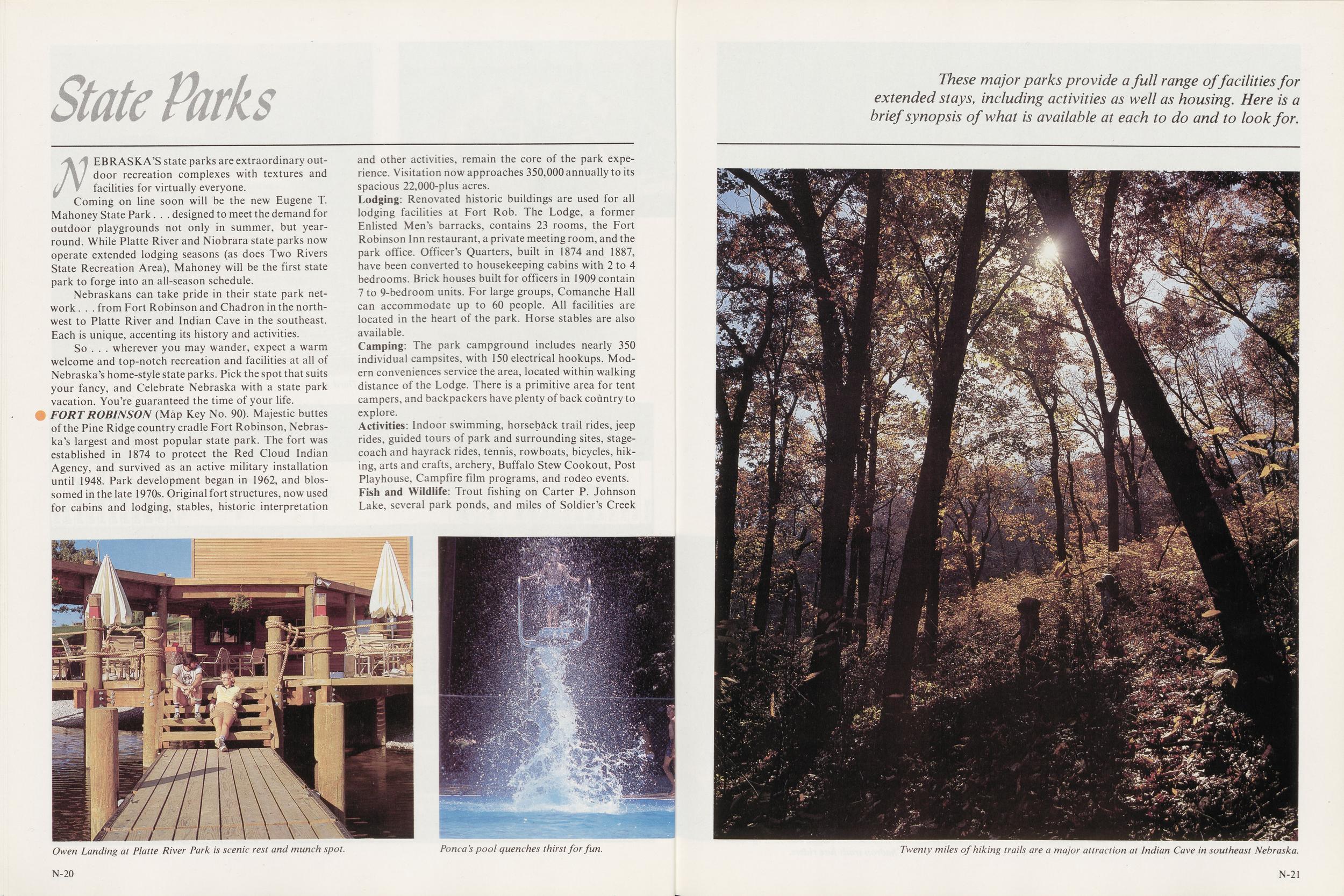
State Parks
NEBRASKA'S state parks are extraordinary out- / door recreation complexes with textures and facilities for virtually everyone.
Coming on line soon will be the new Eugene T. Mahoney State Park. . . designed to meet the demand for outdoor playgrounds not only in summer, but year-round. While Platte River and Niobrara state parks now operate extended lodging seasons (as does Two Rivers State Recreation Area), Mahoney will be the first state park to forge into an all-season schedule.
Nebraskans can take pride in their state park network. . . from Fort Robinson and Chadron in the northwest to Platte River and Indian Cave in the southeast. Each is unique, accenting its history and activities.
So . . . wherever you may wander, expect a warm welcome and top-notch recreation and facilities at all of Nebraska's home-style state parks. Pick the spot that suits your fancy, and Celebrate Nebraska with a state park vacation. You're guaranteed the time of your life.
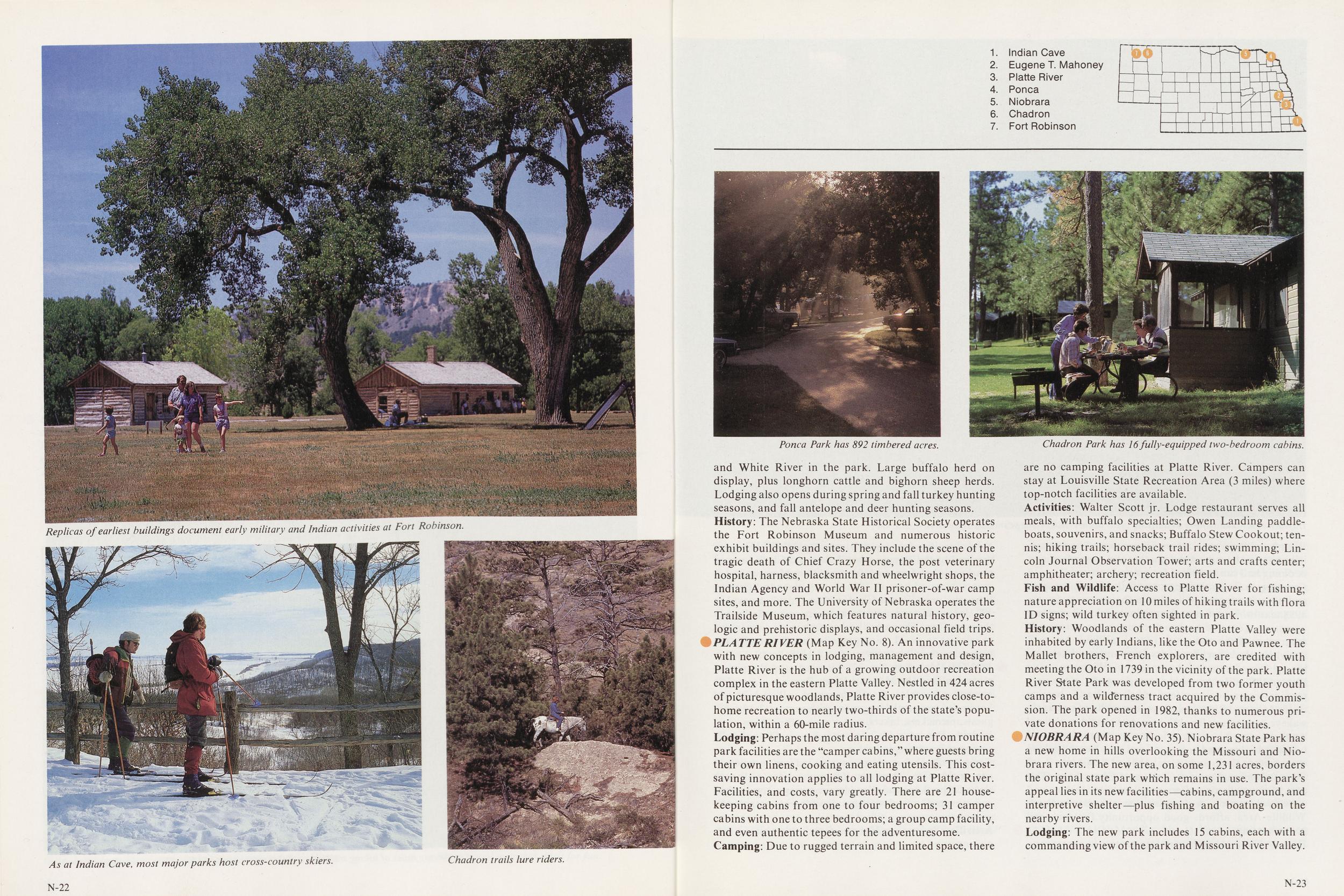
FORT ROBINSON (Map Key No. 90). Majestic buttes of the Pine Ridge country cradle Fort Robinson, Nebraska's largest and most popular state park. The fort was established in 1874 to protect the Red Cloud Indian Agency, and survived as an active military installation until 1948. Park development began in 1962, and blossomed in the late 1970s. Original fort structures, now used for cabins and lodging, stables, historic interpretation and other activities, remain the core of the park experience. Visitation now approaches 350,000 annually to its spacious 22,000-plus acres.
Lodging: Renovated historic buildings are used for all lodging facilities at Fort Rob. The Lodge, a former Enlisted Men's barracks, contains 23 rooms, the Fort Robinson Inn restaurant, a private meeting room, and the park office. Officer's Quarters, built in 1874 and 1887, have been converted to housekeeping cabins with 2 to 4 bedrooms. Brick houses built for officers in 1909 contain 7 to 9-bedroom units. For large groups, Comanche Hall can accommodate up to 60 people. All facilities are located in the heart of the park. Horse stables are also available.
Camping: The park campground includes nearly 350 individual campsites, with 150 electrical hookups. Modern conveniences service the area, located within walking distance of the Lodge. There is a primitive area for tent campers, and backpackers have plenty of back country to explore.
Activities: Indoor swimming, horseback trail rides, jeep rides, guided tours of park and surrounding sites, stagecoach and hayrack rides, tennis, rowboats, bicycles, hiking, arts and crafts, archery, Buffalo Stew Cookout, Post Playhouse, Campfire film programs, and rodeo events. Fish and Wildlife: Trout fishing on Carter P. Johnson Lake, several park ponds, and miles of Soldier's Creek and White River in the park. Large buffalo herd on display, plus longhorn cattle and bighorn sheep herds. Lodging also opens during spring and fall turkey hunting seasons, and fall antelope and deer hunting seasons.
History: The Nebraska State Historical Society operates the Fort Robinson Museum and numerous historic exhibit buildings and sites. They include the scene of the tragic death of Chief Crazy Horse, the post veterinary hospital, harness, blacksmith and wheelwright shops, the Indian Agency and World War II prisoner-of-war camp sites, and more. The University of Nebraska operates the Trailside Museum, which features natural history, geologic and prehistoric displays, and occasional field trips.
PLATTE RIVER (Map Key No. 8). An innovative park with new concepts in lodging, management and design, Platte River is the hub of a growing outdoor recreation complex in the eastern Platte Valley. Nestled in 424 acres of picturesque woodlands, Platte River provides close-to- home recreation to nearly two-thirds of the state's population, within a 60-mile radius.
Lodging: Perhaps the most daring departure from routine park facilities are the "camper cabins," where guests bring their own linens, cooking and eating utensils. This cost saving innovation applies to all lodging at Platte River. Facilities, and costs, vary greatly. There are 21 house keeping cabins from one to four bedrooms; 31 camper cabins with one to three bedrooms; a group camp facility, and even authentic tepees for the adventuresome.
Camping: Due to rugged terrain and limited space, there are no camping facilities at Platte River. Campers can stay at Louisville State Recreation Area (3 miles) where top-notch facilities are available.
Activities: Walter Scott jr. Lodge restaurant serves all meals, with buffalo specialties; Owen Landing paddle boats, souvenirs, and snacks; Buffalo Stew Cookout; tennis; hiking trails; horseback trail rides; swimming; Lincoln Journal Observation Tower; arts and crafts center; amphitheater; archery; recreation field.
Fish and Wildlife: Access to Platte River for fishing; nature appreciation on 10 miles of hiking trails with flora ID signs; wild turkey often sighted in park.
History: Woodlands of the eastern Platte Valley were inhabited by early Indians, like the Oto and Pawnee. The Mallet brothers, French explorers, are credited with meeting the Oto in 1739 in the vicinity of the park. Platte River State Park was developed from two former youth camps and a wilderness tract acquired by the Commission. The park opened in 1982, thanks to numerous private donations for renovations and new facilities.
NIOBRARA (Map Key No. 35). Niobrara State Park has a new home in hills overlooking the Missouri and Niobrara rivers. The new area, on some 1,231 acres, borders the original state park which remains in use. The park's appeal lies in its new facilities—cabins, campground, and interpretive shelter—plus fishing and boating on the nearby rivers.
Lodging: The new park includes 15 cabins, each with a commanding view of the park and Missouri River Valley. With 2 or 3 bedrooms, all are fully equipped housekeeping units and have screened porches and picnic facilities. A dining hall can be rented for group functions.
N-23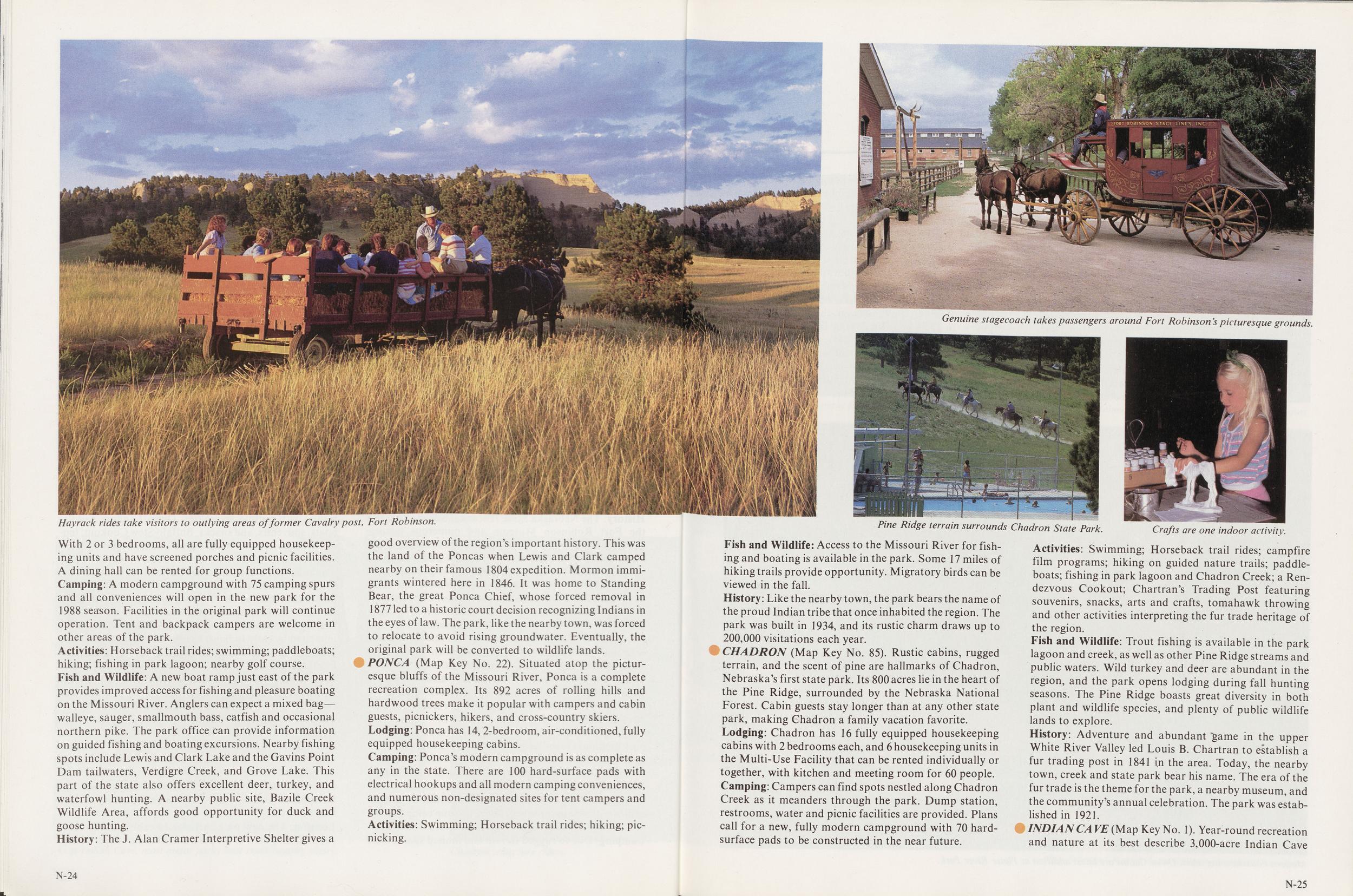
Camping: A modern campground with 75 camping spurs and all conveniences will open in the new park for the 1988 season. Facilities in the original park will continue operation. Tent and backpack campers are welcome in other areas of the park.
Activities: Horseback trail rides; swimming; paddle boats; hiking; fishing in park lagoon; nearby golf course.
Fish and Wildlife: A new boat ramp just east of the park provides improved access for fishing and pleasure boating on the Missouri River. Anglers can expect a mixed bag—walleye, sauger, smallmouth bass, catfish and occasional northern pike. The park office can provide information on guided fishing and boating excursions. Nearby fishing spots include Lewis and Clark Lake and the Gavins Point Dam tail waters, Verdigre Creek, and Grove Lake. This part of the state also offers excellent deer, turkey, and waterfowl hunting. A nearby public site, Bazile Creek Wildlife Area, affords good opportunity for duck and goose hunting.
History: The J. Alan Cramer Interpretive Shelter gives a good overview of the region's important history. This was the land of the Poncas when Lewis and Clark camped nearby on their famous 1804 expedition. Mormon immigrants wintered here in 1846. It was home to Standing Bear, the great Ponca Chief, whose forced removal in 1877 led to a historic court decision recognizing Indians in the eyes of law. The park, like the nearby town, was forced to relocate to avoid rising groundwater. Eventually, the original park will be converted to wildlife lands.
PONCA (Map Key No. 22). Situated atop the picturesque bluffs of the Missouri River, Ponca is a complete recreation complex. Its 892 acres of rolling hills and hardwood trees make it popular with campers and cabin guests, picnickers, hikers, and cross-country skiers.
Lodging: Ponca has 14, 2-bedroom, air-conditioned, fully equipped housekeeping cabins.
Camping: Ponca's modern campground is as complete as any in the state. There are 100 hard-surface pads with electrical hookups and all modern camping conveniences, and numerous non-designated sites for tent campers and groups.
Activities: Swimming; Horseback trail rides; hiking; pic- nicking.
N-24Fish and Wildlife: Access to the Missouri River for fishing and boating is available in the park. Some 17 miles of hiking trails provide opportunity. Migratory birds can be viewed in the fall.
History: Like the nearby town, the park bears the name of the proud Indian tribe that once inhabited the region. The park was built in 1934, and its rustic charm draws up to 200,000 visitations each year.
CHADRON (Map Key No. 85). Rustic cabins, rugged terrain, and the scent of pine are hallmarks of Chadron, Nebraska's first state park. Its 800 acres lie in the heart of the Pine Ridge, surrounded by the Nebraska National Forest. Cabin guests stay longer than at any other state park, making Chadron a family vacation favorite.
Lodging: Chadron has 16 fully equipped housekeeping cabins with 2 bedrooms each, and 6 housekeeping units in the Multi-Use Facility that can be rented individually or together, with kitchen and meeting room for 60 people.
Camping: Campers can find spots nestled along Chadron Creek as it meanders through the park. Dump station, restrooms, water and picnic facilities are provided. Plans call for a new, fully modern campground with 70 hard surface pads to be constructed in the near future.
Activities: Swimming; Horseback trail rides; campfire film programs; hiking on guided nature trails; paddle boats; fishing in park lagoon and Chadron Creek; a Rendezvous Cookout; Chartran's Trading Post featuring souvenirs, snacks, arts and crafts, tomahawk throwing and other activities interpreting the fur trade heritage of the region.
Fish and Wildlife: Trout fishing is available in the park lagoon and creek, as well as other Pine Ridge streams and public waters. Wild turkey and deer are abundant in the region, and the park opens lodging during fall hunting seasons. The Pine Ridge boasts great diversity in both plant and wildlife species, and plenty of public wildlife lands to explore.
History: Adventure and abundant game in the upper White River Valley led Louis B. Chartran to establish a fur trading post in 1841 in the area. Today, the nearby town, creek and state park bear his name. The era of the fur trade is the theme for the park, a nearby museum, and the community's annual celebration. The park was established in 1921.
INDIAN CA VE (Map Key No. 1). Year-round recreation
and nature at its best describe 3,000-acre Indian Cave
N-25
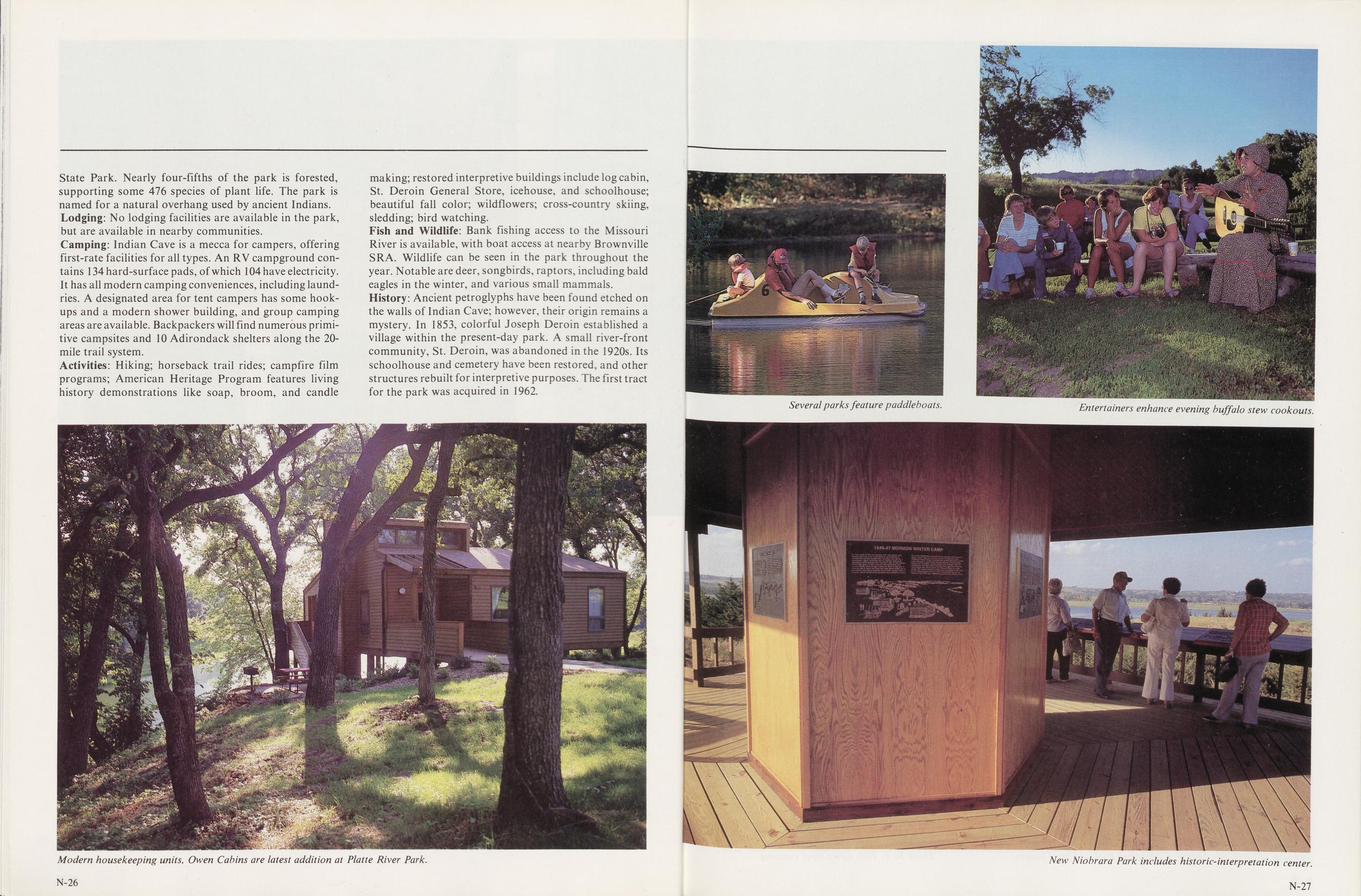 State Park. Nearly four-fifths of the park is forested,
supporting some 476 species of plant life. The park is
named for a natural overhang used by ancient Indians.
State Park. Nearly four-fifths of the park is forested,
supporting some 476 species of plant life. The park is
named for a natural overhang used by ancient Indians.
Lodging: No lodging facilities are available in the park, but are available in nearby communities.
Camping: Indian Cave is a mecca for campers, offering first-rate facilities for all types. An RV campground contains 134 hard-surface pads, of which 104 have electricity. It has all modern camping conveniences, including laundries. A designated area for tent campers has some hook-ups and a modern shower building, and group camping areas are available. Backpackers will find numerous primitive campsites and 10 Adirondack shelters along the 20-mile trail system.
Activities: Hiking; horseback trail rides; campfire film programs; American Heritage Program features living history demonstrations like soap, broom, and candle making; restored interpretive buildings include log cabin, St. Deroin General Store, icehouse, and schoolhouse; beautiful fall color; wildflowers; cross-country skiing, sledding; bird watching.
Fish and Wildlife: Bank fishing access to the Missouri River is available, with boat access at nearby Brownville SRA. Wildlife can be seen in the park throughout the year. Notable are deer, songbirds, raptors, including bald eagles in the winter, and various small mammals.
History: Ancient petroglyphs have been found etched on the walls of Indian Cave; however, their origin remains a mystery. In 1853, colorful Joseph Deroin established a village within the present-day park. A small river-front community, St. Deroin, was abandoned in the 1920s. Its schoolhouse and cemetery have been restored, and other structures rebuilt for interpretive purposes. The first tract for the park was acquired in 1962.
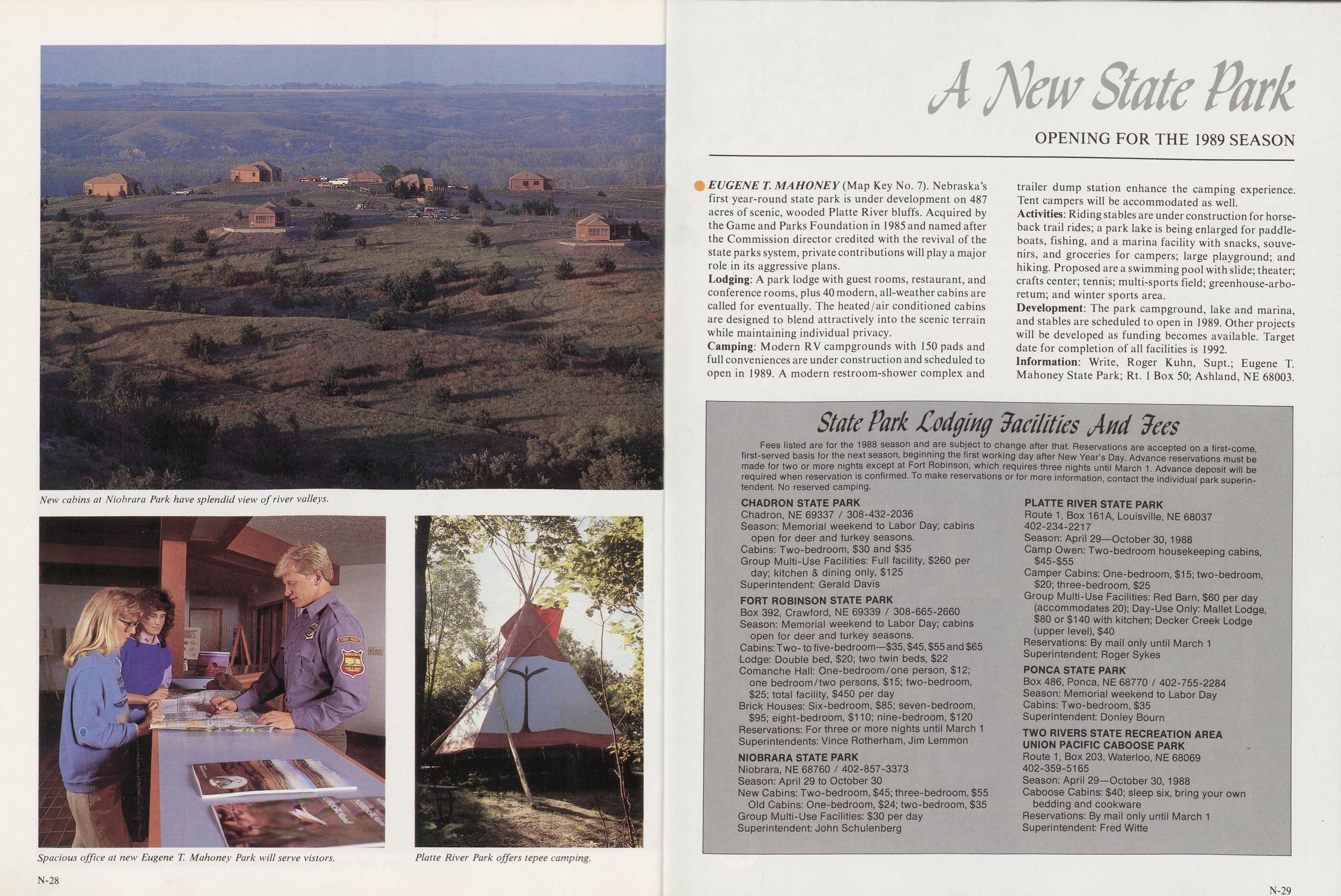
A New State Park
OPENING FOR THE 1989 SEASONEUGENE T. MAHONEY (Map Key No. 7). Nebraska's first year-round state park is under development on 487 acres of scenic, wooded Platte River bluffs. Acquired by the Game and Parks Foundation in 1985 and named after the Commission director credited with the revival of the state parks system, private contributions will play a major role in its aggressive plans.
Lodging: A park lodge with guest rooms, restaurant, and conference rooms, plus 40 modern, all-weather cabins are called for eventually. The heated/air conditioned cabins are designed to blend attractively into the scenic terrain while maintaining individual privacy.
Camping: Modern RV campgrounds with 150 pads and full conveniences are under construction and scheduled to open in 1989. A modern restroom-shower complex and trailer dump station enhance the camping experience. Tent campers will be accommodated as well.
Activities: Riding stables are under construction for horseback trail rides; a park lake is being enlarged for paddle boats, fishing, and a marina facility with snacks, souvenirs, and groceries for campers; large playground; and hiking. Proposed are a swimming pool with slide; theater; crafts center; tennis; multi-sports field; greenhouse-arboretum; and winter sports area.
Development: The park campground, lake and marina, and stables are scheduled to open in 1989. Other projects will be developed as funding becomes available. Target date for completion of all facilities is 1992.
Information: Write, Roger Kuhn, Supt.; Eugene T. Mahoney State Park; Rt. 1 Box 50; Ashland, NE 68003.
fitted are asis to ;on and are . beginning the at Fort Robins 3d. To make ret Reservation Year's D, until Spacious office at new Eugene T. Mahoney Park will serve visitors. Platte River Park offers tepee camping.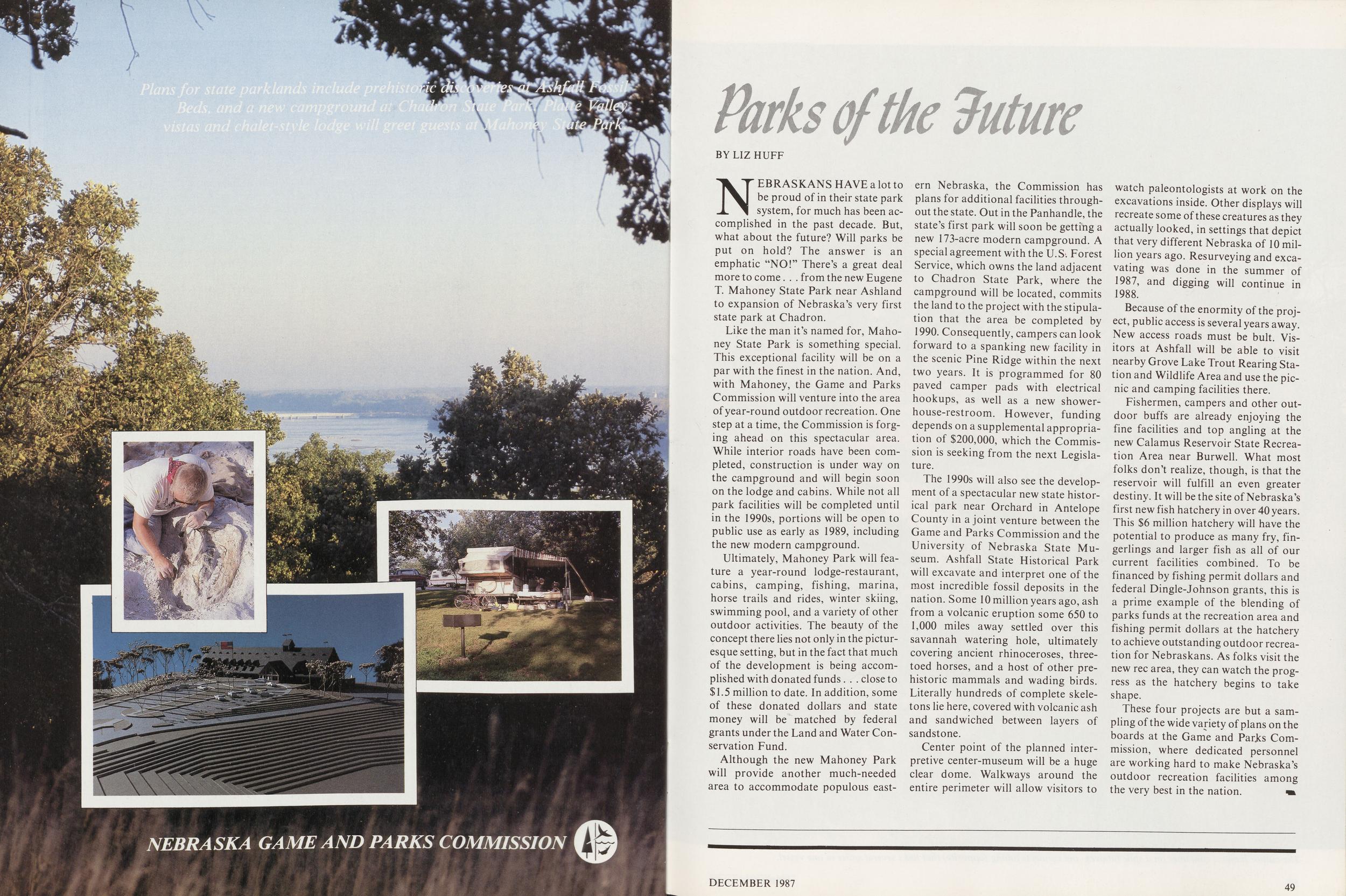
Parks of the Future
BY LIZ HUFFNEBRASKANS HAVE a lot to be proud of in their state park system, for much has been accomplished in the past decade. But, what about the future? Will parks be put on hold? The answer is an emphatic "NO!" There's a great deal more to come. . . from the new Eugene T. Mahoney State Park near Ashland to expansion of Nebraska's very first state park at Chadron.
Like the man it's named for, Mahoney State Park is something special. This exceptional facility will be on a par with the finest in the nation. And, with Mahoney, the Game and Parks Commission will venture into the area of year-round outdoor recreation. One step at a time, the Commission is forging ahead on this spectacular area. While interior roads have been completed, construction is under way on the campground and will begin soon on the lodge and cabins. While not all park facilities will be completed until in the 1990s, portions will be open to public use as early as 1989, including the new modern campground.
Ultimately, Mahoney Park will feature a year-round lodge-restaurant, cabins, camping, fishing, marina, horse trails and rides, winter skiing, swimming pool, and a variety of other outdoor activities. The beauty of the concept there lies not only in the picturesque setting, but in the fact that much of the development is being accomplished with donated funds. . .close to $1.5 million to date. In addition, some of these donated dollars and state money will be matched by federal grants under the Land and Water Conservation Fund.
Although the new Mahoney Park will provide another much-needed area to accommodate populous eastern Nebraska, the Commission has plans for additional facilities throughout the state. Out in the Panhandle, the state's first park will soon be getting a new 173-acre modern campground. A special agreement with the U. S*. Forest Service, which owns the land adjacent to Chadron State Park, where the campground will be located, commits the land to the project with the stipulation that the area be completed by 1990. Consequently, campers can look forward to a spanking new facility in the scenic Pine Ridge within the next two years. It is programmed for 80 paved camper pads with electrical hookups, as well as a new shower-house-restroom. However, funding depends on a supplemental appropriation of $200,000, which the Commission is seeking from the next Legislature.
The 1990s will also see the development of a spectacular new state historical park near Orchard in Antelope County in a joint venture between the Game and Parks Commission and the University of Nebraska State Museum. Ashfall State Historical Park will excavate and interpret one of the most incredible fossil deposits in the nation. Some 10 million years ago, ash from a volcanic eruption some 650 to 1,000 miles away settled over this savannah watering hole, ultimately covering ancient rhinoceroses, three toed horses, and a host of other prehistoric mammals and wading birds. Literally hundreds of complete skeletons lie here, covered with volcanic ash and sandwiched between layers of sandstone.
Center point of the planned interpretive center-museum will be a huge clear dome. Walkways around the entire perimeter will allow visitors to watch paleontologists at work on the excavations inside. Other displays will recreate some of these creatures as they actually looked, in settings that depict that very different Nebraska of 10 million years ago. Resurveying and excavating was done in the summer of 1987, and digging will continue in 1988.
Because of the enormity of the project, public access is several years away. New access roads must be built. Visitors at Ashfall will be able to visit nearby Grove Lake Trout Rearing Station and Wildlife Area and use the picnic and camping facilities there.
Fishermen, campers and other outdoor buffs are already enjoying the fine facilities and top angling at the new Calamus Reservoir State Recreation Area near Burwell. What most folks don't realize, though, is that the reservoir will fulfill an even greater destiny. It will be the site of Nebraska's first new fish hatchery in over 40 years. This $6 million hatchery will have the potential to produce as many fry, fingerlings and larger fish as all of our current facilities combined. To be financed by fishing permit dollars and federal Dingle-Johnson grants, this is a prime example of the blending of parks funds at the recreation area and fishing permit dollars at the hatchery to achieve outstanding outdoor recreation for Nebraskans. As folks visit the new rec area, they can watch the progress as the hatchery begins to take shape.
These four projects are but a sampling of the wide variety of plans on the boards at the Game and Parjcs Commission, where dedicated personnel are working hard to make Nebraska's outdoor recreation facilities among the very best in the nation.
DECEMBER 1987 49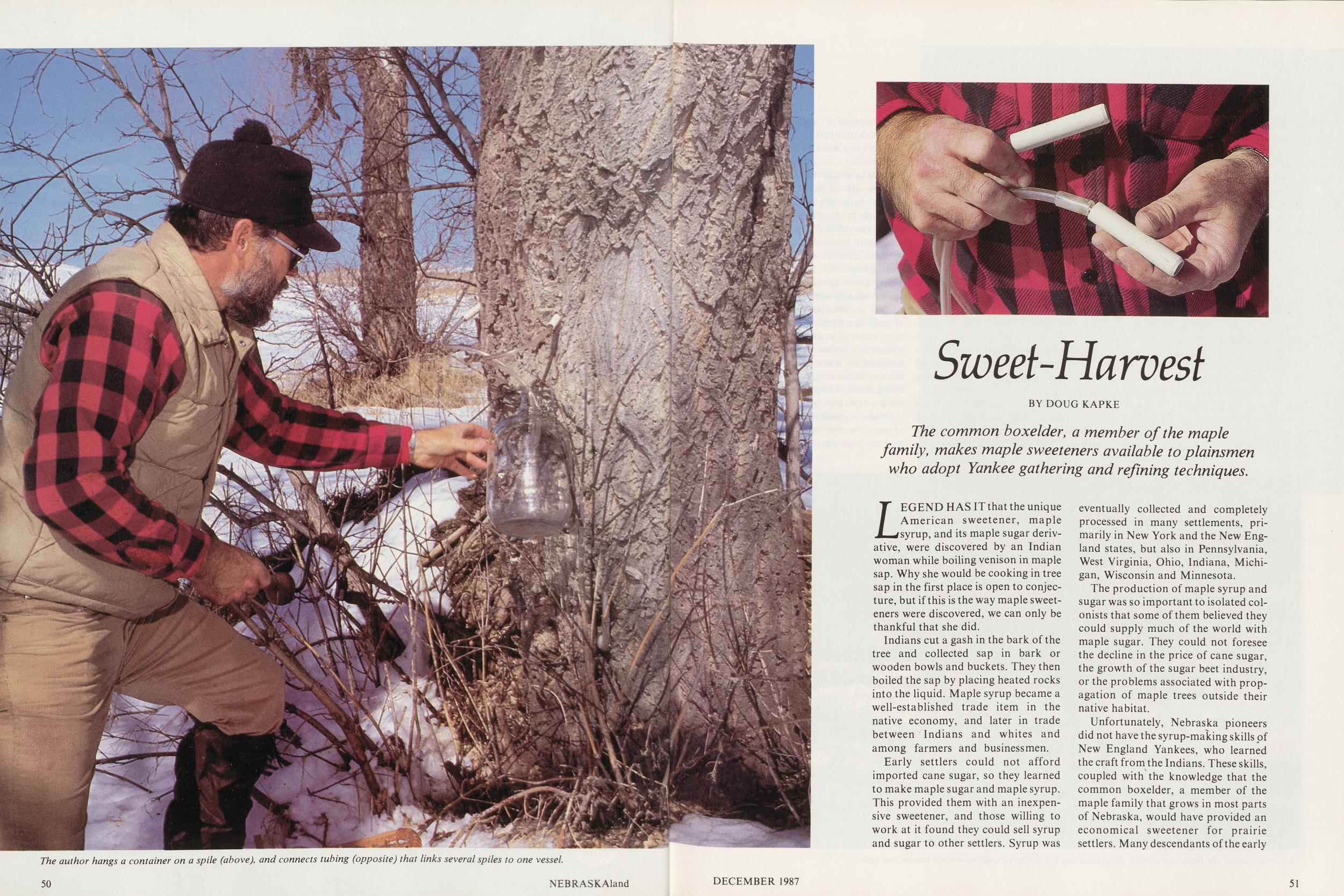
Sweet-Harvest
BY DOUG KAPKE The common boxelder, a member of the maple family, makes maple sweeteners available to plainsmen who adopt Yankee gathering and refining techniques.LEGEND HAS IT that the unique American sweetener, maple syrup, and its maple sugar derivative, were discovered by an Indian woman while boiling venison in maple sap. Why she would be cooking in tree sap in the first place is open to conjecture, but if this is the way maple sweeteners were discovered, we can only be thankful that she did.
Indians cut a gash in the bark of the tree and collected sap in bark or wooden bowls and buckets. They then boiled the sap by placing heated rocks into the liquid. Maple syrup became a well-established trade item in the native economy, and later in trade between Indians and whites and among farmers and businessmen.
Early settlers could not afford imported cane sugar, so they learned to make maple sugar and maple syrup. This provided them with an inexpensive sweetener, and those willing to work at it found they could sell syrup and sugar to other settlers. Syrup was eventually collected and completely processed in many settlements, primarily in New York and the New England states, but also in Pennsylvania, West Virginia, Ohio, Indiana, Michigan, Wisconsin and Minnesota.
The production of maple syrup and sugar was so important to isolated colonists that some of them believed they could supply much of the world with maple sugar. They could not foresee the decline in the price of cane sugar, the growth of the sugar beet industry, or the problems associated with propagation of maple trees outside their native habitat.
Unfortunately, Nebraska pioneers
did not have the syrup-making skills of
New England Yankees, who learned
the craft from the Indians. These skills,
coupled with the knowledge that the
common boxelder, a member of the
maple family that grows in most parts
of Nebraska, would have provided an
economical sweetener for prairie
settlers. Many descendants of the early
DECEMBER 1987
51
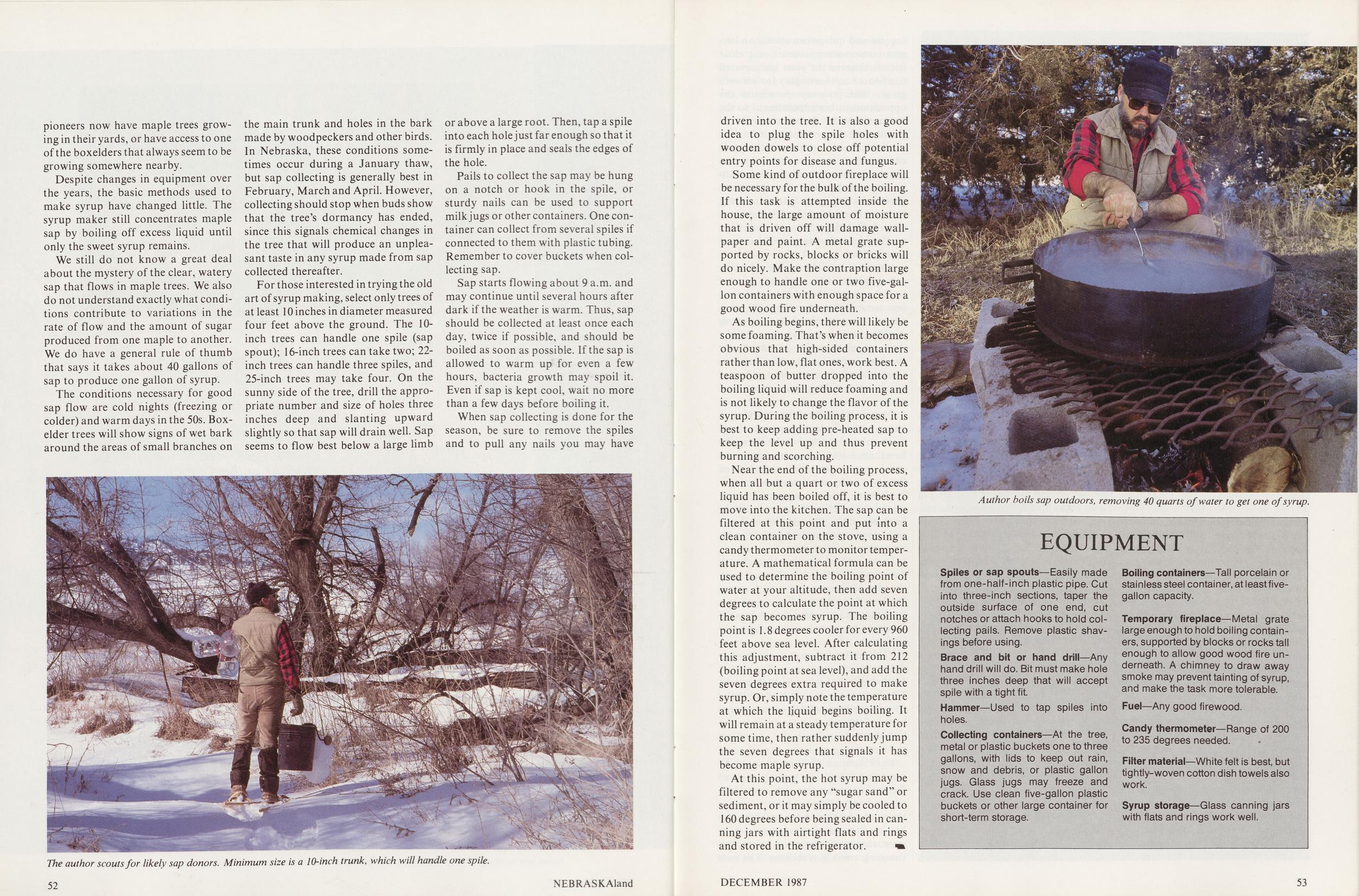 pioneers now have maple trees
growing in their yards, or have access to one
of the boxelders that always seem to be
growing somewhere nearby.
pioneers now have maple trees
growing in their yards, or have access to one
of the boxelders that always seem to be
growing somewhere nearby.
Despite changes in equipment over the years, the basic methods used to make syrup have changed little. The syrup maker still concentrates maple sap by boiling off excess liquid until only the sweet syrup remains.
We still do not know a great deal about the mystery of the clear, watery sap that flows in maple trees. We also do not understand exactly what conditions contribute to variations in the rate of flow and the amount of sugar produced from one maple to another. We do have a general rule of thumb that says it takes about 40 gallons of sap to produce one gallon of syrup.
The conditions necessary for good sap flow are cold nights (freezing or colder) and warm days in the 50s. Box-elder trees will show signs of wet bark around the areas of small branches on the main trunk and holes in the bark made by woodpeckers and other birds. In Nebraska, these conditions sometimes occur during a January thaw, but sap collecting is generally best in February, March and April. However, collecting should stop when buds show that the tree's dormancy has ended, since this signals chemical changes in the tree that will produce an unpleasant taste in any syrup made from sap collected thereafter.
For those interested in trying the old art of syrup making, select only trees of at least 10 inches in diameter measured four feet above the ground. The 10-inch trees can handle one spile (sap spout); 16-inch trees can take two; 22-inch trees can handle three spiles, and 25-inch trees may take four. On the sunny side of the tree, drill the appropriate number and size of holes three inches deep and slanting upward slightly so that sap will drain well. Sap seems to flow best below a large limb or above a large root. Then, tap a spile into each hole just far enough so that it is firmly in place and seals the edges of the hole.
Pails to collect the sap may be hung on a notch or hook in the spile, or sturdy nails can be used to support milk jugs or other containers. One container can collect from several spiles if connected to them with plastic tubing. Remember to cover buckets when collecting sap.
Sap starts flowing about 9 a.m. and may continue until several hours after dark if the weather is warm. Thus, sap should be collected at least once each day, twice if possible, and should be boiled as soon as possible. If the sap is allowed to warm up for even a few hours, bacteria growth may spoil it. Even if sap is kept cool, wait no more than a few days before boiling it.
When sap collecting is done for the season, be sure to remove the spiles and to pull any nails you may have 52 NEBRASKAland driven into the tree. It is also a good idea to plug the spile holes with wooden dowels to close off potential entry points for disease and fungus.
Some kind of outdoor fireplace will be necessary for the bulk of the boiling. If this task is attempted inside the house, the large amount of moisture that is driven off will damage wallpaper and paint. A metal grate supported by rocks, blocks or bricks will do nicely. Make the contraption large enough to handle one or two five-gallon containers with enough space for a good wood fire underneath.
As boiling begins, there will likely be some foaming. That's when it becomes obvious that high-sided containers rather than low, flat ones, work best. A teaspoon of butter dropped into the boiling liquid will reduce foaming and is not likely to change the flavor of the syrup. During the boiling process, it is best to keep adding pre-heated sap to keep the level up and thus prevent burning and scorching.
Near the end of the boiling process, when all but a quart or two of excess liquid has been boiled off, it is best to move into the kitchen. The sap can be filtered at this point and put into a clean container on the stove, using a candy thermometer to monitor temperature. A mathematical formula can be used to determine the boiling point of water at your altitude, then add seven degrees to calculate the point at which the sap becomes syrup. The boiling point is 1.8 degrees cooler for every 960 feet above sea level. After calculating this adjustment, subtract it from 212 (boiling point at sea level), and add the seven degrees extra required to make syrup. Or, simply note the temperature at which the liquid begins boiling. It will remain at a steady temperature for some time, then rather suddenly jump the seven degrees that signals it has become maple syrup.
At this point, the hot syrup may be filtered to remove any "sugar sand" or sediment, or it may simply be cooled to 160 degrees before being sealed in canning jars with airtight flats and rings and stored in the refrigerator.
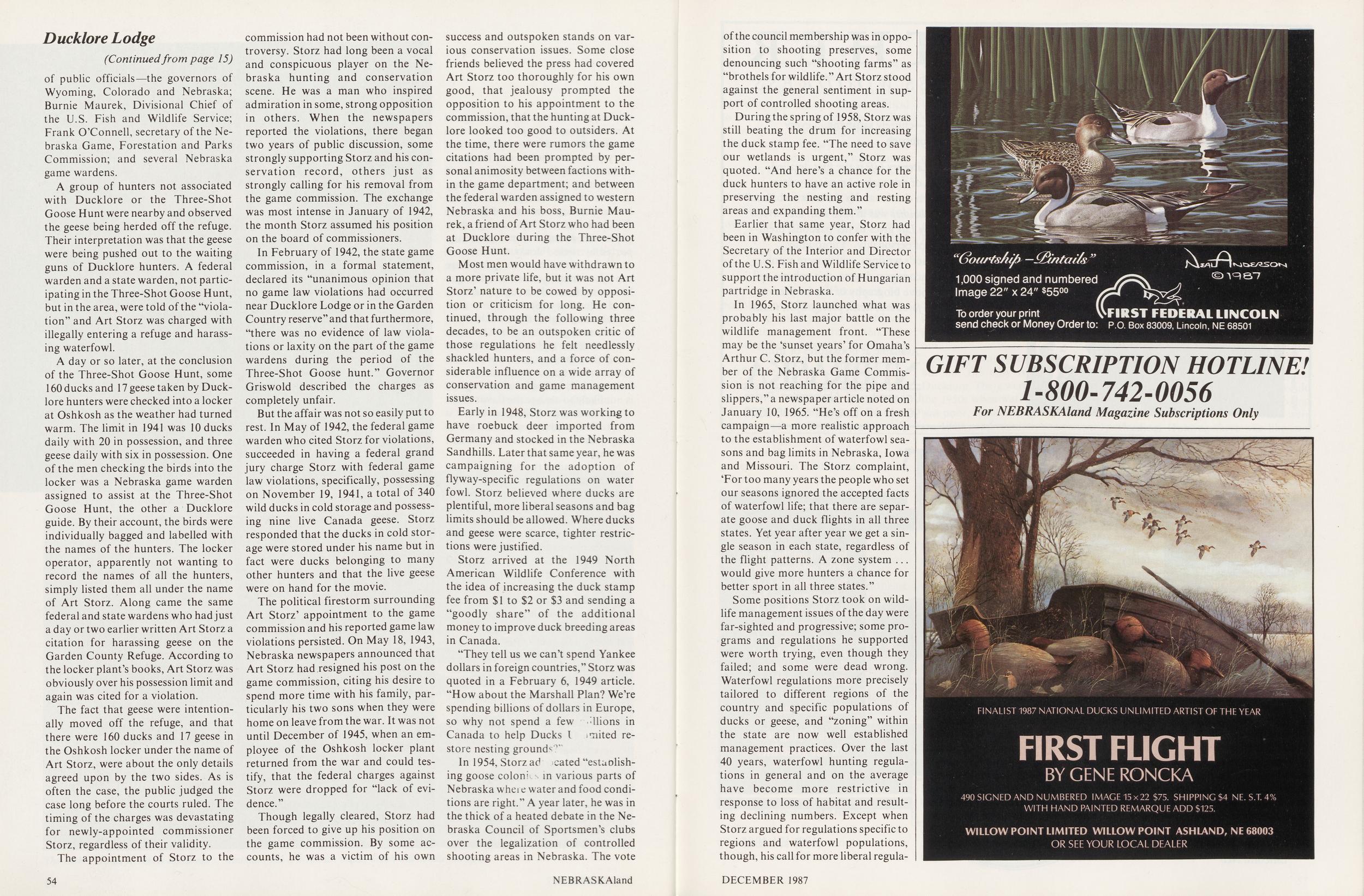
Ducklore Lodge
(Continued from page 15)of public officials—the governors of Wyoming, Colorado and Nebraska; Burnie Maurek, Divisional Chief of the U.S. Fish and Wildlife Service; Frank O'Connell, secretary of the Nebraska Game, Forestation and Parks Commission; and several Nebraska game wardens.
A group of hunters not associated with Ducklore or the Three-Shot Goose Hunt were nearby and observed the geese being herded off the refuge. Their interpretation was that the geese were being pushed out to the waiting guns of Ducklore hunters. A federal warden and a state warden, not participating in the Three-Shot Goose Hunt, but in the area, were told of the "violation" and Art Storz was charged with illegally entering a refuge and harassing waterfowl.
A day or so later, at the conclusion of the Three-Shot Goose Hunt, some 160 ducks and 17 geese taken by Ducklore hunters were checked into a locker at Oshkosh as the weather had turned warm. The limit in 1941 was 10 ducks daily with 20 in possession, and three geese daily with six in possession. One of the men checking the birds into the locker was a Nebraska game warden assigned to assist at the Three-Shot Goose Hunt, the other a Ducklore guide. By their account, the birds were individually bagged and labelled with the names of the hunters. The locker operator, apparently not wanting to record the names of all the hunters, simply listed them all under the name of Art Storz. Along came the same federal and state wardens who had just a day or two earlier written Art Storz a citation for harassing geese on the Garden County Refuge. According to the locker plant's books, Art Storz was obviously over his possession limit and again was cited for a violation.
The fact that geese were intentionally moved off the refuge, and that there were 160 ducks and 17 geese in the Oshkosh locker under the name of Art Storz, were about the only details agreed upon by the two sides. As is often the case, the public judged the case long before the courts ruled. The timing of the charges was devastating for newly-appointed commissioner Storz, regardless of their validity.
The appointment of Storz to the commission had not been without controversy. Storz had long been a vocal and conspicuous player on the Nebraska hunting and conservation scene. He was a man who inspired admiration in some, strong opposition in others. When the newspapers reported the violations, there began two years of public discussion, some strongly supporting Storz and his conservation record, others just as strongly calling for his removal from the game commission. The exchange was most intense in January of 1942, the month Storz assumed his position on the board of commissioners.
In February of 1942, the state game commission, in a formal statement, declared its "unanimous opinion that no game law violations had occurred near Ducklore Lodge or in the Garden Country reserve" and that furthermore, "there was no evidence of law violations or laxity on the part of the game wardens during the period of the Three-Shot Goose hunt." Governor Griswold described the charges as completely unfair.
But the affair was not so easily put to rest. In May of 1942, the federal game warden who cited Storz for violations, succeeded in having a federal grand jury charge Storz with federal game law violations, specifically, possessing on November 19, 1941, a total of 340 wild ducks in cold storage and possessing nine live Canada geese. Storz responded that the ducks in cold storage were stored under his name but in fact were ducks belonging to many other hunters and that the live geese were on hand for the movie.
The political firestorm surrounding Art Storz' appointment to the game commission and his reported game law violations persisted. On May 18, 1943, Nebraska newspapers announced that Art Storz had resigned his post on the game commission, citing his desire to spend more time with his family, particularly his two sons when they were home on leave from the war. It was not until December of 1945, when an employee of the Oshkosh locker plant returned from the war and could testify, that the federal charges against Storz were dropped for "lack of evidence."
Though legally cleared, Storz had been forced to give up his position on the game commission. By some accounts, he was a victim of his own success and outspoken stands on various conservation issues. Some close friends believed the press had covered Art Storz too thoroughly for his own good, that jealousy prompted the opposition to his appointment to the commission, that the hunting at Ducklore looked too good to outsiders. At the time, there were rumors the game citations had been prompted by personal animosity between factions within the game department; and between the federal warden assigned to western Nebraska and his boss, Burnie Maurek, a friend of Art Storz who had been at Ducklore during the Three-Shot Goose Hunt.
Most men would have withdrawn to a more private life, but it was not Art Storz' nature to be cowed by opposition or criticism for long. He continued, through the following three decades, to be an outspoken critic of those regulations he felt needlessly shackled hunters, and a force of considerable influence on a wide array of conservation and game management issues.
Early in 1948, Storz was working to have roebuck deer imported from Germany and stocked in the Nebraska Sandhills. Later that same year, he was campaigning for the adoption of flyway-specific regulations on water fowl. Storz believed where ducks are plentiful, more liberal seasons and bag limits should be allowed. Where ducks and geese were scarce, tighter restrictions were justified.
Storz arrived at the 1949 North American Wildlife Conference with the idea of increasing the duck stamp fee from $1 to $2 or $3 and sending a "goodly share" of the additional money to improve duck breeding areas in Canada.
"They tell us we can't spend Yankee dollars in foreign countries," Storz was quoted in a February 6, 1949 article. "How about the Marshall Plan? We're spending billions of dollars in Europe, so why not spend a few Jlions in Canada to help Ducks Intermitted restore nesting ground^'"
In 1954, Storz ad caught "estuolishing goose colon! in various parts of Nebraska white water and food conditions are right." A year later, he was in the thick of a heated debate in the Nebraska Council of Sportsmen's clubs over the legalization of controlled shooting areas in Nebraska. The vote 54 NEBRASKAland of the council membership was in opposition to shooting preserves, some denouncing such "shooting farms" as "brothels for wildlife." Art Storz stood against the general sentiment in support of controlled shooting areas.
During the spring of 1958, Storz was still beating the drum for increasing the duck stamp fee. "The need to save our wetlands is urgent," Storz was quoted. "And here's a chance for the duck hunters to have an active role in preserving the nesting and resting areas and expanding them."
Earlier that same year, Storz had been in Washington to confer with the Secretary of the Interior and Director of the U.S. Fish and Wildlife Service to support the introduction of Hungarian partridge in Nebraska.
In 1965, Storz launched what was probably his last major battle on the wildlife management front. "These may be the 'sunset years' for Omaha's Arthur C. Storz, but the former member of the Nebraska Game Commission is not reaching for the pipe and slippers," a newspaper article noted on January 10, 1965. "He's off on a fresh campaign—a more realistic approach to the establishment of waterfowl seasons and bag limits in Nebraska, Iowa and Missouri. The Storz complaint, 'For too many years the people who set our seasons ignored the accepted facts of waterfowl life; that there are separate goose and duck flights in all three states. Yet year after year we get a single season in each state, regardless of the flight patterns. A zone system ... would give more hunters a chance for better sport in all three states."
Some positions Storz took on wildlife management issues of the day were far-sighted and progressive; some programs and regulations he supported were worth trying, even though they failed; and some were dead wrong. Waterfowl regulations more precisely tailored to different regions of the country and specific populations of ducks or geese, and "zoning" within the state are now well established management practices. Over the last 40 years, waterfowl hunting regulations in general and on the average have become more restrictive in response to loss of habitat and resulting declining numbers. Except when Storz argued for regulations specific to regions and waterfowl populations, though, his call for more liberal regulations was probably no more than an old hunter's desire to again have the seasons and limits he had once known.
Duck stamp fees have been raised progressively to allow for purchase and enhancement of wetlands critical to waterfowl. Had they been raised when Storz was calling for the increase, and the money wisely applied, we would no doubt have saved more wetlands from destruction and at a far lower cost than is possible today.
When Storz called for more restrictive hunting seasons on pheasants following the 1949 blizzard, he was supporting the popular belief of the day that game birds could be stockpiled. The same sentiment is frequently echoed yet today whenever an especially hard winter knocks back bird populations. For half a century, though, scientific studies have demonstrated that long before hunters start shooting the "seed stock," hunting has become so unproductive that hunters quit hunting. It is the supply of habitat and weather conditions that dictate the speed with which bird populations rebound from severe winters. Restricting the length of the season or the bag limits is insignificant.
Just as Storz suggested, Canada geese have been established in nesting colonies across the lake country of the Sandhills and more recently along the North Platte River. Shooting preserves, like them or not, are now licensed and regulated by the game commission, just as Storz advocated back in 1955. And, the Hungarian partridge is established, admittedly in small numbers, across the northeast corner of the state.
It would be misleading to credit too much the role Art Storz played in the many issues on which he took a stand. He did not originate many of the concepts, programs and regulations himself, but he was a powerful advocate of any he chose to support. It would probably be just as inaccurate to make too little of his influence. Few private citizens in Nebraska have been as visible or effective influencing conservation, wildlife management and hunting regulations as was Art Storz. Certainly, he had no equal in his day.
The Decline of DuckloreThe man who turned a barren North Platte River sandbar into a wildlife oasis without compare is no DECEMBER 1987 longer the host," wrote Howard Wolff in an August 10, 1958 Omaha World Herald article. "Ducklore Lodge, blooming with the warm radiance that only loving care can generate is as well known in far-away corners of the world as it is in Nebraska. In and out of season, host Storz has shown his gracious hospitality to thousands of hunters, fishermen and folks who just wanted to get away from it all. And since the start, the 69-year-old Omahan has opened the doors of Ducklore to friends from near and far; to governors, truck drivers, lawyers, brick masons, doctors—and military men by the hundreds."
"When you're crowding 70, the river gets tougher every day," Storz was quoted in a November 30, 1958 article. "The winter winds bite sharper. My friends of the peak Ducklore days are growing older, too. It was time to get out."
Art's age was probably the principal but not the only reason for selling Ducklore. There were dry years during the 1950s when waterfowl production was poor, flights meager compared to the 1940s, and regulations necessarily restrictive. During the war years, Ducklore shone with military brass, but as time passed, fewer regulars returned to hunt, though they were probably closer friends. And, it was a long, tiring 400 miles from Omaha to Ducklore.
The famed lodge and all it involved had run its course, its glory years were past. Like a winning race horse past its prime, it was merciful to put it away. It was Art Storz' nature; things had to be done just right, the best, or not at all.
While Art Storz had lost his taste for driving across the state to battle the North Platte's channels, his appetite for waterfowl hunting and surrounding himself with friends who shared his passion, had not diminished. A November 30, 1958 Omaha World-Herald article just months after the sale of Ducklore, noted that Storz' "love of the out-of-doors has crystallized at Gooselore, the 'sunset years' retreat just off the Squaw Creek National Wildlife Refuge near Mound City, Missouri, a two-hour drive from Omaha.
"At Gooselore, on the very lip of the eight-mile-long refuge where 250,000 ducks and geese are now breaking their migration, there are no swirling North Platte River channels to battle," the article continued.
Some things were the same at Gooselore as they had been at Ducklore. In a booklet Storz printed to introduce his guests to the area, he included the same rules that he had demanded his guests at Ducklore follow: never point a gun at anything you do not intend to kill, no sky-busting, no drinking in blinds, no gambling and "observe all game laws to the letter." Included were tips on calling ducks, bag limits, waterfowl identification aids, shooting hours, and, of course, several of Storz' favorite gamebird recipes. Gooselore almost seemed to be a touch of wistful nostalgia, a grand old hunter's last hurrah.
"It was as good a setup as Duck- lore," Jack Shelton, remembered, "but Art didn't like it as much. It was too artificial. They planted soybeans and wheat, and then they flooded it and the ducks would land in the shallow water and eat off the bottom. You had to wait, and the ducks would come up out of the reserve and maybe they would go this way, maybe they would go that way, depending on where they were feeding. Hunting there was like in a shooting gallery. It was a lot better at Ducklore."
Early in 1970, when Storz had turned 80, he sold his Gooselore lease.
On June 23, 1978, Art C. Storz died at the age of 88 after half a dozen years of being disabled by injury and illness. Eulogies in the newspapers noted his civic contributions—17 years on the Omaha Airport Authority, instrumental role in the modernization of Eppley Air Field and in bringing the Strategic Air Command to Omaha. Little note was made of his place in the history of Nebraska conservation or wildlife management. He had outlived most of his contemporaries.
Art Storz' place in Nebraska history will be, just as he was, somewhat controversial. He did not slip through life without attracting detractors, few strong-willed men do. Few men, strong-willed or otherwise, ace without flaws, and certainly Art Storz had his and they were frequently called to his attention in the popular press. As an employer, he was demanding; as a friend, he would, as Joe Foss said, "give away the whole deal." As a hunter, he could hold his own with the best. His dedication to wildlife and conservation was as strong as any this state has ever fielded.
DECEMBER 1987 57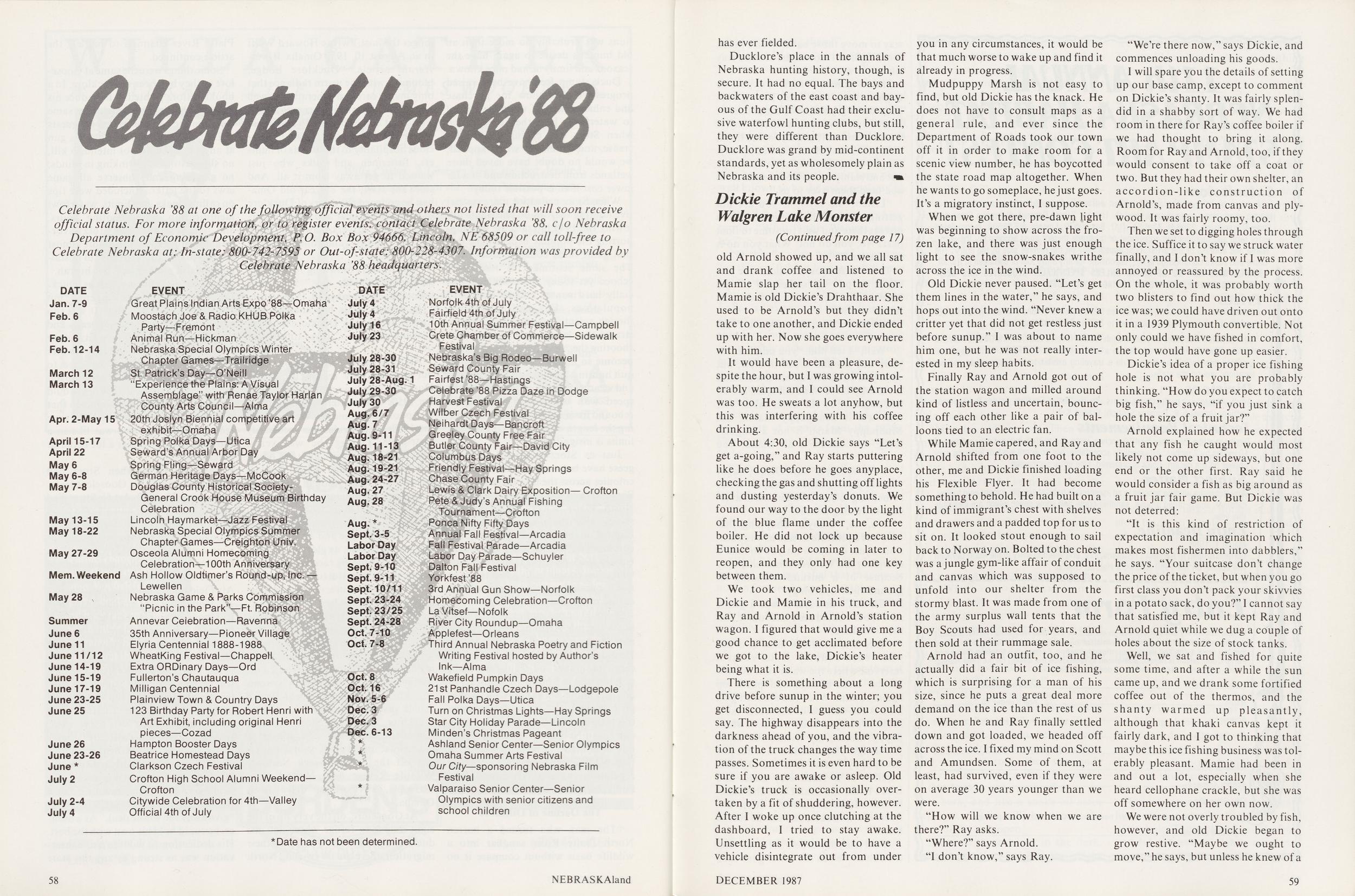 Celebrate Nebraska '88
 at one of the following official events and others not listed
that will soon receive
official status. For more information, or to register events, contact Celebrate Nebraska
'88, c/o Nebraska
Department of' Econornle Development, P.O. Box Box 94666, Lincoln, NE$8509 or call
toll-free to
Celebrate Nebraska at; Instate:'800-742-759$ or Out-of-state: 800-228-4307. Information
was provided by
Celebrate Nebraska '8$ headquarters.
DATE
Jan. 7-9
Feb. 6
Feb. 6
Feb. 12-14 1
March 12
March 13
Apr. 2-May 15 J
April 15-17
April 22
May 6
May 6-8
May 7-8
May 13-15
May 18-22
May 27-29
Mem. Weekend
May 28 ,
Summer
June 6
June 11
June11/12
June 14-19
June 15-19
June 17-19
June 23-25
June 25
June 26
June 23-26
June*
July 2
July 2-4
July 4
JVENT
Great Plains Indian Arts Expo'88HrOmaha
Moostach Joe & Radio KHUB Pdlka
Party Frdrndnt
Animal Run—Hickman
Nebraska Special Olympics Winter
Chapter Games—Trail ridge
St. Patrick's Day—O'Neill
"Experience the Plains: A Visual
with Renae Taylor Harlan
County Arts Council—Alma
20th Joslyn Bienniar competitive art
exhibit—Omaha
Spring Polka Days—Utica
Seward's Annual Arbor Day
Spring Fling—Seward
German Heritage Days—McCook
Douglas County Historical Society-
general Crook House Museum Birthday
Celebration
Lincoln Haym—Jazz Festival
Nebraska, Special Olympics Summer
Chapter games—Creighton Univ.
Osceola Alunrmi Homecoming
CelebrationVl 00th Anniversary
Ash Hollow Oldtimer's Round-up, Inc. —
Lewellen
Nebraska Game & Parks Commission
"Picnic in the Park%|-Ft. Robinson
Annevar Celebration—Ravenna
35th Anniversary—Pioneer Village
Elyria Centennial 1888-1988,
WheatKing Festival—Chappeli
Extra ORDinary Days—Ord
Fullerton's Chautauqua
Milligan Centennial
Plainview Town & Country Days
123 Birthday Party for Robert Henri with
Art Exhibit, including original Henri
pieces—Cozad
Hampton Booster Days
Beatrice Homestead Days
Clarkson Czech Festival
Crofton High School Alumni Weekend
Crofton
Citywide Celebration for 4th—Valley
Official 4th of July
DATE
July 4
July 4
JulylS
July 23
July 28-30
July28-31
July 28-Aug
July 29-30
July 30
Aug. 6/7
Aug. 7
Aug. 9-11
Aug. 11-13
Aug. 18-21
Aug, 19-21
Aug. 24-27
Aug,27
Aug.28
Aug. *
Sept,3-5
LaborDay
Labor Day
SepL9-10
Sept. 9-11
Sept. 10/11
Sept. 23-24
Sept. 23/25
Sept. 24-28
Oct.7-10
Oct. 7-8
Oct. 8
Oct. 16
Nov. 5-6
Dec. 3
Dec. 3
Dec. 6-13
f *l
M *&
EVENT
Norfolk 4th of July
Fairfield 4th of July
5% 10fh Annual Summer Festival—CampbelI
Crete Chamber of Commerce—Sidewalk
Festival
Nebraska's Big Rodeo—Burwell
Seward County Fair
1 FairfesU88—Hastings
Celebrate '88 Pizza Daze in Dodge
Harvest Festival
Wilder Czech Festival
Neihardt Days—Bancroft
Greeley County Free Fair
Butler County Fair—David City
Columbus Days
Friendly Festival—Hay Springs
Chase County Fair
Lewis & Clark Dairy Exposition— Crofton
Pete & Judy's Annual Fishing
Ponca Nifty Fifty Days
Annual Fall Festival—Arcadia
Fall Festival Parade—Arcadia
Labor Day Parade—Schuyler
Dalton Fall Festival
Yorkfest '88
3rd Annual Gun Show—Norfolk
iHomecoming Celebration—Crofton
LaVitsef—Nofolk
R|yer City Roundup—Omaha
Applefest—Orleans
hired Annual Nebraska Poetry and Fiction
Writing Festival hosted by Author's
Ink—Alma
Wakefield Pumpkin Days
21st Panhandle Czech Days—Lodgepole
Fall Polka Days—Utica
Turn on Christmas Lights—Hay Springs
Star City Holiday Parade—Lincoln
Minden's Christmas Pageant
Ashland Senior Center—Senior Olympics
Omaha Summer Arts Festival
Our City— sponsoring Nebraska Film
Festival
Valparaiso Senior Center—Senior
Olympics with senior citizens and
school children
*Date has not been determined.
58
NEBRASKAland
Celebrate Nebraska '88
Celebrate Nebraska '88 at one of the following official events and others not listed
that will soon receive
official status. For more information, or to register events, contact Celebrate Nebraska
'88, c/o Nebraska
Department of' Econornle Development, P.O. Box Box 94666, Lincoln, NE$8509 or call
toll-free to
Celebrate Nebraska at; Instate:'800-742-759$ or Out-of-state: 800-228-4307. Information
was provided by
Celebrate Nebraska '8$ headquarters.
DATE
Jan. 7-9
Feb. 6
Feb. 6
Feb. 12-14 1
March 12
March 13
Apr. 2-May 15 J
April 15-17
April 22
May 6
May 6-8
May 7-8
May 13-15
May 18-22
May 27-29
Mem. Weekend
May 28 ,
Summer
June 6
June 11
June11/12
June 14-19
June 15-19
June 17-19
June 23-25
June 25
June 26
June 23-26
June*
July 2
July 2-4
July 4
JVENT
Great Plains Indian Arts Expo'88HrOmaha
Moostach Joe & Radio KHUB Pdlka
Party Frdrndnt
Animal Run—Hickman
Nebraska Special Olympics Winter
Chapter Games—Trail ridge
St. Patrick's Day—O'Neill
"Experience the Plains: A Visual
with Renae Taylor Harlan
County Arts Council—Alma
20th Joslyn Bienniar competitive art
exhibit—Omaha
Spring Polka Days—Utica
Seward's Annual Arbor Day
Spring Fling—Seward
German Heritage Days—McCook
Douglas County Historical Society-
general Crook House Museum Birthday
Celebration
Lincoln Haym—Jazz Festival
Nebraska, Special Olympics Summer
Chapter games—Creighton Univ.
Osceola Alunrmi Homecoming
CelebrationVl 00th Anniversary
Ash Hollow Oldtimer's Round-up, Inc. —
Lewellen
Nebraska Game & Parks Commission
"Picnic in the Park%|-Ft. Robinson
Annevar Celebration—Ravenna
35th Anniversary—Pioneer Village
Elyria Centennial 1888-1988,
WheatKing Festival—Chappeli
Extra ORDinary Days—Ord
Fullerton's Chautauqua
Milligan Centennial
Plainview Town & Country Days
123 Birthday Party for Robert Henri with
Art Exhibit, including original Henri
pieces—Cozad
Hampton Booster Days
Beatrice Homestead Days
Clarkson Czech Festival
Crofton High School Alumni Weekend
Crofton
Citywide Celebration for 4th—Valley
Official 4th of July
DATE
July 4
July 4
JulylS
July 23
July 28-30
July28-31
July 28-Aug
July 29-30
July 30
Aug. 6/7
Aug. 7
Aug. 9-11
Aug. 11-13
Aug. 18-21
Aug, 19-21
Aug. 24-27
Aug,27
Aug.28
Aug. *
Sept,3-5
LaborDay
Labor Day
SepL9-10
Sept. 9-11
Sept. 10/11
Sept. 23-24
Sept. 23/25
Sept. 24-28
Oct.7-10
Oct. 7-8
Oct. 8
Oct. 16
Nov. 5-6
Dec. 3
Dec. 3
Dec. 6-13
f *l
M *&
EVENT
Norfolk 4th of July
Fairfield 4th of July
5% 10fh Annual Summer Festival—CampbelI
Crete Chamber of Commerce—Sidewalk
Festival
Nebraska's Big Rodeo—Burwell
Seward County Fair
1 FairfesU88—Hastings
Celebrate '88 Pizza Daze in Dodge
Harvest Festival
Wilder Czech Festival
Neihardt Days—Bancroft
Greeley County Free Fair
Butler County Fair—David City
Columbus Days
Friendly Festival—Hay Springs
Chase County Fair
Lewis & Clark Dairy Exposition— Crofton
Pete & Judy's Annual Fishing
Ponca Nifty Fifty Days
Annual Fall Festival—Arcadia
Fall Festival Parade—Arcadia
Labor Day Parade—Schuyler
Dalton Fall Festival
Yorkfest '88
3rd Annual Gun Show—Norfolk
iHomecoming Celebration—Crofton
LaVitsef—Nofolk
R|yer City Roundup—Omaha
Applefest—Orleans
hired Annual Nebraska Poetry and Fiction
Writing Festival hosted by Author's
Ink—Alma
Wakefield Pumpkin Days
21st Panhandle Czech Days—Lodgepole
Fall Polka Days—Utica
Turn on Christmas Lights—Hay Springs
Star City Holiday Parade—Lincoln
Minden's Christmas Pageant
Ashland Senior Center—Senior Olympics
Omaha Summer Arts Festival
Our City— sponsoring Nebraska Film
Festival
Valparaiso Senior Center—Senior
Olympics with senior citizens and
school children
*Date has not been determined.
58
NEBRASKAland
Ducklore's place in the annals of Nebraska hunting history, though, is secure. It had no equal. The bays and backwaters of the east coast and bayous of the Gulf Coast had their exclusive waterfowl hunting clubs, but still, they were different than Ducklore. Ducklore was grand by mid-continent standards, yet as wholesomely plain as Nebraska and its people.
Dickie Trammel and the Walgren Lake Monster
(Continued from page 17)old Arnold showed up, and we all sat and drank coffee and listened to Mamie slap her tail on the floor. Mamie is old Dickie's Drahthaar. She used to be Arnold's but they didn't take to one another, and Dickie ended up with her. Now she goes everywhere with him.
It would have been a pleasure, despite the hour, but I was growing intolerably warm, and I could see Arnold was too. He sweats a lot anyhow, but this was interfering with his coffee drinking.
About 4:30, old Dickie says "Let's get a-going," and Ray starts puttering like he does before he goes anyplace, checking the gas and shutting off lights and dusting yesterday's donuts. We found our way to the door by the light of the blue flame under the coffee boiler. He did not lock up because Eunice would be coming in later to reopen, and they only had one key between them.
We took two vehicles, me and Dickie and Mamie in his truck, and Ray and Arnold in Arnold's station wagon. I figured that would give me a good chance to get acclimated before we got to the lake, Dickie's heater being what it is.
There is something about a long drive before sunup in the winter; you get disconnected, I guess you could say. The highway disappears into the darkness ahead of you, and the vibration of the truck changes the way time passes. Sometimes it is even hard to be sure if you are awake or asleep. Old Dickie's truck is occasionally overtaken by a fit of shuddering, however. After I woke up once clutching at the dashboard, I tried to stay awake. Unsettling as it would be to have a vehicle disintegrate out from under you in any circumstances, it would be that much worse to wake up and find it already in progress.
Mudpuppy Marsh is not easy to find, but old Dickie has the knack. He does not have to consult maps as a general rule, and ever since the Department of Roads took our town off it in order to make room for a scenic view number, he has boycotted the state road map altogether. When he wants to go someplace, he just goes. It's a migratory instinct, I suppose.
When we got there, pre-dawn light was beginning to show across the frozen lake, and there was just enough light to see the snow-snakes writhe across the ice in the wind.
Old Dickie never paused. "Let's get them lines in the water," he says, and hops out into the wind. "Never knew a critter yet that did not get restless just before sunup." I was about to name him one, but he was not really interested in my sleep habits.
Finally Ray and Arnold got out of the station wagon and milled around kind of listless and uncertain, bouncing off each other like a pair of balloons tied to an electric fan.
While Mamie capered, and Ray and Arnold shifted from one foot to the other, me and Dickie finished loading his Flexible Flyer. It had become something to behold. He had built on a kind of immigrant's chest with shelves and drawers and a padded top for us to sit on. It looked stout enough to sail back to Norway on. Bolted to the chest was a jungle gym-like affair of conduit and canvas which was supposed to unfold into our shelter from the stormy blast. It was made from one of the army surplus wall tents that the Boy Scouts had used for years, and then sold at their rummage sale.
Arnold had an outfit, too, and he actually did a fair bit of ice fishing, which is surprising for a man of his size, since he puts a great deal more demand on the ice than the rest of us do. When he and Ray finally settled down and got loaded, we headed off across the ice. I fixed my mind on Scott and Amundsen. Some of them, at least, had survived, even if they were on average 30 years younger than we were.
"How will we know when we are there?" Ray asks.
"Where?" says Arnold.
"I don't know," says Ray.
"We're there now," says Dickie, and commences unloading his goods.
I will spare you the details of setting up our base camp, except to comment on Dickie's shanty. It was fairly splendid in a shabby sort of way. We had room in there for Ray's coffee boiler if we had thought to bring it along. Room for Ray and Arnold, too, if they would consent to take off a coat or two. But they had their own shelter, an accordion-like construction of Arnold's, made from canvas and plywood. It was fairly roomy, too.
Then we set to digging holes through the ice. Suffice it to say we struck water finally, and I don't know if I was more annoyed or reassured by the process. On the whole, it was probably worth two blisters to find out how thick the ice was; we could have driven out onto it in a 1939 Plymouth convertible. Not only could we have fished in comfort, the top would have gone up easier.
Dickie's idea of a proper ice fishing hole is not what you are probably thinking. "How do you expect to catch big fish," he says, "if you just sink a hole the size of a fruit jar?"
Arnold explained how he expected that any fish he caught would most likely not come up sideways, but one end or the other first. Ray said he would consider a fish as big around as a fruit jar fair game. But Dickie was not deterred:
"It is this kind of restriction of expectation and imagination which makes most fishermen into dabblers," he says. "Your suitcase don't change the price of the ticket, but when you go first class you don't pack your skivvies in a potato sack, do you?" I cannot say that satisfied me, but it kept Ray and Arnold quiet while we dug a couple of holes about the size of stock tanks.
Well, we sat and fished for quite some time, and after a while the sun came up, and we drank some fortified coffee out of the thermos, and the shanty warmed up pleasantly, although that khaki canvas kept it fairly dark, and I got to thinking that maybe this ice fishing business was tolerably pleasant. Mamie had been in and out a lot, especially when she heard cellophane crackle, but she was off somewhere on her own now.
We were not overly troubled by fish, however, and old Dickie began to grow restive. "Maybe we ought to move," he says, but unless he knew of a way to move those bathtub-size holes, too, I figured I would just as soon stay where we were.
DECEMBER 1987 59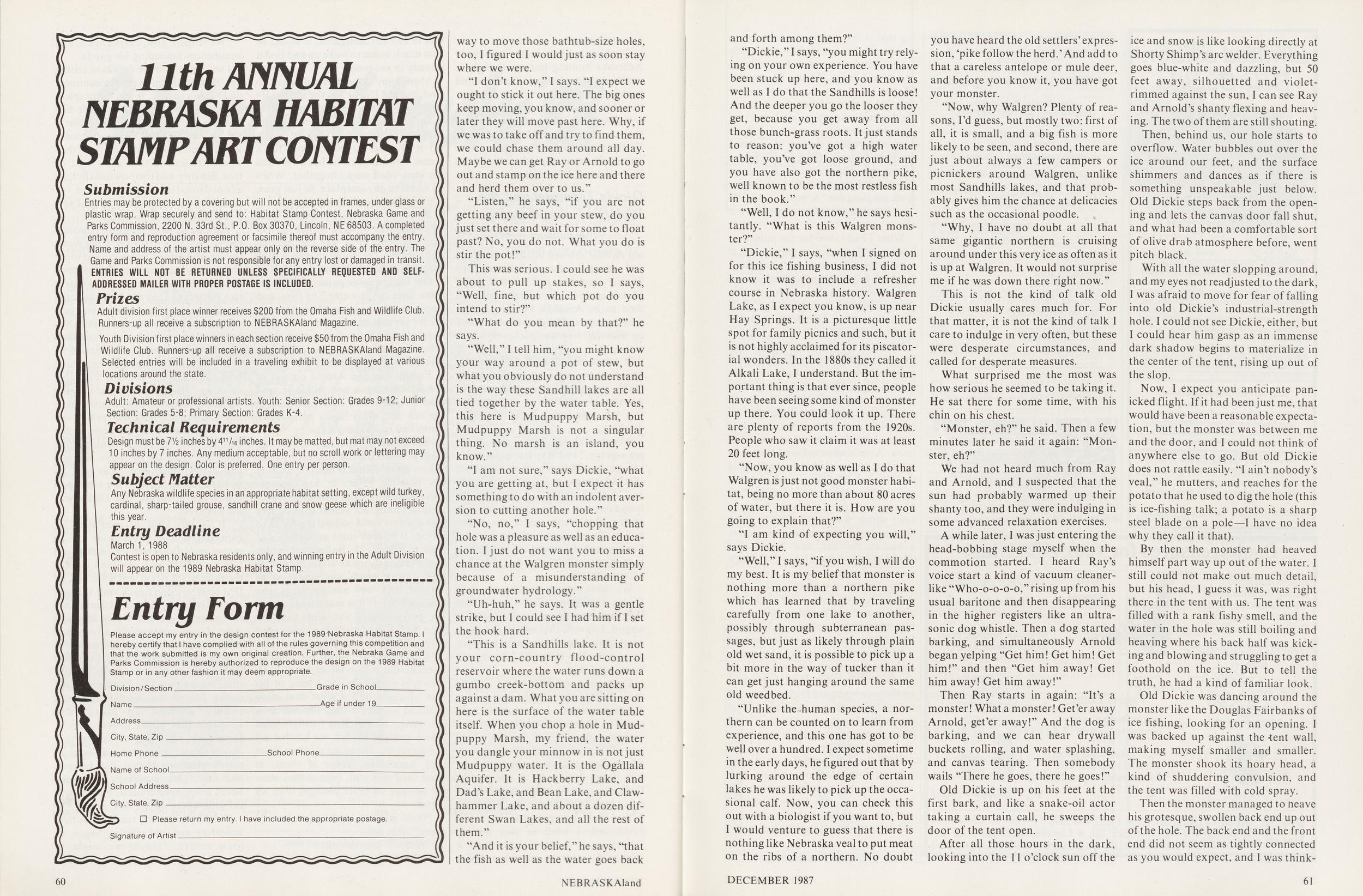 11th ANNUAL
NEBRASKA HABITAT
STAMP ART CONTEST
Submission
Entries may be protected by a covering but will not be accepted in frames, under glass
or
plastic wrap. Wrap securely and send to: Habitat Stamp Contest, Nebraska Game and
Parks Commission, 2200 N. 33rd St., P.O. Box 30370, Lincoln, NE 68503. A completed
entry form and reproduction agreement or facsimile thereof must accompany the entry.
Name and address of the artist must appear only on the reverse side of the entry.
The
Game and Parks Commission is not responsible for any entry lost or damaged in transit.
ENTRIES WILL NOT BE RETURNED UNLESS SPECIFICALLY REQUESTED AND SELF-
ADDRESSED MAILER WITH PROPER POSTAGE IS INCLUDED.
Prizes
Adult division first place winner receives $200 from the Omaha Fish and Wildlife Club.
Runners-up all receive a subscription to NEBRASKAland Magazine.
Youth Division first place winners in each section receive $50 from the Omaha Fish
and
Wildlife Club. Runners-up all receive a subscription to NEBRASKAland Magazine.
Selected entries will be included in a traveling exhibit to be displayed at various
locations around the state.
Divisions
Adult: Amateur or professional artists. Youth: Senior Section: Grades 9-12; Junior
Section: Grades 5-8; Primary Section: Grades K-4.
Technical Requirements
Design must be 7V2 inches by 411 /i6 inches. It may be matted, but mat may not exceed
10 inches by 7 inches. Any medium acceptable, but no scroll work or lettering may
appear on the design. Color is preferred. One entry per person.
Subject Matter
Any Nebraska wildlife species in an appropriate habitat setting, except wild turkey,
cardinal, sharp-tailed grouse, sandhill crane and snow geese which are ineligible
this year.
Entry Deadline
March 1,1988
Contest is open to Nebraska residents only, and winning entry in the Adult Division
will appear on the 1989 Nebraska Habitat Stamp.
Entry Form
Please accept my entry in the design contest for the 1989'Nebraska Habitat Stamp.
I
hereby certify that I have complied with all of the rules governing this competition
and
that the work submitted is my own original creation. Further, the Nebraska Game and
Parks Commission is hereby authorized to reproduce the design on the 1989 Habitat
Stamp or in any other fashion it may deem appropriate.
Division/Section
.Grade in School
Name
.Age if under 19.
Address.
City, State, Zip
Home Phone _
.School Phone.
Name of School.
School Address.
City, State, Zip _
□ Please return my entry. I have included the appropriate postage.
Signature of Artist-----------------------------------------------------------------------------------
11th ANNUAL
NEBRASKA HABITAT
STAMP ART CONTEST
Submission
Entries may be protected by a covering but will not be accepted in frames, under glass
or
plastic wrap. Wrap securely and send to: Habitat Stamp Contest, Nebraska Game and
Parks Commission, 2200 N. 33rd St., P.O. Box 30370, Lincoln, NE 68503. A completed
entry form and reproduction agreement or facsimile thereof must accompany the entry.
Name and address of the artist must appear only on the reverse side of the entry.
The
Game and Parks Commission is not responsible for any entry lost or damaged in transit.
ENTRIES WILL NOT BE RETURNED UNLESS SPECIFICALLY REQUESTED AND SELF-
ADDRESSED MAILER WITH PROPER POSTAGE IS INCLUDED.
Prizes
Adult division first place winner receives $200 from the Omaha Fish and Wildlife Club.
Runners-up all receive a subscription to NEBRASKAland Magazine.
Youth Division first place winners in each section receive $50 from the Omaha Fish
and
Wildlife Club. Runners-up all receive a subscription to NEBRASKAland Magazine.
Selected entries will be included in a traveling exhibit to be displayed at various
locations around the state.
Divisions
Adult: Amateur or professional artists. Youth: Senior Section: Grades 9-12; Junior
Section: Grades 5-8; Primary Section: Grades K-4.
Technical Requirements
Design must be 7V2 inches by 411 /i6 inches. It may be matted, but mat may not exceed
10 inches by 7 inches. Any medium acceptable, but no scroll work or lettering may
appear on the design. Color is preferred. One entry per person.
Subject Matter
Any Nebraska wildlife species in an appropriate habitat setting, except wild turkey,
cardinal, sharp-tailed grouse, sandhill crane and snow geese which are ineligible
this year.
Entry Deadline
March 1,1988
Contest is open to Nebraska residents only, and winning entry in the Adult Division
will appear on the 1989 Nebraska Habitat Stamp.
Entry Form
Please accept my entry in the design contest for the 1989'Nebraska Habitat Stamp.
I
hereby certify that I have complied with all of the rules governing this competition
and
that the work submitted is my own original creation. Further, the Nebraska Game and
Parks Commission is hereby authorized to reproduce the design on the 1989 Habitat
Stamp or in any other fashion it may deem appropriate.
Division/Section
.Grade in School
Name
.Age if under 19.
Address.
City, State, Zip
Home Phone _
.School Phone.
Name of School.
School Address.
City, State, Zip _
□ Please return my entry. I have included the appropriate postage.
Signature of Artist-----------------------------------------------------------------------------------
"I don't know," I says. "I expect we ought to stick it out here. The big ones keep moving, you know, and sooner or later they will move past here. Why, if we was to take off and try to find them, we could chase them around all day. Maybe we can get Ray or Arnold to go out and stamp on the ice here and there and herd them over to us."
"Listen," he says, "if you are not getting any beef in your stew, do you just set there and wait for some to float past? No, you do not. What you do is stir the pot!"
This was serious. I could see he was about to pull up stakes, so I says, "Well, fine, but which pot do you intend to stir?"
"What do you mean by that?" he says.
"Well," I tell him, "you might know your way around a pot of stew, but what you obviously do not understand is the way these Sandhill lakes are all tied together by the water table. Yes, this here is Mudpuppy Marsh, but Mudpuppy Marsh is not a singular thing. No marsh is an island, you know."
"I am not sure," says Dickie, "what you are getting at, but I expect it has something to do with an indolent aversion to cutting another hole."
"No, no," I says, "chopping that hole was a pleasure as well as an education. I just do not want you to miss a chance at the Walgren monster simply because of a misunderstanding of groundwater hydrology."
"Uh-huh," he says. It was a gentle strike, but I could see I had him if I set the hook hard.
"This is a Sandhills lake. It is not your corn-country flood-control reservoir where the water runs down a gumbo creek-bottom and packs up against a dam. What you are sitting on here is the surface of the water table itself. When you chop a hole in Mudpuppy Marsh, my friend, the water you dangle your minnow in is not just Mudpuppy water. It is the Ogallala Aquifer. It is Hackberry Lake, and Dad's Lake, and Bean Lake, and Claw hammer Lake, and about a dozen different Swan Lakes, and all the rest of them."
"And it is your belief," he says, "that the fish as well as the water goes back 60 NEBRASKAland and forth among them?"
"Dickie," I says, "you might try relying on your own experience. You have been stuck up here, and you know as well as I do that the Sandhills is loose! And the deeper you go the looser they get, because you get away from all those bunch-grass roots. It just stands to reason: you've got a high water table, you've got loose ground, and you have also got the northern pike, well known to be the most restless fish in the book."
"Well, I do not know," he says hesitantly. "What is this Walgren monster?"
"Dickie," I says, "when I signed on for this ice fishing business, I did not know it was to include a refresher course in Nebraska history. Walgren Lake, as I expect you know, is up near Hay Springs. It is a picturesque little spot for family picnics and such, but it is not highly acclaimed for its piscatorial wonders. In the 1880s they called it Alkali Lake, I understand. But the important thing is that ever since, people have been seeing some kind of monster up there. You could look it up. There are plenty of reports from the 1920s. People who saw it claim it was at least 20 feet long.
"Now, you know as well as I do that Walgren is just not good monster habitat, being no more than about 80 acres of water, but there it is. How are you going to explain that?"
"I am kind of expecting you will," says Dickie.
"Well," I says, "if you wish, I will do my best. It is my belief that monster is nothing more than a northern pike which has learned that by traveling carefully from one lake to another, possibly through subterranean passages, but just as likely through plain old wet sand, it is possible to pick up a bit more in the way of tucker than it can get just hanging around the same old weed bed.
"Unlike the human species, a northern can be counted on to learn from experience, and this one has got to be well over a hundred. I expect sometime in the early days, he figured out that by lurking around the edge of certain lakes he was likely to pick up the occasional calf. Now, you can check this out with a biologist if you want to, but I would venture to guess that there is nothing like Nebraska veal to put meat on the ribs of a northern. No doubt you have heard the old settlers' expression, 'pike follow the herd.' And add to that a careless antelope or mule deer, and before you know it, you have got your monster.
"Now, why Walgren? Plenty of reasons, I'd guess, but mostly two: first of all, it is small, and a big fish is more likely to be seen, and second, there are just about always a few campers or picnickers around Walgren, unlike most Sandhills lakes, and that probably gives him the chance at delicacies such as the occasional poodle.
"Why, I have no doubt at all that same gigantic northern is cruising around under this very ice as often as it is up at Walgren. It would not surprise me if he was down there right now."
This is not the kind of talk old Dickie usually cares much for. For that matter, it is not the kind of talk I care to indulge in very often, but these were desperate circumstances, and called for desperate measures.
What surprised me the most was how serious he seemed to be taking it. He sat there for some time, with his chin on his chest.
"Monster, eh?" he said. Then a few minutes later he said it again: "Monster, eh?"
We had not heard much from Ray and Arnold, and I suspected that the sun had probably warmed up their shanty too, and they were indulging in some advanced relaxation exercises.
A while later, I was just entering the head-bobbing stage myself when the commotion started. I heard Ray's voice start a kind of vacuum cleaner like "Who-o-o-o-o," rising up from his usual baritone and then disappearing in the higher registers like an ultrasonic dog whistle. Then a dog started barking, and simultaneously Arnold began yelping "Get him! Get him! Get him!" and then "Get him away! Get him away! Get him away!"
Then Ray starts in again: "It's a monster! What a monster! Get'er away Arnold, get'er away!" And the dog is barking, and we can hear drywall buckets rolling, and water splashing, and canvas tearing. Then somebody wails "There he goes, there he goes!"
Old Dickie is up on his feet at the first bark, and like a snake-oil actor taking a curtain call, he sweeps the door of the tent open.
After all those hours in the dark, looking into the 11 o'clock sun off the ice and snow is like looking directly at Shorty Shimp's arc welder. Everything goes blue-white and dazzling, but 50 feet away, silhouetted and violet-rimmed against the sun, I can see Ray and Arnold's shanty flexing and heaving. The two of them are still shouting.
Then, behind us, our hole starts to overflow. Water bubbles out over the ice around our feet, and the surface shimmers and dances as if there is something unspeakable just below. Old Dickie steps back from the opening and lets the canvas door fall shut, and what had been a comfortable sort of olive drab atmosphere before, went pitch black.
With all the water slopping around, and my eyes not readjusted to the dark, I was afraid to move for fear of falling into old Dickie's industrial-strength hole. I could not see Dickie, either, but I could hear him gasp as an immense dark shadow begins to materialize in the center of the tent, rising up out of the slop.
Now, I expect you anticipate panicked flight. If it had been just me, that would have been a reasonable expectation, but the monster was between me and the door, and I could not think of anywhere else to go. But old Dickie does not rattle easily. "I ain't nobody's veal," he mutters, and reaches for the potato that he used to dig the hole (this is ice-fishing talk; a potato is a sharp steel blade on a pole—I have no idea why they call it that).
By then the monster had heaved himself part way up out of the water. I still could not make out much detail, but his head, I guess it was, was right there in the tent with us. The tent was filled with a rank fishy smell, and the water in the hole was still boiling and heaving where his back half was kicking and blowing and struggling to get a foothold on the ice. But to tell the truth, he had a kind of familiar look.
Old Dickie was dancing around the monster like the Douglas Fairbanks of ice fishing, looking for an opening. I was backed up against the Tent wall, making myself smaller and smaller. The monster shook its hoary head, a kind of shuddering convulsion, and the tent was filled with cold spray.
Then the monster managed to Heave his grotesque, swollen back end up out of the hole. The back end and the front end did not seem as tightly connected as you would expect, and I was thinking that it did not look much like a northern pike, veal-fed or not, when the back end got up on its feet and said in Arnold's voice, "Dickie Trammel, I let you steal my dog, and then I watched in silence when that degenerate dog stole the pheasants I shot and brought them to you, but I will be damned if I will let the pair of you steal the biggest crappie I have ever caught."
DECEMBER 1987 61 Limited-edition
Belt Buckle
The Malcolm, Nebraska Gun Club proudly
presents this facsimile of the Nebraska 1988 Wildlife
Habitat Stamp as a belt buckle, in cooperation
with Artist Robert Klausing and the Nebraska
Game and Parks Commission. These heavy,
top quality buckles, by the Award Design Medals
company, are limited to 1,00 brass; 200 gold/
silver plate and 100 solid sterling silver. Each is
registered by name and number, so purchaser
has first choice at future editions. To order, send
money order or check to: Malcolm Gun Club,
P.O. Box 194, Malcolm, NE 68402. Phone (402)
796-2173. Prices are:
Brass—$19.95, Gold/silverplate—$45
Solid silver—$135
Please include $1.50 for packing and shipping + 4% sales tax.
Allow four to six weeks for delivery.
Size 3-3/4 inches by 2-3/4 inches.
Statement of ownership, management, and
monthly circulation of
NEBRASKAland Magazine
OWNER AND PUBLISHER:
Nebraska Game and Parks Commission
EDITOR AND MANAGING EDITOR:
Lowell A. Johnson
HEADQUARTERS OF PUBLISHER
AND PUBLICATION:
2220 N. 33rd Street, Lincoln, NE 68503
STOCKHOLDERS; BONDHOLDERS;
MORTGAGE and
SECURITY HOLDERS: None
BURDENS
OUTDOOR OUTFITTERS
Nebraska's largest selection of quality
name brand sporting goods and supplies.
1000 West "O" Street
Lincoln, NE 68528
(402) 474-4366
Average No. of copies each issue during preceding 12 months Single issue nearest
to filing date
A. TOTAL COPIES PRINTED (net press run) Oct. '86 Sept. '87 69,100 Sept. '87 69,000
B. PAID CIRCULATION 1. Single-copy sales 2. Mail subscription 2,350 56,398 2,200
55,511
C. TOTAL PAID CIRCULATION 58,748 57,711
D. FREE DISTRIBUTION (incl. samples) BY MAIL, or OTHER MEANS (no news agency)
4,500 4,800
E. TOTAL DISTRIBUTION (sum of C and D) 63,248 62,511
F. OFFICE USE, LEFTOVERS, ETC. RETURNS FROM NEWS AGENTS 5,047 805 5,714 775
G. TOTAL (sum of E and FL 69,100 69,000
LIVE-CATCH ALL-PURPOSE TRAPS
FREE
CATALOG
Traps without injury squirrels, chipmunks, rabbits, mink, fox,
raccoons, stray animals, pests, etc. Sizes for every need. Also traps for
snakes, sparrows, pigeons, crabs, turtles, quail, etc. Save on our low
factory prices. Send no money. Free catalog and trapping secrets.
MUSTANG MFG. CO., Dept. N-34, Box 920947, Houston, Tex. 77292
Book treasures for your gift giving!
Boy to manhood
during (he Kinkaider
era on a cattle ranch in
the Nebraska sandhills.
Paper, 166 pgs. $9.95
The Horseshoe-Bar
Ranch
by Roe Black
The Best of Mignery
by Herb Mignery,
Cowboy Artist of America
88 funny, famous cartoons!' Paper, $14.95
Prairie Politics
by John Barrette, political
cartoons by Paul Fell
Nebraska's 1986
gubernatorial race between
two women. Paper, 185
pgs., $9.95
PBALQIE
POLITICcS
MEDIA PUBLISHING • (402) 474-2676
Dept. ND • 2440 'O' St., Ste. 202 • Lincoln, NE 68510-1125
TO ORDER: Include $2.00 for tax/postage - MC/VISA accepted
Limited-edition
Belt Buckle
The Malcolm, Nebraska Gun Club proudly
presents this facsimile of the Nebraska 1988 Wildlife
Habitat Stamp as a belt buckle, in cooperation
with Artist Robert Klausing and the Nebraska
Game and Parks Commission. These heavy,
top quality buckles, by the Award Design Medals
company, are limited to 1,00 brass; 200 gold/
silver plate and 100 solid sterling silver. Each is
registered by name and number, so purchaser
has first choice at future editions. To order, send
money order or check to: Malcolm Gun Club,
P.O. Box 194, Malcolm, NE 68402. Phone (402)
796-2173. Prices are:
Brass—$19.95, Gold/silverplate—$45
Solid silver—$135
Please include $1.50 for packing and shipping + 4% sales tax.
Allow four to six weeks for delivery.
Size 3-3/4 inches by 2-3/4 inches.
Statement of ownership, management, and
monthly circulation of
NEBRASKAland Magazine
OWNER AND PUBLISHER:
Nebraska Game and Parks Commission
EDITOR AND MANAGING EDITOR:
Lowell A. Johnson
HEADQUARTERS OF PUBLISHER
AND PUBLICATION:
2220 N. 33rd Street, Lincoln, NE 68503
STOCKHOLDERS; BONDHOLDERS;
MORTGAGE and
SECURITY HOLDERS: None
BURDENS
OUTDOOR OUTFITTERS
Nebraska's largest selection of quality
name brand sporting goods and supplies.
1000 West "O" Street
Lincoln, NE 68528
(402) 474-4366
Average No. of copies each issue during preceding 12 months Single issue nearest
to filing date
A. TOTAL COPIES PRINTED (net press run) Oct. '86 Sept. '87 69,100 Sept. '87 69,000
B. PAID CIRCULATION 1. Single-copy sales 2. Mail subscription 2,350 56,398 2,200
55,511
C. TOTAL PAID CIRCULATION 58,748 57,711
D. FREE DISTRIBUTION (incl. samples) BY MAIL, or OTHER MEANS (no news agency)
4,500 4,800
E. TOTAL DISTRIBUTION (sum of C and D) 63,248 62,511
F. OFFICE USE, LEFTOVERS, ETC. RETURNS FROM NEWS AGENTS 5,047 805 5,714 775
G. TOTAL (sum of E and FL 69,100 69,000
LIVE-CATCH ALL-PURPOSE TRAPS
FREE
CATALOG
Traps without injury squirrels, chipmunks, rabbits, mink, fox,
raccoons, stray animals, pests, etc. Sizes for every need. Also traps for
snakes, sparrows, pigeons, crabs, turtles, quail, etc. Save on our low
factory prices. Send no money. Free catalog and trapping secrets.
MUSTANG MFG. CO., Dept. N-34, Box 920947, Houston, Tex. 77292
Book treasures for your gift giving!
Boy to manhood
during (he Kinkaider
era on a cattle ranch in
the Nebraska sandhills.
Paper, 166 pgs. $9.95
The Horseshoe-Bar
Ranch
by Roe Black
The Best of Mignery
by Herb Mignery,
Cowboy Artist of America
88 funny, famous cartoons!' Paper, $14.95
Prairie Politics
by John Barrette, political
cartoons by Paul Fell
Nebraska's 1986
gubernatorial race between
two women. Paper, 185
pgs., $9.95
PBALQIE
POLITICcS
MEDIA PUBLISHING • (402) 474-2676
Dept. ND • 2440 'O' St., Ste. 202 • Lincoln, NE 68510-1125
TO ORDER: Include $2.00 for tax/postage - MC/VISA accepted
Just then the tent door flies open again and there stands Ray, all goggle eyed, gurgling out "Arnold . . . Mamie . . . ," and in the light we could see it all.
What I had taken for the monster's head was Mamie with a crappie in her mouth, standing there on the ice wagging her tail, looking at Dickie, and waiting for pats. Behind her stands Arnold, jiggling pole still in his hand, great streams of lake water running out his pants legs.
Well, the explanation takes longer than it is worth, and besides I expect a person of your perspicuity has already figured it out. Mamie had been over to their tent seeing if they ha"d a spare cinnamon roll when Arnold landed his crappie, and she just naturally retrieved it before he could get it off the hook. Arnold objected, and they both went into the hole. Mamie kept hold of the fish, and Arnold never let go of the pole. Once they got under the ice, Mamie went for the nearest light she saw, which was when Dickie flung open our tent. It must have been quite a beacon for her, and Arnold got towed along by a strand of 12-pound test monofilament.
We decided to pack it in then, since Arnold was in need of dry britches, and Ray had also had about all the fun he could stand. To tell the truth, I was a little sorry, since ice fishing had turned out to be quite a bit more entertaining than I had expected. I believe I will get another chance at it, though, because on the way home old Dickie expressed considerable interest in making a trip up north when those big crappie leave Mudpuppy Marsh and ride the aquifer up to Walgren lake.
Well, that is the whole story. As you can see, it not only concerns an unusual species, but groundwater too, the importance of which goes without mention. You can print it if you think it will be instructive to your readers.
Yrs. Sincerely, Clemens Babcock 62 NEBRASKAlandTrading Post
DOGSTRAINING ALL BREEDS Hunting Dogs -- Vizslas for sale. Rozanek Kennels, Rt. 2, Schuyler, NE 68661. Phone (402) 352-8769.___________________________
ENGLISH SETTERS: "Bred for the hunter"; select puppies and started dogs available from outstanding bloodlines. Stud service available by proven hunters. High Plains Kennels, 1411 Emerson, Alliance, NE 69301, Phone (308) 762-6709.
GROUSE WAY BRITTANIES: Ideal hunting companions—dedicated, goal-oriented breeding programs. FREE brochure, Grouseway Gundogs, Louisville, NE 68037. (402) 397-6157. Training available.___________
GERMAN SHORTHAIRS and Brittany Spaniel pups. Started and occasionally a meat dog. Pups are guaranteed. Also I will be training hunting dogs. Wayne Clark, Percival, I A. Phone (712) 529-4238 or (402) 263-3155 at Union, NE._____________________
YELLOW AND BLACK Lab pups. FC-AFC sired. AKC. Hips certified. Dew claws removed. Retriever field trial and hunting parents. Bob Bendler (308) 324-4247.
MISCELLANEOUSNE NEBRASKA trout fishing. 3 modern cottages, 1 available year round. 5 spring fed lakes with open water all year. Trout up to 7 pounds. Other varieties fish also. Diamond E. Trout Resort, Orchard, NE 68764. Phone (402) 893-4745._________________________________
GUNS — Browning, Winchester, Remington, others, Hi-powers, shotguns, new, used, antiques. Want Pre-1964 Winchesters. Buy-Sell-Trade. Ph. (402) 729-6112. Bedlan's Sporting Goods, Fairbury, NE 68352.
MAD RIVER CANOES offers the finest quality and performance. For the finest canoes and accessories look to Great Plains Canoe Co., 205 Main, Springfield, NE. Phone (402) 253-2001._______________________
AIR GUNS repaired — Benjamin, Crosman, Daisy, other American made. Restoration; old guns wanted, Jack's Air Guns, 1225 No. 46th, Lincoln, NE 68503. Phone (402) 466-9223.___________________________
TROLLING MOTOR REPAIR. Factory authorized Minn Kotaand Motor Guide, parts and service. Wolf's Repair and Installation, 1529 David Drive, Lincoln, NE 68504. Phone (402) 464-4265.__________________
WINE AND BEER: Make your own. Send for free recipes and instructions. Omaha Supply, 1324 2nd Avenue, Nebraska City, NE 68410.
HOMEWORKERS! RECEIVE $75/100 envelopes you return to us per instructions. Rush stamped envelope: Kelley 5, 804 Old Thorshy Road, Clanton, Alabama 35045.___________
HUNTERS WITH BUDDIES ^Own your own hunting paradise with 3 miles of Niobrara River frontage. 3,080 acres, with spring creeks and abundant timber and wildlife. Swett Realty, P.O. Box 265, Ainsworth, NE 69210. Phone (402) 387-1626 day or night._______
FOR SALE: Northeast Nebraska, Near Mo. R. and proposed dam/rec site: Newer, 5-6 bdrm house on 3 acres. Full bsmt, pt. fin., dbl grg, 2 full, 2'/2 baths, lg. lr &drs, A/C, 2fp, many extras. Potential Bed/Breakfast or Co-op hunting lodge. May consider sale of adjacent acres for hunting. Inq.7200Old Post Rd. #10, Lincoln, NE 68506. Phone (402) 489-1256._____________^
SEND A TASTE of Nebraska at Christmas! Gift packed, two 1-pound jars of 1987 natural Nebraska honey. $9.95 per package includes gift card, garnish, postage, handling. Send your check with names and addresses to: Stirling Honey Producers, 810 No. 5th St., Bellevue, NE, 68005 (402) 731-6830.____________
ARCHERY SHOP for sale. Open your own archery pro shop and/or indoor shooting lanes. Backstops, targets, lights, arrow-making and bow-repair equipment, archery accessories, etc. Phone (402) 564-9510 or write Michael Howell, P.O. Box 367, Columbus, NE 68601._________________________________________
FOR SALE: Resort lots and cabins, Gate 18, Lake McConaughy, Ogallala's inland ocean. Good hunting and fishing. Lakeview Development, Box 52, Brule, NE 69127._____________________________________
UNLIMITED FREE KODAK film, plus free 35mm camera with warranty. Toll-free 1-800-433-6312 (24 hours).
WAX WORMS: 500/$8.25, 1,000/$ 14.50. Add 4% sales tax. Postpaid first class. No C.O.D. Harold Malicky, Burwell, NE 68823._____________________
TAXIDERMYALLISON'S TAXIDERMY STUDIO. Wally and Betty Allison, Licensed Taxidermist. We've mounted 21 Nebraska State Record fish. Specializing in fish and birds, small game and rattlesnakes. We use freeze-dry. 2310 West Leota, North Platte, Nebr. 69101. Phone (308) 534-2324.________________________________
BADE TAXIDERMY - Quality a must - Fast service. Fish, birds, rugs, tanning, full mounts and game heads, 2111 N. Christy St., Fremont, NE 727-5463.
NABITY'S TAXIDERMY. 31 years experience. Specializing in natural grass backgrounds for mammals, birds and fish. 13901 "O" St., Lincoln, NE 68504 — 4 miles east of 84th and "O". (402) 489-6351._________
BIG BEAR TAXIDERMY, Rt. 2, Mitchell, Nebraska 69357. We specialize in all big game from Alaska to Nebraska, also birds and fish. Hair on and hair off tanning. Four miles west of Scottsbluff on Highway 26. Dale Hubel, phone (308) 635-3013._______________
PEISTER TAXIDERMY Professional work at prices most sportsman can afford. Now in our new log cabin studio, 1020 Central Avenue, Box 3201, Kearney, NE 68847. Phone (308) 236-9700 or (308) 237-7575 evenings.
NATURECRAFT STUDIO - all custom services — creative work, quality, and experience since 1935. Includes freeze-dry processing. Display and sales room, visitors welcome. Hwy. 2 in Nebraska City. Phone (402) 873-5491. Joe Voges — Owner. Bow Steedly — Big Game specialist.
BILL'S TAXIDERMY. Professional big game mounting. Award-winning mounts. First place mule deer, second place antelope in state competition. Reasonable rates. Phone (308) 452-3559 or 3674.
Calamus Country Restaurant-Lounge-Lodge-R.V. Hook-ups Residential and Commercial Lots (308) 346-4729 6 Miles northwest of Burwell, NE up the Dam Road GUN DOG TRAINING All Sporting Breeds All dogs worked on foot — no horses. Midwest's finest facilities. Field Champion-sired Labrador pups for sale. "Training for hunters by hunters" WILDERNESS KENNELS Henry Sader—Roca, Ne. (402)423-4212 68430 FOR SALE Rocky Ford Camp and Canoe Base 19 acres of river front property on the Niobrara River, 30 miles east of Valentine, NE. Equipment and facilities for canoeing. 16 campsites, 3 bunkhouses, 1 family cabin. Serious inquiries only. WILSON OUTFITTERS NEBRASKA, 6211 Sunrise Rd., Lincoln, NE 68510. CEDAR LANE - Ranch Vacations - Guest ranch in the heart of the Sandhills of Nebraska, Swimming, spa, horses, canoeing, trail rides, barbeques, hunting, family reunions. BOOKING NOW For 1988 Richard and Betty Schroeder HC 2 Box 9C Stapleton, Nebraska 69163 Ph. 308-587-2233 Harlan County Dam Vacation Apartments - fully furnished Color TV • Kitchen Facilities • Full Baths Game cleaning room with freezer One block from shopping center Weekend or week of pleasant living Security Deposit Required Sorry —No Pets Dean and Esther Stone Box 145 Ph. (308) 799-3422 Republican City, NE 68971 Honore Kennels YEAR ROUND DOG TRAINING Hunting, Field Trials, Obedience HILLTOP SHOOTING PRESERVE Season Sept. 1 to March 1 Pheasant, Quail, Chukar, Turkey John Honore Manager and Trainer Grand Island, NE Call 308-384-1517 DECEMBER 1987 63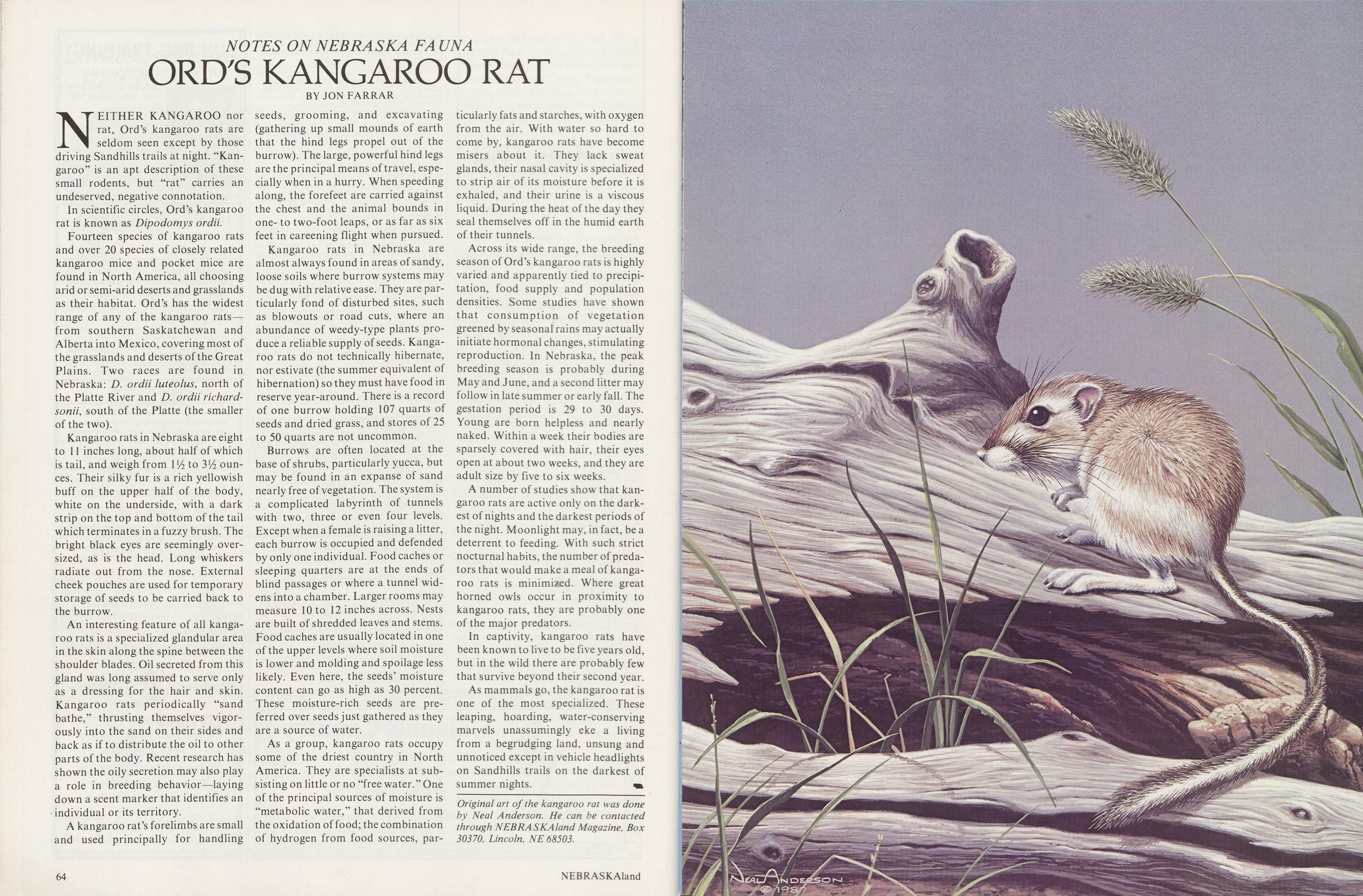
NOTES ON NEBRASKA FAUNA ORD'S KANGAROO RAT
BY JON FARRARNEITHER KANGAROO nor rat, Ord's kangaroo rats are seldom seen except by those driving Sandhills trails at night. "Kangaroo" is an apt description of these small rodents, but "rat" carries an undeserved, negative connotation.
In scientific circles, Ord's kangaroo rat is known as Dipo domys ordii.
Fourteen species of kangaroo rats and over 20 species of closely related kangaroo mice and pocket mice are found in North America, all choosing arid or semi-arid deserts and grasslands as their habitat. Ord's has the widest range of any of the kangaroo rats from southern Saskatchewan and Alberta into Mexico, covering most of the grasslands and deserts of the Great Plains. Two races are found in Nebraska: D. ordii luteolus, north of the Platte River and D. ordii richardson, south of the Platte (the smaller of the two).
Kangaroo rats in Nebraska are eight to 11 inches long, about half of which is tail, and weigh from Wi to 3Vi ounces. Their silky fur is a rich yellowish buff on the upper half of the body, white on the underside, with a dark strip on the top and bottom of the tail which terminates in a fuzzy brush. The bright black eyes are seemingly oversized, as is the head. Long whiskers radiate out from the nose. External cheek pouches are used for temporary storage of seeds to be carried back to the burrow.
An interesting feature of all kangaroo rats is a specialized glandular area in the skin along the spine between the shoulder blades. Oil secreted from this gland was long assumed to serve only as a dressing for the hair and skin. Kangaroo rats periodically "sand bathe," thrusting themselves vigorously into the sand on their sides and back as if to distribute the oil to other parts of the body. Recent research has shown the oily secretion may also play a role in breeding behavior—laying down a scent marker that identifies an individual or its territory.
A kangaroo rat's forelimbs are small and used principally for handling seeds, grooming, and excavating (gathering up small mounds of earth that the hind legs propel out of the burrow). The large, powerful hind legs are the principal means of travel, especially when in a hurry. When speeding along, the forefeet are carried against the chest and the animal bounds in one- to two-foot leaps, or as far as six feet in careening flight when pursued.
Kangaroo rats in Nebraska are almost always found in areas of sandy, loose soils where burrow systems may be dug with relative ease. They are particularly fond of disturbed sites, such as blowouts or road cuts, where an abundance of weedy-type plants produce a reliable supply of seeds. Kangaroo rats do not technically hibernate, nor estivate (the summer equivalent of hibernation) so they must have food in reserve year-around. There is a record of one burrow holding 107 quarts of seeds and dried grass, and stores of 25 to 50 quarts are not uncommon.
Burrows are often located at the base of shrubs, particularly yucca, but may be found in an expanse of sand nearly free of vegetation. The system is a complicated labyrinth of tunnels with two, three or even four levels. Except when a female is raising a litter, each burrow is occupied and defended by only one individual. Food caches or sleeping quarters are at the ends of blind passages or where a tunnel widens into a chamber. Larger rooms may measure 10 to 12 inches across. Nests are built of shredded leaves and stems. Food caches are usually located in one of the upper levels where soil moisture is lower and molding and spoilage less likely. Even here, the seeds' moisture content can go as high as 30 percent. These moisture-rich seeds are preferred over seeds just gathered as they are a source of water.
As a group, kangaroo rats occupy some of the driest country in North America. They are specialists at subsisting on little or no "free water." One of the principal sources of moisture is "metabolic water," that derived from the oxidation of food; the combination of hydrogen from food sources, particularly fats and starches, with oxygen from the air. With water so hard to come by, kangaroo rats have become misers about it. They lack sweat glands, their nasal cavity is specialized to strip air of its moisture before it is exhaled, and their urine is a viscous liquid. During the heat of the day they seal themselves off in the humid earth of their tunnels.
Across its wide range, the breeding season of Ord's kangaroo rats is highly varied and apparently tied to precipitation, food supply and population densities. Some studies have shown that consumption of vegetation greened by seasonal rains may actually initiate hormonal changes, stimulating reproduction. In Nebraska, the peak breeding season is probably during May and June, and a second litter may follow in late summer or early fall. The gestation period is 29 to 30 days. Young are born helpless and nearly naked. Within a week their bodies are sparsely covered with hair, their eyes open at about two weeks, and they are adult size by five to six weeks.
A number of studies show that kangaroo rats are active only on the darkest of nights and the darkest periods of the night. Moonlight may, in fact, be a deterrent to feeding. With such strict nocturnal habits, the number of predators that would make a meal of kangaroo rats is minimized. Where great horned owls occur in proximity to kangaroo rats, they are probably one of the major predators.
In captivity, kangaroo rats have been known to live to be five years old, but in the wild there are probably few that survive beyond their second year.
As mammals go, the kangaroo rat is one of the most specialized. These leaping, hoarding, water-conserving marvels unassumingly eke a living from a begrudging land, unsung and unnoticed except in vehicle headlights on Sandhills trails on the darkest of summer nights.
Original art of the kangaroo rat was done by Neal Anderson. He can be contacted through NEBRASKAland Magazine, Box 30370, Lincoln, NE 68503.
64 NEBRASKAland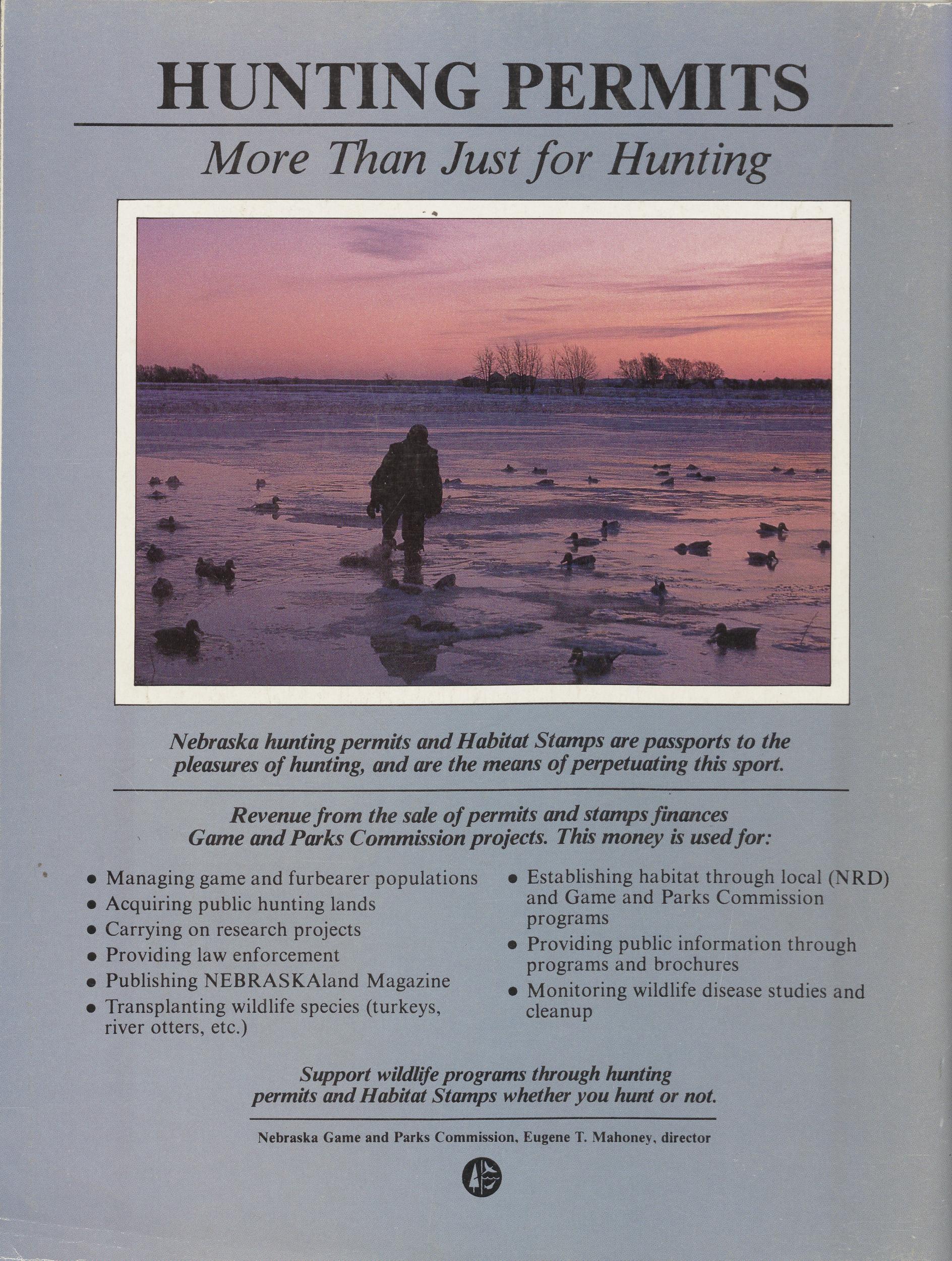
HUNTING PERMITS More Than Just for Hunting
Position: 341 (27 views)