Volume 65, Issue 9, 1987
NEBRASKAland
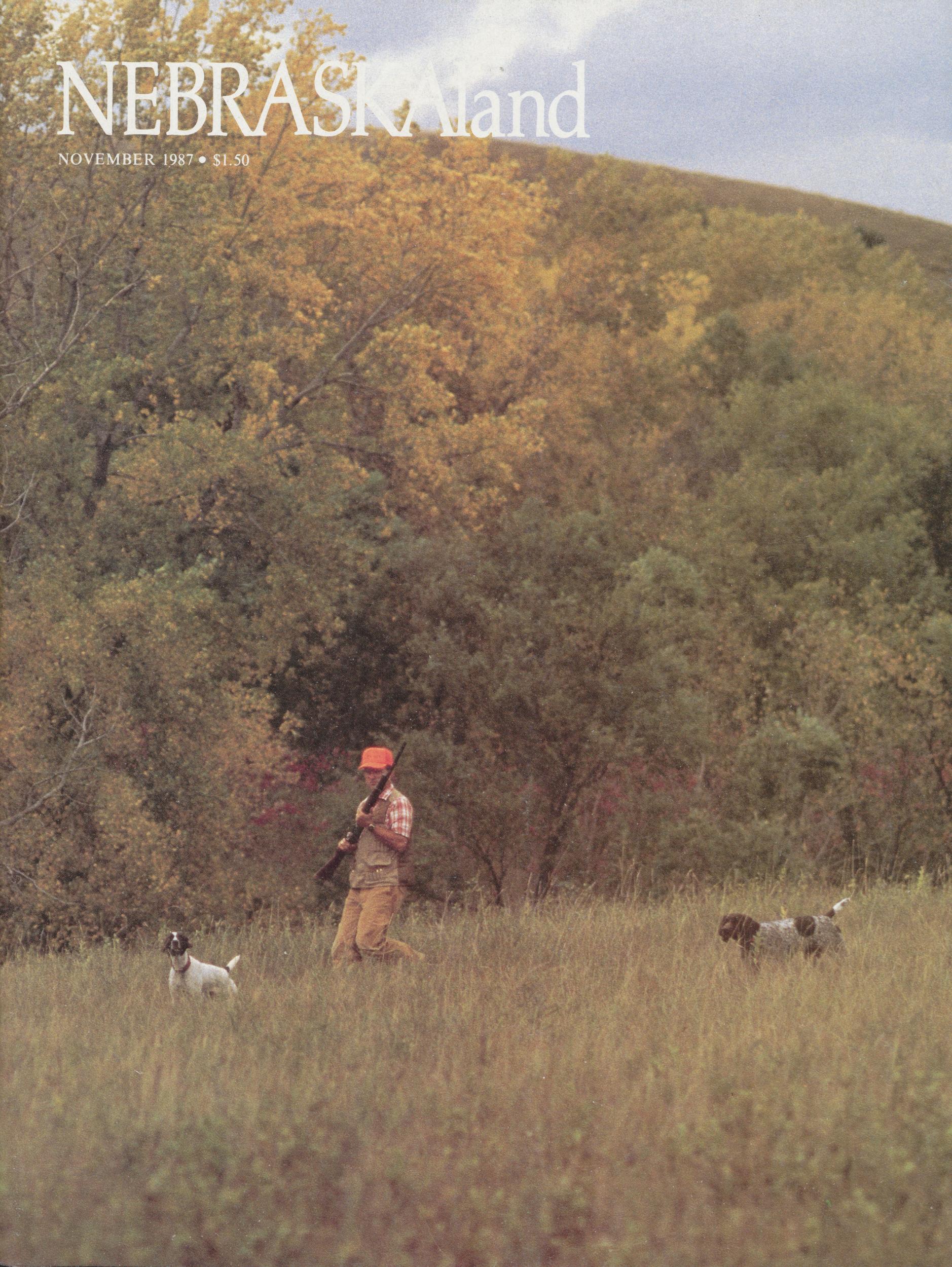
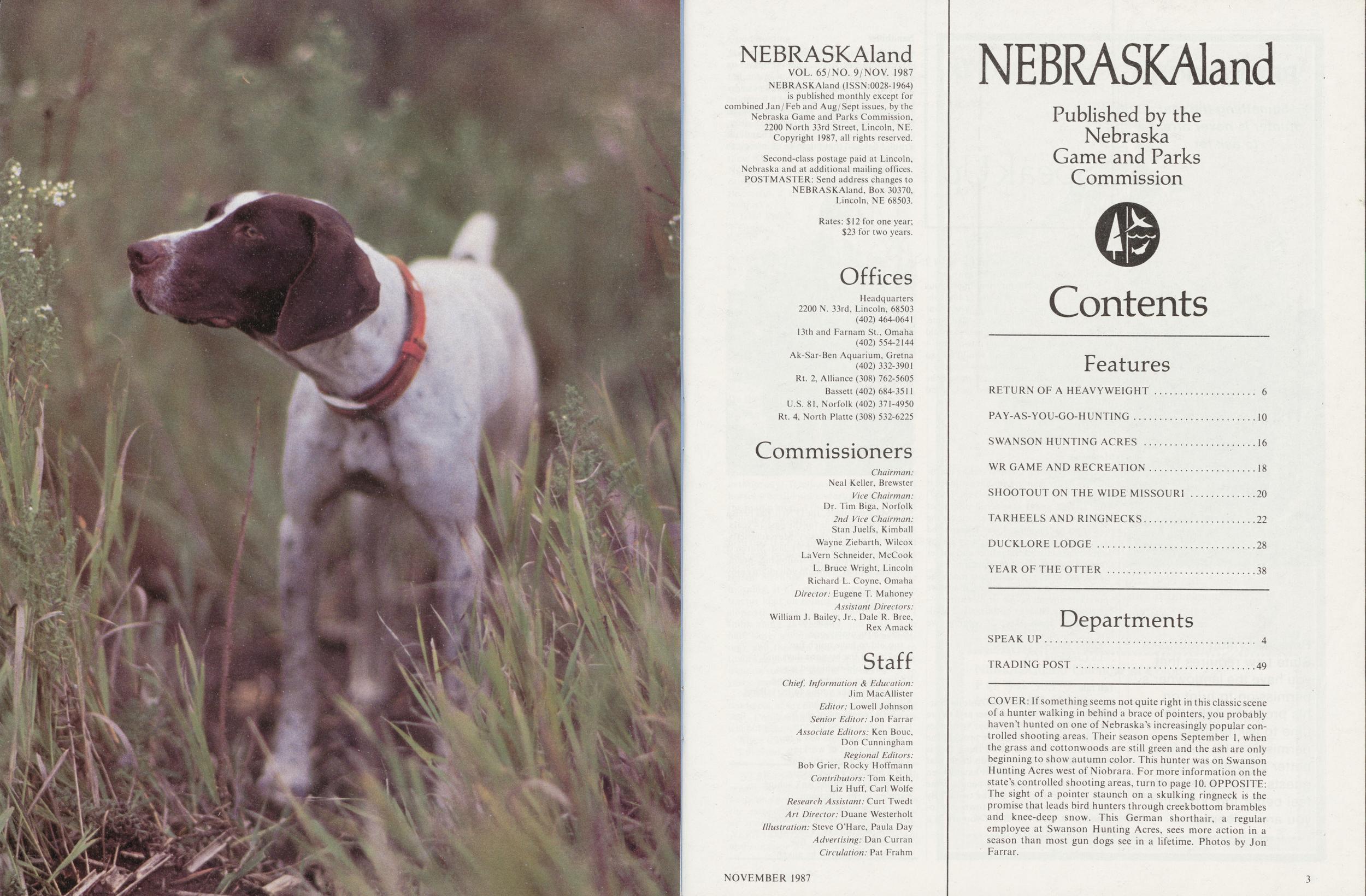
Published byt the Nebraska Game and Parks Commission NEBRASKAland VOL. 65/NO. 9/NOV. 1987 NEBRASKAland (ISSN:0028-1964) is published monthly except for combined Jan/Feb and Aug/Sept issues, by the Nebraska Game and Parks Commission, 2200 North 33rd Street, Lincoln, NE. Copyright 1987, all rights reserved. Second-class postage paid at Lincoln, Nebraska and at additional mailing offices. POSTMASTER: Send address changes to NEBRASKAland, Box 30370, Lincoln, NE 68503. Rates: $12 for one year; $23 for two years. Offices Headquarters 2200 N. 33rd, Lincoln, 68503 (402)464-0641 13th and Farnam St., Omaha (402) 554-2144 Ak-Sar-Ben Aquarium, Gretna (402) 332-3901 Rt. 2, Alliance (308) 762-5605 Bassett (402) 684-3511 U.S. 81, Norfolk (402) 371-4950 Rt. 4, North Platte (308) 532-6225 Commissioners Chairman: Neal Keller, Brewster Vice Chairman: Dr. Tim Biga, Norfolk 2nd Vice Chairman: Stan Juelfs, Kimball Wayne Ziebarth, Wilcox LaVern Schneider, McCook L. Bruce Wright, Lincoln Richard L. Coyne, Omaha Director: Eugene T. Mahoney Assistant Directors: William J. Bailey, Jr., Dale R. Bree, Rex Amack Staff Chief, Information & Education: Jim MacAllister Editor: Lowell Johnson Senior Editor: Jon Farrar Associate Editors: Ken Bouc, Don Cunningham Regional Editors: Bob Grier, Rocky Hoffmann Contributors: Tom Keith, Liz Huff, Carl Wolfe Research Assistant: Curt Twedt Art Director: Duane Westerholt Illustration: Steve O'Hare, Paula Day Advertising: Dan Curran Circulation: Pat Frahm Contents Features RETURN OF A HEAVYWEIGHT.................... 6 PAY-AS-YOU-GO-H UNTING 10 SWANSON HUNTING ACRES ......................16 WR GAME AND RECREATION.....................18 SHOOTOUT ON THE WIDE MISSOURI 20 TARHEELS AND RINGNECKS......................22 DUCKLORE LODGE YEAR OF THE OTTER 28 38 Departments SPEAK UP......................................... 4 TRADING POST...................................49 COVER: If something seems not quite right in this classic scene of a hunter walking in behind a brace of pointers, you probably haven't hunted on one of Nebraska's increasingly popular controlled shooting areas. Their season opens September 1, when the grass and cottonwoods are still green and the ash are only beginning to show autumn color. This hunter was on Swanson Hunting Acres west of Niobrara. For more information on the state's controlled shooting areas, turn to page 10. OPPOSITE: The sight of a pointer staunch on a skulking ringneck is the promise that leads bird hunters through cree kbottom brambles and knee-deep snow. This German shorthair, a regular employee at Swanson Hunting Acres, sees more action in a season than most gun dogs see in a lifetime. Photos by Jon Farrar. NOVEMBER 1987 3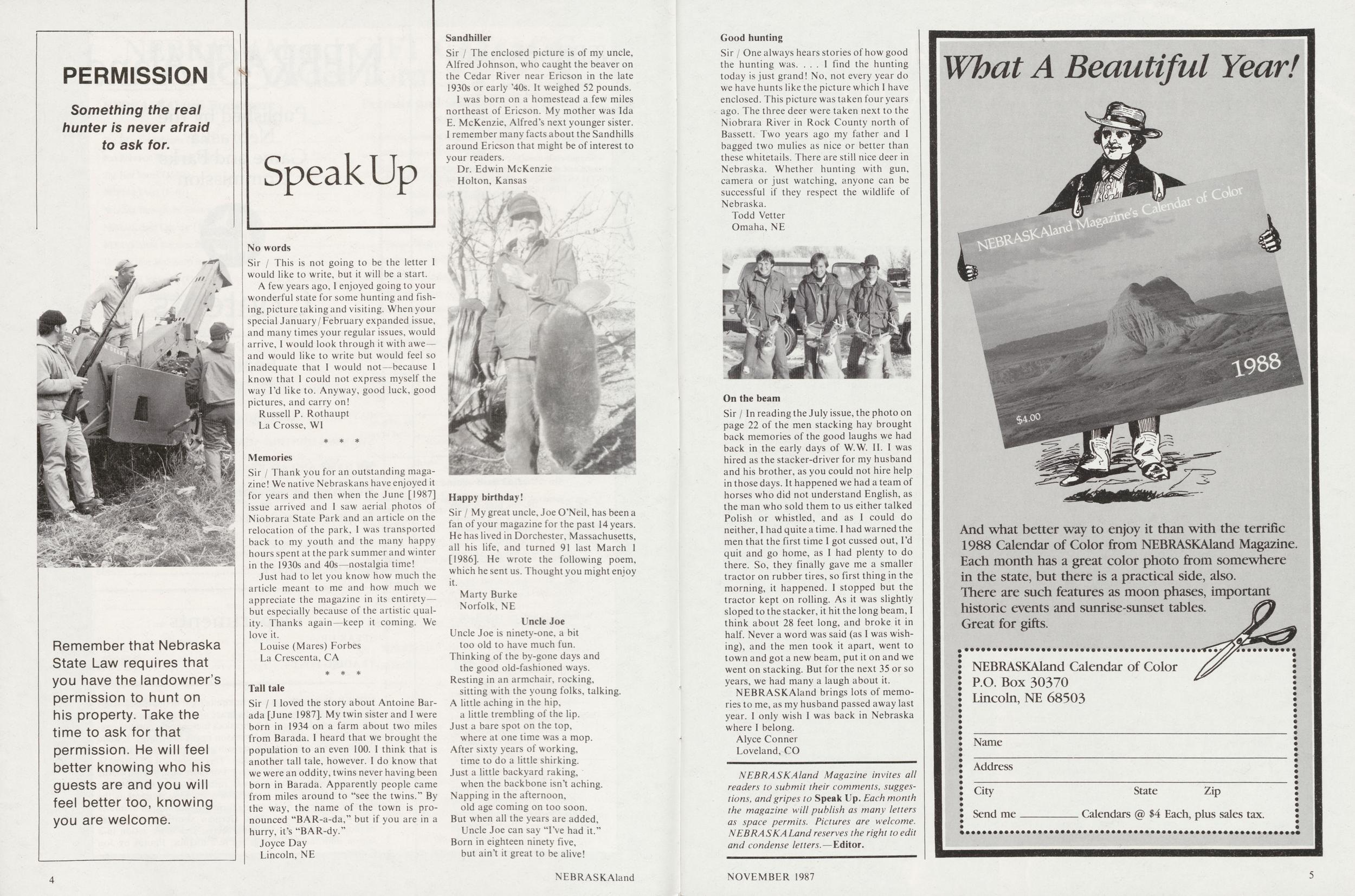
Speak Up
No WordsSir / This is not going to be the letter I would like to write, but it will be a start.
A few years ago, I enjoyed going to your wonderful state for some hunting and fishing, picture taking and visiting. When your special January/February expanded issue, and many times your regular issues, would arrive, I would look through it with awe and would like to write but would feel so inadequate that 1 would not—because 1 know that I could not express myself the way Td like to. Anyway, good luck, good pictures, and carry on!
Russell P. Rothaupt La Crosse, WI * * * MemoriesSir / Thank you for an outstanding magazine! We native Nebraskans have enjoyed it for years and then when the June [1987] issue arrived and I saw aerial photos of Niobrara State Park and an article on the relocation of the park, I was transported back to my youth and the many happy hours spent at the park summer and winter in the 1930s and 40s—nostalgia time!
Just had to let you know how much the article meant to me and how much we appreciate the magazine in its entirety but especially because of the artistic quality. Thanks again—keep it coming. We love it.
Louise (Mares) Forbes La Crescenta, CA * * * Tall taleSir / I loved the story about Antoine Barada [June 1987]. My twin sister and I were born in 1934 on a farm about two miles from Barada. I heard that we brought the population to an even 100. I think that is another tall tale, however. I do know that we were an oddity, twins never having been born in Barada. Apparently people came from miles around to "see the twins." By the way, the name of the town is pronounced "BAR-a-da," but if you are in a hurry, it's "BAR-dy."
Joyce Day Lincoln, NE SandhillerSir / The enclosed picture is of my uncle, Alfred Johnson, who caught the beaver on the Cedar River near Ericson in the late 1930s or early '40s. It weighed 52 pounds.
I was born on a homestead a few miles northeast of Ericson. My mother was Ida E. McKenzie, Alfred's next younger sister. I remember many facts about the Sandhills around Ericson that might be of interest to your readers.
Dr. Edwin McKenzie Holton, KansasSir / My great uncle, Joe O'Neil, has been a fan of your magazine for the past 14 years. He has lived in Dorchester, Massachusetts, all his life, and turned 91 last March 1 [1986]. He wrote the following poem, which he sent us. Thought you might enjoy it.
Marty Burke Norfolk, NE Uncle Joe Uncle Joe is ninety-one, a bit too old to have much fun. Thinking of the by-gone days and the good old-fashioned ways. Resting in an armchair, rocking, sitting with the young folks, talking. A little aching in the hip, a little trembling of the lip. Just a bare spot on the top, where at one time was a mop. After sixty years of working, time to do a little shirking. Just a little backyard raking, when the backbone isn't aching. Napping in the afternoon, old age coming on too soon. But when all the years are added, Uncle Joe can say "I've had it." Born in eighteen ninety five, but ain't it great to be alive! 4 NEBRASKAland Good huntingSir / One always hears stories of how good the hunting was. ... I find the hunting today is just grand! No, not every year do we have hunts like the picture which I have enclosed. This picture was taken four years ago. The three deer were taken next to the Niobrara River in Rock County north of Bassett. Two years ago my father and I bagged two mulies as nice or better than these whitetails. There are still nice deer in Nebraska. Whether hunting with gun, camera or just watching, anyone can be successful if they respect the wildlife of Nebraska.
Todd Vetter Omaha, NESir / In reading the July issue, the photo on page 22 of the men stacking hay brought back memories of the good laughs we had back in the early days of W.W. II. I was hired as the stacker-driver for my husband and his brother, as you could not hire help in those days. It happened we had a team of horses who did not understand English, as the man who sold them to us either talked Polish or whistled, and as I could do neither, I had quite a time. I had warned the men that the first time I got cussed out, I'd quit and go home, as I had plenty to do there. So, they finally gave me a smaller tractor on rubber tires, so first thing in the morning, it happened. I stopped but the tractor kept on rolling. As it was slightly sloped to the stacker, it hit the long beam, I think about 28 feet long, and broke it in half. Never a word was said (as I was wishing), and the men took it apart, went to town and got a new beam, put it on and we went on stacking. But for the next 35 or so years, we had many a laugh about it.
NEBRASKAland brings lots of memories to me, as my husband passed away last year. I only wish I was back in Nebraska where I belong.
Alyce Conner Loveland, CO NEBRASKAland Magazine invites all readers to submit their comments, suggestions, and gripes to Speak Up. Each month the magazine will publish as many letters as space permits. Pictures are welcome. NEBRA SKA Land reserves the right to edit and condense letters.—Editor. What A Beautiful Year! And what better way to enjoy it than with the terrific 1988 Calendar of Color from NEBRASKAland Magazine. Each month has a great color photo from somewhere in the state, but there is a practical side, also. There are such features as moon phases, important historic events and sunrise-sunset tables. Great for gifts. NEBRASKAland Calendar of Color P.O. Box 30370 Lincoln, NE 68503 • : Name Address City Send me State Zip Calendars @ $4 Each, plus sales tax. NOVEMBER 1987 5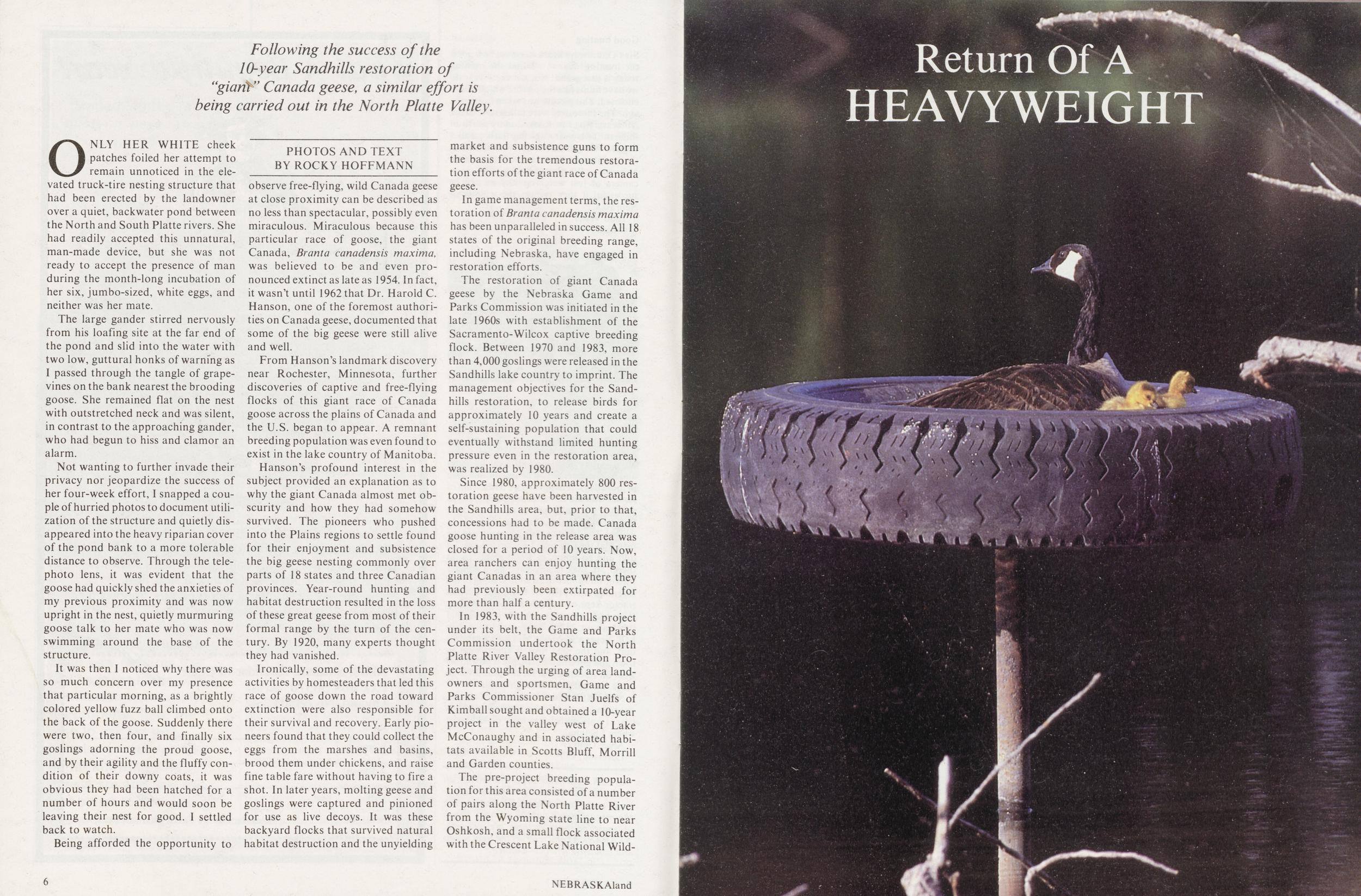
Return of a HEAVYWEIGHT
Following the success of the 10-year Sandhills restoration of "giant" Canada geese, a similar effort is being carried out in the North Platte Valley. PHOTOS AND TEXT BY ROCKY HOFFMANNONLY HER WHITE cheek patches foiled her attempt to remain unnoticed in the elevated truck-tire nesting structure that had been erected by the landowner over a quiet, backwater pond between the North and South Platte rivers. She had readily accepted this unnatural, man-made device, but she was not ready to accept the presence of man during the month-long incubation of her six, jumbo-sized, white eggs, and neither was her mate.
The large gander stirred nervously from his loafing site at the far end of the pond and slid into the water with two low, guttural honks of warning as I passed through the tangle of grape- vines on the bank nearest the brooding goose. She remained flat on the nest with outstretched neck and was silent, in contrast to the approaching gander, who had begun to hiss and clamor an alarm.
Not wanting to further invade their privacy nor jeopardize the success of her four-week effort, I snapped a couple of hurried photos to document utilization of the structure and quietly disappeared into the heavy riparian cover of the pond bank to a more tolerable distance to observe. Through the telephoto lens, it was evident that the goose had quickly shed the anxieties of my previous proximity and was now upright in the nest, quietly murmuring goose talk to her mate who was now swimming around the base of the structure.
It was then I noticed why there was so much concern over my presence that particular morning, as a brightly colored yellow fuzz ball climbed onto the back of the goose. Suddenly there were two, then four, and finally six goslings adorning the proud goose, and by their agility and the fluffy condition of their downy coats, it was obvious they had been hatched for a number of hours and would soon be leaving their nest for good. I settled back to watch.
Being afforded the opportunity to observe free-flying, wild Canada geese at close proximity can be described as no less than spectacular, possibly even miraculous. Miraculous because this particular race of goose, the giant Canada, Branta canadensis maxima, was believed to be and even pronounced extinct as late as 1954. In fact, it wasn't until 1962 that Dr. Harold C. Hanson, one of the foremost authorities on Canada geese, documented that some of the big geese were still alive and well.
From Hanson's landmark discovery near Rochester, Minnesota, further discoveries of captive and free-flying flocks of this giant race of Canada goose across the plains of Canada and the U.S. began to appear. A remnant breeding population was even found to exist in the lake country of Manitoba.
Hanson's profound interest in the subject provided an explanation as to why the giant Canada almost met obscurity and how they had somehow survived. The pioneers who pushed into the Plains regions to settle found for their enjoyment and subsistence the big geese nesting commonly over parts of 18 states and three Canadian provinces. Year-round hunting and habitat destruction resulted in the loss of these great geese from most of their formal range by the turn of the century. By 1920, many experts thought they had vanished.
Ironically, some of the devastating activities by homesteaders that led this race of goose down the road toward extinction were also responsible for their survival and recovery. Early pioneers found that they could collect the eggs from the marshes and basins, brood them under chickens, and raise fine table fare without having to fire a shot. In later years, molting geese and goslings were captured and pinioned for use as live decoys. It was these backyard flocks that survived natural habitat destruction and the unyielding market and subsistence guns to form the basis for the tremendous restoration efforts of the giant race of Canada geese.
In game management terms, the restoration of Branta canadensis maxima has been unparalleled in success. All 18 states of the original breeding range, including Nebraska, have engaged in restoration efforts.
The restoration of giant Canada geese by the Nebraska Game and Parks Commission was initiated in the late 1960s with establishment of the Sacramento-Wilcox captive breeding flock. Between 1970 and 1983, more than 4,000 goslings were released in the Sandhills lake country to imprint. The management objectives for the Sandhills restoration, to release birds for approximately 10 years and create a self-sustaining population that could eventually withstand limited hunting pressure even in the restoration area, was realized by 1980.
Since 1980, approximately 800 restoration geese have been harvested in the Sandhills area, but, prior to that, concessions had to be made. Canada goose hunting in the release area was closed for a period of 10 years. Now, area ranchers can enjoy hunting the giant Canadas in an area where they had previously been extirpated for more than half a century.
In 1983, with the Sandhills project under its belt, the Game and Parks Commission undertook the North Platte River Valley Restoration Project. Through the urging of area landowners and sportsmen, Game and Parks Commissioner Stan Juelfs of Kimball sought and obtained a 10-year project in the valley west of Lake McConaughy and in associated habitats available in Scotts Bluff, Morrill and Garden counties.
The pre-project breeding population for this area consisted of a number of pairs along the North Platte River from the Wyoming state line to near Oshkosh, and a small flock associated with the Crescent Lake National Wildlife Refuge. The total number of geese in this breeding population was estimated to include fewer than 100 breeding pairs, and certainly not enough birds to prosper.
6 NEBRASKAland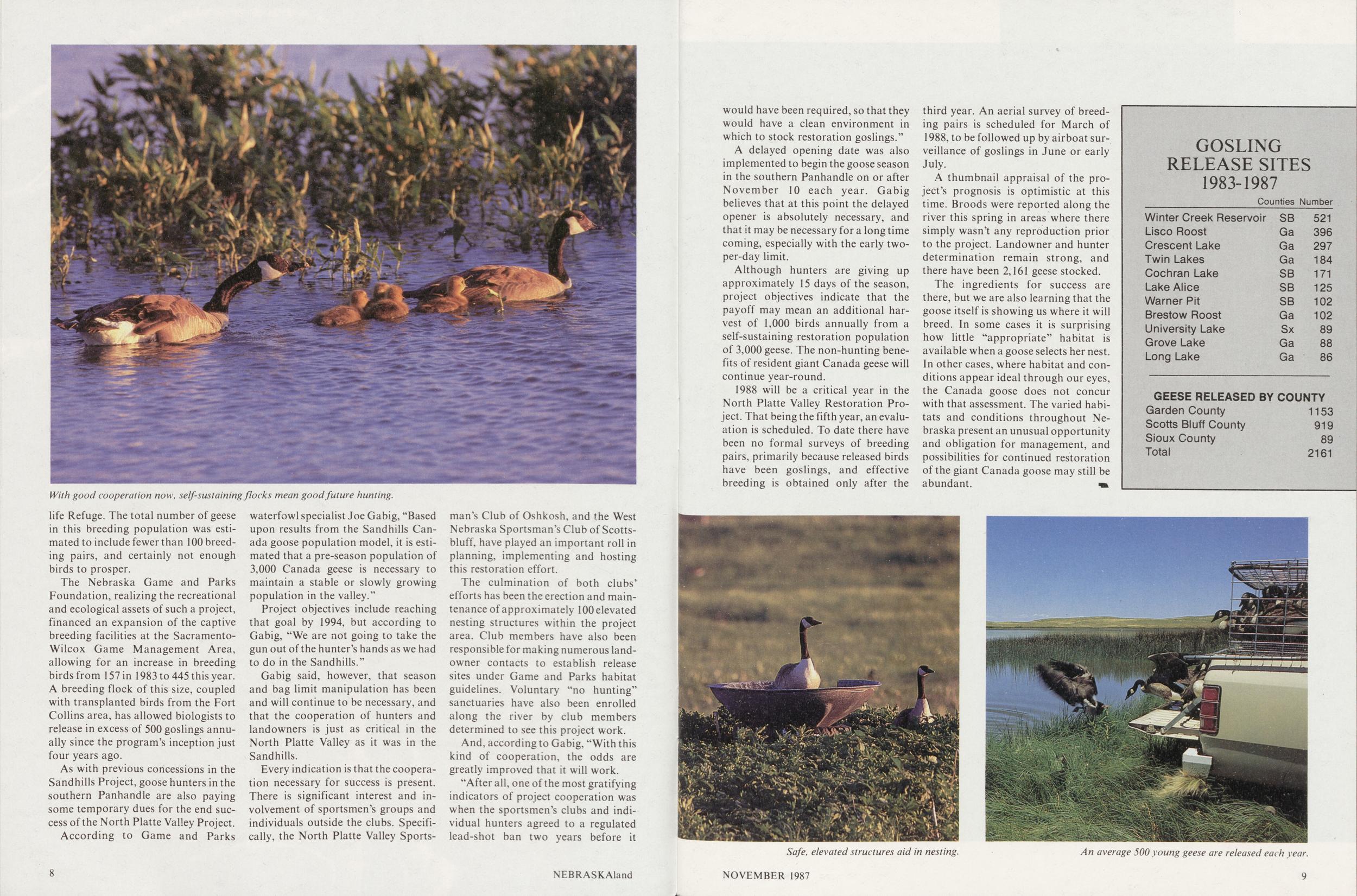
The Nebraska Game and Parks Foundation, realizing the recreational and ecological assets of such a project, financed an expansion of the captive breeding facilities at the Sacramento-Wilcox Game Management Area, allowing for an increase in breeding birds from 157 in 1983 to 445 this year. A breeding flock of this size, coupled with transplanted birds from the Fort Collins area, has allowed biologists to release in excess of 500 goslings annually since the program's inception just four years ago.
As with previous concessions in the Sandhills Project, goose hunters in the southern Panhandle are also paying some temporary dues for the end success of the North Platte Valley Project.
According to Game and Parks waterfowl specialist Joe Gabig, "Based upon results from the Sandhills Canada goose population model, it is estimated that a pre-season population of 3,000 Canada geese is necessary to maintain a stable or slowly growing population in the valley."
Project objectives include reaching that goal by 1994, but according to Gabig, "We are not going to take the gun out of the hunter's hands as we had to do in the Sandhills."
Gabig said, however, that season and bag limit manipulation has been and will continue to be necessary, and that the cooperation of hunters and landowners is just as critical in the North Platte Valley as it was in the Sandhills.
Every indication is that the cooperation necessary for success is present. There is significant interest and involvement of sportsmen's groups and individuals outside the clubs. Specifically, the North Platte Valley Sportsman's Club of Oshkosh, and the West Nebraska Sportsman's Club of Scottsbluff, have played an important roll in planning, implementing and hosting this restoration effort.
The culmination of both clubs' efforts has been the erection and maintenance of approximately 100 elevated nesting structures within the project area. Club members have also been responsible for making numerous landowner contacts to establish release sites under Game and Parks habitat guidelines. Voluntary "no hunting" sanctuaries have also been enrolled along the river by club members determined to see this project work.
And, according to Gabig, "With this kind of cooperation, the odds are greatly improved that it will work.
"After all, one of the most gratifying indicators of project cooperation was when the sportsmen's clubs and individual hunters agreed to a regulated lead-shot ban two years before it 8 NEBRASKAland would have been required, so that they would have a clean environment in which to stock restoration goslings."
A delayed opening date was also implemented to begin the goose season in the southern Panhandle on or after November 10 each year. Gabig believes that at this point the delayed opener is absolutely necessary, and that it may be necessary for a long time coming, especially with the early two-per-day limit.
Although hunters are giving up approximately 15 days of the season, project objectives indicate that the payoff may mean an additional harvest of 1,000 birds annually from a self-sustaining restoration population of 3,000 geese. The non-hunting benefits of resident giant Canada geese will continue year-round.
1988 will be a critical year in the North Platte Valley Restoration Project. That being the fifth year, an evaluation is scheduled. To date there have been no formal surveys of breeding pairs, primarily because released birds have been goslings, and effective breeding is obtained only after the third year. An aerial survey of breeding pairs is scheduled for March of 1988, to be followed up by airboat surveillance of goslings in June or early July.
A thumbnail appraisal of the project's prognosis is optimistic at this time. Broods were reported along the river this spring in areas where there simply wasn't any reproduction prior to the project. Landowner and hunter determination remain strong, and there have been 2,161 geese stocked.
The ingredients for success are there, but we are also learning that the goose itself is showing us where it will breed. In some cases it is surprising how little "appropriate" habitat is available when a goose selects her nest. In other cases, where habitat and conditions appear ideal through our eyes, the Canada goose does not concur with that assessment. The varied habitats and conditions throughout Nebraska present an unusual opportunity and obligation for management, and possibilities for continued restoration of the giant Canada goose may still be abundant.
GOSLING RELEASE SITES 1983-1987 Counties Number Winter Creek Reservoir SB 521 Lisco Roost Ga 396 Crescent Lake Ga 297 Twin Lakes Ga 184 Cochran Lake SB 171 Lake Alice SB 125 Warner Pit SB 102 Brestow Roost Ga 102 University Lake Sx 89 Grove Lake Ga 88 Long Lake Ga 86 GEESE RELEASED BY COUNTY Garden County 1153 Scotts Bluff County 919 Sioux County 89 Total 2161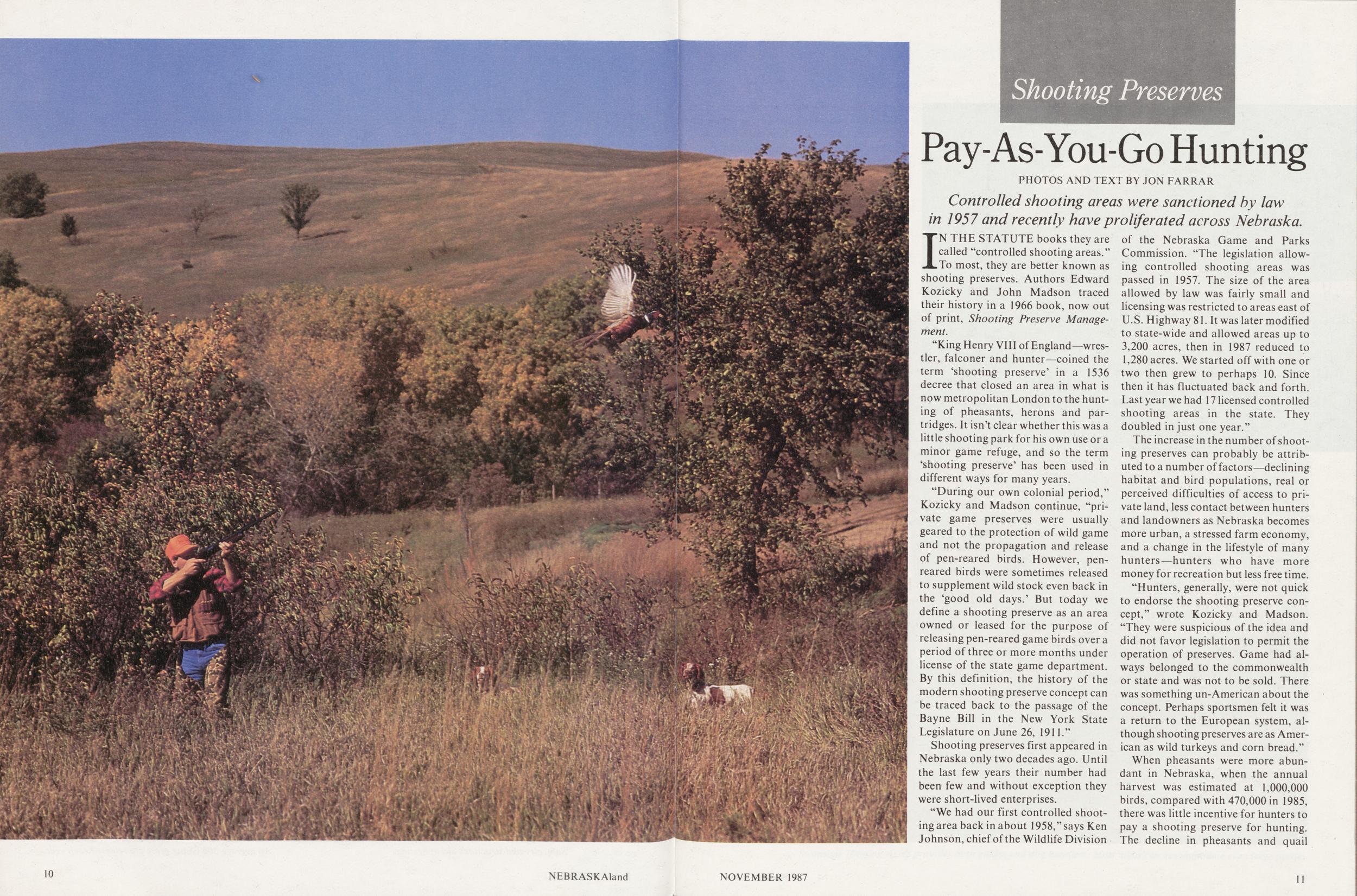
Shooting Preserves Pay-As-You-Go Hunting
PHOTOS AND TEXT BY JON FARRAR Controlled shooting areas were sanctioned by law in 1957 and recently have proliferated across Nebraska.IN THE STATUTE books they are called "controlled shooting areas." To most, they are better known as shooting preserves. Authors Edward Kozicky and John Madson traced their history in a 1966 book, now out of print, Shooting Preserve Manage- ment.
"King Henry VIII of England—wrestler, falconer and hunter—coined the term 'shooting preserve' in a 1536 decree that closed an area in what is now metropolitan London to the hunting of pheasants, herons and partridges. It isn't clear whether this was a little shooting park for his own use or a minor game refuge, and so the term 'shooting preserve' has been used in different ways for many years.
"During our own colonial period," Kozicky and Madson continue, "private game preserves were usually geared to the protection of wild game and not the propagation and release of pen-reared birds. However, penreared birds were sometimes released to supplement wild stock even back in the 'good old days.' But today we define a shooting preserve as an area owned or leased for the purpose of releasing pen-reared game birds over a period of three or more months under license of the state game department. By this definition, the history of the modern shooting preserve concept can be traced back to the passage of the Bayne Bill in the New York State Legislature on June 26, 1911."
Shooting preserves first appeared in Nebraska only two decades ago. Until the last few years their number had been few and without exception they were short-lived enterprises.
"We had our first controlled shooting area back in about 1958," says Ken Johnson, chief of the Wildlife Division of the Nebraska Game and Parks Commission. "The legislation allowing controlled shooting areas was passed in 1957. The size of the area allowed by law was fairly small and licensing was restricted to areas east of U.S. Highway 81. It was later modified to state-wide and allowed areas up to 3,200 acres, then in 1987 reduced to 1,280 acres. We started off with one or two then grew to perhaps 10. Since then it has fluctuated back and forth. Last year we had 17 licensed controlled shooting areas in the state. They doubled in just one year."
The increase in the number of shooting preserves can probably be attributed to a number of factors—declining habitat and bird populations, real or perceived difficulties of access to private land, less contact between hunters and landowners as Nebraska becomes more urban, a stressed farm economy, and a change in the lifestyle of many hunters—hunters who have more money for recreation but less free time.
"Hunters, generally, were not quick to endorse the shooting preserve concept," wrote Kozicky and Madson. "They were suspicious of the idea and did not favor legislation to permit the operation of preserves. Game had always belonged to the commonwealth or state and was not to be sold. There was something un-American about the concept. Perhaps sportsmen felt it was a return to the European system, although shooting preserves are as American as wild turkeys and corn bread."
When pheasants were more abundant in Nebraska, when the annual harvest was estimated at 1,000,000 birds, compared with 470,000 in 1985, there was little incentive for hunters to pay a shooting preserve for hunting. The decline in pheasants and quail after the winter of 1983-84 has probably contributed to the increase in the number of shooting preserves. Shooting preserves are most attractive when birds are scarce.
NOVEMBER 1987 11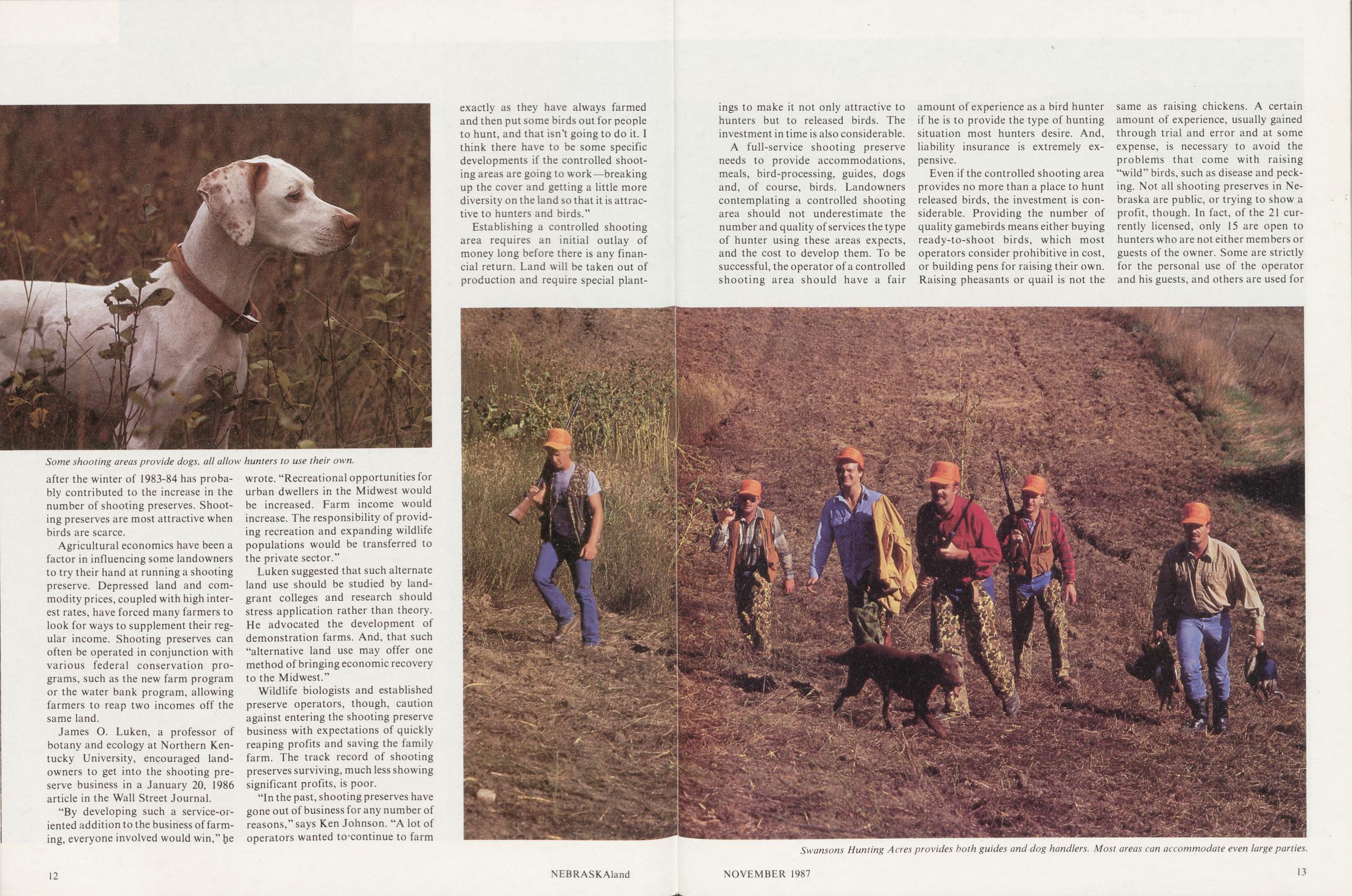
Agricultural economics have been a factor in influencing some landowners to try their hand at running a shooting preserve. Depressed land and commodity prices, coupled with high interest rates, have forced many farmers to look for ways to supplement their regular income. Shooting preserves can often be operated in conjunction with various federal conservation programs, such as the new farm program or the water bank program, allowing farmers to reap two incomes off the same land.
James O. Luken, a professor of botany and ecology at Northern Kentucky University, encouraged landowners to get into the shooting preserve business in a January 20, 1986 article in the Wall Street Journal.
"By developing such a service-oriented addition to the business of farming, everyone involved would win," he hunters to use their own. wrote. "Recreational opportunities for urban dwellers in the Midwest would be increased. Farm income would increase. The responsibility of providing recreation and expanding wildlife populations would be transferred to the private sector."
Luken suggested that such alternate land use should be studied by landgrant colleges and research should stress application rather than theory. He advocated the development of demonstration farms. And, that such "alternative land use may offer one method of bringing economic recovery to the Midwest."
Wildlife biologists and established preserve operators, though, caution against entering the shooting preserve business with expectations of quickly reaping profits and saving the family farm. The track record of shooting preserves surviving, much less showing significant profits, is poor.
"In the past, shooting preserves have gone out of business for any number of reasons," says Ken Johnson. "A lot of operators wanted to-continue to farm exactly as they have always farmed and then put some birds out for people to hunt, and that isn't going to do it. I think there have to be some specific developments if the controlled shooting areas are going to work—breaking up the cover and getting a little more diversity on the land so that it is attractive to hunters and birds."
Establishing a controlled shooting area requires an initial outlay of money long before there is any financial return. Land will be taken out of production and require special plantings 12 NEBRASKAland to make it not only attractive to hunters but to released birds. The investment in time is also considerable.
A full-service shooting preserve needs to provide accommodations, meals, bird-processing, guides, dogs and, of course, birds. Landowners contemplating a controlled shooting area should not underestimate the number and quality of services the type of hunter using these areas expects, and the cost to develop them. To be successful, the operator of a controlled shooting area should have a fair amount of experience as a bird hunter if he is to provide the type of hunting situation most hunters desire. And, liability insurance is extremely expensive.
Even if the controlled shooting area provides no more than a place to hunt released birds, the investment is considerable. Providing the number of quality game birds means either buying ready-to-shoot birds, which most operators consider prohibitive in cost, or building pens for raising their own. Raising pheasants or quail is not the same as raising chickens. A certain amount of experience, usually gained through trial and error and at some expense, is necessary to avoid the problems that come with raising "wild" birds, such as disease and pecking. Not all shooting preserves in Nebraska are public, or trying to show a profit, though. In fact, of the 21 currently licensed, only 15 are open to hunters who are not either members or guests of the owner. Some are strictly for the personal use of the operator and his guests, and others are used for business clients. Most of these areas are buying, not raising, birds.
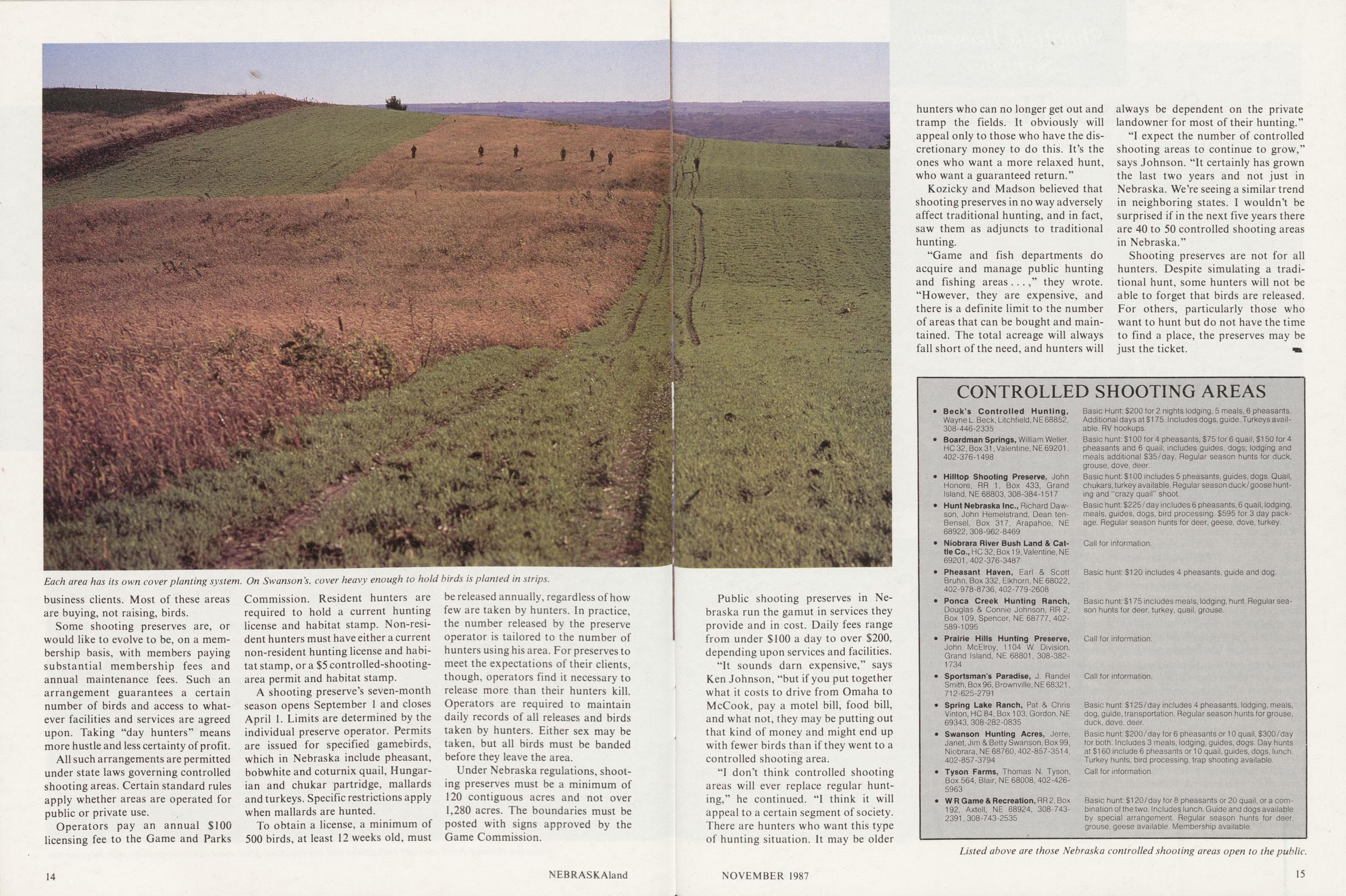
Some shooting preserves are, or would like to evolve to be, on a membership basis, with members paying substantial membership fees and annual maintenance fees. Such an arrangement guarantees a certain number of birds and access to whatever facilities and services are agreed upon. Taking "day hunters" means more hustle and less certainty of profit.
All such arrangements are permitted under state laws governing controlled shooting areas. Certain standard rules apply whether areas are operated for public or private use.
Operators pay an annual $100 licensing fee to the Game and Parks Commission. Resident hunters are required to hold a current hunting license and habitat stamp. Non-resident hunters must have either a current non-resident hunting license and habitat stamp, or a $5 controlled-shooting-area permit and habitat stamp.
A shooting preserve's seven-month season opens September 1 and closes April 1. Limits are determined by the individual preserve operator. Permits are issued for specified game birds, which in Nebraska include pheasant, bobwhite and coturnix quail, Hungarian and chukar partridge, mallards and turkeys. Specific restrictions apply when mallards are hunted.
To obtain a license, a minimum of 500 birds, at least 12 weeks old, must be released annually, regardless of how few are taken by hunters. In practice, the number released by the preserve operator is tailored to the number of hunters using his area. For preserves to meet the expectations of their clients, though, operators find it necessary to release more than their hunters kill. Operators are required to maintain daily records of all releases and birds taken by hunters. Either sex may be taken, but all birds must be banded before they leave the area.
Under Nebraska regulations, shooting preserves must be a minimum of 120 contiguous acres and not over 1,280 acres. The boundaries must be posted with signs approved by the Game Commission.
14 NEBRASKAlandPublic shooting preserves in Nebraska run the gamut in services they provide and in cost. Daily fees range from under $100 a day to over $200, depending upon services and facilities.
"It sounds darn expensive," says Ken Johnson, "but if you put together what it costs to drive from Omaha to McCook, pay a motel bill, food bill, and what not, they may be putting out that kind of money and might end up with fewer birds than if they went to a controlled shooting area.
"I don't think controlled shooting areas will ever replace regular hunt- ing," he continued. "I think it will appeal to a certain segment of society. There are hunters who want this type of hunting situation. It may be older hunters who can no longer get out and tramp the fields. It obviously will appeal only to those who have the discretionary money to do this. It's the ones who want a more relaxed hunt, who want a guaranteed return."
Kozicky and Madson believed that shooting preserves in no way adversely affect traditional hunting, and in fact, saw them as adjuncts to traditional hunting.
"Game and fish departments do acquire and manage public hunting and fishing areas . . .," they wrote. "However, they are expensive, and there is a definite limit to the number of areas that can be bought and maintained. The total acreage will always fall short of the need, and hunters will •>* always be dependent on the private landowner for most of their hunting."
"I expect the number of controlled shooting areas to continue to grow, says Johnson. "It certainly has grown the last two years and not just in Nebraska. We're seeing a similar trend in neighboring states. I wouldn't be surprised if in the next five years there are 40 to 50 controlled shooting areas in Nebraska."
Shooting preserves are not for all hunters. Despite simulating a traditional hunt, some hunters will not be able to forget that birds are released. For others, particularly those who want to hunt but do not have the time to find a. place, the preserves may be just the ticket.
CONTROLLED SHOOTING AREAS • Beck's Controlled Hunting, Wayne L. Beck, Litchfield, NE 68852, 308-446-2335 • Boardman Springs, William Weller, HC 32, Box 31, Valentine, NE 69201. 402-376-1498 • Hilltop Shooting Preserve, John Honore, RR 1, Box 433, Grand Island, NE 68803, 308-384-1517 • Hunt Nebraska Inc., Richard Dawson, John Hemelstrand, Dean ten Bensel, Box 317, Arapahoe, NE 68922, 308-962-8469 • Niobrara River Bush Land & Cattle Co., HC 32, Box 19, Valentine, NE 69201,402-376-3487 • Pheasant Haven, Earl & Scott Bruhn, Box 332, Elkhorn, NE 68022, 402-978-8736, 402-779-2608 • Ponca Creek Hunting Ranch, Douglas & Connie Johnson, RR 2, Box 109, Spencer, NE 68777, 402-589-1095 • Prairie Hills Hunting Preserve, John McElroy, 1104 W. Division, Grand Island, NE 68801, 308-382-1734 • Sportsman's Paradise, J. Randel Smith, Box 96, Brownville, NE 68321, 712-625-2791 • Spring Lake Ranch, Pat & Chris Vinton, HC 84, Box 103, Gordon, NE 69343, 308-282-0835 • Swanson Hunting Acres, Jerre, Janet, Jim & Betty Swanson, Box 99, Niobrara, NE 68760,402-857-3514, 402-857-3794 • Tyson Farms, Thomas N. Tyson, Box 564, Blair, NE 68008, 402-426-5963 • W R Game & Recreation, RR2, Box 192, Axtell, NE 68924, 308 743- 2391,308-743-2535 Basic Hunt: $200 for 2 nights lodging, 5 meals, 6 pheasants. Additional days at $175. Includes dogs, guide. Turkeys available. RV hookups. Basic hunt: $100 for 4 pheasants, $75 for 6 quail, $150 for 4 pheasants and 6 quail; includes guides, dogs; lodging and meals additional $35/day. Regular season hunts for duck, grouse, dove, deer. Basic hunt: $100 includes 5 pheasants, guides, dogs. Quail, chukars, turkey available. Regular season duck/goose hunting and "crazy quail" shoot. Basic hunt: $225/day includes 6 pheasants, 6 quail, lodging, meals, guides, dogs, bird processing. $595 for 3 day pack- age. Regular season hunts for deer, geese, dove, turkey. Call for information. Basic hunt: $120 includes 4 pheasants, guide and dog. Basic hunt: $175 includes meals, lodging, hunt. Regular season hunts for deer, turkey, quail, grouse. Call for information. Call for information. Basic hunt: $125/day includes 4 pheasants, lodging, meals, dog, guide, transportation. Regular season hunts for grouse, duck, dove. deer. Basic hunt: $200/day for 6 pheasants or 10 quail, $300/day for both. Includes 3 meals, lodging, guides, dogs. Day hunts at $160 include 6 pheasants or 10 quail, guides, dogs, lunch. Turkey hunts, bird processing, trap shooting available. Call for information. Basic hunt: $120/day for 8 pheasants or 20 quail, or a combination of the two. Includes lunch. Guide and dogs available by special arrangement. Regular season hunts for deer, grouse, geese available. Membership available. Listed above are those Nebraska controlled shooting areas open to the public. NOVEMBER 1987 15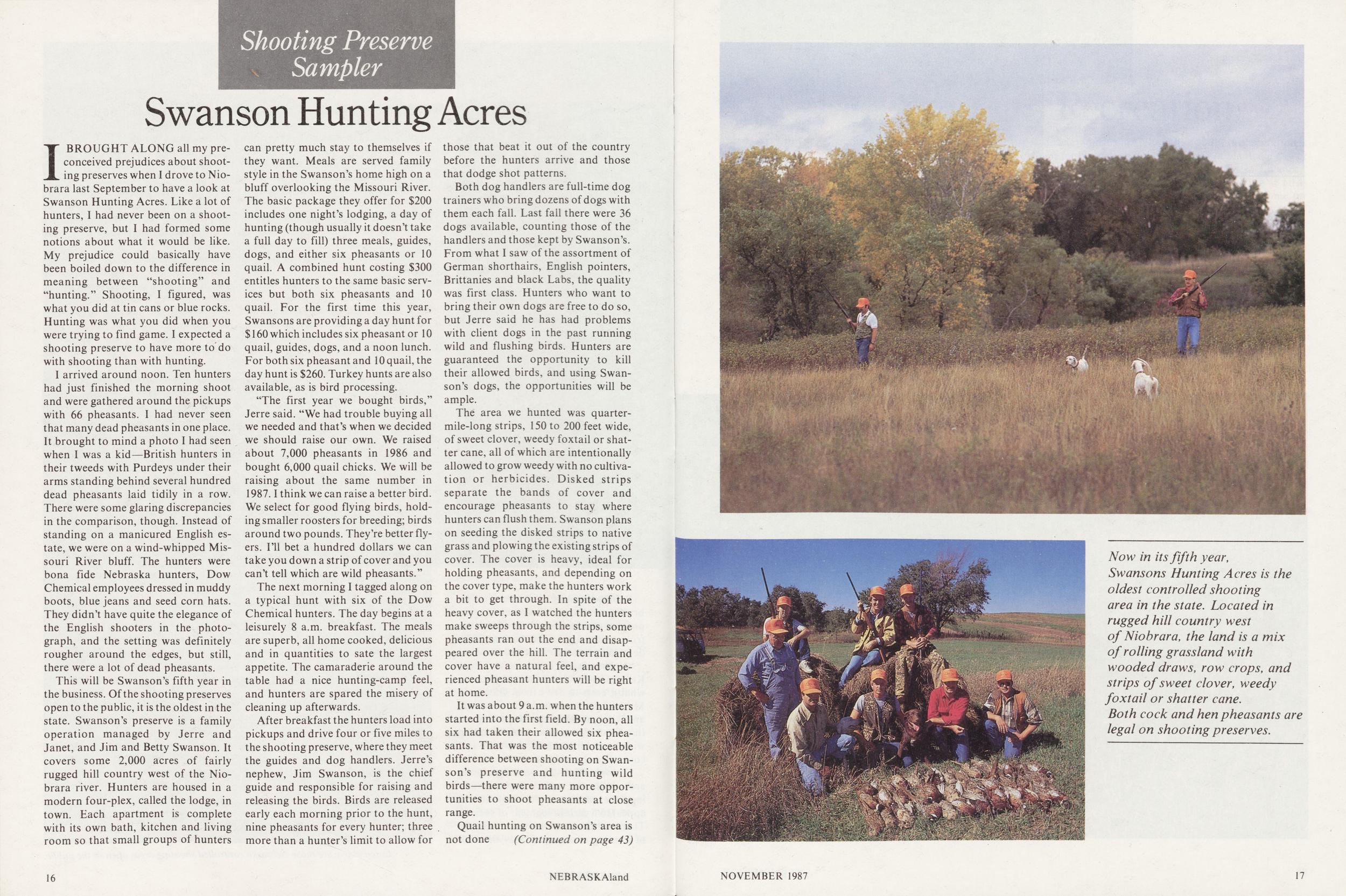
Shooting Preserve Sampler Swanson Hunting Acres
I BROUGHT ALONG all my preconceived prejudices about shooting preserves when I drove to Niobrara last September to have a look at Swanson Hunting Acres. Like a lot of hunters, I had never been on a shooting preserve, but I had formed some notions about what it would be like. My prejudice could basically have been boiled down to the difference in meaning between "shooting" and "hunting." Shooting, I figured, was what you did at tin cans or blue rocks. Hunting was what you did when you were trying to find game. I expected a shooting preserve to have more to do with shooting than with hunting.
1 arrived around noon. Ten hunters had just finished the morning shoot and were gathered around the pickups with 66 pheasants. I had never seen that many dead pheasants in one place. It brought to mind a photo I had seen when I was a kid—British hunters in their tweeds with Purdeys under their arms standing behind several hundred dead pheasants laid tidily in a row. There were some glaring discrepancies in the comparison, though. Instead of standing on a manicured English estate, we were on a wind-whipped Missouri River bluff. The hunters were bona fide Nebraska hunters, Dow Chemical employees dressed in muddy boots, blue jeans and seed corn hats. They didn't have quite the elegance of the English shooters in the photograph, and the setting was definitely rougher around the edges, but still, there were a lot of dead pheasants.
This will be Swanson's fifth year in the business. Of the shooting preserves open to the public, it is the oldest in the state. Swanson's preserve is a family operation managed by Jerre and Janet, and Jim and Betty Swanson. It covers some 2,000 acres of fairly rugged hill country west of the Niobrara river. Hunters are housed in a modern four-plex, called the lodge, in town. Each apartment is complete with its own bath, kitchen and living room so that small groups of hunters can pretty much stay to themselves if they want. Meals are served family style in the Swanson's home high on a bluff overlooking the Missouri River. The basic package they offer for $200 includes one night's lodging, a day of hunting (though usually it doesn't take a full day to fill) three meals, guides, dogs, and either six pheasants or 10 quail. A combined hunt costing $300 entitles hunters to the same basic services but both six pheasants and 10 quail. For the first time this year, Swansons are providing a day hunt for $ 160 which includes six pheasant or 10 quail, guides, dogs, and a noon lunch. For both six pheasant and 10 quail, the day hunt is $260. Turkey hunts are also available, as is bird processing.
"The first year we bought birds," Jerre said. "We had trouble buying all we needed and that's when we decided we should raise our own. We raised about 7,000 pheasants in 1986 and bought 6,000 quail chicks. We will be raising about the same number in 1987.1 think we can raise a better bird. We select for good flying birds, holding smaller roosters for breeding; birds around two pounds. They're better flyers. I'll bet a hundred dollars we can take you down a strip of cover and you can't tell which are wild pheasants."
The next morning I tagged along on a typical hunt with six of the Dow Chemical hunters. The day begins at a leisurely 8 a.m. breakfast. The meals are superb, all home cooked, delicious and in quantities to sate the largest appetite. The camaraderie around the table had a nice hunting-camp feel, and hunters are spared the misery of cleaning up afterwards.
After breakfast the hunters load into pickups and drive four or five miles to the shooting preserve, where they meet the guides and dog handlers. Jerre's nephew, Jim Swanson, is the chief guide and responsible for raising and releasing the birds. Birds are released early each morning prior to the hunt, nine pheasants for every hunter; three more than a hunter's limit to allow for those that beat it out of the country before the hunters arrive and those that dodge shot patterns.
Both dog handlers are full-time dog trainers who bring dozens of dogs with them each fall. Last fall there were 36 dogs available, counting those of the handlers and those kept by Swanson's. From what I saw of the assortment of German shorthairs, English pointers, Brittanies and black Labs, the quality was first class. Hunters who want to bring their own dogs are free to do so, but Jerre said he has had problems with client dogs in the past running wild and flushing birds. Hunters are guaranteed the opportunity to kill their allowed birds, and using Swanson's dogs, the opportunities will be ample.
The area we hunted was quarter-mile-long strips, 150 to 200 feet wide, of sweet clover, weedy foxtail or shatter cane, all of which are intentionally allowed to grow weedy with no cultivation or herbicides. Disked strips separate the bands of cover and encourage pheasants to stay where hunters can flush them. Swanson plans on seeding the disked strips to native grass and plowing the existing strips of cover. The cover is heavy, ideal for holding pheasants, and depending on the cover type, make the hunters work a bit to get through. In spite of the heavy cover, as I watched the hunters make sweeps through the strips, some pheasants ran out the end and disappeared over the hill. The terrain and cover have a natural feel, and experienced pheasant hunters will be right at home.
It was about 9 a.m. when the hunters started into the first field. By noon, all six had taken their allowed six pheasants. That was the most noticeable difference between shooting on Swanson's preserve and hunting wild birds—there were many more opportunities to shoot pheasants at close range.
Quail hunting on Swanson's area is not done (Continued on page 43)
16 NEBRASKAland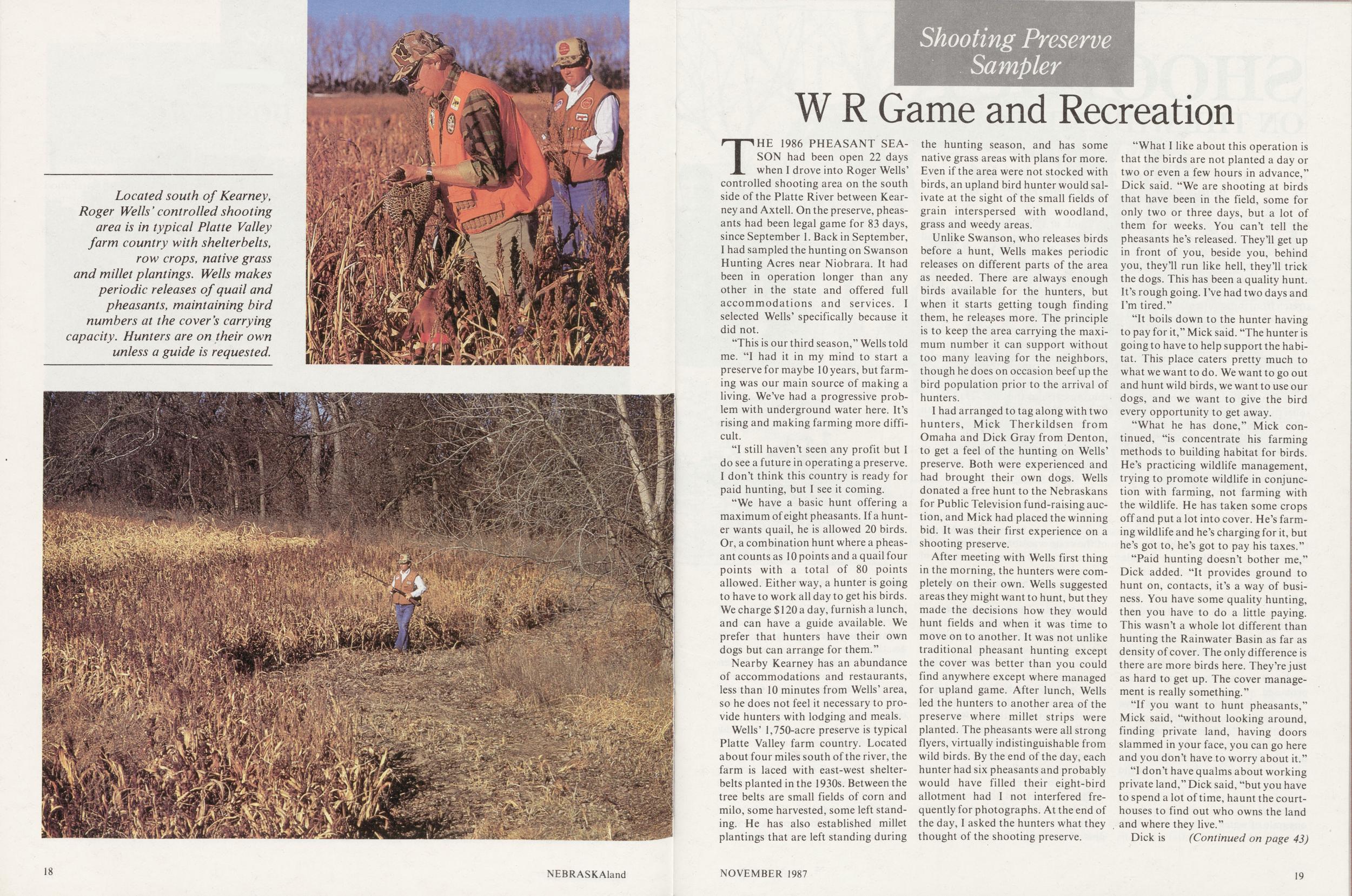
Shooting Preserve Sampler W R Game and Recreation
THE 1986 PHEASANT SEA- SON had been open 22 days when I drove into Roger Wells' controlled shooting area on the south side of the Platte River between Kearney and Axtell. On the preserve, pheasants had been legal game for 83 days, since September 1. Back in September, I had sampled the hunting on Swanson Hunting Acres near Niobrara. It had been in operation longer than any other in the state and offered full accommodations and services. I selected Wells' specifically because it did not.
"This is our third season," Wells told me. "I had it in my mind to start a preserve for maybe 10 years, but farming was our main source of making a living. We've had a progressive problem with underground water here. It's rising and making farming more difficult.
"I still haven't seen any profit but I do see a future in operating a preserve. I don't think this country is ready for paid hunting, but I see it coming.
"We have a basic hunt offering a maximum of eight pheasants. If a hunt- er wants quail, he is allowed 20 birds. Or, a combination hunt where a pheasant counts as 10 points and a quail four points with a total of 80 points allowed. Either way, a hunter is going to have to work all day to get his birds. We charge $ 120 a day, furnish a lunch, and can have a guide available. We prefer that hunters have their own dogs but can arrange for them."
Nearby Kearney has an abundance of accommodations and restaurants, less than 10 minutes from Wells' area, so he does not feel it necessary to provide hunters with lodging and meals.
Wells' 1,750-acre preserve is typical Platte Valley farm country. Located about four miles south of the river, the farm is laced with east-west shelterbelts planted in the 1930s. Between the tree belts are small fields of corn and milo, some harvested, some left standing. He has also established millet plantings that are left standing during the hunting season, and has some native grass areas with plans for more. Even if the area were not stocked with birds, an upland bird hunter would salivate at the sight of the small fields of grain interspersed with woodland, grass and weedy areas.
Unlike Swanson, who releases birds before a hunt, Wells makes periodic releases on different parts of the area as needed. There are always enough birds available for the hunters, but when it starts getting tough finding them, he releases more. The principle is to keep the area carrying the maximum number it can support without too many leaving for the neighbors, though he does on occasion beef up the bird population prior to the arrival of hunters.
I had arranged to tag along with two hunters, Mick Therkildsen from Omaha and Dick Gray from Denton, to get a feel of the hunting on Wells' preserve. Both were experienced and had brought their own dogs. Wells donated a free hunt to the Nebraskans for Public Television fund-raising auction, and Mick had placed the winning bid. It was their first experience on a shooting preserve.
After meeting with Wells first thing in the morning, the hunters were completely on their own. Wells suggested areas they might want to hunt, but they made the decisions how they would hunt fields and when it was time to move on to another. It was not unlike traditional pheasant hunting except the cover was better than you could find anywhere except where managed for upland game. After lunch, Wells led the hunters to another area of the preserve where millet strips were planted. The pheasants were all strong flyers, virtually indistinguishable from wild birds. By the end of the day, each hunter had six pheasants and probably would have filled their eight-bird allotment had I not interfered frequently for photographs. At the end of the day, I asked the hunters what they thought of the shooting preserve.
"What I like about this operation is that the birds are not planted a day or two or even a few hours in advance," Dick said. "We are shooting at birds that have been in the field, some for only two or three days, but a lot of them for weeks. You can't tell the pheasants he's released. They'll get up in front of you, beside you, behind you, they'll run like hell, they'll trick the dogs. This has been a quality hunt. It's rough going. I've had two days and I'm tired."
"It boils down to the hunter having to pay for it," Mick said. "The hunter is going to have to help support the habitat. This place caters pretty much to what we want to do. We want to go out and hunt wild birds, we want to use our dogs, and we want to give the bird every opportunity to get away.
"What he has done," Mick continued, "is concentrate his farming methods to building habitat for birds. He's practicing wildlife management, trying to promote wildlife in conjunction with farming, not farming with the wildlife. He has taken some crops off and put a lot into cover. He's farming wildlife and he's charging for it, but he's got to, he's got to pay his taxes."
"Paid hunting doesn't bother me," Dick added. "It provides ground to hunt on, contacts, it's a way of business. You have some quality hunting, then you have to do a little paying. This wasn't a whole lot different than hunting the Rainwater Basin as far as density of cover. The only difference is there are more birds here. They're just as hard to get up. The cover management is really something."
"If you want to hunt pheasants," Mick said, "without looking around, finding private land, having doors slammed in your face, you can go here and you don't have to worry about it."
"I don't have qualms about working private land," Dick said, "but you have to spend a lot of time, haunt the courthouses to find out who owns the land and where they live."
Dick is (Continued on page 43)
NOVEMBER 1987 19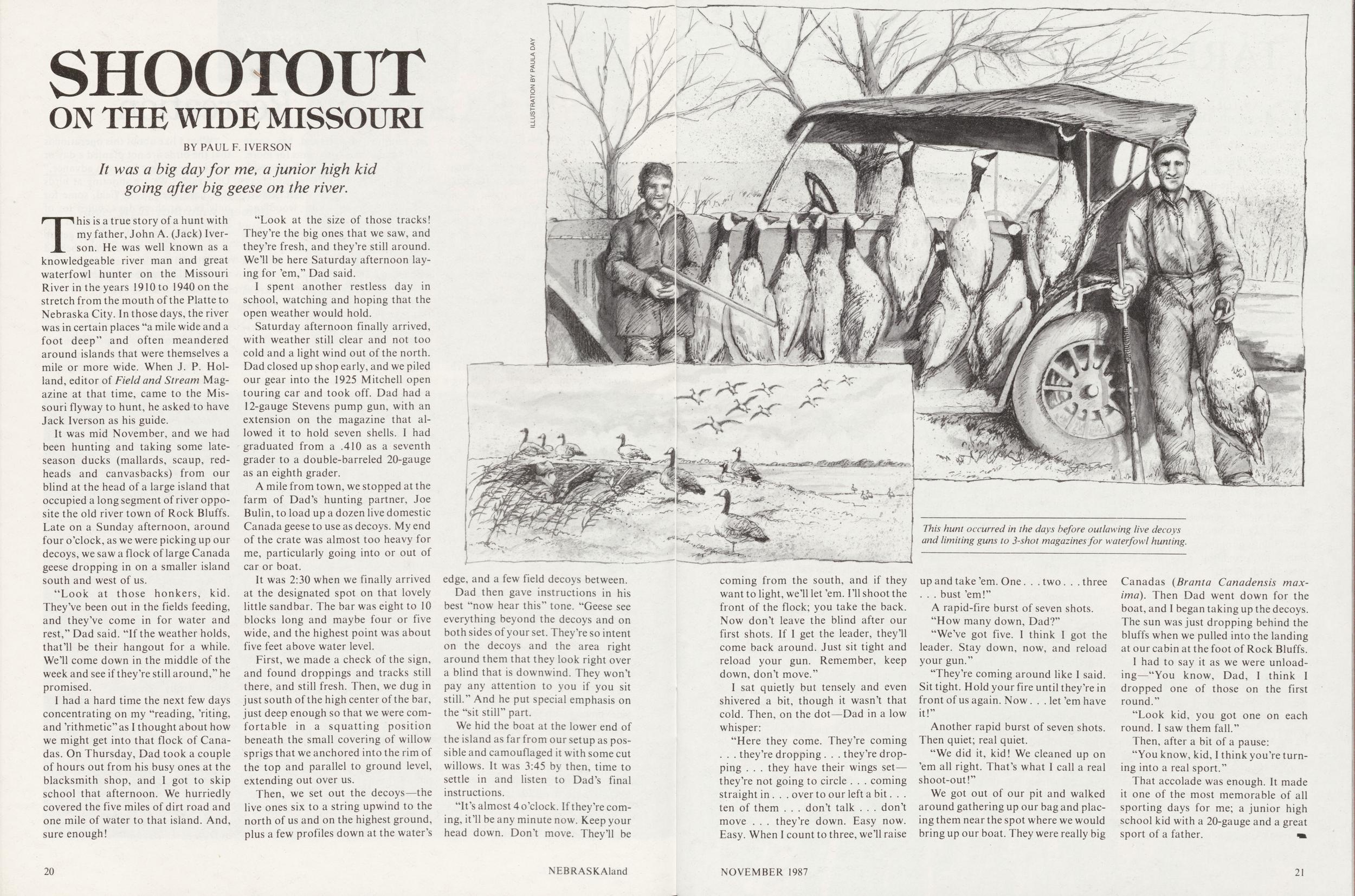
SHOOTOUT ON THE WIDE MISSOURI
BY PAUL F. IVERSON It was a big day for me, a junior high kid going after big geese on the river.This is a true story of a hunt with my father, John A. (Jack) Iverson. He was well known as a knowledgeable river man and great waterfowl hunter on the Missouri River in the years 1910 to 1940 on the stretch from the mouth of the Platte to Nebraska City. In those days, the river was in certain places "a mile wide and a foot deep" and often meandered around islands that were themselves a mile or more wide. When J. P. Holland, editor of Field and Stream Mag-azine at that time, came to the Missouri flyway to hunt, he asked to have Jack Iverson as his guide.
It was mid November, and we had been hunting and taking some late season ducks (mallards, scaup, redheads and canvasbacks) from our blind at the head of a large island that occupied a long segment of river opposite the old river town of Rock Bluffs. Late on a Sunday afternoon, around four o'clock, as we were picking up our decoys, we saw a flock of large Canada geese dropping in on a smaller island south and west of us.
"Look at those honkers, kid. They've been out in the fields feeding, and they've come in for water and rest," Dad said. "If the weather holds, that'll be their hangout for a while. We'll come down in the middle of the week and see if they're still around," he promised.
I had a hard time the next few days concentrating on my "reading, 'riting, and 'rithmetic"as I thought about how we might get into that flock of Canadas. On Thursday, Dad took a couple of hours out from his busy ones at the blacksmith shop, and I got to skip school that afternoon. We hurriedly covered the five miles of dirt road and one mile of water to that island. And, sure enough!
"Look at the size of those tracks! They're the big ones that we saw, and they're fresh, and they're still around. We'll be here Saturday afternoon laying for 'em," Dad said.
I spent another restless day in school, watching and hoping that the open weather would hold.
Saturday afternoon finally arrived, with weather still clear and not too cold and a light wind out of the north. Dad closed up shop early, and we piled our gear into the 1925 Mitchell open touring car and took off. Dad had a 12-gauge Stevens pump gun, with an extension on the magazine that allowed it to hold seven shells. I had graduated from a .410 as a seventh grader to a double-barreled 20-gauge as an eighth grader.
A mile from town, we stopped at the farm of Dad's hunting partner, Joe Bulin, to load up a dozen live domestic Canada geese to use as decoys. My end of the crate was almost too heavy for me, particularly going into or out of car or boat.
It was 2:30 when we finally arrived at the designated spot on that lovely little sandbar. The bar was eight to 10 blocks long and maybe four or five wide, and the highest point was about five feet above water level.
First, we made a check of the sign, and found droppings and tracks still there, and still fresh. Then, we dug in just south of the high center of the bar, just deep enough so that we were comfortable in a squatting position beneath the small covering of willow sprigs that we anchored into the rim of the top and parallel to ground level, extending out over us.
Then, we set out the decoys—the live ones six to a string upwind to the north of us and on the highest ground, plus a few profiles down at the water's This hunt occurred in the days before outlawing live decoys and limiting guns to 3-shot magazines for waterfowl hunting. ! edge, and a few field decoys between.
Dad then gave instructions in his best "now hear this" tone. "Geese see everything beyond the decoys and on both sides of your set. They're so intent on the decoys and the area right around them that they look right over a blind that is downwind. They won't pay any attention to you if you sit still." And he put special emphasis on the "sit still" part.
We hid the boat at the lower end of the island as far from our setup as possible and camouflaged it with some cut willows. It was 3:45 by then, time to settle in and listen to Dad's final instructions.
"It's almost 4 o'clock. If they're coming, it'll be any minute now. Keep your head down. Don't move. They'll be 20 NEBRSAKAland coming from the south, and if they want to light, we'll let 'em. I'll shoot the front of the flock; you take the back. Now don't leave the blind after our first shots. If I get the leader, they'll come back around. Just sit tight and reload your gun. Remember, keep down, don't move."
I sat quietly but tensely and even shivered a bit, though it wasn't that cold. Then, on the dot—Dad in a low whisper:
"Here they come. They're coming . . . they're dropping . . . they're dropping . . . they have their wings set they're not going to circle . . . coming straight in . . . over to our left a bit. . . ten of them . . . don't talk . . . don't move . . . they're down. Easy now. Easy. When I count to three, we'll raise up and take'em. One. . .two. . .three . . . bust 'em!"
A rapid-fire burst of seven shots.
"How many down, Dad?"
"We've got five. I think I got the leader. Stay down, now, and reload your gun."
"They're coming around like I said. Sit tight. Hold your fire until they're in front of us again. Now ... let 'em have it!"
Another rapid burst of seven shots. Then quiet; real quiet.
"We did it, kid! We cleaned up on 'em all right. That's what I call a real shoot-out!"
We got out of our pit and walked around gathering up our bag and placing them near the spot where we would bring up our boat. They were really big Canadas (Branta Canadensis maxima). Then Dad went down for the boat, and I began taking up the decoys. The sun was just dropping behind the bluffs when we pulled into the landing at our cabin at the foot of Rock Bluffs.
I had to say it as we were unload- ing—"You know, Dad, I think I dropped one of those on the first round."
"Look kid, you got one on each round. I saw them fall."
Then, after a bit of a pause:
"You know, kid, I think you're turning into a real sport."
That accolade was enough. It made it one of the most memorable of all sporting days for me; a junior high school kid with a 20-gauge and a great sport of a father.
NOVEMBER 1987 21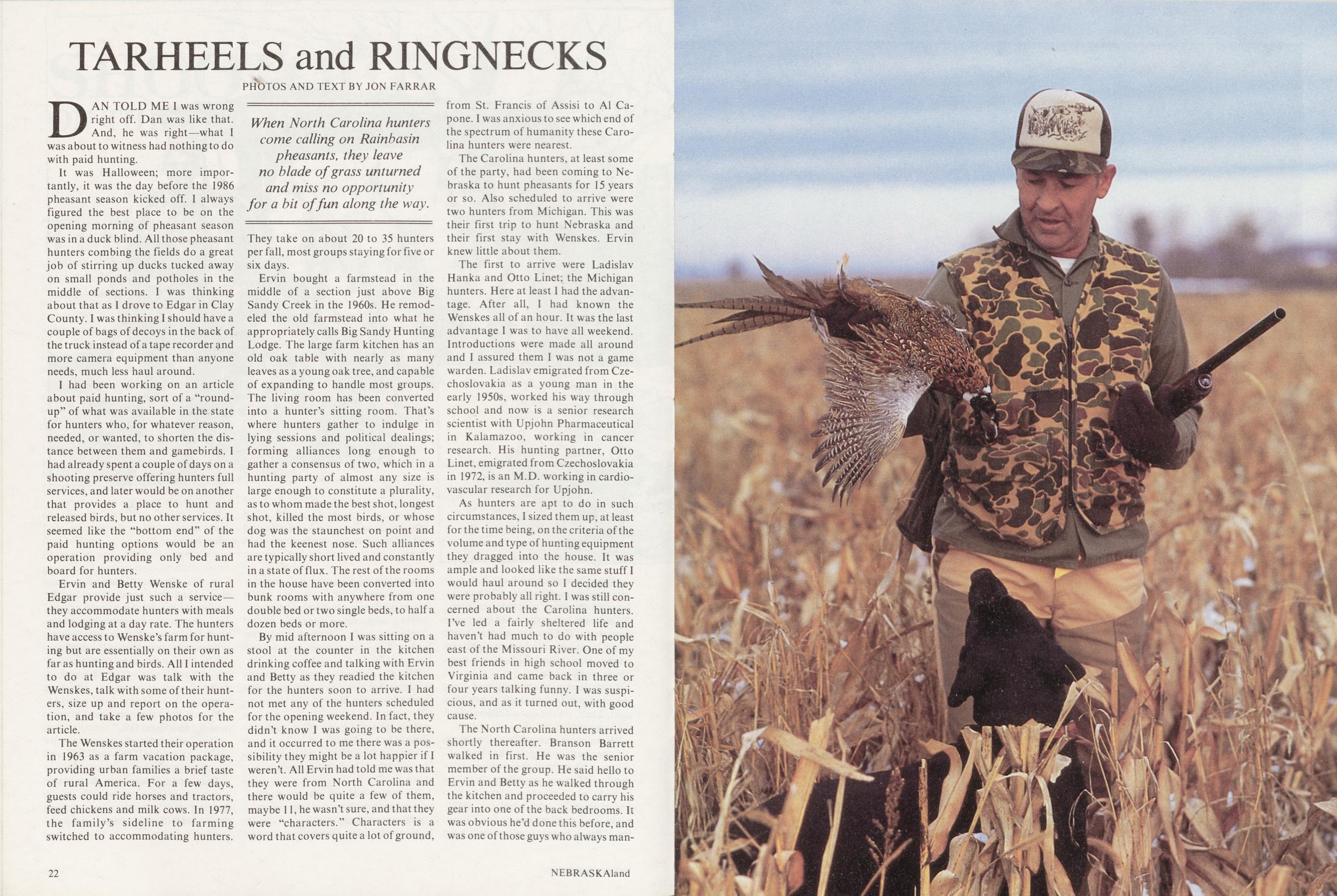
TARHEELS and RINGNECKS
PHOTOS AND TEXT BY JON FARRAR When North Carolina hunters come calling on Rainbasin pheasants, they leave no blade of grass unturned and miss no opportunity for a bit of fun along the way.DAN TOLD ME I was wrong right off. Dan was like that. And, he was right—what I was about to witness had nothing to do with paid hunting.
It was Halloween; more importantly, it was the day before the 1986 pheasant season kicked off. I always figured the best place to be on the opening morning of pheasant season was in a duck blind. All those pheasant hunters combing the fields do a great job of stirring up ducks tucked away on small ponds and potholes in the middle of sections. I was thinking about that as I drove to Edgar in Clay County. I was thinking I should have a couple of bags of decoys in the back of the truck instead of a tape recorder and more camera equipment than anyone needs, much less haul around.
I had been working on an article about paid hunting, sort of a "round- up" of what was available in the state for hunters who, for whatever reason, needed, or wanted, to shorten the distance between them and game birds. I had already spent a couple of days on a shooting preserve offering hunters full services, and later would be on another that provides a place to hunt and released birds, but no other services. It seemed like the "bottom end" of the paid hunting options would be an operation providing only bed and board for hunters.
Ervin and Betty Wenske of rural Edgar provide just such a service they accommodate hunters with meals and lodging at a day rate. The hunters have access to Wenske's farm for hunt- ing but are essentially on their own as far as hunting and birds. All I intended to do at Edgar was talk with the Wenskes, talk with some of their hunters, size up and report on the operation, and take a few photos for the article.
The Wenskes started their operation in 1963 as a farm vacation package, providing urban families a brief taste of rural America. For a few days, guests could ride horses and tractors, feed chickens and milk cows. In 1977, the family's sideline to farming switched to accommodating hunters. They take on about 20 to 35 hunters per fall, most groups staying for five or six days.
Ervin bought a farmstead in the middle of a section just above Big Sandy Creek in the 1960s. He remodeled the old farmstead into what he appropriately calls Big Sandy Hunting Lodge. The large farm kitchen has an old oak table with nearly as many leaves as a young oak tree, and capable of expanding to handle most groups. The living room has been converted into a hunter's sitting room. That's where hunters gather to indulge in lying sessions and political dealings; forming alliances long enough to gather a consensus of two, which in a hunting party of almost any size is large enough to constitute a plurality, as to whom made the best shot, longest shot, killed the most birds, or whose dog was the staunchest on point and had the keenest nose. Such alliances are typically short lived and constantly in a state of flux. The rest of the rooms in the house have been converted into bunk rooms with anywhere from one double bed or two single beds, to half a dozen beds or more.
By mid afternoon I was sitting on a stool at the counter in the kitchen drinking coffee and talking with Ervin and Betty as they readied the kitchen for the hunters soon to arrive. I had not met any of the hunters scheduled for the opening weekend. In fact, they didn't know I was going to be there, and it occurred to me there was a possibility they might be a lot happier if I weren't. All Ervin had told me was that they were from North Carolina and there would be quite a few of them, maybe 11, he wasn't sure, and that they were "characters." Characters is a word that covers quite a lot of ground, from St. Francis of Assisi to Al Capone. I was anxious to see which end of the spectrum of humanity these Carolina hunters were nearest.
The Carolina hunters, at least some of the party, had been coming to Nebraska to hunt pheasants for 15 years or so. Also scheduled to arrive were two hunters from Michigan. This was their first trip to hunt Nebraska and their first stay with Wenskes. Ervin knew little about them.
The first to arrive were Ladislav Hanka and Otto Linet; the Michigan hunters. Here at least I had the advantage. After all, I had known the Wenskes all of an hour. It was the last advantage I was to have all weekend. Introductions were made all around and I assured them I was not a game warden. Ladislav emigrated from Czechoslovakia as a young man in the early 1950s, worked his way through school and now is a senior research scientist with Upjohn Pharmaceutical in Kalamazoo, working in cancer research. His hunting partner, Otto Linet, emigrated from Czechoslovakia in 1972, is an M.D. working in cardiovascular research for Upjohn.
As hunters are apt to do in such circumstances, I sized them up, at least for the time being, on the criteria of the volume and type of hunting equipment they dragged into the house. It was ample and looked like the same stuff I would haul around so I decided they were probably all right. I was still concerned about the Carolina hunters. I've led a fairly sheltered life and haven't had much to do with people east of the Missouri River. One of my best friends in high school moved to Virginia and came back in three or four years talking funny. I was suspicious, and as it turned out, with good cause.
The North Carolina hunters arrived shortly thereafter. Branson Barrett walked in first. He was the senior member of the group. He said hello to Ervin and Betty as he walked through the kitchen and proceeded to carry his gear into one of the back bedrooms. It was obvious he'd done this before, and was one of those guys who always man- 22 NEBRASKAland
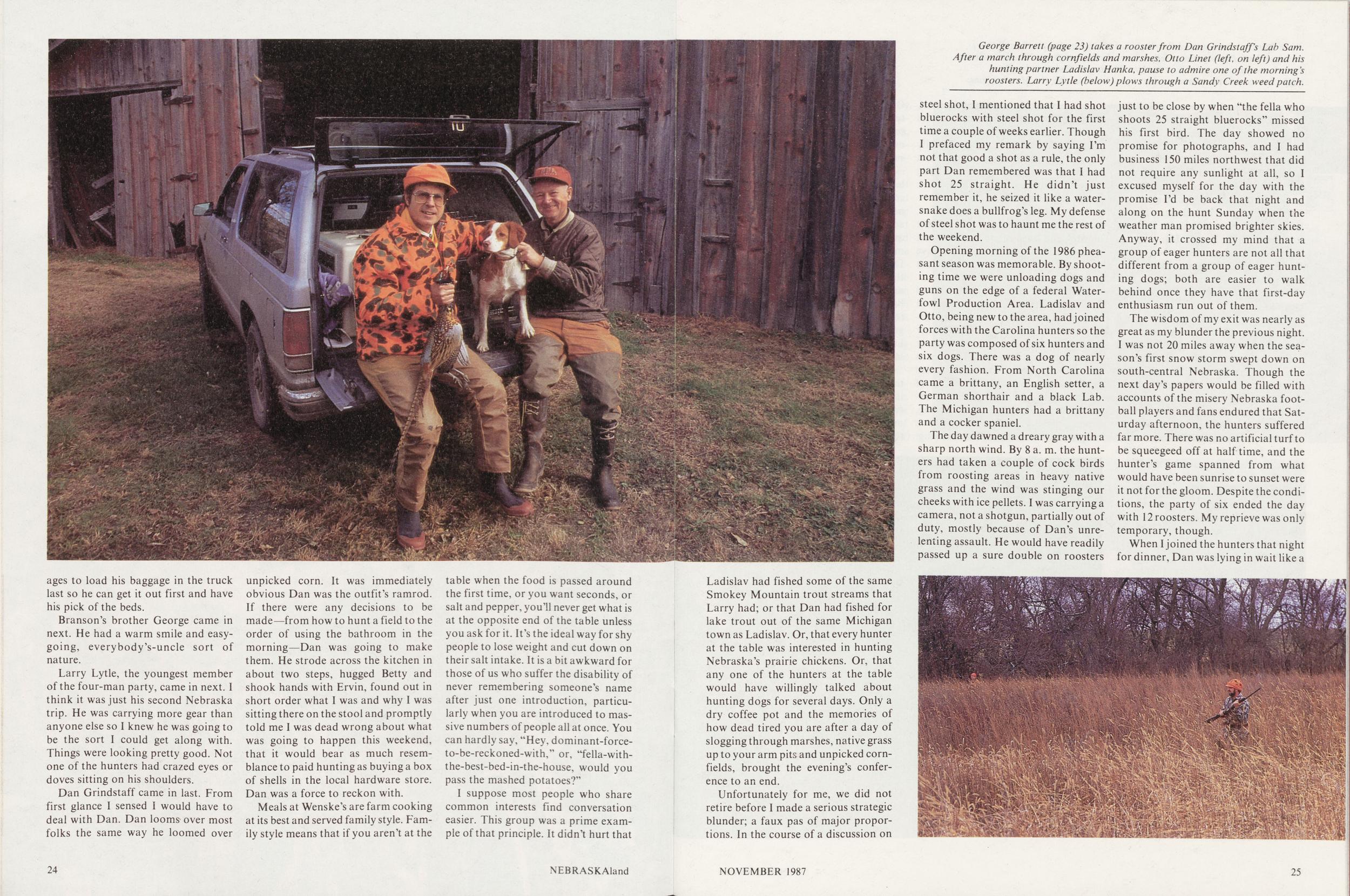
Branson's brother George came in next. He had a warm smile and easy going, everybody's-uncle sort of nature.
Larry Lytle, the youngest member of the four-man party, came in next. I think it was just his second Nebraska trip. He was carrying more gear than anyone else so I knew he was going to be the sort I could get along with. Things were looking pretty good. Not one of the hunters had crazed eyes or doves sitting on his shoulders.
Dan Grindstaff came in last. From first glance I sensed I would have to deal with Dan. Dan looms over most folks the same way he loomed over unpicked corn. It was immediately obvious Dan was the outfit's ramrod. If there were any decisions to be made—from how to hunt a field to the order of using the bathroom in the morning—Dan was going to make them. He strode across the kitchen in about two steps, hugged Betty and shook hands with Ervin, found out in short order what I was and why I was sitting there on the stool and promptly told me I was dead wrong about what was going to happen this weekend, that it would bear as much resemblance to paid hunting as buying a box of shells in the local hardware store. Dan was a force to reckon with.
Meals at Wenske's are farm cooking at its best and served family style. Family style means that if you aren't at the table when the food is passed around the first time, or you want seconds, or salt and pepper, you'll never get what is at the opposite end of the table unless you ask for it. It's the ideal way for shy people to lose weight and cut down on their salt intake. It is a bit awkward for those of us who suffer the disability of never remembering someone's name after just one introduction, particularly when you are introduced to massive numbers of people all at once. You can hardly say, "Hey, dominant-force- to-be-reckoned-with," or, "fella-with- the-best-bed-in-the-house, would you pass the mashed potatoes?"
I suppose most people who share common interests find conversation easier. This group was a prime example of that principle. It didn't hurt that 24 NEBRASKAland Ladislav had fished some of the same Smokey Mountain trout streams that Larry had; or that Dan had fished for lake trout out of the same Michigan town as Ladislav. Or, that every hunter at the table was interested in hunting Nebraska's prairie chickens. Or, that any one of the hunters at the table would have willingly talked about hunting dogs for several days. Only a dry coffee pot and the memories of how dead tired you are after a day of slogging through marshes, native grass up to your arm pits and unpicked cornfields, brought the evening's conference to an end.
Unfortunately for me, we did not retire before I made a serious strategic blunder; a faux pas of major proportions. In the course of a discussion on steel shot, I mentioned that I had shot blue rocks with steel shot for the first time a couple of weeks earlier. Though I prefaced my remark by saying I'm not that good a shot as a rule, the only part Dan remembered was that I had shot 25 straight. He didn't just remember it, he seized it like a watersnake does a bullfrog's leg. My defense of steel shot was to haunt me the rest of the weekend.
Opening morning of the 1986 pheasant season was memorable. By shooting time we were unloading dogs and guns on the edge of a federal Water-fowl Production Area. Ladislav and Otto, being new to the area, had joined forces with the Carolina hunters so the party was composed of six hunters and six dogs. There was a dog of nearly every fashion. From North Carolina came a brittany, an English setter, a German shorthair and a black Lab. The Michigan hunters had a brittany and a cocker spaniel.
The day dawned a dreary gray with a sharp north wind. By 8 a. m. the hunters had taken a couple of cock birds from roosting areas in heavy native grass and the wind was stinging our cheeks with ice pellets. I was carrying a camera, not a shotgun, partially out of duty, mostly because of Dan's unrelenting assault. He would have readily passed up a sure double on roosters just to be close by when "the fella who shoots 25 straight bluerocks" missed his first bird. The day showed no promise for photographs, and I had business 150 miles northwest that did not require any sunlight at all, so I excused myself for the day with the promise I'd be back that night and along on the hunt Sunday when the weather man promised brighter skies. Anyway, it crossed my mind that a group of eager hunters are not all that different from a group of eager hunting dogs; both are easier to walk behind once they have that first-day enthusiasm run out of them.
The wisdom of my exit was nearly as great as my blunder the previous night. I was not 20 miles away when the season's first snow storm swept down on south-central Nebraska. Though the next day's papers would be filled with accounts of the misery Nebraska football players and fans endured that Saturday afternoon, the hunters suffered far more. There was no artificial turf to be squeegeed off at half time, and the hunter's game spanned from what would have been sunrise to sunset were it not for the gloom. Despite the conditions, the party of six ended the day with 12 roosters. My reprieve was only temporary, though.
When I joined the hunters that night for dinner, Dan was lying in wait like a big cat that had not made a kill for several days. Dan has an enormous capacity for needling people, and more than one at once. In all fairness, though, I have to report that Dan was fielding a fair amount of heckling himself, and handled it as well as he dispensed it. It was time to form alliances, and I threw my lot in with Larry. Larry had been going toe to toe with Dan and it was an uneven match. Dan was riding the crest of a clean sweep of the Carolina hunters' opening day pool, having taken not only the pot for first rooster, but laid claim to the most clean kills.
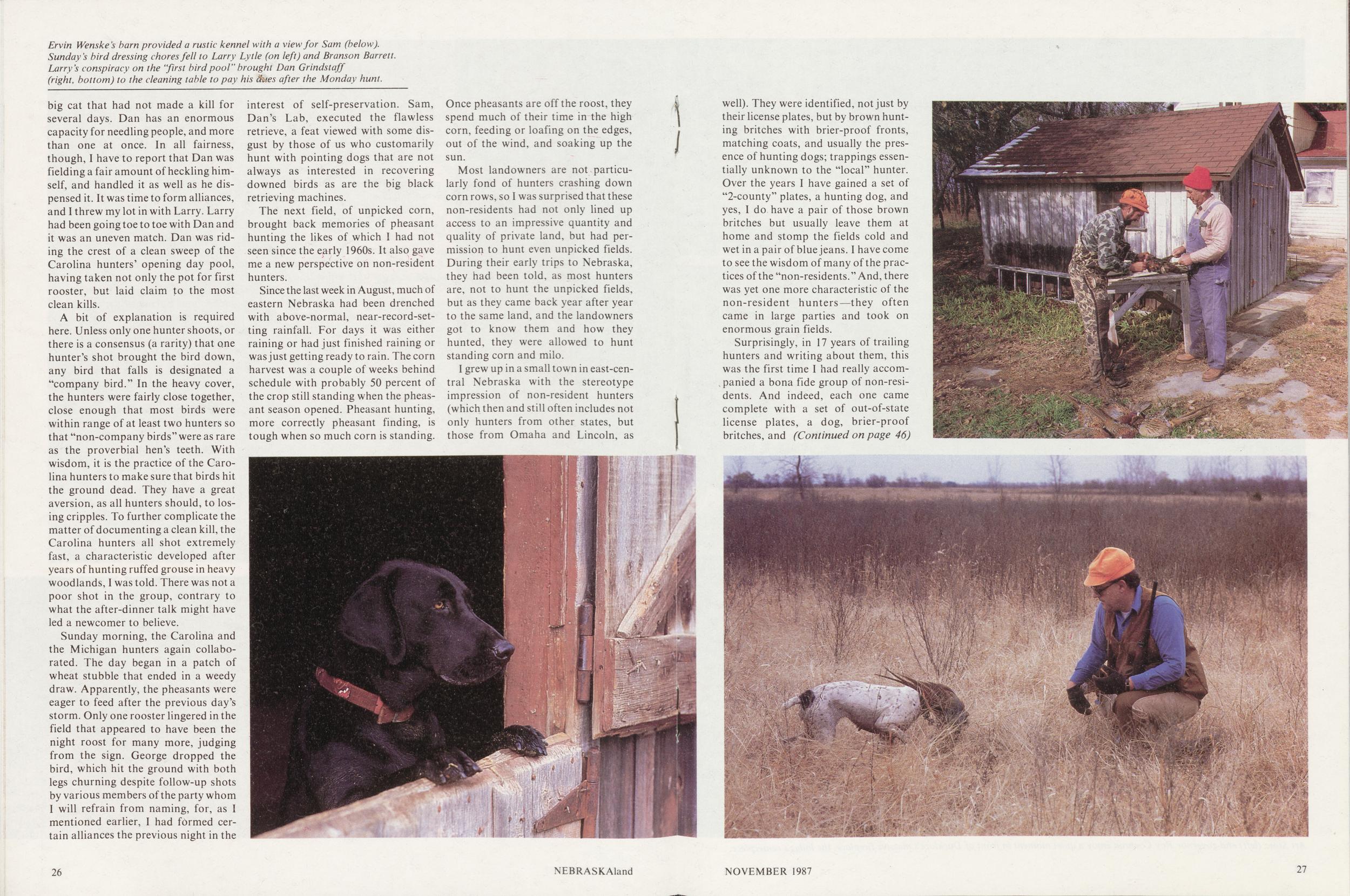 Ervin Wenske's barn provided a rustic kennel with a view for Sam (below).
Sunday's bird dressing chores fell to Larry Lytle (on left) and Branson Barrett.
Larry's conspiracy on the 'first bird pool" brought Dan Grindstaff
(right, bottom) to the cleaning table to pay his dues after the Monday hunt.
Ervin Wenske's barn provided a rustic kennel with a view for Sam (below).
Sunday's bird dressing chores fell to Larry Lytle (on left) and Branson Barrett.
Larry's conspiracy on the 'first bird pool" brought Dan Grindstaff
(right, bottom) to the cleaning table to pay his dues after the Monday hunt.
A bit of explanation is required here. Unless only one hunter shoots, or there is a consensus (a rarity) that one hunter's shot brought the bird down, any bird that falls is designated a "company bird." In the heavy cover, the hunters were fairly close together, close enough that most birds were within range of at least two hunters so that "non-company birds" were as rare as the proverbial hen's teeth. With wisdom, it is the practice of the Carolina hunters to make sure that birds hit the ground dead. They have a great aversion, as all hunters should, to losing cripples. To further complicate the matter of documenting a clean kill, the Carolina hunters all shot extremely fast, a characteristic developed after years of hunting ruffed grouse in heavy woodlands, I was told. There was not a poor shot in the group, contrary to what the after-dinner talk might have led a newcomer to believe.
Sunday morning, the Carolina and the Michigan hunters again collaborated. The day began in a patch of wheat stubble that ended in a weedy draw. Apparently, the pheasants were eager to feed after the previous day's storm. Only one rooster lingered in the field that appeared to have been the night roost for many more, judging from the sign. George dropped the bird, which hit the ground with both legs churning despite follow-up shots by various members of the party whom I will refrain from naming, for, as I mentioned earlier, I had formed certain alliances the previous night in the interest of self-preservation. Sam, Dan's Lab, executed the flawless retrieve, a feat viewed with some disgust by those of us who customarily hunt with pointing dogs that are not always as interested in recovering downed birds as are the big black retrieving machines.
The next field, of unpicked corn, brought back memories of pheasant hunting the likes of which I had not seen since the early 1960s. It also gave me a new perspective on non-resident hunters.
Since the last week in August, much of eastern Nebraska had been drenched with above-normal, near-record-setting rainfall. For days it was either raining or had just finished raining or was just getting ready to rain. The corn harvest was a couple of weeks behind schedule with probably 50 percent of the crop still standing when the pheasant season opened. Pheasant hunting, more correctly pheasant finding, is tough when so much corn is standing. Once pheasants are off the roost, they spend much of their time in the high corn, feeding or loafing on the edges, out of the wind, and soaking up the sun.
Most landowners are not particularly fond of hunters crashing down corn rows, so I was surprised that these non-residents had not only lined up access to an impressive quantity and quality of private land, but had permission to hunt even unpicked fields. During their early trips to Nebraska, they had been told, as most hunters are, not to hunt the unpicked fields, but as they came back year after year to the same land, and the landowners got to know them and how they hunted, they were allowed to hunt standing corn and milo.
I grew up in a small town in east-central Nebraska with the stereotype impression of non-resident hunters (which then and still often includes not only hunters from other states, but those from Omaha and Lincoln, as 26 NEBRASKAland well). They were identified, not just by their license plates, but by brown hunting britches with brier-proof fronts, matching coats, and usually the presence of hunting dogs; trappings essentially unknown to the "local" hunter. Over the years I have gained a set of "2-county" plates, a hunting dog, and yes, I do have a pair of those brown britches but usually leave them at home and stomp the fields cold and wet in a pair of blue jeans. I have come to see the wisdom of many of the practices of the "non-residents." And, there was yet one more characteristic of the non-resident hunters—they often came in large parties and took on enormous grain fields.
Surprisingly, in 17 years of trailing hunters and writing about them, this was the first time I had really accompanied a bona fide group of non-residents. And indeed, each one came complete with a set of out-of-state license plates, a dog, brier-proof britches, and (Continued on page 46)
DUCKLORE LODGE The Memories Storz Built
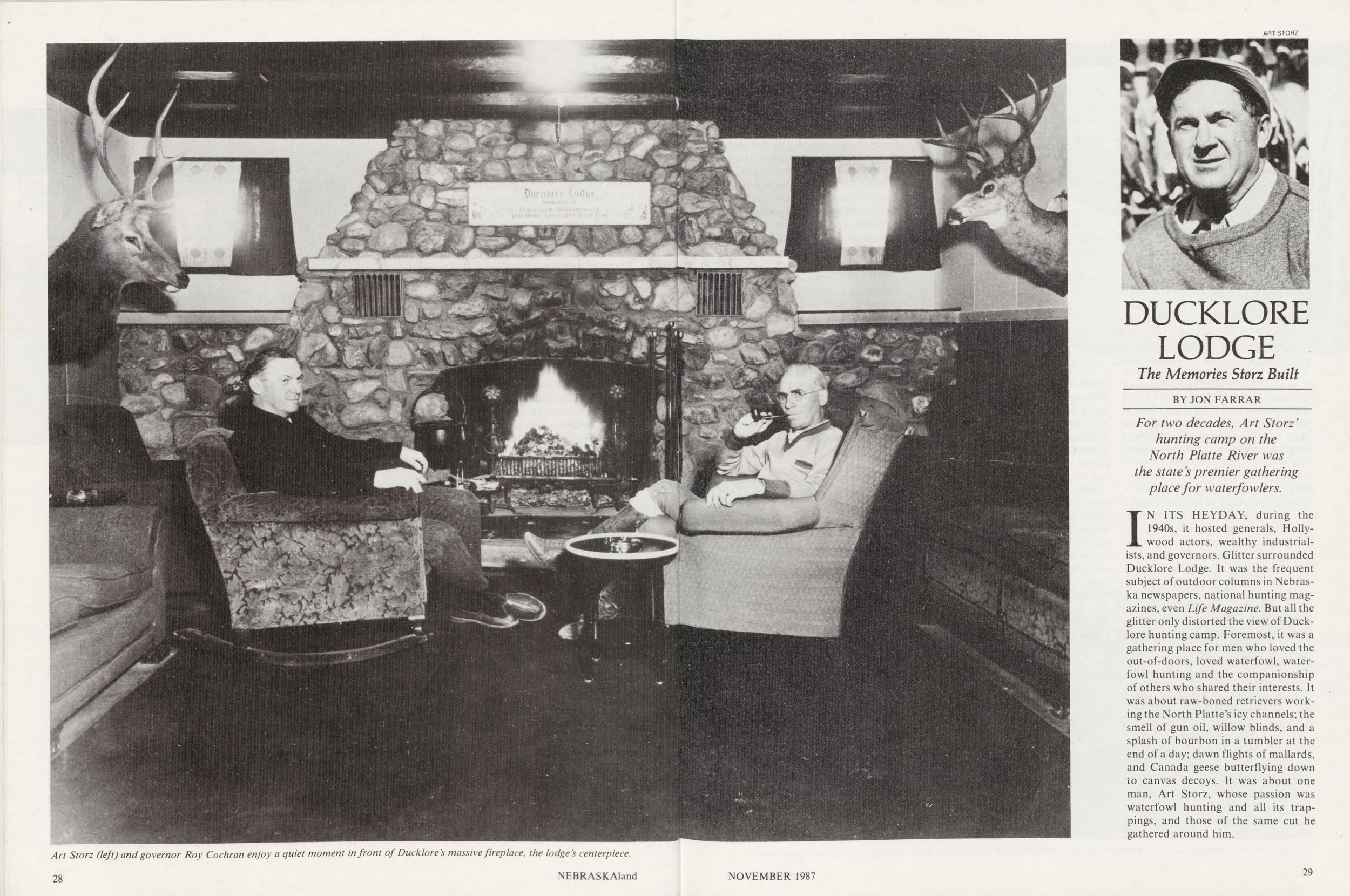
BYJONFARRAR For two decades, Art Storz' hunting camp on the North Platte River was the state's premier gathering place for water fowlers.IN ITS HEYDAY, during the 1940s, it hosted generals, Hollywood actors, wealthy industrialists, and governors. Glitter surrounded Ducklore Lodge. It was the frequent subject of outdoor columns in Nebraska newspapers, national hunting magazines, even Life Magazine. But all the glitter only distorted the view of Ducklore hunting camp. Foremost, it was a gathering place for men who loved the out-of-doors, loved waterfowl, waterfowl hunting and the companionship of others who shared their interests. It was about raw-boned retrievers working the North Platte's icy channels; the smell of gun oil, willow blinds, and a splash of bourbon in a tumbler at the end of a day; dawn flights of mallards, and Canada geese butterflying down to canvas decoys. It was about one man, Art Storz, whose passion was waterfowl hunting and all its trappings, and those of the same cut he gathered around him.
NOVEMBER 1987 29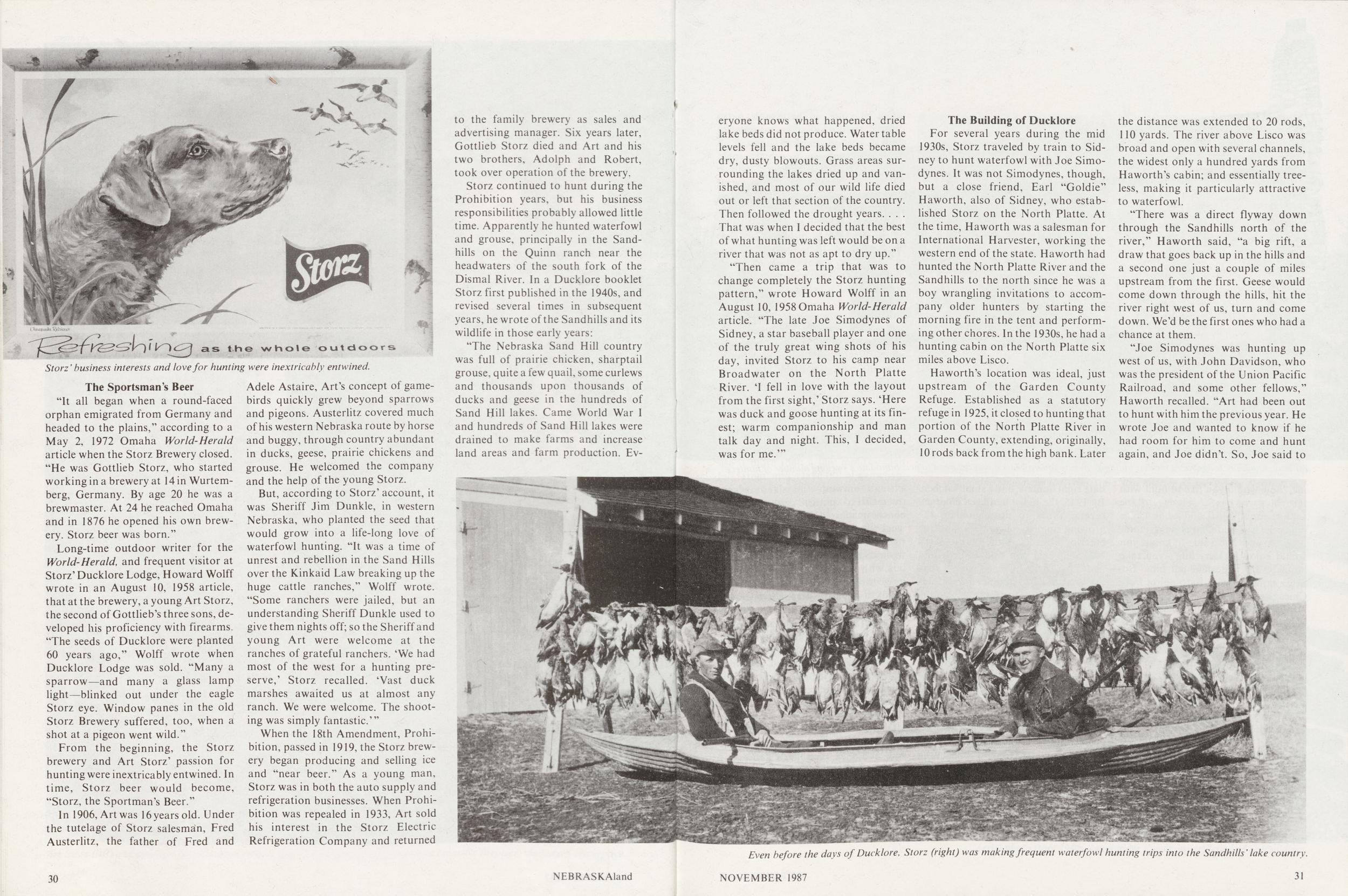
"It all began when a round-faced orphan emigrated from Germany and headed to the plains," according to a May 2, 1972 Omaha World-Herald article when the Storz Brewery closed. "He was Gottlieb Storz, who started working in a brewery at 14 in Wurtemberg, Germany. By age 20 he was a brewmaster. At 24 he reached Omaha and in 1876 he opened his own brewery. Storz beer was born."
Long-time outdoor writer for the World-Herald, and frequent visitor at Storz' Ducklore Lodge, Howard Wolff wrote in an August 10, 1958 article, that at the brewery, a young Art Storz, the second of Gottlieb's three sons, developed his proficiency with firearms. "The seeds of Ducklore were planted 60 years ago," Wolff wrote when Ducklore Lodge was sold. "Many a sparrow—and many a glass lamp light—blinked out under the eagle Storz eye. Window panes in the old Storz Brewery suffered, too, when a shot at a pigeon went wild."
From the beginning, the Storz brewery and Art Storz' passion for hunting were inextricably entwined. In time, Storz beer would become, "Storz, the Sportman's Beer."
In 1906, Art was 16yearsold. Under the tutelage of Storz salesman, Fred Austerlitz, the father of Fred and Adele Astaire, Art's concept of gamebirds quickly grew beyond sparrows and pigeons. Austerlitz covered much of his western Nebraska route by horse and buggy, through country abundant in ducks, geese, prairie chickens and grouse. He welcomed the company and the help of the young Storz.
But, according to Storz' account, it was Sheriff Jim Dunkle, in western Nebraska, who planted the seed that would grow into a life-long love of waterfowl hunting. "It was a time of unrest and rebellion in the Sand Hills over the Kinkaid Law breaking up the huge cattle ranches," Wolff wrote. "Some ranchers were jailed, but an understanding Sheriff Dunkle used to give them nights off; so the Sheriff and young Art were welcome at the ranches of grateful ranchers. 'We had most of the west for a hunting preserve,' Storz recalled. Wast duck marshes awaited us at almost any ranch. We were welcome. The shooting was simply fantastic.'"
When the 18th Amendment, Prohibition, passed in 1919, the Storz brewery began producing and selling ice and "near beer." As a young man, Storz was in both the auto supply and refrigeration businesses. When Prohibition was repealed in 1933, Art sold his interest in the Storz Electric Refrigeration Company and returned to the family brewery as sales and advertising manager. Six years later, Gottlieb Storz died and Art and his two brothers, Adolph and Robert, took over operation of the brewery.
Storz continued to hunt during the Prohibition years, but his business responsibilities probably allowed little time. Apparently he hunted waterfowl and grouse, principally in the Sandhills on the Quinn ranch near the headwaters of the south fork of the Dismal River. In a Ducklore booklet Storz first published in the 1940s, and revised several times in subsequent years, he wrote of the Sandhills and its wildlife in those early years:
"The Nebraska Sand Hill country was full of prairie chicken, sharptail grouse, quite a few quail, some curlews and thousands upon thousands of ducks and geese in the hundreds of Sand Hill lakes. Came World War I and hundreds of Sand Hill lakes were drained to make farms and increase land areas and farm production. Everyone 30 NEBRASKAland knows what happened, dried lake beds did not produce. Water table levels fell and the lake beds became dry, dusty blowouts. Grass areas surrounding the lakes dried up and vanished, and most of our wild life died out or left that section of the country. Then followed the drought years. . . . That was when I decided that the best of what hunting was left would be on a river that was not as apt to dry up."
knows what happened, dried lake beds did not produce. Water table levels fell and the lake beds became dry, dusty blowouts. Grass areas surrounding the lakes dried up and vanished, and most of our wild life died out or left that section of the country. Then followed the drought years. . . . That was when I decided that the best of what hunting was left would be on a river that was not as apt to dry up."
The Building of DuckloreFor several years during the mid 1930s, Storz traveled by train to Sidney to hunt waterfowl with Joe Simodynes. It was not Simodynes, though, but a close friend, Earl "Goldie" Haworth, also of Sidney, who established Storz on the North Platte. At the time, Haworth was a salesman for International Harvester, working the western end of the state. Haworth had hunted the North Platte River and the Sandhills to the north since he was a boy wrangling invitations to accompany older hunters by starting the morning fire in the tent and performing other chores. In the 1930s, he had a hunting cabin on the North Platte six miles above Lisco.
Haworth's location was ideal, just upstream of the Garden County Refuge. Established as a statutory refuge in 1925, it closed to hunting that portion of the North Platte River in Garden County, extending, originally, 10 rods back from the high bank. Later the distance was extended to 20 rods, 110 yards. The river above Lisco was broad and open with several channels, the widest only a hundred yards from Haworth's cabin; and essentially treeless, making it particularly attractive to waterfowl.
"There was a direct flyway down through the Sandhills north of the river," Haworth said, "a big rift, a draw that goes back up in the hills and a second one just a couple of miles upstream from the first. Geese would come down through the hills, hit the river right west of us, turn and come down. We'd be the first ones who had a chance at them.
"Joe Simodynes was hunting up west of us, with John Davidson, who was the president of the Union Pacific Railroad, and some other fellows," Haworth recalled. "Art had been out to hunt with him the previous year. He wrote Joe and wanted to know if he had room for him to come and hunt again, and Joe didn't. So, Joe said to me, 'how would you like to hunt with the fellow who has Storz brewery?'Joe told me about Art, and what a nice fellow he was and how good a hunter he was, and Joe said, 'I know you would enjoy it. Why don't you take him up? I'll write and tell him.' So, Storz came out with Jud Squires from Chicago. This was in 1936.
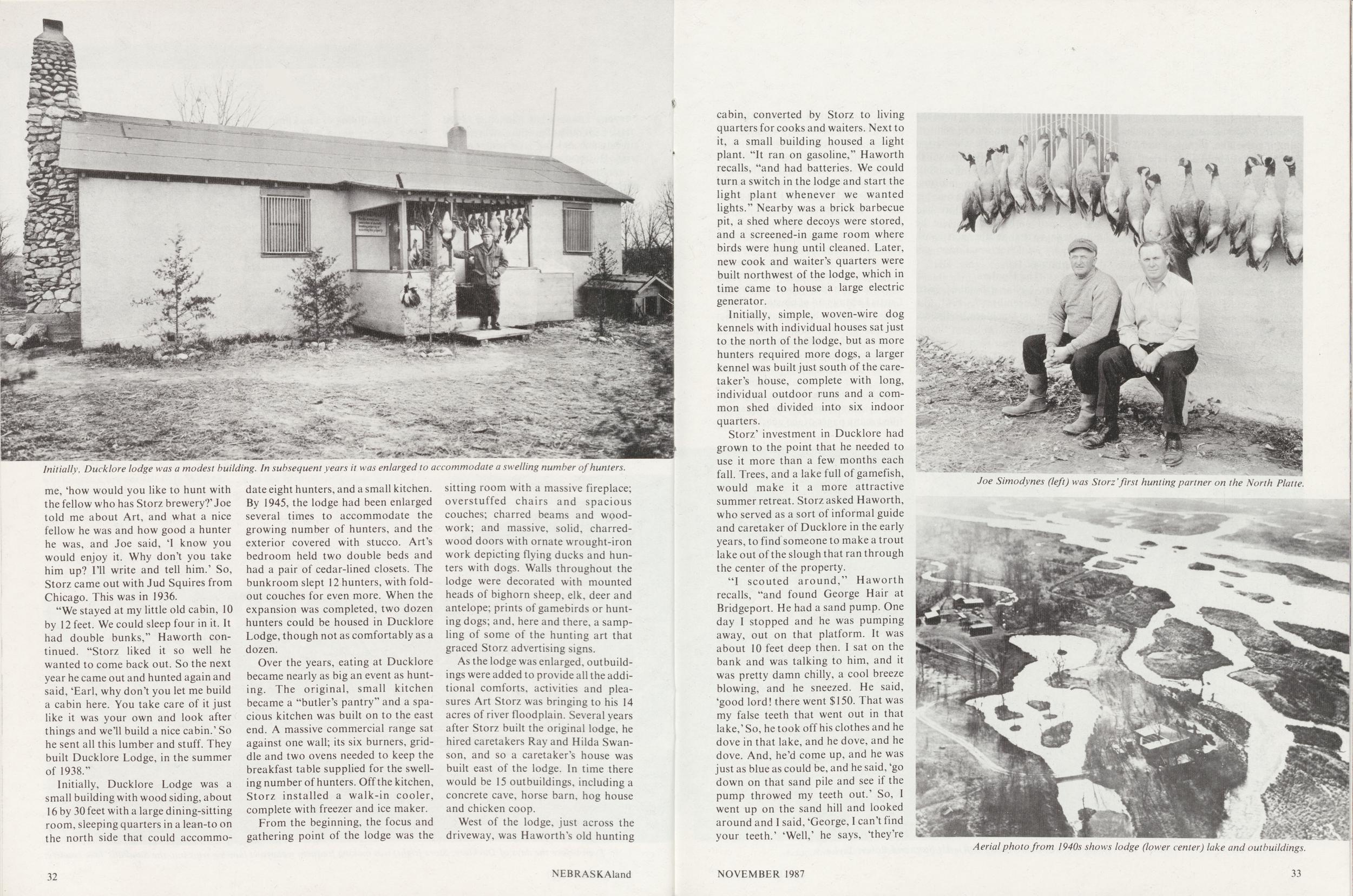
"We stayed at my little old cabin, 10 by 12 feet. We could sleep four in it. It had double bunks," Haworth continued. "Storz liked it so well he wanted to come back out. So the next year he came out and hunted again and said, 'Earl, why don't you let me build a cabin here. You take care of it just like it was your own and look after things and we'll build a nice cabin.' So he sent all this lumber and stuff. They built Ducklore Lodge, in the summer of 1938."
Initially, Ducklore Lodge was a small building with wood siding, about 16 by 30 feet with a large dining-sitting room, sleeping quarters in a lean-to on the north side that could accommodate eight hunters, and a small kitchen. By 1945, the lodge had been enlarged several times to accommodate the growing number of hunters, and the exterior covered with stucco. Art's bedroom held two double beds and had a pair of cedar-lined closets. The bunk room slept 12 hunters, with foldout couches for even more. When the expansion was completed, two dozen hunters could be housed in Ducklore Lodge, though not as comfortably as a dozen.
Over the years, eating at Ducklore became nearly as big an event as hunting. The original, small kitchen became a "butler's pantry" and a spacious kitchen was built on to the east end. A massive commercial range sat against one wall; its six burners, griddle and two ovens needed to keep the breakfast table supplied for the swelling number of hunters. Off the kitchen, Storz installed a walk-in cooler, complete with freezer and ice maker.
From the beginning, the focus and gathering point of the lodge was the sitting room with a massive fireplace; overstuffed chairs and spacious couches; charred beams and wood-work; and massive, solid, charredwood doors with ornate wrought-iron work depicting flying ducks and hunters with dogs. Walls throughout the lodge were decorated with mounted heads of bighorn sheep, elk, deer and antelope; prints of gamebirds or hunting dogs; and, here and there, a sampling of some of the hunting art that graced Storz advertising signs.
As the lodge was enlarged, outbuildings were added to provide all the additional comforts, activities and plea- sures Art Storz was bringing to his 14 acres of river floodplain. Several years after Storz built the original lodge, he hired caretakers Ray and Hilda Swanson, and so a caretaker's house was built east of the lodge. In time there would be 15 outbuildings, including a concrete cave, horse barn, hog house and chicken coop.
West of the lodge, just across the driveway, was Haworth's old hunting 32 NEBRASKAland cabin, converted by Storz to living quarters for cooks and waiters. Next to it, a small building housed a light plant. "It ran on gasoline," Haworth recalls, "and had batteries. We could turn a switch in the lodge and start the light plant whenever we wanted lights." Nearby was a brick barbecue pit, a shed where decoys were stored, and a screened-in game room where birds were hung until cleaned. Later, new cook and waiter's quarters were built northwest of the lodge, which in time came to house a large electric generator.
Initially, simple, woven-wire dog kennels with individual houses sat just to the north of the lodge, but as more hunters required more dogs, a larger kennel was built just south of the caretaker's house, complete with long, individual outdoor runs and a common shed divided into six indoor quarters.
Storz' investment in Ducklore had grown to the point that he needed to use it more than a few months each fall. Trees, and a lake full of gamefish, would make it a more attractive summer retreat. Storz asked Haworth, who served as a sort of informal guide and caretaker of Ducklore in the early years, to find someone to make a trout lake out of the slough that ran through the center of the property.
"I scouted around," Haworth recalls, "and found George Hair at Bridgeport. He had a sand pump. One day I stopped and he was pumping away, out on that platform. It was about 10 feet deep then. I sat on the bank and was talking to him, and it was pretty damn chilly, a cool breeze blowing, and he sneezed. He said, 'good lord! there went $150. That was my false teeth that went out in that lake,' So, he took off his clothes and he dove in that lake, and he dove, and he dove. And, he'd come up, and he was just as blue as could be, and he said, 'go down on that sand pile and see if the pump throwed my teeth out.' So, I went up on the sand hill and looked around and I said, 'George, I can't find your teeth.' 'Well,' he says, 'they're gone, I can't find them down on the bottom'." When George Hair finished pumping the lake, toothless and $150 poorer, it was about 12 feet deep and covered about half an acre. Intent on having trout in the lake, Storz installed a pump just west of the lodge to periodically refresh the lake's water.
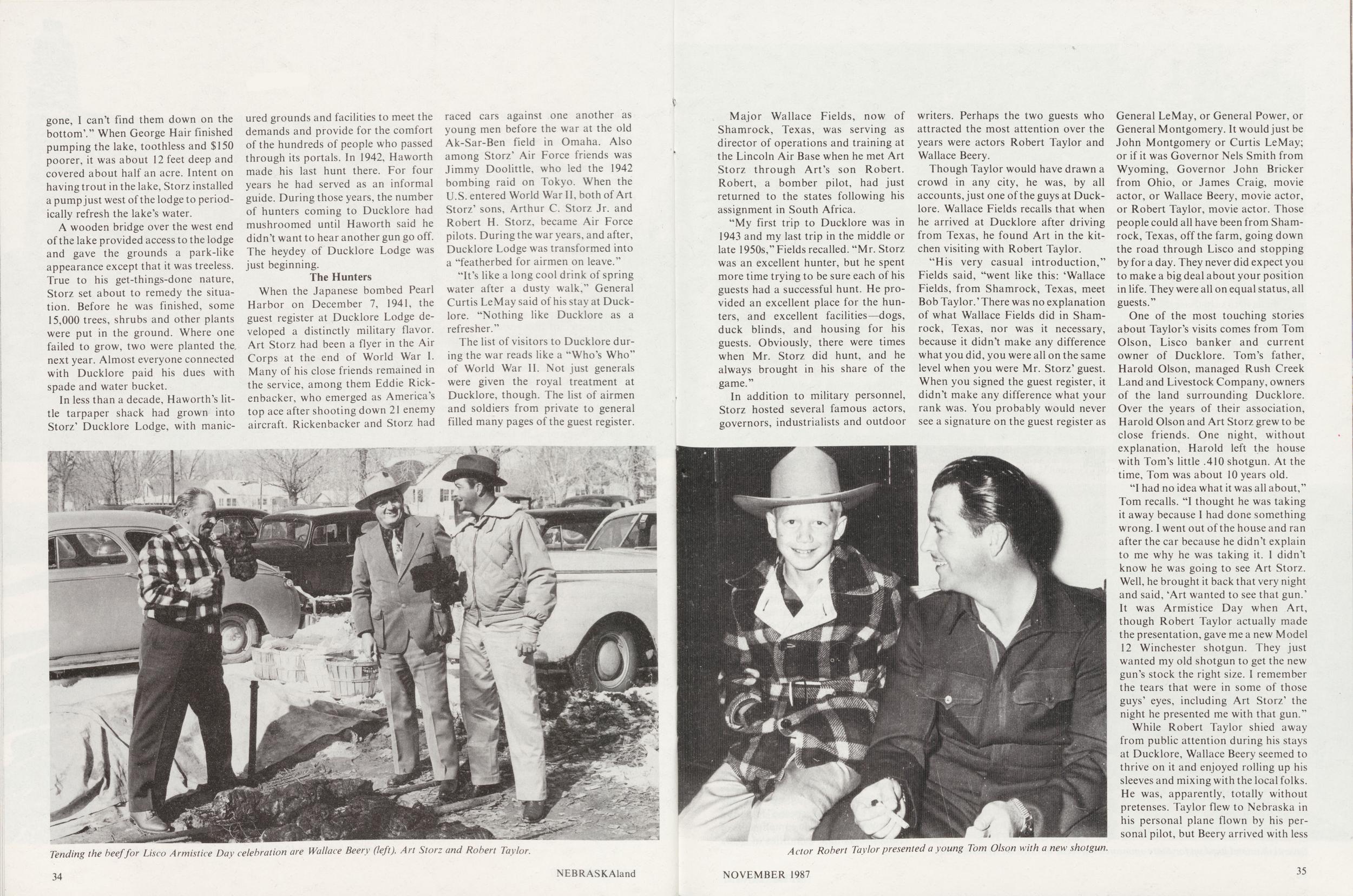
A wooden bridge over the west end of the lake provided access to the lodge and gave the grounds a park-like appearance except that it was treeless. True to his get-things-done nature, Storz set about to remedy the situation. Before he was finished, some 15,000 trees, shrubs and other plants were put in the ground. Where one failed to grow, two were planted the, next year. Almost everyone connected with Ducklore paid his dues with spade and water bucket.
In less than a decade, Haworth's little tarpaper shack had grown into Storz' Ducklore Lodge, with manicured grounds and facilities to meet the demands and provide for the comfort of the hundreds of people who passed through its portals. In 1942, Haworth made his last hunt there. For four years he had served as an informal guide. During those years, the number of hunters coming to Ducklore had mushroomed until Haworth said he didn't want to hear another gun go off. The heydey of Ducklore Lodge was just beginning.
The HuntersWhen the Japanese bombed Pearl Harbor on December 7, 1941, the guest register at Ducklore Lodge developed a distinctly military flavor. Art Storz had been a flyer in the Air Corps at the end of World War I. Many of his close friends remained in the service, among them Eddie Rickenbacker, who emerged as America's top ace after shooting down 21 enemy aircraft. Rickenbacker and Storz had raced cars against one another as young men before the war at the old Ak-Sar-Ben field in Omaha. Also among Storz' Air Force friends was Jimmy Doolittle, who led the 1942 bombing raid on Tokyo. When the U.S. entered World War II, both of Art Storz' sons, Arthur C. Storz Jr. and Robert H. Storz, became Air Force pilots. During the war years, and after, Ducklore Lodge was transformed into a "featherbed for airmen on leave."
"It's like a long cool drink of spring water after a dusty walk," General Curtis LeMay said of his stay at Ducklore. "Nothing like Ducklore as a refresher."
The list of visitors to Ducklore during the war reads like a "Who's Who" of World War II. Not just generals were given the royal treatment at Ducklore, though. The list of airmen and soldiers from private to general filled many pages of the guest register.
Major Wallace Fields, now of Shamrock, Texas, was serving as director of operations and training at the Lincoln Air Base when he met Art Storz through Art's son Robert. Robert, a bomber pilot, had just returned to the states following his assignment in South Africa.
"My first trip to Ducklore was in 1943 and my last trip in the middle or late 1950s," Fields recalled. "Mr. Storz was an excellent hunter, but he spent more time trying to be sure each of his guests had a successful hunt. He provided an excellent place for the hunters, and excellent facilities—dogs, duck blinds, and housing for his guests. Obviously, there were times when Mr. Storz did hunt, and he always brought in his share of the game."
In addition to military personnel, Storz hosted several famous actors, governors, industrialists and outdoor writers. Perhaps the two guests who attracted the most attention over the years were actors Robert Taylor and Wallace Beery.
Though Taylor would have drawn a crowd in any city, he was, by all accounts, just one of the guys at Ducklore. Wallace Fields recalls that when he arrived at Ducklore after driving from Texas, he found Art in the kitchen visiting with Robert Taylor.
"His very casual introduction," Fields said, "went like this: 'Wallace Fields, from Shamrock, Texas, meet Bob Taylor.' There was no explanation of what Wallace Fields did in Shamrock, Texas, nor was it necessary, because it didn't make any difference what you did, you were all on the same level when you were Mr. Storz' guest. When you signed the guest register, it didn't make any difference what your rank was. You probably would never see a signature on the guest register as General LeMay, or General Power, or General Montgomery. It would just be John Montgomery or Curtis LeMay; or if it was Governor Nels Smith from Wyoming, Governor John Bricker from Ohio, or James Craig, movie actor, or Wallace Beery, movie actor, or Robert Taylor, movie actor. Those people could all have been from Shamrock, Texas, off the farm, going down the road through Lisco and stopping by for a day. They never did expect you to make a big deal about your position in life. They were all on equal status, all guests."
One of the most touching stories about Taylor's visits comes from Tom Olson, Lisco banker and current owner of Ducklore. Tom's father, Harold Olson, managed Rush Creek Land and Livestock Company, owners of the land surrounding Ducklore. Over the years of their association, Harold Olson and Art Storz grew to be close friends. One night, without explanation, Harold left the house with Tom's little .410 shotgun. At the time, Tom was about 10 years old.
"I had no idea what it was all about," Tom recalls. "I thought he was taking it away because I had done something wrong. I went out of the house and ran after the car because he didn't explain to me why he was taking it. I didn't know he was going to see Art Storz. Well, he brought it back that very night and said, 'Art wanted to see that gun.' It was Armistice Day when Art, though Robert Taylor actually made the presentation, gave me a new Model 12 Winchester shotgun. They just wanted my old shotgun to get the new gun's stock the right size. I remember the tears that were in some of those guys' eyes, including Art Storz' the night he presented me with that gun."
While Robert Taylor shied away from public attention during his stays at Ducklore, Wallace Beery seemed to thrive on it and enjoyed rolling up his sleeves and mixing with the local folks. He was, apparently, totally without pretenses. Taylor flew to Nebraska in his personal plane flown by his personal pilot, but Beery arrived with less fanfare, once driving to Ducklore after a hunt in Wyoming in an old pickup truck with a deer strapped over the top.
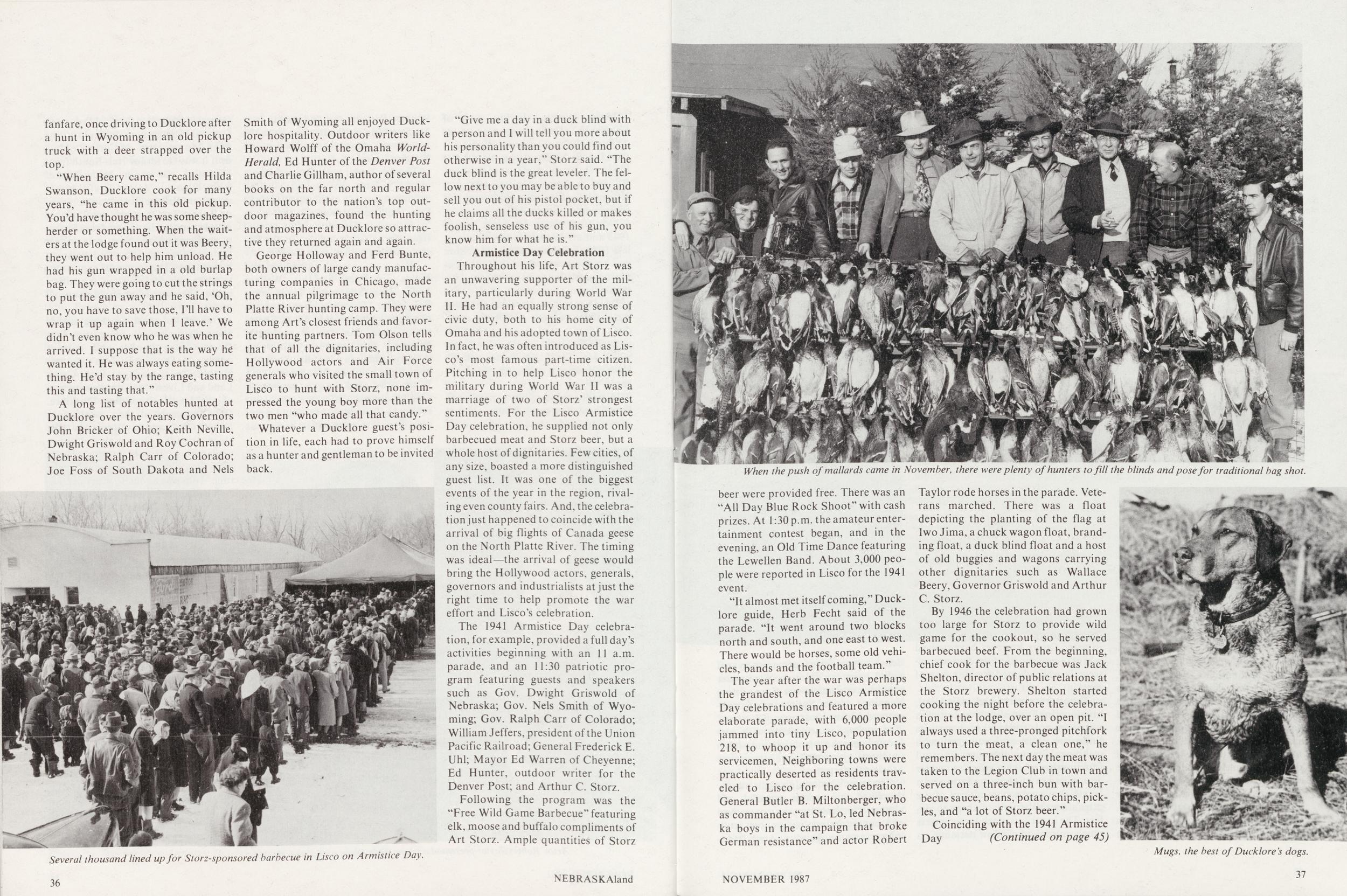
"When Beery came," recalls Hilda Swanson, Ducklore cook for many years, "he came in this old pickup. You'd have thought he was some sheepherder or something. When the waiters at the lodge found out it was Beery, they went out to help him unload. He had his gun wrapped in a old burlap bag. They were going to cut the strings to put the gun away and he said, 4Oh, no, you have to save those, I'll have to wrap it up again when I leave.' We didn't even know who he was when he arrived. I suppose that is the way he wanted it. He was always eating something. He'd stay by the range, tasting this and tasting that."
A long list of notables hunted at Ducklore over the years. Governors John Bricker of Ohio; Keith Neville, Dwight Griswold and Roy Cochran of Nebraska; Ralph Carr of Colorado; Joe Foss of South Dakota and Nels Smith of Wyoming all enjoyed Ducklore hospitality. Outdoor writers like Howard Wolff of the Omaha World Herald, Ed Hunter of the Denver Post and Charlie Gillham, author of several books on the far north and regular contributor to the nation's top outdoor magazines, found the hunting and atmosphere at Ducklore so attractive they returned again and again.
George Holloway and Ferd Bunte, both owners of large candy manufacturing companies in Chicago, made the annual pilgrimage to the North Platte River hunting camp. They were among Art's closest friends and favorite hunting partners. Tom Olson tells that of all the dignitaries, including Hollywood actors and Air Force generals who visited the small town of Lisco to hunt with Storz, none impressed the young boy more than the two men "who made all that candy."
Whatever a Ducklore guest's position in life, each had to prove himself as a hunter and gentleman to be invited back.
"Give me a day in a duck blind with a person and I will tell you more about his personality than you could find out otherwise in a year," Storz said. "The duck blind is the great leveler. The fellow next to you may be able to buy and sell you out of his pistol pocket, but if he claims all the ducks killed or makes foolish, senseless use of his gun, you know him for what he is."
Armistice Day CelebrationThroughout his life, Art Storz was an unwavering supporter of the military, particularly during World War II. He had an equally strong sense of civic duty, both to his home city of Omaha and his adopted town of Lisco. In fact, he was often introduced as Lisco's most famous part-time citizen. Pitching in to help Lisco honor the military during World War II was a marriage of two of Storz' strongest sentiments. For the Lisco Armistice Day celebration, he supplied not only barbecued meat and Storz beer, but a whole host of dignitaries. Few cities, of any size, boasted a more distinguished guest list. It was one of the biggest events of the year in the region, rivaling even county fairs. And, the celebration just happened to coincide with the arrival of big flights of Canada geese on the North Platte River. The timing was ideal—the arrival of geese would bring the Hollywood actors, generals, governors and industrialists at just the right time to help promote the war effort and Lisco's celebration.
The 1941 Armistice Day celebration, for example, provided a full day's activities beginning with an 11 a.m. parade, and an 11:30 patriotic program featuring guests and speakers such as Gov. Dwight Griswold of Nebraska; Gov. Nels Smith of Wyoming; Gov. Ralph Carr of Colorado; William Jeffers, president of the Union Pacific Railroad; General Frederick E. Uhl; Mayor Ed Warren of Cheyenne; Ed Hunter, outdoor writer for the Denver Post; and Arthur C. Storz.
Following the program was the "Free Wild Game Barbecue" featuring elk, moose and buffalo compliments of Art Storz. Ample quantities of Storz beer were provided free. There was an "All Day Blue Rock Shoot" with cash prizes. At 1:30 p.m. the amateur entertainment contest began, and in the evening, an Old Time Dance featuring the Lewellen Band. About 3,000 people were reported in Lisco for the 1941 event.
"It almost met itself coming," Ducklore guide, Herb Fecht said of the parade. "It went around two blocks north and south, and one east to west. There would be horses, some old vehicles, bands and the football team."
The year after the war was perhaps the grandest of the Lisco Armistice Day celebrations and featured a more elaborate parade, with 6,000 people jammed into tiny Lisco, population 218, to whoop it up and honor its servicemen, Neighboring towns were practically deserted as residents traveled to Lisco for the celebration. General Butler B. Miltonberger, who as commander "at St. Lo, led Nebraska boys in the campaign that broke German resistance" and actor Robert Taylor rode horses in the parade. Veterans marched. There was a float depicting the planting of the flag at Iwo Jima, a chuck wagon float, branding float, a duck blind float and a host of old buggies and wagons carrying other dignitaries such as Wallace Beery, Governor Griswold and Arthur C. Storz.
By 1946 the celebration had grown too large for Storz to provide wild game for the cookout, so he served barbecued beef. From the beginning, chief cook for the barbecue was Jack Shelton, director of public relations at the Storz brewery. Shelton started cooking the night before the celebration at the lodge, over an open pit. "I always used a three-pronged pitchfork to turn the meat, a clean one," he remembers. The next day the meat was taken to the Legion Club in town and served on a three-inch bun with barbecue sauce, beans, potato chips, pickles, and "a lot of Storz beer."
Coinciding with the 1941 Armistice Day (Continued on page 45)
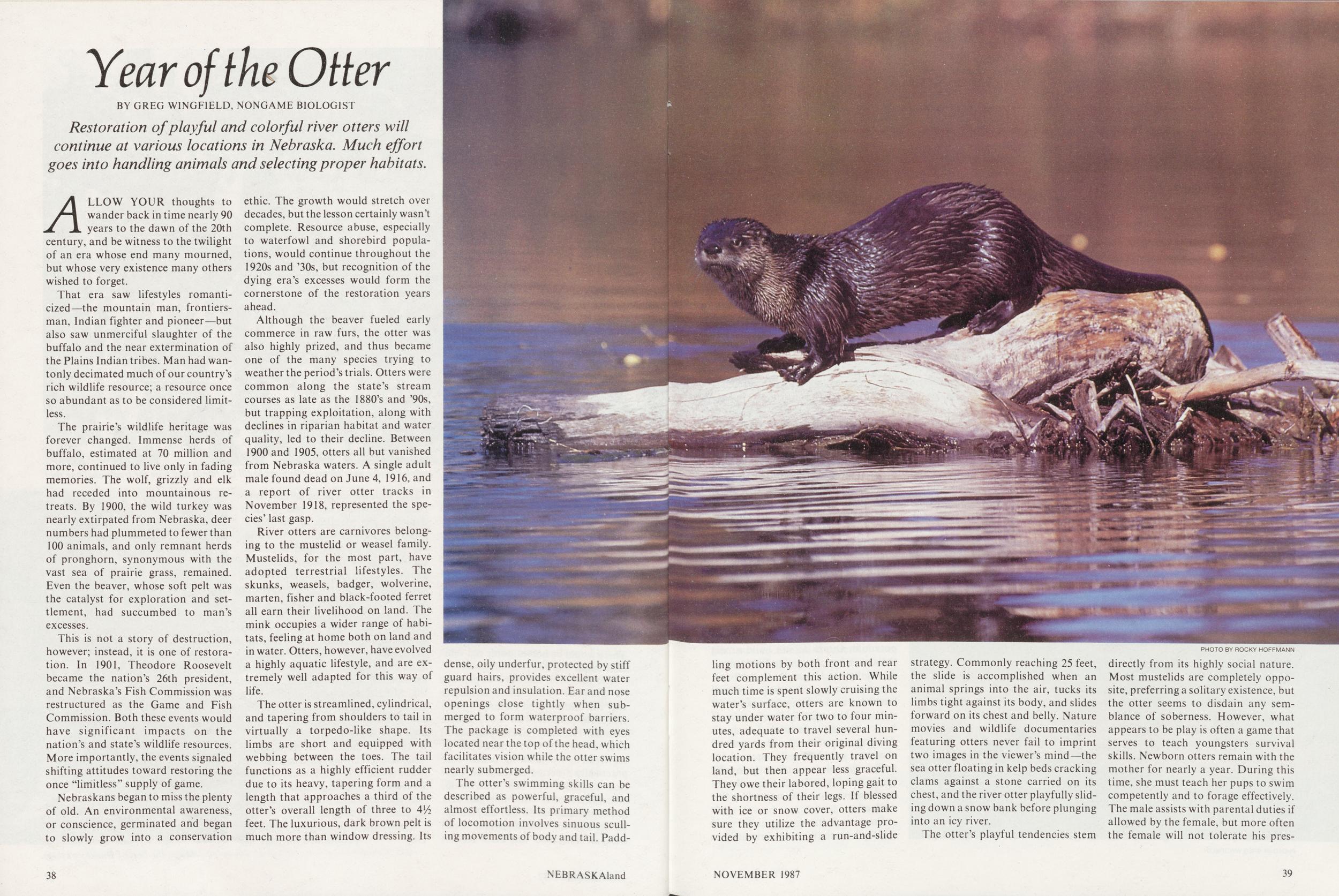
Year of the Otter
BY GREG WINGFIELD, NONGAME BIOLOGIST Restoration of playful and colorful river otters will continue at various locations in Nebraska. Much effort goes into handling animals and selecting proper habitats.ALLOW YOUR thoughts to wander back in time nearly 90 years to the dawn of the 20th century, and be witness to the twilight of an era whose end many mourned, but whose very existence many others wished to forget.
That era saw lifestyles romanticized—the mountain man, frontiersman, Indian fighter and pioneer—but also saw unmerciful slaughter of the buffalo and the near extermination of the Plains Indian tribes. Man had wantonly decimated much of our country's rich wildlife resource; a resource once so abundant as to be considered limitless.
The prairie's wildlife heritage was forever changed. Immense herds of buffalo, estimated at 70 million and more, continued to live only in fading memories. The wolf, grizzly and elk had receded into mountainous retreats. By 1900, the wild turkey was nearly extirpated from Nebraska, deer numbers had plummeted to fewer than 100 animals, and only remnant herds of pronghorn, synonymous with the vast sea of prairie grass, remained. Even the beaver, whose soft pelt was the catalyst for exploration and settlement, had succumbed to man's excesses.
This is not a story of destruction, however; instead, it is one of restoration. In 1901, Theodore Roosevelt became the nation's 26th president, and Nebraska's Fish Commission was restructured as the Game and Fish Commission. Both these events would have significant impacts on the nation's and state's wildlife resources. More importantly, the events signaled shifting attitudes toward restoring the once "limitless" supply of game.
Nebraskans began to miss the plenty of old. An environmental awareness, or conscience, germinated and began to slowly grow into a conservation ethic. The growth would stretch over decades, but the lesson certainly wasn't complete. Resource abuse, especially to waterfowl and shorebird populations, would continue throughout the 1920s and '30s, but recognition of the dying era's excesses would form the cornerstone of the restoration years ahead.
Although the beaver fueled early commerce in raw furs, the otter was also highly prized, and thus became one of the many species trying to weather the period's trials. Otters were common along the state's stream courses as late as the 1880's and '90s, but trapping exploitation, along with declines in riparian habitat and water quality, led to their decline. Between 1900 and 1905, otters all but vanished from Nebraska waters. A single adult male found dead on June 4, 1916, and a report of river otter tracks in November 1918, represented the species' last gasp.
River otters are carnivores belonging to the mustelid or weasel family. Mustelids, for the most part, have adopted terrestrial lifestyles. The skunks, weasels, badger, wolverine, marten, fisher and black-footed ferret all earn their livelihood on land. The mink occupies a wider range of habitats, feeling at home both on land and in water. Otters, however, have evolved a highly aquatic lifestyle, and are extremely well adapted for this way of life.
The otter is streamlined, cylindrical, and tapering from shoulders to tail in virtually a torpedo-like shape. Its limbs are short and equipped with webbing between the toes. The tail functions as a highly efficient rudder due to its heavy, tapering form and a length that approaches a third of the otter's overall length of three to feet. The luxurious, dark brown pelt is much more than window dressing. Its dense, oily underfur, protected by stiff guard hairs, provides excellent water repulsion and insulation. Ear and nose openings close tightly when submerged to form waterproof barriers. The package is completed with eyes located near the top of the head, which facilitates vision while the otter swims nearly submerged.
The otter's swimming skills can be described as powerful, graceful, and almost effortless. Its primary method of locomotion involves sinuous sculling movements of body and tail. Padd 38 NEBRASKAland ling motions by both front and rear feet complement this action. While much time is spent slowly cruising the water's surface, otters are known to stay under water for two to four minutes, adequate to travel several hundred yards from their original diving location. They frequently travel on land, but then appear less graceful. They owe their labored, loping gait to the shortness of their legs. If blessed with ice or snow cover, otters make sure they utilize the advantage provided by exhibiting a run-and-slide strategy. Commonly reaching 25 feet, the slide is accomplished when an animal springs into the air, tucks its limbs tight against its body, and slides forward on its chest and belly. Nature movies and wildlife documentaries featuring otters never fail to imprint two images in the viewer's mind—the sea otter floating in kelp beds cracking clams against a stone carried on its chest, and the river otter playfully sliding down a snow bank before plunging into an icy river.
The otter's playful tendencies stem directly from its highly social nature. Most mustelids are completely opposite, preferring a solitary existence, but the otter seems to disdain any semblance of soberness. However, what appears to be play is often a game that serves to teach youngsters survival skills. Newborn otters remain with the mother for nearly a year. During this time, she must teach her pups to swim competently and to forage effectively. The male assists with parental duties if allowed by the female, but more often the female will not tolerate his presence for almost six months.
NOVEMBER 1987 39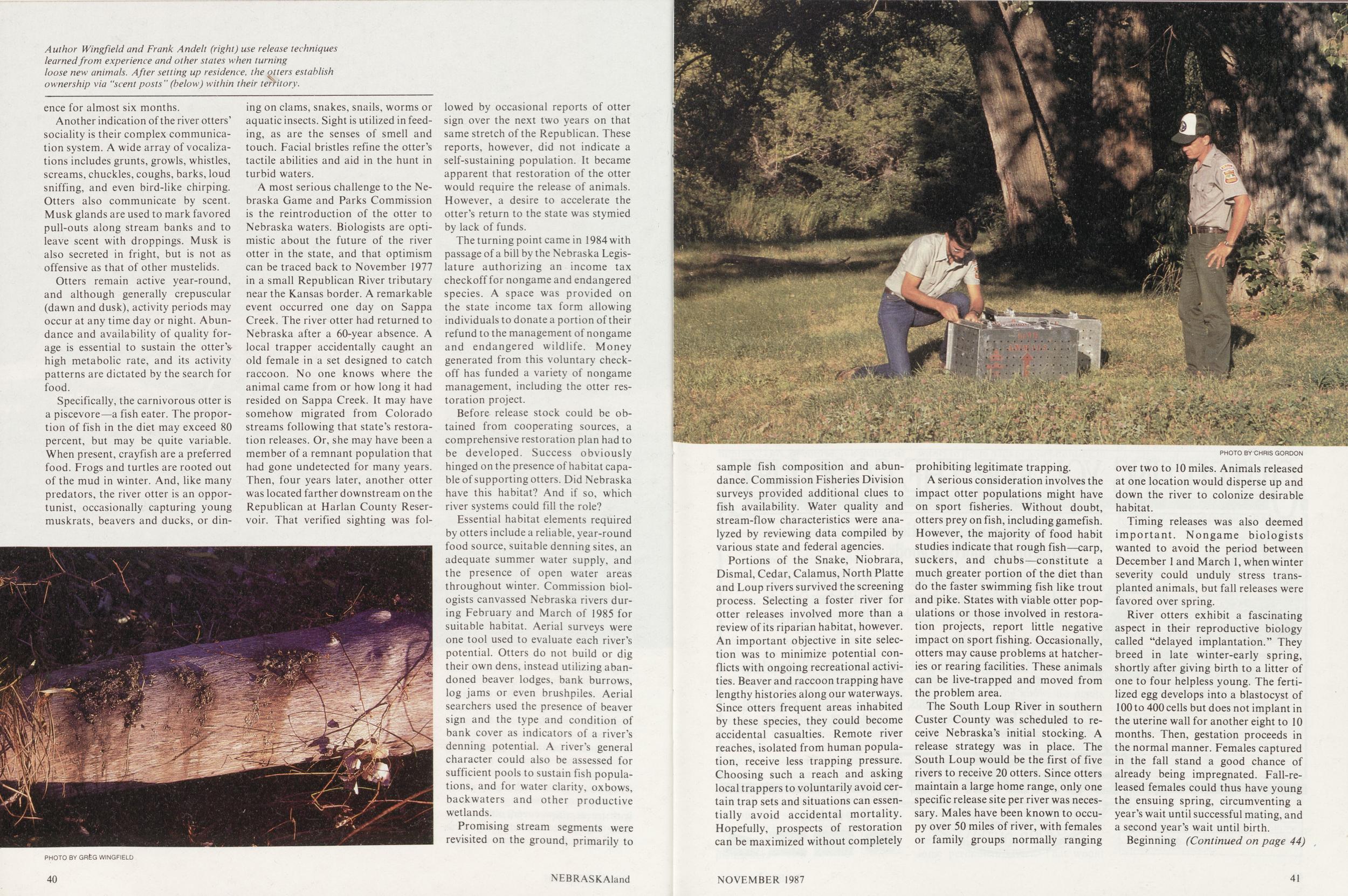
Another indication of the river otters' sociality is their complex communication system. A wide array of vocalizations includes grunts, growls, whistles, screams, chuckles, coughs, barks, loud sniffing, and even bird-like chirping. Otters also communicate by scent. Musk glands are used to mark favored pull-outs along stream banks and to leave scent with droppings. Musk is also secreted in fright, but is not as offensive as that of other mustelids.
Otters remain active year-round, and although generally crepuscular (dawn and dusk), activity periods may occur at any time day or night. Abundance and availability of quality forage is essential to sustain the otter's high metabolic rate, and its activity patterns are dictated by the search for food.
Specifically, the carnivorous otter is a piscevore—a fish eater. The proportion of fish in the diet may exceed 80 percent, but may be quite variable. When present, crayfish are a preferred food. Frogs and turtles are rooted out of the mud in winter. And, like many predators, the river otter is an opportunist, occasionally capturing young muskrats, beavers and ducks, or dining on clams, snakes, snails, worms or aquatic insects. Sight is utilized in feeding, as are the senses of smell and touch. Facial bristles refine the otter's tactile abilities and aid in the hunt in turbid waters.
A most serious challenge to the Nebraska Game and Parks Commission is the reintroduction of the otter to Nebraska waters. Biologists are optimistic about the future of the river otter in the state, and that optimism can be traced back to November 1977 in a small Republican River tributary near the Kansas border. A remarkable event occurred one day on Sappa Creek. The river otter had returned to Nebraska after a 60-year absence. A local trapper accidentally caught an old female in a set designed to catch raccoon. No one knows where the animal came from or how long it had resided on Sappa Creek. It may have somehow migrated from Colorado streams following that state's restoration releases. Or, she may have been a member of a remnant population that had gone undetected for many years. Then, four years later, another otter was located farther downstream on the Republican at Harlan County Reservoir. That verified sighting was followed by occasional reports of otter sign over the next two years on that same stretch of the Republican. These reports, however, did not indicate a self-sustaining population. It became apparent that restoration of the otter would require the release of animals. However, a desire to accelerate the otter's return to the state was stymied by lack of funds.
The turning point came in 1984 with passage of a bill by the Nebraska legislature authorizing an income tax checkoff for nongame and endangered species. A space was provided on the state income tax form allowing individuals to donate a portion of their refund to the management of nongame and endangered wildlife. Money generated from this voluntary checkoff has funded a variety of nongame management, including the otter restoration project.
Before release stock could be obtained from cooperating sources, a comprehensive restoration plan had to be developed. Success obviously hinged on the presence of habitat capble of supporting otters. Did Nebraska have this habitat? And if so, which river systems could fill the role?
Essential habitat elements required by otters include a reliable, year-round food source, suitable denning sites, an adequate summer water supply, and the presence of open water areas throughout winter. Commission biologists canvassed Nebraska rivers during February and March of 1985 for suitable habitat. Aerial surveys were one tool used to evaluate each river's potential. Otters do not build or dig their own dens, instead utilizing abandoned beaver lodges, bank burrows, log jams or even brushpiles. Aerial searchers used the presence of beaver sign and the type and condition of bank cover as indicators of a river's denning potential. A river's general character could also be assessed for sufficient pools to sustain fish populations, and for water clarity, oxbows, backwaters and other productive wetlands.
Promising stream segments were revisited on the ground, primarily to 40 NEBRASKAland sample fish composition and abundance. Commission Fisheries Division surveys provided additional clues to fish availability. Water quality and stream-flow characteristics were analyzed by reviewing data compiled by various state and federal agencies.
Portions of the Snake, Niobrara, Dismal, Cedar, Calamus, North Platte and Loup rivers survived the screening process. Selecting a foster river for otter releases involved more than a review of its riparian habitat, however. An important objective in site selection was to minimize potential conflicts with ongoing recreational activities. Beaver and raccoon trapping have lengthy histories along our waterways. Since otters frequent areas inhabited by these species, they could become accidental casualties. Remote river reaches, isolated from human population, receive less trapping pressure. Choosing such a reach and asking local trappers to voluntarily avoid certain trap sets and situations can essentially avoid accidental mortality. Hopefully, prospects of restoration can be maximized without completely prohibiting legitimate trapping.
A serious consideration involves the impact otter populations might have on sport fisheries. Without doubt, otters prey on fish, including gamefish. However, the majority of food habit studies indicate that rough fish—carp, suckers, and chubs—constitute a much greater portion of the diet than do the faster swimming fish like trout and pike. States with viable otter populations or those involved in restoration projects, report little negative impact on sport fishing. Occasionally, otters may cause problems at hatcheries or rearing facilities. These animals can be live-trapped and moved from the problem area.
The South Loup River in southern Custer County was scheduled to receive Nebraska's initial stocking. A release strategy was in place. The South Loup would be the first of five rivers to receive 20 otters. Since otters maintain a large home range, only one specific release site per river was necessary. Males have been known to occupy over 50 miles of river, with females or family groups normally ranging over two to 10 miles. Animals released at one location would disperse up and down the river to colonize desirable habitat.
Timing releases was also deemed important. Nongame biologists wanted to avoid the period between December 1 and March 1, when winter severity could unduly stress transplanted animals, but fall releases were favored over spring.
River otters exhibit a fascinating aspect in their reproductive biology called "delayed implantation." They breed in late winter-early spring, shortly after giving birth to a litter of one to four helpless young. The fertilized egg develops into a blastocyst of 100 to 400 cells but does not implant in the uterine wall for another eight to 10 months. Then, gestation proceeds in the normal manner. Females captured in the fall stand a good chance of already being impregnated. Fall released females could thus have young the ensuing spring, circumventing a year's wait until successful mating, and a second year's wait until birth.
Beginning (Continued on page 44)
NOVEMBER 1987 41 Lynn Scott
The Covered Wdgon & Other Adventures
have a ten-foot shelf of books by authors who have traveled across America
including a couple of books I wrote myself. Some of these volumes are by famous
authors, from
Scott's won there on that
one of them.
Dickens and Kipling to John Steinbeck. Lynn
derful record of his youthful wanderings is up
shelf among the very best writers, for he is
The Covered
Other Adventures has powerful things to say to
others of the late twentieth century."—Charles Kuralt,
word. 137 pages, b&w drawings by the author.
Wagon and
American read-
from the Fore-
s' 12.95 cloth
NEBRASKA_____________________
The University of Nebraska Press-901 N 17-Lincoln 68588-0520
OUTFITTING YOU FOR THE GOOD LIF]?,
Nebraska's largest selection of quality
name brand sporting goods.
Count on us to provide you with the finest outdoor clothing
and equipment at special low prices. See Burden's Outdoor
Outfitters when you're in Lincoln. Get the best of the outdoors.
Camping • Hunting • Fishing • Boating • Backpacking
X-Country Skiing • Water Sports • Boots, Shoes, Waders
Mens, Womens, Childrens Functional
Outdoor Clothing and Gear
1000 West "0" Street
Lincoln, NE 68528
474-4366
BURDEN'S
Free Parking
42
NEBRASKAland
Lynn Scott
The Covered Wdgon & Other Adventures
have a ten-foot shelf of books by authors who have traveled across America
including a couple of books I wrote myself. Some of these volumes are by famous
authors, from
Scott's won there on that
one of them.
Dickens and Kipling to John Steinbeck. Lynn
derful record of his youthful wanderings is up
shelf among the very best writers, for he is
The Covered
Other Adventures has powerful things to say to
others of the late twentieth century."—Charles Kuralt,
word. 137 pages, b&w drawings by the author.
Wagon and
American read-
from the Fore-
s' 12.95 cloth
NEBRASKA_____________________
The University of Nebraska Press-901 N 17-Lincoln 68588-0520
OUTFITTING YOU FOR THE GOOD LIF]?,
Nebraska's largest selection of quality
name brand sporting goods.
Count on us to provide you with the finest outdoor clothing
and equipment at special low prices. See Burden's Outdoor
Outfitters when you're in Lincoln. Get the best of the outdoors.
Camping • Hunting • Fishing • Boating • Backpacking
X-Country Skiing • Water Sports • Boots, Shoes, Waders
Mens, Womens, Childrens Functional
Outdoor Clothing and Gear
1000 West "0" Street
Lincoln, NE 68528
474-4366
BURDEN'S
Free Parking
42
NEBRASKAland
Swanson hunting acres
(Continued from page 16)in the heavy strips, but in cover more conducive to both the quail and the quail hunter. Grassy, wooded draws and grassy or weedy borders of milo fields are the typical quail hunting habitat.
A frequently voiced complaint about shooting preserves is that the birds are too tame or too fat to be good flyers. There was no evidence of either here. Once airborne, it was impossible to distinguish them from wild birds. Swanson's practice of selecting smaller, more streamlined birds for seed stock, and holding his birds in large, high-topped pens with lots of hiding cover and a minimum of human contact obviously pays off. Some birds were reluctant to flush, though, and required some thrashing about in the cover by dog handlers to get them up, but given the heavy nature of the cover, the same could have been expected of wild birds.
If there was a negative aspect to the morning's hunt, at least to me, it was that the hunters are fairly close together. Most pheasants that flushed were easily within range of most of the hunters. This, of course, is a matter of personal preference. Many hunters like to be fairly close to banter back and forth and back up each other's shots. The only other objection I found was that most decisions that a hunter normally makes himself were made by the guides—like where to hunt and how to hunt a particular field. If you are accustomed to hunting behind your own dog, regardless of how good someone else's dog might be, it just isn't quite as fun. For the hunter who doesn't own a dog, though, this was a fine opportunity to hunt behind quality dogs. All of these objections could probably be remedied by expressing your preference to Swanson before the hunt.
The best measure of the success of a shooting preserve, though, is the reaction of the hunters who are paying for it. All of the hunters I talked with were Nebraska hunters and had hunted pheasants in traditional fashion. For most, this was their first try at preserve hunting. Without exception, they felt the hunting situation and the birds were much like a traditional hunt, just more opportunity. Some of their comments were:
Til tell you, we didn't kill all the birds we saw today. You look at the ratio of shots fired to birds killed and it's not all that different from what you would expect on totally wild birds."
"The reason we come up here to hunt is that we can get in all the hunting we want in half a day or two half days, and all the hospitality on the side. Something a little extra. It provides a service if you want it, and if you don't you don't have to hunt on a preserve. There will always be wild game to hunt."
"In the rest of the state you're only allowed three roosters a day, nine in possession, and you've got to find a darn good spot to get nine roosters in three days. This is a good place to work a dog. You've got great accommodations and great food, and everyone seems to mingle well. I haven't hunted any other preserves so I can't really compare them. Up here, with the varied terrain, you've got to do a little walking, a little work to get those birds."
"I see this kind of a preserve as a service to the person who works in the city, who doesn't have the connections with landowners, or any person who wants to get in a lot of good hunting in a relatively short time."
"This isn't for everybody," Jerre told me. "It's especially good for people leading a busy life, the hunters who can only get away a day or two a year to hunt. They want to do a lot of hunting without a lot of hassle. That's what all the guys that come here say. They will take their family and fly somewhere for a baseball game and spend $1,000 for a weekend. A lot of them figure this is a bargain, hunting here."
WR Game and Recreation
(Continued from page 19)an agronomist with the Department of Roads by trade and knows his plants and habitat as well as his hunting. I asked him what he would do to improve the cover on Wells' preserve.
"About the only thing I could see changing was the big field of pearl millet," he said, "putting some strips in there. Roger said he had it set up for four hunters. We only brought two dogs. As heavy as the cover was out there, two more wouldn't have hurt. He wants to get more native grass, some permanent cover. That would help. You can lose your dogs in that tall cover. You have to watch the vegetation move to keep track of your dog. If the cover stops moving, you'd better get over there because he's probably on point."
Wells said that native grass strips will be added and that native pasture is being allowed to come back after years of heavy grazing. Millet plantings will be narrower next year, strips better tailored to just a couple of hunters and dogs.
I asked Wells what he thought the effect would be on shooting preserves in Nebraska if the farm economy improves and if the new farm program brings pheasants back in numbers like we had during the Soil Bank program.
"It's bound to affect at least some of the shooting preserves," he said. "But I'm not sure the land will be as accessible this time around. I remember when I was a kid you just walked wherever you wanted and hunted. I think those days are over.
Editor's note: The selection of these two controlled shooting areas is not intended as an endorsement. They were selected to provide readers with a sample of the type of services available. Time and space would not allow all controlled shooting areas open to the public to be included.
1987-88 NEBRASKA HUNTING SEASONS Species Inclusive Dates Daily Bag Limit Cock Pheasant Nov. 7-Jan 24 3 Coot Same as Duck 15 Cottontail Sept. 1-Feb 29 7 Crow Oct. 1-Nov 15 Jan. 21-April 8 No Limit Mourning Dove Sept. 1-Oct. 30 15 Low Plains Late Duck low Plains Ea.ly High Plains Oct. 17-25 Oct. 31-Dec. 11 100 pts Oct. 10-Nov.29 100 pts. Oct. 10-Nov29 Dec. 19-Jan. 3 100 pts Light Goose Oct. 3-Dec. 27 5 Dark Goose Oct. 3-Dec. 20 See 1987 Nebraska . Hunting Guide Oct. 3-Dec. 13 Oct. 24-Jan. 3 Nov. 10-Jan. 3 Sandhills Special Canada Season Nov. 1-Dec. 31 See Hunt Guide Grouse Sept. 12-Nov. 30 3 Hungarian Partridge Nov. 7-Jan. 24 3 Quail Nov. 7-Jan. 24 & Raccoon/Opossum* Nov. 5-Jan. 7 No Limit Rail Sept. 1-Nov. 9 10 Common Snipe Sept. 1-Dec. 15 8 Squirrel Aug. 1 -Jan. 31 7 Woodcock Sept. 15-Nov. 18 5 Bobcat Dec. 15-Jan. 15 No Limit Jack Rabbit Sept. 1-Feb. 29 8 "Fur Harvester Permit required. anothcr morning has broken in
the wetlands, home to one third
ofAmerica's threatened ota
endangered species. Join
the Ducks Unlimited
50th Anniversary
aberration and
help us continue to
save our wetiands.
Writer Ducks Unlimited, One
'Waterfowl Way, Long Grove,
Illinois, 60047.
Ducks Unlimited
Leader in Wetlands Conservation—50 Years
"HIDING OUT"
Ringneck Pheasants and the old Charleston Grainery
This richly colored painting by noted wildlife artist Neal R. Anderson is now
available as a limited edition print. The edition is 650, signed & numbered. They
are printed on neutral ph cover stock with fade resistant inks to enhance detail and
color. Image size is 18" X13" with ample margins. Each print sells for $45.00.
Remarques are $40.00 extra.
A historical sheet on the old rail town of Charleston and the grainery is included
with each print.
Please include $3.00 per order for shipping & handling. Nebraska residents add
appropriate sales tax. You must be satisfied or a full refund will be made.
Send order to;
Neal Anderson Studio • 819 W. Godfrey Dr. • Unclog, NE 68521
anothcr morning has broken in
the wetlands, home to one third
ofAmerica's threatened ota
endangered species. Join
the Ducks Unlimited
50th Anniversary
aberration and
help us continue to
save our wetiands.
Writer Ducks Unlimited, One
'Waterfowl Way, Long Grove,
Illinois, 60047.
Ducks Unlimited
Leader in Wetlands Conservation—50 Years
"HIDING OUT"
Ringneck Pheasants and the old Charleston Grainery
This richly colored painting by noted wildlife artist Neal R. Anderson is now
available as a limited edition print. The edition is 650, signed & numbered. They
are printed on neutral ph cover stock with fade resistant inks to enhance detail and
color. Image size is 18" X13" with ample margins. Each print sells for $45.00.
Remarques are $40.00 extra.
A historical sheet on the old rail town of Charleston and the grainery is included
with each print.
Please include $3.00 per order for shipping & handling. Nebraska residents add
appropriate sales tax. You must be satisfied or a full refund will be made.
Send order to;
Neal Anderson Studio • 819 W. Godfrey Dr. • Unclog, NE 68521
Year of the otter
(Continued from page 41)early 1985, biologists began to secure reliable sources of release stock. Several states were contacted about the possibility of wild-trapping animals. Several midwestern states reintroducing river otters have relied on Louisiana's abundant otter populations as a source. Nebraska, however, chose to utilize more northern stock which theoretically could better withstand Nebraska's rigorous winters.
Finally, in August 1986, Idaho provided the first otter. Since that time, Nebraska has received otters from sources as distant as British Columbia and Ontario. Transportation arrangements continue to spring surprises as biologists learn to cope with air freight regulations, customs laws, and each otter's response to captivity. Handling techniques developed by researchers in other states have been modified through hands-on experience.
Each otter is met at the airport and transported to the Commission's Lincoln laboratory. A special squeeze box restrains the otter while a sedative is administered. After checking its general health and determining its approximate age and sex, small metal tags are placed in the ears and foot webbing. Within a few minutes, the animal regains mobility and awaits transport to the release site.
The otter's survival, both as an individual and as a reintroduced species, depends on its ability to adapt to Nebraska's habitat. Success also depends on the cooperation of sportsmen and landowners in the release areas.
In January 1986, the Nebraska Game and Parks Commission bestowed upon the river otter an endangered-species status. Although already protected as a furbearing animal, this new status also provides protection of habitat critical to the species' survival. This assistance, and the interest and support of all Nebraskans, should hasten the otter's return. Restoration projects have brought the turkey and whitetail deer to all-time-high numbers, have seen the giant Canada goose return to native Sandhills nesting haunts, and are enhancing the recovery of the whooping crane. Is the otter next?
44 NEBRASKAlandDucklore lodge
(Continued from page 37)Celebration at Lisco, Storz sponsored the first "Three-Shot Goose Hunt," Nebraska's answer to Wyoming's One-Shot Antelope Hunt in which Storz had been a frequent participant. The 1941 event was a four-day affair. Three two-man teams entered the competition, one each from Wyoming, Colorado and Nebraska, with Governor Griswold and Arthur C. Storz as Nebraska's team.
The rules of the hunt were simple: "The members of each team will be allowed to shoot a legal gun full (three shots) at geese at any time from Saturday morning, November 8th, at sun-up until Tuesday morning, 10:30 a.m. November 11th. The team bagging the largest number of geese after each team member has fired his three shots will be declared the winner."
Howard Wolff was on hand to sub- mit daily reports during the 1941 hunt. On the last day of the competition, the Colorado team had used all its allotted ammunition without bagging a goose, the Wyoming team had used all its ammunition with each hunter, Governor Nels H. Smith and Ed Warren, mayor of Cheyenne, killing one goose. Art Storz had taken two geese with his three shells, and Governor Griswold had yet to take a goose but had one shell remaining with an opportunity to break the tie. Wolff reported that "with one shot left, Griswold dug into his blind at dawn and waited for birds to come. But under the shirt-sleeve weather which sent the mercury into the 70's, Dwight didn't get a chance. He ended with a 'no geese, three miss' record." By the flip of a coin, the competition was won by Wyoming.
As a hunter, Art Storz could hold his own with the best that came to shoot ducks and geese or blue rocks on Ducklore's trap range.
"He shot an old Model 10 Remington when I first went out there," recalls Rudy Fick, the game warden assigned to the southwest corner of Nebraska during the late 1930s and early 1940s, and frequent guest at Ducklore. "I thought, what is this guy, a millionaire, doing with an old gun like that. Then the following year he bought into the Browning line, good ones. I think he shot a 32-inch barrel, with engraving on the side. He was a damn good hunter, damn good shot, as good as any of them. Art knew his hunting alright."
Ducklore GuidesIt was Art Storz' nature to have the best, to have things done right, and nowhere is this more evident than in the procession of men who guided at Ducklore over its 20-year history. Joe Simodynes and Goldie Haworth, who introduced Art to North Platte River hunting, were two of the most experienced waterf owlers on the river. They were a tough act to follow.
Some Ducklore guides worked for no more than bed and board, good companionship, and top-flight hunting. Several went on the Storz payroll, year-round. Most, though, fell somewhere in between. Haworth remembers being paid about $25 a week. He took time off from his regular job the first of October and went back to work the first of December. Lee Hudleson was the head of the Game Commission's seining crew when Storz hired him. During the hunting months, or any other time of the year that Ducklore required attention, he wore a guide's hat. Hank Jobman, a farmer in the Gothenburg area, spent several hunting seasons guiding at Ducklore. During Ducklore's last dozen years, Lynn Chichester guided each fall. In 1946 and 1947, he was still farming near Dalton. Later, he was a part-time guide, part-time Storz brewery divisional sales manager.
Another guide, Herb Fecht, now a wheat farmer east of Dalton, first hunted with Storz in 1945. Storz needed someone to haul a couple of his hunting dogs from Lisco to an annual pheasant hunt put on by Joe Foss in South Dakota, and 17-year-old Herb Fecht was available. Though young, Fecht had hunted waterfowl on the river since he was old enough to tag along with his father, and Storz had an eye for good hunters.
"I got $5 a day and thought, man I can't imagine getting paid for doing something 1 like," Fecht recalls. "My job, and Lee Hudleson or Lynn Chichester or Hank Jobman, all those guys, started early in the morning," Fecht continued. "You'd get out there and set out all the decoys and start the kerosene stoves in the blinds and then come back to the lodge in time to pick up the guys and help them across the channels, usually half an hour before sunrise. Of course, we'd be there as duck callers. Most hunters liked to stay out all day, unless it was exceptionally good and you limited earlier. And with Art, you didn't just see how many you could kill. When you had a good day, well, you just thought, we were blessed today, it's one of those times when it's better than usual. But you didn't go out there and kill your limit then go back and shoot again."
Not all hunters at Ducklore required guides. After you had hunted enough, or proven yourself proficient, you were usually allowed to hunt alone, or even help less experienced hunters find their way around on the North Platte's channels and islands in the pre-dawn darkness. If you conducted yourself as a gentleman, and carried your own weight, you could always expect an invitation to return to Ducklore. Hunters who did not measure up to Storz' demanding standards of behavior, either on the river or at the lodge, were simply not invited back. If the infraction was a minor one, though, some good-natured lessons were administered.
"Jud Squires from Chicago," Goldie Haworth recalled, "claimed every duck that fell. 'Boy,' he'd say, i sure hit that one.' To the south of us, between these two blinds, the channel was running a lot of water. Well, Jud got out to do something and Art says to me, 'let's get him. Next time we drop a duck out in that channel, let's say, Jud, that was a fine shot, you'd better go get that duck.' So pretty soon some ducks came in and we shot and one fell out in that channel. He jumped out and ran right out in the river and started chasing it. And he'd get pretty close to it but when he'd reach to get it, he'd make a wave and the duck would go on and we'd holler, 'stay with him!'giving him a little encouragement. Finally, he run over to the bank, took off his coat, laid his gun down and took out after it again. And we were still hollering, 'stay with him, you'll get him.' And, pretty soon he turned around, and I'm not going to tell you what he said, but he fell down, and he got wet and he went over and he laid down on that island for about 30 minutes getting his breath and we never had him claim another duck."
Ducklore DogsIf Art demanded the best from his
hunters and his guides, he demanded
NOVEMBER 1987
45
 even more from his retrievers.
Although Storz had Labrador
retrievers, Irish water spaniels and
Chesapeake Bay retrievers, he eventually
developed a preference for the Chessies,
and during the late 1940s was the
president of the American Chesapeake
Club.
even more from his retrievers.
Although Storz had Labrador
retrievers, Irish water spaniels and
Chesapeake Bay retrievers, he eventually
developed a preference for the Chessies,
and during the late 1940s was the
president of the American Chesapeake
Club.
From the beginning, Storz had topnotch retrievers in the Ducklore kennels. Typically, there were six to eight dogs available, always enough for each pair of blinds to have at least one dog. The dogs were year-round residents at Ducklore, the charges of Ray Swanson, Ducklore's caretaker. Of all Storz' dogs, though, none was the match of Mugs, who arrived in 1939 after four months with one of the nation's top Chesapeake trainers of the day.
"I'll tell you, he was smarter than most of them," said Rudy Fick. "He educated himself on that river. Now you take the average dog, when you shoot a duck out in the Platte, he'll go straight out for a duck. The bird is down about a block before it even gets in the water. Mugs was smart. He'd just take off wide open down the sandbar to get ahead of that duck and then swim out. The current would bring it right to him. That was the only dog I ever saw that smart."
When Mugs died in 1948, Ray Swanson buried him.
"We had to bury Mugs twice," Hilda Swanson remembers. "We just buried him in a box but Mr. Storz had made a regular little casket, out of boards, and painted, and sent it out. We had to dig him up and bury him again."
Mugs was put to rest under a stone marker with an engraved plate on a little side hill just north of the lake at Ducklore. His epitaph read: "Mugs. A great Chesapeake. Always His Master's Faithful Friend."
The story of Ducklore will be concluded in the December issue.
DUCKS UNLIMITED___ We need P«_l| your help. Now. DOCKS UNLIMITEDTarheels and ring necks
(Continued from page 27)they took on enormous grain fields. Up to that point, my preconceived notion of the non-resident was looking pretty accurate. Beyond that point, trailing these non-residents was a real eye-opener.
This group hunted harder, made more thorough preparations for their hunt, and had better relations with landowners than many residents I have hunted with. They did everything right. The first thing they did Friday night, after two 12-hour days on the road, was to make the rounds of landowners they had hunted other years, dispensing not just the common courtesy landowners deserve, but tokens of appreciation. If they weren't hunting unpicked cornfields, they were crashing through 12-foot-high sunflower patches or wading smartweed basins. They had made a considerable investment in dogs, not just for the joy that hunting with a dog brings, but to ensure that as few cripples would be lost as possible. Hens were called out when they flushed so that other hunters with poorer view would avoid mistakes. They religiously adhered to hunting regulations, and in general hunted safely and courteously.
Hunting an unpicked cornfield is less than fun, but given the acres of crops still standing, it was a necessary evil. Most of the pheasants the hunters had taken on opening day had come from unpicked fields. The first field we took on had rows about an eighth of a mile long and required seven or eight passes to cover, the hunters spreading out about every seven to 10 rows. It had a fair amount of sunflowers and shatter cane, and what seemed like an unusual abundance of leaves on the ground. Dan posted the north end and Branson blocked the south end. The ground was greasy underfoot and the narrow rows, cultivated into steep miniature valleys, made for poor footing and tiring walking, not like the old wide rows I had grown up hunting. As I was again carrying the camera, and unpicked cornfields offer scant opportunity for photography, I joined Dan blocking the north end. Carrying a camera serves far more than just taking photographs. Dan didn't quite buy that explanation, but his position as a blocker was even less defensible, so he tolerated my presence.
Even with hunters 10 rows apart, many birds slipped back between the drivers, or simply hunkered down in the rows. Larry dropped a rooster that did not have the common pheasant sense to run, hide, or flush and fly close to the corn. Typically, most of the pheasants did not flush until the walkers approached the end of the field. By the time the field was covered, three or four roosters had been gathered in, the walkers had all they wanted of unpicked corn for a while, and Dan was taking a fair amount of heat about his cushy duty on the end of the field.
By noon we had hunted a Waterfowl Production area, a milo field and a mile of Sandy Creek bottom that should have held dozens of pheasants but for some unexplainable reason yielded only one rabbit. There were seven or eight roosters in the backs of the trucks when we arrived back at Wenske's.
Most hunters, myself included, would have called it a good morning's walk but not these folks. We let Larry off on the northeast corner of the section to walk a creek bottom and check ponds on the way back to lunch. The rest of the hunters took on a quarter-mile of unpicked corn along Wenske's inroad. Of the lot, Larry fared best, bringing in a ring-necked duck.
The lunch break was necessarily long as there were birds to be cleaned. I think it was then that my decision to cast my lot with Larry was cemented, because the chore of dressing the birds fell to him, in part because he was quite proficient (his religious saving of gizzards for giblet gravy led to the discovery of a steel pellet in the duck's gizzard, and another in a pheasant gizzard, plus a wild plum pit in a second pheasant's gizzard), in part, I suspect, because he was the youngest member of the group, and in part because he was not as slippery as some other hunters.
I expected the hunters to slack off a bit after lunch but it was full steam ahead. We started on private land where Dan killed what was to be the afternoon's only rooster from a basin with six-inch deep water; took on an enormous unpicked cornfield that discretion advised us to abandon after only two or three passes in its quarter-mile 46 NEBRASKAland rows; and ended hunting a basin with waist-high native grass and surrounded on three sides by unpicked corn. A single rooster was flushed from the grass and dropped in the unpicked corn, the only bird I saw in three days that was hit but not retrieved in spite of a 30-minute effort of all dogs and hunters.
Monday morning was shaping up to be the showdown; the day I was going to retire my camera for a shotgun much to Dan's delight—and the day Larry and I would execute our conspiracy to bloody Dan's hands. While Larry was cleaning the birds the day before, we had hatched plans for the next morning's pool—the hunter to take the first "non-company bird" (the importance of the exact wording will become evident later) would be exempt from cleaning birds. All other hunters would be equal participants in the chores. All we needed was to see that someone other than Dan made the first clean kill, and Larry had definite plans on how to accomplish that—he would stick reasonably close to Dan and any bird Dan fired at, Larry would fire at, regardless of the distance. Eventually, one of the other hunters would make a kill and Dan would be on the cleaning committee.
We started the morning on a grassy pasture that had been a wetland before the county road ditches drained it. It was an ideal setting to watch the dogs work, and they didn't disappoint us. In short order we had two points and two roosters. Both birds had fallen under the attention of several hunters and so the first "non-company" bird was still in the fields.
On a nearby federal hunting area, a bizarre episode occurred that finally determined the winner of the morning's pool. The hunters had already taken two or three roosters from heavy stands of native grass and marshy vegetation, but the first "non-company bird" had still not fallen. Branson and Ladislav were posting the west edge of the area. The other hunters were walking north together and talking before spreading out to push a second grass patch and field toward the blockers. Steel shot is required for upland game as well as waterfowl on Waterfowl Production Areas. Most of the hunters had been switching back and forth between lead loads and steel loads depending on where they were hunting. It was the temporary confusion of this switching back and forth that set up the strange event and resolved the "who's not cleaning the birds" pool.
The Original Nebraska Company Promoting and Specializing in Fine Foods from Nebraska Exceptional Corporate Hospitality and Holiday Gifts Shipped Everywhere the Year Around. Write for a brochure. baskets P.O. Box 98 McCook, NE 69001-98 308/345-7727 Limited-edition Belt Buckle The Malcolm, Nebraska Gun Club proudly presents this facsimile of the Nebraska 1988 Wildlife Habitat Stamp as a belt buckle, in cooperation with Artist Robert Klausing and the Nebraska Game and Parks Commission. These heavy, top-quality buckles, by the Award Design Medals company, are limited to 1,000 brass; 200 gold/silver plate and 100 solid sterling silver. Each is registered by name and number, so purchaser has first choice at future editions. To order, send money order or check to: Malcolm Gun Club, P.O. Box 194, Malcolm, NE 68402. Phone (402) 796-2173. Prices are: Brass—$19.95, Gold/silverplate—$45, Solid silver—$135 Please include $1.50 for packing and shipping + 4% sales tax. Allow four to six weeks for delivery. Size 3-3/4 inches by 2-3/4 inches. NOVEMBER 1987 47
As we approached a small pond tucked away in native grass, a pair of diving ducks, the only birds on the pond, ran across the surface to get airborne. The five of us just stood there with our mouths open, our eyes prepared\not for ducks but pheasants. When the two ducks were about 20 feet above the pond, the bird on the right banked hard to the left at the same time the bird on the left banked hard to the right. The two birds collided head on and tumbled tail-over-bill to the water. By now it was starting to occur to some of the hunters that ducks were in season. As one of the birds righted himself and flew away from us, the second, apparently taking great precautions that a second collision should not occur, flew back the length of the pond past us. Apparently forgetting that he, too, had steel loads in his gun, Dan said to Larry, "You've got steel, shoot him."
ARSHWATCHER DUCKS UNLIMITED-LEADER IN WETLANDS CONSERVATION -50 YEARS Muskrat This valuable fur-bearer makes its borne in marshes where cattails and bulrush abound, according to Ducks Unlimited. These plants provide the muskrat with food and building materials for its home. In turn, muskrat houses are utilized as nesting and loafing sites by waterfowl. Channels and openings cut by muskrats in the dense reed beds make marshes more attractive to waterfowl. NOVEMBER WILDLIFE & WOOD CARVING SHOW 13, 14, & 15 Regency Fashion Court-Omaha, NebraskaLarry shoots far better than one might believe from my account, but I cannot reach the end of this tale without saying that Larry did indeed shoot; in fact, he shot three times, and in fact the duck did not waver from his course. By now the duck is out a good 45 or 50 yards and gaining on 60 yards. George is the next to realize that he is also holding a shotgun loaded with steel, brings it to his shoulder, and with one precision shot tumbles the duck to the ground. No protests were filed when it was mentioned that the rules for the pool stipulated the first "bird" cleanly killed. George had earned his reprieve from the gutting table and Dan's hands would be bloodied.
One of the day's points of business had been resolved and not to Dan's satisfaction. He turned with a vengeance to settling the second, noting that it was time I stopped hiding behind my camera and got a shotgun out. There was no escaping Dan; he was determined that he would not bear the brunt of the groups' verbal flogging alone. He wanted company. The fact that I had been in cahoots with Larry in attempting to rig the outcome of the morning pool did not escape him.
Normally, such a challenge would not have jangled me much, but this had gone on for a couple of days. It weighed heavily on my mind as we marched up and down the short cornrows in the next field, the same field we had hunted the day before. I was remembering back to the fourth grade, how I used to freeze up on my arithmetic whenever the teacher paused by my desk. Probably for the first time in my life I was actually relieved when we finished walking the field and the pheasants had gotten up in front of other hunters.
The blockers reported that a couple of roosters slipped out of the unpicked
Trading Post
DOGSTRAINING ALL BREEDS Hunting Dogs — Vizslas for sale. Rozanek Kennels, Rt. 2, Schuyler, NE 68661. Phone (402) 3528769.___________________________
ENGLISH SETTERS: "Bred for the hunter"; select puppies and started dogs available from outstanding bloodlines. Stud service available by proven hunters. High Plains Kennels, 1411 Emerson, Alliance, NE 69301, Phone (308) 762-6709._____________________
GROUSEWAY BRITTANIES: Ideal hunting companions—dedicated, goal-oriented breeding programs. FREE brochure, Grouseway Gundogs, Louisville, NE 68037. (402) 397-6157. Training available.
GERMAN SHORTHA1RS and Brittany Spaniel pups. Started and occasionally a meat dog. Pups are guaranteed. Also 1 will be training hunting dogs. Wayne Clark, Percival, I A. Phone (712) 529-4238 or (402) 263-3155 at Union, NE.
ENGLISH SETTERS: Young dogs available from two well-bred litters. Born early 1987. Darrell Yentes. Phone (308) 995-8570 or (308) 995-4797 after 5 p.m.
YELLOW AND BLACK Lab pups. FC-AFC sired. AKC. Hips certified. Dew claws removed. Retriever field trial and hunting parents. Bob Bendler (308) 324-4247.______________________________________
MISCELLANEOUSNE NEBRASKA trout fishing. 3 modern cottages, 1 available year round. 5 spring fed lakes with open water all year. Trout up to 7 pounds. Other varieties fish also. Diamond E. Trout Resort, Orchard, NE 68764. Phone (402) 893-4745._________________________________
GUNS - - Browning, Winchester, Remington, others, Hi-powers, shotguns, new, used, antiques. Want Pre-1964 Winchesters. Buy-Sell-Trade. Ph. (402) 729-6112. Bedlan's Sporting Goods, Fairbury, NE 68352.______
MANDARIN DUCKS: nice full-wing birds $35.00 pair, wood ducks $25.00 pair. Mrs. R. W. Hansen, 3315 Avenue L, Kearney, NE 68847. Phone (308) 237-3781.
MAD RIVER CANOES offers the finest quality and performance. For the finest canoes and accessories look to Great Plains Canoe Co., 205 Main, Springfield, NE. Phone (402) 253-2001.
RECEIVE $75/100 envelopes returned to us. Rush stamped envelope: Kelley 4, 804 Old Thorsby Road, Clanton, Alabama 35045.
TROLLING MOTOR REPAIR. Factory authorized Minn Kota and Motor Guide, parts and service. Wolfs Repair and Installation, 1529 David Drive, Lincoln, NE 68504. Phone (402) 464-4265. _________
WINE AND BEER: Make your own. Send for free recipes and instructions. Omaha Supply, 1324 2nd Avenue, Nebraska City, NE 68410.
HOMEWORKERS! RECEIVE $75/100 envelopes you return to us per instructions. Rush stamped envelope: Kelley 5, 804 Old Thorsby Road, Clanton, Alabama 35045.
HUNTERS WITH BUDDIES -Own your own hunting paradise with 3 miles of Niobrara River frontage. 3,080 acres, with spring creeks and abundant timber and wildlife. Swett Realty, P.O. Box 265, Ainsworth NE 69210. Phone (402) 387-1626 day or night.
HOW TO USE five top lures for Bass in Midwest. Send $3 to R.D.M., Box 1003, Norfolk, NE 68701.
FOR RENT OR SALE — year-round home or cabin. Nebraska side Lewis & Clark Lake, by Yankton, SD. Scenic lake view, fishing, boating, hunting, etc. 1-800-742-4433.
FOR SALE: Northeast Nebraska, Near Mo. R. and proposed dam/rec site: Newer, 5-6 bdrm house on 3 acres. Full bsmt, pt. fin., dbl grg, 2 full, 2!/2 baths, lg. lr & drs, A / C, 2fp, many extras. Potential Bed / Breakfast or Co-op hunting lodge. May consider sale of adjacent acres for hunting. Inq. 7200 Old Post Rd. #10, Lincoln, NE 68506. Phone (402) 489-1256.
DUCK HUNTERS Guided duck hunts on the Platte River near Schuyler. Good dogs, good decoys, good blinds and a good time. $30 per day. Make your reservations early. Call Frank Hoppe, North Bend Nebr. Phone (402) 652-8725.
TAXIDERMYALLISON'S TAXIDERMY STUDIO. Wally and Betty Allison, Licensed Taxidermist. We've mounted 21 Nebraska State Record fish. Specializing in fish and birds, small game and rattlesnakes. We use freeze-dry. 2310 West Leota, North Platte, Nebr. 69101 Phone (308) 534-2324.________________________
BADE TAXIDERMY - Quality a must - Fast service. Fish, birds, rugs, tanning, full mounts and game heads, 2111 N. Christy St., Fremont, NE 727-5463.
NABITY'S TAXIDERMY. 31 years experience. Specializing in natural grass backgrounds for mammals, birds and fish. 13901 "O" St., Lincoln, NE 68504 — 4 miles east of 84th and "O". (402) 489 6351.
BIG BEAR TAXIDERMY, Rt. 2, Mitchell, Nebraska 69357. We specialize in all big game from Alaska to Nebraska, also birds and fish. Hair on and hair off tanning. Four miles west of Scottsbluff on Highway 26 Dale Hubel, phone (308) 635-3013.
PEISTER TAXIDERMY — Professional work at prices most sportsman can afford. Now in our new log cabin studio, 1020 Central Avenue, Box 3201, Kearney, NE 68847. Phone (308) 236-9700 or (308) 237-7575 evenings.
NATURECRAFT STUDIO - all custom services — creative work, quality, and experience since 1935. Includes freeze-dry processing. Display and sales room, visitors welcome. Hwy. 2 in Nebraska City. Phone (402) 873-5491. Joe Voges — Owner. Bow Steedly — Big Game specialist.
BILL'S TAXIDERMY. Professional big game mounting. Award-winning mounts. First place mule deer, second place antelope in state competition. Reasonable rates. Phone (308) 452-3559 or 3674.
NEBRASKAland Magazine Order Form Please send me a subscription to NEBRASKAland Magazine One-year $12 00 NAME Two-year $23.00 ADDRESS CITY____ STATE ZIP Mail to: NEBRASKAland Magazine, Box 30370, Lincoln, NE 68503 YEAR ROUND DOG TRAINING Hunting, Field Trials, Obedience HILLTOP SHOOTING PRESERVE Season Sept. 1 to March 1 Pheasant, Quail, Chukar, Turkey John Honore Manager and Trainer Grand Island, NE Call 308-384-1517 NIOBRARA RIVER HUNTING Lodging available on the ranch. Now taking reservations through November 30th. (308) 684-3436 H.C. 74, Box 18 Cody, NE 69211 Harlan County Dam Vacation Apartments - fully furnished Color TV • Kitchen Facilities • Full Baths Game cleaning room with freezer One block from shopping center Weekend or week of pleasant living Security Deposit Required Sorry —No Pets Dean and Esther Stone Box 145 Ph. (308) 799-3422 Republican City, NE 68971 LEWON'S TAXIDERMY Won Best of Category in Deer heads, fish, waterfowl, and winner of coveted Overall High Point Award at Nebraska's Taxidermy Championship 1987. Certified and Licensed. 501 S. Main Randolph, NE (402) 337-0077 OWN YOUR OWN BUSINESS Excellent investment opportunity. Motorized toning tables that tone and strengthen muscles, increase flexibility and circulation, and cause inch loss for healthy as well as disabled individuals. Some financing available. CLASSIC TONING SYSTEM 1-800-223-2487, ext. 162 Fitness For Today—The Wo Sweat' Way NOVEMBER 1987 49 GUN DOG TRAINING
All Sporting Breeds
All dogs worked on foot — no
I horses. Midwest's finest facilities.
Field Champion-sired
Labrador pups for sale.
"Training for hunters by hunters"
WILDERNESS KENNELS
Henry Sader—Roca, Ne.
(402)423-4212 68430
CEDAR LANE
- Ranch Vacations •
Guest ranch in the heart of the Sandhills of
Nebraska. Swimming, spa, horses, canoeing,
trail rides, barbeques, hunting.
BOOKING NOW For 1987
Richard and Betty Schroeder HC 2 Box 9C
Stapleton. Nebraska 69163 Ph. 308-587-2233
Harlan County Dam
Vacation Apartments - fully furnished
Color TV • Kitchen Facilities • Full Baths
Game cleaning room with freezer
One block from shopping center
Weekend or week of pleasant living
Security Deposit Required
Sorry —No Pets
Dean and Esther Stone
Box 145 Ph. (308)799-3422
Republican City, NE 68971
Paddington Station
Convenience Store & Lounge
• Hunting & Fishing Supplies
Ice • Bait • Groceries • Tackle
• One & Off Sale Liquor & Beer
• Gas and Much More!
Open 365 days a year!
(308) 473-3135 Orleans, NE
BURDENS
OUTDOOR OUTFITTERS
Nebraska's largest selection of quality
name brand sporting goods and supplies.
1000 West "O" Street
Lincoln, NE 68528
(402) 474-4366
LIVE-CATCH ALL-PURPOSE TRAPS
MM* for
FREE
CATALOG
Traps without injury squirrels, chipmunks, rabbits mink, fox,
racoons, stray animals, pests, etc. Sizes for every need. Also traps tor
snakes, sparrows, pigeons, crabs, turtles, quail, etc. Save on our tow
factory prices. Send no money. Free catalog and trapping secrets
MUSTANG MFG. CO., Dept. N-34, Box 920947, Houston, Tex. 77292
Goincil
If you write to us, we'll tell you how you can help stop
abuse of our public lands.
Write: Take Pride in America, P.O. Box 1339, Jessup,
MD 20794.
BAD GUYS ABUSE PUBLIC LAND.
GOOD GUYS SAVE IT.
GUN DOG TRAINING
All Sporting Breeds
All dogs worked on foot — no
I horses. Midwest's finest facilities.
Field Champion-sired
Labrador pups for sale.
"Training for hunters by hunters"
WILDERNESS KENNELS
Henry Sader—Roca, Ne.
(402)423-4212 68430
CEDAR LANE
- Ranch Vacations •
Guest ranch in the heart of the Sandhills of
Nebraska. Swimming, spa, horses, canoeing,
trail rides, barbeques, hunting.
BOOKING NOW For 1987
Richard and Betty Schroeder HC 2 Box 9C
Stapleton. Nebraska 69163 Ph. 308-587-2233
Harlan County Dam
Vacation Apartments - fully furnished
Color TV • Kitchen Facilities • Full Baths
Game cleaning room with freezer
One block from shopping center
Weekend or week of pleasant living
Security Deposit Required
Sorry —No Pets
Dean and Esther Stone
Box 145 Ph. (308)799-3422
Republican City, NE 68971
Paddington Station
Convenience Store & Lounge
• Hunting & Fishing Supplies
Ice • Bait • Groceries • Tackle
• One & Off Sale Liquor & Beer
• Gas and Much More!
Open 365 days a year!
(308) 473-3135 Orleans, NE
BURDENS
OUTDOOR OUTFITTERS
Nebraska's largest selection of quality
name brand sporting goods and supplies.
1000 West "O" Street
Lincoln, NE 68528
(402) 474-4366
LIVE-CATCH ALL-PURPOSE TRAPS
MM* for
FREE
CATALOG
Traps without injury squirrels, chipmunks, rabbits mink, fox,
racoons, stray animals, pests, etc. Sizes for every need. Also traps tor
snakes, sparrows, pigeons, crabs, turtles, quail, etc. Save on our tow
factory prices. Send no money. Free catalog and trapping secrets
MUSTANG MFG. CO., Dept. N-34, Box 920947, Houston, Tex. 77292
Goincil
If you write to us, we'll tell you how you can help stop
abuse of our public lands.
Write: Take Pride in America, P.O. Box 1339, Jessup,
MD 20794.
BAD GUYS ABUSE PUBLIC LAND.
GOOD GUYS SAVE IT.
corn and into a bordering combined milo field to the north. We spread out to push through it, not really expecting a bird to hold, but hoping they would pour into the weedy draw on the other end where we had a chance of getting close enough for shots within acceptable range.
This was serious. There is no hiding a muffed shot in a cut milo field. Dan was just on my right. The rooster came up straight in front of me, an easy shot. To Dan it must have looked like I was being a real sportsman letting the bird get out. The day before I had heckled him about shooting birds too close and they weren't good for the roaster. From his position it probably looked like I shouldered my shotgun smoothly and methodically, then waited for the bird to get out a ways. He probably couldn't see me fumbling for the safety at that distance. All the verbal jabs I had taken at Dan raced through my mind, weighed heavily on my conscience, and seemed poised to turn and come racing back to haunt me. Dan probably couldn't tell I was surprised as hell when my shotgun went off and the rooster tumbled, or see the color return to my face when my heart started pumping again, or hear me vow to stick closer to another hunter the rest of the day so that either they would drop the bird first or the most I would have to do was shoot back-up. He yelled "nice shot. " Dan was like that, a gracious heckler.
I think that shot had something to do with Dan's invitation to join them next year, not as a camera man, but as a fellow hunter. I was flattered at first. But, I've heard that southerners are a patient lot, that some still have their Confederate flags neatly folded and stored away until the time is right to unfurl them again. I know he'll be watching. In spite of that, I plan on being at Wenske's for the opening of the 1987 season. I'll dust off my "2-county" plates, throw my hunting dog in the truck, pull on my brier-proof britches and when we gather around that oak table the night before the hunt I'm going to tell Dan about how I shot blue rocks the other day and only broke seven out of 25.And, when Larry and I are wiping the oil out of long-idle shotgun barrels, after all the "old men" have gone to bed, we'll work up our strategy for the opening-morning pool.
50 NEBRASKAland NEBRASKAland GIFT CATALOG GIVE THE GIFT THAT LASTS Award-winning NEBRASKAland Magazine is the perfect answer to your gift-giving dilemma. Every issue is filled with breath-taking color photos and informative articles. This is THE magazine for and about Nebraska and Nebraskans and the ideal way to remember those special folks on your gift list. Just $12 for one year or $23 for two years. Coming Soon from NEBRASKAland . . . THE COUNTRY COOKBOOK! If you liked the exceptionally popular "Wild Game Cookbook," you'll really love this new collection of favorite recipes from NEBRASKAland Magazine and its readers. Scheduled for publication in January-February, "The Country Cookbook" will be included with every NEBRASKAland subscription. Softcover, single-copy price will be $8.50. THE FISH BOOK Fwm MBRASmand Magazine NEBRASKAland Book Editions____ THE FISH BOOK is the definitive publication on fish and fishing in Nebraska. Beautifully illustrated in fullcolor, this 132-page publication is just the thing for an angler's library or den. Softcover—$8.50. FORT ROBINSON ILLUSTRATED takes you from 1868 and the Indian Wars to the magnificent recreational opportunities in the Pine Ridge today . . . seldom-seen historic photos and fascinating reading. Softcover—$6. NEBRASKA THROUGH THE SEASONS is a beautiful collection of photos from all across the state at all times of year, including people, places, wildlife and more. 132 pages. Softcover—$6. THE FIRST VOICES is a must for those interested in the history, triumphs and tragedies of the Indian in Nebraska. Historic art, maps, recollections, color photos and more. 132 pages. Softcover—$5. NEBRASKA RIVERS traces the state's waterways from their ancient beginnings to the present in this ambitious full-color volume. 148 pages of photos, stories, recollections. Softcover—$6. NEBRASKAland Magazine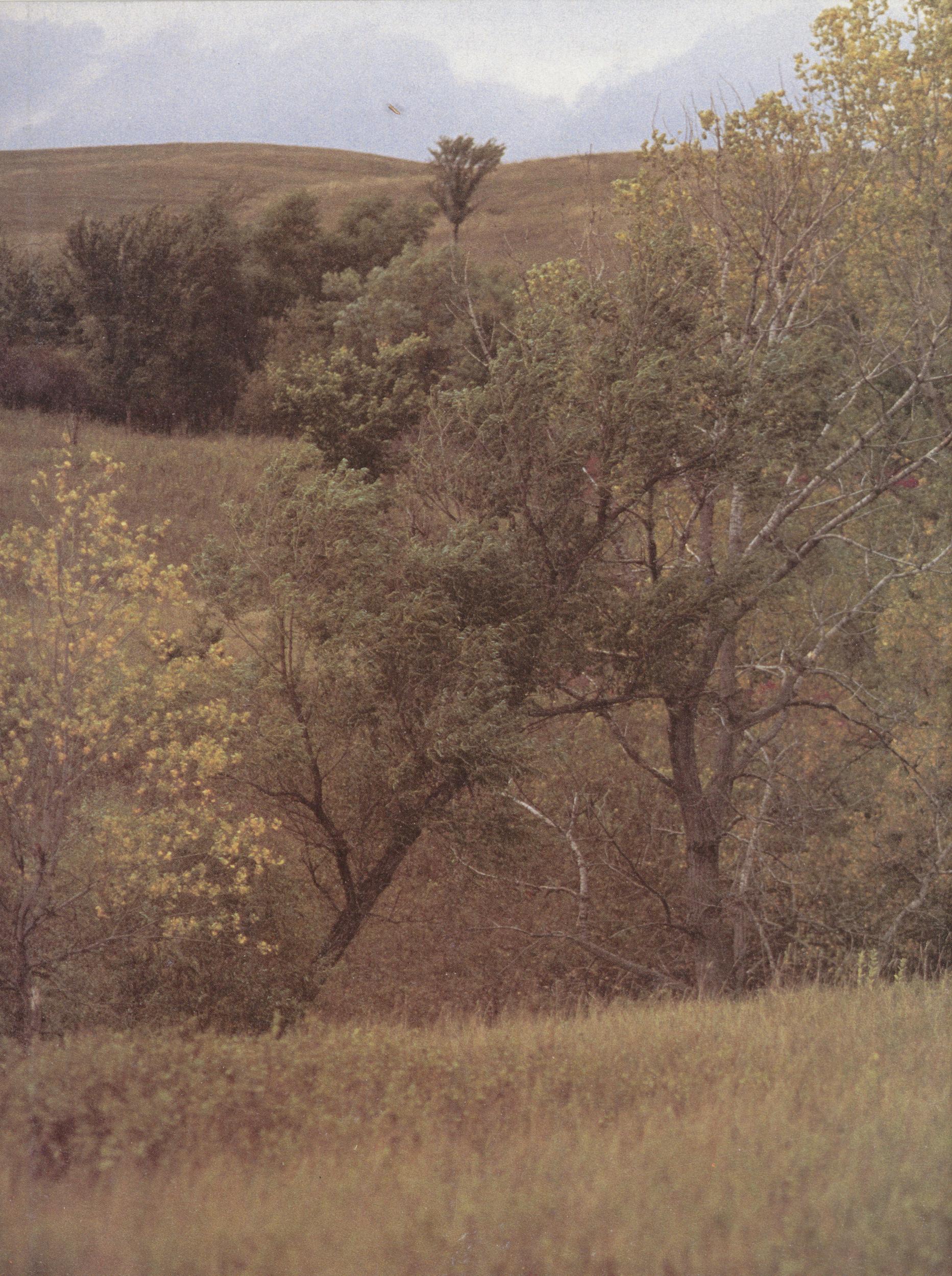
Position: 265 (31 views)