Volume 65, Issue 8, 1987
NEBRASKAland
OCTOBER 1987 • $1.50
NEBRASKAland
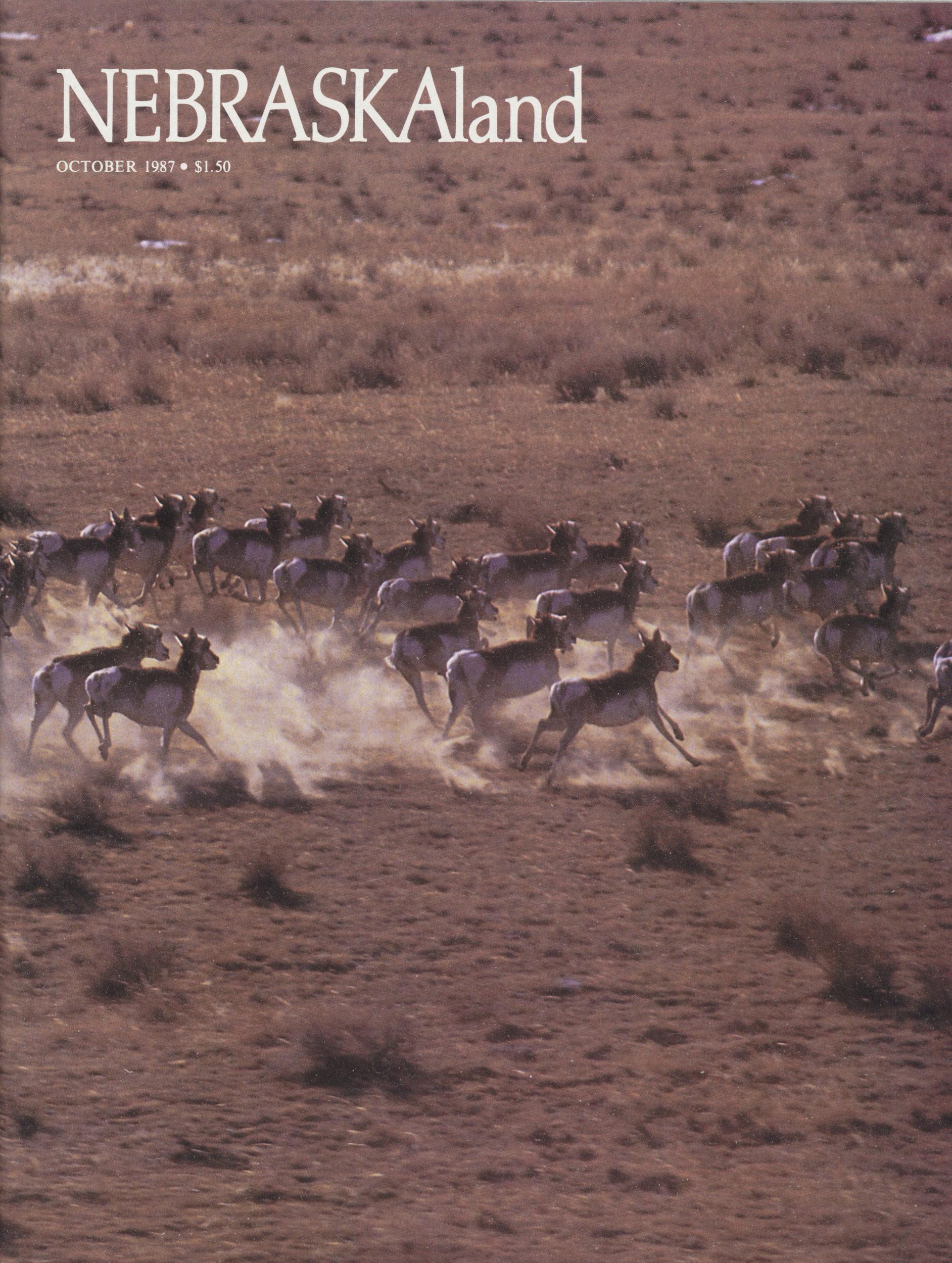
Published by the Nebraska Game and Parks Commission NEBRASKAland VOL. 65/NO. 8/OCT. 1987 NEBRASKAland (ISSN:0028-1964) is published monthly except for combined Jan/Feb and Aug/Sept issues, by the Nebraska Game and Parks Commission, 2200 North 33rd Street, Lincoln, NE. Copyright 1987, all rights reserved. Second-class postage paid at Lincoln, Nebraska and at additional mailing offices. POSTMASTER: Send address changes to NEBRASKAland, Box 30370, Lincoln, NE 68503. Rates: $12 for one year; $23 for two years. Offices Headquarters 2200 N. 33rd, Lincoln, 68503 (402)464-0641 13th and Farnam St., Omaha (402) 554-2144 Ak-Sar-Ben Aquarium, Gretna (402) 332-3901 Rt. 2, Alliance (308) 762-5605 Bassett (402) 684-3511 U.S. 81, Norfolk (402) 371-4950 Rt. 4, North Platte (308) 532-6225 Commissioners Chairman: Neal Keller, Brewster Vice Chairman: Dr. Tim Biga, Norfolk 2nd Vice Chairman: Stan Juelfs, Kimball Wayne Ziebarth, Wilcox LaVern Schneider, McCook L. Bruce Wright, Lincoln Richard L. Coyne, Omaha Director: Eugene T. Mahoney Assistant Directors: William J. Bailey, Jr., Dale R. Bree, Rex Amack Staff Chief, Information & Education: Jim MacAllister Editor: Lowell Johnson Senior Editor: Jon Farrar Associate Editors: Ken Bouc, Don Cunningham Regional Editors: Bob Grier, Rocky Hoffmann Contributors: Tom Keith, Liz Huff, Carl Wolfe Research Assistant: Curt Twedt Art Director: Duane Westerholt Illustration: Steve O'Hare, Paula Day Advertising: Dan Curran Circulation: Pat Frahm Contents Features BIG BONES AT BIG MAC HUNTING, WILDLIFE AND HABITAT... WHO'S PICKING UP THE TAB...........................14 THANKSGIVING REFLECTIONS...................16 PINE RIDGE PRIMER..............................18 DON'T SHOOT YOUR EYE OUT!....................24 THE IMAGE MAKERS .............................34 Departments SPEAK UP.........................................4 TRADING POST...................................49 BOOK SHELF 50 COVER: A species unique to the American continent, the pronghorn antelope is well suited to the wide open spaces, with excellent eyesight and fleet feet. It prefers open plains, as this section of Nebraska's Panhandle, and can withstand cold winters due to its highly insulative hair. Unlike deer, antelope have true horns which are not shed annually but continue growing on a core, as domestic cattle. Photo by Bob Grier. OPPOSITE: Vegetation often signals the coming of fall before human residents are quite aware of it, and the transition from brilliant greens to vibrant yellows and reds is something that makes the coming of winter more tolerable. This American plum is also the bearer of delectable fruit, as much prized today as by the Plains Indians. Photo by Don Cunningham. OCTOBER 1987 3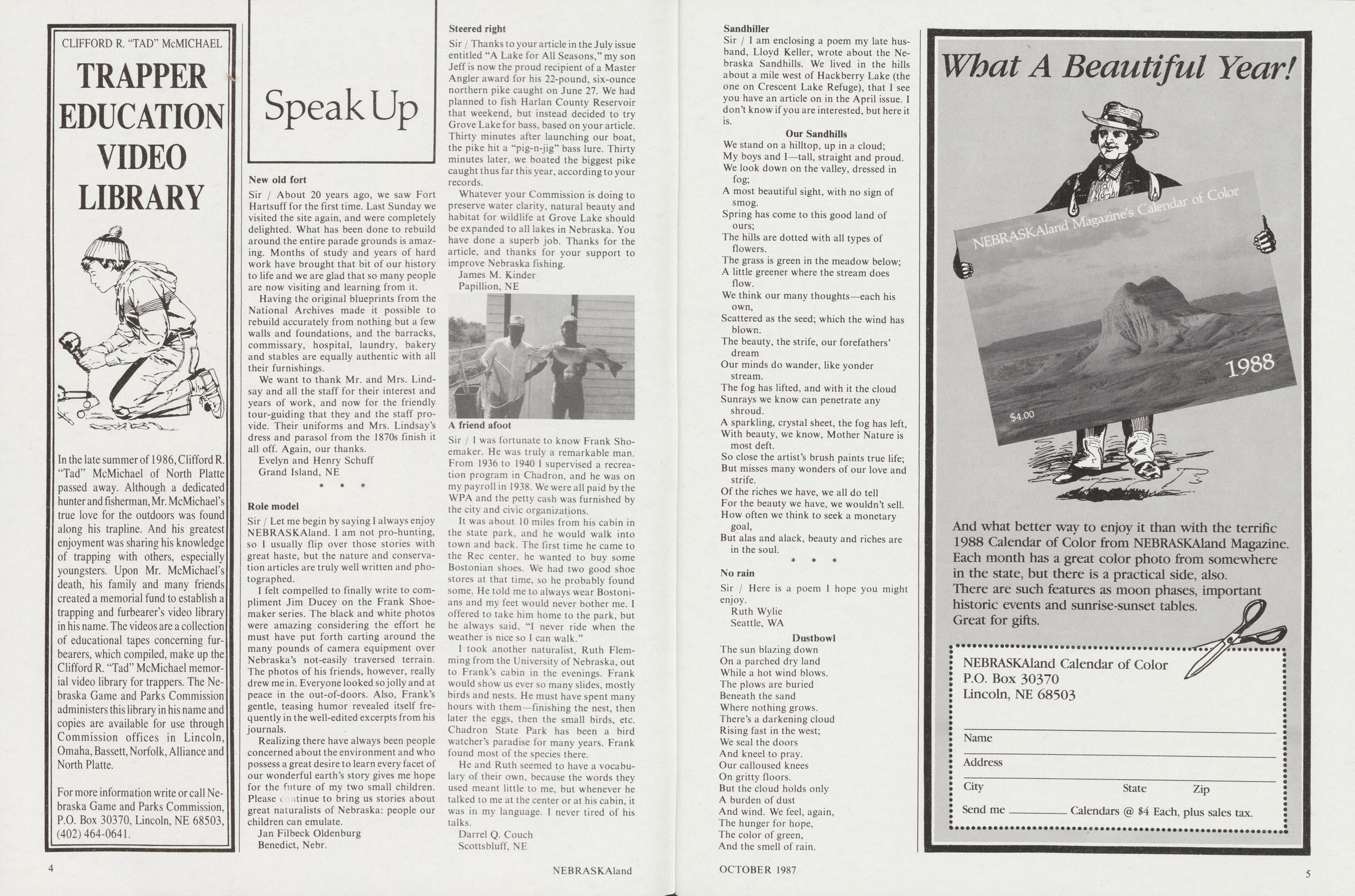
Speak Up
New old fortSir / About 20 years ago, we saw Fort Hartsuff for the first time. Last Sunday we visited the site again, and were completely delighted. What has been done to rebuild around the entire parade grounds is amazing. Months of study and years of hard work have brought that bit of our history to life and we are glad that so many people are now visiting and learning from it.
Having the original blueprints from the National Archives made it possible to rebuild accurately from nothing but a few walls and foundations, and the barracks, commissary, hospital, laundry, bakery and stables are equally authentic with all their furnishings.
We want to thank Mr. and Mrs. Lindsay and all the staff for their interest and years of work, and now for the friendly tour-guiding that they and the staff provide. Their uniforms and Mrs. Lindsay's dress and parasol from the 1870s finish it all off. Again, our thanks.
Evelyn and Henry Schuff Grand Island, NE * * * Role modelSir / Let me begin by saying I always enjoy NEBRASKAland. I am not pro-hunting, so I usually flip over those stories with great haste, but the nature and conservation articles are truly well written and photographed.
I felt compelled to finally write to compliment Jim Ducey on the Frank Shoemaker series. The black and white photos were amazing considering the effort he must have put forth carting around the many pounds of camera equipment over Nebraska's not-easily traversed terrain. The photos of his friends, however, really drew me in. Everyone looked so jolly and at peace in the out-of-doors. Also, Frank's gentle, teasing humor revealed itself frequently in the well-edited excerpts from his journals.
Realizing there have always been people concerned about the environment and who possess a great desire to learn every facet of our wonderful earth's story gives me hope for the future of my two small children. Please continue to bring us stories about great naturalists of Nebraska: people our children can emulate.
Jan Filbeck Oldenburg Benedict, Nebr. Steered rightSir / Thanks to your article in the July issue entitled "A Lake for All Seasons," my son Jeff is now the proud recipient of a Master Angler award for his 22-pound, six-ounce northern pike caught on June 27. We had planned to fish Harlan County Reservoir that weekend, but instead decided to try Grove Lake for bass, based on your article. Thirty minutes after launching our boat, the pike hit a "pig-n-jig" bass lure. Thirty minutes later, we boated the biggest pike caught thus far this year, according to your records.
Whatever your Commission is doing to preserve water clarity, natural beauty and habitat for wildlife at Grove Lake should be expanded to all lakes in Nebraska. You have done a superb job. Thanks for the article, and thanks for your support to improve Nebraska fishing.
James M. Kinder Papillion, NESir / I was fortunate to know Frank Shoemaker. He was truly a remarkable man. From 1936 to 1940 I supervised a recreation program in Chadron, and he was on my payroll in 1938. We were all paid by the WPA and the petty cash was furnished by the city and civic organizations.
It was about 10 miles from his cabin in the state park, and he would walk into town and back. The first time he came to the Rec center, he wanted to buy some Bostonian shoes. We had two good shoe stores at that time, so he probably found some. He told me to always wear Bostonians and my feet would never bother me. I offered to take him home to the park, but he always said, "I never ride when the weather is nice so I can walk."
I took another naturalist, Ruth Flemming from the University of Nebraska, out to Frank's cabin in the evenings. Frank would show us ever so many slides, mostly birds and nests. He must have spent many hours with them—finishing the nest, then later the eggs, then the small birds, etc. Chadron State Park has been a bird watcher's paradise for many years. Frank found most of the species there.
He and Ruth seemed to have a vocabulary of their own, because the words they used meant little to me, but whenever he talked to me at the center or at his cabin, it was in my language. I never tired of his talks.
Darrel Q. Couch Scottsbluff, NE 4 NEBRASKAland SandhillerSir / I am enclosing a poem my late husband, Lloyd Keller, wrote about the Nebraska Sandhills. We lived in the hills about a mile west of Hackberry Lake (the one on Crescent Lake Refuge), that I see you have an article on in the April issue. I don't know if you are interested, but here it is.
Our Sandhills We stand on a hilltop, up in a cloud; My boys and I—tall, straight and proud. We look down on the valley, dressed in fog; A most beautiful sight, with no sign of smog. Spring has come to this good land of ours; The hills are dotted with all types of flowers. The grass is green in the meadow below; A little greener where the stream does flow. We think our many thoughts—each his own, Scattered as the seed; which the wind has blown. The beauty, the strife, our forefathers' dream Our minds do wander, like yonder stream. The fog has lifted, and with it the cloud Sun rays we know can penetrate any shroud. A sparkling, crystal sheet, the fog has left, With beauty, we know, Mother Nature is most deft. So close the artist's brush paints true life; But misses many wonders of our love and strife. Of the riches we have, we all do tell For the beauty we have, we wouldn't sell. How often we think to seek a monetary goal, But alas and alack, beauty and riches are in the soul. * * * No rainSir / Here is a poem I hope you might enjoy.
Ruth Wylie Seattle, WA Dustbowl The sun blazing down On a parched dry land While a hot wind blows. The plows are buried Beneath the sand Where nothing grows. There's a darkening cloud Rising fast in the west; We seal the doors And kneel to pray. Our calloused knees On gritty floors. But the cloud holds only A burden of dust And wind. We feel, again, The hunger for hope, The color of green, And the smell of rain. What A Beautiful Year! $4.00 And what better way to enjoy it than with the terrific 1988 Calendar of Color from NEBRASKAland Magazine. Each month has a great color photo from somewhere in the state, but there is a practical side, also. There are such features as moon phases, importer historic events and sunrise-sunset tables. Great for gifts. NEBRASKAland Calendar of Color P.O. Box 30370 Lincoln, NE 68503 Send me State Calendars @ $4 Each, plus sales tax. OCTOBER 1987 5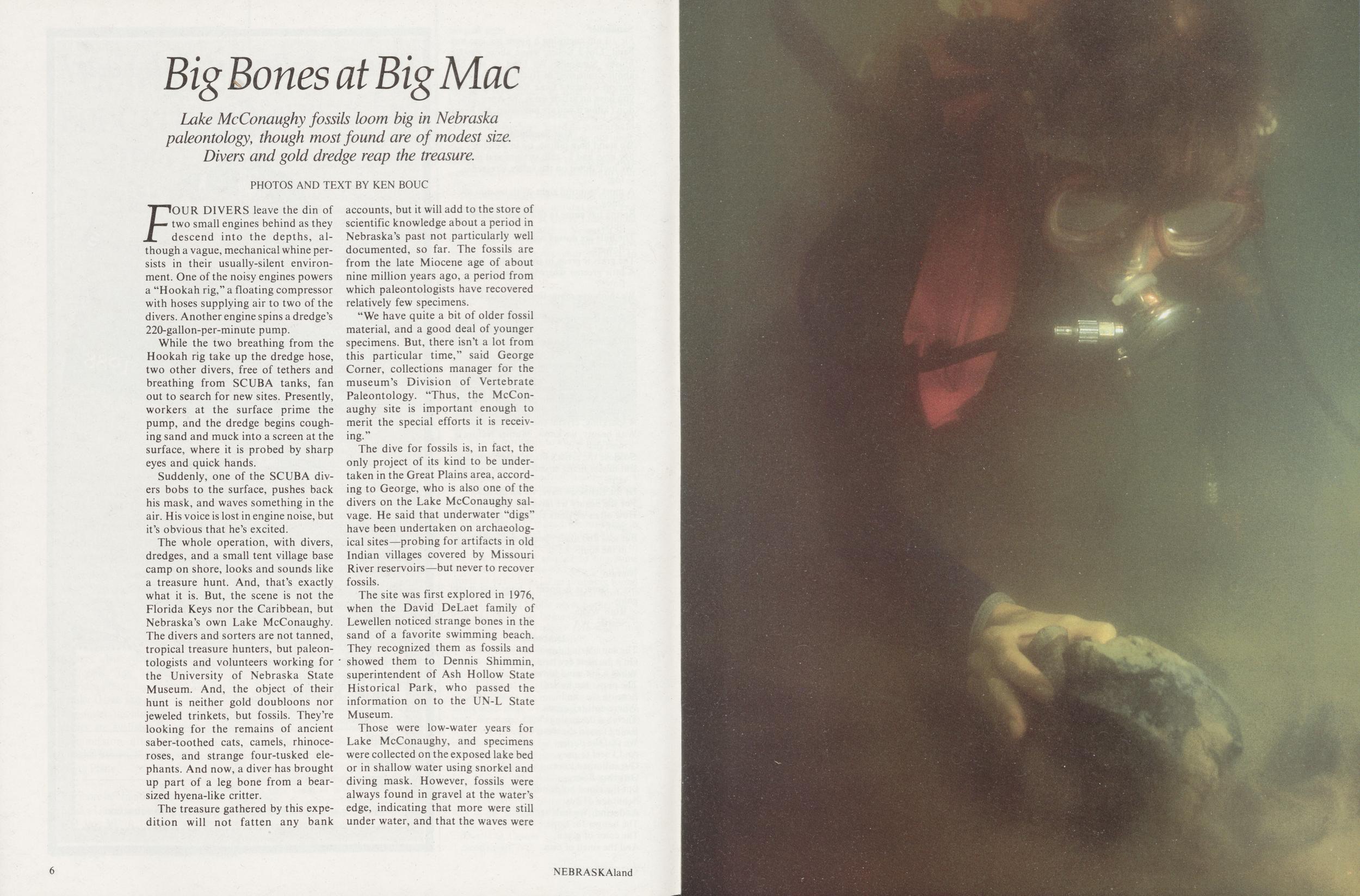
Big Bones at Big Mac
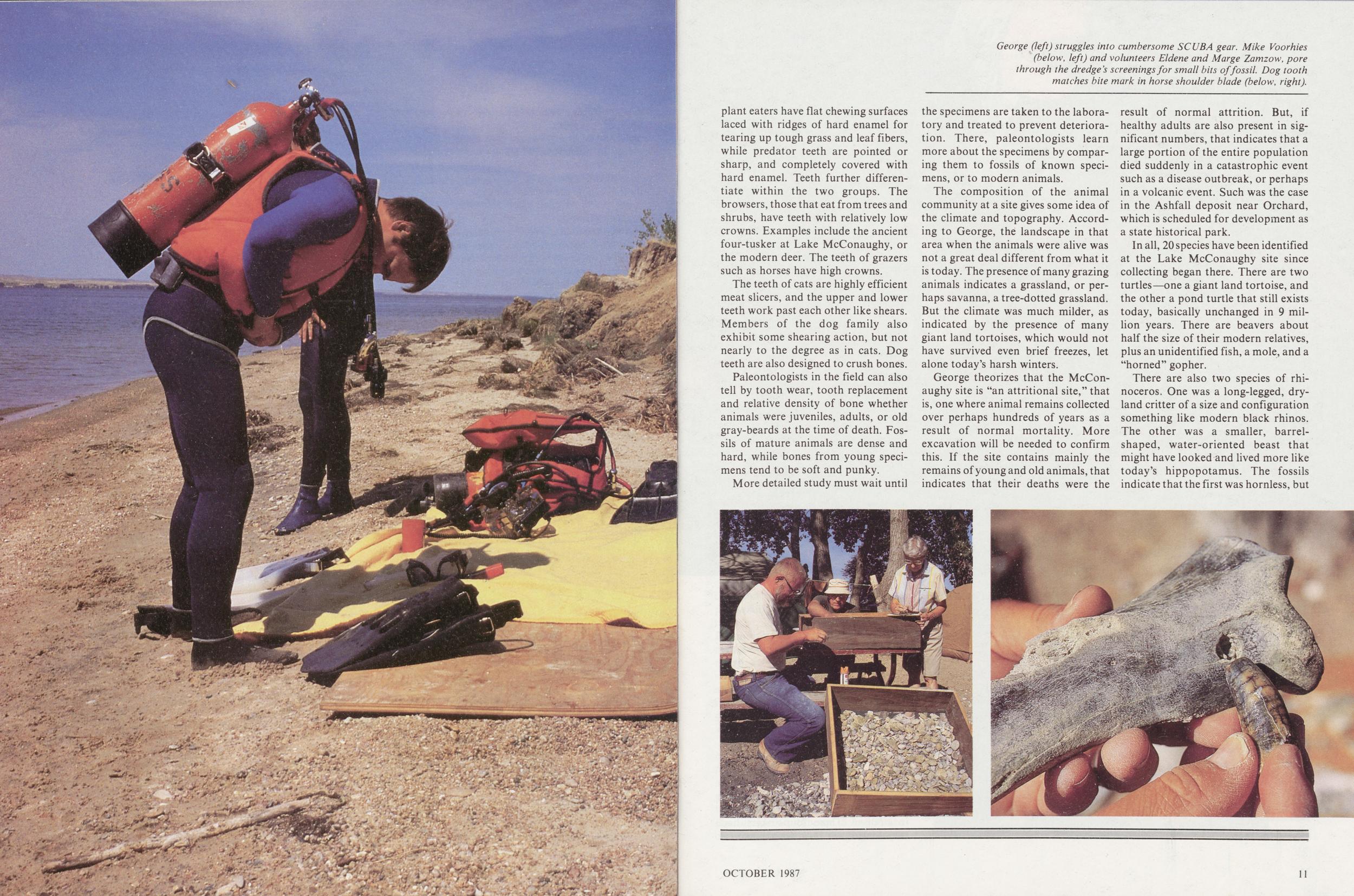
Lake McConaughy fossils loom big in Nebraska paleontology, though most found are of modest size. Divers and gold dredge reap the treasure. PHOTOS AND TEXT BY KEN BOUCFOUR DIVERS leave the din of two small engines behind as they descend into the depths, al- though a vague, mechanical whine persists in their usually-silent environment. One of the noisy engines powers a "Hookah rig," a floating compressor with hoses supplying air to two of the divers. Another engine spins a dredge's 220-gallon-per-minute pump.
While the two breathing from the Hookah rig take up the dredge hose, two other divers, free of tethers and breathing from SCUBA tanks, fan out to search for new sites. Presently, workers at the surface prime the pump, and the dredge begins coughing sand and muck into a screen at the surface, where it is probed by sharp eyes and quick hands.
Suddenly, one of the SCUBA divers bobs to the surface, pushes back his mask, and waves something in the air. His voice is lost in engine noise, but it's obvious that he's excited.
The whole operation, with divers, dredges, and a small tent village base camp on shore, looks and sounds like a treasure hunt. And, that's exactly what it is. But, the scene is not the Florida Keys nor the Caribbean, but Nebraska's own Lake McConaughy. The divers and sorters are not tanned, tropical treasure hunters, but paleontologists and volunteers working for the University of Nebraska State Museum. And, the object of their hunt is neither gold doubloons nor jeweled trinkets, but fossils. They're looking for the remains of ancient saber-toothed cats, camels, rhinoceroses, and strange four-tusked elephants. And now, a diver has brought up part of a leg bone from a bear sized hyena-like critter.
The treasure gathered by this expedition will not fatten any bank accounts, but it will add to the store of scientific knowledge about a period in Nebraska's past not particularly well documented, so far. The fossils are from the late Miocene age of about nine million years ago, a period from which paleontologists have recovered relatively few specimens.
"We have quite a bit of older fossil material, and a good deal of younger specimens. But, there isn't a lot from this particular time," said George Corner, collections manager for the museum's Division of Vertebrate Paleontology. "Thus, the McConaughy site is important enough to merit the special efforts it is receiving."
The dive for fossils is, in fact, the only project of its kind to be undertaken in the Great Plains area, according to George, who is also one of the divers on the Lake McConaughy salvage. He said that underwater "digs" have been undertaken on archaeological sites—probing for artifacts in old Indian villages covered by Missouri River reservoirs—but never to recover fossils.
The site was first explored in 1976, when the David DeLaet family of Lewellen noticed strange bones in the sand of a favorite swimming beach. They recognized them as fossils and showed them to Dennis Shimmin, superintendent of Ash Hollow State Historical Park, who passed the information on to the UN-L State Museum.
Those were low-water years for Lake McConaughy, and specimens were collected on the exposed lake bed or in shallow water using snorkel and diving mask. However, fossils were always found in gravel at the water's edge, indicating that more were still under water, and that the waves were tearing into the deposits and moving things around. The situation clearly called for a full-scale recovery operation. Then, a series of high-water years came to Lake McConaughy, and paleontologists finally decided they would have to dive for their fossils.
6 NEBRASKAlandThey waited until August of 1986, hoping for low water due to irrigation demand. But, when the project was scheduled, the fossils lay under about 16 feet of water.
Key players in the operation, in addition to George, included Jim Landon, a State Museum associate and biology teacher at Seward High School. With his contagious enthusiasm, Jim was the "spark-plug" of the operation, according to George. He lined up the dredge and Hookah rig, set up the platform for the dredge pump and screens, and kept equipment operating and people moving. He was also one of the four divers.
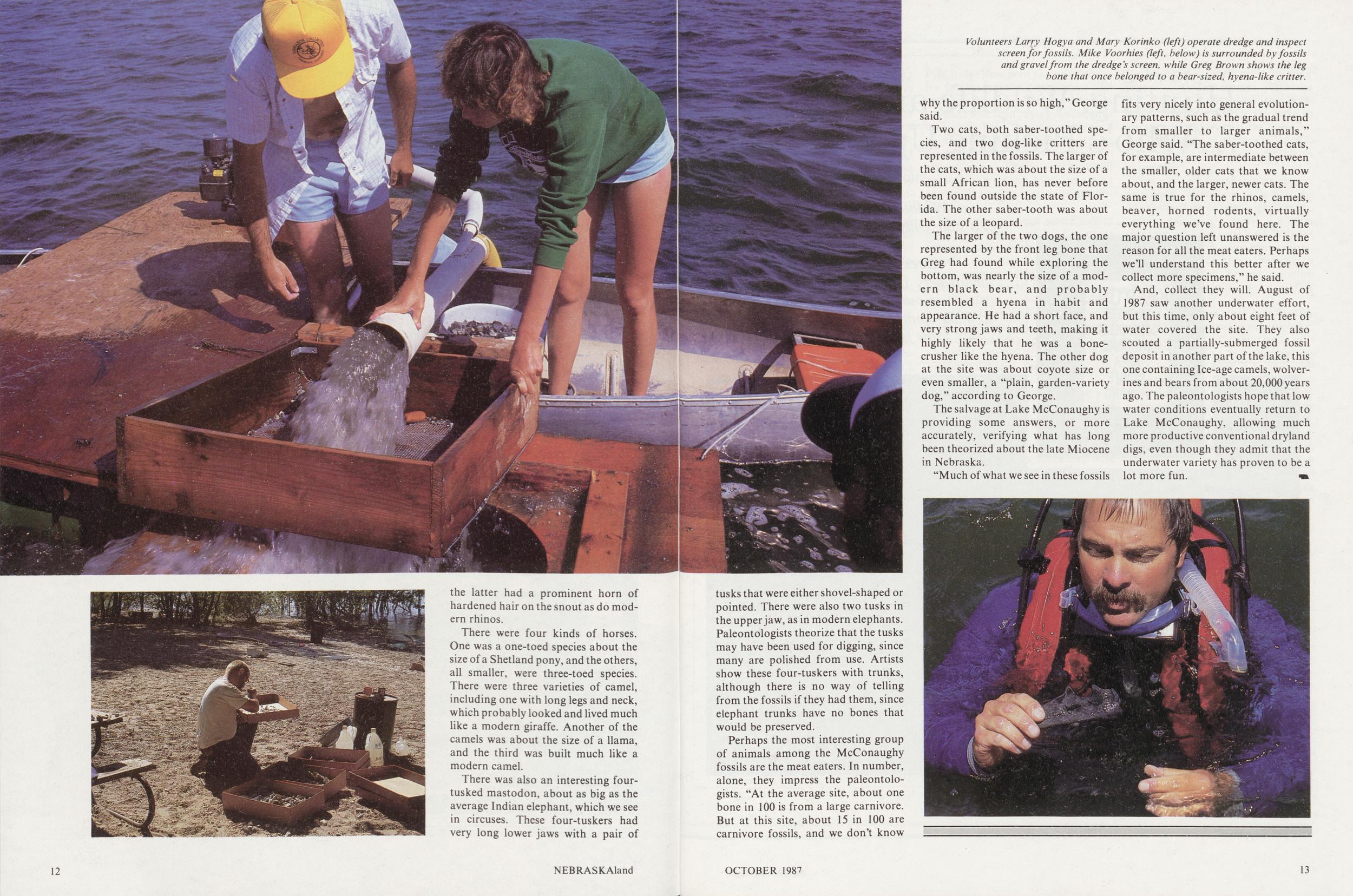
As the museum's curator of vertebrate paleontology, Mike Voorhies was the ranking staffer on site. He was strictly shore-based, chuckling that he preferred his water one glass at a time. His skill at identifying fossils from a single tooth or tiny bone fragment continually amazed the volunteers on shore, and allowed everyone to keep abreast of progress.
Greg Brown, discoverer of the leg bone of the big hyena-like critter, and Martha Nelson, who found a massive vertebra from a four-tusked elephant, were the other two members of the underwater team. Greg is the museum's chief preparator, in charge of the preservation, reassembly and display of the fossils brought in from the field. Martha is a parasitologist in the museum's Division of Parasitology.
Although the weather was nearly perfect topside, the divers found poor visibility below. They had expected
All the sand and muck that was sucked off the bottom, after it passed through the dredge and screen, rained right back down on them. Thus, the water was always murky, and the bottom was covered with a fine sifting of new sand, making it tough to keep track of which areas had been explored. After several days, an extension for the intake hose arrived, and the divers were able to escape the continual rain of muck.
Diving was enjoyable at first, but after long hours and days, it became physically tiring. Still, the divers didn't complain. And, neither did the topside crew, mostly volunteers, who also had demanding and tedious work.
Perhaps the toughest duty was on the dredge platform, which was nothing more than a canoe with a 50-gallon-drum outrigger and a wood platform. The tiny space was shared by the engine and pump of a modified gold dredge, the screen in which the dredge discharged, and two or three volunteer workers who tended the engine and inspected the screened material.
Volunteers also scanned scores of buckets of mostly gravel brought ashore from the dredge's screen, looking for small bone fragments and teeth that might have been overlooked. In all, 22 volunteers helped at one time or another. Most were rockhounds, members of the Lincoln Gem and Mineral Club; the Nebraska Mineral and Gem Club, Omaha; the Central Nebraska Rock and Mineral Society, Hastings; and the Grand Island Earth Science Society. These rockhound clubs also had bought the dredging equipment, which they donated to the museum.
While the divers and dredge operators were at work on the water, Mike and the remaining volunteers sweated over screens, trays and boxes of gravel and fossils. The rockhounds recovered the fossils from the gravel, and Mike identified and sorted them. His trained eye could read information from tiny fragments of bone the way someone else might read a textbook.
He might say something like, "This is obviously the shoulder bone of a predator—either a dog or a cat. You can separate the two groups with your eyes closed if you remember that these joints in predators are designed to allow a wide range of motion. They need this mobility for quick changes of direction in the chase. On the other hand, herbivores like the several species of horses and camels that we are finding here, have shoulder joints that basically allow only linear motion, just backward and forward. The joints of carnivores and herbivores clearly show this difference."
Teeth tell a story, too. Those of
Painting by Mark Marcuson, UNL State Museum
OCTOBER 1987
9
The teeth of cats are highly efficient meat sheers, and the upper and lower teeth work past each other like shears. Members of the dog family also exhibit some shearing action, but not nearly to the degree as in cats. Dog teeth are also designed to crush bones.
Paleontologists in the field can also tell by tooth wear, tooth replacement and relative density of bone whether animals were juveniles, adults, or old gray-beards at the time of death. Fossils of mature animals are dense and hard, while bones from young specimens tend to be soft and punky.
More detailed study must wait until the specimens are taken to the laboratory and treated to prevent deterioration. There, paleontologists learn more about the specimens by comparing them to fossils of known specimens, or to modern animals.
The composition of the animal community at a site gives some idea of the climate and topography. According to George, the landscape in that area when the animals were alive was not a great deal different from what it is today. The presence of many grazing animals indicates a grassland, or perhaps savanna, a tree-dotted grassland. But the climate was much milder, as indicated by the presence of many giant land tortoises, which would not have survived even brief freezes, let alone today's harsh winters.
George theorizes that the McConaughy site is "an attritional site," that is, one where animal remains collected over perhaps hundreds of years as a result of normal mortality. More excavation will be needed to confirm this. If the site contains mainly the remains of young and old animals, that indicates that their deaths were the result of normal attrition. But, if healthy adults are also present in significant numbers, that indicates that a large portion of the entire population died suddenly in a catastrophic event such as a disease outbreak, or perhaps in a volcanic event. Such was the case in the Ashfall deposit near Orchard, which is scheduled for development as a state historical park.
In all, 20 species have been identified at the Lake McConaughy site since collecting began there. There are two turtles—one a giant land tortoise, and the other a pond turtle that still exists today, basically unchanged in 9 million years. There are beavers about half the size of their modern relatives, plus an unidentified fish, a mole, and a "horned" gopher.
There are also two species of rhinoceros, One was a long-legged, dryland critter of a size and configuration something like modern black rhinos. The other was a smaller, barrel shaped, water-oriented beast that might have looked and lived more like today's hippopotamus. The fossils indicate that the first was hornless, but the latter had a prominent horn of hardened hair on the snout as do modern rhinos.
There were four kinds of horses. One was a one-toed species about the size of a Shetland pony, and the others, all smaller, were three-toed species. There were three varieties of camel, including one with long legs and neck, which probably looked and lived much like a modern giraffe. Another of the camels was about the size of a llama, and the third was built much like a modern camel.
There was also an interesting four-tusked mastodon, about as big as the average Indian elephant, which we see in circuses. These four-tuskers had very long lower jaws with a pair of 12 NEBRASKAland tusks that were either shovel-shaped or pointed. There were also two tusks in the upper jaw, as in modern elephants. Paleontologists theorize that the tusks may have been used for digging, since many are polished from use. Artists show these four-tuskers with trunks, although there is no way of telling from the fossils if they had them, since elephant trunks have no bones that would be preserved.
Perhaps the most interesting group of animals among the McConaughy fossils are the meat eaters. In number, alone, they impress the paleontologists. "At the average site, about one bone in 100 is from a large carnivore. But at this site, about 15 in 100 are carnivore fossils, and we don't know why the proportion is so high," George said.
Two cats, both saber-toothed species, and two dog-like critters are represented in the fossils. The larger of the cats, which was about the size of a small African lion, has never before been found outside the state of Florida. The other saber-tooth was about the size of a leopard.
The larger of the two dogs, the one represented by the front leg bone that Greg had found while exploring the bottom, was nearly the size of a modern black bear, and probably resembled a hyena in habit and appearance. He had a short face, and very strong jaws and teeth, making it highly likely that he was a bone crusher like the hyena. The other dog at the site was about coyote size or even smaller, a "plain, garden-variety dog," according to George.
The salvage at Lake McConaughy is providing some answers, or more accurately, verifying what has long been theorized about the late Miocene in Nebraska.
"Much of what we see in these fossils fits very nicely into general evolutionary patterns, such as the gradual trend from smaller to larger animals," George said. "The saber-toothed cats, for example, are intermediate between the smaller, older cats that we know about, and the larger, newer cats. The same is true for the rhinos, camels, beaver, horned rodents, virtually everything we've found here. The major question left unanswered is the reason for all the meat eaters. Perhaps we'll understand this better after we collect more specimens," he said.
And, collect they will. August of 1987 saw another underwater effort, but this time, only about eight feet of water covered the site. They also scouted a partially-submerged fossil deposit in another part of the lake, this one containing Ice-age camels, wolverines and bears from about 20,000 years ago. The paleontologists hope that low water conditions eventually return to Lake McConaughy. allowing much more productive conventional dry land digs, even though they admit that the underwater variety has proven to be a lot more fun.
Volunteers Larry Hogya and Mary Korinko (left) operate dredge and inspect screen for fossils. Mike Voorhies (left, below) is surrounded by fossils and gravel from the dredge's screen, while Greg Brown shows the leg bone that once belonged to a bear-sized, hyena-like critter.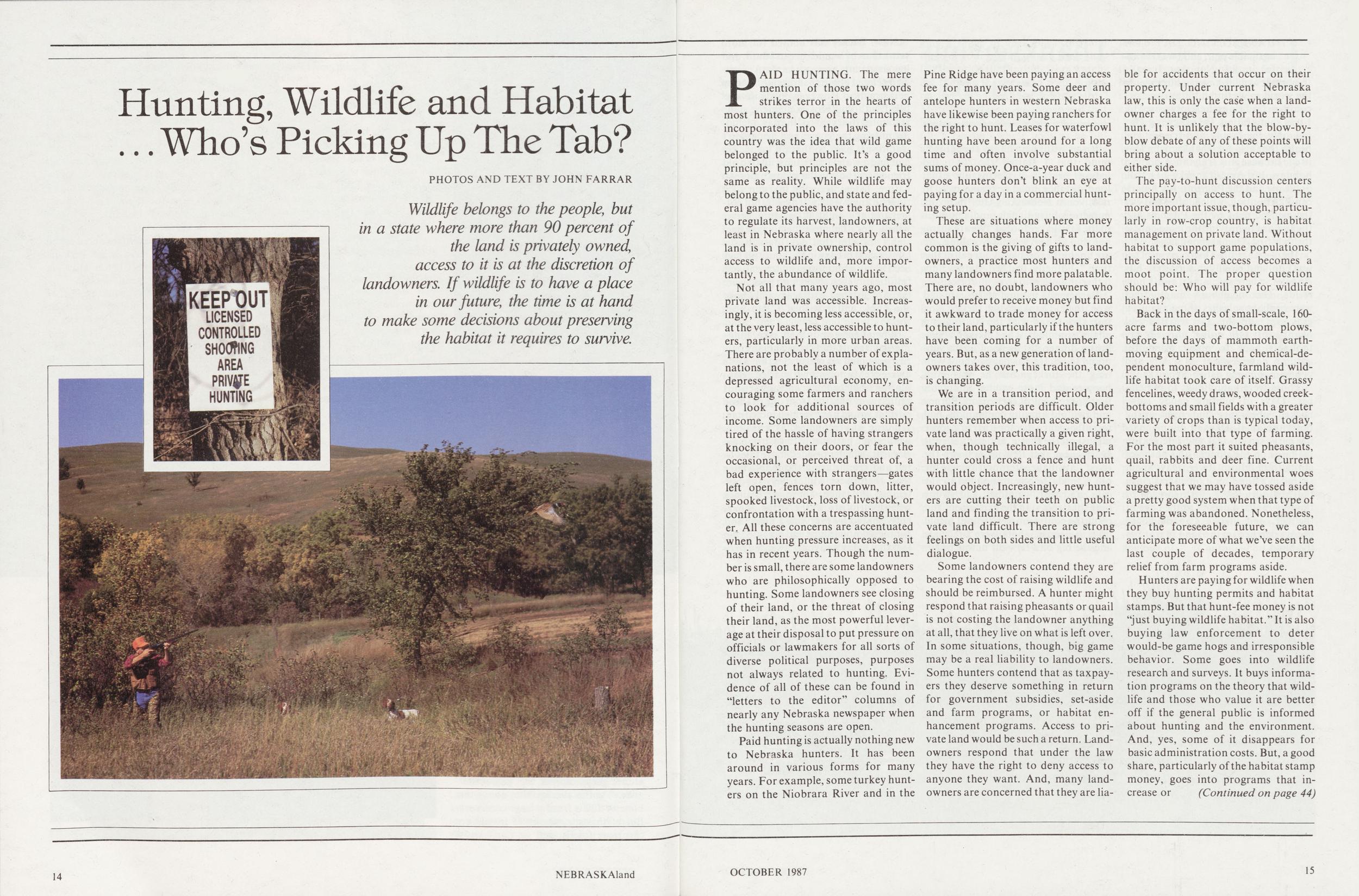
Hunting, Wildlife and Habitat ... Who's Picking Up The Tab?
PHOTOS AND TEXT BY JOHN FARRAR Wildlife belongs to the people, but in a state where more than 90 percent of the land is privately owned, access to it is at the discretion of landowners. If wildlife is to have a place in our future, the time is at hand to make some decisions about preserving the habitat it requires to survive.PAID HUNTING. The mere mention of those two words strikes terror in the hearts of most hunters. One of the principles incorporated into the laws of this country was the idea that wild game belonged to the public. It's a good principle, but principles are not the same as reality. While wildlife may belong to the public, and state and federal game agencies have the authority to regulate its harvest, landowners, at least in Nebraska where nearly all the land is in private ownership, control access to wildlife and, more importantly, the abundance of wildlife.
Not all that many years ago, most private land was accessible. Increasingly, it is becoming less accessible, or, at the very least, less accessible to hunters, particularly in more urban areas. There are probably a number of explanations, not the least of which is a depressed agricultural economy, encouraging some farmers and ranchers to look for additional sources of income. Some landowners are simply tired of the hassle of having strangers knocking on their doors, or fear the occasional, or perceived threat of, a bad experience with strangers—gates left open, fences torn down, litter, spooked livestock, loss of livestock, or confrontation with a trespassing hunter. All these concerns are accentuated when hunting pressure increases, as it has in recent years. Though the number is small, there are some landowners who are philosophically opposed to hunting. Some landowners see closing of their land, or the threat of closing their land, as the most powerful leverage at their disposal to put pressure on officials or lawmakers for all sorts of diverse political purposes, purposes not always related to hunting. Evidence of all of these can be found in "letters to the editor" columns of nearly any Nebraska newspaper when the hunting seasons are open.
Paid hunting is actually nothing new to Nebraska hunters. It has been around in various forms for many years. For example, some turkey hunters on the Niobrara River and in the Pine Ridge have been paying an access fee for many years. Some deer and antelope hunters in western Nebraska have likewise been paying ranchers for the right to hunt. Leases for waterfowl hunting have been around for a long time and often involve substantial sums of money. Once-a-year duck and goose hunters don't blink an eye at paying for a day in a commercial hunting setup.
These are situations where money actually changes hands. Far more common is the giving of gifts to landowners, a practice most hunters and many landowners find more palatable. There are, no doubt, landowners who would prefer to receive money but find it awkward to trade money for access to their land, particularly if the hunters have been coming for a number of years. But, as a new generation of landowners takes over, this tradition, too, is changing.
We are in a transition period, and transition periods are difficult. Older hunters remember when access to private land was practically a given right, when, though technically illegal, a hunter could cross a fence and hunt with little chance that the landowner would object. Increasingly, new hunters are cutting their teeth on public land and finding the transition to private land difficult. There are strong feelings on both sides and little useful dialogue.
Some landowners contend they are bearing the cost of raising wildlife and should be reimbursed. A hunter might respond that raising pheasants or quail is not costing the landowner anything at all, that they live on what is left over. In some situations, though, big game may be a real liability to landowners. Some hunters contend that as taxpayers they deserve something in return for government subsidies, set-aside and farm programs, or habitat enhancement programs. Access to private land would be such a return. Landowners respond that under the law they have the right to deny access to anyone they want. And, many landowners are concerned that they are liable for accidents that occur on their property. Under current Nebraska law, this is only the case when a landowner charges a fee for the right to hunt. It is unlikely that the blow-by- blow debate of any of these points will bring about a solution acceptable to either side.
The pay-to-hunt discussion centers principally on access to hunt. The more important issue, though, particularly in row-crop country, is habitat management on private land. Without habitat to support game populations, the discussion of access becomes a moot point. The proper question should be: Who will pay for wildlife habitat?
Back in the days of small-scale, 160- acre farms and two-bottom plows, before the days of mammoth earth moving equipment and chemical dependent monoculture, farmland wildlife habitat took care of itself. Grassy fence lines, weedy draws, wooded creek bottoms and small fields with a greater variety of crops than is typical today, were built into that type of farming. For the most part it suited pheasants, quail, rabbits and deer fine. Current agricultural and environmental woes suggest that we may have tossed aside a pretty good system when that type of farming was abandoned. Nonetheless, for the foreseeable future, we can anticipate more of what we've seen the last couple of decades, temporary relief from farm programs aside.
Hunters are paying for wildlife when they buy hunting permits and habitat stamps. But that hunt-fee money is not "just buying wildlife habitat." It is also buying law enforcement to deter would-be game hogs and irresponsible behavior. Some goes into wildlife research and surveys. It buys information programs on the theory that wildlife and those who value it are better off if the general public is informed about hunting and the environment. And, yes, some of it disappears for basic administration costs. But, a good share, particularly of the habitat stamp money, goes into programs that increase or (Continued on page 44)
OCTOBER 1987 15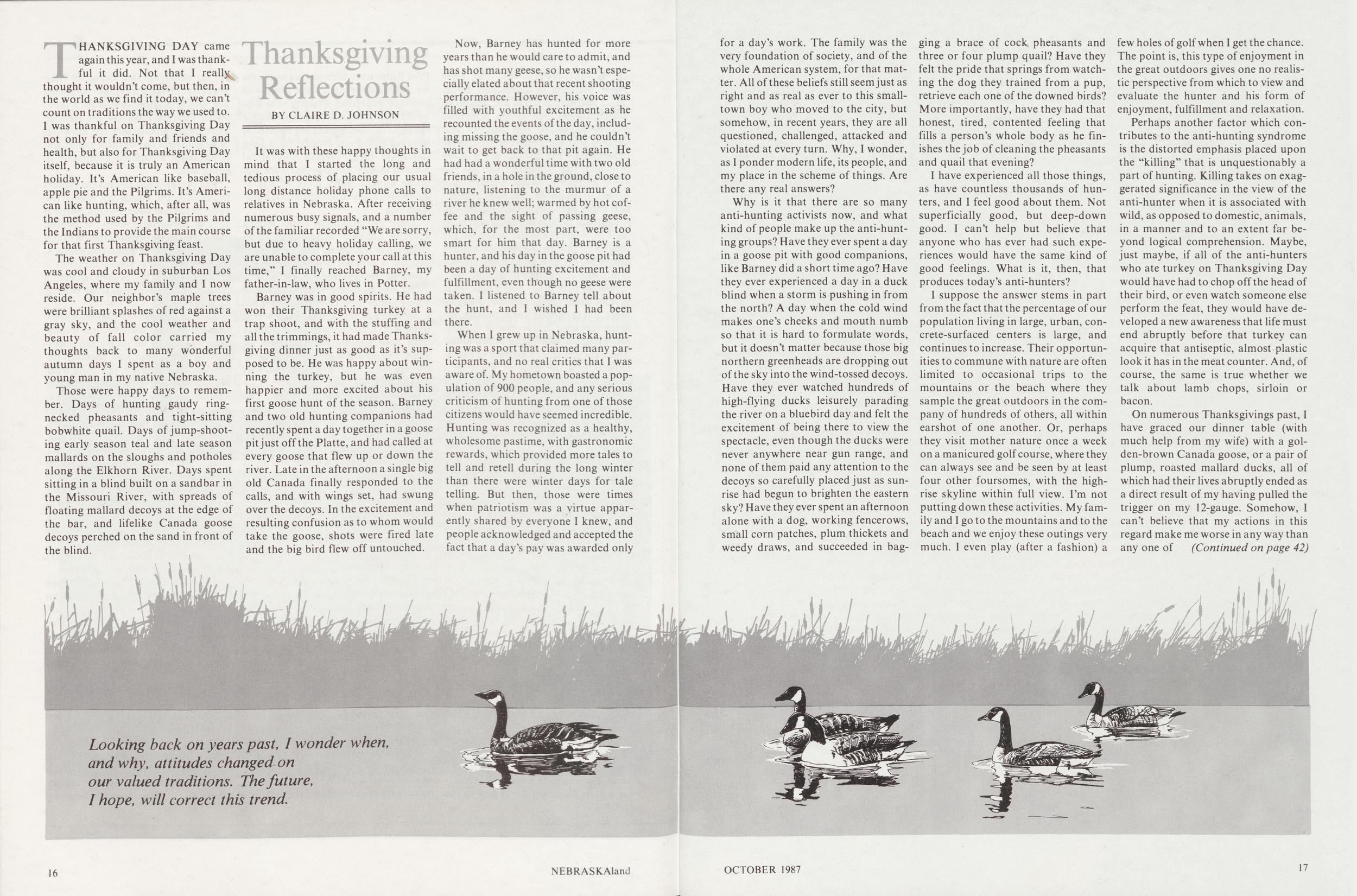
Thanksgiving Reflections
BY CLAIRE D. JOHNSONTHANKSGIVING DAY came again this year, and I was thankful it did. Not that I really thought it wouldn't come, but then, in the world as we find it today, we can't count on traditions the way we used to. I was thankful on Thanksgiving Day not only for family and friends and health, but also for Thanksgiving Day itself, because it is truly an American holiday. It's American like baseball, apple pie and the Pilgrims. It's American like hunting, which, after all, was the method used by the Pilgrims and the Indians to provide the main course for that first Thanksgiving feast.
The weather on Thanksgiving Day was cool and cloudy in suburban Los Angeles, where my family and I now reside. Our neighbor's maple trees were brilliant splashes of red against a gray sky, and the cool weather and beauty of fall color carried my thoughts back to many wonderful autumn days I spent as a boy and young man in my native Nebraska.
Those were happy days to remember. Days of hunting gaudy ring necked pheasants and tight-sitting bobwhite quail. Days of jump-shooting early season teal and late season mallards on the sloughs and potholes along the Elkhorn River. Days spent sitting in a blind built on a sandbar in the Missouri River, with spreads of floating mallard decoys at the edge of the bar, and lifelike Canada goose decoys perched on the sand in front of the blind.
It was with these happy thoughts in mind that I started the long and tedious process of placing our usual long distance holiday phone calls to relatives in Nebraska. After receiving numerous busy signals, and a number of the familiar recorded "We are sorry, but due to heavy holiday calling, we are unable to complete your call at this time," I finally reached Barney, my father-in-law, who lives in Potter.
Barney was in good spirits. He had won their Thanksgiving turkey at a trap shoot, and with the stuffing and all the trimmings, it had made Thanksgiving dinner just as good as it's supposed to be. He was happy about winning the turkey, but he was even happier and more excited about his first goose hunt of the season. Barney and two old hunting companions had recently spent a day together in a goose pit just off the Platte, and had called at every goose that flew up or down the river. Late in the afternoon a single big old Canada finally responded to the calls, and with wings set, had swung over the decoys. In the excitement and resulting confusion as to whom would take the goose, shots were fired late and the big bird flew off untouched.
Now, Barney has hunted for more years than he would care to admit, and has shot many geese, so he wasn't especially elated about that recent shooting performance. However, his voice was filled with youthful excitement as he recounted the events of the day, including missing the goose, and he couldn't wait to get back to that pit again. He had had a wonderful time with two old friends, in a hole in the ground, close to nature, listening to the murmur of a river he knew well; warmed by hot coffee and the sight of passing geese, which, for the most part, were too smart for him that day. Barney is a hunter, and his day in the goose pit had been a day of hunting excitement and fulfillment, even though no geese were taken. I listened to Barney tell about the hunt, and I wished I had been there.
When I grew up in Nebraska, hunting was a sport that claimed many participants, and no real critics that I was aware of. My hometown boasted a population of 900 people, and any serious criticism of hunting from one of those citizens would have seemed incredible. Hunting was recognized as a healthy, wholesome pastime, with gastronomic rewards, which provided more tales to tell and retell during the long winter than there were winter days for tale telling. But then, those were times when patriotism was a virtue apparently shared by everyone I knew, and people acknowledged and accepted the fact that a day's pay was awarded only 16 NEBRASKAland for a day's work. The family was the very foundation of society, and of the whole American system, for that matter. All of these beliefs still seem just as right and as real as ever to this smalltown boy who moved to the city, but somehow, in recent years, they are all questioned, challenged, attacked and violated at every turn. Why, I wonder, as I ponder modern life, its people, and my place in the scheme of things. Are there any real answers?
Why is it that there are so many anti-hunting activists now, and what kind of people make up the anti-hunting groups? Have they ever spent a day in a goose pit with good companions, like Barney did a short time ago? Have they ever experienced a day in a duck blind when a storm is pushing in from the north? A day when the cold wind makes one's cheeks and mouth numb so that it is hard to formulate words, but it doesn't matter because those big northern greenheads are dropping out of the sky into the wind-tossed decoys. Have they ever watched hundreds of high-flying ducks leisurely parading the river on a bluebird day and felt the excitement of being there to view the spectacle, even though the ducks were never anywhere near gun range, and none of them paid any attention to the decoys so carefully placed just as sunrise had begun to brighten the eastern sky? Have they ever spent an afternoon alone with a dog, working fencerows, small corn patches, plum thickets and weedy draws, and succeeded in bagging a brace of cock pheasants and three or four plump quail? Have they felt the pride that springs from watching the dog they trained from a pup, retrieve each one of the downed birds? More importantly, have they had that honest, tired, contented feeling that fills a person's whole body as he finishes the job of cleaning the pheasants and quail that evening?
I have experienced all those things, as have countless thousands of hunters, and I feel good about them. Not superficially good, but deep-down good. I can't help but believe that anyone who has ever had such experiences would have the same kind of good feelings. What is it, then, that produces today's anti-hunters?
I suppose the answer stems in part from the fact that the percentage of our population living in large, urban, concrete-surfaced centers is large, and continues to increase. Their opportunities to commune with nature are often limited to occasional trips to the mountains or the beach where they sample the great outdoors in the company of hundreds of others, all within earshot of one another. Or, perhaps they visit mother nature once a week on a manicured golf course, where they can always see and be seen by at least four other foursomes, with the highrise skyline within full view. I'm not putting down these activities. My family and I go to the mountains and to the beach and we enjoy these outings very much. I even play (after a fashion) a few holes of golf when I get the chance. The point is, this type of enjoyment in the great outdoors gives one no realistic perspective from which to view and evaluate the hunter and his form of enjoyment, fulfillment and relaxation.
Perhaps another factor which contributes to the anti-hunting syndrome is the distorted emphasis placed upon the "killing" that is unquestionably a part of hunting. Killing takes on exaggerated significance in the view of the anti-hunter when it is associated with wild, as opposed to domestic, animals, in a manner and to an extent far beyond logical comprehension. Maybe, just maybe, if all of the anti-hunters who ate turkey on Thanksgiving Day would have had to chop off the head of their bird, or even watch someone else perform the feat, they would have developed a new awareness that life must end abruptly before that turkey can acquire that antiseptic, almost plastic look it has in the meat counter. And, of course, the same is true whether we talk about lamb chops, sirloin or bacon.
On numerous Thanksgivings past, I have graced our dinner table (with much help from my wife) with a golden-brown Canada goose, or a pair of plump, roasted mallard ducks, all of which had their lives abruptly ended as a direct result of my having pulled the trigger on my 12-gauge. Somehow, I can't believe that my actions in this regard make me worse in any way than any one of (Continued on page 42)
OCTOBER 1987 17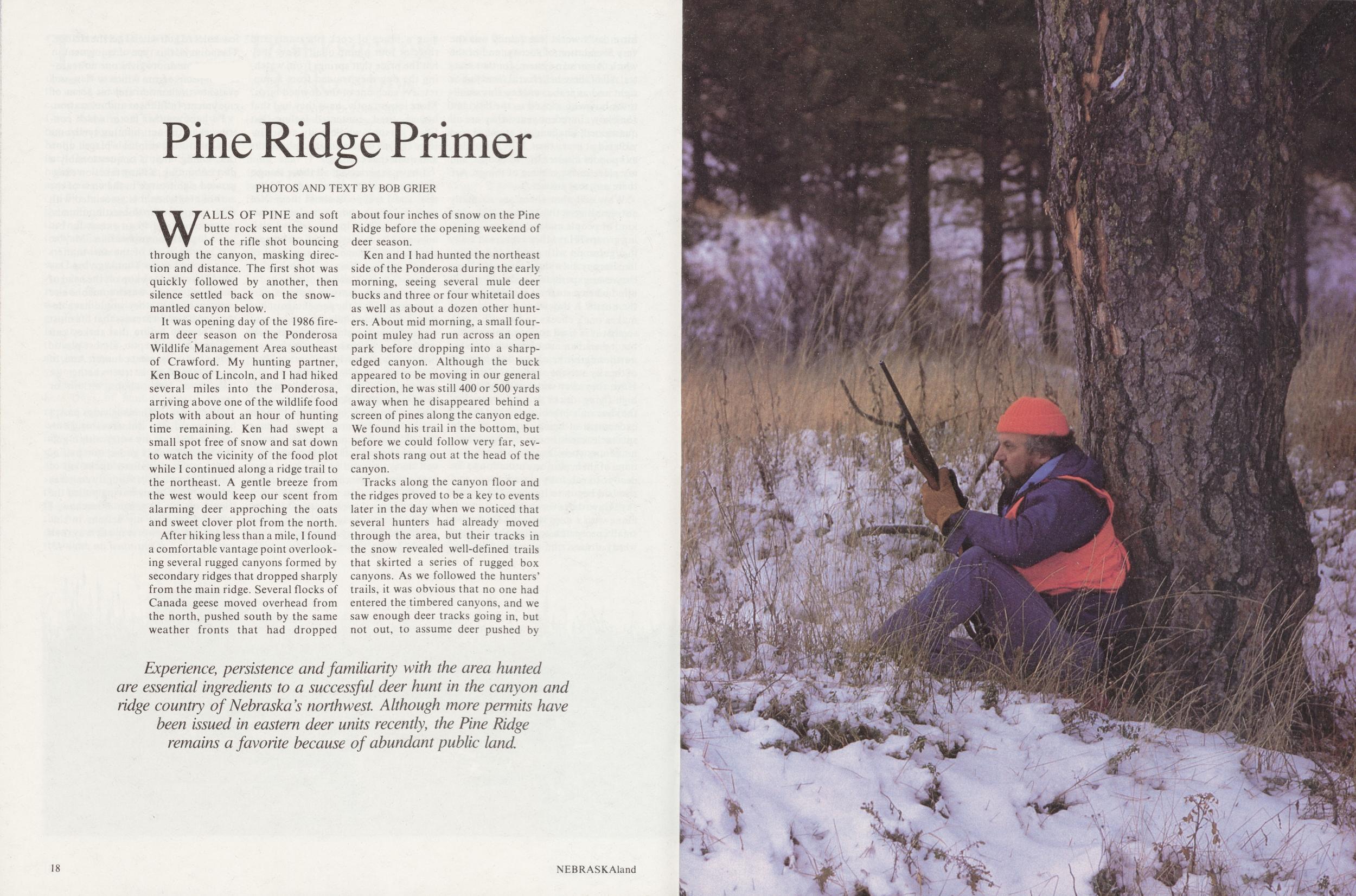
Pine Ridge Primer
PHOTOS AND TEXT BY BOB GRIER Experience, persistence and familiarity with the area hunted are essential ingredients to a successful deer hunt in the canyon and ridge country of Nebraska s northwest Although more permits have been issued in eastern deer units recently, the Pine Ridge remains a favorite because of abundant public land.WALLS OF PINE and soft butte rock sent the sound of the rifle shot bouncing through the canyon, masking direction and distance. The first shot was quickly followed by another, then silence settled back on the snowmantled canyon below.
It was opening day of the 1986 firearm deer season on the Ponderosa Wildlife Management Area southeast of Crawford. My hunting partner, Ken Bouc of Lincoln, and I had hiked several miles into the Ponderosa, arriving above one of the wildlife food plots with about an hour of hunting time remaining. Ken had swept a small spot free of snow and sat down to watch the vicinity of the food plot while I continued along a ridge trail to the northeast. A gentle breeze from the west would keep our scent from alarming deer approaching the oats and sweet clover plot from the north.
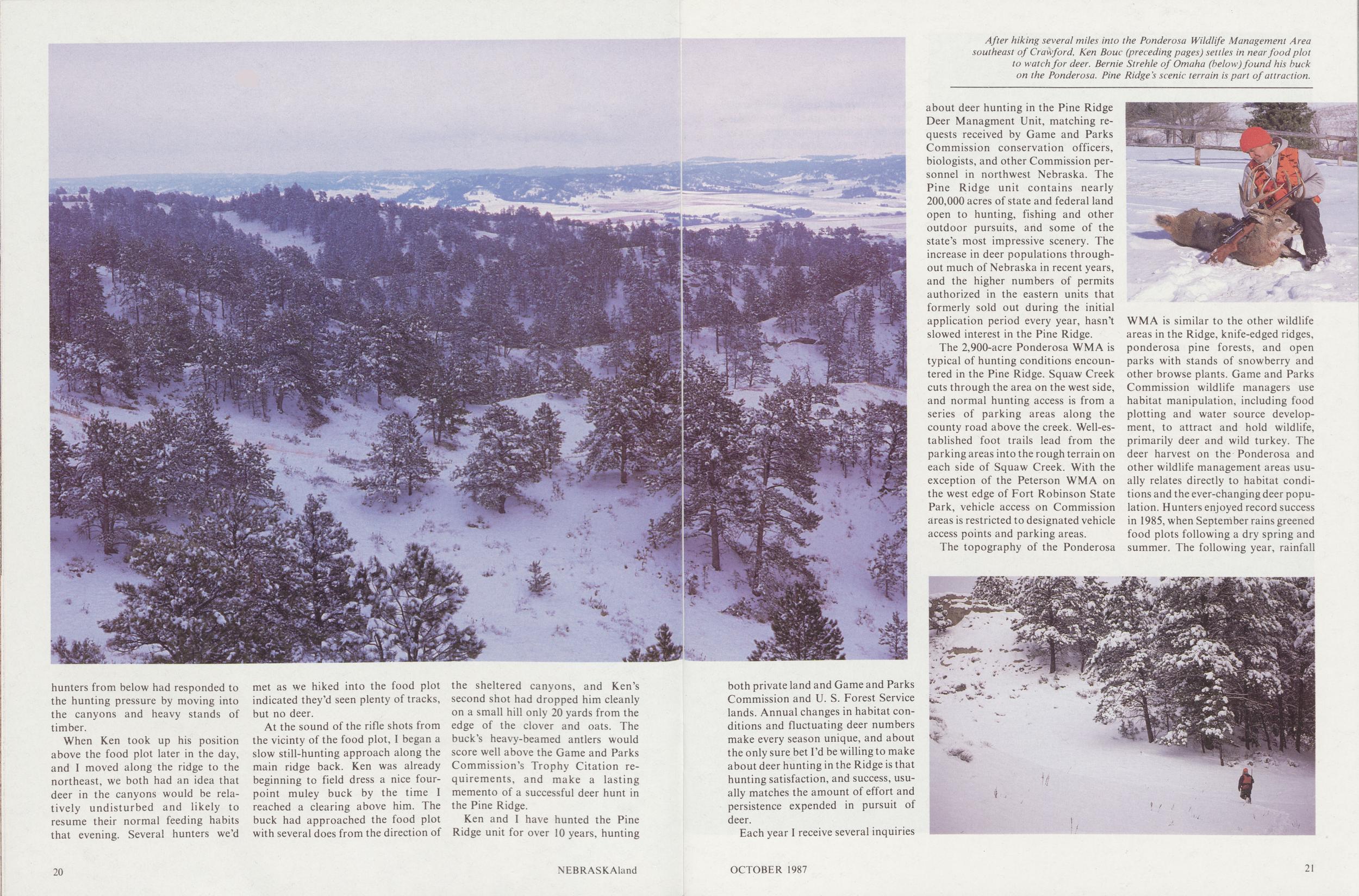
After hiking less than a mile, I found a comfortable vantage point overlooking several rugged canyons formed by secondary ridges that dropped sharply from the main ridge. Several flocks of Canada geese moved overhead from the north, pushed south by the same weather fronts that had dropped about four inches of snow on the Pine Ridge before the opening weekend of deer season.
Ken and I had hunted the northeast side of the Ponderosa during the early morning, seeing several mule deer bucks and three or four whitetail does as well as about a dozen other hunters. About mid morning, a small fourpoint muley had run across an open park before dropping into a sharpedged canyon. Although the buck appeared to be moving in our general direction, he was still 400 or 500 yards away when he disappeared behind a screen of pines along the canyon edge. We found his trail in the bottom, but before we could follow very far, several shots rang out at the head of the canyon.
Tracks along the canyon floor and the ridges proved to be a key to events later in the day when we noticed that several hunters had already moved through the area, but their tracks in the snow revealed well-defined trails that skirted a series of rugged box canyons. As we followed the hunters' trails, it was obvious that no one had entered the timbered canyons, and we saw enough deer tracks going in, but not out, to assume deer pushed by 18 NEBRASKAland
When Ken took up his position above the food plot later in the day, and I moved along the ridge to the northeast, we both had an idea that deer in the canyons would be relatively undisturbed and likely to resume their normal feeding habits that evening. Several hunters we'd met as we hiked into the food plot indicated they'd seen plenty of tracks, but no deer.
At the sound of the rifle shots from the vicinity of the food plot, I began a slow still-hunting approach along the main ridge back. Ken was already beginning to field dress a nice four-point muley buck by the time I reached a clearing above him. The buck had approached the food plot with several does from the direction of the sheltered canyons, and Ken's second shot had dropped him cleanly on a small hill only 20 yards from the edge of the clover and oats. The buck's heavy-beamed antlers would score well above the Game and Parks Commission's Trophy Citation requirements, and make a lasting memento of a successful deer hunt in the Pine Ridge.
Ken and I have hunted the Pine Ridge unit for over 10 years, hunting 20 NEBRASKAland both private land and Game and Parks Commission and U. S. Forest Service lands. Annual changes in habitat conditions and fluctuating deer numbers make every season unique, and about the only sure bet I'd be willing to make about deer hunting in the Ridge is that hunting satisfaction, and success, usually matches the amount of effort and persistence expended in pursuit of deer.
Each year I receive several inquiries about deer hunting in the Pine Ridge Deer Management Unit, matching requests received by Game and Parks Commission conservation officers, biologists, and other Commission personnel in northwest Nebraska. The Pine Ridge unit contains nearly 200,000 acres of state and federal land open to hunting, fishing and other outdoor pursuits, and some of the state's most impressive scenery. The increase in deer populations throughout much of Nebraska in recent years, and the higher numbers of permits authorized in the eastern units that formerly sold out during the initial application period every year, hasn't slowed interest in the Pine Ridge.
The 2,900-acre Ponderosa WMA is typical of hunting conditions encountered in the Pine Ridge. Squaw Creek cuts through the area on the west side, and normal hunting access is from a series of parking areas along the county road above the creek. Well established foot trails lead from the parking areas into the rough terrain on each side of Squaw Creek. With the exception of the Peterson WMA on the west edge of Fort Robinson State Park, vehicle access on Commission areas is restricted to designated vehicle access points and parking areas.
The topography of the Ponderosa WMA is similar to the other wildlife areas in the Ridge, knife-edged ridges, ponderosa pine forests, and open parks with stands of snowberry and other browse plants. Game and Parks Commission wildlife managers use habitat manipulation, including food plotting and water source development, to attract and hold wildlife, primarily deer and wild turkey. The deer harvest on the Ponderosa and other wildlife management areas usually relates directly to habitat conditions and the ever-changing deer population. Hunters enjoyed record success in 1985, when September rains greened food plots following a dry spring and summer. The following year, rainfall occurred during the spring and sum- mer, creating better browse and less use of the rye, oats, and clover food plots. The known harvest on the Ponderosa in 1985 was 26 deer, compared with 19 in 1986.
OCTOBER 1987 21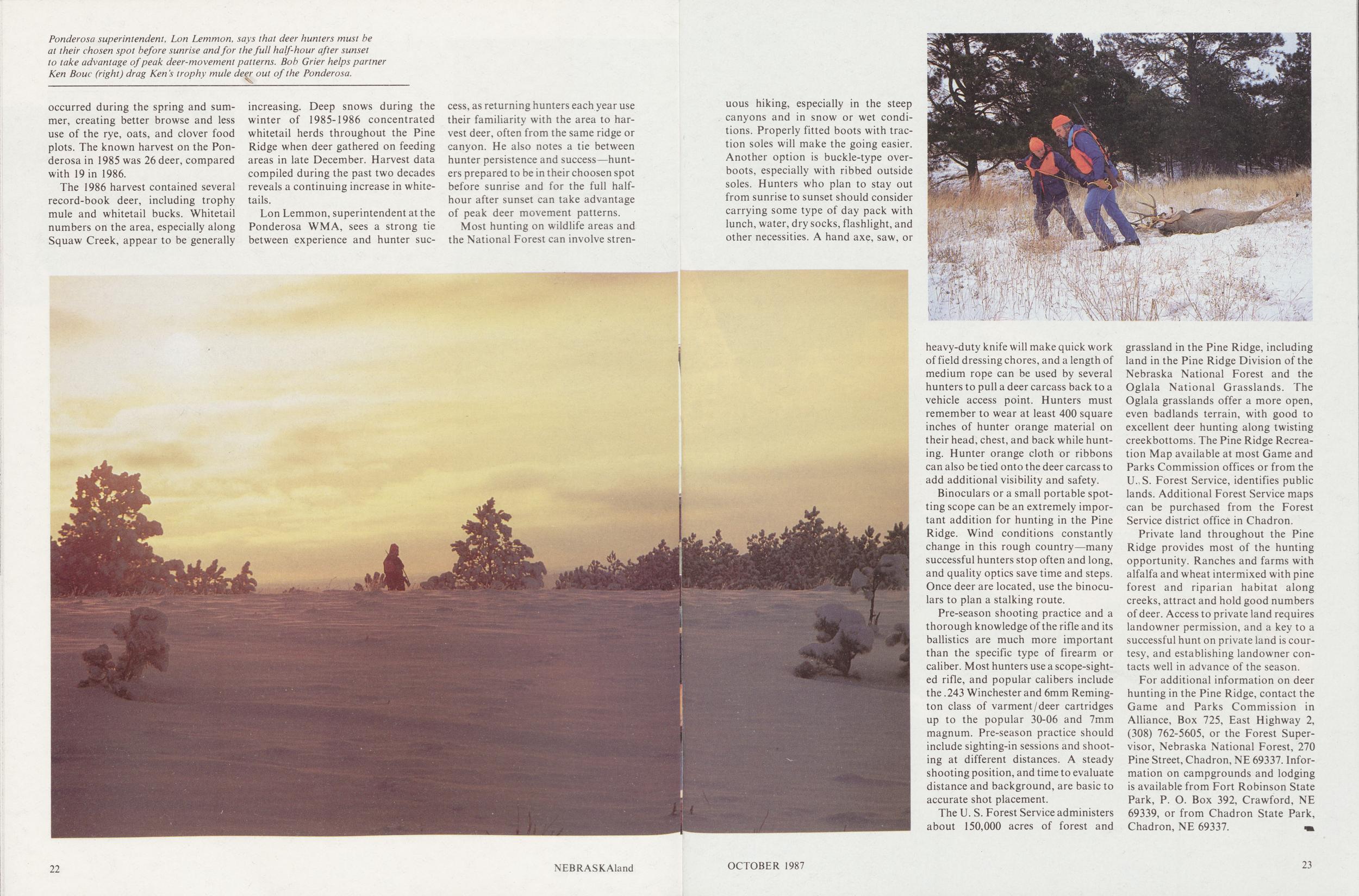 Ponderosa superintendent, Lon Lemmon, says that deer hunters must be
at their chosen spot before sunrise and for the full half-hour after sunset
to take advantage of peak deer-movement patterns. Bob Grier helps partner
Ken Bouc (right) drag Ken's trophy mule deer out of the Ponderosa.
Ponderosa superintendent, Lon Lemmon, says that deer hunters must be
at their chosen spot before sunrise and for the full half-hour after sunset
to take advantage of peak deer-movement patterns. Bob Grier helps partner
Ken Bouc (right) drag Ken's trophy mule deer out of the Ponderosa.
The 1986 harvest contained several record-book deer, including trophy mule and whitetail bucks. Whitetail numbers on the area, especially along Squaw Creek, appear to be generally increasing. Deep snows during the winter of 1985-1986 concentrated whitetail herds throughout the Pine Ridge when deer gathered on feeding areas in late December. Harvest data compiled during the past two decades reveals a continuing increase in whitetails.
Lon Lemmon, superintendent at the Ponderosa WMA, sees a strong tie between experience and hunter success, as returning hunters each year use their familiarity with the area to harvest deer, often from the same ridge or canyon. He also notes a tie between hunter persistence and success—hunters prepared to be in their chosen spot before sunrise and for the full halfhour after sunset can take advantage of peak deer movement patterns.
Most hunting on wildlife areas and the National Forest can involve strenuous
Binoculars or a small portable spotting scope can be an extremely important addition for hunting in the Pine Ridge. Wind conditions constantly change in this rough country—many successful hunters stop often and long, and quality optics save time and steps, Once deer are located, use the binoculars to plan a stalking route.
Pre-season shooting practice and a thorough knowledge of the rifle and its ballistics are much more important than the specific type of firearm or caliber. Most hunters use a scope-sighted rifle, and popular calibers include the .243 Winchester and 6mm Remington class of varment/deer cartridges up to the popular 30-06 and 7mm magnum. Pre-season practice should include sighting-in sessions and shooting at different distances. A steady shooting position, and time to evaluate distance and background, are basic to accurate shot placement.
The U. S. Forest Service administers about 150,000 acres of forest and grassland in the Pine Ridge, including land in the Pine Ridge Division of the Nebraska National Forest and the Oglala National Grasslands. The Oglala grasslands offer a more open, even badlands terrain, with good to excellent deer hunting along twisting creek bottoms. The Pine Ridge Recreation Map available at most Game and Parks Commission offices or from the U.S. Forest Service, identifies public lands. Additional Forest Service maps can be purchased from the Forest Service district office in Chadron.
Private land throughout the Pine Ridge provides most of the hunting opportunity. Ranches and farms with alfalfa and wheat intermixed with pine forest and riparian habitat along creeks, attract and hold good numbers of deer. Access to private land requires landowner permission, and a key to a successful hunt on private land is courtesy, and establishing landowner contacts well in advance of the season.
For additional information on deer hunting in the Pine Ridge, contact the Game and Parks Commission in Alliance, Box 725, East Highway 2, (308) 762-5605, or the Forest Supervisor, Nebraska National Forest, 270 Pine Street, Chadron, NE 69337. Information on campgrounds and lodging is available from Fort Robinson State Park, P. O. Box 392, Crawford, NE 69339, or from Chadron State Park, Chadron, NE 69337.
OCTOBER 1987 23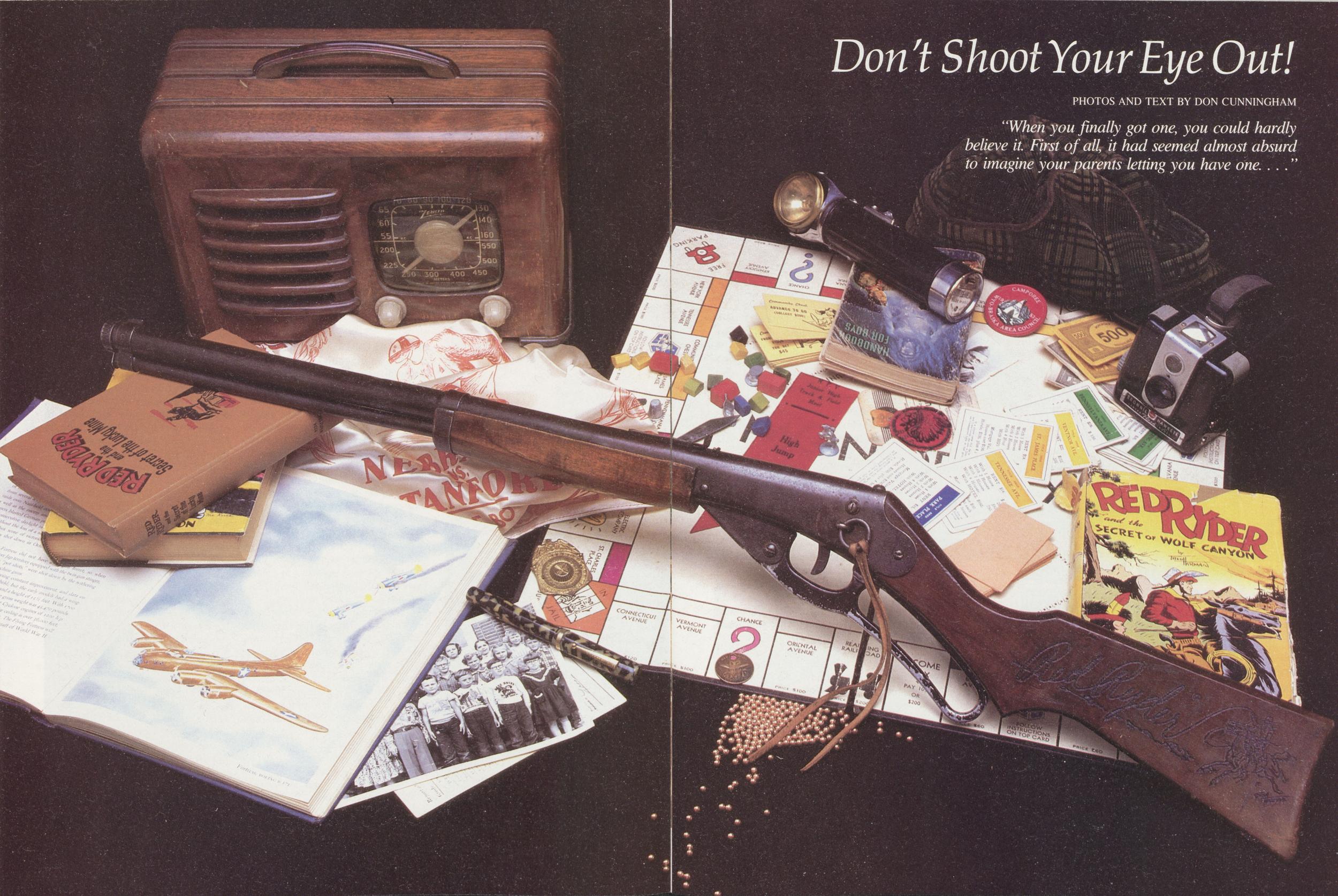
Don't Shoot Your Eye Out!
PHOTOS AND TEXT BY DON CUNNINGHAM "When you finally got one, you could hardly believe it First of all, it had seemed almost absurd to imagine your parents letting you have one. . . ."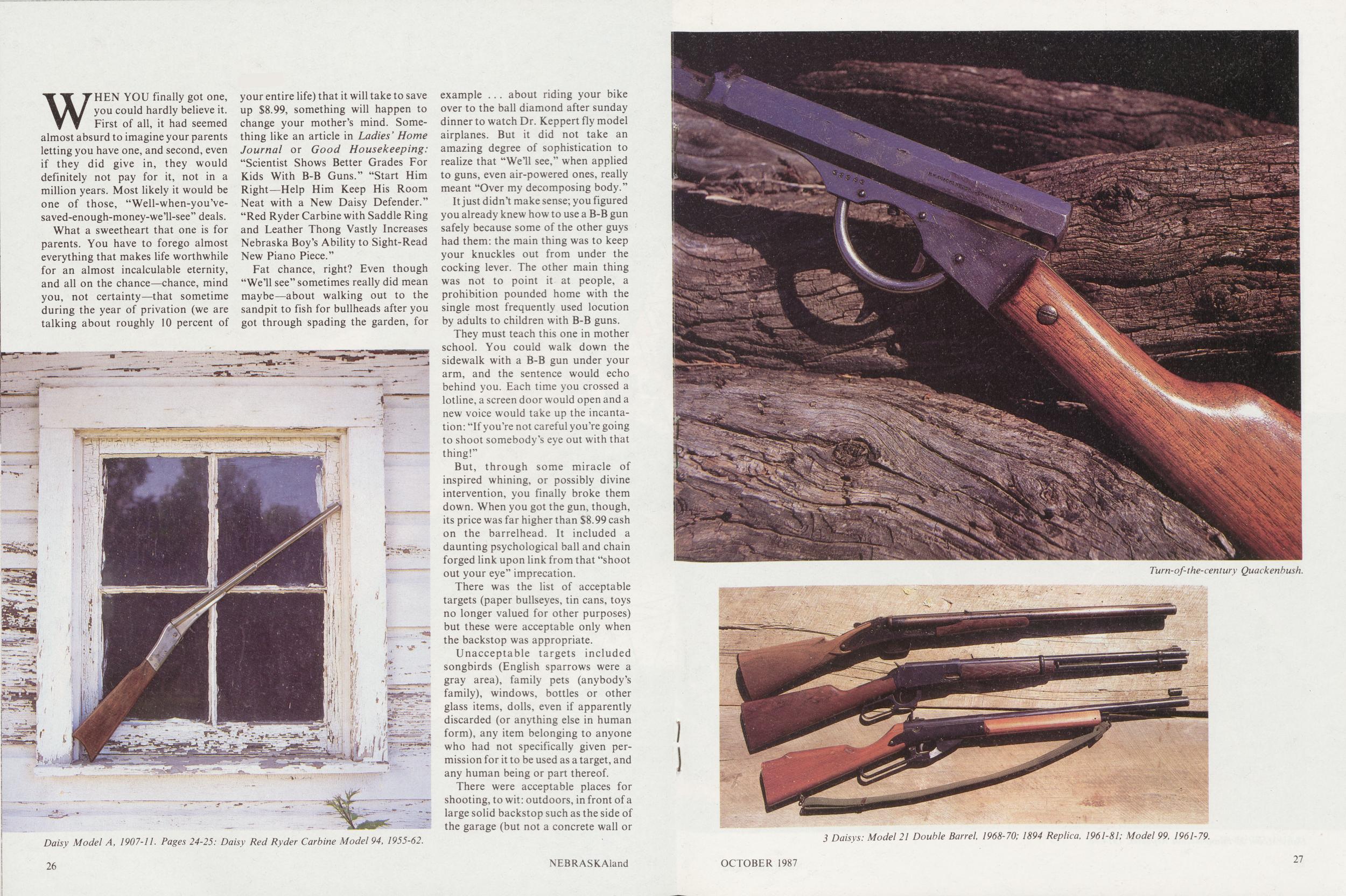
WHEN YOU finally got one, you could hardly believe it. First of all, it had seemed almost absurd to imagine your parents letting you have one, and second, even if they did give in, they would definitely not pay for it, not in a million years. Most likely it would be one of those, "Well-when-you've-saved-enough-money-we'11-see" deals.
What a sweetheart that one is for parents. You have to forego almost everything that makes life worthwhile for an almost incalculable eternity, and all on the chance—chance, mind you, not certainty—that sometime during the year of privation (we are talking about roughly 10 percent of your entire life) that it will take to save up $8.99, something will happen to change your mother's mind. Something like an article in Ladies' Home Journal or Good Housekeeping: "Scientist Shows Better Grades For Kids With B-B Guns." "Start Him Right—Help Him Keep His Room Neat with a New Daisy Defender." "Red Ryder Carbine with Saddle Ring and Leather Thong Vastly Increases Nebraska Boy's Ability to Sight-Read New Piano Piece."
Fat chance, right? Even though "We'll see" sometimes really did mean maybe—about walking out to the sandpit to fish for bullheads after you got through spading the garden, for example .. . about riding your bike over to the ball diamond after Sunday dinner to watch Dr. Keppert fly model airplanes. But it did not take an amazing degree of sophistication to realize that "We'll see," when applied to guns, even air-powered ones, really meant "Over my decomposing body."
It just didn't make sense; you figured you already knew how to use a B-B gun safely because some of the other guys had them: the main thing was to keep your knuckles out from under the cocking lever. The other main thing was not to point it at people, a prohibition pounded home with the single most frequently used locution by adults to children with B-B guns.
They must teach this one in mother school. You could walk down the sidewalk with a B-B gun under your arm, and the sentence would echo behind you. Each time you crossed a lot line, a screen door would open and a new voice would take up the incantation: "If you're not careful you're going to shoot somebody's eye out with that thing!"
But, through some miracle of inspired whining, or possibly divine intervention, you finally broke them down. When you got the gun, though, its price was far higher than $8.99 cash on the barrelhead. It included a daunting psychological ball and chain forged link upon link from that "shoot out your eye" imprecation.
There was the list of acceptable targets (paper bullseyes, tin cans, toys no longer valued for other purposes) but these were acceptable only when the backstop was appropriate.
Unacceptable targets included songbirds (English sparrows were a gray area), family pets (anybody's family), windows, bottles or other glass items, dolls, even if apparently discarded (or anything else in human form), any item belonging to anyone who had not specifically given permission for it to be used as a target, and any human being or part thereof.
There were acceptable places for shooting, to wit: outdoors, in front of a large solid backstop such as the side of the garage (but not a concrete wall or other possibly ricochet-producing surface, including a pond or lake), or, outdoors surrounded by open fields extending at least a half-mile in all directions.
26 NEBRASKAland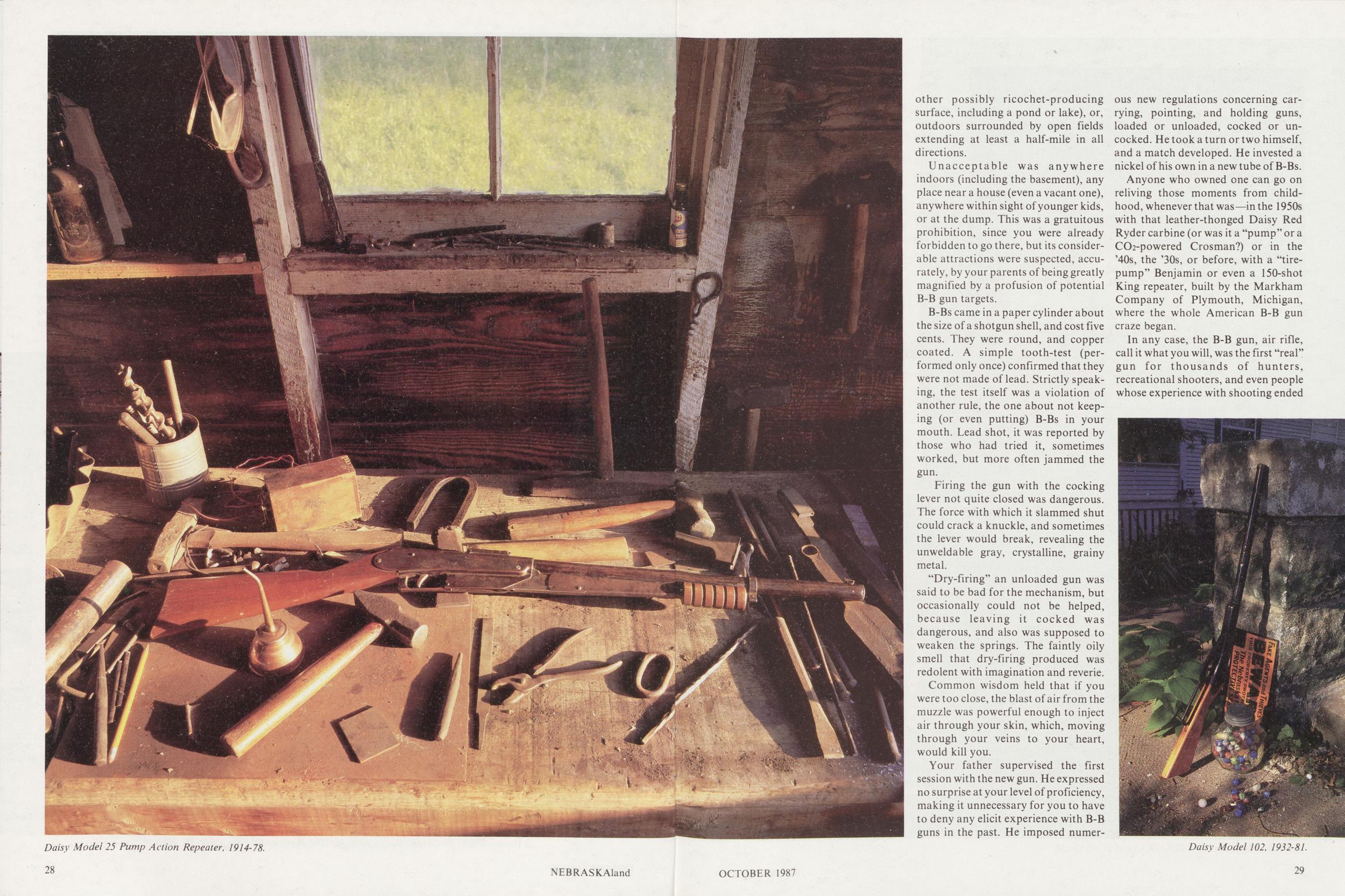
Unacceptable was anywhere indoors (including the basement), any place near a house (even a vacant one), anywhere within sight of younger kids, or at the dump. This was a gratuitous prohibition, since you were already forbidden to go there, but its considerable attractions were suspected, accurately, by your parents of being greatly magnified by a profusion of potential B-B gun targets.
B-Bs came in a paper cylinder about the size of a shotgun shell, and cost five cents. They were round, and copper coated. A simple tooth-test ( performed only once) confirmed that they were not made of lead. Strictly speaking, the test itself was a violation of another rule, the one about not keeping (or even putting) B-Bs in your mouth. Lead shot, it was reported by those who had tried it, sometimes worked, but more often jammed the gun.
Firing the gun with the cocking lever not quite closed was dangerous. The force with which it slammed shut could crack a knuckle, and sometimes the lever would break, revealing the unweldable gray, crystalline, grainy metal.
"Dry-firing" an unloaded gun was said to be bad for the mechanism, but occasionally could not be helped, because leaving it cocked was dangerous, and also was supposed to weaken the springs. The faintly oily smell that dry-firing produced was redolent with imagination and reverie.
Common wisdom held that if you were too close, the blast of air from the muzzle was powerful enough to inject air through your skin, which, moving through your veins to your heart, would kill you.
Your father supervised the first session with the new gun. He expressed no surprise at your level of proficiency, making it unnecessary for you to have to deny any elicit experience with B-B guns in the past. He imposed numerous new regulations concerning carrying, pointing, and holding guns, loaded or unloaded, cocked or uncocked. He took a turn or two himself, and a match developed. He invested a nickel of his own in a new tube of B-Bs.
Anyone who owned one can go on reliving those moments from child- hood, whenever that was—in the 1950s with that leather-thonged Daisy Red Ryder carbine (or was it a "pump" or a powered Crossman?) or in the '40s, the '30s, or before, with a "tirepump" Benjamin or even a 150-shot King repeater, built by the Markham Company of Plymouth, Michigan, where the whole American B-B gun craze began.
In any case, the B-B gun, air rifle, call it what you will, was the first "real" gun for thousands of hunters, recreational shooters, and even people whose experience with shooting ended with the passing on of that first Crosman, Benjamin, or Daisy to kid brother or sister.
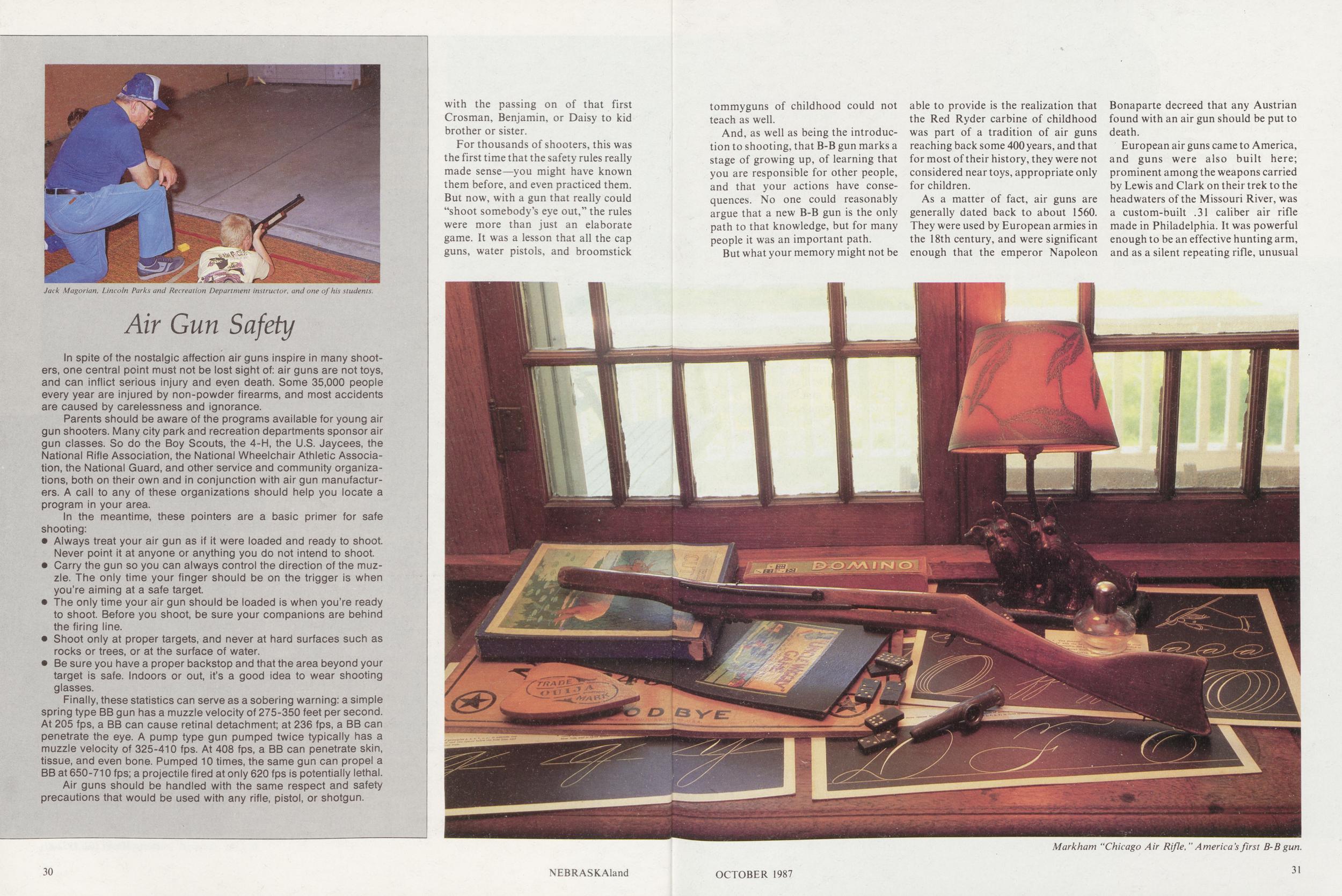
In spite of the nostalgic affection air guns inspire in many shooters, one central point must not be lost sight of: air guns are not toys, and can inflict serious injury and even death. Some 35,000 people every year are injured by non-powder firearms, and most accidents are caused by carelessness and ignorance.
Parents should be aware of the programs available for young air gun shooters. Many city park and recreation departments sponsor air gun classes. So do the Boy Scouts, the 4-H, the U.S. Jaycees, the National Rifle Association, the National Wheelchair Athletic Association, the National Guard, and other service and community organizations, both on their own and in conjunction with air gun manufacturers. A call to any of these organizations should help you locate a program in your area.
in the meantime, these pointers are a basic primer for safe shooting:
• Always treat your air gun as if it were loaded and ready to shoot. Never point it at anyone or anything you do not intend to shoot. • Carry the gun so you can always control the direction of the muzzle. The only time your finger should be on the trigger is when you're aiming at a safe target. • The only time your air gun should be loaded is when you're ready to shoot. Before you shoot, be sure your companions are behind the firing line. • Shoot only at proper targets, and never at hard surfaces such as rocks or trees, or at the surface of water. • Be sure you have a proper backstop and that the area beyond your target is safe. Indoors or out, it's a good idea to wear shooting glasses.Finally, these statistics can serve as a sobering warning: a simple spring type BB gun has a muzzle velocity of 275-350 feet per second. At 205 fps, a BB can cause retinal detachment; at 236 fps, a BB can penetrate the eye. A pump type gun pumped twice typically has a muzzle velocity of 325-410 fps. At 408 fps, a BB can penetrate skin, tissue, and even bone. Pumped 10 times, the same gun can propel a BB at 650-710 fps; a projectile fired at only 620 fps is potentially lethal.
Air guns should be handled with the same respect and safety precautions that would be used with any rifle, pistol, or shotgun.
For thousands of shooters, this was the first time that the safety rules really made sense—you might have known them before, and even practiced them. But now, with a gun that really could "shoot somebody's eye out," the rules were more than just an elaborate game. It was a lesson that all the cap guns, water pistols, and broomstick 30 NEBRASKAland tommyguns of childhood could not teach as well.
And, as well as being the introduction to shooting, that B-B gun marks a stage of growing up, of learning that you are responsible for other people, and that your actions have consequences. No one could reasonably argue that a new B-B gun is the only path to that knowledge, but for many people it was an important path.
But what your memory might not be able to provide is the realization that the Red Ryder carbine of childhood was part of a tradition of air guns reaching back some 400 years, and that for most of their history, they were not considered near toys, appropriate only for children.
As a matter of fact, air guns are generally dated back to about 1560. They were used by European armies in the 18th century, and were significant enough that the emperor Napoleon Bonaparte decreed that any Austrian found with an air gun should be put to death.
European air guns came to America, and guns were also built here; prominent among the weapons carried by Lewis and Clark on their trek to the headwaters of the Missouri River, was a custom-built .31 caliber air rifle made in Philadelphia. It was powerful enough to be an effective hunting arm, and as a silent repeating rifle, unusual
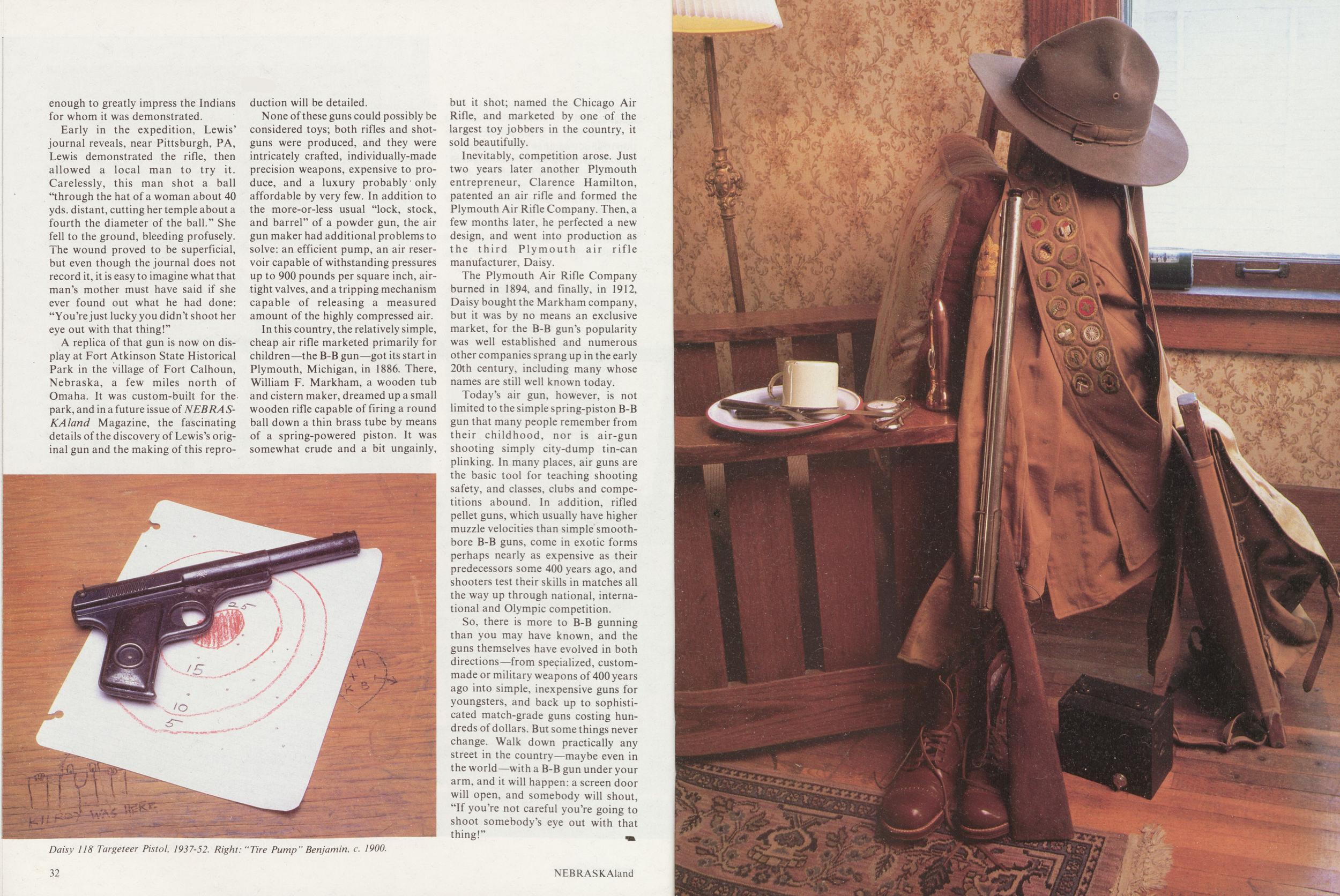 enough to greatly impress the Indians
for whom it was demonstrated.
enough to greatly impress the Indians
for whom it was demonstrated.
Early in the expedition, Lewis' journal reveals, near Pittsburgh, PA, Lewis demonstrated the rifle, then allowed a local man to try it. Carelessly, this man shot a ball "through the hat of a woman about 40 yds. distant, cutting her temple about a fourth the diameter of the ball." She fell to the ground, bleeding profusely. The wound proved to be superficial, but even though the journal does not record it, it is easy to imagine what that man's mother must have said if she ever found out what he had done: "You're just lucky you didn't shoot her eye out with that thing!"
A replica of that gun is now on display at Fort Atkinson State Historical Park in the village of Fort Calhoun, Nebraska, a few miles north of Omaha. It was custom-built for the park, and in a future issue of NEBRASKAland Magazine, the fascinating details of the discovery of Lewis's original gun and the making of this reproduction will be detailed.
None of these guns could possibly be considered toys; both rifles and shotguns were produced, and they were intricately crafted, individually-made precision weapons, expensive to produce, and a luxury probably only affordable by very few. In addition to the more-or-less usual "lock, stock, and barrel" of a powder gun, the air gun maker had additional problems to solve: an efficient pump, an air reservoir capable of withstanding pressures up to 900 pounds per square inch, airtight valves, and a tripping mechanism capable of releasing a measured amount of the highly compressed air.
In this country, the relatively simple, cheap air rifle marketed primarily for children—the B-B gun—got its start in Plymouth, Michigan, in 1886. There, William F. Markham, a wooden tub and cistern maker, dreamed up a small wooden rifle capable of firing a round ball down a thin brass tube by means of a spring-powered piston. It was somewhat crude and a bit ungainly, but it shot; named the Chicago Air Rifle, and marketed by one of the largest toy jobbers in the country, it sold beautifully.
Inevitably, competition arose. Just two years later another Plymouth entrepreneur, Clarence Hamilton, patented an air rifle and formed the Plymouth Air Rifle Company. Then, a few months later, he perfected a new design, and went into production as the third Plymouth air rifle manufacturer, Daisy.
The Plymouth Air Rifle Company burned in 1894, and finally, in 1912, Daisy bought the Markham company, but it was by no means an exclusive market, for the B-B gun's popularity was well established and numerous other companies sprang up in the early 20th century, including many whose names are still well known today.
Today's air gun, however, is not limited to the simple spring-piston B-B gun that many people remember from their childhood, nor is air-gun shooting simply city-dump tin-can plinking. In many places, air guns are the basic tool for teaching shooting safety, and classes, clubs and competitions abound. In addition, rifled pellet guns, which usually have higher muzzle velocities than simple smoothbore B-B guns, come in exotic forms perhaps nearly as expensive as their predecessors some 400 years ago, and shooters test their skills in matches all the way up through national, international and Olympic competition.
So, there is more to B-B gunning than you may have known, and the guns themselves have evolved in both directions—from specialized, custom made or military weapons of 400 years ago into simple, inexpensive guns for youngsters, and back up to sophisticated match-grade guns costing hundreds of dollars. But some things never change. Walk down practically any street in the country—maybe even in the world—with a B-B gun under your arm, and it will happen: a screen door will open, and somebody will shout, "If you're not careful you're going to shoot somebody's eye out with that thing!
32 NEBRASKAland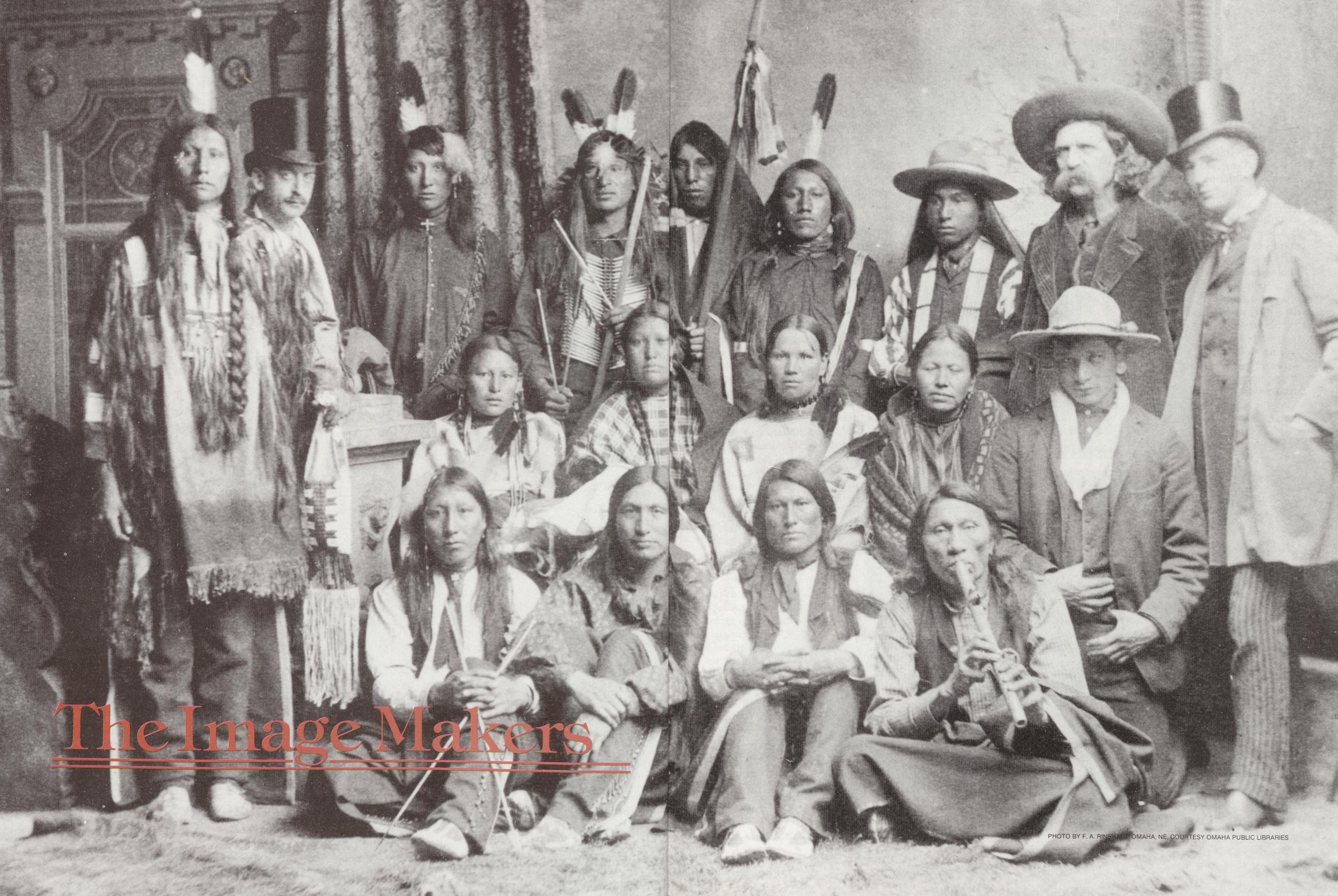
The Image MAkers
 BY JOHN CARTER, NEBRASKA STATE HISTORICAL SOCIETY
ALBERT BIERSTADT, the great American painter known for his monumental landscapes, traveled across Kansas and Nebraska in 1859 on his way to the Rocky Mountains. He carried with him a camera, perhaps to capture quickly that which time would not allow him to render on canvas.
Along the way, he made photo- graphs of some Oglala Sioux that his party encountered. These were the first photographs ever made of Indian people in Nebraska, and heralded the birth of a major genre in the photography of the American West.
The story of the growth of that genre is an interesting one. It's easy for.us to assume that for sorhe reason there were scores of photographers engaged in the sober, accurate recording of these people. But it was not the case.
As the practice of photographing Indians grew, photographers discovered a big market for their pictures. Thus, the growth of the industry of photographing Indians was as much a response to economy as a desire to document culture.
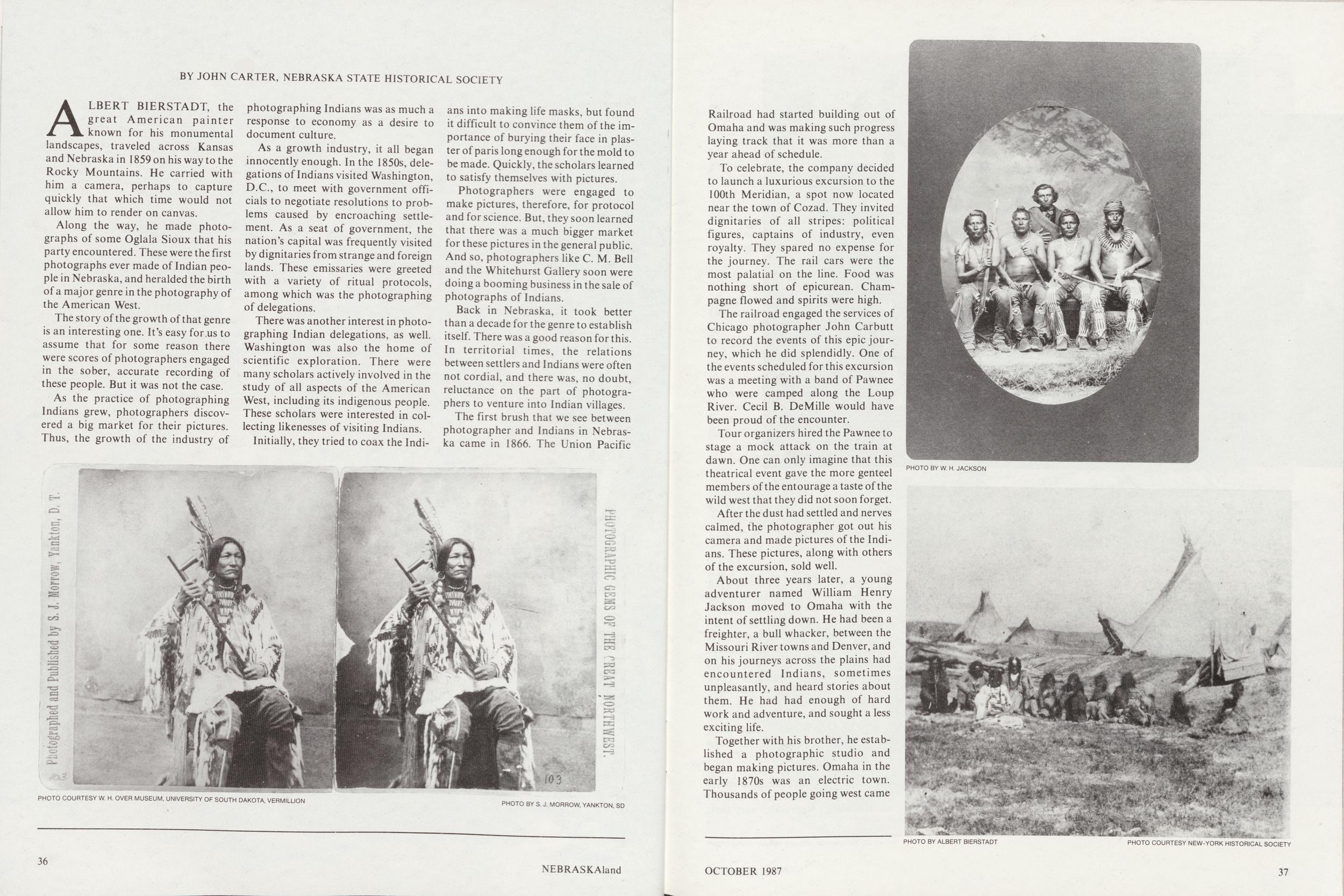
As a growth industry, it all began innocently enough. In the 1850s, delegations of Indians visited Washington, D.C., to meet with government officials to negotiate resolutions to problems caused by encroaching settlement. As a seat of government, the nation's capital was frequently visited by dignitaries from strange and foreign lands. These emissaries were greeted with a variety of ritual protocols, among which was the photographing of delegations.
There was another interest in photographing Indian delegations, as well. Washington was also the home of scientific exploration. There were many scholars actively involved in the study of all aspects of the American West, including its indigenous people. These scholars were interested in collecting likenesses of visiting Indians.
Initially, they tried to coax the Indians into making life masks, but found it difficult to convince them of the importance of burying their face in plaster of paris long enough for the mold to be made. Quickly, the scholars learned to satisfy themselves with pictures.
Photographers were engaged to make pictures, therefore, for protocol and for science. But, they soon learned that there was a much bigger market for these pictures in the general public. And so, photographers like C. M. Bell and the Whitehurst Gallery soon were doing a booming business in the sale of photographs of Indians.
Back in Nebraska, it took better than a decade for the genre to establish itself. There was a good reason for this. In territorial times, the relations between settlers and Indians were often not cordial, and there was, no doubt, reluctance on the part of photographers to venture into Indian villages.
The first brush that we see between photographer and Indians in Nebraska came in 1866. The Union Pacific 36 NEBRASKAland Railroad had started building out of Omaha and was making such progress laying track that it was more than a year ahead of schedule.
To celebrate, the company decided to launch a luxurious excursion to the 100th Meridian, a spot now located near the town of Cozad. They invited dignitaries of all stripes: political figures, captains of industry, even royalty. They spared no expense for the journey. The rail cars were the most palatial on the line. Food was nothing short of epicurean. Champagne flowed and spirits were high.
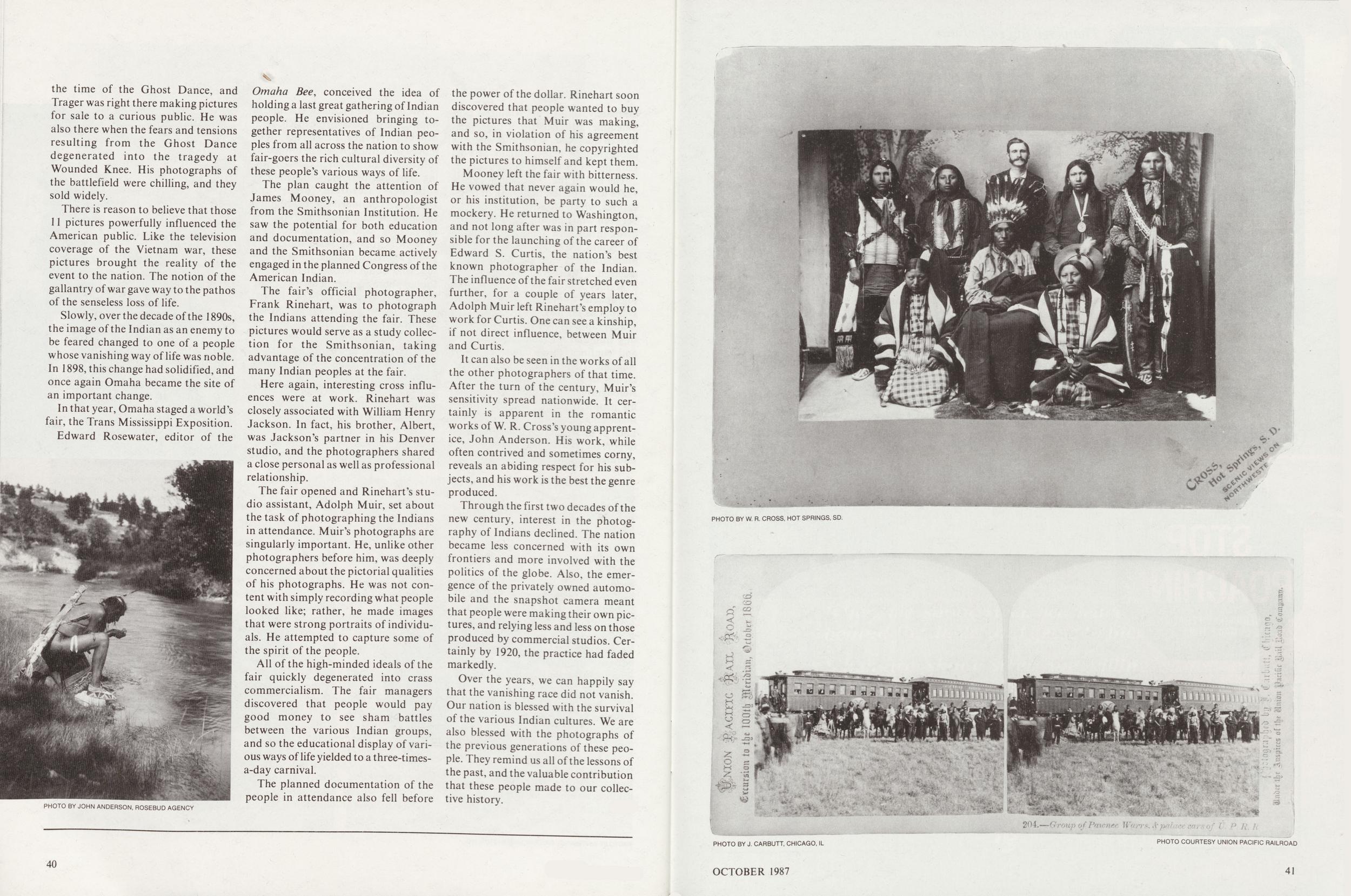
The railroad engaged the services of Chicago photographer John Carbutt to record the events of this epic journey, which he did splendidly. One of the events scheduled for this excursion was a meeting with a band of Pawnee who were camped along the Loup River. Cecil B. DeMille would have been proud of the encounter.
Tour organizers hired the Pawnee to stage a mock attack on the train at dawn. One can only imagine that this theatrical event gave the more genteel members of the entourage a taste of the wild west that they did not soon forget.
After the dust had settled and nerves calmed, the photographer got out his camera and made pictures of the Indians. These pictures, along with others of the excursion, sold well.
About three years later, a young adventurer named William Henry Jackson moved to Omaha with the intent of settling down. He had been a freighter, a bull whacker, between the Missouri River towns and Denver, and on his journeys across the plains had encountered Indians, sometimes unpleasantly, and heard stories about them. He had had enough of hard work and adventure, and sought a less exciting life.
Together with his brother, he established a photographic studio and began making pictures. Omaha in the early 1870s was an electric town. Thousands of people going west came to Omaha to either follow the trails west, or to ride the railroad into the new land. Omaha was a tourist mecca.
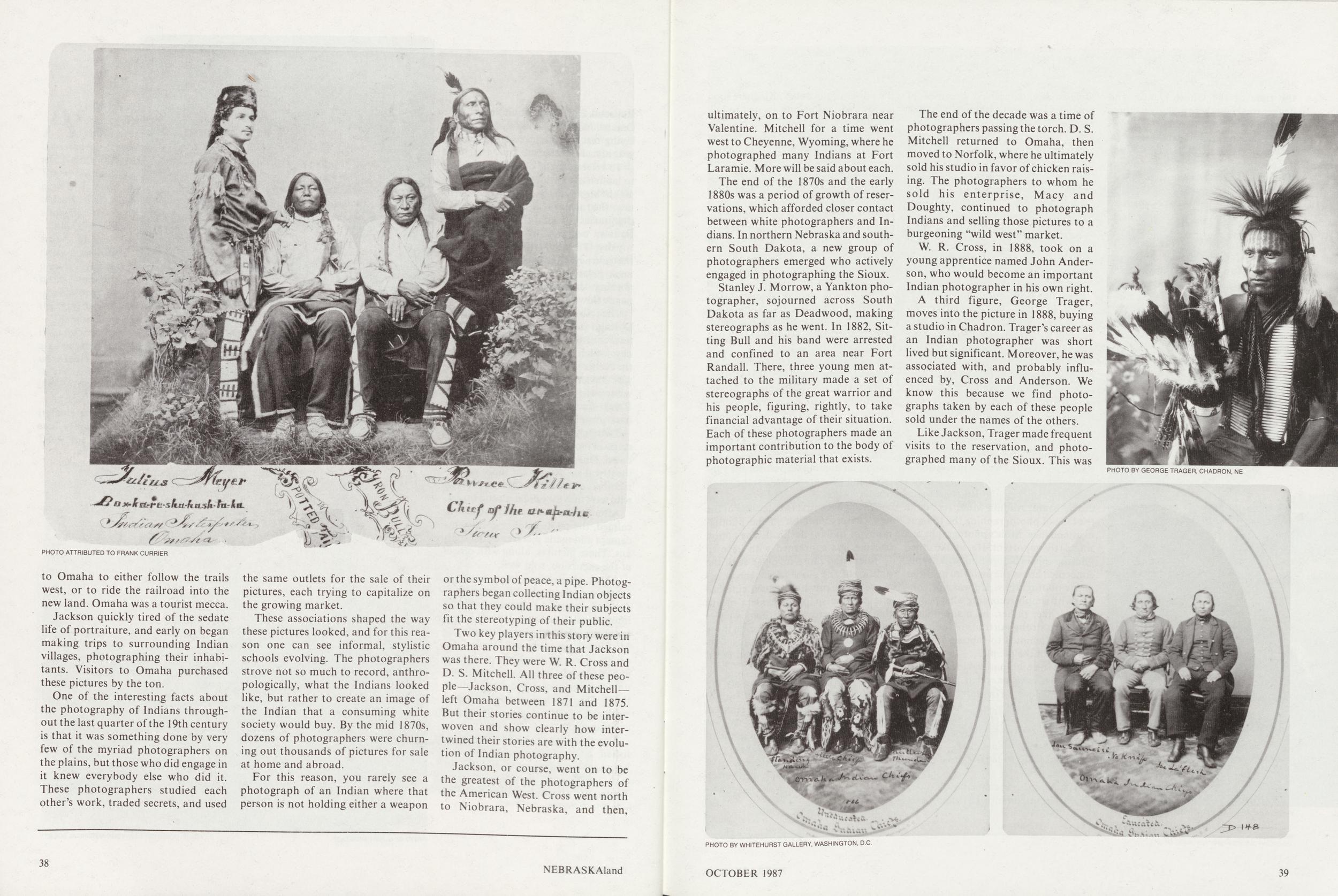
Jackson quickly tired of the sedate life of portraiture, and early on began making trips to surrounding Indian villages, photographing their inhabitants. Visitors to Omaha purchased these pictures by the ton.
One of the interesting facts about the photography of Indians throughout the last quarter of the 19th century is that it was something done by very few of the myriad photographers on the plains, but those who did engage in it knew everybody else who did it. These photographers studied each other's work, traded secrets, and used the same outlets for the sale of their pictures, each trying to capitalize on the growing market.
These associations shaped the way these pictures looked, and for this reason one can see informal, stylistic schools evolving. The photographers strove not so much to record, anthropologically, what the Indians looked like, but rather to create an image of the Indian that a consuming white society would buy. By the mid 1870s, dozens of photographers were churning out thousands of pictures for sale at home and abroad.
For this reason, you rarely see a photograph of an Indian where that person is not holding either a weapon or the symbol of peace, a pipe. Photographers began collecting Indian objects so that they could make their subjects fit the stereotyping of their public.
Two key players in this story were in Omaha around the time that Jackson was there. They were W. R. Cross and D. S. Mitchell. All three of these people—Jackson, Cross, and Mitchell left Omaha between 1871 and 1875. But their stories continue to be interwoven and show clearly how intertwined their stories are with the evolution of Indian photography.
Jackson, or course, went on to be the greatest of the photographers of the American West. Cross went north to Niobrara, Nebraska, and then, 38 NEBRASKAland ultimately, on to Fort Niobrara near Valentine. Mitchell for a time went west to Cheyenne, Wyoming, where he photographed many Indians at Fort Laramie. More will be said about each.
The end of the 1870s and the early 1880s was a period of growth of reservations, which afforded closer contact between white photographers and Indians. In northern Nebraska and southern South Dakota, a new group of photographers emerged who actively engaged in photographing the Sioux.
Stanley J. Morrow, a Yankton photographer, sojourned across South Dakota as far as Deadwood, making stereographs as he went. In 1882, Sitting Bull and his band were arrested and confined to an area near Fort Randall. There, three young men attached to the military made a set of stereographs of the great warrior and his people, figuring, rightly, to take financial advantage of their situation. Each of these photographers made an important contribution to the body of photographic material that exists.
The end of the decade was a time of photographers passing the torch. D. S. Mitchell returned to Omaha, then moved to Norfolk, where he ultimately sold his studio in favor of chicken raising. The photographers to whom he sold his enterprise, Macy and Doughty, continued to photograph Indians and selling those pictures to a burgeoning "wild west" market.
W. R. Cross, in 1888, took on a young apprentice named John Anderson, who would become an important Indian photographer in his own right.
A third figure, George Trager, moves into the picture in 1888, buying a studio in Chadron. Trager's career as an Indian photographer was short lived but significant. Moreover, he was associated with, and probably influenced by, Cross and Anderson. We know this because we find photographs taken by each of these people sold under the names of the others.
Like Jackson, Trager made frequent visits to the reservation, and photographed many of the Sioux. This was the time of the Ghost Dance, and Trager was right there making pictures for sale to a curious public. He was also there when the fears and tensions resulting from the Ghost Dance degenerated into the tragedy at Wounded Knee. His photographs of the battlefield were chilling, and they sold widely.
There is reason to believe that those 11 pictures powerfully influenced the American public. Like the television coverage of the Vietnam war, these pictures brought the reality of the event to the nation. The notion of the gallantry of war gave way to the pathos of the senseless loss of life.
Slowly, over the decade of the 1890s, the image of the Indian as an enemy to be feared changed to one of a people whose vanishing way of life was noble. In 1898, this change had solidified, and once again Omaha became the site of an important change.
In that year, Omaha staged a world's fair, the Trans Mississippi Exposition.
Edward Rosewater, editor of the Omaha Bee, conceived the idea of holding a last great gathering of Indian people. He envisioned bringing together representatives of Indian peoples from all across the nation to show fair-goers the rich cultural diversity of these people's various ways of life.
The plan caught the attention of James Mooney, an anthropologist from the Smithsonian Institution. He saw the potential for both education and documentation, and so Mooney and the Smithsonian became actively engaged in the planned Congress of the American Indian.
The fair's official photographer, Frank Rinehart, was to photograph the Indians attending the fair. These pictures would serve as a study collection for the Smithsonian, taking advantage of the concentration of the many Indian peoples at the fair.
Here again, interesting cross influences were at work. Rinehart was closely associated with William Henry Jackson. In fact, his brother, Albert, was Jackson's partner in his Denver studio, and the photographers shared a close personal as well as professional relationship.
The fair opened and Rinehart's studio assistant, Adolph Muir, set about the task of photographing the Indians in attendance. Muir's photographs are singularly important. He, unlike other photographers before him, was deeply concerned about the pictorial qualities of his photographs. He was not con- tent with simply recording what people looked like; rather, he made images that were strong portraits of individuals. He attempted to capture some of the spirit of the people.
All of the high-minded ideals of the fair quickly degenerated into crass commercialism. The fair managers discovered that people would pay good money to see sham battles between the various Indian groups, and so the educational display of various ways of life yielded to a three-times-a-day carnival.
The planned documentation of the people in attendance also fell before PHOTO BY JOHN ANDERSON, ROSEBUD AGENCY the power of the dollar. Rinehart soon discovered that people wanted to buy the pictures that Muir was making, and so, in violation of his agreement with the Smithsonian, he copyrighted the pictures to himself and kept them.
Mooney left the fair with bitterness. He vowed that never again would he, or his institution, be party to such a mockery. He returned to Washington, and not long after was in part responsible for the launching of the career of Edward S. Curtis, the nation's best known photographer of the Indian. The influence of the fair stretched even further, for a couple of years later, Adolph Muir left Rinehart's employ to work for Curtis. One can see a kinship, if not direct influence, between Muir and Curtis.
It can also be seen in the works of all the other photographers of that time. After the turn of the century, Muir's sensitivity spread nationwide. It certainly is apparent in the romantic works of W. R. Cross's young apprentice, John Anderson. His work, while often contrived and sometimes corny, reveals an abiding respect for his subjects, and his work is the best the genre produced.
Through the first two decades of the new century, interest in the photography of Indians declined. The nation became less concerned with its own frontiers and more involved with the politics of the globe. Also, the emergence of the privately owned automobile and the snapshot camera meant that people were making their own pictures, and relying less and less on those produced by commercial studios. Certainly by 1920, the practice had faded markedly.
Over the years, we can happily say that the vanishing race did not vanish. Our nation is blessed with the survival of the various Indian cultures. We are also blessed with the photographs of the previous generations of these people. They remind us all of the lessons of the past, and the valuable contribution that these people made to our collective history.
40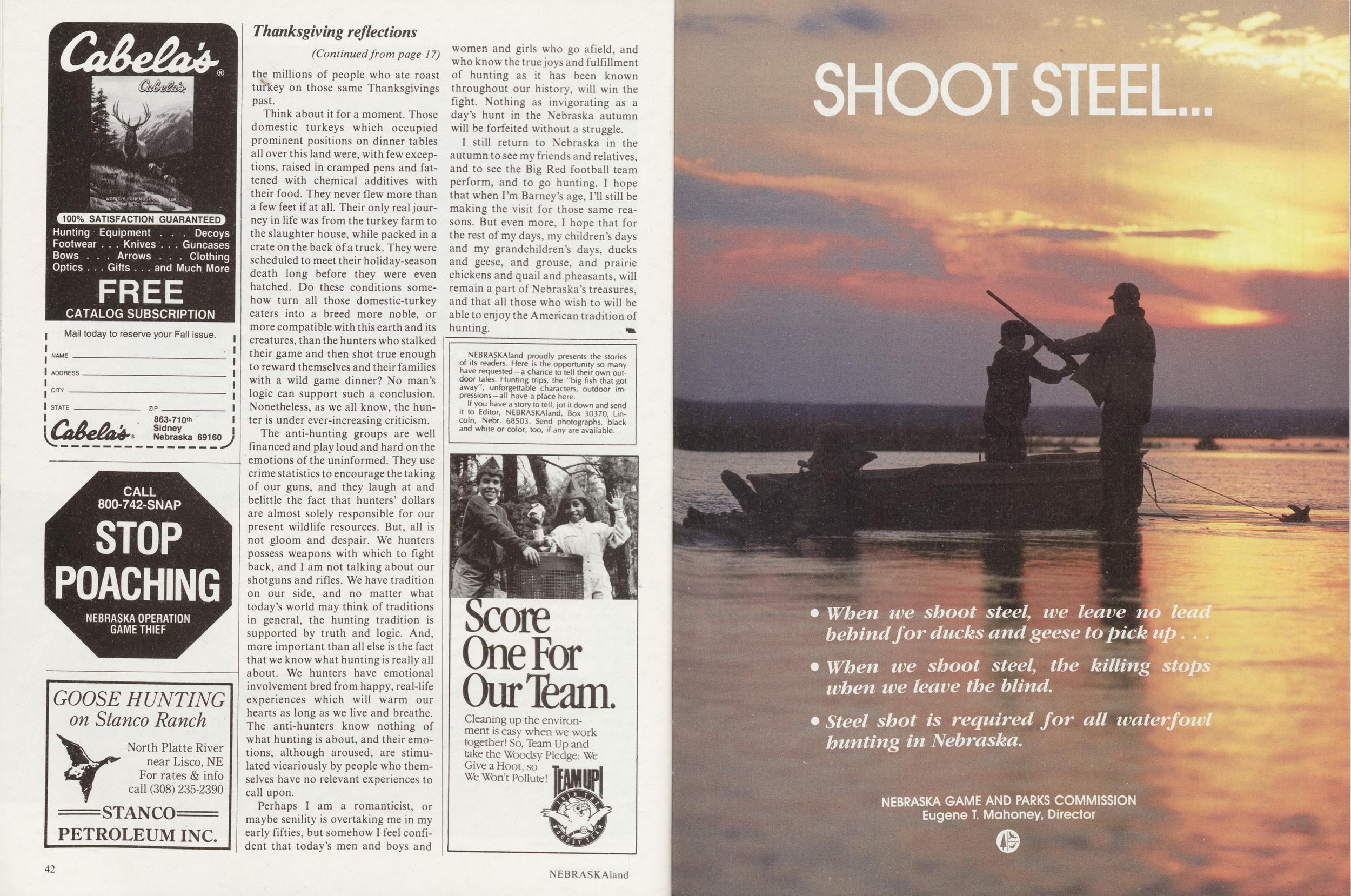
Thanksgiving reflections
(Continued from page 17)the millions of people who ate roast turkey on those same Thanksgivings past.
Think about it for a moment. Those domestic turkeys which occupied prominent positions on dinner tables all over this land were, with few exceptions, raised in cramped pens and fattened with chemical additives with their food. They never flew more than a few feet if at all. Their only real journey in life was from the turkey farm to the slaughter house, while packed in a crate on the back of a truck. They were scheduled to meet their holiday-season death long before they were even hatched. Do these conditions somehow turn all those domestic-turkey eaters into a breed more noble, or more compatible with this earth and its creatures, than the hunters who stalked their game and then shot true enough to reward themselves and their families with a wild game dinner? No man's logic can support such a conclusion. Nonetheless, as we all know, the hunter is under ever-increasing criticism.
The anti-hunting groups are well financed and play loud and hard on the emotions of the uninformed. They use crime statistics to encourage the taking of our guns, and they laugh at and belittle the fact that hunters' dollars are almost solely responsible for our present wildlife resources. But, all is not gloom and despair. We hunters possess weapons with which to fight back, and I am not talking about our shotguns and rifles. We have tradition on our side, and no matter what today's world may think of traditions in general, the hunting tradition is supported by truth and logic. And, more important than all else is the fact that we know what hunting is really all about. We hunters have emotional involvement bred from happy, real-life experiences which will warm our hearts as long as we live and breathe. The anti-hunters know nothing of what hunting is about, and their emotions, although aroused, are stimulated vicariously by people who themselves have no relevant experiences to call upon.
Perhaps I am a romanticist, or maybe senility is overtaking me in my early fifties, but somehow I feel confident that today's men and boys and women and girls who go afield, and who know the true joys and fulfillment of hunting as it has been known throughout our history, will win the fight. Nothing as invigorating as a day's hunt in the Nebraska autumn will be forfeited without a struggle.
I still return to Nebraska in the autumn to see my friends and relatives, and to see the Big Red football team perform, and to go hunting. I hope that when I'm Barney's age, I'll still be making the visit for those same reasons. But even more, I hope that for the rest of my days, my children's days and my grandchildren's days, ducks and geese, and grouse, and prairie chickens and quail and pheasants, will remain a part of Nebraska's treasures, and that all those who wish to will be able to enjoy the American tradition of hunting.
NEBRASKAland proudly presents the stories of its readers. Here is the opportunity so many have requested-a chance to tell their own outdoor tales. Hunting trips, the "big fish that got away", unforgettable characters, outdoor impressions-all have a place here.
If you have a story to tell, jot it down and send it to Editor, NEBRASKland, Box 30370, Lincoln, Nebr. 68503. Send photographs, black and white or color, too, if any are available.
Who's picking up the tab?
(Continued from page 15)maintain wildlife populations, and provide places to hunt.
When it comes to a straight dollars-and-cents approach, how many pheasants could $15 a year buy? If you went to a game farm you might get one or two birds. Should you expect more from your hunting fee money? Probably not a whole lot more. But, if you are like most hunters, you expect more than one or two pheasants a year. Who should pay for them? Granted, hunters spend a lot of money on equipment, transportation, lodging, meals, and all the other expenses of hunting. But of all that money, only the small percentage of excise tax on arms and ammunition that funds the federal Pittman-Robertson program and returns dollars to the state, is applied toward wildlife enhancement.
So, who should pay for the wildlife we expect? The landowner? What's in it for the landowner? Remember, we are talking about wildlife habitat, not access to hunt. Wildlife is probably of little economic value to the landowner, unless that habitat is performing some other function, such as holding a gully against soil erosion, or keeping a creek or river in its banks and out of his field.
Until recently, hunting, in one form or another, was an inexpensive recreation available to everyone. Obviously, not everyone could go to Alaska to hunt brown bear or Dall sheep, but with a minimum of cost he could hunt ducks on the river south of town, or pheasants in the slough on the back forty. To a large extent that is still the case in much of rural Nebraska. But, like everything else, this has changed and will continue to change. If there are not more hunters, there are at least more hunters who cannot or do not 44 NEBRASKAland want to hunt close to home. More pheasant hunters in eastern Nebraska want to hunt grouse in the Sandhills than was the case at the turn of the century. More hunters now live in urban areas and do not know landowners on a personal basis. We are a society with more discretionary money, more leisure time and better transportation. At the same time, for many game animals, particularly upland gamebirds and waterfowl, we have a shrinking resource, less wild game than we once had, and fewer places where wild game can prosper and hunters can pursue them.
Increasingly, we hear that the only way to ensure an acceptable quantity and quality of wildlife on private land is to make it economically advantageous for the landowner. That's a nice way of saying those who want wildlife, pay the landowner. Actually this is not a new concept. Aldo Leopold, one of America's most respected wildlife philosophers, addressed the need to recognize private landowners as custodians of wildlife back in 1930.
"Compensate him either publicly or privately with either cash, service, or protection, for the use of his land and for his labor, on the condition that he preserves the game seed and otherwise safeguards the public interest," Leopold wrote. "In short, make game management a partnership enterprise to which the landholder, the sportsman, and the public each contributes appropriate services and from which each derives appropriate rewards."
Leopold, while advocating general public support of land and wildlife conservation, wrote in equally strong language, and at far greater length, of the "stewardship" responsibilities that come with being a custodian of the land.
"There is a clear tendency in American conservation to relegate to government all necessary jobs that private landowners fail to perform," Leopold wrote in A Sand County Almanac. "What is the ultimate magnitude of the enterprise? Will the tax base carry its eventual ramifications? At what point will governmental conservation, like the mastodon, become handicapped by its own dimensions? The answer, if there is any, seems to be in a land ethic, or some other force which assigns more obligation to the private landowner.
"When the private landowner," Leopold continues, "is asked to perform some unprofitable act for the good of the community, he today assents only with outstretched palm. If the act costs him cash, this is fair and proper, but when it costs only fore- thought, open-mindedness or time, the issue is at least debatable."
In the February 1983 issue of Rangelands, authors T. O. Dill and J. Menghini, S. S. Waller, and R. Case from the University of Nebraska, elaborated on this suggestion in an article titled "Fee Hunting for Nebraska Big Game: A Possibility."
"In Nebraska, over 90 percent of the land is privately owned. The landowner controls access to his land and therefore access to wildlife on his land. The presence and abundance of wildlife are controlled largely by habitat. Under a fee hunting system the landowner would have an incentive to maintain or improve habitat for big game animals which in many cases would also be beneficial for livestock. By offering a fee hunting system the landowner gains reimbursement for making improvements, maintaining game habitat and forage consumed by the game animals. He also provides benefits for the hunter. The hunter is assured of a place to hunt, likely increased hunting success, and increased hunter safety. Both parties benefit from the experience and social contact with one another. With a fee hunting system the landowner would not allow over-harvest of the game population which may endanger the survival of the 'crop\"
Some Nebraska hunters are already paying landowners to ensure them- selves a place to hunt with a reasonable chance of success and a minimum of interference from other hunters. This is more common among waterfowl hunters who years ago accepted the idea of buying a hunting lease. In recent years, more hunters have been buying leases for upland bird hunting. The trend is certain to continue. And, we are witnessing a surge of new controlled-shooting areas in the state, indicating that those hunters who can afford it are looking at alternatives to knocking on landowners' doors.
But, what happens to the hunter who cannot afford to buy a lease? Is he simply priced out of hunting recreation?
Some say the state should pay landowners to maintain wildlife habitat, in effect be a middle man between hunters who want to maintain habitat for wildlife and landowners who control most of the land in the state. The state already does precisely that through the Habitat Program but, as valuable as that program may be, it is a drop in the bucket in meeting the needs of Nebraska hunters. If the state is to increase its role in habitat maintenance on both public and private lands, it will need more funds, and someone, more than likely the hunter, is going to have to dig a little deeper into his pocket. Perhaps an annual habitat stamp fee of $50 would be enough, in time, to meet the demand, but that would no doubt price some hunters out of the game. But then, is hunting a guaranteed right, like free speech? Or, is it more like golf, where you are guaranteed the right to play but if you can't afford the green fees you don't play?
Bill H. Tomlinson, a wildlife manager for the Anderson-Tully Company in Vicksburg, MS, put the issue in the context of economics in a paper he presented to the 50th North American Wildlife and Natural Resources Conference in 1985.
"When the wildlife resource is viewed as a commodity rather than an amenity, we begin seeing supply-and-demand economics at various stages of development in our country. Where public hunting lands are in abundance relative to the hunting population and are available on a free and open basis, few hunters are willing to pay for hunting opportunities on public or private lands. However, as the quantity of such land is decreased relative to the hunting population, and as the quality of the hunting experience decreases due to overcrowding, so increases the desire of many hunters, resident and non-resident alike, to find affordable areas which will give them more quality control relative to their recreational experience. Thus the private sector suddenly becomes an important and integral part in the overall picture of wildlife management and recreational opportunity for our nation. A noted ecologist once stated that any management system will suffice until demand exceeds supply. It is only when scarcity becomes a reality that individuals who manage private resources must be given incentives to consider the preferences of others."
1987-88 NEBRASKA HUNTING SEASONS Species Inclusive Dates Daily Bag Limit Cock Pheasant Nov. 7-Jan 24 3 Coot Same as Duck 15 Cottontail Sept. 1-Feb 29 7 Crow Oct. 1-Nov 15 Jan. 21-April 8 No Limit Mourning Dove Sept. 1-Oct. 30 15 Low Plains Late Duck Low Plains Ea.ly High Plains Oct 17-25 Oct. 31-Dec. 11 100 pts Oct. 10-Nov. 29 100 pts. Oct. 10-Nov. 29 Dec. 19-Jan. 3 100 pts Light Goose Oct. 3-Dec. 27 5 Dark Goose Oct. 3-Dec. 20 See 1987 Nebraska Hunting Guide Oct. 3-Dec. 13 Oct. 24-Jan. 3 Nov. 10-Jan. 3 Sandhills Special Canada Season Nov. 1-Dec. 31 See Hunt Guide Grouse Sept. 12-Nov. 30 3 Hungarian Partridge Nov. 7-Jan. 24 3 Quail Nov. 7-Jan. 24 6 Raccoon/Opossum* Nov. 5-Jan. 7 No Limit Rail Sept. 1-Nov. 9 10 Common Snipe Sept. 1-Dec. 15 8 Squirrel Aug. 1-Jan. 31 7 Woodcock Sept. 15-Nov. 18 5 Bobcat Dec. 15-Jan. 15 No Limit Jack Rabbit Sept. 1-Feb. 29 8 *Fur Harvester Permit required. AVENUE - ART GALLERY Original art by Nebraska artists A unique, one-of-a-kind place goilery East Park Piaza MaM 66th and O Streets Lincoln, Nebraska Special orders and commissions LAND FOR SALE 174 acres with 40 acre lake. Abundance of wildlife and fish. For more information write to Howard Hanson, Box 957, Stanton, NE 68779. OCTOBER 1987 47 Catch the Good Life
At Merritt Reservoir
26 miles south of Valentine, NE
Offering a full year-around Guide Service
Home of the state record
• Musky
Fishing • Smallmouth Bass
• Channel Catfish
• Perch
• Walleye
• Crappie
• Largemouth Bass
• Bluegill
Hunting
The Picturesque Sandhills
• Duck
• Geese
• Sharptail Grouse
• Mule & Whitetail Deer
• Turkey
We Have All The Facilities To Accommodate
Your Business or Corporate Group
Experience a Sandhills Vacation at Merritt Trading Post
Merritt Dam Trading Post
Valentine, NE 69201
Your Hosts
Jon and Marian Davenport
American Heart
Association
^ Nebraska Affiliate
Now call it quits. we're fighting for your life
anothcr morning has broken in
the wetlands, home to one third
ofAmerica's threatened or
endangered species. Join
the Ducks Unlimited
50th Anniversary
celebration and
help us continue to
save our wetlands.
IVritei Ducks Unlimited, One
~Waterfowl ~WauLong Grove,
Illinois, 60047.
Ducks Unlimited
Leader in Wetlands Conservation—50 Years
Catch the Good Life
At Merritt Reservoir
26 miles south of Valentine, NE
Offering a full year-around Guide Service
Home of the state record
• Musky
Fishing • Smallmouth Bass
• Channel Catfish
• Perch
• Walleye
• Crappie
• Largemouth Bass
• Bluegill
Hunting
The Picturesque Sandhills
• Duck
• Geese
• Sharptail Grouse
• Mule & Whitetail Deer
• Turkey
We Have All The Facilities To Accommodate
Your Business or Corporate Group
Experience a Sandhills Vacation at Merritt Trading Post
Merritt Dam Trading Post
Valentine, NE 69201
Your Hosts
Jon and Marian Davenport
American Heart
Association
^ Nebraska Affiliate
Now call it quits. we're fighting for your life
anothcr morning has broken in
the wetlands, home to one third
ofAmerica's threatened or
endangered species. Join
the Ducks Unlimited
50th Anniversary
celebration and
help us continue to
save our wetlands.
IVritei Ducks Unlimited, One
~Waterfowl ~WauLong Grove,
Illinois, 60047.
Ducks Unlimited
Leader in Wetlands Conservation—50 Years
To a large degree, Nebraska hunters have been spared the unpleasantness of facing up to these simple economic facts until recently. Even now it is at worst a minor inconvenience, and not for all Nebraska hunters. To most hunters in more densely populated regions of the country, paid hunting has long been a fact of life. Hunting is largely done on public land (and most states are far better endowed than Nebraska), at shooting preserves, or on land leased from private landowners. If it were simply a question of access to hunt, we could all seek solutions that were adequate—from having to knock on a few more doors to offering landowners tokens of appreciation for the right to hunt to leasing land or paying a daily hunt fee. But, it is not that simple. Without adequate habitat to support wildlife at the levels we desire, the question of access and what it will cost us become secondary. If, as hunters, we want landowners to preserve wildlife habitat we must compete with the grain elevators.
"... individual farmers are only doing what they consider to be economically expedient and have been educated to do by the agricultural establishment," wrote John L. Roseberry, in his book Population Ecology of the Bobwhite Quail. "Modern farming is a business, no longer just a kind of rural lifestyle. Farmers understandably strive to enhance efficiency at every opportunity, and wildlife is often not even a secondary consideration. Rural landowners cannot, of course, be expected to shoulder the entire responsibility for the welfare of farmland wildlife; nor, for that matter, can special-user groups. For wildlife to have a future in this country, a broadbased commitment on the part of society will be required—a commitment we seem unwilling to make."
There is no one answer, and certainly no easy answer. But it is time for hunters to start searching for alternatives and prepare to start paying for what we expect when we go into the field.
The November issue of NEBRASKAland will examine in greater detail one aspect of paid hunting—the recent increase in the number of controlled shooting areas, what they offer hunters and the regulations by which they must abide. 48 NEBRASKAlandTrading Post
DOGSTRAINING ALL BREEDS Hunting Dogs - - Vizslas for sale. Rozanek Kennels, Rt. 2, Schuyler, NE 68661. Phone (402) 352 8769._________________
ENGLISH SETTERS: "Bred for the hunter"; select puppies and started dogs available from outstanding bloodlines. Stud service available by proven hunters. High Plains Kennels, 1411 Emerson, Alliance, NE 69301, Phone (308) 762-6709._____________________
GROUSEWAY BRITTANIES: Ideal hunting companions—dedicated, goal-oriented breeding programs. FREE brochure, Grouseway Gundogs, Louisville, NE 68037. (402) 298-8340. Training available.___________
GERMAN WIRE-HAIR pointer pups. AKC welped 6/16/87. Top hunting and trial bloodlines. Phone (402) 483-2634.______________________________________
GERMAN SHORTHAIRS and Brittany Spaniel pups. Started and occasionally a meat dog. Pups are guaranteed. Also I will be training hunting dogs. Wayne Clark, Percival, I A. Phone (712) 529-4238 or (402) 263-3155 at Union, NE._____________________
ENGLISH SETTERS: Young dogs available from two well-bred litters. Born early 1987. Darrell Yentes. Phone (308) 995-8570 or (308) 995-4797 after 5 p.m.
YELLOW LABRADOR PUPS. Sire is FC-AFC The Marathon Man. A big, strong, hard-going dog, four years old with a bright future ahead of him. Dam is 80 pounds of intelligence and desire to please. An excellent river hunter. Hips OFA Certified. AKC. Shots. Robert A. Bendler, Lexington, NE. Phone (308) 324-4247.______________________________________
GERMAN WIRE-HAIR pointer pups. AKC welped 6/16/87. Top hunting and trial bloodlines. Phone (402) 483-2634. ___________________________________
VIZSLA'S-AKC FIELD CHAMPION sired-vizsla. Stud service pups for sale —guaranteed — SMA Kennels, Rt. 5, Box 113, Omaha, NE 68112. Phone (402) 453-1680.________________________________________
WEIMARANER AKC pups for sale. Steve Stepanek, 5311 Aylesworth, Lincoln, NE 68504. Phone (402) 467-2848. _____________________________________
MISCELLANEOUSNE NEBRASKA trout fishing. 3 modern cottages, 1 available year round. 5 spring fed lakes with open water all year. Trout up to 7 pounds. Other varieties fish also. Diamond E. Trout Resort, Orchard, NE 68764. Phone (402) 893-4745._________________________________
GUNS — Browning, Winchester, Remington, others, Hi-powers, shotguns, new, used, antiques. Want Pre-1964 Winchesters. Buy-Sell-Trade. Ph. (402) 729-6112. Bedlan's Sporting Goods, Fairbury, NE 68352.
MANDARIN DUCKS: nice full-wing birds $35.00 pair, woodducks $25.00 pair. Mrs. R. W. Hansen, 3315 Avenue L, Kearney, NE 68847. Phone (308) 237-3781.
MAD RIVER CANOES offers the finest quality and performance. For the finest canoes and accessories look to Great Plains Canoe Co., 205 Main, Springfield, NE. Phone (402) 253-2001._______________________
RECEIVE $75/100 envelopes returned to us. Rush stamped envelope: Kelley 4, 804 Old Thorsby Road, Clanton, Alabama 35045.
AIR GUNS repaired - Benjamin, Crosman, Daisy, other American made. Restoration; old guns wanted, Jack's Air Guns, 1225 No. 46th, Lincoln, NE 68503. Phone (402) 466-9223.___________________________
TROLLING MOTOR REPAIR. Factory authorized Minn Kota and Motor Guide, parts and service. Wolfs Repair and Installation, 1529 David Drive, Lincoln, NE 68504. Phone (402) 464-4265.
WINE AND BEER: Make your own. Send for free recipes and instructions. Omaha Supply, 1324 2nd Avenue, Nebraska City, NE 68410.
RUBBER GOOSE decoy plans. Send $4.95 to Lofquist Inc., Box 6, Elmwood, NE 68937.
COTTONWOOD PRESS for all your printing needs. We can do family histories, newsletters, pamphlets, booklets, and even cookbooks. Write to Cottonwood Press and tell us what your printing needs are. 404 N. Wheeler, Grand Island, NE 68801 or call (308) 384-0409 anytime.
FOR SALE: Canada geese and wild turkey chicks. Phone (402) 643-2365.
HOMEWORKERS! RECEIVE $75/100 envelopes you return to us per instructions. Rush stamped envelope: Kelley 5, 804 Old Thorsby Road, Clanton, Alabama 35045.
HUNTERS WITH BUDDIES—Own your own hunting paradise with 3 miles of Niobrara River frontage. 3,080 acres, with spring creeks and abundant timber and wildlife. Swett Realty, P.O. Box 265, Ainsworth, NE 69210. Phone (402) 387-1626 day or night.
HOW TO USE five top lures for Bass in Midwest. Send $3 to R.D.M., Box 1003, Norfolk, NE 68701._______
CIRCUS BOOK. Story of the Campbell Bros. The canvas that covered the plains, Fairbury, Nebraska 1896-1912. By Gertrude Campbell Wehling, daughter of Virg Campbell one of the founders and Ed Bardy. $8 postage paid. Ed Bardy, 13828 Peninsola Dr., Traverse City, Ml 49684._________________________________
TAXIDERMYALLISON'S TAXIDERMY STUDIO. Wally and Betty Allison, Licensed Taxidermist. We've mounted 21 Nebraska State Record fish. Specializing in fish and birds, small game and rattlesnakes. We use freeze-dry. 2310 West Leota, North Platte, Nebr. 69101. Phone (308) 534-2324._________________________________
BADE TAXIDERMY - Quality a must - Fast service. Fish, birds, rugs, tanning, full mounts and game heads, 2111 N. Christy St., Fremont, NE 727-5463.
NABITY'S TAXIDERMY. 31 years experience. Specializing in natural grass backgrounds for mammals, birds and fish. 13901 "O" St., Lincoln, NE 68504 — 4 miles east of 84th and "O". (402) 489-6351._________
BIG BEAR TAXIDERMY, Rt. 2, Mitchell, Nebraska 69357. We specialize in all big game from Alaska to Nebraska, also birds and fish. Hair on and hair off tanning. Four miles west of Scottsbluff on Highway 26. Dale Hubel, phone (308) 635-3013.________________
PEISTER TAXIDERMY Professional work at prices most sportsman can afford. Now in our new log cabin studio, 1020 Central Avenue, Box 3201, Kearney, NE 68847. Phone (308) 236-9700 or (308) 237-7575 evenings.
NATURECRAFT STUDIO - all custom services — creative work, quality, and experience since 1935. Includes freeze-dry processing. Display and sales room, visitors welcome. Hwy. 2 in Nebraska City. Phone (402) 873-5491. Joe Voges Owner. Bow Steedly — Big Game specialist.
BILL'S TAXIDERMY. Professional big game mounting. Award-winning mounts. First place mule deer, second place antelope in state competition. Reasonable rates. Phone (308) 452-3559 or 3674.
CEDAR LANE • Ranch Vacations • Guest ranch in the heart of the Sandhills of Nebraska. Swimming, spa, horses, canoeing, trail rides, barbeques, hunting. BOOKING NOW For 1987 Richard and Betty Schroeder HC 2 Box 9C Stapleton, Nebraska 69163 Ph. 308-587-2233 Harlan County Dam Vacation Apartments - fully furnished Color TV • Kitchen Facilities • Full Baths Game cleaning room with freezer One block from shopping center Weekend or week of pleasant living Security Deposit Required Sorry —No Pets Dean and Esther Stone Box 145 Ph. (308) 799-3422 Republican City, NE 68971 OFFERS A COMPLETE TRAINING PROGRAM For Retrievers, Pointers, Spaniels Basic Obedience Program For All Breeds Field Trial Bloodline Lab Pups For Sale JOHN HONORE Manager and Trainer West Highway 30 RR 1 Box 433 Grand Island, NE 68801 Phone: (308) 384-1517 GUN DOG TRAINING All Sporting Breeds All dogs worked on foot — no horses. Midwest's finest facilities. Field Champion-sired Labrador pups for sale. "Training for hunters by hunters" WILDERNESS KENNELS Henry Sader—Roca, Ne. (402)423-4212 68430 LIVE-CATCH ALL-PURPOSE TRAPS Write FREE CATALOG ___ Traps without injury squirrels, chipmunks, rabbits, mink, fox, raccoons, stray animals, pests, etc. Sizes for every need. Also traps for snakes, sparrows, pigeons, crabs, turtles, quail, etc. Save on our low factory prices. Send no money. Free catalog and trapping secrets. MUSTANG MFG. CO., Dept. N-34, Box 920947, Houston, Tex. 77292 NEBRASKAland Magazine Order Form Please send me a subscription to NEBRASKAland Magazine I__I One-year $12.00 NAME________ □ Two-year $23.00 ADDRESS CITY____ STATE ZIP__ Mail to: NEBRASKAland Magazine, Box 30370, Lincoln, NE 68503 OCTOBER 1987 49
Bookshelf
By Curt Twedt Restoring America's Wildlife 394 Pages, Hardbound $15 (Oct. 1987) Superintendent of Documents U.S. Gov't Printing Office Washington, D.C. 20402-9325AMONG THE great accomplishments of 20th century America has been the restoration of many of the nation's most important wildlife species—at the very time when human population and land development were soaring far above all previous levels. From desperate scarcity, dozens of species have been brought back to relative abundance, including the white-tailed deer, wild turkey, beaver, wood duck, antelope and many more. The ranks of non- game and endangered species are also included.
Why this happened and how it succeeded are told in this book. More than 30 wildlife experts and authorities from all parts of the country describe the impacts of modern wildlife management on nearly a score of species. It documents how the Pittman-Robertson Federal Aid in Wildlife Restoration Act of 1937 has quietly revolutionized the relationship between Americans and the wild creatures that inhabit the land.
Also detailed are the many economic and recreational opportunities created, as well as the hunter education program and how it is making hunting a safer, more responsible sport.
Sportsmen alone have financed this program for state game management, land acquisition and research through the Pittman-Robertson program. Excise taxes on many types of sporting equipment used by hunters and marksmen amount to over $100 million a year—nearly $2 billion in all at last count—which has financed the virtual wildlife renaissance.
In an introduction by President Reagan, he says: "Pittman-Robert- son's 50th anniversary is an ideal time to take stock of what this remarkable program has accomplished, what still needs to be done, and what the future seems to hold for our wildlife in a period of rapid change. It is also an appropriate time to salute the thousands of concerned Americans who have made substantial contributions of time and money to the success of this national effort."
This quality 394-page color volume is must reading for anyone seeking to understand conservation in the U.S. over the past 50 years, including hunters, outdoor hobbyists, conservationists, and students of wildlife management. It also tries to predict future trends in wildlife enhancement.
Copies can be ordered from the above address using the title and stock number: 024-010-00671-4. Or, copies, can be ordered by phone with credit card by calling (202) 783-3238. Price is $15 through October 1987.
FITTING YOU FOR THE GOOD LIFg Nebraska's largest selection of quality name brand sporting goods. Count on us to provide you with the finest outdoor clothing and equipment at special low prices. See Burden's Outdoor Outfitters when you're in Lincoln. Get the best of the outdoors. Camping • Hunting • Fishing • Boating • Backpacking X-Country Skiing • Water Sports • Boots, Shoes, Waders Mens, Women's, Children's Functional Outdoor Clothing and Gear 1000 West "0" Street Lincoln, NE 68528 474-4366 50 NEBRASKAland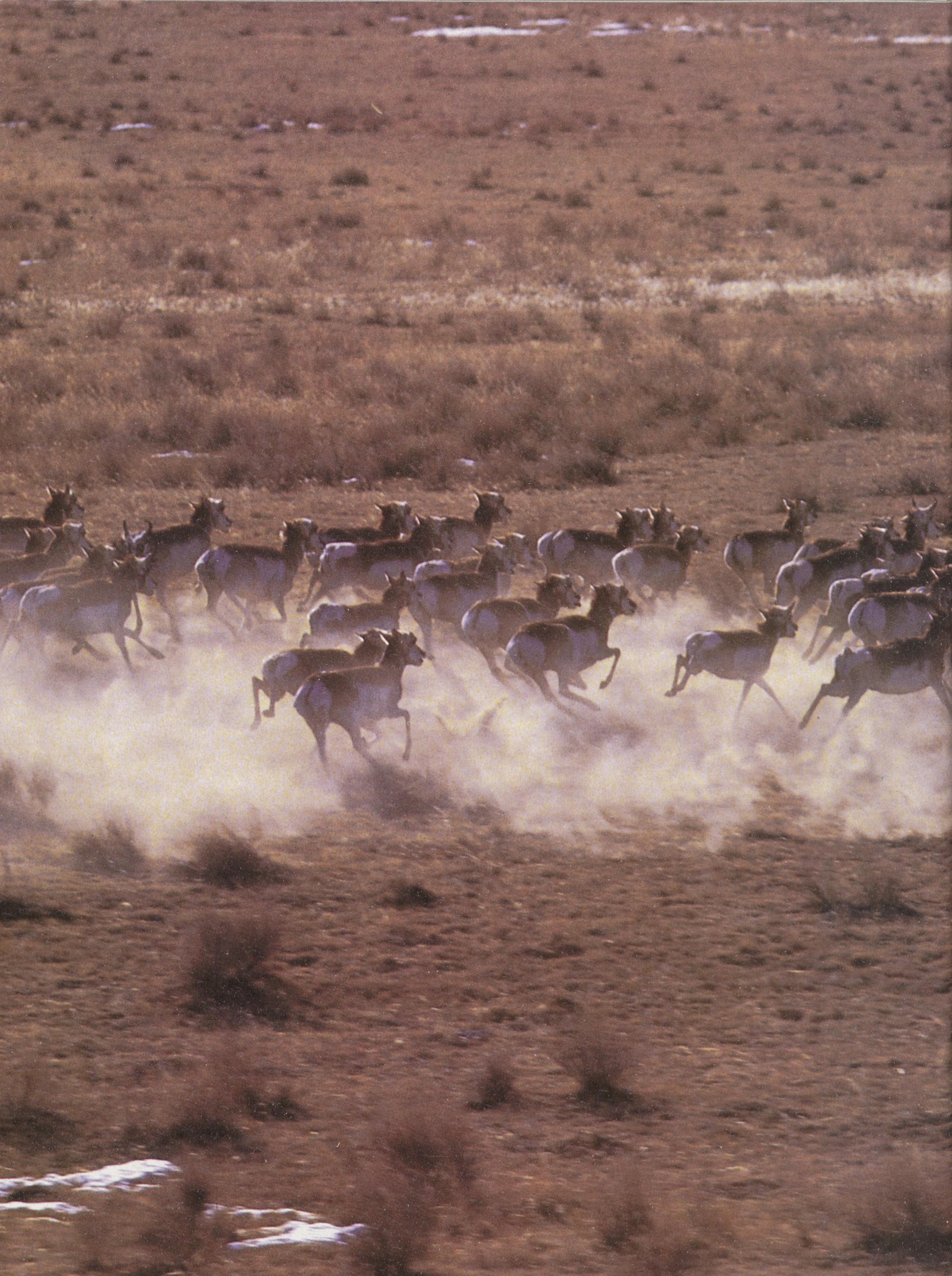
Position: 664 (17 views)