Volume 65, Issue 7, 1987
NEBRASKAland
AUGUST/SEPTEMBER 1987 $1.50
NEBRASKAland
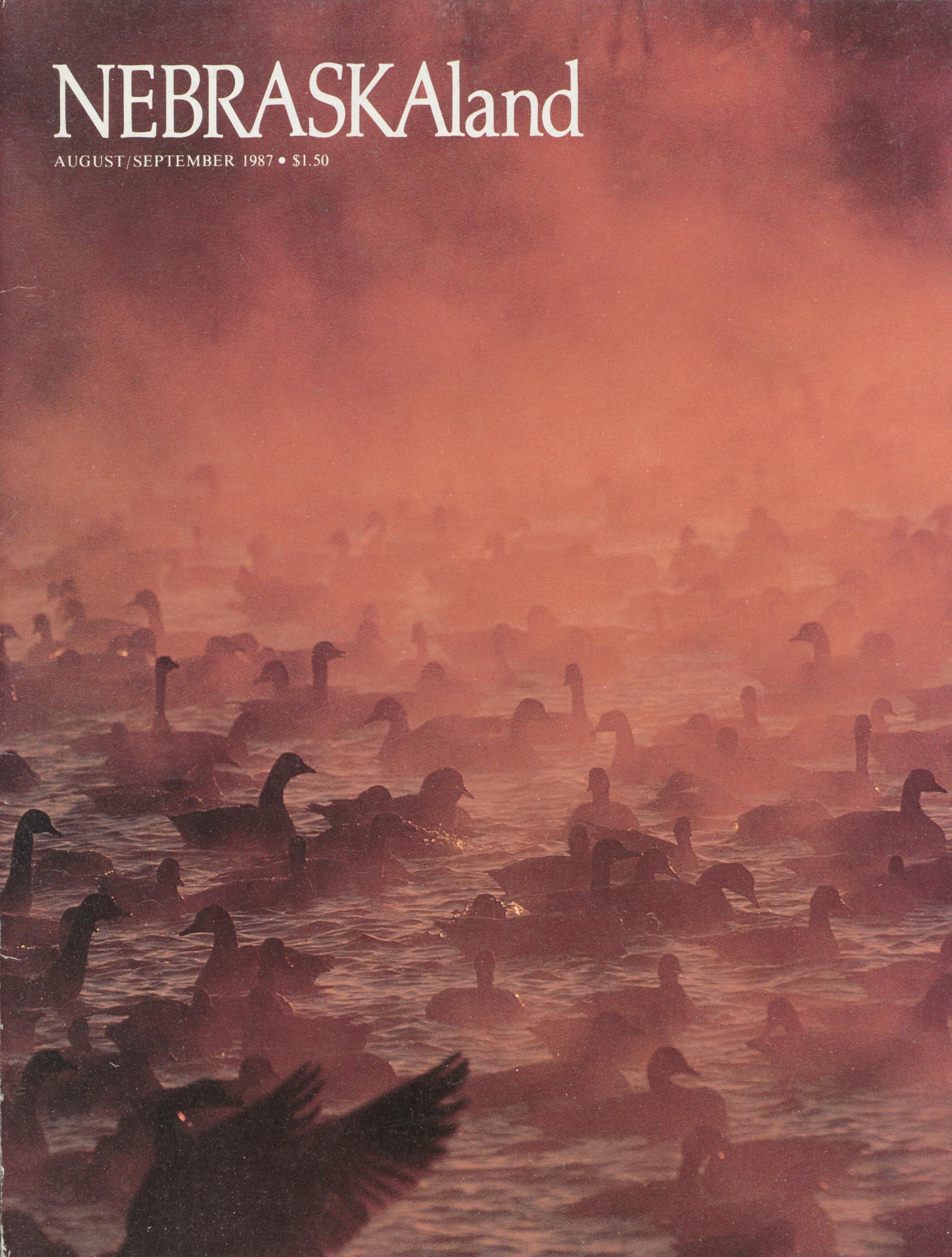
Published by the Nebraska Game and Parks Commission NEBRASKAland VOL. 65/NO. 7/AUG.-SEPT. 1987 NEBRASKAland (ISSN:0028-1964) is published monthly except for combined Jan/Feb and Aug/Sept issues, by the Nebraska Game and Parks Commission, 2200 North 33rd Street, Lincoln, NE. Copyright 1987, all rights reserved. Second-class postage paid at Lincoln, Nebraska and at additional mailing offices. POSTMASTER: Send address changes to NEBRASKAland, Box 30370, Lincoln, NE 68503. Rates: $12 for one year; $23 for two years. Offices Headquarters 2200 N. 33rd, Lincoln, 68503 (402) 464-0641 13th and Farnam St., Omaha (402) 554-2144 Ak-Sar-Ben Aquarium, Gretna (402) 332-3901 Rt. 2, Alliance (308) 762-5605 Bassett (402) 684-3511 U.S. 81, Norfolk (402) 371-4950 Rt. 4, North Platte (308) 532-6225 Commissioners Chairman: Neai Keller, Brewster Vice Chairman: Dr. Tim Biga, Norfolk 2nd Vice Chairman: Stan Juelfs, Kimball Wayne Ziebarth, Wilcox LaVern Schneider, McCook L. Bruce Wright, Lincoln Richard L. Coyne, Omaha Director: Eugene T. Mahoney Assistant Directors: William J. Bailey, Jr., Dale R. Bree, Rex Amack Staff Chief, Information & Education: Jim MacAllister Editor: Lowell Johnson Senior Editor: Jon Farrar Associate Editors: Ken Bouc, Don Cunningham Regional Editors: Bob Grier, Rocky Hoffmann Contributors: Tom Keith, Liz Huff, Carl Wolfe Research Assistant: Curt Twedt Art Director: Duane Westerholt Illustration: Steve O'Hare, Paula Day Advertising: Dan Curran Circulation: Pat Frahm Contents Features SCOPING SQUIRRELS............................. 6 "HEAD" HUNTER..................................12 NIOBRARA VALLEY... UNIQUE AND ENDURING . .20 SNEAKIN'CAT ...............................30 SHADES OF THE WEST............................34 THE BIG BULL.....................................42 BOWHUNTING MANUAL......................... .44 THE AGING GAME ................................48 CLEAN UP YOUR ACT..............................50 NOTES ON NEBRASKA FAUNA/MOURNING DOVE.66 Departments SPEAK UP......................................... 4 TRADING POST.................................. 65 COVER: Each fall, Canada geese trickle south from their nesting grounds to Nebraska's Platte River. For many, it is only a pause on their southward migration, but for increasing numbers, it will be their wintering grounds. Warm-water sloughs; sandpits, as long as they remain open; and ice-free portions of the river provide night and midday roosts; the Platte Valley's grain fields an abundant source of food. Photo by Rocky Hoffmann. OPPOSITE: September brings cool nights and a sweep of gold to clumps of paper birch along the Niobrara River below Valentine, the perfect backdrop for canoeists. For more photos of one of Nebraska's most striking rivers, see page 20. Photo by Ron Klataske. AUGUST/SEPTEBMER 1987 3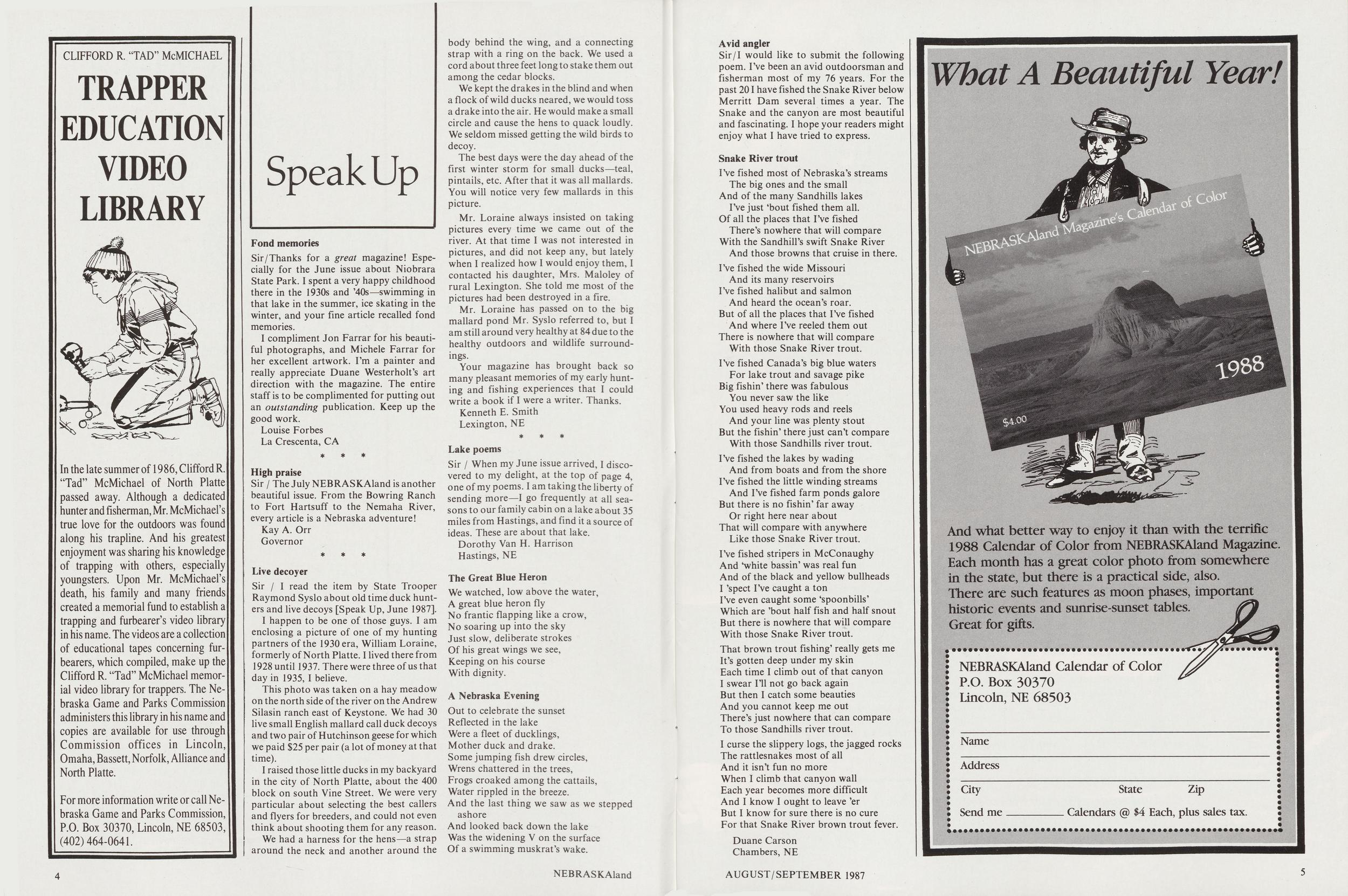
Speak Up
Fond memoriesSir/Thanks for a great magazine! Especially for the June issue about Niobrara State Park. I spent a very happy childhood there in the 1930s and '40s—swimming in that lake in the summer, ice skating in the winter, and your fine article recalled fond memories.
I compliment Jon Farrar for his beautiful photographs, and Michele Farrar for her excellent artwork. I'm a painter and really appreciate Duane Westerholt's art direction with the magazine. The entire staff is to be complimented for putting out an outstanding publication. Keep up the good work.
Louise Forbes La Crescenta, CA * * * High praiseSir / The July NEBRASKAland is another beautiful issue. From the Bowring Ranch to Fort Hartsuff to the Nemaha River, every article is a Nebraska adventure!
Kay A. Orr Governor * * * Live decoyerSir / I read the item by State Trooper Raymond Syslo about old time duck hunters and live decoys [Speak Up, June 1987].
I happen to be one of those guys. I am enclosing a picture of one of my hunting partners of the 1930 era, William Loraine, formerly of North Platte. I lived there from 1928 until 1937. There were three of us that day in 1935, I believe.
This photo was taken on a hay meadow on the north side of the river on the Andrew Silasin ranch east of Keystone. We had 30 live small English mallard call duck decoys and two pair of Hutchinson geese for which we paid $25 per pair (a lot of money at that time).
I raised those little ducks in my backyard in the city of North Platte, about the 400 block on south Vine Street. We were very particular about selecting the best callers and flyers for breeders, and could not even think about shooting them for any reason.
We had a harness for the hens—a strap around the neck and another around the body behind the wing, and a connecting strap with a ring on the back. We used a cord about three feet long to stake them out among the cedar blocks.
We kept the drakes in the blind and when a flock of wild ducks neared, we would toss a drake into the air. He would make a small circle and cause the hens to quack loudly. We seldom missed getting the wild birds to decoy.
The best days were the day ahead of the first winter storm for small ducks—teal, pintails, etc. After that it was all mallards. You will notice very few mallards in this picture.
Mr. Loraine always insisted on taking pictures every time we came out of the river. At that time I was not interested in pictures, and did not keep any, but lately when I realized how I would enjoy them, I contacted his daughter, Mrs. Maloley of rural Lexington. She told me most of the pictures had been destroyed in a fire.
Mr. Loraine has passed on to the big mallard pond Mr. Syslo referred to, but I am still around very healthy at 84 due to the healthy outdoors and wildlife surroundings.
Your magazine has brought back so many pleasant memories of my early hunting and fishing experiences that I could write a book if I were a writer. Thanks.
Kenneth E. Smith Lexington, NE * * * Lake poemsSir / When my June issue arrived, I discovered to my delight, at the top of page 4, one of my poems. I am taking the liberty of sending more—I go frequently at all seasons to our family cabin on a lake about 35 miles from Hastings, and find it a source of ideas. These are about that lake.
Dorothy Van H. Harrison Hastings, NE The Great Blue Heron We watched, low above the water, A great blue heron fly No frantic flapping like a crow, No soaring up into the sky Just slow, deliberate strokes Of his great wings we see, Keeping on his course With dignity. A Nebraska Evening Out to celebrate the sunset Reflected in the lake Were a fleet of ducklings, Mother duck and drake. Some jumping fish drew circles, Wrens chattered in the trees, Frogs croaked among the cattails, Water rippled in the breeze. And the last thing we saw as we stepped ashore And looked back down the lake Was the widening V on the surface Of a swimming muskrat's wake. 4 NEBRASKAland Avid anglerSir/I would like to submit the following poem. I've been an avid outdoorsman and fisherman most of my 76 years. For the past 201 have fished the Snake River below Merritt Dam several times a year. The Snake and the canyon are most beautiful and fascinating. I hope your readers might enjoy what I have tried to express.
Snake River trout I've fished most of Nebraska's streams The big ones and the small And of the many Sandhills lakes I've just 'bout fished them all. Of all the places that I've fished There's nowhere that will compare With the Sandhill's swift Snake River And those browns that cruise in there. I've fished the wide Missouri And its many reservoirs I've fished halibut and salmon And heard the ocean's roar. But of all the places that I've fished And where I've reeled them out There is nowhere that will compare With those Snake River trout. I've fished Canada's big blue waters For lake trout and savage pike Big fishin' there was fabulous You never saw the like You used heavy rods and reels And your line was plenty stout But the fishin' there just can't compare With those Sandhills river trout. I've fished the lakes by wading And from boats and from the shore I've fished the little winding streams And I've fished farm ponds galore But there is no fishin' far away Or right here near about That will compare with anywhere Like those Snake River trout. I've fished stripers in McConaughy And 'white bassin' was real fun And of the black and yellow bullheads I 'spect I've caught a ton I've even caught some 'spoonbills' Which are 'bout half fish and half snout But there is nowhere that will compare With those Snake River trout. That brown trout fishing' really gets me It's gotten deep under my skin Each time I climb out of that canyon I swear I'll not go back again But then I catch some beauties And you cannot keep me out There's just nowhere that can compare To those Sandhills river trout. I curse the slippery logs, the jagged rocks The rattlesnakes most of all And it isn't fun no more When I climb that canyon wall Each year becomes more difficult And I know I ought to leave 'er But I know for sure there is no cure For that Snake River brown trout fever. Duane Carson Chambers, NE What a Beautiful Year! And what better way top enjoy it that nwith the terrific 1988 Calendar of Color from NEBRASKAland Magazine. Each month has a great color photo from somewhere in the state, but there is a practical side, also. There are such features as moon phases, important historic events and sunrise-sunset tables Great for gifts. NEBRASKALand Calendar of Color P.O. Box 30370 Lincoln, NE 68503 Name Address City State Zip Send me Calendats @ $4 Each, plus sales tax AUGUST/SEPTEMBER 1987 5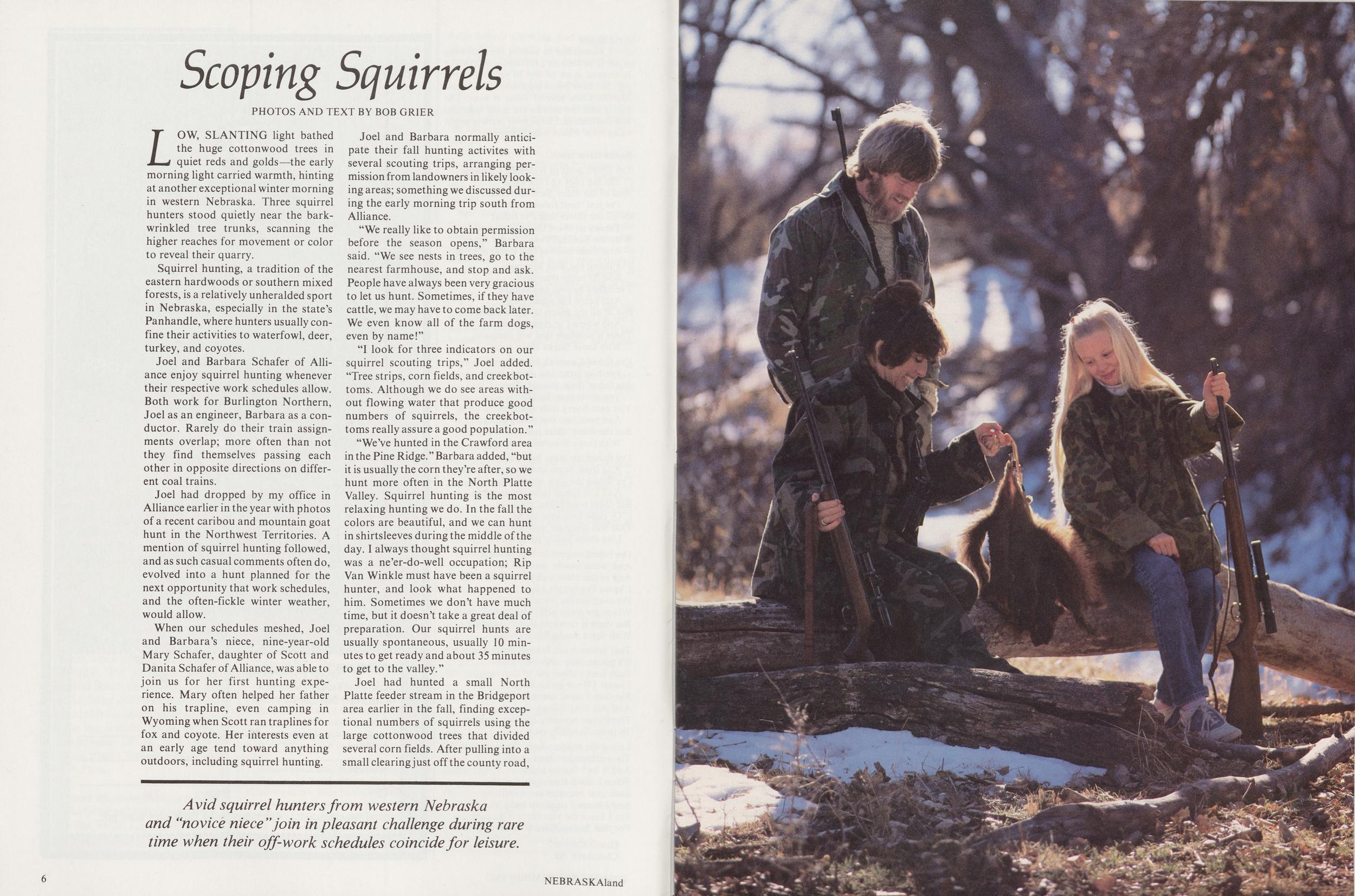
Scoping Squirrels
PHOTOS AND TEXT BY BOB GRIERLOW, SLANTING light bathed the huge cottonwood trees in quiet reds and golds—the early morning light carried warmth, hinting at another exceptional winter morning in western Nebraska. Three squirrel hunters stood quietly near the barkwrinkled tree trunks, scanning the higher reaches for movement or color to reveal their quarry.
Squirrel hunting, a tradition of the eastern hardwoods or southern mixed forests, is a relatively unheralded sport in Nebraska, especially in the state's Panhandle, where hunters usually confine their activities to waterfowl, deer, turkey, and coyotes.
Joel and Barbara Schafer of Alliance enjoy squirrel hunting whenever their respective work schedules allow. Both work for Burlington Northern, Joel as an engineer, Barbara as a conductor. Rarely do their train assignments overlap; more often than not they find themselves passing each other in opposite directions on different coal trains.
Joel had dropped by my office in Alliance earlier in the year with photos of a recent caribou and mountain goat hunt in the Northwest Territories. A mention of squirrel hunting followed, and as such casual comments often do, evolved into a hunt planned for the next opportunity that work schedules, and the often-fickle winter weather, would allow.
When our schedules meshed, Joel and Barbara's niece, nine-year-old Mary Schafer, daughter of Scott and Danita Schafer of Alliance, was able to join us for her first hunting experience. Mary often helped her father on his trapline, even camping in Wyoming when Scott ran traplines for fox and coyote. Her interests even at an early age tend toward anything outdoors, including squirrel hunting.
Joel and Barbara normally anticipate their fall hunting activities with several scouting trips, arranging permission from landowners in likely looking areas; something we discussed during the early morning trip south from Alliance.
Joel and Barbara normally anticipate their fall hunting activities with several scouting trips, arranging permission from landowners in likely looking areas; something we discussed during the early morning trip south from Alliance.
"We really like to obtain permission before the season opens," Barbara said. "We see nests in trees, go to the nearest farmhouse, and stop and ask. People have always been very gracious to let us hunt. Sometimes, if they have cattle, we may have to come back later. We even know all of the farm dogs, even by name!"
"I look for three indicators on our squirrel scouting trips," Joel added. "Tree strips, corn fields, and creek bottoms. Although we do see areas without flowing water that produce good numbers of squirrels, the creek bottoms really assure a good population."
"We've hunted in the Crawford area in the Pine Ridge." Barbara added, "but it is usually the corn they're after, so we hunt more often in the North Platte Valley. Squirrel hunting is the most relaxing hunting we do. In the fall the colors are beautiful, and we can hunt in shirtsleeves during the middle of the day. I always thought squirrel hunting was a ne'er-do-well occupation; Rip Van Winkle must have been a squirrel hunter, and look what happened to him. Sometimes we don't have much time, but it doesn't take a great deal of preparation. Our squirrel hunts are usually spontaneous, usually 10 minutes to get ready and about 35 minutes to get to the valley."
Joel had hunted a small North Platte feeder stream in the Bridgeport area earlier in the fall, finding exceptional numbers of squirrels using the large cottonwood trees that divided several corn fields. After pulling into a small clearing just off the county road, we quickly prepared our equipment and discussed hunting strategies.
Avid squirrel hunters from western Nebraska and "novice nieceff join in pleasant challenge during rare time when their off-work schedules coincide for leisure. 6 NEBRSAKAland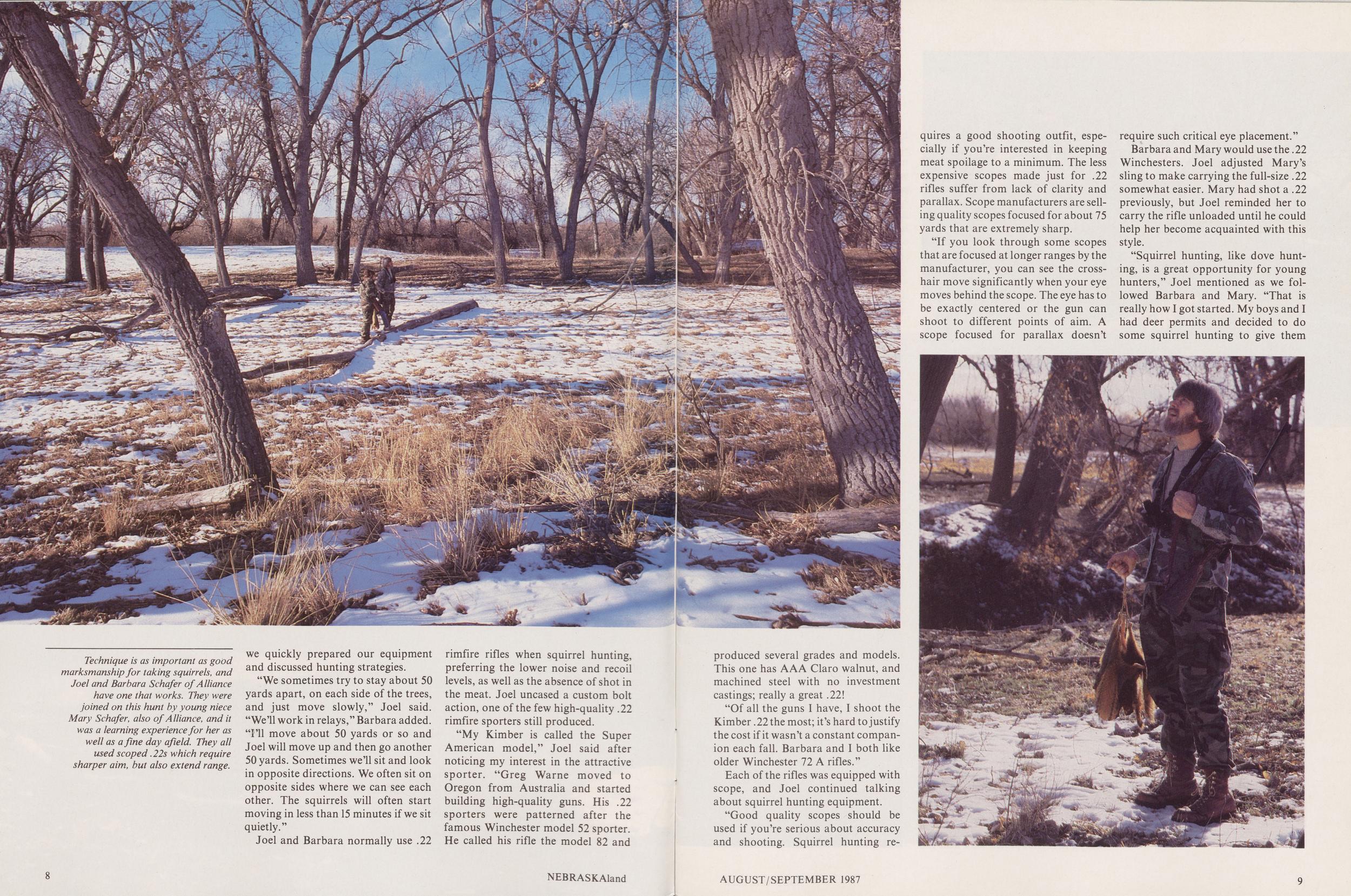
"We sometimes try to stay about 50 yards apart, on each side of the trees, and just move slowly," Joel said. "We'll work in relays," Barbara added. "I'll move about 50 yards or so and Joel will move up and then go another 50 yards. Sometimes we'll sit and look in opposite directions. We often sit on opposite sides where we can see each other. The squirrels will often start moving in less than 15 minutes if we sit quietly."
Joel and Barbara normally use .22 rimfire rifles when squirrel hunting, preferring the lower noise and recoil levels, as well as the absence of shot in the meat. Joel uncased a custom bolt action, one of the few high-quality .22 rimfire sporters still produced.
"My Kimber is called the Super American model," Joel said after noticing my interest in the attractive sporter. "Greg Warne moved to Oregon from Australia and started building high-quality guns. His .22 sporters were patterned after the famous Winchester model 52 sporter. He called his rifle the model 82 and 8 NEBRASKAland produced several grades and models. This one has AAA Claro walnut, and machined steel with no investment castings; really a great .22!
"Of all the guns I have, I shoot the Kimber .22 the most; it's hard to justify the cost if it wasn't a constant companion each fall. Barbara and I both like older Winchester 72 A rifles."
Each of the rifles was equipped with scope, and Joel continued talking about squirrel hunting equipment.
"Good quality scopes should be used if you're serious about accuracy and shooting. Squirrel hunting requires a good shooting outfit, especially if you're interested in keeping meat spoilage to a minimum. The less expensive scopes made just for .22 rifles suffer from lack of clarity and parallax. Scope manufacturers are selling quality scopes focused for about 75 yards that are extremely sharp.
"If you look through some scopes that are focused at longer ranges by the manufacturer, you can see the cross hair move significantly when your eye moves behind the scope. The eye has to be exactly centered or the gun can shoot to different points of aim. A scope focused for parallax doesn't require such critical eye placement."
Barbara and Mary would use the .22 Winchesters. Joel adjusted Mary's sling to make carrying the full-size .22 somewhat easier. Mary had shot a .22 previously, but Joel reminded her to carry the rifle unloaded until he could help her become acquainted with this style.
"Squirrel hunting, like dove hunting, is a great opportunity for young hunters," Joel mentioned as we followed Barbara and Mary. "That is really how I got started. My boys and I had deer permits and decided to do some squirrel hunting to give them experience with a rifle. We liked it so much, I guess we now actually prefer it to deer hunting."
AUGUST/SEPTEMBER 1987 9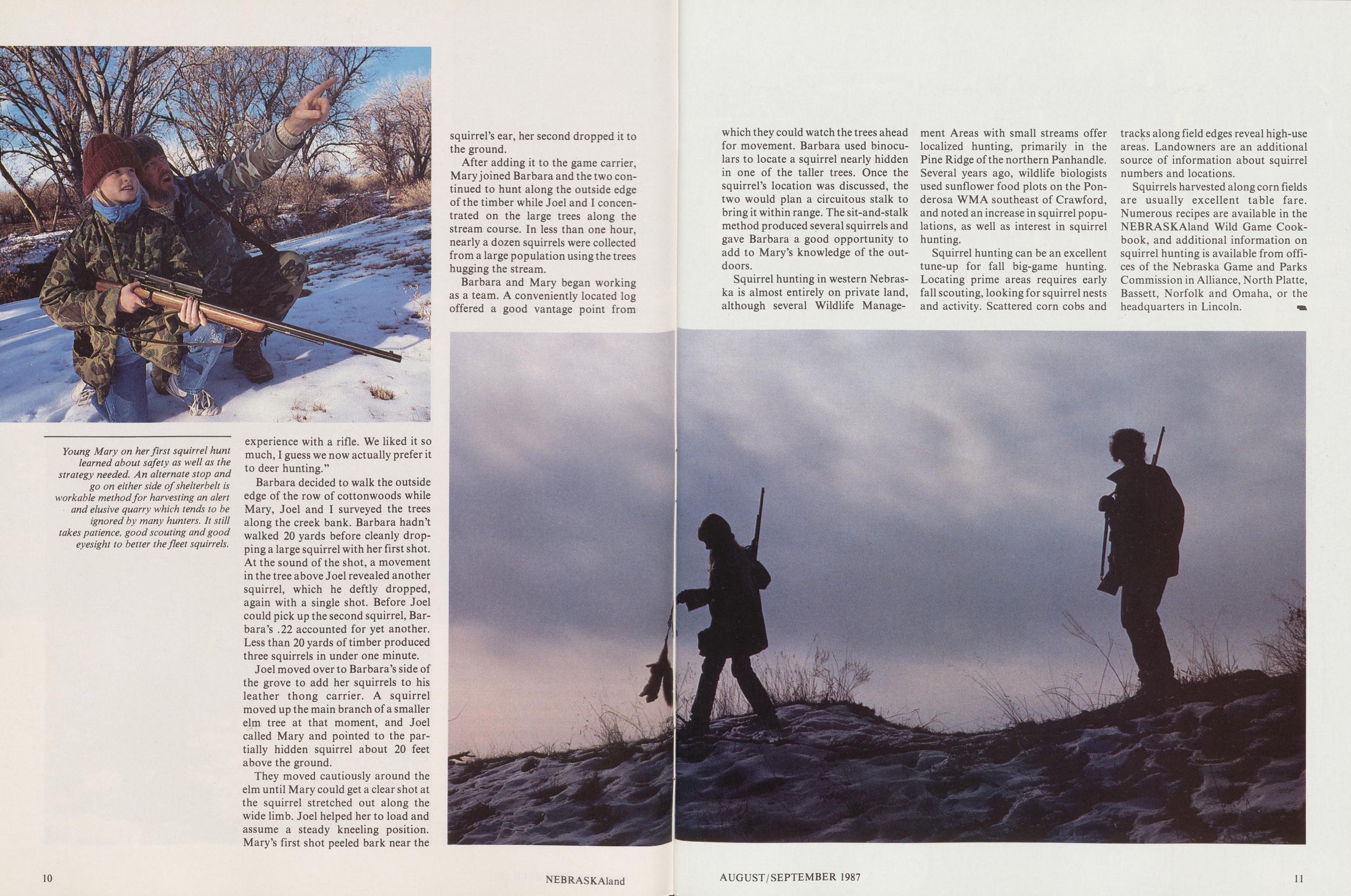
Barbara decided to walk the outside edge of the row of cottonwoods while Mary, Joel and I surveyed the trees along the creek bank. Barbara hadn't walked 20 yards before cleanly dropping a large squirrel with her first shot. At the sound of the shot, a movement in the tree above Joel revealed another squirrel, which he deftly dropped, again with a single shot. Before Joel could pick up the second squirrel, Barbara's .22 accounted for yet another. Less than 20 yards of timber produced three squirrels in under one minute.
Joel moved over to Barbara's side of the grove to add her squirrels to his leather thong carrier. A squirrel moved up the main branch of a smaller elm tree at that moment, and Joel called Mary and pointed to the partially hidden squirrel about 20 feet above the ground.
They moved cautiously around the elm until Mary could get a clear shot at the squirrel stretched out along the wide limb. Joel helped her to load and assume a steady kneeling position. Mary's first shot peeled bark near the squirrel's ear, her second dropped it to the ground.
After adding it to the game carrier, Mary joined Barbara and the two continued to hunt along the outside edge of the timber while Joel and I concentrated on the large trees along the stream course. In less than one hour, nearly a dozen squirrels were collected from a large population using the trees hugging the stream.
Barbara and Mary began working as a team. A conveniently located log offered a good vantage point from 10 NEBRASKAland which they could watch the trees ahead for movement. Barbara used binoculars to locate a squirrel nearly hidden in one of the taller trees. Once the squirrel's location was discussed, the two would plan a circuitous stalk to bring it within range. The sit-and-stalk method produced several squirrels and gave Barbara a good opportunity to add to Mary's knowledge of the outdoors.
Squirrel hunting in western Nebraska is almost entirely on private land, although several Wildlife Management Areas with small streams offer localized hunting, primarily in the Pine Ridge of the northern Panhandle. Several years ago, wildlife biologists used sunflower food plots on the Ponderosa WMA southeast of Crawford, and noted an increase in squirrel populations, as well as interest in squirrel hunting.
Squirrel hunting can be an excellent tune-up for fall big-game hunting. Locating prime areas requires early fall scouting, looking for squirrel nests and activity. Scattered corn cobs and tracks along field edges reveal high-use areas. Landowners are an additional source of information about squirrel numbers and locations.
Squirrels harvested along corn fields are usually excellent table fare. Numerous recipes are available in the NEBRASKAland Wild Game Cookbook, and additional information on squirrel hunting is available from offices of the Nebraska Game and Parks Commission in Alliance, North Platte, Bassett, Norfolk and Omaha, or the headquarters in Lincoln.
"HEAD" HUNTER
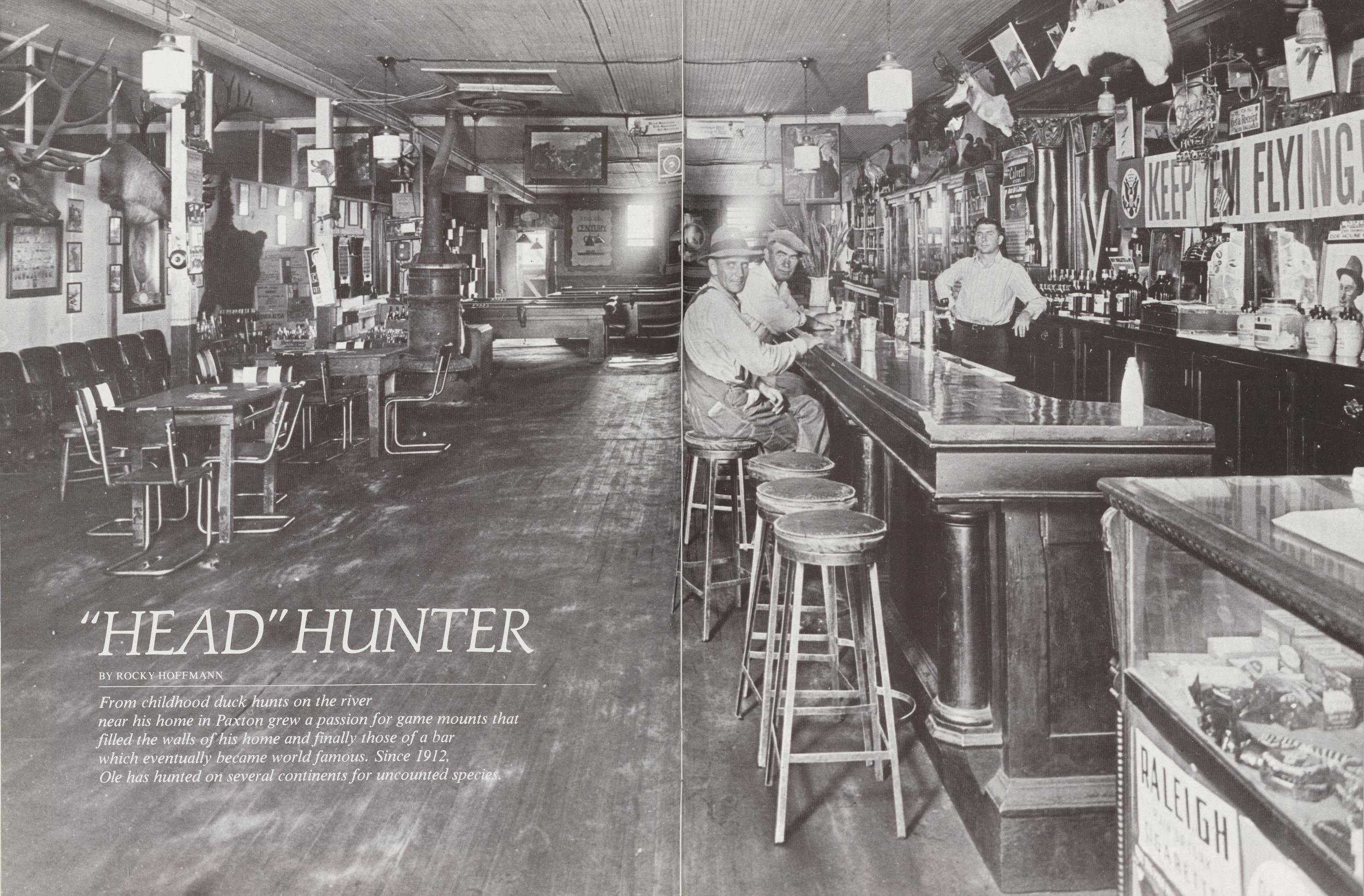
BY ROCKY HOFFMAN From childhood duck hunts on the river near his home in Paxton grew a passion for game mounts that filled the walls of his homme and finally those of a bar which eventually became world famous. Since 1912 Ole has hunted on several continents for uncounted species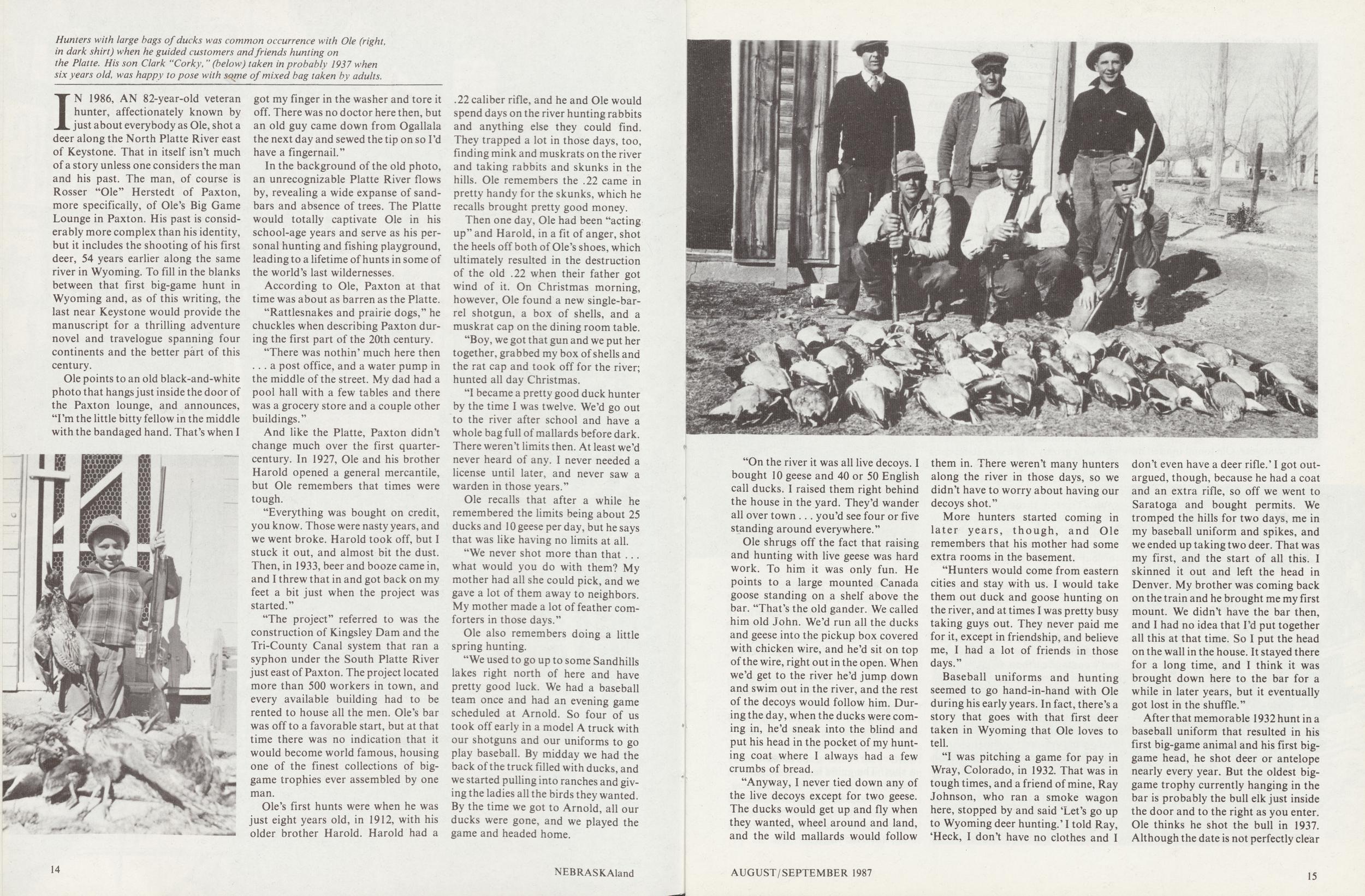 Hunters with large bags of ducks was common occurrence with Ole (right,
in dark shirt) when he guided customers and friends hunting on
the Platte. His son Clark "Corky, " (below) taken in probably 1937 when
six years old, was happy to pose with some of mixed bag taken by adults.
Hunters with large bags of ducks was common occurrence with Ole (right,
in dark shirt) when he guided customers and friends hunting on
the Platte. His son Clark "Corky, " (below) taken in probably 1937 when
six years old, was happy to pose with some of mixed bag taken by adults.
IN 1986, AN 82-year-old veteran hunter, affectionately known by just about everybody as Ole, shot a deer along the North Platte River east of Keystone. That in itself isn't much of a story unless one considers the man and his past. The man, of course is Rosser "Ole" Herstedt of Paxton, more specifically, of Ole's Big Game Lounge in Paxton. His past is considerably more complex than his identity, but it includes the shooting of his first deer, 54 years earlier along the same river in Wyoming. To fill in the blanks between that first big-game hunt in Wyoming and, as of this writing, the last near Keystone would provide the manuscript for a thrilling adventure novel and travelogue spanning four continents and the better part of this century.
Ole points to an old black-and-white photo that hangs just inside the door of the Paxton lounge, and announces, "I'm the little bitty fellow in the middle with the bandaged hand. That's when I got my finger in the washer and tore it off. There was no doctor here then, but an old guy came down from Ogallala the next day and sewed the tip on so I'd have a fingernail."
In the background of the old photo, an unrecognizable Platte River flows by, revealing a wide expanse of sandbars and absence of trees. The Platte would totally captivate Ole in his school-age years and serve as his personal hunting and fishing playground, leading to a lifetime of hunts in some of the world's last wildernesses.
According to Ole, Paxton at that time was about as barren as the Platte.
"Rattlesnakes and prairie dogs," he chuckles when describing Paxton during the first part of the 20th century.
"There was nothin' much here then a post office, and a water pump in the middle of the street. My dad had a pool hall with a few tables and there was a grocery store and a couple other buildings."
And like the Platte, Paxton didn't change much over the first quarter century. In 1927, Ole and his brother Harold opened a general mercantile, but Ole remembers that times were tough.
"Everything was bought on credit, you know. Those were nasty years, and we went broke. Harold took off, but I stuck it out, and almost bit the dust. Then, in 1933, beer and booze came in, and I threw that in and got back on my feet a bit just when the project was started."
"The project" referred to was the construction of Kingsley Dam and the Tri-County Canal system that ran a syphon under the South Platte River just east of Paxton. The project located more than 500 workers in town, and every available building had to be rented to house all the men. Ole's bar was off to a favorable start, but at that time there was no indication that it would become world famous, housing one of the finest collections of big game trophies ever assembled by one man.
Ole's first hunts were when he was just eight years old, in 1912, with his older brother Harold. Harold had a 14 .22 caliber rifle, and he and Ole would spend days on the river hunting rabbits and anything else they could find. They trapped a lot in those days, too, finding mink and muskrats on the river and taking rabbits and skunks in the hills. Ole remembers the .22 came in pretty handy for the skunks, which he recalls brought pretty good money.
Then one day, Ole had been "acting up" and Harold, in a fit of anger, shot the heels off both of Ole's shoes, which ultimately resulted in the destruction of the old .22 when their father got wind of it. On Christmas morning, however, Ole found a new single-barrel shotgun, a box of shells, and a muskrat cap on the dining room table.
"Boy, we got that gun and we put her together, grabbed my box of shells and the rat cap and took off for the river; hunted all day Christmas.
"I became a pretty good duck hunter by the time I was twelve. We'd go out to the river after school and have a whole bag full of mallards before dark. There weren't limits then. At least we'd never heard of any. I never needed a license until later, and never saw a warden in those years."
Ole recalls that after a while he remembered the limits being about 25 ducks and 10 geese per day, but he says that was like having no limits at all.
"We never shot more than that ... what would you do with them? My mother had all she could pick, and we gave a lot of them away to neighbors. My mother made a lot of feather comforters in those days."
Ole also remembers doing a little spring hunting.
"We used to go up to some Sandhills lakes right north of here and have pretty good luck. We had a baseball team once and had an evening game scheduled at Arnold. So four of us took off early in a model A truck with our shotguns and our uniforms to go play baseball. By midday we had the back of the truck filled with ducks, and we started pulling into ranches and giving the ladies all the birds they wanted. By the time we got to Arnold, all our ducks were gone, and we played the game and headed home.
14 NEBRASKAland'On the river it was all live decoys. I bought 10 geese and 40 or 50 English call ducks. I raised them right behind the house in the yard. They'd wander all over town ... you'd see four or five standing around everywhere."
Ole shrugs off the fact that raising and hunting with live geese was hard work. To him it was only fun. He points to a large mounted Canada goose standing on a shelf above the bar. "That's the old gander. We called him old John. We'd run all the ducks and geese into the pickup box covered with chicken wire, and he'd sit on top of the wire, right out in the open. When we'd get to the river he'd jump down and swim out in the river, and the rest of the decoys would follow him. During the day, when the ducks were coming in, he'd sneak into the blind and put his head in the pocket of my hunting coat where I always had a few crumbs of bread.
"Anyway, I never tied down any of the live decoys except for two geese. The ducks would get up and fly when they wanted, wheel around and land, and the wild mallards would follow them in. There weren't many hunters along the river in those days, so we didn't have to worry about having our decoys shot."
More hunters started coming in later years, though, and Ole remembers that his mother had some extra rooms in the basement.
"Hunters would come from eastern cities and stay with us. I would take them out duck and goose hunting on the river, and at times I was pretty busy taking guys out. They never paid me for it, except in friendship, and believe me, I had a lot of friends in those days."
Baseball uniforms and hunting seemed to go hand-in-hand with Ole during his early years. In fact, there's a story that goes with that first deer taken in Wyoming that Ole loves to tell.
"I was pitching a game for pay in Wray, Colorado, in 1932. That was in tough times, and a friend of mine, Ray Johnson, who ran a smoke wagon here, stopped by and said 'Let's go up to Wyoming deer hunting.' I told Ray, 'Heck, I don't have no clothes and I don't even have a deer rifle.' I got outargued, though, because he had a coat and an extra rifle, so off we went to Saratoga and bought permits. We tromped the hills for two days, me in my baseball uniform and spikes, and we ended up taking two deer. That was my first, and the start of all this. I skinned it out and left the head in Denver. My brother was coming back on the train and he brought me my first mount. We didn't have the bar then, and I had no idea that I'd put together all this at that time. So I put the head on the wall in the house. It stayed there for a long time, and I think it was brought down here to the bar for a while in later years, but it eventually got lost in the shuffle."
After that memorable 1932 hunt in a baseball uniform that resulted in his first big-game animal and his first big-game head, he shot deer or antelope nearly every year. But the oldest big-game trophy currently hanging in the bar is probably the bull elk just inside the door and to the right as you enter. Ole thinks he shot the bull in 1937. Although the date is not perfectly clear in his mind, details of the hunt are, and he likes to tell visitors all about it.
AUGUST/SEPTEMBER 1987 15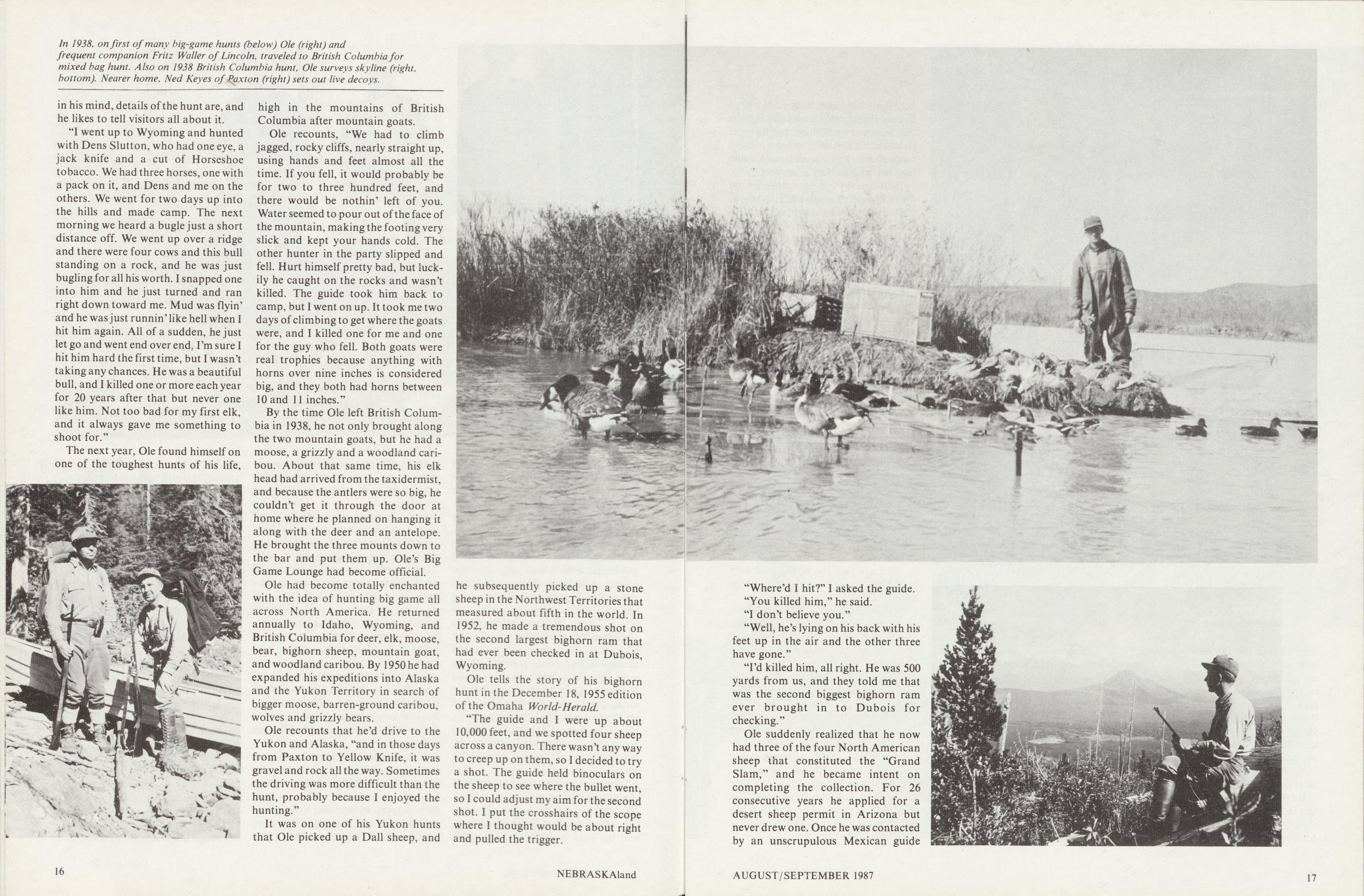 In 1938, on first of many big-game hunts (below) Ole (right) and
frequent companion Fritz Waller of Lincoln, traveled to British Columbia for
mixed bag hunt. Also on 1938 British Columbia hunt, Ole surveys skyline (right,
bottom). Nearer home, Ned Keyes of Fax ton (right) sets out live decoys.
In 1938, on first of many big-game hunts (below) Ole (right) and
frequent companion Fritz Waller of Lincoln, traveled to British Columbia for
mixed bag hunt. Also on 1938 British Columbia hunt, Ole surveys skyline (right,
bottom). Nearer home, Ned Keyes of Fax ton (right) sets out live decoys.
"I went up to Wyoming and hunted with Dens Slutton, who had one eye, a jack knife and a cut of Horseshoe tobacco. We had three horses, one with a pack on it, and Dens and me on the others. We went for two days up into the hills and made camp. The next morning we heard a bugle just a short distance off. We went up over a ridge and there were four cows and this bull standing on a rock, and he was just bugling for all his worth. I snapped one into him and he just turned and ran right down toward me. Mud was flyin' and he was just runnin' like hell when I hit him again. All of a sudden, he just let go and went end over end. I'm sure I hit him hard the first time, but I wasn't taking any chances. He was a beautiful bull, and I killed one or more each year for 20 years after that but never one like him. Not too bad for my first elk, and it always gave me something to shoot for."
The next year, Ole found himself on one of the toughest hunts of his life, high in the mountains of British Columbia after mountain goats.
Ole recounts, "We had to climb jagged, rocky cliffs, nearly straight up, using hands and feet almost all the time. If you fell, it would probably be for two to three hundred feet, and there would be nothin' left of you. Water seemed to pour out of the face of the mountain, making the footing very slick and kept your hands cold. The other hunter in the party slipped and fell. Hurt himself pretty bad, but luckily he caught on the rocks and wasn't killed. The guide took him back to camp, but I went on up. It took me two days of climbing to get where the goats were, and I killed one for me and one for the guy who fell. Both goats were real trophies because anything with horns over nine inches is considered big, and they both had horns between 10 and 11 inches."
By the time Ole left British Columbia in 1938, he not only brought along the two mountain goats, but he had a moose, a grizzly and a woodland caribou. About that same time, his elk head had arrived from the taxidermist, and because the antlers were so big, he couldn't get it through the door at home where he planned on hanging it along with the deer and an antelope. He brought the three mounts down to the bar and put them up. Ole's Big Game Lounge had become official.
Ole had become totally enchanted with the idea of hunting big game all across North America. He returned annually to Idaho, Wyoming, and British Columbia for deer, elk, moose, bear, bighorn sheep, mountain goat, and woodland caribou. By 1950 he had expanded his expeditions into Alaska and the Yukon Territory in search of bigger moose, barren-ground caribou, wolves and grizzly bears.
Ole recounts that he'd drive to the Yukon and Alaska, "and in those days from Paxton to Yellow Knife, it was gravel and rock all the way. Sometimes the driving was more difficult than the hunt, probably because I enjoyed the hunting."
It was on one of his Yukon hunts that Ole picked up a Dall sheep, and he subsequently picked up a stone sheep in the Northwest Territories that measured about fifth in the world. In 1952, he made a tremendous shot on the second largest bighorn ram that had ever been checked in at Dubois, Wyoming.
Ole tells the story of his bighorn hunt in the December 18, 1955 edition of the Omaha World-Herald.
"The guide and I were up about 10,000 feet, and we spotted four sheep across a canyon. There wasn't any way to creep up on them, so I decided to try a shot. The guide held binoculars on the sheep to see where the bullet went, so I could adjust my aim for the second shot. I put the crosshairs of the scope where I thought would be about right and pulled the trigger.
16 NEBRASKAland'Where'd I hit?" I asked the guide.
'You killed him," he said.
'I don't believe you."
'Well, he's lying on his back with his feet up in the air and the other three have gone."
"I'd killed him, all right. He was 500 yards from us, and they told me that was the second biggest bighorn ram ever brought in to Dubois for checking."
Ole suddenly realized that he now had three of the four North American sheep that constituted the "Grand Slam," and he became intent on completing the collection. For 26 consecutive years he applied for a desert sheep permit in Arizona but never drew one. Once he was contacted by an unscrupulous Mexican guide who offered to take him out and get him a ram. Ole said that the fellow wanted $5,000 down, and it was illegal to bring the head back. Ole wanted no part of it. He would probably go today if he could draw an Arizona desert sheep permit, but both of the men he had kept on retainer as guides have since passed away.
"Looks like this is the one that got away," Ole laments.
He feels fortunate, however, that he was the one to get away on a couple of close calls while hunting North American big game.
"One time in Wyoming, I shot my best bighorn ram while hanging over a cliff on a rope at 12,000 feet. The other end of the rope was tied around the waists of my packer and guide. I just couldn't get a shot at him any other way, so they lowered me over the cliff on a rope until I could see him 200 yards below me. I missed him the first shot, but when the rope stopped swinging, I tried again and put him down."
Ole also remembers a grizzly bear in Alaska that was eating on something directly above him on a slope.
"When I hit him, he tumbled head over heels down the mountain right at me. I ducked under him, and he came right to his feet and came at me. I couldn't run, so I wheeled another one into him and he died at my feet."
He did, however, run from a moose once on his Yukon and Alaska trip in 1950. He had shot the big bull from his horse and rode up to him thinking he was dead. Scabbording his rifle, he took out his camera, dismounted and approached the fallen animal for photos.
"About the time I was about to click off my first picture, up came the moose and charged. I took off for the horse and my rifle, but the horse wanted no part of the moose either, and he took off into the bush. It was the horse, me and then the moose running like hell. I finally caught hold of my saddle and got the rifle, snapping one off at the moose. He fell 12 yards from me."
There is little doubt that the most impressive sight to greet visitors of Ole's Big Game Lounge is the massive glass-encased polar bear, snarling over a captured seal. The polar bear hunt was Ole's last exotic wilderness trip, and although it only cost him $ 10 for a nonresident hunting permit and $15 for a polar bear tag, he tied up more than $6,000 in the trip and mounting expenses.
Ole feels that the hunt could very well have been the end of everything for him.
"I flew from North Platte to Denver to Seattle to Ketchekan, Anchorage, Nome and on to Kotzebue, where I met my guides, Nelson Walker and John Swift. We planned to hunt by light plane from Kotzebue, Alaska, the Polar Bear Capital of the world. It was just this side of Point Barrow.
"You have to have perfect weather because you have to go out and back the same day. We were weathered in for four days. We'd get our weather information from Russia, and one day the guide says 'we go today.' We flew all day and saw one small bear. The weather was good the second day, but we only saw a sow and two cubs, and I didn't want to shoot her.
18 NEBRASKAland"On the fifth day we went out and saw this big bear. It was getting kind of late and you had to keep a close watch on the gasoline. We were about 500 miles out, and our two planes were flying kind of close together because we couldn't use the radios, being in Russian waters. Nelson Walker and I were in one plane and John Swift and an Eskimo were in the other.
"Nelson landed me, and we kept the motor covered and running because it was about 40 below zero. The other plane indicated where the bear was and I made a sneak on him. I saw him once, but he disappeared. When he came out from behind the ice I fired and absolutely paralyzed him with a neck shot. He never moved a muscle and was dead immediately. By the time we got him skinned, it was nearly dark and we were dangerously low on gas.
"That bear hide and skull damned near filled that little plane, and the pilot said 'where do you think you're going to ride?'
"T don't know, but you can bet I'm going to be in there.'
"He got behind me and shoved and pushed me in on top of that bear where I laid with my head on the pilot's back. We got lost on the way back but finally saw a light at Point Hope and landed it dry on gas."
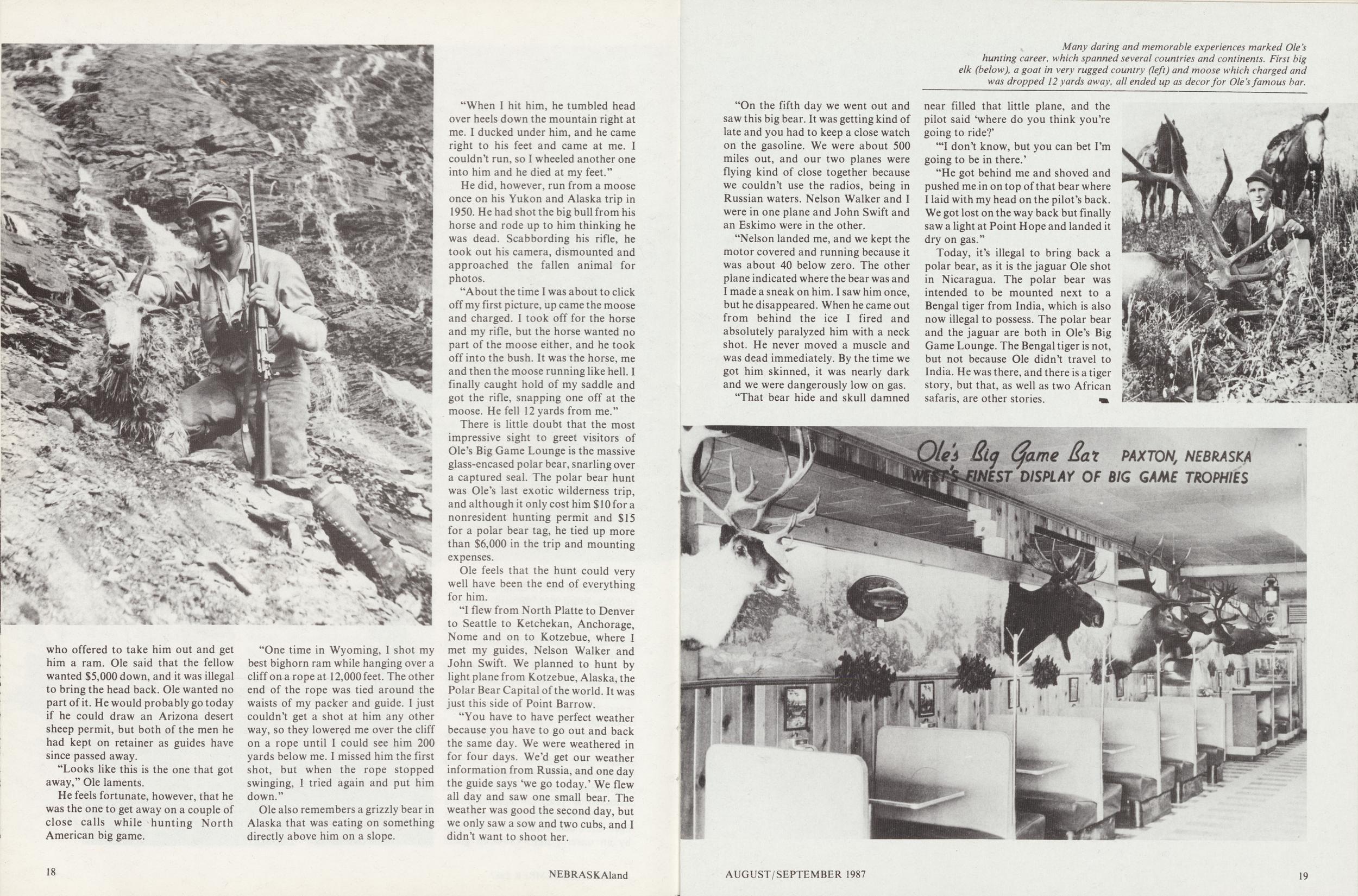
Today, it's illegal to bring back a polar bear, as it is the jaguar Ole shot in Nicaragua. The polar bear was intended to be mounted next to a Bengal tiger from India, which is also now illegal to possess. The polar bear and the jaguar are both in Ole's Big Game Lounge. The Bengal tiger is not, but not because Ole didn't travel to India. He was there, and there is a tiger story, but that, as well as two African safaris, are other stories.
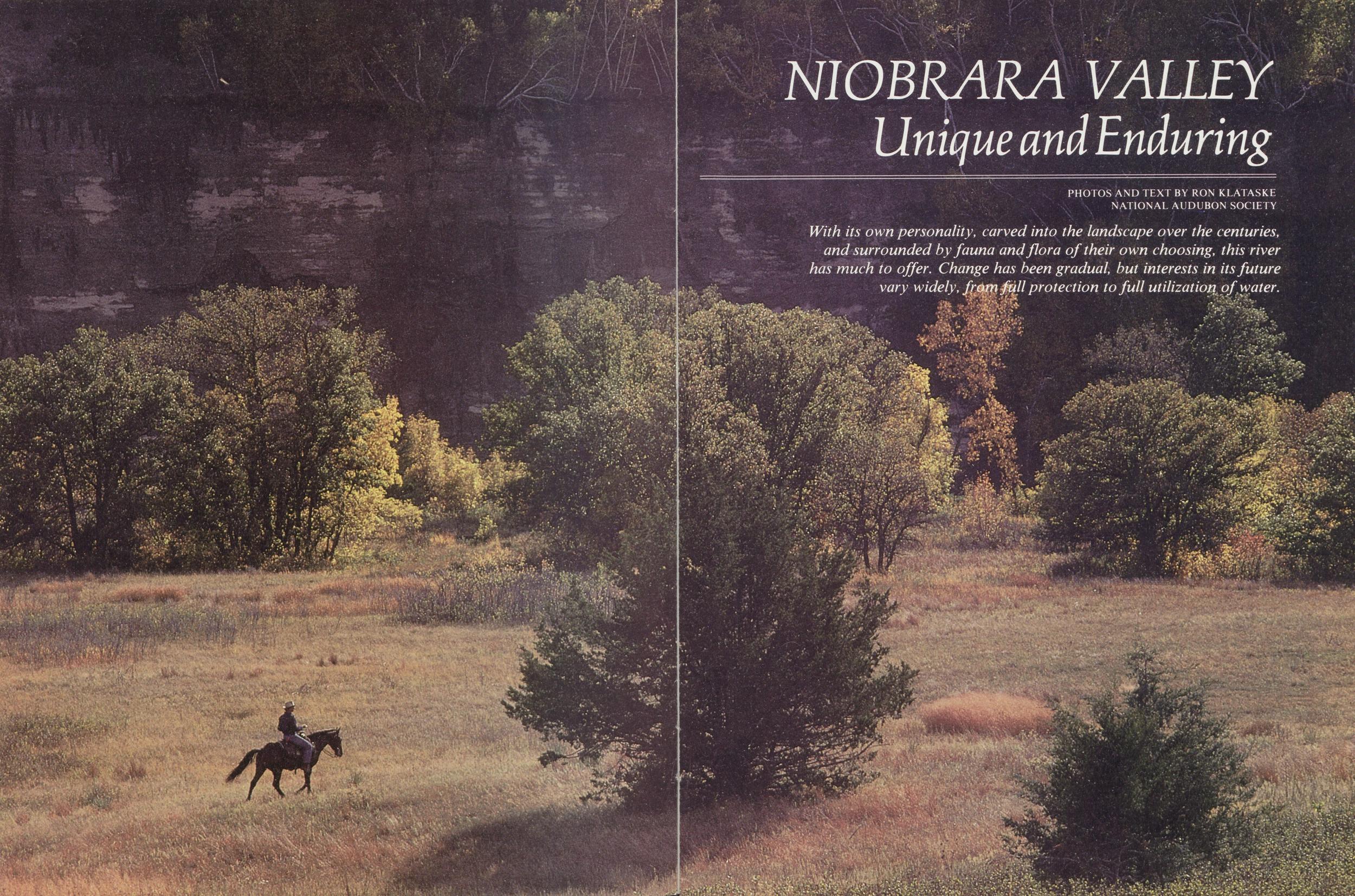
NIOBRARA VALLEY Unique and Enduring
PHOTOS AND TEXT BY RON K1ATASKE NATIONAL AUDUBON SOCIETY With its own personality, carved into the landscape over the centuries, and surrounded by fauna and flora of their own choosing, this river has much to offer. Change has been gradual, but interests in its future vary widely, from full protection to full utilization of water.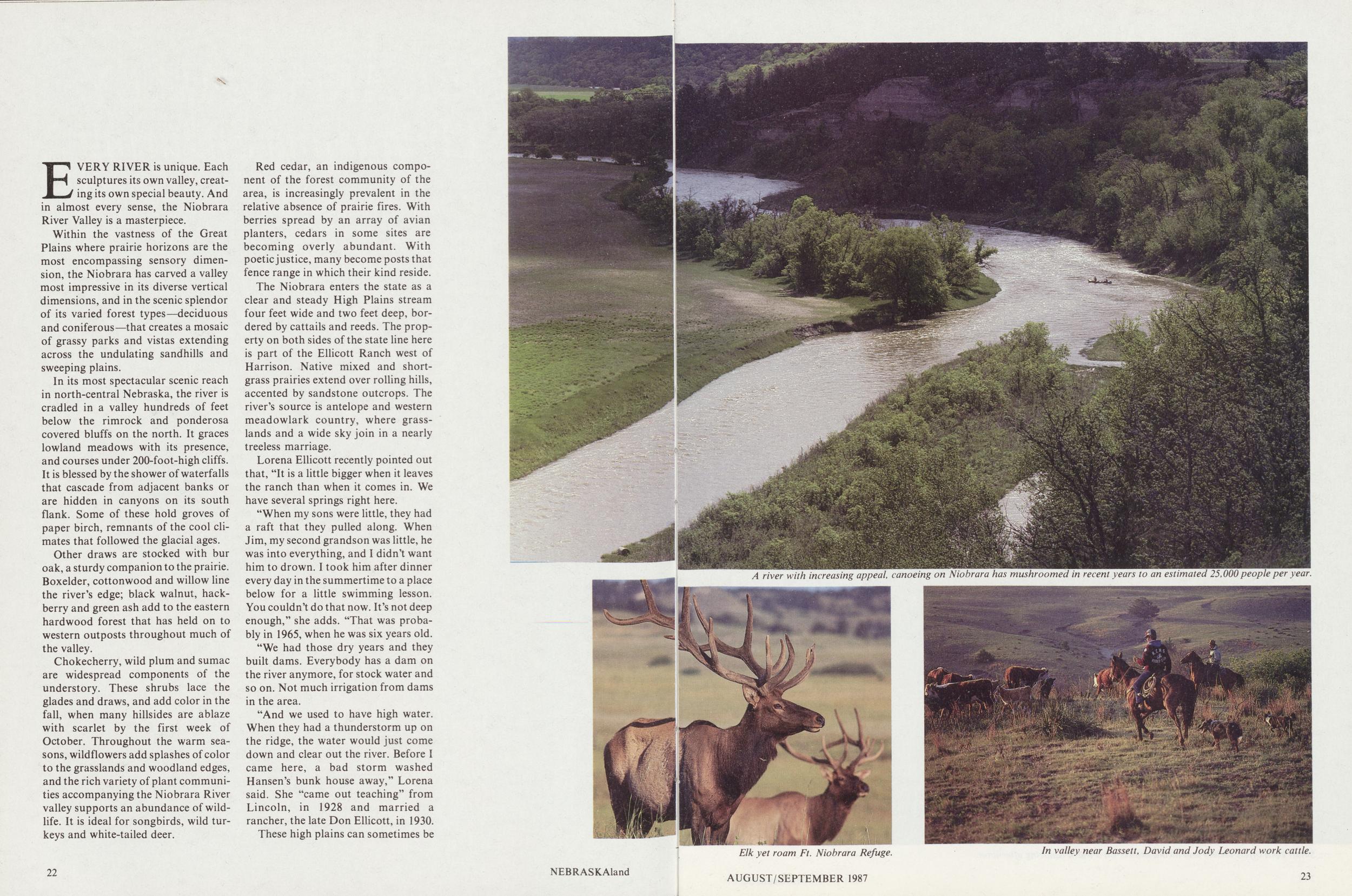
EVERY RIVER is unique. Each sculptures its own valley, creating its own special beauty. And in almost every sense, the Niobrara River Valley is a masterpiece.
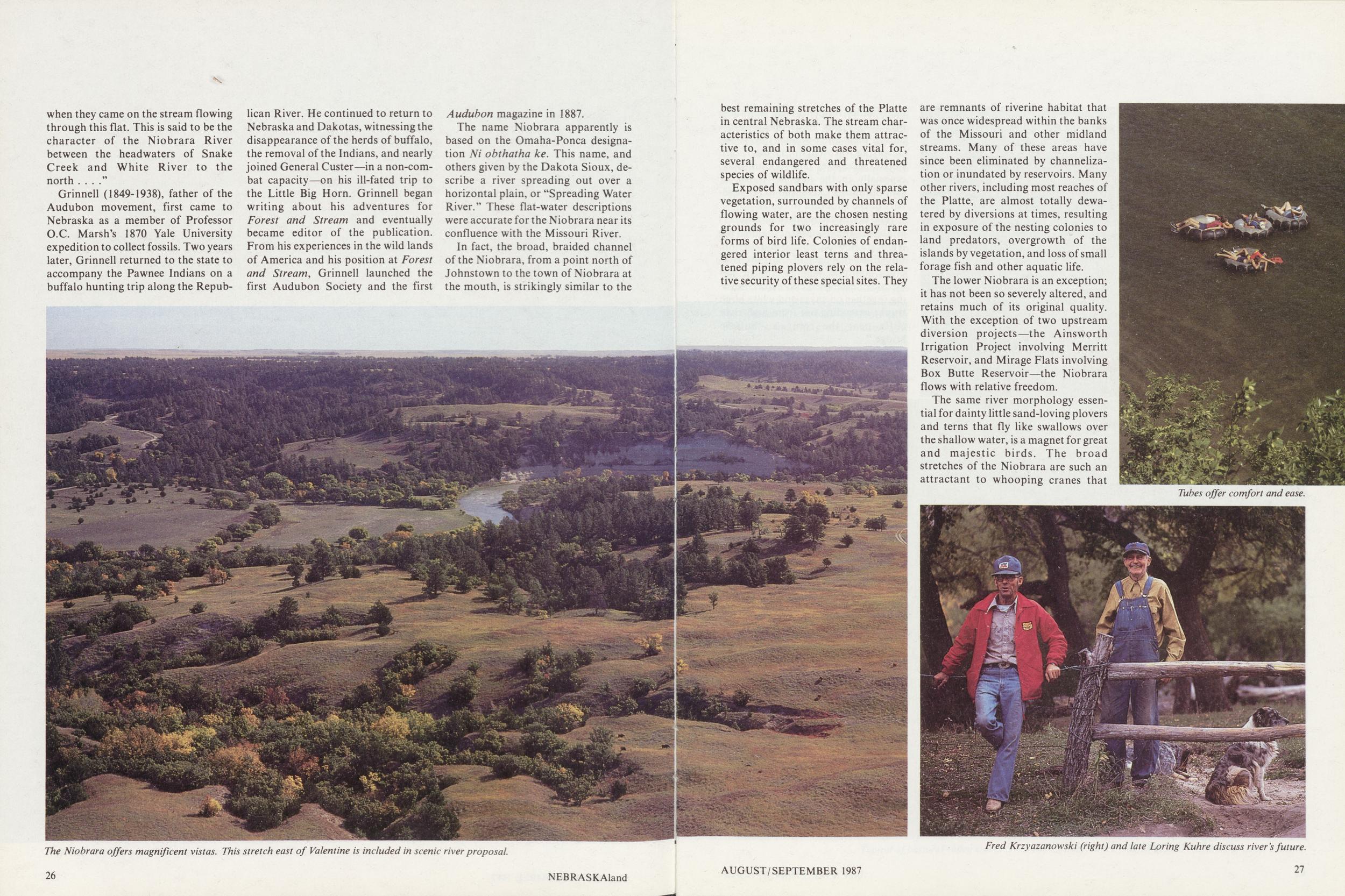
Within the vastness of the Great Plains where prairie horizons are the most encompassing sensory dimen- sion, the Niobrara has carved a valley most impressive in its diverse vertical dimensions, and in the scenic splendor of its varied forest types—deciduous and coniferous—that creates a mosaic of grassy parks and vistas extending across the undulating sandhills and sweeping plains.
In its most spectacular scenic reach in north-central Nebraska, the river is cradled in a valley hundreds of feet below the rimrock and ponderosa covered bluffs on the north. It graces lowland meadows with its presence, and courses under 200-foot-high cliffs. It is blessed by the shower of waterfalls that cascade from adjacent banks or are hidden in canyons on its south flank. Some of these hold groves of paper birch, remnants of the cool climates that followed the glacial ages.
Other draws are stocked with bur oak, a sturdy companion to the prairie. Boxelder, cottonwood and willow line the river's edge; black walnut, hackberry and green ash add to the eastern hardwood forest that has held on to western outposts throughout much of the valley.
Chokecherry, wild plum and sumac are widespread components of the understory. These shrubs lace the glades and draws, and add color in the fall, when many hillsides are ablaze with scarlet by the first week of October. Throughout the warm sea- sons, wildflowers add splashes of color to the grasslands and woodland edges, and the rich variety of plant communities accompanying the Niobrara River valley supports an abundance of wildlife. It is ideal for songbirds, wild turkeys and white-tailed deer.
Red cedar, an indigenous component of the forest community of the area, is increasingly prevalent in the relative absence of prairie fires. With berries spread by an array of avian planters, cedars in some sites are becoming overly abundant. With poetic justice, many become posts that fence range in which their kind reside.
The Niobrara enters the state as a clear and steady High Plains stream four feet wide and two feet deep, bordered by cattails and reeds. The property on both sides of the state line here is part of the Ellicott Ranch west of Harrison. Native mixed and shortgrass prairies extend over rolling hills, accented by sandstone outcrops. The river's source is antelope and western meadowlark country, where grasslands and a wide sky join in a nearly treeless marriage.
Lorena Ellicott recently pointed out that, "It is a little bigger when it leaves the ranch than when it comes in. We have several springs right here.
"When my sons were little, they had a raft that they pulled along. When Jim, my second grandson was little, he was into everything, and I didn't want him to drown. I took him after dinner every day in the summertime to a place below for a little swimming lesson. You couldn't do that now. It's not deep enough," she adds. "That was probably in 1965, when he was six years old.
"We had those dry years and they built dams. Everybody has a dam on the river anymore, for stock water and so on. Not much irrigation from dams in the area.
"And we used to have high water. When they had a thunderstorm up on the ridge, the water would just come down and clear out the river. Before I came here, a bad storm washed Hansen's bunk house away," Lorena said. She "came out teaching" from Lincoln, in 1928 and married a rancher, the late Don Ellicott, in 1930.
These high plains can sometimes be harshly dry, as in the summer of 1985, or fiercely cold, with life-threatening blizzards. This past winter was mild, and a flock of "delightful finches" probably gray-crowned rosy finches took advantage of the sunflower seeds Lorena put out daily. "I think they came from a place that is colder than it is here," she suggested, because they act as if "they think this is a lovely place to spend the winter."
22 NEBRASKAland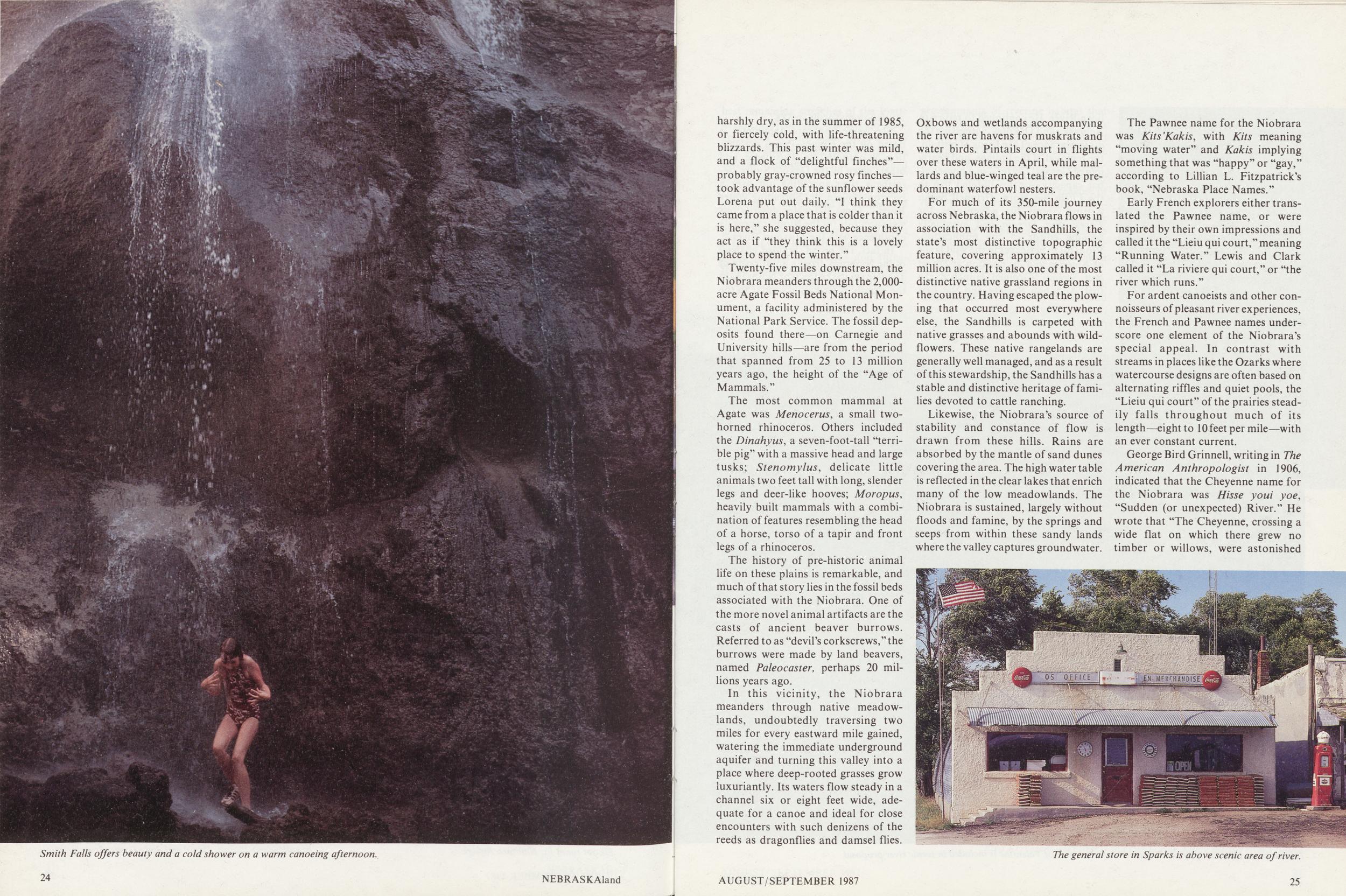
Twenty-five miles downstream, the Niobrara meanders through the 2,000-acre Agate Fossil Beds National Monument, a facility administered by the National Park Service. The fossil deposits found there—on Carnegie and University hills—are from the period that spanned from 25 to 13 million years ago, the height of the "Age of Mammals."
The most common mammal at Agate was Menocerus, a small two-horned rhinoceros. Others included the Dinahyus, a seven-foot-tall "terrible pig" with a massive head and large tusks; Stenomylus, delicate little animals two feet tall with long, slender legs and deer-like hooves; Moropus, heavily built mammals with a combination of features resembling the head of a horse, torso of a tapir and front legs of a rhinoceros.
The history of pre-historic animal life on these plains is remarkable, and much of that story lies in the fossil beds associated with the Niobrara. One of the more novel animal artifacts are the casts of ancient beaver burrows. Referred to as "devil's corkscrews," the burrows were made by land beavers, named Paleocaster, perhaps 20 millions years ago.
In this vicinity, the Niobrara meanders through native meadowlands, undoubtedly traversing two miles for every eastward mile gained, watering the immediate underground aquifer and turning this valley into a place where deep-rooted grasses grow luxuriantly. Its waters flow steady in a channel six or eight feet wide, adequate for a canoe and ideal for close encounters with such denizens of the reeds as dragonflies and damsel flies. Oxbows and wetlands accompanying the river are havens for muskrats and water birds. Pintails court in flights over these waters in April, while mallards and blue-winged teal are the predominant waterfowl nesters.
For much of its 350-mile journey across Nebraska, the Niobrara flows in association with the Sandhills, the state's most distinctive topographic feature, covering approximately 13 million acres. It is also one of the most distinctive native grassland regions in the country. Having escaped the plowing that occurred most everywhere else, the Sandhills is carpeted with native grasses and abounds with wildflowers. These native rangelands are generally well managed, and as a result of this stewardship, the Sandhills has a stable and distinctive heritage of families devoted to cattle ranching.
Likewise, the Niobrara's source of stability and Constance of flow is drawn from these hills. Rains are absorbed by the mantle of sand dunes covering the area. The high water table is reflected in the clear lakes that enrich many of the low meadowlands. The Niobrara is sustained, largely without floods and famine, by the springs and seeps from within these sandy lands where the valley captures groundwater.
The Pawnee name for the Niobrara was Kits'Kakis, with Kits meaning "moving water" and Kakis implying something that was "happy" or "gay," according to Lillian L. Fitzpatrick's book, "Nebraska Place Names."
Early French explorers either translated the Pawnee name, or were inspired by their own impressions and called it the "Lieiu qui court," meaning "Running Water." Lewis and Clark called it "La riviere qui court," or "the river which runs."
For ardent canoeists and other connoisseurs of pleasant river experiences, the French and Pawnee names underscore one element of the Niobrara's special appeal. In contrast with streams in places like the Ozarks where watercourse designs are often based on alternating riffles and quiet pools, the "Lieiu qui court" of the prairies steadily falls throughout much of its length—eight to lO feet per mile—with an ever constant current.
George Bird Grinnell, writing in The American Anthropologist in 1906, indicated that the Cheyenne name for the Niobrara was Hisse youi yoe, "Sudden (or unexpected) River." He wrote that "The Cheyenne, crossing a wide flat on which there grew no timber or willows, were astonished when they came on the stream flowing through this flat. This is said to be the character of the Niobrara River between the headwaters of Snake Creek and White River to the north . . . ."
Grinnell (1849-1938), father of the Audubon movement, first came to Nebraska as a member of Professor O.C. Marsh's 1870 Yale University expedition to collect fossils. Two years later, Grinnell returned to the state to accompany the Pawnee Indians on a buffalo hunting trip along the Republican River. He continued to return to Nebraska and Dakotas, witnessing the disappearance of the herds of buffalo, the removal of the Indians, and nearly joined General Custer—in a non-combat capacity—on his ill-fated trip to the Little Big Horn. Grinnell began writing about his adventures for Forest and Stream and eventually became editor of the publication. From his experiences in the wild lands of America and his position at Forest and Stream, Grinnell launched the first Audubon Society and the first Audubon magazine in 1887.
The name Niobrara apparently is based on the Omaha-Ponca designation Ni obthatha ke. This name, and others given by the Dakota Sioux, describe a river spreading out over a horizontal plain, or "Spreading Water River." These flat-water descriptions were accurate for the Niobrara near its confluence with the Missouri River.
In fact, the broad, braided channel of the Niobrara, from a point north of Johnstown to the town of Niobrara at the mouth, is strikingly similar to the 26 NEBRASKAland best remaining stretches of the Platte in central Nebraska. The stream characteristics of both make them attractive to, and in some cases vital for, several endangered and threatened species of wildlife.
Exposed sandbars with only sparse vegetation, surrounded by channels of flowing water, are the chosen nesting grounds for two increasingly rare forms of bird life. Colonies of endangered interior least terns and threatened piping plovers rely on the relative security of these special sites. They are remnants of riverine habitat that was once widespread within the banks of the Missouri and other midland streams. Many of these areas have since been eliminated by channelization or inundated by reservoirs. Many other rivers, including most reaches of the Platte, are almost totally dewatered by diversions at times, resulting in exposure of the nesting colonies to land predators, overgrowth of the islands by vegetation, and loss of small forage fish and other aquatic life.
The lower Niobrara is an exception; it has not been so severely altered, and retains much of its original quality. With the exception of two upstream diversion projects—the Ainsworth Irrigation Project involving Merritt Reservoir, and Mirage Flats involving Box Butte Reservoir—the Niobrara flows with relative freedom.
The same river morphology essential for dainty little sand-loving plovers and terns that fly like swallows over the shallow water, is a magnet for great and majestic birds. The broad stretches of the Niobrara are such an attractant to whooping cranes that many valley residents have seen these exceedingly rare birds on stopovers during their twice-annual migrations traversing the length of the Great Plains. Likewise, it is not unusual, especially in the fall, for flocks of sandhill cranes to descend to the sandbars of the Niobrara to roost.
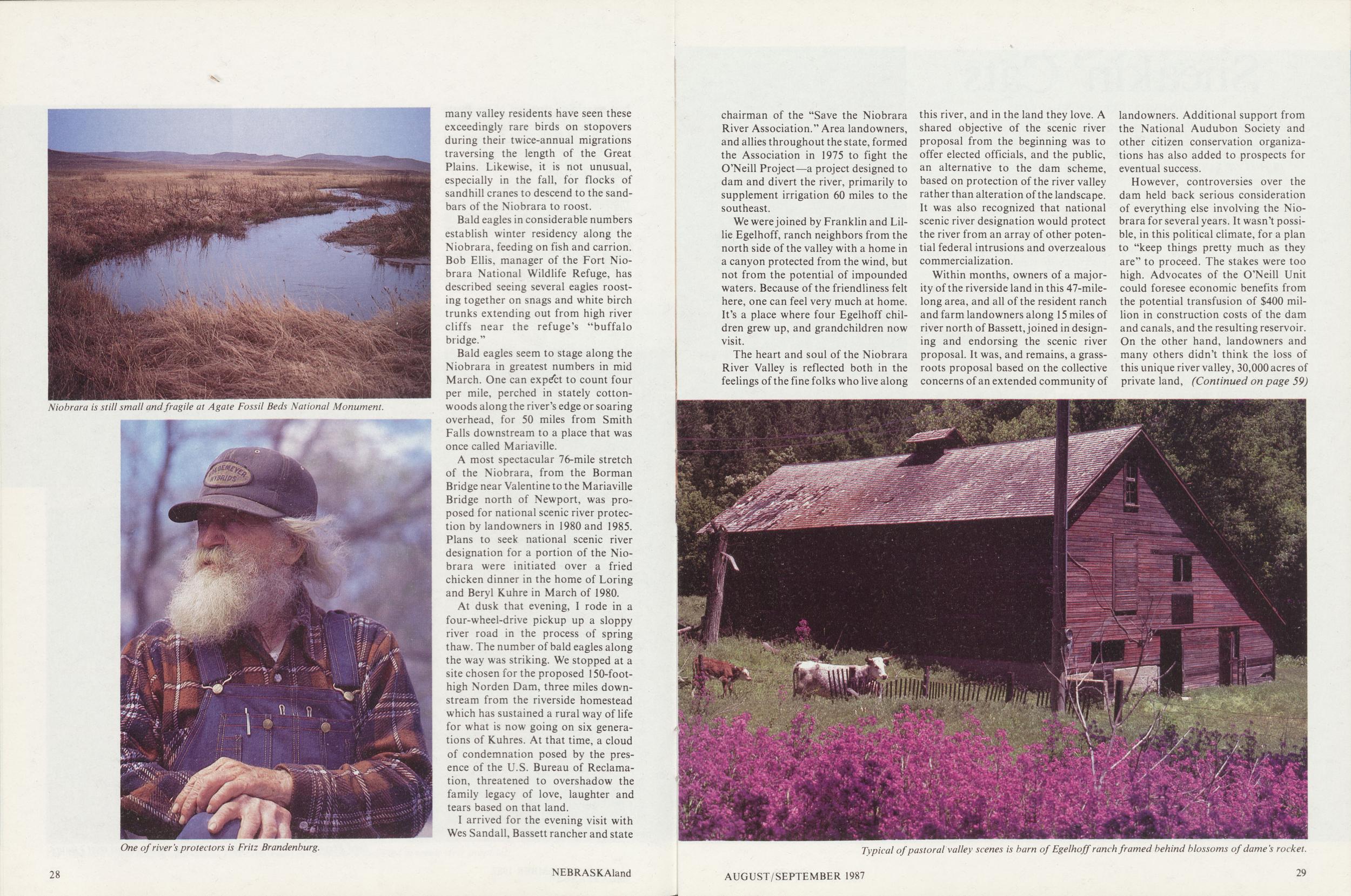
Bald eagles in considerable numbers establish winter residency along the Niobrara, feeding on fish and carrion. Bob Ellis, manager of the Fort Niobrara National Wildlife Refuge, has described seeing several eagles roosting together on snags and white birch trunks extending out from high river cliffs near the refuge's "buffalo bridge."
Bald eagles seem to stage along the Niobrara in greatest numbers in mid March. One can expert to count four per mile, perched in stately cottonwoods along the river's edge or soaring overhead, for 50 miles from Smith Falls downstream to a place that was once called Mariaville.
A most spectacular 76-mile stretch of the Niobrara, from the Borman Bridge near Valentine to the Mariaville Bridge north of Newport, was proposed for national scenic river protection by landowners in 1980 and 1985. Plans to seek national scenic river designation for a portion of the Niobrara were initiated over a fried chicken dinner in the home of Loring and Beryl Kuhre in March of 1980.
At dusk that evening, I rode in a four-wheel-drive pickup up a sloppy river road in the process of spring thaw. The number of bald eagles along the way was striking. We stopped at a site chosen for the proposed 150-foot- high Norden Dam, three miles down- stream from the riverside homestead which has sustained a rural way of life for what is now going on six generations of Kuhres. At that time, a cloud of condemnation posed by the presence of the U.S. Bureau of Reclamation, threatened to overshadow the family legacy of love, laughter and tears based on that land.
I arrived for the evening visit with Wes Sandall, Bassett rancher and state 28 NEBRASKAland chairman of the "Save the Niobrara River Association." Area landowners, and allies throughout the state, formed the Association in 1975 to fight the O'Neill Project—a project designed to dam and divert the river, primarily to supplement irrigation 60 miles to the southeast.
We were joined by Franklin and Lillie Egelhoff, ranch neighbors from the north side of the valley with a home in a canyon protected from the wind, but not from the potential of impounded waters. Because of the friendliness felt here, one can feel very much at home. It's a place where four Egelhoff children grew up, and grandchildren now visit.
The heart and soul of the Niobrara River Valley is reflected both in the feelings of the fine folks who live along this river, and in the land they love. A shared objective of the scenic river proposal from the beginning was to offer elected officials, and the public, an alternative to the dam scheme, based on protection of the river valley rather than alteration of the landscape. It was also recognized that national scenic river designation would protect the river from an array of other potential federal intrusions and overzealous commercialization.
Within months, owners of a majority of the riverside land in this 47-mile-long area, and all of the resident ranch and farm landowners along 15 miles of river north of Bassett, joined in designing and endorsing the scenic river proposal. It was, and remains, a grassroots proposal based on the collective concerns of an extended community of landowners. Additional support from the National Audubon Society and other citizen conservation organizations has also added to prospects for eventual success.
However, controversies over the dam held back serious consideration of everything else involving the Niobrara for several years. It wasn't possible, in this political climate, for a plan to "keep things pretty much as they are" to proceed. The stakes were too high. Advocates of the O'Neill Unit could foresee economic benefits from the potential transfusion of $400 million in construction costs of the dam and canals, and the resulting reservoir. On the other hand, landowners and many others didn't think the loss of this unique river valley, 30,000 acres of private land, (Continued on page 59)
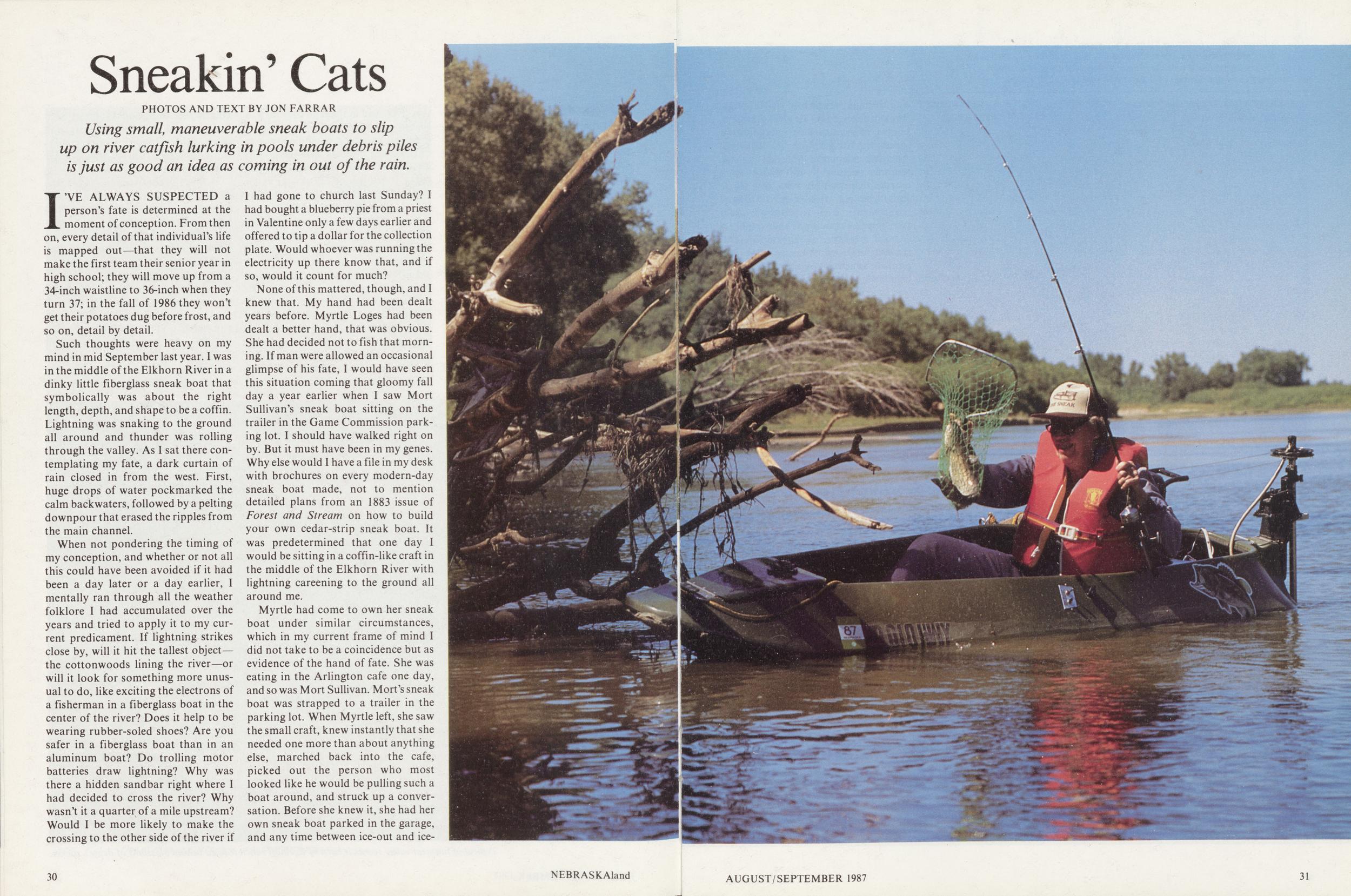
Sneakin' Cats
PHOTOS AND TEXT BY JON FARRAR Using small maneuver able sneak boats to slip up on river catfish lurking in pools under debris piles is just as good an idea as coming in out of the rain.I'VE ALWAYS SUSPECTED a person's fate is determined at the moment of conception. From then on, every detail of that individual's life is mapped out—that they will not make the first team their senior year in high school; they will move up from a 34-inch waistline to 36-inch when they turn 37; in the fall of 1986 they won't get their potatoes dug before frost, and so on, detail by detail.
Such thoughts were heavy on my mind in mid September last year. I was in the middle of the Elkhorn River in a dinky little fiberglass sneak boat that symbolically was about the right length, depth, and shape to be a coffin. Lightning was snaking to the ground all around and thunder was rolling through the valley. As I sat there contemplating my fate, a dark curtain of rain closed in from the west. First, huge drops of water pockmarked the calm backwaters, followed by a pelting downpour that erased the ripples from the main channel.
When not pondering the timing of my conception, and whether or not all this could have been avoided if it had been a day later or a day earlier, I mentally ran through all the weather folklore I had accumulated over the years and tried to apply it to my current predicament. If lightning strikes close by, will it hit the tallest object the cottonwoods lining the river—or will it look for something more unusual to do, like exciting the electrons of a fisherman in a fiberglass boat in the center of the river? Does it help to be wearing rubber-soled shoes? Are you safer in a fiberglass boat than in an aluminum boat? Do trolling motor batteries draw lightning? Why was there a hidden sandbar right where I had decided to cross the river? Why wasn't it a quarter of a mile upstream? Would I be more likely to make the crossing to the other side of the river if I had gone to church last Sunday? I had bought a blueberry pie from a priest in Valentine only a few days earlier and offered to tip a dollar for the collection plate. Would whoever was running the electricity up there know that, and if so, would it count for much?
None of this mattered, though, and I knew that. My hand had been dealt years before. Myrtle Loges had been dealt a better hand, that was obvious. She had decided not to fish that morning. If man were allowed an occasional glimpse of his fate, I would have seen this situation coming that gloomy fall day a year earlier when I saw Mort Sullivan's sneak boat sitting on the trailer in the Game Commission parking lot. I should have walked right on by. But it must have been in my genes. Why else would I have a file in my desk with brochures on every modern-day sneak boat made, not to mention detailed plans from an 1883 issue of Forest and Stream on how to build your own cedar-strip sneak boat. It was predetermined that one day I would be sitting in a coffin-like craft in the middle of the Elkhorn River with lightning careening to the ground all around me.
Myrtle had come to own her sneak boat under similar circumstances, which in my current frame of mind I did not take to be a coincidence but as evidence of the hand of fate. She was eating in the Arlington cafe one day, and so was Mort Sullivan. Mort's sneak boat was strapped to a trailer in the parking lot. When Myrtle left, she saw the small craft, knew instantly that she needed one more than about anything else, marched back into the cafe, picked out the person who most looked like he would be pulling such a boat around, and struck up a conversation. Before she knew it, she had her own sneak boat parked in the garage, and any time between ice-out and ice-up, whenever the river was running just right for catfishing, she silently motors up and down the Elkhorn, maneuvering in and out of debris and snags, filling up the craft's live-well with catfish.
30 NEBRASKAland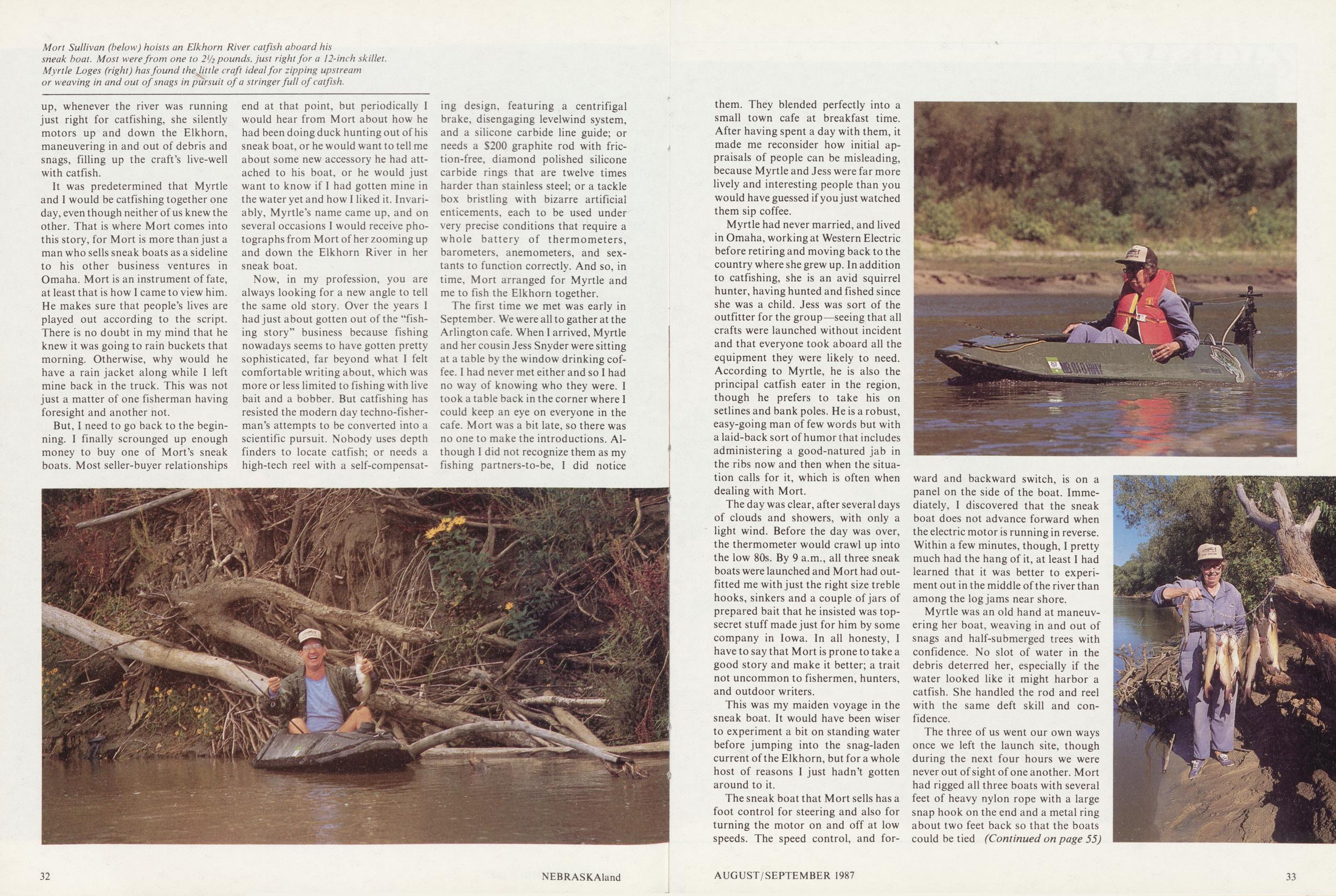 Mort Sullivan (below) hoists an Elkhorn River catfish aboard his
sneak boat. Most were from one to 2l pounds, just right for a 12-inch skillet.
Myrtle Loges (right) has found theM ttle craft ideal for zipping upstream
or weaving in and out of snags in pursuit of a stringer full of catfish.
Mort Sullivan (below) hoists an Elkhorn River catfish aboard his
sneak boat. Most were from one to 2l pounds, just right for a 12-inch skillet.
Myrtle Loges (right) has found theM ttle craft ideal for zipping upstream
or weaving in and out of snags in pursuit of a stringer full of catfish.
It was predetermined that Myrtle and I would be catfishing together one day, even though neither of us knew the other. That is where Mort comes into this story, for Mort is more than just a man who sells sneak boats as a sideline to his other business ventures in Omaha. Mort is an instrument of fate, at least that is how I came to view him. He makes sure that people's lives are played out according to the script. There is no doubt in my mind that he knew it was going to rain buckets that morning. Otherwise, why would he have a rain jacket along while I left mine back in the truck. This was not just a matter of one fisherman having foresight and another not.
But, I need to go back to the beginning. I finally scrounged up enough money to buy one of Mort's sneak boats. Most seller-buyer relationships end at that point, but periodically I would hear from Mort about how he had been doing duck hunting out of his sneak boat, or he would want to tell me about some new accessory he had attached to his boat, or he would just want to know if I had gotten mine in the water yet and how I liked it. Invariably, Myrtle's name came up, and on several occasions I would receive photographs from Mort of her zooming up and down the Elkhorn River in her sneak boat.
Now, in my profession, you are always looking for a new angle to tell the same old story. Over the years I had just about gotten out of the "fishing story" business because fishing nowadays seems to have gotten pretty sophisticated, far beyond what I felt comfortable writing about, which was more or less limited to fishing with live bait and a bobber. But catfishing has resisted the modern day techno-fisherman's attempts to be converted into a scientific pursuit. Nobody uses depth finders to locate catfish; or needs a high-tech reel with a self-compensating design, featuring a centrifigal brake, disengaging level wind system, and a silicone carbide line guide; or needs a $200 graphite rod with friction-free, diamond polished silicone carbide rings that are twelve times harder than stainless steel; or a tackle box bristling with bizarre artificial enticements, each to be used under very precise conditions that require a whole battery of thermometers, barometers, anemometers, and sextants to function correctly. And so, in time, Mort arranged for Myrtle and me to fish the Elkhorn together.
The first time we met was early in September. We were all to gather at the Arlington cafe. When I arrived, Myrtle and her cousin Jess Snyder were sitting at a table by the window drinking coffee. I had never met either and so I had no way of knowing who they were. I took a table back in the corner where I could keep an eye on everyone in the cafe. Mort was a bit late, so there was no one to make the introductions. Although I did not recognize them as my fishing partners-to-be, I did notice 32 NEBRSAKAland them. They blended perfectly into a small town cafe at breakfast time. After having spent a day with them, it made me reconsider how initial appraisals of people can be misleading, because Myrtle and Jess were far more lively and interesting people than you would have guessed if you just watched them sip coffee.
Myrtle had never married, and lived in Omaha, working at Western Electric before retiring and moving back to the country where she grew up. In addition to catfishing, she is an avid squirrel hunter, having hunted and fished since she was a child. Jess was sort of the outfitter for the group—seeing that all crafts were launched without incident and that everyone took aboard all the equipment they were likely to need. According to Myrtle, he is also the principal catfish eater in the region, though he prefers to take his on set lines and bank poles. He is a robust, easy-going man of few words but with a laid-back sort of humor that includes administering a good-natured jab in the ribs now and then when the situation calls for it, which is often when dealing with Mort.
The day was clear, after several days of clouds and showers, with only a light wind. Before the day was over, the thermometer would crawl up into the low 80s. By 9 a.m., all three sneak boats were launched and Mort had outfitted me with just the right size treble hooks, sinkers and a couple of jars of prepared bait that he insisted was topsecret stuff made just for him by some company in Iowa. In all honesty, I have to say that Mort is prone to take a good story and make it better; a trait not uncommon to fishermen, hunters, and outdoor writers.
This was my maiden voyage in the sneak boat. It would have been wiser to experiment a bit on standing water before jumping into the snag-laden current of the Elkhorn, but for a whole host of reasons I just hadn't gotten around to it.
The sneak boat that Mort sells has a foot control for steering and also for turning the motor on and off at low speeds. The speed control, and forward and backward switch, is on a panel on the side of the boat. Immediately, I discovered that the sneak boat does not advance forward when the electric motor is running in reverse. Within a few minutes, though, I pretty much had the hang of it, at least I had learned that it was better to experiment out in the middle of the river than among the logjams near shore.
Myrtle was an old hand at maneuvering her boat, weaving in and out of snags and half-submerged trees with confidence. No slot of water in the debris deterred her, especially if the water looked like it might harbor a catfish. She handled the rod and reel with the same deft skill and confidence.
The three of us went our own ways once we left the launch site, though during the next four hours we were never out of sight of one another. Mort had rigged all three boats with several feet of heavy nylon rope with a large snap hook on the end and a metal ring about two feet back so that the boats could be tied (Continued on page 55)
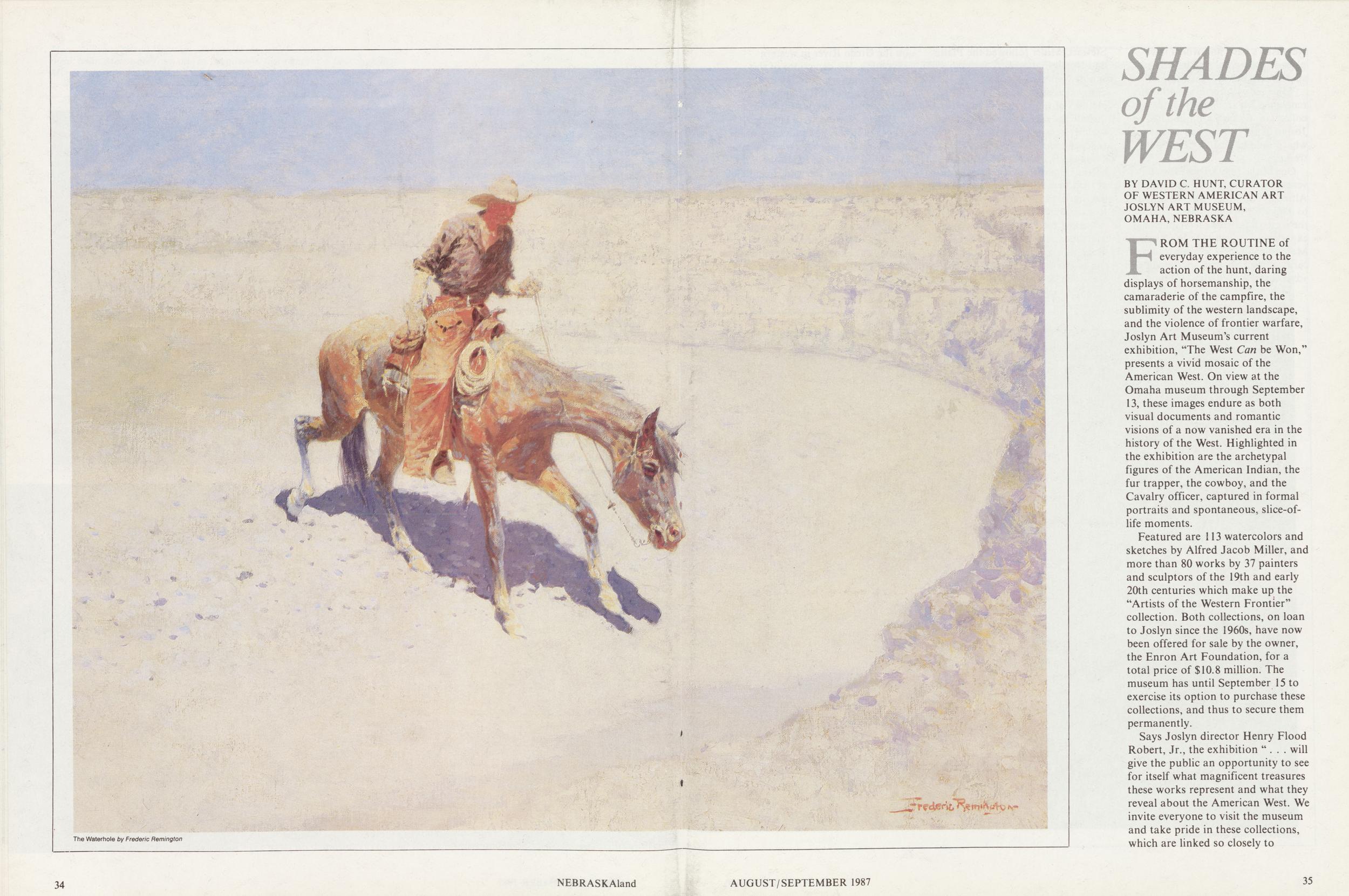
SHADES of the WEST
BY DAVID C HUNT, CURATOR OF WESTERN AMERICAN ART JOSLYN ART MUSEUM, OMAHA, NEBRASKAFROM THE ROUTINE of everyday experience to the action of the hunt, daring displays of horsemanship, the camaraderie of the campfire, the sublimity of the western landscape, and the violence of frontier warfare, Joslyn Art Museum's current exhibition, "The West Can be Won," presents a vivid mosaic of the American West. On view at the Omaha museum through September 13, these images endure as both visual documents and romantic visions of a now vanished era in the history of the West. Highlighted in the exhibition are the archetypal figures of the American Indian, the fur trapper, the cowboy, and the Cavalry officer, captured in formal portraits and spontaneous, slice-of-life moments.
Featured are 113 watercolors and sketches by Alfred Jacob Miller, and more than 80 works by 37 painters and sculptors of the 19th and early 20th centuries which make up the "Artists of the Western Frontier" collection. Both collections, on loan to Joslyn since the 1960s, have now been offered for sale by the owner, the Enron Art Foundation, for a total price of $10.8 million. The museum has until September 15 to exercise its option to purchase these collections, and thus to secure them permanently.
Says Joslyn director Henry Flood Robert, Jr., the exhibition "... will give the public an opportunity to see for itself what magnificent treasures these works represent and what they reveal about the American West. We invite everyone to visit the museum and take pride in these collections, which are linked so closely to
AUGUST/SEPTEMBER 1987 35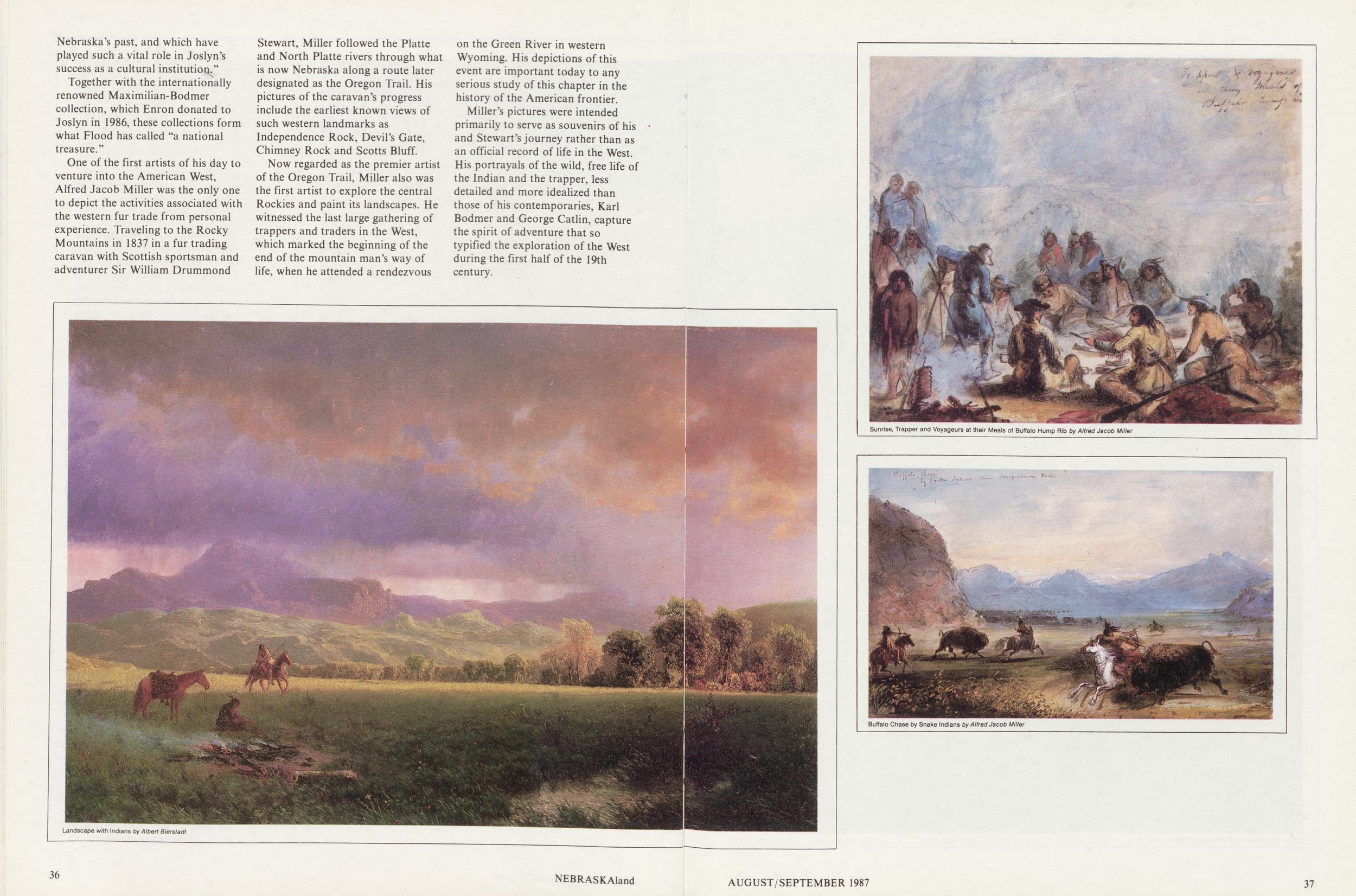
Together with the internationally renowned Maximilian-Bodmer collection, which Enron donated to Joslyn in 1986, these collections form what Flood has called "a national treasure."
One of the first artists of his day to venture into the American West, Alfred Jacob Miller was the only one to depict the activities associated with the western fur trade from personal experience. Traveling to the Rocky Mountains in 1837 in a fur trading caravan with Scottish sportsman and adventurer Sir William Drummond Stewart, Miller followed the Platte and North Platte rivers through what is now Nebraska along a route later designated as the Oregon Trail. His pictures of the caravan's progress include the earliest known views of such western landmarks as Independence Rock, Devil's Gate, Chimney Rock and Scotts Bluff.
Now regarded as the premier artist of the Oregon Trail, Miller also was the first artist to explore the central Rockies and paint its landscapes. He witnessed the last large gathering of trappers and traders in the West, which marked the beginning of the end of the mountain man's way of life, when he attended a rendezvous on the Green River in western Wyoming. His depictions of this event are important today to any serious study of this chapter in the history of the American frontier.
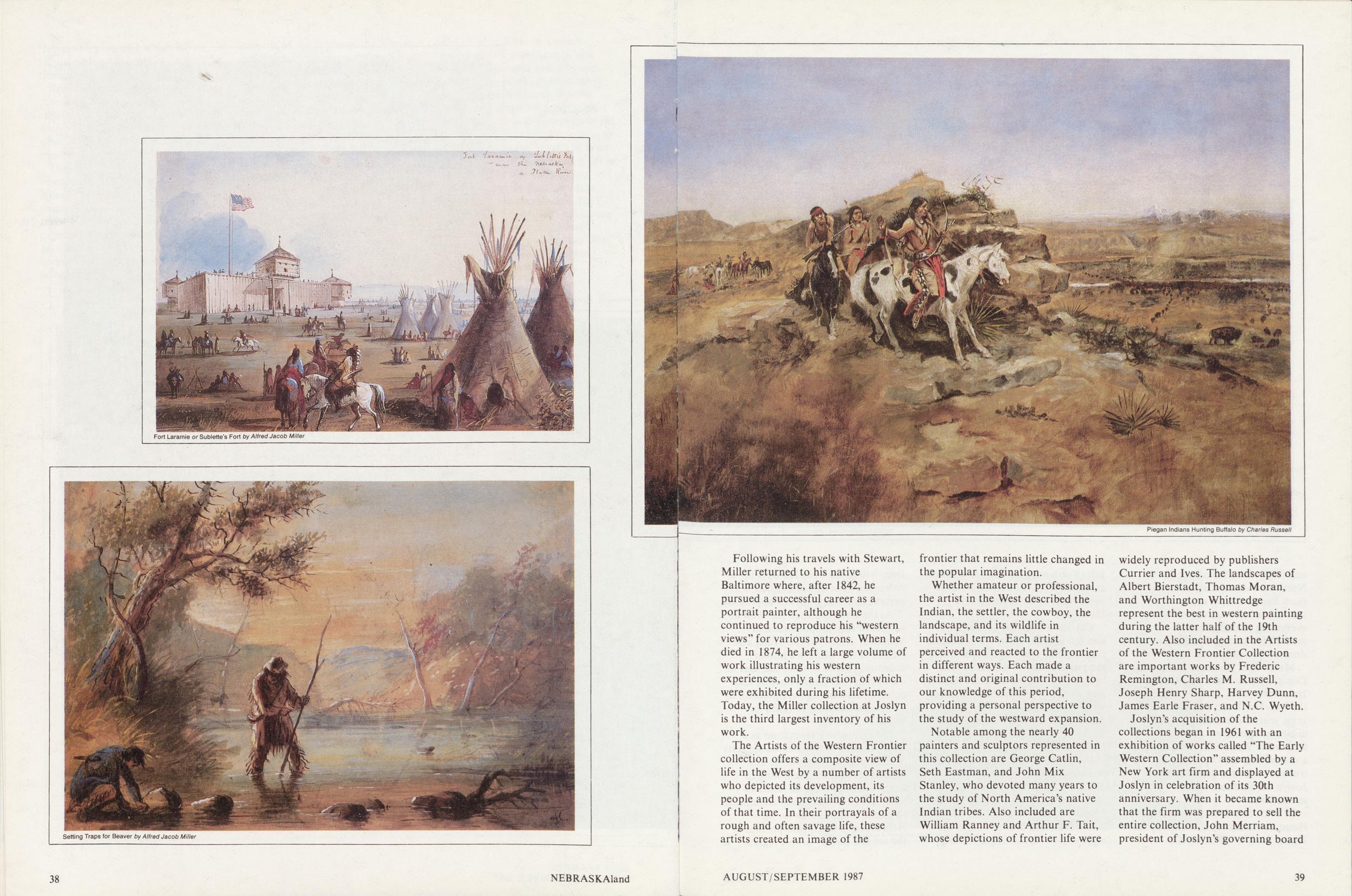
Following his travels with Stewart, Miller returned to his native Baltimore where, after 1842, he pursued a successful career as a portrait painter, although he continued to reproduce his "western views" for various patrons. When he died in 1874, he left a large volume of work illustrating his western experiences, only a fraction of which were exhibited during his lifetime. Today, the Miller collection at Joslyn is the third largest inventory of his work.
The Artists of the Western Frontier collection offers a composite view of life in the West by a number of artists who depicted its development, its people and the prevailing conditions of that time. In their portrayals of a rough and often savage life, these artists created an image of the frontier that remains little changed in the popular imagination.
Whether amateur or professional, the artist in the West described the Indian, the settler, the cowboy, the landscape, and its wildlife in individual terms. Each artist perceived and reacted to the frontier in different ways. Each made a distinct and original contribution to our knowledge of this period, providing a personal perspective to the study of the westward expansion.
Notable among the nearly 40 painters and sculptors represented in this collection are George Catlin, Seth Eastman, and John Mix Stanley, who devoted many years to the study of North America's native Indian tribes. Also included are William Ranney and Arthur F. Tait, whose depictions of frontier life were widely reproduced by publishers Currier and Ives. The landscapes of Albert Bierstadt, Thomas Moran, and Worthington Whittredge represent the best in western painting during the latter half of the 19th century. Also included in the Artists of the Western Frontier Collection are important works by Frederic Remington, Charles M. Russell, Joseph Henry Sharp, Harvey Dunn, James Earle Fraser, and N.C. Wyeth.
Joslyn's acquisition of the collections began in 1961 with an exhibition of works called "The Early Western Collection" assembled by a New York art firm and displayed at Joslyn in celebration of its 30th anniversary. When it became known that the firm was prepared to sell the entire collection, John Merriam, president of Joslyn's governing board and chief executive officer for the Northern Natural Gas Company (now Enron Corporation) urged immediate action. Eventually, nearly everything in the collection was secured for Joslyn through purchase, donation, or long-term loan.
AUGUST/SEPTEMBER 1987 39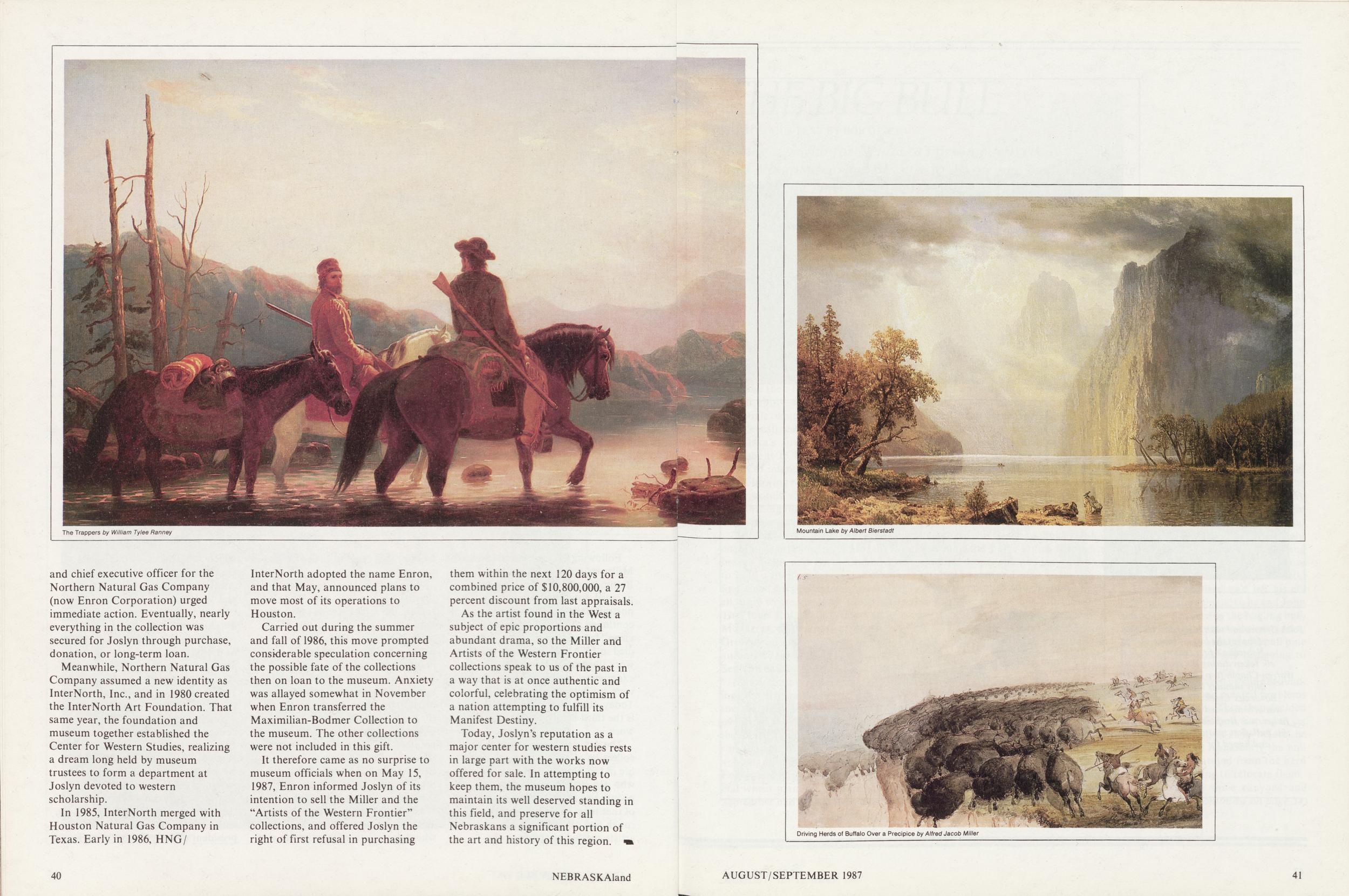
Meanwhile, Northern Natural Gas Company assumed a new identity as InterNorth, Inc., and in 1980 created the InterNorth Art Foundation. That same year, the foundation and museum together established the Center for Western Studies, realizing a dream long held by museum trustees to form a department at Joslyn devoted to western scholarship.
In 1985, InterNorth merged with Houston Natural Gas Company in Texas. Early in 1986, HNG/ InterNorth adopted the name Enron, and that May, announced plans to move most of its operations to Houston.
Carried out during the summer and fall of 1986, this move prompted considerable speculation concerning the possible fate of the collections then on loan to the museum. Anxiety was allayed somewhat in November when Enron transferred the Maximilian-Bodmer Collection to the museum. The other collections were not included in this gift.
It therefore came as no surprise to museum officials when on May 15, 1987, Enron informed Joslyn of its intention to sell the Miller and the "Artists of the Western Frontier" collections, and offered Joslyn the right of first refusal in purchasing them within the next 120 days for a combined price of $10,800,000, a 27 percent discount from last appraisals.
As the artist found in the West a subject of epic proportions and abundant drama, so the Miller and Artists of the Western Frontier collections speak to us of the past in a way that is at once authentic and colorful, celebrating the optimism of a nation attempting to fulfill its Manifest Destiny.
Today, Joslyn's reputation as a major center for western studies rests in large part with the works now offered for sale. In attempting to keep them, the museum hopes to maintain its well deserved standing in this field, and preserve for all Nebraskans a significant portion of the art and history of this region.
40 NEBRASKAland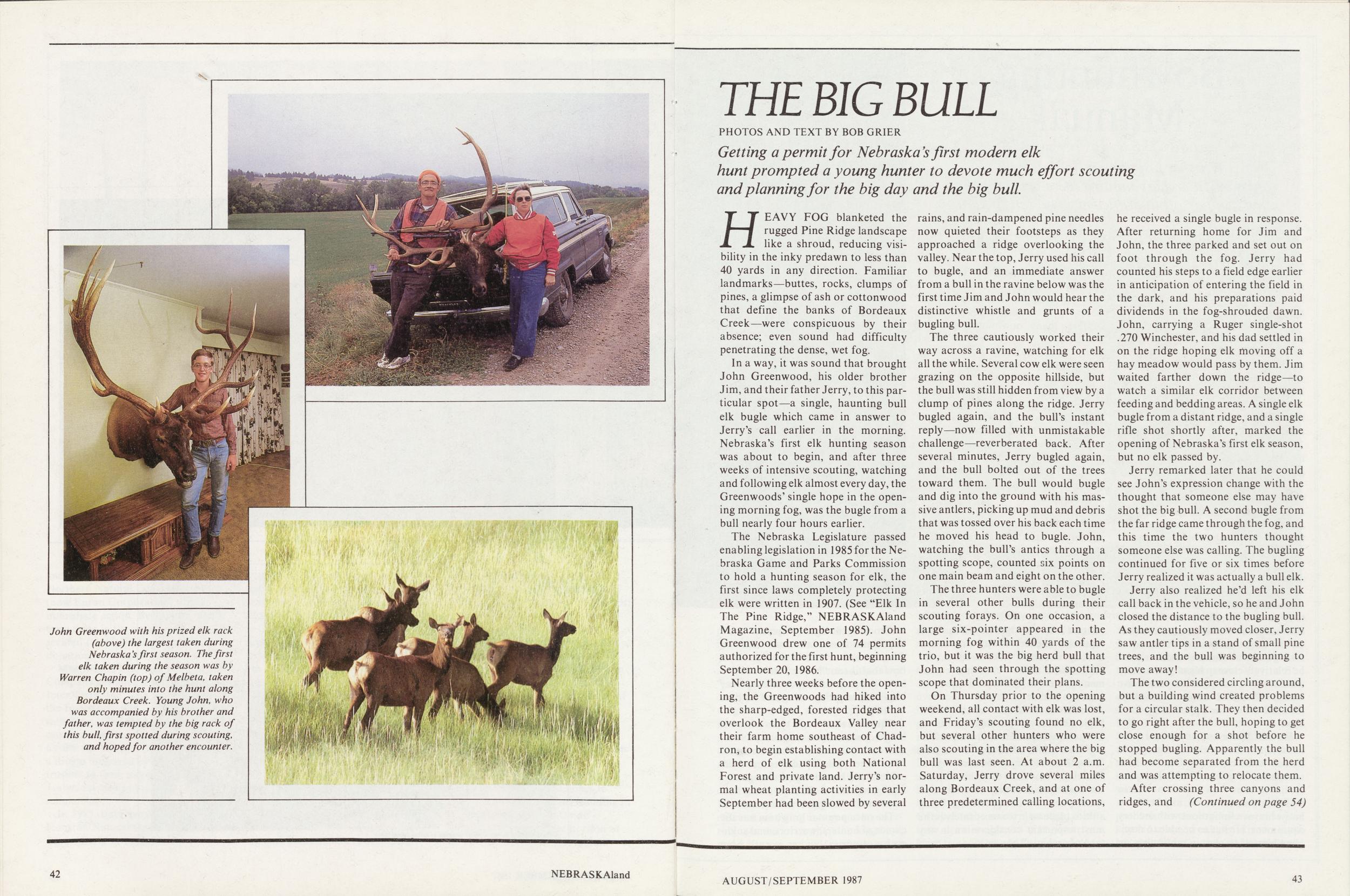
THE BIG BULL
PHOTOS AND TEXT BY BOB GRIER Getting a permit for Nebraska's first modern elk hunt prompted a young hunter to devote much effort scouting and planning for the big day and the big bullHEAVY FOG blanketed the rugged Pine Ridge landscape like a shroud, reducing visibility in the inky predawn to less than 40 yards in any direction. Familiar landmarks—buttes, rocks, clumps of pines, a glimpse of ash or cottonwood that define the banks of Bordeaux Creek—were conspicuous by their absence; even sound had difficulty penetrating the dense, wet fog.
In a way, it was sound that brought John Greenwood, his older brother Jim, and their father Jerry, to this particular spot—a single, haunting bull elk bugle which came in answer to Jerry's call earlier in the morning. Nebraska's first elk hunting season was about to begin, and after three weeks of intensive scouting, watching and following elk almost every day, the Greenwoods' single hope in the opening morning fog, was the bugle from a bull nearly four hours earlier.
The Nebraska Legislature passed enabling legislation in 1985 for the Nebraska Game and Parks Commission to hold a hunting season for elk, the first since laws completely protecting elk were written in 1907. (See "Elk In The Pine Ridge," NEBRASKAland Magazine, September 1985). John Greenwood drew one of 74 permits authorized for the first hunt, beginning September 20, 1986.
Nearly three weeks before the opening, the Greenwoods had hiked into the sharp-edged, forested ridges that overlook the Bordeaux Valley near their farm home southeast of Chadron, to begin establishing contact with a herd of elk using both National Forest and private land. Jerry's normal wheat planting activities in early September had been slowed by several rains, and rain-dampened pine needles now quieted their footsteps as they approached a ridge overlooking the valley. Near the top, Jerry used his call to bugle, and an immediate answer from a bull in the ravine below was the first time Jim and John would hear the distinctive whistle and grunts of a bugling bull.
The three cautiously worked their way across a ravine, watching for elk all the while. Several cow elk were seen grazing on the opposite hillside, but the bull was still hidden from view by a clump of pines along the ridge. Jerry bugled again, and the bull's instant reply—now filled with unmistakable challenge—reverberated back. After several minutes, Jerry bugled again, and the bull bolted out of the trees toward them. The bull would bugle and dig into the ground with his massive antlers, picking up mud and debris that was tossed over his back each time he moved his head to bugle. John, watching the bull's antics through a spotting scope, counted six points on one main beam and eight on the other.
The three hunters were able to bugle in several other bulls during their scouting forays. On one occasion, a large six-pointer appeared in the morning fog within 40 yards of the trio, but it was the big herd bull that John had seen through the spotting scope that dominated their plans.
On Thursday prior to the opening weekend, all contact with elk was lost, and Friday's scouting found no elk, but several other hunters who were also scouting in the area where the big bull was last seen. At about 2 a.m. Saturday, Jerry drove several miles along Bordeaux Creek, and at one of three predetermined calling locations, he received a single bugle in response. After returning home for Jim and John, the three parked and set out on foot through the fog. Jerry had counted his steps to a field edge earlier in anticipation of entering the field in the dark, and his preparations paid dividends in the fog-shrouded dawn. John, carrying a Ruger single-shot .270 Winchester, and his dad settled in on the ridge hoping elk moving off a hay meadow would pass by them. Jim waited farther down the ridge—to watch a similar elk corridor between feeding and bedding areas. A single elk bugle from a distant ridge, and a single rifle shot shortly after, marked the opening of Nebraska's first elk season, but no elk passed by.
Jerry remarked later that he could see John's expression change with the thought that someone else may have shot the big bull. A second bugle from the far ridge came through the fog, and this time the two hunters thought someone else was calling. The bugling continued for five or six times before Jerry realized it was actually a bull elk. Jerry also realized he'd left his elk call back in the vehicle, so he and John closed the distance to the bugling bull. As they cautiously moved closer, Jerry saw antler tips in a stand of small pine trees, and the bull was beginning to move away!
The two considered circling around, but a building wind created problems for a circular stalk. They then decided to go right after the bull, hoping to get close enough for a shot before he stopped bugling. Apparently the bull had become separated from the herd and was attempting to relocate them.
After crossing three canyons and ridges, and (Continued on page 54)
AUGUST/SEPTEMBER 1987 43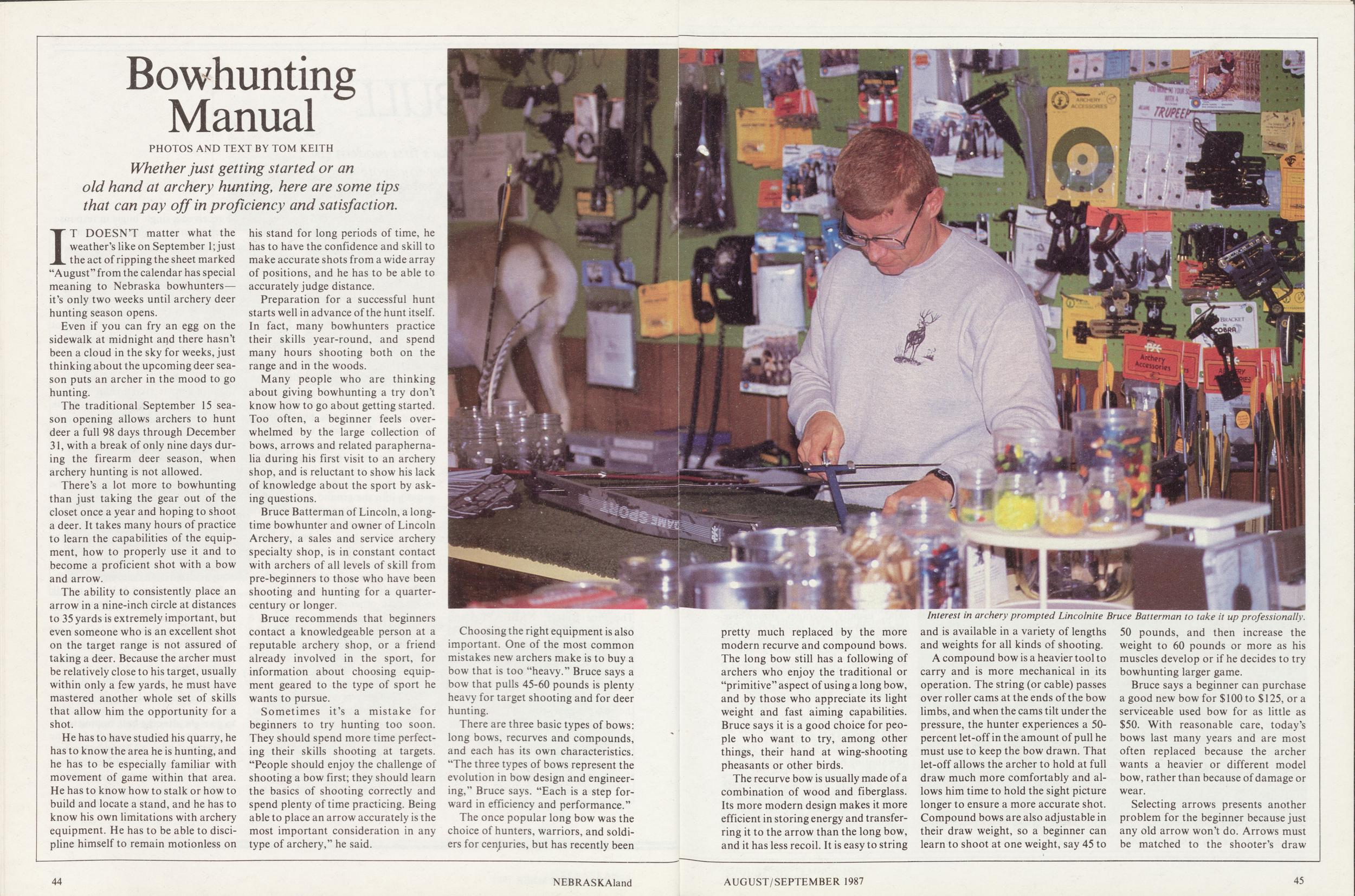
Bowhunting Manual
PHOTOS AND TEXT BY TOM KEITH Whether just getting started or an old hand at archery hunting, here are some tips that can pay off in proficiency and satisfaction.IT DOESN'T matter what the weather's like on September 1; just the act of ripping the sheet marked "August" from the calendar has special meaning to Nebraska bowhunters— it's only two weeks until archery deer hunting season opens.
Even if you can fry an egg on the sidewalk at midnight and there hasn't been a cloud in the sky for weeks, just thinking about the upcoming deer season puts an archer in the mood to go hunting.
The traditional September 15 season opening allows archers to hunt deer a full 98 days through December 31, with a break of only nine days during the firearm deer season, when archery hunting is not allowed.
There's a lot more to bowhunting than just taking the gear out of the closet once a year and hoping to shoot a deer. It takes many hours of practice to learn the capabilities of the equipment, how to properly use it and to become a proficient shot with a bow and arrow.
The ability to consistently place an arrow in a nine-inch circle at distances to 35 yards is extremely important, but even someone who is an excellent shot on the target range is not assured of taking a deer. Because the archer must be relatively close to his target, usually within only a few yards, he must have mastered another whole set of skills that allow him the opportunity for a shot.
He has to have studied his quarry, he has to know the area he is hunting, and he has to be especially familiar with movement of game within that area. He has to know how to stalk or how to build and locate a stand, and he has to know his own limitations with archery equipment. He has to be able to discipline himself to remain motionless on his stand for long periods of time, he has to have the confidence and skill to make accurate shots from a wide array of positions, and he has to be able to accurately judge distance.
Preparation for a successful hunt starts well in advance of the hunt itself. In fact, many bowhunters practice their skills year-round, and spend many hours shooting both on the range and in the woods.
Many people who are thinking about giving bowhunting a try don't know how to go about getting started. Too often, a beginner feels overwhelmed by the large collection of bows, arrows and related paraphernalia during his first visit to an archery shop, and is reluctant to show his lack of knowledge about the sport by asking questions.
Bruce Batterman of Lincoln, a longtime bowhunter and owner of Lincoln Archery, a sales and service archery specialty shop, is in constant contact with archers of all levels of skill from pre-beginners to those who have been shooting and hunting for a quarter-century or longer.
Bruce recommends that beginners contact a knowledgeable person at a reputable archery shop, or a friend already involved in the sport, for information about choosing equipment geared to the type of sport he wants to pursue.
Sometimes it's a mistake for beginners to try hunting too soon. They should spend more time perfecting their skills shooting at targets. "People should enjoy the challenge of shooting a bow first; they should learn the basics of shooting correctly and spend plenty of time practicing. Being able to place an arrow accurately is the most important consideration in any type of archery," he said.
Choosing the right equipment is also important. One of the most common mistakes new archers make is to buy a bow that is too "heavy." Bruce says a bow that pulls 45-60 pounds is plenty heavy for target shooting and for deer hunting.
There are three basic types of bows: long bows, recurves and compounds, and each has its own characteristics. "The three types of bows represent the evolution in bow design and engineer- ing," Bruce says. "Each is a step forward in efficiency and performance."
The once popular long bow was the choice of hunters, warriors, and soldiers for centuries, but has recently been 44 NEBRASKaland pretty much replaced by the more modern recurve and compound bows. The long bow still has a following of archers who enjoy the traditional or "primitive" aspect of using a long bow, and by those who appreciate its light weight and fast aiming capabilities. Bruce says it is a good choice for people who want to try, among other things, their hand at wing-shooting pheasants or other birds.
The recurve bow is usually made of a combination of wood and fiberglass. Its more modern design makes it more efficient in storing energy and transferring it to the arrow than the long bow, and it has less recoil. It is easy to string and is available in a variety of lengths and weights for all kinds of shooting.
A compound bow is a heavier tool to carry and is more mechanical in its operation. The string (or cable) passes over roller cams at the ends of the bow limbs, and when the cams tilt under the pressure, the hunter experiences a 50- percent let-off in the amount of pull he must use to keep the bow drawn. That let-off allows the archer to hold at full draw much more comfortably and allows him time to hold the sight picture longer to ensure a more accurate shot. Compound bows are also adjustable in their draw weight, so a beginner can learn to shoot at one weight, say 45 to 50 pounds, and then increase the weight to 60 pounds or more as his muscles develop or if he decides to try bowhunting larger game.
Bruce says a beginner can purchase a good new bow for $100 to $125, or a serviceable used bow for as little as $50. With reasonable care, today's bows last many years and are most often replaced because the archer wants a heavier or different model bow, rather than because of damage or wear.
Selecting arrows presents another problem for the beginner because just any old arrow won't do. Arrows must be matched to the shooter's draw length and to the weight of the bow. The arrow shaft's spine, or the bending quality of the arrow that lets it spring out as it passes the bow when being shot then return to its original straightness when in flight, must match the weight of the bow both for accuracy and to avoid breaking or damaging the arrow.
AUGUST/SEPTEMBER 1987 45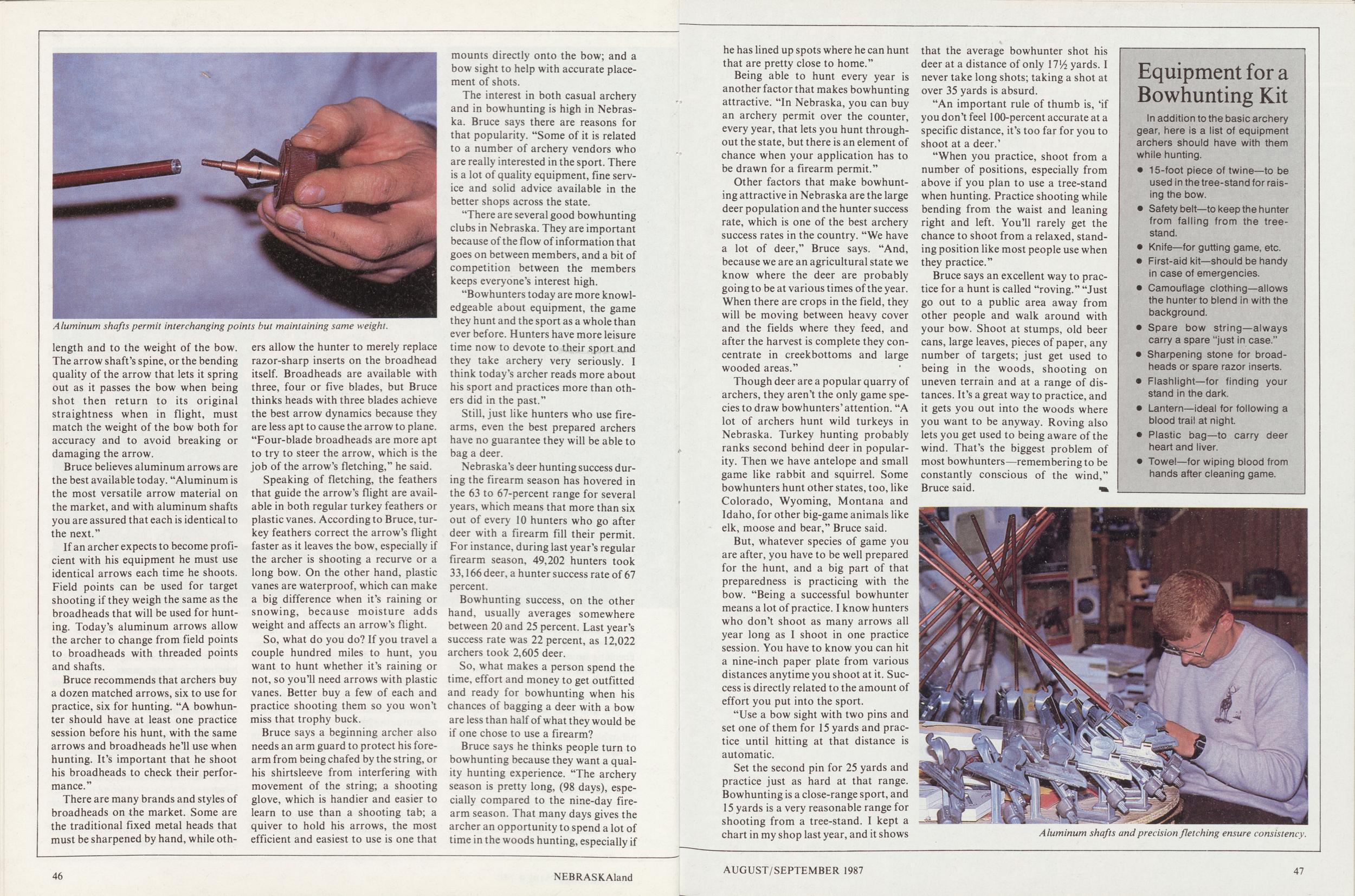
Bruce believes aluminum arrows are the best available today. "Aluminum is the most versatile arrow material on the market, and with aluminum shafts you are assured that each is identical to the next."
If an archer expects to become proficient with his equipment he must use identical arrows each time he shoots. Field points can be used for target shooting if they weigh the same as the broad heads that will be used for hunting. Today's aluminum arrows allow the archer to change from field points to broad heads with threaded points and shafts.
Bruce recommends that archers buy a dozen matched arrows, six to use for practice, six for hunting. "A bowhunter should have at least one practice session before his hunt, with the same arrows and broadheads he'll use when hunting. It's important that he shoot his broadheads to check their performance."
There are many brands and styles of broadheads on the market. Some are the traditional fixed metal heads that must be sharpened by hand, while others allow the hunter to merely replace razor-sharp inserts on the broadhead itself. Broadheads are available with three, four or five blades, but Bruce thinks heads with three blades achieve the best arrow dynamics because they are less apt to cause the arrow to plane. "Four-blade broadheads are more apt to try to steer the arrow, which is the job of the arrow's fletching," he said.
Speaking of fletching, the feathers that guide the arrow's flight are available in both regular turkey feathers or plastic vanes. According to Bruce, turkey feathers correct the arrow's flight faster as it leaves the bow, especially if the archer is shooting a recurve or a long bow. On the other hand, plastic vanes are waterproof, which can make a big difference when it's raining or snowing, because moisture adds weight and affects an arrow's flight.
So, what do you do? If you travel a couple hundred miles to hunt, you want to hunt whether it's raining or not, so you'll need arrows with plastic vanes. Better buy a few of each and practice shooting them so you won't miss that trophy buck.
Bruce says a beginning archer also needs an arm guard to protect his forearm from being chafed by the string, or his shirtsleeve from interfering with movement of the string; a shooting glove, which is handier and easier to learn to use than a shooting tab; a quiver to hold his arrows, the most efficient and easiest to use is one that mounts directly onto the bow; and a bow sight to help with accurate placement of shots.
The interest in both casual archery and in bowhunting is high in Nebraska. Bruce says there are reasons for that popularity. "Some of it is related to a number of archery vendors who are really interested in the sport. There is a lot of quality equipment, fine service and solid advice available in the better shops across the state.
"There are several good bowhunting clubs in Nebraska. They are important because of the flow of information that goes on between members, and a bit of competition between the members keeps everyone's interest high.
"Bowhunters today are more knowledgeable about equipment, the game they hunt and the sport as a whole than ever before. Hunters have more leisure time now to devote to their sport and they take archery very seriously. I think today's archer reads more about his sport and practices more than others did in the past."
Still, just like hunters who use firearms, even the best prepared archers have no guarantee they will be able to bag a deer.
Nebraska's deer hunting success during the firearm season has hovered in the 63 to 67-percent range for several years, which means that more than six out of every 10 hunters who go after deer with a firearm fill their permit. For instance, during last year's regular firearm season, 49,202 hunters took 33,166 deer, a hunter success rate of 67 percent.
Bowhunting success, on the other hand, usually averages somewhere between 20 and 25 percent. Last year's success rate was 22 percent, as 12,022 archers took 2,605 deer.
So, what makes a person spend the time, effort and money to get outfitted and ready for bowhunting when his chances of bagging a deer with a bow are less than half of what they would be if one chose to use a firearm?
Bruce says he thinks people turn to bowhunting because they want a quality hunting experience. "The archery season is pretty long, (98 days), especially compared to the nine-day firearm season. That many days gives the archer an opportunity to spend a lot of time in the woods hunting, especially if 46 NEBRASKAland he has lined up spots where he can hunt that are pretty close to home."
Being able to hunt every year is another factor that makes bowhunting attractive. "In Nebraska, you can buy an archery permit over the counter, every year, that lets you hunt throughout the state, but there is an element of chance when your application has to be drawn for a firearm permit."
Other factors that make bowhunting attractive in Nebraska are the large deer population and the hunter success rate, which is one of the best archery success rates in the country. "We have a lot of deer," Bruce says. "And, because we are an agricultural state we know where the deer are probably going to be at various times of the year. When there are crops in the field, they will be moving between heavy cover and the fields where they feed, and after the harvest is complete they concentrate in creek bottoms and large wooded areas."
Though deer are a popular quarry of archers, they aren't the only game species to draw bowhunters' attention. "A lot of archers hunt wild turkeys in Nebraska. Turkey hunting probably ranks second behind deer in popularity. Then we have antelope and small game like rabbit and squirrel. Some bowhunters hunt other states, too, like Colorado, Wyoming, Montana and Idaho, for other big-game animals like elk, moose and bear," Bruce said.
But, whatever species of game you are after, you have to be well prepared for the hunt, and a big part of that preparedness is practicing with the bow. "Being a successful bowhunter means a lot of practice. I know hunters who don't shoot as many arrows all year long as I shoot in one practice session. You have to know you can hit a nine-inch paper plate from various distances anytime you shoot at it. Success is directly related to the amount of effort you put into the sport.
"Use a bow sight with two pins and set one of them for 15 yards and practice until hitting at that distance is automatic.
Set the second pin for 25 yards and practice just as hard at that range. Bowhunting is a close-range sport, and 15 yards is a very reasonable range for shooting from a tree-stand. I kept a chart in my shop last year, and it shows that the average bowhunter shot his deer at a distance of only UV2 yards. I never take long shots; taking a shot at over 35 yards is absurd.
"An important rule of thumb is, 'if you don't feel 100-percent accurate at a specific distance, it's too far for you to shoot at a deer.'
"When you practice, shoot from a number of positions, especially from above if you plan to use a tree-stand when hunting. Practice shooting while bending from the waist and leaning right and left. You'll rarely get the chance to shoot from a relaxed, standing position like most people use when they practice."
Bruce says an excellent way to practice for a hunt is called "roving." "Just go out to a public area away from other people and walk around with your bow. Shoot at stumps, old beer cans, large leaves, pieces of paper, any number of targets; just get used to being in the woods, shooting on uneven terrain and at a range of distances. It's a great way to practice, and it gets you out into the woods where you want to be anyway. Roving also lets you get used to being aware of the wind. That's the biggest problem of most bowhunters—remembering to be constantly conscious of the wind," Bruce said.
Equipment for a Bowhunting Kit In addition to the baste archery gear, here Is a list of equipment archers should have with them while hunting. •15-foot piece of twine—to be used in the tree-stand for raising the bow. •Safety belt—to keep the hunter from falling from the treestand. •Knife—for gutting game, etc. •First-aid kit—should be handy in case of emergencies. •Camouflage clothing—allows the hunter to blend in with the background. •Spare bow string—always carry a spare "just in case." •Sharpening stone for broad heads or spare razor inserts. •Flashlight-for finding your stand in the dark. • Lantern—ideal for following a blood trail at night. • Plastic bag—to carry deer heart and liver. •Towel—for wiping blood from hands after cleaning game.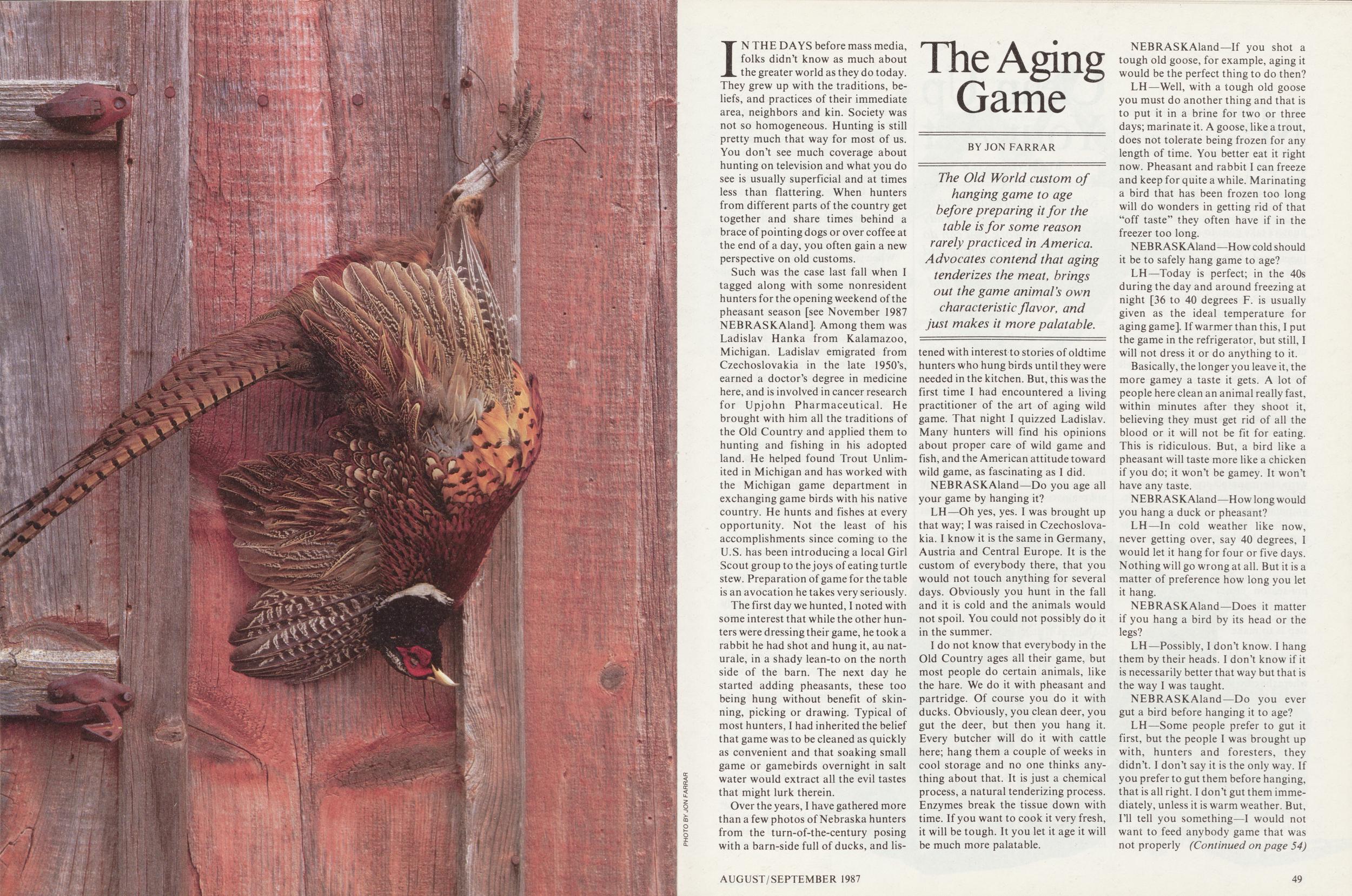
The Aging Game
BY JON FARRAR The Old World custom of hanging game to age before preparing it for the table is for some reason rarely practiced in America. Advocates contend that aging tenderizes the meat, brings out the game animals own characteristic flavor, and just makes it more palatable.IN THE DAYS before mass media, folks didn't know as much about the greater world as they do today. They grew up with the traditions, beliefs, and practices of their immediate area, neighbors and kin. Society was not so homogeneous. Hunting is still pretty much that way for most of us. You don't see much coverage about hunting on television and what you do see is usually superficial and at times less than flattering. When hunters from different parts of the country get together and share times behind a brace of pointing dogs or over coffee at the end of a day, you often gain a new perspective on old customs.
Such was the case last fall when I tagged along with some nonresident hunters for the opening weekend of the pheasant season [see November 1987 NEBRASKAland]. Among them was Ladislav Hanka from Kalamazoo, Michigan. Ladislav emigrated from Czechoslovakia in the late 1950's, earned a doctor's degree in medicine here, and is involved in cancer research for Upjohn Pharmaceutical. He brought with him all the traditions of the Old Country and applied them to hunting and fishing in his adopted land. He helped found Trout Unlimited in Michigan and has worked with the Michigan game department in exchanging game birds with his native country. He hunts and fishes at every opportunity. Not the least of his accomplishments since coming to the U.S. has been introducing a local Girl Scout group to the joys of eating turtle stew. Preparation of game for the table is an avocation he takes very seriously.
The first day we hunted, I noted with some interest that while the other hunters were dressing their game, he took a rabbit he had shot and hung it, au naturale, in a shady lean-to on the north side of the barn. The next day he started adding pheasants, these too being hung without benefit of skinning, picking or drawing. Typical of most hunters, I had inherited the belief that game was to be cleaned as quickly as convenient and that soaking small game or game birds overnight in salt water would extract all the evil tastes that might lurk therein.
Over the years, I have gathered more than a few photos of Nebraska hunters from the turn-of-the-century posing with a barn-side full of ducks, and listened with interest to stories of old time hunters who hung birds until they were needed in the kitchen. But, this was the first time I had encountered a living practitioner of the art of aging wild game. That night I quizzed Ladislav. Many hunters will find his opinions about proper care of wild game and fish, and the American attitude toward wild game, as fascinating as I did.
NEBRASKAland—Do you age all your game by hanging it?
LH—Oh yes, yes. I was brought up that way; I was raised in Czechoslovakia. I know it is the same in Germany, Austria and Central Europe. It is the custom of everybody there, that you would not touch anything for several days. Obviously you hunt in the fall and it is cold and the animals would not spoil. You could not possibly do it in the summer.
I do not know that everybody in the Old Country ages all their game, but most people do certain animals, like the hare. We do it with pheasant and partridge. Of course you do it with ducks. Obviously, you clean deer, you gut the deer, but then you hang it. Every butcher will do it with cattle here; hang them a couple of weeks in cool storage and no one thinks anything about that. It is just a chemical process, a natural tenderizing process. Enzymes break the tissue down with time. If you want to cook it very fresh, it will be tough. It you let it age it will be much more palatable.
NEBRASKAland—If you shot a tough old goose, for example, aging it would be the perfect thing to do then?
LH—Well, with a tough old goose you must do another thing and that is to put it in a brine for two or three days; marinate it. A goose, like a trout, does not tolerate being frozen for any length of time. You better eat it right now. Pheasant and rabbit I can freeze and keep for quite a while. Marinating a bird that has been frozen too long will do wonders in getting rid of that "off taste" they often have if in the freezer too long.
NEBRASKAland—How cold should it be to safely hang game to age?
LH—Today is perfect; in the 40s during the day and around freezing at night [36 to 40 degrees F. is usually given as the ideal temperature for aging game]. If warmer than this, I put the game in the refrigerator, but still, I will not dress it or do anything to it.
Basically, the longer you leave it, the more gamey a taste it gets. A lot of people here clean an animal really fast, within minutes after they shoot it, believing they must get rid of all the blood or it will not be fit for eating. This is ridiculous. But, a bird like a pheasant will taste more like a chicken if you do; it won't be gamey. It won't have any taste.
NEBRASKAland—How long would you hang a duck or pheasant?
LH—In cold weather like now, never getting over, say 40 degrees, I would let it hang for four or five days. Nothing will go wrong at all. But it is a matter of preference how long you let it hang.
NEBRASKAland— Does it matter if you hang a bird by its head or the legs?
LH—Possibly, I don't know. I hang them by their heads. I don't know if it is necessarily better that way but that is the way I was taught.
NEBRASKAland—Do you ever gut a bird before hanging it to age?
LH—Some people prefer to gut it first, but the people I was brought up with, hunters and foresters, they didn't. I don't say it is the only way. If you prefer to gut them before hanging, that is all right. I don't gut them immediately, unless it is warm weather. But, I'll tell you something—I would not want to feed anybody game that was not properly (Continued on page 54)
AUGUST/SEPTEMBER 1987 49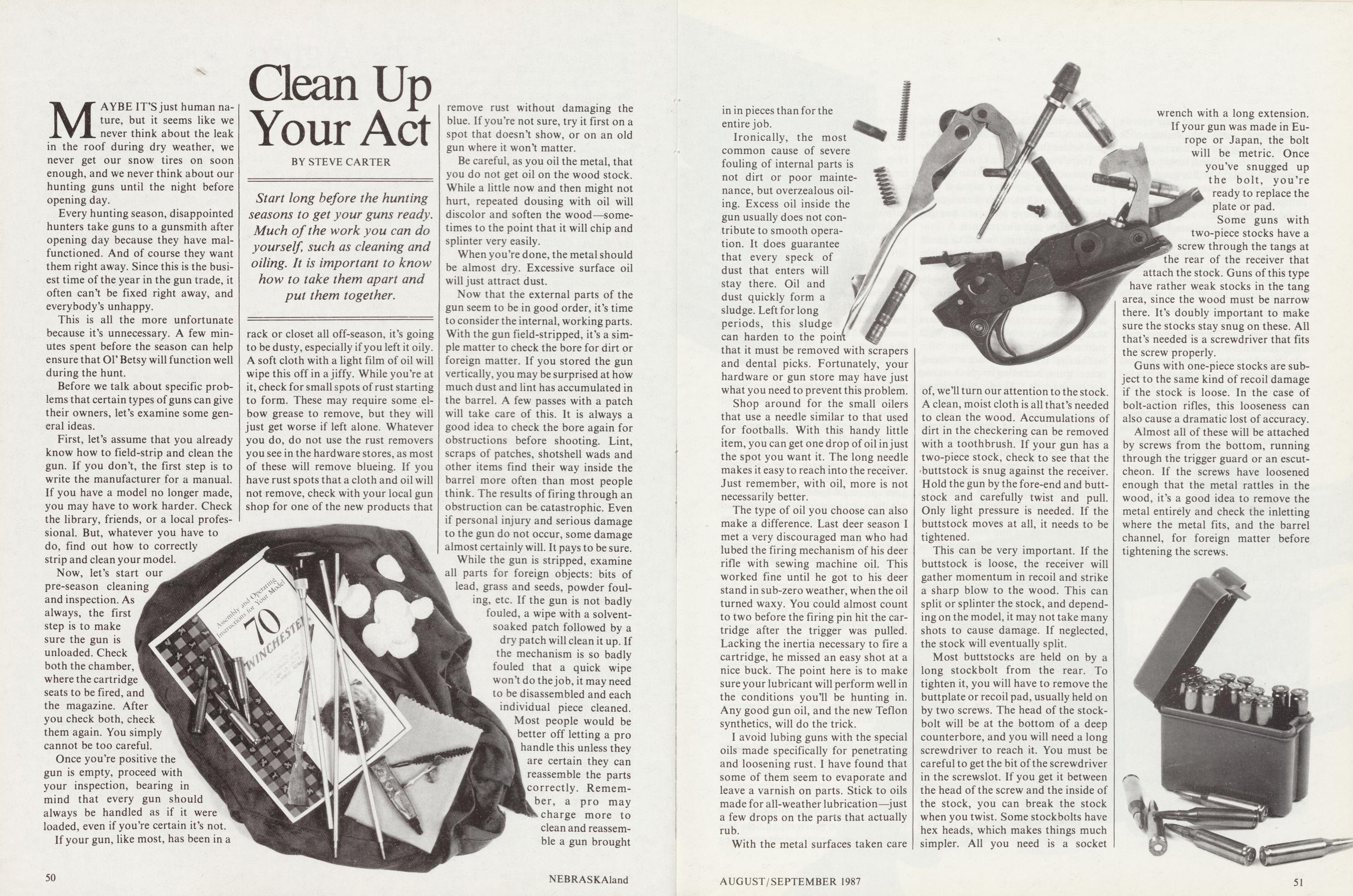
Clean Up Your Act
BY STEVE CARTER Start long before the hunting seasons to get your guns ready. Much of the work you can do yourself such as cleaning and oiling. It is important to know how to take them apart and put them together.MAYBE IT'S just human nature, but it seems like we never think about the leak in the roof during dry weather, we never get our snow tires on soon enough, and we never think about our hunting guns until the night before opening day.
Every hunting season, disappointed hunters take guns to a gunsmith after opening day because they have malfunctioned. And of course they want them right away. Since this is the busiest time of the year in the gun trade, it often can't be fixed right away, and everybody's unhappy.
This is all the more unfortunate because it's unnecessary. A few minutes spent before the season can help ensure that OF Betsy will function well during the hunt.
Before we talk about specific problems that certain types of guns can give their owners, let's examine some general ideas.
First, let's assume that you already know how to field-strip and clean the gun. If you don't, the first step is to write the manufacturer for a manual. If you have a model no longer made, you may have to work harder. Check the library, friends, or a local professional. But, whatever you have to do, find out how to correctly strip and clean your model.
Now, let's start our pre-season cleaning and inspection. As always, the first step is to make sure the gun is unloaded. Check both the chamber, where the cartridge seats to be fired, and the magazine. After you check both, check them again. You simply cannot be too careful.
Once you're positive the gun is empty, proceed with your inspection, bearing in mind that every gun should always be handled as if it were loaded, even if you're certain it's not.
If your gun, like most, has been in a rack or closet all off-season, it's going to be dusty, especially if you left it oily. A soft cloth with a light film of oil will wipe this off in a jiffy. While you're at it, check for small spots of rust starting to form. These may require some elbow grease to remove, but they will just get worse if left alone. Whatever you do, do not use the rust removers you see in the hardware stores, as most of these will remove blueing. If you have rust spots that a cloth and oil will not remove, check with your local gun shop for one of the new products that remove rust without damaging the blue. If you're not sure, try it first on a spot that doesn't show, or on an old gun where it won't matter.
Be careful, as you oil the metal, that you do not get oil on the wood stock. While a little now and then might not hurt, repeated dousing with oil will discolor and soften the wood—sometimes to the point that it will chip and splinter very easily.
When you're done, the metal should be almost dry. Excessive surface oil will just attract dust.
Now that the external parts of the gun seem to be in good order, it's time to consider the internal, working parts. With the gun field-stripped, it's a simple matter to check the bore for dirt or foreign matter. If you stored the gun vertically, you may be surprised at how much dust and lint has accumulated in the barrel. A few passes with a patch will take care of this. It is always a good idea to check the bore again for obstructions before shooting. Lint, scraps of patches, shot shell wads and other items find their way inside the barrel more often than most people think. The results of firing through an obstruction can be catastrophic. Even if personal injury and serious damage to the gun do not occur, some damage almost certainly will. It pays to be sure.
While the gun is stripped, examine all parts for foreign objects: bits of lead, grass and seeds, powder fouling, etc. If the gun is not badly fouled, a wipe with a solvent-soaked patch followed by a dry patch will clean it up. If the mechanism is so badly fouled that a quick wipe won't do the job, it may need to be disassembled and each individual piece cleaned. Most people would be better off letting a pro handle this unless they are certain they can reassemble the parts correctly. Remember, a pro may charge more to clean and r eassemble a gun brought 50 NEBRASKAland in in pieces than for the entire job.
Ironically, the most common cause of severe fouling of internal parts is not dirt or poor maintenance, but overzealous oiling. Excess oil inside the gun usually does not contribute to smooth operation. It does guarantee that every speck of dust that enters will stay there. Oil and dust quickly form a sludge. Left for long periods, this sludge can harden to the poirfthat it must be removed with scrapers and dental picks. Fortunately, your hardware or gun store may have just what you need to prevent this problem.
Shop around for the small oilers that use a needle similar to that used for footballs. With this handy little item, you can get one drop of oil in just the spot you want it. The long needle makes it easy to reach into the receiver. Just remember, with oil, more is not necessarily better.
The type of oil you choose can also make a difference. Last deer season I met a very discouraged man who had lubed the firing mechanism of his deer rifle with sewing machine oil. This worked fine until he got to his deer stand in sub-zero weather, when the oil turned waxy. You could almost count to two before the firing pin hit the cartridge after the trigger was pulled. Lacking the inertia necessary to fire a cartridge, he missed an easy shot at a nice buck. The point here is to make sure your lubricant will perform well in the conditions you'll be hunting in. Any good gun oil, and the new Teflon synthetics, will do the trick.
I avoid lubing guns with the special oils made specifically for penetrating and loosening rust. I have found that some of them seem to evaporate and leave a varnish on parts. Stick to oils made for all-weather lubrication—just a few drops on the parts that actually rub.
With the metal surfaces taken care of, we'll turn our attention to the stock. A clean, moist cloth is all that's needed to clean the wood. Accumulations of dirt in the checkering can be removed with a toothbrush. If your gun has a two-piece stock, check to see that the •buttstock is snug against the receiver. Hold the gun by the fore-end and buttstock and carefully twist and pull. Only light pressure is needed. If the buttstock moves at all, it needs to be tightened.
This can be very important. If the buttstock is loose, the receiver will gather momentum in recoil and strike a sharp blow to the wood. This can split or splinter the stock, and depending on the model, it may not take many shots to cause damage. If neglected, the stock will eventually split.
Most buttstocks are held on by a long stock bolt from the rear. To tighten it, you will have to remove the butt plate or recoil pad, usually held on by two screws. The head of the stock-bolt will be at the bottom of a deep counterbore, and you will need a long screwdriver to reach it. You must be careful to get the bit of the screwdriver in the screws lot. If you get it between the head of the screw and the inside of the stock, you can break the stock when you twist. Some stockbolts have hex heads, which makes things much simpler. All you need is a socket wrench with a long extension. If your gun was made in Europe or Japan, the bolt will be metric. Once you've snugged up the bolt, you're ready to replace the plate or pad.
Some guns with two-piece stocks have a screw through the tangs at the rear of the receiver that attach the stock. Guns of this type have rather weak stocks in the tang area, since the wood must be narrow there. It's doubly important to make sure the stocks stay snug on these. All that's needed is a screwdriver that fits the screw properly.
Guns with one-piece stocks are subject to the same kind of recoil damage if the stock is loose. In the case of bolt-action rifles, this looseness can also cause a dramatic lost of accuracy.
Almost all of these will be attached by screws from the bottom, running through the trigger guard or an escutcheon. If the screws have loosened enough that the metal rattles in the wood, it's a good idea to remove the metal entirely and check the inletting where the metal fits, and the barrel channel, for foreign matter before tightening the screws.
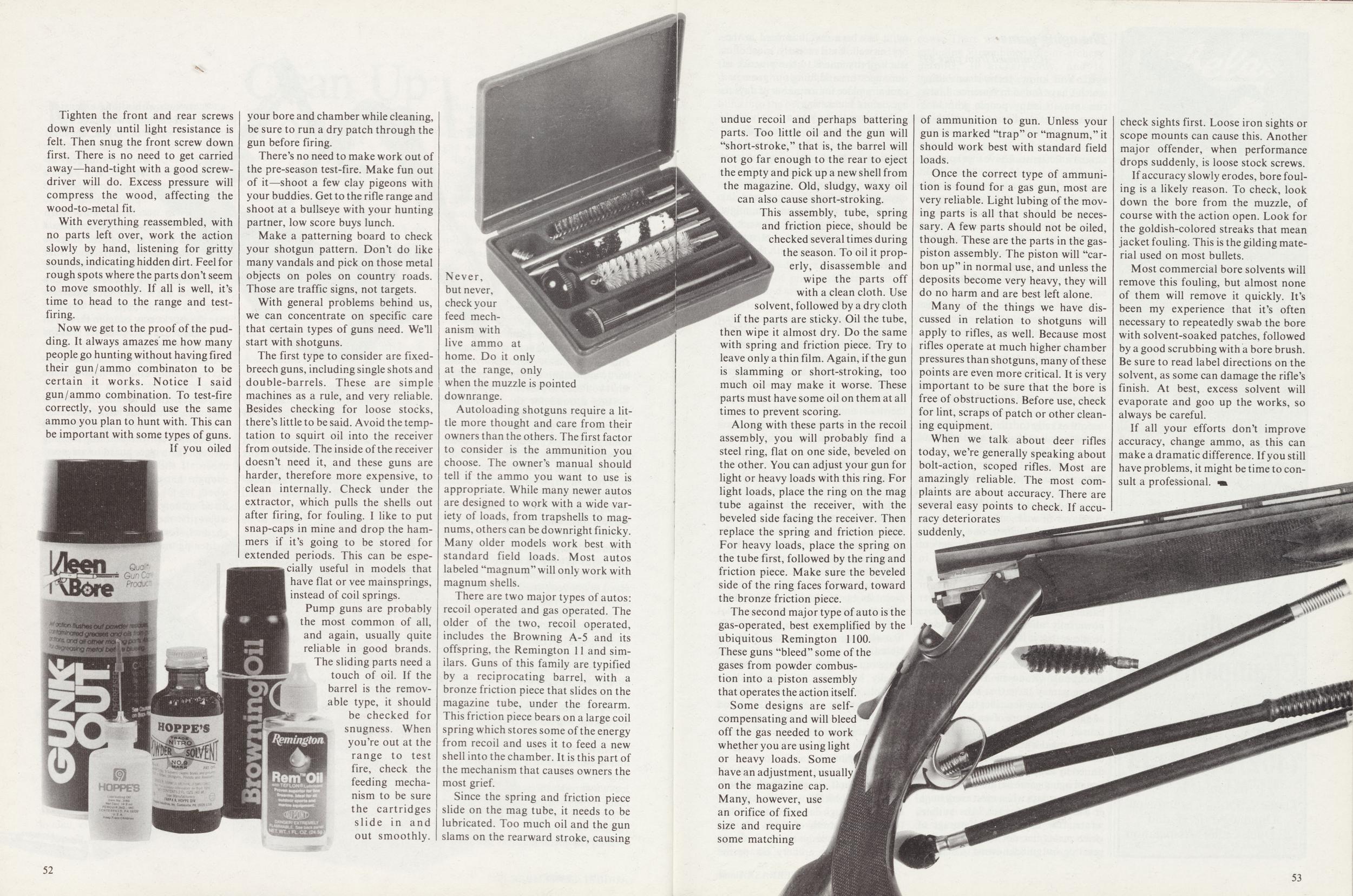
Tighten the front and rear screws down evenly until light resistance is felt. Then snug the front screw down first. There is no need to get carried away—hand-tight with a good screwdriver will do. Excess pressure will compress the wood, affecting the wood-to-metal fit.
With everything reassembled, with no parts left over, work the action slowly by hand, listening for gritty sounds, indicating hidden dirt. Feel for rough spots where the parts don't seem to move smoothly. If all is well, it's time to head to the range and test firing.
Now we get to the proof of the pudding. It always amazes me how many people go hunting without having fired their gun/ammo combination to be certain it works. Notice I said gun/ammo combination. To test-fire correctly, you should use the same ammo you plan to hunt with. This can be important with some types of guns.
If you oiled your bore and chamber while cleaning, be sure to run a dry patch through the gun before firing.
There's no need to make work out of the pre-season test-fire. Make fun out of it—shoot a few clay pigeons with your buddies. Get to the rifle range and shoot at a bullseye with your hunting partner, low score buys lunch.
Make a patterning board to check your shotgun pattern. Don't do like many vandals and pick on those metal objects on poles on country roads. Those are traffic signs, not targets.
With general problems behind us, we can concentrate on specific care that certain types of guns need. We'll start with shotguns.
The first type to consider are fixed breech guns, including single shots and double-barrels. These are simple machines as a rule, and very reliable. Besides checking for loose stocks, there's little to be said. Avoid the temptation to squirt oil into the receiver from outside. The inside of the receiver doesn't need it, and these guns are harder, therefore more expensive, to clean internally. Check under the extractor, which pulls the shells out after firing, for fouling. I like to put snap-caps in mine and drop the hammers if it's going to be stored for extended periods. This can be especially useful in models that have flat or vee mainsprings, instead of coil springs.
Pump guns are probably the most common of all, and again, usually quite reliable in good brands. The sliding parts need a touch of oil. If the barrel is the removable type, it should be checked for snugness. When you're out at the range to test fire, check the feeding mechanism to be sure the cartridges slide in and out smoothly. Never, but never, check your feed mechanism with live ammo at home. Do it only at the range, only when the muzzle is pointed downrange.
Autoloading shotguns require a little more thought and care from their owners than the others. The first factor to consider is the ammunition you choose. The owner's manual should tell if the ammo you want to use is appropriate. While many newer autos are designed to work with a wide variety of loads, from trap shells to magnums, others can be downright finicky. Many older models work best with standard field loads. Most autos labeled "magnum" will only work with magnum shells.
There are two major types of autos: recoil operated and gas operated. The older of the two, recoil operated, includes the Browning A-5 and its offspring, the Remington 11 and similars. Guns of this family are typified by a reciprocating barrel, with a bronze friction piece that slides on the magazine tube, under the forearm. This friction piece bears on a large coil spring which stores some of the energy from recoil and uses it to feed a new shell into the chamber. It is this part of the mechanism that causes owners the most grief.
Since the spring and friction piece slide on the mag tube, it needs to be lubricated. Too much oil and the gun slams on the rearward stroke, causing 52 undue recoil and perhaps battering parts. Too little oil and the gun will 'short-stroke," that is, the barrel will not go far enough to the rear to eject the empty and pick up a new shell from the magazine. Old, sludgy, waxy oil can also cause short-stroking.
This assembly, tube, spring and friction piece, should be checked several times during the season. To oil it properly, disassemble and wipe the parts off with a clean cloth. Use solvent, followed by a dry cloth if the parts are sticky. Oil the tube, then wipe it almost dry. Do the same with spring and friction piece. Try to leave only a thin film. Again, if the gun is slamming or short-stroking, too much oil may make it worse. These parts must have some oil on them at all times to prevent scoring.
Along with these parts in the recoil assembly, you will probably find a steel ring, flat on one side, beveled on the other. You can adjust your gun for light or heavy loads with this ring. For light loads, place the ring on the mag tube against the receiver, with the beveled side facing the receiver. Then replace the spring and friction piece. For heavy loads, place the spring on the tube first, followed by the ring and friction piece. Make sure the beveled side of the ring faces forward, toward the bronze friction piece.
The second major type of auto is the gas-operated, best exemplified by the ubiquitous Remington 1100. These guns "bleed" some of the gases from powder combustion into a piston assembly that operates the action itself.
Some designs are self- compensating and will bleed off the gas needed to work whether you are using light or heavy loads. Some have an adjustment, usual on the magazine cap. Many, however, use an orifice of fixed size and require some matching of ammunition to gun. Unless your gun is marked "trap" or "magnum," it should work best with standard field loads.
Once the correct type of ammunition is found for a gas gun, most are very reliable. Light lubing of the moving parts is all that should be necessary. A few parts should not be oiled, though. These are the parts in the gas piston assembly. The piston will "carbon up" in normal use, and unless the deposits become very heavy, they will do no harm and are best left alone.
Many of the things we have discussed in relation to shotguns will apply to rifles, as well. Because most rifles operate at much higher chamber pressures than shotguns, many of these points are even more critical. It is very important to be sure that the bore is free of obstructions. Before use, check for lint, scraps of patch or other cleaning equipment.
When we talk about deer rifles today, we're generally speaking about bolt-action, scoped rifles. Most are amazingly reliable. The most complaints are about accuracy. There are several easy points to check. If accuracy deteriorates suddenly, check sights first. Loose iron sights or scope mounts can cause this. Another major offender, when performance drops suddenly, is loose stock screws.
If accuracy slowly erodes, bore fouling is a likely reason. To check, look down the bore from the muzzle, of course with the action open. Look for the goldish-colored streaks that mean jacket fouling. This is the gilding material used on most bullets.
Most commercial bore solvents will remove this fouling, but almost none of them will remove it quickly. It's been my experience that it's often necessary to repeatedly swab the bore with solvent-soaked patches, followed by a good scrubbing with a bore brush. Be sure to read label directions on the solvent, as some can damage the rifle's finish. At best, excess solvent will evaporate and goo up the works, so always be careful.
If all your efforts don't improve accuracy, change ammo, as this can make a dramatic difference. If you still have problems, it might be time to consult a professional.
 1987
SPORTSMAN'S
EXPO
SATURDAY, AUG. 22
Doors Open 12:00 Noon
Peter Kiewit Center
1313 Farnam, Omaha
• EXHIBITS
• SEMINARS
• DEMONSTRATIONS
by state & world
champion callers
Nebraska
State Duck
Calling
Championships
Hunters Division — 6:00 p.m.
Championship Division — 7:30 p.m.
For More Information
(402) 554-2144
Sponsored by
Game & Parks Commission
Omaha World Herald
NE Duck Callers Association
1987
SPORTSMAN'S
EXPO
SATURDAY, AUG. 22
Doors Open 12:00 Noon
Peter Kiewit Center
1313 Farnam, Omaha
• EXHIBITS
• SEMINARS
• DEMONSTRATIONS
by state & world
champion callers
Nebraska
State Duck
Calling
Championships
Hunters Division — 6:00 p.m.
Championship Division — 7:30 p.m.
For More Information
(402) 554-2144
Sponsored by
Game & Parks Commission
Omaha World Herald
NE Duck Callers Association
The aging game
(Continued from page 49)aged. You know, there is one thing which I have found in America. I have run into so many people who look down on a game dinner as something completely inferior. To treat someone to a dinner of rabbit or venison is almost an offense. I have met so many people who would not touch it. In Europe, if you give someone a pheasant it is a present that is very much appreciated. Maybe it goes back to pioneer times here, when people had nothing but wild game and when things were getting better and farming started, they had pork or beef. You were prospering if you didn't have to eat wild game.
NEBRASKAland—It seems most Americans attempt to make their wild game taste as much like domestic meat as possible.
LH—Exactly. If you can make a pheasant taste like chicken or venison like beef, you have it made. I like it the other way around. I want venison to taste like venison. Most of the recipes I use call exactly for that kind of preparation so that each game type will have its own distinct taste.
In the March 1984 issue of Natural History magazine, world-traveled cook and connoisseur of all edible, Raymond Sokolov wrote of the distinctive flavor of wild game.
"It surpasses in flavor and personality the comparatively pallid meats of domesticated livestock and fowl. In much the same way that mutton is more complex in taste than lamb, or that free-ranging chickens have it over battery chicken, wild game is more powerfully 'alive.' But I emphatically do mean that it is 'gamey'."
Angus Cameron and Judith Jones write in the L. L. Bean Game and Fish Cookbook (Random House): "The strong gamey taste that some people speak of seldom describes the real taste of game meat; more often it is a flavor caused by improper handling of the game animal when it was dressed, butchered or transported." They continued by supporting the age-old practice of aging game before preparation.
"In these days when most every hunter owns a deep freezer," the authors wrote, "the handling and storage of game meats has not only changed in practice, but unbeknownst to many of us, it has been revolutionized in theory, as well. Until recently, most of us stuck pretty much to the practice of our ancestors and hung our game in a cool airy place for a number of days to age before butchering.
We know that aging not only made the meat more tender, but more flavorful as well, and we had all heard that hanging the game tenderized the meat by 'breaking down the meat cells.' Some hung the meat for three or four days; others, when the nights and day temperatures were low enough, might leave the game hanging for a week, or ten days, or even more. Let me say there is nothing wrong with this time-tried procedure."
The big bull
(Continued from page 43)pushing hard to get closer, Jerry came nearly face to face with the bull, which was about 50 yards away and slightly below. Jerry knew the bull would bolt at any moment, but John couldn't see the bull until he was able to step around an intervening tree. Jerry saw John raise his rifle, and at the shot, the bull dropped.
It was only after approaching that the hunters were able to identify it as the large bull they'd followed and watched for several weeks. They could see deep, penetrating wounds on both hips and a deep puncture wound in the chest from battles to keep other bulls away from his harem of cows. The bull's head and neck were scarred, and it was obvious the ongoing battles to maintain his herd had diminished his overall condition.
Fifteen-year-old John Greenwood's first elk, and the largest taken during Nebraska's first elk season, would score out at 371 2/8. It would win the Rocky Mountain Elk Foundation's first-place award for a 1986 non-guided hunt, as well as a Nebraska Game and Parks Commission Elk Citation and the prestigious Big Game "Leather stocking" Award from the National Rifle Association.
While John and Jerry were still following the bull, another Chadron hunter, archer John Hlavacek, was quietly stalking through dampened timber less than a mile south of them. He had begun his pre-season scouting almost the moment his archery elk permit 54 NEBRASKAland arrived, and had followed the daily activities of the same herd observed by the Greenwoods. John had lost his direction in the dark and fog and wisely sat down to keep from stumbling into the herd, which he knew was nearby.
A bugle shortly after legal shooting time helped John relocate the herd, even though, as to the Greenwoods, the elk's call sounded more like another hunter than an elk. John was close enough to hear the bull snapping twigs and brush as it approached, but the dense fog prevented visual contact. He estimated the elk was less than 100 yards away.
John moved quickly to a small dog hair stand of pines that served as a natural blind several yards to one side of the trail on which he believed the elk was approaching. The bull was moving slowly, but parallel to the trail, following the hilly terrain. He passed about 30 yards from John's concealing stand of small pines.
The bull then stopped in a clearing about 75 yards away and bugled. Getting no response to his answering bugle, John decided to use a cow "mewing" call. Instantly an elk calf, attracted by the cow call, ran almost into the stand of pines with John. The calf then bolted, and John could see a cow elk following the calf as it moved away. After they moved out of sight, John took up the bull's trail, hoping to follow until he bedded down.
As he climbed over a small ridge, John saw a cow elk standing less than 30 yards away. As yet unseen, John backed up several steps to get behind the ridge. Carefully nocking his arrow, John moved forward to clear the ridge crest and released, instinctively aiming for the cow's chest. The cow bolted about 25 yards, stopped, and slowly walked away. A look at his watch showed it was 7:30.
Another bow hunter, a dentist from Rushville, joined John as he followed along the cow's trail, and the two found her lying in a dense stand of pine after about 200 yards. Game and Parks Commission biologists later aged the cow at over 13. The cow's four quarters totaled nearly 460 pounds, and she was the only archery-elk killed during the 1986 season.
A total of 15 elk were harvested during that first season; seven adult bulls, one yearling bull, and seven adult cows. There were 74 permits issued, including 50 combined rifle-or-archery permits, 10 archery-only, and 14 limited-landowner permits. Five of the 14 landowner permit holders, limited to hunting their own land, were successful.
Biologists prior to the 1986 season had anticipated a slightly higher harvest, hoping to reduce the"Bordeaux Creek herd" to no more than 15 or 20 animals. While the majority of elk harvested during the first season came from the Bordeaux area, several were taken in other parts of the Pine Ridge, notably a bull and cow on the Metcalf Wildlife Management Area north of Hay Springs. Of the 15 elk harvested, five came from U.S. Forest Service and Nebraska Game and Parks Commission lands, and 10 from private land.
Blood samples taken at check stations were tested for brucellosis and other diseases, and all test results were negative. The Game and Parks Com- missioners, meeting in March, approved a 1987 elk season for October 3 through November 8 and from December 5 through December 20. Permits authorized include 30 firearm-or-bow permits and five archery only permits. By law, an additional 30 percent of that number will be allocated for bonafide farmers or ranchers. Elk of either sex may be taken in the entire elk unit for 1987. Elk permits are restricted to Nebraska residents.
Sneakin' cats
(Continued from page 33)to snags or a handful of willows on the bank. With the sneak boat you could slip into all those hard-to-get-to places you can't reach from shore.
When we finally called it a day, we had an even dozen catfish weighing from a pound up to a 2/2-pounder that Myrtle caught. In the strong current of the main channel, even a pound and a half catfish put up a spirited battle. The two best spots were the dead water just below a pile of debris, where the holes were six to eight feet deep, or deep water along banks with overhanging willows. Actually, it was easier to fish above the logjams as the scent of the cheese bait carried down into the dead water below, drawing the catfish out of the hook-robbing tangle into more open water just upstream.
100% SATISFACTION GUARANTEED Hunting Equipment . . . Decoys Footwear . . . Knives ... Gun cases Bows . . . Arrows . . Clothing Optics . . . Gifts . . . and Much More CATALOG SUBSCRIPTION Mail today to reserve your Fall issue. NAME ADDRESS CITY ____ STATE ZIP Sidney Nebraska 69160 CEDAR LANE - Ranch Vacations Guest ranch in the heart of the Sandhills of Nebraska. Swimming, spa, horses, canoeing, trail rides, barbeques, hunting. BOOKING NOW For 1987 Richard and Betty Schroeder HC 2 Box 9C Stapleton. Nebraska 69163 Ph. 308-587-2233 LIVE-CATCH ALL-PURPOSE TRAPS FREE CATALOG Traps without injury squirrels, chipmunks, rabbits, mink, fox, raccoons, stray animals, pests, etc. Sizes for every need. Also traps for snakes, sparrows, pigeons, crabs, turtles, quail, etc. Save on our low factory prices. Send no money. Free catalog and trapping secrets MUSTANG MFG. CO., Dept. N-34, Box 920947, Houston, Tex. 77292 STOCK YOUR LAKE OR POND WITH Channel cat, Bluegill, Largemouth Bass, Hybrid Bluegill, Crappie, Triploid Grass Carp, Minnows ORDER NOW WILLOW LAKE FISH HATCHERY Rt. 3, Box 46, Hastings, Nebr. 68901 Gaylord L. Crawford Phone: (402) 463-8022 Day or Night For April to October 15 stocking AUGUST/SEPTEMBER 1987 55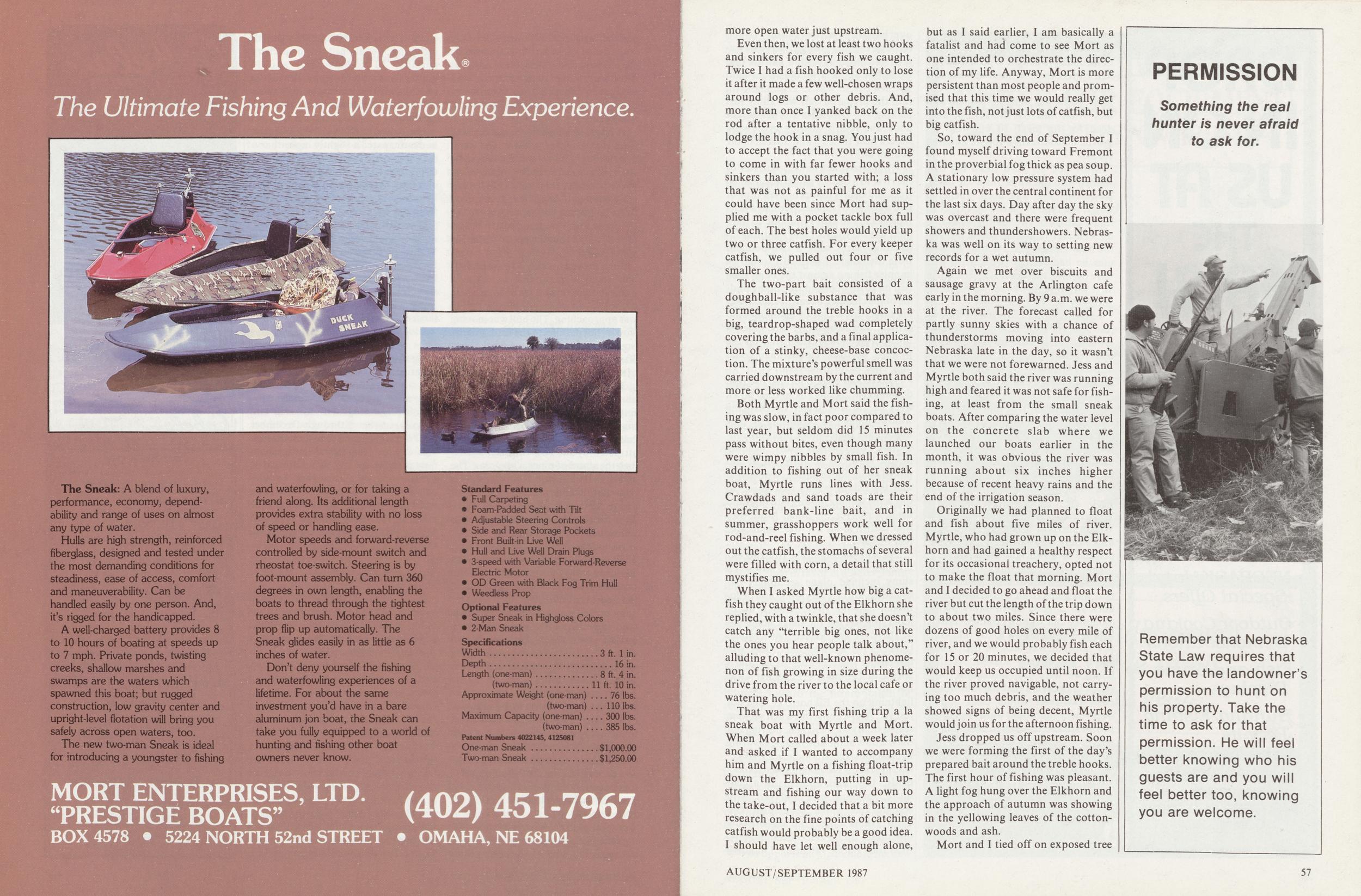 The Sneak
The Ultimate Fishing And Water fowling Expire
The Sneak
The Ultimate Fishing And Water fowling Expire
The Sneak: A blend of luxury, performance, economy, dependability and range of uses on almost any type of water.
Hulls are high strength, reinforced fiberglass, designed and tested under the most demanding conditions for steadiness, ease of access, comfort and maneuverability. Can be handled easily by one person. And, it's rigged for the handicapped.
A well-charged battery provides 8 to 10 hours of boating at speeds up to 7 mph. Private ponds, twisting creeks, shallow marshes and swamps are the waters which spawned this boat; but rugged construction, low gravity center and upright-level flotation will bring you safely across open waters, too.
The new two-man Sneak is ideal for introducing a youngster to fishing and water fowling, or for taking a friend along. Its additional length provides extra stability with no loss of speed or handling ease.
Motor speeds and forward-reverse controlled by side-mount switch and rheostat toe-switch. Steering is by foot-mount assembly. Can turn 360 degrees in own length, enabling the boats to thread through the tightest trees and brush. Motor head and prop flip up automatically. The Sneak glides easily in as little as 6 inches of water.
Don't deny yourself the fishing and water fowling experiences of a lifetime. For about the same investment you'd have in a bare aluminum boat, the Sneak can take you fully equipped to a world of hunting and fishing other boat owners never know.
Standard Features • Full Carpeting • Foam-Padded Seat with Tilt • Adjustable Steering Controls • Side and Rear Storage Pockets • Front Built-in Live Well • Hull and Live Well Drain Plugs • 3-speed with Variable Forward-Reverse Electric Motor • OD Green with Black Fog Trim Hull • Weedless Prop Optional Features • Super Sneak in High loss Colors • 2-Man Sneak Specifications Width........................3 ft. 1 in. Depth........................... 16 in. Length (one-man)..............8 ft. 4 in. (two-man)............11 ft. 10 in. Approximate Weight (one-man)___76 lbs. (two-man) ... 110 lbs. Maximum Capacity (one-man)___300 lbs. (two-man)___385 lbs. Patent Numbers 4022145, 4125081 One-man Sneak...............$1,000.00 Two-man Sneak...............$1,250.00 MORT ENTERPRISES, LTD. {A{\0\ AX1 " "PRESTIGE BOATS" V«W/ 401- i BOX 4578 • 5224 NORTH 52nd STREET • OMAHA, NE 68104Even then, we lost at least two hooks and sinkers for every fish we caught. Twice I had a fish hooked only to lose it after it made a few well-chosen wraps around logs or other debris. And, more than once I yanked back on the rod after a tentative nibble, only to lodge the hook in a snag. You just had to accept the fact that you were going to come in with far fewer hooks and sinkers than you started with; a loss that was not as painful for me as it could have been since Mort had supplied me with a pocket tackle box full of each. The best holes would yield up two or three catfish. For every keeper catfish, we pulled out four or five smaller ones.
The two-part bait consisted of a dough-ball-like substance that was formed around the treble hooks in a big, teardrop-shaped wad completely covering the barbs, and a final application of a stinky, cheese-base concoction. The mixture's powerful smell was carried downstream by the current and more or less worked like chumming.
Both Myrtle and Mort said the fishing was slow, in fact poor compared to last year, but seldom did 15 minutes pass without bites, even though many were wimpy nibbles by small fish. In addition to fishing out of her sneak boat, Myrtle runs lines with Jess. Crawdads and sand toads are their preferred bank-line bait, and in summer, grasshoppers work well for rod-and-reel fishing. When we dressed out the catfish, the stomachs of several were filled with corn, a detail that still mystifies me.
When I asked Myrtle how big a catfish they caught out of the Elkhorn she replied, with a twinkle, that she doesn't catch any "terrible big ones, not like the ones you hear people talk about," alluding to that well-known phenomenon of fish growing in size during the drive from the river to the local cafe or watering hole.
That was my first fishing trip a la sneak boat with Myrtle and Mort. When Mort called about a week later and asked if I wanted to accompany him and Myrtle on a fishing float-trip down the Elkhorn, putting in up- stream and fishing our way down to the take-out, I decided that a bit more research on the fine points of catching catfish would probably be a good idea. I should have let well enough alone, but as I said earlier, I am basically a fatalist and had come to see Mort as one intended to orchestrate the direction of my life. Anyway, Mort is more persistent than most people and promised that this time we would really get into the fish, not just lots of catfish, but big catfish.
So, toward the end of September I found myself driving toward Fremont in the proverbial fog thick as pea soup. A stationary low pressure system had settled in over the central continent for the last six days. Day after day the sky was overcast and there were frequent showers and thundershowers. Nebraska was well on its way to setting new records for a wet autumn.
Again we met over biscuits and sausage gravy at the Arlington cafe early in the morning. By 9 a.m. we were at the river. The forecast called for partly sunny skies with a chance of thunderstorms moving into eastern Nebraska late in the day, so it wasn't that we were not forewarned. Jess and Myrtle both said the river was running high and feared it was not safe for fishing, at least from the small sneak boats. After comparing the water level on the concrete slab where we launched our boats earlier in the month, it was obvious the river was running about six inches higher because of recent heavy rains and the end of the irrigation season.
Originally we had planned to float and fish about five miles of river. Myrtle, who had grown up on the Elkhorn and had gained a healthy respect for its occasional treachery, opted not to make the float that morning. Mort and I decided to go ahead and float the river but cut the length of the trip down to about two miles. Since there were dozens of good holes on every mile of river, and we would probably fish each for 15 or 20 minutes, we decided that would keep us occupied until noon. If the river proved navigable, not carrying too much debris, and the weather showed signs of being decent, Myrtle would join us for the afternoon fishing.
Jess dropped us off upstream. Soon we were forming the first of the day's prepared bait around the treble hooks. The first hour of fishing was pleasant. A light fog hung over the Elkhorn and the approach of autumn was showing in the yellowing leaves of the cottonwoods and ash.
Mort and I tied off on exposed tree roots along a bank with overhanging willows about 50 yards apart. Almost immediately I caught a pound-and-a- half catfish that, without a detectable mouthing of the bait, inhaled the hook. Mort was fielding frequent nibbles. After that first fish my line went dead for the next 30 minutes. We moved downstream a couple hundred yards.
Something the real hunter is never afraid to ask for. Remember that Nebraska State Law requires that you have the landowner's permission to hunt on his property. Take the time to ask for that permission. He will feel better knowing who his guests are and you will feel better too, knowing you are welcome. AUGUST/SEPTEMBER 1987 57 DROP
IN ON
USAT
TH€
mm!
Hunt/Fish/Parks
Information
Photo
Booth
Shooting
Gallery
Playground
NEBRASKAland
Special Offers
Outdoor Cooking
Demonstrations
Fish and Game
Displays
• Hunting/Fishing
Permits
TH€ NCBRRSKR STRTC FAIR
September 4-13
® NCBRRSKA
GAM€ AND PARKS
COMMISSION
DROP
IN ON
USAT
TH€
mm!
Hunt/Fish/Parks
Information
Photo
Booth
Shooting
Gallery
Playground
NEBRASKAland
Special Offers
Outdoor Cooking
Demonstrations
Fish and Game
Displays
• Hunting/Fishing
Permits
TH€ NCBRRSKR STRTC FAIR
September 4-13
® NCBRRSKA
GAM€ AND PARKS
COMMISSION
Mort tied off on a small log that slanted into the water from the bank. Below the log was deep, sheltered water, the type of place you expect to find a catfish or two loafing, scooping up whatever tempting, edible morsels the river carries past. Within 30 minutes he had landed two catfish that were pushing two pounds apiece. All in all it was looking like we were in for a good day on the river.
I tied my boat to a cluster of willows just above a large debris pile formed around a large cottonwood the river had recently undercut and tumbled into the channel. Although I had frequent nibbles, I could not get a hook into the bait robbers. I motored down below the fallen tree and then came back upstream into one of the large crotches and tied off. After 20 minutes, losing one bait to the sensitive lips of a catfish, and one rig to the cottonwood branches, I moved downstream. That was when the rain moved in from the west.
At first it fell in light sprinkles. Within minutes it changed to a light but steady shower with occasional periods of downright downpours. It became evident that this was not just a passing shower but a ground-soaker that was going to sit on the lower Elkhorn for a good spell. Mort pulled alongside and asked if I wanted to keep fishing or head down to the take-out. My raincoat was back in the pickup and I was already soaked. At that point we were still misleading ourselves in believing that the rain would pass, the skies would clear and a benevolent sun would warm and dry a pair of soaked fishermen. We might as well have thrown in the belief that one of us would catch the new world record channel catfish and be awarded a Mercedes for our effort. We decided we weren't going to get any wetter fishing our way downstream than we already were.
We tied up about 30 yards apart along another stretch of bank with overhanging willows and fished through the increasingly heavy down pour. I caught a second catfish that would go about a pound-and-a-half. By then the air was so saturated with rain the prepared bait was slimy just making the trip from the jar to the hook, and a catfish loafing on the bank should have tasted it and walked to the boat to bite.
We crossed back to the south side of the river to a quality gathering of fallen trees and debris that promised four or five whiskered trophies. We had a brief reprieve in the rain for about 10 minutes, but the thunder and lightning intensified. Mort took a two-pounder from the tangle. I decided I would be happier fishing against the bank than tied on to an upended tree in the middle of the channel, a really prime-looking target for a bolt of lightning, and drifted downstream. A low line of blue-purple clouds was rising on the western horizon, clouds that could only bode ill for fishermen.
Soaked and cold, I decided to move downstream again. No pile of fallen trees or cut bank under overhanging willows looked as promising as they might have under more pleasant conditions. Mort sensed I was "heading for the barn," as he aptly put it, and pulled alongside to parley. We decided that the fishing wasn't that good, so threw the trolling motors into high and made a run for the dock, Mort with four catfish in his live-well, mine with half that many.
Jess was waiting in the truck at our take-out point. The bank by now was a slimy inclined plane seemingly designed to carry everything not deeprooted into the river. After a bit of jockeying, we got the sneak boats out of the river and loaded onto Mort's trailer. Five minutes later, Jess was dispensing spare clothes to us, and I felt the first glimmer of hope that it was not my fate to be fried by a bolt of lightning on the Elkhorn, at least not just yet. And it got better when we were seated in Myrtle's kitchen, peering out the window at the downpour, savoring homemade chicken noodle soup, homemade meaning the noodles were homemade, too, and homemade applesauce, meaning nice and tart with recognizable apple remnants. You know, I think it really did help offering that dollar tip for the collection plate. Next time I'm in Valentine, I'm going 58 NEBRASKAland to buy another one of the priest's pies, and this time I'll insist he take the offering. I'd like a little sunshine the next time we sneak up on those catfish on the Elkhorn.
Niobrara Valley unique and enduring
(Continued from page 29)and that expenditure, were worth the perceived benefits.
One of my favorite "elder gentlemen" is Fritz Brandenburg who lives at a place along the river that was once the Penbrook stage station. "Buffalo Fritz," as he sometimes likes to be called, indicated when L met him in 1980 that he was 95 years old, although one of his neighbors suggested he was pulling my leg.
During the Norden Dam debate, a TV reporter suggested that this site was going to be under 80 feet of water and asked Fritz what he was going to do. Fritz thought for a second, then said, "I guess I'll have to get a snorkel."
While a sense of humor helps keep things in perspective, the taking of land shouldn't be taken lightly.
Unfortunately, but understandably, the proposed Norden Dam and O'Neill canal network strained friendships and placed landowners who wanted to keep their homes, land and river intact, at odds with local community interests who saw it as a way to economically prosper.
Finally, in March of 1985, the Bureau of Reclamation abandoned the Norden Dam in favor of a water pumping system 40 miles downstream, below the stretch suggested for formal scenic river protection. Thus, there was no longer any obvious conflict between the restructured O'Neill waterworks project and the plan to protect the river upstream from that point. Additional landowners with a thought toward the future joined in requesting scenic river designation for 76 miles, and Senator J. James Exon agreed to sponsor legislation in the U.S. Congress.
A bill carefully designed to protect the natural values of the river and the scenic character of the valley, while safeguarding the established interest of ranchers and farmers, was introduced in the 99th Congress. Action was deferred, however, to give state officials an opportunity to explore the new art of protecting rivers such as the Niobrara. A 28-page report prepared by the Nebraska Natural Resources Commission last fall accomplished that, recognizing the river as worthy of preservation.
CARING EQUIPMEN' HUNTER RESPONSIBILITY- outdoorsman takes pride hunting gear. . A me The Nebraska Hunter Education Program NEBRASKA GAME AND PARKS COMMISSION AUGUST/SEPTEMBER 1987 59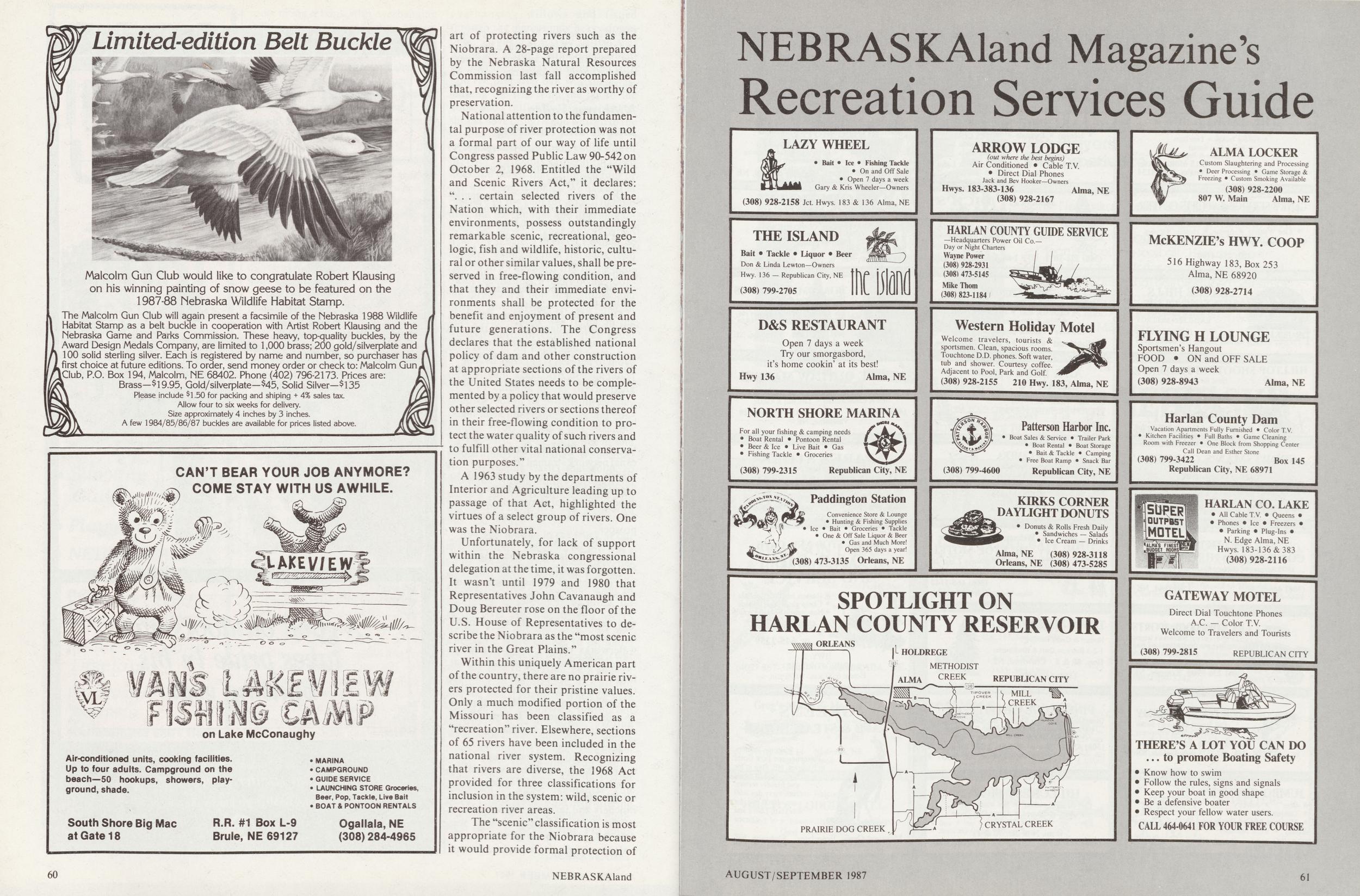 Limited-edition Belt Buckle
Malcolm Gun Club would like to congratulate Robert Klausing
on his winning painting of snow geese to be featured on the
1987-88 Nebraska Wildlife Habitat Stamp.
The Malcolm Gun Club will again present a facsimile of the Nebraska 1988 Wildlife
Habitat Stamp as a belt buckle in cooperation with Artist Robert Klausing and the
Nebraska Game and Parks Commission. These heavy, top-quality buckles, by the
Award Design Medals Company, are limited to 1,000 brass; 200 gold/silver plate and
100 solid sterling silver. Each is registered by name and number, so purchaser has
first choice at future editions. To order, send money order or check to: Malcolm Gun
Club, P.O. Box 194, Malcolm, NE 68402. Phone (402) 796-2173. Prices are:
Brass-$19.95, Gold/silver plate-$45, Solid Silver-$135
Please include $1.50 for packing and shipping + 4% sales tax.
Allow four to six weeks for delivery.
Size approximately 4 inches by 3 inches.
A few 1984/85/86/87 buckles are available for prices listed above.
CAN'T BEAR YOUR JOB ANYMORE?
COME STAY WITH US AWHILE.
on Lake McConaughy
Air-conditioned units, cooking facilities.
Up to four adults. Campground on the
beach—50 hookups, showers,
playground, shade.
• MARINA
• CAMPGROUND
• GUIDE SERVICE
• LAUNCHING STORE Groceries,
Beer, Pop, Tackle, Live Bait
• BOAT & PONTOON RENTALS
South Shore Big Mac
at Gate 18
R.R. #1 Box L-9
Brule, NE 69127
Ogallala, NE
(308) 284-4965
Limited-edition Belt Buckle
Malcolm Gun Club would like to congratulate Robert Klausing
on his winning painting of snow geese to be featured on the
1987-88 Nebraska Wildlife Habitat Stamp.
The Malcolm Gun Club will again present a facsimile of the Nebraska 1988 Wildlife
Habitat Stamp as a belt buckle in cooperation with Artist Robert Klausing and the
Nebraska Game and Parks Commission. These heavy, top-quality buckles, by the
Award Design Medals Company, are limited to 1,000 brass; 200 gold/silver plate and
100 solid sterling silver. Each is registered by name and number, so purchaser has
first choice at future editions. To order, send money order or check to: Malcolm Gun
Club, P.O. Box 194, Malcolm, NE 68402. Phone (402) 796-2173. Prices are:
Brass-$19.95, Gold/silver plate-$45, Solid Silver-$135
Please include $1.50 for packing and shipping + 4% sales tax.
Allow four to six weeks for delivery.
Size approximately 4 inches by 3 inches.
A few 1984/85/86/87 buckles are available for prices listed above.
CAN'T BEAR YOUR JOB ANYMORE?
COME STAY WITH US AWHILE.
on Lake McConaughy
Air-conditioned units, cooking facilities.
Up to four adults. Campground on the
beach—50 hookups, showers,
playground, shade.
• MARINA
• CAMPGROUND
• GUIDE SERVICE
• LAUNCHING STORE Groceries,
Beer, Pop, Tackle, Live Bait
• BOAT & PONTOON RENTALS
South Shore Big Mac
at Gate 18
R.R. #1 Box L-9
Brule, NE 69127
Ogallala, NE
(308) 284-4965
National attention to the fundamental purpose of river protection was not a formal part of our way of life until Congress passed Public Law 90-542 on October 2, 1968. Entitled the "Wild and Scenic Rivers Act," it declares: ". . . certain selected rivers of the Nation which, with their immediate environments, possess outstandingly remarkable scenic, recreational, geologic, fish and wildlife, historic, cultural or other similar values, shall be preserved in free-flowing condition, and that they and their immediate environments shall be protected for the benefit and enjoyment of present and future generations. The Congress declares that the established national policy of dam and other construction at appropriate sections of the rivers of the United States needs to be complemented by a policy that would preserve other selected rivers or sections thereof in their free-flowing condition to protect the water quality of such rivers and to fulfill other vital national conservation purposes."
A 1963 study by the departments of Interior and Agriculture leading up to passage of that Act, highlighted the virtues of a select group of rivers. One was the Niobrara.
Unfortunately, for lack of support within the Nebraska congressional delegation at the time, it was forgotten. It wasn't until 1979 and 1980 that Representatives John Cavanaugh and Doug Bereuter rose on the floor of the U.S. House of Representatives to describe the Niobrara as the "most scenic river in the Great Plains."
Within this uniquely American part of the country, there are no prairie rivers protected for their pristine values. Only a much modified portion of the Missouri has been classified as a "recreation" river. Elsewhere, sections of 65 rivers have been included in the national river system. Recognizing that rivers are diverse, the 1968 Act provided for three classifications for inclusion in the system: wild, scenic or recreation river areas.
The "scenic" classification is most appropriate for the Niobrara because it would provide formal protection of
60 NEBRASKAland NEBRASKAland Magazine's Recreation Services Guide LAZY WHEEL • Bait • Ice • Fishing Tackle • On and Off Sale • Open 7 days a week Gary & Kris Wheeler—Owners (308) 928-2158 Jet. Hwys. 183 & 136 Alma, NE ARROW LODGE (out where the best begins) Air Conditioned • Cable TV. • Direct Dial Phones Jack and Bev Hooker—Owners Hwys. 183-383-136 Alma, NE (308) 928-2167 THE ISLAND Bait • Tackle • Liquor • Beer Don & Linda Lewton—Owners Hwy. 136 — Republican City, NE (308) 799-2705 HARLAN COUNTY GUIDE SERVICE —Headquarters Power Oil Co.— Day or Night Charters Wayne Power (308) 928-2931 (308) 473-5145 Mike Thom (308) 823-1184 D&S RESTAURANT Open 7 days a week Try our smorgasbord, it's home cookin' at its best! Hwy 136 Alma, NE Western Holiday Motel Welcome travelers, tourists & sportsmen. Clean, spacious rooms. Touchtone D.D. phones. Soft water, tub and shower. Courtesy coffee. Adjacent to Pool, Park and Golf. (308) 928-2155 210 Hwy. 183, Alma, NE NORTH SHORE MARINA For all your fishing & camping needs • Boat Rental • Pontoon Rental • Beer & Ice • Live Bait • Gas • Fishing Tackle • Groceries (308) 799-2315 Republican City, NE (308) 799-4600 Patterson Harbor Inc. Boat Sales & Service • Trailer Park • Boat Rental • Boat Storage • Bait & Tackle • Camping • Free Boat Ramp • Snack Bar Republican City, NE Paddington Station Convenience Store & Lounge • Hunting & Fishing Supplies Ice • Bait • Groceries • Tackle • One & Off Sale Liquor & Beer • Gas and Much More! Open 365 days a year! (308) 473-3135 Orleans, NE KIRKS CORNER DAYLIGHT DONUTS • Donuts & Rolls Fresh Daily • Sandwiches — Salads • Ice Cream — Drinks Alma, NE (308) 928-3118 Orleans, NE (308) 473-5285 SPOTLIGHT ON HARLAN COUNTY RESERVOIR ORLEANS HOLDREGE REPUBLICAN CITY ALMA LOCKER Custom Slaughtering and Processing • Deer Processing • Game Storage & Freezing • Custom Smoking Available (308) 928-2200 807 W. Main Alma, NE McKENZIE's HWY. COOP 516 Highway 183, Box 253 Alma, NE 68920 (308) 928-2714 FLYING H LOUNGE Sportsmen's Hangout FOOD • ON and OFF SALE Open 7 days a week (308) 928-8943 Alma, NE Harlan County Dam Vacation Apartments Fully Furnished • Color T.V. • Kitchen Facilities • Full Baths • Game Cleaning Room with Freezer • One Block from Shopping Center Call Dean and Esther Stone (308) 799-3422 Box 145 Republican City, NE 68971 SUPER DUTPBST MOTEL .BUDGET BOOBS' HARLAN CO. LAKE • All Cable T.V. • Queens • • Phones • Ice • Freezers • • Parking • Plug-Ins • N. Edge Alma, NE Hwys. 183-136 & 383 (308)928-2116 GATEWAY MOTEL Direct Dial Touchtone Phones A.C. — Color TV. Welcome to Travelers and Tourists (308) 799-2815 REPUBLICAN CITY THERE'S A LOT YOU CAN DO ... to promote Boating Safety • Know how to swim • Follow the rules, signs and signals • Keep your boat in good shape • Be a defensive boater • Respect your fellow water users. CALL 464-0641 FOR YOUR FREE COURSE AUGUST/SEPTEMBER 1987 61 NEBRASKAland's 'Tall Outdoorsman
Recreation Services Guide
THE TACKLE BOX
The One Stop Bait & Tackle Shop
• Fishing Tackle • Live Baits
• Rod & Reel Repair
• Archery Supplies & Repair
7815 Military Ave.
(402) 571-3304 Omaha, NE 68134
GENE'S SERVICE & SPORTS CENTER
• Live Bait • Beer • Tackle
• Line Winding • Ammo • Hunting Supplies
906 Webster Blvd. Plattsmouth, NE
(402) 296-4190
PRAIRIE HILLS
HUNTING CLUB
Upland Game Hunting
KATHLEEN McELROY
Box 476 (308) 226-2540
Grand Island, NE 68802-0476
TOOTING PRESERVE
Hunt for Quail, Chukar,
Turkey, Pheasant
Guides and dogs furnished
Sept. 1 to April 1
308-384-1517
Box 433 Grand Island, NE 68803
SPORTSMAN'S CORNER
Southwest Side of Sherman Dam
CAFE - BEER - BAIT
FISHING, HUNTING SUPPLIES
LICENSES-PERMITS—GROCERIES—GAS—ICE
Open All Year
(308) 745-1770 Loup City, NE
BECK'S
CONTROLLED HUNTING, Inc.
1800 Acres • Turkey, Quail and Pheasant
• Lodging • Food • Guides
(308) 446-2335 Litchfield, NE
KC'S OUTDOOR SPORTS
• Central Nebraska's largest
archery pro shop • Indoor Lanes
• Complete Service
1020 Central Ave.
(308) 236-9700 Kearney, NE
PEISTER TAXIDERMY
Full Service Taxidermy Studio
Over 15 Years Experience
(308) 236-9700 1020 Central Ave.
(308) 237-7575 eves. Kearney, NE
JUMBO COUNTRY
• Beer • Jewelry
• Unique Gifts
• Mounted African Heads on
display • S.C.I. Member
(308) 784-2389 Cozad, NE
LAKESIDE MARINA
• Johnson • Evinrude • Mercury Cruiser
• ONC • Permits • Bait • Tackle
• Camping Supplies • Fishing Boats
(308) 785-2590 N.W. Corner Johnson Lake
Elwood, NE
^v5^
KRAZY DICK'S
Johnson Lake and Elwood Reservoir
Fishing and Camping Supply Headquarters
• Bait • Tackle • Beer • Gas
Lake maps • Sanitary Dump Station
Permits • Groceries
(308) 324-5071 OFF 1-80 & Lexington Exit
STORES if
Permits • Beer • Pop • Hot Deli
• Fuel • Groceries • 6 More
The Area's Favorite Convenience Store
Culbertson 6 am-h pm Daily Arapahoe
AL & DEE'S
CEDAR VU
Lake McConaughy
Live Bait—Tackle—Beer—Gas
Groceries—Ice—Storage—Licenses
Gt 13 Rt. 1 ewellen, NE
(308) 355-2793
TEE JAY'S GUN & CAMERA
Complete line of Firearms, Reloading
35mm Cameras, Dark Room Supplies
—If it shoots, we have it
211 N. Main
(308) 432-4077 Chadron, NE
Welcome Hunters to the
HILLTOP MOTEL
Highways 2 and 20
Crawford, Nebraska 69339
(308) 665-1144
Where Your Comfort Is Our Business
TOWN LINE MOTEL
Norbert & Cecily Badding
1-2-3 Bedroom Units & Kitchenettes
Hwy. 20 & 2 Crawford, NE
(308) 665-1450
PINE RIDGE OUTFITTERS
Guided hunts in the Pine Ridge for Elk, Deer, Antelope,
Turkey. Ducks and Geese on the North Platte River.
Quality hunts for your needs. Archery or Rifle.
(308) 432-5923 or write Allan Mintken
HC 74 Box 49, Chadron, NE 69337
HILLCREST MOTEL
• At door parking • Hot water heat •
• Air Conditioned • Direct Dial Phone
• Cable T.V./HBO
1/4 mi. N of Jet. 70 & 11
(308) 728-3267 Ord, NE
Why "Rough it" at Calamus Lake when the
RODEO MOTEL offers
s/ Color TV—HBO Local Information
>/ Picnic TableFish & Game Freezing
— Just 12 minutes from the lake!
(308) 346-4408 Hwys. 91 & 11, Burwell, NE
ARROW HOTEL
"Home of the Pheasant Hunt"
Luxury Rooms for
• TRAVELERS • CONVENTIONS
• PARTIES • REUNIONS
(308) 872-6662
509 So. 9th Ave. On The Square
Broken Bow, NE 68822
BOARDMAN SPRINGS
Private Shooting Preserve
• Pheasant Hunts, in season duck, grouse,
deer • Lodging and Meals • Native and
Pen-raised Birds • 20,000 Acre Ranch for
outstanding hunts
(402) 376-1498 Valentine, NE
LITTLE OUTLAW MARINE
Boat • Motors • Trailers
Boating Accessories & Trophy Supply
Tube & Canoe Rentals • Live Bait & Tackle
(402) 376-1867 214 W. Hwy. 20
Valentine, NE
SPARKS STORE
The Canoe Capital of Nebraska
• Gas • Groceries • Camping • Ice
• Canoe Rental • Water • Pop • Beer
• Showers • Post Office
(402)376-3119 Sparks, NE
TRUCK STOP AND CAFE
O&B OIL
AND SERVICE
• Hunters luncheon specials
• Cheap gas • Snack foods
• Hunting and Fishing Permits
(308) 645-2217
or 645-2259
HWY. 2
THEDFORD, NE
Hours: 6:00 a.m.-10:00 p.m.
GREENS
CAFE & STEAK HOUSE
Welcome Hunters,
Fishermen and Park Goers
to Niobrara, NE. Stop in for
good home cooked meals
and friendly service.
Open every day 6:00
a.m.-10:00 p.m. for
Breakfast, Lunch and
Dinner.
Margaret Green, Proprietor Niobrara, NE
62
NEBRSKAland
James E. Sherwood
NEBRASKA FOOTBALL
The Coaches
The Players
The Experience
Big Red is a source of towering pride to
Nebraskans. Nebraa Foottoafl
the Cornhuskers from modest beginnings in 1890
to the national spotlight as one of the *
winningest" teams in college football. Here are the
behind-the-scenes stories of what it took to build
a football program that has produced perennial
conference titles, two national championships,
and such Heisman Trophy winners as Johnny
Rodger s and Mike Rozier.
168 pages, 7x10 inches, preface, list of championships,
bibliography,photographs. $19.95
available at bookstores or from
NEBRASKA
The University of Nebraska Press-901 N 17'Lincoln 685880520
Recreation Services Guide
SWANSON LODGE
& HUNTING ACRES INC.
Where Good People Meet
For Good Hunting.
• Pheasant • Quail
• Deer Hunting
Sept. 1-April 1.
• Lodging for Missouri
River Anglers Available.
NIOBRARA, NE
GROVE LAKE BAIT SHOP
• Beer • Live Bait • Ice • Pop & Snacks
• Complete line of summer and winter tackle
Open year-round
(402) 893-2694
Royal, NE
UPPER MISSOURI TRADING CO.
New and Used Guns of All Kinds — Muzzleloaders Our Specialty
"// it goes bang, we sell and service it"
Complete Gun smithing Service
Factory Authorized Warranty Repair Center
304 W. Harold — Hwy. 12
Crofton, NE (402) 388-4844
(402) 857-3514
SKYLINE MOTEL
U.S. 281, Spencer, NE
Owner
NEIL AXBERG
(402) 589-1300
Greg's Motor & Marine
• Mercury Outboard
• Sales & Service
• Fish Bait • Tackle
Hwys. 12 & 14 Niobrara, NE
(402) 857-3644
POTT'S BAIT
• LIVE BAIT & TACKLE
FISHING, HUNTING & PARK PERMITS
» Open 6 a.m. to 9 p.m. 61/2 days a week
Closed Wednesday Mornings
715 - 1st Ave.
(402) 494-3242
S. Sioux City, NE
KNOX LANDING
(Formerly Weigand Marina)
Full camping supplies, fish bait,
groceries, gas, camper rental,
concession, on and off sale beer.
Open daily May 1 -Nov. 1
3 mi. from Gavins Point Dam on Nebr. side
Hwy 121 &lR-54C
NORTH BEND MINI MART
FULL LINE OF GROCERIES
• BAIT • TACKLE • WORMS
(402) 652-8241 E. HWY. 30
Hunters Welcome
HILLTOP LODGE MOTEL
• Color TV. • Electric Heat • A.C. • Phones
Quiet Country Living
(402) 857-3611 Niobrara, NE
The Dam Bait Shop & Cafe
Vz mi. below Gavins Point Dam
on Nebr. side
• Gas • Propane • Bait • Tackle
• Beer • Pop • Ice • Groceries
• Boats and Canoe • Deer Check
(402) 388-4561
BURDENS
OUTDOOR OUTFITTERS
Nebraska's largest selection of quality
name brand sporting goods and supplies.
1000 West "O" Street
Lincoln, NE 68528
(402) 474-4366
AUGUST/SEPTEMBER 1987
63
NEBRASKAland's 'Tall Outdoorsman
Recreation Services Guide
THE TACKLE BOX
The One Stop Bait & Tackle Shop
• Fishing Tackle • Live Baits
• Rod & Reel Repair
• Archery Supplies & Repair
7815 Military Ave.
(402) 571-3304 Omaha, NE 68134
GENE'S SERVICE & SPORTS CENTER
• Live Bait • Beer • Tackle
• Line Winding • Ammo • Hunting Supplies
906 Webster Blvd. Plattsmouth, NE
(402) 296-4190
PRAIRIE HILLS
HUNTING CLUB
Upland Game Hunting
KATHLEEN McELROY
Box 476 (308) 226-2540
Grand Island, NE 68802-0476
TOOTING PRESERVE
Hunt for Quail, Chukar,
Turkey, Pheasant
Guides and dogs furnished
Sept. 1 to April 1
308-384-1517
Box 433 Grand Island, NE 68803
SPORTSMAN'S CORNER
Southwest Side of Sherman Dam
CAFE - BEER - BAIT
FISHING, HUNTING SUPPLIES
LICENSES-PERMITS—GROCERIES—GAS—ICE
Open All Year
(308) 745-1770 Loup City, NE
BECK'S
CONTROLLED HUNTING, Inc.
1800 Acres • Turkey, Quail and Pheasant
• Lodging • Food • Guides
(308) 446-2335 Litchfield, NE
KC'S OUTDOOR SPORTS
• Central Nebraska's largest
archery pro shop • Indoor Lanes
• Complete Service
1020 Central Ave.
(308) 236-9700 Kearney, NE
PEISTER TAXIDERMY
Full Service Taxidermy Studio
Over 15 Years Experience
(308) 236-9700 1020 Central Ave.
(308) 237-7575 eves. Kearney, NE
JUMBO COUNTRY
• Beer • Jewelry
• Unique Gifts
• Mounted African Heads on
display • S.C.I. Member
(308) 784-2389 Cozad, NE
LAKESIDE MARINA
• Johnson • Evinrude • Mercury Cruiser
• ONC • Permits • Bait • Tackle
• Camping Supplies • Fishing Boats
(308) 785-2590 N.W. Corner Johnson Lake
Elwood, NE
^v5^
KRAZY DICK'S
Johnson Lake and Elwood Reservoir
Fishing and Camping Supply Headquarters
• Bait • Tackle • Beer • Gas
Lake maps • Sanitary Dump Station
Permits • Groceries
(308) 324-5071 OFF 1-80 & Lexington Exit
STORES if
Permits • Beer • Pop • Hot Deli
• Fuel • Groceries • 6 More
The Area's Favorite Convenience Store
Culbertson 6 am-h pm Daily Arapahoe
AL & DEE'S
CEDAR VU
Lake McConaughy
Live Bait—Tackle—Beer—Gas
Groceries—Ice—Storage—Licenses
Gt 13 Rt. 1 ewellen, NE
(308) 355-2793
TEE JAY'S GUN & CAMERA
Complete line of Firearms, Reloading
35mm Cameras, Dark Room Supplies
—If it shoots, we have it
211 N. Main
(308) 432-4077 Chadron, NE
Welcome Hunters to the
HILLTOP MOTEL
Highways 2 and 20
Crawford, Nebraska 69339
(308) 665-1144
Where Your Comfort Is Our Business
TOWN LINE MOTEL
Norbert & Cecily Badding
1-2-3 Bedroom Units & Kitchenettes
Hwy. 20 & 2 Crawford, NE
(308) 665-1450
PINE RIDGE OUTFITTERS
Guided hunts in the Pine Ridge for Elk, Deer, Antelope,
Turkey. Ducks and Geese on the North Platte River.
Quality hunts for your needs. Archery or Rifle.
(308) 432-5923 or write Allan Mintken
HC 74 Box 49, Chadron, NE 69337
HILLCREST MOTEL
• At door parking • Hot water heat •
• Air Conditioned • Direct Dial Phone
• Cable T.V./HBO
1/4 mi. N of Jet. 70 & 11
(308) 728-3267 Ord, NE
Why "Rough it" at Calamus Lake when the
RODEO MOTEL offers
s/ Color TV—HBO Local Information
>/ Picnic TableFish & Game Freezing
— Just 12 minutes from the lake!
(308) 346-4408 Hwys. 91 & 11, Burwell, NE
ARROW HOTEL
"Home of the Pheasant Hunt"
Luxury Rooms for
• TRAVELERS • CONVENTIONS
• PARTIES • REUNIONS
(308) 872-6662
509 So. 9th Ave. On The Square
Broken Bow, NE 68822
BOARDMAN SPRINGS
Private Shooting Preserve
• Pheasant Hunts, in season duck, grouse,
deer • Lodging and Meals • Native and
Pen-raised Birds • 20,000 Acre Ranch for
outstanding hunts
(402) 376-1498 Valentine, NE
LITTLE OUTLAW MARINE
Boat • Motors • Trailers
Boating Accessories & Trophy Supply
Tube & Canoe Rentals • Live Bait & Tackle
(402) 376-1867 214 W. Hwy. 20
Valentine, NE
SPARKS STORE
The Canoe Capital of Nebraska
• Gas • Groceries • Camping • Ice
• Canoe Rental • Water • Pop • Beer
• Showers • Post Office
(402)376-3119 Sparks, NE
TRUCK STOP AND CAFE
O&B OIL
AND SERVICE
• Hunters luncheon specials
• Cheap gas • Snack foods
• Hunting and Fishing Permits
(308) 645-2217
or 645-2259
HWY. 2
THEDFORD, NE
Hours: 6:00 a.m.-10:00 p.m.
GREENS
CAFE & STEAK HOUSE
Welcome Hunters,
Fishermen and Park Goers
to Niobrara, NE. Stop in for
good home cooked meals
and friendly service.
Open every day 6:00
a.m.-10:00 p.m. for
Breakfast, Lunch and
Dinner.
Margaret Green, Proprietor Niobrara, NE
62
NEBRSKAland
James E. Sherwood
NEBRASKA FOOTBALL
The Coaches
The Players
The Experience
Big Red is a source of towering pride to
Nebraskans. Nebraa Foottoafl
the Cornhuskers from modest beginnings in 1890
to the national spotlight as one of the *
winningest" teams in college football. Here are the
behind-the-scenes stories of what it took to build
a football program that has produced perennial
conference titles, two national championships,
and such Heisman Trophy winners as Johnny
Rodger s and Mike Rozier.
168 pages, 7x10 inches, preface, list of championships,
bibliography,photographs. $19.95
available at bookstores or from
NEBRASKA
The University of Nebraska Press-901 N 17'Lincoln 685880520
Recreation Services Guide
SWANSON LODGE
& HUNTING ACRES INC.
Where Good People Meet
For Good Hunting.
• Pheasant • Quail
• Deer Hunting
Sept. 1-April 1.
• Lodging for Missouri
River Anglers Available.
NIOBRARA, NE
GROVE LAKE BAIT SHOP
• Beer • Live Bait • Ice • Pop & Snacks
• Complete line of summer and winter tackle
Open year-round
(402) 893-2694
Royal, NE
UPPER MISSOURI TRADING CO.
New and Used Guns of All Kinds — Muzzleloaders Our Specialty
"// it goes bang, we sell and service it"
Complete Gun smithing Service
Factory Authorized Warranty Repair Center
304 W. Harold — Hwy. 12
Crofton, NE (402) 388-4844
(402) 857-3514
SKYLINE MOTEL
U.S. 281, Spencer, NE
Owner
NEIL AXBERG
(402) 589-1300
Greg's Motor & Marine
• Mercury Outboard
• Sales & Service
• Fish Bait • Tackle
Hwys. 12 & 14 Niobrara, NE
(402) 857-3644
POTT'S BAIT
• LIVE BAIT & TACKLE
FISHING, HUNTING & PARK PERMITS
» Open 6 a.m. to 9 p.m. 61/2 days a week
Closed Wednesday Mornings
715 - 1st Ave.
(402) 494-3242
S. Sioux City, NE
KNOX LANDING
(Formerly Weigand Marina)
Full camping supplies, fish bait,
groceries, gas, camper rental,
concession, on and off sale beer.
Open daily May 1 -Nov. 1
3 mi. from Gavins Point Dam on Nebr. side
Hwy 121 &lR-54C
NORTH BEND MINI MART
FULL LINE OF GROCERIES
• BAIT • TACKLE • WORMS
(402) 652-8241 E. HWY. 30
Hunters Welcome
HILLTOP LODGE MOTEL
• Color TV. • Electric Heat • A.C. • Phones
Quiet Country Living
(402) 857-3611 Niobrara, NE
The Dam Bait Shop & Cafe
Vz mi. below Gavins Point Dam
on Nebr. side
• Gas • Propane • Bait • Tackle
• Beer • Pop • Ice • Groceries
• Boats and Canoe • Deer Check
(402) 388-4561
BURDENS
OUTDOOR OUTFITTERS
Nebraska's largest selection of quality
name brand sporting goods and supplies.
1000 West "O" Street
Lincoln, NE 68528
(402) 474-4366
AUGUST/SEPTEMBER 1987
63
the river in harmony with existing agricultural land uses. This river is enjoyed by an increasing number of people each year.
For canoeing, the most popular stretch is the 25 to 30-mile course from the Cornell Bridge near Valentine to and slightly beyond a place called Rocky Ford, which was once a mill site. The late Loren Wilson of Lincoln, an outfitter who advanced the enterprise of canoeing in Nebraska as much an anyone, estimated in May of last year that as many as 25,000 may now travel a part of this route by canoe each year.
The first seven miles are through the Fort Niobrara National Wildlife Refuge. Nearly 5,000 acres or rugged terrain adjacent to the river is a nationally designated wilderness area, used as winter range for 225 bison maintained there. They share the refuge with a similar number of Texas longhorned cattle and about 50 elk within seven-foot fences surrounding this 19,123-acre facility of the U.S. Fish and Wildlife Service.
Catch the Good Life At Merritt Reservoir 26 miles south of Valentine, NE Offering a full year-around Guide Service Home of the state record • Musky Fishing • Smallmouth Bass • Channel Catfish • Perch • Walleye • Crappie • Largemouth Bass • Bluegill Hunting The Picturesque Sandhills • Duck • Geese • Sharptail Grouse • Mule & Whitetail Deer • Turkey We Have All The Facilities To Accommodate Your Business or Corporate Group Experience a Sandhills Vacation at Merritt Trading Post Merritt Dam Trading Post Valentine, NE 69201 Your Hosts Ph. 402-376-3437 Jon and Marian Davenport AHOY! NEBRASKA ADMIRALS A CALL TO ACTIVE DUTY You have received the honor of being commissioned as an Admiral in the Great Navy of Nebraska. Now you are invited to enlist in the Society of Nebraska Admirals (SONA), joining a mighty force of patriotic Nebraskans for the purpose of promoting the "Good Life" of our state. . .and having fun while doing it. For complete details write: Society of Nebraska Admirals 521 So. 14th Street Lincoln, NE 68508 (402) 474-5843Fort Niobrara's history started with a military mission in 1879, was made into a remount station for the Cavalry after 1906, then rededicated by President Taft for native birds in 1912,
The most accessible waterfall on public land is Fort Falls, a short hike by trail from the river. Above it, the service maintains an exhibition pasture where folks can drive around to observe and photograph bison, elk, deer, antelope and prairie dogs. Several pair of giant Canada geese also raise broods at the ponds each year.
Several miles downstream, just east of the Berry Bridge, Sears Falls drops directly to the river's edge, an inviting stop and afternoon shower for many canoeists. Smith Falls, the state's highest, is a mandatory stop for almost everyone. Also called Arikaree Falls because it leaps 75 feet down over a wall of Arikaree sandstone, the property is owned by the Fred Krzyazanowski family.
Another breathtaking experience is the view of the river valley from the north rim a mile downstream from Norden Bridge. That overlook is the climax of a mile-long upward nature trail on the Niobrara Valley Preserve, a 52,000-acre property managed for its ecological values by The Nature Conservancy.
Prospects for protecting the Niobrara River have been enhanced by large numbers of Nebraskans who have come to enjoy it, and by the increasing number of established and new local residents who have come to appreciate it. But, the river has also recently lost some friends and defenders. In the summer of 1986 it lost Loring Kuhre, Loren Wilson, and Ainsworth rancher Kenneth Emery. Their respective enterprises are being carried on by family members, and we trust their places in the effort to protect this river will be remembered.
The most enduring way to honor the masterful heritage of people and wonders of nature that have shaped the Niobrara River Valley is to protect it. The best, and only formal way available at this time, is as a national scenic river—with preservation designed as a partnership between landowners and governmental entities.
We have inherited a river of many values, and presently hold it as a treasured inheritance for our children and grandchildren.
64 NEBRASKAlandTrading Post
DOGSTRAINING ALL BREEDS Hunting Dogs — Vizslas for sale. Rozanek Kennels, Rt. 2, Schuyler, NE 68661. Phone (402) 352-8769. _________________________
ENGLISH SETTERS: "Bred for the hunter"; select puppies and started dogs available from outstanding bloodlines. Stud service available by proven hunters. High Plains Kennels, 1411 Emerson, Alliance, NE 69301, Phone (308) 762-6709. ____________
GROUSE WAY BRITTANIES: Ideal hunting companions—dedicated, goal-oriented breeding programs. FREE brochure, Grouseway Gun dogs, Louisville, NE 68037. (402) 298-8340. Training available.___________
GERMAN SHORTHAIRS and Brittany Spaniel pups. Started and occasionally a meat dog. Pups are guaranteed. Also I will be training hunting dogs. Wayne Clark, Percival, I A. Phone (712) 529-4238 or (402) 263-3155 at Union, NE._____________________
ENGLISH SETTERS: Young dogs available from two well-bred litters. Born early 1987. Darrell Yentes. Phone (308) 995-8570 or (308) 995-4797 after 5 p.m.
AKC BLACK LAB pups. Parents ADC, OFA, proven hunters. Field Champs on both predigres — My Rebel, River Oaks Corky, Ironwood Tarnation. First shots, vet checked, healthy and ready to go. Phone (402) 794-6415/423-9106.______________________________
YELLOW LABRADOR PUPS. Sire is FC-AFC The Marathon Man. A big, strong, hard-going dog, four years old with a bright future ahead of him. Dam is 80 pounds of intelligence and desire to please. An excellent river hunter. Hips OFA Certified. AKC. Shots. Robert A. Bendler, Lexington, NE. Phone (308) 324-4247._______________
AKC LAB PUPS: Hunting stock, people pleasers, good blood lines. Hips O.K. Shots and wormed. Guaranteed. W. D. KENNELS (402) 439-5073.
MISCELLANEOUSNE NEBRASKA trout fishing. 3 modern cottages, 1 available year round. 5 spring fed lakes with open water all year. Trout up to 7 pounds. Other-varieties fish also. Diamond E. Trout Resort, Orchard, NE 68764. Phone (402) 893-4745. __________________
GUNS - - Browning, Winchester, Remington, others, Hi-powers, shotguns, new, used, antiques. Want Pre- 1964 Winchesters. Buy-Sell-Trade. Ph. (402) 729-6112. Bedlan's Sporting Goods, Fairbury, NE 68352.
MANDARIN DUCKS: nice full-wing birds $35.00 pair, wood ducks $25.00 pair. Mrs. R. W. Hansen, 3315 Avenue L, Kearney, NE 68847. Phone (308) 237-3781.
MAD RIVER CANOES offers the finest quality and performance. For the finest canoes and accessories look to Great Plains Canoe Co., 205 Main, Springfield, NE. Phone (402) 253-2001.
RECEIVE $75/100 envelopes returned to us. Rush stamped envelope: Kelley 4, 804 Old Thorsby Road, Clanton, Alabama 35045.
HOMEWORKERS! RECEIVE $75/100 envelopes you return to us per instructions. Rush stamped envelope: Kelley 5, 804 Old Thorsby Road, Clanton, Alabama 35045.
TROLLING MOTOR REPAIR. Factory authorized Minn Kota and Motor Guide, parts and service. Wolfs Repair and Installation, 1529 David Drive, Lincoln, NE 68504. Phone (402) 464-4265._________________
WINE AND BEER: Make your own. Send for free recipes and instructions. Omaha Supply, 1324 2nd Avenue, Nebraska City, NE 68410.________________
FAIRFIELD CAMPGROUNDS along the Niobrara River "in the heart of a unique blend of habitats." Hiking, natural scenery, bird watching, canoe rental, car shuttle, experienced outfitters. Lifetime river knowledge. Beryl Kuhre, Johnstown, NE 69214. Phone (402) 722-4494.___________________________
COTTONWOOD PRESS for all your printing needs. We can do family histories, newsletters, pamphlets, booklets, and even cookbooks. Write to Cottonwood Press and tell us what your printing needs are. 404 N. Wheeler, Grand Island, NE 68801 or call (308) 384-0409 anytime.
FOR SALE: Canada geese and wild turkey chicks. Phone (402) 643-2365.___________________________
,SHORT STORY SMORGASBORD — 180-page book, illustrated, hard cover. Contains sports, tear jerker hunting reminiscence and fiction. $17.50 per copy plus $1.50 for postage and handling. Mail check with order to R. W. Laing, 910 Laramie, Alliance, NE 69301._________________________________________
YEAR-ROUND LIVING: Deeded lots for sale and A-frame cabins. Lake McConaughy, Ogallala, Nebraska. Write Lake View Development; Rt. 1, Box 52; Brule, NE 69127._____________________________
HUNTERS WITH BUDDIES — Own your own hunt- ing paradise with 3 miles of Niobrara River frontage. 3,080 acres, with spring creeks and abundant timber and wildlife. Swett Realty, P.O. Box 265, Ainsworth, NE 69210. Phone (402) 387-1626 day or night.
NIOBRARA RIVER HUNTING — Lodging avail- able on the ranch. Now taking reservations for September 1 to November 30. Phone (308) 684-3436. HC 74 Box 18; Cody, NE 69211.__________________
UNLIMITED FREE Kodak film, plus free quality 35mm camera. Toll free 1-800-433-6312 (24 hours).
GUN DOG TRAINING All Sporting Breeds All dogs worked on foot — no horses. Midwest's finest facilities. Field Champion-sired Labrador pups for sale. "Training for hunters by hunters" WILDERNESS KENNELS Henry Sader—Roca, Ne. (402)423-4212 68430 NEBRASKAland Magazine Order Form Please send me a subscription to NEBRASKAland Magazine □ One-year $12.00 NAME ADDRESS Two-year $23.00 r|Ty STATE ZIP TAXIDERMYALLISON'S TAXIDERMY STUDIO. Wally and Betty Allison, Licensed Taxidermist. We've mounted 21 Nebraska State Record fish. Specializing in fish and birds, small game and rattlesnakes. We use freeze-dry. 2310 West Leota, North Platte, Nebr. 69101. Phone (308) 534-2324._________________________________
BADE TAXIDERMY - Quality a must — Fast service. Fish, birds, rugs, tanning, full mounts and game heads, 2111 N. Christy St., Fremont, NE 727-5463.
BADE TAXIDERMY - Quality a must — Fast service. Fish, birds, rugs, tanning, full mounts and game heads, 2111 N. Christy St., Fremont, NE 727-5463.
NABITY'S TAXIDERMY. 31 years experience. Specializing in natural grass backgrounds for mammals, birds and fish. 13901 "O" St., Lincoln, NE 68504 — 4 miles east of 84th and "O". (402) 489-6351._________
BIG BEAR TAXIDERMY, Rt. 2, Mitchell, Nebraska 69357. We specialize in all big game from Alaska to Nebraska, also birds and fish. Hair on and hair off tanning. Four miles west of Scottsbluff on Highway 26. Dale Hubel, phone (308) 635-3013.________________
PEISTER TAXIDERMY — Professional work at prices most sportsman can afford. Now in our new log cabin studio, 1020 Central Avenue, Box 3201, Kearney, NE 68847. Phone (308) 236-9700 or (308) 237-7575 evenings.
NATURE CRAFT STUDIO — all custom services — creative work, quality, and experience since 1935. Includes freeze-dry processing. Display and sales room, visitors welcome. Hwy. 2 in Nebraska City. Phone (402) 873-5491. Joe Voges — Owner. Bow Steedly — Big Game specialist.
BERGMANS RESORT On Beautiful Johnson Lake Lakefront Cabins* RV Hookups* Groceries* Beer* Bait* Tackle* Restaurant* Lounge* Boat Rentals* Guide Service. Fish* Swim* Golf Elmer and Janet Bergman RR 2, Elwood, NE 68937 (308) 785-2298 Harlan County Dam Vacation Apartments - fully furnished Color TV • Kitchen Facilities • Full Baths Game cleaning room with freezer One block from shopping center Weekend or week of pleasant living Security Deposit Required Sorry —No Pets Dean and Esther Stone Box 145 Ph. (308) 799-3422 Republican City, NE 68971 Mail to: NEBRASKAland Magazine, Box 30370, Lincoln, NE 68503 OFFERS A COMPLETE TRAINING PROGRAM For Retrievers, Pointers, Spaniels Basic Obedience Program For All Breeds Field Trial Bloodline Lab Pups For Sale JOHN HONORE Manager and Trainer West Highway 30 RR 1 Box 433 Grand Island, NE 68801 Phone: (308) 384-1517 AUGUST/SEPTEMBER 1987 65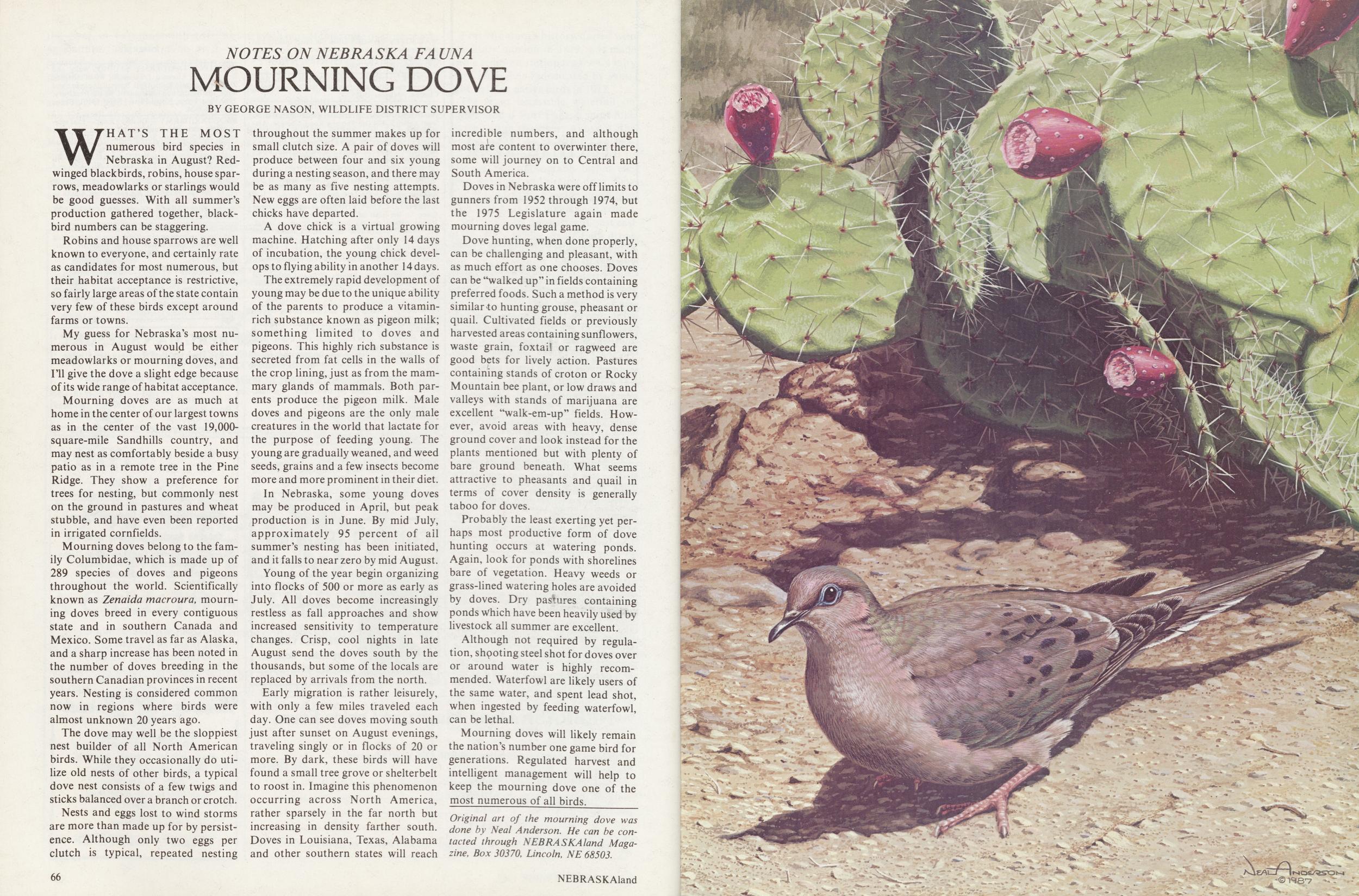
NOTES ON NEBRASKA FAUNA MOURNING DOVE
BY GEORGE NASON, WILDLIFE DISTRICT SUPERVISORWHAT'S THE MOST numerous bird species in Nebraska in August? Red- winged blackbirds, robins, house sparrows, meadowlarks or starlings would be good guesses. With all summer's production gathered together, black bird numbers can be staggering.
Robins and house sparrows are well known to everyone, and certainly rate as candidates for most numerous, but their habitat acceptance is restrictive, so fairly large areas of the state contain very few of these birds except around farms or towns.
My guess for Nebraska's most numerous in August would be either meadowlarks or mourning doves, and I'll give the dove a slight edge because of its wide range of habitat acceptance.
Mourning doves are as much at home in the center of our largest towns as in the center of the vast 19,000- square-mile Sandhills country, and may nest as comfortably beside a busy patio as in a remote tree in the Pine Ridge. They show a preference for trees for nesting, but commonly nest on the ground in pastures and wheat stubble, and have even been reported in irrigated cornfields.
Mourning doves belong to the family Columbidae, which is made up of 289 species of doves and pigeons throughout the world. Scientifically known as Zenaida macroura, mourning doves breed in every contiguous state and in southern Canada and Mexico. Some travel as far as Alaska, and a sharp increase has been noted in the number of doves breeding in the southern Canadian provinces in recent years. Nesting is considered common now in regions where birds were almost unknown 20 years ago.
The dove may well be the sloppiest nest builder of all North American birds. While they occasionally do utilize old nests of other birds, a typical dove nest consists of a few twigs and sticks balanced over a branch or crotch.
Nests and eggs lost to wind storms are more than made up for by persistence. Although only two eggs per clutch is typical, repeated nesting throughout the summer makes up for small clutch size. A pair of doves will produce between four and six young during a nesting season, and there may be as many as five nesting attempts. New eggs are often laid before the last chicks have departed.
A dove chick is a virtual growing machine. Hatching after only 14 days of incubation, the young chick develops to flying ability in another 14 days.
The extremely rapid development of young may be due to the unique ability of the parents to produce a vitamin rich substance known as pigeon milk; something limited to doves and pigeons. This highly rich substance is secreted from fat cells in the walls of the crop lining, just as from the mammary glands of mammals. Both parents produce the pigeon milk. Male doves and pigeons are the only male creatures in the world that lactate for the purpose of feeding young, The young are gradually weaned, and weed seeds, grains and a few insects become more and more prominent in their diet.
In Nebraska, some young doves may be produced in April, but peak production is in June. By mid July, approximately 95 percent of ail summer's nesting has been initiated, and it falls to near zero by mid August.
Young of the year begin organizing into flocks of 500 or more as early as July. All doves become increasingly restless as fall approaches and show increased sensitivity to temperature changes. Crisp, cool nights in late August send the doves south by the thousands, but some of the locals are replaced by arrivals from the north.
Early migration is rather leisurely, with only a few miles traveled each day. One can see doves moving south just after sunset on August evenings, traveling singly or in flocks of 20 or more. By dark, these birds will have found a small tree grove or shelter belt to roost in. Imagine this phenomenon occurring across North America, rather sparsely in the far north but increasing in density farther south. Doves in Louisiana, Texas, Alabama and other southern states will reach incredible numbers, and although most are content to overwinter there, some will journey on to Central and South America.
Doves in Nebraska were off limits to gunners from 1952 through 1974, but the 1975 Legislature again made mourning doves legal game.
Dove hunting, when done properly, can be challenging and pleasant, with as much effort as one chooses. Doves can be "walked up" in fields containing preferred foods. Such a method is very similar to hunting grouse, pheasant or quail. Cultivated fields or previously harvested areas containing sunflowers, waste grain, foxtail or ragweed are good bets for lively action. Pastures containing stands of croton or Rocky Mountain bee plant, or low draws and valleys with stands of marijuana are excellent "walk-em-up" fields. However, avoid areas with heavy, dense ground cover and look instead for the plants mentioned but with plenty of bare ground beneath. What seems attractive to pheasants and quail in terms of cover density is generally taboo for doves.
Probably the least exerting yet perhaps most productive form of dove hunting occurs at watering ponds. Again, look for ponds with shorelines bare of vegetation. Heavy weeds or grass-lined watering holes are avoided by doves. Dry pastures containing ponds Which have been heavily used by livestock all summer are excellent.
Although not required by regulation, shooting steel shot for doves over or around water is highly recommended. Waterfowl are likely users of the same water, and spent lead shot, when ingested by feeding waterfowl, can be lethal.
Mourning doves will likely remain the nation's number one game bird for generations. Regulated harvest and intelligent management will help to keep the mourning dove one of the most numerous of all birds._________
Original art of the mourning dove was done by Neal Anderson. He can be contacted through NEBRASKAland Maga-zine, Box 30370, Lincoln, NE 68503.
66 NEBRASKAland
SUMMER REFLECTIONS
Position: 253 (32 views)