Volume 65, Issue 6, 1987
NEBRASKAland
JULY 1987 $1.50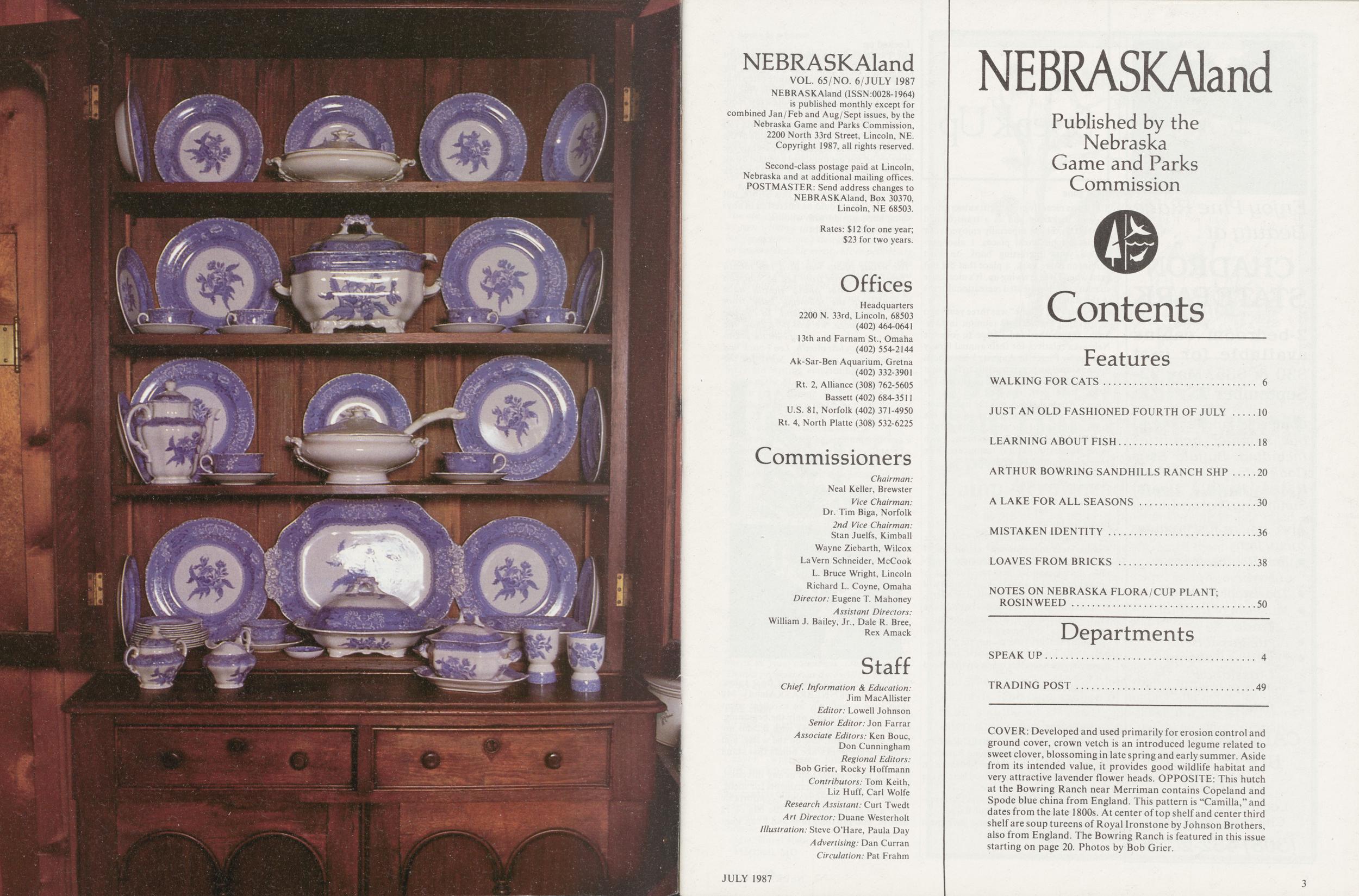
NEBRASKAland
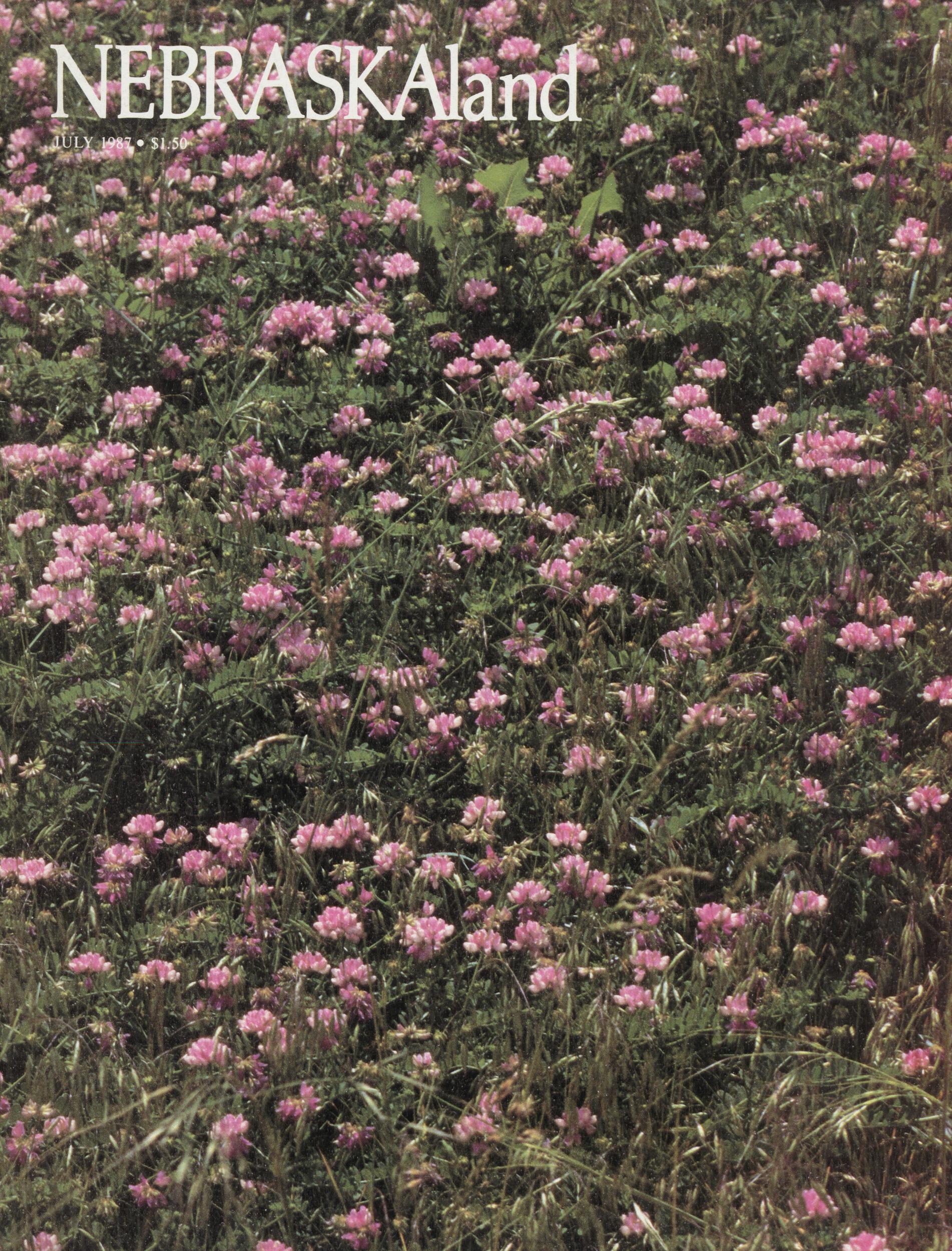
Published by the Nebraska Game and Parks Commission NEBRASKAland VOL. 65/NO. 6/JULY 1987 NEBRASKAland (ISSN:0028-1964) is published monthly except for combined Jan/Feb and Aug/Sept issues, by the Nebraska Game and Parks Commission, 2200 North 33rd Street, Lincoln, NE. Copyright 1987, all rights reserved. Second-class postage paid at Lincoln, Nebraska and at additional mailing offices. POSTMASTER: Send address changes to NEBRASKAland, Box 30370, Lincoln, NE 68503. Rates: $12 for one year; $23 for two years. Offices Headquarters 2200 N. 33rd, Lincoln, 68503 (402) 464-0641 13th and Farnam St., Omaha (402) 554-2144 Ak-Sar-Ben Aquarium, Gretna (402) 332-3901 Rt. 2, Alliance (308) 762-5605 Bassett (402) 684-3511 U.S. 81, Norfolk (402) 371-4950 Rt. 4, North Platte (308) 532-6225 Commissioners Chairman: Neal Keller, Brewster Vice Chairman: Dr. Tim Biga, Norfolk 2nd Vice Chairman: Stan Juelfs, Kimball Wayne Ziebarth, Wilcox LaVern Schneider, McCook L. Bruce Wright, Lincoln Richard L. Coyne, Omaha Director: Eugene T. Mahoney Assistant Directors: William J. Bailey, Jr., Dale R. Bree, Rex Amack Staff Chief, Information & Education: Jim MacAllister Editor: Lowell Johnson Senior Editor: Jon Farrar Associate Editors: Ken Bouc, Don Cunningham Regional Editors: Bob Grier, Rocky Hoffmann Contributors: Tom Keith, Liz Huff, Carl Wolfe Research Assistant: Curt Twedt Art Director: Duane Westerholt Illustration: Steve O'Hare, Paula Day Advertising: Dan Curran Circulation: Pat Frahm Contents Features WALKING FOR CATS.............................. 6 JUST AN OLD FASHIONED FOURTH OF JULY .....10 LEARNING ABOUT FISH...........................18 ARTHUR BOWRING SANDHILLS RANCH SHP.....20 A LAKE FOR ALL SEASONS....................... 30 MISTAKEN IDENTITY.............................36 LOAVES FROM BRICKS ...........................38 NOTES ON NEBRASKA FLORA/CUP PLANT; ROSINWEED....................................50 Departments SPEAK UP......................................... 4 TRADING POST...................................49 COVER: Developed and used primarily for erosion control and ground cover, crown vetch is an introduced legume related to sweet clover, blossoming in late spring and early summer. Aside from its intended value, it provides good wildlife habitat and very attractive lavender flower heads. OPPOSITE: This hutch at the Bowring Ranch near Merriman contains Copeland and Spode blue china from England. This pattern is "Camilla," and dates from the late 1800s. At center of top shelf and center third shelf are soup tureens of Royal Ironstone by Johnson Brothers, also from England. The Bowring Ranch is featured in this issue starting on page 20. Photos by Bob Grier. JULY 1987 3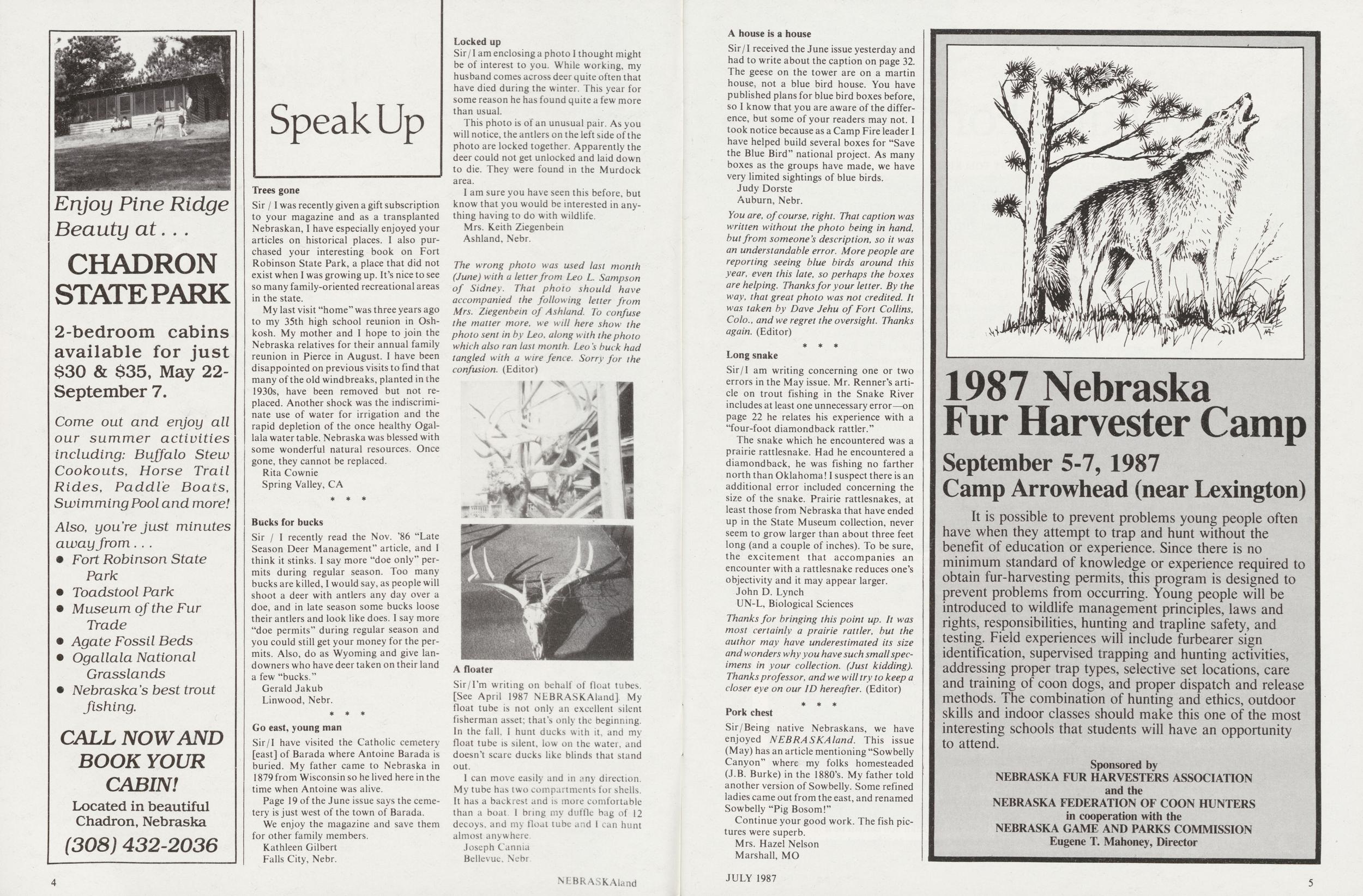
Speak Up
Trees goneSir /1 was recently given a gift subscription to your magazine and as a transplanted Nebraskan, I have especially enjoyed your articles on historical places. I also purchased your interesting book on Fort Robinson State Park, a place that did not exist when I was growing up. It's nice to see so many family-oriented recreational areas in the state.
My last visit "home" was three years ago to my 35th high school reunion in Oshkosh. My mother and I hope to join the Nebraska relatives for their annual family reunion in Pierce in August. I have been disappointed on previous visits to find that many of the old windbreaks, planted in the 1930s, have been removed but not re- placed. Another shock was the indiscriminate use of water for irrigation and the rapid depletion of the once healthy Ogallala water table. Nebraska was blessed with some wonderful natural resources. Once gone, they cannot be replaced.
Rita Cownie Spring Valley, CA * * * Bucks for bucksSir / I recently read the Nov. '86 "Late Season Deer Management" article, and I think it stinks. I say more "doe only" permits during regular season. Too many bucks are killed, I would say, as people will shoot a deer with antlers any day over a doe, and in late season some bucks loose their antlers and look like does. I say more "doe permits" during regular season and you could still get your money for the permits. Also, do as Wyoming and give landowners who have deer taken on their land a few "bucks."
Gerald Jakub Linwood, Nebr. * * * Go east, young manSir/I have visited the Catholic cemetery [east] of Barada where Antoine Barada is buried. My father came to Nebraska in 1879 from Wisconsin so he lived here in the time when Antoine was alive.
Page 19 of the June issue says the cemetery is just west of the town of Barada.
We enjoy the magazine and save them for other family members.
Kathleen Gilbert Falls City, Nebr. Locked upSir /1 am enclosing a photo I thought might be of interest to you. While working, my husband comes across deer quite often that have died during the winter. This year for some reason he has found quite a few more than usual.
This photo is of an unusual pair. As you will notice, the antlers on the left side of the photo are locked together. Apparently the deer could not get unlocked and laid down to die. They were found in the Murdock area.
I am sure you have seen this before, but know that you would be interested in anything having to do with wildlife.
Mrs. Keith Ziegenbein Ashland, Nebr.The wrong photo was used last month (June) with a letter from Leo L. Sampson of Sidney. That photo should have accompanied the following letter from Mrs. Ziegenbein of Ashland. To confuse the matter more, we will here show the photo sent in by Leo, along with the photo which also ran last month. Leo's buck had tangled with a wire fence. Sorry for the confusion. (Editor)
Sir/I'm writing on behalf of float tubes. [See April 1987 NEBRASKAland] My float tube is not only an excellent silent fisherman asset; that's only the beginning. In the fall. I hunt ducks with it, and my float tube is silent, low on the water, and doesn't scare ducks like blinds that stand out.
1 can move easily and in any direction. My tube has two compartments tor shells. It has a backrest and is more comfortable than a boat 1 bring my duffle bag of 12 decoys, and my float tube and 1 can hunt almost anywhere
Joseph Cannia Bellevue, Nebr 4 NEBRASKAland A house is a houseSir/I received the June issue yesterday and had to write about the caption on page 32. The geese on the tower are on a martin house, not a blue bird house. You have published plans for blue bird boxes before, so I know that you are aware of the difference, but some of your readers may not. I took notice because as a Camp Fire leader I have helped build several boxes for "Save the Blue Bird" national project. As many boxes as the groups have made, we have very limited sightings of blue birds.
Judy Dorste Auburn, Nebr.You are, of course, right. That caption was written without the photo being in hand, but from someone's description, so it was an understandable error. More people are reporting seeing blue birds around this year, even this late, so perhaps the boxes are helping. Thanks for your letter. By the way, that great photo was not credited. It was taken by Dave Jehu of Fort Collins, Colo., and we regret the oversight. Thanks again. (Editor)
* * * Long snakeSir/I am writing concerning one or two errors in the May issue. Mr. Renner's article on trout fishing in the Snake River includes at least one unnecessary error—on page 22 he relates his experience with a "four-foot diamondback rattler."
The snake which he encountered was a prairie rattlesnake. Had he encountered a diamondback, he was fishing no farther north than Oklahoma! I suspect there is an additional error included concerning the size of the snake. Prairie rattlesnakes, at least those from Nebraska that have ended up in the State Museum collection, never seem to grow larger than about three feet long (and a couple of inches). To be sure, the excitement that accompanies an encounter with a rattlesnake reduces one's objectivity and it may appear larger.
John D. Lynch UN-L, Biological SciencesThanks for bringing this point up. It was most certainly a prairie rattler, but the author mav have underestimated its size and wonders why you have such small specimens in your collection. (Just kidding). Thanks professor, and we will try to keep a closer eye on our ID hereafter. (Editor)
* * * Pork chestSir/Being native Nebraskans, we have enjoyed NEBRASKAland. This issue (May) has an article mentioning "Sowbelly Canyon" where my folks homesteaded (J.B. Burke) in the 1880's. My father told another version of Sowbelly. Some refined ladies came out from the east, and renamed Sowbelly "Pig Bosom!"
Continue your good work. The fish pictures were superb.
Mrs. Hazel Nelson Marshall, MOIt is possible to prevent problems young people often have when they attempt to trap and hunt without the benefit of education or experience. Since there is no minimum standard of knowledge or experience required to obtain fur-harvesting permits, this program is designed to prevent problems from occurring. Young people will be introduced to wildlife management principles, laws and rights, responsibilities, hunting and trapline safety, and testing. Field experiences will include furbearer sign identification, supervised trapping and hunting activities, addressing proper trap types, selective set locations, care and training of coon dogs, and proper dispatch and release methods. The combination of hunting and ethics, outdoor skills and indoor classes should make this one of the most interesting schools that students will have an opportunity to attend.
Sponsored by NEBRASKA FUR HARVESTERS ASSOCIATION and the NEBRASKA FEDERATION OF COON HUNTERS in cooperation with the NEBRASKA GAME AND PARKS COMMISSION Eugene T. Mahoney, Director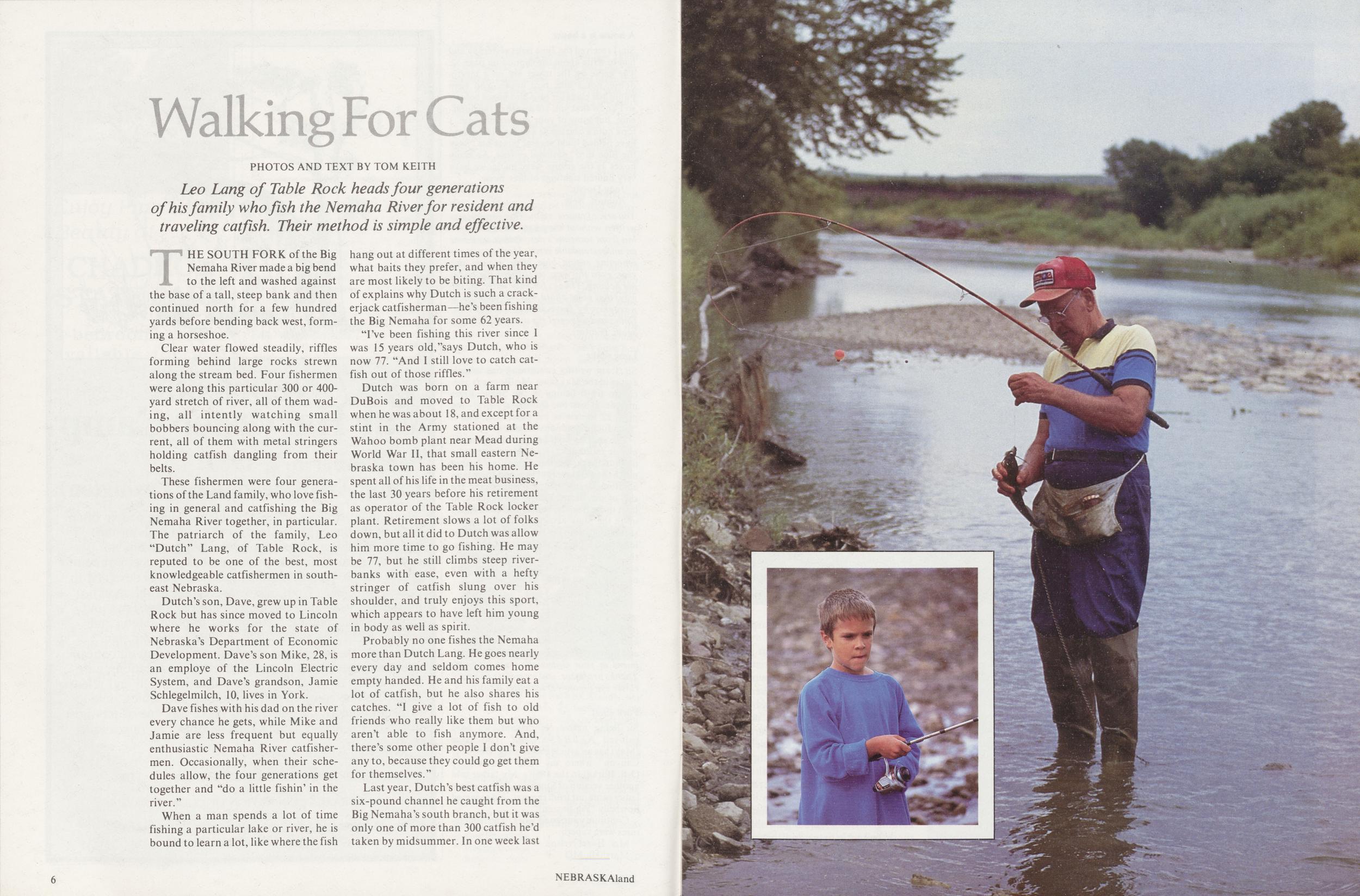
Walking For Cats
PHOTOS AND TEXT BY TOM KEITH Leo Lang of Table Rock heads four generations of his family who fish the Nemaha River for resident and traveling catfish. Their method is simple and effective.THE SOUTH FORK of the Big Nemaha River made a big bend to the left and washed against the base of a tall, steep bank and then continued north for a few hundred yards before bending back west, forming a horseshoe.
Clear water flowed steadily, riffles forming behind large rocks strewn along the stream bed. Four fishermen were along this particular 300 or 400-yard stretch of river, all of them wading, all intently watching small bobbers bouncing along with the current, all of them with metal stringers holding catfish dangling from their belts.
These fishermen were four generations of the Land family, who love fishing in general and catfishing the Big Nemaha River together, in particular. The patriarch of the family, Leo "Dutch" Lang, of Table Rock, is reputed to be one of the best, most knowledgeable catfishermen in southeast Nebraska.
Dutch's son, Dave, grew up in Table Rock but has since moved to Lincoln where he works for the state of Nebraska's Department of Economic Development. Dave's son Mike, 28, is an employe of the Lincoln Electric System, and Dave's grandson, Jamie Schlegelmilch, 10, lives in York.
Dave fishes with his dad on the river every chance he gets, while Mike and Jamie are less frequent but equally enthusiastic Nemaha River catfishermen. Occasionally, when their schedules allow, the four generations get together and "do a little fishin' in the river."
When a man spends a lot of time fishing a particular lake or river, he is bound to learn a lot, like where the fish hang out at different times of the year, what baits they prefer, and when they are most likely to be biting. That kind of explains why Dutch is such a crackerjack catfisherman—he's been fishing the Big Nemaha for some 62 years.
"I've been fishing this river since I was 15 years old,"says Dutch, who is now 77. "And I still love to catch catfish out of those riffles."
Dutch was born on a farm near DuBois and moved to Table Rock when he was about 18, and except for a stint in the Army stationed at the Wahoo bomb plant near Mead during World War II, that small eastern Nebraska town has been his home. He spent all of his life in the meat business, the last 30 years before his retirement as operator of the Table Rock locker plant. Retirement slows a lot of folks down, but all it did to Dutch was allow him more time to go fishing. He may be 77, but he still climbs steep riverbanks with ease, even with a hefty stringer of catfish slung over his shoulder, and truly enjoys this sport, which appears to have left him young in body as well as spirit.
Probably no one fishes the Nemaha more than Dutch Lang. He goes nearly every day and seldom comes home empty handed. He and his family eat a lot of catfish, but he also shares his catches. "I give a lot of fish to old friends who really like them but who aren't able to fish anymore. And, there's some other people I don't give any to, because they could go get them for themselves."
Last year, Dutch's best catfish was a six-pound channel he caught from the Big Nemaha's south branch, but it was only one of more than 300 catfish he'd taken by midsummer. In one week last year, he fished five days and caught his limit of 10 channels each day.
6 NEBRASKAland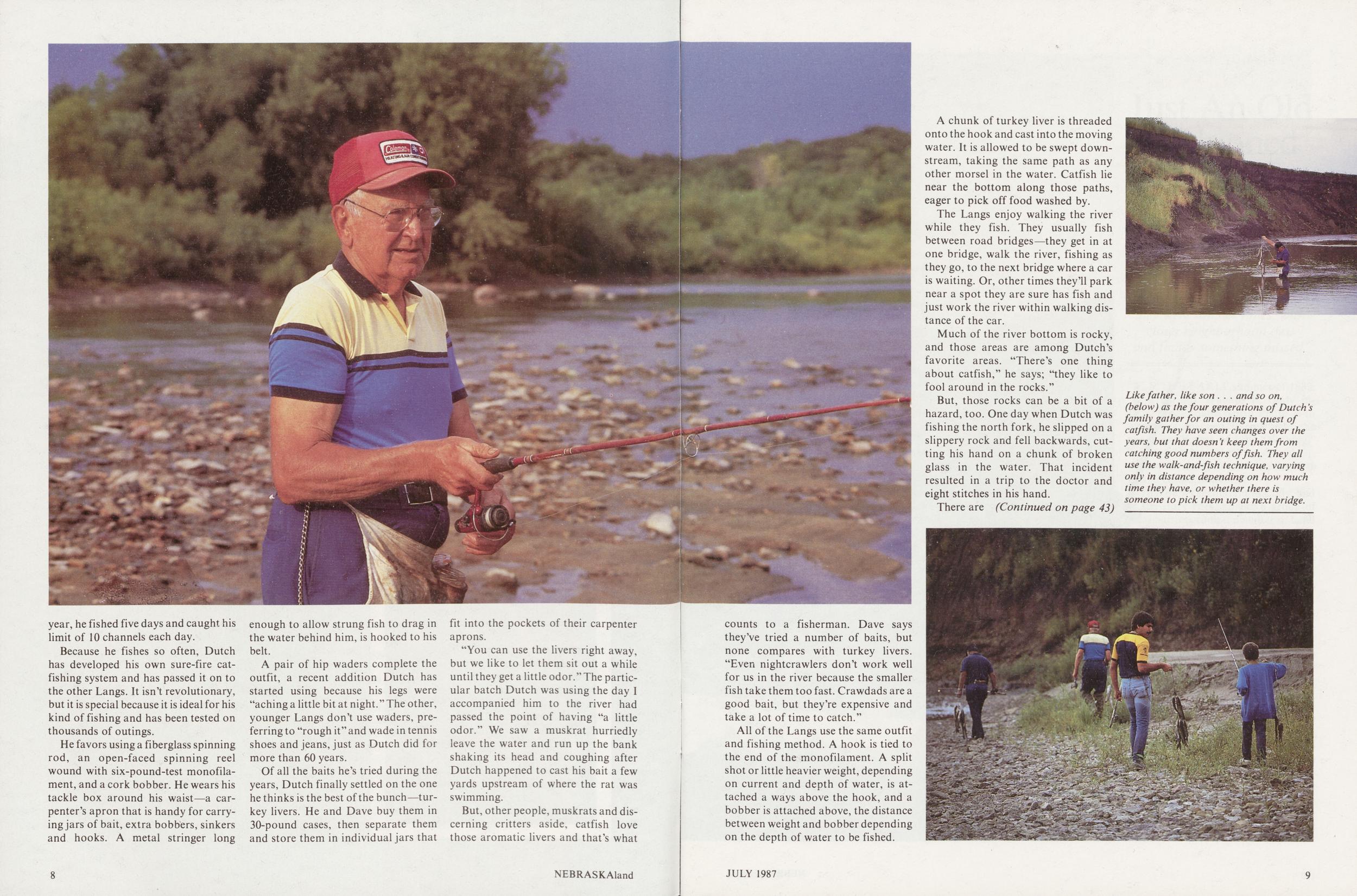
Because he fishes so often, Dutch has developed his own sure-fire catfishing system and has passed it on to the other Langs. It isn't revolutionary, but it is special because it is ideal for his kind of fishing and has been tested on thousands of outings.
He favors using a fiberglass spinning rod, an open-faced spinning reel wound with six-pound-test monofilament, and a cork bobber. He wears his tackle box around his waist—a carpenter's apron that is handy for carrying jars of bait, extra bobbers, sinkers and hooks. A metal stringer long enough to allow strung fish to drag in the water behind him, is hooked to his belt.
A pair of hip waders complete the outfit, a recent addition Dutch has started using because his legs were "aching a little bit at night." The other, younger Langs don't use waders, preferring to "rough it" and wade in tennis shoes and jeans, just as Dutch did for more than 60 years.
Of all the baits he's tried during the years, Dutch finally settled on the one he thinks is the best of the bunch—turkey livers. He and Dave buy them in 30-pound cases, then separate them and store them in individual jars that fit into the pockets of their carpenter aprons.
"You can use the livers right away, but we like to let them sit out a while until they get a little odor." The particular batch Dutch was using the day I accompanied him to the river had passed the point of having "a little odor." We saw a muskrat hurriedly leave the water and run up the bank shaking its head and coughing after Dutch happened to cast his bait a few yards upstream of where the rat was swimming.
But, other people, muskrats and discerning critters aside, catfish love those aromatic livers and that's what 8 NEBRASKAland counts to a fisherman. Dave says they've tried a number of baits, but none compares with turkey livers. "Even nightcrawlers don't work well for us in the river because the smaller fish take them too fast. Crawdads are a good bait, but they're expensive and take a lot of time to catch."
All of the Langs use the same outfit and fishing method. A hook is tied to the end of the monofilament. A split shot or little heavier weight, depending on current and depth of water, is attached a ways above the hook, and a bobber is attached above, the distance between weight and bobber depending on the depth of water to be fished.
A chunk of turkey liver is threaded onto the hook and cast into the moving water. It is allowed to be swept downstream, taking the same path as any other morsel in the water. Catfish lie near the bottom along those paths, eager to pick off food washed by.
The Langs enjoy walking the river while they fish. They usually fish between road bridges—they get in at one bridge, walk the river, fishing as they go, to the next bridge where a car is waiting. Or, other times they'll park near a spot they are sure has fish and just work the river within walking distance of the car.
Much of the river bottom is rocky, and those areas are among Dutch's favorite areas. "There's one thing about catfish," he says; "they like to fool around in the rocks."
But, those rocks can be a bit of a hazard, too. One day when Dutch was fishing the north fork, he slipped on a slippery rock and fell backwards, cutting his hand on a chunk of broken glass in the water. That incident resulted in a trip to the doctor and eight stitches in his hand.
There are (Continued on page 43)
Just An Old Fashioned FOURTH OF JULY
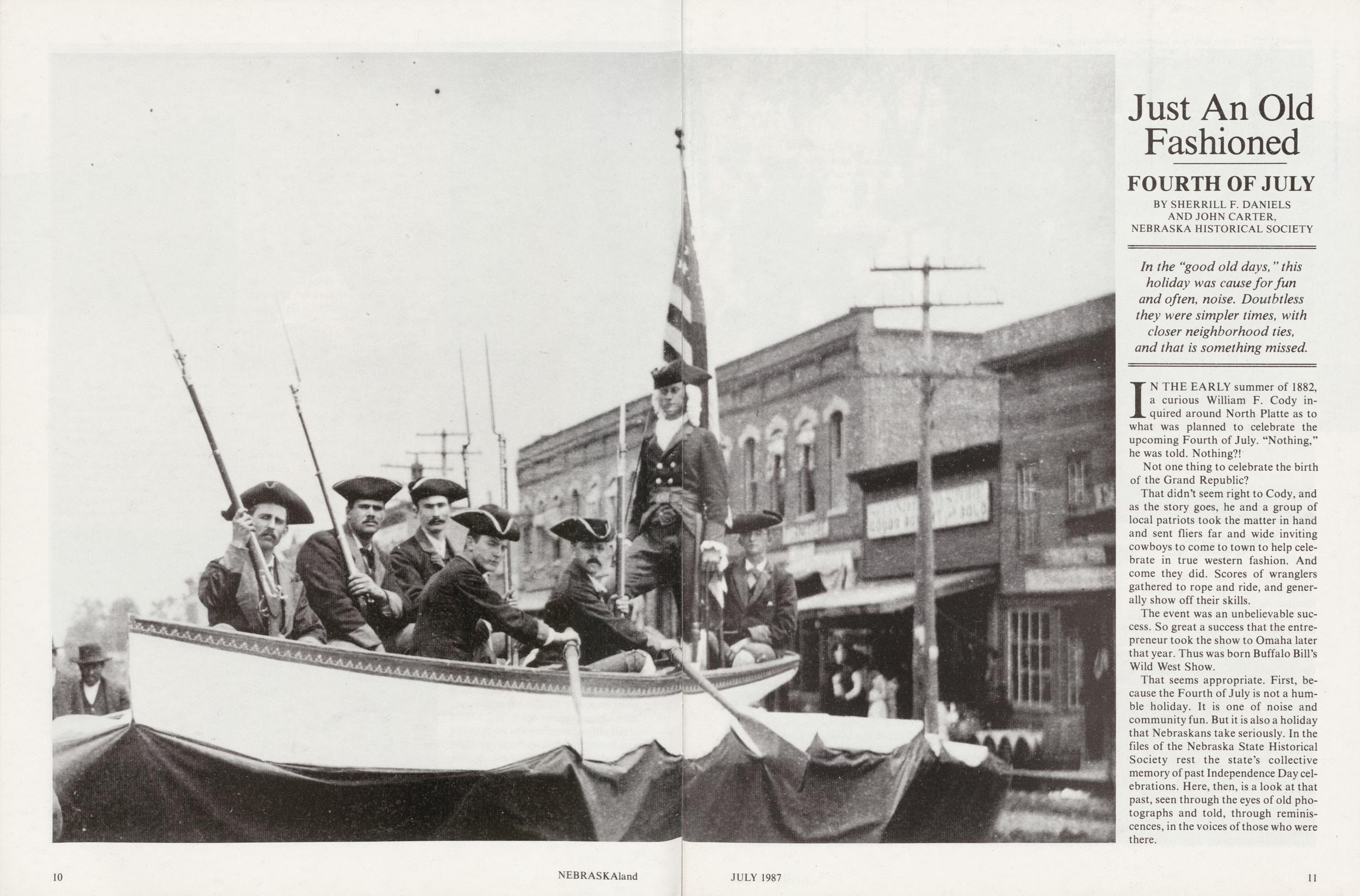
BY SHERRILL F. DANIELS AND JOHN CARTER, NEBRASKA HISTORICAL SOCIETY In the "good old days," this holiday was cause for fun and often, noise. Doubtless they were simpler times, with closer neighborhood ties, and that is something missed.IN THE EARLY summer of 1882, a curious William F. Cody inquired around North Platte as to what was planned to celebrate the upcoming Fourth of July. "Nothing," he was told. Nothing?!
Not one thing to celebrate the birth of the Grand Republic?
That didn't seem right to Cody, and as the story goes, he and a group of local patriots took the matter in hand and sent fliers far and wide inviting cowboys to come to town to help celebrate in true western fashion. And come they did. Scores of wranglers gathered to rope and ride, and generally show off their skills.
The event was an unbelievable success. So great a success that the entrepreneur took the show to Omaha later that year. Thus was born Buffalo Bill's Wild West Show.
That seems appropriate. First, because the Fourth of July is not a humble holiday. It is one of noise and community fun. But it is also a holiday that Nebraskans take seriously. In the files of the Nebraska State Historical Society rest the state's collective memory of past Independence Day celebrations. Here, then, is a look at that past, seen through the eyes of old photographs and told, through reminiscences, in the voices of those who were there.
JULY 1987 11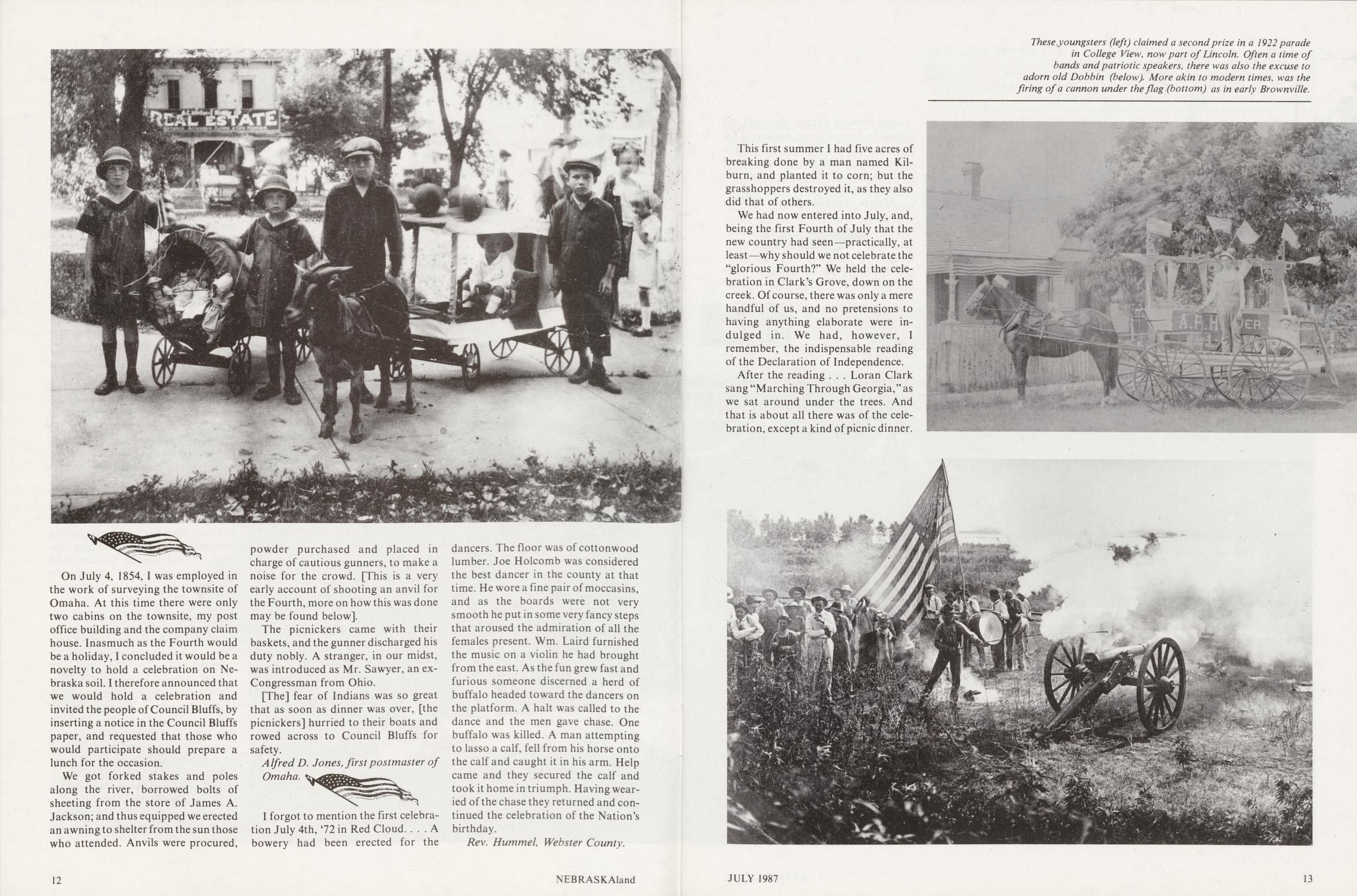
On July 4, 1854, I was employed in the work of surveying the townsite of Omaha. At this time there were only two cabins on the townsite, my post office building and the company claim house. Inasmuch as the Fourth would be a holiday, I concluded it would be a novelty to hold a celebration on Nebraska soil. I therefore announced that we would hold a celebration and invited the people of Council Bluffs, by inserting a notice in the Council Bluffs paper, and requested that those who would participate should prepare a lunch for the occasion.
We got forked stakes and poles along the river, borrowed bolts of sheeting from the store of James A. Jackson; and thus equipped we erected an awning to shelter from the sun those who attended. Anvils were procured, powder purchased and placed in charge of cautious gunners, to make a noise for the crowd. [This is a very early account of shooting an anvil for the Fourth, more on how this was done may be found below].
The picnickers came with their baskets, and the gunner discharged his duty nobly. A stranger, in our midst, was introduced as Mr. Sawyer, an ex-Congressman from Ohio.
[The] fear of Indians was so great that as soon as dinner was over, [the picnickers] hurried to their boats and rowed across to Council Bluffs for safety.
Alfred D. Jones, first postmaster of Omaha.1 forgot to mention the first celebration July 4th, 72 in Red Cloud.... A bowery had been erected for the dancers. The floor was of cottonwood lumber. Joe Holcomb was considered the best dancer in the county at that time. He wore a fine pair of moccasins, and as the boards were not very smooth he put in some very fancy steps that aroused the admiration of all the females present. Wm. Laird furnished the music on a violin he had brought from the east. As the fun grew fast and furious someone discerned a herd of buffalo headed toward the dancers on the platform. A halt was called to the dance and the men gave chase. One buffalo was killed. A man attempting to lasso a calf, fell from his horse onto the calf and caught it in his arm. Help came and they secured the calf and took it home in triumph. Having wearied of the chase they returned and continued the celebration of the Nation's birthday.
Rev. Hummel, Webster County. 12 NEBRASKAlandThis first summer I had five acres of breaking done by a man named Kilburn, and planted it to corn; but the grasshoppers destroyed it, as they also did that of others.
We had now entered into July, and, being the first Fourth of July that the new country had seen—practically, at least—why should we not celebrate the "glorious Fourth?" We held the celebration in Clark's Grove, down on the creek. Of course, there was only a mere handful of us, and no pretensions to having anything elaborate were indulged in. We had, however, I remember, the indispensable reading of the Declaration of Independence.
After the reading . . . Loran Clark sang "Marching Through Georgia," as we sat around under the trees. And that is about all there was of the celebration, except a kind of picnic dinner.
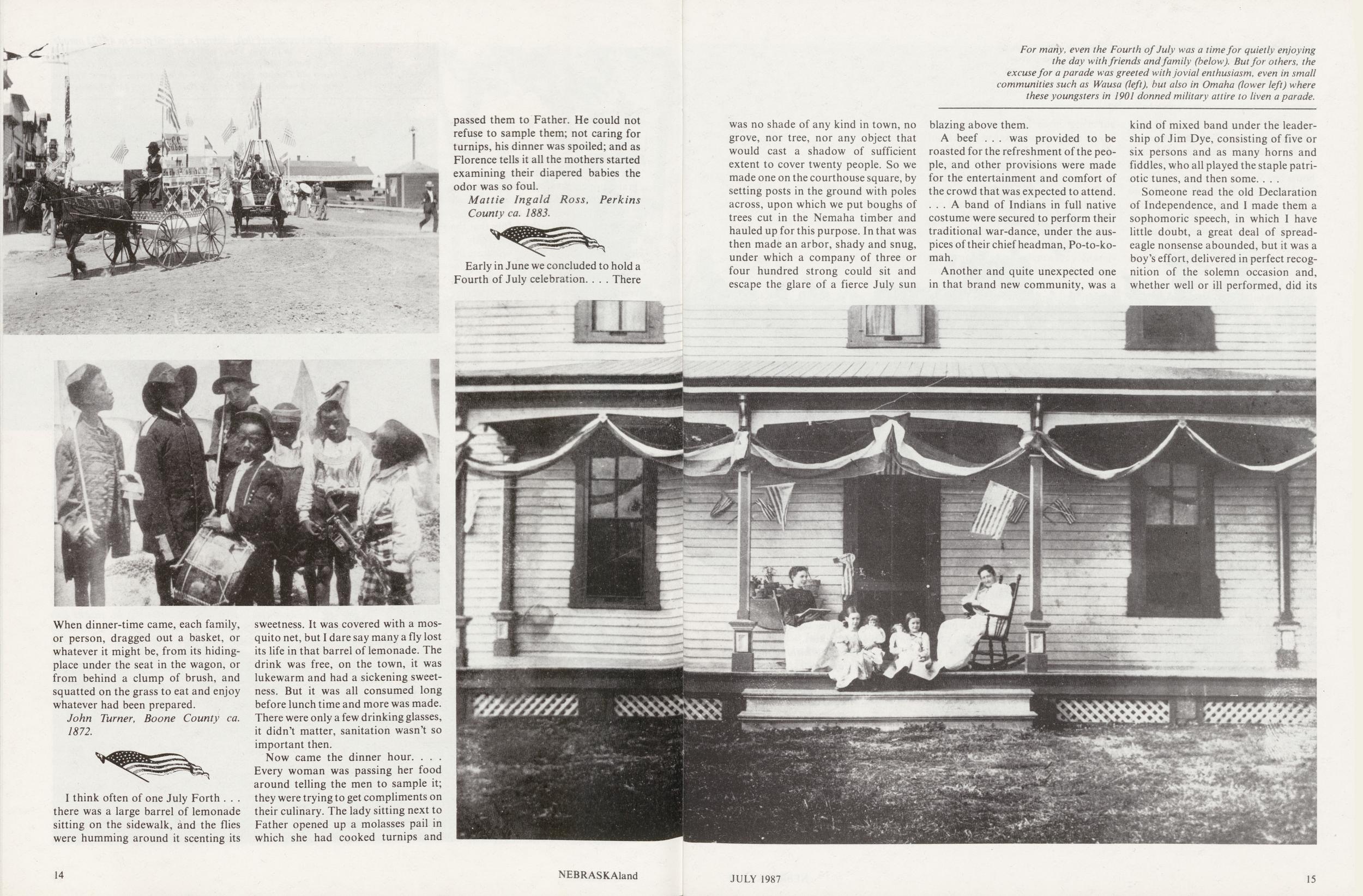
When dinner-time came, each family, or person, dragged out a basket, or whatever it might be, from its hiding place under the seat in the wagon, or from behind a clump of brush, and squatted on the grass to eat and enjoy whatever had been prepared.
John Turner, Boone County ca. 1872.I think often of one July Forth . . . there was a large barrel of lemonade sitting on the sidewalk, and the flies were humming around it scenting its sweetness. It was covered with a mosquito net, but I dare say many a fly lost its life in that barrel of lemonade. The drink was free, on the town, it was lukewarm and had a sickening sweetness. But it was all consumed long before lunch time and more was made. There were only a few drinking glasses, it didn't matter, sanitation wasn't so important then.
Now came the dinner hour. . . . Every woman was passing her food around telling the men to sample it; they were trying to get compliments on their culinary. The lady sitting next to Father opened up a molasses pail in which she had cooked turnips and passed them to Father. He could not refuse to sample them; not caring for turnips, his dinner was spoiled; and as Florence tells it all the mothers started examining their diapered babies the odor was so foul.
Mattie Ingald Ross Perkins County ca. 1883.Early in June we concluded to hold a Fourth of July celebration. . . . There was no shade of any kind in town, no grove, nor tree, nor any object that would cast a shadow of sufficient extent to cover twenty people. So we made one on the courthouse square, by setting posts in the ground with poles across, upon which we put boughs of trees cut in the Nemaha timber and hauled up for this purpose. In that was then made an arbor, shady and snug, under which a company of three or four hundred strong could sit and escape the glare of a fierce July sun blazing above them.
A beef . . . was provided to be roasted for the refreshment of the people, and other provisions were made for the entertainment and comfort of the crowd that was expected to attend. ... A band of Indians in full native costume were secured to perform their traditional war-dance, under the auspices of their chief headman, Potokomah.
Another and quite unexpected one in that brand new community, was a kind of mixed band under the leadership of Jim Dye, consisting of five or six persons and as many horns and fiddles, who all played the staple patriotic tunes, and then some. . . .
Someone read the old Declaration
of Independence, and I made them a
sophomoric speech, in which I have
little doubt, a great deal of
spreadeagle nonsense abounded, but it was a
boy's effort, delivered in perfect
recognition of the solemn occasion and,
whether well or ill performed, did its
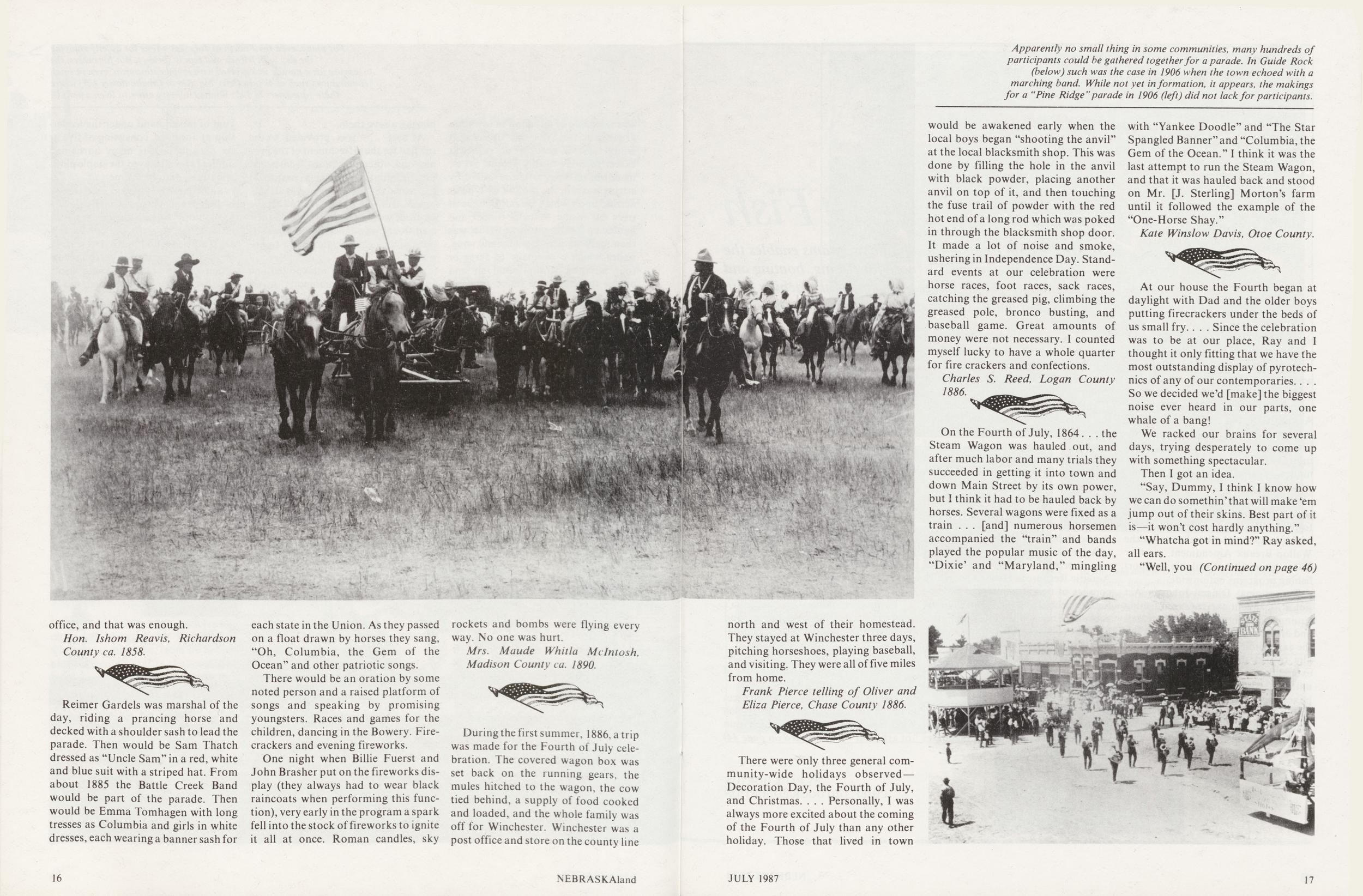 office, and that was enough.
Reimer Gardels was marshal of the day, riding a prancing horse and decked with a shoulder sash to lead the parade. Then would be Sam Thatch dressed as "Uncle Sam" in a red, white and blue suit with a striped hat. From about 1885 the Battle Creek Band would be part of the parade. Then would be Emma Tomhagen with long tresses as Columbia and girls in white dresses, each wearing a banner sash for each state in the Union. As they passed on a float drawn by horses they sang, "Oh, Columbia, the Gem of the Ocean" and other patriotic songs.
There would be an oration by some noted person and a raised platform of songs and speaking by promising youngsters. Races and games for the children, dancing in the Bowery. Firecrackers and evening fireworks.
One night when Billie Fuerst and John Brasher put on the fireworks display (they always had to wear black raincoats when performing this function), very early in the program a spark fell into the stock of fireworks to ignite it all at once. Roman candles, sky rockets and bombs were flying every way. No one was hurt.
Mrs. Maude Whitla Mcintosh, Madison County ca. 1890.During the first summer, 1886, a trip was made for the Fourth of July celebration. The covered wagon box was set back on the running gears, the mules hitched to the wagon, the cow tied behind, a supply of food cooked and loaded, and the whole family was off for Winchester. Winchester was a post office and store on the county line 16 NEBRASKAland north and west of their homestead. They stayed at Winchester three days, pitching horseshoes, playing baseball, and visiting. They were all of five miles from home.
Frank Pierce telling of Oliver and Eliza Pierce, Chase County 1886.There were only three general community-wide holidays observed— Decoration Day, the Fourth of July, and Christmas. . . . Personally, I was always more excited about the coming of the Fourth of July than any other holiday. Those that lived in town would be awakened early when the local boys began "shooting the anvil" at the local blacksmith shop. This was done by filling the hole in the anvil with black powder, placing another anvil on top of it, and then touching the fuse trail of powder with the red hot end of a long rod which was poked in through the blacksmith shop door. It made a lot of noise and smoke, ushering in Independence Day. Standard events at our celebration were horse races, foot races, sack races, catching the greased pig, climbing the greased pole, bronco busting, and baseball game. Great amounts of money were not necessary. I counted myself lucky to have a whole quarter for fire crackers and confections.
Charles S. Reed, Logan County 1886.On the Fourth of July, 1864. . . the Steam Wagon was hauled out, and after much labor and many trials they succeeded in getting it into town and down Main Street by its own power, but I think it had to be hauled back by horses. Several wagons were fixed as a train . . . [and] numerous horsemen accompanied the "train" and bands played the popular music of the day, "Dixie' and "Maryland,' mingling with "Yankee Doodle" and "The Star Spangled Banner" and "Columbia, the Gem of the Ocean." I think it was the last attempt to run the Steam Wagon, and that it was hauled back and stood on Mr. [J. Sterling] Morton's farm until it followed the example of the "One-Horse Shay."
Kate Winslow Davis, Otoe County.At our house the Fourth began at daylight with Dad and the older boys putting firecrackers under the beds of us small fry. . . . Since the celebration was to be at our place, Ray and I thought it only fitting that we have the most outstanding display of pyrotechnics of any of our contemporaries. . . . So we decided we'd [make] the biggest noise ever heard in our parts, one whale of a bang!
We racked our brains for several days, trying desperately to come up with something spectacular.
Then I got an idea.
"Say, Dummy, I think I know how we can do somethin' that will make 'em jump out of their skins. Best part of it is—it won't cost hardly anything."
"Whatcha got in mind?" Ray asked, all ears.
'Well, you (Continued on page 46)
Learning About Fish
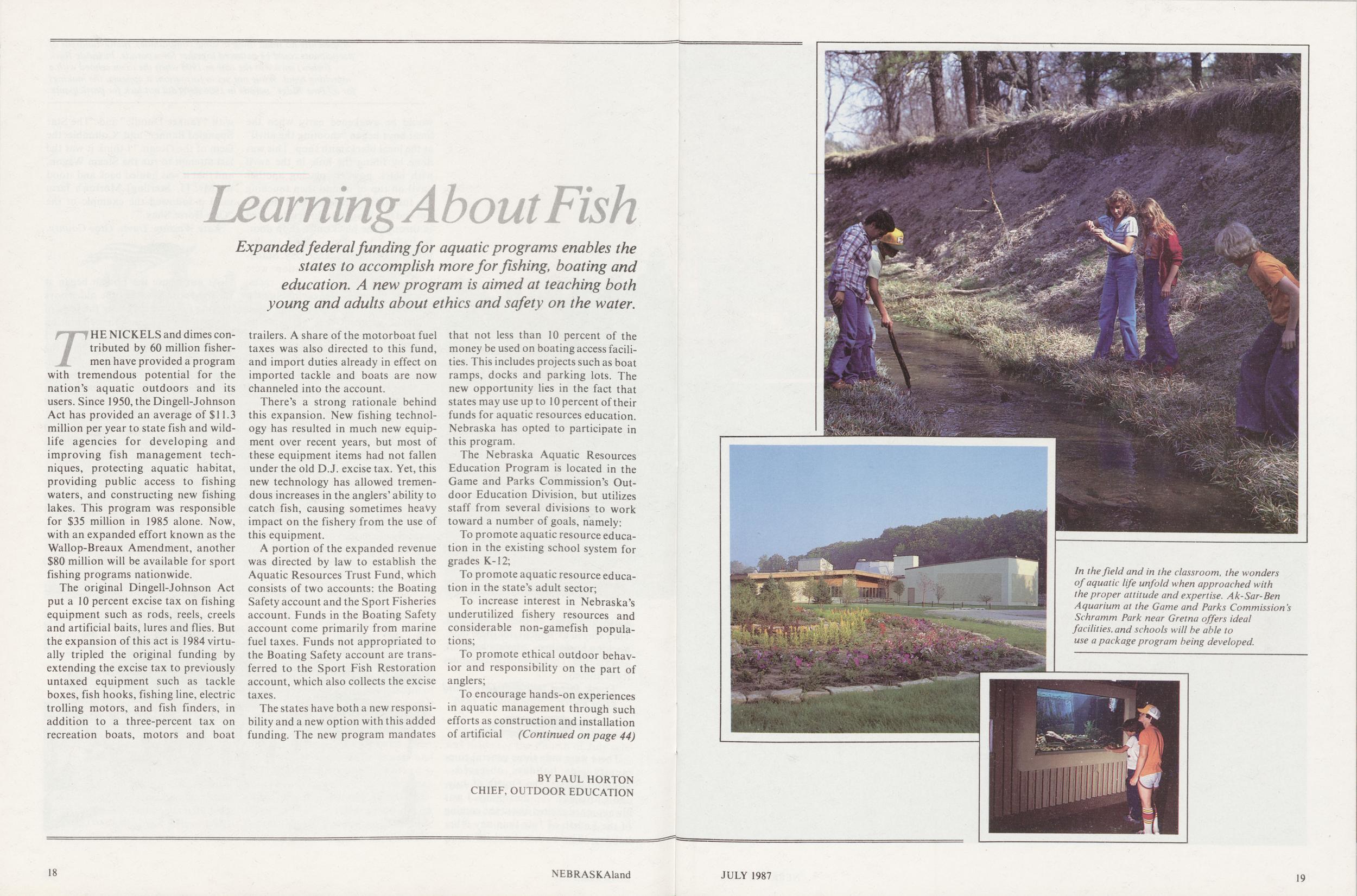
Expanded federal funding for aquatic programs enables the states to accomplish more for fishing, boating and education. A new program is aimed at teaching both young and adults about ethics and safety on the water.THE NICKELS and dimes contributed by 60 million fishermen have provided a program with tremendous potential for the nation's aquatic outdoors and its users. Since 1950, the Dingell-Johnson Act has provided an average of $11.3 million per year to state fish and wildlife agencies for developing and improving fish management techniques, protecting aquatic habitat, providing public access to fishing waters, and constructing new fishing lakes. This program was responsible for $35 million in 1985 alone. Now, with an expanded effort known as the Wallop-Breaux Amendment, another $80 million will be available for sport fishing programs nationwide.
The original Dingell-Johnson Act put a 10 percent excise tax on fishing equipment such as rods, reels, creels and artificial baits, lures and flies. But the expansion of this act is 1984 virtually tripled the original funding by extending the excise tax to previously untaxed equipment such as tackle boxes, fish hooks, fishing line, electric trolling motors, and fish finders, in addition to a three-percent tax on recreation boats, motors and boat trailers. A share of the motorboat fuel taxes was also directed to this fund, and import duties already in effect on imported tackle and boats are now channeled into the account.
There's a strong rationale behind this expansion. New fishing technology has resulted in much new equipment over recent years, but most of these equipment items had not fallen under the old D.J. excise tax. Yet, this new technology has allowed tremendous increases in the anglers' ability to catch fish, causing sometimes heavy impact on the fishery from the use of this equipment.
A portion of the expanded revenue was directed by law to establish the Aquatic Resources Trust Fund, which consists of two accounts: the Boating Safety account and the Sport Fisheries account. Funds in the Boating Safety account come primarily from marine fuel taxes. Funds not appropriated to the Boating Safety account are transferred to the Sport Fish Restoration account, which also collects the excise taxes.
The states have both a new responsibility and a new option with this added funding. The new program mandates that not less than 10 percent of the money be used on boating access facilities. This includes projects such as boat ramps, docks and parking lots. The new opportunity lies in the fact that states may use up to 10 percent of their funds for aquatic resources education. Nebraska has opted to participate in this program.
The Nebraska Aquatic Resources Education Program is located in the Game and Parks Commission's Outdoor Education Division, but utilizes staff from several divisions to work toward a number of goals, namely:
To promote aquatic resource education in the existing school system for grades K-12;
To promote aquatic resource education in the state's adult sector;
To increase interest in Nebraska's underutilized fishery resources and considerable non-gamefish populations;
To promote ethical outdoor behavior and responsibility on the part of anglers;
To encourage hands-on experiences in aquatic management through such efforts as construction and installation of artificial (Continued on page 44)
BY PAUL HORTON CHIEF, OUTDOOR EDUCATION 18 NEBRASKAland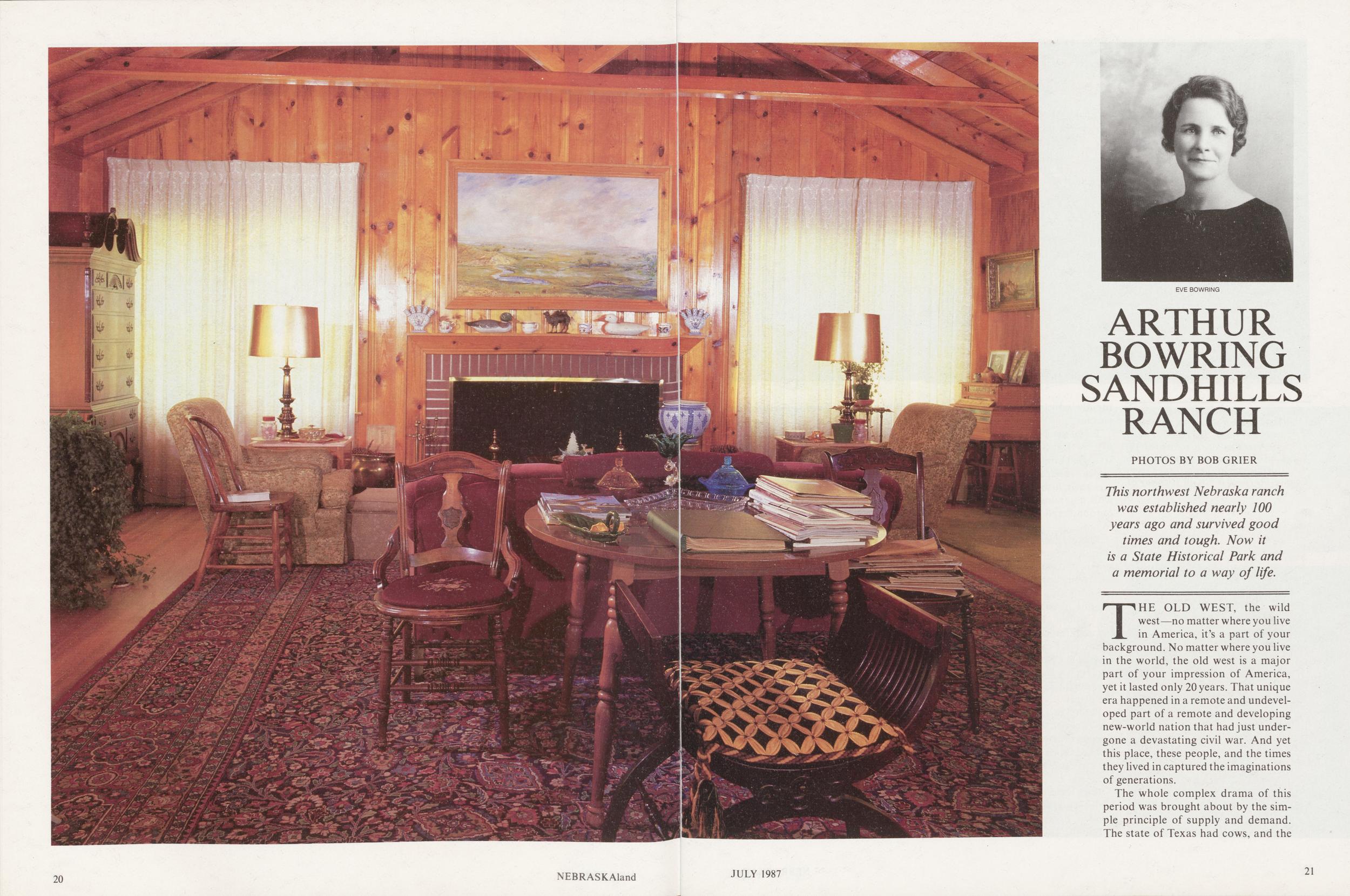
ARTHUR BOWRING SANDHILLS RANCH
PHOTOS BY BOB GRIER This northwest Nebraska ranch was established nearly 100 years ago and survived good times and tough. Now it is a State Historical Park and a memorial to a way of life.THE OLD WEST, the wild west—no matter where you live in America, it's a part of your background. No matter where you live in the world, the old west is a major part of your impression of America, yet it lasted only 20 years. That unique era happened in a remote and undeveloped part of a remote and developing new-world nation that had just undergone a devastating civil war. And yet this place, these people, and the times they lived in captured the imaginations of generations.
The whole complex drama of this period was brought about by the simple principle of supply and demand. The state of Texas had cows, and the rapidly industrializing east had hungry citizens.
JULY 1987 21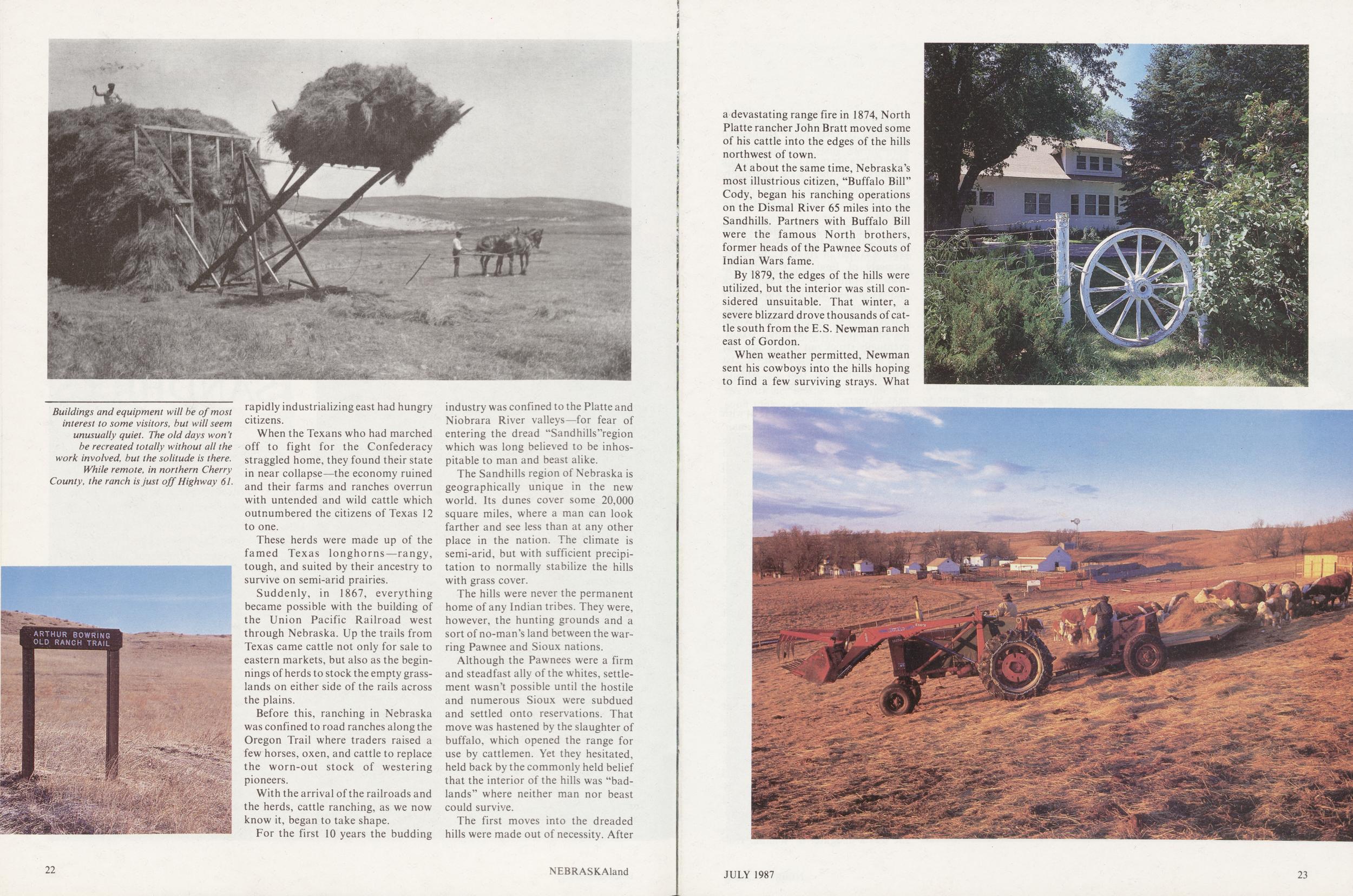
When the Texans who had marched off to fight for the Confederacy straggled home, they found their state in near collapse—the economy ruined and their farms and ranches overrun with untended and wild cattle which outnumbered the citizens of Texas 12 to one.
These herds were made up of the famed Texas longhorns—rangy, tough, and suited by their ancestry to survive on semi-arid prairies.
Suddenly, in 1867, everything became possible with the building of the Union Pacific Railroad west through Nebraska. Up the trails from Texas came cattle not only for sale to eastern markets, but also as the beginnings of herds to stock the empty grasslands on either side of the rails across the plains.
Before this, ranching in Nebraska was confined to road ranches along the Oregon Trail where traders raised a few horses, oxen, and cattle to replace the worn-out stock of westering pioneers.
With the arrival of the railroads and the herds, cattle ranching, as we now know it, began to take shape. For the first 10 years the budding industry was confined to the Platte and Niobrara River valleys—for fear of entering the dread "Sandhills"region which was long believed to be inhospitable to man and beast alike.
The Sandhills region of Nebraska is geographically unique in the new world. Its dunes cover some 20,000 square miles, where a man can look farther and see less than at any other place in the nation. The climate is semi-arid, but with sufficient precipitation to normally stabilize the hills with grass cover.
The hills were never the permanent home of any Indian tribes. They were, however, the hunting grounds and a sort of no-man's land between the warring Pawnee and Sioux nations.
Although the Pawnees were a firm and steadfast ally of the whites, settlement wasn't possible until the hostile and numerous Sioux were subdued and settled onto reservations. That move was hastened by the slaughter of buffalo, which opened the range for use by cattlemen. Yet they hesitated, held back by the commonly held belief that the interior of the hills was "badlands" where neither man nor beast could survive.
The first moves into the dreaded hills were made out of necessity. After 22 NEBRASKAland a devastating range fire in 1874, North Platte rancher John Bratt moved some of his cattle into the edges of the hills northwest of town.
At about the same time, Nebraska's most illustrious citizen, "Buffalo Bill" Cody, began his ranching operations on the Dismal River 65 miles into the Sandhills. Partners with Buffalo Bill were the famous North brothers, former heads of the Pawnee Scouts of Indian Wars fame.
By 1879, the edges of the hills were utilized, but the interior was still considered unsuitable. That winter, a severe blizzard drove thousands of cattle south from the E.S. Newman ranch east of Gordon.
When weather permitted, Newman sent his cowboys into the hills hoping to find a few surviving strays. What they found were not only his cattle, safe and sound, but thousands of head from other ranches grazing fat and healthy on the lush meadowlands of the interior.
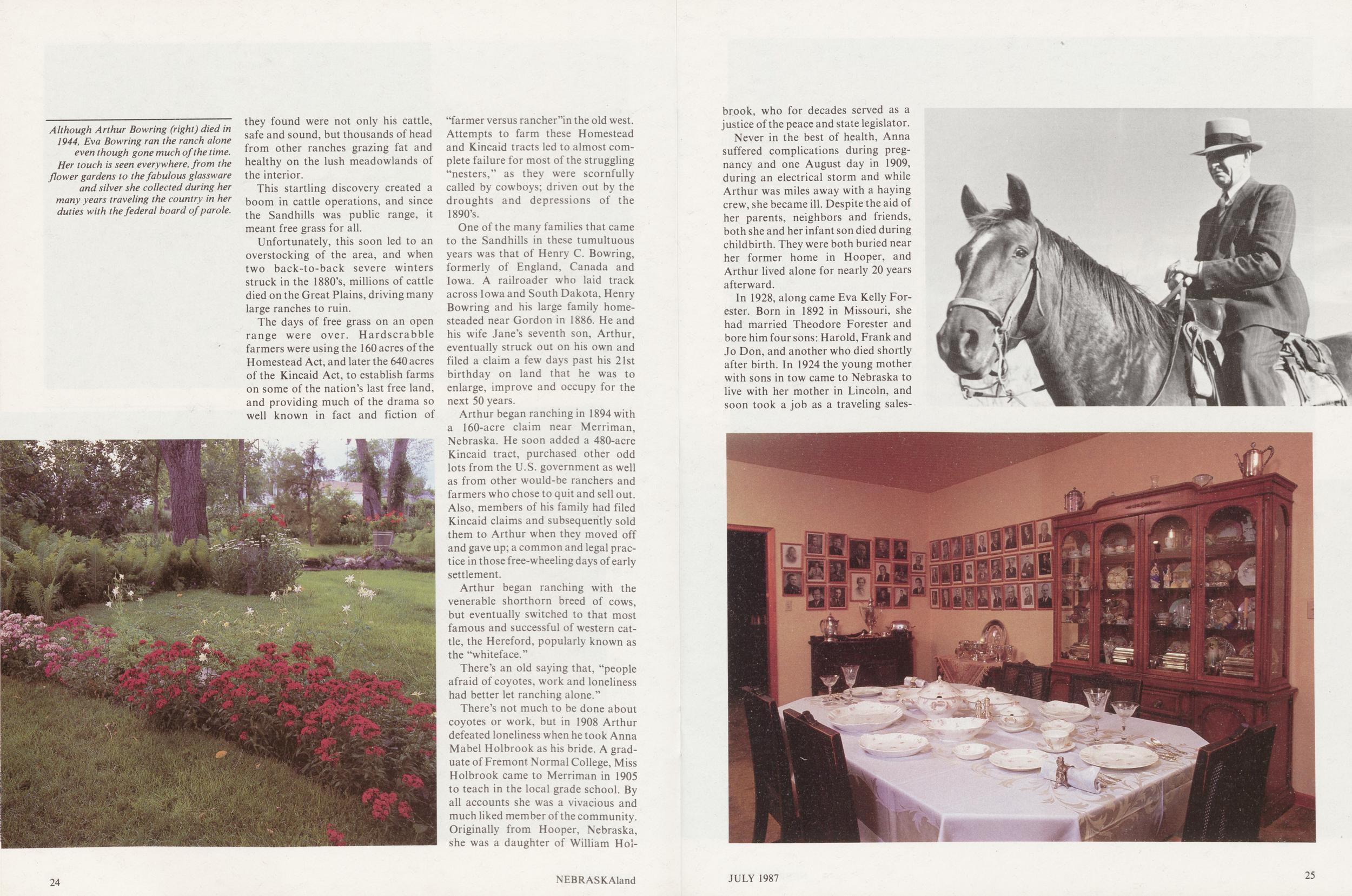 Although Arthur Bowring (right) died in
1944, Eva Bowring ran the ranch alone
even though gone much of the time.
Her touch is seen everywhere, from the
flower gardens to the fabulous glassware
and silver she collected during her
many years traveling the country in her
duties with the federal board of parole.
Although Arthur Bowring (right) died in
1944, Eva Bowring ran the ranch alone
even though gone much of the time.
Her touch is seen everywhere, from the
flower gardens to the fabulous glassware
and silver she collected during her
many years traveling the country in her
duties with the federal board of parole.
This startling discovery created a boom in cattle operations, and since the Sandhills was public range, it meant free grass for all.
Unfortunately, this soon led to an overstocking of the area, and when two back-to-back severe winters struck in the 1880's, millions of cattle died on the Great Plains, driving many large ranches to ruin.
The days of free grass on an open range were over. Hardscrabble farmers were using the 160 acres of the Homestead Act, and later the 640 acres of the Kincaid Act, to establish farms on some of the nation's last free land, and providing much of the drama so well known in fact and fiction of "farmer versus rancher"in the old west. Attempts to farm these Homestead and Kincaid tracts led to almost complete failure for most of the struggling "nesters," as they were scornfully called by cowboys; driven out by the droughts and depressions of the 1890's.
One of the many families that came to the Sandhills in these tumultuous years was that of Henry C. Bowring, formerly of England, Canada and Iowa. A railroader who laid track across Iowa and South Dakota, Henry Bowring and his large family homesteaded near Gordon in 1886. He and his wife Jane's seventh son, Arthur, eventually struck out on his own and filed a claim a few days past his 21st birthday on land that he was to enlarge, improve and occupy for the next 50 years.
Arthur began ranching in 1894 with a 160-acre claim near Merriman, Nebraska. He soon added a 480-acre Kincaid tract, purchased other odd lots from the U.S. government as well as from other would-be ranchers and farmers who chose to quit and sell out. Also, members of his family had filed Kincaid claims and subsequently sold them to Arthur when they moved off and gave up; a common and legal practice in those free-wheeling days of early settlement.
Arthur began ranching with the venerable shorthorn breed of cows, but eventually switched to that most famous and successful of western cattle, the Hereford, popularly known as the "whiteface."
There's an old saying that, "people afraid of coyotes, work and loneliness had better let ranching alone."
There's not much to be done about coyotes or work, but in 1908 Arthur defeated loneliness when he took Anna Mabel Holbrook as his bride. A graduate of Fremont Normal College, Miss Holbrook came to Merriman in 1905 to teach in the local grade school. By all accounts she was a vivacious and much liked member of the community. Originally from Hooper, Nebraska, she was a daughter of William Holbrook, 24 NEBRASKAland who for decades served as a justice of the peace and state legislator.
Never in the best of health, Anna suffered complications during pregnancy and one August day in 1909, during an electrical storm and while Arthur was miles away with a haying crew, she became ill. Despite the aid of her parents, neighbors and friends, both she and her infant son died during childbirth. They were both buried near her former home in Hooper, and Arthur lived alone for nearly 20 years afterward.
In 1928, along came Eva Kelly Forester. Born in 1892 in Missouri, she had married Theodore Forester and bore him four sons: Harold, Frank and Jo Don, and another who died shortly after birth. In 1924 the young mother with sons in tow came to Nebraska to live with her mother in Lincoln, and soon took a job as a traveling sales-woman for the Norfolk Steam Bakery, a very unusual occupation for a woman in those days. Her territory was large, extending as far as Merriman, and here she met her future husband when automobile problems brought him to her aid.
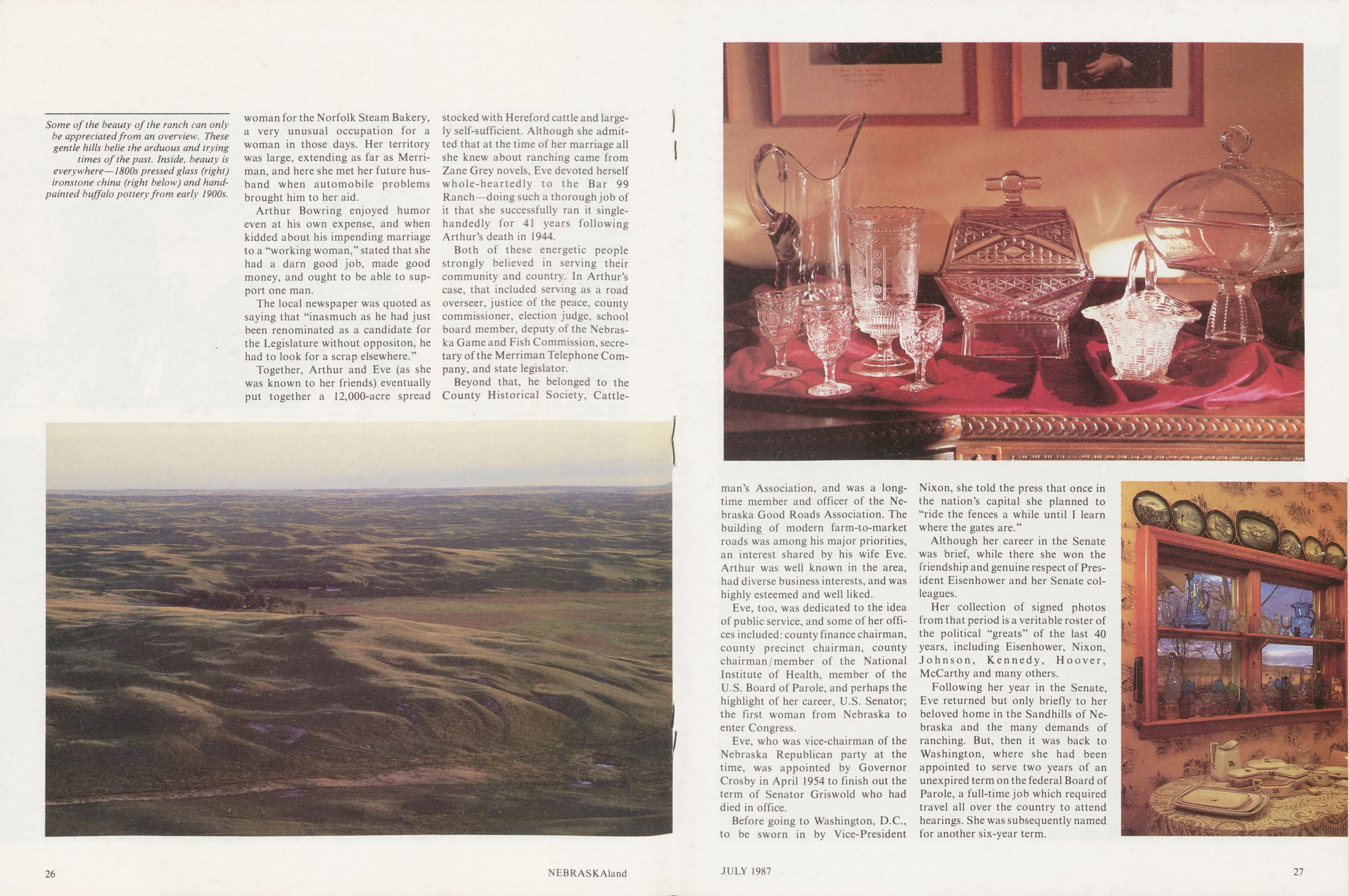 Some of the beauty of the ranch can only
be appreciated from an overview. These
gentle hills belie the arduous and trying
times of the past. Inside, beauty is
everywhere—1800s pressed glass (right)
ironstone china (right below) and
handpainted buffalo pottery from early 1900s.
Some of the beauty of the ranch can only
be appreciated from an overview. These
gentle hills belie the arduous and trying
times of the past. Inside, beauty is
everywhere—1800s pressed glass (right)
ironstone china (right below) and
handpainted buffalo pottery from early 1900s.
Arthur Bowring enjoyed humor even at his own expense, and when kidded about his impending marriage to a "working woman," stated that she had a darn good job, made good money, and ought to be able to support one man.
The local newspaper was quoted as saying that "inasmuch as he had just been renominated as a candidate for the Legislature without opposition, he had to look for a scrap elsewhere."
Together, Arthur and Eve (as she was known to her friends) eventually put together a 12,000-acre spread stocked with Hereford cattle and largely self-sufficient. Although she admitted that at the time of her marriage all she knew about ranching came from Zane Grey novels, Eve devoted herself whole-heartedly to the Bar 99 Ranch—doing such a thorough job of it that she successfully ran it single-handedly for 41 years following Arthur's death in 1944.
Both of these energetic people strongly believed in serving their community and country. In Arthur's case, that included serving as a road overseer, justice of the peace, county commissioner, election judge, school board member, deputy of the Nebraska Game and Fish Commission, secretary of the Merriman Telephone Company, and state legislator.
Beyond that, he belonged to the County Historical Society, Cattleman's 26 NEBRASKAland Association, and was a long- time member and officer of the Nebraska Good Roads Association. The building of modern farm-to-market roads was among his major priorities, an interest shared by his wife Eve. Arthur was well known in the area, had diverse business interests, and was highly esteemed and well liked.
Eve, too, was dedicated to the idea of public service, and some of her offices included: county finance chairman, county precinct chairman, county chairman/member of the National Institute of Health, member of the U.S. Board of Parole, and perhaps the highlight of her career, U.S. Senator; the first woman from Nebraska to enter Congress.
Eve, who was vice-chairman of the Nebraska Republican party at the time, was appointed by Governor Crosby in April 1954 to finish out the term of Senator Griswold who had died in office.
Before going to Washington, D.C., to be sworn in by Vice-President Nixon, she told the press that once in the nation's capital she planned to "ride the fences a while until I learn where the gates are."
Although her career in the Senate was brief, while there she won the friendship and genuine respect of President Eisenhower and her Senate colleagues.
Her collection of signed photos from that period is a veritable roster of the political "greats" of the last 40 years, including Eisenhower, Nixon, Johnson, Kennedy, Hoover, McCarthy and many others.
Following her year in the Senate, Eve returned but only briefly to her beloved home in the Sandhills of Nebraska and the many demands of ranching. But, then it was back to Washington, where she had been appointed to serve two years of an unexpired term on the federal Board of Parole, a full-time job which required travel all over the country to attend hearings. She was subsequently named for another six-year term.
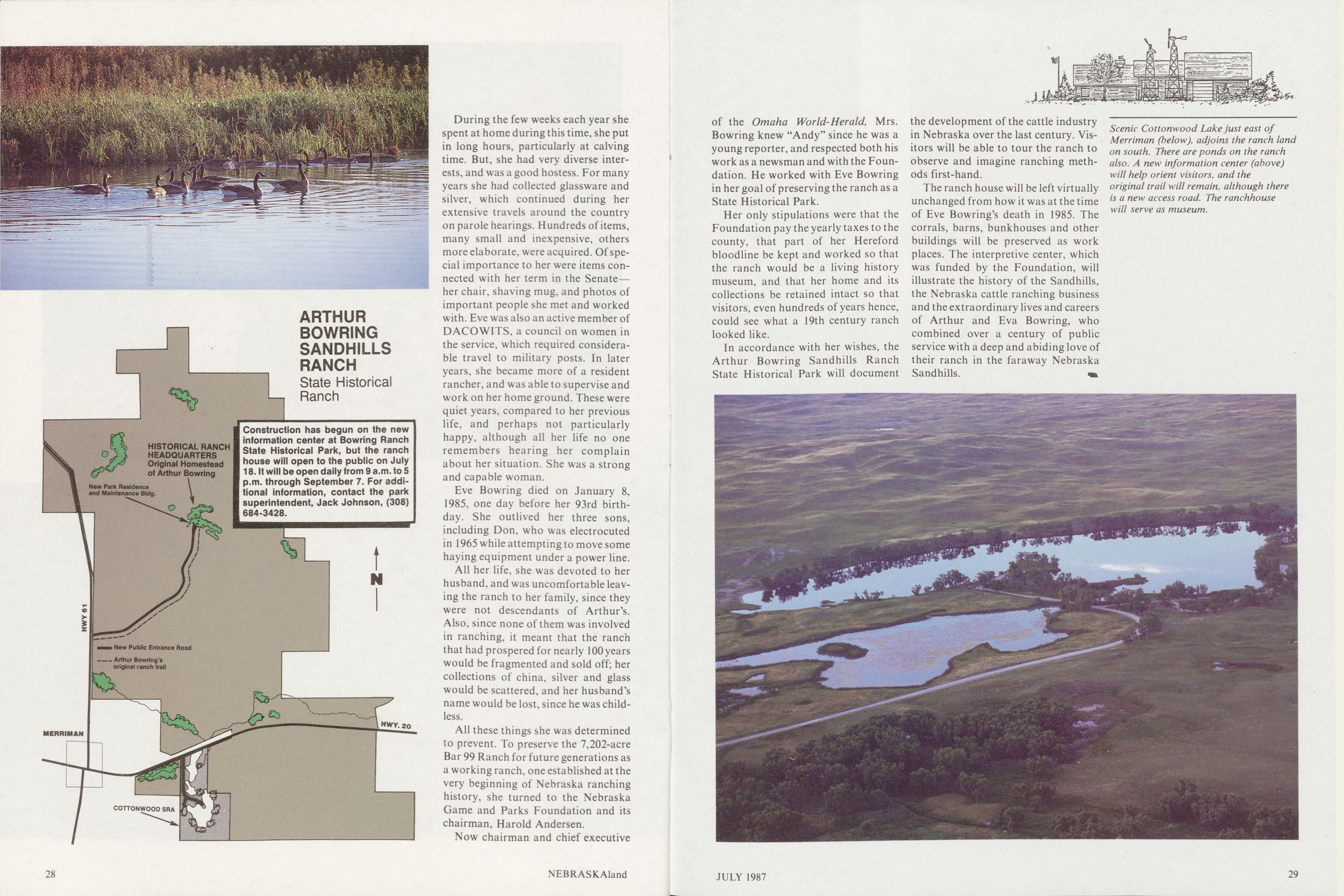
During the few weeks each year she spent at home during this time, she put in long hours, particularly at calving time. But, she had very diverse interests, and was a good hostess. For many years she had collected glassware and silver, which continued during her extensive travels around the country on parole hearings. Hundreds of items, many small and inexpensive, others more elaborate, were acquired. Of special importance to her were items connected with her term in the Senateher chair, shaving mug, and photos of important people she met and worked with. Eve was also an active member of DACOWITS, a council on women in the service, which required considerable travel to military posts. In later years, she became more of a resident rancher, and was able to supervise and work on her home ground. These were quiet years, compared to her previous life, and perhaps not particularly happy, although all her life no one remembers hearing her complain about her situation. She was a strong and capable woman.
Eve Bowring died on January 8, 1985, one day before her 93rd birthday. She outlived her three sons, including Don, who was electrocuted in 1965 while attempting to move some haying equipment under a power line.
All her life, she was devoted to her husband, and was uncomfortable leaving the ranch to her family, since they were not descendants of Arthur's. Also, since none of them was involved in ranching, it meant that the ranch that had prospered for nearly 100 years would be fragmented and sold off; her collections of china, silver and glass would be scattered, and her husband's name would be lost, since he was childless.
All these things she was determined to prevent. To preserve the 7,202-acre Bar 99 Ranch for future generations as a working ranch, one established at the very beginning of Nebraska ranching history, she turned to the Nebraska Game and Parks Foundation and its chairman, Harold Andersen.
Now chairman and chief executive 28 NEBRASKAland of the Omaha World-Her aid, Mrs. Bowring knew "Andy" since he was a young reporter, and respected both his work as a newsman and with the Foundation. He worked with Eve Bowring in her goal of preserving the ranch as a State Historical Park.
Her only stipulations were that the Foundation pay the yearly taxes to the county, that part of her Hereford bloodline be kept and worked so that the ranch would be a living history museum, and that her home and its collections be retained intact so that visitors, even hundreds of years hence, could see what a 19th century ranch looked like.
In accordance with her wishes, the Arthur Bowring Sandhills Ranch State Historical Park will document the development of the cattle industry in Nebraska over the last century. Visitors will be able to tour the ranch to observe and imagine ranching methods first-hand.
The ranch house will be left virtually unchanged from how it was at the time of Eve Bowring's death in 1985. The corrals, barns, bunkhouses and other buildings will be preserved as work places. The interpretive center, which was funded by the Foundation, will illustrate the history of the Sandhills, the Nebraska cattle ranching business and the extraordinary lives and careers of Arthur and Eva Bowring, who combined over a century of public service with a deep and abiding love of their ranch in the faraway Nebraska Sandhills.
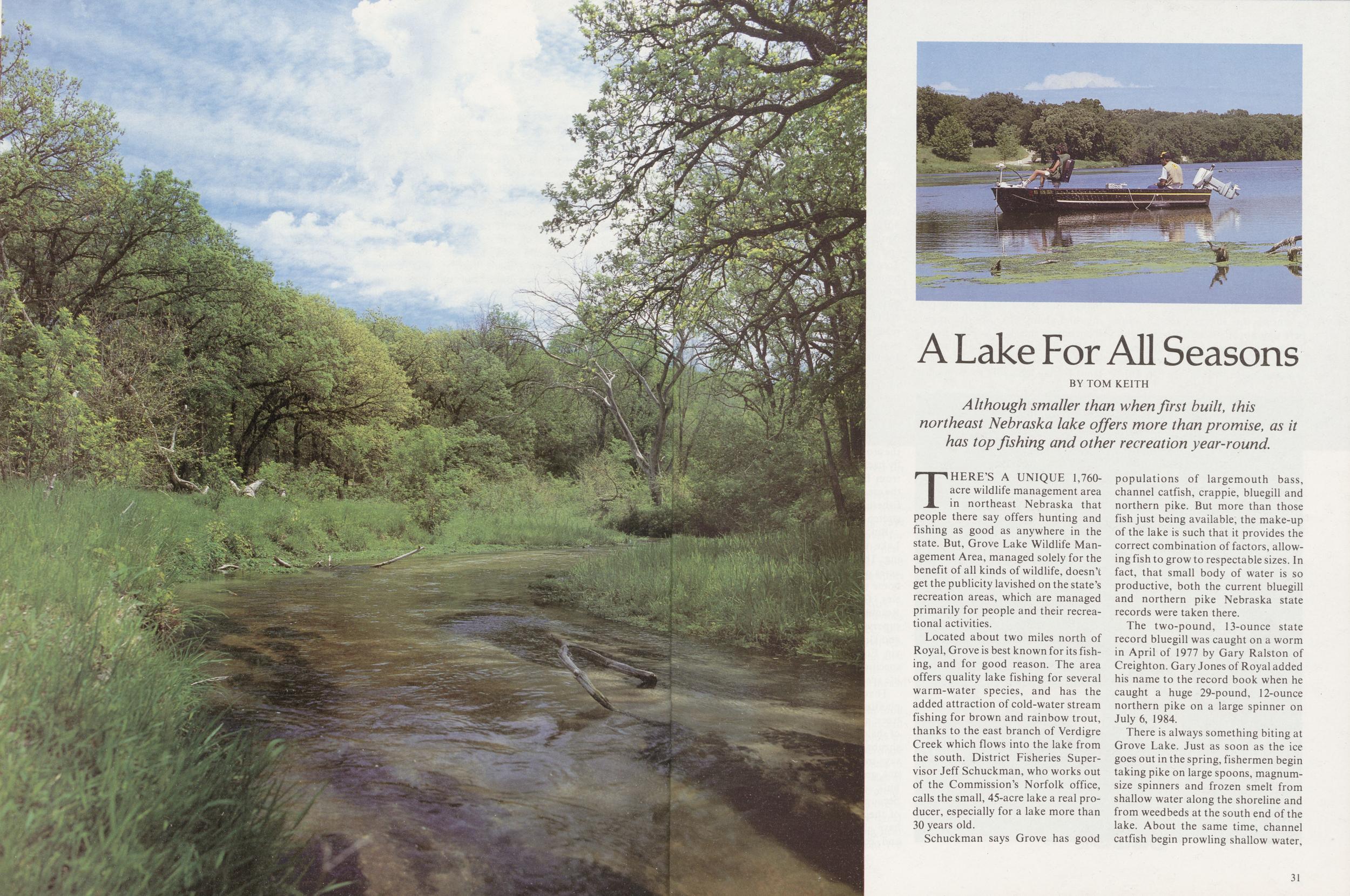
A Lake For All Seasons
BY TOM KEITH Although smaller than when first built, northeast Nebraska lake offers more than promise, as it has top fishing and other recreation year-round.THERE'S A UNIQUE 1,760 acre wildlife management area in northeast Nebraska that people there say offers hunting and fishing as good as anywhere in the state. But, Grove Lake Wildlife Management Area, managed solely for the benefit of all kinds of wildlife, doesn't get the publicity lavished on the state's recreation areas, which are managed primarily for people and their recreational activities.
Located about two miles north of Royal, Grove is best known for its fishing, and for good reason. The area offers quality lake fishing for several warm-water species, and has the added attraction of cold-water stream fishing for brown and rainbow trout, thanks to the east branch of Verdigre Creek which flows into the lake from the south. District Fisheries Supervisor Jeff Schuckman, who works out of the Commission's Norfolk office, calls the small, 45-acre lake a real producer, especially for a lake more than 30 years old.
Schuckman says Grove has good populations of largemouth bass, channel catfish, crappie, bluegill and northern pike. But more than those fish just being available, the make-up of the lake is such that it provides the correct combination of factors, allowing fish to grow to respectable sizes. In fact, that small body of water is so productive, both the current bluegill and northern pike Nebraska state records were taken there.
The two-pound, 13-ounce state record bluegill was caught on a worm in April of 1977 by Gary Ralston of Creighton. Gary Jones of Royal added his name to the record book when he caught a huge 29-pound, 12-ounce northern pike on a large spinner on July 6, 1984.
There is always something biting at Grove Lake. Just as soon as the ice goes out in the spring, fishermen begin taking pike on large spoons, magnumsize spinners and frozen smelt from shallow water along the shoreline and from weed beds at the south end of the lake. About the same time, channel catfish begin prowling shallow water, and fishermen start taking them on stink baits like chunks of shad and shad gizzards.
31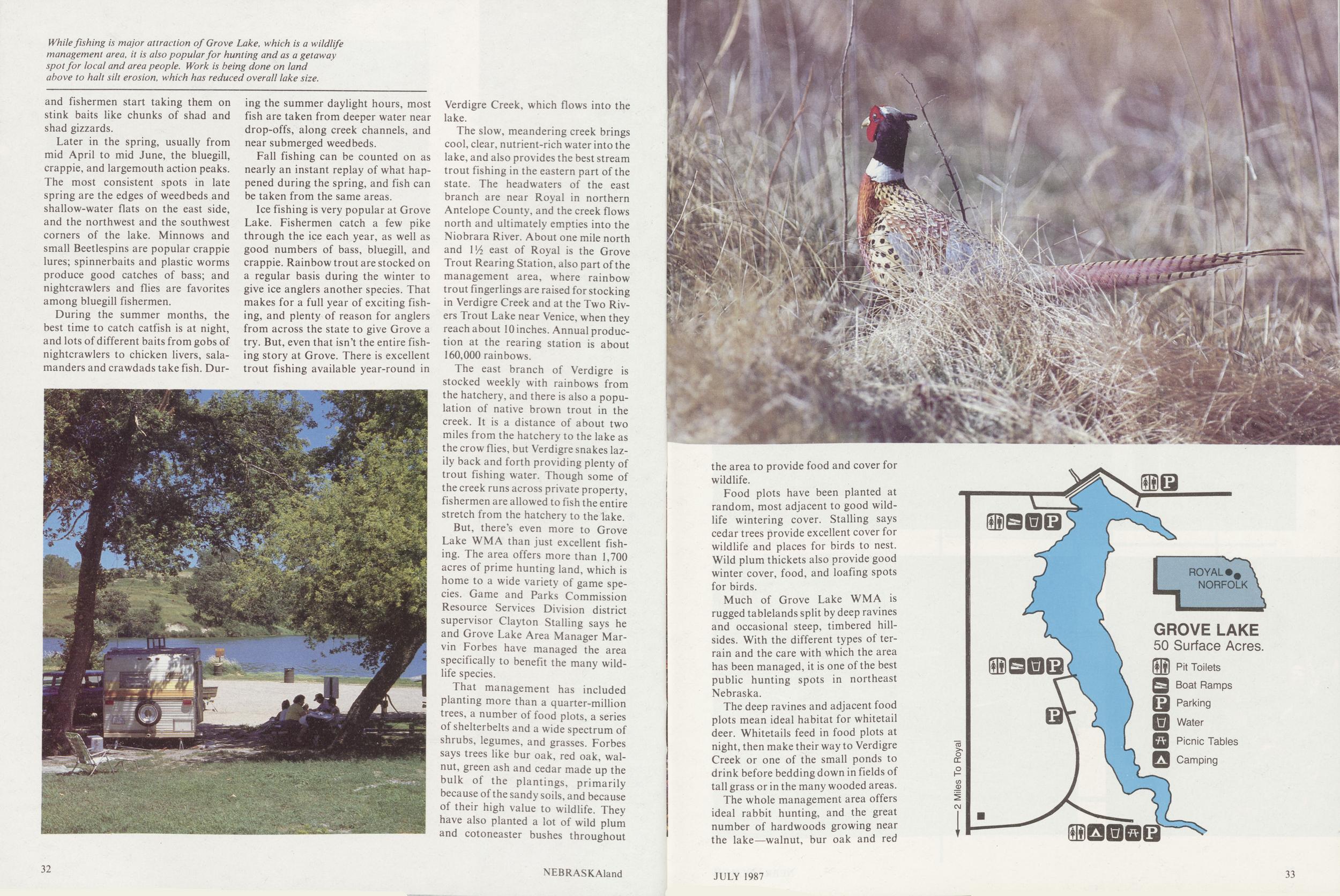 While fishing is major attraction of Grove Lake, which is a wildlife
management area, it is also popular for hunting and as a getaway
spot for local and area people. Work is being done on land
above to halt silt erosion, which has reduced overall lake size.
While fishing is major attraction of Grove Lake, which is a wildlife
management area, it is also popular for hunting and as a getaway
spot for local and area people. Work is being done on land
above to halt silt erosion, which has reduced overall lake size.
Later in the spring, usually from mid April to mid June, the bluegill, crappie, and largemouth action peaks. The most consistent spots in late spring are the edges of weed beds and shallow-water flats on the east side, and the northwest and the southwest corners of the lake. Minnows and small Beetlespins are popular crappie lures; spinnerbaits and plastic worms produce good catches of bass; and nightcrawlers and flies are favorites among bluegill fishermen.
During the summer months, the best time to catch catfish is at night, and lots of different baits from gobs of nightcrawlers to chicken livers, salamanders and crawdads take fish. During the summer daylight hours, most fish are taken from deeper water near drop-offs, along creek channels, and near submerged weed beds.
Fall fishing can be counted on as nearly an instant replay of what happened during the spring, and fish can be taken from the same areas.
Ice fishing is very popular at Grove Lake. Fishermen catch a few pike through the ice each year, as well as good numbers of bass, bluegill, and crappie. Rainbow trout are stocked on a regular basis during the winter to give ice anglers another species. That makes for a full year of exciting fishing, and plenty of reason for anglers from across the state to give Grove a try. But, even that isn't the entire fishing story at Grove. There is excellent trout fishing available year-round in Verdigre Creek, which flows into the lake.
The slow, meandering creek brings cool, clear, nutrient-rich water into the lake, and also provides the best stream trout fishing in the eastern part of the state. The headwaters of the east branch are near Royal in northern Antelope County, and the creek flows north and ultimately empties into the Niobrara River. About one mile north and Wi east of Royal is the Grove Trout Rearing Station, also part of the management area, where rainbow trout fingerlings are raised for stocking in Verdigre Creek and at the Two Rivers Trout Lake near Venice, when they reach about 10 inches. Annual production at the rearing station is about 160,000 rainbows.
The east branch of Verdigre is stocked weekly with rainbows from the hatchery, and there is also a population of native brown trout in the creek. It is a distance of about two miles from the hatchery to the lake as the crow flies, but Verdigre snakes lazily back and forth providing plenty of trout fishing water. Though some of the creek runs across private property, fishermen are allowed to fish the entire stretch from the hatchery to the lake.
But, there's even more to Grove Lake WMA than just excellent fish- ing. The area offers more than 1,700 acres of prime hunting land, which is home to a wide variety of game species. Game and Parks Commission Resource Services Division district supervisor Clayton Stalling says he and Grove Lake Area Manager Marvin Forbes have managed the area specifically to benefit the many wildlife species.
That management has included planting more than a quarter-million trees, a number of food plots, a series of shelter belts and a wide spectrum of shrubs, legumes, and grasses. Forbes says trees like bur oak, red oak, walnut, green ash and cedar made up the bulk of the plantings, primarily because of the sandy soils, and because of their high value to wildlife. They have also planted a lot of wild plum and cotoneaster bushes throughout 32 NEBRASKAland the area to provide food and cover for wildlife.
Food plots have been planted at random, most adjacent to good wildlife wintering cover. Stalling says cedar trees provide excellent cover for wildlife and places for birds to nest. Wild plum thickets also provide good winter cover, food, and loafing spots for birds.
Much of Grove Lake WMA is rugged tablelands split by deep ravines and occasional steep, timbered hillsides. With the different types of terrain and the care with which the area has been managed, it is one of the best public hunting spots in northeast Nebraska.
The deep ravines and adjacent food plots mean ideal habitat for whitetail deer. Whitetails feed in food plots at night, then make their way to Verdigre Creek or one of the small ponds to drink before bedding down in fields of tall grass or in the many wooded areas.
The whole management area offers ideal rabbit hunting, and the great number of hardwoods growing near the lake—walnut, bur oak and red oak—mean an attractive area for squirrels and excellent squirrel hunting. There are plenty of trees and more than enough food to support the area's population of fox squirrels, and the hunting is good enough to keep hunters coming back for more.
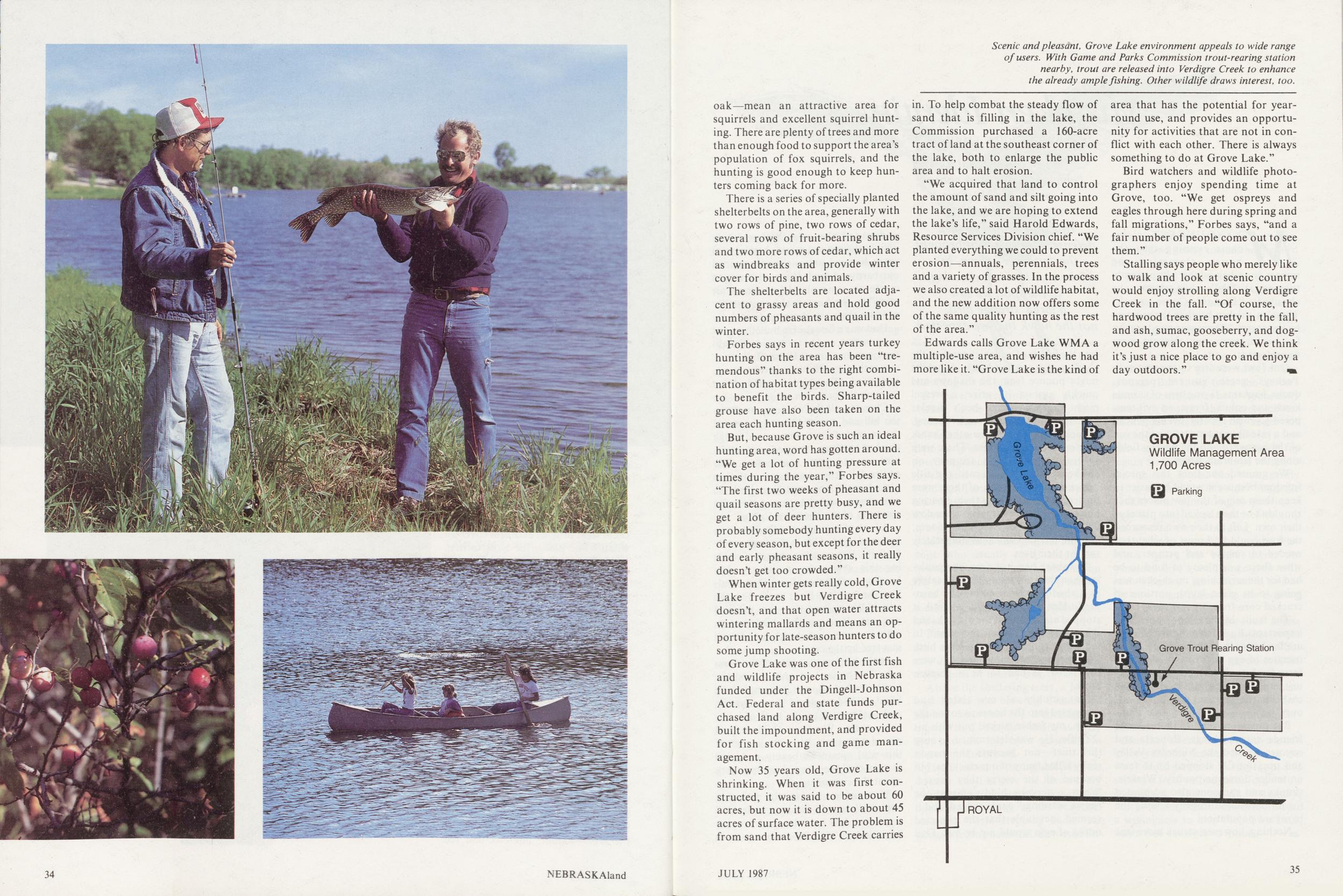
There is a series of specially planted shelter belts on the area, generally with two rows of pine, two rows of cedar, several rows of fruit-bearing shrubs and two more rows of cedar, which act as windbreaks and provide winter cover for birds and animals.
The shelter belts are located adjacent to grassy areas and hold good numbers of pheasants and quail in the winter.
Forbes says in recent years turkey hunting on the area has been "tremendous" thanks to the right combination of habitat types being available to benefit the birds. Sharp-tailed grouse have also been taken on the area each hunting season.
But, because Grove is such an ideal hunting area, word has gotten around. "We get a lot of hunting pressure at times during the year," Forbes says. "The first two weeks of pheasant and quail seasons are pretty busy, and we get a lot of deer hunters. There is probably somebody hunting every day of every season, but except for the deer and early pheasant seasons, it really doesn't get too crowded."
When winter gets really cold, Grove Lake freezes but Verdigre Creek doesn't, and that open water attracts wintering mallards and means an opportunity for late-season hunters to do some jump shooting.
Grove Lake was one of the first fish and wildlife projects in Nebraska funded under the Dingell-Johnson Act. Federal and state funds purchased land along Verdigre Creek, built the impoundment, and provided for fish stocking and game management.
Now 35 years old, Grove Lake is shrinking. When it was first constructed, it was said to be about 60 acres, but now it is down to about 45 acres of surface water. The problem is from sand that Verdigre Creek carries in. To help combat the steady flow of sand that is filling in the lake, the Commission purchased a 160-acre tract of land at the southeast corner of the lake, both to enlarge the public area and to halt erosion.
"We acquired that land to control the amount of sand and silt going into the lake, and we are hoping to extend the lake's life," said Harold Edwards, Resource Services Division chief. "We planted everything we could to prevent erosion—annuals, perennials, trees and a variety of grasses. In the process we also created a lot of wildlife habitat, and the new addition now offers some of the same quality hunting as the rest of the area."
Edwards calls Grove Lake WMA a multiple-use area, and wishes he had more like it. "Grove Lake is the kind of area that has the potential for year- round use, and provides an opportunity for activities that are not in conflict with each other. There is always something to do at Grove Lake."
Bird watchers and wildlife photographers enjoy spending time at Grove, too. "We get ospreys and eagles through here during spring and fall migrations," Forbes says, "and a fair number of people come out to see them."
Stalling says people who merely like to walk and look at scenic country would enjoy strolling along Verdigre Creek in the fall. "Of course, the hardwood trees are pretty in the fall, and ash, sumac, gooseberry, and dogwood grow along the creek. We think it's just a nice place to go and enjoy a day outdoors."
Scenic and pleasant, Grove Lake environment appeals to wide range of users. With Game and Parks Commission trout-rearing station nearby, trout are released into Verdigre Creek to enhance the already ample fishing. Other wildlife draws interest, too.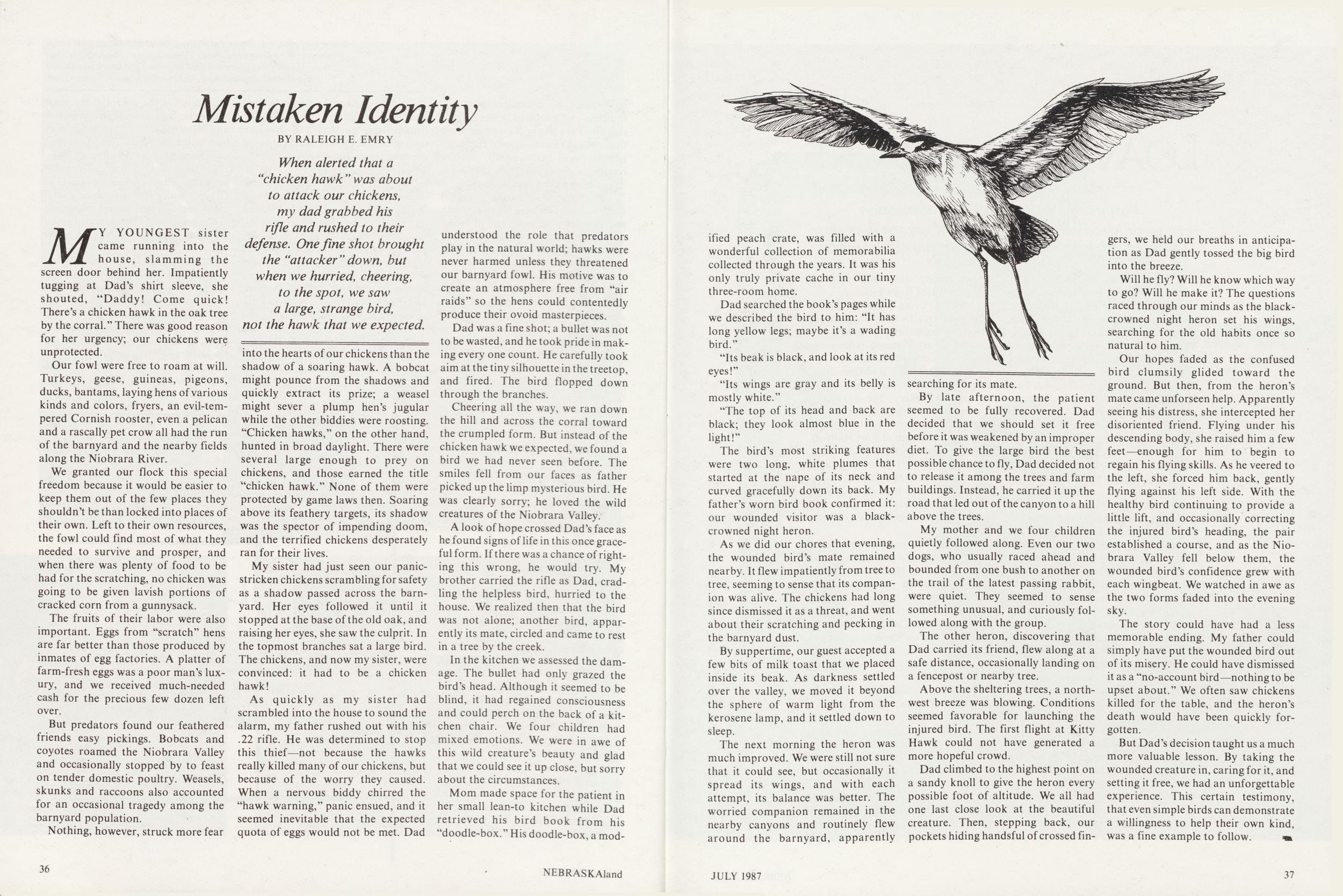
Mistaken Identity
BY RALEIGH E. EMRY When alerted tht a "chicken hawk" was about to attack out chickens, my dad grabbed his rifle and rushed to their defense. One fine shot brought the "attacker" down, but when we hurried, cheering, to the spot, we saw a large, strange bird. not the hawk that we expected.YOUNGEST sister came running into the Ji V M house, slamming the screen door behind her. Impatiently tugging at Dad's shirt sleeve, she shouted, "Daddy! Come quick! There's a chicken hawk in the oak tree by the corral." There was good reason for her urgency; our chickens were unprotected.
Our fowl were free to roam at will. Turkeys, geese, guineas, pigeons, ducks, bantams, laying hens of various kinds and colors, fryers, an evil-tempered Cornish rooster, even a pelican and a rascally pet crow all had the run of the barnyard and the nearby fields along the Niobrara River.
We granted our flock this special freedom because it would be easier to keep them out of the few places they shouldn't be than locked into places of their own. Left to their own resources, the fowl could find most of what they needed to survive and prosper, and when there was plenty of food to be had for the scratching, no chicken was going to be given lavish portions of cracked corn from a gunnysack.
The fruits of their labor were also important. Eggs from "scratch" hens are far better than those produced by inmates of egg factories. A platter of farm-fresh eggs was a poor man's luxury, and we received much-needed cash for the precious few dozen left over.
But predators found our feathered friends easy pickings. Bobcats and coyotes roamed the Niobrara Valley and occasionally stopped by to feast on tender domestic poultry. Weasels, skunks and raccoons also accounted for an occasional tragedy among the barnyard population.
Nothing, however, struck more fear into the hearts of our chickens than the shadow of a soaring hawk. A bobcat might pounce from the shadows and quickly extract its prize; a weasel might sever a plump hen's jugular while the other biddies were roosting. "Chicken hawks," on the other hand, hunted in broad daylight. There were several large enough to prey on chickens, and those earned the title "chicken hawk." None of them were protected by game laws then. Soaring above its feathery targets, its shadow was the Spector of impending doom, and the terrified chickens desperately ran for their lives.
My sister had just seen our panic stricken chickens scrambling for safety as a shadow passed across the barnyard. Her eyes followed it until it stopped at the base of the old oak, and raising her eyes, she saw the culprit. In the topmost branches sat a large bird. The chickens, and now my sister, were convinced: it had to be a chicken hawk!
As quickly as my sister had scrambled into the house to sound the alarm, my father rushed out with his .22 rifle. He was determined to stop this thief—not because the hawks really killed many of our chickens, but because of the worry they caused. When a nervous biddy chirred the "hawk warning," panic ensued, and it seemed inevitable that the expected quota of eggs would not be met. Dad understood the role that predators play in the natural world; hawks were never harmed unless they threatened our barnyard fowl. His motive was to create an atmosphere free from "air raids" so the hens could contentedly produce their ovoid masterpieces.
Dad was a fine shot; a bullet was not to be wasted, and he took pride in making every one count. He carefully took aim at the tiny silhouette in the treetop, and fired. The bird flopped down through the branches.
Cheering all the way, we ran down the hill and across the corral toward the crumpled form. But instead of the chicken hawk we expected, we found a bird we had never seen before. The smiles fell from our faces as father picked up the limp mysterious bird. He was clearly sorry; he loved the wild creatures of the Niobrara Valley.
A look of hope crossed Dad's face as he found signs of life in this once graceful form. If there was a chance of righting this wrong, he would try. My brother carried the rifle as Dad, cradling the helpless bird, hurried to the house. We realized then that the bird was not alone; another bird, apparently its mate, circled and came to rest in a tree by the creek.
In the kitchen we assessed the damage. The bullet had only grazed the bird's head. Although it seemed to be blind, it had regained consciousness and could perch on the back of a kitchen chair. We four children had mixed emotions. We were in awe of this wild creature's beauty and glad that we could see it up close, but sorry about the circumstances.
Mom made space for the patient in her small lean-to kitchen while Dad retrieved his bird book from his "doodle-box." His doodle-box, a modified 36 NEBRASKAland peach crate, was filled with a wonderful collection of memorabilia collected through the years. It was his only truly private cache in our tiny three-room home.
Dad searched the book's pages while we described the bird to him: "It has long yellow legs; maybe it's a wading bird.
"Its beak is black, and look at its red eyes!"
"Its wings are gray and its belly is mostly white."
"The top of its head and back are black; they look almost blue in the light!"
The bird's most striking features were two long, white plumes that started at the nape of its neck and curved gracefully down its back. My father's worn bird book confirmed it: our wounded visitor was a black-crowned night heron.
As we did our chores that evening, the wounded bird's mate remained nearby. It flew impatiently from tree to tree, seeming to sense that its companion was alive. The chickens had long since dismissed it as a threat, and went about their scratching and pecking in the barnyard dust.
By suppertime, our guest accepted a few bits of milk toast that we placed inside its beak. As darkness settled over the valley, we moved it beyond the sphere of warm light from the kerosene lamp, and it settled down to sleep.
The next morning the heron was much improved. We were still not sure that it could see, but occasionally it spread its wings, and with each attempt, its balance was better. The worried companion remained in the nearby canyons and routinely flew around the barnyard, apparently searching for its mate.
By late afternoon, the patient seemed to be fully recovered. Dad decided that we should set it free before it was weakened by an improper diet. To give the large bird the best possible chance to fly, Dad decided not to release it among the trees and farm buildings. Instead, he carried it up the road that led out of the canyon to a hill above the trees.
My mother and we four children quietly followed along. Even our two dogs, who usually raced ahead and bounded from one bush to another on the trail of the latest passing rabbit, were quiet. They seemed to sense something unusual, and curiously followed along with the group.
The other heron, discovering that Dad carried its friend, flew along at a safe distance, occasionally landing on a fencepost or nearby tree.
Above the sheltering trees, a northwest breeze was blowing. Conditions seemed favorable for launching the injured bird. The first flight at Kitty Hawk could not have generated a more hopeful crowd.
Dad climbed to the highest point on a sandy knoll to give the heron every possible foot of altitude. We all had one last close look at the beautiful creature. Then, stepping back, our pockets hiding hands full of crossed fingers, we held our breaths in anticipation as Dad gently tossed the big bird into the breeze.
Will he fly? Will he know which way to go? Will he make it? The questions raced through our minds as the black crowned night heron set his wings, searching for the old habits once so natural to him.
Our hopes faded as the confused bird clumsily glided toward the ground. But then, from the heron's mate came unforeseen help. Apparently seeing his distress, she intercepted her disoriented friend. Flying under his descending body, she raised him a few feet—enough for him to begin to regain his flying skills. As he veered to the left, she forced him back, gently flying against his left side. With the healthy bird continuing to provide a little lift, and occasionally correcting the injured bird's heading, the pair established a course, and as the Niobrara Valley fell below them, the wounded bird's confidence grew with each wingbeat. We watched in awe as the two forms faded into the evening sky.
The story could have had a less memorable ending. My father could simply have put the wounded bird out of its misery. He could have dismissed it as a "no-account bird—nothing to be upset about." We often saw chickens killed for the table, and the heron's death would have been quickly forgotten.
But Dad's decision taught us a much more valuable lesson. By taking the wounded creature in, caring for it, and setting it free, we had an unforgettable experience. This certain testimony, that even simple birds can demonstrate a willingness to help their own kind, was a fine example to follow.
JULY 1987 37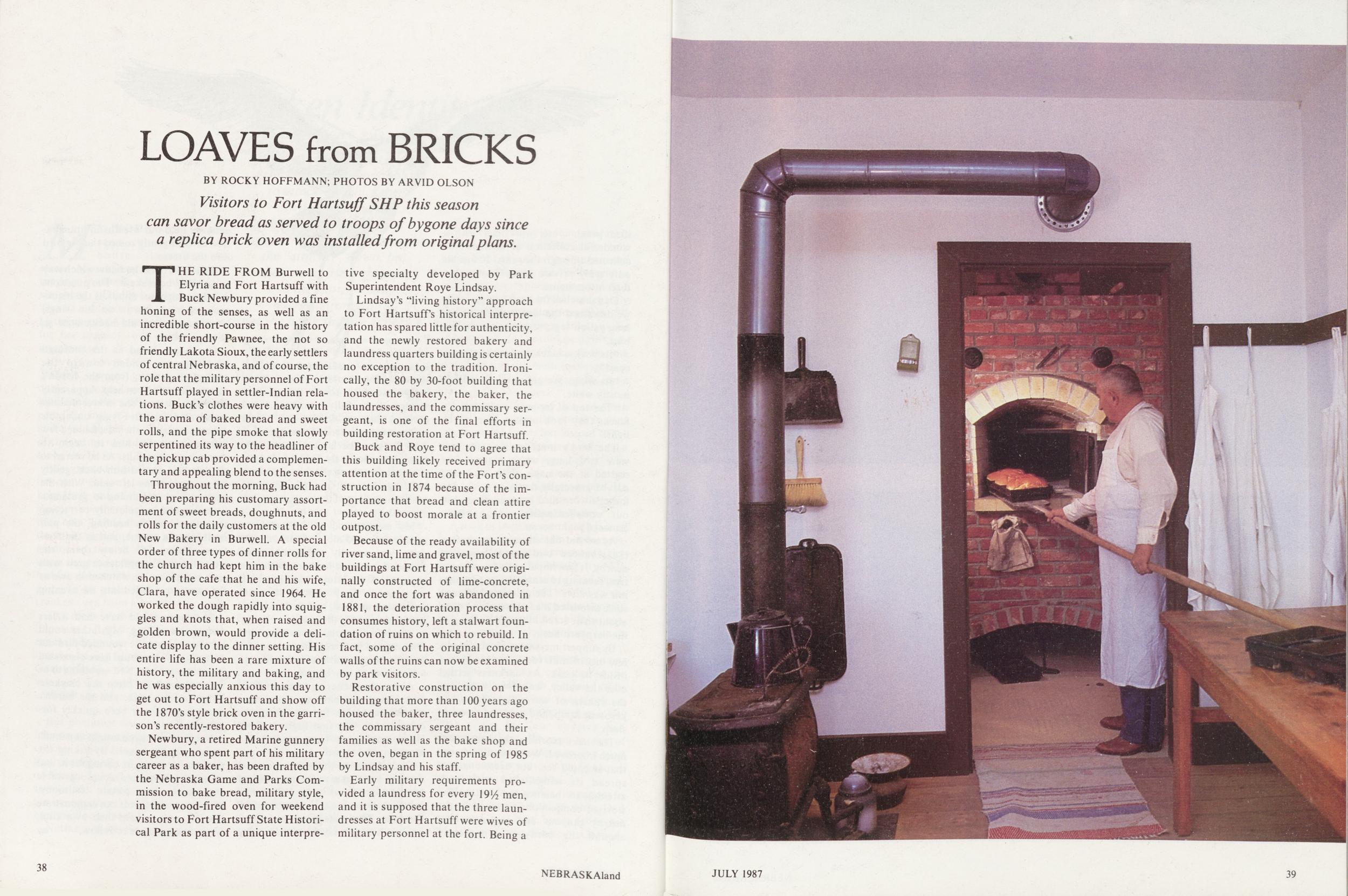
LOAVES from BRICKS
BY ROCKY HOFFMANN; PHOTOS BY ARVID OLSON Visitors to Fort Hartsuff SHP this season can savor bread as served to troops of bygone days since a replica brick oven was installed from original plans.THE RIDE FROM Burwell to Elyria and Fort Hartsuff with Buck Newbury provided a fine honing of the senses, as well as an incredible short-course in the history of the friendly Pawnee, the not so friendly Lakota Sioux, the early settlers of central Nebraska, and of course, the role that the military personnel of Fort Hartsuff played in settler-Indian relations. Buck's clothes were heavy with the aroma of baked bread and sweet rolls, and the pipe smoke that slowly serpentined its way to the headliner of the pickup cab provided a complementary and appealing blend to the senses.
Throughout the morning, Buck had been preparing his customary assortment of sweet breads, doughnuts, and rolls for the daily customers at the old New Bakery in Burwell. A special order of three types of dinner rolls for the church had kept him in the bake shop of the cafe that he and his wife, Clara, have operated since 1964. He worked the dough rapidly into squiggles and knots that, when raised and golden brown, would provide a deli- cate display to the dinner setting. His entire life has been a rare mixture of history, the military and baking, and he was especially anxious this day to get out to Fort Hartsuff and show off the 1870's style brick oven in the garrison's recently-restored bakery.
Newbury, a retired Marine gunnery sergeant who spent part of his military career as a baker, has been drafted by the Nebraska Game and Parks Commission to bake bread, military style, in the wood-fired oven for weekend visitors to Fort Hartsuff State Historical Park as part of a unique interpretive specialty developed by Park Superintendent Roye Lindsay.
Lindsay's "living history" approach to Fort Hartsuff's historical interpretation has spared little for authenticity, and the newly restored bakery and laundress quarters building is certainly no exception to the tradition. Ironically, the 80 by 30-foot building that housed the bakery, the baker, the laundresses, and the commissary sergeant, is one of the final efforts in building restoration at Fort Hartsuff.
Buck and Roye tend to agree that this building likely received primary attention at the time of the Fort's construction in 1874 because of the importance that bread and clean attire played to boost morale at a frontier outpost.
Because of the ready availability of river sand, lime and gravel, most of the buildings at Fort Hartsuff were o riginally constructed of lime-concrete, and once the fort was abandoned in 1881, the deterioration process that consumes history, left a stalwart foundation of ruins on which to rebuild. In fact, some of the original concrete walls of the ruins can now be examined by park visitors.
Restorative construction on the building that more than 100 years ago housed the baker, three laundresses, the commissary sergeant and their families as well as the bake shop and the oven, began in the spring of 1985 by Lindsay and his staff.
Early military requirements provided a laundress for every men, and it is supposed that the three laundresses at Fort Hartsuff were wives of military personnel at the fort. Being a 38 NEBRASKAland
Laundry was not necessarily done inside, but in large iron kettles outside the building opposite the parade ground, and the work was strenuous. Clotheslines and outhouses are currently being planned to complete that phase of restoration.
Quarters for the commissary sergeant are toward the north end of the building, close to the quartermaster storehouse. The commissary sergeant was responsible for purchasing hay and grain, and he was fairly influential among the enlisted men. For his services, he received as much as 22 dollars per month and two rooms, each measuring about 15 feet square.
Although the commissary sergeant may have been more influential, and the laundresses better paid, the baker may have been the most popular.
Bread, the staff of life, and soup, appeared to be the basic sustenance at Fort Hartsuff. The government allowed each soldier 16 to 18 ounces of bread daily, which figured to be about one good-sized loaf.
Located on the south end of the building, the bakery consisted of the bakehouse and the baker's quarters. The 1880 census shows that the post baker was William Smith. Smith, 38, shared the quarters with his 24-year-old wife and two children. He was designated Post Artificer, which identified him as a specialist in his field. The term artificer is rather vague, and could denote a specialty in a wide range of areas.
The importance of good bakers to a military post was evident by the fact that they were often recruited from civilian life, and bakers received an extra 20 cents per day pay, making them worth about $15 to $20 a month to the Army.
In fact, baking was not only important to the enlisted men, but to the post as a whole. Daily surpluses of standard Army bread were sold to officers and their families as well as to area settlers. Proceeds from such sales were used for the purchase of special items that weren't normally provided by the military. Such basics as newspapers and other reading materials, as well as such things as china monogrammed "Company C, 9th Infantry," were made possible through the sale of extra bread.
The heart of the bakery was the oven, and according to Lindsay, construction of the 1870-era, wood-fired brick oven was technically the most difficult restoration project at the fort. Lindsay's research included the inspection of a restored oven at Fort Laramie in Wyoming, and the acquisition of a four-part technical manuscript from the U.S. Army History Institute at Carlisle Barracks, Pennsylvania. The manuscript, entitled "Notes on Bread Making, Permanent and Field Ovens, and Bake Houses," was prepared by 40 NEBRASKAland Major George Bell by direction of the Commissary-General of Subsistence, and printed by the Government Printing Office in 1882.
According to Lindsay, because of the constant heat in military ovens 24 hours a day, they had a relatively short life expectancy of less than 15 years, and therefore there is probably not a single original 1870's fort oven in existence. Compounding the problem of finding an authentic oven for a model, was the fact that when forts were abandoned, area settlers utilized the oven bricks for building materials. Fort Hartsuff's oven disappeared sometime between 1900 and 1910.
Regardless of the adversities, Lindsay believes that the bakery at Fort Hartsuff now houses an extremely accurate representation of the oven used there in the 1870's. Old fort blueprints show exactly the same interior and exterior dimensions, comprised of about 6,000 bricks and several tons of sand surrounding the oven chamber.
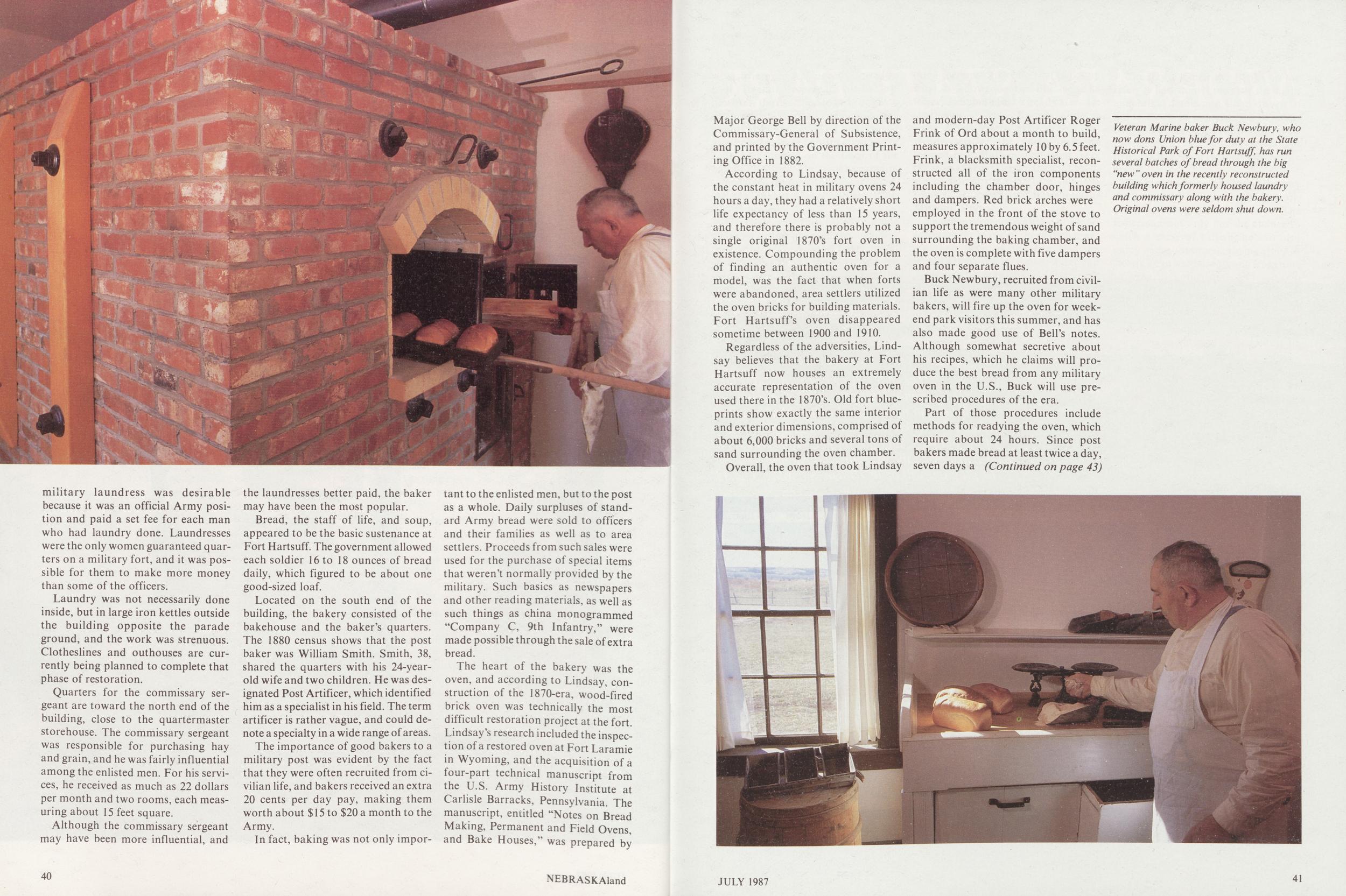
Overall, the oven that took Lindsay and modern-day Post Artificer Roger Frink of Ord about a month to build, measures approximately 10 by 6.5 feet. Frink, a blacksmith specialist, r econstructed all of the iron components including the chamber door, hinges and dampers. Red brick arches were employed in the front of the stove to support the tremendous weight of sand surrounding the baking chamber, and the oven is complete with five dampers and four separate flues.
Buck Newbury, recruited from civilian life as were many other military bakers, will fire up the oven for weekend park visitors this summer, and has also made good use of Bell's notes. Although somewhat secretive about his recipes, which he claims will produce the best bread from any military oven in the U.S., Buck will use prescribed procedures of the era.
Part of those procedures include methods for readying the oven, which require about 24 hours. Since post bakers made bread at least twice a day, seven days a (Continued on page 43)
Veteran Marine baker Buck Newbury, who now dons Union blue for duty at the State Historical Park of Fort Hartsuff has run several batches of bread through the big "new " oven in the recently reconstructed building which formerly housed laundry and commissary along with the bakery. Original ovens were seldom shut down.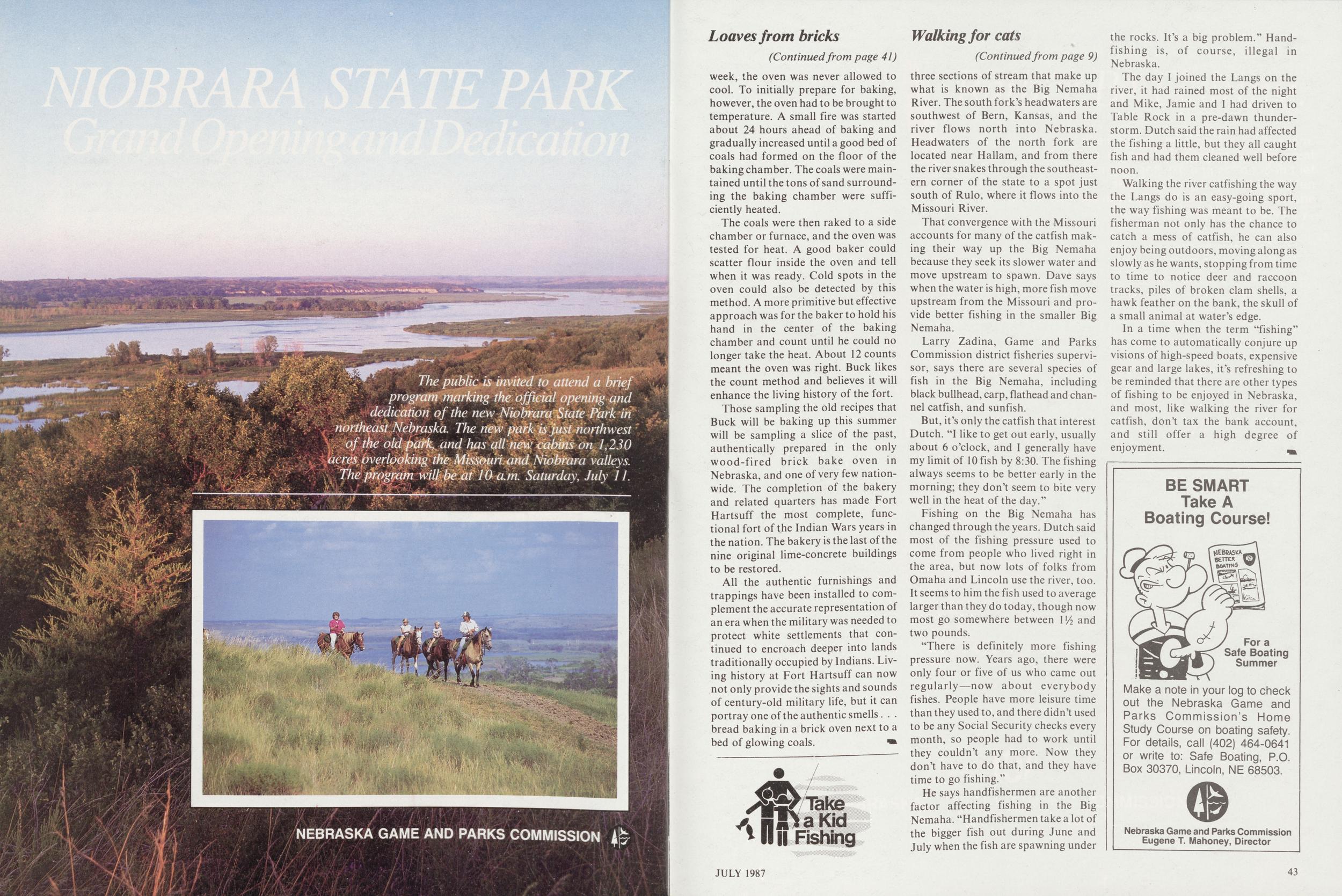
NIOBRARA STATE PARK Grand Opening and Dedication
The public is invited to attend a brief program marking the official opening and dedication of the new Niobrara State Park in northeast Nebraska. The item park is just of the old pack and has all new cabins on 1,230 teres overlooking the Missouri and Niobrara valleys. The program will be at 10 am. Saturday, July 11.Loaves from bricks
(Continued from page 41)week, the oven was never allowed to cool. To initially prepare for baking, however, the oven had to be brought to temperature. A small fire was started about 24 hours ahead of baking and gradually increased until a good bed of coals had formed on the floor of the baking chamber. The coals were maintained until the tons of sand surrounding the baking chamber were sufficiently heated.
The coals were then raked to a side chamber or furnace, and the oven was tested for heat. A good baker could scatter flour inside the oven and tell when it was ready. Cold spots in the oven could also be detected by this method. A more primitive but effective approach was for the baker to hold his hand in the center of the baking chamber and count until he could no longer take the heat. About 12 counts meant the oven was right. Buck likes the count method and believes it will enhance the living history of the fort.
Those sampling the old recipes that Buck will be baking up this summer will be sampling a slice of the past, authentically prepared in the only wood-fired brick bake oven in Nebraska, and one of very few nationwide. The completion of the bakery and related quarters has made Fort Hartsuff the most complete, functional fort of the Indian Wars years in the nation. The bakery is the last of the nine original lime-concrete buildings to be restored.
All the authentic furnishings and trappings have been installed to complement the accurate representation of an era when the military was needed to protect white settlements that continued to encroach deeper into lands traditionally occupied by Indians. Living history at Fort Hartsuff can now not only provide the sights and sounds of century-old military life, but it can portray one of the authentic smells. . . bread baking in a brick oven next to a bed of glowing coals.
Walking for cats
(Continued from page 9)three sections of stream that make up what is known as the Big Nemaha River. The south fork's headwaters are southwest of Bern, Kansas, and the river flows north into Nebraska. Headwaters of the north fork are located near Hallam, and from there the river snakes through the southeastern corner of the state to a spot just south of Rulo, where it flows into the Missouri River.
That convergence with the Missouri accounts for many of the catfish making their way up the Big Nemaha because they seek its slower water and move upstream to spawn. Dave says when the water is high, more fish move upstream from the Missouri and provide better fishing in the smaller Big Nemaha.
Larry Zadina, Game and Parks Commission district fisheries supervisor, says there are several species of fish in the Big Nemaha, including black bullhead, carp, flathead and channel catfish, and sunfish.
But, it's only the catfish that interest Dutch. "I like to get out early, usually about 6 o'clock, and I generally have my limit of 10 fish by 8:30. The fishing always seems to be better early in the morning; they don't seem to bite very well in the heat of the day."
Fishing on the Big Nemaha has changed through the years. Dutch said most of the fishing pressure used to come from people who lived right in the area, but now lots of folks from Omaha and Lincoln use the river, too. It seems to him the fish used to average larger than they do today, though now most go somewhere between two pounds.
"There is definitely more fishing pressure now. Years ago, there were only four or five of us who came out regularly—now about everybody fishes. People have more leisure time than they used to, and there didn't used to be any Social Security checks every month, so people had to work until they couldn't any more. Now they don't have to do that, and they have time to go fishing."
He says hand fishermen are another factor affecting fishing in the Big Nemaha. "Hand fishermen take a lot of the bigger fish out during June and July when the fish are spawning under the rocks. It's a big problem." Hand fishing is, of course, illegal in Nebraska.
The day I joined the Langs on the river, it had rained most of the night and Mike, Jamie and I had driven to Table Rock in a pre-dawn thunderstorm. Dutch said the rain had affected the fishing a little, but they all caught fish and had them cleaned well before noon.
Walking the river catfishing the way the Langs do is an easy-going sport, the way fishing was meant to be. The fisherman not only has the chance to catch a mess of catfish, he can also enjoy being outdoors, moving along as slowly as he wants, stopping from time to time to notice deer and raccoon tracks, piles of broken clam shells, a hawk feather on the bank, the skull of a small animal at water's edge.
In a time when the term "fishing" has come to automatically conjure up visions of high-speed boats, expensive gear and large lakes, it's refreshing to be reminded that there are other types of fishing to be enjoyed in Nebraska, and most, like walking the river for catfish, don't tax the bank account, and still offer a high degree of enjoyment.
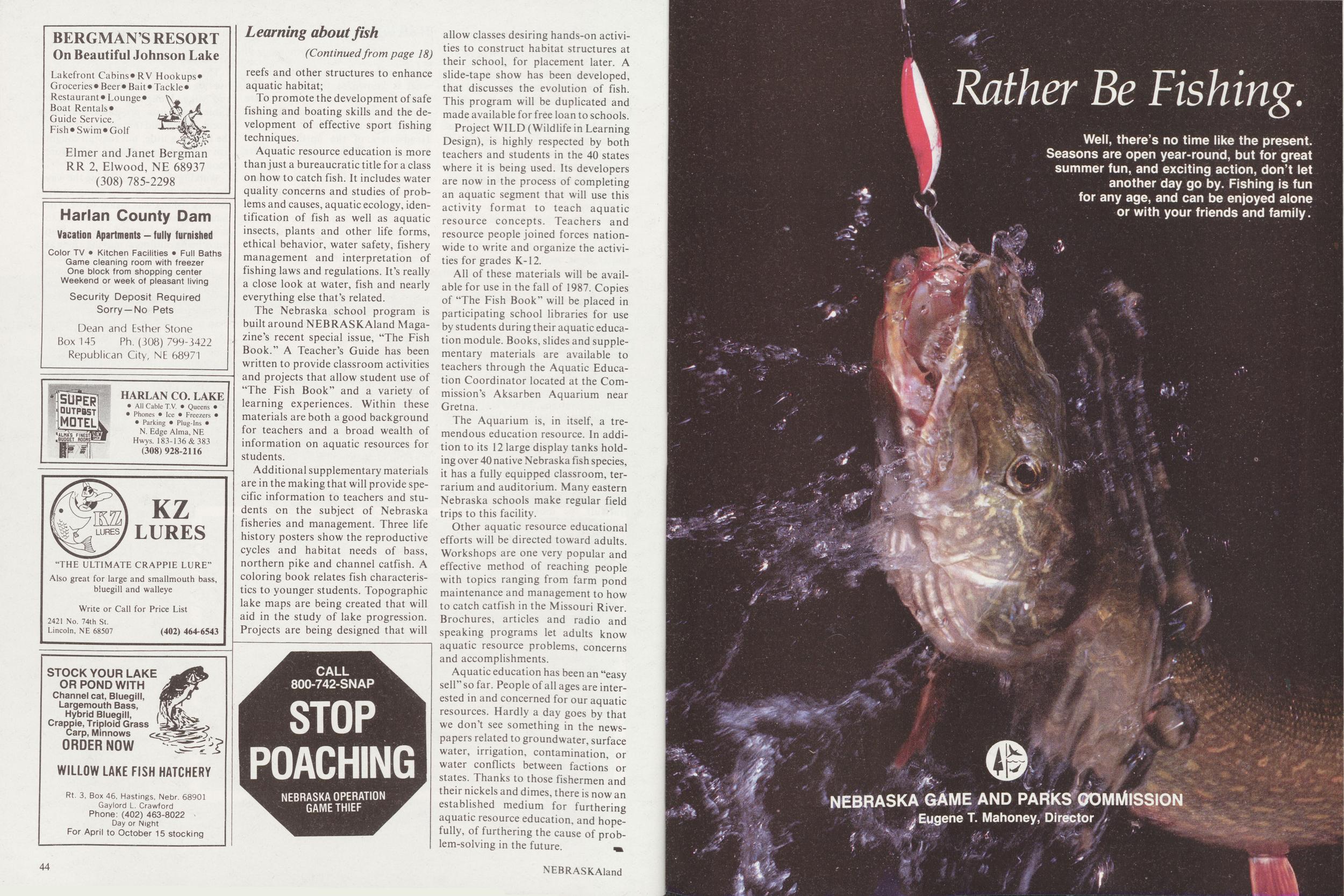 BERGMANS RESORT
On Beautiful Johnson Lake
Lakefront Cabins* RV Hookups*
Groceries* Beer* Bait* Tackle*
Restaurant* Lounge*
Boat Rentals*
Guide Service.
Fish* Swim* Golf
Elmer and Janet Bergman
RR 2, Elwood, NE 68937
(308) 785-2298
Harlan County Dam
Vacation Apartments - fully furnished
Color TV • Kitchen Facilities • Full Baths
Game cleaning room with freezer
One block from shopping center
Weekend or week of pleasant living
Security Deposit Required
Sorry —No Pets
Dean and Esther Stone
Box 145 Ph. (308) 799-3422
Republican City, NE 68971
SUPER
QUTP&ST
MDTEL
'ALMA'S FINES
.BUDGET ROOMS
31
HARLAN CO. LAKE
• All Cable T.V. • Queens •
• Phones • Ice • Freezers •
• Parking • Plug-Ins •
N. Edge Alma, NE
Hwys. 183-136 & 383
(308)928-2116
KZ
LURES
THE ULTIMATE CRAPPIE LURE"
Also great for large and smallmouth bass,
bluegill and walleye
Write or Call for Price List
2421 No. 74th St.
Lincoln, NE 68507
(402) 464-6543
STOCK YOUR LAKE
OR POND WITH
Channel cat, Bluegill,
Largemouth Bass,
Hybrid Bluegill,
Crappie, Triploid Grass
Carp, Minnows
ORDER NOW
WILLOW LAKE FISH HATCHERY
Rt. 3, Box 46, Hastings, Nebr. 68901
Gaylord L. Crawford
Phone: (402) 463-8022 .
Day or Night
For April to October 15 stocking
CALL
800-742-SNAP
STOP
POACHING
NEBRASKA OPERATION
GAME THIEF
BERGMANS RESORT
On Beautiful Johnson Lake
Lakefront Cabins* RV Hookups*
Groceries* Beer* Bait* Tackle*
Restaurant* Lounge*
Boat Rentals*
Guide Service.
Fish* Swim* Golf
Elmer and Janet Bergman
RR 2, Elwood, NE 68937
(308) 785-2298
Harlan County Dam
Vacation Apartments - fully furnished
Color TV • Kitchen Facilities • Full Baths
Game cleaning room with freezer
One block from shopping center
Weekend or week of pleasant living
Security Deposit Required
Sorry —No Pets
Dean and Esther Stone
Box 145 Ph. (308) 799-3422
Republican City, NE 68971
SUPER
QUTP&ST
MDTEL
'ALMA'S FINES
.BUDGET ROOMS
31
HARLAN CO. LAKE
• All Cable T.V. • Queens •
• Phones • Ice • Freezers •
• Parking • Plug-Ins •
N. Edge Alma, NE
Hwys. 183-136 & 383
(308)928-2116
KZ
LURES
THE ULTIMATE CRAPPIE LURE"
Also great for large and smallmouth bass,
bluegill and walleye
Write or Call for Price List
2421 No. 74th St.
Lincoln, NE 68507
(402) 464-6543
STOCK YOUR LAKE
OR POND WITH
Channel cat, Bluegill,
Largemouth Bass,
Hybrid Bluegill,
Crappie, Triploid Grass
Carp, Minnows
ORDER NOW
WILLOW LAKE FISH HATCHERY
Rt. 3, Box 46, Hastings, Nebr. 68901
Gaylord L. Crawford
Phone: (402) 463-8022 .
Day or Night
For April to October 15 stocking
CALL
800-742-SNAP
STOP
POACHING
NEBRASKA OPERATION
GAME THIEF
L earning about fish
(Continued from page 18)reefs and other structures to enhance aquatic habitat;
To promote the development of safe fishing and boating skills and the development of effective sport fishing techniques.
Aquatic resource education is more than just a bureaucratic title for a class on how to catch fish. It includes water quality concerns and studies of problems and causes, aquatic ecology, identification of fish as well as aquatic insects, plants and other life forms, ethical behavior, water safety, fishery management and interpretation of fishing laws and regulations. It's really a close look at water, fish and nearly everything else that's related.
The Nebraska school program is built around NEBRASKAland Magazine's recent special issue, "The Fish Book." A Teacher's Guide has been written to provide classroom activities and projects that allow student use of "The Fish Book" and a variety of learning experiences. Within these materials are both a good background for teachers and a broad wealth of information on aquatic resources for students.
Additional supplementary materials are in the making that will provide specific information to teachers and students on the subject of Nebraska fisheries and management. Three life history posters show the reproductive cycles and habitat needs of bass, northern pike and channel catfish. A coloring book relates fish characteristics to younger students. Topographic lake maps are being created that will Additional supplementary materials are in the making that will provide specific information to teachers and students on the subject of Nebraska fisheries and management. Three life history posters show the reproductive cycles and habitat needs of bass, northern pike and channel catfish. A coloring book relates fish characteristics to younger students. Topographic lake maps are being created that will aid in the study of lake progression. Projects are being designed that will allow classes desiring hands-on activities to construct habitat structures at their school, for placement later. A slide-tape show has been developed, that discusses the evolution of fish. This program will be duplicated and made available for free loan to schools.
Project WILD (Wildlife in Learning Design), is highly respected by both teachers and students in the 40 states where it is being used. Its developers are now in the process of completing an aquatic segment that will use this activity format to teach aquatic resource concepts. Teachers and resource people joined forces nation-wide to write and organize the activities for grades K-12.
All of these materials will be available for use in the fall of 1987. Copies of "The Fish Book" will be placed in participating school libraries for use by students during their aquatic education module. Books, slides and supplementary materials are available to teachers through the Aquatic Education Coordinator located at the Commission's Aksarben Aquarium near Gretna.
The Aquarium is, in itself, a tremendous education resource. In addition to its 12 large display tanks holding over 40 native Nebraska fish species, it has a fully equipped classroom, terrarium and auditorium. Many eastern Nebraska schools make regular field trips to this facility.
Other aquatic resource educational efforts will be directed toward adults. Workshops are one very popular and effective method of reaching people with topics ranging from farm pond maintenance and management to how to catch catfish in the Missouri River. Brochures, articles and radio and speaking programs let adults know aquatic resource problems, concerns and accomplishments.
Aquatic education has been an "easy sell" so far. People of all ages are interested in and concerned for our aquatic resources. Hardly a day goes by that we don't see something in the newspapers related to groundwater, surface water, irrigation, contamination, or water conflicts between factions or states. Thanks to those fishermen and their nickels and dimes, there is now an established medium for furthering aquatic resource education, and hopefully, of furthering the cause of problem-solving in the future.
44 NEBRASKAlandRather Be Fishing.
Well, there's no time like the present. Seasons are open year-round, but for great summer fun, and exciting action, don't let another day go by. Fishing is fun for any age, and can be enjoyed alone or with your friends and family. NEBRASKA GAME AND PARKS Eugene T. Mahoney, Director Order a
NEBRASKAland
FISH BOOK
for a Friend
NEBRASKAland's new, popular
Fish Book can be sent to a friend
for only $8.50 (plus tax) or will be
sent as part of a year's
subscription for only $12.
Order now-well deliver.
NEBRASKAland Magazine
P.O. Box 30370
Lincoln, NE 68503
Score
One For
Our Team.
Cleaning up the
environment is easy when we work
together! So, Team Up and
take the Woodsy Pledge: We
Give a Hoot, so
We Won't Pollute!
Forest Service-USDA
Order a
NEBRASKAland
FISH BOOK
for a Friend
NEBRASKAland's new, popular
Fish Book can be sent to a friend
for only $8.50 (plus tax) or will be
sent as part of a year's
subscription for only $12.
Order now-well deliver.
NEBRASKAland Magazine
P.O. Box 30370
Lincoln, NE 68503
Score
One For
Our Team.
Cleaning up the
environment is easy when we work
together! So, Team Up and
take the Woodsy Pledge: We
Give a Hoot, so
We Won't Pollute!
Forest Service-USDA
Just an old fashioned Fourth of July
(Continued from page 17)know that oak log back of the barn? What size you say it is?"
Three feet long, one thick."
'All right, that's jest fine. Now you know that piece of pipe by the windmill—how long you say it is?"
"Two feet."
Ray now got the idea in a jiffy.
We went to work at once . . . [on] our contraption. . . . We [placed] powder in a paper bag, laid it in the pocket [cut in the split log], threaded the fuse through the pipe and into the explosive. Finally, we placed the two halves of the log together and bound them tightly with spikes, cleats, and wire.
It was a rather long day for us two that Fourth of July—for we burned in anticipation. . . . All our neighbors were sitting on the front porch or on chairs around the picnic table. Ray and I slipped through the gathering darkness and slyly made our way to the lilacs by a circuitous route. When everything was in readiness, I lit the fuse. When we saw it was burning, we ran for our lives.
Our device took longer to explode than we had figured. But finally it did.
B-O-O-O-M!
Without any doubt—and I think all our neighbors who were present agreed—it was the biggest explosion ever heard in our parts. Not only was there an ear-splitting blast, but nails, splinters and chunks of wood sailed high into the air, landing helter-skelter. Mr. Kinney, the Civil War veteran, said that it was the damnedest noise he'd heard since the siege at Vicksburg.
Frank O'Connell, Lancaster County ca. 1906-1908.Our first picnic was held on a Fourth of July up on Capitol Hill to celebrate the locating of Omaha as a City. The eatables and supplies were brought over from Kanesville, now Council Bluffs, in wagons. The Hon. Hadley Jones, of that town, was called upon for a speech and in the absence of a grandstand started to deliver his oration from one of the wagons. Two blacksmith's anvils fired in salute. He had not progressed very far when the Indians at a distance heard the noise and came in great numbers. The women and children were terribly frightened, so eatables, anvils and all were thrown back into the wagons and all started with a rush for the homes and the ferry boat to go back to Kanesville. The speech was never completed.
Mrs. Mary Carmack.There was to be a Fourth of July celebration at Duff, this year, and we thought that we might be able to join with the countryside around in a genuine old-fashioned Fourth in regular sandhill style. . . .
I laid out Adeline's [the daughter of the narrator] clothes for her, a new gingham dress made blouse style, a white underskirt with ruffles and a pair of white panties with tucks at the bottom edge with embroidery and starched to stand alone. Little girls wore panties then down to the knees, and they were buttoned fore and aft and along the sides to a strong waist well built-up over the shoulders. For her every-day garments, I made them of flour sacks or of checkered gingham. She wanted to dress herself, so I finished my own and went on with my work.
We arrived at Duff store and post office about noon. There were only two or three cottonwoods to furnish shade for the entire crowd. I expected to see 40 or 50 persons, perhaps, but there were literally hundreds of them.
There were gallons of ice cream brought down that morning from Long Pine by freight wagon. Strangest of all, the merchant was serving strawberries—red, ripe, luscious berries of medium size grown on his own place. They were fifteen cents for a small dish with plenty of cream and sugar thrown in. The merchant was capitalizing his berries at about two cents a piece.
After the heat of the day was leaving and the shadows of the hills began to lengthen and cool the hay meadow nearby, the crowd moved out to watch the cowboys put on their show.
It was nearing the close of the day. . . . Children were becoming tired and restless. Some had gone to sleep in their mother's arms; others were rubbing their eyes with their dirty sticky fingers and crying. Adeline was hopping, skipping, and turning cartwheels. Her next antic was to stand on her head and walk on her hands, an innocent prank in itself, but horrors!, she hadn't changed into the embroidery ruffle panties I had laid out for her in the morning. She had put back on her old ones made from a flour sack with bright red letters on it. I had never been able to wash out those letters. There she stood on her head, her legs dangling in the air with the glaring red letters "TIP TOP" stretched across the seat. I had without thinking cut the cloth upside down and now the letters were in the right position to show up in bold relief.
46 NEBRASKAland AUTFITTING YOU FOR THE GOOD Nebraska's largest selection of quality name brand sporting goods. Count on us to provide you with the finest outdoor clothing and equipment at special low prices. See Burden's Outdoor Outfitters when you're in Lincoln. Get the best of the outdoors. Camping • Hunting • Fishing • Boating • Backpacking X-Country Skiing • Water Sports • Boots, Shoes, Waders Mens, Women’s, Children’s Functional Outdoor Clothing and Gear 1000 West "0" Street Lincoln, NE 68528 474-4366 From the Pre-season thru Oklahoma to Bowl Game Coverage, Give the Gift that delivers the Action! HUSKER HOT NEWS PAK NEBRASKA... THE BEEF STATE. 17 Sunday issues, 12 Extra Point issues, The Skywriters reports, preseason Football Annual, and full bow game coverage for only $15.95! Covers mailing costs anywhere in the USA or to servicemen/women anywhere in the world! Complete order form and mail with check or money order to: HUSKER HOT NEWS PAK Circulation Dept. Journal-Star Printing Co. Box 81609 Journal-Star Lincoln'NE W501 [Tinting ca The Journal-Star's Husker Hot News Park is bigger and better than ever before. Beginning August 18th with daily Skywriters reports, a pre-season school-by-school Big 8 round-up, the Journal-Star will carry you through bowl time. Your action packed football package will also include our Annual Football Section on August 30th, 12 issues of Extra Point — the latest pre-game reports and Sunday post-game coverage. We'll wrap up your season with a full week of football news at bowl time. Your football package will feature analysis, commentary, and action photos, a continuing rundown of prep and pro sports, as well as all the capital, regional and Nebraska news. PLUS ... all purchasers will receive our 1987 commemorative, colorful HOT NEWS PAK illustration by award-winning Lincoln Journal cartoonist, Paul Fell. Our biggest package ever! Please send Husker HOT NEWS PAK gift subscription and card to those! listed below for which I enclosed $_________________________________ Your Name______________________________________________________ Your Address Phone City State Name Street Send Husker HOT NEWS PAK to: City (or APO#) State JULY 1987 47 f>> MARSHWATCHER
DUCKS UNLIMITED-LEADER IN WETLANDS CONSERVATION-50 YEARS
Going... going...
almost gone!
The pied-bill grebe or hell diver is found
in small ponds, sloughs and marshes
across North America, according to
Ducks Unlimited. This bird has the
unique ability to either disappear
quickly underwater or slowly submerge
until only its bill pokes above the
surface. Naturalists speculate that a
grebe performs this feat by compressing
its feathers to force out the air that
normally provides buoyancy. Widely lobed
toes and feet located towards the
back of the body enable a grebe to
maintain various body positions
underwater.
CAN'T BEAR YOUR JOB ANYMORE?
COME STAY WITH US AWHILE.
Mill Wi
on Lake McConaughy
Air-conditioned units, cooking facilities.
Up to four adults. Campground on the
beach—50 hookups, showers,
playground, shade.
• MARINA
• CAMPGROUND
•GUIDE SERVICE
• LAUNCHING STORE Groceries,
Beer, Pop, Tackle, Live Bait
• BOAT & PONTOON RENTALS
South Shore Big Mac
at Gate 18
R.R. #1 Box L-9
Brule, NE 69127
Ogallala, NE
(308) 284-4965
f>> MARSHWATCHER
DUCKS UNLIMITED-LEADER IN WETLANDS CONSERVATION-50 YEARS
Going... going...
almost gone!
The pied-bill grebe or hell diver is found
in small ponds, sloughs and marshes
across North America, according to
Ducks Unlimited. This bird has the
unique ability to either disappear
quickly underwater or slowly submerge
until only its bill pokes above the
surface. Naturalists speculate that a
grebe performs this feat by compressing
its feathers to force out the air that
normally provides buoyancy. Widely lobed
toes and feet located towards the
back of the body enable a grebe to
maintain various body positions
underwater.
CAN'T BEAR YOUR JOB ANYMORE?
COME STAY WITH US AWHILE.
Mill Wi
on Lake McConaughy
Air-conditioned units, cooking facilities.
Up to four adults. Campground on the
beach—50 hookups, showers,
playground, shade.
• MARINA
• CAMPGROUND
•GUIDE SERVICE
• LAUNCHING STORE Groceries,
Beer, Pop, Tackle, Live Bait
• BOAT & PONTOON RENTALS
South Shore Big Mac
at Gate 18
R.R. #1 Box L-9
Brule, NE 69127
Ogallala, NE
(308) 284-4965
Never again did I attend a celebration at Duff. Our Fourths after that were spent quietly along the river.
Mary Gerrard Goodwill, Rock County 1910.July 4th, up early turned work team out to grass, milked the 2 cows, and after breakfast saddled up and about 8 AM took off for the big celebration at Ansley.
Lots of folks already on their way to this "Big Time" Show, Indians raiding the town and the Brave Galloping Cow Hands holding them off to the last shell. . . .
Great Excitement at Ansley, Indians and Cow hands, putting on War Paint, Feathers and so on and putting on Trial Runs of their coming battle, loaned Jim Thorne my Colts [sic] 38, he was one of the "Big Shots" in the Battle, told me he could make a lot more noise with two pistols, and would load me up with a lot of blank shells when the war was over.
There were around 100 on horse- back, some had Winchesters, some pistols, but they really put it on-and nobody spared the Ammunition that day. I got a pocket full of. 38 blanks for the loan of my gun, about dark I saddled up and called it a day and hit that dusty road for our old sod house and home.
I was a rather tired 17-year-old boy and slept till noon, any way it was a great Celebration for that day and age, and I remember it well.
Jim Bullard, Custer County 1896.In this Bicentennial year of our Constitution the celebration of the Fourth of July will be special, for we celebrate not only the document, but the people that it serves. These people, Nebraskans, and those to come. A worthy cause for celebration, indeed!
48 NEBRASKAlandTrading POst
DOGSTRAINING ALL BREEDS Hunting Dogs — Vizslas for sale. Rozanek Kennels, Rt. 2, Schuyler, NE 68661. Phone (402) 352-8769.___________________________
ENGLISH SETTERS: "Bred for the hunter"; select puppies and started dogs available from outstanding bloodlines. Stud service available by proven hunters. High Plains Kennels, 1411 Emerson, Alliance, NE 69301, Phone (308) 762-6709._____________________
GROUSEWAY BRITTANIES: Ideal hunting companions—dedicated, goal-oriented breeding programs. FREE brochure, Grouseway Gundogs, Louisville, NE 68037. (402) 298-8340. Training available.___________
GERMAN SHORTHAIRS and Brittany Spaniel pups. Started and occasionally a meat dog. Pups are guaranteed. Also I will be training hunting dogs. Wayne Clark, Percival, I A. Phone (712) 529-4238 or (402) 263-3155 at Union, NE. _________________
AKC BRITTANY SPANIEL PUPPIES—Good quality. Parents are excellent hunters. Available in July. Call (308) 583-2252, Wood River, Nebraska.________
A.K.C. CHOCOLATE LAB PUPS. Available July 4. Sire and Dam excellent hunters. $200.00. Phone (402) 435-3390 evenings.
MISCELLANEOUSNE NEBRASKA trout fishing. 3 modern cottages, 1 available year round. 5 spring fed lakes with open water all year. Trout up to 7 pounds. Other varieties fish also. Diamond E. Trout Resort, Orchard, NE 68764. Phone (402) 893-4745.________
GUNS Browning, Winchester, Remington, others, Hi-powers, shotguns, new, used, antiques. Want Pre-1964 Winchesters. Buy-Sell-Trade. Ph. (402) 729-6112. Bedlan's Sporting Goods, Fairbury, NE 68352.
MAD RIVER CANOES offers the finest quality and performance. For the finest canoes and accessories look to Great Plains Canoe Co., 205 Main, Springfield, NE. Phone (402) 253-2001._______________________
WANTED — SPORTSMAN to develop private hunt- ing preserve. 1,200 acres in Sherman County. R. G. Hanisch, M.D., Box 236, St. Paul, NE 68873._______
COTTONWOOD PRESS for all your printing needs. We can do family histories, newsletters, pamphlets, booklets, and even cookbooks. Write to Cottonwood Press and tell us what your printing needs are. 404 N. Wheeler, Grand Island, NE 68801 or call (308) 384-0409 anytime.
RECEIVE $75/100 envelopes returned to us. Rush stamped envelope: Kelley 4, 804 Old Thorsby Road, Clanton, Alabama 35045.
STOCK SHOP wood stocks for all firearms. Repaired, refinished or custom made. Hand-cut checkering, glass bedding. 1618 Euclid, Ashland, NE 68003. Phone (402) 944-2836.______________________
HOMEWORKERS! RECEIVE $75/100 envelopes you return to us per instructions. Rush stamped envelope: Kelley 5, 804 Old Thorsby Road, Clanton, Alabama 35045.___________________________________
AIR GUNS repaired — Benjamin, Crosman, Daisy, other American made. Restoration; old guns wanted, Jack's Air Guns, 1225 No. 46th, Lincoln, NE 68503. Phone (402) 466-9223.___________________________
TROLLING MOTOR REPAIR. Factory authorized Minn Kota and Motor Guide, parts and service. Wolfs Repair and Installation, 1529 David Drive, Lincoln, NE 68504. Phone (402) 464-4265.__________________
WINE AND BEER: Make your own. Send for free recipes and instructions. Omaha Supply, 1324 2nd Avenue, Nebraska City, NE 68410.
FAIRFIELD CAMPGROUNDS along the Niobrara River "in the heart of a unique blend of habitats." Hiking, natural scenery, bird watching, canoe rental, car shuttle, experienced outfitters. Lifetime river knowledge. Beryl Kuhre, Johnstown, NE 69214. Phone (402) 722-4494.________________
FOR SALE: Canada geese and wild turkey chicks Phone (402) 643-2365.
FOR SALE: Canada geese and wild turkey chicks Phone (402) 643-2365.
TAXIDERMYALLISON'S TAXIDERMY STUDIO. Wally and Betty Allison, Licensed Taxidermist. We've mounted 21 Nebraska State Record fish. Specializing in fish and birds, small game and rattlesnakes. We use freeze-dry. 2310 West Leota, North Platte, Nebr. 69101. Phone (308) 534-2324.____________________
BADE TAXIDERMY — Quality a must — Fast servlce. Fish, birds, rugs, tanning, full mounts and game heads, 2111 N. Christy St., Fremont, NE 727-5463.
NABITY'S TAXIDERMY. 31 years experience. Specializing in natural grass backgrounds for mammals, birds and fish. 13901 "O" St., Lincoln, NE 68504 — 4 miles east of 84th and "O". (402) 489-6351.
BIG BEAR TAXIDERMY, Rt. 2, Mitchell, Nebraska 69357. We specialize in all big game from Alaska to Nebraska, also birds and fish. Hair on and hair off tanning. Four miles west of Scottsbluff on Highway 26. Dale Hubel, phone (308) 635-3013._________
PEISTER TAXIDERMY - Professional work at prices most sportsman can afford. Now in our new log cabin studio, 1020 Central Avenue, Box 3201, Kearney, NE 68847. Phone (308) 236-9700 or (308) 237-7575 evenings.
NATURE CRAFT STUDIO — all custom services — creative work, quality, and experience since 1935. Includes freeze-dry processing. Display and sales room, visitors welcome. Hwy. 2 in Nebraska City Phone (402) 873-5491. Joe Voges — Owner. Bow Steedly — Big Game specialist.
Hatching Eggs Mature Flyers Day-Old Chix Oven Ready Started Birds Hickory Smoked Toubl Game Bird Farms R. 2, Box 358. Beloit, Wl 53511 PHEASANTS - WILD TURKEYS CHUKAR & HUNGARIAN PARTRIDGES NEBRASKAland Magazine Order Form Please send me a subscription to NEBRASKAland Magazine ADDRESS One-year $12.00 NAME Two-year $23.00 STATE___ ZIP. Mail to: NEBRASKAland Magazine, Box 30370, Lincoln, NE 68503 Building Lots on the Calamus Lake Come to our Open House on the Southwest Side of the lake on the July 4th weekend. After crossing the dam, continue 3.2 miles to the entrance of Aggie's Acres for an inspection without obligation. FOR INFORMATION CONTACT: P.O. box O'Neill, Nebraska 68763 402-236-3500 or Burwell, 308-346-4338 BROKER OWNED CEDAR LANE Ranch Vacations Guest ranch in the heart of the Sandhills of Nebraska. Swimming, spa, horses, canoeing, trail rides, barbeques, hunting. BOOKING NOW For 1987 Richard and Betty Schroeder HC 2 Box 9C Stapleton, Nebraska 69163 Ph. 308-587-2233 Honore Kennels OFFERS A COMPLETE TRAINING PROGRAM For Retrievers, Pointers, Spaniels Basic Obedience Program For All Breeds Field Trial Bloodline Lab Pups For Sale JOHN HONORE Manager and Trainer West Highway 30 RR 1 Box 433 Grand Island, NE 68801 Phone:(308)384-1517 LIVE-CATCH ALL-PURPOSE TRAPS Write tor FREE CATALOG Traps without injury squirrels, chipmunks, rabbits, mink, fox, raccoons, stray animals, pests, etc. Sizes for every need. Also traps for snakes, sparrows, pigeons, crabs, turtles, quail, etc. Save on our low factory prices. Send no money. Free catalog and trapping secrets. MUSTANG MFG. CO., Dept. N-34, Box 920947. Houston. Tex 77292 GUN DOG TRAINING All Sporting Breeds All dogs worked on foot — no horses. Midwest's finest facilities. Field Champion-sired Labrador pups for sale. "Training for hunters by hunters" WILDERNESS KENNELS Henry Sader—Roca, Ne. (402)423-4212 68430 JULY 1987 49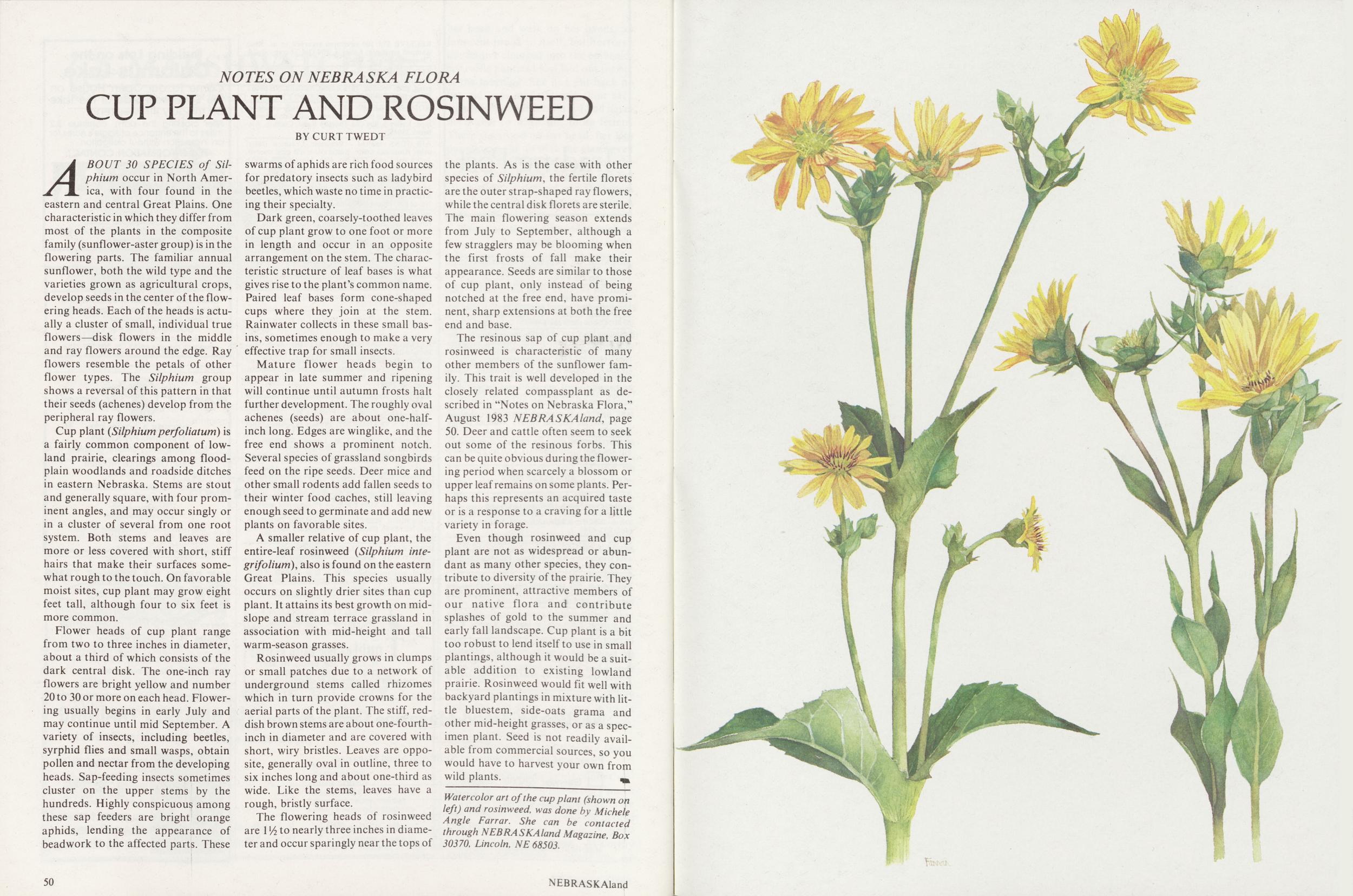
NOTES ON NEBRASKA FLORA CUP PLANT AND ROSINWEED
BY CURT TWEDTA BOUT 30 SPECIES of Silphium occur in North America, with four found in the eastern and central Great Plains. One characteristic in which they differ from most of the plants in the composite family (sunflower-aster group) is in the flowering parts. The familiar annual sunflower, both the wild type and the varieties grown as agricultural crops, develop seeds in the center of the flowering heads. Each of the heads is actually a cluster of small, individual true flowers—disk flowers in the middle and ray flowers around the edge. Ray flowers resemble the petals of other flower types. The Silphium group shows a reversal of this pattern in that their seeds (achenes) develop from the peripheral ray flowers.
Cup plant {Silphium perfoliatum) is a fairly common component of lowland prairie, clearings among flood plain woodlands and roadside ditches in eastern Nebraska. Stems are stout and generally square, with four prominent angles, and may occur singly or in a cluster of several from one root system. Both stems and leaves are more or less covered with short, stiff hairs that make their surfaces somewhat rough to the touch. On favorable moist sites, cup plant may grow eight feet tall, although four to six feet is more common.
Flower heads of cup plant range from two to three inches in diameter, about a third of which consists of the dark central disk. The one-inch ray flowers are bright yellow and number 20 to 30 or more on each head. Flowering usually begins in early July and may continue until mid September. A variety of insects, including beetles, syrphid flies and small wasps, obtain pollen and nectar from the developing heads. Sap-feeding insects sometimes cluster on the upper stems by the hundreds. Highly conspicuous among these sap feeders are bright orange aphids, lending the appearance of beadwork to the affected parts. These swarms of aphids are rich food sources for predatory insects such as ladybird beetles, which waste no time in practicing their specialty.
Dark green, coarsely-toothed leaves of cup plant grow to one foot or more in length and occur in an opposite arrangement on the stem. The characteristic structure of leaf bases is what gives rise to the plant's common name. Paired leaf bases form cone-shaped cups where they join at the stem. Rainwater collects in these small basins, sometimes enough to make a very effective trap for small insects.
Mature flower heads begin to appear in late summer and ripening will continue until autumn frosts halt further development. The roughly oval achenes (seeds) are about one-half inch long. Edges are winglike, and the free end shows a prominent notch. Several species of grassland songbirds feed on the ripe seeds. Deer mice and other small rodents add fallen seeds to their winter food caches, still leaving enough seed to germinate and add new plants on favorable sites.
A smaller relative of cup plant, the entire-leaf rosinweed {Silphium integrifolium), also is found on the eastern Great Plains. This species usually occurs on slightly drier sites than cup plant. It attains its best growth on midslope and stream terrace grassland in association with mid-height and tall warm-season grasses.
Rosinweed usually grows in clumps or small patches due to a network of underground stems called rhizomes which in turn provide crowns for the aerial parts of the plant. The stiff, reddish brown stems are about one-fourth inch in diameter and are covered with short, wiry bristles. Leaves are opposite, generally oval in outline, three to six inches long and about one-third as wide. Like the stems, leaves have a rough, bristly surface.
The flowering heads of rosinweed are 1 Vi to nearly three inches in diameter and occur sparingly near the tops of the plants. As is the case with other species of Silphium, the fertile florets are the outer strap-shaped ray flowers, while the central disk florets are sterile. The main flowering season extends from July to September, although a few stragglers may be blooming when the first frosts of fall make their appearance. Seeds are similar to those of cup plant, only instead of being notched at the free end, have prominent, sharp extensions at both the free end and base.
The resinous sap of cup plant and rosinweed is characteristic of many other members of the sunflower family. This trait is well developed in the closely related compassplant as described in "Notes on Nebraska Flora," August 1983 NEBRASKAland, page 50. Deer and cattle often seem to seek out some of the resinous forbs. This can be quite obvious during the flowering period when scarcely a blossom or upper leaf remains on some plants. Perhaps this represents an acquired taste or is a response to a craving for a little variety in forage.
Even though rosinweed and cup plant are not as widespread or abundant as many other species, they contribute to diversity of the prairie. They are prominent, attractive members of our native flora and contribute splashes of gold to the summer and early fall landscape. Cup plant is a bit too robust to lend itself to use in small plantings, although it would be a suit- able addition to existing lowland prairie. Rosinweed would fit well with backyard plantings in mixture with little bluestem, side-oats grams and other mid-height grasses, or as a specimen plant. Seed is not readily available from commercial sources, so you would have to harvest your own from wild plants.
Water color art of the cup plant (shown on left) and rosinweed, was done by Michele Angle Farrar. She can be contacted through NEBRASKAland Magazine, Box 30370, Lincoln, NE 68503.
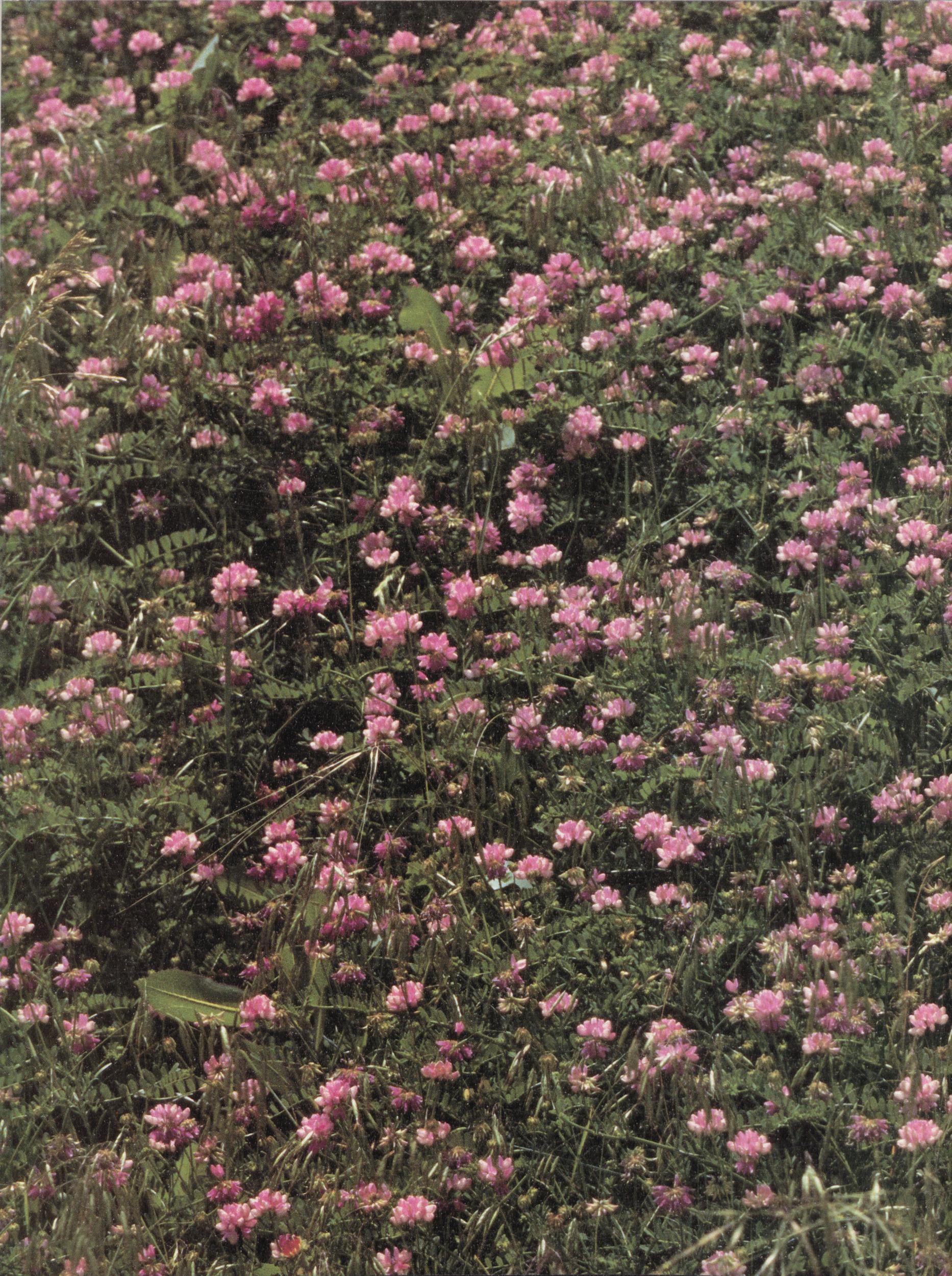
Position: 443 (23 views)